WO2021111992A1 - フルオロポリエーテル基含有ポリマー、表面処理剤及び物品 - Google Patents
フルオロポリエーテル基含有ポリマー、表面処理剤及び物品 Download PDFInfo
- Publication number
- WO2021111992A1 WO2021111992A1 PCT/JP2020/044129 JP2020044129W WO2021111992A1 WO 2021111992 A1 WO2021111992 A1 WO 2021111992A1 JP 2020044129 W JP2020044129 W JP 2020044129W WO 2021111992 A1 WO2021111992 A1 WO 2021111992A1
- Authority
- WO
- WIPO (PCT)
- Prior art keywords
- group
- containing polymer
- formula
- fluoropolyether
- independently
- Prior art date
- Legal status (The legal status is an assumption and is not a legal conclusion. Google has not performed a legal analysis and makes no representation as to the accuracy of the status listed.)
- Ceased
Links
- 0 CCC*(*(*)O*C(C)(C)*)C(F)(F)F Chemical compound CCC*(*(*)O*C(C)(C)*)C(F)(F)F 0.000 description 7
Classifications
-
- C—CHEMISTRY; METALLURGY
- C08—ORGANIC MACROMOLECULAR COMPOUNDS; THEIR PREPARATION OR CHEMICAL WORKING-UP; COMPOSITIONS BASED THEREON
- C08G—MACROMOLECULAR COMPOUNDS OBTAINED OTHERWISE THAN BY REACTIONS ONLY INVOLVING UNSATURATED CARBON-TO-CARBON BONDS
- C08G65/00—Macromolecular compounds obtained by reactions forming an ether link in the main chain of the macromolecule
- C08G65/02—Macromolecular compounds obtained by reactions forming an ether link in the main chain of the macromolecule from cyclic ethers by opening of the heterocyclic ring
- C08G65/32—Polymers modified by chemical after-treatment
- C08G65/329—Polymers modified by chemical after-treatment with organic compounds
- C08G65/336—Polymers modified by chemical after-treatment with organic compounds containing silicon
-
- C—CHEMISTRY; METALLURGY
- C08—ORGANIC MACROMOLECULAR COMPOUNDS; THEIR PREPARATION OR CHEMICAL WORKING-UP; COMPOSITIONS BASED THEREON
- C08G—MACROMOLECULAR COMPOUNDS OBTAINED OTHERWISE THAN BY REACTIONS ONLY INVOLVING UNSATURATED CARBON-TO-CARBON BONDS
- C08G65/00—Macromolecular compounds obtained by reactions forming an ether link in the main chain of the macromolecule
- C08G65/002—Macromolecular compounds obtained by reactions forming an ether link in the main chain of the macromolecule from unsaturated compounds
- C08G65/005—Macromolecular compounds obtained by reactions forming an ether link in the main chain of the macromolecule from unsaturated compounds containing halogens
- C08G65/007—Macromolecular compounds obtained by reactions forming an ether link in the main chain of the macromolecule from unsaturated compounds containing halogens containing fluorine
-
- C—CHEMISTRY; METALLURGY
- C09—DYES; PAINTS; POLISHES; NATURAL RESINS; ADHESIVES; COMPOSITIONS NOT OTHERWISE PROVIDED FOR; APPLICATIONS OF MATERIALS NOT OTHERWISE PROVIDED FOR
- C09D—COATING COMPOSITIONS, e.g. PAINTS, VARNISHES OR LACQUERS; FILLING PASTES; CHEMICAL PAINT OR INK REMOVERS; INKS; CORRECTING FLUIDS; WOODSTAINS; PASTES OR SOLIDS FOR COLOURING OR PRINTING; USE OF MATERIALS THEREFOR
- C09D171/00—Coating compositions based on polyethers obtained by reactions forming an ether link in the main chain; Coating compositions based on derivatives of such polymers
-
- C—CHEMISTRY; METALLURGY
- C09—DYES; PAINTS; POLISHES; NATURAL RESINS; ADHESIVES; COMPOSITIONS NOT OTHERWISE PROVIDED FOR; APPLICATIONS OF MATERIALS NOT OTHERWISE PROVIDED FOR
- C09K—MATERIALS FOR MISCELLANEOUS APPLICATIONS, NOT PROVIDED FOR ELSEWHERE
- C09K3/00—Materials not provided for elsewhere
- C09K3/18—Materials not provided for elsewhere for application to surfaces to minimize adherence of ice, mist or water thereto; Thawing or antifreeze materials for application to surfaces
-
- C—CHEMISTRY; METALLURGY
- C08—ORGANIC MACROMOLECULAR COMPOUNDS; THEIR PREPARATION OR CHEMICAL WORKING-UP; COMPOSITIONS BASED THEREON
- C08G—MACROMOLECULAR COMPOUNDS OBTAINED OTHERWISE THAN BY REACTIONS ONLY INVOLVING UNSATURATED CARBON-TO-CARBON BONDS
- C08G2650/00—Macromolecular compounds obtained by reactions forming an ether link in the main chain of the macromolecule
- C08G2650/28—Macromolecular compounds obtained by reactions forming an ether link in the main chain of the macromolecule characterised by the polymer type
- C08G2650/46—Macromolecular compounds obtained by reactions forming an ether link in the main chain of the macromolecule characterised by the polymer type containing halogen
- C08G2650/48—Macromolecular compounds obtained by reactions forming an ether link in the main chain of the macromolecule characterised by the polymer type containing halogen containing fluorine, e.g. perfluropolyethers
Definitions
- the present invention relates to a fluoropolyether group-containing polymer (a compound having a monovalent or divalent fluorooxyalkylene group-containing polymer residue in the molecule), and more specifically, a coating film having excellent water and oil repellency and abrasion resistance.
- the present invention relates to a fluoropolyether group-containing polymer forming the above, a surface treatment agent containing the polymer and / or a partial (hydrolyzed) condensate thereof, and an article surface-treated with the surface treatment agent.
- a fluoropolyether group-containing compound has water repellency, oil repellency, chemical resistance, lubricity, mold releasability, antifouling property, etc. because its surface free energy is very small. Utilizing its properties, it is industrially widely used as water and oil repellent antifouling agents for paper and fibers, lubricants for magnetic recording media, oil repellents for precision equipment, mold release agents, cosmetics, protective films, etc. ing. However, its properties mean that it is non-adhesive and non-adhesive to other base materials at the same time, and although it can be applied to the surface of the base material, it is difficult to adhere the coating film. ..
- a silane coupling agent is well known as a substance that binds an organic compound to the surface of a base material such as glass or cloth, and is widely used as a coating agent on the surface of various base materials.
- the silane coupling agent has an organic functional group and a reactive silyl group (generally a hydrolyzable silyl group such as an alkoxysilyl group) in one molecule.
- the hydrolyzable silyl group causes a self-condensation reaction due to moisture in the air or the like to form a film.
- the film becomes a durable and strong film by chemically and physically bonding the hydrolyzable silyl group to the surface of glass, metal, or the like.
- Patent Documents 1 to 6 JP-A-2008-534696, JP-A-2008-537557, JP-A). Open 2012-072272, Japanese Patent Application Laid-Open No. 2012-157856, Japanese Patent Application Laid-Open No. 2013-136833, Japanese Patent Application Laid-Open No. 2015-199906).
- a cured film such as a lens or an antireflection film surface-treated with a composition containing a fluoropolyether group-containing polymer in which a hydrolyzable silyl group is introduced into the fluoropolyether group-containing compound has excellent wear durability against steel wool. However, it is inferior in wear durability to the eraser or does not have sufficient wear durability.
- the present invention has been made in view of the above circumstances, and is a fluoropolyether group-containing polymer capable of forming a cured film having excellent water and oil repellency and abrasion resistance, and the polymer and / or a portion thereof (hydrolysis). ) It is an object of the present invention to provide a surface treatment agent containing a condensate, and an article surface-treated with the surface treatment agent.
- the present inventors have made a hydroxyl group-containing silyl group or a hydrolyzable silyl group and a polyether represented by the general formula (1) described later in the fluoropolyether group-containing polymer.
- a fluoropolyether group-containing polymer having a group it was found that the surface treatment agent containing the polymer and / or its partial (hydrolyzed) condensate is particularly excellent in water repellency, oil repellency, and eraser abrasion resistance. , The present invention has been made.
- the present invention provides the following fluoropolyether group-containing polymers (compounds having monovalent or divalent fluorooxyalkylene group-containing polymer residues in their molecules), surface treatment agents and articles.
- Rf is a monovalent or divalent fluorooxyalkylene group-containing polymer residue
- L is an independently divalent heteroatom
- L' is an independently monobonded or divalent heteroatom
- Y are divalent to hexavalent hydrocarbon groups that may independently have at least one selected from an oxygen atom, a silicon atom and a siloxane bond
- R is an independently alkyl group having 1 to 4 carbon atoms.
- N is an integer of 1 to 3 independently for each silicon atom
- m is an integer of 1 to 5 independently
- X' is a hydroxyl group or a hydrolyzable group
- V is a group represented by. Independently single-bonded or sylalkylene group, sylarylene group, and linear or branched or cyclic 2- to 6-valent organopolysiloxane residues with 2 to 10 silicon atoms or 3 to 10 silicon atoms.
- E is an independently monovalent polyether group
- o is an independently integer of 1 to 5
- ⁇ is 1 or 2.
- A is a fluorine atom, a hydrogen atom, or a fluoroalkyl group having three -CF terminals at the end
- W is a fluoroalkylene group independently containing one or more hydrogen atoms
- d is a unit-by-unit, respectively.
- W is a fluoroalkylene group independently containing one or more hydrogen atoms.
- Y is an alkylene group having 3 to 10 carbon atoms, an alkylene group containing an arylene group having 6 to 8 carbon atoms, and the alkylene groups are bonded to each other via a sylalkylene structure or a sill arylene structure 2 A valent group and a linear or cyclic or cyclic 2- to 4-valent organopolysiloxane residue having 2 to 10 silicon atoms and 3 to 10 silicon atoms having 2 to 10 carbon atoms attached to the bond.
- R is an alkyl group or a phenyl group having 1 to 4 carbon atoms
- e is an integer of 1 to 4
- w, x, y, and z are integers of 0 to 30, respectively
- w + x + y + z 1 to 1 to 50, and each of these units may be linear or branched, and each repeating unit shown in parentheses with w, x, y, z is randomly combined.
- X is independently a hydroxyl group, an alkoxy group having 1 to 10 carbon atoms, an alkoxyalkoxy group having 2 to 10 carbon atoms, an acyloxy group having 1 to 10 carbon atoms, and an alkenyl having 2 to 10 carbon atoms.
- p1 is an integer of 5 to 100
- q1 is an integer of 5 to 100
- r1 is an integer of 1 to 100
- r2 is an integer of 1 to 99
- r3 is an integer of 1 to 99
- R2, and r3 are integers of 10 to 110. Note that each repeating unit shown in parentheses with p1, q1, r1, r2, and r3 may be randomly combined.
- a surface treatment agent containing the fluoropolyether group-containing polymer according to any one of [1] to [7] and / or a partial (hydrolyzed) condensate thereof.
- the adhesion to the substrate and the wettability are improved, whereby the surface is treated with a surface treatment agent containing the polymer and / or a partial (hydrolyzed) condensate thereof.
- the article is excellent in water repellency, oil repellency, and eraser wear resistance.
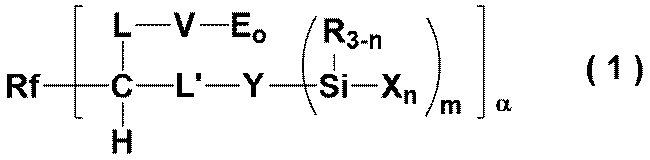
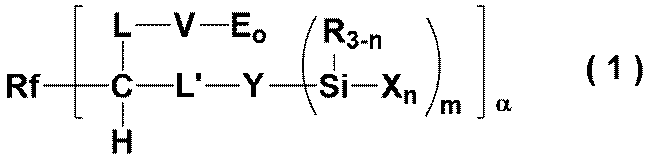
- the fluoropolyether group-containing polymer of the present invention has a fluoropolyether group and a reactive functional group in the molecule, and further has a polyether group, and is represented by the following general formula (1). ..
- the fluoropolyether group-containing polymer of the present invention may be used alone or as a mixture of two or more.
- Rf is a monovalent or divalent fluorooxyalkylene group-containing polymer residue
- L is an independently divalent heteroatom
- L' is an independently monobonded or divalent heteroatom.
- Y are divalent to hexavalent hydrocarbon groups that may independently have at least one selected from an oxygen atom, a silicon atom and a siloxane bond, and R is an independently alkyl group having 1 to 4 carbon atoms. Alternatively, it is a phenyl group, and X is independently a hydroxyl group, a hydrophilic group, or the following general formula (2).
- N is an integer of 1 to 3 independently for each silicon atom
- m is an integer of 1 to 5 independently
- X' is a hydroxyl group or a hydrolyzable group
- V is a group represented by.
- “about (numerical value)” is a numerical value (approximate number) expressed by rounding, and if the last digit of the displayed numerical value is not "0", further Includes up to the numerical range where the lower digits are rounded to the displayed number.
- “about 3 equivalents” means 2.5 equivalents or more and 3.4 equivalents or less
- “about 0.02 equivalents” means 0.015 equivalents or more and 0.024 equivalents or less.
- the lowest digit of the displayed numerical value is "0”
- the lowest digit is rounded off to include the numerical range up to the displayed numerical value.
- “about 50 ° C.” means 45 ° C. or higher and 54 ° C. or lower.
- the fluoropolyether group-containing polymer of the present invention includes a monovalent fluorooxyalkyl group or a divalent fluorooxyalkylene group (that is, a monovalent or divalent fluorooxyalkylene group-containing polymer residue), an alkoxysilyl group and the like.
- a polyether group at the end of the branched chain in addition to the hydrolyzable silyl group or the hydroxyl group-containing silyl group By having a polyether group at the end of the branched chain in addition to the hydrolyzable silyl group or the hydroxyl group-containing silyl group, the adhesion to the base material and the wettability are improved, and the water and oil repellency and the wear resistance of the eraser are excellent. It is a feature.
- Rf is a monovalent or divalent fluorooxyalkylene group-containing polymer residue
- ⁇ is 1 (that is, Rf is a monovalent fluorooxyalkylene group-containing polymer residue).
- A is a fluorine atom, a hydrogen atom, or a fluoroalkyl group having three -CF terminals at the end
- W is a fluoroalkylene group independently containing one or more hydrogen atoms
- A is a fluorine atom, a hydrogen atom, or a fluoroalkyl group having three -CF groups at the end, preferably a fluorine atom.
- W is a fluoroalkylene group independently containing one or more hydrogen atoms, and is, for example, CF 2 units, C 2 F 4 units, C 3 F 6 units, C 4 F 8 Examples thereof include those in which one or two fluorine atoms are replaced with hydrogen atoms in each perfluoroalkylene group such as a unit, C 5 F 10 units, and C 6 F 12 units.
- d is an integer of 1 to 3 independently for each unit, and is preferably 1 or 2.
- p, q, r, s, t, u, and v are integers of 0 to 200, respectively, preferably p is an integer of 5 to 100, q is an integer of 5 to 100, and r is an integer of 0 to 100.
- s is an integer of 0 to 100
- t is an integer of 0 to 100
- u is an integer of 0 to 100
- v is an integer of 0 to 100
- p + q + r + s + t + u + v is 3 to 200, preferably 10 to 110
- each unit may be linear or branched.
- each repeating unit shown in parentheses with p, q, r, s, t, u, and v may be randomly combined.
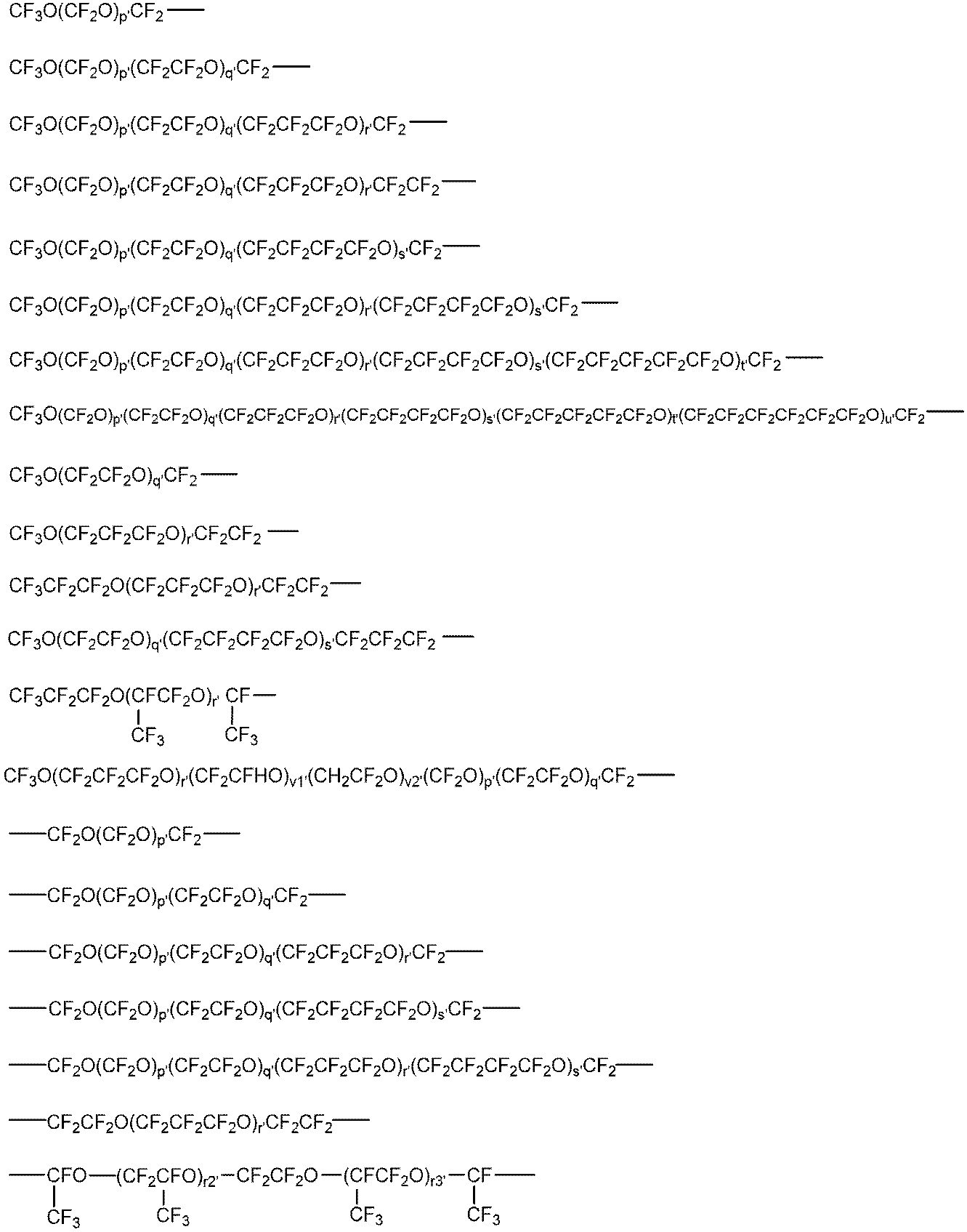
- Rf the following can be exemplified as Rf.
- R2'and r3' are integers of 1 or more, respectively, and the sum of r2'and r3'is an integer of 2 to 199.
- P', q', r', s', t', u', v1', v2', each repeating unit shown in parentheses may be randomly combined.
- L is an independently divalent heteroatom
- L' is an independently single-bonded or divalent heteroatom
- these divalent heteroatoms include an oxygen atom and a nitrogen atom.
- Sulfur atom can be mentioned.
- L is preferably an oxygen atom
- L' is preferably a single bond or an oxygen atom, more preferably a single bond.
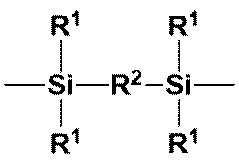
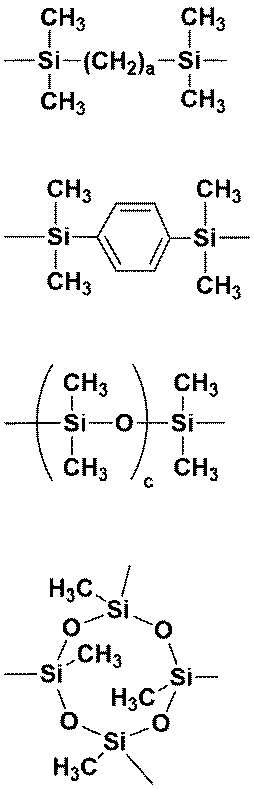
- Y is independently a divalent to 6-valent, preferably 2- to 4-valent, more preferably divalent hydrocarbon group, and is at least one selected from an oxygen atom, a silicon atom and a siloxane bond. May have.
- an alkylene group having 3 to 10 carbon atoms such as a propylene group, a butylene group, and a hexamethylene group
- an alkylene group containing an arylene group having 6 to 8 carbon atoms such as a phenylene group (for example, 8 carbon atoms).
- ⁇ 16 alkylene-arylene groups, etc. divalent groups in which alkylene groups are bonded via an oxygen atom, and divalent groups in which alkylene groups are bonded via a sylalkylene structure or a sylarylene structure.
- 2 to 10 silicon atoms preferably 2 to 5 linear or 3 to 10 silicon atoms, preferably 3 to 5 branched or cyclic 2- to 6-valent organopolysiloxane residues.
- Examples thereof include 2- to 6-valent groups to which an alkylene group having 2 to 10 carbon atoms is bonded, and preferably an alkylene group having 3 to 10 carbon atoms, an alkylene group containing a phenylene group, and an alkylene group are attached to each other.
- R 1 is an aryl group having 6 to 10 carbon atoms such as a methyl group, an ethyl group, a propyl group, an alkyl group having 1 to 4 carbon atoms such as butyl group, a phenyl group
- R 1 is be the same or different
- R 2 is an alkylene group having 1 to 4 carbon atoms such as a methylene group, an ethylene group and a propylene group (trimethylethylene group and a methylethylene group), and an arylene group having 6 to 10 carbon atoms such as a phenylene group.
- a linear or cyclic 2- to 6-valent organopolysiloxane residue having 2 to 10 silicon atoms, preferably 2 to 5 silicon atoms, or preferably 3 to 5 branched or cyclic silicon atoms.
- Examples of the group include those shown below.
- R 1 is the same as above.
- G is an integer of 1 to 9, preferably 1 to 4
- h is an integer of 2 to 6, preferably 2 to 4
- j is an integer of 0 to 8.
- h + j is an integer of 3 to 10, preferably 3 to 5
- k is an integer of 1 to 3, preferably 2 or 3.
- Examples of Y include groups represented by the following formulas.
- D is a divalent organic group having 2 to 16 carbon atoms which may be substituted with fluorine
- a is an integer of 1 to 4
- b is an independently integer of 2 to 10
- c is an integer from 1 to 9.
- D is a divalent organic group having 2 to 16 carbon atoms, preferably 2 to 8 carbon atoms which may be substituted with fluorine, preferably 2 to 16 carbon atoms, and more preferably 2 to 8 carbon atoms.
- It is a divalent hydrocarbon group which may be substituted with fluorine, and examples of the divalent hydrocarbon group include an ethylene group, a propylene group (trimethylene group, methylethylene group), a butylene group (tetramethylene group, methylpropylene group), and the like.
- alkylene group such as a hexamethylene group or an octamethylene group, an arylene group such as a phenylene group, a combination of two or more of these groups (alkylene / arylene group, etc.), and a part or all of hydrogen atoms of these groups. Is substituted with a fluorine atom and the like.
- D an ethylene group, a propylene group, a butylene group, a hexamethylene group, and a phenylene group are preferable.
- a is an integer of 1 to 4, preferably 1 to 3
- b is an independently integer of 2 to 10, preferably 2 to 6
- c is an integer of 1 to 9, preferably 1 to 4. is there.
- Y include the following groups.
- m is an integer of 1 to 5, and if it is less than 1, the adhesion to the substrate is lowered, and if it is 6 or more, the terminal alkoxy value is too high and the performance is adversely affected, which is preferable.
- R is independently an alkyl group such as a methyl group having 1 to 4 carbon atoms, an ethyl group, a propyl group or a butyl group, or a phenyl group, and the methyl group is particularly preferable.
- n is an integer of 1 to 3 independently for each silicon atom, preferably 2 or 3, and 3 is more preferable from the viewpoint of reactivity and adhesion to the substrate.
- X is independently a hydroxyl group, a hydrolyzable group, or a group represented by the following general formula (2).
- L', Y, R, m, n are the same as above, and X'is a hydroxyl group or a hydrolyzable group.
- an alkoxy group having 1 to 10 carbon atoms such as a methoxy group, an ethoxy group, a propoxy group, an isopropoxy group and a butoxy group, and a methoxymethoxy group and a methoxyethoxy group having 2 to 10 carbon atoms.
- examples thereof include an acyloxy group having 1 to 10 carbon atoms such as an alkoxyalkoxy group and an acetoxy group, an alkenyloxy group having 2 to 10 carbon atoms such as an isopropenoxy group, and a halogen group such as a chloro group, a bromo group and an iodo group.
- a methoxy group, an ethoxy group, an isopropenoxy group and a chlor group are particularly preferable.
- X' is a hydroxyl group or a hydrolyzable group
- examples of the hydrolyzable group include the same as above.
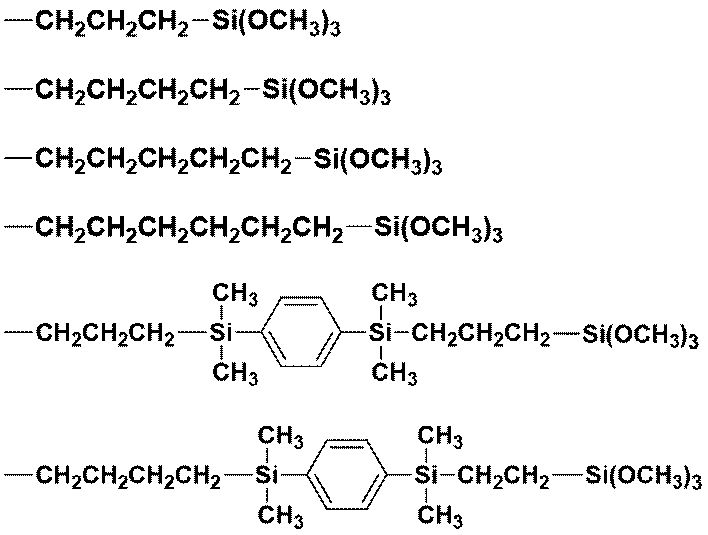
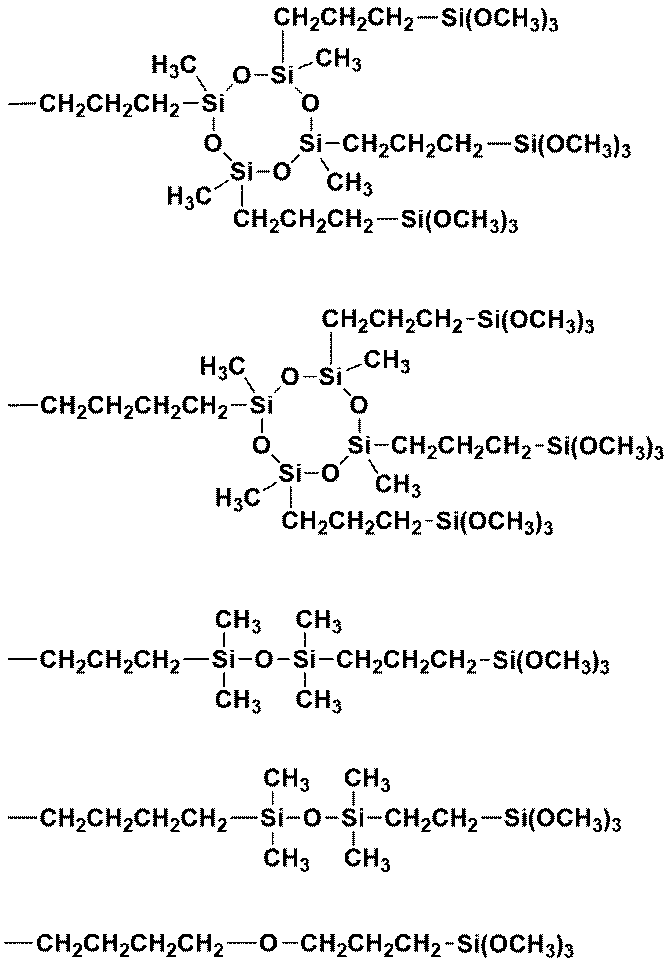
- Examples of the group represented by the formula (2) include those shown below.
- a methoxy group, an ethoxy group, an isopropenoxy group, and a chlor group are particularly preferable.
- V is independently a single bond, or a sylalkylene group, a sylarylene group, and a linear or branched or cyclic 2 having 2 to 10 silicon atoms or 3 to 10 silicon atoms. It is a 2- to 6-valent group selected from ⁇ 6-valent organopolysiloxane residues.
- examples of the sylalkylene group and the sillarylene group include those similar to the sylalkylene structure and the sillarylene structure exemplified in Y.
- the 2- to 6-valent organopolysiloxane residue having 2 to 10 silicon atoms or 3 to 10 silicon atoms
- the 2- to 6-valent organoxane exemplified in Y is used as a linear or branched or cyclic 2- to 6-valent organopolysiloxane residue having 2 to 10 silicon atoms or 3 to 10 silicon atoms.
- the same as the polysiloxane residue can be exemplified.
- ⁇ hexavalent group selected from a silalkylene group, a silarylene group of V, and a linear or cyclic or cyclic 2- to 6-valent organopolysiloxane residue having 2 to 10 silicon atoms or 3 to 10 silicon atoms.
- Examples of the ⁇ hexavalent group include groups represented by the following formulas. (In the formula, a and c are the same as above.)
- V a single bond, a silialylene group, and a linear divalent organopolysiloxane residue having 2 to 10 silicon atoms are preferable.
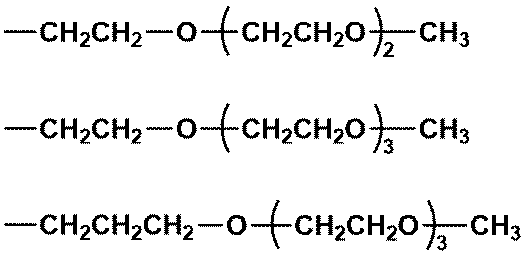
- E is an independently monovalent polyether group, preferably having a repeating unit of an oxyalkylene group having 1 to 4 carbon atoms, and is represented by the following general formula (5). More preferably it is a group.
- R is the same as the above, and is an alkyl group or a phenyl group having 1 to 4 carbon atoms, preferably a methyl group.
- e is an integer of 1 to 4, preferably an integer of 1 to 3, and more preferably 2 or 3.
- each unit may be linear or branched. Further, each repeating unit shown in parentheses with w, x, y, and z may be randomly combined.
- E include the following groups.
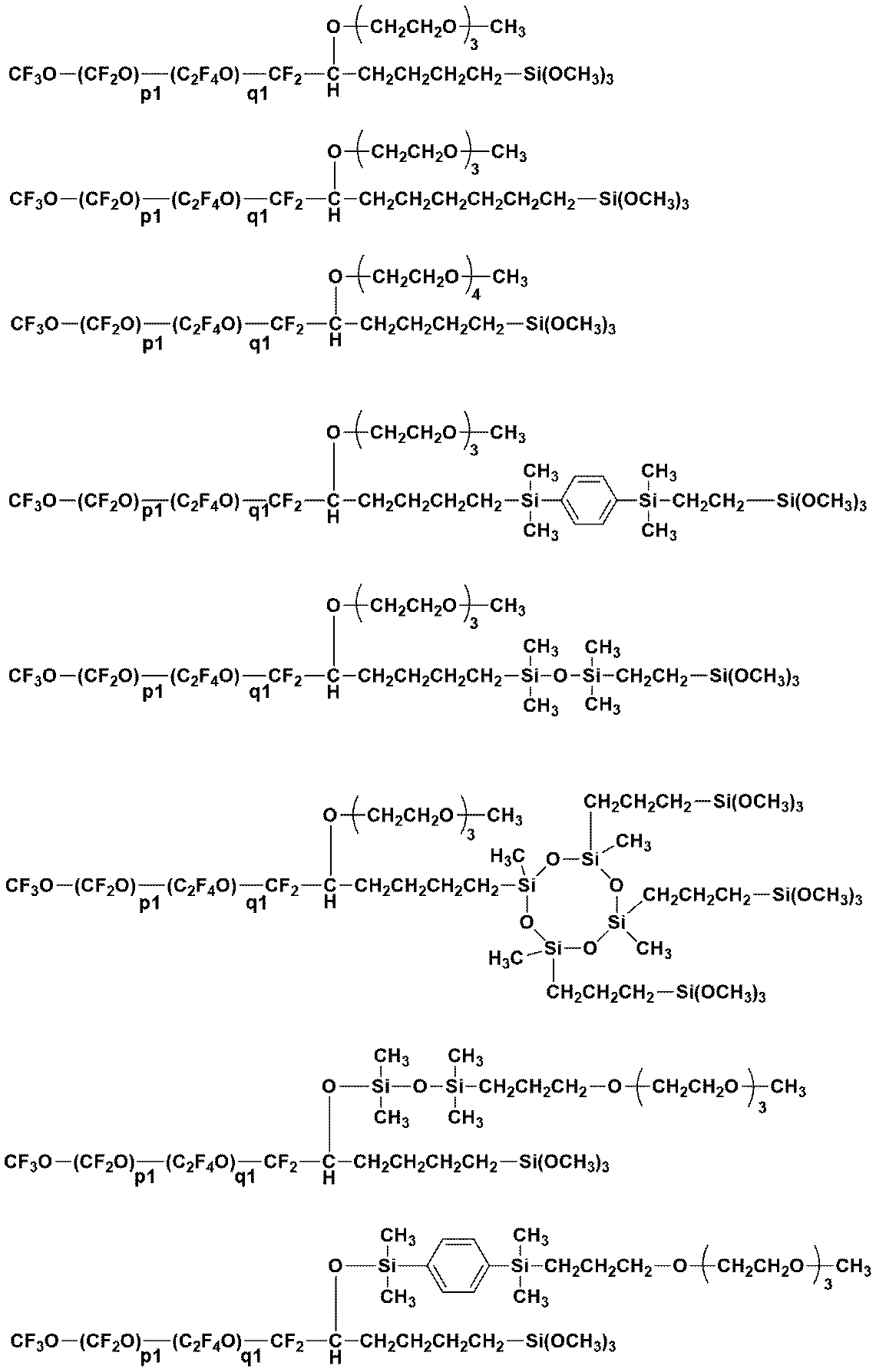
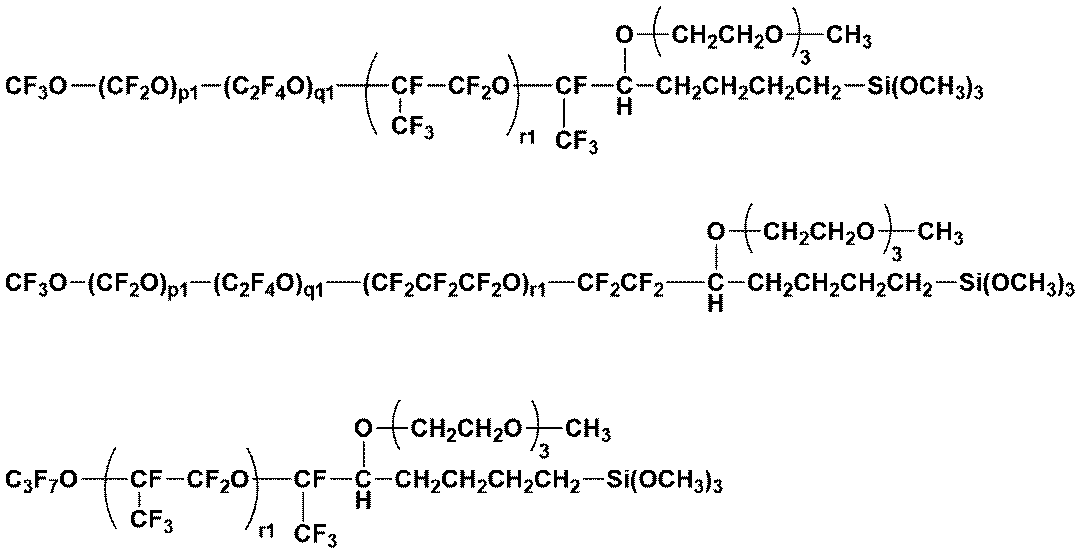
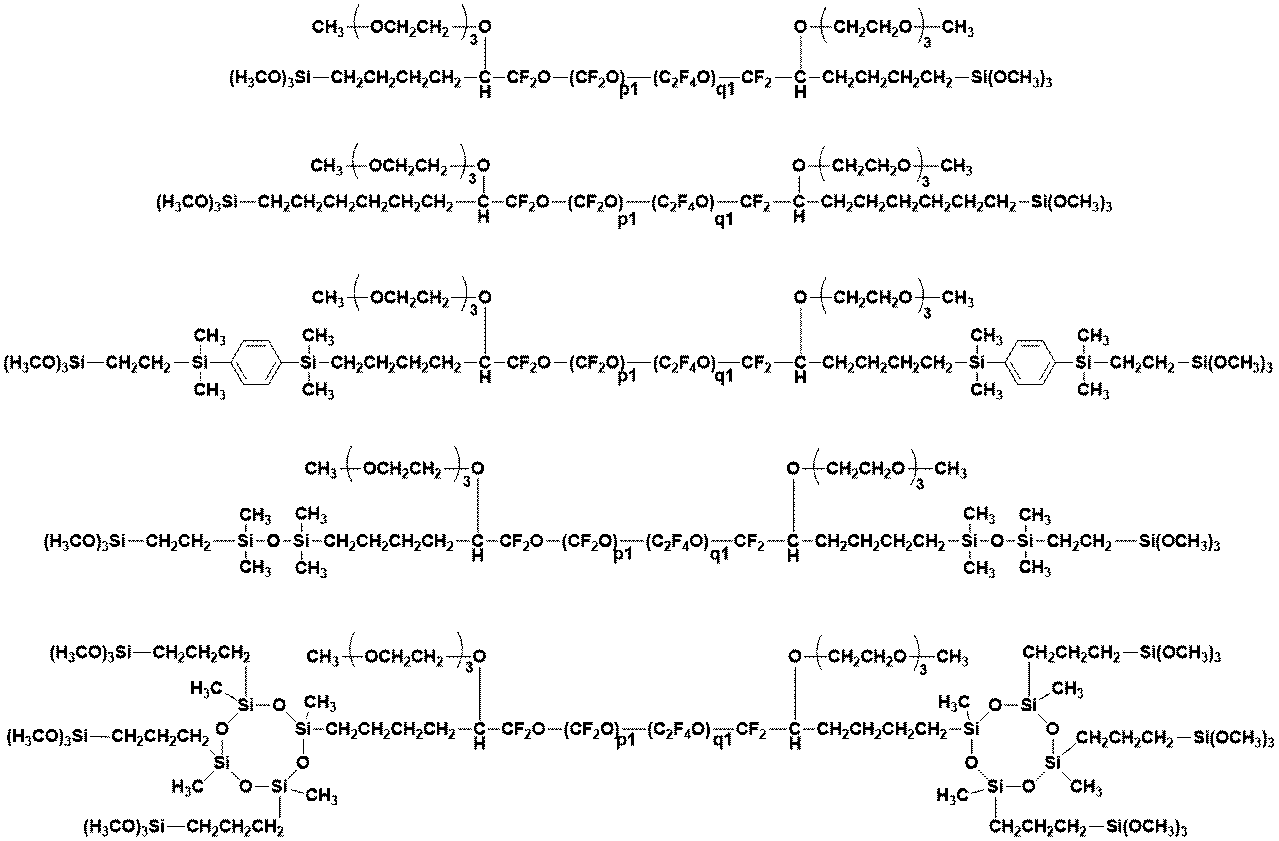
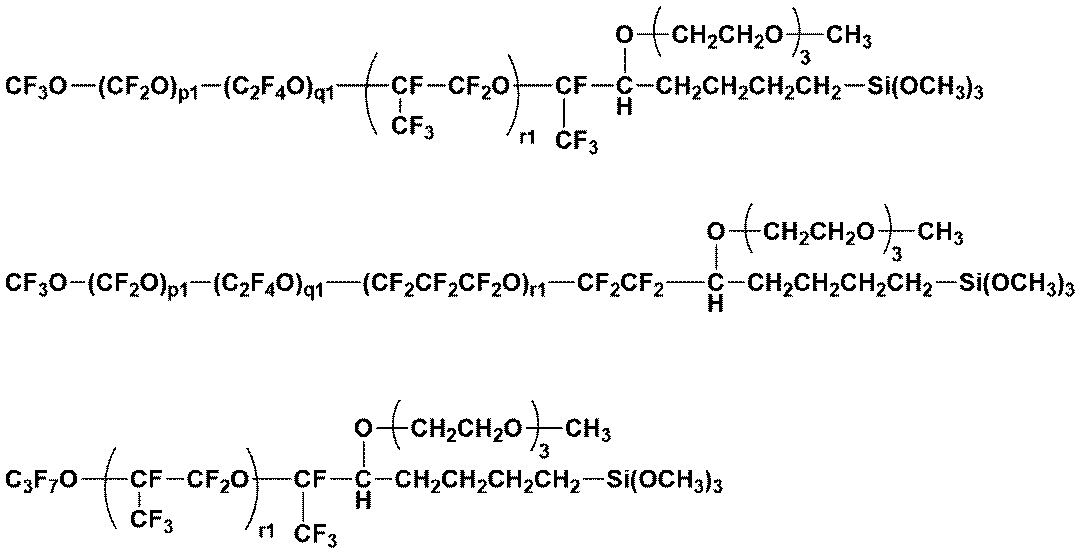
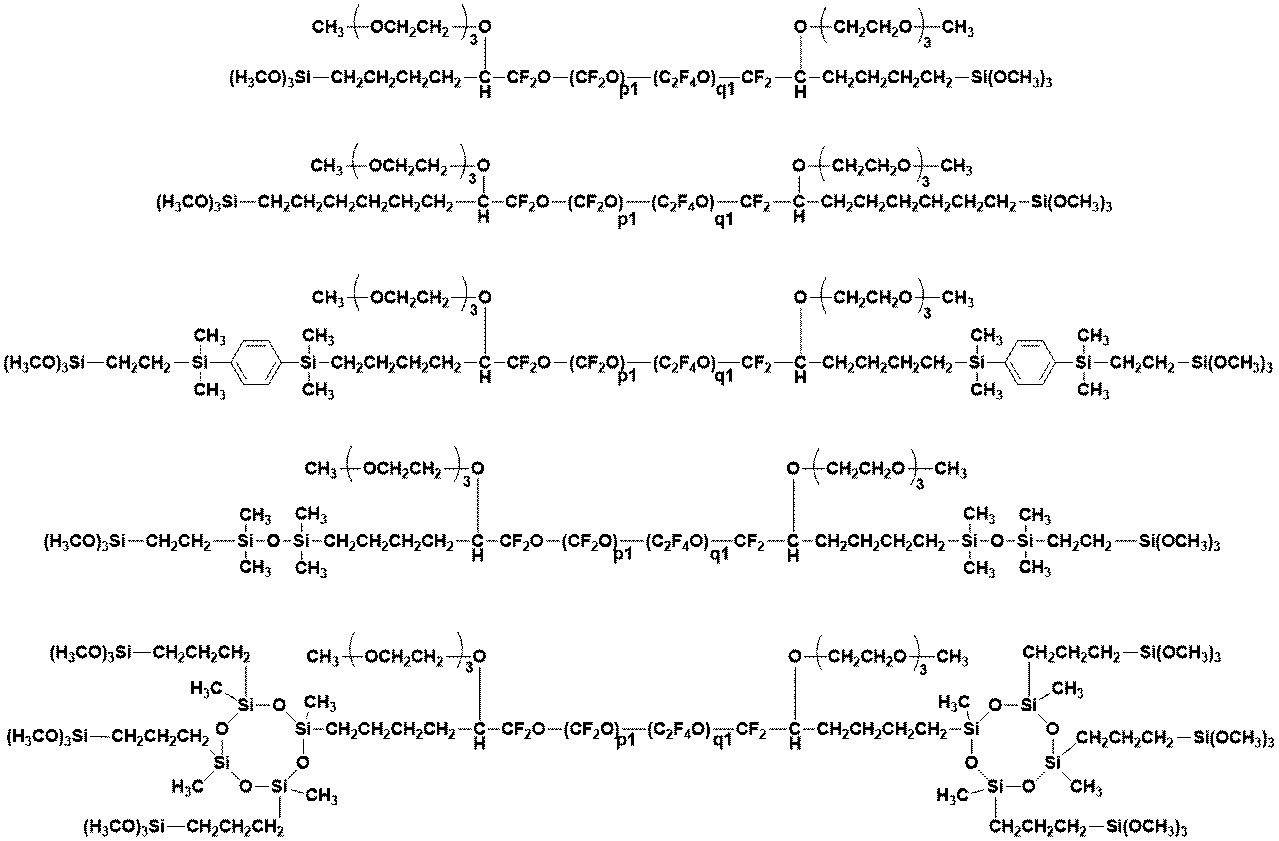
- Examples of the fluoropolyether group-containing polymer represented by the above formula (1) include those represented by the following formula.
- the number of repetitions (or degree of polymerization) of each repeating unit constituting the fluorooxyalkyl group or the fluorooxyalkylene group (monovalent or divalent fluorooxyalkylene group-containing polymer residue) is shown below. , Any number that satisfies the above equations (3) and (4) may be taken.
- p1 is an integer of 5 to 100
- q1 is an integer of 5 to 100
- r1 is an integer of 1 to 100
- r2 is an integer of 1 to 99
- r3 is an integer of 1 to 99
- R2, r3 (for example, p1 + q1, p1 + q1 + r1, or p1 + q1 + r2 + r3) is an integer of 10 to 110. Note that each repeating unit shown in parentheses with p1, q1, r1, r2, r3 is randomly assigned. May be combined.)
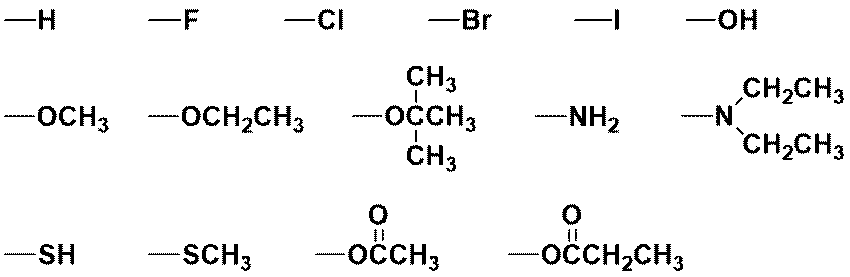
- M is a desorbable monovalent group, for example, a hydrogen atom, a halogen atom, a hydroxyl group, an alkoxy group, an amino group, an alkylamino group, a thiol group, an alkylthio group, an acyl group and the like. Can be mentioned. Examples of such M include the following groups.
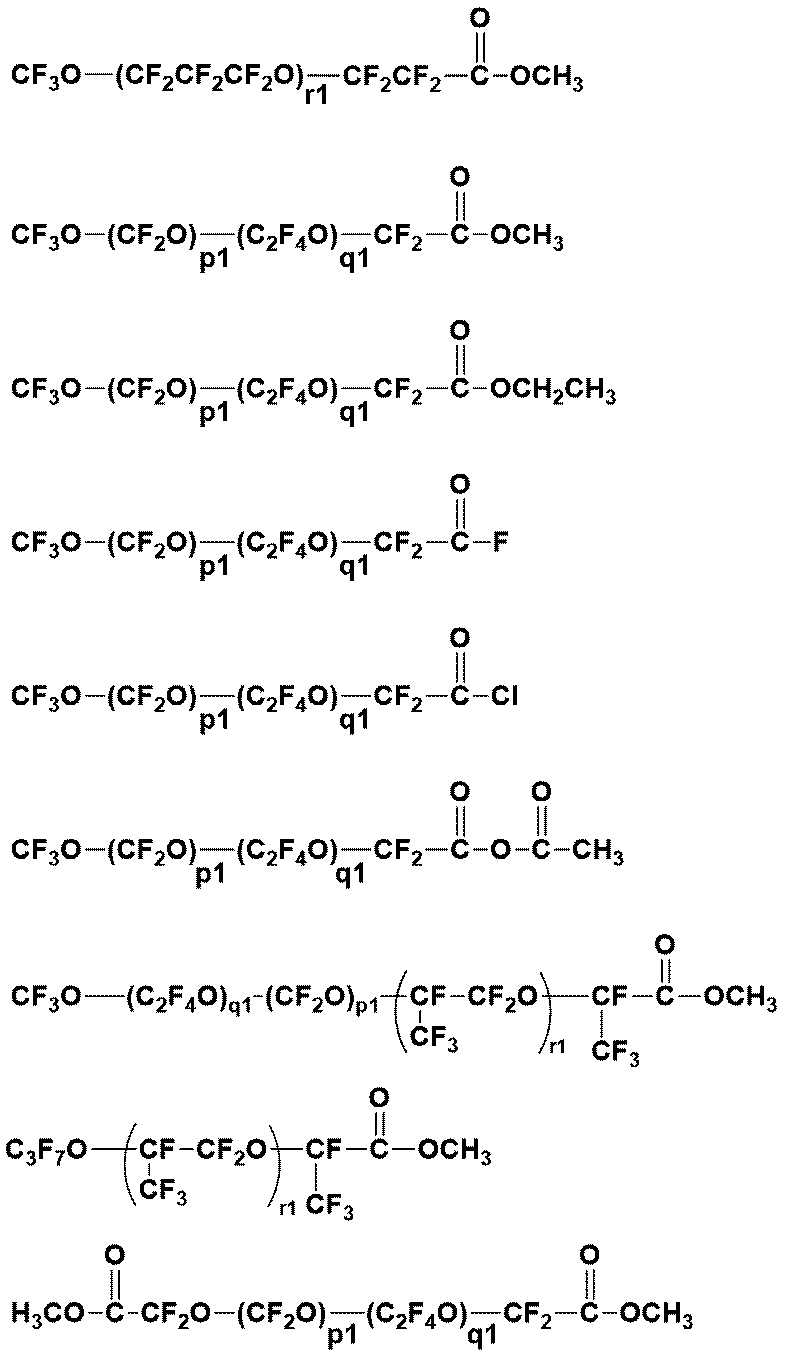
- fluoropolyether group-containing polymer having a carbonyl group represented by the above formula (6) at the end include those shown below.
- the number of repetitions (or degree of polymerization) of each repeating unit constituting the fluorooxyalkyl group or the fluorooxyalkylene group (monovalent or divalent fluorooxyalkylene group-containing polymer residue) is shown below.
- Any number that satisfies the above equations (3) and (4) may be taken.
- p1, q1, and r1 are the same as above, and the sum of each of p1, q1, and r1 is an integer of 10 to 110, and is shown in parentheses with p1, q1, and r1.
- Each repeating unit may be randomly combined.
- organic metal reagent having an aliphatic unsaturated double bond at the terminal and having ⁇ hydrogen examples include an organic lithium reagent, a Grignard reagent, an organic zinc reagent, an organic boron reagent, and an organic tin reagent. From the viewpoint of ease of handling, it is preferable to use Grignard reagent and organic zinc reagent. As such an organometallic reagent, the following ones can be particularly preferably used.
- the amount of the organometallic reagent having an aliphatic unsaturated double bond at the terminal and ⁇ hydrogen is the reaction of the fluoropolyether group-containing polymer having a carbonyl group represented by the above formula (6) at the end. It is preferable to use 2 to 5 equivalents, more preferably 2.5 to 3.5 equivalents, and even more preferably about 3 equivalents with respect to 1 equivalent of the sex terminal group (desorbable monovalent group).
- Solvents can be used.
- the solvent used at this time is not particularly limited, but it is preferable to use a fluorine-based solvent because the reaction compound is a fluorine compound.
- Fluorosolvents include 1,3-bistrifluoromethylbenzene, trifluoromethylbenzene, perfluorosolvents sold by AGC (Asahiclean AC2000, Asahiclean AC6000, etc.), and hydros sold by 3M.
- Fluoroether (HFE) solvent NOVEC7100: C 4 F 9 OCH 3 , NOVEC 7200: C 4 F 9 OC 2 H 5 , NOVEC 7300: C 2 F 5- CF (OCH 3 ) -CF (CF 3 ) 2, etc.
- fluorine-based solvent may be used alone or in combination.
- an organic solvent can be used in addition to the above-mentioned fluorine-based solvent.
- ether solvents such as tetrahydrofuran (THF), monoethylene glycol dimethyl ether, diethylene glycol dimethyl ether, triethylene glycol dimethyl ether, tetraethylene glycol dimethyl ether, and dioxane can be used.
- the organic solvent may be used alone or mixed with a fluorine-based solvent.
- the amount of the solvent used is 10 to 600 parts by mass, preferably 50 to 400 parts by mass, more preferably 50 parts by mass, based on 100 parts by mass of the fluoropolyether group-containing polymer having a carbonyl group represented by the above formula (6) at the end. Can be used in an amount of 200 to 350 parts by mass.
- reaction condition between a fluoropolyether group-containing polymer having a carbonyl group represented by the above formula (6) at the end and an organometallic reagent having an aliphatic unsaturated double bond at the end and having ⁇ hydrogen can be 0 to 80 ° C., preferably 45 to 70 ° C., more preferably about 50 ° C., for 1 to 12 hours, preferably 5 to 7 hours.
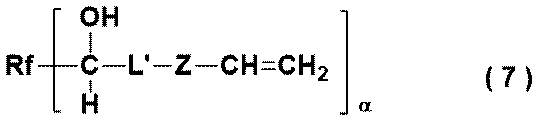
- a fluoropolyether group-containing polymer having a hydroxyl group and an olefin moiety at the terminal of the molecular chain represented by the following formula (7) can be obtained. .. (In the formula, Rf, L', ⁇ are the same as above, Z is a divalent hydrocarbon group independently, and the hydrocarbon group may contain a silicon atom and / or a siloxane bond.)
- Z is a divalent hydrocarbon group, preferably a divalent hydrocarbon group having 1 to 20 carbon atoms, particularly 2 to 12, and specifically, a methylene group.
- the number of carbon atoms such as ethylene group, propylene group (trimethylene group, methylethylene group), butylene group (tetramethylene group, methylpropylene group), hexamethylene group, octamethylene group and other alkylene groups having 1 to 8 carbon atoms and phenylene group and the like.
- Examples thereof include an alkylene group containing 6 to 8 arylene groups (for example, an alkylene arylene group having 7 to 9 carbon atoms).
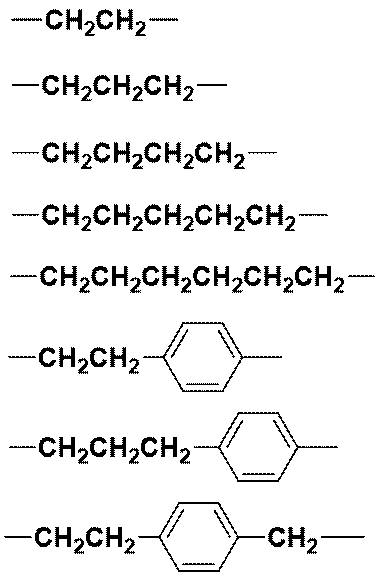
- Z is preferably a linear alkylene group having 1 to 4 carbon atoms.
- Examples of such Z include the following groups.
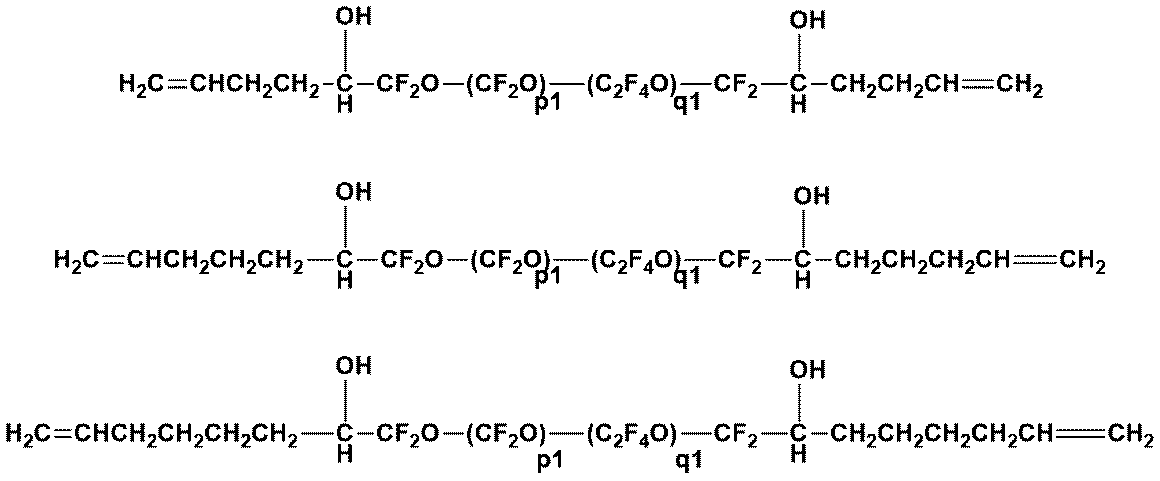
- fluoropolyether group-containing polymer having a hydroxyl group and an olefin moiety at the end of the molecular chain represented by the formula (7) include those shown below.
- the number of repetitions (or degree of polymerization) of each repeating unit constituting the fluorooxyalkyl group or the fluorooxyalkylene group (monovalent or divalent fluorooxyalkylene group-containing polymer residue) is shown below. , Any number that satisfies the above equations (3) and (4) may be taken.
- p1, q1, and r1 are the same as above, and the sum of each of p1, q1, and r1 is an integer of 10 to 110, and is shown in parentheses with p1, q1, and r1. Each repeating unit may be randomly combined.
- a fluoropolyether group-containing polymer having a hydroxyl group and an olefin moiety at the terminal of the molecular chain represented by the above formula (7) and a polyether group-introducing agent are reacted in the presence of a base, if necessary.
- a fluoropolyether group-containing polymer having a hydroxyl group and an olefin moiety at the terminal of the molecular chain represented by the above formula (7) and a hydrolyzable terminal group in the molecule are provided.
- an organic silicon compound having two or more SiH groups is used at a temperature of 0 to 60 ° C., preferably 15 to 35 ° C., more preferably about 25 ° C., using a solvent as necessary.
- a fluoropolyether group-containing polymer having a SiH group and an olefin moiety at the end of the molecular chain can be obtained.
- a fluoropolyether group-containing polymer having a SiH group and an olefin moiety at the end of the molecular chain and a polyether compound having an olefin moiety in the molecule Is dissolved in a solvent, for example, a fluorine-based solvent such as 1,3-bis (trifluoromethyl) benzene, and is preferably at 40 to 120 ° C. in the presence of a hydrosilylation reaction catalyst, for example, a toluene solution of chloroplatinic acid / vinylsiloxane complex. Is aged at a temperature of 60 to 100 ° C., more preferably about 80 ° C. for 1 to 72 hours, preferably 20 to 36 hours, more preferably about 24 hours.
- the polyether group-introducing agent for reacting with the fluoropolyether group-containing polymer having a hydroxyl group and an olefin moiety at the end of the molecular chain represented by the above formula (7) for example, a halide or the like can be used.
- a halide or the like can be used as the polyether group-introducing agent for reacting with the fluoropolyether group-containing polymer having a hydroxyl group and an olefin moiety at the end of the molecular chain represented by the above formula (7).
- a halide or the like can be used as the polyether group-introducing agent for reacting with the fluoropolyether group-containing polymer having a hydroxyl group and an olefin moiety at the end of the molecular chain represented by the above formula (7).
- the amount of the polyether group-introducing agent used is 1 to 1 to 1 equivalent of the reactive end group (hydroxyl group) of the fluoropolyether group-containing polymer having a hydroxyl group and an olefin moiety at the end of the molecular chain represented by the formula (7). 15 equivalents, more preferably 3-6 equivalents can be used.
- Examples of the base used for the reaction between the fluoropolyether group-containing polymer having a hydroxyl group and an olefin moiety at the end of the molecular chain represented by the above formula (7) and the polyether group introducing agent include amines and alkali metal bases. Can be used, and specific examples of amines include triethylamine, diisopropylethylamine, pyridine, DBU, and imidazole.
- alkali metal bases sodium hydroxide, potassium hydroxide, sodium hydride, potassium hydride, alkyllithium, t-butoxypotassium, lithium diisopropylamide, lithium bis (trimethylsilyl) amide, sodium bis (trimethylsilyl) amide, potassium bis Examples thereof include (trimethylsilyl) amide.
- the amount of the base used is 1 to 20 equivalents, based on 1 equivalent of the reactive end group (hydroxyl group) of the fluoropolyether group-containing polymer having a hydroxyl group and an olefin moiety at the end of the molecular chain represented by the formula (7).
- 4 to 8 equivalents more preferably about 6 equivalents can be used.
- Tetrabutylammonium halide as an additive for improving reactivity in the reaction between a fluoropolyether group-containing polymer having a hydroxyl group and an olefin moiety at the end of the molecular chain represented by the above formula (7) and a polyether group introducing agent.
- Alkali metal halide and the like may be used.
- Specific examples of the additive include tetrabutylammonium chloride, tetrabutylammonium bromide, tetrabutylammonium iodide, tetrabutylammonium hydrogen sulfate, sodium iodide, potassium iodide, cesium iodide, and crown ether. ..
- additives improve the reactivity by catalytically exchanging halogen with the polyether group-introducing agent in the reaction system, and the crown ether improves the reactivity by coordinating with the metal.
- the amount of the additive used is 0.005 to 0 with respect to 1 equivalent of the reactive end group (hydroxyl group) of the fluoropolyether group-containing polymer having a hydroxyl group and an olefin moiety at the end of the molecular chain represented by the formula (7). .1 equivalents, more preferably 0.01-0.05 equivalents, even more preferably about 0.02 equivalents can be used.
- a solvent may be used for the reaction between the fluoropolyether group-containing polymer having an olefin moiety and an organic silicon compound having no hydrolyzable terminal group in the molecule and having two or more SiH groups.
- a fluorine-based solvent a fluorine-containing aromatic hydrocarbon solvent such as 1,3-bis (trifluoromethyl) benzene and trifluoromethylbenzene, 1,1 , 1,2,3,4,5,5,5-decafluoro-3-methoxy-2- (trifluoromethyl) pentane and other hydrofluoroether (HFE) solvents (manufactured by 3M, trade name: Novec series), a perfluorosolvent composed of a completely fluorinated compound (manufactured by 3M, trade name: Florinate series) and the like.
- HFE hydrofluoroether
- the organic solvent dimethylformamide, dimethylacetamide, dimethyl sulfoxide, acetonitrile, THF and the like can be used.
- the amount used is 10 to 300 parts by mass, preferably 30 to 300 parts by mass, based on 100 parts by mass of the fluoropolyether group-containing polymer having a hydroxyl group and an olefin moiety at the end of the molecular chain represented by the formula (7).
- 150 parts by mass more preferably about 50 parts by mass can be used.
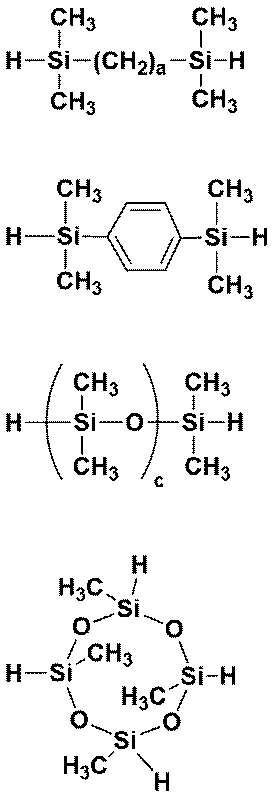
- the organic silicon compound having two or more SiH groups without having a hydrolyzable terminal group in the molecule is preferably a compound represented by the following formula. (In the formula, a and c are the same as above.)
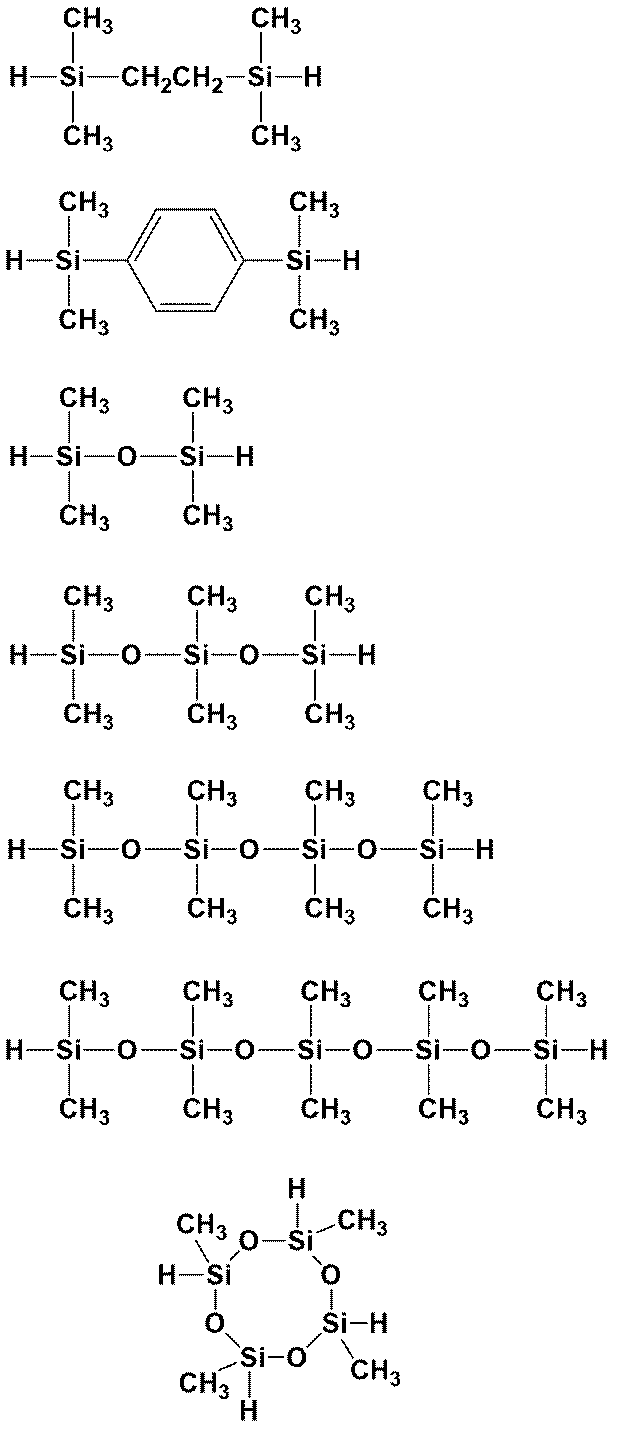
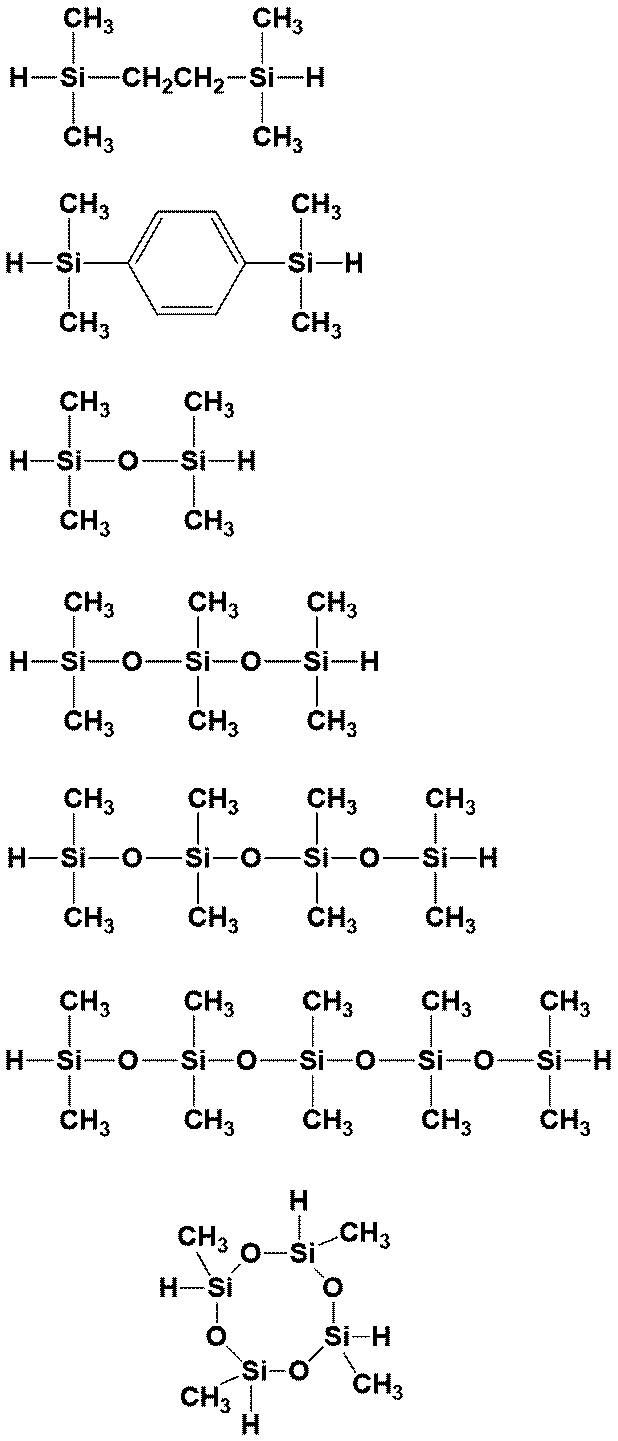
- organosilicon compound having two or more SiH groups without having a hydrolyzable terminal group in such a molecule examples include those shown below.
- the amount of an organic silicon compound that does not have a hydrolyzable terminal group in the molecule and has two or more SiH groups when reacting with the organic silicon compound has a fluorophore having a hydroxyl group and an olefin moiety at the end of the molecular chain.
- 1 equivalent of the reactive end group of the polyether group-containing polymer 7 to 30 equivalents, more preferably 5 to 20 equivalents, and even more preferably about 10 equivalents can be used.
- a platinum group metal catalyst such as rhodium, palladium, or ruthenium, a boron catalyst, or the like can be used.
- tetrakis triphenylphosphine
- platinum group metal catalysts such as palladium and chlorotris (triphenylphosphine) rhodium
- boron catalysts such as tris (pentafluorophenyl) borane.
- the amount of the dehydrogenating catalyst used is 0.01 to 0.0005 equivalents, more preferably 0.007 equivalents, relative to 1 equivalent of the reactive terminal group of the fluoropolyether group-containing polymer having a hydroxyl group and an olefin moiety at the end of the molecular chain. ⁇ 0.001 equivalents, more preferably about 0.005 equivalents can be used.
- the reaction is stopped and the aqueous layer and the fluorine solvent layer are separated by a liquid separation operation.
- the obtained fluorine solvent layer is further washed with an organic solvent and the solvent is distilled off to obtain a fluoropolyether group-containing polymer having a SiH group and an olefin moiety at the end of the molecular chain.
- the compound include those represented by the following formulas. (In the formula, R, w, x, y, z, w + x + y + z are the same as above, and each of these units may be linear or branched. E'is an integer of 0 to 2. Yes, and each repeating unit shown in parentheses with w, x, y, z may be randomly combined.)
- polyalkylene oxide compounds having a molecular chain single-terminal alkenyloxy group blockade such as polyethylene oxide in which one end of the molecular chain shown below is blocked with an allyloxy group and the other end is closed with a methoxy group.
- x is the same as above.
- polyether compound having an olefin moiety in the molecule such as a polyalkylene oxide compound having an alkenyloxy group-blocking at one end of the molecular chain
- polyalkylene oxide compound having an alkenyloxy group-blocking at one end of the molecular chain are Uniox MA-200, Uniox MA-300, and Uniox manufactured by Nichiyu. Examples include MA-350S and Uniox MA-500.
- the amount of the polyether compound having an olefin moiety in the molecule is more preferably 1 to 10 equivalents with respect to 1 equivalent of the reactive end group of the fluoropolyether group-containing polymer having a SiH group and an olefin moiety at the end of the molecular chain. Can be used in an amount of 2 to 5, more preferably about 3 equivalents.
- Platinum black is used as a hydrosilylation reaction catalyst when the fluoropolyether group-containing polymer having a SiH group and an olefin moiety at the terminal of the molecular chain obtained above is reacted with a polyether compound having an olefin moiety in the molecule.
- Platinum chloride alcohol-modified products of platinum chloride, complexes of platinum chloride with olefins, aldehydes, vinylsiloxanes, acetylene alcohols, etc., tetrakis (triphenylphosphine) palladium, chlorotris (triphenylphosphine) rhodium, etc.
- Examples include platinum group metal catalysts.
- a platinum-based compound such as a vinylsiloxane coordination compound is preferable.
- the amount of the hydrosilylation reaction catalyst used is 0.1 to 100 ppm, more preferably 1 to 100 ppm in terms of transition metal (mass) with respect to the mass of the fluoropolyether group-containing polymer having a SiH group and an olefin moiety at the end of the molecular chain. It is used in an amount of 50 ppm.
- a fluoropolyether group-containing polymer having an olefin moiety and a polyether compound having an olefin moiety in the molecule, and having an olefin moiety and a polyether moiety at the end of the molecular chain represented by the following formula (8).
- a fluoropolyether group-containing polymer is obtained. (In the formula, Rf, L, L', V, E, o, Z, ⁇ are the same as above.)
- Examples of the fluoropolyether group-containing polymer having an olefin moiety and a polyether moiety at the end of the molecular chain represented by the formula (8) are preferably those shown below.
- the number of repetitions (or degree of polymerization) of each repeating unit constituting the fluorooxyalkyl group or the fluorooxyalkylene group (monovalent or divalent fluorooxyalkylene group-containing polymer residue) is shown below. , Any number that satisfies the above equations (3) and (4) may be taken.
- p1, q1, and r1 are the same as above, and the sum of each of p1, q1, and r1 is an integer of 10 to 110, and is shown in parentheses with p1, q1, and r1. Each repeating unit may be randomly combined.
- a fluoropolyether group-containing polymer having an olefin moiety and a polyether moiety at the terminal of the molecular chain represented by the above formula (8) is used as a solvent, for example, 1,3-bis (trifluoromethyl) benzene or the like.
- An organic silicon compound having a SiH group and a hydrolyzable terminal group is mixed in a molecule such as trimethoxysilane, and a hydrosilylation reaction catalyst, for example, a toluene solution of a platinum chloride acid / vinyl siloxane complex is present.
- a temperature of 40 to 120 ° C. preferably 60 to 100 ° C., more preferably about 80 ° C. for 1 to 72 hours, preferably 20 to 36 hours, more preferably about 24 hours.
- a fluoropolyether group-containing polymer represented by 1) can be obtained.
- a fluoropolyether group-containing polymer having an olefin moiety and a polyether moiety at the terminal of the molecular chain represented by the above formula (8) is used as a solvent, for example, fluorine such as 1,3-bis (trifluoromethyl) benzene.
- an organic silicon compound having a SiH group and a hydrolyzable terminal group (halogen atom) is mixed in a molecule such as trichlorosilane, and a hydrosilylation reaction catalyst, for example, a toluene solution of a platinum chloride acid / vinyl siloxane complex
- a hydrosilylation reaction catalyst for example, a toluene solution of a platinum chloride acid / vinyl siloxane complex
- it is aged at a temperature of 40 to 120 ° C., preferably 60 to 100 ° C., more preferably about 80 ° C. for 1 to 72 hours, preferably 20 to 36 hours, more preferably about 24 hours.
- the substituent (halogen atom) on the silyl group may be converted into, for example, a methoxy group.
- a SiH group-containing organic silicon compound having no hydrolyzable terminal group can also be used.
- the organic silicon compound As an example, an organic silicon compound having no hydrolyzable terminal group in the molecule and having two or more SiH groups is used.
- a fluoropolyether group-containing polymer having an olefin moiety and a polyether moiety at the end of the molecular chain represented by the above formula (8) and a hydrolyzable end group in the molecule are provided in the same manner as in the above method.
- the SiH group at the polymer end of the reaction product and the organic silicon having an olefin moiety and a hydrolyzable terminal group in a molecule such as allyltrimethoxysilane is mixed and 1 to 72 at a temperature of 40 to 120 ° C., preferably 60 to 100 ° C., more preferably about 80 ° C. in the presence of a hydrosilylation reaction catalyst, for example a toluene solution of chloroplatinic acid / vinylsiloxane complex. Aging is carried out for a period of time, preferably 20 to 36 hours, more preferably about 24 hours.
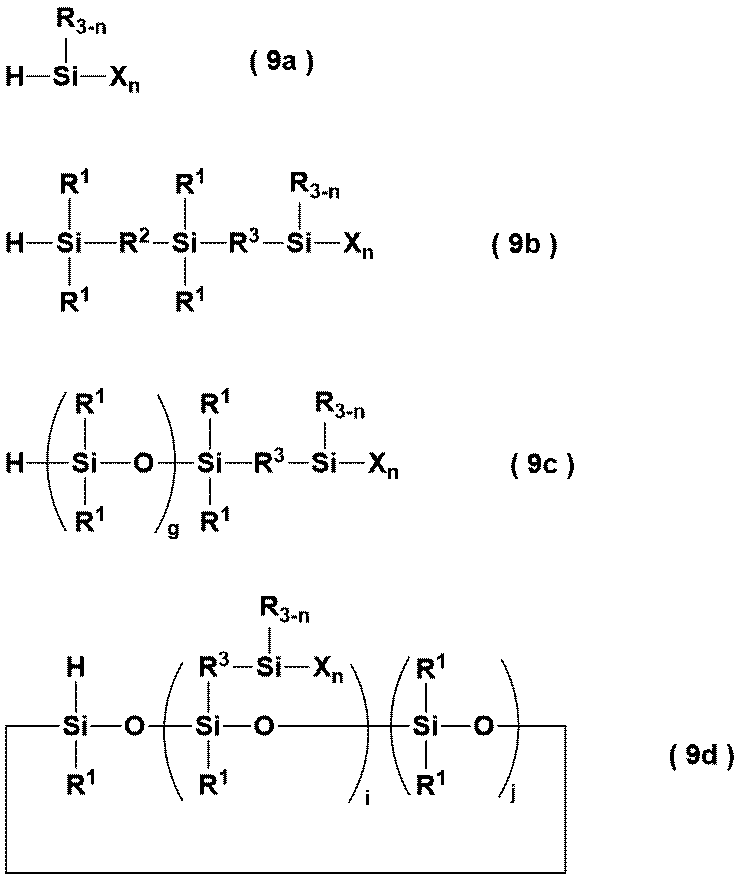
- the organosilicon compounds having a SiH group and a hydrolyzable terminal group in the molecule include the following general formulas (9a) to (9d).
- R, X, n, R 1 , R 2 , g, j are the same as above.
- I is an integer of 1 to 5, preferably 1 to 3, and i + j is 2 to 9, preferably 2. It is an integer of ⁇ 4, and R 3 is a divalent hydrocarbon group having 2 to 8 carbon atoms.
- the divalent hydrocarbon group having 2 to 8 carbon atoms preferably 2 to 4 carbon atoms of R 3
- a methylene group an ethylene group, a propylene group (trimethylene group, a methylethylene group), a butylene group (tetramethylene group, Methylpropylene group), an alkylene group such as a hexamethylene group and an octamethylene group, an arylene group such as a phenylene group, or a combination of two or more of these groups (alkylene / arylene group, etc.), among which ethylene is used.
- a group and a trimethylene group are preferable.
- Examples of the organic silicon compound having a SiH group and a hydrolyzable terminal group in such a molecule include trimethoxysilane, triethoxysilane, tripropoxysilane, triisopropoxysilane, tributoxysilane, and triisopropenoxysilane. , Triacetoxysilane, trichlorosilane, tribromosilane, triiodosilane, and the following silane compounds.
- the fluoropolyether group-containing polymer having an olefin moiety and a polyether moiety at the end of the molecular chain represented by the formula (8) is included in the molecule.
- the amount of the organic silicon compound having a SiH group and a hydrolyzable terminal group in the molecule in the addition reaction with the organic silicon compound having a SiH group and a hydrolyzable terminal group is represented by the formula (8).
- the SiH group in the organic silicon compound is 1.5 to 4 equivalents with respect to 1 equivalent of the reactive terminal group (terminal olefin moiety) of the fluoropolyether group-containing polymer having an olefin moiety and a polyether moiety at the end of the molecular chain. More preferably, an amount of 2 to 2.5 equivalents can be used.
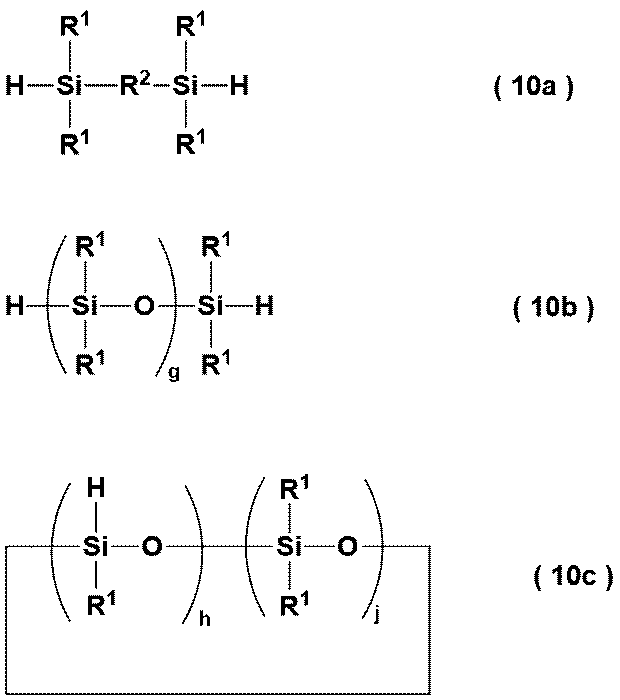
- the organosilicon compound having no hydrolyzable terminal group in the molecule and having two or more SiH groups has the following general formula.
- the compounds represented by (10a) to (10c) are preferable. (In the formula, R 1 , R 2 , g, h, j, h + j are the same as above.)
- organosilicon compound having two or more SiH groups without having a hydrolyzable terminal group in such a molecule examples include those shown below.
- the fluoropolyether group-containing polymer having an olefin moiety and a polyether moiety at the end of the molecular chain represented by the formula (8) is included in the molecule.
- the amount of the compound used is the organic amount with respect to 1 equivalent of the reactive end group (terminal olefin moiety) of the fluoropolyether group-containing polymer having an olefin moiety and a polyether moiety at the end of the molecular chain represented by the formula (8).
- the SiH group in the silicon compound can be used in an amount of 5 to 30, more preferably 7 to 20 equivalents, still more preferably about 10 equivalents.
- a fluoropolyether group-containing polymer having an olefin moiety and a polyether moiety at the end of the molecular chain represented by the formula (8) and water added to the molecule examples include those shown below.
- the number of repetitions (or degree of polymerization) of each repeating unit constituting the fluorooxyalkyl group or the fluorooxyalkylene group is shown below.
- an organic silicon compound having an olefin moiety and a hydrolyzable terminal group in the molecule to be reacted with the SiH group at the polymer terminal of the addition reaction product is preferable.
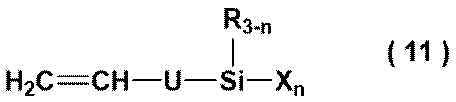
- R, X, n are the same as above.
- U is a single bond or a divalent hydrocarbon group having 1 to 6 carbon atoms.
- U is a single bond or a divalent hydrocarbon group having 1 to 6 carbon atoms, and as a divalent hydrocarbon group having 1 to 6 carbon atoms, specifically, a methylene group or an ethylene group.
- a divalent hydrocarbon group having 1 to 6 carbon atoms specifically, a methylene group or an ethylene group.
- Propylene group trimethylene group, methylethylene group
- butylene group tetramethylene group, methylpropylene group
- alkylene group such as hexamethylene group, phenylene group and the like.
- U it is preferably a single bond or a methylene group.
- organosilicon compound having an olefin moiety and a hydrolyzable terminal group in such a molecule examples include those shown below.
- the amount of the organic silicon compound having an olefin moiety and a hydrolyzable end group in the molecule is the fluoropolyether group-containing polymer having an olefin moiety and a polyether moiety at the end of the molecular chain represented by the formula (8) and the molecule.
- a reactive end group (SiH group at the end of the molecule) of an addition reaction product with an organic silicon compound having two or more SiH groups and having no hydrolyzable end group an olefin moiety in the molecule
- An amount such that the olefin moiety in the organic silicon compound having a hydrolyzable terminal group is 1.5 to 4 equivalents, more preferably 2 to 2.5 equivalents can be used.
- a fluorine-based solvent is preferable as the solvent used, and 1,3-bis (trifluoromethyl) benzene and trifluoro as the fluorine-based solvent.
- HFE Hydrofluoroether
- the amount of the solvent used is 10 to 300 parts by mass, preferably 50 to 150 parts by mass with respect to 100 parts by mass of the fluoropolyether group-containing polymer having an olefin moiety and a polyether moiety at the end of the molecular chain represented by the formula (8).
- mass more preferably about 100 parts by mass can be used.
- the hydrosilylation reaction catalyst includes platinum black, chloroplatinic acid, alcohol-modified chloroplatinic acid, chloroplatinic acid and olefin, aldehyde, and vinyl.
- platinum group metal catalysts such as tetrakis (triphenylphosphine) palladium and chlorotris (triphenylphosphine) rhodium, such as complexes with siloxane and acetylene alcohols.
- a platinum-based compound such as a vinylsiloxane coordination compound is preferable.
- the amount of the hydrosilylation reaction catalyst used is a fluoropolyether group-containing polymer having an olefin moiety and a polyether moiety at the end of the molecular chain represented by the formula (8), or a hydrolyzable end group in the polymer and the molecule. Instead, the amount is preferably 0.01 to 100 ppm, more preferably 0.1 to 50 ppm in terms of transition metal (mass) with respect to the mass of the reaction product with the organic silicon compound having two or more SiH groups. use.
- a compound represented by the following formula as a fluoropolyether group-containing polymer having an olefin moiety and a polyether moiety at the end of the molecular chain represented by the formula (8).
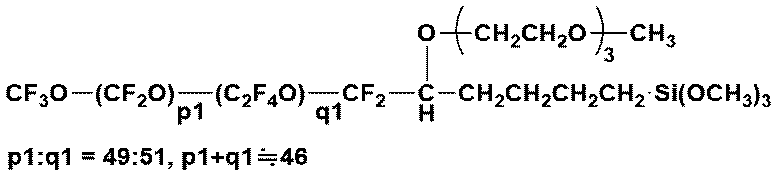
- trimethoxysilane is used as the organosilicon compound having a SiH group and a hydrolyzable terminal group in the molecule, a compound represented by the following formula can be obtained.
- a compound represented by the following formula as a fluoropolyether group-containing polymer having an olefin moiety and a polyether moiety at the end of the molecular chain represented by the formula (8).
- trimethoxysilane is used as the organosilicon compound having a SiH group and a hydrolyzable terminal group in the molecule, a compound represented by the following formula can be obtained.
- the present invention further provides a surface treatment agent containing a fluoropolyether group-containing polymer having a hydroxyl group-containing silyl group or a hydrolyzable silyl group represented by the above formula (1).
- the surface treatment agent is a portion obtained by condensing the hydroxyl group of the fluoropolyether group-containing polymer or the hydroxyl group obtained by partially hydrolyzing the terminal hydrolyzable group of the fluoropolyether group-containing polymer by a known method in advance. It may contain a (hydrolyzed) condensate.
- the surface treatment agent may contain, if necessary, a hydrolysis condensation catalyst, for example, an organic tin compound (dibutyltin dimethoxyde, dibutyltin dilaurate, etc.), an organic titanium compound (tetra n-butyl titanate, etc.), an organic acid (acetic acid, etc.). Methanesulfonic acid, fluorine-modified carboxylic acid, etc.) and inorganic acids (hydrochloric acid, sulfuric acid, etc.) may be added. Among these, acetic acid, tetra n-butyl titanate, dibutyl tin dilaurate, fluorine-modified carboxylic acid and the like are particularly desirable.
- a hydrolysis condensation catalyst for example, an organic tin compound (dibutyltin dimethoxyde, dibutyltin dilaurate, etc.), an organic titanium compound (tetra n-butyl titanate, etc.), an organic acid
- the amount of the hydrolysis condensation catalyst added is the amount of the catalyst, and is usually 0.01 to 5 parts by mass, particularly 0.1 by mass, based on 100 parts by mass of the fluoropolyether group-containing polymer and / or its partial (hydrolyzed) condensate. ⁇ 1 part by mass.
- the surface treatment agent may contain a suitable solvent.
- a suitable solvent include a fluorine-modified aliphatic hydrocarbon solvent (perfluoroheptane, perfluorooctane, etc.), a fluorine-modified aromatic hydrocarbon solvent (1,3-bis (trifluoromethyl) benzene, etc.), and fluorine.
- Modified ether solvents methyl perfluorobutyl ether, ethyl perfluorobutyl ether, perfluoro (2-butyl tetrahydrofuran), etc.
- fluorine-modified alkylamine solvents perfluorotributylamine, perfluorotripentylamine, etc.
- hydrocarbon solvents examples thereof include petroleum benzine, toluene, xylene, etc., and ketone solvents (acetone, methyl ethyl ketone, methyl isobutyl ketone, etc.).
- a fluorine-modified solvent is desirable in terms of solubility, wettability, etc., and in particular, 1,3-bis (trifluoromethyl) benzene, perfluoro (2-butyl tetrahydrofuran), and perfluorotri. Butylamine and ethylperfluorobutyl ether are preferred.
- the solvent may be a mixture of two or more thereof, and it is preferable to uniformly dissolve the fluoropolyether group-containing polymer and its partial (hydrolyzed) condensate.
- the optimum concentration of the fluoropolyether group-containing polymer to be dissolved in the solvent and its partial (hydrolyzed) condensate varies depending on the treatment method and may be an amount that is easy to weigh.
- the amount is preferably 0.01 to 10 parts by mass, particularly 0.05 to 5 parts by mass, based on 100 parts by mass of the total of the fluoropolyether group-containing polymer (and its portion (hydrolyzed) condensate), and the vapor deposition treatment is performed.
- the amount is preferably 1 to 100 parts by mass, particularly 3 to 30 parts by mass, based on 100 parts by mass of the total of the solvent and the fluoropolyether group-containing polymer (and its portion (hydrolyzed) condensate).
- the surface treatment agent of the present invention can be applied to a substrate by a known method such as brush coating, dipping, spraying, and vapor deposition treatment.
- the heating method during the vapor deposition treatment may be either a resistance heating method or an electron beam heating method, and is not particularly limited.
- the curing temperature varies depending on the curing method. For example, in the case of direct coating (brush coating, dipping, spraying, etc.), the temperature is 25 to 200 ° C., particularly 25 to 80 ° C. for 30 minutes to 36 hours, particularly 1 It is preferably about 24 hours. Further, when the application is carried out by a vapor deposition treatment, it is desirable that the temperature is 20 to 200 ° C., particularly 25 to 80 ° C.
- the film thickness of the cured film is appropriately selected depending on the type of the base material, but is usually 0.1 to 100 nm, particularly 1 to 20 nm. Further, for example, in spray coating, if the spray coating is performed after diluting with a fluorine-based solvent to which water has been added in advance and hydrolyzing, that is, generating Si—OH, curing after coating is fast.
- the base material treated with the surface treatment agent of the present invention is not particularly limited, and may be made of various materials such as paper, cloth, metal and oxides thereof, glass, plastic, ceramic, and quartz.
- the surface treatment agent of the present invention can impart water and oil repellency and steel wool abrasion resistance to the base material. In particular, it can be suitably used as a surface treatment agent for SiO 2 treated glass and films.
- Articles treated with the surface treatment agent of the present invention include car navigation systems, mobile phones, smartphones, digital cameras, digital video cameras, PDAs, portable audio players, car audios, game devices, eyeglass lenses, camera lenses, lens filters, and the like.
- Examples thereof include medical devices such as sunglasses and gastrocameras, copying machines, PCs, liquid crystal displays, organic EL displays, plasma displays, touch panel displays, protective films, antireflection films and other optical articles.
- the surface treatment agent of the present invention can prevent fingerprints and sebum from adhering to the article and can further impart scratch resistance (wear resistance), it is particularly water repellent for touch panel displays, antireflection films, and the like. It is useful as an oil repellent layer.
- the surface treatment agent of the present invention is used for antifouling coatings for sanitary products such as bathtubs and wash basins, windowpanes or tempered glasses for automobiles, trains and aircraft, antifouling coatings for headlamp covers, and building materials for outer walls.
- Water and oil repellent coating oil stain prevention coating for kitchen building materials, antifouling and sticker / graffiti prevention coating for telephone boxes, anti-fingerprint coating for fine arts, anti-fingerprint coating for compact discs, DVDs, etc. It is also useful as a mold release agent or paint additive, a resin modifier, a fluidity modifier or a dispersibility modifier for an inorganic filler, and a lubricity improver for tapes, films and the like.
- Example 1 272 ml of 3-butenyl magnesium bromide (0.5 M THF solution: 1.4 ⁇ 10 -1 mol) was placed in a reaction vessel, and the mixture was stirred. Then, the following formula (A) (A) A mixed solution of 200 g (4.5 ⁇ 10-2 mol) of the compound represented by (4.5 ⁇ 10 ⁇ 2 mol), 400 g of Asahiclean AC6000, and 200 g of PF5060 was added dropwise to the reaction vessel, and then heated at 50 ° C. for 6 hours. After the heating was completed, the mixture was cooled to room temperature and an aqueous hydrochloric acid solution was added dropwise.
- a mixed solution of 200 g (4.5 ⁇ 10-2 mol) of the compound represented by (4.5 ⁇ 10 ⁇ 2 mol), 400 g of Asahiclean AC6000, and 200 g of PF5060 was added dropwise to the reaction vessel, and then heated at 50 ° C. for 6 hours. After the heating was completed, the mixture was
- the underlying fluorine compound layer was recovered by a liquid separation operation and then washed with acetone.
- the fluorine compound layer which is the lower layer after washing, is recovered again, and the residual solvent is distilled off under reduced pressure to obtain the following formula (B).
- the underlying fluorine compound layer was recovered by a liquid separation operation and then washed with acetone.
- the following formula (Q) was obtained by recovering the fluorine compound layer, which is the lower layer after washing, and distilling off the residual solvent under reduced pressure.
- (Q) 38 g of a fluoropolyether group-containing polymer represented by is obtained.
- Example 8 282 ml of 3-butenylmagnesium bromide (0.5 M THF solution: 1.4 ⁇ 10 -1 mol) was placed in a reaction vessel, and the mixture was stirred. Then, the following formula (A') (A') A mixed solution of 100 g (2.4 ⁇ 10-2 mol) of the compound represented by (2 ), 200 g of Asahiclean AC6000, and 100 g of PF5060 was added dropwise to the reaction vessel, and then heated at 50 ° C. for 6 hours. After the heating was completed, the mixture was cooled to room temperature and an aqueous hydrochloric acid solution was added dropwise.
- the underlying fluorine compound layer was recovered by a liquid separation operation and then washed with acetone.
- the following formula (B') was obtained by recovering the fluorine compound layer, which is the lower layer after washing, and distilling off the residual solvent under reduced pressure.
- (B') 94 g (number average molecular weight; about 4,400) of the fluoropolyether group-containing polymer represented by is obtained.
- the underlying fluorine compound layer was recovered by a liquid separation operation and then washed with acetone.
- the following formula (C') was obtained by recovering the fluorine compound layer, which is the lower layer after washing, and distilling off the residual solvent under reduced pressure.
- (C') 39 g of a fluoropolyether group-containing polymer represented by is obtained.
- the polymers of Examples 1, 3 and Comparative Example 3 have a polyether group in the molecule, the water contact angle after 10,000 times of eraser wear does not have a polyether group in the molecule. The results were better than those of the polymer of 2. Further, since the polymers of Examples 1 and 3 have fewer base material adhesive groups than the polymer of Comparative Example 3, they are excellent in molecular mobility on the base material, so that the water contact angle is maintained at 100 ° or more. In addition, the passing rate of the wear durability test of 15,000 times was also excellent.
Landscapes
- Chemical & Material Sciences (AREA)
- Organic Chemistry (AREA)
- Chemical Kinetics & Catalysis (AREA)
- Polymers & Plastics (AREA)
- Health & Medical Sciences (AREA)
- Medicinal Chemistry (AREA)
- Engineering & Computer Science (AREA)
- Materials Engineering (AREA)
- General Chemical & Material Sciences (AREA)
- Combustion & Propulsion (AREA)
- Life Sciences & Earth Sciences (AREA)
- Wood Science & Technology (AREA)
- Polyethers (AREA)
- Compositions Of Macromolecular Compounds (AREA)
- Materials Applied To Surfaces To Minimize Adherence Of Mist Or Water (AREA)
- Paints Or Removers (AREA)
Abstract
Description
〔1〕
下記一般式(1)で表されるフルオロポリエーテル基含有ポリマー。

〔2〕
前記式(1)のαが1であり、Rfが下記一般式(3)で表される基である〔1〕に記載のフルオロポリエーテル基含有ポリマー。

〔3〕
前記式(1)のαが2であり、Rfが下記一般式(4)で表される基である〔1〕に記載のフルオロポリエーテル基含有ポリマー。

〔4〕
前記式(1)において、Yが炭素数3~10のアルキレン基、炭素数6~8のアリーレン基を含むアルキレン基、アルキレン基相互がシルアルキレン構造又はシルアリーレン構造を介して結合している2価の基、及びケイ素原子数2~10個の直鎖状又はケイ素原子数3~10個の分岐状もしくは環状の2~4価のオルガノポリシロキサン残基の結合手に炭素数2~10のアルキレン基が結合している2~4価の基からなる群より選ばれる基である〔1〕~〔3〕のいずれかに記載のフルオロポリエーテル基含有ポリマー。
〔5〕
前記式(1)において、Eが下記一般式(5)で表される基である〔1〕~〔4〕のいずれかに記載のフルオロポリエーテル基含有ポリマー。

〔6〕
前記式(1)において、Xがそれぞれ独立に、水酸基、炭素数1~10のアルコキシ基、炭素数2~10のアルコキシアルコキシ基、炭素数1~10のアシロキシ基、炭素数2~10のアルケニルオキシ基及びハロゲン基からなる群より選ばれる基である〔1〕~〔5〕のいずれかに記載のフルオロポリエーテル基含有ポリマー。
〔7〕
式(1)で表されるポリマーが、下記式で表されるポリマーから選ばれるものである〔1〕~〔6〕のいずれかに記載のフルオロポリエーテル基含有ポリマー。

〔8〕
〔1〕~〔7〕のいずれかに記載のフルオロポリエーテル基含有ポリマー及び/又はその部分(加水分解)縮合物を含む表面処理剤。
〔9〕
フルオロポリエーテル基含有ポリマー中のフルオロポリエーテル基が、分子鎖末端に位置する1価のフルオロオキシアルキレン基含有ポリマー残基である〔8〕に記載の表面処理剤。
〔10〕
〔8〕又は〔9〕に記載の表面処理剤で表面処理された物品。



また、p、q、r、s、t、u、vはそれぞれ0~200の整数、好ましくは、pは5~100の整数、qは5~100の整数、rは0~100の整数、sは0~100の整数、tは0~100の整数、uは0~100の整数、vは0~100の整数であり、p+q+r+s+t+u+vは3~200、好ましくは10~110であり、p+qは10~105、特に15~60であることが好ましく、r=s=t=u=v=0であることが好ましい。p+q+r+s+t+u+vが上記上限値より小さければ密着性や硬化性が良好であり、上記下限値より大きければフルオロポリエーテル基の特徴を十分に発揮することができるので好ましい。


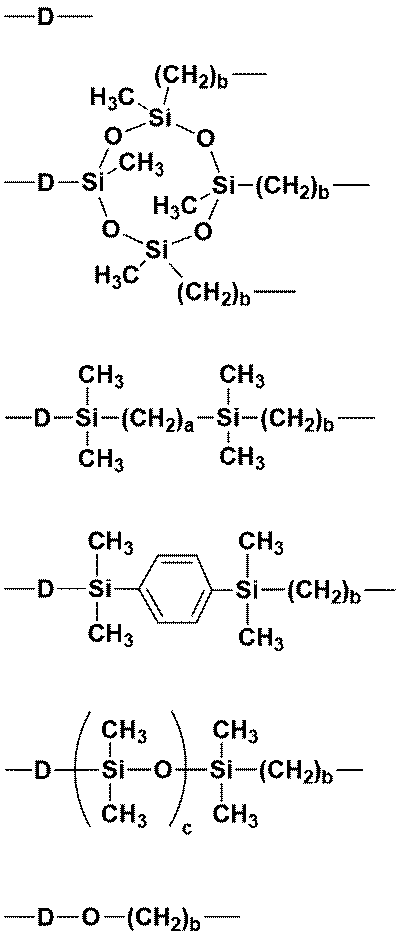
また、aは1~4、好ましくは1~3の整数であり、bは独立に2~10、好ましくは2~6の整数であり、cは1~9、好ましくは1~4の整数である。
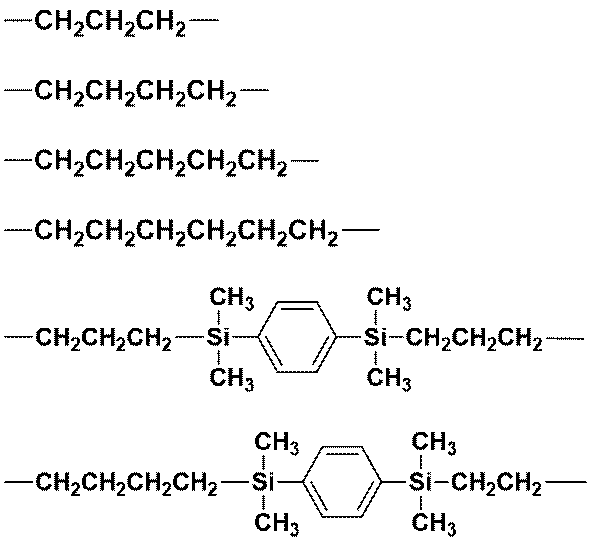
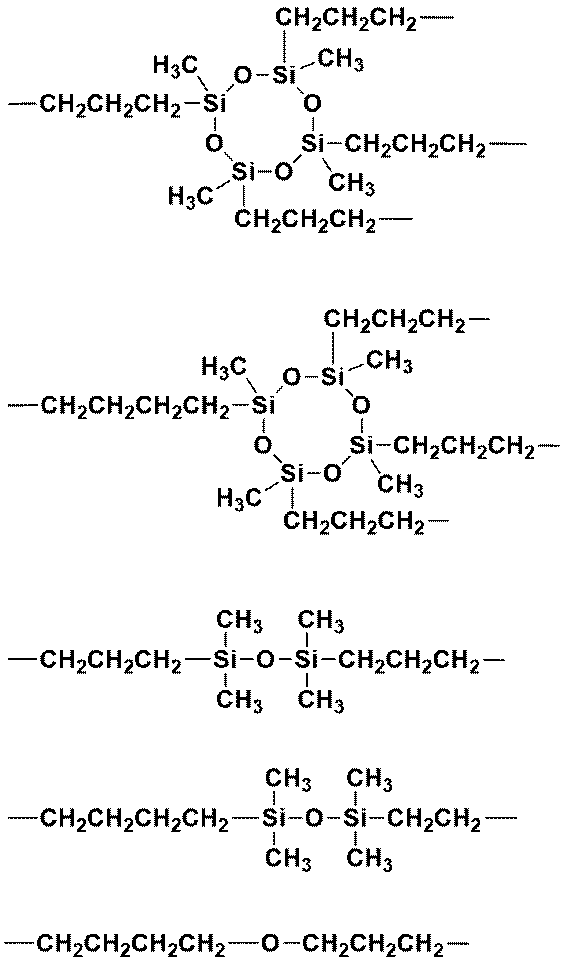
また、nはケイ素原子毎に独立に1~3の整数、好ましくは2又は3であり、反応性、基材に対する密着性の観点から3がより好ましい。

加水分解性基としては、中でもメトキシ基、エトキシ基、イソプロペノキシ基、クロル基が好適である。
式(2)で表される基としては、下記に示すものが例示できる。
ここで、シルアルキレン基、シルアリーレン基としては、Yにおいて例示したシルアルキレン構造、シルアリーレン構造と同様のものが例示できる。
また、ケイ素原子数2~10個の直鎖状又はケイ素原子数3~10個の分岐状もしくは環状の2~6価のオルガノポリシロキサン残基としては、Yにおいて例示した2~6価のオルガノポリシロキサン残基と同様のものが例示できる。



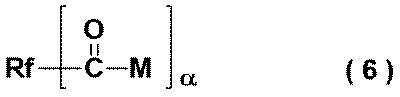
で表されるカルボニル基を末端に有するフルオロポリエーテル基含有ポリマーと、末端に脂肪族不飽和二重結合(オレフィン部位)を有し、かつ、β水素(即ち、金属原子のβ位の炭素原子に結合した水素原子)を有する有機金属試薬とを、好ましくは溶剤の存在下に反応させる。
このようなMとしては、例えば下記の基が挙げられる。
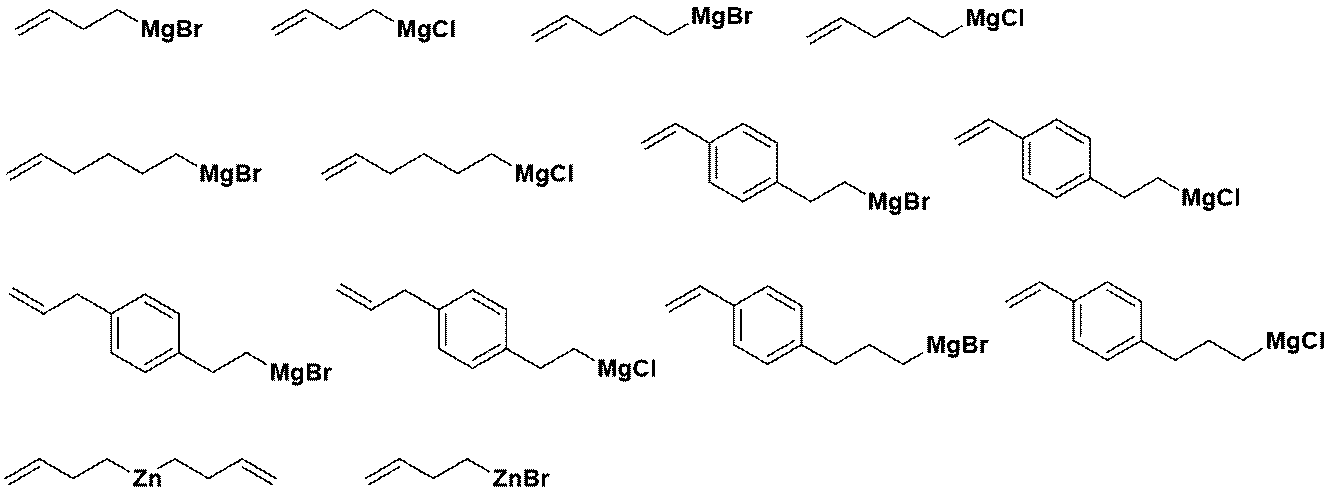
また、溶剤としては、上記フッ素系溶剤以外に有機溶剤を用いることができる。有機溶剤として、テトラヒドロフラン(THF)、モノエチレングリコールジメチルエーテル、ジエチレングリコールジメチルエーテル、トリエチレングリコールジメチルエーテル、テトラエチレングリコールジメチルエーテル、ジオキサンなどのエーテル系溶剤を用いることができる。有機溶剤は単独で使用してもフッ素系溶剤と混合して使用してもよい。
溶剤の使用量は、上記式(6)で表されるカルボニル基を末端に有するフルオロポリエーテル基含有ポリマー100質量部に対して、10~600質量部、好ましくは50~400質量部、更に好ましくは200~350質量部用いることができる。
上記条件により反応を行った後、反応を停止し、分液操作により水層とフッ素溶剤層を分離する。得られたフッ素溶剤層を更に有機溶剤で洗浄し、溶剤を留去することで、下記式(7)で表される分子鎖末端に水酸基とオレフィン部位を有するフルオロポリエーテル基含有ポリマーが得られる。


続いて、上記分子鎖末端にSiH基とオレフィン部位を有するフルオロポリエーテル基含有ポリマーと、分子内にオレフィン部位を有するポリエーテル化合物(例えば、分子鎖片末端アルケニルオキシ基封鎖ポリアルキレンオキシド化合物等)とを溶剤、例えば1,3-ビス(トリフルオロメチル)ベンゼンなどのフッ素系溶剤に溶解させ、ヒドロシリル化反応触媒、例えば塩化白金酸/ビニルシロキサン錯体のトルエン溶液存在下、40~120℃、好ましくは60~100℃、より好ましくは約80℃の温度で、1~72時間、好ましくは20~36時間、より好ましくは約24時間熟成させる。
ポリエーテル基導入剤の使用量は、式(7)で表される分子鎖末端に水酸基とオレフィン部位を有するフルオロポリエーテル基含有ポリマーの反応性末端基(水酸基)1当量に対して、1~15当量、より好ましくは3~6当量用いることができる。
塩基の使用量は、式(7)で表される分子鎖末端に水酸基とオレフィン部位を有するフルオロポリエーテル基含有ポリマーの反応性末端基(水酸基)1当量に対して、1~20当量、より好ましくは4~8当量、更に好ましくは約6当量用いることができる。
添加剤の使用量は、式(7)で表される分子鎖末端に水酸基とオレフィン部位を有するフルオロポリエーテル基含有ポリマーの反応性末端基(水酸基)1当量に対して、0.005~0.1当量、より好ましくは0.01~0.05当量、更に好ましくは約0.02当量用いることができる。
溶剤を用いる場合の使用量は、式(7)で表される分子鎖末端に水酸基とオレフィン部位を有するフルオロポリエーテル基含有ポリマー100質量部に対して、10~300質量部、好ましくは30~150質量部、更に好ましくは約50質量部用いることができる。
脱水素触媒の使用量は、分子鎖末端に水酸基とオレフィン部位を有するフルオロポリエーテル基含有ポリマーの反応性末端基1当量に対して、0.01~0.0005当量、より好ましくは0.007~0.001当量、更に好ましくは約0.005当量用いることができる。


分子内にオレフィン部位を有するポリエーテル化合物の使用量は、分子鎖末端にSiH基とオレフィン部位を有するフルオロポリエーテル基含有ポリマーの反応性末端基1当量に対して、1~10当量、より好ましくは2~5当量、更に好ましくは約3当量用いることができる。
ヒドロシリル化反応触媒の使用量は、分子鎖末端にSiH基とオレフィン部位を有するフルオロポリエーテル基含有ポリマーの質量に対して、遷移金属換算(質量)で0.1~100ppm、より好ましくは1~50ppmとなる量で使用する。



上記で得られた式(8)で表される分子鎖末端にオレフィン部位とポリエーテル部位を有するフルオロポリエーテル基含有ポリマーを、溶剤、例えば1,3-ビス(トリフルオロメチル)ベンゼンなどのフッ素系溶剤に溶解させ、トリクロロシラン等の分子中にSiH基及び加水分解性末端基(ハロゲン原子)を有する有機ケイ素化合物を混合し、ヒドロシリル化反応触媒、例えば塩化白金酸/ビニルシロキサン錯体のトルエン溶液存在下、40~120℃、好ましくは60~100℃、より好ましくは約80℃の温度で、1~72時間、好ましくは20~36時間、より好ましくは約24時間熟成させる。なお、熟成させた後、シリル基上の置換基(ハロゲン原子)を例えばメトキシ基などに変換してもよい。



溶剤の使用量は、式(8)で表される分子鎖末端にオレフィン部位とポリエーテル部位を有するフルオロポリエーテル基含有ポリマー100質量部に対して、10~300質量部、好ましくは50~150質量部、更に好ましくは約100質量部用いることができる。
ヒドロシリル化反応触媒の使用量は、式(8)で表される分子鎖末端にオレフィン部位とポリエーテル部位を有するフルオロポリエーテル基含有ポリマー、又はこのポリマーと分子中に加水分解性末端基を有さず、SiH基を2個以上有する有機ケイ素化合物との反応物の質量に対して、遷移金属換算(質量)で好ましくは0.01~100ppm、より好ましくは0.1~50ppmとなる量で使用する。
例えば、式(8)で表される分子鎖末端にオレフィン部位とポリエーテル部位を有するフルオロポリエーテル基含有ポリマーとして、下記式で表される化合物



加水分解縮合触媒の添加量は触媒量であり、通常、フルオロポリエーテル基含有ポリマー及び/又はその部分(加水分解)縮合物100質量部に対して0.01~5質量部、特に0.1~1質量部である。
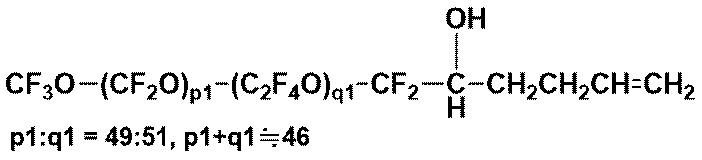
反応容器に、3-ブテニルマグネシウムブロミド272ml(0.5M THF溶液:1.4×10⁻¹mol)を入れ、撹拌した。続いて、下記式(A)
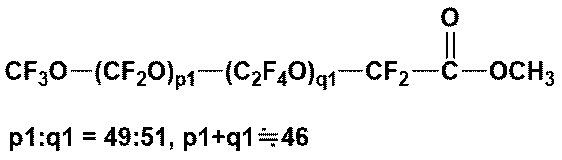
で表される化合物200g(4.5×10⁻²mol)、アサヒクリンAC6000 400g、PF5060 200gの混合液を反応容器内に滴下した後、50℃で6時間加熱した。加熱終了後、室温まで冷却し、塩酸水溶液を滴下した。分液操作により、下層であるフッ素化合物層を回収後、アセトンで洗浄した。洗浄後の下層であるフッ素化合物層を再び回収し、減圧下、残存溶剤を留去することで、下記式(B)
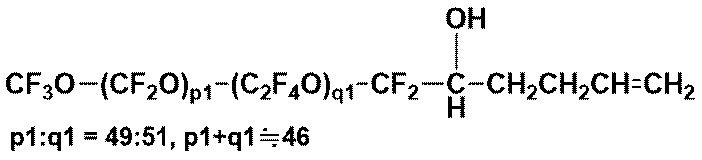
で表されるフルオロポリエーテル基含有ポリマー193g(数平均分子量;約4,430)を得た。
δ1.4-1.7(C-CH 2 CH2CH=CH2)2H
δ1.9-2.2(C-CH 2 CH2CH=CH2、-CF2-CH(OH)-CH2-)3H
δ3.6-3.8(-CF2-CH(OH)-CH2-)1H
δ4.8-4.9(-CH2CH=CH 2 )2H
δ5.5-5.6(-CH2CH=CH2)1H
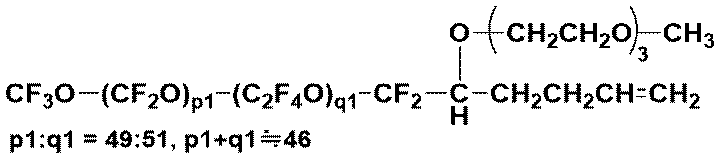
で表される化合物100g(2.3×10⁻²mol)、ジエチレングリコール-2-ブロモエチルメチルエーテル20.9g(9.2×10⁻²mol)、テトラブチルアンモニウムヨージド0.17g(4.6×10⁻⁴mol)を混合した。続いて、30質量%水酸化ナトリウム水溶液18g(1.4×10⁻¹mol)を添加した後、50℃で24時間加熱した。加熱終了後、室温まで冷却し、塩酸水溶液を滴下した。分液操作により、下層であるフッ素化合物層を回収後、アセトンで洗浄した。洗浄後の下層であるフッ素化合物層を再び回収し、減圧下、残存溶剤を留去することで、下記式(C)

で表されるフルオロポリエーテル基含有ポリマー94gを得た。
δ1.5-1.7(C-CH 2 CH2CH=CH2)2H
δ2.0-2.2(C-CH2CH 2 CH=CH2)2H
δ3.0-3.2(CF2-CH-O-(CH2CH2O)3-O-CH 3 ))3H
δ3.3-3.6(-O-(CH 2 CH 2 O)3-O-CH3)12H
δ3.7-3.8(CF2-CH-O-(CH2CH2O)3-O-CH3))1H
δ4.7-5.0(C-CH2CH2CH=CH 2 )2H
δ5.5-5.7(C-CH2CH2CH=CH2)1H

で表される化合物80g(1.7×10⁻²mol)、1,3-ビス(トリフルオロメチル)ベンゼン80g、トリメトキシシラン4.2g(3.4×10⁻²mol)、及び塩化白金酸/ビニルシロキサン錯体のトルエン溶液7.6×10-2g(Pt単体として2.3×10-7molを含有)を混合し、80℃で24時間熟成させた。その後、溶剤及び未反応物を減圧留去し、液状の生成物82gを得た。

δ0.4-0.6(C-CH2CH2CH2CH 2 -Si)2H
δ1.2-1.6(C-CH 2 CH 2 CH 2 CH2-Si)6H
δ3.0-3.2(CF2-CH-O-(CH2CH2O)3-O-CH 3 ))3H
δ3.3-3.6(-O-(CH 2 CH 2 O)3-O-CH3、-Si(OCH 3 )3)21H
δ3.7-3.8(CF2-CH-O-(CH2CH2O)3-O-CH3))1H
反応容器に、3-ブテニルマグネシウムブロミド153ml(0.5M THF溶液:7.7×10⁻²mol)を入れ、撹拌した。続いて、下記式(E)

で表される化合物100g(2.6×10⁻²mol)、アサヒクリンAC6000 200g、PF5060 100gの混合液を反応容器内に滴下した後、50℃で6時間加熱した。加熱終了後、室温まで冷却し、塩酸水溶液を滴下した。分液操作により、下層であるフッ素化合物層を回収後、アセトンで洗浄した。洗浄後の下層であるフッ素化合物層を再び回収し、減圧下、残存溶剤を留去することで、下記式(F)

で表されるフルオロポリエーテル基含有ポリマー94g(数平均分子量;約3,940)を得た。
δ1.4-1.7(C-CH 2 CH2CH=CH2)2H
δ1.9-2.2(C-CH 2 CH2CH=CH2、-CF2-CH(OH)-CH2-)3H
δ3.6-3.8(-CF2-CH(OH)-CH2-)1H
δ4.8-4.9(-CH2CH=CH 2 )2H
δ5.5-5.6(-CH2CH=CH2)1H
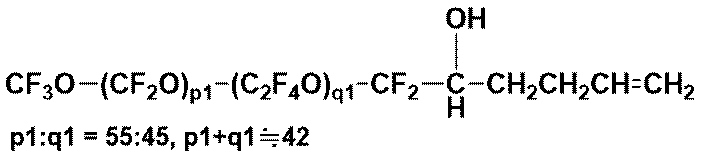
で表される化合物50g(1.3×10⁻²mol)、ジエチレングリコール-2-ブロモエチルメチルエーテル12g(5.2×10⁻²mol)、テトラブチルアンモニウムヨージド0.10g(2.6×10⁻⁴mol)を混合した。続いて、30質量%水酸化ナトリウム水溶液10g(7.5×10⁻²mol)を添加した後、50℃で24時間加熱した。加熱終了後、室温まで冷却し、塩酸水溶液を滴下した。分液操作により、下層であるフッ素化合物層を回収後、アセトンで洗浄した。洗浄後の下層であるフッ素化合物層を再び回収し、減圧下、残存溶剤を留去することで、下記式(G)
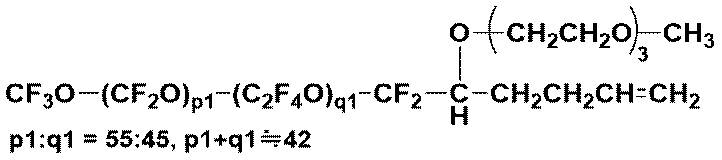
で表されるフルオロポリエーテル基含有ポリマー44gを得た。
δ1.5-1.7(C-CH 2 CH2CH=CH2)2H
δ2.0-2.2(C-CH2CH 2 CH=CH2)2H
δ3.0-3.2(CF2-CH-O-(CH2CH2O)3-O-CH 3 ))3H
δ3.3-3.6(-O-(CH 2 CH 2 O)3-O-CH3)12H
δ3.7-3.8(CF2-CH-O-(CH2CH2O)3-O-CH3))1H
δ4.7-5.0(C-CH2CH2CH=CH 2 )2H
δ5.5-5.7(C-CH2CH2CH=CH2)1H

で表される化合物40g(9.8×10⁻³mol)、1,3-ビス(トリフルオロメチル)ベンゼン40g、トリメトキシシラン2.4g(2.0×10⁻²mol)、及び塩化白金酸/ビニルシロキサン錯体のトルエン溶液4.4×10-2g(Pt単体として1.3×10-7molを含有)を混合し、80℃で24時間熟成させた。その後、溶剤及び未反応物を減圧留去し、液状の生成物40gを得た。

δ0.4-0.6(C-CH2CH2CH2CH 2 -Si)2H
δ1.2-1.6(C-CH 2 CH 2 CH 2 CH2-Si)6H
δ3.0-3.2(CF2-CH-O-(CH2CH2O)3-O-CH 3 ))3H
δ3.3-3.6(-O-(CH 2 CH 2 O)3-O-CH3、-Si(OCH 3 )3)21H
δ3.7-3.8(CF2-CH-O-(CH2CH2O)3-O-CH3))1H
反応容器に、上記と同様にして得られた下記式(B)
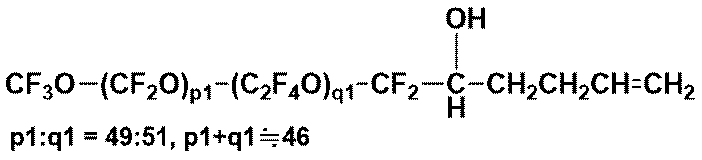
で表される化合物100g(2.3×10⁻²mol)、トリエチレングリコール-2-ブロモエチルメチルエーテル24.9g(9.2×10⁻²mol)、テトラブチルアンモニウムヨージド0.17g(4.6×10⁻⁴mol)を混合した。続いて、30質量%水酸化ナトリウム水溶液18g(1.4×10⁻¹mol)を添加した後、50℃で24時間加熱した。加熱終了後、室温まで冷却し、塩酸水溶液を滴下した。分液操作により、下層であるフッ素化合物層を回収後、アセトンで洗浄した。洗浄後の下層であるフッ素化合物層を再び回収し、減圧下、残存溶剤を留去することで、下記式(J)
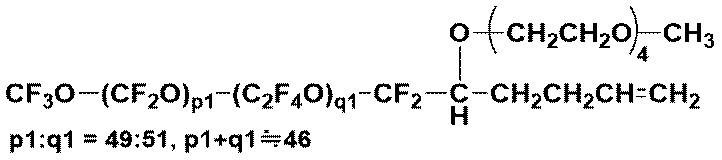
で表されるフルオロポリエーテル基含有ポリマー90gを得た。
δ1.5-1.7(C-CH 2 CH2CH=CH2)2H
δ2.0-2.2(C-CH2CH 2 CH=CH2)2H
δ3.0-3.2(CF2-CH-O-(CH2CH2O)4-O-CH 3 ))3H
δ3.3-3.6(-O-(CH 2 CH 2 O)4-O-CH3)16H
δ3.7-3.8(CF2-CH-O-(CH2CH2O)4-O-CH3))1H
δ4.7-5.0(C-CH2CH2CH=CH 2 )2H
δ5.5-5.7(C-CH2CH2CH=CH2)1H

で表される化合物80g(1.7×10⁻²mol)、1,3-ビス(トリフルオロメチル)ベンゼン80g、トリメトキシシラン4.2g(3.4×10⁻²mol)、及び塩化白金酸/ビニルシロキサン錯体のトルエン溶液7.6×10-2g(Pt単体として2.3×10-7molを含有)を混合し、80℃で24時間熟成させた。その後、溶剤及び未反応物を減圧留去し、液状の生成物80gを得た。
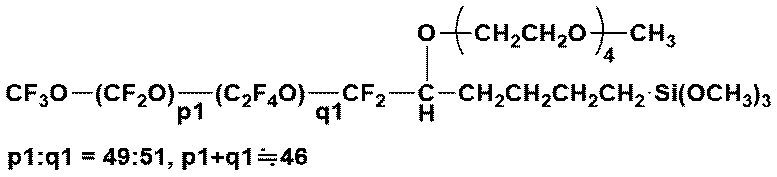
δ0.4-0.6(C-CH2CH2CH2CH 2 -Si)2H
δ1.2-1.6(C-CH 2 CH 2 CH 2 CH2-Si)6H
δ3.0-3.2(CF2-CH-O-(CH2CH2O)4-O-CH 3 ))3H
δ3.3-3.6(-O-(CH 2 CH 2 O)4-O-CH3、-Si(OCH 3 )3)25H
δ3.7-3.8(CF2-CH-O-(CH2CH2O)4-O-CH3))1H
反応容器に、5-ヘキセニルマグネシウムブロミド272ml(0.5M THF溶液:1.36×10⁻¹mol)を入れ、撹拌した。続いて、下記式(A)
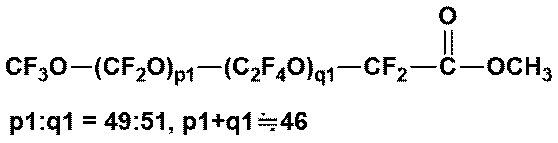
で表される化合物200g(4.5×10⁻²mol)、アサヒクリンAC6000 400g、PF5060 200gの混合液を反応容器内に滴下した後、50℃で6時間加熱した。加熱終了後、室温まで冷却し、塩酸水溶液を滴下した。分液操作により、下層であるフッ素化合物層を回収後、アセトンで洗浄した。洗浄後の下層であるフッ素化合物層を再び回収し、減圧下、残存溶剤を留去することで、下記式(L)
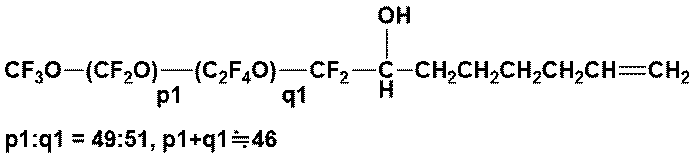
で表されるフルオロポリエーテル基含有ポリマー189g(数平均分子量;約4,450)を得た。
δ1.3-1.8(C-CH 2 CH 2 CH 2 CH2CH=CH2)6H
δ1.9-2.1(C-CH2CH2CH2CH 2 CH=CH2)2H
δ3.3-3.5(-CF2-CH(OH)-CH2-)1H
δ3.6-3.8(-CF2-CH(OH)-CH2-)1H
δ4.7-4.9(-CH2CH=CH 2 )2H
δ5.5-5.7(-CH2CH=CH2)1H

で表される化合物40g(9.0×10⁻³mol)、ジエチレングリコール-2-ブロモエチルメチルエーテル8.2g(3.6×10⁻²mol)、テトラブチルアンモニウムヨージド0.06g(1.6×10⁻⁴mol)を混合した。続いて、30質量%水酸化ナトリウム水溶液7.2g(5.4×10⁻²mol)を添加した後、50℃で24時間加熱した。加熱終了後、室温まで冷却し、塩酸水溶液を滴下した。分液操作により、下層であるフッ素化合物層を回収後、アセトンで洗浄した。洗浄後の下層であるフッ素化合物層を再び回収し、減圧下、残存溶剤を留去することで、下記式(M)
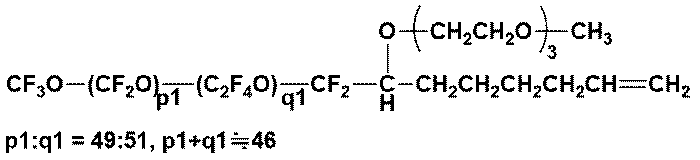
で表されるフルオロポリエーテル基含有ポリマー21gを得た。
δ1.3-1.8(C-CH 2 CH 2 CH 2 CH2CH=CH2)6H
δ1.9-2.1(C-CH2CH2CH2CH 2 CH=CH2)2H
δ3.0-3.2(CF2-CH-O-(CH2CH2O)3-O-CH 3 ))3H
δ3.3-3.6(-O-(CH 2 CH 2 O)3-O-CH3)12H
δ3.7-3.8(CF2-CH-O-(CH2CH2O)3-O-CH3))1H
δ4.8-5.1(C-CH2CH2CH=CH 2 )2H
δ5.6-5.8(C-CH2CH2CH=CH2)1H
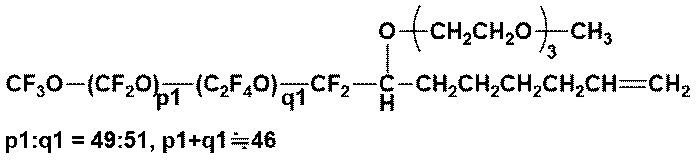
で表される化合物20g(4.3×10⁻³mol)、1,3-ビス(トリフルオロメチル)ベンゼン20g、トリメトキシシラン1.05g(8.6×10⁻³mol)、及び塩化白金酸/ビニルシロキサン錯体のトルエン溶液2.0×10-2g(Pt単体として5.9×10-8molを含有)を混合し、80℃で24時間熟成させた。その後、溶剤及び未反応物を減圧留去し、液状の生成物21gを得た。

δ0.4-0.6(C-CH2CH2CH2CH 2 -Si)2H
δ1.1-1.8(C-CH 2 CH 2 CH 2 CH 2 CH 2 CH2-Si)10H
δ3.0-3.2(CF2-CH-O-(CH2CH2O)3-O-CH 3 ))3H
δ3.3-3.6(-O-(CH 2 CH 2 O)3-O-CH3、-Si(OCH 3 )3)21H
δ3.7-3.8(CF2-CH-O-(CH2CH2O)3-O-CH3))1H
反応容器に、3-ブテニルマグネシウムブロミド126ml(0.5M THF溶液:6.3×10⁻²mol)を入れ、撹拌した。続いて、下記式(O)
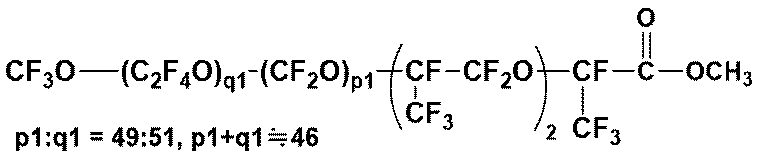
で表される化合物100g(2.1×10⁻²mol)、アサヒクリンAC6000 200g、PF5060 100gの混合液を反応容器内に滴下した後、50℃で6時間加熱した。加熱終了後、室温まで冷却し、塩酸水溶液を滴下した。分液操作により、下層であるフッ素化合物層を回収後、アセトンで洗浄した。洗浄後の下層であるフッ素化合物層を再び回収し、減圧下、残存溶剤を留去することで、下記式(P)

で表されるフルオロポリエーテル基含有ポリマー96g(数平均分子量;約4,800)を得た。
δ1.4-1.7(C-CH 2 CH2CH=CH2)2H
δ1.9-2.2(C-CH 2 CH2CH=CH2、-CF(CF3)-CH(OH)-CH2-)3H
δ3.5-3.7(-CF(CF3)-CH(OH)-CH2-)1H
δ4.8-4.9(-CH2CH=CH 2 )2H
δ5.5-5.6(-CH2CH=CH2)1H

で表される化合物40g(8.2×10⁻³mol)、ジエチレングリコール-2-ブロモエチルメチルエーテル7.5g(3.3×10⁻²mol)、テトラブチルアンモニウムヨージド0.06g(1.6×10⁻⁴mol)を混合した。続いて、30質量%水酸化ナトリウム水溶液6.6g(4.9×10⁻²mol)を添加した後、50℃で24時間加熱した。加熱終了後、室温まで冷却し、塩酸水溶液を滴下した。分液操作により、下層であるフッ素化合物層を回収後、アセトンで洗浄した。洗浄後の下層であるフッ素化合物層を再び回収し、減圧下、残存溶剤を留去することで、下記式(Q)
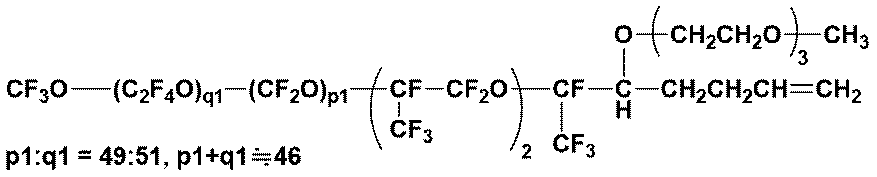
で表されるフルオロポリエーテル基含有ポリマー38gを得た。
δ1.5-1.7(C-CH 2 CH2CH=CH2)2H
δ2.1-2.3(C-CH2CH 2 CH=CH2)2H
δ3.0-3.2(CF2-CH-O-(CH2CH2O)3-O-CH 3 ))3H
δ3.3-3.6(-O-(CH 2 CH 2 O)3-O-CH3)12H
δ3.6-3.8(CF(CF3)-CH-O-(CH2CH2O)3-O-CH3))1H
δ5.0-5.2(C-CH2CH2CH=CH 2 )2H
δ5.7-5.8(C-CH2CH2CH=CH2)1H

で表される化合物20g(4.1×10⁻³mol)、1,3-ビス(トリフルオロメチル)ベンゼン20g、トリメトキシシラン1.0g(8.2×10⁻³mol)、及び塩化白金酸/ビニルシロキサン錯体のトルエン溶液1.9×10-2g(Pt単体として5.9×10-8molを含有)を混合し、80℃で24時間熟成させた。その後、溶剤及び未反応物を減圧留去し、液状の生成物19gを得た。

δ0.4-0.6(C-CH2CH2CH2CH 2 -Si)2H
δ1.2-1.7(C-CH 2 CH 2 CH 2 CH2-Si)4H
δ3.0-3.2(CF2-CH-O-(CH2CH2O)3-O-CH 3 ))3H
δ3.3-3.6(-O-(CH 2 CH 2 O)3-O-CH3、-Si(OCH 3 )3)21H
δ3.7-3.8(CF2-CH-O-(CH2CH2O)3-O-CH3))1H
反応容器に、上記と同様にして得られた下記式(C)
で表される化合物40g(8.7×10⁻³mol)と下記式(S)

で表されるシロキサン11.7g(8.7×10⁻²mol)、1,3-ビス(トリフルオロメチル)ベンゼン40gを混合し、80℃まで加熱した。その後、塩化白金酸/ビニルシロキサン錯体のトルエン溶液3.9×10-2g(Pt単体として1.2×10-7molを含有)を添加し、80℃で24時間熟成させた。その後、減圧下、残存溶剤を留去することで、下記式(T)

で表されるフルオロポリエーテル基含有ポリマー41gを得た。
δ0-0.3(-Si-(CH 3 )2-)12H
δ0.4-0.6(C-CH2CH2CH2CH 2 -Si)2H
δ1.2-1.7(C-CH 2 CH 2 CH 2 CH2-Si)6H
δ3.0-3.2(CF2-CH-O-(CH2CH2O)3-O-CH 3 ))3H
δ3.3-3.6(-O-(CH 2 CH 2 O)3-O-CH3)12H
δ3.7-3.8(CF2-CH-O-(CH2CH2O)3-O-CH3))1H
δ3.9-4.1(-Si(CH3)H)1H

で表される化合物20g(4.2×10⁻³mol)、1,3-ビス(トリフルオロメチル)ベンゼン20g、アリルトリメトキシシラン1.36g(8.4×10⁻³mol)及び塩化白金酸/ビニルシロキサン錯体のトルエン溶液2.0×10-2g(Pt単体として6.0×10-8molを含有)を混合し、80℃で24時間熟成させた。その後、溶剤及び未反応物を減圧留去し、液状の生成物20gを得た。

δ0-0.3(-Si-(CH 3 )2-)12H
δ0.4-0.7(C-CH2CH2CH2CH 2 -Si、Si-CH 2 CH2CH 2 -Si)6H
δ1.2-1.8(C-CH 2 CH 2 CH 2 CH2-Si、Si-CH2CH 2 CH2-Si)8H
δ3.0-3.2(CF2-CH-O-(CH2CH2O)3-O-CH 3 ))3H
δ3.3-3.6(-O-(CH 2 CH 2 O)3-O-CH3、-Si(OCH 3 )3)21H
δ3.7-3.8(CF2-CH-O-(CH2CH2O)3-O-CH3))1H
反応容器に、3-ブテニルマグネシウムブロミド288ml(0.5M THF溶液:1.4×10⁻¹mol)を入れ、撹拌した。続いて、下記式(W)

で表される化合物200g(4.8×10⁻²mol)、アサヒクリンAC6000 400g、PF5060 200gの混合液を反応容器内に滴下した後、50℃で6時間加熱した。加熱終了後、室温まで冷却し、塩酸水溶液を滴下した。分液操作により、下層であるフッ素化合物層を回収後、アセトンで洗浄した。洗浄後の下層であるフッ素化合物層を再び回収し、減圧下、残存溶剤を留去することで、下記式(X)
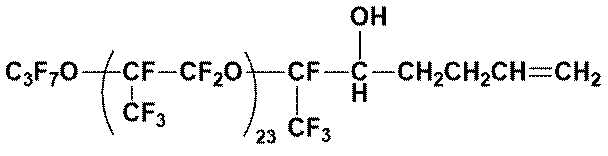
で表されるフルオロポリエーテル基含有ポリマー188g(数平均分子量;約4,290)を得た。
δ1.4-1.7(C-CH 2 CH2CH=CH2)2H
δ1.9-2.2(C-CH2CH 2 CH=CH2)2H
δ2.4-2.6(-CF2-CH(OH)-CH2-)1H
δ3.9-4.0(-CF2-CH(OH)-CH2-)1H
δ4.7-4.9(-CH2CH=CH 2 )2H
δ5.5-5.7(-CH2CH=CH2)1H

で表される化合物100g(2.3×10⁻²mol)、ジエチレングリコール-2-ブロモエチルメチルエーテル21g(9.2×10⁻²mol)、テトラブチルアンモニウムヨージド0.17g(4.6×10⁻⁴mol)を混合した。続いて、30質量%水酸化ナトリウム水溶液18g(1.4×10⁻¹mol)を添加した後、50℃で24時間加熱した。加熱終了後、室温まで冷却し、塩酸水溶液を滴下した。分液操作により、下層であるフッ素化合物層を回収後、アセトンで洗浄した。洗浄後の下層であるフッ素化合物層を再び回収し、減圧下、残存溶剤を留去することで、下記式(Y)

で表されるフルオロポリエーテル基含有ポリマー89gを得た。
δ1.5-1.7(C-CH 2 CH2CH=CH2)2H
δ2.0-2.2(C-CH2CH 2 CH=CH2)2H
δ3.0-3.2(CF2-CH-O-(CH2CH2O)3-O-CH 3 ))3H
δ3.3-3.6(-O-(CH 2 CH 2 O)3-O-CH3)12H
δ3.9-4.0(CF2-CH-O-(CH2CH2O)3-O-CH3))1H
δ4.8-5.1(C-CH2CH2CH=CH 2 )2H
δ5.6-5.8(C-CH2CH2CH=CH2)1H

で表される化合物80g(1.7×10⁻²mol)、1,3-ビス(トリフルオロメチル)ベンゼン80g、トリメトキシシラン4.2g(3.4×10⁻²mol)、及び塩化白金酸/ビニルシロキサン錯体のトルエン溶液7.6×10-2g(Pt単体として2.3×10-7molを含有)を混合し、80℃で24時間熟成させた。その後、溶剤及び未反応物を減圧留去し、液状の生成物78gを得た。

δ0.4-0.6(C-CH2CH2CH2CH 2 -Si)2H
δ1.2-1.6(C-CH 2 CH 2 CH 2 CH2-Si)6H
δ3.0-3.2(CF2-CH-O-(CH2CH2O)3-O-CH 3 ))3H
δ3.3-3.6(-O-(CH 2 CH 2 O)3-O-CH3、-Si(OCH 3 )3)21H
δ3.9-4.0(CF2-CH-O-(CH2CH2O)3-O-CH3))1H
反応容器に、3-ブテニルマグネシウムブロミド282ml(0.5M THF溶液:1.4×10⁻¹mol)を入れ、撹拌した。続いて、下記式(A’)
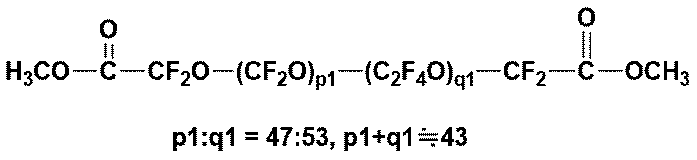
で表される化合物100g(2.4×10⁻²mol)、アサヒクリンAC6000 200g、PF5060 100gの混合液を反応容器内に滴下した後、50℃で6時間加熱した。加熱終了後、室温まで冷却し、塩酸水溶液を滴下した。分液操作により、下層であるフッ素化合物層を回収後、アセトンで洗浄した。洗浄後の下層であるフッ素化合物層を再び回収し、減圧下、残存溶剤を留去することで、下記式(B’)

で表されるフルオロポリエーテル基含有ポリマー94g(数平均分子量;約4,400)を得た。
δ1.4-1.7(C-CH 2 CH2CH=CH2)4H
δ1.9-2.2(C-CH 2 CH2CH=CH2、-CF2-CH(OH)-CH2-)6H
δ3.6-3.8(-CF2-CH(OH)-CH2-)2H
δ4.8-4.9(-CH2CH=CH 2 )4H
δ5.5-5.6(-CH2CH=CH2)2H

で表される化合物40g(9.4×10⁻³mol)、ジエチレングリコール-2-ブロモエチルメチルエーテル17.0g(7.5×10⁻²mol)、テトラブチルアンモニウムヨージド0.14g(3.8×10⁻⁴mol)を混合した。続いて、30質量%水酸化ナトリウム水溶液14g(1.1×10⁻¹mol)を添加した後、50℃で24時間加熱した。加熱終了後、室温まで冷却し、塩酸水溶液を滴下した。分液操作により、下層であるフッ素化合物層を回収後、アセトンで洗浄した。洗浄後の下層であるフッ素化合物層を再び回収し、減圧下、残存溶剤を留去することで、下記式(C’)
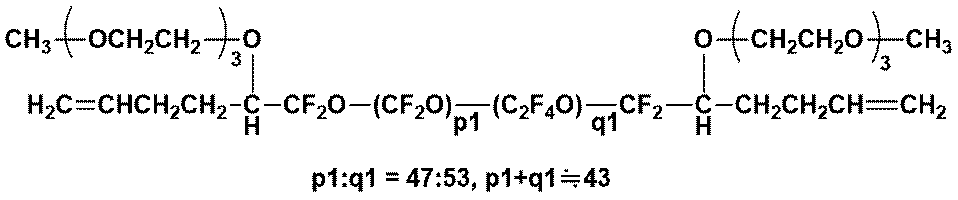
で表されるフルオロポリエーテル基含有ポリマー39gを得た。
δ1.5-1.7(C-CH 2 CH2CH=CH2)4H
δ1.9-2.1(C-CH2CH 2 CH=CH2)4H
δ3.0-3.2(CF2-CH-O-(CH2CH2O)3-O-CH 3 ))6H
δ3.3-3.6(-O-(CH 2 CH 2 O)3-O-CH3)24H
δ3.7-3.8(CF2-CH-O-(CH2CH2O)3-O-CH3))2H
δ5.0-5.2(C-CH2CH2CH=CH 2 )4H
δ5.7-5.8(C-CH2CH2CH=CH2)2H
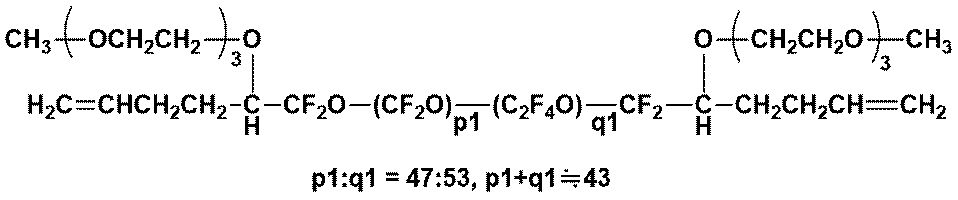
で表される化合物20g(4.4×10⁻³mol)、1,3-ビス(トリフルオロメチル)ベンゼン20g、トリメトキシシラン2.2g(1.8×10⁻²mol)、及び塩化白金酸/ビニルシロキサン錯体のトルエン溶液4.7×10-2g(Pt単体として1.4×10-7molを含有)を混合し、80℃で24時間熟成させた。その後、溶剤及び未反応物を減圧留去し、液状の生成物21gを得た。

δ0.4-0.6(-O-CH2CH2CH 2 -Si、C-CH2CH2CH2CH 2 -Si)8H
δ1.2-1.7(-O-CH2CH 2 CH2-Si、C-CH 2 CH 2 CH 2 CH2-Si)16H
δ3.0-3.2(CF2-CH-O-(CH2CH2O)3-O-CH 3 ))6H
δ3.3-3.6(-O-(CH 2 CH 2 O)3-O-CH3、-Si(OCH 3 )3)42H
δ3.7-3.8(CF2-CH-O-(CH2CH2O)3-O-CH3))2H
[比較例1]

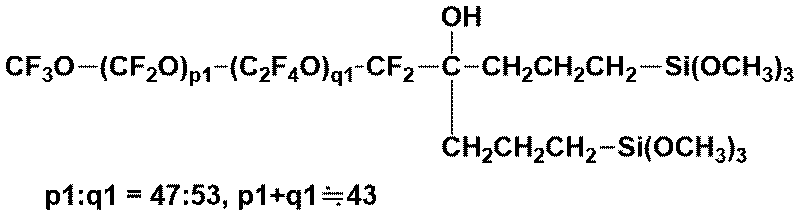

実施例1、3で得られた式(D)、(K)で表される構造のフルオロポリエーテル基含有ポリマー及び比較例1、2、3の式(E’)、(F’)、(G’)で表されるポリマーを、濃度20質量%になるようにNovec 7200(3M社製、エチルパーフルオロブチルエーテル)に溶解させて表面処理剤を調製した。最表面にSiO2を10nm処理したガラス(コーニング社製 Gorilla)に、各表面処理剤4μlを真空蒸着し(処理条件は、圧力:3.0×10⁻³Pa、加熱温度:500℃)、25℃、湿度50%の雰囲気下で12時間硬化させて膜厚8nmの硬化被膜を形成した。
[初期撥水撥油性の評価]
上記にて作製した硬化被膜を形成したガラスについて、接触角計Drop Master(協和界面科学社製)を用いて、硬化被膜の水に対する接触角(撥水性)を測定した(液滴:2μl、温度:25℃、湿度:40%)。結果(初期水接触角)を表1に示す。
初期においては、実施例、比較例共に良好な撥水性を示した。
上記にて作製した硬化被膜を形成したガラスについて、ラビングテスター(新東科学社製)を用いて、下記条件で10,000回擦った後の硬化被膜の水に対する接触角(撥水性)を上記と同様にして測定し、耐摩耗性の評価1とした。試験環境条件は25℃、湿度40%である。結果(摩耗後水接触角)を表1に示す。
耐消しゴム摩耗性
消しゴム:Minoan社製
接触面積:6mmφ
移動距離(片道):40mm
移動速度:3,200mm/分
荷重:1kg/6mmφ
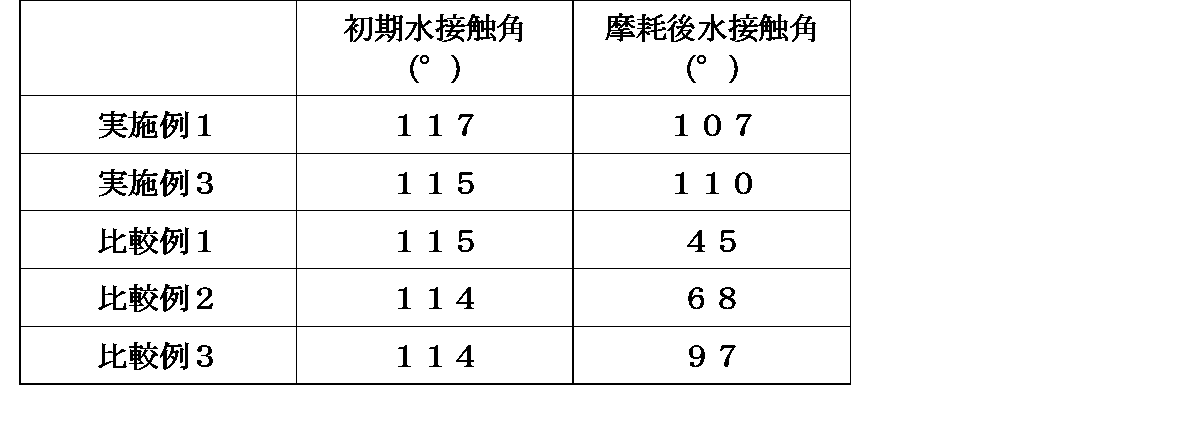
上記にて作製した硬化被膜を形成したガラスについて、ラビングテスター(新東科学社製)を用いて、下記条件で15,000回擦った後の硬化被膜の水に対する接触角(撥水性)を上記と同様にして測定し、耐摩耗性の評価2とした。評価は8回摩耗試験を行った内、水接触角が100°以上を合格とし、合格率を算出している。試験環境条件は25℃、湿度40%である。結果(摩耗後水接触角100°以上の合格率)を表2に示す。
耐消しゴム摩耗性
消しゴム:Minoan社製
接触面積:6mmφ
移動距離(片道):40mm
移動速度:3,200mm/分
荷重:1kg/6mmφ
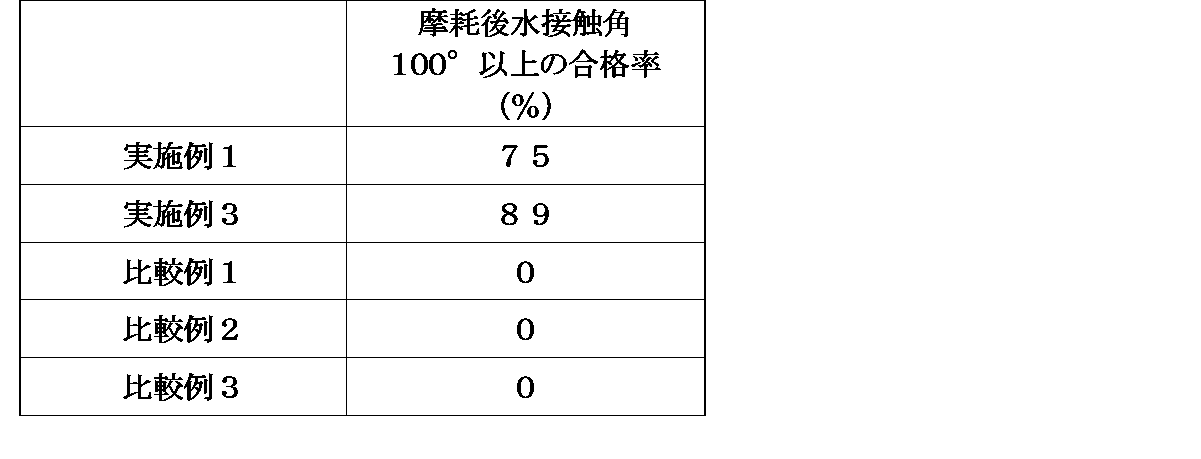
Claims (10)
- 下記一般式(1)で表されるフルオロポリエーテル基含有ポリマー。


- 前記式(1)のαが1であり、Rfが下記一般式(3)で表される基である請求項1に記載のフルオロポリエーテル基含有ポリマー。

- 前記式(1)のαが2であり、Rfが下記一般式(4)で表される基である請求項1に記載のフルオロポリエーテル基含有ポリマー。

- 前記式(1)において、Yが炭素数3~10のアルキレン基、炭素数6~8のアリーレン基を含むアルキレン基、アルキレン基相互がシルアルキレン構造又はシルアリーレン構造を介して結合している2価の基、及びケイ素原子数2~10個の直鎖状又はケイ素原子数3~10個の分岐状もしくは環状の2~4価のオルガノポリシロキサン残基の結合手に炭素数2~10のアルキレン基が結合している2~4価の基からなる群より選ばれる基である請求項1~3のいずれか1項に記載のフルオロポリエーテル基含有ポリマー。
- 前記式(1)において、Eが下記一般式(5)で表される基である請求項1~4のいずれか1項に記載のフルオロポリエーテル基含有ポリマー。

- 前記式(1)において、Xがそれぞれ独立に、水酸基、炭素数1~10のアルコキシ基、炭素数2~10のアルコキシアルコキシ基、炭素数1~10のアシロキシ基、炭素数2~10のアルケニルオキシ基及びハロゲン基からなる群より選ばれる基である請求項1~5のいずれか1項に記載のフルオロポリエーテル基含有ポリマー。
- 式(1)で表されるポリマーが、下記式で表されるポリマーから選ばれるものである請求項1~6のいずれか1項に記載のフルオロポリエーテル基含有ポリマー。
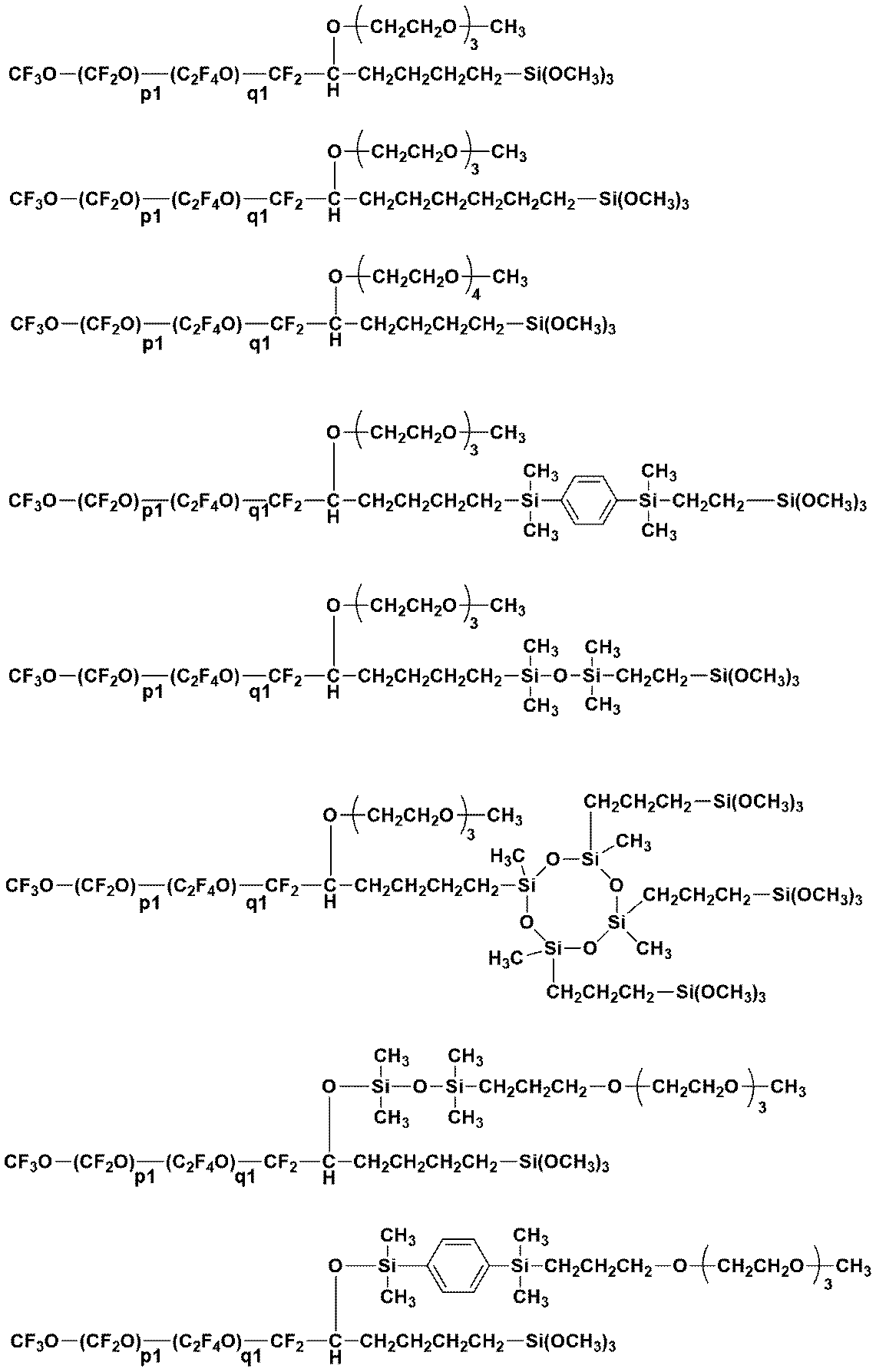
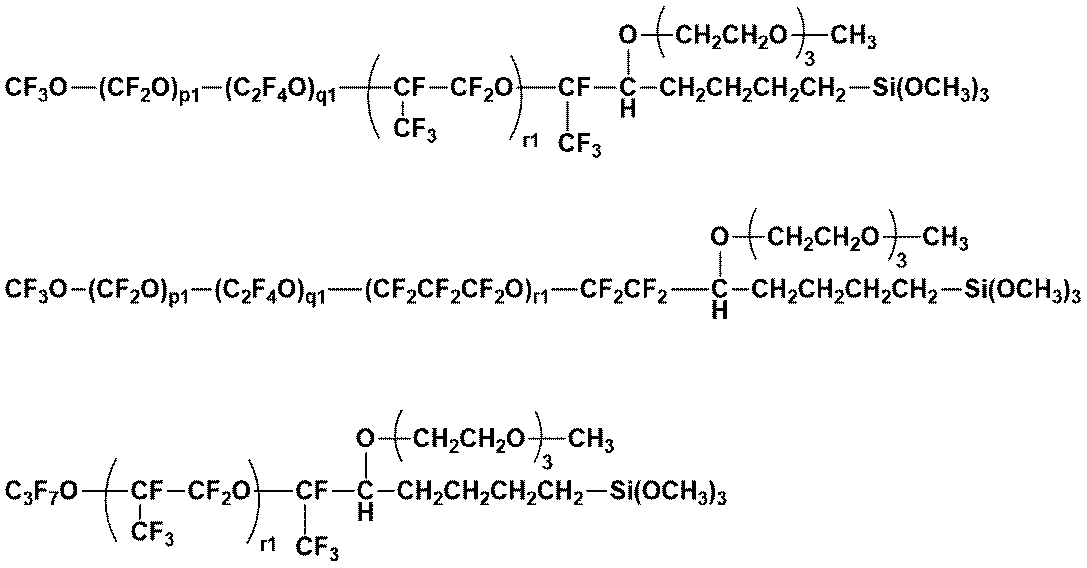


- 請求項1~7のいずれか1項に記載のフルオロポリエーテル基含有ポリマー及び/又はその部分(加水分解)縮合物を含む表面処理剤。
- フルオロポリエーテル基含有ポリマー中のフルオロポリエーテル基が、分子鎖末端に位置する1価のフルオロオキシアルキレン基含有ポリマー残基である請求項8に記載の表面処理剤。
- 請求項8又は9に記載の表面処理剤で表面処理された物品。
Priority Applications (4)
| Application Number | Priority Date | Filing Date | Title |
|---|---|---|---|
| CN202080083962.1A CN114746475B (zh) | 2019-12-03 | 2020-11-27 | 含有氟聚醚基的聚合物、表面处理剂及物品 |
| KR1020227022027A KR102966095B1 (ko) | 2019-12-03 | 2020-11-27 | 플루오로폴리에테르기 함유 폴리머, 표면처리제 및 물품 |
| EP20896392.6A EP4071197B1 (en) | 2019-12-03 | 2020-11-27 | Fluoropolyether group-containing polymer, surface treatment agent, and article |
| JP2021562615A JP7318735B2 (ja) | 2019-12-03 | 2020-11-27 | フルオロポリエーテル基含有ポリマー、表面処理剤及び物品 |
Applications Claiming Priority (2)
| Application Number | Priority Date | Filing Date | Title |
|---|---|---|---|
| JP2019-218980 | 2019-12-03 | ||
| JP2019218980 | 2019-12-03 |
Publications (1)
| Publication Number | Publication Date |
|---|---|
| WO2021111992A1 true WO2021111992A1 (ja) | 2021-06-10 |
Family
ID=76221623
Family Applications (1)
| Application Number | Title | Priority Date | Filing Date |
|---|---|---|---|
| PCT/JP2020/044129 Ceased WO2021111992A1 (ja) | 2019-12-03 | 2020-11-27 | フルオロポリエーテル基含有ポリマー、表面処理剤及び物品 |
Country Status (4)
| Country | Link |
|---|---|
| EP (1) | EP4071197B1 (ja) |
| JP (1) | JP7318735B2 (ja) |
| CN (1) | CN114746475B (ja) |
| WO (1) | WO2021111992A1 (ja) |
Cited By (5)
| Publication number | Priority date | Publication date | Assignee | Title |
|---|---|---|---|---|
| JPWO2023022038A1 (ja) * | 2021-08-17 | 2023-02-23 | ||
| WO2023042696A1 (ja) * | 2021-09-15 | 2023-03-23 | 信越化学工業株式会社 | フルオロポリエーテル基含有ポリマー、表面処理剤及び物品 |
| WO2024075458A1 (ja) * | 2022-10-05 | 2024-04-11 | 信越化学工業株式会社 | フルオロポリエーテル基含有ポリマー |
| WO2025047304A1 (ja) * | 2023-08-30 | 2025-03-06 | 信越化学工業株式会社 | フルオロポリエーテル基含有ポリマー、表面処理剤及び物品 |
| WO2025047303A1 (ja) * | 2023-08-28 | 2025-03-06 | 信越化学工業株式会社 | 含フッ素エーテル組成物、表面処理剤及び物品 |
Citations (9)
| Publication number | Priority date | Publication date | Assignee | Title |
|---|---|---|---|---|
| JP2008534696A (ja) | 2005-04-01 | 2008-08-28 | ダイキン工業株式会社 | 表面改質剤 |
| JP2008537557A (ja) | 2005-04-01 | 2008-09-18 | ダイキン工業株式会社 | 表面改質剤およびその用途 |
| JP2012072272A (ja) | 2010-09-28 | 2012-04-12 | Shin-Etsu Chemical Co Ltd | フルオロオキシアルキレン基含有ポリマー組成物および該組成物を含む表面処理剤並びに該表面処理剤で表面処理された物品 |
| JP2012157856A (ja) | 2011-01-13 | 2012-08-23 | Central Glass Co Ltd | 防汚性物品及びその製造方法 |
| JP2013136833A (ja) | 2011-11-30 | 2013-07-11 | Shin-Etsu Chemical Co Ltd | 蒸着用フッ素系表面処理剤及び該表面処理剤で蒸着処理された物品 |
| JP2015199906A (ja) | 2014-03-31 | 2015-11-12 | 信越化学工業株式会社 | フルオロポリエーテル基含有ポリマー変性シラン、表面処理剤及び物品 |
| WO2017141707A1 (ja) * | 2016-02-17 | 2017-08-24 | 信越化学工業株式会社 | フルオロポリエーテル基含有ポリマー変性シラン、表面処理剤及び物品 |
| WO2017212850A1 (ja) * | 2016-06-10 | 2017-12-14 | 信越化学工業株式会社 | フルオロポリエーテル基含有ポリマー、表面処理剤及び物品 |
| WO2018216404A1 (ja) * | 2017-05-23 | 2018-11-29 | 信越化学工業株式会社 | 含フッ素コーティング剤組成物及び該組成物を含有する表面処理剤並びに物品 |
Family Cites Families (3)
| Publication number | Priority date | Publication date | Assignee | Title |
|---|---|---|---|---|
| JP2015224293A (ja) * | 2014-05-28 | 2015-12-14 | 信越化学工業株式会社 | 含フッ素コーティング剤及び該コーティング剤で処理された物品 |
| WO2017104249A1 (ja) * | 2015-12-14 | 2017-06-22 | 信越化学工業株式会社 | フルオロポリエーテル基含有ポリマー変性シラン、表面処理剤及び物品 |
| JP6988905B2 (ja) * | 2017-10-03 | 2022-01-05 | 信越化学工業株式会社 | 撥水撥油部材及び撥水撥油部材の製造方法 |
-
2020
- 2020-11-27 CN CN202080083962.1A patent/CN114746475B/zh active Active
- 2020-11-27 WO PCT/JP2020/044129 patent/WO2021111992A1/ja not_active Ceased
- 2020-11-27 JP JP2021562615A patent/JP7318735B2/ja active Active
- 2020-11-27 EP EP20896392.6A patent/EP4071197B1/en active Active
Patent Citations (9)
| Publication number | Priority date | Publication date | Assignee | Title |
|---|---|---|---|---|
| JP2008534696A (ja) | 2005-04-01 | 2008-08-28 | ダイキン工業株式会社 | 表面改質剤 |
| JP2008537557A (ja) | 2005-04-01 | 2008-09-18 | ダイキン工業株式会社 | 表面改質剤およびその用途 |
| JP2012072272A (ja) | 2010-09-28 | 2012-04-12 | Shin-Etsu Chemical Co Ltd | フルオロオキシアルキレン基含有ポリマー組成物および該組成物を含む表面処理剤並びに該表面処理剤で表面処理された物品 |
| JP2012157856A (ja) | 2011-01-13 | 2012-08-23 | Central Glass Co Ltd | 防汚性物品及びその製造方法 |
| JP2013136833A (ja) | 2011-11-30 | 2013-07-11 | Shin-Etsu Chemical Co Ltd | 蒸着用フッ素系表面処理剤及び該表面処理剤で蒸着処理された物品 |
| JP2015199906A (ja) | 2014-03-31 | 2015-11-12 | 信越化学工業株式会社 | フルオロポリエーテル基含有ポリマー変性シラン、表面処理剤及び物品 |
| WO2017141707A1 (ja) * | 2016-02-17 | 2017-08-24 | 信越化学工業株式会社 | フルオロポリエーテル基含有ポリマー変性シラン、表面処理剤及び物品 |
| WO2017212850A1 (ja) * | 2016-06-10 | 2017-12-14 | 信越化学工業株式会社 | フルオロポリエーテル基含有ポリマー、表面処理剤及び物品 |
| WO2018216404A1 (ja) * | 2017-05-23 | 2018-11-29 | 信越化学工業株式会社 | 含フッ素コーティング剤組成物及び該組成物を含有する表面処理剤並びに物品 |
Cited By (10)
| Publication number | Priority date | Publication date | Assignee | Title |
|---|---|---|---|---|
| JPWO2023022038A1 (ja) * | 2021-08-17 | 2023-02-23 | ||
| WO2023022038A1 (ja) * | 2021-08-17 | 2023-02-23 | 信越化学工業株式会社 | 表面処理された物品、並びに撥水性を有する物品の耐uvc性を向上させる方法 |
| EP4389848A4 (en) * | 2021-08-17 | 2025-10-22 | Shinetsu Chemical Co | SURFACE-TREATED ARTICLE AND METHOD FOR IMPROVING THE UVC RESISTANCE OF A WATER-REPELLENT ARTICLE |
| JP7794204B2 (ja) | 2021-08-17 | 2026-01-06 | 信越化学工業株式会社 | 表面処理された物品 |
| WO2023042696A1 (ja) * | 2021-09-15 | 2023-03-23 | 信越化学工業株式会社 | フルオロポリエーテル基含有ポリマー、表面処理剤及び物品 |
| JPWO2023042696A1 (ja) * | 2021-09-15 | 2023-03-23 | ||
| JP7806802B2 (ja) | 2021-09-15 | 2026-01-27 | 信越化学工業株式会社 | フルオロポリエーテル基含有ポリマー、表面処理剤及び物品 |
| WO2024075458A1 (ja) * | 2022-10-05 | 2024-04-11 | 信越化学工業株式会社 | フルオロポリエーテル基含有ポリマー |
| WO2025047303A1 (ja) * | 2023-08-28 | 2025-03-06 | 信越化学工業株式会社 | 含フッ素エーテル組成物、表面処理剤及び物品 |
| WO2025047304A1 (ja) * | 2023-08-30 | 2025-03-06 | 信越化学工業株式会社 | フルオロポリエーテル基含有ポリマー、表面処理剤及び物品 |
Also Published As
| Publication number | Publication date |
|---|---|
| EP4071197A1 (en) | 2022-10-12 |
| JP7318735B2 (ja) | 2023-08-01 |
| CN114746475B (zh) | 2024-03-22 |
| EP4071197B1 (en) | 2025-01-29 |
| JPWO2021111992A1 (ja) | 2021-06-10 |
| KR20220111296A (ko) | 2022-08-09 |
| CN114746475A (zh) | 2022-07-12 |
| EP4071197A4 (en) | 2023-11-15 |
Similar Documents
| Publication | Publication Date | Title |
|---|---|---|
| JP6828744B2 (ja) | フルオロポリエーテル基含有ポリマー、表面処理剤及び物品 | |
| JP6524955B2 (ja) | フルオロポリエーテル基含有ポリマー変性シラン、表面処理剤及び物品 | |
| TWI686427B (zh) | 經含氟聚醚之聚合物改質的矽烷、表面處理劑及物件 | |
| JP7456499B2 (ja) | フルオロポリエーテル基含有ポリマー及び/又はその部分(加水分解)縮合物を含む表面処理剤及び物品 | |
| JP7276464B2 (ja) | フルオロポリエーテル基含有ポリマー、表面処理剤及び物品 | |
| JP7070587B2 (ja) | フルオロポリエーテル基含有ポリマー、表面処理剤及び物品 | |
| JP6680350B2 (ja) | フルオロポリエーテル基含有ポリマー変性シラン、表面処理剤及び物品 | |
| JP6891952B2 (ja) | 含フッ素コーティング剤組成物及び該組成物を含有する表面処理剤並びに物品 | |
| JP7318735B2 (ja) | フルオロポリエーテル基含有ポリマー、表面処理剤及び物品 | |
| JP6642589B2 (ja) | フルオロポリエーテル基含有ポリマー変性シラン、表面処理剤及び物品 | |
| JP2025138786A (ja) | フルオロポリエーテル基含有ポリマー、表面処理剤及び物品 | |
| KR102966095B1 (ko) | 플루오로폴리에테르기 함유 폴리머, 표면처리제 및 물품 | |
| KR20260055485A (ko) | 플루오로폴리에테르기 함유 폴리머, 표면처리제 및 물품 | |
| TW202440827A (zh) | 含氟聚醚基之聚合物、表面處理劑及物品 |
Legal Events
| Date | Code | Title | Description |
|---|---|---|---|
| 121 | Ep: the epo has been informed by wipo that ep was designated in this application |
Ref document number: 20896392 Country of ref document: EP Kind code of ref document: A1 |
|
| ENP | Entry into the national phase |
Ref document number: 2021562615 Country of ref document: JP Kind code of ref document: A |
|
| ENP | Entry into the national phase |
Ref document number: 20227022027 Country of ref document: KR Kind code of ref document: A |
|
| NENP | Non-entry into the national phase |
Ref country code: DE |
|
| ENP | Entry into the national phase |
Ref document number: 2020896392 Country of ref document: EP Effective date: 20220704 |