WO2021117623A1 - ナトリウムフェライト粒子粉末及びその製造方法 - Google Patents
ナトリウムフェライト粒子粉末及びその製造方法 Download PDFInfo
- Publication number
- WO2021117623A1 WO2021117623A1 PCT/JP2020/045202 JP2020045202W WO2021117623A1 WO 2021117623 A1 WO2021117623 A1 WO 2021117623A1 JP 2020045202 W JP2020045202 W JP 2020045202W WO 2021117623 A1 WO2021117623 A1 WO 2021117623A1
- Authority
- WO
- WIPO (PCT)
- Prior art keywords
- particle powder
- carbon dioxide
- sodium
- sodium ferrite
- weight
- Prior art date
- Legal status (The legal status is an assumption and is not a legal conclusion. Google has not performed a legal analysis and makes no representation as to the accuracy of the status listed.)
- Ceased
Links
Images

Classifications
-
- B—PERFORMING OPERATIONS; TRANSPORTING
- B01—PHYSICAL OR CHEMICAL PROCESSES OR APPARATUS IN GENERAL
- B01J—CHEMICAL OR PHYSICAL PROCESSES, e.g. CATALYSIS OR COLLOID CHEMISTRY; THEIR RELEVANT APPARATUS
- B01J20/00—Solid sorbent compositions or filter aid compositions; Sorbents for chromatography; Processes for preparing, regenerating or reactivating thereof
- B01J20/02—Solid sorbent compositions or filter aid compositions; Sorbents for chromatography; Processes for preparing, regenerating or reactivating thereof comprising inorganic material
- B01J20/04—Solid sorbent compositions or filter aid compositions; Sorbents for chromatography; Processes for preparing, regenerating or reactivating thereof comprising inorganic material comprising compounds of alkali metals, alkaline earth metals or magnesium
-
- C—CHEMISTRY; METALLURGY
- C01—INORGANIC CHEMISTRY
- C01G—COMPOUNDS CONTAINING METALS NOT COVERED BY SUBCLASSES C01D OR C01F
- C01G49/00—Compounds of iron
-
- B—PERFORMING OPERATIONS; TRANSPORTING
- B01—PHYSICAL OR CHEMICAL PROCESSES OR APPARATUS IN GENERAL
- B01D—SEPARATION
- B01D51/00—Auxiliary pretreatment of gases or vapours to be cleaned
- B01D51/02—Amassing the particles, e.g. by flocculation
-
- B—PERFORMING OPERATIONS; TRANSPORTING
- B01—PHYSICAL OR CHEMICAL PROCESSES OR APPARATUS IN GENERAL
- B01D—SEPARATION
- B01D53/00—Separation of gases or vapours; Recovering vapours of volatile solvents from gases; Chemical or biological purification of waste gases, e.g. engine exhaust gases, smoke, fumes, flue gases, aerosols
- B01D53/02—Separation of gases or vapours; Recovering vapours of volatile solvents from gases; Chemical or biological purification of waste gases, e.g. engine exhaust gases, smoke, fumes, flue gases, aerosols by adsorption, e.g. preparative gas chromatography
- B01D53/04—Separation of gases or vapours; Recovering vapours of volatile solvents from gases; Chemical or biological purification of waste gases, e.g. engine exhaust gases, smoke, fumes, flue gases, aerosols by adsorption, e.g. preparative gas chromatography with stationary adsorbents
- B01D53/0462—Temperature swing adsorption
-
- B—PERFORMING OPERATIONS; TRANSPORTING
- B01—PHYSICAL OR CHEMICAL PROCESSES OR APPARATUS IN GENERAL
- B01J—CHEMICAL OR PHYSICAL PROCESSES, e.g. CATALYSIS OR COLLOID CHEMISTRY; THEIR RELEVANT APPARATUS
- B01J20/00—Solid sorbent compositions or filter aid compositions; Sorbents for chromatography; Processes for preparing, regenerating or reactivating thereof
- B01J20/02—Solid sorbent compositions or filter aid compositions; Sorbents for chromatography; Processes for preparing, regenerating or reactivating thereof comprising inorganic material
- B01J20/0203—Solid sorbent compositions or filter aid compositions; Sorbents for chromatography; Processes for preparing, regenerating or reactivating thereof comprising inorganic material comprising compounds of metals not provided for in B01J20/04
- B01J20/0274—Solid sorbent compositions or filter aid compositions; Sorbents for chromatography; Processes for preparing, regenerating or reactivating thereof comprising inorganic material comprising compounds of metals not provided for in B01J20/04 characterised by the type of anion
-
- B—PERFORMING OPERATIONS; TRANSPORTING
- B01—PHYSICAL OR CHEMICAL PROCESSES OR APPARATUS IN GENERAL
- B01J—CHEMICAL OR PHYSICAL PROCESSES, e.g. CATALYSIS OR COLLOID CHEMISTRY; THEIR RELEVANT APPARATUS
- B01J20/00—Solid sorbent compositions or filter aid compositions; Sorbents for chromatography; Processes for preparing, regenerating or reactivating thereof
- B01J20/02—Solid sorbent compositions or filter aid compositions; Sorbents for chromatography; Processes for preparing, regenerating or reactivating thereof comprising inorganic material
- B01J20/06—Solid sorbent compositions or filter aid compositions; Sorbents for chromatography; Processes for preparing, regenerating or reactivating thereof comprising inorganic material comprising oxides or hydroxides of metals not provided for in group B01J20/04
-
- B—PERFORMING OPERATIONS; TRANSPORTING
- B01—PHYSICAL OR CHEMICAL PROCESSES OR APPARATUS IN GENERAL
- B01J—CHEMICAL OR PHYSICAL PROCESSES, e.g. CATALYSIS OR COLLOID CHEMISTRY; THEIR RELEVANT APPARATUS
- B01J20/00—Solid sorbent compositions or filter aid compositions; Sorbents for chromatography; Processes for preparing, regenerating or reactivating thereof
- B01J20/28—Solid sorbent compositions or filter aid compositions; Sorbents for chromatography; Processes for preparing, regenerating or reactivating thereof characterised by their form or physical properties
-
- B—PERFORMING OPERATIONS; TRANSPORTING
- B01—PHYSICAL OR CHEMICAL PROCESSES OR APPARATUS IN GENERAL
- B01J—CHEMICAL OR PHYSICAL PROCESSES, e.g. CATALYSIS OR COLLOID CHEMISTRY; THEIR RELEVANT APPARATUS
- B01J20/00—Solid sorbent compositions or filter aid compositions; Sorbents for chromatography; Processes for preparing, regenerating or reactivating thereof
- B01J20/28—Solid sorbent compositions or filter aid compositions; Sorbents for chromatography; Processes for preparing, regenerating or reactivating thereof characterised by their form or physical properties
- B01J20/28002—Solid sorbent compositions or filter aid compositions; Sorbents for chromatography; Processes for preparing, regenerating or reactivating thereof characterised by their form or physical properties characterised by their physical properties
- B01J20/28011—Other properties, e.g. density, crush strength
-
- B—PERFORMING OPERATIONS; TRANSPORTING
- B01—PHYSICAL OR CHEMICAL PROCESSES OR APPARATUS IN GENERAL
- B01J—CHEMICAL OR PHYSICAL PROCESSES, e.g. CATALYSIS OR COLLOID CHEMISTRY; THEIR RELEVANT APPARATUS
- B01J20/00—Solid sorbent compositions or filter aid compositions; Sorbents for chromatography; Processes for preparing, regenerating or reactivating thereof
- B01J20/28—Solid sorbent compositions or filter aid compositions; Sorbents for chromatography; Processes for preparing, regenerating or reactivating thereof characterised by their form or physical properties
- B01J20/28014—Solid sorbent compositions or filter aid compositions; Sorbents for chromatography; Processes for preparing, regenerating or reactivating thereof characterised by their form or physical properties characterised by their form
- B01J20/28042—Shaped bodies; Monolithic structures
- B01J20/28045—Honeycomb or cellular structures; Solid foams or sponges
-
- B—PERFORMING OPERATIONS; TRANSPORTING
- B01—PHYSICAL OR CHEMICAL PROCESSES OR APPARATUS IN GENERAL
- B01J—CHEMICAL OR PHYSICAL PROCESSES, e.g. CATALYSIS OR COLLOID CHEMISTRY; THEIR RELEVANT APPARATUS
- B01J20/00—Solid sorbent compositions or filter aid compositions; Sorbents for chromatography; Processes for preparing, regenerating or reactivating thereof
- B01J20/28—Solid sorbent compositions or filter aid compositions; Sorbents for chromatography; Processes for preparing, regenerating or reactivating thereof characterised by their form or physical properties
- B01J20/28054—Solid sorbent compositions or filter aid compositions; Sorbents for chromatography; Processes for preparing, regenerating or reactivating thereof characterised by their form or physical properties characterised by their surface properties or porosity
- B01J20/28057—Surface area, e.g. B.E.T specific surface area
- B01J20/28059—Surface area, e.g. B.E.T specific surface area being less than 100 m2/g
-
- B—PERFORMING OPERATIONS; TRANSPORTING
- B01—PHYSICAL OR CHEMICAL PROCESSES OR APPARATUS IN GENERAL
- B01J—CHEMICAL OR PHYSICAL PROCESSES, e.g. CATALYSIS OR COLLOID CHEMISTRY; THEIR RELEVANT APPARATUS
- B01J20/00—Solid sorbent compositions or filter aid compositions; Sorbents for chromatography; Processes for preparing, regenerating or reactivating thereof
- B01J20/30—Processes for preparing, regenerating, or reactivating
-
- B—PERFORMING OPERATIONS; TRANSPORTING
- B01—PHYSICAL OR CHEMICAL PROCESSES OR APPARATUS IN GENERAL
- B01J—CHEMICAL OR PHYSICAL PROCESSES, e.g. CATALYSIS OR COLLOID CHEMISTRY; THEIR RELEVANT APPARATUS
- B01J20/00—Solid sorbent compositions or filter aid compositions; Sorbents for chromatography; Processes for preparing, regenerating or reactivating thereof
- B01J20/30—Processes for preparing, regenerating, or reactivating
- B01J20/3078—Thermal treatment, e.g. calcining or pyrolizing
-
- C—CHEMISTRY; METALLURGY
- C01—INORGANIC CHEMISTRY
- C01G—COMPOUNDS CONTAINING METALS NOT COVERED BY SUBCLASSES C01D OR C01F
- C01G49/00—Compounds of iron
- C01G49/0018—Mixed oxides or hydroxides
- C01G49/0027—Mixed oxides or hydroxides containing one alkali metal
-
- B—PERFORMING OPERATIONS; TRANSPORTING
- B01—PHYSICAL OR CHEMICAL PROCESSES OR APPARATUS IN GENERAL
- B01D—SEPARATION
- B01D2253/00—Adsorbents used in seperation treatment of gases and vapours
- B01D2253/10—Inorganic adsorbents
- B01D2253/112—Metals or metal compounds not provided for in B01D2253/104 or B01D2253/106
- B01D2253/1124—Metal oxides
-
- B—PERFORMING OPERATIONS; TRANSPORTING
- B01—PHYSICAL OR CHEMICAL PROCESSES OR APPARATUS IN GENERAL
- B01D—SEPARATION
- B01D2257/00—Components to be removed
- B01D2257/50—Carbon oxides
- B01D2257/504—Carbon dioxide
-
- B—PERFORMING OPERATIONS; TRANSPORTING
- B01—PHYSICAL OR CHEMICAL PROCESSES OR APPARATUS IN GENERAL
- B01D—SEPARATION
- B01D2258/00—Sources of waste gases
- B01D2258/02—Other waste gases
- B01D2258/0283—Flue gases
-
- C—CHEMISTRY; METALLURGY
- C01—INORGANIC CHEMISTRY
- C01P—INDEXING SCHEME RELATING TO STRUCTURAL AND PHYSICAL ASPECTS OF SOLID INORGANIC COMPOUNDS
- C01P2002/00—Crystal-structural characteristics
- C01P2002/80—Crystal-structural characteristics defined by measured data other than those specified in group C01P2002/70
- C01P2002/88—Crystal-structural characteristics defined by measured data other than those specified in group C01P2002/70 by thermal analysis data, e.g. TGA, DTA, DSC
-
- C—CHEMISTRY; METALLURGY
- C01—INORGANIC CHEMISTRY
- C01P—INDEXING SCHEME RELATING TO STRUCTURAL AND PHYSICAL ASPECTS OF SOLID INORGANIC COMPOUNDS
- C01P2004/00—Particle morphology
- C01P2004/30—Particle morphology extending in three dimensions
- C01P2004/32—Spheres
-
- C—CHEMISTRY; METALLURGY
- C01—INORGANIC CHEMISTRY
- C01P—INDEXING SCHEME RELATING TO STRUCTURAL AND PHYSICAL ASPECTS OF SOLID INORGANIC COMPOUNDS
- C01P2004/00—Particle morphology
- C01P2004/51—Particles with a specific particle size distribution
-
- C—CHEMISTRY; METALLURGY
- C01—INORGANIC CHEMISTRY
- C01P—INDEXING SCHEME RELATING TO STRUCTURAL AND PHYSICAL ASPECTS OF SOLID INORGANIC COMPOUNDS
- C01P2004/00—Particle morphology
- C01P2004/54—Particles characterised by their aspect ratio, i.e. the ratio of sizes in the longest to the shortest dimension
-
- C—CHEMISTRY; METALLURGY
- C01—INORGANIC CHEMISTRY
- C01P—INDEXING SCHEME RELATING TO STRUCTURAL AND PHYSICAL ASPECTS OF SOLID INORGANIC COMPOUNDS
- C01P2004/00—Particle morphology
- C01P2004/60—Particles characterised by their size
- C01P2004/62—Submicrometer sized, i.e. from 0.1-1 micrometer
-
- C—CHEMISTRY; METALLURGY
- C01—INORGANIC CHEMISTRY
- C01P—INDEXING SCHEME RELATING TO STRUCTURAL AND PHYSICAL ASPECTS OF SOLID INORGANIC COMPOUNDS
- C01P2004/00—Particle morphology
- C01P2004/60—Particles characterised by their size
- C01P2004/64—Nanometer sized, i.e. from 1-100 nanometer
-
- C—CHEMISTRY; METALLURGY
- C01—INORGANIC CHEMISTRY
- C01P—INDEXING SCHEME RELATING TO STRUCTURAL AND PHYSICAL ASPECTS OF SOLID INORGANIC COMPOUNDS
- C01P2004/00—Particle morphology
- C01P2004/80—Particles consisting of a mixture of two or more inorganic phases
- C01P2004/82—Particles consisting of a mixture of two or more inorganic phases two phases having the same anion, e.g. both oxidic phases
- C01P2004/84—Particles consisting of a mixture of two or more inorganic phases two phases having the same anion, e.g. both oxidic phases one phase coated with the other
-
- C—CHEMISTRY; METALLURGY
- C01—INORGANIC CHEMISTRY
- C01P—INDEXING SCHEME RELATING TO STRUCTURAL AND PHYSICAL ASPECTS OF SOLID INORGANIC COMPOUNDS
- C01P2006/00—Physical properties of inorganic compounds
- C01P2006/12—Surface area
-
- C—CHEMISTRY; METALLURGY
- C01—INORGANIC CHEMISTRY
- C01P—INDEXING SCHEME RELATING TO STRUCTURAL AND PHYSICAL ASPECTS OF SOLID INORGANIC COMPOUNDS
- C01P2006/00—Physical properties of inorganic compounds
- C01P2006/80—Compositional purity
-
- Y—GENERAL TAGGING OF NEW TECHNOLOGICAL DEVELOPMENTS; GENERAL TAGGING OF CROSS-SECTIONAL TECHNOLOGIES SPANNING OVER SEVERAL SECTIONS OF THE IPC; TECHNICAL SUBJECTS COVERED BY FORMER USPC CROSS-REFERENCE ART COLLECTIONS [XRACs] AND DIGESTS
- Y02—TECHNOLOGIES OR APPLICATIONS FOR MITIGATION OR ADAPTATION AGAINST CLIMATE CHANGE
- Y02C—CAPTURE, STORAGE, SEQUESTRATION OR DISPOSAL OF GREENHOUSE GASES [GHG]
- Y02C20/00—Capture or disposal of greenhouse gases
- Y02C20/40—Capture or disposal of greenhouse gases of CO2
Definitions
- the present invention provides a sodium ferrite particle powder that immobilizes carbon dioxide and a method for producing the same.
- the United Nations Framework Convention on climate Change (Paris Convention) was formulated in 2015 with the goal of virtually zero greenhouse gas emissions, which is the cause of the rise in global average temperature well below 2 ° C. .. Among them, the government policy has set a medium-term target of reducing greenhouse gases by 26% compared to FY2013 by 2030.
- the main greenhouse gas is carbon dioxide generated by the combustion of fossil fuels. It has been reported that the concentration of carbon dioxide in the atmosphere in the 1950s was about 300 ppm, whereas it exceeded 400 ppm in recent years. Research on carbon dioxide capture, storage, and its recovery and utilization is underway as a trump card for reducing the amount of carbon dioxide released into the atmosphere.
- Patent Document 3 solids carrying the above-mentioned alkanolamine (Patent Document 3), barium orthotitanate (Patent Document 4), or lithium ferrite (Patent Document 5) are known as fixed recovery materials for carbon dioxide by solids. ..
- Non-Patent Documents 1 and 2 is also known as a fixed recovery material for carbon dioxide.
- ⁇ -sodium ferrite with a layered rock salt structure reacts carbon dioxide and sodium in a topochemical manner. That is, during the reaction with carbon dioxide, ⁇ -sodium ferrite becomes a mixed phase of Na 1-x FeO 2 and sodium carbonate. Therefore, it has been reported that the reaction rate is high and the carbon dioxide absorption / release repeated performance by the reaction is excellent.
- the formula for reacting sodium ferrite with carbon dioxide is NaFeO 2 + 1 / 2CO 2 ⁇ 1 / 2Na 2 CO 3 + 1 / 2Fe 2 O 3 when the gas does not contain water vapor, and NaFeO when it contains water vapor. It can be described as 2 + CO 2 + 1 / 2H 2 O ⁇ NaHCO 3 + 1 / 2Fe 2 O 3. Therefore, it has the ability to adsorb and desorb up to 18 to 30% by weight of carbon dioxide theoretically with respect to sodium ferrite.
- Patent Documents 1 and 2 use an aqueous amine solution as a fixed recovery material for carbon dioxide, which is advantageous for large facilities such as thermal power plants, but for facilities that emit small and medium-sized carbon dioxide. Was not suitable.
- Patent Document 3 is also a fixed recovery material for carbon dioxide containing alkanolamine, and uses alkanolamine, which is a dangerous substance. Therefore, it is not suitable for small and medium-sized facilities because there is a concern about elution of amine components.
- Patent Document 4 uses a Ba 2 TiO 4- based composite oxide as a fixed recovery material for carbon dioxide.
- the heating temperature in the carbon dioxide release step is 800 to 1000 ° C., it is disadvantageous as a heat cost.
- Patent Document 5 uses a composite oxide containing lithium and iron as a fixed recovery material for carbon dioxide.
- the fixed recovery temperature of carbon dioxide is 500 ° C. and the emission temperature is 700 ° C., it is disadvantageous as a heat cost.
- Patent Document 6 and Non-Patent Documents 1 and 2 fixed recovery of carbon dioxide at room temperature has been reported, and there has also been a report on a porous body. However, there is no description about the moldability and processability of the material itself.
- the present invention provides a sodium ferrite particle powder in which carbon dioxide is immobilized in a temperature range from room temperature to 100 ° C., the immobilized carbon dioxide can be recovered by heating at 200 ° C. or lower, and the powder is excellent in moldability and processability. It is an object of the present invention to provide and to provide a method for producing the particle powder.
- the present inventors fixed carbon dioxide in the temperature range from room temperature to 100 ° C. by using sodium ferrite particle powder having predetermined physical properties and composition ratio.
- the present invention was completed by finding that carbon dioxide immobilized at 200 ° C. or lower can be recovered.
- the sodium ferrite particle powder according to the present invention at least one kind of metal selected from the metal group consisting of silicon, aluminum, titanium, manganese, cobalt, nickel, magnesium, copper and zinc is converted into an oxide.
- the content is 0.05 to 20% by weight, and the molar ratio of Na / Fe is 0.75 to 1.25.
- the sodium ferrite particles according to the present invention containing the metal can have an excellent property of adsorbing carbon dioxide in a gas, confining it in a solid, and releasing carbon dioxide by heating. Further, since the metal has a catalytic action, the fixed recovery ability of carbon dioxide can be improved. Further, in the particle powder according to the present invention, since the molar ratio of Na / Fe is 0.75 to 1.25, a large amount of sodium ferrite crystal phase can be contained, and the fixed recovery performance of carbon dioxide is improved.
- the proportion of Na is not excessively high, alkaline components such as NaOH and Na 2 CO 3 which are by-products that cause gelation of the paint when the particle powder is made into a paint are less likely to remain, resulting in high dispersibility.
- carbon dioxide can be immobilized in a temperature range from room temperature to 100 ° C., and carbon dioxide immobilized at 200 ° C. or lower can be recovered.
- At least one kind of metal selected from the metal group consisting of silicon, aluminum, titanium, manganese, cobalt, nickel, copper and zinc is 0.05 to 1 in terms of oxide. It is preferably contained in% by weight.
- the metal can inhibit the crystal growth of the sodium ferrite particles while being dissolved in the produced sodium ferrite particles or existing on the particle surface.
- carbon dioxide can be fixed in a temperature range of room temperature to 100 ° C. and can have excellent performance of being recovered at 200 ° C. or lower.
- the metal since the metal has a catalytic action, the fixed recovery ability of carbon dioxide originally possessed by sodium ferrite can be remarkably improved.
- the sodium ferrite particle powder according to the present invention contains at least one kind of metal selected from the metal group consisting of aluminum, magnesium, silicon, titanium and zinc in an oxide equivalent of more than 1% by weight and 20% by weight or less. Is preferable.
- the metal can inhibit the crystal growth of the sodium ferrite particles while being dissolved in the produced sodium ferrite particles or existing on the particle surface.
- carbon dioxide can be fixed in a temperature range of room temperature to 100 ° C. and can have excellent performance of being recovered at 200 ° C. or lower.
- the metal since the metal has a catalytic action, the fixed recovery ability of carbon dioxide originally possessed by sodium ferrite can be remarkably improved.
- the sodium ferrite particle powder according to the present invention preferably has an axial ratio of an average major axis diameter to an average minor axis diameter of primary particles of 1 to 2.
- the particle powder has a shape close to a sphere with a small axial ratio of the average major axis diameter to the average minor axis diameter of the primary particles of 1 to 2, it has high dispersibility, and the primary particles are less likely to aggregate, resulting in moldability and moldability. It can be a particle powder having excellent workability.
- the sodium ferrite particle powder according to the present invention preferably has a powder pH value of 8 to 14.
- the powder pH value is 8 to 14
- the sodium ferrite particle powder according to the present invention is basic, it becomes easy to catch carbon dioxide which is weakly acidic. Further, as described above, alkaline components such as NaOH and Na 2 CO 3 which are by-products that cause gelation of the paint are less likely to remain, so that the paint can be used as a paint having high dispersibility.
- the method for producing the sodium ferrite particle powder according to the present invention is selected from the iron oxide fine particle powder, the particle powder of the sodium raw material, and the metal group consisting of silicon, aluminum, titanium, manganese, cobalt, nickel, magnesium, copper and zinc. It is characterized by comprising a step of mixing with at least one kind of metal compound and performing a solid phase reaction at a temperature of 150 to 500 ° C.
- a solid and a solid are mixed and the element is moved and reacted without a solvent, so that a solvent as a reaction mother liquor is not used. It is possible to suppress waste such as solvent in the case. In particular, in the case of a solid-phase reaction at a low temperature, the reaction can have an extremely high concentration, so that the energy cost can be kept low. Therefore, according to the method for producing sodium ferrite particle powder according to the present invention, a sodium ferrite particle powder capable of absorbing carbon dioxide at room temperature and discharging carbon dioxide absorbed at 200 ° C. or lower and having excellent moldability and processability can be obtained. Can be manufactured.
- the method for producing sodium ferrite particle powder according to the present invention is an oxidation containing at least one kind of metal selected from the metal group consisting of silicon, aluminum, titanium, manganese, cobalt, nickel, magnesium, copper and zinc as an oxide. It is characterized by comprising a step of mixing particle powder of a sodium raw material with iron particle powder and performing a solid phase reaction at a temperature of 150 to 500 ° C.
- a solid and a solid are mixed and the elements are moved and reacted without a solvent, and no solvent is used as a reaction mother liquor, so that the solid is used in the liquid phase reaction. It is possible to suppress waste such as solvent in the case. In particular, in the case of a solid-phase reaction at a low temperature, an extremely high concentration reaction can occur, so that the energy cost can be kept low. Therefore, according to the method for producing sodium ferrite particle powder according to the present invention, carbon dioxide can be immobilized in a temperature range from room temperature to 100 ° C., carbon dioxide can be recovered by heating at 200 ° C. or lower, and the formability and processability are excellent. However, sodium ferrite particle powder can be produced.
- the sodium ferrite particle powder according to the present invention is a non-hazardous inorganic material, carbon dioxide is immobilized in a temperature range from room temperature to 100 ° C., and the immobilized carbon dioxide can be recovered by heating at 200 ° C. or lower. Further, since the particle powder is excellent in dispersibility after being made into a paint, it is suitable as a material having excellent moldability and processability.
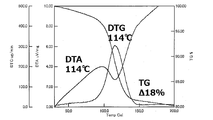
- thermogravimetric analysis after fixing carbon dioxide with the sodium ferrite particle powder obtained in Example 1 This is the result of thermogravimetric analysis after fixing carbon dioxide with the sodium ferrite particle powder obtained in Example 10.
- At least one kind of metal selected from the metal group consisting of silicon, aluminum, titanium, manganese, cobalt, nickel, magnesium, copper and zinc is 0.05 in terms of oxide. ⁇ 20% by weight.
- the weight% range the fixed recovery performance of carbon dioxide may be improved.
- the weight% range is 0.1-18% by weight.
- the sodium ferrite particle powder according to the embodiment of the present invention has a molar ratio of Na / Fe of 0.75 to 1.25. If the molar ratio of Na / Fe is less than 0.75, the powder will have a low content of sodium ferrite particles to be produced, and the fixed recovery performance of carbon dioxide will be inferior. Further, when the molar ratio of Na / Fe exceeds 1.25, a large amount of alkaline components such as NaOH and Na 2 CO 3 which are by-products remain. The alkaline component is also a cause of gelation of the paint, and it is hard to say that a highly dispersible paint can be formed, and it is hard to say that it is a particle powder having excellent moldability and processability. More preferably, the molar ratio of Na / Fe is 0.80 to 1.20, and even more preferably 0.90 to 1.10.
- the sodium ferrite particle powder according to the present embodiment contains at least one metal selected from the metal group consisting of silicon, aluminum, titanium, manganese, cobalt, nickel, copper and zinc from 0.05 to 0.05 in terms of oxide. It is preferably 1% by weight. In the case of the weight% range, the fixed recovery performance of carbon dioxide may be improved. More preferably, the weight% range is 0.1 to 0.8% by weight.
- the sodium ferrite particle powder according to the present embodiment contains 0.05 to 1% by weight of the metal, it preferably contains 70% by weight or more of the crystal phase of ⁇ -sodium ferrite.
- the compound having ⁇ -sodium ferrite crystals is a layered compound in which iron, oxygen, and sodium are arranged in layers, and oxygen hexagonal lattices parallel to the layers are arranged in a pattern of ... ABCABC ....
- Sodium ions between the oxygen hexagonal lattices move to the surface of ⁇ -sodium ferrite particles and react with carbon dioxide. Therefore, this reaction is said to be a topochemical reaction while maintaining the shape of ⁇ -sodium ferrite particles.
- ⁇ -sodium ferrite crystal phase is contained because the repeatability of fixed recovery of carbon dioxide is excellent. More preferably, the content of the crystal phase of ⁇ -sodium ferrite is 75% by weight or more, and even more preferably 80% by weight or more.
- the sodium ferrite particle powder according to the present embodiment contains 0.05 to 1% by weight of the metal, it preferably contains 2 to 25% by weight of the crystal phase of ⁇ -sodium ferrite.
- the crystal phase of ⁇ -sodium ferrite oxygen hexagonal lattices are arranged in a pattern of ... ABABAB ....
- the volume of ⁇ -sodium ferrite per mole is expected to be 1.3 times higher than that of ⁇ -sodium ferrite. Therefore, it is preferable that the ratio of ⁇ -sodium ferrite and ⁇ -sodium ferrite is appropriately adjusted according to the purpose. More preferably, the crystal phase of ⁇ -sodium ferrite is 3 to 22% by weight, and even more preferably 5 to 20% by weight.
- At least one kind of metal selected from the metal group consisting of aluminum, magnesium, silicon, titanium and zinc is more than 1% by weight and 20% by weight or less in terms of oxide. Is preferable.
- the carbon dioxide absorption performance may be enhanced. More preferably, the weight% range is 1.2% by weight or more and 18% by weight or less.
- the sodium ferrite particle powder according to the present embodiment contains the metal in an amount of more than 1% by weight and 20% by weight or less, it is preferable that the sodium ferrite particle powder contains 50% by weight or more of the crystal phase of ⁇ -sodium ferrite.
- the volume of ⁇ -sodium ferrite per mole is preferably 1.3 times higher than that of ⁇ -sodium ferrite. More preferably, the crystal phase of ⁇ -sodium ferrite is 55% by weight or more, and even more preferably 60% by weight or more. The upper limit is about 98% by weight.
- the sodium ferrite particle powder according to the present embodiment contains the metal in an amount of more than 1% by weight and 20% by weight or less, it is preferable that the sodium ferrite particle powder contains 2 to 50% by weight of the crystal phase of ⁇ -sodium ferrite. As described above, it is preferable that a large amount of ⁇ -sodium ferrite crystal phase is contained because the repeatability of carbon dioxide absorption is excellent. More preferably, the crystal phase of ⁇ -sodium ferrite is 5 to 48% by weight, and even more preferably 10 to 45% by weight.
- the sodium ferrite particle powder according to this embodiment preferably has a powder pH of 8 to 14. Since the powder pH is 8 or more basic, it is easy to catch carbon dioxide which is weakly acidic. On the other hand, when the powder pH exceeds 14, gelation of the coating material occurs, and it is difficult to achieve high dispersibility.
- the powder pH is 8.2 to 13.5, more preferably 8.4 to 13, and even more preferably 9 to 13.
- the sodium ferrite particle powder according to this embodiment preferably has a BET specific surface area of 2 to 7 m 2 / g. If the BET specific surface area is less than 2 m 2 / g, it becomes difficult to come into contact with carbon dioxide contained in the gas, and the carbon dioxide absorption performance becomes low. Further, if the BET specific surface area exceeds 7 m 2 / g, industrial production becomes difficult. More preferably, the BET specific surface area is 2.1 to 6.5 m 2 / g, more preferably 2.6 to 6.0 m 2 / g, and even more preferably 3.0 to 6.0 m 2 / g. Is.
- the sodium ferrite particle powder according to this embodiment preferably has an average primary particle diameter of 50 to 1000 nm. If it is less than 50 nm, industrial production becomes difficult. Further, if it exceeds 1000 nm, the carbon dioxide absorption performance becomes low.
- the average primary particle size is preferably 100 to 700 nm, more preferably 100 to 500 nm.
- the sodium ferrite particle powder according to this embodiment has an axial ratio (average major axis diameter / average minor axis diameter) of primary particles of 1.0 to 2.0.
- the axial ratio of the primary particles exceeds 1, the primary particles tend to aggregate with each other, and it becomes difficult to maintain a highly dispersible state after coating. As a result, it cannot be said that the particle powder has excellent moldability and processability.
- the axial ratio cannot be less than 1. More preferably, the axial ratio of the primary particles is 1.05 to 1.9, and even more preferably 1.1 to 1.8.
- the sodium ferrite particle powder according to the present embodiment When the sodium ferrite particle powder according to the present embodiment is applied as a fixed recovery material for carbon dioxide, it can selectively adsorb carbon dioxide from a gas containing carbon dioxide and can fix it.
- the adsorption temperature is about 0 ° C. to 100 ° C., which is the room temperature to the exhaust gas outlet temperature. More preferably, it is about 0 ° C. to 50 ° C. Since no additional heating from the outside is required, the energy cost for adsorption can be kept low (the above is the carbon dioxide fixation process).
- carbon dioxide taken in by the above-mentioned carbon dioxide fixing step is desorbed at a temperature of 200 ° C. or lower in a carbon dioxide-free gas atmosphere to recover carbon dioxide. Is preferable. Since the desorption temperature is as low as 200 ° C. or lower, the energy cost for desorption can be kept low (the above is the carbon dioxide recovery step).
- the sodium ferrite particle powder according to the present embodiment can be used as it is, but when it is brought into contact with a large amount of carbon dioxide, the superficial velocity of the adsorption tower can be controlled. That is, the sodium ferrite particle powder may be granulated or supported on a carrier to form a spherical molded product having a diameter of about 100 ⁇ m to 10 mm. More preferably, it is a spherical molded product having a diameter of 200 ⁇ m to 7 mm. At this time, it is preferable that the molded body containing the sodium ferrite particle powder has a specific surface area of 1 to 1000 m 2 / g so that the contact with carbon dioxide is not hindered even if the diameter of the molded body is increased.
- the shape of the molded product is not particularly limited, but is preferably spindle-shaped, rectangular parallelepiped-shaped, dice-shaped, cylindrical, or the like, in addition to the spherical shape.
- the sodium ferrite particle powder is made into a paint and applied to a mesh, non-woven fabric, honeycomb, etc. so that carbon dioxide can be fixedly recovered, or the column is filled with sodium ferrite particle powder so that carbon dioxide can be fixedly recovered. It can also be filtered.
- the sodium ferrite particle powder according to the present embodiment is at least selected from the iron oxide particle powder, the particle powder of the sodium raw material, and the metal group consisting of silicon, aluminum, titanium, manganese, cobalt, nickel, magnesium, copper and zinc. It can be obtained by mixing one or more kinds of metal compounds and performing a solid phase reaction at a temperature of 150 to 500 ° C.
- the metal group component tended to suppress the growth of the primary particles of sodium ferrite. Therefore, it becomes a particle powder having a large BET specific surface area, which is preferable as a carbon dioxide absorbent. Further, as a feature of the solid-phase reaction, the crystal growth of sodium ferrite tends to be isotropic, so that the axial ratio of the primary particles tends to be suppressed.
- Metals such as silicon, aluminum, titanium, manganese, cobalt, nickel, magnesium, copper and zinc to be added and fired are preferably more than 1% by weight and 20% by weight or less with respect to iron oxide in terms of oxides. This is because, as described above, the carbon dioxide absorption performance may be enhanced.
- the content of the metal is more preferably 1.1% by weight to 19% by weight, and even more preferably 1.2% by weight to 18% by weight.
- oxides, hydroxides, chlorides and carbonates of various metals may be used as raw materials. Moreover, you may use the composite of the said metal.
- iron oxide particle powder hematite, magnetite, maghemite, goethite, etc.
- ⁇ -sodium ferrite is usually produced at 600 ° C.
- ⁇ -sodium ferrite is produced at 800 ° C.
- Non-Patent Document 1 When a metal group is mixed with this system and subjected to a solid phase reaction, it becomes sodium ferrite at a low temperature of 150 to 500 ° C. Furthermore, there are more ⁇ -sodium ferrite crystal phases than ⁇ -sodium ferrite crystal phases. The composition is formed. By adding this metal group, fine sodium ferrite is formed.
- the carbon dioxide absorption performance is improved by forming a large amount of ⁇ -sodium ferrite. Further, since it is fired at a temperature lower than usual, it is less likely to cause sintering, and it becomes a particle powder having a large BET specific surface area, which is preferable as a carbon dioxide absorbent.
- the shape of the iron oxide particle powder can be selected from needle shape, spindle shape, sphere shape, tetrahedron, hexahedron, octahedron and the like.
- any size from 10 nm to 1 ⁇ m can be selected.
- sodium nitrite, sodium sulfate, sodium carbonate, sodium hydrogen carbonate, sodium hydroxide and the like can be used as the particle powder of the sodium raw material.
- sodium nitrite, sodium sulfate, etc. which may generate toxic nitrite gas, sulfurous acid gas, etc. during manufacturing should be avoided.
- the solid-phase reaction is a synthetic method in which a solid and a solid are mixed and the elements are moved and reacted without a solvent. Since no solvent is used as the reaction mother liquor, waste such as the solvent when used in the liquid phase reaction can be suppressed. Further, in the case of a solid-phase reaction at a low temperature, which is also a feature of the present invention, the reaction can have an extremely high concentration, so that the energy cost can be kept low. Moreover, since the high reaction concentration and the need for washing are not required, a high yield of the product can be expected.
- the powder had excellent performance of adsorbing carbon dioxide in a gas, confining it in a solid, and removing it. This is because silicon, aluminum, titanium, manganese, cobalt, nickel, magnesium, copper, zinc and the like contained in the sodium ferrite particle powder are dissolved in the generated sodium ferrite particles or are present on the surface of the particles, while the sodium ferrite particles are present.
- the metal has a catalytic action, which significantly improves the carbon dioxide absorption capacity originally possessed by sodium ferrite, absorbs carbon dioxide at room temperature, and discharges it to the outside of the system at 200 ° C. or lower. It is presumed that it has achieved excellent performance. Further, it is presumed that the sodium ferrite particle powder having a high BET specific surface area and a more spherical shape has become a material having excellent moldability and processability while maintaining the original carbon dioxide absorption performance.
- the sodium ferrite particle powder according to the present embodiment is an iron oxide particle containing at least one kind of metal selected from the metal group consisting of silicon, aluminum, titanium, manganese, cobalt, nickel, magnesium, copper and zinc as an oxide. It can also be obtained by mixing particle powder of a sodium raw material with the powder and performing a solid phase reaction at a temperature of 150 to 500 ° C.
- the contained metal component tended to suppress the growth of the primary particles of sodium ferrite. Therefore, it becomes a particle powder having a large BET specific surface area, which is preferable as a fixed recovery material for carbon dioxide. Further, as a feature of the solid-phase reaction, the crystal growth of sodium ferrite tends to be isotropic, so that the axial ratio of the primary particles tends to be suppressed.
- Metals such as silicon, aluminum, titanium, manganese, cobalt, nickel, magnesium, copper and zinc that are metal-treated with iron oxide may be 0.05 to 5% by weight with respect to iron oxide in terms of oxides. preferable. This is because, as described above, the fixed recovery performance of carbon dioxide may be improved.
- the content of the metal is preferably 0.1 to 4% by weight, more preferably 0.15 to 3% by weight.
- iron oxide particle powder hematite, magnetite, maghemite, goethite, etc.
- magnetite and maghemite having a spinel structure having the same oxygen hexagonal lattice as the crystal phase of ⁇ -sodium ferrite ... ABCABC ... are preferable.
- the shape of the iron oxide particle powder can be selected from needle shape, spindle shape, sphere shape, tetrahedron, hexahedron, octahedron and the like.
- any size from 10 nm to 1 ⁇ m can be selected.
- sodium nitrite, sodium sulfate, sodium carbonate, sodium hydrogen carbonate, sodium hydroxide and the like can be used as the particle powder of the sodium raw material.
- sodium nitrite, sodium sulfate, etc. which may generate toxic nitrite gas, sulfurous acid gas, etc. during manufacturing should be avoided.
- the solid-phase reaction is a synthetic method in which a solid and a solid are mixed and the elements are moved and reacted without a solvent. Since no solvent is used as the reaction mother liquor, waste such as the solvent when used in the liquid phase reaction can be suppressed. Further, in the case of a solid-phase reaction at a low temperature, which is also a feature of the present invention, the reaction can have an extremely high concentration, so that the energy cost can be kept low. Moreover, since the high reaction concentration and the need for washing are not required, a high yield of the product can be expected.
- a sodium ferrite particle powder containing 0.05 to 1% by weight of one or more metals selected from silicon, aluminum, titanium, manganese, cobalt, nickel, magnesium, copper and zinc in terms of oxide. Further had the excellent property of adsorbing carbon dioxide in a gas, confining it in a solid, and releasing carbon dioxide by heating. This is because silicon, aluminum, titanium, manganese, cobalt, nickel, magnesium, copper, zinc, etc. contained in the iron oxide particle powder as a raw material are dissolved in the produced sodium ferrite particles or are present on the surface of the particles.
- Typical embodiments of the present invention are as follows.
- Elemental analysis (excluding oxygen) of the sodium ferrite particle powder and their raw materials according to the present invention was carried out by a scanning fluorescent X-ray analyzer ZSX Primus II manufactured by Rigaku.
- the weight% of the crystal phase of the sodium ferrite particle powder according to the present invention was identified and quantified by a fully automatic multipurpose X-ray diffractometer D8 ADVANCE manufactured by BRUKER.
- the BET specific surface area of the sodium ferrite particle powder according to the present invention was measured by the BET method using nitrogen using Multisorb-16 manufactured by QUANTA CHROME.
- the average major axis diameter and the average minor axis diameter of the primary particles of the sodium ferrite particle powder according to the present invention are the major axis diameters of the particle diameters of 350 primary particles shown in the micrograph by the scanning electron microscope S-4800 manufactured by Hitachi High-Tech. And the minor axis diameter were measured respectively, and the average value was shown.
- the axial ratio of the sodium ferrite particle powder according to the present invention is shown as the ratio of the average major axis diameter to the average minor axis diameter (average major axis diameter / average minor axis diameter).
- the average primary particle size of the sodium ferrite particle powder according to the present invention is shown as the average value of the average major axis diameter and the average minor axis diameter.
- the powder pH value of the sodium ferrite particle powder according to the present invention is determined by weighing 5 g of a sample in a 300 ml triangular flask, adding 100 ml of boiled pure water, heating and holding the boiled state for about 5 minutes, and then plugging. Allow to cool to room temperature, add water equivalent to weight loss, plug again, shake for 1 minute, let stand for 5 minutes, and then measure the pH of the obtained supernatant according to JIS Z8802-7 to obtain. The value was taken as the powder pH value.
- the fixed recovery capacity of carbon dioxide of the sodium ferrite particle powder according to the present invention is such that 100 mg of a sample is placed on a combustion boat and placed in an acrylic pipe equipped with an inlet / outlet pipe, and carbon dioxide is contained in a humidity range of 20 to 100% from the inlet.
- a mixed gas (carbon dioxide + nitrogen) adjusted to a carbon concentration of 1 to 100 vol% was introduced at 500 mL / min, and the amount of carbon dioxide adsorbed after 2 hours was measured by Hitachi High-Tech's differential thermal weight simultaneous measurement device STA7000. The temperature was raised from room temperature to 200 ° C., and the amount of carbon dioxide absorbed and discharged was determined from the heat loss.
- the dispersibility of the sodium ferrite particle powder according to the present invention 10 parts by weight of the sodium ferrite powder was weighed, and 1 part by weight of alkylamine, 89 parts by weight of propylene glycol monomethyl ether acetate, and 100 parts by weight of 1.5 mm glass beads were added. .. Then, the mixture was shaken with a paint conditioner for 2 hours to remove glass beads from the slurry by filtration. The dispersed particle size of the obtained slurry was measured by Otsuka Electronics' concentrated particle size analyzer FPAR1000. When the cumulative 50% value (D50) of the scattering intensity distribution was 2 times or less of the average primary particle size, it was judged as a sample with good dispersibility and was evaluated as “ ⁇ ”, and when it exceeded 2 times, it was evaluated as “x”.
- D50 cumulative 50% value
- the treated iron oxides 2 to 9 treated with metal were treated in the same manner as the above-mentioned metal treatment except that the type and shape of the iron oxide particles used, the BET specific surface area, and the type and amount of the metal treatment agent were changed. Obtained.
- Table 1 shows various characteristics of the obtained treated iron oxides 1 to 9.
- the addition amounts and coating amounts of the metal treatment agents sodium silicate, aluminum sulfate, titanium chloride, cobalt sulfate, nickel sulfate, copper sulfate and zinc sulfate are the amount of SiO 2 , Al 2 O 3 , TiO 2 and CoO, respectively.
- NiO, CuO and ZnO are listed in Table 1.
- sodium ferrite particle powder was produced using the obtained treated iron oxides 1 to 9 as raw materials.
- the average major axis diameter was 0.7 ⁇ m
- the average minor axis diameter was 0.4 ⁇ m
- the average particle diameter was 0.5 ⁇ m
- the axial ratio was 1.6.
- the powder pH was relatively high at 13.8.
- the molar ratio of Na / Fe was 1.0, which was almost the same as the charging ratio of the raw materials, and the silicon content was a heterogeneous oxide. It was contained in an amount of 0.18% by weight as SiO 2.
- the obtained powder was obtained by quantifying the powder X-ray diffraction pattern to obtain 95% by weight of ⁇ -sodium ferrite crystal phase, 4% by weight of ⁇ -sodium ferrite crystal phase and 1% by weight of ⁇ -Fe 2 O 3. It turned out to be a crystalline phase. Therefore, it is presumed that SiO 2 as a dissimilar oxide is amorphous or solid-solved in each crystal phase as Si.
- the TG curve was the weight% of the residual sample at each temperature when the initial value was 100% by weight, and the amount of decrease in the sample was considered to be due to the release of carbon dioxide.
- the DTG curve is a differential curve of the TG curve, and the temperature at which the maximum value of the DTG curve is taken is regarded as the carbon dioxide desorption temperature.
- the DTA curve showed a downwardly convex curve, and it was found that the endothermic reaction was carried out at around 114 ° C.
- the desorption temperature of carbon dioxide was 114 ° C.
- the desorption amount of carbon dioxide was 18% by weight based on the sample solid content. It became clear that it has fixed recovery performance.
- the dispersed particle size was within twice the average primary particle size, which was good.
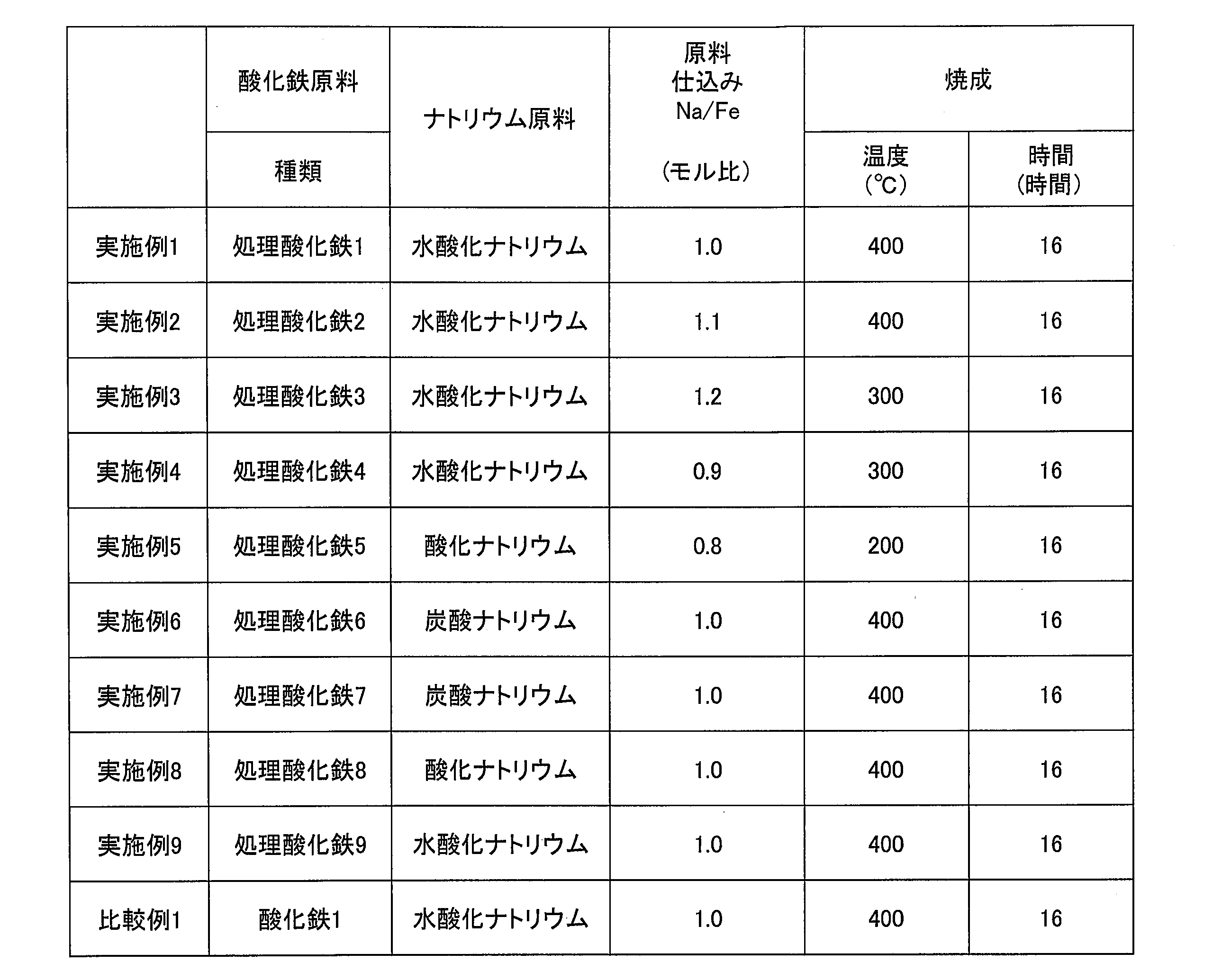
- Example 2-9 The sodium ferrite particle powder according to the present invention was obtained in the same manner as in Example 1 except that the type of the metal-treated iron oxide fine particles and the type of the sodium source were variously changed.
- Table 2 shows the production conditions in Examples 1 to 9
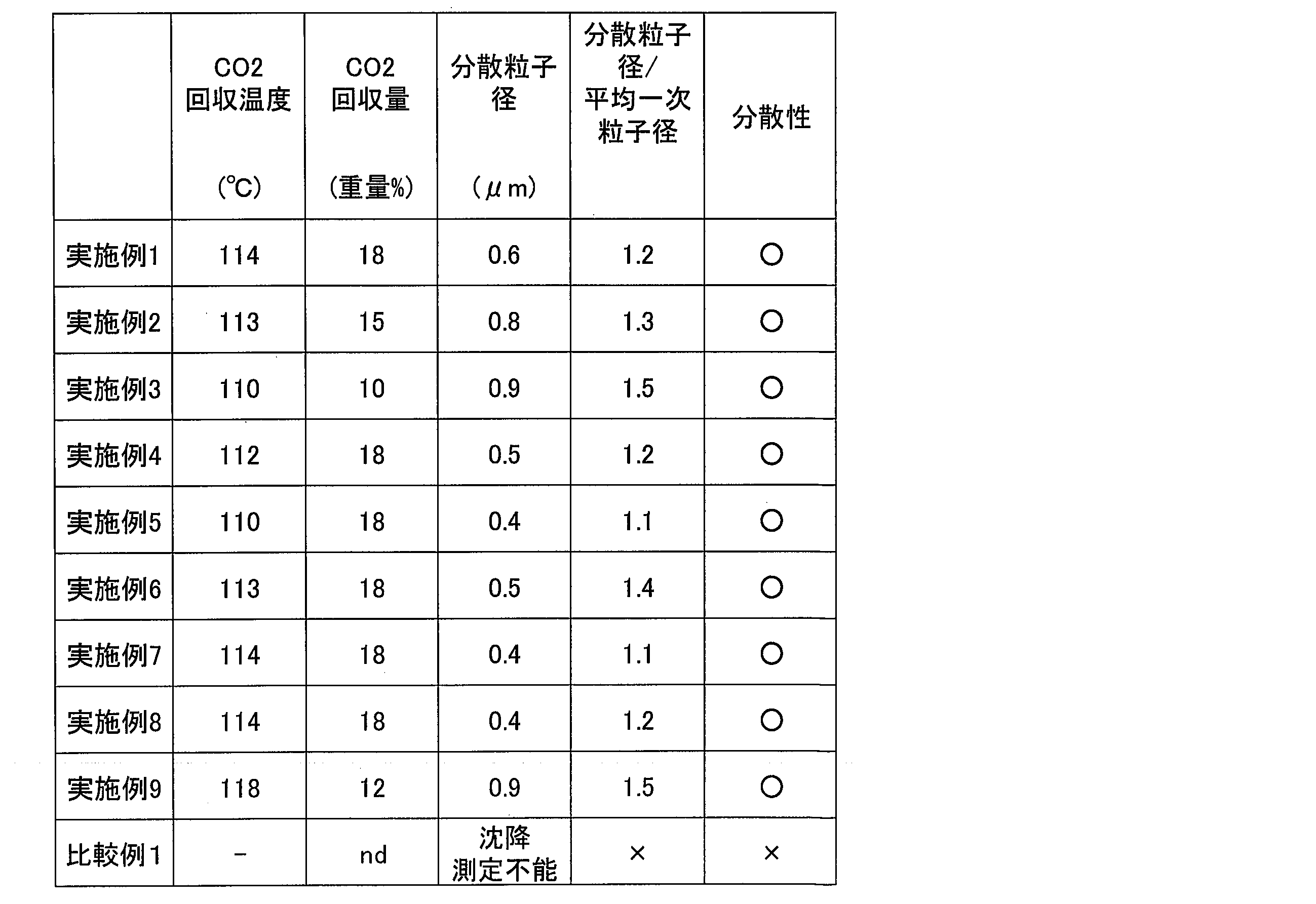
- Table 3 shows various characteristics of the obtained sodium ferrite particle powder
- Table 4 shows the fixed recovery performance and dispersibility of carbon dioxide. For samples with good dispersibility, those having a dispersed particle size within twice the average primary particle size were marked with ⁇ , and those with a dispersed particle size exceeding 2 times were marked with x.
- the BET specific surface area was 1.0 m 2 / g.
- the axial ratio was 3.8. Further, when the fixed recovery performance of carbon dioxide was examined in the same manner as in Example 1, the temperature was raised to 200 ° C., but desorption of carbon dioxide could not be confirmed.
- Table 2 shows the production conditions of Comparative Example 1
- Table 3 shows various characteristics of the obtained sodium ferrite particle powder
- Table 4 shows the fixed recovery performance and dispersibility of carbon dioxide.
- Hydrotalcite manufactured by Toda Kogyo Co., Ltd., specific surface area 10 m 2 / g
- the powder pH was relatively high at 13.8.
- the Na / Fe molar ratio was 1.0, which was almost the same as the raw material charge ratio, and MgO was 6.0% by weight.
- Al 2 O 3 was 3.5% by weight and 9.5% by weight as a dissimilar metal oxide.
- 76% by weight was ⁇ -sodium ferrite crystal phase, 11% by weight ⁇ -sodium ferrite crystal phase and 8% by weight ⁇ -Fe 2 O 3 crystal phase. It turned out to be. Therefore, it is presumed that the dissimilar oxides MgO and Al 2 O 3 are amorphous or dissolved in each crystal phase as Mg and Al.
- the carbon dioxide absorption evaluation of the obtained sodium ferrite particle powder was performed as follows. First, carbon dioxide was introduced into a desiccator (13 L) to create a model unpleasant indoor environment with a carbon dioxide concentration of 4000 ppm and a humidity of 80% at room temperature of 25 ° C. and sealed. Next, 10 g of sodium ferrite particle powder was quickly put into a desiccator (13 L), and the carbon dioxide concentration after 30 minutes was measured with a carbon dioxide concentration meter. The carbon dioxide concentration after 30 minutes was below the detection limit of 1 ppm of the carbon dioxide concentration, indicating that it has excellent carbon dioxide absorption performance.
- the TG curve was the weight% of the residual sample at each temperature when the initial value was 100% by weight, and the amount of decrease in the sample was considered to be due to the release of carbon dioxide.
- the DTG curve is a differential curve of the TG curve, and the temperature at which the maximum value of the DTG curve is taken is regarded as the carbon dioxide desorption temperature.
- the DTA curve showed a downwardly convex curve, and it was found that the endothermic reaction was carried out at around 114 ° C.
- the desorption temperature of carbon dioxide was 114 ° C.
- the desorption amount of carbon dioxide was 18% by weight with respect to the sample solid content. It became clear that there is emission performance.
- the dispersed particle size was within twice the average primary particle size, which was good.
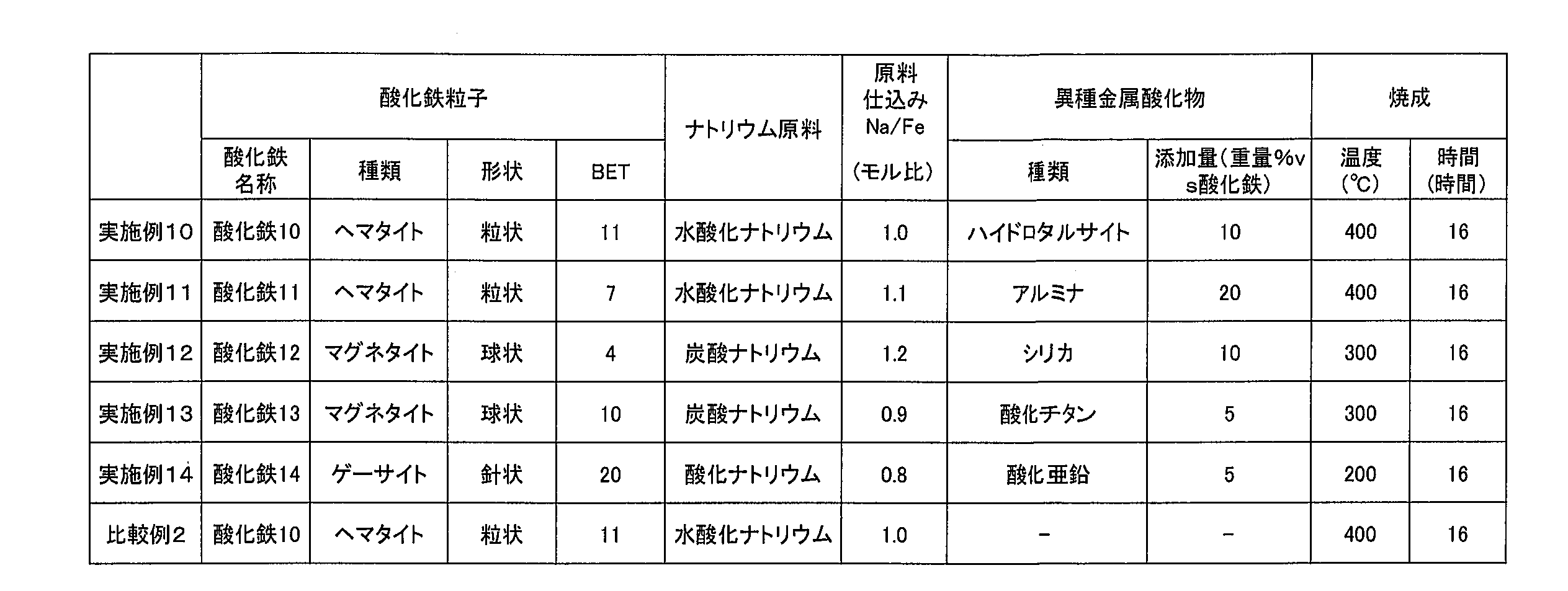
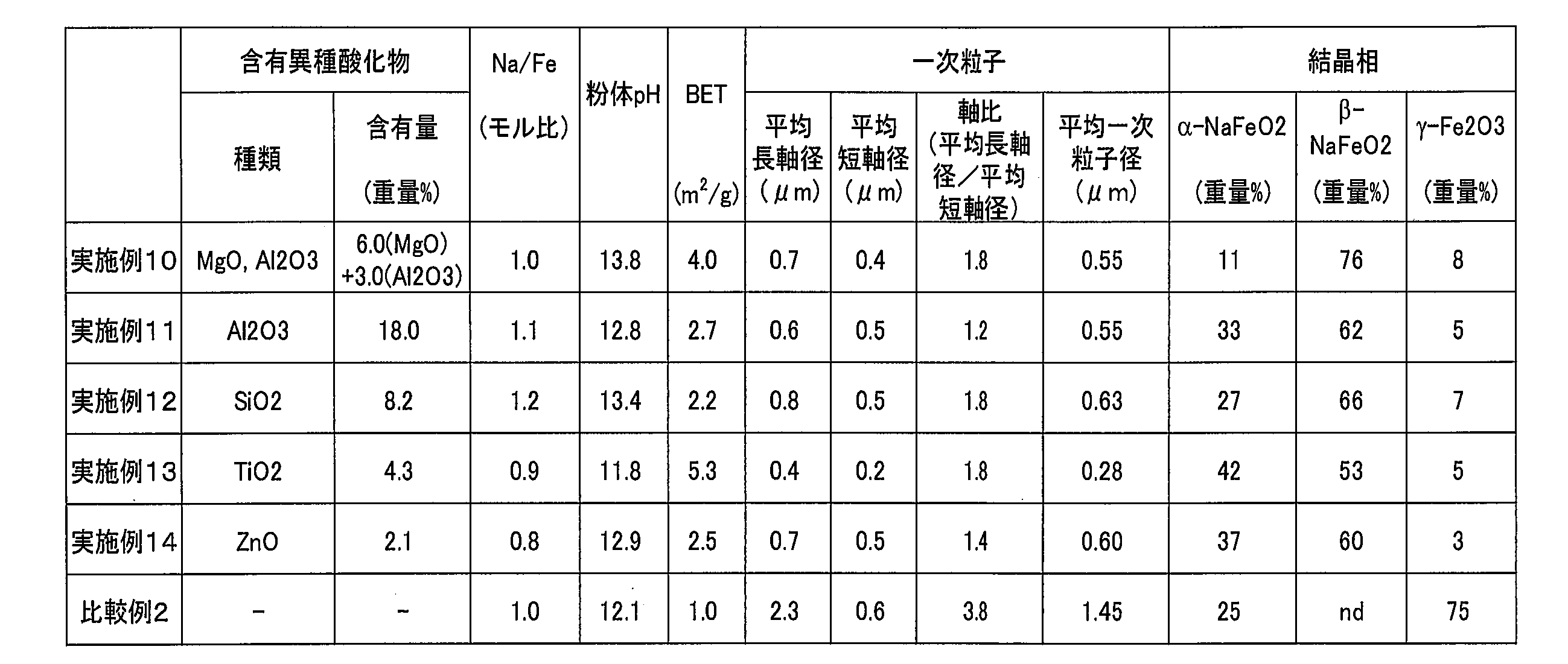
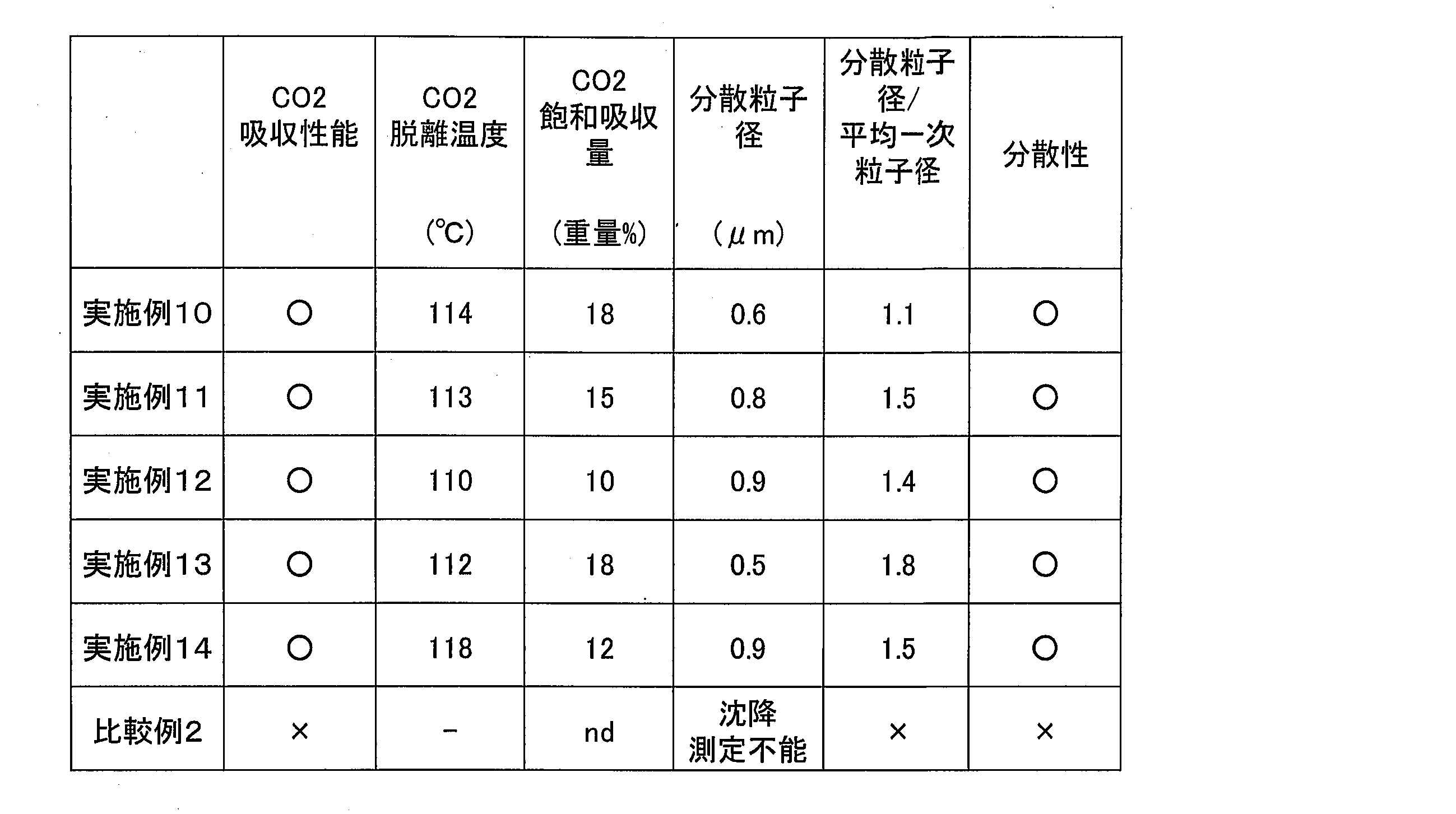
- Examples 11-14 The sodium ferrite particle powder according to the present invention was obtained in the same manner as in Example 10 except that the type of iron oxide fine particles, the type of sodium source, the type of metal compound and the amount of addition were variously changed.
- Table 5 shows the production conditions in Examples 10 to 14, various characteristics of the obtained sodium ferrite particle powder are shown in Table 6, and the carbon dioxide absorption / discharge performance and dispersibility are shown in Table 7.
- 10 g of a carbon dioxide absorbent was placed in a desiccator (13 L) having a carbon dioxide concentration of 4000 ppm, and those having a carbon dioxide concentration of 2500 ppm or less after 30 minutes were evaluated as ⁇ , and those exceeding 2500 ppm were evaluated as x. ..
- For samples with good dispersibility those having a dispersed particle size within twice the average primary particle size were marked with ⁇ , and those with a dispersed particle size exceeding 2 times were marked with x.
- the BET specific surface area was 1.0 m 2 / g.
- the axial ratio was 3.8.
- the temperature was raised to 200 ° C., but the desorption of carbon dioxide could not be confirmed.
- Comparative Example 2 The production conditions of Comparative Example 2 are shown in Table 5, the characteristics of the obtained sodium ferrite particle powder are shown in Table 6, and the carbon dioxide absorption / discharge performance and dispersibility are shown in Table 7.
- the sodium ferrite particle powder according to the present embodiment is a carbon dioxide fixed recovery material having excellent carbon dioxide adsorption and desorption. Further, since the particle powder is excellent in dispersibility, it is clear that the particle powder is excellent in moldability and processability.
- the sodium ferrite particle powder according to the present invention is a non-hazardous inorganic material that is suitable as a material capable of fixed recovery by adsorption and desorption of carbon dioxide without using a dangerous substance such as an aqueous amine solution.
Landscapes
- Chemical & Material Sciences (AREA)
- Organic Chemistry (AREA)
- Chemical Kinetics & Catalysis (AREA)
- Analytical Chemistry (AREA)
- Inorganic Chemistry (AREA)
- Physics & Mathematics (AREA)
- Thermal Sciences (AREA)
- Engineering & Computer Science (AREA)
- General Chemical & Material Sciences (AREA)
- Oil, Petroleum & Natural Gas (AREA)
- Compounds Of Iron (AREA)
Abstract
Description
本実施形態において、ケイ素、アルミニウム、チタン、マンガン、コバルト、ニッケル、マグネシウム、銅および亜鉛から選ばれた1種類以上の金属を酸化物換算として1重量%超過20重量%以下含んでなるナトリウムフェライト粒子粉末には、気体中の二酸化炭素を吸着し、固体内に閉じ込め、除去する優れた性能を持っていた。これは、ナトリウムフェライト粒子粉末に含まれるケイ素、アルミニウム、チタン、マンガン、コバルト、ニッケル、マグネシウム、銅および亜鉛などが、生成するナトリウムフェライト粒子に固溶或いは該粒子表面に存在しつつ、ナトリウムフェライト粒子の結晶成長を阻害し、ナトリウムフェライト粒子の均一化、および、微細化に役立ったためと推察される。さらには、前記金属が触媒的な作用を持ち、そのために、ナトリウムフェライトが本来持っている二酸化炭素の吸収能力を格段に向上し、室温で二酸化炭素を吸収し、200℃以下で系外に排出できる優れた性能を持つに至ったと推察される。また、高BET比表面積で、より球形に近いナトリウムフェライト粒子粉末とすることで、本来の二酸化炭素の吸収性能を維持しつつ、且つ成形性や加工性に富んだ材料になったと推察される。
本実施形態において、ケイ素、アルミニウム、チタン、マンガン、コバルト、ニッケル、マグネシウム、銅および亜鉛から選ばれた1種類以上の金属を酸化物換算として0.05~1重量%含んでなるナトリウムフェライト粒子粉末には、更に気体中の二酸化炭素を吸着し、固体内に閉じ込め、加熱により、二酸化炭素を放出する優れた性質を持っていた。これは、原料となる酸化鉄粒子粉末に含まれるケイ素、アルミニウム、チタン、マンガン、コバルト、ニッケル、マグネシウム、銅および亜鉛などが、生成するナトリウムフェライト粒子に固溶或いは該粒子表面に存在しつつ、ナトリウムフェライト粒子の結晶成長を阻害し、ナトリウムフェライト粒子の均一化及び微細化に役立ったためと推察される。さらには、前記金属が触媒的な作用を持ち、そのために、ナトリウムフェライトが本来持っている二酸化炭素の固定回収能力を格段に向上し、室温から100℃までの温度範囲で二酸化炭素を固定し、200℃以下で回収できる優れた性能を持つに至ったと推察される。また、上記特徴に加えて、高BET比表面積で、より球形に近いナトリウムフェライト粒子粉末とすることで、本来の二酸化炭素固定回収性能を維持しつつ、且つ成形性や加工性に富んだ材料にできると推察される。
酸化鉄1(戸田工業製100ED、ヘマタイト、比表面積11m2/g)1000重量部を10,000重量部の純水に添加混合し、得られた懸濁液に水酸化ナトリウムを添加してpHを11とした。その後、3号水ガラス(トクヤマ製、高濃度ケイ酸ナトリウム水溶液である水ガラス中のSi量は、SiO2換算で29重量%に該当)17.2重量部(酸化鉄1に対して、SiO2換算で0.5重量%に相当)を添加し、次いで攪拌、混合した。その後、前記懸濁液に硫酸を加えてpH9に調整し、懸濁液中の酸化鉄1の粒子表面にSiO2被膜を析出させた。その後、得られた懸濁液をろ過し、不純物となり得るNa+イオンやSO4 2-イオンを水洗し、乾燥後、処理酸化鉄1を得た。得られた処理酸化鉄1の表面に存在しているSiO2量は、蛍光X線分析の結果、SiO2換算で0.25重量%であった。

実施例1
前述で得られた処理酸化鉄1の粒子を10重量部とし、それに対しナトリウム原料の水酸化ナトリウム粒子粉末をNa/Fe=1.0(モル比)となるように秤量した。各原料を混合後、サンプルミルにて混合粉砕した。この混合粉砕物をるつぼに入れ、400℃で16時間固相反応させた。その後、室温まで冷却し、サンプルミルにて粉砕することにより、ナトリウムフェライト粒子粉末を得た。得られた粒子粉末のBET比表面積は3.0m2/gであった。走査型電子顕微鏡による一次粒子の定量化により、平均長軸径は0.7μm、平均短軸径は0.4μm、平均粒子径は0.5μmであり、軸比は1.6であった。粉体pHは13.8と比較的高かった。
金属処理された酸化鉄微粒子の種類とナトリウム源の種類を種々変化させた以外は実施例1と同様にして、本発明に係るナトリウムフェライト粒子粉末を得た。
酸化鉄1を10重量部とし、それに対して水酸化ナトリウム粒子粉末をFe:Na=1:1(モル比)となるように秤量し、純水100重量部を加えて水酸化ナトリウム粒子粉末を溶解させ、自動乳鉢により、2時間混練した。これを80℃で2時間乾燥させ、サンプルミルにて混合粉砕した。この混合粉砕物をるつぼに入れ、400℃で2時間熱処理した。生成物は、粉末X線回折により、25重量%がα-ナトリウムフェライト結晶相で、残り75重量%がγ-Fe2O3結晶相であることが分かった。BET比表面積は1.0m2/gであった。軸比は3.8であった。また、実施例1と同様にして二酸化炭素の固定回収性能を調べたところ、200℃まで昇温したが二酸化炭素の脱離は確認できなかった。

酸化鉄微粒子10(戸田工業製100ED、ヘマタイト、比表面積11m2/g)を10重量部とし、それに対しナトリウム原料の水酸化ナトリウム粒子粉末をNa/Fe=1.0(モル比)となるように秤量し、ハイドロタルサイト(戸田工業製、比表面積10m2/g)を1重量部秤量し、添加した。各原料混合後、サンプルミルにて混合粉砕した。この混合粉砕物をるつぼに入れ、400℃にて16時間固相反応させた。その後、室温まで冷却し、サンプルミルにて粉砕することにより、ナトリウムフェライト粒子粉末を得た。得られた粒子粉末のBET比表面積は4.0m2/gであった。走査型電子顕微鏡による一次粒子の定量化により、平均長軸径は0.7μm、平均短軸径は0.4μm、平均粒子径は0.55μmであり、軸比は1.8であった。粉体pHは13.8と比較的高かった。
酸化鉄微粒子の種類、ナトリウム源の種類、金属化合物の種類および添加量を種々変化させた以外は実施例10と同様にして、本発明に係るナトリウムフェライト粒子粉末を得た。
酸化鉄10を10重量部とし、それに対して水酸化ナトリウム粒子粉末をFe/Na=1.0(モル比)となるように秤量し、純水100重量部を加えて水酸化ナトリウム粒子粉末を溶解させ、自動乳鉢により、2時間混練した。これを80℃で2時間乾燥させ、サンプルミルにて混合粉砕した。この混合粉砕物をるつぼに入れ、400℃で2時間熱処理した。生成物は、粉末X線回折により、25重量%がα-ナトリウムフェライト結晶相で、残り75重量%がγ-Fe2O3結晶相であることが分かった。BET比表面積は1.0m2/gであった。軸比は3.8であった。また、実施例10と同様にして二酸化炭素の吸収排出性能を調べたところ、200℃まで昇温したが二酸化炭素の脱離は確認できなかった。
Claims (7)
- ケイ素、アルミニウム、チタン、マンガン、コバルト、ニッケル、マグネシウム、銅および亜鉛からなる金属群より選ばれた少なくとも1種類以上の金属が、酸化物換算として0.05~20重量%含有し、Na/Feのモル比が0.75~1.25であることを特徴とする、ナトリウムフェライト粒子粉末。
- ケイ素、アルミニウム、チタン、マンガン、コバルト、ニッケル、銅および亜鉛からなる金属群より選ばれた少なくとも1種類以上の金属が、酸化物換算として0.05~1重量%含有することを特徴とする、請求項1に記載のナトリウムフェライト粒子粉末。
- アルミニウム、マグネシウム、ケイ素、チタンおよび亜鉛からなる金属群より選ばれた少なくとも1種類以上の金属が、酸化物換算として1重量%超過20重量%以下含有することを特徴とする、請求項1に記載のナトリウムフェライト粒子粉末。
- 一次粒子の平均短軸径に対する平均長軸径の軸比が1~2である、請求項1~3のいずれか1項に記載のナトリウムフェライト粒子粉末。
- 粉体pH値が8~14である、請求項1~4のいずれか1項に記載のナトリウムフェライト粒子粉末。
- 酸化鉄微粒子粉末と、ナトリウム原料の粒子粉末と、ケイ素、アルミニウム、チタン、マンガン、コバルト、ニッケル、マグネシウム、銅および亜鉛からなる金属群より選ばれた少なくとも1種類以上の金属化合物とを混合して、150~500℃の温度で固相反応するステップを含む、請求項1~5のいずれか1項に記載のナトリウムフェライト粒子粉末の製造方法。
- ケイ素、アルミニウム、チタン、マンガン、コバルト、ニッケル、マグネシウム、銅および亜鉛からなる金属群より選ばれた少なくとも1種類以上の金属を酸化物として含む酸化鉄粒子粉末に対し、ナトリウム原料の粒子粉末を混合して、150~500℃の温度で固相反応するステップを含む請求項1~5のいずれか1項に記載のナトリウムフェライト粒子粉末の製造方法。
Priority Applications (5)
| Application Number | Priority Date | Filing Date | Title |
|---|---|---|---|
| JP2021563914A JP7677159B2 (ja) | 2019-12-10 | 2020-12-04 | ナトリウムフェライト粒子粉末及びその製造方法 |
| US17/783,860 US12421132B2 (en) | 2019-12-10 | 2020-12-04 | Sodium ferrite particle powder and production method thereof |
| CN202080085797.3A CN114787087B (zh) | 2019-12-10 | 2020-12-04 | 铁酸钠颗粒粉末及其制造方法 |
| KR1020227022210A KR20220112802A (ko) | 2019-12-10 | 2020-12-04 | 나트륨 페라이트 입자 분말 및 그 제조 방법 |
| EP20900110.6A EP4074657A4 (en) | 2019-12-10 | 2020-12-04 | SODIUM FERRITE PARTICLE POWDER AND METHOD FOR THE PRODUCTION THEREOF |
Applications Claiming Priority (4)
| Application Number | Priority Date | Filing Date | Title |
|---|---|---|---|
| JP2019-223136 | 2019-12-10 | ||
| JP2019223136 | 2019-12-10 | ||
| JP2020-020916 | 2020-02-10 | ||
| JP2020020916 | 2020-02-10 |
Publications (1)
| Publication Number | Publication Date |
|---|---|
| WO2021117623A1 true WO2021117623A1 (ja) | 2021-06-17 |
Family
ID=76330329
Family Applications (1)
| Application Number | Title | Priority Date | Filing Date |
|---|---|---|---|
| PCT/JP2020/045202 Ceased WO2021117623A1 (ja) | 2019-12-10 | 2020-12-04 | ナトリウムフェライト粒子粉末及びその製造方法 |
Country Status (6)
| Country | Link |
|---|---|
| US (1) | US12421132B2 (ja) |
| EP (1) | EP4074657A4 (ja) |
| JP (1) | JP7677159B2 (ja) |
| KR (1) | KR20220112802A (ja) |
| CN (1) | CN114787087B (ja) |
| WO (1) | WO2021117623A1 (ja) |
Cited By (6)
| Publication number | Priority date | Publication date | Assignee | Title |
|---|---|---|---|---|
| WO2022030338A1 (ja) * | 2020-08-04 | 2022-02-10 | 戸田工業株式会社 | 二酸化炭素固体回収材及びその製造方法 |
| JP2022170813A (ja) * | 2021-04-30 | 2022-11-11 | 鹿島道路株式会社 | アスファルト混合物 |
| WO2022259929A1 (ja) * | 2021-06-07 | 2022-12-15 | 戸田工業株式会社 | 二酸化炭素の固体回収材及びその製造方法 |
| JP2023114338A (ja) * | 2022-02-04 | 2023-08-17 | 鹿島道路株式会社 | セメント系組成物、セメント系組成物製造方法及び二酸化炭素回収方法 |
| WO2023243427A1 (ja) * | 2022-06-14 | 2023-12-21 | 戸田工業株式会社 | 複合酸化鉄粒子粉末及びその製造方法 |
| WO2024048085A1 (ja) * | 2022-08-30 | 2024-03-07 | 富士フイルム株式会社 | 二酸化炭素吸収材、二酸化炭素吸収装置および二酸化炭素吸収方法 |
Families Citing this family (3)
| Publication number | Priority date | Publication date | Assignee | Title |
|---|---|---|---|---|
| US20230113433A1 (en) * | 2021-10-08 | 2023-04-13 | Freshair Sensor Llc | Hydrogen sulfide adsorption process and apparatus |
| CN116190639A (zh) * | 2023-02-27 | 2023-05-30 | 北京理工大学 | 用于制备正极补钠剂的方法、正极补钠剂及包含其的正极极片、二次电池和用电装置 |
| WO2025204100A1 (ja) * | 2024-03-29 | 2025-10-02 | 戸田工業株式会社 | 二酸化炭素の固体回収材およびその製造方法 |
Citations (10)
| Publication number | Priority date | Publication date | Assignee | Title |
|---|---|---|---|---|
| JPH05301023A (ja) | 1992-02-27 | 1993-11-16 | Kansai Electric Power Co Inc:The | 燃焼排ガス中の二酸化炭素の除去方法 |
| JPH07237923A (ja) * | 1994-01-07 | 1995-09-12 | Japan Synthetic Rubber Co Ltd | フェライト含有中空粒子 |
| JP2005270842A (ja) | 2004-03-25 | 2005-10-06 | Toshiba Corp | 炭酸ガス吸収材、炭酸ガスの吸収方法、炭酸ガス吸収装置、炭酸ガス分離装置及びリチウム複合酸化物の製造方法 |
| JP2006198550A (ja) * | 2005-01-21 | 2006-08-03 | National Institute For Materials Science | 二酸化炭素吸収材料 |
| JP2006298707A (ja) | 2005-04-21 | 2006-11-02 | Murata Mfg Co Ltd | 二酸化炭素の分離回収方法および二酸化炭素の分離回収装置 |
| JP2009006275A (ja) | 2007-06-28 | 2009-01-15 | Research Institute Of Innovative Technology For The Earth | 排ガス中の二酸化炭素を効率的に回収する方法 |
| JP2012139622A (ja) | 2010-12-28 | 2012-07-26 | Research Institute Of Innovative Technology For The Earth | 二酸化炭素分離回収用固体吸収材並びに二酸化炭素の回収方法 |
| JP2016003156A (ja) | 2014-06-16 | 2016-01-12 | 国立大学法人埼玉大学 | α−ナトリウムフェライト類の製造方法 |
| JP2017109198A (ja) * | 2015-12-14 | 2017-06-22 | シャープ株式会社 | 二酸化炭素吸収材、ペレットおよびフィルタ |
| WO2018181555A1 (ja) * | 2017-03-29 | 2018-10-04 | 住友化学株式会社 | 複合金属酸化物、正極活物質、正極、ナトリウム二次電池、及び複合金属酸化物の製造方法 |
Family Cites Families (4)
| Publication number | Priority date | Publication date | Assignee | Title |
|---|---|---|---|---|
| JP3605220B2 (ja) * | 1995-02-27 | 2004-12-22 | 松下電器産業株式会社 | リチウム鉄酸化物およびその合成法ならびにリチウム電池 |
| JP2009135092A (ja) * | 2007-11-09 | 2009-06-18 | Sumitomo Chemical Co Ltd | 複合金属酸化物およびナトリウム二次電池 |
| JP2010080424A (ja) * | 2008-08-27 | 2010-04-08 | Sumitomo Chemical Co Ltd | 電極活物質およびその製造方法 |
| AU2017301242B2 (en) | 2016-07-29 | 2023-06-29 | 9754741 Canada Ltd. | Method and apparatus for singulating particles in a stream |
-
2020
- 2020-12-04 CN CN202080085797.3A patent/CN114787087B/zh active Active
- 2020-12-04 WO PCT/JP2020/045202 patent/WO2021117623A1/ja not_active Ceased
- 2020-12-04 EP EP20900110.6A patent/EP4074657A4/en active Pending
- 2020-12-04 JP JP2021563914A patent/JP7677159B2/ja active Active
- 2020-12-04 US US17/783,860 patent/US12421132B2/en active Active
- 2020-12-04 KR KR1020227022210A patent/KR20220112802A/ko active Pending
Patent Citations (10)
| Publication number | Priority date | Publication date | Assignee | Title |
|---|---|---|---|---|
| JPH05301023A (ja) | 1992-02-27 | 1993-11-16 | Kansai Electric Power Co Inc:The | 燃焼排ガス中の二酸化炭素の除去方法 |
| JPH07237923A (ja) * | 1994-01-07 | 1995-09-12 | Japan Synthetic Rubber Co Ltd | フェライト含有中空粒子 |
| JP2005270842A (ja) | 2004-03-25 | 2005-10-06 | Toshiba Corp | 炭酸ガス吸収材、炭酸ガスの吸収方法、炭酸ガス吸収装置、炭酸ガス分離装置及びリチウム複合酸化物の製造方法 |
| JP2006198550A (ja) * | 2005-01-21 | 2006-08-03 | National Institute For Materials Science | 二酸化炭素吸収材料 |
| JP2006298707A (ja) | 2005-04-21 | 2006-11-02 | Murata Mfg Co Ltd | 二酸化炭素の分離回収方法および二酸化炭素の分離回収装置 |
| JP2009006275A (ja) | 2007-06-28 | 2009-01-15 | Research Institute Of Innovative Technology For The Earth | 排ガス中の二酸化炭素を効率的に回収する方法 |
| JP2012139622A (ja) | 2010-12-28 | 2012-07-26 | Research Institute Of Innovative Technology For The Earth | 二酸化炭素分離回収用固体吸収材並びに二酸化炭素の回収方法 |
| JP2016003156A (ja) | 2014-06-16 | 2016-01-12 | 国立大学法人埼玉大学 | α−ナトリウムフェライト類の製造方法 |
| JP2017109198A (ja) * | 2015-12-14 | 2017-06-22 | シャープ株式会社 | 二酸化炭素吸収材、ペレットおよびフィルタ |
| WO2018181555A1 (ja) * | 2017-03-29 | 2018-10-04 | 住友化学株式会社 | 複合金属酸化物、正極活物質、正極、ナトリウム二次電池、及び複合金属酸化物の製造方法 |
Non-Patent Citations (4)
| Title |
|---|
| I. YANASES. ONOZAWAK. OGASAWARAH. KOBAYASHI, J. C02 UTILIZATION, vol. 24, 2018, pages 200 - 209 |
| IKUO YANASE, JOURNAL OF THE SOCIETY OF INORGANIC MATERIALS, JAPAN, vol. 25, 2018, pages 437 - 442 |
| See also references of EP4074657A4 |
| SHOICHI OKAMOTO: "Crystal Formation and Phase Transition of Sodium Orthoferrite", NAGAOKA UNIVERSITY OF TECHNOLOGY, 1986, pages 37 - 42 |
Cited By (10)
| Publication number | Priority date | Publication date | Assignee | Title |
|---|---|---|---|---|
| WO2022030338A1 (ja) * | 2020-08-04 | 2022-02-10 | 戸田工業株式会社 | 二酸化炭素固体回収材及びその製造方法 |
| US12502637B2 (en) | 2020-08-04 | 2025-12-23 | Toda Kogyo Corp. | Solid recovery material for carbon dioxide and method for producing same |
| JP2022170813A (ja) * | 2021-04-30 | 2022-11-11 | 鹿島道路株式会社 | アスファルト混合物 |
| JP7586762B2 (ja) | 2021-04-30 | 2024-11-19 | 鹿島道路株式会社 | アスファルト混合物 |
| WO2022259929A1 (ja) * | 2021-06-07 | 2022-12-15 | 戸田工業株式会社 | 二酸化炭素の固体回収材及びその製造方法 |
| JP2023114338A (ja) * | 2022-02-04 | 2023-08-17 | 鹿島道路株式会社 | セメント系組成物、セメント系組成物製造方法及び二酸化炭素回収方法 |
| JP7576586B2 (ja) | 2022-02-04 | 2024-10-31 | 鹿島道路株式会社 | セメント系組成物、セメント系組成物製造方法及び二酸化炭素回収方法 |
| WO2023243427A1 (ja) * | 2022-06-14 | 2023-12-21 | 戸田工業株式会社 | 複合酸化鉄粒子粉末及びその製造方法 |
| EP4541770A4 (en) * | 2022-06-14 | 2026-02-11 | Toda Kogyo Corp | COMPOSITE IRON OXIDE PARTICLE POWDER AND ITS MANUFACTURING PROCESS |
| WO2024048085A1 (ja) * | 2022-08-30 | 2024-03-07 | 富士フイルム株式会社 | 二酸化炭素吸収材、二酸化炭素吸収装置および二酸化炭素吸収方法 |
Also Published As
| Publication number | Publication date |
|---|---|
| CN114787087B (zh) | 2024-05-28 |
| US20230029005A1 (en) | 2023-01-26 |
| EP4074657A4 (en) | 2024-01-31 |
| CN114787087A (zh) | 2022-07-22 |
| KR20220112802A (ko) | 2022-08-11 |
| JPWO2021117623A1 (ja) | 2021-06-17 |
| EP4074657A1 (en) | 2022-10-19 |
| JP7677159B2 (ja) | 2025-05-15 |
| US12421132B2 (en) | 2025-09-23 |
Similar Documents
| Publication | Publication Date | Title |
|---|---|---|
| JP7677159B2 (ja) | ナトリウムフェライト粒子粉末及びその製造方法 | |
| US12502637B2 (en) | Solid recovery material for carbon dioxide and method for producing same | |
| US20250083121A1 (en) | Solid material for recovering carbon dioxide, and method for producing same | |
| JP7615890B2 (ja) | ナトリウムフェライト粒子粉末及びその製造方法 | |
| JP7658177B2 (ja) | ナトリウムフェライト粒子粉末及びその製造方法 | |
| JP2022153182A (ja) | ナトリウムフェライト粒子粉末及びその製造方法 | |
| JP7625932B2 (ja) | ナトリウムフェライト粒子粉末及びその製造方法 | |
| JP7625931B2 (ja) | ナトリウムフェライト粒子粉末及びその製造方法 | |
| JP7639553B2 (ja) | ナトリウムフェライト粒子粉末及びその製造方法 | |
| JP7647127B2 (ja) | ナトリウムフェライト粒子粉末及びその製造方法 | |
| JP7571646B2 (ja) | ナトリウムフェライト粒子粉末及びその製造方法 | |
| JP7676936B2 (ja) | ナトリウムフェライト粒子粉末及びその製造方法 | |
| JP2022184167A (ja) | ナトリウムフェライト粒子粉末及びその製造方法 | |
| Shamsi et al. | Nano spinels of copper-doped cobalt aluminate (CoxCu (1–x) Al2O4) for removal of Cd (II) from aqueous solutions | |
| WO2023243427A1 (ja) | 複合酸化鉄粒子粉末及びその製造方法 | |
| TWI718825B (zh) | 吸收劑及其製備方法 | |
| JP3850843B2 (ja) | 炭酸ガス吸収材、炭酸ガスの吸収方法、炭酸ガス吸収装置、炭酸ガス分離装置及びリチウム複合酸化物の製造方法 | |
| ES2724726B2 (es) | Soporte y sistema magneticos como transportadores de o2 y co2 | |
| Chen et al. | High-Temperature CO2 Capture by CaO-Containing Hydroxides |
Legal Events
| Date | Code | Title | Description |
|---|---|---|---|
| 121 | Ep: the epo has been informed by wipo that ep was designated in this application |
Ref document number: 20900110 Country of ref document: EP Kind code of ref document: A1 |
|
| ENP | Entry into the national phase |
Ref document number: 2021563914 Country of ref document: JP Kind code of ref document: A |
|
| ENP | Entry into the national phase |
Ref document number: 20227022210 Country of ref document: KR Kind code of ref document: A |
|
| NENP | Non-entry into the national phase |
Ref country code: DE |
|
| ENP | Entry into the national phase |
Ref document number: 2020900110 Country of ref document: EP Effective date: 20220711 |
|
| WWG | Wipo information: grant in national office |
Ref document number: 17783860 Country of ref document: US |