WO2021132582A1 - リチウムイオン伝導性酸化物焼結体およびその用途 - Google Patents
リチウムイオン伝導性酸化物焼結体およびその用途 Download PDFInfo
- Publication number
- WO2021132582A1 WO2021132582A1 PCT/JP2020/048786 JP2020048786W WO2021132582A1 WO 2021132582 A1 WO2021132582 A1 WO 2021132582A1 JP 2020048786 W JP2020048786 W JP 2020048786W WO 2021132582 A1 WO2021132582 A1 WO 2021132582A1
- Authority
- WO
- WIPO (PCT)
- Prior art keywords
- sintered body
- lithium ion
- conductive oxide
- ion conductive
- oxide sintered
- Prior art date
- Legal status (The legal status is an assumption and is not a legal conclusion. Google has not performed a legal analysis and makes no representation as to the accuracy of the status listed.)
- Ceased
Links
Images

Classifications
-
- H—ELECTRICITY
- H01—ELECTRIC ELEMENTS
- H01M—PROCESSES OR MEANS, e.g. BATTERIES, FOR THE DIRECT CONVERSION OF CHEMICAL ENERGY INTO ELECTRICAL ENERGY
- H01M10/00—Secondary cells; Manufacture thereof
- H01M10/05—Accumulators with non-aqueous electrolyte
- H01M10/056—Accumulators with non-aqueous electrolyte characterised by the materials used as electrolytes, e.g. mixed inorganic/organic electrolytes
- H01M10/0561—Accumulators with non-aqueous electrolyte characterised by the materials used as electrolytes, e.g. mixed inorganic/organic electrolytes the electrolyte being constituted of inorganic materials only
- H01M10/0562—Solid materials
-
- C—CHEMISTRY; METALLURGY
- C04—CEMENTS; CONCRETE; ARTIFICIAL STONE; CERAMICS; REFRACTORIES
- C04B—LIME, MAGNESIA; SLAG; CEMENTS; COMPOSITIONS THEREOF, e.g. MORTARS, CONCRETE OR LIKE BUILDING MATERIALS; ARTIFICIAL STONE; CERAMICS; REFRACTORIES; TREATMENT OF NATURAL STONE
- C04B35/00—Shaped ceramic products characterised by their composition; Ceramics compositions; Processing powders of inorganic compounds preparatory to the manufacturing of ceramic products
- C04B35/01—Shaped ceramic products characterised by their composition; Ceramics compositions; Processing powders of inorganic compounds preparatory to the manufacturing of ceramic products based on oxide ceramics
- C04B35/447—Shaped ceramic products characterised by their composition; Ceramics compositions; Processing powders of inorganic compounds preparatory to the manufacturing of ceramic products based on oxide ceramics based on phosphates, e.g. hydroxyapatite
-
- C—CHEMISTRY; METALLURGY
- C01—INORGANIC CHEMISTRY
- C01B—NON-METALLIC ELEMENTS; COMPOUNDS THEREOF; METALLOIDS OR COMPOUNDS THEREOF NOT COVERED BY SUBCLASS C01C
- C01B25/00—Phosphorus; Compounds thereof
- C01B25/16—Oxyacids of phosphorus; Salts thereof
- C01B25/26—Phosphates
- C01B25/45—Phosphates containing plural metal, or metal and ammonium
-
- C—CHEMISTRY; METALLURGY
- C04—CEMENTS; CONCRETE; ARTIFICIAL STONE; CERAMICS; REFRACTORIES
- C04B—LIME, MAGNESIA; SLAG; CEMENTS; COMPOSITIONS THEREOF, e.g. MORTARS, CONCRETE OR LIKE BUILDING MATERIALS; ARTIFICIAL STONE; CERAMICS; REFRACTORIES; TREATMENT OF NATURAL STONE
- C04B35/00—Shaped ceramic products characterised by their composition; Ceramics compositions; Processing powders of inorganic compounds preparatory to the manufacturing of ceramic products
- C04B35/01—Shaped ceramic products characterised by their composition; Ceramics compositions; Processing powders of inorganic compounds preparatory to the manufacturing of ceramic products based on oxide ceramics
- C04B35/495—Shaped ceramic products characterised by their composition; Ceramics compositions; Processing powders of inorganic compounds preparatory to the manufacturing of ceramic products based on oxide ceramics based on vanadium, niobium, tantalum, molybdenum or tungsten oxides or solid solutions thereof with other oxides, e.g. vanadates, niobates, tantalates, molybdates or tungstates
-
- H—ELECTRICITY
- H01—ELECTRIC ELEMENTS
- H01B—CABLES; CONDUCTORS; INSULATORS; SELECTION OF MATERIALS FOR THEIR CONDUCTIVE, INSULATING OR DIELECTRIC PROPERTIES
- H01B1/00—Conductors or conductive bodies characterised by the conductive materials; Selection of materials as conductors
- H01B1/06—Conductors or conductive bodies characterised by the conductive materials; Selection of materials as conductors mainly consisting of other non-metallic substances
- H01B1/08—Conductors or conductive bodies characterised by the conductive materials; Selection of materials as conductors mainly consisting of other non-metallic substances oxides
-
- H—ELECTRICITY
- H01—ELECTRIC ELEMENTS
- H01M—PROCESSES OR MEANS, e.g. BATTERIES, FOR THE DIRECT CONVERSION OF CHEMICAL ENERGY INTO ELECTRICAL ENERGY
- H01M10/00—Secondary cells; Manufacture thereof
- H01M10/05—Accumulators with non-aqueous electrolyte
- H01M10/052—Li-accumulators
-
- H—ELECTRICITY
- H01—ELECTRIC ELEMENTS
- H01M—PROCESSES OR MEANS, e.g. BATTERIES, FOR THE DIRECT CONVERSION OF CHEMICAL ENERGY INTO ELECTRICAL ENERGY
- H01M10/00—Secondary cells; Manufacture thereof
- H01M10/05—Accumulators with non-aqueous electrolyte
- H01M10/052—Li-accumulators
- H01M10/0525—Rocking-chair batteries, i.e. batteries with lithium insertion or intercalation in both electrodes; Lithium-ion batteries
-
- H—ELECTRICITY
- H01—ELECTRIC ELEMENTS
- H01M—PROCESSES OR MEANS, e.g. BATTERIES, FOR THE DIRECT CONVERSION OF CHEMICAL ENERGY INTO ELECTRICAL ENERGY
- H01M4/00—Electrodes
- H01M4/02—Electrodes composed of, or comprising, active material
- H01M4/62—Selection of inactive substances as ingredients for active masses, e.g. binders, fillers
-
- C—CHEMISTRY; METALLURGY
- C01—INORGANIC CHEMISTRY
- C01P—INDEXING SCHEME RELATING TO STRUCTURAL AND PHYSICAL ASPECTS OF SOLID INORGANIC COMPOUNDS
- C01P2002/00—Crystal-structural characteristics
- C01P2002/60—Compounds characterised by their crystallite size
-
- C—CHEMISTRY; METALLURGY
- C01—INORGANIC CHEMISTRY
- C01P—INDEXING SCHEME RELATING TO STRUCTURAL AND PHYSICAL ASPECTS OF SOLID INORGANIC COMPOUNDS
- C01P2002/00—Crystal-structural characteristics
- C01P2002/80—Crystal-structural characteristics defined by measured data other than those specified in group C01P2002/70
- C01P2002/85—Crystal-structural characteristics defined by measured data other than those specified in group C01P2002/70 by XPS, EDX or EDAX data
-
- C—CHEMISTRY; METALLURGY
- C01—INORGANIC CHEMISTRY
- C01P—INDEXING SCHEME RELATING TO STRUCTURAL AND PHYSICAL ASPECTS OF SOLID INORGANIC COMPOUNDS
- C01P2004/00—Particle morphology
- C01P2004/60—Particles characterised by their size
- C01P2004/61—Micrometer sized, i.e. from 1-100 micrometer
-
- C—CHEMISTRY; METALLURGY
- C01—INORGANIC CHEMISTRY
- C01P—INDEXING SCHEME RELATING TO STRUCTURAL AND PHYSICAL ASPECTS OF SOLID INORGANIC COMPOUNDS
- C01P2004/00—Particle morphology
- C01P2004/60—Particles characterised by their size
- C01P2004/62—Submicrometer sized, i.e. from 0.1-1 micrometer
-
- C—CHEMISTRY; METALLURGY
- C04—CEMENTS; CONCRETE; ARTIFICIAL STONE; CERAMICS; REFRACTORIES
- C04B—LIME, MAGNESIA; SLAG; CEMENTS; COMPOSITIONS THEREOF, e.g. MORTARS, CONCRETE OR LIKE BUILDING MATERIALS; ARTIFICIAL STONE; CERAMICS; REFRACTORIES; TREATMENT OF NATURAL STONE
- C04B2235/00—Aspects relating to ceramic starting mixtures or sintered ceramic products
- C04B2235/02—Composition of constituents of the starting material or of secondary phases of the final product
- C04B2235/30—Constituents and secondary phases not being of a fibrous nature
- C04B2235/32—Metal oxides, mixed metal oxides, or oxide-forming salts thereof, e.g. carbonates, nitrates, (oxy)hydroxides, chlorides
- C04B2235/3201—Alkali metal oxides or oxide-forming salts thereof
- C04B2235/3203—Lithium oxide or oxide-forming salts thereof
-
- C—CHEMISTRY; METALLURGY
- C04—CEMENTS; CONCRETE; ARTIFICIAL STONE; CERAMICS; REFRACTORIES
- C04B—LIME, MAGNESIA; SLAG; CEMENTS; COMPOSITIONS THEREOF, e.g. MORTARS, CONCRETE OR LIKE BUILDING MATERIALS; ARTIFICIAL STONE; CERAMICS; REFRACTORIES; TREATMENT OF NATURAL STONE
- C04B2235/00—Aspects relating to ceramic starting mixtures or sintered ceramic products
- C04B2235/02—Composition of constituents of the starting material or of secondary phases of the final product
- C04B2235/30—Constituents and secondary phases not being of a fibrous nature
- C04B2235/32—Metal oxides, mixed metal oxides, or oxide-forming salts thereof, e.g. carbonates, nitrates, (oxy)hydroxides, chlorides
- C04B2235/3231—Refractory metal oxides, their mixed metal oxides, or oxide-forming salts thereof
- C04B2235/3251—Niobium oxides, niobates, tantalum oxides, tantalates, or oxide-forming salts thereof
-
- C—CHEMISTRY; METALLURGY
- C04—CEMENTS; CONCRETE; ARTIFICIAL STONE; CERAMICS; REFRACTORIES
- C04B—LIME, MAGNESIA; SLAG; CEMENTS; COMPOSITIONS THEREOF, e.g. MORTARS, CONCRETE OR LIKE BUILDING MATERIALS; ARTIFICIAL STONE; CERAMICS; REFRACTORIES; TREATMENT OF NATURAL STONE
- C04B2235/00—Aspects relating to ceramic starting mixtures or sintered ceramic products
- C04B2235/02—Composition of constituents of the starting material or of secondary phases of the final product
- C04B2235/30—Constituents and secondary phases not being of a fibrous nature
- C04B2235/34—Non-metal oxides, non-metal mixed oxides, or salts thereof that form the non-metal oxides upon heating, e.g. carbonates, nitrates, (oxy)hydroxides, chlorides
- C04B2235/3409—Boron oxide, borates, boric acids, or oxide forming salts thereof, e.g. borax
-
- C—CHEMISTRY; METALLURGY
- C04—CEMENTS; CONCRETE; ARTIFICIAL STONE; CERAMICS; REFRACTORIES
- C04B—LIME, MAGNESIA; SLAG; CEMENTS; COMPOSITIONS THEREOF, e.g. MORTARS, CONCRETE OR LIKE BUILDING MATERIALS; ARTIFICIAL STONE; CERAMICS; REFRACTORIES; TREATMENT OF NATURAL STONE
- C04B2235/00—Aspects relating to ceramic starting mixtures or sintered ceramic products
- C04B2235/02—Composition of constituents of the starting material or of secondary phases of the final product
- C04B2235/30—Constituents and secondary phases not being of a fibrous nature
- C04B2235/34—Non-metal oxides, non-metal mixed oxides, or salts thereof that form the non-metal oxides upon heating, e.g. carbonates, nitrates, (oxy)hydroxides, chlorides
- C04B2235/3418—Silicon oxide, silicic acids or oxide forming salts thereof, e.g. silica sol, fused silica, silica fume, cristobalite, quartz or flint
-
- C—CHEMISTRY; METALLURGY
- C04—CEMENTS; CONCRETE; ARTIFICIAL STONE; CERAMICS; REFRACTORIES
- C04B—LIME, MAGNESIA; SLAG; CEMENTS; COMPOSITIONS THEREOF, e.g. MORTARS, CONCRETE OR LIKE BUILDING MATERIALS; ARTIFICIAL STONE; CERAMICS; REFRACTORIES; TREATMENT OF NATURAL STONE
- C04B2235/00—Aspects relating to ceramic starting mixtures or sintered ceramic products
- C04B2235/65—Aspects relating to heat treatments of ceramic bodies such as green ceramics or pre-sintered ceramics, e.g. burning, sintering or melting processes
- C04B2235/656—Aspects relating to heat treatments of ceramic bodies such as green ceramics or pre-sintered ceramics, e.g. burning, sintering or melting processes characterised by specific heating conditions during heat treatment
- C04B2235/6562—Heating rate
-
- C—CHEMISTRY; METALLURGY
- C04—CEMENTS; CONCRETE; ARTIFICIAL STONE; CERAMICS; REFRACTORIES
- C04B—LIME, MAGNESIA; SLAG; CEMENTS; COMPOSITIONS THEREOF, e.g. MORTARS, CONCRETE OR LIKE BUILDING MATERIALS; ARTIFICIAL STONE; CERAMICS; REFRACTORIES; TREATMENT OF NATURAL STONE
- C04B2235/00—Aspects relating to ceramic starting mixtures or sintered ceramic products
- C04B2235/65—Aspects relating to heat treatments of ceramic bodies such as green ceramics or pre-sintered ceramics, e.g. burning, sintering or melting processes
- C04B2235/656—Aspects relating to heat treatments of ceramic bodies such as green ceramics or pre-sintered ceramics, e.g. burning, sintering or melting processes characterised by specific heating conditions during heat treatment
- C04B2235/6567—Treatment time
-
- C—CHEMISTRY; METALLURGY
- C04—CEMENTS; CONCRETE; ARTIFICIAL STONE; CERAMICS; REFRACTORIES
- C04B—LIME, MAGNESIA; SLAG; CEMENTS; COMPOSITIONS THEREOF, e.g. MORTARS, CONCRETE OR LIKE BUILDING MATERIALS; ARTIFICIAL STONE; CERAMICS; REFRACTORIES; TREATMENT OF NATURAL STONE
- C04B2235/00—Aspects relating to ceramic starting mixtures or sintered ceramic products
- C04B2235/65—Aspects relating to heat treatments of ceramic bodies such as green ceramics or pre-sintered ceramics, e.g. burning, sintering or melting processes
- C04B2235/658—Atmosphere during thermal treatment
- C04B2235/6586—Processes characterised by the flow of gas
-
- C—CHEMISTRY; METALLURGY
- C04—CEMENTS; CONCRETE; ARTIFICIAL STONE; CERAMICS; REFRACTORIES
- C04B—LIME, MAGNESIA; SLAG; CEMENTS; COMPOSITIONS THEREOF, e.g. MORTARS, CONCRETE OR LIKE BUILDING MATERIALS; ARTIFICIAL STONE; CERAMICS; REFRACTORIES; TREATMENT OF NATURAL STONE
- C04B2235/00—Aspects relating to ceramic starting mixtures or sintered ceramic products
- C04B2235/70—Aspects relating to sintered or melt-casted ceramic products
- C04B2235/74—Physical characteristics
- C04B2235/76—Crystal structural characteristics, e.g. symmetry
-
- C—CHEMISTRY; METALLURGY
- C04—CEMENTS; CONCRETE; ARTIFICIAL STONE; CERAMICS; REFRACTORIES
- C04B—LIME, MAGNESIA; SLAG; CEMENTS; COMPOSITIONS THEREOF, e.g. MORTARS, CONCRETE OR LIKE BUILDING MATERIALS; ARTIFICIAL STONE; CERAMICS; REFRACTORIES; TREATMENT OF NATURAL STONE
- C04B2235/00—Aspects relating to ceramic starting mixtures or sintered ceramic products
- C04B2235/70—Aspects relating to sintered or melt-casted ceramic products
- C04B2235/74—Physical characteristics
- C04B2235/77—Density
-
- C—CHEMISTRY; METALLURGY
- C04—CEMENTS; CONCRETE; ARTIFICIAL STONE; CERAMICS; REFRACTORIES
- C04B—LIME, MAGNESIA; SLAG; CEMENTS; COMPOSITIONS THEREOF, e.g. MORTARS, CONCRETE OR LIKE BUILDING MATERIALS; ARTIFICIAL STONE; CERAMICS; REFRACTORIES; TREATMENT OF NATURAL STONE
- C04B2235/00—Aspects relating to ceramic starting mixtures or sintered ceramic products
- C04B2235/70—Aspects relating to sintered or melt-casted ceramic products
- C04B2235/80—Phases present in the sintered or melt-cast ceramic products other than the main phase
- C04B2235/81—Materials characterised by the absence of phases other than the main phase, i.e. single phase materials
-
- C—CHEMISTRY; METALLURGY
- C04—CEMENTS; CONCRETE; ARTIFICIAL STONE; CERAMICS; REFRACTORIES
- C04B—LIME, MAGNESIA; SLAG; CEMENTS; COMPOSITIONS THEREOF, e.g. MORTARS, CONCRETE OR LIKE BUILDING MATERIALS; ARTIFICIAL STONE; CERAMICS; REFRACTORIES; TREATMENT OF NATURAL STONE
- C04B2235/00—Aspects relating to ceramic starting mixtures or sintered ceramic products
- C04B2235/70—Aspects relating to sintered or melt-casted ceramic products
- C04B2235/80—Phases present in the sintered or melt-cast ceramic products other than the main phase
- C04B2235/85—Intergranular or grain boundary phases
-
- C—CHEMISTRY; METALLURGY
- C04—CEMENTS; CONCRETE; ARTIFICIAL STONE; CERAMICS; REFRACTORIES
- C04B—LIME, MAGNESIA; SLAG; CEMENTS; COMPOSITIONS THEREOF, e.g. MORTARS, CONCRETE OR LIKE BUILDING MATERIALS; ARTIFICIAL STONE; CERAMICS; REFRACTORIES; TREATMENT OF NATURAL STONE
- C04B2235/00—Aspects relating to ceramic starting mixtures or sintered ceramic products
- C04B2235/70—Aspects relating to sintered or melt-casted ceramic products
- C04B2235/96—Properties of ceramic products, e.g. mechanical properties such as strength, toughness, wear resistance
-
- C—CHEMISTRY; METALLURGY
- C04—CEMENTS; CONCRETE; ARTIFICIAL STONE; CERAMICS; REFRACTORIES
- C04B—LIME, MAGNESIA; SLAG; CEMENTS; COMPOSITIONS THEREOF, e.g. MORTARS, CONCRETE OR LIKE BUILDING MATERIALS; ARTIFICIAL STONE; CERAMICS; REFRACTORIES; TREATMENT OF NATURAL STONE
- C04B35/00—Shaped ceramic products characterised by their composition; Ceramics compositions; Processing powders of inorganic compounds preparatory to the manufacturing of ceramic products
- C04B35/622—Forming processes; Processing powders of inorganic compounds preparatory to the manufacturing of ceramic products
- C04B35/626—Preparing or treating the powders individually or as batches ; preparing or treating macroscopic reinforcing agents for ceramic products, e.g. fibres; mechanical aspects section B
- C04B35/62605—Treating the starting powders individually or as mixtures
- C04B35/6261—Milling
- C04B35/62615—High energy or reactive ball milling
-
- C—CHEMISTRY; METALLURGY
- C04—CEMENTS; CONCRETE; ARTIFICIAL STONE; CERAMICS; REFRACTORIES
- C04B—LIME, MAGNESIA; SLAG; CEMENTS; COMPOSITIONS THEREOF, e.g. MORTARS, CONCRETE OR LIKE BUILDING MATERIALS; ARTIFICIAL STONE; CERAMICS; REFRACTORIES; TREATMENT OF NATURAL STONE
- C04B35/00—Shaped ceramic products characterised by their composition; Ceramics compositions; Processing powders of inorganic compounds preparatory to the manufacturing of ceramic products
- C04B35/622—Forming processes; Processing powders of inorganic compounds preparatory to the manufacturing of ceramic products
- C04B35/626—Preparing or treating the powders individually or as batches ; preparing or treating macroscopic reinforcing agents for ceramic products, e.g. fibres; mechanical aspects section B
- C04B35/62605—Treating the starting powders individually or as mixtures
- C04B35/62645—Thermal treatment of powders or mixtures thereof other than sintering
-
- H—ELECTRICITY
- H01—ELECTRIC ELEMENTS
- H01M—PROCESSES OR MEANS, e.g. BATTERIES, FOR THE DIRECT CONVERSION OF CHEMICAL ENERGY INTO ELECTRICAL ENERGY
- H01M2300/00—Electrolytes
- H01M2300/0017—Non-aqueous electrolytes
- H01M2300/0065—Solid electrolytes
- H01M2300/0068—Solid electrolytes inorganic
- H01M2300/0071—Oxides
-
- Y—GENERAL TAGGING OF NEW TECHNOLOGICAL DEVELOPMENTS; GENERAL TAGGING OF CROSS-SECTIONAL TECHNOLOGIES SPANNING OVER SEVERAL SECTIONS OF THE IPC; TECHNICAL SUBJECTS COVERED BY FORMER USPC CROSS-REFERENCE ART COLLECTIONS [XRACs] AND DIGESTS
- Y02—TECHNOLOGIES OR APPLICATIONS FOR MITIGATION OR ADAPTATION AGAINST CLIMATE CHANGE
- Y02E—REDUCTION OF GREENHOUSE GAS [GHG] EMISSIONS, RELATED TO ENERGY GENERATION, TRANSMISSION OR DISTRIBUTION
- Y02E60/00—Enabling technologies; Technologies with a potential or indirect contribution to GHG emissions mitigation
- Y02E60/10—Energy storage using batteries
Definitions
- the present invention relates to a lithium ion conductive oxide sintered body, a solid electrolyte using the same, an electrode, and an all-solid-state battery.
- Patent Document 1 discloses a perovskite-type ionic conductive oxide containing lithium and having a basic configuration of SrZrO 3. Further, Non-Patent Document 1 describes LiTa 2 PO 8 having a monoclinic crystal structure.
- the ionic conductive oxide disclosed in Patent Document 1 has a basic composition in which Sr sites and Zr sites are substituted with other elements, the electrical conductivity at the grain boundaries is improved. It is not yet sufficient, and it has been desired that the lithium ion conductivity at the grain boundaries is high and that the total ion conductivity of the lithium ion conductivity in the crystal grains and at the grain boundaries is improved. Further, the total lithium ion conductivity of LiTa 2 PO 8 disclosed in Non-Patent Document 1 is 2.48 ⁇ 10 -4 (S / cm), which is lower than, for example, the perovskite type compound disclosed in Patent Document 1. Met.
- An object of the present invention is to provide a lithium ion conductive oxide sintered body capable of providing a solid electrolyte having excellent ionic conductivity, a solid electrolyte using the same, an electrode, and an all-solid-state battery.
- the present invention relates to the following items [1] to [11].
- the content ratio of tantalum element in the elemental composition of the particle interface is smaller than the content ratio of tantalum element in the elemental composition of the crystal particles [1].
- the content ratio of the phosphorus element in the elemental composition of the particle interface is larger than the content ratio of the phosphorus element in the elemental composition of the crystal particles [1].
- the lithium ion conductive oxide sintered body according to any one of [4].
- a solid electrolyte comprising the lithium ion conductive oxide sintered body according to any one of [1] to [8].
- a lithium ion conductive oxide sintered body that can be used as a highly safe oxide-based solid electrolyte and exhibits excellent ionic conductivity when used as a solid electrolyte is used.
- Solid electrolytes, electrodes and all-solid-state batteries can be provided.
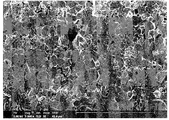
- FIG. 1 shows the cross-sectional observation results of the lithium ion conductive oxide sintered body (1) obtained in Example 1 by a transmission electron microscope (TEM).
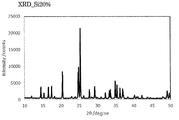
- FIG. 2 shows an X-ray analysis figure of the lithium ion conductive oxide sintered body (1) obtained in Example 1 by powder X-ray analysis measurement (XRD).
- FIG. 3 shows an X-ray analysis figure of the lithium ion conductive oxide sintered body (2) obtained in Comparative Example 1 by powder X-ray analysis measurement (XRD).
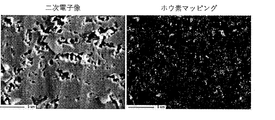
- FIG. 4 shows a secondary electron image and a boron mapping image of the lithium ion conductive oxide sintered body (3) obtained in Example 2 by an electron probe microanalyzer (EPMA).
- EMA electron probe microanalyzer
- the lithium ion conductive oxide sintered body according to the present invention contains at least lithium (Li), tantalum (Ta), phosphorus (P), silicon (Si) and oxygen (O) as constituent elements, and is a crystal particle. And has a polycrystalline structure composed of a particle interface formed between the crystal particles.
- the lithium ion conductive oxide sintered body of a preferred embodiment of the present invention has crystal particles and a particle interface, and the crystal particles are usually at least lithium (Li), tantalum (Ta), phosphorus ( It contains P) and oxygen (O) as constituent elements.
- the crystal particles of the lithium ion conductive oxide sintered body are not particularly limited, but may not contain silicon (Si), and may not contain silicon (Si), and are scanning transmission electron microscope (STEM) -energy dispersive X-ray spectroscopy (EDX). ) In the composition analysis, it is not necessary to confirm the silicon element in the crystal particles.
- the average particle size of the crystal particles of the lithium ion conductive oxide sintered body is not particularly limited, but is preferably 6.0 ⁇ m or less, more preferably 3. It is 0 ⁇ m or less, more preferably 1.5 ⁇ m or less.
- the average particle size of the crystal particles of the lithium ion conductive oxide sintered body was obtained by obtaining a transmission image at a magnification of 1000 times or more using a transmission electron microscope (TEM), and at least 100 particles in an arbitrary 100 ⁇ m square region. It can be obtained by measuring the particle size of the crystal particles. Since the crystal grains are not completely spherical, the longest diameter is defined as the particle size of the crystal grains. In the present specification, the longest diameter of the crystal particles means the length of the longest diagonal line of the polygons constituting the contours of the crystal particles obtained as follows.
- the contour of the crystal particles is observed as a convex polygon in the viewing plane.
- the length of the longest diagonal line among the plurality of diagonal lines of the convex polygon is defined as the longest diameter of the crystal particles.
- Crystal particles containing lithium, tantalum, phosphorus, silicon, and oxygen as constituent elements are distinguished from other crystal particles by using an energy dispersive X-ray spectroscopy (EDX) analyzer attached to the TEM device. It can also be confirmed from the difference in the elements contained in the particles.
- EDX energy dispersive X-ray spectroscopy
- the particle interface of the lithium ion conductive oxide sintered body is a portion inside the lithium ion conductive oxide sintered body that exists between crystal particles other than the crystal particles and that bonds the crystal particles to each other. means.
- the structure of the particle interface is not clear, but a layer formed by precipitating from the lithium ion conductive oxide during firing or sintering ( Precipitated layer) is considered to be included.
- Lithium-ion conductive oxide sintered bodies may contain voids in which neither crystal particles nor particle interfaces are present.
- Solid solution components such as grain boundaries of the lithium ion conductive oxide sintered body may be composed of only deposition layer, Li 4 SiO 4, Li 3 PO 4 or Li 4 SiO 4 -Li 3 PO 4 , May be contained.
- the lithium ion conductive oxide sintered body according to the present invention contains B (boron) as a constituent element, Li 3 BO 3 or Li 3 BO 3 ⁇ Li 4 SiO 4 , Li 3 at the particle interface.
- BO 3 -Li 3 PO 4, Li 3 BO 3 -LiTaO 3 may contain a solid solution components such.
- the lithium ion conductive oxide sintered body according to the present invention contains a solid solution component at the particle interface, it may exhibit better ionic conductivity, which is preferable.
- the solid solution component contained in the particle interface preferably has a lower melting point than the crystal particles. Since it has a lower melting point than the crystal particles, it is formed by precipitating the crystal particles during firing or sintering, and it is difficult to form voids between the crystal particles, and the crystal particles are tightly bonded to each other. Conceivable.
- the particle interface of the lithium ion conductive oxide sintered body of the preferred embodiment of the present invention contains a silicon element, and specifically, the presence of the silicon element at the particle interface is scanning transmission. It is preferably confirmed by electron microscope (STEM) -energy dispersive X-ray spectroscopy (EDX) composition analysis.
- the content ratio of the silicon element at the particle interface determined by the STEM-EDX composition analysis is preferably 1.0 atomic% or more, when the total of the phosphorus element, the oxygen element, the silicon element and the tantalum element is 100 atomic%. It is preferably 1.2 atomic% or more, and more preferably 1.5 atomic% or more.
- the upper limit of the content ratio of the silicon element at the particle interface is not particularly limited, but it is usually preferably 10 atomic% or less, preferably 5 atomic% or less, and more preferably 3 atomic% or less.
- the lithium ion conductive oxide sintered body according to a preferred embodiment of the present invention preferably contains a boron element at the particle interface. It may contain a solid solution component such as Li 3 BO 3- LiTaO 3.
- the inclusion of elemental boron in the particle interface is confirmed by scanning electron microscope (SEM) -energy dispersive X-ray spectroscopy (EDX) composition analysis (electron probe microanalyzer (EPMA) analysis).
- SEM scanning electron microscope
- EDX -energy dispersive X-ray spectroscopy
- EPMA electron probe microanalyzer
- the content of boron is preferably 0.10 atomic% or more, and more preferably 0.50 atomic% or more.
- the upper limit is preferably 5.00 atomic% or less, and more preferably 3.00 atomic% or less.
- the lithium ion conductive oxide sintered body according to one aspect of the present invention contains at least lithium, tantalum, boron, phosphorus and oxygen as constituent elements, and is formed between the crystal particles and the particle interface formed between the crystal particles. It is characterized in that it has a polycrystalline structure composed of and that the particle interface contains a boron element, which is confirmed by a scanning electron microscope (SEM) -energy dispersive X-ray spectroscopy (EDX) composition analysis.
- SEM scanning electron microscope
- EDX -energy dispersive X-ray spectroscopy
- the thickness of the particle interface is not particularly limited to the particle size of the crystal particles, but is usually 10 nm or less, preferably 0. .1 to 10 nm. With the thickness of the particle interface in such a range, the lithium ion conductive oxide sintered body of the preferred embodiment of the present invention contains crystal particles at a sufficient density.
- the elemental composition of the lithium ion conductive oxide sintered body as a whole in a preferred embodiment of the present invention is usually based on a part of P of LiTa 2 PO 8 substituted with an element M containing Si.
- the element M contains Si as an essential element, and may contain an element selected from the group consisting of Group 14 elements other than Si (excluding carbon), Al (aluminum) and B (boron). Yes, preferably substantially only Si. That is, the elemental composition of the lithium ion conductive oxide sintered body as a whole preferably has a basic composition in which a part of P of LiTa 2 PO 8 is replaced with Si.
- the ratio of the atomic numbers of the conductive oxides lithium, tantalum, phosphorus, silicon, and oxygen is 1: 2: (1).
- ⁇ Y): y: 8 preferably the y is greater than 0 and less than 0.7.
- the lithium ion conductive oxide sintered body of the preferred embodiment of the present invention has an elemental composition as a whole corresponding to a specific oxide containing lithium.
- this does not strictly exclude the presence of impurities in the lithium ion conductive oxide sintered body, and may include unavoidable impurities due to the raw material and / or the manufacturing process, and other lithium ion conduction. Impurities having other crystal systems may be contained within a range that does not deteriorate the properties.
- the ratio of the atomic numbers of the elements constituting the lithium ion conductive oxide sintered body is such that Mn, Co, and Ni are contained in a ratio of 1: 1: 1 as a lithium-containing transition metal oxide such as LiCoO 2. It can be determined by the Auger Electron Spectroscopy (AES) method using the standard powder sample.
- AES Auger Electron Spectroscopy
- the elemental composition of the lithium ion conductive oxide sintered body of the preferred embodiment of the present invention as a whole can be represented by the following formula (1).
- the element M may contain Si as an essential element, and may contain an element of Group 14 other than Si and an element selected from the group consisting of Al and B. Preferably, it is substantially only Si. Examples of Group 14 elements other than Si include Ge.
- the content of the element M containing Si which is represented by y in the above formula (1), is greater than 0 and less than 0.7. This content range is greater than 0.0 and less than 70.0 when expressed as a percentage of the number of atoms of element M with respect to the total number of atoms of phosphorus and element M.
- the lower limit of the element M content is preferably 0.01, more preferably 0.02, and further preferably 0.03.
- the upper limit of the element M content is preferably 0.65, more preferably 0.60, and even more preferably 0.55.
- the Si content in the element M is 1 or more, preferably 50 or more, more preferably 70 or more, still more preferably 90 or more, and most preferably 100, when expressed as a percentage of the number of atoms.
- the elemental composition of the lithium ion conductive oxide sintered body in the more preferable embodiment of the present invention can be represented by the following formula (2). LiTa 2 P 1-y Si y O 8 ... Equation (2)
- the total ion conductivity of the lithium ion conductivity in the crystal particles and at the particle interface (grain boundary) is high.
- the element M content can be determined by a conventionally known quantitative analysis as a percentage of the number of atoms of the element M with respect to the total number of atoms of the phosphorus and the element M.
- an acid can be added to a sample for thermal decomposition, and then the thermal decomposition product can be defined and determined using a radio frequency inductively coupled plasma (ICP) emission spectrometer.
- ICP radio frequency inductively coupled plasma
- the element M contains Si and may contain an element selected from the group consisting of Group 14 elements other than Si (excluding carbon), Al and B.
- the element other than Si that may be contained in the element M include Ge, Al and B, and among these, Al and B are preferable.
- the element M is preferably substantially only Si. When the element M is only Si, the lithium ion conductivity at the particle interface of the sintered body is particularly large, which is preferable.
- the element M to be doped has a valence different from that of phosphorus. It is conceivable that the amount of lithium contained in the body will increase or decrease. For example, when the amount of increase / decrease caused by the charge balance caused by replacing P with M is represented by x, the elemental composition of the entire lithium ion conductive oxide sintered body can be represented by the following formula (3). Li 1 + x Ta 2 P 1- y My O 8 ... Equation (3)
- the elemental composition of the entire lithium ion conductive oxide sintered body is preferably represented by the following formula (4), in which all the elements M are Si. Li 1 + x Ta 2 P 1-y Si y O 8 ... Equation (4)
- the constituent element composition of the crystal particles and the constituent element composition of the particle interface may be the same or different.
- the elemental composition of each part can be determined by STEM-EDX composition analysis. As shown in Examples described later, the area occupied by the crystal particles with respect to the area occupied by the particle interface in the cross-sectional image is large, and the constituent element composition of the crystal particles can be regarded as approximately the same as the constituent element composition of the entire sintered body. it can.
- the content ratio of tantalum element in the elemental composition of the particle interface is smaller than the content ratio of tantalum element in the elemental composition of the crystal particles. More preferably, the content ratio of the tantalum element in the elemental composition of the crystal particles in terms of the number of atoms is 1.01 times or more, more preferably 1.1 times or more the content ratio of the tantalum element in the elemental composition of the particle interface. It is 05 times or more, and more preferably 1.08 times or more.
- the content ratio of the phosphorus element in the elemental composition of the particle interface is larger than the content ratio of the phosphorus element in the elemental composition of the crystal particles. More preferably, the content ratio of the phosphorus element in the element composition of the particle interface in terms of the number of atoms is 1.01 times or more, more preferably 1. It is 05 times or more, and more preferably 1.08 times or more.
- the content ratios of the phosphorus element and the silicon element in the number of atoms are larger in the particle interface than in the crystal particles, respectively, and the tantalum element It is desirable that the content ratio in terms of the number of atoms is smaller in the particle interface than in the crystal particles.
- the lithium ion conductive oxide sintered body according to the present invention is composed of crystal particles and a particle interface
- the magnitude of the ratio of the elemental composition between the particle interface and the crystal particles is determined by the crystal particle portion and the particle interface portion.
- the elemental composition of the above may be directly compared, or the elemental composition of the crystal particle portion and the entire sintered body, or the elemental composition of the particle interface portion and the entire sintered body may be compared and determined.
- the ion conductivity at the particle interface is the inside of the crystal particles. It is desirable that it is larger than the ionic conductivity in.
- the ionic conductivity at the particle interface is 1.1 times or more, more preferably 1.5 to 5 times, still more preferably 1.7 to 4 times, the ionic conductivity inside the crystal particles. It is desirable to be in the range.
- the AC impedance measurement can be performed by a known method, and specifically, can be performed by the method described in Examples described later.
- the shape of the lithium ion conductive oxide sintered body according to the present invention is not particularly limited, and the shape may be appropriately selected according to the application and the like. For example, it can be formed into a desired shape such as a spherical shape, a pellet shape, a plate shape, a sheet shape, a flake shape, a lump shape, or the like depending on the application.
- the size thereof is not particularly limited, but for example, when the sintered body is circular, the longest diameter may be 1 mm or more, and more preferably 2 mm or more. When the sintered body is polygonal, the total length of all sides may be 1 mm or more, more preferably 2 mm or more.
- the lithium ion conductive oxide sintered body of the preferred embodiment of the present invention has a crystal structure content of monoclinic crystals confirmed by X-ray diffraction (XRD) measurement (hereinafter, also simply referred to as monoclinic crystal content). However, it is usually 60% or more, preferably 70% or more, more preferably 80% or more, and further preferably 90% or more.
- the crystal structure content of the monoclinic crystal can be determined by a method using Rietveld analysis, which will be described later in Examples. When the content of monoclinic crystals is in the above range, the total lithium ion conductivity tends to increase.
- lithium tantalate Li 3 PO 4 , TaPO 5 , Ta 2 O 5, and the like may be observed, but it is preferable not to include these because of their low lithium ion conductivity.
- the lithium ion conductive oxide sintered body of the preferred embodiment of the present invention is not particularly limited, but the relative density with the theoretical density as 100% is not particularly limited. , It is preferably 50% or more as compared with the theoretical density. It is more preferably 60% or more, still more preferably 70% or more.
- the theoretical density to be compared can be easily compared with the theoretical density of LiTa 2 PO 8 which does not contain the element M such as silicon.
- the method for producing the lithium ion conductive oxide sintered body in the preferred embodiment of the present invention includes a lithium ion conductive oxide sintered body within the above configuration. As long as it can be obtained, it is not particularly limited.
- a production method for example, a method of producing a lithium ion conductive oxide by a solid phase reaction, a liquid phase reaction or the like, appropriately shaping the lithium ion conductive oxide as necessary, and firing (sintering) the oxide can be adopted. ..
- the lithium ion conductive oxide sintered body according to the present invention preferably contains a lithium ion conductive oxide (a) containing at least lithium, tantalum, phosphorus, silicon and oxygen by a solid phase reaction, a liquid phase reaction or the like. It can be produced by producing it, shaping it as necessary, and firing (sintering) it.
- the lithium ion conductive oxide (a) is solid and has a polycrystalline structure composed of crystal particles and a particle interface, it can be used as it is as the lithium ion conductive oxide sintered body according to the present invention. Good.
- the production method using the solid phase reaction will be described in detail.
- Examples of the production method by solid-phase reaction include a production method having at least one step each of a mixing step and a firing step.
- a compound containing an element M containing a lithium atom, a tantalum atom, and a silicon atom and a phosphate are mixed.
- the compound containing a lithium atom is not particularly limited, but an inorganic compound is preferable from the viewpoint of ease of handling, and the inorganic compound containing a lithium atom includes lithium carbonate (Li 2 CO 3 ) and lithium oxide (Li 2 O). Lithium compounds such as. These lithium compounds may be used alone or in combination of two or more. It is preferable to use lithium carbonate (Li 2 CO 3) because it is easily decomposed and reacted.
- the compound containing a tantalum atom is not particularly limited, but an inorganic compound is preferable from the viewpoint of ease of handling, and tantalum compounds such as tantalum pentoxide (Ta 2 O 5 ) and tantalum nitrate (Ta (NO 3 ) 5) can be mentioned. be able to. These tantalum compounds may be used alone or in combination of two or more. From the viewpoint of cost, it is preferable to use tantalum pentoxide (Ta 2 O 5).
- the compound containing the element M containing a silicon atom is not particularly limited, but an inorganic compound is preferable from the viewpoint of ease of handling, and a simple substance of the element M or an oxide can be mentioned. These substances may be used alone or in combination of two or more. Of these, oxides are preferably used from the viewpoint of ease of handling.
- silicon dioxide SiO 2
- germanium oxide GeO 2
- aluminum oxide Al 2 O 3
- silicon dioxide SiO 2
- the element M contains boron
- lithium borate (Li 3 BO 3 ) can be used.
- the phosphate is not particularly limited, decomposition, etc. monohydrogen phosphate diammonium since easily reacted ((NH 4) 2 HPO 4 ), phosphoric acid dihydrogen ammonium (NH 4 H 2 PO 4) Phosphate can be mentioned. These phosphates may be used alone or in combination of two or more.
- a method for mixing the raw materials described above a method such as a roll rolling mill, a ball mill, a small diameter ball mill (bead mill), a medium stirring mill, an air flow crusher, a mortar, an automatic kneading mortar, a tank breaker or a jet mill can be used. ..
- the ratio of the raw materials to be mixed is simply stoichiometrically mixed so as to have the composition of the above formula (1). More specifically, in the firing step described later, lithium atoms tend to flow out of the system, so the above-mentioned compound containing lithium atoms may be added in excess of about 10 to 20% for adjustment.
- the mixed atmosphere may be performed in the atmosphere.
- a gas atmosphere of nitrogen gas and / or argon gas having an adjusted oxygen gas content is more preferable.
- the firing step the mixture obtained in the mixing step is fired.
- the firing step is performed a plurality of times, for example, as a two-step step of low-temperature firing and high-temperature firing, the purpose is to crush the primary fired product or reduce the particle size between the firing steps.
- a crushing step using a ball mill or a milk bowl may be provided.
- the firing process may be performed in the atmosphere.
- a gas atmosphere of nitrogen gas and / or argon gas having an adjusted oxygen gas content is more preferable.
- the firing temperature is preferably in the range of 800 to 1200 ° C, more preferably in the range of 950 to 1100 ° C, and even more preferably in the range of 950 to 1000 ° C.
- the element M containing silicon is sufficiently dissolved to improve the ionic conductivity, and when the temperature is 1200 ° C. or lower, lithium atoms are less likely to flow out of the system, which is preferable.
- the firing time is preferably 30 minutes to 16 hours, preferably 3 to 12 hours. When the firing time is within the above range, the ionic conductivity of the sintered body produced by using the obtained lithium ion conductive oxide tends to increase in a well-balanced manner both in the crystal grains and at the grain boundaries. preferable. If the firing time is longer than the above range, lithium atoms tend to flow out of the system. The firing time and temperature are adjusted to match each other.
- the temporary firing at low temperature may be performed at 400 to 800 ° C. for 30 minutes to 12 hours.
- high-temperature firing may be performed twice.
- the firing temperature is preferably in the range of 800 to 1200 ° C., more preferably in the range of 950 to 1100 ° C., and even more preferably in the range of 950 to 1000 ° C.
- the firing time of each firing step is preferably 30 minutes to 8 hours, preferably 2 to 6 hours.
- the fired product obtained after firing is left in the atmosphere, it may absorb moisture or react with carbon dioxide to deteriorate in quality. It is preferable that the fired product obtained after firing is transferred to a dehumidified inert gas atmosphere when the temperature drops below 200 ° C. after firing and stored. In this way, the lithium ion conductive oxide (a) can be obtained.
- the lithium ion conductive oxide sintered body according to the present invention preferably comprises at least lithium, tantalum, phosphorus, silicon and oxygen such as the lithium ion conductive oxide (a) obtained as described above. It can be produced by using an oxide contained as an element.
- the lithium ion conductive oxide (a) or the like is obtained in a solid state, it may be used as it is as a lithium ion conductive oxide sintered body, or the lithium ion conductive oxide (a) or the like may be used as it is.
- a lithium ion conductive oxide sintered body may be produced in the form of a powder, and if necessary, the particle size may be adjusted and shaped, and then sintered.
- a production method having a step of shaping a powdered lithium ion conductive oxide (a) into a desired shape and firing (sintering) the powdery lithium ion conductive oxide (a) is ionic conductivity. It is preferable because it is easy to produce a lithium ion conductive oxide sintered body having excellent properties.
- the lithium ion conductive oxide (a) is shaped by, for example, using a powdered lithium ion conductive oxide (a) having a desired particle size with a ball mill or the like, if necessary, by a known powder molding method. It can be carried out.
- Examples of the powder molding method include adding a solvent to powder to form a slurry, applying the slurry to a current collector, drying the powder, and then pressurizing the powder (doctor blade method), or using the slurry as a liquid-absorbing mold.
- Extrusion molding methods including Cold isotropic molding method (cold isostatic pressing) including putting it in a flexible bag, putting it in a pressure medium and applying isotropic pressure, put the powder in a container of a predetermined shape and put it in a vacuum state, and put it in a high temperature
- Cold isostatic pressing method including applying isotropic pressure in a pressure medium can be mentioned.
- Mold molding methods include a one-sided push method that involves putting powder in a fixed lower punch and a fixed die and applying pressure to the powder with a movable upper punch, putting powder in a fixed die, and powdering with a movable lower punch and a movable upper punch.
- Double-push method including applying pressure to, put powder in the fixed lower punch and movable die, apply pressure to the powder with the movable upper punch, move the movable die when the pressure exceeds a predetermined value, and the fixed lower punch is relative Floating die method including making it enter the movable die, put powder in the fixed lower punch and movable die, apply pressure to the powder with the movable upper punch and move the movable die at the same time to move the fixed lower punch Examples include the withdrawal method, which involves allowing the die to enter relatively into a movable die.
- the lithium ion conductive oxide sintered body according to the present invention can be suitably obtained by firing (sintering) the lithium ion conductive oxide (a) shaped as described above by a known method. it can. Sintering can be performed, for example, by the same method as high-temperature firing when preparing the lithium ion conductive oxide (a). Specifically, for example, the firing temperature is in the range of 800 to 1200 ° C., preferably 950 to 1100 ° C., more preferably 950 to 1000 ° C., and the firing time is 1 to 8 hours, preferably 2 to 6 hours. Sintering can be performed under the conditions.
- the lithium ion conductive oxide sintered body according to the present invention is excellent in lithium ion conductivity, it can be suitably used as a solid electrolyte, and in particular, a solid electrolyte of a lithium ion secondary battery and a solid electrolyte of an all-solid battery. Can be suitably used as.
- Lithium-ion secondary battery One of the preferred uses of the lithium ion conductive oxide sintered body according to the present invention is to use it as a solid electrolyte in a lithium ion secondary battery.
- the structure of the lithium ion secondary battery is not particularly limited.
- the positive electrode current collector, the positive electrode layer, the solid electrolyte layer, the negative electrode layer and the negative electrode current collector are in this order. It has a laminated structure.
- the positive electrode current collector and the negative electrode current collector are not particularly limited as long as their materials conduct electrons without causing an electrochemical reaction.
- it is composed of simple substances and alloys of metals such as copper, aluminum and iron, or conductors such as conductive metal oxides such as antimony-doped tin oxide (ATO) and tin-doped indium oxide (ITO).
- a current collector having a conductive adhesive layer provided on the surface of the conductor can also be used.
- the conductive adhesive layer can be composed of a granular conductive material, a fibrous conductive material, or the like.
- the positive electrode layer and the negative electrode layer can be obtained by a known powder molding method.
- a positive electrode current collector, a powder for a positive electrode layer, a powder for a solid electrolyte layer, a powder for a negative electrode layer, and a negative electrode current collector are superposed in this order, and they are simultaneously powder-molded to form a positive electrode. It is also possible to simultaneously form the respective layers of the layer, the solid electrolyte layer and the negative electrode layer, and connect between the positive electrode current collector, the positive electrode layer, the solid electrolyte layer, the negative electrode layer and the negative electrode current collector, respectively.
- each layer can be powder-molded sequentially.
- the obtained powder molded product may be subjected to a heat treatment such as firing, if necessary.
- a known powder molding method such as the above-mentioned mold molding method can be adopted.
- the thickness of the positive electrode layer is preferably 10 to 200 ⁇ m, more preferably 30 to 150 ⁇ m, and even more preferably 50 to 100 ⁇ m.
- the thickness of the solid electrolyte layer is preferably 50 nm to 1000 ⁇ m, more preferably 100 nm to 100 ⁇ m.
- the thickness of the negative electrode layer is preferably 10 to 200 ⁇ m, more preferably 30 to 150 ⁇ m, and even more preferably 50 to 100 ⁇ m.
- a composite material containing silicon in the pores of porous carbon, lithium titanate, and graphite coated with lithium titanate may contain at least one selected from the group.
- a silicon / carbon composite material or a composite material containing a silicon domain in the pores of porous carbon is preferable because it has a high specific capacity and can increase the energy density and the battery capacity.
- the silicon domain is formed in the pores of the porous carbon, in which the silicon domain is amorphous, the size of the silicon domain is 10 nm or less, and the pores derived from the porous carbon are present in the vicinity of the silicon domain. It is a composite material to be included.
- Active materials for positive electrodes include LiCo oxide, LiNiCo oxide, LiNiCoMn oxide, LiNiMn oxide, LiMn oxide, LiMn-based spinel, LiMnNi oxide, LiMnAl oxide, LiMnMg oxide, LiMnCo oxide, LiMnFe.
- LiNiComn oxide, LiNiCo oxide or LiCo oxide is preferable, and LiNiCoMn oxide is more preferable.
- This active material has a good affinity with solid electrolytes and has an excellent balance of macroconductivity, microconductivity and ionic conductivity. In addition, the average potential is high, and the energy density and battery capacity can be increased in the balance between specific capacity and stability.
- the surface of the active material for the positive electrode may be coated with lithium niobate, lithium phosphate, lithium borate, or the like, which are ionic conductive oxides.
- the active material in one embodiment of the present invention is preferably in the form of particles.
- the 50% diameter in the volume-based particle size distribution is preferably 0.1 ⁇ m or more and 30 ⁇ m or less, more preferably 0.3 ⁇ m or more and 20 ⁇ m or less, further preferably 0.4 ⁇ m or more and 10 ⁇ m or less, and most preferably 0.5 ⁇ m or more and 3 ⁇ m or less.
- the ratio of the major axis length to the minor axis length (major axis length / minor axis length), that is, the aspect ratio is preferably less than 3, more preferably less than 2.
- the active material in one embodiment of the present invention may form secondary particles.
- the 50% diameter in the number-based particle size distribution of the primary particles is preferably 0.1 ⁇ m or more and 20 ⁇ m or less, more preferably 0.3 ⁇ m or more and 15 ⁇ m or less, further preferably 0.4 ⁇ m or more and 10 ⁇ m or less, and 0.5 ⁇ m or more and 2 ⁇ m.
- the active material is preferably primary particles.
- the active material is a primary particle, the electron conduction path or the hole conduction path is unlikely to be impaired even when compression molding is performed.
- Example 1 -Preparation of lithium ion conductive oxide sintered body (1) (20% Si-doped) Lithium, tantalum, phosphorus, silicon and oxygen are the constituent elements, and the ratio of the number of silicon atoms in the total of silicon and phosphorus is A 20% lithium ion conductive oxide sintered body (1) is produced.
- the elemental composition of the target lithium ion conductive oxide sintered body (1) as a whole is that 20% of the P atomic number is replaced with Si in the oxide represented by LiTa 2 PO 8.
- y of the formula Li 1 + x Ta 2 P 1-y Si y O 8 (x is the charge balance associated with replacing P with Si) is 0.2.
- lithium carbonate Li 2 CO 3
- tantalum pentoxide Ta 2 O 5
- Silicon dioxide SiO 2
- diammonium monohydrogen phosphate ((NH 4 ) 2 HPO 4 ) (manufactured by Merck Sigma Aldrich, purity) 98% or more)
- Li: Ta: P: Si 1.38: 2.00: 0.852: 0.200
- Li: Ta: P: Si 1.38: 2.00: 0.852: 0.200
- zirconia ball mill zirconia ball: diameter 1 mm
- the obtained mixture is placed in an alumina boat and heated to 1100 ° C. at a heating rate of 10 ° C./min in an atmosphere of air (gas flow rate: 100 mL / min) using a rotary firing furnace (manufactured by Motoyama Co., Ltd.). Then, it was calcined at 1100 ° C. for 2 hours to obtain a primary calcined product.
- the obtained pyroclastic material was provisionally molded at 40 MPa by a hydraulic press, and then main-molded at 300 MPa by a cold isotropic molding method (CIP) to obtain pellets having an average particle diameter of 10 mm in diameter and a thickness of 1 mm.
- CIP cold isotropic molding method
- the obtained pellets are placed in an alumina boat and heated to 1100 ° C at a heating rate of 10 ° C / min in an atmosphere of air (gas flow rate: 100 mL / min) using a rotary firing furnace (manufactured by Motoyama Co., Ltd.). Then, it was calcined at 1100 ° C. for 3 hours to obtain a secondary calcined product.
- TEM transmission electron microscope
- the lithium ion conductive oxide sintered body (1) has a polycrystalline structure composed of crystal particles and a particle interface. Moreover, from the analysis result of FIG. 1, the average particle size of the crystal particles was 1.3 ⁇ m, and the average thickness of the particle interface was 2 nm.
- the pellets prepared by the measurement pellet preparation method described above are processed using a high-speed ion impact (FIB) device to process STEM-EDX. A sample for composition analysis was obtained.
- FIB high-speed ion impact
- the STEM-EDX composition analysis was performed on the entire sintered body and the particle interface of the lithium ion conductive oxide sintered body (1) under the following equipment and conditions.
- EDX mapping resolution: 256 x 256 pixels From this result, the content ratio (atomic%) of each element was determined when the total of phosphorus element, oxygen element, silicon element and tantalum element was 100 atomic%. The results are shown in Table 1.
- XRD -Powder X-ray diffraction measurement
- PANalytical MPD manufactured by Spectris Co., Ltd.
- a line diffraction pattern was obtained. This X-ray diffraction pattern is shown in FIG.
- the measurement pellets for evaluating the ionic conductivity of the lithium ion conductive oxide were prepared as follows.
- the obtained lithium ion conductive oxide sintered body (1) was molded into a disk shape having a diameter of 10 mm and a thickness of 1 mm using a tablet molding machine, and fired at 1100 ° C. for 3 hours in the atmosphere.
- the relative density of the obtained fired product with respect to the theoretical density was 96.3%.
- Gold layers were formed on both sides of the obtained fired product using a sputtering machine to obtain measurement pellets for ionic conductivity evaluation.
- the ionic conductivity of the lithium ion conductive oxide sintered body (1) was evaluated as follows. The measurement pellets prepared by the method described above were held at 25 ° C. for 2 hours before measurement. Next, AC impedance measurement was performed at 25 ° C. using an impedance analyzer (manufactured by Solartron Analytical Co., Ltd., model number: 1260A) at an amplitude of 25 mV in a frequency range of 1 Hz to 10 MHz. The obtained impedance spectrum was fitted in an equivalent circuit using the equivalent circuit analysis software ZView software attached to the apparatus to obtain the ionic conductivity at the crystal particles and the particle interface, and the total lithium ionic conductivity, respectively. Table 1 shows the obtained ionic conductivity.
- the lithium ion conductive oxide sintered body (2) various physical properties were measured or evaluated in the same manner as in Example 1.
- the lithium ion conductive oxide sintered body (2) was confirmed to have a polycrystalline structure composed of crystal particles and a particle interface by cross-sectional observation with a transmission electron microscope (TEM). From the analysis results, the average particle size of the crystal particles was 1.4 ⁇ m, and the average thickness of the particle interface was 2 nm. Other results are shown in Table 1.
- the X-ray diffraction pattern is shown in FIG.
- the lithium ion conductive oxide sintered body (2) containing no silicon as a constituent element has lower lithium ion conductivity and is improved as compared with the lithium ion conductive oxide sintered body (1) containing silicon. It turned out that there was room for.
- the lithium ion conductive oxide sintered body having the above is excellent in lithium ion conductivity, and particularly excellent in lithium ion conductivity in the particle interface region.
- Example 2 -Preparation of lithium ion conductive oxide sintered body (3) (26% B-doped) Lithium, tantalum, phosphorus, boron and oxygen are the constituent elements, and the ratio of the number of boron atoms in the total of boron and phosphorus is A 26% lithium ion conductive oxide sintered body (3) is produced.
- lithium carbonate Li 2 CO 3
- tantalum pentoxide Ta 2 O 5
- Boric acid H 3 BO 3
- diammonium hydrogen phosphate ((NH 4 ) 2 HPO 4 )
- lithium carbonate is weighed so as to be 1.05 times the lithium atomic weight, and phosphorus is further suppressed in the firing step in order to suppress the formation of by-products.
- Diammonium hydrogenate was weighed so as to be 1.06 times the atomic weight of phosphorus.
- the obtained primary mixture is placed in an alumina boat, used in a rotary firing furnace (manufactured by Motoyama Co., Ltd.), in an atmosphere of air (gas flow rate: 100 mL / min), and up to 1000 ° C. at a heating rate of 10 ° C./min. The temperature was raised and calcined at this temperature for 4 hours to obtain a primary calcined product.
- a pressure of 40 MPa is applied to the obtained secondary mixture by a hydraulic press to form a disk-shaped molded product having a diameter of 10 mm and a thickness of 1 mm, and then CIP (cold hydrostatic isobaric press). ), A pellet was prepared by applying a pressure of 300 MPa to the disk-shaped molded product.
- the obtained pellets are placed in an alumina boat and raised to 850 ° C in an atmosphere of air (gas flow rate: 100 mL / min) using a rotary firing furnace (manufactured by Motoyama Co., Ltd.) at a heating rate of 10 ° C / min. It was warmed and fired at that temperature for 96 hours to obtain a sintered body. After the temperature of the obtained sintered body was lowered to room temperature, it was taken out from a rotary firing furnace, transferred to a dehumidified nitrogen gas atmosphere and stored to obtain a lithium ion conductive oxide sintered body (3).
- lithium ion conductive oxide sintered body (3) various physical properties were measured or evaluated in the same manner as in Example 1.
- the content of monoclinic crystals was 83.5%.
- the ionic conductivity at the crystal particles and the particle interface, and the total lithium ionic conductivity were 0.867 mS / cm, 6.10 mS / cm, and 0.759 mS / cm, respectively.
- FIG. 4 shows a secondary electron image and a boron mapping image of the lithium ion conductive oxide sintered body (3) obtained in Example 2 by EPMA.
- the portion corresponding to the gray neutral color is a monoclinic crystal, and the black and white portions indicate the grain boundaries.
- the boron mapping the portion having a high boron atom content is shown in white, and the portion having a low boron atom content is shown in black. From FIG. 4, it can be seen that many boron atoms are present at the grain boundaries.
- Example 3 -Preparation of lithium ion conductive oxide sintered body (4) (total 10% Si and B-doped) Lithium, tantalum, boron, phosphorus, silicon and oxygen are the constituent elements, and the total of boron, silicon and phosphorus is included. A lithium ion conductive oxide sintered body (4) having a total atomic number ratio of boron and silicon of 10% is prepared.
- Example 3 silicon dioxide (SiO 2 ) (manufactured by Fujifilm Wako Pure Chemical Industries, Ltd., purity 99.9%) was further used, and the atomic number ratio of lithium, tantalum, boron, phosphorus and silicon (Li: Ta:: Lithium ions in the same manner as in Example 2 except that each raw material powder was used so that B: P: Si) was 1.17: 1.90: 0.10: 0.94: 0.01.
- a conductive oxide sintered body (4) was prepared.
- lithium ion conductive oxide sintered body (4) various physical properties were measured or evaluated in the same manner as in Example 1.
- the content of monoclinic crystals was 99.0%.
- the ionic conductivity at the crystal particles and the particle interface, and the total lithium ionic conductivity were 1.36 mS / cm, 0.971 mS / cm, and 0.566 mS / cm, respectively.
- the lithium ion conductive oxide sintered body of the present invention is suitable as a solid electrolyte, and can be particularly preferably used as a solid electrolyte for a lithium ion secondary battery.
Landscapes
- Chemical & Material Sciences (AREA)
- Engineering & Computer Science (AREA)
- Manufacturing & Machinery (AREA)
- Chemical Kinetics & Catalysis (AREA)
- Electrochemistry (AREA)
- General Chemical & Material Sciences (AREA)
- Organic Chemistry (AREA)
- Ceramic Engineering (AREA)
- Inorganic Chemistry (AREA)
- Materials Engineering (AREA)
- Structural Engineering (AREA)
- Condensed Matter Physics & Semiconductors (AREA)
- General Physics & Mathematics (AREA)
- Physics & Mathematics (AREA)
- Conductive Materials (AREA)
- Secondary Cells (AREA)
- Inorganic Compounds Of Heavy Metals (AREA)
Abstract
Description
なお、上記の特許文献1および非特許文献1に記載の従来の技術においては、リチウム、タンタル、リンおよび酸素を構成元素として有するリチウムイオン伝導性酸化物において、結晶粒内と結晶粒界のリチウムイオン伝導度のトータルのイオン伝導度を向上させる記載や示唆はない。
〔1〕少なくとも、リチウム、タンタル、リン、ケイ素および酸素を構成元素として含み、
結晶粒子と、該結晶粒子間に形成された粒子界面とからなる多結晶構造を有することを特徴とするリチウムイオン伝導性酸化物焼結体。
〔2〕前記粒子界面に、ケイ素元素が含まれることが走査透過電子顕微鏡(STEM)-エネルギー分散型X線分光(EDX)組成分析により確認されることを特徴とする〔1〕に記載のリチウムイオン伝導性酸化物焼結体。
〔4〕透過電子顕微鏡(TEM)断面観察において、前記粒子界面の厚さが10nm以下であることを特徴とする〔1〕~〔3〕のいずれか1項に記載のリチウムイオン伝導性酸化物焼結体。
〔8〕前記リチウムイオン伝導性酸化物焼結体の交流インピーダンス測定により検出されるイオン伝導度において、前記粒子界面におけるイオン伝導度が、前記結晶粒子の内部におけるイオン伝導度より大きいことを特徴とする〔1〕~〔7〕のいずれか1項に記載のリチウムイオン伝導性酸化物焼結体。
〔10〕〔1〕~〔8〕のいずれか1項に記載のリチウムイオン伝導性酸化物焼結体を含む電極。
〔11〕〔1〕~〔8〕のいずれか1項に記載のリチウムイオン伝導性酸化物焼結体を含む全固体電池。
<リチウムイオン伝導性酸化物焼結体>
本発明に係るリチウムイオン伝導性酸化物焼結体は、構成元素として、少なくとも、リチウム(Li)、タンタル(Ta)、リン(P)、ケイ素(Si)および酸素(O)を含み、結晶粒子と、該結晶粒子間に形成された粒子界面とからなる多結晶構造を有する。
LiTa2P1-yMyO8 …式(1)
上記式(1)において、元素Mは、上述のように、Siを必須として含み、Si以外の14族の元素とAlおよびBからなる群から選ばれる元素を含んでいてもよいものであり、好ましくは実質的にSiのみである。Si以外の14族元素としてはGeが挙げられる。
LiTa2P1-ySiyO8 …式(2)
Li1+xTa2P1-yMyO8 …式(3)
Li1+xTa2P1-ySiyO8 …式(4)
本発明の好ましい実施態様のリチウムイオン伝導性酸化物焼結体は、X線回折(XRD)測定において確認される単斜晶の結晶構造含有率(以下、単に単斜晶の含有率ともいう)が、通常60%以上、好ましくは70%以上、より好ましくは80%以上であり、さらに好ましくは90%以上である。単斜晶の結晶構造含有率は、実施例において後述する、リートベルト解析を用いた方法で求めることができる。単斜晶の含有率が上述した範囲であると、トータルでのリチウムイオン伝導度が大きくなる傾向がある。
リチウムイオン伝導性酸化物焼結体は、後述する製造方法において焼成が不十分な場合、原材料が残存すると、X線回折測定において原材料に由来する回折ピークが確認される場合がある。原材料として用いる、炭酸リチウム(Li2CO3)、五酸化タンタル(Ta2O5)、二酸化ケイ素(SiO2)などの元素Mの酸化物、およびリン酸一水素二アンモニウム((NH4)2HPO4)の存在は、X線回折測定により確認することができる。これらの原材料化合物はリチウムイオン伝導性を有しないので含まないことが好ましい。また、焼成が不十分な場合に、副生成物の存在がX線回折測定において副生成物に由来する回折ピークとして確認される場合がある。具体的には、タンタル酸リチウム(LiTaO3)、Li3PO4、TaPO5、Ta2O5などが観測される場合があるが、これらはリチウムイオン伝導性が小さいため含まないことが好ましい。
本発明の好適な実施態様のリチウムイオン伝導性酸化物焼結体では、特に限定されるものではないが、理論密度を100%とする相対密度は、理論密度と比較して50%以上であることが好ましい。より好ましくは60%以上であり、さらに好ましくは70%以上である。比較する理論密度としては、簡便には、ケイ素等の元素Mを含まない、LiTa2PO8の理論密度と比較することができる。
本発明の好ましい実施態様におけるリチウムイオン伝導性酸化物焼結体の製造方法は、上記の構成の範囲内のリチウムイオン伝導性酸化物焼結体が得られる限り特に限定されない。製造方法としては、例えば、固相反応、液相反応等によりリチウムイオン伝導性酸化物を製造し、これを必要に応じて適宜賦形し、焼成(焼結)する方法等が採用可能である。
本発明に係るリチウムイオン伝導性酸化物焼結体は、好ましくは、少なくともリチウム、タンタル、リン、ケイ素および酸素を含むリチウムイオン伝導性酸化物(a)を、固相反応、液相反応等により製造し、これを必要に応じて適宜賦形し、焼成(焼結)することにより製造することができる。リチウムイオン伝導性酸化物(a)が固体状であり、結晶粒子と粒子界面とからなる多結晶構造を有する場合には、そのまま本発明に係るリチウムイオン伝導性酸化物焼結体として用いてもよい。以下、固相反応を用いた製造方法について詳細に説明する。
混合工程では、リチウム原子、タンタル原子、ケイ素原子を含む元素Mを、それぞれ含む化合物およびリン酸塩を混合する。
焼成工程では、混合工程で得た混合物を焼成する。焼成工程を、例えば低温焼成と高温焼成の2段階の工程とするように複数回行う場合には、焼成工程間に、一次焼成物を解砕し、または小粒径化することを目的として、ボールミルや乳鉢を用いた解砕工程を設けてもよい。
このようにしてリチウムイオン伝導性酸化物(a)を得ることができる。
本発明に係るリチウムイオン伝導性酸化物焼結体は、好ましくは、上記のようにして得られたリチウムイオン伝導性酸化物(a)等の、少なくともリチウム、タンタル、リン、ケイ素および酸素を構成元素として含む酸化物を用いて製造することができる。リチウムイオン伝導性酸化物(a)等が固体状で得られた場合には、そのままリチウムイオン伝導性酸化物焼結体として用いてもよく、また、リチウムイオン伝導性酸化物(a)等を粉末状とし、必要に応じて粒度の調製、賦形をし、焼結してリチウムイオン伝導性酸化物焼結体を製造してもよい。本発明では、特に限定されるものではないが、粉末状のリチウムイオン伝導性酸化物(a)を所望の形状に賦形し、焼成(焼結)する工程を有する製造方法が、イオン伝導性に優れたリチウムイオン伝導性酸化物焼結体を製造しやすいことから好ましい。
本発明に係るリチウムイオン伝導性酸化物焼結体は、リチウムイオン伝導性に優れるため、固体電解質として好適に使用することができ、特にリチウムイオン二次電池の固体電解質、全固体電池の固体電解質として好適に使用することができる。
本発明に係るリチウムイオン伝導性酸化物焼結体の好適な用途の1つとして、固体電解質として、リチウムイオン二次電池に利用することが挙げられる。
負電極用の活物質としては、リチウム合金、金属酸化物、グラファイト、ハードカーボン、ソフトカーボン、ケイ素、ケイ素合金、ケイ素酸化物SiOn(0<n≦2)、ケイ素/炭素複合材、多孔質炭素の細孔内にケイ素を内包する複合材、チタン酸リチウム、チタン酸リチウムで被覆されたグラファイトからなる群から選ばれる少なくとも一つを含有するものを挙げることができる。ケイ素/炭素複合材や多孔質炭素の細孔内にケイ素ドメインを内包する複合材は、比容量が高く、エネルギー密度や電池容量を高めることができるので好ましい。より好ましくは、多孔質炭素の細孔内にケイ素ドメインを内包する複合材であり、ケイ素のリチウム吸蔵/放出に伴う体積膨張の緩和性に優れ、複合電極材料または電極層において、マクロ導電性、ミクロ導電性およびイオン伝導性のバランスを良好に維持することができる。特に好ましくは、ケイ素ドメインが非晶質であり、ケイ素ドメインのサイズが10nm以下であり、ケイ素ドメインの近傍に多孔質炭素由来の細孔が存在する、多孔質炭素の細孔内にケイ素ドメインを内包する複合材である。
・リチウムイオン伝導性酸化物焼結体(1)(20%Siドープ)の作製
リチウム、タンタル、リン、ケイ素および酸素を構成元素とし、かつ、ケイ素とリンの合計中のケイ素原子数の割合が20%であるリチウムイオン伝導性酸化物焼結体(1)を作製する。目的とするリチウムイオン伝導性酸化物焼結体(1)の、全体としての元素組成は、LiTa2PO8で表される酸化物において、P原子数の20%がSiに置き換えられたものであり、式Li1+xTa2P1-ySiyO8(xはPをSiに置き換えることに伴う電荷バランス)のyが0.2である。
上記で得たリチウムイオン伝導性酸化物焼結体(1)について、高速イオン衝撃(FIB)装置を用いて、断面観察試料を作製し、透過電子顕微鏡(TEM)による断面観察を行った。結果を図1に示す。
リチウムイオン伝導性酸化物焼結体(1)を用いて、前述した測定ペレット作製方法で作製したペレットを、高速イオン衝撃(FIB)装置を用いて加工してSTEM-EDX組成分析用試料を得た。
装置:JEM‐ARM200F(日本電子製)
EDX検出器:JED‐2300T(日本電子製)
測定条件 加速電圧:200kV
EDXマッピング解像度:256×256 pixels
この結果から、リン元素、酸素元素、ケイ素元素およびタンタル元素の合計を100原子%とした場合の各元素の含有割合(原子%)を求めた。結果を表1に示す。
粉末X線回折測定装置パナリティカルMPD(スペクトリス株式会社製)を用いて、リチウムイオン伝導性酸化物焼結体(1)の粉末X線回折測定(XRD)を行った。X線回折測定条件としては、Cu-Kα線(出力45kV、40mA)を用いて回折角2θ=10~50°の範囲で測定を行い、リチウムイオン伝導性酸化物焼結体(1)のX線回折図形を得た。このX線回折図形を図2に示す。
(測定ペレット作製)
リチウムイオン伝導性酸化物のイオン伝導度評価用の測定ペレットの作製は、次のように行った。得られたリチウムイオン伝導性酸化物焼結体(1)を、錠剤成形機を用いて直径10mm、厚さ1mmの円盤状に成形し、1100℃で大気下3時間焼成した。得られた焼成物の、理論密度に対する相対密度は96.3%であった。得られた焼成物の両面に、スパッタ機を用いて金層を形成して、イオン伝導度評価用の測定ペレットを得た。
リチウムイオン伝導性酸化物焼結体(1)のイオン伝導度評価を次のように行った。前述の方法で作製した測定ペレットを、測定前に2時間25℃に保持した。次いで、25℃においてインピーダンスアナライザー(ソーラトロンアナリティカル製、型番:1260A)を用いて振幅25mVで周波数1Hz~10MHzの範囲でACインピーダンス測定を行った。得られたインピーダンススペクトルを装置付属の等価回路解析ソフトウェアZViewソフトを用いて等価回路でフィッティングして、結晶粒子および粒子界面におけるイオン伝導度、およびトータルでのリチウムイオン伝導度をそれぞれ得た。求められた各イオン伝導度を表1に示す。
・リチウムイオン伝導性酸化物焼結体(2)(Siドープなし)の作製
実施例1のリチウムイオン伝導性酸化物焼結体の作製において、各原料の使用量を変更したことの他は、実施例1と同様にして、LiTa2PO8で表されるリチウムイオン伝導性酸化物焼結体(2)を得た。ここで、各原料は、焼成後のリチウム、タンタル、リン、ケイ素の原子数比(Li:Ta:P:Si)が、1:2:1:0となるように、焼成時に生じるLiの脱離量、電荷バランスx、ならびに副生物(LiTaO3)の生成抑制効果を考慮して、Li:Ta:P:Si=1.15:2.00:1.065:0の仕込み組成比で秤量して使用した。

・リチウムイオン伝導性酸化物焼結体(3)(26%Bドープ)の作製
リチウム、タンタル、リン、ホウ素および酸素を構成元素とし、かつ、ホウ素とリンの合計中のホウ素原子数の割合が26%であるリチウムイオン伝導性酸化物焼結体(3)を作製する。
得られた焼結体を室温まで降温後、回転焼成炉から取り出し、除湿された窒素ガス雰囲気下に移して保管し、リチウムイオン伝導性酸化物焼結体(3)を得た。
得られたリチウムイオン伝導性酸化物焼結体(3)を切断し、イオンミリング法(CP加工、加速電圧:6kV、加工時間:8時間)によって断面出しを行った。
EPMA装置JMX-8530F(日本電子製)を用い、得られた固体電解質の断面のEPMA測定(加速電圧:10kV、照射電流:1×10⁻⁷A)を行い、二次電子像とホウ素マッピング画像を得た。
図4より、ホウ素原子は結晶粒界に多く存在することが分かる。
・リチウムイオン伝導性酸化物焼結体(4)(計10%SiおよびBドープ)の作製
リチウム、タンタル、ホウ素、リン、ケイ素および酸素を構成元素とし、かつ、ホウ素、ケイ素とリンの合計中のホウ素およびケイ素の合計原子数の割合が10%であるリチウムイオン伝導性酸化物焼結体(4)を作製する。
Claims (11)
- 少なくとも、リチウム、タンタル、リン、ケイ素および酸素を構成元素として含み、
結晶粒子と、該結晶粒子間に形成された粒子界面とからなる多結晶構造を有することを特徴とするリチウムイオン伝導性酸化物焼結体。 - 前記粒子界面に、ケイ素元素が含まれることが走査透過電子顕微鏡(STEM)-エネルギー分散型X線分光(EDX)組成分析により確認されることを特徴とする請求項1に記載のリチウムイオン伝導性酸化物焼結体。
- 前記粒子界面の元素組成中におけるタンタル元素の原子数での含有割合が、前記結晶粒子の元素組成中におけるタンタル元素の原子数での含有割合よりも小さいことを特徴とする請求項1または2に記載のリチウムイオン伝導性酸化物焼結体。
- 透過電子顕微鏡(TEM)断面観察において、前記粒子界面の厚さが10nm以下であることを特徴とする請求項1~3のいずれか1項に記載のリチウムイオン伝導性酸化物焼結体。
- 前記粒子界面の元素組成中におけるリン元素の原子数での含有割合が、前記結晶粒子の元素組成中におけるリン元素の原子数での含有割合よりも大きいことを特徴とする請求項1~4のいずれか1項に記載のリチウムイオン伝導性酸化物焼結体。
- 前記結晶粒子の平均粒径が、6.0μm以下であることを特徴とする請求項1~5のいずれか1項に記載のリチウムイオン伝導性酸化物焼結体。
- 相対密度が理論密度の50%以上であることを特徴とする請求項1~6のいずれか1項に記載のリチウムイオン伝導性酸化物焼結体。
- 前記リチウムイオン伝導性酸化物焼結体の交流インピーダンス測定により検出されるイオン伝導度において、前記粒子界面におけるイオン伝導度が、前記結晶粒子の内部におけるイオン伝導度より大きいことを特徴とする請求項1~7のいずれか1項に記載のリチウムイオン伝導性酸化物焼結体。
- 請求項1~8のいずれか1項に記載のリチウムイオン伝導性酸化物焼結体からなる固体電解質。
- 請求項1~8のいずれか1項に記載のリチウムイオン伝導性酸化物焼結体を含む電極。
- 請求項1~8のいずれか1項に記載のリチウムイオン伝導性酸化物焼結体を含む全固体電池。
Priority Applications (5)
| Application Number | Priority Date | Filing Date | Title |
|---|---|---|---|
| CN202080090672.XA CN114929625A (zh) | 2019-12-27 | 2020-12-25 | 锂离子传导性氧化物烧结体及其用途 |
| EP20907356.8A EP4082971A4 (en) | 2019-12-27 | 2020-12-25 | LITHIUM ION CONDUCTIVE OXIDE SINTERED BODY AND USE THEREOF |
| KR1020227017083A KR20220122603A (ko) | 2019-12-27 | 2020-12-25 | 리튬 이온 전도성 산화물 소결체 및 그의 용도 |
| JP2021546357A JP6982712B2 (ja) | 2019-12-27 | 2020-12-25 | リチウムイオン伝導性酸化物焼結体およびその用途 |
| US17/785,354 US20230017483A1 (en) | 2019-12-27 | 2020-12-25 | Lithium-ion-conductive oxide sintered body and use thereof |
Applications Claiming Priority (2)
| Application Number | Priority Date | Filing Date | Title |
|---|---|---|---|
| JP2019-238567 | 2019-12-27 | ||
| JP2019238567 | 2019-12-27 |
Publications (1)
| Publication Number | Publication Date |
|---|---|
| WO2021132582A1 true WO2021132582A1 (ja) | 2021-07-01 |
Family
ID=76575310
Family Applications (1)
| Application Number | Title | Priority Date | Filing Date |
|---|---|---|---|
| PCT/JP2020/048786 Ceased WO2021132582A1 (ja) | 2019-12-27 | 2020-12-25 | リチウムイオン伝導性酸化物焼結体およびその用途 |
Country Status (6)
| Country | Link |
|---|---|
| US (1) | US20230017483A1 (ja) |
| EP (1) | EP4082971A4 (ja) |
| JP (1) | JP6982712B2 (ja) |
| KR (1) | KR20220122603A (ja) |
| CN (1) | CN114929625A (ja) |
| WO (1) | WO2021132582A1 (ja) |
Cited By (2)
| Publication number | Priority date | Publication date | Assignee | Title |
|---|---|---|---|---|
| JPWO2023032772A1 (ja) * | 2021-08-30 | 2023-03-09 | ||
| JPWO2023032773A1 (ja) * | 2021-08-30 | 2023-03-09 |
Families Citing this family (1)
| Publication number | Priority date | Publication date | Assignee | Title |
|---|---|---|---|---|
| CN116435588B (zh) * | 2023-05-05 | 2026-04-24 | 湖州南木纳米科技有限公司 | 一种离子掺杂改性的锂锆硅磷氧固态电解质及其制备与应用 |
Citations (7)
| Publication number | Priority date | Publication date | Assignee | Title |
|---|---|---|---|---|
| JP2006108026A (ja) * | 2004-10-08 | 2006-04-20 | Matsushita Electric Ind Co Ltd | 固体電解質およびそれを含んだ全固体電池 |
| JP2016131125A (ja) * | 2015-01-14 | 2016-07-21 | トヨタ自動車株式会社 | 全固体電池の製造方法 |
| JP2016169145A (ja) | 2015-03-09 | 2016-09-23 | 株式会社豊田中央研究所 | ペロブスカイト型イオン伝導性酸化物、複合体及びリチウム二次電池 |
| JP2017168395A (ja) * | 2016-03-18 | 2017-09-21 | セイコーエプソン株式会社 | 固体電解質及びリチウムイオン電池 |
| JP2018125286A (ja) * | 2017-01-30 | 2018-08-09 | セントラル硝子株式会社 | 電極積層体及び全固体リチウム電池 |
| CN111116198A (zh) * | 2019-12-16 | 2020-05-08 | 广东东邦科技有限公司 | 掺杂固溶物的llzo无机氧化物固态电解质及制备方法 |
| US20200373613A1 (en) * | 2019-05-24 | 2020-11-26 | Samsung Electronics Co., Ltd. | Solid conductor, preparation method thereof, solid electrolyte including the solid conductor, and electrochemical device including the solid conductor |
Family Cites Families (11)
| Publication number | Priority date | Publication date | Assignee | Title |
|---|---|---|---|---|
| US4009092A (en) * | 1976-02-27 | 1977-02-22 | E. I. Du Pont De Nemours And Company | Substituted lithium phosphates and solid electrolytes therefrom |
| CN102456919B (zh) * | 2011-07-20 | 2015-05-27 | 宁波大学 | 一种Zn2+、B3+离子协同掺杂的NASICON型固体锂离子电解质 |
| JP5772961B2 (ja) * | 2011-08-17 | 2015-09-02 | 富士通株式会社 | リチウムイオン導電体及びその製造方法、全固体リチウム二次電池 |
| JP6168690B2 (ja) * | 2012-11-07 | 2017-07-26 | 日本碍子株式会社 | セラミック正極−固体電解質複合体 |
| JP6388305B2 (ja) * | 2014-08-04 | 2018-09-12 | 多木化学株式会社 | リチウムイオン伝導性無機化合物表面被覆llz系リチウムイオン伝導性酸化物の製造方法 |
| JP6333133B2 (ja) * | 2014-09-09 | 2018-05-30 | 日本特殊陶業株式会社 | リチウムイオン伝導性セラミックス焼結体、リチウム電池、及びリチウムイオン伝導性セラミックス焼結体の製造方法 |
| JP2016213178A (ja) * | 2015-04-30 | 2016-12-15 | 旭化成株式会社 | リチウムイオン伝導体及びこれを用いたリチウムイオン電池 |
| JP2017091953A (ja) * | 2015-11-16 | 2017-05-25 | 旭化成株式会社 | リチウムイオン伝導体及びこれを用いたリチウムイオン電池 |
| JP7025620B2 (ja) * | 2017-01-30 | 2022-02-25 | セントラル硝子株式会社 | 全固体リチウム電池用電極積層体の製造方法、全固体リチウム電池用電極複合体及びその製造方法 |
| JP7017079B2 (ja) * | 2017-12-28 | 2022-02-08 | トヨタ自動車株式会社 | 電極の製造方法、電極、及び、電極-電解質層接合体 |
| JP6878529B2 (ja) * | 2019-08-30 | 2021-05-26 | 昭和電工株式会社 | リチウムイオン伝導性酸化物 |
-
2020
- 2020-12-25 KR KR1020227017083A patent/KR20220122603A/ko not_active Abandoned
- 2020-12-25 EP EP20907356.8A patent/EP4082971A4/en not_active Withdrawn
- 2020-12-25 WO PCT/JP2020/048786 patent/WO2021132582A1/ja not_active Ceased
- 2020-12-25 CN CN202080090672.XA patent/CN114929625A/zh active Pending
- 2020-12-25 US US17/785,354 patent/US20230017483A1/en not_active Abandoned
- 2020-12-25 JP JP2021546357A patent/JP6982712B2/ja active Active
Patent Citations (7)
| Publication number | Priority date | Publication date | Assignee | Title |
|---|---|---|---|---|
| JP2006108026A (ja) * | 2004-10-08 | 2006-04-20 | Matsushita Electric Ind Co Ltd | 固体電解質およびそれを含んだ全固体電池 |
| JP2016131125A (ja) * | 2015-01-14 | 2016-07-21 | トヨタ自動車株式会社 | 全固体電池の製造方法 |
| JP2016169145A (ja) | 2015-03-09 | 2016-09-23 | 株式会社豊田中央研究所 | ペロブスカイト型イオン伝導性酸化物、複合体及びリチウム二次電池 |
| JP2017168395A (ja) * | 2016-03-18 | 2017-09-21 | セイコーエプソン株式会社 | 固体電解質及びリチウムイオン電池 |
| JP2018125286A (ja) * | 2017-01-30 | 2018-08-09 | セントラル硝子株式会社 | 電極積層体及び全固体リチウム電池 |
| US20200373613A1 (en) * | 2019-05-24 | 2020-11-26 | Samsung Electronics Co., Ltd. | Solid conductor, preparation method thereof, solid electrolyte including the solid conductor, and electrochemical device including the solid conductor |
| CN111116198A (zh) * | 2019-12-16 | 2020-05-08 | 广东东邦科技有限公司 | 掺杂固溶物的llzo无机氧化物固态电解质及制备方法 |
Non-Patent Citations (2)
| Title |
|---|
| J. KIM ET AL., J. MATER. CHEM. A, vol. 6, 2018, pages 22478 - 22482 |
| See also references of EP4082971A1 |
Cited By (5)
| Publication number | Priority date | Publication date | Assignee | Title |
|---|---|---|---|---|
| JPWO2023032772A1 (ja) * | 2021-08-30 | 2023-03-09 | ||
| WO2023032772A1 (ja) * | 2021-08-30 | 2023-03-09 | 昭和電工株式会社 | リチウムイオン伝導性固体電解質材料、リチウムイオン伝導性固体電解質、これらの製造方法および全固体電池 |
| JPWO2023032773A1 (ja) * | 2021-08-30 | 2023-03-09 | ||
| WO2023032773A1 (ja) * | 2021-08-30 | 2023-03-09 | 昭和電工株式会社 | 固体電解質、全固体電池および固体電解質材料 |
| JP7694675B2 (ja) | 2021-08-30 | 2025-06-18 | 株式会社レゾナック | リチウムイオン伝導性固体電解質材料、リチウムイオン伝導性固体電解質、これらの製造方法および全固体電池 |
Also Published As
| Publication number | Publication date |
|---|---|
| KR20220122603A (ko) | 2022-09-02 |
| EP4082971A4 (en) | 2024-01-31 |
| US20230017483A1 (en) | 2023-01-19 |
| JPWO2021132582A1 (ja) | 2021-12-23 |
| JP6982712B2 (ja) | 2021-12-17 |
| CN114929625A (zh) | 2022-08-19 |
| EP4082971A1 (en) | 2022-11-02 |
Similar Documents
| Publication | Publication Date | Title |
|---|---|---|
| JP6878529B2 (ja) | リチウムイオン伝導性酸化物 | |
| JP6890640B2 (ja) | リチウムイオン伝導性酸化物 | |
| JP7344345B2 (ja) | 硫化物系無機固体電解質材料の製造方法 | |
| JP6982712B2 (ja) | リチウムイオン伝導性酸化物焼結体およびその用途 | |
| JP5895917B2 (ja) | 硫化物固体電解質材料、電池および硫化物固体電解質材料の製造方法 | |
| JP2022075701A (ja) | 固体電解質材料、固体電解質、これらの製造方法および全固体電池 | |
| JP6434125B2 (ja) | 遷移金属多硫化物を含有する成形体、電池用電極、及びその製造方法 | |
| JP7035281B2 (ja) | リチウムイオン伝導性酸化物およびその用途 | |
| EP4398267A1 (en) | Solid electrolyte, solid-state battery, and solid electrolyte material | |
| JP2022063359A (ja) | 固体電解質材料、固体電解質、固体電解質の製造方法および全固体電池 | |
| JP2022068359A (ja) | 固体電解質材料、固体電解質、固体電解質の製造方法および全固体電池 | |
| CN120767395B (zh) | 一种硫化物固态电解质及其制备方法、电池与应用 | |
| WO2023162669A1 (ja) | リチウムイオン伝導性固体電解質 | |
| JP2022063361A (ja) | 固体電解質材料、固体電解質、固体電解質の製造方法および全固体電池 |
Legal Events
| Date | Code | Title | Description |
|---|---|---|---|
| ENP | Entry into the national phase |
Ref document number: 2021546357 Country of ref document: JP Kind code of ref document: A |
|
| 121 | Ep: the epo has been informed by wipo that ep was designated in this application |
Ref document number: 20907356 Country of ref document: EP Kind code of ref document: A1 |
|
| NENP | Non-entry into the national phase |
Ref country code: DE |
|
| ENP | Entry into the national phase |
Ref document number: 2020907356 Country of ref document: EP Effective date: 20220727 |
|
| WWW | Wipo information: withdrawn in national office |
Ref document number: 2020907356 Country of ref document: EP |