WO2021132592A1 - Gpx4阻害剤に対するがん細胞の感受性を予測する方法 - Google Patents
Gpx4阻害剤に対するがん細胞の感受性を予測する方法 Download PDFInfo
- Publication number
- WO2021132592A1 WO2021132592A1 PCT/JP2020/048811 JP2020048811W WO2021132592A1 WO 2021132592 A1 WO2021132592 A1 WO 2021132592A1 JP 2020048811 W JP2020048811 W JP 2020048811W WO 2021132592 A1 WO2021132592 A1 WO 2021132592A1
- Authority
- WO
- WIPO (PCT)
- Prior art keywords
- swi
- cancer
- snf complex
- gpx4
- complex factor
- Prior art date
- Legal status (The legal status is an assumption and is not a legal conclusion. Google has not performed a legal analysis and makes no representation as to the accuracy of the status listed.)
- Ceased
Links
Images


Classifications
-
- A—HUMAN NECESSITIES
- A61—MEDICAL OR VETERINARY SCIENCE; HYGIENE
- A61P—SPECIFIC THERAPEUTIC ACTIVITY OF CHEMICAL COMPOUNDS OR MEDICINAL PREPARATIONS
- A61P35/00—Antineoplastic agents
-
- A—HUMAN NECESSITIES
- A61—MEDICAL OR VETERINARY SCIENCE; HYGIENE
- A61K—PREPARATIONS FOR MEDICAL, DENTAL OR TOILETRY PURPOSES
- A61K45/00—Medicinal preparations containing active ingredients not provided for in groups A61K31/00 - A61K41/00
-
- G—PHYSICS
- G01—MEASURING; TESTING
- G01N—INVESTIGATING OR ANALYSING MATERIALS BY DETERMINING THEIR CHEMICAL OR PHYSICAL PROPERTIES
- G01N33/00—Investigating or analysing materials by specific methods not covered by groups G01N1/00 - G01N31/00
- G01N33/48—Biological material, e.g. blood, urine; Haemocytometers
- G01N33/50—Chemical analysis of biological material, e.g. blood, urine; Testing involving biospecific ligand binding methods; Immunological testing
- G01N33/53—Immunoassay; Biospecific binding assay; Materials therefor
- G01N33/575—Immunoassay; Biospecific binding assay; Materials therefor for cancer
- G01N33/5758—Immunoassay; Biospecific binding assay; Materials therefor for cancer involving compounds serving as markers for tumours, cancers or neoplasias, e.g. cellular determinants, receptors, heat shock/stress proteins, A-protein, oligosaccharides or metabolites
- G01N33/57585—Immunoassay; Biospecific binding assay; Materials therefor for cancer involving compounds serving as markers for tumours, cancers or neoplasias, e.g. cellular determinants, receptors, heat shock/stress proteins, A-protein, oligosaccharides or metabolites involving compounds identifiable in body fluids
-
- A—HUMAN NECESSITIES
- A61—MEDICAL OR VETERINARY SCIENCE; HYGIENE
- A61K—PREPARATIONS FOR MEDICAL, DENTAL OR TOILETRY PURPOSES
- A61K31/00—Medicinal preparations containing organic active ingredients
- A61K31/33—Heterocyclic compounds
- A61K31/395—Heterocyclic compounds having nitrogen as a ring hetero atom, e.g. guanethidine or rifamycins
- A61K31/435—Heterocyclic compounds having nitrogen as a ring hetero atom, e.g. guanethidine or rifamycins having six-membered rings with one nitrogen as the only ring hetero atom
- A61K31/4353—Heterocyclic compounds having nitrogen as a ring hetero atom, e.g. guanethidine or rifamycins having six-membered rings with one nitrogen as the only ring hetero atom ortho- or peri-condensed with heterocyclic ring systems
- A61K31/437—Heterocyclic compounds having nitrogen as a ring hetero atom, e.g. guanethidine or rifamycins having six-membered rings with one nitrogen as the only ring hetero atom ortho- or peri-condensed with heterocyclic ring systems the heterocyclic ring system containing a five-membered ring having nitrogen as a ring hetero atom, e.g. indolizine, beta-carboline
-
- A—HUMAN NECESSITIES
- A61—MEDICAL OR VETERINARY SCIENCE; HYGIENE
- A61K—PREPARATIONS FOR MEDICAL, DENTAL OR TOILETRY PURPOSES
- A61K31/00—Medicinal preparations containing organic active ingredients
- A61K31/33—Heterocyclic compounds
- A61K31/395—Heterocyclic compounds having nitrogen as a ring hetero atom, e.g. guanethidine or rifamycins
- A61K31/495—Heterocyclic compounds having nitrogen as a ring hetero atom, e.g. guanethidine or rifamycins having six-membered rings with two or more nitrogen atoms as the only ring heteroatoms, e.g. piperazine or tetrazines
- A61K31/496—Non-condensed piperazines containing further heterocyclic rings, e.g. rifampin, thiothixene or sparfloxacin
-
- A—HUMAN NECESSITIES
- A61—MEDICAL OR VETERINARY SCIENCE; HYGIENE
- A61P—SPECIFIC THERAPEUTIC ACTIVITY OF CHEMICAL COMPOUNDS OR MEDICINAL PREPARATIONS
- A61P43/00—Drugs for specific purposes, not provided for in groups A61P1/00-A61P41/00
-
- C—CHEMISTRY; METALLURGY
- C12—BIOCHEMISTRY; BEER; SPIRITS; WINE; VINEGAR; MICROBIOLOGY; ENZYMOLOGY; MUTATION OR GENETIC ENGINEERING
- C12N—MICROORGANISMS OR ENZYMES; COMPOSITIONS THEREOF; PROPAGATING, PRESERVING, OR MAINTAINING MICROORGANISMS; MUTATION OR GENETIC ENGINEERING; CULTURE MEDIA
- C12N15/00—Mutation or genetic engineering; DNA or RNA concerning genetic engineering, vectors, e.g. plasmids, or their isolation, preparation or purification; Use of hosts therefor
- C12N15/09—Recombinant DNA-technology
- C12N15/11—DNA or RNA fragments; Modified forms thereof; Non-coding nucleic acids having a biological activity
- C12N15/113—Non-coding nucleic acids modulating the expression of genes, e.g. antisense oligonucleotides; Antisense DNA or RNA; Triplex- forming oligonucleotides; Catalytic nucleic acids, e.g. ribozymes; Nucleic acids used in co-suppression or gene silencing
- C12N15/1137—Non-coding nucleic acids modulating the expression of genes, e.g. antisense oligonucleotides; Antisense DNA or RNA; Triplex- forming oligonucleotides; Catalytic nucleic acids, e.g. ribozymes; Nucleic acids used in co-suppression or gene silencing against enzymes
-
- C—CHEMISTRY; METALLURGY
- C12—BIOCHEMISTRY; BEER; SPIRITS; WINE; VINEGAR; MICROBIOLOGY; ENZYMOLOGY; MUTATION OR GENETIC ENGINEERING
- C12N—MICROORGANISMS OR ENZYMES; COMPOSITIONS THEREOF; PROPAGATING, PRESERVING, OR MAINTAINING MICROORGANISMS; MUTATION OR GENETIC ENGINEERING; CULTURE MEDIA
- C12N5/00—Undifferentiated human, animal or plant cells, e.g. cell lines; Tissues; Cultivation or maintenance thereof; Culture media therefor
- C12N5/06—Animal cells or tissues; Human cells or tissues
- C12N5/0602—Vertebrate cells
- C12N5/0693—Tumour cells; Cancer cells
-
- C—CHEMISTRY; METALLURGY
- C12—BIOCHEMISTRY; BEER; SPIRITS; WINE; VINEGAR; MICROBIOLOGY; ENZYMOLOGY; MUTATION OR GENETIC ENGINEERING
- C12N—MICROORGANISMS OR ENZYMES; COMPOSITIONS THEREOF; PROPAGATING, PRESERVING, OR MAINTAINING MICROORGANISMS; MUTATION OR GENETIC ENGINEERING; CULTURE MEDIA
- C12N9/00—Enzymes; Proenzymes; Compositions thereof; Processes for preparing, activating, inhibiting, separating or purifying enzymes
- C12N9/99—Enzyme inactivation by chemical treatment
-
- C—CHEMISTRY; METALLURGY
- C12—BIOCHEMISTRY; BEER; SPIRITS; WINE; VINEGAR; MICROBIOLOGY; ENZYMOLOGY; MUTATION OR GENETIC ENGINEERING
- C12Q—MEASURING OR TESTING PROCESSES INVOLVING ENZYMES, NUCLEIC ACIDS OR MICROORGANISMS; COMPOSITIONS OR TEST PAPERS THEREFOR; PROCESSES OF PREPARING SUCH COMPOSITIONS; CONDITION-RESPONSIVE CONTROL IN MICROBIOLOGICAL OR ENZYMOLOGICAL PROCESSES
- C12Q1/00—Measuring or testing processes involving enzymes, nucleic acids or microorganisms; Compositions therefor; Processes of preparing such compositions
- C12Q1/68—Measuring or testing processes involving enzymes, nucleic acids or microorganisms; Compositions therefor; Processes of preparing such compositions involving nucleic acids
- C12Q1/6876—Nucleic acid products used in the analysis of nucleic acids, e.g. primers or probes
- C12Q1/6883—Nucleic acid products used in the analysis of nucleic acids, e.g. primers or probes for diseases caused by alterations of genetic material
- C12Q1/6886—Nucleic acid products used in the analysis of nucleic acids, e.g. primers or probes for diseases caused by alterations of genetic material for cancer
-
- C—CHEMISTRY; METALLURGY
- C12—BIOCHEMISTRY; BEER; SPIRITS; WINE; VINEGAR; MICROBIOLOGY; ENZYMOLOGY; MUTATION OR GENETIC ENGINEERING
- C12Y—ENZYMES
- C12Y111/00—Oxidoreductases acting on a peroxide as acceptor (1.11)
- C12Y111/01—Peroxidases (1.11.1)
- C12Y111/01012—Phospholipid-hydroperoxide glutathione peroxidase (1.11.1.12)
-
- G—PHYSICS
- G01—MEASURING; TESTING
- G01N—INVESTIGATING OR ANALYSING MATERIALS BY DETERMINING THEIR CHEMICAL OR PHYSICAL PROPERTIES
- G01N33/00—Investigating or analysing materials by specific methods not covered by groups G01N1/00 - G01N31/00
- G01N33/48—Biological material, e.g. blood, urine; Haemocytometers
- G01N33/50—Chemical analysis of biological material, e.g. blood, urine; Testing involving biospecific ligand binding methods; Immunological testing
- G01N33/5005—Chemical analysis of biological material, e.g. blood, urine; Testing involving biospecific ligand binding methods; Immunological testing involving human or animal cells
- G01N33/5008—Chemical analysis of biological material, e.g. blood, urine; Testing involving biospecific ligand binding methods; Immunological testing involving human or animal cells for testing or evaluating the effect of chemical or biological compounds, e.g. drugs, cosmetics
- G01N33/5011—Chemical analysis of biological material, e.g. blood, urine; Testing involving biospecific ligand binding methods; Immunological testing involving human or animal cells for testing or evaluating the effect of chemical or biological compounds, e.g. drugs, cosmetics for testing antineoplastic activity
-
- G—PHYSICS
- G01—MEASURING; TESTING
- G01N—INVESTIGATING OR ANALYSING MATERIALS BY DETERMINING THEIR CHEMICAL OR PHYSICAL PROPERTIES
- G01N33/00—Investigating or analysing materials by specific methods not covered by groups G01N1/00 - G01N31/00
- G01N33/48—Biological material, e.g. blood, urine; Haemocytometers
- G01N33/50—Chemical analysis of biological material, e.g. blood, urine; Testing involving biospecific ligand binding methods; Immunological testing
- G01N33/5005—Chemical analysis of biological material, e.g. blood, urine; Testing involving biospecific ligand binding methods; Immunological testing involving human or animal cells
- G01N33/5008—Chemical analysis of biological material, e.g. blood, urine; Testing involving biospecific ligand binding methods; Immunological testing involving human or animal cells for testing or evaluating the effect of chemical or biological compounds, e.g. drugs, cosmetics
- G01N33/502—Chemical analysis of biological material, e.g. blood, urine; Testing involving biospecific ligand binding methods; Immunological testing involving human or animal cells for testing or evaluating the effect of chemical or biological compounds, e.g. drugs, cosmetics for testing non-proliferative effects
- G01N33/5023—Chemical analysis of biological material, e.g. blood, urine; Testing involving biospecific ligand binding methods; Immunological testing involving human or animal cells for testing or evaluating the effect of chemical or biological compounds, e.g. drugs, cosmetics for testing non-proliferative effects on expression patterns
-
- G—PHYSICS
- G01—MEASURING; TESTING
- G01N—INVESTIGATING OR ANALYSING MATERIALS BY DETERMINING THEIR CHEMICAL OR PHYSICAL PROPERTIES
- G01N33/00—Investigating or analysing materials by specific methods not covered by groups G01N1/00 - G01N31/00
- G01N33/48—Biological material, e.g. blood, urine; Haemocytometers
- G01N33/50—Chemical analysis of biological material, e.g. blood, urine; Testing involving biospecific ligand binding methods; Immunological testing
- G01N33/53—Immunoassay; Biospecific binding assay; Materials therefor
- G01N33/575—Immunoassay; Biospecific binding assay; Materials therefor for cancer
-
- G—PHYSICS
- G01—MEASURING; TESTING
- G01N—INVESTIGATING OR ANALYSING MATERIALS BY DETERMINING THEIR CHEMICAL OR PHYSICAL PROPERTIES
- G01N33/00—Investigating or analysing materials by specific methods not covered by groups G01N1/00 - G01N31/00
- G01N33/48—Biological material, e.g. blood, urine; Haemocytometers
- G01N33/50—Chemical analysis of biological material, e.g. blood, urine; Testing involving biospecific ligand binding methods; Immunological testing
- G01N33/68—Chemical analysis of biological material, e.g. blood, urine; Testing involving biospecific ligand binding methods; Immunological testing involving proteins, peptides or amino acids
- G01N33/6875—Nucleoproteins
-
- C—CHEMISTRY; METALLURGY
- C12—BIOCHEMISTRY; BEER; SPIRITS; WINE; VINEGAR; MICROBIOLOGY; ENZYMOLOGY; MUTATION OR GENETIC ENGINEERING
- C12N—MICROORGANISMS OR ENZYMES; COMPOSITIONS THEREOF; PROPAGATING, PRESERVING, OR MAINTAINING MICROORGANISMS; MUTATION OR GENETIC ENGINEERING; CULTURE MEDIA
- C12N2310/00—Structure or type of the nucleic acid
- C12N2310/10—Type of nucleic acid
- C12N2310/14—Type of nucleic acid interfering nucleic acids [NA]
-
- C—CHEMISTRY; METALLURGY
- C12—BIOCHEMISTRY; BEER; SPIRITS; WINE; VINEGAR; MICROBIOLOGY; ENZYMOLOGY; MUTATION OR GENETIC ENGINEERING
- C12Q—MEASURING OR TESTING PROCESSES INVOLVING ENZYMES, NUCLEIC ACIDS OR MICROORGANISMS; COMPOSITIONS OR TEST PAPERS THEREFOR; PROCESSES OF PREPARING SUCH COMPOSITIONS; CONDITION-RESPONSIVE CONTROL IN MICROBIOLOGICAL OR ENZYMOLOGICAL PROCESSES
- C12Q2600/00—Oligonucleotides characterized by their use
- C12Q2600/106—Pharmacogenomics, i.e. genetic variability in individual responses to drugs and drug metabolism
-
- C—CHEMISTRY; METALLURGY
- C12—BIOCHEMISTRY; BEER; SPIRITS; WINE; VINEGAR; MICROBIOLOGY; ENZYMOLOGY; MUTATION OR GENETIC ENGINEERING
- C12Q—MEASURING OR TESTING PROCESSES INVOLVING ENZYMES, NUCLEIC ACIDS OR MICROORGANISMS; COMPOSITIONS OR TEST PAPERS THEREFOR; PROCESSES OF PREPARING SUCH COMPOSITIONS; CONDITION-RESPONSIVE CONTROL IN MICROBIOLOGICAL OR ENZYMOLOGICAL PROCESSES
- C12Q2600/00—Oligonucleotides characterized by their use
- C12Q2600/158—Expression markers
-
- G—PHYSICS
- G01—MEASURING; TESTING
- G01N—INVESTIGATING OR ANALYSING MATERIALS BY DETERMINING THEIR CHEMICAL OR PHYSICAL PROPERTIES
- G01N2333/00—Assays involving biological materials from specific organisms or of a specific nature
- G01N2333/90—Enzymes; Proenzymes
- G01N2333/902—Oxidoreductases (1.)
- G01N2333/908—Oxidoreductases (1.) acting on hydrogen peroxide as acceptor (1.11)
-
- G—PHYSICS
- G01—MEASURING; TESTING
- G01N—INVESTIGATING OR ANALYSING MATERIALS BY DETERMINING THEIR CHEMICAL OR PHYSICAL PROPERTIES
- G01N2800/00—Detection or diagnosis of diseases
- G01N2800/52—Predicting or monitoring the response to treatment, e.g. for selection of therapy based on assay results in personalised medicine; Prognosis
Definitions
- the present invention relates to a method for predicting the susceptibility of cancer cells to GPX4 inhibitors.
- the present invention also relates to a method for predicting the susceptibility of a cancer patient to treatment with a GPX4 inhibitor, a method for selecting a cancer patient to be treated with a GPX4 inhibitor, a method for suppressing the growth of cancer cells, and the like.
- the present invention relates to a method for treating cancer, a method for screening compounds used for treating cancer, and a therapeutic agent for cancer.
- Non-Patent Documents 1 to 3, etc. A treatment method specific to a cancer cell having these gene mutations is expected as a highly selective and highly effective treatment method for cancer.
- the gene mutations found in human cancer cells include not only the above-mentioned function-acquired type but also function-deficient type gene mutations.
- Function-deficient gene mutations are difficult to discover in a gene-mutation-specific manner, and require a different therapeutic strategy from treatments targeting cancer cells with function-acquired gene mutations.
- the SWI / SNF complex is a chromatin remodeling factor composed of 12 to 15 subunits (complex factors).
- functional suppression such as functional deletion type gene mutation and expression suppression of SWI / SNF complex factor is observed in many human cancers, and its involvement in tumor development and progression is drawing attention. ..
- These mutations interfere with important functions of the SWI / SNF complex, such as dissociation of DNA stored in nucleosomes and recruitment of transcription factors such as transcription factors and histone deacetylases to DNA. Therefore, it is speculated that there is an important relationship between such functional suppression and the development and progression of cancer, and research is being conducted.
- Non-Patent Document 4 describes that in non-small cell lung cancer, a deficiency of SMARCA4, which is a SWI / SNF complex factor, has a synthetic lethal relationship with a CDK4 / 6 inhibitor. Described that SMARCA4 deficient lung cancer increased susceptibility to OXPHOS (oxidative phosphorylation of mitochondrial) inhibitors, and Non-Patent Document 6 describes mutations in the SMARCA4 gene in non-small cell lung cancer.
- SMARCA4 deficient lung cancer increased susceptibility to OXPHOS (oxidative phosphorylation of mitochondrial) inhibitors
- Non-Patent Document 6 describes mutations in the SMARCA4 gene in non-small cell lung cancer.
- Non-Patent Document 7 states that a mutation in the gene of ARID1A, which is also a SWI / SNF complex factor, has a synthetic lethal relationship with a GSH synthesis inhibitor. It is stated that there is.
- An object of the present invention is to develop a therapeutic strategy capable of specifically targeting cancer cells in which the function of the SWI / SNF complex is suppressed, and more specifically, SWI /
- the purpose of this study is to develop a therapeutic strategy that specifically targets cancer cells in which suppression of SNF complex factor function is detected.
- the present inventors when the expression suppression or function inhibition of GPX4 is performed in cancer cells in which the function suppression of SWI / SNF complex factor is detected, the cancer concerned. While cell proliferation is significantly suppressed and / or cell death is induced, such proliferation inhibition and / or cell death does not occur in cells in which the function suppression of SWI / SNF complex factor does not occur. I found it.
- the present inventors conducted comprehensive knockdown experiments on human cancer cell lines, and found that a drug that suppresses the function of any protein causes the function of the SWI / SNF complex factor. We enthusiastically investigated whether it would lead to antitumor activity against cancer cells. As a result, when the expression of GPX4 is suppressed in a cancer cell line having a defective mutation in the gene of SMARCA4, which is a core component of the SWI / SNF complex, and / or the expression of SMARCA4 protein is not detected, It was found that cell death was induced and cell proliferation was significantly suppressed.
- the present inventors also suppress the expression of GPX4 when the activity of GPX4 is inhibited by using a compound reported to inhibit the enzymatic activity of GPX4 (for example, ML210 and RSL3). Similarly, it was found that cell death was induced in cancer cells in which the function of SMARCA4 was suppressed, and cell proliferation was significantly suppressed.
- a compound reported to inhibit the enzymatic activity of GPX4 for example, ML210 and RSL3
- GPX1, GPX2, GPX3, GPX4, GPX5, GPX6, GPX7, and GPX8 eight types of molecules belonging to the GPX family have been reported in humans: GPX1, GPX2, GPX3, GPX4, GPX5, GPX6, GPX7, and GPX8.
- the present inventors particularly inhibit GPX4 with SMARCA4. It was found that it specifically exhibits antitumor activity against cancer cells in which the function of the tumor is suppressed.
- SMARCA4 is a protein constituting the SWI / SNF complex
- GPX4 may be effective against cells in which the functions of other proteins constituting the SWI / SNF complex are suppressed. it was thought. Therefore, in addition to SMARCA4, a cancer cell line in which functional inhibition occurs in other SWI / SNF complex factors (for example, SMARCA2, ARID1A, ARID1B, ARID2, BCL11B) is used to suppress expression and / or inhibit activity of GPX4.
- SWI / SNF complex factors for example, SMARCA2, ARID1A, ARID1B, ARID2, BCL11B
- GPX4 was also found in cancer cell lines in which the function of SMARCA4 was suppressed, as well as in cancer cell lines in which the function of other SWI / SNF complex factors was suppressed. It was found that cell proliferation suppression and cell death were remarkably observed by inhibition of cell proliferation.
- GPX4 is an enzyme that consumes intracellular glutathione and hydrolyzes it
- other factor groups (proteins) involved in glutathione synthesis also suppress the function of the SWI / SNF complex factor. It was considered that it may show antitumor activity against cells.
- GCLC gamma-glutamylcysteine synthetase
- GSS glutathione synthetase
- GCLM Glutamate-Cysteine Ligase Modifier Subunit
- MST1 Microsomal Glutathione S-Transferase 1
- MGST3 Microsomal Glutathione Inhibition of S-Transphase 3
- GSR Glutathione-Disulfide Reducase
- G6PD glucose-6-phosphorate dehydogenesis
- GPX4 inhibition the enzyme activity of GPX4 is inhibited in cancer-bearing mice transplanted with cancer cells in which the function of SWI / SNF complex factor is suppressed. It was clarified that the increase in tumor volume was remarkably suppressed by the administration of the drug), and that the inhibition of GPX4 did show an antitumor effect even in vivo.
- the present inventors consider that the treatment that inhibits GPX4 (inhibition of expression or activity) is a promising approach for the treatment targeting cancer cells in which the function of SWI / SNF complex factor is suppressed. I found that it would be.
- cancer patients can be selected based on the functional suppression of SWI / SNF complex factor, and then a GPX4 inhibitor can be administered, so that efficient treatment based on companion diagnostics is possible. Was also revealed.
- the present inventors have also found that screening of a drug useful for the treatment of SWI / SNF complex factor function-suppressing cancer can be performed using whether or not GPX4 is inhibited as an index, and the present invention has been made. Has been completed.
- the present invention relates to a therapeutic method that specifically targets cancer cells in which the function of the SWI / SNF complex factor is suppressed and companion diagnostics for the therapeutic method. Provide the invention of.
- a cancer therapeutic agent that contains a compound that inhibits GPX4 as an active ingredient and is a therapeutic agent for cancer containing cancer cells in which functional suppression of SWI / SNF complex factor is detected.
- a method of predicting the susceptibility of cancer cells to GPX4 inhibitors A step of predicting that cancer cells in which suppression of SWI / SNF complex factor function in cancer cells is sensitive to a GPX4 inhibitor, Including methods.
- [5] A method of predicting the susceptibility of cancer cells to GPX4 inhibitors.
- a step of detecting the presence or absence of functional suppression of the SWI / SNF complex factor in cancer cells and (B) A step of predicting that cancer cells in which functional suppression of the SWI / SNF complex factor is detected is sensitive to a GPX4 inhibitor. Including methods.
- a method of predicting the susceptibility of cancer patients to treatment with GPX4 inhibitors A step of predicting that a cancer patient in which suppression of SWI / SNF complex factor function is detected in cancer cells contained in a sample derived from a cancer patient is susceptible to treatment with a GPX4 inhibitor. Including methods.
- [7] A method of predicting the susceptibility of cancer patients to treatment with GPX4 inhibitors.
- a step of detecting the presence or absence of functional suppression of the SWI / SNF complex factor in cancer cells contained in a sample derived from a cancer patient and
- B A step of predicting that a cancer patient in which functional suppression of the SWI / SNF complex factor is detected in the cancer cells is susceptible to treatment with a GPX4 inhibitor. Including methods.
- [9] It is a method of selecting cancer patients to be treated with GPX4 inhibitors.
- a step of detecting the presence or absence of functional suppression of the SWI / SNF complex factor in cancer cells contained in a sample derived from a cancer patient and
- B A step of selecting a cancer patient in which functional suppression of the SWI / SNF complex factor is detected in the cancer cells as a target for cancer treatment with a GPX4 inhibitor. Including methods.
- a screening method for compounds used in the treatment of cancer including cancer cells in which suppression of SWI / SNF complex factor function is detected.
- SWI / SNF complex factor is at least one selected from the group consisting of SMARCA2, SMARCA4, ARID1A, ARID1B, ARID2, and BCL11B, according to any one of [1] to [3]. Cancer remedy.
- SWI / SNF complex factor is at least one selected from the group consisting of SMARCA2, SMARCA4, ARID1A, ARID1B, ARID2, and BCL11B. ..
- the suppression of the function of the SWI / SNF complex factor is a decrease in the activity of the SWI / SNF complex having the SWI / SNF complex factor as a constituent factor and / or a decrease in the expression of the SWI / SNF complex factor [1]. ] To the cancer therapeutic agent according to any one of [3].
- the suppression of the function of the SWI / SNF complex factor is a decrease in the activity of the SWI / SNF complex having the SWI / SNF complex factor as a constituent factor and / or a decrease in the expression of the SWI / SNF complex factor [4]. ] To [13].
- a cancer therapeutic agent that is a therapeutic agent for.
- a method of predicting the susceptibility of cancer cells to GPX4 inhibitors A step of predicting that a cancer cell in which a function-deficient mutation of the SWI / SNF complex factor gene is detected in the cancer cell is sensitive to a GPX4 inhibitor, A method characterized by including.
- a method of predicting the susceptibility of cancer cells to GPX4 inhibitors (A) A step of detecting the presence or absence of a function-deficient mutation of the SWI / SNF complex factor gene in cancer cells, and (B) A step of predicting that a cancer cell in which a function-deficient mutation of the SWI / SNF complex factor gene is detected is sensitive to a GPX4 inhibitor. Including methods.
- a method of predicting the susceptibility of cancer patients to treatment with GPX4 inhibitors Cancer patients in which a function-deficient mutation in the SWI / SNF complex factor gene is detected in cancer cells contained in a sample derived from a cancer patient are predicted to be susceptible to treatment with a GPX4 inhibitor. Process, Including methods.
- a method of predicting the susceptibility of cancer patients to treatment with GPX4 inhibitors (A) A step of detecting the presence or absence of a function-deficient mutation of the SWI / SNF complex factor gene in cancer cells contained in a sample derived from a cancer patient, and (B) A step of predicting that a cancer patient in which a function-deficient mutation of the SWI / SNF complex factor gene is detected in the cancer cells is susceptible to treatment with a GPX4 inhibitor. Including methods.
- [30] It is a method of selecting cancer patients to be treated with GPX4 inhibitors.
- a step of detecting the presence or absence of a function-deficient mutation of the SWI / SNF complex factor gene in cancer cells contained in a sample derived from a cancer patient and
- B A step of selecting a cancer patient in which a function-deficient mutation of the SWI / SNF complex factor gene is detected in the cancer cells as a target for cancer treatment with a GPX4 inhibitor. Including methods.
- a screening method for compounds used in the treatment of cancer including cancer cells in which a function-deficient mutation in the SWI / SNF complex factor gene is detected.
- SWI / SNF complex factor is at least one selected from the group consisting of SMARCA2, SMARCA4, ARID1A, ARID1B, ARID2, or BCL11B, according to any one of [22] to [24]. Cancer remedy.
- SWI / SNF complex factor is at least one selected from the group consisting of SMARCA2, SMARCA4, ARID1A, ARID1B, ARID2, or BCL11B. ..
- GPX4 efficiently uses the suppression of the function of the SWI / SNF complex factor (for example, gene mutation of the SWI / SNF complex factor represented by SMARCA4, ARID1A, etc. or decreased expression of protein) as an index. It is possible to predict the susceptibility of inhibitors to cancer treatment. Further, according to the present invention, the presence or absence of functional suppression of the SWI / SNF complex factor in a sample derived from a cancer patient is detected, the patient in which the mutation is detected is selected, and then GPX4 inhibition is performed on the patient. Cancer can be treated with drugs. Therefore, it is possible to greatly improve the treatment results of cancer.
- the SWI / SNF complex factor for example, gene mutation of the SWI / SNF complex factor represented by SMARCA4, ARID1A, etc. or decreased expression of protein
- companion diagnostics can be made more efficient by detecting the presence or absence of functional suppression of the SWI / SNF complex factor. It becomes possible to do it in a targeted manner.
- Cell proliferation inhibition rate when expression of GPX4 (# 1, # 2) was suppressed in each cell line of NCI-H1792, MOR, NCI-H2110, NCI-H522, NCI-H23, and SNU-1327 (CGI (CGI) %)) Is a graph showing. It is a graph which shows the cell proliferation inhibition rate (CGI (%)) at the time of suppressing the expression of GPX4 (# 2) in each cell line shown in Table 4. It is a graph which shows the cell proliferation inhibition rate (CGI (%)) at the time of suppressing the expression of GPX4 (# 3) in each cell line shown in Table 4.
- CGI cell proliferation inhibition rate
- the present invention (A) A step of detecting the presence or absence of functional suppression of the SWI / SNF complex factor in cancer cells, and (B) A step of predicting that cancer cells in which functional suppression of the SWI / SNF complex factor is detected is sensitive to a GPX4 inhibitor.
- a method for predicting the susceptibility of cancer cells to a GPX4 inhibitor hereinafter, in some cases, referred to as “cancer cell susceptibility prediction method”.
- the present invention (A) A step of detecting the presence or absence of functional suppression of the SWI / SNF complex factor in cancer cells contained in a sample derived from a cancer patient, and (B) A step of predicting that a cancer patient in which functional suppression of the SWI / SNF complex factor is detected in the cancer cells is susceptible to treatment with a GPX4 inhibitor.
- a method for predicting the susceptibility of a cancer patient to treatment with a GPX4 inhibitor hereinafter, in some cases, referred to as a “cancer patient susceptibility prediction method”.
- the function suppression of the SWI / SNF complex factor is used as an index to inhibit GPX4. It is possible to select patients for whom cancer treatment with a drug is effective and patients for which it is not effective, and to perform efficient treatment. Therefore, the present invention (A) A step of detecting the presence or absence of functional suppression of the SWI / SNF complex factor in cancer cells contained in a sample derived from a cancer patient, and (B) A step of selecting a cancer patient in which functional suppression of the SWI / SNF complex factor is detected in the cancer cells as a target for cancer treatment with a GPX4 inhibitor.
- a method for selecting a cancer patient to be treated with a GPX4 inhibitor hereinafter, referred to as a “cancer patient selection method” in some cases).
- malignant neoplasms such as cancer (epithelial tumor), leukemia, malignant lymphoma, myeloma, sarcoma, and carcinosarcoma are collectively referred to as “cancer” or “tumor”, and cells constituting the cancer. Is called “cancer cell”.
- cancers containing cancer cells that can detect the presence or absence of functional suppression of SWI / SNF complex factors are not particularly limited, and examples thereof include lung cancer, ovarian cancer, uterine cancer, liver cancer, gastric cancer, and esophagus. Hmm, colon cancer, pancreatic cancer, prostate cancer, bladder cancer, kidney cancer.
- the "cancer patient” may be not only a person suffering from the cancer but also a person suspected of having the cancer.
- the cancer patients for which the functional suppression of the SWI / SNF complex factor is detected are not particularly limited, and all cancer patients can be targeted.
- sample derived from a cancer patient used in the present invention is not particularly limited as long as it is a biological sample capable of detecting the presence or absence of functional suppression of the SWI / SNF complex factor, but is preferably cancerous. It is a sample such as a test sample, blood, urine, body cavity fluid, and circulating DNA derived from tumor cells (circulating tumor DNA: ctDNA). Further, it may be a protein extract or a nucleic acid extract obtained from the sample (mRNA extract, cDNA preparation prepared from mRNA extract, cRNA preparation, etc.). As used herein, "biological sample” includes a sample derived from a cancer patient and a sample derived from a cancer cell culture.
- the "GPX4 inhibitor” in the present invention represents a composition containing at least one compound that inhibits GPX4 (glutathione peroxidase 4), and even if it comprises only the compound or a combination thereof, the following additive components are added. Further may be included.
- the "compound that inhibits GPX4" in the present invention includes a compound that inhibits at least one of the activity of GPX4 and the expression of GPX4.
- GPX4 (also sometimes referred to as" GPX4 protein "in the present specification)", which is a target of the GPX4 inhibitor in the present invention, has a peroxidase activity of oxidizing and cleaving the peroxide structure of glutathione to decompose it into two hydroxy groups. It is one of the glutathione peroxidase isozymes (currently eight types of GPX1 to GPX8 are known), and while other GPXs can reduce hydrogen peroxide and fatty acid peroxide as substrates, GPX4 has. It is an enzyme that also has the function of directly reducing phospholipid peroxide.
- the nucleotide sequence of a typical human-derived DNA (cDNA) encoding GPX4 is SEQ ID NO: 1 (NCBI reference number: NM_002085.5), and the typical amino acid sequence of a human-derived GPX4 protein is SEQ ID NO: 2 (NCBI reference number: NM_002085.5). NCBI reference number: NP_002076.2), respectively. Even if the DNA encodes GPX4 that has not undergone mutations involving substitution, deletion, insertion, addition, etc. of the amino acid sequence, individual differences may occur in the sequence due to polymorphism or the like.
- the inhibition of the activity of GPX4 by the compound is confirmed, for example, by adding phosphatidylcholine hydroperoxidase, which is a substrate of GPX4, to the lysate of cells treated with the test compound, and using the reduction thereof as an index.
- phosphatidylcholine hydroperoxidase which is a substrate of GPX4
- the reduction thereof as an index.
- the fact that the compound inhibits the activity of GPX4 means that, for example, the purified GPX4 standard is treated with a test compound, GSH and peroxide, which are substrates of GPX4, Glutathione redox, and NADPH are added, and the compound is activated by an enzyme recycling method. It can also be confirmed by measuring (Shinome et al., Antioxid. Redox Signal.22 (4), 281-293, Expression of Inactive Glutathione Peroxidase 4 Leads to Egyption Technology Technology L. Knock-In Mice, etc.). When the activity of GPX4 is inhibited by the test compound, the consumption of GSH or NADPH decreases.
- the compound inhibits the expression of GPX4, for example, by detecting the decrease in the expression of GPX4 in the cells treated with the test compound.
- the expression level of GPX4 is usually detected at the transcription level or the translation level, and compared with a control (for example, the expression level of cells not treated with the test compound). There is also a method of confirming that the expression level is low.
- RNA or cDNA is prepared from cells treated with the test compound.
- the method for extracting RNA from the cells is not particularly limited, and a known method can be appropriately selected and used. For example, an extraction method using phenol and a chaotropic salt (more specifically, Trizol (Invitrogen)).
- RNAPrep total RNA extraction kit manufactured by Beckman Coulter
- RNeasy Mini manufactured by QIAGEN
- RNA Extension A method using Kit manufactured by Pharmacia Biotech, etc.
- the reverse transcriptase used for preparing the cDNA from the extracted RNA is not particularly limited, and for example, a reverse transcriptase derived from a retrovirus such as RAV (Rous assisted virus) or AMV (Avian myeloblastosis virus) can be used.
- MMLV Mitine leukemia virus
- other mouse retrovirus-derived reverse transcriptases can be mentioned.
- the oligonucleotide primer or the oligonucleotide probe is used for the amplification reaction or the hybridization reaction, respectively, and the amplification product or the hybrid product is detected.
- a method for example, RT-PCR method, Northern blot method, dot blot method, DNA array method, in situ hybridization method, RNase protection assay method, mRNA-seq and the like can be used.
- Those skilled in the art can design oligonucleotide primers and oligonucleotide probes suitable for each method based on the nucleotide sequence of the cDNA of GPX4 by a conventional method.
- a protein sample is prepared from cells treated with the test compound.
- an antigen-antibody reaction is carried out using an antibody specific for the GPX4 protein to detect the GPX4 protein.
- an antibody specific to the GPX4 protein is added to the protein sample to carry out an antigen-antibody reaction, and the binding of the antibody to the GPX4 protein is detected. .. If an antibody specific for the GPX4 protein is labeled, the GPX4 protein can be detected directly, but if it is not labeled, a labeled molecule that recognizes the antibody (eg, for example).
- Secondary antibody or protein A can be allowed to act to indirectly detect the GPX4 protein by utilizing the labeling of the molecule.
- a method for example, an immunohistochemistry (immunostaining) method, a Western blotting method, an ELISA method, a flow cytometry, an imaging cytometry, a radioimmunoassay, an immunoprecipitation method, an analysis method using an antibody array, or the like is used. can do.
- the type and origin of the antibody to be used are not particularly limited, but a monoclonal antibody is preferable. Oligoclonal antibodies (mixtures of several to dozens of antibodies) and polyclonal antibodies can also be used as long as the GPX4 protein can be detected with sufficient specificity. Also, functional fragments of antibodies such as Fab, Fab', F (ab') 2 , Fv, scFv, sc (Fv) 2 , dsFv, and diabodies and their multimers (eg, dimers, trimmers, tetramers, etc.) Polymer) can also be used. Such an anti-GPX4 protein antibody may be a commercially available product.
- the GPX4 protein can also be detected using mass spectrometry (MS).
- MS mass spectrometry
- analysis by a mass spectrometer (LC / MS) linked with liquid chromatography is advantageous because it is sensitive.
- Detection by mass spectrometry is, for example, labeling the protein sample, fractionating the labeled protein, subjecting the fractionated protein to mass spectrometry, and identifying the GPX4 protein from the mass spectrometric value. Can be done by.
- an isotope labeling reagent known in the art can be used, and an appropriate labeling reagent can be obtained as a commercially available product. Fractionation can also be performed by a method known in the art, for example, using a commercially available ion exchange column or the like.
- the "compound that inhibits GPX4" in the present invention is not particularly limited and may be a known compound or a compound identified by the screening described later, but it may be an organic or inorganic compound molecule or a polypeptide. , And at least one selected from the group consisting of polynucleotides.
- the compound molecule examples include low molecular weight compounds (molecular weight less than 800) and medium molecular weight compounds (molecular weight 800 to 2,000).
- the polypeptide includes a full-length polypeptide encoded by a gene, a fragment thereof, a synthesized polypeptide, a cyclic polypeptide, and a glycopeptide.
- the polypeptide also includes an antibody and an antigenic peptide, and the antibody may be a polyclonal antibody or a monoclonal antibody.
- the antibodies include antibody fragments (eg, Fab, Fab', F (ab') 2 , Fv, scFv, sc (Fv) 2 , dsFv, and diabody, etc.), multimers thereof, and antibodies. It also includes a low molecular weight antibody to which the variable region of the above is bound.
- the polynucleotide include DNA, RNA, and siRNA, and include full-length polynucleotides, fragments thereof, and synthesized polynucleotides.
- the "GPX4 inhibitor” in the present invention can be in various dosage forms such as tablets, pills, powders, granules, capsules, and liquids according to its characteristics, and depending on the dosage form, Pharmacologically acceptable sterile water or physiological saline, vegetable oils, solvents, bases, emulsifiers, suspensions, surfactants, stabilizers, flavors, fragrances, excipients, vehicles, preservatives, bonds Addition of agents, diluents, tonicity agents, soothing agents, bulking agents, disintegrants, buffers, coating agents, lubricants, colorants, sweeteners, thickeners, flavoring agents, solubilizing agents, etc. Ingredients may be further contained, and these can be used for production by a known pharmaceutical method.
- the content of the compound that inhibits GPX4 (if the compound is two or more, the total content thereof) is appropriately adjusted according to the dosage form and the purpose of use. can do.
- the "SWI / SNF complex” in the present invention is one of the chromatin modeling factors, and is a complex having a function of converting chromatin structure mainly by moving or removing nucleosomes by utilizing the energy of ATP hydrolysis. It is a body and consists of multiple subunits.
- SWI / SNF complex factor also sometimes referred to as” SWI / SNF complex factor protein "in the present specification
- SWI / SNF complex factor protein in the present specification
- SMARCA2 protein in some cases.
- SMARCA4 ARID1A, ARID1B, ARID2, ACTL6A, ACTL6B, DPF1, DPF2, DPF3, SMARCB1, SMARCC1, SMARCC2, SMARCB1, SMARCD2.
- SWI / SNF complex factor for detecting functional suppression one of these factors may be used alone or in combination of two or more.
- the SWI / SNF complex factor according to the present invention is preferably at least one selected from the group consisting of SMARCA2, SMARCA4, ARID1A, ARID1B, ARID2, and BCL11B, and is preferably from the BAF complex factor. It is more preferable that it is at least one selected from the group consisting of SMARCA2, SMARCA4, ARID1A, ARID1B, and BCL11B.
- SWI / SNF complex factors the sequence number of the base sequence of typical DNA (cDNA) derived from humans encoding each SWI / SNF complex factor and the typical of each SWI / SNF complex factor protein derived from humans.
- the SEQ ID NOs of the typical amino acid sequences are shown in Tables 1 to 3 below, respectively, but are not limited thereto.
- Tables 1 to 3 also show the names and reference IDs of each SWI / SNF complex factor in the NCBI RefSeq database (National Center for Biotechnology Information Information Reference Database). Even if the DNA encodes a SWI / SNF complex factor that does not cause mutations involving substitutions, deletions, insertions, additions, etc. of amino acid sequences, individual differences may occur in the sequences due to polymorphisms and the like. ..
- “Functional suppression of SWI / SNF complex factor” in the present invention includes reduction of activity including inactivation of SWI / SNF complex containing the factor (constituting the factor), and SWI / SNF complex. Includes decreased expression of factors.
- the method of "detection of direct decrease in activity of SWI / SNF complex" in the present invention is not particularly limited, but for example, the SWI / SNF complex is purified from a biological sample by a method such as immunoprecipitation. It can be confirmed by measuring the chromatin remodeling activity (Michael L. Phelan et al., Molecular Cell, Vol. 3, p. 247-253, February, 1999, Reconstition of a Core Chromatin Remodeling Complex etc). When the activity is reduced in comparison with the control, it can be determined that the reduced activity of the SWI / SNF complex has been detected.
- the SWI / SNF complex is purified from a biological sample by a technique such as immunoprecipitation, and the consumption of ATP is detected using a commercially available product, for example, ADP-glo (manufactured by Promega).
- ADP-glo manufactured by Promega
- SWI / SNF complex factor gene mutations can result from, for example, missense mutations in the SWI / SNF complex factor gene, all-region nonsense mutations, frameshift mutations, or complete or partial deletions of the gene, but SWI / It is not limited to these as long as it causes a decrease in the activity of the SNF complex.
- SWI / SNF complex factor gene mutations in major cancer cell lines are shown in Table 4 below. Table 4 also shows examples of the presence or absence of SWI / SNF complex factor expression in major cancer cell lines.
- ARID1A p.
- examples thereof include Y551Lfs * 72 (Insertion-Frameshift) (COSMIC Legacy Mutation ID: COSM51423), but the present invention is not limited thereto.
- the method of "detection of mutation of gene of SWI / SNF complex factor" in the present invention is not particularly limited, and examples thereof include the following methods.
- detecting a mutation means, in principle, detecting a mutation on genomic DNA, but the mutation on the genomic DNA may be a change in a base in a transcript or a change in an amino acid in a translation product. When reflected, it also includes detecting the change in these transcripts and translations (ie, indirect detection).
- a preferred embodiment of the method of the present invention is a method of detecting a mutation by directly determining the base sequence of the gene region of the SWI / SNF complex factor of a cancer cell.
- the "gene region of the SWI / SNF complex factor” means a certain region on the genomic DNA containing the gene of the SWI / SNF complex factor.
- the region also independently includes an expression control region (for example, a promoter region, an enhancer region) of each gene, a 3'end untranslated region of each gene, and the like as untranslated regions.
- a DNA sample is prepared from a biological sample.
- the DNA sample include a genomic DNA sample and a cDNA sample prepared by reverse transcription from RNA.
- the method for extracting genomic DNA or RNA from a biological sample is not particularly limited, and a known method can be appropriately selected and used.
- the method for extracting genomic DNA is the SDS phenol method (urea).
- urea A method in which a tissue stored in a solution containing or ethanol is denatured with proteinase K, a surfactant (SDS), and phenol, and DNA is precipitated and extracted from the tissue with ethanol).
- Clean Colors (registered trademark, manufactured by NexTech), AquaPure (registered trademark, manufactured by Bio-Rad), ZR Precipitation / Seed DNA Kit (registered trademark, manufactured by Zymo Research), AquaGenome Extract (registered trademark, manufactured by MoBio)
- a DNA extraction method using registered trademark, manufactured by ZyGEM
- BuccalQuick registered trademark, manufactured by TrimGen
- RNA from a biological sample As a method of extracting RNA from a biological sample and a method of preparing cDNA from the extracted RNA, the same method as the method described in the method of detecting the expression level of GPX4 at the transcription level can be mentioned.
- the DNA containing the gene region of the SWI / SNF complex factor is then isolated and the nucleotide sequence of the isolated DNA is determined.
- Isolation of the DNA includes, for example, PCR using genomic DNA or RNA as a template using a pair of oligonucleotide primers designed to sandwich all or part of the gene region of the SWI / SNF complex factor. Can be done by.
- the base sequence of the isolated DNA can be determined by a method known to those skilled in the art such as the Makisam Gilbert method and the Sanger method, and the base sequence of the gene can be quickly and comprehensively determined for the isolated DNA and the extracted DNA.
- a next-generation sequencer or the like capable of analysis that can be read out can also be used.
- the determined DNA or cDNA base sequence is used as a control (for example, when the biological sample is a sample derived from a cancer patient, the DNA or cDNA base sequence from the same patient's non-cancer tissue or a known base sequence is known. By comparing with the database), it is possible to determine the presence or absence of mutation in the gene region of the SWI / SNF complex factor in the cancer cells of the biological sample.
- the method for detecting the mutation in the gene region of the SWI / SNF complex factor can be performed by various methods capable of detecting the mutation, in addition to the method of directly determining the base sequence of DNA or cDNA.
- the mutation in the present invention can be detected by the following method. First, a DNA or cDNA sample is prepared from a biological sample. Next, an oligonucleotide probe having a base sequence complementary to the base sequence containing the mutation site of the gene region of the SWI / SNF complex factor and labeled with the reporter fluorescent dye and the quencher fluorescent dye is prepared. Then, the oligonucleotide probe is hybridized with the DNA or cDNA sample, and the mutation site of the gene region of the SWI / SNF complex factor is used as a template by using the DNA or cDNA sample hybridized with the oligonucleotide probe as a template. Amplifies the containing base sequence.
- the fluorescence emitted by the reporter fluorescent dye is detected by the decomposition of the oligonucleotide probe accompanying the amplification, and then the detected fluorescence is compared with the control.
- Examples of such a method include a double die probe method, a so-called TaqMan® probe method.
- a DNA or cDNA sample is prepared from a biological sample.
- the base sequence containing the mutation site of the gene region of the SWI / SNF complex factor is amplified using the DNA or cDNA sample as a template.
- the temperature of the reaction system is changed, the fluctuation of the fluorescence intensity emitted by the intercalator is detected, and the fluctuation of the fluorescence intensity accompanying the detected change in the temperature is compared with the control.
- HRM high resolution melting
- a DNA or cDNA sample is prepared from a biological sample.
- the DNA containing all or part of the gene region of the SWI / SNF complex factor is then amplified. Furthermore, the amplified DNA is cleaved with a restriction enzyme. The DNA fragments are then separated according to their size. The size of the detected DNA fragment is then compared to the control. Examples of such a method include a method using a restriction enzyme fragment length mutation (Restriction Fragment Length Polymorphism / RFLP), a PCR-RFLP method, and the like.
- a DNA or cDNA sample is prepared from a biological sample.
- the DNA containing all or part of the gene region of the SWI / SNF complex factor is then amplified. Furthermore, the amplified DNA is dissociated into single-stranded DNA. The dissociated single-stranded DNA is then separated on a non-denatured gel. The mobility of the separated single-stranded DNA on the gel is compared with that of the control. Examples of such a method include the PCR-SCSP (single-strand conformation polymorphism) method.
- a DNA or cDNA sample is prepared from a biological sample.
- the DNA containing all or part of the gene region of the SWI / SNF complex factor is then amplified. Further, the amplified DNA is separated on a gel in which the concentration of the DNA denaturant is gradually increased. The mobility of the separated DNA on the gel is then compared to the control. Examples of such a method include a denaturant gradient gel electrophoresis (DGGE) method.
- DGGE denaturant gradient gel electrophoresis
- a method using a DNA containing a mutation site of the gene region of the SWI / SNF complex factor prepared from a biological sample and a substrate on which an oligonucleotide probe that hybridizes to the DNA is immobilized.
- Examples of such a method include a DNA array method and the like.
- a DNA or cDNA sample is prepared from a biological sample.
- an oligonucleotide primer having a base sequence complementary to the base on the 1 base 3'side of all or part of the gene region of the SWI / SNF complex factor and the base sequence on the 3'side thereof is prepared. ..
- the dNTP primer extension reaction is carried out using the DNA as a template and the primer.
- the primer extension reaction product is subjected to mass spectrometry and mass measurement is performed. Then, the genotype is determined from the result of mass measurement. The determined genotype is then compared to the control. Examples of such a method include the MALDI-TOF / MS method.
- a DNA or cDNA sample is prepared from a biological sample. Then, 5'-"the base sequence complementary to all or part of the base sequence of the SWI / SNF complex factor and the base sequence on the 5'side thereof"-"all the gene region of the SWI / SNF complex factor"
- an oligonucleotide probe consisting of a part of the 1-base 3'-side base and the base sequence that does not hybridize with the 3'-side base sequence "-3'(flap) is prepared.
- an oligonucleotide probe having a base sequence complementary to the base sequence of all or part of the gene region of the SWI / SNF complex factor and the base sequence on the 3'side thereof is prepared.
- oligonucleotide probes are hybridized with the prepared DNA or cDNA sample.
- the hybridized DNA is then cleaved with a single-stranded DNA cleaving enzyme to release the flaps.
- the single-stranded DNA cleaving enzyme is not particularly limited, and examples thereof include clearase.
- an oligonucleotide probe having a sequence complementary to the flap, which is labeled with reporter fluorescence and quencher fluorescence is then hybridized to the flap. Then, the intensity of the generated fluorescence is measured. The measured fluorescence intensity is then compared to the control. Examples of such a method include the Invader method.
- a DNA or cDNA sample is prepared from a biological sample.
- the DNA containing all or part of the gene region of the SWI / SNF complex factor is then amplified.
- the amplified DNA is dissociated into a single strand, and only one strand of the dissociated single-stranded DNA is separated.
- an extension reaction is carried out one base at a time from the vicinity of all or some of the bases in the gene region of the SWI / SNF complex factor, and the pyrophosphate produced at that time is enzymatically emitted to emit light, and the intensity of the emission is measured. ..
- the measured fluorescence intensity is compared with that of the control. Examples of such a method include a Pyrosequencing method.
- a DNA or cDNA sample is prepared from a biological sample.
- the DNA containing all or part of the gene region of the SWI / SNF complex factor is then amplified.
- an oligonucleotide primer having a base sequence complementary to the base on the 1 base 3'side of all or part of the gene region of the SWI / SNF complex factor and the base sequence on the 3'side thereof is prepared. ..
- the amplified DNA is used as a template, and the prepared primer is used to carry out a single nucleotide extension reaction.
- the degree of polarization of fluorescence is measured. The degree of polarization of the measured fluorescence is then compared to the control. Examples of such a method include the CycloPrime method.
- a DNA or cDNA sample is prepared from a biological sample.
- the DNA containing all or part of the gene region of the SWI / SNF complex factor is then amplified.
- an oligonucleotide primer having a base sequence complementary to the base on the 1 base 3'side of all or part of the gene region of the SWI / SNF complex factor and the base sequence on the 3'side thereof is prepared. ..
- the amplified DNA is used as a template, and the prepared primer is used to carry out a single nucleotide extension reaction.
- the base species used in the single nucleotide extension reaction is determined. The determined base species is then compared to the control. Examples of such a method include the SNuPE method.
- the sample prepared from the biological sample may be a protein as long as the mutation is accompanied by an amino acid change (eg, substitution, deletion, insertion, addition) in the SWI / SNF complex factor protein. ..
- an amino acid change eg, substitution, deletion, insertion, addition
- a method using a molecule for example, an antibody
- PMF peptide mass fingerprinting method
- a protein sequencer Edman degradation method
- a protein sample is prepared from a biological sample.
- the SWI / SNF complex factor protein is detected by using an antigen-antibody reaction using an antibody specific for the SWI / SNF complex factor protein (anti-SWI / SNF complex factor protein antibody).
- anti-SWI / SNF complex factor protein antibody an antibody specific for the SWI / SNF complex factor protein
- the same method as the method mentioned as the method for detecting a protein using an antibody is used for the SWI / SNF complex factor. It can be adjusted according to the protein and appropriately adopted.
- This method also has the advantage that additional information such as the morphology and distribution of cancer cells in the tissue can be obtained at the same time by immunohistochemistry.
- the type and origin of the antibody to be used are not particularly limited, but a monoclonal antibody is preferable. Oligoclonal antibodies (mixtures of several to dozens of antibodies) and polyclonal antibodies can also be used as long as the SWI / SNF complex factor protein can be detected with sufficient specificity. Also, functional fragments of antibodies such as Fab, Fab', F (ab') 2 , Fv, scFv, sc (Fv) 2 , dsFv, and diabodies and their multimers (eg, dimers, trimmers, tetramers, etc.) Polymer) can also be used.
- the anti-SWI / SNF complex factor protein antibody may be a commercially available product.
- Detection of SWI / SNF complex factor proteins can also be performed using mass spectrometry (MS).
- MS mass spectrometry
- analysis by a mass spectrometer (LC / MS) linked with liquid chromatography is advantageous because it is sensitive.
- LC / MS mass spectrometer
- As a detection method by mass spectrometry in the method of detecting the expression level of GPX4 at the translation level, the same method as the method mentioned as the detection method by mass spectrometry is appropriately adjusted according to the SWI / SNF complex factor protein. Can be adopted.
- Decreased expression of SWI / SNF complex factor usually means that the expression level is lower than that of a control (for example, the expression level in a non-cancer tissue of a healthy person or the same patient). ..
- Examples of the method for detecting "decreased expression of SWI / SNF complex factor” include a method in which the expression level of SWI / SNF complex factor is detected at the transcription level or the translation level and compared with the control.
- RNA or cDNA is prepared from a biological sample by the above method.
- the oligonucleotide primer or oligonucleotide probe is then used in the amplification reaction or hybridization reaction, respectively, to detect the amplification product or hybrid product thereof.
- a method similar to the method described in the method for detecting the expression level of GPX4 at the transcription level can be appropriately adopted after adjusting for the SWI / SNF complex factor.
- a protein sample is prepared from a biological sample.
- an antigen-antibody reaction is carried out using an antibody specific for the SWI / SNF complex factor protein to detect the SWI / SNF complex factor protein.
- the protein detection method using such an antibody is as described in the above-mentioned SWI / SNF complex factor protein detection method.
- the detection of SWI / SNF complex factor protein can also be performed by using mass spectrometry (MS).
- MS mass spectrometry
- the detection method by such mass spectrometry is as described in the above-mentioned method for detecting SWI / SNF complex factor protein.
- a method of directly detecting a change in the base sequence after bisulfite treatment having an activity of converting methylated cytosine into uracil by base sequence determination or a method before bisulfite treatment
- a known method such as a method of indirectly detecting using a restriction endonuclease that can recognize (cleave) the base sequence of but cannot recognize (cannot cleave) the base sequence after bisulfite treatment can be used.
- the biological sample is a cancer cell
- the cancer cell is susceptible to a GPX4 inhibitor.
- the biological sample is a cancer cell contained in a sample derived from a cancer patient, the cancer patient in which the mutation is detected in the cancer cell is selected.
- sensitivity to GPX4 inhibitor and “sensitivity to treatment with GPX4 inhibitor” are indexes indicating whether or not the GPX4 inhibitor can exert a therapeutic effect on cancer cells.
- the susceptibility includes that the GPX4 inhibitor promotes the death of the cancer cells and suppresses the growth of the cancer cells.
- the evaluation of whether or not the susceptibility can be expected and the evaluation of the degree of susceptibility (for example, high susceptibility can be expected, moderate susceptibility is expected). Evaluation of possible etc.) is included. Therefore, depending on the type and degree of functional suppression of the SWI / SNF complex factor, for example, patients to be treated for cancer may be selected at a level at which moderate susceptibility can be expected.
- the patient can be excluded from the target of cancer treatment with the GPX4 inhibitor. This can improve the response rate of treatment.
- GPX4 Furthermore, if GPX4, which is the target of the GPX4 inhibitor according to the present invention, is not normally expressed, cancer treatment with the GPX4 inhibitor may not be effectively performed. Therefore, in the cancer cell susceptibility prediction method, the cancer patient susceptibility prediction method, and the cancer patient selection method, the detection of mutation and expression reduction of the GPX4 gene can be further added to the index.
- a method for detecting mutations in the GPX4 gene a method similar to the method described as the method for "detection of mutations in the SWI / SNF complex factor gene" shall be appropriately adopted after adjusting for the mutation in the GPX4 gene. Can be done. Further, the method for detecting the decrease in the expression of GPX4 is as described above.
- the present invention Suppresses proliferation of cancer cells in which suppression of SWI / SNF complex factor function is detected, including a step of contacting a GPX4 inhibitor with cancer cells in which suppression of SWI / SNF complex factor function is detected.
- Method hereinafter, sometimes referred to as "cancer cell proliferation suppression method"
- a step of detecting the presence or absence of functional suppression of the SWI / SNF complex factor in cancer cells contained in a sample derived from a cancer patient and
- B A step of administering a GPX4 inhibitor to a cancer patient in which functional suppression of the SWI / SNF complex factor is detected in the cancer cells.
- methods of treating cancer including, as used herein, sometimes referred to as "cancer treatment methods”.
- the detection of functional suppression of SWI / SNF complex factor and the GPX4 inhibitor are as described above.
- Suppression of the growth of the cancer cells includes promotion of the death of the cancer cells and suppression of the growth of the cancer cells.
- the method of bringing the GPX4 inhibitor into contact with the cancer cells is not particularly limited, and examples thereof include a method of adding the GPX4 inhibitor to the culture medium of the cancer cells.
- the amount of the GPX4 inhibitor that comes into contact with the cancer cells may be an amount effective for inhibiting GPX4 and suppressing the growth of the cancer cells, and the properties of the compound that inhibits GPX4 and the cancer cells It is appropriately selected according to the type and the like.
- the administration of the GPX4 inhibitor to the cancer patient may be oral administration or parenteral administration (for example, intravenous administration, arterial administration, local administration).
- the dose of the GPX4 inhibitor to the cancer patient may be an amount effective for inhibiting GPX4 and treating the cancer, and the nature of the compound that inhibits GPX4, the age and weight of the cancer patient, and the like. It cannot be said unconditionally because it is appropriately selected according to the symptom, health condition, cancer progress, etc.
- the amount of the compound that inhibits GPX4 is used per day. It is 0.001 to 100,000 mg, preferably 0.01 to 5,000 mg.
- the frequency of administration of the GPX4 inhibitor to cancer patients cannot be unconditionally determined, but for example, it is preferably administered once a day or divided into 2 to 4 times, and repeated at appropriate intervals. The dose and frequency of administration may be appropriately increased or decreased as necessary at the discretion of the doctor.
- GPX4 is further inhibited in cancer cells having suppression of SWI / SNF complex factor function in cancer patients, and cancer is treated by promoting the death of cancer cells and / or suppressing their growth. Can be done.
- the cancers to be treated are not particularly limited, and include, for example, lung cancer, ovarian cancer, uterine cancer, liver cancer, gastric cancer, esophageal cancer, colon cancer, pancreatic cancer, prostate cancer, and bladder. And at least one selected from the group consisting of kidney cancer, among these, at least one selected from the group consisting of lung cancer, ovarian cancer, liver cancer, gastric cancer, and pancreatic cancer. Is preferable.
- the present invention is a reagent for detecting the presence or absence of functional suppression of the SWI / SNF complex factor in the above method.
- Oligonucleotide primers that specifically bind to the SWI / SNF complex factor gene
- an oligonucleotide probe that specifically binds to the SWI / SNF complex factor gene
- an antibody that specifically binds to the SWI / SNF complex factor protein.
- a reagent containing any one of the molecules as an active ingredient is provided.
- the oligonucleotide primer is based on the nucleotide sequence information of the genomic DNA or cDNA of the SWI / SNF complex factor (for example, Tables 1 to 3) so as to be a primer suitable for the above method and the region to be amplified. It may be designed so that amplification products of genes other than the SWI / SNF complex factor gene are not generated as much as possible. Such an oligonucleotide primer design can be carried out by a person skilled in the art by a conventional method.
- the length of the oligonucleotide primer is usually 15 to 50 bases, preferably 15 to 30 bases, but may be longer or shorter depending on the method and purpose.
- the oligonucleotide probe is based on the nucleotide sequence information of the genomic DNA and cDNA of the SWI / SNF complex factor (for example, Tables 1 to 3) so as to be a probe suitable for the above method and the region to be hybridized.
- the SWI / SNF complex factor may be designed so as not to hybridize to a gene other than the gene as much as possible.
- Such an oligonucleotide probe design can be carried out by a person skilled in the art by a conventional method.
- the length of the oligonucleotide probe is usually 15 to 200 bases, preferably 15 to 100 bases, more preferably 15 to 50 bases, but may be longer or shorter depending on the method and purpose. ..
- the oligonucleotide probe is appropriately labeled and used.
- a labeling method a method of labeling the 5'end of the oligonucleotide by phosphorylating it with 32P using T4 polynucleotide kinase, and a method of labeling by phosphorylating the 5'end of the oligonucleotide with 32P, and using a DNA polymerase such as Klenow enzyme, and using a random hexamer oligonucleotide or the like as a primer.
- a method of incorporating a substrate base labeled with an isotope such as 32P, a fluorescent dye, or biotin (random prime method or the like) can be exemplified.
- oligonucleotide primers and oligonucleotide probes can be produced, for example, by a commercially available oligonucleotide synthesizer.
- the oligonucleotide probe can also be prepared as a double-stranded DNA fragment obtained by restriction enzyme treatment or the like.
- the oligonucleotide primer and the oligonucleotide probe of the present invention do not have to be composed only of natural nucleotides (deoxyribonucleotide (DNA) and ribonucleotide (RNA)), and are partially or part of non-natural nucleotides. All may be configured.
- Non-natural nucleotides include PNA (polyamide nucleic acid), LNA (registered trademark, locked nucleic acid), ENA (registered trademark, 2'-O, 4'-C-Ethylene-bridged nucleic acids), and these. Examples include complexes.
- the antibody that specifically binds to the SWI / SNF complex factor protein is a polyclonal antibody, it immunizes an immune animal with an antigen (SWI / SNF complex factor protein, a partial peptide thereof, or a cell expressing these). Then, the antiserum can be purified and obtained by conventional means (for example, salting out, centrifugation, dialysis, column chromatography, etc.). In addition, the monoclonal antibody can be produced by a hybridoma method or a recombinant DNA method.
- the hybridoma method include a caller and Milstein method (Kohler & Milstein, Nature 1975; 256: 495).
- the antibody-producing cells used in the cell fusion step in this method are animals (eg, mice, rats, hamsters, etc.) immunized with an antigen (such as a SWI / SNF complex factor protein, a partial peptide thereof, or cells expressing them).
- an antigen such as a SWI / SNF complex factor protein, a partial peptide thereof, or cells expressing them.
- Rabbit, monkey, goat spleen cells, lymph node cells, peripheral blood leukocytes, etc. It is also possible to use antibody-producing cells obtained by allowing an antigen to act on the above-mentioned cells or lymphocytes previously isolated from a non-immunized animal in a medium.
- myeloma cells can be used as myeloma cells.
- the antibody-producing cells and myeloma cells may be of different animal species origin, as long as they can be fused, but are preferably of the same animal species origin.
- Hybridomas are produced, for example, by cell fusion between spleen cells obtained from antigen-immunized mice and mouse myeloma cells, and are subsequently screened for SWI / SNF complex factor protein-specific monoclonal antibodies.
- a hybridoma that produces the above can be obtained.
- Monoclonal antibodies to the SWI / SNF complex factor protein can be obtained by culturing hybridomas or from the ascites of mammals to which the hybridomas have been administered.
- the DNA encoding the above antibody is cloned from a hybridoma, B cell, etc., incorporated into an appropriate vector, and this is incorporated into a host cell (for example, mammalian cell line, Escherichia coli, yeast cell, insect cell, plant cell, etc.). ), And the antibody of the present invention is produced as a recombinant antibody (for example, PJ Delves, Antibody Production: Essential Technologies, 1997 WILEY, P. Shepherd and C. Dean Monoclonal IV PRESS, Vandamme AM et al., Eur. J. Biochem. 1990; 192: 767-775).
- a host cell for example, mammalian cell line, Escherichia coli, yeast cell, insect cell, plant cell, etc.
- the antibody of the present invention is produced as a recombinant antibody (for example, PJ Delves, Antibody Production: Essential Technologies, 1997 WILEY, P. Shepherd and C. Dean Monoclonal IV PRESS, Vandam
- the DNA encoding the heavy chain or the light chain may be separately incorporated into the expression vector to transform the host cell, and the DNA encoding the heavy chain and the light chain may be single.
- the host cell may be transformed by incorporating it into an expression vector (WO94 / 11523, etc.).
- the antibody can be obtained in a substantially pure and uniform form by culturing the host cell, separating and purifying it in the host cell or from the culture solution. For the separation and purification of the antibody, the method used in the usual purification of a polypeptide can be used.
- transgenic animal such as a cow, goat, sheep or pig
- a transgenic animal production technique a large amount of monoclonal antibody derived from the antibody gene can be obtained from the milk of the transgenic animal. It is also possible to obtain it.
- the obtained anti-SWI / SNF complex factor protein antibody can be directly obtained from an enzyme, a radioisotope, a fluorescent dye, an avidin-biotin system, or the like. Used by labeling with.
- the obtained anti-SWI / SNF complex factor protein antibody (primary antibody) is used. ) Does not need to be labeled, and a labeled molecule (for example, secondary antibody or protein A) that recognizes the antibody may be used for detection.
- the reagent of the present invention can contain other components permitted as a reagent, such as sterilized water, physiological saline, a buffer, and a preservative, if necessary.
- the present invention A method for screening a compound used for the treatment of cancer including cancer cells in which suppression of the function of SWI / SNF complex factor is detected, which comprises a step of selecting a compound based on whether or not it inhibits GPX4 (hereinafter, case). Also provided (referred to as "compound screening method").
- a cancer therapeutic agent which contains a compound that inhibits GPX4 as an active ingredient and is a therapeutic agent for cancer containing cancer cells in which functional suppression of SWI / SNF complex factor is detected.
- the test compound applied to the method for screening a compound of the present invention is not particularly limited, and for example, at least one selected from the group consisting of compound molecules, polypeptides, and polynucleotides listed as compounds that inhibit GPX4 described above. Can be mentioned. More specifically, as the test compound, for example, a synthetic low molecular weight compound library, an expression product of a gene library, a peptide library, siRNA, an antibody, a bacterial release substance, a cell (microorganism, plant cell, animal cell). ) Extracts and culture supernatants, purified or partially purified polypeptides, extracts from marine organisms, plants or animals, random phage peptide display libraries. In addition, the test compound may be a derivative of a known GPX4 inhibitor.
- the test compound In the method (screening) of selecting a compound using whether or not it inhibits GPX4 as an index, the test compound is allowed to act on the above-mentioned confirmation system for inhibiting the activity or expression of GPX4, and the subsequent GPX4 activity or expression is detected. do it. As a result of the detection, if the activity or expression is decreased as compared with the GPX4 activity or expression in the control (for example, when the test compound is not added), it can be evaluated that GPX4 is inhibited.
- the compound identified by the compound screening method of the present invention is appropriately mixed with the additive components listed in the above-mentioned GPX inhibitor, which is pharmacologically acceptable, and formulated by a known pharmaceutical method to obtain a pharmaceutical product.
- a cancer therapeutic agent As a cancer therapeutic agent. In particular, it is effective for cancers containing cancer cells in which suppression of SWI / SNF complex factor function is detected, and for treating cancer patients in which suppression of SWI / SNF complex factor function is detected and / or It can be a therapeutic agent for administration to the patient.
- NCI-H23, NCI-H522, SBC-5, SK-HEP-1, and SNU-1327 are human cancer cell lines having a shortened deletion mutation in the SMARCA4 gene.
- NCI-H1703 is a human cancer cell line with a mutation in the splicing site of the SMARCA4 gene.
- NCI-H1703, NCI-H23, NCI-H522, SBC-5, SK-HEP-1, and NCI-H838 are human cancer cell lines in which expression of SMARCA4 protein is not detected by immunoblot analysis.
- NCI-H1703, NCI-H23, NCI-H522, and SBC-5 are human cancer cell lines in which the SMARCA2 protein is not detected by immunoblot analysis.
- B1203L, OVISE, and TOV-21G are human cancer cell lines having a shortened deletion mutation in the ARID1A gene
- B1203L is a human cancer cell line having a shortened deficiency mutation in the ARID2 gene.
- NCI-H838 is a human cancer cell line having a shortened deficient mutation in the BCL11B gene.
- NCI-H358, NCI-H2122, NCI-H2110, NCI-H1792, NCI-H1437, MOR, COV362, and MKN-45 are SWI / SNF complex factor gene function-deficient mutations and protein expression. This is a human cancer cell line for which no information has been published.
- siRNA buffer (Dharmacon: B-20200-UB-100) was dissolved using a 1 ⁇ siRNA buffer diluted 5-fold with nucleose free water (Ambion: AM9932). ..
- GPX4 expression suppression test In each cancer cell line shown in Table 4 of (1) above, the cell proliferation inhibitory activity by suppressing the expression of GPX4 was evaluated. Each cell line was seeded on a 96-well plate (manufactured by Greener bio-one) at 100 ⁇ L / well so as to have the seeding number (1) or seeding number (2) shown in Table 5 below.
- GPX4 siRNA # 1, # 2, # 3
- negative control ON-TARGET plus Non-targeting Control
- PLK1 siRNA positive control
- Each siRNA had a final concentration of 0.1 to 10 nM, and Lipofectamine RNAiMAX (manufactured by Thermo Fisher Scientific, product code: 13778150) was used for transfection. After culturing for 7 days, intracellular ATP, which is a marker of cell survival, was measured using CellTiter-Glo2.0 Cell Viability Assay (manufactured by Promega). The cell proliferation inhibition rate when the expression of GPX4 was suppressed was 0% and 100%, respectively, the values after transfection of the negative control and culture for 7 days and the values after transfection of the positive control and culture for 7 days, respectively. Calculated as.
- the proliferation inhibition rate (CGI (%)) is shown in FIG.
- GPX4 siRNA # 2 was used in each cell line (including lung cancer cell line, ovarian cancer cell line, liver cancer cell line, and gastric cancer cell line) shown in Table 4, which was tested at a different time from FIG.
- the cell proliferation inhibition rate (CGI (%)) when the expression of GPX4 was suppressed is shown in FIG. 2
- the cell proliferation inhibition rate (CGI (%)) when the expression of GPX4 was suppressed by GPX4 siRNA # 3 is shown in FIG. , Each shown.
- the GPX4 inhibitor is a small molecule GPX4 inhibitor ML210 (CAS No .: 136705-96-9), which has been reported to be a compound that inhibits the enzymatic activity of GPX4:
- each of these compounds was added, and each cell line was seeded at 100 ⁇ L / well so as to have the seeding number (2) shown in Table 5 below.
- intracellular ATP which is a marker of cell survival
- DMSO Dimethyl sulfoxide
- the cell viability was calculated with the intracellular ATP amount in each cancer cell line after culturing for 7 days as 100%.
- An IC50 (50% Inhibition Concentration ( ⁇ M)) was calculated from the cell survival curve obtained from the concentration of each compound and the cell survival rate.
- FIG. 4 shows the IC50 ( ⁇ M) in each cell line when ML210 was used as the GPX4 inhibitor
- FIG. 5 shows the IC50 ( ⁇ M) in each cell line when RSL3 was used as the GPX4 inhibitor.
- siRNA had a final concentration of 5 nM or 10 nM, and Lipofectamine RNAiMAX (Thermo Fisher Scientific product code: 13778150) was used for transfection. After culturing for 7 days, intracellular ATP, which is a marker of cell survival, was measured using CellTiter-Glo2.0 Cell Viability Assay (manufactured by Promega).
- the cell proliferation inhibition rate when the expression of each GPX family protein was suppressed was 0%, the value after transfection of the negative control for 7 days and the value after culturing the positive control for 7 days, respectively. And calculated as 100%.
- FIG. 6 shows the cell proliferation inhibition rate (CGI (%)) when the expression of each GPX family protein in each of the NCI-H2110, NCI-H522, and NCI-H23 cell lines was suppressed.
- siRNA had a final concentration of 5 nM, and Lipofectamine RNAiMAX (Thermo Fisher Scientific product code: 13778150) was used for transfection. After culturing for 7 days, intracellular ATP, which is a marker of cell survival, was measured using CellTiter-Glo2.0 Cell Viability Assay (manufactured by Promega).
- FIG. 7 shows the cell proliferation inhibition rate (CGI (%)) when the expression of each glutathione synthesis-involved protein in each cell line of NCI-H2110, NCI-H522, and NCI-H23 was suppressed.
- Table 5 shows the number of seeds of each cell line in each test, and the culture medium and source of each cell line.
- Table 6 shows the sequence number indicating the sequence of each siRNA, and the ID (GENE ID), reference ID (NCBI reference ID), and GI Number in the NCBI RefSeq database of the gene whose expression is suppressed by each siRNA. ..
- GPX4 activity inhibition test 2 (comparative test with GCLC inhibitor)
- the cell proliferation inhibitory activity by the GPX4 inhibitor was evaluated.
- the GPX4 inhibitor the above-mentioned ML210 or RSL3 was used.
- BSO butionine sulfoximine
- GCL catalytic subunit of glutamate-cysteine ligase
- FIG. 8 shows IC50s ( ⁇ M) in each cell line of MOR, NCI-H358, NCI-H23, and NCI-H522 when ML210, RSL3, or BSO was used.
- SK-HEP-1 a function-suppressing human cancer cell line (SK-HEP-1 cancer-bearing mouse). Specifically, first, SK-HEP-1 was cultured in vitro, and on the day of transplantation to mice, 2.5 g / L-Tripsin / 1 mmol-EDTA Solution (manufactured by Nacalai Tesque, product code: 35554-64).
- mice SK-HEP-1 cancer-bearing mice
- 10% Dimethyl suspension manufactured by Wako, product code: 043-
- 07216 10% Cremophor
- 15% Polyethylene Glycol 400 manufactured by Wako, product code: 161-09065
- ML210 is suspended at a predetermined concentration in a mixed solution of product code: 7585-39-9) once a day in a predetermined volume (20 mL / kg), and the dose is 100 mg / day.
- ML210 was orally administered so as to be kg.
- the administration of ML210 was started on the 11th day, with the transplantation date of SK-HEP-1 as the 0th day, and the tumor volume was measured on the 11th, 14th, and 18th days.
- the volume of the tumor was measured by measuring the minor axis and the major axis of the tumor using an electronic caliper (manufactured by Mitutoyo, product code: CD-15AX), and each was calculated by the least squares method.
- the transplantation date of SK-HEP-1 was set to 0 day, and the administration of Vehicle was performed on the 11th day. Tumor volume was measured on days 11, 14, and 18 after the start. Tumor volume in the group of SK-HEP-1 cancer-bearing mice to which ML210 was administered (ML210) or the group of SK-HEP-1 cancer-bearing mice to which the mixed solution was administered (Vehicle: no administration of ML210).
- the relationship between this and the time after SK-HEP-1 transplantation is shown in FIG.
- GPX4 expression suppression test As shown in FIG. 1, in the GPX4 expression suppression test, the gene of SMARCA4, which is a SWI / SNF complex factor, has a deletion mutation and / or SMARCA4 by immunoblot analysis. In the cancer cell line in which the protein was not detected, the cell proliferation inhibition rate was 90% or more, and remarkable cell proliferation inhibition was observed. Further, as shown in FIGS. 2 and 3, in addition to SMARCA4, at least one gene of another SWI / SNF complex factor (for example, SMARCA2, ARID1A, ARID1B, ARID2, BCL11B) is mutated with a defect.
- SWI / SNF complex factor for example, SMARCA2, ARID1A, ARID1B, ARID2, BCL11B
- GPX4 activity inhibition test 1 Further, as shown in FIGS. 4 and 5, in the activity inhibition test 1 of GPX4, at least one of the genes of the SWI / SNF complex factor (for example, SMARCA4, SMARCA2, ARID1A, ARID1B, ARID2, BCL11B) was deleted. Suppression of SWI / SNF complex factor when GPX4 inhibitor is added to cancer cell lines that have mutations and / or expression of at least one of these factors is not detected by immunoblot analysis. Significant inhibition of cell proliferation was observed as compared with the cell line in which
- GPX4 activity inhibition test 2 comparative test with GCLC inhibitor
- GPX4 activity inhibition test 2 comparative test with GCLC inhibitor
- FIG. 8 shows that in the activity inhibition test 2 of GPX4, a cancer cell line having a deletion mutation in the gene of SMARCA4 which is a SWI / SNF complex factor and / or not detecting SMARCA4 protein by immunoblot analysis.
- BSO which is a GCLC inhibitor. From this result as well, it is effective to inhibit GPX4 in order to obtain antitumor activity against cancer cells in which the function of SWI / SNF complex factor (for example, SMARCA4) is suppressed.
- SWI / SNF complex factor for example, SMARCA4
- the GPX4 inhibitor has a defective mutation in the gene of SMARCA4, which is a SWI / SNF complex factor, and / or Antitumor activity was also shown in vivo against cancers (tumors) including cancer cells in which SMARCA4 protein was not detected by immunoblot analysis (SMARCA4 function-suppressing cancer cells).
- SMARCA4 function-suppressing cancer cells Specifically, in the group in which ML210 was administered to SK-HEP-1 cancer-bearing mice, the increase in tumor volume was suppressed and remarkable antitumor activity was observed as compared with the group in which Vehicle was administered. It was.
- the present invention it is possible to efficiently predict the susceptibility to cancer treatment by a GPX4 inhibitor by using the functional suppression of the SWI / SNF complex factor as an index. Further, according to the present invention, the presence or absence of functional suppression of the SWI / SNF complex factor in a sample derived from a cancer patient is detected, the patient in which the mutation is detected is selected, and then GPX4 inhibition is performed on the patient. Cancer can be treated with drugs. Therefore, it is possible to greatly improve the treatment results of cancer.
- companion diagnosis can be made more efficient by detecting the presence or absence of functional suppression of the SWI / SNF complex factor. It becomes possible to do it in a targeted manner.
- SEQ ID NO: 2 ⁇ 223> Xaa represents selenocysteine SEQ ID NO: 59 ⁇ 223> PLK1 SEQ ID NO: 60 ⁇ 223> ON-TARGETplus Non-targeting Control SEQ ID NO: 61 ⁇ 223> GPX1 siRNA # 1 SEQ ID NO: 62 ⁇ 223> GPX1 siRNA # 2 SEQ ID NO: 63 ⁇ 223> GPX2 siRNA # 1 SEQ ID NO: 64 ⁇ 223> GPX2 siRNA # 2 SEQ ID NO: 65 ⁇ 223> GPX3 siRNA # 1 SEQ ID NO: 66 ⁇ 223> GPX3 siRNA # 2 SEQ ID NO: 67 ⁇ 223> GPX4 siRNA # 1 SEQ ID NO: 68 ⁇ 223> GPX4 siRNA # 2 SEQ ID NO: 69 ⁇ 223> GPX5 siRNA # 1 SEQ ID NO: 70 ⁇ 223> GPX5 siRNA
Landscapes
- Health & Medical Sciences (AREA)
- Life Sciences & Earth Sciences (AREA)
- Chemical & Material Sciences (AREA)
- Engineering & Computer Science (AREA)
- Biomedical Technology (AREA)
- Immunology (AREA)
- General Health & Medical Sciences (AREA)
- Molecular Biology (AREA)
- Organic Chemistry (AREA)
- Medicinal Chemistry (AREA)
- Bioinformatics & Cheminformatics (AREA)
- Hematology (AREA)
- Urology & Nephrology (AREA)
- Biotechnology (AREA)
- Biochemistry (AREA)
- Genetics & Genomics (AREA)
- Microbiology (AREA)
- Analytical Chemistry (AREA)
- Pathology (AREA)
- Wood Science & Technology (AREA)
- Zoology (AREA)
- Physics & Mathematics (AREA)
- Public Health (AREA)
- Animal Behavior & Ethology (AREA)
- Veterinary Medicine (AREA)
- Pharmacology & Pharmacy (AREA)
- Cell Biology (AREA)
- Proteomics, Peptides & Aminoacids (AREA)
- General Physics & Mathematics (AREA)
- Food Science & Technology (AREA)
- General Engineering & Computer Science (AREA)
- Epidemiology (AREA)
- General Chemical & Material Sciences (AREA)
- Tropical Medicine & Parasitology (AREA)
- Toxicology (AREA)
- Chemical Kinetics & Catalysis (AREA)
- Nuclear Medicine, Radiotherapy & Molecular Imaging (AREA)
- Biophysics (AREA)
- Oncology (AREA)
- Hospice & Palliative Care (AREA)
Abstract
Description
GPX4を阻害する化合物を有効成分として含有し、SWI/SNF複合体因子の機能抑制が検出されるがん細胞を含むがんの治療剤である、がん治療剤。
GPX4を阻害する化合物を有効成分として含有し、がん患者由来の試料に含まれるがん細胞においてSWI/SNF複合体因子の機能抑制が検出されるがん患者を治療するための治療剤である、がん治療剤。
GPX4を阻害する化合物を有効成分として含有し、がん患者由来の試料に含まれるがん細胞においてSWI/SNF複合体因子の機能抑制が検出されるがん患者に投与するための治療剤である、がん治療剤。
がん細胞の、GPX4阻害剤に対する感受性を予測する方法であり、
がん細胞におけるSWI/SNF複合体因子の機能抑制が検出されたがん細胞を、GPX4阻害剤に対して感受性があると予測する工程、
を含む、方法。
がん細胞の、GPX4阻害剤に対する感受性を予測する方法であり、
(a)がん細胞におけるSWI/SNF複合体因子の機能抑制の有無を検出する工程と、
(b)前記SWI/SNF複合体因子の機能抑制が検出されたがん細胞を、GPX4阻害剤に対して感受性があると予測する工程と、
を含む、方法。
がん患者の、GPX4阻害剤による治療に対する感受性を予測する方法であり、
がん患者由来の試料に含まれるがん細胞においてSWI/SNF複合体因子の機能抑制が検出されたがん患者を、GPX4阻害剤による治療に対して感受性があると予測する工程、
を含む、方法。
がん患者の、GPX4阻害剤による治療に対する感受性を予測する方法であり、
(a)がん患者由来の試料に含まれるがん細胞におけるSWI/SNF複合体因子の機能抑制の有無を検出する工程と、
(b)前記がん細胞において前記SWI/SNF複合体因子の機能抑制が検出されたがん患者を、GPX4阻害剤による治療に対して感受性があると予測する工程と、
を含む、方法。
GPX4阻害剤によるがん治療の対象とするがん患者を選別する方法であり、
がん患者由来の試料に含まれるがん細胞においてSWI/SNF複合体因子の機能抑制が検出されたがん患者を、GPX4阻害剤によるがん治療の対象として選別する工程、
を含む、方法。
GPX4阻害剤によるがん治療の対象とするがん患者を選別する方法であり、
(a)がん患者由来の試料に含まれるがん細胞におけるSWI/SNF複合体因子の機能抑制の有無を検出する工程と、
(b)前記がん細胞において前記SWI/SNF複合体因子の機能抑制が検出されたがん患者を、GPX4阻害剤によるがん治療の対象として選別する工程と、
を含む、方法。
SWI/SNF複合体因子の機能抑制が検出されるがん細胞の増殖を抑制する方法であり、
GPX4阻害剤と、前記SWI/SNF複合体因子の機能抑制が検出されるがん細胞とを接触させる工程、
を含む、方法。
がんを治療する方法であり、
がん患者由来の試料に含まれるがん細胞においてSWI/SNF複合体因子の機能抑制が検出されたがん患者に対して、GPX4阻害剤を投与する工程、
を含む、方法。
がんを治療する方法であり、
(a)がん患者由来の試料に含まれるがん細胞におけるSWI/SNF複合体因子の機能抑制の有無を検出する工程と、
(b)前記がん細胞において前記SWI/SNF複合体因子の機能抑制が検出されたがん患者に対して、GPX4阻害剤を投与する工程と、
を含む、方法。
SWI/SNF複合体因子の機能抑制が検出されるがん細胞を含むがんの治療に用いる化合物のスクリーニング方法であり、
GPX4を阻害するか否かを指標として化合物を選別する工程、
を含む、方法。
前記SWI/SNF複合体因子がBAF複合体因子である、[1]~[3]のうちのいずれかに記載のがん治療剤。
前記SWI/SNF複合体因子がBAF複合体因子である、[4]~[13]のうちのいずれかに記載の方法。
前記SWI/SNF複合体因子が、SMARCA2、SMARCA4、ARID1A、ARID1B、ARID2、及びBCL11Bからなる群から選択される少なくとも1種である、[1]~[3]のうちのいずれかに記載のがん治療剤。
前記SWI/SNF複合体因子が、SMARCA2、SMARCA4、ARID1A、ARID1B、ARID2、及びBCL11Bからなる群から選択される少なくとも1種である、[4]~[13]のうちのいずれかに記載の方法。
前記SWI/SNF複合体因子の機能抑制が、前記SWI/SNF複合体因子を構成因子とするSWI/SNF複合体の活性低下及び/又は前記SWI/SNF複合体因子の発現低下である、[1]~[3]のうちのいずれかに記載のがん治療剤。
前記SWI/SNF複合体因子の機能抑制が、前記SWI/SNF複合体因子を構成因子とするSWI/SNF複合体の活性低下及び/又は前記SWI/SNF複合体因子の発現低下である、[4]~[13]のうちのいずれかに記載の方法。
前記SWI/SNF複合体因子の機能抑制が、前記SWI/SNF複合体因子の遺伝子の機能欠失型変異である、[1]~[3]のうちのいずれかに記載のがん治療剤。
前記SWI/SNF複合体因子の機能抑制が、前記SWI/SNF複合体因子の遺伝子の機能欠失型変異である、[4]~[13]のうちのいずれかに記載の方法。
GPX4を阻害する化合物を有効成分として含有し、SWI/SNF複合体因子の遺伝子の機能欠失型変異が検出されるがん細胞を含むがんの治療剤である、がん治療剤。
GPX4を阻害する化合物を有効成分として含有し、がん患者由来の試料に含まれるがん細胞においてSWI/SNF複合体因子の遺伝子の機能欠失型変異が検出されるがん患者を治療するための治療剤である、がん治療剤。
GPX4を阻害する化合物を有効成分として含有し、がん患者由来の試料に含まれるがん細胞においてSWI/SNF複合体因子の遺伝子の機能欠失型変異が検出されるがん患者に投与するための治療剤である、がん治療剤。
がん細胞の、GPX4阻害剤に対する感受性を予測する方法であり、
がん細胞におけるSWI/SNF複合体因子の遺伝子の機能欠失型変異が検出されたがん細胞を、GPX4阻害剤に対して感受性があると予測する工程、
を含むことを特徴とする、方法。
がん細胞の、GPX4阻害剤に対する感受性を予測する方法であり、
(a)がん細胞におけるSWI/SNF複合体因子の遺伝子の機能欠失型変異の有無を検出する工程と、
(b)前記SWI/SNF複合体因子の遺伝子の機能欠失型変異が検出されたがん細胞を、GPX4阻害剤に対して感受性があると予測する工程と、
を含む、方法。
がん患者の、GPX4阻害剤による治療に対する感受性を予測する方法であり、
がん患者由来の試料に含まれるがん細胞においてSWI/SNF複合体因子の遺伝子の機能欠失型変異が検出されたがん患者を、GPX4阻害剤による治療に対して感受性があると予測する工程、
を含む、方法。
がん患者の、GPX4阻害剤による治療に対する感受性を予測する方法であり、
(a)がん患者由来の試料に含まれるがん細胞におけるSWI/SNF複合体因子の遺伝子の機能欠失型変異の有無を検出する工程と、
(b)前記がん細胞において前記SWI/SNF複合体因子の遺伝子の機能欠失型変異が検出されたがん患者を、GPX4阻害剤による治療に対して感受性があると予測する工程と、
を含む、方法。
GPX4阻害剤によるがん治療の対象とするがん患者を選別する方法であり、
がん患者由来の試料に含まれるがん細胞においてSWI/SNF複合体因子の遺伝子の機能欠失型変異が検出されたがん患者を、GPX4阻害剤によるがん治療の対象として選別する工程、
を含む、方法。
GPX4阻害剤によるがん治療の対象とするがん患者を選別する方法であり、
(a)がん患者由来の試料に含まれるがん細胞におけるSWI/SNF複合体因子の遺伝子の機能欠失型変異の有無を検出する工程と、
(b)前記がん細胞において前記SWI/SNF複合体因子の遺伝子の機能欠失型変異が検出されたがん患者を、GPX4阻害剤によるがん治療の対象として選別する工程と、
を含む、方法。
SWI/SNF複合体因子の遺伝子の機能欠失型変異が検出されるがん細胞の増殖を抑制する方法であり、
GPX4阻害剤と、前記SWI/SNF複合体因子の遺伝子の機能欠失型変異が検出されるがん細胞とを接触させる工程、
を含む、方法。
がんを治療する方法であり、
がん患者由来の試料に含まれるがん細胞においてSWI/SNF複合体因子の遺伝子の機能欠失型変異が検出されたがん患者に対して、GPX4阻害剤を投与する工程、
を含む、方法。
がんを治療する方法であり、
(a)がん患者由来の試料に含まれるがん細胞におけるSWI/SNF複合体因子の遺伝子の機能欠失型変異の有無を検出する工程と、
(b)前記がん細胞において前記SWI/SNF複合体因子の遺伝子の機能欠失型変異が検出されたがん患者に対して、GPX4阻害剤を投与する工程と、
を含む、方法。
SWI/SNF複合体因子の遺伝子の機能欠失型変異が検出されるがん細胞を含むがんの治療に用いる化合物のスクリーニング方法であり、
GPX4を阻害するか否かを指標として化合物を選別する工程、
を含む、方法。
前記SWI/SNF複合体因子がBAF複合体因子である、[22]~[24]のうちのいずれかに記載のがん治療剤。
前記SWI/SNF複合体因子がBAF複合体因子である、[25]~[34]のうちのいずれかに記載のがん治療剤。
前記SWI/SNF複合体因子が、SMARCA2、SMARCA4、ARID1A、ARID1B、ARID2、又はBCL11Bからなる群から選択される少なくとも1種である、[22]~[24]のうちのいずれかに記載のがん治療剤。
前記SWI/SNF複合体因子が、SMARCA2、SMARCA4、ARID1A、ARID1B、ARID2、又はBCL11Bからなる群から選択される少なくとも1種である、[25]~[34]のうちのいずれかに記載の方法。
本発明において、SWI/SNF複合体因子の機能抑制が生じているがん細胞において、GPX4を阻害すると、当該がん細胞の増殖を抑制しうることが見出された。この知見に基づけば、SWI/SNF複合体因子の機能抑制を指標として、がん細胞の、GPX4阻害剤に対する感受性を予測することができる。したがって、本発明は、
(a)がん細胞におけるSWI/SNF複合体因子の機能抑制の有無を検出する工程と、
(b)前記SWI/SNF複合体因子の機能抑制が検出されたがん細胞を、GPX4阻害剤に対して感受性があると予測する工程と、
を含む、がん細胞の、GPX4阻害剤に対する感受性を予測する方法(以下、場合により、「がん細胞感受性予測方法」という)を提供する。
(a)がん患者由来の試料に含まれるがん細胞におけるSWI/SNF複合体因子の機能抑制の有無を検出する工程と、
(b)前記がん細胞において前記SWI/SNF複合体因子の機能抑制が検出されたがん患者を、GPX4阻害剤による治療に対して感受性があると予測する工程と、
を含む、がん患者のGPX4阻害剤による治療に対する感受性を予測する方法(以下、場合により、「がん患者感受性予測方法」という)を提供する。
(a)がん患者由来の試料に含まれるがん細胞におけるSWI/SNF複合体因子の機能抑制の有無を検出する工程と、
(b)前記がん細胞において前記SWI/SNF複合体因子の機能抑制が検出されたがん患者を、GPX4阻害剤によるがん治療の対象として選別する工程と、
を含む、GPX4阻害剤によるがん治療の対象とするがん患者を選別する方法(以下、場合により、「がん患者選別方法」という)を提供する。
本発明において、癌(上皮性腫瘍)、白血病、悪性リンパ腫、骨髄腫、肉腫、癌肉腫などの悪性新生物を総称して「がん」又は「腫瘍」といい、前記がんを構成する細胞を「がん細胞」という。SWI/SNF複合体因子の機能抑制の有無を検出しうるがん細胞を含むがんとしては、特に制限されないが、例えば、肺がん、卵巣がん、子宮がん、肝臓がん、胃がん、食道がん、大腸がん、膵臓がん、前立腺がん、膀胱がん、腎臓がんが挙げられる。
本発明における「GPX4阻害剤」は、GPX4(グルタチオンペルオキシダーゼ4)を阻害する化合物を少なくとも1種含有する組成物を示し、前記化合物又はその組み合わせのみからなるものであっても、下記の添加成分をさらに含むものであってもよい。本発明における「GPX4を阻害する化合物」には、GPX4の活性及びGPX4の発現のうちの少なくともいずれかを阻害する化合物が含まれる。
〔SWI/SNF複合体因子〕
本発明における「SWI/SNF複合体」は、クロマチンモデリング因子の1つであり、主に、ATP加水分解のエネルギーを利用してヌクレオソームを移動や除去することによってクロマチン構造を変換する機能を有する複合体であり、複数のサブユニットからなる。

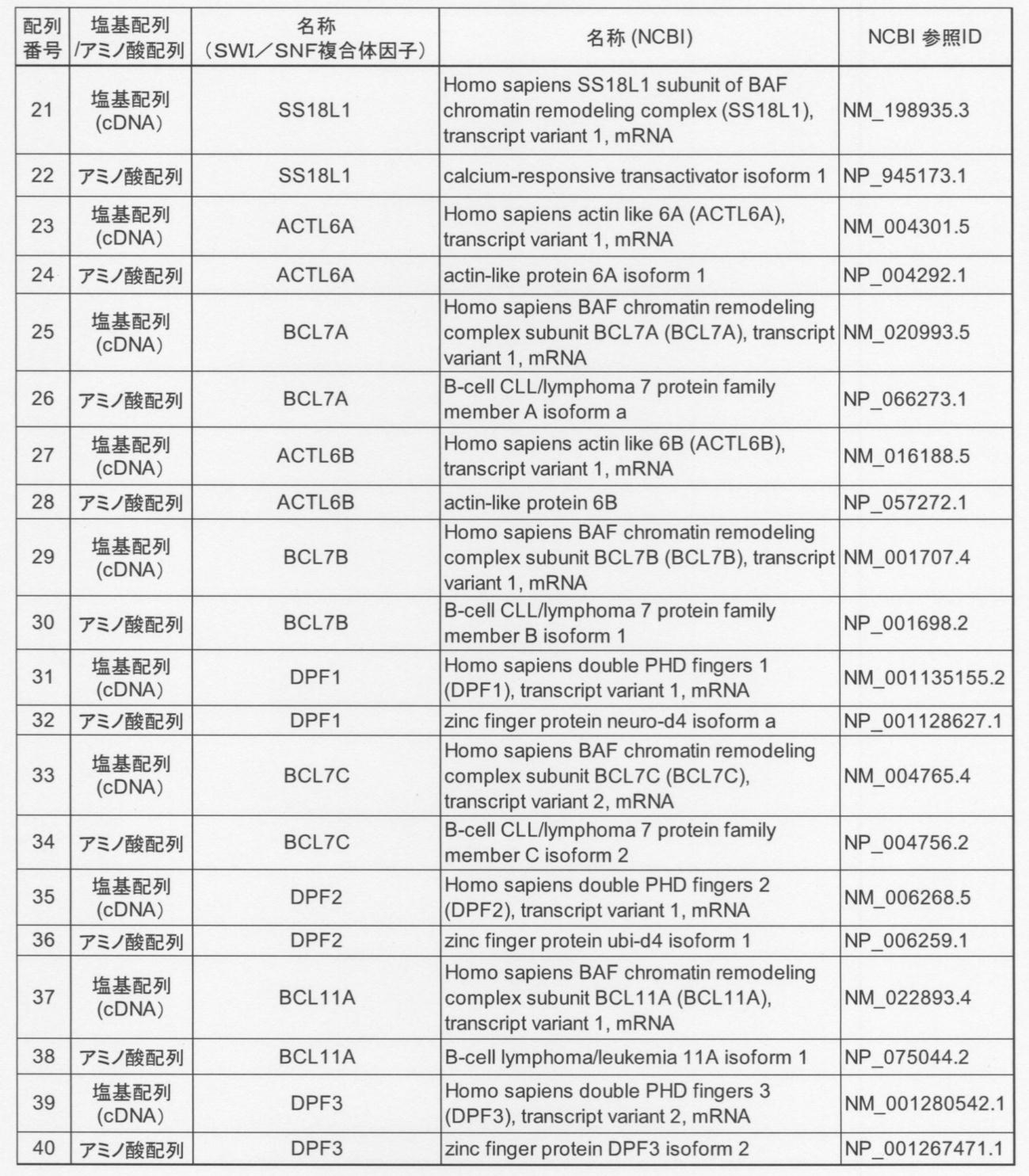

「SWI/SNF複合体の活性低下」とは、SWI/SNF複合体が本来有している活性が低下していることを意味し、通常、対照(例えば、健常者や同一患者の非がん組織における活性レベル)との比較において、それよりも活性レベルが低いことを意味する。また、「SWI/SNF複合体の活性低下」には、SWI/SNF複合体の一部又は全部の不活性化及び活性低下の双方が含まれる。
本発明における「SWI/SNF複合体の直接的活性低下の検出」の方法としては、特に制限はないが、例えば、生物学的試料からSWI/SNF複合体を免疫沈降等の手法によって精製し、クロマチンリモデリング活性を測定することによって確認することができる(Michael L. Phelanら,Molecular Cell,Vol.3,p.247-253,February,1999,Reconstitution of a Core Chromatin Remodeling Complex from SWI/SNF Subunits等)。前記活性が対照との比較において低下している場合、前記SWI/SNF複合体の活性低下が検出されたと判定することができる。
SWI/SNF複合体の活性低下は、典型的には、当該複合体を構成するSWI/SNF複合体因子の遺伝子(SWI/SNF複合体因子をコードするDNA)における機能欠失型変異に起因するものである。そのため、SWI/SNF複合体因子の遺伝子の変異の検出をSWI/SNF複合体の活性低下として検出することができる。
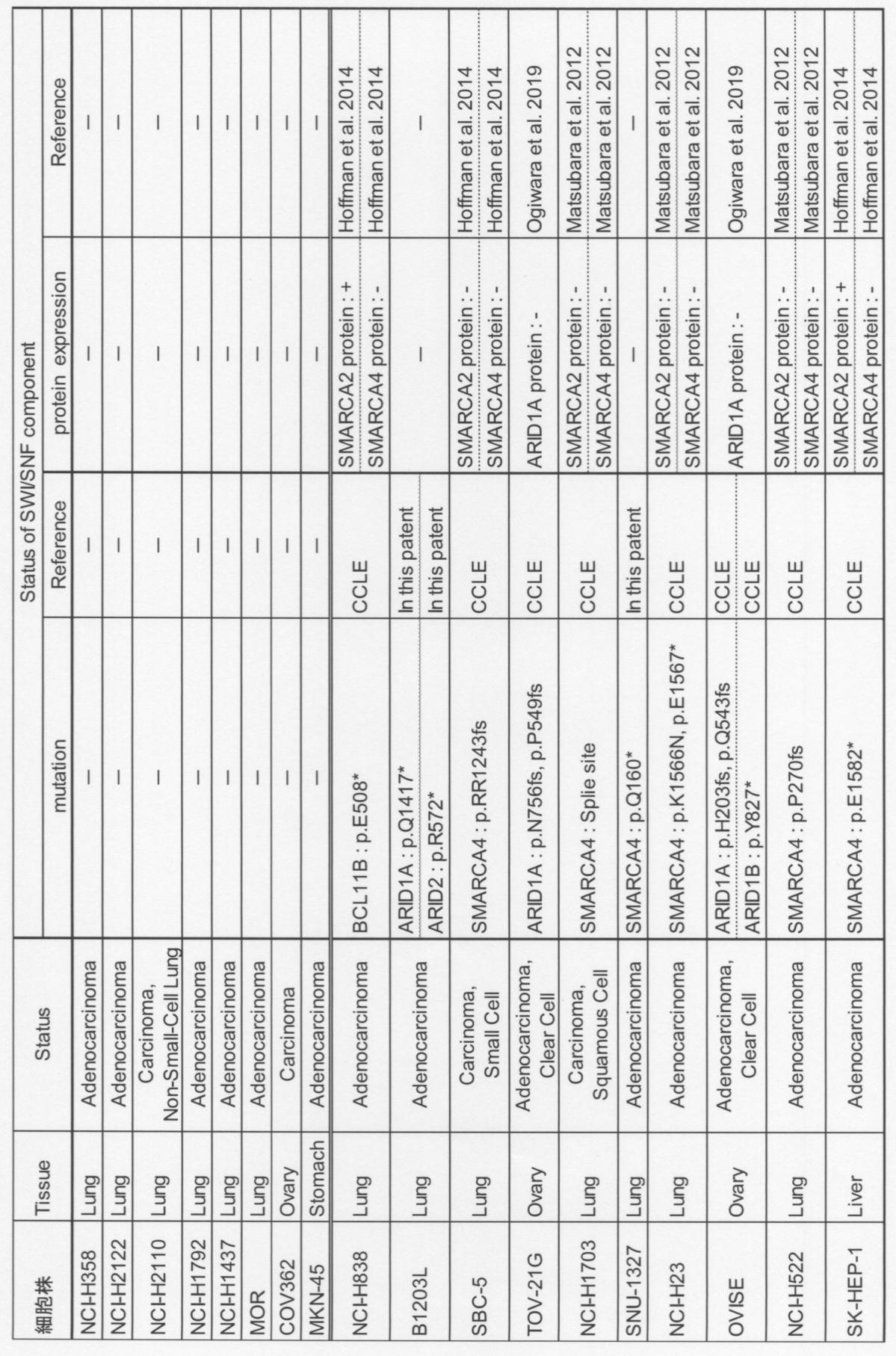
「SWI/SNF複合体因子の発現低下」とは、通常、対照(例えば、健常者や同一患者の非がん組織における発現レベル)との比較において、これよりも発現量が少ないことを意味する。「SWI/SNF複合体因子の発現低下」の検出法としては、SWI/SNF複合体因子の発現量を転写レベル又は翻訳レベルで検出し、前記対照と比較する方法が挙げられる。
こうして生物学的試料からSWI/SNF複合体因子の機能抑制の検出がされた場合、当該生物学的試料ががん細胞である場合には、当該がん細胞は、GPX4阻害剤に対して感受性があると予測することができ、また、当該生物学的試料ががん患者由来の試料に含まれるがん細胞である場合には、当該がん細胞において前記変異が検出されたがん患者を、GPX4阻害剤による治療に対して感受性があると予測することができ、さらに、当該がん患者を、GPX4阻害剤によるがん治療の対象として選別することができる。
さらに、本発明に係るGPX4阻害剤の標的であるGPX4が正常に発現していない場合には、GPX4阻害剤によるがん治療を効果的に実施することができないおそれがある。したがって、がん細胞感受性予測方法、がん患者感受性予測方法、及びがん患者選別方法においては、さらに、GPX4の遺伝子の変異及び発現低下の検出も指標に加えることができる。
本発明は、
GPX4阻害剤と、前記SWI/SNF複合体因子の機能抑制が検出されるがん細胞とを接触させる工程
を含む、SWI/SNF複合体因子の機能抑制が検出されるがん細胞の増殖を抑制する方法(以下、場合により「がん細胞増殖抑制方法」という)、並びに、
(a)がん患者由来の試料に含まれるがん細胞におけるSWI/SNF複合体因子の機能抑制の有無を検出する工程と、
(b)前記がん細胞において前記SWI/SNF複合体因子の機能抑制が検出されたがん患者に対して、GPX4阻害剤を投与する工程と、
を含む、がんを治療する方法(本明細書中、場合により「がん治療方法」という)も提供する。
また、本発明は、上記の方法において、SWI/SNF複合体因子の機能抑制の有無を検出するための試薬であり、
(i)SWI/SNF複合体因子の遺伝子に特異的に結合するオリゴヌクレオチドプライマー、
(ii)SWI/SNF複合体因子の遺伝子に特異的に結合するオリゴヌクレオチドプローブ、及び
(iii)SWI/SNF複合体因子タンパク質に特異的に結合する抗体、
のうちのいずれかの分子を有効成分とする試薬を提供する。
本発明は、
GPX4を阻害するか否かを指標として化合物を選別する工程
を含む、SWI/SNF複合体因子の機能抑制が検出されるがん細胞を含むがんの治療に用いる化合物のスクリーニング方法(以下、場合により「化合物のスクリーニング方法」という)も提供する。
GPX4を阻害する化合物を有効成分として含有し、SWI/SNF複合体因子の機能抑制が検出されるがん細胞を含むがんの治療剤である、がん治療剤も提供することができる。
(1)細胞株
上記の表4に記載のがん細胞株、NCI-H358、NCI-H2122、NCI-H2110、NCI-H1792、NCI-H1437、MOR、COV362、MKN-45、NCI-H838、B1203L(Int J Canser. 2006; 118:1992-7)、SBC-5、TOV-21G、NCI-H1703、SNU-1327、NCI-H23、OVISE、NCI-H522、及びSK-HEP-1を本発明の試験対象の細胞株として用いた。各細胞株の入手元は下記の表5に示す。上記の表4に示すように、NCI-H23、NCI-H522、SBC-5、SK-HEP-1、SNU-1327は、SMARCA4の遺伝子に短縮型の欠損変異を有するヒトがん細胞株であり、NCI-H1703はSMARCA4の遺伝子のスプライシングサイトに変異を有するヒトがん細胞株である。また、NCI-H1703、NCI-H23、NCI-H522、SBC-5、SK-HEP-1、NCI-H838は、イムノブロット分析においてSMARCA4タンパク質の発現が検出されないヒトがん細胞株である。また、NCI-H1703、NCI-H23、NCI-H522、SBC-5は、イムノブロット分析においてSMARCA2タンパク質が検出されないヒトがん細胞株である。B1203L、OVISE、TOV-21Gは、ARID1Aの遺伝子に短縮型の欠損変異を有するヒトがん細胞株であり、B1203LはARID2の遺伝子に短縮型の欠損変異を有するヒトがん細胞株であり、OVISEはARID1Bの遺伝子に短縮型の欠損変異を有するヒトがん細胞株であり、NCI-H838はBCL11Bの遺伝子に短縮型の欠損変異を有するヒトがん細胞株である。他方、NCI-H358、NCI-H2122、NCI-H2110、NCI-H1792、NCI-H1437、MOR、COV362、及びMKN-45は、SWI/SNF複合体因子の遺伝子の機能欠失型変異及びタンパク質の発現に関する情報が公表されていないヒトがん細胞株である。
GPX4の発現抑制には、ON-TARGETplus individual siRNA(Dharmacon社製)を用いた。トランスフェクションには、Lipofectamine RNAiMAX(Thermo Fisher Scientific社製、商品コード:13778150)を用いた。また、陰性対照には非標的化siRNA(ON-TARGET plus Non-targeting Control、Dharmacon社商品コード:D-001810-01、配列番号:60)を、陽性対照にはPLK1(Dharmacon社商品コード:J-003290-09、配列番号:59)を用いた。各siRNAの希釈には5×siRNA buffer(Dharmacon社製:B-002000-UB-100)をnuclease free water(Ambion社製:AM9932)を用いて5倍希釈した1×siRNA bufferを用いて溶解した。
上記(1)の表4に示す各がん細胞株において、GPX4の発現抑制による細胞増殖抑制活性を評価した。96ウェルプレート(Greiner bio-one社製)に各細胞株を下記の表5に記載の播種数(1)又は播種数(2)となるように100μL/wellずつ播種した。トランスフェクション評価には、下記の表6に示す、GPX4 siRNA(#1、#2、#3)、陰性対照(ON-TARGET plus Non-targeting Control)、陽性対照(PLK1 siRNA)を用いた。各siRNAは終濃度0.1~10nMとし、トランスフェクションには、Lipofectamine RNAiMAX(Thermo Fisher Scientific社製、商品コード:13778150)を用いた。7日間培養後、CellTiter-Glo2.0 Cell Viability Assay(Promega社製)を用いて細胞生存のマーカーである細胞内ATPを測定した。GPX4の発現抑制をした際の細胞増殖阻害率は、陰性対照をトランスフェクションして7日間培養後の値及び陽性対照をトランスフェクションして7日間培養後の値を、それぞれ、0%及び100%として算出した。
各がん細胞株において、GPX4阻害剤による細胞増殖抑制活性を評価した。GPX4阻害剤には、GPX4の酵素活性を阻害する化合物であることが報告されている、低分子のGPX4阻害剤であるML210(CAS番号:1360705-96-9):


各がん細胞株において、GPX familyタンパク質であるGPX1~GPX8の発現抑制による細胞増殖抑制活性を評価した。96ウェルプレートに各細胞株を下記の表5に記載の播種数(2)となるように100μL/wellずつ播種した。トランスフェクション評価には、下記の表6に示す、GPX1 siRNA(#1、#2)、GPX2 siRNA(#1、#2)、GPX3 siRNA(#1、#2)、GPX4 siRNA(#1、#2)、GPX5 siRNA(#1、#2)、GPX6 siRNA(#1、#2)、GPX7 siRNA(#1、#2)、及びGPX8 siRNA(#1、#2)(いずれもDharmacon社)をそれぞれ用いた。各siRNAは終濃度5nM又は10nMとし、トランスフェクションにはLipofectamine RNAiMAX(Thermo Fisher Scientific社商品コード:13778150)を用いた。7日間培養後、CellTiter-Glo2.0 Cell Viability Assay(Promega社製)を用いて細胞生存のマーカーである細胞内ATPを測定した。各GPX familyタンパク質の発現抑制をした際の細胞増殖阻害率は、陰性対照をトランスフェクションして7日間培養後の値及び陽性対照をトランスフェクションして7日間培養後の値を、それぞれ、0%及び100%として算出した。NCI-H2110、NCI-H522、及びNCI-H23の各細胞株における各GPX familyタンパク質の発現抑制をした際の細胞増殖阻害率(CGI(%))を図6に示す。
各がん細胞株において、グルタチオン合成に関与するタンパク質(グルタチオン合成関与タンパク質)の発現抑制による細胞増殖抑制活性を評価した。96ウェルプレートに各細胞株を下記の表5に記載の播種数(2)となるように100μL/wellずつ播種した。トランスフェクション評価には、下記の表6に示す、GPX4 siRNA(#1、#2)、GCLC siRNA(#1、#2)、GCLM siRNA(#1、#2)、GSS siRNA(#1、#2)、MGST1 siRNA(#1、#2)、MGST3 siRNA(#1、#2)、GSR siRNA(#1、#2)、及びG6PD siRNA(#1、#2)(いずれもDharmacon社)をそれぞれ用いた。各siRNAは終濃度5nMとし、トランスフェクションにはLipofectamine RNAiMAX(Thermo Fisher Scientific社商品コード:13778150)を用いた。7日間培養後、CellTiter-Glo2.0 Cell Viability Assay(Promega社製)を用いて細胞生存のマーカーである細胞内ATPを測定した。各グルタチオン合成関与タンパク質の発現抑制をした際の細胞増殖阻害率は、陰性対照をトランスフェクションして7日間培養後の値及び陽性対照をトランスフェクションして7日間培養後の値を、それぞれ、0%及び100%として算出した。NCI-H2110、NCI-H522、及びNCI-H23の各細胞株における各グルタチオン合成関与タンパク質の発現抑制をした際の細胞増殖阻害率(CGI(%))を図7に示す。
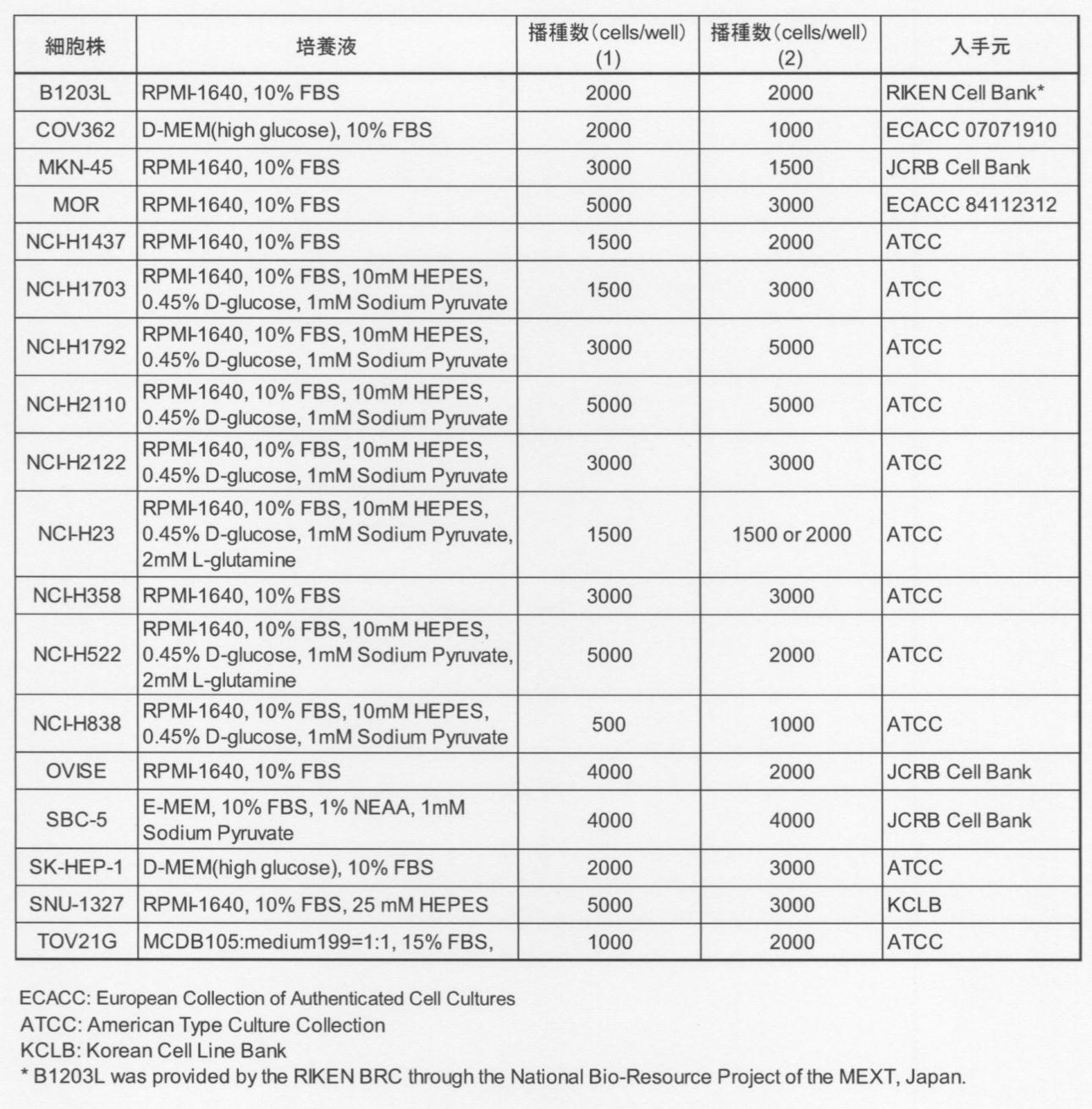
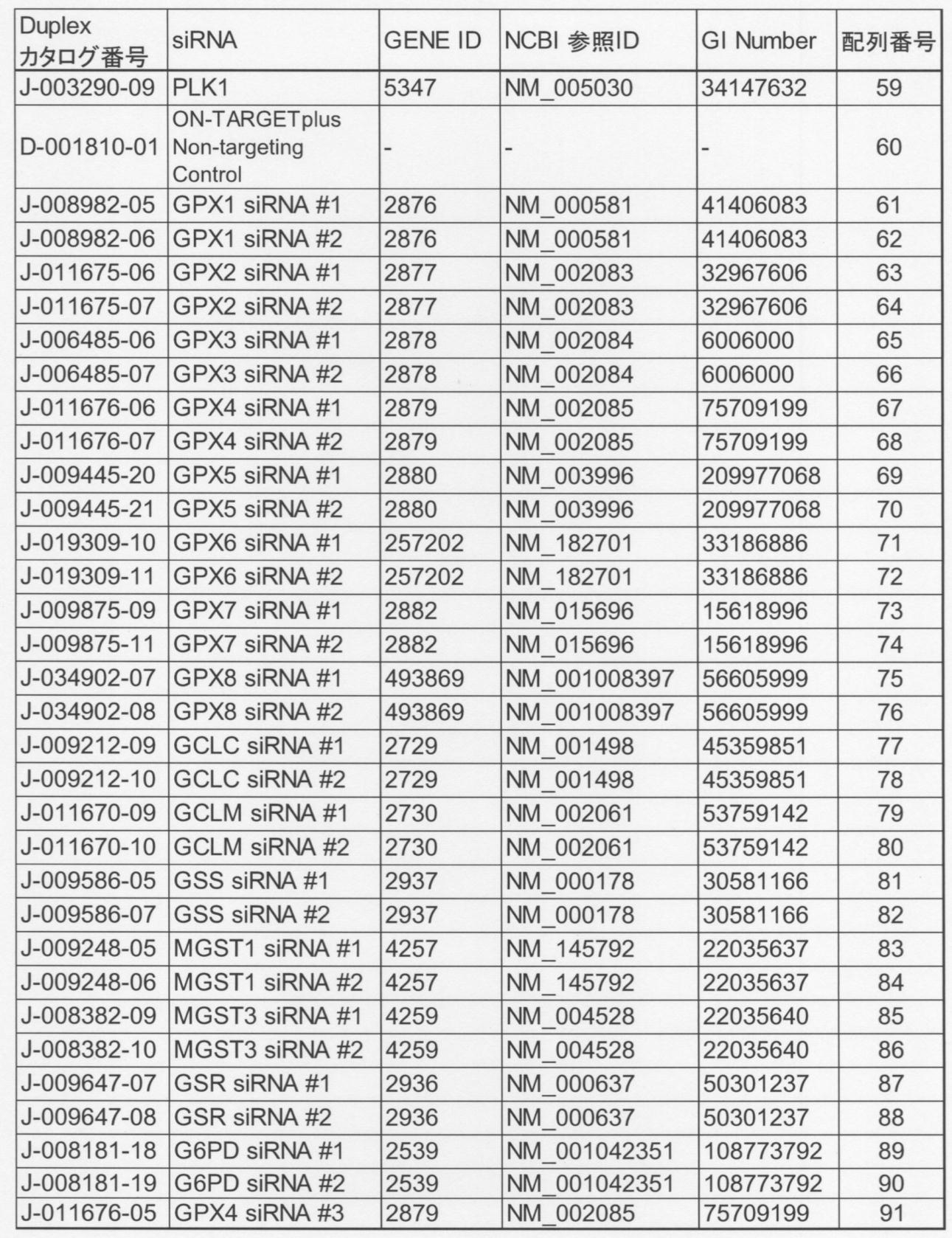
各がん細胞株において、GPX4阻害剤による細胞増殖抑制活性を評価した。GPX4阻害剤には、上記のML210又はRSL3を用いた。また、比較対照として、グルタチオン合成に関与するタンパク質GCLC(グルタチオン合成の律速酵素であるGlutamate-cysteine ligase(GCL)の触媒サブユニット)の阻害剤であるbuthionine sulphoximine(BSO、CAS番号:83730-53-4):
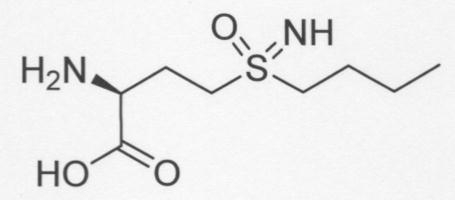
In vivoでのSWI/SNF複合体因子欠損がんに対するGPX4阻害剤の有効性を検討するために、SK-HEP-1(SMARCA4の機能抑制型のヒトがん細胞株)を移植したマウス(SK-HEP-1担癌マウス)に対するML210の投与試験を行った。具体的には、先ず、SK-HEP-1をin vitroで培養し、マウスへの移植当日に2.5g/L-Tripsin/1mmol-EDTA Solution(ナカライテスク社製、商品コード:35554-64)を用いて回収し、Hanks’Balanced Salt solution(Sigma-Aldrich社製、商品コード:H9269)で希釈したMatrigel(Corning社製、商品コード:356234)溶液(最終濃度50%)に細胞を2.5E7 cells/mLとなるように懸濁した。調製した細胞懸濁液を、BALB/c-nu/nuマウス(CAnN.Cg-Foxn1<nu>/CrlCrlj、Charles River社)の鼠蹊部に0.2mLずつ移植した。
(1)GPX4の発現抑制試験
図1に示したように、GPX4の発現抑制試験では、SWI/SNF複合体因子であるSMARCA4の遺伝子に欠損変異を有する、及び/又は、イムノブロット解析によってSMARCA4タンパク質が検出されないがん細胞株において、細胞増殖阻害率が90%以上と、顕著な細胞増殖阻害が認められた。さらに、図2及び図3に示したように、SMARCA4の他にも、別のSWI/SNF複合体因子(例えば、SMARCA2、ARID1A、ARID1B、ARID2、BCL11B)の少なくともいずれかの遺伝子に欠損変異を有する、及び/又は、これら因子の少なくともいずれかの発現がイムノブロット解析によって検出されないがん細胞株においても、GPX4の発現抑制をした際の細胞増殖阻害率が90%以上と、顕著な細胞増殖阻害が認められた。これらの結果から、SWI/SNF複合体因子の機能抑制が生じているがん細胞株の生存は、GPX4の機能に強く依存していることが示された。
また、図4及び図5に示したように、GPX4の活性阻害試験1では、SWI/SNF複合体因子(例えば、SMARCA4、SMARCA2、ARID1A、ARID1B、ARID2、BCL11B)の少なくともいずれかの遺伝子に欠損変異を有する、及び/又は、これら因子の少なくともいずれかの発現がイムノブロット解析によって検出されないがん細胞株に対して、GPX4阻害剤を添加した場合には、SWI/SNF複合体因子の機能抑制が生じていない細胞株に比べて、顕著な細胞増殖阻害が認められた。
図6に示したように、GPX familyタンパク質の発現抑制試験では、SWI/SNF複合体因子であるSMARCA4の遺伝子に欠損変異を有する、及び/又は、イムノブロット解析によってSMARCA4タンパク質が検出されないがん細胞株において、GPX familyタンパク質の中でも、特にGPX4の発現を抑制した場合にのみ、顕著な細胞増殖阻害が認められた。この結果から、SWI/SNF複合体因子(例えば、SMARCA4)の機能抑制が生じているがん細胞に対して抗腫瘍活性を得るためには、GPX4を阻害することが重要であることが示された。
図7に示したように、グルタチオン合成関与タンパク質の発現抑制試験では、SWI/SNF複合体因子であるSMARCA4の遺伝子に欠損変異を有する、及び/又は、イムノブロット解析によってSMARCA4タンパク質が検出されないがん細胞株において、グルタチオン合成関与タンパク質の中でも、特にGPX4の発現を抑制した場合にのみ、顕著な細胞増殖阻害が認められた。この結果からも、SWI/SNF複合体因子(例えば、SMARCA4)の機能抑制が生じているがん細胞に対して抗腫瘍活性を得るためには、GPX4を阻害することが重要であることが示された。
図8に示したように、GPX4の活性阻害試験2では、SWI/SNF複合体因子であるSMARCA4の遺伝子に欠損変異を有する、及び/又は、イムノブロット解析によってSMARCA4タンパク質が検出されないがん細胞株に対して、GPX4阻害剤を添加した場合には、GCLC阻害剤であるBSOと比較して顕著な細胞増殖阻害が認められた。この結果からも、SWI/SNF複合体因子(例えば、SMARCA4)の機能抑制が生じているがん細胞に対して抗腫瘍活性を得るためには、GPX4の阻害をすることが有効であることが示された。
図9に示したように、GPX4阻害剤は、SWI/SNF複合体因子であるSMARCA4の遺伝子に欠損変異を有する、及び/又は、イムノブロット解析によってSMARCA4タンパク質が検出されないがん細胞(SMARCA4の機能抑制型のがん細胞)を含むがん(腫瘍)に対して、in vivoでも抗腫瘍活性を示した。具体的には、SK-HEP-1担癌マウスに対してML210を投与した群においては、Vehicleを投与した群と比較して腫瘍の体積の増大が抑制され、顕著な抗腫瘍活性が認められた。
<223> Xaaはセレノシステインを示す
配列番号:59
<223> PLK1
配列番号:60
<223> ON-TARGETplus Non-targeting Control
配列番号:61
<223> GPX1 siRNA #1
配列番号:62
<223> GPX1 siRNA #2
配列番号:63
<223> GPX2 siRNA #1
配列番号:64
<223> GPX2 siRNA #2
配列番号:65
<223> GPX3 siRNA #1
配列番号:66
<223> GPX3 siRNA #2
配列番号:67
<223> GPX4 siRNA #1
配列番号:68
<223> GPX4 siRNA #2
配列番号:69
<223> GPX5 siRNA #1
配列番号:70
<223> GPX5 siRNA #2
配列番号:71
<223> GPX6 siRNA #1
配列番号:72
<223> GPX6 siRNA #2
配列番号:73
<223> GPX7 siRNA #1
配列番号:74
<223> GPX7 siRNA #2
配列番号:75
<223> GPX8 siRNA #1
配列番号:76
<223> GPX8 siRNA #2
配列番号:77
<223> GCLC siRNA #1
配列番号:78
<223> GCLC siRNA #2
配列番号:79
<223> GCLM siRNA #1
配列番号:80
<223> GCLM siRNA #2
配列番号:81
<223> GSS siRNA #1
配列番号:82
<223> GSS siRNA #2
配列番号:83
<223> MGST1 siRNA #1
配列番号:84
<223> MGST1 siRNA #2
配列番号:85
<223> MGST3 siRNA #1
配列番号:86
<223> MGST3 siRNA #2
配列番号:87
<223> GSR siRNA #1
配列番号:88
<223> GSR siRNA #2
配列番号:89
<223> G6PD siRNA #1
配列番号:90
<223> G6PD siRNA #2
配列番号:91
<223> GPX4 siRNA #3
Claims (17)
- GPX4を阻害する化合物を有効成分として含有し、SWI/SNF複合体因子の機能抑制が検出されるがん細胞を含むがんの治療剤である、がん治療剤。
- GPX4を阻害する化合物を有効成分として含有し、がん患者由来の試料に含まれるがん細胞においてSWI/SNF複合体因子の機能抑制が検出されるがん患者を治療するための治療剤である、がん治療剤。
- GPX4を阻害する化合物を有効成分として含有し、がん患者由来の試料に含まれるがん細胞においてSWI/SNF複合体因子の機能抑制が検出されるがん患者に投与するための治療剤である、がん治療剤。
- がん細胞の、GPX4阻害剤に対する感受性を予測する方法であり、
がん細胞におけるSWI/SNF複合体因子の機能抑制が検出されたがん細胞を、GPX4阻害剤に対して感受性があると予測する工程、
を含む、方法。 - がん患者の、GPX4阻害剤による治療に対する感受性を予測する方法であり、
がん患者由来の試料に含まれるがん細胞においてSWI/SNF複合体因子の機能抑制が検出されたがん患者を、GPX4阻害剤による治療に対して感受性があると予測する工程、
を含む、方法。 - GPX4阻害剤によるがん治療の対象とするがん患者を選別する方法であり、
がん患者由来の試料に含まれるがん細胞においてSWI/SNF複合体因子の機能抑制が検出されたがん患者を、GPX4阻害剤によるがん治療の対象として選別する工程、
を含む、方法。 - SWI/SNF複合体因子の機能抑制が検出されるがん細胞の増殖を抑制する方法であり、
GPX4阻害剤と、前記SWI/SNF複合体因子の機能抑制が検出されるがん細胞とを接触させる工程、
を含む、方法。 - がんを治療する方法であり、
がん患者由来の試料に含まれるがん細胞においてSWI/SNF複合体因子の機能抑制が検出されたがん患者に対して、GPX4阻害剤を投与する工程、
を含む、方法。 - SWI/SNF複合体因子の機能抑制が検出されるがん細胞を含むがんの治療に用いる化合物のスクリーニング方法であり、
GPX4を阻害するか否かを指標として化合物を選別する工程、
を含む、方法。 - 前記SWI/SNF複合体因子がBAF複合体因子である、請求項1~3のうちのいずれか一項に記載のがん治療剤。
- 前記SWI/SNF複合体因子がBAF複合体因子である、請求項4~9のうちのいずれか一項に記載の方法。
- 前記SWI/SNF複合体因子が、SMARCA2、SMARCA4、ARID1A、ARID1B、ARID2、及びBCL11Bからなる群から選択される少なくとも1種である、請求項1~3のうちのいずれか一項に記載のがん治療剤。
- 前記SWI/SNF複合体因子が、SMARCA2、SMARCA4、ARID1A、ARID1B、ARID2、及びBCL11Bからなる群から選択される少なくとも1種である、請求項4~9のうちのいずれか一項に記載の方法。
- 前記SWI/SNF複合体因子の機能抑制が、前記SWI/SNF複合体因子を構成因子とするSWI/SNF複合体の活性低下及び/又は前記SWI/SNF複合体因子の発現低下である、請求項1~3のうちのいずれか一項に記載のがん治療剤。
- 前記SWI/SNF複合体因子の機能抑制が、前記SWI/SNF複合体因子を構成因子とするSWI/SNF複合体の活性低下及び/又は前記SWI/SNF複合体因子の発現低下である、請求項4~9のうちのいずれか一項に記載の方法。
- 前記SWI/SNF複合体因子の機能抑制が、前記SWI/SNF複合体因子の遺伝子の機能欠失型変異である、請求項1~3のうちのいずれか一項に記載のがん治療剤。
- 前記SWI/SNF複合体因子の機能抑制が、前記SWI/SNF複合体因子の遺伝子の機能欠失型変異である、請求項4~9のうちのいずれか一項に記載の方法。
Priority Applications (6)
| Application Number | Priority Date | Filing Date | Title |
|---|---|---|---|
| JP2021567688A JPWO2021132592A1 (ja) | 2019-12-26 | 2020-12-25 | |
| US17/785,484 US12529701B2 (en) | 2019-12-26 | 2020-12-25 | Method for predicting sensitivity of cancer cell to GPX4 inhibitor |
| EP20906713.1A EP4082575A4 (en) | 2019-12-26 | 2020-12-25 | METHOD FOR PREDICTING THE SENSITIVITY OF CANCER CELLS TO GPX4 INHIBITORS |
| CN202080071348.3A CN114555122A (zh) | 2019-12-26 | 2020-12-25 | 预测癌症细胞对gpx4抑制剂敏感性的方法 |
| JP2025136970A JP2025164846A (ja) | 2019-12-26 | 2025-08-20 | Gpx4阻害剤に対するがん細胞の感受性を予測する方法 |
| US19/415,883 US20260098862A1 (en) | 2019-12-26 | 2025-12-11 | Method for predicting sensitivity of cancer cell to gpx4 inhibitor |
Applications Claiming Priority (2)
| Application Number | Priority Date | Filing Date | Title |
|---|---|---|---|
| JP2019236516 | 2019-12-26 | ||
| JP2019-236516 | 2019-12-26 |
Related Child Applications (2)
| Application Number | Title | Priority Date | Filing Date |
|---|---|---|---|
| US17/785,484 A-371-Of-International US12529701B2 (en) | 2019-12-26 | 2020-12-25 | Method for predicting sensitivity of cancer cell to GPX4 inhibitor |
| US19/415,883 Continuation US20260098862A1 (en) | 2019-12-26 | 2025-12-11 | Method for predicting sensitivity of cancer cell to gpx4 inhibitor |
Publications (1)
| Publication Number | Publication Date |
|---|---|
| WO2021132592A1 true WO2021132592A1 (ja) | 2021-07-01 |
Family
ID=76574718
Family Applications (1)
| Application Number | Title | Priority Date | Filing Date |
|---|---|---|---|
| PCT/JP2020/048811 Ceased WO2021132592A1 (ja) | 2019-12-26 | 2020-12-25 | Gpx4阻害剤に対するがん細胞の感受性を予測する方法 |
Country Status (5)
| Country | Link |
|---|---|
| US (2) | US12529701B2 (ja) |
| EP (1) | EP4082575A4 (ja) |
| JP (2) | JPWO2021132592A1 (ja) |
| CN (1) | CN114555122A (ja) |
| WO (1) | WO2021132592A1 (ja) |
Cited By (16)
| Publication number | Priority date | Publication date | Assignee | Title |
|---|---|---|---|---|
| US11541116B1 (en) | 2022-01-07 | 2023-01-03 | Kojin Therapeutics, Inc. | Methods and compositions for inducing ferroptosis in vivo |
| WO2024229406A1 (en) | 2023-05-04 | 2024-11-07 | Revolution Medicines, Inc. | Combination therapy for a ras related disease or disorder |
| WO2025034702A1 (en) | 2023-08-07 | 2025-02-13 | Revolution Medicines, Inc. | Rmc-6291 for use in the treatment of ras protein-related disease or disorder |
| WO2025080946A2 (en) | 2023-10-12 | 2025-04-17 | Revolution Medicines, Inc. | Ras inhibitors |
| WO2025171296A1 (en) | 2024-02-09 | 2025-08-14 | Revolution Medicines, Inc. | Ras inhibitors |
| WO2025240847A1 (en) | 2024-05-17 | 2025-11-20 | Revolution Medicines, Inc. | Ras inhibitors |
| WO2025255438A1 (en) | 2024-06-07 | 2025-12-11 | Revolution Medicines, Inc. | Methods of treating a ras protein-related disease or disorder |
| WO2025265060A1 (en) | 2024-06-21 | 2025-12-26 | Revolution Medicines, Inc. | Therapeutic compositions and methods for managing treatment-related effects |
| WO2025263619A1 (ja) * | 2024-06-20 | 2025-12-26 | 学校法人日本医科大学 | グルタチオン代謝関連酵素阻害剤に対するがんの感受性予測方法 |
| WO2026006747A1 (en) | 2024-06-28 | 2026-01-02 | Revolution Medicines, Inc. | Ras inhibitors |
| WO2026015825A1 (en) | 2024-07-12 | 2026-01-15 | Revolution Medicines, Inc. | Use of ras inhibitor for treating pancreatic cancer |
| WO2026015801A1 (en) | 2024-07-12 | 2026-01-15 | Revolution Medicines, Inc. | Methods of treating a ras related disease or disorder |
| WO2026015790A1 (en) | 2024-07-12 | 2026-01-15 | Revolution Medicines, Inc. | Methods of treating a ras related disease or disorder |
| WO2026015796A1 (en) | 2024-07-12 | 2026-01-15 | Revolution Medicines, Inc. | Methods of treating a ras related disease or disorder |
| WO2026050446A1 (en) | 2024-08-29 | 2026-03-05 | Revolution Medicines, Inc. | Ras inhibitors |
| WO2026072904A2 (en) | 2024-09-26 | 2026-04-02 | Revolution Medicines, Inc. | Compositions and methods for treating lung cancer |
Families Citing this family (2)
| Publication number | Priority date | Publication date | Assignee | Title |
|---|---|---|---|---|
| CN116004644A (zh) * | 2023-01-19 | 2023-04-25 | 南京中澳转化医学研究院有限公司 | Smarca4突变体及其在结直肠癌药物开发中的应用 |
| CN117625604A (zh) * | 2023-11-02 | 2024-03-01 | 江南大学 | 基因prdx5和gpx4在制备去势抵抗性前列腺癌的药物中的应用 |
Citations (1)
| Publication number | Priority date | Publication date | Assignee | Title |
|---|---|---|---|---|
| WO1994011523A2 (en) | 1992-11-13 | 1994-05-26 | Idec Pharmaceuticals Corporation | Fully impaired consensus kozac sequences for mammalian expression |
Family Cites Families (2)
| Publication number | Priority date | Publication date | Assignee | Title |
|---|---|---|---|---|
| EP3630089A4 (en) * | 2017-05-24 | 2021-06-09 | Ferro Therapeutics, Inc. | PROCEDURE FOR CANCER THERAPY |
| EP3645739A4 (en) * | 2017-06-28 | 2021-07-14 | The Regents of the University of California | METHODS AND COMPOSITIONS FOR TREATMENT OF MELANOMA |
-
2020
- 2020-12-25 EP EP20906713.1A patent/EP4082575A4/en active Pending
- 2020-12-25 US US17/785,484 patent/US12529701B2/en active Active
- 2020-12-25 JP JP2021567688A patent/JPWO2021132592A1/ja active Pending
- 2020-12-25 CN CN202080071348.3A patent/CN114555122A/zh active Pending
- 2020-12-25 WO PCT/JP2020/048811 patent/WO2021132592A1/ja not_active Ceased
-
2025
- 2025-08-20 JP JP2025136970A patent/JP2025164846A/ja active Pending
- 2025-12-11 US US19/415,883 patent/US20260098862A1/en active Pending
Patent Citations (1)
| Publication number | Priority date | Publication date | Assignee | Title |
|---|---|---|---|---|
| WO1994011523A2 (en) | 1992-11-13 | 1994-05-26 | Idec Pharmaceuticals Corporation | Fully impaired consensus kozac sequences for mammalian expression |
Non-Patent Citations (22)
| Title |
|---|
| BROAD INSTITUTE: ''CANCER CELL LINE ENCYCLOPEDIA, Retrieved from the Internet <URL:https://portals.broadinstitute.org/ccle> |
| D. ROSS CAMIDGE ET AL., J THORAC ONCOL, vol. 14, no. 7, July 2019 (2019-07-01), pages 1233 - 1243 |
| HIDEAKI OGIWARA ET AL., CANCER CELL, vol. 35, 2019, pages 177 - 190 |
| HOFFMAN ET AL., PNAS FEBRUARY, vol. 25, no. 8, 2014, pages 3128 - 3133 |
| INT J CANCER, vol. 118, 2006, pages 1992 - 7 |
| KOHLERMILSTEIN, NATURE, vol. 256, 1975, pages 495 |
| MAKOTO MAEMONDO ET AL., NEJM, vol. 362, no. 25, 24 June 2010 (2010-06-24), pages 2380 - 2388 |
| MATSUBARA ET AL., CANCER SCI, vol. 104, no. 2, February 2013 (2013-02-01), pages 266 - 273 |
| MICHAEL L. PHELAN ET AL., MOLECULAR CELL, vol. 3, February 1999 (1999-02-01), pages 247 - 253 |
| OGIWARA, H. ET AL.: "Targeting the Vulnerability of Glutathione Metabolism in ARIDIA-Deficient Cancers", CANCER CELL, vol. 35, 11 February 2019 (2019-02-11), pages 177 - 90, XP085598939, ISSN: 1535-6108 * |
| P. J. DELVES: "Antibody Production: Essential Techniques", 1997, WILEY |
| P. SHEPHERDC. DEAN: "Monoclonal Antibodies", 2000, OXFORD UNIVERSITY PRESS |
| PAUL B. CHAPMAN ET AL., NEJM, vol. 364, no. 26, 30 June 2011 (2011-06-30), pages 2507 - 2516 |
| See also references of EP4082575A4 |
| SHINOME ET AL.: "22", ANTIOXID. REDOX SIGNAL., no. 4, pages 281 - 293 |
| VANDAMME AM ET AL.: "Eur. J. Biochem.", vol. 192, 1990, pages: 767 - 775 |
| VISWANATHAN ET AL., NATURE, vol. 547, no. 7664, 27 July 2017 (2017-07-27), pages 453 - 457 |
| VURAL TAGAL ET AL., NAT. COMMUN., vol. 8, 2017, pages 14098 |
| YANG ET AL., CELL, vol. 156, no. 0, 16 January 2014 (2014-01-16), pages 317 - 331 |
| YIBO XUE ET AL.: "10", NAT. COMMUN., 2019, pages 557 |
| YONATHAN LISSANU DERIBE ET AL., NAT. MED., vol. 24, July 2018 (2018-07-01), pages 1047 - 1057 |
| ZOU, Y. ET AL.: "A GPX4-dependent cancer cell state underlies the clear- cell morphology and confers sensitivity to ferroptosis", NAT COMMUN, vol. 10, no. 1617, 8 April 2019 (2019-04-08), pages 1 - 13, XP055798511, ISSN: 2041-1723 * |
Cited By (16)
| Publication number | Priority date | Publication date | Assignee | Title |
|---|---|---|---|---|
| US11541116B1 (en) | 2022-01-07 | 2023-01-03 | Kojin Therapeutics, Inc. | Methods and compositions for inducing ferroptosis in vivo |
| WO2024229406A1 (en) | 2023-05-04 | 2024-11-07 | Revolution Medicines, Inc. | Combination therapy for a ras related disease or disorder |
| WO2025034702A1 (en) | 2023-08-07 | 2025-02-13 | Revolution Medicines, Inc. | Rmc-6291 for use in the treatment of ras protein-related disease or disorder |
| WO2025080946A2 (en) | 2023-10-12 | 2025-04-17 | Revolution Medicines, Inc. | Ras inhibitors |
| WO2025171296A1 (en) | 2024-02-09 | 2025-08-14 | Revolution Medicines, Inc. | Ras inhibitors |
| WO2025240847A1 (en) | 2024-05-17 | 2025-11-20 | Revolution Medicines, Inc. | Ras inhibitors |
| WO2025255438A1 (en) | 2024-06-07 | 2025-12-11 | Revolution Medicines, Inc. | Methods of treating a ras protein-related disease or disorder |
| WO2025263619A1 (ja) * | 2024-06-20 | 2025-12-26 | 学校法人日本医科大学 | グルタチオン代謝関連酵素阻害剤に対するがんの感受性予測方法 |
| WO2025265060A1 (en) | 2024-06-21 | 2025-12-26 | Revolution Medicines, Inc. | Therapeutic compositions and methods for managing treatment-related effects |
| WO2026006747A1 (en) | 2024-06-28 | 2026-01-02 | Revolution Medicines, Inc. | Ras inhibitors |
| WO2026015825A1 (en) | 2024-07-12 | 2026-01-15 | Revolution Medicines, Inc. | Use of ras inhibitor for treating pancreatic cancer |
| WO2026015801A1 (en) | 2024-07-12 | 2026-01-15 | Revolution Medicines, Inc. | Methods of treating a ras related disease or disorder |
| WO2026015790A1 (en) | 2024-07-12 | 2026-01-15 | Revolution Medicines, Inc. | Methods of treating a ras related disease or disorder |
| WO2026015796A1 (en) | 2024-07-12 | 2026-01-15 | Revolution Medicines, Inc. | Methods of treating a ras related disease or disorder |
| WO2026050446A1 (en) | 2024-08-29 | 2026-03-05 | Revolution Medicines, Inc. | Ras inhibitors |
| WO2026072904A2 (en) | 2024-09-26 | 2026-04-02 | Revolution Medicines, Inc. | Compositions and methods for treating lung cancer |
Also Published As
| Publication number | Publication date |
|---|---|
| CN114555122A (zh) | 2022-05-27 |
| EP4082575A4 (en) | 2024-01-31 |
| US20230204589A1 (en) | 2023-06-29 |
| US20260098862A1 (en) | 2026-04-09 |
| EP4082575A1 (en) | 2022-11-02 |
| US12529701B2 (en) | 2026-01-20 |
| JP2025164846A (ja) | 2025-10-30 |
| JPWO2021132592A1 (ja) | 2021-07-01 |
Similar Documents
| Publication | Publication Date | Title |
|---|---|---|
| WO2021132592A1 (ja) | Gpx4阻害剤に対するがん細胞の感受性を予測する方法 | |
| EP2300041B1 (en) | Method for determining risk of recurrence of prostate cancer | |
| US10202605B2 (en) | Methods of identifying and treating poor-prognosis cancers | |
| CN101113478A (zh) | 诊断睾丸精原细胞瘤的方法 | |
| WO2007087612A2 (en) | Detection and diagnosis of smoking related cancers | |
| US20190203304A1 (en) | Method for predicting responsiveness to phosphatidylserine synthase 1 inhibitor | |
| WO2019050478A1 (en) | BIOMARKERS OF RENAL CELL CARCINOMA WITH CLEAR CELLS | |
| Tamura et al. | SHISA2 enhances the aggressive phenotype in prostate cancer through the regulation of WNT5A expression | |
| WO2022244807A1 (ja) | Ltk融合遺伝子 | |
| EP3121274B1 (en) | METHOD FOR PREDICTING RESPONSIVENESS TO CANCER TREATMENT USING p300-INHIBITING COMPOUND | |
| US20190105340A1 (en) | Methods and compositions for targeting vascular mimicry | |
| JP7665526B2 (ja) | ヘリカーゼ阻害剤に対するがん細胞の感受性を予測する方法 | |
| CN102618545B (zh) | 与人癌细胞的永生化相关的基因及其应用 | |
| US20200063210A1 (en) | Gene Expression Signatures Associated with Patient Response to Acute Myeloid Leukemia Treatment and Use Thereof for Predicting Response to Therapy | |
| HK40066507A (zh) | 预测癌症细胞对gpx4抑制剂敏感性的方法 | |
| US10745701B2 (en) | Methods of identifying and treating poor-prognosis cancers | |
| HK40067622A (en) | Method for predicting sensitivity of cancer cells to helicase inhibitor | |
| EP4596712A1 (en) | Methods of identifying and using biomarkers | |
| KR102042332B1 (ko) | 간암의 재발 및 예후 예측용 tcirg1 마커 및 이의 용도 | |
| Coenen | Exploring the Role of the ID2 and RAB11FIP3 Pathway in X-Linked Chronic Granulomatous Disease (XCGD) through Comparative Gene Expression Analysis | |
| Dones | INK4a/ARF/INK4b tumor suppressor locus: Its potential role in head and neck cancer tumorigenesis | |
| Al-Ghafari | Drug resistance mechanisms in a high grade glioma cell line |
Legal Events
| Date | Code | Title | Description |
|---|---|---|---|
| 121 | Ep: the epo has been informed by wipo that ep was designated in this application |
Ref document number: 20906713 Country of ref document: EP Kind code of ref document: A1 |
|
| ENP | Entry into the national phase |
Ref document number: 2021567688 Country of ref document: JP Kind code of ref document: A |
|
| NENP | Non-entry into the national phase |
Ref country code: DE |
|
| ENP | Entry into the national phase |
Ref document number: 2020906713 Country of ref document: EP Effective date: 20220726 |
|
| WWG | Wipo information: grant in national office |
Ref document number: 17785484 Country of ref document: US |