WO2021132653A1 - 汚染防止材料 - Google Patents
汚染防止材料 Download PDFInfo
- Publication number
- WO2021132653A1 WO2021132653A1 PCT/JP2020/048971 JP2020048971W WO2021132653A1 WO 2021132653 A1 WO2021132653 A1 WO 2021132653A1 JP 2020048971 W JP2020048971 W JP 2020048971W WO 2021132653 A1 WO2021132653 A1 WO 2021132653A1
- Authority
- WO
- WIPO (PCT)
- Prior art keywords
- group
- groups
- carbon atoms
- membered ring
- acid
- Prior art date
- Legal status (The legal status is an assumption and is not a legal conclusion. Google has not performed a legal analysis and makes no representation as to the accuracy of the status listed.)
- Ceased
Links
Images


Classifications
-
- A—HUMAN NECESSITIES
- A61—MEDICAL OR VETERINARY SCIENCE; HYGIENE
- A61K—PREPARATIONS FOR MEDICAL, DENTAL OR TOILETRY PURPOSES
- A61K8/00—Cosmetics or similar toiletry preparations
- A61K8/18—Cosmetics or similar toiletry preparations characterised by the composition
- A61K8/30—Cosmetics or similar toiletry preparations characterised by the composition containing organic compounds
- A61K8/40—Cosmetics or similar toiletry preparations characterised by the composition containing organic compounds containing nitrogen
- A61K8/44—Aminocarboxylic acids or derivatives thereof, e.g. aminocarboxylic acids containing sulfur; Salts; Esters or N-acylated derivatives thereof
- A61K8/442—Aminocarboxylic acids or derivatives thereof, e.g. aminocarboxylic acids containing sulfur; Salts; Esters or N-acylated derivatives thereof substituted by amido group(s)
-
- A—HUMAN NECESSITIES
- A61—MEDICAL OR VETERINARY SCIENCE; HYGIENE
- A61Q—SPECIFIC USE OF COSMETICS OR SIMILAR TOILETRY PREPARATIONS
- A61Q19/00—Preparations for care of the skin
-
- A—HUMAN NECESSITIES
- A61—MEDICAL OR VETERINARY SCIENCE; HYGIENE
- A61K—PREPARATIONS FOR MEDICAL, DENTAL OR TOILETRY PURPOSES
- A61K8/00—Cosmetics or similar toiletry preparations
- A61K8/18—Cosmetics or similar toiletry preparations characterised by the composition
- A61K8/30—Cosmetics or similar toiletry preparations characterised by the composition containing organic compounds
- A61K8/64—Proteins; Peptides; Derivatives or degradation products thereof
-
- A—HUMAN NECESSITIES
- A61—MEDICAL OR VETERINARY SCIENCE; HYGIENE
- A61Q—SPECIFIC USE OF COSMETICS OR SIMILAR TOILETRY PREPARATIONS
- A61Q17/00—Barrier preparations; Preparations brought into direct contact with the skin for affording protection against external influences, e.g. sunlight, X-rays or other harmful rays, corrosive materials, bacteria or insect stings
-
- A—HUMAN NECESSITIES
- A61—MEDICAL OR VETERINARY SCIENCE; HYGIENE
- A61Q—SPECIFIC USE OF COSMETICS OR SIMILAR TOILETRY PREPARATIONS
- A61Q5/00—Preparations for care of the hair
-
- C—CHEMISTRY; METALLURGY
- C07—ORGANIC CHEMISTRY
- C07K—PEPTIDES
- C07K5/00—Peptides containing up to four amino acids in a fully defined sequence; Derivatives thereof
- C07K5/04—Peptides containing up to four amino acids in a fully defined sequence; Derivatives thereof containing only normal peptide links
- C07K5/06—Dipeptides
- C07K5/06008—Dipeptides with the first amino acid being neutral
- C07K5/06017—Dipeptides with the first amino acid being neutral and aliphatic
- C07K5/06026—Dipeptides with the first amino acid being neutral and aliphatic the side chain containing 0 or 1 carbon atom, i.e. Gly or Ala
-
- C—CHEMISTRY; METALLURGY
- C07—ORGANIC CHEMISTRY
- C07K—PEPTIDES
- C07K5/00—Peptides containing up to four amino acids in a fully defined sequence; Derivatives thereof
- C07K5/04—Peptides containing up to four amino acids in a fully defined sequence; Derivatives thereof containing only normal peptide links
- C07K5/08—Tripeptides
-
- C—CHEMISTRY; METALLURGY
- C07—ORGANIC CHEMISTRY
- C07K—PEPTIDES
- C07K5/00—Peptides containing up to four amino acids in a fully defined sequence; Derivatives thereof
- C07K5/04—Peptides containing up to four amino acids in a fully defined sequence; Derivatives thereof containing only normal peptide links
- C07K5/10—Tetrapeptides
-
- C—CHEMISTRY; METALLURGY
- C09—DYES; PAINTS; POLISHES; NATURAL RESINS; ADHESIVES; COMPOSITIONS NOT OTHERWISE PROVIDED FOR; APPLICATIONS OF MATERIALS NOT OTHERWISE PROVIDED FOR
- C09K—MATERIALS FOR MISCELLANEOUS APPLICATIONS, NOT PROVIDED FOR ELSEWHERE
- C09K3/00—Materials not provided for elsewhere
- C09K3/22—Materials not provided for elsewhere for dust-laying or dust-absorbing
Definitions
- the present invention relates to a contamination-preventing material, and more particularly to a material that prevents the adhesion of dust, pollen, particulate matter, etc. by forming a film on the surface of skin or hair.
- the film formed on the skin and the surface of the hair provides an effective barrier on the skin and the surface of the hair, and thus suppresses the evaporation of water in the skin and the hair. It also plays various important roles in personal care products, such as percutaneous absorption and enhancing the retention of active ingredients that penetrate into the hair.
- a film cosmetic having a self-assembled structure such as one using a layered ⁇ -gel can be mentioned (Patent Document 3).
- a film cosmetic having a self-assembled structure such as one using a layered ⁇ -gel can be mentioned (Patent Document 3).
- hair preparations using polypeptides have been proposed (Patent Documents 4 and 5).
- An object of the present invention is to provide a new material that prevents the adhesion of pollutants by forming a film on the skin or on the surface of hair, and prevents the substances from contaminating the skin and hair surface.
- the present inventors have found that a material containing at least one lipid peptide-type compound prevents the adhesion of pollutants by forming a film on the skin or on the surface of hair, and completed the present invention.
- a lipid peptide in which a peptide portion formed by repeating at least two or more identical or different amino acids is bound to a lipid portion consisting of an aliphatic group having 10 to 24 carbon atoms.
- the present invention relates to an antifouling material, which comprises a type compound.
- the second aspect relates to the anticontamination material according to the first aspect, which can form an anticontamination film on the surface of skin or hair.
- the anticontamination material according to the second aspect which prevents dust, pollen, particulate matter, mites (including carcasses), gaseous substances, or odorous substances from adhering to the surface of the skin or hair.
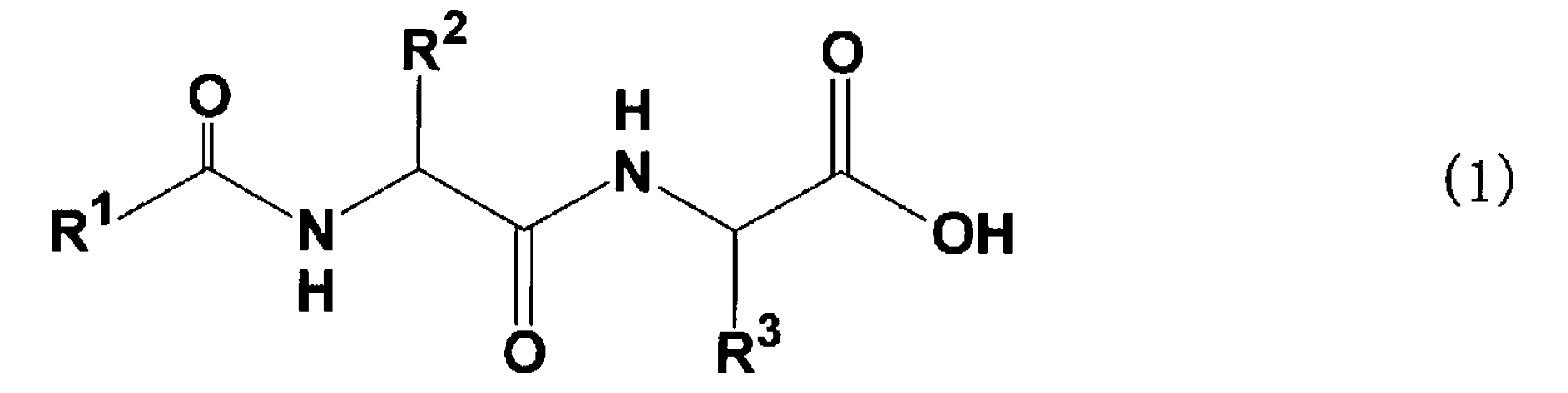
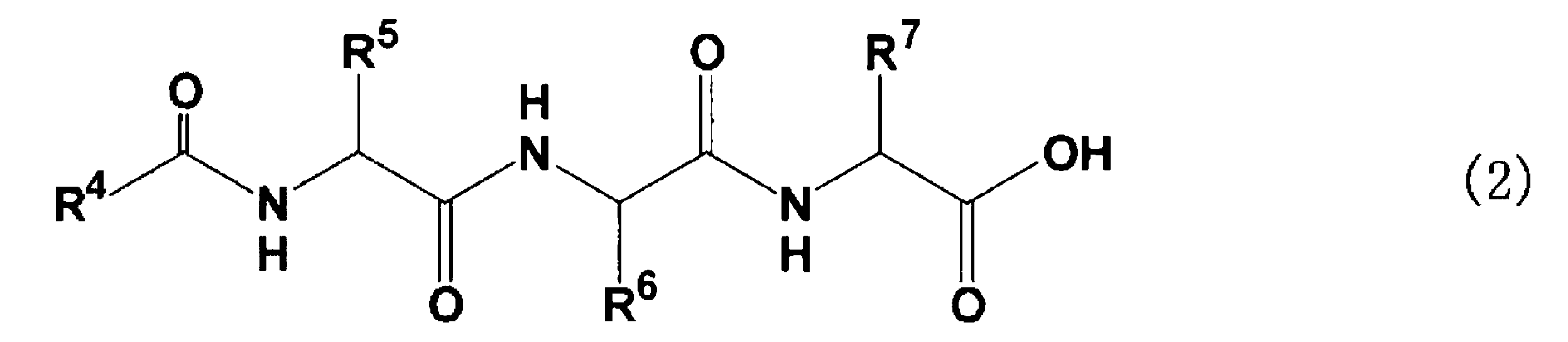
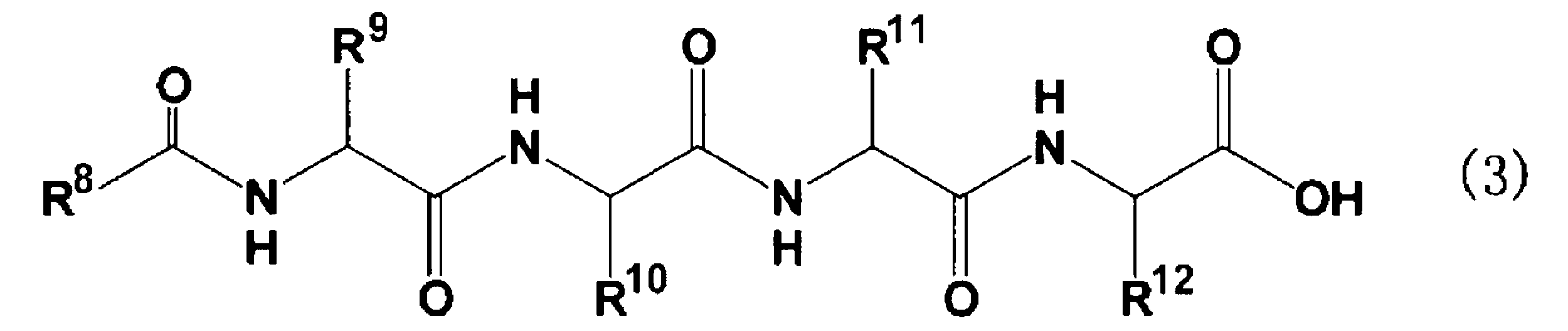
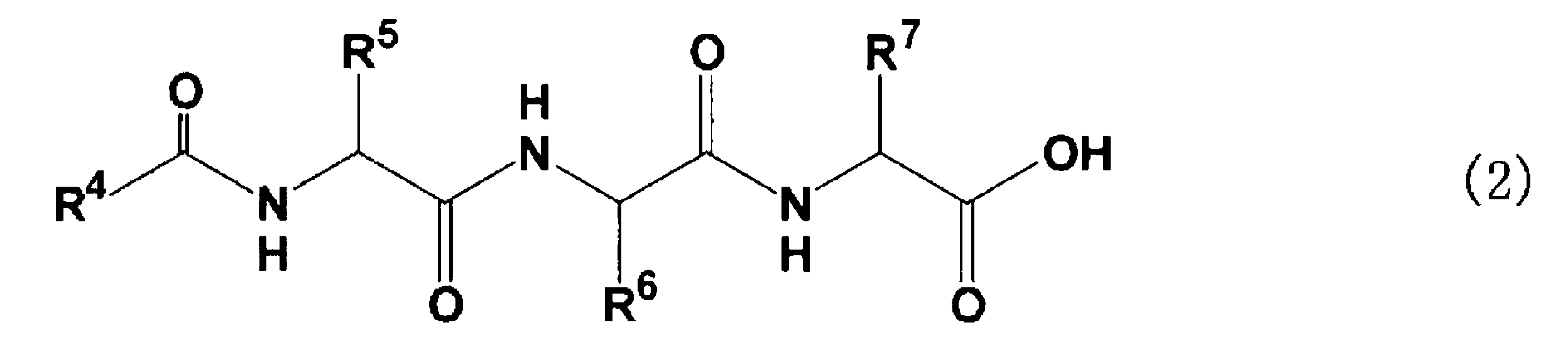
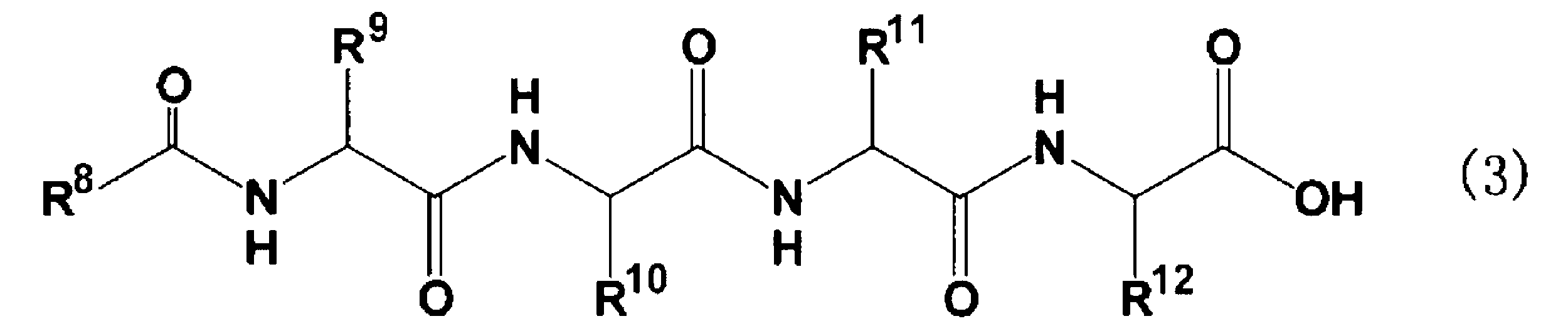
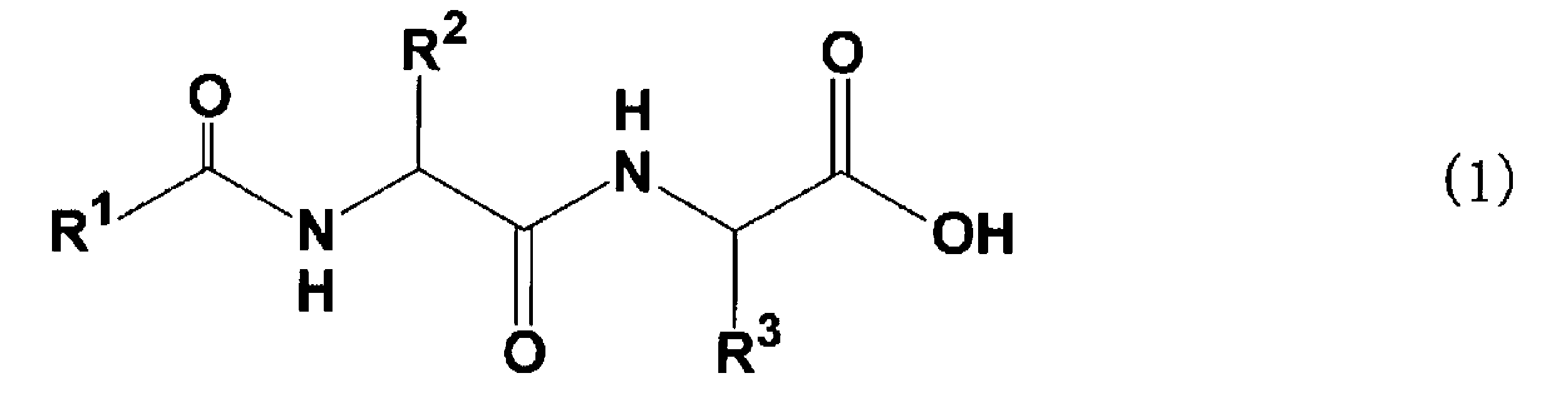
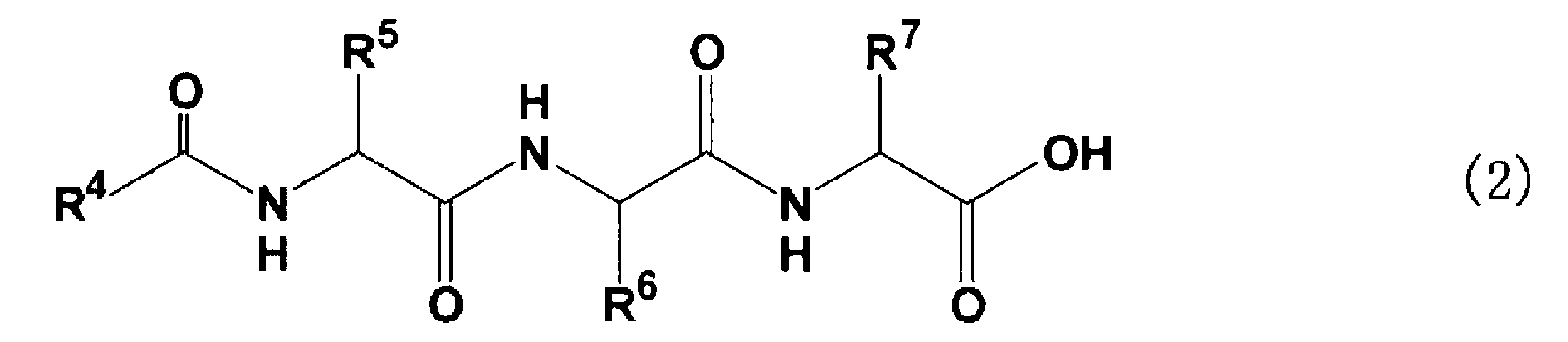
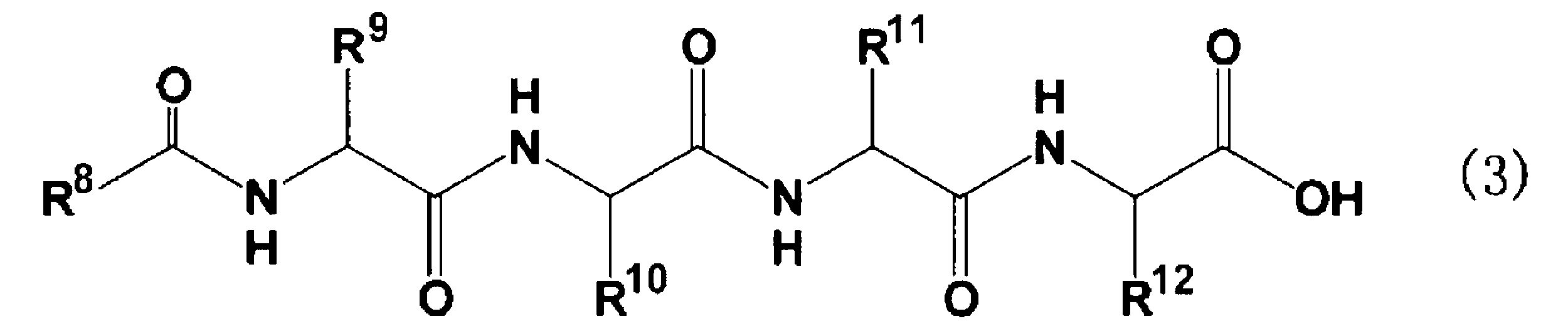
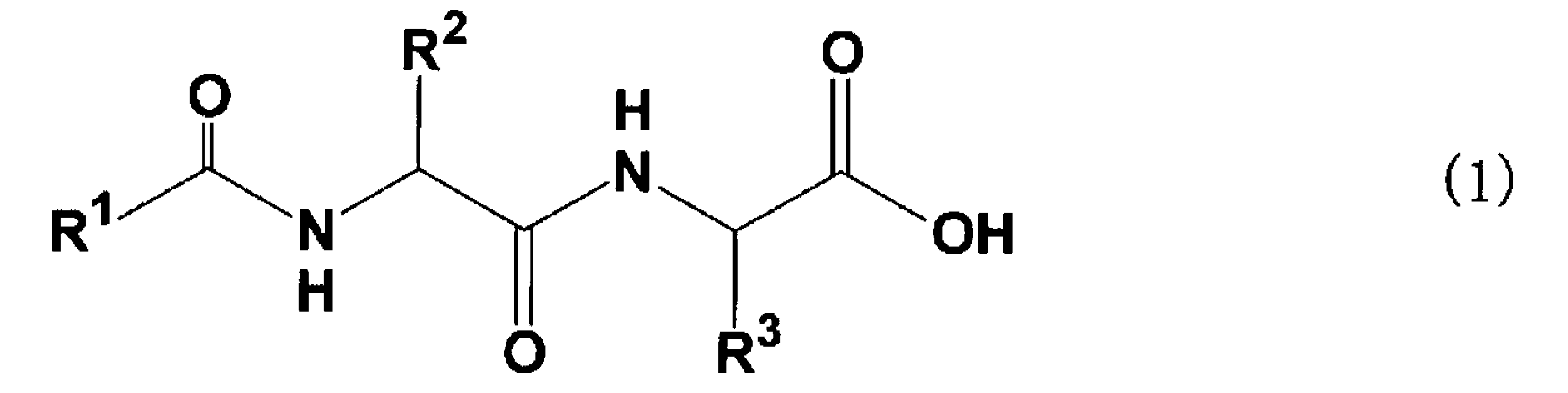
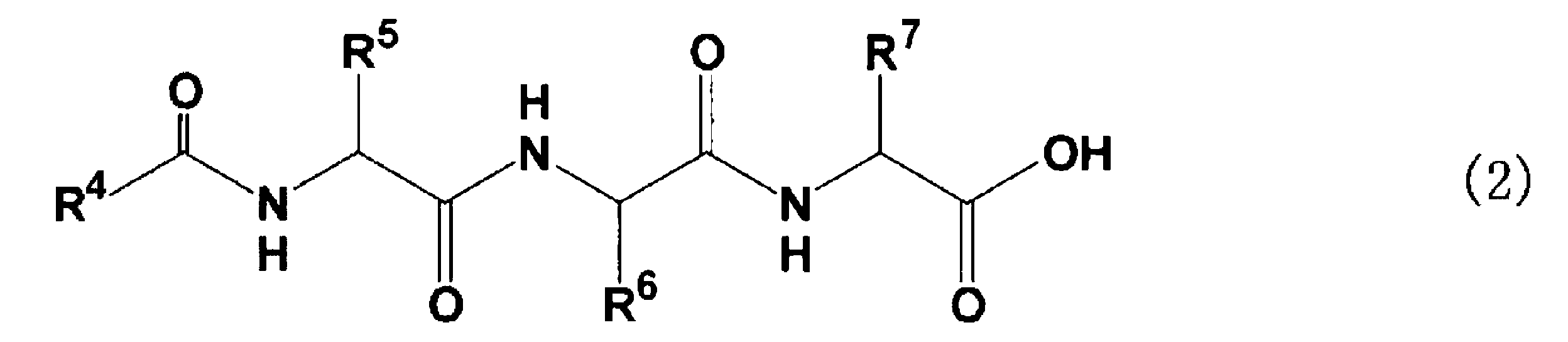
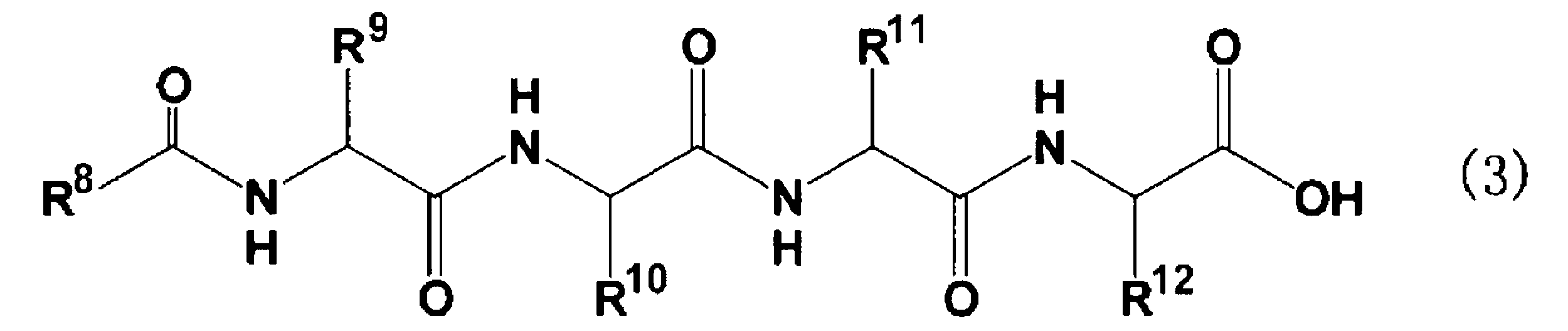
- a fourth aspect of the present invention is that the lipid peptide type compound comprises at least one of the compounds represented by the following formulas (1) to (3) or pharmaceutically usable salts thereof.
- the anticontamination material according to any one of the first to third viewpoints.
- R 1 represents an aliphatic group having 9 to 23 carbon atoms
- R 2 is a hydrogen atom or an alkyl group having 1 to 4 carbon atoms which can have a branched chain having 1 or 2 carbon atoms.
- R 3 represents-(CH 2 ) n- X group, n represents a number from 1 to 4, X represents an amino group, a guanidino group, -CONH 2 groups, or 1 to 3 nitrogen atoms.
- R 4 represents an aliphatic group having 9 to 23 carbon atoms
- R 5 to R 7 each independently have a hydrogen atom and a branched chain having 1 or 2 carbon atoms.
- R 8 represents an aliphatic group having 9 to 23 carbon atoms
- R 9 to R 12 are independent hydrogen atoms and carbon atoms that can have a branched chain having 1 or 2 carbon atoms, respectively.
- lipid peptide type compound in which a peptide portion formed by repeating at least two or more identical or different amino acids is bound to a lipid moiety composed of an aliphatic group having 10 to 24 carbon atoms.
- the present invention relates to a method for preventing contamination of a skin surface or a hair surface, which comprises a film forming step of forming a film made of an antifouling material on the skin surface or the hair surface.
- a sixth aspect is that the lipid peptide type compound comprises at least one of the compounds represented by the formulas (1) to (3) or pharmaceutically usable salts thereof. It relates to the method described in 5 viewpoints.
- it contains a lipid peptide type compound in which a peptide portion formed by repeating at least two or more identical or different amino acids is bound to a lipid moiety composed of an aliphatic group having 10 to 24 carbon atoms.
- Dust, pollen, mites (including carcasses), particulate matter, gaseous substances, or odorous substances on the skin surface or hair surface including a film forming step of forming a film made of an antifouling material on the skin surface or hair surface.
- the lipid peptide type compound comprises at least one of the compounds represented by the formulas (1) to (3) or pharmaceutically usable salts thereof.
- the ninth aspect is the antifouling material according to any one of the first to fourth aspects, which has a film surface roughness and an average surface roughness of 3 nm to 500 nm.
- a pollution-preventing material containing a specific lipid peptide-type compound forms a film on the surface of the skin or hair to prevent the adhesion of dust, pollen, particulate matter, etc., and the skin caused by these substances. Alternatively, it is possible to prevent hair contamination. Further, according to the present invention, since the antifouling substance can prevent the adhesion of dust, pollen, particulate matter and the like, it is possible to suppress skin irritation and the like caused by these substances and avoid troubles such as inflammation, oxidation and skin aging. ..
- the lipid peptide-type compound used in the antifouling material of the present invention is a highly safe artificial low molecular weight compound composed of only lipids and peptides.
- the material of the present invention has high biosafety and is very useful in the above-mentioned applications from the viewpoint of high safety required in pharmaceutical and cosmetic applications. Further, as compared with the conventionally proposed products for preventing the adsorption and adhesion of pollen and the like, the present invention uses a film composed of a low-molecular-weight lipid peptide-type compound, so that when forming a film by application to the skin or hair, etc. , The feeling of use can be improved.
- FIG. 1 is a diagram showing the results of an adhesion test of carbon ECF-600JD.
- FIG. 2 is a diagram showing the observation results of a cedar pollen adhesion test on an artificial skin model bioskin.
- FIG. 3 is a diagram showing the results of scanning microscope (SEM) observation of a cedar pollen adhesion test on an artificial skin model bioskin.
- FIG. 4 is a diagram showing the results of quantification of Cryj1 (cedar pollen allergen) in a cedar pollen adhesion test on an artificial skin model bioskin.
- FIG. 5 is a diagram showing the observation results of a cedar pollen adhesion test on artificial leather supplere.
- FIG. 1 is a diagram showing the results of an adhesion test of carbon ECF-600JD.
- FIG. 2 is a diagram showing the observation results of a cedar pollen adhesion test on an artificial skin model bioskin.
- FIG. 3 is a diagram showing the results of scanning microscope (
- FIG. 6 is a diagram showing the quantification results of Cryj1 (cedar pollen allergen) in the cedar pollen adhesion test on artificial leather supplere.
- FIG. 7 is a diagram showing observation results of a PM2.5 particle adhesion test on artificial leather supplere.
- FIG. 8 is a diagram showing the result of converting the amount of PM2.5 particles adhered to the artificial leather supplement to the area ratio by image processing of a microscope.
- FIG. 9 is a diagram showing the results of quantifying the amount of PM2.5 particles adhering to the artificial leather supplement using an ICP-emission spectroscopic analyzer.
- FIG. 10 is a diagram showing the results of quantifying the amount of PM2.5 particles adhering to the artificial leather supplement using an energy dispersive fluorescent X-ray apparatus.
- FIG. 10 is a diagram showing the results of quantifying the amount of PM2.5 particles adhering to the artificial leather supplement using an energy dispersive fluorescent X-ray apparatus.
- FIG. 11 is a diagram showing the results of microscopic observation of the PM2.5 particle adhesion test on artificial leather supplere.
- FIG. 12 is a diagram showing the result of converting the amount of PM2.5 particles adhering to the artificial leather supplement to the area ratio by image processing of a microscope.
- FIG. 13 is a diagram showing an instrument used when spraying PM2.5 particles on an artificial leather supplement.
- FIG. 14 is a diagram showing the results of quantifying the amount of Si attached when PM2.5 particles were sprayed on the artificial leather supplement using an energy dispersive fluorescent X-ray analyzer.
- FIG. 15 is a diagram showing the results of quantifying the amount of PM2.5 particles adhering to the artificial leather supplement using an ICP-emission spectroscopic analyzer.
- FIG. 12 is a diagram showing the result of converting the amount of PM2.5 particles adhering to the artificial leather supplement to the area ratio by image processing of a microscope.
- FIG. 13 is a diagram showing an instrument used when spraying PM2.5 particles on an artificial leather supplement.
- FIG. 16 is a diagram showing the results of observing a film formed by applying an antifouling material having a lipid peptide type compound with a scanning microscope (SEM).
- FIG. 17 is a diagram showing the results of quantification of Derf1 (mite allergen) in a tick adhesion test on artificial leather supplere.
- FIG. 18 is a diagram showing the observation results of a mite adhesion test on artificial leather supplere.
- FIG. 19 is a diagram showing the results of measuring the roughness when a film is formed on the surface of a silicon wafer with an atomic force microscope (AFM).
- FIG. 20 is a diagram showing the results of quantification of Cryj1 (cedar pollen allergen) in a cedar pollen adhesion test on artificial leather supplere.
- the present invention relates to antifouling materials containing specific lipid peptide type compounds.
- the antifouling material of the present invention can form a film on the surface of the skin or hair, thereby preventing the adhesion of pollutants such as dust to the skin surface and the hair surface, and contamination by these substances. Has an effect that can prevent (anti-pollution effect).
- lipid peptide type compound At least two or more identical or different amino acids are repeated in the lipid portion (10 to 24 carbon atoms of the entire lipid portion) composed of an aliphatic group having 10 to 24 carbon atoms used in the anticontamination material of the present invention.
- lipid peptide type compound to which the peptide portion formed by the above is bound for example, a compound represented by the following formulas (1) to (3) (lipid peptide) or a pharmaceutically usable salt thereof (hydrophobic moiety) is used.
- a low molecular weight compound having a lipid portion which is a lipid portion and a peptide portion which is a hydrophilic moiety) can be used.
- R 1 represents an aliphatic group having 9 to 23 carbon atoms, and preferably R 1 is a linear chain having 11 to 23 carbon atoms capable of having 0 to 2 unsaturated bonds. It is preferably an aliphatic group.
- R 1 and lipid portion constituted by the adjacent carbonyl group examples of the (acyl groups), lauroyl group, a dodecyl group, a myristoyl group, tetradecyl group, palmitoyl group, Marugaroiru group, oleoyl group, an elaidoyl group , Linole oil group, stearoyl group, buxenoyl group, octadecylcarbonyl group, arachidoyl group, eicosylcarbonyl group, behenoyl group, ercanoyle group, dococilcarbonyl group, lignosail group, nervonoyl group and the like.
- the (acyl groups) lauroyl group, a dodecyl group, a myristoyl group, tetradecyl group, palmitoyl group, Marugaroiru group, oleoyl group, an elaidoyl group
- Examples thereof include a lauroyl group, a myritoyl group, a palmitoyl group, a carbonyl group, a stearoyl group, an oleoil group, an elelideyl group and a behenoyl group.
- R 2 contained in the peptide portion represents a hydrogen atom or an alkyl group having 1 to 4 carbon atoms which can have a branched chain having 1 or 2 carbon atoms.
- the alkyl group having 1 to 4 carbon atoms which can have a branched chain having 1 or 2 carbon atoms is a branched chain having 1 to 4 carbon atoms in the main chain and 1 or 2 carbon atoms.
- R 2 is preferably a hydrogen atom or an alkyl group having 1 to 3 carbon atoms which can have a branched chain having 1 carbon atom, and more preferably a hydrogen atom.
- An alkyl group having 1 to 3 carbon atoms capable of having a branched chain having 1 carbon atom is an alkyl group having 1 to 3 carbon atoms in the main chain and capable of having a branched chain having 1 carbon atom. Specific examples thereof include a methyl group, an ethyl group, an n-propyl group, an i-propyl group, an i-butyl group, a sec-butyl group, and the like, preferably a methyl group, an i-propyl group, and the like. It is an i-butyl group or a sec-butyl group.
- R 3 represents a ⁇ (CH 2 ) n—X group.
- n represents a number of 1 to 4
- X is a 5-membered ring group capable of having 1 to 3 amino groups, guanidino groups, -CONH 2 groups, or nitrogen atoms.
- it represents a 6-membered ring group or a fused heterocyclic group composed of a 5-membered ring and a 6-membered ring.
- X is preferably an amino group, a guanidino group, a carbamoyl group (-CONH 2 groups), a pyrrole group, an imidazole group, a pyrazole group or an indole group, and more. It is preferably an imidazole group. Further, in the- (CH 2 ) n-X group, n is preferably 1 or 2, and more preferably 1.
- the- (CH 2 ) n-X group is preferably an aminomethyl group, a 2-aminoethyl group, a 3-aminopropyl group, a 4-aminobutyl group, a carbamoylmethyl group, a 2-carbamoylethyl group, 3-.
- lipid peptide type compound a particularly suitable lipid peptide in the compound represented by the above formula (1) is a compound formed from the following lipid part and peptide part (amino acid assembly part).
- amino acids include alanine (Ala), asparagine (Asn), glutamine (Gln), glycine (Gly), histidine (His), isolosin (Ile), leucine (Leu), lysine (Lys), and tryptophan (Trp). ), Val.
- lauroyl-Gly-His lauroyl-Ala-His
- myristoyl-Gly-His myristoyl-Ala-His
- palmitoyl-Gly-His palmitoyl-Ala-His
- stearoyl-Gly-His stearoyl-Ala.
- -His can be mentioned.
- R 4 represents an aliphatic group having 9 to 23 carbon atoms, and a preferable specific example thereof is the same group as defined in R 1 described above.
- R 5 to R 7 are independently hydrogen atoms or alkyl groups having 1 to 4 carbon atoms capable of having a branched chain having 1 or 2 carbon atoms, or-(. represents CH 2) n-X group, preferably at least one or more of R 5 to R 7 - represents a (CH 2) n-X group.
- n a number from 1 to 4
- X is a 5- or 6-membered ring group capable of having 1 to 3 amino groups, guanidino groups, -CONH 2 groups, or nitrogen atoms, or 5-membered rings
- 6 Represents a fused heterocyclic group composed of a member ring.
- R 5 to R 7 include the same groups as those defined in R 2 and R 3 described above.
- a suitable lipid peptide is a compound formed from the following lipid part and peptide part (amino acid assembly part). Lauroyl-Gly-Gly-His, Millistyl-Gly-Gly-His, Millistyl-Gly-Gly-Gln, Millistyl-Gly-Gly-Asn, Millistyl-Gly-Gly-Trp, Millistyl-Gly-Gly-Lys, Millist Gly-Ala-His, Millistyl-Gly-Ala-Gln, Millistyl-Gly-Ala-Asn, Millistyl-Gly-Ala-Trp, Millistyl-Gly-Ala-Lys, Millistyl-Ala-Gly-His, Millistyl-Ala- Gly-Gln, Millistyl-Ala-Gly-Asn, Millistyl-Ala-Trp, Millistyl-Gly-
- lauroyl-Gly-Gly-His myristoyl-Gly-Gly-His, palmitoyl-Gly-Gly-His, palmitoyl-Gly-His-Gly, palmitoyl-His-Gly-Gly, stearoyl.
- -Gly-Gly-His can be mentioned.
- R 8 represents an aliphatic group having 9 to 23 carbon atoms, and a preferable specific example thereof is the same group as defined in R 1 described above.
- R 9 to R 12 are independently hydrogen atoms or alkyl groups having 1 to 4 carbon atoms which can have a branched chain having 1 or 2 carbon atoms, or-(. CH 2 ) represents an n—X group, preferably at least one or more of R 9 to R 12 represents a ⁇ (CH 2 ) n—X group.
- n a number from 1 to 4
- X is a 5- or 6-membered ring group capable of having 1 to 3 amino groups, guanidino groups, -CONH 2 groups, or nitrogen atoms, or 5-membered rings and 6 Represents a fused heterocyclic group composed of a member ring.
- R 9 to R 12 include the same groups as those defined in R 2 and R 3 described above.
- lipid peptide type compound particularly suitable lipid peptide is lauroyl-Gly-Gly-Gly-His, myritoyl-Gly-Gly-Gly-His, palmitoyl. -Gly-Gly-Gly-His, Palmitoyl-Gly-Gly-His-Gly, Palmitoyl-Gly-His-Gly-Gly, Palmitoyl-His-Gly-Gly-Gly, Stearoyl-Gly-Gly-Gly-Gly-His, etc. Can be mentioned.
- the blending amount of the lipid peptide type compound is, for example, 0.01 to 30% by mass, preferably 0.02 to 10% by mass, more preferably 0.03 to 5% by mass, based on the total mass of the anticontamination material. It is by mass, more preferably 0.05 to 1% by mass.
- the lipid peptide type compound used in the present invention comprises at least one of the compounds represented by the above formulas (1) to (3) (lipid peptides) or pharmaceutically usable salts thereof, and these compounds. Can be used alone or in combination of two or more.
- the antifouling material of the present invention may contain water, alcohol, polyhydric alcohol or a mixed solution thereof in addition to the above-mentioned lipid peptide type compound.
- Examples of the above water include purified water, purified water, hard water, soft water, natural water, deep ocean water, electrolytic alkaline ionized water, electrolytically acidic ionized water, ionized water, and cluster water.
- the alcohol is a monohydric alcohol, and is, for example, an alcohol having 1 to 6 carbon atoms that dissolves in water at an arbitrary ratio, specifically methanol, ethanol, 2-propanol, i-butanol, and the like, and higher grade alcohols. Alcohols, specifically oleyl alcohol, phenoxy alcohol and the like can be mentioned.
- the polyhydric alcohol is a dihydric or higher alcohol, and is, for example, propylene glycol, 1,3-butanediol, 2-ethyl-1,3-hexanediol, glycerin, isopentyldiol, ethylhexanediol, or erythrulose.
- Ozonized glycerin caprylyl glycol, glycol, (C15-18) glycol, (C20-30) glycol, diethylene glycol, diglycerin, dithiaoctanediol, DPG, thioglycerin, 1,10-decanediol, decylene glycol , Triethylene glycol, chilimethylgidroxymethylcyclohexanol, phytantriol, phenoxypropanediol, 1,2-butanediol, 2,3-butanediol, butylethylpropanediol, 1,2-hexanediol, hexylene glycol , Pentylene glycol, methylpropanediol, mentandiol, lauryl glycol and polypropylene glycol.
- the content thereof when the polyhydric alcohol is contained, the content thereof can be, for example, 1% by mass to 60% by mass, preferably 1% by mass to 30% by mass, based on the total mass of the antifouling material. ..
- the polyhydric alcohol when a polyhydric alcohol is contained, the polyhydric alcohol may be used alone or in combination of two or more.
- the antifouling material of the present invention can generally contain cosmetic additives, additives for quasi-drugs, additives that can be used as pharmaceutical additives, and the like, if necessary.
- additive components such as physiologically active substances and functional substances contained in cosmetics, non-pharmaceutical products, or external preparations for skin such as pharmaceuticals include pigments, oily bases, moisturizers, tactile improvers, and surface activities other than the above.
- Agents polymers / thickeners / gelling agents, solvents, antioxidants, reducing agents, oxidizing agents, preservatives, antibacterial agents, bactericides, chelating agents, pH regulators, acids, alkalis, powders, inorganic salts , UV absorbers, whitening agents, vitamins and their derivatives, hair growth agents, blood circulation promoters, stimulants, hormones, anti-wrinkle agents, anti-aging agents, tightening agents, cold sensation agents, warming agents, wound healing Accelerators, stimulants, painkillers, cell activators, plant / animal / microbial extracts, antipruritic agents, keratin exfoliating / dissolving agents, antifungal agents, refreshing agents, astringents, enzymes, nucleic acids, fragrances, pigments, coloring agents , Dyes, anti-inflammatory agents, anti-inflammatory agents, anti-inflammatory agents, anti-asthma, anti-chronic obstructive pulmonary disease, anti-allergic agents, immunomodulators, anti
- Pigments include inorganic white pigments such as titanium dioxide and zinc oxide; inorganic red pigments such as red iron oxide (Bengala) and iron titanate; inorganic brown pigments such as ⁇ -iron oxide; Inorganic yellow pigments; Inorganic black pigments such as black iron oxide and lower titanium oxide; Inorganic purple pigments such as mango violet and cobalt violet; Inorganic green pigments such as chromium oxide, chromium hydroxide and cobalt titanate; Ultramarine blue , Navy blue and other inorganic blue pigments; titanium oxide coated mica, titanium oxide coated bismuth oxychloride, titanium oxide coated talc, colored titanium oxide coated mica, bismuth oxychloride, pearl pigments such as fish scale foil; talc, sericite, mica, Constitution pigments such as kaolin, calcium carbonate, magnesium carbonate, silicic anhydride, barium sulfate, aluminum hydroxide; metal powder pigments such as aluminum powder, copper powder and gold; surface-treated inorganic and metal
- Oil-based bases include higher (polyvalent) alcohols such as oleyl alcohol, jojoba alcohol, chimil alcohol, ceracyl alcohol, batyl alcohol, hexyldecanol, isostearyl alcohol, 2-octyldodecanol, and dimerdiol; benzyl alcohol, etc.
- higher (polyvalent) alcohols such as oleyl alcohol, jojoba alcohol, chimil alcohol, ceracyl alcohol, batyl alcohol, hexyldecanol, isostearyl alcohol, 2-octyldodecanol, and dimerdiol; benzyl alcohol, etc.
- Aralkyl alcohol and its derivatives stearic acid, isostearic acid, bechenic acid, undecylene acid, 12-hydroxystearic acid, palmitooleic acid, oleic acid, linoleic acid, linoleic acid, erucic acid, docosahexaenoic acid, eicosapentaenoic acid, iso Hexadecanoic acid, anteisohenicosanoic acid, long-chain branched fatty acids, dimer acid, hydrogenated dimer acid, etc .; liquid paraffin (mineral oil), heavy liquid isoparaffin, light liquid isoparaffin, ⁇ -olefin oligomer, polyisobutene, hydrogenated polyisobutene , Polybutene, squalane, olive-derived squalane, squalane, vaseline, solid paraffin and other hydrocarbons; candelilla wax, carnauba wax, rice wax, wood wax, honey wax,
- Moisturizers / feeling improvers include polyols such as glycerin, trimethylolpropane, pentaerythritol, hexylene glycol, diglycerin, polyglycerin, diethylene glycol, dipropylene glycol, polypropylene glycol, ethylene glycol / propylene glycol copolymer, and the like.
- glycolalkyl ethers such as diethylene glycol monoethyl ether (ethoxydiglycol), ethylene glycol monoethyl ether, ethylene glycol monobutyl ether, diethylene glycol dibutyl ether; (eicosane diacid / tetradecanedic acid) polyglyceryl-10, tetradecanedi Water-soluble esters such as polyglyceryl-10 acid; sugar alcohols such as sorbitol, xylitol, erythritol, mannitol, martitol; glucose, fructose, galactose, mannose, treose, xylose, arabinose, fucose, ribose, deoxyribose, maltose, Trehalose, lactose, raffinose, gluconic acid, glucuronic acid, cyclodextrins ( ⁇ -, ⁇ -, ⁇
- natural ceramide Types 1, 2, 3, 4, 5, 6
- surfactant examples include anionic surfactants, nonionic surfactants, cationic surfactants, amphoteric surfactants, and polymer surfactants.
- preferred surfactants include fatty acid salts such as potassium laurate and potassium myristate; alkyl sulphates such as sodium lauryl sulphate, triethanolamine lauryl sulphate and ammonium lauryl sulphate; Polyoxyethylene alkyl sulfates such as sodium laureth sulphate and triethanolamine laureth sulphate; sodium cocoyl methyl taurine, potassium cocoyl methyl taurine, sodium lauroyl methyl taurine, sodium myristyl methyl taurine, sodium lauroyl methyl alanine, sodium lauroyl sarcosin, lauroyl sarcosintri Acyl N-methyl amino acid salts such as ethanolamine, sodium methylalanine lauroyl glutamate; sodium cocoyl glutamate, tri
- Polyglycerin fatty acid ester such as polyglyceryl-10 acid; ethylene glycol monofatty acid ester such as ethylene glycol monostearate; propylene glycol monofatty acid ester such as propylene glycol monostearate; pentaerythritol partial fatty acid ester; sorbitol partial fatty acid ester; martitol Partial fatty acid ester; multitoll ether; sorbitan monooleate, sorbitan monoisostearate, sorbitan monolaurate, sorbitan monopalmitate, sorbitan monostearate, sorbitan sesquioleate, sorbitan trioleate, dipenta-2-ethylhexylate Sorbit
- Alkyltrimethylammonium bromide such as bromide; Dialkyldimethylammonium chloride such as distearyldimonium chloride and dicocodimonium chloride; fatty acid amidamines such as stearamidepropyldimethylamine and stearamideethyldiethylamine and salts thereof; Alkyl ether amine and its salt or quaternary salt; fatty acid amide type quaternary ammonium salt such as ethyl sulfate long chain branched fatty acid (12-31) aminopropyl ethyl dimethyl ammonium, ethyl sulfate lanolin fatty acid aminopropyl ethyl dimethyl ammonium; polyoxyethylene Alkylamine and its salt or quaternary salt; Alkylamine salt; Fatty acid amide guanidium salt; Alkyl etheraminemonium salt; Alkyltrialkylene glycol ammonium salt; Benzarkonium salt;
- Polymers, thickeners, and gelling agents include guar gum, locust bean gum, queens seed, carrageenan, galactan, arabic gum, tara gum, tamarind, farseleran, karaya gum, trolley aoi, cara gum, tragant gum, pectin, pectic acid and the like.
- Salts such as sodium salts, salts such as alginic acid and its sodium salts, mannan; starches such as rice, corn, potatoes, wheat; xanthan gum, dextran, succinoglucan, curdran, hyaluronic acid and its salts, zansangum, purulan, gellan gum , Chitin, chitosan, agar, casso extract, chondroitin sulfate, casein, collagen, gelatin, albumin; methylcellulose, ethylcellulose, hydroxyethylcellulose, hydroxypropylcellulose, hydroxypropylmethylcellulose, carboxymethylcellulose and salts such as sodium salts thereof, methylhydroxypropylcellulose , Cellulose Sodium Sulfate, Dialkyldimethylammonium Sulfate Cellulose, Crystalline Cellulose, Cellulose Powder and Other Cellulose and Derivatives thereof; , Steel derivatives such as corn starch aluminum octenyl succinate; Alg
- Acrylic acid / diallyldimethylammonium chloride / acrylamide copolymers such as polyquaternium-39, acrylic acid / cationized methacrylic acid ester copolymers, acrylic acid / cationized methacrylic acid amide copolymers, polyquaternium-47 Acrylic acid, methyl acrylate, methacrylicamide propyltrimethylammonium copolymer, choline methacrylate polymer; cationized oligosaccharide, cationized dextran, cationized polysaccharide such as guarhydroxypropyltrimonium chloride; polyethylene Imine; cation polymer; polymer of 2-methacryloyloxyethyl phosphorylcholine such as polyquaternium-51 and polymer with butyl methacrylate copolymer, etc .; acrylic resin emulsion, ethyl polyacrylate emulsion, polyacrylic alkyl ester emulsion, etc
- the solvent examples include lower alcohols such as ethanol, 2-propanol (isopropyl alcohol), butanol and isobutyl alcohol; glycols such as propylene glycol, diethylene glycol, dipropylene glycol and isopentyldiol; diethylene glycol monoethyl ether (ethoxydiglycol).
- lower alcohols such as ethanol, 2-propanol (isopropyl alcohol), butanol and isobutyl alcohol
- glycols such as propylene glycol, diethylene glycol, dipropylene glycol and isopentyldiol
- diethylene glycol monoethyl ether ethoxydiglycol
- Antioxidants include tocopherol derivatives such as tocopherol (vitamin E) and tocopherol acetate; BHT, BHA; bisulfite derivatives such as propyl bisulfite; vitamin C (ascorbic acid) and / or its derivatives; erythorbic acid and its derivatives; Sulfites such as sodium sulfite; hydrogen sulfites such as sodium hydrogen sulfite; thiosulfites such as sodium thiosulfite; metahydrosulfites; thiotaurine, hypotaurine; thioglycerol, thiourea, thioglycolic acid, cysteine hydrochloride are preferable. Is listed as.
- reducing agent thioglycolic acid, cysteine, cysteamine and the like are preferable.
- oxidizing agent hydrogen peroxide solution, ammonium persulfate, sodium bromate, percarbonate and the like are preferable.
- preservatives, antibacterial agents, and bactericidal agents include hydroxybenzoic acids such as methylparaben, ethylparaben, propylparaben, and butylparaben and salts thereof or esters thereof; salicylic acid; sodium benzoate; phenoxyethanol; methylchloroisothiazolinone, methylisothiazo.
- Isothiazolinone derivatives such as linone; imidazolinium urea; dehydroacetic acid and salts thereof; phenols; bisphenol halides such as triclosan, acid amides, quaternary ammonium salts; trichlorocarbanide, zincpyrythion, benzalconium chloride, chloride Benzethonium, sorbic acid, chlorhexidine, chlorhexidine gluconate, halocarban, hexachlorophene, hinokithiol; other phenols such as phenol, isopropylphenol, cresol, timol, parachlorophenol, phenylphenol, sodium phenylphenol; phenylethyl alcohol, photosensitizer Phenols, antibacterial phenols, and silver ions are preferred.
- chelating agent examples include edetates (ethylenediaminetetraacetate) such as EDTA, EDTA2Na, EDTA3Na, and EDTA4Na; hydroxyethylethylenediaminetriacetate such as HEDTA3Na; pentetate (diethylenetriaminepentaacetate); phytate; ethidroic acid and the like.
- edetates ethylenediaminetetraacetate
- HEDTA3Na EDTA2Na
- EDTA3Na EDTA4Na
- hydroxyethylethylenediaminetriacetate such as HEDTA3Na
- pentetate diethylenetriaminepentaacetate
- phytate ethidroic acid and the like.
- Phosphonic acid and salts such as sodium salt thereof; polyamino acids such as polyaspartic acid and polyglutamic acid; sodium polyphosphate, sodium metaphosphate, phosphoric acid; sodium citrate, citric acid, alanine, dihydroxyethylglycine, gluconic acid, Ascorbic acid, succinic acid and tartrate acid are preferred.
- acids and alkalis acids and alkalis, ascorbic acid, citric acid, sodium citrate, lactic acid, sodium lactate, potassium lactate, glycolic acid, succinic acid, acetic acid, sodium acetate, malic acid, tartrate acid, fumaric acid, phosphoric acid, Acidic acid, sulfuric acid, monoethanolamine, diethanolamine, triethanolamine, isopropanolamine, triisopropanolamine, 2-amino-2-methyl-1,3-propanediol, 2-amino-2-hydroxymethyl-1,3-propane Preferred are diol, arginine, sodium hydroxide, potassium hydroxide, aqueous ammonia, guanidine carbonate and ammonium carbonate.
- Powders include mica, talc, kaolin, sericite, montmorillonite, kaolinite, mica, white mica, gold mica, synthetic mica, red mica, black mica, permiculite, magnesium carbonate, calcium carbonate, aluminum silicate, silicic acid.
- Inorganic powders such as powders that have been treated with an agent to make them hydrophobic or hydrophilic; starch, cellulose, nylon powder, polyethylene powder, polymethylmethacrylate powder, polystyrene powder, styrene and acrylic acid copolymer resin powder, Organic powder of various sizes and shapes such as polyester powder, benzoguanamine resin powder, polyethylene terephthalate / polymethylmethacrylate laminated powder, polyethylene terephthalate / aluminum / epoxy laminated powder, urethane powder, silicone powder, Teflon (registered trademark) powder, etc. Body and surface treatment powders and organic-inorganic composite powders are preferred.
- Inorganic salts include sodium chloride-containing salts such as salt, normal salt, rock salt, sea salt, and natural salt; potassium chloride, aluminum chloride, calcium chloride, magnesium chloride, sardine, zinc chloride, ammonium chloride; sodium sulfate, aluminum sulfate, etc.
- Aluminum / potassium sulfate (myoban), aluminum / ammonium sulfate, barium sulfate, calcium sulfate, potassium sulfate, magnesium sulfate, zinc sulfate, iron sulfate, copper sulfate; sodium phosphates such as 1Na / 2Na / 3Na phosphate, phosphate Potassiums, calcium phosphates, magnesium phosphates are preferred.
- ultraviolet absorber examples include paraaminobenzoic acid, paraaminobenzoic acid monoglycerin ester, N, N-dipropoxyparaaminobenzoic acid ethyl ester, N, N-diethoxyparaaminobenzoic acid ethyl ester, and N, N-dimethylparaaminobenzoate ethyl.
- An benzoic acid-based ultraviolet absorber such as ester, N, N-dimethylparaaminobenzoic acid butyl ester, N, N-dimethylparaaminobenzoic acid methyl ester; anthranylic acid-based ultraviolet absorber such as homomentyl-N-acetylanthranilate; salicylic acid And salicylic acid-based ultraviolet absorbers such as sodium salt, amylsalicylate, menthylsalicylate, homomentylsalicylate, octylsalicylate, phenylsalicylate, benzylsalicylate, p-isopropanol phenylsalicylate; octyl cinnamate, ethyl-4-isopropyl cinnamate, methyl.
- Enon-based UV absorber 3- (4'-methylbenziliden) -d, l-camfur, 3-benziliden-d, l-camphr; 2-phenyl-5-methylbenzoxazole; 2,2'-hydroxy- 5-Methylphenylbenzotriazole; 2- (2'-hydroxy-5'-t-octylphenyl) benzotriazole; 2- (2'-hydroxy-5'-methylphenylbenzotriazole; dibenzalazine; dianisoilmethane; 5- (3,3-Dimethyl-2-norbornylidene) -3-pentan-2-one; dibenzoylmethane derivatives such as 4-t-butylmethoxydibenzoylmethane; octylriazone; urocanic acid such as urocanic acid and ethyl urocanate Derivatives; 2- (2'-hydroxy-5'-methylphenyl) benzotriazole, 1-
- the whitening agent examples include hydroquinone glycosides such as arbutin and ⁇ -arbutin and their esters; ascorbic acid, ascorbic acid phosphate ester salts such as ascorbic acid, ascorbic acid phosphate sodium salt and ascorbic acid phosphate ester magnesium salt, and ascorbic acid.
- hydroquinone glycosides such as arbutin and ⁇ -arbutin and their esters
- ascorbic acid ascorbic acid phosphate ester salts such as ascorbic acid, ascorbic acid phosphate sodium salt and ascorbic acid phosphate ester magnesium salt, and ascorbic acid.
- Ascorbic acid fatty acid ester such as tetraisopalmitic acid ester, ascorbic acid alkyl ether such as ethyl ether ascorbic acid, ascorbic acid glucoside such as ascorbic acid-2-glucoside and its fatty acid esters, ascorbic acid sulfate ester, tocopheryl ascorbyl phosphate Ascorbic acid derivatives such as: kodiic acid, ellagic acid, tranexamic acid and its derivatives, ferulic acid and its derivatives, placenta extract, glutathione, orizanol, butylresorcinol, oil-soluble chamomile extract, oil-soluble kanzo extract, Nishikawayanagi extract, Yukinoshita extract And other plant extracts are preferred.
- vitamins and derivatives thereof include vitamin A such as retinol, retinol acetate, and retinol palmitate; thiamine hydrochloride, thiamine sulfate, riboflavin, riboflavin acetate, pyridoxin hydrochloride, pyridoxin dioctanoate, pyridoxin dipalmitate, etc.
- Vitamin B group such as flavin adenin dinucleotide, cyanocobalamine, folic acid, nicotinic acid such as nicotinic acid amide / benzyl nicotinate, choline; vitamin C such as ascorbic acid and its sodium salt; vitamin D; ⁇ , Vitamin E such as ⁇ , ⁇ , ⁇ -tocopherol; Other vitamins such as pantothenic acid and biotin; Ascorbic acid phosphate ester salt such as ascorbic acid phosphate sodium salt and ascorbic acid phosphate ester magnesium salt, Ascorbic acid tetra Ascorbic acid fatty acid ester such as isosperc acid ester, ascorbic stearate, ascorbic palmitate, ascorbic dipalmitate, alkyl ether ascorbic acid such as ethyl ether ascorbic acid, ascorbic acid glucoside such as -2-glucoside ascorbic acid and its fatty acid ester.
- Vitamin B group
- Ascorbic acid derivatives such as tocopheryl ascorbic acid; tocopherol nicotinate, tocopherol acetate, tocopherol linoleate, tocopherol ferulate, tocopherol derivatives such as tocopherol phosphate, and other vitamin derivatives, tocotrienol, and other various vitamin derivatives are preferable. Is listed as.
- plant extracts and tinctures such as senburi extract, togarashi tincture, ginger tincture, ginger extract, and cantalis tincture; capsaicin, nonylate vanillylamide, gingerone, ictamol, and tannic acid.
- estradiol As the hormones, estradiol, estrone, ethinyl estradiol, cortisone, hydrocortisone, prednisone and the like are preferable.
- Other medicinal agents such as anti-wrinkle agents, anti-aging agents, tightening agents, cold sensitizers, warming agents, wound healing promoters, stimulant relievers, analgesics, cell activators, etc. include retinols, retinoic acids, retinoins.
- Tocopheryl acid derivatives such as lactic acid, glycolic acid, gluconic acid, fruit acid, salicylic acid and its glycosides / esterified products, hydroxycapric acid, long-chain ⁇ -hydroxy fatty acid, long-chain ⁇ -hydroxy fatty acid cholesteryl and other ⁇ - or ⁇ -Hydroxy acids and their derivatives; ⁇ -aminobutyric acid, ⁇ -amino- ⁇ -hydroxybutyric acid; carnitine; carnosin; creatin; ceramides, spingosins; caffeine, xanthin and its derivatives; coenzyme Q10, carotene, lycopene , Astaxanthin, lutein, ⁇ -lipoic acid, platinum nanocolloids, fullerene and other antioxidant / active oxygen scavengers; catechins; quercetin and other flavones; isoflavones; gallic acid and ester sugar derivatives; tannins, sesamine, proto Polyphenol
- Plant / animal / microbial extracts include iris extract, acitaba extract, asunaro extract, asparagus extract, avocado extract, flaxseed extract, almond extract,retea extract, arnica extract, aloe extract, apricot extract, apricot kernel extract, ginkgo extract.
- antipruritic agent examples include diphenhydramine hydrochloride, chlorpheniramine maleate, camphor, substance-P inhibitor and the like.
- exfoliating / dissolving agent examples include salicylic acid, sulfur, resorcin, selenium sulfide, pyridoxine and the like.
- antiperspirants examples include chlorohydroxyaluminum, aluminum chloride, zinc oxide, zinc paraphenol sulfonate, and the like.
- Examples of the refreshing agent include menthol and methyl salicylate.
- astringent examples include citric acid, tartaric acid, lactic acid, aluminum / potassium sulfate, tannic acid and the like.
- enzymes include superoxide dismutase, catalase, lysozyme chloride, lipase, papain, pancreatin, protease and the like.
- nucleic acids include ribonucleic acid and its salt, deoxyribonucleic acid and its salt, and disodium adenosine triphosphate.
- fragrances acetylsedrene, amylcinnamaldehyde, allylamylglycolate, ⁇ -ionone, isoe super, isobutylquinolin, iris oil, iron, indol, ylang ylang oil, undecanal, undecenal, ⁇ -undecalactone, Estragor, Eugenol, Oak Moss, Opoponax Resinoid, Orange Oil, Eugenol, Oranthiol, Galaxolid, Carbachlor, L-Carbon, Camfur, Cannon, Carrot Seed Oil, Clove Oil, Methyl Caynate, Geraniol, Geranyl nitrile , Isobornyl acetate, Geranyl acetate, Dimethylbenzylcarvinyl acetate, Styralyl acetate, Cedril acetate, Telepinel acetate, pt-butylcyclohexyl acetate, Vetibe
- Anti-inflammatory and anti-inflammatory agents include glycyrrhizic acid and its derivatives, glycyrrhetinic acid derivatives, salicylic acid derivatives, hinokithiol, guaiazulene, allantin, indomethacin, ketoprofen, ibuprofen, diclofenac, loxoprofen, selecosikib, infliximab, etanelcept, zinc oxide, hydro.
- Predonizone, diclofenac hydrochloride, chlorpheniramine maleate; plant extracts such as peach leaf extract and honoha extract are preferred.
- Anti-asthma, anti-chronic obstructive pulmonary disease, anti-allergy, immunomodulators include aminophylline, theophyllines, steroids (fluticasone, bechrometazone, etc.), leukotriene antagonists, thromboxane inhibitors, salmeterol, ⁇ 2-agonists Kinds (formoterol, salmeterol, albuterol, turobterol, clembuterol, epinephrine, etc.), thiotropium, ipratropium, dextrometholphan, dimemorphan, bromhexin, tranilast, ketotiphen, azelastine, cetilysin, chlorpheniramine, mequitalim. , Salmeterol regulators, interferon, omalizumab, protein / antibody preparations are preferred.
- oseltamivir As the anti-infectious disease agent and antifungal agent, oseltamivir, zanamivir, and itraconazole are preferable.
- cosmetic ingredient standards compounding ingredient standards by cosmetic type, Japan Cosmetic Industry Association ingredient display name list, INCI dictionary (The International Cosmetic Ingredient Handbook), non-pharmaceutical ingredient standards, Japanese pharmacy, pharmaceutical additive standards , Ingredients described in Food Additives Official Standards, etc., and Japanese and foreign patent gazettes and patent publication gazettes (including publication gazettes and republishing) whose international patent classification IPC belongs to the classification of A61K7 and A61K8 It is possible to contain known cosmetic ingredients, pharmaceutical ingredients, food ingredients, etc., such as ingredients, in known combinations, blending ratios, and blending amounts.
- the dosage form of the antifouling material of the present invention is arbitrary as long as it can form a film (layer) on the skin or on the surface of the hair.
- emulsified type such as oil in water (O / W) type, water in oil (W / O) type, W / O / W type, O / W / O type, oily, solid, liquid, paste, stick type, etc.
- Volatile oil type, powder type, jelly type, gel, paste type, emulsified polymer type, sheet type, mist type, spray type and the like but are not limited thereto.
- the product form is also arbitrary, and can be used as a dispersion liquid, a milky lotion, a cream, a pack, a spray, a gel, or the like.
- the antifouling material may contain various components known to those skilled in the art in order to realize the dosage form / product form according to the dosage form / product form.
- the anticontamination material of the present invention can be produced, for example, by mixing and stirring at least one lipid peptide-type compound, water and, if desired, other components while heating, and then allowing to allow to cool to about room temperature.
- the heating / stirring temperature is not particularly limited as long as each component can be uniformly mixed.
- the stirring temperature is 50 ° C. to 90 ° C., 60 ° C. to 90 ° C., for example 70 ° C., or 80 ° C., and the stirring time. Can be appropriately selected from, for example, 5 minutes to 3 hours.
- the present invention also relates to a method for preventing contamination of the skin surface or hair surface, which comprises a film forming step of forming a film made of a contamination-preventing material containing the lipid peptide-type compound on the skin surface or hair surface. Further, the present invention includes a film forming step of forming a film made of an antifouling material containing the lipid peptide type compound on the skin surface or the hair surface, and dust, pollen, particulate matter, gas on the skin surface or the hair surface. It relates to a method for preventing the adhesion of a state substance or an odorous substance.
- the anticontamination material used in the method for preventing contamination of the skin surface or hair surface and the method for preventing the adhesion of dust, pollen, particulate matter, gaseous substance, or odorous substance to the skin surface or hair surface is described first. Those detailed in can be used.
- the antifouling material of the present invention exerts its effect by forming an appropriate roughness (hereinafter, also referred to as roughness) on the surface of the skin or hair.
- Roughness is represented by the width of the maximum and minimum heights in the vertical direction with respect to the surface of the skin or hair, and examples of the measurement method include an atomic force microscope (AFM).
- the roughness formed by the antifouling material in the present invention is, for example, an average surface roughness of 3 nm to 500 nm, more preferably 10 nm to 300 nm.
- the antifouling material in the present invention is formed by a fiber structure, and its average diameter is preferably 10 nm to 100 nm.
- the average diameter of the fibers can be calculated from the image of the surface of the antifouling material by creating an image of the surface of the anticontamination material by detecting secondary electrons using a scanning microscope.
- the solid obtained here was dissolved in a mixed solution of 600 g of water and 750 g of methanol, and 30.5 ml (183.2 mmol) of 6N hydrochloric acid was added thereto to neutralize the solid, and the solid was precipitated and filtered.
- the obtained solid was dissolved in a mixture of 120 g of tetrahydrofuran and 30 g of water at 60 ° C., 150 g of ethyl acetate was added, and the mixture was cooled from 60 ° C. to 30 ° C.
- Preparation Example 1 Preparation of Contamination Prevention Material Sample
- a 200 mL beaker manufactured by HARIO Co., Ltd.
- the mixture was heated and stirred at a liquid temperature of 75 ° C. for 10 minutes to prepare a uniform solution.
- stirring and cooling are performed at room temperature until the liquid temperature reaches 40 ° C.
- Example 1 sample hereinafter, also referred to as Formulation Example 1
- Example 2 sample hereinafter, also referred to as Formulation Example 2
- Comparative Example sample (Hereinafter, also referred to as Comparative Formula 1) was prepared. In the above steps, all the stirring was performed at 200 rpm.
- FIG. 10 shows the results of evaluating silicon (Si) in PM2.5 particles using energy dispersive fluorescent X-ray analysis (EDX-8000 manufactured by Shimadzu Corporation). Further, FIG. 11 shows the results of observing the PM2.5 particles adhered by the microscope VHX-2000 (manufactured by Keyence Corporation).
- FIG. 12 shows the results of calculating the area ratio of the colored portion with respect to the entire image by coloring the PM2.5 particles in the observed image by image processing.
- Formulation Example 2 suppressed the adhesion of PM2.5 particles to Comparative Formulation 1, and was shown to have an anti-pollution effect.
- FIG. 18 shows a photograph of Dermatophagoides farinae attached to the supplere.
- FIG. 19 shows the results of measuring the roughness of the film formed on the surface of the silicon wafer with the AFM nuclear microscope Dimension Icon (manufactured by Bruker AXS).
- the average roughness of Comparative Formula 1 was 0.80 nm, whereas the average roughness of Formulation 2 was 41.0 nm.
- Formulation Example 2 showed a large roughness value as compared with Comparative Formulation 1, suggesting that contaminants could be suppressed from adhering.
Landscapes
- Health & Medical Sciences (AREA)
- Life Sciences & Earth Sciences (AREA)
- Chemical & Material Sciences (AREA)
- General Health & Medical Sciences (AREA)
- Animal Behavior & Ethology (AREA)
- Public Health (AREA)
- Veterinary Medicine (AREA)
- Organic Chemistry (AREA)
- Dermatology (AREA)
- Biochemistry (AREA)
- Biophysics (AREA)
- Genetics & Genomics (AREA)
- Medicinal Chemistry (AREA)
- Molecular Biology (AREA)
- Proteomics, Peptides & Aminoacids (AREA)
- Birds (AREA)
- Epidemiology (AREA)
- Engineering & Computer Science (AREA)
- Materials Engineering (AREA)
- Cosmetics (AREA)
Abstract
Description
そうした製品の一つとして、噴霧等により体や衣服等への有害物質の付着の防止を図った製品が提案されている。例えば特定の両性イオン基やアニオン基を有するモノマーユニットを構成単位として含むポリマーを含有する花粉吸着防止剤(特許文献1)や、ヒドロキシアルキルキトサンを含有する有害物質付着防止剤(特許文献2)等の提案がある。
例えば、高い保湿効果を発現するスキンケア製剤としては、層状α-ゲルを利用したものなど、自己組織化構造による被膜化粧料が挙げられる(特許文献3)。
また、ブラッシングやドライヤーなどによる熱処理によって引き起こされる毛髪損傷を軽減するために、ポリペプチドを利用した毛髪製剤が提案されている(特許文献4及び特許文献5)。
本発明の目的は、皮膚上や毛髪表面に膜形成することにより汚染物質の付着を防止し、当該物質による皮膚及び毛髪表面の汚染を防止する新たな材料を提供することである。
第2観点として、皮膚又は毛髪の表面に汚染防止膜を形成することができる、第1観点に記載の汚染防止材料に関する。
第3観点として、塵埃、花粉、粒子状物質、ダニ(死骸を含む)、ガス状物質、又は臭気物質の、皮膚又は毛髪の表面への付着を防止する、第2観点に記載の汚染防止材料に関する。
第4観点として、前記脂質ペプチド型化合物が、下記式(1)乃至式(3)で表される化合物又はその薬学的に使用可能な塩のうちの少なくとも一種からなることを特徴とする、第1観点乃至第3観点のうち何れか一に記載の汚染防止材料に関する。
第5観点として、炭素原子数10乃至24の脂肪族基からなる脂質部に、少なくとも2つ以上の同一の又は異なるアミノ酸の繰り返しにより形成されたペプチド部が結合された脂質ペプチド型化合物を含有する汚染防止材料からなる膜を皮膚表面又は毛髪表面に形成する膜形成工程を含む、皮膚表面又は毛髪表面の汚染を防止する方法に関する。
第6観点として、前記脂質ペプチド型化合物が、前記式(1)乃至式(3)で表される化合物又はその薬学的に使用可能な塩のうちの少なくとも一種からなることを特徴とする、第5観点に記載の方法に関する。
第7観点として、炭素原子数10乃至24の脂肪族基からなる脂質部に、少なくとも2つ以上の同一の又は異なるアミノ酸の繰り返しにより形成されたペプチド部が結合された脂質ペプチド型化合物を含有する汚染防止材料からなる膜を皮膚表面又は毛髪表面に形成する膜形成工程を含む、皮膚表面又は毛髪表面への塵埃、花粉、ダニ(死骸を含む)、粒子状物質、ガス状物質、又は臭気物質の付着を防止する方法に関する。
第8観点として、前記脂質ペプチド型化合物が、前記式(1)乃至式(3)で表される化合物又はその薬学的に使用可能な塩のうちの少なくとも一種からなることを特徴とする、第7観点に記載の方法に関する。
第9観点として、膜表面に粗さを有し、平均表面粗さが3nm乃至500nmである第1観点乃至第4観点のうち何れか一に記載の汚染防止材料に関する。
また本発明によれば、前記汚染防止物質により塵埃や花粉、粒子状物質等の付着を防止できることから、これら物質が引き起こし得る皮膚刺激等を抑制し、炎症・酸化・皮膚老化といったトラブルを回避できる。
更に本発明によれば、花粉やPM2.5等の微小粒子状物質の付着を防止できることから、これらを皮膚や毛髪に付着したまま移動するなどによって起こり得る汚染物質の家屋等への持ち込みや、これら物質の吸引等を予防でき、これら物質によるアレルギー症状等の発生の抑制を期待できる。
そして本発明によれば、タバコの煙や臭気物質等の不快な匂いの皮膚や毛髪表面への付着を防止することができる。
また本発明の汚染防止材料に用いられる脂質ペプチド型化合物は、脂質とペプチドのみから構成される非常に安全性の高い人工低分子化合物である。そのため、本発明の材料は生体安全性が高く、医薬品や化粧品用途において要求される高い安全性の観点からみて、上記用途において非常に有用である。また従来提案されている花粉等の吸着・付着を防止する製品と比べ、本発明では低分子の脂質ペプチド型化合物から構成される膜を利用するため、皮膚や毛髪に塗布などにより膜形成する際、使用感を良好なものとすることができる。
本発明の汚染防止材料は、皮膚又は毛髪の表面に膜を形成することができ、それにより、塵埃等を始めとする汚染物質の皮膚表面及び毛髪表面への付着を防止し、これら物質による汚染を防止することができる効果(アンチポリューション効果)を奏する。
皮膚表面や毛髪表面への付着・汚染を防止する対象物質としては、塵埃、花粉を始め、排気ガスや工場排煙等の大気汚染物質やタバコの煙などに含まれ得る粒子状物質(PM10、浮遊粒子状物質(SPM)、PM2.5(微小粒子状物質等)、ガス状物質(SOx、CO等)、臭気物質、さらにはハウスダスト、真菌等のアレルゲン、ダニ(死骸を含む)、インフルエンザウイルス等のウイルスなどを挙げることができる。
以下、各構成成分について説明する。
〔脂質ペプチド型化合物〕
本発明の汚染防止材料において用いる、炭素原子数10乃至24の脂肪族基からなる脂質部(脂質部全体の炭素原子数として10乃至24)に、少なくとも2つ以上の同一の又は異なるアミノ酸の繰り返しにより形成されたペプチド部が結合された脂質ペプチド型化合物としては、例えば下記式(1)乃至式(3)で表される化合物(脂質ペプチド)又はその薬学的に使用可能な塩(疎水性部位である脂質部と親水性部位であるペプチド部とを有する低分子化合物)を用いることができる。
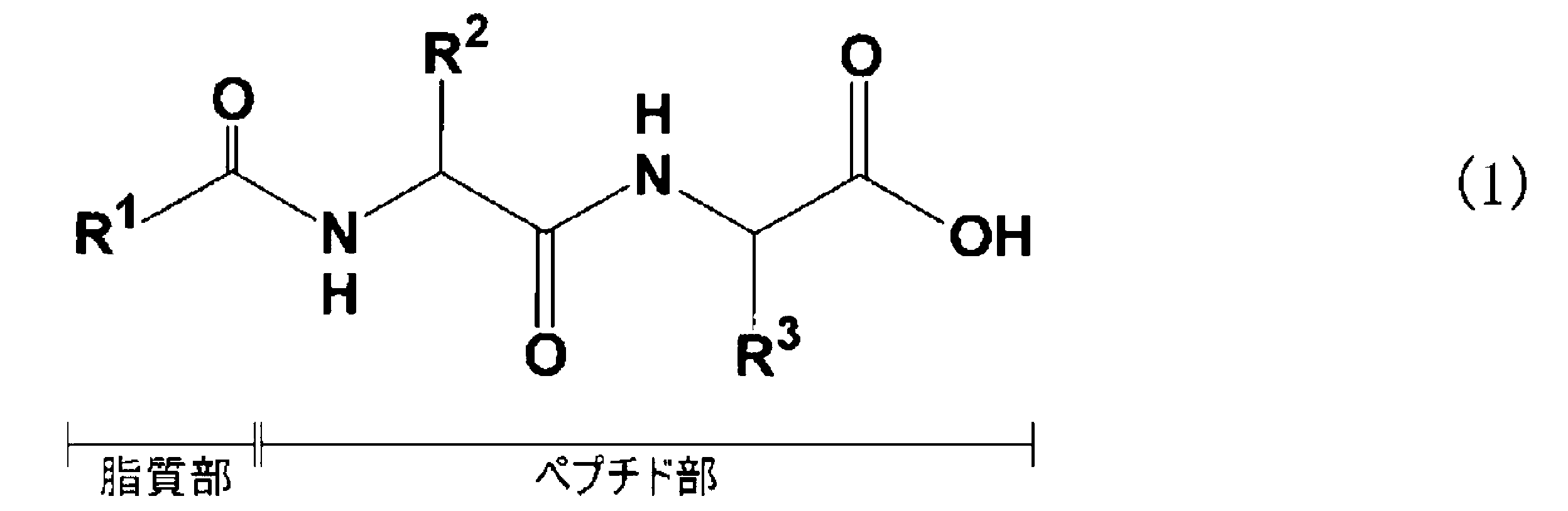
R1及び隣接するカルボニル基で構成される脂質部(アシル基)の具体例としては、ラウロイル基、ドデシルカルボニル基、ミリストイル基、テトラデシルカルボニル基、パルミトイル基、マルガロイル基、オレオイル基、エライドイル基、リノレオイル基、ステアロイル基、バクセノイル基、オクタデシルカルボニル基、アラキドイル基、エイコシルカルボニル基、ベヘノイル基、エルカノイル基、ドコシルカルボニル基、リグノセイル基、ネルボノイル基等を挙げることができ、特に好ましいものとして、ラウロイル基、ミリストイル基、パルミトイル基、マルガロイル基、ステアロイル基、オレオイル基、エライドイル基及びベヘノイル基が挙げられる。
上記炭素原子数1若しくは2の分岐鎖を有し得る炭素原子数1乃至4のアルキル基とは、主鎖の炭素原子数が1乃至4であり、かつ炭素原子数1若しくは2の分岐鎖を有し得るアルキル基を意味し、その具体例としては、メチル基、エチル基、n-プロピル基、i-プロピル基、n-ブチル基、i-ブチル基、sec-ブチル基又はtert-ブチル基などが挙げられる。
上記R2は好ましくは、水素原子、又は炭素原子数1の分岐鎖を有し得る炭素原子数1乃至3のアルキル基であり、より好ましくは水素原子である。
炭素原子数1の分岐鎖を有し得る炭素原子数1乃至3のアルキル基とは、主鎖の炭素原子数が1乃至3であり、かつ炭素原子数1の分岐鎖を有し得るアルキル基を意味し、その具体例としては、メチル基、エチル基、n-プロピル基、i-プロピル基、i-ブチル基又はsec-ブチル基などが挙げられ、好ましくはメチル基、i-プロピル基、i-ブチル基又はsec-ブチル基である。
上記R3を表す-(CH2)n-X基において、Xは好ましくはアミノ基、グアニジノ基、カルバモイル基(-CONH2基)、ピロール基、イミダゾール基、ピラゾール基又はインドール基であり、より好ましくはイミダゾール基である。また、上記-(CH2)n-X基において、nは好ましくは1又は2であり、より好ましくは1である。
従って、上記-(CH2)n-X基は、好ましくはアミノメチル基、2-アミノエチル基、3-アミノプロピル基、4-アミノブチル基、カルバモイルメチル基、2-カルバモイルエチル基、3-カルバモイルブチル基、2-グアニジノエチル基、3-グアニジノブチル基、ピロールメチル基、4-イミダゾールメチル基、ピラゾールメチル基、又は3-インドールメチル基を表し、より好ましくは4-アミノブチル基、カルバモイルメチル基、2-カルバモイルエチル基、3-グアニジノブチル基、4-イミダゾールメチル基又は3-インドールメチル基を表し、さらに好ましくは4-イミダゾールメチル基である。
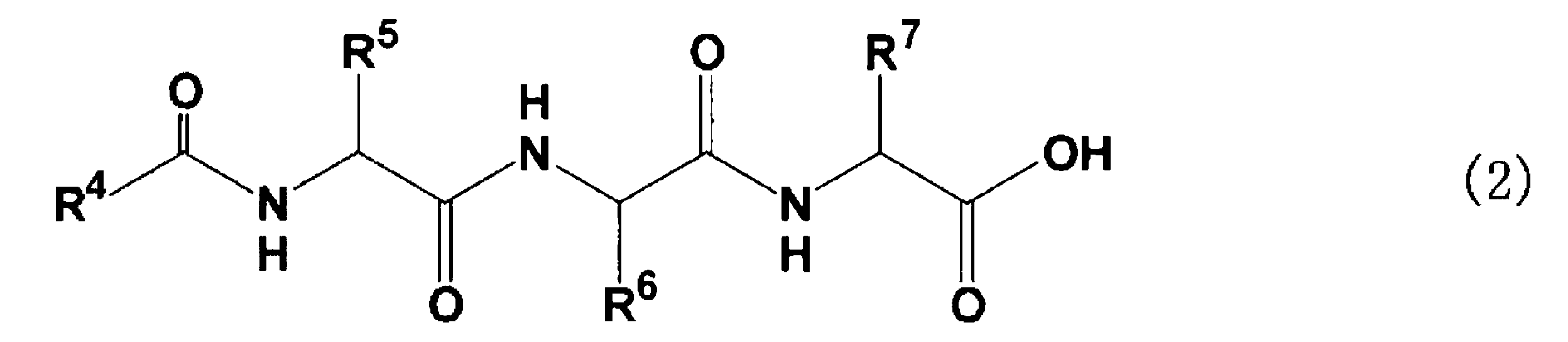
上記式(2)において、R5乃至R7は、それぞれ独立して、水素原子、又は炭素原子数1若しくは2の分枝鎖を有し得る炭素原子数1乃至4のアルキル基、又は-(CH2)n-X基を表し、好ましくはR5乃至R7のうち少なくとも一つ以上が-(CH2)n-X基を表す。nは1乃至4の数を表し、Xはアミノ基、グアニジノ基、-CONH2基、又は窒素原子を1乃至3個有し得る5員環基若しくは6員環基、又は5員環と6員環から構成される縮合複素環基を表す。ここでR5乃至R7の好ましい具体例としては、前出のR2及びR3で定義したものと同じ基が挙げられる。
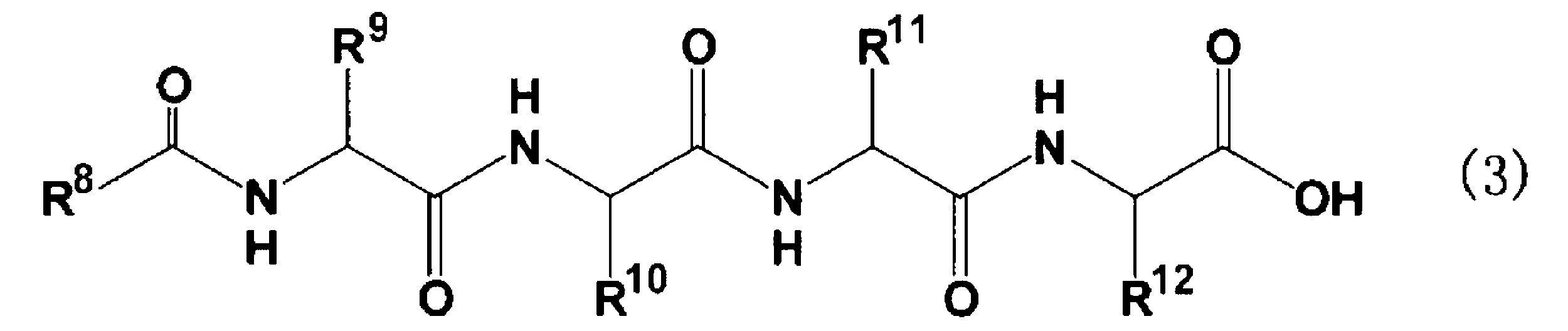
上記式(3)において、R9乃至R12は、それぞれ独立して、水素原子、又は炭素原子数1若しくは2の分枝鎖を有し得る炭素原子数1乃至4のアルキル基、又は-(CH2)n-X基を表し、好ましくはR9乃至R12のうち少なくとも一つ以上が-(CH2)n-X基を表す。nは1乃至4の数を表し、Xはアミノ基、グアニジノ基、-CONH2基、又は窒素原子を1乃至3個有し得る5員環基若しくは6員環基、又は5員環と6員環から構成される縮合複素環基を表す。ここでR9乃至R12の好ましい具体例としては、前出のR2及びR3で定義したものと同じ基が挙げられる。
なお本発明において用いられる脂質ペプチド型化合物は、上記式(1)乃至式(3)で表される化合物(脂質ペプチド)又はその薬学的な使用可能な塩のうちの少なくとも一種からなり、これら化合物を一種単独で、或いは二種以上を組み合わせて用いることができる。
本発明の汚染防止材料は、上記脂質ペプチド型化合物の他に、水、アルコール、多価アルコール又はそれらの混合溶液を含むことができる。
なお、本発明において、多価アルコールを含む場合、多価アルコールは一種単独で、又は二種以上を組み合わせて用いられ得る。
本発明の汚染防止材料は、必要に応じて一般に化粧品用添加剤や、医薬部外品用添加剤及び医薬用添加剤として使用可能な添加剤などを含むことができる。
化粧品、医薬部外品又は医薬等の皮膚外用剤に配合される生理活性物質及び機能性物質等の添加成分としては、例えば顔料、油性基剤、保湿剤、感触向上剤、上記以外の界面活性剤、高分子・増粘剤・ゲル化剤、溶剤、酸化防止剤、還元剤、酸化剤、防腐剤、抗菌剤、殺菌剤、キレート剤、pH調整剤、酸、アルカリ、粉体、無機塩、紫外線吸収剤、美白剤、ビタミン類及びその誘導体類、育毛用薬剤、血行促進剤、刺激剤、ホルモン類、抗しわ剤、抗老化剤、ひきしめ剤、冷感剤、温感剤、創傷治癒促進剤、刺激緩和剤、鎮痛剤、細胞賦活剤、植物・動物・微生物エキス、鎮痒剤、角質剥離・溶解剤、制汗剤、清涼剤、収れん剤、酵素、核酸、香料、色素、着色剤、染料、消炎剤、抗炎症剤、抗喘息、抗慢性閉塞性肺疾患、抗アレルギー、免疫調整剤、抗感染症剤及び抗真菌剤等が挙げられる。
これらその他添加剤の含有量は、その種類によって種々変化し得るが、汚染防止材料の総質量に対して、例えば0.001質量%乃至20質量%、あるいは0.01質量%乃至10質量%程度とすることができる。
、水素添加大豆リン脂質、部分水素添加大豆リン脂質、水素添加卵黄リン脂質、部分水素添加卵黄リン脂質、水酸化レシチン等のリン脂質類;シリコーン系両性界面活性剤等;高分子界面活性剤としては、ポリビニルアルコール、アルギン酸ナトリウム、デンプン誘導体、トラガントガム、アクリル酸・メタアクリル酸アルキル共重合体;シリコーン系各種界面活性剤が好ましいものとして挙げられる。
例えば、水中油(O/W)型、油中水(W/O)型、W/O/W型、O/W/O型等の乳化型、油性、固形、液状、練状、スティック状、揮発性油型、粉状、ゼリー状、ジェル、ペースト状、乳化高分子型、シート状、ミスト状、スプレー型等を挙げることができるが、これらに限定されるものでない。またその製品形態も任意であり、分散液、乳液、クリーム、パック、スプレー、ゲル等として用いることができる。
上記汚染防止材料は、その剤型・製品形態に合わせて、前記剤型・製品形態を実現するために当業者に既知の各種成分を配合することができる。
本発明の汚染防止材料は、例えば、少なくとも1種の脂質ペプチド型化合物、水及び所望によりその他の成分を加熱しながら混合、撹拌した後、室温程度まで静置放冷することによって製造され得る。
上記加熱・撹拌温度は各成分が均一に混合することができれば特に限定されず、例えば撹拌温度は50℃乃至90℃、60℃乃至90℃、例えば70℃、或いは80℃にて、また撹拌時間は、例えば5分間から3時間までの間で適宜選択できる。
さらに本発明は、前記脂質ペプチド型化合物を含有する汚染防止材料からなる膜を皮膚表面又は毛髪表面に形成する膜形成工程を含む、皮膚表面又は毛髪表面への塵埃、花粉、粒子状物質、ガス状物質、又は臭気物質の付着を防止する方法に関する。
上記皮膚表面又は毛髪表面の汚染を防止する方法並びに皮膚表面又は毛髪表面への塵埃、花粉、粒子状物質、ガス状物質、又は臭気物質の付着を防止する方法において使用する汚染防止材料は、先に詳述したものを使用することができる。
本実施例において用いた脂質ペプチド型化合物は、以下に示す方法で合成した。
500mLの4つ口フラスコに、ヒスチジン14.2g(91.6mmol)、N-パルミトイル-Gly-メチル30.0g(91.6mmol)、トルエン300gを投入し、塩基であるナトリウムメトキサイド 28%メタノール溶液35.3g(183.2mmol)を加え、油浴で60℃に加熱し1時間撹拌を続けた。その後、油浴を外し、25℃まで放冷し、この溶液をアセトン600gで再沈殿させ、濾取した。ここで得られた固体を、水600gとメタノール750gの混合溶液に溶解し、ここに6規定塩酸30.5ml(183.2mmol)を加えて中和し固体を析出させ、ろ過した。次に、得られた固体をテトラヒドロフラン120gと水30gの混合液に60℃で溶解させ、酢酸エチル150gを加え、60℃から30℃まで冷却した。その後、析出した固体をろ過した。さらに得られた固体を、テトラヒドロフラン120gとアセトニトリル60g溶剤中に溶解し、60℃に加熱し、1時間撹拌した後に冷却し、ろ過した。ここで得られた固体を水120gで洗浄し、ろ過後に減圧乾燥を行いN-パルミトイル-Gly-Hisフリー体(以下、単にPal-GHとも称する)の白色の結晶、26.9g(収率65%)を得た。
下記表1に示す割合にて200mLビーカー(HARIO株式会社製)に加え、液温75℃中で10分間加熱撹拌し、均一溶液とした。加熱撹拌後、液温が40℃になるまで室温で撹拌冷却を行い、実施例1試料(以下、処方例1ともいう)、実施例2試料(以下、処方例2ともいう)及び比較例試料(以下、比較処方1ともいう)を調製した。以上の工程において、撹拌は全て200rpmで行った。
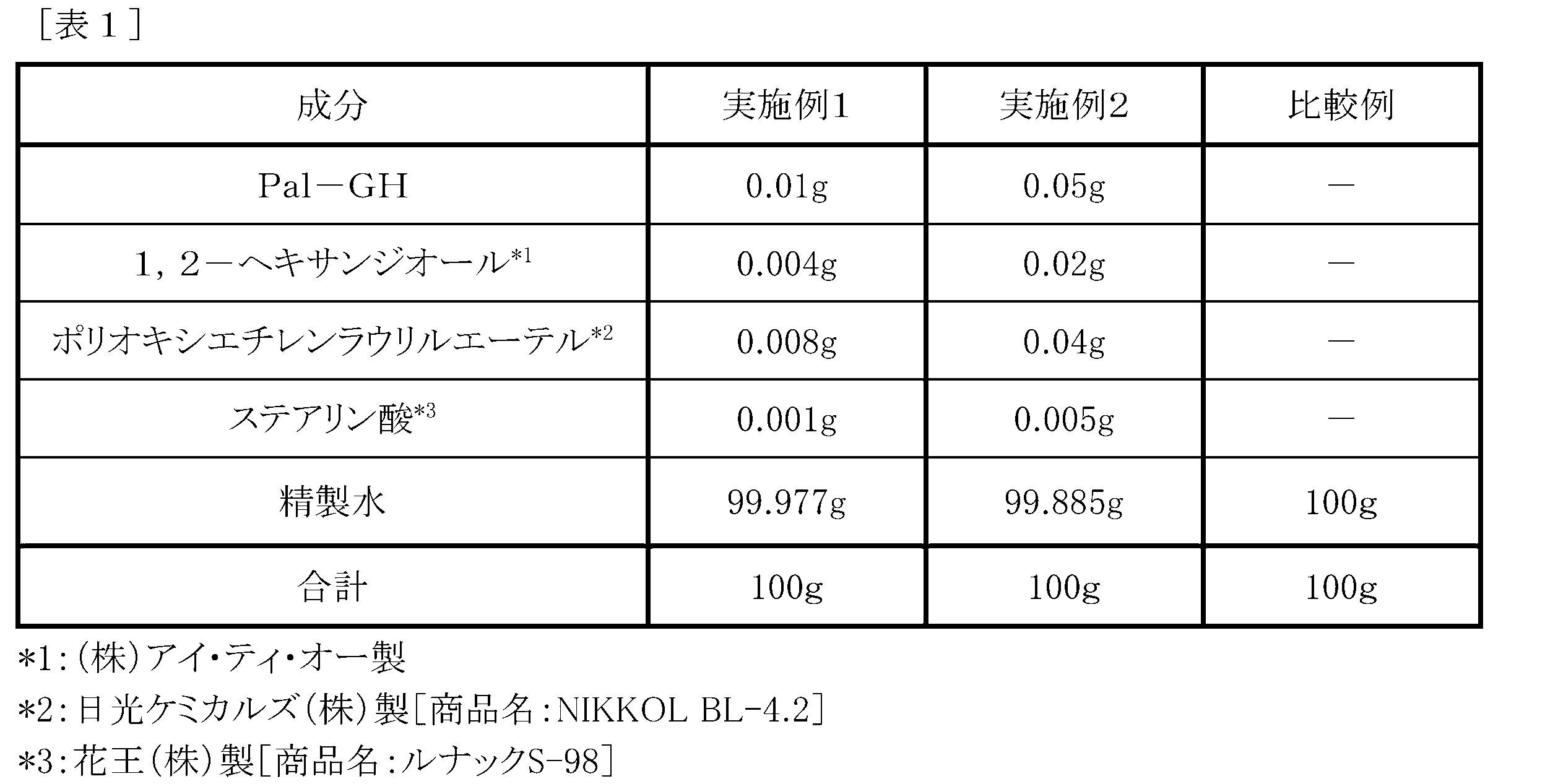
バイオスキン頬部肌模型Nо.10F(株式会社ビューラックス)を縦2cm×横0.75cmとなるよう切断し、処方例1試料、処方例2試料及び比較処方1試料を200μLずつ塗布し、均一に伸ばした。その後、32℃の恒温槽で1時間静置し、乾燥したことを目視にて確認した。
PM2.5粒子のモデルとして、カーボンECP-600JD(ライオン株式会社製、一次粒子径:34.0nm)を50mLのサンプル管に2.0g測り取り、実施例又は比較例試料を塗布・乾燥させた各バイオスキンを3回投入した。その後、余分なカーボンECF-600JDを振り払った後に、バイオスキンの状態を確認した。
結果を図1に示す。処方例1試料は比較処方1試料に対してカーボンECF-600JDの付着を抑制しており、処方例2試料は更にその効果が高い様子が確認され、実施例試料はアンチポリューション効果があることが示された。
高性能人工皮膚模型バイオスキンNo.10F(株式会社ビューラックス製)を4等分に切断し、処方例1、処方例2、および比較処方1の溶液を500μLずつ添加し、32℃の恒温槽で1時間乾燥させた。
4cm×4cmの秤皿に、スギ花粉(ITEA製)を2.0g入れ、上記で作成した各バイオスキンをスギ花粉に接触させて10回ピンセットで押し付け、引き上げた後に10秒間振ることで余剰に付着しているスギ花粉を落とした後に、各バイオスキンに付着したスギ花粉を目視にて確認した結果を図2、走査型電子顕微鏡(SEM)[Miniscope(登録商標)TM3000((株)日立ハイテクノロジーズ製)での観察結果を図3に示す。また、ITEAスギ花粉アレルゲン(Cryj1)ELISAキットを用いて定量した結果を図4に示す。処方例1は比較処方1に対して花粉の付着を抑制しており、処方例2は更にその効果が高い様子が見られ、アンチポリューション効果があることが示された。
人工皮革サプラーレ(出光テクノファイン株式会社製)を2cm×2cmの大きさに切断し、処方例1、処方例2、および比較処方1の溶液を1.0mLずつ塗布し、32℃の恒温槽で1時間乾燥した。10mLのラボランスクリュー管瓶にスギ花粉(ITEA製)を1.5g入れ、上記で作成した各サプラーレでフタをし、反転させて接触させることで花粉を付着させた。付着した花粉の目視での観察結果を図5、ITEAスギ花粉アレルゲン(Cryj1)ELISAキットを用いて定量した結果を図6に示す。処方例1は比較処方1に対して花粉の付着を抑制しており、処方例2は更にその効果が高い様子が見られ、アンチポリューション効果があることが示された。
人工皮革サプラーレ(出光テクノファイン株式会社製)を2cm×2cmの大きさに切断し、処方例1、処方例2、および比較処方1の溶液を1.0mLずつ塗布し、32℃の恒温槽で1時間乾燥した。
4cm×4cmの秤皿に、PM2.5粒子(NIES-CRM Nо.都市大気粉塵)を1.5g入れ、上記で作成した各サプラーレをPM2.5粒子に接触させて10回ピンセットで押し付け、引き上げた後に10秒間振ることで余剰に付着しているPM2.5粒子を落とした後に、各サプラーレに付着したPM2.5粒子を目視にて観察した結果を図7に示し、マイクロスコープVHX-2000(株式会社Keyence製)により付着したPM2.5粒子を画像処理により着色し、画像全体に対する着色部分の面積率を算出した結果を図8に示した。また、余剰に付着しているPM2.5粒子を落とした後に、ICP-発光分光分析装置を用いてPM2.5粒子中に含まれる金属元素を定量することで、PM2.5粒子の付着量を評価した結果を図9に示した。処方例1は、比較処方1に対してPM2.5粒子の付着を抑制しており、処方例2は更にその効果が高い様子が見られ、アンチポリューション効果があることが示された。
人工皮革サプラーレ(出光テクノファイン株式会社製)を2cm×2cmの大きさに切断し、処方例2および比較処方1の溶液を1.0mLずつ塗布し、32℃の恒温槽で1時間乾燥した。50mLの遠沈管の側面に穴を空け、そこにPM2.5粒子を100mg入れ、遠沈管の蓋を外し、代わりに作成したサプラーレを被せた。その後、側面の穴からエアダスターによりエアーを吹込んで粒子を撹拌することで付着させた。サプラーレに付着したPM2.5粒子の定量は、エネルギー分散型蛍光X線分析(島津製作所製 EDX-8000)を用いてPM2.5粒子中のケイ素(Si)を評価した結果を図10に示す。また、マイクロスコープVHX-2000(株式会社Keyence製)により付着したPM2.5粒子を観察した結果を図11に示す。観察した画像中のPM2.5粒子を画像処理により着色し、画像全体に対する着色部分の面積率を算出した結果を図12に示す。処方例2は比較処方1に対してPM2.5粒子の付着を抑制しており、アンチポリューション効果があることが示された。
人工皮革サプラーレ(出光テクノファイン株式会社製)を2cm×2cmの大きさに切断し、処方例2および比較処方1の溶液を1.0mLずつ塗布し、32℃の恒温槽で1時間乾燥した。
各サプラーレにPM2.5粒子(NIES-CRM Nо.都市大気粉塵)を5.00mgずつ、圧縮エアーを用いて吹き付けた(図13)。その後、サプラーレを回収し、エネルギー分散型蛍光X線分析装置EDX-8000(島津製作所製)を用いて、PM2.5粒子中のケイ素を定量した。結果を図14に示す。処方例2は、比較処方1に対してPM2.5粒子の付着を抑制しており、アンチポリューション効果があることが示された。
人工皮革サプラーレ(出光テクノファイン株式会社製)を2cm×2cmの大きさに切断し、処方例2および比較処方1の溶液を、スプレー容器から噴霧し、32℃の恒温槽で10分間乾燥した。なお、各溶液はスプレーから1回押して噴霧した。
4cm×4cmの秤皿に、PM2.5粒子(NIES-CRM Nо.都市大気粉塵)を1.5g入れ、上記で作成した各サプラーレをPM2.5粒子に接触させて10回ピンセットで押し付け、引き上げた後に10秒間振ることで余剰に付着しているPM2.5粒子を落とした後に、ICP-発光分光分析装置を用いてPM2.5粒子中に含まれる金属元素を定量することで、PM2.5粒子の付着量を評価した。結果を図15に示す。処方例2の溶液をスプレー噴霧したサプラーレ表面にカーボンテープを貼ることでサプラーレ上に形成された膜を剥離し、電界放出形走査電子顕微鏡JSM-7400F(日本電子株式会社製)により膜を観察した結果を図16に示す。
人工皮革サプラーレ(出光テクノファイン株式会社製)を2cm×2cmの大きさに切断し、処方例2および比較処方1の溶液を、スプレー容器から噴霧し、32℃の恒温槽で10分間乾燥した。なお、各溶液はスプレーから1回押して噴霧した。
10mLのラボランスクリュー管瓶にコナヒョウヒダニ((株)ビオスタ)を0.5g入れ、上記で作成した各サプラーレでフタをし、反転させて接触させることでコナヒョウヒダニを付着させた。その後、ITEAダニ(Der f 1)高感度ELISAキットを用いて、サプラーレに付着したDer f 1を定量することでコナヒョウヒダニ付着量を評価した。結果を図17に示す。処方例2のサンプルは、比較処方1と比較してコナヒョウヒダニの付着を抑制することが確認できた。図18は、サプラーレに付着したコナヒョウヒダニの写真を示す。
処方例2および比較処方1の溶液を塗布し、32℃の恒温槽で10分間乾燥した。AFM原子力顕微鏡Dimension Icon(Bruker AXS製)により、シリコンウエハ表面に形成された膜のラフネスを測定した結果を図19に示す。比較処方1のラフネス平均が0.80nmであったのに対して、処方例2のラフネス平均は41.0nmの値を示した。処方例2は比較処方1と比較して大きいラフネス値を示し、汚染物質を付着抑制できることが示唆された。
[検体の調製]
下記表に従い、200mLビーカー(HARIO株式会社製)中で75℃に熱した各原料を攪拌し、75℃中で10分間加熱撹拌した。10分後、40℃になるまで室温で撹拌冷却を行った。以上の工程において、撹拌は全て200rpmで行った。
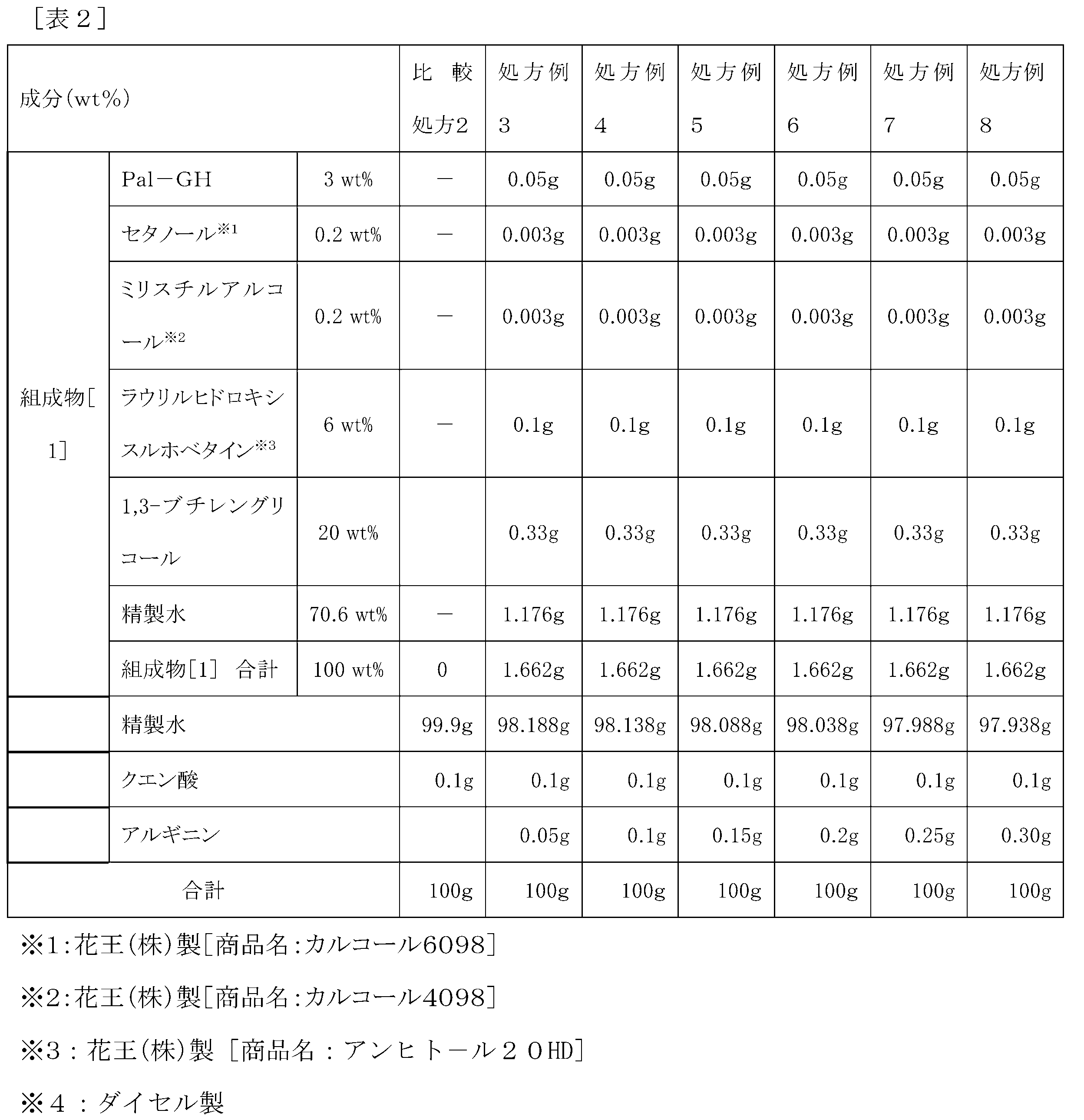
人工皮革サプラーレ(出光テクノファイン株式会社製)を2cm×2cmの大きさに切断し、比較処方2および処方例3乃至実施例8の溶液を1.0mLずつ塗布し、32℃の恒温槽で1時間乾燥した。10mLのラボランスクリュー管瓶にスギ花粉(ITEA製)を1.5g入れ、上記で作成した各サプラーレでフタをし、反転させて接触させることで花粉を付着させた。ITEAスギ花粉アレルゲン(Cryj1)ELISAキットを用いて定量した結果を図20に示す。処方例3乃至処方例8は比較処方2に対して花粉の付着を抑制しており、アンチポリューション効果があることが示された。
Claims (9)
- 炭素原子数10乃至24の脂肪族基からなる脂質部に、少なくとも2つ以上の同一の又は異なるアミノ酸の繰り返しにより形成されたペプチド部が結合された脂質ペプチド型化合物を含有することを特徴とする、汚染防止材料。
- 皮膚又は毛髪の表面に汚染防止膜を形成することができる、請求項1に記載の汚染防止材料。
- 塵埃、花粉、粒子状物質、ダニ(死骸を含む)、ガス状物質、又は臭気物質の、皮膚又は毛髪の表面への付着を防止する、請求項2に記載の汚染防止材料。
- 前記脂質ペプチド型化合物が、下記式(1)乃至式(3)で表される化合物又はその薬学的に使用可能な塩のうちの少なくとも一種からなることを特徴とする、請求項1乃至請求項3のうち何れか一項に記載の汚染防止材料。

- 炭素原子数10乃至24の脂肪族基からなる脂質部に、少なくとも2つ以上の同一の又は異なるアミノ酸の繰り返しにより形成されたペプチド部が結合された脂質ペプチド型化合物を含有する汚染防止材料からなる膜を皮膚表面又は毛髪表面に形成する膜形成工程を含む、皮膚表面又は毛髪表面の汚染を防止する方法。
- 前記脂質ペプチド型化合物が、下記式(1)乃至式(3)で表される化合物又はその薬学的に使用可能な塩のうちの少なくとも一種からなることを特徴とする、請求項5に記載の方法。
- 炭素原子数10乃至24の脂肪族基からなる脂質部に、少なくとも2つ以上の同一の又は異なるアミノ酸の繰り返しにより形成されたペプチド部が結合された脂質ペプチド型化合物を含有する汚染防止材料からなる膜を皮膚表面又は毛髪表面に形成する膜形成工程を含む、皮膚表面又は毛髪表面への塵埃、花粉、ダニ(死骸を含む)、粒子状物質、ガス状物質、又は臭気物質の付着を防止する方法。
- 前記脂質ペプチド型化合物が、下記式(1)乃至式(3)で表される化合物又はその薬学的に使用可能な塩のうちの少なくとも一種からなることを特徴とする、請求項7に記載の方法。
- 膜表面に粗さを有し、平均表面粗さが3nm乃至500nmである請求項1乃至請求項4のうち何れか一項に記載の汚染防止材料。
Priority Applications (5)
| Application Number | Priority Date | Filing Date | Title |
|---|---|---|---|
| CN202080089817.4A CN114846108B (zh) | 2019-12-26 | 2020-12-25 | 防污染材料 |
| EP20905471.7A EP4074380A4 (en) | 2019-12-26 | 2020-12-25 | ANTI-POLLUTION MATERIAL |
| KR1020227017176A KR20220120556A (ko) | 2019-12-26 | 2020-12-25 | 오염방지재료 |
| US17/789,444 US20230062111A1 (en) | 2019-12-26 | 2020-12-25 | Anti-pollution material |
| JP2021567718A JPWO2021132653A1 (ja) | 2019-12-26 | 2020-12-25 |
Applications Claiming Priority (2)
| Application Number | Priority Date | Filing Date | Title |
|---|---|---|---|
| JP2019236433 | 2019-12-26 | ||
| JP2019-236433 | 2019-12-26 |
Publications (1)
| Publication Number | Publication Date |
|---|---|
| WO2021132653A1 true WO2021132653A1 (ja) | 2021-07-01 |
Family
ID=76574746
Family Applications (1)
| Application Number | Title | Priority Date | Filing Date |
|---|---|---|---|
| PCT/JP2020/048971 Ceased WO2021132653A1 (ja) | 2019-12-26 | 2020-12-25 | 汚染防止材料 |
Country Status (7)
| Country | Link |
|---|---|
| US (1) | US20230062111A1 (ja) |
| EP (1) | EP4074380A4 (ja) |
| JP (1) | JPWO2021132653A1 (ja) |
| KR (1) | KR20220120556A (ja) |
| CN (1) | CN114846108B (ja) |
| TW (1) | TW202137973A (ja) |
| WO (1) | WO2021132653A1 (ja) |
Cited By (1)
| Publication number | Priority date | Publication date | Assignee | Title |
|---|---|---|---|---|
| WO2022092284A1 (ja) * | 2020-10-30 | 2022-05-05 | 日産化学株式会社 | 脂質ペプチドとショ糖エステルを含む組成物 |
Families Citing this family (1)
| Publication number | Priority date | Publication date | Assignee | Title |
|---|---|---|---|---|
| US11931450B2 (en) * | 2021-07-20 | 2024-03-19 | Sa'Rai Nance | Hair oil |
Citations (7)
| Publication number | Priority date | Publication date | Assignee | Title |
|---|---|---|---|---|
| JPH1077210A (ja) | 1996-09-06 | 1998-03-24 | Nakanihon Seni Kogyo Kyodo Kumiai | 化粧料用組成物及びその製造方法並びにこれを配合した化粧品 |
| JP2002308756A (ja) | 2001-03-05 | 2002-10-23 | L'oreal Sa | ポリアミノ酸の保湿剤としての用途とそれを含有する化粧品用又は製薬用組成物 |
| JP2006132025A (ja) * | 2004-11-04 | 2006-05-25 | Kao Corp | 花粉付着防止剤 |
| JP4562585B2 (ja) | 2004-05-18 | 2010-10-13 | 株式会社資生堂 | 花粉吸着防止剤 |
| JP2016006030A (ja) | 2014-05-30 | 2016-01-14 | 花王株式会社 | 皮膚化粧料 |
| JP2016084472A (ja) * | 2014-10-24 | 2016-05-19 | アース製薬株式会社 | 有害物質付着防止剤 |
| JP2019119725A (ja) * | 2018-01-11 | 2019-07-22 | スリーエム イノベイティブ プロパティズ カンパニー | 撥菌性組成物、撥菌性コーティング及びその形成方法、並びに撥菌性コーティングを有する物品 |
Family Cites Families (3)
| Publication number | Priority date | Publication date | Assignee | Title |
|---|---|---|---|---|
| US9616011B2 (en) * | 2005-04-27 | 2017-04-11 | The Procter & Gamble Company | Personal care compositions |
| TWI650140B (zh) * | 2013-12-25 | 2019-02-11 | 日商日產化學工業股份有限公司 | 含有脂質肽型化合物之條狀基材 |
| WO2016002767A1 (ja) * | 2014-06-30 | 2016-01-07 | ロート製薬株式会社 | 外用組成物 |
-
2020
- 2020-12-25 EP EP20905471.7A patent/EP4074380A4/en not_active Withdrawn
- 2020-12-25 TW TW109146525A patent/TW202137973A/zh unknown
- 2020-12-25 WO PCT/JP2020/048971 patent/WO2021132653A1/ja not_active Ceased
- 2020-12-25 CN CN202080089817.4A patent/CN114846108B/zh active Active
- 2020-12-25 JP JP2021567718A patent/JPWO2021132653A1/ja active Pending
- 2020-12-25 US US17/789,444 patent/US20230062111A1/en not_active Abandoned
- 2020-12-25 KR KR1020227017176A patent/KR20220120556A/ko active Pending
Patent Citations (8)
| Publication number | Priority date | Publication date | Assignee | Title |
|---|---|---|---|---|
| JPH1077210A (ja) | 1996-09-06 | 1998-03-24 | Nakanihon Seni Kogyo Kyodo Kumiai | 化粧料用組成物及びその製造方法並びにこれを配合した化粧品 |
| JP2002308756A (ja) | 2001-03-05 | 2002-10-23 | L'oreal Sa | ポリアミノ酸の保湿剤としての用途とそれを含有する化粧品用又は製薬用組成物 |
| JP4562585B2 (ja) | 2004-05-18 | 2010-10-13 | 株式会社資生堂 | 花粉吸着防止剤 |
| JP2006132025A (ja) * | 2004-11-04 | 2006-05-25 | Kao Corp | 花粉付着防止剤 |
| JP2016006030A (ja) | 2014-05-30 | 2016-01-14 | 花王株式会社 | 皮膚化粧料 |
| JP2016084472A (ja) * | 2014-10-24 | 2016-05-19 | アース製薬株式会社 | 有害物質付着防止剤 |
| JP6198799B2 (ja) | 2014-10-24 | 2017-09-20 | アース製薬株式会社 | 有害物質付着防止剤 |
| JP2019119725A (ja) * | 2018-01-11 | 2019-07-22 | スリーエム イノベイティブ プロパティズ カンパニー | 撥菌性組成物、撥菌性コーティング及びその形成方法、並びに撥菌性コーティングを有する物品 |
Non-Patent Citations (1)
| Title |
|---|
| See also references of EP4074380A4 |
Cited By (1)
| Publication number | Priority date | Publication date | Assignee | Title |
|---|---|---|---|---|
| WO2022092284A1 (ja) * | 2020-10-30 | 2022-05-05 | 日産化学株式会社 | 脂質ペプチドとショ糖エステルを含む組成物 |
Also Published As
| Publication number | Publication date |
|---|---|
| US20230062111A1 (en) | 2023-03-02 |
| JPWO2021132653A1 (ja) | 2021-07-01 |
| KR20220120556A (ko) | 2022-08-30 |
| CN114846108B (zh) | 2024-08-20 |
| EP4074380A4 (en) | 2023-02-15 |
| CN114846108A (zh) | 2022-08-02 |
| TW202137973A (zh) | 2021-10-16 |
| EP4074380A1 (en) | 2022-10-19 |
Similar Documents
| Publication | Publication Date | Title |
|---|---|---|
| JP5971487B2 (ja) | 化粧料の製造方法、化粧料用ゲルの調製方法及び化粧料原料に配合される高分子増粘剤の使用量を軽減する方法 | |
| JP5700222B2 (ja) | 化粧料及び皮膚外用剤、並びに医療用機器 | |
| JP7084164B2 (ja) | 難溶性成分を含有する化粧料 | |
| JP7460962B2 (ja) | 被膜形成組成物 | |
| JP6894207B2 (ja) | トラネキサム酸含有化粧料又は皮膚外用剤 | |
| JP7011243B2 (ja) | 脂質ペプチド型化合物を含有する経皮吸収組成物 | |
| JP6624380B2 (ja) | 脂質ペプチド型化合物を含有するスティック状基材 | |
| JP6734568B2 (ja) | 脂質ペプチド型化合物を含有するスティック状基材 | |
| JP6802711B2 (ja) | 脂質ペプチド型化合物を含有する保湿基材 | |
| JP2013067594A (ja) | モモ樹脂を含有する化粧料 | |
| JP2009057350A (ja) | 抗菌剤及びこれを含有する抗菌性の化粧料又は皮膚外用剤 | |
| JP2010265189A (ja) | 抗菌性化粧料 | |
| JP5805466B2 (ja) | ラメラ形成能を有する化粧料又は皮膚外用剤用のジエステル組成物 | |
| JP2007145716A (ja) | クレンジング用の化粧料 | |
| CN114846108B (zh) | 防污染材料 | |
| JP2013173683A (ja) | 乳酸、又は、乳酸及びヒドロキシステアリン酸の低重合物からなる化粧料用組成物 | |
| JP2023091264A (ja) | 付着抑制方法 | |
| JPWO2019139143A1 (ja) | 粉体を含む組成物 | |
| WO2022092284A1 (ja) | 脂質ペプチドとショ糖エステルを含む組成物 | |
| WO2021132668A1 (ja) | 浸透促進材料 | |
| JPWO2018207947A1 (ja) | 多糖含有スティック状基材 | |
| JP2023048158A (ja) | 脂質ペプチドとノニオン性界面活性剤を含む機能性液状組成物 | |
| WO2016031079A1 (ja) | フェニルエチルアミン誘導体又はシネフリン含有アデノシン三リン酸フォスファターゼ発現誘導剤 | |
| JPWO2018207948A1 (ja) | 高含水スティック状基材 | |
| WO2015194054A1 (ja) | フェニルエチルアミン誘導体又はシネフリン含有デスモプラキン発現誘導剤又はデスモプラキン細胞膜局在誘導剤 |
Legal Events
| Date | Code | Title | Description |
|---|---|---|---|
| 121 | Ep: the epo has been informed by wipo that ep was designated in this application |
Ref document number: 20905471 Country of ref document: EP Kind code of ref document: A1 |
|
| ENP | Entry into the national phase |
Ref document number: 2021567718 Country of ref document: JP Kind code of ref document: A |
|
| ENP | Entry into the national phase |
Ref document number: 2020905471 Country of ref document: EP Effective date: 20220711 |
|
| NENP | Non-entry into the national phase |
Ref country code: DE |
|
| WWW | Wipo information: withdrawn in national office |
Ref document number: 1020227017176 Country of ref document: KR |
|
| WWW | Wipo information: withdrawn in national office |
Ref document number: 2020905471 Country of ref document: EP |