WO2021135941A1 - Method and user equipment for small data transmission - Google Patents
Method and user equipment for small data transmission Download PDFInfo
- Publication number
- WO2021135941A1 WO2021135941A1 PCT/CN2020/136734 CN2020136734W WO2021135941A1 WO 2021135941 A1 WO2021135941 A1 WO 2021135941A1 CN 2020136734 W CN2020136734 W CN 2020136734W WO 2021135941 A1 WO2021135941 A1 WO 2021135941A1
- Authority
- WO
- WIPO (PCT)
- Prior art keywords
- data transmission
- rnti
- small data
- implementations
- identifier
- Prior art date
- Legal status (The legal status is an assumption and is not a legal conclusion. Google has not performed a legal analysis and makes no representation as to the accuracy of the status listed.)
- Ceased
Links
Images




Classifications
-
- H—ELECTRICITY
- H04—ELECTRIC COMMUNICATION TECHNIQUE
- H04W—WIRELESS COMMUNICATION NETWORKS
- H04W74/00—Wireless channel access
- H04W74/08—Non-scheduled access, e.g. ALOHA
-
- H—ELECTRICITY
- H04—ELECTRIC COMMUNICATION TECHNIQUE
- H04W—WIRELESS COMMUNICATION NETWORKS
- H04W72/00—Local resource management
- H04W72/12—Wireless traffic scheduling
- H04W72/1263—Mapping of traffic onto schedule, e.g. scheduled allocation or multiplexing of flows
- H04W72/1268—Mapping of traffic onto schedule, e.g. scheduled allocation or multiplexing of flows of uplink data flows
-
- H—ELECTRICITY
- H04—ELECTRIC COMMUNICATION TECHNIQUE
- H04L—TRANSMISSION OF DIGITAL INFORMATION, e.g. TELEGRAPHIC COMMUNICATION
- H04L1/00—Arrangements for detecting or preventing errors in the information received
- H04L1/12—Arrangements for detecting or preventing errors in the information received by using return channel
- H04L1/16—Arrangements for detecting or preventing errors in the information received by using return channel in which the return channel carries supervisory signals, e.g. repetition request signals
-
- H—ELECTRICITY
- H04—ELECTRIC COMMUNICATION TECHNIQUE
- H04W—WIRELESS COMMUNICATION NETWORKS
- H04W72/00—Local resource management
- H04W72/20—Control channels or signalling for resource management
- H04W72/23—Control channels or signalling for resource management in the downlink direction of a wireless link, i.e. towards a terminal
-
- H—ELECTRICITY
- H04—ELECTRIC COMMUNICATION TECHNIQUE
- H04W—WIRELESS COMMUNICATION NETWORKS
- H04W74/00—Wireless channel access
- H04W74/08—Non-scheduled access, e.g. ALOHA
- H04W74/0833—Random access procedures, e.g. with 4-step access
-
- H—ELECTRICITY
- H04—ELECTRIC COMMUNICATION TECHNIQUE
- H04L—TRANSMISSION OF DIGITAL INFORMATION, e.g. TELEGRAPHIC COMMUNICATION
- H04L1/00—Arrangements for detecting or preventing errors in the information received
- H04L1/12—Arrangements for detecting or preventing errors in the information received by using return channel
- H04L1/16—Arrangements for detecting or preventing errors in the information received by using return channel in which the return channel carries supervisory signals, e.g. repetition request signals
- H04L1/1607—Details of the supervisory signal
- H04L1/1671—Details of the supervisory signal the supervisory signal being transmitted together with control information
-
- H—ELECTRICITY
- H04—ELECTRIC COMMUNICATION TECHNIQUE
- H04W—WIRELESS COMMUNICATION NETWORKS
- H04W74/00—Wireless channel access
- H04W74/08—Non-scheduled access, e.g. ALOHA
- H04W74/0833—Random access procedures, e.g. with 4-step access
- H04W74/0836—Random access procedures, e.g. with 4-step access with 2-step access
-
- H—ELECTRICITY
- H04—ELECTRIC COMMUNICATION TECHNIQUE
- H04W—WIRELESS COMMUNICATION NETWORKS
- H04W74/00—Wireless channel access
- H04W74/08—Non-scheduled access, e.g. ALOHA
- H04W74/0833—Random access procedures, e.g. with 4-step access
- H04W74/0838—Random access procedures, e.g. with 4-step access using contention-free random access [CFRA]
Definitions
- the present disclosure generally relates to wireless communications, and more particularly, to a method and a user equipment for small data transmission.
- next-generation wireless communication system such as the fifth-generation (5G) New Radio (NR)
- 5G fifth-generation
- NR New Radio
- the 5G NR system is designed to provide flexibility and configurability to optimize the NW services and types, accommodating various use cases such as Enhanced Mobile Broadband (eMBB) , Massive Machine-Type Communication (mMTC) , and Ultra-Reliable and Low-Latency Communication (URLLC) .
- eMBB Enhanced Mobile Broadband
- mMTC Massive Machine-Type Communication
- URLLC Ultra-Reliable and Low-Latency Communication
- the present disclosure is directed to methods and user equipment (UE) for small data transmission while the UE is in an inactive state.
- UE user equipment
- a method performed by a User Equipment (UE) for a small data transmission includes receiving, from a base station (BS) , a configuration indicating a dedicated physical resource; transmitting the small data transmission based on the dedicated physical resource; and receiving an acknowledge (ACK) indicator indicating a successful reception from the BS, wherein the UE is in an inactive state to transmit the small data transmission.
- BS base station
- ACK acknowledge
- a User Equipment (UE) in a wireless communication system which comprises a Base Station (BS) , for a small data transmission
- the UE includes a processor; and a memory coupled to the processor, wherein the memory stores a computer-executable program that when executed by the processor, causes the processor to transmit the small data transmission based on the dedicated physical resource; and receive an acknowledge (ACK) indicator indicating a successful reception from the BS, wherein the UE is in an inactive state to transmit the small data transmission.
- ACK acknowledge
- Figure 1 illustrates a 2-step RACH procedure to be formed by a 4-step RACH procedure according to an example implementation of the present disclosure.
- Figure 2 illustrates a fallback RAR format according to an example implementation of the present disclosure.
- Figure 3 illustrates a success RAR format according to an example implementation of the present disclosure.
- Figure 4 illustrates another success RAR MAC subheader format according to an example implementation of the present disclosure.
- Figure 5 illustrates a new RAR format according to an example implementation of the present disclosure.
- Figure 6 illustrates a modified successRAR format according to an example implementation of the present disclosure.
- Figure 7 illustrates a small data transmission procedure performed by the UE according to an example implementation of the present disclosure.
- Figure 8 illustrates a block diagram of a node for wireless communication according to an example implementation the present disclosure.
- references to “one implementation, ” “an implementation, ” “example implementation, ” “various implementations, ” “some implementations, ” “implementations of the present disclosure, ” etc., may indicate that the implementation (s) of the present disclosure may include a particular feature, structure, or characteristic, but not every possible implementation of the present disclosure necessarily includes the particular feature, structure, or characteristic. Further, repeated use of the phrase “in one implementation, ” “in an example implementation, ” or “an implementation, ” do not necessarily refer to the same implementation, although they may.
- any use of phrases like “implementations” in connection with “the present disclosure” are never meant to characterize that all implementations of the present disclosure must include the particular feature, structure, or characteristic, and should instead be understood to mean “at least some implementations of the present disclosure” includes the stated particular feature, structure, or characteristic.
- the term “coupled” is defined as connected, whether directly or indirectly through intervening components, and is not necessarily limited to physical connections.
- the term “comprising, ” when utilized, means “including, but not necessarily limited to” ; it specifically indicates open-ended inclusion or membership in the so-disclosed combination, group, series, and the equivalent.
- a and/or B may represent that: A exists alone, A and B exist at the same time, and B exists alone.
- a and/or B and/or C may represent that at least one of A, B and C exists.
- the character “/” used herein generally represents that the former and latter associated objects are in an “or” relationship.
- any NW function (s) or algorithm (s) in the present disclosure may be implemented by hardware, software, or a combination of software and hardware.
- Disclosed functions may correspond to modules that may be software, hardware, firmware, or any combination thereof.
- the software implementation may comprise computer-executable instructions stored on computer-readable media such as memory or other types of storage devices.
- one or more microprocessors or general-purpose computers with communication processing capability may be programmed with corresponding executable instructions and carry out the disclosed NW function (s) or algorithm (s) .
- the microprocessors or general-purpose computers may be formed of Applications Specific Integrated Circuitry (ASIC) , programmable logic arrays, and/or using one or more Digital Signal Processor (DSPs) .
- ASIC Application Specific Integrated Circuitry
- DSPs Digital Signal Processor
- the computer-readable medium includes but is not limited to Random Access Memory (RAM) , Read-Only Memory (ROM) , Erasable Programmable Read-Only Memory (EPROM) , Electrically Erasable Programmable Read-Only Memory (EEPROM) , flash memory, Compact Disc Read-Only Memory (CD-ROM) , magnetic cassettes, magnetic tape, magnetic disk storage, or any other equivalent medium capable of storing computer-readable instructions.
- RAM Random Access Memory
- ROM Read-Only Memory
- EPROM Erasable Programmable Read-Only Memory
- EEPROM Electrically Erasable Programmable Read-Only Memory
- flash memory Compact Disc Read-Only Memory (CD-ROM)
- CD-ROM Compact Disc Read-Only Memory
- magnetic cassettes magnetic tape
- magnetic disk storage or any other equivalent medium capable of storing computer-readable instructions.
- a radio communication NW architecture typically includes at least one Base Station (BS) , at least one user equipment (UE) , and one or more optional NW elements that provide connection towards an NW.
- the UE communicates with the NW (e.g., a Core NW (CN) , an Evolved Packet Core (EPC) NW, an Evolved Universal Terrestrial Radio Access NW (E-UTRAN) , a Next-Generation Core (NGC) , or an Internet) , through a Radio Access NW (RAN) established by the BS.
- NW e.g., a Long Term Evolution (LTE) system, an LTE-Advanced (LTE-A) system, or an LTE-Advanced Pro system
- the UE communicates with the NW (e.g., a Core NW (CN) , an Evolved Packet Core (EPC) NW, an Evolved Universal Terrestrial Radio Access NW (E-UTRAN) , a Next-Generation Core (NGC)
- a UE may include, but is not limited to, a mobile station, a mobile terminal or device, a user communication radio terminal.
- a UE may be a portable radio equipment, which includes, but is not limited to, a mobile phone, a tablet, a wearable device, a sensor, or a Personal Digital Assistant (PDA) with wireless communication capability.
- PDA Personal Digital Assistant
- the UE is configured to receive and transmit signals over an air interface to one or more cells in a RAN.
- a BS may include, but not limited to, a Node B (NB) as in the Universal Mobile Telecommunication System (UMTS) , an evolved Node B (eNB) as in the LTE-A, a Radio NW Controller (RNC) as in the UMTS, a Base Station Controller (BSC) as in the Global System for Mobile communications (GSM) /GSM EDGE Radio Access NW (GERAN) , a Next Generation eNB (ng-eNB) as in an E-UTRA BS in connection with the 5GC, a next-generation Node B (gNB) as in the 5G Access NW (5G-AN) , and any other apparatus capable of controlling radio communication and managing radio resources within a cell.
- the BS may connect to serve the one or more UEs through a radio interface to the NW.
- a BS may be configured to provide communication services according to at least one of the following Radio Access Technologies (RATs) : Worldwide Interoperability for Microwave Access (WiMAX) , GSM (often referred to as 2G) , GERAN, General Packet Radio Service (GPRS) , UMTS (often referred to as 3G) based on basic Wideband-Code Division Multiple Access (W-CDMA) , High-Speed Packet Access (HSPA) , LTE, LTE-A, enhanced LTE (eLTE) , NR (often referred to as 5G) , and LTE-A Pro.
- RATs Radio Access Technologies
- the BS may be operable to provide radio coverage to a specific geographical area using a plurality of cells included in the RAN.
- the BS may support the operations of the cells.
- Each cell is operable to provide services to at least one UE within its radio coverage. More specifically, each cell (often referred to as a serving cell) may provide services to serve one or more UEs within its radio coverage, (e.g., each cell schedules the Downlink (DL) and optionally UL resources to at least one UE within its radio coverage for DL and optionally Uplink (UL) packet transmissions) .
- the BS may communicate with one or more UEs in the radio communication system through the plurality of cells.
- a cell may allocate sidelink (SL) resources for supporting proximity service (ProSe) .
- SL sidelink
- ProSe proximity service
- Each cell may have overlapped coverage areas with other cells.
- MR-DC Multi-RAT Dual Connectivity
- the primary cell of a Master Cell Group (MCG) or a Secondary Cell Group (SCG) may be called as a Special Cell (SpCell) .
- a Primary Cell (PCell) may refer to the SpCell of an MCG.
- a PSCell may refer to the SpCell of an SCG.
- MCG refers to a group of serving cells associated with the Master Node (MN) , comprising the SpCell and optionally one or more secondary cells (SCells) .
- SCG refers to a group of serving cells associated with the Secondary Node (SN) , comprising of the SpCell and optionally one or more SCells.
- the frame structure for NR is to support flexible configurations for accommodating various next generation (e.g., 5G) communication requirements, such as eMBB, mMTC, and URLLC, while fulfilling high reliability, high data rate, and low latency requirements.
- the orthogonal frequency-division multiplexing (OFDM) technology may serve as a baseline for an NR waveform.
- the scalable OFDM numerology such as the adaptive sub-carrier spacing, the channel bandwidth, and the cyclic prefix (CP) , may also be used.
- two coding schemes are considered for NR: (1) low-density parity-check (LDPC) code and (2) polar code.
- the coding scheme adaption may be configured based on the channel conditions and/or service applications.
- DL transmission data in a transmission time interval of a single NR frame, at least DL transmission data, a guard period, and UL transmission data should be included, where the respective portions of the DL transmission data, the guard period, the UL transmission data should also be configurable, for example, based on the NW dynamics of NR.
- SL resources may also be provided in an NR frame to support ProSe services.
- ⁇ Configured grant Type 1 It is semi-statically configured to operate upon the reception of Radio Resource Control (RRC) parameter configuredGrantConfig including rrc-ConfiguredUplinkGrant without the detection of an UL grant in a Downlink Control Information (DCI) .
- RRC Radio Resource Control
- DCI Downlink Control Information
- ⁇ Cell Radio network object that can be uniquely identified by a UE from a (cell) identification that is broadcasted over a geographical area from one UTRAN Access Point.
- a Cell is either Frequency Division Duplexing (FDD) or Time Division Duplexing (TDD) mode.
- FDD Frequency Division Duplexing
- TDD Time Division Duplexing
- Random Access Channel (RACH) procedure is a sequence of process between UE and gNB (Network) in order for UE to acquire UL Synchronization and obtain specified Identifier (ID) for the radio access communication.
- ⁇ PUSCH Physical Uplink Shared Channel (PUSCH) is the physical time/frequency resources that gNB schedules to the UE for data transmission.
- PUSCH Physical Uplink Shared Channel
- RNTI Radio Network Temporary Identifier
- MAC CE Medium Access Control (MAC) control element (CE) is a MAC structure that carries special control information.
- RSSI Received signal strength indicator
- RSRP Reference Signal Receive Power
- RE Resource Elements
- the gNB may not schedule any resources for devices in RRC_IDLE or RRC_INACTIVE state to avoid wasting resources. Therefore, in one implementation, when a device (e.g., UE) would like to connect to the gNB and initiate a data transfer, a RACH procedure may be used to connect to a cell (or a BS) . Once the device has detected a cell (and camped on this cell) , it may initiate the RACH procedure to access the cell. Conventionally, a four-step RACH procedure (or called 4-step RACH procedure) is applied for LTE and NR, which is presented in the following 4 steps.
- Step 1 (Message 1/Msg-1) :
- the device e.g., UE
- PRACH Physical Random Access Channel
- RA-RNTI Random Access-RNTI
- Step 2 (Message 2/Msg-2) :
- the gNB (or eNB) transmits a Random Access Response (RAR) to indicate the reception of the preamble.
- RAR Random Access Response
- the RAR carries resource allocation information for the next step, i.e., Message 3 transmission by the UE.
- Step 3 (Message 3/Msg-3) : Once the device decodes the content of RAR successfully, it sends Message 3 to the gNB (or eNB) to request a RRC connection.
- Step 4 (Message 4/Msg-4) :
- the gNB (or eNB) transmits a Physical Downlink Shared Channel (PDSCH) carrying Message 4 to transit the device to RRC_CONNECTED state.
- Contention Resolution ID (CRID) MAC CE may be included in Message 4 for contention resolution.
- the device is in RRC_CONNECTED state and a gNB-device communication could start by using scheduling-based transmission.
- a two-step RACH procedure (or called 2-step RACH procedure) is discussed in 3GPP to reduce the latency and the overhead of conventional 4-step RACH procedure.
- the 2-step RACH procedure may also be beneficial for small data transmission.
- Figure 1 illustrates a 2-step RACH procedure to be formed by a 4-step RACH procedure according to an example implementation of the present disclosure.
- some steps of 4-step RACH procedure are merged to form 2-step RACH procedure, so that it may efficiently save, e.g., the number of transmissions.
- Msg-1 may be combined with Msg-3 to form the Msg-A in 2-step RACH procedure
- Msg-2 may be combined with Msg-4 to form the Msg-B in 2-step RACH procedure.
- RA response (s) included in a Msg-B may be different from RA response (s) included in a Msg-2.
- small data transmission may be performed via 2-step RACH procedure, 4-step RACH procedure, or pre-configured PUSCH resources (e.g., by providing configured grant type1 configuration) for a UE in the RRC_INACTIVE state, rather than in the RRC_CONNECTED state, to avoid unnecessary signal overhead and power consumption. Accordingly, several fundamental problems need to be solved in order to support the small data transmission in the RRC_INACTIVE state.
- the small data transmission is infrequently performed via 2-step RACH procedure, 4-step RACH procedure, and/or configured grant type 1, it may be important that how the gNB can identify the received data are the infrequent small data or other scheduled data (e.g., small data or an RRC message being carried in Msg-A and Msg-3) .
- the UE may move/switch to the RRC_CONNECTED state after completing the RACH procedure.
- the main motivation of small data transmission is to have the UE transmit small size payload in the RRC_INACTIVE state without switching to the RRC_CONNECTED state for reducing power consumption and signaling overhead. Under such motivation, it may be necessary for the NW to identify whether the current received data is for small data transmission or for scheduled RACH procedure.
- the UE may be operated in the RRC_CONNECTED state when it receives successRAR in 2-step RACH procedure or Msg-4 (contention resolution) in 4-step RACH procedure.
- an indicator may also be needed to inform the UE that the transmission is successful.
- the mechanism may be introduced in the following paragraphs that how to inform the UE that the small data transmission has been successfully decoded at the gNB side.
- the NW may configure dedicated physical resources (e.g., time, frequency, code, preambles, RACH occasion (RO) , or PUSCH occasion (PO) , which is not limited to hereinafter) for small data transmission to UEs (e.g., via dedicated signaling or via broadcasting system information) .
- the NW may schedule a dedicated RO for small data transmission to the UEs and inform the UEs that there is a dedicated RO for small data transmission via broadcasting system information (SI) . Then the UE performing small data transmission may pick up the preamble in that dedicated RO used for small data transmission to send to the gNB, so as to start small data transmission.
- SI broadcasting system information
- the NW may configure dedicated preambles for small data transmission (e.g., via dedicated signaling or via broadcasting system information) .
- dedicated RA resource (s) may be provided in the RRC Release message (e.g., an RRC Release message with/without suspend configuration) to the UE for transmitting (small) data in RRC_INACTIVE state.
- the dedicated RA resource (s) may be dedicated preambles, dedicated ROs, and/or dedicated PUSCH resource (e.g., the payload part of a Msg-A) .
- dedicated preambles these preambles may be obtained from all used preambles in NR, and these preambles may only be used for small data transmission.
- preambles may be shared for different purposes, such as small data transmission, 4-step RACH procedure, 2-step RACH procedure, and so on.
- the gNB may schedule some preambles, e.g., preamble#0 to preamble#20 in the 64 preambles, to be used for both 2-step RACH procedure (e.g., for RRC connection setup or resume) and for small data transmission via 2-step RACH procedure at the same RO.
- the associated PUSCH may carry some information to assist the gNB for identifying whether the purpose is for small data transmission via 2-step RACH procedure or RRC connection setup/resume via 2-step RACH procedure.
- 2-step RACH procedure defined in Rel-16 may be triggered (e.g., as introduced in 3GPP Technical Specification (TS) 38.321) .
- a dedicated group of preambles may be configured for the purpose of small data transmission.
- a UE who intends to transmit small data in RRC_INACTIVE state may use the dedicated group of preambles to indicate that the purpose of an initiated RACH procedure is for small data transmission.
- the NW may provide pre-configured PUSCH resources for the UE to transmit small data in RRC_INACITVE state.
- the configured grant scheduled by the NW may only be used for small data transmission.
- the configured grant assigned by the NW is used for not only small data transmission but also for other data transmission (e.g., Ultra Reliable Low Latency Communication (URLLC) data transmission) .
- URLLC Ultra Reliable Low Latency Communication
- a unique UE identity e.g., Inactive-RNTI (I-RNTI) or 5G S-Temporary Mobile Subscription Identifier (5G-S-TMSI)
- I-RNTI Inactive-RNTI
- 5G-S-TMSI 5G S-Temporary Mobile Subscription Identifier
- related UE identify information may be used to identify whether the received data at the gNB side is associated with small data transmission or not. For example, if the gNB identifies that an I-RNTI is included in the content of received data, the current received data may be considered as small data.
- a UE may include a I-RNTI MAC CE in the payload of a Msg-A.
- a UE may include a I-RNTI MAC CE in a Msg-3.
- a UE may include a I-RNTI MAC CE in the selected PUSCH resources for data transmission.
- a I-RNTI MAC CE may be identified by a MAC subheader with a specific Logical Channel Identifier (LCID) .
- LCID Logical Channel Identifier
- a I-RNTI MAC CE may have an ID field to indicate a UE’s fullI-RNTI.
- a I-RNTI MAC CE may have an ID field to indicate a UE’s shortI-RNTI.
- a I-RNTI MAC CE for fullI-RNTI may be identified by a MAC subheader with a specific LCID (e.g., 51) and another I-RNTI MAC CE for shortI-RNTI may be identified by a MAC subheader with another LCID (e.g., 50) .
- whether to include a I-RNTI MAC CE for fullI-RNTI or a I-RNTI MAC CE for shortI-RNTI may be determined based on NW’s commands (e.g., via dedicated signaling or SI) .
- the gNB may send the Acknowledgement (ACK) indictor to the UE to inform the UE that the data transmitted in RRC_INACTIVE state is decoded/received successfully.
- the UE may consider that the (small) data transmission is successful and no re-transmission of the (small) data may be required.
- the gNB may send the ACK indictor and the new configurations (e.g., RRC Release with suspendConfig) to the UE to inform the UE that the data transmitted in RRC_INACTIVE state is decoded/received successfully.
- the UE may consider that the (small) data transmission is successful and apply the new configuration for RRC_INACTIVE state.
- the RRCResumeRequest message may be transmitted in Msg-A (of a 2-step RACH procedure) or in Msg-3 (of a 4-step RACH procedure) with a new Resume Cause as small data transmission to inform the NW.
- the NW may send the RRC Release with suspendConfig to the UE if the Resume Cause is “small data transmission” .
- the UE may request additional UL grant for another small data transmission or the remaining data transmission. For example, the UE may inform the NW that it has other incoming small data packets in the 2-step RACH Msg-APUSCH via MAC CE or RRC message.
- the gNB may send an existing RAR with modification (e.g., using the reserved bits in the existing MAC RAR (or RAR payload) to inform the UE that the scheduled UL grant given to the UE via that MAC RAR (or RAR payload) is used for the new data transmission, the data retransmission, or the remaining data transmission of a small data transmission) .
- the gNB may use a new MAC RAR (or RAR payload) for the UE to send another small data packet or the remaining data.
- a MAC Packet or Protocol Data Unit (PDU) may consist of one or more MAC subPDUs and optionally padding.
- each MAC subPDU consists one of the following:
- SDU MAC Service Data Unit
- the gNB may use fallbackRAR to schedule the additional UL grant for a UE, so as to transmit the next small data or the remining data.
- the fallback RAR format 20 may consist of the following fields:
- Timing Advance Command This field indicates the index value Timing Advance (TA) used to control the amount of timing adjustment that the MAC entity has to apply, e.g., in 3GPP TS 38.213 v15.7.0.
- the size of the Timing Advance Command field is 12 bits;
- ⁇ UL Grant This field indicates the resources to be used on the UL, e.g., in 3GPP TS 38.213 v15.7.0.
- the size of the UL Grant field is 27 bits;
- Temporary C-RNTI (Cell-RNTI) : This field indicates the temporary identity that is used by the MAC entity during RA.
- the size of the Temporary C-RNTI field is 16 bits.
- the reserved bit may be used to indicate the type of data transmitted in the UL grant (indicated in UL grant filed) .
- the type of data transmission may be the new data transmission (e.g., for next small data or other part of remaining data) , previous small data retransmission, or common 2-step/4-step RACH data transmission (e.g., Msg-A payload retransmission) , which is not limited hereinafter.
- the gNB may use successRAR to schedule the additional UL grant for a UE to transmit the next small data transmission or the remaining data of a small data transmission.
- successRAR success RAR format 30 according to an example implementation of the present disclosure.
- the success RAR format 30 may consist of the following fields:
- This field contains the UL CCCH SDU. If the UL CCCH SDU is longer than 48 bits, this field contains the first 48 bits of the UL CCCH SDU.
- TPC This field represents the TPC command for the PUCCH resource containing Hybrid Automatic Repeat reQuest (HARQ) feedback for Msg-B, e.g., as being specified in 3GPP TS 38.213 v15.7.0.
- the size of the TPC field is 2 bits;
- Timing Advance Command This field indicates the index value TA used to control the amount of timing adjustment that the MAC entity has to apply, e.g., in 3GPP TS 38.213 v15.7.0.
- the size of the Timing Advance Command field is 12 bits;
- ⁇ C-RNTI This field indicates the identity that is used by the MAC entity upon completion of RA.
- the size of the C-RNTI field is 16 bits.
- the UL grant field may be included in a success RAR to schedule additional UL grant for new data transmission (e.g., for the next small data or the remaining data of a small data transmission) .
- whether the UL grant field may present in a success RAR may depend on the notification from the UE. For example, a UE who requests for additional UL grant in the first PUSCH resource (e.g., in the PUSCH of Msg-Aor Msg-3) may determine that the UL grant field is existed if the received UE Contention Resolution Identity field matches the CCCH SDU.
- the reserved bit (s) in the subheader of a success RAR may be utilized to indicate that whether the associated success RAR include an UL grant field.
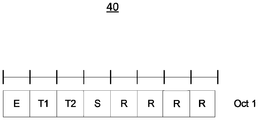
- Figure 4 illustrates another success RAR MAC subheader format 40 according to an example implementation of the present disclosure.
- the success RAR MAC subheader format 40 may consist of the following field:
- This field is a flag, which indicates that the MAC subPDU is the last one (other than MAC subPDU for MAC SDU) or is not in the MAC PDU if the MAC subPDU includes this MAC subheader.
- the E field being "1" indicates that at least another MAC subPDU (other than MAC subPDU for MAC SDU) follows.
- the E field being "0" indicates that the MAC subPDU including this MAC subheader is the last MAC subPDU (other than MAC subPDU for MAC SDU) in the MAC PDU;
- This field is a flag indicating that whether the MAC subheader contains a RA Preamble ID or T2.
- the T1 field being "1” indicates the presence of a RA Preamble ID (RAPID) field in the subheader.
- the T1 field being "0" indicates the presence of T2 field in the subheader;
- This field is a flag indicating that whether the MAC subheader contains a Backoff Indicator (BI) or a MAC SDU indicator (S) .
- the T2 field being "0" indicates the presence of a Backoff Indicator field in the subheader.
- the T2 field being "1" indicates the presence of the S field in the subheader;
- ⁇ S This field indicates that whether “MAC subPDU (s) for MAC SDU” follows the MAC subPDU including this MAC subheader.
- the S field being "1" indicates the presence of “'MAC subPDU (s) for MAC SDU” .
- the S field being "0" indicates the absence of “MAC subPDU (s) for MAC SDU” .
- ⁇ R In some implementations, one of the reserved bits may be used to indicate that whether the UL grant filed is present or not.
- the gNB may provide the UL grant to the UE via a new DCI format (or an existing DCI format with different filed descriptions) which may be scrambled with I-RNTI, 5G-S-TMSI, or the new RNTI related to small data transmission but not limited to.
- a UE may start monitoring a Control Resource Set#0 (CORESET#0) (or other configured CORESET) addressed to C-RNTI (or I-RNTI) . If no DCI can be received in a timer period, the UE may determine that the 2-step RACH procedure is finished and remains in RRC_INACTIVE state. The UE may stop monitoring the CORESET#0 (or other configured CORESET) addressed to C-RNTI (or I-RNTI) .
- the UE may send an indication or information (e.g., in a RRC message, a MAC CE, or a DCI) which is used to inform the gNB that the UE doesn’t need further resources to transmit (small) data.
- the UE may set a new resumeCause in an RRC Resume Request message.
- the UE may set the resumeCause as small data transmission, carried in the RRCResumeRequest or RRCResumeRequest1 to inform the gNB (or cell) that the transmission purpose is for small data transmission.
- the gNB may send the RRC Release with suspendConfig to the UE.
- the gNB may send the new configuration to the UE for the following (small) data transmission.
- the new RRC parameter may represent for the preamble group used for small data transmission, for the number of RO and PO used for small data transmission, or for the number of preambles used for small data transmission.
- the transmitted small data may carry the I-RNTI of the UE for the purpose of UE/device identification, where I-RNTI may include, e.g., fullI-RNTI and/or shortI-RNTI.
- I-RNTI may include, e.g., fullI-RNTI and/or shortI-RNTI.
- fullI-RNTI may be used for small data transmission to identify UE/device.
- shortI-RNTI may be used for small data transmission to identify UE/device.
- fullI-RNTI may be used for small data transmission to identify UE/device; otherwise, shortI-RNTI may be used for small data transmission to identify UE/device.
- the NW may broadcast a threshold for the UE to determine whether it can transmit data in the RRC_INACTIVE state.
- the threshold may be Reference Signal Received Power (RSRP) , Reference Signal Received Quality (RSRQ) , Received Signal Strength Indication (RSSI) , layer 2 buffer size, transmitted payload size, or type of radio bearer (e.g., signaling radio bearer, data radio bearer) but not limited to.
- the UE may determine whether to perform small data transmission when a measured RSSI value is larger than a broadcasted RSSI threshold value of 2-step RACH procedure.
- the upper layer (e.g., MAC entity) of the UE may need to decide that the current transmission is for small data transmission via 2-step/4-step RACH procedure or for connection setup/resume via 2-step/4-step RACH procedure.
- the upper layer of the UE may decide whether the transmitted data is small data or not according to the transmitted bits in the PUSCH. If the transmitted data is not small data, the UE may need to ask for connection setup/resume to switch to RRC_CONNECTED state.
- the transmitted bits are smaller than K bits (e.g., the number of K may be signaled to the UE via RRC message (s) (or dedicated signaling) or pre-configured/pre-defined but not limited to) , it may be determined as small data transmission.
- the upper layer of UE may trigger the 2-step RACH procedure or 4-step RACH procedure to have the UE switch to the RRC_CONNECTED state for the data transmission. For example, if K is pre-defined to be 1000 and the UE needs to transmit 520 bits, the upper layer of the UE may determine the current transmission as small data transmission.
- the upper layer of the UE may pick up the dedicated preambles used for small data transmission to inform the lower layer (e.g., physical layer) to send to the gNB if there are dedicated preambles used for small data transmission.
- the UE may start RACH-based small data transmission. If there are no dedicated preambles, the upper layer of UE may randomly select one preamble to require the lower layer to send to the gNB, and accordingly, the UE may put some information in Msg-A/Msg-3 PUSCH to inform the gNB that the purpose of current transmission is for small data transmission.
- the NW may not allow the multiplexing between data radio bearer (DRB) and signal radio bearer (SRB) in the RRC_INACTIVE state. In some implementation, the NW may allow the multiplexing between data radio bearer (DRB) and signal radio bearer (SRB) in the RRC_INACTIVE state.
- the upper layer may determine whether to trigger small data transmission based on the type of radio bearer (e.g., SRB or DRB) in the RRC_INACTIVE state if the multiplexing of signal radio bearer (SRB) and DRB is not allowed. For example, if the type of radio bearer is data radio bearer (DRB) , the upper layer of UE may trigger small data transmission. In some implementations, the multiplexing between DRB and SRB is allowed in the RRC_INACTIVE state, and the upper layer of UE may trigger the small data transmission based on the number of transmitted bits.
- the type of radio bearer e.g., SRB or DRB
- DRB data radio bearer
- the multiplexing between DRB and SRB is allowed in the RRC_INACTIVE state, and the upper layer of UE may trigger the small data transmission based on the number of transmitted bits.
- the upper layer of UE may trigger small data transmission.
- the NW may inform UEs that whether enabling the capability of small data transmission.
- the NW may transmit the RRC message, dedicated signaling and/or broadcast SI to inform the UE that whether the UE is allowed to transmit data in the RRC_INACTIVE state.
- the RAR may carry the ACK indicator to inform the UE that the gNB has successfully received the data.
- a new RAR may be used to indicate the UE that the small data transmission is completed. Please refer to Figure 5, which illustrates a new RAR format 50 according to an example implementation of the present disclosure.
- the new RAR format for small data transmission ACK indictor may consist of the following fields:
- ⁇ R This field represent the reserved bit, which is set to "0" ;
- This field represents the TPC command for the PUCCH resource containing HARQ feedback for Msg-B, as specified, for example, in 3GPP TS 38.213 v15.7.0.
- the size of the TPC field is 2 bits;
- Timing Advance Command This field indicates the index value TA used to control the amount of timing adjustment that the MAC entity has to apply in, e.g., 3GPP TS 38.213 v15.7.0.
- the size of the Timing Advance Command field is 12 bits;
- the existing RARs may be reused with some modification to indicate the UE that the small data transmission is completed.
- the successRAR may be reused to indicate the UE that the small data transmission is completed by using one reserved bit to be the ACK indictor.
- Figure 6 illustrates a modified successRAR format 60 according to an example implementation of the present disclosure.
- the modified successRAR format 60 for small data transmission with ACK indictor may consist of the following fields:
- This field contains the UL CCCH SDU. If the UL CCCH SDU is longer than 48 bits, this field may contain the first 48 bits of the UL CCCH SDU.
- ⁇ I This field represents an indictor to inform the UE what’s the next step; "1" may represent stopping the transmission; “0” may represent keep receiving NW instruction (e.g., using C-RNTI or other RNTI to monitor Physical Downlink Control Cannel (PDCCH) ) . In some implementations, “0" may represent stopping the transmission; “1” may represent keep receiving NW instruction (e.g., using C-RNTI or other RNTI to monitor PDCCH. ) In some implementations, the NW may instruct the UE to switch back to RRC_CONNECTED state by sending a RRC resume command.
- PDCCH Physical Downlink Control Cannel
- the NW may instruct the UE to switch back to RRC_CONNECTED state by asking the UE to send a RRC resume request message.
- the NW may provide further UL grants via DCI (e.g., when the UE uses C-RNTI or other RNTI to monitor PDCCH) .
- ⁇ R This field represents the reserved bit, which is set to "0" ;
- This field represents the TPC command for the PUCCH resource containing HARQ feedback for Msg-B, as specified, for example, in 3GPP TS 38.213 v15.7.0.
- the size of the TPC field is 2 bits;
- Timing Advance Command This field indicates the index value TA used to control the amount of timing adjustment that the MAC entity has to apply, for example, in 3GPP TS 38.213 v15.7.0.
- the size of the Timing Advance Command field is 12 bits;
- ⁇ C-RNTI This field indicates the identity that is used by the MAC entity upon completion of the RA.
- the size of the C-RNTI field is 16 bits.
- the RNTI e.g., I-RNTI, RA-RNTI, TC-RNTI, or other new RNTI which is dedicatedly used for small data transmission
- the NW may use the implicit way to inform the UE that the data is successfully received at the gNB side. For example, if the UE can successfully decode PDCCH by I-RNTI or the new RNTI that is dedicatedly used for small data transmission, the UE may consider that the gNB has successfully received the data.
- the new RAR may be used to indicate the UE to transmit previous data (e.g., retransmitted data) or new data (e.g., the other part of the full data that UE wants to send to the NW) .
- the existing RARs may be used for data re-transmission.
- the reserved bits of existing RAR may be used for re-transmission indication.
- the reserved bits of existing RAR may be used to indicate the UE to transmit the other part of the full data that the UE wants to send to the NW.
- the MAC CE of the transmitted data may carry index information for the transmitted data, which may be divided from a full data to be sent to the gNB.
- UE may use the MAC CE carried in the transmitted data to inform the gNB that the UE doesn’t have another data for transmission.
- the UE may re-transmit the same data (e.g., the same data of the previous small data transmission) or other new data (e.g., the new small data transmission) .
- the UE may carry the information to indicate that whether the UE needs another PUSCH resources to transmit data in the MAC CE of transmitted data. In some implementations, if the MAC CE in the transmitted data indicates that the UE needs another PUSCH resources, the gNB may send the fallbackRAR to the UE.
- the MAC CE of the transmitted data may carry the information of the transmitted data, such as the size of the transmitted data, the index of the transmitted data, the total number of data that UE wants to send to the gNB, and so on.
- the gNB may schedule the UL grant for the UE to send the data.
- the UL grant may be obtained from the PDCCH that is scrambled by the I-RNTI or other new RNTI used for small data transmission.
- the configured grant type1 may be scheduled to the UE via RRC messages sent by the gNB/cell if the UE informs the gNB that the UE has more than one data to be transmitted during the RACH-based small data transmission.
- Figure 7 illustrates a small data transmission procedure 70 performed by the UE according to an example implementation of the present disclosure.
- the small data transmission procedure 70 for the UE includes the following actions:
- ⁇ Action 702 Receive, from a BS, a configuration indicating a dedicated physical resource.
- ⁇ Action 704 Transmit the small data transmission based on the dedicated physical resource.
- ⁇ Action 706 Receive an ACK indicator indicating a successful reception from the BS.
- action 702 to action 706 of the small data transmission procedure 70 may be applied to the UE.
- the UE may receive the configuration indicating a dedicated physical resource from the BS in action 702.
- the dedicated physical resource may be obtained via the dedicated signaling or broadcasted system information (SI) .
- the dedicated physical resource may correspond to the RO or the PO.
- the dedicated physical resource may be the pre-configured PUSCH resource, the specific identifier or the configured grant requested by the UE.
- the specific identifier may be the I-RNTI.
- the UE may transmit the small data transmission based on the dedicated physical resource in action 704, where the UE may be in the inactive state to transmit the small data transmission.
- the UE may be in the inactive state to perform the 2-step RACH procedure or the 4-step RACH procedure.
- the UE may be in the connected state before receiving the pre-configured PUSCH resource.
- the UE may receive the ACK indicator indicating the successful reception from the BS in action 706.
- the ACK indicator may be a bit information included in one field of the RAR or decoded from a specific UE identifier on the PDCCH.
- the specific UE identifier may be the I-RNTI, the random access-RNTI (RA-RNTI) or a temporary cell-RNTI (TC-RNTI)
- the RAR may be the fallbackRAR or the successRAR.
- the node 800 may include a transceiver 806, a processor 808, a memory 802, one or more presentation components 804, and at least one antenna 810.
- the node 800 may also include a Radio Frequency (RF) spectrum band module, a BS communications module, an NW communications module, and a system communications management module, input/output (I/O) ports, I/O components, and power supply (not explicitly illustrated in Figure 8) .
- RF Radio Frequency
- BS communications module a Radio Frequency (RF) spectrum band module
- NW communications module a system communications management module
- I/O input/output
- I/O components input/output components
- power supply not explicitly illustrated in Figure 824.
- the node 800 may be a UE or a BS that performs various functions disclosed herein, for example, with reference to Fig 7.
- the transceiver 806 having a transmitter 816 (e.g., transmitting/transmission circuitry) and a receiver 818 (e.g., receiving/reception circuitry) may be configured to transmit and/or receive time and/or frequency resource partitioning information.
- the transceiver 806 may be configured to transmit in different types of subframes and slots, including, but not limited to, usable, non-usable and flexibly usable subframes and slot formats.
- the transceiver 806 may be configured to receive data and control channels.
- the node 800 may include a variety of computer-readable media.
- Computer-readable media may be any available media that may be accessed by the node 800 and include both volatile (and non-volatile) media and removable (and non-removable) media.
- Computer-readable media may include computer storage media and communication media.
- Computer storage media may include both volatile (and non-volatile) and removable (and non-removable) media implemented according to any method or technology for storage of information such as computer-readable.
- Computer storage media includes RAM, ROM, EEPROM, flash memory (or other memory technology) , CD-ROM, Digital Versatile Disks (DVD) (or other optical disk storage) , magnetic cassettes, magnetic tape, magnetic disk storage (or other magnetic storage devices) , etc.
- Computer storage media does not include a propagated data signal.
- Communication media may typically embody computer-readable instructions, data structures, program modules, or other data in a modulated data signal such as a carrier wave or other transport mechanism and include any information delivery media.
- modulated data signal may mean a signal that has one or more of its characteristics set or changed in such a manner as to encode information in the signal.
- communication media may include wired media such as a wired NW or direct-wired connection, and wireless media such as acoustic, RF, infrared and other wireless media. Combinations of any of the previous disclosure should also be included within the scope of computer-readable media.
- the memory 802 may include computer-storage media in the form of volatile and/or non-volatile memory.
- the memory 802 may be removable, non-removable, or a combination thereof.
- the memory 802 may include solid-state memory, hard drives, optical-disc drives, etc.
- the memory 802 may store computer-executable (or readable) program 814 (e.g., software codes) that are configured to, when executed, cause the processor 808 to perform various functions disclosed herein, for example, with reference to Fig 7.
- the computer-executable program 814 may not be directly executable by the processor 808 but may be configured to cause the node 800 (e.g., when compiled and executed) to perform various functions disclosed herein.
- the processor 808 may include an intelligent hardware device, a Central Processing Unit (CPU) , a microcontroller, an ASIC, etc.
- the processor 808 may include memory.
- the processor 808 may process the data 812 and the computer-executable program 814 received from the memory 802, and information through the transceiver 806, the baseband communications module, and/or the NW communications module.
- the processor 808 may also process information to be sent to the transceiver 806 for transmission through the antenna 810, to the NW communications module for transmission to a CN.
- One or more presentation components 804 may present data indications to a person or other device. Examples of presentation components 804 may include a display device, speaker, printing component, vibrating component, etc.
Landscapes
- Engineering & Computer Science (AREA)
- Computer Networks & Wireless Communication (AREA)
- Signal Processing (AREA)
- Mobile Radio Communication Systems (AREA)
Abstract
Description
Claims (16)
- A method performed by a User Equipment (UE) for a small data transmission, the method comprising:receiving, from a base station (BS) , a configuration indicating a dedicated physical resource;transmitting the small data transmission based on the dedicated physical resource; andreceiving an acknowledge (ACK) indicator indicating a successful reception from the BS,wherein the UE is in an inactive state to transmit the small data transmission.
- The method of claim 1, wherein the dedicated physical resource is obtained via a dedicated signaling or broadcasted system information (SI) .
- The method of claim 2, wherein the dedicated physical resource corresponds to a random access channel (RACH) occasion (RO) or a physical uplink shared channel (PUSCH) occasion (PO) .
- The method of claim 1, wherein the dedicated physical resource is a pre-configured PUSCH resource, a specific identifier or a configured grant requested by the UE.
- The method of claim 4, wherein the UE is in a connected state before receiving the pre-configured PUSCH resource, and the specific identifier is an inactive-radio network temporary identifier (I-RNTI) .
- The method of claim 1, wherein the ACK indicator is a bit information included in one field of a random access response (RAR) or decoded from a specific UE identifier on a physical downlink control channel (PDCCH) .
- The method of claim 6, wherein the specific UE identifier is an inactive-radio network temporary identifier (I-RNTI) , a random access-RNTI (RA-RNTI) or a temporary cell-RNTI (TC-RNTI) , and the RAR is a fallbackRAR or a successRAR.
- The method of claim 1, wherein the UE is in the inactive state to perform a two-step random access channel (RACH) procedure or a four-step RACH procedure.
- A User Equipment (UE) in a wireless communication system for a small data transmission, which comprises a Base Station (BS) , the UE comprising:a processor; anda memory coupled to the processor, wherein the memory stores a computer-executable program that when executed by the processor, causes the processor to:transmit the small data transmission based on the dedicated physical resource; andreceive an acknowledge (ACK) indicator indicating a successful reception from the BS,wherein the UE is in an inactive state to transmit the small data transmission.
- The UE of claim 9, wherein the dedicated physical resource is obtained via a dedicated signaling or broadcasted system information (SI) .
- The UE of claim 10, wherein the dedicated physical resource corresponds to a random access channel (RACH) occasion (RO) or a physical uplink shared channel (PUSCH) occasion (PO) .
- The UE of claim 9, wherein the dedicated physical resource is a pre-configured PUSCH resource, a specific identifier or a configured grant requested by the UE.
- The UE of claim 12, wherein the UE is in a connected state before receiving the pre-configured PUSCH resource, and the specific identifier is an inactive-radio network temporary identifier (I-RNTI) .
- The UE of claim 9, wherein the ACK indicator is a bit information included in one field of a random access response (RAR) or decoded from a specific UE identifier on a physical downlink control channel (PDCCH) .
- The UE of claim 14, wherein the specific UE identifier is an inactive-radio network temporary identifier (I-RNTI) , a random access-RNTI (RA-RNTI) or a temporary cell-RNTI (TC-RNTI) , and the RAR is a fallbackRAR or a successRAR.
- The UE of claim 9, wherein the UE is in the inactive state to perform a two-step random access channel (RACH) procedure or a four-step RACH procedure.
Priority Applications (4)
| Application Number | Priority Date | Filing Date | Title |
|---|---|---|---|
| MX2022008122A MX2022008122A (en) | 2019-12-31 | 2020-12-16 | Method and user equipment for small data transmission. |
| CN202080091490.4A CN114902781B (en) | 2019-12-31 | 2020-12-16 | Method and user equipment for small data transmission |
| EP20910191.4A EP4082287B1 (en) | 2019-12-31 | 2020-12-16 | Method and user equipment for small data transmission |
| US17/787,694 US20230013851A1 (en) | 2019-12-31 | 2020-12-16 | Method and user equipment for small data transmission |
Applications Claiming Priority (2)
| Application Number | Priority Date | Filing Date | Title |
|---|---|---|---|
| US201962955741P | 2019-12-31 | 2019-12-31 | |
| US62/955,741 | 2019-12-31 |
Publications (1)
| Publication Number | Publication Date |
|---|---|
| WO2021135941A1 true WO2021135941A1 (en) | 2021-07-08 |
Family
ID=76686570
Family Applications (1)
| Application Number | Title | Priority Date | Filing Date |
|---|---|---|---|
| PCT/CN2020/136734 Ceased WO2021135941A1 (en) | 2019-12-31 | 2020-12-16 | Method and user equipment for small data transmission |
Country Status (4)
| Country | Link |
|---|---|
| US (1) | US20230013851A1 (en) |
| EP (1) | EP4082287B1 (en) |
| MX (1) | MX2022008122A (en) |
| WO (1) | WO2021135941A1 (en) |
Cited By (4)
| Publication number | Priority date | Publication date | Assignee | Title |
|---|---|---|---|---|
| WO2023122889A1 (en) * | 2021-12-27 | 2023-07-06 | Oppo广东移动通信有限公司 | Communication processing method and apparatus, terminal device and access network device |
| WO2023126542A1 (en) | 2022-01-03 | 2023-07-06 | Continental Automotive Technologies GmbH | Congestion reducing method performed by a user equipment in communication systems |
| CN118176820A (en) * | 2021-07-29 | 2024-06-11 | 欧芬诺有限责任公司 | Method and apparatus for small data transmission (SDT) |
| WO2025233449A1 (en) | 2024-05-08 | 2025-11-13 | Aumovio Germany Gmbh | Method for group-based access for ambient iot devices |
Families Citing this family (7)
| Publication number | Priority date | Publication date | Assignee | Title |
|---|---|---|---|---|
| CN114982365B (en) * | 2020-01-22 | 2025-02-14 | 日本电气株式会社 | Method, device and computer storage medium for communication |
| GB2593537A (en) * | 2020-03-27 | 2021-09-29 | Nec Corp | Communication system |
| TWI899201B (en) * | 2020-04-08 | 2025-10-01 | 美商內數位專利控股公司 | Methods and apparatus for downlink small data reception |
| EP4173430A4 (en) * | 2020-07-17 | 2023-11-29 | Samsung Electronics Co., Ltd. | Method and apparatus for random access procedure for small data transmission in wireless communication |
| KR20230035085A (en) | 2020-08-06 | 2023-03-10 | 애플 인크. | Systems and methods for providing random access channel (RACH) signaling to user equipment (UE) during inactive direct transmissions |
| CN116349299B (en) * | 2020-08-06 | 2025-10-28 | 苹果公司 | Baseband processor, UE device and method for inactive direct transmission from user equipment (UE) via random access channel (RACH) procedure |
| US12414161B2 (en) * | 2021-01-18 | 2025-09-09 | Lg Electronics Inc. | Method and apparatus for transmitting/receiving wireless signal in wireless communication system |
Citations (3)
| Publication number | Priority date | Publication date | Assignee | Title |
|---|---|---|---|---|
| US20160366704A1 (en) * | 2014-02-28 | 2016-12-15 | Lg Electronics Inc. | Method and apparatus for transmitting uplink data having low latency in wireless communication system |
| WO2017120091A2 (en) * | 2016-01-08 | 2017-07-13 | Zte Corporation | Methods of transmitting mission critical small data using random access channel |
| EP3571878A2 (en) | 2017-01-20 | 2019-11-27 | QUALCOMM Incorporated | Small packet optimizations for internet-of-things applications |
Family Cites Families (8)
| Publication number | Priority date | Publication date | Assignee | Title |
|---|---|---|---|---|
| CN104662977B (en) * | 2013-09-13 | 2019-05-24 | 华为技术有限公司 | A method, device and system for sending feedback information |
| US11134511B2 (en) * | 2018-07-09 | 2021-09-28 | Qualcomm Incorporated | System and method for repetition of scheduling information on a control channel |
| ES3041569T3 (en) * | 2018-08-09 | 2025-11-13 | Zte Corp | Pre-configured dedicated resource for idle mode transmissions |
| EP3892047A4 (en) * | 2018-12-03 | 2022-08-03 | Telefonaktiebolaget LM Ericsson (publ.) | UPLINK TRANSMISSION USING AN UNLICENSED FREQUENCY SPECTRUM |
| JP7376598B2 (en) * | 2019-01-14 | 2023-11-08 | ノキア テクノロジーズ オサケユイチア | Data transmission from user equipment in radio resource control inactive state |
| CN111800888B (en) * | 2019-08-13 | 2022-04-19 | 维沃移动通信有限公司 | SDT processing method, device and system |
| US11483859B2 (en) * | 2019-08-16 | 2022-10-25 | Comcast Cable Communications, Llc | Random access procedures using repetition |
| US12574921B2 (en) * | 2020-04-08 | 2026-03-10 | Interdigital Patent Holdings, Inc. | Methods, apparatus and systems for uplink transmission of small data |
-
2020
- 2020-12-16 WO PCT/CN2020/136734 patent/WO2021135941A1/en not_active Ceased
- 2020-12-16 EP EP20910191.4A patent/EP4082287B1/en active Active
- 2020-12-16 US US17/787,694 patent/US20230013851A1/en active Pending
- 2020-12-16 MX MX2022008122A patent/MX2022008122A/en unknown
Patent Citations (3)
| Publication number | Priority date | Publication date | Assignee | Title |
|---|---|---|---|---|
| US20160366704A1 (en) * | 2014-02-28 | 2016-12-15 | Lg Electronics Inc. | Method and apparatus for transmitting uplink data having low latency in wireless communication system |
| WO2017120091A2 (en) * | 2016-01-08 | 2017-07-13 | Zte Corporation | Methods of transmitting mission critical small data using random access channel |
| EP3571878A2 (en) | 2017-01-20 | 2019-11-27 | QUALCOMM Incorporated | Small packet optimizations for internet-of-things applications |
Non-Patent Citations (3)
| Title |
|---|
| HUAWEI ET AL.: "Further views on Rel-17 small data work area", 3GPP TSG RAN MEETING #85, 16 September 2019 (2019-09-16) |
| HUAWEI, HISILICON: "Key points on NR small data", 3GPP DRAFT; RP-192789, 3RD GENERATION PARTNERSHIP PROJECT (3GPP), MOBILE COMPETENCE CENTRE ; 650, ROUTE DES LUCIOLES ; F-06921 SOPHIA-ANTIPOLIS CEDEX ; FRANCE, vol. TSG RAN, no. Stiges, Spain; 20191209 - 20191212, 2 December 2019 (2019-12-02), Mobile Competence Centre ; 650, route des Lucioles ; F-06921 Sophia-Antipolis Cedex ; France, XP051834381 * |
| See also references of EP4082287A4 |
Cited By (4)
| Publication number | Priority date | Publication date | Assignee | Title |
|---|---|---|---|---|
| CN118176820A (en) * | 2021-07-29 | 2024-06-11 | 欧芬诺有限责任公司 | Method and apparatus for small data transmission (SDT) |
| WO2023122889A1 (en) * | 2021-12-27 | 2023-07-06 | Oppo广东移动通信有限公司 | Communication processing method and apparatus, terminal device and access network device |
| WO2023126542A1 (en) | 2022-01-03 | 2023-07-06 | Continental Automotive Technologies GmbH | Congestion reducing method performed by a user equipment in communication systems |
| WO2025233449A1 (en) | 2024-05-08 | 2025-11-13 | Aumovio Germany Gmbh | Method for group-based access for ambient iot devices |
Also Published As
| Publication number | Publication date |
|---|---|
| EP4082287A1 (en) | 2022-11-02 |
| EP4082287A4 (en) | 2023-12-27 |
| MX2022008122A (en) | 2022-07-21 |
| US20230013851A1 (en) | 2023-01-19 |
| CN114902781A (en) | 2022-08-12 |
| EP4082287B1 (en) | 2025-08-06 |
Similar Documents
| Publication | Publication Date | Title |
|---|---|---|
| EP4082287B1 (en) | Method and user equipment for small data transmission | |
| US11582790B2 (en) | User equipment and method for small data transmission | |
| US12262445B2 (en) | Method of small data transmission and related device | |
| US12408193B2 (en) | Method and apparatus for LBT failure detection | |
| US12382463B2 (en) | Method and user equipment for configured grant configuration | |
| WO2022152242A1 (en) | Method related to pusch repetitions, user equipment, and network device | |
| WO2021155853A1 (en) | Wireless communication method and user equipment for handling random access operations | |
| US11696341B2 (en) | Methods and apparatuses for random access procedure in medium access control layer | |
| US20220377800A1 (en) | User equipment and method for small data transmission | |
| US12563553B2 (en) | Methods and apparatuses for hybrid automatic repeat request operations in wireless communication systems | |
| US20210176029A1 (en) | Communication method and user equipment for operations with bandwidth part switching | |
| US20210168874A1 (en) | User equipment and method for two-step random access procedure | |
| US20230080733A1 (en) | User equipment and method for small data transmission procedure | |
| US20250113384A1 (en) | Method and apparatus for layer1/layer2 triggered mobility (ltm) in wireless networks | |
| US12114390B2 (en) | Method and apparatus for handling random access failures in RRC inactive state | |
| CN114902781B (en) | Method and user equipment for small data transmission |
Legal Events
| Date | Code | Title | Description |
|---|---|---|---|
| 121 | Ep: the epo has been informed by wipo that ep was designated in this application |
Ref document number: 20910191 Country of ref document: EP Kind code of ref document: A1 |
|
| WWE | Wipo information: entry into national phase |
Ref document number: MX/A/2022/008122 Country of ref document: MX |
|
| NENP | Non-entry into the national phase |
Ref country code: DE |
|
| WWP | Wipo information: published in national office |
Ref document number: MX/A/2022/008122 Country of ref document: MX |
|
| ENP | Entry into the national phase |
Ref document number: 2020910191 Country of ref document: EP Effective date: 20220727 |
|
| WWG | Wipo information: grant in national office |
Ref document number: 2020910191 Country of ref document: EP |
|
| WWG | Wipo information: grant in national office |
Ref document number: MX/A/2022/008122 Country of ref document: MX |