WO2021140895A1 - レーザー彫刻可能なフレキソ印刷原版 - Google Patents
レーザー彫刻可能なフレキソ印刷原版 Download PDFInfo
- Publication number
- WO2021140895A1 WO2021140895A1 PCT/JP2020/047627 JP2020047627W WO2021140895A1 WO 2021140895 A1 WO2021140895 A1 WO 2021140895A1 JP 2020047627 W JP2020047627 W JP 2020047627W WO 2021140895 A1 WO2021140895 A1 WO 2021140895A1
- Authority
- WO
- WIPO (PCT)
- Prior art keywords
- silicone compound
- resin composition
- photosensitive resin
- original plate
- refractive index
- Prior art date
- Legal status (The legal status is an assumption and is not a legal conclusion. Google has not performed a legal analysis and makes no representation as to the accuracy of the status listed.)
- Ceased
Links
Classifications
-
- G—PHYSICS
- G03—PHOTOGRAPHY; CINEMATOGRAPHY; ANALOGOUS TECHNIQUES USING WAVES OTHER THAN OPTICAL WAVES; ELECTROGRAPHY; HOLOGRAPHY
- G03F—PHOTOMECHANICAL PRODUCTION OF TEXTURED OR PATTERNED SURFACES, e.g. FOR PRINTING, FOR PROCESSING OF SEMICONDUCTOR DEVICES; MATERIALS THEREFOR; ORIGINALS THEREFOR; APPARATUS SPECIALLY ADAPTED THEREFOR
- G03F7/00—Photomechanical, e.g. photolithographic, production of textured or patterned surfaces, e.g. printing surfaces; Materials therefor, e.g. comprising photoresists; Apparatus specially adapted therefor
- G03F7/004—Photosensitive materials
- G03F7/027—Non-macromolecular photopolymerisable compounds having carbon-to-carbon double bonds, e.g. ethylenic compounds
- G03F7/032—Non-macromolecular photopolymerisable compounds having carbon-to-carbon double bonds, e.g. ethylenic compounds with binders
-
- B—PERFORMING OPERATIONS; TRANSPORTING
- B41—PRINTING; LINING MACHINES; TYPEWRITERS; STAMPS
- B41C—PROCESSES FOR THE MANUFACTURE OR REPRODUCTION OF PRINTING SURFACES
- B41C1/00—Forme preparation
- B41C1/02—Engraving; Heads therefor
- B41C1/04—Engraving; Heads therefor using heads controlled by an electric information signal
- B41C1/05—Heat-generating engraving heads, e.g. laser beam, electron beam
-
- B—PERFORMING OPERATIONS; TRANSPORTING
- B41—PRINTING; LINING MACHINES; TYPEWRITERS; STAMPS
- B41N—PRINTING PLATES OR FOILS; MATERIALS FOR SURFACES USED IN PRINTING MACHINES FOR PRINTING, INKING, DAMPING, OR THE LIKE; PREPARING SUCH SURFACES FOR USE AND CONSERVING THEM
- B41N1/00—Printing plates or foils; Materials therefor
- B41N1/12—Printing plates or foils; Materials therefor non-metallic other than stone, e.g. printing plates or foils comprising inorganic materials in an organic matrix
Definitions
- the present invention enjoys the benefit of lowering the adhesiveness of the printing plate surface by blending the silicone compound, and increases the time required for producing the printing original plate by blending the silicone compound, particularly, the photosensitive resin composition is crosslinked and cured by irradiating with light.
- a flexographic printing original plate capable of laser engraving which suppresses the disadvantage of increasing the time required for full curing.
- a flexographic printing original plate capable of laser engraving is generally obtained by irradiating a sheet-shaped molded product made of a photosensitive resin composition with light and cross-linking and curing the sheet-shaped molded product, and the sheet-shaped molded product is wound around a cylindrical drum.
- the printing plate is obtained by continuously performing laser engraving while rotating the drum and removing the resin residue generated by the laser engraving from the plate surface.
- the photosensitive resin composition of this printing original plate generally contains an aqueous dispersion latex, a photopolymerizable unsaturated compound, and a photopolymerization initiator as essential components, and if necessary, a stabilizer, a plasticizer, etc. Contains additives.
- the printing original plate generally contains water-dispersed latex
- the original plate itself has high adhesiveness, and the resin residue generated by laser irradiation is not removed by suction during laser irradiation or cleaning after laser irradiation. It has a problem that it tends to remain attached to the plate. If the resin residue remains attached to the laser non-irradiated portion (convex portion) of the printing plate, this portion is a portion to which ink is applied at the time of printing, which causes printing defects.
- the depth of the halftone dots decreases, and if it remains attached to the side surface of the concave portion, the reproducibility of the halftone dots decreases. , Both may cause a decrease in resolution.
- the photosensitive resin composition of Patent Document 1 can reduce the adhesiveness of the printing original plate by blending the silicone compound and suppress the adhesion of the resin residue to the plate surface generated during laser irradiation to some extent, but when the printing original plate is manufactured.
- the photosensitive resin composition is cross-linked and cured by irradiating it with light, the presence of the silicone compound causes scattering of the irradiation light, and the time required for the entire surface curing of the photosensitive resin composition is longer than that in the case where the silicone compound is not blended.
- the increase in the time required for the total curing tends to increase as the amount of the silicone compound blended in the photosensitive resin composition increases. Therefore, in the photosensitive resin composition of Patent Document 1, the blending amount of the silicone compound is limited to a small amount of 0.05 to 1.0% by mass, and therefore the reduction of the plate surface adhesiveness due to the silicone compound is sufficient. It was difficult to demonstrate it.
- the present invention has been devised in view of the above-mentioned problems of the prior art, and an object of the present invention is to irradiate even when the blending amount of the silicone compound in the photosensitive resin composition is increased in order to reduce the adhesiveness of the printing plate surface.
- An object of the present invention is to provide a flexographic printing original plate capable of laser engraving, in which light easily reaches the bottom and the time required for curing the entire surface of the photosensitive resin composition is short.
- the present inventors have diligently investigated the cause of the water-dispersed latex in the photosensitive resin composition.
- the refractive index of the above and the refractive index of the conventionally used silicone compound, which causes the irradiation light to be largely scattered as it passes through the photosensitive resin composition, and this light scattering.
- the time required for this total curing becomes significantly longer when the thickness of the molded product made of the photosensitive resin composition is large.
- the refractive index of the silicone compound is adjusted by introducing an appropriate amount of a group containing an aromatic ring into the silicone compound so that the refractive indexes of the water-dispersed latex and the silicone compound are similar to each other.
- the scattering of irradiation light for cross-linking curing is significantly reduced, and even if the blending amount of the silicone compound is increased in order to enhance the plate surface adhesiveness, the time required for total curing does not increase.
- a flexographic printing original plate capable of laser engraving obtained by irradiating a molded product made of a photosensitive resin composition with light and cross-linking and curing.
- the photosensitive resin composition is a water-dispersed latex and photopolymerizable. It contains an unsaturated compound, a photopolymerization initiator, and a silicone compound, the aqueous dispersion latex is one or more latex rubbers selected from the group consisting of polybutadiene rubbers and polynitrile butadiene rubbers, and the silicone compounds.
- Is a flexographic printing original plate capable of laser engraving which is a silicone compound having an amino group in the molecule and has a refractive index of 1.44 or more and 1.60 or less.
- a laser engravable flexographic printing original plate obtained by irradiating a molded product made of a photosensitive resin composition with light to crosslink and cure the photosensitive resin composition, wherein the photosensitive resin composition is a water-dispersed latex or photopolymerizable.
- the aqueous dispersion latex is a polystyrene butadiene rubber
- the silicone compound is a silicone compound having an amino group in the molecule
- 1 A laser engravable flexographic original plate characterized by having a refractive index of .47 or more and 1.63 or less.
- a specific silicone compound is selected so that the difference in refractive light between the water-dispersed latex and the silicone compound in the photosensitive resin composition used is small. Since the adjustment is made, even if the blending amount of the silicone compound is increased in order to enhance the adhesive effect on the plate surface, scattering is unlikely to occur due to the irradiation light for cross-linking and curing, so that the light easily reaches the bottom of the photosensitive resin composition. , Full curing can be achieved in a short time. As a result, it is possible to avoid a long time required for the entire surface of the photosensitive resin composition to be cured, and it is possible to efficiently print a large amount of high-quality printed matter.
- the laser engravable flexo printing plate of the present invention is crosslinked and cured by irradiating a molded product composed of a photosensitive resin composition containing an aqueous dispersion latex, a photopolymerizable unsaturated compound, a photopolymerization initiator, and a silicone compound with light. It is obtained by subjecting the mixture, and is characterized in that a specific silicone compound is selected and adjusted so that the refractive index with respect to the irradiation light does not cause a large difference between the water-dispersed latex and the silicone compound.
- Water-dispersed latex is a hydrophobic polymer that constitutes the main component of the photosensitive resin composition.
- the water-dispersed latex is one or more latex rubbers selected from the group consisting of (i) polybutadiene rubbers and polynitrile butadiene rubbers, or (ii) polystyrene butadiene rubbers.
- either one of the polybutadiene rubber and the polynitrile butadiene rubber may be used, but it is preferable to use both in combination for high-quality printing having excellent fine image reproducibility.
- these water-dispersed latex may be modified with (meth) acrylic, carboxy, silicone, fluorine or the like, if desired.
- the water-dispersed latex a large number of various synthetic latex and natural latex are commercially available, and desired ones may be appropriately obtained from them.
- the blending amount of the water-dispersed latex in the photosensitive resin composition is preferably 40 to 80% by mass. If it is less than 40% by mass, the strength as a printing plate is insufficient, and if it exceeds 80% by mass, it takes time for water development, which is not preferable.
- the photopolymerizable unsaturated compound is for forming a dense network for maintaining the shape of the printing master by polymerizing and cross-linking and curing by light irradiation, and preferably contains a photopolymerizable oligomer.
- the photopolymerizable oligomer is a polymer in which an ethylenically unsaturated group is bonded to the terminal and / or side chain of the conjugated diene-based polymer, and preferably has a number average molecular weight of 1000 to 10000.
- the conjugated diene-based polymer is composed of a homopolymer of a conjugated diene unsaturated compound or a copolymer of a conjugated diene unsaturated compound and a monoethylene unsaturated compound.
- copolymers include butadiene copolymers, isoprene copolymers, chloroprene copolymers, styrene-chloroprene copolymers, acrylonitrile-butadiene copolymers, acrylonitrile-isoprene copolymers, methyl methacrylate-isoprene copolymers, and acrylonitrile.
- -Isoprene copolymer methyl methacrylate-isoprene copolymer, methyl methacrylate-chloroprene copolymer, methyl acrylate-butadiene copolymer, methyl acrylate-isoprene copolymer, methyl acrylate-chloroprene copolymer , Acrylonitrile-butadiene-styrene copolymer, acrylonitrile-chloroprene-styrene copolymer and the like.
- a butadiene polymer, an isoprene polymer, and an acrylonitrile-butadiene copolymer are preferable, and a butadiene polymer and an isoprene polymer are particularly preferable in terms of rubber elasticity and photocurability.
- the photopolymerizable unsaturated compound in addition to the above-exemplified compounds, generally used photopolymerizable monomers such as methacrylate can be used as long as the effects of the present invention are not impaired.
- the blending amount of the photopolymerizable unsaturated compound in the photosensitive resin composition is preferably 10 to 45% by mass. If it is less than 10% by mass, the toughness is lowered, and if it exceeds 45% by mass, the developability may be lowered.
- the photopolymerization initiator conventionally known ones can be used as long as they can polymerize polymerizable carbon-carbon unsaturated groups with light, and are not particularly limited. Among them, those having a function of generating radicals by autolysis or hydrogen abstraction by light absorption are preferably used. Specific examples thereof include benzoin alkyl ethers, benzophenones, anthraquinones, benzyls, acetophenones, diacetyls and the like.
- the blending amount of the photopolymerization initiator in the photosensitive resin composition is preferably 0.1 to 10% by mass. If it is less than 0.1% by mass, the starting efficiency may decrease and the image reproducibility may be deteriorated. If it exceeds 10% by mass, the sensitivity becomes high, and it may be difficult to control the light irradiation time for full curing.
- the silicone compound has a role of lowering the plate surface adhesiveness of the printing plate and preventing the adhesion of resin residue generated during laser engraving.
- the silicone compound also has a role of preventing stains on the printing plate surface due to its ink repellency.
- the silicone compound used in the present invention needs to be an amino-modified silicone compound having an amino group in the molecule.
- the amino-modified silicone compound is used, the effect of preventing the plate surface stain by the silicone compound can be continuously exerted. This is because the amino group in the molecule is Michael-added to the double bond in the photopolymerizable unsaturated compound, the silicone compound is immobilized in the printing plate, and the movement of the silicone compound during printing is prevented. Is considered to be.
- the position of the amino group in the molecule is not limited, and examples thereof include a terminal position and a side chain position. Further, the number of amino groups may be one or more, and the amino groups may be present at a plurality of locations. Further, it may contain a functional group other than the amino group. Since the silicone compound immobilized by the amino group exists in a dispersed state throughout the printing plate, it is considered that the ink repellency is maintained even if the surface of the printing plate is worn by mass printing.
- the amino group equivalent of the amino-modified silicone compound is preferably in the range of 500 to 10000 g / mol, and more preferably in the range of 1000 to 5000 g / mol. If the amino group equivalent is less than the above lower limit, the initial ink repellent effect may be inferior, while if it exceeds the above upper limit, the effect sustainability may be inferior.
- the kinematic viscosity of the amino-modified silicone compound is not particularly limited , but is preferably in the range of 20 to 5000 mm 2 / s, and more preferably 40 to 1000 mm 2 / s. If the kinematic viscosity is less than the above lower limit, the effect of lowering the adhesiveness of the plate surface and the ink repellency may be inferior, while if it exceeds the above upper limit, the dissolution stability may be inferior.
- the silicone compound having a refractive index in a specific range close to the refractive index of the water-dispersed latex contained in the photosensitive resin composition at the time of light irradiation it is important to select in advance a silicone compound having a refractive index suitable for the change.
- the water-dispersed latex is one or more latex rubbers (refractive index is 1.52) selected from the group consisting of polybutadiene rubber and polynitrile butadiene rubber, the silicone compound is irradiated with light.
- Polypolybutadiene rubber (refractive index is 1.55)
- the silicone compound is 1.47 or more and 1.63 or less, preferably 1 which is close to the refractive index of 1.55 in order to reduce the scattering of irradiation light. It is necessary to select one having a refractive index of .49 or more and 1.61 or less.
- the refractive index of the silicone compound is 1.52 for the polybutadiene rubber and the polynitrile butadiene rubber, and 1.55 for the polystyrene butadiene rubber, whereas the conventionally used silicone The refractive index of the compound was much lower than these values, about 1.4.
- the refractive index of the silicone compound is higher than that of the conventional one, and the difference in the refractive index between the silicone compound and the water-dispersed latex is suppressed to a small range.
- the silicone compound used in the present invention does not increase the time required for the entire surface curing even if it is blended in a large amount in the photosensitive resin composition, so that the production efficiency of the printing original plate is improved. In addition to being high, the effect of reducing the adhesiveness of the plate surface inherent in the silicone compound can be sufficiently exhibited.
- the method for controlling the refractive index of the silicone compound is not particularly limited, but for example, by introducing an appropriate amount of a group containing an aromatic ring into the silicone compound having an amino group in the molecule, the conventional silicone compound can be used. Examples thereof include a method of inducing a desired refractive index higher than the refractive index.
- the refractive index of the silicone compound is low in the conventional state in which the amino group is simply introduced, and the difference in the refractive index from that of the water-dispersed latex remains large. However, by introducing a bulky aromatic ring, the refractive index of the silicone compound remains large. Can be increased to minimize the difference in refractive index from the water-dispersed latex.
- the type of the group containing the aromatic ring is not particularly limited, but for example, a bulky aromatic ring such as a phenyl group, a styryl group, or a naphthyl group may be appropriately selected according to a desired refractive index.
- the equivalent of the group containing the aromatic ring in the silicone compound is preferably 20 to 1000 g / mol, and more preferably 50 to 500 g / mol. If the equivalent of the group containing the aromatic ring is less than the above lower limit, the effect of lowering the adhesiveness of the plate surface and the ink repellency may be insufficient, while if it exceeds the above upper limit, the effect of increasing the refractive index becomes insufficient. Light scattering may occur at the interface with the water-dispersed latex.
- a silicone compound having a group containing an amino group and an aromatic ring in the molecule as described above and having a refractive index close to that of the water-dispersed latex can be produced by a conventionally known method, for example.
- the following commercially available products may be obtained and used.
- Examples of commercially available products that can be used include X22 1660B-3 and X22 9409 manufactured by Shin-Etsu Chemical Co., Ltd.
- the number average molecular weight of the silicone compound used in the present invention is preferably 500 to 50,000, more preferably 1,000 to 10,000. If the number average molecular weight is less than the above lower limit, the effect of lowering the adhesiveness of the plate surface and the ink repellency may be insufficient, while if it exceeds the above upper limit, the compatibility with the photosensitive resin may be lowered.
- the content of the silicone compound in the photosensitive resin composition is preferably more than 1.0% by mass and 10% by mass or less, preferably 1.2% by mass or more and 5.0% by mass or less. More preferably. If the content of the silicone compound is less than the above lower limit, the effect of reducing the plate surface adhesiveness of the silicone compound and the effect of preventing ink stain on the plate surface may not be sufficiently exhibited. On the other hand, if the content exceeds the above upper limit, the printing plate machine The target strength may decrease.
- the silicone compound can be blended in an amount sufficient to exert the high level of effect of reducing the adhesiveness of the plate surface required for realizing printing.
- a hydrophilic polymer can be added to the photosensitive resin composition which is the raw material of the printing original plate of the present invention.
- Those having a hydrophilic group such as an ester group are preferable, and specifically, a polymer of (meth) acrylic acid or a salt thereof, a polymer of (meth) acrylic acid or a salt thereof and an alkyl (meth) acrylate, ( Polymer of (meth) acrylic acid or salts thereof and styrene, copolymer of (meth) acrylic acid or salts thereof and vinyl acetate, copolymer of (meth) acrylic acid or salts thereof and acrylonitrile, polyvinyl alcohol , Carboxymethyl cellulose, polyacrylamide
- the blending amount of the hydrophilic polymer in the photosensitive resin composition is preferably 2 to 30% by mass. If it is less than 2% by mass, the developability is lowered, and if it exceeds 30% by mass, the water resistance of the relief may be lowered.
- a thermal polymerization inhibitor (stabilizer) can be added to the photosensitive resin composition from the viewpoints of enhancing thermal stability during kneading and enhancing storage stability.
- the blending amount of the thermal polymerization inhibitor (stabilizer) in the photosensitive resin composition is generally 0.001 to 5% by mass.
- the thermal polymerization inhibitor include phenols, hydroquinones, catechols and the like.
- the photosensitive resin composition includes plasticizers, ultraviolet absorbers, dyes, pigments, defoamers, anti-aggregation agents, fluorine compounds, etc. for the purpose of improving various properties as long as the effects of the present invention are not impaired.
- plasticizers ultraviolet absorbers, dyes, pigments, defoamers, anti-aggregation agents, fluorine compounds, etc.
- Other components can be added as appropriate.
- the photosensitive resin composition can be prepared by mixing the above-mentioned essential components and optional components. At that time, an organic solvent such as toluene may be added if desired to facilitate mixing. Also, in order to complete the mixing, it is desirable to knead well under heating conditions using a kneader. The heating conditions are preferably about 50 to 110 ° C. Further, it is preferable that the organic solvent added at the time of mixing and the water contained in the components are removed under reduced pressure after kneading.
- the laser engravable printing master plate of the present invention is obtained by molding the photosensitive resin composition prepared as described above into a sheet shape or a cylindrical shape, and then irradiating the molded product with light to crosslink and cure the molded product. Be done.
- a conventionally known resin molding method can be used, for example, the photosensitive resin composition is placed on a suitable support or on a cylinder of a printing machine.
- a method of applying the resin to the resin and pressurizing it with a heat press or the like can be mentioned.
- the thickness of the molded product is preferably 2.0 to 5.0 mm, more preferably 2.5 to 4.0 mm from the viewpoint of shape retention and handleability.
- the support a material having flexibility and excellent dimensional stability is preferably used, and examples thereof include polyethylene terephthalate film, polyethylene naphthalate film, polybutylene terephthalate film, and polycarbonate.
- the thickness of the support is preferably 50 to 250 ⁇ m, more preferably 100 to 200 ⁇ m from the viewpoint of mechanical properties, shape stability, etc. of the printing master. Further, if necessary, in order to improve the adhesion between the support and the resin layer, a known adhesive conventionally used for this kind of purpose may be provided on the surface.
- the pressurization condition is preferably about 20 to 200 kg / cm 2 , and the temperature condition at the time of pressurization is preferably about room temperature to 150 ° C.
- the molded product made of the above-mentioned photosensitive resin composition is irradiated with light to crosslink and cure the photopolymerizable unsaturated compound in the resin composition to obtain a printing original plate.
- the photosensitive resin composition of the present invention since light scattering due to irradiation light is small, the time required for the entire surface curing of the resin composition is shorter than that using the conventional silicone compound.
- the light source used for curing include a high-pressure mercury lamp, an ultra-high pressure mercury lamp, an ultraviolet fluorescent lamp, a carbon arc lamp, and a xenon lamp.
- the light source used for curing may be one type, but may be cured using two or more types of light sources having different wavelengths.
- the printing original plate thus obtained is attached to the surface of the plate mounting drum of the laser engraving device, and the original plate of the irradiated portion is decomposed by laser irradiation according to the image to form a concave portion, and the printing plate is manufactured.
- the photosensitive resin composition of the present invention since a larger amount of silicone compound can be used than before without increasing the time required for total curing, the adhesiveness of the plate surface is effectively suppressed, and the resin decomposed by laser irradiation. It is extremely easy to remove the residue from the printing plate.
- the part in the example means a part by mass
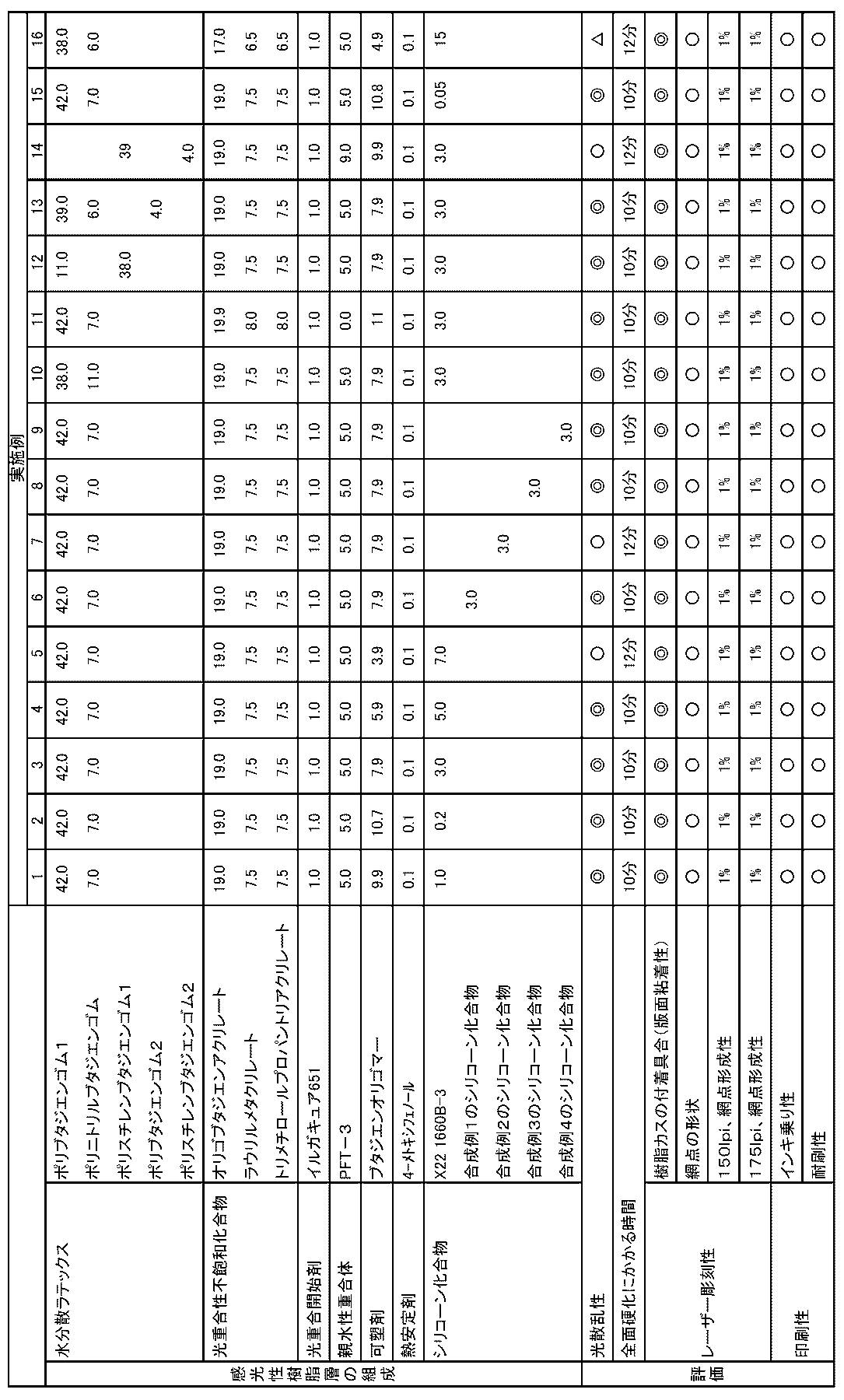
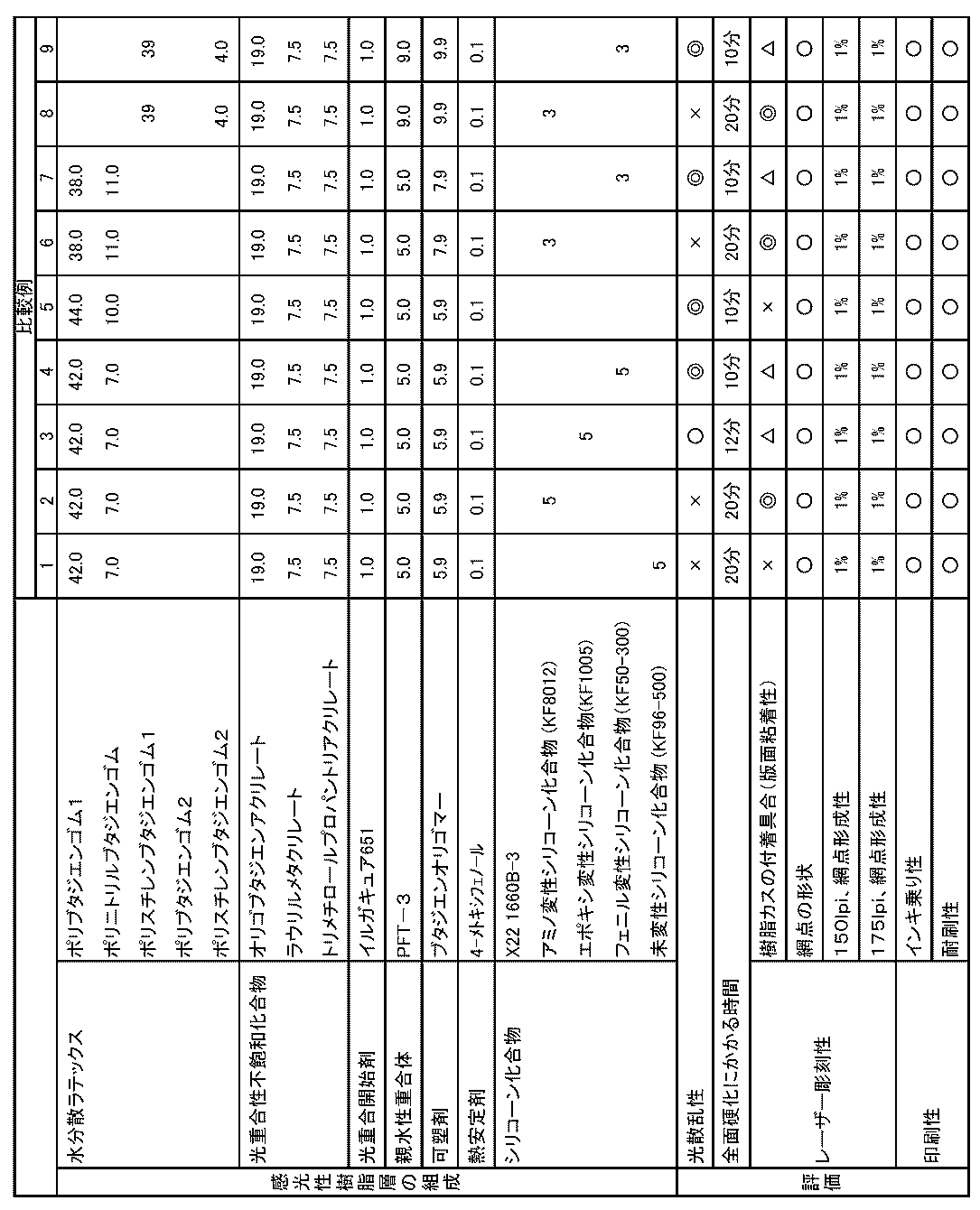
- the numerical value indicating the composition ratio in the table also means a part by mass.
- Example 1 Preparation of photosensitive resin composition Butadiene latex as water-dispersed latex (Nipol LX111NF, non-volatile content 55%, manufactured by Nippon Zeon Co., Ltd.) 76 parts by mass, acrylonitrile-butadiene latex (Nipol SX1503, non-volatile content 42%, Nippon Zeon (Nippon Zeon) 17 parts by mass, oligobutadiene acrylate as a photopolymerizable unsaturated compound (ABU-4S, manufactured by Kyoeisha Chemical Co., Ltd.), 19 parts by mass, lauryl methacrylate (light ester L, manufactured by Kyoeisha Chemical Co., Ltd.) 7 .5 parts by mass, trimethylolpropane triacrylate (light ester TMP, manufactured by Kyoeisha Chemical Co., Ltd.) 7.5 parts by mass, photopolymerization initiator (Irgacure 651) 1 part by mass, silicone compound (man
- the dope was put into a pressure kneader, and toluene and water were removed under reduced pressure at 80 ° C. to obtain a photosensitive resin composition.
- the silicone compound used here is a silicone compound having an amino group and a phenyl group in the molecule, the refractive index thereof is 1.50, the amino group equivalent is 2200 g / mol, and the diphenylsiloxane unit /.
- the molar ratio of the dimethylsiloxane unit was 27/73, the phenyl group equivalent was 210 g / mol, and the number average molecular weight was 4400.
- the refractive index was measured using a hand-held refractometer manufactured by Atago Co., Ltd.
- the refractive index was measured at 25 ° C. using the D line of the sodium spectrum as a light ray.
- this photosensitive resin composition was applied to a film in which a polyester-based adhesive layer was coated on a 125 ⁇ m-thick polyethylene terephthalate film, and an anti-adhesion layer (polyvinyl) on the same polyethylene terephthalate film. It is thickened by sandwiching it with a film coated with alcohol) (so that the adhesive layer and the anti-adhesive layer come into contact with the resin composition) and pressurizing it with a heat press machine at 105 ° C. and 100 kg / cm 2 for 1 minute. A 2.5 mm sheet-like molded product was obtained.
- this sheet-shaped molded product was exposed from one side surface for 10 minutes from a distance of 5 cm above the surface with an ultraviolet exposure machine of 8 mW / cm 2 , and the entire surface was cured by crosslinking to prepare a flexographic printing master plate capable of laser engraving. ..
- the exposure time was determined according to the evaluation procedure of "time required for total curing" described later.
- this printing original plate was wound around a plate mounting drum of a laser engraving device with double-sided tape, and laser engraving was performed under the following conditions.
- the dust collector installed near the laser gun was operated to continuously discharge the engraved resin residue to the outside of the device.
- the plate removed from the mounting drum was washed with water for 3 minutes in a water-developing plate-dedicated washing machine (CRS600 manufactured by Toyobo, 1% aqueous soap solution, water temperature 40 ° C), and adhered to the plate surface. A small amount of resin residue was removed and dried to obtain a printing plate.
- CRS600 water-developing plate-dedicated washing machine manufactured by Toyobo, 1% aqueous soap solution, water temperature 40 ° C
- the laser engraving device is FlexPose equipped with a 300W carbon dioxide laser manufactured by Luescher Flexo! direct was used.
- the specifications of this device were a laser wavelength of 10.6 ⁇ m, a beam diameter of 30 ⁇ m, a plate mounting drum diameter of 300 mm, and a processing speed of 1.5 hours / 0.5 m 2 .
- the conditions for laser engraving are as follows. Note that (1) to (3) are device-specific conditions. Conditions (4) to (7) can be set arbitrarily, and the standard conditions of this device are adopted for each condition.
- Examples 2 to 16, Comparative Examples 1 to 9 The composition of the photosensitive resin composition as a raw material in the printing original plate was changed as shown in Table 1 or Table 2, and the photosensitive resin composition and the laser engravable flexographic printing original plate were obtained in the same manner as in Example 1. , And a print plate was created.
- the method for synthesizing the silicone compound of Synthesis Example 1 to the silicone compound of Synthesis Example 4 in Table 1 was as follows.
- the obtained product was structurally identified by 29Si-NMR.
- the obtained product is a silicone compound having an amino group and a phenyl group in the molecule, the refractive index thereof is 1.56, the amino group equivalent is 1250 g / mol, and the phenyl group equivalent is 190 g / mol. Yes, the number average molecular weight was 2500.
- silicone compound of Synthesis Example 4 A silicone compound having an amino group and a phenyl group in the molecule was obtained by the same synthesis method as in Synthesis Example 1 except that the synthetic raw material was changed from A-1 to A-4.
- the obtained product is a silicone compound having an amino group and a phenyl group in the molecule, the refractive index thereof is 1.50, the amino group equivalent is 4200 g / mol, and the phenyl group equivalent is 190 g / mol. Yes, the number average molecular weight was 8400.
- Water-dispersed latex Polybutadiene rubber 1: Butadiene latex (Nipol LX111NF, non-volatile content 55%, manufactured by Nippon Zeon Corporation) Polynitrile butadiene rubber: Acrylonitrile-butadiene latex (Nipol SX1503, non-volatile content 42%, manufactured by Nippon Zeon Corporation) Polystyrene-butadiene rubber 1: Styrene-butadiene latex (Nipol LX432A, non-volatile content 41%, manufactured by Nippon Zeon Corporation) Polybutadiene rubber 2: Polybutadiene rubber (Nipol BR1241, manufactured by Nippon Zeon Corporation) Polystyrene-butadiene rubber 2: Solution-polymerized styrene-butadiene rubber (Nipol NS112R, manufactured by Nippon Zeon Corporation).
- Refractive index 1.50 amino group equivalent 2200 g / mol, phenyl group equivalent 210 g / mol, number average molecular weight 4400, manufactured by Shin-Etsu Chemical Industry Co., Ltd.
- Silicone compound of Synthesis Example 1 A silicone compound having an amino group and a phenyl group in the molecule. Refractive index 1.56, amino group equivalent 1250 g / mol, phenyl group equivalent 190 g / mol, number average molecular weight 2500.
- Silicone compound of Synthesis Example 2 A silicone compound having an amino group and a phenyl group in the molecule.
- Refractive index 1.47 amino group equivalent 1200 g / mol, phenyl group equivalent 340 g / mol, number average molecular weight 2400.
- Silicone compound of Synthesis Example 3 A silicone compound having an amino group and a phenyl group in the molecule. Refractive index 1.50, amino group equivalent 1250 g / mol, phenyl group equivalent 230 g / mol, number average molecular weight 2500.
- Silicone compound of Synthesis Example 4 A silicone compound having an amino group and a phenyl group in the molecule. Refractive index 1.50, amino group equivalent 4200 g / mol, phenyl group equivalent 190 g / mol, number average molecular weight 8400.
- KF8012 Silicone compound having an amino group in the molecule.
- Refractive index 1.41 amino group equivalent 2200 g / mol, manufactured by Shin-Etsu Chemical Co., Ltd.
- KF-1005 Silicone compound having an epoxy aralkyl group in the molecule.
- Refractive index 1.48 manufactured by Shin-Etsu Chemical Co., Ltd.
- KF50-300 Silicone compound having a phenyl group in the molecule.
- KF96-500 Unmodified silicone compound.
- Refractive index 1.40 manufactured by Shin-Etsu Chemical Co., Ltd.
- the light scattering rate was 20% or less, it was evaluated as ⁇ , when it was larger than 20% and 40% or less, it was evaluated as ⁇ , when it was larger than 40% and 60% or less, it was evaluated as ⁇ , and when it was larger than 60%, it was evaluated as ⁇ .
- the resin hardness on the surface opposite to the irradiated surface was measured. If the difference in resin hardness between the UV-irradiated surface and the opposite surface is not less than 5, continue UV irradiation, and the UV irradiation time when the difference in resin hardness between the UV-irradiated surface and the opposite surface is less than 5.
- the resin hardness was measured by using a shore type durometer (shore A type) manufactured by Zubik Co., Ltd. at room temperature (25 ° C.) to measure the shore A hardness of the surface of the fully exposed portion of each sample. The hardness was measured at 10 points, and the average value was taken as the surface hardness value.
- Halftone dot shape A 10% halftone dot shape at 175 lpi was observed with a microscope using a 100-fold microscope.
- ⁇ The shape of the halftone dots is reproduced in a conical shape without chips or dents.
- ⁇ The shape of the halftone dots has chips or dents and is partially unclear. Has many dents and is unclear
- Halftone dot forming property The 150 lpi minimum halftone dot forming property and the 175 lpi minimum halftone dot forming property were measured using a 100x microscope.
- Printing resistance Printing is performed using a flexographic printing machine, and after every 1000 copies have been printed, the relief can be magnified and observed with a 30x loupe, and the number of printed copies can be printed before cracking occurs in the relief. The number of copies was used. ⁇ : The number of printable copies exceeds 1 million copies ⁇ : The number of printable copies is 100,000 or more and less than 1 million copies ⁇ : The number of printable copies is less than 100,000 copies
- the laser engravable flexographic printing original plate of the present invention contains a sufficient amount of a silicone compound having a plate surface adhesiveness reducing ability in the printing plate without causing the problem of an increase in the time required for total curing due to light scattering. Therefore, it is possible to dramatically improve the sustainability of the ability to prevent the adhesion of resin residue and enable high-quality mass printing. Therefore, the present invention is extremely useful.
Landscapes
- Physics & Mathematics (AREA)
- Engineering & Computer Science (AREA)
- Spectroscopy & Molecular Physics (AREA)
- General Physics & Mathematics (AREA)
- Optics & Photonics (AREA)
- Plasma & Fusion (AREA)
- Manufacturing & Machinery (AREA)
- Photosensitive Polymer And Photoresist Processing (AREA)
- Printing Plates And Materials Therefor (AREA)
Abstract
Description
(1)感光性樹脂組成物からなる成型物を光照射して架橋硬化させることによって得られるレーザー彫刻可能なフレキソ印刷原版であって、前記感光性樹脂組成物が、水分散ラテックス、光重合性不飽和化合物、光重合開始剤、及びシリコーン化合物を含有すること、前記水分散ラテックスが、ポリブタジエンゴム及びポリニトリルブタジエンゴムからなる群より選ばれる一つ以上のラテックスゴムであること、並びに前記シリコーン化合物が、分子内にアミノ基を有するシリコーン化合物であり、かつ1.44以上1.60以下の屈折率を有することを特徴とするレーザー彫刻可能なフレキソ印刷原版。
(2)感光性樹脂組成物からなる成型物を光照射して架橋硬化させることによって得られるレーザー彫刻可能なフレキソ印刷原版であって、前記感光性樹脂組成物が、水分散ラテックス、光重合性不飽和化合物、光重合開始剤、及びシリコーン化合物を含有すること、前記水分散ラテックスが、ポリスチレンブタジエンゴムであること、並びに前記シリコーン化合物が、分子内にアミノ基を有するシリコーン化合物であり、かつ1.47以上1.63以下の屈折率を有することを特徴とするレーザー彫刻可能なフレキソ印刷原版。
(3)前記シリコーン化合物が、分子内にアミノ基及び芳香族環を含む基を有するシリコーン化合物であることを特徴とする(1)又は(2)に記載のレーザー彫刻可能なフレキソ印刷原版。
(4)前記シリコーン化合物のアミノ基当量が、500~10000g/molであり、芳香族環を含む基の当量が、20~1000g/molであることを特徴とする(3)に記載のレーザー彫刻可能なフレキソ印刷原版。
(5)前記シリコーン化合物の数平均分子量が、500~50000であることを特徴とする(1)~(4)のいずれかに記載のレーザー彫刻可能なフレキソ印刷原版。
(6)前記感光性樹脂組成物中の前記シリコーン化合物の含有量が、1.0質量%超10質量%以下であることを特徴とする(1)~(5)のいずれかに記載のレーザー彫刻可能なフレキソ印刷原版。
(7)前記感光性樹脂組成物からなる成型物の厚さが、2.0mm~5.0mmであることを特徴とする(1)~(6)のいずれかに記載のレーザー彫刻可能なフレキソ印刷原版。
感光性樹脂組成物の作成
水分散ラテックスとしてのブタジエンラテックス(Nipol LX111NF、不揮発分55%、日本ゼオン(株)製)76質量部、アクリロニトリル-ブタジエンラテックス(Nipol SX1503、不揮発分42%、日本ゼオン(株)製)17質量部、光重合性不飽和化合物としてのオリゴブタジエンアクリレート(ABU-4S、共栄社化学(株)製)19質量部、ラウリルメタクリレート(ライトエステルL、共栄社化学(株)製)7.5質量部、トリメチロールプロパントリアクリレート(ライトエステルTMP、共栄社化学(株)製)7.5質量部、光重合開始剤(イルガキュア651)1質量部、シリコーン化合物(信越化学工業(株)製のX22 1660B-3)1質量部、その他成分として、親水性重合体(PFT-3、不揮発分25%、共栄社化学(株)製)20質量部、ブタジエンオリゴマー(日本曹達(株)製 B2000)9.9質量部、熱安定剤(4-メトキシフェノール)0.1質量部を容器中で混合し、ドープを作成した。ドープを加圧ニーダーに投入して、80℃でトルエンと水を減圧除去し、感光性樹脂組成物を得た。なお、ここで使用したシリコーン化合物は、分子内にアミノ基及びフェニル基を有するシリコーン化合物であり、その屈折率は、1.50であり、アミノ基当量は2200g/molであり、ジフェニルシロキサンユニット/ジメチルシロキサンユニットのモル比は27/73であり、フェニル基当量は210g/molであり、数平均分子量は4400であった。なお、各実施例及び比較例において、屈折率は、(株)アタゴ製の手持ち屈折計を用いて測定した。なお、屈折率の測定は、光線としてナトリウムスペクトルのD線を用い、25℃で行った。
次に、この感光性樹脂組成物を、厚さ125μmのポリエチレンテレフタレートフィルム上にポリエステル系接着層をコーティングしたフィルムと、同じポリエチレンテレフタレートフィルム上に粘着防止層(ポリビニルアルコール)をコーティングしたフィルムとで(接着層、粘着防止層が樹脂組成物と接触するように)挟み、ヒートプレス機で105℃、100kg/cm2の圧力で1分間加圧することにより、厚さ2.5mmのシート状成形物を得た。次に、このシート状成形物を表面より高さ5cmの距離から8mW/cm2の紫外線露光機により片側面より10分露光し、架橋により全面硬化させてレーザー彫刻可能なフレキソ印刷原版を作製した。なお、この露光の時間は、後述する「全面硬化にかかる時間」の評価手順に従って決定した。
次に、この印刷原版をレーザー彫刻装置の版装着ドラムに両面テープで巻き付け、下記の条件でレーザー彫刻を行った。レーザー彫刻開始と同時に、レーザーガン近傍に設置されている集塵機を作動させ、連続的に彫刻した樹脂カスを装置外に排出させた。レーザー彫刻後、装着ドラムから取り外した版を水現像版専用洗出し機(東洋紡積製CRS600で現像液は1%洗濯石鹸水溶液、水温は40℃)で3分間水洗いして、版表面に付着した少量の樹脂カスを除去し、乾燥して印刷版を得た。
(1)解像度:2540dpi
(2)レーザーピッチ:10μm
(3)ドラム回転数:982cm/秒
(4)トップパワー:9%
(5)ボトムパワー:100%
(6)ショルダー幅:0.30mm
(7)レリーフ深度:0.60mm
(8)評価画像:175lpi、0~100%まで1%刻みの網点
印刷原版中の原料となる感光性樹脂組成物の組成を表1又は表2に記載のように変更した以外は、実施例1と同様にして感光性樹脂組成物、レーザー彫刻可能なフレキソ印刷原版、及び印刷版を作成した。
A-1:ジフェニルシロキサンユニット/ジメチルシロキサンユニット=37/63(モル比)、数平均分子量約2100の末端OHのオルガノポリシロキサン
A-2:ジフェニルシロキサンユニット/ジメチルシロキサンユニット=17/83(モル比)、数平均分子量約2000の末端OHのオルガノポリシロキサン
A-3:ジフェニルシロキサンユニット/ジメチルシロキサンユニット=29/71(モル比)、数平均分子量約2100の末端OHのオルガノポリシロキサン
A-4:ジフェニルシロキサンユニット/ジメチルシロキサンユニット=30/70(モル比)、数平均分子量約8000の末端OHのオルガノポリシロキサン
準備した合成原料A-1の末端にアミノ基を導入し、分子内にアミノ基及びフェニル基を有するシリコーン化合物を得た。具体的には、エステルアダプター、冷却管及び温度計を備えた1000mlのガラスフラスコに、準備した合成原料A-1 0.1molとN-β-(アミノエチル)-γ-アミノプロピルメチルジメトキシシラン0.2molを仕込み、第一段目の縮合反応を、窒素通気下に120℃で3時間行わせた。エステルアダプターには脱メタノール反応によるメタノールの留出がみられた。反応終了後、得られた生成物について、29Si-NMRによる構造同定を行なった。その結果、原料であるN-β-(アミノエチル)-γ-アミノプロピルメチルジメトキシシランのピーク(-2.7ppm)は消滅しており、すべてのシランが反応していた。得られた生成物は、分子内にアミノ基及びフェニル基を有するシリコーン化合物であり、その屈折率は1.56であり、アミノ基当量は1250g/molであり、フェニル基当量は190g/molであり、数平均分子量は2500であった。
合成原料をA-1からA-2に変更した以外は、合成例1と同様の合成方法で、分子内にアミノ基及びフェニル基を有するシリコーン化合物を得た。得られた生成物は、分子内にアミノ基及びフェニル基を有するシリコーン化合物であり、その屈折率は1.47であり、アミノ基当量は1200g/molであり、フェニル基当量は340g/molであり、数平均分子量は2400であった。
合成原料をA-1からA-3に変更した以外は、合成例1と同様の合成方法で、分子内にアミノ基及びフェニル基を有するシリコーン化合物を得た。得られた生成物は、分子内にアミノ基及びフェニル基を有するシリコーン化合物であり、その屈折率は1.50であり、アミノ基当量は1250g/molであり、フェニル基当量は230g/molであり、数平均分子量は2500であった。
合成原料をA-1からA-4に変更した以外は、合成例1と同様の合成方法で、分子内にアミノ基及びフェニル基を有するシリコーン化合物を得た。得られた生成物は、分子内にアミノ基及びフェニル基を有するシリコーン化合物であり、その屈折率は1.50であり、アミノ基当量は4200g/molであり、フェニル基当量は190g/molであり、数平均分子量は8400であった。
(水分散ラテックス)
ポリブタジエンゴム1:ブタジエンラテックス(Nipol LX111NF、不揮発分55%、日本ゼオン(株)製)
ポリニトリルブタジエンゴム:アクリロニトリル-ブタジエンラテックス(Nipol SX1503、不揮発分42%、日本ゼオン(株)製)
ポリスチレンブタジエンゴム1:スチレン-ブタジエンラテックス(Nipol LX432A、不揮発分41%、日本ゼオン(株)製)
ポリブタジエンゴム2:ポリブタジエンゴム(Nipol BR1241、日本ゼオン(株)製)
ポリスチレンブタジエンゴム2:溶液重合スチレン-ブタジエンゴム(Nipol NS112R、日本ゼオン(株)製)
(シリコーン化合物)
X22 1660B-3:分子内にアミノ基及びフェニル基を有するシリコーン化合物。屈折率1.50、アミノ基当量2200g/mol、フェニル基当量210g/mol、数平均分子量4400、信越化学工業(株)製。
合成例1のシリコーン化合物:分子内にアミノ基及びフェニル基を有するシリコーン化合物。屈折率1.56、アミノ基当量1250g/mol、フェニル基当量190g/mol、数平均分子量2500。
合成例2のシリコーン化合物:分子内にアミノ基及びフェニル基を有するシリコーン化合物。屈折率1.47、アミノ基当量1200g/mol、フェニル基当量340g/mol、数平均分子量2400。
合成例3のシリコーン化合物:分子内にアミノ基及びフェニル基を有するシリコーン化合物。屈折率1.50、アミノ基当量1250g/mol、フェニル基当量230g/mol、数平均分子量2500。
合成例4のシリコーン化合物:分子内にアミノ基及びフェニル基を有するシリコーン化合物。屈折率1.50、アミノ基当量4200g/mol、フェニル基当量190g/mol、数平均分子量8400。
KF8012:分子内にアミノ基を有するシリコーン化合物。屈折率1.41、アミノ基当量2200g/mol、信越化学工業(株)製。
KF-1005:分子内にエポキシアラルキル基を有するシリコーン化合物。屈折率1.48、信越化学工業(株)製。
KF50-300:分子内にフェニル基を有するシリコーン化合物。屈折率1.49、信越化学工業(株)製。
KF96-500:未変性のシリコーン化合物。屈折率1.40、信越化学工業(株)製。
各実施例及び比較例で作成した感光性樹脂組成物をPETフィルムの間に挟み、膜厚が0.25mmとなるようにプレス加工し、次に表より化学線(365nmにおける照度8mW/cm2)を全面硬化に必要な時間で照射して、光散乱性の測定用の試料を作製した。この試料について、分光光度計(U-3210、日立製作所(株)製、150φ積分球付属装置付き)を用いて、感光性樹脂組成物のλ=365nmでの光散乱率を測定した。光散乱率が20%以下の場合を◎とし、20%より大きく40%以下の場合を○とし、40%より大きく60%以下の場合を△とし、60%より大きい場合を×として判定した。
各実施例及び比較例で作成した感光性樹脂組成物を、二枚の厚さ125μmのポリエチレンテレフタレートフィルムの間に挟み、ヒートプレス機で105℃、100kg/cm2の圧力で1分間加圧することにより、厚さ2.50mmのシート状成形物を得た。次に、得られた表面硬度測定用サンプルを片側の表面(紫外線照射面)より高さ5cmの距離から8mW/cm2の紫外線露光機により10分露光し、ポリエチレンテレフタレートフィルムを剥離除去した後に紫外線照射面と反対面の樹脂硬度を測定した。紫外線照射面と反対面の樹脂硬度の差が5未満にならなかった場合にはさらに紫外線照射を続け、紫外線照射面と反対面の樹脂硬度の差が5未満になった時点での紫外線照射時間を全面硬化に必要な時間とした。なお、樹脂硬度の測定は、ツビック社製のショアー式デュロメーター(ショアーAタイプ)を用いて室温下(25℃)で各サンプルの全面露光部分の表面のショアーA硬度を測定した。硬度測定は10箇所で行い、平均値を表面硬度の値とした。
100倍の顕微鏡を使用して、印刷版表面への樹脂カスの付着具合を目視により検査し、以下の4段階で示した。
◎:ほとんど付着なし ○:少し付着あり △:かなり付着あり ×:付着激しい
100倍の顕微鏡を用いて175lpiでの10%網点形状を顕微鏡で観察した。
○:網点の形状が、カケや凹みのない円錐状に再現されている
△:網点の形状が、カケや凹みを有し、一部不鮮明である
×:網点の形状が、カケや凹みを多く有し、不鮮明である
100倍の顕微鏡を使用して、150lpi最小網点形成性及び175lpi最小網点形成性を測定した。
フレキソ印刷機を用いて印刷を実施し、印刷版表面へのインキ乗り性を100倍顕微鏡で観察した。
○:カスレなし △:若干カスレあり ×:カスレあり
フレキソ印刷機を用いて印刷を実施し、1000部印刷終了ごとにレリーフを30倍のルーペで拡大して観察し、レリーフにクラッキングが発生するまでに印刷した部数を印刷可能部数とした。
○:印刷可能部数が100万部を超える
△:印刷可能部数が10万部以上100万部未満である
×:印刷可能部数が10万部未満である
Claims (7)
- 感光性樹脂組成物からなる成型物を光照射して架橋硬化させることによって得られるレーザー彫刻可能なフレキソ印刷原版であって、前記感光性樹脂組成物が、水分散ラテックス、光重合性不飽和化合物、光重合開始剤、及びシリコーン化合物を含有すること、前記水分散ラテックスが、ポリブタジエンゴム及びポリニトリルブタジエンゴムからなる群より選ばれる一つ以上のラテックスゴムであること、並びに前記シリコーン化合物が、分子内にアミノ基を有するシリコーン化合物であり、かつ1.44以上1.60以下の屈折率を有することを特徴とするレーザー彫刻可能なフレキソ印刷原版。
- 感光性樹脂組成物からなる成型物を光照射して架橋硬化させることによって得られるレーザー彫刻可能なフレキソ印刷原版であって、前記感光性樹脂組成物が、水分散ラテックス、光重合性不飽和化合物、光重合開始剤、及びシリコーン化合物を含有すること、前記水分散ラテックスが、ポリスチレンブタジエンゴムであること、並びに前記シリコーン化合物が、分子内にアミノ基を有するシリコーン化合物であり、かつ1.47以上1.63以下の屈折率を有することを特徴とするレーザー彫刻可能なフレキソ印刷原版。
- 前記シリコーン化合物が、分子内にアミノ基及び芳香族環を含む基を有するシリコーン化合物であることを特徴とする請求項1又は2に記載のレーザー彫刻可能なフレキソ印刷原版。
- 前記シリコーン化合物のアミノ基当量が、500~10000g/molであり、芳香族環を含む基の当量が、20~1000g/molであることを特徴とする請求項3に記載のレーザー彫刻可能なフレキソ印刷原版。
- 前記シリコーン化合物の数平均分子量が、500~50000であることを特徴とする請求項1~4のいずれかに記載のレーザー彫刻可能なフレキソ印刷原版。
- 前記感光性樹脂組成物中の前記シリコーン化合物の含有量が、1.0質量%超10質量%以下であることを特徴とする請求項1~5のいずれかに記載のレーザー彫刻可能なフレキソ印刷原版。
- 前記感光性樹脂組成物からなる成型物の厚さが、2.0mm~5.0mmであることを特徴とする請求項1~6のいずれかに記載のレーザー彫刻可能なフレキソ印刷原版。
Priority Applications (6)
| Application Number | Priority Date | Filing Date | Title |
|---|---|---|---|
| CN202080092033.7A CN114929486B (zh) | 2020-01-07 | 2020-12-21 | 能激光雕刻的柔性印刷原版 |
| PL20911731.6T PL4088944T3 (pl) | 2020-01-07 | 2020-12-21 | Nadająca się do grawerowania laserowego pierwotna płyta do druku fleksograficznego |
| US17/790,036 US12436460B2 (en) | 2020-01-07 | 2020-12-21 | Laser-engravable flexographic printing original plate |
| JP2021512469A JP6919842B1 (ja) | 2020-01-07 | 2020-12-21 | レーザー彫刻可能なフレキソ印刷原版 |
| ES20911731T ES2991872T3 (es) | 2020-01-07 | 2020-12-21 | Placa original de impresión flexográfica grabable por láser |
| EP20911731.6A EP4088944B1 (en) | 2020-01-07 | 2020-12-21 | Laser engravable flexographic printing original plate |
Applications Claiming Priority (2)
| Application Number | Priority Date | Filing Date | Title |
|---|---|---|---|
| JP2020000642 | 2020-01-07 | ||
| JP2020-000642 | 2020-01-07 |
Publications (1)
| Publication Number | Publication Date |
|---|---|
| WO2021140895A1 true WO2021140895A1 (ja) | 2021-07-15 |
Family
ID=76788560
Family Applications (1)
| Application Number | Title | Priority Date | Filing Date |
|---|---|---|---|
| PCT/JP2020/047627 Ceased WO2021140895A1 (ja) | 2020-01-07 | 2020-12-21 | レーザー彫刻可能なフレキソ印刷原版 |
Country Status (7)
| Country | Link |
|---|---|
| US (1) | US12436460B2 (ja) |
| EP (1) | EP4088944B1 (ja) |
| JP (1) | JP6919842B1 (ja) |
| CN (1) | CN114929486B (ja) |
| ES (1) | ES2991872T3 (ja) |
| PL (1) | PL4088944T3 (ja) |
| WO (1) | WO2021140895A1 (ja) |
Cited By (1)
| Publication number | Priority date | Publication date | Assignee | Title |
|---|---|---|---|---|
| CN116300312A (zh) * | 2022-12-28 | 2023-06-23 | 乐凯华光印刷科技有限公司 | 一种具有耐uv墨性能的柔性版感光弹性体组合物及含有其的柔性版 |
Citations (12)
| Publication number | Priority date | Publication date | Assignee | Title |
|---|---|---|---|---|
| JPH03197486A (ja) | 1989-12-26 | 1991-08-28 | Shin Etsu Chem Co Ltd | アルコキシシリル基を有するオルガノシロキサンの製造方法 |
| JPH0834855A (ja) | 1994-07-21 | 1996-02-06 | Toray Dow Corning Silicone Co Ltd | ジフェニルシロキサン・ジメチルシロキサン共重合体の製造方法 |
| US20040241573A1 (en) * | 2003-06-02 | 2004-12-02 | Ray Kevin Barry | Thermally sensitive, white light safe mask for use in flexography |
| JP2006213856A (ja) | 2005-02-04 | 2006-08-17 | Shin Etsu Chem Co Ltd | アミノ基含有オルガノポリシロキサンの製造方法 |
| WO2007116941A1 (ja) | 2006-04-07 | 2007-10-18 | Asahi Kasei Chemicals Corporation | フレキソ印刷用感光性樹脂組成物 |
| WO2011081084A1 (ja) * | 2009-12-29 | 2011-07-07 | 東洋紡績株式会社 | フレキソ印刷版の製造方法およびフレキソ印刷版 |
| WO2014157064A1 (ja) * | 2013-03-28 | 2014-10-02 | 東洋紡株式会社 | フレキソ印刷版の製造方法 |
| JP2014209229A (ja) * | 2013-03-29 | 2014-11-06 | 東洋紡株式会社 | 水現像性凸版印刷用感光性樹脂組成物及びそれから得られる水現像性凸版印刷用印刷原版 |
| JP2016071044A (ja) * | 2014-09-29 | 2016-05-09 | 東洋紡株式会社 | 凸版印刷用感光性樹脂組成物及びそれから得られる感光性樹脂凸版用印刷原版 |
| JP2017052737A (ja) | 2015-09-11 | 2017-03-16 | 信越化学工業株式会社 | 片末端アミノシリコーンの製造方法 |
| JP2018120131A (ja) * | 2017-01-26 | 2018-08-02 | 旭化成株式会社 | フレキソ印刷版 |
| WO2020105259A1 (ja) * | 2018-11-21 | 2020-05-28 | 東洋紡株式会社 | 水現像性フレキソ印刷原版 |
Family Cites Families (14)
| Publication number | Priority date | Publication date | Assignee | Title |
|---|---|---|---|---|
| US5063137A (en) * | 1989-11-09 | 1991-11-05 | Dainippon Ink And Chemicals, Inc. | Laser-marking method and resin composition for laser-marking |
| EP0949547B1 (en) * | 1998-04-09 | 2008-01-09 | Dai Nippon Printing Co., Ltd. | Volume hologram laminate and label for preparation of volume hologram laminate |
| JP2003287887A (ja) * | 2002-03-28 | 2003-10-10 | Toray Ind Inc | 感光性樹脂組成物、これを用いた感光性フレキソ印刷版原版およびフレキソ印刷版 |
| JP4323186B2 (ja) * | 2003-02-27 | 2009-09-02 | 旭化成イーマテリアルズ株式会社 | レーザー彫刻可能な円筒状フレキソ印刷原版 |
| JP2005212144A (ja) * | 2004-01-27 | 2005-08-11 | Asahi Kasei Chemicals Corp | 表面処理されたレーザー彫刻印刷版の製造方法 |
| RU2327195C1 (ru) * | 2004-01-27 | 2008-06-20 | Асахи Касеи Кемикалз Корпорейшн | Фоточувствительная смола для гравируемой лазером печатной матрицы |
| JP4475505B2 (ja) * | 2004-03-12 | 2010-06-09 | 旭化成イーマテリアルズ株式会社 | レーザー彫刻可能な円筒状印刷原版 |
| DE602006012859D1 (de) * | 2006-12-20 | 2010-04-22 | Agfa Graphics Nv | Flexodruckformvorläufer für Lasergravur |
| JP4258786B1 (ja) * | 2008-06-18 | 2009-04-30 | 東洋紡績株式会社 | レーザー彫刻可能なフレキソ印刷原版 |
| JP2010023492A (ja) * | 2008-06-18 | 2010-02-04 | Toyobo Co Ltd | レーザー彫刻可能な印刷原版用樹脂組成物、及びかかる組成物から得られるレーザー彫刻可能な印刷原版 |
| EP2602110A1 (en) * | 2011-12-09 | 2013-06-12 | Fujifilm Corporation | Resin composition for laser engraving, flexographic printing plate precursor and process for its' production, flexographic printing plate and process for its' manufacture |
| JP5554368B2 (ja) * | 2012-04-27 | 2014-07-23 | 富士フイルム株式会社 | レーザー彫刻用樹脂組成物、レーザー彫刻用フレキソ印刷版原版及びその製造方法、並びに、フレキソ印刷版及びその製版方法 |
| JP2015066853A (ja) * | 2013-09-30 | 2015-04-13 | 富士フイルム株式会社 | レーザー彫刻型フレキソ印刷版原版及びその製造方法、並びに、フレキソ印刷版の製版方法 |
| JP6810251B2 (ja) * | 2017-04-04 | 2021-01-06 | 旭化成株式会社 | フレキソ印刷版用感光性樹脂組成物、フレキソ印刷原版、フレキソ印刷版、及び、共重合体 |
-
2020
- 2020-12-21 WO PCT/JP2020/047627 patent/WO2021140895A1/ja not_active Ceased
- 2020-12-21 PL PL20911731.6T patent/PL4088944T3/pl unknown
- 2020-12-21 JP JP2021512469A patent/JP6919842B1/ja active Active
- 2020-12-21 CN CN202080092033.7A patent/CN114929486B/zh active Active
- 2020-12-21 EP EP20911731.6A patent/EP4088944B1/en active Active
- 2020-12-21 ES ES20911731T patent/ES2991872T3/es active Active
- 2020-12-21 US US17/790,036 patent/US12436460B2/en active Active
Patent Citations (12)
| Publication number | Priority date | Publication date | Assignee | Title |
|---|---|---|---|---|
| JPH03197486A (ja) | 1989-12-26 | 1991-08-28 | Shin Etsu Chem Co Ltd | アルコキシシリル基を有するオルガノシロキサンの製造方法 |
| JPH0834855A (ja) | 1994-07-21 | 1996-02-06 | Toray Dow Corning Silicone Co Ltd | ジフェニルシロキサン・ジメチルシロキサン共重合体の製造方法 |
| US20040241573A1 (en) * | 2003-06-02 | 2004-12-02 | Ray Kevin Barry | Thermally sensitive, white light safe mask for use in flexography |
| JP2006213856A (ja) | 2005-02-04 | 2006-08-17 | Shin Etsu Chem Co Ltd | アミノ基含有オルガノポリシロキサンの製造方法 |
| WO2007116941A1 (ja) | 2006-04-07 | 2007-10-18 | Asahi Kasei Chemicals Corporation | フレキソ印刷用感光性樹脂組成物 |
| WO2011081084A1 (ja) * | 2009-12-29 | 2011-07-07 | 東洋紡績株式会社 | フレキソ印刷版の製造方法およびフレキソ印刷版 |
| WO2014157064A1 (ja) * | 2013-03-28 | 2014-10-02 | 東洋紡株式会社 | フレキソ印刷版の製造方法 |
| JP2014209229A (ja) * | 2013-03-29 | 2014-11-06 | 東洋紡株式会社 | 水現像性凸版印刷用感光性樹脂組成物及びそれから得られる水現像性凸版印刷用印刷原版 |
| JP2016071044A (ja) * | 2014-09-29 | 2016-05-09 | 東洋紡株式会社 | 凸版印刷用感光性樹脂組成物及びそれから得られる感光性樹脂凸版用印刷原版 |
| JP2017052737A (ja) | 2015-09-11 | 2017-03-16 | 信越化学工業株式会社 | 片末端アミノシリコーンの製造方法 |
| JP2018120131A (ja) * | 2017-01-26 | 2018-08-02 | 旭化成株式会社 | フレキソ印刷版 |
| WO2020105259A1 (ja) * | 2018-11-21 | 2020-05-28 | 東洋紡株式会社 | 水現像性フレキソ印刷原版 |
Non-Patent Citations (1)
| Title |
|---|
| See also references of EP4088944A4 |
Cited By (1)
| Publication number | Priority date | Publication date | Assignee | Title |
|---|---|---|---|---|
| CN116300312A (zh) * | 2022-12-28 | 2023-06-23 | 乐凯华光印刷科技有限公司 | 一种具有耐uv墨性能的柔性版感光弹性体组合物及含有其的柔性版 |
Also Published As
| Publication number | Publication date |
|---|---|
| JPWO2021140895A1 (ja) | 2021-07-15 |
| EP4088944B1 (en) | 2024-09-25 |
| ES2991872T3 (es) | 2024-12-05 |
| PL4088944T3 (pl) | 2025-03-03 |
| JP6919842B1 (ja) | 2021-08-18 |
| EP4088944A4 (en) | 2024-02-07 |
| CN114929486A (zh) | 2022-08-19 |
| CN114929486B (zh) | 2023-12-15 |
| EP4088944A1 (en) | 2022-11-16 |
| US12436460B2 (en) | 2025-10-07 |
| US20220390842A1 (en) | 2022-12-08 |
Similar Documents
| Publication | Publication Date | Title |
|---|---|---|
| US10166754B2 (en) | Polymeric gravure printing form and process for preparing the same with curable composition having a multifunctional urethane | |
| CN102112322B (zh) | 能够进行激光雕刻的柔性印刷原版 | |
| US20130029267A1 (en) | Flexographic printing plate precursor for thermal development, and process for making a flexographic printing plate | |
| JP6919842B1 (ja) | レーザー彫刻可能なフレキソ印刷原版 | |
| JP7077941B2 (ja) | レタープレス輪転印刷を行なう方法 | |
| JPWO2020105259A1 (ja) | 水現像性フレキソ印刷原版 | |
| JP4196362B2 (ja) | レーザー彫刻可能な印刷原版 | |
| JP5228572B2 (ja) | レーザー彫刻可能なフレキソ印刷原版 | |
| JP2009298103A (ja) | レーザー彫刻可能なフレキソ印刷原版 | |
| JP2008246913A (ja) | レーザー彫刻可能な印刷原版 | |
| JP2009006601A (ja) | レーザー彫刻可能な印刷原版用樹脂組成物、及びかかる組成物から得られるレーザー彫刻可能な印刷原版 | |
| JP6055092B2 (ja) | フレキソ印刷版の製版方法 | |
| JP2010023492A (ja) | レーザー彫刻可能な印刷原版用樹脂組成物、及びかかる組成物から得られるレーザー彫刻可能な印刷原版 | |
| JP5401840B2 (ja) | レーザー彫刻可能なフレキソ印刷原版 | |
| JP2008207419A (ja) | 印刷版の製造方法 | |
| WO2013125423A1 (ja) | レーザー彫刻型フレキソ印刷版原版の製造方法、レーザー彫刻型フレキソ印刷版原版、並びに、フレキソ印刷版及びその製版方法 | |
| JP6299073B2 (ja) | フレキソ印刷原版用感光性樹脂組成物 | |
| JP2009173020A (ja) | レーザー彫刻可能なフレキソ印刷原版 | |
| JP2011005814A (ja) | レーザー彫刻用凸版印刷原版及びそれから得られる凸版印刷版 |
Legal Events
| Date | Code | Title | Description |
|---|---|---|---|
| ENP | Entry into the national phase |
Ref document number: 2021512469 Country of ref document: JP Kind code of ref document: A |
|
| 121 | Ep: the epo has been informed by wipo that ep was designated in this application |
Ref document number: 20911731 Country of ref document: EP Kind code of ref document: A1 |
|
| NENP | Non-entry into the national phase |
Ref country code: DE |
|
| ENP | Entry into the national phase |
Ref document number: 2020911731 Country of ref document: EP Effective date: 20220808 |
|
| WWG | Wipo information: grant in national office |
Ref document number: 17790036 Country of ref document: US |