WO2021141102A1 - 衣服 - Google Patents
衣服 Download PDFInfo
- Publication number
- WO2021141102A1 WO2021141102A1 PCT/JP2021/000431 JP2021000431W WO2021141102A1 WO 2021141102 A1 WO2021141102 A1 WO 2021141102A1 JP 2021000431 W JP2021000431 W JP 2021000431W WO 2021141102 A1 WO2021141102 A1 WO 2021141102A1
- Authority
- WO
- WIPO (PCT)
- Prior art keywords
- lining
- fabric
- garment
- outer material
- garment according
- Prior art date
- Legal status (The legal status is an assumption and is not a legal conclusion. Google has not performed a legal analysis and makes no representation as to the accuracy of the status listed.)
- Ceased
Links
Images


Classifications
-
- A—HUMAN NECESSITIES
- A41—WEARING APPAREL
- A41D—OUTERWEAR; PROTECTIVE GARMENTS; ACCESSORIES
- A41D27/00—Details of garments or of their making
- A41D27/02—Linings
-
- A—HUMAN NECESSITIES
- A41—WEARING APPAREL
- A41D—OUTERWEAR; PROTECTIVE GARMENTS; ACCESSORIES
- A41D31/00—Materials specially adapted for outerwear
- A41D31/04—Materials specially adapted for outerwear characterised by special function or use
- A41D31/18—Elastic
- A41D31/185—Elastic using layered materials
-
- A—HUMAN NECESSITIES
- A41—WEARING APPAREL
- A41D—OUTERWEAR; PROTECTIVE GARMENTS; ACCESSORIES
- A41D31/00—Materials specially adapted for outerwear
- A41D31/04—Materials specially adapted for outerwear characterised by special function or use
- A41D31/06—Thermally protective, e.g. insulating
- A41D31/065—Thermally protective, e.g. insulating using layered materials
-
- B—PERFORMING OPERATIONS; TRANSPORTING
- B32—LAYERED PRODUCTS
- B32B—LAYERED PRODUCTS, i.e. PRODUCTS BUILT-UP OF STRATA OF FLAT OR NON-FLAT, e.g. CELLULAR OR HONEYCOMB, FORM
- B32B5/00—Layered products characterised by the non- homogeneity or physical structure, i.e. comprising a fibrous, filamentary, particulate or foam layer; Layered products characterised by having a layer differing constitutionally or physically in different parts
- B32B5/02—Layered products characterised by the non- homogeneity or physical structure, i.e. comprising a fibrous, filamentary, particulate or foam layer; Layered products characterised by having a layer differing constitutionally or physically in different parts characterised by structural features of a fibrous or filamentary layer
- B32B5/024—Woven fabric
-
- B—PERFORMING OPERATIONS; TRANSPORTING
- B32—LAYERED PRODUCTS
- B32B—LAYERED PRODUCTS, i.e. PRODUCTS BUILT-UP OF STRATA OF FLAT OR NON-FLAT, e.g. CELLULAR OR HONEYCOMB, FORM
- B32B5/00—Layered products characterised by the non- homogeneity or physical structure, i.e. comprising a fibrous, filamentary, particulate or foam layer; Layered products characterised by having a layer differing constitutionally or physically in different parts
- B32B5/02—Layered products characterised by the non- homogeneity or physical structure, i.e. comprising a fibrous, filamentary, particulate or foam layer; Layered products characterised by having a layer differing constitutionally or physically in different parts characterised by structural features of a fibrous or filamentary layer
- B32B5/026—Knitted fabric
-
- B—PERFORMING OPERATIONS; TRANSPORTING
- B32—LAYERED PRODUCTS
- B32B—LAYERED PRODUCTS, i.e. PRODUCTS BUILT-UP OF STRATA OF FLAT OR NON-FLAT, e.g. CELLULAR OR HONEYCOMB, FORM
- B32B5/00—Layered products characterised by the non- homogeneity or physical structure, i.e. comprising a fibrous, filamentary, particulate or foam layer; Layered products characterised by having a layer differing constitutionally or physically in different parts
- B32B5/02—Layered products characterised by the non- homogeneity or physical structure, i.e. comprising a fibrous, filamentary, particulate or foam layer; Layered products characterised by having a layer differing constitutionally or physically in different parts characterised by structural features of a fibrous or filamentary layer
- B32B5/12—Layered products characterised by the non- homogeneity or physical structure, i.e. comprising a fibrous, filamentary, particulate or foam layer; Layered products characterised by having a layer differing constitutionally or physically in different parts characterised by structural features of a fibrous or filamentary layer characterised by the relative arrangement of fibres or filaments of different layers, e.g. the fibres or filaments being parallel or perpendicular to each other
-
- B—PERFORMING OPERATIONS; TRANSPORTING
- B32—LAYERED PRODUCTS
- B32B—LAYERED PRODUCTS, i.e. PRODUCTS BUILT-UP OF STRATA OF FLAT OR NON-FLAT, e.g. CELLULAR OR HONEYCOMB, FORM
- B32B5/00—Layered products characterised by the non- homogeneity or physical structure, i.e. comprising a fibrous, filamentary, particulate or foam layer; Layered products characterised by having a layer differing constitutionally or physically in different parts
- B32B5/22—Layered products characterised by the non- homogeneity or physical structure, i.e. comprising a fibrous, filamentary, particulate or foam layer; Layered products characterised by having a layer differing constitutionally or physically in different parts characterised by the presence of two or more layers which are next to each other and are fibrous, filamentary, formed of particles or foamed
- B32B5/24—Layered products characterised by the non- homogeneity or physical structure, i.e. comprising a fibrous, filamentary, particulate or foam layer; Layered products characterised by having a layer differing constitutionally or physically in different parts characterised by the presence of two or more layers which are next to each other and are fibrous, filamentary, formed of particles or foamed one layer being a fibrous or filamentary layer
- B32B5/26—Layered products characterised by the non- homogeneity or physical structure, i.e. comprising a fibrous, filamentary, particulate or foam layer; Layered products characterised by having a layer differing constitutionally or physically in different parts characterised by the presence of two or more layers which are next to each other and are fibrous, filamentary, formed of particles or foamed one layer being a fibrous or filamentary layer another layer next to it also being fibrous or filamentary
- B32B5/2795—Layered products characterised by the non- homogeneity or physical structure, i.e. comprising a fibrous, filamentary, particulate or foam layer; Layered products characterised by having a layer differing constitutionally or physically in different parts characterised by the presence of two or more layers which are next to each other and are fibrous, filamentary, formed of particles or foamed one layer being a fibrous or filamentary layer another layer next to it also being fibrous or filamentary characterised by a knit fabric layer next to a woven fabric layer
-
- A—HUMAN NECESSITIES
- A41—WEARING APPAREL
- A41D—OUTERWEAR; PROTECTIVE GARMENTS; ACCESSORIES
- A41D2300/00—Details of garments
- A41D2300/20—Inserts
- A41D2300/22—Elastic inserts
-
- A—HUMAN NECESSITIES
- A41—WEARING APPAREL
- A41D—OUTERWEAR; PROTECTIVE GARMENTS; ACCESSORIES
- A41D2500/00—Materials for garments
- A41D2500/20—Woven
-
- A—HUMAN NECESSITIES
- A41—WEARING APPAREL
- A41D—OUTERWEAR; PROTECTIVE GARMENTS; ACCESSORIES
- A41D3/00—Overgarments
-
- B—PERFORMING OPERATIONS; TRANSPORTING
- B32—LAYERED PRODUCTS
- B32B—LAYERED PRODUCTS, i.e. PRODUCTS BUILT-UP OF STRATA OF FLAT OR NON-FLAT, e.g. CELLULAR OR HONEYCOMB, FORM
- B32B2250/00—Layers arrangement
- B32B2250/20—All layers being fibrous or filamentary
-
- B—PERFORMING OPERATIONS; TRANSPORTING
- B32—LAYERED PRODUCTS
- B32B—LAYERED PRODUCTS, i.e. PRODUCTS BUILT-UP OF STRATA OF FLAT OR NON-FLAT, e.g. CELLULAR OR HONEYCOMB, FORM
- B32B2250/00—Layers arrangement
- B32B2250/44—Number of layers variable across the laminate
-
- B—PERFORMING OPERATIONS; TRANSPORTING
- B32—LAYERED PRODUCTS
- B32B—LAYERED PRODUCTS, i.e. PRODUCTS BUILT-UP OF STRATA OF FLAT OR NON-FLAT, e.g. CELLULAR OR HONEYCOMB, FORM
- B32B2262/00—Composition or structural features of fibres which form a fibrous or filamentary layer or are present as additives
- B32B2262/02—Synthetic macromolecular fibres
- B32B2262/0253—Polyolefin fibres
-
- B—PERFORMING OPERATIONS; TRANSPORTING
- B32—LAYERED PRODUCTS
- B32B—LAYERED PRODUCTS, i.e. PRODUCTS BUILT-UP OF STRATA OF FLAT OR NON-FLAT, e.g. CELLULAR OR HONEYCOMB, FORM
- B32B2262/00—Composition or structural features of fibres which form a fibrous or filamentary layer or are present as additives
- B32B2262/02—Synthetic macromolecular fibres
- B32B2262/0261—Polyamide fibres
-
- B—PERFORMING OPERATIONS; TRANSPORTING
- B32—LAYERED PRODUCTS
- B32B—LAYERED PRODUCTS, i.e. PRODUCTS BUILT-UP OF STRATA OF FLAT OR NON-FLAT, e.g. CELLULAR OR HONEYCOMB, FORM
- B32B2262/00—Composition or structural features of fibres which form a fibrous or filamentary layer or are present as additives
- B32B2262/02—Synthetic macromolecular fibres
- B32B2262/0276—Polyester fibres
-
- B—PERFORMING OPERATIONS; TRANSPORTING
- B32—LAYERED PRODUCTS
- B32B—LAYERED PRODUCTS, i.e. PRODUCTS BUILT-UP OF STRATA OF FLAT OR NON-FLAT, e.g. CELLULAR OR HONEYCOMB, FORM
- B32B2262/00—Composition or structural features of fibres which form a fibrous or filamentary layer or are present as additives
- B32B2262/02—Synthetic macromolecular fibres
- B32B2262/0292—Polyurethane fibres
-
- B—PERFORMING OPERATIONS; TRANSPORTING
- B32—LAYERED PRODUCTS
- B32B—LAYERED PRODUCTS, i.e. PRODUCTS BUILT-UP OF STRATA OF FLAT OR NON-FLAT, e.g. CELLULAR OR HONEYCOMB, FORM
- B32B2307/00—Properties of the layers or laminate
- B32B2307/70—Other properties
- B32B2307/718—Weight, e.g. weight per square meter
-
- B—PERFORMING OPERATIONS; TRANSPORTING
- B32—LAYERED PRODUCTS
- B32B—LAYERED PRODUCTS, i.e. PRODUCTS BUILT-UP OF STRATA OF FLAT OR NON-FLAT, e.g. CELLULAR OR HONEYCOMB, FORM
- B32B2307/00—Properties of the layers or laminate
- B32B2307/70—Other properties
- B32B2307/724—Permeability to gases, adsorption
-
- B—PERFORMING OPERATIONS; TRANSPORTING
- B32—LAYERED PRODUCTS
- B32B—LAYERED PRODUCTS, i.e. PRODUCTS BUILT-UP OF STRATA OF FLAT OR NON-FLAT, e.g. CELLULAR OR HONEYCOMB, FORM
- B32B2437/00—Clothing
Definitions
- the present invention relates to a garment having a high heat-retaining effect by putting a specific wrinkle in the lining and suppressing the movement of the air flow inside the garment.
- a garment filled with batting and / or down As a garment for cold weather, a garment filled with batting and / or down is known.
- the batting and down have high heat insulation, but the outer material and lining have high density to prevent leakage of the batting and down, and the stretchability is poor.
- the lining cannot be fitted to the body, and the warm air inside the garment is easily discharged to the outside of the garment due to the bellows effect of the garment, which provides heat retention as the garment. Easy to drop.
- clothes with a lining for cold weather have less swelling than batting and down, do not have high heat insulation when viewed from the cross-sectional direction of the clothes, and have the discharge of warm air due to the bellows effect.
- Patent Document 1 proposes that a quilted fabric sandwiching batting causes unevenness during water absorption to suppress stickiness.
- Patent Document 2 proposes a garment in which one side of a cloth has a ridge-like unevenness due to a knitted structure.
- Patent Document 3 proposes a gathered fabric having irregularities formed by stitching a base fabric using an elastic thread.
- Patent Document 1 since the garment of Patent Document 1 is quilted, there is little difference in unevenness, heat retention cannot be increased, and stretchability is also impaired.
- the garment of Patent Document 2 has a problem that the garment has irregularities on the surface of the fabric for each stitch due to the knitted structure, and the entire fabric does not have irregularities such as waviness, so that the heat retention cannot be improved.
- Patent Document 3 has irregularities and elasticity, but there is a problem that when a single piece of clothing is used, the dimensional change is not stable, the recesses become cold spots, and the heat retention is low.
- the present invention provides clothes in which the gap between the clothes and the human body is partitioned by a small space so that warm air does not escape to the outside and the heat retention effect is enhanced.
- the garment of the present invention is a garment including an outer material and a lining, and the lining is an elastic fabric.
- elastic fabric elastic threads are partially inserted in the width direction, and the elastic thread insertion portion shrinks. It is characterized by being a one-way fabric that is formed with irregularities and extends in the width direction.
- the garment of the present invention is a one-way garment in which the lining is an elastic fabric, elastic threads are partially inserted in the width direction, the elastic thread insertion portion contracts to develop unevenness, and the garment extends in the width direction.
- the lining is an elastic fabric, elastic threads are partially inserted in the width direction, the elastic thread insertion portion contracts to develop unevenness, and the garment extends in the width direction.
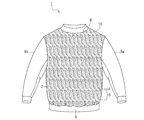
- FIG. 1 is a schematic front view of the inner surface side of the garment according to the embodiment of the present invention.
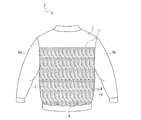
- FIG. 2 is a schematic back view of the inner surface side of the garment.
- FIG. 3 is a graph showing the wind speed of the airflow inside the clothes of Examples and Comparative Examples of the present invention.
- FIG. 4A is a schematic front view of the outer surface side of the garment of another embodiment of the present invention.
- FIG. 4B is a schematic back view of the outer surface side of the garment.
- FIG. 5A is a schematic front view of the inner surface side of the garment.
- FIG. 5B is a schematic back view of the inner surface side of the garment.
- the garment of the present invention is a garment including an outer material and a lining, and the lining is a stretchable fabric, which is a one-way fabric in which elastic threads are partially inserted in the width direction and extends in the width direction.
- the lining is woven or knitted, and the knitting may be warp knitting or circular knitting.
- the unevenness of the lining is preferably wrinkles (waviness) having a width of about 10 to 100 mm.
- the difference in unevenness is preferably about 10 to 50 mm in height when placed in a horizontal place.
- the unevenness of the lining is oriented in the height direction. That is, the unevenness is formed along the width direction of the body.
- the outer material is preferably a woven fabric used for ordinary jackets or winter clothes. In the present invention, unevenness is synonymous with wrinkles or wrinkles.
- the lining one-way fabric holds a test piece with a width of 100 mm and a length of 150 mm in the projected area (meaning that the test piece is taken without applying a load to the fabric) with a grip interval of 76 mm and a load.
- the elongation rate of either the vertical or horizontal (A) is preferably 70 to 600%, more preferably 80 to 550%, and further preferably 90 to 550%.
- the other (B) of the vertical or horizontal is preferably 5 to 150%, more preferably 10 to 130%, and even more preferably 10 to 110%.
- A> B preferably AB ⁇ 30%, more preferably AB ⁇ 40%, and even more preferably AB ⁇ 50%.
- the elongation rate of the stretchable fabric in the width direction is preferably 70% or more, more preferably 70% to 600% when the width is 100 mm and the load is 15 N.
- the unevenness of the lining is expressed by arranging a plurality of elastic thread insertion portions in parallel on the elastic fabric and shrinking the elastic threads.
- the term "plurality" is preferably 2 to 25 per 1 m, more preferably 3 to 23, and even more preferably 3 to 20.
- unevenness is formed in the portion where a plurality of elastic threads are arranged in parallel and the portion where there is no elastic thread, and the wrinkles (waviness) of the unevenness are formed in the direction (height direction) where the elastic threads intersect.
- the entire fabric is wavy and uneven.
- the uneven wrinkles are not continuously connected in the intersecting direction. As a result, the heat retention is good, the movement of the human body is followed, and the wearing feeling is good.
- the lining is placed on a flat table and the highest part of the wrinkles is 1 cm or more with respect to the table.
- the pitch of wrinkles (waviness) of unevenness should be one or more per 30 cm. It is preferably two or more, and more preferably three or more. Due to the uneven wrinkles, it fits the body but has flexibility, so it fills the gap between clothes and the body and enhances heat retention. In addition, even when moving, unevenness is formed while the lining is stretched, and the wrinkles (waviness) of the unevenness fit the body, so that the warm air around the body can be retained and the heat retention can be maintained. Since the wrinkles (wrinkles) of the unevenness are not continuously connected in the intersecting direction, it becomes difficult for heat to escape in the height direction.
- the pile is a loop pile, and the pile length is preferably 0.1 to 7 mm. A more preferable pile length is 0.2 to 5 mm.
- the garment to be worn underneath and the pile surface come into contact with each other with frictional resistance, so that the weight of the garment is dispersed, resulting in a light wearing feeling and a good wearing feeling.
- the mass of the stretchable fabric of the lining is preferably 30 to 300 g / m 2 , and more preferably 50 to 250 g / m 2 . As a result, the weight of the entire garment can be reduced.
- the outer material is preferably a woven fabric used for ordinary jackets or cold weather clothing or a knitted fabric with reduced breathability, and at least one selected from polyester multifilament yarn, nylon multifilament yarn, polypropylene multifilament yarn, and polyethylene multifilament yarn.
- a woven fabric in which the type of filament yarn is composed of 30% by weight or more is preferable.
- Polyester, nylon, polypropylene and polyethylene multifilament yarns are stronger than spun yarns (spun yarns), and when at least one type of filament yarns is composed of 30% or more, it becomes a thin and light side fabric and dries even when wet. There is an easy advantage.
- the filament yarn can have a higher weaving density than the spun yarn (spun yarn) and can suppress the air permeability. If at least one type of filament yarn is less than 30%, the strength is lowered, so that a thin and light side fabric cannot be realized, which is not suitable.
- the outer material may be water repellent.
- the woven fabric structure may be any structure such as plain weave, twill weave, satin weave, and variable weave.
- the mass (weight) per unit area of the outer material is preferably 40 to 300 g / m 2. This makes it a thin and light side.
- the air permeability of the outer material is preferably 0 to 150 cc / cm 2 ⁇ sec as measured by the Frazier method specified in JIS L-1096.
- the outer material is less breathable than the lining, warm air can be retained even in the concave part of the lining, and the heat retention is improved. It is preferable that the outer material has a air permeability of 50 cc / cm 2 ⁇ sec or more lower than that of the lining. In addition, since the outer material does not stretch more than the lining, there is an advantage that it does not stretch completely after being worn and operated. Due to the uneven wrinkles, air is stored between the outer material and the lining to improve heat retention. In addition, the shape of the outer material can be maintained even after washing.
- the wind speed inside the clothes can be measured by the following procedure.
- the subject is first made to wear compression wear, the wind speed sensor module is attached to the chest and armpits, the clothes of the present invention are worn from above, and the airflow inside the clothes is measured every second when the arms are raised and lowered.
- the wind speed sensor module uses HWS-16-ONE manufactured by Holtplan GK.
- the clothes of the present invention were made to fit the size of the subject corresponding to the JASPO standard.
- the wind speed in the clothes is preferably 0.05 to 0.6 m / sec, more preferably 0.1 to 0.4 m / sec.
- the lining is preferably joined to the outer material by sewing at the top of the garment. As a result, it is possible to prevent the entire lining from hanging downward.
- the lining and the outer material are preferably joined by sewing at least one of the collared line and the acromion line. If the lining does not have a collared line and an acromion line, it is preferably sewn to the outer material at the top of the lining. It is more preferable that the outer material and the lining are not joined by sewing in the side line. This makes it easier for the lining to fit around the waistline in the garment.
- the length of the lining is preferably 3 times or less, more preferably 2.5 times or less, and further preferably 2 times or less with respect to the length of the outer material. As a result, it is possible to prevent the folds from sagging due to unevenness.
- the length of the lining is preferably 1.05 times or more, more preferably 1.1 times or more with respect to the length of the outer material. As a result, the shape of the unevenness can be maintained without being crushed. By making the area of the lining larger than that of the outer material in a certain area portion of the clothes, the unevenness of the lining can be maintained.
- the inner circumference is smaller than the outer circumference of clothes
- the lining is elastic and deforms like an accordion, so it is easy to move, but it does not discharge warm air, so it has high heat retention. Dough or filling may be placed between the lining and the outer material.
- the lining and the fabric that touches the lining are made from the fabric that touches the lining by sewing two fabrics with different lengths such as sewn, tuck, and gather.
- a long lining can be sewn in the same place, and the unevenness of the lining can be retained to make clothes.
- the lining can be placed anywhere in the garment. By arranging the lining on at least a part of the body part, it is possible to improve the heat retention of the body part where heat is largely dissipated. By arranging the lining in a place where outside air easily enters, such as the collar, hem, and cuffs, it is possible to suppress the outflow of warm air inside the clothes.
- Optimal garment design can be achieved by examining the placement of the lining such as the body, collar, hem, and cuffs according to the purpose of the garment.
- the garment of the present invention can be applied to upper garments and / or lower garments. It is particularly suitable for clothing worn in sports such as golf, mountaineering, skiing, running, walking, cycling, mountaineering, and tennis in cold weather. This garment is easy to wash, dries easily even when sweating, has high functionality as sports clothing, and does not hinder the movement of the human body.
- FIG. 1 is a schematic front view of the inner surface side of the garment 1 according to the embodiment of the present invention
- FIG. 2 is a schematic back view of the inner surface side of the garment 1.
- the front body lining 2 and the back body lining 3 of the garment 1 are elastic pile fabrics.
- a plurality of elastic threads are partially inserted in the width direction of the body, and the elastic thread insertion portion 4 is contracted to express unevenness 5.
- a one-way fabric that stretches in the width direction.
- the wrinkles (waviness) of the unevenness 5 are oriented in the direction of intersection with the elastic thread (length direction).
- the linings 6a and 6b of the arms and the lining 7 above the shoulder blades of the back body may be made of any material or may be unlined.
- the front body lining 2 is joined by sewing at the outer material 8, the collared line 9, and the acromion line 10, and the outer material and the lining are not joined by sewing in the side line.
- the back body lining 3 is joined to the outer material 8 by sewing at the back cut-back line 11.
- the lining is made of elastic pile fabric, it follows the inner garment and moves freely to some extent due to friction with the inner garment, and does not interfere with the movement of the human body during exercise.
- FIG. 1-2 shows an example of a top that allows the neck to pass through, it may be a front-opening top. In the case of front opening, the front part can be opened and closed with fasteners, hooks, button stoppers, etc.
- FIG. 4A is a schematic front view of the outer surface side of the garment of another embodiment of the present invention
- FIG. 4B is a schematic back view of the outer surface side of the garment
- FIG. 5A is a schematic front view of the inner surface side of the garment
- 5B is a schematic back view of the inner surface side of the garment.
- the difference from Fig. 1-2 is that the front part of the blouson jacket can be opened and closed with a zipper.
- the garment 12 is composed of a front body outer material 13, side part outer materials 14a and 14b, a back body lining 15 and sleeve outer materials 16a and 16b, and the front part can be opened and closed with a fastener 17.
- the front body to the back body lining 19 is composed of one stretchable pile fabric, and is connected to the sleeve linings 20a and 20b of the stretchable pile fabric by sewing.
- the upper back portion of the back body lining (white portion in FIG. 5B) is a normal woven lining fabric.
- the lining 19 is joined by sewing at the front body outer material 13 and the collared line 18, and is joined to the back body outer material 15 by sewing at the collared line 18 via the back fabric. Is a specification that is not joined by sewing.
- ⁇ Wind speed of airflow in clothes The subjects were first made to wear compression wear, wind speed sensor modules were attached to the chest and armpits, the clothes of the present invention were worn from above, and the airflow inside the clothes was measured every second when the arms were raised and lowered.
- the wind speed sensor module used was HWS-16-ONE manufactured by Holtplan GK.
- ⁇ Fabric air permeability> It was measured by the Frazier method specified in JIS L-1096.
- Example 1 ⁇ Lining> (1) Linings 2 and 3 shown in Fig. 1-2 A warp loop pile fabric was used. This fabric uses polyethylene terephthalate, total fineness 84decitex, 72 multifilaments, loop pile length 1 mm, 150decitex polyurethane elastic fibers at 70 mm intervals, 110decitex, 48 polyester filaments. Five covered FTY (Filament Twisted yarns) were arranged in parallel and knitted in a state of being stretched (draft) by 15%, and the stretched portion was relaxed after knitting. As a result, uneven wrinkles were formed in the direction intersecting the insertion direction of the polyurethane elastic fibers. The mass (weight) per unit area was 140 g / m 2 .
- Linings 6a and 6b shown in Fig. 1-2 A brushed tricot knitted fabric was used. The yarn used was 84decitex, 72 polyester filaments, and the mass (weight) per unit area of the knitted fabric was 100 g / m. The elongation rate of the lining in the width direction was 150% when the width was 100 mm and the load was 15 N, and the elongation rate in the same length direction was 30%.
- the elongation rate of the outer material in the width direction was 40% when the width was 100 mm and the load was 15 N, and the elongation rate in the same length direction was 20%.
- the upper garment shown in Fig. 1-2 was sewn.
- the linings 2 and 3 shown in FIG. 1-2 are arranged in the extending direction in the width direction.
- the elongation rate of the stretchable fabric in the width direction was 150% when the width was 100 mm and the load was 15 N, and the elongation rate in the same length direction was 30%.
- This coat was L size for men and weighed 510 g.
- the length of the lining was 1.5 times the length of the outer material.
- Example 1 (Comparative Example 1) -Upper garment: The outer garment of Example 1 was used for the outer material and the lining, and the upper garment having a three-layer structure in which polyester resin batting (with a basis weight of 80 g / m 2) was sandwiched was sewn. The silhouette of the appearance was the same as that of Example 1.
- Example for heat retention test The outer material of Example 1 was used for the outer material and the lining, and a cushion-shaped sample having a three-layer structure sandwiched with polyester resin batting (with a basis weight of 80 g / m 2) was sewn.
- Example 2 (Comparative Example 2) -Upper garment: The outer material of Example 1 was used for the outer material, and the lining 6a of Example 1 was used for all the linings, and the upper garment having a two-layer structure was sewn. The silhouette of the appearance was the same as that of Example 1.
- -Sample for heat retention test The outer material of Example 1 was used for the outer material, and the lining 6a of Example 1 was used for all the linings, and a cushion-shaped sample having a two-layer structure was sewn. The conditions and results are summarized in Table 1.
- FIG. 3 is a graph showing the wind speed of the airflow inside the clothes of Examples and Comparative Examples of the present invention.
- the upper garment of Example 1 was a garment having a high heat-retaining effect and being easy to move, and was a garment having a good wearing feeling without sagging of the lining and uneven crushing. Furthermore, it was confirmed that the air permeability when worn was good, there was no feeling of stuffiness, and the ease of drying after washing was also good. On the other hand, in the upper garments of Comparative Example 1 and Comparative Example 2, the wind speed of the airflow inside the clothes was high, and the function of trapping warm air was low.
- the garment of the present invention is suitable for clothes worn in sports such as golf, mountain climbing, skiing, running, walking, cycling, mountain climbing, and tennis in cold weather, and is also suitable for work clothes and general winter clothes.
Landscapes
- Engineering & Computer Science (AREA)
- Textile Engineering (AREA)
- Physics & Mathematics (AREA)
- Thermal Sciences (AREA)
- Professional, Industrial, Or Sporting Protective Garments (AREA)
- Details Of Garments (AREA)
Abstract
Description
特許文献1には、中綿を挟んだキルティング生地で吸水時に凹凸が発生し、べとつきを抑えることが提案されている。特許文献2には、一面の布帛が編み組織構造により、うね状の凹凸を有する衣服が提案されている。特許文献3には、基布に弾性糸を使用してステッチを施してなる凹凸のあるギャザー布帛が提案されている。
表地は撥水加工されていてもよい。織物組織は、平織、綾織、朱子織、変化織などいかなる組織であってもよい。表地の単位面積当たりの質量(目付)は40~300g/m2が好ましい。これにより薄くて軽い側地となる。また、表地の通気度は、JIS L-1096に規定されるフラジール法で測定した通気度が0~150cc/cm2・secが好ましい。さらに好ましくは、0.5~100cc/cm2・secである。表地は、裏地より通気性が低いことで、裏地が凹の部分にも温かい空気を保持でき、保温性が高まる。表地は裏地より通気度が50cc/cm2・sec以上低い事が好ましい。また、裏地より表地の方が伸長しないため、着用し、動作した後、伸び切ってしまわない利点がある。凹凸のしわ(うねり)により、表地と裏地の間に空気をため込み、保温性を高める。また、洗濯などをした際も、表地による保形を保つことができる。
身幅方向の裏地と表地の関係は、表地の長さに対して裏地の長さは3倍以下が好ましく、より好ましくは2.5倍以下であり、さらに2倍以下が好ましい。これにより、凹凸によるヒダの垂れさがりを防ぐことができる。表地の長さに対して裏地の長さは1.05倍以上が好ましく、更には1.1倍以上が好ましい。これにより凹凸の形状を潰さずに保つことができる。衣服における一定面積部位において、表地より裏地の面積を大きくすることで、裏地の凹凸を保つことができる。また、衣服の外囲より内囲の方が小さいが、裏地は伸縮性があり、アコーディオンのように変形するため、動きやすいが、温かい空気を排出しないので、保温性が高い。裏地と表地の間に生地や充填物を入れても良い。
図1において、前身頃裏地2は表地8と襟付き線9と肩峰線10で縫製によって接合されており、脇線において、表地と裏地が縫製により接合されていない仕様としてある。また、図2において、後身頃裏地3は表地8と背中部切り返し線11で縫製によって接合されている。これにより、下方向への裏地全体の垂れさがりを防止できる。また、裏地は伸縮性パイル生地であるため、中着との摩擦により中着に追従してある程度自由に動き、運動時の人体の動きを妨げることがない。
なお、図1-2は首を通すタイプの上衣の例を示したが、前開きの上衣であってもよい。前開きの場合は、前部をファスナー、ホック、ボタン止めなどで開閉可能にする。
裏面は、前身頃から後身頃裏地19は1枚の伸縮性パイル生地で構成し、伸縮性パイル生地の袖部裏地20a,20bと縫製により繋いでいる。後身頃裏地の上部の背中部(図5Bの白抜き部)は、通常の織物の裏生地である。裏地19は前身頃表地13と襟付き線18で縫製によって接合され、後身頃表地15とは前記背中部生地を介して襟付き線18で縫製によって接合されており、脇線においては表地と裏地が縫製により接合されていない仕様である。
被験者に、先ずコンプレッションウエアを着用させ、胸部、脇部に風速センサーモジュールを取り付け、その上から本発明の衣服を着用し、1秒ごとに腕を上げ下げさせた時の衣服内気流を計測した。風速センサーモジュールはホルトプラン合同会社製のHWS-16-ONEを使用した。
<生地の通気度>
JIS L-1096に規定されるフラジール法で測定した。
<保温性評価>
KES(精密迅速物性測定装置サーモラボII)保温性評価(ΔT=20℃)によって評価した。座布団形状の試料を使用した。
<裏地>
(1)図1-2に示す裏地2,3
経編のループパイル生地を用いた。この生地は、地組織はポリエチレンテレフタレート、トータル繊度84decitex,構成本数72本のマルチフィラメントを使用し、ループパイル長さ1mm、70mm間隔で150decitexのポリウレタン弾性繊維を110decitex,構成本数48本のポリエステルフィラメントでカバーしたFTY(Filament Twisted yarn)5本を並列に配置し、15%伸長(ドラフト)した状態で編成し、編成後伸長分を弛緩させた。これにより、ポリウレタン弾性繊維の挿入方向とは交差する方向に凹凸のしわ(うねり)が形成されていた。単位面積当たりの質量(目付)は140g/m2であった。凹凸のしわ(うねり)は30cmあたり5個あり、しわの最高部は2cmであった。
(2)図1-2に示す裏地6a,6b
起毛トリコット編地を用いた。使用糸は、84decitex,構成本数72本ポリエステルフィラメントであり、編地の単位面積当たりの質量(目付)は100g/mであった。この裏地の身幅方向の伸長率は、幅100mm、荷重15Nのとき150%、同身丈方向の伸長率は30%であった。
(3)図1-2に示す裏地7
裏地7は、裏地6a、6bと同一の生地を使用した。
<表地>
経(タテ)糸として、ポリエチレンテレフタレート(PET)マルチフィラメント糸(総繊度:22decitex,繊維本数:48本)、緯(ヨコ)糸として、ポリエチレンテレフタレート(PET)マルチフィラメント糸(総繊度:22decitex,繊維本数:48本)を使用し、タテ糸密度260本/インチ、ヨコ糸密度120本/インチの平織組織の織物を表地とした。単位面積当たりの質量(目付)は150g/m2であった。表地の身幅方向の伸長率は、幅100mm、荷重15Nのとき40%、同身丈方向の伸長率は20%であった。
<上衣>
図1-2に示す上衣を縫製した。図1-2に示す裏地2,3は、伸び方向を身幅方向に配置した。伸縮性生地の身幅方向の伸長率は、幅100mm、荷重15Nのとき150%、同身丈方向の伸長率は30%であった。この上衣は男性用Lサイズで510gであった。身幅方向の裏地と表地の関係は、表地の長さに対して裏地の長さは1.5倍とした。
<保温性試験用試料>
タテ20cm、ヨコ20cmの座布団形状の試料。表地と裏地2の2層構造にしており、裏地の凹凸を保持するようにいせ込みながら4辺を縫製した。
・上衣:表地、裏地に実施例1の表地を使用し、ポリエステル樹脂中綿(目付80g/m2)挟み込んだ3層構造である上衣を縫製した。外観のシルエットは実施例1と同等にした。
・保温性試験用試料:表地、裏地に実施例1の表地を使用し、ポリエステル樹脂中綿(目付80g/m2)挟み込んだ3層構造である座布団形状の試料を縫製した。
・上衣:表地に実施例1の表地を使用し、全ての裏地に実施例1の裏地6aを使用し、2層構造である上衣を縫製した。外観のシルエットは実施例1と同等にした。
・保温性試験用試料:表地に実施例1の表地を使用し、全ての裏地に実施例1の裏地6aを使用し、2層構造である座布団形状の試料を縫製した。
条件及び結果はまとめて表1に示す。図3は本発明の実施例と比較例の衣服内気流の風速を示すグラフである。

2,13 前身頃裏地
3,15 後身頃裏地
4 弾性糸挿入部分
5 凹凸部(うねり)
6a,6b 腕部の裏地
7 後身頃肩甲骨より上の裏地
8 表地
9,18 襟付き線
10 肩峰線
11 背中部切り返し線
14a,14b 脇部表地
16a,16b 袖部表地
17 ファスナー
19 裏地
20a,20b 袖部裏地
Claims (13)
- 表地と裏地を含む衣服であって、
前記裏地は伸縮性生地であり、
前記伸縮性生地は、身幅方向に弾性糸が部分的に挿入され、弾性糸挿入部分が収縮して凹凸が形成されており、身幅方向に伸びるワンウエイ生地であることを特徴とする衣服。 - 前記伸縮性生地は複数本の弾性糸が並列して挿入されており、前記凹凸は身丈方向に向いている請求項1に記載の衣服。
- 前記弾性糸は、1mあたり2~25本並列して挿入されている請求項1又は2に記載の衣服。
- 前記伸縮性生地の質量は30~300g/m2である請求項1~3のいずれか1項に記載の衣服。
- 前記伸縮性生地の伸長率は、タテ又はヨコの一方(A)が70~600%であり、他方(B)が5~150%であり、A>Bである請求項1~4のいずれか1項に記載の衣服。
- 前記伸縮性生地の身幅方向の伸長率は、幅100mm、荷重15Nのとき70%以上である請求項1~5のいずれか1項に記載の衣服。
- 前記伸縮性生地はパイル生地であり、パイルはループパイルであり、パイル長さは0.1~7mmである請求項1~6のいずれか1項に記載の衣服。
- 前記裏地の凹凸は、10~100mmの幅のうねりであり、凹凸の差は水平な場所に置いた時、高低差が10~50mmである請求項1~6のいずれか1項に記載の衣服。
- 前記表地は、ポリエステルマルチフィラメント糸、ナイロンマルチフィラメント糸、ポリプロピレンマルチフィラメント糸、及びポリエチレンマルチフィラメント糸から選ばれる少なくとも1種類のフィラメント糸が30重量%以上で構成された織物である請求項1~8のいずれかに記載の衣服。
- 前記表地の単位面積当たりの質量は40~300g/m2である請求項1~9のいずれか1項に記載の衣服。
- 前記表地は、JIS L-1096に規定されるフラジール法で測定した通気度が0~150cc/cm2・secであり、裏地より通気度が50cc/cm2・sec以上低い請求項1~10のいずれか1項に記載の衣服。
- 前記裏地と表地の身幅方向の関係は、表地の長さに対して裏地の長さは1.05~3倍である請求項1~11のいずれか1項に記載の衣服。
- 前記衣服は、上衣及び下衣から選ばれる少なくとも一つである請求項1~12のいずれか1項に記載の衣服。
Priority Applications (3)
| Application Number | Priority Date | Filing Date | Title |
|---|---|---|---|
| JP2021570099A JP7047194B2 (ja) | 2020-01-10 | 2021-01-08 | 衣服 |
| US17/790,679 US20230042529A1 (en) | 2020-01-10 | 2021-01-08 | Garment |
| EP21738768.7A EP4088606B1 (en) | 2020-01-10 | 2021-01-08 | Garment |
Applications Claiming Priority (2)
| Application Number | Priority Date | Filing Date | Title |
|---|---|---|---|
| JP2020-003111 | 2020-01-10 | ||
| JP2020003111 | 2020-01-10 |
Publications (1)
| Publication Number | Publication Date |
|---|---|
| WO2021141102A1 true WO2021141102A1 (ja) | 2021-07-15 |
Family
ID=76788625
Family Applications (1)
| Application Number | Title | Priority Date | Filing Date |
|---|---|---|---|
| PCT/JP2021/000431 Ceased WO2021141102A1 (ja) | 2020-01-10 | 2021-01-08 | 衣服 |
Country Status (4)
| Country | Link |
|---|---|
| US (1) | US20230042529A1 (ja) |
| EP (1) | EP4088606B1 (ja) |
| JP (1) | JP7047194B2 (ja) |
| WO (1) | WO2021141102A1 (ja) |
Families Citing this family (3)
| Publication number | Priority date | Publication date | Assignee | Title |
|---|---|---|---|---|
| US20230148683A1 (en) * | 2021-11-05 | 2023-05-18 | Andrew Fontelar Dioneda | Short or Long Sleeve T-Shirt / Undershirt With Quilted or Other Similar Type Thick Fabric Material Sewn at the Inside Back or the Inside Front and Back of the Garment |
| KR102447574B1 (ko) * | 2022-04-25 | 2022-09-27 | 주식회사 아성섬유 | 통기성 직물 |
| WO2024227216A1 (en) * | 2023-05-02 | 2024-11-07 | Hanes Innerwear Australia Pty Ltd | Absorbent garment |
Citations (11)
| Publication number | Priority date | Publication date | Assignee | Title |
|---|---|---|---|---|
| JPS6147803A (ja) | 1984-08-14 | 1986-03-08 | 旭化成株式会社 | 加熱衣服 |
| JPS6194522U (ja) * | 1984-11-21 | 1986-06-18 | ||
| JPS6215582U (ja) * | 1985-07-13 | 1987-01-30 | ||
| JPH01177205U (ja) * | 1988-05-31 | 1989-12-18 | ||
| JPH023408U (ja) * | 1988-06-22 | 1990-01-10 | ||
| JP2002327310A (ja) * | 2001-04-26 | 2002-11-15 | Japan Gore Tex Inc | 防寒及び断熱用ウェア |
| JP2003027302A (ja) * | 2001-07-18 | 2003-01-29 | Shimano Inc | 衣 服 |
| JP2008297657A (ja) | 2007-05-31 | 2008-12-11 | Teijin Fibers Ltd | キルテイング生地および寝具およびダウンジャケット |
| JP2014200930A (ja) * | 2013-04-01 | 2014-10-27 | 小松精練株式会社 | 透湿性防水シート |
| JP2018111898A (ja) * | 2017-01-12 | 2018-07-19 | 美津濃株式会社 | 上着 |
| JP2019166171A (ja) | 2018-03-24 | 2019-10-03 | 藤井株式会社 | 寝具用布帛 |
Family Cites Families (9)
| Publication number | Priority date | Publication date | Assignee | Title |
|---|---|---|---|---|
| FR1258476A (fr) * | 1960-04-15 | 1961-04-14 | Tissus Sport Et Nouveaute | Procédé d'obtention d'un tissu élastique à effets de relief et produit en résultant |
| FR2344239A1 (fr) * | 1976-03-16 | 1977-10-14 | Model Couture | Vetement isothermique |
| JP2533288Y2 (ja) * | 1992-05-27 | 1997-04-23 | 徹 加藤 | シャーリングパンツ |
| US5707709A (en) * | 1993-04-27 | 1998-01-13 | Blake; Steven A. | Twin ply fabric, uses and manufacture thereof |
| EP1774076A4 (en) * | 2004-06-24 | 2008-04-30 | Mmi Ipco Llc | MANUFACTURED FABRIC ARTICLES |
| US7546853B2 (en) * | 2006-05-30 | 2009-06-16 | Mmi-Ipco, Llc | Advanced engineered garment |
| JP4703510B2 (ja) * | 2006-08-11 | 2011-06-15 | Ykk株式会社 | ファスナーストリンガー及びスライドファスナー |
| JP5509349B2 (ja) * | 2012-04-25 | 2014-06-04 | 株式会社丸昌商店 | 弾性複合撚糸とその製造方法、並びに同弾性複合撚糸を使ったパイル繊維製品 |
| EP3255186A4 (en) * | 2015-02-03 | 2018-02-14 | Asahi Kasei Kabushiki Kaisha | Thin lightweight woven fabric |
-
2021
- 2021-01-08 EP EP21738768.7A patent/EP4088606B1/en active Active
- 2021-01-08 US US17/790,679 patent/US20230042529A1/en not_active Abandoned
- 2021-01-08 JP JP2021570099A patent/JP7047194B2/ja active Active
- 2021-01-08 WO PCT/JP2021/000431 patent/WO2021141102A1/ja not_active Ceased
Patent Citations (11)
| Publication number | Priority date | Publication date | Assignee | Title |
|---|---|---|---|---|
| JPS6147803A (ja) | 1984-08-14 | 1986-03-08 | 旭化成株式会社 | 加熱衣服 |
| JPS6194522U (ja) * | 1984-11-21 | 1986-06-18 | ||
| JPS6215582U (ja) * | 1985-07-13 | 1987-01-30 | ||
| JPH01177205U (ja) * | 1988-05-31 | 1989-12-18 | ||
| JPH023408U (ja) * | 1988-06-22 | 1990-01-10 | ||
| JP2002327310A (ja) * | 2001-04-26 | 2002-11-15 | Japan Gore Tex Inc | 防寒及び断熱用ウェア |
| JP2003027302A (ja) * | 2001-07-18 | 2003-01-29 | Shimano Inc | 衣 服 |
| JP2008297657A (ja) | 2007-05-31 | 2008-12-11 | Teijin Fibers Ltd | キルテイング生地および寝具およびダウンジャケット |
| JP2014200930A (ja) * | 2013-04-01 | 2014-10-27 | 小松精練株式会社 | 透湿性防水シート |
| JP2018111898A (ja) * | 2017-01-12 | 2018-07-19 | 美津濃株式会社 | 上着 |
| JP2019166171A (ja) | 2018-03-24 | 2019-10-03 | 藤井株式会社 | 寝具用布帛 |
Non-Patent Citations (1)
| Title |
|---|
| See also references of EP4088606A4 |
Also Published As
| Publication number | Publication date |
|---|---|
| EP4088606A1 (en) | 2022-11-16 |
| EP4088606B1 (en) | 2025-08-06 |
| JPWO2021141102A1 (ja) | 2021-07-15 |
| US20230042529A1 (en) | 2023-02-09 |
| JP7047194B2 (ja) | 2022-04-04 |
| EP4088606A4 (en) | 2024-01-10 |
Similar Documents
| Publication | Publication Date | Title |
|---|---|---|
| JP7047194B2 (ja) | 衣服 | |
| US7080412B2 (en) | Insect barrier garment | |
| CN105792692B (zh) | 具有集成的通风结构的编织条带 | |
| EP3478110B1 (en) | Garment with zoned insulation and variable air permeability | |
| US4195364A (en) | Garment for use in vigorous physical activities | |
| JP2008517176A (ja) | フロック加工された素材を組み込んだ衣料品 | |
| CN111226000A (zh) | 一种成型针织物 | |
| CN113957597B (zh) | 一种具有区域性压力调节能力的无缝针织滑雪压缩服 | |
| US20030028950A1 (en) | Lycramed stretchable hospital scrub top | |
| CN108471825A (zh) | 具有整体擦拭区域的服装 | |
| JP6474124B2 (ja) | 衣類 | |
| JP5235519B2 (ja) | シャツ | |
| CN103653380B (zh) | 一种在野外环境中使用的防蚊虫套装 | |
| JP7456384B2 (ja) | 衣服 | |
| JP3426486B2 (ja) | ポリエステル清涼織物および衣服 | |
| JP6251984B2 (ja) | 中綿入り衣服 | |
| JP7466906B2 (ja) | 衣服 | |
| JP2006225784A (ja) | 異方的な吸水拡散性を有する編地および衣料 | |
| JPS6229500Y2 (ja) | ||
| JP3190986U (ja) | 防風保温着 | |
| JPH11241211A (ja) | 衣料用インナーおよびそれからなる着衣 | |
| JP3158867U (ja) | 衣服 | |
| CN220140861U (zh) | 一种防摔滑雪服 | |
| CN214214960U (zh) | 一种垂顺抗起皱乱麻面料 | |
| EP2727485A1 (en) | Upper garment with inner lining in the back piece for more freedom of movement and a refreshing feeling |
Legal Events
| Date | Code | Title | Description |
|---|---|---|---|
| 121 | Ep: the epo has been informed by wipo that ep was designated in this application |
Ref document number: 21738768 Country of ref document: EP Kind code of ref document: A1 |
|
| ENP | Entry into the national phase |
Ref document number: 2021570099 Country of ref document: JP Kind code of ref document: A |
|
| NENP | Non-entry into the national phase |
Ref country code: DE |
|
| ENP | Entry into the national phase |
Ref document number: 2021738768 Country of ref document: EP Effective date: 20220810 |
|
| WWG | Wipo information: grant in national office |
Ref document number: 2021738768 Country of ref document: EP |