WO2021153007A1 - 二次電池電極用活物質およびそれを用いた二次電池 - Google Patents
二次電池電極用活物質およびそれを用いた二次電池 Download PDFInfo
- Publication number
- WO2021153007A1 WO2021153007A1 PCT/JP2020/045410 JP2020045410W WO2021153007A1 WO 2021153007 A1 WO2021153007 A1 WO 2021153007A1 JP 2020045410 W JP2020045410 W JP 2020045410W WO 2021153007 A1 WO2021153007 A1 WO 2021153007A1
- Authority
- WO
- WIPO (PCT)
- Prior art keywords
- active material
- secondary battery
- olivine
- axis
- carbon layer
- Prior art date
- Legal status (The legal status is an assumption and is not a legal conclusion. Google has not performed a legal analysis and makes no representation as to the accuracy of the status listed.)
- Ceased
Links
Images

Classifications
-
- H—ELECTRICITY
- H01—ELECTRIC ELEMENTS
- H01M—PROCESSES OR MEANS, e.g. BATTERIES, FOR THE DIRECT CONVERSION OF CHEMICAL ENERGY INTO ELECTRICAL ENERGY
- H01M4/00—Electrodes
- H01M4/02—Electrodes composed of, or comprising, active material
- H01M4/36—Selection of substances as active materials, active masses, active liquids
- H01M4/362—Composites
- H01M4/366—Composites as layered products
-
- C—CHEMISTRY; METALLURGY
- C01—INORGANIC CHEMISTRY
- C01B—NON-METALLIC ELEMENTS; COMPOUNDS THEREOF; METALLOIDS OR COMPOUNDS THEREOF NOT COVERED BY SUBCLASS C01C
- C01B25/00—Phosphorus; Compounds thereof
- C01B25/16—Oxyacids of phosphorus; Salts thereof
- C01B25/26—Phosphates
- C01B25/45—Phosphates containing plural metal, or metal and ammonium
-
- C—CHEMISTRY; METALLURGY
- C01—INORGANIC CHEMISTRY
- C01B—NON-METALLIC ELEMENTS; COMPOUNDS THEREOF; METALLOIDS OR COMPOUNDS THEREOF NOT COVERED BY SUBCLASS C01C
- C01B32/00—Carbon; Compounds thereof
- C01B32/05—Preparation or purification of carbon not covered by groups C01B32/15, C01B32/20, C01B32/25, C01B32/30
-
- H—ELECTRICITY
- H01—ELECTRIC ELEMENTS
- H01M—PROCESSES OR MEANS, e.g. BATTERIES, FOR THE DIRECT CONVERSION OF CHEMICAL ENERGY INTO ELECTRICAL ENERGY
- H01M4/00—Electrodes
- H01M4/02—Electrodes composed of, or comprising, active material
- H01M4/13—Electrodes for accumulators with non-aqueous electrolyte, e.g. for lithium-accumulators; Processes of manufacture thereof
- H01M4/136—Electrodes based on inorganic compounds other than oxides or hydroxides, e.g. sulfides, selenides, tellurides, halogenides or LiCoFy
-
- H—ELECTRICITY
- H01—ELECTRIC ELEMENTS
- H01M—PROCESSES OR MEANS, e.g. BATTERIES, FOR THE DIRECT CONVERSION OF CHEMICAL ENERGY INTO ELECTRICAL ENERGY
- H01M4/00—Electrodes
- H01M4/02—Electrodes composed of, or comprising, active material
- H01M4/36—Selection of substances as active materials, active masses, active liquids
- H01M4/58—Selection of substances as active materials, active masses, active liquids of inorganic compounds other than oxides or hydroxides, e.g. sulfides, selenides, tellurides, halogenides or LiCoFy; of polyanionic structures, e.g. phosphates, silicates or borates
- H01M4/5825—Oxygenated metallic salts or polyanionic structures, e.g. borates, phosphates, silicates, olivines
-
- H—ELECTRICITY
- H01—ELECTRIC ELEMENTS
- H01M—PROCESSES OR MEANS, e.g. BATTERIES, FOR THE DIRECT CONVERSION OF CHEMICAL ENERGY INTO ELECTRICAL ENERGY
- H01M4/00—Electrodes
- H01M4/02—Electrodes composed of, or comprising, active material
- H01M4/36—Selection of substances as active materials, active masses, active liquids
- H01M4/58—Selection of substances as active materials, active masses, active liquids of inorganic compounds other than oxides or hydroxides, e.g. sulfides, selenides, tellurides, halogenides or LiCoFy; of polyanionic structures, e.g. phosphates, silicates or borates
- H01M4/583—Carbonaceous material, e.g. graphite-intercalation compounds or CFx
- H01M4/587—Carbonaceous material, e.g. graphite-intercalation compounds or CFx for inserting or intercalating light metals
-
- H—ELECTRICITY
- H01—ELECTRIC ELEMENTS
- H01M—PROCESSES OR MEANS, e.g. BATTERIES, FOR THE DIRECT CONVERSION OF CHEMICAL ENERGY INTO ELECTRICAL ENERGY
- H01M4/00—Electrodes
- H01M4/02—Electrodes composed of, or comprising, active material
- H01M4/62—Selection of inactive substances as ingredients for active masses, e.g. binders, fillers
- H01M4/624—Electric conductive fillers
- H01M4/625—Carbon or graphite
-
- C—CHEMISTRY; METALLURGY
- C01—INORGANIC CHEMISTRY
- C01P—INDEXING SCHEME RELATING TO STRUCTURAL AND PHYSICAL ASPECTS OF SOLID INORGANIC COMPOUNDS
- C01P2002/00—Crystal-structural characteristics
- C01P2002/50—Solid solutions
-
- C—CHEMISTRY; METALLURGY
- C01—INORGANIC CHEMISTRY
- C01P—INDEXING SCHEME RELATING TO STRUCTURAL AND PHYSICAL ASPECTS OF SOLID INORGANIC COMPOUNDS
- C01P2002/00—Crystal-structural characteristics
- C01P2002/60—Compounds characterised by their crystallite size
-
- C—CHEMISTRY; METALLURGY
- C01—INORGANIC CHEMISTRY
- C01P—INDEXING SCHEME RELATING TO STRUCTURAL AND PHYSICAL ASPECTS OF SOLID INORGANIC COMPOUNDS
- C01P2002/00—Crystal-structural characteristics
- C01P2002/70—Crystal-structural characteristics defined by measured X-ray, neutron or electron diffraction data
- C01P2002/74—Crystal-structural characteristics defined by measured X-ray, neutron or electron diffraction data by peak-intensities or a ratio thereof only
-
- C—CHEMISTRY; METALLURGY
- C01—INORGANIC CHEMISTRY
- C01P—INDEXING SCHEME RELATING TO STRUCTURAL AND PHYSICAL ASPECTS OF SOLID INORGANIC COMPOUNDS
- C01P2004/00—Particle morphology
- C01P2004/01—Particle morphology depicted by an image
- C01P2004/04—Particle morphology depicted by an image obtained by TEM, STEM, STM or AFM
-
- C—CHEMISTRY; METALLURGY
- C01—INORGANIC CHEMISTRY
- C01P—INDEXING SCHEME RELATING TO STRUCTURAL AND PHYSICAL ASPECTS OF SOLID INORGANIC COMPOUNDS
- C01P2006/00—Physical properties of inorganic compounds
- C01P2006/40—Electric properties
-
- H—ELECTRICITY
- H01—ELECTRIC ELEMENTS
- H01M—PROCESSES OR MEANS, e.g. BATTERIES, FOR THE DIRECT CONVERSION OF CHEMICAL ENERGY INTO ELECTRICAL ENERGY
- H01M4/00—Electrodes
- H01M4/02—Electrodes composed of, or comprising, active material
- H01M2004/021—Physical characteristics, e.g. porosity, surface area
-
- H—ELECTRICITY
- H01—ELECTRIC ELEMENTS
- H01M—PROCESSES OR MEANS, e.g. BATTERIES, FOR THE DIRECT CONVERSION OF CHEMICAL ENERGY INTO ELECTRICAL ENERGY
- H01M4/00—Electrodes
- H01M4/02—Electrodes composed of, or comprising, active material
- H01M2004/026—Electrodes composed of, or comprising, active material characterised by the polarity
- H01M2004/028—Positive electrodes
-
- Y—GENERAL TAGGING OF NEW TECHNOLOGICAL DEVELOPMENTS; GENERAL TAGGING OF CROSS-SECTIONAL TECHNOLOGIES SPANNING OVER SEVERAL SECTIONS OF THE IPC; TECHNICAL SUBJECTS COVERED BY FORMER USPC CROSS-REFERENCE ART COLLECTIONS [XRACs] AND DIGESTS
- Y02—TECHNOLOGIES OR APPLICATIONS FOR MITIGATION OR ADAPTATION AGAINST CLIMATE CHANGE
- Y02E—REDUCTION OF GREENHOUSE GAS [GHG] EMISSIONS, RELATED TO ENERGY GENERATION, TRANSMISSION OR DISTRIBUTION
- Y02E60/00—Enabling technologies; Technologies with a potential or indirect contribution to GHG emissions mitigation
- Y02E60/10—Energy storage using batteries
Definitions
- the present invention relates to an active material for a secondary battery electrode and a secondary battery using the same.
- Lithium-ion secondary batteries which are a type of secondary battery, have high energy density and excellent output characteristics, but when a problem occurs, the stored energy is released in a short time, and the battery ignites and burns. There is a risk. Therefore, for lithium ion secondary batteries, improvement of safety as well as improvement of output characteristics is an important issue.
- the positive electrode active material is a factor that greatly affects the safety of lithium-ion secondary batteries.
- the layered rock salt-based transition metal lithium oxide positive electrode active material which is often used in large batteries for electric vehicles, is a positive electrode active material that exhibits a particularly high energy density, but has a crystal structure that releases oxygen by charging and discharging. Deterioration is promoted due to the change in the battery, and there is a risk of smoke or fire depending on the usage conditions, and there are safety issues.
- the positive electrode active material having an olivine type crystal structure represented by lithium iron phosphate does not easily release oxygen because oxygen is covalently bonded to phosphorus, and is relatively stable even under high temperature conditions.
- it is a highly safe positive electrode material, its electron conductivity and ionic conductivity are known to be lower than those of a layered rock salt-based transition metal lithium oxide positive electrode active material. Therefore, as a technique for improving the electron conductivity and ionic conductivity of the positive electrode active material having an olivine type crystal structure, it is considered to provide a conductive carbon coating layer.
- an electrode material precursor having a core-shell structure in which the active material core is coated with polyaniline is heat-treated at 300 to 900 ° C. in a reducing atmosphere so that the active material core is made of carbon.
- a manufacturing method for producing an electrode material having a coated core-shell structure see, for example, Patent Document 1
- an iron-iron phosphate positive electrode material having primary particles of lithium iron phosphate having a conductive carbon-coated layer is characterized by having a layer thickness portion having a thickness of 2 nm or more and a layer thin portion having a thickness of less than 2 nm, which is a lithium iron phosphate positive electrode material (see, for example, Patent Document 2).
- the carbonaceous-coated electrode active material particles are composed of aggregates formed by aggregating carbonaceous-coated electrode active material particles in which a carbonaceous film is formed on the surface of the electrode active material particles at a coverage rate of 80% or more.
- the first carbonaceous electrode active material particles having a carbonaceous film having a film thickness of 0.1 nm or more and 3.0 nm or less and an average film thickness of 1.0 nm or more and 2.0 nm or less are formed, and the film thickness is
- An electrode material (for example,) composed of a second carbonaceous electrode active material particle having a carbonaceous film formed of 1.0 nm or more and 10.0 nm or less and an average film thickness of more than 2.0 nm and 7.0 nm or less.
- Patent Document 3 and the like have been proposed.
- the electron conductivity and the ionic conductivity can be improved, and the rate characteristics can be improved. Further, in the electrode using the active material for the secondary battery electrode, the area where the electrolyte and the active material for the secondary battery electrode come into direct contact with each other is reduced, so that the active material for the secondary battery electrode is eluted from the electrolytic solution. It can be suppressed and cycle resistance can be improved. From the viewpoint of improving electron conductivity and cycle resistance, it is preferable that the carbon layer is thick.
- the thickness of the carbon layer is preferably thin.
- the electrode active material particles having different thicknesses of the carbon layer are disclosed in Patent Documents 1 to 3, the thickness of the carbon layer is randomly changed with respect to the crystal axis in each of the above-mentioned patent documents 1 to 3. It does not utilize the phenomenon that carrier ions in an electrode active material having an olivine type crystal structure show a one-dimensionally high diffusion rate only in the direction of the crystal axis b-axis, and the effect of improving rate characteristics and cycle resistance is ineffective. It was enough.
- an object of the present invention is to provide an active material for a secondary battery electrode having excellent rate characteristics and cycle resistance.
- the present invention mainly has the following configurations.
- An active material for a secondary battery electrode having an olivine type crystal structure and a carbon layer on the surface, and the average thickness of the carbon layer existing on a plane perpendicular to the b-axis of the crystal axis is not perpendicular to the b-axis.
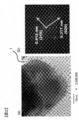
- FIG. It is a transmission electron microscope image (a) and a Fourier transform image (b) of the active material for a secondary battery electrode of this invention produced in Example 2.
- FIG. It is a conventional active material transmission electron microscope image (a) for a secondary battery electrode and its Fourier transform image (b) produced in Comparative Example 2.
- the carrier ions of the electrodes such as lithium and sodium inside the olivine-type active material (in the present specification, the carrier ions are the active materials during charging and discharging). Focusing on the fact that (referring to ions entering and exiting from) shows a one-dimensionally high diffusion coefficient only in the direction of the b-axis of the crystal axis, the thickness of the carbon layer is thinned in the direction of the b-axis of the crystal axis to reduce the thickness of the carrier ion.
- the olivine-type active material While promoting the ingress and egress of the olivine-type active material in and out to improve the rate characteristics, in other directions, it exists on the plane perpendicular to the crystal axis b axis in order to increase the carbon layer thickness and improve the cycle resistance.
- the numerical range of the ratio of the average thickness of the carbon layer to the average thickness of the carbon layer existing on the plane not perpendicular to the b-axis was limited.
- the olivine-type active material of the present invention will be described.
- the olivine-type active material is not particularly limited as long as it has an olivine-type crystal structure, but the general formula ABXO 4 (A and B each independently represent one or more kinds of metal elements, and X is an arbitrary other than the metal element. It is preferable to have a chemical composition represented by (indicating one or more elements of).
- A is preferably an alkali metal
- B is preferably a transition metal
- X is preferably silicon, phosphorus or the like.
- the chemical composition represented by the general formula ABXO 4 for example, LiFePO 4, LiMnPO 4, LiFe 1-x Mn x PO 4 (0 ⁇ x ⁇ 1), LiCoPO 4, LiNiPO 4, NaFePO 4, NaMnPO 4, NaCoPO 4 , NaNiPO 4 , LiFeSiO 4 , NaFeSiO 4 and the like can be mentioned. Two or more of these may be contained. Among these, lithium generally tends to exhibit a high diffusion coefficient, so it is preferable to use lithium as the A site, and the rate characteristics can be further improved.
- lithium manganese iron phosphate tends to have low electron conductivity and lithium ion conductivity, and the effect of the carbon layer in the present invention can be more prominently exhibited.
- the energy density ratio is improved by 0.06 in Example 5 and Comparative Example 4 in which lithium iron phosphate is used.
- the energy density ratio is improved by 0.16, and the effect of the carbon layer in the present invention is more remarkable.
- the olivine-type active material may have a structure having a different chemical composition (for example, a core-shell structure) inside the primary or higher-order particles. Further, the olivine-type active material may contain a doping element.
- the olivine-type active material of the present invention has a carbon layer on the surface.
- the carbon layer may cover at least a part of the surface of the olivine-type active material, and preferably covers 80 area% or more of the surface. Further, the carbon layer may have a functional group such as a carbonyl group or a hydroxyl group on its surface.
- the content of the carbon layer in the olivine-type active material is preferably 1% by weight or more from the viewpoint of further improving the electron conductivity and the rate characteristics. On the other hand, from the viewpoint of suppressing side reactions between the carbon layer and the olivine-type active material and further improving the cycle resistance, 6% by weight or less is preferable.
- the content of the carbon layer in the olivine-type active material can be measured using, for example, the carbon / sulfur simultaneous quantitative analyzer EMIA-920V (manufactured by HORIBA, Ltd.).
- the content of the carbon layer can be adjusted to a desired range by adjusting the amount of the carbon source to be added, for example, in the method for producing an olivine-type active material described later.
- the average thickness of the carbon layer / the average thickness of the carbon layer on the non-vertical plane) is 0.30 or more and 0.80 or less. When the value of such a ratio is smaller than 0.30, the carbon layer on the plane perpendicular to the crystal axis b-axis becomes too thin, or the carbon layer on the plane not perpendicular to the crystal axis b-axis becomes too thick.
- the weight ratio of the carbon layer to the olivine-type active material becomes too large, and in either case, the rate characteristics of the secondary battery deteriorate. ..
- the value of such a ratio is larger than 0.80, the carbon layer on the plane perpendicular to the crystal axis b-axis becomes too thick, or the carbon layer on the plane not perpendicular to the crystal axis b-axis becomes too thin.
- the average thickness of the carbon layer on the plane perpendicular to the crystal axis b-axis is preferably 0.6 nm or more, preferably 2.0 nm or less, from the viewpoint of further improving the rate characteristics of the secondary battery.
- the thickness of the carbon layer in the same plane is uniform, and in the electrode reaction accompanying charging and discharging of the secondary battery. The electric field applied to the surface of the olivine-type active material becomes uniform, and the cycle resistance can be further improved.
- the thickness of the carbon layer is uniform on the plane perpendicular to the crystal axis b-axis where the thickness of the carbon layer is small, and the standard deviation of the thickness of the carbon layer on the plane perpendicular to the crystal axis b-axis is. It is preferably 0.3 nm or less.
- the average thickness of the carbon layer on the surface of the olivine-type active material on different crystal planes can be measured using a transmission electron microscope. Specifically, the multi-wave interference image of the olivine-type active material is measured under the conditions of an acceleration voltage of 300 kV and a magnification of 2,000,000 times. The thickness of the carbon layer is measured at 20 or more measurement points uniformly selected on the outer periphery of the particles of the olivine-type active material. Further, the crystal orientation information can be obtained by performing a Fourier transform on the obtained lattice image, measuring the distance from the origin to the bright spot, and calculating the corresponding d value. At each measurement point where the thickness of the carbon layer is measured, the crystal orientation perpendicular to the surface of the particles is calculated.
- the corresponding measurement point is considered to exist on the plane perpendicular to the b-axis of the crystal axis. If the angle formed is larger than 20 degrees, it is considered that the angle does not exist on the plane perpendicular to the crystal axis b axis.
- This process is applied to all measurement points, and the average thickness and standard deviation are calculated for each of the carbon layer existing on the plane perpendicular to the crystal axis b axis and the carbon layer existing on the plane not perpendicular to the crystal axis b axis. can do. From the obtained average thickness, the value of the above-mentioned ratio can be calculated.
- Examples of the method for setting the ratio of the average thickness of the carbon layer and the standard deviation within the above range include a method for obtaining an olivine-type active material by a production method described later.
- the crystallite diameter of the olivine-type active material of the present invention is preferably 60 nm or less. Since the olivine type active material generally has low electron conductivity and ionic conductivity, the voltage drop tends to be large under the condition that the charge / discharge current is large. By setting the crystallite diameter to 60 nm or less, the diffusion distance of electrons and carrier ions in the crystallite is shortened, so that the rate characteristics can be further improved. Since the active material particles having a small crystallite diameter have a large specific surface area, the effect of the average thickness ratio of the carbon layer in the present invention can be more remarkablely exhibited.
- the crystallite diameter of the olivine-type active material is obtained by performing powder X-ray diffraction measurement on the powder sample of the olivine-type active material under the condition that the diffraction angle 2 ⁇ is 10 degrees or more and 70 degrees or less. It can be calculated by performing Rietveld analysis on the pattern.
- the olivine-type active material of the present invention may be directly measured, or in the case of a secondary battery described later, the olivine-type active material obtained by grinding the electrode mixture peeled from the secondary battery electrode may be measured.
- the crystallite diameter of the olivine-type active material is adjusted, for example, in the method for producing the olivine-type active material, which will be described later, by adjusting the mixing ratio of water and an organic solvent used as a solvent, the total amount of the solvent with respect to the raw material, the synthesis temperature, the firing temperature, and the like. By doing so, it can be adjusted to a desired range.
- the crystallinity and particle shape of lithium manganese iron phosphate are the ratio of the peak intensity at 20 ° to the peak intensity at 29 ° obtained by X-ray diffraction I 20 / I 29 , 35 °. It can be evaluated by the ratio of the peak intensity at 29 ° to the peak intensity at I 35 / I 29.
- I 20 / I 29 is 0.88 or more and 1.05 or less, it means that lithium manganese iron phosphate is not extremely oriented in the b-axis direction, and the shape of the particles is more spherical than plate-shaped. It means close.
- the distortion of the crystal lattice due to the deinsertion of lithium ions during charging and discharging can be alleviated, and the rate characteristics and cycle resistance can be further improved.
- I 35 / I 29 is 1.05 or more and 1.20 or less
- the crystal orientation of lithium manganese phosphate is further lowered, resulting in a more uniform crystal orientation, and the particle shape is further spherical. It means getting closer. Therefore, the distortion of the crystal lattice due to the deinsertion of carrier ions during charging and discharging can be alleviated, and the rate characteristics and cycle resistance can be further improved.
- Examples of the method for setting I 20/ I 29 and I 35 / I 29 in the above range include a method for obtaining lithium manganese iron phosphate by a production method described later.
- the olivine-type active material of the present invention can be obtained by any method such as a solid phase method or a liquid phase method.
- the liquid phase method is preferable because it is easy to adjust the crystallite diameter to the above-mentioned preferable range.
- an organic solvent for refining the crystallites into nanoparticles in addition to water, it is also preferable to use an organic solvent for refining the crystallites into nanoparticles, and examples of the solvent species include ethylene glycol, diethylene glycol, triethylene glycol, and tetraethylene glycol.
- olivine-type active material can be adjusted within a desired range by adjusting the charging ratio of the raw materials. Further, in the synthesis of lithium manganese iron phosphate by the liquid phase method, a solution containing a part of the raw materials is stirred at high speed, and then a solution containing the remaining raw materials is added and added while maintaining the high speed stirring state.
- the crystallite diameter is determined by, for example, conditions such as a mixing ratio of water and an organic solvent in a solvent, a concentration of a synthetic solution, a synthesis temperature, and a preparation ratio of raw materials. It can be adjusted to a desired range. Typically, in order to increase the crystallite diameter, it is effective to increase the ratio of water in the solvent, increase the concentration of the synthetic solution, increase the synthesis temperature, and the like.
- a carbon coating method for forming a carbon layer on an olivine-type active material obtained by the liquid phase method a powder composed of primary particles and / or secondary particles of the olivine-type active material, a slurry containing these, and a carbon source Is preferably mixed and then fired in an inert gas atmosphere.
- carbon sources include glucose, sucrose, trehalose, maltose, dextrin hydrate, saccharides such as cyclodextrin, organic acids such as citric acid, malic acid, succinic acid, fumaric acid, and maleic acid, polyaniline, and polyacrylonitrile.
- Examples thereof include organic polymers such as polyvinyl alcohol and polyvinylpyrrolidone, and crude oils such as succinic acid, pitch and asphalt. Two or more of these may be used. Among these, when only saccharides and organic polymers are used as the carbon source, the standard deviation of the thickness of the carbon layer can be easily adjusted to the above-mentioned preferable range.
- the carbon source and the olivine-type active material are dissolved or dispersed in a medium such as water, ethanol, acetonitrile, N-methylpyrrolidone, or dimethyl sulfoxide, and a disper, jet mill, or the like is used. It is preferable to mix and disperse using a mixing device such as a high-share mixer or an ultrasonic homogenizer.
- the slurry containing the olivine-type active material and the carbon source is instantly dried prior to firing, and the olivine-type active material and carbon are dried. It is preferable to obtain a precursor of an olivine-type active material in which the source is densely mixed, and specifically, it is preferable to dry using a spray dryer.
- Examples of the inert gas used during firing include nitrogen and argan. In order to eliminate the gas generated from the mixture of the olivine type active material and the carbon source during firing to the outside of the system, it is preferable to allow the inert gas to flow.
- the firing temperature is preferably 500 ° C. or higher and 1000 ° C. or lower, and the firing time is preferably 30 minutes or longer and 24 hours or lower.
- the melting point of the compound having a low melting point and the melting point of the compound have a low melting point. It is preferable to perform calcining at a temperature between the melting point of the compound having a high melting point and within a range of 1 hour or more and 24 hours or less, and then perform firing under the above conditions.
- the mixing ratio of carbon sources having different melting points the average thickness ratio of the carbon layer with respect to the b-axis direction of the crystal axis can be adjusted. In this case, it is preferable that the amount of the compound having the highest melting point added is 0.50 times or more and 5.0 times or less the total amount of the compounds having a lower melting point than the compound.
- the active material is preferably treated as agglomerated secondary particles of the primary particles, and the secondary particle size is the method for manufacturing a secondary battery electrode described later.
- the thickness is preferably 3 ⁇ m or more.
- the secondary particle size of the olivine-type active material is preferably 40 ⁇ m or less in relation to the thickness of the mixture layer described later.
- the secondary particle size of the olivine-type active material refers to the arithmetic mean value of the particle size of the secondary particles, and can be measured using a scanning electron microscope. Specifically, using a scanning electron microscope, the electrodes are magnified and observed at a magnification of 3,000, and the secondary particle size is measured for 100 randomly selected secondary particles. By calculating the average value of those numbers, the secondary particle size of the olivine-type active material can be obtained. If less than 100 secondary particles are observed in one observation field, observation is performed at another location on the sample until the cumulative number of observed secondary particles reaches 100. Further, with respect to the secondary particles of the olivine type active material as a raw material at the time of electrode production, the secondary particle diameter may be similarly measured using a scanning electron microscope.
- a dispersion containing primary particles of olivine-type active material is dried and granulated using a spray dryer from the viewpoint of narrowing the particle size distribution of the secondary particles as much as possible.
- the method is preferred.
- the secondary particle size of the olivine-type active material can be easily adjusted to a desired range by, for example, changing the weight concentration of the olivine-type active material aqueous dispersion as a raw material in the above-mentioned method for producing an olivine-type active material. can do.
- the olivine-type active material particles of the present invention are suitably used for secondary battery electrodes.
- the electrode for a secondary battery of the present invention contains an olivine-type active material of the present invention and an additive such as a binder and a conductive auxiliary agent on a current collector such as aluminum foil, copper foil, stainless steel foil, and platinum foil. It is preferable to have a mixture layer. Further, in addition to the olivine-type active material of the present invention, other active materials such as an active material having a layered oxide crystal structure and an active material having a spinel-type crystal structure may be contained.
- binder examples include polyvinyl fluoride den and styrene butadiene rubber. Two or more of these may be contained.
- the content of the binder in the electrode mixture layer is preferably 0.3% by weight or more and 10% by weight or less.
- the content of the binder in the electrode mixture layer is preferably 0.3% by weight or more and 10% by weight or less.
- Examples of the conductive auxiliary agent include acetylene black, ketjen black, carbon fiber, carbon nanotubes, graphene, reduced graphene oxide and the like. Two or more of these may be contained.
- the content of the conductive auxiliary agent in the mixture layer is preferably 0.3% by weight or more and 10% by weight or less.
- the content of the conductive auxiliary agent in the mixture layer is preferably 0.3% by weight or more and 10% by weight or less.
- the electrode mixture layer contains the olivine type active material in the highest possible proportion, and the olivine type active material and other activities in the electrode mixture layer are contained.
- the total content of the substances is preferably 80% by weight or more, more preferably 85% by weight or more.
- the thickness of the electrode mixture layer is preferably 10 ⁇ m or more and 200 ⁇ m or less.
- the thickness of the mixture layer is preferably 10 ⁇ m or more and 200 ⁇ m or less.
- the secondary battery electrode is obtained, for example, by applying a paste in which the above-mentioned olivine-type active material secondary particles are dispersed in a dispersion medium on a current collector, drying the paste, and pressurizing the paste to form a mixture layer.
- a paste in which the above-mentioned olivine-type active material secondary particles are dispersed in a dispersion medium on a current collector, drying the paste, and pressurizing the paste to form a mixture layer.
- a paste in which the above-mentioned olivine-type active material secondary particles are dispersed in a dispersion medium on a current collector, drying the paste, and pressurizing the paste to form a mixture layer.
- an additive such as a conductive auxiliary agent, a binder, and a dispersion medium such as N-methylpyrrolidinone are mixed and kneaded, and then kneaded with water or the like. It is preferable to adjust the viscosity by adding a
- the solid content concentration of the paste can be appropriately selected depending on the coating method. From the viewpoint of making the coating film thickness uniform, it is preferably 30% by weight or more and 80% by weight or less.
- Each material of the paste may be mixed at once, or may be added and mixed in order while repeating kneading in order to uniformly disperse each material in the paste.
- a planetary mixer or a thin film swirl type high-speed mixer is preferable because it can be kneaded uniformly.
- the secondary battery of the present invention preferably has a counter electrode, a separator, and an electrolytic solution in addition to the above electrodes.
- Examples of the shape of the battery include a coin type, a square type, a wound type, a laminated type, and the like, which can be appropriately selected according to the purpose of use.
- Examples of the material constituting the counter electrode include graphite, lithium titanate, silicon oxide, lithium cobalt oxide and the like.
- the separator and the electrolytic solution any one can be appropriately selected and used.
- the secondary battery of the present invention can be obtained, for example, by laminating the secondary battery electrode with a counter electrode via a separator and adding an electrolytic solution in a dry environment with a dew point of ⁇ 50 ° C. or lower. ..
- 0.630 nm corresponds to (010) and 0.534 nm corresponds to (100).
- the crystal axis b axis is parallel to (010).
- the exponent shown in parentheses as the crystal orientation indicates a plane in ordinary crystallography, but in the present specification, it indicates the direction of the normal of the plane.
- the direction of the surface normal can be expressed by the basic translation vectors k 1 , k 2 , k 3 (arrow notation omitted) of the reciprocal lattice corresponding to the crystal lattice shown in the following formula.
- x 1, x 2, x 3 (arrow notation is omitted) represents a parallel primitive translation vectors are in the a-axis, b-axis, c-axis of the crystal lattice.) If the crystal orientation perpendicular to the surface of the crystal forms an angle of 20 degrees or less with the crystal axis b-axis, the corresponding measurement point is considered to exist on the plane perpendicular to the crystal axis b-axis, and the angle formed is 20 degrees. If it is larger than, it is considered that it does not exist on the plane perpendicular to the crystal axis b axis. In FIG. 1B, the angle formed by (010) and the b-axis is 0 degrees, and the angle formed by (100) and the b-axis is 90 degrees.
- the average thickness X of the carbon layer existing on the plane perpendicular to the crystal axis b axis the average thickness Y of the carbon layer existing on the plane not perpendicular to the crystal axis b axis, and perpendicular to the crystal axis b axis.
- the standard deviation of the thickness of the carbon layer existing on the surface was calculated.
- Each peak intensity ratio is determined by the analysis software DIFFRAC for powder X-ray diffraction manufactured by Bruker AXS Co., Ltd. Background removal (coefficient 1.77) was performed using EVA, and the peak intensity was read and calculated. The values obtained by dividing the peak intensities of 20 ° and 35 ° by the peak intensities at 29 ° were I 20 / I 29 and I 35 / I 29 , respectively.
- the cutoff voltage was 2.5 V
- the maximum charging voltage was 4.3 V
- the charge / discharge was performed twice at a 0.1 C rate
- the charge / discharge was performed twice at a 3 C rate.
- the discharge energy was measured from the second discharge, the ratio of the energy at the 3C rate divided by the energy at the 0.1C rate was calculated, and the rate characteristics were evaluated.
- the number of layers was 7 layers for the positive electrode (size: 70 mm ⁇ 40 mm) and 8 layers for the negative electrode (size: 74 mm ⁇ 44 mm), and the capacitance ratio (NP ratio) between the opposite positive electrode and the negative electrode was 1.05.
- the prepared laminated cell was charged and discharged three times at a rate of 0.1 C in an environment of 25 ° C., and then a cycle test was carried out in which charging and discharging were repeated at a rate of 1 C in an environment of 55 ° C.
- the energy density in the first discharge test in an environment of 55 ° C. was set to 100%, and the number of cycles until the energy density fell below 80% was measured to evaluate the cycle resistance.
- Step 1 Preparation of olivine-type active material secondary particles
- 104 g of diethylene glycol was added to prepare a lithium hydroxide / diethylene glycol aqueous solution.
- the obtained lithium hydroxide / diethylene glycol aqueous solution was stirred at 2000 rpm using a homodisper (Homodispar 2.5 type manufactured by Primix), and 20 mmol of phosphoric acid (85% aqueous solution) and manganese sulfate (II) were added.
- Step 2 Preparation of electrode plate
- acetylene black Li-400 manufactured by Denka Co., Ltd.
- a binder Kureha KF Polymer L # 9305
- the lithium manganese iron phosphate secondary particles obtained by the above method are added and kneaded in a dairy pot.
- the weight ratio of each of the contained materials was set so that the ratio of dilithium iron manganese phosphate secondary particles: acetylene black: binder was 90: 5: 5.
- N-methylpyrrolidinone was added to adjust the solid content to 48% by weight to obtain a slurry-like electrode paste.
- the obtained electrode paste was applied to an aluminum foil (thickness 18 ⁇ m) using a doctor blade (300 ⁇ m), dried at 80 ° C. for 30 minutes, and then pressed to prepare an electrode plate.
- Example 2 A lithium manganese iron phosphate secondary particles and an electrode plate were produced in the same manner as in Example 1 except that the amount of glucose used in step 1 was 1.50 g and the amount of polyvinyl alcohol used was 1.10 g.
- FIG. 1 (a) shows a transmission electron microscope image of the obtained secondary particles of manganese iron phosphate secondary particles, and FIG. 1 (b) shows a Fourier transform image thereof.
- reference numeral 1 indicates the thickness of the carbon layer at each measurement point.
- Example 3 Manganese iron phosphate in the same manner as in Example 1 except that a reduced pressure heavy oil stock solution having a viscosity at 20 ° C. of 600 mPa ⁇ sec (at a rotation speed of 6 rpm with a B-type viscometer) was used instead of glucose in step 1. A lithium secondary particle and an electrode plate were prepared.
- Example 4 A lithium manganese iron phosphate secondary particles and an electrode plate were produced in the same manner as in Example 1 except that the amount of diethylene glycol added in step 1 was 60 g.
- Example 5 The amount of iron (II) sulfate heptahydrate added in step 1 was 20 mmol, and the olivine-type active material was the same as in Example 1 except that manganese sulfate (II) monohydrate was not added. Secondary particles and electrode plates were prepared.
- Example 6 To 150 g of pure water, 200 g of dimethyl sulfoxide and 390 mmol of lithium hydroxide monohydrate were added. To the obtained solution, 120 mmol of phosphoric acid was further added using an 85 wt% aqueous phosphoric acid solution, 84 mmol of manganese (II) sulfate monohydrate and 36 mmol of iron (II) sulfate heptahydrate were added. did. The obtained solution was transferred to an autoclave and heated and held for 4 hours so that the inside of the container was maintained at 150 ° C. After heating, the supernatant of the solution was discarded to obtain lithium manganese iron phosphate as a precipitate.
- Example 1 After the obtained lithium manganese iron phosphate was dispersed in pure water, washing was performed by repeating the operation of removing the supernatant by centrifugation five times. For 10 g of the obtained lithium manganese iron phosphate, a powder sample composed of secondary particles of lithium manganese iron phosphate was obtained in the same manner as in Example 1. Then, the olivine type active material secondary particles and the electrode plate were produced in the same manner as in Example 1.
- Example 1 Manganese iron manganese phosphate secondary particles and an electrode plate were produced in the same manner as in Example 1 except that the amount of glucose added in step 1 was 0.25 g and the amount of polyvinyl alcohol added was 1.5 g.
- Example 2 A granulated product was obtained in the same manner as in Example 1 except that the amount of glucose added was 1.75 g in step 1 and polyvinyl alcohol was not added. The obtained granules were calcined in a calcining furnace at 700 ° C. for 1 hour in a nitrogen atmosphere to obtain a powder sample composed of manganese iron phosphate secondary particles. Then, an electrode plate was produced in the same manner as in step 2 of Example 1.
- FIG. 2A shows a transmission electron microscope image of the obtained lithium iron phosphate nanoparticle granules
- FIG. 2B shows a Fourier transform image (b) thereof.
- lithium manganese iron phosphate was dispersed in pure water, washing was performed by repeating the operation of removing the supernatant by centrifugation five times.
- 10 g of the obtained lithium manganese iron phosphate 10 g of pure water and 0.75 g of glucose were added and stirred to obtain a lithium manganese iron phosphate dispersion, and then a spray-drying device (ADL-311 manufactured by Yamato Scientific Co., Ltd.).
- Granules were granulated using —A) at a nozzle diameter of 400 ⁇ m, a drying temperature of 150 ° C., and an atomizing pressure of 0.2 MPa.
- the obtained granulated particles were calcined in a calcining furnace at 700 ° C. for 1 hour in a nitrogen atmosphere to obtain a powder sample composed of manganese iron phosphate secondary particles. Then, an electrode plate was produced in the same manner as in step 2 of Example 1.
- Example 6 A granulated product was obtained in the same manner as in Example 1 except that the amount of glucose added was 2.50 g in step 1 and polyvinyl alcohol was not added. The obtained granules were calcined in a calcining furnace at 700 ° C. for 1 hour in a nitrogen atmosphere to obtain a powder sample composed of manganese iron phosphate secondary particles. This powder sample and the powder sample obtained in the same manner as in Comparative Example 2 were mixed in a mortar so as to have a weight ratio of 1: 1 to obtain an olivine-type active material powder. Then, an electrode plate was produced in the same manner as in step 2 of Example 1.
- Table 1 shows the evaluation results of each example and comparative example.
Landscapes
- Chemical & Material Sciences (AREA)
- Inorganic Chemistry (AREA)
- Chemical Kinetics & Catalysis (AREA)
- Electrochemistry (AREA)
- General Chemical & Material Sciences (AREA)
- Organic Chemistry (AREA)
- Composite Materials (AREA)
- Crystallography & Structural Chemistry (AREA)
- Engineering & Computer Science (AREA)
- Materials Engineering (AREA)
- Battery Electrode And Active Subsutance (AREA)
Abstract
Description
オリビン型結晶構造を有し、表面に炭素層を有する二次電池電極用活物質であって、結晶軸b軸に垂直な面上に存在する炭素層の平均厚みの、前記b軸に垂直でない面上に存在する炭素層の平均厚みに対する比が0.30以上0.80以下である、二次電池電極用活物質。
各実施例および比較例により得られたオリビン型活物質2次粒子からなる粉体試料に対して、透過型電子顕微鏡を用い、加速電圧300kV、倍率2,000,000倍の条件で、多波干渉像を測定した。図を用いて説明すると、図1(a)において、観測された1次粒子の外周上に対して略均等に選択した21点の選択点について、炭素層の厚みを測定した。また、炭素層の厚みを測定した各測定点において、得られた格子像に対して二次元フーリエ変換を施した図1(b)において、原点から輝点までの距離を測定し、対応するd値を算出し(図1(b)においては0.630nmおよび0.534nm)、最も近い面間隔を当てはめることにより結晶方位の帰属を行い、粒子の表面と垂直な結晶方位を計算した。

粒子の表面と垂直な結晶方位が結晶軸b軸となす角が20度以下である場合、該当する測定点は結晶軸b軸に垂直な面上に存在すると見做し、なす角が20度よりも大きい場合は、結晶軸b軸に垂直な面上に存在していないと見做した。図1(b)においては、(010)とb軸のなす角は0度であり、(100)とb軸のなす角度は90度である。
各実施例および比較例により得られたオリビン型活物質2次粒子からなる粉体試料に対して、ブルカー・エイエックスエス株式会社製X線回折装置D8 ADVANCEを用いて、回折角2θが10度以上70度以下の条件下、粉末X線回折測定を行った。得られた回折パターンを元に、ブルカー・エイエックスエス株式会社製解析ソフトTOPASを用い、リートベルト解析をすることにより、オリビン型活物質の結晶子径を算出した。
各実施例および比較例により得られた電極板を直径15.9mmに切り出して正極とし、直径16.1mm、厚さ0.2mmに切り出したリチウム箔を負極とし、セパレータとして“セティーラ”(登録商標)、電解液としてLiPF6を1Mの濃度で含有するエチレンカーボネート:ジエチルカーボネート=3:7(体積比)を用いて、2032型コイン電池を作製した。
各実施例および比較例により得られた電極板と、負極電極として市販のカーボン系負極(負極活物質:日立化成株式会社製 人造黒鉛MAG)、セパレータとして“セティーラ”(登録商標)、電解液としてLiPF6を1M含有するエチレンカーボネート:ジエチルカーボネート=3:7(体積比)を用いて、容量1Ahの積層ラミネートセルを作製した。積層数は正極(サイズ:70mm×40mm)を7層、負極(サイズ:74mm×44mm)を8層とし、対向する正極と負極の容量比率(NP比)は1.05とした。
(工程1:オリビン型活物質2次粒子の作製)
水酸化リチウム一水和物60ミリモルを純水16gに溶解させた後、ジエチレングリコールを104g添加し、水酸化リチウム/ジエチレングリコール水溶液を作製した。得られた水酸化リチウム/ジエチレングリコール水溶液をホモディスパー(プライミクス社製 ホモディスパー 2.5型)を用いて2000rpmで撹拌させているところへ、リン酸(85%水溶液)20ミリモルと硫酸マンガン(II)1水和物16ミリモルと硫酸鉄(II)7水和物4ミリモルを純水10gに溶解させて得られる水溶液を添加し、オリビン型構造リン酸マンガン鉄リチウムナノ粒子前駆体を得た。得られた前駆体溶液を110℃まで加熱し、2時間保持し、固形分としてリン酸マンガン鉄リチウムを得た。得られた粒子に純水を添加し、遠心分離機による溶媒除去を繰り返すことにより洗浄した。洗浄して得られるリン酸マンガン鉄リチウムが10gとなるまで合成を繰り返した。
アセチレンブラック(デンカ株式会社製 Li-400)とバインダー(株式会社クレハKFポリマー L#9305)を混合した後、上記方法により得られたリン酸マンガン鉄リチウム2次粒子を添加して乳鉢で固練りを実施した。その際、含まれる各材料の重量比はリン酸マンガン鉄リチウム2次粒子:アセチレンブラック:バインダーが90:5:5となるようにした。その後、N-メチルピロリジノンを添加して固形分が48重量%となるように調整し、スラリー状の電極ペーストを得た。得られたペーストに流動性がでるまでN-メチルピロリジノンを追加し、薄膜旋回型高速ミキサー(プライミクス株式会社製“フィルミックス”(登録商標)40-L型)を用いて、40m/秒の撹拌条件で30秒間処理した。
工程1におけるグルコースの使用量を1.50g、ポリビニルアルコールの使用量を1.10gとしたこと以外は実施例1と同様にして、リン酸マンガン鉄リチウム2次粒子と電極板を作製した。図1(a)に、得られたリン酸マンガン鉄リチウム2次粒子の透過型電子顕微鏡像を、図1(b)にそのフーリエ変換像を示す。図1(a)において、符号1は各測定点における、炭素層の厚みを示す。
工程1において、グルコースの代わりに20℃における粘度が600mPa・sec(B型粘度計で、回転速度6rpm時)の減圧重油原液を使用したこと以外は実施例1と同様にして、リン酸マンガン鉄リチウム2次粒子と電極板を作製した。
工程1におけるジエチレングリコールの添加量を60gとしたこと以外は実施例1と同様にして、リン酸マンガン鉄リチウム2次粒子と電極板を作製した。
工程1における硫酸鉄(II)7水和物の添加量を20ミリモルとし、硫酸マンガン(II)1水和物の添加を行わなかったこと以外は実施例1と同様にして、オリビン型活物質2次粒子と電極板を作製した。
純水150gにジメチルスルホキシド200g、水酸化リチウム1水和物390ミリモルを添加した。得られた溶液に、85重量%リン酸水溶液を用いてリン酸を120ミリモルさらに添加し、硫酸マンガン(II)1水和物を84ミリモル、硫酸鉄(II)7水和物を36ミリモル添加した。得られた溶液をオートクレーブに移し、容器内が150℃を維持するように4時間加熱保持した。加熱後に溶液の上澄みを捨て、沈殿物としてリン酸マンガン鉄リチウムを得た。得られたリン酸マンガン鉄リチウムを純水に分散させた後に、遠心分離により上澄みを除去する操作を5回繰り返すことで洗浄を行った。得られたリン酸マンガン鉄リチウムのうち10gに対し、実施例1と同様にして、リン酸マンガン鉄リチウム2次粒子からなる粉体試料を得た。その後、実施例1と同様にして、オリビン型活物質2次粒子と電極板を作製した。
工程1におけるグルコースの添加量を0.25g、ポリビニルアルコールの添加量を1.5gとしたこと以外は実施例1と同様にして、リン酸マンガン鉄リチウム2次粒子と電極板を作製した。
工程1においてグルコースの添加量を1.75gとし、ポリビニルアルコールの添加を行わなかったこと以外は実施例1と同様にして、造粒体を得た。得られた造粒体を焼成炉で700℃1時間窒素雰囲気下焼成し、リン酸マンガン鉄リチウム2次粒子からなる粉体試料を得た。その後、実施例1の工程2と同様にして、電極板を作製した。図2(a)に、得られたリン酸マンガン鉄リチウムナノ粒子造粒体の透過型電子顕微鏡像を、図(b)にそのフーリエ変換像(b)を示す。
純水150gにジメチルスルホキシド200g、水酸化リチウム1水和物390ミリモルを添加した。得られた溶液に、85重量%リン酸水溶液を用いてリン酸を120ミリモルさらに添加し、硫酸マンガン(II)1水和物を84ミリモル、硫酸鉄(II)7水和物を36ミリモル添加した。得られた溶液をオートクレーブに移し、容器内が150℃を維持するように4時間加熱保持した。加熱後に溶液の上澄みを捨て、沈殿物としてリン酸マンガン鉄リチウムを得た。得られたリン酸マンガン鉄リチウムを純水に分散させた後に、遠心分離により上澄みを除去する操作を5回繰り返すことにより洗浄を行った。得られたリン酸マンガン鉄リチウムのうち10gに対し、純水10g、グルコース0.75gを加えて撹拌し、リン酸マンガン鉄リチウム分散液を得たのち、スプレードライ装置(ヤマト科学製ADL-311-A)を用いノズル径400μm、乾燥温度150℃、アトマイズ圧力0.2MPaで造粒した。得られた造粒粒子を焼成炉で700℃1時間、窒素雰囲気下焼成を行い、リン酸マンガン鉄リチウム2次粒子からなる粉体試料を得た。その後、実施例1の工程2と同様にして、電極板を作製した。
硫酸マンガン(II)1水和物を添加せず、硫酸鉄(II)7水和物の添加量を120ミリモルとしたこと以外は比較例3と同様にして、オリビン型活物質2次粒子と電極板を作製した。
純水150gにジメチルスルホキシド200g、水酸化リチウム1水和物390ミリモルを添加した。得られた溶液に、85重量%リン酸水溶液を用いてリン酸を120ミリモルさらに添加し、硫酸マンガン(II)1水和物を84ミリモル、硫酸鉄(II)7水和物を36ミリモル添加した。得られた溶液をオートクレーブに移し、容器内が150℃を維持するように4時間加熱保持した。加熱後に溶液の上澄みを捨て、沈殿物としてリン酸マンガン鉄リチウムを得た。得られたリン酸マンガン鉄リチウムを純水に分散させた後に、遠心分離により上澄みを除去する操作を5回繰り返すことにより洗浄を行った。
工程1においてグルコースの添加量を2.50gとし、ポリビニルアルコールの添加を行わなかったこと以外は実施例1と同様にして、造粒体を得た。得られた造粒体を焼成炉で700℃1時間窒素雰囲気下焼成し、リン酸マンガン鉄リチウム2次粒子からなる粉体試料を得た。この粉体試料と、比較例2と同様にして得られる粉体試料を重量比で1:1になるよう、乳鉢で混合し、オリビン型活物質粉体を得た。その後、実施例1の工程2と同様にして、電極板を作製した。

2 原点
3 輝点
4 原点から輝点までの距離
Claims (8)
- オリビン型結晶構造を有し、表面に炭素層を有する二次電池電極用活物質であって、結晶軸b軸に垂直な面上に存在する炭素層の平均厚みの、前記b軸に垂直でない面上に存在する炭素層の平均厚みに対する比が0.30以上0.80以下である、二次電池電極用活物質。
- 結晶軸b軸に垂直な面上に存在する炭素層の平均厚みが2.0nm以下である、請求項1記載の二次電池電極用活物質。
- 結晶軸b軸に垂直な面上に存在する炭素層の厚みの標準偏差が0.3nm以下である、請求項1または2記載の二次電池電極用活物質。
- 結晶子径が60nm以下である、請求項1~3いずれかに記載の二次電池電極用活物質。
- 一般式ABXO4(AおよびBはそれぞれ独立に1種以上の金属元素を示し、Xは金属元素以外の任意の1種以上の元素を示す)で表されるオリビン型結晶構造のAサイトの少なくとも一部をリチウムが占める、請求項1~4いずれかに記載の二次電池電極用活物質。
- リン酸マンガン鉄リチウムである、請求項1~5いずれかに記載の二次電池電極用活物質。
- X線回折によって得られる20°におけるピーク強度と29°におけるピーク強度の比I20/I29が0.88以上1.05以下であり、35°におけるピーク強度と29°におけるピーク強度の比I35/I29が1.05以上1.20以下である、請求項6記載の二次電池電極用活物質。
- 請求項1~7のいずれかに記載の二次電池電極用活物質を用いてなる二次電池。
Priority Applications (5)
| Application Number | Priority Date | Filing Date | Title |
|---|---|---|---|
| US17/793,112 US20230050890A1 (en) | 2020-01-27 | 2020-12-07 | Active material for secondary battery electrodes and secondary battery using same |
| KR1020227024059A KR20220132534A (ko) | 2020-01-27 | 2020-12-07 | 이차 전지 전극용 활물질 및 그것을 사용한 이차 전지 |
| CN202080093868.4A CN114930580B (zh) | 2020-01-27 | 2020-12-07 | 二次电池电极用活性物质和使用其的二次电池 |
| EP20917184.2A EP4099447A4 (en) | 2020-01-27 | 2020-12-07 | ACTIVE MATERIAL FOR SECONDARY BATTERY ELECTRODES AND SECONDARY BATTERY USING SAME |
| JP2020568571A JP7654979B2 (ja) | 2020-01-27 | 2020-12-07 | 二次電池電極用活物質およびそれを用いた二次電池 |
Applications Claiming Priority (2)
| Application Number | Priority Date | Filing Date | Title |
|---|---|---|---|
| JP2020-010610 | 2020-01-27 | ||
| JP2020010610 | 2020-01-27 |
Publications (1)
| Publication Number | Publication Date |
|---|---|
| WO2021153007A1 true WO2021153007A1 (ja) | 2021-08-05 |
Family
ID=77078893
Family Applications (1)
| Application Number | Title | Priority Date | Filing Date |
|---|---|---|---|
| PCT/JP2020/045410 Ceased WO2021153007A1 (ja) | 2020-01-27 | 2020-12-07 | 二次電池電極用活物質およびそれを用いた二次電池 |
Country Status (7)
| Country | Link |
|---|---|
| US (1) | US20230050890A1 (ja) |
| EP (1) | EP4099447A4 (ja) |
| JP (1) | JP7654979B2 (ja) |
| KR (1) | KR20220132534A (ja) |
| CN (1) | CN114930580B (ja) |
| TW (1) | TWI875890B (ja) |
| WO (1) | WO2021153007A1 (ja) |
Cited By (2)
| Publication number | Priority date | Publication date | Assignee | Title |
|---|---|---|---|---|
| DE102025130097A1 (de) | 2024-09-18 | 2026-03-19 | Toyota Jidosha Kabushiki Kaisha | Aktives Material der positiven Elektrode, Elektrode und Batterie |
| DE102025139438A1 (de) | 2024-10-22 | 2026-04-23 | Toyota Jidosha Kabushiki Kaisha | Aktives Material für positive Elektroden, Batterie und Verfahren zur Herstellung von aktivem Material für positive Elektroden |
Families Citing this family (4)
| Publication number | Priority date | Publication date | Assignee | Title |
|---|---|---|---|---|
| CN119852546B (zh) * | 2024-01-04 | 2026-02-10 | 博研嘉信(北京)科技有限公司 | 一种磷酸铁锂聚合物电池及其制备方法 |
| CN118206095A (zh) * | 2024-04-08 | 2024-06-18 | 中南大学 | 一种高浓度反位缺陷磷酸锰铁锂材料及其制备方法 |
| CN119230802B (zh) * | 2024-11-28 | 2025-05-27 | 广东邦普循环科技有限公司 | 磷酸铁锂正极材料及其制备方法与应用 |
| CN119812318B (zh) * | 2025-03-12 | 2025-07-29 | 广东邦普循环科技有限公司 | 磷酸铁锂正极材料及制备方法、正极极片和锂电池 |
Citations (5)
| Publication number | Priority date | Publication date | Assignee | Title |
|---|---|---|---|---|
| JP2010040357A (ja) | 2008-08-06 | 2010-02-18 | National Institute Of Advanced Industrial & Technology | 電極材料前駆体の製造方法及び得られた電極材料前駆体を用いる電極材料の製造方法 |
| JP2011076820A (ja) * | 2009-09-30 | 2011-04-14 | Hitachi Vehicle Energy Ltd | リチウム二次電池及びリチウム二次電池用正極 |
| JP2012216473A (ja) | 2011-04-01 | 2012-11-08 | Mitsui Eng & Shipbuild Co Ltd | リン酸鉄リチウム正極材料およびその製造方法 |
| JP2014146513A (ja) | 2013-01-29 | 2014-08-14 | Sumitomo Osaka Cement Co Ltd | 電極材料及び電極並びにリチウムイオン電池 |
| WO2016158566A1 (ja) * | 2015-03-31 | 2016-10-06 | 東レ株式会社 | リン酸マンガンリチウムナノ粒子およびその製造方法、炭素被覆リン酸マンガンリチウムナノ粒子、炭素被覆リン酸マンガンリチウムナノ粒子造粒体、リチウムイオン電池 |
Family Cites Families (8)
| Publication number | Priority date | Publication date | Assignee | Title |
|---|---|---|---|---|
| JP5127179B2 (ja) * | 2006-07-31 | 2013-01-23 | 古河電池株式会社 | リチウム二次電池正極活物質の製造方法 |
| JP4388135B2 (ja) * | 2007-02-28 | 2009-12-24 | 株式会社三徳 | オリビン型構造を有する化合物を含む粒子、その製造方法、非水電解質二次電池用正極、非水電解質二次電池 |
| JP5314258B2 (ja) * | 2007-07-27 | 2013-10-16 | 関東電化工業株式会社 | オリビン型リン酸鉄リチウム化合物及びその製造方法、並びにオリビン型リン酸鉄リチウム化合物を使用する正極活物質及び非水電解質電池 |
| JP5736965B2 (ja) * | 2011-05-27 | 2015-06-17 | 日立金属株式会社 | リチウム二次電池用正極活物質とその製造方法、リチウム二次電池用正極、及びリチウム二次電池 |
| JP6397404B2 (ja) * | 2013-05-28 | 2018-09-26 | 住友化学株式会社 | 正極活物質 |
| JP6765997B2 (ja) * | 2017-03-13 | 2020-10-07 | 信越化学工業株式会社 | 負極材及びその負極材の製造方法、並びに混合負極材 |
| JP6288339B1 (ja) | 2017-03-24 | 2018-03-07 | 住友大阪セメント株式会社 | リチウムイオン二次電池用電極材料、その製造方法、リチウムイオン二次電池用電極およびリチウムイオン二次電池 |
| JP6471821B1 (ja) * | 2018-02-28 | 2019-02-20 | 住友大阪セメント株式会社 | リチウムイオン二次電池用電極材料、リチウムイオン二次電池用電極、及びリチウムイオン二次電池 |
-
2020
- 2020-12-07 US US17/793,112 patent/US20230050890A1/en active Pending
- 2020-12-07 WO PCT/JP2020/045410 patent/WO2021153007A1/ja not_active Ceased
- 2020-12-07 CN CN202080093868.4A patent/CN114930580B/zh active Active
- 2020-12-07 EP EP20917184.2A patent/EP4099447A4/en active Pending
- 2020-12-07 KR KR1020227024059A patent/KR20220132534A/ko not_active Ceased
- 2020-12-07 JP JP2020568571A patent/JP7654979B2/ja active Active
- 2020-12-15 TW TW109144156A patent/TWI875890B/zh active
Patent Citations (5)
| Publication number | Priority date | Publication date | Assignee | Title |
|---|---|---|---|---|
| JP2010040357A (ja) | 2008-08-06 | 2010-02-18 | National Institute Of Advanced Industrial & Technology | 電極材料前駆体の製造方法及び得られた電極材料前駆体を用いる電極材料の製造方法 |
| JP2011076820A (ja) * | 2009-09-30 | 2011-04-14 | Hitachi Vehicle Energy Ltd | リチウム二次電池及びリチウム二次電池用正極 |
| JP2012216473A (ja) | 2011-04-01 | 2012-11-08 | Mitsui Eng & Shipbuild Co Ltd | リン酸鉄リチウム正極材料およびその製造方法 |
| JP2014146513A (ja) | 2013-01-29 | 2014-08-14 | Sumitomo Osaka Cement Co Ltd | 電極材料及び電極並びにリチウムイオン電池 |
| WO2016158566A1 (ja) * | 2015-03-31 | 2016-10-06 | 東レ株式会社 | リン酸マンガンリチウムナノ粒子およびその製造方法、炭素被覆リン酸マンガンリチウムナノ粒子、炭素被覆リン酸マンガンリチウムナノ粒子造粒体、リチウムイオン電池 |
Non-Patent Citations (2)
| Title |
|---|
| GARDINER, G. R.ISLAM, M. S: "Anti-Site Defects and Ion Migration in the LiFe0.5Mn0.5P04 Mixed-Metal Cathode Material", CHEM. MATER., vol. 22, no. 3, 2010, pages 1242 - 1248 |
| See also references of EP4099447A4 |
Cited By (2)
| Publication number | Priority date | Publication date | Assignee | Title |
|---|---|---|---|---|
| DE102025130097A1 (de) | 2024-09-18 | 2026-03-19 | Toyota Jidosha Kabushiki Kaisha | Aktives Material der positiven Elektrode, Elektrode und Batterie |
| DE102025139438A1 (de) | 2024-10-22 | 2026-04-23 | Toyota Jidosha Kabushiki Kaisha | Aktives Material für positive Elektroden, Batterie und Verfahren zur Herstellung von aktivem Material für positive Elektroden |
Also Published As
| Publication number | Publication date |
|---|---|
| KR20220132534A (ko) | 2022-09-30 |
| CN114930580B (zh) | 2025-05-06 |
| US20230050890A1 (en) | 2023-02-16 |
| JP7654979B2 (ja) | 2025-04-02 |
| EP4099447A1 (en) | 2022-12-07 |
| CN114930580A (zh) | 2022-08-19 |
| JPWO2021153007A1 (ja) | 2021-08-05 |
| TW202130016A (zh) | 2021-08-01 |
| EP4099447A4 (en) | 2024-09-18 |
| TWI875890B (zh) | 2025-03-11 |
Similar Documents
| Publication | Publication Date | Title |
|---|---|---|
| JP7654979B2 (ja) | 二次電池電極用活物質およびそれを用いた二次電池 | |
| KR101300304B1 (ko) | 올리빈 구조를 지닌 다원계 인산 리튬 화합물 입자, 그 제조방법 및 이것을 정극재료에 이용한 리튬 이차전지 | |
| KR101939415B1 (ko) | 인산바나듐리튬 탄소 복합체의 제조 방법 | |
| JP7532906B2 (ja) | リチウムイオン二次電池用正極 | |
| TWI627783B (zh) | 鋰離子二次電池用電極材料、此電極材料的製造方法及鋰離子二次電池 | |
| JP6497972B2 (ja) | 電極、この電極の製造方法、この電極を備えた蓄電デバイス、及び蓄電デバイス電極用の導電性カーボン混合物 | |
| JP4829557B2 (ja) | リチウム鉄複合酸化物の製造方法 | |
| JP2013506266A (ja) | 電極活物質である遷移金属化合物と繊維状炭素材料とを含有する複合体及びその製造方法 | |
| JP5640987B2 (ja) | リチウム二次電池用正極活物質材料、その製造方法、及びそれを用いたリチウム二次電池 | |
| JP6288339B1 (ja) | リチウムイオン二次電池用電極材料、その製造方法、リチウムイオン二次電池用電極およびリチウムイオン二次電池 | |
| JP7619008B2 (ja) | リチウムイオン二次電池用正極 | |
| US12119494B2 (en) | Positive electrode active substance for lithium ion secondary battery and lithium ion secondary battery | |
| JP5365125B2 (ja) | リチウムイオン二次電池の正極用活物質 | |
| WO2014141732A1 (ja) | 金属スズ-炭素複合体、その製造方法、それで得られた非水系リチウム二次電池用負極活物質、これを含む非水系リチウム二次電池用負極及び非水系リチウム二次電池 | |
| JPWO2015056760A1 (ja) | 導電性カーボン、このカーボンを含む電極材料、この電極材料を用いた電極及びこの電極を備えた蓄電デバイス | |
| JPWO2015133586A1 (ja) | 導電性カーボン、この導電性カーボンを含む電極材料、及びこの電極材料を用いた電極 | |
| CN111668461A (zh) | 电极材料、该电极材料的制造方法、电极及锂离子电池 | |
| CN113939928B (zh) | 锂离子二次电池用正极和锂离子二次电池 | |
| JP2022140987A (ja) | リチウムイオン二次電池用正極活物質およびその製造方法 | |
| JP2015181090A (ja) | 電極の製造方法 | |
| KR102394159B1 (ko) | 전극, 이 전극의 제조 방법, 이 전극을 구비한 축전 디바이스, 및 축전 디바이스 전극용 도전성 카본 혼합물 | |
| JP2014116155A (ja) | リチウムイオン二次電池用負極材、リチウムイオン二次電池用負極、及びリチウムイオン二次電池、並びにリチウムイオン二次電池用負極材の製造方法 | |
| JP5824723B2 (ja) | リチウム二次電池用正極活物質材料の製造方法、及びそれを用いたリチウム二次電池 | |
| JP6197610B2 (ja) | 正極活物質、正極及びリチウムイオン二次電池 | |
| JP6164422B2 (ja) | 正極活物質、正極及びリチウムイオン二次電池 |
Legal Events
| Date | Code | Title | Description |
|---|---|---|---|
| ENP | Entry into the national phase |
Ref document number: 2020568571 Country of ref document: JP Kind code of ref document: A |
|
| 121 | Ep: the epo has been informed by wipo that ep was designated in this application |
Ref document number: 20917184 Country of ref document: EP Kind code of ref document: A1 |
|
| NENP | Non-entry into the national phase |
Ref country code: DE |
|
| ENP | Entry into the national phase |
Ref document number: 2020917184 Country of ref document: EP Effective date: 20220829 |
|
| WWG | Wipo information: grant in national office |
Ref document number: 202080093868.4 Country of ref document: CN |