WO2021153511A1 - プレフィルド薬剤パッケージ及びプレフィルド薬剤パッケージの製造方法 - Google Patents
プレフィルド薬剤パッケージ及びプレフィルド薬剤パッケージの製造方法 Download PDFInfo
- Publication number
- WO2021153511A1 WO2021153511A1 PCT/JP2021/002477 JP2021002477W WO2021153511A1 WO 2021153511 A1 WO2021153511 A1 WO 2021153511A1 JP 2021002477 W JP2021002477 W JP 2021002477W WO 2021153511 A1 WO2021153511 A1 WO 2021153511A1
- Authority
- WO
- WIPO (PCT)
- Prior art keywords
- protein solution
- drug package
- prefilled drug
- solution preparation
- prefilled
- Prior art date
- Legal status (The legal status is an assumption and is not a legal conclusion. Google has not performed a legal analysis and makes no representation as to the accuracy of the status listed.)
- Ceased
Links
Images


Classifications
-
- A—HUMAN NECESSITIES
- A61—MEDICAL OR VETERINARY SCIENCE; HYGIENE
- A61J—CONTAINERS SPECIALLY ADAPTED FOR MEDICAL OR PHARMACEUTICAL PURPOSES; DEVICES OR METHODS SPECIALLY ADAPTED FOR BRINGING PHARMACEUTICAL PRODUCTS INTO PARTICULAR PHYSICAL OR ADMINISTERING FORMS; DEVICES FOR ADMINISTERING FOOD OR MEDICINES ORALLY; BABY COMFORTERS; DEVICES FOR RECEIVING SPITTLE
- A61J1/00—Containers specially adapted for medical or pharmaceutical purposes
- A61J1/14—Details; Accessories therefor
- A61J1/1406—Septums, pierceable membranes
-
- A—HUMAN NECESSITIES
- A61—MEDICAL OR VETERINARY SCIENCE; HYGIENE
- A61J—CONTAINERS SPECIALLY ADAPTED FOR MEDICAL OR PHARMACEUTICAL PURPOSES; DEVICES OR METHODS SPECIALLY ADAPTED FOR BRINGING PHARMACEUTICAL PRODUCTS INTO PARTICULAR PHYSICAL OR ADMINISTERING FORMS; DEVICES FOR ADMINISTERING FOOD OR MEDICINES ORALLY; BABY COMFORTERS; DEVICES FOR RECEIVING SPITTLE
- A61J1/00—Containers specially adapted for medical or pharmaceutical purposes
- A61J1/14—Details; Accessories therefor
- A61J1/1412—Containers with closing means, e.g. caps
-
- A—HUMAN NECESSITIES
- A61—MEDICAL OR VETERINARY SCIENCE; HYGIENE
- A61J—CONTAINERS SPECIALLY ADAPTED FOR MEDICAL OR PHARMACEUTICAL PURPOSES; DEVICES OR METHODS SPECIALLY ADAPTED FOR BRINGING PHARMACEUTICAL PRODUCTS INTO PARTICULAR PHYSICAL OR ADMINISTERING FORMS; DEVICES FOR ADMINISTERING FOOD OR MEDICINES ORALLY; BABY COMFORTERS; DEVICES FOR RECEIVING SPITTLE
- A61J1/00—Containers specially adapted for medical or pharmaceutical purposes
- A61J1/05—Containers specially adapted for medical or pharmaceutical purposes for collecting, storing or administering blood, plasma or medical fluids ; Infusion or perfusion containers
- A61J1/10—Bag-type containers
-
- A—HUMAN NECESSITIES
- A61—MEDICAL OR VETERINARY SCIENCE; HYGIENE
- A61J—CONTAINERS SPECIALLY ADAPTED FOR MEDICAL OR PHARMACEUTICAL PURPOSES; DEVICES OR METHODS SPECIALLY ADAPTED FOR BRINGING PHARMACEUTICAL PRODUCTS INTO PARTICULAR PHYSICAL OR ADMINISTERING FORMS; DEVICES FOR ADMINISTERING FOOD OR MEDICINES ORALLY; BABY COMFORTERS; DEVICES FOR RECEIVING SPITTLE
- A61J1/00—Containers specially adapted for medical or pharmaceutical purposes
- A61J1/14—Details; Accessories therefor
- A61J1/1475—Inlet or outlet ports
-
- A—HUMAN NECESSITIES
- A61—MEDICAL OR VETERINARY SCIENCE; HYGIENE
- A61K—PREPARATIONS FOR MEDICAL, DENTAL OR TOILETRY PURPOSES
- A61K39/00—Medicinal preparations containing antigens or antibodies
- A61K39/395—Antibodies; Immunoglobulins; Immune serum, e.g. antilymphocytic serum
- A61K39/39591—Stabilisation, fragmentation
-
- C—CHEMISTRY; METALLURGY
- C07—ORGANIC CHEMISTRY
- C07K—PEPTIDES
- C07K16/00—Immunoglobulins [IG], e.g. monoclonal or polyclonal antibodies
- C07K16/18—Immunoglobulins [IG], e.g. monoclonal or polyclonal antibodies against material from animals or humans
- C07K16/24—Immunoglobulins [IG], e.g. monoclonal or polyclonal antibodies against material from animals or humans against cytokines, lymphokines or interferons
- C07K16/241—Tumor Necrosis Factors
-
- A—HUMAN NECESSITIES
- A61—MEDICAL OR VETERINARY SCIENCE; HYGIENE
- A61J—CONTAINERS SPECIALLY ADAPTED FOR MEDICAL OR PHARMACEUTICAL PURPOSES; DEVICES OR METHODS SPECIALLY ADAPTED FOR BRINGING PHARMACEUTICAL PRODUCTS INTO PARTICULAR PHYSICAL OR ADMINISTERING FORMS; DEVICES FOR ADMINISTERING FOOD OR MEDICINES ORALLY; BABY COMFORTERS; DEVICES FOR RECEIVING SPITTLE
- A61J1/00—Containers specially adapted for medical or pharmaceutical purposes
- A61J1/05—Containers specially adapted for medical or pharmaceutical purposes for collecting, storing or administering blood, plasma or medical fluids ; Infusion or perfusion containers
- A61J1/06—Ampoules or carpules
- A61J1/065—Rigid ampoules, e.g. glass ampoules
-
- C—CHEMISTRY; METALLURGY
- C07—ORGANIC CHEMISTRY
- C07K—PEPTIDES
- C07K2317/00—Immunoglobulins specific features
- C07K2317/20—Immunoglobulins specific features characterized by taxonomic origin
- C07K2317/21—Immunoglobulins specific features characterized by taxonomic origin from primates, e.g. man
Definitions
- the present invention relates to a prefilled drug package and a method for producing a prefilled drug package.
- a preparation protein solution preparation
- a protein in an aqueous solution is used as the drug to be filled in the prefilled drug package.
- a protein solution preparation containing a protein in an aqueous solution.
- the present inventor presumes that the nonionic surfactants such as polysorbate 80 and polysorbate 20 are caused by the decomposition products generated by the decomposition of the nonionic surfactants, but when administered to the human body, We focused on the disadvantages of causing problems such as hypersensitivity and chromosomal abnormalities, and carcinogenicity. Then, the present inventor attempted to reduce the concentration of the nonionic surfactant in the protein solution preparation when producing the prefilled drug package using the above-mentioned conventional technique.
- an object of the present invention is to provide a prefilled drug package capable of suppressing protein aggregation after long-term storage even when a protein solution preparation having a low concentration of a nonionic surfactant is contained. ..
- the present invention also provides a method for producing a prefilled drug package capable of suppressing protein aggregation after long-term storage even when a protein solution preparation having a low concentration of a nonionic surfactant is contained. With the goal.
- the present inventor conducted a diligent study for the purpose of solving the above problems. Then, the present inventor has formed a nonionic surfactant in the protein solution preparation by forming at least a part of the prefilled drug package containing the protein solution preparation in contact with the protein solution preparation with a predetermined resin.
- the present invention has been completed by finding that it is possible to make protein aggregation less likely to occur after long-term storage even when the concentration of the agent is extremely lowered.
- the present invention aims to advantageously solve the above-mentioned problems, and the prefilled drug package of the present invention includes a protein solution preparation and a prefilled drug containing the protein solution preparation.
- the concentration of the nonionic surfactant in the protein solution preparation is 0 mg / mL or more and less than 0.05 mg / mL, and at least a part of the container in contact with the protein solution preparation is in contact with the protein solution preparation.
- Cyclic olefin ring-opening polymer It is characterized by comprising a hydrogen additive and a resin containing at least one of a copolymer of a cyclic olefin and a chain olefin.
- the concentration of the nonionic surfactant in the protein solution preparation is as low as 0 mg / mL or more and less than 0.05 mg / mL
- the part in contact with the protein solution preparation (hereinafter, “formation contact part””.
- the prefilled drug package including the container in which at least a part of the above-mentioned resin is used, the protein aggregates in the protein solution preparation even when the prefilled drug package is stored for a long period of time. Can be suppressed.
- the container has a water contact angle of 90 ° or more at a portion in contact with the protein solution preparation.
- the water contact angle of the product contact portion is 90 ° or more, the aggregation of proteins in the protein solution preparation can be further suppressed when the prefilled drug package is stored for a long period of time.
- the "water contact angle" of the pharmaceutical product contact portion can be measured by using the method described in the examples of the present specification.
- the prefilled drug package of the present invention can be configured, for example, further provided with a sealing member, and the housing has an opening, and the opening is sealed by the sealing member.
- the protein solution preparation can contain at least one of an antibody and an antigen-binding fragment thereof.
- the antibody can be at least one selected from the group consisting of chimeric antibodies, human antibodies, humanized antibodies, and domain antibodies thereof.
- the protein solution preparations include ofatumumab, cetuximab, tosirizumab, bebasizumab, canakinumab, golimumab, usekinumab, ecrizumab, omalizumab, trussumab, pertuzumab, trastuzumab, pertuzumab, adalimumab, denosumab It can include at least one selected from the group consisting of aflibercept, abatacept, etanelcept, golimumab ozogamicin, panitumumab, basiliximab, ertolizumab pegol, and paribismab.
- the prefilled drug package of the present invention is, for example, a vial, an infusion bag, a prefilled cartridge, an ampoule, a bottle, a pouch, or a blister pack.
- the present invention aims to advantageously solve the above-mentioned problems, and the method for producing a prefilled drug package of the present invention comprises a protein solution preparation and an container containing the protein solution preparation.
- a method for producing a prefilled drug package to be provided wherein the container is filled with the protein solution preparation having a concentration of a nonionic surfactant of 0 mg / mL or more and less than 0.05 mg / mL, and the prefilled drug package is prepared.
- At least a part of the portion in contact with the protein solution preparation contains a cyclic olefin ring-opening polymer hydrogenated additive and at least one of a copolymer of a cyclic olefin and a chain olefin.
- the protein solution preparation is at least in contact with the protein solution preparation. If a part of the container is filled with the above-mentioned resin, a prefilled drug package capable of suppressing protein aggregation in the protein solution preparation can be obtained even when stored for a long period of time.
- a step of pre-drying the resin and a step of molding the resin after the pre-drying are performed to form the container. It is preferable to include a step of obtaining the above.
- the oxygen concentration in the resin after the pre-drying is preferably 10 mass ppm or less.
- the oxygen concentration in the pre-dried resin is 10 mass ppm or less, aggregation of the protein in the protein solution preparation can be further sufficiently suppressed when the obtained prefilled drug package is stored for a long period of time.
- the "oxygen concentration" in the resin can be measured by using the method described in the examples of the present specification.
- the pre-drying is performed in an inert gas atmosphere. If the resin is pre-dried in an inert gas atmosphere, the aggregation of proteins in the protein solution preparation can be further sufficiently suppressed when the obtained prefilled drug package is stored for a long period of time.
- the drying temperature of the pre-drying is 80 ° C. or higher and 120 ° C. or lower.
- the resin is pre-dried at a temperature within the above range, aggregation of the protein in the protein solution preparation can be further sufficiently suppressed when the obtained prefilled drug package is stored for a long period of time.
- the protein solution preparation can contain at least one of an antibody and an antigen-binding fragment thereof.
- the antibody can be at least one selected from the group consisting of a chimeric antibody, a human antibody, a humanized antibody, and a domain antibody thereof.
- the protein solution preparation includes offatumumab, cetuximab, tosirizumab, basiliximab, canakinumab, golimumab, usekinumab, ecrizumab, omalizumab, trastuzumab, pertuzumab, trastuzumab, pertuzumab, adalimumab, adalimumab, adalimumab.
- Infliximab Infliximab, aflibercept, abatacept, etanercept, golimumab ozogamicin, panitumumab, basiliximab, certolizumab pegol, and at least one selected from the group consisting of paribismab.
- the method for manufacturing a prefilled drug package of the present invention is, for example, a method for manufacturing a vial, an infusion bag, a prefilled cartridge, an ampoule, a bottle, a pouch, or a blister pack.
- a prefilled drug package capable of suppressing protein aggregation after long-term storage even when a protein solution preparation having a low concentration of a nonionic surfactant is contained. Further, according to the present invention, there is provided a method for producing a prefilled drug package capable of suppressing protein aggregation after long-term storage even when a protein solution preparation having a low concentration of a nonionic surfactant is contained. can do.
- the prefilled drug package of the present invention comprises containing a protein solution preparation in an container. Then, the prefilled drug package of the present invention can be produced, for example, by using the method for producing a prefilled drug package of the present invention.
- the prefilled drug package of the present invention includes at least an container having an internal space capable of accommodating a liquid such as a protein solution preparation, and a protein solution preparation housed in the internal space of the container.
- the prefilled drug package of the present invention may have a configuration other than the above-mentioned container and protein solution preparation.
- the prefilled drug package of the present invention may include a member (sealing member) capable of sealing the internal space of the container. When the container has an opening that communicates between the outside and the internal space, the opening is sealed by a sealing member to shield the protein solution preparation from the outside air in the internal space defined by the sealing member and the container.
- the protein solution preparation can be easily taken out while being (sealed).
- the prefilled drug package of the present invention is one in which the protein solution preparation is filled in a container, a package, or the like that can contain the protein solution preparation prior to use such as injection of the protein solution preparation into the human body.
- the prefilled drug package of the present invention include vials, infusion bags, prefilled cartridges, ampoules, bottles, pouches, blister packs, prefilled syringes and the like.
- "prefilled syringe" can be excluded from the definition of the term "prefilled drug package”.
- the "prefilled drug package” can be described as, for example, a "prefilled drug package (excluding a prefilled syringe)".
- FIG. 1 a vial is taken as an example of a prefilled drug package
- FIG. 2 an infusion bag is taken as an example of a prefilled drug package, and their structures are described.
- the prefilled drug package of the present invention is limited to these. is not it.
- FIG. 1 An example of a vial as a prefilled drug package of the present invention is shown in FIG.
- the vial 10 shown in FIG. 1 includes a container 11 as an container, a cap 12 as a sealing member, and a protein solution preparation 13.
- the container 11 has a substantially cylindrical shape, has an opening at one end of the cylinder (upper end in FIG. 1), and the opening is sealed by a cap 12.
- the protein solution preparation 13 is housed in the internal space defined by the container 11 and the cap 12.
- the protein solution preparation 13 can be taken out from the outside by, for example, penetrating the injection needle through the cap 12.
- FIG. 2 An example of an infusion bag as a prefilled drug package of the present invention is shown in FIG.
- the infusion bag 20 shown in FIG. 2 includes a package 21 as an accommodating body, a port 22 as a sealing member, and a protein solution preparation 23.
- the package 21 has a substantially rectangular shape in a plan view, has an opening on one side of the rectangle (the lower side in FIG. 2), and the opening is sealed by a port 22.
- the package 21 is formed with a hole 24, and the infusion bag 20 can be hung by using a hook or the like.
- the protein solution preparation 23 is housed in the internal space defined by the package 21 and the port 22.
- the protein solution preparation 23 can be taken out, for example, by penetrating the injection needle through the port 22.
- the concentration of the nonionic surfactant in the protein solution preparation contained in the container is 0 mg / mL or more and 0.05 g / mL. Less than, and at least a part of the part in contact with the protein solution preparation in the container is formed by molding a resin containing a cyclic olefin ring-opening polymer hydrogenated product and / or a copolymer of a cyclic olefin and a chain olefin. It is characterized by.
- the above-mentioned predetermined resin is used for forming at least a part of the container, and the surface of the portion formed by the predetermined resin is in contact with the protein solution preparation, so that the protein solution preparation Even if the concentration of the nonionic surfactant in the medium is 0 mg / mL or more and less than 0.05 mg / mL, protein aggregation after long-term storage can be suppressed. The reason why such an effect is obtained is not clear, but it is presumed to be as follows.
- the aggregation of proteins in the prefilled drug package occurs when the proteins are adsorbed on the inner wall surface of the container of the prefilled drug package and the adsorbed proteins are collected.
- the portion of the prefilled drug package in contact with the protein solution preparation is formed of a cyclic olefin ring-opening polymer hydrogenated additive and / or a copolymer of a cyclic olefin and a chain olefin
- the inner wall surface of the container can be formed.
- the affinity with the protein can be lowered, and the adsorption of the protein can be prevented.
- the protein solution preparation contains at least protein and water, and the concentration of the nonionic surfactant is 0 mg / mL or more and less than 0.05 mg / mL.
- the protein contained in the protein solution preparation is not particularly limited, and examples thereof include antibodies (chimeric antibody, human antibody, humanized antibody, and domain antibody thereof), and an antigen-binding fragment thereof.
- More specific proteins include, for example, ofatumumab (trade name “Azela (registered trademark)”), setuximab (trade name “Arbitax (registered trademark)”), and tosirizumab (trade name “Actemra (registered trademark)”).
- Bebashizumab (trade name “Avastin (registered trademark)"), Kanakinumab (trade name “Ilaris (registered trademark)”), Golimumab (trade name “Simpony (registered trademark)”), Ustequinumab (trade name “Stellara (registered trademark)”) ”), Ecrizumab (trade name“ Soliris® ”), Omarizumab (trade name“ Zolea® ”), Trustuzumab (trade name“ Herceptin® ”), Pertuzumab (trade name“ Perjeta (registered trademark) ”) Trademark) ”), Adalimumab (trade name“ Humira (registered trademark) ”), Denosumab (trade name“ Pralia (registered trademark) ”, product name“ Lanmark (registered trademark) ”), Mogamurizumab (trade name“ Poterigio (registered trademark) ”) ) ”), Lithuximab (trade name“A
- the protein solution preparation may contain one kind of protein or may contain two or more kinds of proteins. That is, the protein solution preparation may contain, for example, both an antibody and an antigen-binding fragment, may contain two or more types of antibodies, or may contain two or more types of antigen-binding fragments. ..
- the protein concentration in the protein solution preparation is preferably 0.005 mg / mL or more, more preferably 0.01 mg / mL or more, and further preferably 0.05 mg / mL or more. , 500 mg / mL or less, more preferably 300 mg / mL or less, and even more preferably 200 mg / mL or less. If the concentration of the protein in the protein solution preparation is 0.005 mg / mL or more, the desired effect of the protein can be sufficiently obtained when the protein solution preparation is administered to the human body or the like, and the concentration is 500 mg / mL or less. If there is, it is possible to sufficiently suppress the aggregation of proteins in the protein solution preparation when the prefilled drug package is stored for a long period of time.
- Nonionic Surfactant optionally contained in the protein solution preparation is a component that can function as a stabilizer that stabilizes the above-mentioned protein.
- Such nonionic surfactants are not particularly limited, but are, for example, sorbitan fatty acid ester, glycerin fatty acid ester, polyglycerin fatty acid ester, polyoxyethylene sorbitan fatty acid ester (polyoxyethylene sorbitan oleate (polysorbate 80) and monolaurin.
- Acid polyoxyethylene sorbitan (polysorbate 20), etc.), polyoxyethylene sorbit fatty acid ester, polyoxyethylene glycerin fatty acid ester, polyoxyethylene fatty acid ester, polyoxyethylene alkyl ether, polyoxyethylene polyoxypropylene alkyl ether, polyoxyethylene Examples thereof include alkylphenyl ether, polyoxyethylene hydrogenated castor oil, polyoxyethylene beeswax derivative, polyoxyethylene lanolin derivative, and polyoxyethylene fatty acid amide.
- the nonionic surfactant may be used alone or in combination of two or more.
- a protein having a nonionic surfactant concentration of 0 mg / mL or more and less than 0.05 mg / mL from the viewpoint of reducing the risk of hypersensitivity or the like.
- nonionic surfactants having a polyoxyethylene chain polyoxyethylene sorbitan fatty acid ester, polyoxyethylene sorbit fatty acid ester, polyoxyethylene glycerin fatty acid ester, polyoxyethylene fatty acid ester, polyoxyethylene alkyl ether, polyoxy)
- polyoxyethylene sorbitan fatty acid ester, polyoxyethylene sorbit fatty acid ester, polyoxyethylene glycerin fatty acid ester, polyoxyethylene fatty acid ester, polyoxyethylene alkyl ether, polyoxy) Ethethylene polyoxypropylene alkyl ether, polyoxyethylene alkyl phenyl ether, polyoxyethylene hydrogenated castor oil, polyoxyethylene beeswax derivative, polyoxyethylene lanolin derivative, polyoxyethylene fatty acid amide, etc.
- the ethylene chain ends can be cleaved by self-oxidation to produce degradation products.
- the concentration of the nonionic surfactant in the protein solution preparation is 0 mg / mL or more and less than 0.05 mg / mL, even if a decomposition product is produced, the amount produced thereof. Is insignificant, and the risks of the above-mentioned hypersensitivity, chromosomal abnormalities, carcinogenicity, etc. can be sufficiently reduced.
- the concentration of the nonionic surfactant in the protein solution preparation is preferably 0.04 mg / mL or less, more preferably 0.01 mg / mL or less. , 0.005 mg / mL or less, and particularly preferably 0 mg / mL (below the detection limit).
- the protein solution preparation may contain a protein, water, and components (other components) other than the nonionic surfactant.
- Other components optionally included in the protein solution preparation include known components used in the preparation of the protein solution preparation.
- Such known components include, for example, stabilizers (excluding the nonionic surfactants described above), diluents, solubilizers, isotonic agents, excipients, pH adjusters, soothing agents. , Buffering agents, sulfur-containing reducing agents, antioxidants and the like.
- inorganic salts such as sodium chloride, potassium chloride, calcium chloride, sodium phosphate, potassium phosphate and sodium hydrogen carbonate; and organic salts such as sodium citrate, potassium citrate and sodium acetate are also mentioned. Be done.
- concentration of the inorganic salt in the protein solution preparation is preferably 300 mM or less.
- concentration of the organic salt in the protein solution preparation is preferably 300 mM or less.
- the method for preparing the protein solution preparation is not particularly limited as long as at least the protein is dissolved and the protein solution preparation having a concentration of the nonionic surfactant within a predetermined range can be obtained.
- it can be obtained by dissolving a protein and, if necessary, a surfactant used in an aqueous buffer solution such as an acetate buffer solution, a phosphate buffer solution, and a citrate buffer solution.
- the pH of the obtained protein solution preparation is not particularly limited, but can be 3.0 or more and 8.0 or less.
- the container included in the prefilled drug package of the present invention is not particularly limited as long as it is a member in which a space (internal space) capable of accommodating the protein solution preparation is formed inside, and the internal space partitioned only by the container itself. It may be a member having. However, as described above, from the viewpoint of facilitating the removal of the protein solution preparation, the container has an opening that communicates with the internal space and the outside as shown in FIGS. 1 and 2 described above, and the opening has an opening that communicates with the outside. It is preferably sealed by a sealing member.
- the accommodating material may be composed of a resin in which at least a part of the preparation contact portion contains a cyclic olefin ring-opening polymer hydrogenated additive and at least one of a copolymer of a cyclic olefin and a chain olefin. is necessary. That is, in the prefilled drug package of the present invention, the above-mentioned predetermined resin molded product (resin molded product) is located on at least the inner wall surface of the container forming the internal space, and the resin molded product and the protein solution preparation are formed.
- the container may be entirely a resin molded product or a part thereof may be a resin molded product.
- the wall forming the internal space of the housing may have a structure in which a plurality of layers are laminated (multilayer structure), and at least the innermost layer may be a resin molded product.
- the entire contact portion of the preparation is cyclic with the cyclic olefin ring-opening polymer hydrogenated product. It is preferably composed of a resin containing at least one of a copolymer of an olefin and a chain olefin.
- the resin used for forming the accommodating body may contain the above-mentioned hydrogenated cyclic olefin ring-opening polymer and components (other components) other than the copolymer of the cyclic olefin and the chain olefin.
- the cyclic olefin ring-opening polymer hydrogenation additive is a polymer obtained by further subjecting a cyclic olefin ring-opening polymer obtained by ring-opening polymerization of cyclic olefin as a monomer to a hydrogenation reaction.
- the cyclic olefin as a monomer used for preparing the cyclic olefin ring-opening polymer has a cyclic structure formed by carbon atoms and has a polymerizable carbon-carbon double in the cyclic structure.
- a compound having a bond can be used.
- Specific examples of the cyclic olefin as a monomer include a norbornene-based monomer (a monomer containing a norbornene ring) and a monocyclic cyclic olefin monomer.
- the "norbornene ring" contained in the norbornene-based monomer may have one or more carbon atoms intervening between the carbon-carbon single bonds constituting the ring structure, and these intervening. As a result of further forming a single bond between carbon atoms, a new ring structure may be formed in the norbornene ring.
- hept-2-ene (trivial name: norbornene) and its derivatives (having a substituent on the ring; the same applies hereinafter), 5-ethylidene-bicyclo [2.2.1] hept-2 -Bicyclic monomers such as ene (trivial name: etylidene norbornene) and its derivatives; Tricyclic monomers such as tricyclo [4.3.0.1 2,5 ] deca-3,7-diene (trivial name: dicyclopentadiene) and its derivatives; 7,8-tricyclo [4.3.0.1 2, 5] dec-3-ene (common name: methanolate tetrahydrofluorene and derivatives thereof, tetracyclo [7.4.0.0 2,7 .1 10 , 13 ] Trideca-2,4,6,11-tetraene) and its derivatives, tetracyclo [
- dodeca-3-ene (trivial name: tetracyclododecene) and derivatives thereof (e.g., 8-methyl - tetracyclo [4.4.0.1 2,5 .1 7,10] dodeca -3 - ene, 8-ethyl - tetracyclo [4.4.0.1 2,5 .1 7,10] dodeca-3-ene), 8-ethylidene tetracyclo [4.4.0.1 2, 5. 17 and 10 ] -3-Dodecene and its derivatives and other tetracyclic monomers; Can be mentioned.
- examples of the substituent contained in the above-mentioned derivative include an alkyl group such as a methyl group and an ethyl group; an alkenyl group such as a vinyl group; an alkylidene group such as an ethylidene group and a propane-2-iriden group; and a phenyl group.
- examples thereof include an aryl group; a hydroxy group; an acid anhydride group; a carboxyl group; an alkoxycarbonyl group such as a methoxycarbonyl group;
- Examples of the monocyclic cyclic olefin monomer include cyclic monoolefins such as cyclobutene, cyclopentene, methylcyclopentene, cyclohexene, methylcyclohexene, cycloheptene, and cyclooctene; cyclohexadiene, methylcyclohexadiene, cyclooctadiene, and methylcyclooctadiene.
- Cyclic diolefins such as phenylcyclooctane; and the like.
- cyclic olefins can be used alone or in combination of two or more.
- the cyclic olefin ring-opening polymer may be a block copolymer or a random copolymer.
- norbornene-based monomers are preferable as the cyclic olefin, and tricyclo [4.3.0.1 2,5 ] deca-3,7-diene and its derivatives, tetracyclo [4.4.0]. .1 2,5 .
- the amount of the norbornene-based monomer used for preparing the cyclic olefin ring-opening polymer is not particularly limited, but is based on 100% by mass of the total amount of the cyclic olefin used for preparing the cyclic olefin ring-opening polymer. It is preferably 80% by mass or more, more preferably 90% by mass or more, and 100% by mass (that is, the cyclic olefin ring-opening polymer is one kind or two or more kinds of norbornene-based simple monomers. It is a polymer obtained by using only a monomer), which is more preferable.
- the method for preparing the cyclic olefin ring-opening polymer is not particularly limited, and for example, a known method for ring-opening polymerization of the above-mentioned cyclic olefin as a monomer using a metathesis polymerization catalyst can be adopted. Examples of such a method include the methods described in JP-A-2016-155327.
- the weight average molecular weight (Mw) of the cyclic olefin ring-opening polymer obtained as described above is not particularly limited, but is preferably 10,000 or more, more preferably 15,000 or more. It is preferably 100,000 or less, and more preferably 50,000 or less.
- Mw weight average molecular weight of the cyclic olefin ring-opening polymer
- the strength of the container obtained by using the resin containing the hydrogenated additive of the cyclic olefin ring-opening polymer can be sufficiently ensured. ..
- the weight average molecular weight of the cyclic olefin ring-opening polymer is 100,000 or less, the moldability of the resin containing the hydrogenated additive of the cyclic olefin ring-opening polymer can be sufficiently ensured.
- the molecular weight distribution (Mw / Mn) of the cyclic olefin ring-opening polymer is not particularly limited, but is preferably 1 or more and 5 or less, and more preferably 1 or more and 4 or less. When the molecular weight distribution of the cyclic olefin ring-opening polymer is within the above range, an accommodating body having sufficient mechanical strength can be obtained.
- the weight average molecular weight (Mw) and the number average molecular weight (Mn) of a polymer such as a cyclic olefin ring-opening polymer are determined by standard poly by gel permeation chromatography (GPC) using cyclohexane as an eluent. It is an isoprene conversion value.
- a cyclic olefin ring-opening polymer hydrogenated product By subjecting the cyclic olefin ring-opening polymer to a hydrogenation reaction, a cyclic olefin ring-opening polymer hydrogenated product can be obtained.
- the method of hydrogenating the cyclic olefin ring-opening polymer is not particularly limited, and for example, a known method of supplying hydrogen into the reaction system in the presence of a hydrogenation catalyst can be adopted. Examples of such a method include the methods described in JP-A-2016-155327.
- the hydrogenation rate (the ratio of hydrogenated main chain carbon-carbon double bonds) in the hydrogenation reaction is not particularly limited, but a cyclic olefin ring-opening polymer hydrogenated product is molded to prepare an accommodating body. From the viewpoint of suppressing the occurrence of discoloration and oxidative deterioration, it is preferably 70% or more, more preferably 80% or more, still more preferably 90% or more, and particularly preferably 99% or more.
- the "hydrogenation rate" in the hydrogenation reaction can be measured by using a nuclear magnetic resonance (NMR) method.
- NMR nuclear magnetic resonance
- the weight average molecular weight (Mw) of the cyclic olefin ring-opening polymer hydrogenated product obtained after the above-mentioned hydrogenation reaction is not particularly limited, but is preferably 10,000 or more, and more preferably 15,000 or more. It is preferably 100,000 or less, more preferably 50,000 or less.
- Mw weight average molecular weight of the cyclic olefin ring-opening polymer hydrogenated product.
- the weight average molecular weight of the cyclic olefin ring-opening polymer hydrogenated product is 100,000 or less, the moldability of the resin containing the cyclic olefin ring-opening polymer hydrogenated product can be sufficiently ensured.
- the molecular weight distribution (Mw / Mn) of the cyclic olefin ring-opening polymer hydrogenated product is not particularly limited, but is preferably 1 or more and 5 or less, and more preferably 1 or more and 4 or less. When the molecular weight distribution of the cyclic olefin ring-opening polymer hydrogenated product is within the above range, an accommodating body having sufficient mechanical strength can be obtained.
- a copolymer of a cyclic olefin and a chain olefin (hereinafter, may be simply abbreviated as “copolymer”) is a copolymerization of a cyclic olefin which is a monomer and a chain olefin which is a monomer. It is a polymer obtained by the above.
- Cyclic olefin As the cyclic olefin as a monomer used for preparing the copolymer, the same one as described above in the section of "Hydrogenated cyclic olefin ring-opening polymer" can be used.
- the cyclic olefin may be used alone or in combination of two or more.
- bicyclo [2.2.1] hept-2-ene trivial name: norbornene
- tetracyclo 4.4.0.1 2,5 . 17 and 10
- Dodeca-3-ene common name: tetracyclododecene
- bicyclo [2.2.1] hept-2-ene is more preferable.
- the chain olefin which is a monomer used for preparing the copolymer has a chain structure formed by carbon atoms and has a polymerizable carbon-carbon double bond in the chain structure.
- Compounds can be used.
- the compound corresponding to the cyclic olefin is not included in the chain olefin.
- examples of the chain olefin include ⁇ -olefins such as ethylene, propylene, 1-butene, 1-pentene and 1-hexene; aromatic ring vinyl compounds such as styrene and ⁇ -methylstyrene; 1,4-hexadiene. , 4-Methyl-1,4-hexadiene, 5-methyl-1,4-hexadiene, 1,7-octadien and other non-conjugated diene;
- the chain olefin can be used alone or in combination of two or more.
- ⁇ -olefin is preferable, ⁇ -olefin having 1 or more and 20 or less carbon atoms is more preferable, and ethylene is further preferable.
- the method for preparing the copolymer is not particularly limited, and for example, a known method of addition-polymerizing the above-mentioned cyclic olefin and chain olefin using a polymerization catalyst can be adopted. Examples of such a method include the methods described in JP-A-2016-155327.
- the ratio of the amounts of the cyclic olefin and the chain olefin used for preparing the copolymer is not particularly limited, but the total amount of the cyclic olefin and the chain olefin used for preparing the copolymer is 100% by mass.
- the amount of the cyclic olefin is preferably 30% by mass or more, more preferably 50% by mass or more, further preferably 70% by mass or more, and preferably 99% by mass or less. It is more preferably 97% by mass or less, and further preferably 95% by mass or less.
- the copolymer of the cyclic olefin and the chain olefin may be a block copolymer or a random copolymer.
- the weight average molecular weight (Mw) of the copolymer of the cyclic olefin and the chain olefin is not particularly limited, but is preferably 20,000 or more, more preferably 25,000 or more, and 100,000. The following is preferable.
- Mw weight average molecular weight
- the weight average molecular weight of the copolymer is 20,000 or more, the strength of the container obtained by using the resin containing the copolymer can be sufficiently ensured.
- the weight average molecular weight of the copolymer is 100,000 or less, the moldability of the resin containing the copolymer can be sufficiently ensured.
- the molecular weight distribution (Mw / Mn) of the copolymer is not particularly limited, but is preferably 1 or more and 5 or less, and more preferably 1 or more and 4 or less. When the molecular weight distribution of the copolymer is within the above range, an accommodating body having sufficient mechanical strength can be obtained.
- the resin used for forming the accommodating body may contain at least one of the cyclic olefin ring-opening polymer hydrogenated additive and the copolymer of the cyclic olefin and the chain olefin, but the resin is at least cyclic olefin-opened. It preferably contains a ring polymer hydrogen additive.
- Examples of other components that the resin used for forming the housing can optionally contain include polymer components (thermoplastic elastomers and the like) other than the above-mentioned polymers, and known additives.
- examples of known additives include antioxidants, ultraviolet absorbers, light stabilizers, near-infrared absorbers, plasticizers, antistatic agents, and acid supplements described in JP-A-2016-155327. And so on. These can be used alone or in combination of two or more. The content of these other components in the resin can be appropriately determined according to the purpose of adding the component.
- the content thereof is 100 parts by mass of the total amount of the cyclic olefin ring-opening polymer hydrogenated additive and the copolymer of the cyclic olefin and the chain olefin (when each is used alone). Is preferably 0.01 parts by mass or more and 0.5 parts by mass or less, with any amount as 100 parts by mass).
- the additive it is preferable to use at least one of an antioxidant and a light stabilizer from the viewpoint of further suppressing the aggregation of proteins in the protein solution preparation.
- the antioxidant for example, a phenolic antioxidant such as pentaerythritol tetrakis [3- (3,5-di-t-butyl-4-hydroxyphenyl) propionate]; 6- [3- (3).
- a phenolic antioxidant such as pentaerythritol tetrakis [3- (3,5-di-t-butyl-4-hydroxyphenyl) propionate]; 6- [3- (3).
- antioxidants such as a polycondensate of -1,6-hexamethylenediamine and N- (2,2,6,6-tetramethyl-4-piperidyl) butylamine.
- the antioxidant and the light stabilizer may be used alone or in combination of two or more. It is also possible to use a combination of an antioxidant and a light stabilizer.
- the content of the antioxidant in the resin is 100 parts by mass of the total amount of the cyclic olefin ring-opening polymer hydrogenated additive and the copolymer of the cyclic olefin and the chain olefin (when each is used alone, any of them).
- the amount is preferably 0.01 parts by mass or more and 0.2 parts by mass or less.
- the content of the light stabilizer in the resin is 100 parts by mass of the total amount of the cyclic olefin ring-opening polymer hydrogenated additive and the copolymer of the cyclic olefin and the chain olefin (when each is used alone, any of them).
- the amount is preferably 0.02 parts by mass or more and 0.5 parts by mass or less.
- the mixing method for obtaining the above-mentioned polymer and a resin optionally containing other components is not particularly limited, and for example, a single-screw extruder, a twin-screw extruder, a Banbury mixer, a kneader, a feeder ruder, or the like. It can be carried out using a known melt kneader of. After mixing, it can be pelletized by extruding it into a rod shape and cutting it into an appropriate length with a strand cutter according to a conventional method.
- the method of molding a resin containing the above-mentioned components to obtain an accommodating body in which at least a part of the inner wall surface is made of a resin molded product is not particularly limited, and for example, the method of "manufacturing a prefilled drug package" described later. The method described in the section can be adopted.
- the water contact angle of the formulation contact portion is preferably 90 ° or more, preferably 91 ° or more, from the viewpoint of further suppressing the aggregation of proteins in the protein solution formulation. More preferably.
- the water contact angle of the product contact portion is not particularly limited, but can be, for example, 110 ° or less, 100 ° or less, or 94 ° or less.
- the water contact angle of the product contact portion can be adjusted by changing the types of polymers and additives contained in the resin used for forming the container and the method for producing the container. For example, by using a hydrophobic polymer or additive (such as one having no hydrophilic group), the value of the water contact angle of the pharmaceutical contact portion can be improved. Further, for example, the value of the water contact angle of the pharmaceutical contact portion can be improved by performing the pre-drying described in the section of "Manufacturing method of prefilled drug package" described later prior to the molding of the resin.
- the prefilled drug package of the present invention optionally comprises a sealing member.
- the sealing member is not particularly limited as long as it can seal the opening and prevent leakage of the protein solution preparation contained in the internal space when the above-mentioned container has an opening, and the cap or port is not particularly limited.
- a known one such as can be used.
- the material of the sealing member is not particularly limited, and a known resin material such as rubber can be used. Further, from the viewpoint of further suppressing the aggregation of proteins in the protein solution preparation, the material of the sealing member contains at least one of a cyclic olefin ring-opening polymer hydrogenated additive and a copolymer of a cyclic olefin and a chain olefin. Resin may be used.
- the method for producing a prefilled drug package of the present invention is a method for producing a prefilled drug package including a protein solution preparation and an container containing the protein solution preparation.
- a protein solution preparation having a concentration of a nonionic surfactant of 0 mg / mL or more and less than 0.05 mg / mL is filled in an container to prepare the protein solution preparation. At least includes a step (filling step) of obtaining a prefilled drug package containing the protein.
- the accommodating body is formed by using a resin in which at least a part of the preparation contact portion contains a cyclic olefin ring-opening polymer hydrogenated additive and at least one of a copolymer of a cyclic olefin and a chain olefin.
- the prefilled drug package obtained by filling the protein solution preparation having a nonionic surfactant concentration of 0 mg / mL or more and less than 0.05 mg / mL by the filling step described above is described in the section of "Prefilled drug package". For the same reason as the above, the aggregation of the protein in the protein solution preparation can be suppressed even when the protein is stored for a long period of time.
- accommodator cyclic olefin ring-opening polymer hydrogenated product
- copolymer of cyclic olefin and chain olefin resin
- protein solution protein solution
- the “formulation” and the like are the same as those described above in the “prefilled drug package” section. That is, “accommodator”, “cyclic olefin ring-opening polymer hydrogenated product”, “copolymer of cyclic olefin and chain olefin”, “resin”, “sealing member” in the method for producing a prefilled drug package of the present invention.
- protein solution preparation examples include “container”, “cyclic olefin ring-opening polymer hydrogenated product”, and “cyclic olefin and chain olefin” in the prefilled drug package of the present invention described above. Since it is the same as specific examples and suitable examples of "copolymer”, “resin”, “sealing member”, and “protein solution preparation", the description in this section is omitted.
- the method of filling the internal space of the container with the protein solution preparation is not particularly limited, and a known method can be used.
- the protein solution preparation may be injected through the opening and the opening may be sealed with a sealing member.
- the filling step is performed under sterilization.
- the method for producing a prefilled drug package of the present invention can optionally include a step (other steps) other than the filling step described above.
- a step of pre-drying the resin as a molding material pre-drying step
- a step of molding and accommodating the resin after the pre-drying are performed prior to the filling step described above. It is preferable to include a step of molding the body (molding step).
- Preliminary drying process By drying the resin used to form the container prior to molding, the water contact angle of the surface of the container (particularly the surface of the formulation contact portion) is maintained, and the protein in the protein solution formulation is sufficiently aggregated. Can be suppressed.
- the reason why the water contact angle on the surface of the container obtained after molding can be maintained by drying the resin before molding is not clear, but the oxygen concentration in the resin can be reduced by drying. Therefore, it is presumed that it is possible to suppress the surface of the container from being oxidized and becoming hydrophilic due to the heat during molding.
- the shape of the resin at the time of pre-drying is not particularly limited, but it may be any shape such as a sheet shape or a pellet shape, but it should be a pellet shape from the viewpoint of drying efficiency and ease of molding. Is preferable.
- the oxygen concentration in the resin after pre-drying is preferably 10 mass ppm or less, more preferably 5 mass ppm or less, further preferably 4 mass ppm or less, and 1.5 mass ppm or less. It is particularly preferably ppm or less.
- the oxygen concentration in the resin after pre-drying is 10 mass ppm or less, the value of the water contact angle of the formulation contact portion of the container formed by using the resin can be maintained, and the container is provided. In the prefilled drug package, the aggregation of proteins in the protein solution preparation can be further suppressed.
- pre-drying is preferably performed in an inert gas atmosphere.
- an inert gas atmosphere By performing the pre-drying in an inert gas atmosphere, it is possible to efficiently remove oxygen from the resin and prevent oxidation of the resin by external oxygen, and as a result, a prefilled drug package containing the resulting container. In, the aggregation of proteins in the protein solution preparation can be further suppressed.
- the inert gas helium, argon, nitrogen, neon and krypton, or a mixture thereof can be used.
- the drying temperature is preferably 80 ° C. or higher, more preferably 90 ° C. or higher, further preferably 100 ° C. or higher, and preferably 120 ° C. or lower. , 110 ° C. or lower is more preferable.
- the drying temperature of the pre-drying is 80 ° C. or higher, oxygen in the resin can be efficiently removed, and as a result, protein aggregation in the protein solution preparation is performed in the prefilled drug package provided with the resulting container. It can be further suppressed.
- the drying temperature of the pre-drying is 120 ° C. or lower, it is possible to prevent the resin from being cured prior to molding.
- the drying time is preferably 1 hour or more, more preferably 2 hours or more, further preferably 4 hours or more, preferably 24 hours or less, and preferably 12 hours. It is more preferable that it is as follows. If the drying time of the pre-drying is 1 hour or more, oxygen in the resin can be efficiently removed, and as a result, the protein aggregation in the protein solution formulation is agglomerated in the prefilled drug package provided with the resulting container. It can be further suppressed. On the other hand, if the drying time of the preliminary drying is 24 hours or less, it is possible to prevent the resin from being oxidatively deteriorated prior to molding.
- the method for molding the resin after pre-drying described above is not particularly limited, and can be appropriately selected from known molding methods according to the type of prefilled drug package and the desired shape of the container.
- known molding methods include, for example, extrusion molding, injection molding, inflation molding, blow molding, extrusion blow molding, injection blow molding, press molding, vacuum molding, powder slush molding, calendar molding, foam molding, and thermal molding. And so on.
- the molding conditions in such a known molding method can be appropriately set.
- the wall forming the internal space of the housing has a multilayer structure, for example, a multilayer film having the multilayer structure is produced and then the peripheral edges of the pair of multilayer films are adhered to accommodate the housing having the internal space. You can get a body.
- a step of sterilizing the container and / or the sealing member before the filling step for example, a step of sterilizing the container and / or the sealing member before the filling step. You can also prepare.
- Concentration, water contact angle of the formulation contact part of the container, protein solution after long-term storage of the prefilled drug package Concentration of nonionic surfactant in the formulation (concentration after storage), protein solution after long-term storage of the prefilled drug package The presence or absence of degradation products of the nonionic surfactant in the formulation and the suppression of protein aggregation in the protein solution formulation after long-term storage of the prefilled drug package were measured and evaluated using the following methods. ..
- ⁇ Water contact angle> The container or the multilayer film is cut with a nipper to cut out the product contact part, and a curve is used for any 10 points of the product contact part using a cooperative contact angle meter (manufactured by Kyowa Interface Science Co., Ltd., product name "Drop Master 300"). The static contact angle was measured by the fitting method, and the average value of these was taken as the water contact angle of the contact portion of the product.
- ⁇ Concentration of nonionic surfactant after storage> The prefilled drug package was allowed to stand in the dark at 4 ° C. for 1 week. The protein solution preparation in the prefilled drug package after standing for 1 week was recovered.
- Concentration after storage Concentration of nonionic surfactant before long-term storage (mg / mL, initial concentration) x (A1 / A0)
- A0 and A1 are nonionic surfactants obtained from the obtained data obtained by analyzing the protein solution preparations before and after long-term storage by high performance liquid chromatography (HPLC), respectively. The area intensity of the peak attributed to.
- HPLC high performance liquid chromatography
- the protein solution preparation after long-term storage is analyzed by HPLC under the same conditions as the "concentration of nonionic surfactant after storage", and the presence or absence of a peak attributable to the degradation product is confirmed.
- the decomposition product production after storage was "presence”
- this peak was not confirmed
- the decomposition product production after storage was "none” (the amount of production was below the detection limit).
- the number of aggregates having a particle size of 1 ⁇ m or more contained in the recovered protein solution preparation was visually counted using FlowCam 8100 (Fluid Imaging Technologies, Scarborough, ME).
- the sample volume was 0.15 mL, and the analysis was performed at a flow rate of 0.05 mL / min.
- Visual Spreadsheet software (Fluid Imaging Technologies) was used for data analysis. The same operation was performed a total of 4 times. Then, the number of agglomerates (pieces / mL) per unit volume was calculated for each time, and the average value thereof was taken as the agglomerate concentration (pieces / mL) after storage. It can be said that the smaller the value of the aggregate concentration after storage is, the more the protein aggregation in the protein solution preparation is suppressed when the prefilled drug package is stored for a long period of time.
- Example 1-1 ⁇ Preparation of protein solution preparation> Purified humira (adalimumab) is adjusted to a concentration of 0.1 mg / mL using phosphate buffered saline (pH: 7.0, NaCl: 200 mM, phosphate: 100 mM) to prepare a protein solution preparation. Obtained.
- phosphate buffered saline pH: 7.0, NaCl: 200 mM, phosphate: 100 mM
- TCD trideca-2,4,6,11-tetraene
- MTF trideca-2,4,6,11-tetraene
- a reaction solution containing a polymer hydrogenated product was obtained.
- the hydrogenation catalyst is removed by filtration, and then the solvent cyclohexane and other volatile components are removed from the solution using a cylindrical concentrated dryer (manufactured by Hitachi, Ltd.) at a temperature of 270 ° C. and a pressure of 1 kPa or less. Then, the hydride was extruded in a molten state from an extruder into strands, cooled, and pelletized to obtain pellets.
- the pelletized cyclic olefin ring-opening polymer hydrogenated product (hydride A) has a Mw of 34,000, a molecular weight distribution (Mw / Mn) of 2.3, a hydrogenation rate of 99.7%, and a Tg of 137. It was ° C.
- the resin after pre-drying is injection-molded at a resin temperature of 290 ° C. and a mold temperature of 100 ° C. using an injection molding machine (manufactured by FANUC, product name "FANUC ROBOSHOT (registered trademark) ⁇ 100B"), and the total length.
- FANUC product name "FANUC ROBOSHOT (registered trademark) ⁇ 100B”
- This preform is subjected to a blow molding machine (manufactured by Frontier Co., Ltd., product name "FMB-1") under the conditions of preform heating temperature: 185 ° C., blow time: 1.10 seconds, and mold temperature: 137 ° C.
- a substantially cylindrical container having an opening was prepared by stretching 1.1 times in length and 2.0 times in width.
- the water contact angle of the product contact portion was measured. The results are shown in Table 1.
- ⁇ Preparation of prefilled drug package (vial)> Using the above-mentioned container and protein solution preparation, a prefilled drug package having the configuration shown in FIG. 1 was prepared by the following procedure. The prefilled drug package was prepared in a sterilized environment.
- the interior space of the container was filled with 10.0 mL of the protein solution preparation through the opening of the container.
- the opening of the container was sealed with a rubber stopper (which is formed by laminating a PTFE film) as a sealing member to obtain a prefilled drug package filled with a protein solution preparation.
- a rubber stopper which is formed by laminating a PTFE film
- antioxidant Y 6- [3- (3-t-butyl-4-hydroxy-5-methylphenyl) propoxy] -2,4,8,10-tetrakis-t- Same as Example 1-1 except that 0.04 part of butyldibenzo [d, f] [1.3.2] dioxaphosfepine (hereinafter abbreviated as "antioxidant Y”) was used. A prefilled drug package was prepared and various evaluations were performed. The results are shown in Table 1.
- Example 1-3 Dibutylamine, 2,4,6-trichloro-1,3,5-triazine, N, N'-bis (2,2,6,6-tetramethyl) instead of antioxidant X in the preparation of the inclusions
- a polycondensate of -4-piperidyl-1,6-hexamethylenediamine and N- (2,2,6,6-tetramethyl-4-piperidyl) butylamine (hereinafter abbreviated as "light stabilizer Z"). ) was used in 0.15 parts, and a prefilled drug package was prepared in the same manner as in Example 1-1, and various evaluations were performed. The results are shown in Table 1.
- Example 1-4 The prefilled agent was prepared in the same manner as in Example 1-1, except that 0.04 part of the antioxidant Y and 0.15 part of the light stabilizer Z were used instead of the antioxidant X in the preparation of the container. A package was prepared and various evaluations were performed. The results are shown in Table 1.
- Example 1-5 In the preparation of the containment, instead of the antioxidant X, 3,9-bis (2,6-di-tert-butyl-4-methylphenoxy) -2,4,8,10-tetraoxa-3,9-
- antioxidant X 3,9-bis (2,6-di-tert-butyl-4-methylphenoxy) -2,4,8,10-tetraoxa-3,9-
- a prefilled drug package was prepared in the same manner as in Example 1-1 except that 0.2 parts of diphosphaspiro [5.5] undecane (hereinafter abbreviated as "antioxidant W”) was used, and various evaluations were carried out. went. The results are shown in Table 1.
- Example 1-6 A prefilled drug package was prepared in the same manner as in Example 1-1 except that 0.5 part of the antioxidant W was used instead of the antioxidant X in the preparation of the inclusion body, and various evaluations were performed. The results are shown in Table 1.
- Example 1--7 The prefilled agent was prepared in the same manner as in Example 1-1, except that 0.05 part of the antioxidant W and 0.15 part of the light stabilizer Z were used instead of the antioxidant X in the preparation of the container. A package was prepared and various evaluations were performed. The results are shown in Table 1.
- Example 1-8 When preparing the protein solution preparation, a prefilled drug package was prepared in the same manner as in Example 1-1 except that polysorbate 80 as a nonionic surfactant was added so as to be 0.04 mg / mL, and various evaluations were made. Was done. The results are shown in Table 1.
- Example 1 In the preparation of the accommodating body, a copolymer of a cyclic olefin and a chain olefin (copolymer B) prepared as described below was used instead of the cyclic olefin ring-opening polymer hydrogenated product (hydride A).
- copolymer B a copolymer of a cyclic olefin and a chain olefin
- hydrolymer B cyclic olefin ring-opening polymer hydrogenated product
- the copolymerization reaction was stopped by adding isopropyl alcohol. After decompression, the polymer solution was taken out and then brought into contact with an aqueous solution prepared by adding 5 liters of concentrated hydrochloric acid to 1 m 3 of water under strong stirring at a ratio of 1: 1 to transfer the catalyst residue to the aqueous phase. After allowing this contact mixture to stand, the aqueous phase was separated and removed, and further washed with water twice to purify and separate the polymerized liquid phase.
- the purified and separated polymerization liquid phase was brought into contact with 3 times the amount of acetone under strong stirring to precipitate a copolymer, and then the solid part (copolymer) was collected by filtration and sufficiently washed with acetone. .. Further, in order to extract the unreacted monomer, this solid part was put into acetone so as to be 40 kg / m 3, and then the extraction operation was carried out at 60 ° C. for 2 hours. After the extraction treatment, the solid part was collected by filtration and dried at 130 ° C. and 350 mmHg for 12 hours under nitrogen flow to obtain an ethylene / norbornene copolymer (copolymer B).
- the ethylene / norbornene copolymer (copolymer B) was pelletized in the same manner as in the hydride A of Production Example 1.
- the pelletized ethylene-norbornene copolymer (copolymer B) had a weight average molecular weight (Mw) of 96,000, a molecular weight distribution (Mw / Mn) of 2.4, and a Tg of 138 ° C.
- Example 1-10 When preparing the protein solution preparation, a prefilled drug package was prepared in the same manner as in Example 1-9 except that polysorbate 80 as a nonionic surfactant was added so as to be 0.04 mg / mL, and various evaluations were made. Was done. The results are shown in Table 1.
- Example 1-11 A prefilled drug package was prepared in the same manner as in Example 1-1 except that pre-drying was not performed in the preparation of the container, and various evaluations were performed. The results are shown in Table 1.
- Example 1-12 A prefilled drug package was prepared in the same manner as in Example 1-8 except that pre-drying was not performed in the preparation of the container, and various evaluations were performed. The results are shown in Table 1.
- Example 1-13 ⁇ Preparation of protein solution preparation> A protein solution preparation was obtained in the same manner as in Example 1-1.
- ⁇ Preparation of housing (packaging)> ⁇ Preparation of hydride A and resin pellets containing hydride A >> A resin pellet containing a cyclic olefin ring-opening polymer hydrogenated product (hydride A) and hydride A was obtained in the same manner as in Example 1-1.
- Preliminary drying >> The resin pellets obtained as described above were dried using a hot air dryer under the conditions of an atmosphere temperature of 100 ° C. and a drying time of 6 hours (preliminary drying). The oxygen concentration of the resin after this pre-drying was measured. The results are shown in Table 1.
- Low-density polyethylene manufactured by Nippon Polyethylene Co., Ltd., product name "Novatec (registered trademark) LD LF640MA"
- modified polyolefin-based adhesive resin manufactured by Mitsubishi Chemical, product name "MC719"
- a layer (thickness: 30 ⁇ m) made of a resin containing a hydride A was laminated in this order to form a multilayer film.
- the water contact angle of the product contact portion (the surface on the layer side made of the resin containing hydride A) was measured. The results are shown in Table 1.
- a sealing member having a substantially cylindrical stopper and a substantially cylindrical outer cylinder member (outer diameter: 5 mm, inner diameter: 3 mm, length: 10 mm) to be fitted onto the stopper was prepared.
- the wetted surface of the stopper provided on the sealing member is laminated with an ETFE (tetrafluoroethylene-ethylene copolymer) film.
- a prefilled drug package having the configuration shown in FIG. 2 was prepared by the following procedure.
- the prefilled drug package was prepared in a sterilized environment.
- the internal space of the container was filled with 100 mL of the protein solution preparation through the internal passage provided in the outer cylinder member of the sealing member.
- the above-mentioned stopper was inserted into the internal passage provided in the outer cylinder member (that is, the opening of the housing was sealed by the sealing member) to obtain a prefilled drug package filled with the protein solution preparation. ..
- the concentration of the nonionic surfactant after storage, the presence or absence of decomposition products of the nonionic surfactant, and the suppression of protein aggregation were evaluated. The results are shown in Table 1.
- Example 1-14 When preparing the protein solution preparation, a prefilled drug package was prepared in the same manner as in Example 1-13 except that polysorbate 80 as a nonionic surfactant was added so as to be 0.04 mg / mL, and various evaluations were made. Was done. The results are shown in Table 1.
- Example 1-15 A prefilled drug package was prepared in the same manner as in Example 1-13 except that pre-drying was not performed in the preparation of the container, and various evaluations were performed. The results are shown in Table 1.
- Example 2-1 A prefilled drug package was prepared in the same manner as in Example 1-1 except that the protein solution preparation prepared as follows was used, and various evaluations were performed. The results are shown in Table 2.
- Purified Orencia (abatacept) is adjusted to a concentration of 0.1 mg / mL using phosphate buffered saline (pH: 7.2, NaCl: 200 mM, phosphate: 10 mM) to prepare a protein solution.
- Example 2-2 (Examples 2-2, 2-3, 2-4, 2-5, 2-6, 2-7, 2-9, 2-11, 2-13, 2-15)
- a prefilled drug package was prepared in the same manner as in 9, 1-11, 1-13, and 1-15, and various evaluations were performed. The results are shown in Table 2.
- Examples 2-8, 2-10, 2-12, 2-14 A protein solution preparation was prepared in the same manner as in Example 2-1 except that polysorbate 80 as a nonionic surfactant was added at a concentration of 0.04 mg / mL. Then, a prefilled drug package was prepared in the same manner as in Examples 1-8, 1-10, 1-12, and 1-14, respectively, except that this protein solution preparation was used, and various evaluations were performed. The results are shown in Table 2.
- Example 1-1 When preparing the protein solution preparation, a prefilled drug package was prepared in the same manner as in Example 1-1 except that polysorbate 80 as a nonionic surfactant was added so as to be 0.5 mg / mL, and various evaluations were made. Was done. The results are shown in Table 3.
- Example 1-2 A prefilled drug package was prepared in the same manner as in Example 1-1 except that the container prepared as follows was used, and various evaluations were performed. The results are shown in Table 3.
- ⁇ Preparation of container (vial)> A silicon oxide thin film was formed on the surface of the housing (pre-treatment housing) obtained in the same manner as in Example 1-1 by a PECVD process using a plasma CVD apparatus (manufactured by Simco, product name "PD-2201LC"). Covered with (surface coating).
- the PECVD process contains a linear siloxane precursor, optionally oxygen, and optionally an inert gas diluent while maintaining the pretreatment enclosure in a vacuum cassette chamber in a state where the partial vacuum is not blocked. It was carried out by supplying gas.
- Example 1-6 When preparing the protein solution preparation, a prefilled drug package was prepared in the same manner as in Example 1-13 except that polysorbate 80 as a nonionic surfactant was added so as to be 0.5 mg / mL, and various evaluations were made. Was done. The results are shown in Table 3.
- Example 2-1 A prefilled drug package was prepared in the same manner as in Example 2-1 except that polysorbate 80 as a nonionic surfactant was added at 0.5 mg / mL when preparing the protein solution preparation, and various evaluations were made. Was done. The results are shown in Table 4.
- Comparative Example 2-2 A prefilled drug package was prepared in the same manner as in Example 2-1 except that the container prepared in the same manner as in Comparative Example 1-2 was used, and various evaluations were performed. The results are shown in Table 4.
- Example 2-6 When preparing the protein solution preparation, a prefilled drug package was prepared in the same manner as in Example 2-13 except that polysorbate 80 as a nonionic surfactant was added so as to be 0.5 mg / mL, and various evaluations were made. Was done. The results are shown in Table 4.
- the prefilled drug packages of Examples 1-1 to 1-15 and Examples 2-1 to 2-15 have a nonionic surfactant concentration of 0 mg / mL or more in the protein solution preparation. It can be seen that even when the concentration is as low as less than 05 mg / mL, protein aggregation after long-term storage can be suppressed.
- the concentration of the nonionic surfactant in the protein solution preparation is high (0.50 mg / mL)
- the nonionic surfactant is active after long-term storage. It can be seen that the decomposition product of the agent has been produced.
- a prefilled drug package capable of suppressing protein aggregation after long-term storage even when a protein solution preparation having a low concentration of a nonionic surfactant is contained. Further, according to the present invention, there is provided a method for producing a prefilled drug package capable of suppressing protein aggregation after long-term storage even when a protein solution preparation having a low concentration of a nonionic surfactant is contained. can do.
Landscapes
- Health & Medical Sciences (AREA)
- Life Sciences & Earth Sciences (AREA)
- General Health & Medical Sciences (AREA)
- Pharmacology & Pharmacy (AREA)
- Animal Behavior & Ethology (AREA)
- Public Health (AREA)
- Veterinary Medicine (AREA)
- Chemical & Material Sciences (AREA)
- Medicinal Chemistry (AREA)
- Immunology (AREA)
- Organic Chemistry (AREA)
- Hematology (AREA)
- Bioinformatics & Cheminformatics (AREA)
- Microbiology (AREA)
- Mycology (AREA)
- Epidemiology (AREA)
- Biochemistry (AREA)
- Biophysics (AREA)
- Genetics & Genomics (AREA)
- Molecular Biology (AREA)
- Proteomics, Peptides & Aminoacids (AREA)
- Engineering & Computer Science (AREA)
- Medical Preparation Storing Or Oral Administration Devices (AREA)
Abstract
本発明は、非イオン性界面活性剤の濃度が低いタンパク質溶液製剤を収容した場合であっても、長期保存後のタンパク質の凝集を抑制しうるプレフィルド薬剤パッケージの提供を目的とする。本発明のプレフィルド薬剤パッケージは、タンパク質溶液製剤と、前記タンパク質溶液製剤が収容された収容体とを備え、前記タンパク質溶液製剤中における非イオン性界面活性剤の濃度が0mg/mL以上0.05mg/mL未満であり、前記収容体は、前記タンパク質溶液製剤と接する部分の少なくとも一部が、環状オレフィン開環重合体水素添加物と、環状オレフィンと鎖状オレフィンの共重合体の少なくとも一方を含む樹脂からなる。
Description
本発明は、プレフィルド薬剤パッケージ及びプレフィルド薬剤パッケージの製造方法に関するものである。
近年、使用時の簡便性や医療事故を防止可能といった観点から、予め薬剤が充填されたプレフィルド薬剤パッケージの使用が拡大している。
ここで、プレフィルド薬剤パッケージに充填される薬剤としては、例えば、水溶液中にタンパク質を含有してなる製剤(タンパク質溶液製剤)が用いられている。そして、このようなタンパク質溶液製剤が充填されたプレフィルド薬剤パッケージにおいては、長期保存した際にタンパク質が凝集してしまうという問題があった。
このようなタンパク質の凝集を抑制すべく、タンパク質溶液製剤にポリソルベート80やポリソルベート20等の非イオン性界面活性剤を添加することが従来行われている(例えば、特許文献1参照)。
ここで、本発明者は、ポリソルベート80やポリソルベート20などの非イオン性界面活性剤について、当該非イオン性界面活性剤の分解により生じる分解産物に起因すると推察されるが、人体に投与した場合に、過敏症や染色体異常などの問題を引き起こす虞、発がん性があるといったデメリットがある点に着目した。その上で、本発明者は、上記従来の技術を用いてプレフィルド薬剤パッケージを製造するに際し、タンパク質溶液製剤中における非イオン性界面活性剤の濃度低下を試みた。しかしながら、本発明者の検討によれば、上記従来のプレフィルド薬剤パッケージにおいて、タンパク質溶液製剤中の非イオン性界面活性剤の濃度を低下させると、プレフィルド薬剤パッケージを長期保存した際に、タンパク質の凝集を抑制できなかった。
従って、本発明は、非イオン性界面活性剤の濃度が低いタンパク質溶液製剤を収容した場合であっても、長期保存後のタンパク質の凝集を抑制しうるプレフィルド薬剤パッケージを提供することを目的とする。
また、本発明は、非イオン性界面活性剤の濃度が低いタンパク質溶液製剤を収容した場合であっても、長期保存後のタンパク質の凝集を抑制しうるプレフィルド薬剤パッケージを製造する方法を提供することを目的とする。
また、本発明は、非イオン性界面活性剤の濃度が低いタンパク質溶液製剤を収容した場合であっても、長期保存後のタンパク質の凝集を抑制しうるプレフィルド薬剤パッケージを製造する方法を提供することを目的とする。
本発明者は、上記課題を解決することを目的として鋭意検討を行った。そして本発明者は、タンパク質溶液製剤を収容するプレフィルド薬剤パッケージの収容体について、タンパク質溶液製剤に接する部分の少なくとも一部を所定の樹脂で形成することで、タンパク質溶液製剤中の非イオン性界面活性剤の濃度を極めて低下させた場合であっても、長期保存後にタンパク質の凝集を生じ難くさせ得ることを見出し、本発明を完成させた。
即ち、この発明は、上記課題を有利に解決することを目的とするものであり、本発明のプレフィルド薬剤パッケージは、タンパク質溶液製剤と、前記タンパク質溶液製剤が収容された収容体とを備えるプレフィルド薬剤パッケージであって、前記タンパク質溶液製剤中における非イオン性界面活性剤の濃度が0mg/mL以上0.05mg/mL未満であり、前記収容体は、前記タンパク質溶液製剤と接する部分の少なくとも一部が、環状オレフィン開環重合体水素添加物と、環状オレフィンと鎖状オレフィンの共重合体の少なくとも一方を含む樹脂からなることを特徴とする。このように、タンパク質溶液製剤中における非イオン性界面活性剤の濃度が0mg/mL以上0.05mg/mL未満と低い場合であっても、タンパク質溶液製剤と接する部分(以下、「製剤接触部分」と称する場合がある。)の少なくとも一部が上述した樹脂からなる収容体を備えるプレフィルド薬剤パッケージによれば、当該プレフィルド薬剤パッケージを長期保存した場合であっても、タンパク質溶液製剤中のタンパク質の凝集を抑制することができる。
ここで、本発明のプレフィルド薬剤パッケージにおいて、前記収容体は、前記タンパク質溶液製剤と接する部分の水接触角が90°以上であることが好ましい。製剤接触部分の水接触角が90°以上であれば、プレフィルド薬剤パッケージを長期保存した際に、タンパク質溶液製剤中におけるタンパク質の凝集を一層抑制することができる。
なお、本発明において、製剤接触部分の「水接触角」は、本明細書の実施例に記載の方法を用いて測定することができる。
なお、本発明において、製剤接触部分の「水接触角」は、本明細書の実施例に記載の方法を用いて測定することができる。
また、本発明のプレフィルド薬剤パッケージは、例えば、更に封止部材を備え、そして前記収容体が開口を有し、前記開口が前記封止部材により密閉されている構成をとることができる。
なお、本発明のプレフィルド薬剤パッケージにおいて、前記タンパク質溶液製剤は、抗体とその抗原結合断片の少なくとも一方を含むことができる。
そして、本発明のプレフィルド薬剤パッケージにおいて、前記抗体は、キメラ抗体、ヒト抗体、ヒト化抗体、及びこれらのドメイン抗体からなる群から選択される少なくとも一つとすることができる。
更に、本発明のプレフィルド薬剤パッケージにおいて、前記タンパク質溶液製剤は、オファツムマブ、セツキシマブ、トシリズマブ、ベバシズマブ、カナキヌマブ、ゴリムマブ、ウステキヌマブ、エクリズマブ、オマリズマブ、トラスツズマブ、ペルツズマブ、アダリムマブ、デノスマブ、モガムリズマブ、リツキシマブ、ラニビズマブ、インフリキシマブ、アフリベルセプト、アバタセプト、エタネルセプト、ゲムツズマブオゾガマイシン、パニツムマブ、バシリキシマブ、セルトリズマブ ペゴル、及びパリビズマブからなる群から選択される少なくとも一つを含むことができる。
ここで、本発明のプレフィルド薬剤パッケージは、例えば、バイアル、輸液バッグ、プレフィルドカートリッジ、アンプル、ボトル、パウチ、又はブリスターパックである。
また、この発明は、上記課題を有利に解決することを目的とするものであり、本発明のプレフィルド薬剤パッケージの製造方法は、タンパク質溶液製剤と、前記タンパク質溶液製剤が収容された収容体とを備えるプレフィルド薬剤パッケージを製造する方法であって、前記収容体に非イオン性界面活性剤の濃度が0mg/mL以上0.05mg/mL未満である前記タンパク質溶液製剤を充填して、前記プレフィルド薬剤パッケージを得る工程を備え、前記収容体は、前記タンパク質溶液製剤と接する部分の少なくとも一部が、環状オレフィン開環重合体水素添加物と、環状オレフィンと鎖状オレフィンの共重合体の少なくとも一方を含む樹脂からなることを特徴とする。このように、タンパク質溶液製剤中における非イオン性界面活性剤の濃度が0mg/mL以上0.05mg/mL未満と低い場合であっても、当該タンパク質溶液製剤を、タンパク質溶液製剤と接する部分の少なくとも一部が上述した樹脂からなる収容体に充填すれば、長期保存した場合であっても、タンパク質溶液製剤中のタンパク質の凝集を抑制可能なプレフィルド薬剤パッケージを得ることができる。
ここで、本発明のプレフィルド薬剤パッケージの製造方法は、前記プレフィルド薬剤パッケージを得る工程に先んじて、更に、前記樹脂を予備乾燥する工程と、前記予備乾燥後の樹脂を成形して、前記収容体を得る工程とを備えることが好ましい。予備乾燥した樹脂を成形して得られる収容体を用いれば、得られるプレフィルド薬剤パッケージを長期保存した際に、タンパク質溶液製剤中におけるタンパク質の凝集を一層抑制することができる。
そして、本発明のプレフィルド薬剤パッケージの製造方法は、前記予備乾燥後の前記樹脂中の酸素濃度が、10質量ppm以下であることが好ましい。予備乾燥した樹脂中の酸素濃度が10質量ppm以下であれば、得られるプレフィルド薬剤パッケージを長期保存した際に、タンパク質溶液製剤中のタンパク質の凝集を一層十分に抑制することができる。
なお、本発明において、樹脂中の「酸素濃度」は、本明細書の実施例に記載の方法を用いて測定することができる。
なお、本発明において、樹脂中の「酸素濃度」は、本明細書の実施例に記載の方法を用いて測定することができる。
更に、本発明のプレフィルド薬剤パッケージの製造方法は、前記予備乾燥を不活性ガス雰囲気下で行うことが好ましい。樹脂の予備乾燥を不活性ガス雰囲気下で行えば、得られるプレフィルド薬剤パッケージを長期保存した際に、タンパク質溶液製剤中のタンパク質の凝集を一層十分に抑制することができる。
また、本発明のプレフィルド薬剤パッケージの製造方法は、前記予備乾燥の乾燥温度が80℃以上120℃以下であることが好ましい。樹脂の予備乾燥を上述した範囲内の温度で行えば、得られるプレフィルド薬剤パッケージを長期保存した際に、タンパク質溶液製剤中のタンパク質の凝集を一層十分に抑制することができる。
ここで、本発明のプレフィルド薬剤パッケージの製造方法において、前記タンパク質溶液製剤は、抗体とその抗原結合断片の少なくとも一方を含むことができる。
そして、本発明のプレフィルド薬剤パッケージの製造方法において、前記抗体は、キメラ抗体、ヒト抗体、ヒト化抗体、及びこれらのドメイン抗体からなる群から選択される少なくとも一つとすることができる。
更に、本発明のプレフィルド薬剤パッケージの製造方法において、前記タンパク質溶液製剤は、オファツムマブ、セツキシマブ、トシリズマブ、ベバシズマブ、カナキヌマブ、ゴリムマブ、ウステキヌマブ、エクリズマブ、オマリズマブ、トラスツズマブ、ペルツズマブ、アダリムマブ、デノスマブ、モガムリズマブ、リツキシマブ、ラニビズマブ、インフリキシマブ、アフリベルセプト、アバタセプト、エタネルセプト、ゲムツズマブオゾガマイシン、パニツムマブ、バシリキシマブ、セルトリズマブ ペゴル、及びパリビズマブからなる群から選択される少なくとも一つを含むことができる。
また、本発明のプレフィルド薬剤パッケージの製造方法は、例えば、バイアル、輸液バッグ、プレフィルドカートリッジ、アンプル、ボトル、パウチ、又はブリスターパックを製造する方法である。
本発明によれば、非イオン性界面活性剤の濃度が低いタンパク質溶液製剤を収容した場合であっても、長期保存後のタンパク質の凝集を抑制しうるプレフィルド薬剤パッケージを提供することができる。
また、本発明によれば、非イオン性界面活性剤の濃度が低いタンパク質溶液製剤を収容した場合であっても、長期保存後のタンパク質の凝集を抑制しうるプレフィルド薬剤パッケージを製造する方法を提供することができる。
また、本発明によれば、非イオン性界面活性剤の濃度が低いタンパク質溶液製剤を収容した場合であっても、長期保存後のタンパク質の凝集を抑制しうるプレフィルド薬剤パッケージを製造する方法を提供することができる。
以下、本発明の実施の形態を詳細に説明する。
ここで、本発明のプレフィルド薬剤パッケージは、タンパク質溶液製剤を収容体に収容してなる。そして、本発明のプレフィルド薬剤パッケージは、例えば、本発明のプレフィルド薬剤パッケージの製造方法を用いて製造することができる。
ここで、本発明のプレフィルド薬剤パッケージは、タンパク質溶液製剤を収容体に収容してなる。そして、本発明のプレフィルド薬剤パッケージは、例えば、本発明のプレフィルド薬剤パッケージの製造方法を用いて製造することができる。
(プレフィルド薬剤パッケージ)
本発明のプレフィルド薬剤パッケージは、タンパク質溶液製剤等の液体を収容可能な内部空間を有する収容体と、当該収容体の内部空間に収容されたタンパク質溶液製剤とを少なくとも備える。なお、本発明のプレフィルド薬剤パッケージは、上述した収容体とタンパク質溶液製剤以外の構成を備えていてもよい。例えば、本発明のプレフィルド薬剤パッケージは、収容体の内部空間を封止し得る部材(封止部材)を備えていてもよい。収容体が外部と内部空間を連通する開口を有する場合、この開口を封止部材により密閉することで、封止部材と収容体により画定される内部空間においてタンパク質溶液製剤を外気から遮断して収容(密封)しつつ、タンパク質溶液製剤を容易に取り出すことができる。
本発明のプレフィルド薬剤パッケージは、タンパク質溶液製剤等の液体を収容可能な内部空間を有する収容体と、当該収容体の内部空間に収容されたタンパク質溶液製剤とを少なくとも備える。なお、本発明のプレフィルド薬剤パッケージは、上述した収容体とタンパク質溶液製剤以外の構成を備えていてもよい。例えば、本発明のプレフィルド薬剤パッケージは、収容体の内部空間を封止し得る部材(封止部材)を備えていてもよい。収容体が外部と内部空間を連通する開口を有する場合、この開口を封止部材により密閉することで、封止部材と収容体により画定される内部空間においてタンパク質溶液製剤を外気から遮断して収容(密封)しつつ、タンパク質溶液製剤を容易に取り出すことができる。
ここで、本発明のプレフィルド薬剤パッケージは、タンパク質溶液製剤の人体への投入等の使用に先んじて、タンパク質溶液製剤を収容し得る容器、包装体等にタンパク質溶液製剤が充填されてなるものであれば特に限定されない。本発明のプレフィルド薬剤パッケージの具体例としては、バイアル、輸液バッグ、プレフィルドカートリッジ、アンプル、ボトル、パウチ、ブリスターパック、及びプレフィルドシリンジ等が挙げられる。
なお、本発明の一態様においては、「プレフィルド薬剤パッケージ」なる用語の定義から「プレフィルドシリンジ」を除外することもできる。かかる態様においては、「プレフィルド薬剤パッケージ」は、例えば「プレフィルド薬剤パッケージ(但し、プレフィルドシリンジを除く。)」と表記することができる。
なお、本発明の一態様においては、「プレフィルド薬剤パッケージ」なる用語の定義から「プレフィルドシリンジ」を除外することもできる。かかる態様においては、「プレフィルド薬剤パッケージ」は、例えば「プレフィルド薬剤パッケージ(但し、プレフィルドシリンジを除く。)」と表記することができる。
以下、本発明のプレフィルド薬剤パッケージの構造の一例を、図1及び図2を用いて更に説明する。図1ではプレフィルド薬剤パッケージとしてバイアルを例に挙げ、図2ではプレフィルド薬剤パッケージとして輸液バッグを例に挙げた上でそれらの構造を説明するが、本発明のプレフィルド薬剤パッケージはこれらに限定されるものではない。
<バイアル>
本発明のプレフィルド薬剤パッケージとしてのバイアルの一例を、図1に示す。図1に示されるバイアル10は、収容体としての容器11と、封止部材としてのキャップ12と、タンパク質溶液製剤13を備える。容器11は略円筒状であり、円筒の一方の端(図1では上側の端)に開口を有し、当該開口はキャップ12により密閉されている。そして、タンパク質溶液製剤13は、容器11とキャップ12により画定される内部空間に収容されている。タンパク質溶液製剤13は、例えばキャップ12に注射針を貫通させることによって外部へ取り出すことができる。
本発明のプレフィルド薬剤パッケージとしてのバイアルの一例を、図1に示す。図1に示されるバイアル10は、収容体としての容器11と、封止部材としてのキャップ12と、タンパク質溶液製剤13を備える。容器11は略円筒状であり、円筒の一方の端(図1では上側の端)に開口を有し、当該開口はキャップ12により密閉されている。そして、タンパク質溶液製剤13は、容器11とキャップ12により画定される内部空間に収容されている。タンパク質溶液製剤13は、例えばキャップ12に注射針を貫通させることによって外部へ取り出すことができる。
<輸液バッグ>
本発明のプレフィルド薬剤パッケージとしての輸液バッグの一例を、図2に示す。図2に示される輸液バッグ20は、収容体としての包装体21と、封止部材としてのポート22と、タンパク質溶液製剤23を備える。包装体21は平面視略矩形状であり、矩形の一辺(図2では下側の辺)に開口を有し、当該開口はポート22により密閉されている。なお、包装体21は孔24が形成されており、フック等を用いて輸液バッグ20を吊り下げることが可能である。
ここで、タンパク質溶液製剤23は、包装体21とポート22により画定される内部空間に収容されている。タンパク質溶液製剤23は、例えばポート22に注射針を貫通させることによって外部へ取り出すことができる。
本発明のプレフィルド薬剤パッケージとしての輸液バッグの一例を、図2に示す。図2に示される輸液バッグ20は、収容体としての包装体21と、封止部材としてのポート22と、タンパク質溶液製剤23を備える。包装体21は平面視略矩形状であり、矩形の一辺(図2では下側の辺)に開口を有し、当該開口はポート22により密閉されている。なお、包装体21は孔24が形成されており、フック等を用いて輸液バッグ20を吊り下げることが可能である。
ここで、タンパク質溶液製剤23は、包装体21とポート22により画定される内部空間に収容されている。タンパク質溶液製剤23は、例えばポート22に注射針を貫通させることによって外部へ取り出すことができる。
そして、上述した図1及び図2に例示される本発明のプレフィルド薬剤パッケージは、収容体に収容されたタンパク質溶液製剤中における非イオン性界面活性剤の濃度が0mg/mL以上0.05g/mL未満であり、収容体におけるタンパク質溶液製剤と接する部分の少なくとも一部が、環状オレフィン開環重合体水素添加物及び/又は環状オレフィンと鎖状オレフィンの共重合体を含む樹脂を成形してなることを特徴とする。
本発明のプレフィルド薬剤パッケージは、収容体の少なくとも一部の形成に上述した所定の樹脂を用いると共に、当該所定の樹脂により形成された部分の表面がタンパク質溶液製剤と接しているため、タンパク質溶液製剤中における非イオン性界面活性剤の濃度が0mg/mL以上0.05mg/mL未満であっても、長期保存後のタンパク質の凝集を抑制することができる。このような効果が得られる理由は、定かではないが、以下の通りであると推察される。すなわち、本発明者によれば、プレフィルド薬剤パッケージ中でのタンパク質の凝集は、タンパク質がプレフィルド薬剤パッケージの収容体の内壁面に吸着して、この吸着したタンパク質が集まることにより起こると考えられる。ここで、プレフィルド薬剤パッケージの収容体におけるタンパク質溶液製剤と接する部分を環状オレフィン開環重合体水素添加物及び/又は環状オレフィンと鎖状オレフィンの共重合体で形成すれば、収容体の内壁面とタンパク質との親和性を低下させることができ、タンパク質の吸着を防ぐことができる。このように、内壁面へのタンパク質の吸着を抑制することで、プレフィルド薬剤パッケージ内部でのタンパク質の凝集を抑制することができるものと推察される。
以下、本発明のプレフィルド薬剤パッケージに収容されるタンパク質溶液製剤、並びに本発明のプレフィルド薬剤パッケージが備える収容体、及び任意に備える封止部材について、更に説明する。
<タンパク質溶液製剤>
タンパク質溶液製剤は、少なくとも、タンパク質と、水とを含み、非イオン性界面活性剤の濃度が0mg/mL以上0.05mg/mL未満である。
タンパク質溶液製剤は、少なくとも、タンパク質と、水とを含み、非イオン性界面活性剤の濃度が0mg/mL以上0.05mg/mL未満である。
<<タンパク質>>
タンパク質溶液製剤に含まれるタンパク質としては、特に限定されないが、例えば、抗体(キメラ抗体、ヒト抗体、ヒト化抗体、及びこれらのドメイン抗体)、並びにその抗原結合断片が挙げられる。
タンパク質溶液製剤に含まれるタンパク質としては、特に限定されないが、例えば、抗体(キメラ抗体、ヒト抗体、ヒト化抗体、及びこれらのドメイン抗体)、並びにその抗原結合断片が挙げられる。
そして、より具体的なタンパク質としては、例えば、オファツムマブ(商品名「アーゼラ(登録商標)」)、セツキシマブ(商品名「アービタックス(登録商標)」)、トシリズマブ(商品名「アクテムラ(登録商標)」)、ベバシズマブ(商品名「アバスチン(登録商標)」)、カナキヌマブ(商品名「イラリス(登録商標)」)、ゴリムマブ(商品名「シンポニー(登録商標)」)、ウステキヌマブ(商品名「ステラーラ(登録商標)」)、エクリズマブ(商品名「ソリリス(登録商標)」)、オマリズマブ(商品名「ゾレア(登録商標)」)、トラスツズマブ(商品名「ハーセプチン(登録商標)」)、ペルツズマブ(商品名「パージェタ(登録商標)」)、アダリムマブ(商品名「ヒュミラ(登録商標)」)、デノスマブ(商品名「プラリア(登録商標)」、商品名「ランマーク(登録商標))、モガムリズマブ(商品名「ポテリジオ(登録商標)」)、リツキシマブ(商品名「リツキサン(登録商標)」)、ラニビズマブ(商品名「ルセンティス(登録商標)」)、インフリキシマブ(商品名「レミケード(登録商標)」)、アフリベルセプト(商品名「アイリーア(登録商標)」)、アバタセプト(商品名「オレンシア(登録商標)」)、エタネルセプト(商品名「エンブレル(登録商標)」)、ゲムツズマブオゾガマイシン(商品名「マイロターグ(登録商標)」)、パニツムマブ(商品名「ベクティビックス(登録商標)」)、バシリキシマブ(商品名「シムレクト(登録商標)」)、セルトリズマブ ペゴル(商品名「シムジア(登録商標)」)、及びパリビズマブ(商品名「シナジス(登録商標)」)が挙げられる。
なお、タンパク質溶液製剤は、1種のタンパク質を含んでいてもよいし、2種以上のタンパク質を含んでいてもよい。すなわち、タンパク質溶液製剤は、例えば、抗体と抗原結合断片の双方を含んでいてもよいし、2種以上の抗体を含んでいてもよいし、2種以上の抗原結合断片を含んでいてもよい。
ここで、タンパク質溶液製剤中におけるタンパク質の濃度は、0.005mg/mL以上であることが好ましく、0.01mg/mL以上であることがより好ましく、0.05mg/mL以上であることが更に好ましく、500mg/mL以下であることが好ましく、300mg/mL以下であることがより好ましく、200mg/mL以下であることが更に好ましい。タンパク質溶液製剤中におけるタンパク質の濃度が0.005mg/mL以上であれば、タンパク質溶液製剤を人体などに投与した際に当該タンパク質の所期の効果を十分に得ることができ、500mg/mL以下であれば、プレフィルド薬剤パッケージを長期保存した際に、タンパク質溶液製剤中におけるタンパク質の凝集を十分に抑制することができる。
<<非イオン性界面活性剤>>
タンパク質溶液製剤に任意に含まれる非イオン性界面活性剤は、上述したタンパク質を安定化させる、安定化剤として機能しうる成分である。このような非イオン性界面活性剤は、特に限定されないが、例えば、ソルビタン脂肪酸エステル、グリセリン脂肪酸エステル、ポリグリセリン脂肪酸エステル、ポリオキシエチレンソルビタン脂肪酸エステル(オレイン酸ポリオキシエチレンソルビタン(ポリソルベート80)及びモノラウリン酸ポリオキシエチレンソルビタン(ポリソルベート20)など)、ポリオキシエチレンソルビット脂肪酸エステル、ポリオキシエチレングリセリン脂肪酸エステル、ポリオキシエチレン脂肪酸エステル、ポリオキシエチレンアルキルエーテル、ポリオキシエチレンポリオキシプロピレンアルキルエーテル、ポリオキシエチレンアルキルフェニルエーテル、ポリオキシエチレン硬化ヒマシ油、ポリオキシエチレンミツロウ誘導体、ポリオキシエチレンラノリン誘導体、ポリオキシエチレン脂肪酸アミドが挙げられる。
なお、非イオン性界面活性剤は、1種を単独で用いてもよいし、2種以上を組み合わせて用いてもよい。
タンパク質溶液製剤に任意に含まれる非イオン性界面活性剤は、上述したタンパク質を安定化させる、安定化剤として機能しうる成分である。このような非イオン性界面活性剤は、特に限定されないが、例えば、ソルビタン脂肪酸エステル、グリセリン脂肪酸エステル、ポリグリセリン脂肪酸エステル、ポリオキシエチレンソルビタン脂肪酸エステル(オレイン酸ポリオキシエチレンソルビタン(ポリソルベート80)及びモノラウリン酸ポリオキシエチレンソルビタン(ポリソルベート20)など)、ポリオキシエチレンソルビット脂肪酸エステル、ポリオキシエチレングリセリン脂肪酸エステル、ポリオキシエチレン脂肪酸エステル、ポリオキシエチレンアルキルエーテル、ポリオキシエチレンポリオキシプロピレンアルキルエーテル、ポリオキシエチレンアルキルフェニルエーテル、ポリオキシエチレン硬化ヒマシ油、ポリオキシエチレンミツロウ誘導体、ポリオキシエチレンラノリン誘導体、ポリオキシエチレン脂肪酸アミドが挙げられる。
なお、非イオン性界面活性剤は、1種を単独で用いてもよいし、2種以上を組み合わせて用いてもよい。
ここで、上述した通り、本発明のプレフィルド薬剤パッケージにおいては、過敏症などのリスクを低減するといった観点から、非イオン性界面活性剤の濃度が0mg/mL以上0.05mg/mL未満であるタンパク質溶液製剤を用いる。例えば、ポリオキシエチレン鎖を有する非イオン性界面活性剤(ポリオキシエチレンソルビタン脂肪酸エステル、ポリオキシエチレンソルビット脂肪酸エステル、ポリオキシエチレングリセリン脂肪酸エステル、ポリオキシエチレン脂肪酸エステル、ポリオキシエチレンアルキルエーテル、ポリオキシエチレンポリオキシプロピレンアルキルエーテル、ポリオキシエチレンアルキルフェニルエーテル、ポリオキシエチレン硬化ヒマシ油、ポリオキシエチレンミツロウ誘導体、ポリオキシエチレンラノリン誘導体、ポリオキシエチレン脂肪酸アミドなど)は、長期保存の際に、ポリオキシエチレン鎖末端が自己酸化により切断されて、分解産物を生成しうる。しかしながら、本発明においては、上述した通り、タンパク質溶液製剤中の非イオン性界面活性剤の濃度が0mg/mL以上0.05mg/mL未満であるため、仮に分解産物が生成したとしてもその生成量は僅かであり、上述した過敏症、染色体異常及び発がん性などのリスクを十分に低減することができる。
そして、上述したリスク低減の観点からは、タンパク質溶液製剤中における非イオン性界面活性剤の濃度は、0.04mg/mL以下であることが好ましく、0.01mg/mL以下であることがより好ましく、0.005mg/mL以下であることが更に好ましく、0mg/mL(検出限界以下)であることが特に好ましい。
そして、上述したリスク低減の観点からは、タンパク質溶液製剤中における非イオン性界面活性剤の濃度は、0.04mg/mL以下であることが好ましく、0.01mg/mL以下であることがより好ましく、0.005mg/mL以下であることが更に好ましく、0mg/mL(検出限界以下)であることが特に好ましい。
<<その他の成分>>
ここで、タンパク質溶液製剤は、タンパク質と、水と、非イオン性界面活性剤以外の成分(その他の成分)を含んでいてもよい。タンパク質溶液製剤に任意に含まれるその他の成分としては、タンパク質溶液製剤の調製に用いられる既知の成分が挙げられる。このような既知の成分としては、例えば、安定化剤(上述した非イオン性界面活性剤を除く)、希釈剤、溶解補助剤、等張化剤、賦形剤、pH調整剤、無痛化剤、緩衝剤、含硫還元剤、酸化防止剤などが挙げられる。さらに、その他の成分としては、塩化ナトリウム、塩化カリウム、塩化カルシウム、リン酸ナトリウム、リン酸カリウム、炭酸水素ナトリウムなどの無機塩;クエン酸ナトリウム、クエン酸カリウム、酢酸ナトリウムなどの有機塩なども挙げられる。なお、タンパク質溶液製剤中の無機塩の濃度は、300mM以下が好ましい。また、タンパク質溶液製剤中の有機塩の濃度は、300mM以下が好ましい。
ここで、タンパク質溶液製剤は、タンパク質と、水と、非イオン性界面活性剤以外の成分(その他の成分)を含んでいてもよい。タンパク質溶液製剤に任意に含まれるその他の成分としては、タンパク質溶液製剤の調製に用いられる既知の成分が挙げられる。このような既知の成分としては、例えば、安定化剤(上述した非イオン性界面活性剤を除く)、希釈剤、溶解補助剤、等張化剤、賦形剤、pH調整剤、無痛化剤、緩衝剤、含硫還元剤、酸化防止剤などが挙げられる。さらに、その他の成分としては、塩化ナトリウム、塩化カリウム、塩化カルシウム、リン酸ナトリウム、リン酸カリウム、炭酸水素ナトリウムなどの無機塩;クエン酸ナトリウム、クエン酸カリウム、酢酸ナトリウムなどの有機塩なども挙げられる。なお、タンパク質溶液製剤中の無機塩の濃度は、300mM以下が好ましい。また、タンパク質溶液製剤中の有機塩の濃度は、300mM以下が好ましい。
<<調製方法>>
タンパク質溶液製剤の調製方法は、少なくともタンパク質が溶解し、非イオン性界面活性剤の濃度が所定の範囲内のタンパク質溶液製剤を得ることができれば特に限定されない。例えば、タンパク質及び必要に応じて用いられる界面活性剤を、酢酸緩衝液、リン酸緩衝液、及びクエン酸緩衝液などの水性緩衝液に溶解させることで得ることができる。
そして、得られるタンパク質溶液製剤のpHは、特に限定されないが、3.0以上8.0以下とすることができる。
タンパク質溶液製剤の調製方法は、少なくともタンパク質が溶解し、非イオン性界面活性剤の濃度が所定の範囲内のタンパク質溶液製剤を得ることができれば特に限定されない。例えば、タンパク質及び必要に応じて用いられる界面活性剤を、酢酸緩衝液、リン酸緩衝液、及びクエン酸緩衝液などの水性緩衝液に溶解させることで得ることができる。
そして、得られるタンパク質溶液製剤のpHは、特に限定されないが、3.0以上8.0以下とすることができる。
<収容体>
本発明のプレフィルド薬剤パッケージが備える収容体は、内部にタンパク質溶液製剤を収容可能な空間(内部空間)が形成された部材であれば特に限定されず、当該収容体自体のみで区画された内部空間を有する部材であってもよい。しかしながら、上述した通り、タンパク質溶液製剤の取り出しを容易とする等の観点から、収容体は、上述した図1及び図2のように、内部空間と外部を連通する開口を有し、当該開口が封止部材により密閉されていることが好ましい。
本発明のプレフィルド薬剤パッケージが備える収容体は、内部にタンパク質溶液製剤を収容可能な空間(内部空間)が形成された部材であれば特に限定されず、当該収容体自体のみで区画された内部空間を有する部材であってもよい。しかしながら、上述した通り、タンパク質溶液製剤の取り出しを容易とする等の観点から、収容体は、上述した図1及び図2のように、内部空間と外部を連通する開口を有し、当該開口が封止部材により密閉されていることが好ましい。
ここで収容体は、上述した通り、製剤接触部分の少なくとも一部が、環状オレフィン開環重合体水素添加物と、環状オレフィンと鎖状オレフィンの共重合体の少なくとも一方を含む樹脂からなることが必要である。
即ち、本発明のプレフィルド薬剤パッケージにおいては、内部空間を形成する収容体の少なくとも内壁面に上述した所定の樹脂の成形物(樹脂成形物)が位置し、当該樹脂成形物とタンパク質溶液製剤とが、他の部材(例えば、所定の樹脂成形物以外で構成される皮膜)を介さず直接的に接している必要がある。
このように樹脂成形物とタンパク質溶液製剤が接するためには、収容体は、その全体が樹脂成形物であってもよいし、一部が樹脂成形物であってもよい。例えば、収容体の内部空間を形成する壁は、複数の層が積層してなる構造(多層構造)をとり、少なくとも最内層が樹脂成形物である構造をとることができる。
即ち、本発明のプレフィルド薬剤パッケージにおいては、内部空間を形成する収容体の少なくとも内壁面に上述した所定の樹脂の成形物(樹脂成形物)が位置し、当該樹脂成形物とタンパク質溶液製剤とが、他の部材(例えば、所定の樹脂成形物以外で構成される皮膜)を介さず直接的に接している必要がある。
このように樹脂成形物とタンパク質溶液製剤が接するためには、収容体は、その全体が樹脂成形物であってもよいし、一部が樹脂成形物であってもよい。例えば、収容体の内部空間を形成する壁は、複数の層が積層してなる構造(多層構造)をとり、少なくとも最内層が樹脂成形物である構造をとることができる。
そして、プレフィルド薬剤パッケージを長期保存した際のタンパク質溶液製剤中におけるタンパク質の凝集を一層抑制する観点からは、収容体は、製剤接触部分の全体が、環状オレフィン開環重合体水素添加物と、環状オレフィンと鎖状オレフィンの共重合体の少なくとも一方を含む樹脂からなることが好ましい。
以下、収容体の形成に用いる樹脂について説明する。収容体の形成に用いる樹脂は、上述した環状オレフィン開環重合体水素添加物と、環状オレフィンと鎖状オレフィンの共重合体以外の成分(その他の成分)を含んでいてもよい。
<<環状オレフィン開環重合体水素添加物>>
環状オレフィン開環重合体水素添加物は、単量体としての環状オレフィンを開環重合して得られる環状オレフィン開環重合体を更に水素添加反応に供することで得られる重合体である。
環状オレフィン開環重合体水素添加物は、単量体としての環状オレフィンを開環重合して得られる環状オレフィン開環重合体を更に水素添加反応に供することで得られる重合体である。
[環状オレフィン開環重合体]
ここで、環状オレフィン開環重合体の調製に用いる、単量体である環状オレフィンとしては、炭素原子で形成される環状構造を有し、かつ該環状構造中に重合性の炭素-炭素二重結合を有する化合物を用いることができる。具体的に、単量体である環状オレフィンとしては、ノルボルネン系単量体(ノルボルネン環を含む単量体)や、単環の環状オレフィン単量体が挙げられる。なお、ノルボルネン系単量体に含まれる「ノルボルネン環」は、その環構造を構成する炭素-炭素単結合の間に一又は複数の炭素原子が介在していてもよく、また、これらの介在した炭素原子同士が更に単結合を形成した結果、ノルボルネン環内に新たな環構造を形成していてもよい。
ここで、環状オレフィン開環重合体の調製に用いる、単量体である環状オレフィンとしては、炭素原子で形成される環状構造を有し、かつ該環状構造中に重合性の炭素-炭素二重結合を有する化合物を用いることができる。具体的に、単量体である環状オレフィンとしては、ノルボルネン系単量体(ノルボルネン環を含む単量体)や、単環の環状オレフィン単量体が挙げられる。なお、ノルボルネン系単量体に含まれる「ノルボルネン環」は、その環構造を構成する炭素-炭素単結合の間に一又は複数の炭素原子が介在していてもよく、また、これらの介在した炭素原子同士が更に単結合を形成した結果、ノルボルネン環内に新たな環構造を形成していてもよい。
ノルボルネン系単量体としては、例えば、
ビシクロ[2.2.1]ヘプト-2-エン(慣用名:ノルボルネン)及びその誘導体(環に置換基を有するもの。以下同じ)、5-エチリデン-ビシクロ[2.2.1]ヘプト-2-エン(慣用名:エチリデンノルボルネン)及びその誘導体等の2環式単量体;
トリシクロ[4.3.0.12,5]デカ-3,7-ジエン(慣用名:ジシクロペンタジエン)及びその誘導体等の3環式単量体;
7,8-ベンゾトリシクロ[4.3.0.12,5]デカ-3-エン(慣用名:メタノテトラヒドロフルオレン及びその誘導体、テトラシクロ[7.4.0.02,7.110,13]トリデカ-2,4,6,11-テトラエンともいう)及びその誘導体、テトラシクロ[4.4.0.12,5.17,10]ドデカ-3-エン(慣用名:テトラシクロドデセン)及びその誘導体(例えば、8-メチル-テトラシクロ[4.4.0.12,5.17,10]ドデカ-3-エン、8-エチル-テトラシクロ[4.4.0.12,5.17,10]ドデカ-3-エン)、8-エチリデンテトラシクロ[4.4.0.12,5.17,10]-3-ドデセン及びその誘導体等の4環式単量体;
が挙げられる。
ビシクロ[2.2.1]ヘプト-2-エン(慣用名:ノルボルネン)及びその誘導体(環に置換基を有するもの。以下同じ)、5-エチリデン-ビシクロ[2.2.1]ヘプト-2-エン(慣用名:エチリデンノルボルネン)及びその誘導体等の2環式単量体;
トリシクロ[4.3.0.12,5]デカ-3,7-ジエン(慣用名:ジシクロペンタジエン)及びその誘導体等の3環式単量体;
7,8-ベンゾトリシクロ[4.3.0.12,5]デカ-3-エン(慣用名:メタノテトラヒドロフルオレン及びその誘導体、テトラシクロ[7.4.0.02,7.110,13]トリデカ-2,4,6,11-テトラエンともいう)及びその誘導体、テトラシクロ[4.4.0.12,5.17,10]ドデカ-3-エン(慣用名:テトラシクロドデセン)及びその誘導体(例えば、8-メチル-テトラシクロ[4.4.0.12,5.17,10]ドデカ-3-エン、8-エチル-テトラシクロ[4.4.0.12,5.17,10]ドデカ-3-エン)、8-エチリデンテトラシクロ[4.4.0.12,5.17,10]-3-ドデセン及びその誘導体等の4環式単量体;
が挙げられる。
ここで、上述した誘導体が有する置換基としては、例えば、メチル基、エチル基等のアルキル基;ビニル基等のアルケニル基;エチリデン基、プロパン-2-イリデン基等のアルキリデン基;フェニル基等のアリール基;ヒドロキシ基;酸無水物基;カルボキシル基;メトキシカルボニル基等のアルコキシカルボニル基;が挙げられる。
また、単環の環状オレフィン単量体としては、シクロブテン、シクロペンテン、メチルシクロペンテン、シクロヘキセン、メチルシクロヘキセン、シクロヘプテン、シクロオクテン等の環状モノオレフィン;シクロヘキサジエン、メチルシクロヘキサジエン、シクロオクタジエン、メチルシクロオクタジエン、フェニルシクロオクタジエン等の環状ジオレフィン;等が挙げられる。
上述した環状オレフィンは、1種単独で、あるいは2種以上を組み合わせて用いることができる。なお、環状オレフィンを2種以上用いる場合、環状オレフィン開環重合体は、ブロック共重合体であってもよいし、ランダム共重合体であってもよい。
そして、これらの中でも、環状オレフィンとしては、ノルボルネン系単量体が好ましく、トリシクロ[4.3.0.12,5]デカ-3,7-ジエン及びその誘導体、テトラシクロ[4.4.0.12,5.17,10]ドデカ-3-エン及びその誘導体、7,8-ベンゾトリシクロ[4.3.0.12,5]デカ-3-エン及びその誘導体がより好ましく、トリシクロ[4.3.0.12,5]デカ-3,7-ジエン、テトラシクロ[4.4.0.12,5.17,10]ドデカ-3-エン、7,8-ベンゾトリシクロ[4.3.0.12,5]デカ-3-エンが更に好ましい。
そして、これらの中でも、環状オレフィンとしては、ノルボルネン系単量体が好ましく、トリシクロ[4.3.0.12,5]デカ-3,7-ジエン及びその誘導体、テトラシクロ[4.4.0.12,5.17,10]ドデカ-3-エン及びその誘導体、7,8-ベンゾトリシクロ[4.3.0.12,5]デカ-3-エン及びその誘導体がより好ましく、トリシクロ[4.3.0.12,5]デカ-3,7-ジエン、テトラシクロ[4.4.0.12,5.17,10]ドデカ-3-エン、7,8-ベンゾトリシクロ[4.3.0.12,5]デカ-3-エンが更に好ましい。
ここで、環状オレフィン開環重合体の調製に用いられるノルボルネン系単量体の量は、特に限定されないが、環状オレフィン開環重合体の調製に用いる環状オレフィン全体の量100質量%に対して、80質量%以上であることが好ましく、90質量%以上であることがより好ましく、100質量%(すなわち、環状オレフィン開環重合体は、単量体として、1種類又は2種類以上のノルボルネン系単量体のみを用いて得られる重合体である)ことが更に好ましい。
環状オレフィン開環重合体の調製方法は、特に限定されず、例えば、上述した単量体としての環状オレフィンを、メタセシス重合触媒を用いて開環重合する既知の方法を採用することができる。このような方法としては、例えば、特開2016-155327号公報に記載の方法が挙げられる。
なお、上述のようにして得られる環状オレフィン開環重合体の重量平均分子量(Mw)は、特に限定されないが、10,000以上であることが好ましく、15,000以上であることがより好ましく、100,000以下であることが好ましく、50,000以下であることがより好ましい。環状オレフィン開環重合体の重量平均分子量が10,000以上であれば、当該環状オレフィン開環重合体の水素添加物を含む樹脂を用いて得られる収容体の強度を十分に確保することができる。一方、環状オレフィン開環重合体の重量平均分子量が100,000以下であれば、当該環状オレフィン開環重合体の水素添加物を含む樹脂の成形性を十分に確保することができる。
また、環状オレフィン開環重合体の分子量分布(Mw/Mn)は、特に限定されないが、好ましくは1以上5以下、より好ましくは1以上4以下である。環状オレフィン開環重合体の分子量分布が上記範囲内にあることで、十分な機械的強度を有する収容体を得ることができる。
なお、本発明において、環状オレフィン開環重合体などの重合体の重量平均分子量(Mw)及び数平均分子量(Mn)は、シクロヘキサンを溶離液とするゲル・パーミエーション・クロマトグラフィ(GPC)による標準ポリイソプレン換算値である。
また、環状オレフィン開環重合体の分子量分布(Mw/Mn)は、特に限定されないが、好ましくは1以上5以下、より好ましくは1以上4以下である。環状オレフィン開環重合体の分子量分布が上記範囲内にあることで、十分な機械的強度を有する収容体を得ることができる。
なお、本発明において、環状オレフィン開環重合体などの重合体の重量平均分子量(Mw)及び数平均分子量(Mn)は、シクロヘキサンを溶離液とするゲル・パーミエーション・クロマトグラフィ(GPC)による標準ポリイソプレン換算値である。
[水素添加反応]
上記環状オレフィン開環重合体を水素添加反応に供することで、環状オレフィン開環重合体水素添加物を得ることができる。環状オレフィン開環重合体に水素添加する方法は、特に限定されず、例えば、水素化触媒の存在下で、反応系内に水素を供給する既知の方法を採用することができる。このような方法としては、例えば、特開2016-155327号公報に記載の方法が挙げられる。
なお、水素添加反応における水素添加率(水素化された主鎖炭素-炭素二重結合の割合)は、特に限定されないが、環状オレフィン開環重合体水素添加物を成形して収容体を作製する際のヤケ発生や酸化劣化を抑える観点から、好ましくは70%以上、より好ましくは80%以上、さらに好ましくは90%以上、特に好ましくは99%以上である。
なお、本発明において、水素添加反応における「水素添加率」は、核磁気共鳴(NMR)法を用いて測定することができる。
上記環状オレフィン開環重合体を水素添加反応に供することで、環状オレフィン開環重合体水素添加物を得ることができる。環状オレフィン開環重合体に水素添加する方法は、特に限定されず、例えば、水素化触媒の存在下で、反応系内に水素を供給する既知の方法を採用することができる。このような方法としては、例えば、特開2016-155327号公報に記載の方法が挙げられる。
なお、水素添加反応における水素添加率(水素化された主鎖炭素-炭素二重結合の割合)は、特に限定されないが、環状オレフィン開環重合体水素添加物を成形して収容体を作製する際のヤケ発生や酸化劣化を抑える観点から、好ましくは70%以上、より好ましくは80%以上、さらに好ましくは90%以上、特に好ましくは99%以上である。
なお、本発明において、水素添加反応における「水素添加率」は、核磁気共鳴(NMR)法を用いて測定することができる。
上述した水素添加反応後に得られる環状オレフィン開環重合体水素添加物の重量平均分子量(Mw)は、特に限定されないが、10,000以上であることが好ましく、15,000以上であることがより好ましく、100,000以下であることが好ましく、50,000以下であることがより好ましい。環状オレフィン開環重合体水素添加物の重量平均分子量が10,000以上であれば、環状オレフィン開環重合体水素添加物を含む樹脂を用いて得られる収容体の強度を十分に確保することができる。一方、環状オレフィン開環重合体水素添加物の重量平均分子量が100,000以下であれば、環状オレフィン開環重合体水素添加物を含む樹脂の成形性を十分に確保することができる。
また、環状オレフィン開環重合体水素添加物の分子量分布(Mw/Mn)は、特に限定されないが、好ましくは1以上5以下、より好ましくは1以上4以下である。環状オレフィン開環重合体水素添加物の分子量分布が上記範囲内にあることで、十分な機械的強度を有する収容体を得ることができる。
また、環状オレフィン開環重合体水素添加物の分子量分布(Mw/Mn)は、特に限定されないが、好ましくは1以上5以下、より好ましくは1以上4以下である。環状オレフィン開環重合体水素添加物の分子量分布が上記範囲内にあることで、十分な機械的強度を有する収容体を得ることができる。
<<環状オレフィンと鎖状オレフィンの共重合体>>
環状オレフィンと鎖状オレフィンの共重合体(以下、単に「共重合体」と略記する場合がある。)は、単量体である環状オレフィンと、単量体である鎖状オレフィンとを共重合して得られる重合体である。
環状オレフィンと鎖状オレフィンの共重合体(以下、単に「共重合体」と略記する場合がある。)は、単量体である環状オレフィンと、単量体である鎖状オレフィンとを共重合して得られる重合体である。
[環状オレフィン]
共重合体の調製に用いる、単量体である環状オレフィンとしては、「環状オレフィン開環重合体水素添加物」の項で上述したものと同様のものを用いることができる。環状オレフィンは、1種単独で、あるいは2種以上を組み合わせて用いることができる。そして、これらの中でも、ビシクロ[2.2.1]ヘプト-2-エン(慣用名:ノルボルネン)及びその誘導体、テトラシクロ[4.4.0.12,5.17,10]ドデカ-3-エン(慣用名:テトラシクロドデセン)及びその誘導体が好ましく、ビシクロ[2.2.1]ヘプト-2-エンがより好ましい。
共重合体の調製に用いる、単量体である環状オレフィンとしては、「環状オレフィン開環重合体水素添加物」の項で上述したものと同様のものを用いることができる。環状オレフィンは、1種単独で、あるいは2種以上を組み合わせて用いることができる。そして、これらの中でも、ビシクロ[2.2.1]ヘプト-2-エン(慣用名:ノルボルネン)及びその誘導体、テトラシクロ[4.4.0.12,5.17,10]ドデカ-3-エン(慣用名:テトラシクロドデセン)及びその誘導体が好ましく、ビシクロ[2.2.1]ヘプト-2-エンがより好ましい。
[鎖状オレフィン]
共重合体の調製に用いる、単量体である鎖状オレフィンとしては、炭素原子で形成される鎖状構造を有し、かつ該鎖状構造中に重合性の炭素-炭素二重結合を有する化合物を用いることができる。なお、本発明において、環状オレフィンに該当する化合物は、鎖状オレフィンには含まれないものとする。
共重合体の調製に用いる、単量体である鎖状オレフィンとしては、炭素原子で形成される鎖状構造を有し、かつ該鎖状構造中に重合性の炭素-炭素二重結合を有する化合物を用いることができる。なお、本発明において、環状オレフィンに該当する化合物は、鎖状オレフィンには含まれないものとする。
ここで、鎖状オレフィンとしては、例えば、エチレン、プロピレン、1-ブテン、1-ペンテン、1-ヘキセン等のα-オレフィン;スチレン、α-メチルスチレン等の芳香環ビニル化合物;1,4-ヘキサジエン、4-メチル-1,4-ヘキサジエン、5-メチル-1,4-ヘキサジエン、1,7-オクタジエン等の非共役ジエン;が挙げられる。
鎖状オレフィンは、1種単独で、あるいは2種以上を組み合わせて用いることができる。そして、これらの中でも、鎖状オレフィンとしては、α-オレフィンが好ましく、炭素数1以上20以下のα-オレフィンがより好ましく、エチレンが更に好ましい。
[共重合]
共重合体の調製方法は、特に限定されず、例えば、上述した環状オレフィン及び鎖状オレフィンを、重合触媒を用いて付加重合する既知の方法を採用することができる。このような方法としては、例えば、特開2016-155327号公報に記載の方法が挙げられる。
ここで、共重合体の調製に用いられる環状オレフィンと鎖状オレフィンの量の比は、特に限定されないが、共重合体の調製に用いられる環状オレフィンと鎖状オレフィンの量の合計量100質量%に対して、環状オレフィンの量が、30質量%以上であることが好ましく、50質量%以上であることがより好ましく、70質量%以上であることが更に好ましく、99質量%以下であることが好ましく、97質量%以下であることがより好ましく、95質量%以下であることが更に好ましい。
なお、環状オレフィンと鎖状オレフィンの共重合体は、ブロック共重合体であってもよいし、ランダム共重合体であってもよい。
共重合体の調製方法は、特に限定されず、例えば、上述した環状オレフィン及び鎖状オレフィンを、重合触媒を用いて付加重合する既知の方法を採用することができる。このような方法としては、例えば、特開2016-155327号公報に記載の方法が挙げられる。
ここで、共重合体の調製に用いられる環状オレフィンと鎖状オレフィンの量の比は、特に限定されないが、共重合体の調製に用いられる環状オレフィンと鎖状オレフィンの量の合計量100質量%に対して、環状オレフィンの量が、30質量%以上であることが好ましく、50質量%以上であることがより好ましく、70質量%以上であることが更に好ましく、99質量%以下であることが好ましく、97質量%以下であることがより好ましく、95質量%以下であることが更に好ましい。
なお、環状オレフィンと鎖状オレフィンの共重合体は、ブロック共重合体であってもよいし、ランダム共重合体であってもよい。
そして、環状オレフィンと鎖状オレフィンの共重合体の重量平均分子量(Mw)は、特に限定されないが、20,000以上であることが好ましく、25,000以上であることがより好ましく、100,000以下であることが好ましい。共重合体の重量平均分子量が20,000以上であれば、共重合体を含む樹脂を用いて得られる収容体の強度を十分に確保することができる。一方、共重合体の重量平均分子量が100,000以下であれば、共重合体を含む樹脂の成形性を十分に確保することができる。
また、共重合体の分子量分布(Mw/Mn)は、特に限定されないが、好ましくは1以上5以下、より好ましくは1以上4以下である。共重合体の分子量分布が上記範囲内にあることで、十分な機械的強度を有する収容体を得ることができる。
また、共重合体の分子量分布(Mw/Mn)は、特に限定されないが、好ましくは1以上5以下、より好ましくは1以上4以下である。共重合体の分子量分布が上記範囲内にあることで、十分な機械的強度を有する収容体を得ることができる。
<<好適な重合体>>
上述した通り、収容体の形成に用いる樹脂は、環状オレフィン開環重合体水素添加物と、環状オレフィンと鎖状オレフィンの共重合体の少なくとも一方を含めばよいが、樹脂は、少なくとも環状オレフィン開環重合体水素添加物を含むことが好ましい。少なくとも環状オレフィン開環重合体水素添加物を含む樹脂を用いて得られる収容体を採用すれば、プレフィルド薬剤パッケージを長期保存した際に、タンパク質溶液製剤中におけるタンパク質の凝集を十分に抑制することができる。
上述した通り、収容体の形成に用いる樹脂は、環状オレフィン開環重合体水素添加物と、環状オレフィンと鎖状オレフィンの共重合体の少なくとも一方を含めばよいが、樹脂は、少なくとも環状オレフィン開環重合体水素添加物を含むことが好ましい。少なくとも環状オレフィン開環重合体水素添加物を含む樹脂を用いて得られる収容体を採用すれば、プレフィルド薬剤パッケージを長期保存した際に、タンパク質溶液製剤中におけるタンパク質の凝集を十分に抑制することができる。
<<その他の成分>>
収容体の形成に用いる樹脂が任意に含みうるその他の成分としては、上述した重合体以外の重合体成分(熱可塑性エラストマー等)や、既知の添加剤が挙げられる。ここで、既知の添加剤としては、例えば特開2016-155327号公報に記載された、酸化防止剤、紫外線吸収剤、光安定剤、近赤外線吸収剤、可塑剤、帯電防止剤、酸補足剤等が挙げられる。これらは1種のみ、あるいは2種以上を組み合わせて用いることができる。
これらその他の成分の樹脂中の含有量は、当該成分の添加目的に合わせて適宜決定することができる。例えば、熱可塑性エラストマーを用いる場合には、その含有量は、環状オレフィン開環重合体水素添加物及び環状オレフィンと鎖状オレフィンの共重合体の合計量を100質量部(それぞれ単独で使用する場合は、何れかの量を100質量部)として、0.01質量部以上0.5質量部以下であることが好ましい。
また、添加剤としては、タンパク質溶液製剤中のタンパク質の凝集を一層抑制する観点から、酸化防止剤、光安定剤の少なくとも一方を用いることが好ましい。
ここで、酸化防止剤としては、例えば、ペンタエリスリトールテトラキス[3-(3,5-ジ-t-ブチル-4-ヒドロキシフェニル)プロピオネート]等のフェノール系酸化防止剤;6-〔3-(3-t-ブチル-4-ヒドロキシ-5-メチルフェニル)プロポキシ〕-2,4,8,10-テトラキス-t-ブチルジベンゾ〔d,f〕〔1.3.2〕ジオキサフォスフェピン、3,9-ビス(2,6-ジ-tert-ブチル-4-メチルフェノキシ)-2,4,8,10-テトラオキサ-3,9-ジホスファスピロ[5.5]ウンデカン等のリン系酸化防止剤;が好ましく挙げられる。
また、光安定剤としては、例えば、ジブチルアミン、2,4,6-トリクロロ-1,3,5-トリアジン、N,N’-ビス(2,2,6,6-テトラメチル-4-ピペリジル-1,6-ヘキサメチレンジアミン、及びN-(2,2,6,6-テトラメチル-4-ピペリジル)ブチルアミンの重縮合物等のヒンダードアミン系光安定剤、が好ましく挙げられる。
酸化防止剤及び光安定剤は、それぞれ1種のみ、あるいは2種以上を組み合わせて用いることができる。また酸化防止剤と光安定剤を組み合わせて用いることもできる。
そして、酸化防止剤の樹脂中の含有量は、環状オレフィン開環重合体水素添加物及び環状オレフィンと鎖状オレフィンの共重合体の合計量を100質量部(それぞれ単独で使用する場合は、何れかの量を100質量部)として、タンパク質溶液製剤中のタンパク質の凝集をより一層抑制する観点から、0.01質量部以上0.2質量部以下であることが好ましい。
また、光安定剤の樹脂中の含有量は、環状オレフィン開環重合体水素添加物及び環状オレフィンと鎖状オレフィンの共重合体の合計量を100質量部(それぞれ単独で使用する場合は、何れかの量を100質量部)として、タンパク質溶液製剤中のタンパク質の凝集をより一層抑制する観点から、0.02質量部以上0.5質量部以下であることが好ましい。
そして、上述した重合体と、任意にその他の成分とを含む樹脂を得る際の混合方法は、特に限定されず、例えば、単軸押出機、二軸押出機、バンバリーミキサー、ニーダー、フィーダールーダー等の既知の溶融混練機を用いて行うことができる。
混合後は、常法に従って、棒状に押出し、ストランドカッターで適当な長さに切ることで、ペレット化することができる。
収容体の形成に用いる樹脂が任意に含みうるその他の成分としては、上述した重合体以外の重合体成分(熱可塑性エラストマー等)や、既知の添加剤が挙げられる。ここで、既知の添加剤としては、例えば特開2016-155327号公報に記載された、酸化防止剤、紫外線吸収剤、光安定剤、近赤外線吸収剤、可塑剤、帯電防止剤、酸補足剤等が挙げられる。これらは1種のみ、あるいは2種以上を組み合わせて用いることができる。
これらその他の成分の樹脂中の含有量は、当該成分の添加目的に合わせて適宜決定することができる。例えば、熱可塑性エラストマーを用いる場合には、その含有量は、環状オレフィン開環重合体水素添加物及び環状オレフィンと鎖状オレフィンの共重合体の合計量を100質量部(それぞれ単独で使用する場合は、何れかの量を100質量部)として、0.01質量部以上0.5質量部以下であることが好ましい。
また、添加剤としては、タンパク質溶液製剤中のタンパク質の凝集を一層抑制する観点から、酸化防止剤、光安定剤の少なくとも一方を用いることが好ましい。
ここで、酸化防止剤としては、例えば、ペンタエリスリトールテトラキス[3-(3,5-ジ-t-ブチル-4-ヒドロキシフェニル)プロピオネート]等のフェノール系酸化防止剤;6-〔3-(3-t-ブチル-4-ヒドロキシ-5-メチルフェニル)プロポキシ〕-2,4,8,10-テトラキス-t-ブチルジベンゾ〔d,f〕〔1.3.2〕ジオキサフォスフェピン、3,9-ビス(2,6-ジ-tert-ブチル-4-メチルフェノキシ)-2,4,8,10-テトラオキサ-3,9-ジホスファスピロ[5.5]ウンデカン等のリン系酸化防止剤;が好ましく挙げられる。
また、光安定剤としては、例えば、ジブチルアミン、2,4,6-トリクロロ-1,3,5-トリアジン、N,N’-ビス(2,2,6,6-テトラメチル-4-ピペリジル-1,6-ヘキサメチレンジアミン、及びN-(2,2,6,6-テトラメチル-4-ピペリジル)ブチルアミンの重縮合物等のヒンダードアミン系光安定剤、が好ましく挙げられる。
酸化防止剤及び光安定剤は、それぞれ1種のみ、あるいは2種以上を組み合わせて用いることができる。また酸化防止剤と光安定剤を組み合わせて用いることもできる。
そして、酸化防止剤の樹脂中の含有量は、環状オレフィン開環重合体水素添加物及び環状オレフィンと鎖状オレフィンの共重合体の合計量を100質量部(それぞれ単独で使用する場合は、何れかの量を100質量部)として、タンパク質溶液製剤中のタンパク質の凝集をより一層抑制する観点から、0.01質量部以上0.2質量部以下であることが好ましい。
また、光安定剤の樹脂中の含有量は、環状オレフィン開環重合体水素添加物及び環状オレフィンと鎖状オレフィンの共重合体の合計量を100質量部(それぞれ単独で使用する場合は、何れかの量を100質量部)として、タンパク質溶液製剤中のタンパク質の凝集をより一層抑制する観点から、0.02質量部以上0.5質量部以下であることが好ましい。
そして、上述した重合体と、任意にその他の成分とを含む樹脂を得る際の混合方法は、特に限定されず、例えば、単軸押出機、二軸押出機、バンバリーミキサー、ニーダー、フィーダールーダー等の既知の溶融混練機を用いて行うことができる。
混合後は、常法に従って、棒状に押出し、ストランドカッターで適当な長さに切ることで、ペレット化することができる。
<<収容体の作製方法>>
上述の成分を含む樹脂を成形して、内壁面の少なくとも一部が樹脂成形物で構成される収容体を得る方法は、特に限定されず、例えば、後述する「プレフィルド薬剤パッケージの製造方法」の項に記載の方法を採用することができる。
上述の成分を含む樹脂を成形して、内壁面の少なくとも一部が樹脂成形物で構成される収容体を得る方法は、特に限定されず、例えば、後述する「プレフィルド薬剤パッケージの製造方法」の項に記載の方法を採用することができる。
<<水接触角>>
そして、上述のようにして得られる収容体において、製剤接触部分の水接触角は、タンパク質溶液製剤中のタンパク質の凝集を一層抑制する観点から、90°以上であることが好ましく、91°以上であることがより好ましい。なお、製剤接触部分の水接触角は、特に限定されないが、例えば110°以下とすることができ、100°以下とすることができ、また94°以下とすることができる。
なお、製剤接触部分の水接触角は、収容体の形成に用いる樹脂に含まれる重合体及び添加剤の種類や、収容体の作製方法を変更することにより調整することができる。例えば、重合体や添加剤として疎水性のもの(親水性基を有さないもの等)を用いることで、製剤接触部分の水接触角の値を向上させることができる。また、例えば、樹脂の成形に先んじて、後述する「プレフィルド薬剤パッケージの製造方法」の項に記載の予備乾燥を行うことで、製剤接触部分の水接触角の値を向上させることができる。
そして、上述のようにして得られる収容体において、製剤接触部分の水接触角は、タンパク質溶液製剤中のタンパク質の凝集を一層抑制する観点から、90°以上であることが好ましく、91°以上であることがより好ましい。なお、製剤接触部分の水接触角は、特に限定されないが、例えば110°以下とすることができ、100°以下とすることができ、また94°以下とすることができる。
なお、製剤接触部分の水接触角は、収容体の形成に用いる樹脂に含まれる重合体及び添加剤の種類や、収容体の作製方法を変更することにより調整することができる。例えば、重合体や添加剤として疎水性のもの(親水性基を有さないもの等)を用いることで、製剤接触部分の水接触角の値を向上させることができる。また、例えば、樹脂の成形に先んじて、後述する「プレフィルド薬剤パッケージの製造方法」の項に記載の予備乾燥を行うことで、製剤接触部分の水接触角の値を向上させることができる。
<封止部材>
本発明のプレフィルド薬剤パッケージは、任意に封止部材を備える。封止部材は、上述した収容体が開口を有する場合に、当該開口を密閉して内部空間に収容されたタンパク質溶液製剤の漏れを防ぐことができるものであれば特に限定されず、キャップやポートなど既知のものを用いることができる。
なお、封止部材の材料は特に限定されず、例えばゴム等の既知の樹脂材料とすることができる。また、タンパク質溶液製剤中のタンパク質の凝集を一層抑制する観点から、封止部材の材料として、環状オレフィン開環重合体水素添加物と、環状オレフィンと鎖状オレフィンの共重合体の少なくとも一方を含む樹脂を用いてもよい。
本発明のプレフィルド薬剤パッケージは、任意に封止部材を備える。封止部材は、上述した収容体が開口を有する場合に、当該開口を密閉して内部空間に収容されたタンパク質溶液製剤の漏れを防ぐことができるものであれば特に限定されず、キャップやポートなど既知のものを用いることができる。
なお、封止部材の材料は特に限定されず、例えばゴム等の既知の樹脂材料とすることができる。また、タンパク質溶液製剤中のタンパク質の凝集を一層抑制する観点から、封止部材の材料として、環状オレフィン開環重合体水素添加物と、環状オレフィンと鎖状オレフィンの共重合体の少なくとも一方を含む樹脂を用いてもよい。
(プレフィルド薬剤パッケージの製造方法)
そして、上述した本発明のプレフィルド薬剤パッケージは、例えば、本発明のプレフィルド薬剤パッケージの製造方法により好適に製造することができる。
本発明のプレフィルド薬剤パッケージの製造方法は、タンパク質溶液製剤と、前記タンパク質溶液製剤が収容された収容体とを備えるプレフィルド薬剤パッケージを製造する方法である。ここで、本発明のプレフィルド薬剤パッケージの製造方法は、非イオン性界面活性剤の濃度が0mg/mL以上0.05mg/mL未満であるタンパク質溶液製剤を収容体に充填して、当該タンパク質溶液製剤が収容されたプレフィルド薬剤パッケージを得る工程(充填工程)を、少なくとも含む。ここで収容体は、製剤接触部分の少なくとも一部が、環状オレフィン開環重合体水素添加物と、環状オレフィンと鎖状オレフィンの共重合体の少なくとも一方を含む樹脂を用いて形成されている。
非イオン性界面活性剤の濃度が0mg/mL以上0.05mg/mL未満であるタンパク質溶液製剤を、上述した充填工程により充填して得られるプレフィルド薬剤パッケージは、「プレフィルド薬剤パッケージ」の項で上述した理由と同様の理由で、長期保存した場合であっても、タンパク質溶液製剤中のタンパク質の凝集を抑制することができる。
そして、上述した本発明のプレフィルド薬剤パッケージは、例えば、本発明のプレフィルド薬剤パッケージの製造方法により好適に製造することができる。
本発明のプレフィルド薬剤パッケージの製造方法は、タンパク質溶液製剤と、前記タンパク質溶液製剤が収容された収容体とを備えるプレフィルド薬剤パッケージを製造する方法である。ここで、本発明のプレフィルド薬剤パッケージの製造方法は、非イオン性界面活性剤の濃度が0mg/mL以上0.05mg/mL未満であるタンパク質溶液製剤を収容体に充填して、当該タンパク質溶液製剤が収容されたプレフィルド薬剤パッケージを得る工程(充填工程)を、少なくとも含む。ここで収容体は、製剤接触部分の少なくとも一部が、環状オレフィン開環重合体水素添加物と、環状オレフィンと鎖状オレフィンの共重合体の少なくとも一方を含む樹脂を用いて形成されている。
非イオン性界面活性剤の濃度が0mg/mL以上0.05mg/mL未満であるタンパク質溶液製剤を、上述した充填工程により充填して得られるプレフィルド薬剤パッケージは、「プレフィルド薬剤パッケージ」の項で上述した理由と同様の理由で、長期保存した場合であっても、タンパク質溶液製剤中のタンパク質の凝集を抑制することができる。
なお、以下の説明における「収容体」、「環状オレフィン開環重合体水素添加物」、「環状オレフィンと鎖状オレフィンの共重合体」、「樹脂」、「封止部材」、及び「タンパク質溶液製剤」等は、「プレフィルド薬剤パッケージ」の項で上述したものと同じである。すなわち、本発明のプレフィルド薬剤パッケージの製造方法における「収容体」、「環状オレフィン開環重合体水素添加物」、「環状オレフィンと鎖状オレフィンの共重合体」、「樹脂」、「封止部材」、及び「タンパク質溶液製剤」の具体例及び好適例などは、上述した本発明のプレフィルド薬剤パッケージにおける「収容体」、「環状オレフィン開環重合体水素添加物」、「環状オレフィンと鎖状オレフィンの共重合体」、「樹脂」、「封止部材」、及び「タンパク質溶液製剤」の具体例及び好適例などと同一であるため、本項での説明は省略する。
<充填工程>
収容体の内部空間にタンパク質溶液製剤を充填する方法は、特に限定されず、既知の方法を用いることができる。例えば、収容体が開口を有する場合は、当該開口よりタンパク質溶液製剤を注入し、開口を封止部材で封止すればよい。また、充填工程は、滅菌下で行うことが好ましい。
収容体の内部空間にタンパク質溶液製剤を充填する方法は、特に限定されず、既知の方法を用いることができる。例えば、収容体が開口を有する場合は、当該開口よりタンパク質溶液製剤を注入し、開口を封止部材で封止すればよい。また、充填工程は、滅菌下で行うことが好ましい。
<その他の工程>
本発明のプレフィルド薬剤パッケージの製造方法は、任意に、上述した充填工程以外の工程(その他の工程)を含むことができる。
ここで、本発明のプレフィルド薬剤パッケージの製造方法では、上述した充填工程に先んじて、成形材料である樹脂を予備乾燥する工程(予備乾燥工程)と、予備乾燥後の樹脂を成形して、収容体を成形する工程(成形工程)を備えることが好ましい。
本発明のプレフィルド薬剤パッケージの製造方法は、任意に、上述した充填工程以外の工程(その他の工程)を含むことができる。
ここで、本発明のプレフィルド薬剤パッケージの製造方法では、上述した充填工程に先んじて、成形材料である樹脂を予備乾燥する工程(予備乾燥工程)と、予備乾燥後の樹脂を成形して、収容体を成形する工程(成形工程)を備えることが好ましい。
<<予備乾燥工程>>
収容体の形成に用いる樹脂を、成形に先んじて乾燥することで、収容体表面(特には、製剤接触部分の表面)の水接触角を維持させて、タンパク質溶液製剤中のタンパク質の凝集を十分に抑制することができる。なお、成形前の樹脂を乾燥させることで、成形後に得られる収容体表面の水接触角を維持させることができる理由は、定かではないが、乾燥により樹脂中の酸素濃度を低下させることができるため、成形の際の熱により収容体表面が酸化して親水性を帯びるのを抑制できるからと推察される。
なお、予備乾燥する際の樹脂の形状は、特に限定されないが、シート状、ペレット状など任意の形状とすることができるが、乾燥効率や、成形の容易さの観点から、ペレット状であることが好ましい。
収容体の形成に用いる樹脂を、成形に先んじて乾燥することで、収容体表面(特には、製剤接触部分の表面)の水接触角を維持させて、タンパク質溶液製剤中のタンパク質の凝集を十分に抑制することができる。なお、成形前の樹脂を乾燥させることで、成形後に得られる収容体表面の水接触角を維持させることができる理由は、定かではないが、乾燥により樹脂中の酸素濃度を低下させることができるため、成形の際の熱により収容体表面が酸化して親水性を帯びるのを抑制できるからと推察される。
なお、予備乾燥する際の樹脂の形状は、特に限定されないが、シート状、ペレット状など任意の形状とすることができるが、乾燥効率や、成形の容易さの観点から、ペレット状であることが好ましい。
ここで、予備乾燥後の樹脂中の酸素濃度は、10質量ppm以下であることが好ましく、5質量ppm以下であることがより好ましく、4質量ppm以下であることが更に好ましく、1.5質量ppm以下であることが特に好ましい。予備乾燥後の樹脂中の酸素濃度が10質量ppm以下であれば、当該樹脂を用いて形成される収容体の製剤接触部分の水接触角の値を維持させることができ、当該収容体を備えるプレフィルド薬剤パッケージにおいて、タンパク質溶液製剤中のタンパク質の凝集を一層抑制することができる。
また、予備乾燥は、不活性ガス雰囲気下で行うことが好ましい。予備乾燥を不活性ガス雰囲気下で行うことで、当該樹脂中から酸素を効率的に除去しつつ外部の酸素による樹脂の酸化を防ぐことができ、結果として、得られる収容体を備えるプレフィルド薬剤パッケージにおいて、タンパク質溶液製剤中のタンパク質の凝集を一層抑制することができる。なお、不活性ガスとしては、ヘリウム、アルゴン、窒素、ネオン及びクリプトンや、これらの混合物を用いることができる。
そして、予備乾燥において、乾燥温度(雰囲気温度)は80℃以上であることが好ましく、90℃以上であることがより好ましく、100℃以上であることが更に好ましく、120℃以下であることが好ましく、110℃以下であることがより好ましい。予備乾燥の乾燥温度が80℃以上であれば、樹脂中の酸素を効率的に除去することができ、結果として、得られる収容体を備えるプレフィルド薬剤パッケージにおいて、タンパク質溶液製剤中のタンパク質の凝集を一層抑制することができる。一方、予備乾燥の乾燥温度が120℃以下であれば、成形に先んじて樹脂が硬化してしまうのを防ぐことができる。
また、予備乾燥において、乾燥時間は、1時間以上であることが好ましく、2時間以上であることがより好ましく、4時間以上であることが更に好ましく、24時間以下であることが好ましく、12時間以下であることがより好ましい。予備乾燥の乾燥時間が1時間以上であれば、樹脂中の酸素を効率的に除去することができ、結果として、得られる収容体を備えるプレフィルド薬剤パッケージにおいて、タンパク質溶液製剤中のタンパク質の凝集を一層抑制することができる。一方、予備乾燥の乾燥時間が24時間以下であれば、成形に先んじて樹脂が酸化劣化してしまうのを防ぐことができる。
<<成形工程>>
上述した予備乾燥後の樹脂を成形する方法は、特に限定されず、プレフィルド薬剤パッケージの種類や収容体の所望の形状に応じて既知の成形方法から適宜選択しうる。このような既知の成形方法としては、例えば、押出成形、射出成形、インフレーション成形、ブロー成形、押出ブロー成形、射出ブロー成形、プレス成形、真空成形、パウダースラッシュ成形、カレンダー成形、発泡成形、熱成形等が挙げられる。このような既知の成形方法における成形条件は、適宜設定し得る。
また、収容体の内部空間を形成する壁が多層構造である場合は、例えば、当該多層構造を有する多層フィルムを作製してから一対の多層フィルムの周縁を接着することにより、内部空間を有する収容体を得ることができる。
上述した予備乾燥後の樹脂を成形する方法は、特に限定されず、プレフィルド薬剤パッケージの種類や収容体の所望の形状に応じて既知の成形方法から適宜選択しうる。このような既知の成形方法としては、例えば、押出成形、射出成形、インフレーション成形、ブロー成形、押出ブロー成形、射出ブロー成形、プレス成形、真空成形、パウダースラッシュ成形、カレンダー成形、発泡成形、熱成形等が挙げられる。このような既知の成形方法における成形条件は、適宜設定し得る。
また、収容体の内部空間を形成する壁が多層構造である場合は、例えば、当該多層構造を有する多層フィルムを作製してから一対の多層フィルムの周縁を接着することにより、内部空間を有する収容体を得ることができる。
なお、本発明のプレフィルド薬剤パッケージの製造方法は、上述した予備乾燥工程及び成形工程以外に、その他の工程として、例えば、充填工程の前に、収容体及び/又は封止部材を滅菌する工程を備えることもできる。
以下に実施例を挙げて本発明を具体的に説明するが、本発明はこれらの実施例に限定されるものではない。なお、以下の説明において、量を表す「%」及び「部」は、特に断らない限り、質量基準である。
実施例及び比較例において、重合体の分子量等(重量平均分子量、数平均分子量、及び分子量分布)、重合体に水素化添加した際の水素添加率、重合体のガラス転移温度、樹脂中の酸素濃度、収容体の製剤接触部分の水接触角、プレフィルド薬剤パッケージの長期保存後におけるタンパク質溶液製剤中の非イオン性界面活性剤の濃度(保存後濃度)、プレフィルド薬剤パッケージの長期保存後におけるタンパク質溶液製剤中の非イオン性界面活性剤の分解産物生成の有無、並びに、プレフィルド薬剤パッケージの長期保存後におけるタンパク質溶液製剤中のタンパク質の凝集抑制、については、以下の方法を使用して測定及び評価した。
実施例及び比較例において、重合体の分子量等(重量平均分子量、数平均分子量、及び分子量分布)、重合体に水素化添加した際の水素添加率、重合体のガラス転移温度、樹脂中の酸素濃度、収容体の製剤接触部分の水接触角、プレフィルド薬剤パッケージの長期保存後におけるタンパク質溶液製剤中の非イオン性界面活性剤の濃度(保存後濃度)、プレフィルド薬剤パッケージの長期保存後におけるタンパク質溶液製剤中の非イオン性界面活性剤の分解産物生成の有無、並びに、プレフィルド薬剤パッケージの長期保存後におけるタンパク質溶液製剤中のタンパク質の凝集抑制、については、以下の方法を使用して測定及び評価した。
<分子量等>
重合体の重量平均分子量(Mw)及び数平均分子量(Mn)は、シクロヘキサンを溶媒とするゲルパーミエーションクロマトグラフィー(GPC)による、標準ポリイソプレン換算値として測定した。また、得られたMwとMnから、分子量分布(Mw/Mn)を算出した。なお、測定装置としては、「HLC8320GPC」(東ソー社製)を用いた。また、標準ポリイソプレンとしては、東ソー社製の標準ポリイソプレン(単分散)、Mw=602、1390、3920、8050、13800、22700、58800、71300、109000、280000の計10点を用いた。そして、測定は、カラムとして、「TSKgel G5000HXL」、「TSKgel G4000HXL」及び「TSKgel G2000HXL」(何れも東ソー社製)を3本直列に繋いで用い、流速1.0ml/分、サンプル注入量100μml、カラム温度40℃の条件で行った。
<水素添加率>
溶媒として重クロロホルムを用いて、1H-NMR測定を行い、水素化反応における水素添加率を算出した。
<ガラス転移温度(Tg)>
示差走査熱量分析計(ナノテクロノジー社製、製品名「DSC6220S11」)を用いて、JIS K 6911に基づいて測定した。
<樹脂中の酸素濃度>
樹脂ペレットを、昇温脱離分析装置(電子科学社製、製品名「WA1000S/W型」)を用いて、130℃で60分間加熱し、その際に脱離する酸素の量を測定することで、樹脂中の酸素濃度を算出した。
<水接触角>
収容体又は多層フィルムをニッパーでカットして製剤接触部分を切り出し、製剤接触部分の任意の10箇所について、協接触角計(協和界面科学社製、製品名「Drop Master 300」)を用い、カーブフィッティング法により静的接触角を測定し、これらの平均値を当該製剤接触部分の水接触角とした。
<非イオン性界面活性剤の保存後濃度>
プレフィルド薬剤パッケージを、暗所にて4℃の条件下で1週間静置した。1週間静置後のプレフィルド薬剤パッケージ中のタンパク質溶液製剤を回収した。
そして、長期保存後のタンパク質溶液製剤中における非イオン性界面活性剤の濃度(保存後濃度)を、下記の式により算出した。
保存後濃度(mg/mL)=長期保存前の非イオン性界面活性剤の濃度(mg/mL、初期濃度)×(A1/A0)
なお、上記式中、A0とA1は、それぞれ、長期保存前と長期保存後のタンパク質溶液製剤について高速液体クロマトグラフィー(HPLC)による分析を行い、得られたデータから得られる非イオン性界面活性剤に帰属されるピークの面積強度である。このHPLCの実施条件は、下記の通りである。
装置:製品名「HP-1100」(アジレント・テクノロジー社製)
カラム:製品名「ZORBAX(登録商標) Eclipse Plus C18HT」(2.1mm i.d.×150mm、1.8μm、アジレント・テクノロジー社製)
溶媒:アセトニトリル/水=70/30
注入量:16μL
流速:0.4mL/分
検出法:UV198nm
<非イオン性界面活性剤の分解産物生成の有無>
プレフィルド薬剤パッケージを、暗所にて4℃の条件下で1週間静置した。1週間静置後のプレフィルド薬剤パッケージ中のタンパク質溶液製剤を回収した。
そして、長期保存後のタンパク質溶液製剤について、「非イオン性界面活性剤の保存後濃度」と同様の条件でHPLCによる分析を行い、分解産物に帰属されるピークの有無を確認し、このピークが確認された場合には保存後の分解産物生成が「有り」と判断し、このピークが確認されない場合には保存後の分解産物生成が「無し」(生成量が検出限界以下)と判断した。
<タンパク質の凝集抑制>
プレフィルド薬剤パッケージを、暗所にて4℃の条件下で1週間静置した。1週間静置後のプレフィルド薬剤パッケージ中のタンパク質溶液製剤を回収した。回収したタンパク質溶液製剤に含まれる粒子径1μm以上の凝集物の数を、FlowCam8100(Fluid Imaging Technologies、Scarborough、ME)を使用して視覚的に計数した。なお、サンプル容量は0.15mLであり、0.05mL/分の流速で分析した。また、データ解析にはVisual Spreadsheetソフトウェア(Fluid Imaging Technologies)を使用した。同様の操作を合計4回行った。そして、各回について単位体積当たりの凝集物の個数(個/mL)を算出し、それらの平均値を保存後凝集物濃度(個/mL)とした。保存後凝集物濃度の値が小さいほど、プレフィルド薬剤パッケージを長期保存した際に、タンパク質溶液製剤中におけるタンパク質の凝集が抑制されていると言える。
重合体の重量平均分子量(Mw)及び数平均分子量(Mn)は、シクロヘキサンを溶媒とするゲルパーミエーションクロマトグラフィー(GPC)による、標準ポリイソプレン換算値として測定した。また、得られたMwとMnから、分子量分布(Mw/Mn)を算出した。なお、測定装置としては、「HLC8320GPC」(東ソー社製)を用いた。また、標準ポリイソプレンとしては、東ソー社製の標準ポリイソプレン(単分散)、Mw=602、1390、3920、8050、13800、22700、58800、71300、109000、280000の計10点を用いた。そして、測定は、カラムとして、「TSKgel G5000HXL」、「TSKgel G4000HXL」及び「TSKgel G2000HXL」(何れも東ソー社製)を3本直列に繋いで用い、流速1.0ml/分、サンプル注入量100μml、カラム温度40℃の条件で行った。
<水素添加率>
溶媒として重クロロホルムを用いて、1H-NMR測定を行い、水素化反応における水素添加率を算出した。
<ガラス転移温度(Tg)>
示差走査熱量分析計(ナノテクロノジー社製、製品名「DSC6220S11」)を用いて、JIS K 6911に基づいて測定した。
<樹脂中の酸素濃度>
樹脂ペレットを、昇温脱離分析装置(電子科学社製、製品名「WA1000S/W型」)を用いて、130℃で60分間加熱し、その際に脱離する酸素の量を測定することで、樹脂中の酸素濃度を算出した。
<水接触角>
収容体又は多層フィルムをニッパーでカットして製剤接触部分を切り出し、製剤接触部分の任意の10箇所について、協接触角計(協和界面科学社製、製品名「Drop Master 300」)を用い、カーブフィッティング法により静的接触角を測定し、これらの平均値を当該製剤接触部分の水接触角とした。
<非イオン性界面活性剤の保存後濃度>
プレフィルド薬剤パッケージを、暗所にて4℃の条件下で1週間静置した。1週間静置後のプレフィルド薬剤パッケージ中のタンパク質溶液製剤を回収した。
そして、長期保存後のタンパク質溶液製剤中における非イオン性界面活性剤の濃度(保存後濃度)を、下記の式により算出した。
保存後濃度(mg/mL)=長期保存前の非イオン性界面活性剤の濃度(mg/mL、初期濃度)×(A1/A0)
なお、上記式中、A0とA1は、それぞれ、長期保存前と長期保存後のタンパク質溶液製剤について高速液体クロマトグラフィー(HPLC)による分析を行い、得られたデータから得られる非イオン性界面活性剤に帰属されるピークの面積強度である。このHPLCの実施条件は、下記の通りである。
装置:製品名「HP-1100」(アジレント・テクノロジー社製)
カラム:製品名「ZORBAX(登録商標) Eclipse Plus C18HT」(2.1mm i.d.×150mm、1.8μm、アジレント・テクノロジー社製)
溶媒:アセトニトリル/水=70/30
注入量:16μL
流速:0.4mL/分
検出法:UV198nm
<非イオン性界面活性剤の分解産物生成の有無>
プレフィルド薬剤パッケージを、暗所にて4℃の条件下で1週間静置した。1週間静置後のプレフィルド薬剤パッケージ中のタンパク質溶液製剤を回収した。
そして、長期保存後のタンパク質溶液製剤について、「非イオン性界面活性剤の保存後濃度」と同様の条件でHPLCによる分析を行い、分解産物に帰属されるピークの有無を確認し、このピークが確認された場合には保存後の分解産物生成が「有り」と判断し、このピークが確認されない場合には保存後の分解産物生成が「無し」(生成量が検出限界以下)と判断した。
<タンパク質の凝集抑制>
プレフィルド薬剤パッケージを、暗所にて4℃の条件下で1週間静置した。1週間静置後のプレフィルド薬剤パッケージ中のタンパク質溶液製剤を回収した。回収したタンパク質溶液製剤に含まれる粒子径1μm以上の凝集物の数を、FlowCam8100(Fluid Imaging Technologies、Scarborough、ME)を使用して視覚的に計数した。なお、サンプル容量は0.15mLであり、0.05mL/分の流速で分析した。また、データ解析にはVisual Spreadsheetソフトウェア(Fluid Imaging Technologies)を使用した。同様の操作を合計4回行った。そして、各回について単位体積当たりの凝集物の個数(個/mL)を算出し、それらの平均値を保存後凝集物濃度(個/mL)とした。保存後凝集物濃度の値が小さいほど、プレフィルド薬剤パッケージを長期保存した際に、タンパク質溶液製剤中におけるタンパク質の凝集が抑制されていると言える。
(実施例1-1)
<タンパク質溶液製剤の準備>
精製されたヒュミラ(アダリムマブ)を、リン酸緩衝生理食塩水(pH:7.0、NaCl:200mM、リン酸:100mM)を用いて、0.1mg/mLの濃度に調整し、タンパク質溶液製剤を得た。
<収容体の作製>
<<環状オレフィン開環重合体水素添加物(水素化物A)の調製>>
窒素雰囲気下、脱水したシクロヘキサン500部に、1-ヘキセン0.82部、ジブチルエーテル0.15部、及びトリイソブチルアルミニウム0.30部を室温で反応器に入れ混合した後、45℃に保ちながら、トリシクロ[4.3.0.12,5]デカ-3,7-ジエン(慣用名:ジシクロペンタジエン、以下、「DCP」と略記する。)76部と、テトラシクロ[4.4.0.12,5.17,10]ドデカ-3-エン70部(以下「TCD」と略記する。)と、テトラシクロ[7.4.0.02,7.110,13]トリデカ-2,4,6,11-テトラエン(以下「MTF」と略す。)54部と、六塩化タングステン(0.7%トルエン溶液)80部とを、並行して2時間かけて連続的に添加し重合した。次いで、重合溶液にブチルグリシジルエーテル1.06部とイソプロピルアルコール0.52部を加えて重合触媒を不活性化し重合反応を停止させた。得られた開環重合体を含有する反応溶液をガスクロマトグラフィー分析したところ、各モノマーの重合転化率は、99.5%であった。
次いで、得られた開環重合体を含有する反応溶液100部に対して、シクロヘキサン270部を加え、さらに水素添加触媒としてケイソウ土担持ニッケル触媒(ニッケル担持率:58重量%、細孔容積:0.25ml/g、比表面積:180m2/g)5部を加え、水素により5MPaに加圧して撹拌しながら温度200℃まで加温した後、8時間反応させ、DCP/TCD/MTF開環共重合体水素添加物を含有する反応溶液を得た。濾過により水素化触媒を除去し、次いで、円筒型濃縮乾燥器(日立製作所社製)を用いて、温度270℃、圧力1kPa以下で、溶液から、溶媒であるシクロヘキサン及びその他の揮発成分を除去し、次いで水素化物を溶融状態で押出機からストランド状に押出し、冷却後ペレット化してペレットを得た。このペレット化された環状オレフィン開環重合体水素添加物(水素化物A)のMwは34,000、分子量分布(Mw/Mn)は2.3、水素添加率は99.7%、Tgは137℃であった。
<<水素化物Aを含む樹脂ペレットの作製>>
上記のようにして得られた水素化物A100部と、酸化防止剤としてのペンタエリスリトールテトラキス[3-(3,5-ジ-t-ブチル-4-ヒドロキシフェニル)プロピオネート](以下、「酸化防止剤X」と略記する。)0.024部とを、ブレンダーで混合し、ポッパーを窒素置換した2軸混練機を用い、285℃のシリンダー温度で混練して押し出し、樹脂ペレットを得た。
<<予備乾燥及び成形>>
上記のようにして得られた樹脂ペレットを、熱風式乾燥機を用いて、窒素雰囲気下、雰囲気温度:100℃、乾燥時間:6時間の条件で乾燥した(予備乾燥)。この予備乾燥後の樹脂の酸素濃度を測定した。結果を表1に示す。
そして、予備乾燥後の樹脂について、射出成形機(ファナック社製、製品名「FANUC ROBOSHOT(登録商標)α100B」)を用いて、樹脂温度:290℃、型温度:100℃で射出成形し、全長:34.5mm、最大外径:11.0mm、肉厚:3.0mmのプリフォームを作製した。このプリフォームを、ブロー成形機(フロンティア社製、製品名「FMB-1」)にて、プリフォーム加熱温度:185℃、ブロー時間:1.10秒、金型温度:137℃の条件で、縦1.1倍、横2.0倍に延伸し、開口を有する略円筒形状の収容体を作製した。得られた収容体について、製剤接触部分の水接触角を測定した。結果を表1に示す。
<プレフィルド薬剤パッケージ(バイアル)の作製>
上述した収容体とタンパク質溶液製剤を用いて、図1に示す構成を有するプレフィルド薬剤パッケージを以下の手順で作製した。なお、プレフィルド薬剤パッケージの作製は、滅菌環境下で行った。
収容体の開口から、収容体の内部空間にタンパク質溶液製剤10.0mLを充填した。次いで、収容体の開口を封止部材としてのゴム栓(PTFEフィルムを積層してなる。)で密封して、タンパク質溶液製剤が充填されたプレフィルド薬剤パッケージを得た。得られたプレフィルド薬剤パッケージを用いて、非イオン性界面活性剤の保存後濃度、非イオン性界面活性剤の分解産物生成の有無、及び、タンパク質の凝集抑制を評価した。結果を表1に示す。
<タンパク質溶液製剤の準備>
精製されたヒュミラ(アダリムマブ)を、リン酸緩衝生理食塩水(pH:7.0、NaCl:200mM、リン酸:100mM)を用いて、0.1mg/mLの濃度に調整し、タンパク質溶液製剤を得た。
<収容体の作製>
<<環状オレフィン開環重合体水素添加物(水素化物A)の調製>>
窒素雰囲気下、脱水したシクロヘキサン500部に、1-ヘキセン0.82部、ジブチルエーテル0.15部、及びトリイソブチルアルミニウム0.30部を室温で反応器に入れ混合した後、45℃に保ちながら、トリシクロ[4.3.0.12,5]デカ-3,7-ジエン(慣用名:ジシクロペンタジエン、以下、「DCP」と略記する。)76部と、テトラシクロ[4.4.0.12,5.17,10]ドデカ-3-エン70部(以下「TCD」と略記する。)と、テトラシクロ[7.4.0.02,7.110,13]トリデカ-2,4,6,11-テトラエン(以下「MTF」と略す。)54部と、六塩化タングステン(0.7%トルエン溶液)80部とを、並行して2時間かけて連続的に添加し重合した。次いで、重合溶液にブチルグリシジルエーテル1.06部とイソプロピルアルコール0.52部を加えて重合触媒を不活性化し重合反応を停止させた。得られた開環重合体を含有する反応溶液をガスクロマトグラフィー分析したところ、各モノマーの重合転化率は、99.5%であった。
次いで、得られた開環重合体を含有する反応溶液100部に対して、シクロヘキサン270部を加え、さらに水素添加触媒としてケイソウ土担持ニッケル触媒(ニッケル担持率:58重量%、細孔容積:0.25ml/g、比表面積:180m2/g)5部を加え、水素により5MPaに加圧して撹拌しながら温度200℃まで加温した後、8時間反応させ、DCP/TCD/MTF開環共重合体水素添加物を含有する反応溶液を得た。濾過により水素化触媒を除去し、次いで、円筒型濃縮乾燥器(日立製作所社製)を用いて、温度270℃、圧力1kPa以下で、溶液から、溶媒であるシクロヘキサン及びその他の揮発成分を除去し、次いで水素化物を溶融状態で押出機からストランド状に押出し、冷却後ペレット化してペレットを得た。このペレット化された環状オレフィン開環重合体水素添加物(水素化物A)のMwは34,000、分子量分布(Mw/Mn)は2.3、水素添加率は99.7%、Tgは137℃であった。
<<水素化物Aを含む樹脂ペレットの作製>>
上記のようにして得られた水素化物A100部と、酸化防止剤としてのペンタエリスリトールテトラキス[3-(3,5-ジ-t-ブチル-4-ヒドロキシフェニル)プロピオネート](以下、「酸化防止剤X」と略記する。)0.024部とを、ブレンダーで混合し、ポッパーを窒素置換した2軸混練機を用い、285℃のシリンダー温度で混練して押し出し、樹脂ペレットを得た。
<<予備乾燥及び成形>>
上記のようにして得られた樹脂ペレットを、熱風式乾燥機を用いて、窒素雰囲気下、雰囲気温度:100℃、乾燥時間:6時間の条件で乾燥した(予備乾燥)。この予備乾燥後の樹脂の酸素濃度を測定した。結果を表1に示す。
そして、予備乾燥後の樹脂について、射出成形機(ファナック社製、製品名「FANUC ROBOSHOT(登録商標)α100B」)を用いて、樹脂温度:290℃、型温度:100℃で射出成形し、全長:34.5mm、最大外径:11.0mm、肉厚:3.0mmのプリフォームを作製した。このプリフォームを、ブロー成形機(フロンティア社製、製品名「FMB-1」)にて、プリフォーム加熱温度:185℃、ブロー時間:1.10秒、金型温度:137℃の条件で、縦1.1倍、横2.0倍に延伸し、開口を有する略円筒形状の収容体を作製した。得られた収容体について、製剤接触部分の水接触角を測定した。結果を表1に示す。
<プレフィルド薬剤パッケージ(バイアル)の作製>
上述した収容体とタンパク質溶液製剤を用いて、図1に示す構成を有するプレフィルド薬剤パッケージを以下の手順で作製した。なお、プレフィルド薬剤パッケージの作製は、滅菌環境下で行った。
収容体の開口から、収容体の内部空間にタンパク質溶液製剤10.0mLを充填した。次いで、収容体の開口を封止部材としてのゴム栓(PTFEフィルムを積層してなる。)で密封して、タンパク質溶液製剤が充填されたプレフィルド薬剤パッケージを得た。得られたプレフィルド薬剤パッケージを用いて、非イオン性界面活性剤の保存後濃度、非イオン性界面活性剤の分解産物生成の有無、及び、タンパク質の凝集抑制を評価した。結果を表1に示す。
(実施例1-2)
収容体の作製に際し、酸化防止剤Xに代えて、6-〔3-(3-t-ブチル-4-ヒドロキシ-5-メチルフェニル)プロポキシ〕-2,4,8,10-テトラキス-t-ブチルジベンゾ〔d,f〕〔1.3.2〕ジオキサフォスフェピン(以下、「酸化防止剤Y」と略記する。)を0.04部用いた以外は、実施例1-1と同様にしてプレフィルド薬剤パッケージを作製し、各種評価を行った。結果を表1に示す。
収容体の作製に際し、酸化防止剤Xに代えて、6-〔3-(3-t-ブチル-4-ヒドロキシ-5-メチルフェニル)プロポキシ〕-2,4,8,10-テトラキス-t-ブチルジベンゾ〔d,f〕〔1.3.2〕ジオキサフォスフェピン(以下、「酸化防止剤Y」と略記する。)を0.04部用いた以外は、実施例1-1と同様にしてプレフィルド薬剤パッケージを作製し、各種評価を行った。結果を表1に示す。
(実施例1-3)
収容体の作製に際し、酸化防止剤Xに代えて、ジブチルアミン、2,4,6-トリクロロ-1,3,5-トリアジン、N,N’-ビス(2,2,6,6-テトラメチル-4-ピペリジル-1,6-ヘキサメチレンジアミン、及びN-(2,2,6,6-テトラメチル-4-ピペリジル)ブチルアミンの重縮合物(以下、「光安定剤Z」と略記する。)を0.15部用いた以外は、実施例1-1と同様にしてプレフィルド薬剤パッケージを作製し、各種評価を行った。結果を表1に示す。
収容体の作製に際し、酸化防止剤Xに代えて、ジブチルアミン、2,4,6-トリクロロ-1,3,5-トリアジン、N,N’-ビス(2,2,6,6-テトラメチル-4-ピペリジル-1,6-ヘキサメチレンジアミン、及びN-(2,2,6,6-テトラメチル-4-ピペリジル)ブチルアミンの重縮合物(以下、「光安定剤Z」と略記する。)を0.15部用いた以外は、実施例1-1と同様にしてプレフィルド薬剤パッケージを作製し、各種評価を行った。結果を表1に示す。
(実施例1-4)
収容体の作製に際し、酸化防止剤Xに代えて、酸化防止剤Yを0.04部、及び光安定剤Zを0.15部用いた以外は、実施例1-1と同様にしてプレフィルド薬剤パッケージを作製し、各種評価を行った。結果を表1に示す。
収容体の作製に際し、酸化防止剤Xに代えて、酸化防止剤Yを0.04部、及び光安定剤Zを0.15部用いた以外は、実施例1-1と同様にしてプレフィルド薬剤パッケージを作製し、各種評価を行った。結果を表1に示す。
(実施例1-5)
収容体の作製に際し、酸化防止剤Xに代えて、3,9-ビス(2,6-ジ-tert-ブチル-4-メチルフェノキシ)-2,4,8,10-テトラオキサ-3,9-ジホスファスピロ[5.5]ウンデカン(以下、「酸化防止剤W」と略記する。)を0.2部用いた以外は、実施例1-1と同様にしてプレフィルド薬剤パッケージを作製し、各種評価を行った。結果を表1に示す。
収容体の作製に際し、酸化防止剤Xに代えて、3,9-ビス(2,6-ジ-tert-ブチル-4-メチルフェノキシ)-2,4,8,10-テトラオキサ-3,9-ジホスファスピロ[5.5]ウンデカン(以下、「酸化防止剤W」と略記する。)を0.2部用いた以外は、実施例1-1と同様にしてプレフィルド薬剤パッケージを作製し、各種評価を行った。結果を表1に示す。
(実施例1-6)
収容体の作製に際し、酸化防止剤Xに代えて、酸化防止剤Wを0.5部用いた以外は、実施例1-1と同様にしてプレフィルド薬剤パッケージを作製し、各種評価を行った。結果を表1に示す。
収容体の作製に際し、酸化防止剤Xに代えて、酸化防止剤Wを0.5部用いた以外は、実施例1-1と同様にしてプレフィルド薬剤パッケージを作製し、各種評価を行った。結果を表1に示す。
(実施例1-7)
収容体の作製に際し、酸化防止剤Xに代えて、酸化防止剤Wを0.05部、及び光安定剤Zを0.15部用いた以外は、実施例1-1と同様にしてプレフィルド薬剤パッケージを作製し、各種評価を行った。結果を表1に示す。
収容体の作製に際し、酸化防止剤Xに代えて、酸化防止剤Wを0.05部、及び光安定剤Zを0.15部用いた以外は、実施例1-1と同様にしてプレフィルド薬剤パッケージを作製し、各種評価を行った。結果を表1に示す。
(実施例1-8)
タンパク質溶液製剤の準備に際し、非イオン性界面活性剤としてのポリソルベート80を0.04mg/mLとなるように添加した以外は、実施例1-1と同様にしてプレフィルド薬剤パッケージを作製し、各種評価を行った。結果を表1に示す。
タンパク質溶液製剤の準備に際し、非イオン性界面活性剤としてのポリソルベート80を0.04mg/mLとなるように添加した以外は、実施例1-1と同様にしてプレフィルド薬剤パッケージを作製し、各種評価を行った。結果を表1に示す。
(実施例1-9)
収容体の作製に際し、環状オレフィン開環重合体水素添加物(水素化物A)に代えて、下記のように調製した環状オレフィンと鎖状オレフィンの共重合体(共重合体B)を使用した以外は、実施例1-1と同様にしてプレフィルド薬剤パッケージを作製し、各種評価を行った。結果を表1に示す。
<<環状オレフィンと鎖状オレフィンの共重合体(共重合体B)の調製>>
シクロヘキサン258リットルを装入した反応容器に、常温、窒素気流下でノルボルネン(120kg)を加え、5分間撹拌を行った。さらにトリイソブチルアルミニウムを系内の濃度が1.0ml/リットルとなるように添加した。続いて、撹拌しながら常圧でエチレンを流通させ系内をエチレン雰囲気とした。オートクレーブの内温を70℃に保ち、エチレンにて内圧がゲージ圧で6kg/cm2となるように加圧した。10分間撹拌した後、予め用意したイソプロピリデン(シクロペンタジエニル)(インデニル)ジルコニウムジクロリド及びメチルアルモキサンを含むトルエン溶液0.4リットルを系内に添加することによって、エチレンとノルボルネンとの共重合反応を開始させた。このときの触媒濃度は、全系に対してイソプロピリデン(シクロペンタジエニル)(インデニル)ジルコニウムジクロリドが0.018mmol/リットルであり、メチルアルモキサンが8.0mmol/リットルである。この共重合反応中、系内にエチレンを連続的に供給することにより、温度を70℃、内圧をゲージ圧で6kg/cm2に保持した。60分後、イソプロピルアルコールを添加することにより、共重合反応を停止した。脱圧後、ポリマー溶液を取り出し、その後、水1m3に対し濃塩酸5リットルを添加した水溶液と1:1の割合で強撹拌下に接触させ、触媒残渣を水相へ移行させた。この接触混合液を静置したのち、水相を分離除去し、さらに水洗を2回行い、重合液相を精製分離した。
次いで精製分離された重合液相を、3倍量のアセトンと強撹拌下で接触させ、共重合体を析出させた後、固体部(共重合体)を濾過により採取し、アセトンで十分洗浄した。さらに、未反応のモノマーを抽出するため、この固体部を40kg/m3となるようにアセトン中に投入した後、60℃で2時間の条件で抽出操作を行った。抽出処理後、固体部を濾過により採取し、窒素流通下、130℃、350mmHgで12時間乾燥し、エチレン・ノルボルネン共重合体(共重合体B)を得た。
製造例1の水素化物Aと同様にして、エチレン・ノルボルネン共重合体(共重合体B)をペレット化した。このペレット化されたエチレン・ノルボルネン共重合体(共重合体B)の重量平均分子量(Mw)は96,000、分子量分布(Mw/Mn)は2.4、Tgは138℃であった。
収容体の作製に際し、環状オレフィン開環重合体水素添加物(水素化物A)に代えて、下記のように調製した環状オレフィンと鎖状オレフィンの共重合体(共重合体B)を使用した以外は、実施例1-1と同様にしてプレフィルド薬剤パッケージを作製し、各種評価を行った。結果を表1に示す。
<<環状オレフィンと鎖状オレフィンの共重合体(共重合体B)の調製>>
シクロヘキサン258リットルを装入した反応容器に、常温、窒素気流下でノルボルネン(120kg)を加え、5分間撹拌を行った。さらにトリイソブチルアルミニウムを系内の濃度が1.0ml/リットルとなるように添加した。続いて、撹拌しながら常圧でエチレンを流通させ系内をエチレン雰囲気とした。オートクレーブの内温を70℃に保ち、エチレンにて内圧がゲージ圧で6kg/cm2となるように加圧した。10分間撹拌した後、予め用意したイソプロピリデン(シクロペンタジエニル)(インデニル)ジルコニウムジクロリド及びメチルアルモキサンを含むトルエン溶液0.4リットルを系内に添加することによって、エチレンとノルボルネンとの共重合反応を開始させた。このときの触媒濃度は、全系に対してイソプロピリデン(シクロペンタジエニル)(インデニル)ジルコニウムジクロリドが0.018mmol/リットルであり、メチルアルモキサンが8.0mmol/リットルである。この共重合反応中、系内にエチレンを連続的に供給することにより、温度を70℃、内圧をゲージ圧で6kg/cm2に保持した。60分後、イソプロピルアルコールを添加することにより、共重合反応を停止した。脱圧後、ポリマー溶液を取り出し、その後、水1m3に対し濃塩酸5リットルを添加した水溶液と1:1の割合で強撹拌下に接触させ、触媒残渣を水相へ移行させた。この接触混合液を静置したのち、水相を分離除去し、さらに水洗を2回行い、重合液相を精製分離した。
次いで精製分離された重合液相を、3倍量のアセトンと強撹拌下で接触させ、共重合体を析出させた後、固体部(共重合体)を濾過により採取し、アセトンで十分洗浄した。さらに、未反応のモノマーを抽出するため、この固体部を40kg/m3となるようにアセトン中に投入した後、60℃で2時間の条件で抽出操作を行った。抽出処理後、固体部を濾過により採取し、窒素流通下、130℃、350mmHgで12時間乾燥し、エチレン・ノルボルネン共重合体(共重合体B)を得た。
製造例1の水素化物Aと同様にして、エチレン・ノルボルネン共重合体(共重合体B)をペレット化した。このペレット化されたエチレン・ノルボルネン共重合体(共重合体B)の重量平均分子量(Mw)は96,000、分子量分布(Mw/Mn)は2.4、Tgは138℃であった。
(実施例1-10)
タンパク質溶液製剤の準備に際し、非イオン性界面活性剤としてのポリソルベート80を0.04mg/mLとなるように添加した以外は、実施例1-9と同様にしてプレフィルド薬剤パッケージを作製し、各種評価を行った。結果を表1に示す。
タンパク質溶液製剤の準備に際し、非イオン性界面活性剤としてのポリソルベート80を0.04mg/mLとなるように添加した以外は、実施例1-9と同様にしてプレフィルド薬剤パッケージを作製し、各種評価を行った。結果を表1に示す。
(実施例1-11)
収容体の作製に際し予備乾燥を行わなかった以外は、実施例1-1と同様にしてプレフィルド薬剤パッケージを作製し、各種評価を行った。結果を表1に示す。
収容体の作製に際し予備乾燥を行わなかった以外は、実施例1-1と同様にしてプレフィルド薬剤パッケージを作製し、各種評価を行った。結果を表1に示す。
(実施例1-12)
収容体の作製に際し予備乾燥を行わなかった以外は、実施例1-8と同様にしてプレフィルド薬剤パッケージを作製し、各種評価を行った。結果を表1に示す。
収容体の作製に際し予備乾燥を行わなかった以外は、実施例1-8と同様にしてプレフィルド薬剤パッケージを作製し、各種評価を行った。結果を表1に示す。
(実施例1-13)
<タンパク質溶液製剤の準備>
実施例1-1と同様にして、タンパク質溶液製剤を得た。
<収容体(包装体)の作製>
<<水素化物A、及び水素化物Aを含む樹脂ペレットの調製>>
実施例1-1と同様にして、環状オレフィン開環重合体水素添加物(水素化物A)、及び水素化物Aを含む樹脂ペレットを得た。
<<予備乾燥>>
上記のようにして得られた樹脂ペレットを、熱風式乾燥機を用いて、窒素雰囲気下、雰囲気温度:100℃、乾燥時間:6時間の条件で乾燥した(予備乾燥)。この予備乾燥後の樹脂の酸素濃度を測定した。結果を表1に示す。
<<成形>>
低密度ポリエチレン(日本ポリエチレン株式会社製、製品名「ノバテック(登録商標)LD LF640MA」)と、変性ポリオレフィン系接着性樹脂(三菱化学製、製品名「MC719」)と、上記のようにして得られた予備乾燥後の樹脂ペレット(水素化物A)とを成形材料とし、フィルム溶融押出成形機を用いて、低密度ポリエチレンからなる層(厚み:105μm)、変性ポリオレフィン系接着性樹脂からなる層(厚み:15μm)、水素化物Aを含む樹脂からなる層(厚み:30μm)がこの順に積層してなる多層フィルムを成形した。この多層フィルムを用いて、製剤接触部分(水素化物Aを含む樹脂からなる層側の表面)の水接触角を測定した。結果を表1に示す。
また別途、略円筒状の栓と、当該栓に外嵌する略円筒状の外筒部材(外径:5mm、内径:3mm、長さ:10mm)とを有する封止部材を準備した。なお、この封止部材に備えられる栓の接液面は、ETFE(テトラフルオロエチレン-エチレン共重合体)フィルムでラミネートされている。
上述の多層フィルムから略矩形状の多層フィルム片を2つ切り出した。これらの多層フィルム片を、水素化Aを含む樹脂からなる層が対向するよう、上述の封止部材の外筒部材を挟んで重ね合わせ、周縁をヒートシールで溶着して、包装体(幅:115mm、長さ:170mm)を得た。なお溶着幅は、両側縁で5mm、最も狭いところで3mmとし、ヒートシールによる溶着は、255℃で4秒間行った。また包装体の、封止部材と長さ方向反対側の位置には、吊り下げ用の孔を設けた。
<プレフィルド薬剤パッケージ(輸液バッグ)の作製>
上述した収容体とタンパク質溶液製剤を用いて、図2に示す構成を有するプレフィルド薬剤パッケージを以下の手順で作製した。なお、プレフィルド薬剤パッケージの作製は、滅菌環境下で行った。
封止部材の外筒部材が備える内部通路を通して、収容体の内部空間にタンパク質溶液製剤100mLを充填した。次いで、外筒部材が備える内部通路に上述した栓を挿入して(即ち、収容体の開口が封止部材により密閉されている状態として)、タンパク質溶液製剤が充填されたプレフィルド薬剤パッケージを得た。得られたプレフィルド薬剤パッケージを用いて、非イオン性界面活性剤の保存後濃度、非イオン性界面活性剤の分解産物生成の有無、及び、タンパク質の凝集抑制を評価した。結果を表1に示す。
<タンパク質溶液製剤の準備>
実施例1-1と同様にして、タンパク質溶液製剤を得た。
<収容体(包装体)の作製>
<<水素化物A、及び水素化物Aを含む樹脂ペレットの調製>>
実施例1-1と同様にして、環状オレフィン開環重合体水素添加物(水素化物A)、及び水素化物Aを含む樹脂ペレットを得た。
<<予備乾燥>>
上記のようにして得られた樹脂ペレットを、熱風式乾燥機を用いて、窒素雰囲気下、雰囲気温度:100℃、乾燥時間:6時間の条件で乾燥した(予備乾燥)。この予備乾燥後の樹脂の酸素濃度を測定した。結果を表1に示す。
<<成形>>
低密度ポリエチレン(日本ポリエチレン株式会社製、製品名「ノバテック(登録商標)LD LF640MA」)と、変性ポリオレフィン系接着性樹脂(三菱化学製、製品名「MC719」)と、上記のようにして得られた予備乾燥後の樹脂ペレット(水素化物A)とを成形材料とし、フィルム溶融押出成形機を用いて、低密度ポリエチレンからなる層(厚み:105μm)、変性ポリオレフィン系接着性樹脂からなる層(厚み:15μm)、水素化物Aを含む樹脂からなる層(厚み:30μm)がこの順に積層してなる多層フィルムを成形した。この多層フィルムを用いて、製剤接触部分(水素化物Aを含む樹脂からなる層側の表面)の水接触角を測定した。結果を表1に示す。
また別途、略円筒状の栓と、当該栓に外嵌する略円筒状の外筒部材(外径:5mm、内径:3mm、長さ:10mm)とを有する封止部材を準備した。なお、この封止部材に備えられる栓の接液面は、ETFE(テトラフルオロエチレン-エチレン共重合体)フィルムでラミネートされている。
上述の多層フィルムから略矩形状の多層フィルム片を2つ切り出した。これらの多層フィルム片を、水素化Aを含む樹脂からなる層が対向するよう、上述の封止部材の外筒部材を挟んで重ね合わせ、周縁をヒートシールで溶着して、包装体(幅:115mm、長さ:170mm)を得た。なお溶着幅は、両側縁で5mm、最も狭いところで3mmとし、ヒートシールによる溶着は、255℃で4秒間行った。また包装体の、封止部材と長さ方向反対側の位置には、吊り下げ用の孔を設けた。
<プレフィルド薬剤パッケージ(輸液バッグ)の作製>
上述した収容体とタンパク質溶液製剤を用いて、図2に示す構成を有するプレフィルド薬剤パッケージを以下の手順で作製した。なお、プレフィルド薬剤パッケージの作製は、滅菌環境下で行った。
封止部材の外筒部材が備える内部通路を通して、収容体の内部空間にタンパク質溶液製剤100mLを充填した。次いで、外筒部材が備える内部通路に上述した栓を挿入して(即ち、収容体の開口が封止部材により密閉されている状態として)、タンパク質溶液製剤が充填されたプレフィルド薬剤パッケージを得た。得られたプレフィルド薬剤パッケージを用いて、非イオン性界面活性剤の保存後濃度、非イオン性界面活性剤の分解産物生成の有無、及び、タンパク質の凝集抑制を評価した。結果を表1に示す。
(実施例1-14)
タンパク質溶液製剤の準備に際し、非イオン性界面活性剤としてのポリソルベート80を0.04mg/mLとなるように添加した以外は、実施例1-13と同様にしてプレフィルド薬剤パッケージを作製し、各種評価を行った。結果を表1に示す。
タンパク質溶液製剤の準備に際し、非イオン性界面活性剤としてのポリソルベート80を0.04mg/mLとなるように添加した以外は、実施例1-13と同様にしてプレフィルド薬剤パッケージを作製し、各種評価を行った。結果を表1に示す。
(実施例1-15)
収容体の作製に際し、予備乾燥を行わなかった以外は、実施例1-13と同様にしてプレフィルド薬剤パッケージを作製し、各種評価を行った。結果を表1に示す。
収容体の作製に際し、予備乾燥を行わなかった以外は、実施例1-13と同様にしてプレフィルド薬剤パッケージを作製し、各種評価を行った。結果を表1に示す。
(実施例2-1)
以下のようにして準備したタンパク質溶液製剤を使用した以外は、実施例1-1と同様にしてプレフィルド薬剤パッケージを作製し、各種評価を行った。結果を表2に示す。
<タンパク質溶液製剤の準備>
精製されたオレンシア(アバタセプト)を、リン酸緩衝生理食塩水(pH:7.2、NaCl:200mM、リン酸:10mM)を用いて、0.1mg/mLの濃度に調整して、タンパク質溶液製剤を得た。
以下のようにして準備したタンパク質溶液製剤を使用した以外は、実施例1-1と同様にしてプレフィルド薬剤パッケージを作製し、各種評価を行った。結果を表2に示す。
<タンパク質溶液製剤の準備>
精製されたオレンシア(アバタセプト)を、リン酸緩衝生理食塩水(pH:7.2、NaCl:200mM、リン酸:10mM)を用いて、0.1mg/mLの濃度に調整して、タンパク質溶液製剤を得た。
(実施例2-2、2-3、2-4、2-5、2-6、2-7、2-9、2-11、2-13、2-15)
実施例2-1と同様にして準備したタンパク質溶液製剤を使用した以外は、それぞれ、実施例1-2、1-3、1-4、1-5、1-6、1-7、1-9、1-11、1-13、1-15と同様にしてプレフィルド薬剤パッケージを作製し、各種評価を行った。結果を表2に示す。
実施例2-1と同様にして準備したタンパク質溶液製剤を使用した以外は、それぞれ、実施例1-2、1-3、1-4、1-5、1-6、1-7、1-9、1-11、1-13、1-15と同様にしてプレフィルド薬剤パッケージを作製し、各種評価を行った。結果を表2に示す。
(実施例2-8、2-10、2-12、2-14)
非イオン性界面活性剤としてのポリソルベート80を0.04mg/mLとなるように添加した以外は、実施例2-1と同様にしてタンパク質溶液製剤を準備した。そしてこのタンパク質溶液製剤を使用した以外は、それぞれ、実施例1-8、1-10、1-12、1-14と同様にしてプレフィルド薬剤パッケージを作製し、各種評価を行った。結果を表2に示す。
非イオン性界面活性剤としてのポリソルベート80を0.04mg/mLとなるように添加した以外は、実施例2-1と同様にしてタンパク質溶液製剤を準備した。そしてこのタンパク質溶液製剤を使用した以外は、それぞれ、実施例1-8、1-10、1-12、1-14と同様にしてプレフィルド薬剤パッケージを作製し、各種評価を行った。結果を表2に示す。
(比較例1-1)
タンパク質溶液製剤の準備に際し、非イオン性界面活性剤としてのポリソルベート80を0.5mg/mLとなるように添加した以外は、実施例1-1と同様にしてプレフィルド薬剤パッケージを作製し、各種評価を行った。結果を表3に示す。
タンパク質溶液製剤の準備に際し、非イオン性界面活性剤としてのポリソルベート80を0.5mg/mLとなるように添加した以外は、実施例1-1と同様にしてプレフィルド薬剤パッケージを作製し、各種評価を行った。結果を表3に示す。
(比較例1-2)
以下のようにして作製した収容体を使用した以外は、実施例1-1と同様にしてプレフィルド薬剤パッケージを作製し、各種評価を行った。結果を表3に示す。
<収容体(バイアル)の作製>
実施例1-1と同様にして得られた収容体(処理前収容体)の表面を、プラズマCVD装置(シムコ社製、製品名「PD-2201LC」)を用いて、PECVDプロセスにより酸化珪素薄膜で被覆(表面コーティング)した。なお、PECVDプロセスは、処理前収容体を真空カセット室内で部分真空が遮断されない状態に維持しつつ、直鎖シロキサン前駆体、任意選択的に酸素、及び任意選択的に不活性ガス希釈剤を含むガスを供給することで実施した。
以下のようにして作製した収容体を使用した以外は、実施例1-1と同様にしてプレフィルド薬剤パッケージを作製し、各種評価を行った。結果を表3に示す。
<収容体(バイアル)の作製>
実施例1-1と同様にして得られた収容体(処理前収容体)の表面を、プラズマCVD装置(シムコ社製、製品名「PD-2201LC」)を用いて、PECVDプロセスにより酸化珪素薄膜で被覆(表面コーティング)した。なお、PECVDプロセスは、処理前収容体を真空カセット室内で部分真空が遮断されない状態に維持しつつ、直鎖シロキサン前駆体、任意選択的に酸素、及び任意選択的に不活性ガス希釈剤を含むガスを供給することで実施した。
(比較例1-3、1-4、1-5)
収容体としてガラス製のバイアルを使用した以外は、それぞれ、実施例1-1、実施例1-8、比較例1-1と同様にしてプレフィルド薬剤パッケージを作製し、各種評価を行った。結果を表3に示す。
収容体としてガラス製のバイアルを使用した以外は、それぞれ、実施例1-1、実施例1-8、比較例1-1と同様にしてプレフィルド薬剤パッケージを作製し、各種評価を行った。結果を表3に示す。
(比較例1-6)
タンパク質溶液製剤の準備に際し、非イオン性界面活性剤としてのポリソルベート80を0.5mg/mLとなるように添加した以外は、実施例1-13と同様にしてプレフィルド薬剤パッケージを作製し、各種評価を行った。結果を表3に示す。
タンパク質溶液製剤の準備に際し、非イオン性界面活性剤としてのポリソルベート80を0.5mg/mLとなるように添加した以外は、実施例1-13と同様にしてプレフィルド薬剤パッケージを作製し、各種評価を行った。結果を表3に示す。
(比較例2-1)
タンパク質溶液製剤の準備に際し、非イオン性界面活性剤としてのポリソルベート80を0.5mg/mLとなるように添加した以外は、実施例2-1と同様にしてプレフィルド薬剤パッケージを作製し、各種評価を行った。結果を表4に示す。
タンパク質溶液製剤の準備に際し、非イオン性界面活性剤としてのポリソルベート80を0.5mg/mLとなるように添加した以外は、実施例2-1と同様にしてプレフィルド薬剤パッケージを作製し、各種評価を行った。結果を表4に示す。
(比較例2-2)
比較例1-2と同様にして作製した収容体を使用した以外は、実施例2-1と同様にしてプレフィルド薬剤パッケージを作製し、各種評価を行った。結果を表4に示す。
比較例1-2と同様にして作製した収容体を使用した以外は、実施例2-1と同様にしてプレフィルド薬剤パッケージを作製し、各種評価を行った。結果を表4に示す。
(比較例2-3、2-4、2-5)
収容体としてガラス製のバイアルを使用した以外は、それぞれ、実施例2-1、実施例2-8、比較例2-1と同様にしてプレフィルド薬剤パッケージを作製し、各種評価を行った。結果を表4に示す。
収容体としてガラス製のバイアルを使用した以外は、それぞれ、実施例2-1、実施例2-8、比較例2-1と同様にしてプレフィルド薬剤パッケージを作製し、各種評価を行った。結果を表4に示す。
(比較例2-6)
タンパク質溶液製剤の準備に際し、非イオン性界面活性剤としてのポリソルベート80を0.5mg/mLとなるように添加した以外は、実施例2-13と同様にしてプレフィルド薬剤パッケージを作製し、各種評価を行った。結果を表4に示す。
タンパク質溶液製剤の準備に際し、非イオン性界面活性剤としてのポリソルベート80を0.5mg/mLとなるように添加した以外は、実施例2-13と同様にしてプレフィルド薬剤パッケージを作製し、各種評価を行った。結果を表4に示す。

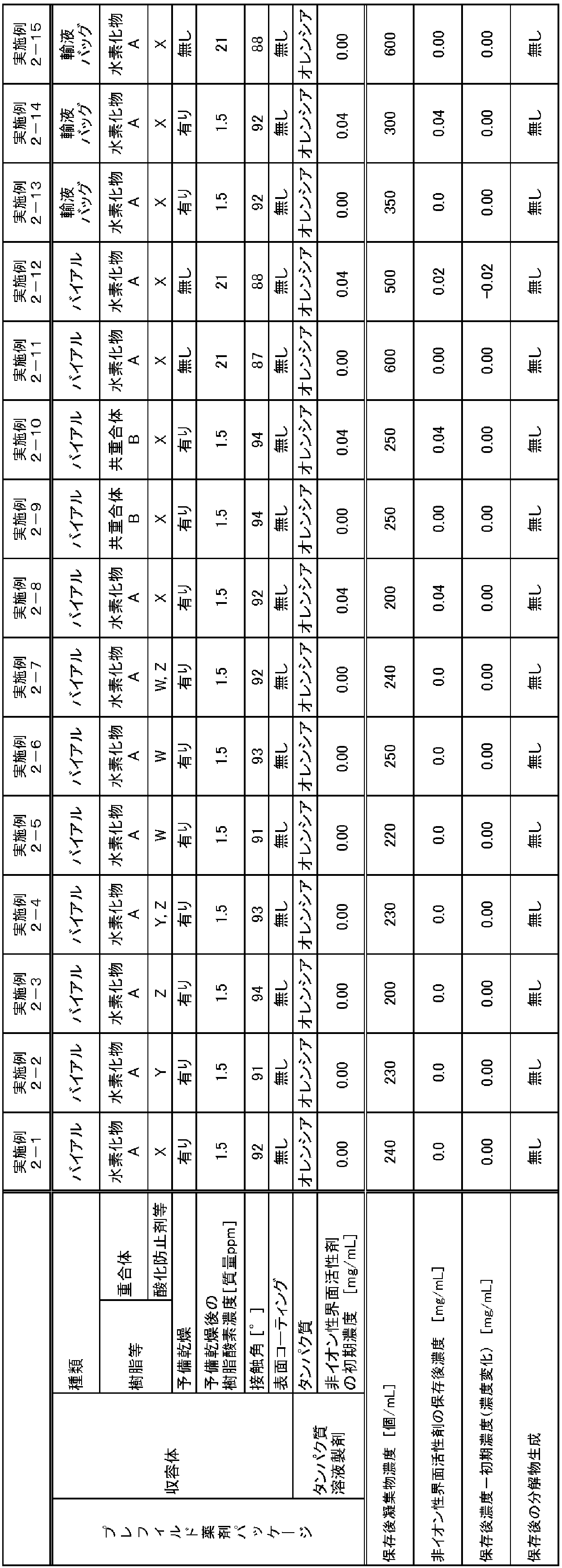
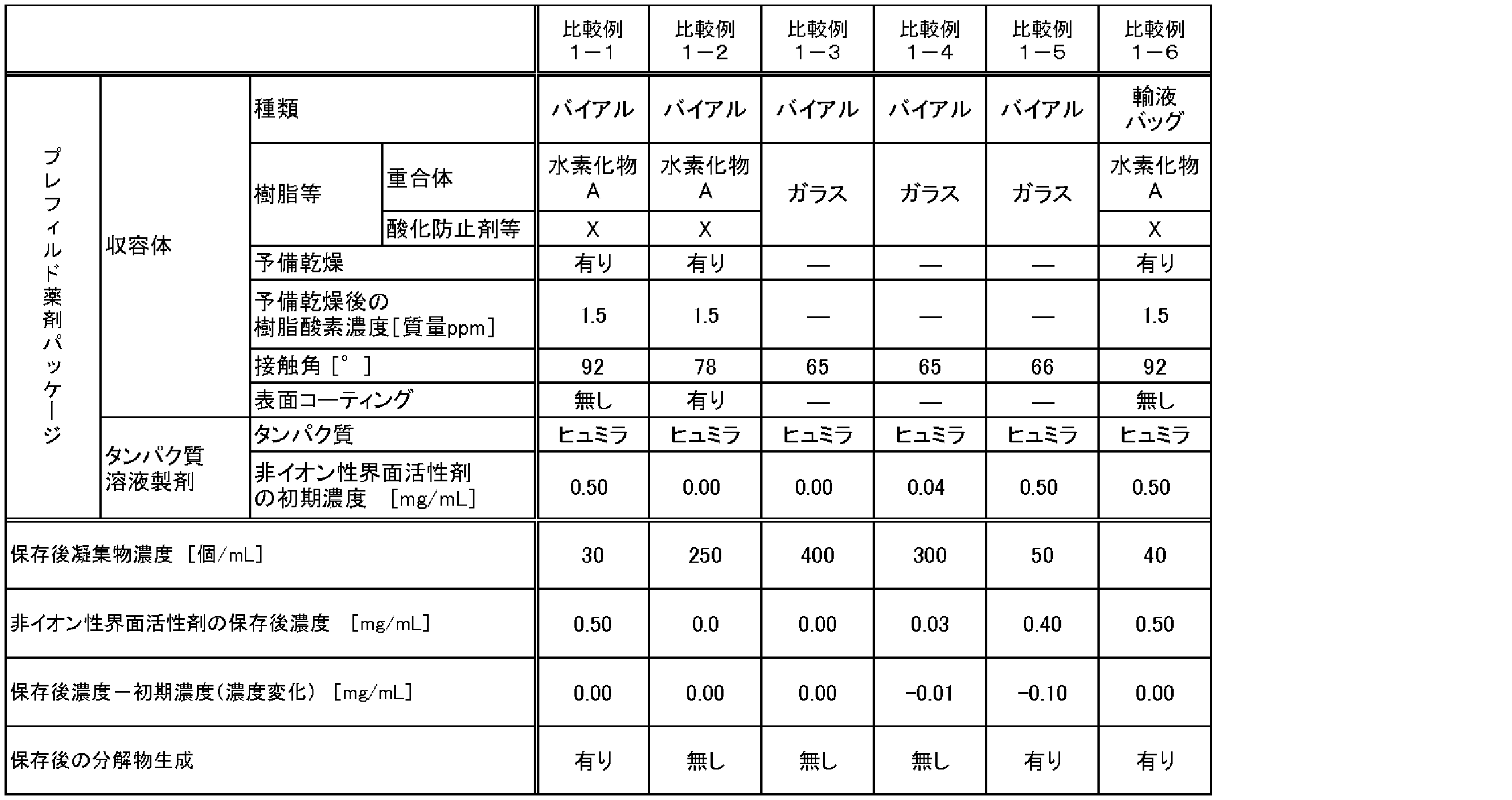
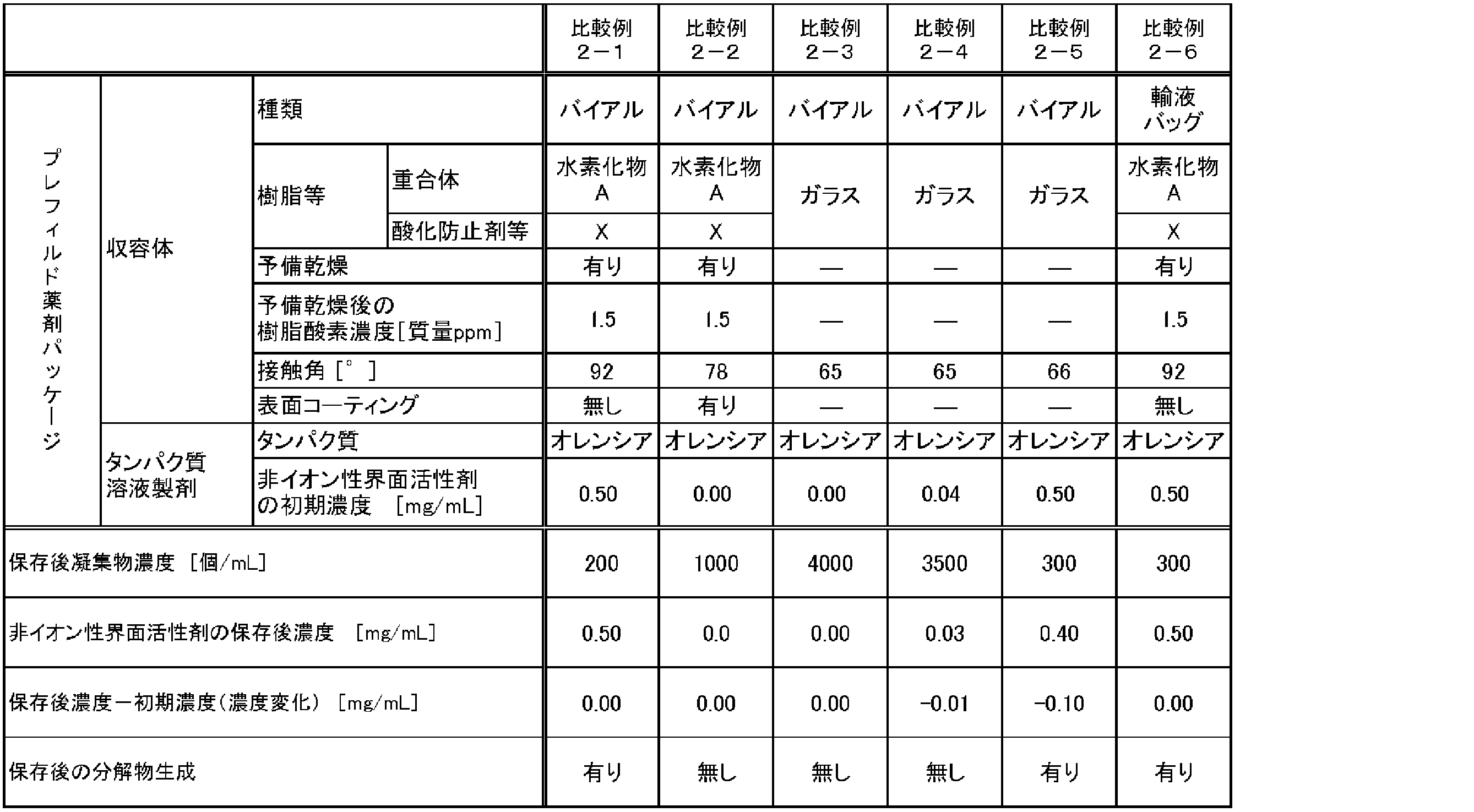
表1~2より、実施例1-1~1-15及び実施例2-1~2-15のプレフィルド薬剤パッケージは、タンパク質溶液製剤の非イオン性界面活性剤の濃度が0mg/mL以上0.05mg/mL未満と低い場合であっても、長期保存後のタンパク質の凝集を抑制できることがわかる。
一方、表3より、タンパク質溶液製剤の非イオン性界面活性剤の濃度が高い(0.50mg/mL)比較例1-1、1-5及び1-6では、長期保存後に非イオン性界面活性剤の分解産物が生成してしまっていることが分かる。
更に、表3より、表面コーティングを施したため製剤接触部分が所定の樹脂で構成されていない比較例1-2、ガラス製の収容体を使用した比較例1-3、1-4では、同じタンパク質を用いた実施例1-1~1-15に比して長期保存後のタンパク質の凝集を抑制できていないことが分かる。
また、表4より、タンパク質溶液製剤の非イオン性界面活性剤の濃度が高い(0.50mg/mL)比較例2-1、2-5及び2-6では、長期保存後に非イオン性界面活性剤の分解産物が生成してしまっていることが分かる。
更に、表4より、表面コーティングを施したため製剤接触部分が所定の樹脂で構成されていない比較例2-2、ガラス製の収容体を使用した比較例2-3、2-4では、同じタンパク質を用いた実施例2-1~2-15に比して長期保存後のタンパク質の凝集を抑制できていないことが分かる。
一方、表3より、タンパク質溶液製剤の非イオン性界面活性剤の濃度が高い(0.50mg/mL)比較例1-1、1-5及び1-6では、長期保存後に非イオン性界面活性剤の分解産物が生成してしまっていることが分かる。
更に、表3より、表面コーティングを施したため製剤接触部分が所定の樹脂で構成されていない比較例1-2、ガラス製の収容体を使用した比較例1-3、1-4では、同じタンパク質を用いた実施例1-1~1-15に比して長期保存後のタンパク質の凝集を抑制できていないことが分かる。
また、表4より、タンパク質溶液製剤の非イオン性界面活性剤の濃度が高い(0.50mg/mL)比較例2-1、2-5及び2-6では、長期保存後に非イオン性界面活性剤の分解産物が生成してしまっていることが分かる。
更に、表4より、表面コーティングを施したため製剤接触部分が所定の樹脂で構成されていない比較例2-2、ガラス製の収容体を使用した比較例2-3、2-4では、同じタンパク質を用いた実施例2-1~2-15に比して長期保存後のタンパク質の凝集を抑制できていないことが分かる。
本発明によれば、非イオン性界面活性剤の濃度が低いタンパク質溶液製剤を収容した場合であっても、長期保存後のタンパク質の凝集を抑制しうるプレフィルド薬剤パッケージを提供することができる。
また、本発明によれば、非イオン性界面活性剤の濃度が低いタンパク質溶液製剤を収容した場合であっても、長期保存後のタンパク質の凝集を抑制しうるプレフィルド薬剤パッケージを製造する方法を提供することができる。
また、本発明によれば、非イオン性界面活性剤の濃度が低いタンパク質溶液製剤を収容した場合であっても、長期保存後のタンパク質の凝集を抑制しうるプレフィルド薬剤パッケージを製造する方法を提供することができる。
10 バイアル(プレフィルド薬剤パッケージ)
11 容器(収容体)
12 キャップ(封止部材)
13,23 タンパク質溶液製剤
20 輸液バッグ(プレフィルド薬剤パッケージ)
21 包装体(収容体)
22 ポート(封止部材)
24 孔
11 容器(収容体)
12 キャップ(封止部材)
13,23 タンパク質溶液製剤
20 輸液バッグ(プレフィルド薬剤パッケージ)
21 包装体(収容体)
22 ポート(封止部材)
24 孔
Claims (16)
- タンパク質溶液製剤と、前記タンパク質溶液製剤が収容された収容体とを備えるプレフィルド薬剤パッケージであって、
前記タンパク質溶液製剤中における非イオン性界面活性剤の濃度が0mg/mL以上0.05mg/mL未満であり、
前記収容体は、前記タンパク質溶液製剤と接する部分の少なくとも一部が、環状オレフィン開環重合体水素添加物と、環状オレフィンと鎖状オレフィンの共重合体の少なくとも一方を含む樹脂からなる、プレフィルド薬剤パッケージ。 - 前記収容体は、前記タンパク質溶液製剤と接する部分の水接触角が90°以上である、請求項1に記載のプレフィルド薬剤パッケージ。
- 更に封止部材を備え、そして前記収容体が開口を有し、前記開口が前記封止部材により密閉されている、請求項1又は2に記載のプレフィルド薬剤パッケージ。
- 前記タンパク質溶液製剤は、抗体とその抗原結合断片の少なくとも一方を含む、請求項1~3の何れかに記載のプレフィルド薬剤パッケージ。
- 前記抗体は、キメラ抗体、ヒト抗体、ヒト化抗体、及びこれらのドメイン抗体からなる群から選択される少なくとも一つである、請求項4に記載のプレフィルド薬剤パッケージ。
- 前記タンパク質溶液製剤は、オファツムマブ、セツキシマブ、トシリズマブ、ベバシズマブ、カナキヌマブ、ゴリムマブ、ウステキヌマブ、エクリズマブ、オマリズマブ、トラスツズマブ、ペルツズマブ、アダリムマブ、デノスマブ、モガムリズマブ、リツキシマブ、ラニビズマブ、インフリキシマブ、アフリベルセプト、アバタセプト、エタネルセプト、ゲムツズマブオゾガマイシン、パニツムマブ、バシリキシマブ、セルトリズマブ ペゴル、及びパリビズマブからなる群から選択される少なくとも一つを含む、請求項1~3の何れかに記載のプレフィルド薬剤パッケージ。
- バイアル、輸液バッグ、プレフィルドカートリッジ、アンプル、ボトル、パウチ、又はブリスターパックである、請求項1~6の何れかに記載のプレフィルド薬剤パッケージ。
- タンパク質溶液製剤と、前記タンパク質溶液製剤が収容された収容体とを備えるプレフィルド薬剤パッケージを製造する方法であって、
前記収容体に非イオン性界面活性剤の濃度が0mg/mL以上0.05mg/mL未満である前記タンパク質溶液製剤を充填して、前記プレフィルド薬剤パッケージを得る工程を備え、
前記収容体は、前記タンパク質溶液製剤と接する部分の少なくとも一部が、環状オレフィン開環重合体水素添加物と、環状オレフィンと鎖状オレフィンの共重合体の少なくとも一方を含む樹脂からなる、プレフィルド薬剤パッケージの製造方法。 - 前記プレフィルド薬剤パッケージを得る工程に先んじて、更に、
前記樹脂を予備乾燥する工程と、
前記予備乾燥後の樹脂を成形して、前記収容体を得る工程と、
を備える、請求項8に記載のプレフィルド薬剤パッケージの製造方法。 - 前記予備乾燥後の前記樹脂中の酸素濃度が、10質量ppm以下である、請求項9に記載のプレフィルド薬剤パッケージの製造方法。
- 前記予備乾燥を不活性ガス雰囲気下で行う、請求項9又は10に記載のプレフィルド薬剤パッケージの製造方法。
- 前記予備乾燥の乾燥温度が80℃以上120℃以下である、請求項9~11の何れかに記載のプレフィルド薬剤パッケージの製造方法。
- 前記タンパク質溶液製剤は、抗体とその抗原結合断片の少なくとも一方を含む、請求項8~12の何れかに記載のプレフィルド薬剤パッケージの製造方法。
- 前記抗体は、キメラ抗体、ヒト抗体、ヒト化抗体、及びこれらのドメイン抗体からなる群から選択される少なくとも1つである、請求項13に記載のプレフィルド薬剤パッケージの製造方法。
- 前記タンパク質溶液製剤は、オファツムマブ、セツキシマブ、トシリズマブ、ベバシズマブ、カナキヌマブ、ゴリムマブ、ウステキヌマブ、エクリズマブ、オマリズマブ、トラスツズマブ、ペルツズマブ、アダリムマブ、デノスマブ、モガムリズマブ、リツキシマブ、ラニビズマブ、インフリキシマブ、アフリベルセプト、アバタセプト、エタネルセプト、ゲムツズマブオゾガマイシン、パニツムマブ、バシリキシマブ、セルトリズマブ ペゴル、及びパリビズマブからなる群から選択される少なくとも一つを含む、請求項8~12の何れかに記載のプレフィルド薬剤パッケージの製造方法。
- バイアル、輸液バッグ、プレフィルドカートリッジ、アンプル、ボトル、パウチ、又はブリスターパックを製造する方法である、請求項8~15の何れかに記載のプレフィルド薬剤パッケージの製造方法。
Priority Applications (4)
| Application Number | Priority Date | Filing Date | Title |
|---|---|---|---|
| CN202180009674.6A CN114980851A (zh) | 2020-01-28 | 2021-01-25 | 预填充药剂包装和预填充药剂包装的制造方法 |
| US17/758,803 US20230047299A1 (en) | 2020-01-28 | 2021-01-25 | Pre-filled drug package and method of producing pre-filled drug package |
| JP2021574027A JP7757797B2 (ja) | 2020-01-28 | 2021-01-25 | プレフィルド薬剤パッケージ及びプレフィルド薬剤パッケージの製造方法 |
| EP21747929.4A EP4098238A4 (en) | 2020-01-28 | 2021-01-25 | PREFILLED MEDICINAL PACKAGING AND METHOD FOR PRODUCING A PREFILLED MEDICINAL PACKAGING |
Applications Claiming Priority (2)
| Application Number | Priority Date | Filing Date | Title |
|---|---|---|---|
| JP2020011941 | 2020-01-28 | ||
| JP2020-011941 | 2020-01-28 |
Publications (1)
| Publication Number | Publication Date |
|---|---|
| WO2021153511A1 true WO2021153511A1 (ja) | 2021-08-05 |
Family
ID=77079097
Family Applications (1)
| Application Number | Title | Priority Date | Filing Date |
|---|---|---|---|
| PCT/JP2021/002477 Ceased WO2021153511A1 (ja) | 2020-01-28 | 2021-01-25 | プレフィルド薬剤パッケージ及びプレフィルド薬剤パッケージの製造方法 |
Country Status (5)
| Country | Link |
|---|---|
| US (1) | US20230047299A1 (ja) |
| EP (1) | EP4098238A4 (ja) |
| JP (1) | JP7757797B2 (ja) |
| CN (1) | CN114980851A (ja) |
| WO (1) | WO2021153511A1 (ja) |
Cited By (1)
| Publication number | Priority date | Publication date | Assignee | Title |
|---|---|---|---|---|
| JPWO2020026927A1 (ja) * | 2018-07-31 | 2021-08-26 | 日本ゼオン株式会社 | プレフィルドシリンジおよびプレフィルドシリンジの製造方法 |
Families Citing this family (2)
| Publication number | Priority date | Publication date | Assignee | Title |
|---|---|---|---|---|
| MA54325A (fr) | 2019-06-05 | 2022-05-11 | Regeneron Pharma | Dispositifs et procédés pour l'administration précise de doses |
| USD1120314S1 (en) | 2022-11-30 | 2026-03-24 | Regeneron Pharmaceuticals, Inc. | Dose delivery device |
Citations (4)
| Publication number | Priority date | Publication date | Assignee | Title |
|---|---|---|---|---|
| WO2001017542A1 (fr) * | 1999-09-08 | 2001-03-15 | Chugai Seiyaku Kabushiki Kaisha | Preparation de solution de proteines et procede de stabilisation associe |
| JP2008093830A (ja) * | 2006-10-05 | 2008-04-24 | Jsr Corp | 光学フィルムの製造方法 |
| JP2016155327A (ja) | 2015-02-25 | 2016-09-01 | 日本ゼオン株式会社 | 樹脂製容器の製造方法および樹脂製容器 |
| JP2018535974A (ja) * | 2015-11-18 | 2018-12-06 | エスアイオーツー・メディカル・プロダクツ・インコーポレイテッド | 眼科用製剤のための薬剤パッケージ |
Family Cites Families (10)
| Publication number | Priority date | Publication date | Assignee | Title |
|---|---|---|---|---|
| CA1292686C (en) * | 1986-10-27 | 1991-12-03 | Ze'ev Shaked | Pharmaceutical compositions of recombinant interleukin-2 and formulation process |
| RU2364609C2 (ru) * | 2003-05-23 | 2009-08-20 | Ново Нордиск Хелт Кэр Аг | Стабилизация белка в растворе |
| JP2011519347A (ja) * | 2008-02-07 | 2011-07-07 | アムジエン・インコーポレーテツド | 安定化されたタンパク質組成物 |
| FR2995213A1 (fr) * | 2012-09-12 | 2014-03-14 | Lfb Biotechnologies | Seringue contenant une composition, notamment pharmaceutique, comprenant des immunoglobulines, son procede de fabrication et son utilisation |
| EP3266466A1 (en) * | 2012-12-20 | 2018-01-10 | Medimmune, LLC | Liquid antibody formulation with improved aggregation properties |
| WO2016051962A1 (ja) * | 2014-10-02 | 2016-04-07 | テルモ株式会社 | タンパク質溶液製剤を収容するための医療用容器 |
| RU2734958C2 (ru) * | 2015-11-18 | 2020-10-26 | Формикон Аг | Предварительно заполненная фармацевтическая упаковка, содержащая жидкий состав на основе антагониста vegf |
| JP7071914B2 (ja) * | 2016-03-24 | 2022-05-19 | テルモ株式会社 | シリンジ用外筒およびシリンジ |
| EP3831428B1 (en) * | 2018-07-31 | 2024-12-04 | Zeon Corporation | Pre-filled syringe and pre-filled syringe production method |
| JP7484715B2 (ja) * | 2018-07-31 | 2024-05-16 | 日本ゼオン株式会社 | プレフィルドシリンジおよびプレフィルドシリンジの製造方法 |
-
2021
- 2021-01-25 EP EP21747929.4A patent/EP4098238A4/en active Pending
- 2021-01-25 JP JP2021574027A patent/JP7757797B2/ja active Active
- 2021-01-25 US US17/758,803 patent/US20230047299A1/en not_active Abandoned
- 2021-01-25 CN CN202180009674.6A patent/CN114980851A/zh active Pending
- 2021-01-25 WO PCT/JP2021/002477 patent/WO2021153511A1/ja not_active Ceased
Patent Citations (4)
| Publication number | Priority date | Publication date | Assignee | Title |
|---|---|---|---|---|
| WO2001017542A1 (fr) * | 1999-09-08 | 2001-03-15 | Chugai Seiyaku Kabushiki Kaisha | Preparation de solution de proteines et procede de stabilisation associe |
| JP2008093830A (ja) * | 2006-10-05 | 2008-04-24 | Jsr Corp | 光学フィルムの製造方法 |
| JP2016155327A (ja) | 2015-02-25 | 2016-09-01 | 日本ゼオン株式会社 | 樹脂製容器の製造方法および樹脂製容器 |
| JP2018535974A (ja) * | 2015-11-18 | 2018-12-06 | エスアイオーツー・メディカル・プロダクツ・インコーポレイテッド | 眼科用製剤のための薬剤パッケージ |
Non-Patent Citations (1)
| Title |
|---|
| See also references of EP4098238A4 |
Cited By (2)
| Publication number | Priority date | Publication date | Assignee | Title |
|---|---|---|---|---|
| JPWO2020026927A1 (ja) * | 2018-07-31 | 2021-08-26 | 日本ゼオン株式会社 | プレフィルドシリンジおよびプレフィルドシリンジの製造方法 |
| JP7396279B2 (ja) | 2018-07-31 | 2023-12-12 | 日本ゼオン株式会社 | プレフィルドシリンジおよびプレフィルドシリンジの製造方法 |
Also Published As
| Publication number | Publication date |
|---|---|
| EP4098238A4 (en) | 2024-02-28 |
| JP7757797B2 (ja) | 2025-10-22 |
| JPWO2021153511A1 (ja) | 2021-08-05 |
| US20230047299A1 (en) | 2023-02-16 |
| EP4098238A1 (en) | 2022-12-07 |
| CN114980851A (zh) | 2022-08-30 |
Similar Documents
| Publication | Publication Date | Title |
|---|---|---|
| JP7757797B2 (ja) | プレフィルド薬剤パッケージ及びプレフィルド薬剤パッケージの製造方法 | |
| JP7396279B2 (ja) | プレフィルドシリンジおよびプレフィルドシリンジの製造方法 | |
| JP7484715B2 (ja) | プレフィルドシリンジおよびプレフィルドシリンジの製造方法 | |
| JP5493115B2 (ja) | 液体収納容器 | |
| JP6347213B2 (ja) | 樹脂組成物及びそれを用いた医療用薬剤容器 | |
| CN107106409A (zh) | 用于容纳蛋白质溶液制剂的医疗用容器 | |
| JP2021035969A (ja) | 静脈内注入剤形 | |
| JP5465409B2 (ja) | エダラボンのプレミックス製剤 | |
| EP4023292A1 (en) | Injection formulation | |
| JP6350530B2 (ja) | 滅菌済み医療用成形体の製造方法 | |
| JP6753570B2 (ja) | バッグ製剤 | |
| US20240158565A1 (en) | Vessel | |
| WO2022065473A1 (ja) | ヒアルロン酸またはその塩およびインジゴカルミンを含む組成物 | |
| JP2024144084A (ja) | 容器入り製剤および包装体 | |
| WO2024203631A1 (ja) | 容器入り製剤および包装体 | |
| JP4457729B2 (ja) | 溶着複合体 | |
| EP3470045B1 (en) | Intravenous infusion dosage form for pemetrexed | |
| JP3004831B2 (ja) | 医療用具品 | |
| HK40049318B (en) | Intravenous infusion dosage form for pemetrexed | |
| JP3951660B2 (ja) | ブロー成形容器 | |
| HK40007343A (en) | Intravenous infusion dosage form for pemetrexed | |
| HK40007343B (en) | Intravenous infusion dosage form for pemetrexed | |
| JP2014196438A (ja) | 医療用複室容器 |
Legal Events
| Date | Code | Title | Description |
|---|---|---|---|
| 121 | Ep: the epo has been informed by wipo that ep was designated in this application |
Ref document number: 21747929 Country of ref document: EP Kind code of ref document: A1 |
|
| ENP | Entry into the national phase |
Ref document number: 2021574027 Country of ref document: JP Kind code of ref document: A |
|
| NENP | Non-entry into the national phase |
Ref country code: DE |
|
| ENP | Entry into the national phase |
Ref document number: 2021747929 Country of ref document: EP Effective date: 20220829 |