WO2021157217A1 - 油井用鋼材および油井管 - Google Patents
油井用鋼材および油井管 Download PDFInfo
- Publication number
- WO2021157217A1 WO2021157217A1 PCT/JP2020/047181 JP2020047181W WO2021157217A1 WO 2021157217 A1 WO2021157217 A1 WO 2021157217A1 JP 2020047181 W JP2020047181 W JP 2020047181W WO 2021157217 A1 WO2021157217 A1 WO 2021157217A1
- Authority
- WO
- WIPO (PCT)
- Prior art keywords
- steel material
- less
- content
- mass
- material according
- Prior art date
- Legal status (The legal status is an assumption and is not a legal conclusion. Google has not performed a legal analysis and makes no representation as to the accuracy of the status listed.)
- Ceased
Links
Classifications
-
- C—CHEMISTRY; METALLURGY
- C22—METALLURGY; FERROUS OR NON-FERROUS ALLOYS; TREATMENT OF ALLOYS OR NON-FERROUS METALS
- C22C—ALLOYS
- C22C38/00—Ferrous alloys, e.g. steel alloys
- C22C38/02—Ferrous alloys, e.g. steel alloys containing silicon
-
- C—CHEMISTRY; METALLURGY
- C21—METALLURGY OF IRON
- C21D—MODIFYING THE PHYSICAL STRUCTURE OF FERROUS METALS; GENERAL DEVICES FOR HEAT TREATMENT OF FERROUS OR NON-FERROUS METALS OR ALLOYS; MAKING METAL MALLEABLE, e.g. BY DECARBURISATION OR TEMPERING
- C21D1/00—General methods or devices for heat treatment, e.g. annealing, hardening, quenching or tempering
- C21D1/26—Methods of annealing
-
- C—CHEMISTRY; METALLURGY
- C21—METALLURGY OF IRON
- C21D—MODIFYING THE PHYSICAL STRUCTURE OF FERROUS METALS; GENERAL DEVICES FOR HEAT TREATMENT OF FERROUS OR NON-FERROUS METALS OR ALLOYS; MAKING METAL MALLEABLE, e.g. BY DECARBURISATION OR TEMPERING
- C21D6/00—Heat treatment of ferrous alloys
- C21D6/005—Heat treatment of ferrous alloys containing Mn
-
- C—CHEMISTRY; METALLURGY
- C21—METALLURGY OF IRON
- C21D—MODIFYING THE PHYSICAL STRUCTURE OF FERROUS METALS; GENERAL DEVICES FOR HEAT TREATMENT OF FERROUS OR NON-FERROUS METALS OR ALLOYS; MAKING METAL MALLEABLE, e.g. BY DECARBURISATION OR TEMPERING
- C21D6/00—Heat treatment of ferrous alloys
- C21D6/02—Hardening by precipitation
-
- C—CHEMISTRY; METALLURGY
- C21—METALLURGY OF IRON
- C21D—MODIFYING THE PHYSICAL STRUCTURE OF FERROUS METALS; GENERAL DEVICES FOR HEAT TREATMENT OF FERROUS OR NON-FERROUS METALS OR ALLOYS; MAKING METAL MALLEABLE, e.g. BY DECARBURISATION OR TEMPERING
- C21D8/00—Modifying the physical properties of ferrous metals or ferrous alloys by deformation combined with, or followed by, heat treatment
- C21D8/02—Modifying the physical properties of ferrous metals or ferrous alloys by deformation combined with, or followed by, heat treatment during manufacturing of plates or strips
-
- C—CHEMISTRY; METALLURGY
- C21—METALLURGY OF IRON
- C21D—MODIFYING THE PHYSICAL STRUCTURE OF FERROUS METALS; GENERAL DEVICES FOR HEAT TREATMENT OF FERROUS OR NON-FERROUS METALS OR ALLOYS; MAKING METAL MALLEABLE, e.g. BY DECARBURISATION OR TEMPERING
- C21D8/00—Modifying the physical properties of ferrous metals or ferrous alloys by deformation combined with, or followed by, heat treatment
- C21D8/02—Modifying the physical properties of ferrous metals or ferrous alloys by deformation combined with, or followed by, heat treatment during manufacturing of plates or strips
- C21D8/0221—Modifying the physical properties of ferrous metals or ferrous alloys by deformation combined with, or followed by, heat treatment during manufacturing of plates or strips characterised by the working steps
- C21D8/0226—Hot rolling
-
- C—CHEMISTRY; METALLURGY
- C21—METALLURGY OF IRON
- C21D—MODIFYING THE PHYSICAL STRUCTURE OF FERROUS METALS; GENERAL DEVICES FOR HEAT TREATMENT OF FERROUS OR NON-FERROUS METALS OR ALLOYS; MAKING METAL MALLEABLE, e.g. BY DECARBURISATION OR TEMPERING
- C21D8/00—Modifying the physical properties of ferrous metals or ferrous alloys by deformation combined with, or followed by, heat treatment
- C21D8/02—Modifying the physical properties of ferrous metals or ferrous alloys by deformation combined with, or followed by, heat treatment during manufacturing of plates or strips
- C21D8/0247—Modifying the physical properties of ferrous metals or ferrous alloys by deformation combined with, or followed by, heat treatment during manufacturing of plates or strips characterised by the heat treatment
-
- C—CHEMISTRY; METALLURGY
- C21—METALLURGY OF IRON
- C21D—MODIFYING THE PHYSICAL STRUCTURE OF FERROUS METALS; GENERAL DEVICES FOR HEAT TREATMENT OF FERROUS OR NON-FERROUS METALS OR ALLOYS; MAKING METAL MALLEABLE, e.g. BY DECARBURISATION OR TEMPERING
- C21D8/00—Modifying the physical properties of ferrous metals or ferrous alloys by deformation combined with, or followed by, heat treatment
- C21D8/02—Modifying the physical properties of ferrous metals or ferrous alloys by deformation combined with, or followed by, heat treatment during manufacturing of plates or strips
- C21D8/0247—Modifying the physical properties of ferrous metals or ferrous alloys by deformation combined with, or followed by, heat treatment during manufacturing of plates or strips characterised by the heat treatment
- C21D8/0263—Modifying the physical properties of ferrous metals or ferrous alloys by deformation combined with, or followed by, heat treatment during manufacturing of plates or strips characterised by the heat treatment following hot rolling
-
- C—CHEMISTRY; METALLURGY
- C21—METALLURGY OF IRON
- C21D—MODIFYING THE PHYSICAL STRUCTURE OF FERROUS METALS; GENERAL DEVICES FOR HEAT TREATMENT OF FERROUS OR NON-FERROUS METALS OR ALLOYS; MAKING METAL MALLEABLE, e.g. BY DECARBURISATION OR TEMPERING
- C21D8/00—Modifying the physical properties of ferrous metals or ferrous alloys by deformation combined with, or followed by, heat treatment
- C21D8/02—Modifying the physical properties of ferrous metals or ferrous alloys by deformation combined with, or followed by, heat treatment during manufacturing of plates or strips
- C21D8/0247—Modifying the physical properties of ferrous metals or ferrous alloys by deformation combined with, or followed by, heat treatment during manufacturing of plates or strips characterised by the heat treatment
- C21D8/0273—Final recrystallisation annealing
-
- C—CHEMISTRY; METALLURGY
- C21—METALLURGY OF IRON
- C21D—MODIFYING THE PHYSICAL STRUCTURE OF FERROUS METALS; GENERAL DEVICES FOR HEAT TREATMENT OF FERROUS OR NON-FERROUS METALS OR ALLOYS; MAKING METAL MALLEABLE, e.g. BY DECARBURISATION OR TEMPERING
- C21D8/00—Modifying the physical properties of ferrous metals or ferrous alloys by deformation combined with, or followed by, heat treatment
- C21D8/10—Modifying the physical properties of ferrous metals or ferrous alloys by deformation combined with, or followed by, heat treatment during manufacturing of tubular bodies
-
- C—CHEMISTRY; METALLURGY
- C21—METALLURGY OF IRON
- C21D—MODIFYING THE PHYSICAL STRUCTURE OF FERROUS METALS; GENERAL DEVICES FOR HEAT TREATMENT OF FERROUS OR NON-FERROUS METALS OR ALLOYS; MAKING METAL MALLEABLE, e.g. BY DECARBURISATION OR TEMPERING
- C21D9/00—Heat treatment, e.g. annealing, hardening, quenching or tempering, adapted for particular articles; Furnaces therefor
- C21D9/08—Heat treatment, e.g. annealing, hardening, quenching or tempering, adapted for particular articles; Furnaces therefor for tubular bodies or pipes
-
- C—CHEMISTRY; METALLURGY
- C21—METALLURGY OF IRON
- C21D—MODIFYING THE PHYSICAL STRUCTURE OF FERROUS METALS; GENERAL DEVICES FOR HEAT TREATMENT OF FERROUS OR NON-FERROUS METALS OR ALLOYS; MAKING METAL MALLEABLE, e.g. BY DECARBURISATION OR TEMPERING
- C21D9/00—Heat treatment, e.g. annealing, hardening, quenching or tempering, adapted for particular articles; Furnaces therefor
- C21D9/46—Heat treatment, e.g. annealing, hardening, quenching or tempering, adapted for particular articles; Furnaces therefor for sheet metals
-
- C—CHEMISTRY; METALLURGY
- C22—METALLURGY; FERROUS OR NON-FERROUS ALLOYS; TREATMENT OF ALLOYS OR NON-FERROUS METALS
- C22C—ALLOYS
- C22C38/00—Ferrous alloys, e.g. steel alloys
- C22C38/001—Ferrous alloys, e.g. steel alloys containing N
-
- C—CHEMISTRY; METALLURGY
- C22—METALLURGY; FERROUS OR NON-FERROUS ALLOYS; TREATMENT OF ALLOYS OR NON-FERROUS METALS
- C22C—ALLOYS
- C22C38/00—Ferrous alloys, e.g. steel alloys
- C22C38/002—Ferrous alloys, e.g. steel alloys containing In, Mg, or other elements not provided for in one single group C22C38/001 - C22C38/60
-
- C—CHEMISTRY; METALLURGY
- C22—METALLURGY; FERROUS OR NON-FERROUS ALLOYS; TREATMENT OF ALLOYS OR NON-FERROUS METALS
- C22C—ALLOYS
- C22C38/00—Ferrous alloys, e.g. steel alloys
- C22C38/04—Ferrous alloys, e.g. steel alloys containing manganese
-
- C—CHEMISTRY; METALLURGY
- C22—METALLURGY; FERROUS OR NON-FERROUS ALLOYS; TREATMENT OF ALLOYS OR NON-FERROUS METALS
- C22C—ALLOYS
- C22C38/00—Ferrous alloys, e.g. steel alloys
- C22C38/06—Ferrous alloys, e.g. steel alloys containing aluminium
-
- C—CHEMISTRY; METALLURGY
- C22—METALLURGY; FERROUS OR NON-FERROUS ALLOYS; TREATMENT OF ALLOYS OR NON-FERROUS METALS
- C22C—ALLOYS
- C22C38/00—Ferrous alloys, e.g. steel alloys
- C22C38/08—Ferrous alloys, e.g. steel alloys containing nickel
-
- C—CHEMISTRY; METALLURGY
- C22—METALLURGY; FERROUS OR NON-FERROUS ALLOYS; TREATMENT OF ALLOYS OR NON-FERROUS METALS
- C22C—ALLOYS
- C22C38/00—Ferrous alloys, e.g. steel alloys
- C22C38/12—Ferrous alloys, e.g. steel alloys containing tungsten, tantalum, molybdenum, vanadium, or niobium
-
- C—CHEMISTRY; METALLURGY
- C22—METALLURGY; FERROUS OR NON-FERROUS ALLOYS; TREATMENT OF ALLOYS OR NON-FERROUS METALS
- C22C—ALLOYS
- C22C38/00—Ferrous alloys, e.g. steel alloys
- C22C38/14—Ferrous alloys, e.g. steel alloys containing titanium or zirconium
-
- C—CHEMISTRY; METALLURGY
- C22—METALLURGY; FERROUS OR NON-FERROUS ALLOYS; TREATMENT OF ALLOYS OR NON-FERROUS METALS
- C22C—ALLOYS
- C22C38/00—Ferrous alloys, e.g. steel alloys
- C22C38/16—Ferrous alloys, e.g. steel alloys containing copper
-
- C—CHEMISTRY; METALLURGY
- C22—METALLURGY; FERROUS OR NON-FERROUS ALLOYS; TREATMENT OF ALLOYS OR NON-FERROUS METALS
- C22C—ALLOYS
- C22C38/00—Ferrous alloys, e.g. steel alloys
- C22C38/18—Ferrous alloys, e.g. steel alloys containing chromium
- C22C38/22—Ferrous alloys, e.g. steel alloys containing chromium with molybdenum or tungsten
-
- C—CHEMISTRY; METALLURGY
- C22—METALLURGY; FERROUS OR NON-FERROUS ALLOYS; TREATMENT OF ALLOYS OR NON-FERROUS METALS
- C22C—ALLOYS
- C22C38/00—Ferrous alloys, e.g. steel alloys
- C22C38/18—Ferrous alloys, e.g. steel alloys containing chromium
- C22C38/24—Ferrous alloys, e.g. steel alloys containing chromium with vanadium
-
- C—CHEMISTRY; METALLURGY
- C22—METALLURGY; FERROUS OR NON-FERROUS ALLOYS; TREATMENT OF ALLOYS OR NON-FERROUS METALS
- C22C—ALLOYS
- C22C38/00—Ferrous alloys, e.g. steel alloys
- C22C38/18—Ferrous alloys, e.g. steel alloys containing chromium
- C22C38/38—Ferrous alloys, e.g. steel alloys containing chromium with more than 1.5% by weight of manganese
-
- C—CHEMISTRY; METALLURGY
- C22—METALLURGY; FERROUS OR NON-FERROUS ALLOYS; TREATMENT OF ALLOYS OR NON-FERROUS METALS
- C22C—ALLOYS
- C22C38/00—Ferrous alloys, e.g. steel alloys
- C22C38/18—Ferrous alloys, e.g. steel alloys containing chromium
- C22C38/40—Ferrous alloys, e.g. steel alloys containing chromium with nickel
- C22C38/46—Ferrous alloys, e.g. steel alloys containing chromium with nickel with vanadium
-
- C—CHEMISTRY; METALLURGY
- C22—METALLURGY; FERROUS OR NON-FERROUS ALLOYS; TREATMENT OF ALLOYS OR NON-FERROUS METALS
- C22C—ALLOYS
- C22C38/00—Ferrous alloys, e.g. steel alloys
- C22C38/18—Ferrous alloys, e.g. steel alloys containing chromium
- C22C38/40—Ferrous alloys, e.g. steel alloys containing chromium with nickel
- C22C38/58—Ferrous alloys, e.g. steel alloys containing chromium with nickel with more than 1.5% by weight of manganese
-
- C—CHEMISTRY; METALLURGY
- C21—METALLURGY OF IRON
- C21D—MODIFYING THE PHYSICAL STRUCTURE OF FERROUS METALS; GENERAL DEVICES FOR HEAT TREATMENT OF FERROUS OR NON-FERROUS METALS OR ALLOYS; MAKING METAL MALLEABLE, e.g. BY DECARBURISATION OR TEMPERING
- C21D2211/00—Microstructure comprising significant phases
- C21D2211/001—Austenite
-
- C—CHEMISTRY; METALLURGY
- C21—METALLURGY OF IRON
- C21D—MODIFYING THE PHYSICAL STRUCTURE OF FERROUS METALS; GENERAL DEVICES FOR HEAT TREATMENT OF FERROUS OR NON-FERROUS METALS OR ALLOYS; MAKING METAL MALLEABLE, e.g. BY DECARBURISATION OR TEMPERING
- C21D2211/00—Microstructure comprising significant phases
- C21D2211/004—Dispersions; Precipitations
Definitions
- the present invention relates to steel materials for oil wells and oil well pipes using the same.
- oil and gas wells such as natural gas
- SSC stress cracking
- SSC is a type of hydrogen embrittlement in which hydrogen generated on the surface of a steel material diffuses into the steel material in a corrosive environment and leads to fracture due to a synergistic effect with the stress applied to the steel material.
- a steel material having a high sensitivity to SSC cracks easily occur at a load stress lower than the yield stress of the steel material.
- tempered martensite has a body-centered cubic (hereinafter referred to as "BCC") structure.
- BCC body-centered cubic
- the tempered martensite and ferrite having a BCC structure are inherently highly sensitive to hydrogen embrittlement. Therefore, it is extremely difficult to completely prevent SSC in a steel material having tempered martensite or ferrite as the main structure.
- the higher the strength the higher the SSC sensitivity. Therefore, it can be said that obtaining a steel material having high strength and excellent SSC resistance is an extremely difficult task for low alloy steels.
- Patent Documents 1 to 4 disclose high-strength steel materials having excellent SSC resistance, which contain a large amount of Mn, which is an austenite stabilizing element, and Patent Document 5 discloses higher strength in addition to such performance. Tough steel materials are also disclosed.
- Patent Documents 1 to 5 excellent SSC resistance and high strength are realized by increasing the content of austenite stabilizing elements such as C and Mn and precipitating hardening by containing elements such as Cr and V. There is. However, as the depth of oil wells increases, it is necessary to adopt a method different from the conventional method in order to obtain performance that can withstand even harsher wet hydrogen sulfide environments.
- the present invention has been made to solve the above-mentioned problems, and uses a steel material for oil wells having a yield stress of 125 ksi (862 MPa) or more and further excellent in SSC resistance than conventional steel materials.
- the purpose is to provide the well pipes that were used.
- the present invention has been made to solve the above problems, and the gist of the following steel materials for oil wells and oil well pipes is as follows.
- the chemical composition is mass%.
- the effective C amount defined by the following equation (i) is 0.55 or more and less than 1.54.
- the metal structure is ⁇ 'martensite and ferrite total volume fraction less than 0.1%, ⁇ martensite of HCP structure is 10% or less in volume fraction,
- the rest is austenite,
- the number density of carbonitrides having a circle-equivalent diameter of 5 to 100 nm is 100 pieces / ⁇ m 2 or more.
- the yield stress is 862 MPa or more,
- the stacking defect energy at 25 ° C. is 30 mJ / m 2 or more.
- the particle size of austenite is 100 ⁇ m or less.
- Steel material C-0.18V-0.06 (Cr + Mo) -0.25Ti-0.13 (Nb + Zr) -0.07 (Ta + Hf + W) ... (i)
- the element symbol in the above formula represents the content (mass%) of each element contained in the steel material, and if it is not contained, 0 is substituted.
- the chemical composition is mass%. Cr: 0.05 to 10.00%, and Mo: 0.10 to 3.00% Contains one or more selected from, The steel material according to (1).
- the chemical composition is mass%.
- the chemical composition is mass%.
- the chemical composition is mass%.
- an oil well steel material having a yield stress of 125 ksi (862 MPa) or more and further excellent in SSC resistance than the conventional steel material, and an oil well pipe using the same.
- the present inventors have obtained the following findings as a result of detailed investigation of the yield stress and SSC resistance of steel materials in order to solve the above-mentioned problems.
- austenite can be stabilized by increasing the contents of C and Mn. That is, the content of these elements can be an index of the stability of austenite.
- the transformation phase for example, hexagonal close-packed (hereinafter, "hexagonal close-packed"
- HCP hexagonal close-packed
- ⁇ phase of the structure called HCP
- ⁇ phase of the BCC structure the hydrogen embrittlement sensitivity becomes high, and it becomes difficult to completely prevent SCC.
- SFE Stacking Fault Energy
- austenite the stacking defect energy of austenite
- SFE is the energy of surface defects, which is one of the lattice defects existing in the FCC structure.
- Al has the effect of increasing SFE. Therefore, by increasing the Al content in the steel and increasing the SFE of the steel material, it is possible to prevent such stress concentration around the austenite grain boundaries and precipitation of the transformation phase. Further, Al has an effect of forming a stable passivation film containing Al 2 O 3 on the polar surface layer and suppressing hydrogen invasion into the steel material.
- the present inventors have confirmed that in the steel material according to the present invention, the addition of Al of about several% does not cause any particular problem in steel production, and thus the Al content in the steel material is contained. It was found that by increasing the amount, the hydrogen embrittlement resistance can be further significantly improved as compared with the conventional case.
- Carbon (C) has the effect of stabilizing austenite and the effect of increasing the strength at low cost even if the content of an element called austenite former such as Mn is reduced, and promotes twinning deformation and work hardening. It is an extremely important element in this embodiment because its properties and uniform elongation can be improved.
- the strength of the steel material is improved by subjecting it to aging treatment and precipitating carbonitride. At that time, since C in the steel material according to the present embodiment is consumed by the precipitation of the carbonitride, it is necessary to adjust the C content in consideration of that amount.
- the carbonitride also includes carbides.
- the C content is set to 0.60 to 2.00%.
- the C content is preferably more than 0.70%, more preferably 0.80% or more.
- the C content is preferably 1.60% or less, and more preferably 1.30% or less.
- Si 0.01-3.00%
- Silicon (Si) is an element required for deoxidation of steel, and if its content is less than 0.01%, deoxidation becomes insufficient and a large amount of non-metal inclusions remain, resulting in a desired resistance. SSC property cannot be obtained. On the other hand, when the content exceeds 3.00%, the grain boundary strength is weakened and the SSC resistance is lowered. Therefore, the Si content is set to 0.01 to 3.00%.
- the Si content is preferably 0.10% or more, and more preferably 0.20% or more.
- the Si content is preferably 1.00% or less, more preferably 0.80% or less.
- Mn 16.0 to 30.0%
- Manganese (Mn) is an element that stabilizes austenite at low cost. In the present embodiment, it is necessary to contain Mn in an amount of 16.0% or more in order to fully exert the effect. On the other hand, in a wet hydrogen sulfide environment, Mn is preferentially dissolved, and stable corrosion products are unlikely to be formed on the surface of the material. As a result, as the Mn content increases, the overall corrosion resistance may decrease. If an amount of Mn exceeding 30.0% is contained, the corrosion rate may exceed the standard corrosion rate of low alloy well pipes. Therefore, the Mn content is set to 16.0 to 30.0%. The Mn content is preferably 17.0% or more, and more preferably 19.0% or more. The Mn content is preferably 25.0% or less.
- Al 0.07 to 6.00%
- Aluminum (Al) is an element required for deoxidation of steel, and significantly increases the stacking defect energy of the steel material according to the present embodiment. Further, as described above, since a stable passivation film containing Al 2 O 3 is formed on the polar surface layer and has an effect of suppressing hydrogen intrusion into the steel material according to the present embodiment, the SSC resistance is greatly improved. effective. In order to exert its effect, it is necessary to contain 0.07% or more. On the other hand, when the Al content exceeds 6.00%, the hot workability of the steel material according to the present embodiment is remarkably lowered, and the ductility at room temperature is also lowered. Therefore, the Al content is set to 0.07 to 6.00%.
- the Al content is preferably 0.50% or more, more preferably more than 1.00%, and even more preferably 2.00% or more.
- the Al content is preferably 5.00% or less, and more preferably 4.00% or less.
- Al means acid-soluble Al (sol.Al).
- V 0.50 to 3.00%
- Vanadium (V) is an element capable of precipitating fine carbonitrides in a steel material and increasing the strength of the steel material by performing a heat treatment at an appropriate temperature and time.
- the V content is set to 0.50 to 3.00%.
- the V content is preferably 0.60% or more, and more preferably 0.70% or more.
- the V content is preferably 2.00% or less, and more preferably 1.80% or less.
- N 0.500% or less Nitrogen (N) is usually treated as an impurity element in steel materials and is reduced by denitrification. However, since N is an element that stabilizes austenite, a large amount of N may be contained for stabilizing austenite. However, since the present embodiment is intended to stabilize austenite by C and Mn, it is not necessary to positively contain N. Further, when N is excessively contained, the high-temperature strength is increased, the working stress at high temperature is increased, and the hot workability is lowered. Therefore, the N content needs to be 0.500% or less. The N content is preferably 0.100% or less, more preferably 0.050% or less. From the viewpoint of refining cost, it is not necessary to denitrify unnecessarily, and the N content is preferably 0.001% or more.
- Phosphorus (P) is an element that is inevitably present in steel as an impurity. However, if the content exceeds 0.030%, segregation occurs at the grain boundaries and the SSC resistance deteriorates. Therefore, the P content is 0.030% or less. The lower the P content, the more desirable it is, preferably 0.020% or less, and more preferably 0.012% or less. However, since an excessive decrease in the P content causes an increase in the manufacturing cost of the steel material, the P content is preferably 0.001% or more, and more preferably 0.005% or more.
- S 0.030% or less Sulfur (S) is unavoidably present in steel as an impurity like P, but if it exceeds 0.030%, it segregates at grain boundaries and contains sulfide-based inclusions. It is generated to reduce SSC resistance. Therefore, the S content is 0.030% or less. The lower the content of S, the more desirable it is, preferably 0.015% or less, and more preferably 0.010% or less. However, since an excessive decrease in the S content causes an increase in the manufacturing cost of the steel material, the S content is preferably 0.001% or more, and more preferably 0.002% or more.
- the steel material for oil wells according to the present embodiment is further selected from Cr, Mo, Cu, Ni, Ti, Nb, Zr, Ta, Hf, W, B, Ca, and Mg.
- the above elements may be contained.
- Chromium (Cr) is an element that improves overall corrosion resistance, and may be contained as necessary. However, if the content is excessive, the SSC resistance is lowered, the stress corrosion cracking resistance (hereinafter, also referred to as "SCC resistance") is lowered, and the carbonitride is formed during the aging heat treatment. May precipitate and consume C in the base metal, which may hinder the stabilization of austenite. Further, if the Cr content is high, it is necessary to set the solution heat treatment temperature to a higher temperature, which is economically disadvantageous. Therefore, the Cr content is set to 10.00% or less. The Cr content is preferably 5.00% or less, more preferably 1.00% or less. When the above effect is to be obtained, the Cr content is preferably 0.05% or more, more preferably 0.10% or more, and further preferably 0.50% or more.
- Mo 0 to 3.00%
- Molybdenum (Mo) is an element that stabilizes corrosion products in a wet hydrogen sulfide environment and improves overall corrosion resistance, and may be contained as necessary. However, if the Mo content exceeds 3.00%, the SSC resistance and the SCC resistance may be deteriorated. Mo is an extremely expensive element. Therefore, the Mo content is set to 3.00% or less. When the above effect is desired, the Mo content is preferably 0.10% or more, more preferably 0.20% or more, and further preferably 0.50% or more.
- Cu 0 to 3.00% Since copper (Cu) is an element that stabilizes austenite, it may be contained in a small amount as needed. However, considering the effect on corrosion resistance, Cu is an element that promotes local corrosion and easily forms stress-concentrated parts on the surface of steel materials. Therefore, if it is contained in excess, it may reduce SSC resistance and SCC resistance. There is. Therefore, the Cu content is set to 3.00% or less. The Cu content is preferably 1.00% or less. When it is desired to obtain the effect of stabilizing austenite, the Cu content is preferably 0.10% or more, and more preferably 0.20% or more.
- Ni 0 to 20.00%
- Ni nickel (Ni) is an element that stabilizes austenite, so it may be contained in a small amount as needed.
- Ni is an element that promotes local corrosion and easily forms stress-concentrated parts on the surface of steel materials. Therefore, if it is contained in excess, it may reduce SSC resistance and SCC resistance. There is.
- Ni is an expensive element. Therefore, the Ni content is set to 20.00% or less.
- the Ni content is preferably 10.00% or less, more preferably 5.00% or less. If it is desired to obtain the effect of stabilizing austenite, the Ni content is preferably 0.10% or more, and more preferably 0.50% or more.
- Ti 0 to 3.00% Nb: 0 to 3.00%
- Zr 0 to 3.00%
- Titanium (Ti), niobium (Nb), and zirconium (Zr) are elements that contribute to the strengthening of steel materials by combining with C or N to form minute carbonitrides, and are contained as necessary. May be good.
- the strengthening effect of the steel material by the carbonitride of these elements is limited as compared with V.
- the content of each element is set to 3.00% or less.
- the content of each element is preferably 2.00% or less.
- Tantalum (Ta), hafnium (Hf) and tungsten (W) are elements that contribute to the strengthening of steel materials by combining with C or N to form minute carbonitrides, and can be contained as necessary. good.
- the strengthening effect of the steel material by the carbonitride of these elements is limited as compared with V.
- the content of each element is set to 6.00% or less.
- the content of each element is preferably 3.00% or less.
- Calcium (Ca) and magnesium (Mg) have the effect of improving toughness and corrosion resistance by controlling the morphology of inclusions, and also have the effect of suppressing nozzle clogging during casting and improving casting characteristics. , May be included as needed. However, even if a large amount of these elements is contained, not only the effect is saturated, but also inclusions are easily clustered, and the toughness and corrosion resistance are rather lowered. Therefore, the content of each element is set to 0.0050% or less. The content of each element is preferably 0.0030% or less. When both Ca and Mg are contained, the total content thereof is preferably 0.0050% or less. In order to obtain the above effects, it is preferable that one or more selected from Ca and Mg are contained in a total content of 0.0003% or more, and more preferably 0.0005% or more.
- B 0 to 0.0150% Boron (B) has an effect of mainly strengthening grain boundaries, and may be contained as necessary. However, if a large amount of B is contained, a compound having a low melting point may be formed and the hot workability may be deteriorated. In particular, if the B content exceeds 0.0150%, the hot workability may be significantly reduced. There is. Therefore, the B content is set to 0.0150% or less. In order to obtain the above effects, the B content is preferably 0.0001% or more.
- the steel material for oil wells according to this embodiment has a chemical composition composed of the above elements, the balance Fe, and impurities.
- impurity is a component mixed by various factors of raw materials such as ore and scrap, and various factors in the manufacturing process when steel is industrially manufactured, and is allowed as long as it does not adversely affect the present embodiment. Means what is done.
- Effective C content 0.55 or more and less than 1.54
- the C content is specified in the above range in order to stabilize austenite.
- the steel material is strengthened mainly by precipitating the carbonitride of V, a part of C is mainly consumed, and the austenite stability may be lowered. C is most consumed when all V is precipitated as carbonitride.
- C is also consumed by the precipitation of those carbonitrides.
- the effective C amount defined by the equation (i) is 0.55 or more. It is necessary to adjust the W content.
- the effective C amount is 1.54 or more, there will be problems of non-uniformity of the structure and deterioration of hot workability due to the formation of cementite and the like. Therefore, C, so that the effective C amount is less than 1.54. It is necessary to adjust the contents of V, Cr, Mo, Ti, Nb, Zr, Ta, Hf and W.
- the effective C amount is preferably 0.65 or more, and more preferably 0.70 or more.
- the effective C amount is preferably 1.40 or less, more preferably 1.30 or less, and even more preferably 1.20 or less.
- the element symbol in the above formula represents the content (mass%) of each element contained in the steel material, and if it is not contained, 0 is substituted.
- B has the effect of strengthening the grain boundaries. Further, although the detailed mechanism is not clear, it has been found that the grain boundaries are further strengthened and the SSC resistance is greatly improved by containing Mo and B in a complex manner. In order to obtain the effect, it is preferable to contain Mo and B in a complex manner so as to satisfy the equation (ii).
- the lvalue of equation (ii) is more preferably 0.10 or more, and further preferably 0.20 or more.
- the upper limit of the rvalue of equation (ii) in the steel material of the present embodiment is substantially 2.98.
- Mo-200B ⁇ 0 ⁇ ⁇ ⁇ (ii) However, the element symbol in the above formula represents the content (mass%) of each element contained in the steel material, and if it is not contained, 0 is substituted.
- the complex content of Ti and Mo increases the amount of carbonitride that is effective for strengthening steel materials, and further suppresses the localization (planarization) of dislocations. It turned out to be easier. Therefore, the SSC resistance is also greatly improved.
- the middle value of the equation (iii) is more preferably 0.45 or more, and further preferably 0.48 or more. Further, the middle value of the equation (iii) is more preferably 0.55 or less. 0.40 ⁇ Ti / Mo ⁇ 0.60 ⁇ ⁇ ⁇ (iii)
- the element symbol in the above formula represents the content (mass%) of each element contained in the steel material, and if it is not contained, 0 is substituted.
- the steel material according to this embodiment is a metal in which ⁇ 'martensite and ferrite have a total volume fraction of less than 0.1%, ⁇ -martensite having an HCP structure has a volume fraction of 10% or less, and the balance is austenite. Has tissue. If ⁇ 'martensite, ferrite, etc., which have a BCC structure, are mixed in the metal structure, the SSC resistance is lowered. However, as a matrix of steel materials, ⁇ 'martensite and ferrite are allowed to be contained as long as they are within the range of less than 0.1% in total volume fraction.
- the volume fraction of ⁇ -martensite is preferably 10% or less, and preferably 2% or less.
- ⁇ 'martensite, ferrite, ⁇ -martensite, etc. are present in the metal structure as fine crystals, it is difficult to measure the volume fraction by X-ray diffraction, microscopic observation, or the like.
- EBSD method backscattered electron diffraction image method
- the steel material having the above metal structure generally has lower strength than the steel material mainly composed of ferrite. Therefore, in the present embodiment, the steel material is strengthened by precipitating carbonitride. Carbonitrides are deposited inside the steel material and contribute to strengthening by making dislocations difficult to move. If the size of the carbonitride is less than 5 nm in diameter equivalent to a circle, it becomes extremely difficult to control the reinforcement of the steel material. On the other hand, when the size of the carbonitride exceeds 100 nm in the diameter equivalent to a circle and becomes coarse, the number of carbonitrides is assumed to be within the range of the present embodiment in the chemical composition of the steel material. Will be extremely reduced, so it will not contribute to strengthening. Therefore, the equivalent circle diameter of the carbonitride suitable for precipitation strengthening the steel material is 5 to 100 nm. The equivalent circle diameter of the carbonitride is preferably 10 to 70 nm, more preferably 15 to 50 nm.
- the above-mentioned carbonitrides having a circle-equivalent diameter of 5 to 100 nm are present in a metal structure at a number density of 100 pieces / ⁇ m 2 or more.
- the number of carbonitrides having a diameter equivalent to a circle of 5 to 100 nm exceeds 500 pieces / ⁇ m 2 , the effect of reinforcing the steel material by the carbonitrides is saturated.
- the upper limit of the carbonitride in the steel material according to the present embodiment is preferably 500 pieces / ⁇ m 2 , more preferably 450 pieces / ⁇ m 2 , and further preferably 400 pieces / ⁇ m 2 .
- the number density of carbonitride is measured by the following method.
- a thin film having a thickness of 100 nm is prepared from the inside of the steel material (central part of the wall thickness or the central part of the plate thickness), and the thin film is observed with a transmission electron microscope (TEM).
- TEM transmission electron microscope
- the carbonitride contains V carbonitride, and when the steel material contains any one of Cr, Mo, Ti, Nb, Zr, Ta, Hf and W, these carbonitrides are used. Things may be included. Further, a composite carbonitride composed of a plurality of elements may be contained.
- the stability of austenite can be enhanced by increasing the contents of C and Mn.
- the FCC structure is easily changed to the transformed phase by applying stress in a corrosive environment, the hydrogen embrittlement sensitivity becomes high, and it becomes difficult to improve the SSC resistance.
- the stacking defect energy (SFE) at 25 ° C. is controlled to 30 mJ / m 2 or more, so that even when stress is applied in a corrosive environment, it is contained in the metal structure. It becomes easier to prevent the contamination of structures other than the austenite structure such as ⁇ 'martensite, ferrite and ⁇ -martensite, and at the same time, it also prevents the localization (planarization) of dislocations, avoids local stress concentration, and increases hydrogen accumulation. It is suppressed. Therefore, the SSC resistance is greatly improved. More preferred SFE is 40 mJ / m 2 or more, further preferably 50 mJ / m 2 or more. The upper limit of SFE is not particularly limited, but is, for example, 100 mJ / m 2 . SFE is calculated based on Non-Patent Document 1.
- the steel material according to the present embodiment has an austenite-based metal structure, and its effect is smaller than that of the ferrite-based steel material, but the SSC resistance is greatly improved by setting the particle size to 100 ⁇ m or less.
- the particle size of austenite is preferably 80 ⁇ m or less, more preferably 60 ⁇ m or less.
- the lower limit of the particle size of austenite is not particularly limited, but is 1 ⁇ m.
- the steel material is cut, and a cross section parallel to the rolling direction and the thickness direction of the steel material (hereinafter, also referred to as “L cross section”) is cut out.
- L cross section a cross section parallel to the rolling direction and the thickness direction of the steel material.
- t means a wall thickness or a plate thickness.
- the upper limit of the yield stress of the steel material according to the present embodiment is, for example, 1275 MPa, preferably 1241 MPa, and more preferably 1206 MPa.
- excellent SSC resistance means a solution specified in NACE TM0177-2005 in a state where 95% of the yield stress value of the steel material according to this embodiment is applied by using a constant load tensile tester. It means that it is immersed in A (5% NaCl + 0.5% CH 3 COOH aqueous solution, 1 atmospheric pressure H 2 S saturated) and held at 24 ° C. for 336 hours without breaking.
- A 5% NaCl + 0.5% CH 3 COOH aqueous solution, 1 atmospheric pressure H 2 S saturated
- a stress applying method there is also a method of applying stress to one surface by a four-point bending method, but this method tends to cause stress relaxation during the test and is a loose method for evaluation. Do not adopt.
- the steel material according to the present embodiment can be manufactured by, for example, the following method, but the steel material is not limited to this method.
- ⁇ Melting and casting> For melting and casting, a method performed by a general method for producing an austenitic steel material can be used, and the casting may be ingot casting or continuous casting. When manufacturing a seamless steel pipe, it may be cast into the shape of a round billet for pipe making by round CC.
- Hot working such as forging, drilling, and rolling
- steps such as forging and bulk rolling for forming the circular billet are not required.
- rolling is performed using a mandrel mill or a plug mill after the above drilling step.
- the steel material is a plate material, the slab is roughly rolled and then finished rolled. Desirable conditions for hot working such as drilling and rolling are as follows.
- the billet When manufacturing a seamless steel pipe, the billet may be heated to the extent that hot drilling with a drilling and rolling mill is possible, but the desirable heating temperature range is 1000 to 1250 ° C.
- the heating time is preferably 0.5 to 10 hours.
- the finishing temperature should be 900 ° C or higher. Is desirable.
- the upper limit of the finishing temperature is not particularly limited, but it is preferably 1100 ° C. or lower.
- the heating temperature of the slab or the like is in a temperature range where hot rolling is possible, for example, 1000 to 1250 ° C.
- the heating time is preferably 0.5 to 10 hours.
- the path schedule for hot rolling is arbitrary, but it is desirable to set the finishing temperature to 900 ° C. or higher in consideration of hot workability in order to reduce the occurrence of surface defects and ear cracks in the product.
- the finishing temperature is preferably 1100 ° C. or lower, as in the case of the above-mentioned seamless steel pipe.
- ⁇ Solution heat treatment> The hot-worked steel material is heated to a temperature sufficient to completely dissolve the carbonitride and the like, and then rapidly cooled. In this case, it is kept in a temperature range of 1000 to 1200 ° C. for 10 minutes or more, and then rapidly cooled. If the solution heat treatment temperature is less than 1000 ° C., the carbonitride cannot be completely dissolved, precipitation strengthening becomes insufficient, and it may be difficult to obtain a yield stress of 852 MPa or more. On the other hand, if the solution heat treatment temperature exceeds 1200 ° C., a different phase such as ferrite that easily generates SSC may be precipitated. Further, if the holding time is less than 10 min, the effect of the solution heat treatment becomes insufficient, and the target high strength, that is, the yield stress of 862 MPa or more may not be obtained.
- the upper limit of the holding time depends on the size and shape of the steel material and cannot be unconditionally determined. In any case, it is necessary to have a time for the entire steel material to be equalized, but from the viewpoint of suppressing the manufacturing cost, it is not desirable that the time is too long, and it is usually appropriate that the holding time is within 1 hour. Further, in order to prevent precipitation of carbonitrides and other intermetallic compounds during cooling, it is desirable to cool at a cooling rate equal to or higher than oil cooling.
- the lower limit of the holding time is the holding time when the steel material after hot working is once cooled to a temperature of less than 1000 ° C. and then reheated to the temperature range of 1000 to 1200 ° C.
- the end temperature (finishing temperature) of hot working is set in the range of 1000 to 1200 ° C.
- reheating is performed at that temperature for about 5 min or more.
- ⁇ Aging process> The steel material after the solution heat treatment is subjected to an aging treatment for finely precipitating carbonitrides to increase the strength.
- the effect of aging treatment depends on the temperature and the holding time at that temperature. Basically, the higher the temperature, the shorter the time, and the lower the temperature, the longer the time. Therefore, the temperature and time may be appropriately selected so that a predetermined target strength can be obtained, and as the heat treatment conditions, it is preferable to heat and hold for 30 minutes or more in a temperature range of 600 to 800 ° C.
- the heating temperature for the aging treatment is lower than 600 ° C., the precipitation of carbonitride becomes insufficient and it becomes difficult to secure a yield stress of 862 MPa or more.
- the heating temperature is higher than 800 ° C., the carbonitride is likely to dissolve in a solid solution and is difficult to precipitate, and it is also difficult to obtain the above-mentioned yield stress.
- the holding time for the aging treatment is less than 30 min, the precipitation of the carbonitride becomes insufficient, and it becomes difficult to obtain the above-mentioned yield stress.
- the upper limit of the holding time it is usually appropriate to set it within 72 hours. Continuing to keep warm even after the precipitation hardening phenomenon is saturated only consumes energy unnecessarily and raises the manufacturing cost.
- the steel material after the aging treatment may be allowed to cool.
- the steel materials for oil wells according to this embodiment can be suitably used for oil well pipes in a wet hydrogen sulfide environment.
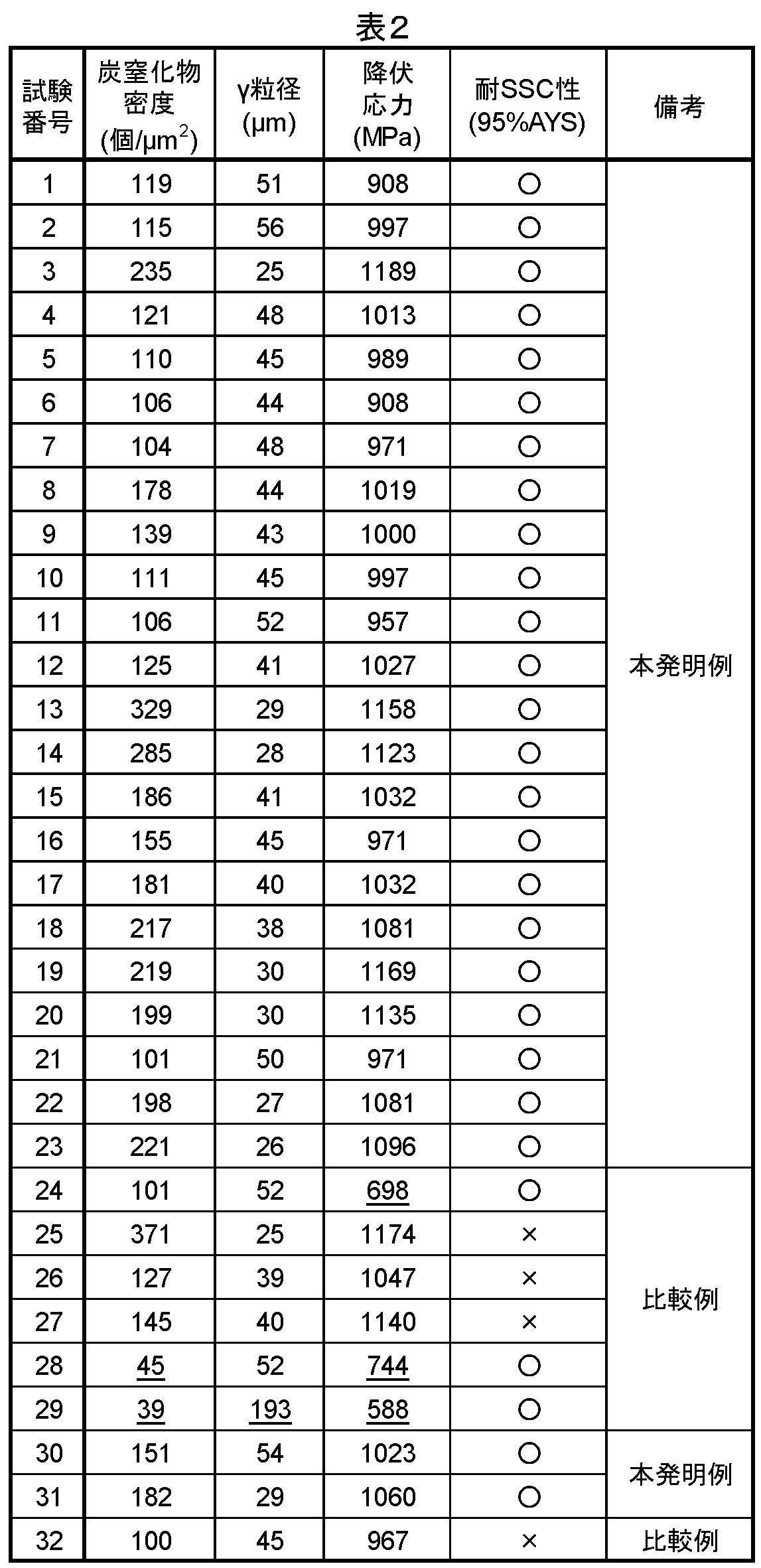
- the austenite particle size was determined by the cutting method. Furthermore, for each of the test materials, the presence or absence of ⁇ -martensite having an HCP structure was confirmed by X-ray diffraction, and the volume fractions of ⁇ 'martensite having a BCC structure and ferrite were measured using a ferrite meter. The volume fractions of ⁇ 'martensite and ferrite were 0.1% or more in Test Nos. 24, 26, and 27, and the presence of ⁇ -martensite was also confirmed. On the other hand, ⁇ -martensite and ⁇ 'martensite and ferrite were not detected in test numbers 1 to 23, 25 and 28 to 32.
- a thin film with a thickness of 100 nm is prepared from the central part of the plate thickness of each test material, and the thin film is observed with a transmission electron microscope (TEM).
- TEM transmission electron microscope
- a round bar tensile test piece having a parallel portion having an outer diameter of 6 mm and a length of 40 mm is collected from the central portion of the plate thickness of the above test material, and a tensile test is performed at room temperature (25 ° C.) to perform a yield stress YS (0). .2% proof stress) (MPa) was determined.
- the axial direction of the round bar tensile test piece was parallel to the rolling direction of the test material.
- test numbers 1 to 23, 30 and 31, which are examples of the present invention, have a carbonitride density of 100 pieces / ⁇ m 2 or more, an SFE of 30 mJ / m 2 or more, and a particle size of 100 ⁇ m or less (i). ) Satisfies the formula. Therefore, all of them have excellent SSC resistance and a yield stress of 862 MPa or more. Test numbers 22 and 23 did not break even when a yield stress value of 100% was applied to the steel material as an evaluation of SSC resistance.
- Test No. 24 which is a comparative example, the SSC resistance was acceptable, but the strength was low because the C content was low.
- Test No. 25 had poor SSC resistance because the C content was too high.
- Test No. 26 had poor SSC resistance due to its low Mn content and low SFE.
- Test No. 27 the Al content was low and the SFE was low, so that the SSC resistance was unfavorable.
- Test No. 28 passed the SSC resistance, but the V content was low and the yield stress was insufficient.
- Test No. 29 passed the SSC resistance, but had low strength due to the low carbonitride density and the large austenite particle size.
- Test number 32 had poor SSC resistance due to its low SFE.
- the steel material of the present invention has an austenite structure, it has extremely excellent SSC resistance and has a high yield stress of 862 MPa or more due to precipitation strengthening. Therefore, the steel material for oil wells according to the present invention can be suitably used for oil well pipes in a wet hydrogen sulfide environment.
Landscapes
- Chemical & Material Sciences (AREA)
- Engineering & Computer Science (AREA)
- Mechanical Engineering (AREA)
- Materials Engineering (AREA)
- Metallurgy (AREA)
- Organic Chemistry (AREA)
- Physics & Mathematics (AREA)
- Thermal Sciences (AREA)
- Crystallography & Structural Chemistry (AREA)
- Manufacturing & Machinery (AREA)
- Heat Treatment Of Steel (AREA)
- Heat Treatment Of Articles (AREA)
Abstract
Description
C:0.60~2.00%、
Si:0.01~3.00%、
Mn:16.0~30.0%、
Al:0.07~6.00%、
V:0.50~3.00%、
N:0.500%以下、
P:0.030%以下、
S:0.030%以下、
Cr:0~10.00%、
Mo:0~3.00%、
Cu:0~3.00%、
Ni:0~20.00%、
Ti:0~3.00%、
Nb:0~3.00%、
Zr:0~3.00%、
Ta:0~6.00%、
Hf:0~6.00%、
W:0~6.00%、
Ca:0~0.0050%、
Mg:0~0.0050%、
B:0~0.0150%、
残部:Feおよび不純物であり、
下記(i)式で定義する有効C量が0.55以上1.54未満であり、
金属組織が、
α’マルテンサイトおよびフェライトが、合計体積分率で0.1%未満、
HCP構造のεマルテンサイトが、体積分率で10%以下、
残部がオーステナイトであり、
円相当直径が5~100nmの炭窒化物の個数密度が、100個/μm2以上であり、
降伏応力が862MPa以上であり、
25℃での積層欠陥エネルギーが30mJ/m2以上であり、
オーステナイトの粒径が100μm以下である、
鋼材。
C-0.18V-0.06(Cr+Mo)-0.25Ti-0.13(Nb+Zr)-0.07(Ta+Hf+W) ・・・(i)
但し、上記式中の元素記号は、鋼材中に含まれる各元素の含有量(質量%)を表し、含有されない場合は0を代入するものとする。
Cr:0.05~10.00%、および
Mo:0.10~3.00%
から選択される1種以上を含有する、
(1)に記載の鋼材。
Cu:0.10~3.00%、および
Ni:0.10~20.00%
から選択される1種以上を含有する、
(1)または(2)に記載の鋼材。
Ti:0.005~3.00%、
Nb:0.005~3.00%、
Zr:0.005~3.00%、
Ta:0.005~6.00%、
Hf:0.005~6.00%、および
W:0.005~6.00%
から選択される1種以上を含有する、
(1)から(3)までのいずれかに記載の鋼材。
Ca:0.0003~0.0050%、および
Mg:0.0003~0.0050%
から選択される1種以上を含有する、
(1)から(4)までのいずれかに記載の鋼材。
B:0.0001~0.0150%
を含有する、
(1)から(5)までのいずれかに記載の鋼材。
Mo-200B≧0 ・・・(ii)
但し、上記式中の元素記号は、鋼材中に含まれる各元素の含有量(質量%)を表し、含有されない場合は0を代入するものとする。
0.40<Ti/Mo<0.60 ・・・(iii)
但し、上記式中の元素記号は、鋼材中に含まれる各元素の含有量(質量%)を表し、含有されない場合は0を代入するものとする。
各元素の限定理由は下記のとおりである。なお、以下の説明において含有量についての「%」は、「質量%」を意味する。
炭素(C)は、Mnなどのオーステナイトフォーマーと呼ばれる元素含有量を低減しても、安価にオーステナイトを安定化させる効果と強度を上昇させる効果とを有するとともに、双晶変形を促進し加工硬化特性と均一伸びとを向上させることができるため、本実施形態において極めて重要な元素である。本実施形態において、鋼材の強度は、時効処理を施し、炭窒化物を析出させることにより向上させる。その際、炭窒化物の析出によって本実施形態による鋼材中のCが消費されるため、その分を考慮して、C含有量を調整する必要がある。なお、本実施形態において、炭窒化物には、炭化物も含まれることとする。
シリコン(Si)は、鋼の脱酸に必要な元素であり、その含有量が0.01%未満であると、脱酸が不十分となって非金属介在物が多く残存し、所望の耐SSC性が得られない。一方、その含有量が3.00%を超えると、粒界強度を弱め、耐SSC性が低下する。したがって、Si含有量は0.01~3.00%とする。Si含有量は0.10%以上であるのが好ましく、0.20%以上であるのがより好ましい。また、Si含有量は1.00%以下であるのが好ましく、0.80%以下であるのがより好ましい。
マンガン(Mn)は、安価にオーステナイトを安定化させる元素である。本実施形態においては、その効果を十分に発揮させるために、Mnを16.0%以上含有させる必要がある。一方、湿潤硫化水素環境中ではMnは優先的に溶解し、材料表面に安定な腐食生成物は形成されにくい。その結果、Mn含有量が増加するに伴い、耐全面腐食性が低下することがある。30.0%を超える量のMnを含有させると低合金油井管の標準的な腐食速度を上回る場合がある。したがって、Mn含有量は16.0~30.0%とする。Mn含有量は17.0%以上であるのが好ましく、19.0%以上であるのがより好ましい。また、Mn含有量は25.0%以下であるのが好ましい。
アルミニウム(Al)は、鋼の脱酸に必要な元素であり、かつ本実施形態による鋼材の積層欠陥エネルギーを著しく高める。さらに、前述のように、極表層にAl2O3を含む安定な不動態被膜を形成し、本実施形態による鋼材中への水素侵入を抑制する効果を有するため、耐SSC性を大きく改善する効果がある。その効果を発揮させるためには、0.07%以上含有させる必要がある。一方、Al含有量が6.00%を超えると、本実施形態による鋼材の熱間加工性が著しく低下し、かつ室温での延性も低下する。したがって、Al含有量は0.07~6.00%とする。Al含有量は0.50%以上であるのが好ましく、1.00%超であるのがより好ましく、2.00%以上であるのがさらに好ましい。また、Al含有量は5.00%以下であるのが好ましく、4.00%以下であるのがより好ましい。本実施形態では、Alは酸可溶Al(sol.Al)を意味する。
バナジウム(V)は、適切な温度および時間で熱処理を行うことにより、鋼材中に微細な炭窒化物を析出させ、鋼材を高強度化させることのできる元素である。一方、V含有量が過剰であると上記の効果が飽和するだけでなく、オーステナイトを安定化させるCを多量に消費してしまう。したがって、V含有量は0.50~3.00%とする。V含有量は0.60%以上であるのが好ましく、0.70%以上であるのがより好ましい。また、V含有量は2.00%以下であるのが好ましく、1.80%以下であるのがより好ましい。
窒素(N)は、鉄鋼材料においては、通常は不純物元素として扱われ、脱窒により低減させる。しかし、Nはオーステナイトを安定化させる元素であるため、オーステナイト安定化のためにNが多く含有されていてもよい。しかし、本実施形態ではCおよびMnによるオーステナイトの安定化を意図しているため、積極的にNを含有させる必要はない。また、Nを過剰に含有させると、高温強度を上昇させて高温での加工応力を増大させ、熱間加工性の低下を招く。したがって、N含有量は0.500%以下とする必要がある。N含有量は0.100%以下であるのが好ましく、0.050%以下であるのがより好ましい。なお、精錬コストの観点から不必要に脱窒する必要はなく、N含有量は0.001%以上とするのが好ましい。
リン(P)は、不純物として鋼中に不可避的に存在する元素である。しかし、その含有量が0.030%を超えると、粒界に偏析して耐SSC性を劣化させる。したがって、P含有量は、0.030%以下とする。なお、Pの含有量は、低ければ低いほど望ましく、0.020%以下とするのが好ましく、0.012%以下とするのがより好ましい。しかし、P含有量の過度の低下は、鋼材の製造コスト上昇を招くため、P含有量は0.001%以上とするのが好ましく、0.005%以上とするのがより好ましい。
硫黄(S)は、Pと同様に不純物として鋼中に不可避的に存在するが、0.030%を超えると粒界に偏析するとともに、硫化物系の介在物を生成して耐SSC性を低下させる。したがって、S含有量は、0.030%以下とする。なお、Sの含有量は、低ければ低いほど望ましく、0.015%以下とするのが好ましく、0.010%以下とするのがより好ましい。しかし、S含有量の過度の低下は、鋼材の製造コスト上昇を招くため、S含有量は0.001%以上とするのが好ましく、0.002%以上とするのがより好ましい。
クロム(Cr)は、耐全面腐食性を向上させる元素であるので、必要に応じて含有させてもよい。ただし、その含有量が過剰であると、耐SSC性を低下させ、さらには耐応力腐食割れ性(以下、「耐SCC性」ともいう。)の低下を招くと共に、時効熱処理中に炭窒化物を析出して母材中のCを消費し、オーステナイトの安定化を妨げる可能性がある。また、Cr含有量が高いと固溶化熱処理温度をより高温に設定する必要があり、経済的には不利になる。したがって、Cr含有量は10.00%以下とする。Cr含有量は5.00%以下であるのが好ましく、1.00%以下であるのがより好ましい。なお、上記の効果を得たい場合は、Cr含有量を0.05%以上とするのが好ましく、0.10%以上とするのがより好ましく、0.50%以上とするのがさらに好ましい。
モリブデン(Mo)は、湿潤硫化水素環境中における腐食生成物を安定化させ、耐全面腐食性を向上させる元素であるので、必要に応じて含有させてもよい。ただし、Mo含有量が3.00%を超えると、耐SSC性および耐SCC性の低下を招くおそれがある。また、Moは極めて高価な元素である。したがって、Mo含有量は3.00%以下とする。なお、上記の効果を得たい場合は、Mo含有量を0.10%以上とするのが好ましく、0.20%以上とするのがより好ましく、0.50%以上とするのがさらに好ましい。
銅(Cu)は、オーステナイトを安定化させる元素であるため、少量であれば必要に応じて含有させてもよい。しかしながら、耐食性への影響を考えた場合、Cuは局部腐食を促進し、鋼材表面に応力集中部を形成しやすい元素であるため、過剰に含有させると耐SSC性および耐SCC性を低下させるおそれがある。したがって、Cu含有量は3.00%以下とする。Cu含有量は1.00%以下であるのが好ましい。なお、オーステナイト安定化の効果を得たい場合は、Cu含有量を0.10%以上とするのが好ましく、0.20%以上とするのがより好ましい。
ニッケル(Ni)もCuと同様に、オーステナイトを安定化させる元素であるため、少量であれば必要に応じて含有させてもよい。しかしながら、耐食性への影響を考えた場合、Niは局部腐食を促進し、鋼材表面に応力集中部を形成しやすい元素であるため、過剰に含有させると耐SSC性および耐SCC性を低下させるおそれがある。また、Niは高価な元素である。したがって、Ni含有量は20.00%以下とする。Ni含有量は10.00%以下であるのが好ましく、5.00%以下であるのがより好ましい。なお、オーステナイト安定化の効果を得たい場合は、Ni含有量を0.10%以上とするのが好ましく、0.50%以上とするのがより好ましい。
Nb:0~3.00%
Zr:0~3.00%
チタン(Ti)、ニオブ(Nb)、およびジルコニウム(Zr)は、CまたはNと結びつき微小な炭窒化物を形成することで、鋼材の強化に寄与する元素であり、必要に応じて含有させてもよい。ただし、これら元素の炭窒化物による鋼材の強化効果は、Vと比較して限定的である。また、これらの元素を多量に含有させても効果が飽和する上、靭性の低下およびオーステナイトの不安定化を引き起こすことがある。したがって、各元素の含有量は3.00%以下とする。各元素の含有量は、2.00%以下とするのが好ましい。なお、上記の効果を得るためには、これらの元素から選択される1種以上を0.005%以上含有させることが好ましく、0.01%以上含有させることがより好ましく、0.05%以上含有させることがさらに好ましい。
Hf:0~6.00%
W:0~6.00%
タンタル(Ta)、ハフニウム(Hf)およびタングステン(W)は、CまたはNと結びつき微小な炭窒化物を形成することで、鋼材の強化に寄与する元素であり、必要に応じて含有させてもよい。ただし、これら元素の炭窒化物による鋼材の強化効果は、Vと比較して限定的である。また、これらの元素を多量に含有させても効果が飽和する上、靭性の低下およびオーステナイトの不安定化を引き起こすことがある。したがって、各元素の含有量は6.00%以下とする。各元素の含有量は、3.00%以下とするのが好ましい。なお、上記の効果を得るためには、これらの元素から選択される1種以上を0.005%以上含有させることが好ましく、0.01%以上含有させることがより好ましく、0.05%以上含有させることがさらに好ましい。
Mg:0~0.0050%
カルシウム(Ca)およびマグネシウム(Mg)は、介在物の形態を制御することで靭性および耐食性を改善する効果があり、さらに、鋳込み時のノズル詰まりを抑制して鋳込み特性を改善する効果もあるため、必要に応じて含有させてもよい。しかしながら、これらの元素を多量に含有させても効果が飽和するだけでなく、介在物がクラスター化し易くなり、かえって靭性および耐食性が低下する。したがって、各元素ともその含有量を0.0050%以下とする。各元素の含有量は0.0030%以下であるのが好ましい。また、CaおよびMgの両方を含有させる場合、その含有量の合計を0.0050%以下とすることが好ましい。上記の効果を得るためには、CaおよびMgから選択される1種以上を合計含有量で0.0003%以上含有させることが好ましく、0.0005%以上含有させることがより好ましい。
ホウ素(B)は、主に粒界を強化する効果を有するので必要に応じて含有させてもよい。しかしながら、Bを多量に含有させると低融点の化合物を形成して熱間加工性が低下することがあり、特にB含有量が0.0150%を超えると熱間加工性の低下が著しくなる場合がある。したがって、B含有量は、0.0150%以下とする。なお、上記の効果を得るためには、B含有量は0.0001%以上とするのが好ましい。
本実施形態においては、オーステナイトを安定化させるため、C含有量を上記の範囲に規定している。しかしながら、主にVの炭窒化物を析出させることによって鋼材を強化するため、主にCの一部が消費され、オーステナイト安定性が低下するおそれがある。Cが最も消費されるのはVが全て炭窒化物として析出した場合である。加えて、本実施形態による鋼材中にCr、Mo、Ti、Nb、Zr、Ta、HfおよびWのいずれかが含有される場合、それらの炭窒化物の析出によってもCは消費される。
C-0.18V-0.06(Cr+Mo)-0.25Ti-0.13(Nb+Zr)-0.07(Ta+Hf+W) ・・・(i)
但し、上記式中の元素記号は、鋼材中に含まれる各元素の含有量(質量%)を表し、含有されない場合には0を代入するものとする。
Mo-200B≧0 ・・・(ii)
但し、上記式中の元素記号は、鋼材中に含まれる各元素の含有量(質量%)を表し、含有されない場合は0を代入するものとする。
0.40<Ti/Mo<0.60 ・・・(iii)
但し、上記式中の元素記号は、鋼材中に含まれる各元素の含有量(質量%)を表し、含有されない場合は0を代入するものとする。
本実施形態による鋼材は、α’マルテンサイトおよびフェライトが、合計体積分率で0.1%未満、HCP構造のεマルテンサイトが、体積分率で10%以下、残部がオーステナイトである金属組織を有する。金属組織中にBCC構造であるα’マルテンサイトおよびフェライトなどが混在すると、耐SSC性の低下を招く。しかし、鋼材のマトリックスとして、α’マルテンサイトおよびフェライトが、合計体積分率で0.1%未満の範囲内であれば、含まれることを許容するものとする。
耐SSC性は、鋼材の強度上昇に伴い急激に低下するが、本実施形態による鋼材は862MPa以上の高い降伏応力と従来技術よりもさらに優れた耐SSC性とを両立し得るものである。また本発明に係る油井用鋼材は、降伏応力が965MPa以上であっても、安定して耐SSC性が確保される。本実施形態による鋼材の降伏応力の上限は、例えば1275MPaであり、好ましくは1241MPaであり、より好ましくは1206MPaである。
本実施形態による鋼材は、例えば、以下の方法により製造することができるが、この方法には限定されない。
溶解および鋳造については一般的なオーステナイト系鋼材の製造方法で行われる方法を用いることができ、鋳造はインゴット鋳造でも連続鋳造でもよい。継目無鋼管を製造する場合には、ラウンドCCにより、製管用ラウンドビレットの形状に鋳造してもよい。
鋳造後は、鍛造、穿孔、圧延等の熱間加工が施される。なお、継目無鋼管の製造では、上述のラウンドCCによって円形ビレットを鋳造した場合、円形ビレットに成形するための鍛造、分塊圧延等の工程は必要ない。鋼材が継目無鋼管の場合は、上記の穿孔工程の後、マンドレルミルまたはプラグミルを使用して圧延が行われる。また、鋼材が板材の場合は、スラブを粗圧延した後、仕上げ圧延するという工程になる。穿孔、圧延等の熱間加工の望ましい条件は、以下の通りである。
熱間加工後の鋼材は、炭窒化物等を完全に固溶させるのに十分な温度に加熱してから急冷する。この場合、1000~1200℃の温度範囲に10min以上保持した後、急冷する。固溶化熱処理温度が1000℃未満であると、炭窒化物を完全固溶させることができず、析出強化が不十分となり、852MPa以上の降伏応力を得ることが困難になるおそれがある。一方、固溶化熱処理温度が1200℃を超えると、SSCを発生しやすいフェライト等の異相が析出することがある。また、保持時間が10min未満であると、固溶化熱処理の効果が不十分となり、目標とする高強度、すなわち、862MPa以上の降伏応力が得られなくなる場合がある。
溶体化熱処理を施した後の鋼材には、炭窒化物を微細に析出させて強度を上げるための時効処理を施す。時効処理の効果(時効硬化)は、温度とその温度での保持時間とに依存する。基本的には、温度を高くすれば短時間でよく、低い温度では長時間を要する。したがって、所定の目標強度が得られるように温度と時間とを適正に選べばよく、熱処理条件としては、600~800℃の温度範囲で30min以上加熱保持するのが好ましい。
本実施形態による油井用鋼材は、湿潤硫化水素環境下における油井管用として好適に用いることができる。

Claims (10)
- 化学組成が、質量%で、
C:0.60~2.00%、
Si:0.01~3.00%、
Mn:16.0~30.0%、
Al:0.07~6.00%、
V:0.50~3.00%、
N:0.500%以下、
P:0.030%以下、
S:0.030%以下、
Cr:0~10.00%、
Mo:0~3.00%、
Cu:0~3.00%、
Ni:0~20.00%、
Ti:0~3.00%、
Nb:0~3.00%、
Zr:0~3.00%、
Ta:0~6.00%、
Hf:0~6.00%、
W:0~6.00%、
Ca:0~0.0050%、
Mg:0~0.0050%、
B:0~0.0150%、
残部:Feおよび不純物であり、
下記(i)式で定義する有効C量が0.55以上1.54未満であり、
金属組織が、
α’マルテンサイトおよびフェライトが、合計体積分率で0.1%未満、
HCP構造のεマルテンサイトが、体積分率で10%以下、
残部がオーステナイトであり、
円相当直径が5~100nmの炭窒化物の個数密度が、100個/μm2以上であり、
降伏応力が862MPa以上であり、
25℃での積層欠陥エネルギーが30mJ/m2以上であり、
オーステナイトの粒径が100μm以下である、
鋼材。
C-0.18V-0.06(Cr+Mo)-0.25Ti-0.13(Nb+Zr)-0.07(Ta+Hf+W) ・・・(i)
但し、上記式中の元素記号は、鋼材中に含まれる各元素の含有量(質量%)を表し、含有されない場合は0を代入するものとする。 - 前記化学組成が、質量%で、
Cr:0.05~10.00%、および
Mo:0.10~3.00%
から選択される1種以上を含有する、
請求項1に記載の鋼材。 - 前記化学組成が、質量%で、
Cu:0.10~3.00%、および
Ni:0.10~20.00%
から選択される1種以上を含有する、
請求項1または請求項2に記載の鋼材。 - 前記化学組成が、質量%で、
Ti:0.005~3.00%、
Nb:0.005~3.00%、
Zr:0.005~3.00%、
Ta:0.005~6.00%、
Hf:0.005~6.00%、および
W:0.005~6.00%
から選択される1種以上を含有する、
請求項1から請求項3までのいずれかに記載の鋼材。 - 前記化学組成が、質量%で、
Ca:0.0003~0.0050%、および
Mg:0.0003~0.0050%
から選択される1種以上を含有する、
請求項1から請求項4までのいずれかに記載の鋼材。 - 前記化学組成が、質量%で、
B:0.0001~0.0150%
を含有する、
請求項1から請求項5までのいずれかに記載の鋼材。 - 下記(ii)式を満たす、請求項6に記載の鋼材。
Mo-200B≧0 ・・・(ii)
但し、上記式中の元素記号は、鋼材中に含まれる各元素の含有量(質量%)を表し、含有されない場合は0を代入するものとする。 - 下記(iii)式を満たす、請求項1から請求項7までのいずれかに記載の鋼材。
0.40<Ti/Mo<0.60 ・・・(iii)
但し、上記式中の元素記号は、鋼材中に含まれる各元素の含有量(質量%)を表し、含有されない場合は0を代入するものとする。 - 前記降伏応力が965MPa以上である、請求項1から請求項8までのいずれかに記載の鋼材。
- 請求項1から請求項9までのいずれかに記載の鋼材からなる油井管。
Priority Applications (2)
| Application Number | Priority Date | Filing Date | Title |
|---|---|---|---|
| JP2021575644A JP7348553B2 (ja) | 2020-02-03 | 2020-12-17 | 油井管 |
| EP20917604.9A EP4101938A4 (en) | 2020-02-03 | 2020-12-17 | Steel material for oil well, and oil well pipe |
Applications Claiming Priority (2)
| Application Number | Priority Date | Filing Date | Title |
|---|---|---|---|
| JP2020016604 | 2020-02-03 | ||
| JP2020-016604 | 2020-02-03 |
Publications (1)
| Publication Number | Publication Date |
|---|---|
| WO2021157217A1 true WO2021157217A1 (ja) | 2021-08-12 |
Family
ID=77199221
Family Applications (1)
| Application Number | Title | Priority Date | Filing Date |
|---|---|---|---|
| PCT/JP2020/047181 Ceased WO2021157217A1 (ja) | 2020-02-03 | 2020-12-17 | 油井用鋼材および油井管 |
Country Status (3)
| Country | Link |
|---|---|
| EP (1) | EP4101938A4 (ja) |
| JP (1) | JP7348553B2 (ja) |
| WO (1) | WO2021157217A1 (ja) |
Cited By (2)
| Publication number | Priority date | Publication date | Assignee | Title |
|---|---|---|---|---|
| CN116904879A (zh) * | 2023-07-20 | 2023-10-20 | 河北大河材料科技有限公司 | 一种高热强性钢及其制备方法 |
| CN120666246A (zh) * | 2025-06-26 | 2025-09-19 | 湖北帝盟新材料有限公司 | 一种高强度奥氏体钢及其制备方法 |
Citations (12)
| Publication number | Priority date | Publication date | Assignee | Title |
|---|---|---|---|---|
| JPS58174557A (ja) * | 1982-04-06 | 1983-10-13 | Kawasaki Steel Corp | 石油井の非磁性ドリルカラ−用高Mn鋼とその製造方法 |
| JPH06505535A (ja) * | 1991-12-30 | 1994-06-23 | ポハン アイアン アンド スチール カンパニー リミテッド | 優れた成形性、強度および溶接性を有するオーステナイト高マンガン鋼、並びにその製造方法 |
| WO2015012357A1 (ja) | 2013-07-26 | 2015-01-29 | 新日鐵住金株式会社 | 高強度油井用鋼材および油井管 |
| WO2016052397A1 (ja) | 2014-10-01 | 2016-04-07 | 新日鐵住金株式会社 | 高強度油井用鋼材および油井管 |
| WO2016052271A1 (ja) | 2014-09-29 | 2016-04-07 | 新日鐵住金株式会社 | 鋼材および拡管用油井鋼管 |
| KR20160078840A (ko) * | 2014-12-24 | 2016-07-05 | 주식회사 포스코 | 항복 강도 및 성형성이 우수한 고강도 고망간강 및 그 제조방법 |
| JP2017031483A (ja) * | 2015-08-05 | 2017-02-09 | 新日鐵住金株式会社 | 高圧水素ガス用高Mn鋼鋼材およびその製造方法、ならびにその鋼材からなる、配管、容器、バルブおよび継手 |
| WO2017169811A1 (ja) * | 2016-03-30 | 2017-10-05 | 新日鐵住金株式会社 | 高強度鋼材およびその製造方法 |
| JP2018162507A (ja) | 2017-03-27 | 2018-10-18 | 新日鐵住金株式会社 | 高強度油井用鋼材および油井管 |
| CN109628850A (zh) * | 2018-12-31 | 2019-04-16 | 钢铁研究总院 | 一种多用途全奥氏体低密度钢及制备方法 |
| KR20190075517A (ko) * | 2017-12-21 | 2019-07-01 | 주식회사 포스코 | 용접강도가 우수한 고망간 강판 및 이의 제조방법 |
| JP2019519680A (ja) * | 2016-05-24 | 2019-07-11 | アルセロールミタル | オーステナイト系マトリックスを有するtwip鋼板 |
Family Cites Families (2)
| Publication number | Priority date | Publication date | Assignee | Title |
|---|---|---|---|---|
| JP2833437B2 (ja) * | 1993-09-17 | 1998-12-09 | 住友金属工業株式会社 | ボイラ用耐摩耗複層鋼管およびその製造方法 |
| JPH09249940A (ja) * | 1996-03-13 | 1997-09-22 | Sumitomo Metal Ind Ltd | 耐硫化物応力割れ性に優れる高強度鋼材およびその製造方法 |
-
2020
- 2020-12-17 EP EP20917604.9A patent/EP4101938A4/en not_active Withdrawn
- 2020-12-17 WO PCT/JP2020/047181 patent/WO2021157217A1/ja not_active Ceased
- 2020-12-17 JP JP2021575644A patent/JP7348553B2/ja active Active
Patent Citations (12)
| Publication number | Priority date | Publication date | Assignee | Title |
|---|---|---|---|---|
| JPS58174557A (ja) * | 1982-04-06 | 1983-10-13 | Kawasaki Steel Corp | 石油井の非磁性ドリルカラ−用高Mn鋼とその製造方法 |
| JPH06505535A (ja) * | 1991-12-30 | 1994-06-23 | ポハン アイアン アンド スチール カンパニー リミテッド | 優れた成形性、強度および溶接性を有するオーステナイト高マンガン鋼、並びにその製造方法 |
| WO2015012357A1 (ja) | 2013-07-26 | 2015-01-29 | 新日鐵住金株式会社 | 高強度油井用鋼材および油井管 |
| WO2016052271A1 (ja) | 2014-09-29 | 2016-04-07 | 新日鐵住金株式会社 | 鋼材および拡管用油井鋼管 |
| WO2016052397A1 (ja) | 2014-10-01 | 2016-04-07 | 新日鐵住金株式会社 | 高強度油井用鋼材および油井管 |
| KR20160078840A (ko) * | 2014-12-24 | 2016-07-05 | 주식회사 포스코 | 항복 강도 및 성형성이 우수한 고강도 고망간강 및 그 제조방법 |
| JP2017031483A (ja) * | 2015-08-05 | 2017-02-09 | 新日鐵住金株式会社 | 高圧水素ガス用高Mn鋼鋼材およびその製造方法、ならびにその鋼材からなる、配管、容器、バルブおよび継手 |
| WO2017169811A1 (ja) * | 2016-03-30 | 2017-10-05 | 新日鐵住金株式会社 | 高強度鋼材およびその製造方法 |
| JP2019519680A (ja) * | 2016-05-24 | 2019-07-11 | アルセロールミタル | オーステナイト系マトリックスを有するtwip鋼板 |
| JP2018162507A (ja) | 2017-03-27 | 2018-10-18 | 新日鐵住金株式会社 | 高強度油井用鋼材および油井管 |
| KR20190075517A (ko) * | 2017-12-21 | 2019-07-01 | 주식회사 포스코 | 용접강도가 우수한 고망간 강판 및 이의 제조방법 |
| CN109628850A (zh) * | 2018-12-31 | 2019-04-16 | 钢铁研究总院 | 一种多用途全奥氏体低密度钢及制备方法 |
Non-Patent Citations (2)
| Title |
|---|
| A. SAEED-AKBARI ET AL., METALL. MATER. TRANS., vol. 40A, 2009, pages 3076 - 3090 |
| See also references of EP4101938A4 |
Cited By (2)
| Publication number | Priority date | Publication date | Assignee | Title |
|---|---|---|---|---|
| CN116904879A (zh) * | 2023-07-20 | 2023-10-20 | 河北大河材料科技有限公司 | 一种高热强性钢及其制备方法 |
| CN120666246A (zh) * | 2025-06-26 | 2025-09-19 | 湖北帝盟新材料有限公司 | 一种高强度奥氏体钢及其制备方法 |
Also Published As
| Publication number | Publication date |
|---|---|
| JPWO2021157217A1 (ja) | 2021-08-12 |
| EP4101938A4 (en) | 2024-06-05 |
| EP4101938A1 (en) | 2022-12-14 |
| JP7348553B2 (ja) | 2023-09-21 |
Similar Documents
| Publication | Publication Date | Title |
|---|---|---|
| EP3524705B1 (en) | Ni-cr-fe alloy | |
| EP2447386B1 (en) | High-strength seamless steel tube for use in oil wells, which has excellent resistance to sulfide stress cracking and production method for same | |
| JP6264468B2 (ja) | 高強度油井用鋼材および油井管 | |
| JP5880788B2 (ja) | 高強度油井用鋼材および油井管 | |
| CN107075636B (zh) | 低合金油井用钢管 | |
| WO2017010036A1 (ja) | 高強度ステンレス継目無鋼管およびその製造方法 | |
| EP2915896A1 (en) | Low-alloy steel for oil well pipes which has excellent sulfide stress cracking resistance, and method for manufacturing low-alloy steel for oil well pipes | |
| US10988819B2 (en) | High-strength steel material and production method therefor | |
| WO2018146783A1 (ja) | オーステナイト系耐熱合金およびその製造方法 | |
| JP6981527B2 (ja) | サワー環境での使用に適した鋼材 | |
| JP7348553B2 (ja) | 油井管 | |
| WO2010109702A1 (ja) | 冷延鋼板 | |
| US12286690B2 (en) | Ni—Cr—Mo—Nb alloy | |
| JP6213683B2 (ja) | 鋼材および拡管用油井鋼管 | |
| AU2012393719B9 (en) | Low-alloy steel for oil well pipes which has excellent sulfide stress cracking resistance, and method for manufacturing low-alloy steel for oil well pipes |
Legal Events
| Date | Code | Title | Description |
|---|---|---|---|
| 121 | Ep: the epo has been informed by wipo that ep was designated in this application |
Ref document number: 20917604 Country of ref document: EP Kind code of ref document: A1 |
|
| ENP | Entry into the national phase |
Ref document number: 2021575644 Country of ref document: JP Kind code of ref document: A |
|
| NENP | Non-entry into the national phase |
Ref country code: DE |
|
| ENP | Entry into the national phase |
Ref document number: 2020917604 Country of ref document: EP Effective date: 20220905 |
|
| WWW | Wipo information: withdrawn in national office |
Ref document number: 2020917604 Country of ref document: EP |