WO2021157618A1 - 経時安定性を備える育苗鉢体及びその分解促進方法 - Google Patents
経時安定性を備える育苗鉢体及びその分解促進方法 Download PDFInfo
- Publication number
- WO2021157618A1 WO2021157618A1 PCT/JP2021/003951 JP2021003951W WO2021157618A1 WO 2021157618 A1 WO2021157618 A1 WO 2021157618A1 JP 2021003951 W JP2021003951 W JP 2021003951W WO 2021157618 A1 WO2021157618 A1 WO 2021157618A1
- Authority
- WO
- WIPO (PCT)
- Prior art keywords
- resin
- pot body
- seedling raising
- base paper
- seedling
- Prior art date
- Legal status (The legal status is an assumption and is not a legal conclusion. Google has not performed a legal analysis and makes no representation as to the accuracy of the status listed.)
- Ceased
Links
Images


Classifications
-
- A—HUMAN NECESSITIES
- A01—AGRICULTURE; FORESTRY; ANIMAL HUSBANDRY; HUNTING; TRAPPING; FISHING
- A01G—HORTICULTURE; CULTIVATION OF VEGETABLES, FLOWERS, RICE, FRUIT, VINES, HOPS OR SEAWEED; FORESTRY; WATERING
- A01G9/00—Cultivation in receptacles, forcing-frames or greenhouses; Edging for beds, lawn or the like
- A01G9/02—Receptacles, e.g. flower-pots or boxes; Glasses for cultivating flowers
- A01G9/029—Receptacles for seedlings
- A01G9/0291—Planting receptacles specially adapted for remaining in the soil after planting
-
- C—CHEMISTRY; METALLURGY
- C08—ORGANIC MACROMOLECULAR COMPOUNDS; THEIR PREPARATION OR CHEMICAL WORKING-UP; COMPOSITIONS BASED THEREON
- C08L—COMPOSITIONS OF MACROMOLECULAR COMPOUNDS
- C08L101/00—Compositions of unspecified macromolecular compounds
- C08L101/16—Compositions of unspecified macromolecular compounds the macromolecular compounds being biodegradable
-
- B—PERFORMING OPERATIONS; TRANSPORTING
- B32—LAYERED PRODUCTS
- B32B—LAYERED PRODUCTS, i.e. PRODUCTS BUILT-UP OF STRATA OF FLAT OR NON-FLAT, e.g. CELLULAR OR HONEYCOMB, FORM
- B32B27/00—Layered products comprising a layer of synthetic resin
- B32B27/06—Layered products comprising a layer of synthetic resin as the main or only constituent of a layer, which is next to another layer of the same or of a different material
- B32B27/08—Layered products comprising a layer of synthetic resin as the main or only constituent of a layer, which is next to another layer of the same or of a different material of synthetic resin
-
- B—PERFORMING OPERATIONS; TRANSPORTING
- B32—LAYERED PRODUCTS
- B32B—LAYERED PRODUCTS, i.e. PRODUCTS BUILT-UP OF STRATA OF FLAT OR NON-FLAT, e.g. CELLULAR OR HONEYCOMB, FORM
- B32B27/00—Layered products comprising a layer of synthetic resin
- B32B27/06—Layered products comprising a layer of synthetic resin as the main or only constituent of a layer, which is next to another layer of the same or of a different material
- B32B27/10—Layered products comprising a layer of synthetic resin as the main or only constituent of a layer, which is next to another layer of the same or of a different material of paper or cardboard
-
- B—PERFORMING OPERATIONS; TRANSPORTING
- B32—LAYERED PRODUCTS
- B32B—LAYERED PRODUCTS, i.e. PRODUCTS BUILT-UP OF STRATA OF FLAT OR NON-FLAT, e.g. CELLULAR OR HONEYCOMB, FORM
- B32B27/00—Layered products comprising a layer of synthetic resin
- B32B27/36—Layered products comprising a layer of synthetic resin comprising polyesters
-
- B—PERFORMING OPERATIONS; TRANSPORTING
- B32—LAYERED PRODUCTS
- B32B—LAYERED PRODUCTS, i.e. PRODUCTS BUILT-UP OF STRATA OF FLAT OR NON-FLAT, e.g. CELLULAR OR HONEYCOMB, FORM
- B32B29/00—Layered products comprising a layer of paper or cardboard
- B32B29/002—Layered products comprising a layer of paper or cardboard as the main or only constituent of a layer, which is next to another layer of the same or of a different material
-
- C—CHEMISTRY; METALLURGY
- C08—ORGANIC MACROMOLECULAR COMPOUNDS; THEIR PREPARATION OR CHEMICAL WORKING-UP; COMPOSITIONS BASED THEREON
- C08J—WORKING-UP; GENERAL PROCESSES OF COMPOUNDING; AFTER-TREATMENT NOT COVERED BY SUBCLASSES C08B, C08C, C08F, C08G or C08H
- C08J11/00—Recovery or working-up of waste materials
- C08J11/04—Recovery or working-up of waste materials of polymers
- C08J11/10—Recovery or working-up of waste materials of polymers by chemically breaking down the molecular chains of polymers or breaking of crosslinks, e.g. devulcanisation
- C08J11/105—Recovery or working-up of waste materials of polymers by chemically breaking down the molecular chains of polymers or breaking of crosslinks, e.g. devulcanisation by treatment with enzymes
-
- C—CHEMISTRY; METALLURGY
- C08—ORGANIC MACROMOLECULAR COMPOUNDS; THEIR PREPARATION OR CHEMICAL WORKING-UP; COMPOSITIONS BASED THEREON
- C08L—COMPOSITIONS OF MACROMOLECULAR COMPOUNDS
- C08L67/00—Compositions of polyesters obtained by reactions forming a carboxylic ester link in the main chain; Compositions of derivatives of such polymers
- C08L67/02—Polyesters derived from dicarboxylic acids and dihydroxy compounds
-
- C—CHEMISTRY; METALLURGY
- C09—DYES; PAINTS; POLISHES; NATURAL RESINS; ADHESIVES; COMPOSITIONS NOT OTHERWISE PROVIDED FOR; APPLICATIONS OF MATERIALS NOT OTHERWISE PROVIDED FOR
- C09D—COATING COMPOSITIONS, e.g. PAINTS, VARNISHES OR LACQUERS; FILLING PASTES; CHEMICAL PAINT OR INK REMOVERS; INKS; CORRECTING FLUIDS; WOODSTAINS; PASTES OR SOLIDS FOR COLOURING OR PRINTING; USE OF MATERIALS THEREFOR
- C09D167/00—Coating compositions based on polyesters obtained by reactions forming a carboxylic ester link in the main chain; Coating compositions based on derivatives of such polymers
- C09D167/02—Polyesters derived from dicarboxylic acids and dihydroxy compounds
-
- C—CHEMISTRY; METALLURGY
- C12—BIOCHEMISTRY; BEER; SPIRITS; WINE; VINEGAR; MICROBIOLOGY; ENZYMOLOGY; MUTATION OR GENETIC ENGINEERING
- C12N—MICROORGANISMS OR ENZYMES; COMPOSITIONS THEREOF; PROPAGATING, PRESERVING, OR MAINTAINING MICROORGANISMS; MUTATION OR GENETIC ENGINEERING; CULTURE MEDIA
- C12N9/00—Enzymes; Proenzymes; Compositions thereof; Processes for preparing, activating, inhibiting, separating or purifying enzymes
- C12N9/14—Hydrolases (3)
- C12N9/16—Hydrolases (3) acting on ester bonds (3.1)
- C12N9/18—Carboxylic ester hydrolases (3.1.1)
-
- B—PERFORMING OPERATIONS; TRANSPORTING
- B32—LAYERED PRODUCTS
- B32B—LAYERED PRODUCTS, i.e. PRODUCTS BUILT-UP OF STRATA OF FLAT OR NON-FLAT, e.g. CELLULAR OR HONEYCOMB, FORM
- B32B2270/00—Resin or rubber layer containing a blend of at least two different polymers
-
- B—PERFORMING OPERATIONS; TRANSPORTING
- B32—LAYERED PRODUCTS
- B32B—LAYERED PRODUCTS, i.e. PRODUCTS BUILT-UP OF STRATA OF FLAT OR NON-FLAT, e.g. CELLULAR OR HONEYCOMB, FORM
- B32B2307/00—Properties of the layers or laminate
- B32B2307/70—Other properties
- B32B2307/716—Degradable
- B32B2307/7163—Biodegradable
-
- B—PERFORMING OPERATIONS; TRANSPORTING
- B32—LAYERED PRODUCTS
- B32B—LAYERED PRODUCTS, i.e. PRODUCTS BUILT-UP OF STRATA OF FLAT OR NON-FLAT, e.g. CELLULAR OR HONEYCOMB, FORM
- B32B2410/00—Agriculture-related articles
Definitions
- the present invention relates to a seedling raising pot body used in the field of agriculture or horticulture, and keeps the shape of the pot body during the seedling raising period, can be planted in the ground as it is after raising seedlings, and further grows quickly after planting.
- the present invention relates to a base paper for a seedling raising pot body, which is decomposed and is excellent in stability over time during long-term storage, a seedling raising pot body formed by molding the base paper, and a method for promoting decomposition of the seedling raising pot body. ..
- a seedling transplanting cultivation method in which a plant is cultivated using a paper pot body processed into a square column or a hexagonal column has been widely put into practical use.
- this cultivation method potting soil is filled in a square or hexagonal columnar pot made of paper, sowed, raised under irrigation control, and the seedlings that have been raised are left in the pot. That is, potting seedlings are planted in the field and cultivated.
- Patent Documents 3 and 4 disclose that a seedling raising pot produced by using a laminated sheet in which a thermoplastic biodegradable resin layer is provided on a paper base material has a property of rapidly decomposing after being planted in a field. Has been done.
- Patent Documents 5 and 6 disclose a technique for controlling the progress of decomposition at an arbitrary timing by directly administering an enzyme derived from a microorganism to an agricultural mulch film laid in a field.
- Japanese Patent No. 4543393 Japanese Patent No. 6126486 Japanese Patent No. 4763123 Japanese Unexamined Patent Publication No. 2004-121054 Japanese Patent No. 6338183 Japanese Patent No. 5849297 Tokukousho 38-025715 Gazette Japanese Patent No. 6413117
- the continuous pot paper can withstand the tension mainly when it is pulled out toward the field in a series of flows until it is planted in the field. Physical strength, that is, tensile strength is required.
- the conventional base paper for raising seedling pots tends to have a slower decomposition rate in the field as the seedling raising period and sufficient strength at the time of planting are provided. Therefore, if decomposition is not in time for the next crop and it becomes incomplete, it may hinder agricultural work and crop harvesting. Therefore, the seedling raising pot body is required to have both contradictory characteristics of suppressing the progress of decomposition during seedling raising and maintaining sufficient strength at the time of planting, while rapidly decomposing after planting in the field. ..
- Patent Document 3 and Patent Document 4 disclose the property that the seedling raising pot decomposes after being planted in the field by applying the thermoplastic biodegradable resin layer to the seedling raising pot. A technique for arbitrarily controlling decomposition has not yet been established. Further, Patent Documents 5 and 6 disclose a technique for controlling the progress of biodegradation of an agricultural mulch film at an arbitrary timing by directly administering an enzyme derived from a microorganism. In the first place, the agricultural mulch is used. The film and the pot for raising seedlings cannot be simply diverted because the purpose of use of the material, the application situation / conditions, and the characteristics of the article including the physical strength and chemical properties required accordingly are different. .. In addition to having sufficient strength during the seedling raising period and planting, the seedling raising pot body may deteriorate over time after production, so that the base paper for the seedling raising pot body is also required to be stable over time.
- the present invention has been made to solve the above problems, and the biodegradable resin may be used alone or in combination of two or more.
- a base paper for a nursery pot body finished by laminating a biodegradable resin composition in which each biodegradable resin is blended in the following ratio on at least one surface of paper is provided.
- the seedling raising pot body made of the base paper for the seedling raising pot body is treated with an enzyme derived from a microorganism immediately before and / or immediately after planting to maintain a certain strength at the time of planting, while maintaining a certain strength after planting.
- a base paper for raising seedling pots which comprises laminating a biodegradable resin composition containing 15% by mass or more of a polylactic acid-based resin as the resin (A) on a paper base material.
- the biodegradable resin composition contains an aliphatic polyester resin other than the polylactic acid resin as the resin (B).
- the biodegradable resin composition contains an aliphatic polyester resin other than the polylactic acid resin as the resin (B) and an aromatic polyester resin as the resin (C).
- the resin (B) is contained in the range of 30 to 84.9% by mass with respect to the total mass of the biodegradable resin composition.
- the base paper for a nursery pot according to the above item 1 wherein the resin (C) is contained in a range of 0.1 to 30% by mass with respect to the total mass of the resin composition components. 4.
- the resin (B) is an aliphatic polyester resin obtained by polycondensing a dicarboxylic acid component composed of an aliphatic dicarboxylic acid and a diol component composed of an aliphatic diol.
- the base paper for seedling raising pots according to any one of the items. 6. Any one of the above 2 to 5 above, wherein the resin (B) is at least one selected from polybutylene succinate (PBS), polybutylene succinate adipate (PBSA) and polyhydroxybutyrate. The base paper for raising seedling pots according to item 1. 7. Item 3 above, wherein the resin (C) is an aromatic polyester-based resin obtained by polycondensing a dicarboxylic acid component composed of an aliphatic dicarboxylic acid and an aromatic dicarboxylic acid and a diol component composed of an aliphatic diol. The base paper for a seedling raising pot according to any one of the above six items. 8.
- a seedling raising pot body comprising the base paper for the seedling raising pot body according to any one of the above items 1 to 8.
- a method for decomposing a seedling raising pot body which comprises a step of bringing the biodegradable resin degrading enzyme into contact with the seedling raising pot body according to the above item 9 to biodegrade the seedling raising pot body. 11.
- the biodegradable resin-degrading enzymes are Pseudozyma yeast, Cryptococcus yeast, Acremonium filamentous fungus, Alternaria filamentous fungus, Arthrinium filamentous fungus, Aureobasidium filamentous fungus, Cladosporium filamentous fungus, Epicus filamentous fungus, Epic The seedling raising pot body according to the above item 10, which is a biodegradable resin-degrading enzyme produced by at least one microorganism selected from the group consisting of the filamentous fungi of the genus Paraphoma and the filamentous fungi of the genus Pencillium. Method.
- the seedling raising pot body made of the base paper for the seedling raising pot body of the present invention can have sufficient strength during the seedling raising period and planting by suppressing decomposition during seedling raising. This makes it possible to proceed with the planting work in the field without delay. Since the shape of the pot body can be maintained while the seedling raising pot body is being raised, the seedlings are not damaged at the time of planting, so that the planting survival rate is high. Further, the seedling raising pot body made of the base paper for the seedling raising pot body of the present invention is excellent in stability over time when stored for a long period of time.
- the progress of biodegradation of the pot body is controlled in the soil by performing enzyme treatment immediately before and / or immediately after planting in the field, and the pot body. Can be gradually collapsed. As a result, the roots of the seedlings can be freely extended and do not hinder the growth of the seedlings. Further, it is possible to reduce the amount of seedling pot body residue generated due to insufficient decomposition, and it does not affect the next crop.
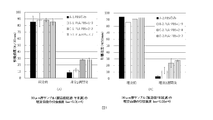
- FIG. 1 shows a biodegradable resin composition laminated laminated paper (lamination thickness: 30 ⁇ m) without enzyme treatment, (A): a sample less than one year after production, and (B): a sample two years after production. It is a graph which shows the tensile strength of the paper after 2 weeks of burial.
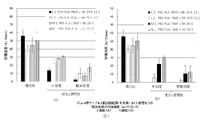
- FIG. 2 shows a biodegradable resin composition laminated laminated paper (lamination thickness: 15 ⁇ m) without enzyme treatment, (A): a sample less than one year after production, and (B): a sample two years after production. It is a graph which shows the tensile strength of the paper after 2 weeks of burial.
- FIG. 1 shows a biodegradable resin composition laminated laminated paper (lamination thickness: 30 ⁇ m) without enzyme treatment, (A): a sample less than one year after production, and (B): a sample two years after production. It is a graph which shows the tensile strength of the paper after 2 weeks of burial.
- FIG. 3 shows the biodegradable resin composition laminated laminated paper (laminate thickness: 30 ⁇ m) 2 years after the production with and without the enzyme treatment, after 2 weeks of burial (A) and 4 weeks after burial (A). It is a graph which shows the tensile strength of the paper in B).
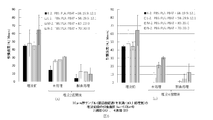
- FIG. 4 shows (A) and 4 weeks after burying 2 weeks after burying the corona-treated biodegradable resin composition laminated laminated paper (lamination thickness: 30 ⁇ m) less than 1 year after the production with and without the enzyme treatment. It is a graph which shows the tensile strength of the paper after elapse (B).
- FIG. 5 shows the biodegradable resin composition laminated laminated paper (laminate thickness: 30 ⁇ m) that has not been corona-treated for less than one year since the production with and without enzyme treatment, after 2 weeks of burial (A) and 4 weeks. It is a graph which shows the tensile strength of the paper after elapse (B).
- the nursery pot body is made by molding a laminated paper in which a biodegradable resin composition is laminated on at least one surface of a paper base material, for example, in a square or hexagonal columnar shape. Further, a continuous pot body can be molded by connecting the individual pot bodies with a connecting piece.
- the main characteristics required for the base paper for raising seedling pots are (1) having paper strength during drying that can withstand mechanical processing such as bending and pulling during manufacturing of pots, and (2) manufacturing of pots.
- the paper strength when planting in the field after raising seedlings by (3) having resistance to biodegradation (rot resistance) by microorganisms during seedling raising, and (4) maintaining decay resistance over time.
- it has the paper strength when wet to withstand mechanical and artificial handling, and (5) brittleness that allows rapid root extension from the pot side wall after planting regardless of the nature of the soil. It has a soil-disintegrating property that biodegrades due to the action of microorganisms in the soil.
- biodegradation characteristics (characteristics (5)) that contradict resistance such as deterioration resistance (characteristics (2)) and rot resistance (characteristics (3)) before planting are required after planting. It is an issue to establish the above-mentioned contradictory characteristics in the base paper for the seedling raising pot body.
- the specifications of the seedling raising pot body (as described below, for example, the difference between Patent Document 1 and Patent Document 7), the seedling raising period, the conditions for raising seedling management (control temperature, irrigation amount, etc.) ), Since the paper strength of the nursery pot body at the time of wetting, which is required at the time of planting, is different, each characteristic of (1) to (5) is balanced so as to be within an appropriate range, and thereby. , It is necessary to appropriately set the physical and chemical strength of the nursery pot body according to various crops.
- the tensile strength at the end of raising seedlings is 10 N / 30 mm or more, more preferably 15 N / 30 mm. As mentioned above, it is particularly preferable that it is 20 N / 30 mm or more.
- the shape of the tubular paper container can be maintained, and the tensile strength is preferably 5N / 30 mm or more. ..
- the strength can be adjusted by appropriately setting the basis weight of the paper base material and the thickness of the biodegradable resin layer.
- the type of raw material pulp and the content of cellulose fibers are not particularly limited.
- paper containing pulp used as a normal papermaking material can be mentioned. More specifically, unbleached, semi-bleached or bleached kraft pulp, sulfite pulp, semi-chemical pulp, soda pulp, mechanical pulp from softwood and hardwood, and used paper can be mentioned alone or in combination of two. The above can be mixed and used. In particular, those made of unbleached unbleached pulp can be preferably used.
- the paper used in the present invention includes various auxiliary agents usually used for papermaking such as binders, fillers, paper strength enhancers, sizing agents, yield improvers, preservatives, and synthesis of polyethylene and polyester, if necessary. It can contain fibers. Further, the size may be treated with starch, polyvinyl alcohol or the like, and a coat layer or a resin coat layer containing an inorganic pigment as a main component may be provided.
- the basis weight of the paper substrate is not particularly limited, but is preferably 20 ⁇ 200g / m 2, more preferably 30 ⁇ 100g / m 2, particularly preferably 45 ⁇ 90g / m 2.
- Biodegradable resin has the same function as conventional petroleum-derived plastic when used, and after use, it is biodegraded by microorganisms in natural soil and water in a certain period of time, and finally water and dioxide. Refers to a resin that is hydrolyzed to carbon.
- the biodegradable resin used in the present invention include an aliphatic polyester resin and an aromatic polyester resin.
- the aliphatic polyester of the present invention refers to an aliphatic polyester that does not contain an aromatic ring
- the aliphatic polyester-based resin refers to an aliphatic polyester-based resin that does not contain an aromatic ring.
- the aromatic polyester of the present invention refers to a polyester containing an aromatic ring
- the aromatic polyester-based resin refers to a polyester-based resin containing an aromatic ring.
- polyester resin examples include polylactic acid (PLA), polybutylene succinate (PBS), polybutylene succinate adipate (PBSA), polycaprolactone (PCL), polyhydroxybutyrate (PHB) or polyhydroxyvariate (PHV). ) Or its copolymer (PHVB) and the like.
- the polylactic acid resin is the resin (A) of the present invention.
- the polylactic acid-based resin is not particularly limited as long as it is a condensate of lactic acid, and whether it is a poly-L-lactic acid resin or a poly-D-lactic acid resin, a mixture thereof (for example, It may be a stereocomplex type polylactic acid resin in which a poly-L-lactic acid resin and a poly-D-lactic acid resin are mixed).
- the aliphatic polyester resin other than the polylactic acid resin is the resin (B) of the present invention.
- Aliphatic polyester resins other than polylactic acid resins are obtained by subjecting a dicarboxylic acid component composed of an aliphatic dicarboxylic acid and a diol component composed of an aliphatic diol to an esterification or transesterification reaction and a polycondensation reaction. It is a polyester resin.
- PBS polybutylene succinate
- it is obtained by subjecting a dicarboxylic acid component consisting of succinic acid and a diol component consisting of 1,4-butanediol to an esterification or transesterification reaction and a polycondensation reaction.
- dicarboxylic acid components and other diol components can be included.
- dicarboxylic acid components include aliphatic dicarboxylic acids such as adipic acid, sebacic acid, and itaconic acid.
- diol components include 2,3-butanediol, 1,3-butanediol, 1,4-pentanediol, 2,4-pentanediol, 1,6-hexanediol, neopentyl glycol, ethylene glycol, and diethylene glycol. And so on.
- Examples of the aromatic polyester resin (C) of the present invention include polybutylene adipate terephthalate resin, polybutylene terephthalate alkylate resin, and polybutylene succinate terephthalate resin.
- polybutylene adipate terephthalate (PBAT) is preferable.
- Polybutylene adipate terephthalate (PBAT) is formed by a polycondensation reaction between a dicarboxylic acid component composed of adipic acid and terephthalic acid and a diol component composed of 1,4-butanediol, but other components can be included. For example, other diol components can be included.
- diol components include 2,3-butanediol, 1,3-butanediol, 1,4-pentanediol, 2,4-pentanediol, 1,6-hexanediol, neopentyl glycol, ethylene glycol, and diethylene glycol. And so on.
- Biodegradable resin compounding ratio The above biodegradable resin may be used alone or in combination of two or more. Among them, when considering film moldability and physical properties, an aliphatic polyester or an aromatic polyester having a melting point of 50 to 180 ° C. and a weight average molecular weight of 50,000 or more is preferable for obtaining a good molded product. Further, when biodegradability, flexibility, and stability over time are required, a mixed resin composed of two or more kinds containing 15% by mass or more of a polylactic acid-based resin with respect to the total mass of the biodegradable resin composition. Is preferable.
- the mixed resin in the seedling raising pot body does not decompose during seedling raising and maintains a certain strength at the time of planting, and by enzymatic treatment immediately before and / or immediately after planting, the progress of decomposition after planting in the field is promoted. It is possible to speed up.
- the content of the polylactic acid-based resin (resin (A)) is 15 to 40% by mass, preferably 18 to 35% by mass, particularly preferably 20 to 30% by mass, based on the total mass of the biodegradable resin composition. It is contained in the range of.
- the biodegradable resin composition composed in this range is suitable for maintaining the properties of moldability, flexibility, stability over time, decay resistance during the seedling raising period, and degradability by biodegradable resin degrading enzyme. be.
- the content of the aliphatic polyester resin (other than the polylactic acid resin) (resin (B)) is 60 to 85% by mass, preferably 65 to 82% by mass, based on the total mass of the biodegradable resin composition. , Particularly preferably in the range of 70 to 80% by mass.
- an aromatic polyester-based resin (resin (C)) is optionally contained to arbitrarily adjust the progress rate of soil decomposition and enzyme reactivity in the field. can do.
- the content of the resin (B) is 30 to 84.9% by mass, preferably 30 to 84.9% by mass, based on the total mass of the biodegradable resin composition. It is contained in the range of 45 to 77% by mass, particularly preferably 55 to 72% by mass.
- the content of the resin (C) is 0.1 to 30% by mass, preferably 5 to 20% by mass, and particularly preferably 8 to 15% by mass with respect to the total mass of the biodegradable resin composition. do. These contents are suitable for maintaining the characteristics required for the seedling raising pot body, such as decay resistance during the seedling raising period, degradability by biodegradable resin-degrading enzyme, moldability, and flexibility. ..
- Aliphatic polyester resins are PTTMCC Biochem's "BioPBS® FZ71PM” (polycondensation of 1,4-butanediol and succinic acid, melting point: about 115 ° C), Mitsubishi Chemical. "GSPLA (registered trademark) FZ71PN” manufactured by the same company (same as above, melting point: about 115 ° C.) can be mentioned.
- Examples of the polylactic acid resin include "Ingeo (registered trademark) 4032D” manufactured by Nature Works.
- the aromatic polyester resin is "Ecoflex” manufactured by BASF (aromatic polyester resin obtained by polycondensing 1,4-butanediol and an aromatic polyester composed of adipic acid and terephthalic acid, melting point: about 110 ° C. ) Can be mentioned.
- the moldability can be further improved.
- the anti-blocking agent include stable metal oxides such as silica, titanium dioxide and alumina, stable metal salts such as calcium carbonate, calcium phosphate and barium sulfate, or polylactic acid-based resins coated with an inert organic resin. So-called organic beads and the like can be mentioned.
- One of these anti-blocking agents may be used alone, or two or more thereof may be used in combination.
- a filler, an organic filler, an inorganic pigment, an organic pigment, an ultraviolet absorber, a light stabilizer, an antioxidant, and a lubricant may be blended.
- the biodegradable seedling raising pot body of the present invention comprises a laminated sheet produced by laminating the above biodegradable resin on at least one surface of paper.
- the surface of paper as a base material is subjected to corona discharge treatment, frame treatment, anchor coating treatment, etc., and a biodegradable resin is extruded and laminated on the treated surface.
- a general-purpose plastic such as polyethylene is co-extruded together with the biodegradable resin, and then the general-purpose plastic film is peeled off to obtain a laminated sheet of paper and biodegradable resin.
- a general-purpose plastic such as polyethylene is co-extruded together with the biodegradable resin, and then the general-purpose plastic film is peeled off to obtain a laminated sheet of paper and biodegradable resin.
- the thickness of the biodegradable resin layer laminated on the paper substrate is not particularly limited, but is preferably 5 to 80 ⁇ m, more preferably 15 to 50 ⁇ m, and particularly preferably 20 to 35 ⁇ m.
- the physical strength of the nursery pot and the progress of decomposition by enzymatic treatment can be arbitrarily adjusted by the thickness of the resin layer.
- Biodegradable resin degrading enzyme As the biodegradable resin hydrolase, conventionally known enzymes can be used, for example, lipase, cutinase, esterase, protease, lysophospholipase, amylase, glucoamylase, peptidase, serine hydrolase, cellulase, chitinase, xylanase, etc.
- Hydrolases such as pectinase and oxidative-reducing enzymes such as peroxidase, monooxygenase, dioxygenase and lacquerze can be mentioned, with lipase, cutinase, esterase, protease and amylase being preferred.
- the cutinase-like enzyme PaE produced by the yeast Pseudozyma antarctica, CmCut1 produced by the Cryptococcus magnus-related strain BPD1A, CfCLE GB-1 produced by the Cryptococcus flavus GB-1 strain, and CfCLE GB-1 produced by the Cryptococcus flavus GB-1 strain. Sb19-1, Cryptococcus sp.
- the microorganism that produces the biodegradable resin-degrading enzyme is not particularly limited, but any strain such as a strain isolated from the natural world is used. Specifically, the genus Pseudomonas, the genus Pseudozyma, the genus Cryptococcus, the genus Acremonium, the genus Alternaria, the genus Arthrinium , Cladosporium, Epicoccum, Fusarium, Paraphoma, Penicillium, Bacteroides, Mucor, Fucor ), Thermomyces, Talaromyces, Chaetomium, Torula, Sporotichum, Malbranchea, Malbranchea Microorganisms can be mentioned.
- the foliar yeasts Pseudozyma patentica Cryptococcus magnus related strain BPD1A, Cryptococcus flavus GB-1 strain, Cryptococcus flavus Sb19-1 strain, isolated from the administrative corporation Cryptococcus flavus Sb19-1 strain, collected in Ibaraki prefecture.
- Product Evaluation Technology Infrastructure Organization Pseudozyma antarctica (consignment date: July 22, 2011), which is the deposit number FERM BP-22155 deposited at the Patent Organism Depositary, was deposited at the National Institute of Technology and Evaluation Patent Microorganisms Depositary.
- Filamentous fungi with accession number NITE P-573 and Pseudozyma patenta JCM10317 strain provided as a standard strain at the National Institute of Physical and Chemical Research Bioresource Center can be used.
- the coutinase-like enzyme PaE produced by yeast Pseudozyma antarctica CmCut1 produced by Cryptococcus magnus-related strain BPD1A
- CfCLE GB-1 produced by Cryptococcus flavus GB-1 strain
- CfCLE GB-1 produced by Cryptococcus GB-1 strain At least one selected from the group consisting of CLE produced by Cryptococcus yeast having accession number FERM P-15155 and PCLE produced by Paraphoma filamentous fungus having accession number NITE P-573 or a mixture of culture solutions thereof. Is preferably used.
- the nucleic acid encoding the biodegradable resin-degrading enzyme can be recombined into bacteria, eukaryotic microorganisms, cultured cells, etc. to artificially express the biodegradable resin-degrading enzyme.
- Specific examples of the cutinase-like enzyme PaE produced by the yeast Pseudozyma antarctica include the following.
- the gene PaCLE1 encoding PaE is registered under the registration number of GenBank Accession No. DM067526, and PaCLE1 is transformed into Pseudozyma antarctica and Pseudozitama by the methods described in paragraphs [0034] to [0038] of Patent Document 8.
- Super absorbent polymer In the method for decomposing a biodegradable seedling raising pot body of the present invention, a superabsorbent polymer may be applied to the pot body in addition to the biodegradable resin degrading enzyme.
- the polymer water-absorbing agent is not particularly limited, but is a super absorbent polymer, starch derivative, or carboxy which has a sufficient water-retaining ability and has a property of adhering to the surface of a biodegradable seedling pot body while retaining water. Examples thereof include alkyl cellulose, hydroxyalkyl cellulose, polysaccharide derivatives, polymer cross-linked products, and water absorbing materials made from fruit and vegetable waste.
- carboxyalkyl cellulose is preferable, and carboxymethyl cellulose is particularly preferable.
- calcium salts and calcium-containing soil conditioners are materials that are unlikely to have an adverse effect on soil and crops.
- calcium-containing minerals such as calcium carbonate, calcium oxide, calcium chloride, and montmorillonite can be preferably used.
- a heavy calcium carbonate-containing soil conditioner or a light calcium carbonate-containing soil conditioner can be preferably used as the calcium-containing soil conditioner.
- Treatment method with enzyme solution Water supply from the bottom of the nursery pot, application to the surface, spraying, and spray irrigation are also good. Further, the super absorbent polymer may be applied simultaneously or separately.
- a Pseudozyma antarctica culture solution containing PaE is prepared from Pseudozyma antarctica (accession number FERM BP-22155) by the method described in paragraph [0021] of Patent Document 6 (hereinafter, referred to as "PaE crude enzyme solution of the present invention"). ), The concentration was measured based on the enzyme activity by the method described in detail below. Then, the solution was adjusted with 20 mM Tris-HCl buffer (pH 8.0) so that the amount of the enzyme solution was predetermined. Further, if necessary, calcium carbonate (softon) was mixed.
- a culture solution of a microorganism that produces a biodegradable resin-degrading enzyme is obtained, the microorganism is removed by centrifugation, and then 200 ⁇ L of the supernatant is obtained and added to the above test tube.
- the mixture to which the supernatant is added is stirred with a vortex, and the transmittance at 660 nm is measured using a turbidity meter.
- the transmittance at the time of mixing and 15 minutes after mixing is determined.
- the transmittance obtained by the turbidity meter is converted into absorbance by the following formula (1), and the enzyme activity is obtained from the obtained absorbance by the following formula (2).
- At -log (X / 100) ⁇ ⁇ ⁇ (1)
- C (A0-A15) ⁇ 10/15 [U / mL / min] ⁇ ⁇ ⁇ (2)
- At indicates the absorbance at time t (min.)
- X indicates the transmittance.
- C indicates the enzymatic activity, and A0 and A15 are respectively. The absorbance at the time of mixing and after 15 minutes have passed from the mixing.)
- Example 1 Test on stability over time (buried test)
- the strength and temporal stability of the sample 2 years after production and the sample less than 1 year after production were compared.
- "Manufacturing of biodegradable resin composition laminated laminated paper” The resin compositions having the blending ratios of (A) to (D) and (a) to (d) shown in Table 1 below were pre-dried, and these were each pre-dried and each of them was unbleached kraft paper (paper base material) having a basis weight of 84 g / m 2. ), A laminated paper having two patterns of resin composition layers (lamination layers) having a thickness of 30 ⁇ m and 15 ⁇ m was produced.
- a sample less than 1 year after production is described as "symbol-1”
- a sample 2 years after production is described as "symbol-2”.
- the test pieces were cut out at a size of 30 mm x 70 mm and buried in vegetable soil (our super soil, pH 6.74, EC 1.81 dS / m) whose water content was adjusted to 50%, and artificially produced at a temperature of 30 ° C and a humidity of 90%. It was left in a meteorological instrument (manufactured by Nippon Medical School). Two weeks after standing, the sample was taken out, the shape was observed, and the sample was measured with an autograph tensile tester (manufactured by Shimadzu Corporation) under the conditions of a chuck span of 30 mm and a test speed of 100 mm / min. However, the test was performed in 4 iterations. For the strength of the sample before burial, the test piece was immersed in water for 24 hours, and the value measured under the same conditions was used.
- the strength after burial is stronger in the thickness of 30 ⁇ m than in the thickness of 15 ⁇ m, and contains 20% or more of PLA (C-1), (C-2), (D-1). ) And (D-2) were particularly strong.
- C-1 PLA
- C-2 C-2
- D-1 PLA
- D-2 D- 1
- (C-2) and (D-2) tended to be slightly lower than the strength of the sample less than one year after production, they were almost the same strength and the aged deterioration was considered to be small.
- the samples (A-2) and (B-2) having a PLA ratio of less than 20% were compared with (C-2) and (D-2), and (a-2) and (b-2) were It was presumed that the strength was lower than that of (c-2) and (d-2), and further lower than that of one year after production, and that the strength tended to deteriorate over time.
- (a) and (b) or (A) and (B) had low strength after burial and were considered to be impractical. Therefore, if the ratio of PLA is 20% or more, sufficient strength is maintained after burial, and deterioration with time is small even after 2 years or more.
- Example 2 Test on stability over time (enzyme treatment) Sample 2 years after production In order to evaluate the stability over time by the biodegradation action of the enzyme, the physical strength of the sample 2 years after production was measured.
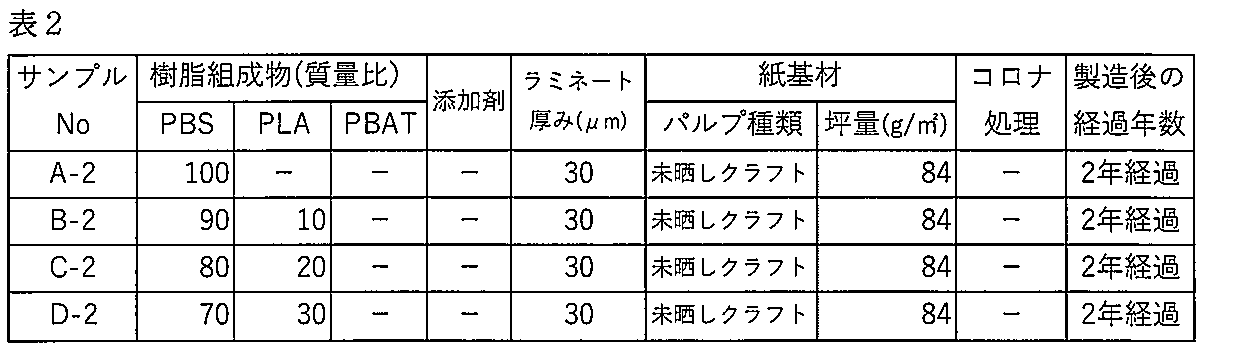
- "Manufacturing of biodegradable resin composition laminated laminated paper” The resin compositions having the blending ratios of (A-2), (B-2), (C-2) and (D-2) shown in Table 2 below were pre-dried, and each of them had a basis weight of 84 g / m 2 .
- Laminated paper to be a resin composition layer (lamination layer) with a thickness of 30 ⁇ m was prepared by laminating on bleached kraft paper (paper base material), and a sample two years after production was used.
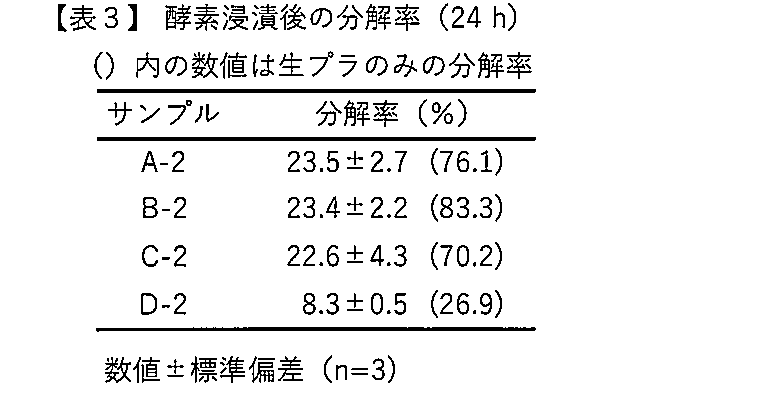
- Enzyme solution immersion test The PaE crude enzyme solution of the present invention was diluted with 20 mM Tris-HCl (pH 8.0) buffer to 4.69 ⁇ 0.50 U / mL. The sample was cut into 30 mm squares, and the weight of the sample (test piece) was measured. Then, the sample was immersed in the enzyme solution prepared by the above method and shaken in an incubator (manufactured by Nippon Medical School) set at 30 ° C. for 24 hours, and the sample was taken out and the weight was measured. The decomposition rate was calculated from the weight difference before and after immersion. The decomposition rate of only the biodegradable resin composition (also called biodegradable plastic) was estimated from the basis weight of the base paper.
- an incubator manufactured by Nippon Medical School
- the decomposition rates after 24 hours were about 20% for (A-2), (B-2), and (C-2), and about 8% for (D-2). rice field.
- the decomposition rate of only the biodegradable resin composition is about 70 to 80% for (A-2), (B-2) and (C-2), about 30% for (D-2), and PLA. When the ratio of was 30%, the progress of decomposition could be suppressed.
- the PaE crude enzyme solution of the present invention was diluted with a 20 mM Tris-HCl (pH 8.0) buffer solution, and calcium carbonate (softon) was further mixed so as to have a weight ratio of 2%, and the activity was 7.80 ⁇ 0. The one set to 66 U / mL was used. Samples were cut out at 30 mm x 70 mm and buried in vegetable soil (our super soil, pH 6.74, EC 1.81 dS / m) whose water content was adjusted to 50%, and artificial weather with a temperature of 30 ° C and a humidity of 90%. It was left in a vessel (manufactured by Nippon Medical School).
- a sample is taken out 2 to 4 weeks after standing, the shape is observed, and the tensile strength is measured using an autograph tensile tester (manufactured by Shimadzu Corporation) under the conditions of a chuck span of 30 mm and a test speed of 10 mm / min. did.
- an untreated sample was prepared, which was immersed in water in the same manner as the enzyme treatment in which the sample was immersed in the enzyme solution at room temperature for 3 hours.
- the value measured under the same conditions after immersing the test piece in water for 12 hours was used. The test was performed in 4 iterations.
- the tensile strength after 2 weeks of soil burial is stronger in the order of (A-2) ⁇ (B-2) ⁇ (C-2) ⁇ (D-2), and the ratio of PLA is high.
- the intensities of (A-2) and (B-2) after 4 weeks of burial were lower than those after 2 weeks, and the decomposition was progressing, whereas (C-2) and (D-2) were , Sufficient strength was maintained even after 4 weeks of burial.
- this sample has been prepared for more than 2 years, and it is presumed that if PLA is contained in an amount of 20% or more, there is little deterioration over time.
- the tensile strength of the enzyme-treated sample was lower than that of the untreated sample, and the decomposition promoting effect of the enzyme treatment was sufficiently confirmed.
- Enzyme solution immersion test The PaE crude enzyme solution of the present invention was diluted with 20 mM Tris-HCl (pH 8.0) buffer to 4.69 ⁇ 0.50 U / mL. The sample was cut into 30 mm squares, and the weight of the sample (test piece) was measured. Then, the sample was immersed in the enzyme solution prepared by the above method and shaken in an incubator (manufactured by Nippon Medical School) set at 30 ° C. for 24 hours, and the sample was taken out and the weight was measured. The decomposition rate was calculated from the weight difference before and after immersion. The decomposition rate of only the biodegradable resin composition was also estimated from the basis weight of the base paper.
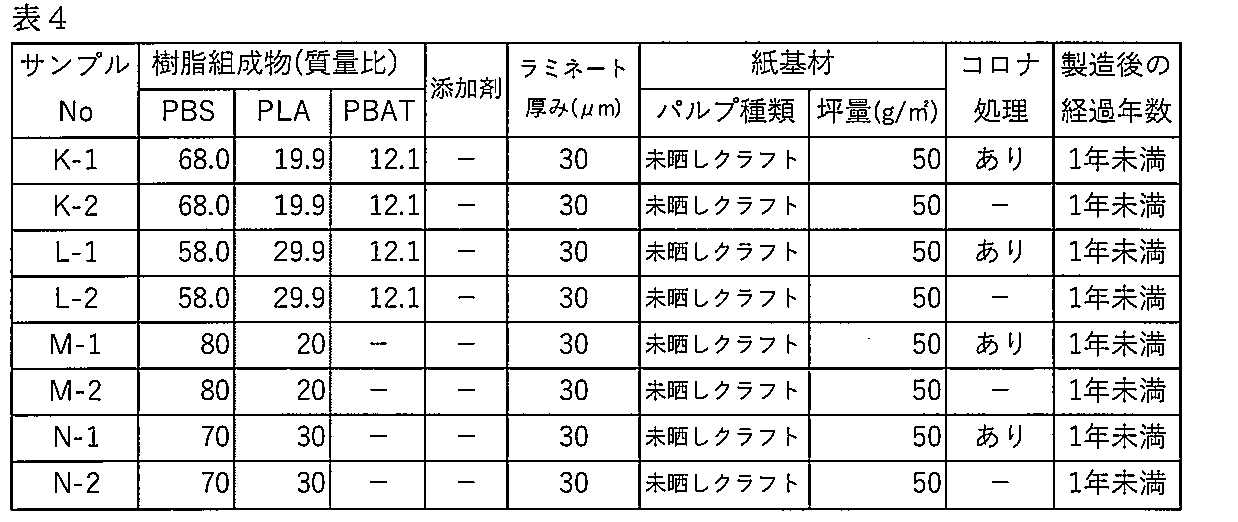
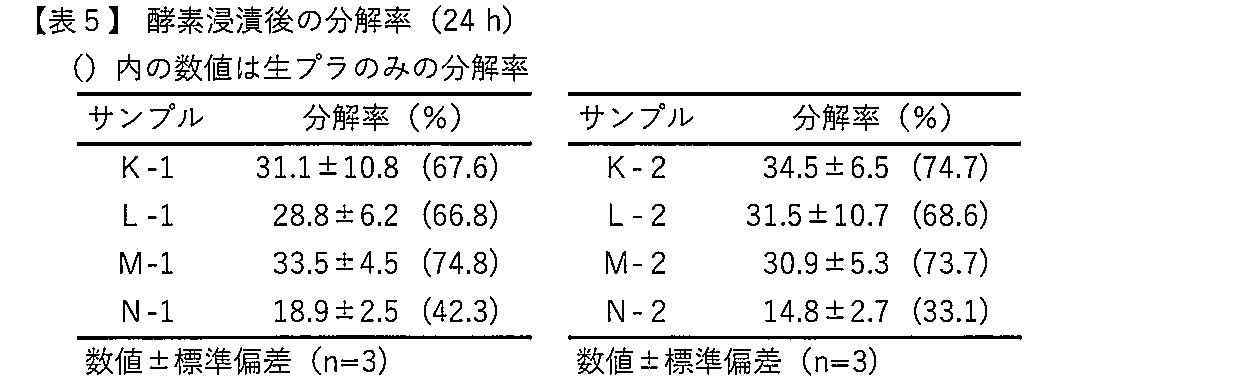
- the decomposition rate after 24 hours was about 30% for K, L, and M, and about 20% for N, regardless of the presence or absence of corona treatment.
- the estimated decomposition rate of only the biodegradable resin composition after subtracting the paper portion was about 70% for K, L, and M, and about 30 to 40% for N.
- the PaE crude enzyme solution of the present invention was diluted with a 20 mM Tris-HCl (pH 8.0) buffer solution, and calcium carbonate (softon) was further mixed so as to have a weight ratio of 2%, and the activity was 7.80 ⁇ 0. The one set to 66 U / mL was used. Samples were cut out at 30 mm x 70 mm and buried in vegetable soil (our super soil, pH 6.74, EC 1.81 dS / m) whose water content was adjusted to 50%, and artificial weather with a temperature of 30 ° C and a humidity of 90%. It was left in a vessel (manufactured by Nippon Medical School).
- the tensile strength of the untreated sample after 2 weeks of soil burial is stronger in the order of K ⁇ L ⁇ M ⁇ N, and the degree of decomposition differs depending on the ratio of PLA and the presence or absence of mixing of PBAT. rice field. That is, biodegradation can be controlled by the ratio of PLA and the presence or absence of mixing of PBAT. Further, as shown in FIGS. 4 and 5, the tendency was remarkable 4 weeks after the burial. In this test, replacement of a part of PBS with PBAT tended to make it easier to decompose.
- the tensile strength of the enzyme-treated sample showed the same tendency, but the strength was lower than that of the untreated sample, and the decomposition promoting effect of the enzyme treatment was confirmed. No difference in the degree of decomposition due to the corona discharge treatment was confirmed. Furthermore, as shown in FIGS. 4 and 5, a certain degree of rot resistance was observed in the enzyme-untreated 2-week burial test for K-1, K-2, L-1, and L-2. In the weekly burial test, the rot resistance was extremely weak. That is, a seedling raising pot body composed of a biodegradable resin composition of K-1, K-2, L-1, L-2 is suitable for short-term seedling raising, and is quickly biodegraded after transplantation to generate a seedling raising pot body residue. Can be reduced.
Landscapes
- Chemical & Material Sciences (AREA)
- Life Sciences & Earth Sciences (AREA)
- Health & Medical Sciences (AREA)
- Organic Chemistry (AREA)
- Medicinal Chemistry (AREA)
- Chemical Kinetics & Catalysis (AREA)
- Polymers & Plastics (AREA)
- Wood Science & Technology (AREA)
- Environmental Sciences (AREA)
- Engineering & Computer Science (AREA)
- Bioinformatics & Cheminformatics (AREA)
- Genetics & Genomics (AREA)
- Zoology (AREA)
- Biotechnology (AREA)
- General Engineering & Computer Science (AREA)
- General Health & Medical Sciences (AREA)
- Biochemistry (AREA)
- Microbiology (AREA)
- Biomedical Technology (AREA)
- Sustainable Development (AREA)
- Molecular Biology (AREA)
- Materials Engineering (AREA)
- Cultivation Receptacles Or Flower-Pots, Or Pots For Seedlings (AREA)
- Biological Depolymerization Polymers (AREA)
Abstract
Description
特許文献3及び特許文献4においては、熱可塑性生分解性樹脂層を育苗ポットに適用することにより、育苗ポットが圃場に植付け後に分解する性質が開示されているが、育苗時と植付け後とで任意に分解を制御する技術がまだ確立されていない。
さらに、特許文献5及び特許文献6においては、微生物由来の酵素を直接投与することによって任意のタイミングで農業用マルチフィルムの生分解の進行を制御する技術が開示されているが、そもそも農業用マルチフィルムと育苗用鉢体とは、資材の使用目的、適用場面・条件、並びに、それに伴って要求される物理的強度・化学的性質等を含めた物品の特性が異なるため、単純には転用できない。
また、育苗期間及び植付け時の十分な強度を備える以外、育苗鉢体の製造後経時的に劣化していくこともあったため、育苗鉢体用原紙の経時安定性も求められる。
1.樹脂(A)としてポリ乳酸系樹脂を15質量%以上含有する生分解性樹脂組成物を紙基材上に積層してなることを特徴とする、育苗鉢体用原紙。
2.前記生分解性樹脂組成物が、樹脂(B)としてポリ乳酸系樹脂以外の脂肪族ポリエステル系樹脂を含み、
樹脂(A)と樹脂(B)の質量比が15:85~40:60であることを特徴とする、上記1項に記載の育苗鉢体用原紙。
3.前記生分解性樹脂組成物が、樹脂(B)としてポリ乳酸系樹脂以外の脂肪族ポリエステル系樹脂、及び樹脂(C)として芳香族ポリエステル系樹脂を含み、
該樹脂(B)が生分解性樹脂組成物の合計質量に対して30~84.9質量%の範囲で含有し、
該樹脂(C)が樹脂組成物成分の合計質量に対して0.1~30質量%の範囲で含有することを特徴とする、上記1項に記載の育苗鉢体用原紙。
4.樹脂(A)が、ポリ乳酸であることを特徴とする上記1項乃至上記3項のいずれか1項に記載の育苗鉢体用原紙。
5.樹脂(B)が、脂肪族ジカルボン酸よりなるジカルボン酸成分と脂肪族ジオールからなるジオール成分を重縮合してなる脂肪族ポリエステル系樹脂であることを特徴とする、上記2項乃至上記4項のいずれか1項に記載の育苗鉢体用原紙。
6.樹脂(B)が、ポリブチレンサクシネート(PBS)、ポリブチレンサクシネートアジペート(PBSA)及びポリヒドロキシ酪酸から選ばれる少なくとも1種であることを特徴とする、上記2項乃至上記5項のいずれか1項に記載の育苗鉢体用原紙。
7.樹脂(C)が、脂肪族ジカルボン酸および芳香族ジカルボン酸からなるジカルボン酸成分と脂肪族ジオールからなるジオール成分を重縮合してなる芳香族ポリエステル系樹脂であることを特徴とする、上記3項乃至上記6項のいずれか1項に記載の育苗鉢体用原紙。
8.樹脂(C)が、ポリブチレンアジペートテレフタレート(PBAT)であることを特徴とする上記3項乃至上記7項のいずれか1項に記載の育苗鉢体用原紙。
9.上記1項乃至上記8項のいずれか1項に記載の育苗鉢体用原紙からなることを特徴とする、育苗鉢体。
10.生分解樹脂分解酵素を上記9項記載の育苗鉢体に接触させ、該育苗鉢体を生分解する工程を有することを特徴とする、育苗鉢体を分解する方法。
11.前記生分解樹脂分解酵素が、Pseudozyma属酵母、Cryptococcus属酵母、Acremonium属糸状菌、Alternaria属糸状菌、Arthrinium属糸状菌、Aureobasidium属糸状菌、Cladosporium属糸状菌、Epicoccum属糸状菌、Fusarium属糸状菌、Paraphoma属糸状菌及びPenicillium属糸状菌からなる群から選ばれる少なくとも1種の微生物により産生される生分解樹脂分解酵素であることを特徴とする、上記10項に記載の育苗鉢体を分解する方法。
即ち、本発明の育苗鉢体用原紙からなる育苗鉢体は、育苗中の分解が抑制されることで、育苗期間及び植付け時に十分な強度を備えることができる。これにより、圃場への植付け作業を滞りなく進めることが可能となる。そして、育苗鉢体が育苗中にあっては鉢体の形を維持することができるため、植付け時において苗を傷めないので植付けの活着率が高い。さらに、本発明の育苗鉢体用原紙からなる育苗鉢体は、長期保存したとき、その経時安定性に優れる。また、本発明の育苗鉢体用原紙からなる育苗鉢体は、圃場に植付けする直前及び/又は直後に酵素処理を為すにより、土の中で鉢体の生分解の進行が制御され、鉢体を徐々に崩壊させることができる。これにより、苗の根が自由に伸張でき、苗の成長に妨げとならない。そして、分解が不十分のため残る育苗鉢体残渣の発生量を低減することができ、次作にも影響しない。
育苗鉢体は、生分解性樹脂組成物を紙基材の少なくとも一方の面にラミネートしたラミネート紙を、例えば四角あるいは六角柱状に成型することによりなる。さらに当該個別の鉢体を連結片にて連結することにより連続鉢体を成型することができる。
本発明に使用される紙基材は、セルロース繊維を主成分として含有するものであれば、その原料パルプの種類やセルロース繊維の含有量は特に限定されない。例えば、通常の製紙材料として使用するパルプを含有する紙が挙げられる。より具体的には、未晒、半晒または晒のクラフトパルプ、サルファイトパルプ、セミケミカルパルプ、ソーダパルプ、針葉樹および広葉樹からの機械パルプ、および古紙などが挙げられ、これらを単独であるいは2種以上を混合して用いることができる。特に、漂白していない未晒のパルプからなるものを好適に用いることができる。
「生分解性樹脂」
生分解性樹脂とは、使用時は従来の石油由来のプラスチックと同様の機能を有し、使用後は自然界の土壌中や水中の微生物により一定の時間で生分解され、最終的に水と二酸化炭素に加水分解される樹脂を指す。
本発明で使用する生分解性樹脂としては、脂肪族ポリエステル系樹脂、芳香族ポリエステル系樹脂を挙げることができる。
なお、本発明の脂肪族ポリエステルは、芳香環を含まない脂肪族ポリエステルを指し、脂肪族ポリエステル系樹脂は、芳香環を含まない脂肪族ポリエステル系樹脂を指す。さらに、本発明の芳香族ポリエステルは、芳香環を含むポリエステルを指し、芳香族ポリエステル系樹脂は、芳香環を含むポリエステル系樹脂を指す。
上記生分解性樹脂は、一種を用いてもよく、二種以上を組み合わせて用いても良い。中でも、フィルム成形性、物性を考慮する場合、融点が50~180℃であり、かつ重量平均分子量が50000以上である脂肪族ポリエステルまたは芳香族ポリエステルが良好な成形品を得るうえで好ましい。さらに、生分解性、柔軟性、経時安定性を要求する場合には、生分解性樹脂組成物の合計質量に対して、ポリ乳酸系樹脂を15質量%以上含まれる2種以上からなる混合樹脂とすることが好ましい。当該混合樹脂を育苗鉢体に用いることにより、育苗中は分解せずに植付け時に一定の強度を維持し、植付け直前及び/又は直後に酵素処理することで圃場への植付け後の分解の進行を速めることを可能とする。
ポリ乳酸樹脂は、ネイチャーワークス社製の「Ingeo(登録商標)4032D」を挙げることができる。
芳香族ポリエステル系樹脂は、BASF社製の「エコフレックス」(1,4-ブタンジオールとアジピン酸およびテレフタル酸からなる芳香族ポリエステルを重縮合してなる芳香族ポリエステル系樹脂、融点:約110℃)を挙げることができる。
本発明の生分解性の育苗鉢体は、以上のような生分解性樹脂を紙の少なくとも一方の面に積層することによって作製した積層シートよりなる。積層シートは、基材となる紙の表面をコロナ放電処理、フレーム処理、アンカーコート処理等を行って、その処理面に生分解性樹脂を押出してラミネートする。この際、押出しラミネートの加工安定性を増すために、生分解性樹脂と一緒にポリエチレン等の汎用プラスチックを共押出しし、その後汎用プラスチックフィルムを剥離して紙と生分解性樹脂の積層シートを得る方法もある。
紙基材に積層する生分解樹脂層の厚みは、特に限定されないが、5~80μmであることが好ましく、15~50μmがより好ましく、20~35μmが特に好ましい。なお、樹脂層の厚みによって育苗鉢体の物理的強度及び酵素処理による分解の進行を任意に調整することができる。
「生分解性樹脂分解酵素」
生分解性樹脂分解酵素としては、従来公知の酵素を使用することができ、例えば、リパーゼ、クチナーゼ、エステラーゼ、プロテアーゼ、リゾホスホリパーゼ、アミラーゼ、グルコアミラーゼ、ペプチターゼ、セリンハイドロラーゼ、セルラーゼ、キチナーゼ、キシラナーゼ、ペクチナーゼ等の加水分解酵素及びペルオキシターゼ、モノオキシゲナーゼ、ジオキシゲナーゼ、ラッカーゼ等の酸化還元酵素を挙げることができ、リパーゼ、クチナーゼ、エステラーゼ、プロテアーゼ及びアミラーゼが好ましい。具体的には、酵母Pseudozyma antarcticaの産生するクチナーゼ様酵素PaE、Cryptococcus magnus類縁株BPD1Aの産生するCmCut1、Cryptococcus flavus GB-1株の産生するCfCLE GB-1及びCryptococcus flavus Sb19-1株の産生するCfCLE Sb19-1、Cryptococcus sp. S-2株の生産するCLE、Paraphoma属糸状菌B47-9株の生産するPCLEを使用することができる。なお、これらの生分解性樹脂分解酵素はそれぞれ、酵素活性が最大となる至適pH、至適温度範囲等が異なり、それらの特性を利用して所望の酵素反応を適宜行わせるようにも設定できる。至適pHの違いとして、例えば、PaEは中性からアルカリ性域で高い酵素活性を示し、至適pHは9.5となる(非特許文献1)。一方、PCLEは中性域近傍で高い酵素活性を示し、至適pHは7.2となる(非特許文献2)。その他、CmCut1の至適pHは7.5(非特許文献3)、CfCLE GB-1の至適pHは7.8であることが知られている(非特許文献4)。
生分解性樹脂分解酵素を産生する微生物としては、特に限定されるものではないが、自然界から単離された株等、任意の株を使用する。具体的には、シュードモナス(Pseudomonas)属、シュードザイマ(Pseudozyma)属、クリプトコッカス(Cryptococcus)属、アクレモニウム(Acremonium)属、アルテルナリア(Alternaria)属、アースリニウム(Arthrinium)属、アウレオバシジウム(Aureobasidium)属、クラドスポリウム(Cladosporium)属、エピコッカム(Epicoccum)属、フザリウム(Fusarium)属、パラフォーマ(Paraphoma)属、ぺニシリウム(Penicillium)属、バクテロイデス(Bacteroides)属、ムコール(Mucor)属、フミコラ(Humicola)属、テルモミセス(Thermomyces)属、タラロミセス(Talaromyces)属、ケトミウム(Chaetomium)属、トルラ(Torula)属、スポロトリクム(Sporotrichum)属、マルブランケア(Malbranchea)属、アシドボラックス(Acidovorax)属等の微生物を挙げることができる。より具体的には、葉面酵母であるPseudozyma antarctica、Cryptococcus magnus類縁株BPD1A、Cryptococcus flavus GB-1株、Cryptococcus flavus Sb19-1株、茨城県において採取された稲籾から単離された独立行政法人製品評価技術基盤機構特許生物寄託センターに寄託された受託番号FERM BP-22155であるPseudozyma antarctica(受託日2011年7月22日)、独立行政法人製品評価技術基盤機構特許微生物寄託センターに寄託された受託番号NITE P-573である糸状菌や、独立行政法人理化学研究所バイオリソースセンターにおいて標準株として提供されているPseudozyma antarctica JCM10317株を使用することができる。特に、酵母Pseudozyma antarcticaの産生するクチナーゼ様酵素PaE、Cryptococcus magnus類縁株BPD1Aの産生するCmCut1、Cryptococcus flavus GB-1株の産生するCfCLE GB-1及びCryptococcus flavus Sb19-1株の産生するCfCLE Sb19-1、受託番号FERM P-15155であるCryptococcus属酵母の産生するCLE、受託番号NITE P-573であるParaphoma属糸状菌の産生するPCLEからなる群から選択される少なくとも1種又はそれらの培養液の混合物を用いることが好ましい。
本発明の生分解性の育苗鉢体を分解する方法は、当該鉢体に、上記生分解性樹脂分解酵素のほかに、高分子吸水剤を適用してもよい。高分子吸水剤としては、特に限定されないが、十分な水保持能力を有し、水を保持した状態で生分解性の育苗鉢体表面に付着する性質を有する高吸水性ポリマー、デンプン誘導体、カルボキシアルキルセルロース、ヒドロキシアルキルセルロース、多糖誘導体、ポリアミノ酸架橋体及び青果物の廃棄物を原料とする吸水材等を挙げることができる。これらの中でも、カルボキシアルキルセルロースが好ましく、カルボキシメチルセルロースが特に好ましい。これらの高分子吸水剤を生分解性の育苗鉢体に適用することにより、高分子吸水剤が水と生分解性樹脂分解酵素を含有した状態で長時間、生分解性樹脂資材の表面に維持され、生分解性の育苗鉢体の分解を容易にすることができる。
生分解性樹脂分解酵素にカルシウム成分を混合することで酵素反応を一層促進させることができる(特許文献5)。生分解性樹脂分解酵素等を含む酵素溶液に生分解性樹脂を浸漬して生分解性樹脂を分解した場合、酵素溶液のpHが緩やかに低下する。そこで生分解性樹脂分解酵素の至適pH等も参考に、酵素処理の対象物のpHを中性から微アルカリ性に維持することにより、生分解性樹脂分解酵素による分解を効率的に実施可能となる。土壌や作物への悪影響を及ぼす可能性が低い材料の中では、カルシウム塩やカルシウム含有土壌改良剤が挙げられる。具体的には、炭酸カルシウム、酸化カルシウム、塩化カルシウムや、モンモリロナイト等のカルシウムを含有する鉱物を好適に用いることができる。また、カルシウム含有土壌改良剤としては、重質炭酸カルシウム含有土壌改良剤や軽質炭酸カルシウム含有土壌改良剤を好適に用いることができる。
育苗鉢体底面からの給水、表面への塗布、散布、噴霧灌注も良い。さらに、高分子吸水剤を同時または別々に適用してもよい。
特許文献6中の段落[0021]に記載の方法で、Pseudozyma antarctica(受託番号FERM BP-22155)からPaEを含むPseudozyma antarctica培養液を調整し(以下、「本願発明のPaE粗酵素液」と称す)、以下に詳述するような方法で、酵素活性に基づく濃度の測定を行った。
その後、所定の酵素溶液量となるように、20mMのTris-HCl緩衝液(pH8.0)で溶液を調整した。さらに、必要に応じて、炭酸カルシウム(ソフトン)を混合した。
生分解性樹脂分解酵素の活性は、特許文献5中の段落[0019]において記載される以下の分解酵素の活性測定方式に従って行った。
「まず、内径10mmの試験管に、20mMのTris-HCl緩衝液(pH6.8)1730μLと、基質として、所定量のPBSAエマルジョンEM-301溶液を水に溶解した水溶液30μLと、を添加して混合し、更に必要に応じて100mM 塩化カルシウム溶液40μLを添加する。
次いで、生分解性樹脂分解酵素を産生する微生物の培養液を得て、遠心分離により微生物を除去した後、上清200μLを得て、上記試験管中に添加する。上清を添加した混合液をボルテックスで撹拌し、濁度計を用いて660nmにおける透過率を測定する。その後、30℃において、220rpmで試験管を振とうしながら、混合時及び混合後15分の透過率を求める。濁度計により得られた透過率を以下の式(1)により吸光度に変換し、得られた吸光度から以下の式(2)により酵素活性を求める。
At=-log(X/100) ・・・(1)
C=(A0-A15)×10/15[U/mL/min] ・・・(2)
(上記式(1)中、Atは時間t(min.)における吸光度を示し、Xは透過率を示す。また、上記式(2)中、Cは酵素活性を示し、A0及びA15は、それぞれ混合時及び混合から15分経過した後の吸光度を示す。)」
(1)湿潤引張強度(基準)、酵素処理引張強度:JIS P8113:1998「紙および及び板紙-引張特性の試験方法-第2部:定速伸張法」に準じた方法により、定速伸張形引張試験機((株)島津製作所製、オートグラフ引張試験機)を使用して測定を実施した。サンプルの大きさを30mm×70mmとし、チャックスパン30mm、引張速度10mm/minで伸長し、破断時の強度を測定した。同測定は8回繰り返し、平均値(及び標準偏差)を算出した。
(2)埋没処理引張強度: JIS P8113:1998「紙および及び板紙-引張特性の試験方法-第2部:定速伸張法」に準じた方法により、定速伸張形引張試験機((株)島津製作所製、オートグラフ引張試験機)を使用して測定を実施した。サンプルの大きさを30mm×70mm、チャックスパン30mm、引張速度100mm/minで伸長し、破断時の強度を測定した。同測定は4回繰り返し、平均値(及び標準偏差)を算出した。
実施例1により、製造後2年経過サンプルと製造後1年未満経過サンプルの強度及び経時的安定性を比較した。
「生分解樹脂組成物積層ラミネート紙の製造」
下記表1で示す(A)~(D)及び(a)~(d)の配合割合の樹脂組成物を予備乾燥し、これらをそれぞれ坪量84g/m2の未晒しクラフト紙(紙基材)にラミネート加工することで、厚み30μmと15μmの2パターンの樹脂組成物層(ラミネーション層)となるラミネート紙を作製した。
なお、製造後1年未満経過サンプルは、「記号-1」と記載し、製造後2年経過サンプルは、「記号-2」と記載する。

試験片を30mm×70mmでそれぞれ切り出し、水分率を50%に調整した蔬菜用培土(当社スーパー培土、pH6.74、EC 1.81dS/m)に埋没させ、温度30℃、湿度90%の人工気象器(日本医科製)に静置した。静置後2週間目にサンプルを取り出し、形状を観察し、サンプルはオートグラフ引張試験機((株)島津製作所製)を用いてチャックスパン30mm、試験速度100mm/minの条件で引張強度を測定し、試験は4反復で実施した。埋没前のサンプルの強度は、試験片を水に24時間浸し、同様の条件で測定した値を用いた。
一方、PLAの比率が2割未満のサンプル(A-2)と(B-2)は(C-2)と(D-2)に比べ、そして(a-2)と(b-2)は(c-2)と(d-2)に比べ、強度が低く、さらに製造後1年経過の強度と比較しても低く、経年劣化しやすい傾向にあると推測された。いずれにしても(a)と(b)または(A)と(B)は埋没後の強度が低く、実用性はないものと思われた。したがって、PLAの比率が2割以上あれば、埋没後十分な強度を維持し、2年以上経っても経時劣化も小さくなった。
酵素の生分解作用により、経時安定性を評価すべく、製造から2年経過したサンプルの物理的強度を測定した。
「生分解樹脂組成物積層ラミネート紙の製造」
下記表2で示す(A-2)、(B-2)、(C-2)(D-2)の配合割合の樹脂組成物を予備乾燥し、これらをそれぞれ坪量84g/m2の未晒しクラフト紙(紙基材)にラミネート加工することで厚さ30μmの樹脂組成物層(ラミネーション層)となるラミネート紙を作製し、製造から2年経過したサンプルを使用した。
本願発明のPaE粗酵素液を20mM Tris-HCl(pH8.0)緩衝液で4.69±0.50U/mLになるように希釈した。
サンプルを30mm四方に切り出し、サンプル(試験片)の重量を測定した。その後、上述の方法で調製した酵素液に浸漬させ24時間30℃に設定したインキュベーター(日本医科製)で振とうし、サンプルを取り出し重量を測定した。浸漬前後の重量差より、分解率を算出した。また基材の紙の坪量から生分解性樹脂組成物(生プラとも呼ぶ)のみの分解率も推定した。
本願発明のPaE粗酵素液を20mM Tris-HCl(pH8.0)緩衝液で希釈し、さらに重量比で2%になるように炭酸カルシウム(ソフトン)を混合して、活性7.80±0.66U/mLとしたものを用いた。
サンプルを30mm×70mmでそれぞれ切り出し、水分率を50%に調整した蔬菜用培土(当社スーパー培土、pH6.74、EC 1.81dS/m)に埋没させ、温度30℃、湿度90%の人工気象器(日本医科製)に静置した。静置後2、4週間目にサンプルを取り出し、形状を観察し、オートグラフ引張試験機((株)島津製作所製)を用いてチャックスパン30mm、試験速度10mm/minの条件で引張強度を測定した。サンプルは、酵素液に常温で3時間浸漬した酵素処理と同様に水に浸漬した未処理を用意した。埋没前の試験片の強度は、試験片を水に12時間浸し、同様の条件で測定した値を用いた。試験は4反復で実施した。
また、酵素処理サンプルの引張強度について、未処理に比べて強度が低下し、酵素処理による分解促進効果が十分確認された。
<生分解樹脂組成物積層ラミネート紙の製造>
下記表4で示す(K)~(N)の配合割合の樹脂組成物を予備乾燥し、コロナ処理した又はコロナ処理なしの坪量50g/m2の未晒しクラフト紙(紙基材)にラミネート加工することで厚さ30μmの樹脂組成物層(ラミネーション層)となるラミネート紙を作製し、製造後1年未満サンプルを使用した。
本願発明のPaE粗酵素液を20mM Tris-HCl(pH8.0)緩衝液で4.69±0.50U/mLになるように希釈した。
サンプルを30mm四方に切り出し、サンプル(試験片)の重量を測定した。その後、上述の方法で調製した酵素液に浸漬させ24時間30℃に設定したインキュベーター(日本医科製)で振とうし、サンプルを取り出し重量を測定した。浸漬前後の重量差より、分解率を算出した。また基材の紙の坪量から生分解性樹脂組成物のみの分解率も推定した。
本願発明のPaE粗酵素液を20mM Tris-HCl(pH8.0)緩衝液で希釈し、さらに重量比で2%になるように炭酸カルシウム(ソフトン)を混合して、活性7.80±0.66U/mLとしたものを用いた。
サンプルを30mm×70mmでそれぞれ切り出し、水分率を50%に調整した蔬菜用培土(当社スーパー培土、pH6.74、EC 1.81dS/m)に埋没させ、温度30℃、湿度90%の人工気象器(日本医科製)に静置した。静置後2、4週間目にサンプルを取り出し、形状を観察し、オートグラフ引張試験機((株)島津製作所製)を用いてチャックスパン30mm、試験速度10mm/minの条件で引張強度を測定した。サンプルは、酵素液に常温で3時間浸漬した酵素処理と同様に水に浸漬した未処理を用意した。埋没前の試験片の強度は、試験片を水に12時間浸し、同様の条件で測定した値を用いた。試験は4反復で実施した。
また、図4、図5に示すように、埋没4週間後ではその傾向が顕著であった。本試験においては、PBSの一部をPBATに置き換えることで分解しやすくなる傾向がみられた。酵素処理サンプルの引張強度も同様の傾向であったが、未処理サンプルに比べて強度が低く、酵素処理による分解促進効果が確認された。なお、コロナ放電処理による分解程度の違いは確認されなかった。
さらに、図4、図5に示すように、K-1、K-2、L-1、L-2について、酵素未処理の2週間の埋没試験では、一定の耐腐性が認められ、4週間埋没試験では、耐腐性が極めて弱くなった。つまり、K-1、K-2、L-1、L-2の生分解性樹脂組成物からなる育苗鉢体が短期間の育苗に適し、移植後素早く生分解され、育苗鉢体残渣の発生を低減することができる。
Claims (11)
- 樹脂(A)としてポリ乳酸系樹脂を15質量%以上含有する生分解性樹脂組成物を紙基材上に積層してなることを特徴とする、育苗鉢体用原紙。
- 前記生分解性樹脂組成物が、樹脂(B)としてポリ乳酸系樹脂以外の脂肪族ポリエステル系樹脂を含み、
樹脂(A)と樹脂(B)の質量比が15:85~40:60であることを特徴とする、請求項1に記載の育苗鉢体用原紙。 - 前記生分解性樹脂組成物が、樹脂(B)としてポリ乳酸系樹脂以外の脂肪族ポリエステル系樹脂、及び樹脂(C)として芳香族ポリエステル系樹脂を含み、
該樹脂(B)が生分解性樹脂組成物の合計質量に対して30~84.9質量%の範囲で含有し、
該樹脂(C)が生分解性樹脂組成物の合計質量に対して0.1~30質量%の範囲で含有することを特徴とする、請求項1に記載の育苗鉢体用原紙。 - 樹脂(A)が、ポリ乳酸であることを特徴とする請求項1乃至請求項3のいずれか1項に記載の育苗鉢体用原紙。
- 樹脂(B)が、脂肪族ジカルボン酸よりなるジカルボン酸成分と脂肪族ジオールからなるジオール成分を重縮合してなる脂肪族ポリエステル系樹脂であることを特徴とする、請求項2乃至請求項4のいずれか1項に記載の育苗鉢体用原紙。
- 樹脂(B)が、ポリブチレンサクシネート(PBS)、ポリブチレンサクシネートアジペート(PBSA)及びポリヒドロキシ酪酸から選ばれる少なくとも1種であることを特徴とする、請求項2乃至請求項5のいずれか1項に記載の育苗鉢体用原紙。
- 樹脂(C)が、脂肪族ジカルボン酸および芳香族ジカルボン酸からなるジカルボン酸成分と脂肪族ジオールからなるジオール成分を重縮合してなる芳香族ポリエステル系樹脂であることを特徴とする、請求項3乃至請求項6のいずれか1項に記載の育苗鉢体用原紙。
- 樹脂(C)が、ポリブチレンアジペートテレフタレート(PBAT)であることを特徴とする請求項3乃至請求項7のいずれか1項に記載の育苗鉢体用原紙。
- 請求項1乃至請求項8のいずれか1項に記載の育苗鉢体用原紙からなることを特徴とする、育苗鉢体。
- 生分解樹脂分解酵素を請求項9記載の育苗鉢体に接触させ、該育苗鉢体を生分解する工程を有することを特徴とする、育苗鉢体を分解する方法。
- 前記生分解樹脂分解酵素が、Pseudozyma属酵母、Cryptococcus属酵母、Acremonium属糸状菌、Alternaria属糸状菌、Arthrinium属糸状菌、Aureobasidium属糸状菌、Cladosporium属糸状菌、Epicoccum属糸状菌、Fusarium属糸状菌、Paraphoma属糸状菌及びPenicillium属糸状菌からなる群から選ばれる少なくとも1種の微生物により産生される生分解樹脂分解酵素であることを特徴とする、請求項10に記載の育苗鉢体を分解する方法。
Priority Applications (7)
| Application Number | Priority Date | Filing Date | Title |
|---|---|---|---|
| KR1020227021134A KR102921179B1 (ko) | 2020-02-03 | 2021-02-03 | 경시 안정성을 갖는 육묘 화분 및 이의 분해 촉진 방법 |
| JP2021575834A JP7719463B2 (ja) | 2020-02-03 | 2021-02-03 | 経時安定性を備える育苗鉢体及びその分解促進方法 |
| AU2021217288A AU2021217288A1 (en) | 2020-02-03 | 2021-02-03 | Nursery pot body with temporal stability and decomposition accelerating method therefor |
| US17/759,948 US12532816B2 (en) | 2020-02-03 | 2021-02-03 | Nursery pot body with temporal stability and decomposition accelerating method therefor |
| EP21750735.9A EP4101642B1 (en) | 2020-02-03 | 2021-02-03 | Seedling-growing pot body with long-term stability, and decomposition promotion method therefor |
| CN202180012304.8A CN115038329B (zh) | 2020-02-03 | 2021-02-03 | 具有经时稳定性的育苗钵体及其分解促进方法 |
| ES21750735T ES3028666T3 (en) | 2020-02-03 | 2021-02-03 | Seedling-growing pot body with long-term stability, and decomposition promotion method therefor |
Applications Claiming Priority (2)
| Application Number | Priority Date | Filing Date | Title |
|---|---|---|---|
| JP2020-016376 | 2020-02-03 | ||
| JP2020016376 | 2020-02-03 |
Publications (1)
| Publication Number | Publication Date |
|---|---|
| WO2021157618A1 true WO2021157618A1 (ja) | 2021-08-12 |
Family
ID=77200312
Family Applications (1)
| Application Number | Title | Priority Date | Filing Date |
|---|---|---|---|
| PCT/JP2021/003951 Ceased WO2021157618A1 (ja) | 2020-02-03 | 2021-02-03 | 経時安定性を備える育苗鉢体及びその分解促進方法 |
Country Status (9)
| Country | Link |
|---|---|
| US (1) | US12532816B2 (ja) |
| EP (1) | EP4101642B1 (ja) |
| JP (1) | JP7719463B2 (ja) |
| KR (1) | KR102921179B1 (ja) |
| CN (1) | CN115038329B (ja) |
| AU (1) | AU2021217288A1 (ja) |
| ES (1) | ES3028666T3 (ja) |
| TW (1) | TWI907382B (ja) |
| WO (1) | WO2021157618A1 (ja) |
Families Citing this family (1)
| Publication number | Priority date | Publication date | Assignee | Title |
|---|---|---|---|---|
| JP7399303B2 (ja) * | 2020-08-25 | 2023-12-15 | 日本甜菜製糖株式会社 | 耐腐紙の分解制御方法 |
Citations (9)
| Publication number | Priority date | Publication date | Assignee | Title |
|---|---|---|---|---|
| JPH0113117B2 (ja) | 1983-06-09 | 1989-03-03 | Alps Electric Co Ltd | |
| JP2004121054A (ja) | 2002-09-30 | 2004-04-22 | Nippon Paper Industries Co Ltd | 育苗ポット |
| KR100974639B1 (ko) * | 2009-06-30 | 2010-08-09 | 주식회사 삼우티씨씨 | 농업용 필름 및 화분 제조를 위한 생분해성 수지 조성물, 이를 이용한 생분해성 농업용 필름 및 화분과 그 제조방법 |
| JP4543393B2 (ja) | 2005-11-11 | 2010-09-15 | 日本甜菜製糖株式会社 | 育苗移植用連続集合鉢体及びその製造方法 |
| JP4763123B2 (ja) | 2000-09-28 | 2011-08-31 | 日本製紙株式会社 | 育苗ポット |
| JP2013023643A (ja) * | 2011-07-25 | 2013-02-04 | National Institute For Agro-Environmental Science | 生分解性プラスチック資材の分解を促進する方法 |
| JP5849297B2 (ja) | 2011-08-30 | 2016-01-27 | 国立研究開発法人農業環境技術研究所 | 生分解性プラスチック分解酵素の製造方法及びこれに使用されるPseudozyma antarctica |
| JP6126486B2 (ja) | 2013-07-25 | 2017-05-10 | 日本甜菜製糖株式会社 | 連続鉢苗移植機および作物の生産方法 |
| JP6338183B2 (ja) | 2014-07-16 | 2018-06-06 | 国立研究開発法人農業・食品産業技術総合研究機構 | 生分解性プラスチック製マルチフィルムを分解する方法 |
Family Cites Families (16)
| Publication number | Priority date | Publication date | Assignee | Title |
|---|---|---|---|---|
| JP3473010B2 (ja) * | 1998-07-31 | 2003-12-02 | 日本製紙株式会社 | 育苗容器用原紙 |
| JP3667266B2 (ja) * | 2000-09-07 | 2005-07-06 | 三島製紙株式会社 | 育苗ブロック成形用生分解性シート材 |
| KR100818405B1 (ko) * | 2000-09-28 | 2008-04-01 | 닛폰세이시가부시키가이샤 | 육묘포트 |
| JP2002294048A (ja) * | 2001-03-30 | 2002-10-09 | Daicel Chem Ind Ltd | 脂肪族ポリエステル系生分解性樹脂成形物 |
| JP2003125653A (ja) * | 2001-10-24 | 2003-05-07 | Nippon Paper Industries Co Ltd | 育苗ポット |
| JP2007267634A (ja) * | 2006-03-30 | 2007-10-18 | Nippon Paper Industries Co Ltd | 根巻きシート |
| JP5390088B2 (ja) * | 2007-10-31 | 2014-01-15 | 三菱化学株式会社 | 樹脂組成物ならびに該樹脂組成物からなる成形体およびフィルム |
| US20130101865A1 (en) * | 2011-09-23 | 2013-04-25 | Basf Se | Use of an aqueous dispersion of biodegradable polyesters |
| KR101396528B1 (ko) * | 2012-08-21 | 2014-05-21 | 케이비에프(주) | 생분해성 발포시트로 이루어진 육묘용기 및 그의 제조방법 |
| CN104540895A (zh) * | 2012-10-23 | 2015-04-22 | 三菱树脂农业梦想株式会社 | 脂肪族聚酯树脂组合物及生物降解性膜 |
| WO2014109360A1 (ja) | 2013-01-09 | 2014-07-17 | 独立行政法人農業環境技術研究所 | 高効率な異種タンパク質の製造方法 |
| CN105670248A (zh) * | 2014-12-04 | 2016-06-15 | 河南青源天仁生物技术有限公司 | 一种以pla/pbs为基料的全降解育苗盘及其制备方法 |
| JP6414311B1 (ja) * | 2016-11-01 | 2018-10-31 | 大日本印刷株式会社 | 農業シート |
| WO2018134810A1 (en) * | 2017-01-23 | 2018-07-26 | Kal-Kar Ein Carmel Ltd | Biodegradable seedling containers prepared from expandable polymeric beads |
| CN209420449U (zh) * | 2018-12-14 | 2019-09-24 | 河南青源天仁生物技术有限公司 | 用于机械插秧的钵碗式生物降解水稻育秧盘 |
| CN209931024U (zh) * | 2019-03-15 | 2020-01-14 | 河南青源天仁生物技术有限公司 | 可降解育苗板 |
-
2021
- 2021-02-03 ES ES21750735T patent/ES3028666T3/es active Active
- 2021-02-03 WO PCT/JP2021/003951 patent/WO2021157618A1/ja not_active Ceased
- 2021-02-03 JP JP2021575834A patent/JP7719463B2/ja active Active
- 2021-02-03 US US17/759,948 patent/US12532816B2/en active Active
- 2021-02-03 EP EP21750735.9A patent/EP4101642B1/en active Active
- 2021-02-03 CN CN202180012304.8A patent/CN115038329B/zh active Active
- 2021-02-03 TW TW110104077A patent/TWI907382B/zh active
- 2021-02-03 AU AU2021217288A patent/AU2021217288A1/en active Pending
- 2021-02-03 KR KR1020227021134A patent/KR102921179B1/ko active Active
Patent Citations (9)
| Publication number | Priority date | Publication date | Assignee | Title |
|---|---|---|---|---|
| JPH0113117B2 (ja) | 1983-06-09 | 1989-03-03 | Alps Electric Co Ltd | |
| JP4763123B2 (ja) | 2000-09-28 | 2011-08-31 | 日本製紙株式会社 | 育苗ポット |
| JP2004121054A (ja) | 2002-09-30 | 2004-04-22 | Nippon Paper Industries Co Ltd | 育苗ポット |
| JP4543393B2 (ja) | 2005-11-11 | 2010-09-15 | 日本甜菜製糖株式会社 | 育苗移植用連続集合鉢体及びその製造方法 |
| KR100974639B1 (ko) * | 2009-06-30 | 2010-08-09 | 주식회사 삼우티씨씨 | 농업용 필름 및 화분 제조를 위한 생분해성 수지 조성물, 이를 이용한 생분해성 농업용 필름 및 화분과 그 제조방법 |
| JP2013023643A (ja) * | 2011-07-25 | 2013-02-04 | National Institute For Agro-Environmental Science | 生分解性プラスチック資材の分解を促進する方法 |
| JP5849297B2 (ja) | 2011-08-30 | 2016-01-27 | 国立研究開発法人農業環境技術研究所 | 生分解性プラスチック分解酵素の製造方法及びこれに使用されるPseudozyma antarctica |
| JP6126486B2 (ja) | 2013-07-25 | 2017-05-10 | 日本甜菜製糖株式会社 | 連続鉢苗移植機および作物の生産方法 |
| JP6338183B2 (ja) | 2014-07-16 | 2018-06-06 | 国立研究開発法人農業・食品産業技術総合研究機構 | 生分解性プラスチック製マルチフィルムを分解する方法 |
Non-Patent Citations (5)
Also Published As
| Publication number | Publication date |
|---|---|
| US12532816B2 (en) | 2026-01-27 |
| TW202142405A (zh) | 2021-11-16 |
| JP7719463B2 (ja) | 2025-08-06 |
| EP4101642B1 (en) | 2025-04-23 |
| TWI907382B (zh) | 2025-12-11 |
| JPWO2021157618A1 (ja) | 2021-08-12 |
| EP4101642C0 (en) | 2025-04-23 |
| CN115038329B (zh) | 2024-05-28 |
| ES3028666T3 (en) | 2025-06-19 |
| CN115038329A (zh) | 2022-09-09 |
| AU2021217288A1 (en) | 2022-09-22 |
| EP4101642A1 (en) | 2022-12-14 |
| KR102921179B1 (ko) | 2026-02-03 |
| US20230077099A1 (en) | 2023-03-09 |
| KR20220137620A (ko) | 2022-10-12 |
| EP4101642A4 (en) | 2024-04-03 |
Similar Documents
| Publication | Publication Date | Title |
|---|---|---|
| Akhir et al. | Formulation of biodegradable plastic mulch film for agriculture crop protection: a review | |
| Hayes et al. | Biodegradable plastic mulch films for sustainable specialty crop production | |
| Momeni et al. | Accelerating the biodegradation of poly (lactic acid) through the inclusion of plant fibers: a review of recent advances | |
| CN113166709B (zh) | 生产真菌垫的方法和由其制备的材料 | |
| Brodhagen et al. | Biodegradable plastic agricultural mulches and key features of microbial degradation | |
| Abe et al. | Microbial degradation of poly (butylene succinate) by Fusarium solani in soil environments | |
| Venâncio et al. | Bioplastics: known effects and potential consequences to marine and estuarine ecosystem services | |
| Moore-Kucera et al. | Native soil fungi associated with compostable plastics in three contrasting agricultural settings | |
| JP2017086040A6 (ja) | 生分解性プラスチックを効率良く分解する方法 | |
| JP2017086040A (ja) | 生分解性プラスチックを効率良く分解する方法 | |
| JP6338183B2 (ja) | 生分解性プラスチック製マルチフィルムを分解する方法 | |
| Bandyopadhyay et al. | A review of soil pollution from LDPE mulching films and the consequences of the substitute biodegradable plastic on soil health | |
| Akhlaq et al. | A review on biodegradation of bioplastics in different environmental conditions | |
| KR102921179B1 (ko) | 경시 안정성을 갖는 육묘 화분 및 이의 분해 촉진 방법 | |
| Singh et al. | Unleashing the potential of white-rot fungi mycelium for functional biomaterials development | |
| JP2016215589A (ja) | 生分解性樹脂シート | |
| Mollasalehi | Fungal biodegradation of polyvinyl alcohol in soil and compost environments | |
| JP2013023643A (ja) | 生分解性プラスチック資材の分解を促進する方法 | |
| JP7276777B2 (ja) | 育苗鉢体及びその分解促進方法 | |
| Obodai et al. | Physical, chemical and fungal phenology associated with the composting of ‘wawa’sawdust (Triplochiton scleroxylon) used in the cultivation of oyster mushrooms in Ghana | |
| Azelee et al. | Fungi Potential Applications in Sustainable Packaging | |
| Abdelkader et al. | Mycofabrication of sustainable mycelium-based leather using Talaromyces sp. and irradiated eggplant peel waste | |
| JP4765273B2 (ja) | ポリエステル系樹脂の分解処理方法 | |
| KR20230031743A (ko) | 멀칭 필름 제조 방법 | |
| JP4094383B2 (ja) | 農業用分解マルチフィルム |
Legal Events
| Date | Code | Title | Description |
|---|---|---|---|
| 121 | Ep: the epo has been informed by wipo that ep was designated in this application |
Ref document number: 21750735 Country of ref document: EP Kind code of ref document: A1 |
|
| DPE1 | Request for preliminary examination filed after expiration of 19th month from priority date (pct application filed from 20040101) | ||
| ENP | Entry into the national phase |
Ref document number: 2021575834 Country of ref document: JP Kind code of ref document: A |
|
| NENP | Non-entry into the national phase |
Ref country code: DE |
|
| ENP | Entry into the national phase |
Ref document number: 2021750735 Country of ref document: EP Effective date: 20220905 |
|
| ENP | Entry into the national phase |
Ref document number: 2021217288 Country of ref document: AU Date of ref document: 20210203 Kind code of ref document: A |
|
| WWG | Wipo information: grant in national office |
Ref document number: 2021750735 Country of ref document: EP |
|
| WWG | Wipo information: grant in national office |
Ref document number: 17759948 Country of ref document: US |