WO2021157631A1 - 非アルコール性脂肪肝炎の検出を補助する方法 - Google Patents
非アルコール性脂肪肝炎の検出を補助する方法 Download PDFInfo
- Publication number
- WO2021157631A1 WO2021157631A1 PCT/JP2021/004008 JP2021004008W WO2021157631A1 WO 2021157631 A1 WO2021157631 A1 WO 2021157631A1 JP 2021004008 W JP2021004008 W JP 2021004008W WO 2021157631 A1 WO2021157631 A1 WO 2021157631A1
- Authority
- WO
- WIPO (PCT)
- Prior art keywords
- ldl
- abundance
- hdl
- subfraction
- apoe
- Prior art date
- Legal status (The legal status is an assumption and is not a legal conclusion. Google has not performed a legal analysis and makes no representation as to the accuracy of the status listed.)
- Ceased
Links
Images


Classifications
-
- G—PHYSICS
- G01—MEASURING; TESTING
- G01N—INVESTIGATING OR ANALYSING MATERIALS BY DETERMINING THEIR CHEMICAL OR PHYSICAL PROPERTIES
- G01N33/00—Investigating or analysing materials by specific methods not covered by groups G01N1/00 - G01N31/00
- G01N33/48—Biological material, e.g. blood, urine; Haemocytometers
- G01N33/50—Chemical analysis of biological material, e.g. blood, urine; Testing involving biospecific ligand binding methods; Immunological testing
- G01N33/68—Chemical analysis of biological material, e.g. blood, urine; Testing involving biospecific ligand binding methods; Immunological testing involving proteins, peptides or amino acids
- G01N33/6893—Chemical analysis of biological material, e.g. blood, urine; Testing involving biospecific ligand binding methods; Immunological testing involving proteins, peptides or amino acids related to diseases not provided for elsewhere
-
- C—CHEMISTRY; METALLURGY
- C12—BIOCHEMISTRY; BEER; SPIRITS; WINE; VINEGAR; MICROBIOLOGY; ENZYMOLOGY; MUTATION OR GENETIC ENGINEERING
- C12Q—MEASURING OR TESTING PROCESSES INVOLVING ENZYMES, NUCLEIC ACIDS OR MICROORGANISMS; COMPOSITIONS OR TEST PAPERS THEREFOR; PROCESSES OF PREPARING SUCH COMPOSITIONS; CONDITION-RESPONSIVE CONTROL IN MICROBIOLOGICAL OR ENZYMOLOGICAL PROCESSES
- C12Q1/00—Measuring or testing processes involving enzymes, nucleic acids or microorganisms; Compositions therefor; Processes of preparing such compositions
- C12Q1/60—Measuring or testing processes involving enzymes, nucleic acids or microorganisms; Compositions therefor; Processes of preparing such compositions involving cholesterol
-
- G—PHYSICS
- G01—MEASURING; TESTING
- G01N—INVESTIGATING OR ANALYSING MATERIALS BY DETERMINING THEIR CHEMICAL OR PHYSICAL PROPERTIES
- G01N33/00—Investigating or analysing materials by specific methods not covered by groups G01N1/00 - G01N31/00
- G01N33/48—Biological material, e.g. blood, urine; Haemocytometers
- G01N33/50—Chemical analysis of biological material, e.g. blood, urine; Testing involving biospecific ligand binding methods; Immunological testing
- G01N33/92—Chemical analysis of biological material, e.g. blood, urine; Testing involving biospecific ligand binding methods; Immunological testing involving lipids, e.g. cholesterol, lipoproteins, or their receptors
-
- G—PHYSICS
- G01—MEASURING; TESTING
- G01N—INVESTIGATING OR ANALYSING MATERIALS BY DETERMINING THEIR CHEMICAL OR PHYSICAL PROPERTIES
- G01N2333/00—Assays involving biological materials from specific organisms or of a specific nature
- G01N2333/435—Assays involving biological materials from specific organisms or of a specific nature from animals; from humans
- G01N2333/775—Apolipopeptides
-
- G—PHYSICS
- G01—MEASURING; TESTING
- G01N—INVESTIGATING OR ANALYSING MATERIALS BY DETERMINING THEIR CHEMICAL OR PHYSICAL PROPERTIES
- G01N2333/00—Assays involving biological materials from specific organisms or of a specific nature
- G01N2333/90—Enzymes; Proenzymes
- G01N2333/91—Transferases (2.)
- G01N2333/91188—Transferases (2.) transferring nitrogenous groups (2.6)
-
- G—PHYSICS
- G01—MEASURING; TESTING
- G01N—INVESTIGATING OR ANALYSING MATERIALS BY DETERMINING THEIR CHEMICAL OR PHYSICAL PROPERTIES
- G01N2800/00—Detection or diagnosis of diseases
- G01N2800/08—Hepato-biliairy disorders other than hepatitis
- G01N2800/085—Liver diseases, e.g. portal hypertension, fibrosis, cirrhosis, bilirubin
Definitions
- the present invention relates to a method for assisting the detection of non-alcoholic steatohepatitis.
- Non-alcoholic fatty liver disease shows fatty liver by histological diagnosis or diagnostic imaging, and liver such as viral hepatitis, autoimmune hepatitis and alcoholic liver disorder. It is a condition that excludes diseases, and is rapidly increasing worldwide as the obese population increases.
- NAFLD includes nonalcoholic fatty liver (hereinafter also referred to as “NAFL”), which is thought to have little progression, and nonalcoholic steatohepatitis, which is progressive and causes liver cirrhosis and liver cancer. , Hereinafter also referred to as "NASH”).
- Pathological conditions characteristic of NASH include fatty degeneration, balloon-like degeneration, inflammation, and fibrosis.
- liver biopsy is an invasive test and is expensive and exhausts the patient in many ways.
- liver biopsy may be affected by the ability of the technician to perform the liver biopsy, such as a sampling error occurring with a certain probability, and the same applies to the diagnosis of the collected sample. For this reason, there is a problem that the patient needs to visit a specific institution in order to receive a certain level of medical care, which imposes a heavy burden on the patient.
- liver diseases include aspartate aminotransferase (AST), alanine aminotransferase (ALT), AST / ALT ratio, and TNF- ⁇ , which is a marker for inflammation and cytokines.
- AST aspartate aminotransferase
- ALT alanine aminotransferase
- ALT / ALT ratio a marker for inflammation and cytokines.
- TNF- ⁇ TNF- ⁇
- An object of the present invention is to provide a method that is extremely less invasive than liver biopsy and can assist the detection of NASH by a simple operation without depending on the skill of a technician.
- the inventors of the present application have determined the abundance of LDL-TG contained in the test blood sample separated from the living body, and the LDL-C and LDL subfractions contained in the test blood sample. Simple operation without performing liver biopsy by using in combination with at least one abundance selected from C, HDL-C, HDL subfraction-C, ApoB, ApoE, total cholesterol, ALT, AST.
- the present invention has been completed by finding that it is possible to assist the detection of NASH.
- a method for assisting the detection of non-alcoholic steatohepatitis a) Measuring the abundance of LDL-TG contained in a test blood sample isolated from a living body. b) Selected from the group consisting of LDL-C, LDL subfraction-C, HDL-C, HDL subfraction-C, ApoB, ApoE, total cholesterol, ALT, and AST contained in the test blood sample.
- the onset and / or non-onset of non-alcoholic steatohepatitis Methods that include determining the likelihood of developing alcoholic steatohepatitis.
- the LDL subfraction-C is small, density (sd) LDL-C.
- the HDL subfraction-C is ApoE contouring HDL-C and / or HDL2-C and / or HDL3-C.
- LDL-TG abundance and selected from the group consisting of LDL-C, LDL subfraction-C, HDL-C, HDL subfraction-C, ApoB, ApoE, total cholesterol, ALT, and AST.
- a model formula in which the abundance of at least one component is used as a variable is created, and the abundance of the LDL-TG contained in the test blood sample and the abundance of the at least one component are substituted into the model formula. If the score obtained is higher than the score obtained for the blood sample of a patient suffering from non-alcoholic steatohepatitis, it is determined that there is a high possibility of developing non-alcoholic steatohepatitis, [1] to [ 3] The method according to any one of.
- a method for creating a model formula for obtaining an index to assist in the detection of non-alcoholic steatohepatitis which is LDL in blood samples of patients suffering from non-alcoholic steatohepatitis and patients suffering from non-alcoholic steatohepatitis.
- a method for creating a model formula which measures the abundance of and uses the measured abundance as a variable to create a model formula.
- the measurement kit used for the method for assisting the detection of non-alcoholic steatosis according to any one of [1] to [4], which is a measurement kit for LDL-TG and LDL-C. , LDL Subfraction-C, HDL-C, HDL Subfraction-C, ApoB, ApoE, Total Cholesterol, ALT, and AST. [7] The kit according to [6], wherein the LDL subfraction-C is small, density (sd) LDL-C. [8] The kit according to [6], wherein the HDL subfraction-C is ApoE coating HDL-C and / or HDL2-C and / or HDL3-C. [9] Use of the kit according to any one of [1] to [4] as a kit for assisting the detection of non-alcoholic steatohepatitis.
- NASH detection is assisted by safe and simple operation without using liver biopsy, which has a large burden and risk on the patient, and without depending on the ability of a technician who performs liver biopsy. can do.
- the treatment of NASH can be started early, and the progression leading to aggravation or death can be prevented or delayed.
- Example 20 ROC when NASH and NAFL were differentiated by substituting the amount of LDL-TG, the amount of sdLDL-C, the amount of HDL2-C, the amount of ApoE and the amount of ALT in the blood collected from the subject into a model formula. It is a figure which shows the curve.
- Example 36 for the LDL-TG amount, HDL2-C amount, ApoE amount, and total cholesterol amount in the blood collected from the subject, the binary variables binarized by the cutoff of each item are substituted into the model formula. It is a figure which shows the ROC curve when NASH and NAFL are discriminated.
- the present invention relates to the abundance of at least LDL-TG contained in a test blood sample isolated from a living body, and LDL-C, LDL subfraction-C, HDL-C, which are contained in the test blood sample.
- HDL Subfraction-A method that assists in the detection of NASH by combining the abundance of at least one component selected from the group consisting of C, ApoB, ApoE, total cholesterol, ALT and AST. According to the method of the present invention, it is possible to assist the detection of NASH more accurately than the conventional method using ALT, which is a liver disease marker, or the method using LDL-TG alone.
- LDL-TG means triglyceride (TG) in low-density lipoprotein (hereinafter referred to as LDL).
- LDL-C means cholesterol (C) in low density lipoprotein (LDL).
- the LDL subfraction is a fraction in which LDL is subdivided according to particle size, density or constituent components, and examples thereof include sdLDL, large, and bouoyant (lb) LDL.
- LDL subfraction-C is LDL subfraction. It means cholesterol (C) in.
- HDL-C means cholesterol (C) in high density lipoprotein (HDL).
- the HDL subfraction is a fraction in which HDL is subdivided according to the size and density of particles or constituents, and examples thereof include HDL2, HDL3, and ApoE-contining HDL.
- HDL subfraction-C is in the HDL subfraction.
- / ML) means cholesterol (C) in HDL.
- ApoE-contining HDL-C means cholesterol (C) in high-density lipoprotein (hereinafter referred to as ApoE-contining HDL) containing a large amount of apolipoprotein E.
- ApoB means apolipoprotein B.
- ApoE means apolipoprotein E.
- the blood sample is used as the test sample, the invasiveness is extremely low as compared with the liver biopsy, and the pathological condition of the entire liver that does not depend on a specific sample cut out can be grasped as a whole.
- a measurement kit compatible with an automatic analyzer is used to measure the abundance of ApoE, total cholesterol, ALT, and AST, it is possible to measure with the same simple operation as daily medical care and medical examination.
- Blood samples in the present invention include whole blood, plasma and serum.
- the abundance of LDL-TG contained in the test blood sample separated from the living body is measured.
- the abundance of one component is measured.
- the measured abundance of LDL-TG and the abundance of the at least one component are combined and used as an index for assisting the detection of NASH.
- the obtained data (absence of each component in blood) is applied and evaluated in combination with statistical methods known to those skilled in the art.
- the score is calculated by.
- a combination of variables effective for assisting the detection of NASH is selected from a large number of variables (absence of each component in blood), and a model formula is used using the selected combination of variables.
- a method of preparing and applying the abundance of each component in the test blood sample can be mentioned.
- a continuous variable of the measured value as it is a continuous variable of the converted value obtained by converting the measured value by logarithmic conversion, or an arbitrary value.
- the measured value of each component may be compared with an arbitrary value, and the abundance may be set to 0 when it is small and 1 when it is large.
- a ROC curve for differentiating NASH and NAFL for each component alone can be obtained, and a cutoff value obtained by Youden Index can be used.
- the Youden Index is a method of setting the point farthest from the diagonal line where the AUC is 0.500 in the ROC curve, that is, the point where the maximum value (sensitivity + specificity -1) is set as the cutoff value.
- Examples of the method for selecting a combination of variables effective for assisting the detection of NASH include, but are not limited to, the stepwise variable increase / decrease method, the Losso method, and the Elastic net method.
- model formula After selecting a combination of valid variables, create an optimal model formula to assist the detection of NASH by an appropriate method such as regression analysis.
- methods for creating the model formula include, but are not limited to, the least squares method, linear discriminant analysis, logistic regression, maximum likelihood method, Lasso regression, Ridge regression, and Elastic net regression.
- the model formula for obtaining the score which is an index for assisting the detection of NASH, is represented by, for example, the following general formula (1).
- the intercept a is preferably -10 to 10, and more preferably -5 to 5 in the above general formula (1).
- the coefficient b is preferably 0.1 to 1.5, and more preferably 0.2 to 1.0.
- the coefficient c is preferably ⁇ 1.0 to 0, and more preferably ⁇ 0.1 to 0.
- the coefficient d is preferably -1 to 0, more preferably -0.5 to 0.
- the coefficient e is preferably ⁇ 1.0 to 0, more preferably ⁇ 0.2 to 0, and even more preferably ⁇ 0.1 to 0.
- the coefficient f is preferably ⁇ 2 to 0, and more preferably ⁇ 1.5 to 0.
- the coefficient g is preferably ⁇ 1.0 to 0, and more preferably ⁇ 0.3 to 0.
- the coefficient h is preferably ⁇ 1.0 to 0, and more preferably ⁇ 0.2 to 0.
- the coefficient i is preferably ⁇ 1.0 to 0, and more preferably ⁇ 0.2 to 0.
- the coefficient j is preferably 0 to 10, and more preferably 0 to 5.
- the coefficient k is preferably ⁇ 1.0 to 0, and more preferably ⁇ 0.1 to 0.
- the coefficient l is preferably ⁇ 1.0 to 0, and more preferably ⁇ 0.1 to 0.
- the coefficient m is preferably ⁇ 1.0 to 0, and more preferably ⁇ 0.2 to 0.
- the coefficient b is preferably 1 to 10, and more preferably 2 to 5.
- the coefficient c is preferably ⁇ 5.0 to 0, and more preferably -3 to 0.
- the coefficient d is preferably ⁇ 5 to 0, more preferably -4 to 0, and even more preferably -3 to 0.
- the coefficient e is preferably ⁇ 30 to 0, and more preferably ⁇ 20 to 0.
- the coefficient f is preferably ⁇ 30 to 0, and more preferably ⁇ 20 to 0.
- the coefficient g is preferably ⁇ 5 to 0, and more preferably -3 to 0.
- the coefficient h is preferably ⁇ 30 to 0, and more preferably ⁇ 20 to 0.
- the coefficient i is preferably ⁇ 5 to 0, and more preferably -3 to 0.
- the coefficient j is preferably 0 to 10, and more preferably 0 to 3.
- the coefficient k is preferably ⁇ 30 to 0, and more preferably ⁇ 20 to 0.
- the coefficient l is preferably ⁇ 5 to 0, and more preferably ⁇ 2 to 0.
- the general formula (1) is an example of the model formula in the present invention, and the intercept a and the coefficients b to m of the general formula (1) multiplied by the same positive number may be used as the model formula. An arbitrary number may be added or subtracted from the intercept a as a model formula. Further, the value that becomes the boundary when dividing into binary variables can be arbitrarily set. Therefore, the intercept and coefficient of the model formula used in the present invention are not limited to the above range.
- the score can be obtained by substituting the abundance of various items into the obtained model formula. Comparing the obtained score with the reference value, if it is larger than the reference value, it is highly likely that NASH is occurring, and if it is smaller than the reference value, it is unlikely that NASH is occurring. Can be shown.
- the reference value can be arbitrarily set according to the purpose in consideration of sensitivity, specificity, positive predictive value (PPV), and negative predictive value (NPV). For example, when it is desired to reduce false negatives, the reference value can be set low, and when it is desired to reduce false positives, the reference value can be set high. In the present invention, the reference value is set by using Youden Index, which is considered to have a good balance between them.
- the reference value described in the present invention is merely an example, and other values can be adopted as the reference value depending on the purpose as described above. Also, different populations of patients for whom data are collected have different best reference values. Furthermore, as described above, when the coefficient and intercept of the model formula are multiplied by the same positive number, or when an arbitrary number is added or subtracted to the intercept of the model formula, the best reference value also changes in conjunction with it. ..
- the area under the ROC curve AUC (Area Under Curve)
- the correct diagnosis rate the ratio of patients under test that can correctly determine whether it is NASH or NAFL
- AUC Area Under Curve
- those with an AUC of 0.80 or more are highly accurate, those with an AUC of 0.85 or more are extremely highly accurate, and those with an AUC of 0.90 or more are extremely highly accurate. Therefore, also in the present invention, those having an AUC of 0.80 or more are preferable, those having an AUC of 0.85 or more are more preferable, and those having an AUC of 0.90 or more are particularly preferable.
- the correct diagnosis rate is preferably 75% or more, more preferably 85% or more, and particularly preferably 95% or more.
- the measured value in the example using the abundance of the measured value as it is, the combination of LDL-TG, sdLDL-C, HDL2-C, ApoE and ALT (Example 20 described later), the measured value.
- the bivalent variable divided into two groups was used as the abundance amount
- AUC 0.90 or more was used when the combination of LDL-TG, HDL2-C, ApoE and total cholesterol (Example 36 described later) was used.
- the correct diagnosis rate of 95% can be achieved, NASH can be detected with extremely high accuracy.
- the abundance of each combined component greater than or equal to the cutoff value is the abundance of each combined component greater than or equal to the cutoff value?
- the possibility of developing NASH can be determined by a combination of less than or equal to the cutoff value.
- the cutoff value can be obtained, for example, by using Youden Index from the ROC curve when NASH and NAFL are discriminated from each component alone.
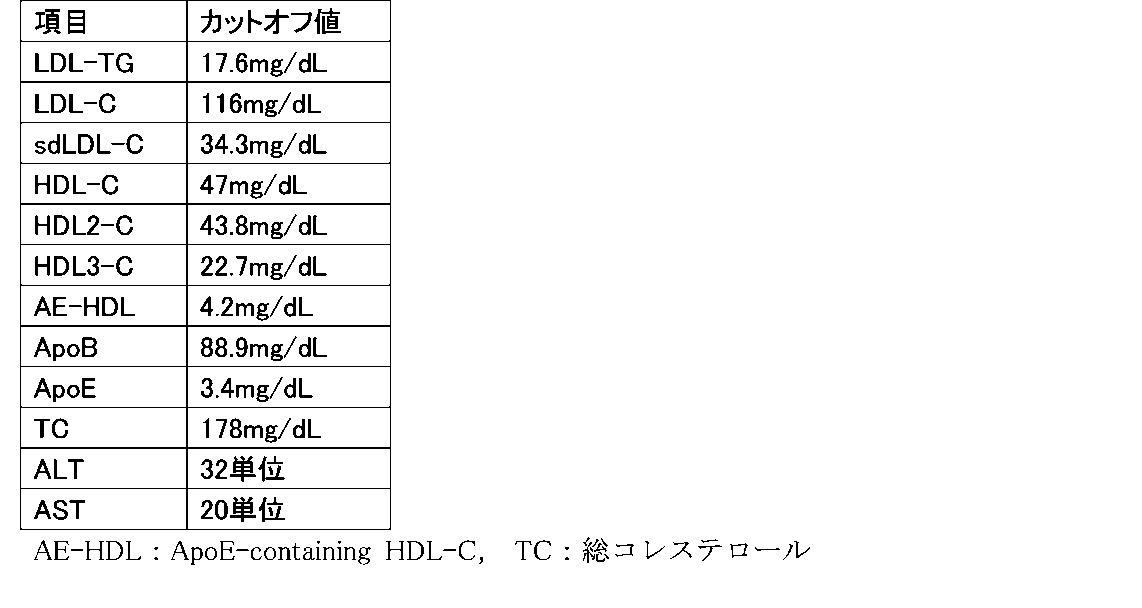
- the cutoff values used in Examples 37 to 47 are 17.6 mg / dL for LDL-TG, 116 mg / dL for LDL-C, 34.3 mg / dL for sdLDL-C, and HDL.
- / dL and ApoE are 3.4 mg / dL
- total cholesterol (TC) is 178 mg / dL
- ALT is 32 units
- AST is 20 units
- the abundance of LDL-TG is equal to or higher than the cutoff value and
- the abundance of any of the test items selected from LDL-C, LDL subfraction-C, HDL-C, HDL subfraction-C, ApoB, total cholesterol, ALT, and AST is
- the cutoff value can be arbitrarily set according to the purpose such as whether sensitivity is prioritized or specificity is prioritized, and the combination is not limited to this.
- the cutoff value is set within the range of ⁇ 50% of the above values (values shown in Table 5) used in Examples 37 to 47, and more preferably within the range of ⁇ 30%. Can be done.
- the abundance of LDL-TG contained in the test blood sample and the LDL-C, LDL subfraction-C, HDL-C, HDL subfraction-C, contained in the test blood sample By using it in combination with at least one abundance selected from ApoB, ApoE, total cholesterol, ALT, and AST, it is easy and simple to distinguish between NASH and NAFL, which conventionally required liver biopsy. It can be assisted with high accuracy.
- LDL-TG and LDL-C, LDL subfraction-C, HDL-C in a human test blood sample suspected of having non-alcoholic steatosis or suffering from non-alcoholic steatosis are also provided for detecting at least one component selected from the group. That is, LDL-TG and LDL-C, LDL subfraction-C, HDL-C, and HDL subdivisions in human test blood samples suspected of having non-alcoholic steatosis or suffering from non-alcoholic steatosis.
- a method of detecting at least one component selected from the group consisting of picture-C, ApoB, ApoE, total cholesterol, ALT, and AST The process of obtaining a blood sample from humans, the abundance of LDL-TG in the blood sample, LDL-C, LDL subfraction-C, HDL-C, HDL subfraction-C, ApoB, ApoE, total cholesterol. Includes the step of measuring the abundance of at least one component selected from the group consisting of, ALT, and AST.
- a model formula is created in which the abundance of the LDL-TG and the abundance of the at least one component are variables, and the abundance of the LDL-TG contained in the blood sample and the at least one component are used. Also provided is a method in which the score obtained by substituting the abundance of is into the model formula is higher than the score obtained for blood samples of patients suffering from non-alcoholic fatty liver.
- Non-alcoholic steatohepatitis when the detection of non-alcoholic steatohepatitis is assisted by the method of the present invention described above, by administering an effective amount of the therapeutic agent for non-alcoholic steatohepatitis to the patient in which non-alcoholic steatohepatitis is detected, Non-alcoholic steatohepatitis can be treated.
- the therapeutic agent include pioglitazone in patients with diabetes and vitamin E in patients without diabetes.
- the abundance of LDL-C, sdLDL-C, HDL2-C, HDL3-C, HDL-C, ApoE-contining HDL-C, ApoB, ApoE, total cholesterol, ALT, and AST contained in a blood sample As a method for measuring the above, a conventionally known method can be used. For example, as a method for measuring various lipid items, a method for quantifying triglyceride and cholesterol by a quantification operation after separating a target lipoprotein by a fractionation separation operation such as ultracentrifugation, electrophoresis or high-speed liquid chromatography.
- a method of measuring triglyceride and cholesterol in the target lipoprotein in the second step after removing triglyceride and cholesterol in all lipoproteins other than the target lipoprotein in the first step without performing fractionation operation, etc. can be mentioned.
- Examples of the method for measuring ApoB and ApoE include an ELISA method using an antibody specific to these and an immunononturbation method.
- Examples of the ALT measurement method include the LDH-UV method (JSCC standard method), and the AST measurement method includes the MDH-UV method (JSCC standard method).
- the method described in WO2013 / 157642 can be used as the method for measuring the amount of LDL-TG
- the method described in WO98 / 47005 can be used as the method for measuring the amount of LDL-C.
- the method described in WO08 / 105486 can be used as the method for measuring the amount of sdLDL-C
- the method described in WO98 / 26090 can be used as the method for measuring the amount of HDL-C.
- a method for measuring the amount of HDL3-C Ito Y et al.
- the amount, ApoE-contining HDL-C amount, ApoB amount, ApoE amount, total cholesterol amount, ALT amount, and AST amount were measured using an automatic analyzer.
- each measuring reagent for an automatic analyzer generally used in clinical examinations is used. board.
- Table 2 shows the model formulas obtained by logistic regression for each combination.
- the score value can be obtained by substituting the measured value of each item into the item name shown in this model formula.
- AUC Area under the ROC curve
- sensitivity when judged by comparing the reference value with the score value.
- PPV positive predictive value
- NPV negative predictive value
- correct diagnosis rate is shown in Tables 3-1 and 3-2. Further, as a representative of these, the ROC curve of Example 20 is shown in FIG.
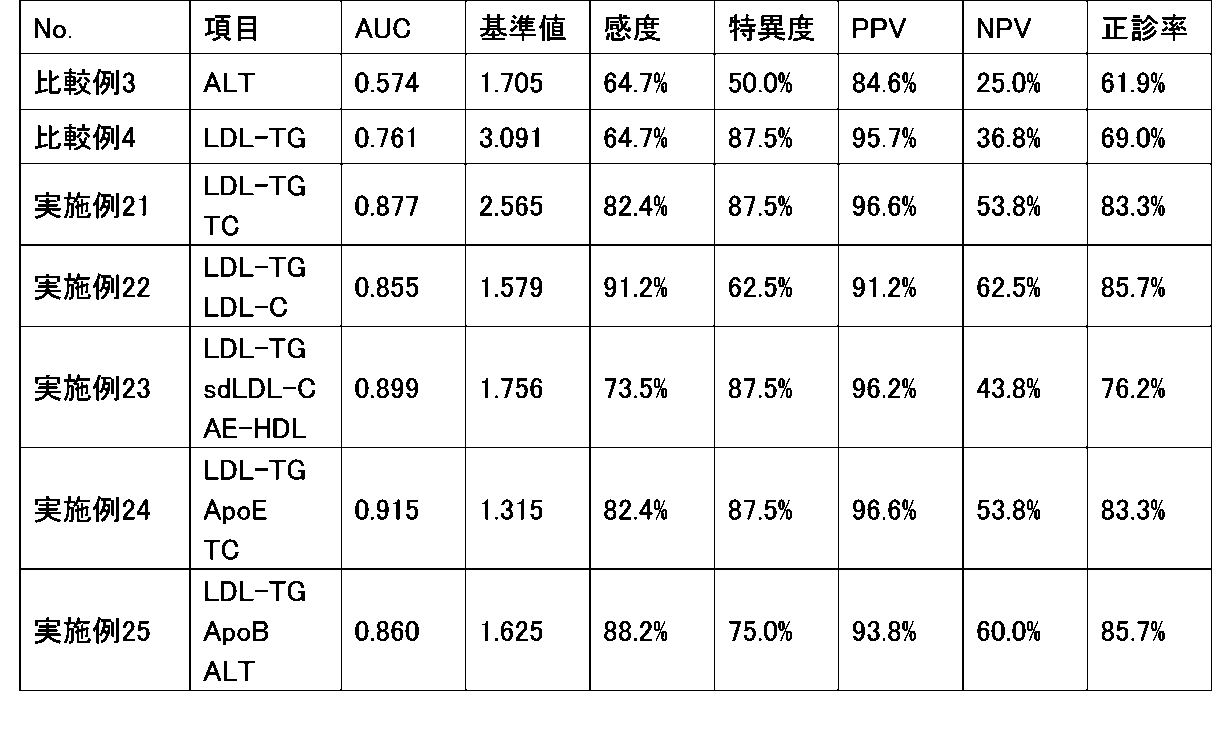
- both Examples 1 to 20 are compared with Comparative Example 1 of ALT alone, which is a conventional liver disease marker, and Comparative Example 2 of LDL-TG alone. Since the AUC is large and the accuracy rate is high, it was shown that it is possible to predict NASH or NAFL with a higher probability.
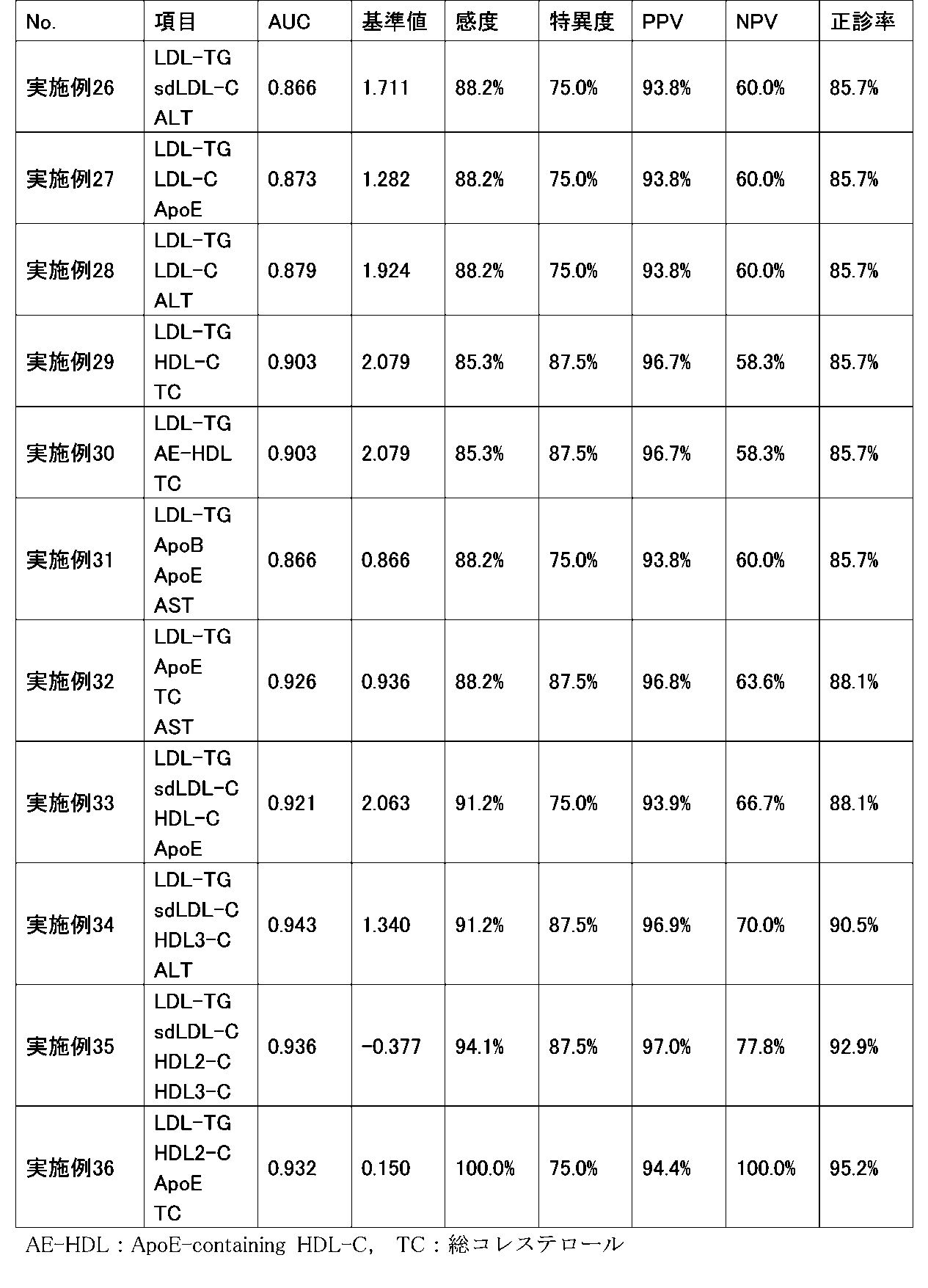
- Comparative Examples 3 and 4, Examples 21 to 36 In Comparative Examples 3 and 4, and Examples 21 to 36, the items shown in Table 4 were used, and the abundance of each item was two groups based on the cutoff value obtained by Youden Index when the ROC curve was calculated for each item alone. The binary variables divided into are used respectively.
- Table 5 shows the cutoff values of each item used in Comparative Examples 3 and 4 and Examples 21 to 36.
- Table 6 shows the model formulas obtained by logistic regression for each combination.
- a score value can be obtained by substituting 1 for the item name shown in this model formula when the measured value of each item is larger than the cutoff value and 0 when the measured value is smaller than the cutoff value.
- AUC Area under the ROC curve
- sensitivity when judged by comparing the reference value with the score value.
- PPV positive predictive value
- NPV negative predictive value
- correct diagnosis rate is shown in Tables 7-1 and 7-2. Further, as a representative of these, the ROC curve of Example 36 is shown in FIG.
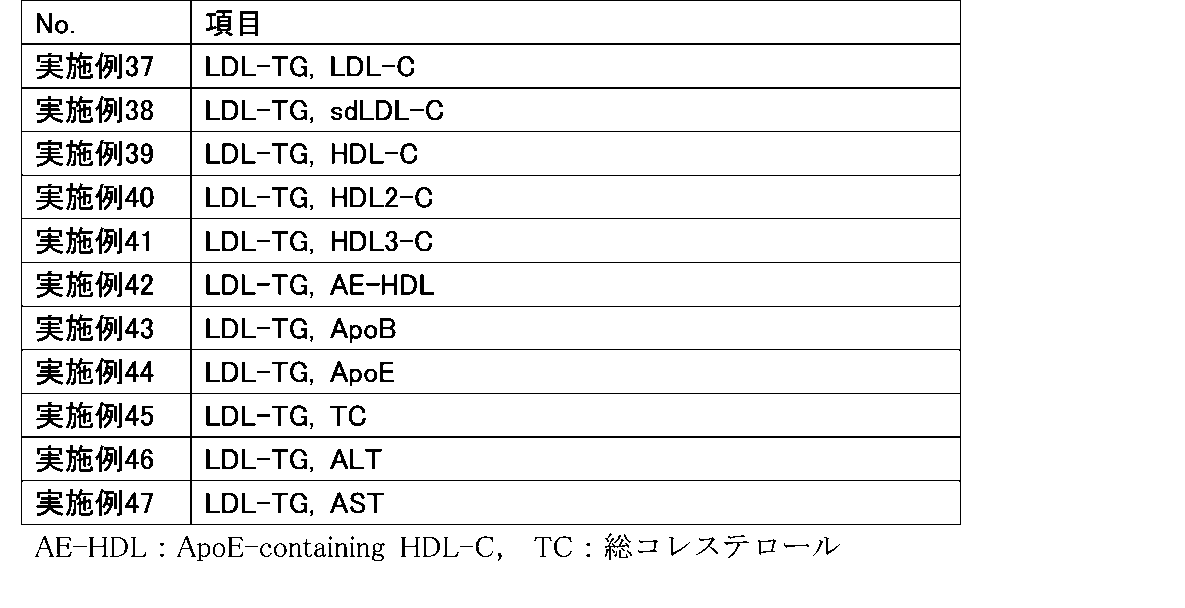
- Example 37 to 47 In Examples 37 to 47, the items shown in Table 8 are used, and the abundance of each component contained in the test blood sample is a combination of the cutoff value or more and the cutoff value or less without using the model formula. evaluated. The values shown in Table 5 were used as the cutoff values for each item.
- Table 9 shows the combination of the measured values of each item evaluated in Examples 37 to 47, the number of applicable persons, and the ratio of NASH patients among the applicable persons.
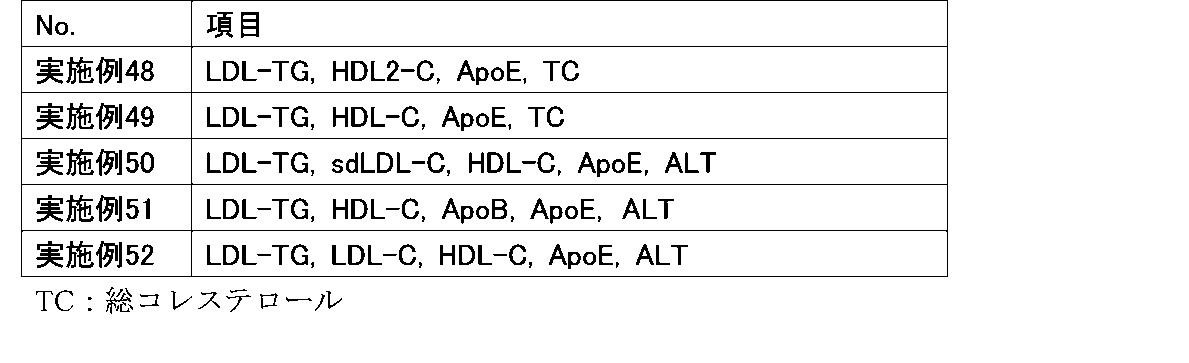
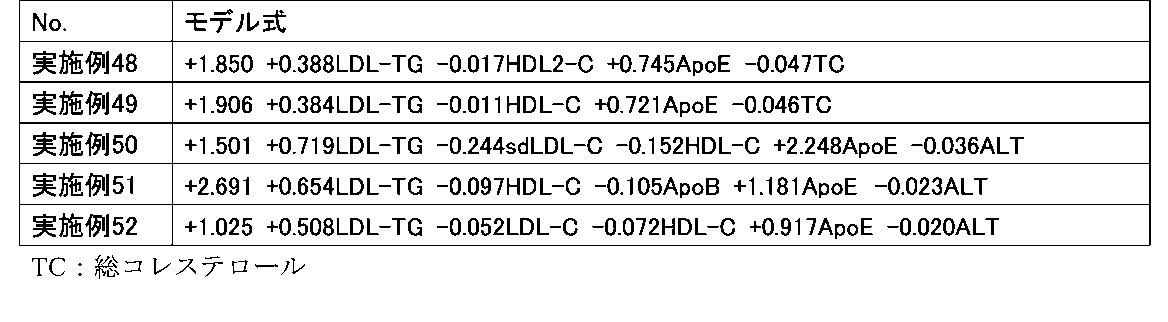
- Example 48 to 52 In Examples 48 to 52, the items shown in Table 10 were used, and continuous variables as measured values were used as their abundances.
- Table 11 shows the model formulas obtained by logistic regression for each combination.
- the score value can be obtained by substituting the measured value of each item into the item name shown in this model formula.
- AUC Area under the ROC curve
- both Examples 48 to 52 are compared with Comparative Example 1 of ALT alone, which is a conventional liver disease marker shown in Table 3-1 and Comparative Example 2 of LDL-TG alone. Since the AUC is large and the accuracy rate is high, it was shown that it is possible to predict NASH or NAFL with a higher probability.
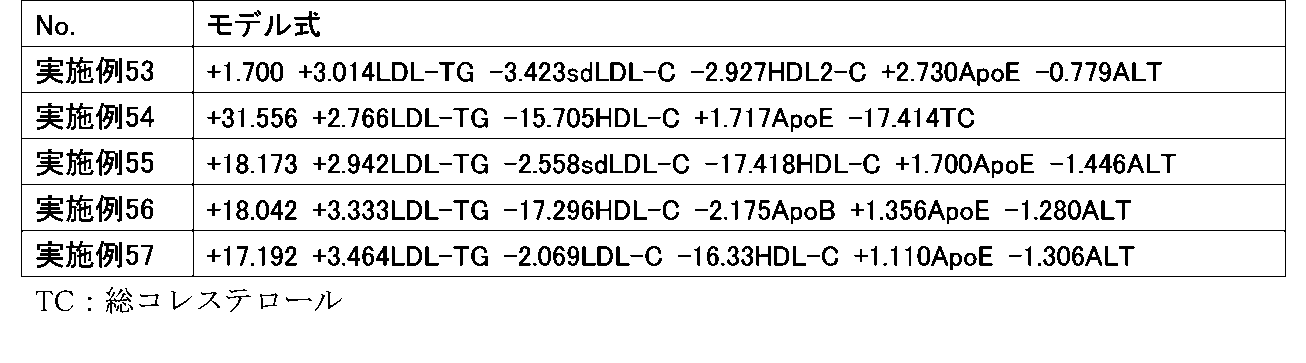
- Example 53 to 57 In Examples 53 to 57, the items shown in Table 13 were used, and as their abundance, binary variables were divided into two groups according to the cutoff value obtained by the Youden Index when the ROC curve was obtained for each item alone. Were used respectively. The values shown in Table 5 were used as the cutoff values for each item.
- Table 14 shows the model formulas obtained by logistic regression for each combination.
- a score value can be obtained by substituting 1 for the item name shown in this model formula when the measured value of each item is larger than the cutoff value and 0 when the measured value is smaller than the cutoff value.
- AUC Area under the ROC curve
Landscapes
- Life Sciences & Earth Sciences (AREA)
- Health & Medical Sciences (AREA)
- Engineering & Computer Science (AREA)
- Chemical & Material Sciences (AREA)
- Molecular Biology (AREA)
- Immunology (AREA)
- Biomedical Technology (AREA)
- Urology & Nephrology (AREA)
- Hematology (AREA)
- General Health & Medical Sciences (AREA)
- Biotechnology (AREA)
- Microbiology (AREA)
- Analytical Chemistry (AREA)
- Biochemistry (AREA)
- Physics & Mathematics (AREA)
- Organic Chemistry (AREA)
- Biophysics (AREA)
- Proteomics, Peptides & Aminoacids (AREA)
- Cell Biology (AREA)
- Food Science & Technology (AREA)
- Medicinal Chemistry (AREA)
- General Physics & Mathematics (AREA)
- Pathology (AREA)
- Zoology (AREA)
- Wood Science & Technology (AREA)
- Endocrinology (AREA)
- Genetics & Genomics (AREA)
- General Engineering & Computer Science (AREA)
- Bioinformatics & Cheminformatics (AREA)
- Investigating Or Analysing Biological Materials (AREA)
Abstract
Description
[1]非アルコール性脂肪肝炎の検出を補助する方法であって
a)生体から分離された被検血液試料中に含まれるLDL-TGの存在量を測定すること、
b)前記被検血液試料中に含まれるLDL-C、LDL亜分画-C、HDL-C、HDL亜分画-C、ApoB、ApoE、総コレステロール、ALT、およびASTからなる群から選ばれる少なくとも1つの成分の存在量を測定すること、ならびに
c)前記LDL-TGの存在量、および前記少なくとも1つの成分の存在量を組み合わせて用いることにより、非アルコール性脂肪肝炎の発症および/または非アルコール性脂肪肝炎を発症している可能性を判定すること、を含む方法。
[2]前記LDL亜分画-Cがsmall,dense(sd)LDL-Cである、[1]に記載の方法。
[3]前記HDL亜分画-CがApoE containing HDL-Cおよび/またはHDL2-Cおよび/またはHDL3-Cである、[1]に記載の方法。
[4]LDL-TGの存在量、ならびにLDL-C、LDL亜分画-C、HDL-C、HDL亜分画-C、ApoB、ApoE、総コレステロール、ALT、およびASTからなる群から選ばれる少なくとも1つの成分の存在量を変数とするモデル式を作成し、前記被検血液試料中に含まれる前記LDL-TGの存在量、および前記少なくとも1つの成分の存在量を前記モデル式に代入して求めたスコアが、非アルコール性脂肪肝を患う患者の血液試料について求めたスコアよりも高い場合に、非アルコール性脂肪肝炎を発症している可能性が高いと判定する、[1]~[3]のいずれかに記載の方法。
[5]非アルコール性脂肪肝炎の検出を補助するための指標を求めるモデル式の作成方法であって、非アルコール性脂肪肝炎を患う患者および非アルコール性脂肪肝を患う患者の血液試料中のLDL-TGの存在量、ならびにLDL-C、LDL亜分画-C、HDL-C、HDL亜分画-C、ApoB、ApoE、総コレステロール、ALT、およびASTからなる群から選ばれる少なくとも1つの成分の存在量を測定し、測定した前記存在量を変数として用いてモデル式を作成する、モデル式の作成方法。
[6][1]~[4]のいずれかに記載の、非アルコール性脂肪肝炎の検出を補助する方法に用いられる測定用キットであって、LDL-TGの測定用試薬、ならびにLDL-C、LDL亜分画-C、HDL-C、HDL亜分画-C、ApoB、ApoE、総コレステロール、ALT、およびASTからなる群から選ばれる少なくとも1つの成分の測定用試薬を含む測定用キット。
[7]前記LDL亜分画-Cがsmall,dense(sd)LDL-Cである、[6]に記載のキット。
[8]前記HDL亜分画-CがApoE containing HDL-Cおよび/またはHDL2-Cおよび/またはHDL3-Cである、[6]に記載のキット。
[9][1]~[4]のいずれかに記載のキットの、非アルコール性脂肪肝炎の検出を補助するためのキットとしての使用。
本発明においては、生体から分離された被検血液試料中に含まれるLDL-TGの存在量を測定する。また、該被検血液試料中に含まれるLDL-C、LDL亜分画-C、HDL-C、HDL亜分画-C、ApoB、ApoE、総コレステロール、ALTおよびASTからなる群から選ばれる少なくとも1つの成分の存在量を測定する。そして、測定したLDL-TGの存在量、および前記少なくとも1つの成分の存在量を組み合わせてNASHの検出を補助するための指標とする。
(式(1)中のaは切片を表し、b~mは各測定値に対する係数を表しており、a~mはa~mのそれぞれの数に同一の正の数を乗じた数であってもよい)
すなわち、非アルコール性脂肪肝炎が疑われる又は非アルコール性脂肪肝炎に罹患するヒトの被検血液試料中のLDL-TGと、LDL-C、LDL亜分画-C、HDL-C、HDL亜分画-C、ApoB、ApoE、総コレステロール、ALT、およびASTからなる群から選ばれる少なくとも1つの成分を検出する方法であって、
ヒトから血液試料を得る工程、及び
前記血液試料内のLDL-TGの存在量と、LDL-C、LDL亜分画-C、HDL-C、HDL亜分画-C、ApoB、ApoE、総コレステロール、ALT、およびASTからなる群から選ばれる少なくとも1つの成分の存在量を測定する工程を含み、
ここで、前記LDL-TGの存在量および前記少なくとも1つの成分の存在量を変数とするモデル式を作成し、前記血液試料中に含まれる前記LDL-TGの存在量、および前記少なくとも1つの成分の存在量を前記モデル式に代入して求めたスコアが、非アルコール性脂肪肝を患う患者の血液試料について求めたスコアよりも高い方法、も提供される。
比較例1および2、実施例1~20には、表1に示す項目を用い、その存在量として、測定値そのままの連続変数をそれぞれ用いた。


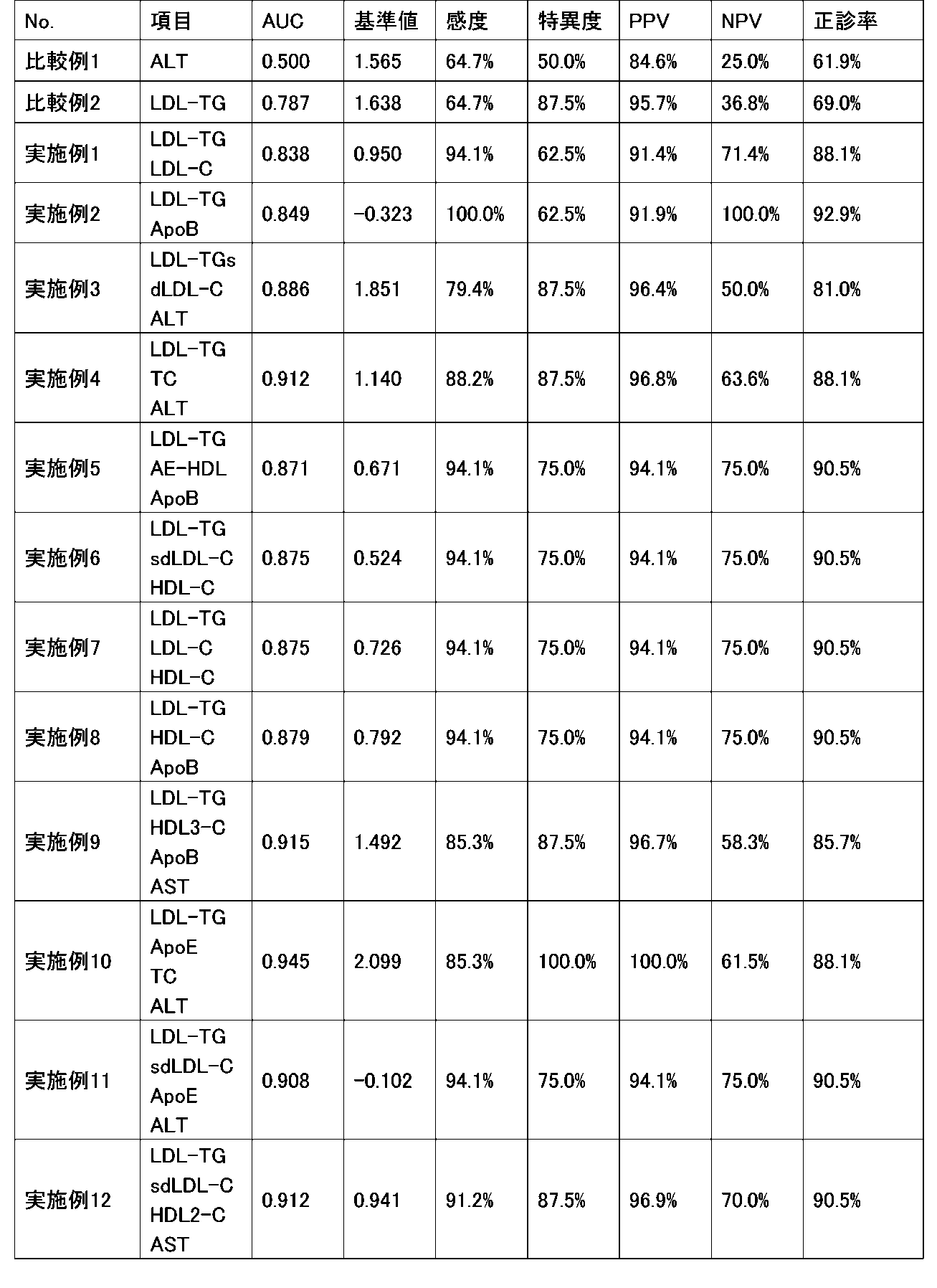
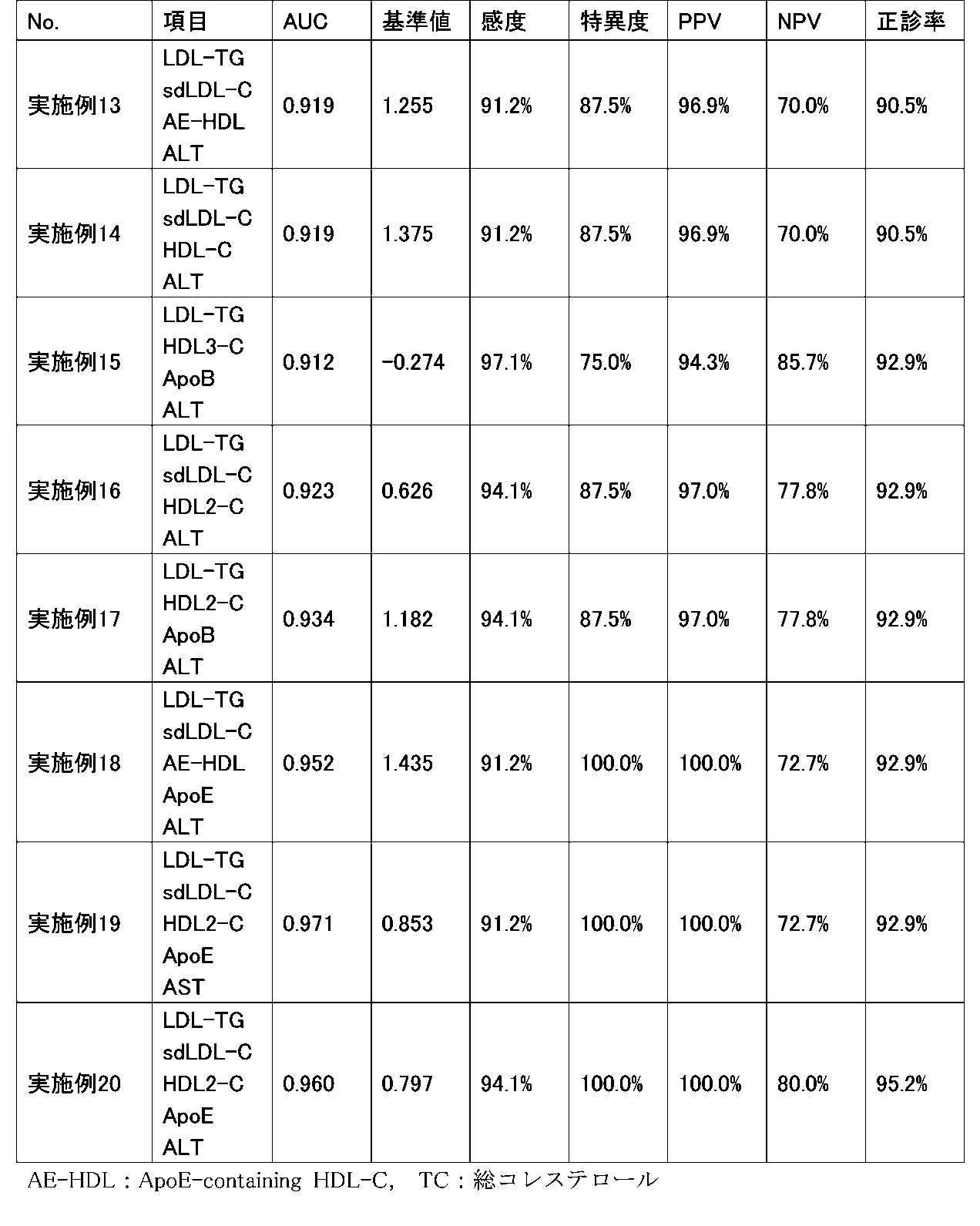
比較例3および4、実施例21~36には、表4に示す項目を用い、その存在量として、各項目単独でROC曲線をもとめた際のYouden Indexにて求めたカットオフ値で2群に分けた2値変数をそれぞれ用いた。

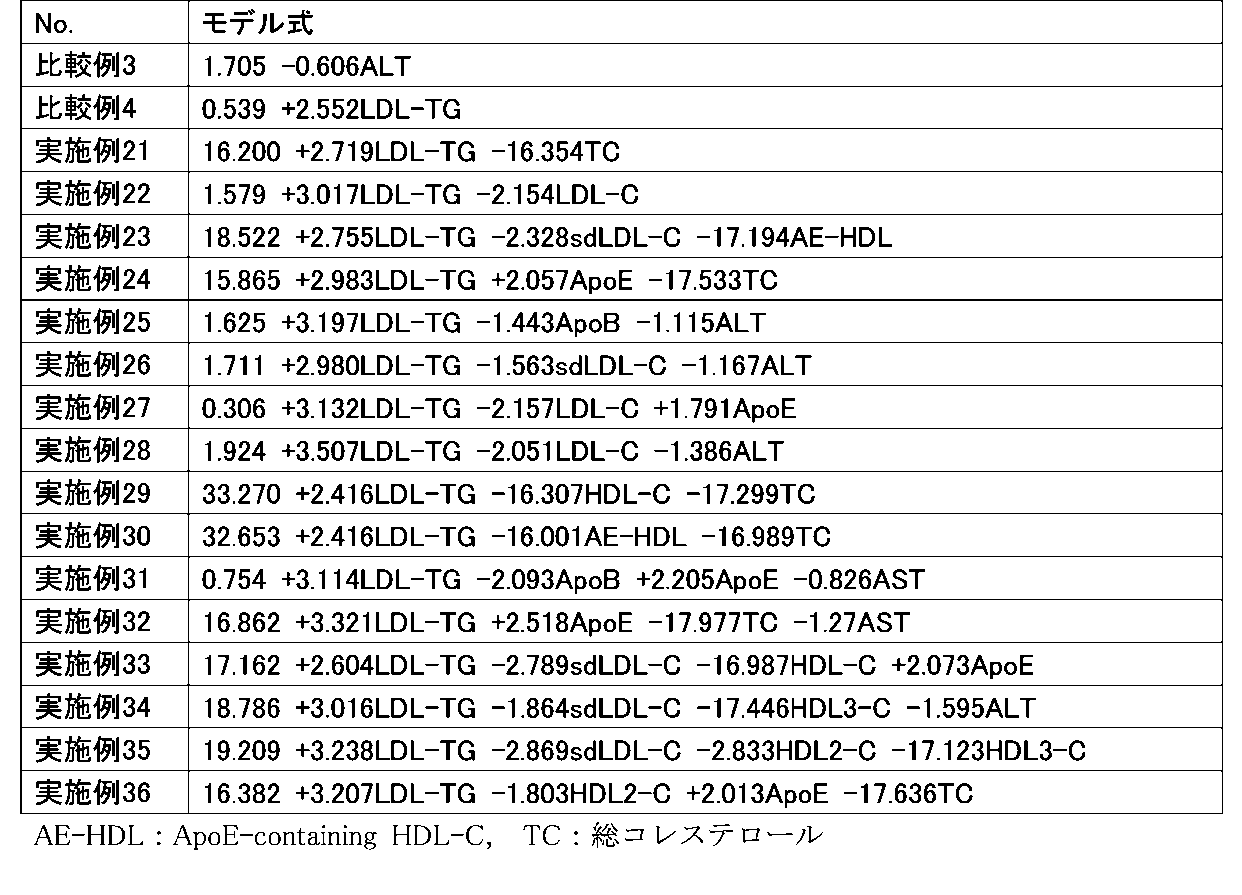
実施例37~47には、表8に示す項目を用い、モデル式を用いることなく、被検血液試料中に含まれる各成分の存在量がカットオフ値以上かカットオフ値以下かの組み合わせで評価した。各項目のカットオフ値には表5に示した値を用いた。

実施例48~52には、表10に示す項目を用い、その存在量として、測定値そのままの連続変数をそれぞれ用いた。

実施例53~57には、表13に示す項目を用い、その存在量として、各項目単独でROC曲線をもとめた際のYouden Indexにて求めたカットオフ値で2群に分けた2値変数をそれぞれ用いた。各項目のカットオフ値には表5に示した値を用いた。


Claims (9)
- 非アルコール性脂肪肝炎の検出を補助する方法であって
a)生体から分離された被検血液試料中に含まれるLDL-TGの存在量を測定すること、
b)前記被検血液試料中に含まれるLDL-C、LDL亜分画-C、HDL-C、HDL亜分画-C、ApoB、ApoE、総コレステロール、ALT、およびASTからなる群から選ばれる少なくとも1つの成分の存在量を測定すること、ならびに
c)前記LDL-TGの存在量、および前記少なくとも1つの成分の存在量を組み合わせて用いることにより、非アルコール性脂肪肝炎の発症および/または非アルコール性脂肪肝炎を発症している可能性を判定すること、を含む方法。 - 前記LDL亜分画-Cがsmall,dense(sd)LDL-Cである、請求項1に記載の方法。
- 前記HDL亜分画-CがApoE containing HDL-Cおよび/またはHDL2-Cおよび/またはHDL3-Cである、請求項1に記載の方法。
- LDL-TGの存在量、ならびにLDL-C、LDL亜分画-C、HDL-C、HDL亜分画-C、ApoB、ApoE、総コレステロール、ALT、およびASTからなる群から選ばれる少なくとも1つの成分の存在量を変数とするモデル式を作成し、前記被検血液試料中に含まれる前記LDL-TGの存在量、および前記少なくとも1つの成分の存在量を前記モデル式に代入して求めたスコアが、非アルコール性脂肪肝を患う患者の血液試料について求めたスコアよりも高い場合に、非アルコール性脂肪肝炎を発症している可能性が高いと判定する、請求項1~3のいずれかに記載の方法。
- 非アルコール性脂肪肝炎の検出を補助するための指標を求めるモデル式の作成方法であって、非アルコール性脂肪肝炎を患う患者および非アルコール性脂肪肝を患う患者の血液試料中のLDL-TGの存在量、ならびにLDL-C、LDL亜分画-C、HDL-C、HDL亜分画-C、ApoB、ApoE、総コレステロール、ALT、およびASTからなる群から選ばれる少なくとも1つの成分の存在量を測定し、測定した前記存在量を変数として用いてモデル式を作成する、モデル式の作成方法。
- 請求項1~4のいずれかに記載の、非アルコール性脂肪肝炎の検出を補助する方法に用いられる測定用キットであって、LDL-TGの測定用試薬、ならびにLDL-C、LDL亜分画-C、HDL-C、HDL亜分画-C、ApoB、ApoE、総コレステロール、ALT、およびASTからなる群から選ばれる少なくとも1つの成分の測定用試薬を含む測定用キット。
- 前記LDL亜分画-Cがsmall,dense(sd)LDL-Cである、請求項6に記載のキット。
- 前記HDL亜分画-CがApoE containing HDL-Cおよび/またはHDL2-Cおよび/またはHDL3-Cである、請求項6に記載のキット。
- 請求項6~8のいずれかに記載のキットの、非アルコール性脂肪肝炎の検出を補助するためのキットとしての使用。
Priority Applications (4)
| Application Number | Priority Date | Filing Date | Title |
|---|---|---|---|
| US17/797,284 US12571806B2 (en) | 2020-02-04 | 2021-02-04 | Method for assisting detection of non-alcoholic steatohepatitis |
| EP21750163.4A EP4080221A4 (en) | 2020-02-04 | 2021-02-04 | Method for assisting detection of non-alcoholic steatohepatitis |
| CN202180012717.6A CN115004033B (zh) | 2020-02-04 | 2021-02-04 | 辅助检测非酒精性脂肪肝炎的方法 |
| JP2021575841A JP7627467B2 (ja) | 2020-02-04 | 2021-02-04 | 非アルコール性脂肪肝炎の検出を補助する方法 |
Applications Claiming Priority (2)
| Application Number | Priority Date | Filing Date | Title |
|---|---|---|---|
| JP2020016820 | 2020-02-04 | ||
| JP2020-016820 | 2020-02-04 |
Publications (1)
| Publication Number | Publication Date |
|---|---|
| WO2021157631A1 true WO2021157631A1 (ja) | 2021-08-12 |
Family
ID=77199639
Family Applications (1)
| Application Number | Title | Priority Date | Filing Date |
|---|---|---|---|
| PCT/JP2021/004008 Ceased WO2021157631A1 (ja) | 2020-02-04 | 2021-02-04 | 非アルコール性脂肪肝炎の検出を補助する方法 |
Country Status (5)
| Country | Link |
|---|---|
| US (1) | US12571806B2 (ja) |
| EP (1) | EP4080221A4 (ja) |
| JP (1) | JP7627467B2 (ja) |
| CN (1) | CN115004033B (ja) |
| WO (1) | WO2021157631A1 (ja) |
Cited By (1)
| Publication number | Priority date | Publication date | Assignee | Title |
|---|---|---|---|---|
| CN116577509A (zh) * | 2022-02-10 | 2023-08-11 | 香港中文大学深圳研究院 | 非酒精性脂肪性肝炎生物标志物组合物及其应用 |
Citations (12)
| Publication number | Priority date | Publication date | Assignee | Title |
|---|---|---|---|---|
| WO1998026090A1 (en) | 1996-12-09 | 1998-06-18 | Denka Seiken Co., Ltd. | Method of determining cholesterol content of high-density lipoproteins |
| WO1998047005A1 (en) | 1997-04-14 | 1998-10-22 | Denka Seiken Co., Ltd. | Method for quantitating cholesterol present in low density lipoproteins |
| WO2005109006A1 (ja) * | 2004-04-23 | 2005-11-17 | Ajinomoto Co., Inc. | 非アルコール性脂肪肝炎鑑別方法 |
| WO2008105486A1 (ja) | 2007-02-28 | 2008-09-04 | Denka Seiken Co., Ltd. | 小粒子低比重リポ蛋白の定量試薬 |
| JP2010094131A (ja) | 2007-08-29 | 2010-04-30 | Shinshu Univ | 非アルコール性脂肪肝炎治療効果の判定マーカー |
| WO2011158769A1 (ja) * | 2010-06-17 | 2011-12-22 | 国立大学法人 千葉大学 | 非アルコール性脂肪肝炎検出および/または鑑別用マーカー、非アルコール性脂肪肝炎を検出および/または鑑別する方法およびそれらに用いるキット |
| WO2012105590A1 (ja) * | 2011-02-01 | 2012-08-09 | アステラス製薬株式会社 | 非アルコール性脂肪肝炎の鑑別マーカー及び当該マーカーを指標とした非アルコール性脂肪肝炎の診断方法 |
| WO2013157642A1 (ja) | 2012-04-20 | 2013-10-24 | デンカ生研株式会社 | 低密度リポ蛋白以外のリポ蛋白中のトリグリセリドの消去方法 |
| JP2014030393A (ja) | 2012-08-03 | 2014-02-20 | Denka Seiken Co Ltd | 高密度リポ蛋白(hdl)中のコレステロールの定量方法 |
| JP2018508774A (ja) * | 2015-02-13 | 2018-03-29 | ザ リージェンツ オブ ザ ユニバーシティ オブ カリフォルニア | 非アルコール性脂肪性肝疾患を特定するための方法及び組成物 |
| JP2018080943A (ja) | 2016-11-14 | 2018-05-24 | 株式会社特殊免疫研究所 | Nashの検出方法 |
| WO2019175962A1 (ja) * | 2018-03-13 | 2019-09-19 | デンカ生研株式会社 | 循環器疾患等のリスクの判断を補助する方法 |
Family Cites Families (7)
| Publication number | Priority date | Publication date | Assignee | Title |
|---|---|---|---|---|
| DE202004007534U1 (de) | 2004-05-07 | 2004-08-19 | Lindenmaier Maschinenbau Gmbh & Co. Kg | Werkzeugmaschine |
| JP5854474B2 (ja) | 2010-04-28 | 2016-02-09 | 国立大学法人北海道大学 | 軽度に酸化された酸化低密度リポタンパク質に対するモノクローナル抗体およびこれを産生するハイブリドーマ |
| CN107002113A (zh) * | 2014-11-19 | 2017-08-01 | 梅塔博隆股份有限公司 | 脂肪肝病的生物标志物和其使用方法 |
| EA201892201A1 (ru) * | 2016-03-30 | 2019-03-29 | Женфит | Неинвазивная диагностика неалкогольного стеатогепатита |
| CN108535488B (zh) * | 2017-03-03 | 2023-10-31 | 北京市心肺血管疾病研究所 | 利用含载脂蛋白e的高密度脂蛋白的值对冠心病发病风险的评价方法 |
| US11513131B2 (en) * | 2018-01-22 | 2022-11-29 | Global Genomics Group, LLC | Low density lipoprotein triglycerides (LDL-TG) as a biomarker of cardiovascular disease and uses thereof |
| JP7029139B2 (ja) * | 2018-08-23 | 2022-03-03 | デンカ株式会社 | 非アルコール性脂肪性肝炎の検出を補助する方法 |
-
2021
- 2021-02-04 US US17/797,284 patent/US12571806B2/en active Active
- 2021-02-04 JP JP2021575841A patent/JP7627467B2/ja active Active
- 2021-02-04 WO PCT/JP2021/004008 patent/WO2021157631A1/ja not_active Ceased
- 2021-02-04 EP EP21750163.4A patent/EP4080221A4/en not_active Withdrawn
- 2021-02-04 CN CN202180012717.6A patent/CN115004033B/zh active Active
Patent Citations (12)
| Publication number | Priority date | Publication date | Assignee | Title |
|---|---|---|---|---|
| WO1998026090A1 (en) | 1996-12-09 | 1998-06-18 | Denka Seiken Co., Ltd. | Method of determining cholesterol content of high-density lipoproteins |
| WO1998047005A1 (en) | 1997-04-14 | 1998-10-22 | Denka Seiken Co., Ltd. | Method for quantitating cholesterol present in low density lipoproteins |
| WO2005109006A1 (ja) * | 2004-04-23 | 2005-11-17 | Ajinomoto Co., Inc. | 非アルコール性脂肪肝炎鑑別方法 |
| WO2008105486A1 (ja) | 2007-02-28 | 2008-09-04 | Denka Seiken Co., Ltd. | 小粒子低比重リポ蛋白の定量試薬 |
| JP2010094131A (ja) | 2007-08-29 | 2010-04-30 | Shinshu Univ | 非アルコール性脂肪肝炎治療効果の判定マーカー |
| WO2011158769A1 (ja) * | 2010-06-17 | 2011-12-22 | 国立大学法人 千葉大学 | 非アルコール性脂肪肝炎検出および/または鑑別用マーカー、非アルコール性脂肪肝炎を検出および/または鑑別する方法およびそれらに用いるキット |
| WO2012105590A1 (ja) * | 2011-02-01 | 2012-08-09 | アステラス製薬株式会社 | 非アルコール性脂肪肝炎の鑑別マーカー及び当該マーカーを指標とした非アルコール性脂肪肝炎の診断方法 |
| WO2013157642A1 (ja) | 2012-04-20 | 2013-10-24 | デンカ生研株式会社 | 低密度リポ蛋白以外のリポ蛋白中のトリグリセリドの消去方法 |
| JP2014030393A (ja) | 2012-08-03 | 2014-02-20 | Denka Seiken Co Ltd | 高密度リポ蛋白(hdl)中のコレステロールの定量方法 |
| JP2018508774A (ja) * | 2015-02-13 | 2018-03-29 | ザ リージェンツ オブ ザ ユニバーシティ オブ カリフォルニア | 非アルコール性脂肪性肝疾患を特定するための方法及び組成物 |
| JP2018080943A (ja) | 2016-11-14 | 2018-05-24 | 株式会社特殊免疫研究所 | Nashの検出方法 |
| WO2019175962A1 (ja) * | 2018-03-13 | 2019-09-19 | デンカ生研株式会社 | 循環器疾患等のリスクの判断を補助する方法 |
Non-Patent Citations (3)
| Title |
|---|
| FUJII, YUK I ET AL.: "Low-Density Lipoprotein(LDL)- Triglyceride and Its Ratio to LDL-Cholesterol as Diagnostic Biomarkers for Nonalcoholic Steatohepatitis", THE JOURNAL OF APPLIED LABORATORY MEDICINE, vol. 5, no. 6, 1 May 2020 (2020-05-01), pages 1206 - 1215, XP055845475 * |
| ITO Y ET AL.: "Development of a homogeneous assay for measurement of high-density lipoprotein-subclass cholesterol", CLINICA CHIMICA ACTA, vol. 427, 2014, pages 86 - 93, XP028791456, DOI: 10.1016/j.cca.2013.09.009 |
| See also references of EP4080221A4 |
Cited By (2)
| Publication number | Priority date | Publication date | Assignee | Title |
|---|---|---|---|---|
| CN116577509A (zh) * | 2022-02-10 | 2023-08-11 | 香港中文大学深圳研究院 | 非酒精性脂肪性肝炎生物标志物组合物及其应用 |
| WO2023151651A1 (zh) * | 2022-02-10 | 2023-08-17 | 香港中文大学深圳研究院 | 非酒精性脂肪性肝炎生物标志物组合物及其应用 |
Also Published As
| Publication number | Publication date |
|---|---|
| EP4080221A1 (en) | 2022-10-26 |
| CN115004033A (zh) | 2022-09-02 |
| JPWO2021157631A1 (ja) | 2021-08-12 |
| CN115004033B (zh) | 2026-03-20 |
| EP4080221A4 (en) | 2023-06-28 |
| US12571806B2 (en) | 2026-03-10 |
| US20230060781A1 (en) | 2023-03-02 |
| JP7627467B2 (ja) | 2025-02-06 |
Similar Documents
| Publication | Publication Date | Title |
|---|---|---|
| Xie et al. | Serum metabolite profiles are associated with the presence of advanced liver fibrosis in Chinese patients with chronic hepatitis B viral infection | |
| Amor et al. | Relationship between noninvasive scores of nonalcoholic fatty liver disease and nuclear magnetic resonance lipoprotein abnormalities: a focus on atherogenic dyslipidemia | |
| Yan et al. | Total bile acid-to-cholesterol ratio as a novel noninvasive marker for significant liver fibrosis and cirrhosis in patients with non-cholestatic chronic hepatitis B virus infection | |
| Bervoets et al. | Identification of metabolic phenotypes in childhood obesity by 1H NMR metabolomics of blood plasma | |
| EP2810079A1 (en) | Method for determining liver fat amount and method for diagnosing nafld | |
| CN112654869B (zh) | 辅助检测非酒精性脂肪性肝炎的方法 | |
| JP7627467B2 (ja) | 非アルコール性脂肪肝炎の検出を補助する方法 | |
| JP7049137B2 (ja) | ApoE-containingHDL値を用いた冠動脈心疾患発症リスクの評価方法 | |
| Yilmaz | Serum proteomics for biomarker discovery in nonalcoholic fatty liver disease | |
| Li et al. | The relationship between the ratio of non-high-density lipoprotein cholesterol to high-density lipoprotein cholesterol (NHHR) and both MASLD and advanced liver fibrosis: Evidence from NHANES 2017–2020 | |
| Zhang et al. | Establishing reference intervals of aspartate aminotransferase-to-platelet ratio index for apparently healthy elderly | |
| JP6967857B2 (ja) | 循環器疾患等のリスクの判断を補助する方法 | |
| JP2023063389A (ja) | 原発性胆汁性胆管炎の検出を補助する方法 | |
| Zhang et al. | Association between urine retinol‐binding protein levels and nonalcoholic fatty liver disease: A cross‐sectional study in Chinese population | |
| Zhong et al. | Establishment of reference intervals of biochemical analytes for healthy Chinese volunteers during the screening process in clinical pharmacology trials | |
| JPWO2010103585A1 (ja) | メタボリック症候群又はその構成疾患の評価法 | |
| CN121633321A (zh) | 预测masld显著纤维化的血清标志物组合及分析系统 | |
| WO2019175962A1 (ja) | 循環器疾患等のリスクの判断を補助する方法 | |
| Elalfy et al. | Assessment of Neutrophil to Lymphocyte Ratio as Predictor of NASH in Obese Patients | |
| WO2025168769A1 (en) | Method for monitoring patients with metabolic dysfunction-associated steatohepatitis | |
| KR20260071291A (ko) | 위험군 대사 이상 지방간염 (mash) 환자의 선별 방법 | |
| KR20230149395A (ko) | 한국 중년 여성의 악력, 고밀도 지단백질-콜레스테롤과 이를 이용한 고감도 c-반응단백 수치 예측 방법 | |
| WO2025008464A2 (en) | Use of a marker or a marker set for determining the risk of an individual to have ascites | |
| Liang et al. | NAFLD Liver Stiffness Score (NLS): A Noninvasive Test to Predict Significant Hepatic Fibrosis in Patients with NAFLD | |
| Marber et al. | Metabolic syndrome and risk of coronary heart |
Legal Events
| Date | Code | Title | Description |
|---|---|---|---|
| 121 | Ep: the epo has been informed by wipo that ep was designated in this application |
Ref document number: 21750163 Country of ref document: EP Kind code of ref document: A1 |
|
| ENP | Entry into the national phase |
Ref document number: 2021575841 Country of ref document: JP Kind code of ref document: A |
|
| ENP | Entry into the national phase |
Ref document number: 2021750163 Country of ref document: EP Effective date: 20220722 |
|
| NENP | Non-entry into the national phase |
Ref country code: DE |
|
| WWG | Wipo information: grant in national office |
Ref document number: 17797284 Country of ref document: US |
|
| WWW | Wipo information: withdrawn in national office |
Ref document number: 2021750163 Country of ref document: EP |