WO2021157636A1 - 有機エレクトロルミネッセンス素子及び電子機器 - Google Patents
有機エレクトロルミネッセンス素子及び電子機器 Download PDFInfo
- Publication number
- WO2021157636A1 WO2021157636A1 PCT/JP2021/004020 JP2021004020W WO2021157636A1 WO 2021157636 A1 WO2021157636 A1 WO 2021157636A1 JP 2021004020 W JP2021004020 W JP 2021004020W WO 2021157636 A1 WO2021157636 A1 WO 2021157636A1
- Authority
- WO
- WIPO (PCT)
- Prior art keywords
- group
- substituted
- unsubstituted
- ring
- carbon atoms
- Prior art date
- Legal status (The legal status is an assumption and is not a legal conclusion. Google has not performed a legal analysis and makes no representation as to the accuracy of the status listed.)
- Ceased
Links
- 0 *C(I*)=*C(I)=NC(c1c(*)c(*)c(-c2c(*)c(-[n]3c4c(*)c(*)c(*)c(*)c4c4c3c(*)c(*)c(*)c4*)c3-[n]4c5c(*)c(*)c(*)c(*)c5c5c4c(*)c(*)c(*)c5)c4c1c(*)c(*)c(S)c4*c2c3-[n]1c2c(*)c(*)cc(*)c2c2c1c(*)c(*)c(*)c2)=* Chemical compound *C(I*)=*C(I)=NC(c1c(*)c(*)c(-c2c(*)c(-[n]3c4c(*)c(*)c(*)c(*)c4c4c3c(*)c(*)c(*)c4*)c3-[n]4c5c(*)c(*)c(*)c(*)c5c5c4c(*)c(*)c(*)c5)c4c1c(*)c(*)c(S)c4*c2c3-[n]1c2c(*)c(*)cc(*)c2c2c1c(*)c(*)c(*)c2)=* 0.000 description 8
- KFPPOYWKGYQIJP-UHFFFAOYSA-N C(C1)C=Cc2c1c(cccc1)c1[n]2-c(cc1)ccc1-c(c1c2cccc1)ccc2-c1nc(-c2ccccc2)nc(-c2cc(-c3ccccc3)ccc2)c1 Chemical compound C(C1)C=Cc2c1c(cccc1)c1[n]2-c(cc1)ccc1-c(c1c2cccc1)ccc2-c1nc(-c2ccccc2)nc(-c2cc(-c3ccccc3)ccc2)c1 KFPPOYWKGYQIJP-UHFFFAOYSA-N 0.000 description 2
- CWTMWTFVIFNOHN-UHFFFAOYSA-N Bc(cc1)ccc1-[n]1c2ccccc2c2c1CCC=C2 Chemical compound Bc(cc1)ccc1-[n]1c2ccccc2c2c1CCC=C2 CWTMWTFVIFNOHN-UHFFFAOYSA-N 0.000 description 1
- FVWMGEPACXXOTB-UHFFFAOYSA-N C(C1)C=Cc2c1c(cccc1)c1[n]2-c(cc1)ccc1-c(cc1)c(cccc2)c2c1-c1nc(-c2ccccc2)nc(-c2ccc(C(c3ccccc3-3)(c4ccccc4)c4cccc(-c(cc5)ccc5-c5nc(-c(cccc67)c6-c6ccccc6C7(c6ccccc6)c6ccccc6)cc(-c(cc6)c(cccc7)c7c6-c(cc6)ccc6-[n]6c7ccccc7c7c6cccc7)n5)c4)c-3c2)c1 Chemical compound C(C1)C=Cc2c1c(cccc1)c1[n]2-c(cc1)ccc1-c(cc1)c(cccc2)c2c1-c1nc(-c2ccccc2)nc(-c2ccc(C(c3ccccc3-3)(c4ccccc4)c4cccc(-c(cc5)ccc5-c5nc(-c(cccc67)c6-c6ccccc6C7(c6ccccc6)c6ccccc6)cc(-c(cc6)c(cccc7)c7c6-c(cc6)ccc6-[n]6c7ccccc7c7c6cccc7)n5)c4)c-3c2)c1 FVWMGEPACXXOTB-UHFFFAOYSA-N 0.000 description 1
- WFJOAHRDGJCDOG-UHFFFAOYSA-N C1=C(c2ccc(-c(cc3-[n]4c5ccccc5c5c4cccc5)ccc3-[n]3c4ccccc4c4c3cccc4)c3c2cccc3)[N-](c2ccccc2)=C1c1ccccc1 Chemical compound C1=C(c2ccc(-c(cc3-[n]4c5ccccc5c5c4cccc5)ccc3-[n]3c4ccccc4c4c3cccc4)c3c2cccc3)[N-](c2ccccc2)=C1c1ccccc1 WFJOAHRDGJCDOG-UHFFFAOYSA-N 0.000 description 1
- HSSADHASJPBNFS-UHFFFAOYSA-N C1=C(c2ccc(-c3cccc(-[n]4c5ccccc5c5c4cccc5)c3)c3c2cccc3)N=C(c2ccccc2)NC1c(cc1)ccc1-c1ccccc1 Chemical compound C1=C(c2ccc(-c3cccc(-[n]4c5ccccc5c5c4cccc5)c3)c3c2cccc3)N=C(c2ccccc2)NC1c(cc1)ccc1-c1ccccc1 HSSADHASJPBNFS-UHFFFAOYSA-N 0.000 description 1
- WAGTYUMACSKLSC-UHFFFAOYSA-N C1C=CC([n](c(cccc2)c2c2c3)c2ccc3-c(cc2)ccc2-c(c2c3cccc2)ccc3-c2nc(-c3ccccc3)nc(-c3cccc(-c4ccccc4)c3)c2)=CC1 Chemical compound C1C=CC([n](c(cccc2)c2c2c3)c2ccc3-c(cc2)ccc2-c(c2c3cccc2)ccc3-c2nc(-c3ccccc3)nc(-c3cccc(-c4ccccc4)c3)c2)=CC1 WAGTYUMACSKLSC-UHFFFAOYSA-N 0.000 description 1
- UCCJMOHYUPYBAD-UHFFFAOYSA-N CC(C)(c1ccccc1-1)c2c-1c(-c1cc(-c(cc3)c(cccc4)c4c3-c(cc3)ccc3-[n]3c4ccccc4c4c3cccc4)nc(-c3ccccc3)n1)ccc2 Chemical compound CC(C)(c1ccccc1-1)c2c-1c(-c1cc(-c(cc3)c(cccc4)c4c3-c(cc3)ccc3-[n]3c4ccccc4c4c3cccc4)nc(-c3ccccc3)n1)ccc2 UCCJMOHYUPYBAD-UHFFFAOYSA-N 0.000 description 1
- MCLPGMNNAZPMPK-UHFFFAOYSA-N CC(C)(c1ccccc1-1)c2c-1c(-c1cc(-c(cc3)c(cccc4)c4c3-c(cc3)ccc3-c(cc3c4c5cccc4)ccc3[n]5-c3ccccc3)nc(-c3ccccc3)n1)ccc2 Chemical compound CC(C)(c1ccccc1-1)c2c-1c(-c1cc(-c(cc3)c(cccc4)c4c3-c(cc3)ccc3-c(cc3c4c5cccc4)ccc3[n]5-c3ccccc3)nc(-c3ccccc3)n1)ccc2 MCLPGMNNAZPMPK-UHFFFAOYSA-N 0.000 description 1
- ZSTNZBPXYRVQRI-UHFFFAOYSA-N CC(C)(c1ccccc1-1)c2c-1c(-c1cc(-c(cc3)c(cccc4)c4c3-c(cc3c4c5cccc4)ccc3[n]5C3=CCCC=C3)nc(-c3ccccc3)n1)ccc2 Chemical compound CC(C)(c1ccccc1-1)c2c-1c(-c1cc(-c(cc3)c(cccc4)c4c3-c(cc3c4c5cccc4)ccc3[n]5C3=CCCC=C3)nc(-c3ccccc3)n1)ccc2 ZSTNZBPXYRVQRI-UHFFFAOYSA-N 0.000 description 1
- CYAYVARMKSHCME-UHFFFAOYSA-N CC(C)(c1ccccc1-c1c2)c1ccc2-c1cc(-c(cc2)c(cccc3)c3c2-c(cc2)ccc2-[n]2c3ccccc3c3c2cccc3)nc(-c2ccccc2)n1 Chemical compound CC(C)(c1ccccc1-c1c2)c1ccc2-c1cc(-c(cc2)c(cccc3)c3c2-c(cc2)ccc2-[n]2c3ccccc3c3c2cccc3)nc(-c2ccccc2)n1 CYAYVARMKSHCME-UHFFFAOYSA-N 0.000 description 1
- ABHJZZVJXZWEAS-UHFFFAOYSA-N CC(C)(c1ccccc1-c1c2)c1ccc2-c1cc(-c(cc2)c(cccc3)c3c2-c(cc2)ccc2-c(cc2c3c4cccc3)ccc2[n]4-c2cc(-c(cc3)cc4c3-c3cccc(-c5cc(-c(cc6)c(cccc7)c7c6-c(cc6)ccc6-c(cc6c7ccccc77)ccc6[n]7-c6ccccc6)nc(-c6ccccc6)n5)c3C4(C)C)ccc2)nc(-c2ccccc2)n1 Chemical compound CC(C)(c1ccccc1-c1c2)c1ccc2-c1cc(-c(cc2)c(cccc3)c3c2-c(cc2)ccc2-c(cc2c3c4cccc3)ccc2[n]4-c2cc(-c(cc3)cc4c3-c3cccc(-c5cc(-c(cc6)c(cccc7)c7c6-c(cc6)ccc6-c(cc6c7ccccc77)ccc6[n]7-c6ccccc6)nc(-c6ccccc6)n5)c3C4(C)C)ccc2)nc(-c2ccccc2)n1 ABHJZZVJXZWEAS-UHFFFAOYSA-N 0.000 description 1
- YMSXSWHTQWWCSE-UHFFFAOYSA-N CC(C)(c1ccccc1-c1c2)c1ccc2-c1cc(-c(cc2)c(cccc3)c3c2-c(cc2c3ccccc33)ccc2[n]3-c2ccccc2)nc(-c2ccccc2)n1 Chemical compound CC(C)(c1ccccc1-c1c2)c1ccc2-c1cc(-c(cc2)c(cccc3)c3c2-c(cc2c3ccccc33)ccc2[n]3-c2ccccc2)nc(-c2ccccc2)n1 YMSXSWHTQWWCSE-UHFFFAOYSA-N 0.000 description 1
- QCWKOTRNNYWHPJ-UHFFFAOYSA-N CC1(C)c(c(-c2cc(-c(cc3)c(cccc4)c4c3-c(cc3c4ccccc44)ccc3[n]4-c3ccccc3)nc(-c3ccccc3)n2)ccc2)c2-c2ccccc12 Chemical compound CC1(C)c(c(-c2cc(-c(cc3)c(cccc4)c4c3-c(cc3c4ccccc44)ccc3[n]4-c3ccccc3)nc(-c3ccccc3)n2)ccc2)c2-c2ccccc12 QCWKOTRNNYWHPJ-UHFFFAOYSA-N 0.000 description 1
- IRRZWPFAZJSTDB-UHFFFAOYSA-N CC1(C)c(cc(cc2)-c3cc(-c(cc4)c(cccc5)c5c4-c(cc4)ccc4-[n]4c5ccccc5c5c4cccc5)nc(-c4ccccc4)n3)c2-c2c1cccc2 Chemical compound CC1(C)c(cc(cc2)-c3cc(-c(cc4)c(cccc5)c5c4-c(cc4)ccc4-[n]4c5ccccc5c5c4cccc5)nc(-c4ccccc4)n3)c2-c2c1cccc2 IRRZWPFAZJSTDB-UHFFFAOYSA-N 0.000 description 1
- FFBPAWIARQGLMR-UHFFFAOYSA-N CC1(C)c2cc(-c3cc(-c(cc4)c(cccc5)c5c4-[n]4c(C=CC(C5)c6ccccc6)c5c5c4ccc(-c4ccccc4)c5)nc(-c4ccccc4)n3)ccc2-c2ccccc12 Chemical compound CC1(C)c2cc(-c3cc(-c(cc4)c(cccc5)c5c4-[n]4c(C=CC(C5)c6ccccc6)c5c5c4ccc(-c4ccccc4)c5)nc(-c4ccccc4)n3)ccc2-c2ccccc12 FFBPAWIARQGLMR-UHFFFAOYSA-N 0.000 description 1
- IFDCNTOJLBTRQW-UHFFFAOYSA-N CC1(C)c2cc(-c3cc(-c(cc4)c(cccc5)c5c4-[n]4c(ccc(-c5ccccc5)c5)c5c5ccccc45)nc(-c4ccccc4)n3)ccc2-c2ccccc12 Chemical compound CC1(C)c2cc(-c3cc(-c(cc4)c(cccc5)c5c4-[n]4c(ccc(-c5ccccc5)c5)c5c5ccccc45)nc(-c4ccccc4)n3)ccc2-c2ccccc12 IFDCNTOJLBTRQW-UHFFFAOYSA-N 0.000 description 1
- QPJAGBLSAYPRJP-UHFFFAOYSA-N CC1(C)c2cc(-c3cc(-c(cc4)c(cccc5)c5c4-c(cc4)ccc4-c(cc4)ccc4-[n]4c5ccccc5c5c4cccc5)nc(-c4ccccc4)n3)ccc2-c2ccccc12 Chemical compound CC1(C)c2cc(-c3cc(-c(cc4)c(cccc5)c5c4-c(cc4)ccc4-c(cc4)ccc4-[n]4c5ccccc5c5c4cccc5)nc(-c4ccccc4)n3)ccc2-c2ccccc12 QPJAGBLSAYPRJP-UHFFFAOYSA-N 0.000 description 1
- NOPDQYIXOGQPIB-UHFFFAOYSA-N Cc(c1c2cccc1)ccc2-c1nc(-c2ccccc2)nc(-c2ccccc2)c1 Chemical compound Cc(c1c2cccc1)ccc2-c1nc(-c2ccccc2)nc(-c2ccccc2)c1 NOPDQYIXOGQPIB-UHFFFAOYSA-N 0.000 description 1
- IDIGQUHRGLCYFK-UHFFFAOYSA-N Clc(cc1)ccc1-c(c1c2cccc1)ccc2-c1nc(-c2ccccc2)nc(-c(cc2)ccc2-c2ccccc2)c1 Chemical compound Clc(cc1)ccc1-c(c1c2cccc1)ccc2-c1nc(-c2ccccc2)nc(-c(cc2)ccc2-c2ccccc2)c1 IDIGQUHRGLCYFK-UHFFFAOYSA-N 0.000 description 1
- RJLMZTXODBDSNJ-UHFFFAOYSA-N Fc1cc(-c(cc2)ccc2-c(c2c3cccc2)ccc3-c2nc(-c3ccccc3)nc(-c3ccccc3)c2)ccc1 Chemical compound Fc1cc(-c(cc2)ccc2-c(c2c3cccc2)ccc3-c2nc(-c3ccccc3)nc(-c3ccccc3)c2)ccc1 RJLMZTXODBDSNJ-UHFFFAOYSA-N 0.000 description 1
- FBDRLIBZNYPMFM-UHFFFAOYSA-N c(cc1)ccc1-c(cc1)cc(c2cc(-c3ccccc3)ccc22)c1[n]2-c1cc(-c(c2c3cccc2)ccc3-c2nc(-c3ccccc3)nc(-c3ccccc3)c2)ccc1 Chemical compound c(cc1)ccc1-c(cc1)cc(c2cc(-c3ccccc3)ccc22)c1[n]2-c1cc(-c(c2c3cccc2)ccc3-c2nc(-c3ccccc3)nc(-c3ccccc3)c2)ccc1 FBDRLIBZNYPMFM-UHFFFAOYSA-N 0.000 description 1
- VMQSQYRPFSZPPU-UHFFFAOYSA-N c(cc1)ccc1-c(cc1)ccc1-c1cc(-c2ccc(-c(cc3)ccc3-c(cc3)ccc3-[n]3c4ccccc4c4c3cccc4)c3c2cccc3)nc(-c2ccccc2)n1 Chemical compound c(cc1)ccc1-c(cc1)ccc1-c1cc(-c2ccc(-c(cc3)ccc3-c(cc3)ccc3-[n]3c4ccccc4c4c3cccc4)c3c2cccc3)nc(-c2ccccc2)n1 VMQSQYRPFSZPPU-UHFFFAOYSA-N 0.000 description 1
- UOIVVEKRTCNCOF-UHFFFAOYSA-N c(cc1)ccc1-c(cc1)ccc1-c1cc(-c2ccc(-c3c(c4ccccc4[n]4-c5ccccc5)c4ccc3)c3c2cccc3)nc(-c2ccccc2)n1 Chemical compound c(cc1)ccc1-c(cc1)ccc1-c1cc(-c2ccc(-c3c(c4ccccc4[n]4-c5ccccc5)c4ccc3)c3c2cccc3)nc(-c2ccccc2)n1 UOIVVEKRTCNCOF-UHFFFAOYSA-N 0.000 description 1
- CKYVQQBLHRQBSE-UHFFFAOYSA-N c(cc1)ccc1-c1c(cccc2)c2ccc1-c1cc(-c(cc2)c(cccc3)c3c2-c(cc2)ccc2-[n]2c3ccccc3c3c2cccc3)nc(-c2ccccc2)n1 Chemical compound c(cc1)ccc1-c1c(cccc2)c2ccc1-c1cc(-c(cc2)c(cccc3)c3c2-c(cc2)ccc2-[n]2c3ccccc3c3c2cccc3)nc(-c2ccccc2)n1 CKYVQQBLHRQBSE-UHFFFAOYSA-N 0.000 description 1
- KKLQOIVIOKDMMH-UHFFFAOYSA-N c(cc1)ccc1-c1c(cccc2)c2ccc1-c1cc(-c(cc2)c(cccc3)c3c2-c(cc2)ccc2-c(cc2c3ccccc33)ccc2[n]3-c2ccccc2)nc(-c2ccccc2)n1 Chemical compound c(cc1)ccc1-c1c(cccc2)c2ccc1-c1cc(-c(cc2)c(cccc3)c3c2-c(cc2)ccc2-c(cc2c3ccccc33)ccc2[n]3-c2ccccc2)nc(-c2ccccc2)n1 KKLQOIVIOKDMMH-UHFFFAOYSA-N 0.000 description 1
- XJOWPYBICWXLDP-UHFFFAOYSA-N c(cc1)ccc1-c1c(cccc2)c2ccc1-c1cc(-c(cc2)c(cccc3)c3c2-c(cc2)ccc2-c2ccc(c3ccccc3[n]3-c4ccccc4)c3c2)nc(-c2ccccc2)n1 Chemical compound c(cc1)ccc1-c1c(cccc2)c2ccc1-c1cc(-c(cc2)c(cccc3)c3c2-c(cc2)ccc2-c2ccc(c3ccccc3[n]3-c4ccccc4)c3c2)nc(-c2ccccc2)n1 XJOWPYBICWXLDP-UHFFFAOYSA-N 0.000 description 1
- GFRYFKNIRRJBFM-UHFFFAOYSA-N c(cc1)ccc1-c1c(cccc2)c2ccc1-c1cc(-c(cc2)c(cccc3)c3c2-c2cc(-[n]3c4ccccc4c4c3cccc4)cc(-[n]3c4ccccc4c4ccccc34)c2)nc(-c2ccccc2)n1 Chemical compound c(cc1)ccc1-c1c(cccc2)c2ccc1-c1cc(-c(cc2)c(cccc3)c3c2-c2cc(-[n]3c4ccccc4c4c3cccc4)cc(-[n]3c4ccccc4c4ccccc34)c2)nc(-c2ccccc2)n1 GFRYFKNIRRJBFM-UHFFFAOYSA-N 0.000 description 1
- BJLVWPDDPFDIMU-UHFFFAOYSA-N c(cc1)ccc1-c1c(cccc2)c2ccc1-c1cc(-c(cc2)c(cccc3)c3c2-c2cccc(-[n]3c4ccccc4c4c3cccc4)c2)nc(-c2ccccc2)n1 Chemical compound c(cc1)ccc1-c1c(cccc2)c2ccc1-c1cc(-c(cc2)c(cccc3)c3c2-c2cccc(-[n]3c4ccccc4c4c3cccc4)c2)nc(-c2ccccc2)n1 BJLVWPDDPFDIMU-UHFFFAOYSA-N 0.000 description 1
- NJTWJXRUODSCCD-UHFFFAOYSA-N c(cc1)ccc1-c1cc(-c(cc2)c(cccc3)c3c2-c2cccc(-[n]3c4ccccc4c4c3cccc4)c2)nc(-c2ccccc2)n1 Chemical compound c(cc1)ccc1-c1cc(-c(cc2)c(cccc3)c3c2-c2cccc(-[n]3c4ccccc4c4c3cccc4)c2)nc(-c2ccccc2)n1 NJTWJXRUODSCCD-UHFFFAOYSA-N 0.000 description 1
- YZJVIGLTUTVLBC-UHFFFAOYSA-N c(cc1)ccc1-c1cc(-c2ccc(-c(cc3)ccc3-c3cccc4c3c(cccc3)c3[n]4-c3ccccc3)c3c2cccc3)nc(-c2ccccc2)n1 Chemical compound c(cc1)ccc1-c1cc(-c2ccc(-c(cc3)ccc3-c3cccc4c3c(cccc3)c3[n]4-c3ccccc3)c3c2cccc3)nc(-c2ccccc2)n1 YZJVIGLTUTVLBC-UHFFFAOYSA-N 0.000 description 1
- HACNPJJKNQALQQ-UHFFFAOYSA-N c(cc1)ccc1-c1ccc(c2ccccc2[n]2-c(cc3)ccc3-c(c3c4cccc3)ccc4-c3nc(-c4ccccc4)nc(-c4ccccc4)c3)c2c1 Chemical compound c(cc1)ccc1-c1ccc(c2ccccc2[n]2-c(cc3)ccc3-c(c3c4cccc3)ccc4-c3nc(-c4ccccc4)nc(-c4ccccc4)c3)c2c1 HACNPJJKNQALQQ-UHFFFAOYSA-N 0.000 description 1
- YULJCAVUOGNFMM-UHFFFAOYSA-N c(cc1)ccc1-c1nc(-c2ccccc2)nc(-c2ccc(-c(cc3)ccc3-c3ccc(c(cccc4)c4[n]4-c5ccccc5)c4c3)c3c2cccc3)c1 Chemical compound c(cc1)ccc1-c1nc(-c2ccccc2)nc(-c2ccc(-c(cc3)ccc3-c3ccc(c(cccc4)c4[n]4-c5ccccc5)c4c3)c3c2cccc3)c1 YULJCAVUOGNFMM-UHFFFAOYSA-N 0.000 description 1
- ZCQMRIHWYRSMMJ-UHFFFAOYSA-N c1ccc(C2(c3cc(-c4cc(-c(cc5)c(cccc6)c6c5-[n](c(ccc(-c5ccccc5)c5)c5c5c6)c5ccc6-c5ccccc5)nc(-c5ccccc5)n4)ccc3-c3c2cccc3)c2ccccc2)cc1 Chemical compound c1ccc(C2(c3cc(-c4cc(-c(cc5)c(cccc6)c6c5-[n](c(ccc(-c5ccccc5)c5)c5c5c6)c5ccc6-c5ccccc5)nc(-c5ccccc5)n4)ccc3-c3c2cccc3)c2ccccc2)cc1 ZCQMRIHWYRSMMJ-UHFFFAOYSA-N 0.000 description 1
- DUBHLSAFWHILPR-UHFFFAOYSA-N c1ccc(C2(c3cc(-c4cc(-c(cc5)c(cccc6)c6c5-[n]5c(ccc(-c6ccccc6)c6)c6c6ccccc56)nc(-c5ccccc5)n4)ccc3-c3ccccc23)c2ccccc2)cc1 Chemical compound c1ccc(C2(c3cc(-c4cc(-c(cc5)c(cccc6)c6c5-[n]5c(ccc(-c6ccccc6)c6)c6c6ccccc56)nc(-c5ccccc5)n4)ccc3-c3ccccc23)c2ccccc2)cc1 DUBHLSAFWHILPR-UHFFFAOYSA-N 0.000 description 1
- VAKPGMNCCKANSF-UHFFFAOYSA-N c1ccc(C2(c3cc(-c4cc(-c(cc5)c(cccc6)c6c5-c(cc5)ccc5-[n]5c6ccccc6c6c5cccc6)nc(-c5ccccc5)n4)ccc3-c3c2cccc3)c2ccccc2)cc1 Chemical compound c1ccc(C2(c3cc(-c4cc(-c(cc5)c(cccc6)c6c5-c(cc5)ccc5-[n]5c6ccccc6c6c5cccc6)nc(-c5ccccc5)n4)ccc3-c3c2cccc3)c2ccccc2)cc1 VAKPGMNCCKANSF-UHFFFAOYSA-N 0.000 description 1
- NYULWTAINHUBGP-UHFFFAOYSA-N c1ccc(C2(c3cc(-c4cc(-c(cc5)c(cccc6)c6c5-c(cc5)ccc5-c(cc5)ccc5-[n]5c6ccccc6c6c5cccc6)nc(-c5ccccc5)n4)ccc3-c3ccccc23)c2ccccc2)cc1 Chemical compound c1ccc(C2(c3cc(-c4cc(-c(cc5)c(cccc6)c6c5-c(cc5)ccc5-c(cc5)ccc5-[n]5c6ccccc6c6c5cccc6)nc(-c5ccccc5)n4)ccc3-c3ccccc23)c2ccccc2)cc1 NYULWTAINHUBGP-UHFFFAOYSA-N 0.000 description 1
- RMFZLBLMRGUFDW-UHFFFAOYSA-N c1ccc(C2(c3cccc(-c4cc(-c(cc5)c(cccc6)c6c5-c(cc5)ccc5-c(cc5c6ccccc66)ccc5[n]6-c5ccccc5)nc(-c5ccccc5)n4)c3-c3c2cccc3)c2ccccc2)cc1 Chemical compound c1ccc(C2(c3cccc(-c4cc(-c(cc5)c(cccc6)c6c5-c(cc5)ccc5-c(cc5c6ccccc66)ccc5[n]6-c5ccccc5)nc(-c5ccccc5)n4)c3-c3c2cccc3)c2ccccc2)cc1 RMFZLBLMRGUFDW-UHFFFAOYSA-N 0.000 description 1
Images

Classifications
-
- C—CHEMISTRY; METALLURGY
- C07—ORGANIC CHEMISTRY
- C07D—HETEROCYCLIC COMPOUNDS
- C07D403/00—Heterocyclic compounds containing two or more hetero rings, having nitrogen atoms as the only ring hetero atoms, not provided for by group C07D401/00
- C07D403/02—Heterocyclic compounds containing two or more hetero rings, having nitrogen atoms as the only ring hetero atoms, not provided for by group C07D401/00 containing two hetero rings
- C07D403/10—Heterocyclic compounds containing two or more hetero rings, having nitrogen atoms as the only ring hetero atoms, not provided for by group C07D401/00 containing two hetero rings linked by a carbon chain containing aromatic rings
-
- C—CHEMISTRY; METALLURGY
- C07—ORGANIC CHEMISTRY
- C07D—HETEROCYCLIC COMPOUNDS
- C07D307/00—Heterocyclic compounds containing five-membered rings having one oxygen atom as the only ring hetero atom
- C07D307/77—Heterocyclic compounds containing five-membered rings having one oxygen atom as the only ring hetero atom ortho- or peri-condensed with carbocyclic rings or ring systems
- C07D307/93—Heterocyclic compounds containing five-membered rings having one oxygen atom as the only ring hetero atom ortho- or peri-condensed with carbocyclic rings or ring systems condensed with a ring other than six-membered
-
- C—CHEMISTRY; METALLURGY
- C07—ORGANIC CHEMISTRY
- C07D—HETEROCYCLIC COMPOUNDS
- C07D403/00—Heterocyclic compounds containing two or more hetero rings, having nitrogen atoms as the only ring hetero atoms, not provided for by group C07D401/00
- C07D403/14—Heterocyclic compounds containing two or more hetero rings, having nitrogen atoms as the only ring hetero atoms, not provided for by group C07D401/00 containing three or more hetero rings
-
- C—CHEMISTRY; METALLURGY
- C07—ORGANIC CHEMISTRY
- C07D—HETEROCYCLIC COMPOUNDS
- C07D409/00—Heterocyclic compounds containing two or more hetero rings, at least one ring having sulfur atoms as the only ring hetero atoms
- C07D409/14—Heterocyclic compounds containing two or more hetero rings, at least one ring having sulfur atoms as the only ring hetero atoms containing three or more hetero rings
-
- C—CHEMISTRY; METALLURGY
- C09—DYES; PAINTS; POLISHES; NATURAL RESINS; ADHESIVES; COMPOSITIONS NOT OTHERWISE PROVIDED FOR; APPLICATIONS OF MATERIALS NOT OTHERWISE PROVIDED FOR
- C09K—MATERIALS FOR MISCELLANEOUS APPLICATIONS, NOT PROVIDED FOR ELSEWHERE
- C09K11/00—Luminescent materials, e.g. electroluminescent or chemiluminescent
- C09K11/06—Luminescent materials, e.g. electroluminescent or chemiluminescent containing organic luminescent materials
-
- H—ELECTRICITY
- H10—SEMICONDUCTOR DEVICES; ELECTRIC SOLID-STATE DEVICES NOT OTHERWISE PROVIDED FOR
- H10K—ORGANIC ELECTRIC SOLID-STATE DEVICES
- H10K50/00—Organic light-emitting devices
- H10K50/10—OLEDs or polymer light-emitting diodes [PLED]
-
- H—ELECTRICITY
- H10—SEMICONDUCTOR DEVICES; ELECTRIC SOLID-STATE DEVICES NOT OTHERWISE PROVIDED FOR
- H10K—ORGANIC ELECTRIC SOLID-STATE DEVICES
- H10K50/00—Organic light-emitting devices
- H10K50/10—OLEDs or polymer light-emitting diodes [PLED]
- H10K50/14—Carrier transporting layers
- H10K50/16—Electron transporting layers
-
- H—ELECTRICITY
- H10—SEMICONDUCTOR DEVICES; ELECTRIC SOLID-STATE DEVICES NOT OTHERWISE PROVIDED FOR
- H10K—ORGANIC ELECTRIC SOLID-STATE DEVICES
- H10K85/00—Organic materials used in the body or electrodes of devices covered by this subclass
- H10K85/60—Organic compounds having low molecular weight
- H10K85/615—Polycyclic condensed aromatic hydrocarbons, e.g. anthracene
-
- H—ELECTRICITY
- H10—SEMICONDUCTOR DEVICES; ELECTRIC SOLID-STATE DEVICES NOT OTHERWISE PROVIDED FOR
- H10K—ORGANIC ELECTRIC SOLID-STATE DEVICES
- H10K85/00—Organic materials used in the body or electrodes of devices covered by this subclass
- H10K85/60—Organic compounds having low molecular weight
- H10K85/615—Polycyclic condensed aromatic hydrocarbons, e.g. anthracene
- H10K85/626—Polycyclic condensed aromatic hydrocarbons, e.g. anthracene containing more than one polycyclic condensed aromatic rings, e.g. bis-anthracene
-
- H—ELECTRICITY
- H10—SEMICONDUCTOR DEVICES; ELECTRIC SOLID-STATE DEVICES NOT OTHERWISE PROVIDED FOR
- H10K—ORGANIC ELECTRIC SOLID-STATE DEVICES
- H10K85/00—Organic materials used in the body or electrodes of devices covered by this subclass
- H10K85/60—Organic compounds having low molecular weight
- H10K85/649—Aromatic compounds comprising a hetero atom
- H10K85/654—Aromatic compounds comprising a hetero atom comprising only nitrogen as heteroatom
-
- H—ELECTRICITY
- H10—SEMICONDUCTOR DEVICES; ELECTRIC SOLID-STATE DEVICES NOT OTHERWISE PROVIDED FOR
- H10K—ORGANIC ELECTRIC SOLID-STATE DEVICES
- H10K85/00—Organic materials used in the body or electrodes of devices covered by this subclass
- H10K85/60—Organic compounds having low molecular weight
- H10K85/649—Aromatic compounds comprising a hetero atom
- H10K85/657—Polycyclic condensed heteroaromatic hydrocarbons
-
- H—ELECTRICITY
- H10—SEMICONDUCTOR DEVICES; ELECTRIC SOLID-STATE DEVICES NOT OTHERWISE PROVIDED FOR
- H10K—ORGANIC ELECTRIC SOLID-STATE DEVICES
- H10K85/00—Organic materials used in the body or electrodes of devices covered by this subclass
- H10K85/60—Organic compounds having low molecular weight
- H10K85/649—Aromatic compounds comprising a hetero atom
- H10K85/657—Polycyclic condensed heteroaromatic hydrocarbons
- H10K85/6572—Polycyclic condensed heteroaromatic hydrocarbons comprising only nitrogen in the heteroaromatic polycondensed ring system, e.g. phenanthroline or carbazole
-
- H—ELECTRICITY
- H10—SEMICONDUCTOR DEVICES; ELECTRIC SOLID-STATE DEVICES NOT OTHERWISE PROVIDED FOR
- H10K—ORGANIC ELECTRIC SOLID-STATE DEVICES
- H10K85/00—Organic materials used in the body or electrodes of devices covered by this subclass
- H10K85/60—Organic compounds having low molecular weight
- H10K85/649—Aromatic compounds comprising a hetero atom
- H10K85/657—Polycyclic condensed heteroaromatic hydrocarbons
- H10K85/6574—Polycyclic condensed heteroaromatic hydrocarbons comprising only oxygen in the heteroaromatic polycondensed ring system, e.g. cumarine dyes
-
- H—ELECTRICITY
- H10—SEMICONDUCTOR DEVICES; ELECTRIC SOLID-STATE DEVICES NOT OTHERWISE PROVIDED FOR
- H10K—ORGANIC ELECTRIC SOLID-STATE DEVICES
- H10K85/00—Organic materials used in the body or electrodes of devices covered by this subclass
- H10K85/60—Organic compounds having low molecular weight
- H10K85/649—Aromatic compounds comprising a hetero atom
- H10K85/657—Polycyclic condensed heteroaromatic hydrocarbons
- H10K85/6576—Polycyclic condensed heteroaromatic hydrocarbons comprising only sulfur in the heteroaromatic polycondensed ring system, e.g. benzothiophene
-
- C—CHEMISTRY; METALLURGY
- C07—ORGANIC CHEMISTRY
- C07B—GENERAL METHODS OF ORGANIC CHEMISTRY; APPARATUS THEREFOR
- C07B2200/00—Indexing scheme relating to specific properties of organic compounds
- C07B2200/05—Isotopically modified compounds, e.g. labelled
-
- C—CHEMISTRY; METALLURGY
- C09—DYES; PAINTS; POLISHES; NATURAL RESINS; ADHESIVES; COMPOSITIONS NOT OTHERWISE PROVIDED FOR; APPLICATIONS OF MATERIALS NOT OTHERWISE PROVIDED FOR
- C09K—MATERIALS FOR MISCELLANEOUS APPLICATIONS, NOT PROVIDED FOR ELSEWHERE
- C09K2211/00—Chemical nature of organic luminescent or tenebrescent compounds
- C09K2211/10—Non-macromolecular compounds
- C09K2211/1018—Heterocyclic compounds
-
- H—ELECTRICITY
- H10—SEMICONDUCTOR DEVICES; ELECTRIC SOLID-STATE DEVICES NOT OTHERWISE PROVIDED FOR
- H10K—ORGANIC ELECTRIC SOLID-STATE DEVICES
- H10K2101/00—Properties of the organic materials covered by group H10K85/00
- H10K2101/10—Triplet emission
-
- H—ELECTRICITY
- H10—SEMICONDUCTOR DEVICES; ELECTRIC SOLID-STATE DEVICES NOT OTHERWISE PROVIDED FOR
- H10K—ORGANIC ELECTRIC SOLID-STATE DEVICES
- H10K50/00—Organic light-emitting devices
- H10K50/10—OLEDs or polymer light-emitting diodes [PLED]
- H10K50/11—OLEDs or polymer light-emitting diodes [PLED] characterised by the electroluminescent [EL] layers
-
- H—ELECTRICITY
- H10—SEMICONDUCTOR DEVICES; ELECTRIC SOLID-STATE DEVICES NOT OTHERWISE PROVIDED FOR
- H10K—ORGANIC ELECTRIC SOLID-STATE DEVICES
- H10K50/00—Organic light-emitting devices
- H10K50/10—OLEDs or polymer light-emitting diodes [PLED]
- H10K50/14—Carrier transporting layers
- H10K50/16—Electron transporting layers
- H10K50/166—Electron transporting layers comprising a multilayered structure
-
- H—ELECTRICITY
- H10—SEMICONDUCTOR DEVICES; ELECTRIC SOLID-STATE DEVICES NOT OTHERWISE PROVIDED FOR
- H10K—ORGANIC ELECTRIC SOLID-STATE DEVICES
- H10K50/00—Organic light-emitting devices
- H10K50/10—OLEDs or polymer light-emitting diodes [PLED]
- H10K50/18—Carrier blocking layers
Definitions
- the present invention relates to an organic electroluminescence device and an electronic device including the organic electroluminescence device.
- an organic electroluminescence device (hereinafter, also referred to as an "organic EL device”) is composed of an anode, a cathode, and an organic layer sandwiched between the anode and the cathode.
- organic EL device When a voltage is applied between both electrodes, electrons from the cathode side and holes from the anode side are injected into the light emitting region, and the injected electrons and holes recombine in the light emitting region to generate an excited state and excite. It emits light as the state returns to the ground state. Therefore, finding a combination of materials that efficiently transports electrons or holes to the light emitting region, facilitates recombination of electrons and holes, and efficiently emits excitons is a way to obtain a high-performance organic EL device. is important.
- Patent Documents 1 to 9 disclose compounds used as materials for organic EL devices and organic EL devices containing the compounds.
- the present invention has been made to solve the above problems, and provides an organic EL device in which the device performance is further improved by including a combination of a specific compound, and an electronic device including such an organic EL device. That is the purpose.
- the present invention provides the following organic EL device.
- the organic EL element has a cathode, an anode, and an organic layer between the cathode and the anode, the organic layer includes a light emitting layer and an electron transporting layer, the electron transporting layer contains compound A, and the light emitting.
- the layer comprises the host material B, the compound A is represented by the formula (1), and the host material B is represented by the formula (10).
- One of Y 1 and Y 2 is a nitrogen atom and the other one is CR;
- R is a hydrogen atom, an aryl group having 6 to 50 substituted or unsubstituted ring-forming atoms, a heterocyclic group having 5 to 50 substituted or unsubstituted ring-forming atoms, and 1 to 50 substituted or unsubstituted ring-forming atoms.
- Ar 1 and Ar 2 are independently selected from a substituted or unsubstituted aryl group having 6 to 50 ring-forming atoms and a substituted or unsubstituted heterocyclic group having 5 to 50 ring-forming atoms;
- L 1 and L 2 are independently single-bonded or substituted or unsubstituted ring-forming arylene groups having 6 to 50 carbon atoms;
- R 1 to R 6 are independently hydrogen atoms, substituted or unsubstituted aryl groups having 6 to 50 ring-forming atoms, substituted or unsubstituted heterocyclic groups having 5 to 50 ring-forming atoms, substituted or substituted.
- R 1 to R 6 may be bonded to each other to form a substituted or unsubstituted ring, or may not be bonded to each other and thus may not form a ring;
- Cz is represented by the following formula (1-a) or formula (1-b);
- R 21 to R 28 and R 31 to R 38 are independently hydrogen atoms or substituents, and the substituents are substituted or unsubstituted aryl groups having 6 to 50 ring-forming carbon atoms, substituted or unsubstituted.
- Adjacent two selected from R 21 to R 28 may be combined with each other to form a substituted or unsubstituted ring, or may not be bonded to each other and thus may not form a ring;
- Adjacent two selected from R 31 to R 38 may be combined with each other to form a substituted or unsubstituted ring, or may not be bonded to each other and thus may not form a ring;
- R 24 and R 25 and R 34 and R 35 may be combined with each other to form a substituted or unsubstituted ring, or they may not be bonded to each other and thus do not form a ring;
- Ra is selected
- n is an integer of 1 to 3, and if n is 2 or 3, the 2 or 3 Cz are the same or different from each other; L 3 and L 4 are independently single-bonded, substituted or unsubstituted ring-forming arylene groups having 6 to 50 carbon atoms, except that when n is 2 or 3, L 4 is substituted or unsubstituted. It is an arylene group having 6 to 50 carbon atoms forming a ring.
- At least one selected from R 101 to R 110 is an independent group represented by the formula (31);
- the groups represented by the two or more formulas (31) may be the same or different;
- One or more adjacent two sets selected from R 101 to R 110, which are not groups represented by the formula (31), may be bonded to each other to form a substituted or unsubstituted ring, and may not be bonded to each other.
- R 101 to R 110 which are not the groups represented by the formula (31) and do not form the ring, independently have a hydrogen atom, a halogen atom, a cyano group, a nitro group, and a substituted or unsubstituted carbon number.
- the two or more R 901 to R 907 may be the same or different.
- L 101 is a single-bonded, substituted or unsubstituted ring-forming carbon number 6-50 arylene group, or a substituted or unsubstituted ring-forming atom number 5-50 divalent heterocyclic group;
- Ar 101 is an aryl group having 6 to 50 substituted or unsubstituted ring-forming carbon atoms or a heterocyclic group having 5 to 50 substituted or unsubstituted ring-forming atoms.
- the present invention provides an electronic device including the organic electroluminescence device.
- An organic EL device having a hole blocking layer containing compound A and a light emitting layer containing host material B exhibits high device performance.
- the hydrogen atom includes isotopes having different numbers of neutrons, that is, hydrogen (protium), deuterium (deuterium), and tritium (tritium).
- a hydrogen atom that is, a light hydrogen atom, a deuterium atom, or a deuterium atom is located at a bondable position in which a symbol such as "R” or a "D” representing a deuterium atom is not specified in the chemical structural formula. It is assumed that the deuterium atom is bonded.
- the ring-forming carbon number constitutes the ring itself of a compound having a structure in which atoms are cyclically bonded (for example, a monocyclic compound, a fused ring compound, a crosslinked compound, a carbocyclic compound, and a heterocyclic compound). Represents the number of carbon atoms among the atoms to be used. When the ring is substituted with a substituent, the carbon contained in the substituent is not included in the ring-forming carbon number.
- the "ring-forming carbon number" described below shall be the same unless otherwise specified.
- the benzene ring has 6 ring-forming carbon atoms
- the naphthalene ring has 10 ring-forming carbon atoms
- the pyridine ring has 5 ring-forming carbon atoms
- the furan ring has 4 ring-forming carbon atoms.
- the ring-forming carbon number of the 9,9-diphenylfluorenyl group is 13
- the ring-forming carbon number of the 9,9'-spirobifluorenyl group is also 25.
- the carbon number of the alkyl group is not included in the ring-forming carbon number of the benzene ring.
- the ring-forming carbon number of the benzene ring substituted with the alkyl group is 6. Further, when the naphthalene ring is substituted with an alkyl group as a substituent, for example, the carbon number of the alkyl group is not included in the ring-forming carbon number of the naphthalene ring. Therefore, the ring-forming carbon number of the naphthalene ring substituted with the alkyl group is 10.
- the number of ring-forming atoms is a compound (for example, a monocyclic compound, a fused ring compound, a crosslinked compound, a carbocycle) having a structure in which atoms are cyclically bonded (for example, a monocycle, a fused ring, and a ring assembly).
- a compound for example, a monocyclic compound, a fused ring compound, a crosslinked compound, a carbocycle
- Atoms that do not form a ring for example, a hydrogen atom that terminates the bond of atoms that form a ring
- atoms included in the substituent when the ring is substituted by a substituent are not included in the number of ring-forming atoms.
- the "number of ring-forming atoms" described below shall be the same unless otherwise specified.
- the pyridine ring has 6 ring-forming atoms
- the quinazoline ring has 10 ring-forming atoms
- the furan ring has 5 ring-forming atoms.
- the number of hydrogen atoms bonded to the pyridine ring or the number of atoms constituting the substituent is not included in the number of pyridine ring-forming atoms. Therefore, the number of ring-forming atoms of the pyridine ring to which the hydrogen atom or the substituent is bonded is 6.
- a hydrogen atom bonded to a carbon atom of a quinazoline ring or an atom constituting a substituent is not included in the number of ring-forming atoms of the quinazoline ring. Therefore, the number of ring-forming atoms of the quinazoline ring to which the hydrogen atom or the substituent is bonded is 10.
- the "carbon number XX to YY” in the expression "ZZ group having a substituted or unsubstituted carbon number XX to YY” represents the carbon number when the ZZ group is unsubstituted and is substituted. Does not include the carbon number of the substituent in the case.
- "YY" is larger than “XX”, “XX” means an integer of 1 or more, and “YY” means an integer of 2 or more.
- the "atomic number XX to YY” in the expression "ZZ group of atomic number XX to YY substituted or unsubstituted” represents the number of atoms when the ZZ group is unsubstituted and is substituted. Does not include the number of atoms of the substituent in the case.
- "YY" is larger than “XX”
- "XX” means an integer of 1 or more
- "YY” means an integer of 2 or more.
- the unsubstituted ZZ group represents the case where the "substituted or unsubstituted ZZ group" is the "unsubstituted ZZ group", and the substituted ZZ group is the "substituted or unsubstituted ZZ group". Represents the case where is a "substitution ZZ group”.
- the term "unsubstituted” in the case of "substituted or unsubstituted ZZ group” means that the hydrogen atom in the ZZ group is not replaced with the substituent.
- the hydrogen atom in the "unsubstituted ZZ group” is a light hydrogen atom, a deuterium atom, or a tritium atom.
- substitution in the case of “substituent or unsubstituted ZZ group” means that one or more hydrogen atoms in the ZZ group are replaced with the substituent.
- substitution in the case of “BB group substituted with AA group” means that one or more hydrogen atoms in the BB group are replaced with AA group.
- the ring-forming carbon number of the "unsubstituted aryl group” described herein is 6 to 50, preferably 6 to 30, more preferably 6 to 18, unless otherwise stated herein. ..
- the number of ring-forming atoms of the "unsubstituted heterocyclic group” described herein is 5 to 50, preferably 5 to 30, more preferably 5 to 18, unless otherwise stated herein. be.
- the carbon number of the "unsubstituted alkyl group” described herein is 1 to 50, preferably 1 to 20, and more preferably 1 to 6, unless otherwise stated herein.
- the carbon number of the "unsubstituted alkenyl group” described herein is 2 to 50, preferably 2 to 20, and more preferably 2 to 6, unless otherwise stated herein.
- the carbon number of the "unsubstituted alkynyl group” described herein is 2 to 50, preferably 2 to 20, and more preferably 2 to 6, unless otherwise stated herein.
- the ring-forming carbon number of the "unsubstituted cycloalkyl group” described herein is 3 to 50, preferably 3 to 20, more preferably 3 to 6, unless otherwise stated herein. be.
- the ring-forming carbon number of the "unsubstituted arylene group” described herein is 6 to 50, preferably 6 to 30, and more preferably 6 to 18. ..
- the number of ring-forming atoms of the "unsubstituted divalent heterocyclic group” described herein is 5 to 50, preferably 5 to 30, more preferably 5. ⁇ 18.
- the carbon number of the "unsubstituted alkylene group” described herein is 1 to 50, preferably 1 to 20, and more preferably 1 to 6, unless otherwise stated herein.
- Specific examples (specific example group G1) of the "substituted or unsubstituted aryl group” described in the present specification include the following unsubstituted aryl group (specific example group G1A) and a substituted aryl group (specific example group G1B). ) Etc. can be mentioned.
- the unsubstituted aryl group refers to the case where the "substituted or unsubstituted aryl group" is the "unsubstituted aryl group”
- the substituted aryl group is the "substituted or unsubstituted aryl group”.
- aryl group includes both "unsubstituted aryl group” and “substituted aryl group”.
- the "substituted aryl group” means a group in which one or more hydrogen atoms of the "unsubstituted aryl group” are replaced with a substituent.
- Examples of the “substituted aryl group” include a group in which one or more hydrogen atoms of the "unsubstituted aryl group” of the following specific example group G1A are replaced with a substituent, and a substituted aryl group of the following specific example group G1B. And the like.
- aryl group (Specific example group G1A): Phenyl group, p-biphenyl group, m-biphenyl group, o-biphenyl group, p-terphenyl-4-yl group, p-terphenyl-3-yl group, p-terphenyl-2-yl group, m-terphenyl-4-yl group, m-terphenyl-3-yl group, m-terphenyl-2-yl group, o-terphenyl-4-yl group, o-terphenyl-3-yl group, o-terphenyl-2-yl group, 1-naphthyl group, 2-naphthyl group, Anthril group, Benzoanthril group, Phenantril group, Benzophenanthril group, phenalenyl group, Pyrenyl group, Chrysenyl group, Benzocrisenyl
- aryl group (specific example group G1B): o-tolyl group, m-tolyl group, p-tolyl group, Parakisilyl group, Meta-kisilyl group, Ortho-kisilyl group, Para-isopropylphenyl group, Meta-isopropylphenyl group, Ortho-isopropylphenyl group, Para-t-butylphenyl group, Meta-t-butylphenyl group, Ortho-t-butylphenyl group, 3,4,5-trimethylphenyl group, 9,9-Dimethylfluorenyl group, 9,9-Diphenylfluorenyl group 9,9-bis (4-methylphenyl) fluorenyl group, 9,9-Bis (4-isopropylphenyl) fluorenyl group, 9,9-bis (4-t-butylphenyl) fluorenyl group, Cyanophenyl group, Triphenylsilylphen
- heterocyclic group is a cyclic group containing at least one heteroatom in the ring-forming atom.
- the hetero atom include a nitrogen atom, an oxygen atom, a sulfur atom, a silicon atom, a phosphorus atom, and a boron atom.
- the "heterocyclic group” described herein is a monocyclic group or a condensed ring group.
- the “heterocyclic group” described herein is an aromatic heterocyclic group or a non-aromatic heterocyclic group.
- Specific examples (specific example group G2) of the "substituted or unsubstituted heterocyclic group" described in the present specification include the following unsubstituted heterocyclic group (specific example group G2A) and a substituted heterocyclic group (specific example group G2). Specific example group G2B) and the like can be mentioned.
- the unsubstituted heterocyclic group refers to the case where the "substituted or unsubstituted heterocyclic group" is the "unsubstituted heterocyclic group”
- the substituted heterocyclic group is "substituted or unsubstituted”.
- heterocyclic group is a “substituted heterocyclic group”.
- heterocyclic group is simply referred to as “unsubstituted heterocyclic group” and “substituted heterocyclic group”. Including both.
- substituted heterocyclic group means a group in which one or more hydrogen atoms of the "unsubstituted heterocyclic group” are replaced with a substituent.
- substituted heterocyclic group examples include a group in which the hydrogen atom of the "unsubstituted heterocyclic group” of the following specific example group G2A is replaced, an example of the substituted heterocyclic group of the following specific example group G2B, and the like. Can be mentioned.
- the examples of the "unsubstituted heterocyclic group” and the “substituted heterocyclic group” listed here are merely examples, and the "substituted heterocyclic group” described in the present specification specifically refers to the "substituted heterocyclic group”.
- the specific example group G2A is, for example, an unsubstituted heterocyclic group containing the following nitrogen atom (specific example group G2A1), an unsubstituted heterocyclic group containing an oxygen atom (specific example group G2A2), and a non-substituted heterocyclic group containing a sulfur atom. (Specific example group G2A3) and a monovalent heterocyclic group derived by removing one hydrogen atom from the ring structures represented by the following general formulas (TEMP-16) to (TEMP-33). (Specific example group G2A4) is included.
- the specific example group G2B is, for example, a substituted heterocyclic group containing the following nitrogen atom (specific example group G2B1), a substituted heterocyclic group containing an oxygen atom (specific example group G2B2), and a substituted heterocycle containing a sulfur atom.
- One or more hydrogen atoms of the group (specific example group G2B3) and the monovalent heterocyclic group derived from the ring structure represented by the following general formulas (TEMP-16) to (TEMP-33) are the substituents. Includes replaced groups (specific example group G2B4).
- -Unsubstituted heterocyclic group containing an oxygen atom (specific example group G2A2): Frill group, Oxazolyl group, Isooxazolyl group, Oxaziazolyl group, Xanthenyl group, Benzofuranyl group, Isobenzofuranyl group, Dibenzofuranyl group, Naftbenzofuranyl group, Benzoxazolyl group, Benzoisoxazolyl group, Phenoxadinyl group, Morpholine group, Ginaftfuranyl group, Azadibenzofuranyl group, Diazadibenzofuranyl group, Azanaftbenzofuranyl group and diazanaphthobenzofuranyl group.
- the X A and Y A each independently, an oxygen atom, a sulfur atom, NH, or is CH 2. Provided that at least one of X A and Y A represents an oxygen atom, a sulfur atom, or is NH.
- at least one is NH of X A and Y A, or a CH 2, in the general formula (TEMP-16) ⁇ (TEMP -33)
- the monovalent heterocyclic group derived from the ring structure represented includes a monovalent group obtained by removing one hydrogen atom from these NH or CH 2.
- -Substituted heterocyclic group containing a nitrogen atom (specific example group G2B1): (9-Phenyl) carbazolyl group, (9-biphenylyl) carbazolyl group, (9-Phenyl) Phenylcarbazolyl group, (9-naphthyl) carbazolyl group, Diphenylcarbazole-9-yl group, Phenylcarbazole-9-yl group, Methylbenzoimidazolyl group, Ethylbenzoimidazolyl group, Phenyltriazinyl group, Biphenylyl triazinyl group, Diphenyltriazinyl group, Phenylquinazolinyl group and biphenylylquinazolinyl group.
- the "one or more hydrogen atoms of the monovalent heterocyclic group” means that at least one of hydrogen atoms, XA and YA bonded to the ring-forming carbon atom of the monovalent heterocyclic group is NH. It means one or more hydrogen atoms selected from the hydrogen atom bonded to the nitrogen atom of the case and the hydrogen atom of the methylene group when one of XA and YA is CH2.
- Specific examples (specific example group G3) of the "substituted or unsubstituted alkyl group" described in the present specification include the following unsubstituted alkyl group (specific example group G3A) and a substituted alkyl group (specific example group G3B). ).
- the unsubstituted alkyl group refers to the case where the "substituted or unsubstituted alkyl group" is the "unsubstituted alkyl group”
- the substituted alkyl group means the "substituted or unsubstituted alkyl group".
- alkyl group includes both "unsubstituted alkyl group” and "substituted alkyl group”.
- the "substituted alkyl group” means a group in which one or more hydrogen atoms in the "unsubstituted alkyl group” are replaced with a substituent.
- Specific examples of the "substituted alkyl group” include a group in which one or more hydrogen atoms in the following "unsubstituted alkyl group” (specific example group G3A) are replaced with a substituent, and a substituted alkyl group (specific example). Examples of group G3B) can be mentioned.
- the alkyl group in the "unsubstituted alkyl group” means a chain alkyl group. Therefore, the "unsubstituted alkyl group” includes a linear "unsubstituted alkyl group” and a branched "unsubstituted alkyl group”.
- the examples of the "unsubstituted alkyl group” and the “substituted alkyl group” listed here are only examples, and the "substituted alkyl group” described in the present specification includes the specific example group G3B.
- Unsubstituted alkyl group (specific example group G3A): Methyl group, Ethyl group, n-propyl group, Isopropyl group, n-Butyl group, Isobutyl group, s-Butyl group and t-Butyl group.
- Substituent alkyl group Heptafluoropropyl group (including isomers), Pentafluoroethyl group, 2,2,2-trifluoroethyl group, and trifluoromethyl group.
- Specific examples (specific example group G4) of the "substituted or unsubstituted alkenyl group" described in the present specification include the following unsubstituted alkenyl group (specific example group G4A) and a substituted alkenyl group (specific example group). G4B) and the like can be mentioned.
- the unsubstituted alkenyl group refers to the case where the "substituted or unsubstituted alkenyl group" is an "unsubstituted alkenyl group", and the "substituted alkenyl group” is a "substituted or unsubstituted alkenyl group”. Refers to the case where "is a substituted alkenyl group”.
- alkenyl group includes both "unsubstituted alkenyl group” and "substituted alkenyl group”.
- the "substituted alkenyl group” means a group in which one or more hydrogen atoms in the "unsubstituted alkenyl group” are replaced with a substituent.
- Specific examples of the "substituted alkenyl group” include a group in which the following "unsubstituted alkenyl group” (specific example group G4A) has a substituent, an example of a substituted alkenyl group (specific example group G4B), and the like. Be done.
- the examples of the "unsubstituted alkenyl group” and the “substituted alkenyl group” listed here are only examples, and the "substituted alkenyl group” described in the present specification includes the specific example group G4B.
- Unsubstituted alkenyl group (specific example group G4A): Vinyl group, Allyl group, 1-butenyl group, 2-butenyl group and 3-butenyl group.
- Substituent alkenyl group (specific example group G4B): 1,3-Butandienyl group, 1-Methyl vinyl group, 1-methylallyl group, 1,1-dimethylallyl group, 2-Methylallyl group and 1,2-dimethylallyl group.
- alkynyl groups and “substituted alkynyl groups”.
- the "substituted alkynyl group” means a group in which one or more hydrogen atoms in the "unsubstituted alkynyl group” are replaced with a substituent.
- Specific examples of the "substituted alkynyl group” include a group in which one or more hydrogen atoms are replaced with a substituent in the following "unsubstituted alkynyl group” (specific example group G5A).
- Specific examples (specific example group G6) of the "substituted or unsubstituted cycloalkyl group” described in the present specification include the following unsubstituted cycloalkyl group (specific example group G6A) and a substituted cycloalkyl group (specific example group G6A). Specific example group G6B) and the like can be mentioned.
- the unsubstituted cycloalkyl group refers to the case where the "substituted or unsubstituted cycloalkyl group" is the “unsubstituted cycloalkyl group", and the substituted cycloalkyl group is the "substituted or unsubstituted cycloalkyl group". Refers to the case where the "cycloalkyl group” is a "substituted cycloalkyl group”.
- the term “cycloalkyl group” is simply referred to as "unsubstituted cycloalkyl group” and "substituted cycloalkyl group”. Including both.
- the "substituted cycloalkyl group” means a group in which one or more hydrogen atoms in the "unsubstituted cycloalkyl group” are replaced with a substituent.
- Specific examples of the "substituted cycloalkyl group” include a group in which one or more hydrogen atoms in the following "unsubstituted cycloalkyl group” (specific example group G6A) are replaced with a substituent, and a substituted cycloalkyl group. Examples of (Specific example group G6B) can be mentioned.
- cycloalkyl group (Specific example group G6A): Cyclopropyl group, Cyclobutyl group, Cyclopentyl group, Cyclohexyl group, 1-adamantyl group, 2-adamantyl group, 1-norbornyl group and 2-norbornyl group.
- Substituent cycloalkyl group (Specific example group G6B): 4-Methylcyclohexyl group.
- G7 of the groups represented by ⁇ Si (R 901 ) (R 902 ) (R 903 ) described in the present specification include. -Si (G1) (G1) (G1), -Si (G1) (G2) (G2), -Si (G1) (G1) (G2), -Si (G2) (G2) (G2), -Si (G3) (G3), and -Si (G6) (G6) (G6) (G6) Can be mentioned.
- G1 is the "substituted or unsubstituted aryl group" described in the specific example group G1.
- G2 is the "substituted or unsubstituted heterocyclic group” described in the specific example group G2.
- G3 is the “substituted or unsubstituted alkyl group” described in the specific example group G3.
- G6 is the "substituted or unsubstituted cycloalkyl group” described in the specific example group G6.
- -A plurality of G1s in Si (G1) (G1) (G1) are the same as or different from each other.
- -A plurality of G2s in Si (G1) (G2) (G2) are the same as or different from each other.
- -A plurality of G1s in Si (G1) (G1) (G2) are the same as or different from each other.
- -A plurality of G2s in Si (G2) (G2) (G2) are the same as or different from each other.
- -A plurality of G3s in Si (G3) (G3) (G3) are the same as or different from each other.
- -A plurality of G6s in Si (G6) (G6) (G6) are the same as or different from each other.
- G1 is the "substituted or unsubstituted aryl group” described in the specific example group G1.
- G2 is the "substituted or unsubstituted heterocyclic group” described in the specific example group G2.
- G3 is the "substituted or unsubstituted alkyl group” described in the specific example group G3.
- G6 is the "substituted or unsubstituted cycloalkyl group” described in the specific example group G6.
- G1 is the "substituted or unsubstituted aryl group” described in the specific example group G1.
- G2 is the "substituted or unsubstituted heterocyclic group” described in the specific example group G2.
- G3 is the "substituted or unsubstituted alkyl group” described in the specific example group G3.
- G6 is the "substituted or unsubstituted cycloalkyl group” described in the specific example group G6.
- G10 -N (G1) (G1), -N (G2) (G2), -N (G1) (G2), -N (G3) (G3) and -N (G6) (G6)
- G1 is the "substituted or unsubstituted aryl group” described in the specific example group G1.
- G2 is the "substituted or unsubstituted heterocyclic group” described in the specific example group G2.
- G3 is the "substituted or unsubstituted alkyl group” described in the specific example group G3.
- G6 is the "substituted or unsubstituted cycloalkyl group” described in the specific example group G6.
- the plurality of G1s in -N (G1) (G1) are the same as or different from each other.
- -A plurality of G2s in N (G2) (G2) are the same as or different from each other.
- -A plurality of G3s in N (G3) (G3) are the same as or different from each other.
- a plurality of G6s in -N (G6) (G6) are the same as or different from each other.
- Halogen atom Specific examples of the "halogen atom” described in the present specification (specific example group G11) include a fluorine atom, a chlorine atom, a bromine atom, an iodine atom and the like.
- the "unsubstituted fluoroalkyl group” has 1 to 50 carbon atoms, preferably 1 to 30 carbon atoms, and more preferably 1 to 18 carbon atoms, unless otherwise specified herein.
- the "substituted fluoroalkyl group” means a group in which one or more hydrogen atoms of the "fluoroalkyl group” are replaced with a substituent.
- the "substituted fluoroalkyl group” described in the present specification includes a group in which one or more hydrogen atoms bonded to a carbon atom of the alkyl chain in the "substituted fluoroalkyl group” are further replaced with a substituent.
- groups in which one or more hydrogen atoms of the substituent in the "substituted fluoroalkyl group” are further replaced by the substituent.
- Specific examples of the "unsubstituted fluoroalkyl group” include an example of a group in which one or more hydrogen atoms in the "alkyl group” (specific example group G3) are replaced with a fluorine atom.
- the "unsubstituted haloalkyl group” has 1 to 50 carbon atoms, preferably 1 to 30 carbon atoms, and more preferably 1 to 18 carbon atoms, unless otherwise specified herein.
- the "substituted haloalkyl group” means a group in which one or more hydrogen atoms of the "haloalkyl group” are replaced with a substituent.
- the "substituted haloalkyl group” described in the present specification includes a group in which one or more hydrogen atoms bonded to a carbon atom of the alkyl chain in the "substituted haloalkyl group” are further replaced with a substituent, and a "substitution".
- haloalkyl group groups in which one or more hydrogen atoms of the substituents in the "haloalkyl group” are further replaced by the substituents.
- substituents in the "haloalkyl group” include an example of a group in which one or more hydrogen atoms in the "alkyl group” (specific example group G3) are replaced with halogen atoms.
- the haloalkyl group may be referred to as an alkyl halide group.
- a specific example of the "substituted or unsubstituted alkoxy group” described in the present specification is a group represented by —O (G3), where G3 is the “substituted or unsubstituted” described in the specific example group G3. It is an unsubstituted alkyl group.
- the "unsubstituted alkoxy group” has 1 to 50 carbon atoms, preferably 1 to 30 carbon atoms, and more preferably 1 to 18 carbon atoms, unless otherwise specified herein.
- a specific example of the "substituted or unsubstituted alkylthio group” described in the present specification is a group represented by ⁇ S (G3), where G3 is the “substituted or substituted” described in the specific example group G3. It is an unsubstituted alkyl group.
- the "unsubstituted alkylthio group” has 1 to 50 carbon atoms, preferably 1 to 30 carbon atoms, and more preferably 1 to 18 carbon atoms, unless otherwise specified herein.
- a specific example of the "substituted or unsubstituted aryloxy group” described in the present specification is a group represented by —O (G1), where G1 is the “substitution” described in the specific example group G1. Alternatively, it is an unsubstituted aryl group.
- the ring-forming carbon number of the "unsubstituted aryloxy group” is 6 to 50, preferably 6 to 30, and more preferably 6 to 18, unless otherwise stated herein.
- a specific example of the "substituted or unsubstituted arylthio group” described in the present specification is a group represented by -S (G1), where G1 is the "substituted or substituted arylthio group” described in the specific example group G1. It is an unsubstituted aryl group.
- the ring-forming carbon number of the "unsubstituted arylthio group” is 6 to 50, preferably 6 to 30, and more preferably 6 to 18, unless otherwise stated herein.
- -"Substituted or unsubstituted trialkylsilyl group Specific examples of the "trialkylsilyl group” described in the present specification are groups represented by ⁇ Si (G3) (G3) (G3), where G3 is described in the specific example group G3. It is a "substituted or unsubstituted alkyl group”. -A plurality of G3s in Si (G3) (G3) (G3) are the same as or different from each other.
- the carbon number of each alkyl group of the "trialkylsilyl group” is 1 to 50, preferably 1 to 20, and more preferably 1 to 6, unless otherwise specified herein.
- the "unsubstituted aralkyl group” is an "unsubstituted alkyl group” substituted with an "unsubstituted aryl group", and the carbon number of the "unsubstituted aralkyl group” is unless otherwise specified herein. , 7 to 50, preferably 7 to 30, and more preferably 7 to 18.
- Specific examples of the "substituted or unsubstituted aralkyl group” include a benzyl group, a 1-phenylethyl group, a 2-phenylethyl group, a 1-phenylisopropyl group, a 2-phenylisopropyl group, a phenyl-t-butyl group, and an ⁇ .
- -Naphthylmethyl group 1- ⁇ -naphthylethyl group, 2- ⁇ -naphthylethyl group, 1- ⁇ -naphthylisopropyl group, 2- ⁇ -naphthylisopropyl group, ⁇ -naphthylmethyl group, 1- ⁇ -naphthylethyl group , 2- ⁇ -naphthylethyl group, 1- ⁇ -naphthylisopropyl group, 2- ⁇ -naphthylisopropyl group and the like.
- substituted or unsubstituted aryl groups described herein are preferably phenyl groups, p-biphenyl groups, m-biphenyl groups, o-biphenyl groups, p-terphenyl-unless otherwise described herein.
- the substituted or unsubstituted heterocyclic group described herein is preferably a pyridyl group, a pyrimidinyl group, a triazinyl group, a quinolyl group, an isoquinolyl group, a quinazolinyl group, a benzoimidazolyl group, or a phenyl group, unless otherwise described herein.
- Nantrolinyl group carbazolyl group (1-carbazolyl group, 2-carbazolyl group, 3-carbazolyl group, 4-carbazolyl group, or 9-carbazolyl group), benzocarbazolyl group, azacarbazolyl group, diazacarbazolyl group , Dibenzofuranyl group, naphthobenzofuranyl group, azadibenzofuranyl group, diazadibenzofuranyl group, dibenzothiophenyl group, naphthobenzothiophenyl group, azadibenzothiophenyl group, diazadibenzothiophenyl group, ( 9-Phenyl) Carbazolyl Group ((9-Phenyl) Carbazole-1-yl Group, (9-Phenyl) Carbazole-2-yl Group, (9-Phenyl) Carbazole-3-yl Group, or (9-Phenyl) Carbazole Group,
- carbazolyl group is specifically one of the following groups unless otherwise described in the present specification.
- the (9-phenyl) carbazolyl group is specifically any of the following groups unless otherwise described in the present specification.
- dibenzofuranyl group and the dibenzothiophenyl group are specifically any of the following groups unless otherwise described in the present specification.
- substituted or unsubstituted alkyl groups described herein are preferably methyl groups, ethyl groups, propyl groups, isopropyl groups, n-butyl groups, isobutyl groups, and t-, unless otherwise stated herein. It is a butyl group or the like.
- the "substituted or unsubstituted arylene group” described herein is derived by removing one hydrogen atom on the aryl ring from the above "substituted or unsubstituted aryl group” 2 It is the basis of the value.
- the "substituted or unsubstituted arylene group” (specific example group G12), by removing one hydrogen atom on the aryl ring from the "substituted or unsubstituted aryl group” described in the specific example group G1. Examples include the induced divalent group.
- the "substituted or unsubstituted divalent heterocyclic group" described in the present specification shall exclude one hydrogen atom on the heterocycle from the above "substituted or unsubstituted heterocyclic group". It is a divalent group derived by.
- specific example group G13 of the "substituted or unsubstituted divalent heterocyclic group"
- Examples thereof include a divalent group derived by removing an atom.
- the "substituted or unsubstituted alkylene group” described herein is derived by removing one hydrogen atom on the alkyl chain from the above "substituted or unsubstituted alkyl group” 2 It is the basis of the value.
- the "substituted or unsubstituted alkylene group” (specific example group G14), by removing one hydrogen atom on the alkyl chain from the "substituted or unsubstituted alkyl group” described in the specific example group G3. Examples include the induced divalent group.
- the substituted or unsubstituted arylene group described in the present specification is preferably any group of the following general formulas (TEMP-42) to (TEMP-68), unless otherwise described in the present specification.
- the substituted or unsubstituted divalent heterocyclic group described herein is preferably a group according to any of the following general formulas (TEMP-69) to (TEMP-102), unless otherwise described herein. Is.
- Q 1 ⁇ Q 9 are each independently a hydrogen atom or a substituent.
- the set of two adjacent sets is one set. Is a pair of R 921 and R 922 , a pair of R 922 and R 923 , a pair of R 923 and R 924 , a pair of R 924 and R 930 , a pair of R 930 and R 925, and a pair of R 925 .
- the above-mentioned "one or more sets” means that two or more sets of two or more adjacent sets may form a ring at the same time.
- R 921 and R 922 are coupled to each other to form a ring Q A
- R 925 and R 926 are coupled to each other to form a ring Q B
- the above general formula (TEMP-103) is used.
- the anthracene compound represented is represented by the following general formula (TEMP-104).
- the formed "monocycle” or “condensed ring” may be a saturated ring or an unsaturated ring as the structure of only the formed ring. Even when “one set of two adjacent sets” forms a “monocycle” or “condensed ring”, the “monocycle” or “condensed ring” is a saturated ring or a saturated ring.
- An unsaturated ring can be formed.
- the general formula (TEMP-104) Ring Q A and ring Q B formed in respectively the “monocyclic” or “fused rings”. Further, the ring Q A and the ring Q C formed in the general formula (TEMP-105) are “condensed rings”.
- the ring Q A and the ring Q C of the general formula (TEMP-105) are condensed rings by condensing the ring Q A and the ring Q C. If the ring Q A of the general formula (TMEP-104) is a benzene ring, the ring Q A is a monocyclic ring. If the ring Q A of the general formula (TMEP-104) is a naphthalene ring, the ring Q A is a fused ring.
- the "unsaturated ring” means an aromatic hydrocarbon ring or an aromatic heterocycle.
- saturated ring is meant an aliphatic hydrocarbon ring or a non-aromatic heterocycle.
- aromatic hydrocarbon ring include a structure in which the group given as a specific example in the specific example group G1 is terminated by a hydrogen atom.
- aromatic heterocycle include a structure in which the aromatic heterocyclic group given as a specific example in the specific example group G2 is terminated by a hydrogen atom.
- Specific examples of the aliphatic hydrocarbon ring include a structure in which the group given as a specific example in the specific example group G6 is terminated by a hydrogen atom.
- Forming a ring means forming a ring with only a plurality of atoms in the mother skeleton, or with a plurality of atoms in the mother skeleton and one or more arbitrary elements.
- the ring Q A where the R 921 and R 922 are bonded formed with each other, the carbon atoms of the anthracene skeleton R 921 are attached, anthracene R 922 are bonded It means a ring formed by a carbon atom of a skeleton and one or more arbitrary elements.
- the carbon atom of the anthracene skeleton and R 922 are attached, four carbon atoms
- the ring formed by R 921 and R 922 is a benzene ring.
- arbitrary element is preferably at least one element selected from the group consisting of carbon element, nitrogen element, oxygen element, and sulfur element, unless otherwise described in the present specification.
- the bond that does not form a ring may be terminated with a hydrogen atom or the like, or may be substituted with an "arbitrary substituent" described later.
- the ring formed is a heterocycle.
- the number of "one or more arbitrary elements" constituting the monocycle or condensed ring is preferably 2 or more and 15 or less, and more preferably 3 or more and 12 or less. , More preferably 3 or more and 5 or less.
- the "monocycle” and the “condensed ring” are preferably “monocycles”.
- the "saturated ring” and the “unsaturated ring” are preferably “unsaturated rings”.
- the "monocycle” is preferably a benzene ring.
- the "unsaturated ring” is preferably a benzene ring.
- one or more pairs of two or more adjacent pairs are bonded to each other to form a plurality of atoms in the mother skeleton and one or more 15 elements. It forms a substituted or unsubstituted "unsaturated ring” consisting of at least one element selected from the group consisting of the following carbon element, nitrogen element, oxygen element, and sulfur element.
- the substituent is, for example, an "arbitrary substituent” described later.
- Specific examples of the substituent when the above-mentioned “monocycle” or “condensed ring” has a substituent are the substituents described in the above-mentioned “Substituents described in the present specification” section.
- the substituent is, for example, an "arbitrary substituent” described later.
- substituents when the above-mentioned "monocycle” or “condensed ring” has a substituent are the substituents described in the above-mentioned “Substituents described in the present specification” section.
- the above is the case where "one or more pairs of two or more adjacent pairs are combined with each other to form a substituted or unsubstituted monocycle" and "one or more pairs of two or more adjacent pairs".
- R 901 to R 907 are independent of each other. Hydrogen atom, Substituent or unsubstituted alkyl groups having 1 to 50 carbon atoms, Substituted or unsubstituted ring-forming cycloalkyl group having 3 to 50 carbon atoms, It is an aryl group having 6 to 50 substituted or unsubstituted ring-forming carbon atoms, or a heterocyclic group having 5 to 50 substituted or unsubstituted ring-forming atoms. If there are two or more R 901s , the two or more R 901s are the same or different from each other. If there are two or more R 902s , the two or more R 902s are the same or different from each other.
- the two or more R 903s are the same or different from each other. If there are two or more R 904s , the two or more R 904s are the same or different from each other. If there are two or more R 905s , the two or more R 905s are the same or different from each other. If there are two or more R- 906s , the two or more R- 906s are the same or different from each other. When two or more R 907s are present, the two or more R 907s are the same as or different from each other.
- the substituent in the case of "substituted or unsubstituted” is Alkyl groups with 1 to 50 carbon atoms, It is a group selected from the group consisting of an aryl group having 6 to 50 ring-forming carbon atoms and a heterocyclic group having 5 to 50 ring-forming atoms.
- the substituent in the case of "substituted or unsubstituted” is Alkyl groups with 1 to 18 carbon atoms, It is a group selected from the group consisting of an aryl group having 6 to 18 ring-forming carbon atoms and a heterocyclic group having 5 to 18 ring-forming atoms.
- any adjacent substituents may form a "saturated ring" or an "unsaturated ring", preferably a substituted or unsubstituted saturated 5 It forms a membered ring, a substituted or unsubstituted saturated 6-membered ring, a substituted or unsubstituted unsaturated 5-membered ring, or a substituted or unsubstituted unsaturated 6-membered ring, more preferably a benzene ring. do.
- any substituent may further have a substituent.
- the substituent further possessed by the arbitrary substituent is the same as that of the above-mentioned arbitrary substituent.
- the numerical range represented by using “AA to BB” has the numerical value AA described before “AA to BB” as the lower limit value and the numerical value BB described after “AA to BB”. Means the range including as the upper limit value.
- the organic EL element of the present invention has a cathode, an anode, and an organic layer between the cathode and the anode, the organic layer including a light emitting layer and an electron transporting layer, and the electron transporting layer containing compound A.
- the light emitting layer contains the host material B.
- Compound A is represented by the formula (1) and is used for the electron transport layer.
- One of Y 1 and Y 2 is a nitrogen atom and the other one is CR;
- R is a hydrogen atom, an aryl group having 6 to 50 substituted or unsubstituted ring-forming atoms, a heterocyclic group having 5 to 50 substituted or unsubstituted ring-forming atoms, and 1 to 50 substituted or unsubstituted ring-forming atoms.
- Ar 1 and Ar 2 are independently selected from a substituted or unsubstituted aryl group having 6 to 50 ring-forming atoms and a substituted or unsubstituted heterocyclic group having 5 to 50 ring-forming atoms;
- L 1 and L 2 are independently single-bonded or substituted or unsubstituted ring-forming arylene groups having 6 to 50 carbon atoms;
- R 1 to R 6 are independently hydrogen atoms, substituted or unsubstituted aryl groups having 6 to 50 ring-forming atoms, substituted or unsubstituted heterocyclic groups having 5 to 50 ring-forming atoms, substituted or substituted.
- R 1 to R 6 may be bonded to each other to form a substituted or unsubstituted ring, or may not be bonded to each other and thus may not form a ring;
- Cz is represented by the following formula (1-a) or formula (1-b);
- R 21 to R 28 and R 31 to R 38 are independently hydrogen atoms or substituents, and the substituents are substituted or unsubstituted aryl groups having 6 to 50 ring-forming carbon atoms, substituted or unsubstituted.
- Adjacent two selected from R 21 to R 28 may be combined with each other to form a substituted or unsubstituted ring, or may not be bonded to each other and thus may not form a ring;
- Adjacent two selected from R 31 to R 38 may be combined with each other to form a substituted or unsubstituted ring, or may not be bonded to each other and thus may not form a ring;
- R 24 and R 25 and R 34 and R 35 may form a substituted or unsubstituted ring bonded to each other, do not bind to each other, therefore, may R a is not necessary to form a ring substituted or
- n is an integer of 1 to 3, and if n is 2 or 3, the 2 or 3 Cz are the same or different from each other; L 3 and L 4 are independently single-bonded, substituted or unsubstituted ring-forming arylene groups having 6 to 50 carbon atoms, except that when n is 2 or 3, L 4 is substituted or unsubstituted. It is an arylene group having 6 to 50 carbon atoms forming a ring.
- Y 1 and Y 2 are a nitrogen atom, and the other one is CR. That is, Y 1 is a nitrogen atom and Y 2 is a CR, or Y 1 is a CR and Y 2 is a nitrogen atom.
- n is an integer of 1 to 3, preferably 1 or 2, more preferably 1. If n is 2 or 3, the 2 or 3 Cz are the same or different from each other.
- R is a hydrogen atom, an aryl group having 6 to 50 substituted or unsubstituted ring-forming atoms, a heterocyclic group having 5 to 50 substituted or unsubstituted ring-forming atoms, and 1 to 50 substituted or unsubstituted ring-forming atoms. It is selected from an alkyl group, a substituted or unsubstituted cycloalkyl group having 3 to 50 carbon atoms, a fluorine atom and a cyano group, preferably a hydrogen atom and an aryl group having 6 to 50 substituted or unsubstituted ring forming carbon atoms.
- substituted or unsubstituted aryl group having 6 to 50 carbon atoms are as described in "Substituents described herein", and more preferably phenyl group, p-biphenyl group, m-biphenyl.
- P-biphenyl group P-biphenyl group, m-biphenyl group, o-biphenyl group, 1-naphthyl group, 2-naphthyl group, fluorenyl group, 9,9'-spirobifluorenyl group, 9,9-dimethylfluorenyl group , Or a 9,9-diphenylfluorenyl group.
- substituted or unsubstituted heterocyclic group having 5 to 50 ring-forming atoms are as described in "Substituents described herein", and more preferably a carbazolyl group (1-carbazolyl group, 2-).
- substituted or unsubstituted alkyl group having 1 to 50 carbon atoms are as described in "Substituents described herein", and preferably a methyl group, an ethyl group, an n-propyl group, an isopropyl group, and the like. It is an n-butyl group, an isobutyl group, an s-butyl group, or a t-butyl group, and more preferably a methyl group, an isopropyl group, or a t-butyl group.
- substituted or unsubstituted cycloalkyl group having 3 to 50 carbon atoms are as described in "Substituents described herein", preferably a cyclopropyl group, a cyclobutyl group, a cyclopentyl group, or a cyclopentyl group. It is a cyclohexyl group, more preferably a cyclopropyl group, a cyclopentyl group, or a cyclohexyl group.
- Each of R 1 to R 6 is independently a hydrogen atom, an aryl group having a substituted or unsubstituted ring-forming carbon number of 6 to 50, a substituted or unsubstituted heterocyclic group having a ring-forming atom number of 5 to 50, a substituted or substituted ring.
- An unsubstituted alkyl group having 1 to 50 carbon atoms, a substituted or unsubstituted ring-forming cycloalkyl group having 3 to 50 carbon atoms, a fluorine atom and a cyano group are selected, preferably a hydrogen atom, a substituted or unsubstituted ring.
- R 1 to R 6 may be hydrogen atoms.
- the details of the unsubstituted ring-forming cycloalkyl group having 3 to 50 carbon atoms are the same as the details of the corresponding group described above with respect to R, respectively.
- Two adjacent two selected from R 1 to R 6 that is, at least one pair of adjacent two selected from R 1 and R 2 , R 3 and R 4 , R 4 and R 5 , and R 5 and R 6. May be bonded to each other to form a ring, or may not be bonded to each other and thus may not form a ring, preferably not bonded to each other and thus not to form a ring.
- the substituted or unsubstituted ring includes a substituted or unsubstituted aromatic hydrocarbon ring, a substituted or unsubstituted aliphatic hydrocarbon ring, a substituted or unsubstituted aromatic heterocycle, and a substituted or unsubstituted aliphatic complex.
- the aromatic hydrocarbon ring includes, for example, a benzene ring, a biphenylene ring, a naphthalene ring, an anthracene ring, a benzoanthracene ring, a phenanthrene ring, a benzophenanthrene ring, a phenanthrene ring, a pyrene ring, a chrysen ring, a 1,1-dimethylinden ring, and the like.
- aliphatic hydrocarbon ring is, for example, a cyclopentene ring, a cyclopentadiene ring, a cyclohexene ring, a cyclohexadiene ring, or an aliphatic hydrocarbon ring obtained by partially hydrogenating the aromatic hydrocarbon ring.
- the aromatic heterocycle includes, for example, a pyrrole ring, a furan ring, a thiophene ring, a pyridine ring, an imidazole ring, a pyrazole ring, an indole ring, an isoindole ring, a benzofuran ring, an isobenzofuran ring, a benzothiophene ring, a benzoimidazole ring, and an indazole.
- the aliphatic heterocycle is, for example, an aliphatic heterocycle obtained by partially hydrogenating the aromatic heterocycle.
- L 3 and L 4 are independently single-bonded or substituted or unsubstituted ring-forming arylene groups having 6 to 50 carbon atoms. However, when n is 2 or 3, L 4 is an arylene group having 6 to 50 substituted or unsubstituted ring-forming carbon atoms.
- L 3 and L 4 are independently substituted or unsubstituted arylene groups having 6 to 50 carbon atoms. In another aspect of the invention, it is preferred that L 3 is a single bond and L 4 is a substituted or unsubstituted arylene group having 6 to 50 carbon atoms. In yet another aspect of the invention, it is preferred that L 3 and L 4 are single bonds.
- the substituted or unsubstituted arylene group of the substituted or unsubstituted ring-forming arylene group having 6 to 50 carbon atoms represented by L 3 and L 4 is preferably independently of a phenylene group, a biphenylene group, a naphthylene group, a phenanthrylene group, respectively. It is selected from an anthrasenylene group and a fluorantenylene group.
- Ar 1 and Ar 2 are independently selected from a substituted or unsubstituted aryl group having 6 to 50 ring-forming atoms and a substituted or unsubstituted heterocyclic group having 5 to 50 ring-forming atoms.
- Ar 1 and Ar 2 represent substituted or unsubstituted ring-forming aryl groups having 6 to 50 carbon atoms.
- the unsubstituted aryl groups are independently phenyl groups, biphenyl groups, naphthyl groups, phenanthryl groups, anthracenyl groups, And preferably selected from fluoranthenyl groups.
- Ar 1 and Ar 2 represent substituted or unsubstituted ring-forming heterocyclic groups having 5 to 50 atomic numbers, each of which has an independent, pyridyl group, pyrimidinyl group, triazinyl group, quinolyl group, dibenzo. It is preferably selected from a thiophenyl group, a dibenzofuranyl group, an azadibenzofuranyl group, and an azadibenzothiophenyl group.
- L 1 and L 2 are independently single-bonded or substituted or unsubstituted ring-forming arylene groups having 6 to 50 carbon atoms. In one aspect of the invention, it is preferred that one of L 1 and L 2 is a substituted or unsubstituted ring-forming carbon number 6-50 arylene group and the remaining one is a single bond. In another aspect of the present invention, it is preferable that L 1 and L 2 are independently substituted or unsubstituted arylene groups having 6 to 50 carbon atoms. In yet another aspect of the invention, it is preferred that L 1 and L 2 are single bonds.
- the details of the substituted or unsubstituted arylene group having 6 to 50 carbon atoms represented by L 1 and L 2 are the same as the details of the arylene group described above with respect to L 3 and L 4.
- the substituted or unsubstituted arylene group of the arylene group having 6 to 50 carbon atoms represented by L 1 and L 2 is independently selected from the phenylene group, the biphenylene group, the naphthylene group, and the phenanthrylene group, respectively. Is preferable.
- Cz is a group represented by the following formula (1-a) or formula (1-b).
- R 21 to R 28 and R 31 to R 38 are independently hydrogen atoms or substituents.
- the substituents are an aryl group having 6 to 50 substituted or unsubstituted ring-forming carbon atoms, a heterocyclic group having 5 to 50 substituted or unsubstituted ring-forming atoms, and an alkyl having 1 to 50 substituted or unsubstituted ring-forming atoms.
- Group, substituted or unsubstituted ring-forming selected from cycloalkyl groups having 3 to 50 carbon atoms, fluorine atoms and cyano groups.
- it is a hydrogen atom, an aryl group having 6 to 50 substituted or unsubstituted ring-forming atoms, a heterocyclic group having 5 to 50 substituted or unsubstituted ring-forming atoms, and 1 to 50 substituted or unsubstituted ring-forming atoms. It is selected from the alkyl groups of the above, more preferably a hydrogen atom.
- R 21 to R 28 preferably R 21 , R 22 , R 23 , or R 24 , more preferably R 23, is a single bond that binds to L 3 via * a, where * b is. It represents a site bonding to L 3. All of R 21 to R 28 , which are not single bonds bonded to L 3 via * a, may be hydrogen atoms. Further, all of R 31 to R 38 may be hydrogen atoms.
- R 21 to R 28 Two adjacent two selected from R 21 to R 28, which are not single bonds bound to L 3 via * a , namely R 21 and R 22 , R 22 and R 23 , R 23 and R 24 , R 25 .
- At least one pair of adjacent two selected from R 26 , R 26 and R 27 , R 27 and R 28 may combine with each other to form substituted or unsubstituted rings, and thus do not. , It is not necessary to form a ring, preferably they do not bond with each other and therefore do not form a ring.
- R 24 and R 25 is not a single bond via a binding to L 3 is may form a substituted or unsubstituted ring bonded to each other, do not bind to each other, therefore, not to form a ring May be preferably, they do not bond to each other and thus do not form a ring.
- Two adjacent two selected from R 31 to R 38 namely R 31 and R 32 , R 32 and R 33 , R 33 and R 34 , R 35 and R 36 , R 36 and R 37 , R 37 and R 38. At least one set of adjacent two selected from may be bonded to each other to form a substituted or unsubstituted ring, or may not be bonded to each other and thus may not form a ring, preferably each other.
- R 34 and R 35 may be combined with each other to form a substituted or unsubstituted ring, or may not be bonded to each other and thus may not form a ring, preferably not bonded to each other and thus. Does not form a ring.
- the details of the substituted or unsubstituted ring are as described with respect to the ring arbitrarily formed by at least one set of two adjacent rings selected from R 1 to R 6.
- Substituent or unsubstituted ring formation represented by R 21 to R 28 and R 31 to R 38 which are not single bonds bonded to L 3 via * a Aryl group having 6 to 50 carbon atoms, substituted or unsubstituted ring formation Details of the heterocyclic group having 5 to 50 atoms, the substituted or unsubstituted alkyl group having 1 to 50 carbon atoms, and the substituted or unsubstituted ring-forming cycloalkyl group having 3 to 50 carbon atoms are described above with respect to R, respectively. Same as the details of the corresponding group.
- the substituted or unsubstituted heterocyclic group having 5 to 50 atom-forming atoms is preferably a group that does not contain a nitrogen-containing 5-membered ring and a nitrogen-containing 7-membered ring.
- the heterocyclic group containing a nitrogen-containing 5-membered ring include a pyrrolidine structure, a pyrroline structure, a pyrrole structure, a carbazole structure, and a group containing a structure similar thereto.
- Examples of the heterocyclic group containing a nitrogen-containing 7-membered ring include an adipic structure, an adipan structure, and a group containing a structure similar to these.
- the substituent is at least one selected from R 21 -R 28, which is not a single bond attached to L 3 via * a, or at least one selected from R 31 -R 38. Is preferable.
- the substituent is preferably a cyano group, a substituted or unsubstituted ring-forming aryl group having 6 to 50 carbon atoms, or a substituted or unsubstituted alkyl group having 1 to 50 carbon atoms.
- the substituted or unsubstituted aryl group of the aryl group having 6 to 50 carbon atoms is preferably independently selected from a phenyl group, a biphenyl group, a naphthyl group, and a phenanthryl group.
- the substituted alkyl group of the substituted or unsubstituted alkyl group having 1 to 50 carbon atoms is a methyl group, an ethyl group, an n-propyl group, an isopropyl group, an n-butyl group, an isobutyl group, an s-butyl group, and It is preferably selected from t-butyl groups.
- Ra is a substituted or unsubstituted ring-forming aryl group having 6 to 50 carbon atoms or a substituted or unsubstituted alkyl group having 1 to 50 carbon atoms.
- the details of the substituted or unsubstituted ring-forming aryl group having 6 to 50 carbon atoms and the substituted or unsubstituted alkyl group having 1 to 50 carbon atoms are the same as those of the corresponding group described above with respect to R, respectively.
- the substituted or unsubstituted aryl group of the aryl group having 6 to 50 carbon atoms represented by Ra is preferably selected from a phenyl group, a biphenyl group, a naphthyl group, and a phenanthryl group.
- the substituted or unsubstituted alkyl group represented by Ra represented by an alkyl group having 1 to 50 carbon atoms includes a methyl group, an ethyl group, an n-propyl group, an isopropyl group, an n-butyl group, an isobutyl group, and s. It is preferably selected from a -butyl group and a t-butyl group.
- compound A comprises a compound represented by the formula (1-b-1) or (1-b-2).
- Y 1 , Y 2 , Ar 1 , Ar 2 , L 1 , L 2 , and R 1 to R 6 are as defined in equation (1).
- R 31 to R 38 are as defined in equation (1-b).
- R 41 to R 42 , R 44 to R 45 , R 51 to R 52 and R 54 to R 55 are independently hydrogen atoms, substituted or unsubstituted aryl groups having 6 to 50 carbon atoms, and aryl groups having 6 to 50 carbon atoms.
- R 41 and R 42 , R 44 and R 45 , R 51 and R 52 , and R 54 and R 55 combine with each other to form a substituted or unsubstituted benzene ring. They may or may not bond to each other and thus do not form a benzene ring.
- R 41 , R 42 , R 44 and R 45 may be hydrogen atoms. Further, all of R 51 , R 52 , R 54 and R 55 may be hydrogen atoms.
- Substituent or unsubstituted ring-forming aryl groups represented by R 41 to R 42 , R 44 to R 45 , R 51 to R 52 and R 54 to R 55, and substituted or unsubstituted carbon number 1
- the details of the ⁇ 50 alkyl groups are the same as the details of the corresponding groups described above with respect to R, respectively.
- At least one pair of adjacent two selected from R 41 and R 42 and R 44 and R 45 bond with each other to form a substituted or unsubstituted benzene ring. In another aspect of the present invention, it is preferable not to form the benzene ring.
- At least one pair of adjacent two selected from R 51 and R 52 and R 54 and R 55 combine with each other to form a substituted or unsubstituted benzene ring. In another aspect of the present invention, it is preferable not to form the benzene ring.
- compound A comprises a compound represented by any of the formulas (1-b-11) to (1-b-14).
- Y 1 , Y 2 , Ar 1 , Ar 2 , L 1 , L 2 and R 1 to R 6 are as defined in equation (1).
- R 31 to R 38 are as defined in equation (1-b).
- R 41 , R 44 , and R 45 are as defined in equation (1-b-1).
- R 43 is selected from a hydrogen atom, a substituted or unsubstituted ring-forming aryl group having 6 to 50 carbon atoms, and a substituted or unsubstituted alkyl group having 1 to 50 carbon atoms.
- R 43 The details of the substituted or unsubstituted ring-forming aryl group having 6 to 50 carbon atoms and the substituted or unsubstituted alkyl group having 1 to 50 carbon atoms represented by R 43 are the details of the corresponding groups described above with respect to R, respectively. It is the same. R 41 and R 43 ⁇ all and R 41 and R 43 ⁇ 2 or 3, all selected from R 45 to R 45 may be hydrogen atoms.
- compound A comprises a compound represented by any of the formulas (1-a-1) to (1-a-4).
- the "hydrogen atom” used herein includes a light hydrogen atom, a deuterium atom, and a tritium atom. Therefore, compound A may contain naturally occurring deuterium atoms. Further, a deuterium atom may be intentionally introduced into the compound A by using a deuterated compound for a part or all of the raw material compound. Therefore, in one aspect of the invention, compound A comprises at least one deuterium atom. That is, the compound A is a compound represented by the above formula contained in the formula (1) or the formula (1), and even if at least one of the hydrogen atoms contained in the compound is a deuterium atom. good.
- the hydrogen atoms represented by R 21 to R 28 which are not single bonds bound to R, R 1 to R 6 , * a, and R 31 to R 38 , R, R 1 to R 6 , * a.
- the hydrogen atom of the substituents represented by R 21 to R 28 and R 31 to R 38 which are not single bonds bonded to, and the hydrogen atom of the arylene group represented by L 1 , L 2 , L 3 and L 4 , Ra
- At least one hydrogen atom selected from the hydrogen atom of the aryl group or the alkyl group represented by, and the hydrogen atom of the aryl group or the heterocyclic group represented by Ar 1 and Ar 2 may be a heavy hydrogen atom.
- the deuteration rate of the deuterated compound A depends on the deuteration rate of the raw material compound used. Since it is usually difficult to make the deuteration rate of all the raw material compounds used to 100%, the deuteration rate of compound A is less than 100%, preferably 95% or less, more preferably 90% or less, and further. It is preferably 80% or less.
- the deuteration rate of the deuterated compound A is 1% or more, preferably 3% or more, more preferably 5% or more, still more preferably 10% or more.
- Compound A is a mixture containing a deuterated compound (a compound in which a deuterium atom is intentionally introduced) and a non-deuterated compound, and a mixture of two or more compounds having different deuteration rates. May be good.
- the deuteration rate of such a mixture (the ratio of the number of deuterium atoms to the total number of hydrogen atoms in compound A contained in the mixture) is 1% or more, preferably 3% or more, more preferably 5% or more, and further. It is preferably 10% or more and less than 100%.
- At least one hydrogen atom selected from the hydrogen atom represented by R or the hydrogen atom possessed by the substituent represented by R may be a deuterium atom.
- the deuteration rate (the ratio of the number of deuterium atoms to the total number of hydrogen atoms of the hydrogen atom represented by R or the substituent represented by R) is 1% or more, preferably 3% or more, more preferably 5% or more, and further. It is preferably 10% or more and less than 100%.
- At least one hydrogen atom is selected from a hydrogen atom of the substituents R 1 ⁇ R 6 a hydrogen atom and R 1 represents ⁇ R 6 represents may be a deuterium atom.
- Deuteration ratio (R 1 ⁇ ratio of the number of deuterium atoms to the total number of hydrogen atoms in which the substituents have the hydrogen atom and R 1 ⁇ R 6 R 6 represents represents) is 1% or more, preferably 3% or more, It is more preferably 5% or more, further preferably 10% or more, and less than 100%.
- Weight of the total number of hydrogen atoms in which the substituents have the R 21 ⁇ R 28 is not a single bond represents that binds to a hydrogen atom and * a deuteration ratio (not a single bond to * a R 21 ⁇ R 28 represents The ratio of the number of hydrogen atoms) is 1% or more, preferably 3% or more, more preferably 5% or more, further preferably 10% or more, and less than 100%, preferably 95% or less, more preferably 90% or less. Is.
- At least one hydrogen atom is selected from a hydrogen atom having a substituent R 31 ⁇ R 38 a hydrogen atom and R 31 represents ⁇ R 38 represents may be a deuterium atom.
- Deuteration ratio (R 31 ⁇ ratio of the number of deuterium atoms to the total number of hydrogen atoms in which the substituents have the hydrogen atom and R 31 ⁇ R 38 R 38 represents represents) is 1% or more, preferably 3% or more, It is more preferably 5% or more, further preferably 10% or more, and less than 100%.
- At least one hydrogen atom selected from the hydrogen atoms of the arylene group represented by L 1 and L 2 may be a deuterium atom.
- the deuteration rate (the ratio of the number of deuterium atoms to the total number of hydrogen atoms of the arylene group represented by L 1 and L 2 ) is 1% or more, preferably 3% or more, more preferably 5% or more, still more preferably. It is 10% or more and less than 100%.
- At least one hydrogen atom selected from the hydrogen atoms of the arylene group represented by L 3 and L 4 may be a deuterium atom.
- the deuteration rate (the ratio of the number of deuterium atoms to the total number of hydrogen atoms of the arylene group represented by L 3 and L 4 ) is 1% or more, preferably 3% or more, more preferably 5% or more, still more preferably. It is 10% or more and less than 100%.
- At least one hydrogen atom selected from the hydrogen atoms of the aryl group represented by Ra may be a deuterium atom.
- the deuteration rate (the ratio of the number of deuterium atoms to the total number of hydrogen atoms of the aryl group or alkyl group represented by Ra ) is 1% or more, preferably 3% or more, more preferably 5% or more, still more preferably. It is 10% or more and less than 100%.
- At least one hydrogen atom selected from the hydrogen atoms of the aryl group or heterocyclic group represented by Ar 1 and Ar 2 may be a deuterium atom.
- the deuteration rate (the ratio of the number of deuterium atoms to the total number of hydrogen atoms of the aryl group or heterocyclic group represented by Ar 1 and Ar 2) is 1% or more, preferably 3% or more, more preferably 5% or more. More preferably, it is 10% or more and less than 100%.
- any substituent represented by "substituted or unsubstituted” has an aryl group having 6 to 50 ring-forming carbon atoms and 1 to 50 carbon atoms, respectively. It is an alkyl group or a cycloalkyl group having 3 to 50 ring-forming carbon atoms. Details of each arbitrary substituent are as described with respect to R in formula (1).
- the molecular weight of compound A is preferably 650 or more, more preferably 650 to 5000, still more preferably 650 to 3000, and particularly preferably 650 to 2000. When the molecular weight is in this range, the performance of the organic EL device is improved.
- Compound A can be easily produced by those skilled in the art by referring to the following synthesis examples and known synthesis methods.
- D represents a deuterium atom.
- Host material B The host material B is represented by the formula (10) and is used for the light emitting layer.
- At least one selected from R 101 to R 110 of the formula (10) are independent groups represented by the formula (31).
- each of the groups represented by the two or more formulas (31) may be the same or different.
- L 101 of the formula (31) is Single bond, A substituted or unsubstituted ring-forming carbon number of 6 to 50 arylene groups, or a substituted or unsubstituted ring-forming atomic number of 5 to 50 divalent heterocyclic groups, preferably a single-bonded or substituted or unsubstituted ring-forming carbon. It is an Alilen group with a number of 6 to 50; Ar 101 is It is an aryl group having 6 to 50 substituted or unsubstituted ring-forming carbon atoms, or a heterocyclic group having 5 to 50 substituted or unsubstituted ring-forming atoms.
- One or more adjacent two sets selected from R 101 to R 110 which are not groups represented by the formula (31), may be bonded to each other to form a substituted or unsubstituted ring, and may not be bonded to each other. Therefore, it is not necessary to form a ring.
- R 101 to R 110 which are not groups represented by the formula (31) and do not form the ring, have independently hydrogen atoms, halogen atoms, cyano groups, nitro groups, substituted or unsubstituted carbon atoms.
- a heterocyclic group having 5 to 50 atoms formed preferably a hydrogen atom, an aryl group having 6 to 50 substituted or unsubstituted ring-forming atoms, or a heterocyclic ring having 5 to 50 substituted or unsubstituted ring-forming atoms. It is a group; more preferably an aryl group having 6 to 50 substituted or unsubstituted ring-forming atoms, or a heterocyclic group having 5 to 50 substituted or unsubstituted ring-forming atoms. All of R 101 to R 110 , which are not the groups represented by the formula (31) and do not form the ring, may be hydrogen atoms.
- R 901 to R 907 are independently hydrogen atoms, substituted or unsubstituted alkyl groups having 1 to 50 carbon atoms, substituted or unsubstituted ring-forming cycloalkyl groups having 3 to 50 carbon atoms, substituted or unsubstituted.
- the two or more R 901 to R 907 may be the same or different.
- the host material B represented by the formula (10) contains a compound represented by the formula (10-1).
- R 101 to R 108 , L 101 and Ar 101 are as defined in the formula (10).
- the host material B represented by the formula (10) comprises a compound represented by the formula (10-2).
- R 101 , R 103 to R 108 , L 101 and Ar 101 are as defined in the equation (10).
- the host material B represented by the formula (10) comprises a compound represented by the formula (10-3).
- R 101A to R 108A are independently hydrogen atoms or aryl groups having 6 to 50 substituted or unsubstituted ring-forming carbon atoms, and R 101A to R 108A may be all hydrogen atoms;
- L 101A is a single-bonded or substituted or unsubstituted ring-forming carbon number 6-50 arylene group, and the two L 101A may be the same or different;
- Ar 101A is a substituted or unsubstituted aryl group having 6 to 50 carbon atoms, and the two Ar 101A may be the same or different.
- the host material B represented by the formula (10) comprises a compound represented by the formula (10-4).
- L 101 and Ar 101 are as defined in equation (10); R 101A to R 108A are independently hydrogen atoms or aryl groups having 6 to 50 substituted or unsubstituted ring-forming carbon atoms, and R 101A to R 108A may be all hydrogen atoms;
- X 11 is O, S, or N (R 61 ), preferably O or S;
- R 61 is a hydrogen atom, an alkyl group having 1 to 50 substituted or unsubstituted carbon atoms, or an aryl group having 6 to 50 substituted or unsubstituted ring-forming carbon atoms, preferably 6 substituted or unsubstituted ring-forming carbon atoms.
- R 62 to R 69 is a single bond that binds to L 101 via *; At least one set of adjacent two selected from R 62 to R 69, which are not single bonds to bond with L 101 , may be bonded to each other to form a substituted or unsubstituted ring, which is not bonded to each other and thus is a ring. Does not have to form; R 62 to R 69 , which are not single bonds bonded to L 101 and do not form the ring, are independently hydrogen atoms, substituted or unsubstituted alkyl groups having 1 to 50 carbon atoms, or substituted or absent. Substituent ring-forming Aryl groups having 6 to 50 carbon atoms, all of which may be hydrogen atoms. )
- the host material B represented by the formula (10) comprises a compound represented by the formula (10-4A).
- L 101 and Ar 101 are as defined in equation (10);
- R 101A to R 108A are independently hydrogen atoms or aryl groups having 6 to 50 substituted or unsubstituted ring-forming carbon atoms, and R 101A to R 108A may be all hydrogen atoms;
- X 11 is O, S, or N (R 61 ), preferably O or S;
- R 61 is a hydrogen atom, an alkyl group having 1 to 50 substituted or unsubstituted carbon atoms, or an aryl group having 6 to 50 substituted or unsubstituted ring-forming carbon atoms, preferably 6 substituted or unsubstituted ring-forming carbon atoms.
- a pair of adjacent two selected from R 62A to R 69A form a ring represented by the formula (10-4A-1);
- One or more adjacent two sets selected from R 62A to R 69A that do not form a ring represented by the formula (10-4A-1) may be bonded to each other to form a substituted or unsubstituted ring. And do not bond to each other and therefore do not have to form a ring;
- the ring represented by the formula (10-4A-1) and R 62A to R 69A that do not form the above-mentioned substituted or unsubstituted other ring are independently hydrogen atoms and substituted or unsubstituted carbon atoms 1 to 1. It may be an alkyl group of 50, or a substituted or unsubstituted aryl group having 6 to 50 carbon atoms, all of which may be hydrogen atoms. )
- R 70 to R 73 is a single bond that binds to L 101 via *;
- R 70 to R 73 which are not single bonds bonded to L 101 , are independently hydrogen atoms, substituted or unsubstituted alkyl groups having 1 to 50 carbon atoms, or substituted or unsubstituted ring-forming carbon atoms 6 to 1. There are 50 aryl groups, all of which may be hydrogen atoms.
- the host material B represented by the formula (10) comprises a compound represented by the formula (10-6).
- L 101 and Ar 101 are as defined by the equation (10).
- R 101A to R 108A are as defined by the equation (10-4).
- R 66 to R 69 are as defined by the equation (10-4).
- X 12 is O or S.
- the host material B represented by formula (10-6) comprises a compound represented by formula (10-6H).
- L 101 and Ar 101 are as defined in equation (10); R 66 to R 69 are as defined in equation (10-4); X 12 is O or S.
- the host material B represented by the formula (10-6) or (10-6H) comprises a compound represented by the formula (10-6Ha).
- L 101 and Ar 101 are as defined in equation (10); X 12 is O or S. )
- the host material B represented by the formula (10-6), (10-6H) or (10-6Ha) is the following formula (10-6Ha-1) or (10-6Ha-). Includes the compound represented by 2). (During the ceremony, L 101 and Ar 101 are as defined in equation (10); X 12 is O or S. )
- the host material B represented by the formula (10) comprises a compound represented by the formula (10-7).
- L 101 and Ar 101 are as defined by the equation (10).
- R 101A to R 108A are as defined by the equation (10-4).
- X 11 is as defined by equation (10-4).
- R 62 to R 69 are as defined in equation (10-4), except that one pair of adjacent two selected from R 66 and R 67 , R 67 and R 68 , and R 68 and R 69 Combine with each other to form a substituted or unsubstituted ring.
- the host material B represented by the formula (10) comprises a compound represented by the formula (10-7H).
- L 101 and Ar 101 are as defined in equation (10);
- X 11 is as defined in equation (10-4);
- R 62 to R 69 are as defined in equation (10-4), except that one pair of adjacent two selected from R 66 and R 67 , R 67 and R 68 , and R 68 and R 69 , Combine with each other to form a substituted or unsubstituted ring.
- the host material B represented by the formula (10) comprises a compound represented by the formula (10-8).
- L 101 and Ar 101 are as defined by the equation (10).
- R 101A to R 108A are as defined by the equation (10-4).
- X 12 is O or S
- R 66 to R 69 are as defined in equation (10-4), provided that at least one pair of adjacent two selected from R 66 and R 67 , R 67 and R 68 , and R 68 and R 69. Combine with each other to form a substituted or unsubstituted ring.
- the host material B represented by formula (10-8) comprises a compound represented by formula (10-8H).
- L 101 and Ar 101 are as defined in equation (10);
- R 66 to R 69 are as defined in Equation (10-4), except that one pair of adjacent two selected from R 66 and R 67 , R 67 and R 68 , and R 68 and R 69 , Bonding to each other to form a substituted or unsubstituted ring, preferably an unsubstituted benzene ring;
- X 12 is O or S.
- a set of two adjacent sets selected from 69 combine with each other to form a ring represented by the formula (10-8-1) or (10-8-2), which is represented by the formula (10-8-1).
- R 66 to R 69, which do not form a ring represented by (10-8-2) do not form a ring.
- R 80 to R 83 are independently hydrogen atoms, substituted or unsubstituted alkyl groups having 1 to 50 carbon atoms, or substituted or unsubstituted ring-forming aryl groups having 6 to 50 carbon atoms, and R 80 to R 80. All of ⁇ R 83 may be hydrogen atoms; X 13 is O or S. )
- the host material B represented by the formula (10) comprises a compound represented by the formula (10-9).
- L 101 and Ar 101 are as defined by the equation (10).
- R 101A to R 108A are as defined by the equation (10-4).
- R 66 to R 69 are as defined in equation (10-4), provided that two adjacent two selected from R 66 and R 67 , R 67 and R 68 , and R 68 and R 69 are joined together. And therefore does not form a ring, X 12 is O or S.
- the host material B represented by the formula (10) contains compounds represented by the formulas (10-10-1) to (10-10-4).
- L 101A , Ar 101A and R 101A to R 108A are as defined in the formula (10-3).
- the host material B represented by the formulas (10-10-1) to (10-10-4) is represented by the formulas (10-10-1H) to (10-10-4H). Includes the compounds represented. (In the formula, L 101A and Ar 101A are as defined in the formula (10-3).)
- the details of the ring formed by the two adjacent equations (10) representing the host material B and the other equations are as described with respect to the ring formed by the two adjacent equations (1).
- a benzene ring, a benzofuran ring, or a benzothiophene ring are as described with respect to the ring formed by the two adjacent equations (1).
- the halogen atom is preferably a fluorine atom.
- the substituted alkyl group of the substituted or unsubstituted alkyl group having 1 to 50 carbon atoms is preferably a methyl group, an ethyl group, an n-propyl group or an isopropyl. It is a group, an n-butyl group, an isobutyl group, an s-butyl group, or a t-butyl group, and more preferably a methyl group, an isopropyl group, or a t-butyl group.
- the substituted alkenyl group of the substituted or unsubstituted alkenyl group having 2 to 50 carbon atoms is preferably a vinyl group or an allyl group.
- the substituted alkynyl group of the substituted or unsubstituted alkynyl group having 2 to 50 carbon atoms is preferably an ethynyl group.
- the substituted cycloalkyl group of the substituted or unsubstituted ring-forming cycloalkyl group having 3 to 50 carbon atoms is preferably a cyclopropyl group, a cyclobutyl group, or a cyclopentyl. It is a group or a cyclohexyl group, more preferably a cyclopropyl group, a cyclopentyl group, or a cyclohexyl group.
- —Si (R 901 ) (R 902 ) (R 903 ) is a mono-, di- or tri-substituted silyl group, preferably a tri-substituted silyl group.
- it is a trimethylsilyl group, a triethylsilyl group, a t-butyldimethylsilyl group, a propyldimethylsilyl group, an isopropyldimethylsilyl group, a triphenylsilyl group, a phenyldimethylsilyl group, a t-butyldiphenylsilyl group, or a tritrylsilyl group.
- —O— (R 904 ) is a substituted or unsubstituted alkoxy group or a substituted or unsubstituted aryloxy group, preferably a methoxy group, an ethoxy group, and the like. It is an isopropoxy group, an s-propoxy group, a t-butoxy group, a phenoxy group, or a biphenyloxy group.
- —S— (R 905 ) is a substituted or unsubstituted alkylthio group or a substituted or unsubstituted arylthio group, preferably a methylthio group, an ethylthio group, or an isopropyl. It is a thio group, an s-propylthio group, a t-butylthio group, a phenylthio group, or a biphenylthio group.
- -N (R 906 ) (R 907 ) is a mono- or di-substituted amino group, preferably a di-substituted amino group, more preferably a dimethylamino group. It is a diethylamino group, a diisopropylamino group, or a diphenylamino group.
- the substituted or unsubstituted aryl group having 6 to 50 carbon atoms is preferably a phenyl group, a biphenyl group, a terphenyl group, a naphthyl group, a phenanthryl group, and the like.
- the substituted or unsubstituted heterocyclic group having 5 to 50 ring-forming atoms is preferably a pyridyl group, a pyrimidinyl group, a triazinyl group, a dibenzofuranyl group, or a benzo. It is a dibenzofuranyl group, a benzofurodibenzofuranyl group, a dibenzothiophenyl group, a benzodibenzothiophenyl group, a 9-carbazolyl group, or a 9-phenylcarbazolyl group.
- the substituted or unsubstituted arylene group having 6 to 50 ring-forming carbon atoms is preferably a phenylene group (o-phenylene group, m-phenylene group, p-phenylene). Group), naphthylene group (1,3-naphthylene group, 1.4-naphthylene group, 2,6-naphthylene group), anthrylene group (9,10-anthrylene group), or 9,9-dimethylfluorene-2,7 -Diyl group.
- the unsubstituted divalent heterocyclic group of the divalent heterocyclic group having 5 to 50 substituted or unsubstituted ring-forming atoms is preferably pyridine. It is a divalent residue of an aromatic heterocycle selected from pyrimidine, triazine, carbazole, benzofuranzole, benzofuran, dibenzofuran, naphthobenzofuran, benzothiophene, and dibenzothiophene.
- any substituent represented by "substituted or unsubstituted” is independently an aryl group having 6 to 50 ring-forming carbon atoms and 1 to 50 carbon atoms. Alkyl group or cycloalkyl group having 3 to 50 ring-forming carbon atoms. Details of each arbitrary group are as described with respect to R in formula (1).
- the host material B may contain naturally occurring deuterium atoms. Further, a deuterium atom may be intentionally introduced into the host material B by using a deuterated compound for a part or all of the raw material compound. Therefore, in one aspect of the invention, the host material B contains at least one deuterium atom. That is, the host material B is a compound represented by the above formula contained in the formula (10) or the formula (10), and at least one of the hydrogen atoms contained in the compound is a deuterium atom. May be good.
- Hydrogen atom represented by R 101 to R 110 which is not a group to be formed and does not form the ring; Substitution represented by R 101 to R 110 which is not a group represented by the formula (31) and does not form the ring.
- One hydrogen atom may be a heavy hydrogen atom.
- the deuteration rate of the deuterated host material B depends on the deuteration rate of the raw material compound used. Since it is usually difficult to make the deuteration rate of all the raw material compounds used 100%, the deuteration rate of the host material B is less than 100%, preferably 95% or less, more preferably 90% or less. More preferably, it is 80% or less.
- the deuteration rate of the deuterated host material B is 1% or more, preferably 3% or more, more preferably 5% or more, still more preferably 10% or more.
- the host material B is a mixture containing a deuterated compound (a compound in which a deuterium atom is intentionally introduced) and a non-deuterated compound, and a mixture of two or more compounds having different deuteration rates. You may.
- the deuteration ratio of such a mixture (the ratio of the number of deuterium atoms to the total number of hydrogen atoms in the host material B contained in the mixture) is 1% or more, preferably 3% or more, more preferably 5% or more. More preferably, it is 10% or more and less than 100%.
- At least one hydrogen atom selected from may be a deuterium atom.
- the deuteration rate (the ratio of the number of deuterium atoms to the total number of hydrogen atoms of the arbitrarily formed ring) is 1% or more, preferably 3% or more, more preferably 5% or more, still more preferably 10% or more. And less than 100%.
- the hydrogen atom represented by R 101 to R 110 which is not a group represented by the formula (31) and does not form the ring, and is represented by the formula (31).
- At least one hydrogen atom selected from the hydrogen atoms of the substituents represented by R 101 to R 110 , which are not groups and do not form the ring, may be a heavy hydrogen atom.
- Deuteration rate (a hydrogen atom represented by R 101 to R 110 that is not a group represented by the formula (31) and does not form the ring and a group represented by the formula (31), and the ring
- the ratio of the number of deuterium atoms to the total number of hydrogen atoms represented by the substituents represented by R 101 to R 110 ) is 1% or more, preferably 3% or more, more preferably 5% or more, still more preferably 10%. It is more than 100% and less than 100%.
- At least one hydrogen atom selected from the hydrogen atoms of the arylene group or the heterocyclic group represented by L 101 of the formula (31) may be a deuterium atom.
- the deuteration rate (the ratio of the number of deuterium atoms to the total number of hydrogen atoms of the arylene group or heterocyclic group represented by L 101 ) is 1% or more, preferably 3% or more, more preferably 5% or more, still more preferable. Is 10% or more and less than 100%.
- At least one hydrogen atom selected from the hydrogen atoms of the arylene group or the heterocyclic group represented by Ar 101 of the formula (31) may be a deuterium atom.
- the deuteration rate (the ratio of the number of deuterium atoms to the total number of hydrogen atoms of the aryl group or heterocyclic group represented by Ar 101 ) is 1% or more, preferably 3% or more, more preferably 5% or more, still more preferable. Is 10% or more and less than 100%.
- the host material B is a known compound and can be easily produced with reference to a known synthesis method.
- Organic EL element of the present invention includes an anode, a cathode, and an organic layer arranged between the anode and the cathode.
- the organic layer includes an electron transport layer and a light emitting layer, the electron transport layer contains compound A, and the light emitting layer contains a host material B.
- the organic EL device of the present invention may be a fluorescent or phosphorescent monochromatic light emitting device, a fluorescent / phosphorescent hybrid white light emitting device, or a simple element having a single light emitting unit. It may be a tandem type element having a plurality of light emitting units.
- the "light emitting unit” refers to a minimum unit that includes an organic layer, at least one of which is a light emitting layer, and emits light by recombination of injected holes and electrons.
- the following element configurations can be mentioned as typical element configurations of the simple organic EL element.
- the light emitting unit may be a multi-layer type having a plurality of phosphorescent light emitting layers and fluorescent light emitting layers, and in that case, a phosphorescent light emitting layer is generated between the light emitting layers.
- a space layer may be provided for the purpose of preventing the excited elements from diffusing into the fluorescent light emitting layer.
- a typical layer structure of the simple light emitting unit is shown below. The layers in parentheses are optional.
- A (Hole injection layer /) Hole transport layer / Fluorescent light emitting layer / Electron transport layer (/ Electron injection layer)
- B (Hole injection layer /) Hole transport layer / Phosphorescent light emitting layer / Electron transport layer (/ Electron injection layer)
- C (Hole injection layer /) Hole transport layer / First fluorescent light emitting layer / Second fluorescent light emitting layer / Electron transport layer (/ Electron injection layer)
- D (Hole injection layer /) Hole transport layer / First phosphorescence layer / Second phosphorescence layer / Electron transport layer (/ Electron injection layer)
- E (Hole injection layer /) Hole transport layer / Phosphorescence light emitting layer / Space layer / Fluorescent light emitting layer / Electron transport layer (/ Electron injection layer)
- F (Hole injection layer /) Hole transport layer / First phosphorescence layer / Second phosphorescence layer / Space layer / Fluorescent light emit
- Each of the phosphorescent or fluorescent light emitting layers can exhibit different emission colors.
- (hole injection layer /) hole transport layer / first phosphorescent light emitting layer (red light emitting) / second phosphorescent light emitting layer (green light emitting) / space layer / fluorescent light emitting A layer structure such as a layer (blue emission) / electron transport layer can be mentioned.
- An electron blocking layer may be appropriately provided between each light emitting layer and the hole transporting layer or the space layer.
- a hole blocking layer may be appropriately provided between each light emitting layer and the electron transporting layer.
- Typical element configurations of the tandem type organic EL element include the following element configurations.
- the first light emitting unit and the second light emitting unit can be independently selected from the above light emitting units, for example. can.
- the intermediate layer is also generally called an intermediate electrode, an intermediate conductive layer, a charge generation layer, an electron extraction layer, a connection layer, or an intermediate insulation layer, and has electrons in the first light emitting unit and holes in the second light emitting unit.
- a known material composition to be supplied can be used.
- an electron blocking layer (not shown) may be provided on the anode 3 side of the light emitting layer 5, and a hole blocking layer (not shown) may be provided on the cathode 4 side of the light emitting layer 5.
- an electron blocking layer (not shown) may be provided on the anode 3 side of the light emitting layer 5
- a hole blocking layer (not shown) may be provided on the cathode 4 side of the light emitting layer 5.
- FIG. 2 is a schematic view showing another configuration of the organic EL element of the present invention.
- the organic EL element 11 has a substrate 2, an anode 3, a cathode 4, and a light emitting unit 20 arranged between the anode 3 and the cathode 4.
- the light emitting unit 20 has a light emitting layer 5.
- the hole transport zone arranged between the anode 3 and the light emitting layer 5 is formed of a hole injection layer 6a, a first hole transport layer 6b, and a second hole transport layer 6c.
- the electron transport band arranged between the light emitting layer 5 and the cathode 4 is formed from the first electron transport layer 7a and the second electron transport layer 7b.
- the host combined with the fluorescent dopant is referred to as a fluorescent host
- the host combined with the phosphorescent dopant is referred to as a phosphorescent host.
- Fluorescent hosts and phosphorescent hosts are not classified solely by their molecular structure. That is, the phosphorescent host means a material for forming a phosphorescent light emitting layer containing a phosphorescent dopant, and does not mean that it cannot be used as a material for forming a fluorescent light emitting layer. The same applies to the fluorescent host.
- the substrate is used as a support for an organic EL element.
- a plate such as glass, quartz, or plastic can be used.
- a flexible substrate examples include a plastic substrate made of polycarbonate, polyarylate, polyether sulfone, polypropylene, polyester, polyvinyl fluoride, polyvinyl chloride and the like. Inorganic vapor deposition film can also be used.
- Anode It is preferable to use a metal having a large work function (specifically, 4.0 eV or more), an alloy, an electrically conductive compound, a mixture thereof, or the like for the anode formed on the anode substrate.
- a metal having a large work function specifically, 4.0 eV or more
- an alloy an electrically conductive compound, a mixture thereof, or the like for the anode formed on the anode substrate.
- ITO Indium Tin Oxide
- indium tin oxide containing silicon or silicon oxide indium oxide-zinc oxide
- tungsten oxide and indium oxide containing zinc oxide and the like.
- Graphene and the like can be mentioned.
- gold Au
- platinum Pt
- nickel Ni
- tungsten W
- Cr chromium
- Mo molybdenum
- iron Fe
- Co cobalt
- Cu copper
- palladium Pd
- titanium Ti
- a nitride of the metal for example, titanium nitride
- indium oxide-zinc oxide is a target to which 1 to 10 wt% zinc oxide is added to indium oxide, and indium oxide containing tungsten oxide and zinc oxide is 0.5 to 5 wt to tungsten oxide to indium oxide.
- a target containing 0.1 to 1 wt% of% and zinc oxide it can be formed by a sputtering method.
- it may be produced by a vacuum vapor deposition method, a coating method, an inkjet method, a spin coating method or the like.
- the hole injection layer formed in contact with the anode is formed by using a material that facilitates hole injection regardless of the work function of the anode, a material generally used as an electrode material (for example, metal).
- a material generally used as an electrode material for example, metal.
- Alloys, electrically conductive compounds, and mixtures thereof, elements belonging to Group 1 or Group 2 of the Periodic Table of the Elements can be used.
- Elements belonging to Group 1 or Group 2 of the Periodic Table of the Elements which are materials with a small work function, that is, alkali metals such as lithium (Li) and cesium (Cs), and magnesium (Mg), calcium (Ca), and strontium.
- Alkali earth metals such as (Sr) and rare earth metals such as alloys containing them (for example, MgAg, AlLi), europium (Eu), ytterbium (Yb) and alloys containing these can also be used.
- a vacuum deposition method or a sputtering method can be used.
- a coating method, an inkjet method, or the like can be used.
- the hole injection layer is a layer containing a material having a high hole injection property (hole injection material), and is between the anode and the light emitting layer, or, if present, a hole transport layer. Formed between the anodes.
- Hole-injectable materials include molybdenum oxide, titanium oxide, vanadium oxide, renium oxide, ruthenium oxide, chromium oxide, zirconium oxide, hafnium oxide, tantalum oxide, silver oxide, and tungsten oxide. A thing, a manganese oxide, etc. can be used.
- Polymer compounds (oligomers, dendrimers, polymers, etc.) can also be used.
- poly (N-vinylcarbazole) (abbreviation: PVK)
- poly (4-vinyltriphenylamine) (abbreviation: PVTPA)
- PVTPA poly (4-vinyltriphenylamine)
- PTPDMA poly [N- (4- ⁇ N'- [4- (4-diphenylamino)).
- Phenyl] phenyl-N'-phenylamino ⁇ phenyl) methacrylamide] abbreviation: PTPDMA
- poly [N, N'-bis (4-butylphenyl) -N, N'-bis (phenyl) benzidine] (abbreviation: Polymer compounds such as Poly-TPD) can be mentioned.
- a polymer compound to which an acid such as poly (3,4-ethylenedioxythiophene) / poly (styrene sulfonic acid) (PEDOT / PSS) or polyaniline / poly (styrene sulfonic acid) (Pani / PSS) is added is used. You can also do it.
- R 21 to R 26 are independently cyano groups, -CONH 2 , carboxyl groups, or -COOR 27 (R 27 is an alkyl group having 1 to 20 carbon atoms or a cycloalkyl group having 3 to 20 carbon atoms. Represents a group). Also, two adjacent groups selected from R 21 and R 22 , R 23 and R 24 , and R 25 and R 26 are bonded to each other to form a group represented by -CO-O-CO-.
- HAT hexaazatriphenylene
- R 27 examples include a methyl group, an ethyl group, an n-propyl group, an isopropyl group, an n-butyl group, an isobutyl group, a t-butyl group, a cyclopentyl group, a cyclohexyl group and the like.
- Hole transport layer is a layer containing a material having a high hole transport property (hole transport material), and is between the anode and the light emitting layer, or, if present, a hole injection layer. It is formed between the light emitting layers.
- hole transport material a material having a high hole transport property
- the hole transport layer may have a single-layer structure or a multi-layer structure.
- the hole transport layer may have a two-layer structure including a first hole transport layer (anode side) and a second hole transport layer (cathode side).
- the hole transport layer having the single layer structure is preferably adjacent to the light emitting layer, and the hole transport layer closest to the cathode in the multilayer structure, for example, the two layer structure.
- the second hole transport layer is preferably adjacent to the light emitting layer.
- electrons described later are between the hole transport layer and the light emitting layer having the single layer structure, or between the hole transport layer and the light emitting layer closest to the light emitting layer in the multilayer structure.
- a blocking layer or the like may be interposed.
- an aromatic amine compound for example, an aromatic amine compound, a carbazole derivative, an anthracene derivative and the like can be used.
- the aromatic amine compound include 4,4'-bis [N- (1-naphthyl) -N-phenylamino] biphenyl (abbreviation: NPB) and N, N'-bis (3-methylphenyl) -N.
- N'-diphenyl- [1,1'-biphenyl] -4,4'-diamine (abbreviation: TPD)
- 4-phenyl-4'-(9-phenylfluoren-9-yl) triphenylamine (abbreviation: abbreviation: BAFLP)
- BAFLP 4-phenyl-4'-(9-phenylfluoren-9-yl) triphenylamine
- BAFLP 4,4'-bis [N- (9,9-dimethylfluoren-2-yl) -N-phenylamino] biphenyl
- DFLDPBi 4,4', 4 "-tris (N, N) -Diphenylamino) Triphenylamine
- TDATA 4,4', 4 "-Tris [N- (3-methylphenyl) -N-phenylamino] triphenylamine
- MTDATA triphenylamine
- Examples thereof include 4'-bis [N- (spiro-9
- carbazole derivative examples include 4,4'-di (9-carbazolyl) biphenyl (abbreviation: CBP), 9- [4- (9-carbazolyl) phenyl] -10-phenylanthracene (abbreviation: CzPA), and Examples thereof include 9-phenyl-3- [4- (10-phenyl-9-anthryl) phenyl] -9H-carbazole (abbreviation: PCzPA).
- CBP 4,4'-di (9-carbazolyl) biphenyl
- CzPA 9- [4- (9-carbazolyl) phenyl] -10-phenylanthracene
- PCzPA 9-phenyl-3- [4- (10-phenyl-9-anthryl) phenyl] -9H-carbazole
- anthracene derivative examples include 2-t-butyl-9,10-di (2-naphthyl) anthracene (abbreviation: t-BuDNA), 9,10-di (2-naphthyl) anthracene (abbreviation: DNA), and anthracene derivatives. , 9,10-Diphenylanthracene (abbreviation: DPAnth).
- Polymer compounds such as poly (N-vinylcarbazole) (abbreviation: PVK) and poly (4-vinyltriphenylamine) (abbreviation: PVTPA) can also be used.
- PVK poly (N-vinylcarbazole)
- PVTPA poly (4-vinyltriphenylamine)
- a compound other than the above may be used as long as the compound has a higher hole transport property than an electron transport property.
- Dopant material for light emitting layer is a layer containing a material having high light emission (dopant material), and various materials can be used.
- a fluorescent material or a phosphorescent material can be used as the dopant material.
- the fluorescent material is a compound that emits light from the singlet excited state
- the phosphorescent material is a compound that emits light from the triplet excited state.
- a blue fluorescent light emitting material that can be used for the light emitting layer
- a pyrene derivative, a styrylamine derivative, a chrysene derivative, a fluoranthene derivative, a fluorene derivative, a diamine derivative, a triarylamine derivative and the like can be used.
- N, N'-bis [4- (9H-carbazole-9-yl) phenyl] -N, N'-diphenylstylben-4,4'-diamine (abbreviation: YGA2S)
- Triphenylamine (abbreviation: YGAPA)
- PCBAPA 10-Phenyl-9-anthryl) -4'-(9-phenyl-9H) -Carbazole-3-yl) Triphenylamine
- an aromatic amine derivative or the like can be used as a green fluorescent light emitting material that can be used for the light emitting layer.
- a tetracene derivative, a diamine derivative, or the like can be used as a red fluorescent light emitting material that can be used for the light emitting layer.
- a tetracene derivative, a diamine derivative, or the like can be used.
- N, N, N', N'-tetrakis (4-methylphenyl) tetracene-5,11-diamine abbreviation: p-mPhTD
- 7,14-diphenyl-N, N, N' examples thereof include N'-tetrakis (4-methylphenyl) acenaft [1,2-a] fluoranthene-3,10-diamine (abbreviation: p-mPhAFD).
- a metal complex such as an iridium complex, an osmium complex, or a platinum complex is used.
- a metal complex such as an iridium complex, an osmium complex, or a platinum complex
- FIR6 bis [2- (4', 6'-difluorophenyl) pyridinato-N, C2'] iridium (III) tetrakis (1-pyrazolyl) borate
- FIR6 bis [2- (4') , 6'-difluorophenyl) pyridinato-N, C2'] iridium (III) picolinate (abbreviation: Firpic)
- An iridium complex or the like is used as a green phosphorescent material that can be used for the light emitting layer.
- Tris (2-phenylpyridinato-N, C2') iridium (III) (abbreviation: Ir (ppy) 3), bis (2-phenylpyridinato-N, C2') iridium (III) acetylacetonate (abbreviation: Ir (ppy) 3)
- Ir (ppy) 2 (acac) bis (1,2-diphenyl-1H-benzoimidazolat) iridium (III) acetylacetonate
- Ir (pbi) 2 (acac) bis (benzo [ h] Kinolinato) Iridium (III) Acetylacetonate (abbreviation: Ir (bzq) 2 (acac)) and the like can be mentioned.
- a metal complex such as an iridium complex, a platinum complex, a terbium complex, or a europium complex is used.
- a metal complex such as an iridium complex, a platinum complex, a terbium complex, or a europium complex is used.
- iridium complex bis [2- (2'-benzo [4,5- ⁇ ] thienyl) pyridinato-N, C3'] iridium (III) acetylacetonate (abbreviation: Ir (btp) 2 (acac)), Bis (1-phenylisoquinolinato-N, C2') Iridium (III) Acetylacetoneate (abbreviation: Ir (piq) 2 (acac)), (Acetylacetonate) Bis [2,3-bis (4-fluoro) Phenyl) quinoxalinato] iridium (III) (abbreviation: Ir (Fdpq) 2 (a
- tris (acetylacetonate) (monophenanthroline) terbium (III) (abbreviation: Tb (acac) 3 (Phen)
- tris (1,3-diphenyl-1,3-propanedionat) (monophenanthroline) europium (III) (abbreviation: Eu (DBM) 3 (Phen)
- Tris [1- (2-tenoyl) -3,3,3-trifluoroacetonato] (monophenanthroline) Europium (III) (abbreviation: Eu (abbreviation: Eu)
- TTA rare earth metal complexes such as TTA) 3 (Phen)
- the light emitting layer may have a configuration in which the above-mentioned dopant material is dispersed in another material (host material). It is preferable to use a material having a higher minimum empty orbital level (LUMO level) and a lower maximum occupied molecular orbital level (HOMO level) than the dopant material.
- LUMO level minimum empty orbital level
- HOMO level maximum occupied molecular orbital level
- the host material B is used as the host material of the light emitting layer.
- the host material B contained in the light emitting layer contains at least one deuterium atom.
- the host material B is a host material B in which all hydrogen atoms are light hydrogen atoms (hereinafter referred to as "light hydrogen form") and a host material in which at least one of all hydrogen atoms is a deuterium atom. It may be a mixture with B (deuterium).
- the light hydrogen compound may contain deuterium atoms at a ratio equal to or less than the natural abundance ratio.
- the host material B contained in the light emitting layer is preferably a light hydrogen substance from the viewpoint of production cost.
- the present invention includes an organic EL device containing a host material B in which the light emitting layer is substantially composed of only a light hydrogen substance.
- the "host material B substantially composed of only light hydrogen substances” means that the content ratio of the light hydrogen substances to the total amount of the host material B is 90 mol% or more, preferably 95 mol% or more, more preferably 99 mol% or more. It means that (each includes 100%).
- another host material may be used.
- the other host material include (1) a metal complex such as an aluminum complex, a beryllium complex, or a zinc complex.
- a metal complex such as an aluminum complex, a beryllium complex, or a zinc complex.
- Heterocyclic compounds such as oxadiazole derivatives, benzimidazole derivatives, or phenanthroline derivatives
- Condensed aromatic compounds such as carbazole derivatives, anthracene derivatives, phenanthrene derivatives, pyrene derivatives, or chrysene derivatives.
- aromatic amine compounds such as triarylamine derivatives and condensed polycyclic aromatic amine derivatives.
- the electron transport layer is a layer containing a material having high electron transport property (electron transport material), and is formed between the light emitting layer and the cathode, or between the electron injection layer and the light emitting layer, if present. You may.
- the electron transport layer may have a single-layer structure or a multi-layer structure.
- the electron transport layer may have a two-layer structure including a first electron transport layer (anode side) and a second electron transport layer (cathode side).
- the electron transport layer having the single layer structure is preferably adjacent to the light emitting layer, and the electron transport layer closest to the anode in the multilayer structure, for example, the second layer structure.
- the one electron transport layer is preferably adjacent to the light emitting layer.
- hole blocking described later is performed between the electron transport layer and the light emitting layer having the single layer structure, or between the electron transport layer and the light emitting layer closest to the light emitting layer in the multilayer structure.
- a layer or the like may be interposed.
- the organic EL device of the present invention contains compound A in the electron transport layer.
- the compound A may be contained in one of the first electron transport layer and the second electron transport layer, or may be contained in both.
- compound A is contained only in the first electron transport layer, and the second electron transport layer contains an electron transport layer material other than compound A.
- compound A is contained only in the second electron transport layer, and the first electron transport layer contains an electron transport layer material other than compound A.
- compound A is included in the first electron transport layer and the second electron transport layer.
- One or both of the first electron transport layer and the second electron transport layer may contain an electron transport layer material other than compound A.
- compound A contains at least one deuterium atom.
- the compound A includes a compound A in which all hydrogen atoms are light hydrogen atoms (hereinafter referred to as "light hydrogen form") and a compound A in which at least one of all hydrogen atoms is a deuterium atom (heavy). It may be a mixture with a hydrogen compound).
- the light hydrogen compound may contain deuterium atoms at a ratio equal to or less than the natural abundance ratio.
- the compound A contained in the electron transport layer is preferably a light hydrogen compound from the viewpoint of production cost. Therefore, the present invention includes an organic EL device containing compound A in which the electron transport layer is substantially composed of only a light hydrogen substance.
- “Compound A consisting substantially only of a light hydrogen compound” means that the content ratio of the light hydrogen compound to the total amount of the compound A is 90 mol% or more, preferably 95 mol% or more, more preferably 99 mol% or more (each). (Including 100%).
- other electron transport layer materials may be used.
- the other electron transport layer material include, for example.
- Metal complexes such as aluminum complex, beryllium complex, and zinc complex
- Heteroarocyclic compounds such as imidazole derivatives, benzimidazole derivatives, azine derivatives, carbazole derivatives, and phenanthroline derivatives.
- Examples include polymer compounds.
- metal complex examples include tris (8-quinolinolato) aluminum (III) (abbreviation: Alq), tris (4-methyl-8-quinolinolato) aluminum (abbreviation: Almq3), and bis (10-hydroxybenzo [h] quinolinato).
- Berylium (abbreviation: BeBq 2 ), bis (2-methyl-8-quinolinolato) (4-phenylphenorato) aluminum (III) (abbreviation: BAlq), bis (8-quinolinolato) zinc (II) (abbreviation: Znq) ), Bis [2- (2-benzoxazolyl) phenolato] zinc (II) (abbreviation: ZnPBO), bis [2- (2-benzothiazolyl) phenolato] zinc (II) (abbreviation: ZnBTZ).
- heteroaromatic compound examples include 2- (4-biphenylyl) -5- (4-tert-butylphenyl) -1,3,4-oxadiazole (abbreviation: PBD), 1,3-bis [5. -(Phenyl-butylphenyl) -1,3,4-oxadiazole-2-yl] benzene (abbreviation: OXD-7), 3- (4-tert-butylphenyl) -4-phenyl-5- (4) -Biphenylyl) -1,2,4-triazole (abbreviation: TAZ), 3- (4-tert-butylphenyl) -4- (4-ethylphenyl) -5- (4-biphenylyl) -1,2,4 -Triazole (abbreviation: p-EtTAZ), vasofenantroline (abbreviation: BPhen), vasocuproin (abbreviation: BCP), 4,4'-bis
- polymer compound examples include poly [(9,9-dihexylfluorene-2,7-diyl) -co- (pyridine-3,5-diyl)] (abbreviation: PF-Py) and poly [(9, 9-Dioctylfluorene-2,7-diyl) -co- (2,2'-bipyridine-6,6'-diyl)] (abbreviation: PF-BPy) can be mentioned.
- the material has an electron mobility of 10-6 cm 2 / Vs or more.
- a material other than the above may be used for the electron transport layer as long as the material has a higher electron transport property than the hole transport property.
- the electron injection layer is a layer containing a material having high electron injection properties.
- the electron injection layer contains alkali metals such as lithium (Li) and cesium (Cs), alkaline earth metals such as magnesium (Mg), calcium (Ca) and strontium (Sr), europium (Eu) and ytterbium (Yb).
- alkali metals such as lithium (Li) and cesium (Cs)
- alkaline earth metals such as magnesium (Mg), calcium (Ca) and strontium (Sr)
- Eu europium
- Yb ytterbium
- Rare earth metals such as, and compounds containing these metals can be used. Examples of such compounds include alkali metal oxides, alkali metal halides, alkali metal-containing organic complexes, alkaline earth metal oxides, alkaline earth metal halides, alkaline earth metal-containing organic complexes, and rare earth metal oxidation.
- Examples include substances, rare earth metal halides, and rare earth metal-containing organic complexes. Further, a plurality of these compounds can be mixed and used.
- a material having electron transportability containing an alkali metal, an alkaline earth metal, or a compound thereof, specifically, a material containing magnesium (Mg) in Alq or the like may be used. In this case, electron injection from the cathode can be performed more efficiently.
- a composite material obtained by mixing an organic compound and an electron donor (donor) may be used for the electron injection layer. Such a composite material is excellent in electron injection property and electron transport property because the organic compound receives electrons from the electron donor.
- the organic compound is preferably a material excellent in transporting received electrons, and specifically, for example, a material (metal complex, heteroaromatic compound, etc.) constituting the above-mentioned electron transport layer is used.
- the electron donor may be any material that exhibits electron donating property to the organic compound.
- alkali metals, alkaline earth metals and rare earth metals are preferable, and lithium, cesium, magnesium, calcium, erbium, ytterbium and the like can be mentioned.
- alkali metal oxides and alkaline earth metal oxides are preferable, and lithium oxides, calcium oxides, barium oxides and the like can be mentioned.
- a Lewis base such as magnesium oxide can also be used.
- an organic compound such as tetrathiafulvalene (abbreviation: TTF) can also be used.
- Cathode It is preferable to use a metal having a small work function (specifically, 3.8 eV or less), an alloy, an electrically conductive compound, a mixture thereof, or the like as the cathode.
- a cathode material include elements belonging to Group 1 or Group 2 of the Periodic Table of the Elements, that is, alkali metals such as lithium (Li) and cesium (Cs), magnesium (Mg), and calcium (Ca). ), Alkaline earth metals such as strontium (Sr), and rare earth metals such as alloys containing them (for example, MgAg, AlLi), europium (Eu), ytterbium (Yb), and alloys containing these.
- a vacuum deposition method or a sputtering method can be used.
- a silver paste or the like can be used, a coating method, an inkjet method, or the like can be used.
- a cathode is formed using various conductive materials such as indium oxide-tin oxide containing Al, Ag, ITO, graphene, silicon or silicon oxide, regardless of the size of the work function. can do.
- These conductive materials can be formed into a film by using a sputtering method, an inkjet method, a spin coating method, or the like.
- Insulation layer The organic EL element applies an electric field to the ultrathin film, so that pixel defects due to leaks and short circuits are likely to occur.
- an insulating layer made of an insulating thin film layer may be inserted between the pair of electrodes.
- Materials used for the insulating layer include, for example, aluminum oxide, lithium fluoride, lithium oxide, cesium fluoride, cesium oxide, magnesium oxide, magnesium fluoride, calcium oxide, calcium fluoride, aluminum nitride, titanium oxide, silicon oxide. , Germanium oxide, silicon nitride, boron nitride, molybdenum oxide, ruthenium oxide, vanadium oxide and the like. A mixture or laminate of these may be used.
- the space layer is used for the purpose of preventing the exciters generated in the phosphorescent layer from diffusing in the fluorescent light emitting layer or adjusting the carrier balance, for example, when the fluorescent light emitting layer and the phosphorescent light emitting layer are laminated. It is a layer provided between the fluorescent light emitting layer and the phosphorescent light emitting layer. Further, the space layer can be provided between a plurality of phosphorescent light emitting layers. Since the space layer is provided between the light emitting layers, it is preferable that the material has both electron transporting property and hole transporting property. Further, in order to prevent the diffusion of triplet energy in the adjacent phosphorescent light emitting layer, the triplet energy is preferably 2.6 eV or more. Examples of the material used for the space layer include the same materials used for the hole transport layer described above.
- Blocking layer A blocking layer such as an electron blocking layer, a hole blocking layer, or an exciton blocking layer may be provided adjacent to the light emitting layer.
- the electron blocking layer is a layer that prevents electrons from leaking from the light emitting layer to the hole transporting layer
- the hole blocking layer is a layer that prevents holes from leaking from the light emitting layer to the electron transporting layer.
- the exciton blocking layer has a function of preventing excitons generated in the light emitting layer from diffusing into surrounding layers and confining excitons in the light emitting layer.
- Each layer of the organic EL element can be formed by a conventionally known vapor deposition method, coating method, or the like.
- a vapor deposition method such as a vacuum vapor deposition method or a molecular beam vapor deposition method (MBE method), or a dipping method, a spin coating method, a casting method, a bar coating method, a roll coating method, etc. using a solution of a compound forming a layer. It can be formed by a known method according to the coating method of.
- the film thickness of each layer is not particularly limited, but in general, if the film thickness is too thin, defects such as pinholes are likely to occur, and conversely, if the film thickness is too thick, a high driving voltage is required and efficiency deteriorates. Therefore, the film thickness is preferably 5 nm to 10 ⁇ m. More preferably, it is 10 nm to 0.2 ⁇ m.
- the organic EL element can be used for display parts such as organic EL panel modules, display devices such as televisions, mobile phones, and personal computers, and electronic devices such as lighting and light emitting devices for vehicle lamps.
- Each organic EL element was manufactured as follows, and the EL element performance of each element was evaluated.
- Example 1 Preparation of Organic EL Element
- a glass substrate manufactured by Geomatec Co., Ltd.
- ITO transparent electrode anode
- the film thickness of ITO was 130 nm.
- the glass substrate with the transparent electrode after cleaning is mounted on the substrate holder of the vacuum vapor deposition apparatus, and first, the compound HT-1 and the compound HI-1 are co-used so as to cover the transparent electrode on the surface on the side where the transparent electrode is formed. It was vapor-deposited to form a hole injection layer having a film thickness of 10 nm.
- the mass ratio of compound HT-1 to compound HI-1 was 97: 3.
- the compound HT-1 was deposited on the hole injection layer to form a first hole transport layer having a film thickness of 80 nm.
- Compound HT-2 was deposited on this hole transport layer to form a second hole transport layer having a film thickness of 10 nm.
- compound BH-1 (host material B) and compound BD-1 (dopant material) were co-deposited on the second hole transport layer to form a light emitting layer having a film thickness of 25 nm.
- the mass ratio of compound BH-1 to compound BD-1 was 96: 4.
- the compound Inv-1 was vapor-deposited on the light emitting layer to form a first electron transport layer having a film thickness of 10 nm.
- Compound ET-1 was vapor-deposited on the first electron transport layer to form a second electron transport layer having a film thickness of 15 nm.
- Yb was vapor-deposited on the second electron transport layer to form an electron-injectable electrode having a film thickness of 1 nm.
- metal Al was vapor-deposited on the electron-injectable electrode to form a metal cathode having a film thickness of 80 nm.
- the layer structure of the organic EL element of Example 1 is shown below. The number in parentheses is the film thickness (nm), and the ratio is the mass ratio.
- Example 22 Fabrication of Organic EL Element Similar to Example 1, the cleaned glass substrate with transparent electrode is mounted on the substrate holder of the vacuum vapor deposition apparatus, and the transparent electrode is first covered on the surface on the side where the transparent electrode is formed.
- Compound HT-3 and compound HI-1 were co-deposited to form a hole injection layer having a film thickness of 10 nm.
- the mass ratio of compound HT-3 to compound HI-1 was 97: 3.
- the compound HT-3 was deposited on the hole injection layer to form a first hole transport layer having a film thickness of 80 nm.
- Compound HT-2 was deposited on this hole transport layer to form a second hole transport layer having a film thickness of 5 nm.
- compound BH-2 (host material B) and compound BD-1 (dopant material) were co-deposited on the second hole transport layer to form a light emitting layer having a film thickness of 25 nm.
- the mass ratio of compound BH-2 to compound BD-1 was 96: 4.
- the compound Inv-1 was vapor-deposited on the light emitting layer to form a first electron transport layer having a film thickness of 5 nm.
- Compound ET-2 and Liq were co-deposited on the first electron transport layer to form a second electron transport layer having a film thickness of 20 nm.
- the mass ratio of compound ET-2 to Liq was 50:50.
- Yb was vapor-deposited on the second electron transport layer to form an electron-injectable electrode having a film thickness of 1 nm.
- metal Al was vapor-deposited on the electron-injectable electrode to form a metal cathode having a film thickness of 50 nm.
- the layer structure of the organic EL element of Example 22 is shown below. The number in parentheses is the film thickness (nm), and the ratio is the mass ratio.
- Example 1 instead of compound Inv-1, compound Inv-2 (Example 2), compound Inv-3 (Example 3), compound Inv-4 (Example 4), compound Inv-5 (Example 5). , Compound Inv-6 (Example 6), Compound Inv-7 (Example 7), Compound Inv-8 (Example 8), Compound Inv9 (Example 9), Compound Inv-10 (Example 10), Compound Inv-11 (Example 11), Compound Inv-12 (Example 12), Compound Inv-13 (Example 13), Compound Inv-14 (Example 14), Compound Inv-15 (Example 15), Compound Inv-16 (Example 16), Compound Inv-17 (Example 17), Compound Inv-18 (Example 18), Compound Inv-19 (Example 19), Compound Inv-20 (Example 20), Compound Each organic EL element was produced in the same manner as in Example 1 except that Inv-21 (Example 21) or
- Example 23 instead of compound Inv-1, compound Inv-2 (Example 23), compound Inv-3 (Example 24), compound Inv-5 (Example 25), compound Inv-6 (Example 26). , Compound Inv-8 (Example 27), Compound Inv-9 (Example 28), Compound Inv-10 (Example 29), Compound Inv-11 (Example 30), Compound Inv-12 (Example 31). , Compound Inv-13 (Example 32), Compound Inv-14 (Example 33), Compound Inv-15 (Example 34), Compound Inv-17 (Example 35), Compound Inv-18 (Example 36).
- the first electron transport layer contains each of the compounds Inv-1 to Inv-21 as compared with the organic EL device of Comparative Example 1 in which the first electron transport layer contains the comparative compound Ref-1. It can be seen that the organic EL elements 1 to 21 have a longer life.
- the first electron transport layer is compared. Compared with the organic EL device of Comparative Example 2 containing the compound Ref-1, the first electron transport layer has the compounds Inv-1 to Inv-3, Inv-5, Inv-6, Inv-8 to Inv-15, Inv- It can be seen that the organic EL devices of Examples 22 to 38 including each of 17, Inv-18, Inv-20, and Inv-21 have a longer life.
- intermediate K was obtained as a white solid (5.1 g, yield 30%).
- the compound of the present invention can also be synthesized via the following synthetic intermediates according to the respective conditions described in the synthesis examples.
Landscapes
- Chemical & Material Sciences (AREA)
- Organic Chemistry (AREA)
- Physics & Mathematics (AREA)
- Engineering & Computer Science (AREA)
- Materials Engineering (AREA)
- Spectroscopy & Molecular Physics (AREA)
- Optics & Photonics (AREA)
- Electroluminescent Light Sources (AREA)
Abstract
素子性能がより改善された有機エレクトロルミネッセンス素子及びそのような有機エレクトロルミネッセンス素子を含む電子機器を提供するものであり、 電子輸送層が式(1)で表される化合物Aを含み、発光層が式(10)で表されるホスト材料Bを含む有機エレクトロルミネッセンス素子。 (式中、各記号は明細書で定義したとおり。)
Description
本発明は有機エレクトロルミネッセンス素子及び該有機エレクトロルミネッセンス素子を含む電子機器に関する。
一般に有機エレクトロルミネッセンス素子(以下、“有機EL素子”と記載することもある)は陽極、陰極、及び陽極と陰極に挟まれた有機層から構成されている。両電極間に電圧が印加されると、陰極側から電子、陽極側から正孔が発光領域に注入され、注入された電子と正孔は発光領域において再結合して励起状態を生成し、励起状態が基底状態に戻る際に光を放出する。従って、電子又は正孔を発光領域に効率よく輸送し、電子と正孔との再結合を容易にし、励起子を効率よく発光させる材料の組合せを見出すことは高性能有機EL素子を得る上で重要である。
特許文献1~9には、有機EL素子用材料として使用する化合物及び該化合物を含む有機EL素子が開示されている。
従来、多くの有機EL素子用の化合物が報告されているが、有機EL素子の性能を更に向上させることが依然として求められている。
本発明は、前記の課題を解決するためになされたもので、特定の化合物の組合せを含むことにより素子性能がより改善された有機EL素子、そのような有機EL素子を含む電子機器を提供すること目的とする。
本発明者らは、特許文献1~9に記載の化合物を含む有機EL素子の性能について鋭意研究を重ねた結果、下記に記載する化合物Aを含む正孔阻止層及び下記に記載するホスト材料Bを含む発光層を有する有機EL素子はより高い性能を示すことを見出した。
一態様において、本発明は、下記の有機EL素子を提供する。
該有機EL素子は、陰極、陽極、及び該陰極と該陽極の間に有機層を有し、該有機層が発光層と電子輸送層を含み、該電子輸送層が化合物Aを含み、該発光層がホスト材料Bを含み、該化合物Aが式(1)で表わされ、該ホスト材料Bが式(10)で表わされる。

(式中、
Y1及びY2の1つは窒素原子、残りの1つはCRであり;
Rは、水素原子、置換もしくは無置換の環形成炭素数6~50のアリール基、置換もしくは無置換の環形成原子数5~50の複素環基、置換もしくは無置換の炭素数1~50のアルキル基、置換もしくは無置換の環形成炭素数3~50のシクロアルキル基、フッ素原子及びシアノ基から選ばれ;
Ar1及びAr2は、それぞれ独立して、置換もしくは無置換の環形成炭素数6~50のアリール基、及び置換もしくは無置換の環形成原子数5~50の複素環基から選ばれ;
L1及びL2は、それぞれ独立して、単結合又は置換もしくは無置換の環形成炭素数6~50のアリーレン基であり;
R1~R6は、それぞれ独立して、水素原子、置換もしくは無置換の環形成炭素数6~50のアリール基、置換もしくは無置換の環形成原子数5~50の複素環基、置換もしくは無置換の炭素数1~50のアルキル基、置換もしくは無置換の環形成炭素数3~50のシクロアルキル基、フッ素原子及びシアノ基から選ばれ;
R1~R6から選ばれる隣接する2つは互いに結合して置換もしくは無置換の環を形成してもよいし、互いに結合せず、従って、環を形成しなくてもよく;
Czは、下記式(1-a)又は式(1-b)で表され;

(式中、
R21~R28及びR31~R38は、それぞれ独立して、水素原子又は置換基であり、該置換基が、置換もしくは無置換の環形成炭素数6~50のアリール基、置換もしくは無置換の環形成原子数5~50の複素環基、置換もしくは無置換の炭素数1~50のアルキル基、置換もしくは無置換の環形成炭素数3~50のシクロアルキル基、フッ素原子及びシアノ基から選ばれ;
R21~R28から選ばれる隣接する2つは互いに結合して置換もしくは無置換の環を形成してもよいし、互いに結合せず、従って、環を形成しなくてもよく;
R31~R38から選ばれる隣接する2つは互いに結合して置換もしくは無置換の環を形成してもよいし、互いに結合せず、従って、環を形成しなくてもよく;
R24とR25及びR34とR35は互いに結合して置換もしくは無置換の環を形成してもよいし、互いに結合せず、従って、環を形成しなくてもよく;
Raは置換もしくは無置換の環形成炭素数6~50のアリール基及び置換もしくは無置換の炭素数1~50のアルキル基から選ばれ;
R21~R28から選ばれる1つは*aを介してL3に結合する単結合であり;
*bはL3に結合する位置を表す。)
nは1~3の整数であり、nが2又は3である場合、2又は3個のCzは、互いに同一であるか又は異なり;
L3及びL4は、それぞれ独立して、単結合又は置換もしくは無置換の環形成炭素数6~50のアリーレン基である、ただし、nが2又は3の場合、L4は置換もしくは無置換の環形成炭素数6~50のアリーレン基である。)

(式中、
R101~R110から選ばれる少なくとも一つは、それぞれ独立して、式(31)で表される基であり;
式(31)で表される基が2以上存在する場合、2以上の式(31)で表される基は同一でも異なっていてもよく;
式(31)で表される基ではないR101~R110から選ばれる一組以上の隣接する2つは互いに結合して置換もしくは無置換の環を形成してもよく、互いに結合せず、従って環を形成しなくてもよく;
式(31)で表される基ではなく、かつ、前記環も形成しないR101~R110は、それぞれ独立して、水素原子、ハロゲン原子、シアノ基、ニトロ基、置換もしくは無置換の炭素数1~50のアルキル基、置換もしくは無置換の炭素数2~50のアルケニル基、置換もしくは無置換の炭素数2~50のアルキニル基、置換もしくは無置換の環形成炭素数3~50のシクロアルキル基、-Si(R901)(R902)(R903)、-O-(R904)、-S-(R905)、-N(R906)(R907)、置換もしくは無置換の環形成炭素数6~50のアリール基、又は置換もしくは無置換の環形成原子数5~50の複素環基であり;
R901~R907は、それぞれ独立して、水素原子、置換もしくは無置換の炭素数1~50のアルキル基、置換もしくは無置換の環形成炭素数3~50のシクロアルキル基、置換もしくは無置換の環形成炭素数6~50のアリール基、又は置換もしくは無置換の環形成原子数5~50の複素環基であり;
R901~R907が2個以上存在する場合、2個以上のR901~R907は同一でも異なっていてもよい。)
-L101-Ar101 (31)
(式中、
L101は、単結合、置換もしくは無置換の環形成炭素数6~50のアリーレン基、又は置換もしくは無置換の環形成原子数5~50の2価の複素環基であり;
Ar101は、置換もしくは無置換の環形成炭素数6~50のアリール基、又は置換もしくは無置換の環形成原子数5~50の複素環基である。))
該有機EL素子は、陰極、陽極、及び該陰極と該陽極の間に有機層を有し、該有機層が発光層と電子輸送層を含み、該電子輸送層が化合物Aを含み、該発光層がホスト材料Bを含み、該化合物Aが式(1)で表わされ、該ホスト材料Bが式(10)で表わされる。
(式中、
Y1及びY2の1つは窒素原子、残りの1つはCRであり;
Rは、水素原子、置換もしくは無置換の環形成炭素数6~50のアリール基、置換もしくは無置換の環形成原子数5~50の複素環基、置換もしくは無置換の炭素数1~50のアルキル基、置換もしくは無置換の環形成炭素数3~50のシクロアルキル基、フッ素原子及びシアノ基から選ばれ;
Ar1及びAr2は、それぞれ独立して、置換もしくは無置換の環形成炭素数6~50のアリール基、及び置換もしくは無置換の環形成原子数5~50の複素環基から選ばれ;
L1及びL2は、それぞれ独立して、単結合又は置換もしくは無置換の環形成炭素数6~50のアリーレン基であり;
R1~R6は、それぞれ独立して、水素原子、置換もしくは無置換の環形成炭素数6~50のアリール基、置換もしくは無置換の環形成原子数5~50の複素環基、置換もしくは無置換の炭素数1~50のアルキル基、置換もしくは無置換の環形成炭素数3~50のシクロアルキル基、フッ素原子及びシアノ基から選ばれ;
R1~R6から選ばれる隣接する2つは互いに結合して置換もしくは無置換の環を形成してもよいし、互いに結合せず、従って、環を形成しなくてもよく;
Czは、下記式(1-a)又は式(1-b)で表され;
(式中、
R21~R28及びR31~R38は、それぞれ独立して、水素原子又は置換基であり、該置換基が、置換もしくは無置換の環形成炭素数6~50のアリール基、置換もしくは無置換の環形成原子数5~50の複素環基、置換もしくは無置換の炭素数1~50のアルキル基、置換もしくは無置換の環形成炭素数3~50のシクロアルキル基、フッ素原子及びシアノ基から選ばれ;
R21~R28から選ばれる隣接する2つは互いに結合して置換もしくは無置換の環を形成してもよいし、互いに結合せず、従って、環を形成しなくてもよく;
R31~R38から選ばれる隣接する2つは互いに結合して置換もしくは無置換の環を形成してもよいし、互いに結合せず、従って、環を形成しなくてもよく;
R24とR25及びR34とR35は互いに結合して置換もしくは無置換の環を形成してもよいし、互いに結合せず、従って、環を形成しなくてもよく;
Raは置換もしくは無置換の環形成炭素数6~50のアリール基及び置換もしくは無置換の炭素数1~50のアルキル基から選ばれ;
R21~R28から選ばれる1つは*aを介してL3に結合する単結合であり;
*bはL3に結合する位置を表す。)
nは1~3の整数であり、nが2又は3である場合、2又は3個のCzは、互いに同一であるか又は異なり;
L3及びL4は、それぞれ独立して、単結合又は置換もしくは無置換の環形成炭素数6~50のアリーレン基である、ただし、nが2又は3の場合、L4は置換もしくは無置換の環形成炭素数6~50のアリーレン基である。)
(式中、
R101~R110から選ばれる少なくとも一つは、それぞれ独立して、式(31)で表される基であり;
式(31)で表される基が2以上存在する場合、2以上の式(31)で表される基は同一でも異なっていてもよく;
式(31)で表される基ではないR101~R110から選ばれる一組以上の隣接する2つは互いに結合して置換もしくは無置換の環を形成してもよく、互いに結合せず、従って環を形成しなくてもよく;
式(31)で表される基ではなく、かつ、前記環も形成しないR101~R110は、それぞれ独立して、水素原子、ハロゲン原子、シアノ基、ニトロ基、置換もしくは無置換の炭素数1~50のアルキル基、置換もしくは無置換の炭素数2~50のアルケニル基、置換もしくは無置換の炭素数2~50のアルキニル基、置換もしくは無置換の環形成炭素数3~50のシクロアルキル基、-Si(R901)(R902)(R903)、-O-(R904)、-S-(R905)、-N(R906)(R907)、置換もしくは無置換の環形成炭素数6~50のアリール基、又は置換もしくは無置換の環形成原子数5~50の複素環基であり;
R901~R907は、それぞれ独立して、水素原子、置換もしくは無置換の炭素数1~50のアルキル基、置換もしくは無置換の環形成炭素数3~50のシクロアルキル基、置換もしくは無置換の環形成炭素数6~50のアリール基、又は置換もしくは無置換の環形成原子数5~50の複素環基であり;
R901~R907が2個以上存在する場合、2個以上のR901~R907は同一でも異なっていてもよい。)
-L101-Ar101 (31)
(式中、
L101は、単結合、置換もしくは無置換の環形成炭素数6~50のアリーレン基、又は置換もしくは無置換の環形成原子数5~50の2価の複素環基であり;
Ar101は、置換もしくは無置換の環形成炭素数6~50のアリール基、又は置換もしくは無置換の環形成原子数5~50の複素環基である。))
他の態様において、本発明は、前記有機エレクトロルミネッセンス素子を含む電子機器を提供する。
化合物Aを含む正孔阻止層及びホスト材料Bを含む発光層を有する有機EL素子は高い素子性能を示す。
[定義]
本明細書において、水素原子とは、中性子数が異なる同位体、即ち、軽水素(protium)、重水素(deuterium)、及び三重水素(tritium)を包含する。
本明細書において、水素原子とは、中性子数が異なる同位体、即ち、軽水素(protium)、重水素(deuterium)、及び三重水素(tritium)を包含する。
本明細書において、化学構造式中、「R」等の記号や重水素原子を表す「D」が明示されていない結合可能位置には、水素原子、即ち、軽水素原子、重水素原子、又は三重水素原子が結合しているものとする。
本明細書において、環形成炭素数とは、原子が環状に結合した構造の化合物(例えば、単環化合物、縮合環化合物、架橋化合物、炭素環化合物、及び複素環化合物)の当該環自体を構成する原子のうちの炭素原子の数を表す。当該環が置換基によって置換される場合、置換基に含まれる炭素は環形成炭素数には含まない。以下で記される「環形成炭素数」については、別途記載のない限り同様とする。例えば、ベンゼン環は環形成炭素数が6であり、ナフタレン環は環形成炭素数が10であり、ピリジン環は環形成炭素数5であり、フラン環は環形成炭素数4である。また、例えば、9,9-ジフェニルフルオレニル基の環形成炭素数は13であり、9,9’-スピロビフルオレニル基の環形成炭素数も25である。
また、ベンゼン環に置換基として、例えば、アルキル基が置換している場合、当該アルキル基の炭素数は、ベンゼン環の環形成炭素数に含めない。そのため、アルキル基が置換しているベンゼン環の環形成炭素数は、6である。また、ナフタレン環に置換基として、例えば、アルキル基が置換している場合、当該アルキル基の炭素数は、ナフタレン環の環形成炭素数に含めない。そのため、アルキル基が置換しているナフタレン環の環形成炭素数は10である。
また、ベンゼン環に置換基として、例えば、アルキル基が置換している場合、当該アルキル基の炭素数は、ベンゼン環の環形成炭素数に含めない。そのため、アルキル基が置換しているベンゼン環の環形成炭素数は、6である。また、ナフタレン環に置換基として、例えば、アルキル基が置換している場合、当該アルキル基の炭素数は、ナフタレン環の環形成炭素数に含めない。そのため、アルキル基が置換しているナフタレン環の環形成炭素数は10である。
本明細書において、環形成原子数とは、原子が環状に結合した構造(例えば、単環、縮合環、及び環集合)の化合物(例えば、単環化合物、縮合環化合物、架橋化合物、炭素環化合物、及び複素環化合物)の当該環自体を構成する原子の数を表す。環を構成しない原子(例えば、環を構成する原子の結合を終端する水素原子)や、当該環が置換基によって置換される場合の置換基に含まれる原子は環形成原子数には含まない。以下で記される「環形成原子数」については、別途記載のない限り同様とする。例えば、ピリジン環の環形成原子数は6であり、キナゾリン環の環形成原子数は10であり、フラン環の環形成原子数は5である。例えば、ピリジン環に結合している水素原子、又は置換基を構成する原子の数は、ピリジン環形成原子数の数に含めない。そのため、水素原子、又は置換基が結合しているピリジン環の環形成原子数は、6である。また、例えば、キナゾリン環の炭素原子に結合している水素原子、又は置換基を構成する原子については、キナゾリン環の環形成原子数の数に含めない。そのため、水素原子、又は置換基が結合しているキナゾリン環の環形成原子数は10である。
本明細書において、「置換もしくは無置換の炭素数XX~YYのZZ基」という表現における「炭素数XX~YY」は、ZZ基が無置換である場合の炭素数を表し、置換されている場合の置換基の炭素数を含めない。ここで、「YY」は、「XX」よりも大きく、「XX」は、1以上の整数を意味し、「YY」は、2以上の整数を意味する。
本明細書において、「置換もしくは無置換の原子数XX~YYのZZ基」という表現における「原子数XX~YY」は、ZZ基が無置換である場合の原子数を表し、置換されている場合の置換基の原子数を含めない。ここで、「YY」は、「XX」よりも大きく、「XX」は、1以上の整数を意味し、「YY」は、2以上の整数を意味する。
本明細書において、無置換のZZ基とは「置換もしくは無置換のZZ基」が「無置換のZZ基」である場合を表し、置換のZZ基とは「置換もしくは無置換のZZ基」が「置換のZZ基」である場合を表す。
本明細書において、「置換もしくは無置換のZZ基」という場合における「無置換」とは、ZZ基における水素原子が置換基と置き換わっていないことを意味する。「無置換のZZ基」における水素原子は、軽水素原子、重水素原子、又は三重水素原子である。
また、本明細書において、「置換もしくは無置換のZZ基」という場合における「置換」とは、ZZ基における1つ以上の水素原子が、置換基と置き換わっていることを意味する。「AA基で置換されたBB基」という場合における「置換」も同様に、BB基における1つ以上の水素原子が、AA基と置き換わっていることを意味する。
本明細書において、「置換もしくは無置換のZZ基」という場合における「無置換」とは、ZZ基における水素原子が置換基と置き換わっていないことを意味する。「無置換のZZ基」における水素原子は、軽水素原子、重水素原子、又は三重水素原子である。
また、本明細書において、「置換もしくは無置換のZZ基」という場合における「置換」とは、ZZ基における1つ以上の水素原子が、置換基と置き換わっていることを意味する。「AA基で置換されたBB基」という場合における「置換」も同様に、BB基における1つ以上の水素原子が、AA基と置き換わっていることを意味する。
「本明細書に記載の置換基」
以下、本明細書に記載の置換基について説明する。別途記載のない限り、本明細書に記載の各置換基は以下のように定義される。
以下、本明細書に記載の置換基について説明する。別途記載のない限り、本明細書に記載の各置換基は以下のように定義される。
本明細書に記載の「無置換のアリール基」の環形成炭素数は、本明細書に別途記載のない限り、6~50であり、好ましくは6~30、より好ましくは6~18である。
本明細書に記載の「無置換の複素環基」の環形成原子数は、本明細書に別途記載のない限り、5~50であり、好ましくは5~30、より好ましくは5~18である。
本明細書に記載の「無置換のアルキル基」の炭素数は、本明細書に別途記載のない限り、1~50であり、好ましくは1~20、より好ましくは1~6である。
本明細書に記載の「無置換のアルケニル基」の炭素数は、本明細書に別途記載のない限り、2~50であり、好ましくは2~20、より好ましくは2~6である。
本明細書に記載の「無置換のアルキニル基」の炭素数は、本明細書に別途記載のない限り、2~50であり、好ましくは2~20、より好ましくは2~6である。
本明細書に記載の「無置換のシクロアルキル基」の環形成炭素数は、本明細書に別途記載のない限り、3~50であり、好ましくは3~20、より好ましくは3~6である。
本明細書に記載の「無置換のアリーレン基」の環形成炭素数は、本明細書に別途記載のない限り、6~50であり、好ましくは6~30、より好ましくは6~18である。
本明細書に記載の「無置換の2価の複素環基」の環形成原子数は、本明細書に別途記載のない限り、5~50であり、好ましくは5~30、より好ましくは5~18である。
本明細書に記載の「無置換のアルキレン基」の炭素数は、本明細書に別途記載のない限り、1~50であり、好ましくは1~20、より好ましくは1~6である。
本明細書に記載の「無置換の複素環基」の環形成原子数は、本明細書に別途記載のない限り、5~50であり、好ましくは5~30、より好ましくは5~18である。
本明細書に記載の「無置換のアルキル基」の炭素数は、本明細書に別途記載のない限り、1~50であり、好ましくは1~20、より好ましくは1~6である。
本明細書に記載の「無置換のアルケニル基」の炭素数は、本明細書に別途記載のない限り、2~50であり、好ましくは2~20、より好ましくは2~6である。
本明細書に記載の「無置換のアルキニル基」の炭素数は、本明細書に別途記載のない限り、2~50であり、好ましくは2~20、より好ましくは2~6である。
本明細書に記載の「無置換のシクロアルキル基」の環形成炭素数は、本明細書に別途記載のない限り、3~50であり、好ましくは3~20、より好ましくは3~6である。
本明細書に記載の「無置換のアリーレン基」の環形成炭素数は、本明細書に別途記載のない限り、6~50であり、好ましくは6~30、より好ましくは6~18である。
本明細書に記載の「無置換の2価の複素環基」の環形成原子数は、本明細書に別途記載のない限り、5~50であり、好ましくは5~30、より好ましくは5~18である。
本明細書に記載の「無置換のアルキレン基」の炭素数は、本明細書に別途記載のない限り、1~50であり、好ましくは1~20、より好ましくは1~6である。
・「置換もしくは無置換のアリール基」
本明細書に記載の「置換もしくは無置換のアリール基」の具体例(具体例群G1)としては、以下の無置換のアリール基(具体例群G1A)及び置換のアリール基(具体例群G1B)等が挙げられる。(ここで、無置換のアリール基とは「置換もしくは無置換のアリール基」が「無置換のアリール基」である場合を指し、置換のアリール基とは「置換もしくは無置換のアリール基」が「置換のアリール基」である場合を指す。)本明細書において、単に「アリール基」という場合は、「無置換のアリール基」と「置換のアリール基」の両方を含む。
「置換のアリール基」は、「無置換のアリール基」の1つ以上の水素原子が置換基と置き換わった基を意味する。「置換のアリール基」としては、例えば、下記具体例群G1Aの「無置換のアリール基」の1つ以上の水素原子が置換基と置き換わった基、及び下記具体例群G1Bの置換のアリール基の例等が挙げられる。尚、ここに列挙した「無置換のアリール基」の例、及び「置換のアリール基」の例は、一例に過ぎず、本明細書に記載の「置換のアリール基」には、下記具体例群G1Bの「置換のアリール基」におけるアリール基自体の炭素原子に結合する水素原子がさらに置換基と置き換わった基、及び下記具体例群G1Bの「置換のアリール基」における置換基の水素原子がさらに置換基と置き換わった基も含まれる。
本明細書に記載の「置換もしくは無置換のアリール基」の具体例(具体例群G1)としては、以下の無置換のアリール基(具体例群G1A)及び置換のアリール基(具体例群G1B)等が挙げられる。(ここで、無置換のアリール基とは「置換もしくは無置換のアリール基」が「無置換のアリール基」である場合を指し、置換のアリール基とは「置換もしくは無置換のアリール基」が「置換のアリール基」である場合を指す。)本明細書において、単に「アリール基」という場合は、「無置換のアリール基」と「置換のアリール基」の両方を含む。
「置換のアリール基」は、「無置換のアリール基」の1つ以上の水素原子が置換基と置き換わった基を意味する。「置換のアリール基」としては、例えば、下記具体例群G1Aの「無置換のアリール基」の1つ以上の水素原子が置換基と置き換わった基、及び下記具体例群G1Bの置換のアリール基の例等が挙げられる。尚、ここに列挙した「無置換のアリール基」の例、及び「置換のアリール基」の例は、一例に過ぎず、本明細書に記載の「置換のアリール基」には、下記具体例群G1Bの「置換のアリール基」におけるアリール基自体の炭素原子に結合する水素原子がさらに置換基と置き換わった基、及び下記具体例群G1Bの「置換のアリール基」における置換基の水素原子がさらに置換基と置き換わった基も含まれる。
・無置換のアリール基(具体例群G1A):
フェニル基、
p-ビフェニル基、
m-ビフェニル基、
o-ビフェニル基、
p-ターフェニル-4-イル基、
p-ターフェニル-3-イル基、
p-ターフェニル-2-イル基、
m-ターフェニル-4-イル基、
m-ターフェニル-3-イル基、
m-ターフェニル-2-イル基、
o-ターフェニル-4-イル基、
o-ターフェニル-3-イル基、
o-ターフェニル-2-イル基、
1-ナフチル基、
2-ナフチル基、
アントリル基、
ベンゾアントリル基、
フェナントリル基、
ベンゾフェナントリル基、フェナレニル基、
ピレニル基、
クリセニル基、
ベンゾクリセニル基、
トリフェニレニル基、
ベンゾトリフェニレニル基、
テトラセニル基、
ペンタセニル基、
フルオレニル基、
9,9’-スピロビフルオレニル基、
ベンゾフルオレニル基、
ジベンゾフルオレニル基、
フルオランテニル基、
ベンゾフルオランテニル基、
ペリレニル基、及び
下記一般式(TEMP-1)~(TEMP-15)で表される環構造から1つの水素原子を除くことにより誘導される1価のアリール基。
フェニル基、
p-ビフェニル基、
m-ビフェニル基、
o-ビフェニル基、
p-ターフェニル-4-イル基、
p-ターフェニル-3-イル基、
p-ターフェニル-2-イル基、
m-ターフェニル-4-イル基、
m-ターフェニル-3-イル基、
m-ターフェニル-2-イル基、
o-ターフェニル-4-イル基、
o-ターフェニル-3-イル基、
o-ターフェニル-2-イル基、
1-ナフチル基、
2-ナフチル基、
アントリル基、
ベンゾアントリル基、
フェナントリル基、
ベンゾフェナントリル基、フェナレニル基、
ピレニル基、
クリセニル基、
ベンゾクリセニル基、
トリフェニレニル基、
ベンゾトリフェニレニル基、
テトラセニル基、
ペンタセニル基、
フルオレニル基、
9,9’-スピロビフルオレニル基、
ベンゾフルオレニル基、
ジベンゾフルオレニル基、
フルオランテニル基、
ベンゾフルオランテニル基、
ペリレニル基、及び
下記一般式(TEMP-1)~(TEMP-15)で表される環構造から1つの水素原子を除くことにより誘導される1価のアリール基。
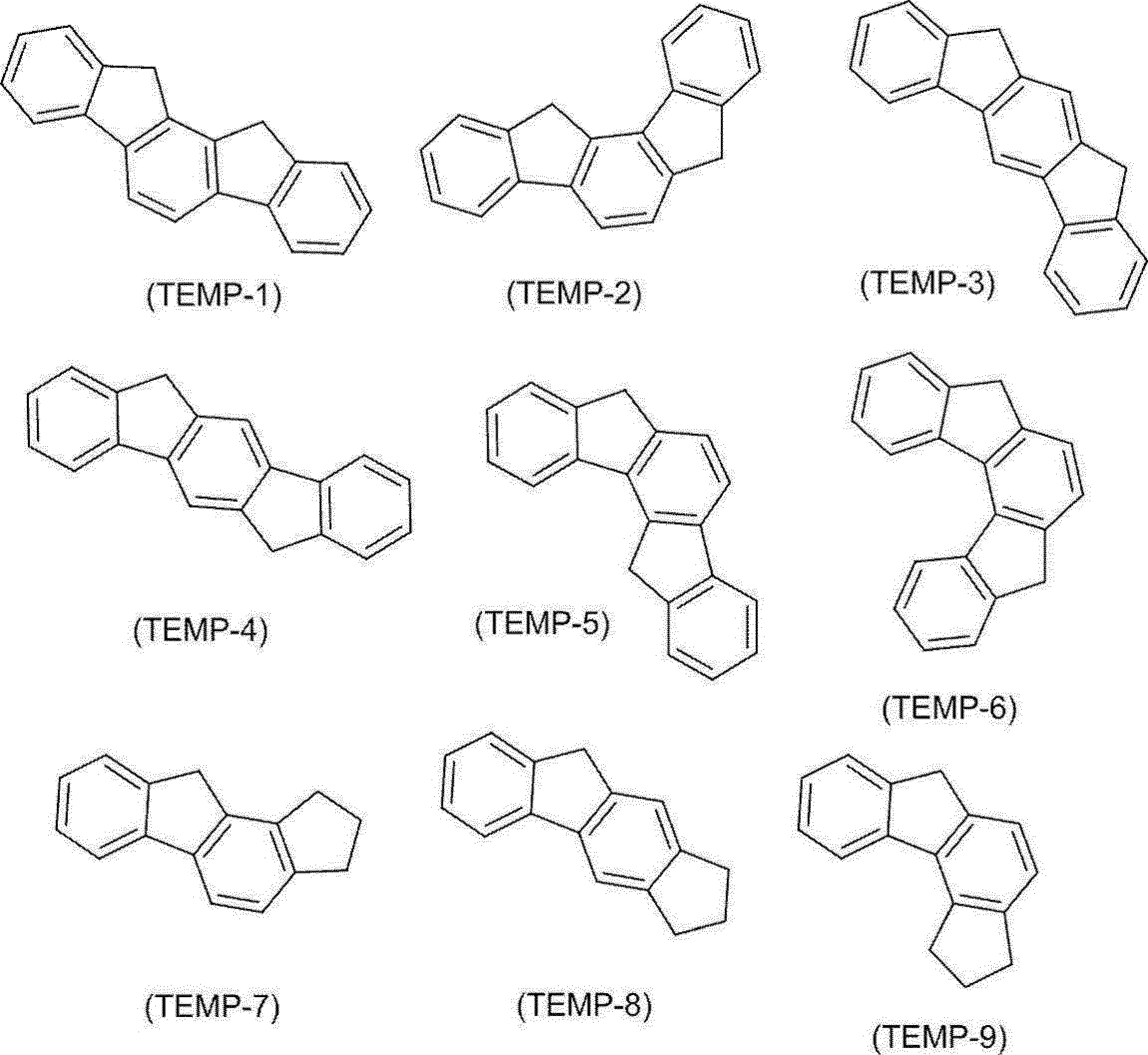

・置換のアリール基(具体例群G1B):
o-トリル基、
m-トリル基、
p-トリル基、
パラ-キシリル基、
メタ-キシリル基、
オルト-キシリル基、
パラ-イソプロピルフェニル基、
メタ-イソプロピルフェニル基、
オルト-イソプロピルフェニル基、
パラ-t-ブチルフェニル基、
メタ-t-ブチルフェニル基、
オルト-t-ブチルフェニル基、
3,4,5-トリメチルフェニル基、
9,9-ジメチルフルオレニル基、
9,9-ジフェニルフルオレニル基
9,9-ビス(4-メチルフェニル)フルオレニル基、
9,9-ビス(4-イソプロピルフェニル)フルオレニル基、
9,9-ビス(4-t-ブチルフェニル)フルオレニル基、
シアノフェニル基、
トリフェニルシリルフェニル基、
トリメチルシリルフェニル基、
フェニルナフチル基、
ナフチルフェニル基、及び
前記一般式(TEMP-1)~(TEMP-15)で表される環構造から誘導される1価の基の1つ以上の水素原子が置換基と置き換わった基。
o-トリル基、
m-トリル基、
p-トリル基、
パラ-キシリル基、
メタ-キシリル基、
オルト-キシリル基、
パラ-イソプロピルフェニル基、
メタ-イソプロピルフェニル基、
オルト-イソプロピルフェニル基、
パラ-t-ブチルフェニル基、
メタ-t-ブチルフェニル基、
オルト-t-ブチルフェニル基、
3,4,5-トリメチルフェニル基、
9,9-ジメチルフルオレニル基、
9,9-ジフェニルフルオレニル基
9,9-ビス(4-メチルフェニル)フルオレニル基、
9,9-ビス(4-イソプロピルフェニル)フルオレニル基、
9,9-ビス(4-t-ブチルフェニル)フルオレニル基、
シアノフェニル基、
トリフェニルシリルフェニル基、
トリメチルシリルフェニル基、
フェニルナフチル基、
ナフチルフェニル基、及び
前記一般式(TEMP-1)~(TEMP-15)で表される環構造から誘導される1価の基の1つ以上の水素原子が置換基と置き換わった基。
・「置換もしくは無置換の複素環基」
本明細書に記載の「複素環基」は、環形成原子にヘテロ原子を少なくとも1つ含む環状の基である。ヘテロ原子の具体例としては、窒素原子、酸素原子、硫黄原子、ケイ素原子、リン原子、及びホウ素原子が挙げられる。本明細書に記載の「複素環基」は、単環の基であるか、又は縮合環の基である。
本明細書に記載の「複素環基」は、芳香族複素環基であるか、又は非芳香族複素環基である。
本明細書に記載の「置換もしくは無置換の複素環基」の具体例(具体例群G2)としては、以下の無置換の複素環基(具体例群G2A)、及び置換の複素環基(具体例群G2B)等が挙げられる。(ここで、無置換の複素環基とは「置換もしくは無置換の複素環基」が「無置換の複素環基」である場合を指し、置換の複素環基とは「置換もしくは無置換の複素環基」が「置換の複素環基」である場合を指す。)本明細書において、単に「複素環基」という場合は、「無置換の複素環基」と「置換の複素環基」の両方を含む。
「置換の複素環基」は、「無置換の複素環基」の1つ以上の水素原子が置換基と置き換わった基を意味する。「置換の複素環基」の具体例は、下記具体例群G2Aの「無置換の複素環基」の水素原子が置き換わった基、及び下記具体例群G2Bの置換の複素環基の例等が挙げられる。尚、ここに列挙した「無置換の複素環基」の例や「置換の複素環基」の例は、一例に過ぎず、本明細書に記載の「置換の複素環基」には、具体例群G2Bの「置換の複素環基」における複素環基自体の環形成原子に結合する水素原子がさらに置換基と置き換わった基、及び具体例群G2Bの「置換の複素環基」における置換基の水素原子がさらに置換基と置き換わった基も含まれる。
本明細書に記載の「複素環基」は、環形成原子にヘテロ原子を少なくとも1つ含む環状の基である。ヘテロ原子の具体例としては、窒素原子、酸素原子、硫黄原子、ケイ素原子、リン原子、及びホウ素原子が挙げられる。本明細書に記載の「複素環基」は、単環の基であるか、又は縮合環の基である。
本明細書に記載の「複素環基」は、芳香族複素環基であるか、又は非芳香族複素環基である。
本明細書に記載の「置換もしくは無置換の複素環基」の具体例(具体例群G2)としては、以下の無置換の複素環基(具体例群G2A)、及び置換の複素環基(具体例群G2B)等が挙げられる。(ここで、無置換の複素環基とは「置換もしくは無置換の複素環基」が「無置換の複素環基」である場合を指し、置換の複素環基とは「置換もしくは無置換の複素環基」が「置換の複素環基」である場合を指す。)本明細書において、単に「複素環基」という場合は、「無置換の複素環基」と「置換の複素環基」の両方を含む。
「置換の複素環基」は、「無置換の複素環基」の1つ以上の水素原子が置換基と置き換わった基を意味する。「置換の複素環基」の具体例は、下記具体例群G2Aの「無置換の複素環基」の水素原子が置き換わった基、及び下記具体例群G2Bの置換の複素環基の例等が挙げられる。尚、ここに列挙した「無置換の複素環基」の例や「置換の複素環基」の例は、一例に過ぎず、本明細書に記載の「置換の複素環基」には、具体例群G2Bの「置換の複素環基」における複素環基自体の環形成原子に結合する水素原子がさらに置換基と置き換わった基、及び具体例群G2Bの「置換の複素環基」における置換基の水素原子がさらに置換基と置き換わった基も含まれる。
具体例群G2Aは、例えば、以下の窒素原子を含む無置換の複素環基(具体例群G2A1)、酸素原子を含む無置換の複素環基(具体例群G2A2)、硫黄原子を含む無置換の複素環基(具体例群G2A3)、及び下記一般式(TEMP-16)~(TEMP-33)で表される環構造から1つの水素原子を除くことにより誘導される1価の複素環基(具体例群G2A4)を含む。
具体例群G2Bは、例えば、以下の窒素原子を含む置換の複素環基(具体例群G2B1)、酸素原子を含む置換の複素環基(具体例群G2B2)、硫黄原子を含む置換の複素環基(具体例群G2B3)、及び下記一般式(TEMP-16)~(TEMP-33)で表される環構造から誘導される1価の複素環基の1つ以上の水素原子が置換基と置き換わった基(具体例群G2B4)を含む。
・窒素原子を含む無置換の複素環基(具体例群G2A1):
ピロリル基、
イミダゾリル基、
ピラゾリル基、
トリアゾリル基、
テトラゾリル基、
オキサゾリル基、
イソオキサゾリル基、
オキサジアゾリル基、
チアゾリル基、
イソチアゾリル基、
チアジアゾリル基、
ピリジル基、
ピリダジニル基、
ピリミジニル基、
ピラジニル基、
トリアジニル基、
インドリル基、
イソインドリル基、
インドリジニル基、キノリジニル基、
キノリル基、
イソキノリル基、
シンノリル基、
フタラジニル基、
キナゾリニル基、
キノキサリニル基、
ベンゾイミダゾリル基、
インダゾリル基、
フェナントロリニル基、
フェナントリジニル基、
アクリジニル基、
フェナジニル基、
カルバゾリル基、
ベンゾカルバゾリル基、
モルホリノ基、
フェノキサジニル基、
フェノチアジニル基、
アザカルバゾリル基、及びジアザカルバゾリル基。
ピロリル基、
イミダゾリル基、
ピラゾリル基、
トリアゾリル基、
テトラゾリル基、
オキサゾリル基、
イソオキサゾリル基、
オキサジアゾリル基、
チアゾリル基、
イソチアゾリル基、
チアジアゾリル基、
ピリジル基、
ピリダジニル基、
ピリミジニル基、
ピラジニル基、
トリアジニル基、
インドリル基、
イソインドリル基、
インドリジニル基、キノリジニル基、
キノリル基、
イソキノリル基、
シンノリル基、
フタラジニル基、
キナゾリニル基、
キノキサリニル基、
ベンゾイミダゾリル基、
インダゾリル基、
フェナントロリニル基、
フェナントリジニル基、
アクリジニル基、
フェナジニル基、
カルバゾリル基、
ベンゾカルバゾリル基、
モルホリノ基、
フェノキサジニル基、
フェノチアジニル基、
アザカルバゾリル基、及びジアザカルバゾリル基。
・酸素原子を含む無置換の複素環基(具体例群G2A2):
フリル基、
オキサゾリル基、
イソオキサゾリル基、
オキサジアゾリル基、
キサンテニル基、
ベンゾフラニル基、
イソベンゾフラニル基、
ジベンゾフラニル基、
ナフトベンゾフラニル基、
ベンゾオキサゾリル基、
ベンゾイソキサゾリル基、
フェノキサジニル基、
モルホリノ基、
ジナフトフラニル基、
アザジベンゾフラニル基、
ジアザジベンゾフラニル基、
アザナフトベンゾフラニル基、及び
ジアザナフトベンゾフラニル基。
フリル基、
オキサゾリル基、
イソオキサゾリル基、
オキサジアゾリル基、
キサンテニル基、
ベンゾフラニル基、
イソベンゾフラニル基、
ジベンゾフラニル基、
ナフトベンゾフラニル基、
ベンゾオキサゾリル基、
ベンゾイソキサゾリル基、
フェノキサジニル基、
モルホリノ基、
ジナフトフラニル基、
アザジベンゾフラニル基、
ジアザジベンゾフラニル基、
アザナフトベンゾフラニル基、及び
ジアザナフトベンゾフラニル基。
・硫黄原子を含む無置換の複素環基(具体例群G2A3):
チエニル基、
チアゾリル基、
イソチアゾリル基、
チアジアゾリル基、
ベンゾチオフェニル基(ベンゾチエニル基)、
イソベンゾチオフェニル基(イソベンゾチエニル基)、
ジベンゾチオフェニル基(ジベンゾチエニル基)、
ナフトベンゾチオフェニル基(ナフトベンゾチエニル基)、
ベンゾチアゾリル基、ベンゾイソチアゾリル基、
フェノチアジニル基、
ジナフトチオフェニル基(ジナフトチエニル基)、
アザジベンゾチオフェニル基(アザジベンゾチエニル基)、
ジアザジベンゾチオフェニル基(ジアザジベンゾチエニル基)、
アザナフトベンゾチオフェニル基(アザナフトベンゾチエニル基)、及び
ジアザナフトベンゾチオフェニル基(ジアザナフトベンゾチエニル基)。
チエニル基、
チアゾリル基、
イソチアゾリル基、
チアジアゾリル基、
ベンゾチオフェニル基(ベンゾチエニル基)、
イソベンゾチオフェニル基(イソベンゾチエニル基)、
ジベンゾチオフェニル基(ジベンゾチエニル基)、
ナフトベンゾチオフェニル基(ナフトベンゾチエニル基)、
ベンゾチアゾリル基、ベンゾイソチアゾリル基、
フェノチアジニル基、
ジナフトチオフェニル基(ジナフトチエニル基)、
アザジベンゾチオフェニル基(アザジベンゾチエニル基)、
ジアザジベンゾチオフェニル基(ジアザジベンゾチエニル基)、
アザナフトベンゾチオフェニル基(アザナフトベンゾチエニル基)、及び
ジアザナフトベンゾチオフェニル基(ジアザナフトベンゾチエニル基)。
・下記一般式(TEMP-16)~(TEMP-33)で表される環構造から1つの水素原子を除くことにより誘導される1価の複素環基(具体例群G2A4):


前記一般式(TEMP-16)~(TEMP-33)において、XA及びYAは、それぞれ独立して、酸素原子、硫黄原子、NH、又はCH2である。ただし、XA及びYAのうち少なくとも1つは、酸素原子、硫黄原子、又はNHである。
前記一般式(TEMP-16)~(TEMP-33)において、XA及びYAの少なくともいずれかがNH、又はCH2である場合、前記一般式(TEMP-16)~(TEMP-33)で表される環構造から誘導される1価の複素環基には、これらNH、又はCH2から1つの水素原子を除いて得られる1価の基が含まれる。
前記一般式(TEMP-16)~(TEMP-33)において、XA及びYAの少なくともいずれかがNH、又はCH2である場合、前記一般式(TEMP-16)~(TEMP-33)で表される環構造から誘導される1価の複素環基には、これらNH、又はCH2から1つの水素原子を除いて得られる1価の基が含まれる。
・窒素原子を含む置換の複素環基(具体例群G2B1):
(9-フェニル)カルバゾリル基、
(9-ビフェニリル)カルバゾリル基、
(9-フェニル)フェニルカルバゾリル基、
(9-ナフチル)カルバゾリル基、
ジフェニルカルバゾール-9-イル基、
フェニルカルバゾール-9-イル基、
メチルベンゾイミダゾリル基、
エチルベンゾイミダゾリル基、
フェニルトリアジニル基、
ビフェニリルトリアジニル基、
ジフェニルトリアジニル基、
フェニルキナゾリニル基、及びビフェニリルキナゾリニル基。
(9-フェニル)カルバゾリル基、
(9-ビフェニリル)カルバゾリル基、
(9-フェニル)フェニルカルバゾリル基、
(9-ナフチル)カルバゾリル基、
ジフェニルカルバゾール-9-イル基、
フェニルカルバゾール-9-イル基、
メチルベンゾイミダゾリル基、
エチルベンゾイミダゾリル基、
フェニルトリアジニル基、
ビフェニリルトリアジニル基、
ジフェニルトリアジニル基、
フェニルキナゾリニル基、及びビフェニリルキナゾリニル基。
・酸素原子を含む置換の複素環基(具体例群G2B2):
フェニルジベンゾフラニル基、
メチルジベンゾフラニル基、
t-ブチルジベンゾフラニル基、及び
スピロ[9H-キサンテン-9,9’-[9H]フルオレン]の1価の残基。
フェニルジベンゾフラニル基、
メチルジベンゾフラニル基、
t-ブチルジベンゾフラニル基、及び
スピロ[9H-キサンテン-9,9’-[9H]フルオレン]の1価の残基。
・硫黄原子を含む置換の複素環基(具体例群G2B3):
フェニルジベンゾチオフェニル基、
メチルジベンゾチオフェニル基、
t-ブチルジベンゾチオフェニル基、及び
スピロ[9H-チオキサンテン-9,9’-[9H]フルオレン]の1価の残基。
フェニルジベンゾチオフェニル基、
メチルジベンゾチオフェニル基、
t-ブチルジベンゾチオフェニル基、及び
スピロ[9H-チオキサンテン-9,9’-[9H]フルオレン]の1価の残基。
・前記一般式(TEMP-16)~(TEMP-33)で表される環構造から誘導される1価の複素環基の1つ以上の水素原子が置換基と置き換わった基(具体例群G2B4):
前記「1価の複素環基の1つ以上の水素原子」とは、該1価の複素環基の環形成炭素原子に結合している水素原子、XA及びYAの少なくともいずれかがNHである場合の窒素原子に結合している水素原子、及びXA及びYAの一方がCH2である場合のメチレン基の水素原子から選ばれる1つ以上の水素原子を意味する。
・「置換もしくは無置換のアルキル基」
本明細書に記載の「置換もしくは無置換のアルキル基」の具体例(具体例群G3)としては、以下の無置換のアルキル基(具体例群G3A)及び置換のアルキル基(具体例群G3B)が挙げられる。(ここで、無置換のアルキル基とは「置換もしくは無置換のアルキル基」が「無置換のアルキル基」である場合を指し、置換のアルキル基とは「置換もしくは無置換のアルキル基」が「置換のアルキル基」である場合を指す。)以下、単に「アルキル基」という場合は、「無置換のアルキル基」と「置換のアルキル基」の両方を含む。
「置換のアルキル基」は、「無置換のアルキル基」における1つ以上の水素原子が置換基と置き換わった基を意味する。「置換のアルキル基」の具体例としては、下記の「無置換のアルキル基」(具体例群G3A)における1つ以上の水素原子が置換基と置き換わった基、及び置換のアルキル基(具体例群G3B)の例等が挙げられる。本明細書において、「無置換のアルキル基」におけるアルキル基は、鎖状のアルキル基を意味する。そのため、「無置換のアルキル基」は、直鎖である「無置換のアルキル基」、及び分岐状である「無置換のアルキル基」が含まれる。尚、ここに列挙した「無置換のアルキル基」の例や「置換のアルキル基」の例は、一例に過ぎず、本明細書に記載の「置換のアルキル基」には、具体例群G3Bの「置換のアルキル基」におけるアルキル基自体の水素原子がさらに置換基と置き換わった基、及び具体例群G3Bの「置換のアルキル基」における置換基の水素原子がさらに置換基と置き換わった基も含まれる。
本明細書に記載の「置換もしくは無置換のアルキル基」の具体例(具体例群G3)としては、以下の無置換のアルキル基(具体例群G3A)及び置換のアルキル基(具体例群G3B)が挙げられる。(ここで、無置換のアルキル基とは「置換もしくは無置換のアルキル基」が「無置換のアルキル基」である場合を指し、置換のアルキル基とは「置換もしくは無置換のアルキル基」が「置換のアルキル基」である場合を指す。)以下、単に「アルキル基」という場合は、「無置換のアルキル基」と「置換のアルキル基」の両方を含む。
「置換のアルキル基」は、「無置換のアルキル基」における1つ以上の水素原子が置換基と置き換わった基を意味する。「置換のアルキル基」の具体例としては、下記の「無置換のアルキル基」(具体例群G3A)における1つ以上の水素原子が置換基と置き換わった基、及び置換のアルキル基(具体例群G3B)の例等が挙げられる。本明細書において、「無置換のアルキル基」におけるアルキル基は、鎖状のアルキル基を意味する。そのため、「無置換のアルキル基」は、直鎖である「無置換のアルキル基」、及び分岐状である「無置換のアルキル基」が含まれる。尚、ここに列挙した「無置換のアルキル基」の例や「置換のアルキル基」の例は、一例に過ぎず、本明細書に記載の「置換のアルキル基」には、具体例群G3Bの「置換のアルキル基」におけるアルキル基自体の水素原子がさらに置換基と置き換わった基、及び具体例群G3Bの「置換のアルキル基」における置換基の水素原子がさらに置換基と置き換わった基も含まれる。
・無置換のアルキル基(具体例群G3A):
メチル基、
エチル基、
n-プロピル基、
イソプロピル基、
n-ブチル基、
イソブチル基、
s-ブチル基、及び
t-ブチル基。
メチル基、
エチル基、
n-プロピル基、
イソプロピル基、
n-ブチル基、
イソブチル基、
s-ブチル基、及び
t-ブチル基。
・置換のアルキル基(具体例群G3B):
ヘプタフルオロプロピル基(異性体を含む)、
ペンタフルオロエチル基、
2,2,2-トリフルオロエチル基、及び
トリフルオロメチル基。
ヘプタフルオロプロピル基(異性体を含む)、
ペンタフルオロエチル基、
2,2,2-トリフルオロエチル基、及び
トリフルオロメチル基。
・「置換もしくは無置換のアルケニル基」
本明細書に記載の「置換もしくは無置換のアルケニル基」の具体例(具体例群G4)としては、以下の無置換のアルケニル基(具体例群G4A)、及び置換のアルケニル基(具体例群G4B)等が挙げられる。(ここで、無置換のアルケニル基とは「置換もしくは無置換のアルケニル基」が「無置換のアルケニル基」である場合を指し、「置換のアルケニル基」とは「置換もしくは無置換のアルケニル基」が「置換のアルケニル基」である場合を指す。)本明細書において、単に「アルケニル基」という場合は、「無置換のアルケニル基」と「置換のアルケニル基」の両方を含む。
「置換のアルケニル基」は、「無置換のアルケニル基」における1つ以上の水素原子が置換基と置き換わった基を意味する。「置換のアルケニル基」の具体例としては、下記の「無置換のアルケニル基」(具体例群G4A)が置換基を有する基、及び置換のアルケニル基(具体例群G4B)の例等が挙げられる。尚、ここに列挙した「無置換のアルケニル基」の例や「置換のアルケニル基」の例は、一例に過ぎず、本明細書に記載の「置換のアルケニル基」には、具体例群G4Bの「置換のアルケニル基」におけるアルケニル基自体の水素原子がさらに置換基と置き換わった基、及び具体例群G4Bの「置換のアルケニル基」における置換基の水素原子がさらに置換基と置き換わった基も含まれる。
本明細書に記載の「置換もしくは無置換のアルケニル基」の具体例(具体例群G4)としては、以下の無置換のアルケニル基(具体例群G4A)、及び置換のアルケニル基(具体例群G4B)等が挙げられる。(ここで、無置換のアルケニル基とは「置換もしくは無置換のアルケニル基」が「無置換のアルケニル基」である場合を指し、「置換のアルケニル基」とは「置換もしくは無置換のアルケニル基」が「置換のアルケニル基」である場合を指す。)本明細書において、単に「アルケニル基」という場合は、「無置換のアルケニル基」と「置換のアルケニル基」の両方を含む。
「置換のアルケニル基」は、「無置換のアルケニル基」における1つ以上の水素原子が置換基と置き換わった基を意味する。「置換のアルケニル基」の具体例としては、下記の「無置換のアルケニル基」(具体例群G4A)が置換基を有する基、及び置換のアルケニル基(具体例群G4B)の例等が挙げられる。尚、ここに列挙した「無置換のアルケニル基」の例や「置換のアルケニル基」の例は、一例に過ぎず、本明細書に記載の「置換のアルケニル基」には、具体例群G4Bの「置換のアルケニル基」におけるアルケニル基自体の水素原子がさらに置換基と置き換わった基、及び具体例群G4Bの「置換のアルケニル基」における置換基の水素原子がさらに置換基と置き換わった基も含まれる。
・無置換のアルケニル基(具体例群G4A):
ビニル基、
アリル基、
1-ブテニル基、
2-ブテニル基、及び
3-ブテニル基。
ビニル基、
アリル基、
1-ブテニル基、
2-ブテニル基、及び
3-ブテニル基。
・置換のアルケニル基(具体例群G4B):
1,3-ブタンジエニル基、
1-メチルビニル基、
1-メチルアリル基、
1,1-ジメチルアリル基、
2-メチルアリル基、及び
1,2-ジメチルアリル基。
1,3-ブタンジエニル基、
1-メチルビニル基、
1-メチルアリル基、
1,1-ジメチルアリル基、
2-メチルアリル基、及び
1,2-ジメチルアリル基。
・「置換もしくは無置換のアルキニル基」
本明細書に記載の「置換もしくは無置換のアルキニル基」の具体例(具体例群G5)としては、以下の無置換のアルキニル基(具体例群G5A)等が挙げられる。(ここで、無置換のアルキニル基とは、「置換もしくは無置換のアルキニル基」が「無置換のアルキニル基」である場合を指す。)以下、単に「アルキニル基」という場合は、「無置換のアルキニル基」と「置換のアルキニル基」の両方を含む。
「置換のアルキニル基」は、「無置換のアルキニル基」における1つ以上の水素原子が置換基と置き換わった基を意味する。「置換のアルキニル基」の具体例としては、下記の「無置換のアルキニル基」(具体例群G5A)における1つ以上の水素原子が置換基と置き換わった基等が挙げられる。
本明細書に記載の「置換もしくは無置換のアルキニル基」の具体例(具体例群G5)としては、以下の無置換のアルキニル基(具体例群G5A)等が挙げられる。(ここで、無置換のアルキニル基とは、「置換もしくは無置換のアルキニル基」が「無置換のアルキニル基」である場合を指す。)以下、単に「アルキニル基」という場合は、「無置換のアルキニル基」と「置換のアルキニル基」の両方を含む。
「置換のアルキニル基」は、「無置換のアルキニル基」における1つ以上の水素原子が置換基と置き換わった基を意味する。「置換のアルキニル基」の具体例としては、下記の「無置換のアルキニル基」(具体例群G5A)における1つ以上の水素原子が置換基と置き換わった基等が挙げられる。
・無置換のアルキニル基(具体例群G5A):
エチニル基
エチニル基
・「置換もしくは無置換のシクロアルキル基」
本明細書に記載の「置換もしくは無置換のシクロアルキル基」の具体例(具体例群G6)としては、以下の無置換のシクロアルキル基(具体例群G6A)、及び置換のシクロアルキル基(具体例群G6B)等が挙げられる。(ここで、無置換のシクロアルキル基とは「置換もしくは無置換のシクロアルキル基」が「無置換のシクロアルキル基」である場合を指し、置換のシクロアルキル基とは「置換もしくは無置換のシクロアルキル基」が「置換のシクロアルキル基」である場合を指す。)本明細書において、単に「シクロアルキル基」という場合は、「無置換のシクロアルキル基」と「置換のシクロアルキル基」の両方を含む。
「置換のシクロアルキル基」は、「無置換のシクロアルキル基」における1つ以上の水素原子が置換基と置き換わった基を意味する。「置換のシクロアルキル基」の具体例としては、下記の「無置換のシクロアルキル基」(具体例群G6A)における1つ以上の水素原子が置換基と置き換わった基、及び置換のシクロアルキル基(具体例群G6B)の例等が挙げられる。尚、ここに列挙した「無置換のシクロアルキル基」の例や「置換のシクロアルキル基」の例は、一例に過ぎず、本明細書に記載の「置換のシクロアルキル基」には、具体例群G6Bの「置換のシクロアルキル基」におけるシクロアルキル基自体の炭素原子に結合する1つ以上の水素原子が置換基と置き換わった基、及び具体例群G6Bの「置換のシクロアルキル基」における置換基の水素原子がさらに置換基と置き換わった基も含まれる。
本明細書に記載の「置換もしくは無置換のシクロアルキル基」の具体例(具体例群G6)としては、以下の無置換のシクロアルキル基(具体例群G6A)、及び置換のシクロアルキル基(具体例群G6B)等が挙げられる。(ここで、無置換のシクロアルキル基とは「置換もしくは無置換のシクロアルキル基」が「無置換のシクロアルキル基」である場合を指し、置換のシクロアルキル基とは「置換もしくは無置換のシクロアルキル基」が「置換のシクロアルキル基」である場合を指す。)本明細書において、単に「シクロアルキル基」という場合は、「無置換のシクロアルキル基」と「置換のシクロアルキル基」の両方を含む。
「置換のシクロアルキル基」は、「無置換のシクロアルキル基」における1つ以上の水素原子が置換基と置き換わった基を意味する。「置換のシクロアルキル基」の具体例としては、下記の「無置換のシクロアルキル基」(具体例群G6A)における1つ以上の水素原子が置換基と置き換わった基、及び置換のシクロアルキル基(具体例群G6B)の例等が挙げられる。尚、ここに列挙した「無置換のシクロアルキル基」の例や「置換のシクロアルキル基」の例は、一例に過ぎず、本明細書に記載の「置換のシクロアルキル基」には、具体例群G6Bの「置換のシクロアルキル基」におけるシクロアルキル基自体の炭素原子に結合する1つ以上の水素原子が置換基と置き換わった基、及び具体例群G6Bの「置換のシクロアルキル基」における置換基の水素原子がさらに置換基と置き換わった基も含まれる。
・無置換のシクロアルキル基(具体例群G6A):
シクロプロピル基、
シクロブチル基、
シクロペンチル基、
シクロヘキシル基、
1-アダマンチル基、
2-アダマンチル基、
1-ノルボルニル基、及び
2-ノルボルニル基。
シクロプロピル基、
シクロブチル基、
シクロペンチル基、
シクロヘキシル基、
1-アダマンチル基、
2-アダマンチル基、
1-ノルボルニル基、及び
2-ノルボルニル基。
・置換のシクロアルキル基(具体例群G6B):
4-メチルシクロヘキシル基。
4-メチルシクロヘキシル基。
・「-Si(R901)(R902)(R903)で表される基」
本明細書に記載の-Si(R901)(R902)(R903)で表される基の具体例(具体例群G7)としては、
-Si(G1)(G1)(G1)、
-Si(G1)(G2)(G2)、
-Si(G1)(G1)(G2)、
-Si(G2)(G2)(G2)、
-Si(G3)(G3)(G3)、及び
-Si(G6)(G6)(G6)
が挙げられる。ここで、
G1は、具体例群G1に記載の「置換もしくは無置換のアリール基」である。
G2は、具体例群G2に記載の「置換もしくは無置換の複素環基」である。
G3は、具体例群G3に記載の「置換もしくは無置換のアルキル基」である。
G6は、具体例群G6に記載の「置換もしくは無置換のシクロアルキル基」である。 -Si(G1)(G1)(G1)における複数のG1は、互いに同一であるか、又は異なる。
-Si(G1)(G2)(G2)における複数のG2は、互いに同一であるか、又は異なる。
-Si(G1)(G1)(G2)における複数のG1は、互いに同一であるか、又は異なる。
-Si(G2)(G2)(G2)における複数のG2は、互いに同一であるか、又は異なる。
-Si(G3)(G3)(G3)における複数のG3は、互いに同一であるか、又は異なる。
-Si(G6)(G6)(G6)における複数のG6は、互いに同一であるか、又は異なる。
本明細書に記載の-Si(R901)(R902)(R903)で表される基の具体例(具体例群G7)としては、
-Si(G1)(G1)(G1)、
-Si(G1)(G2)(G2)、
-Si(G1)(G1)(G2)、
-Si(G2)(G2)(G2)、
-Si(G3)(G3)(G3)、及び
-Si(G6)(G6)(G6)
が挙げられる。ここで、
G1は、具体例群G1に記載の「置換もしくは無置換のアリール基」である。
G2は、具体例群G2に記載の「置換もしくは無置換の複素環基」である。
G3は、具体例群G3に記載の「置換もしくは無置換のアルキル基」である。
G6は、具体例群G6に記載の「置換もしくは無置換のシクロアルキル基」である。 -Si(G1)(G1)(G1)における複数のG1は、互いに同一であるか、又は異なる。
-Si(G1)(G2)(G2)における複数のG2は、互いに同一であるか、又は異なる。
-Si(G1)(G1)(G2)における複数のG1は、互いに同一であるか、又は異なる。
-Si(G2)(G2)(G2)における複数のG2は、互いに同一であるか、又は異なる。
-Si(G3)(G3)(G3)における複数のG3は、互いに同一であるか、又は異なる。
-Si(G6)(G6)(G6)における複数のG6は、互いに同一であるか、又は異なる。
・「-O-(R904)で表される基」
本明細書に記載の-O-(R904)で表される基の具体例(具体例群G8)としては、
-O(G1)、
-O(G2)、
-O(G3)、及び
-O(G6)
が挙げられる。
ここで、
G1は、具体例群G1に記載の「置換もしくは無置換のアリール基」である。
G2は、具体例群G2に記載の「置換もしくは無置換の複素環基」である。
G3は、具体例群G3に記載の「置換もしくは無置換のアルキル基」である。
G6は、具体例群G6に記載の「置換もしくは無置換のシクロアルキル基」である。
本明細書に記載の-O-(R904)で表される基の具体例(具体例群G8)としては、
-O(G1)、
-O(G2)、
-O(G3)、及び
-O(G6)
が挙げられる。
ここで、
G1は、具体例群G1に記載の「置換もしくは無置換のアリール基」である。
G2は、具体例群G2に記載の「置換もしくは無置換の複素環基」である。
G3は、具体例群G3に記載の「置換もしくは無置換のアルキル基」である。
G6は、具体例群G6に記載の「置換もしくは無置換のシクロアルキル基」である。
・「-S-(R905)で表される基」
本明細書に記載の-S-(R905)で表される基の具体例(具体例群G9)としては、
-S(G1)、
-S(G2)、
-S(G3)、及び
-S(G6)
が挙げられる。
ここで、
G1は、具体例群G1に記載の「置換もしくは無置換のアリール基」である。
G2は、具体例群G2に記載の「置換もしくは無置換の複素環基」である。
G3は、具体例群G3に記載の「置換もしくは無置換のアルキル基」である。
G6は、具体例群G6に記載の「置換もしくは無置換のシクロアルキル基」である。
本明細書に記載の-S-(R905)で表される基の具体例(具体例群G9)としては、
-S(G1)、
-S(G2)、
-S(G3)、及び
-S(G6)
が挙げられる。
ここで、
G1は、具体例群G1に記載の「置換もしくは無置換のアリール基」である。
G2は、具体例群G2に記載の「置換もしくは無置換の複素環基」である。
G3は、具体例群G3に記載の「置換もしくは無置換のアルキル基」である。
G6は、具体例群G6に記載の「置換もしくは無置換のシクロアルキル基」である。
・「-N(R906)(R907)で表される基」
本明細書に記載の-N(R906)(R907)で表される基の具体例(具体例群G10)としては、
-N(G1)(G1)、
-N(G2)(G2)、
-N(G1)(G2)、
-N(G3)(G3)、及び
-N(G6)(G6)
が挙げられる。 ここで、
G1は、具体例群G1に記載の「置換もしくは無置換のアリール基」である。
G2は、具体例群G2に記載の「置換もしくは無置換の複素環基」である。
G3は、具体例群G3に記載の「置換もしくは無置換のアルキル基」である。
G6は、具体例群G6に記載の「置換もしくは無置換のシクロアルキル基」である。
-N(G1)(G1)における複数のG1は、互いに同一であるか、又は異なる。
-N(G2)(G2)における複数のG2は、互いに同一であるか、又は異なる。
-N(G3)(G3)における複数のG3は、互いに同一であるか、又は異なる。
-N(G6)(G6)における複数のG6は、互いに同一であるか、又は異なる。
本明細書に記載の-N(R906)(R907)で表される基の具体例(具体例群G10)としては、
-N(G1)(G1)、
-N(G2)(G2)、
-N(G1)(G2)、
-N(G3)(G3)、及び
-N(G6)(G6)
が挙げられる。 ここで、
G1は、具体例群G1に記載の「置換もしくは無置換のアリール基」である。
G2は、具体例群G2に記載の「置換もしくは無置換の複素環基」である。
G3は、具体例群G3に記載の「置換もしくは無置換のアルキル基」である。
G6は、具体例群G6に記載の「置換もしくは無置換のシクロアルキル基」である。
-N(G1)(G1)における複数のG1は、互いに同一であるか、又は異なる。
-N(G2)(G2)における複数のG2は、互いに同一であるか、又は異なる。
-N(G3)(G3)における複数のG3は、互いに同一であるか、又は異なる。
-N(G6)(G6)における複数のG6は、互いに同一であるか、又は異なる。
・「ハロゲン原子」
本明細書に記載の「ハロゲン原子」の具体例(具体例群G11)としては、フッ素原子、塩素原子、臭素原子、及びヨウ素原子等が挙げられる。
本明細書に記載の「ハロゲン原子」の具体例(具体例群G11)としては、フッ素原子、塩素原子、臭素原子、及びヨウ素原子等が挙げられる。
・「置換もしくは無置換のフルオロアルキル基」
本明細書に記載の「置換もしくは無置換のフルオロアルキル基」は、「置換もしくは無置換のアルキル基」におけるアルキル基を構成する炭素原子に結合している少なくとも1つの水素原子がフッ素原子と置き換わった基を意味し、「置換もしくは無置換のアルキル基」におけるアルキル基を構成する炭素原子に結合している全ての水素原子がフッ素原子で置き換わった基(パーフルオロ基)も含む。「無置換のフルオロアルキル基」の炭素数は、本明細書に別途記載のない限り、1~50であり、好ましくは1~30であり、より好ましくは1~18である。「置換のフルオロアルキル基」は、「フルオロアルキル基」の1つ以上の水素原子が置換基と置き換わった基を意味する。尚、本明細書に記載の「置換のフルオロアルキル基」には、「置換のフルオロアルキル基」におけるアルキル鎖の炭素原子に結合する1つ以上の水素原子がさらに置換基と置き換わった基、及び「置換のフルオロアルキル基」における置換基の1つ以上の水素原子がさらに置換基と置き換わった基も含まれる。「無置換のフルオロアルキル基」の具体例としては、前記「アルキル基」(具体例群G3)における1つ以上の水素原子がフッ素原子と置き換わった基の例等が挙げられる。
本明細書に記載の「置換もしくは無置換のフルオロアルキル基」は、「置換もしくは無置換のアルキル基」におけるアルキル基を構成する炭素原子に結合している少なくとも1つの水素原子がフッ素原子と置き換わった基を意味し、「置換もしくは無置換のアルキル基」におけるアルキル基を構成する炭素原子に結合している全ての水素原子がフッ素原子で置き換わった基(パーフルオロ基)も含む。「無置換のフルオロアルキル基」の炭素数は、本明細書に別途記載のない限り、1~50であり、好ましくは1~30であり、より好ましくは1~18である。「置換のフルオロアルキル基」は、「フルオロアルキル基」の1つ以上の水素原子が置換基と置き換わった基を意味する。尚、本明細書に記載の「置換のフルオロアルキル基」には、「置換のフルオロアルキル基」におけるアルキル鎖の炭素原子に結合する1つ以上の水素原子がさらに置換基と置き換わった基、及び「置換のフルオロアルキル基」における置換基の1つ以上の水素原子がさらに置換基と置き換わった基も含まれる。「無置換のフルオロアルキル基」の具体例としては、前記「アルキル基」(具体例群G3)における1つ以上の水素原子がフッ素原子と置き換わった基の例等が挙げられる。
・「置換もしくは無置換のハロアルキル基」
本明細書に記載の「置換もしくは無置換のハロアルキル基」は、「置換もしくは無置換のアルキル基」におけるアルキル基を構成する炭素原子に結合している少なくとも1つの水素原子がハロゲン原子と置き換わった基を意味し、「置換もしくは無置換のアルキル基」におけるアルキル基を構成する炭素原子に結合している全ての水素原子がハロゲン原子で置き換わった基も含む。「無置換のハロアルキル基」の炭素数は、本明細書に別途記載のない限り、1~50であり、好ましくは1~30であり、より好ましくは1~18である。「置換のハロアルキル基」は、「ハロアルキル基」の1つ以上の水素原子が置換基と置き換わった基を意味する。尚、本明細書に記載の「置換のハロアルキル基」には、「置換のハロアルキル基」におけるアルキル鎖の炭素原子に結合する1つ以上の水素原子がさらに置換基と置き換わった基、及び「置換のハロアルキル基」における置換基の1つ以上の水素原子がさらに置換基と置き換わった基も含まれる。「無置換のハロアルキル基」の具体例としては、前記「アルキル基」(具体例群G3)における1つ以上の水素原子がハロゲン原子と置き換わった基の例等が挙げられる。ハロアルキル基をハロゲン化アルキル基と称する場合がある。
本明細書に記載の「置換もしくは無置換のハロアルキル基」は、「置換もしくは無置換のアルキル基」におけるアルキル基を構成する炭素原子に結合している少なくとも1つの水素原子がハロゲン原子と置き換わった基を意味し、「置換もしくは無置換のアルキル基」におけるアルキル基を構成する炭素原子に結合している全ての水素原子がハロゲン原子で置き換わった基も含む。「無置換のハロアルキル基」の炭素数は、本明細書に別途記載のない限り、1~50であり、好ましくは1~30であり、より好ましくは1~18である。「置換のハロアルキル基」は、「ハロアルキル基」の1つ以上の水素原子が置換基と置き換わった基を意味する。尚、本明細書に記載の「置換のハロアルキル基」には、「置換のハロアルキル基」におけるアルキル鎖の炭素原子に結合する1つ以上の水素原子がさらに置換基と置き換わった基、及び「置換のハロアルキル基」における置換基の1つ以上の水素原子がさらに置換基と置き換わった基も含まれる。「無置換のハロアルキル基」の具体例としては、前記「アルキル基」(具体例群G3)における1つ以上の水素原子がハロゲン原子と置き換わった基の例等が挙げられる。ハロアルキル基をハロゲン化アルキル基と称する場合がある。
・「置換もしくは無置換のアルコキシ基」
本明細書に記載の「置換もしくは無置換のアルコキシ基」の具体例としては、-O(G3)で表される基であり、ここで、G3は、具体例群G3に記載の「置換もしくは無置換のアルキル基」である。「無置換のアルコキシ基」の炭素数は、本明細書に別途記載のない限り、1~50であり、好ましくは1~30であり、より好ましくは1~18である。
本明細書に記載の「置換もしくは無置換のアルコキシ基」の具体例としては、-O(G3)で表される基であり、ここで、G3は、具体例群G3に記載の「置換もしくは無置換のアルキル基」である。「無置換のアルコキシ基」の炭素数は、本明細書に別途記載のない限り、1~50であり、好ましくは1~30であり、より好ましくは1~18である。
・「置換もしくは無置換のアルキルチオ基」
本明細書に記載の「置換もしくは無置換のアルキルチオ基」の具体例としては、-S(G3)で表される基であり、ここで、G3は、具体例群G3に記載の「置換もしくは無置換のアルキル基」である。「無置換のアルキルチオ基」の炭素数は、本明細書に別途記載のない限り、1~50であり、好ましくは1~30であり、より好ましくは1~18である。
本明細書に記載の「置換もしくは無置換のアルキルチオ基」の具体例としては、-S(G3)で表される基であり、ここで、G3は、具体例群G3に記載の「置換もしくは無置換のアルキル基」である。「無置換のアルキルチオ基」の炭素数は、本明細書に別途記載のない限り、1~50であり、好ましくは1~30であり、より好ましくは1~18である。
・「置換もしくは無置換のアリールオキシ基」
本明細書に記載の「置換もしくは無置換のアリールオキシ基」の具体例としては、-O(G1)で表される基であり、ここで、G1は、具体例群G1に記載の「置換もしくは無置換のアリール基」である。「無置換のアリールオキシ基」の環形成炭素数は、本明細書に別途記載のない限り、6~50であり、好ましくは6~30であり、より好ましくは6~18である。
本明細書に記載の「置換もしくは無置換のアリールオキシ基」の具体例としては、-O(G1)で表される基であり、ここで、G1は、具体例群G1に記載の「置換もしくは無置換のアリール基」である。「無置換のアリールオキシ基」の環形成炭素数は、本明細書に別途記載のない限り、6~50であり、好ましくは6~30であり、より好ましくは6~18である。
・「置換もしくは無置換のアリールチオ基」
本明細書に記載の「置換もしくは無置換のアリールチオ基」の具体例としては、-S(G1)で表される基であり、ここで、G1は、具体例群G1に記載の「置換もしくは無置換のアリール基」である。「無置換のアリールチオ基」の環形成炭素数は、本明細書に別途記載のない限り、6~50であり、好ましくは6~30であり、より好ましくは6~18である。
本明細書に記載の「置換もしくは無置換のアリールチオ基」の具体例としては、-S(G1)で表される基であり、ここで、G1は、具体例群G1に記載の「置換もしくは無置換のアリール基」である。「無置換のアリールチオ基」の環形成炭素数は、本明細書に別途記載のない限り、6~50であり、好ましくは6~30であり、より好ましくは6~18である。
・「置換もしくは無置換のトリアルキルシリル基」
本明細書に記載の「トリアルキルシリル基」の具体例としては、-Si(G3)(G3)(G3)で表される基であり、ここで、G3は、具体例群G3に記載の「置換もしくは無置換のアルキル基」である。-Si(G3)(G3)(G3)における複数のG3は、互いに同一であるか、又は異なる。「トリアルキルシリル基」の各アルキル基の炭素数は、本明細書に別途記載のない限り、1~50であり、好ましくは1~20であり、より好ましくは1~6である。
本明細書に記載の「トリアルキルシリル基」の具体例としては、-Si(G3)(G3)(G3)で表される基であり、ここで、G3は、具体例群G3に記載の「置換もしくは無置換のアルキル基」である。-Si(G3)(G3)(G3)における複数のG3は、互いに同一であるか、又は異なる。「トリアルキルシリル基」の各アルキル基の炭素数は、本明細書に別途記載のない限り、1~50であり、好ましくは1~20であり、より好ましくは1~6である。
・「置換もしくは無置換のアラルキル基」
本明細書に記載の「置換もしくは無置換のアラルキル基」の具体例としては、-(G3)-(G1)で表される基であり、ここで、G3は、具体例群G3に記載の「置換もしくは無置換のアルキル基」であり、G1は、具体例群G1に記載の「置換もしくは無置換のアリール基」である。従って、「アラルキル基」は、「アルキル基」の水素原子が置換基としての「アリール基」と置き換わった基であり、「置換のアルキル基」の一態様である。「無置換のアラルキル基」は、「無置換のアリール基」が置換した「無置換のアルキル基」であり、「無置換のアラルキル基」の炭素数は、本明細書に別途記載のない限り、7~50であり、好ましくは7~30であり、より好ましくは7~18である。
「置換もしくは無置換のアラルキル基」の具体例としては、ベンジル基、1-フェニルエチル基、2-フェニルエチル基、1-フェニルイソプロピル基、2-フェニルイソプロピル基、フェニル-t-ブチル基、α-ナフチルメチル基、1-α-ナフチルエチル基、2-α-ナフチルエチル基、1-α-ナフチルイソプロピル基、2-α-ナフチルイソプロピル基、β-ナフチルメチル基、1-β-ナフチルエチル基、2-β-ナフチルエチル基、1-β-ナフチルイソプロピル基、及び2-β-ナフチルイソプロピル基等が挙げられる。
本明細書に記載の「置換もしくは無置換のアラルキル基」の具体例としては、-(G3)-(G1)で表される基であり、ここで、G3は、具体例群G3に記載の「置換もしくは無置換のアルキル基」であり、G1は、具体例群G1に記載の「置換もしくは無置換のアリール基」である。従って、「アラルキル基」は、「アルキル基」の水素原子が置換基としての「アリール基」と置き換わった基であり、「置換のアルキル基」の一態様である。「無置換のアラルキル基」は、「無置換のアリール基」が置換した「無置換のアルキル基」であり、「無置換のアラルキル基」の炭素数は、本明細書に別途記載のない限り、7~50であり、好ましくは7~30であり、より好ましくは7~18である。
「置換もしくは無置換のアラルキル基」の具体例としては、ベンジル基、1-フェニルエチル基、2-フェニルエチル基、1-フェニルイソプロピル基、2-フェニルイソプロピル基、フェニル-t-ブチル基、α-ナフチルメチル基、1-α-ナフチルエチル基、2-α-ナフチルエチル基、1-α-ナフチルイソプロピル基、2-α-ナフチルイソプロピル基、β-ナフチルメチル基、1-β-ナフチルエチル基、2-β-ナフチルエチル基、1-β-ナフチルイソプロピル基、及び2-β-ナフチルイソプロピル基等が挙げられる。
本明細書に記載の置換もしくは無置換のアリール基は、本明細書に別途記載のない限り、好ましくはフェニル基、p-ビフェニル基、m-ビフェニル基、o-ビフェニル基、p-ターフェニル-4-イル基、p-ターフェニル-3-イル基、p-ターフェニル-2-イル基、m-ターフェニル-4-イル基、m-ターフェニル-3-イル基、m-ターフェニル-2-イル基、o-ターフェニル-4-イル基、o-ターフェニル-3-イル基、o-ターフェニル-2-イル基、1-ナフチル基、2-ナフチル基、アントリル基、フェナントリル基、ピレニル基、クリセニル基、トリフェニレニル基、フルオレニル基、9,9’-スピロビフルオレニル基、9,9-ジメチルフルオレニル基、及び9,9-ジフェニルフルオレニル基等である。
本明細書に記載の置換もしくは無置換の複素環基は、本明細書に別途記載のない限り、好ましくはピリジル基、ピリミジニル基、トリアジニル基、キノリル基、イソキノリル基、キナゾリニル基、ベンゾイミダゾリル基、フェナントロリニル基、カルバゾリル基(1-カルバゾリル基、2-カルバゾリル基、3-カルバゾリル基、4-カルバゾリル基、又は9-カルバゾリル基)、ベンゾカルバゾリル基、アザカルバゾリル基、ジアザカルバゾリル基、ジベンゾフラニル基、ナフトベンゾフラニル基、アザジベンゾフラニル基、ジアザジベンゾフラニル基、ジベンゾチオフェニル基、ナフトベンゾチオフェニル基、アザジベンゾチオフェニル基、ジアザジベンゾチオフェニル基、(9-フェニル)カルバゾリル基((9-フェニル)カルバゾール-1-イル基、(9-フェニル)カルバゾール-2-イル基、(9-フェニル)カルバゾール-3-イル基、又は(9-フェニル)カルバゾール-4-イル基)、(9-ビフェニリル)カルバゾリル基、(9-フェニル)フェニルカルバゾリル基、ジフェニルカルバゾール-9-イル基、フェニルカルバゾール-9-イル基、フェニルトリアジニル基、ビフェニリルトリアジニル基、ジフェニルトリアジニル基、フェニルジベンゾフラニル基、及びフェニルジベンゾチオフェニル基等である。
本明細書において、カルバゾリル基は、本明細書に別途記載のない限り、具体的には以下のいずれかの基である。

本明細書において、(9-フェニル)カルバゾリル基は、本明細書に別途記載のない限り、具体的には以下のいずれかの基である。
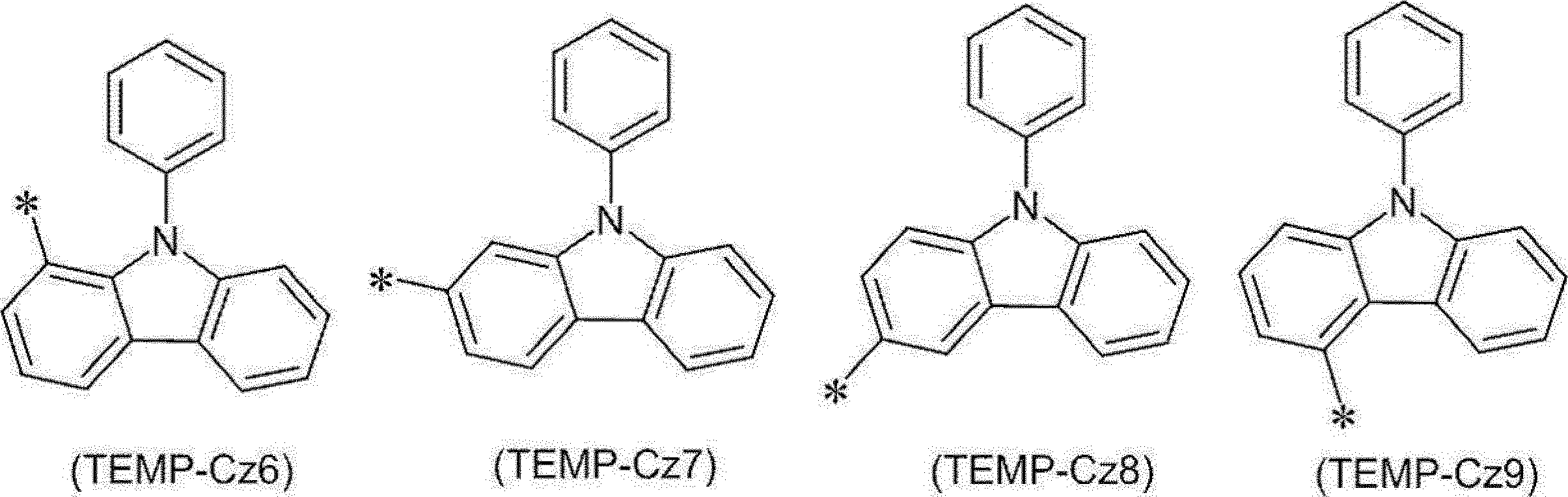
前記一般式(TEMP-Cz1)~(TEMP-Cz9)中、*は、結合位置を表す。
本明細書において、ジベンゾフラニル基、及びジベンゾチオフェニル基は、本明細書に別途記載のない限り、具体的には以下のいずれかの基である。

前記一般式(TEMP-34)~(TEMP-41)中、*は、結合位置を表す。
本明細書に記載の置換もしくは無置換のアルキル基は、本明細書に別途記載のない限り、好ましくはメチル基、エチル基、プロピル基、イソプロピル基、n-ブチル基、イソブチル基、及びt-ブチル基等である。
・「置換もしくは無置換のアリーレン基」
本明細書に記載の「置換もしくは無置換のアリーレン基」は、別途記載のない限り、上記「置換もしくは無置換のアリール基」からアリール環上の1つの水素原子を除くことにより誘導される2価の基である。「置換もしくは無置換のアリーレン基」の具体例(具体例群G12)としては、具体例群G1に記載の「置換もしくは無置換のアリール基」からアリール環上の1つの水素原子を除くことにより誘導される2価の基等が挙げられる。
本明細書に記載の「置換もしくは無置換のアリーレン基」は、別途記載のない限り、上記「置換もしくは無置換のアリール基」からアリール環上の1つの水素原子を除くことにより誘導される2価の基である。「置換もしくは無置換のアリーレン基」の具体例(具体例群G12)としては、具体例群G1に記載の「置換もしくは無置換のアリール基」からアリール環上の1つの水素原子を除くことにより誘導される2価の基等が挙げられる。
・「置換もしくは無置換の2価の複素環基」
本明細書に記載の「置換もしくは無置換の2価の複素環基」は、別途記載のない限り、上記「置換もしくは無置換の複素環基」から複素環上の1つの水素原子を除くことにより誘導される2価の基である。「置換もしくは無置換の2価の複素環基」の具体例(具体例群G13)としては、具体例群G2に記載の「置換もしくは無置換の複素環基」から複素環上の1つの水素原子を除くことにより誘導される2価の基等が挙げられる。
本明細書に記載の「置換もしくは無置換の2価の複素環基」は、別途記載のない限り、上記「置換もしくは無置換の複素環基」から複素環上の1つの水素原子を除くことにより誘導される2価の基である。「置換もしくは無置換の2価の複素環基」の具体例(具体例群G13)としては、具体例群G2に記載の「置換もしくは無置換の複素環基」から複素環上の1つの水素原子を除くことにより誘導される2価の基等が挙げられる。
・「置換もしくは無置換のアルキレン基」
本明細書に記載の「置換もしくは無置換のアルキレン基」は、別途記載のない限り、上記「置換もしくは無置換のアルキル基」からアルキル鎖上の1つの水素原子を除くことにより誘導される2価の基である。「置換もしくは無置換のアルキレン基」の具体例(具体例群G14)としては、具体例群G3に記載の「置換もしくは無置換のアルキル基」からアルキル鎖上の1つの水素原子を除くことにより誘導される2価の基等が挙げられる。
本明細書に記載の「置換もしくは無置換のアルキレン基」は、別途記載のない限り、上記「置換もしくは無置換のアルキル基」からアルキル鎖上の1つの水素原子を除くことにより誘導される2価の基である。「置換もしくは無置換のアルキレン基」の具体例(具体例群G14)としては、具体例群G3に記載の「置換もしくは無置換のアルキル基」からアルキル鎖上の1つの水素原子を除くことにより誘導される2価の基等が挙げられる。
本明細書に記載の置換もしくは無置換のアリーレン基は、本明細書に別途記載のない限り、好ましくは下記一般式(TEMP-42)~(TEMP-68)のいずれかの基である。
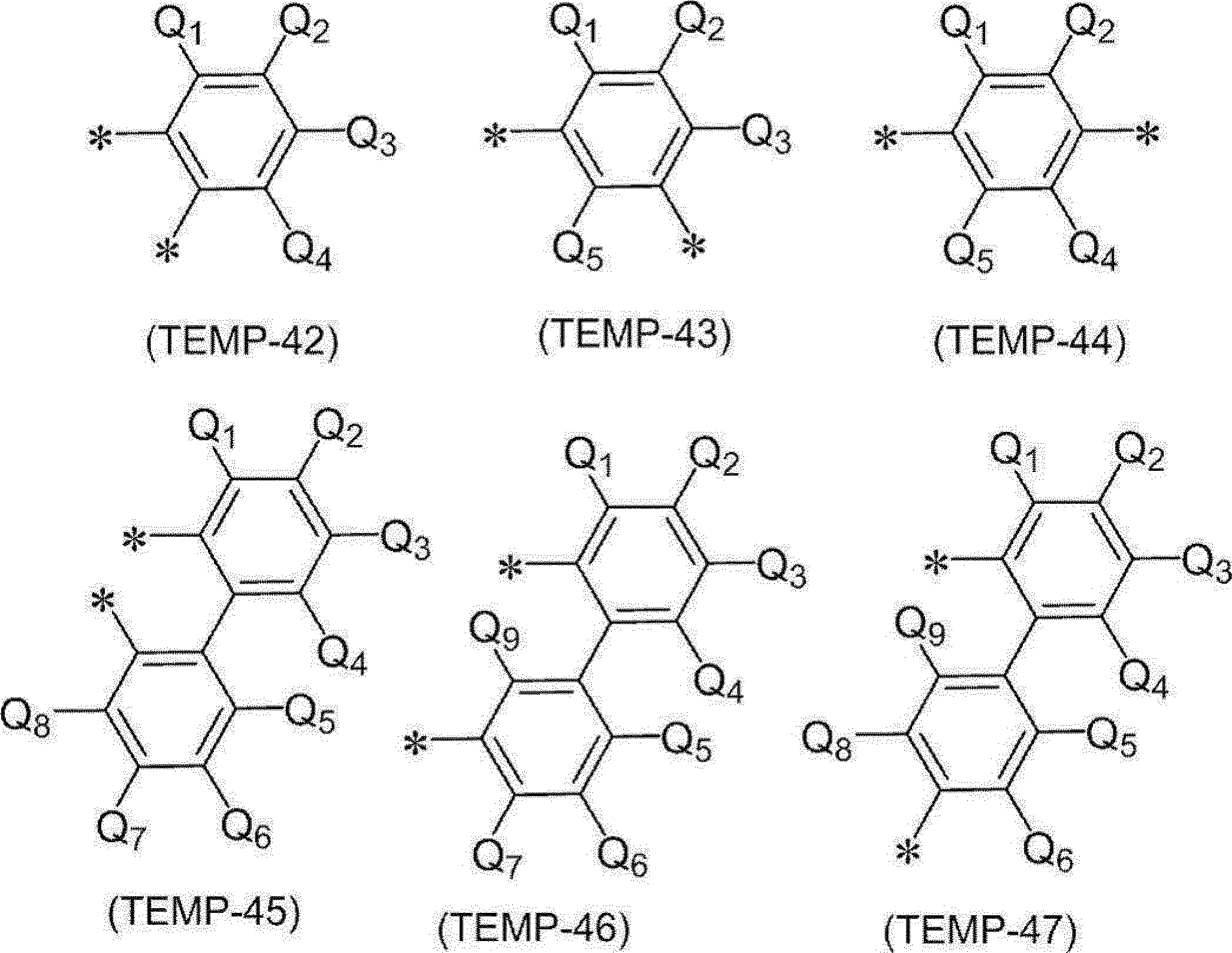

前記一般式(TEMP-42)~(TEMP-52)中、Q1~Q10は、それぞれ独立して、水素原子、又は置換基である。
前記一般式(TEMP-42)~(TEMP-52)中、*は、結合位置を表す。
前記一般式(TEMP-42)~(TEMP-52)中、*は、結合位置を表す。
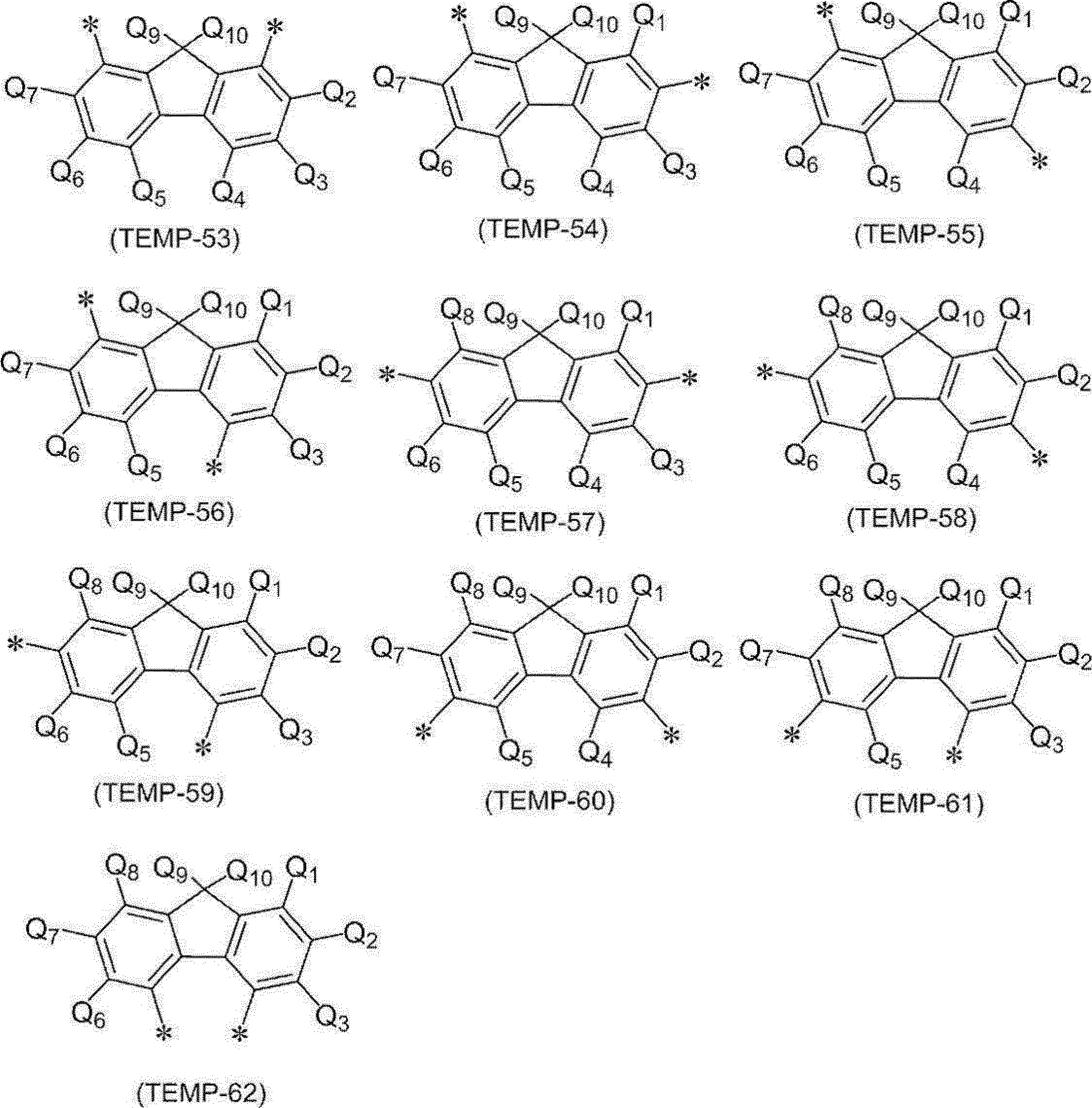
前記一般式(TEMP-53)~(TEMP-62)中、Q1~Q10は、それぞれ独立して、水素原子、又は置換基である。
式Q9及びQ10は、単結合を介して互いに結合して環を形成してもよい。
前記一般式(TEMP-53)~(TEMP-62)中、*は、結合位置を表す。
式Q9及びQ10は、単結合を介して互いに結合して環を形成してもよい。
前記一般式(TEMP-53)~(TEMP-62)中、*は、結合位置を表す。

前記一般式(TEMP-63)~(TEMP-68)中、Q1~Q8は、それぞれ独立して、水素原子、又は置換基である。
前記一般式(TEMP-63)~(TEMP-68)中、*は、結合位置を表す。
前記一般式(TEMP-63)~(TEMP-68)中、*は、結合位置を表す。
本明細書に記載の置換もしくは無置換の2価の複素環基は、本明細書に別途記載のない限り、好ましくは下記一般式(TEMP-69)~(TEMP-102)のいずれかの基である。
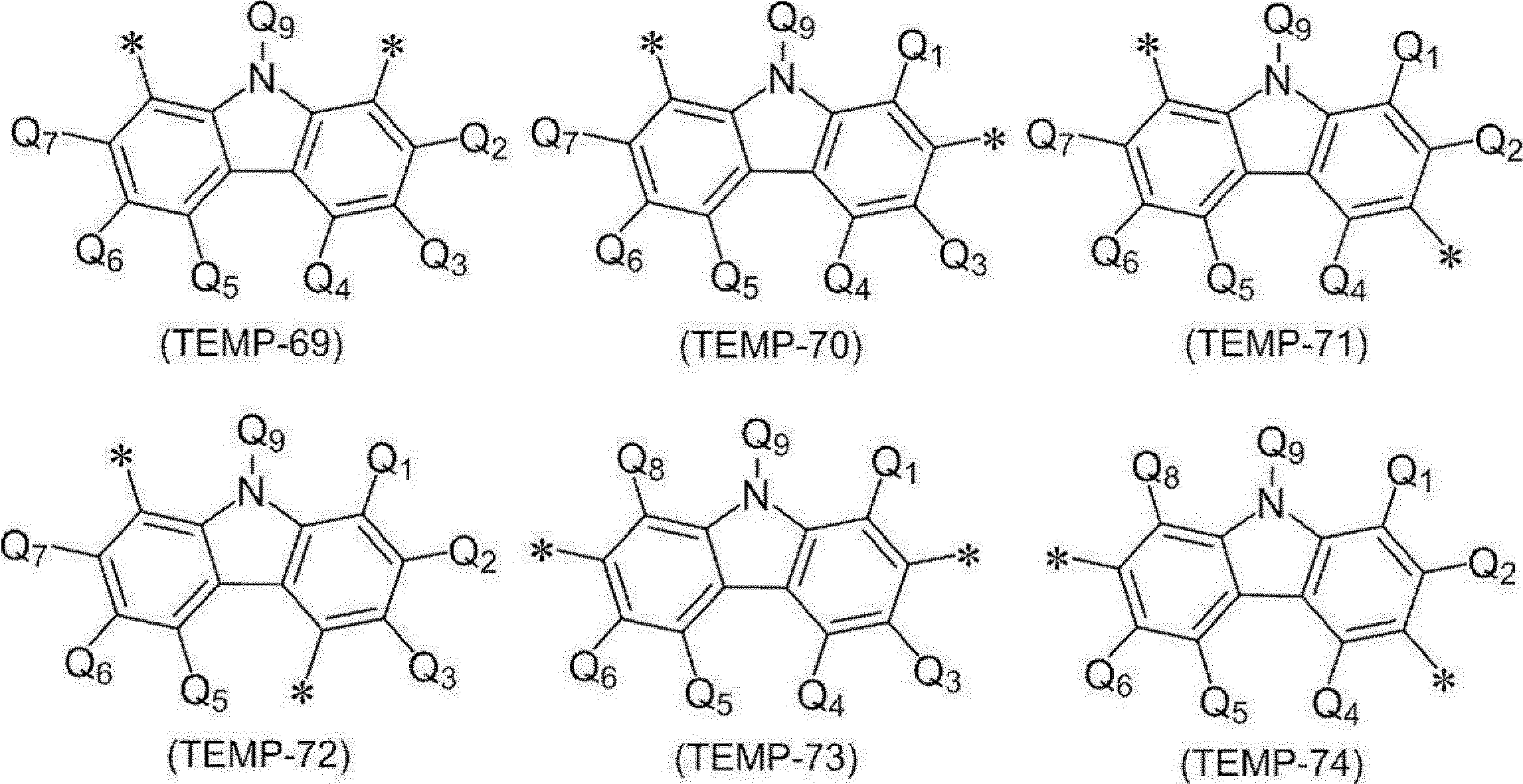
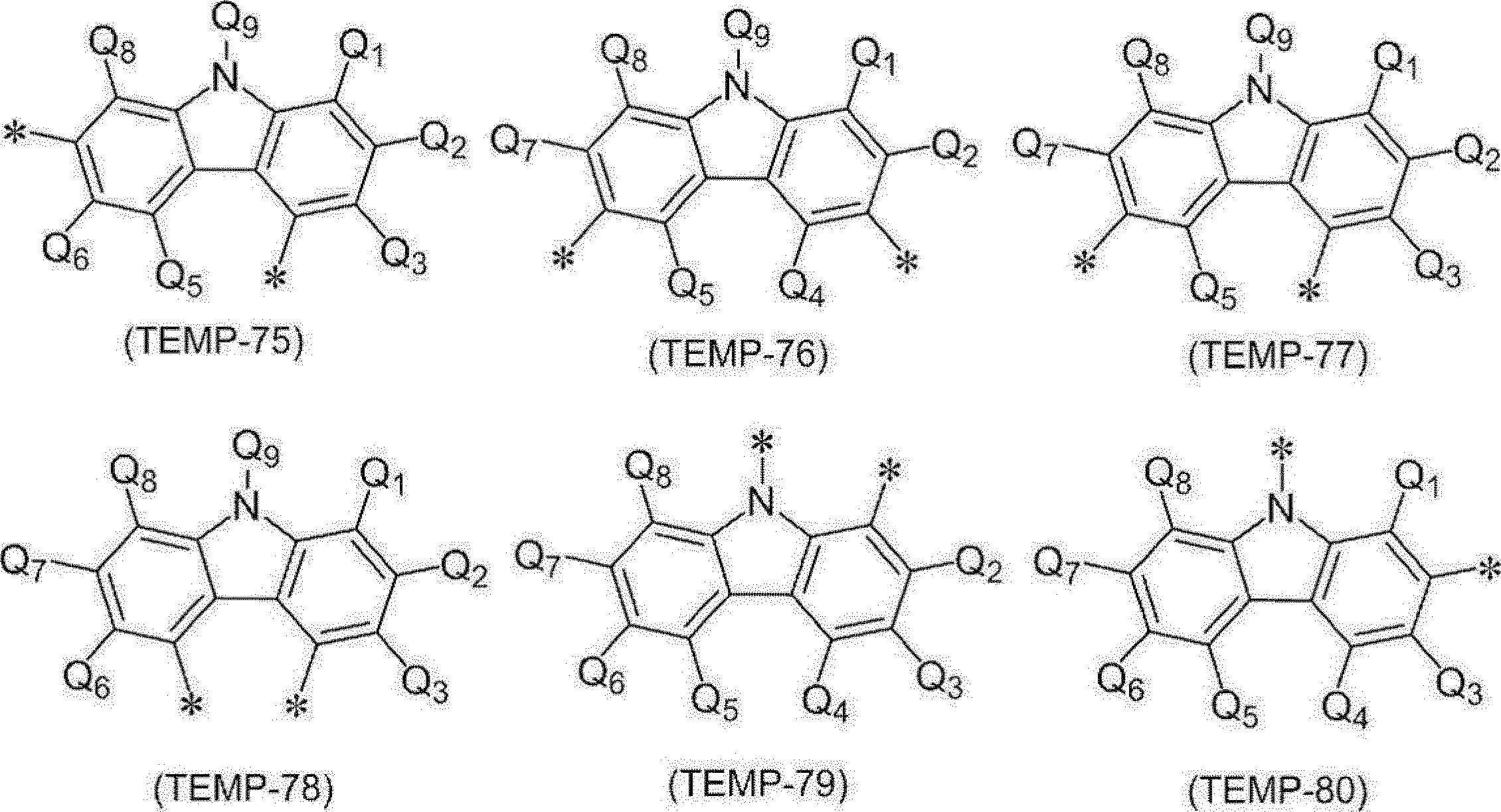

前記一般式(TEMP-69)~(TEMP-82)中、Q1~Q9は、それぞれ独立して、水素原子、又は置換基である。
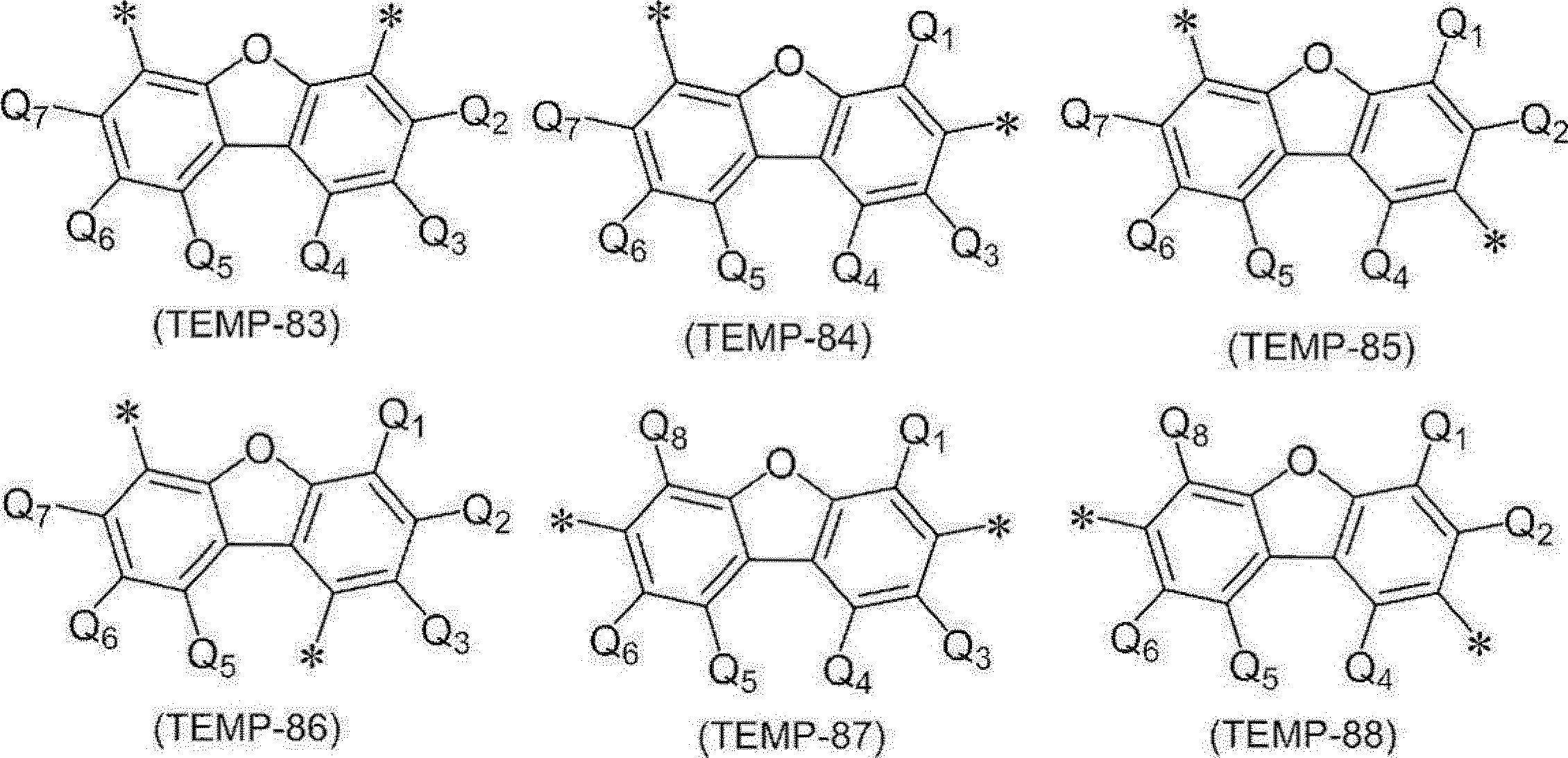


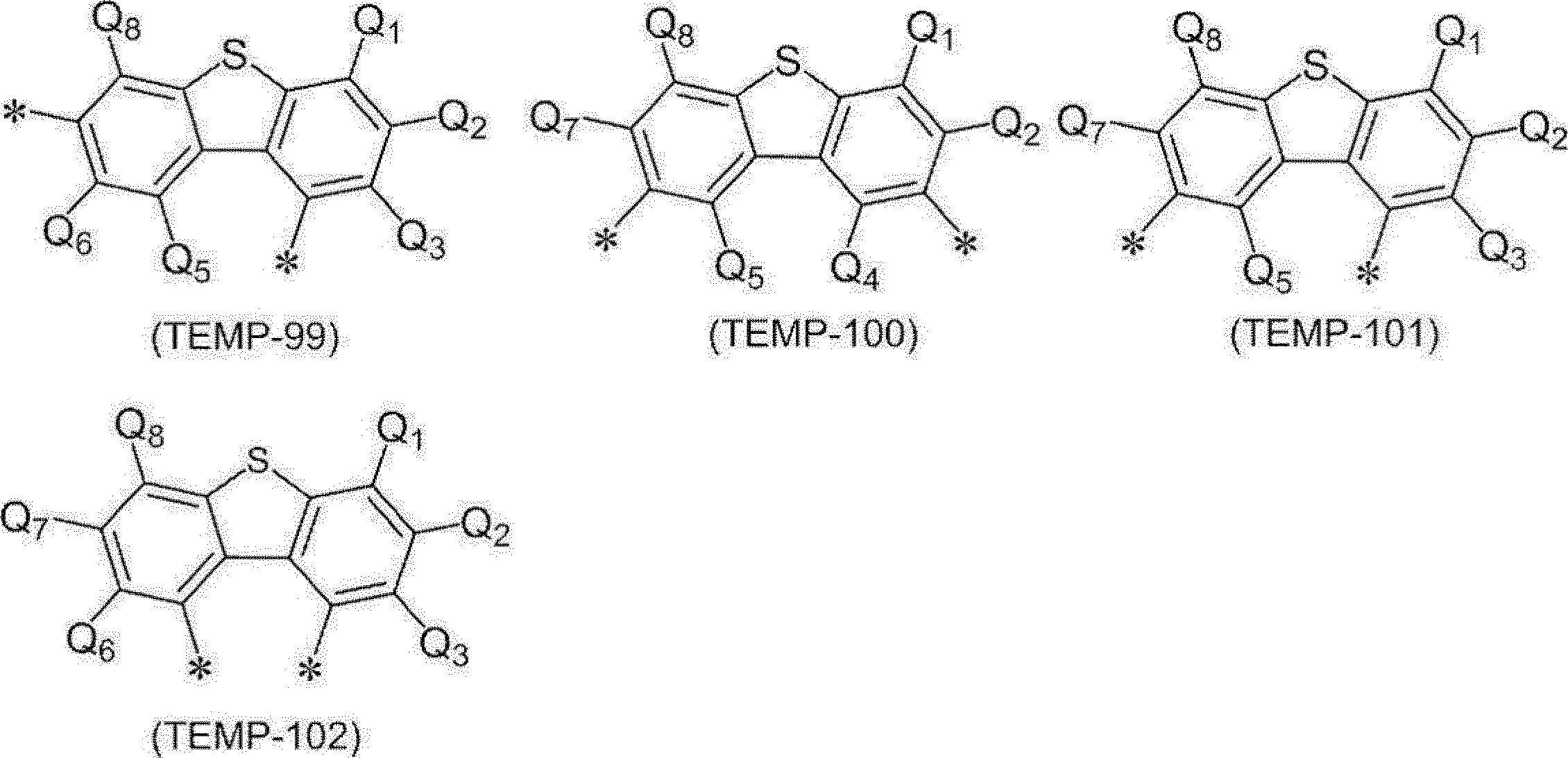
前記一般式(TEMP-83)~(TEMP-102)中、Q1~Q8は、それぞれ独立して、水素原子、又は置換基である。
以上が、「本明細書に記載の置換基」についての説明である。
・「結合して環を形成する場合」
本明細書において、「隣接する2つ以上からなる組の1組以上が、互いに結合して、置換もしくは無置換の単環を形成するか、互いに結合して、置換もしくは無置換の縮合環を形成するか、又は互いに結合せず」という場合は、「隣接する2つ以上からなる組の1組以上が、互いに結合して、置換もしくは無置換の単環を形成する」場合と、「隣接する2つ以上からなる組の1組以上が、互いに結合して、置換もしくは無置換の縮合環を形成する」場合と、「隣接する2つ以上からなる組の1組以上が、互いに結合しない」場合と、を意味する。
本明細書における、「隣接する2つ以上からなる組の1組以上が、互いに結合して、置換もしくは無置換の単環を形成する」場合、及び「隣接する2つ以上からなる組の1組以上が、互いに結合して、置換もしくは無置換の縮合環を形成する」場合(以下、これらの場合をまとめて「結合して環を形成する場合」と称する場合がある。)について、以下、説明する。母骨格がアントラセン環である下記一般式(TEMP-103)で表されるアントラセン化合物の場合を例として説明する。
本明細書において、「隣接する2つ以上からなる組の1組以上が、互いに結合して、置換もしくは無置換の単環を形成するか、互いに結合して、置換もしくは無置換の縮合環を形成するか、又は互いに結合せず」という場合は、「隣接する2つ以上からなる組の1組以上が、互いに結合して、置換もしくは無置換の単環を形成する」場合と、「隣接する2つ以上からなる組の1組以上が、互いに結合して、置換もしくは無置換の縮合環を形成する」場合と、「隣接する2つ以上からなる組の1組以上が、互いに結合しない」場合と、を意味する。
本明細書における、「隣接する2つ以上からなる組の1組以上が、互いに結合して、置換もしくは無置換の単環を形成する」場合、及び「隣接する2つ以上からなる組の1組以上が、互いに結合して、置換もしくは無置換の縮合環を形成する」場合(以下、これらの場合をまとめて「結合して環を形成する場合」と称する場合がある。)について、以下、説明する。母骨格がアントラセン環である下記一般式(TEMP-103)で表されるアントラセン化合物の場合を例として説明する。
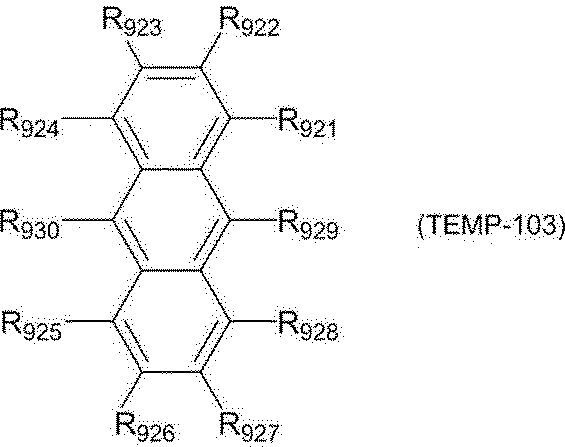
例えば、R921~R930のうちの「隣接する2つ以上からなる組の1組以上が、互いに結合して、環を形成する」場合において、1組となる隣接する2つからなる組とは、R921とR922との組、R922とR923との組、R923とR924との組、R924とR930との組、R930とR925との組、R925とR926との組、R926とR927との組、R927とR928との組、R928とR929との組、並びにR929とR921との組である。
上記「1組以上」とは、上記隣接する2つ以上からなる組の2組以上が同時に環を形成してもよいことを意味する。例えば、R921とR922とが互いに結合して環QAを形成し、同時にR925とR926とが互いに結合して環QBを形成した場合は、前記一般式(TEMP-103)で表されるアントラセン化合物は、下記一般式(TEMP-104)で表される。

「隣接する2つ以上からなる組」が環を形成する場合とは、前述の例のように隣接する「2つ」からなる組が結合する場合だけではなく、隣接する「3つ以上」からなる組が結合する場合も含む。例えば、R921とR922とが互いに結合して環QAを形成し、かつ、R922とR923とが互いに結合して環QCを形成し、互いに隣接する3つ(R921、R922及びR923)からなる組が互いに結合して環を形成して、アントラセン母骨格に縮合する場合を意味し、この場合、前記一般式(TEMP-103)で表されるアントラセン化合物は、下記一般式(TEMP-105)で表される。下記一般式(TEMP-105)において、環QA及び環QCは、R922を共有する。

形成される「単環」、又は「縮合環」は、形成された環のみの構造として、飽和の環であっても不飽和の環であってもよい。「隣接する2つからなる組の1組」が「単環」、又は「縮合環」を形成する場合であっても、当該「単環」、又は「縮合環」は、飽和の環、又は不飽和の環を形成することができる。例えば、前記一般式(TEMP-104)において形成された環QA及び環QBは、それぞれ、「単環」又は「縮合環」である。また、前記一般式(TEMP-105)において形成された環QA、及び環QCは、「縮合環」である。前記一般式(TEMP-105)の環QAと環QCとは、環QAと環QCとが縮合することによって縮合環となっている。前記一般式(TMEP-104)の環QAがベンゼン環であれば、環QAは、単環である。前記一般式(TMEP-104)の環QAがナフタレン環であれば、環QAは、縮合環である。
「不飽和の環」とは、芳香族炭化水素環、又は芳香族複素環を意味する。「飽和の環」とは、脂肪族炭化水素環、又は非芳香族複素環を意味する。
芳香族炭化水素環の具体例としては、具体例群G1において具体例として挙げられた基が水素原子によって終端された構造が挙げられる。
芳香族複素環の具体例としては、具体例群G2において具体例として挙げられた芳香族複素環基が水素原子によって終端された構造が挙げられる。
脂肪族炭化水素環の具体例としては、具体例群G6において具体例として挙げられた基が水素原子によって終端された構造が挙げられる。
「環を形成する」とは、母骨格の複数の原子のみ、あるいは母骨格の複数の原子とさらに1以上の任意の元素で環を形成することを意味する。例えば、前記一般式(TEMP-104)に示す、R921とR922とが互いに結合して形成された環QAは、R921が結合するアントラセン骨格の炭素原子と、R922が結合するアントラセン骨格の炭素原子と、1以上の任意の元素とで形成する環を意味する。具体例としては、R921とR922とで環QAを形成する場合において、R921が結合するアントラセン骨格の炭素原子と、R922とが結合するアントラセン骨格の炭素原子と、4つの炭素原子とで単環の不飽和の環を形成する場合、R921とR922とで形成する環は、ベンゼン環である。
芳香族炭化水素環の具体例としては、具体例群G1において具体例として挙げられた基が水素原子によって終端された構造が挙げられる。
芳香族複素環の具体例としては、具体例群G2において具体例として挙げられた芳香族複素環基が水素原子によって終端された構造が挙げられる。
脂肪族炭化水素環の具体例としては、具体例群G6において具体例として挙げられた基が水素原子によって終端された構造が挙げられる。
「環を形成する」とは、母骨格の複数の原子のみ、あるいは母骨格の複数の原子とさらに1以上の任意の元素で環を形成することを意味する。例えば、前記一般式(TEMP-104)に示す、R921とR922とが互いに結合して形成された環QAは、R921が結合するアントラセン骨格の炭素原子と、R922が結合するアントラセン骨格の炭素原子と、1以上の任意の元素とで形成する環を意味する。具体例としては、R921とR922とで環QAを形成する場合において、R921が結合するアントラセン骨格の炭素原子と、R922とが結合するアントラセン骨格の炭素原子と、4つの炭素原子とで単環の不飽和の環を形成する場合、R921とR922とで形成する環は、ベンゼン環である。
ここで、「任意の元素」は、本明細書に別途記載のない限り、好ましくは、炭素元素、窒素元素、酸素元素、及び硫黄元素からなる群から選択される少なくとも1種の元素である。任意の元素において(例えば、炭素元素、又は窒素元素の場合)、環を形成しない結合は、水素原子等で終端されてもよいし、後述する「任意の置換基」で置換されてもよい。炭素元素以外の任意の元素を含む場合、形成される環は複素環である。
単環または縮合環を構成する「1以上の任意の元素」は、本明細書に別途記載のない限り、好ましくは2個以上15個以下であり、より好ましくは3個以上12個以下であり、さらに好ましくは3個以上5個以下である。
本明細書に別途記載のない限り、「単環」、及び「縮合環」のうち、好ましくは「単環」である。
本明細書に別途記載のない限り、「飽和の環」、及び「不飽和の環」のうち、好ましくは「不飽和の環」である。
本明細書に別途記載のない限り、「単環」は、好ましくはベンゼン環である。
本明細書に別途記載のない限り、「不飽和の環」は、好ましくはベンゼン環である。
「隣接する2つ以上からなる組の1組以上」が、「互いに結合して、置換もしくは無置換の単環を形成する」場合、又は「互いに結合して、置換もしくは無置換の縮合環を形成する」場合、本明細書に別途記載のない限り、好ましくは、隣接する2つ以上からなる組の1組以上が、互いに結合して、母骨格の複数の原子と、1個以上15個以下の炭素元素、窒素元素、酸素元素、及び硫黄元素からなる群から選択される少なくとも1種の元素とからなる置換もしくは無置換の「不飽和の環」を形成する。
単環または縮合環を構成する「1以上の任意の元素」は、本明細書に別途記載のない限り、好ましくは2個以上15個以下であり、より好ましくは3個以上12個以下であり、さらに好ましくは3個以上5個以下である。
本明細書に別途記載のない限り、「単環」、及び「縮合環」のうち、好ましくは「単環」である。
本明細書に別途記載のない限り、「飽和の環」、及び「不飽和の環」のうち、好ましくは「不飽和の環」である。
本明細書に別途記載のない限り、「単環」は、好ましくはベンゼン環である。
本明細書に別途記載のない限り、「不飽和の環」は、好ましくはベンゼン環である。
「隣接する2つ以上からなる組の1組以上」が、「互いに結合して、置換もしくは無置換の単環を形成する」場合、又は「互いに結合して、置換もしくは無置換の縮合環を形成する」場合、本明細書に別途記載のない限り、好ましくは、隣接する2つ以上からなる組の1組以上が、互いに結合して、母骨格の複数の原子と、1個以上15個以下の炭素元素、窒素元素、酸素元素、及び硫黄元素からなる群から選択される少なくとも1種の元素とからなる置換もしくは無置換の「不飽和の環」を形成する。
上記の「単環」、又は「縮合環」が置換基を有する場合の置換基は、例えば後述する「任意の置換基」である。上記の「単環」、又は「縮合環」が置換基を有する場合の置換基の具体例は、上述した「本明細書に記載の置換基」の項で説明した置換基である。
上記の「飽和の環」、又は「不飽和の環」が置換基を有する場合の置換基は、例えば後述する「任意の置換基」である。上記の「単環」、又は「縮合環」が置換基を有する場合の置換基の具体例は、上述した「本明細書に記載の置換基」の項で説明した置換基である。
以上が、「隣接する2つ以上からなる組の1組以上が、互いに結合して、置換もしくは無置換の単環を形成する」場合、及び「隣接する2つ以上からなる組の1組以上が、互いに結合して、置換もしくは無置換の縮合環を形成する」場合(「結合して環を形成する場合」)についての説明である。
上記の「飽和の環」、又は「不飽和の環」が置換基を有する場合の置換基は、例えば後述する「任意の置換基」である。上記の「単環」、又は「縮合環」が置換基を有する場合の置換基の具体例は、上述した「本明細書に記載の置換基」の項で説明した置換基である。
以上が、「隣接する2つ以上からなる組の1組以上が、互いに結合して、置換もしくは無置換の単環を形成する」場合、及び「隣接する2つ以上からなる組の1組以上が、互いに結合して、置換もしくは無置換の縮合環を形成する」場合(「結合して環を形成する場合」)についての説明である。
・「置換もしくは無置換の」という場合の置換基
本明細書における一実施形態においては、前記「置換もしくは無置換の」という場合の置換基(本明細書において、「任意の置換基」と呼ぶことがある。)は、例えば、
無置換の炭素数1~50のアルキル基、
無置換の炭素数2~50のアルケニル基、
無置換の炭素数2~50のアルキニル基、
無置換の環形成炭素数3~50のシクロアルキル基、
-Si(R901)(R902)(R903)、
-O-(R904)、
-S-(R905)、
-N(R906)(R907)、
ハロゲン原子、シアノ基、ニトロ基、
無置換の環形成炭素数6~50のアリール基、及び
無置換の環形成原子数5~50の複素環基
からなる群から選択される基等であり、
ここで、R901~R907は、それぞれ独立して、
水素原子、
置換もしくは無置換の炭素数1~50のアルキル基、
置換もしくは無置換の環形成炭素数3~50のシクロアルキル基、
置換もしくは無置換の環形成炭素数6~50のアリール基、又は置換もしくは無置換の環形成原子数5~50の複素環基である。
R901が2個以上存在する場合、2個以上のR901は、互いに同一であるか、又は異なり、
R902が2個以上存在する場合、2個以上のR902は、互いに同一であるか、又は異なり、
R903が2個以上存在する場合、2個以上のR903は、互いに同一であるか、又は異なり、
R904が2個以上存在する場合、2個以上のR904は、互いに同一であるか、又は異なり、
R905が2個以上存在する場合、2個以上のR905は、互いに同一であるか、又は異なり、
R906が2個以上存在する場合、2個以上のR906は、互いに同一であるか、又は異なり、
R907が2個以上存在する場合、2個以上のR907は、互いに同一であるか又は異なる。
本明細書における一実施形態においては、前記「置換もしくは無置換の」という場合の置換基(本明細書において、「任意の置換基」と呼ぶことがある。)は、例えば、
無置換の炭素数1~50のアルキル基、
無置換の炭素数2~50のアルケニル基、
無置換の炭素数2~50のアルキニル基、
無置換の環形成炭素数3~50のシクロアルキル基、
-Si(R901)(R902)(R903)、
-O-(R904)、
-S-(R905)、
-N(R906)(R907)、
ハロゲン原子、シアノ基、ニトロ基、
無置換の環形成炭素数6~50のアリール基、及び
無置換の環形成原子数5~50の複素環基
からなる群から選択される基等であり、
ここで、R901~R907は、それぞれ独立して、
水素原子、
置換もしくは無置換の炭素数1~50のアルキル基、
置換もしくは無置換の環形成炭素数3~50のシクロアルキル基、
置換もしくは無置換の環形成炭素数6~50のアリール基、又は置換もしくは無置換の環形成原子数5~50の複素環基である。
R901が2個以上存在する場合、2個以上のR901は、互いに同一であるか、又は異なり、
R902が2個以上存在する場合、2個以上のR902は、互いに同一であるか、又は異なり、
R903が2個以上存在する場合、2個以上のR903は、互いに同一であるか、又は異なり、
R904が2個以上存在する場合、2個以上のR904は、互いに同一であるか、又は異なり、
R905が2個以上存在する場合、2個以上のR905は、互いに同一であるか、又は異なり、
R906が2個以上存在する場合、2個以上のR906は、互いに同一であるか、又は異なり、
R907が2個以上存在する場合、2個以上のR907は、互いに同一であるか又は異なる。
一実施形態においては、前記「置換もしくは無置換の」という場合の置換基は、
炭素数1~50のアルキル基、
環形成炭素数6~50のアリール基、及び
環形成原子数5~50の複素環基
からなる群から選択される基である。
炭素数1~50のアルキル基、
環形成炭素数6~50のアリール基、及び
環形成原子数5~50の複素環基
からなる群から選択される基である。
一実施形態においては、前記「置換もしくは無置換の」という場合の置換基は、
炭素数1~18のアルキル基、
環形成炭素数6~18のアリール基、及び
環形成原子数5~18の複素環基
からなる群から選択される基である。
炭素数1~18のアルキル基、
環形成炭素数6~18のアリール基、及び
環形成原子数5~18の複素環基
からなる群から選択される基である。
上記任意の置換基の各基の具体例は、上述した「本明細書に記載の置換基」の項で説明した置換基の具体例である。
本明細書において別途記載のない限り、隣接する任意の置換基同士で、「飽和の環」、又は「不飽和の環」を形成してもよく、好ましくは、置換もしくは無置換の飽和の5員環、置換もしくは無置換の飽和の6員環、置換もしくは無置換の不飽和の5員環、又は置換もしくは無置換の不飽和の6員環を形成し、より好ましくは、ベンゼン環を形成する。
本明細書において別途記載のない限り、任意の置換基は、さらに置換基を有してもよい。任意の置換基がさらに有する置換基としては、上記任意の置換基と同様である。
本明細書において別途記載のない限り、任意の置換基は、さらに置換基を有してもよい。任意の置換基がさらに有する置換基としては、上記任意の置換基と同様である。
本明細書において、「AA~BB」を用いて表される数値範囲は、「AA~BB」の前に記載される数値AAを下限値とし、「AA~BB」の後に記載される数値BBを上限値として含む範囲を意味する。
本発明の有機EL素子は、陰極、陽極、及び該陰極と該陽極の間に有機層を有し、該有機層が発光層と電子輸送層を含み、該電子輸送層が化合物Aを含み、該発光層がホスト材料Bを含む。
化合物A
化合物Aは式(1)で表され、電子輸送層に使用される。

(式中、
Y1及びY2の1つは窒素原子、残りの1つはCRであり;
Rは、水素原子、置換もしくは無置換の環形成炭素数6~50のアリール基、置換もしくは無置換の環形成原子数5~50の複素環基、置換もしくは無置換の炭素数1~50のアルキル基、置換もしくは無置換の環形成炭素数3~50のシクロアルキル基、フッ素原子及びシアノ基から選ばれ;
Ar1及びAr2は、それぞれ独立して、置換もしくは無置換の環形成炭素数6~50のアリール基、及び置換もしくは無置換の環形成原子数5~50の複素環基から選ばれ;
L1及びL2は、それぞれ独立して、単結合又は置換もしくは無置換の環形成炭素数6~50のアリーレン基であり;
R1~R6は、それぞれ独立して、水素原子、置換もしくは無置換の環形成炭素数6~50のアリール基、置換もしくは無置換の環形成原子数5~50の複素環基、置換もしくは無置換の炭素数1~50のアルキル基、置換もしくは無置換の環形成炭素数3~50のシクロアルキル基、フッ素原子及びシアノ基から選ばれ;
R1~R6から選ばれる隣接する2つは互いに結合して置換もしくは無置換の環を形成してもよいし、互いに結合せず、従って、環を形成しなくてもよく;
Czは、下記式(1-a)又は式(1-b)で表され;

(式中、
R21~R28及びR31~R38は、それぞれ独立して、水素原子又は置換基であり、該置換基が、置換もしくは無置換の環形成炭素数6~50のアリール基、置換もしくは無置換の環形成原子数5~50の複素環基、置換もしくは無置換の炭素数1~50のアルキル基、置換もしくは無置換の環形成炭素数3~50のシクロアルキル基、フッ素原子及びシアノ基から選ばれ;
R21~R28から選ばれる隣接する2つは互いに結合して置換もしくは無置換の環を形成してもよいし、互いに結合せず、従って、環を形成しなくてもよく;
R31~R38から選ばれる隣接する2つは互いに結合して置換もしくは無置換の環を形成してもよいし、互いに結合せず、従って、環を形成しなくてもよく;
R24とR25及びR34とR35は互いに結合して置換もしくは無置換の環を形成してもよいし、互いに結合せず、従って、環を形成しなくてもよく
Raは置換もしくは無置換の環形成炭素数6~50のアリール基及び置換もしくは無置換の炭素数1~50のアルキル基から選ばれ;
R21~R28から選ばれる1つは*aを介してL3に結合する単結合であり;
*bはL3に結合する位置を表す。)
nは1~3の整数であり、nが2又は3である場合、2又は3個のCzは、互いに同一であるか又は異なり;
L3及びL4は、それぞれ独立して、単結合又は置換もしくは無置換の環形成炭素数6~50のアリーレン基である、ただし、nが2又は3の場合、L4は置換もしくは無置換の環形成炭素数6~50のアリーレン基である。)
化合物Aは式(1)で表され、電子輸送層に使用される。
(式中、
Y1及びY2の1つは窒素原子、残りの1つはCRであり;
Rは、水素原子、置換もしくは無置換の環形成炭素数6~50のアリール基、置換もしくは無置換の環形成原子数5~50の複素環基、置換もしくは無置換の炭素数1~50のアルキル基、置換もしくは無置換の環形成炭素数3~50のシクロアルキル基、フッ素原子及びシアノ基から選ばれ;
Ar1及びAr2は、それぞれ独立して、置換もしくは無置換の環形成炭素数6~50のアリール基、及び置換もしくは無置換の環形成原子数5~50の複素環基から選ばれ;
L1及びL2は、それぞれ独立して、単結合又は置換もしくは無置換の環形成炭素数6~50のアリーレン基であり;
R1~R6は、それぞれ独立して、水素原子、置換もしくは無置換の環形成炭素数6~50のアリール基、置換もしくは無置換の環形成原子数5~50の複素環基、置換もしくは無置換の炭素数1~50のアルキル基、置換もしくは無置換の環形成炭素数3~50のシクロアルキル基、フッ素原子及びシアノ基から選ばれ;
R1~R6から選ばれる隣接する2つは互いに結合して置換もしくは無置換の環を形成してもよいし、互いに結合せず、従って、環を形成しなくてもよく;
Czは、下記式(1-a)又は式(1-b)で表され;
(式中、
R21~R28及びR31~R38は、それぞれ独立して、水素原子又は置換基であり、該置換基が、置換もしくは無置換の環形成炭素数6~50のアリール基、置換もしくは無置換の環形成原子数5~50の複素環基、置換もしくは無置換の炭素数1~50のアルキル基、置換もしくは無置換の環形成炭素数3~50のシクロアルキル基、フッ素原子及びシアノ基から選ばれ;
R21~R28から選ばれる隣接する2つは互いに結合して置換もしくは無置換の環を形成してもよいし、互いに結合せず、従って、環を形成しなくてもよく;
R31~R38から選ばれる隣接する2つは互いに結合して置換もしくは無置換の環を形成してもよいし、互いに結合せず、従って、環を形成しなくてもよく;
R24とR25及びR34とR35は互いに結合して置換もしくは無置換の環を形成してもよいし、互いに結合せず、従って、環を形成しなくてもよく
Raは置換もしくは無置換の環形成炭素数6~50のアリール基及び置換もしくは無置換の炭素数1~50のアルキル基から選ばれ;
R21~R28から選ばれる1つは*aを介してL3に結合する単結合であり;
*bはL3に結合する位置を表す。)
nは1~3の整数であり、nが2又は3である場合、2又は3個のCzは、互いに同一であるか又は異なり;
L3及びL4は、それぞれ独立して、単結合又は置換もしくは無置換の環形成炭素数6~50のアリーレン基である、ただし、nが2又は3の場合、L4は置換もしくは無置換の環形成炭素数6~50のアリーレン基である。)
以下、化合物Aを表す式(1)及び後述する各式中の記号を説明する。なお、特に限定しない限り、同じ記号は同じ意味を有する。
Y1及びY2の1つは窒素原子、残りの1つはCRである。すなわち、Y1が窒素原子でY2がCR、又はY1がCRでY2が窒素原子である。
nは1~3の整数、好ましくは1又は2、より好ましくは1である。nが2又は3である場合、2又は3個のCzは、互いに同一であるか又は異なる。
nは1~3の整数、好ましくは1又は2、より好ましくは1である。nが2又は3である場合、2又は3個のCzは、互いに同一であるか又は異なる。
Rは、水素原子、置換もしくは無置換の環形成炭素数6~50のアリール基、置換もしくは無置換の環形成原子数5~50の複素環基、置換もしくは無置換の炭素数1~50のアルキル基、置換もしくは無置換の環形成炭素数3~50のシクロアルキル基、フッ素原子及びシアノ基から選ばれ、好ましくは、水素原子、置換もしくは無置換の環形成炭素数6~50のアリール基、置換もしくは無置換の環形成原子数5~50の複素環基、及び置換もしくは無置換の炭素数1~50のアルキル基から選ばれ、
より好ましくは水素原子である。
より好ましくは水素原子である。
前記置換もしくは無置換の環形成炭素数6~50のアリール基の詳細は「本明細書に記載の置換基」において記載したとおりであり、より好ましくはフェニル基、p-ビフェニル基、m-ビフェニル基、o-ビフェニル基、p-ターフェニル-4-イル基、p-ターフェニル-3-イル基、p-ターフェニル-2-イル基、m-ターフェニル-4-イル基、m-ターフェニル-3-イル基、m-ターフェニル-2-イル基、o-ターフェニル-4-イル基、o-ターフェニル-3-イル基、o-ターフェニル-2-イル基、1-ナフチル基、2-ナフチル基、フルオレニル基、9,9’-スピロビフルオレニル基、9,9-ジメチルフルオレニル基、又は9,9-ジフェニルフルオレニル基であり、さらに好ましくはフェニル基、p-ビフェニル基、m-ビフェニル基、o-ビフェニル基、1-ナフチル基、2-ナフチル基、フルオレニル基、9,9’-スピロビフルオレニル基、9,9-ジメチルフルオレニル基、又は9,9-ジフェニルフルオレニル基である。
前記置換もしくは無置換の環形成原子数5~50の複素環基の詳細は「本明細書に記載の置換基」において記載したとおりであり、より好ましくはカルバゾリル基(1-カルバゾリル基、2-カルバゾリル基、3-カルバゾリル基、4-カルバゾリル基、又は9-カルバゾリル基)、ジベンゾフラニル基、ナフトベンゾフラニル基、ジベンゾチオフェニル基、ナフトベンゾチオフェニル基、フェニルジベンゾフラニル基、又はフェニルジベンゾチオフェニル基であり、さらに好ましくはカルバゾリル基(1-カルバゾリル基、2-カルバゾリル基、3-カルバゾリル基、4-カルバゾリル基、又は9-カルバゾリル基)、ジベンゾフラニル基、又はジベンゾチオフェニル基である。
前記置換もしくは無置換の炭素数1~50のアルキル基の詳細は「本明細書に記載の置換基」において記載したとおりであり、好ましくはメチル基、エチル基、n-プロピル基、イソプロピル基、n-ブチル基、イソブチル基、s-ブチル基、又はt-ブチル基であり、より好ましくはメチル基、イソプロピル基、又はt-ブチル基である。
前記置換もしくは無置換の環形成炭素数3~50のシクロアルキル基の詳細は「本明細書に記載の置換基」において記載したとおりであり、好ましくはシクロプロピル基、シクロブチル基、シクロペンチル基、又はシクロヘキシル基であり、より好ましくはシクロプロピル基、シクロペンチル基、又はシクロヘキシル基である。
R1~R6は、それぞれ独立して、水素原子、置換もしくは無置換の環形成炭素数6~50のアリール基、置換もしくは無置換の環形成原子数5~50の複素環基、置換もしくは無置換の炭素数1~50のアルキル基、置換もしくは無置換の環形成炭素数3~50のシクロアルキル基、フッ素原子及びシアノ基から選ばれ、好ましくは、水素原子、置換もしくは無置換の環形成炭素数6~50のアリール基、置換もしくは無置換の環形成原子数5~50の複素環基、及び置換もしくは無置換の炭素数1~50のアルキル基から選ばれ、より好ましくは水素原子である。R1~R6のすべてが水素原子であってもよい。
前記置換もしくは無置換の環形成炭素数6~50のアリール基、置換もしくは無置換の環形成原子数5~50の複素環基、置換もしくは無置換の炭素数1~50のアルキル基、置換もしくは無置換の環形成炭素数3~50のシクロアルキル基の詳細は、それぞれ、Rに関して前記した対応する基の詳細と同じである。
前記置換もしくは無置換の環形成炭素数6~50のアリール基、置換もしくは無置換の環形成原子数5~50の複素環基、置換もしくは無置換の炭素数1~50のアルキル基、置換もしくは無置換の環形成炭素数3~50のシクロアルキル基の詳細は、それぞれ、Rに関して前記した対応する基の詳細と同じである。
R1~R6から選ばれる隣接する2つ、すなわち、R1とR2、R3とR4、R4とR5、及びR5とR6から選ばれる少なくとも1組の隣接する2つは、互いに結合して環を形成してもよいし、互いに結合せず、従って、環を形成しなくてもよく、好ましくは互いに結合せず、従って、環を形成しない。
前記置換もしくは無置換の環は、置換もしくは無置換の芳香族炭化水素環、置換もしくは無置換の脂肪族炭化水素環、置換もしくは無置換の芳香族複素環、及び置換もしくは無置換の脂肪族複素環から選ばれ、好ましくは置換もしくは無置換の芳香族炭化水素環である。
前記芳香族炭化水素環は、例えば、ベンゼン環、ビフェニレン環、ナフタレン環、アントラセン環、ベンゾアントラセン環、フェナントレン環、ベンゾフェナントレン環、フェナレン環、ピレン環、クリセン環、1,1-ジメチルインデン環、又はトリフェニレン環であり、好ましくはベンゼン環又はナフタレン環であり、より好ましくはベンゼン環である。
前記脂肪族炭化水素環は、例えば、シクロペンテン環、シクロペンタジエン環、シクロヘキセン環、シクロヘキサジエン環、又は、前記芳香族炭化水素環を部分的に水素化して得られる脂肪族炭化水素環である。
前記芳香族複素環は、例えば、ピロール環、フラン環、チオフェン環、ピリジン環、イミダゾール環、ピラゾール環、インドール環、イソインドール環、ベンゾフラン環、イソベンゾフラン環、ベンゾチオフェン環、ベンゾイミダゾール環、インダゾール環、ジベンゾフラン環、ナフトベンゾフラン環、ジベンゾチオフェン環、ナフトベンゾチオフェン環、カルバゾール環、又はベンゾカルバゾール環である。
前記脂肪族複素環は、例えば、上記芳香族複素環を部分的に水素化して得られる脂肪族複素環である。
前記置換もしくは無置換の環は、置換もしくは無置換の芳香族炭化水素環、置換もしくは無置換の脂肪族炭化水素環、置換もしくは無置換の芳香族複素環、及び置換もしくは無置換の脂肪族複素環から選ばれ、好ましくは置換もしくは無置換の芳香族炭化水素環である。
前記芳香族炭化水素環は、例えば、ベンゼン環、ビフェニレン環、ナフタレン環、アントラセン環、ベンゾアントラセン環、フェナントレン環、ベンゾフェナントレン環、フェナレン環、ピレン環、クリセン環、1,1-ジメチルインデン環、又はトリフェニレン環であり、好ましくはベンゼン環又はナフタレン環であり、より好ましくはベンゼン環である。
前記脂肪族炭化水素環は、例えば、シクロペンテン環、シクロペンタジエン環、シクロヘキセン環、シクロヘキサジエン環、又は、前記芳香族炭化水素環を部分的に水素化して得られる脂肪族炭化水素環である。
前記芳香族複素環は、例えば、ピロール環、フラン環、チオフェン環、ピリジン環、イミダゾール環、ピラゾール環、インドール環、イソインドール環、ベンゾフラン環、イソベンゾフラン環、ベンゾチオフェン環、ベンゾイミダゾール環、インダゾール環、ジベンゾフラン環、ナフトベンゾフラン環、ジベンゾチオフェン環、ナフトベンゾチオフェン環、カルバゾール環、又はベンゾカルバゾール環である。
前記脂肪族複素環は、例えば、上記芳香族複素環を部分的に水素化して得られる脂肪族複素環である。
L3及びL4は、それぞれ独立して、単結合又は置換もしくは無置換の環形成炭素数6~50のアリーレン基である。
ただし、nが2又は3である場合、L4は置換もしくは無置換の環形成炭素数6~50のアリーレン基である。
ただし、nが2又は3である場合、L4は置換もしくは無置換の環形成炭素数6~50のアリーレン基である。
本発明の一態様において、L3及びL4が、それぞれ独立して、置換もしくは無置換の環形成炭素数6~50のアリーレン基であることが好ましい。
本発明の他の態様において、L3が単結合でありL4が置換もしくは無置換の環形成炭素数6~50のアリーレン基であることが好ましい。
本発明のさらに他の態様において、L3及びL4が単結合であることが好ましい。
本発明の他の態様において、L3が単結合でありL4が置換もしくは無置換の環形成炭素数6~50のアリーレン基であることが好ましい。
本発明のさらに他の態様において、L3及びL4が単結合であることが好ましい。
L3及びL4が表す置換もしくは無置換の炭素数6~50のアリーレン基の詳細は「本明細書に記載の置換基」において記載したとおりであり、前記した「置換もしくは無置換の炭素数6~50のアリール基」から芳香族環上の1つの水素原子を除くことにより誘導される2価の基が挙げられる。
L3及びL4が表す置換もしくは無置換の環形成炭素数6~50のアリーレン基の無置換のアリーレン基は、好ましくは、それぞれ独立して、フェニレン基、ビフェニレン基、ナフチレン基、フェナントリレン基、アントラセニレン基、及びフルオランテニレン基から選ばれる。
L3及びL4が表す置換もしくは無置換の環形成炭素数6~50のアリーレン基の無置換のアリーレン基は、好ましくは、それぞれ独立して、フェニレン基、ビフェニレン基、ナフチレン基、フェナントリレン基、アントラセニレン基、及びフルオランテニレン基から選ばれる。
Ar1及びAr2は、それぞれ独立して、置換もしくは無置換の環形成炭素数6~50のアリール基及び置換もしくは無置換の環形成原子数5~50の複素環基から選ばれる。
前記置換もしくは無置換の環形成炭素数6~50のアリール基の詳細は、Rに関して前記した対応する基の詳細と同じである。
Ar1及びAr2が表す置換もしくは無置換の環形成炭素数6~50のアリール基の無置換のアリール基は、それぞれ独立して、フェニル基、ビフェニル基、ナフチル基、フェナントリル基、アントラセニル基、及びフルオランテニル基から選ばれることが好ましい。
Ar1及びAr2が表す置換もしくは無置換の環形成炭素数6~50のアリール基の無置換のアリール基は、それぞれ独立して、フェニル基、ビフェニル基、ナフチル基、フェナントリル基、アントラセニル基、及びフルオランテニル基から選ばれることが好ましい。
前記置換もしくは無置換の環形成原子数5~50の複素環基の詳細は、それぞれ、Rに関して前記した対応する基の詳細と同じである。
Ar1及びAr2が表す置換もしくは無置換の環形成原子数5~50の複素環基の無置換の複素環基が、それぞれ独立して、ピリジル基、ピリミジニル基、トリアジニル基、キノリル基、ジベンゾチオフェニル基、ジベンゾフラニル基、アザジベンゾフラニル基、及びアザジベンゾチオフェニル基から選ばれることが好ましい。
Ar1及びAr2が表す置換もしくは無置換の環形成原子数5~50の複素環基の無置換の複素環基が、それぞれ独立して、ピリジル基、ピリミジニル基、トリアジニル基、キノリル基、ジベンゾチオフェニル基、ジベンゾフラニル基、アザジベンゾフラニル基、及びアザジベンゾチオフェニル基から選ばれることが好ましい。
L1及びL2は、それぞれ独立して、単結合又は置換もしくは無置換の環形成炭素数6~50のアリーレン基である。
本発明の一態様において、L1及びL2の1つが置換もしくは無置換の環形成炭素数6~50のアリーレン基であり、残りの1つが単結合であることが好ましい。
本発明の他の態様において、L1及びL2が、それぞれ独立して、置換もしくは無置換の環形成炭素数6~50のアリーレン基であることが好ましい。
本発明のさらに他の態様において、L1及びL2が単結合であることが好ましい。
本発明の一態様において、L1及びL2の1つが置換もしくは無置換の環形成炭素数6~50のアリーレン基であり、残りの1つが単結合であることが好ましい。
本発明の他の態様において、L1及びL2が、それぞれ独立して、置換もしくは無置換の環形成炭素数6~50のアリーレン基であることが好ましい。
本発明のさらに他の態様において、L1及びL2が単結合であることが好ましい。
L1及びL2が表す置換もしくは無置換の炭素数6~50のアリーレン基の詳細は、L3及びL4に関して前記したアリーレン基の詳細と同じである。
L1及びL2が表す置換もしくは無置換の環形成炭素数6~50のアリーレン基の無置換のアリーレン基が、それぞれ独立して、フェニレン基、ビフェニレン基、ナフチレン基、及びフェナントリレン基から選ばれることが好ましい。
L1及びL2が表す置換もしくは無置換の環形成炭素数6~50のアリーレン基の無置換のアリーレン基が、それぞれ独立して、フェニレン基、ビフェニレン基、ナフチレン基、及びフェナントリレン基から選ばれることが好ましい。
Czは、下記式(1-a)又は式(1-b)で表される基である。
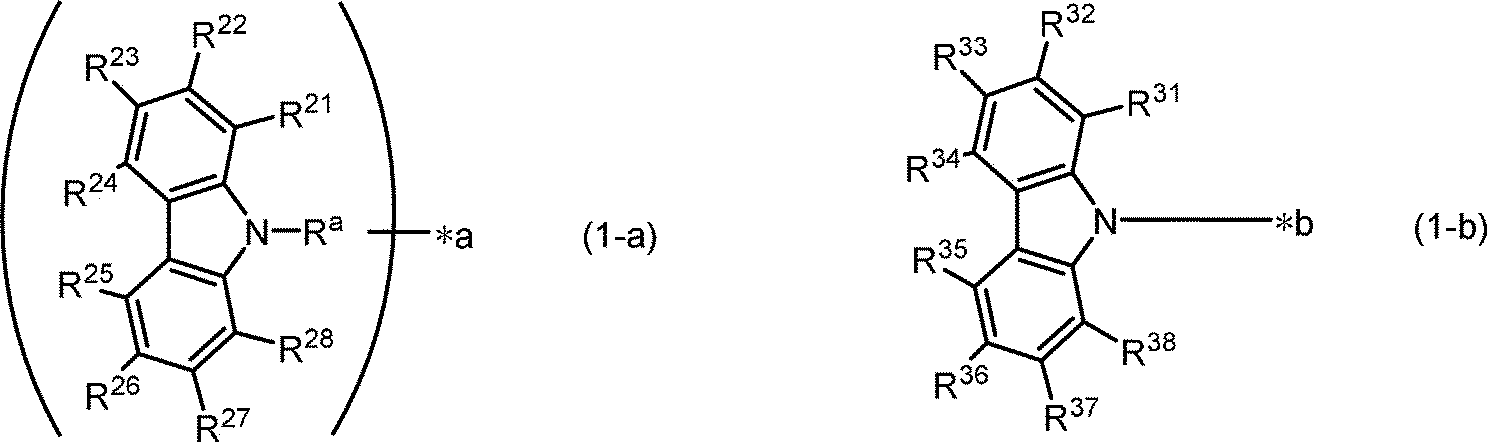
R21~R28及びR31~R38は、それぞれ独立して、水素原子又は置換基である。
該置換基は、置換もしくは無置換の環形成炭素数6~50のアリール基、置換もしくは無置換の環形成原子数5~50の複素環基、置換もしくは無置換の炭素数1~50のアルキル基、置換もしくは無置換の環形成炭素数3~50のシクロアルキル基、フッ素原子及びシアノ基から選ばれ、
好ましくは、水素原子、置換もしくは無置換の環形成炭素数6~50のアリール基、置換もしくは無置換の環形成原子数5~50の複素環基、及び置換もしくは無置換の炭素数1~50のアルキル基から選ばれ、より好ましくは水素原子である。
R21~R28から選ばれる1つ、好ましくはR21、R22、R23、又はR24、より好ましくはR23は*aを介してL3に結合する単結合であり、*bはL3に結合する位置を表す。
*aを介してL3に結合する単結合ではないR21~R28のすべてが水素原子であってもよい。また、R31~R38のすべてが水素原子であってもよい。
該置換基は、置換もしくは無置換の環形成炭素数6~50のアリール基、置換もしくは無置換の環形成原子数5~50の複素環基、置換もしくは無置換の炭素数1~50のアルキル基、置換もしくは無置換の環形成炭素数3~50のシクロアルキル基、フッ素原子及びシアノ基から選ばれ、
好ましくは、水素原子、置換もしくは無置換の環形成炭素数6~50のアリール基、置換もしくは無置換の環形成原子数5~50の複素環基、及び置換もしくは無置換の炭素数1~50のアルキル基から選ばれ、より好ましくは水素原子である。
R21~R28から選ばれる1つ、好ましくはR21、R22、R23、又はR24、より好ましくはR23は*aを介してL3に結合する単結合であり、*bはL3に結合する位置を表す。
*aを介してL3に結合する単結合ではないR21~R28のすべてが水素原子であってもよい。また、R31~R38のすべてが水素原子であってもよい。
*aを介してL3に結合する単結合ではないR21~R28から選ばれる隣接する2つ、すなわち、R21とR22、R22とR23、R23とR24、R25とR26、R26とR27、R27とR28から選ばれる少なくとも1組の隣接する2つは互いに結合して置換もしくは無置換の環を形成してもよいし、互いに結合せず、従って、環を形成しなくてもよく、好ましくは、互いに結合せず、従って、環を形成しない。
*aを介してL3に結合する単結合ではないR24とR25は互いに結合して置換もしくは無置換の環を形成してもよいし、互いに結合せず、従って、環を形成しなくてもよく、好ましくは、互いに結合せず、従って、環を形成しない。
R31~R38から選ばれる隣接する2つ、すなわち、R31とR32、R32とR33、R33とR34、R35とR36、R36とR37、R37とR38から選ばれる少なくとも1組の隣接する2つは互いに結合して置換もしくは無置換の環を形成してもよいし、互いに結合せず、従って、環を形成しなくてもよく、好ましくは、互いに結合せず、従って、環を形成しない。
R34とR35は互いに結合して置換もしくは無置換の環を形成してもよいし、互いに結合せず、従って、環を形成しなくてもよく、好ましくは、互いに結合せず、従って、環を形成しない。
前記置換もしくは無置換の環の詳細は、R1~R6から選ばれる少なくとも1組の隣接する2つが任意に形成する環に関して記載したとおりである。
*aを介してL3に結合する単結合ではないR24とR25は互いに結合して置換もしくは無置換の環を形成してもよいし、互いに結合せず、従って、環を形成しなくてもよく、好ましくは、互いに結合せず、従って、環を形成しない。
R31~R38から選ばれる隣接する2つ、すなわち、R31とR32、R32とR33、R33とR34、R35とR36、R36とR37、R37とR38から選ばれる少なくとも1組の隣接する2つは互いに結合して置換もしくは無置換の環を形成してもよいし、互いに結合せず、従って、環を形成しなくてもよく、好ましくは、互いに結合せず、従って、環を形成しない。
R34とR35は互いに結合して置換もしくは無置換の環を形成してもよいし、互いに結合せず、従って、環を形成しなくてもよく、好ましくは、互いに結合せず、従って、環を形成しない。
前記置換もしくは無置換の環の詳細は、R1~R6から選ばれる少なくとも1組の隣接する2つが任意に形成する環に関して記載したとおりである。
*aを介してL3に結合する単結合ではないR21~R28及びR31~R38が表す置換もしくは無置換の環形成炭素数6~50のアリール基、置換もしくは無置換の環形成原子数5~50の複素環基、置換もしくは無置換の炭素数1~50のアルキル基、置換もしくは無置換の環形成炭素数3~50のシクロアルキル基の詳細は、それぞれ、Rに関して前記した対応する基の詳細と同じである。
前記置換もしくは無置換の環形成原子数5~50の複素環基は、含窒素5員環及び含窒素7員環を含まない基であることが好ましい。含窒素5員環を含む複素環基としては、例えば、ピロリジン構造、ピロリン構造、ピロール構造、カルバゾール構造、これらに類似する構造を含む基が挙げられる。含窒素7員環を含む複素環基としては、例えば、アジピン構造、アジパン構造、これらに類似する構造を含む基が挙げられる。
前記置換もしくは無置換の環形成原子数5~50の複素環基は、含窒素5員環及び含窒素7員環を含まない基であることが好ましい。含窒素5員環を含む複素環基としては、例えば、ピロリジン構造、ピロリン構造、ピロール構造、カルバゾール構造、これらに類似する構造を含む基が挙げられる。含窒素7員環を含む複素環基としては、例えば、アジピン構造、アジパン構造、これらに類似する構造を含む基が挙げられる。
本発明の一態様において、*aを介してL3に結合する単結合ではないR21~R28から選ばれる少なくとも一つ、又はR31~R38から選ばれる少なくとも一つが前記置換基であることが好ましい。前記置換基はシアノ基、置換もしくは無置換の環形成炭素数6~50のアリール基又は置換もしくは無置換の炭素数1~50のアルキル基であることが好ましい。
前記置換もしくは無置換の環形成炭素数6~50のアリール基の無置換のアリール基は、それぞれ独立して、フェニル基、ビフェニル基、ナフチル基、及びフェナントリル基から選ばれることが好ましい。
前記置換もしくは無置換の炭素数1~50のアルキル基の無置換のアルキル基が、メチル基、エチル基、n-プロピル基、イソプロピル基、n-ブチル基、イソブチル基、s-ブチル基、及びt-ブチル基から選ばれることが好ましい。
前記置換もしくは無置換の環形成炭素数6~50のアリール基の無置換のアリール基は、それぞれ独立して、フェニル基、ビフェニル基、ナフチル基、及びフェナントリル基から選ばれることが好ましい。
前記置換もしくは無置換の炭素数1~50のアルキル基の無置換のアルキル基が、メチル基、エチル基、n-プロピル基、イソプロピル基、n-ブチル基、イソブチル基、s-ブチル基、及びt-ブチル基から選ばれることが好ましい。
Raは、置換もしくは無置換の環形成炭素数6~50のアリール基又は置換もしくは無置換の炭素数1~50のアルキル基である。
前記置換もしくは無置換の環形成炭素数6~50のアリール基、置換もしくは無置換の炭素数1~50のアルキル基の詳細は、それぞれ、Rに関して前記した対応する基の詳細と同じである。
Raが表す置換もしくは無置換の環形成炭素数6~50のアリール基の無置換のアリール基は、フェニル基、ビフェニル基、ナフチル基、及びフェナントリル基から選ばれることが好ましい。
Raが表す置換もしくは無置換の環形成炭素数1~50のアルキル基の無置換のアルキル基は、メチル基、エチル基、n-プロピル基、イソプロピル基、n-ブチル基、イソブチル基、s-ブチル基、及びt-ブチル基から選ばれることが好ましい。
前記置換もしくは無置換の環形成炭素数6~50のアリール基、置換もしくは無置換の炭素数1~50のアルキル基の詳細は、それぞれ、Rに関して前記した対応する基の詳細と同じである。
Raが表す置換もしくは無置換の環形成炭素数6~50のアリール基の無置換のアリール基は、フェニル基、ビフェニル基、ナフチル基、及びフェナントリル基から選ばれることが好ましい。
Raが表す置換もしくは無置換の環形成炭素数1~50のアルキル基の無置換のアルキル基は、メチル基、エチル基、n-プロピル基、イソプロピル基、n-ブチル基、イソブチル基、s-ブチル基、及びt-ブチル基から選ばれることが好ましい。
本発明の好ましい態様において、化合物Aは式(1-b-1)又は(1-b-2)で表される化合物を含む。
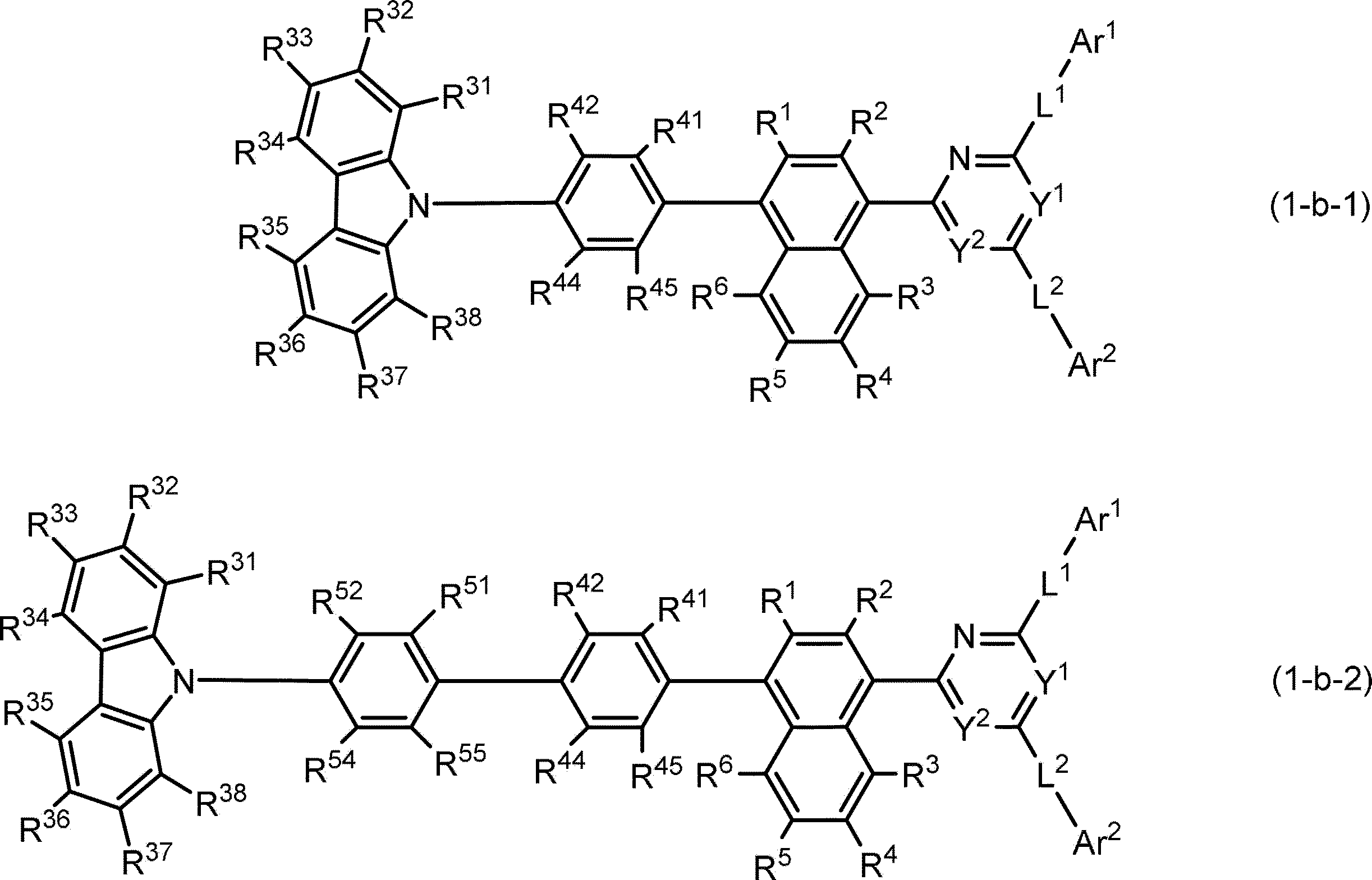
(式中、
Y1、Y2、Ar1、Ar2、L1、L2、及びR1~R6は式(1)において定義したとおりであり、
R31~R38は式(1―b)において定義したとおりであり、
R41~R42、R44~R45、R51~R52及びR54~R55は、それぞれ独立して、水素原子、置換もしくは無置換の環形成炭素数6~50のアリール基、及び置換もしくは無置換の炭素数1~50のアルキル基から選ばれ、
R41とR42、R44とR45、R51とR52、及びR54とR55から選ばれる少なくとも一組の隣接する2つは互いに結合して置換もしくは無置換のベンゼン環を形成してもよいし、互いに結合することなく、従って、ベンゼン環を形成しなくてもよい。)
Y1、Y2、Ar1、Ar2、L1、L2、及びR1~R6は式(1)において定義したとおりであり、
R31~R38は式(1―b)において定義したとおりであり、
R41~R42、R44~R45、R51~R52及びR54~R55は、それぞれ独立して、水素原子、置換もしくは無置換の環形成炭素数6~50のアリール基、及び置換もしくは無置換の炭素数1~50のアルキル基から選ばれ、
R41とR42、R44とR45、R51とR52、及びR54とR55から選ばれる少なくとも一組の隣接する2つは互いに結合して置換もしくは無置換のベンゼン環を形成してもよいし、互いに結合することなく、従って、ベンゼン環を形成しなくてもよい。)
R41、R42、R44及びR45のすべてが水素原子であってもよい。また、R51、R52、R54及びR55のすべてが水素原子であってもよい。
R41~R42、R44~R45、R51~R52及びR54~R55が表す置換もしくは無置換の環形成炭素数6~50のアリール基、及び置換もしくは無置換の炭素数1~50のアルキル基の詳細は、それぞれ、Rに関して前記した対応する基の詳細と同じである。
本発明の一態様においては、R41とR42及びR44とR45から選ばれる少なくとも一組の隣接する2つが互いに結合して置換もしくは無置換のベンゼン環を形成することが好ましい。本発明の他の態様においては、前記ベンゼン環を形成しないことが好ましい。
本発明の一態様においては、R51とR52及びR54とR55から選ばれる少なくとも一組の隣接する2つは、互いに結合して置換もしくは無置換のベンゼン環を形成することが好ましい。本発明の他の態様においては、前記ベンゼン環を形成しないことが好ましい。
本発明の好ましい態様において、化合物Aは式(1-b-11)~(1-b-14)のいずれかで表される化合物を含む。
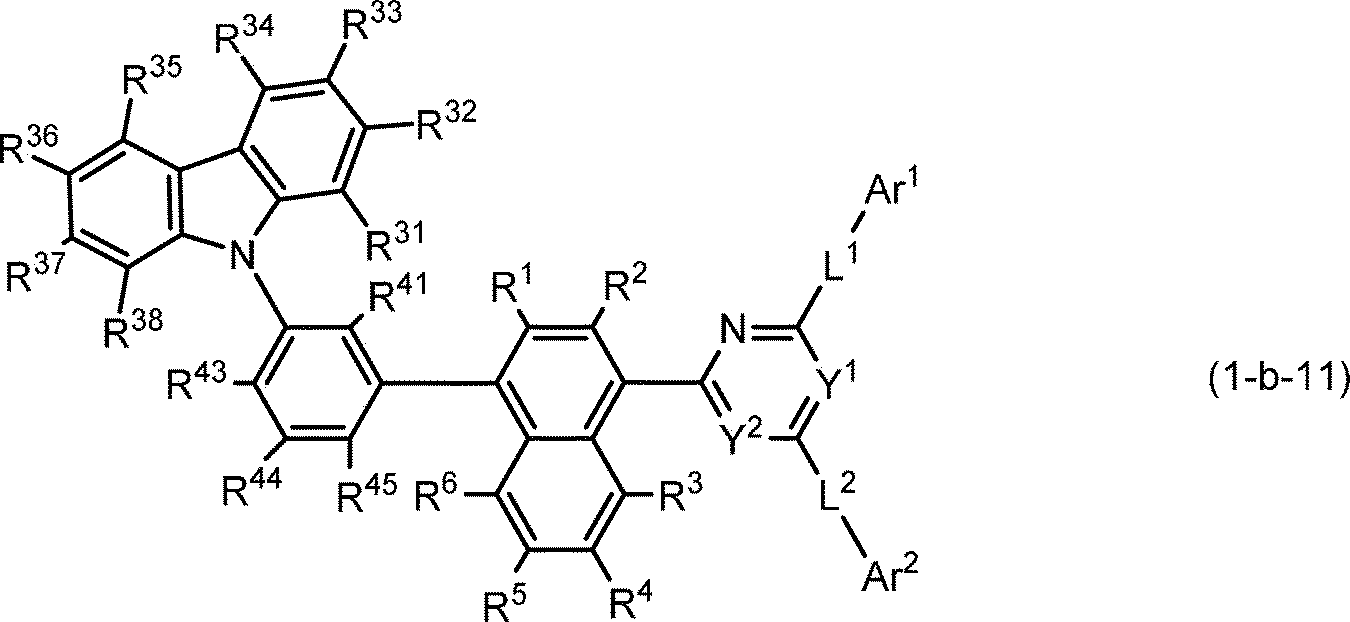

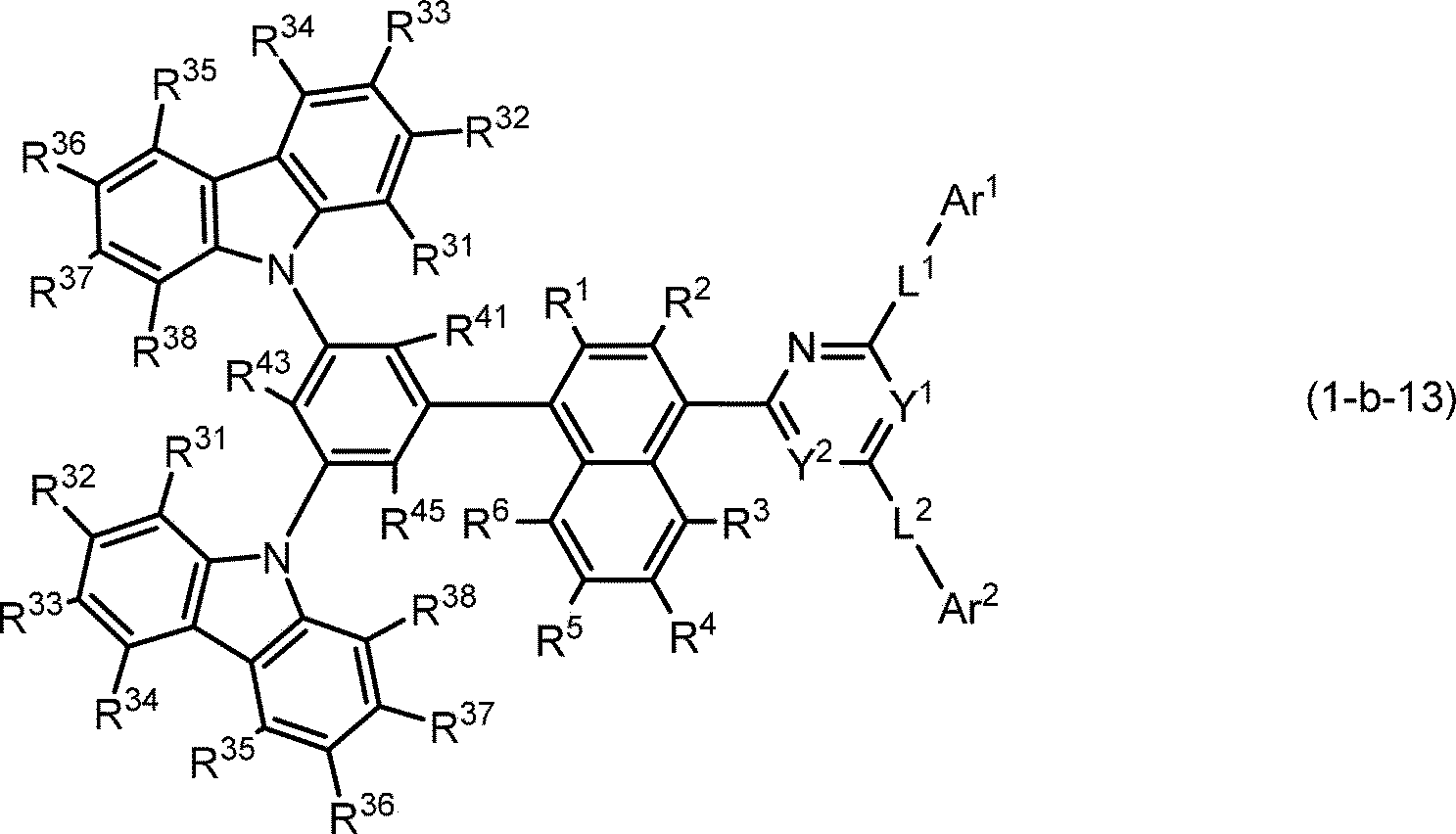

(式中、
Y1、Y2、Ar1、Ar2、L1、L2及びR1~R6は式(1)において定義したとおりであり、
R31~R38は式(1―b)において定義したとおりであり、
R41、R44、及びR45は式(1―b-1)において定義したとおりであり、
R43は、水素原子、置換もしくは無置換の環形成炭素数6~50のアリール基、及び置換もしくは無置換の炭素数1~50のアルキル基から選ばれる。)
Y1、Y2、Ar1、Ar2、L1、L2及びR1~R6は式(1)において定義したとおりであり、
R31~R38は式(1―b)において定義したとおりであり、
R41、R44、及びR45は式(1―b-1)において定義したとおりであり、
R43は、水素原子、置換もしくは無置換の環形成炭素数6~50のアリール基、及び置換もしくは無置換の炭素数1~50のアルキル基から選ばれる。)
R43が表す置換もしくは無置換の環形成炭素数6~50のアリール基、及び置換もしくは無置換の炭素数1~50のアルキル基の詳細は、それぞれ、Rに関して前記した対応する基の詳細と同じである。R41及びR43~R45のすべて及びR41及びR43~R45から選ばれる2又は3個のすべてが水素原子であってもよい。
本発明の好ましい態様において、化合物Aは式(1-a-1)~(1-a-4)のいずれかで表される化合物を含む。


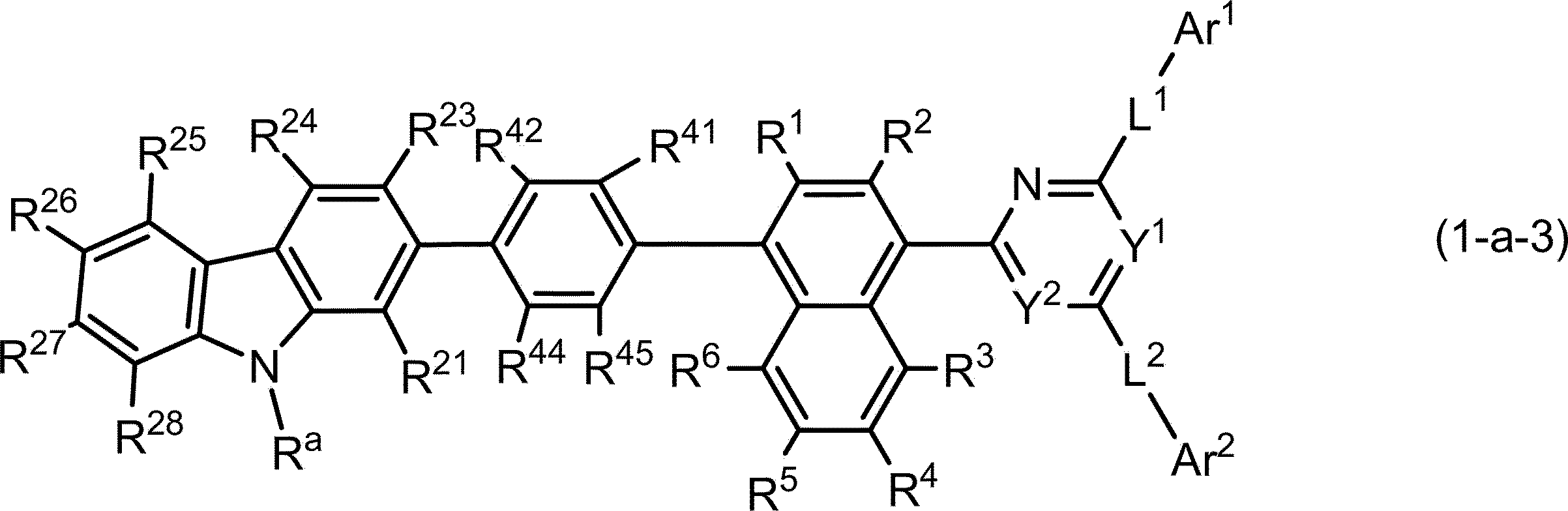

(式中、
Y1、Y2、Ar1、Ar2、L1、L2及びR1~R6は式(1)において定義したとおりであり、
Ra及びR21~R28は式(1―a)において定義したとおりであり、
R41~R42及びR44~R45は式(1―b-1)において定義したとおりである。)
Y1、Y2、Ar1、Ar2、L1、L2及びR1~R6は式(1)において定義したとおりであり、
Ra及びR21~R28は式(1―a)において定義したとおりであり、
R41~R42及びR44~R45は式(1―b-1)において定義したとおりである。)
上記したように、本明細書において使用する「水素原子」は軽水素原子、重水素原子、及び三重水素原子を包含する。従って、化合物Aは天然由来の重水素原子を含んでいてもよい。
又、原料化合物の一部又は全てに重水素化した化合物を使用することにより、化合物Aに重水素原子を意図的に導入してもよい。従って、本発明の一態様において、化合物Aは少なくとも1個の重水素原子を含む。すなわち、化合物Aは、式(1)又は式(1)に含まれる前記式で表される化合物であって、該化合物に含まれる水素原子の少なくとも一つが重水素原子である化合物であってもよい。
式(1)において、R、R1~R6、*aに結合する単結合ではないR21~R28、及びR31~R38が表す水素原子、R、R1~R6、*aに結合する単結合ではないR21~R28、及びR31~R38が表す置換基が有する水素原子、L1、L2、L3及びL4が表すアリーレン基が有する水素原子、Raが表すアリール基又はアルキル基が有する水素原子、Ar1及びAr2が表すアリール基又は複素環基が有する水素原子から選ばれる少なくとも一つの水素原子が重水素原子であってもよい。
又、原料化合物の一部又は全てに重水素化した化合物を使用することにより、化合物Aに重水素原子を意図的に導入してもよい。従って、本発明の一態様において、化合物Aは少なくとも1個の重水素原子を含む。すなわち、化合物Aは、式(1)又は式(1)に含まれる前記式で表される化合物であって、該化合物に含まれる水素原子の少なくとも一つが重水素原子である化合物であってもよい。
式(1)において、R、R1~R6、*aに結合する単結合ではないR21~R28、及びR31~R38が表す水素原子、R、R1~R6、*aに結合する単結合ではないR21~R28、及びR31~R38が表す置換基が有する水素原子、L1、L2、L3及びL4が表すアリーレン基が有する水素原子、Raが表すアリール基又はアルキル基が有する水素原子、Ar1及びAr2が表すアリール基又は複素環基が有する水素原子から選ばれる少なくとも一つの水素原子が重水素原子であってもよい。
重水素化した化合物Aの重水素化率(化合物A中の全水素原子数に対する重水素原子数の割合)は使用する原料化合物の重水素化率に依存する。使用する全ての原料化合物の重水素化率を100%にすることは通常困難であるので、化合物Aの重水素化率は100%未満、好ましくは95%以下、より好ましくは90%以下、さらに好ましくは80%以下である。
重水素化した化合物Aの重水素化率は、1%以上、好ましくは3%以上、より好ましくは5%以上、さらに好ましくは10%以上である。
重水素化した化合物Aの重水素化率は、1%以上、好ましくは3%以上、より好ましくは5%以上、さらに好ましくは10%以上である。
化合物Aは、重水素化された化合物(重水素原子を意図的に導入した化合物)と重水素化されていない化合物を含む混合物、異なる重水素化率を有する2以上の化合物の混合物であってもよい。このような混合物の重水素化率(混合物に含まれる化合物A中の全水素原子数に対する重水素原子数の割合)は、1%以上、好ましくは3%以上、より好ましくは5%以上、さらに好ましくは10%以上、かつ、100%未満である。
化合物Aにおいて、Rが表す水素原子又はRが表す置換基が有する水素原子から選ばれる少なくとも一つの水素原子が重水素原子であってもよい。重水素化率(Rが表す水素原子又はRが表す置換基が有する全水素原子数に対する重水素原子数の割合)は、1%以上、好ましくは3%以上、より好ましくは5%以上、さらに好ましくは10%以上、かつ、100%未満である。
化合物Aにおいて、R1~R6が表す水素原子及びR1~R6が表す置換基が有する水素原子から選ばれる少なくとも一つの水素原子が重水素原子であってもよい。重水素化率(R1~R6が表す水素原子とR1~R6が表す置換基が有する水素原子の総数に対する重水素原子数の割合)は、1%以上、好ましくは3%以上、より好ましくは5%以上、さらに好ましくは10%以上、かつ、100%未満である。
化合物Aにおいて、*aに結合する単結合ではないR21~R28が表す水素原子及び*aに結合する単結合ではないR21~R28が表す置換基が有する水素原子から選ばれる少なくとも一つの水素原子が重水素原子であってもよい。重水素化率(*aに結合する単結合ではないR21~R28が表す水素原子及び*aに結合する単結合ではないR21~R28が表す置換基が有する水素原子の総数に対する重水素原子数の割合)は、1%以上、好ましくは3%以上、より好ましくは5%以上、さらに好ましくは10%以上、かつ、100%未満、好ましくは95%以下、より好ましくは90%以下である。
化合物Aにおいて、R31~R38が表す水素原子及びR31~R38が表す置換基が有する水素原子から選ばれる少なくとも一つの水素原子が重水素原子であってもよい。重水素化率(R31~R38が表す水素原子及びR31~R38が表す置換基が有する水素原子の総数に対する重水素原子数の割合)は、1%以上、好ましくは3%以上、より好ましくは5%以上、さらに好ましくは10%以上、かつ、100%未満である。
化合物Aにおいて、L1及びL2が表すアリーレン基が有する水素原子から選ばれる少なくとも一つの水素原子が重水素原子であってもよい。重水素化率(L1及びL2が表すアリーレン基が有する全水素原子数に対する重水素原子数の割合)は、1%以上、好ましくは3%以上、より好ましくは5%以上、さらに好ましくは10%以上、かつ、100%未満である。
化合物Aにおいて、L3及びL4が表すアリーレン基が有する水素原子から選ばれる少なくとも一つの水素原子が重水素原子であってもよい。重水素化率(L3及びL4が表すアリーレン基が有する全水素原子数に対する重水素原子数の割合)は、1%以上、好ましくは3%以上、より好ましくは5%以上、さらに好ましくは10%以上、かつ、100%未満である。
化合物Aにおいて、Raが表すアリール基が有する水素原子から選ばれる少なくとも一つの水素原子が重水素原子であってもよい。重水素化率(Raが表すアリール基又はアルキル基が有する全水素原子数に対する重水素原子数の割合)は、1%以上、好ましくは3%以上、より好ましくは5%以上、さらに好ましくは10%以上、かつ、100%未満である。
化合物Aにおいて、Ar1及びAr2が表すアリール基又は複素環基が有する水素原子から選ばれる少なくとも一つの水素原子が重水素原子であってもよい。重水素化率(Ar1及びAr2が表すアリール基又は複素環基が有する全水素原子数に対する重水素原子数の割合)は、1%以上、好ましくは3%以上、より好ましくは5%以上、さらに好ましくは10%以上、かつ、100%未満である。
化合物Aの各基が置換基を有する場合、「置換もしくは無置換の」で示される任意の置換基は、それぞれ独立して、環形成炭素数6~50のアリール基、炭素数1~50のアルキル基、又は環形成炭素数3~50のシクロアルキル基である。
各任意の置換基の詳細は、式(1)のRに関して記載したとおりである。
各任意の置換基の詳細は、式(1)のRに関して記載したとおりである。
化合物Aの分子量は、好ましくは650以上、より好ましくは650~5000、さらに好ましくは650~3000、特に好ましくは650~2000である。分子量がこの範囲にあると有機EL素子の性能が向上する。
化合物Aは、当業者であれば、下記合成例及び公知の合成方法を参考にして容易に製造することができる。
以下に化合物Aの具体例を示すが、以下の化合物に限定されるものではない。
下記具体例中、Dは重水素原子を示す。
下記具体例中、Dは重水素原子を示す。


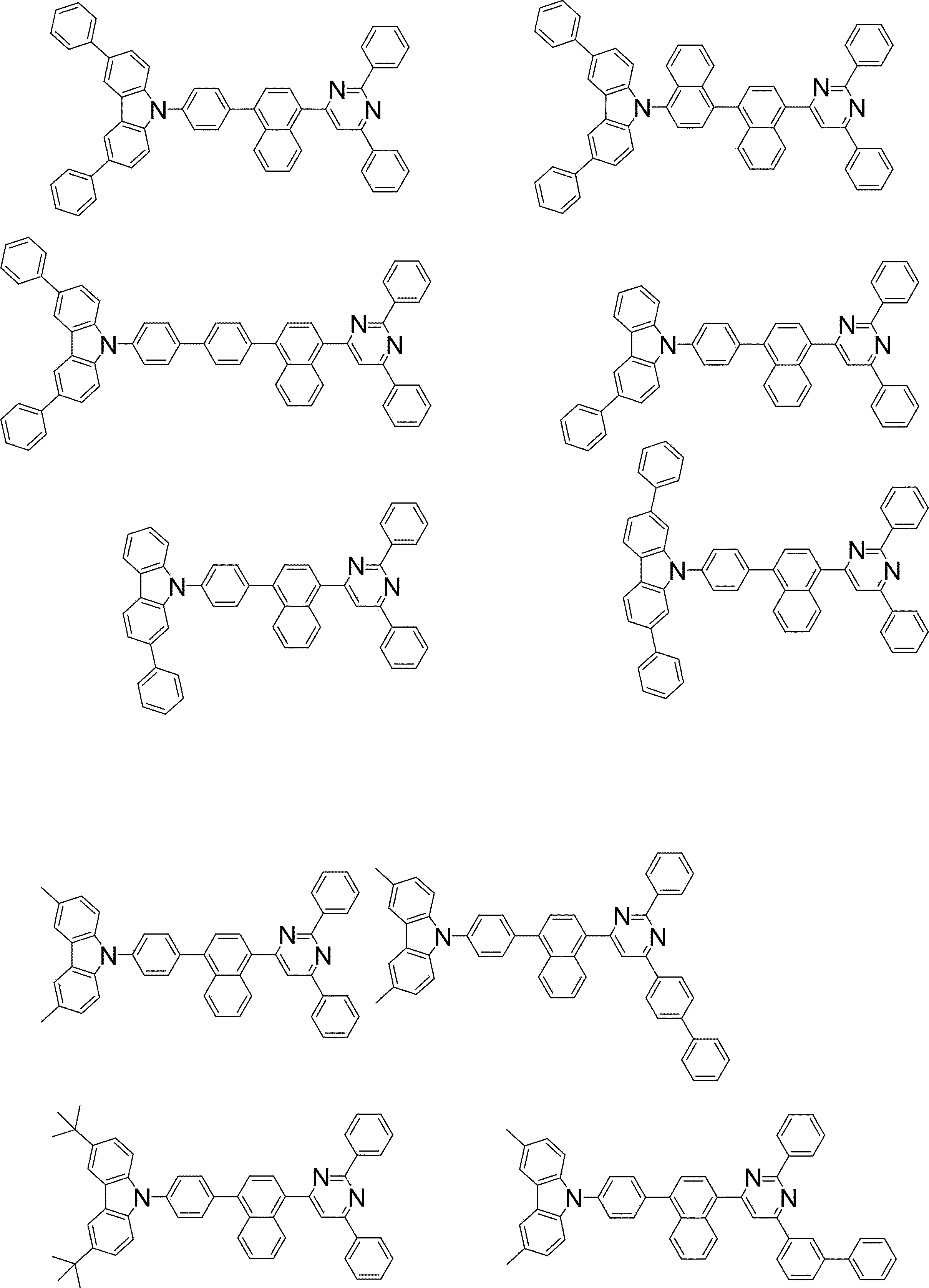
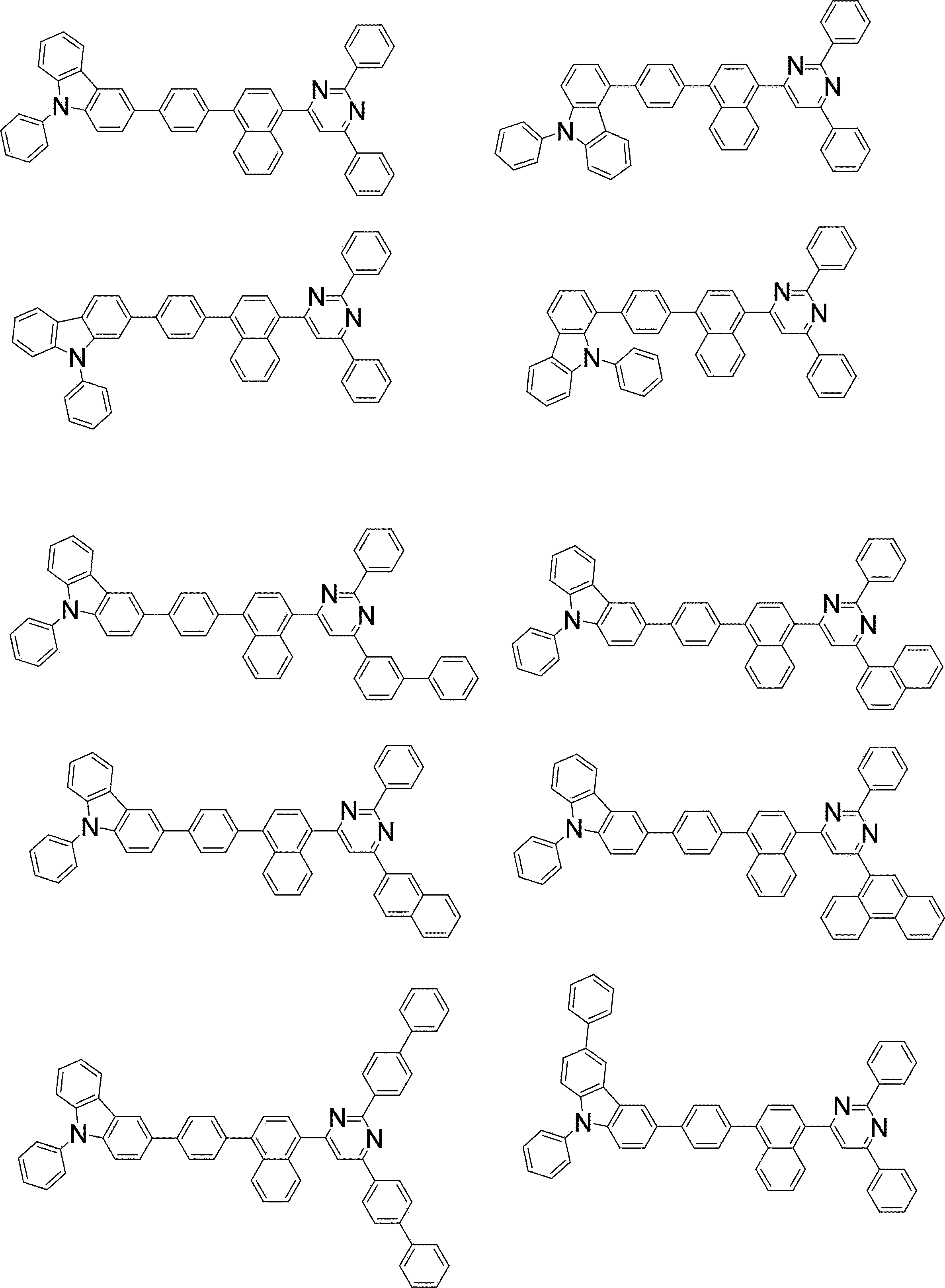
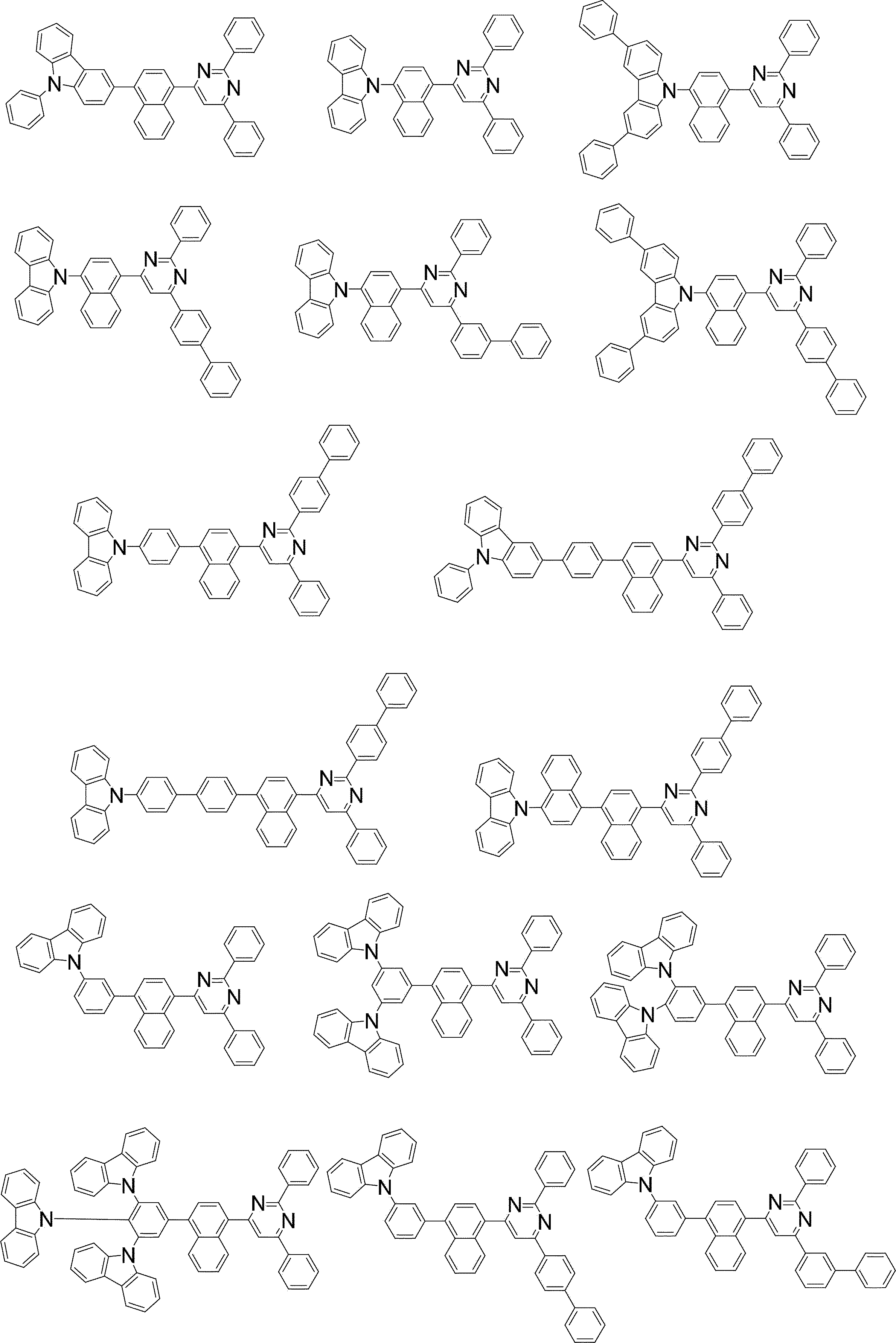


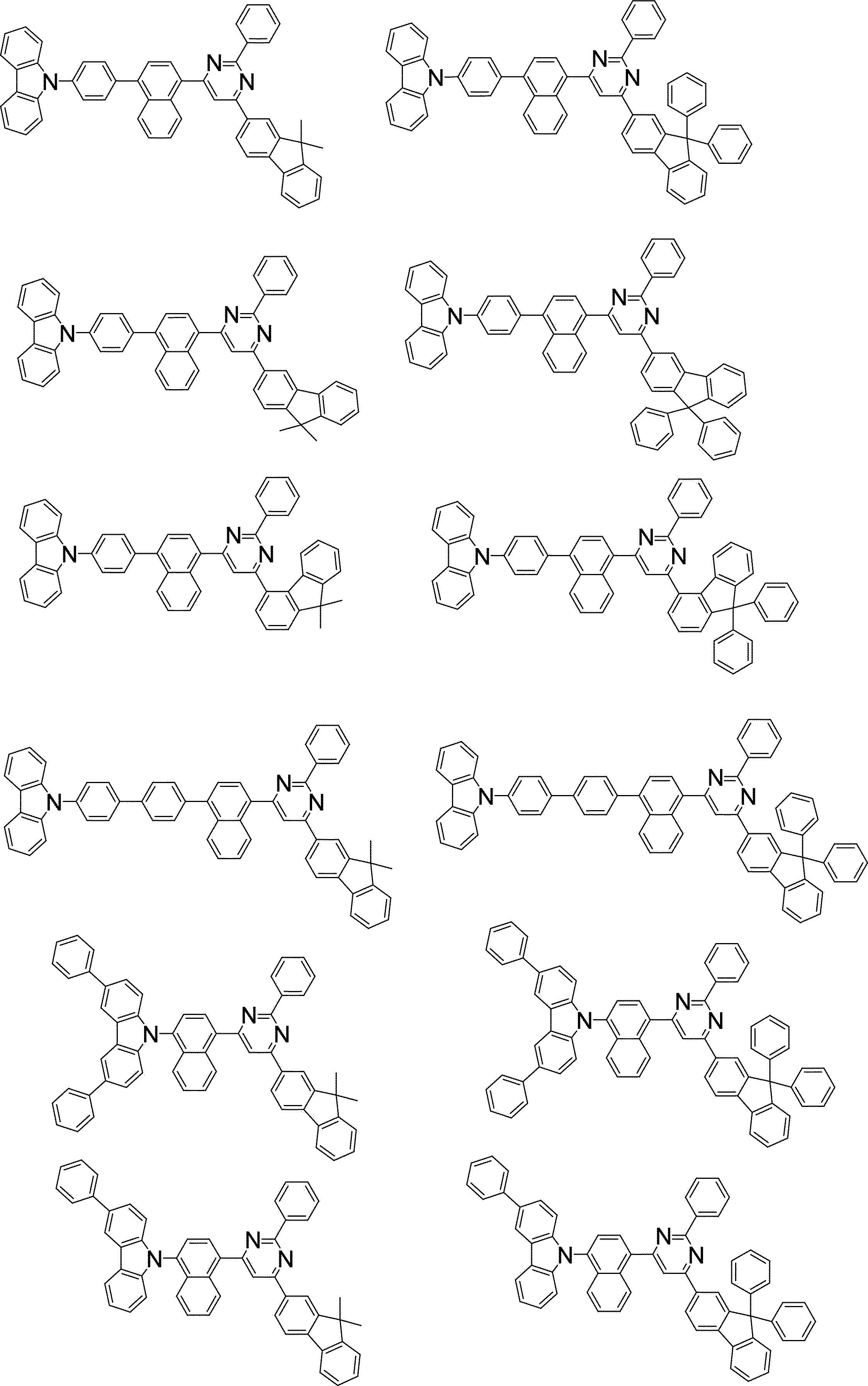


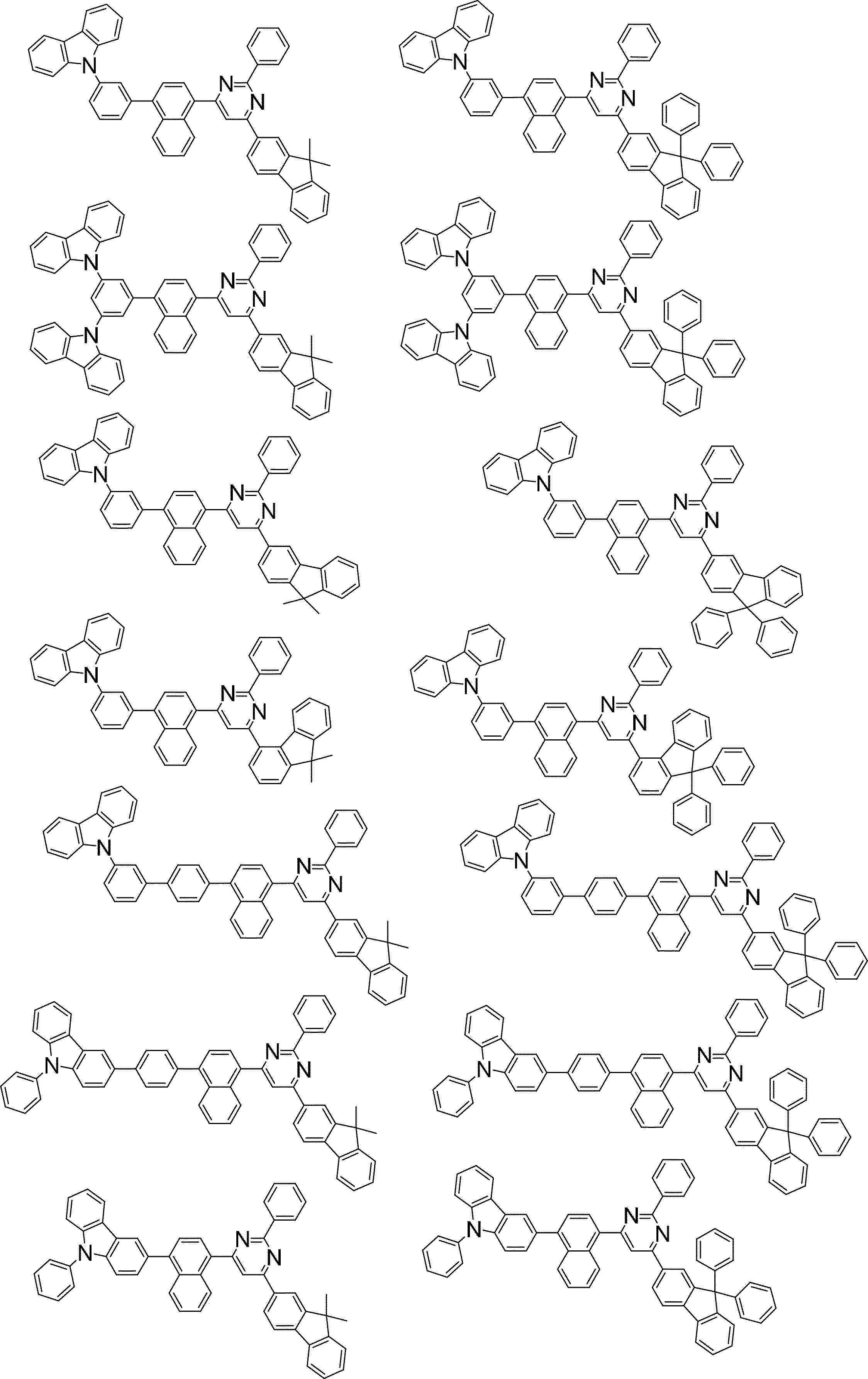


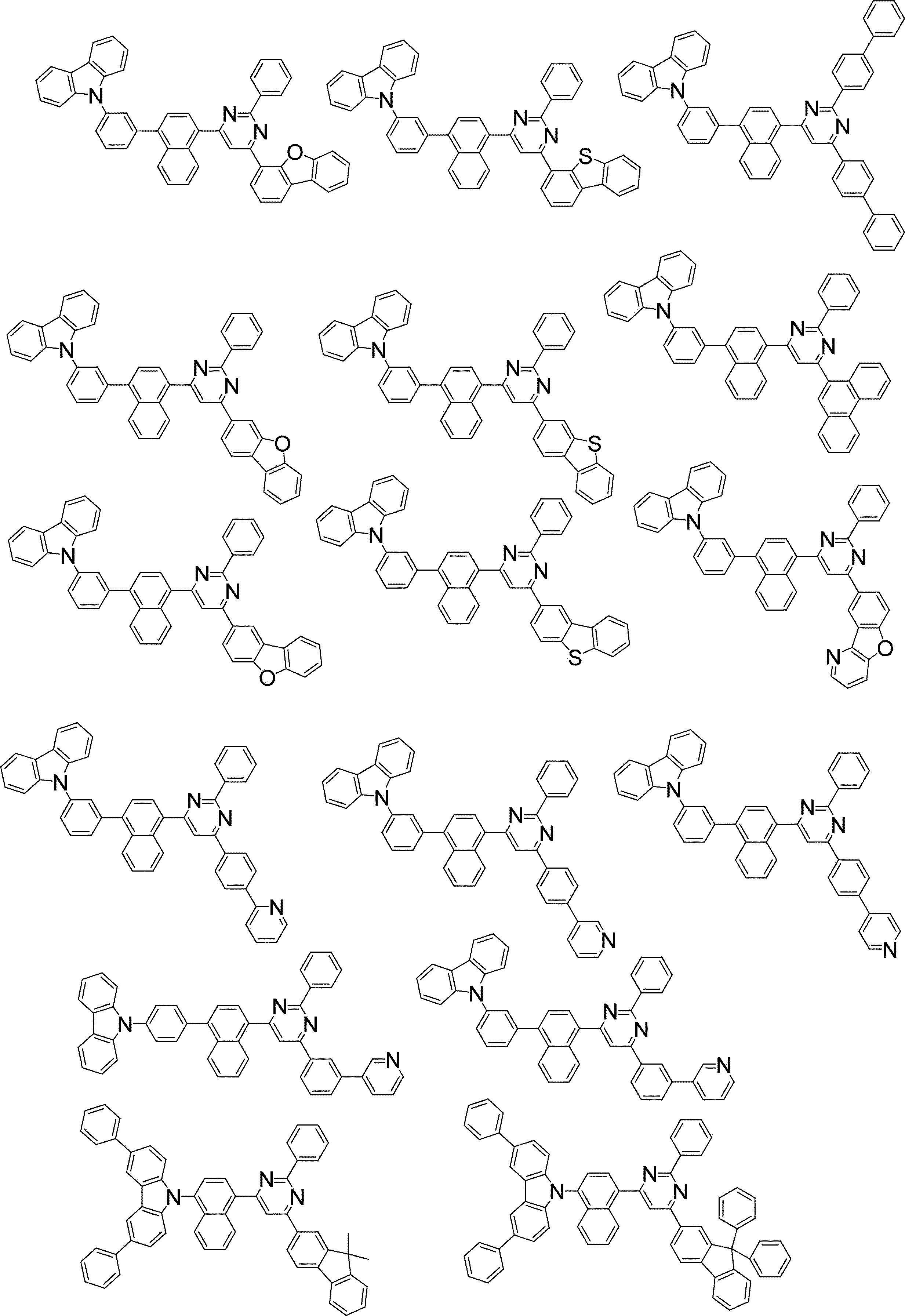


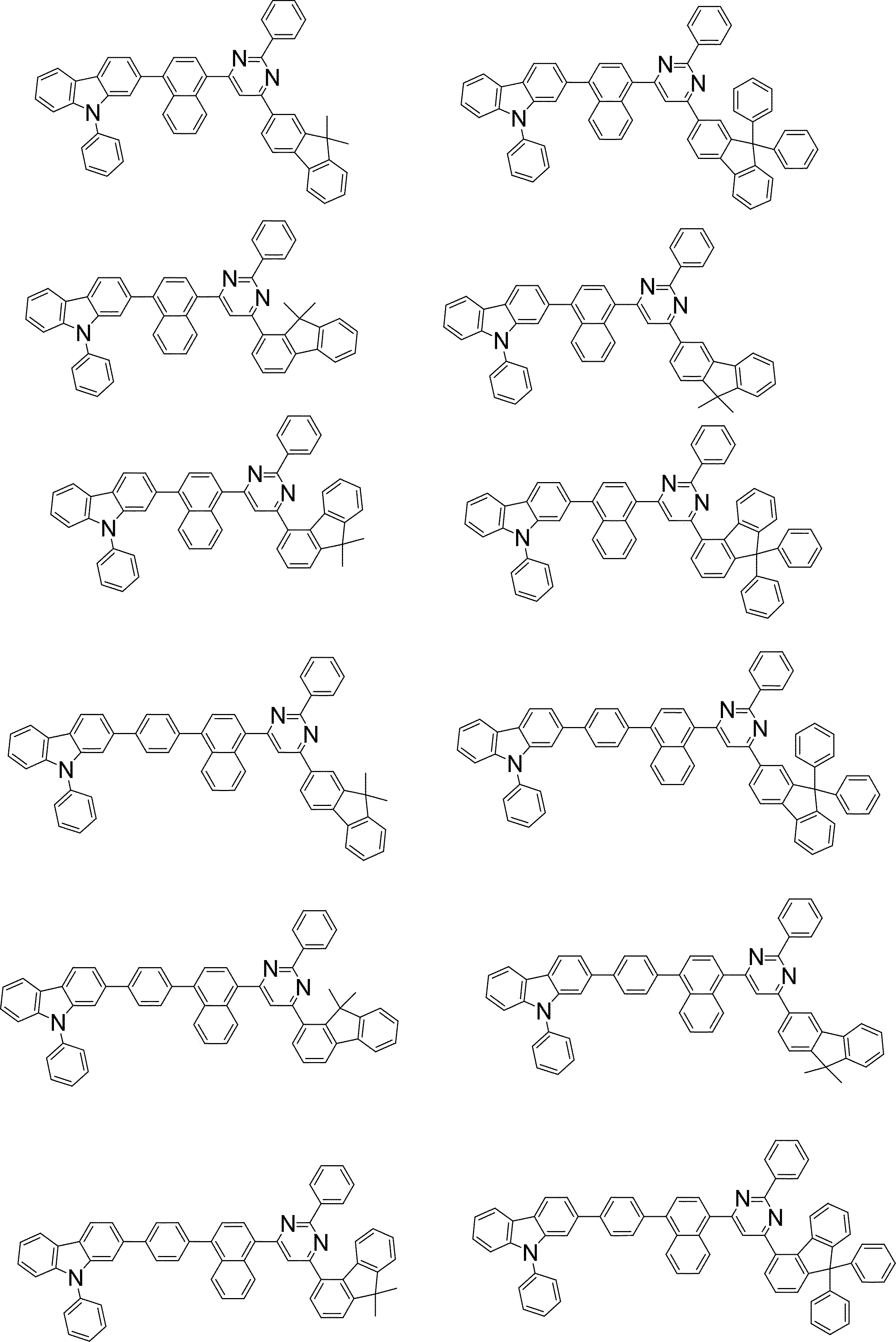


ホスト材料B
ホスト材料Bは式(10)で表され、発光層に使用される。
ホスト材料Bは式(10)で表され、発光層に使用される。

式(10)のR101~R110から選ばれる少なくとも1つ、好ましくはR110とR109は、それぞれ独立して、式(31)で表される基であり、
式(31)で表される基が2以上存在する場合、2以上の式(31)で表される基のそれぞれは、同じであってもよいし、異なっていてもよい。
式(31)で表される基が2以上存在する場合、2以上の式(31)で表される基のそれぞれは、同じであってもよいし、異なっていてもよい。
-L101-Ar101 (31)
式(31)のL101は、
単結合、
置換もしくは無置換の環形成炭素数6~50のアリーレン基、又は置換もしくは無置換の環形成原子数5~50の2価の複素環基、好ましくは単結合又は置換もしくは無置換の環形成炭素数6~50のアリーレン基であり;
Ar101は、
置換もしくは無置換の環形成炭素数6~50のアリール基、又は
置換もしくは無置換の環形成原子数5~50の複素環基である。
式(31)のL101は、
単結合、
置換もしくは無置換の環形成炭素数6~50のアリーレン基、又は置換もしくは無置換の環形成原子数5~50の2価の複素環基、好ましくは単結合又は置換もしくは無置換の環形成炭素数6~50のアリーレン基であり;
Ar101は、
置換もしくは無置換の環形成炭素数6~50のアリール基、又は
置換もしくは無置換の環形成原子数5~50の複素環基である。
式(31)で表される基ではないR101~R110から選ばれる一組以上の隣接する2つは互いに結合して置換もしくは無置換の環を形成してもよく、互いに結合せず、従って環を形成しなくてもよい。
式(31)で表される基ではなく、かつ、前記環も形成しないR101~R110は、それぞれ独立して、水素原子、ハロゲン原子、シアノ基、ニトロ基、置換もしくは無置換の炭素数1~50のアルキル基、置換もしくは無置換の炭素数2~50のアルケニル基、置換もしくは無置換の炭素数2~50のアルキニル基、置換もしくは無置換の環形成炭素数3~50のシクロアルキル基、-Si(R901)(R902)(R903)、
-O-(R904)、-S-(R905)、-N(R906)(R907)、置換もしくは無置換の環形成炭素数6~50のアリール基、又は置換もしくは無置換の環形成原子数5~50の複素環基であり;好ましくは水素原子、置換もしくは無置換の環形成炭素数6~50のアリール基、又は置換もしくは無置換の環形成原子数5~50の複素環基であり;より好ましくは置換もしくは無置換の環形成炭素数6~50のアリール基、又は置換もしくは無置換の環形成原子数5~50の複素環基である。
式(31)で表される基ではなく、かつ、前記環も形成しないR101~R110のすべてが水素原子であってもよい。
-O-(R904)、-S-(R905)、-N(R906)(R907)、置換もしくは無置換の環形成炭素数6~50のアリール基、又は置換もしくは無置換の環形成原子数5~50の複素環基であり;好ましくは水素原子、置換もしくは無置換の環形成炭素数6~50のアリール基、又は置換もしくは無置換の環形成原子数5~50の複素環基であり;より好ましくは置換もしくは無置換の環形成炭素数6~50のアリール基、又は置換もしくは無置換の環形成原子数5~50の複素環基である。
式(31)で表される基ではなく、かつ、前記環も形成しないR101~R110のすべてが水素原子であってもよい。
R901~R907は、それぞれ独立して、水素原子、置換もしくは無置換の炭素数1~50のアルキル基、置換もしくは無置換の環形成炭素数3~50のシクロアルキル基、置換もしくは無置換の環形成炭素数6~50のアリール基、又は置換もしくは無置換の環形成原子数5~50の複素環基であり、好ましくは水素原子、置換もしくは無置換の炭素数1~50のアルキル基又は置換もしくは無置換の環形成炭素数6~50のアリール基である。
R901~R907が2個以上存在する場合、2個以上のR901~R907は同一でも異なっていてもよい。
R901~R907が2個以上存在する場合、2個以上のR901~R907は同一でも異なっていてもよい。
本発明の一態様において、式(10)で表されるホスト材料Bは式(10-1)で表される化合物を含む。

(式中、R101~R108、L101及びAr101は式(10)で定義したとおりである。)
(式中、R101~R108、L101及びAr101は式(10)で定義したとおりである。)
本発明の他の態様において、式(10)で表されるホスト材料Bは式(10-2)で表される化合物を含む。
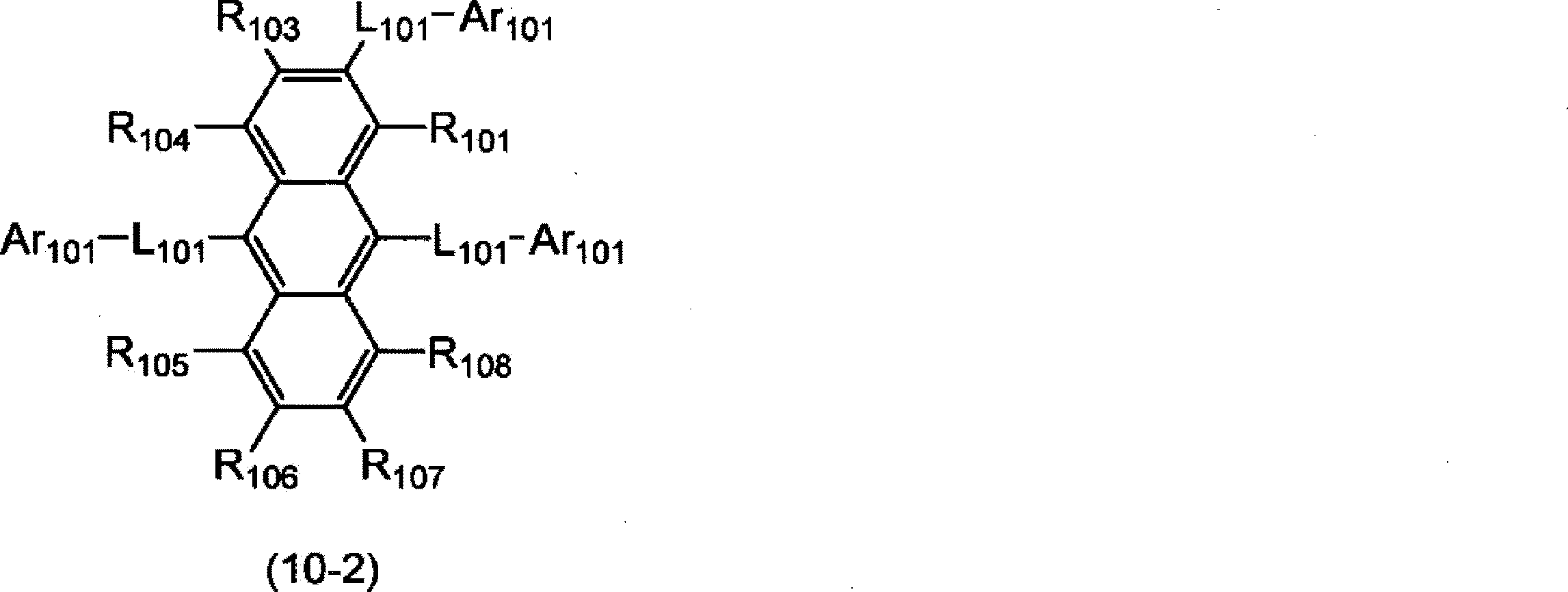
(式中、R101、R103~R108、L101及びAr101は式(10)で定義したとおりである。)
(式中、R101、R103~R108、L101及びAr101は式(10)で定義したとおりである。)
本発明の他の態様において、式(10)で表されるホスト材料Bは式(10-3)で表される化合物を含む。
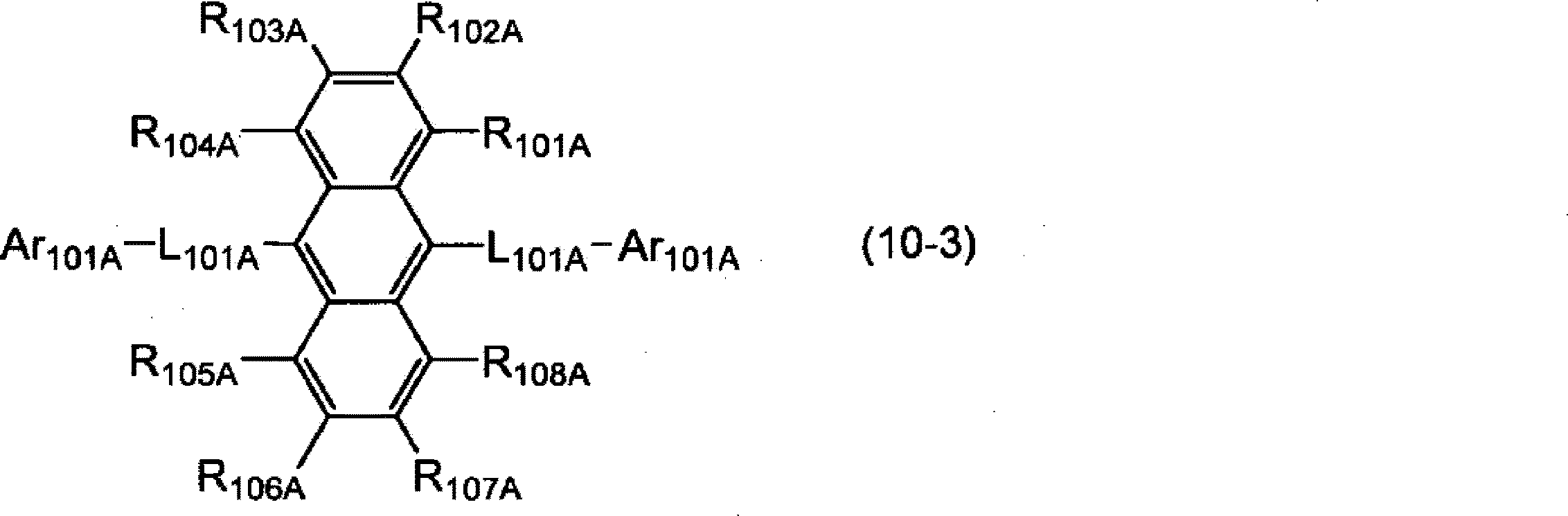
(式中、
R101A~R108Aは、それぞれ独立して、水素原子又は置換もしくは無置換の環形成炭素数6~50のアリール基であり、R101A~R108Aがすべて水素原子であってもよく;
L101Aは、単結合又は置換もしくは無置換の環形成炭素数6~50のアリーレン基であり、2つのL101Aは同一でも異なっていてもよく;。
Ar101Aは置換もしくは無置換の環形成炭素数6~50のアリール基であり、2つのAr101Aは同一でも異なっていてもよい。)
(式中、
R101A~R108Aは、それぞれ独立して、水素原子又は置換もしくは無置換の環形成炭素数6~50のアリール基であり、R101A~R108Aがすべて水素原子であってもよく;
L101Aは、単結合又は置換もしくは無置換の環形成炭素数6~50のアリーレン基であり、2つのL101Aは同一でも異なっていてもよく;。
Ar101Aは置換もしくは無置換の環形成炭素数6~50のアリール基であり、2つのAr101Aは同一でも異なっていてもよい。)
本発明の他の態様において、式(10)で表されるホスト材料Bは式(10-4)で表される化合物を含む。

(式中、
L101及びAr101は式(10)で定義したとおりであり;
R101A~R108Aは、それぞれ独立して、水素原子又は置換もしくは無置換の環形成炭素数6~50のアリール基であり、R101A~R108Aがすべて水素原子であってもよく;
X11は、O、S、又はN(R61)、好ましくはO又はSであり;
R61は、水素原子、置換もしくは無置換の炭素数1~50のアルキル基、又は置換もしくは無置換の環形成炭素数6~50のアリール基、好ましくは置換もしくは無置換の環形成炭素数6~50のアリール基であり;
R62~R69の1つは、*を介してL101と結合する単結合であり;
L101と結合する単結合ではないR62~R69から選ばれる少なくとも一組の隣接する2つは互いに結合して置換もしくは無置換の環を形成してもよく、互いに結合せず、従って環を形成しなくてもよく;
L101と結合する単結合ではなく、かつ、前記環を形成しないR62~R69は、それぞれ独立して、水素原子、置換もしくは無置換の炭素数1~50のアルキル基、又は置換もしくは無置換の環形成炭素数6~50のアリール基であり、そのすべてが水素原子であってもよい。)
(式中、
L101及びAr101は式(10)で定義したとおりであり;
R101A~R108Aは、それぞれ独立して、水素原子又は置換もしくは無置換の環形成炭素数6~50のアリール基であり、R101A~R108Aがすべて水素原子であってもよく;
X11は、O、S、又はN(R61)、好ましくはO又はSであり;
R61は、水素原子、置換もしくは無置換の炭素数1~50のアルキル基、又は置換もしくは無置換の環形成炭素数6~50のアリール基、好ましくは置換もしくは無置換の環形成炭素数6~50のアリール基であり;
R62~R69の1つは、*を介してL101と結合する単結合であり;
L101と結合する単結合ではないR62~R69から選ばれる少なくとも一組の隣接する2つは互いに結合して置換もしくは無置換の環を形成してもよく、互いに結合せず、従って環を形成しなくてもよく;
L101と結合する単結合ではなく、かつ、前記環を形成しないR62~R69は、それぞれ独立して、水素原子、置換もしくは無置換の炭素数1~50のアルキル基、又は置換もしくは無置換の環形成炭素数6~50のアリール基であり、そのすべてが水素原子であってもよい。)
本発明の他の態様において、式(10)で表されるホスト材料Bは式(10-4A)で表される化合物を含む。

(式中、
L101及びAr101は、式(10)で定義したとおりであり;
R101A~R108Aは、それぞれ独立して、水素原子又は置換もしくは無置換の環形成炭素数6~50のアリール基であり、R101A~R108Aがすべて水素原子であってもよく;
X11は、O、S、又はN(R61)、好ましくはO又はSであり;
R61は、水素原子、置換もしくは無置換の炭素数1~50のアルキル基、又は置換もしくは無置換の環形成炭素数6~50のアリール基、好ましくは置換もしくは無置換の環形成炭素数6~50のアリール基であり;
R62A~R69Aから選ばれる1組の隣接する2つは式(10-4A-1)で表される環を形成し;
式(10-4A-1)で表される環を形成しないR62A~R69Aから選ばれる1組以上の隣接する2つは、互いに結合して置換もしくは無置換の環を形成してもよいし、互いに結合せず、従って環を形成しなくてもよく;
式(10-4A-1)で表される環及び前記置換もしくは無置換の他の環を形成しないR62A~R69Aは、それぞれ独立して、水素原子、置換もしくは無置換の炭素数1~50のアルキル基、又は置換もしくは無置換の環形成炭素数6~50のアリール基であり、そのすべてが水素原子であってもよい。)
(式中、
L101及びAr101は、式(10)で定義したとおりであり;
R101A~R108Aは、それぞれ独立して、水素原子又は置換もしくは無置換の環形成炭素数6~50のアリール基であり、R101A~R108Aがすべて水素原子であってもよく;
X11は、O、S、又はN(R61)、好ましくはO又はSであり;
R61は、水素原子、置換もしくは無置換の炭素数1~50のアルキル基、又は置換もしくは無置換の環形成炭素数6~50のアリール基、好ましくは置換もしくは無置換の環形成炭素数6~50のアリール基であり;
R62A~R69Aから選ばれる1組の隣接する2つは式(10-4A-1)で表される環を形成し;
式(10-4A-1)で表される環を形成しないR62A~R69Aから選ばれる1組以上の隣接する2つは、互いに結合して置換もしくは無置換の環を形成してもよいし、互いに結合せず、従って環を形成しなくてもよく;
式(10-4A-1)で表される環及び前記置換もしくは無置換の他の環を形成しないR62A~R69Aは、それぞれ独立して、水素原子、置換もしくは無置換の炭素数1~50のアルキル基、又は置換もしくは無置換の環形成炭素数6~50のアリール基であり、そのすべてが水素原子であってもよい。)
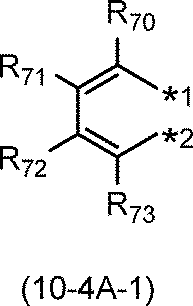
(式中、
*1と*2は、それぞれ、R62A~R69Aから選ばれる前記1組の隣接する2つが結合する2つの環形成炭素原子に結合し;
R70~R73の1つは、*を介してL101に結合する単結合であり;
L101に結合する単結合ではないR70~R73は、それぞれ独立して、水素原子、置換もしくは無置換の炭素数1~50のアルキル基、又は置換もしくは無置換の環形成炭素数6~50のアリール基であり、そのすべてが水素原子であってもよい。)
*1と*2は、それぞれ、R62A~R69Aから選ばれる前記1組の隣接する2つが結合する2つの環形成炭素原子に結合し;
R70~R73の1つは、*を介してL101に結合する単結合であり;
L101に結合する単結合ではないR70~R73は、それぞれ独立して、水素原子、置換もしくは無置換の炭素数1~50のアルキル基、又は置換もしくは無置換の環形成炭素数6~50のアリール基であり、そのすべてが水素原子であってもよい。)
本発明の他の態様において、式(10)で表されるホスト材料Bは式(10-6)で表される化合物を含む。
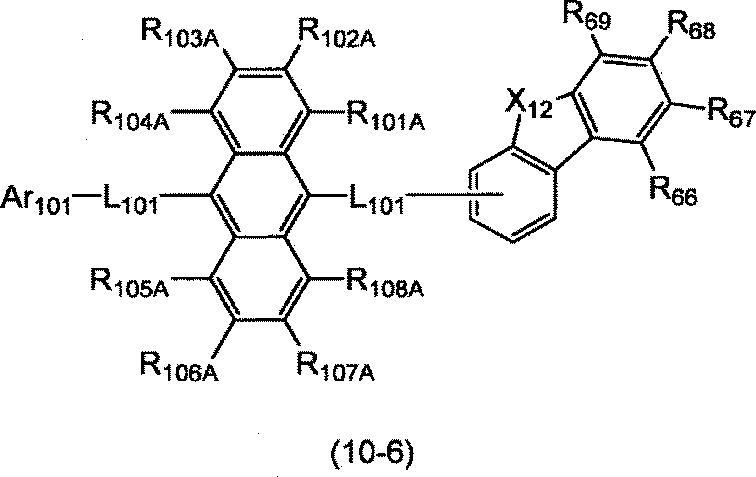
(式中、
L101及びAr101は式(10)で定義したとおりであり、
R101A~R108Aは式(10-4)で定義したとおりであり、
R66~R69は式(10-4)で定義したとおりであり、
X12はO又はSである。)
(式中、
L101及びAr101は式(10)で定義したとおりであり、
R101A~R108Aは式(10-4)で定義したとおりであり、
R66~R69は式(10-4)で定義したとおりであり、
X12はO又はSである。)
本発明の他の態様において、式(10-6)で表されるホスト材料Bは式(10-6H)で表される化合物を含む。

(式中、
L101及びAr101は式(10)で定義したとおりであり;
R66~R69は式(10-4)で定義したとおりであり;
X12はO又はSである。)
(式中、
L101及びAr101は式(10)で定義したとおりであり;
R66~R69は式(10-4)で定義したとおりであり;
X12はO又はSである。)
本発明の他の態様において、式(10-6)又は(10-6H)で表されるホスト材料Bは式(10-6Ha)で表される化合物を含む。

(式中、
L101及びAr101は式(10)で定義したとおりであり;
X12はO又はSである。)
(式中、
L101及びAr101は式(10)で定義したとおりであり;
X12はO又はSである。)
本発明の他の態様において、式(10-6)、(10-6H)又は(10-6Ha)で表されるホスト材料Bは、下記式(10-6Ha-1)又は(10-6Ha-2)で表される化合物を含む。
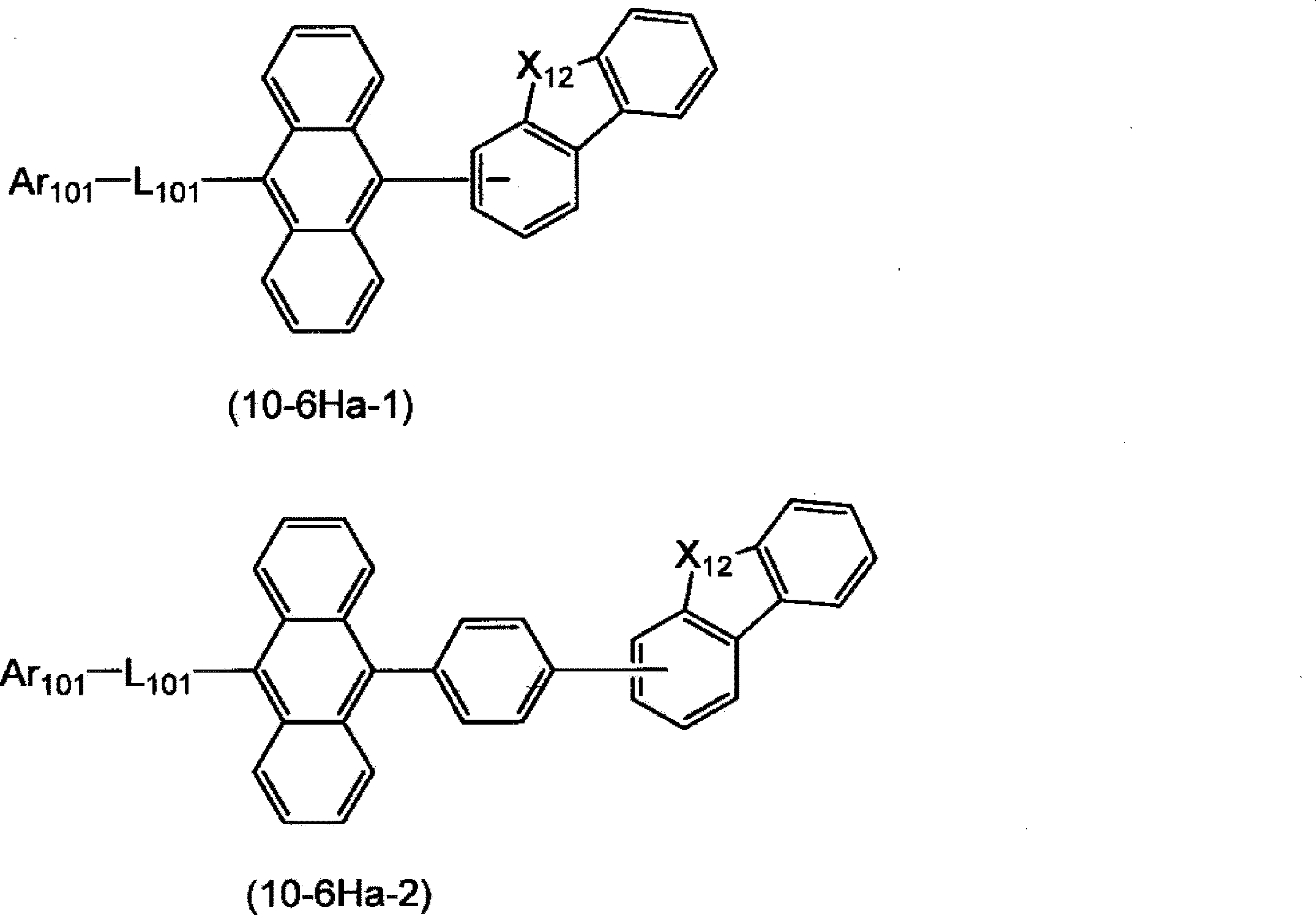
(式中、
L101及びAr101は式(10)で定義したとおりであり;
X12はO又はSである。)
(式中、
L101及びAr101は式(10)で定義したとおりであり;
X12はO又はSである。)
本発明の他の態様において、式(10)で表されるホスト材料Bは式(10-7)で表される化合物を含む。

(式中、
L101及びAr101は式(10)で定義したとおりであり、
R101A~R108Aは式(10-4)で定義したとおりであり、
X11は式(10-4)で定義したとおりであり、
R62~R69は式(10-4)で定義したとおりである、ただし、R66とR67、R67とR68、及びR68とR69から選ばれる1組の隣接する2つは互いに結合して、置換もしくは無置換の環を形成する。)
(式中、
L101及びAr101は式(10)で定義したとおりであり、
R101A~R108Aは式(10-4)で定義したとおりであり、
X11は式(10-4)で定義したとおりであり、
R62~R69は式(10-4)で定義したとおりである、ただし、R66とR67、R67とR68、及びR68とR69から選ばれる1組の隣接する2つは互いに結合して、置換もしくは無置換の環を形成する。)
本発明の他の態様において、式(10)で表されるホスト材料Bは式(10-7H)で表される化合物を含む。
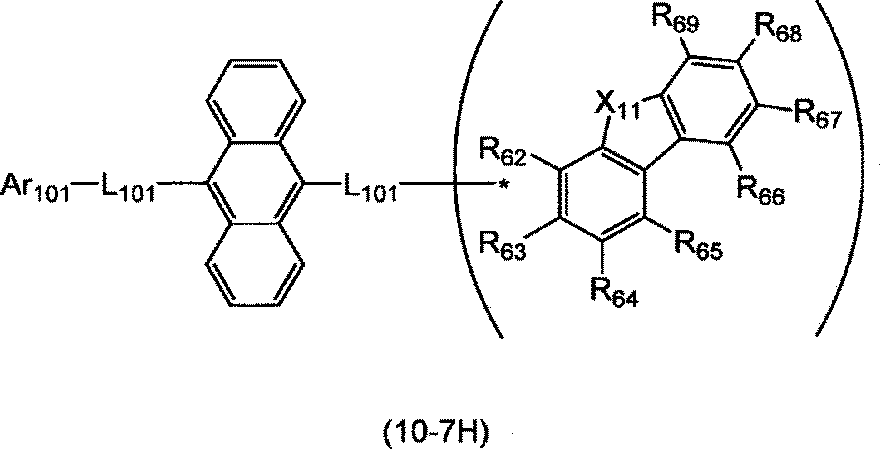
(式中、
L101及びAr101は式(10)で定義したとおりであり;
X11は式(10-4)で定義したとおりであり;
R62~R69は式(10-4)で定義したとおりである、ただし、R66とR67、R67とR68、及びR68とR69から選ばれる1組の隣接する2つは、互いに結合して置換もしくは無置換の環を形成する。)
(式中、
L101及びAr101は式(10)で定義したとおりであり;
X11は式(10-4)で定義したとおりであり;
R62~R69は式(10-4)で定義したとおりである、ただし、R66とR67、R67とR68、及びR68とR69から選ばれる1組の隣接する2つは、互いに結合して置換もしくは無置換の環を形成する。)
本発明の他の態様において、式(10)で表されるホスト材料Bは式(10-8)で表される化合物を含む。
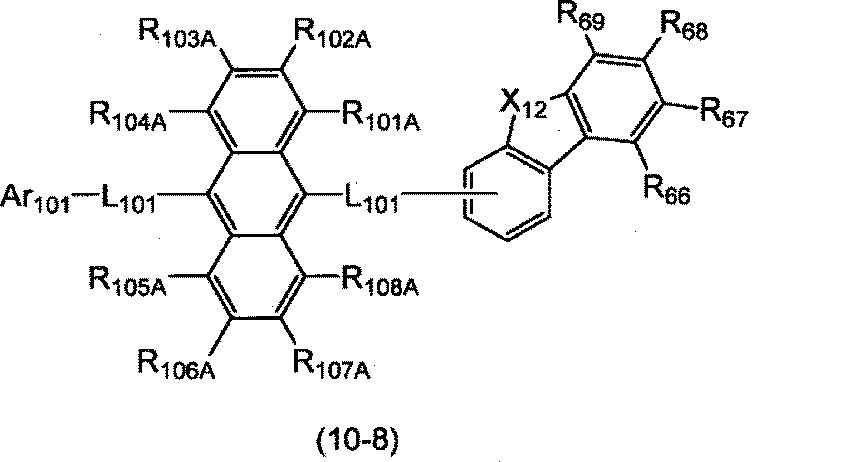
(式中、
L101及びAr101は式(10)で定義したとおりであり、
R101A~R108Aは式(10-4)で定義したとおりであり、
X12はO又はSであり、
R66~R69は式(10-4)で定義したとおりである、ただし、R66とR67、R67とR68、及びR68とR69から選ばれる少なくとも1組の隣接する2つは互いに結合して、置換もしくは無置換の環を形成する。)
(式中、
L101及びAr101は式(10)で定義したとおりであり、
R101A~R108Aは式(10-4)で定義したとおりであり、
X12はO又はSであり、
R66~R69は式(10-4)で定義したとおりである、ただし、R66とR67、R67とR68、及びR68とR69から選ばれる少なくとも1組の隣接する2つは互いに結合して、置換もしくは無置換の環を形成する。)
本発明の他の態様において、式(10-8)で表されるホスト材料Bは式(10-8H)で表される化合物を含む。

(式中、
L101及びAr101は式(10)で定義したとおりであり;
R66~R69は式(10-4)で定義したとおりである、ただし、R66とR67、R67とR68、及びR68とR69から選ばれる1組の隣接する2つは、互いに結合して置換もしくは無置換の環、好ましくは無置換のベンゼン環を形成し;
X12はO又はSである。)
(式中、
L101及びAr101は式(10)で定義したとおりであり;
R66~R69は式(10-4)で定義したとおりである、ただし、R66とR67、R67とR68、及びR68とR69から選ばれる1組の隣接する2つは、互いに結合して置換もしくは無置換の環、好ましくは無置換のベンゼン環を形成し;
X12はO又はSである。)
本発明の他の態様において、式(10-7)、(10-7H)、(10-8)又は(10-8H)のR66とR67、R67とR68、及びR68とR69から選ばれる1組の隣接する2つは、互いに結合して式(10-8-1)又は(10-8-2)で表される環を形成し、式(10-8-1)又は(10-8-2)で表される環を形成しないR66~R69は環を形成しない。

(式中、
2つの*は、それぞれ、R66とR67、R67とR68、及びR68とR69から選ばれる前記1組の隣接する2つが結合する2つの環形成炭素原子に結合し;
R80~R83は、それぞれ独立して、水素原子、置換もしくは無置換の炭素数1~50のアルキル基、又は置換もしくは無置換の環形成炭素数6~50のアリール基であり、R80~R83の全てが水素原子であってもよく;
X13はO又はSである。)
本発明の他の態様において、式(10)で表されるホスト材料Bは式(10-9)で表される化合物を含む。

(式中、
L101及びAr101は式(10)で定義したとおりであり、
R101A~R108Aは式(10-4)で定義したとおりであり、
R66~R69は式(10-4)で定義したとおりである、ただし、R66とR67、R67とR68、及びR68とR69から選ばれる隣接する2つは互いに結合せず、従って環を形成しない、
X12はO又はSである。)
(式中、
L101及びAr101は式(10)で定義したとおりであり、
R101A~R108Aは式(10-4)で定義したとおりであり、
R66~R69は式(10-4)で定義したとおりである、ただし、R66とR67、R67とR68、及びR68とR69から選ばれる隣接する2つは互いに結合せず、従って環を形成しない、
X12はO又はSである。)
本発明の他の態様において、式(10)で表されるホスト材料Bは、式(10-10-1)~(10-10-4)で表される化合物を含む。
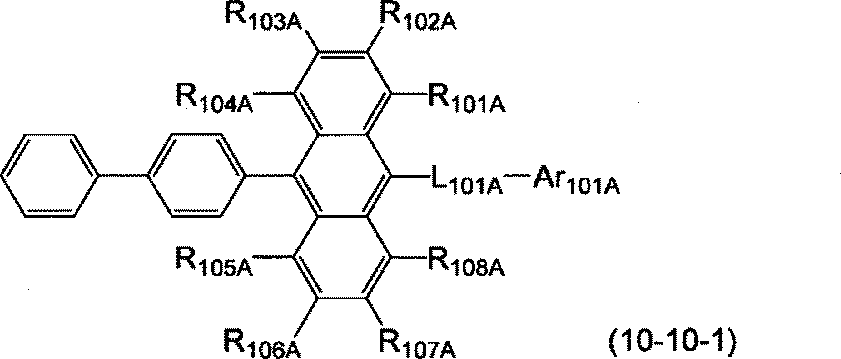
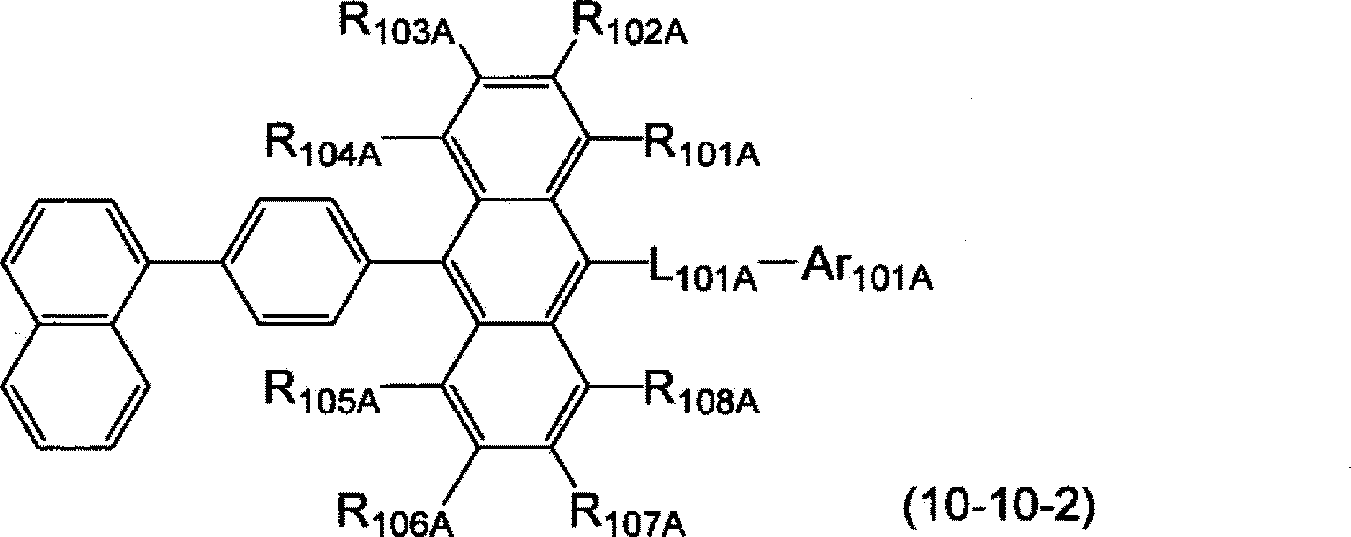


(式中、L101A、Ar101A及びR101A~R108Aは式(10-3)で定義したとおりである。)
(式中、L101A、Ar101A及びR101A~R108Aは式(10-3)で定義したとおりである。)
本発明の他の態様において、式(10-10-1)~(10-10-4)で表されるホスト材料Bは、式(10-10-1H)~(10-10-4H)で表される化合物を含む。
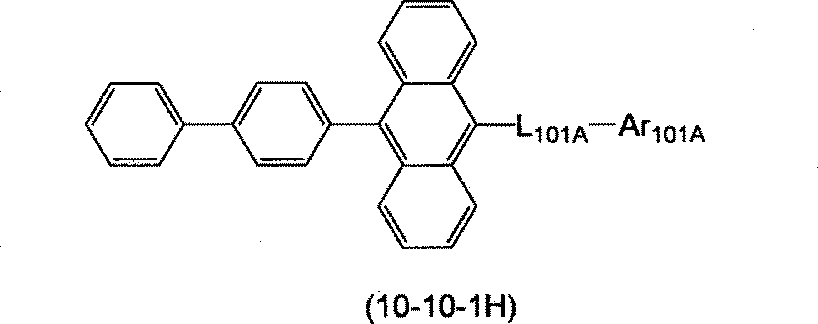


(式中、L101A及びAr101Aは式(10-3)で定義したとおりである。)
(式中、L101A及びAr101Aは式(10-3)で定義したとおりである。)
ホスト材料Bを表す式(10)及びその他の式に含まれる隣接する2つが形成する環の詳細は、特に限定しない限り、式(1)の隣接する2つが形成する環に関して記載したとおりであり、好ましくはベンゼン環、ベンゾフラン環、又はベンゾチオフェン環である。
ホスト材料Bを表す式(10)及びその他の式に含まれる各置換基の詳細は、[本明細書に記載の置換基]の欄に記載したとおりである。
ホスト材料Bを表す式(10)及びその他の式において、ハロゲン原子は好ましくはフッ素原子である。
ホスト材料Bを表す式(10)及びその他の式において、置換もしくは無置換の炭素数1~50のアルキル基の無置換のアルキル基は、好ましくはメチル基、エチル基、n-プロピル基、イソプロピル基、n-ブチル基、イソブチル基、s-ブチル基、又はt-ブチル基であり、より好ましくはメチル基、イソプロピル基、又はt-ブチル基である。
ホスト材料Bを表す式(10)及びその他の式において、置換もしくは無置換の炭素数2~50のアルケニル基の無置換のアルケニル基は、好ましくはビニル基又はアリル基である。
ホスト材料Bを表す式(10)及びその他の式において、置換もしくは無置換の炭素数2~50のアルキニル基の無置換のアルキニル基は、好ましくはエチニル基である。
ホスト材料Bを表す式(10)及びその他の式において、置換もしくは無置換の環形成炭素数3~50のシクロアルキル基の無置換のシクロアルキル基は、好ましくはシクロプロピル基、シクロブチル基、シクロペンチル基、又はシクロヘキシル基であり、より好ましくはシクロプロピル基、シクロペンチル基、又はシクロヘキシル基である。
ホスト材料Bを表す式(10)及びその他の式において、-Si(R901)(R902)(R903)はモノ-、ジ-又はトリ置換シリル基、好ましくはトリ置換シリル基であり、より好ましくはトリメチルシリル基、トリエチルシリル基、t-ブチルジメチルシリル基、プロピルジメチルシリル基、イソプロピルジメチルシリル基、トリフェニルシリル基、フェニルジメチルシリル基、t-ブチルジフェニルシリル基、又はトリトリルシリル基である。
ホスト材料Bを表す式(10)及びその他の式において、-O-(R904)は置換もしくは無置換のアルコキシ基又は置換もしくは無置換のアリールオキシ基であり、好ましくはメトキシ基、エトキシ基、イソプロポキシ基、s-プロポキシ基、t-ブトキシ基、フェノキシ基、又はビフェニルオキシ基である。
ホスト材料Bを表す式(10)及びその他の式において、-S-(R905)は置換もしくは無置換のアルキルチオ基又は置換もしくは無置換のアリールチオ基であり、好ましくはメチルチオ基、エチルチオ基、イソプロピルチオ基、s-プロピルチオ基、t-ブチルチオ基、フェニルチオ基、又はビフェニルチオ基である。
ホスト材料Bを表す式(10)及びその他の式において、-N(R906)(R907)はモノ-又はジ置換アミノ基、好ましくはジ置換アミノ基であり、より好ましくはジメチルアミノ基、ジエチルアミノ基、ジイソプロピルアミノ基、又はジフェニルアミノ基である。
ホスト材料Bを表す式(10)及びその他の式において、置換もしくは無置換の環形成炭素数6~50のアリール基は、好ましくはフェニル基、ビフェニル基、ターフェニル基、ナフチル基、フェナントリル基、ベンゾフェナントリル基、ピレニル基、トリフェニレニル基、ベンゾトリフェニレニル基、9,9-ジメチルフルオレニル基、ベンゾ-9,9-ジメチルフルオレニル基、9,9-ジフェニルフルオレニル基、又は9,9’-スピロビフルオレニル基である。
ホスト材料Bを表す式(10)及びその他の式において、置換もしくは無置換の環形成原子数5~50の複素環基は、好ましくはピリジル基、ピリミジニル基、トリアジニル基、ジベンゾフラニル基、ベンゾジベンゾフラニル基、ベンゾフロジベンゾフラニル基、ジベンゾチオフェニル基、ベンゾジベンゾチオフェニル基、9-カルバゾリル基、又は9-フェニルカルバゾリル基である。
ホスト材料Bを表す式(10)及びその他の式において、置換もしくは無置換の環形成炭素数6~50のアリーレン基は、好ましくはフェニレン基(o-フェニレン基、m-フェニレン基、p-フェニレン基)、ナフチレン基(1,3-ナフチレン基、1.4-ナフチレン基、2,6-ナフチレン基)、アントリレン基(9,10-アントリレン基)、又は9,9-ジメチルフルオレン-2,7-ジイル基である。
ホスト材料Bを表す式(10)及びその他の式において、置換もしくは無置換の環形成原子数5~50の2価の複素環基の無置換の2価の複素環基は、好ましくはピリジン、ピリミジン、トリアジン、カルバゾール、ベンゾカルバゾール、ベンゾフラン、ジベンゾフラン、ナフトベンゾフラン、ベンゾチオフェン、及びジベンゾチオフェンから選ばれる芳香族複素環の2価の残基である。
ホスト材料Bの各基が置換基を有する場合、「置換もしくは無置換の」で示される任意の置換基は、それぞれ独立して、環形成炭素数6~50のアリール基、炭素数1~50のアルキル基、又は環形成炭素数3~50のシクロアルキル基である。
各任意の基の詳細は、式(1)のRに関して記載したとおりである。
各任意の基の詳細は、式(1)のRに関して記載したとおりである。
化合物Aの場合と同様、ホスト材料Bは天然由来の重水素原子を含んでいてもよい。また、原料化合物の一部又は全てに重水素化した化合物を使用することにより、ホスト材料Bに重水素原子を意図的に導入してもよい。従って、本発明の一態様において、ホスト材料Bは少なくとも1個の重水素原子を含む。すなわち、ホスト材料Bは、式(10)又は式(10)に含まれる前記式で表される化合物であって、該化合物に含まれる水素原子の少なくとも一つが重水素原子である化合物であってもよい。
式(10)において、式(31)で表される基ではないR101~R110から選ばれる一組の以上の隣接する2つが任意に形成する環が有する水素原子;式(31)で表される基ではなく、かつ、前記環も形成しないR101~R110が表す水素原子;式(31)で表される基ではなく、かつ、前記環も形成しないR101~R110が表す置換基が有する水素原子;式(31)のL101が表すアリーレン基又は複素環基が有する水素原子;及び式(31)のAr101が表すアリール基又は複素環基が有する水素原子から選ばれる少なくとも一つの水素原子が重水素原子であってもよい。
重水素化したホスト材料Bの重水素化率(ホスト材料B中の全水素原子数に対する重水素原子数の割合)は使用する原料化合物の重水素化率に依存する。使用する全ての原料化合物の重水素化率を100%にすることは通常困難であるので、ホスト材料Bの重水素化率は100%未満、好ましくは95%以下、より好ましくは90%以下、さらに好ましくは80%以下である。
重水素化したホスト材料Bの重水素化率は、1%以上、好ましくは3%以上、より好ましくは5%以上、さらに好ましくは10%以上である。
重水素化したホスト材料Bの重水素化率は、1%以上、好ましくは3%以上、より好ましくは5%以上、さらに好ましくは10%以上である。
ホスト材料Bは、重水素化された化合物(重水素原子を意図的に導入した化合物)と重水素化されていない化合物を含む混合物、異なる重水素化率を有する2以上の化合物の混合物であってもよい。このような混合物の重水素化率(混合物に含まれるホスト材料B中の全水素原子数に対する重水素原子数の割合)は、1%以上、好ましくは3%以上、より好ましくは5%以上、さらに好ましくは10%以上、かつ、100%未満である。
式(10)で表されるホスト材料Bにおいて、式(31)で表される基ではないR101~R110から選ばれる一組の以上の隣接する2つが任意に形成する環が有する水素原子から選ばれる少なくとも一つの水素原子が重水素原子であってもよい。重水素化率(前記任意に形成する環が有する全水素原子数に対する重水素原子数の割合)は、1%以上、好ましくは3%以上、より好ましくは5%以上、さらに好ましくは10%以上、かつ、100%未満である。
式(10)で表されるホスト材料Bにおいて、式(31)で表される基ではなく、かつ、前記環も形成しないR101~R110が表す水素原子及び式(31)で表される基ではなく、かつ、前記環も形成しないR101~R110が表す置換基が有する水素原子から選ばれる少なくとも一つの水素原子が重水素原子であってもよい。重水素化率(式(31)で表される基ではなく、かつ、前記環も形成しないR101~R110が表す水素原子と式(31)で表される基ではなく、かつ、前記環も形成しないR101~R110が表す置換基が有する水素原子の総数に対する重水素原子数の割合)は、1%以上、好ましくは3%以上、より好ましくは5%以上、さらに好ましくは10%以上、かつ、100%未満である。
式(10)で表されるホスト材料Bにおいて、式(31)のL101が表すアリーレン基又は複素環基が有する水素原子から選ばれる少なくとも一つの水素原子が重水素原子であってもよい。重水素化率(L101が表すアリーレン基又は複素環基が有する全水素原子数に対する重水素原子数の割合)は、1%以上、好ましくは3%以上、より好ましくは5%以上、さらに好ましくは10%以上、かつ、100%未満である。
式(10)で表されるホスト材料Bにおいて、式(31)のAr101が表すアリーレン基又は複素環基が有する水素原子から選ばれる少なくとも一つの水素原子が重水素原子であってもよい。重水素化率(Ar101が表すアリール基又は複素環基が有する全水素原子数に対する重水素原子数の割合)は、1%以上、好ましくは3%以上、より好ましくは5%以上、さらに好ましくは10%以上、かつ、100%未満である。
ホスト材料Bは公知の化合物であり、公知の合成方法を参考にして容易に製造することができる。
以下にホスト材料Bの具体例を示すが、以下の化合物に限定されるものではない。

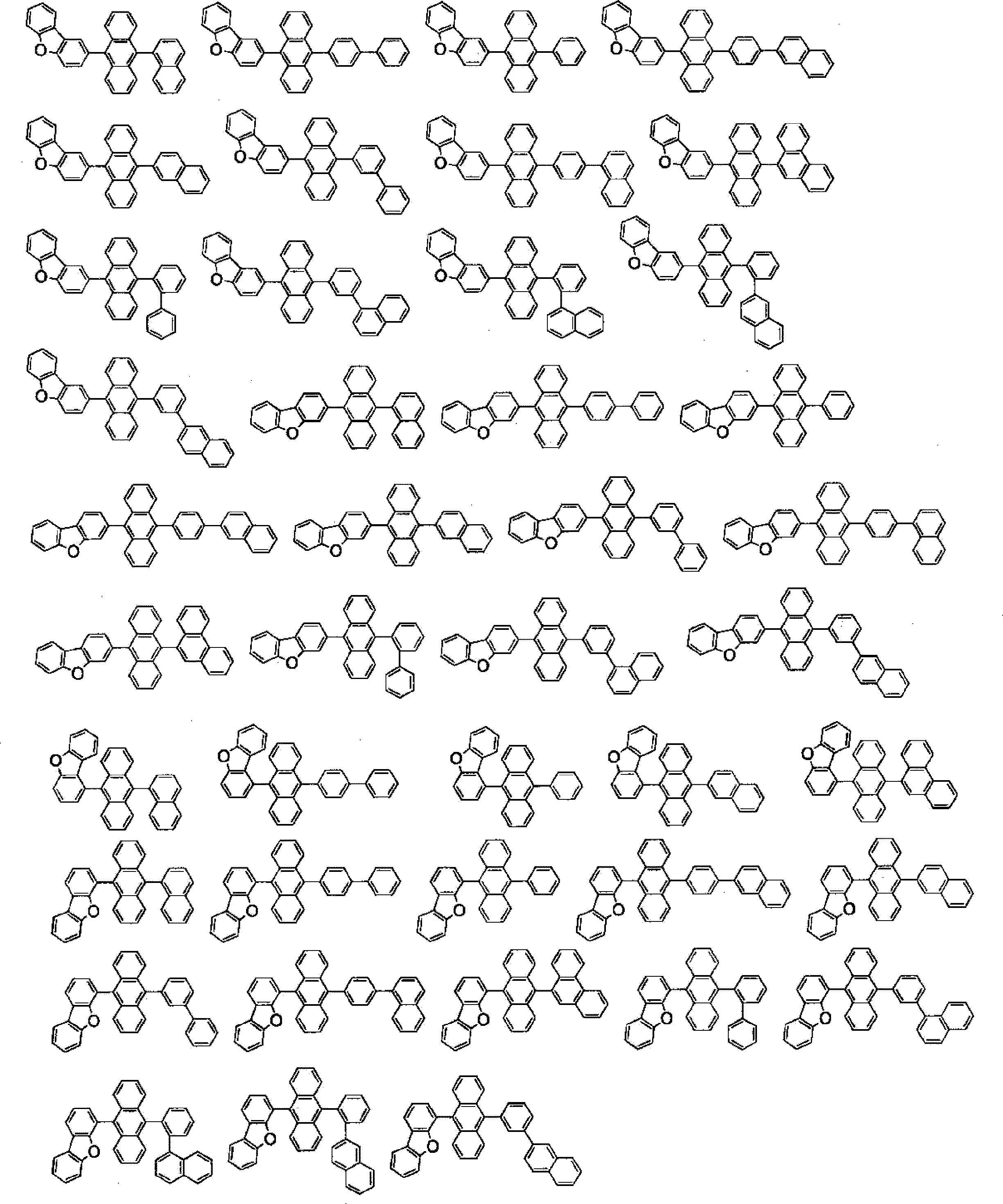
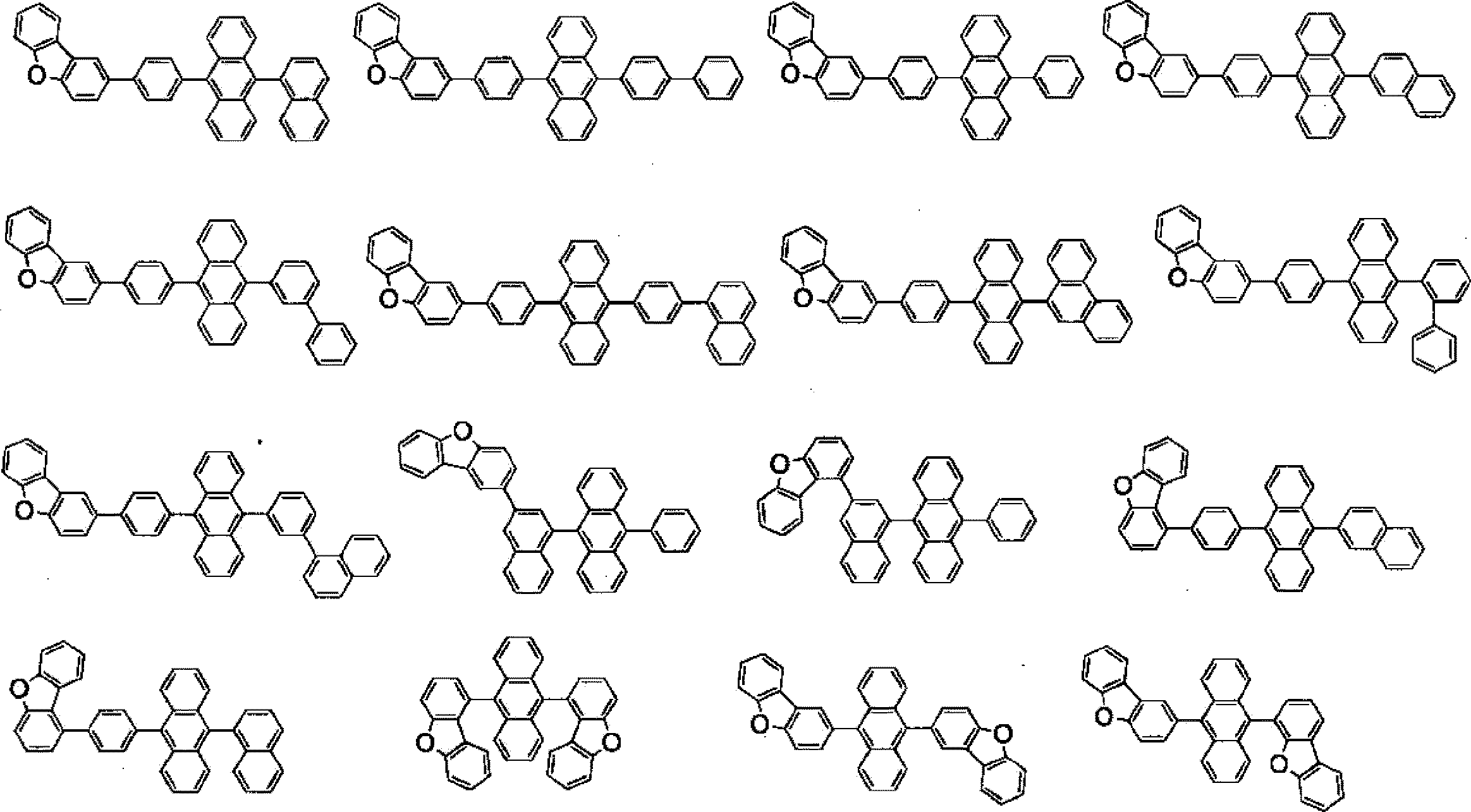
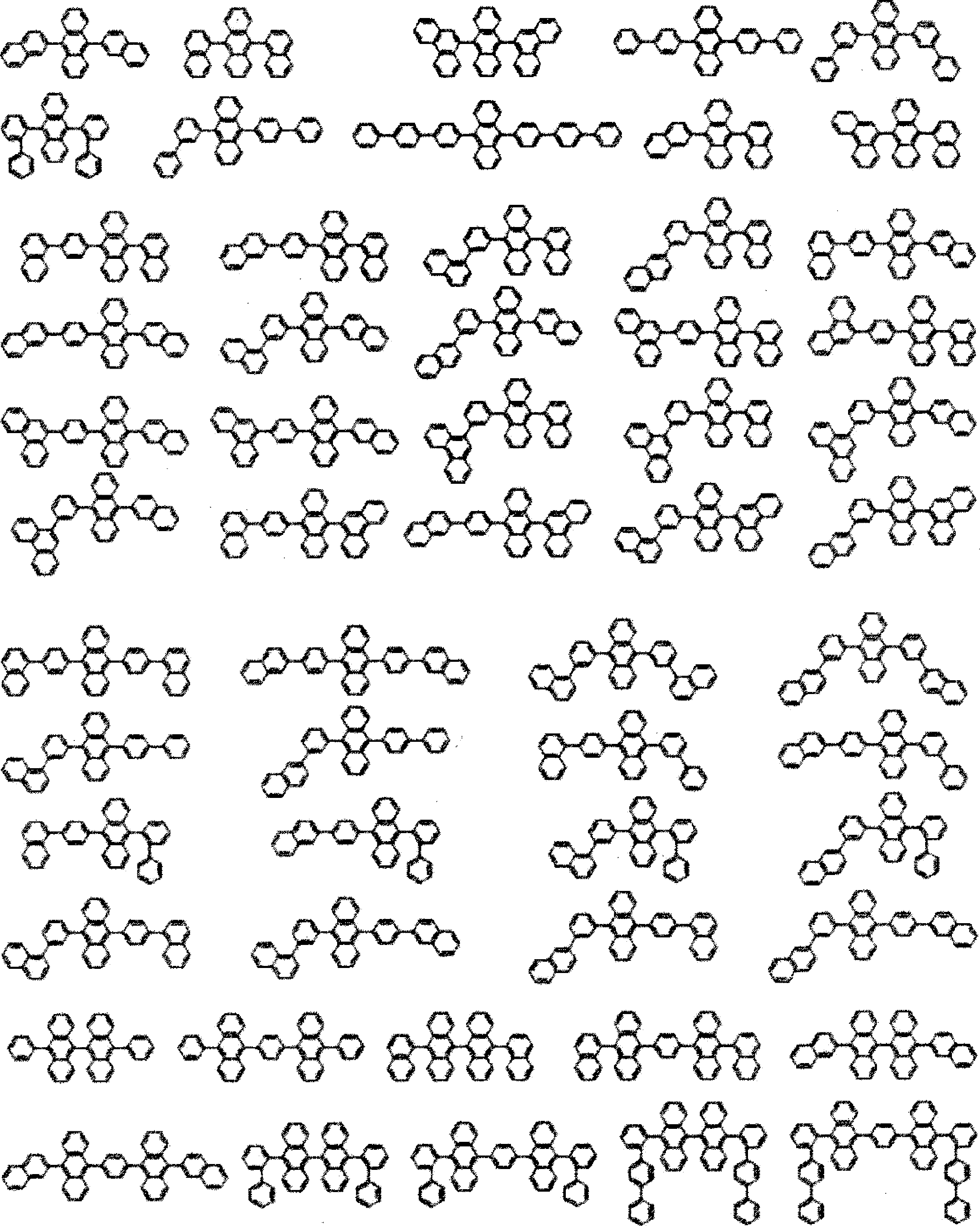

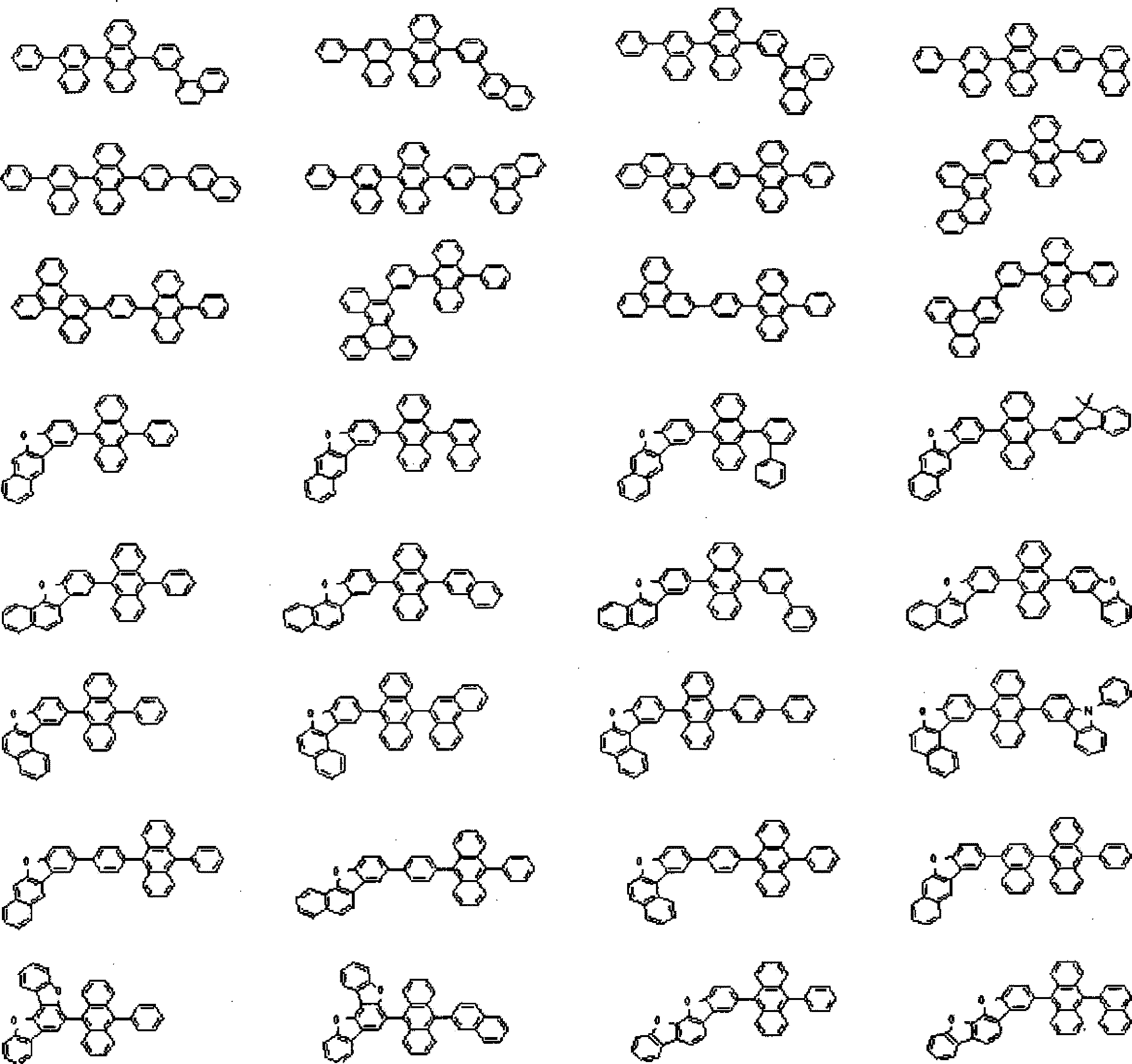

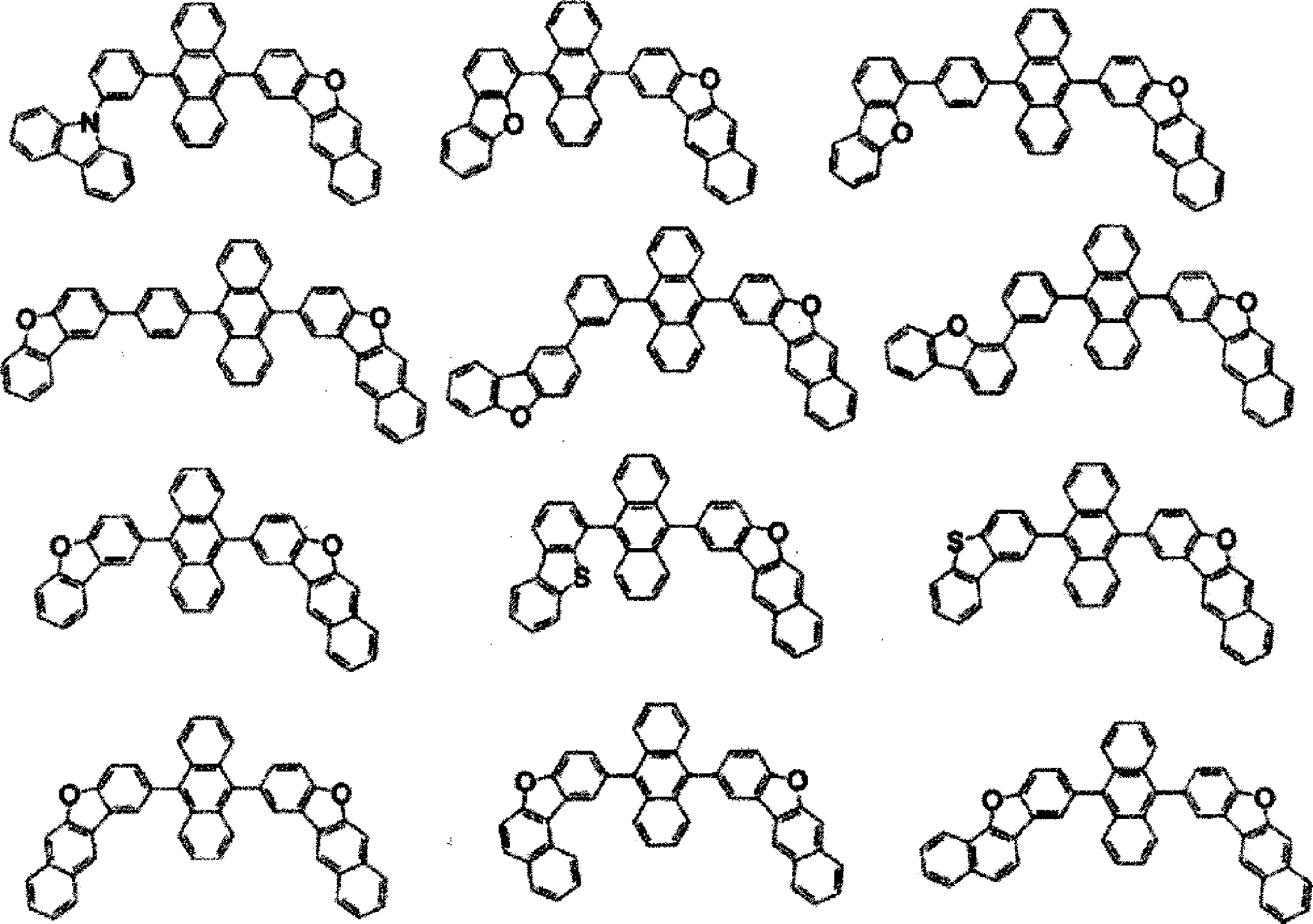
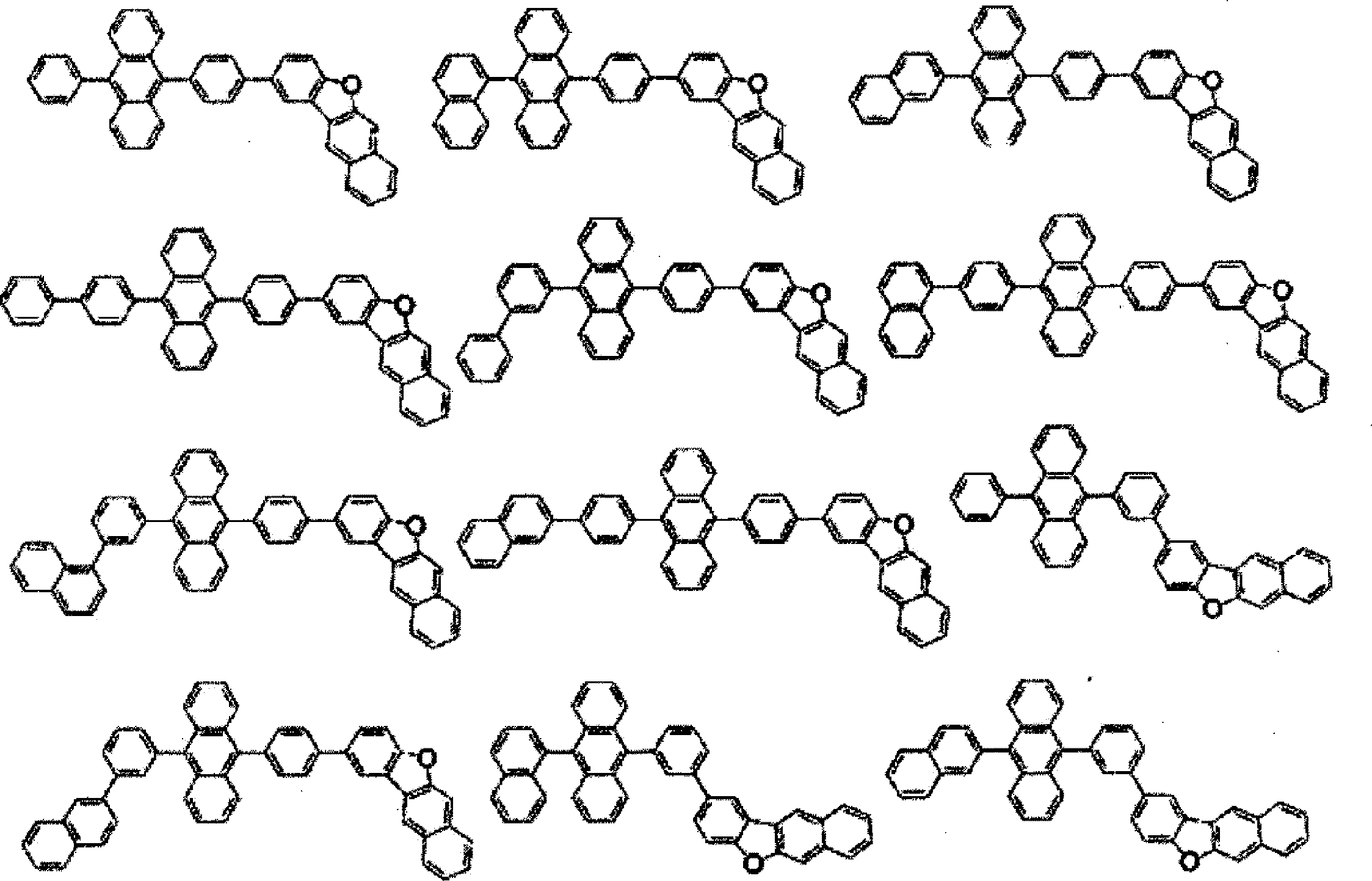


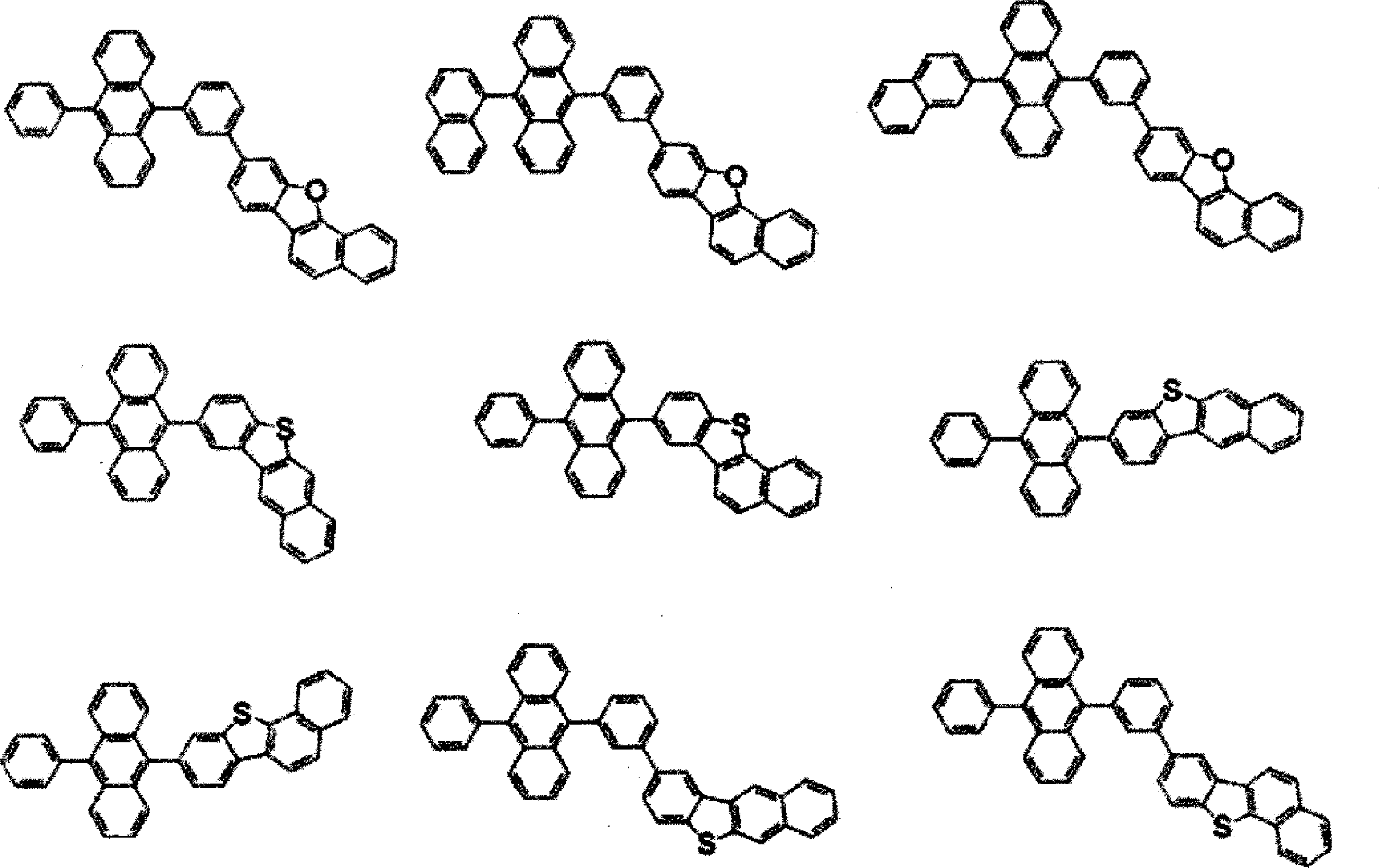

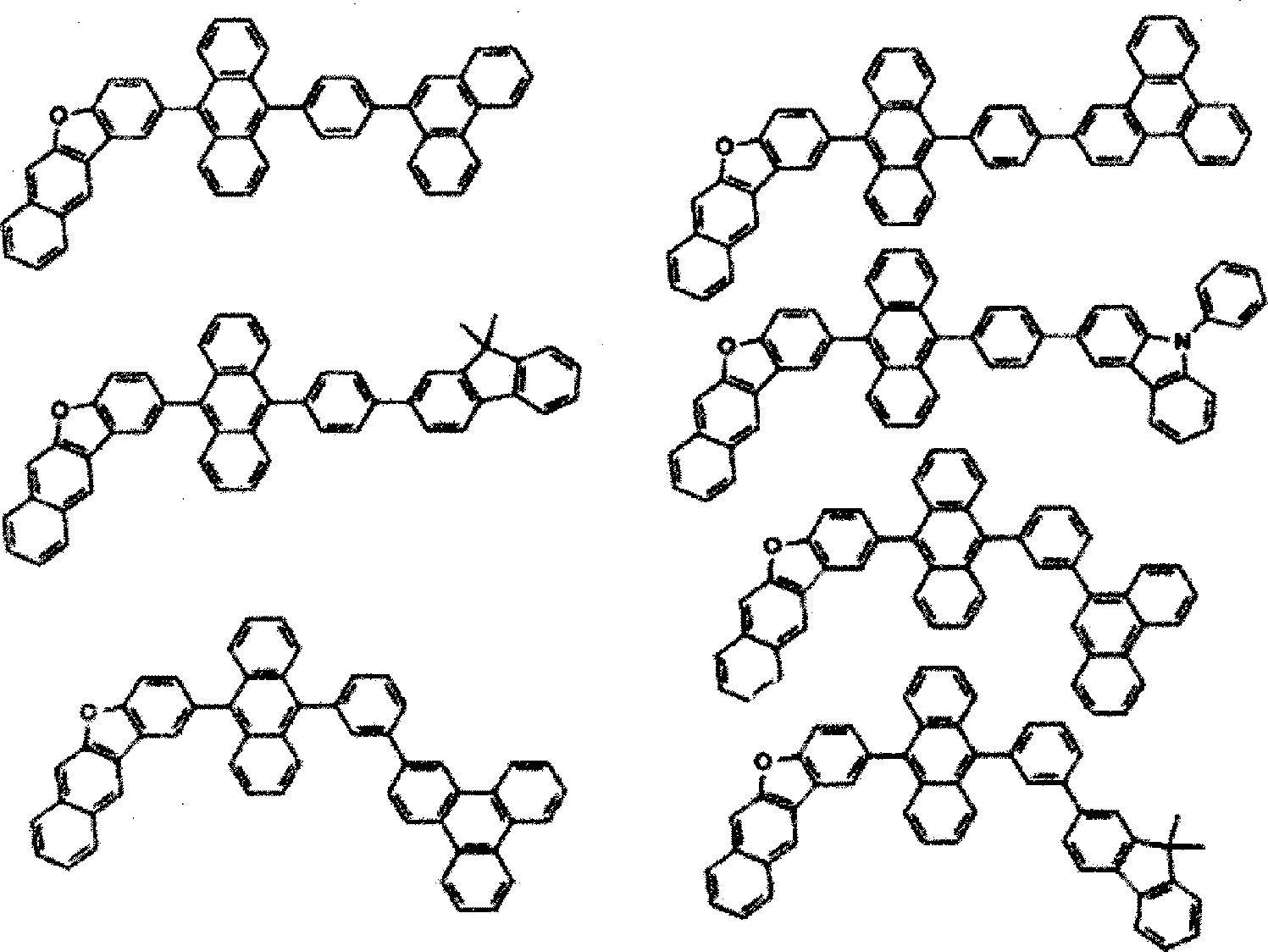


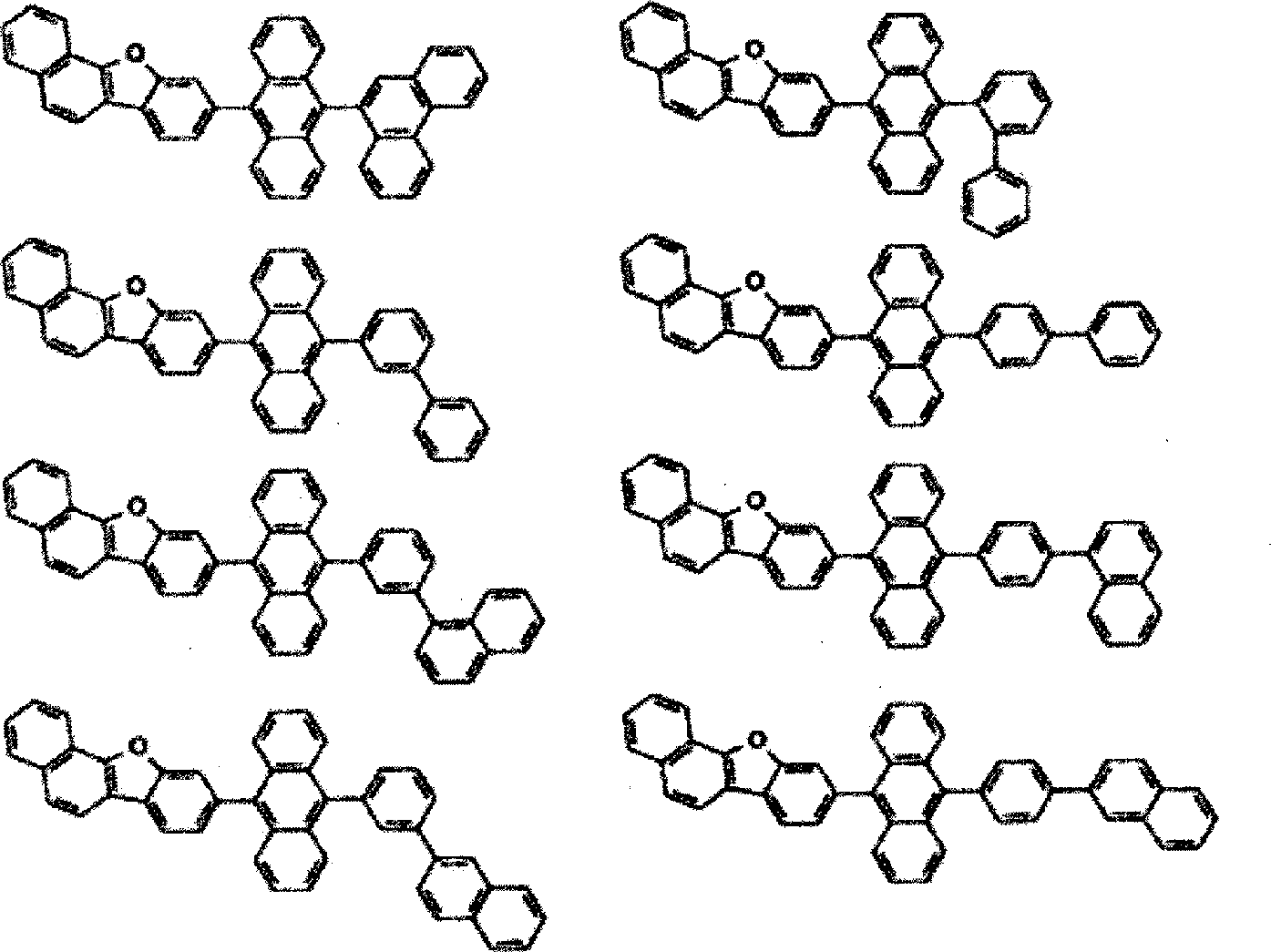

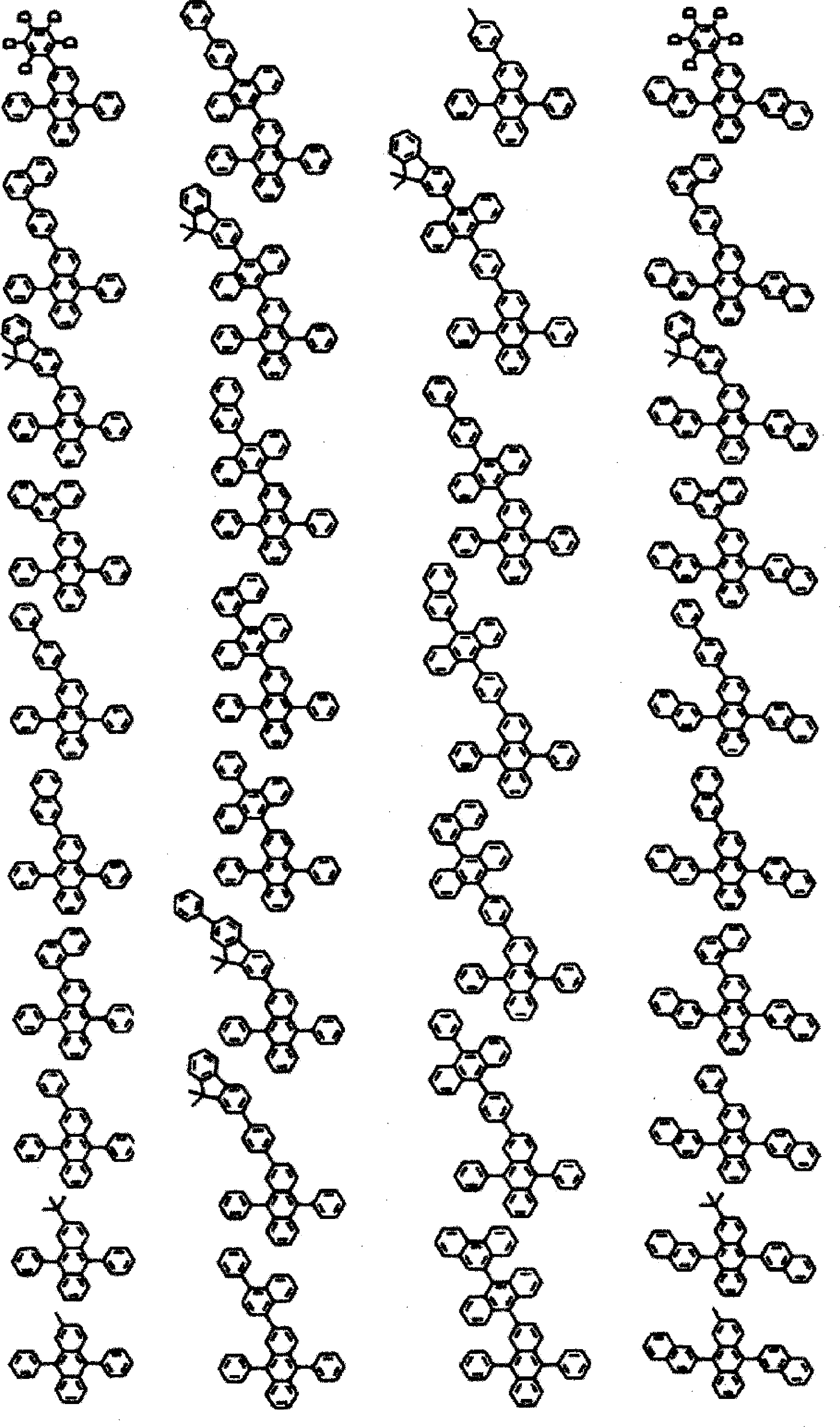

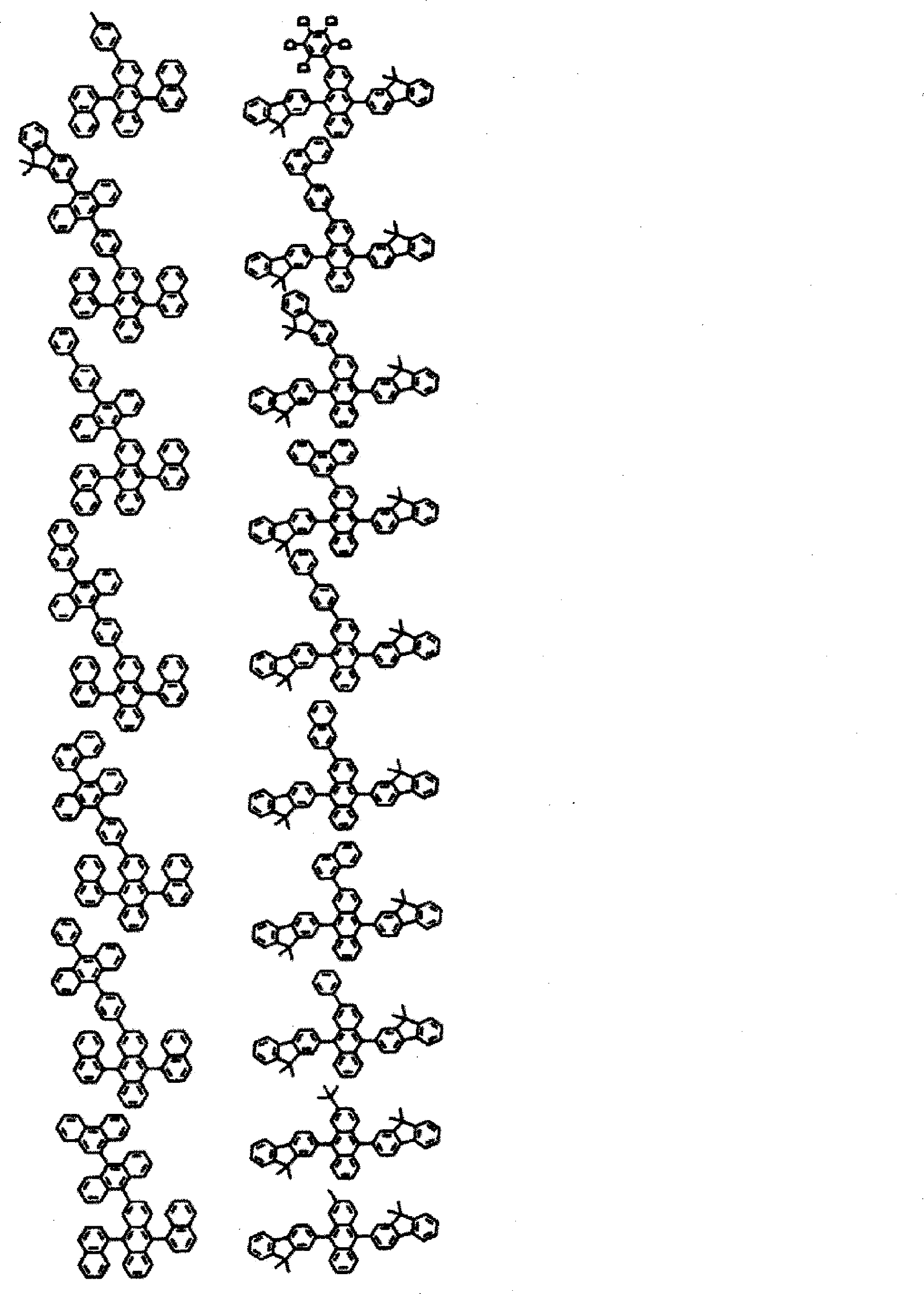


有機EL素子
本発明の有機EL素子は陽極、陰極、及び該陽極と陰極の間に配置された有機層を含む。該有機層は電子輸送層及び発光層を含み、電子輸送層が化合物Aを含み、発光層がホスト材料Bを含む。
本発明の有機EL素子は陽極、陰極、及び該陽極と陰極の間に配置された有機層を含む。該有機層は電子輸送層及び発光層を含み、電子輸送層が化合物Aを含み、発光層がホスト材料Bを含む。
本発明の有機EL素子は、蛍光又は燐光発光型の単色発光素子であっても、蛍光/燐光ハイブリッド型の白色発光素子であっても、単独の発光ユニットを有するシンプル型素子であっても、複数の発光ユニットを有するタンデム型素子であってもよい。ここで、「発光ユニット」とは、有機層を含み、そのうちの少なくとも一層が発光層であり、注入された正孔と電子が再結合することにより発光する最小単位をいう。
例えば、シンプル型有機EL素子の代表的な素子構成としては、以下の素子構成を挙げることができる。
(1)陽極/発光ユニット/陰極
また、上記発光ユニットは、燐光発光層や蛍光発光層を複数有する多層型であってもよく、その場合、各発光層の間に、燐光発光層で生成された励起子が蛍光発光層に拡散することを防ぐ目的で、スペース層を有していてもよい。シンプル型発光ユニットの代表的な層構成を以下に示す。括弧内の層は任意である。
(a)(正孔注入層/)正孔輸送層/蛍光発光層/電子輸送層(/電子注入層)
(b)(正孔注入層/)正孔輸送層/燐光発光層/電子輸送層(/電子注入層)
(c)(正孔注入層/)正孔輸送層/第1蛍光発光層/第2蛍光発光層/電子輸送層(/電子注入層)
(d)(正孔注入層/)正孔輸送層/第1燐光発光層/第2燐光発光層/電子輸送層(/電子注入層)
(e)(正孔注入層/)正孔輸送層/燐光発光層/スペース層/蛍光発光層/電子輸送層(/電子注入層)
(f)(正孔注入層/)正孔輸送層/第1燐光発光層/第2燐光発光層/スペース層/蛍光発光層/電子輸送層(/電子注入層)
(g)(正孔注入層/)正孔輸送層/第1燐光発光層/スペース層/第2燐光発光層/スペース層/蛍光発光層/電子輸送層(/電子注入層)
(h)(正孔注入層/)正孔輸送層/燐光発光層/スペース層/第1蛍光発光層/第2蛍光発光層/電子輸送層(/電子注入層)
(i)(正孔注入層/)正孔輸送層/電子阻止層/蛍光発光層/電子輸送層(/電子注入層)
(j)(正孔注入層/)正孔輸送層/電子阻止層/燐光発光層/電子輸送層(/電子注入層)
(k)(正孔注入層/)正孔輸送層/励起子阻止層/蛍光発光層/電子輸送層(/電子注入層)
(l)(正孔注入層/)正孔輸送層/励起子阻止層/燐光発光層/電子輸送層(/電子注入層)
(m)(正孔注入層/)第1正孔輸送層/第2正孔輸送層/蛍光発光層/電子輸送層(/電子注入層)
(n)(正孔注入層/)第1正孔輸送層/第2正孔輸送層/燐光発光層/電子輸送層(/電子注入層)
(o)(正孔注入層/)第1正孔輸送層/第2正孔輸送層/蛍光発光層/第1電子輸送層/第2電子輸送層(/電子注入層)
(p)(正孔注入層/)第1正孔輸送層/第2正孔輸送層/燐光発光層/第1電子輸送層/第2電子輸送層(/電子注入層)
(q)(正孔注入層/)正孔輸送層/蛍光発光層/正孔阻止層/電子輸送層(/電子注入層)
(r)(正孔注入層/)正孔輸送層/燐光発光層/正孔阻止層/電子輸送層(/電子注入層)
(s)(正孔注入層/)正孔輸送層/蛍光発光層/励起子阻止層/電子輸送層(/電子注入層)
(t)(正孔注入層/)正孔輸送層/燐光発光層/励起子阻止層/電子輸送層(/電子注入層)
(u)(正孔注入層/)正孔輸送層/電子阻止層/燐光発光層/正孔阻止層/電子輸送層(/電子注入層)
(v)(正孔注入層/)正孔輸送層/電子阻止層/蛍光発光層/正孔阻止層/電子輸送層(/電子注入層)
(1)陽極/発光ユニット/陰極
また、上記発光ユニットは、燐光発光層や蛍光発光層を複数有する多層型であってもよく、その場合、各発光層の間に、燐光発光層で生成された励起子が蛍光発光層に拡散することを防ぐ目的で、スペース層を有していてもよい。シンプル型発光ユニットの代表的な層構成を以下に示す。括弧内の層は任意である。
(a)(正孔注入層/)正孔輸送層/蛍光発光層/電子輸送層(/電子注入層)
(b)(正孔注入層/)正孔輸送層/燐光発光層/電子輸送層(/電子注入層)
(c)(正孔注入層/)正孔輸送層/第1蛍光発光層/第2蛍光発光層/電子輸送層(/電子注入層)
(d)(正孔注入層/)正孔輸送層/第1燐光発光層/第2燐光発光層/電子輸送層(/電子注入層)
(e)(正孔注入層/)正孔輸送層/燐光発光層/スペース層/蛍光発光層/電子輸送層(/電子注入層)
(f)(正孔注入層/)正孔輸送層/第1燐光発光層/第2燐光発光層/スペース層/蛍光発光層/電子輸送層(/電子注入層)
(g)(正孔注入層/)正孔輸送層/第1燐光発光層/スペース層/第2燐光発光層/スペース層/蛍光発光層/電子輸送層(/電子注入層)
(h)(正孔注入層/)正孔輸送層/燐光発光層/スペース層/第1蛍光発光層/第2蛍光発光層/電子輸送層(/電子注入層)
(i)(正孔注入層/)正孔輸送層/電子阻止層/蛍光発光層/電子輸送層(/電子注入層)
(j)(正孔注入層/)正孔輸送層/電子阻止層/燐光発光層/電子輸送層(/電子注入層)
(k)(正孔注入層/)正孔輸送層/励起子阻止層/蛍光発光層/電子輸送層(/電子注入層)
(l)(正孔注入層/)正孔輸送層/励起子阻止層/燐光発光層/電子輸送層(/電子注入層)
(m)(正孔注入層/)第1正孔輸送層/第2正孔輸送層/蛍光発光層/電子輸送層(/電子注入層)
(n)(正孔注入層/)第1正孔輸送層/第2正孔輸送層/燐光発光層/電子輸送層(/電子注入層)
(o)(正孔注入層/)第1正孔輸送層/第2正孔輸送層/蛍光発光層/第1電子輸送層/第2電子輸送層(/電子注入層)
(p)(正孔注入層/)第1正孔輸送層/第2正孔輸送層/燐光発光層/第1電子輸送層/第2電子輸送層(/電子注入層)
(q)(正孔注入層/)正孔輸送層/蛍光発光層/正孔阻止層/電子輸送層(/電子注入層)
(r)(正孔注入層/)正孔輸送層/燐光発光層/正孔阻止層/電子輸送層(/電子注入層)
(s)(正孔注入層/)正孔輸送層/蛍光発光層/励起子阻止層/電子輸送層(/電子注入層)
(t)(正孔注入層/)正孔輸送層/燐光発光層/励起子阻止層/電子輸送層(/電子注入層)
(u)(正孔注入層/)正孔輸送層/電子阻止層/燐光発光層/正孔阻止層/電子輸送層(/電子注入層)
(v)(正孔注入層/)正孔輸送層/電子阻止層/蛍光発光層/正孔阻止層/電子輸送層(/電子注入層)
上記各燐光又は蛍光発光層は、それぞれ互いに異なる発光色を示すものとすることができる。具体的には、上記発光ユニット(f)において、(正孔注入層/)正孔輸送層/第1燐光発光層(赤色発光)/第2燐光発光層(緑色発光)/スペース層/蛍光発光層(青色発光)/電子輸送層といった層構成等が挙げられる。
なお、各発光層と正孔輸送層あるいはスペース層との間には、適宜、電子阻止層を設けてもよい。また、各発光層と電子輸送層との間には、適宜、正孔阻止層を設けてもよい。電子阻止層や正孔阻止層を設けることで、電子又は正孔を発光層内に閉じ込めて、発光層における電荷の再結合確率を高め、発光効率を向上させることができる。
なお、各発光層と正孔輸送層あるいはスペース層との間には、適宜、電子阻止層を設けてもよい。また、各発光層と電子輸送層との間には、適宜、正孔阻止層を設けてもよい。電子阻止層や正孔阻止層を設けることで、電子又は正孔を発光層内に閉じ込めて、発光層における電荷の再結合確率を高め、発光効率を向上させることができる。
タンデム型有機EL素子の代表的な素子構成としては、以下の素子構成を挙げることができる。
(2)陽極/第1発光ユニット/中間層/第2発光ユニット/陰極
ここで、上記第1発光ユニット及び第2発光ユニットとしては、例えば、それぞれ独立して上述の発光ユニットから選択することができる。
上記中間層は、一般的に、中間電極、中間導電層、電荷発生層、電子引抜層、接続層、中間絶縁層とも呼ばれ、第1発光ユニットに電子を、第2発光ユニットに正孔を供給する、公知の材料構成を用いることができる。
(2)陽極/第1発光ユニット/中間層/第2発光ユニット/陰極
ここで、上記第1発光ユニット及び第2発光ユニットとしては、例えば、それぞれ独立して上述の発光ユニットから選択することができる。
上記中間層は、一般的に、中間電極、中間導電層、電荷発生層、電子引抜層、接続層、中間絶縁層とも呼ばれ、第1発光ユニットに電子を、第2発光ユニットに正孔を供給する、公知の材料構成を用いることができる。
図1は本発明の有機EL素子の構成の一例を示す概略図である。有機EL素子1は、基板2、陽極3、陰極4、及び該陽極3と陰極4との間に配置された発光ユニット10とを有する。発光ユニット10は、発光層5を有する。発光層5と陽極3との間に正孔輸送帯域6(正孔注入層、正孔輸送層等)、発光層5と陰極4との間に電子輸送帯域7(電子注入層、電子輸送層等)を有する。また、発光層5の陽極3側に電子阻止層(図示せず)を、発光層5の陰極4側に正孔阻止層(図示せず)を、それぞれ設けてもよい。これにより、電子や正孔を発光層5に閉じ込めて、発光層5における励起子の生成効率をさらに高めることができる。
図2は、本発明の有機EL素子の他の構成を示す概略図である。有機EL素子11は、基板2、陽極3、陰極4、及び該陽極3と陰極4との間に配置された発光ユニット20とを有する。発光ユニット20は、発光層5を有する。陽極3と発光層5の間に配置された正孔輸送帯域は、正孔注入層6a、第1正孔輸送層6b及び第2正孔輸送層6cから形成されている。また、発光層5と陰極4の間に配置された電子輸送帯域は、第1電子輸送層7a及び第2電子輸送層7bから形成されている。
なお、本発明において、蛍光ドーパント(蛍光発光材料)と組み合わされたホストを蛍光ホストと称し、燐光ドーパントと組み合わされたホストを燐光ホストと称する。蛍光ホストと燐光ホストは分子構造のみにより区分されるものではない。すなわち、燐光ホストとは、燐光ドーパントを含有する燐光発光層を形成する材料を意味し、蛍光発光層を形成する材料として利用できないことを意味しているわけではない。蛍光ホストについても同様である。
基板
基板は、有機EL素子の支持体として用いられる。基板としては、例えば、ガラス、石英、プラスチックなどの板を用いることができる。また、可撓性基板を用いてもよい。可撓性基板としては、例えば、ポリカーボネート、ポリアリレート、ポリエーテルスルフォン、ポリプロピレン、ポリエステル、ポリフッ化ビニル、ポリ塩化ビニルからなるプラスチック基板等が挙げられる。また、無機蒸着フィルムを用いることもできる。
基板は、有機EL素子の支持体として用いられる。基板としては、例えば、ガラス、石英、プラスチックなどの板を用いることができる。また、可撓性基板を用いてもよい。可撓性基板としては、例えば、ポリカーボネート、ポリアリレート、ポリエーテルスルフォン、ポリプロピレン、ポリエステル、ポリフッ化ビニル、ポリ塩化ビニルからなるプラスチック基板等が挙げられる。また、無機蒸着フィルムを用いることもできる。
陽極
基板上に形成される陽極には、仕事関数の大きい(具体的には4.0eV以上)金属、合金、電気伝導性化合物、およびこれらの混合物などを用いることが好ましい。具体的には、例えば、酸化インジウム-酸化スズ(ITO:Indium Tin Oxide)、珪素若しくは酸化珪素を含有した酸化インジウム-酸化スズ、酸化インジウム-酸化亜鉛、酸化タングステンおよび酸化亜鉛を含有した酸化インジウム、グラフェン等が挙げられる。この他、金(Au)、白金(Pt)、ニッケル(Ni)、タングステン(W)、クロム(Cr)、モリブデン(Mo)、鉄(Fe)、コバルト(Co)、銅(Cu)、パラジウム(Pd)、チタン(Ti)、または前記金属の窒化物(例えば、窒化チタン)等が挙げられる。
基板上に形成される陽極には、仕事関数の大きい(具体的には4.0eV以上)金属、合金、電気伝導性化合物、およびこれらの混合物などを用いることが好ましい。具体的には、例えば、酸化インジウム-酸化スズ(ITO:Indium Tin Oxide)、珪素若しくは酸化珪素を含有した酸化インジウム-酸化スズ、酸化インジウム-酸化亜鉛、酸化タングステンおよび酸化亜鉛を含有した酸化インジウム、グラフェン等が挙げられる。この他、金(Au)、白金(Pt)、ニッケル(Ni)、タングステン(W)、クロム(Cr)、モリブデン(Mo)、鉄(Fe)、コバルト(Co)、銅(Cu)、パラジウム(Pd)、チタン(Ti)、または前記金属の窒化物(例えば、窒化チタン)等が挙げられる。
これらの材料は、通常、スパッタリング法により成膜される。例えば、酸化インジウム-酸化亜鉛は、酸化インジウムに対し1~10wt%の酸化亜鉛を加えたターゲットを、酸化タングステンおよび酸化亜鉛を含有した酸化インジウムは、酸化インジウムに対し酸化タングステンを0.5~5wt%、酸化亜鉛を0.1~1wt%含有したターゲットを用いることにより、スパッタリング法で形成することができる。その他、真空蒸着法、塗布法、インクジェット法、スピンコート法などにより作製してもよい。
陽極に接して形成される正孔注入層は、陽極の仕事関数に関係なく正孔注入が容易である材料を用いて形成されるため、電極材料として一般的に使用される材料(例えば、金属、合金、電気伝導性化合物、およびこれらの混合物、元素周期表の第1族または第2族に属する元素)を用いることができる。
仕事関数の小さい材料である、元素周期表の第1族または第2族に属する元素、すなわちリチウム(Li)やセシウム(Cs)等のアルカリ金属、およびマグネシウム(Mg)、カルシウム(Ca)、ストロンチウム(Sr)等のアルカリ土類金属、およびこれらを含む合金(例えば、MgAg、AlLi)、ユーロピウム(Eu)、イッテルビウム(Yb)等の希土類金属およびこれらを含む合金等を用いることもできる。なお、アルカリ金属、アルカリ土類金属、およびこれらを含む合金を用いて陽極を形成する場合には、真空蒸着法やスパッタリング法を用いることができる。さらに、銀ペーストなどを用いる場合には、塗布法やインクジェット法などを用いることができる。
仕事関数の小さい材料である、元素周期表の第1族または第2族に属する元素、すなわちリチウム(Li)やセシウム(Cs)等のアルカリ金属、およびマグネシウム(Mg)、カルシウム(Ca)、ストロンチウム(Sr)等のアルカリ土類金属、およびこれらを含む合金(例えば、MgAg、AlLi)、ユーロピウム(Eu)、イッテルビウム(Yb)等の希土類金属およびこれらを含む合金等を用いることもできる。なお、アルカリ金属、アルカリ土類金属、およびこれらを含む合金を用いて陽極を形成する場合には、真空蒸着法やスパッタリング法を用いることができる。さらに、銀ペーストなどを用いる場合には、塗布法やインクジェット法などを用いることができる。
正孔注入層
正孔注入層は、正孔注入性の高い材料(正孔注入性材料)を含む層であり、陽極と発光層の間、又は、存在する場合には、正孔輸送層と陽極の間に形成される。
正孔注入層は、正孔注入性の高い材料(正孔注入性材料)を含む層であり、陽極と発光層の間、又は、存在する場合には、正孔輸送層と陽極の間に形成される。
正孔注入性材料としては、モリブデン酸化物、チタン酸化物、バナジウム酸化物、レニウム酸化物、ルテニウム酸化物、クロム酸化物、ジルコニウム酸化物、ハフニウム酸化物、タンタル酸化物、銀酸化物、タングステン酸化物、マンガン酸化物等を用いることができる。
低分子の有機化合物である4,4’,4’’-トリス(N,N-ジフェニルアミノ)トリフェニルアミン(略称:TDATA)、4,4’,4’’-トリス[N-(3-メチルフェニル)-N-フェニルアミノ]トリフェニルアミン(略称:MTDATA)、4,4’-ビス[N-(4-ジフェニルアミノフェニル)-N-フェニルアミノ]ビフェニル(略称:DPAB)、4,4’-ビス(N-{4-[N’-(3-メチルフェニル)-N’-フェニルアミノ]フェニル}-N-フェニルアミノ)ビフェニル(略称:DNTPD)、1,3,5-トリス[N-(4-ジフェニルアミノフェニル)-N-フェニルアミノ]ベンゼン(略称:DPA3B)、3-[N-(9-フェニルカルバゾール-3-イル)-N-フェニルアミノ]-9-フェニルカルバゾール(略称:PCzPCA1)、3,6-ビス[N-(9-フェニルカルバゾール-3-イル)-N-フェニルアミノ]-9-フェニルカルバゾール(略称:PCzPCA2)、3-[N-(1-ナフチル)-N-(9-フェニルカルバゾール-3-イル)アミノ]-9-フェニルカルバゾール(略称:PCzPCN1)等の芳香族アミン化合物等も正孔注入層材料として挙げられる。
高分子化合物(オリゴマー、デンドリマー、ポリマー等)を用いることもできる。例えば、ポリ(N-ビニルカルバゾール)(略称:PVK)、ポリ(4-ビニルトリフェニルアミン)(略称:PVTPA)、ポリ[N-(4-{N’-[4-(4-ジフェニルアミノ)フェニル]フェニル-N’-フェニルアミノ}フェニル)メタクリルアミド](略称:PTPDMA)、ポリ[N,N’-ビス(4-ブチルフェニル)-N,N’-ビス(フェニル)ベンジジン](略称:Poly-TPD)などの高分子化合物が挙げられる。また、ポリ(3,4-エチレンジオキシチオフェン)/ポリ(スチレンスルホン酸)(PEDOT/PSS)、ポリアニリン/ポリ(スチレンスルホン酸)(PAni/PSS)等の酸を添加した高分子化合物を用いることもできる。
さらに、下記式(K)で表されるヘキサアザトリフェニレン(HAT)化合物などのアクセプター材料を用いることも好ましい。

(式中、R21~R26は、それぞれ独立してシアノ基、-CONH2、カルボキシル基、又は-COOR27(R27は炭素数1~20のアルキル基又は炭素数3~20のシクロアルキル基を表す)を表す。また、R21及びR22、R23及びR24、及びR25及びR26から選ばれる隣接する2つが互いに結合して-CO-O-CO-で示される基を形成してもよい。)
R27としては、メチル基、エチル基、n-プロピル基、イソプロピル基、n-ブチル基、イソブチル基、t-ブチル基、シクロペンチル基、シクロヘキシル基等が挙げられる。
(式中、R21~R26は、それぞれ独立してシアノ基、-CONH2、カルボキシル基、又は-COOR27(R27は炭素数1~20のアルキル基又は炭素数3~20のシクロアルキル基を表す)を表す。また、R21及びR22、R23及びR24、及びR25及びR26から選ばれる隣接する2つが互いに結合して-CO-O-CO-で示される基を形成してもよい。)
R27としては、メチル基、エチル基、n-プロピル基、イソプロピル基、n-ブチル基、イソブチル基、t-ブチル基、シクロペンチル基、シクロヘキシル基等が挙げられる。
正孔輸送層
正孔輸送層は、正孔輸送性の高い材料(正孔輸送性材料)を含む層であり、陽極と発光層の間、又は、存在する場合には、正孔注入層と発光層の間に形成される。
正孔輸送層は、正孔輸送性の高い材料(正孔輸送性材料)を含む層であり、陽極と発光層の間、又は、存在する場合には、正孔注入層と発光層の間に形成される。
正孔輸送層は、単層構造でもよく、多層構造でもよい。例えば、正孔輸送層は第1正孔輸送層(陽極側)と第2正孔輸送層(陰極側)を含む2層構造であってもよい。本発明の一態様において、前記単層構造の正孔輸送層は発光層に隣接していることが好ましく、又、前記多層構造中の最も陰極に近い正孔輸送層、例えば、上記2層構造の第2正孔輸送層、は発光層に隣接していることが好ましい。本発明の他の態様において、前記単層構造の正孔輸送層と発光層の間に、又は、前記多層構造中の最も発光層に近い正孔輸送層と発光層の間に、後述する電子阻止層などを介在させてもよい。
正孔輸送層材料としては、例えば、芳香族アミン化合物、カルバゾール誘導体、アントラセン誘導体等を使用する事ができる。
芳香族アミン化合物としては、例えば、4,4’-ビス[N-(1-ナフチル)-N-フェニルアミノ]ビフェニル(略称:NPB)やN,N’-ビス(3-メチルフェニル)-N,N’-ジフェニル-[1,1’-ビフェニル]-4,4’-ジアミン(略称:TPD)、4-フェニル-4’-(9-フェニルフルオレン-9-イル)トリフェニルアミン(略称:BAFLP)、4,4’-ビス[N-(9,9-ジメチルフルオレン-2-イル)-N-フェニルアミノ]ビフェニル(略称:DFLDPBi)、4,4’,4”-トリス(N,N-ジフェニルアミノ)トリフェニルアミン(略称:TDATA)、4,4’,4”-トリス[N-(3-メチルフェニル)-N-フェニルアミノ]トリフェニルアミン(略称:MTDATA)、及び、4,4’-ビス[N-(スピロ-9,9’-ビフルオレン-2-イル)-N―フェニルアミノ]ビフェニル(略称:BSPB)が挙げられる。上記化合物は、10-6cm2/Vs以上の正孔移動度を有する。
芳香族アミン化合物としては、例えば、4,4’-ビス[N-(1-ナフチル)-N-フェニルアミノ]ビフェニル(略称:NPB)やN,N’-ビス(3-メチルフェニル)-N,N’-ジフェニル-[1,1’-ビフェニル]-4,4’-ジアミン(略称:TPD)、4-フェニル-4’-(9-フェニルフルオレン-9-イル)トリフェニルアミン(略称:BAFLP)、4,4’-ビス[N-(9,9-ジメチルフルオレン-2-イル)-N-フェニルアミノ]ビフェニル(略称:DFLDPBi)、4,4’,4”-トリス(N,N-ジフェニルアミノ)トリフェニルアミン(略称:TDATA)、4,4’,4”-トリス[N-(3-メチルフェニル)-N-フェニルアミノ]トリフェニルアミン(略称:MTDATA)、及び、4,4’-ビス[N-(スピロ-9,9’-ビフルオレン-2-イル)-N―フェニルアミノ]ビフェニル(略称:BSPB)が挙げられる。上記化合物は、10-6cm2/Vs以上の正孔移動度を有する。
カルバゾール誘導体としては、例えば、4,4’-ジ(9-カルバゾリル)ビフェニル(略称:CBP)、9-[4-(9-カルバゾリル)フェニル]-10-フェニルアントラセン(略称:CzPA)、及び、9-フェニル-3-[4-(10-フェニル-9-アントリル)フェニル]-9H-カルバゾール(略称:PCzPA)が挙げられる。
アントラセン誘導体としては、例えば、2-t-ブチル-9,10-ジ(2-ナフチル)アントラセン(略称:t-BuDNA)、9,10-ジ(2-ナフチル)アントラセン(略称:DNA)、及び、9,10-ジフェニルアントラセン(略称:DPAnth)が挙げられる。
ポリ(N-ビニルカルバゾール)(略称:PVK)やポリ(4-ビニルトリフェニルアミン)(略称:PVTPA)等の高分子化合物を用いることもできる。
但し、電子輸送性よりも正孔輸送性の方が高い化合物であれば、上記以外の化合物を用いてもよい。
アントラセン誘導体としては、例えば、2-t-ブチル-9,10-ジ(2-ナフチル)アントラセン(略称:t-BuDNA)、9,10-ジ(2-ナフチル)アントラセン(略称:DNA)、及び、9,10-ジフェニルアントラセン(略称:DPAnth)が挙げられる。
ポリ(N-ビニルカルバゾール)(略称:PVK)やポリ(4-ビニルトリフェニルアミン)(略称:PVTPA)等の高分子化合物を用いることもできる。
但し、電子輸送性よりも正孔輸送性の方が高い化合物であれば、上記以外の化合物を用いてもよい。
発光層のドーパント材料
発光層は、発光性の高い材料(ドーパント材料)を含む層であり、種々の材料を用いることができる。例えば、蛍光発光材料や燐光発光材料をドーパント材料として用いることができる。蛍光発光材料は一重項励起状態から発光する化合物であり、燐光発光材料は三重項励起状態から発光する化合物である。
発光層は、発光性の高い材料(ドーパント材料)を含む層であり、種々の材料を用いることができる。例えば、蛍光発光材料や燐光発光材料をドーパント材料として用いることができる。蛍光発光材料は一重項励起状態から発光する化合物であり、燐光発光材料は三重項励起状態から発光する化合物である。
発光層に用いることができる青色系の蛍光発光材料として、ピレン誘導体、スチリルアミン誘導体、クリセン誘導体、フルオランテン誘導体、フルオレン誘導体、ジアミン誘導体、トリアリールアミン誘導体等が使用できる。具体的には、N,N’-ビス[4-(9H-カルバゾール-9-イル)フェニル]-N,N’-ジフェニルスチルベン-4,4’-ジアミン(略称:YGA2S)、4-(9H-カルバゾール-9-イル)-4’-(10-フェニル-9-アントリル)トリフェニルアミン(略称:YGAPA)、4-(10-フェニル-9-アントリル)-4’-(9-フェニル-9H-カルバゾール-3-イル)トリフェニルアミン(略称:PCBAPA)などが挙げられる。
発光層に用いることができる緑色系の蛍光発光材料として、芳香族アミン誘導体等を使用できる。具体的には、N-(9,10-ジフェニル-2-アントリル)-N,9-ジフェニル-9H-カルバゾール-3-アミン(略称:2PCAPA)、N-[9,10-ビス(1,1’-ビフェニル-2-イル)-2-アントリル]-N,9-ジフェニル-9H-カルバゾール-3-アミン(略称:2PCABPhA)、N-(9,10-ジフェニル-2-アントリル)-N,N’,N’-トリフェニル-1,4-フェニレンジアミン(略称:2DPAPA)、N-[9,10-ビス(1,1’-ビフェニル-2-イル)-2-アントリル]-N,N’,N’-トリフェニル-1,4-フェニレンジアミン(略称:2DPABPhA)、N-[9,10-ビス(1,1’-ビフェニル-2-イル)]-N-[4-(9H-カルバゾール-9-イル)フェニル]-N-フェニルアントラセン-2-アミン(略称:2YGABPhA)、N,N,9-トリフェニルアントラセン-9-アミン(略称:DPhAPhA)などが挙げられる。
発光層に用いることができる赤色系の蛍光発光材料として、テトラセン誘導体、ジアミン誘導体等が使用できる。具体的には、N,N,N’,N’-テトラキス(4-メチルフェニル)テトラセン-5,11-ジアミン(略称:p-mPhTD)、7,14-ジフェニル-N,N,N’,N’-テトラキス(4-メチルフェニル)アセナフト[1,2-a]フルオランテン-3,10-ジアミン(略称:p-mPhAFD)などが挙げられる。
発光層に用いることができる青色系の燐光発光材料として、イリジウム錯体、オスミウム錯体、白金錯体等の金属錯体が使用される。具体的には、ビス[2-(4’,6’-ジフルオロフェニル)ピリジナト-N,C2’]イリジウム(III)テトラキス(1-ピラゾリル)ボラート(略称:FIr6)、ビス[2-(4’,6’-ジフルオロフェニル)ピリジナト-N,C2’]イリジウム(III)ピコリナート(略称:FIrpic)、ビス[2-(3’,5’ビストリフルオロメチルフェニル)ピリジナト-N,C2’]イリジウム(III)ピコリナート(略称:Ir(CF3ppy)2(pic))、ビス[2-(4’,6’-ジフルオロフェニル)ピリジナト-N,C2’]イリジウム(III)アセチルアセトナート(略称:FIracac)などが挙げられる。
発光層に用いることができる緑色系の燐光発光材料として、イリジウム錯体等が使用される。トリス(2-フェニルピリジナト-N,C2’)イリジウム(III)(略称:Ir(ppy)3)、ビス(2-フェニルピリジナト-N,C2’)イリジウム(III)アセチルアセトナート(略称:Ir(ppy)2(acac))、ビス(1,2-ジフェニル-1H-ベンゾイミダゾラト)イリジウム(III)アセチルアセトナート(略称:Ir(pbi)2(acac))、ビス(ベンゾ[h]キノリナト)イリジウム(III)アセチルアセトナート(略称:Ir(bzq)2(acac))などが挙げられる。
発光層に用いることができる赤色系の燐光発光材料として、イリジウム錯体、白金錯体、テルビウム錯体、ユーロピウム錯体等の金属錯体が使用される。具体的には、ビス[2-(2’-ベンゾ[4,5-α]チエニル)ピリジナト-N,C3’]イリジウム(III)アセチルアセトナート(略称:Ir(btp)2(acac))、ビス(1-フェニルイソキノリナト-N,C2’)イリジウム(III)アセチルアセトナート(略称:Ir(piq)2(acac))、(アセチルアセトナート)ビス[2,3-ビス(4-フルオロフェニル)キノキサリナト]イリジウム(III)(略称:Ir(Fdpq)2(acac))、2,3,7,8,12,13,17,18-オクタエチル-21H,23H-ポルフィリン白金(II)(略称:PtOEP)等の有機金属錯体が挙げられる。
また、トリス(アセチルアセトナート)(モノフェナントロリン)テルビウム(III)(略称:Tb(acac)3(Phen))、トリス(1,3-ジフェニル-1,3-プロパンジオナト)(モノフェナントロリン)ユーロピウム(III)(略称:Eu(DBM)3(Phen))、トリス[1-(2-テノイル)-3,3,3-トリフルオロアセトナト](モノフェナントロリン)ユーロピウム(III)(略称:Eu(TTA)3(Phen))等の希土類金属錯体は、希土類金属イオンからの発光(異なる多重度間の電子遷移)であるため、燐光発光材料として用いることができる。
発光層のホスト材料
発光層は、上述したドーパント材料を他の材料(ホスト材料)に分散させた構成としてもよい。ドーパント材料よりも最低空軌道準位(LUMO準位)が高く、最高占有軌道準位(HOMO準位)が低い材料を用いることが好ましい。
発光層は、上述したドーパント材料を他の材料(ホスト材料)に分散させた構成としてもよい。ドーパント材料よりも最低空軌道準位(LUMO準位)が高く、最高占有軌道準位(HOMO準位)が低い材料を用いることが好ましい。
本発明の有機EL素子では、発光層のホスト材料として前記ホスト材料Bを使用する。
本発明の一態様において、発光層に含まれるホスト材料Bは少なくとも1個の重水素原子を含む。又、ホスト材料Bは、全ての水素原子が軽水素原子であるホスト材料B(以下、「軽水素体)」という)と全ての水素原子のうちの少なくとも1個が重水素原子であるホスト材料B(重水素体)との混合物であってもよい。ただし、軽水素体は、重水素原子を天然存在比以下の割合で含んでいてもよい。
本発明の一態様において、前記発光層に含まれるホスト材料Bは、製造コストの観点から、軽水素体であることが好ましい。従って、本発明は、前記発光層が実質的に軽水素体のみからなるホスト材料Bを含む有機EL素子を含む。「実質的に軽水素体のみからなるホスト材料B」とは、ホスト材料Bの総量に対する軽水素体の含有割合が、90モル%以上、好ましくは95モル%以上、より好ましくは99モル%以上(それぞれ100%を含む)であることを意味する。
本発明の一態様において、前記発光層に含まれるホスト材料Bは、製造コストの観点から、軽水素体であることが好ましい。従って、本発明は、前記発光層が実質的に軽水素体のみからなるホスト材料Bを含む有機EL素子を含む。「実質的に軽水素体のみからなるホスト材料B」とは、ホスト材料Bの総量に対する軽水素体の含有割合が、90モル%以上、好ましくは95モル%以上、より好ましくは99モル%以上(それぞれ100%を含む)であることを意味する。
前記ホスト材料Bに加えて他のホスト材料を使用してもよい。該他のホスト材料としては、例えば
(1)アルミニウム錯体、ベリリウム錯体、又は亜鉛錯体等の金属錯体、
(2)オキサジアゾール誘導体、ベンゾイミダゾール誘導体、又はフェナントロリン誘導体等の複素環化合物、
(3)カルバゾール誘導体、アントラセン誘導体、フェナントレン誘導体、ピレン誘導体、又はクリセン誘導体等の縮合芳香族化合物、
(4)トリアリールアミン誘導体又は縮合多環芳香族アミン誘導体等の芳香族アミン化合物が挙げられる。
(1)アルミニウム錯体、ベリリウム錯体、又は亜鉛錯体等の金属錯体、
(2)オキサジアゾール誘導体、ベンゾイミダゾール誘導体、又はフェナントロリン誘導体等の複素環化合物、
(3)カルバゾール誘導体、アントラセン誘導体、フェナントレン誘導体、ピレン誘導体、又はクリセン誘導体等の縮合芳香族化合物、
(4)トリアリールアミン誘導体又は縮合多環芳香族アミン誘導体等の芳香族アミン化合物が挙げられる。
例えば、トリス(8-キノリノラト)アルミニウム(III)(略称:Alq)、トリス(4-メチル-8-キノリノラト)アルミニウム(III)(略称:Almq3)、ビス(10-ヒドロキシベンゾ[h]キノリナト)ベリリウム(II)(略称:BeBq2)、ビス(2-メチル-8-キノリノラト)(4-フェニルフェノラト)アルミニウム(III)(略称:BAlq)、ビス(8-キノリノラト)亜鉛(II)(略称:Znq)、ビス[2-(2-ベンゾオキサゾリル)フェノラト]亜鉛(II)(略称:ZnPBO)、ビス[2-(2-ベンゾチアゾリル)フェノラト]亜鉛(II)(略称:ZnBTZ)などの金属錯体;
2-(4-ビフェニリル)-5-(4-tert-ブチルフェニル)-1,3,4-オキサジアゾール(略称:PBD)、1,3-ビス[5-(p-tert-ブチルフェニル)-1,3,4-オキサジアゾール-2-イル]ベンゼン(略称:OXD-7)、3-(4-ビフェニリル)-4-フェニル-5-(4-tert-ブチルフェニル)-1,2,4-トリアゾール(略称:TAZ)、2,2’,2’’-(1,3,5-ベンゼントリイル)トリス(1-フェニル-1H-ベンゾイミダゾール)(略称:TPBI)、バソフェナントロリン(略称:BPhen)、バソキュプロイン(略称:BCP)などの複素環化合物;
9-[4-(10-フェニル-9-アントリル)フェニル]-9H-カルバゾール(略称:CzPA)、3,6-ジフェニル-9-[4-(10-フェニル-9-アントリル)フェニル]-9H-カルバゾール(略称:DPCzPA)、9,10-ビス(3,5-ジフェニルフェニル)アントラセン(略称:DPPA)、9,10-ジ(2-ナフチル)アントラセン(略称:DNA)、2-tert-ブチル-9,10-ジ(2-ナフチル)アントラセン(略称:t-BuDNA)、9,9’-ビアントリル(略称:BANT)、9,9’-(スチルベン-3,3’-ジイル)ジフェナントレン(略称:DPNS)、9,9’-(スチルベン-4,4’-ジイル)ジフェナントレン(略称:DPNS2)、3,3’,3’’-(ベンゼン-1,3,5-トリイル)トリピレン(略称:TPB3)、9,10-ジフェニルアントラセン(略称:DPAnth)、6,12-ジメトキシ-5,11-ジフェニルクリセンなどの縮合芳香族化合物;及び
N,N-ジフェニル-9-[4-(10-フェニル-9-アントリル)フェニル]-9H-カルバゾール-3-アミン(略称:CzA1PA)、4-(10-フェニル-9-アントリル)トリフェニルアミン(略称:DPhPA)、N,9-ジフェニル-N-[4-(10-フェニル-9-アントリル)フェニル]-9H-カルバゾール-3-アミン(略称:PCAPA)、N,9-ジフェニル-N-{4-[4-(10-フェニル-9-アントリル)フェニル]フェニル}-9H-カルバゾール-3-アミン(略称:PCAPBA)、N-(9,10-ジフェニル-2-アントリル)-N,9-ジフェニル-9H-カルバゾール-3-アミン(略称:2PCAPA)、4,4’-ビス[N-(1-ナフチル)-N-フェニルアミノ]ビフェニル(略称:NPBまたはα-NPD)、N,N’-ビス(3-メチルフェニル)-N,N’-ジフェニル-[1,1’-ビフェニル]-4,4’-ジアミン(略称:TPD)、4,4’-ビス[N-(9,9-ジメチルフルオレン-2-イル)-N-フェニルアミノ]ビフェニル(略称:DFLDPBi)、4,4’-ビス[N-(スピロ-9,9’-ビフルオレン-2-イル)-N―フェニルアミノ]ビフェニル(略称:BSPB)などの芳香族アミン化合物を用いることができる。
2-(4-ビフェニリル)-5-(4-tert-ブチルフェニル)-1,3,4-オキサジアゾール(略称:PBD)、1,3-ビス[5-(p-tert-ブチルフェニル)-1,3,4-オキサジアゾール-2-イル]ベンゼン(略称:OXD-7)、3-(4-ビフェニリル)-4-フェニル-5-(4-tert-ブチルフェニル)-1,2,4-トリアゾール(略称:TAZ)、2,2’,2’’-(1,3,5-ベンゼントリイル)トリス(1-フェニル-1H-ベンゾイミダゾール)(略称:TPBI)、バソフェナントロリン(略称:BPhen)、バソキュプロイン(略称:BCP)などの複素環化合物;
9-[4-(10-フェニル-9-アントリル)フェニル]-9H-カルバゾール(略称:CzPA)、3,6-ジフェニル-9-[4-(10-フェニル-9-アントリル)フェニル]-9H-カルバゾール(略称:DPCzPA)、9,10-ビス(3,5-ジフェニルフェニル)アントラセン(略称:DPPA)、9,10-ジ(2-ナフチル)アントラセン(略称:DNA)、2-tert-ブチル-9,10-ジ(2-ナフチル)アントラセン(略称:t-BuDNA)、9,9’-ビアントリル(略称:BANT)、9,9’-(スチルベン-3,3’-ジイル)ジフェナントレン(略称:DPNS)、9,9’-(スチルベン-4,4’-ジイル)ジフェナントレン(略称:DPNS2)、3,3’,3’’-(ベンゼン-1,3,5-トリイル)トリピレン(略称:TPB3)、9,10-ジフェニルアントラセン(略称:DPAnth)、6,12-ジメトキシ-5,11-ジフェニルクリセンなどの縮合芳香族化合物;及び
N,N-ジフェニル-9-[4-(10-フェニル-9-アントリル)フェニル]-9H-カルバゾール-3-アミン(略称:CzA1PA)、4-(10-フェニル-9-アントリル)トリフェニルアミン(略称:DPhPA)、N,9-ジフェニル-N-[4-(10-フェニル-9-アントリル)フェニル]-9H-カルバゾール-3-アミン(略称:PCAPA)、N,9-ジフェニル-N-{4-[4-(10-フェニル-9-アントリル)フェニル]フェニル}-9H-カルバゾール-3-アミン(略称:PCAPBA)、N-(9,10-ジフェニル-2-アントリル)-N,9-ジフェニル-9H-カルバゾール-3-アミン(略称:2PCAPA)、4,4’-ビス[N-(1-ナフチル)-N-フェニルアミノ]ビフェニル(略称:NPBまたはα-NPD)、N,N’-ビス(3-メチルフェニル)-N,N’-ジフェニル-[1,1’-ビフェニル]-4,4’-ジアミン(略称:TPD)、4,4’-ビス[N-(9,9-ジメチルフルオレン-2-イル)-N-フェニルアミノ]ビフェニル(略称:DFLDPBi)、4,4’-ビス[N-(スピロ-9,9’-ビフルオレン-2-イル)-N―フェニルアミノ]ビフェニル(略称:BSPB)などの芳香族アミン化合物を用いることができる。
電子輸送層
電子輸送層は電子輸送性の高い材料(電子輸送性材料)を含む層であり、発光層と陰極の間、又は、存在する場合は、電子注入層と発光層の間に形成してもよい。
電子輸送層は、単層構造でもよく、多層構造でもよい。例えば、電子輸送層は第1電子輸送層(陽極側)と第2電子輸送層(陰極側)を含む2層構造であってもよい。本発明の一態様において、前記単層構造の電子輸送層は発光層に隣接していることが好ましく、又、前記多層構造中の最も陽極に近い電子輸送層、例えば、上記2層構造の第1電子輸送層、は発光層に隣接していることが好ましい。本発明の他の態様において、前記単層構造の電子輸送層と発光層の間に、又は、前記多層構造中の最も発光層に近い電子輸送層と発光層の間に、後述する正孔阻止層などを介在させてもよい。
電子輸送層は電子輸送性の高い材料(電子輸送性材料)を含む層であり、発光層と陰極の間、又は、存在する場合は、電子注入層と発光層の間に形成してもよい。
電子輸送層は、単層構造でもよく、多層構造でもよい。例えば、電子輸送層は第1電子輸送層(陽極側)と第2電子輸送層(陰極側)を含む2層構造であってもよい。本発明の一態様において、前記単層構造の電子輸送層は発光層に隣接していることが好ましく、又、前記多層構造中の最も陽極に近い電子輸送層、例えば、上記2層構造の第1電子輸送層、は発光層に隣接していることが好ましい。本発明の他の態様において、前記単層構造の電子輸送層と発光層の間に、又は、前記多層構造中の最も発光層に近い電子輸送層と発光層の間に、後述する正孔阻止層などを介在させてもよい。
本発明の有機EL素子は、化合物Aを電子輸送層に含む。
前記2層構造の電子輸送層において、化合物Aは第1電子輸送層と第2電子輸送層の一方に含まれていてもよいし、双方に含まれていてもよい。
本発明の一態様においては、化合物Aは第1電子輸送層のみに含まれ、第2電子輸送層は化合物A以外の電子輸送層材料を含む。
他の態様においては、化合物Aは第2電子輸送層のみに含まれ、第1電子輸送層は化合物A以外の電子輸送層材料を含む。
さらに他の態様においては、化合物Aは第1電子輸送層と第2電子輸送層に含まれる。第1電子輸送層と第2電子輸送層の一方又は双方は、化合物A以外の電子輸送層材料を含んでもよい。
前記2層構造の電子輸送層において、化合物Aは第1電子輸送層と第2電子輸送層の一方に含まれていてもよいし、双方に含まれていてもよい。
本発明の一態様においては、化合物Aは第1電子輸送層のみに含まれ、第2電子輸送層は化合物A以外の電子輸送層材料を含む。
他の態様においては、化合物Aは第2電子輸送層のみに含まれ、第1電子輸送層は化合物A以外の電子輸送層材料を含む。
さらに他の態様においては、化合物Aは第1電子輸送層と第2電子輸送層に含まれる。第1電子輸送層と第2電子輸送層の一方又は双方は、化合物A以外の電子輸送層材料を含んでもよい。
本発明の一態様において、化合物Aは少なくとも1個の重水素原子を含む。又、化合物Aは、全ての水素原子が軽水素原子である化合物A(以下、「軽水素体)」という)と全ての水素原子のうちの少なくとも1個が重水素原子である化合物A(重水素体)との混合物であってもよい。ただし、軽水素体は、重水素原子を天然存在比以下の割合で含んでいてもよい。
本発明の一態様において、前記電子輸送層(第1電子輸送層、第2電子輸送層も含む)に含まれる化合物Aは、製造コストの観点から、軽水素体であることが好ましい。
従って、本発明は、前記電子輸送層が実質的に軽水素体のみからなる化合物Aを含む有機EL素子を含む。「実質的に軽水素体のみからなる化合物A」とは、化合物Aの総量に対する軽水素体の含有割合が、90モル%以上、好ましくは95モル%以上、より好ましくは99モル%以上(それぞれ100%を含む)であることを意味する。
従って、本発明は、前記電子輸送層が実質的に軽水素体のみからなる化合物Aを含む有機EL素子を含む。「実質的に軽水素体のみからなる化合物A」とは、化合物Aの総量に対する軽水素体の含有割合が、90モル%以上、好ましくは95モル%以上、より好ましくは99モル%以上(それぞれ100%を含む)であることを意味する。
化合物Aに加えて他の電子輸送層材料を用いてもよい。該他の電子輸送層材料としては、例えば、
(1)アルミニウム錯体、ベリリウム錯体、亜鉛錯体等の金属錯体、
(2)イミダゾール誘導体、ベンゾイミダゾール誘導体、アジン誘導体、カルバゾール誘導体、フェナントロリン誘導体等の複素芳香族化合物、
(3)高分子化合物
が挙げられる。
(1)アルミニウム錯体、ベリリウム錯体、亜鉛錯体等の金属錯体、
(2)イミダゾール誘導体、ベンゾイミダゾール誘導体、アジン誘導体、カルバゾール誘導体、フェナントロリン誘導体等の複素芳香族化合物、
(3)高分子化合物
が挙げられる。
金属錯体としては、例えば、トリス(8-キノリノラト)アルミニウム(III)(略称:Alq)、トリス(4-メチル-8-キノリノラト)アルミニウム(略称:Almq3)、ビス(10-ヒドロキシベンゾ[h]キノリナト)ベリリウム(略称:BeBq2)、ビス(2-メチル-8-キノリノラト)(4-フェニルフェノラト)アルミニウム(III)(略称:BAlq)、ビス(8-キノリノラト)亜鉛(II)(略称:Znq)、ビス[2-(2-ベンゾオキサゾリル)フェノラト]亜鉛(II)(略称:ZnPBO)、ビス[2-(2-ベンゾチアゾリル)フェノラト]亜鉛(II)(略称:ZnBTZ)が挙げられる。
複素芳香族化合物としては、例えば、2-(4-ビフェニリル)-5-(4-tert-ブチルフェニル)-1,3,4-オキサジアゾール(略称:PBD)、1,3-ビス[5-(ptert-ブチルフェニル)-1,3,4-オキサジアゾール-2-イル]ベンゼン(略称:OXD-7)、3-(4-tert-ブチルフェニル)-4-フェニル-5-(4-ビフェニリル)-1,2,4-トリアゾール(略称:TAZ)、3-(4-tert-ブチルフェニル)-4-(4-エチルフェニル)-5-(4-ビフェニリル)-1,2,4-トリアゾール(略称:p-EtTAZ)、バソフェナントロリン(略称:BPhen)、バソキュプロイン(略称:BCP)、4,4’-ビス(5-メチルベンゾオキサゾール-2-イル)スチルベン(略称:BzOs)が挙げられる。
高分子化合物としては、例えば、ポリ[(9,9-ジヘキシルフルオレン-2,7-ジイル)-co-(ピリジン-3,5-ジイル)](略称:PF-Py)、ポリ[(9,9-ジオクチルフルオレン-2,7-ジイル)-co-(2,2’-ビピリジン-6,6’-ジイル)](略称:PF-BPy)が挙げられる。
上記材料は、10-6cm2/Vs以上の電子移動度を有する材料である。なお、正孔輸送性よりも電子輸送性の高い材料であれば、上記以外の材料を電子輸送層に用いてもよい。
電子注入層
電子注入層は、電子注入性の高い材料を含む層である。電子注入層には、リチウム(Li)、セシウム(Cs)等のアルカリ金属、マグネシウム(Mg)、カルシウム(Ca)、ストロンチウム(Sr)等のアルカリ土類金属、ユーロピウム(Eu)、イッテルビウム(Yb)等の希土類金属、及びこれらの金属を含む化合物を用いることができる。そのような化合物としては、例えば、アルカリ金属酸化物、アルカリ金属ハロゲン化物、アルカリ金属含有有機錯体、アルカリ土類金属酸化物、アルカリ土類金属ハロゲン化物、アルカリ土類金属含有有機錯体、希土類金属酸化物、希土類金属ハロゲン化物、及び希土類金属含有有機錯体が挙げられる。また、これらの化合物を複数混合して用いることもできる。
その他、電子輸送性を有する材料にアルカリ金属、アルカリ土類金属、またはそれらの化合物を含有させたもの、具体的にはAlq中にマグネシウム(Mg)を含有させたもの等を用いてもよい。なお、この場合には、陰極からの電子注入をより効率良く行うことができる。
あるいは、電子注入層に、有機化合物と電子供与体(ドナー)とを混合してなる複合材料を用いてもよい。このような複合材料は、有機化合物が電子供与体から電子を受け取るため、電子注入性および電子輸送性に優れている。この場合、有機化合物としては、受け取った電子の輸送に優れた材料であることが好ましく、具体的には、例えば上述した電子輸送層を構成する材料(金属錯体や複素芳香族化合物等)を用いることができる。電子供与体としては、有機化合物に対し電子供与性を示す材料であればよい。具体的には、アルカリ金属、アルカリ土類金属及び希土類金属が好ましく、リチウム、セシウム、マグネシウム、カルシウム、エルビウム、イッテルビウム等が挙げられる。また、アルカリ金属酸化物やアルカリ土類金属酸化物が好ましく、リチウム酸化物、カルシウム酸化物、バリウム酸化物等が挙げられる。また、酸化マグネシウムのようなルイス塩基を用いることもできる。また、テトラチアフルバレン(略称:TTF)等の有機化合物を用いることもできる。
電子注入層は、電子注入性の高い材料を含む層である。電子注入層には、リチウム(Li)、セシウム(Cs)等のアルカリ金属、マグネシウム(Mg)、カルシウム(Ca)、ストロンチウム(Sr)等のアルカリ土類金属、ユーロピウム(Eu)、イッテルビウム(Yb)等の希土類金属、及びこれらの金属を含む化合物を用いることができる。そのような化合物としては、例えば、アルカリ金属酸化物、アルカリ金属ハロゲン化物、アルカリ金属含有有機錯体、アルカリ土類金属酸化物、アルカリ土類金属ハロゲン化物、アルカリ土類金属含有有機錯体、希土類金属酸化物、希土類金属ハロゲン化物、及び希土類金属含有有機錯体が挙げられる。また、これらの化合物を複数混合して用いることもできる。
その他、電子輸送性を有する材料にアルカリ金属、アルカリ土類金属、またはそれらの化合物を含有させたもの、具体的にはAlq中にマグネシウム(Mg)を含有させたもの等を用いてもよい。なお、この場合には、陰極からの電子注入をより効率良く行うことができる。
あるいは、電子注入層に、有機化合物と電子供与体(ドナー)とを混合してなる複合材料を用いてもよい。このような複合材料は、有機化合物が電子供与体から電子を受け取るため、電子注入性および電子輸送性に優れている。この場合、有機化合物としては、受け取った電子の輸送に優れた材料であることが好ましく、具体的には、例えば上述した電子輸送層を構成する材料(金属錯体や複素芳香族化合物等)を用いることができる。電子供与体としては、有機化合物に対し電子供与性を示す材料であればよい。具体的には、アルカリ金属、アルカリ土類金属及び希土類金属が好ましく、リチウム、セシウム、マグネシウム、カルシウム、エルビウム、イッテルビウム等が挙げられる。また、アルカリ金属酸化物やアルカリ土類金属酸化物が好ましく、リチウム酸化物、カルシウム酸化物、バリウム酸化物等が挙げられる。また、酸化マグネシウムのようなルイス塩基を用いることもできる。また、テトラチアフルバレン(略称:TTF)等の有機化合物を用いることもできる。
陰極
陰極には、仕事関数の小さい(具体的には3.8eV以下)金属、合金、電気伝導性化合物、およびこれらの混合物などを用いることが好ましい。このような陰極材料の具体例としては、元素周期表の第1族または第2族に属する元素、すなわちリチウム(Li)やセシウム(Cs)等のアルカリ金属、およびマグネシウム(Mg)、カルシウム(Ca)、ストロンチウム(Sr)等のアルカリ土類金属、およびこれらを含む合金(例えば、MgAg、AlLi)、ユーロピウム(Eu)、イッテルビウム(Yb)等の希土類金属およびこれらを含む合金等が挙げられる。
なお、アルカリ金属、アルカリ土類金属、これらを含む合金を用いて陰極を形成する場合には、真空蒸着法やスパッタリング法を用いることができる。また、銀ペーストなどを用いる場合には、塗布法やインクジェット法などを用いることができる。
なお、電子注入層を設けることにより、仕事関数の大小に関わらず、Al、Ag、ITO、グラフェン、珪素若しくは酸化珪素を含有した酸化インジウム-酸化スズ等様々な導電性材料を用いて陰極を形成することができる。これらの導電性材料は、スパッタリング法やインクジェット法、スピンコート法等を用いて成膜することができる。
陰極には、仕事関数の小さい(具体的には3.8eV以下)金属、合金、電気伝導性化合物、およびこれらの混合物などを用いることが好ましい。このような陰極材料の具体例としては、元素周期表の第1族または第2族に属する元素、すなわちリチウム(Li)やセシウム(Cs)等のアルカリ金属、およびマグネシウム(Mg)、カルシウム(Ca)、ストロンチウム(Sr)等のアルカリ土類金属、およびこれらを含む合金(例えば、MgAg、AlLi)、ユーロピウム(Eu)、イッテルビウム(Yb)等の希土類金属およびこれらを含む合金等が挙げられる。
なお、アルカリ金属、アルカリ土類金属、これらを含む合金を用いて陰極を形成する場合には、真空蒸着法やスパッタリング法を用いることができる。また、銀ペーストなどを用いる場合には、塗布法やインクジェット法などを用いることができる。
なお、電子注入層を設けることにより、仕事関数の大小に関わらず、Al、Ag、ITO、グラフェン、珪素若しくは酸化珪素を含有した酸化インジウム-酸化スズ等様々な導電性材料を用いて陰極を形成することができる。これらの導電性材料は、スパッタリング法やインクジェット法、スピンコート法等を用いて成膜することができる。
絶縁層
有機EL素子は、超薄膜に電界を印加するために、リークやショートによる画素欠陥が生じやすい。これを防止するために、一対の電極間に絶縁性の薄膜層からなる絶縁層を挿入してもよい。
絶縁層に用いられる材料としては、例えば、酸化アルミニウム、弗化リチウム、酸化リチウム、弗化セシウム、酸化セシウム、酸化マグネシウム、弗化マグネシウム、酸化カルシウム、弗化カルシウム、窒化アルミニウム、酸化チタン、酸化珪素、酸化ゲルマニウム、窒化珪素、窒化ホウ素、酸化モリブデン、酸化ルテニウム、酸化バナジウム等が挙げられる。なお、これらの混合物や積層物を用いてもよい。
有機EL素子は、超薄膜に電界を印加するために、リークやショートによる画素欠陥が生じやすい。これを防止するために、一対の電極間に絶縁性の薄膜層からなる絶縁層を挿入してもよい。
絶縁層に用いられる材料としては、例えば、酸化アルミニウム、弗化リチウム、酸化リチウム、弗化セシウム、酸化セシウム、酸化マグネシウム、弗化マグネシウム、酸化カルシウム、弗化カルシウム、窒化アルミニウム、酸化チタン、酸化珪素、酸化ゲルマニウム、窒化珪素、窒化ホウ素、酸化モリブデン、酸化ルテニウム、酸化バナジウム等が挙げられる。なお、これらの混合物や積層物を用いてもよい。
スペース層
上記スペース層とは、例えば、蛍光発光層と燐光発光層とを積層する場合に、燐光発光層で生成する励起子を蛍光発光層に拡散させない、あるいは、キャリアバランスを調整する目的で、蛍光発光層と燐光発光層との間に設けられる層である。また、スペース層は、複数の燐光発光層の間に設けることもできる。
スペース層は発光層間に設けられるため、電子輸送性と正孔輸送性を兼ね備える材料であることが好ましい。また、隣接する燐光発光層内の三重項エネルギーの拡散を防ぐため、三重項エネルギーが2.6eV以上であることが好ましい。スペース層に用いられる材料としては、上述の正孔輸送層に用いられるものと同様のものが挙げられる。
上記スペース層とは、例えば、蛍光発光層と燐光発光層とを積層する場合に、燐光発光層で生成する励起子を蛍光発光層に拡散させない、あるいは、キャリアバランスを調整する目的で、蛍光発光層と燐光発光層との間に設けられる層である。また、スペース層は、複数の燐光発光層の間に設けることもできる。
スペース層は発光層間に設けられるため、電子輸送性と正孔輸送性を兼ね備える材料であることが好ましい。また、隣接する燐光発光層内の三重項エネルギーの拡散を防ぐため、三重項エネルギーが2.6eV以上であることが好ましい。スペース層に用いられる材料としては、上述の正孔輸送層に用いられるものと同様のものが挙げられる。
阻止層
電子阻止層、正孔阻止層、励起子阻止層などの阻止層を発光層に隣接して設けてもいい。電子阻止層とは発光層から正孔輸送層へ電子が漏れることを防ぐ層であり、正孔阻止層とは発光層から電子輸送層へ正孔が漏れることを防ぐ層である。励起子阻止層は発光層で生成した励起子が周辺の層へ拡散することを防止し、励起子を発光層内に閉じ込める機能を有する。
電子阻止層、正孔阻止層、励起子阻止層などの阻止層を発光層に隣接して設けてもいい。電子阻止層とは発光層から正孔輸送層へ電子が漏れることを防ぐ層であり、正孔阻止層とは発光層から電子輸送層へ正孔が漏れることを防ぐ層である。励起子阻止層は発光層で生成した励起子が周辺の層へ拡散することを防止し、励起子を発光層内に閉じ込める機能を有する。
前記有機EL素子の各層は従来公知の蒸着法、塗布法等により形成することができる。例えば、真空蒸着法、分子線蒸着法(MBE法)などの蒸着法、あるいは、層を形成する化合物の溶液を用いた、ディッピング法、スピンコーティング法、キャスティング法、バーコート法、ロールコート法等の塗布法による公知の方法で形成することができる。
各層の膜厚は特に制限されないが、一般に膜厚が薄すぎるとピンホール等の欠陥が生じやすく、逆に厚すぎると高い駆動電圧が必要となり効率が悪くなるため、好ましくは5nm~10μmであり、10nm~0.2μmがより好ましい。
前記有機EL素子は、有機ELパネルモジュール等の表示部品、テレビ、携帯電話、パーソナルコンピュータ等の表示装置、及び、照明、車両用灯具の発光装置等の電子機器に使用できる。
以下、実施例を用いて本発明をさらに詳細に説明するが、本発明は以下の実施例に限定されるものではない。
実施例1~38の有機EL素子の製造に用いた化合物A
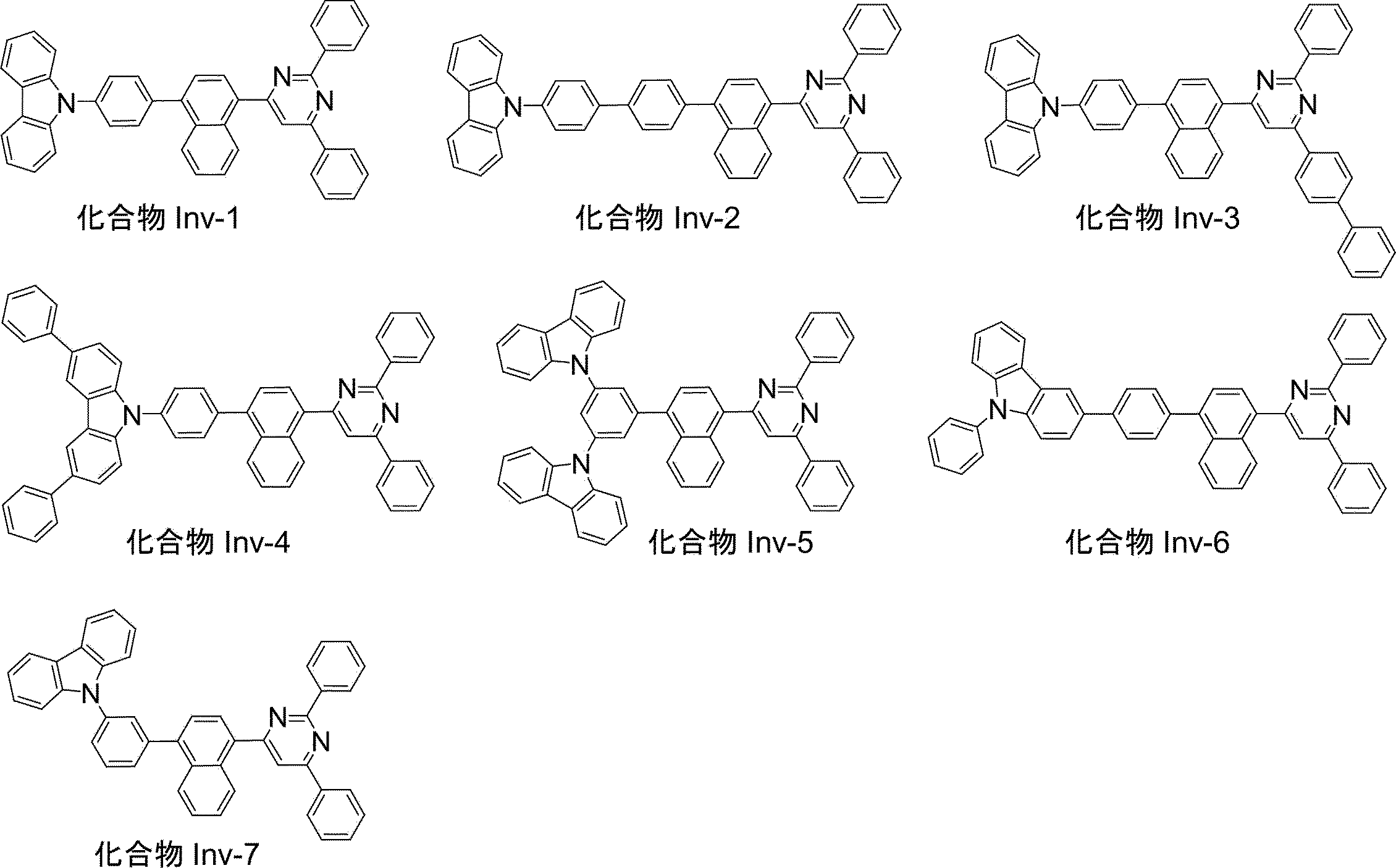

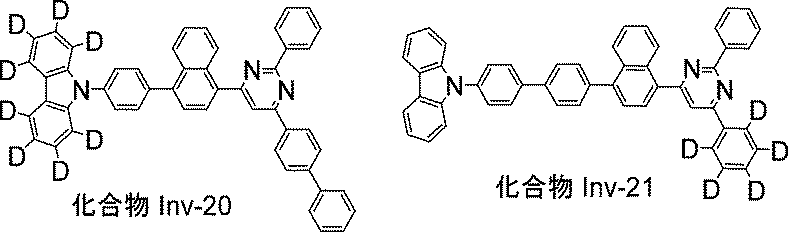
比較例1及び比較例2の有機EL素子の製造に用いた比較化合物
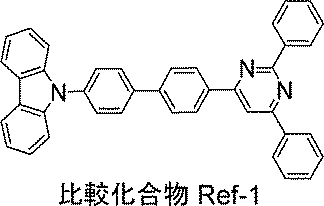
実施例1~21及び比較例1の有機EL素子の製造に用いた他の化合物
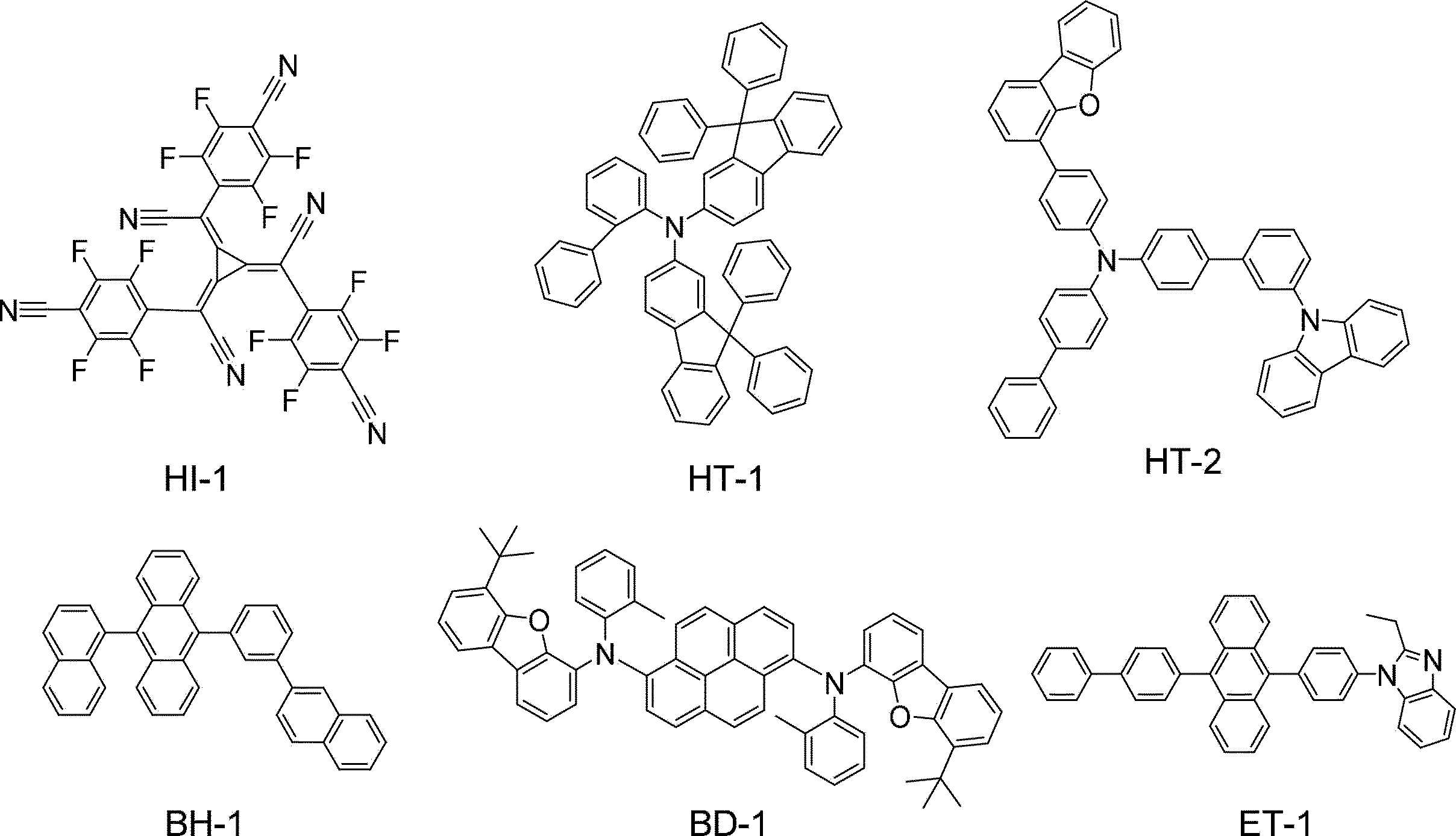
実施例22~38及び比較例2の有機EL素子の製造に用いた他の化合物
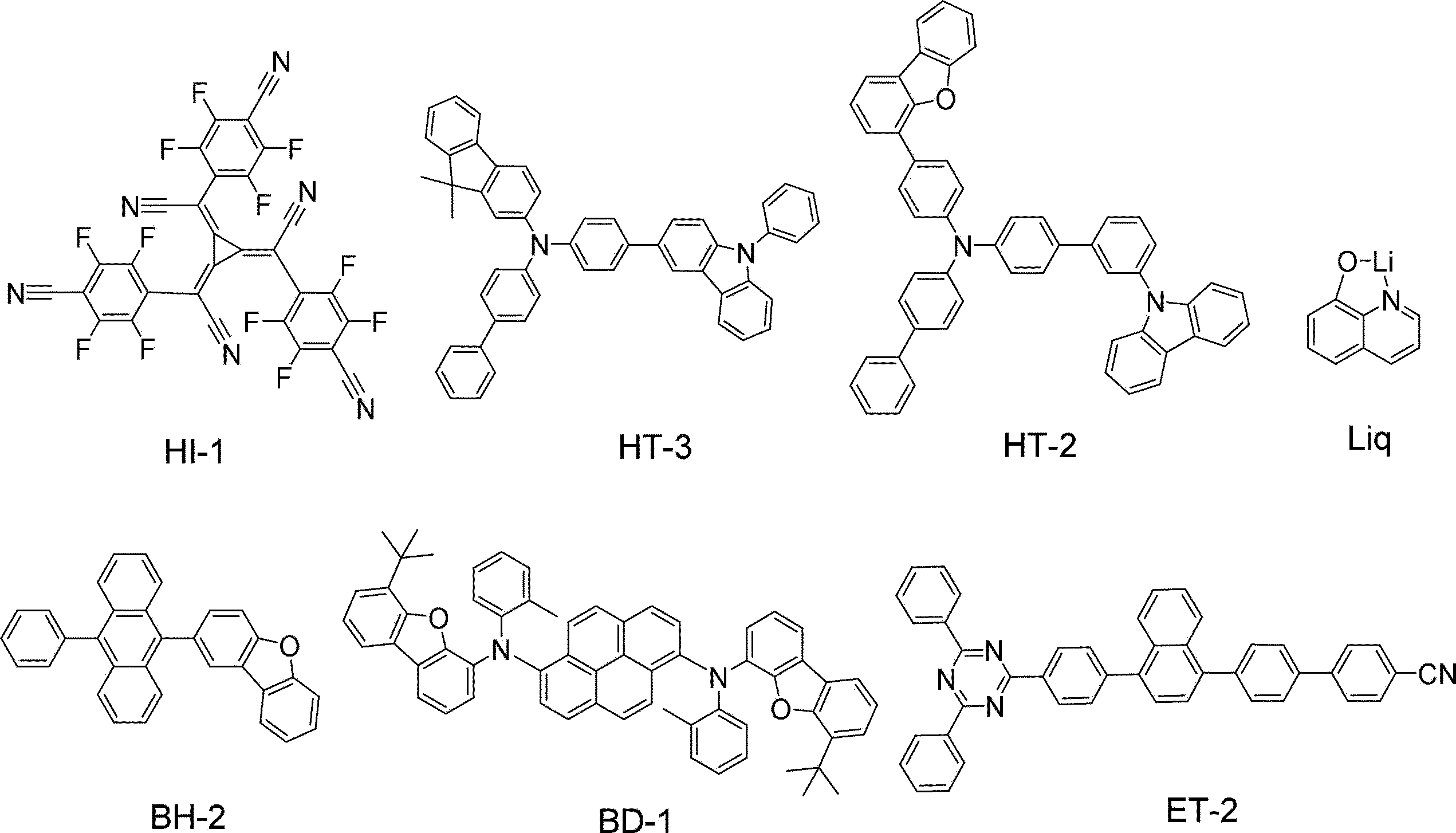
各有機EL素子を以下のように作製し、各素子のEL素子性能を評価した。
実施例1
有機EL素子の作製
25mm×75mm×1.1mmのITO透明電極(陽極)付きガラス基板(ジオマテック株式会社製)を、イソプロピルアルコール中で5分間超音波洗浄した後、30分間UVオゾン洗浄した。ITOの膜厚は、130nmとした。
洗浄後の透明電極付きガラス基板を真空蒸着装置の基板ホルダーに装着し、まず透明電極が形成されている側の面上に透明電極を覆うようにして化合物HT-1と化合物HI-1を共蒸着し、膜厚10nmの正孔注入層を形成した。化合物HT-1と化合物HI-1の質量比は97:3であった。
次に、正孔注入層上に化合物HT-1を蒸着し、膜厚80nmの第1正孔輸送層を形成した。
この正孔輸送層上に化合物HT-2を蒸着し、膜厚10nmの第2正孔輸送層を形成した。
次に、この第2正孔輸送層上に、化合物BH-1(ホスト材料B)と化合物BD-1(ドーパント材料)を共蒸着し、膜厚25nmの発光層を形成した。化合物BH-1と化合物BD-1の質量比は96:4であった。
次に、この発光層の上に、化合物Inv-1を蒸着して膜厚10nmの第1電子輸送層を形成した。
第1電子輸送層上に化合物ET-1蒸着して膜厚15nmの第2電子輸送層を形成した。
この第2電子輸送層上にYbを蒸着して膜厚1nmの電子注入性電極を形成した。
最後に、電子注入性電極上に金属Alを蒸着して膜厚80nmの金属陰極を形成した。
実施例1の有機EL素子の層構成を以下に示す。括弧内の数字は膜厚(nm)であり、比は質量比である。
ITO (130)/HT-1:HI-1 = 97:3 (10)/HT-1 (80)/HT-2 (10)/BH-1:BD-1 = 96:4 (25)/化合物Inv-1 (10)/ET-1 (15)/Yb (1)/Al (80)
有機EL素子の作製
25mm×75mm×1.1mmのITO透明電極(陽極)付きガラス基板(ジオマテック株式会社製)を、イソプロピルアルコール中で5分間超音波洗浄した後、30分間UVオゾン洗浄した。ITOの膜厚は、130nmとした。
洗浄後の透明電極付きガラス基板を真空蒸着装置の基板ホルダーに装着し、まず透明電極が形成されている側の面上に透明電極を覆うようにして化合物HT-1と化合物HI-1を共蒸着し、膜厚10nmの正孔注入層を形成した。化合物HT-1と化合物HI-1の質量比は97:3であった。
次に、正孔注入層上に化合物HT-1を蒸着し、膜厚80nmの第1正孔輸送層を形成した。
この正孔輸送層上に化合物HT-2を蒸着し、膜厚10nmの第2正孔輸送層を形成した。
次に、この第2正孔輸送層上に、化合物BH-1(ホスト材料B)と化合物BD-1(ドーパント材料)を共蒸着し、膜厚25nmの発光層を形成した。化合物BH-1と化合物BD-1の質量比は96:4であった。
次に、この発光層の上に、化合物Inv-1を蒸着して膜厚10nmの第1電子輸送層を形成した。
第1電子輸送層上に化合物ET-1蒸着して膜厚15nmの第2電子輸送層を形成した。
この第2電子輸送層上にYbを蒸着して膜厚1nmの電子注入性電極を形成した。
最後に、電子注入性電極上に金属Alを蒸着して膜厚80nmの金属陰極を形成した。
実施例1の有機EL素子の層構成を以下に示す。括弧内の数字は膜厚(nm)であり、比は質量比である。
ITO (130)/HT-1:HI-1 = 97:3 (10)/HT-1 (80)/HT-2 (10)/BH-1:BD-1 = 96:4 (25)/化合物Inv-1 (10)/ET-1 (15)/Yb (1)/Al (80)
実施例22
有機EL素子の作製
実施例1と同様に洗浄後の透明電極付きガラス基板を真空蒸着装置の基板ホルダーに装着し、まず透明電極が形成されている側の面上に透明電極を覆うようにして化合物HT-3と化合物HI-1を共蒸着し、膜厚10nmの正孔注入層を形成した。化合物HT-3と化合物HI-1の質量比は97:3であった。
次に、正孔注入層上に化合物HT-3を蒸着し、膜厚80nmの第1正孔輸送層を形成した。
この正孔輸送層上に化合物HT-2を蒸着し、膜厚5nmの第2正孔輸送層を形成した。
次に、この第2正孔輸送層上に、化合物BH-2(ホスト材料B)と化合物BD-1(ドーパント材料)を共蒸着し、膜厚25nmの発光層を形成した。化合物BH-2と化合物BD-1の質量比は96:4であった。
次に、この発光層の上に、化合物Inv-1を蒸着して膜厚5nmの第1電子輸送層を形成した。
第1電子輸送層上に化合物ET-2とLiqを共蒸着し、膜厚20nmの第2電子輸送層を形成した。化合物ET-2とLiqの質量比は50:50であった。
この第2電子輸送層上にYbを蒸着して膜厚1nmの電子注入性電極を形成した。
最後に、電子注入性電極上に金属Alを蒸着して膜厚50nmの金属陰極を形成した。
実施例22の有機EL素子の層構成を以下に示す。括弧内の数字は膜厚(nm)であり、比は質量比である。
ITO (130)/HT-3:HI-1 = 97:3 (10)/HT-3 (80)/HT-2 (5)/BH-2:BD-1 = 96:4 (25)/化合物Inv-1 (5)/ET-2:Liq =50:50 (20)/ Yb (1)/Al (50)
有機EL素子の作製
実施例1と同様に洗浄後の透明電極付きガラス基板を真空蒸着装置の基板ホルダーに装着し、まず透明電極が形成されている側の面上に透明電極を覆うようにして化合物HT-3と化合物HI-1を共蒸着し、膜厚10nmの正孔注入層を形成した。化合物HT-3と化合物HI-1の質量比は97:3であった。
次に、正孔注入層上に化合物HT-3を蒸着し、膜厚80nmの第1正孔輸送層を形成した。
この正孔輸送層上に化合物HT-2を蒸着し、膜厚5nmの第2正孔輸送層を形成した。
次に、この第2正孔輸送層上に、化合物BH-2(ホスト材料B)と化合物BD-1(ドーパント材料)を共蒸着し、膜厚25nmの発光層を形成した。化合物BH-2と化合物BD-1の質量比は96:4であった。
次に、この発光層の上に、化合物Inv-1を蒸着して膜厚5nmの第1電子輸送層を形成した。
第1電子輸送層上に化合物ET-2とLiqを共蒸着し、膜厚20nmの第2電子輸送層を形成した。化合物ET-2とLiqの質量比は50:50であった。
この第2電子輸送層上にYbを蒸着して膜厚1nmの電子注入性電極を形成した。
最後に、電子注入性電極上に金属Alを蒸着して膜厚50nmの金属陰極を形成した。
実施例22の有機EL素子の層構成を以下に示す。括弧内の数字は膜厚(nm)であり、比は質量比である。
ITO (130)/HT-3:HI-1 = 97:3 (10)/HT-3 (80)/HT-2 (5)/BH-2:BD-1 = 96:4 (25)/化合物Inv-1 (5)/ET-2:Liq =50:50 (20)/ Yb (1)/Al (50)
有機EL素子の評価
95%寿命(LT95)
得られた有機EL素子を電流密度50mA/cm2で直流定電流駆動し、輝度が初期輝度の95%に減少するまでの時間を測定し、これを95%寿命(LT95)とした。結果を表1に示す。
95%寿命(LT95)
得られた有機EL素子を電流密度50mA/cm2で直流定電流駆動し、輝度が初期輝度の95%に減少するまでの時間を測定し、これを95%寿命(LT95)とした。結果を表1に示す。
実施例2~21及び比較例1
実施例1において化合物Inv-1に代えて化合物Inv-2(実施例2)、化合物Inv-3(実施例3)、化合物Inv-4(実施例4)、化合物Inv-5(実施例5)、化合物Inv-6(実施例6)、化合物Inv-7(実施例7)、化合物Inv-8(実施例8)、化合物Inv9(実施例9)、化合物Inv-10(実施例10)、化合物Inv-11(実施例11)、化合物Inv-12(実施例12)、化合物Inv-13(実施例13)、化合物Inv-14(実施例14)、化合物Inv-15(実施例15)、化合物Inv-16(実施例16)、化合物Inv-17(実施例17)、化合物Inv-18(実施例18)、化合物Inv-19(実施例19)、化合物Inv-20(実施例20)、化合物Inv-21(実施例21)、又は比較化合物Ref-1(比較例1)を用いた以外は実施例1と同様にして各有機EL素子を作製した。
得られた各有機EL素子の95%寿命(LT95)を実施例1と同様にして求めた。結果を表1に示す。
実施例1において化合物Inv-1に代えて化合物Inv-2(実施例2)、化合物Inv-3(実施例3)、化合物Inv-4(実施例4)、化合物Inv-5(実施例5)、化合物Inv-6(実施例6)、化合物Inv-7(実施例7)、化合物Inv-8(実施例8)、化合物Inv9(実施例9)、化合物Inv-10(実施例10)、化合物Inv-11(実施例11)、化合物Inv-12(実施例12)、化合物Inv-13(実施例13)、化合物Inv-14(実施例14)、化合物Inv-15(実施例15)、化合物Inv-16(実施例16)、化合物Inv-17(実施例17)、化合物Inv-18(実施例18)、化合物Inv-19(実施例19)、化合物Inv-20(実施例20)、化合物Inv-21(実施例21)、又は比較化合物Ref-1(比較例1)を用いた以外は実施例1と同様にして各有機EL素子を作製した。
得られた各有機EL素子の95%寿命(LT95)を実施例1と同様にして求めた。結果を表1に示す。
実施例23~38及び比較例2
実施例22において化合物Inv-1に代えて化合物Inv-2(実施例23)、化合物Inv-3(実施例24)、化合物Inv-5(実施例25)、化合物Inv-6(実施例26)、化合物Inv-8(実施例27)、化合物Inv-9(実施例28)、化合物Inv-10(実施例29)、化合物Inv-11(実施例30)、化合物Inv-12(実施例31)、化合物Inv-13(実施例32)、化合物Inv-14(実施例33)、化合物Inv-15(実施例34)、化合物Inv-17(実施例35)、化合物Inv-18(実施例36)、化合物Inv-20(実施例37)、化合物Inv-21(実施例38)、又は比較化合物Ref-1(比較例2)を用いた以外は実施例22と同様にして各有機EL素子を作製した。
得られた各有機EL素子の95%寿命(LT95)を実施例22と同様にして求めた。結果を表2に示す。
実施例22において化合物Inv-1に代えて化合物Inv-2(実施例23)、化合物Inv-3(実施例24)、化合物Inv-5(実施例25)、化合物Inv-6(実施例26)、化合物Inv-8(実施例27)、化合物Inv-9(実施例28)、化合物Inv-10(実施例29)、化合物Inv-11(実施例30)、化合物Inv-12(実施例31)、化合物Inv-13(実施例32)、化合物Inv-14(実施例33)、化合物Inv-15(実施例34)、化合物Inv-17(実施例35)、化合物Inv-18(実施例36)、化合物Inv-20(実施例37)、化合物Inv-21(実施例38)、又は比較化合物Ref-1(比較例2)を用いた以外は実施例22と同様にして各有機EL素子を作製した。
得られた各有機EL素子の95%寿命(LT95)を実施例22と同様にして求めた。結果を表2に示す。
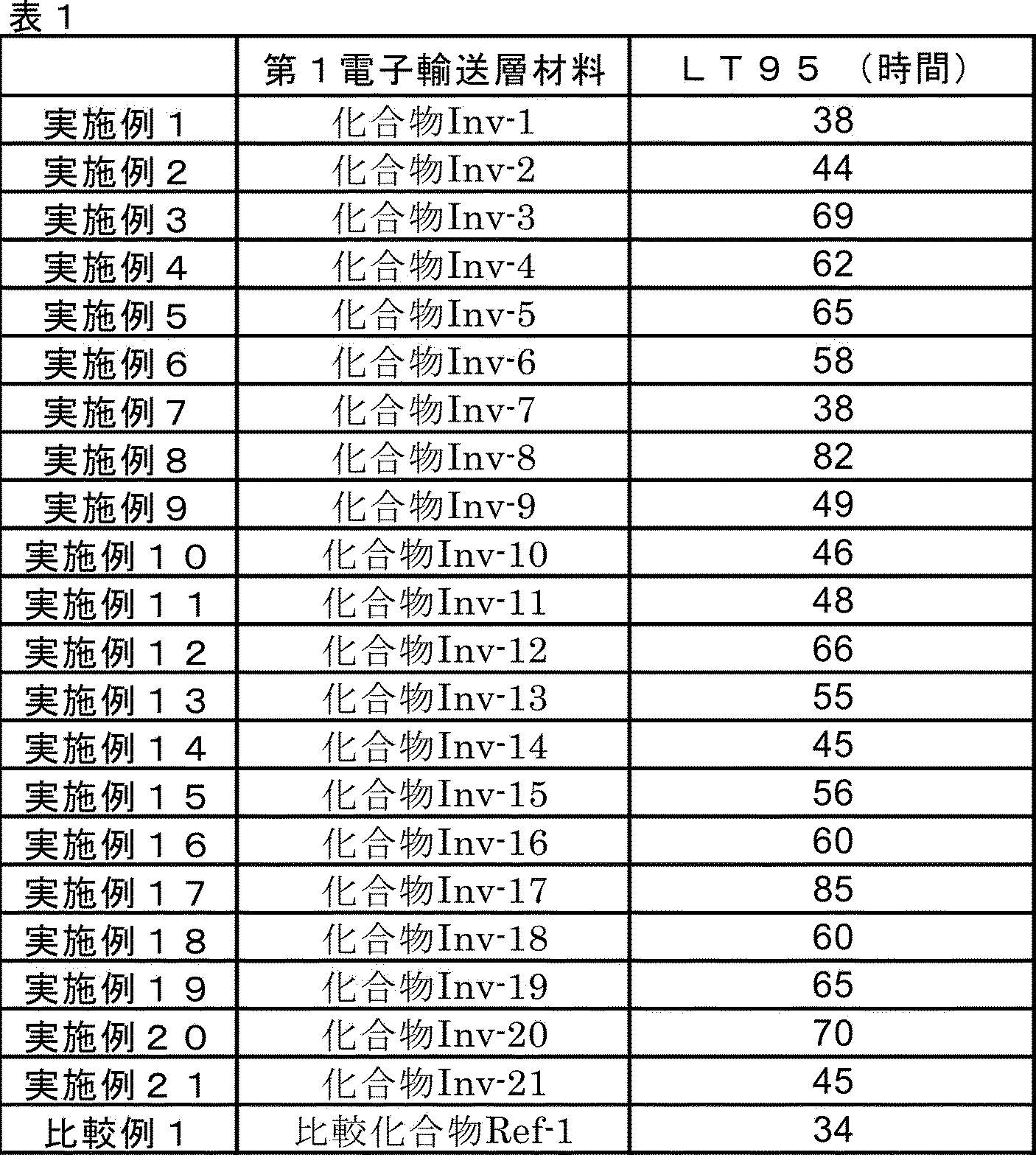
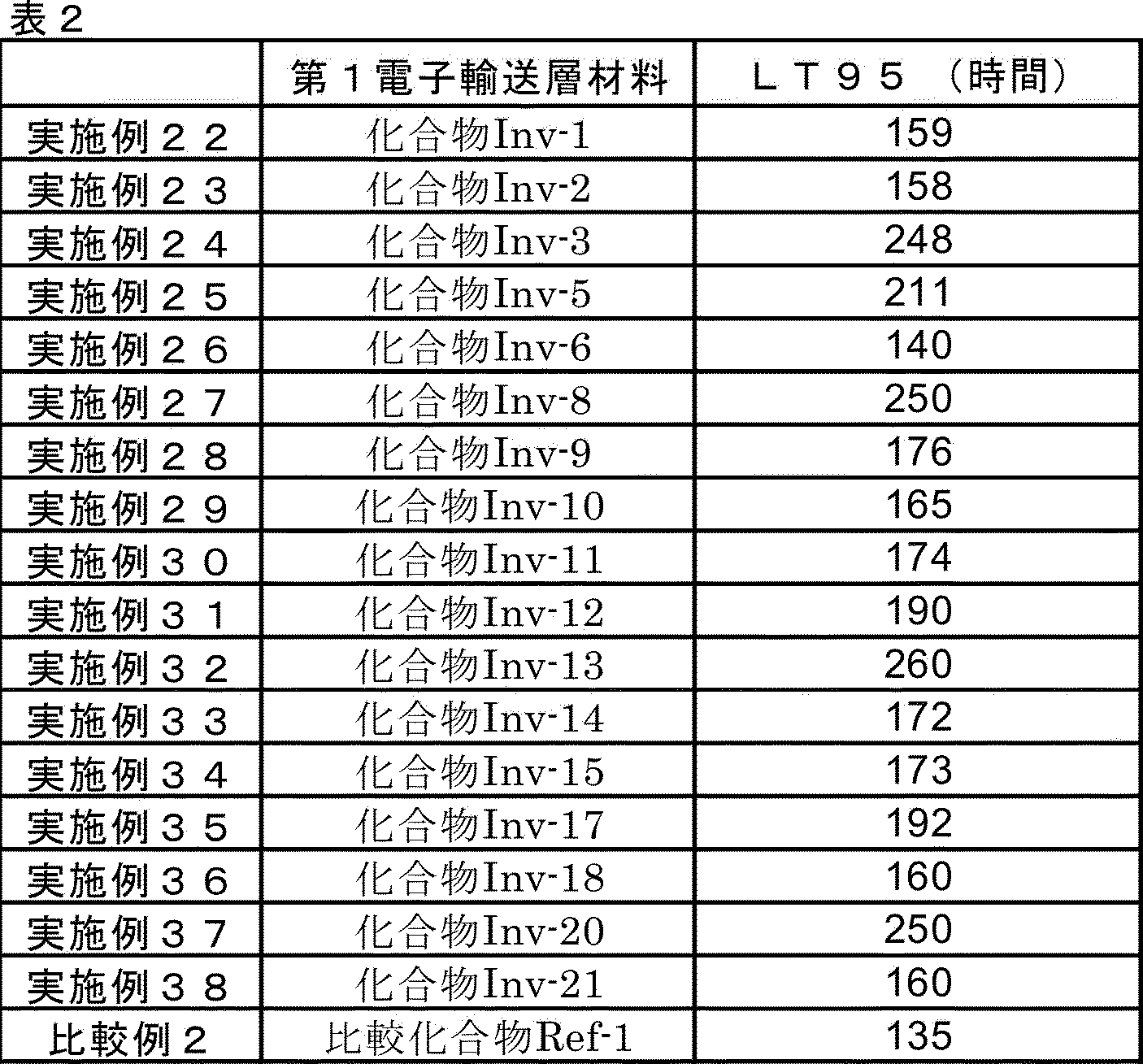
表1の結果から、第1電子輸送層が比較化合物Ref-1を含む比較例1の有機EL素子に比べて、第1電子輸送層が化合物Inv-1~Inv-21のそれぞれを含む実施例1~21の有機EL素子は、より長寿命であることが分かる。
表2(ホスト材料Bの変更含め有機EL素子の製造に用いた他の化合物が一部異なる;ただし、各実施例及び比較例ではそれらはすべて固定)の結果から、第1電子輸送層が比較化合物Ref-1を含む比較例2の有機EL素子に比べて、第1電子輸送層が化合物Inv-1~Inv-3、Inv-5、Inv-6、Inv-8~Inv-15、Inv-17、Inv-18、Inv-20、Inv-21のそれぞれを含む実施例22~38の有機EL素子は、より長寿命であることが分かる。
合成例1~7で合成した化合物Inv-1~化合物Inv-21


合成例1 化合物Inv-1の合成
(1-1)中間体Aの合成
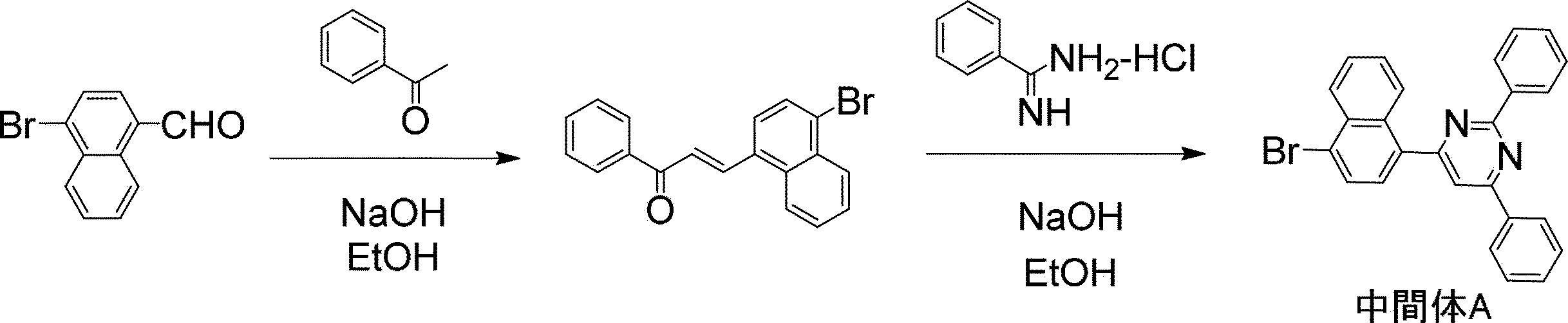
(1-1)中間体Aの合成
4-ブロモ-1-ナフトアルデヒド(9.0g)、アセトフェノン(4.6g)、水酸化ナトリウム(0.15g)をエタノール300mLに加えて、室温で5時間攪拌した。次いで、ベンズアミジン塩酸塩(6.0g)、水酸化ナトリウム(1.8g)を添加して、70℃で5時間攪拌した。反応終了後、析出物を濾別し、シリカゲルカラムクロマトグラフィー(展開溶媒;ヘキサン/トルエン)で精製し、中間体Aを白色固体(7.6g、収率45%)として得た。
(1-2)化合物Inv-1の合成

中間体A(3.6g)と4-(9H-カルバゾール-9-イル)フェニルボロン酸(2.8g)を1,2-ジメトキシエタン(80mL)に加え、溶液にアルゴンガスを5分通じた。これにPd(PPh3)4(0.4g)と炭酸ナトリウム水溶液(2M、12mL)を加え、アルゴン雰囲気下で攪拌しながら還流条件下で7時間加熱した。反応溶液から溶媒を留去し、得られた固体をシリカゲルカラムクロマトグラフィー(展開溶媒;ヘキサン/トルエン)により精製することにより化合物Inv-1を白色固体(3.7g、収率75%)として得た。
マススペクトル分析の結果、分子量599.74に対してm/e=600であったことから化合物Inv-1と同定した。
マススペクトル分析の結果、分子量599.74に対してm/e=600であったことから化合物Inv-1と同定した。
合成例2 化合物Inv-2の合成

中間体A(5.0g)と[4‘-(カルバゾール-9-イル)-4-ビフェニリル]ボロン酸(4.5g)を用いた以外は合成例1の(1-2)と同じ条件で、化合物Inv-2を白色固体(6.6g、収率85%)として得た。
マススペクトル分析の結果、分子量675.84に対してm/e=676であったことから、化合物Inv-2と同定した。
マススペクトル分析の結果、分子量675.84に対してm/e=676であったことから、化合物Inv-2と同定した。
合成例3 化合物Inv-3の合成
(3-1)中間体Bの合成

(3-1)中間体Bの合成
4-ブロモ-1-ナフトアルデヒド(8.0g)、4-アセチルビフェニル(7.0g)、水酸化ナトリウム(0.27g)をエタノール600mLに加えて、室温で5時間攪拌した。次いで、ベンズアミジン塩酸塩(8.0g)、水酸化ナトリウム(2.7g)を添加して、70℃で5時間攪拌した。反応終了後、析出物を濾別し、シリカゲルカラムクロマトグラフィー(展開溶媒;ヘキサン/トルエン)で精製し、中間体Bを白色固体(5.0g、収率28%)として得た。
(3-2)化合物Inv-3の合成

中間体B(5.0g)を用いた以外は合成例1の(1-2)と同じ条件で、化合物Inv-3を白色固体(4.5g、収率68%)として得た。
マススペクトル分析の結果、分子量675.84に対してm/e=676であったことから、化合物Inv-3と同定した。
マススペクトル分析の結果、分子量675.84に対してm/e=676であったことから、化合物Inv-3と同定した。
合成例4 化合物Inv-4の合成
(4-1)中間体Cの合成

(4-1)中間体Cの合成
中間体A(10.0g)と4-フルオロフェニルボロン酸(3.5g)を用いた以外は合成例1の(1-2)と同じ条件で、中間体Cを白色固体(9.0g、収率83%)として得た。
(4-2)化合物Inv-4の合成

中間体C(3.8g)、3,6-ジフェニルカルバゾール(4.0g)、炭酸セシウム(8.2g)をN-メチルピロリドン(NMP)30mLに加えて、160℃で24時間攪拌した。反応液を室温まで冷却した後、メタノール100mLと水100mLを加えて、1時間室温で攪拌した。析出した固体を濾取し、シリカゲルカラムクロマトグラフィー(展開溶媒;ヘキサン/トルエン)で精製し、化合物Inv-4を白色固体(6.3g、収率94%)として得た。
マススペクトル分析の結果、分子量751.93に対してm/e=752であったことから、化合物Inv-4と同定した。
マススペクトル分析の結果、分子量751.93に対してm/e=752であったことから、化合物Inv-4と同定した。
合成例5 化合物Inv-5の合成
(5-1)中間体Dの合成
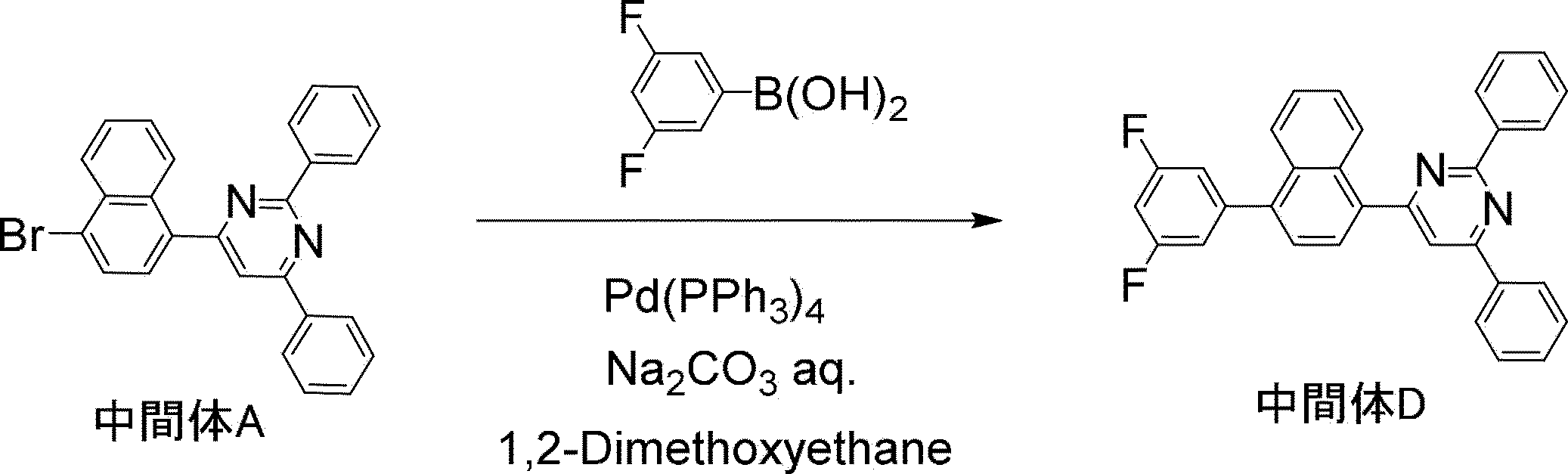
(5-1)中間体Dの合成
中間体A(5.0g)と3,5-ジフルオロフェニルボロン酸(2.0g)を用いた以外は合成例1の(1-2)と同じ条件で、中間体Dを白色固体(4.2g、収率78%)として得た。
(5-2)化合物Inv-5の合成

中間体D(4.2g)とカルバゾール(4.5g)を用いた以外は合成例4の(4-2)と同じ条件で、化合物Inv-5を白色固体(4.1g、収率60%)として得た。
マススペクトル分析の結果、分子量764.93に対してm/e=765であったことから、化合物Inv-5と同定した。
マススペクトル分析の結果、分子量764.93に対してm/e=765であったことから、化合物Inv-5と同定した。
合成例6 化合物Inv-6の合成
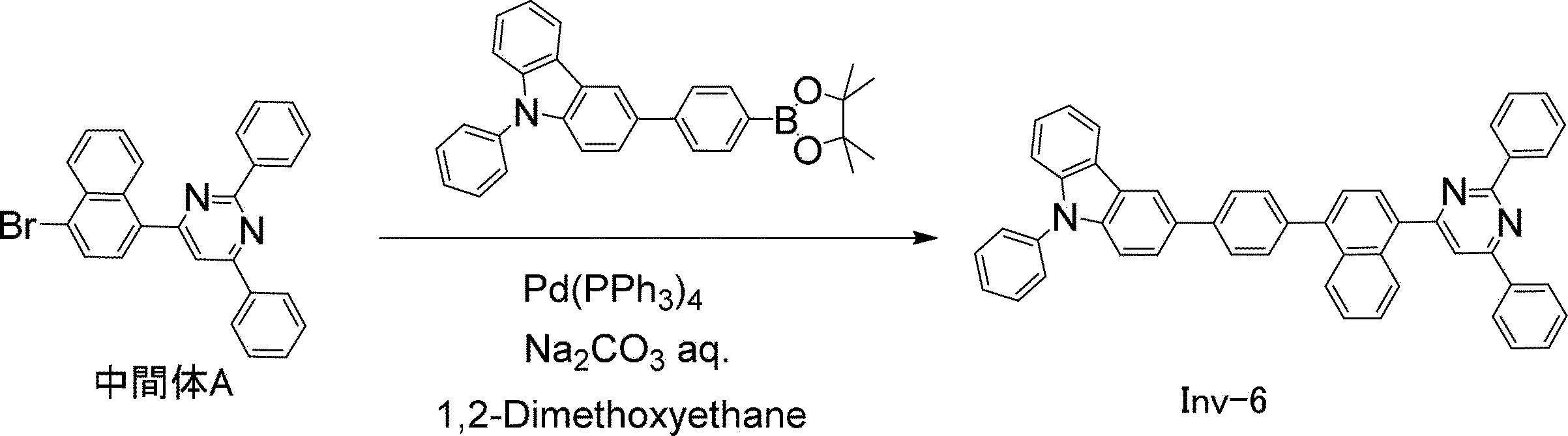
中間体A(3.9g)と9-フェニル-3-[4-(4,4,5,5-テトラメチル-1,3,2-ジオキサボロラン-2-イル)フェニル]-9H-カルバゾール(4.0g)を用いた以外は合成例1の(1-2)と同じ条件で、化合物Inv-6を白色固体(4.7g、収率78%)として得た。
マススペクトル分析の結果、分子量675.84に対してm/e=676であったことから、化合物Inv-6と同定した。
マススペクトル分析の結果、分子量675.84に対してm/e=676であったことから、化合物Inv-6と同定した。
合成例7 化合物Inv-7の合成
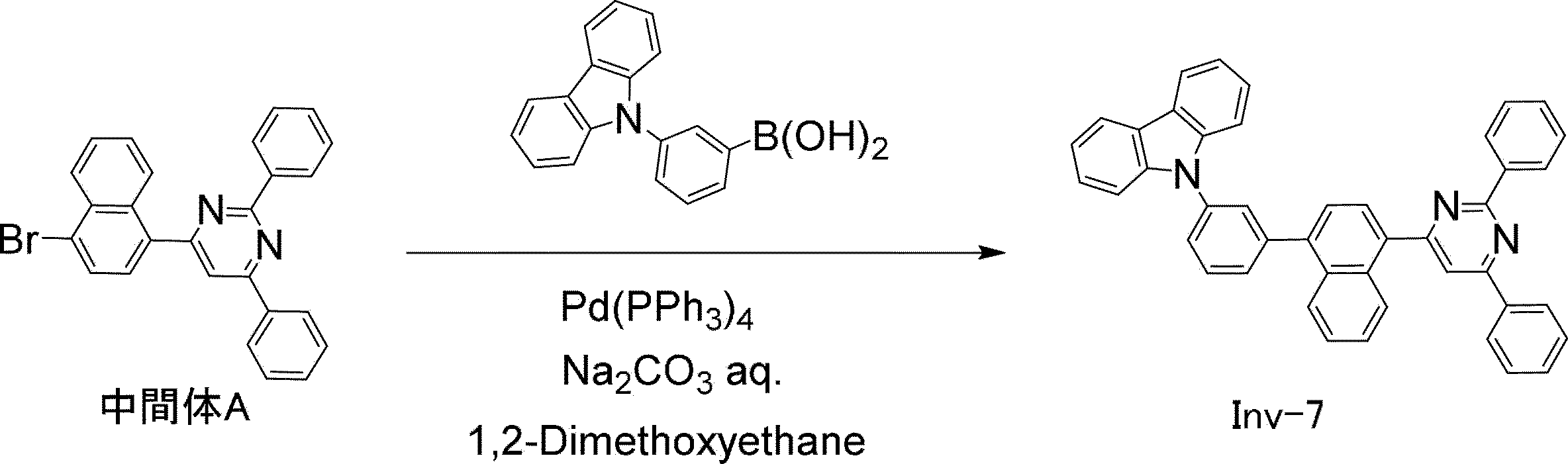
中間体A(7.0g)と3-(9H-カルバゾール-9-イル)フェニルボロン酸(5.1g)を用いた以外は合成例1の(1-2)と同じ条件で、化合物Inv-7を白色固体(7.0g、収率73%)として得た。
マススペクトル分析の結果、分子量599.74に対してm/e=600であったことから、化合物Inv-7と同定した。
マススペクトル分析の結果、分子量599.74に対してm/e=600であったことから、化合物Inv-7と同定した。
合成例8 化合物Inv-8の合成

中間体A(6.0g)、3,6-ジフェニルカルバゾール(4.2g)、酢酸パラジウム(0.48g)、Amphos(1.3g)、t-BuONa(3.8g)を、脱水キシレン168mLに加えて、還流条件下で36時間攪拌した。反応液を室温まで冷却した後、メタノール100mLと水100mLを加えて、1時間室温で攪拌した。析出した固体を濾集し、シリカゲルカラムクロマトグラフィー(展開溶媒;ヘキサン/トルエン)で精製し化合物Inv-8を白色固体(4.8g、収率52%)として得た。
マススペクトル分析の結果、分子量675.84に対してm/e=675であったことから、化合物Inv-8と同定した。
マススペクトル分析の結果、分子量675.84に対してm/e=675であったことから、化合物Inv-8と同定した。
合成例9 化合物Inv-9の合成
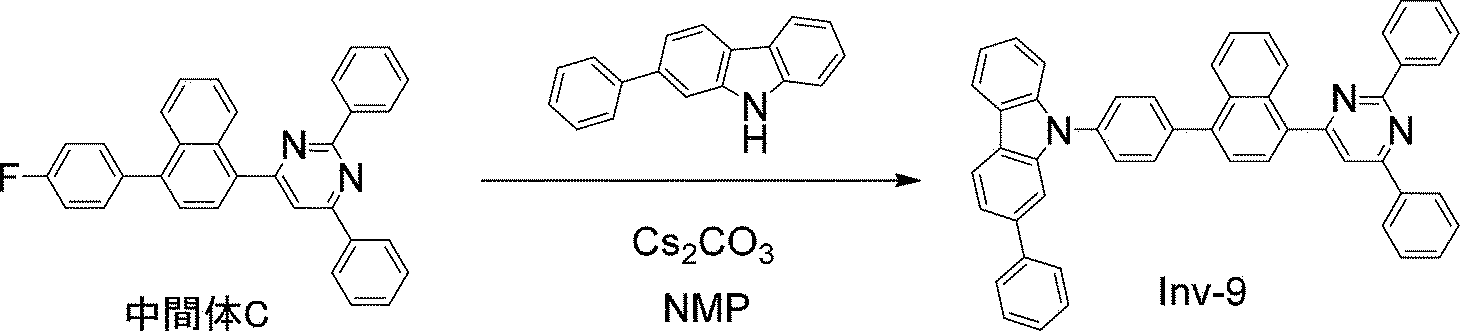
中間体C(5.6g)を用いて、合成例4の(4-2)に記載したものと同じ条件で、化合物Inv-9を白色固体(5.9g、収率61%)として得た。
マススペクトル分析の結果、分子量675.84に対してm/e=675であったことから、化合物Inv-9と同定した。
マススペクトル分析の結果、分子量675.84に対してm/e=675であったことから、化合物Inv-9と同定した。
合成例10 化合物Inv-10の合成

3-アセチルビフェニルを出発原料として合成例3の(3-1)の方法に従って合成した中間体E(8.0g)を用いて、合成例1に記載したものと同じ条件で、化合物Inv-10を白色固体(10.3g、収率87%)として得た。
マススペクトル分析の結果、分子量675.84に対してm/e=675であったことから、化合物Inv-10と同定した。
マススペクトル分析の結果、分子量675.84に対してm/e=675であったことから、化合物Inv-10と同定した。
合成例11 化合物Inv-11の合成

中間体E(5.0g)、中間体F(3.6g)を用いて、合成例1に記載したものと同じ条件で、化合物Inv-11を白色固体(5.7g、収率78%)として得た。
マススペクトル分析の結果、分子量751.93に対してm/e=751であったことから、化合物Inv-11と同定した。
マススペクトル分析の結果、分子量751.93に対してm/e=751であったことから、化合物Inv-11と同定した。
合成例12 化合物Inv-12の合成
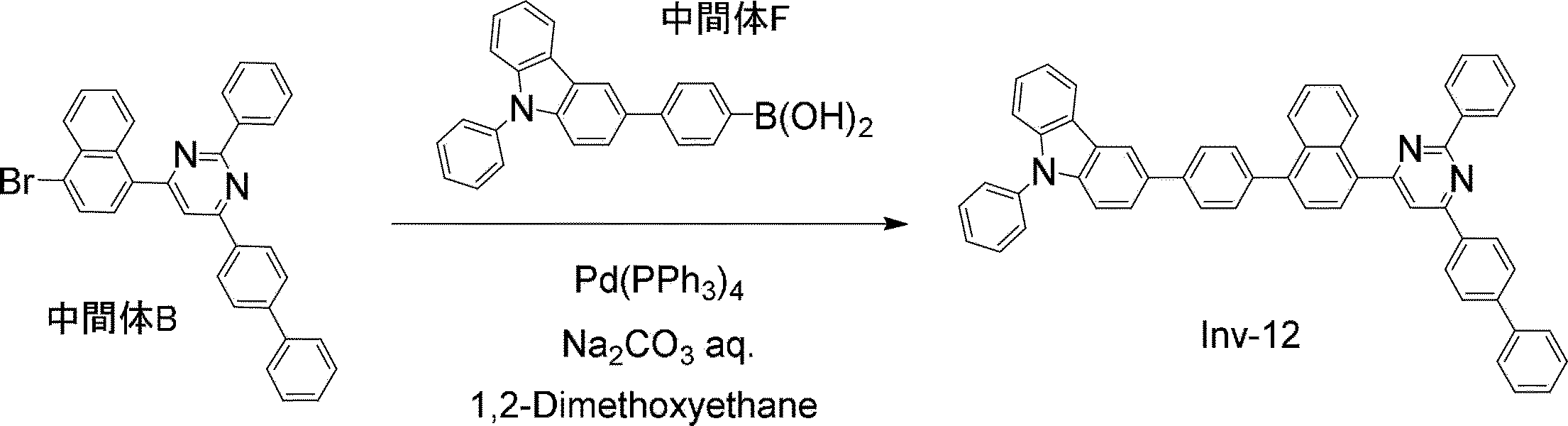
中間体B(4.0g)、中間体F(2.8g)を用いて、合成例1に記載したものと同じ条件で、化合物Inv-12を白色固体(5.1g、収率87%)として得た。
マススペクトル分析の結果、分子量751.93に対してm/e=751であったことから、化合物Inv-12と同定した。
マススペクトル分析の結果、分子量751.93に対してm/e=751であったことから、化合物Inv-12と同定した。
合成例13 化合物Inv-13の合成
(13-1)中間体Gの合成

(13-1)中間体Gの合成
中間体A(10.0g)と4-クロロフェニルボロン酸(3.6g)を用いて、合成例1に記載したものと同じ条件で、中間体Gを白色固体(9.8g、収率91%)として得た。
(13-2)化合物Inv-13の合成

中間体G(4.5g)、N-フェニルカルバゾール-2-ボロン酸(4.1g)、リン酸三カリウム(8.2g)を1,4-ジオキサン(100mL)に加え、溶液にアルゴンガスを5分通じた。これにPd2(dba)3(0.18g)、SPhos(0.32g)を加え、アルゴン雰囲気下で攪拌しながら還流条件下で24時間加熱した。反応溶液を溶媒留去し、得られた固体をシリカゲルカラムクロマトグラフィー(展開溶媒;ヘキサン/トルエン)により精製することにより化合物Inv-13を白色固体(5.8g、収率90%)として得た。
マススペクトル分析の結果、分子量675.84に対してm/e=675であったことから、化合物Inv-13であると同定した。
マススペクトル分析の結果、分子量675.84に対してm/e=675であったことから、化合物Inv-13であると同定した。
合成例14 化合物Inv-14の合成

中間体G(3.5g)とN-フェニルカルバゾール-4-ボロン酸(3.2g)を用いて、合成例13の(13-2)に記載したものと同じ条件で、化合物Inv-14を白色固体(3.1g、収率62%)として得た。
マススペクトル分析の結果、分子量675.84に対してm/e=675であったことから、化合物Inv-14であると同定した。
マススペクトル分析の結果、分子量675.84に対してm/e=675であったことから、化合物Inv-14であると同定した。
合成例15 化合物Inv-15の合成
(15-1)中間体Hの合成

(15-1)中間体Hの合成
中間体A(5.0g)と3,4-ジフルオロフェニルボロン酸(2.5g)を用いて、合成例1に記載したものと同じ条件で、中間体Hを白色固体(4.3g、収率80%)として得た。
(15-2)化合物Inv-15の合成

中間体H(4.3g)を用いて、合成例3に記載したものと同じ条件で、Inv-15を白色固体(5.5g、収率79%)として得た。
マススペクトル分析の結果、分子量764.93に対してm/e=764であったことから、化合物Inv-15と同定した。
マススペクトル分析の結果、分子量764.93に対してm/e=764であったことから、化合物Inv-15と同定した。
合成例16 化合物Inv-16の合成
(16-1)中間体Iの合成
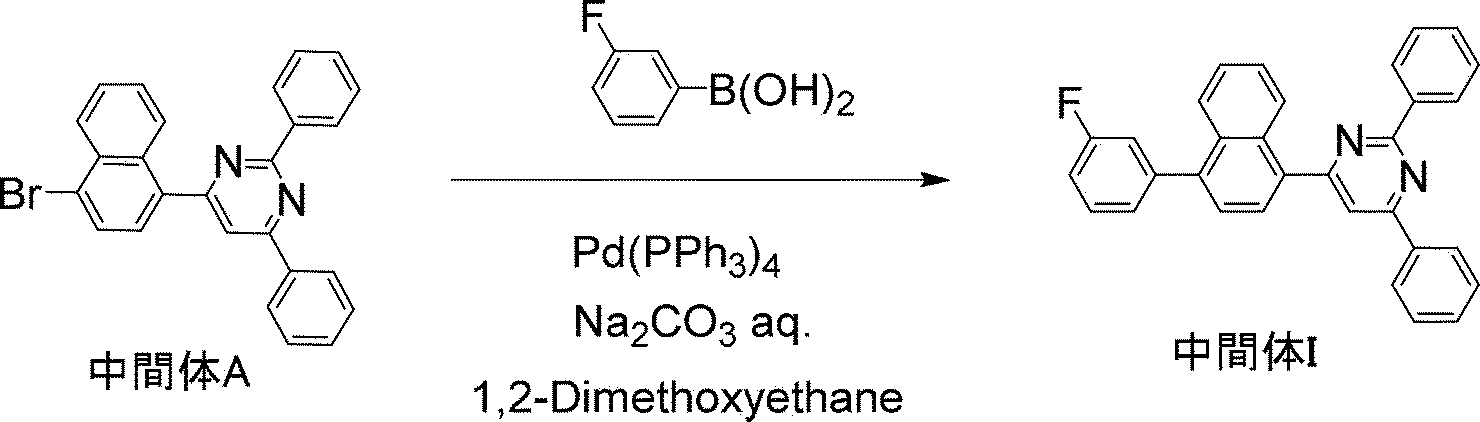
(16-1)中間体Iの合成
中間体A(5.0g)と3-フルオロフェニルボロン酸(2.2g)を用いて、合成例1に記載したものと同じ条件で、中間体Iを白色固体(4.8g、収率92%)として得た。
(16-2)化合物Inv-16の合成
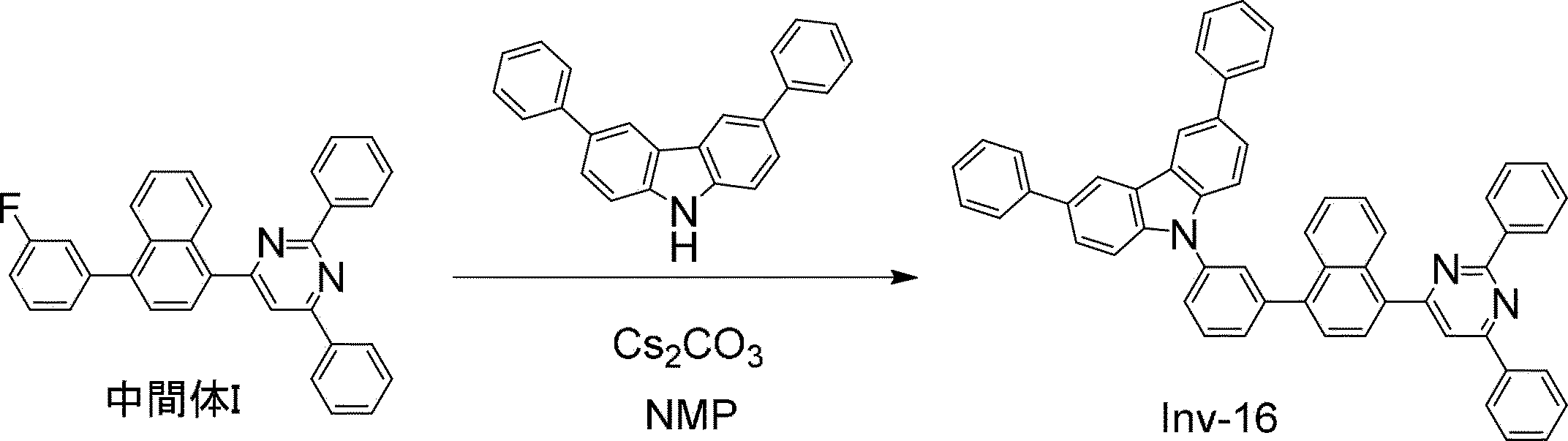
中間体I(4.8g)、3,6-ジフェニルカルバゾール(5.0g)を用いて、合成実施例3に記載したものと同じ条件で、化合物Inv-16を白色固体(7.2g、収率90%)として得た。
マススペクトル分析の結果、分子量751.93に対してm/e=751であったことから、化合物Inv-16と同定した。
マススペクトル分析の結果、分子量751.93に対してm/e=751であったことから、化合物Inv-16と同定した。
合成例17 化合物Inv-17の合成

中間体B(4.0g)、[4′-(カルバゾール-9-イル)-4-ビフェニルイル]ボロン酸(3.4g)を用いて、合成例1に記載したものと同じ条件で、化合物Inv-17を白色固体(5.0g、収率76%)として得た。
マススペクトル分析の結果、分子量751.93に対してm/e=751であったことから、化合物Inv-17と同定した。
マススペクトル分析の結果、分子量751.93に対してm/e=751であったことから、化合物Inv-17と同定した。
合成例18 化合物Inv-18の合成

中間体B(4.5g)、N-フェニルカルバゾール-4-ボロン酸(3.0g)を用いて、合成例1に記載したものと同じ条件で、Inv-18を白色固体(5.5g、収率92%)として得た。
マススペクトル分析の結果、分子量675.84に対してm/e=675であったことから、化合物Inv-18であると同定した。
マススペクトル分析の結果、分子量675.84に対してm/e=675であったことから、化合物Inv-18であると同定した。
合成例19 化合物Inv-19の合成

中間体B(5.0g)、3-(N-カルバゾール)フェニルボロン酸(3.4g)を用いて、合成例1に記載したものと同じ条件で、化合物Inv-19を白色固体(5.6g、収率85%)として得た。
マススペクトル分析の結果、分子量675.84に対してm/e=675であったことから、化合物Inv-19であると同定した。
マススペクトル分析の結果、分子量675.84に対してm/e=675であったことから、化合物Inv-19であると同定した。
合成例20 化合物Inv-20の合成
(20-1)中間体Jの合成

(20-1)中間体Jの合成
中間体B(5.0g)と4-フルオロフェニルボロン酸(1.6g)を用いて、合成例1に記載したものと同じ条件で、中間体Jを白色固体(4.5g、収率87%)として得た。
(20-2)化合物Inv-20の合成

中間体J(4.5g)とカルバゾール-d8(2.2g)を用いて、合成例3に記載したものと同じ条件で、化合物Inv-20を白色固体(3.8g、収率65%)として得た。
マススペクトル分析の結果、分子量683.88に対してm/e=683であったことから、化合物Inv-20であると同定した。
マススペクトル分析の結果、分子量683.88に対してm/e=683であったことから、化合物Inv-20であると同定した。
合成例21 化合物Inv-21の合成
(21-1)中間体Kの合成

(21-1)中間体Kの合成
アセトフェノンの代わりに、アセトフェノン(フェニル-d5)(4.8g)を用いて、中間体Aの合成方法に従うことで、中間体Kを白色固体(5.1g、収率30%)として得た。
(21-2)化合物Inv-21の合成

中間体K(3.0g)、[4′-(カルバゾール-9-イル)-4-ビフェニルイル]ボロン酸(2.5g)を用いて、合成例1に記載したものと同じ条件で、化合物Inv-21を白色固体(2.0g、収率43%)として得た。
マススペクトル分析の結果、分子量680.87に対してm/e=680であったことから、化合物Inv-21であると同定した。
マススペクトル分析の結果、分子量680.87に対してm/e=680であったことから、化合物Inv-21であると同定した。
また、本発明の化合物は以下の合成中間体を経由して、合成実施例に記載した各条件に従うことでも合成することが可能である。

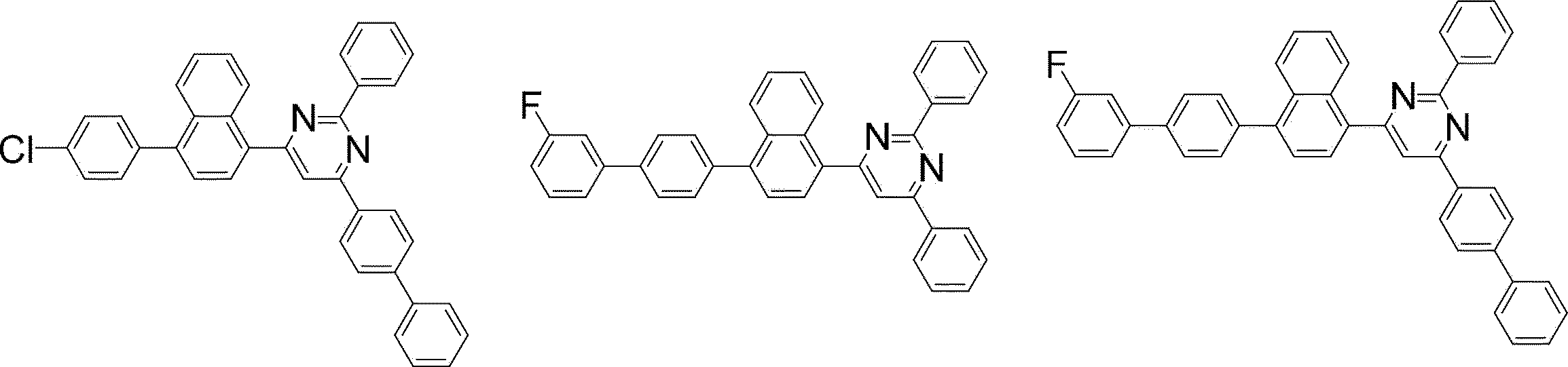

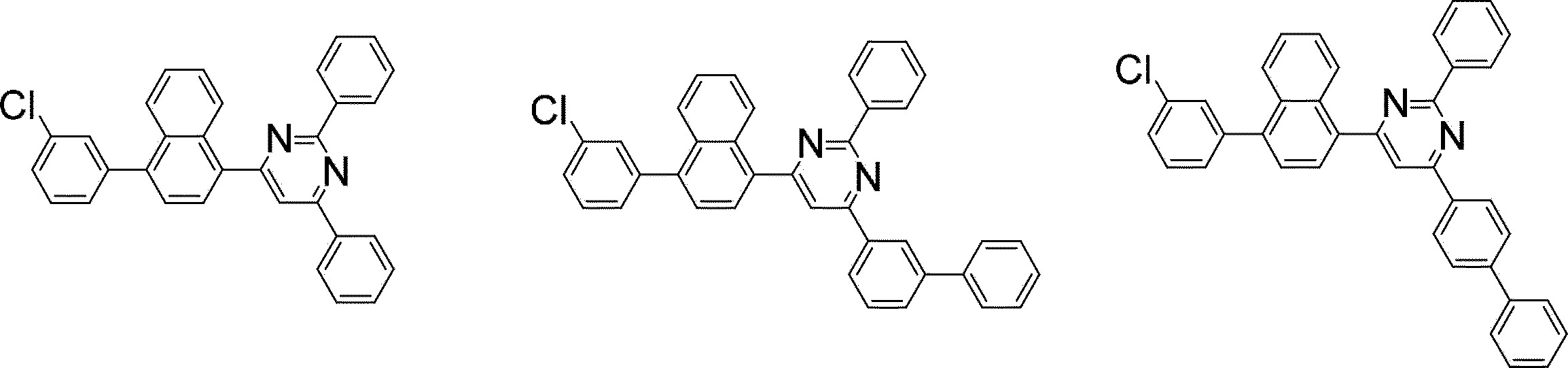


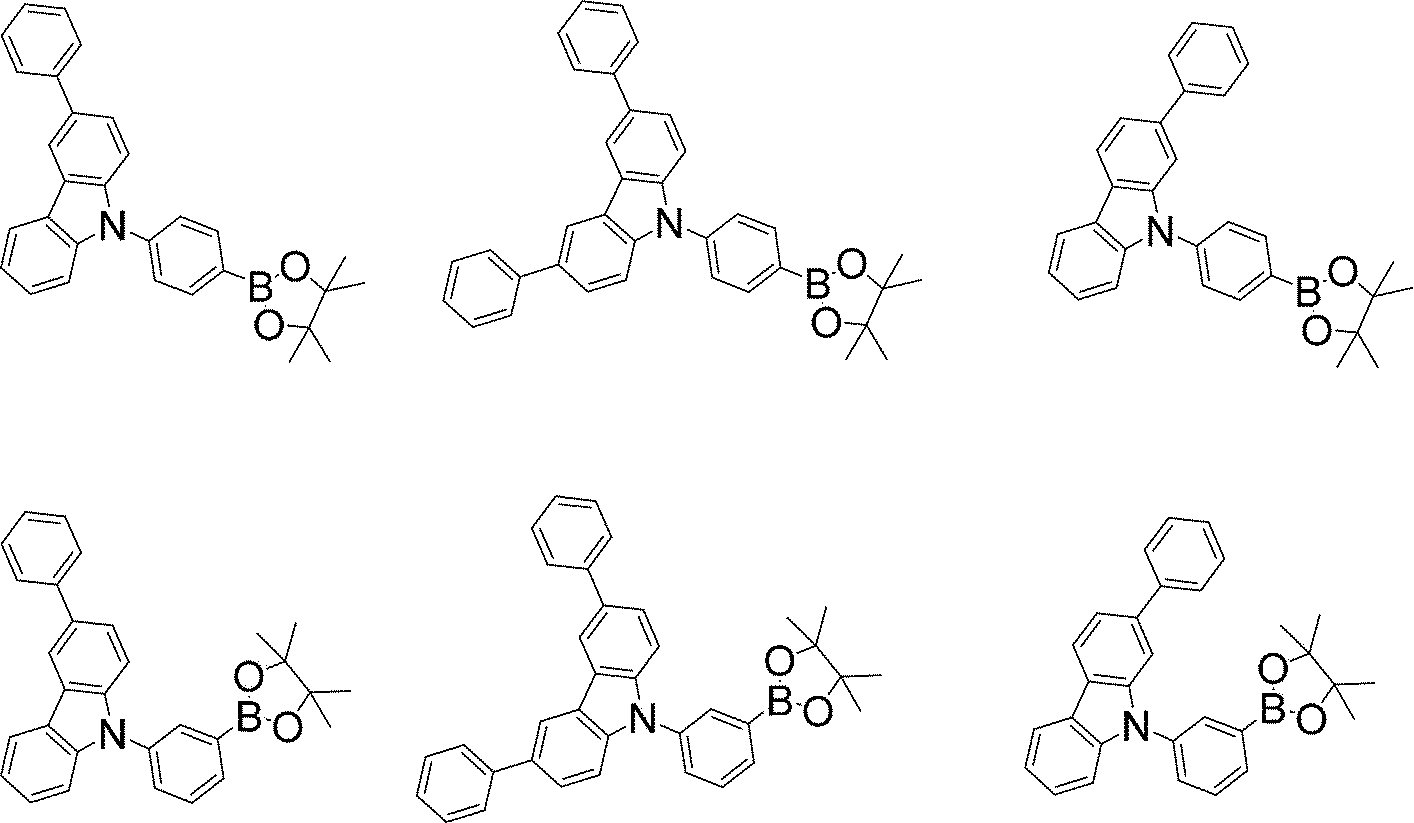
1、11 有機EL素子
2 基板
3 陽極
4 陰極
5 発光層
6 正孔輸送帯域
6a 正注入層
6b 第1正孔輸送層
6c 第2正孔輸送層
7a 第1電子輸送層
7b 第2電子輸送層
10、20 発光ユニット
2 基板
3 陽極
4 陰極
5 発光層
6 正孔輸送帯域
6a 正注入層
6b 第1正孔輸送層
6c 第2正孔輸送層
7a 第1電子輸送層
7b 第2電子輸送層
10、20 発光ユニット
Claims (37)
- 陰極、陽極、及び該陰極と該陽極の間に有機層を有する有機エレクトロルミネッセンス素子であって、該有機層が発光層と電子輸送層を含み、該電子輸送層が化合物Aを含み、該発光層がホスト材料Bを含み、該化合物Aが式(1)で表わされ、該ホスト材料Bが式(10)で表わされる有機エレクトロルミネッセンス素子。

(式中、
Y1及びY2の1つは窒素原子、残りの1つはCRであり;
Rは、水素原子、置換もしくは無置換の環形成炭素数6~50のアリール基、置換もしくは無置換の環形成原子数5~50の複素環基、置換もしくは無置換の炭素数1~50のアルキル基、置換もしくは無置換の環形成炭素数3~50のシクロアルキル基、フッ素原子及びシアノ基から選ばれ;
Ar1及びAr2は、それぞれ独立して、置換もしくは無置換の環形成炭素数6~50のアリール基、及び置換もしくは無置換の環形成原子数5~50の複素環基から選ばれ;
L1及びL2は、それぞれ独立して、単結合又は置換もしくは無置換の環形成炭素数6~50のアリーレン基であり;
R1~R6は、それぞれ独立して、水素原子、置換もしくは無置換の環形成炭素数6~50のアリール基、置換もしくは無置換の環形成原子数5~50の複素環基、置換もしくは無置換の炭素数1~50のアルキル基、置換もしくは無置換の環形成炭素数3~50のシクロアルキル基、フッ素原子及びシアノ基から選ばれ;
R1~R6から選ばれる隣接する2つは互いに結合して置換もしくは無置換の環を形成してもよいし、互いに結合せず、従って、環を形成しなくてもよく;
Czは、下記式(1-a)又は式(1-b)で表され;

(式中、
R21~R28及びR31~R38は、それぞれ独立して、水素原子又は置換基であり、該置換基が、置換もしくは無置換の環形成炭素数6~50のアリール基、置換もしくは無置換の環形成原子数5~50の複素環基、置換もしくは無置換の炭素数1~50のアルキル基、置換もしくは無置換の環形成炭素数3~50のシクロアルキル基、フッ素原子及びシアノ基から選ばれ;
R21~R28から選ばれる隣接する2つは互いに結合して置換もしくは無置換の環を形成してもよいし、互いに結合せず、従って、環を形成しなくてもよく;
R31~R38から選ばれる隣接する2つは互いに結合して置換もしくは無置換の環を形成してもよいし、互いに結合せず、従って、環を形成しなくてもよく;
R24とR25及びR34とR35は互いに結合して置換もしくは無置換の環を形成してもよいし、互いに結合せず、従って、環を形成しなくてもよく;
Raは置換もしくは無置換の環形成炭素数6~50のアリール基及び置換もしくは無置換の炭素数1~50のアルキル基から選ばれ;
R21~R28から選ばれる1つは*aを介してL3に結合する単結合であり;
*bはL3に結合する位置を表す。)
nは1~3の整数であり、nが2又は3である場合、2又は3個のCzは、互いに同一であるか又は異なり;
L3及びL4は、それぞれ独立して、単結合又は置換もしくは無置換の環形成炭素数6~50のアリーレン基である、ただし、nが2又は3の場合、L4は置換もしくは無置換の環形成炭素数6~50のアリーレン基である。)
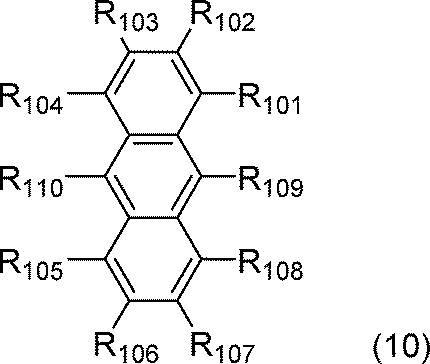
(式中、
R101~R110から選ばれる少なくとも一つは、それぞれ独立して、式(31)で表される基であり;
式(31)で表される基が2以上存在する場合、2以上の式(31)で表される基は同一でも異なっていてもよく;
式(31)で表される基ではないR101~R110から選ばれる一組以上の隣接する2つは互いに結合して置換もしくは無置換の環を形成してもよく、互いに結合せず、従って環を形成しなくてもよく;
式(31)で表される基ではなく、かつ、前記環も形成しないR101~R110は、それぞれ独立して、水素原子、ハロゲン原子、シアノ基、ニトロ基、置換もしくは無置換の炭素数1~50のアルキル基、置換もしくは無置換の炭素数2~50のアルケニル基、置換もしくは無置換の炭素数2~50のアルキニル基、置換もしくは無置換の環形成炭素数3~50のシクロアルキル基、-Si(R901)(R902)(R903)、-O-(R904)、-S-(R905)、-N(R906)(R907)、置換もしくは無置換の環形成炭素数6~50のアリール基、又は置換もしくは無置換の環形成原子数5~50の複素環基であり;
R901~R907は、それぞれ独立して、水素原子、置換もしくは無置換の炭素数1~50のアルキル基、置換もしくは無置換の環形成炭素数3~50のシクロアルキル基、置換もしくは無置換の環形成炭素数6~50のアリール基、又は置換もしくは無置換の環形成原子数5~50の複素環基であり;
R901~R907が2個以上存在する場合、2個以上のR901~R907は同一でも異なっていてもよい。
-L101-Ar101 (31)
(式中、
L101は、単結合、置換もしくは無置換の環形成炭素数6~50のアリーレン基、又は置換もしくは無置換の環形成原子数5~50の2価の複素環基であり;
Ar101は、置換もしくは無置換の環形成炭素数6~50のアリール基、又は置換もしくは無置換の環形成原子数5~50の複素環基である。)) - L3及びL4が、それぞれ独立して、置換もしくは無置換の環形成炭素数6~50のアリーレン基である請求項1に記載の有機エレクトロルミネッセンス素子。
- L3及びL4が表す置換もしくは無置換の環形成炭素数6~50のアリーレン基の無置換のアリーレン基が、それぞれ独立して、フェニレン基、ビフェニレン基、ナフチレン基、フェナントリレン基、アントラセニレン基、及びフルオランテニレン基から選ばれる請求項1又は2に記載の有機エレクトロルミネッセンス素子。
- *aを介してL3に結合する単結合ではないR21~R28から選ばれる少なくとも一つ又はR31~R38から選ばれる少なくとも一つが置換基であり、該置換基が、置換もしくは無置換の環形成炭素数6~50のアリール基、置換もしくは無置換の環形成原子数5~50の含窒素5員環及び含窒素7員環を有さない複素環基、置換もしくは無置換の炭素数1~50のアルキル基、置換もしくは無置換の環形成炭素数3~50のシクロアルキル基、フッ素原子及びシアノ基から選ばれる請求項1~3のいずれか1項に記載の有機エレクトロルミネッセンス素子。
- *aを介してL3に結合する単結合ではないR21~R28又はR31~R38が表す前記置換基が、置換もしくは無置換の環形成炭素数6~50のアリール基及び置換もしくは無置換の炭素数1~50のアルキル基から選ばれる請求項1~4のいずれか1項に記載の有機エレクトロルミネッセンス素子。
- *aを介してL3に結合する単結合ではないR21~R28又はR31~R38が表す前記置換基が、メチル基、エチル基、n-プロピル基、イソプロピル基、n-ブチル基、イソブチル基、sec-ブチル基、t-ブチル基、フェニル基、及びシアノ基から選ばれる請求項1~5のいずれか1項に記載の有機エレクトロルミネッセンス素子。
- *aを介してL3に結合する単結合ではないR21~R28から選ばれる隣接する2つ及びR24とR25が互いに結合せず、従って、環を形成しない請求項1~6のいずれか1項に記載の有機エレクトロルミネッセンス素子。
- R31~R38から選ばれる隣接する2つ及びR34とR35が互いに結合せず、従って、環を形成しない請求項1~6のいずれか1項に記載の有機エレクトロルミネッセンス素子。
- *aを介してL3に結合する単結合ではないR21~R28又はR31~R38がすべて水素原子である請求項1~3、7、及び8のいずれか1項に記載の有機エレクトロルミネッセンス素子。
- 化合物Aが式(1-b-1)又は(1-b-2)で表される請求項1~6、8及び9のいずれか1項に記載の有機エレクトロルミネッセンス素子。


(式中、
Y1、Y2、Ar1、Ar2、L1、L2、及びR1~R6は式(1)において定義したとおりであり、
R31~R38は式(1―b)において定義したとおりであり、
R41~R42、R44~R45、R51~R52及びR54~R55は、それぞれ独立して、水素原子、置換もしくは無置換の環形成炭素数6~50のアリール基、及び置換もしくは無置換の炭素数1~50のアルキル基から選ばれ、
R41とR42、R44とR45、R51とR52、及びR54とR55から選ばれる少なくとも一組の隣接する2つは互いに結合して置換もしくは無置換のベンゼン環を形成してもよいし、互いに結合することなく、従って、ベンゼン環を形成しなくてもよい。) - 化合物Aが式(1-b-11)~(1-b-14)のいずれかで表される請求項1~6、8及び9のいずれか1項に記載の有機エレクトロルミネッセンス素子。

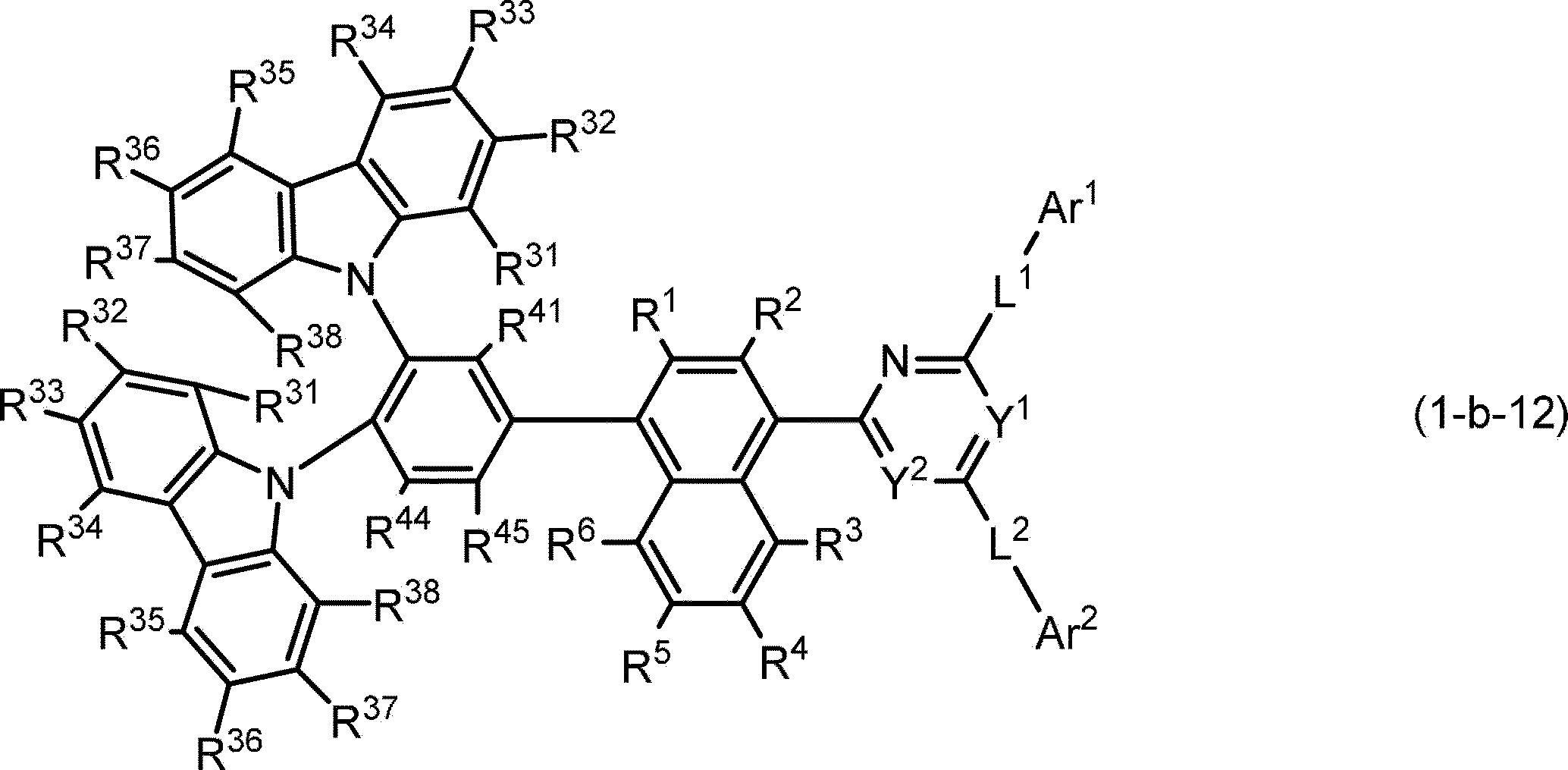

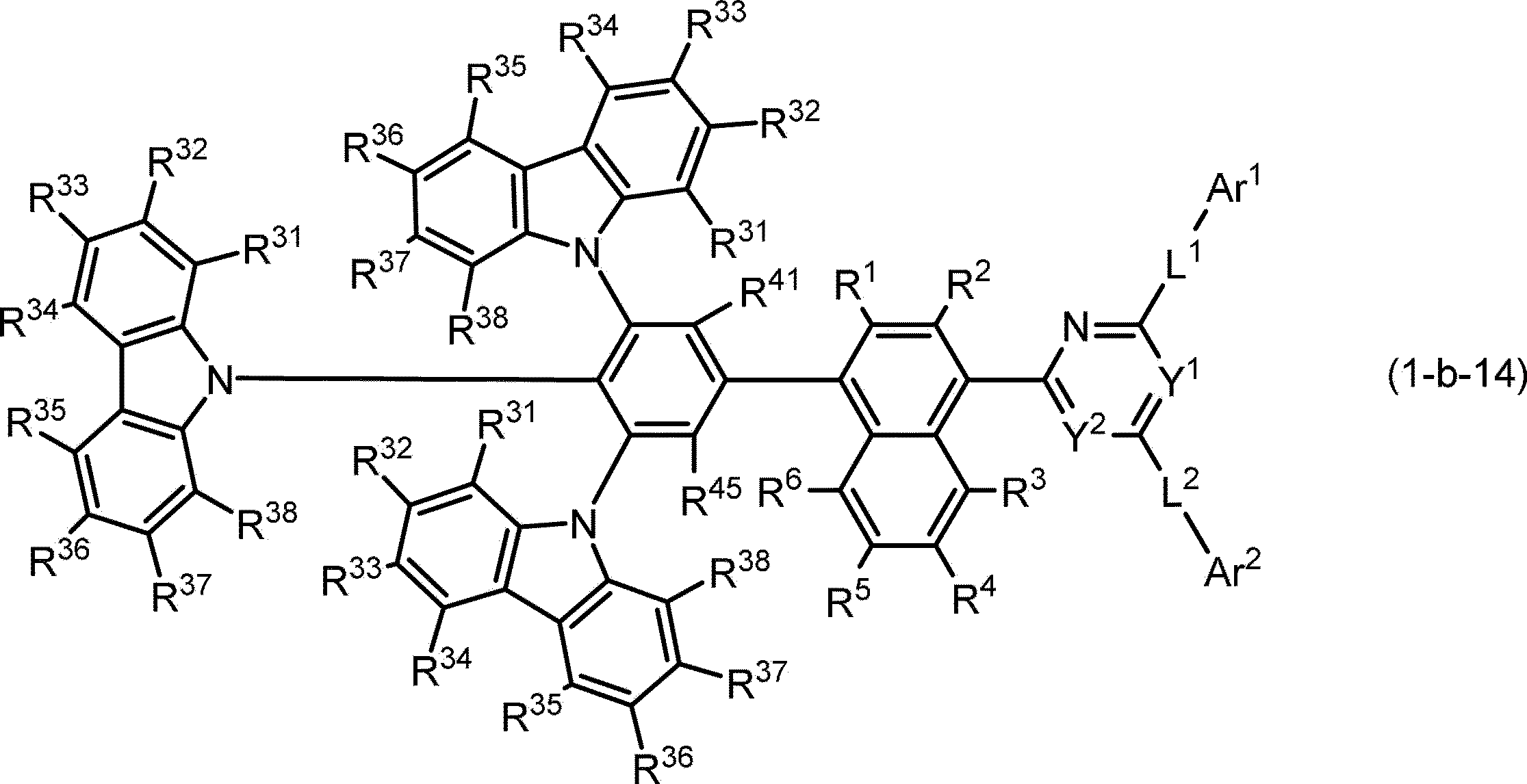
(式中、
Y1、Y2、Ar1、Ar2、L1、L2及びR1~R6は式(1)において定義したとおりであり、
R31~R38は式(1―b)において定義したとおりであり、
R41、R44、及びR45は式(1―b-1)において定義したとおりであり、
R43は、水素原子、置換もしくは無置換の環形成炭素数6~50のアリール基、及び置換もしくは無置換の炭素数1~50のアルキル基から選ばれる。) - 化合物Aが式(1-a-1)~(1-a-4)のいずれかで表される請求項1~7及び9のいずれか1項に記載の有機エレクトロルミネッセンス素子。


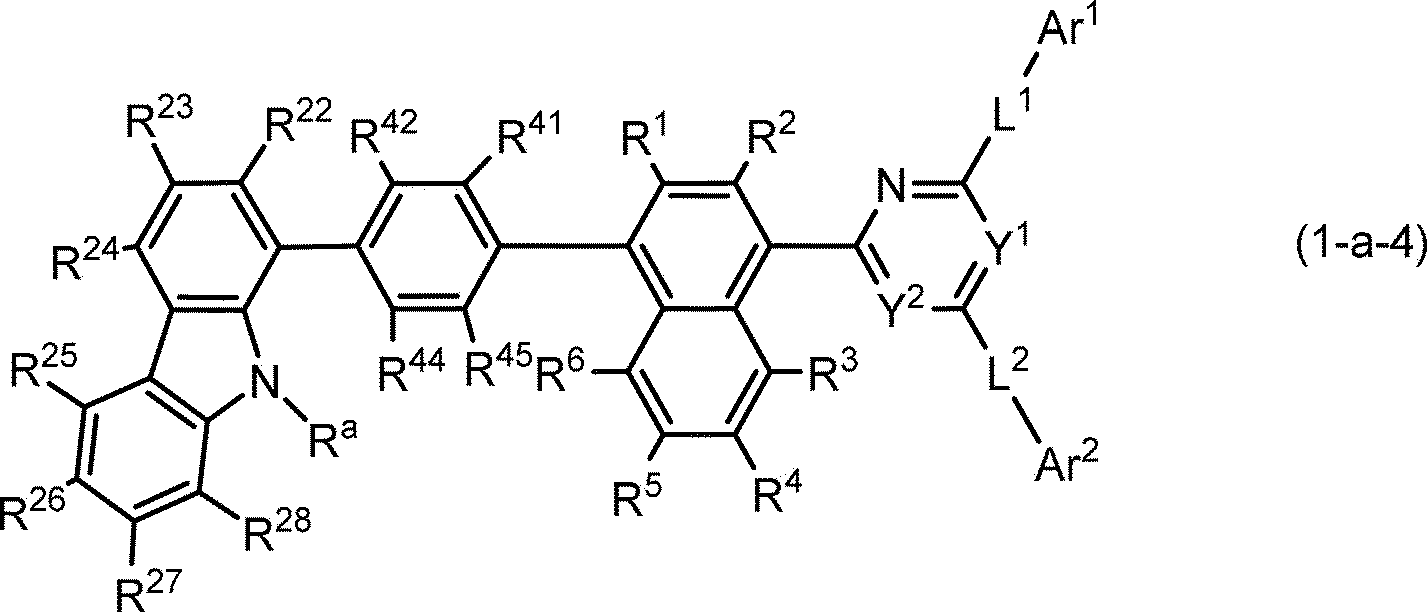
(式中、
Y1、Y2、Ar1、Ar2、L1、L2及びR1~R6は式(1)において定義したとおりであり、
Ra及びR21~R28は式(1―a)において定義したとおりであり、
R41~R42及びR44~R45は式(1―b-1)において定義したとおりである。) - R1~R6から選ばれる隣接する2つが互いに結合せず、従って環を形成しない請求項1~12のいずれか1項に記載の有機エレクトロルミネッセンス素子。
- R1~R6がすべて水素原子である請求項1~13のいずれか1項に記載の有機エレクトロルミネッセンス素子。
- L1及びL2の1つが置換もしくは無置換の環形成炭素数6~50のアリーレン基であり、残りの1つが単結合である請求項1~14のいずれか1項に記載の有機エレクトロルミネッセンス素子。
- L1及びL2が、それぞれ独立して、置換もしくは無置換の環形成炭素数6~50のアリーレン基である請求項1~14のいずれか1項に記載の有機エレクトロルミネッセンス素子。
- L1及びL2が表す置換もしくは無置換の環形成炭素数6~50のアリーレン基の無置換アリーレン基が、それぞれ独立して、フェニレン基、ビフェニレン基、ナフチレン基、及びフェナントリレン基から選ばれる請求項1~16のいずれか1項に記載の有機エレクトロルミネッセンス素子。
- Ar1及びAr2が表す置換もしくは無置換の環形成炭素数6~50のアリール基の無置換アリール基が、それぞれ独立して、フェニル基、ビフェニル基、ナフチル基、フェナントリル基、アントラセニル基、及びフルオランテニル基から選ばれる請求項1~17のいずれか1項に記載の有機エレクトロルミネッセンス素子。
- Ar1及びAr2が表す置換もしくは無置換の環形成原子数5~50の複素環基の無置換複素環基が、それぞれ独立して、ピリジル基、ピリミジニル基、トリアジニル基、キノリル基、ジベンゾチオフェニル基、ジベンゾフラニル基、アザジベンゾフラニル基、及びアザジベンゾチオフェニル基から選ばれる請求項1~17のいずれか1項に記載の有機エレクトロルミネッセンス素子。
- 化合物Aの分子量が650以上である請求項1~19のいずれか1項に記載の有機エレクトロルミネッセンス素子。
- 化合物Aが少なくとも一つの重水素原子を含む請求項1~20のいずれか1項に記載の有機エレクトロルミネッセンス素子。
- 前記ホスト材料Bが式(10-1)又は(10-2)で表される請求項1~21のいずれか1項に記載の有機エレクトロルミネッセンス素子。

(式中、R101~R108、L101、及びAr101は、前記式(10)で定義したとおりである。) - 前記ホスト材料がB式(10-3)で表される請求項1~22のいずれか1項に記載の有機エレクトロルミネッセンス素子。
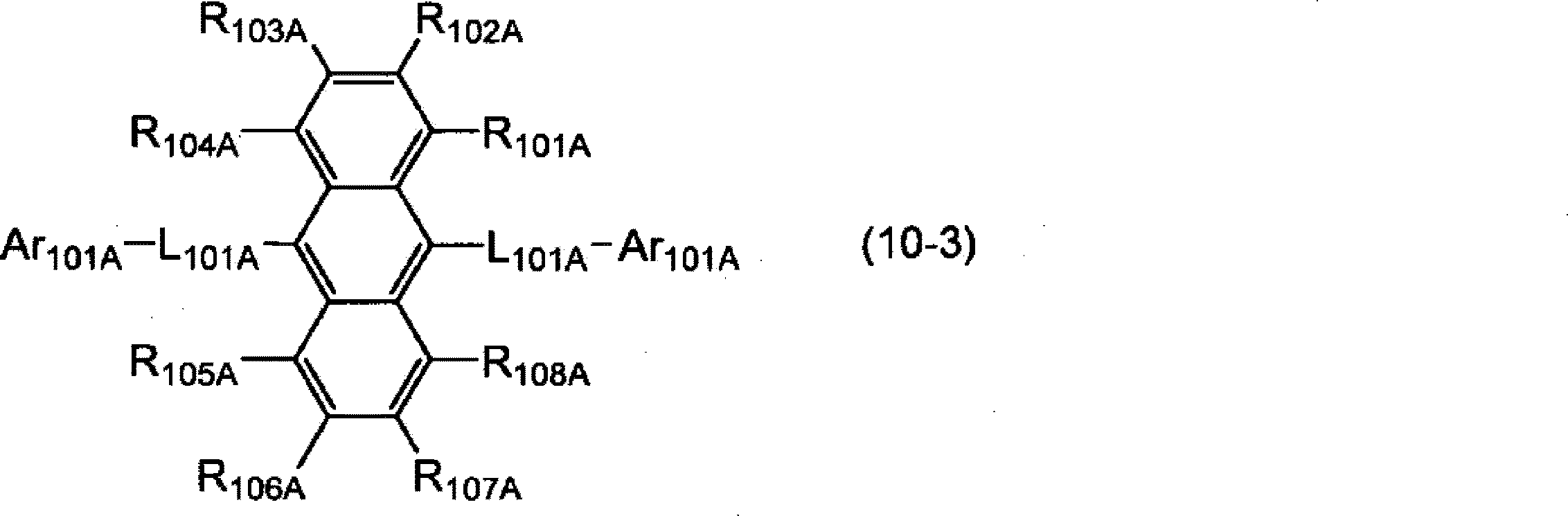
(式中、
R101A~R108Aは、それぞれ独立して、水素原子又は置換もしくは無置換の環形成炭素数6~50のアリール基であり、
L101Aは単結合又は置換もしくは無置換の環形成炭素数6~50のアリーレン基であり、2つのL101Aは同一でも異なっていてもよく、
Ar101Aは置換もしくは無置換の環形成炭素数6~50のアリール基であり、2つのAr101Aは同一でも異なっていてもよい。) - 前記ホスト材料Bが式(10-4)で表される請求項1~22のいずれか1項に記載の有機エレクトロルミネッセンス素子。

(式中、
L101及びAr101は、前記式(10)で定義したとおりであり、
R101A~R108Aは、それぞれ独立して、水素原子又は置換もしくは無置換の環形成炭素数6~50のアリール基であり、
X11は、O、S、又はN(R61)であり、
R61は、水素原子、置換もしくは無置換の炭素数1~50のアルキル基、又は置換もしくは無置換の環形成炭素数6~50のアリール基であり、
R62~R69の1つは、*を介してL101と結合する単結合であり、
L101と結合する単結合ではないR62~R69から選ばれる少なくとも一組の隣接する2つは互いに結合して置換もしくは無置換の環を形成してもよく、互いに結合せず、従って環を形成しなくてもよく、
L101と結合する単結合ではなく、かつ、前記環を形成しないR62~R69は、それぞれ独立して、水素原子、置換もしくは無置換の炭素数1~50のアルキル基、又は置換もしくは無置換の環形成炭素数6~50のアリール基である。) - 前記ホスト材料Bが式(10-6)で表される請求項1~22及び24のいずれか1項に記載の有機エレクトロルミネッセンス素子。
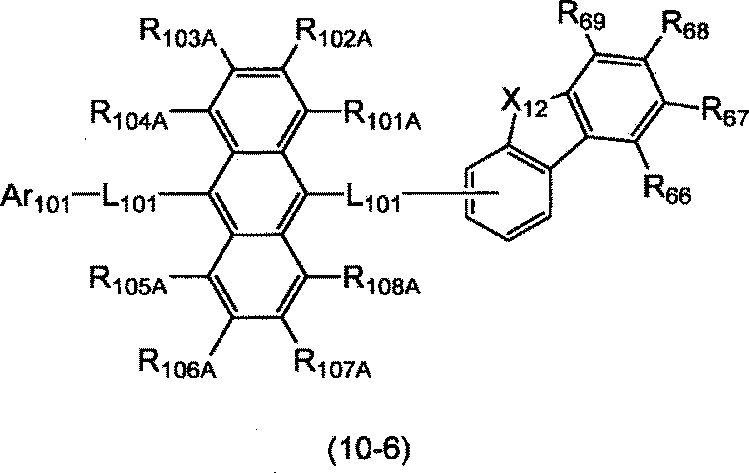
(式中、
L101及びAr101は式(10)で定義したとおりであり、
R101A~R108Aは式(10-4)で定義したとおりであり、
R66~R69は式(10-4)で定義したとおりであり、
X12はO又はSである。) - 前記ホスト材料Bが、下記式(10-7)で表される請求項1~22及び24のいずれか1項に記載の有機エレクトロルミネッセンス素子。

(式中、
L101及びAr101は式(10)で定義したとおりであり、
R101A~R108Aは式(10-4)で定義したとおりであり、
X11は式(10-4)で定義したとおりであり、
R62~R69は式(10-4)で定義したとおりである、ただし、R66とR67、R67とR68、及びR68とR69から選ばれる1組の隣接する2つは、互いに結合して置換もしくは無置換の環を形成する。) - 前記ホスト材料Bが式(10-8)で表される請求項1~22及び24~26のいずれか1項に記載の有機エレクトロルミネッセンス素子。

(式中、
L101及びAr101は式(10)で定義したとおりであり、
R101A~R108Aは式(10-4)で定義したとおりであり、
X12はO又はSであり、
R66~R69は式(10-4)で定義したとおりである、ただし、R66とR67、R67とR68、及びR68とR69から選ばれる1組の隣接する2つは互いに結合して、置換もしくは無置換の環を形成する。) - R66とR67、R67とR68、及びR68とR69から選ばれる1組の隣接する2つは式(10-8-1)又は(10-8-2)で表される環を形成する請求項26又は27に記載の有機エレクトロルミネッセンス素子。

(式中、
2つの*は、それぞれ、R66とR67、R67とR68、及びR68とR69から選ばれる前記1組の隣接する2つが結合する2つの環形成炭素原子に結合し、
R80~R83は、それぞれ独立して、水素原子、置換もしくは無置換の炭素数1~50のアルキル基、又は置換もしくは無置換の環形成炭素数6~50のアリール基であり、
X13はO又はSである。) - 前記ホスト材料Bが式(10-9)で表される請求項1~22、24及び25のいずれか1項に記載の有機エレクトロルミネッセンス素子。
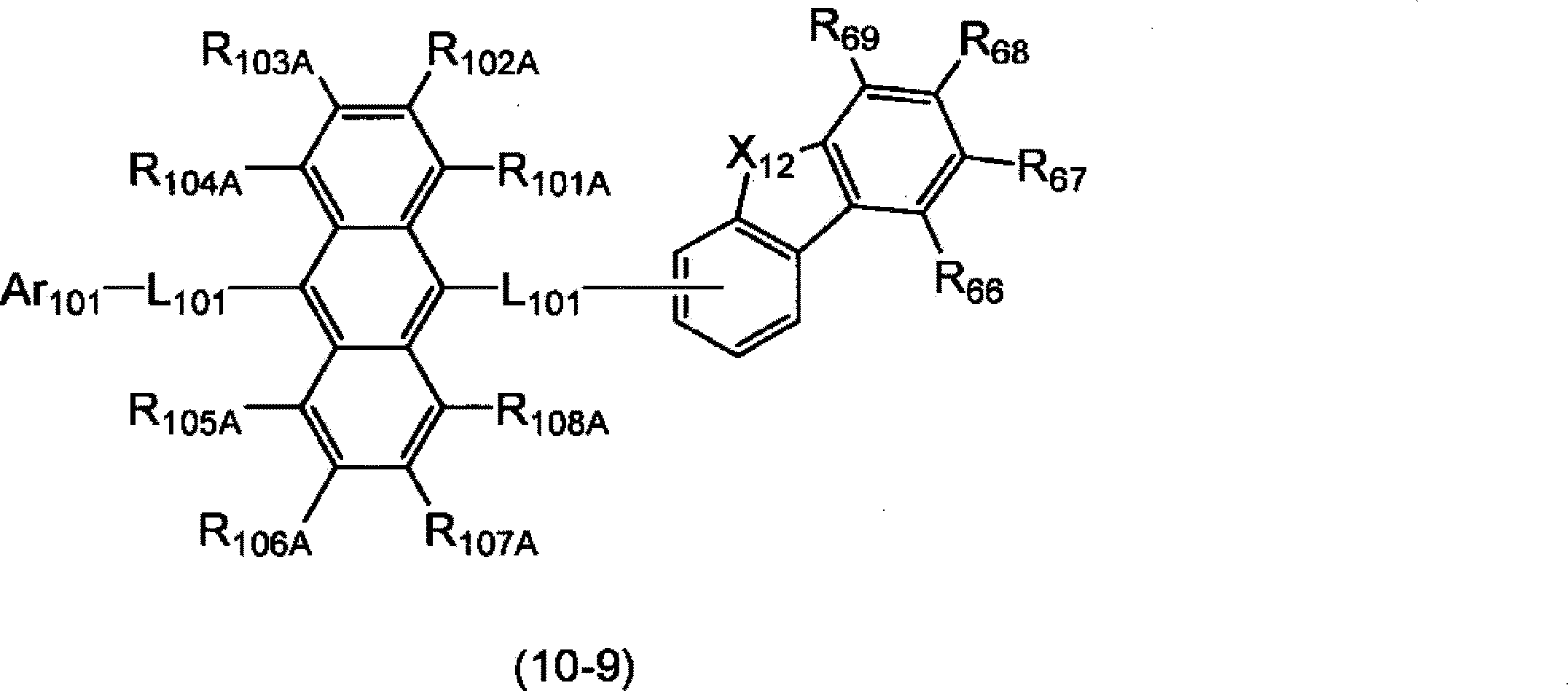
(式中、
L101及びAr101は式(10)で定義したとおりであり、
R101A~R108Aは式(10-4)で定義したとおりであり、
R66~R69は式(10-4)で定義したとおりである、ただし、R66とR67、R67とR68、及びR68とR69から選ばれる隣接する2つは互いに結合せず、従って環を形成しない、
X12はO又はSである。) - 前記ホスト材料Bが式(10-4A)で表される請求項1~22に記載の有機エレクトロルミネッセンス素子。

(式中、
L101及びAr101は式(10)で定義したとおりであり、
R101A~R108Aは、それぞれ独立して、水素原子又は置換もしくは無置換の環形成炭素数6~50のアリール基であり、
X11はO、S、又はN(R61)であり、
R61は、水素原子、置換もしくは無置換の炭素数1~50のアルキル基、又は置換もしくは無置換の環形成炭素数6~50のアリール基であり、
R62A~R69Aから選ばれる1組の隣接する2つは式(10-4A-1)で表される環を形成し、
式(10-4A-1)で表される環を形成しないR62A~R69Aから選ばれる1組以上の隣接する2つは、互いに結合して置換もしくは無置換の環を形成してもよいし、互いに結合せず、従って環を形成しなくてもよく、
式(10-4A-1)で表される環及び前記置換もしくは無置換の環を形成しないR62A~R69Aは、それぞれ独立して、水素原子、置換もしくは無置換の炭素数1~50のアルキル基、又は置換もしくは無置換の環形成炭素数6~50のアリール基である。

(式中、
*1と*2は、それぞれ、R62A~R69Aから選ばれる前記1組の隣接する2つが結合する2つの環形成炭素原子に結合し、
R70~R73の1つは、*を介してL101に結合する単結合であり、
L101に結合する単結合ではないR70~R73は、それぞれ独立して、水素原子、置換もしくは無置換の炭素数1~50のアルキル基、又は置換もしくは無置換の環形成炭素数6~50のアリール基である。)) - Ar101が表す置換もしくは無置換の環形成炭素数6~50のアリール基が、フェニル基、ビフェニル基、ターフェニル基、ナフチル基、フェナントリル基、ベンゾフェナントリル基、ピレニル基、トリフェニレニル基、ベンゾトリフェニレニル基、9,9-ジメチルフルオレニル基、ベンゾ-9,9-ジメチルフルオレニル基、9,9-ジフェニルフルオレニル基、又は9,9’-スピロビフルオレニル基である請求項1~30のいずれか1項に記載の有機エレクトロルミネッセンス素子。
- Ar101が表す置換もしくは無置換の環形成原子数5~50の複素環基が、ジベンゾフラニル基、ベンゾジベンゾフラニル基、ベンゾフロジベンゾフラニル基、ジベンゾチオフェニル基、ベンゾジベンゾチオフェニル基、9-カルバゾリル基、又は9-フェニルカルバゾリル基である請求項1~30のいずれか1項に記載の有機エレクトロルミネッセンス素子。
- L101が表す置換もしくは無置換の環形成炭素数6~50のアリーレン基が、フェニレン基、ナフチレン基、アントリレン基、又は9,9-ジメチルフルオレン-2,7-ジイル基であるである請求項1~32のいずれか1項に記載の有機エレクトロルミネッセンス素子。
- L101が表す置換もしくは無置換の環形成原子数5~50の2価の複素環基の無置換の2価の複素環基は、ピリジン、ピリミジン、トリアジン、カルバゾール、ベンゾカルバゾール、ベンゾフラン、ジベンゾフラン、ナフトベンゾフラン、ベンゾチオフェン、及びジベンゾチオフェンから選ばれる芳香族複素環の2価の残基である請求項1~32のいずれか1項に記載の有機エレクトロルミネッセンス素子。
- 前記発光層が燐光ドーパント材料を含む請求項1~34のいずれか1項に記載の有機エレクトロルミネッセンス素子。
- 前記発光層が蛍光ドーパント材料を含む請求項1~34のいずれか1項に記載の有機エレクトロルミネッセンス素子。
- 請求項1~36のいずれか1項に記載の有機エレクトロルミネッセンス素子を含む電子機器。
Priority Applications (5)
| Application Number | Priority Date | Filing Date | Title |
|---|---|---|---|
| CN202180012440.7A CN115039248B (zh) | 2020-02-05 | 2021-02-04 | 有机电致发光元件和电子设备 |
| JP2021575846A JP7564834B2 (ja) | 2020-02-05 | 2021-02-04 | 有機エレクトロルミネッセンス素子及び電子機器 |
| KR1020227026831A KR102898142B1 (ko) | 2020-02-05 | 2021-02-04 | 유기 전기발광 소자 및 전자 기기 |
| US17/759,947 US20230127629A1 (en) | 2020-02-05 | 2021-02-04 | Organic electroluminescent element and electronic device |
| EP21750739.1A EP4101847A4 (en) | 2020-02-05 | 2021-02-04 | ORGANIC ELECTROLUMINescent element and electronic device |
Applications Claiming Priority (2)
| Application Number | Priority Date | Filing Date | Title |
|---|---|---|---|
| JP2020-018229 | 2020-02-05 | ||
| JP2020018229 | 2020-02-05 |
Publications (1)
| Publication Number | Publication Date |
|---|---|
| WO2021157636A1 true WO2021157636A1 (ja) | 2021-08-12 |
Family
ID=77200611
Family Applications (1)
| Application Number | Title | Priority Date | Filing Date |
|---|---|---|---|
| PCT/JP2021/004020 Ceased WO2021157636A1 (ja) | 2020-02-05 | 2021-02-04 | 有機エレクトロルミネッセンス素子及び電子機器 |
Country Status (6)
| Country | Link |
|---|---|
| US (1) | US20230127629A1 (ja) |
| EP (1) | EP4101847A4 (ja) |
| JP (1) | JP7564834B2 (ja) |
| KR (1) | KR102898142B1 (ja) |
| CN (1) | CN115039248B (ja) |
| WO (1) | WO2021157636A1 (ja) |
Cited By (4)
| Publication number | Priority date | Publication date | Assignee | Title |
|---|---|---|---|---|
| WO2022168761A1 (ja) * | 2021-02-04 | 2022-08-11 | 出光興産株式会社 | 化合物、有機エレクトロルミネッセンス素子用材料、有機エレクトロルミネッセンス素子及び電子機器 |
| WO2023112915A1 (ja) * | 2021-12-14 | 2023-06-22 | 出光興産株式会社 | 化合物、有機エレクトロルミネッセンス素子用材料、有機エレクトロルミネッセンス素子、及び電子機器 |
| WO2024024726A1 (ja) * | 2022-07-28 | 2024-02-01 | 出光興産株式会社 | 化合物、有機エレクトロルミネッセンス素子用材料、有機エレクトロルミネッセンス素子、及び電子機器 |
| WO2024029581A1 (ja) * | 2022-08-03 | 2024-02-08 | 出光興産株式会社 | 化合物、有機エレクトロルミネッセンス素子用材料、有機エレクトロルミネッセンス素子、及び電子機器 |
Citations (9)
| Publication number | Priority date | Publication date | Assignee | Title |
|---|---|---|---|---|
| JP2014511564A (ja) * | 2011-02-11 | 2014-05-15 | ユニバーサル ディスプレイ コーポレイション | 有機発光素子及び該有機発光素子に使用されるための材料 |
| US20150318487A1 (en) * | 2014-05-02 | 2015-11-05 | Samsung Display Co., Ltd. | Organic light-emitting device |
| WO2017200210A1 (en) | 2016-05-17 | 2017-11-23 | Rohm And Haas Electronic Materials Korea Ltd. | Organic electroluminescent compound, organic electroluminescent material and organic electroluminescent device comprising the same |
| WO2018056645A1 (en) | 2016-09-22 | 2018-03-29 | Rohm And Haas Electronic Materials Korea Ltd. | Organic electroluminescent device comprising an electron buffer layer and an electron transport layer |
| WO2018105888A1 (en) | 2016-12-09 | 2018-06-14 | Rohm And Haas Electronic Materials Korea Ltd. | Organic electroluminescent compound and organic electroluminescent device comprising the same |
| JP2019519096A (ja) * | 2016-05-17 | 2019-07-04 | ローム・アンド・ハース・エレクトロニック・マテリアルズ・コリア・リミテッド | 有機電界発光化合物、有機電界発光材料、及びそれを含む有機電界発光デバイス |
| WO2019139419A1 (ko) | 2018-01-11 | 2019-07-18 | 주식회사 엘지화학 | 유기 발광 소자 |
| US20190221751A1 (en) * | 2016-09-22 | 2019-07-18 | Rohm And Haas Electronic Materials Korea Ltd | Organic electroluminescent device comprising an electron buffer layer and an electron transport layer |
| KR20200005475A (ko) * | 2018-07-05 | 2020-01-15 | 주식회사 엘지화학 | 다환 화합물 및 이를 포함하는 유기 발광 소자 |
Family Cites Families (9)
| Publication number | Priority date | Publication date | Assignee | Title |
|---|---|---|---|---|
| WO2005112519A1 (ja) | 2004-05-14 | 2005-11-24 | Idemitsu Kosan Co., Ltd. | 有機エレクトロルミネッセンス素子 |
| KR101529164B1 (ko) | 2012-07-05 | 2015-06-17 | 주식회사 엠비케이 | 신규한 유기발광화합물 및 이를 포함하는 유기전기발광소자 |
| WO2014015931A1 (de) * | 2012-07-23 | 2014-01-30 | Merck Patent Gmbh | Materialien für organische elektrolumineszenzvorrichtungen |
| KR102059941B1 (ko) | 2013-06-07 | 2019-12-30 | 삼성디스플레이 주식회사 | 헤테로고리 화합물 및 이를 포함한 유기 발광 소자 |
| US10396294B2 (en) * | 2013-12-27 | 2019-08-27 | Samsung Electronics Co., Ltd. | Carbazole compound and organic light-emitting device including the same |
| CN107880031B (zh) | 2016-09-30 | 2021-03-02 | 中节能万润股份有限公司 | 以氮杂苯为核心的化合物及其在有机电致发光器件上的应用 |
| KR102495414B1 (ko) * | 2017-03-08 | 2023-02-02 | 이데미쓰 고산 가부시키가이샤 | 화합물, 유기 전기발광 소자용 재료, 유기 전기발광 소자, 및 전자 기기 |
| JP2020097525A (ja) * | 2017-03-10 | 2020-06-25 | 出光興産株式会社 | 化合物、有機エレクトロルミネッセンス素子用材料、有機エレクトロルミネッセンス素子、及び電子機器 |
| KR102019923B1 (ko) * | 2019-01-23 | 2019-09-11 | 솔브레인 주식회사 | 화합물 및 이를 포함하는 유기 발광 소자 |
-
2021
- 2021-02-04 JP JP2021575846A patent/JP7564834B2/ja active Active
- 2021-02-04 KR KR1020227026831A patent/KR102898142B1/ko active Active
- 2021-02-04 EP EP21750739.1A patent/EP4101847A4/en active Pending
- 2021-02-04 US US17/759,947 patent/US20230127629A1/en active Pending
- 2021-02-04 WO PCT/JP2021/004020 patent/WO2021157636A1/ja not_active Ceased
- 2021-02-04 CN CN202180012440.7A patent/CN115039248B/zh active Active
Patent Citations (10)
| Publication number | Priority date | Publication date | Assignee | Title |
|---|---|---|---|---|
| JP2014511564A (ja) * | 2011-02-11 | 2014-05-15 | ユニバーサル ディスプレイ コーポレイション | 有機発光素子及び該有機発光素子に使用されるための材料 |
| US20150318487A1 (en) * | 2014-05-02 | 2015-11-05 | Samsung Display Co., Ltd. | Organic light-emitting device |
| WO2017200210A1 (en) | 2016-05-17 | 2017-11-23 | Rohm And Haas Electronic Materials Korea Ltd. | Organic electroluminescent compound, organic electroluminescent material and organic electroluminescent device comprising the same |
| JP2019519096A (ja) * | 2016-05-17 | 2019-07-04 | ローム・アンド・ハース・エレクトロニック・マテリアルズ・コリア・リミテッド | 有機電界発光化合物、有機電界発光材料、及びそれを含む有機電界発光デバイス |
| WO2018056645A1 (en) | 2016-09-22 | 2018-03-29 | Rohm And Haas Electronic Materials Korea Ltd. | Organic electroluminescent device comprising an electron buffer layer and an electron transport layer |
| US20190221751A1 (en) * | 2016-09-22 | 2019-07-18 | Rohm And Haas Electronic Materials Korea Ltd | Organic electroluminescent device comprising an electron buffer layer and an electron transport layer |
| WO2018105888A1 (en) | 2016-12-09 | 2018-06-14 | Rohm And Haas Electronic Materials Korea Ltd. | Organic electroluminescent compound and organic electroluminescent device comprising the same |
| JP2020501349A (ja) * | 2016-12-09 | 2020-01-16 | ローム・アンド・ハース・エレクトロニック・マテリアルズ・コリア・リミテッド | 有機エレクトロルミネセント化合物およびそれを含む有機エレクトロルミネセントデバイス |
| WO2019139419A1 (ko) | 2018-01-11 | 2019-07-18 | 주식회사 엘지화학 | 유기 발광 소자 |
| KR20200005475A (ko) * | 2018-07-05 | 2020-01-15 | 주식회사 엘지화학 | 다환 화합물 및 이를 포함하는 유기 발광 소자 |
Non-Patent Citations (1)
| Title |
|---|
| See also references of EP4101847A4 |
Cited By (5)
| Publication number | Priority date | Publication date | Assignee | Title |
|---|---|---|---|---|
| WO2022168761A1 (ja) * | 2021-02-04 | 2022-08-11 | 出光興産株式会社 | 化合物、有機エレクトロルミネッセンス素子用材料、有機エレクトロルミネッセンス素子及び電子機器 |
| WO2023112915A1 (ja) * | 2021-12-14 | 2023-06-22 | 出光興産株式会社 | 化合物、有機エレクトロルミネッセンス素子用材料、有機エレクトロルミネッセンス素子、及び電子機器 |
| WO2024024726A1 (ja) * | 2022-07-28 | 2024-02-01 | 出光興産株式会社 | 化合物、有機エレクトロルミネッセンス素子用材料、有機エレクトロルミネッセンス素子、及び電子機器 |
| WO2024029581A1 (ja) * | 2022-08-03 | 2024-02-08 | 出光興産株式会社 | 化合物、有機エレクトロルミネッセンス素子用材料、有機エレクトロルミネッセンス素子、及び電子機器 |
| KR20250042746A (ko) | 2022-08-03 | 2025-03-27 | 이데미쓰 고산 가부시키가이샤 | 화합물, 유기 일렉트로루미네센스 소자용 재료, 유기 일렉트로루미네센스 소자, 및 전자 기기 |
Also Published As
| Publication number | Publication date |
|---|---|
| CN115039248A (zh) | 2022-09-09 |
| US20230127629A1 (en) | 2023-04-27 |
| JPWO2021157636A1 (ja) | 2021-08-12 |
| EP4101847A4 (en) | 2024-01-03 |
| KR102898142B1 (ko) | 2025-12-09 |
| EP4101847A1 (en) | 2022-12-14 |
| JP7564834B2 (ja) | 2024-10-09 |
| KR20220137648A (ko) | 2022-10-12 |
| CN115039248B (zh) | 2026-04-21 |
Similar Documents
| Publication | Publication Date | Title |
|---|---|---|
| JP7177966B2 (ja) | 化合物、有機エレクトロルミネッセンス素子用材料、有機エレクトロルミネッセンス素子及び電子機器 | |
| WO2022009999A2 (ja) | 化合物、有機エレクトロルミネッセンス素子用材料、有機エレクトロルミネッセンス素子及び電子機器 | |
| WO2021070965A1 (ja) | 化合物、有機エレクトロルミネッセンス素子用材料、有機エレクトロルミネッセンス素子及び電子機器 | |
| JP7564834B2 (ja) | 有機エレクトロルミネッセンス素子及び電子機器 | |
| WO2021193654A1 (ja) | 化合物、有機エレクトロルミネッセンス素子用材料、有機エレクトロルミネッセンス素子及び電子機器 | |
| WO2022071350A1 (ja) | 化合物、有機エレクトロルミネッセンス素子用材料、有機エレクトロルミネッセンス素子及び電子機器 | |
| WO2020241826A1 (ja) | 化合物、有機エレクトロルミネッセンス素子用材料、有機エレクトロルミネッセンス素子及び電子機器 | |
| WO2021157635A1 (ja) | 化合物、有機エレクトロルミネッセンス素子用材料、有機エレクトロルミネッセンス素子及び電子機器 | |
| WO2022114115A1 (ja) | 化合物、有機エレクトロルミネッセンス素子用材料、有機エレクトロルミネッセンス素子及び電子機器 | |
| JP7592639B2 (ja) | 化合物、有機エレクトロルミネッセンス素子用材料、有機エレクトロルミネッセンス素子及び電子機器 | |
| JP6827605B1 (ja) | 化合物、有機エレクトロルミネッセンス素子用材料、有機エレクトロルミネッセンス素子及び電子機器 | |
| WO2021070963A1 (ja) | 化合物、有機エレクトロルミネッセンス素子用材料、有機エレクトロルミネッセンス素子及び電子機器 | |
| WO2022181157A1 (ja) | 化合物、有機エレクトロルミネッセンス素子用材料、有機エレクトロルミネッセンス素子及び電子機器 | |
| WO2022114114A1 (ja) | 化合物、有機エレクトロルミネッセンス素子用材料、有機エレクトロルミネッセンス素子及び電子機器 | |
| WO2021060239A1 (ja) | 化合物、有機エレクトロルミネッセンス素子用材料、有機エレクトロルミネッセンス素子及び電子機器 | |
| WO2021070964A1 (ja) | 化合物、有機エレクトロルミネッセンス素子用材料、有機エレクトロルミネッセンス素子及び電子機器 | |
| WO2021033724A1 (ja) | 化合物、有機エレクトロルミネッセンス素子用材料、有機エレクトロルミネッセンス素子及び電子機器 | |
| WO2021033730A1 (ja) | 化合物、有機エレクトロルミネッセンス素子用材料、有機エレクトロルミネッセンス素子及び電子機器 | |
| KR102675636B1 (ko) | 화합물, 유기 전기발광 소자용 재료, 유기 전기발광 소자 및 전자 기기 | |
| WO2022163734A1 (ja) | 化合物、有機エレクトロルミネッセンス素子用材料、有機エレクトロルミネッセンス素子及び電子機器 | |
| WO2021131657A1 (ja) | 化合物、有機エレクトロルミネッセンス素子用材料、有機エレクトロルミネッセンス素子及び電子機器 | |
| WO2021157580A1 (ja) | 化合物、有機エレクトロルミネッセンス素子用材料、有機エレクトロルミネッセンス素子及び電子機器 | |
| JP2022158684A (ja) | 化合物、有機エレクトロルミネッセンス素子用材料、有機エレクトロルミネッセンス素子及び電子機器 | |
| WO2021033731A1 (ja) | 化合物、有機エレクトロルミネッセンス素子用材料、有機エレクトロルミネッセンス素子及び電子機器 | |
| WO2021230141A1 (ja) | 化合物、有機エレクトロルミネッセンス素子用材料、有機エレクトロルミネッセンス素子及び電子機器 |
Legal Events
| Date | Code | Title | Description |
|---|---|---|---|
| 121 | Ep: the epo has been informed by wipo that ep was designated in this application |
Ref document number: 21750739 Country of ref document: EP Kind code of ref document: A1 |
|
| ENP | Entry into the national phase |
Ref document number: 2021575846 Country of ref document: JP Kind code of ref document: A |
|
| NENP | Non-entry into the national phase |
Ref country code: DE |
|
| ENP | Entry into the national phase |
Ref document number: 2021750739 Country of ref document: EP Effective date: 20220905 |