WO2021158825A1 - Compositions and methods for nutritional supplements - Google Patents
Compositions and methods for nutritional supplements Download PDFInfo
- Publication number
- WO2021158825A1 WO2021158825A1 PCT/US2021/016670 US2021016670W WO2021158825A1 WO 2021158825 A1 WO2021158825 A1 WO 2021158825A1 US 2021016670 W US2021016670 W US 2021016670W WO 2021158825 A1 WO2021158825 A1 WO 2021158825A1
- Authority
- WO
- WIPO (PCT)
- Prior art keywords
- extract
- plant materials
- powder
- composition
- group
- Prior art date
- Legal status (The legal status is an assumption and is not a legal conclusion. Google has not performed a legal analysis and makes no representation as to the accuracy of the status listed.)
- Ceased
Links
Classifications
-
- A—HUMAN NECESSITIES
- A61—MEDICAL OR VETERINARY SCIENCE; HYGIENE
- A61K—PREPARATIONS FOR MEDICAL, DENTAL OR TOILETRY PURPOSES
- A61K36/00—Medicinal preparations of undetermined constitution containing material from algae, lichens, fungi or plants, or derivatives thereof, e.g. traditional herbal medicines
- A61K36/18—Magnoliophyta (angiosperms)
- A61K36/185—Magnoliopsida (dicotyledons)
- A61K36/73—Rosaceae (Rose family), e.g. strawberry, chokeberry, blackberry, pear or firethorn
-
- A—HUMAN NECESSITIES
- A23—FOODS OR FOODSTUFFS; TREATMENT THEREOF, NOT COVERED BY OTHER CLASSES
- A23L—FOODS, FOODSTUFFS OR NON-ALCOHOLIC BEVERAGES, NOT OTHERWISE PROVIDED FOR; PREPARATION OR TREATMENT THEREOF
- A23L33/00—Modifying nutritive qualities of foods; Dietetic products; Preparation or treatment thereof
- A23L33/10—Modifying nutritive qualities of foods; Dietetic products; Preparation or treatment thereof using additives
- A23L33/105—Plant extracts, their artificial duplicates or their derivatives
-
- A—HUMAN NECESSITIES
- A23—FOODS OR FOODSTUFFS; TREATMENT THEREOF, NOT COVERED BY OTHER CLASSES
- A23L—FOODS, FOODSTUFFS OR NON-ALCOHOLIC BEVERAGES, NOT OTHERWISE PROVIDED FOR; PREPARATION OR TREATMENT THEREOF
- A23L33/00—Modifying nutritive qualities of foods; Dietetic products; Preparation or treatment thereof
- A23L33/10—Modifying nutritive qualities of foods; Dietetic products; Preparation or treatment thereof using additives
- A23L33/135—Bacteria or derivatives thereof, e.g. probiotics
-
- A—HUMAN NECESSITIES
- A23—FOODS OR FOODSTUFFS; TREATMENT THEREOF, NOT COVERED BY OTHER CLASSES
- A23L—FOODS, FOODSTUFFS OR NON-ALCOHOLIC BEVERAGES, NOT OTHERWISE PROVIDED FOR; PREPARATION OR TREATMENT THEREOF
- A23L33/00—Modifying nutritive qualities of foods; Dietetic products; Preparation or treatment thereof
- A23L33/10—Modifying nutritive qualities of foods; Dietetic products; Preparation or treatment thereof using additives
- A23L33/15—Vitamins
-
- A—HUMAN NECESSITIES
- A23—FOODS OR FOODSTUFFS; TREATMENT THEREOF, NOT COVERED BY OTHER CLASSES
- A23L—FOODS, FOODSTUFFS OR NON-ALCOHOLIC BEVERAGES, NOT OTHERWISE PROVIDED FOR; PREPARATION OR TREATMENT THEREOF
- A23L33/00—Modifying nutritive qualities of foods; Dietetic products; Preparation or treatment thereof
- A23L33/10—Modifying nutritive qualities of foods; Dietetic products; Preparation or treatment thereof using additives
- A23L33/16—Inorganic salts, minerals or trace elements
-
- A—HUMAN NECESSITIES
- A23—FOODS OR FOODSTUFFS; TREATMENT THEREOF, NOT COVERED BY OTHER CLASSES
- A23L—FOODS, FOODSTUFFS OR NON-ALCOHOLIC BEVERAGES, NOT OTHERWISE PROVIDED FOR; PREPARATION OR TREATMENT THEREOF
- A23L33/00—Modifying nutritive qualities of foods; Dietetic products; Preparation or treatment thereof
- A23L33/30—Dietetic or nutritional methods, e.g. for losing weight
-
- A—HUMAN NECESSITIES
- A61—MEDICAL OR VETERINARY SCIENCE; HYGIENE
- A61K—PREPARATIONS FOR MEDICAL, DENTAL OR TOILETRY PURPOSES
- A61K36/00—Medicinal preparations of undetermined constitution containing material from algae, lichens, fungi or plants, or derivatives thereof, e.g. traditional herbal medicines
- A61K36/18—Magnoliophyta (angiosperms)
- A61K36/185—Magnoliopsida (dicotyledons)
-
- A—HUMAN NECESSITIES
- A61—MEDICAL OR VETERINARY SCIENCE; HYGIENE
- A61K—PREPARATIONS FOR MEDICAL, DENTAL OR TOILETRY PURPOSES
- A61K36/00—Medicinal preparations of undetermined constitution containing material from algae, lichens, fungi or plants, or derivatives thereof, e.g. traditional herbal medicines
- A61K36/18—Magnoliophyta (angiosperms)
- A61K36/185—Magnoliopsida (dicotyledons)
- A61K36/21—Amaranthaceae (Amaranth family), e.g. pigweed, rockwort or globe amaranth
-
- A—HUMAN NECESSITIES
- A61—MEDICAL OR VETERINARY SCIENCE; HYGIENE
- A61K—PREPARATIONS FOR MEDICAL, DENTAL OR TOILETRY PURPOSES
- A61K36/00—Medicinal preparations of undetermined constitution containing material from algae, lichens, fungi or plants, or derivatives thereof, e.g. traditional herbal medicines
- A61K36/18—Magnoliophyta (angiosperms)
- A61K36/185—Magnoliopsida (dicotyledons)
- A61K36/23—Apiaceae or Umbelliferae (Carrot family), e.g. dill, chervil, coriander or cumin
-
- A—HUMAN NECESSITIES
- A61—MEDICAL OR VETERINARY SCIENCE; HYGIENE
- A61K—PREPARATIONS FOR MEDICAL, DENTAL OR TOILETRY PURPOSES
- A61K36/00—Medicinal preparations of undetermined constitution containing material from algae, lichens, fungi or plants, or derivatives thereof, e.g. traditional herbal medicines
- A61K36/18—Magnoliophyta (angiosperms)
- A61K36/185—Magnoliopsida (dicotyledons)
- A61K36/31—Brassicaceae or Cruciferae (Mustard family), e.g. broccoli, cabbage or kohlrabi
-
- A—HUMAN NECESSITIES
- A61—MEDICAL OR VETERINARY SCIENCE; HYGIENE
- A61K—PREPARATIONS FOR MEDICAL, DENTAL OR TOILETRY PURPOSES
- A61K36/00—Medicinal preparations of undetermined constitution containing material from algae, lichens, fungi or plants, or derivatives thereof, e.g. traditional herbal medicines
- A61K36/18—Magnoliophyta (angiosperms)
- A61K36/185—Magnoliopsida (dicotyledons)
- A61K36/35—Caprifoliaceae (Honeysuckle family)
-
- A—HUMAN NECESSITIES
- A61—MEDICAL OR VETERINARY SCIENCE; HYGIENE
- A61K—PREPARATIONS FOR MEDICAL, DENTAL OR TOILETRY PURPOSES
- A61K36/00—Medicinal preparations of undetermined constitution containing material from algae, lichens, fungi or plants, or derivatives thereof, e.g. traditional herbal medicines
- A61K36/18—Magnoliophyta (angiosperms)
- A61K36/185—Magnoliopsida (dicotyledons)
- A61K36/45—Ericaceae or Vacciniaceae (Heath or Blueberry family), e.g. blueberry, cranberry or bilberry
-
- A—HUMAN NECESSITIES
- A61—MEDICAL OR VETERINARY SCIENCE; HYGIENE
- A61K—PREPARATIONS FOR MEDICAL, DENTAL OR TOILETRY PURPOSES
- A61K36/00—Medicinal preparations of undetermined constitution containing material from algae, lichens, fungi or plants, or derivatives thereof, e.g. traditional herbal medicines
- A61K36/18—Magnoliophyta (angiosperms)
- A61K36/185—Magnoliopsida (dicotyledons)
- A61K36/53—Lamiaceae or Labiatae (Mint family), e.g. thyme, rosemary or lavender
-
- A—HUMAN NECESSITIES
- A61—MEDICAL OR VETERINARY SCIENCE; HYGIENE
- A61K—PREPARATIONS FOR MEDICAL, DENTAL OR TOILETRY PURPOSES
- A61K36/00—Medicinal preparations of undetermined constitution containing material from algae, lichens, fungi or plants, or derivatives thereof, e.g. traditional herbal medicines
- A61K36/18—Magnoliophyta (angiosperms)
- A61K36/185—Magnoliopsida (dicotyledons)
- A61K36/63—Oleaceae (Olive family), e.g. jasmine, lilac or ash tree
-
- A—HUMAN NECESSITIES
- A61—MEDICAL OR VETERINARY SCIENCE; HYGIENE
- A61K—PREPARATIONS FOR MEDICAL, DENTAL OR TOILETRY PURPOSES
- A61K36/00—Medicinal preparations of undetermined constitution containing material from algae, lichens, fungi or plants, or derivatives thereof, e.g. traditional herbal medicines
- A61K36/18—Magnoliophyta (angiosperms)
- A61K36/185—Magnoliopsida (dicotyledons)
- A61K36/74—Rubiaceae (Madder family)
- A61K36/742—Coffea, e.g. coffee
-
- A—HUMAN NECESSITIES
- A61—MEDICAL OR VETERINARY SCIENCE; HYGIENE
- A61K—PREPARATIONS FOR MEDICAL, DENTAL OR TOILETRY PURPOSES
- A61K36/00—Medicinal preparations of undetermined constitution containing material from algae, lichens, fungi or plants, or derivatives thereof, e.g. traditional herbal medicines
- A61K36/18—Magnoliophyta (angiosperms)
- A61K36/185—Magnoliopsida (dicotyledons)
- A61K36/75—Rutaceae (Rue family)
- A61K36/752—Citrus, e.g. lime, orange or lemon
-
- A—HUMAN NECESSITIES
- A61—MEDICAL OR VETERINARY SCIENCE; HYGIENE
- A61K—PREPARATIONS FOR MEDICAL, DENTAL OR TOILETRY PURPOSES
- A61K36/00—Medicinal preparations of undetermined constitution containing material from algae, lichens, fungi or plants, or derivatives thereof, e.g. traditional herbal medicines
- A61K36/18—Magnoliophyta (angiosperms)
- A61K36/185—Magnoliopsida (dicotyledons)
- A61K36/81—Solanaceae (Potato family), e.g. tobacco, nightshade, tomato, belladonna, capsicum or jimsonweed
-
- A—HUMAN NECESSITIES
- A61—MEDICAL OR VETERINARY SCIENCE; HYGIENE
- A61K—PREPARATIONS FOR MEDICAL, DENTAL OR TOILETRY PURPOSES
- A61K36/00—Medicinal preparations of undetermined constitution containing material from algae, lichens, fungi or plants, or derivatives thereof, e.g. traditional herbal medicines
- A61K36/18—Magnoliophyta (angiosperms)
- A61K36/185—Magnoliopsida (dicotyledons)
- A61K36/87—Vitaceae or Ampelidaceae (Vine or Grape family), e.g. wine grapes, muscadine or peppervine
-
- A—HUMAN NECESSITIES
- A61—MEDICAL OR VETERINARY SCIENCE; HYGIENE
- A61K—PREPARATIONS FOR MEDICAL, DENTAL OR TOILETRY PURPOSES
- A61K36/00—Medicinal preparations of undetermined constitution containing material from algae, lichens, fungi or plants, or derivatives thereof, e.g. traditional herbal medicines
- A61K36/18—Magnoliophyta (angiosperms)
- A61K36/88—Liliopsida (monocotyledons)
- A61K36/896—Liliaceae (Lily family), e.g. daylily, plantain lily, Hyacinth or narcissus
- A61K36/8962—Allium, e.g. garden onion, leek, garlic or chives
-
- A—HUMAN NECESSITIES
- A61—MEDICAL OR VETERINARY SCIENCE; HYGIENE
- A61K—PREPARATIONS FOR MEDICAL, DENTAL OR TOILETRY PURPOSES
- A61K36/00—Medicinal preparations of undetermined constitution containing material from algae, lichens, fungi or plants, or derivatives thereof, e.g. traditional herbal medicines
- A61K36/18—Magnoliophyta (angiosperms)
- A61K36/88—Liliopsida (monocotyledons)
- A61K36/906—Zingiberaceae (Ginger family)
- A61K36/9068—Zingiber, e.g. garden ginger
-
- A—HUMAN NECESSITIES
- A61—MEDICAL OR VETERINARY SCIENCE; HYGIENE
- A61K—PREPARATIONS FOR MEDICAL, DENTAL OR TOILETRY PURPOSES
- A61K45/00—Medicinal preparations containing active ingredients not provided for in groups A61K31/00 - A61K41/00
- A61K45/06—Mixtures of active ingredients without chemical characterisation, e.g. antiphlogistics and cardiaca
-
- A—HUMAN NECESSITIES
- A61—MEDICAL OR VETERINARY SCIENCE; HYGIENE
- A61K—PREPARATIONS FOR MEDICAL, DENTAL OR TOILETRY PURPOSES
- A61K9/00—Medicinal preparations characterised by special physical form
- A61K9/0012—Galenical forms characterised by the site of application
- A61K9/0053—Mouth and digestive tract, i.e. intraoral and peroral administration
-
- A—HUMAN NECESSITIES
- A61—MEDICAL OR VETERINARY SCIENCE; HYGIENE
- A61K—PREPARATIONS FOR MEDICAL, DENTAL OR TOILETRY PURPOSES
- A61K9/00—Medicinal preparations characterised by special physical form
- A61K9/14—Particulate form, e.g. powders, Processes for size reducing of pure drugs or the resulting products, Pure drug nanoparticles
-
- A—HUMAN NECESSITIES
- A61—MEDICAL OR VETERINARY SCIENCE; HYGIENE
- A61P—SPECIFIC THERAPEUTIC ACTIVITY OF CHEMICAL COMPOUNDS OR MEDICINAL PREPARATIONS
- A61P25/00—Drugs for disorders of the nervous system
-
- A—HUMAN NECESSITIES
- A61—MEDICAL OR VETERINARY SCIENCE; HYGIENE
- A61P—SPECIFIC THERAPEUTIC ACTIVITY OF CHEMICAL COMPOUNDS OR MEDICINAL PREPARATIONS
- A61P3/00—Drugs for disorders of the metabolism
- A61P3/02—Nutrients, e.g. vitamins, minerals
-
- A—HUMAN NECESSITIES
- A61—MEDICAL OR VETERINARY SCIENCE; HYGIENE
- A61P—SPECIFIC THERAPEUTIC ACTIVITY OF CHEMICAL COMPOUNDS OR MEDICINAL PREPARATIONS
- A61P37/00—Drugs for immunological or allergic disorders
-
- A—HUMAN NECESSITIES
- A61—MEDICAL OR VETERINARY SCIENCE; HYGIENE
- A61P—SPECIFIC THERAPEUTIC ACTIVITY OF CHEMICAL COMPOUNDS OR MEDICINAL PREPARATIONS
- A61P39/00—General protective or antinoxious agents
- A61P39/06—Free radical scavengers or antioxidants
-
- A—HUMAN NECESSITIES
- A61—MEDICAL OR VETERINARY SCIENCE; HYGIENE
- A61P—SPECIFIC THERAPEUTIC ACTIVITY OF CHEMICAL COMPOUNDS OR MEDICINAL PREPARATIONS
- A61P9/00—Drugs for disorders of the cardiovascular system
-
- A—HUMAN NECESSITIES
- A23—FOODS OR FOODSTUFFS; TREATMENT THEREOF, NOT COVERED BY OTHER CLASSES
- A23V—INDEXING SCHEME RELATING TO FOODS, FOODSTUFFS OR NON-ALCOHOLIC BEVERAGES AND LACTIC OR PROPIONIC ACID BACTERIA USED IN FOODSTUFFS OR FOOD PREPARATION
- A23V2002/00—Food compositions, function of food ingredients or processes for food or foodstuffs
-
- A—HUMAN NECESSITIES
- A23—FOODS OR FOODSTUFFS; TREATMENT THEREOF, NOT COVERED BY OTHER CLASSES
- A23V—INDEXING SCHEME RELATING TO FOODS, FOODSTUFFS OR NON-ALCOHOLIC BEVERAGES AND LACTIC OR PROPIONIC ACID BACTERIA USED IN FOODSTUFFS OR FOOD PREPARATION
- A23V2250/00—Food ingredients
- A23V2250/20—Natural extracts
- A23V2250/21—Plant extracts
- A23V2250/2132—Other phenolic compounds, polyphenols
-
- A—HUMAN NECESSITIES
- A61—MEDICAL OR VETERINARY SCIENCE; HYGIENE
- A61K—PREPARATIONS FOR MEDICAL, DENTAL OR TOILETRY PURPOSES
- A61K2300/00—Mixtures or combinations of active ingredients, wherein at least one active ingredient is fully defined in groups A61K31/00 - A61K41/00
Definitions
- the field of the invention is compositions and methods for nutritional supplements, especially as it relates polyphenols and polyphenol mixtures commonly associated with a diet rich in fruits and vegetables and their use in conditions, disorders, and diseases associated with various enzymes inhibited by such polyphenol mixtures.
- the Mediterranean diet is typically associated with lower cardiovascular risk factors (see e.g., Nutrients 2018, 10, 379; doi:10.3390/nu10030379), lower inflammatory and metabolic biomarkers, a reduction in risk of Alzheimer’s disease (see e.g., J Alzheimer s Dis. 2010 ; 22(2): 483-492.), and with a reduction in certain inflammatory markers (see e.g., Nutrients 2018, 10, 62; doi: 10.3390/nu10010062).
- compositions and methods for specific combinations of polyphenols and/or polyphenol-rich materials e.g., extracts and powders
- polyphenols and/or polyphenol-rich materials e.g., extracts and powders
- the compositions and methods disclosed herein had substantial, and in some cases significant synergistic effect on a variety of molecular biomarkers associated with the benefits of the Mediterranean diet such as markers for ageing, senescence, inflammation, immune function, NAD/ energy metabolism, and the gut microbiome.
- the inventor contemplates a nutritional composition that comprises a nutritionally acceptable carrier in combination with a plurality of chemically distinct polyphenols from plant materials having a red color, a green color, an orange-yellow color, and a purple-blue color.
- the chemically distinct polyphenols from the plant materials are present as a synergistic combination with respect to inhibition of at least one biochemical marker selected from the group consisting of BACE1, CD38, CD73, CDK5, JAK1, JAK2, and JAK3.
- the red colored plant materials comprise at least one (or two, or three, or all of) of an apple extract, a pomegranate extract, a tomato powder, and a beet root powder
- the green colored plant materials comprise at least one (or two, or three, or all of) of an olive extract, a rosemary extract, a green coffee bean extract, and a kale powder
- the orange-yellow colored plant materials comprise at least one (or two, or three, or all of) of an onion extract, a ginger extract, a grapefruit extract, and a carrot powder
- the purple-blue colored plant materials comprise at least one (or two, or three, or all of) of a grape extract, a blueberry extract, a currant powder, and an elderberry powder.
- the chemically distinct polyphenols further inhibit at least one additional biochemical marker selected from the group consisting of ARG-1, ARG-2, SIRT-1, CD39, IDO1, IDO2, NAMPT, PCSK9, CD47, and Cathepsin S.
- contemplated compositions may further inhibit Keap/Nrf2 binding and/or ACE2/Spike binding.
- the composition is formulated in single dosage units for oral administration (e.g., each containing between 50 and 1,000 mg of the composition), which may be formulated as a capsule, a gummy, or a powder.
- the composition may further comprise a vitamin, a dietary trace element or mineral, a nicotinamide riboside, a probiotic, and/or a prebiotic.
- the inventor contemplates a nutritional composition that includes a nutritionally acceptable carrier in combination with a plurality of chemically distinct polyphenol -containing plant materials having a red color, a green color, an orange-yellow color, and a purple-blue color.
- the red colored plant materials comprise an apple extract, a pomegranate extract, a tomato powder, and a beet root powder
- the green colored plant materials comprise an olive extract, a rosemary extract, a green coffee bean extract, and a kale powder
- the orange-yellow colored plant materials comprise an onion extract, a ginger extract, a grapefruit extract, and a carrot powder
- the purple-blue colored plant materials comprise a grape extract, a blueberry extract, a currant powder, and an elderberry powder.
- the apple extract, the pomegranate extract, the olive extract, the rosemary extract, the green coffee bean extract, the onion extract, the ginger extract, the grapefruit extract, the grape extract, and the blueberry extract may be ethanol extracts or ethanol/water extracts.
- the combination of plant materials is a synergistic combination with respect to inhibition of at least one biochemical marker selected from the group consisting of BACE1, CD38, CD73, CDK5, JAK1, JAK2, and JAK3, and especially with respect to inhibition of BACE1, CD38, and CD73.
- Preferred compositions further inhibit at least one additional biochemical marker selected from the group consisting of ARG-1, ARG-2, SIRT-1, CD39, IDO1, IDO2, NAMPT, PCSK9, CD47, and Cathepsin S, and may also inhibit Keap/Nrf2 binding and/or ACE2/Spike binding.
- the composition is formulated in single dosage units for oral administration.
- the dosage unit contains between 50 and 1,000 mg of the composition, and is formulated as a capsule, a gummy, or a powder.
- contemplated compositions may further comprise a vitamin, a dietary trace element or mineral, a nicotinamide riboside, a probiotic, and/or a prebiotic.
- contemplated compositions will be effective to treat and/or reduce a symptom of inflammatory condition, a cardiovascular condition, a neurological condition, a metabolic condition, and a cancer.
- the inventor also contemplates a method of supporting health of an individual that comprises a step of administering the compositions presented herein.
- the composition may be administered to thereby provide immune support, metabolic support, support longevity, support central nervous system (CNS) function, reduce an inflammatory response, reduce effects of cardiovascular disease, and reduce the rate of amyloid beta plaque formation.
- CNS central nervous system
- compositions are orally administered over at least 30 days, typically at a daily dose of between 50 and 1,000 mg.
- contemplated compositions may further comprise a step of co-administering a vitamin, a dietary trace element or mineral, a nicotinamide riboside, a probiotic, and/or a prebiotic (which may be performed in the same dosage unit or individually).
- the inventor also contemplates a method of reducing an NAD+ decrease (e.g., age-related NAD+ decrease) in an individual that includes a step of administering to the individual a synergistic combination of polyphenols from plant materials having a red color, a green color, an orange-yellow color, and a purple- blue color wherein the combination synergistically inhibits CD38.
- an NAD+ decrease e.g., age-related NAD+ decrease
- the polyphenols are provided in from of the plant materials.
- the red colored plant materials are selected from the group consisting of an apple extract, a pomegranate extract, a tomato powder, and a beet root powder
- the green colored plant materials are selected from the group consisting of an olive extract, a rosemary extract, a green coffee bean extract, and a kale powder
- the orange-yellow colored plant materials are selected from the group consisting of an onion extract, a ginger extract, a grapefruit extract, and a carrot powder
- the purple-blue colored plant materials are selected from the group consisting of a grape extract, a blueberry extract, a currant powder, and an elderberry powder.
- the inventor contemplates a method of supporting longevity of an individual that includes a step of administering to the individual a synergistic combination of polyphenols from plant materials having a red color, a green color, an orange-yellow color, and a purple-blue color wherein the combination synergistically inhibits CD73.
- the polyphenols are provided in from of the plant materials.
- the red colored plant materials are selected from the group consisting of an apple extract, a pomegranate extract, a tomato powder, and a beet root powder
- the green colored plant materials are selected from the group consisting of an olive extract, a rosemary extract, a green coffee bean extract, and a kale powder
- the orange-yellow colored plant materials are selected from the group consisting of an onion extract, a ginger extract, a grapefruit extract, and a carrot powder
- the purple-blue colored plant materials are selected from the group consisting of a grape extract, a blueberry extract, a currant powder, and an elderberry powder.
- the inventor contemplates a method of supporting cognitive function of an individual that includes a step of administering a synergistic combination of polyphenols from plant materials having a red color, a green color, an orange-yellow color, and a purple-blue color wherein the combination synergistically inhibits BACE1.
- the polyphenols are provided in from of the plant materials, and administration increases immune function to thereby support longevity and/or reduces the rate of amyloid beta plaque formation.
- the red colored plant materials are selected from the group consisting of an apple extract, a pomegranate extract, a tomato powder, and a beet root powder
- the green colored plant materials are selected from the group consisting of an olive extract, a rosemary extract, a green coffee bean extract, and a kale powder
- the orange-yellow colored plant materials are selected from the group consisting of an onion extract, a ginger extract, a grapefruit extract, and a carrot powder
- the purple-blue colored plant materials are selected from the group consisting of a grape extract, a blueberry extract, a currant powder, and an elderberry powder.
- the inventor contemplates a method of supporting central nervous system (CNS) function in an individual that includes a step of administering a synergistic combination of polyphenols from plant materials having a red color, a green color, an orange-yellow color, and a purple-blue color wherein the combination synergistically inhibits CDK5.
- the polyphenols are provided in from of the plant materials, and administration reduces age-related cognitive decline.
- the red colored plant materials are selected from the group consisting of an apple extract, a pomegranate extract, a tomato powder, and a beet root powder
- the green colored plant materials are selected from the group consisting of an olive extract, a rosemary extract, a green coffee bean extract, and a kale powder
- the orange-yellow colored plant materials are selected from the group consisting of an onion extract, a ginger extract, a grapefruit extract, and a carrot powder
- the purple-blue colored plant materials are selected from the group consisting of a grape extract, a blueberry extract, a currant powder, and an elderberry powder.
- the inventor contemplates a method of supporting immune function in an individual that includes a step of administering a synergistic combination of polyphenols from plant materials having a red color, a green color, an orange-yellow color, and a purple-blue color wherein the combination synergistically inhibits at least one of JAK1, JAK2, and JAK3.
- the polyphenols are provided in from of the plant materials, and administration reduces a symptom of rheumatoid arthritis, psoriasis, or inflammatory bowel disease.
- the red colored plant materials are selected from the group consisting of an apple extract, a pomegranate extract, a tomato powder, and a beet root powder
- the green colored plant materials are selected from the group consisting of an olive extract, a rosemary extract, a green coffee bean extract, and a kale powder
- the orange-yellow colored plant materials are selected from the group consisting of an onion extract, a ginger extract, a grapefruit extract, and a carrot powder
- the purple-blue colored plant materials are selected from the group consisting of a grape extract, a blueberry extract, a currant powder, and an elderberry powder.
- the inventor also contemplates a method of inhibiting at least one of BACE1, CD38, CD73, CDK5, JAK1, JAK2, and JAK3 that includes a step of contacting at least one of the BACE1, the CD38, the CD73, the CDK5, the JAK1, the JAK2, and the JAK3 with a plurality of chemically distinct polyphenols from plant materials having a red color, a green color, an orange-yellow color, and a purple-blue color, wherein the chemically distinct polyphenols from the plant materials are a synergistic combination with respect to inhibition of at least one biochemical marker selected from the group consisting of the BACE1 , the CD38, the CD73, the CDK5, the JAK1, the JAK2, and the JAK3.
- the polyphenols are provided in from of the plant materials.
- the red colored plant materials are selected from the group consisting of an apple extract, a pomegranate extract, a tomato powder, and a beet root powder
- the green colored plant materials are selected from the group consisting of an olive extract, a rosemary extract, a green coffee bean extract, and a kale powder
- the orange-yellow colored plant materials are selected from the group consisting of an onion extract, a ginger extract, a grapefruit extract, and a carrot powder
- the purple-blue colored plant materials are selected from the group consisting of a grape extract, a blueberry extract, a currant powder, and an elderberry powder.
- the step of contacting is performed in vivo (e.g., oral administration to a mammal), and administration of the plurality of chemically distinct polyphenols provides immune support, metabolic support, support longevity, supports central nervous system (CNS) function, reduces an inflammatory response, reduces effects of cardiovascular disease, and/or reduces the rate of amyloid beta plaque formation.
- administration of the plurality of chemically distinct polyphenols provides immune support, metabolic support, support longevity, supports central nervous system (CNS) function, reduces an inflammatory response, reduces effects of cardiovascular disease, and/or reduces the rate of amyloid beta plaque formation.
- the inventor also contemplates a method of treating a condition that is associated with activity of at least one of BACE1, CD38, CD73, CDK5, JAK1, JAK2, JAK3, ARG-1, ARG-2, SIRT-1, CD39, IDO1, IDO2, NAMPT, PCSK9, CD47, and Cathepsin S in a mammal.
- Such method will typically include a step of administering to the mammal a plurality of chemically distinct polyphenols in an amount effective to inhibit at least one of the BACE1, the CD38, the CD73, the CDK5, the JAK1, the JAK2, the JAK3, the ARG-1, the ARG-2, the SIRT-1, the CD39, the IDO1, the IDO2, the NAMPT, the PCSK9, the CD47, and the Cathepsin S.
- the chemically distinct polyphenols synergistically inhibit BACE1, CD38, CD73, CDK5, JAK1, JAK2, and/or JAK3.
- the condition may be an inflammatory condition, a cardiovascular condition, a neurological condition, a metabolic condition, and/or a cancer.
- the plurality of chemically distinct polyphenols are from plant materials having a red color, a green color, an orange-yellow color, and a purple-blue color.
- the red colored plant materials are selected from the group consisting of an apple extract, a pomegranate extract, a tomato powder, and a beet root powder
- the green colored plant materials are selected from the group consisting of an olive extract, a rosemary extract, a green coffee bean extract, and a kale powder
- the orange-yellow colored plant materials are selected from the group consisting of an onion extract, a ginger extract, a grapefruit extract, and a carrot powder
- the purple-blue colored plant materials are selected from the group consisting of a grape extract, a blueberry extract, a currant powder, and an elderberry powder.
- the polyphenols may be provided in from of the plant materials.
- the plurality of chemically distinct polyphenols may be orally administered to the mammal, typically at a daily dosage of between 50 and 1,000 mg.
- such methods may further comprise a step of co-administering to the mammal a vitamin, a dietary trace element or mineral, a nicotinamide riboside, a probiotic, and/or a prebiotic.
- the chemically distinct polyphenols are administered in an amount effective to inhibit at least three (or at least five or at least ten or all) of the BACE1, the CD38, the CD73, the CDK5, the JAK1, the JAK2, the JAK3, the ARG-1, the ARG-2, the SIRT-1, the CD39, the IDO1, the IDO2, the NAMPT, the PCSK9, the CD47, and the Cathepsin S.
- the inventor also contemplates the use of a plurality of chemically distinct polyphenols to support healthy ageing. Moreover, it is contemplated that the plurality of chemically distinct polyphenols in such use further inhibit SIRT-1, IDO1, IDO2, NAMPT, PCSK9, CD47, Keap/Nrf2 binding, and/or ACE2/Spike binding, and/or that the chemically distinct polyphenols synergistically inhibit the BACE1, the CD38, the CD73, the CDK5, the JAK1, the JAK2, and/or the JAK3.
- the red colored plant materials are selected from the group consisting of an apple extract, a pomegranate extract, a tomato powder, and a beet root powder
- the green colored plant materials are selected from the group consisting of an olive extract, a rosemary extract, a green coffee bean extract, and a kale powder
- the orange- yellow colored plant materials are selected from the group consisting of an onion extract, a ginger extract, a grapefruit extract, and a carrot powder
- the purple-blue colored plant materials are selected from the group consisting of a grape extract, a blueberry extract, a currant powder, and an elderberry powder.
- FIG.1 is a graph depicting exemplary results for ARG-1 inhibition using a composition according to the inventive subject matter.
- FIG.2 is a graph depicting exemplary results for ARG-2 inhibition using a composition according to the inventive subject matter.
- FIG.3 is a graph depicting exemplary results for SIRT1 inhibition using a composition according to the inventive subject matter.
- FIG.4 is a graph depicting exemplary results for Keapl-Nrf2 binding inhibition using a composition according to the inventive subject matter.
- FIG.5 is a graph depicting exemplary results for ACE2-Spike SI binding inhibition using a composition according to the inventive subject matter.
- FIG.6 is a graph depicting exemplary results for ACE2-Spike SI binding inhibition using a multivitamin composition.
- FIG.7 is a graph depicting exemplary results for ACE2-Spike SI binding inhibition using various further compositions according to the inventive subject matter
- FIG.8 is a graph depicting exemplary results for BACE1 inhibition using a composition according to the inventive subject matter.
- FIG.9 is a graph depicting exemplary results for BACE1 inhibition using various further compositions according to the inventive subject matter and a multivitamin composition.
- FIG.10 is a graph depicting exemplary results for Cathepsin S inhibition using a composition according to the inventive subject matter.
- FIG.11 is a graph depicting exemplary results for Cathepsin S inhibition using various further compositions according to the inventive subject matter.
- FIG.12 is a graph depicting exemplary results for Cathepsin S inhibition using a composition according to the inventive subject matter and a multivitamin composition.
- FIG.13 is a graph depicting exemplary results for CDK5/p25 binding inhibition using a composition according to the inventive subject matter.
- FIG.14 is a graph depicting exemplary results for CDK5/p25 binding inhibition using various further compositions according to the inventive subject matter and a multivitamin composition.
- FIG.15 is a graph depicting exemplary results for IDO1 inhibition using a composition according to the inventive subject matter.
- FIG.16 is a graph depicting exemplary results for IDO2 inhibition using a composition according to the inventive subject matter.
- FIG.17 is a graph depicting exemplary results for NAMPT inhibition using a composition according to the inventive subject matter.
- FIG.18 is a graph depicting exemplary results for PCSK9:LDLR binding inhibition using a composition according to the inventive subject matter.
- FIG.19 is a graph depicting exemplary results for CD47 inhibition using a composition according to the inventive subject matter.
- FIG.20 is a graph depicting exemplary results for CD38 inhibition using a composition according to the inventive subject matter.
- FIG.21 is a graph depicting exemplary results for CD38 inhibition using further compositions according to the inventive subject matter.
- FIG.22 is a graph depicting exemplary results for CD38 inhibition using known compositions containing nicotinamide riboside.
- FIG.23 is a graph depicting exemplary results for CD38 inhibition using a composition according to the inventive subject matter and a known multivitamin composition.
- FIG.24 is a graph depicting exemplary results for JAK1 inhibition using a composition according to the inventive subject matter.
- FIG.25 is a graph depicting exemplary results for JAK2 inhibition using a composition according to the inventive subject matter.
- FIG.26 is a graph depicting exemplary results for JAK3 inhibition using a composition according to the inventive subject matter.
- FIG.27 is a graph depicting exemplary results for CD39 inhibition using a composition according to the inventive subject matter.
- FIG.28 is a graph depicting exemplary results for CD39 inhibition using a composition at low concentrations according to the inventive subject matter.
- FIG.29 is a graph depicting exemplary results for CD39 inhibition using further compositions according to the inventive subject matter.
- FIG.30 is a graph depicting exemplary results for CD39 inhibition using selected compositions according to the inventive subject matter.
- FIG.31 is a graph depicting exemplary results for CD39 inhibition using a composition according to the inventive subject matter and a known multivitamin composition.
- FIG.32 is a graph depicting exemplary results for CD73 inhibition using a composition according to the inventive subject matter.
- FIG.33 is a graph depicting exemplary results for CD73 inhibition using a composition at low concentrations according to the inventive subject matter.
- FIG.34 is a graph depicting exemplary results for CD73 inhibition using further compositions according to the inventive subject matter
- FIG.35 is a graph depicting exemplary results for CD73 inhibition using a composition according to the inventive subject matter and a known multivitamin composition.
- compositions presented herein had substantial and synergistic effects on a number of biomarkers associated with proper immune and CNS function, effective cellular metabolism, and longevity, and showed further significant effect on additional biomarkers associated with inflammatory responses, adverse effects of cardiovascular disease, and/or amyloid beta plaque formation.
- the compositions and methods presented herein were demonstrated to have significant and beneficial effects on multiple enzymatic targets that are involved with numerous aspects of health and healthy ageing such as ARG-1, ARG-2, SIRT1, BACE1, Cathepsin S, CDK5, IDO1, IDO2, NAMPT, PCSK9, CD47, CD38, JAK1, JAK2, JAK3, CD39, and CD73, Keap/Nrf2.
- compositions presented herein are useful to beneficially affect multiple pathways associated with health and healthy ageing via inhibition of key signaling components and/or enzymes in these pathways.
- the observed modulation of these biomarkers using the compositions presented herein paralleled the profile of biomarkers in individuals that adhered to the Mediterranean diet and individuals with significant longevity.
- arginase 1 ACG1
- arginase 2 AAG2
- the urea cycle provides protection against excess ammonia, while L-omithine is required for cell proliferation, collagen formation, and other important physiological functions.
- increases in arginase activity in mammals have been linked to dysfunction and pathologies of the cardiovascular system, kidney, and central nervous system, and also to dysfunction of the immune system and development of cancer. Two important aspects of the excessive activity of arginase may be involved in diseases.
- sirtuinl is a nuclear enzyme that deacetylates transcription factors that contribute to cellular regulation, and particularly to reaction to stressors.
- SIRT1 deacetylates members of the PGCl-alpha/ERR-alpha complex, which are critical metabolic regulatory transcription factors, and deacetylates/ deactivates the p53 protein, which is a key factor in many neoplastic diseases.
- SIRT1 was also demonstrated to play a role in activating T helper 17 cells, which contribute to autoimmune disease. As is shown in more detail below, contemplated compositions were effective in mildly inhibiting SIRT1 activity at relatively moderate concentrations.
- beta-secretase 1 has been shown to be essential for the generation of b-amyloid in Alzheimer’s disease and has also been reported to be associated with cognitive decline and decline in central nervous system (CNS) function (see e.g., Molecules. 2017 Oct 13;22(10):1723).
- CNS central nervous system
- b-amyloid accumulation is a hallmark of ageing, and as such inhibitory compounds are thought to beneficially decelerate or even stop b-amyloid accumulation and as such preserve or maintain cognitive abilities and CNS function.
- contemplated compositions have shown remarkable, strong, and even synergistic effect with regard to BACE 1 inhibition.
- contemplated compositions have shown remarkable and strong inhibitory effect with regard to BACE 1 inhibition.
- CDK5 cyclin-dependent kinase 5
- acute CDK5 inhibition has a high potential therapeutic value to prevent neuronal injury in the events of stroke or brain injury, or during high-risk surgeries, such as neurovascular or cardiovascular surgeries, or potentially during prolonged, complicated labors.
- Pharmacological inhibition of CDK5 has been shown to protect neurons under a range of different stressful conditions and ageing (see e.g., Curr Pharm Des. 2016 ; 22(5): 527-534).
- Janus kinases 1, 2, and 3 are implicated in the regulation of cell cycle and cancer, presumably viaNF-kB activation (see e.g., Cells 2020, 9, 1451).
- small-molecule drugs that inhibit Janus kinases were essential signaling mediators downstream of many proinflammatory cytokines and have gained traction as safe and efficacious options for immune-mediated disorders.
- inhibition of JAKs has emerged as leading potential treatment of inflammation-driven pathologies like rheumatoid arthritis, psoriasis, and inflammatory bowel disease, as well as cardiovascular disease.
- contemplated compositions have shown remarkable, strong, and synergistic inhibitory effect with regard to JAK1, JAK2, and JAK3 inhibition (especially at high concentrations).
- IDO1 indoleamine 2,3-dioxygenase-l
- IDO2 indoleamine 2,3-dioxygenase-2
- IDO1 and IDO2 activity have also been observed as a function of ageing ⁇ e.g., Immunity & Ageing 2011, 8:9), along with age related increase in inflammation, autoimmune disorders and malignancies.
- contemplated compositions have shown strong inhibitory effect with regard to IDO1 and IDO2 inhibition.
- NAMPT and CD38 are known to modulate NAD+ in cells and as such are thought to be essential in maintaining and supporting of cellular energy and proper metabolic function. Indeed, overactivity of CD38 has been reported to increase with senescence (see e.g., Biochem Biophys Res Commun. 2019 May 28; 513(2): 486-493), cancer and ageing diseases (e.g., Trends Pharmacol Sci. 2018 April ; 39(4): 424-436), immunomodulation and metabolic diseases (see e.g., FIMMU May 2019, Vol.10, Article 1187). On that backdrop, inhibition of CD38 is believed to reduce or even prevent diseases associated with CD38 overactivity. On the other hand, nicotinamide phosphoribosyltransferase
- NAMPT mediates the rate-limiting step of the NAD salvage pathway that maintains cellular bioenergetics and provides a necessary substrate for functions essential to cells, and especially rapidly proliferating cancer cells.
- contemplated compositions had a significant and synergistic effect in the inhibition of CD73 and a profound inhibitory effect on the activity of CD39 as is shown in more detail below.
- CD47 inhibition was shown to lead to stimulation of phagocytosis of cancer cells and CD47 blockade not only enhanced the function of innate immune cells but also linked to adaptive immune responses (see e.g., Cell Reports 31, 107494 April 14, 2020).
- contemplated compositions had a significant inhibitory effect in the inhibition of CD47 as is shown in further detail below.
- PCSK9 proprotein convertase subtilisin/kexin type 9
- Keapl-Nrf2 pathway is a major regulator of cytoprotective responses to endogenous and exogenous stresses caused by reactive oxygen species (ROS) andNrf2 activates expression of a variety of genes encoding stress response proteins. Inhibitors of Keapl-Nrf2 binding are therefore thought to increase expression of stress response related proteins. Remarkably, and as shown in more detail below, contemplated compositions had a significant and effect in the inhibition of Keapl-Nrf2 binding (and as such increase availability of Nrf2).
- ROS reactive oxygen species
- contemplated compositions also had inhibitory effect in ACE2-Spike protein binding, which is implicated in viral propagation of corona viruses, and especially Sars-CoV2.
- contemplated compositions may therefore provide at least some protective effect against corona viruses, and especially Sars-CoV2.
- blends of selected plant materials common in the Mediterranean diet can be prepared that mimic the benefits of the Mediterranean diet as evidenced in the modulation of biomarkers.
- blends are combinations of colored plant materials that belong to a number (e.g., at least two, at least three, or at least four) of different color groups, and particularly plant materials having a red color, green color, orange/yellow color, and/or purple/blue color.
- polyphenol-containing products/extracts were obtained from red colored source materials that included an apple extract, a pomegranate extract, tomato powder, and beet root; from green colored source materials that included an olive extract, rosemary extract, green coffee bean extract, and kale; from orange/yellow colored source materials that included an onion extract, a ginger extract, a grapefruit extract, and carrot; and from purple/blue colored source materials that included a grape extract, a blueberry extract, currant, and elderberry, and the particular ingredients and proportions are described in more detail below.
- contemplated compositions will therefore include a large number of polyphenols that below to at least two, or at least three, or at least four different polyphenolic classes, including organic acids, phenolics, flavonols, flavanols, anthocyanins, chlorogenic acids, betacyanins, etc.
- polyphenols that below to at least two, or at least three, or at least four different polyphenolic classes, including organic acids, phenolics, flavonols, flavanols, anthocyanins, chlorogenic acids, betacyanins, etc.
- the particular choice of a plant material will depend on the desired (polyphenolic) component in the plant material and its effect on a particular biological system and/or signaling pathway.
- the plant materials may be provided in various forms, including whole plant materials or portions thereof (e.g., root, fruit, leaves, etc.) in fresh or dried form, juices or macerates from plant materials or portions thereof in fresh or dried form, and aqueous or aqueous/alcoholic extracts and chromatographic fractions of the aforementioned plant materials. Still further, it should be noted that one or more polyphenols of the plant materials may even be provided as purified (natural isolated or synthetic) chemical entities, typically with a chemical purity of at least 90%, or at least 95%, or at least 98%, or at least 99%.
- the plant materials will be complex mixtures to provide a combination of desired biological effects on a number of distinct molecular entities (e.g., enzymes, receptors, ion channels) where at least some of the biological effects (e.g., at least one, or at least two, or at least three, etc.) are synergistic.
- the biological effects on the particular molecular entities will also be complementary in biological function. Therefore, and based on the testing and desired targets as described in more detail below, it should be appreciated that the compositions of the inventive subject matter may be formulated to meet a particular need.
- compositions will inhibit multiple targets (e.g., at least two, at least three, at least four, etc.) in multiple and distinct (e.g., at least two, at least three, at least four, etc.) signaling pathways.
- targets e.g., at least two, at least three, at least four, etc.
- distinct e.g., at least two, at least three, at least four, etc.
- contemplated compositions are not limited to a single specific function (e.g., antioxidant) or limited to a specific chemical category (e.g., vitamins), but in fact complementarily and synergistically provides multiple biological activities across distinct metabolic and signaling pathways.
- contemplated compositions and methods target a variety of biological systems, including energy metabolism, immune function, neural and CNS function, cardiac function, inflammation, etc.
- compositions contemplated herein also affected a number of biomarkers associated with longevity (e.g., in blue zone populations such as Mediterranean population, Okinawan population, etc.)
- plant materials will also provide a variety of micro-nutrients to assist or complement the functions of the polyphenols and other colored pigments present in the compositions.
- compositions contemplated herein may be advantageously used as a stand-alone product to support various aspects of health and healthy ageing such as support of proper immune function, support to reduce inflammation, support of normal NAD+ levels, support of cardiac health.
- the term "support" when used in conjunction with a physiological function or condition is intended to mean prevent decline of one or more components or activities of the component(s) associated with the physiological function or condition, at least partially reverse decline of one or more components or activities of the component(s) associated with the physiological function or condition, maintain normal function of one or more components or activities of the component(s) associated with the physiological function or condition, prevent abnormal overactivity (or over-expression) of one or more components associated with the physiological function or condition, and/or at least partially reverse abnormal overactivity (or overexpression) of one or more components associated with the physiological function or condition.
- the compositions contemplated herein may also be combined with other nutritional supplements and/or vitamins to provide beneficial effects otherwise not obtainable with such supplements or vitamins.
- compositions resented herein present a new and different class of health support with a variety of beneficial effects that reach beyond the benefits of a multivitamin formulation.
- compositions presented herein may be formulated in a variety of forms, and particularly preferred formulations include those in combination with a nutritionally or pharmaceutically acceptable carrier, most preferably for oral administration (however, parenteral administration is also expressly contemplated). Therefore, contemplated compositions can be formulated as solid or a liquid product.
- suitable product forms include single dosage unit formulations such as capsules, tablets, and powders, while other solid formulations include snack bars, gummies, or other edible products onto which the composition is coated (e.g., onto cereal) or into which the composition is mixed or layered (e.g., into chewing gum).
- suitable product forms include flavored and/or carbonated beverages (e.g., tea, juice), functional beverages (e.g., sports or energy drinks) or infusions, or liquid dairy product (e.g., yoghourt, kefir).
- flavored and/or carbonated beverages e.g., tea, juice
- functional beverages e.g., sports or energy drinks
- infusions e.g., yoghourt, kefir
- liquid dairy product e.g., yoghourt, kefir
- contemplated compositions may be provided in bulk, as part of an edible or drinkable product, and/or provided in single dosage units for consumption.
- the daily dosage for contemplated compositions is preferably at least 10 mg, or at least 100 mg, or at least 200 mg, or at least 300 mg, or at least 400 mg, or at least 500 mg, or at least 750 mg, or at least 1,000 mg, or at least 1,500 mg.
- suitable dosages will be between 10-100 mg, or between 100-200 mg, or between 200-400 mg, or between 300- 600 mg, or between 400-800 mg, or between 600-1,000 mg, or between 1,000-2,000 mg.
- compositions may further be combined with one or more additional ingredients to impart further desirable functionalities
- suitable additional ingredients include vitamins (e.g., single vitamins, or vitamin blends such as multivitamin blends), dietary trace elements or minerals (e.g., individual elements or minerals, or mixtures of multiple elements or minerals in various forms), various specialty compounds and mixtures (e.g., compositions comprising nicotinamide riboside, prebiotics, human milk oligosaccharides), and/or one or more probiotic microorganisms (e.g., Lactobacillus spec., Bifidobacterium spec., Leukonostoc spec., Saccharomyces boulardii, etc.).
- vitamins e.g., single vitamins, or vitamin blends such as multivitamin blends
- dietary trace elements or minerals e.g., individual elements or minerals, or mixtures of multiple elements or minerals in various forms
- various specialty compounds and mixtures e.g., compositions comprising nicot
- compositions according to the inventive subject matter may be administered not only to a human, but also to other non-human mammals, and especially livestock and companion animals (e.g., dogs, cats, horses). Administration will typically be between once daily and three times daily (and in some cases even more) over a period of at least two days, three days, five days, 1 week, 2-4 weeks, 1-3 months, and even longer. Most typically, administration can be performed for a period sufficient to provide at least symptomatic relief of a condition (e.g., pain and swelling associated with inflammation, low energy level, frequent infections, etc.), or prophylactically to avoid or help reduce severity of a health condition.
- a condition e.g., pain and swelling associated with inflammation, low energy level, frequent infections, etc.
- ARG1 and ARG2 are identical ARG1 and ARG2:
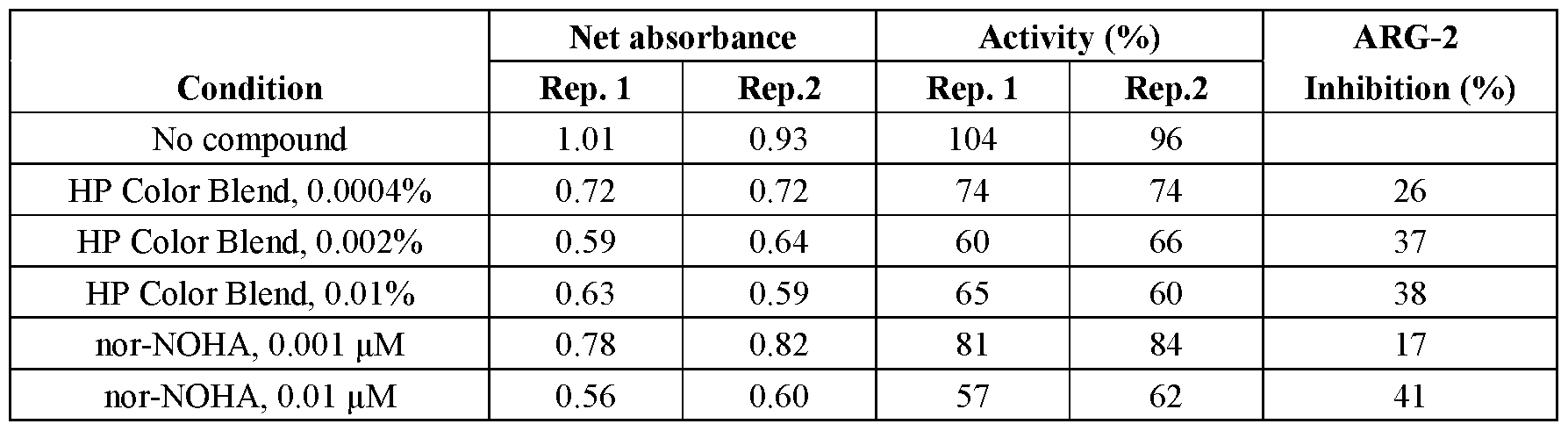
- Assay conditions The assay was performed using human recombinant ARGl or ARG2 as enzymes and thioarginine as substrate. The UV absorbance at 412 nm was correlated with the amount of reaction product of ARG1/ARG2.
- the test sample HP Color Blend
- 5 ⁇ l of 20X sample solutions were added to 90 ⁇ l of substrate, and reactions were started by the addition of 5 ⁇ l of 20X ARG1/ARG2 solutions.
- the assay buffer was added instead of the ARG1/ARG2.
- the resulting 100 ⁇ l reaction mixture contained the indicated amount of the samples, 225 ⁇ M thioarginine, the detection reagent, and 30 nM ARGl or 5 nM ARG2 in 1X ARG Assay Buffer. All reactions were conducted at room temperature and incubated for 30 minutes, ensuring that all wells, containing either samples or controls, contained 0.7% (v/v) EtOH final concentration to discard any solvent effect. UV absorbance readings were done at times 0 and 30 minutes to get net values. Absorbance was measured using a Tecan Infinite Ml 000 microplate reader.
- Results Notably, significant inhibitory activity was found for both ARG-1 and ARG-2 across all tested concentrations as is shown in Tables 11-12 below. As can be readily seen from the results, inhibition relative to the reference inhibitor was significant and not specific towards one or the other of ARG-1 and ARG-2 as is also seen from Table 13. Results are also depicted in FIG.l and FIG.2 for ARG-1 and ARG-2, respectively.
- Assay Conditions The sample was dissolved in 70% EtOH. The serial dilution of the compound was first performed in 70% EtOH with the highest concentration at 1%. Each intermediate compound dilution (in 70% EtOH) will then get directly diluted 10x fold into assay buffer for an intermediate dilution of 7% EtOH in HD AC assay buffer and 5 ⁇ l of the dilution was added to a 50 ⁇ rleaction so that the final concentration of EtOH is 0.7% in all of reactions.
- the enzymatic reactions for the SIRT1 enzyme were conducted in duplicate at 37°C for 30 minutes in a 50 ⁇ ml ixture containing SIRT assay buffer, 5 ⁇ g BSA, an HD AC substrate (see 2.3.1), a SIRT enzyme, and a test compound. After enzymatic reactions, 50 ⁇ l of 2x SIRT Developer was added to each well for the SIRT enzymes and the plate was incubated at room temperature for an additional 15 minutes. Fluorescence intensity was measured at an excitation of 360 nm and an emission of 460 nm using a Tecan Infinite M1000 microplate reader.
- Results The inhibitory results are shown in the table below. The percent inhibition of the compounds against SIRT1 are summarized. The reference compound and tested composition und HP Color Blend precipitated at the 0.01% intermediate dilution step. FIG.3 depicts the results in graphic form, and Table 16 provides results in numerical format. As can be readily appreciated, the tested composition had noticeable SIRT1 inhibitory activity.
- test compound is diluted in 7% ethanol, and 5 ⁇ l of the dilution was added to a 50 ⁇ l reaction so that the final concentration of ethanol is 0.7%.
- the reference compound is diluted in 10% DMSO, and 5 ⁇ l of the dilution was added to a 50 ⁇ l reaction so that the final concentration of DMSO is 1%.
- the binding reactions were conducted at room temperature for 30 minutes in a 50m1 mixture containing lOmM HEPES, pH7.4, 50mM EDTA, 150mM NaCl, 0.05% Tween20, 0.01% BSA, 100nM Keapl, 5nM fluorescence probe and the test compound. Fluorescence intensity was measured at an excitation of 475 nm and an emission of 520 nm using a Tecan Infinite M1000 microplate reader.
- compositions and fractions thereof could reduce binding of SARS-CoV2 spike protein to ACE2, and if vitamins would also have any effect.
- the red blend included Apple Extract, Pomegranate Extract, Tomato Powder, Beet
- the green blend included Olive Extract, Rosemary Extract, Green Coffee Bean Extract, Kale
- the orange/yellow blend included Onion Extract, Ginger Extract, Grapefruit Extract, Carrot
- the purple/blue blend included Grape, Blueberry Extract, Currant, Elderberry as also noted above.
- Table 21 denotes the multivitamin blend
- Table 22 denotes the ACE2/Spike reagents used.
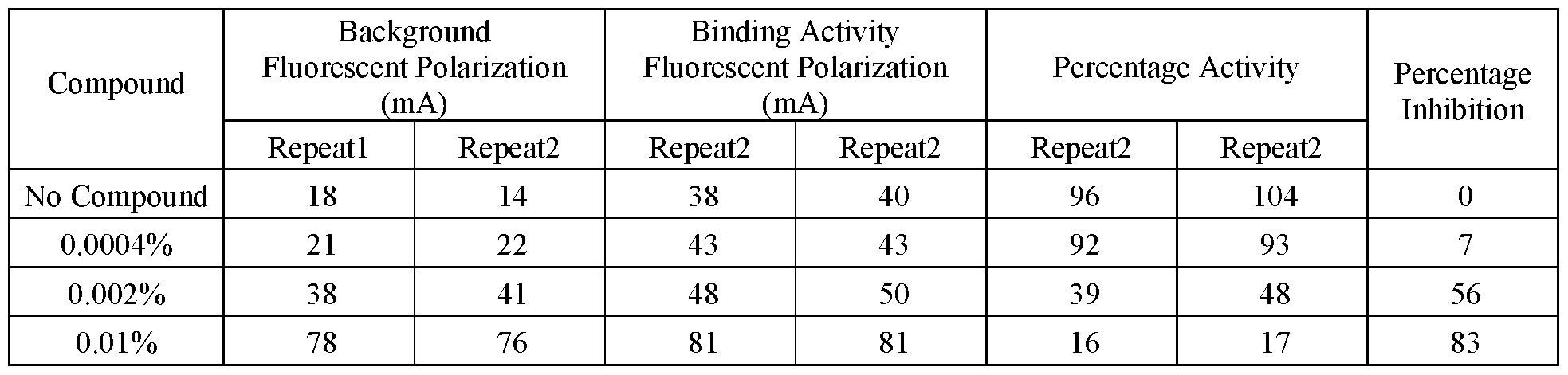
- Assay Conditions Nickel plate was coated at room temperature for 1 hour with 50 ⁇ l of 1 ⁇ g/ml of ACE2-His and washed and blocked before starting the reaction. 10 ⁇ l of compound solutions were incubated with 20 ⁇ l of IX Immune Buffer in ACE2-His-coated assay wells during 30 minutes before starting the reaction by the addition of 20 ⁇ l of 5 ⁇ g/ml Spike SI -Spike. Controls with the same concentration of solvent (EtOH) were included in the study. Reaction was progressed for 1 hour at room temperature. Then, wells were washed three times with IX Immune Buffer and blocked with Blocking Buffer 2 for 10 minutes.
- EtOH solvent
- Results for the representative composition are shown in Table 23 and FIG.5, while results for the multivitamin formulation are shown in Table 24 and FIG.6. Results for the colored blends are shown in Table 25 and FIG.7.
- the representative composition showed synergistic inhibition of ACE2-Spike SI binding, particularly at lower concentrations, whereas the multivitamin formulation had no significant inhibitory effect.
- selected DC-13 and DC9 also had some inhibitory effect per se.
- the red blend included Apple Extract, Pomegranate Extract, Tomato Powder, Beet; the green blend included Olive Extract, Rosemary Extract, Green Coffee Bean Extract, Kale; the orange/yellow blend included Onion Extract, Ginger Extract, Grapefruit Extract, Carrot; and the purple/blue blend included Grape, Blueberry Extract, Currant, and Elderberry as listed above.
- the inventor sought to determine whether the representative compositions and fractions thereof as well as a multivitamin mix had an effect on the activity of recombinant human Cathepsin S using an in vitro enzymatic assay.
- Assay Conditions Cathepsin S was activated by diluting the concentrated storage stock into the acidic assay buffer for 30 minutes at room temperature. Then, 5 ⁇ l of the sample or reference inhibitor was added to 20 ⁇ olf enzyme solution and pre-incubated for 30 minutes. The enzymatic reactions were started by the addition of 25 ⁇ olf the fluorogenic substrate, for a total reaction volume of 50 ⁇ .l Reaction time was 60 minutes, and then fluorescence intensity at an excitation of 360 nm and an emission of 460 nm was read using a Tecan Infinite Ml 000 microplate reader.
- Assay Conditions The assay was performed using Kinase-Glo Plus luminescence kinase assay kit (Promega). It measures kinase activity by quantitating the amount of ATP remaining in solution following a kinase reaction. The luminescent signal from the assay is correlated with the amount of ATP present and is inversely correlated with the amount of kinase activity.
- the reference compound was diluted to 10% DMSO and 5 ⁇ l of the dilution was added to a 50 ⁇ rleaction so that the final concentration of DMSO is 1% in all of reactions.
- the test compound was diluted in water and 5 ⁇ l of the dilution was added to a 50 ⁇ rleaction.
- the 50 ⁇ rleaction mixture contains 40 mM Tris, pH 7.4, 10 mM MgC12, 0.1 mg/ml BSA, 1 mM DTT, 10 mM ATP, Kinase substrate and the enzyme.
- 50 ⁇ l of Kinase-Glo Plus Luminescence kinase assay solution (Promega) was added to each reaction and incubated for 15 minutes, on the plate, at room temperature. Luminescence signal was measured using a BioTek Synergy 2 microplate reader.
- the inventor sought to determine whether the representative compositions had an effect on the enzymatic activities of recombinant human IDO1 and/or IDO2 using an UV absorbance assay.
- Assay Conditions The assay was performed measuring UV absorbance using recombinant IDO and L- Tryptophan as substrate. The UV absorbance at 321 nm is correlated with the amount of N-formylkynurenine, reaction product of IDO.
- the compounds (see 2.2) were diluted in 20 % DMSO and 10 ⁇ l of the dilution was added to a 200 ⁇ l reaction so that the final concentration of DMSO was 1 % in all reactions. All of the reactions were conducted at room temperature.
- the 200 ⁇ l reaction mixture in IDO Assay Buffer contained 400 nM IDO1 or IDO2, the indicated amount of the inhibitor, tryptophan, and the coupled reaction components.
- reaction mixture incubated was for 180 min prior to reading the UV absorbance.
- negative control 10 ⁇ l of the assay buffer was added instead of the IDO enzyme.
- Absorbance was measured using a Tecan Infinite M1000 plate reader.
- the inventor sought to determine whether the representative compositions had an effect on the enzymatic activities of recombinant human NAMPT using an in vitro enzymatic assay.
- Assay Conditions The control compound is dissolved in DMSO. The dilution of the compounds was first performed in 100 % DMSO with the highest concentration at 0.01 mM. Each intermediate compound dilution (in 100 % DMSO) will then get directly diluted 10 x fold into assay buffer for an intermediate dilution of 10 % DMSO in assay buffer and 5 ⁇ l of the dilution was added to a 50 ⁇ l reaction so that the final concentration of DMSO is 1 % in the reactions of the control compound and NAMPT only. For NAMPT, the compounds (see 2.2) were preincubated with NAMPT enzyme (see 2.3.1) in for 30 minutes.
- NAMPT activity assays were performed in duplicates at each concentration.
- the fluorescent intensity data were analyzed using the computer software, GraphPad Prism.
- the fluorescent intensity (Ft) in each data set was defined as 100 % activity.
- the fluorescent intensity (Fb) in each data set was defined as 0 % activity.
- the values of percentage activity were plotted on a bar graph.
- PCSK9 l
- the inventor sought to determine whether the representative compositions had an effect on binding of recombinant human PCSK9 and LDLR using an in vitro ELISA.
- Assay Conditions 5 ⁇ l of sample or reference inhibitor was pre-incubated with 25 ⁇ l of 1X PCSK9 Assay Buffer in assay wells before starting the reaction by the addition of 20 ⁇ l of 2.5 ng/ ⁇ PCSK9-Biotin. Reaction was progressed for 2 hours at room temperature. Then, wells were washed three times with 1X PCSK9 Assay Buffer and blocked with Blocking Buffer for 10 minutes. 100 ⁇ l of Streptavidin-HRP was added to all wells and incubated for 1 hour. Lastly, plate was emptied, washed three times and blocked before the addition of 100 ⁇ l of freshly prepared HRP chemiluminescent substrates to every well. Immediately, the luminescence of the samples was measured in a BioTek Synergy 2 microplate reader.
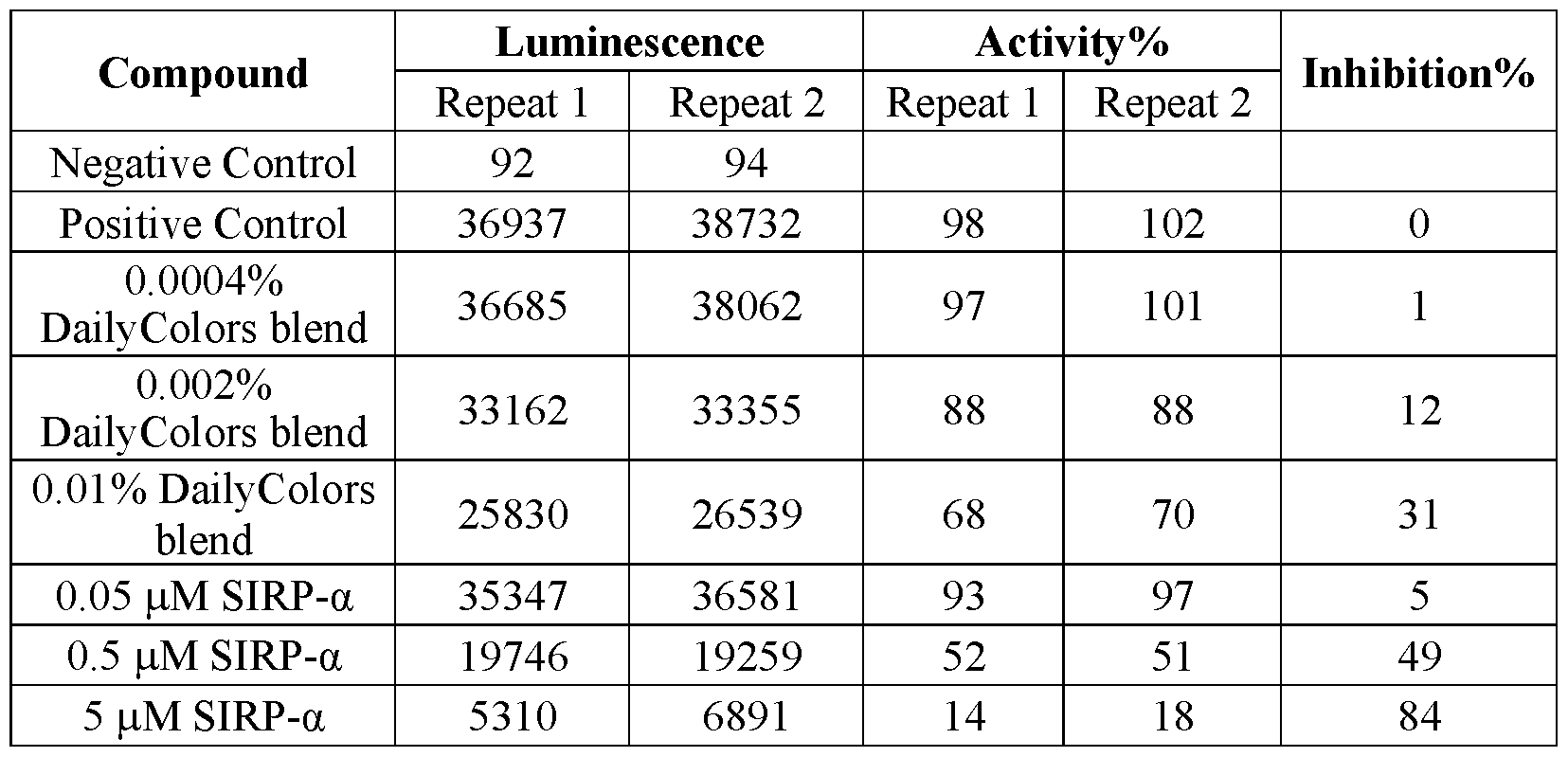
- the inventor further sought to determine whether the representative compositions had an effect on the binding activity of recombinant human CD47 (hCD47) with human SIRP-a (hSIRP-a) using an in vitro binding assay.
- CD47 was coated using 50 ⁇ L at 2 ng/ ⁇ L at 4 °C overnight. After wash and block steps the test compounds were added to CD47-coated plate followed by addition of SIRP-a -biotin. Reaction was incubated for 2 h at room temperature. Binding was detected using HRP-conjugated Streptavidin.
- Binding assays were performed in duplicate at each concentration. The luminescence data were analyzed using the computer software, GraphPad Prism. Percent inhibition was determined by normalizing the data to signal from negative control wells (uncoated wells treated with the biotinylated ligand, set as 100% inhibition) and positive control wells (coated wells treated with the biotinylated ligand in the absence of any inhibitor, set as 0% inhibition).
- the red blend included Apple Extract, Pomegranate Extract, Tomato Powder, Beet; the green blend included Olive Extract, Rosemary Extract, Green Coffee Bean Extract, Kale; the orange/yellow blend included Onion Extract, Ginger Extract, Grapefruit Extract, Carrot; and the purple/blue blend included Grape, Blueberry Extract, Currant, and Elderberry as listed above.
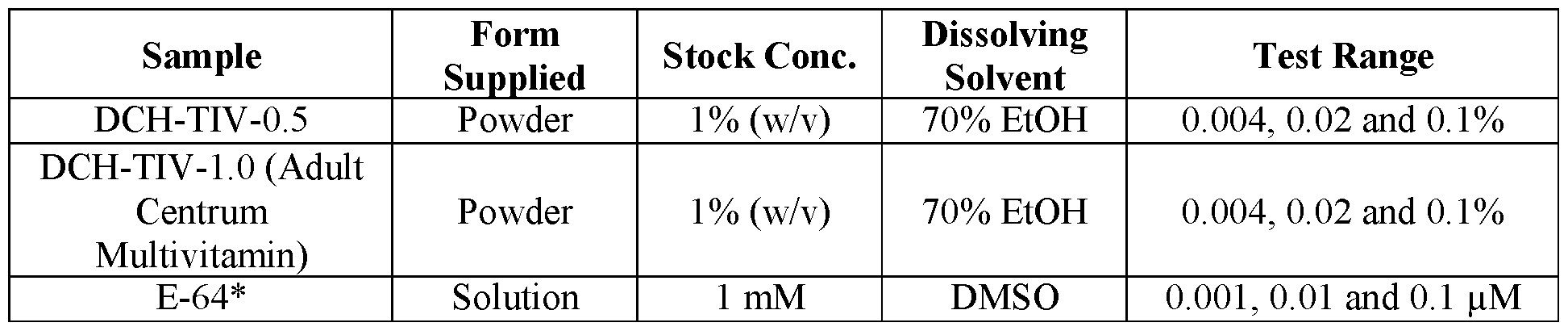
- Table 57 shows two compounds known to influence NAD+ levels: Commercially available “Elysium Health NAD” and “TrueNiagen”, both containing nicotinamide riboside, while Table 58 shows the representative composition (DCH- TIV-0.5) and a multivitamin composition (DCH-TIV- 1.0 (Adult Centrum Multivitamin)).
- Table 59 shows the enzyme and substrate used in this set of experiments.
- Assay Conditions 10 ⁇ L of the sample or reference inhibitor was added to 20 ⁇ L of enzyme solution and pre- incubated for 30 minutes. The enzymatic reactions were started by the addition of 20 ⁇ olf the substrate S-NAD+, for a total reaction volume of 50 ⁇ l. Reaction time was 10 minutes, and then fluorescence intensity at an excitation of 300 nm and an emission of 410 nm was read using a Tecan Infinite M1000 microplate reader.
- Tables 60-63 and FIGS. 20-23 The results for the above substrates are shown in Tables 60-63 and FIGS. 20-23. More specifically, Table 60 and FIG.20 show the results where the representative composition was used for inhibition of CD38. As can be readily seen from the data, the representative composition exhibited remarkably strong inhibition. Table 61 and FIG.21 show the results where the colored fractions of the representative composition was used for inhibition of CD38. Notably, here as well a strong inhibition was observed. Moreover, it should be noted that the colored fractions in the representative composition provided a strong synergistic effect with respect to CD38 inhibition.
- Table 62 and FIG.22 show the results for corresponding experiments where the where the “Elysium Health NAD” and “TrueNiagen” (both containing nicotinamide riboside) were used for inhibition of CD38.
- both formulations showed inhibition of CD38, however, not to the same extent as for the representative composition.
- Table 63 and FIG.23 show the results for corresponding experiments where a multivitamin composition was used to inhibit CD38.
- a direct comparison is shown between the representative composition (DCH-TIV-0.5) and the multivitamin composition (DCH-TIV-1.0 in Table 63, DCH-TIG-1.0 in FIG.23).
- JAK1/JAK2/JAK3 [00160] In further experiments, the inventor sought to determine whether the representative compositions and fractions thereof had an effect on the enzymatic activities of the recombinant human kinases JAK1, JAK2, and JAK3 using an in vitro enzymatic assay.
- Assay Conditions The assay was performed using Kinase-Glo Plus luminescence kinase assay kit (Promega). It measures kinase activity by quantitating the amount of ATP remaining in solution following a kinase reaction. The luminescent signal from the assay is correlated with the amount of ATP present and is inversely correlated with the amount of kinase activity.
- the reference compound was diluted as noted. The compound was diluted in water and 5 ⁇ l of the dilution was added to a 50 ⁇ l reaction. All of the enzymatic reactions were conducted at 30oC for 45 minutes.
- the 50 ⁇ l reaction mixture contains 40 mM Tris, pH 7.4, 10 mM MgCl2, 0.1 mg/ml BSA, 1 mM DTT, 10 mM ATP, Kinase substrate and the respective enzyme.
- 50 ⁇ l of Kinase-Glo Plus Luminescence kinase assay solution (Promega) was added to each reaction and incubate the plate for 15 minutes at room temperature. Luminescence signal was measured using a BioTek Synergy 2 microplate reader.
- Tables 67-69 and FIGS. 24-26 show results for JAK1 inhibition using the representative composition.
- Table 68 and FIG.25 show results for JAK2 inhibition using the representative composition.
- Table 69 and FIG.26 show results for JAK3 inhibition using the representative composition.
- Tables 70-72 and FIGS. 27-29 show corresponding results for the colored fractions.
- Table 70 shows results for JAK1 inhibition using colored fractions of the representative composition.
- Table 71 shows results for JAK2 inhibition using colored fractions of the representative composition, and
- Table 72 shows results for JAK3 inhibition using colored fractions of the representative composition.
- Table 73 is a summary table of the results in Tables 70-72.
- a synergistic effect on inhibition against all three JAK kinases was observed at high concentrations where all colored fractions were used together in the representative composition as compared to individual colored fractions.
- the compositions presented herein had similar inhibitory properties as compared to the reference compound.
- the inventor sought to determine whether the representative compositions had an effect on the enzymatic activity of recombinant human CD39 using an in vitro enzymatic assay.
- Tables 74-77 Reagents used are shown in Tables 74-77 below and tested as stated unless indicated otherwise (*POM-l was used as reference compound).
- Table 74 shows the representative composition at standard concentrations
- Table 75 shows the representative composition at low concentrations.
- Table 76 shows colored fractions of the representative composition at standard concentrations.
- D5 is the Yellow Blend
- D9 is the Purple Blend
- D21 is the Green Blend
- D13 is the Red Blend
- D31 CBD.
- the red blend included Apple Extract, Pomegranate Extract, Tomato Powder, Beet; the green blend included Olive Extract, Rosemary Extract, Green Coffee Bean Extract, Kale; the orange/yellow blend included Onion Extract, Ginger Extract, Grapefruit Extract, Carrot; and the purple/blue blend included Grape, Blueberry Extract, Currant, Elderberry.
- Table 77 lists CD39. Table 74
- Assay Conditions In general, all assays points were done by following the CD39 and CD73 Inhibitor Screening Assay Kit protocol (BPS Bioscience, #79278 and 72055, respectively).
- the CD39 enzymatic reactions were conducted in duplicate at room temperature for 30 minutes in a 50 ⁇ l mixture containing assay buffer, ATP, CD39 enzymes, and the test compound. Test compounds were preincubated with the enzyme for 30 minutes. Reactions were started by addition of the substrate. The 50 ⁇ l reactions were carried out in a 96-well transparent plate. After enzymatic reactions, 100 ⁇ l of Colorimetric Detection Reagent was added to the reaction mix. After a 15 minutes incubation, absorbance was measured using a Tecan plate reader at 630 nm.
- the inventor also investigated whether CD39 could also be inhibited by a multivitamin mix.
- a comparative experiment was conducted between a multivitamin mix (denoted as DCH-TIV-1.0 (Adult Centrum Multivitamin)) and the representative composition (denoted as DCH-TIC-0.5) using the same experimental procedure for CD39 as described above.
- the compositions are shown in Table 83.
- the inventor further sought to determine whether the representative compositions had an effect on the enzymatic activity of recombinant human CD73 using an in vitro enzymatic assay.
- Table 85 shows the representative composition at standard concentrations
- Table 86 shows colored fractions of the representative composition at standard concentrations.
- D5 is the Yellow Blend
- D9 is the Purple Blend
- D21 is the Green Blend
- D13 is the Red Blend
- D31 is CBD.
- the red blend included Apple Extract, Pomegranate Extract, Tomato Powder, Beet
- the green blend included Olive Extract, Rosemary Extract, Green Coffee Bean Extract, Kale
- the orange/yellow blend included Onion Extract, Ginger Extract, Grapefruit Extract, Carrot
- the purple/blue blend included Grape, Blueberry Extract, Currant, Elderberry.
- Table 87 lists CD73.
- Assay Conditions In general, all assays points were done by following the CD39 and CD73 Inhibitor Screening Assay Kit protocol (BPS Bioscience, #79278 and 72055, respectively).
- the CD73 enzymatic reactions were conducted in duplicate at room temperature for 30 minutes in a 50 ⁇ l mixture containing assay buffer, ADP, CD73 enzymes, and the test compound. Test compounds were preincubated with the enzyme for 30 minutes. Reactions were started by addition of the substrate. The 50 ⁇ l reactions were carried out in a 96-well transparent plate. After enzymatic reactions, 100 ⁇ l of Colorimetric Detection Reagent was added to the reaction mix. After a 15 minutes incubation, absorbance was measured using a Tecan plate reader at 630 nm.
- the numbers expressing quantities of ingredients, properties such as concentration, reaction conditions, and so forth, used to describe and claim certain embodiments of the invention are to be understood as being modified in some instances by the term “about.” Accordingly, in some embodiments, the numerical parameters set forth in the written description and attached claims are approximations that can vary depending upon the desired properties sought to be obtained by a particular embodiment. The recitation of ranges of values herein is merely intended to serve as a shorthand method of referring individually to each separate value falling within the range. Unless otherwise indicated herein, each individual value is incorporated into the specification as if it were individually recited herein.
- administering refers to both direct and indirect administration of the pharmaceutical or nutraceutical composition, wherein direct administration of the pharmaceutical or nutraceutical composition is typically performed by a health care professional (e.g., physician, nurse, dietitian, etc.), and wherein indirect administration includes a step of providing or making available the pharmaceutical or nutraceutical composition to the health care professional or individual in need thereof for direct administration (e.g., via injection, infusion, oral delivery, topical delivery, etc.).
- a health care professional e.g., physician, nurse, dietitian, etc.
- indirect administration includes a step of providing or making available the pharmaceutical or nutraceutical composition to the health care professional or individual in need thereof for direct administration (e.g., via injection, infusion, oral delivery, topical delivery, etc.).
- the terms “prognosing” or “predicting” a condition, a susceptibility for development of a disease, or a response to an intended treatment is meant to cover the act of predicting or the prediction (but not treatment or diagnosis of) the condition, susceptibility and/or response, including the rate of progression, improvement, and/or duration of the condition in a subject.
- Coupled to is intended to include both direct coupling (in which two elements that are coupled to each other contact each other) and indirect coupling (in which at least one additional element is located between the two elements). Therefore, the terms “coupled to” and “coupled with” are used synonymously.
Landscapes
- Health & Medical Sciences (AREA)
- Natural Medicines & Medicinal Plants (AREA)
- Life Sciences & Earth Sciences (AREA)
- Chemical & Material Sciences (AREA)
- Engineering & Computer Science (AREA)
- Veterinary Medicine (AREA)
- Animal Behavior & Ethology (AREA)
- Public Health (AREA)
- Medicinal Chemistry (AREA)
- General Health & Medical Sciences (AREA)
- Pharmacology & Pharmacy (AREA)
- Mycology (AREA)
- Epidemiology (AREA)
- Botany (AREA)
- Biotechnology (AREA)
- Microbiology (AREA)
- Medical Informatics (AREA)
- Alternative & Traditional Medicine (AREA)
- Nutrition Science (AREA)
- Food Science & Technology (AREA)
- Polymers & Plastics (AREA)
- Bioinformatics & Cheminformatics (AREA)
- Chemical Kinetics & Catalysis (AREA)
- Organic Chemistry (AREA)
- Nuclear Medicine, Radiotherapy & Molecular Imaging (AREA)
- General Chemical & Material Sciences (AREA)
- Physiology (AREA)
- Inorganic Chemistry (AREA)
- Obesity (AREA)
- Hematology (AREA)
- Diabetes (AREA)
- Cardiology (AREA)
- Heart & Thoracic Surgery (AREA)
- Biomedical Technology (AREA)
- Neurology (AREA)
- Neurosurgery (AREA)
- Immunology (AREA)
- Biochemistry (AREA)
- Toxicology (AREA)
- Medicines Containing Plant Substances (AREA)
Abstract
Description





















Claims
Priority Applications (8)
| Application Number | Priority Date | Filing Date | Title |
|---|---|---|---|
| KR1020227030551A KR20220141310A (en) | 2020-02-05 | 2021-02-04 | COMPOSITIONS AND METHODS FOR NUTRITIONAL SUPPLEMENTS |
| AU2021216555A AU2021216555B2 (en) | 2020-02-05 | 2021-02-04 | Compositions and methods for nutritional supplements |
| EP21750338.2A EP4100033B1 (en) | 2020-02-05 | 2021-02-04 | Plant compositions and methods for nutritional supplements |
| CN202180025495.1A CN115335068A (en) | 2020-02-05 | 2021-02-04 | Compositions and methods for nutritional supplements |
| PL21750338.2T PL4100033T3 (en) | 2020-02-05 | 2021-02-04 | Plant compositions and methods for nutritional supplements |
| CA3166761A CA3166761C (en) | 2020-02-05 | 2021-02-04 | Compositions and methods for nutritional supplements |
| JP2022547864A JP7606526B2 (en) | 2020-02-05 | 2021-02-04 | Dietary Supplement Compositions and Methods |
| JP2024163453A JP2025004025A (en) | 2020-02-05 | 2024-09-20 | Dietary Supplement Compositions and Methods |
Applications Claiming Priority (6)
| Application Number | Priority Date | Filing Date | Title |
|---|---|---|---|
| US202062970615P | 2020-02-05 | 2020-02-05 | |
| US62/970,615 | 2020-02-05 | ||
| US202063010183P | 2020-04-15 | 2020-04-15 | |
| US63/010,183 | 2020-04-15 | ||
| US202063086207P | 2020-10-01 | 2020-10-01 | |
| US63/086,207 | 2020-10-01 |
Publications (1)
| Publication Number | Publication Date |
|---|---|
| WO2021158825A1 true WO2021158825A1 (en) | 2021-08-12 |
Family
ID=76862641
Family Applications (1)
| Application Number | Title | Priority Date | Filing Date |
|---|---|---|---|
| PCT/US2021/016670 Ceased WO2021158825A1 (en) | 2020-02-05 | 2021-02-04 | Compositions and methods for nutritional supplements |
Country Status (8)
| Country | Link |
|---|---|
| US (4) | US11065295B1 (en) |
| EP (1) | EP4100033B1 (en) |
| JP (2) | JP7606526B2 (en) |
| KR (1) | KR20220141310A (en) |
| CN (1) | CN115335068A (en) |
| AU (1) | AU2021216555B2 (en) |
| PL (1) | PL4100033T3 (en) |
| WO (1) | WO2021158825A1 (en) |
Cited By (2)
| Publication number | Priority date | Publication date | Assignee | Title |
|---|---|---|---|---|
| WO2023278181A1 (en) | 2021-06-28 | 2023-01-05 | DailyColors Health Inc. | Compositions and methods to counteract processes associated with inflammation and senescence and to support cellular energy and/or metabolism |
| IT202400002524A1 (en) * | 2024-02-07 | 2025-08-07 | Gerardo Cioffi | ELDERBERRY EXTRACT AND ITS USE IN THE PREVENTION OR TREATMENT OF TUMORS |
Families Citing this family (4)
| Publication number | Priority date | Publication date | Assignee | Title |
|---|---|---|---|---|
| CN113413378A (en) * | 2021-07-07 | 2021-09-21 | 四川九章生物科技有限公司 | Application of chlorogenic acid-containing pharmaceutical composition in preparation of medicines for treating early-stage Alzheimer's disease |
| CN116114878A (en) * | 2022-12-09 | 2023-05-16 | 南京纽邦生物科技有限公司 | Plant source composition |
| AU2024240033A1 (en) * | 2023-03-17 | 2025-09-11 | Bimini, Llc | Gastrointestinal health supplements |
| WO2025072329A1 (en) * | 2023-09-26 | 2025-04-03 | DailyColors Health Inc. | Compositions and methods for enhancing healthspan |
Citations (2)
| Publication number | Priority date | Publication date | Assignee | Title |
|---|---|---|---|---|
| KR20090078939A (en) * | 2008-01-16 | 2009-07-21 | 한국화학연구원 | Composition for preventing or treating degenerative brain disease containing polyphenolic compound |
| KR20180020718A (en) * | 2016-08-19 | 2018-02-28 | 동아대학교 산학협력단 | Composition for preventing or treating neurodegenerative disease comprising isoflavone as active ingredient |
Family Cites Families (17)
| Publication number | Priority date | Publication date | Assignee | Title |
|---|---|---|---|---|
| CN1290446C (en) * | 2002-07-17 | 2006-12-20 | 上海围城自由基生物工程研究所 | Nutritive sports beverage |
| CN101365431A (en) * | 2005-10-14 | 2009-02-11 | 帝斯曼知识产权资产管理有限公司 | Novel uses of nutraceutical compositions comprising resveratrol |
| CN101467690A (en) * | 2007-12-27 | 2009-07-01 | 百泰生物科技股份有限公司 | Nutritional composition containing five kinds of processed vegetable and fruit |
| US9132162B2 (en) * | 2008-07-31 | 2015-09-15 | Shaklee Corporation | Muscadine compositions with anti-oxidant activity |
| CA2758916A1 (en) * | 2009-04-15 | 2010-10-21 | Pui-Kai Li | Curcumin analogs as dual jak2/stat3 inhibitors and methods of making and using the same |
| WO2010135589A2 (en) * | 2009-05-20 | 2010-11-25 | Sakura Properties, Llc | Dietary supplement drink for delivery of resveratrol and other polyphenols |
| RU2631597C2 (en) * | 2011-07-15 | 2017-09-25 | Нусерт Сайенсиз, Инк. | Compositions and methods for metabolic pathway modulation |
| CN102697118B (en) * | 2012-06-09 | 2014-04-30 | 东莞市照燕生物科技有限公司 | Formula of anti-oxidation anti-cancer fruit and vegetable juice and preparation technology for fruit and vegetable juice |
| US20150190450A1 (en) * | 2014-01-05 | 2015-07-09 | Alice Chang | Ingredient for consumption and application |
| TWI759260B (en) * | 2015-01-02 | 2022-04-01 | 美商梅拉洛伊卡公司 | Multi-supplement compositions |
| EP3270707B1 (en) * | 2015-03-16 | 2020-10-28 | Nature's Sunshine Products Inc. | Phytocomplexes exhibiting multiple, synergistic antioxidant activities |
| WO2016164743A2 (en) * | 2015-04-10 | 2016-10-13 | The Methodist Hospital System | Cd38 ligand-drug conjugates for targeted cancer therapy |
| TWI736755B (en) * | 2017-04-03 | 2021-08-21 | 大江生醫股份有限公司 | Composition containing plant extracts and uses thereof for reducing uv-induced skin damage |
| US11730749B2 (en) | 2017-05-05 | 2023-08-22 | Plexus Worldwide, Llc | Compositions and methods for improving gut health |
| US11007171B2 (en) * | 2017-07-13 | 2021-05-18 | Summit Innovation Labs, LLC | Treatment and prevention of joint disorders |
| WO2019092896A1 (en) | 2017-11-08 | 2019-05-16 | アサヒグループホールディングス株式会社 | Akkermansia muciniphila proliferation material |
| CN108541953A (en) | 2018-04-23 | 2018-09-18 | 张清禹 | It is a kind of that there is the composition for adjusting enteric microorganism structure and being proliferated thermophilic mucin Ah Kaman Salmonella |
-
2021
- 2021-02-04 KR KR1020227030551A patent/KR20220141310A/en not_active Ceased
- 2021-02-04 JP JP2022547864A patent/JP7606526B2/en active Active
- 2021-02-04 AU AU2021216555A patent/AU2021216555B2/en active Active
- 2021-02-04 CN CN202180025495.1A patent/CN115335068A/en active Pending
- 2021-02-04 WO PCT/US2021/016670 patent/WO2021158825A1/en not_active Ceased
- 2021-02-04 US US17/167,998 patent/US11065295B1/en active Active
- 2021-02-04 PL PL21750338.2T patent/PL4100033T3/en unknown
- 2021-02-04 EP EP21750338.2A patent/EP4100033B1/en active Active
- 2021-06-28 US US17/360,261 patent/US11202816B1/en active Active
- 2021-10-22 US US17/508,543 patent/US11246903B1/en active Active
-
2022
- 2022-01-03 US US17/567,751 patent/US11752188B2/en active Active
-
2024
- 2024-09-20 JP JP2024163453A patent/JP2025004025A/en active Pending
Patent Citations (2)
| Publication number | Priority date | Publication date | Assignee | Title |
|---|---|---|---|---|
| KR20090078939A (en) * | 2008-01-16 | 2009-07-21 | 한국화학연구원 | Composition for preventing or treating degenerative brain disease containing polyphenolic compound |
| KR20180020718A (en) * | 2016-08-19 | 2018-02-28 | 동아대학교 산학협력단 | Composition for preventing or treating neurodegenerative disease comprising isoflavone as active ingredient |
Non-Patent Citations (21)
| Title |
|---|
| ANNU. REV. FOOD SCI. TECHNOL, 2020, pages 1 - 38 |
| BEECHER GARY R.: "Overview of Dietary Flavonoids: Nomenclature, Occurrence and Intake", THE JOURNAL OF NUTRITION, AMERICAN SOCIETY FOR NUTRITION, US, vol. 133, no. 10, 1 October 2003 (2003-10-01), US, pages 3248S - 3254S, XP055833018, ISSN: 0022-3166, DOI: 10.1093/jn/133.10.3248S * |
| BIOCHEM BIOPHYS RES COMMUN, vol. 513, no. 2, 28 May 2019 (2019-05-28), pages 486 - 493 |
| CANCER RES., vol. 77, no. 24, 15 December 2017 (2017-12-15), pages 6795 - 6811 |
| CELL REPORTS, vol. 31, 14 April 2020 (2020-04-14), pages 107494 |
| CELLS, vol. 9, 2020, pages 1451 |
| CURR PHARM DES, vol. 22, no. 5, 2016, pages 527 - 534 |
| FIMMU, vol. 10, May 2019 (2019-05-01), pages 1187 |
| FIMMU, vol. 8, June 2017 (2017-06-01) |
| HUANG PAN; ZHENG NAN; ZHOU HAI-BING; HUANG JIAN: "Curcumin inhibits BACE1 expression through the interaction between ERβ and NFκB signaling pathway in SH-SY5Y cells", MOLECULAR AND CELLULAR BIOCHEMISTRY, NORWELL, MA, US, vol. 463, no. 1-2, 8 October 2019 (2019-10-08), US, pages 161 - 173, XP036981287, ISSN: 0300-8177, DOI: 10.1007/s11010-019-03638-0 * |
| IMMUNITY & AGEING, vol. 8, 2011, pages 9 |
| IMMUNOL REV, vol. 276, no. 1, March 2017 (2017-03-01), pages 121 - 144 |
| INHIBITORY PROPERTIES OF PHENOLIC COMPOUNDS AGAINST ENZYMES LINKED WITH HUMAN DISEASES, Retrieved from the Internet <URL:URL:dx.doi.org/10.5772/66844> |
| J ALZHEIMERS DIS, vol. 22, no. 2, 2010, pages 483 - 492 |
| JAMA, vol. 306, no. 10, 14 September 2011 (2011-09-14), pages 1113 |
| LAKEY-BEITIA JOHANT; BERROCAL RUBEN; RAO K. S.; DURANT ARMANDO A.: "Polyphenols as Therapeutic Molecules in Alzheimer’s Disease Through Modulating Amyloid Path", MOLECULAR NEUROBIOLOGY, HUMANA PRESS, US, vol. 51, no. 2, 15 May 2014 (2014-05-15), US, pages 466 - 479, XP035469219, ISSN: 0893-7648, DOI: 10.1007/s12035-014-8722-9 * |
| MOLECULES, vol. 22, no. 10, 13 October 2017 (2017-10-13), pages 1723 |
| NUTRIENTS, vol. 10, 2018, pages 379 |
| PHYSIOL REV, vol. 98, 2018, pages 641 - 665 |
| See also references of EP4100033A4 |
| TRENDS PHARMACOL SCI, vol. 39, no. 4, April 2018 (2018-04-01), pages 424 - 436 |
Cited By (5)
| Publication number | Priority date | Publication date | Assignee | Title |
|---|---|---|---|---|
| WO2023278181A1 (en) | 2021-06-28 | 2023-01-05 | DailyColors Health Inc. | Compositions and methods to counteract processes associated with inflammation and senescence and to support cellular energy and/or metabolism |
| EP4362707A4 (en) * | 2021-06-28 | 2024-11-20 | Dailycolors Health Inc. | Compositions and methods to counteract processes associated with inflammation and senescence and to support cellular energy and/or metabolism |
| US12213506B2 (en) | 2021-06-28 | 2025-02-04 | DailyColors Health Inc. | Compositions and methods to counteract processes associated with inflammation and senescence and to support cellular energy and/or metabolism |
| IT202400002524A1 (en) * | 2024-02-07 | 2025-08-07 | Gerardo Cioffi | ELDERBERRY EXTRACT AND ITS USE IN THE PREVENTION OR TREATMENT OF TUMORS |
| WO2025169041A1 (en) * | 2024-02-07 | 2025-08-14 | Cioffi Gerardo | Elderberry extract and its use in the prevention or in the treatment of tumours |
Also Published As
| Publication number | Publication date |
|---|---|
| EP4100033C0 (en) | 2025-12-24 |
| JP2023512778A (en) | 2023-03-29 |
| US20220040251A1 (en) | 2022-02-10 |
| CA3166761A1 (en) | 2021-08-12 |
| AU2021216555A1 (en) | 2022-08-25 |
| US20220125871A1 (en) | 2022-04-28 |
| EP4100033A1 (en) | 2022-12-14 |
| US11065295B1 (en) | 2021-07-20 |
| AU2021216555B2 (en) | 2024-11-14 |
| EP4100033B1 (en) | 2025-12-24 |
| KR20220141310A (en) | 2022-10-19 |
| US11246903B1 (en) | 2022-02-15 |
| EP4100033A4 (en) | 2024-03-13 |
| CN115335068A (en) | 2022-11-11 |
| JP2025004025A (en) | 2025-01-14 |
| JP7606526B2 (en) | 2024-12-25 |
| US20210244786A1 (en) | 2021-08-12 |
| US11752188B2 (en) | 2023-09-12 |
| PL4100033T3 (en) | 2026-04-13 |
| US11202816B1 (en) | 2021-12-21 |
Similar Documents
| Publication | Publication Date | Title |
|---|---|---|
| EP4100033B1 (en) | Plant compositions and methods for nutritional supplements | |
| Mertens-Talcott et al. | Pharmacokinetics of anthocyanins and antioxidant effects after the consumption of anthocyanin-rich acai juice and pulp (Euterpe oleracea Mart.) in human healthy volunteers | |
| US11331363B2 (en) | Phytocomplexes exhibiting multiple, synergistic antioxidant activities useful in foods, dietary supplements, cosmetics and pharmaceutical preparations | |
| RU2563991C2 (en) | Synergistic combinations of carotenoids and polyphenols | |
| KR20110122158A (en) | Composition from Sparanthus indicus and Garcinia mangostana for the control of metabolic syndrome | |
| US9820963B2 (en) | Composition containing lignan compound as active ingredient for preventing or treating cancer | |
| US20220257532A1 (en) | Compositions containing pterosin compound and derivatives thereof active ingredients for prevention or treatment of degenerative brain diseases | |
| CA3166761C (en) | Compositions and methods for nutritional supplements | |
| HK40083402A (en) | Compositions and methods for nutritional supplements | |
| JP7819965B2 (en) | TRPV1 activator | |
| KR20060131065A (en) | Compositions containing chlorophylls with antioxidant, anti-aging or anti-inflammatory activity | |
| KR20200034075A (en) | Fine dust and heavy metal-related anti-inflammatory composition comprising actinidia arguta extract | |
| US20180092934A1 (en) | Composition for dna protection | |
| KR20260012942A (en) | Composition for preventing or treating diseases related to FUS or TDP-43 comprising dehydrocostus lactone | |
| KR20120019359A (en) | Anti-cancer adjuvant comprising undecylenic acid, conjugated linoleic acid and/or conjugated linoleic acid isoform |
Legal Events
| Date | Code | Title | Description |
|---|---|---|---|
| 121 | Ep: the epo has been informed by wipo that ep was designated in this application |
Ref document number: 21750338 Country of ref document: EP Kind code of ref document: A1 |
|
| DPE1 | Request for preliminary examination filed after expiration of 19th month from priority date (pct application filed from 20040101) | ||
| ENP | Entry into the national phase |
Ref document number: 3166761 Country of ref document: CA |
|
| ENP | Entry into the national phase |
Ref document number: 2022547864 Country of ref document: JP Kind code of ref document: A |
|
| ENP | Entry into the national phase |
Ref document number: 2021216555 Country of ref document: AU Date of ref document: 20210204 Kind code of ref document: A |
|
| ENP | Entry into the national phase |
Ref document number: 20227030551 Country of ref document: KR Kind code of ref document: A |
|
| NENP | Non-entry into the national phase |
Ref country code: DE |
|
| ENP | Entry into the national phase |
Ref document number: 2021750338 Country of ref document: EP Effective date: 20220905 |
|
| WWR | Wipo information: refused in national office |
Ref document number: 1020227030551 Country of ref document: KR |
|
| WWG | Wipo information: grant in national office |
Ref document number: 2021750338 Country of ref document: EP |