WO2021161148A1 - Antimicrobial compositions containing peroxyphthalic acid and/or salt thereof - Google Patents
Antimicrobial compositions containing peroxyphthalic acid and/or salt thereof Download PDFInfo
- Publication number
- WO2021161148A1 WO2021161148A1 PCT/IB2021/051004 IB2021051004W WO2021161148A1 WO 2021161148 A1 WO2021161148 A1 WO 2021161148A1 IB 2021051004 W IB2021051004 W IB 2021051004W WO 2021161148 A1 WO2021161148 A1 WO 2021161148A1
- Authority
- WO
- WIPO (PCT)
- Prior art keywords
- acid
- agents
- salts
- effective amount
- composition
- Prior art date
- Legal status (The legal status is an assumption and is not a legal conclusion. Google has not performed a legal analysis and makes no representation as to the accuracy of the status listed.)
- Ceased
Links
Classifications
-
- A—HUMAN NECESSITIES
- A01—AGRICULTURE; FORESTRY; ANIMAL HUSBANDRY; HUNTING; TRAPPING; FISHING
- A01N—PRESERVATION OF BODIES OF HUMANS OR ANIMALS OR PLANTS OR PARTS THEREOF; BIOCIDES, e.g. AS DISINFECTANTS, AS PESTICIDES OR AS HERBICIDES; PEST REPELLANTS OR ATTRACTANTS; PLANT GROWTH REGULATORS
- A01N37/00—Biocides, pest repellants or attractants, or plant growth regulators containing organic compounds containing a carbon atom having three bonds to hetero atoms with at the most two bonds to halogen, e.g. carboxylic acids
- A01N37/06—Unsaturated carboxylic acids or thio analogues thereof; Derivatives thereof
-
- A—HUMAN NECESSITIES
- A01—AGRICULTURE; FORESTRY; ANIMAL HUSBANDRY; HUNTING; TRAPPING; FISHING
- A01N—PRESERVATION OF BODIES OF HUMANS OR ANIMALS OR PLANTS OR PARTS THEREOF; BIOCIDES, e.g. AS DISINFECTANTS, AS PESTICIDES OR AS HERBICIDES; PEST REPELLANTS OR ATTRACTANTS; PLANT GROWTH REGULATORS
- A01N37/00—Biocides, pest repellants or attractants, or plant growth regulators containing organic compounds containing a carbon atom having three bonds to hetero atoms with at the most two bonds to halogen, e.g. carboxylic acids
- A01N37/10—Aromatic or araliphatic carboxylic acids, or thio analogues thereof; Derivatives thereof
-
- A—HUMAN NECESSITIES
- A01—AGRICULTURE; FORESTRY; ANIMAL HUSBANDRY; HUNTING; TRAPPING; FISHING
- A01N—PRESERVATION OF BODIES OF HUMANS OR ANIMALS OR PLANTS OR PARTS THEREOF; BIOCIDES, e.g. AS DISINFECTANTS, AS PESTICIDES OR AS HERBICIDES; PEST REPELLANTS OR ATTRACTANTS; PLANT GROWTH REGULATORS
- A01N37/00—Biocides, pest repellants or attractants, or plant growth regulators containing organic compounds containing a carbon atom having three bonds to hetero atoms with at the most two bonds to halogen, e.g. carboxylic acids
- A01N37/16—Biocides, pest repellants or attractants, or plant growth regulators containing organic compounds containing a carbon atom having three bonds to hetero atoms with at the most two bonds to halogen, e.g. carboxylic acids containing the group; Thio analogues thereof
-
- A—HUMAN NECESSITIES
- A01—AGRICULTURE; FORESTRY; ANIMAL HUSBANDRY; HUNTING; TRAPPING; FISHING
- A01N—PRESERVATION OF BODIES OF HUMANS OR ANIMALS OR PLANTS OR PARTS THEREOF; BIOCIDES, e.g. AS DISINFECTANTS, AS PESTICIDES OR AS HERBICIDES; PEST REPELLANTS OR ATTRACTANTS; PLANT GROWTH REGULATORS
- A01N37/00—Biocides, pest repellants or attractants, or plant growth regulators containing organic compounds containing a carbon atom having three bonds to hetero atoms with at the most two bonds to halogen, e.g. carboxylic acids
- A01N37/36—Biocides, pest repellants or attractants, or plant growth regulators containing organic compounds containing a carbon atom having three bonds to hetero atoms with at the most two bonds to halogen, e.g. carboxylic acids containing at least one carboxylic group or a thio analogue, or a derivative thereof, and a singly bound oxygen or sulfur atom attached to the same carbon skeleton, this oxygen or sulfur atom not being a member of a carboxylic group or of a thio analogue, or of a derivative thereof, e.g. hydroxy-carboxylic acids
-
- A—HUMAN NECESSITIES
- A01—AGRICULTURE; FORESTRY; ANIMAL HUSBANDRY; HUNTING; TRAPPING; FISHING
- A01N—PRESERVATION OF BODIES OF HUMANS OR ANIMALS OR PLANTS OR PARTS THEREOF; BIOCIDES, e.g. AS DISINFECTANTS, AS PESTICIDES OR AS HERBICIDES; PEST REPELLANTS OR ATTRACTANTS; PLANT GROWTH REGULATORS
- A01N59/00—Biocides, pest repellants or attractants, or plant growth regulators containing elements or inorganic compounds
- A01N59/06—Aluminium; Calcium; Magnesium; Compounds thereof
-
- A—HUMAN NECESSITIES
- A01—AGRICULTURE; FORESTRY; ANIMAL HUSBANDRY; HUNTING; TRAPPING; FISHING
- A01N—PRESERVATION OF BODIES OF HUMANS OR ANIMALS OR PLANTS OR PARTS THEREOF; BIOCIDES, e.g. AS DISINFECTANTS, AS PESTICIDES OR AS HERBICIDES; PEST REPELLANTS OR ATTRACTANTS; PLANT GROWTH REGULATORS
- A01N59/00—Biocides, pest repellants or attractants, or plant growth regulators containing elements or inorganic compounds
- A01N59/16—Heavy metals; Compounds thereof
-
- A—HUMAN NECESSITIES
- A01—AGRICULTURE; FORESTRY; ANIMAL HUSBANDRY; HUNTING; TRAPPING; FISHING
- A01N—PRESERVATION OF BODIES OF HUMANS OR ANIMALS OR PLANTS OR PARTS THEREOF; BIOCIDES, e.g. AS DISINFECTANTS, AS PESTICIDES OR AS HERBICIDES; PEST REPELLANTS OR ATTRACTANTS; PLANT GROWTH REGULATORS
- A01N59/00—Biocides, pest repellants or attractants, or plant growth regulators containing elements or inorganic compounds
- A01N59/16—Heavy metals; Compounds thereof
- A01N59/20—Copper
-
- A—HUMAN NECESSITIES
- A01—AGRICULTURE; FORESTRY; ANIMAL HUSBANDRY; HUNTING; TRAPPING; FISHING
- A01N—PRESERVATION OF BODIES OF HUMANS OR ANIMALS OR PLANTS OR PARTS THEREOF; BIOCIDES, e.g. AS DISINFECTANTS, AS PESTICIDES OR AS HERBICIDES; PEST REPELLANTS OR ATTRACTANTS; PLANT GROWTH REGULATORS
- A01N59/00—Biocides, pest repellants or attractants, or plant growth regulators containing elements or inorganic compounds
- A01N59/26—Phosphorus; Compounds thereof
-
- A—HUMAN NECESSITIES
- A01—AGRICULTURE; FORESTRY; ANIMAL HUSBANDRY; HUNTING; TRAPPING; FISHING
- A01P—BIOCIDAL, PEST REPELLANT, PEST ATTRACTANT OR PLANT GROWTH REGULATORY ACTIVITY OF CHEMICAL COMPOUNDS OR PREPARATIONS
- A01P1/00—Disinfectants; Antimicrobial compounds or mixtures thereof
Definitions
- the present invention relates to antimicrobial compositions for hard and/or soft surfaces.
- Antimicrobial compositions are formulated based on the intended application.
- compositions can be formulated as sporicides, sterilants, disinfectants, and sanitizers as these terms are known in the industry. They can also be designed to be used on a variety of surfaces such as hard and soft surfaces.
- Hard surfaces include surfaces present in healthcare and other institutions (e.g. sinks, countertops, tables, medical devices, instruments, food wares, food contact sites, handles, doorknobs, etc.).
- Soft surfaces include biological and non-biological surfaces such as skin, plants, animals, mucous membranes, wounds, fabrics, carpet, upholstery, fur, water, food, and the like. For surfaces that are vulnerable to corrosion, the antimicrobial compositions must be non-corrosive.
- Sporicidal compositions are intended to inactivate or kill bacterial spores, also referred to as bacterial endospores.
- bacterial endospores also referred to as bacterial endospores.
- Bacterial spores such as B. subtilis spores are, in general, tougher to kill than mycobacteria, fungi, yeasts, enveloped and non-enveloped viruses, and vegetative bacteria.
- an antimicrobial composition effective against bacterial spores will be expected to also inactivate mycobacteria, protozoa, fungi, yeasts, enveloped and non-enveloped viruses, and vegetative bacteria.
- Prior art antimicrobial compositions employing antimicrobial agents consisting of iodophors, phenols, quaternary ammonium compounds, and alcohols are often ineffective against bacterial spores, while other compositions employing sporicidal ingredients, such as chlorine compounds, can be irritating or toxic to the user, corrosive, and environmentally- unfriendly.
- antimicrobial compositions that can be formulated to be effective against bacterial spores, which are safe and non-irritating to the user, environmentally- friendly, and compatible with surfaces to which they are applied.
- compositions can be made to be environmentally friendly, non- corrosive, safe to the user, and free of objectionable odors.
- the synergistic additives can be classified as acids, solvents, surfactants, and antimicrobial metals. In some cases, the same synergistic additives can be classified in more than one of these categories (e.g., both acids and surfactants).
- the present compositions can be in dry form wherein a liquid, such as water, is omitted or in liquid form, wherein a liquid is present.
- a liquid such as water
- Water will always be present in “end-use” or “ready- to-use” (RTU) versions of the present composition.
- RTU ready- to-use
- the peroxyphthalic acid and/or salt thereof may be present in hydrated form, and the composition will have a pH less than 6.
- the present invention provides an antimicrobial composition comprising, consisting essentially of, or consisting of:
- synergistic additives selected from one or more of the groups consisting of (i) formic acid, acetic acid, benzoic acid, diglycolic acid, furoic acid, glycolic acid, lactic acid, mandelic acid, phenylacetic acid, sulfamic acid, sulfosuccinic acid, and salts thereof; (ii) C6-C24 alkyl or aryl ether carboxylic acids and their salts, C8-C24 alkyl taurines and their salts, aryl taurines and their salts, alkoxylated C8-C24 alkyl phosphoric acid esters and their salts, and glycerol ethers; (iii) aromatic alcohols (e.g., benzyl alcohol, phenoxyethanol, phenethyl alcohol), C2-C8 linear or branched alcohols (e.g.
- ethanol, propanol, butanol, pentanol, and their isomers such as isopropanol, isobutanol, tert-butanol, isopentanol, etc.
- dibasic esters e.g., dimethyl succinate and dimethyl adipate
- 2-pyrrolidone butyl carbitol
- butyl cellosolve lactate esters (e.g., ethyl lactate, propyl lactate, butyl lactate), butyl-3-hydroxybutyrate, and triacetin; and
- antimicrobial metals selected from the group consisting of copper, zinc, silver, titanium, molybdenum, tellurium, cobalt, chromium, manganese, lead, zirconium, gold, aluminum, gallium, and salts, ions, chelates, and oxides thereof (e.g. copper sulfate, zinc sulfate, silver nitrate, etc.
- At least one acid and/or salt thereof can be present selected from the group consisting of formic acid, acetic acid, benzoic acid, diglycolic acid, furoic acid, glycolic acid, lactic acid, mandelic acid, phenylacetic acid, sulfamic acid, sulfosuccinic acid, and salts thereof.
- Some embodiments will contain at least one acid and/or salt thereof selected from the group consisting of formic acid, sulfamic acid, furoic acid, glycolic acid, and salts thereof, or from the group consisting of formic acid, sulfamic acid, and salts thereof.
- formic acid, sulfamic acid, and/or salts thereof will be present.
- the composition can contain at least one synergistic additive selected from the group consisting of C6-C24 alkyl or aryl ether carboxylic acids and their salts (e.g.capryleth-9 carboxylic acid, hexeth-4 carboxylic acid, buteth-2 carboxylic acid, hexeth-9 carboxylic acid), C8-C24 alkyl or aryl taurines and their salts (e.g. sodium methyl cocoyl taurate, sodium methyl lauroyl taurate, sodium myristoyl taurate), alkoxylated alkyl phosphoric acid esters and their salts (e.g.
- C6-C24 alkyl or aryl ether carboxylic acids and their salts e.g.capryleth-9 carboxylic acid, hexeth-4 carboxylic acid, buteth-2 carboxylic acid, hexeth-9 carboxylic acid
- C8-C24 alkyl or aryl taurines and their salts e.g. sodium
- polyethyleneglycol octylether phosphate polyethyleneglycol decylether phosphate, poly(oxy-1 ,2-ethanediyl), .alpha. -hydro-. omega. - hydroxy-, mono-nonylalkyl ethers, phosphate), and glycerol ethers (e.g. ethylhexylglycerin).
- the composition can contain at least one synergistic additive selected from the group consisting of 2-pyrrolidone, benzyl alcohol, butanol, butyl carbitol, butyl cellosolve, butyl lactate, dimethyl adipate, dimethyl succinate, phenoxyethanol, ethanol, isopropanol, butyl-3-hydroxybutyrate, phenethyl alcohol, and triacetin.
- synergistic additive selected from the group consisting of 2-pyrrolidone, benzyl alcohol, butanol, butyl carbitol, butyl cellosolve, butyl lactate, dimethyl adipate, dimethyl succinate, phenoxyethanol, ethanol, isopropanol, butyl-3-hydroxybutyrate, phenethyl alcohol, and triacetin.
- These compounds are solvents.
- Some embodiments will contain benzyl alcohol, butyl-3- hydroxybutyrate, dimethyl succinate, buty
- one or more copper salts and zinc salts can be present.
- inventions of the invention contemplates using any number of the above synergistic additives and in any combination.
- embodiments of the invention can contain 1 , 2, 3, 4, 5, or more of the above synergistic additives, whether from the same group or different groups, in combination with said at least one compound selected from peroxyphthalic acids and salts thereof.
- a preferred salt of peroxyphthalic acid is magnesium monoperoxyphthalate (MMPP).
- compositions according to the invention can further comprise, consist essentially of, or consist of an effective amount of citric acid or a salt thereof, (optionally) together with an aromatic alcohol.
- the compounds will further synergistically enhance the antimicrobial activity of the composition.
- the composition can further comprise, consist essentially of, or consist of, an effective amount of at least one additional antimicrobial agent selected from the group consisting of essential oils, alcohols, anionic surfactants, amphoteric surfactants, quaternary ammonium compounds, phenols, aldehydes, biguanides, mineral acids, other carboxylic acids (e.g., salicylic acid), and halogen compounds.
- compositions can be formulated as sporicides, sterilants, disinfectants (including high-level disinfectants), or sanitizers.
- one or more of the following ingredients can be included: stabilizing agents, chelating agents, buffering agents, nonionic surfactants (to impart cleaning properties), cationic surfactants, hydrotropes, skin conditioning agents, anti-foaming agents, builders, soil suspenders and anti-redeposition agents, brightening agents, radical scavengers, dyes, fragrances, rheology modifiers, emulsifiers, corrosion inhibitors, softening agents, antistatic agents, anti-wrinkling agents, dye transfer inhibition agents, color protection agents, odor removal agents, odor capturing agents, preservatives, soil shielding agents, soil releasing agents, ultraviolet light protection agents, water repellency agents, insect repellency agents, anti-pilling agents, souring agents, mildew removing agents, film-forming agents,
- the composition comprises, consists essentially of, or consists of (a) an effective amount of citric acid, a salt thereof, or combinations thereof; (b) an effective amount of at least one synergistic additive selected from the group consisting of phenethyl alcohol, ethanol, and silver salts; (c) an effective amount of at least one additional antimicrobial agent selected from the group consisting of essential oils, alcohols, anionic surfactants, amphoteric surfactants, quaternary ammonium compounds, phenols, aldehydes, biguanides, mineral acids, other carboxylic acids (e.g., salicylic acid), and halogen compounds; and (d) an effective amount of at least one ingredient selected from the group consisting of stabilizing agents, chelating agents, buffering agents, nonionic surfactants, cationic surfactants, hydrotropes, skin conditioning agents, anti-foaming agents, builders, soil suspenders and anti redeposition agents, brightening agents, radical s
- Peroxyphthalic acids and salts thereof are shelf-stable solids and dissolve readily in water, whereupon the peroxyacid component of the peroxyphthalic acid or salt thereof will decompose over a period of a few days at ambient temperatures to form hydroxyl radicals and the dissociated form of the phthalic carboxylic group(s). Surprisingly, the rate of decomposition slows down over time when certain synergistic additives are present. This allows for more shelf- stable aqueous solutions to be prepared.
- the antimicrobial composition can be free of water until prior to use.
- Different formats of dry compositions according to the invention can be used.
- the composition can be present as a free-flowing powder, granular or particulate composition, or compressed into a solid composite material.
- the compositions can be packaged in a dissolvable film made using, e.g., polyvinyl alcohol, to form a dissolvable “puck”.
- Examples of dry compositions according to the invention include, without limitation, those that comprise:
- pH adjusting agents e.g. KOH, phosphoric acid
- buffering agents e.g. citric acid
- chelating agents e.g. HEDP, EDTA
- corrosion inhibitors hydrotropes, and surfactants.
- a user will add water or other aqueous solvents to make an aqueous composition according to the invention having a pH less than 6.
- an effective amount of at least one pH adjusting agent and/or at least one buffering agent can be included in the composition to ensure that the pH is less than 6 in the aqueous end-use composition.
- pH adjusting agents and buffering agents include bases (e.g. KOH, NaOH), inorganic acids (e.g. phosphoric acid, sulfuric acid, HCI), and organic acids (e.g. benzene sulfonic acid).
- bases e.g. KOH, NaOH
- inorganic acids e.g. phosphoric acid, sulfuric acid, HCI
- organic acids e.g. benzene sulfonic acid
- the present compositions can be formulated to have pH values ranging from about 0, 0.3, 0.5, 0.7, 1 .0, 1 .5, or 2.0, and up to about 5.5, 5, 4.5, 4.0, 3.5, 3.0, 2.5, 2.0, 1 .5, or 1 .0 depending on the nature of the composition or its intended use.
- the end use pH can be from about 1 , 1 .5, or 2 and up to about 3.5, 4, or
- the end use pH can be from about 2, 2.5, or 3 and up to about 4, 4.5, or 5.
- the end use pH can be from about 2.5, 3, or
- the composition is free of at least one or all of the following compounds: other peroxyacids and salts thereof (e.g., peracetic acid), other peroxygen compounds (e.g., hydrogen peroxide, sodium perborate, sodium percarbonate), peroxygen activators (e.g., phthalic anhydride), bleaching agents, bleach activators, enzymes (e.g., proteases, lipases), polypeptides, imidazoles, alkyl dimethylamine oxides, alkyl diethylamine oxides, alkyl ethylamine oxides, dimethyl succinate, dimethyl adipate, boric acid, triacetin, and diethyl succinate, vitamins (such as those described in US 8,999,399 to Lisowski), amino functional polymers (such as those described in US20040147426A1 to Bettiol et al.), and inorganic halides (such as those described in US20040147426A1 to Bettiol et al.),
- the present invention also provides, according to a second aspect, an antimicrobial composition (according to the first aspect) packaged in a kit of parts, wherein the kit comprises a first part containing instructions for making and using the antimicrobial composition, and at least one additional part containing components of the composition which are present together or in separate parts of the kit.
- the kit comprises a first part containing instructions for making and using the antimicrobial composition, and at least one additional part containing components of the composition which are present together or in separate parts of the kit.
- the kit comprises a first part containing instructions for making and using the antimicrobial composition, and at least one additional part containing components of the composition which are present together or in separate parts of the kit.
- the invention provides a method of reducing a microbial load on a surface, comprising (a) identifying a surface containing microbes and in need of microbial reduction; and (b) applying an effective amount of an aqueous composition according to the first aspect of the invention to the surface for a time and at a temperature effective to reduce the number of microbes by at least 1 , 2, 3, 4, or 5 logio-
- test methods for microbial reduction known in the art (e.g. those established by the American Society for Testing and Materials (ASTM), Organisation for Economic Co-operation and Development (OECD), Association of Official Agricultural Chemists (AOAC), European Standards (EN)).
- ASTM American Society for Testing and Materials
- OECD Organisation for Economic Co-operation and Development
- AOAC Association of Official Agricultural Chemists
- EN European Standards
- the contact time can be from about 10 seconds, 20 seconds, 30 seconds, 40 seconds, 50, seconds, 1 minute, 2 minutes, 3 minutes, 4 minutes, or 5 minutes and up to about 60, 45, 30, 15, 10, 9, 8, 7, or 6 minutes.
- Compositions according to the present invention can be used at temperatures ranging from about 0, 1 , 5, 10, 15, or 20 S C and up to about 90, 80, 70, 60, 50, or 40 S C.
- the rate of kill increases as the temperature increases. Therefore, lower contact times can be used at higher temperatures.
- the present composition is applied to an article using an electric device reprocessing machine (e.g. an automated endoscope reprocessor (AER)) at a temperature ranging from about 15°C to about 80°C.
- AER automated endoscope reprocessor
- An AER is a device that is widely used in healthcare and veterinary settings to reprocess endoscopes, such as duodenoscopes, and endoscope accessories, to decontaminate them between uses.
- AERs are designed to kill microorganisms in or on reusable endoscopes by exposing their outside surfaces and interior channels to antimicrobial solutions.
- the present compositions can also be applied to microbes using any method, device, apparatus, or article known in the art.
- the present compositions can be applied using an automated dispensing apparatus, sprayer, foamer, fogger, or soaking basin.
- the compositions can be embedded in a wipe, fabric, mesh, suture line, bandage, wound dressing, or other textile material to which water or an aqueous diluent can be added actively or passively. Passive application would include moisture from skin combining with a dry composition embedded in a bandage applied to a wound.
- composition can also be formulated as a clear solution, emulsion, gel, or ointment wherein water is not present or is present in small quantities, ensuring minimal degradation of the peroxyphthalic(s) acid and/or salt(s) thereof.
- Microencapsulation formulation techniques can also be used to provide delayed, targeted, or extended release of compounds or ingredients.
- the present methods can be used in combination with other processes or methods, such as ultrasonic pulsing, vacuum depressurization, pressurization, electrostatic charging, ultraviolet emission, electrolysis, and cold corona plasma methods.
- the present invention provides antimicrobial compositions that are effective against bacterial spores, and which are safe and non-irritating to the user, environmentally friendly, and compatible with surfaces to which they are applied. Notably, sporicidal compositions can be formulated with no objectionable odor. [00041] DRAWING
- Figure 1 is a graph showing the peroxygen loss of four compositions according to the invention as a function of time.
- compositions comprising a list of ingredients may include additional ingredients not expressly recited.
- Consisting of means “including the listed ingredients and such additional ingredients as can be present in the listed ingredients as natural or commercial impurities or additives.” Natural and commercial impurities and additives will be apparent to the person of ordinary skill in the art with reference to the literature provided by manufacturers of the ingredients used in the present compositions. This literature includes product specification sheets and certificates of analysis (CofA).
- the term “consisting essentially of” means “consisting of” the listed ingredients (as defined herein) and additional ingredients that would not materially affect the basic and novel properties of the composition.”
- basic and novel properties is meant the ability of the antimicrobial composition to reduce the microbial load on a surface to be sanitized, disinfected or sterilized.
- wt.% As used herein, “wt.%”, “% w/w,” “weight percent,” and variations thereof refer to the amount of an ingredient or compound as the weight of that ingredient or compound divided by the total weight of a composition that contains that ingredient or compound, and multiplied by 100. It is understood that the total weight percent of all ingredients and/or compounds in a composition will not exceed 100 wt.%.
- the term “about” refers to a variation in a specified numerical value that can occur, for example, through typical measuring and liquid handling procedures used for making compositions under real world conditions; through non-material inadvertent errors in these procedures; through differences in the manufacture, source, or purity of the ingredients used to make the compositions or to carry out methods using the compositions, etc.
- the term “about” also encompasses amounts that differ due to different equilibrium conditions for a composition resulting from a particular initial mixture. For the sake of clarity, the term “about” includes variations in the expressed value of ⁇ 5%. Whether a value is modified by the term "about,” the claims include equivalents to the values.
- the term "effective amount" means an amount that would bring about a desired effect, based on the purpose and function of the ingredient and composition in which the ingredient is used. What constitutes an effective amount will be determinable by the person of ordinary skill in the art without having to engage in inventive experimentation.
- an effective amount of a pH adjusting agent is that amount which would cause the pH of the solution to reach a desired value.
- An "effective amount” of an antimicrobial agent means an amount that, together with other ingredients in the composition will cause the composition to achieve the desired level of antimicrobial efficacy based on the intended application.
- ranges of values recited herein are intended to include all values within the ranges.
- a range of 0.01 to 4.5 wt.% is intended to include values such as from 0.02, 0.03, or 0.04, etc. wt.% and up to 4.4, 4.3, or 4.2, etc. wt.%.
- q.s means "quantum sufficit” or “quantum satis” a Latin term meaning the amount which is enough, or standard pharmaceutical meaning of "as much as is sufficient”.
- the term "synergistic” or “synergy” refers to a result that is more than merely additive. For example, if 'Solution 1 ' containing 1 wt. % of antimicrobial Agent-A demonstrates a bacterial logio reduction of 0.5, and 'Solution 2' containing 1 wt.% of antimicrobial Agent-B demonstrates a bacterial logio reduction of 0.5, then 'Solution 3' containing 1 wt.% of each of Agent-A and Agent-B would only be synergistic if it demonstrates a bacterial logio reduction of greater than 1 .
- alkyl refers to saturated hydrocarbons having one or more carbon atoms, including straight-chain alkyl groups (e.g., methyl, ethyl, propyl, butyl, pentyl, hexyl, heptyl, octyl, nonyl, decyl, etc.), cyclic alkyl groups (or "cycloalkyl” or “alicyclic” or “carbocyclic” groups) (e.g., cyclopropyl, cyclopentyl, cyclohexyl, cycloheptyl, cyclooctyl, etc.), branched-chain alkyl groups (e.g., isopropyl, tert-butyl, sec-butyl, isobutyl, etc.), and alkyl-substituted alkyl groups (e.g., alkyl-sub
- alkyl includes both “unsubstituted alkyls” and “substituted alkyls.”
- substituted alkyls refers to alkyl groups having substituents replacing one or more hydrogens on one or more carbons of the hydrocarbon backbone.
- substituents may include, for example, alkenyl, alkynyl, halogeno, hydroxyl, alkylcarbonyloxy, arylcarbonyloxy, alkoxycarbonyloxy, aryloxy, aryloxycarbonyloxy, carboxylate, alkylcarbonyl, arylcarbonyl, alkoxycarbonyl, aminocarbonyl, alkylaminocarbonyl, dialkylaminocarbonyl, alkylthiocarbonyl, alkoxyl, phosphate, phosphonate, phosphine, cyano, amino (including alkyl amino, dialkylamino, arylamino, diarylamino, and alkylarylamino), acylamino (including alkylcarbonylamino, arylcarbonylamino, carbamoyl and ureido), imino, sulfhydryl, alkylthio, arylthio, thiocarboxylate, sul
- substituted alkyls can include a heterocyclic group.
- heterocyclic group includes closed ring structures analogous to carbocyclic groups in which one or more of the carbon atoms in the ring is an element other than carbon, for example, nitrogen, sulfur or oxygen. Heterocyclic groups can be saturated or unsaturated.
- heterocyclic groups include, but are not limited to, aziridine, ethylene oxide (epoxides, oxiranes), thiirane (episulfides), dioxirane, azetidine, oxetane, thietane, dioxetane, dithietane, dithiete, azolidine, pyrrolidine, pyrroline, oxolane, dihydrofuran, and furan.
- aziridine ethylene oxide (epoxides, oxiranes), thiirane (episulfides), dioxirane, azetidine, oxetane, thietane, dioxetane, dithietane, dithiete, azolidine, pyrrolidine, pyrroline, oxolane, dihydrofuran, and furan.
- the present specification contemplates the possibility of omitting any components listed herein.
- the present specification further contemplates the omission of any components even though they are not expressly named as included or excluded from the invention.
- the phrases "objectionable odor”, “offensive odor”, or “malodor” refer to a sharp, pungent, or acrid odor or atmospheric environment from which a typical person withdraws if they are able to. Hedonic tone provides a measure of the degree to which an odor is pleasant or unpleasant.
- An "objectionable odor”, “offensive odor”, or “malodor” has a hedonic tone rating it as or more unpleasant than a solution of 5 wt.% acetic acid, propionic acid, butyric acid, or mixtures thereof.
- microbial load means the number of microorganisms present on a surface to be disinfected.
- microorganism refers to any non-cellular or unicellular (including colonial) organism.
- Microorganisms include all prokaryotes.
- Microorganisms include bacterial spores (e.g. B. subtilis), mycobacteria, protozoa, non-enveloped viruses, fungal spores, vegetative fungi, yeast, vegetative bacteria (including cyanobacteria), enveloped viruses, and other virus (e.g. virinos, viroids, phages), and algae (including lichens).
- the term is used interchangeably herein with "microbe.”
- MMPP and variants thereof are used herein interchangeably with the expression “peroxyphthalic acids and salts thereof” (and the like expression).
- the term "sanitizer” refers to an agent or composition that reduces the number of vegetative bacteria by at least a 99.9% (i.e. at least a 3 logio order reduction) using standardized test methods, such as the method set out in Germicidal and Detergent Sanitizing Action of Disinfectants, Official Methods of Analysis of the Association of Official Analytical Chemists, paragraph 960.09 and applicable sections, 15th Edition, 1990 (EPA Guideline 91 -2).
- the term "disinfectant” refers to an agent that kills most microorganisms, including most recognized pathogenic microorganisms, providing at least a 99.999% reduction of bacteria and spores, and least a 99.9% reduction of viruses.
- the testing could be conducted using the procedure described in A.O.A.C.
- high level disinfection or “high level disinfectant” refers to a compound or composition that kills substantially all organisms, except high levels of bacterial spores, and is affected with a chemical germicide cleared for marketing as a high level disinfectant or sterilant by the Food and Drug Administration in United States.
- Sterilants also referred to as chemical sterilants and chemosterilants, are chemical agents that can be used in the sterilization of articles. Sterilization involves very high levels of microbial inactivation including hardy microbes such as bacterial spores, and in certain cases complete inactivation of pathogens. According to the US Food and Drug Administration (FDA), a sterilant should be able to pass the AOAC 966.04 test method against bacterial spores.
- FDA US Food and Drug Administration
- sporicide refers to a physical or chemical agent or process having the ability to cause equal to or greater than a 50% inactivation in a population of spores for example of Bacillus cereus or Bacillus subtilis (B. subtilis), Clostridioides difficile (C. difficile, formerly called Clostridium difficile), Bacillus athrophaeus, Chaetomium globosum and Paenibacillus chibensis.
- the sporicidal compositions of the invention provide greater than a 90% reduction (1 logio order reduction), greater than a 99% reduction (2 logio order reduction), greater than a 99.9% reduction (3 logio order reduction), greater than a 99.99% reduction (4 logio order reduction), or greater than a 99.999% reduction (>5 logio order reduction) in such populations.
- the present invention relies upon a surprising synergy between an effective amount of at least one compound selected from the group consisting of peroxyphthalic acids and salts thereof, and an effective amount of at least one synergistic additive mentioned above.
- This synergy allows for the preparation of effective antimicrobial compositions using the synergistic combinations herein described. This synergy cannot be expected from other peroxygen compound combinations, as will be explained further below.
- the compositions of this invention are also anticipated to be free of other peroxyacid compounds such as peracetic acid or peroctanoic acid.
- other peroxygen compounds e.g.
- MMPP and variants thereof are rarely used in commercial antimicrobial compositions since they are generally considered to have weak antimicrobial properties and degrade rapidly in the presence of water.
- the peroxyphthalic acids and salts thereof include mono- and di-valent metal salts such as sodium, calcium and magnesium salts. When these acids or salts thereof are present in water, they may become hydrated. Therefore hydrated forms of these compounds are also contemplated to be within the scope of the invention.
- Exemplary peroxyphthalic acids and salts thereof include magnesium monoperoxyphthalate (MMPP), magnesium peroxyphthalate, magnesium mono- or di- peroxyphthalate hydrates, calcium mono- or di-perphthalate, sodium monoperphthalates, sodium mono- or di-peroxyphthalates, mono- or di-ammonium monoperphthalate hydrates, mono- or di-ammonium peroxyphthalates, potassium mono- or di-perphthalates, magnesium mono- or di-perphthalates, calcium mono- or di-perphthalates, potassium mono- or di- perphthalates, sodium mono- or di-perphthalates, sodium potassium perphthalates, potassium hydrogen perphthalates, sodium hydrogen perphthalate, potassium acid perphthalates, mono- or di-perphthalic acid, , perphthalate hydrates, 1 ,2 benzenedicarboperoxoic acid salts, 1 ,2 benzenedicarboperoxoic acid di-salts, 2-carboxy benzenecarboperoxoic acid salts,
- Particularly preferred compounds are the magnesium salts of peroxyphthalic acids, such as MMPP, and its hydrates. These compounds have been used in a variety of applications including cleaning, laundering, bleaching, and disinfecting applications. Their antimicrobial activity was, until now, believed to be weak as compared to other peroxyacids such as peracetic acid (PAA), performic acid, and peroctanoic acid, all of which are pungently malodorous and corrosive.
- peroxyphthalic acids and salts thereof, such as MMPP are free of objectionable or pungent odors, have low to no general corrosiveness, and are generally safe to the environment and end users. Because of the surprising synergy with the synergistic additives specified herein, highly effective antimicrobial compositions using peroxyphthalic acids and salts thereof, such as MMPP, and variants thereof herein described can be made.
- the amount of the peroxyphthalic acid(s) and/or salt(s) thereof present in the composition will vary widely depending on whether the composition is in dry form or in aqueous (liquid) form. When in dry form, the total amount of the peroxyphthalic acid and/or salt thereof can be present from about 1 , 1.5, 2.5, 3, 4, 5, 6, 7, 8, or 9 wt.% and up to about 90, 80, 70, 60, 50, 45, 40, 35, 30, 25, 20, 18, 16, 14, 12, 10, 8, 6, or 5 wt.%.
- the total amount of the peroxyphthalic acid and/or salt thereof can be present from about 0.1 , 0.2, 0.5, 0.75, 1 , 1.5, 2, 2.5, 3, 3.5, 4, 4.5, 5, 5.5, 6, 6.5 or 7 wt. % and up to about 25, 22, 20, 18, 17, 16, 15, 14, 13, 12, 11 , 10, 9.5, 9, 8.5, 8, or 7.5 wt. %.
- the present compositions can also be in the form of a non-aqueous liquid where liquid ingredients (other than water) are present. Examples of liquid ingredients include formic acid, benzyl alcohol, ethylhexylglycerin, etc.
- the amount of the peroxyphthalic acid(s) and/or salt(s) thereof will depend on their solubility in these non-aqueous liquid ingredients and will be selected so that when the user adds water, the concentration will be within the above ranges specified for the aqueous compositions.
- Water-free forms of the composition can be prepared and diluted with water or an aqueous diluent at a ratio (composition : diluent) of 1 :1 , 1 :2, 1 :4, 1 :8, 1 :16, 1 :32, 1 :64, 1 :128,
- compositions according to the present invention also require an effective amount of at least one synergistic additive selected from one or more of the groups consisting of (i) formic acid, acetic acid, benzoic acid, diglycolic acid, furoic acid, glycolic acid, lactic acid, mandelic acid, phenylacetic acid, sulfamic acid, sulfosuccinic acid, and salts thereof; (ii) C8-C22 alkyl sulfonic acids and their salts, C8-C22 alkyl aryl sulfonic acids and their salts, C6-C24 alkyl or aryl ether carboxylic acids and their salts, C8-C24 alkyl or aryl taurines and their salts, alkoxylated alkyl phosphoric acid esters and their salts, and glycerol ethers; (iii) 2-pyrrolidone, benzyl alcohol, butanol, butyl carbito
- the acids and salts thereof that act synergistically with peroxyphthalic acids and salts thereof include formic acid, acetic acid, benzoic acid, diglycolic acid, furoic acid, glycolic acid, lactic acid, mandelic acid, phenylacetic acid, sulfamic acid, sulfosuccinic acid, and salts thereof.
- any one or more of the above acid(s) and/or their salt(s) can be used.
- the total amount of these compounds will range from about 0.05, 0.1 , 0.2, 0.3, 0.4, 0.5, 0.6, 0.8, 1 .0, 1 .5, 2, 2.5, 3, 3.5, 4, or 4.5 wt.% and up to about 20, 18, 16, 14, 12, 11 , 10, 9, 8, 7.5, 7, 6.5, 6, 5.5, or 5 wt.%.
- Surfactants that act synergistically with peroxyphthalic acids and salts thereof are those selected from the group consisting of C6-C24 alkyl or aryl ether carboxylic acids and their salts, C8-C24 alkyl or aryl taurines and their salts, alkoxylated alkyl phosphoric acid esters and their salts, and glycerol ethers. These surfactants can be used individually in the following concentrations.
- any one or more of the above acid(s) and/or their salt(s) can be used.
- the total amount of these compounds will range from about 0.05, 0.1 , 0.2, 0.3, 0.4, 0.5, 0.6, 0.8, 1 .0, 1 .5, 2, 2.5, 3, 3.5, 4, or 4.5 wt.% and up to about 20, 18, 16, 14, 12, 11 , 10, 9, 8, 7.5, 7, 6.5, 6, 5.5, or 5 wt.%.
- Exemplary alkyl or aryl ether carboxylic acids are those compounds according to Formula 1 , described at column 3, line 56 to column 4, line 4 of U.S. patent 8,865,226 to Bobbert (assigned to Aseptix Research B.V.). This patent is incorporated herein by reference for its teachings with respect to the compounds of Formula 1 . Examples are those acid surfactants marketed under the trade name AKYPO LF1 , LF2, LF4 LF6 and LF7 (from KAO Chemicals).
- Alkyl or aryl taurines are a class of anionic surfactants that can exist in acidic form or as neutralized salts. These classes of anionics are formed through attaching two alkyl chains of the same or different length to the nitrogen end of a taurine molecule. In some cases, at least one of the alkyl chains may have one or more ethoxylation units, or contain a ring structure. In some other cases, the reacted alkyl chain with taurine may be a carboxylic acid or an alcohol. Exemplary compounds include sodium methyl lauroyl taurate (trade name AMINOSYLTM
- alkyl or aryl taurines contains compounds having a short methyl or ethyl residue plus a longer lauroyl or myristoyl chain attached to the N-terminal of the taurine.
- Alkoxylated alkyl phosphate esters are anionic surfactants that are formed from an esterification reaction of fatty acids and phosphoric acids and can exist in acid or salt forms.
- the alkyl chain can range in length from six to twenty-four carbon atoms, can contain ethoxy or propoxy units, or contain a ring structure.
- Exemplary compounds include MULTITROPETM 1214 which is a mixture of alkoxylated C8-C10 alkyl phosphate esters.
- Solvents that act synergistically with peroxyphthalic acids and salts thereof are aromatic alcohols (e.g., benzyl alcohol, phenoxyethanol, phenethyl alcohol), C2-C8 linear or branched alcohols (e.g.
- ethanol, propanol, butanol, pentanol, and their isomers such as isopropanol, isobutanol, tert-butanol, isopentanol, etc.
- dibasic esters e.g., dimethyl succinate and dimethyl adipate
- 2-pyrrolidone butyl carbitol
- butyl cellosolve lactate esters (e.g., ethyl lactate, propyl lactate, butyl lactate), butyl-3-hydroxybutyrate, and triacetin.
- the present specification shows copper sulfate and zinc sulfate as being synergistic with MMPP. Based on these findings, it is predicted that other antimicrobial metals are expected to be synergistic with peroxyphthalic acids and salts thereof.
- the present invention contemplates synergies between peroxyphthalic acids and their salts with one or more antimicrobial metals selected from the group consisting of copper, zinc, silver, titanium, molybdenum, tellurium, cobalt, chromium, manganese, lead, zirconium, gold, aluminum, gallium, and salts, ions, chelates, and oxides thereof.
- the antimicrobial metals can be present as nanoparticles, or fine mesh powders.
- synergistic metal compounds when used, they can be present in concentrations from about 0.005, 0.01 , 0.05, 0.1 , 0.2, 0.3, 0.4, 0.5, 0.6, 0.8, 1 .0, 1 .5, 2, 2.5, 3, 3.5, 4, or 4.5 wt.% and up to about 15, 12, 11 , 10, 9, 8, 7.5, 7, 6.5, 6, 5.5, or 5 wt.%.
- the composition can further comprise an effective amount of one or more additional ingredients depending on the intended application.
- additional ingredients include abrasive agents, additional acids, additional antimicrobial agents, additional solvents, additional surfactants (e.g. anionic surfactants, nonionic surfactants, amphoteric surfactants, cationic surfactants), allergicides, anti-foaming agents, antioxidants, anti-pilling agents, anti-redeposition agents, anti-static agents, anti-wrinkling agents, buffering agents, builders, brightening agents, chelating agents, color protection agents, corrosion inhibitors, dyes, dye transfer inhibition agents, emulsifiers, enzymes (e.g.
- hydrotropes e.g. linear alkylbenzene sulphonates (LAS), and xylene sulfonate
- metal salts e.g. linear alkylbenzene sulphonates (LAS), and xy
- the composition can contain skin conditioning agents, emollients, buffering agents, rheology modifiers, astringents, and wound healing agents.
- skin conditioning agents emollients
- buffering agents emollients
- rheology modifiers e.g., astringents
- wound healing agents e.g., astringents
- metal substrates such as those made of copper, copper alloys, cast iron, and/or chromium
- the composition can contain corrosion inhibitors, buffering agents, rheology modifiers, and chelating agents.
- At least one pH adjusting agent and/or buffering agent can be used in an amount effective to adjust and/or keep the pH of the solution to below 6.
- examples include, without limitation, inorganic acids (e.g. phosphoric acid) and salts thereof, organic acids (e.g. citric acid, methane sulfonic acid, p- toluene sulfonic acid) and salts thereof, and alkaline agents (e.g. potassium hydroxide and sodium hydroxide). It will be appreciated that acids according to the invention can also function as pH adjusting agents and vice versa.
- the desired pH will depend on the specific application as will be apparent to the skilled person.
- the desired pH may be the value or range of values at which the additional antimicrobial agent is most effective, or to provide specific desired properties, provided that the pH is less than 6.
- the pH which an additional antimicrobial agent is most effective will depend on the agent as will be apparent to the skilled person.
- the pH adjusting and/or buffering agent is present in a total concentration of from about 0.01 , 0.5, 1 , 1.5, 2, 2.5, 3, 3.5, 5, or 7 wt.%, and up to about 20, 15, 12, 10, 8, 6, 4, 2.2, 0.1 , or 0.05 wt.%.
- the present compositions can include one or more additional antimicrobial agents to further enhance the activity of the composition.
- additional antimicrobial agents can be selected from the group consisting of additional anionic surfactants, amphoteric surfactants, quaternary ammonium compounds, phenols, essential oils, aldehydes, biguanides, mineral acids, other peroxygen compounds (e.g. hydrogen peroxide, peracetic acid, peroctanoic acid, benzoyl peroxide, sodium perborate, sodium percarbonate, lithium peroxide), other carboxylic acids (e.g., salicylic acid) and halogen compounds.
- additional anionic surfactants e.g. hydrogen peroxide, peracetic acid, peroctanoic acid, benzoyl peroxide, sodium perborate, sodium percarbonate, lithium peroxide
- carboxylic acids e.g., salicylic acid
- Exemplary additional anionic surfactants include sodium lauryl sulfonate, sodium lauryl sulfate, dodecylbenzene sulfonic acid, and the class of alkyldiphenyloxide disulfonates.
- Exemplary amphoteric surfactants include cocamidopropyl betaine, alkylamine oxides, and the like.
- Exemplary quaternary ammonium compounds include benzalkonium chloride, C12-18-alkyl [(ethylphenyl) methyl] dimethyl, chlorides, octyl decyl dimethyl ammonium chloride, didecyl dimethyl ammonium chloride, and dioctyl dimethyl ammonium chloride.
- the one or more additional antimicrobial agents can be present in an amount from about 0.005, 0.1 , 1 , 5, 10, or 20 wt.%, and up to about 60, 50, 40, 30, 25, 15, 8, 3, or 0.5 wt.%.
- chelating agents can optionally be included for the purpose of metal ion chelation, corrosion prevention, and in certain cases as antimicrobial agents or enhancers.
- Useful chelating agents include, without limitation, 1-hydroxyethane-1 ,1- diphosphonic acid (HEDP, also referred to herein as etidronic acid), ethylenediaminetetraacetic acid (EDTA), glutamic acid diacetic acid (GLDA), methylglycine diacetic acid (MGDA), polymandelic acid, diethylenetriaminepentaacetic acid (DTPA), N-(hydroxyethyl)- ethylenediaminetriacetic acid (HEDTA), nitrilotriacetic acid (NTA), 2-hydroxyethyliminodiacetic acid (HEIDA), benzoic acid, aminobenzoic acid, citric acid, iminodisuccinic acid, polyaspartic acid, phosphoric acid, tripolyphosphate, amino tri(methylene phosphonic acid
- HEDP
- the chelating agents can be present in a concentration of from about 0.005, 0.1 , 1 , 2, 3, 4, 5, 7, or 10 wt.% and up to about 20, 17.5, 15, 12.5, 8.5, or 2.5 wt.%.
- compositions can optionally contain at least one additional solvent to, for example, enhance cleaning and/or to help solubilize ingredients in the solution.
- additional solvents include carbonates (e.g. ethylene carbonate, propylene carbonate, butylene carbonate, and glycerin carbonate), benzyl acetate, benzyl benzoate, acetophenone, 2-acetyl-1 -methylpyrrole, dialkyl carbonate, organo-nitriles, phthalate esters, propylene glycol derivatives with ethoxylation and/or propoxylation, alkoxytriglycols and other glycols such as methoxytriglycol, ethoxytrig lycol , butoxytriglycol, hexyltriglycol, propylene glycol methyl ether acetate, dipropylene glycol methyl ether acetate, dipropylene glycol n-butyl ether, propylene glycol
- carbonates e.g.
- the additional solvent(s) is present in a concentration of from about 0.1 , 0.5, 1 , 1 .5, 2, 2.5, 3, 3.5, 4, 4.5, 5, 6, 7, 8, 9 or 10 wt.% and up to about 50, 40, 35, 30, 25, 20, 18, 16, 14, or 12 wt.%.
- the additional solvent(s) will generally not be more than about 20 wt.% in ready- to-use solutions, or more than about 50 wt.% in concentrated solutions.
- Nonionic surfactants can be included to enhance the cleaning properties of the present solutions and/or to enhance solubility of ingredients contained therein.
- Suitable nonionic surfactants include alkoxylated surfactants such as alkoxylates made from ethylene oxide (EO), propylene oxide (PO), and butylene oxide (BO).
- alkoxylated surfactants include homo or copolymers or terpolymers, capped EO/PO/BO copolymers, alcohol alkoxylates, capped alcohol alkoxylates, mixtures thereof, or the like.
- Suitable alkoxylated surfactants for use as solvents include EO/PO block copolymers, such as the PluronicTM and reverse Pluronic surfactants; alcohol alkoxylates such as DehyponTM LS-54 and DehyponTM LS-36, and capped alcohol alkoxylates such as PlurafacTM LF221 and TegotenTM EC11 . More specifically, the composition of the present specification can include an alkoxylated primary or secondary alcohol having from 8 to 18 carbon atoms reacted with from 2 to 12 moles of ethylene, and/or propylene, and/or butylene oxide.
- the nonionic surfactant has from 3 to 18 moles of alkylene oxide, in another embodiment from 3 to about 10 moles of ethylene oxide (EO), and in yet another embodiment about 7 moles of EO.
- examples include lauryl alcohol ethoxylated with 3 moles of ethylene oxide (EO), coco alcohol ethoxylated with 3 moles EO, stearyl alcohol ethoxylated with 5 moles EO, mixed C12-C15 alcohol ethoxylated with 7 moles EO, mixed secondary C11-C15 alcohol ethoxylated with 7 moles EO, mixed C9-C11 linear alcohol ethoxylated with 6 moles EO and the like.
- the nonionic surfactant can have from 8 to 15 carbon atoms in the alkyl group.
- the composition comprises the alcohol alkoxylates, particularly the alcohol ethoxylates and propoxylates, especially the mixed ethoxylates and propoxylates, particularly with 3-7 oxyethylene (EO) units and 3-7 oxypropylene (PO) units such as the alcohol DehyponTM available from Cognis Corporation, having 5 EO units and 4 PO units.
- EO oxyethylene
- PO oxypropylene
- the concentration of the nonionic surfactant can be from about 0.02, 0.1 , 1 , 3, 5, 7, 10, or 20 wt.%, and up to about 30, 25, 15, 12, 8, 3, or 0.5 wt.%.
- Anionic surfactants can provide antimicrobial and/or cleaning properties to a solution. Most anionic surfactants can be present in acid or salt form. The acid form arises when the surfactant is present in its free (dissociated) form in solution. Certain classes of anionic surfactants can act as antimicrobial agents. Anionic surfactants that can be included in the present compositions include, without limitation, alkyl aromatic sulfonic acids (e.g.
- alkyl benzene sulfonic acid alkyl diphenyl oxide disulfonic acids, alkyl sulfuric acids, alkyl ether sulfuric acids, alkyl ethoxy or propoxy sulfuric acid, alkyl sulfonic acids, alkyl sarcosines, fatty oleyl glycerol sulfuric acid, alkyl phenol ethylene oxide ether sulfuric acid, glucamine sulfuric acid and salts thereof.
- anionic surfactants that can be used include sulfates of alkylpolysaccharides such as the sulfates of alkylpolyglucoside, alkyl poly(ethyleneoxy) ether sulfates and aromatic poly(ethyleneoxy) sulfates such as the sulfates or condensation products of ethylene oxide and nonyl phenol (usually having 1 to 6 oxyethylene groups per molecule), sulfate esters, sulfonate esters, and secondary carboxylates.
- the secondary carboxylates include those which contain a carboxyl unit connected to a secondary carbon.
- the secondary carbon can be in a ring structure, e.g.
- Suitable secondary soap surfactants typically contain 11-13 total carbon atoms, although more carbons atoms (e.g., up to 16) can be present.
- Suitable carboxylates also include acylamino acids (and salts), such as acylglutamates, acyl peptides, and the like.
- Preferred additional anionic surfactants include C5-C24 alkylbenzene sulfonates; alkyl sarcosines and their salts, C5-C24 olefin sulfonates, C5-C24 paraffin sulfonates, cumene sulfonate, xylene sulfonate; C5-C24 alcohol sulfates (preferably C5-C12 alcohol sulfates), and C5-C24 alcohol ether sulfates having 1 to about 20 ethylene oxide groups.
- Other suitable anionic surfactants include alkyl phosphonates, alkyl ether phosphonates, alkyl phosphates, and alkyl ether phosphates.
- the anionic surfactant(s) can be present in an amount from about 0.02, 0.1 , 0.2, 0.4, 0.8, 1 , 2.5, 5, 6.5, 10, or 20 wt.%, and up to about 60, 50, 40, 30, 25, 20, 15, 8, 3, or 0.5 wt.%.
- the solution or composition of the invention may include one or more hydrotropes for improving solubility and phase stability, such as salts of aryl and alkylaryl sulfonic acids such as xylene sulfonic acid, cumene sulfonic acid, and toluene sulfonic acid.
- hydrotropes include polyether phosphate esters, alkyl sulfates, alkyl and alkylaryl sulfonates, diphenyloxide disulfonates, and benzoic acid salts.
- the hydrotrope can be present in a concentration of from about 0.1 , 0.5, 1 , 1.5, 2, 2.5, 3, 3.5, 4, 4.5, 5, 6, 7, 8, 9, 10, 15, or 20 wt.% and up to about 40, 35, 30, 25, 20, or 17 wt.%.
- hydrotropes can also be categorized as anionic or nonionic surfactants.
- the solution may include an effective amount of at least one emollient, humectant or other skin conditioning agent, including but not limited to glycerin, polyglycerin, butylene glycol, glycerides, castor oil, allantoin, cationic polymers, lanolin and its derivatives, polyols and glycols such as glycerol, polyglycerol, sorbitol, mannitol, erythritol, xylitol, arabitol, ribitol, dulcitol, lactitol, maltitol, propylene glycol, hexylene glycol, ceramides, essential fatty acids such as linolenic acid, gamma-linolenic acid, linoleic acid, gamma-linoleic acid, tocopherols such as tocopheryl acetate, quaternised gums
- the skin conditioning agent can be present in a concentration of from about 0.01 , 0.5, 2, 5, or 10 wt.%, and up to about 30, 25, 20, 15, 8, 4, or 1 wt.%.
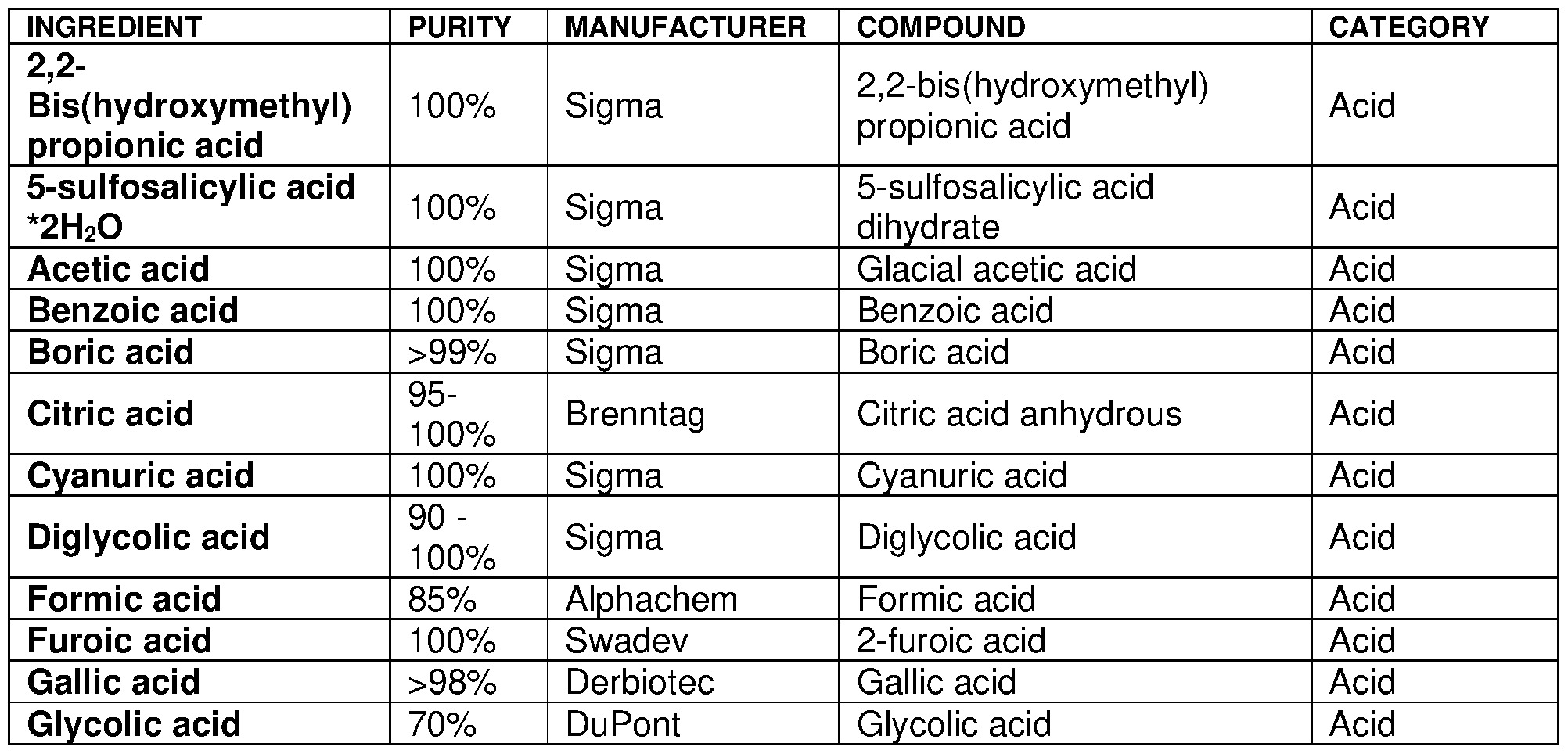
- the invention is further illustrated by the following non-limiting examples which employ the ingredients in TABLE A.
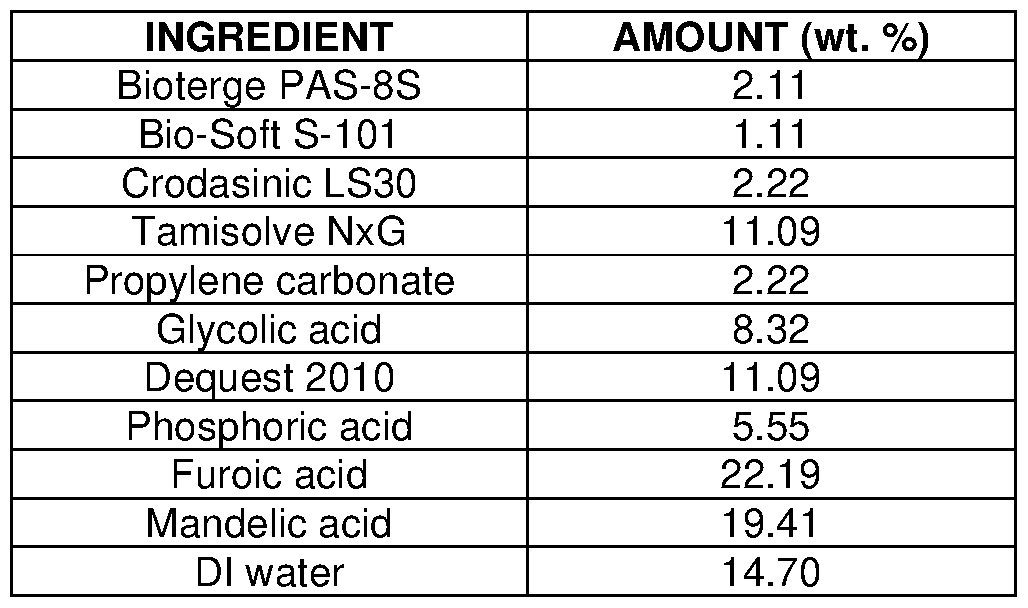
- the amount of ingredients in each example is expressed in terms of wt.% based on the total composition.
- the ingredients specified are the raw materials used to make the solutions. Since the raw materials, in some cases, have a concentration of the active or compound that is less than 100 wt.%, to determine the actual amount of the active or compound in the example solutions, one must multiple the amount of the compound in the starting material, with the amount specified in the tables summarizing the example solutions and divide by 100 to arrive at the actual concentration in the example solutions (expressed in terms of wt.% based on the total solution).
- Solutions 1 -81 were prepared and summarized in Tables 1 to 5 below, wherein the amount of each ingredient is shown in terms of wt.% of raw material used.
- Solutions 1 -65 are summarized in Table 1 (split into eight parts) and were tested against spores, B subtilis, using the ASTM E2197 Standard Quantitative Disk Carrier Test Method at a contact time of three minutes and at room temperature (18 S C to 25 S C).
- the ASTM E2197 method uses brushed stainless-steel disks as the carrier surface on which live microorganisms (in this case spores) are deposited as the test inoculum. These test carriers are then exposed to the antimicrobial test solutions for a set contact time.
- the surviving microbial cells are enumerated and a total microbicidal efficacy is determined by comparison of the pre and post antimicrobial treatment populations. This reduction in microbial population is expressed in a logarithmic scale of base ten.
- Table 1 - Part 1 shows a base solution (Solution 1), the base solution with hydrogen peroxide (Solution 2), the base solution with MMPP (Solution 3), and the base solution with both MMPP and hydrogen peroxide (Solution 4). Comparing the result for Solution 4 with the results for Solutions 2 and 3, one can see that hydrogen peroxide and MMPP do not act synergistically in the base solution to inactivate bacterial spores.
- Solution 5 contains the base solution with furoic acid (also called 2-furan carboxylic acid).
- Solution 6 contains the base solution with furoic acid and MMPP.
- Solution 21 (see below Table 1 - Part 2) contains furoic acid and hydrogen peroxide in the base solution. Comparing the result for Solution 6 with the results for Solutions 5 and 3, one can see that MMPP and furoic acid act synergistically in the base solution. Solution 21 demonstrates no synergy between furoic acid and hydrogen peroxide under the conditions of the test.
- Solution 7 contains mandelic acid in the base solution.
- Solution 8 contains both mandelic acid and MMPP in the base solution.
- the result for Solution 8 shows that mandelic acid and MMPP (Solution 8) act synergistically in the base solution.
- Solution 9 contains glycolic acid in the base solution.
- Solution 10 contains both glycolic acid and MMPP in the base solution.
- the result for Solution 10 shows that glycolic acid and MMPP act synergistically in the base solution.
- Solution 11 contains salicylic acid in the base solution.
- Solution 12 contains salicylic acid and MMPP in the base solution.
- Solution 13 contains salicylic acid, MMPP and hydrogen peroxide in the base solution. The result for Solution 13 (compared to Solutions 2 and 12) shows no synergy when hydrogen peroxide is added.
- Solutions 14 to 20 show the effect of adding individual acids, salts, and one solvent (dimethyl isosorbide) to MMPP in the base solution. Comparing the results with results (not shown), synergies with MMPP were established for Solution 14 (pyroglutamic acid), Solution 15 (diglycolic acid), Solution 16 (phenylacetic acid), Solution 17 (phthalic acid), and Solution 20 (dimethylolpropionic acid). No synergy with MMPP was established for Solution 18 and 19 (triethyl citrate and dimethyl isosorbide, respectively).
- Table 1 - Part 3 Table 1 - Part 3
- Solutions 22 to 31 show the effect of combining MMPP in a base solution with one additional ingredient (an acid, solvent, or other ingredient).
- the results, other than for Solution 32 (picolinic acid) show a synergy with MMPP, when the results are compared to other results (not shown).
- Solutions 32-41 show the effect of combining MMPP in the base solution with one additional ingredient (an acid, solvent, or surfactant).
- the results when compared to other results (not shown) show a synergy with MMPP particularly for some ingredients
- Akypo LF-2 Solution 32
- butyl lactate Solution 34
- dimethyl succinate Solution 37
- Omnia Solution 40
- triacetin Solution 41
- Solution 39 (containing a zinc salt as the added ingredient) does not contain Dequest 2010 (chelating agent) in order to prevent removal of the added zinc ions from the solution.
- Solutions 42-47 show the effect of combining MMPP in a base solution with one additional ingredient (an acid, solvent, or surfactant).
- the results, when compared with other results (not shown) show a synergy with MMPP in all solutions except for Solution 45 (Dowfax C-6L).
- Solutions 48-53 show the effect of combining MMPP in the base solution with one additional ingredient (an acid, solvent, or surfactant). The results, when compared with other results (not shown) show a synergy with MMPP for solutions 49 (2,2-Bis(hydroxymethyl) propionic acid), 51 (5-sulfosalicylic acid * 2H20), and 53 (citric acid).
- Solutions 54-59 show the effect of combining MMPP in the base solution with one additional ingredient (an acid, salt, or solvent).
- the results, when compared with other results (not shown) show a synergy with MMPP for solutions 56, 57 and 59 (dimethyl adipate, formic acid, and copper sulfate, respectively).
- Solutions 71 -74 were tested using the modified AOAC 966.04 method utilizing Dacron suture loops as the carriers (average starting titer of 5.6 x 10 5 colony forming units per carrier), against B. subtilis spores, at a contact time of 10 minutes and at a temperature of 45°C. The results demonstrate a complete pass for Solution 72, and marginal fails for Solutions 71 ,
- Solutions 75-78 were prepared and tested for their corrosive effect as shown in Table 5 below. Solutions 76 and 78 contain MMPP and is in accordance with the invention. Solutions 75 and 77 contain no peroxyphthalic acid or salt thereof and is therefore not in accordance with the invention.
- the invention provides a kit of parts that can be used to make compositions according to the first aspect.
- a kit is illustrated by Tables 6A and 6B.
- the kit contains composition 79 (Table 6A) in a first compartment, MMPP in a second compartment, hydrogen peroxide in a third compartment, and pH adjusting agents, KOH and phosphoric acid, in a fourth and a fifth compartment, respectively.
- component is meant that the components are housed separately from each other in the kit, e.g. in separate bags, containers, etc.
- the kit further contains instructions for making Solutions AA-AG summarized in Table 6B.
- the instructions teach making Solution AA-AG by mixing the components together with water to achieve the above concentrations, and using KOH or phosphoric acid to adjust the pH of the solutions to what is shown above.
- RTU solutions were made using ingredients of kits wherein the solid components (sulfamic acid and MMPP) and liquid components (all other ingredients except for the water) were housed separately.
- the kits contained instructions to mix the components of the kit together with water in the amounts indicated in Table 7 below.
- the instructions further called for adjusting the pH of each solution to about 3.1 using KOH.
- Solutions A-E were prepared and tested as shown in Table 9 below. These solutions are not in accordance with the present invention because they lack the peroxyphthalic acid or salt thereof.
- Solution A (a base solution containing no synergistic additives) achieved a 0.75 logio reduction value
- solution B containing the synergistic additive, sulfamic acid
- solution C containing the synergistic additive, mandelic acid
- solution D containing the synergistic additive, benzoic acid
- solution E containing the synergistic additive, glycolic acid
- Tests were performed to assess the stability of MMPP in aqueous solutions.
- Solution F was prepared by dissolving 2% wt. MMPP in deionized water, q.s. to 100. The solution was stored at room temperature and the total peroxygen content was measured at specified intervals using iodometric titrations. The results are shown below in Table 10.
- Table 10 shows a rapid decline in peroxygen content in Solution F over a six day period under the conditions of this test.
- Solutions G, H, I, and J contain 2 wt.% MMPP in combination with synergistic additives, citric acid, sodium formate, and sulfamic acid. These solutions were stored in an oven at 50°C and tested for total peroxygen content using iodometric titrations over a five-hour period. The results are plotted in Figure 1 which shows, surprisingly, a partial stabilization of MMPP in the aqueous solutions. After about 2 hours of storage under these harsher conditions, the total peroxygen loss levelled off, which is surprising, given the comparison data in Table 10. This suggests that the present synergistic additives may also contribute to stability of MMPP in an aqueous solution.
- Potency Score Relative Sporicidal Synergy Potency Score
- Table 12 also lists the water solubility of each compound. The skilled person would appreciate that the higher the solubility, the greater amount of the compound that can be added to an aqueous solution. Solutions according to the present invention will have a potency score and water solubility combination that could lead the skilled person to make an effective sporicide.
- compositions with low antimicrobial efficacy at ambient room temperature could become significantly more efficacious against the same microbes if utilized at an elevated temperature of 55°C.
- Table 13 summarizes additional information about the compounds listed in Table 12 above, including its classification (acid, solvent, salt, surfactant), whether, based on the potency score, the compound is considered to be in accordance with the present invention, and the concentration of the compound that would be required at room temperature in an antimicrobial composition depending on whether the composition is to be used as a sporicide or as a disinfectant.
- Those compounds classified by the U.S. Environmental Protection Agency (EPA) as an “antimicrobially inert” compound are also indicated in Table 13.
- EPA U.S. Environmental Protection Agency
- an inert ingredient generally is any substance (or group of similar substances) other than an active ingredient that is intentionally included in a pesticide product”. Further reference to EPA’s inert ingredients list can be found at the following web address:
- antimicrobial including sporicidal, compositions containing peroxyphthalic acid and/or a salt thereof, e.g., MMPP, together with at least one additional ingredient selected from acids, salts, surfactants and solvents disclosed to be useful herein in Table 13 above.
Landscapes
- Life Sciences & Earth Sciences (AREA)
- Environmental Sciences (AREA)
- Wood Science & Technology (AREA)
- Zoology (AREA)
- Pest Control & Pesticides (AREA)
- Plant Pathology (AREA)
- Engineering & Computer Science (AREA)
- Agronomy & Crop Science (AREA)
- Health & Medical Sciences (AREA)
- General Health & Medical Sciences (AREA)
- Dentistry (AREA)
- Chemical & Material Sciences (AREA)
- Inorganic Chemistry (AREA)
- Chemical Kinetics & Catalysis (AREA)
- General Chemical & Material Sciences (AREA)
- Agricultural Chemicals And Associated Chemicals (AREA)
- Pharmaceuticals Containing Other Organic And Inorganic Compounds (AREA)
Abstract
Description






Claims
Priority Applications (4)
| Application Number | Priority Date | Filing Date | Title |
|---|---|---|---|
| US17/771,635 US12446578B2 (en) | 2020-02-10 | 2021-02-08 | Antimicrobial compositions containing peroxyphthalic acid and/or salt thereof |
| EP21754147.3A EP4102971A4 (en) | 2020-02-10 | 2021-02-08 | ANTIMICROBIAL COMPOSITIONS CONTAINING PEROXYPHTHAL ACID AND/OR ITS SALTS |
| AU2021219053A AU2021219053A1 (en) | 2020-02-10 | 2021-02-08 | Antimicrobial compositions containing peroxyphthalic acid and/or salt thereof |
| CA3149708A CA3149708A1 (en) | 2020-02-10 | 2021-02-08 | Antimicrobial compositions containing peroxyphthalic acid and/or salt thereof |
Applications Claiming Priority (2)
| Application Number | Priority Date | Filing Date | Title |
|---|---|---|---|
| US202062972344P | 2020-02-10 | 2020-02-10 | |
| US62/972,344 | 2020-02-10 |
Publications (1)
| Publication Number | Publication Date |
|---|---|
| WO2021161148A1 true WO2021161148A1 (en) | 2021-08-19 |
Family
ID=77292103
Family Applications (1)
| Application Number | Title | Priority Date | Filing Date |
|---|---|---|---|
| PCT/IB2021/051004 Ceased WO2021161148A1 (en) | 2020-02-10 | 2021-02-08 | Antimicrobial compositions containing peroxyphthalic acid and/or salt thereof |
Country Status (5)
| Country | Link |
|---|---|
| US (1) | US12446578B2 (en) |
| EP (1) | EP4102971A4 (en) |
| AU (1) | AU2021219053A1 (en) |
| CA (1) | CA3149708A1 (en) |
| WO (1) | WO2021161148A1 (en) |
Cited By (2)
| Publication number | Priority date | Publication date | Assignee | Title |
|---|---|---|---|---|
| WO2024091161A1 (en) * | 2022-10-28 | 2024-05-02 | Delaval Holding Ab | Antimicrobial compositions |
| EP4696140A1 (en) * | 2024-07-24 | 2026-02-18 | Knieler & Team GmbH | Germ-reducing aqueous composition comprising hydrogen peroxide and effectiveness-enhancing components |
Families Citing this family (4)
| Publication number | Priority date | Publication date | Assignee | Title |
|---|---|---|---|---|
| WO2024074965A1 (en) * | 2022-10-04 | 2024-04-11 | Virox Technologies Inc. | Concentrated antimicrobial solutions containing sparingly soluble antimicrobial agents |
| CN116458513A (en) * | 2023-05-08 | 2023-07-21 | 广东方中高新材料有限公司 | A kind of prochloraz synergistic water-emulsion preparation containing gallium complex and preparation method thereof |
| CN116473073A (en) * | 2023-05-08 | 2023-07-25 | 广东方中高新材料有限公司 | A kind of pyraclostrobin synergistic suspension preparation containing gallium complex and its preparation method |
| IT202300012273A1 (en) * | 2023-06-26 | 2024-12-26 | Valentina Girondino | DETERGENT FOR CLEANING AND PICKLING PAINTS |
Citations (11)
| Publication number | Priority date | Publication date | Assignee | Title |
|---|---|---|---|---|
| EP0133354A1 (en) | 1983-08-09 | 1985-02-20 | Interox Chemicals Limited | Denture cleansing compositions |
| US4822512A (en) | 1986-03-01 | 1989-04-18 | Auchincloss Thomas R | Biocidal, particularly virucidal, compositions |
| US6211213B1 (en) * | 1999-04-16 | 2001-04-03 | Rohm And Haas Company | Stable microbicide formulation |
| EP1095663A1 (en) | 1999-10-27 | 2001-05-02 | Sogeval S.A. | Potentiated and stabilised disinfectant having bactericidal and virucidal activity |
| EP1255573A1 (en) | 2000-02-16 | 2002-11-13 | Novartis AG | Contact lens treating method and composition |
| US20040147426A1 (en) | 1998-07-10 | 2004-07-29 | The Procter & Gamble Company | Laundry and cleaning compositions |
| US20060057176A1 (en) | 2004-09-15 | 2006-03-16 | Squire Mark W | Easy-to-use biocidal/virucidal compositions |
| WO2007023481A1 (en) * | 2005-08-25 | 2007-03-01 | A. Shitzer Ltd. | Non-phytotoxic biocidal compositions for agricultural and veterinary use |
| US20120107415A1 (en) * | 2008-12-18 | 2012-05-03 | Thomas Lisowsky | Combined disinfection and decontamination agent having increased effectiveness |
| US8865226B2 (en) | 2006-04-27 | 2014-10-21 | Aseptix Research Bv | Low foaming enhanced biocidal hydrogen peroxide composition |
| CN106900707A (en) | 2017-01-11 | 2017-06-30 | 北京长江脉医药科技有限责任公司 | A kind of antiseptic sterilization agent containing peroxide |
Family Cites Families (64)
| Publication number | Priority date | Publication date | Assignee | Title |
|---|---|---|---|---|
| CA735490A (en) * | 1966-05-31 | H. Blumbergs John | Method of producing organic peroxyacids | |
| AR206201A1 (en) | 1972-06-29 | 1976-07-07 | Ciba Geigy Ag | PROCEDURE FOR OBTAINING ACID COMPOUNDS 7BETA-AMINO-3-CEFEM-3-01-4-CARBOXILICO0-SUBSTITUIDOS |
| DE2716677C2 (en) | 1977-04-15 | 1985-10-10 | Hoechst Ag, 6230 Frankfurt | Cephem derivatives and processes for their preparation |
| NZ202252A (en) * | 1981-10-29 | 1986-04-11 | Colgate Palmolive Co | Monoperoxyphthalic acid bleaching and laundering compositions |
| AU568809B2 (en) * | 1982-06-03 | 1988-01-14 | Interox Chemicals Ltd. | Peroxyacid sanitizer compositions |
| GB2137882A (en) * | 1983-02-10 | 1984-10-17 | Interox Chemicals Ltd | Disinfectants Containing Magnesium Peroxycarboxylate |
| US4990329A (en) * | 1985-05-24 | 1991-02-05 | The Procter & Gamble Company | Composition for treating oral diseases |
| DE68924319T2 (en) | 1988-03-16 | 1996-05-15 | Scripps Research Inst | SUBSTITUTED ADEN DERIVATIVES USED AS THERAPEUTIC AGENTS. |
| US5085852A (en) | 1991-04-19 | 1992-02-04 | The Procter & Gamble Company | Antimicrobial oral compositions |
| FR2691902B1 (en) * | 1992-06-09 | 1994-08-19 | Oreal | Use for bleaching or lightening natural keratin fibers or colors of magnesium monoperoxyphthalate and process for bleaching or lightening. |
| WO1996002624A1 (en) | 1994-07-13 | 1996-02-01 | So-Safe Specialty Products Pty. Ltd. | A cleaning kit and a cleaning composition and methods of use |
| DE19508827A1 (en) | 1995-03-11 | 1996-09-12 | Bode Chemie Gmbh & Co | Wound and mucous membrane antiseptic |
| DE19512588A1 (en) | 1995-04-04 | 1996-10-10 | Bode Chemie Gmbh & Co | Instrument disinfectants |
| US6099587A (en) | 1996-09-13 | 2000-08-08 | The Procter & Gamble Company | Peroxygen bleaching compositions comprising peroxygen bleach and ATMP, suitable for use as a pretreater for fabrics |
| US5872111A (en) | 1997-05-19 | 1999-02-16 | Lever Brothers Company, Division Of Conopco, Inc. | Compositions comprising glycosylamide surfactants |
| DE19724102A1 (en) * | 1997-06-07 | 1998-12-10 | Bode Chemie Gmbh & Co | Agent for rapid disinfection or decontamination of skin or hands |
| BR9908117A (en) | 1998-02-20 | 2000-10-24 | Procter & Gamble | Bleach detergent compositions containing modified polyamine polymers |
| DE19808962C2 (en) | 1998-03-04 | 2002-03-28 | Bode Chemie Gmbh & Co Kg | Combinations of active ingredients and disinfectants, preservatives and antiseptics containing the same |
| DE19835064C2 (en) * | 1998-07-23 | 2001-01-18 | Bode Chemie Gmbh & Co | Contact lens disinfectant and process for its manufacture |
| AUPP999799A0 (en) | 1999-04-27 | 1999-05-20 | Fujisawa Pharmaceutical Co., Ltd. | New compound |
| HUP0202377A3 (en) | 1999-06-24 | 2002-12-28 | Basf Ag | N-substituted perhydrodiazines, preparation and use thereof |
| US6593283B2 (en) | 2000-04-28 | 2003-07-15 | Ecolab Inc. | Antimicrobial composition |
| DE10029185A1 (en) | 2000-06-19 | 2002-01-03 | Henkel Kgaa | Process for the antimicrobial treatment of materials at risk from microbial infestation |
| WO2002020531A2 (en) | 2000-09-08 | 2002-03-14 | Basf Aktiengesellschaft | Method for producing anellated tetrahydro-[1h]-triazoles |
| CA2455961A1 (en) | 2001-09-10 | 2003-03-20 | The Procter & Gamble Company | Polymers for lipophilic fluid systems |
| US8080682B2 (en) | 2006-08-24 | 2011-12-20 | University Of Tennessee Research Foundation | Substituted acylanilides and methods of use thereof |
| US20040111806A1 (en) | 2002-12-11 | 2004-06-17 | Scheper William Michael | Compositions comprising glycol ether solvents and methods employing same |
| DE10306450A1 (en) | 2003-02-17 | 2004-08-26 | Bode Chemie Gmbh & Co. Kg | Microbicidal combinations of active ingredients and disinfectants made from them |
| DE50304955D1 (en) | 2003-06-28 | 2006-10-19 | Dalli Werke Gmbh & Co Kg | Alpha olefin and alpha olefin cellulose granules as disintegrants |
| US20050271602A1 (en) | 2004-06-02 | 2005-12-08 | Nebojsa Milanovich | Method for inhibiting chemical staining of teeth |
| US20050271601A1 (en) | 2004-06-02 | 2005-12-08 | Nebojsa Milanovich | Anti-staining antibacterial dentifrice |
| US7204931B2 (en) | 2004-07-16 | 2007-04-17 | Truox, Inc. | Stable composition with enhanced biocidal and virucidal effect |
| CA2533950C (en) | 2005-01-28 | 2013-10-22 | B. Braun Medical Ag | Virucidal disinfectant |
| US20060270571A1 (en) | 2005-05-26 | 2006-11-30 | Burke Peter A | Deactivation of mineral encapsulated nanobacteria |
| DE102006011087A1 (en) | 2006-03-08 | 2007-09-13 | Henkel Kgaa | Silicon-based active substance carriers containing aminoalkyl groups |
| US7781388B2 (en) | 2006-05-04 | 2010-08-24 | American Sterilizer Company | Cleaning compositions for hard to remove organic material |
| HUE032274T2 (en) | 2006-07-12 | 2017-09-28 | Univ Tennessee Res Found | Substituted acylanilides and methods of use thereof |
| EP2089065B1 (en) | 2006-10-27 | 2015-01-21 | E.I. Du Pont De Nemours And Company | Method for prion decontamination |
| GB201106391D0 (en) | 2011-04-15 | 2011-06-01 | Reckitt & Colman Overseas | Novel composite |
| US20160219883A1 (en) * | 2011-08-29 | 2016-08-04 | The Chemours Company Fc, Llc | Multi-part kit system for the preparation of a disinfectant |
| US20150071904A1 (en) | 2012-01-06 | 2015-03-12 | Trustees Of Boston University | Compositions and methods to boost endogenous ros production from bacteria |
| SG11201404930SA (en) | 2012-02-15 | 2014-09-26 | Advanced Tech Materials | Post-cmp removal using compositions and method of use |
| US8545715B1 (en) | 2012-10-09 | 2013-10-01 | Rohm And Haas Electronic Materials Cmp Holdings, Inc. | Chemical mechanical polishing composition and method |
| WO2014138568A1 (en) | 2013-03-07 | 2014-09-12 | Arch Chemicals, Inc. | Activated peroxide compositions for anti-microbial applications |
| CN105283166B (en) | 2013-06-18 | 2018-07-17 | 高露洁-棕榄公司 | Include the antimicrobial compositions of essential oil combination |
| BR112017023315A2 (en) | 2015-04-29 | 2018-07-17 | Novozymes As | suitable detergent polypeptides |
| US20190133125A1 (en) | 2015-08-11 | 2019-05-09 | Basf Se | Antimicrobial polymer |
| WO2017060475A2 (en) | 2015-10-07 | 2017-04-13 | Novozymes A/S | Polypeptides |
| EP3362556B1 (en) | 2015-10-14 | 2024-07-10 | Novozymes A/S | Polypeptide variants |
| WO2017105455A1 (en) | 2015-12-17 | 2017-06-22 | Colgate-Palmolive Company | Hydrogen peroxide booster system for enhanced teeth whitening |
| WO2017112426A1 (en) | 2015-12-22 | 2017-06-29 | The Procter & Gamble Company | Compositions comprising an ester and/or an acid |
| BR112018069220A2 (en) | 2016-03-23 | 2019-01-22 | Novozymes As | use of polypeptide that has dnase activity for tissue treatment |
| DK3468975T3 (en) | 2016-06-08 | 2020-07-13 | Acraf | NEW ANTIBACTERIAL COMPOUNDS |
| WO2018011277A1 (en) | 2016-07-13 | 2018-01-18 | Novozymes A/S | Bacillus cibi dnase variants |
| BR112019001144A2 (en) | 2016-07-21 | 2019-04-30 | Lonza Ag | Method and kit for determining oxidant concentration in disinfectant solutions |
| US20200109352A1 (en) | 2017-04-04 | 2020-04-09 | Novozymes A/S | Polypeptide compositions and uses thereof |
| CN111542604A (en) | 2017-10-27 | 2020-08-14 | 诺维信公司 | DNase variants |
| PL3476936T3 (en) | 2017-10-27 | 2022-04-11 | The Procter & Gamble Company | Detergent compositions comprising polypeptide variants |
| EP3510867A1 (en) | 2018-01-12 | 2019-07-17 | Basf Se | Antimicrobial polymer |
| EP3587254B1 (en) | 2018-06-28 | 2021-11-17 | GE Avio S.r.l. | Control system and method for an electro-hydraulic servo-actuator, in particular of a turbopropeller engine |
| CA3113475A1 (en) | 2018-09-20 | 2020-03-26 | Symrise Ag | Compositions comprising odorless 1,2-pentanediol |
| WO2020070209A1 (en) | 2018-10-02 | 2020-04-09 | Novozymes A/S | Cleaning composition |
| EP3861094A1 (en) | 2018-10-02 | 2021-08-11 | Novozymes A/S | Cleaning composition |
| EP3953462A1 (en) | 2019-04-10 | 2022-02-16 | Novozymes A/S | Polypeptide variants |
-
2021
- 2021-02-08 US US17/771,635 patent/US12446578B2/en active Active
- 2021-02-08 WO PCT/IB2021/051004 patent/WO2021161148A1/en not_active Ceased
- 2021-02-08 AU AU2021219053A patent/AU2021219053A1/en active Pending
- 2021-02-08 EP EP21754147.3A patent/EP4102971A4/en active Pending
- 2021-02-08 CA CA3149708A patent/CA3149708A1/en active Pending
Patent Citations (12)
| Publication number | Priority date | Publication date | Assignee | Title |
|---|---|---|---|---|
| EP0133354A1 (en) | 1983-08-09 | 1985-02-20 | Interox Chemicals Limited | Denture cleansing compositions |
| US4822512A (en) | 1986-03-01 | 1989-04-18 | Auchincloss Thomas R | Biocidal, particularly virucidal, compositions |
| US20040147426A1 (en) | 1998-07-10 | 2004-07-29 | The Procter & Gamble Company | Laundry and cleaning compositions |
| US6211213B1 (en) * | 1999-04-16 | 2001-04-03 | Rohm And Haas Company | Stable microbicide formulation |
| EP1095663A1 (en) | 1999-10-27 | 2001-05-02 | Sogeval S.A. | Potentiated and stabilised disinfectant having bactericidal and virucidal activity |
| EP1255573A1 (en) | 2000-02-16 | 2002-11-13 | Novartis AG | Contact lens treating method and composition |
| US20060057176A1 (en) | 2004-09-15 | 2006-03-16 | Squire Mark W | Easy-to-use biocidal/virucidal compositions |
| WO2007023481A1 (en) * | 2005-08-25 | 2007-03-01 | A. Shitzer Ltd. | Non-phytotoxic biocidal compositions for agricultural and veterinary use |
| US8865226B2 (en) | 2006-04-27 | 2014-10-21 | Aseptix Research Bv | Low foaming enhanced biocidal hydrogen peroxide composition |
| US20120107415A1 (en) * | 2008-12-18 | 2012-05-03 | Thomas Lisowsky | Combined disinfection and decontamination agent having increased effectiveness |
| US8999399B2 (en) | 2008-12-18 | 2015-04-07 | Bose Chemie GmbH | Combined disinfection and decontamination agent having increased effectiveness |
| CN106900707A (en) | 2017-01-11 | 2017-06-30 | 北京长江脉医药科技有限责任公司 | A kind of antiseptic sterilization agent containing peroxide |
Non-Patent Citations (7)
| Title |
|---|
| "A.O.A.C. Use Dilution Methods", 1990, article "Official Methods of Analysis of the Association of Official Analytical Chemists" |
| "Official Methods of Analysis", 1990, ASSOCIATION OF OFFICIAL ANALYTICAL CHEMISTS, article "Germicidal and Detergent Sanitizing Action of Disinfectants" |
| A. D. RUSSELL: "CLINICAL MICROBIOLOGY REVIEWS", April 1990, article "Bacterial Spores and Chemical Sporicidal Agents", pages: 99 - 119 |
| BALDRY M.G.C. ET AL., JOURNAL OF APPLIED MICROBIOLOGY, vol. 57, no. 3, 1 December 1984 (1984-12-01), pages 499 - 503 |
| See also references of EP4102971A4 |
| THOMPSON ET AL.: "Mechanisms of Peroxide Bleaching at High pH", J. CHEM. SOC., CHEM. COMMUN., 1992, pages 1600 - 1601 |
| TORRES ET AL.: "Influence of pH on the Effectiveness of Hydrogen Peroxide Whitening", OPERATIVE DENTISTRY, vol. 39-6, 2014, pages E261 - E268 |
Cited By (2)
| Publication number | Priority date | Publication date | Assignee | Title |
|---|---|---|---|---|
| WO2024091161A1 (en) * | 2022-10-28 | 2024-05-02 | Delaval Holding Ab | Antimicrobial compositions |
| EP4696140A1 (en) * | 2024-07-24 | 2026-02-18 | Knieler & Team GmbH | Germ-reducing aqueous composition comprising hydrogen peroxide and effectiveness-enhancing components |
Also Published As
| Publication number | Publication date |
|---|---|
| US20220400671A1 (en) | 2022-12-22 |
| EP4102971A4 (en) | 2024-05-01 |
| CA3149708A1 (en) | 2021-02-08 |
| EP4102971A1 (en) | 2022-12-21 |
| US12446578B2 (en) | 2025-10-21 |
| AU2021219053A1 (en) | 2022-07-28 |
Similar Documents
| Publication | Publication Date | Title |
|---|---|---|
| US12446578B2 (en) | Antimicrobial compositions containing peroxyphthalic acid and/or salt thereof | |
| US9233180B2 (en) | Hydrogen peroxide disinfectant containing a cyclic carboxylic acid and/or aromatic alcohol | |
| CA2503627C (en) | Hydrogen peroxide disinfectant containing a cyclic carboxylic acid and/or aromatic alcohol | |
| DK2023733T3 (en) | Low foaming enhanced biocidal hydrogen peroxide composition | |
| CN103266029B (en) | The biocidal hydrogen peroxide composition of increased activity | |
| US10968417B2 (en) | Shelf-stable hydrogen peroxide antimicrobial compositions | |
| AU2018220969B2 (en) | Peroxide-based disinfecting solutions containing inorganic salts | |
| WO2019186457A1 (en) | Antimicrobial compositions containing a peroxygen compound and an alkyl sarcosine anionic surfactant | |
| AU2024278581B2 (en) | C3-c5 n-alkyl-gamma-butyrolactam-containing antimicrobial compositions and uses thereof | |
| JP2022520551A (en) | Storage stable antibacterial composition | |
| US11406106B2 (en) | Alcohol-free hydrogen peroxide disinfectant compositions and methods of use thereof | |
| US20070190172A1 (en) | Enhanced activity biocidal hydrogen peroxide composition | |
| US20180230408A1 (en) | Antimicrobial composition having efficacy against endospores | |
| US12053540B2 (en) | Antimicrobial compositions containing solvents including a C3-C5 N-alkyl-gamma-butyrolactam | |
| US20210315207A1 (en) | C3-c5 n-alkyl-gamma-butyrolactam-containing antimicrobial compositions and uses thereof | |
| CA3268529A1 (en) | Concentrated antimicrobial solutions containing sparingly soluble antimicrobial agents | |
| US12532886B2 (en) | Method of killing microbes using C3-C5 n-alkyl-gamma-butyrolactams and antimicrobial compositions containing same | |
| US12052990B2 (en) | C3-C5 n-alkyl-gamma-butyrolactam containing antimicrobial compositions and methods of using same | |
| CN101374936A (en) | Biocidal hydrogen peroxide compositions with enhanced activity | |
| CA3160010A1 (en) | Peroxygen-based skin disinfectants effective against mycobacteria and yeasts |
Legal Events
| Date | Code | Title | Description |
|---|---|---|---|
| 121 | Ep: the epo has been informed by wipo that ep was designated in this application |
Ref document number: 21754147 Country of ref document: EP Kind code of ref document: A1 |
|
| DPE1 | Request for preliminary examination filed after expiration of 19th month from priority date (pct application filed from 20040101) | ||
| ENP | Entry into the national phase |
Ref document number: 3149708 Country of ref document: CA |
|
| ENP | Entry into the national phase |
Ref document number: 2021219053 Country of ref document: AU Date of ref document: 20210208 Kind code of ref document: A |
|
| NENP | Non-entry into the national phase |
Ref country code: DE |
|
| ENP | Entry into the national phase |
Ref document number: 2021754147 Country of ref document: EP Effective date: 20220912 |
|
| WWG | Wipo information: grant in national office |
Ref document number: 17771635 Country of ref document: US |