WO2021164589A1 - V2x通信中资源分配的处理方法、系统、设备及介质 - Google Patents
V2x通信中资源分配的处理方法、系统、设备及介质 Download PDFInfo
- Publication number
- WO2021164589A1 WO2021164589A1 PCT/CN2021/075651 CN2021075651W WO2021164589A1 WO 2021164589 A1 WO2021164589 A1 WO 2021164589A1 CN 2021075651 W CN2021075651 W CN 2021075651W WO 2021164589 A1 WO2021164589 A1 WO 2021164589A1
- Authority
- WO
- WIPO (PCT)
- Prior art keywords
- sending
- reserved
- auxiliary information
- resource allocation
- resources
- Prior art date
- Legal status (The legal status is an assumption and is not a legal conclusion. Google has not performed a legal analysis and makes no representation as to the accuracy of the status listed.)
- Ceased
Links
Images




Classifications
-
- H—ELECTRICITY
- H04—ELECTRIC COMMUNICATION TECHNIQUE
- H04W—WIRELESS COMMUNICATION NETWORKS
- H04W72/00—Local resource management
- H04W72/02—Selection of wireless resources by user or terminal
-
- H—ELECTRICITY
- H04—ELECTRIC COMMUNICATION TECHNIQUE
- H04W—WIRELESS COMMUNICATION NETWORKS
- H04W72/00—Local resource management
- H04W72/40—Resource management for direct mode communication, e.g. D2D or sidelink
-
- H—ELECTRICITY
- H04—ELECTRIC COMMUNICATION TECHNIQUE
- H04W—WIRELESS COMMUNICATION NETWORKS
- H04W28/00—Network traffic management; Network resource management
- H04W28/16—Central resource management; Negotiation of resources or communication parameters, e.g. negotiating bandwidth or QoS [Quality of Service]
- H04W28/26—Resource reservation
-
- H—ELECTRICITY
- H04—ELECTRIC COMMUNICATION TECHNIQUE
- H04W—WIRELESS COMMUNICATION NETWORKS
- H04W4/00—Services specially adapted for wireless communication networks; Facilities therefor
- H04W4/30—Services specially adapted for particular environments, situations or purposes
- H04W4/40—Services specially adapted for particular environments, situations or purposes for vehicles, e.g. vehicle-to-pedestrians [V2P]
-
- H—ELECTRICITY
- H04—ELECTRIC COMMUNICATION TECHNIQUE
- H04W—WIRELESS COMMUNICATION NETWORKS
- H04W72/00—Local resource management
- H04W72/20—Control channels or signalling for resource management
-
- H—ELECTRICITY
- H04—ELECTRIC COMMUNICATION TECHNIQUE
- H04W—WIRELESS COMMUNICATION NETWORKS
- H04W72/00—Local resource management
- H04W72/20—Control channels or signalling for resource management
- H04W72/25—Control channels or signalling for resource management between terminals via a wireless link, e.g. sidelink
-
- H—ELECTRICITY
- H04—ELECTRIC COMMUNICATION TECHNIQUE
- H04W—WIRELESS COMMUNICATION NETWORKS
- H04W72/00—Local resource management
- H04W72/50—Allocation or scheduling criteria for wireless resources
- H04W72/54—Allocation or scheduling criteria for wireless resources based on quality criteria
- H04W72/541—Allocation or scheduling criteria for wireless resources based on quality criteria using the level of interference
-
- H—ELECTRICITY
- H04—ELECTRIC COMMUNICATION TECHNIQUE
- H04W—WIRELESS COMMUNICATION NETWORKS
- H04W72/00—Local resource management
- H04W72/50—Allocation or scheduling criteria for wireless resources
- H04W72/54—Allocation or scheduling criteria for wireless resources based on quality criteria
- H04W72/542—Allocation or scheduling criteria for wireless resources based on quality criteria using measured or perceived quality
-
- H—ELECTRICITY
- H04—ELECTRIC COMMUNICATION TECHNIQUE
- H04W—WIRELESS COMMUNICATION NETWORKS
- H04W72/00—Local resource management
- H04W72/50—Allocation or scheduling criteria for wireless resources
- H04W72/56—Allocation or scheduling criteria for wireless resources based on priority criteria
-
- H—ELECTRICITY
- H04—ELECTRIC COMMUNICATION TECHNIQUE
- H04W—WIRELESS COMMUNICATION NETWORKS
- H04W72/00—Local resource management
- H04W72/50—Allocation or scheduling criteria for wireless resources
- H04W72/56—Allocation or scheduling criteria for wireless resources based on priority criteria
- H04W72/566—Allocation or scheduling criteria for wireless resources based on priority criteria of the information or information source or recipient
-
- H—ELECTRICITY
- H04—ELECTRIC COMMUNICATION TECHNIQUE
- H04W—WIRELESS COMMUNICATION NETWORKS
- H04W92/00—Interfaces specially adapted for wireless communication networks
- H04W92/16—Interfaces between hierarchically similar devices
- H04W92/18—Interfaces between hierarchically similar devices between terminal devices
Definitions
- the present invention relates to the field of wireless communication, and in particular to a processing method, system, equipment and medium for resource allocation in V2X communication.
- V2X vehicle-to-everything
- V2X vehicle-to-everything
- V2X vehicle-to-everything
- V2V vehicle-to-vehicle
- V2I vehicle-to-infrastructure
- V2V vehicle-to-infrastructure
- V2P vehicle-to-pedestrian
- V2N vehicle-to-network
- V2X technology is the key technology of the future intelligent transportation system. It allows vehicles to communicate with the outside world to obtain a series of traffic information such as real-time road conditions, road information, and pedestrian information, thereby improving driving safety, reducing congestion, and improving traffic efficiency. Provide in-vehicle entertainment information, etc.
- Mode1 is a base station (evolved Node B, eNB) scheduling mode
- mode 2 is a user equipment (User Equipment, UE) autonomously selecting resources.
- UE User Equipment
- V2X Sidelink (side link transmission) communication uses a sensing mechanism to reduce resource conflicts.
- the user equipment working in mode2 is always in the resource-aware state, and candidate resources are determined to be used as the user equipment of the receiving UE.
- the receiving UE When receiving the data packet sent by the sending UE, the receiving UE will perceive it according to the period of time before the data packet arrives.
- Candidate resources then randomly select the next first transmission and subsequent multiple transmission resources from the candidate resources, and indicate this time in the SCI (Sidelink Control Infermation) of each transmission.
- SCI Segmentlink Control Infermation
- UE4 eliminates resources in the resource awareness window to determine the candidate resource set.
- UE4 decodes the SCI of other UEs (such as UE1, UE2, UE3, UE5) to obtain resource reservations of other UEs Information, and do RSRP (Reference Signal Receiving Power, reference signal received power) measurement, if the interference is too strong, that is, the RSRP is higher than the preset threshold, it will be eliminated. If UE4 detects that the RSRP reserved by UE1 and UE5 is higher than the preset threshold, and the RSRP reserved by UE2 and UE3 is not higher than the preset threshold, UE4 excludes the resources reserved by UE1 and UE5 from the candidate resource set, and finally The remaining resources in the candidate resource set are the final candidate resources.
- RSRP Reference Signal Receiving Power
- UE4 will randomly select resources for transmission in the final candidate resource set in the selection window and indicate the resources used for this transmission of the same TB (transmission block) in the SCI of each transmission and the resources used for multiple subsequent transmissions. Resources and indicate the period of reserved resources for transmission of different TBs.
- SCI is supported to reserve resources for up to three transmissions, and periodic reservation of resources is supported.
- UEs near UE4 can receive UE4's resource reservation information when performing resource awareness.
- UE1 and UE2 use unicast communication, the communication distance is 50m (meters), and the transmit power is 10dBm (decibel milliwatt).
- UE3 and UE4 use unicast communication, the distance is 300m, and the transmit power is 23dBm. Assuming that UE3 selects a frequency domain resource adjacent to UE1, because UE3 has a larger transmit power, UE2 at the receiving end will receive interference from UE3, and the greater the transmit power gap, the greater the interference, which causes IBE (in-band transmission). )problem.
- Figure 2 shows the hidden node problem under resource allocation mode2. Assuming that UE1 and UE2 use unicast communication, the distance is 50m, and the transmit power is 10dBm; UE1 and UE3 are far apart, and UE3 is outside the sensing range of UE1. UE3 and UE4 use unicast communication, the distance is 300m, and the transmit power is 23dBm. When UE1 senses resources, it does not know the frequency domain resources selected by UE3. If the same frequency domain resources as UE3 are selected and used at the same time, the two will collide, and UE2 cannot successfully receive the communication data of UE1.
- the resource allocation mode 4 of LTE (Long Term Evolution) V2X is also a resource selection process based on UE perception. Therefore, under LTE V2X mode 4, there are also IBE problems.
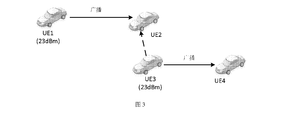
- UE1 and UE3 both use 23dBm transmit power to perform broadcast (broadcast) communication with UE2 and UE4 respectively. Assuming that UE1 and UE3 are far apart and adjacent resources are selected, then at the receiving end UE2, Will receive interference from UE3, and the closer the distance, the greater the interference will cause IBE problems.
- Zone ID In LTE V2X mode 4, Zone ID (Zone ID) is used to divide the resource pool to solve the IBE problem.
- UEs in different zones use mutually orthogonal frequency domain resources. Since UE1 and UE3 are far apart and belong to different zones, the resources used are also separated, thus solving the IBE problem.
- LTE V2X mode 4 In LTE V2X mode 4, only broadcast communication is supported, and the transmission power of the UE is the same, which is the maximum transmission power. Therefore, the IBE problem only exists when the sending UE is far away from the interfering UE. Therefore, in LTE V2X mode 4, the zone ID can be used to divide the resource pool so that the sending UE and the interfering UE are divided into different zones to solve the IBE problem.
- NR New Radio New Radio
- V2X mode2 not only broadcast communication is supported, but also unicast communication and multicast communication are supported. Since unicast communication and multicast communication support adjusting the transmission power, the IBE problem not only exists in the same distance. In the case of transmit power, it still exists in the case of close distance but large gap between transmit and power, so the method of dividing the resource pool by zone ID cannot solve the IBE problem in NR V2X mode2, and NR V2X mode2 does not support the use The way in which the zone ID divides the resource pool.
- the UE completes V2V (vehicle to vehicle) communication by sensing and selecting resources. If the sending UE does not know the situation of the receiving UE when sensing and selecting resources, the receiving UE may have IBE (In- Band-Emission) problems or hidden node problems, resulting in the receiving UE not being able to successfully receive on the resources selected by the sending UE, and because V2X mode2 supports periodic reservation of resources, it may cause conflicts such as continuous collisions, resulting in sending and receiving The defect of low information accuracy.
- IBE In- Band-Emission
- the technical problem to be solved by the present invention is to overcome the defect that the receiving UE cannot successfully receive on the resource selected by the sending UE under the autonomous resource selection mode in V2X communication in the prior art, resulting in low accuracy of sending and receiving information, providing A processing method, system, equipment and medium for resource allocation in V2X communication.
- a method for processing resource allocation in V2X communication wherein the method for processing resource allocation in V2X communication is applied to a receiving UE;
- the processing method for resource allocation in V2X communication includes:
- auxiliary information is generated and the auxiliary information is sent to the sending UE.
- the auxiliary information is used to characterize the conflict.
- the step of determining whether the resource reserved by the interfering UE conflicts with the resource reserved by the sending UE includes:
- the step of determining whether the resource reserved by the sending UE has an IBE problem or a hidden node problem with the resource reserved by the interfering UE includes:
- the auxiliary information includes a conflict type, and the conflict type is used to characterize the IBE problem or the hidden node problem.
- the auxiliary information further includes a priority of transmission data, and the transmission data is data transmitted using the reserved resources;
- the processing method further includes:
- the priority of the transmission data in the sending UE is lower than or equal to that of the interfering UE. If the priority of the transmission data is yes, the judgment result is that there is a conflict.
- the auxiliary information includes resources reserved by the interfering UE.
- the auxiliary information further includes the reservation period of the resource reserved by the interfering UE.
- the step of sending the auxiliary information to the sending UE includes:
- the auxiliary information is sent to the sending UE through SCI data.
- sending the auxiliary information to the sending UE through SCI data includes:
- sending the auxiliary information to the sending UE through SCI data includes:
- the step of sending the auxiliary information to the sending UE includes:
- the auxiliary information is sent to the sending UE through PC5-RRC signaling.
- a method for processing resource allocation in V2X communication where the method for processing resource allocation in V2X communication is applied to a sending UE;
- the processing method for resource allocation in V2X communication includes:
- auxiliary information fed back by the receiving UE, where the auxiliary information is used to characterize the conflict of resources reserved between the sending UE and the interfering UE;
- the step of adjusting the resources reserved by the sending UE according to the auxiliary information includes:
- the auxiliary information includes a conflict type, and the conflict type is used to characterize an IBE problem or a hidden node problem;
- the step of reselecting the resources reserved by the sending UE includes:
- the auxiliary information includes resources reserved by the interfering UE;
- the step of reselecting the reserved resources includes:
- the auxiliary information further includes the reservation period of the reserved resource
- the processing method for resource allocation in V2X communication further includes:
- the interfering UE Before the step of selecting other candidate resources other than the resources adjacent to or the same as the resources reserved by the interfering UE, determine the reservation of the resources reserved by the sending UE and the resources reserved by the interfering UE Whether the periods are the same, and if they are the same, select other candidate resources adjacent to the resource reserved by the interfering UE or other than the same resource.
- a processing method for resource allocation in V2X communication includes:
- the receiving UE sends auxiliary information to the sending UE using the method described above, where the auxiliary information is used to characterize the conflict of resources reserved between the sending UE and the interfering UE, so as to avoid the conflict;
- the sending UE adjusts the reserved resources according to the auxiliary information by using the method described above.
- a processing system for resource allocation in V2X communication where the processing system for resource allocation in V2X communication is applied to a receiving UE;
- the processing system for resource allocation in V2X communication includes a judgment module and a feedback module;
- the judgment module is used to judge whether the resource reserved by the interfering UE conflicts with the resource reserved by the sending UE, and if the judgment result is a conflict, the feedback module is called;
- the feedback module is used to generate auxiliary information and send the auxiliary information to the sending UE, and the auxiliary information is used to characterize the conflict.
- the judgment module is further configured to judge whether the resources reserved by the sending UE and the resources reserved by the interfering UE have an IBE problem or a hidden node problem, and if so, the judgment result is a conflict.
- the judging module is also used to judge whether the resource reserved by the sending UE is adjacent or the same as the resource reserved by the interfering UE, and if it is adjacent or the same, judging the adjacent or the same pre- Whether the RSRP of the reserved resources exceeds a preset threshold, and if so, there is the IBE problem or the hidden node problem.
- the auxiliary information includes a conflict type, and the conflict type is used to characterize the IBE problem or the hidden node problem.
- the auxiliary information further includes a priority of transmission data, and the transmission data is data transmitted using the reserved resources;
- the judging module is also used for judging whether the priority of the transmission data in the sending UE has an IBE problem or a hidden node problem after judging that the resources reserved by the sending UE and the resources reserved by the interfering UE have an IBE problem or a hidden node problem It is lower than or equal to the priority of the transmission data in the interfering UE. If it is, the judgment result is that there is a conflict.
- the auxiliary information includes resources reserved by the interfering UE.
- the auxiliary information further includes the reservation period of the resource reserved by the interfering UE.
- the feedback module is further configured to send the auxiliary information to the sending UE through SCI format data.
- the feedback module is also used to generate new SCI format data, the new SCI format data includes auxiliary information; and the new SCI format data is sent to the sending UE;
- the feedback module is also used to add the auxiliary information to the data in the SCI format to form new SCI data, and to generate a new wireless network temporary identifier according to the auxiliary information; and also to use the new wireless network
- the network temporary identifier scrambles the new SCI data; and sends the scrambled new SCI data to the sending UE.
- the feedback module is further configured to send the auxiliary information to the sending UE through PC5-RRC signaling.
- a processing system for resource allocation in V2X communication where the processing system for resource allocation in V2X communication is applied to a sending UE;
- the processing system for resource allocation in V2X communication includes an acquisition module and an adjustment module;
- the obtaining module is used to obtain the auxiliary information fed back by the receiving UE, and the auxiliary information is used to characterize the conflict of resources reserved between the sending UE and the interfering UE;
- the adjustment module is configured to adjust the resources reserved by the sending UE according to the auxiliary information, so as to avoid the conflict.
- the adjustment module is used to reselect the resources reserved by the sending UE or increase the transmission power of the resources reserved by the sending UE.
- the auxiliary information includes a conflict type, and the conflict type is used to characterize an IBE problem or a hidden node problem;
- the adjustment module is further configured to select other candidate resources other than the adjacent resources reserved by the sending UE when the conflict type is the IBE problem; and when the conflict type is the hidden node In case of a problem, other candidate resources other than the resources reserved by the sending UE are selected.
- the auxiliary information includes resources reserved by the interfering UE;
- the adjustment module is also used to select other candidate resources other than the resources adjacent to or the same as the resources reserved by the interfering UE.
- the auxiliary information further includes the reservation period of the reserved resource
- the adjustment module is also used to determine whether the resource reserved by the sending UE and the resource reserved by the interfering UE have the same reservation period, and if they are the same, select the resource adjacent to or the same as the resource reserved by the interfering UE. Candidate resources other than resources.
- the processing system for resource allocation in V2X communication includes a system applied to a sending UE and a system applied to a receiving UE as described above.
- An electronic device including a memory, a processor, and a computer program stored on the memory and capable of running on the processor.
- the processor implements the V2X communication applied to the sending UE when the processor executes the computer program.
- a computer-readable storage medium having a computer program stored thereon, and when the computer program is executed by a processor, realizes the processing method for resource allocation in V2X communication applied to the sending UE as described above, or is applied to the The method for processing resource allocation in the V2X communication of the receiving UE, or the steps of the method for processing resource allocation in the V2X communication of the receiving UE and the sending UE.
- the present invention receives the reserved resources respectively sent by the sending UE and the interfering UE; judges whether the resources reserved by the interfering UE conflict with the resources reserved by the sending UE, and if the result of the judgment is conflict, it generates auxiliary information and sends the auxiliary information To the sending UE, the sending UE can clearly know the situation on the receiving UE side when sensing the selected resource, so that the sending UE can adjust the resource by using auxiliary information to resolve the conflict.
- Fig. 1 is a schematic diagram of a scenario where an IBE problem occurs between UE1 and UE4 in the prior art.
- Figure 2 is a schematic diagram of a scenario where a hidden node problem occurs between UE1-UE4 in the prior art
- Fig. 3 is a schematic diagram of a scenario where an IBE problem occurs during broadcast communication in LTE V2X mode 4 in the prior art.
- FIG. 4 is a flowchart of a processing method for resource allocation in V2X communication according to Embodiment 1 of the present invention.
- FIG. 5 is a flowchart of step 3 in the method for processing resource allocation in V2X communication according to Embodiment 2 of the present invention.
- step 31 is a flowchart of step 31 in the method for processing resource allocation in V2X communication according to Embodiment 2 of the present invention.
- FIG. 7 is a flowchart of step 31' in the method for processing resource allocation in V2X communication according to Embodiment 2 of the present invention.
- FIG. 8 is a flowchart of step 41 in the method for processing resource allocation in V2X communication according to Embodiment 2 of the present invention.
- FIG. 9 is a flowchart of another method in step 41 in the method for processing resource allocation in V2X communication according to Embodiment 2 of the present invention.
- FIG. 10 is a flowchart of a processing method for resource allocation in V2X communication according to Embodiment 3 of the present invention.
- FIG. 11 is a flowchart of step 61 in the method for processing resource allocation in V2X communication according to Embodiment 4 of the present invention.
- FIG. 12 is a flowchart of a processing method for resource allocation in V2X communication according to Embodiment 5 of the present invention.
- FIG. 13 is a schematic diagram of modules of a processing system for resource allocation in V2X communication according to Embodiment 6 of the present invention.
- FIG. 14 is a schematic diagram of modules of a processing system for resource allocation in V2X communication according to Embodiment 8 of the present invention.
- FIG. 15 is a schematic structural diagram of an electronic device according to Embodiment 11 of the present invention.
- the execution subject of the processing method for resource allocation in V2X communication may be a separate chip, chip module or UE, or may be a chip or chip module integrated in the UE.
- the processing system for resource allocation in V2X communication described in the embodiments of the present invention may specifically be a separate chip, a chip module, or a UE, or may be a chip or a chip module integrated in the UE.
- the various modules/units included in the processing system for resource allocation in V2X communication may be software modules/units, hardware modules/units, or part software modules/units and part hardware modules/units.
- the various modules/units contained therein can be implemented in the form of hardware such as circuits, or at least part of the modules/units can be implemented in the form of software programs.
- Runs on the integrated processor inside the chip, and the remaining part of the modules/units can be implemented by hardware methods such as circuits; for each device and product applied to or integrated in the chip module, each of the modules/units contained in it can use circuits, etc. It is realized by hardware, different modules/units can be located in the same component (such as chip, circuit module, etc.) or different components of the chip module, or at least part of the modules/units can be realized in the form of a software program, and the software program runs For the processor integrated inside the chip module, the remaining part of the modules/units can be implemented by hardware such as circuits; for each device and product applied to or integrated in the UE, each module/unit contained in it can be implemented by hardware such as circuits Different modules/units can be located in the same component (for example, chip, circuit module, etc.) or different components in the terminal, or at least some of the modules/units can be implemented in the form of a software program, and the software program runs on the UE The internal integrated processor, and the remaining
- This embodiment provides a method for processing resource allocation in V2X communication, and the method for processing resource allocation in V2X communication is applied to a receiving UE;
- the processing method for resource allocation in V2X communication includes:
- Step 1 Receive the SCI information respectively sent by the sending UE and the interfering UE.
- the SCI information includes reserved resources.
- Step 2 Obtain the reserved resources of the sending UE and the interfering UE according to the SCI information
- Step 3 Determine whether the resource reserved by the interfering UE conflicts with the resource reserved by the sending UE. If the result of the judgment is that there is a conflict, step 4 is executed.
- Step 4 Generate auxiliary information and send the auxiliary information to the sending UE.
- Auxiliary information is used to characterize conflicts.
- This embodiment judges whether the resources reserved by the interfering UE conflict with the resources reserved by the sending UE. If the result of the judgment is that there is a conflict, the auxiliary information is generated and sent to the sending UE, so that the sending UE is aware of the resource selection Clearly know the situation on the receiving UE side, so that the sending UE can use auxiliary information to adjust resources to resolve conflicts.
- step 3 includes:
- Step 31 Determine whether the resource reserved by the sending UE has an IBE problem or a hidden node problem with the resource reserved by the interfering UE, and if so, perform step 32.
- Step 32 It is determined that the judgment result is a conflict.
- step 31 includes:
- Step 311 Determine whether the resource reserved by the transmitting UE is adjacent or the same as the resource reserved by the interfering UE, and if it is adjacent or the same, perform step 312.
- Step 312 Determine whether the RSRP of adjacent or the same reserved resources exceeds a preset threshold, and if so, perform step 313.
- Step 313 Determine that there is an IBE problem or a hidden node problem.
- the auxiliary information includes the conflict type, and the conflict type is used to characterize the IBE problem or the hidden node problem.
- the auxiliary information also includes the priority of the transmission data, and the transmission data is the data transmitted using reserved resources.
- the processing method of resource allocation in V2X communication further includes step 31'. When the judgment of step 31 is YES, step 31' is executed.
- Step 31' It is judged whether the priority of the transmission data in the sending UE is lower than or equal to the priority of the transmission data in the interfering UE, and if so, step 32 is executed.
- the auxiliary information includes resources reserved by the interfering UE.
- the auxiliary information also includes the reservation period of the resource reserved by the interference UE.
- Step 4 includes:
- Step 41 Send the auxiliary information to the sending UE through SCI format data.
- step 4 includes:
- Step 41' the auxiliary information is sent to the sending UE through PC5-RRC signaling.
- step 41 includes:
- Step 411 Generate new SCI format data.
- the new SCI format data includes auxiliary information.
- Step 412 Send the new SCI format data to the sending UE
- step 41 includes:
- Step 411' Add auxiliary information to the data in the SCI format to form new SCI data.
- Step 412' Generate a new temporary wireless network identifier according to the auxiliary information.
- Step 413' Use the new wireless network temporary identifier to scramble the new SCI data.
- Step 414' Send the scrambled auxiliary information to the sending UE.
- This embodiment adopts the method of receiving UE auxiliary information, so that the sending UE clearly knows the situation of the receiving UE when sensing the selected resource, so that the sending UE can use the auxiliary information to adjust resources to resolve conflicts. It solves the IBE problem and hidden node problem of V2X communication resource allocation mode2, avoids continuous collisions, and improves the reliability and resource utilization of the V2X communication system.
- This embodiment provides a method for processing resource allocation in V2X communication.
- the method for processing resource allocation in V2X communication in this embodiment is applied to a sending UE;
- the processing method for resource allocation in V2X communication includes:
- Step 5 Obtain the auxiliary information fed back by the receiving UE.
- the auxiliary information is used to characterize the conflict of resources reserved between the sending UE and the interfering UE.
- Step 6 Adjust the resources reserved by the sending UE according to the auxiliary information to avoid conflicts.
- the situation of the receiving UE is clearly known when the resource is selected, so as to adjust the resources according to the auxiliary information to resolve conflicts, and solve the IBE problem and concealment in the resource allocation mode 2 of V2X communication.
- the method of node problem avoids resource collision and improves the reliability and resource utilization of the V2X communication system.
- step 6 includes:
- Step 61 Re-select and send the resources reserved by the UE
- step 6 includes:
- Step 62 Increase the transmit power of the resource reserved by the UE.
- the auxiliary information includes the conflict type, and the conflict type is used to characterize the IBE problem or the hidden node problem.
- step 61 includes:
- Step 611 Determine the value of the conflict type.
- the conflict type is an IBE problem
- step 612 performs step 612
- step 613 performs step 613.
- Step 612 Select other candidate resources other than the resources adjacent to the resources reserved by the sending UE.
- Step 613 Select and send candidate resources other than the resources reserved by the UE.
- the auxiliary information may include the resources reserved by the interfering UE; step 61 includes:
- Step 611' Select other candidate resources that are adjacent to or the same as the resource reserved by the interfering UE.
- the auxiliary information may also include the reservation period of the reserved resources to avoid periodic conflicts.
- Step 610 is also included before step 611':
- Step 610 Determine whether the reservation period of the resource reserved by the transmitting UE and the resource reserved by the interfering UE are the same, and if they are the same, perform step 611'.
- This embodiment provides a method for processing resource allocation in V2X communication. As shown in FIG. 12, the method for processing resource allocation in V2X communication in this embodiment includes:
- Step 51 The receiving UE uses the method of Embodiment 2 to send auxiliary information to the sending UE, where the auxiliary information is used to characterize the conflict of resources reserved between the sending UE and the interfering UE;
- Step 52 The sending UE uses the method in Embodiment 4 to adjust the reserved resources according to the auxiliary information to avoid conflicts.
- the receiving UE is used to receive the reserved resources respectively sent by the sending UE and the interfering UE; it is judged whether the resources reserved by the interfering UE conflict with the resources reserved by the sending UE, and if the result of the judgment is that there is a conflict, auxiliary information is generated And send auxiliary information to the sending UE, use the sending UE to obtain the auxiliary information fed back by the receiving UE, and know the situation of the receiving UE side clearly when sensing the resource selection, and adjust the resources according to the auxiliary information to resolve conflicts and solve the problem of V2X communication.
- the IBE problem and hidden node problem method in resource allocation mode2 avoid resource collisions and improve the reliability of the V2X communication process and the utilization of resources.
- This embodiment provides a processing system for resource allocation in V2X communication.
- the processing system for resource allocation in V2X communication is applied to a receiving UE.
- the processing system for resource allocation in V2X communication includes a receiving module 61, a determining module 62, a judging module 63, and a feedback module 64;
- the receiving module 61 is configured to receive SCI information respectively sent by the sending UE and the interfering UE, and the SCI information includes reserved resources;
- the determining module 62 is configured to obtain the reserved resources of the sending UE and the interfering UE respectively according to the SCI information.
- the receiving module 61 and the determining module 62 are existing technologies.
- the judging module 63 is used to judge whether the resources reserved by the interfering UE conflict with the resources reserved by the sending UE, and if the judgment result is a conflict, the feedback module is called;
- the feedback module 64 is used to generate auxiliary information and send the auxiliary information to the sending UE, and the auxiliary information is used to characterize the conflict.
- the auxiliary information is generated and the auxiliary information is sent.
- the information is sent to the sending UE, so that the sending UE clearly knows the situation of the receiving UE side when sensing the selected resource, so that the sending UE can use the auxiliary information to adjust the resource to resolve the conflict.
- This embodiment provides a processing system for resource allocation in V2X communication. Compared with Embodiment 6, this embodiment is further configured to determine whether the resource reserved by the sending UE has an IBE problem with the resource reserved by the interfering UE. The hidden node problem, if it is, the judgment result is a conflict.
- the judging module 63 is also used for judging whether the resource reserved by the transmitting UE is adjacent or the same as the resource reserved by the interfering UE, and if it is adjacent or the same, judging whether the RSRP of the adjacent or the same reserved resource exceeds the preset threshold. If so, there is an IBE problem or a hidden node problem.
- the auxiliary information includes the conflict type, and the conflict type is used to characterize the IBE problem or the hidden node problem.
- the auxiliary information also includes the priority of the transmission data, and the transmission data is the data transmitted by using reserved resources;
- the judging module 63 is further configured to continue to judge whether the priority of data transmission in the sending UE is lower than or equal to that of the interfering UE after judging that the resources reserved by the sending UE and the resources reserved by the interfering UE have an IBE problem or a hidden node problem. The priority of the data, if it is, the judgment result is a conflict.
- the auxiliary information includes resources reserved by the interfering UE.
- the auxiliary information also includes the reservation period of the resource reserved by the interference UE.
- the feedback module 64 is also used to send auxiliary information to the sending UE through SCI format data.
- the feedback module 64 is also used to generate new SCI format data, the new SCI format data includes auxiliary information; and the new SCI format data is sent to the sending UE.
- the feedback module 64 is also used to add auxiliary information to the data in the SCI format to form new SCI data, and to generate a new wireless network temporary identification based on the auxiliary information; it is also used to use the new wireless network temporary identification to compare the new SCI data. Data scrambling; and sending the scrambled new SCI data to the sending UE.
- the feedback module 64 is also used to send auxiliary information to the sending UE through PC5-RRC signaling.
- This embodiment adopts the method of receiving UE auxiliary information, so that the sending UE clearly knows the situation of the receiving UE when sensing the selected resource, so that the sending UE can use the auxiliary information to adjust resources to resolve conflicts. It solves the IBE problem and hidden node problem of V2X communication resource allocation mode2, avoids continuous collisions, and improves the reliability and resource utilization of the V2X communication system.
- This embodiment provides a processing system for resource allocation in V2X communication, and the processing system for resource allocation in V2X communication is applied to a sending UE;
- the processing system for resource allocation in V2X communication includes an acquisition module 81 and an adjustment module 82;
- the obtaining module 81 is configured to obtain auxiliary information fed back by the receiving UE, and the auxiliary information is used to characterize the conflict of resources reserved between the transmitting UE and the interfering UE;
- the adjustment module 82 is configured to adjust the resources reserved by the sending UE according to the auxiliary information to avoid conflicts.
- the situation of the receiving UE is clearly known when the resource is selected, so as to adjust the resources according to the auxiliary information to resolve conflicts, and solve the IBE problem and concealment in the resource allocation mode 2 of V2X communication.
- the method of node problem avoids resource collision and improves the reliability and resource utilization of the V2X communication system.
- This embodiment provides a processing system for resource allocation in V2X communication. Compared with Embodiment 8, the difference between this embodiment and Embodiment 8 is that the adjustment module 82 is used to reselect the resources reserved by the sending UE or increase the reservation of the sending UE. The transmit power of the resource.
- the auxiliary information includes a conflict type, and the conflict type is used to characterize an IBE problem or a hidden node problem;
- the adjustment module 82 is also used to select and send candidate resources other than the adjacent resources reserved by the UE when the conflict type is the IBE problem; and when the conflict type is the hidden node problem, select to send one of the resources reserved by the UE. Other candidate resources.
- the auxiliary information includes resources reserved by the interfering UE;
- the adjustment module 82 is also used to select other candidate resources other than the resources adjacent to or the same as the resources reserved by the interfering UE.
- the auxiliary information further includes the reservation period of the reserved resource
- the adjustment module 82 is also used to determine whether the reservation period of the resource reserved by the transmitting UE and the resource reserved by the interfering UE are the same. Candidate resources.
- This embodiment provides a processing system for resource allocation in V2X communication.
- the processing system for resource allocation in V2X communication includes the system in Embodiment 6 and the system in Embodiment 9.
- the system in Embodiment 6 sends auxiliary information to the sending UE, and the auxiliary information is used to characterize the conflict of resources reserved between the sending UE and the interfering UE;
- the sending UE is used to adjust the reserved resources according to the auxiliary information through the system in Embodiment 9.
- This embodiment uses the receiving UE to receive the SCI information sent by the sending UE and the interfering UE respectively, and obtains the resources reserved by the sending UE and the interfering UE respectively according to the SCI information; it is determined whether the resources reserved by the interfering UE are the same as the resources reserved by the sending UE. There is a conflict. If the result of the judgment is that there is a conflict, the auxiliary information is generated and sent to the sending UE. The sending UE is used to obtain the auxiliary information fed back by the receiving UE. When the resource is selected, the situation of the receiving UE can be clearly understood. By adjusting resources according to auxiliary information to resolve conflicts, the IBE problem and hidden node problem in V2X communication resource allocation mode2 are solved, resource collisions are avoided, and the reliability of the V2X communication process and the utilization of resources are improved.
- FIG. 15 is a schematic structural diagram of an electronic device according to Embodiment 11 of the present invention.
- the electronic device includes a memory, a processor, and a computer program that is stored on the memory and can run on the processor.
- the processor executes the program, the processor implements the processing method of resource allocation in V2X communication provided by any one of Embodiments 1 and 2, Or the processing method of resource allocation in V2X communication provided in any one of Embodiments 3 and 4, or the processing method of resource allocation in V2X communication provided in Embodiment 5.
- the electronic device 150 shown in FIG. 15 is only an example, and should not bring any limitation to the function and scope of use of the embodiment of the present invention.
- the electronic device 150 may be in the form of a general-purpose computing device, for example, it may be a server device.
- the components of the electronic device 150 may include, but are not limited to: the aforementioned at least one processor 151, the aforementioned at least one memory 152, and a bus 153 connecting different system components (including the memory 152 and the processor 151).
- the bus 153 includes a data bus, an address bus, and a control bus.
- the memory 152 may include a volatile memory, such as a random access memory (RAM) 1521 and/or a cache memory 1522, and may further include a read-only memory (ROM) 1523.
- RAM random access memory
- ROM read-only memory
- the memory 152 may also include a program/utility tool 1525 having a set of (at least one) program module 5241.
- program module 1524 includes but is not limited to: an operating system, one or more application programs, other program modules, and program data. Each of the examples or some combination may include the realization of a network environment.
- the processor 151 executes various functional applications and data processing by running computer programs stored in the memory 152, such as the processing method or implementation of resource allocation in V2X communication provided by any one of Embodiments 1 and 2 of the present invention
- the processing method of resource allocation in V2X communication provided in any one of Examples 3 and 4, or the processing method of resource allocation in V2X communication provided in Example 5.
- the electronic device 150 may also communicate with one or more external devices 154 (such as keyboards, pointing devices, etc.). Such communication can be performed through an input/output (I/O) interface 155.
- the model-generated device 150 may also communicate with one or more networks (for example, a local area network (LAN), a wide area network (WAN), and/or a public network, such as the Internet) through the network adapter 156.
- the network adapter 156 communicates with other modules of the device 150 generated by the model through the bus 153.
- This embodiment provides a computer-readable storage medium on which a computer program is stored.
- the processing method or implementation of resource allocation in V2X communication provided in any one of Embodiments 1 and 2 is implemented. Steps of the processing method for resource allocation in V2X communication provided in any one of Examples 3 and 4, or the processing method for resource allocation in V2X communication provided in Example 5.
- the readable storage medium may more specifically include but not limited to: portable disk, hard disk, random access memory, read only memory, erasable programmable read only memory, optical storage device, magnetic storage device or any of the above The right combination.
- the present invention can also be implemented in the form of a program product, which includes program code.
- the program product runs on a terminal device, the program code is used to make the terminal device execute the implementation in Embodiments 1 and 2.
- the program code for executing the present invention can be written in any combination of one or more programming languages.
- the program code can be executed completely on the user equipment, partly executed on the user equipment, as an independent software.
- the package is executed, partly on the user's device, partly on the remote device, or entirely on the remote device.
Landscapes
- Engineering & Computer Science (AREA)
- Computer Networks & Wireless Communication (AREA)
- Signal Processing (AREA)
- Quality & Reliability (AREA)
- Mobile Radio Communication Systems (AREA)
Abstract
Description
Claims (34)
- 一种V2X通信中资源分配的处理方法,其特征在于,所述V2X通信中资源分配的处理方法应用于接收UE;所述V2X通信中资源分配的处理方法包括:判断干扰UE预留的资源是否与发送UE预留的资源有冲突,若判断结果为有冲突,则生成辅助信息并发送所述辅助信息至所述发送UE,所述辅助信息用于表征所述冲突。
- 如权利要求1所述的V2X通信中资源分配的处理方法,其特征在于,判断所述干扰UE预留的资源是否与所述发送UE预留的资源有冲突的步骤包括:判断所述发送UE预留的资源是否与所述干扰UE预留的资源存在IBE问题或隐藏节点问题,若是,则所述判断结果为有冲突。
- 如权利要求2所述的V2X通信中资源分配的处理方法,其特征在于,所述判断所述发送UE预留的资源是否与所述干扰UE预留的资源存在IBE问题或隐藏节点问题的步骤包括:判断所述发送UE预留的资源是否与所述干扰UE预留的资源相邻或相同,若相邻或相同,则判断所述相邻或相同的预留资源的RSRP是否超过预设阈值,若是,则存在所述IBE问题或隐藏节点问题。
- 如权利要求3所述的V2X通信中资源分配的处理方法,其特征在于,所述辅助信息包括冲突类型,所述冲突类型用于表征所述IBE问题或所述隐藏节点问题。
- 如权利要求2-4中至少一项所述的V2X通信中资源分配的处理方法,其特征在于,所述辅助信息还包括传输数据的优先级,所述传输数据为利用所述预留的资源传输的数据;所述处理方法还包括:在判断所述发送UE预留的资源与所述干扰UE预留的资源存在IBE问题或隐藏节点问题之后,还判断所述发送UE中所述传输数据的优先级是否低于或等于干扰UE中所述传输数据的优先级,若是,则所述判断结果为有冲突。
- 如权利要求1-5中至少一项所述的V2X通信中资源分配的处理方法,其特征在于,所述辅助信息包括所述干扰UE预留的资源。
- 如权利要求6所述的V2X通信中资源分配的处理方法,其特征在于,所述辅助信息还包括所述干扰UE预留的资源的预留周期。
- 如权利要求1-7中至少一项所述的V2X通信中资源分配的处理方法,其特征在于,所述发送所述辅助信息至所述发送UE步骤包括:通过SCI数据发送所述辅助信息至所述发送UE。
- 如权利要求8所述的V2X通信中资源分配的处理方法,其特征在于,通过SCI数据发送所述辅助信息至所述发送UE包括:生成新的SCI格式的数据,所述新的SCI格式的数据包括辅助信息;发送所述新的SCI格式的数据至所述发送UE;或者,通过SCI数据发送所述辅助信息至所述发送UE包括:将所述辅助信息添加至SCI格式的数据中形成新的SCI数据,根据所述辅助信息生成新的无线网络临时标识;利用所述新的无线网络临时标识对所述新的SCI数据加扰;将加扰后的所述新的SCI数据发送至所述发送UE。
- 如权利要求1-7中至少一项所述的V2X通信中资源分配的处理方法,其特征在于,所述发送所述辅助信息至所述发送UE步骤包括:通过PC5-RRC信令发送所述辅助信息至所述发送UE。
- 一种V2X通信中资源分配的处理方法,其特征在于,所述V2X通信中资源分配的处理方法应用于发送UE;所述V2X通信中资源分配的处理方法包括:获取接收UE反馈的辅助信息,所述辅助信息用于表征发送UE与干扰UE之间预留的资源的冲突;根据所述辅助信息调整发送UE预留的资源,以避免所述冲突。
- 如权利要求11所述的V2X通信中资源分配的处理方法,其特征在于,所述根据所述辅助信息调整发送UE预留的资源的步骤包括:重新选择所述发送UE预留的资源;或,增大所述发送UE预留的资源的发射功率。
- 如权利要求12所述的V2X通信中资源分配的处理方法,其特征在于,所述辅助信息包括冲突类型,所述冲突类型用于表征IBE问题或隐藏节点问题;所述重新选择所述发送UE预留的资源的步骤包括:当所述冲突类型为所述IBE问题时,选择与所述发送UE预留的资源相邻的资源之外的其他候选资源;当所述冲突类型为所述隐藏节点问题时,选择所述发送UE预留的资源之外的其他候选资源。
- 如权利要求12所述的V2X通信中资源分配的处理方法,其特征在于,所述辅助信息包括所述干扰UE预留的资源;所述重新选择所述预留的资源的步骤包括:选择与所述干扰UE预留的资源相邻或相同的资源之外的其他候选资源。
- 如权利要求14所述的V2X通信中资源分配的处理方法,其特征在于,所述辅助信息还包括所述预留的资源的预留周期;所述V2X通信中资源分配的处理方法还包括:在所述选择与所述干扰UE预留的资源相邻或相同的资源之外的其他候选资源的步骤之前,判断 所述发送UE预留的资源和所述干扰UE预留的资源的预留周期是否相同,若相同,选择与所述干扰UE预留的资源相邻或相同的资源之外的其他候选资源。
- 一种V2X通信中资源分配的处理方法,其特征在于,所述V2X通信中资源分配的处理方法包括:接收UE利用如权利要求1-10中任意一项所述的方法向发送UE发送辅助信息,所述辅助信息用于表征所述发送UE与干扰UE之间预留的资源的冲突,以避免所述冲突;所述发送UE利用如权利要求11-15中任意一项所述的方法根据所述辅助信息调整预留的资源。
- 一种V2X通信中资源分配的处理系统,其特征在于,所述V2X通信中资源分配的处理系统应用于接收UE;所述V2X通信中资源分配的处理系统包括判断模块和反馈模块;所述判断模块用于判断干扰UE预留的资源是否与发送UE预留的资源有冲突,若判断结果为有冲突,则调用所述反馈模块;所述反馈模块用于生成辅助信息并发送所述辅助信息至所述发送UE,所述辅助信息用于表征所述冲突。
- 如权利要求17所述的V2X通信中资源分配的处理系统,其特征在于,所述判断模块还用于判断所述发送UE预留的资源是否与所述干扰UE预留的资源存在IBE问题或隐藏节点问题,若是,则所述判断结果为有冲突。
- 如权利要求18所述的V2X通信中资源分配的处理系统,其特征在于,所述判断模块还用于判断所述发送UE预留的资源是否与所述干扰UE预留的资源相邻或相同,若相邻或相同,则判断所述相邻或相同的预留资源的RSRP是否超过预设阈值,若是,则存在所述IBE问题或隐藏节点问题。
- 如权利要求19所述的V2X通信中资源分配的处理系统,其特征在于,所述辅助信息包括冲突类型,所述冲突类型用于表征所述IBE问题或所述隐藏节点问题。
- 如权利要求18-20中至少一项所述的V2X通信中资源分配的处理系统,其特征在于,所述辅助信息还包括传输数据的优先级,所述传输数据为利用所述预留的资源传输的数据;所述判断模块还用于在判断出所述发送UE预留的资源与所述干扰UE预留的资源存在IBE问题或隐藏节点问题后,判断所述发送UE中所述传输数据的优先级是否低于或等于干扰UE中所述传输数据的优先级,若是,则所述判断结果为有冲突。
- 如权利要求17-21中至少一项所述的V2X通信中资源分配的处理系统,其特征在于,所述辅助信息包括所述干扰UE预留的资源。
- 如权利要求22所述的V2X通信中资源分配的处理系统,其特征在于,所述辅助信息还包括所述干扰UE预留的资源的预留周期。
- 如权利要求17-23中至少一项所述的V2X通信中资源分配的处理系统,其特征在于,所述反馈模块还用于通过SCI格式数据发送所述辅助信息至所述发送UE。
- 如权利要求24所述的V2X通信中资源分配的处理系统,其特征在于,所述反馈模块还用于生 成新的SCI格式的数据,所述新的SCI格式的数据包括辅助信息;发送所述新的SCI格式的数据至所述发送UE;或者,所述反馈模块还用于将所述辅助信息添加至SCI格式的数据中形成新的SCI数据,并根据所述辅助信息生成新的无线网络临时标识;还用于利用所述新的无线网络临时标识对所述新的SCI数据加扰;以及将加扰后的所述新的SCI数据发送至所述发送UE。
- 如权利要求17-23中至少一项所述的V2X通信中资源分配的处理系统,其特征在于,所述反馈模块还用于通过PC5-RRC信令发送所述辅助信息至所述发送UE。
- 一种V2X通信中资源分配的处理系统,其特征在于,所述V2X通信中资源分配的处理系统应用于发送UE;所述V2X通信中资源分配的处理系统包括获取模块和调整模块;所述获取模块用于获取接收UE反馈的辅助信息,所述辅助信息用于表征发送UE与干扰UE之间预留的资源的冲突;所述调整模块用于根据所述辅助信息调整发送UE预留的资源,以避免所述冲突。
- 如权利要求27所述的V2X通信中资源分配的处理系统,其特征在于,所述调整模块用于重新选择所述发送UE预留的资源,或增大所述发送UE预留的资源的发射功率。
- 如权利要求28所述的V2X通信中资源分配的处理系统,其特征在于,所述辅助信息包括冲突类型,所述冲突类型用于表征IBE问题或隐藏节点问题;所述调整模块还用于当所述冲突类型为所述IBE问题时,选择所述发送UE预留的资源相邻的资源之外的其他候选资源;以及当所述冲突类型为所述隐藏节点问题时,选择所述发送UE预留的资源之外的其他候选资源。
- 如权利要求28所述的V2X通信中资源分配的处理系统,其特征在于,所述辅助信息包括所述干扰UE预留的资源;所述调整模块还用于选择与所述干扰UE预留的资源相邻或相同的资源之外的其他候选资源。
- 如权利要求30所述的V2X通信中资源分配的处理系统,其特征在于,所述辅助信息还包括所述预留的资源的预留周期;所述调整模块还用于判断所述发送UE预留的资源和所述干扰UE预留的资源的预留周期是否相同,若相同,选择与所述干扰UE预留的资源相邻或相同的资源之外的其他候选资源。
- 一种V2X通信中资源分配的处理系统,其特征在于,所述V2X通信中资源分配的处理系统包括权利要求17-26中任意一项所述的系统和权利要求27-31中任意一项所述的系统。
- 一种电子设备,包括存储器、处理器及存储在存储器上并可在处理器上运行的计算机程序,其特征在于,所述处理器执行所述计算机程序时实现权利要求1-10中任一项所述的V2X通信中资源分配的处理方法,或者权利要求11-15中任一项所述的V2X通信中资源分配的处理方法,或者权利要求16所述的V2X通信中资源分配的处理方法。
- 一种计算机可读存储介质,其上存储有计算机程序,其特征在于,所述计算机程序被处理器执 行时实现权利要求1-10中任一项所述的V2X通信中资源分配的处理方法,或者权利要求11-15中任一项所述的V2X通信中资源分配的处理方法,或者权利要求16所述的V2X通信中资源分配的处理方法的步骤。
Priority Applications (4)
| Application Number | Priority Date | Filing Date | Title |
|---|---|---|---|
| EP21756336.0A EP4109940B1 (en) | 2020-02-18 | 2021-02-05 | Method, system, and device for processing resource allocation in v2x communication, and medium |
| KR1020227031709A KR20220141335A (ko) | 2020-02-18 | 2021-02-05 | V2x 통신에서 자원 할당을 처리하는 방법, 시스템 및 장치 그리고 매체 |
| US17/799,801 US12513726B2 (en) | 2020-02-18 | 2021-02-05 | Method, system, and device for processing resource allocation in V2X communication, and medium |
| JP2022549595A JP7410318B2 (ja) | 2020-02-18 | 2021-02-05 | V2x通信におけるリソース割り当てを処理するための方法、システム、およびデバイス、ならびに媒体 |
Applications Claiming Priority (2)
| Application Number | Priority Date | Filing Date | Title |
|---|---|---|---|
| CN202010098781.8A CN113347592A (zh) | 2020-02-18 | 2020-02-18 | V2x通信中资源分配的处理方法、系统、设备及介质 |
| CN202010098781.8 | 2020-02-18 |
Publications (1)
| Publication Number | Publication Date |
|---|---|
| WO2021164589A1 true WO2021164589A1 (zh) | 2021-08-26 |
Family
ID=77390422
Family Applications (1)
| Application Number | Title | Priority Date | Filing Date |
|---|---|---|---|
| PCT/CN2021/075651 Ceased WO2021164589A1 (zh) | 2020-02-18 | 2021-02-05 | V2x通信中资源分配的处理方法、系统、设备及介质 |
Country Status (6)
| Country | Link |
|---|---|
| US (1) | US12513726B2 (zh) |
| EP (1) | EP4109940B1 (zh) |
| JP (1) | JP7410318B2 (zh) |
| KR (1) | KR20220141335A (zh) |
| CN (1) | CN113347592A (zh) |
| WO (1) | WO2021164589A1 (zh) |
Cited By (2)
| Publication number | Priority date | Publication date | Assignee | Title |
|---|---|---|---|---|
| CN113892280A (zh) * | 2021-09-01 | 2022-01-04 | 北京小米移动软件有限公司 | 基于辅助信息进行资源选择的方法、装置及存储介质 |
| CN115843458A (zh) * | 2022-09-30 | 2023-03-24 | 北京小米移动软件有限公司 | 发送接收指示信息的方法、装置以及可读存储介质 |
Families Citing this family (5)
| Publication number | Priority date | Publication date | Assignee | Title |
|---|---|---|---|---|
| WO2022097291A1 (ja) * | 2020-11-06 | 2022-05-12 | 株式会社Nttドコモ | 端末及び通信方法 |
| EP4378249A4 (en) * | 2021-07-29 | 2025-06-18 | Qualcomm Incorporated | IMPROVED UPCOMING COLLISION REPORTING TIMELINE |
| CN115811761A (zh) * | 2021-09-13 | 2023-03-17 | 维沃移动通信有限公司 | 资源选择方法、装置及终端 |
| CN115802426A (zh) * | 2021-09-13 | 2023-03-14 | 维沃移动通信有限公司 | 资源重评估方法、装置及终端 |
| CN113727307B (zh) * | 2021-10-15 | 2023-08-15 | 西安电子科技大学 | 基于冲突检测与冲突避免联合的车联网资源选择方法 |
Citations (3)
| Publication number | Priority date | Publication date | Assignee | Title |
|---|---|---|---|---|
| CN106060947A (zh) * | 2016-07-12 | 2016-10-26 | 惠州Tcl移动通信有限公司 | 一种无线移动通信中的资源分配方法及系统 |
| US20190297600A1 (en) * | 2016-11-29 | 2019-09-26 | Lg Electronics Inc. | Resource allocation method for v2x communication in wireless communication system and device therefor |
| WO2019217852A1 (en) * | 2018-05-10 | 2019-11-14 | Convida Wireless, Llc | Channel access indication for spectral reuse, power savings and coexistence |
Family Cites Families (10)
| Publication number | Priority date | Publication date | Assignee | Title |
|---|---|---|---|---|
| US10856335B2 (en) | 2016-03-31 | 2020-12-01 | Sony Corporation | Base station, terminal device, and communication method |
| JP2018029323A (ja) | 2016-08-10 | 2018-02-22 | ソニー株式会社 | 通信装置及び通信方法 |
| CN108632779B (zh) * | 2017-03-17 | 2023-03-24 | 中兴通讯股份有限公司 | 资源分配方法及装置、资源预留方法及装置 |
| WO2019028759A1 (zh) | 2017-08-10 | 2019-02-14 | Oppo广东移动通信有限公司 | 设备对设备通信的方法和终端设备 |
| CN111886916A (zh) | 2018-03-16 | 2020-11-03 | 瑞典爱立信有限公司 | 用于设备到设备通信的技术 |
| CN112369111A (zh) * | 2018-07-09 | 2021-02-12 | 瑞典爱立信有限公司 | 用于预期d2d传输的无线电资源状态的多级指示符 |
| WO2020014985A1 (zh) | 2018-07-17 | 2020-01-23 | Oppo广东移动通信有限公司 | 侧行链路中数据传输的方法和终端设备 |
| CN110062465B (zh) * | 2018-09-29 | 2021-05-14 | 中国信息通信研究院 | 一种终端直通通信的资源分配方法 |
| US11711785B2 (en) * | 2019-08-09 | 2023-07-25 | Huawei Technologies Co., Ltd. | System and method for sidelink resource allocation in user equipment groups |
| CN114257983A (zh) | 2020-09-24 | 2022-03-29 | 中国移动通信有限公司研究院 | 直连链路资源分配方法、第一终端设备及第二终端设备 |
-
2020
- 2020-02-18 CN CN202010098781.8A patent/CN113347592A/zh active Pending
-
2021
- 2021-02-05 US US17/799,801 patent/US12513726B2/en active Active
- 2021-02-05 KR KR1020227031709A patent/KR20220141335A/ko not_active Ceased
- 2021-02-05 JP JP2022549595A patent/JP7410318B2/ja active Active
- 2021-02-05 EP EP21756336.0A patent/EP4109940B1/en active Active
- 2021-02-05 WO PCT/CN2021/075651 patent/WO2021164589A1/zh not_active Ceased
Patent Citations (3)
| Publication number | Priority date | Publication date | Assignee | Title |
|---|---|---|---|---|
| CN106060947A (zh) * | 2016-07-12 | 2016-10-26 | 惠州Tcl移动通信有限公司 | 一种无线移动通信中的资源分配方法及系统 |
| US20190297600A1 (en) * | 2016-11-29 | 2019-09-26 | Lg Electronics Inc. | Resource allocation method for v2x communication in wireless communication system and device therefor |
| WO2019217852A1 (en) * | 2018-05-10 | 2019-11-14 | Convida Wireless, Llc | Channel access indication for spectral reuse, power savings and coexistence |
Non-Patent Citations (3)
| Title |
|---|
| INTEL CORPORATION: "Physical Layer Procedures for NR V2X Sidelink Design", 3GPP DRAFT; R1-1903450 INTEL - EV2X_SL_L1_PROCEDURE_(REV R1-1902482), 3RD GENERATION PARTNERSHIP PROJECT (3GPP), MOBILE COMPETENCE CENTRE ; 650, ROUTE DES LUCIOLES ; F-06921 SOPHIA-ANTIPOLIS CEDEX ; FRANCE, vol. RAN WG1, no. Athens, Greece; 20190225 - 20190301, 27 February 2019 (2019-02-27), Mobile Competence Centre ; 650, route des Lucioles ; F-06921 Sophia-Antipolis Cedex ; France, XP051601121 * |
| See also references of EP4109940A4 |
| XIAOMI COMMUNICATIONS: "On resource allocation of V2x communications", 3GPP DRAFT; R1-1813346, 3RD GENERATION PARTNERSHIP PROJECT (3GPP), MOBILE COMPETENCE CENTRE ; 650, ROUTE DES LUCIOLES ; F-06921 SOPHIA-ANTIPOLIS CEDEX ; FRANCE, vol. RAN WG1, no. Spokane, USA; 20181112 - 20181116, 2 November 2018 (2018-11-02), Mobile Competence Centre ; 650, route des Lucioles ; F-06921 Sophia-Antipolis Cedex ; France, XP051479656 * |
Cited By (3)
| Publication number | Priority date | Publication date | Assignee | Title |
|---|---|---|---|---|
| CN113892280A (zh) * | 2021-09-01 | 2022-01-04 | 北京小米移动软件有限公司 | 基于辅助信息进行资源选择的方法、装置及存储介质 |
| CN113892280B (zh) * | 2021-09-01 | 2024-03-01 | 北京小米移动软件有限公司 | 基于辅助信息进行资源选择的方法、装置及存储介质 |
| CN115843458A (zh) * | 2022-09-30 | 2023-03-24 | 北京小米移动软件有限公司 | 发送接收指示信息的方法、装置以及可读存储介质 |
Also Published As
| Publication number | Publication date |
|---|---|
| JP7410318B2 (ja) | 2024-01-09 |
| US12513726B2 (en) | 2025-12-30 |
| KR20220141335A (ko) | 2022-10-19 |
| JP2023514355A (ja) | 2023-04-05 |
| US20230092944A1 (en) | 2023-03-23 |
| EP4109940B1 (en) | 2025-10-29 |
| CN113347592A (zh) | 2021-09-03 |
| EP4109940A1 (en) | 2022-12-28 |
| EP4109940A4 (en) | 2023-08-09 |
Similar Documents
| Publication | Publication Date | Title |
|---|---|---|
| WO2021164589A1 (zh) | V2x通信中资源分配的处理方法、系统、设备及介质 | |
| US11917507B2 (en) | Method, apparatus and system for feedback information transmission between internet of vehicles devices | |
| US11804928B2 (en) | Data transmission method, device and computer storage medium | |
| US20200314803A1 (en) | Method and apparatus for selecting resources in v2x communications | |
| JP2022520466A (ja) | 伝送リソース検出方法、伝送リソース決定方法と通信機器 | |
| US11284347B2 (en) | Activation system information transmission method, apparatus, and device | |
| AU2015390329C1 (en) | Data sending method and device | |
| CN107734551A (zh) | 一种v2x通信中的资源选择方法和设备 | |
| CN108271252B (zh) | 一种资源排除的方法及网络节点 | |
| CN109548120B (zh) | 无线局域网的通信方法、装置、站点设备和接入点设备 | |
| US11665674B2 (en) | Direct link data transmission method, terminal device, and network device | |
| WO2022057578A1 (zh) | 一种确定资源的方法、装置及系统 | |
| WO2021218956A1 (zh) | 一种资源确定方法及装置 | |
| CN113727307B (zh) | 基于冲突检测与冲突避免联合的车联网资源选择方法 | |
| CN116158179A (zh) | 一种通信方法、终端装置及系统 | |
| WO2021027804A1 (zh) | 一种通信方法、装置及计算机可读存储介质 | |
| US8855693B2 (en) | Method and apparatus for controlling wireless devices | |
| WO2021228163A1 (zh) | 确定资源的方法、装置及系统 | |
| CN112564751B (zh) | 一种信道传输方法以及通信设备 | |
| WO2017024935A1 (zh) | 一种干扰上报、资源调整方法及装置 | |
| US20240057127A1 (en) | Pscch detection method and communication apparatus | |
| CN110876133B (zh) | 车联网信息更新的方法、终端及网络设备 | |
| US11089506B2 (en) | Information transmission method and apparatus and system | |
| CN107306413A (zh) | 用以实现消息可靠传输的方法、用户设备和基站 | |
| CN107682874B (zh) | 一种进行业务传输的方法和设备 |
Legal Events
| Date | Code | Title | Description |
|---|---|---|---|
| 121 | Ep: the epo has been informed by wipo that ep was designated in this application |
Ref document number: 21756336 Country of ref document: EP Kind code of ref document: A1 |
|
| ENP | Entry into the national phase |
Ref document number: 2022549595 Country of ref document: JP Kind code of ref document: A |
|
| ENP | Entry into the national phase |
Ref document number: 20227031709 Country of ref document: KR Kind code of ref document: A |
|
| NENP | Non-entry into the national phase |
Ref country code: DE |
|
| ENP | Entry into the national phase |
Ref document number: 2021756336 Country of ref document: EP Effective date: 20220919 |
|
| WWR | Wipo information: refused in national office |
Ref document number: 1020227031709 Country of ref document: KR |
|
| WWG | Wipo information: grant in national office |
Ref document number: 2021756336 Country of ref document: EP |
|
| WWG | Wipo information: grant in national office |
Ref document number: 17799801 Country of ref document: US |