WO2021166485A1 - アルコールの製造方法 - Google Patents
アルコールの製造方法 Download PDFInfo
- Publication number
- WO2021166485A1 WO2021166485A1 PCT/JP2021/000565 JP2021000565W WO2021166485A1 WO 2021166485 A1 WO2021166485 A1 WO 2021166485A1 JP 2021000565 W JP2021000565 W JP 2021000565W WO 2021166485 A1 WO2021166485 A1 WO 2021166485A1
- Authority
- WO
- WIPO (PCT)
- Prior art keywords
- acid
- reaction
- salt
- catalyst
- alcohol
- Prior art date
- Legal status (The legal status is an assumption and is not a legal conclusion. Google has not performed a legal analysis and makes no representation as to the accuracy of the status listed.)
- Ceased
Links
Images


Classifications
-
- C—CHEMISTRY; METALLURGY
- C07—ORGANIC CHEMISTRY
- C07C—ACYCLIC OR CARBOCYCLIC COMPOUNDS
- C07C29/00—Preparation of compounds having hydroxy or O-metal groups bound to a carbon atom not belonging to a six-membered aromatic ring
- C07C29/03—Preparation of compounds having hydroxy or O-metal groups bound to a carbon atom not belonging to a six-membered aromatic ring by addition of hydroxy groups to unsaturated carbon-to-carbon bonds, e.g. with the aid of H2O2
- C07C29/04—Preparation of compounds having hydroxy or O-metal groups bound to a carbon atom not belonging to a six-membered aromatic ring by addition of hydroxy groups to unsaturated carbon-to-carbon bonds, e.g. with the aid of H2O2 by hydration of carbon-to-carbon double bonds
-
- B—PERFORMING OPERATIONS; TRANSPORTING
- B01—PHYSICAL OR CHEMICAL PROCESSES OR APPARATUS IN GENERAL
- B01J—CHEMICAL OR PHYSICAL PROCESSES, e.g. CATALYSIS OR COLLOID CHEMISTRY; THEIR RELEVANT APPARATUS
- B01J23/00—Catalysts comprising metals or metal oxides or hydroxides, not provided for in group B01J21/00
- B01J23/16—Catalysts comprising metals or metal oxides or hydroxides, not provided for in group B01J21/00 of arsenic, antimony, bismuth, vanadium, niobium, tantalum, polonium, chromium, molybdenum, tungsten, manganese, technetium or rhenium
- B01J23/24—Chromium, molybdenum or tungsten
- B01J23/30—Tungsten
-
- B—PERFORMING OPERATIONS; TRANSPORTING
- B01—PHYSICAL OR CHEMICAL PROCESSES OR APPARATUS IN GENERAL
- B01J—CHEMICAL OR PHYSICAL PROCESSES, e.g. CATALYSIS OR COLLOID CHEMISTRY; THEIR RELEVANT APPARATUS
- B01J37/00—Processes, in general, for preparing catalysts; Processes, in general, for activation of catalysts
- B01J37/02—Impregnation, coating or precipitation
- B01J37/0201—Impregnation
-
- C—CHEMISTRY; METALLURGY
- C07—ORGANIC CHEMISTRY
- C07B—GENERAL METHODS OF ORGANIC CHEMISTRY; APPARATUS THEREFOR
- C07B61/00—Other general methods
Definitions
- the present invention relates to a method for producing an alcohol by a hydration reaction of an olefin using a heteropolyacid catalyst.
- the present invention is particularly suitable for the production of ethanol from ethylene.
- Industrial ethanol is an important industrial chemical product widely used as an intermediate for organic solvents, organic synthetic raw materials, disinfectants, chemicals, etc.
- Industrial ethanol is a liquid acid such as sulfuric acid or sulfonic acid, a zeolite catalyst, a metal oxide catalyst containing tungsten, niobium, tantalum or the like, a heteropolyacid such as phosphotung acid or silicotonic acid or a phosphoric acid as a silica carrier, diatomaceous earth. It is known that it can be obtained by a hydration reaction of ethylene in the presence of a solid acid catalyst carried on a carrier or the like.
- the ethylene hydration reaction of a liquid phase catalyzed by a liquid acid such as sulfuric acid or sulfonic acid requires post-treatment of the acid used in the reaction, and in addition, its low activity limits its industrial use. There is.
- the hydration reaction of ethylene using a carrier-supported solid acid catalyst can be carried out by a vapor phase reaction, the reaction product and the catalyst can be easily separated, and high temperature conditions or equilibrium theory are advantageous in terms of reaction rate.
- the reaction can be carried out under favorable high pressure conditions.
- Many proposals have been made for solid acid catalysts, and in particular, a gas phase reaction process using a catalyst in which phosphoric acid is supported on a carrier has been industrially carried out.
- the outflow of phosphoric acid, which is an active ingredient occurs continuously, and as a result, the activity and selectivity are lowered, so that the continuous supply of phosphoric acid is performed.
- a metal oxide catalyst is known as a catalyst for an ethylene hydration reaction in which acid does not flow out, and a zeolite catalyst (Patent Document 1), a metal oxide catalyst containing titanium oxide and tungsten oxide as essential components (Patent).
- Patent Document 2 a metal oxide catalyst containing tungsten and niob as essential components
- Patent Document 3 a metal oxide catalyst containing tungsten and niob as essential components
- the ethylene hydration reaction using these metal oxide catalysts has lower activity and lower reaction selectivity than the case of using a phosphoric acid catalyst.
- a solid acid catalyst in which a heteropolyacid is supported on a carrier is known.
- a catalyst in which a heteropolymetalate is supported on fumed silica by a combustion method is disclosed (Patent Document 4).
- Patent Document 5 As a method for improving the performance of a heteropolyacid-supported catalyst, the use of a catalyst in which a heteropolyacid is supported on a clay carrier treated with a hot acid has been proposed (Patent Document 5).
- a silica carrier in which the pore volume, specific surface area, and pore diameter are specified is disclosed, and the hydration reaction of ethylene using the silica carrier is used.
- a catalyst for producing ethanol is also exemplified (Patent Document 6).
- An object of the present invention is to provide a method capable of stably using a catalyst for a long period of time in the production of alcohol by a hydration reaction of an olefin using a heteropolyacid catalyst.
- the present inventors have found that in the production of alcohols by hydration reaction of olefins using a heteropolymetalate catalyst, aldehyde compounds have a great influence on catalyst deterioration, especially caulking. Therefore, it was confirmed that the catalyst can be used stably for a long period of time by using a raw material having a low content of an aldehyde compound in the hydration reaction of an olefin using a heteropolyacid catalyst, and the present invention has been completed.
- the present invention relates to the following [1] to [7].
- [1] A method for producing an alcohol by supplying water and an olefin having 2 to 5 carbon atoms to a reactor and hydrating them in a gas phase using a solid acid catalyst carrying a heteropolyacid or a salt thereof.
- a method for producing an alcohol wherein the content of the aldehyde compound in the raw material mixture supplied to the reactor is 70 molppm or less.
- It is characterized in that at least one selected from the group consisting of unreacted water, unreacted olefins having 2 to 5 carbon atoms, and ether compounds produced as a by-product of the reaction is re-supplied to the reactor as a recycled raw material [].
- the heteropolyacid is at least one compound selected from the group consisting of silicotungstic acid, phosphotungstic acid, phosphomolybdic acid, silicate molybdic acid, cavanado tungstic acid, limbanado tungstic acid and limbanado molybdic acid [1] to.
- the catalyst in alcohol production by a hydration reaction of an olefin using a heteropolyacid catalyst, coking of the heteropolyacid catalyst is suppressed, and the catalyst can be used stably for a long period of time.
- 3 is a graph showing changes in reaction time and conversion rate of raw material ethylene in Examples and Comparative Examples. It is a graph which shows the relationship between the reaction time and the catalyst layer peak temperature in an Example and a comparative example. It is a graph which shows the reaction time and the change of ethanol and diethyl ether selectivity in an Example and a comparative example. 3 is a graph showing changes in reaction time and by-product butene selectivity in Examples and Comparative Examples. 3 is a graph showing changes in reaction time and by-product acetaldehyde selectivity in Examples and Comparative Examples.
- the heteropolyacid catalyst of one embodiment means a catalyst containing a heteropolyacid or a salt thereof as a main active ingredient of the catalyst.
- Heteropolyacids are composed of a central element and peripheral elements to which oxygen is bound.
- the central element is usually silicon or phosphorus, but can consist of any one selected from a variety of Group 1 to Group 17 elements in the Periodic Table of the Elements. Specifically, for example, ferric ion; divalent beryllium, zinc, cobalt or nickel ion; trivalent boron, aluminum, gallium, iron, cerium, arsenic, antimony, phosphorus, bismuth, chromium or rhodium.
- peripheral elements include, but are not limited to, tungsten, molybdenum, vanadium, niobium, tantalum, and the like.
- heteropolyacids are also known as “polyoxoanions", “polyoxometal salts” or "metal oxide clusters".
- polyoxoanions polyoxometal salts
- metal oxide clusters Some of the well-known structures of anions are named after the researchers in this field, for example, Keggin-type structures, Wells-Dawson-type structures. And Anderson-Evans-Perloff type structures are known. For details, see “Chemistry of Polyacids” (edited by The Chemical Society of Japan, Quarterly Chemistry Review No. 20, 1993).
- Heteropolyacids usually have a high molecular weight, eg, a molecular weight in the range of 700-8500, and include not only their monomers but also dimeric complexes.
- the heteropolyacid salt is not particularly limited as long as it is a metal salt or an onium salt in which some or all of the hydrogen atoms of the heteropolyacid are substituted.
- Specific examples thereof include, but are not limited to, metal salts of lithium, sodium, potassium, cesium, magnesium, barium, copper, gold and gallium, and onium salts such as ammonia.
- Heteropolyacids have relatively high solubility in polar solvents such as water or other oxygenating solvents, especially when the heteropolyacid is a free acid and some salts. Their solubility can be controlled by selecting the appropriate counterion.
- heteropolyacids that can be used as catalysts are silicotungstic acid H 4 [SiW 12 O 40 ] ⁇ xH 2 O Phosphor Tungstic Acid H 3 [PW 12 O 40 ] ⁇ xH 2 O Phosphomolybide H 3 [PMo 12 O 40 ] ⁇ xH 2 O Molybdate silicate H 4 [SiMo 12 O 40 ] ⁇ xH 2 O Cavanado Tungstic Acid H 4 + n [SiV n W 12-n O 40 ] ⁇ xH 2 O Limbanad tungstic acid H 3 + n [PV n W 12-n O 40 ] ⁇ xH 2 O Limbanado molybdate H 3 + n [PV n Mo 12-n O 40 ] ⁇ xH 2 O Cavanado molybdate H 4 + n [SiV n Mo 12-n O 40 ] ⁇ xH 2 O Kay molybdate de tungstate H 4 [Si
- the heteropolyacid is preferably silicotungstic acid, phosphotungstic acid, phosphotungstic acid, silicate tungstic acid, cavanad tungstic acid, limbanado tungstic acid, or limbanado tungstic acid, preferably silicate tungstic acid, phosphotungstic acid, caiba. More preferably, it is nad-tungstic acid or limbanado-tungstic acid.
- a heteropolyacid can be obtained by heating an acidic aqueous solution (about pH 1 to pH 2) containing a salt of molybdenum acid or tungsten acid and a simple oxygen acid of a hetero atom or a salt thereof.
- the heteropolyacid compound can be isolated by crystallization separation as a metal salt from, for example, the produced heteropolyacid aqueous solution.
- heteropolyacids A specific example of the production of heteropolyacids is 1413 of "New Experimental Chemistry Course 8 Synthesis of Inorganic Compounds (III)" (edited by The Chemical Society of Japan, published by Maruzen Co., Ltd., August 20, 1984, 3rd edition). It is described on the page, but is not limited to this.
- the structure of the synthesized heteropolyacid can be confirmed by X-ray diffraction, UV, or IR measurement in addition to chemical analysis.
- heteropolyrate examples include the above-mentioned preferred heteropolyacid lithium salt, sodium salt, potassium salt, cesium salt, magnesium salt, barium salt, copper salt, gold salt, gallium salt, ammonium salt and the like.
- heteropolymate examples include a lithium salt of phytungstate, a sodium salt of silicate, a cesium salt of silicate, a copper salt of silicate, a gold salt of silicate, and a gallium salt of silicate.
- Heteropolylates are lithium salt of silicotonic acid, sodium salt of caytungic acid, cesium salt of caytung acid, copper salt of caytungic acid, gold salt of caytungic acid, gallium salt of caytung acid; phosphotung acid.
- a lithium salt of silicate tungstic acid a cesium salt of silicate tungstic acid, a lithium salt of phosphotungstic acid, or a cesium salt of phosphotungstic acid as the heteropolymate.
- the heteropolyacid catalyst can be used as it is, but it is preferably used by supporting it on a carrier.
- the carrier is preferably at least one selected from the group consisting of silica, diatomaceous earth, titania, activated carbon, alumina, and silica-alumina, and more preferably silica.
- the shape of the carrier is not particularly limited.
- a spherical shape, a columnar shape, a hollow columnar shape, a plate shape, an elliptical shape, a sheet shape, a honeycomb shape and the like can be mentioned. It is preferably spherical, cylindrical, hollow cylindrical, or elliptical, and more preferably spherical or cylindrical, which facilitates filling into the reactor and carrying the catalytically active ingredient.
- the size of the carrier is not particularly limited, but it affects the handling during production or filling of the solid acid catalyst carrying the catalytically active component, the differential pressure after filling in the reactor, the reaction performance of the catalytic reaction, and the like. , It is desirable to make the size in consideration of them. When used in a fixed floor system, it is preferably 1 to 20 mm, more preferably 2 to 10 mm.
- the strength of the carrier is not limited, but the cracking or breaking of the solid acid catalyst causes an increase in the differential pressure of the reactor or blockage of the piping. Therefore, the crushing strength of the carrier is preferably 5N or more, and preferably 10N or more. Is more preferable. In the present disclosure, the crushing strength is a value when the carrier is broken by applying a load to the carrier using a digital hardness tester KHT-40N manufactured by Fujiwara Seisakusho.
- the specific surface area of the carrier is not limited, but the higher the specific surface area, the higher the activity of the catalyst. Therefore, the specific surface area according to the BET method is preferably 50 m 2 / g or more, and more preferably 100 m 2 / g or more. ..
- the method of supporting the heteropolyacid or its salt on the carrier there is no particular limitation on the method of supporting the heteropolyacid or its salt on the carrier. Generally, it can be carried out by allowing a carrier to absorb a solution or suspension obtained by dissolving or suspending a heteropolyacid or a salt thereof in a solvent and evaporating the solvent.
- the amount of the heteropolyacid or its salt carried on the carrier is adjusted by, for example, dissolving the heteropolyacid or its salt in distilled water corresponding to the amount of water absorbed by the carrier and impregnating the carrier with the solution. be able to.
- the amount of heteropolyacid or salt carried on the carrier is such that the carrier is immersed in a solution of excess heteropolyacid or salt thereof with moderate movement and then filtered to excess heteropolyacid or salt thereof. It can also be adjusted by removing the salt.
- the volume of the solution or suspension varies depending on the carrier used, the supporting method, and the like.
- a solid acid catalyst supported on a carrier can be obtained by evaporating the solvent of a carrier impregnated with a heteropolyacid or a salt thereof in a heating oven for several hours.
- the drying method is not particularly limited, and various methods such as a stationary type and a belt conveyor type can be used.
- the amount of the heteropolyacid or its salt supported on the carrier can be accurately measured by chemical analysis such as ICP and XRF.
- the amount of the heteropolymetalate or its salt supported on the carrier is preferably 10 to 300 parts by mass, preferably 20 to 200 parts by mass, based on 100 parts by mass of the carrier. More preferred.
- Alcohol can be obtained by supplying water and an olefin having 2 to 5 carbon atoms to a reactor and hydrating them in the gas phase using a solid acid catalyst carrying a heteropolyacid or a salt thereof. ..
- R 1 to R 4 independently represent a hydrogen atom or an alkyl group having 1 to 3 carbon atoms, and the total number of carbon atoms of R 1 to R 4 is 0 to 3.
- the olefin having 2 to 5 carbon atoms that can be used in the hydration reaction of the olefin using the heteropolyacid catalyst is not particularly limited.
- Preferred examples of the olefin having 2 to 5 carbon atoms include ethylene, propylene, n-butene, isobutene, pentene, and a mixture of two or more thereof. Of these, ethylene is more preferable.
- any reaction form can be used.
- Preferred types include a fixed bed type, a fluidized bed type, and a suspended bed type from the viewpoint of ease of separation from the catalyst and reaction efficiency. More preferably, it is a fixed bed type that requires the least energy to separate from the catalyst.
- the gas space velocity in the reactor when the fixed bed type is used is not particularly limited, but is preferably 500 to 15000 / hr, more preferably 1000 to 10000 / hr from the viewpoint of energy and reaction efficiency. If the gas space velocity is 500 / hr or more, the amount of catalyst used can be effectively reduced, and if it is 15000 / hr or less, the gas circulation amount can be reduced. Therefore, alcohol is within the above range. Can be manufactured more efficiently.
- reaction pressure there is no limit to the reaction pressure in the hydration reaction of olefins using a heteropolyacid catalyst. Since the hydration reaction of olefin is a reaction in which the number of molecules is reduced, it is generally advantageous to carry out the hydration reaction at high pressure.
- the reaction pressure is preferably 0.5 to 7.0 MPaG, more preferably 1.5 to 4.0 MPaG.
- G means gauge pressure.
- reaction pressure is 0.5 MPaG or more, a sufficient reaction rate can be obtained, and if it is 7.0 MPaG or less, equipment for olefin condensation measures and olefin evaporation, equipment for high-pressure gas safety measures, and equipment for high-pressure gas safety measures, and The cost related to energy can be further reduced.
- the reaction temperature of the hydration reaction of the olefin using the heteropolyacid catalyst is not particularly limited and can be carried out in a wide range of temperatures.
- the preferred reaction temperature is 100 to 550 ° C, more preferably 150 to 350 ° C, considering the thermal stability of the heteropolyacid or a salt thereof and the temperature at which water, which is one of the raw materials, does not condense.
- the hydration reaction of an olefin using a heteropolyacid catalyst is an equilibrium reaction, and the conversion rate of the olefin is the equilibrium conversion rate at the maximum.
- the equilibrium conversion rate in the production of ethanol by hydration of ethylene is calculated to be 7.5% at a temperature of 200 ° C. and a pressure of 2.0 MPaG. Therefore, in the method for producing alcohol by hydration of olefin, the maximum conversion rate is determined by the equilibrium conversion rate, and as seen in the example of ethylene, the hydration reaction of olefin tends to have a small equilibrium conversion rate.
- the loss of olefins can be reduced by recycling unreacted olefins into a reactor.
- the olefin may be isolated and recycled from the process fluid coming out of the reactor, or may be recycled together with other inert components.
- Industrial grade olefins usually contain very small amounts of paraffin. Therefore, for example, when unreacted ethylene is recycled to a reactor using ethylene containing ethane, a part of the recovered ethylene gas is purged to the outside of the system in order to prevent the concentration and accumulation of ethane. It is desirable to do.
- the produced alcohol may be dehydrated and an ether compound may be produced as a by-product.
- diethyl ether is produced as a by-product.
- This diethyl ether is considered to be generated by a dehydration reaction from two molecules of ethanol, and when ethanol is produced by a hydration reaction of ethylene, the yield of the reaction is significantly lowered.
- the diethyl ether is converted into ethanol, and ethanol can be produced from ethylene with extremely high efficiency.
- the method of recycling the by-produced ether compound into the reactor is not particularly limited, but for example, a method of isolating the ether compound from the components distilled from the reactor and recycling it into the reactor, and reacting as a gas component together with the unreacted olefin. There is a method of recycling to a vessel.
- the produced alcohol is sent to the separation and purification step together with other by-products in a state of being dissolved in a large amount of water that has not been converted as a reaction raw material.
- the separation and purification step alcohol, water, and other by-products are separated, and alcohol having a certain purity or higher by purification is produced as a product.
- the water obtained at the same time may be disposed of as wastewater, but from the viewpoint of environmental impact or load, it is desirable to recycle it in the process and use it again as a raw material for the reaction.
- the type and number of devices in the separation and purification step are not limited, and a distillation device, a membrane separation device, or the like can be used, and different devices can be used in combination as needed.
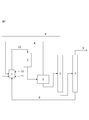
- Figure 1 shows an example of a manufacturing process that uses recycled raw materials.
- the present invention is not restricted by the flow shown in FIG.
- unreacted recycled olefin gas 4, unreacted recycled water 8, and by-produced recycled ether 6 are supplied to the evaporator 1 together with the raw material olefin gas 10 and the raw material water 11, and are mixed and gasified. It is converted and supplied to the reactor 2 as a raw material mixture 12.
- the unreacted olefin gas is separated in the intermediate tank 3, and the reaction product is supplied to the evaporator 1 as the recycled olefin gas 4.
- the by-product ether compound which is a low boiling point component is separated from the top of the column by distillation or the like and returned to the evaporator 1 as recycled ether 6 to be a reaction raw material.
- the high boiling point component extracted from the bottom of the low boiling point component removing tower 5 is distilled and separated into the crude alcohol 9 of the low boiling point component and the water of the high boiling point component, which are the target components, in the water removing tower 7.
- the water extracted from the bottom of the water removal tower 7 is returned to the evaporator 1 as recycled water 8. If necessary, the crude alcohol 9 can be further refined to obtain a product alcohol.
- olefins, by-product ether compounds, and water can be reused as recycled raw materials, and by-products of other production processes can be used as raw materials. It can also be used. There are no restrictions on the sources of these raw materials.
- the aldehyde compound has high polymerization reactivity and polymerizes on the surface of the solid acid catalyst to form cork, which lowers the reaction activity of the catalyst and deteriorates the selectivity.
- the aldehyde compound is supplied to the reactor as impurities in the raw material or reaction by-products contained in the recycled raw material. Examples of the aldehyde compound include acetaldehyde, butyraldehyde, crotonaldehyde, and hexanal.
- aldehyde compound of the reaction by-product is produced as a by-product by dehydrogenation of the alcohol compound.
- acetaldehyde is considered to be produced as a by-product from ethanol
- butyraldehyde is considered to be produced as a by-product from butanol.
- the total concentration of the aldehyde compound in the raw material mixture supplied to the reactor (hereinafter referred to as "reactor inlet concentration of the aldehyde compound”) shall be 70 molppm or less. It is necessary, and it is preferably 50 molppm or less. When a plurality of aldehyde compounds are present, their total content serves as a reference for the total concentration of the aldehyde compounds.
- a raw material (including a recycled raw material) and an aldehyde compound may be separated by using a separation / purification device, and the raw material having a reduced aldehyde concentration may be returned to the supply, or a plurality of raw materials may be used so that the aldehyde concentration does not exceed a certain level. It may be combined as appropriate.
- the means for separating the raw material and the aldehyde compound can be carried out by at least one selected from the group consisting of gas absorption, adsorption, distillation, and reaction conversion.
- a distillation column, an absorption column, an adsorption device, a membrane separation device, or the like can be used for separating the raw material and the aldehyde compound. Since the raw material contains a plurality of types such as olefin, ether compound, and water, different treatments may be performed for each individual raw material.
- the aldehyde compound in the olefin can be removed by absorbing it with water, while the aldehyde compound in the recycled water can be removed by absorbing it with a hydrocarbon compound or a solvent. That is, an efficient separation means can be appropriately selected based on the type and properties of the raw material and the type and properties of the aldehyde compound contained in the raw material.
- silica carrier Fused silica F-1 25 parts by mass, silica gel S-1 75 parts by mass, colloidal silica C-1 45 parts by mass (9 parts by mass in solid content) are kneaded with a kneader, and then the state of the kneaded product.
- Water and additives Metal cellulose: Metrose (registered trademark) SM-4000 manufactured by Shin-Etsu Chemical Industry Co., Ltd. 10 parts by mass
- the kneaded product is put into an extrusion molding machine equipped with a die having a circular hole of 6 mm ⁇ , the kneaded product is extruded, and the extruded intermediate is set to have the same length as the diameter of the circular hole used.
- Extrusion molding was performed while cutting with a cutter.
- the obtained pre-calcined molded product was formed into a spherical shape with a malmerizer (registered trademark), then dried at 70 ° C. for 24 hours or more, fired at about 820 ° C. in an air atmosphere, and cooled to obtain silica carrier A. ..
- the aqueous solution of silicate tungsten acid is transferred to a 200 mL volumetric flask, and then the weighed silica carrier A, 100 mL, is put into a 200 mL volumetric flask so that the aqueous solution of silicate tungsten acid spreads over the entire carrier.
- the inside of the volumetric flask was mixed.
- the silica carrier A carrying silicate-tungstic acid was transferred to a magnetic dish, air-dried for 1 hour, and then dried in a hot air dryer adjusted to 150 ° C. for 5 hours. After drying, the mixture was transferred into a desiccator and cooled to room temperature to obtain a solid acid catalyst A.
- a reactor filled with a predetermined amount of solid acid catalyst is heated to a predetermined temperature and pressure, pressure-pressed and controlled, and a predetermined amount of water vaporized by an evaporator and a predetermined amount of ethylene are added from a mass flow controller. Introduced in. The reaction gas after passing through the reactor was cooled, and the condensed liquid and the reaction gas from which the condensate had been removed were sampled for a certain period of time. The sampled liquid (reaction solution) and reaction gas were analyzed using a gas chromatophy analyzer and a curl fisher analyzer, and the reaction results were calculated.
- Example 1 4 mL of the solid acid catalyst A was weighed, filled in a tubular reactor (manufactured by SUS316, inner diameter 10 mm, length 300 mm), replaced with nitrogen gas, and then the pressure was increased to 0.75 MPaG. Next, the reactor is heated to 160 ° C., and when the temperature stabilizes, the amount of water and ethylene at which the GHSV (gas space velocity) is 4000 / hr and the molar ratio of water to ethylene is 0.3 is added to the reactor. It was fed and hydrated with ethylene. After the water and ethylene were fed, the temperature of the reactor was adjusted so that the peak temperature of the catalyst layer became 190 ° C. after the temperature became stable.
- GHSV gas space velocity
- Example 2 From the second day of the reaction test, the reaction was carried out in the same manner as in Example 1 except that an acetaldehyde aqueous solution adjusted to have an acetaldehyde inlet concentration of 50 molppm was used as a raw material instead of water.
- Example 1 ⁇ Reaction results and carbon adhesion>
- the reaction results of Example 1, Example 2 and Comparative Example 1 are shown in FIGS. 2 to 6.
- the ethylene conversion rate of 6% could be maintained by raising the catalyst layer peak temperature by about 1 ° C. over 400 hours.
- Comparative Example 1 it can be seen that the ethylene conversion rate of 6% could not be maintained unless the peak temperature of the catalyst layer was raised by 5 ° C. or more after 300 hours, and the catalytic activity decreased.
- the selectivity of butene and acetaldehyde, which are by-products is also deteriorating (increasing).
- Example 2 although the selectivity of acetaldehyde increased, the butene selectivity did not increase, and the ethylene conversion rate of 6% could be maintained by raising the peak temperature of the catalyst layer by about 1 ° C. as described above.
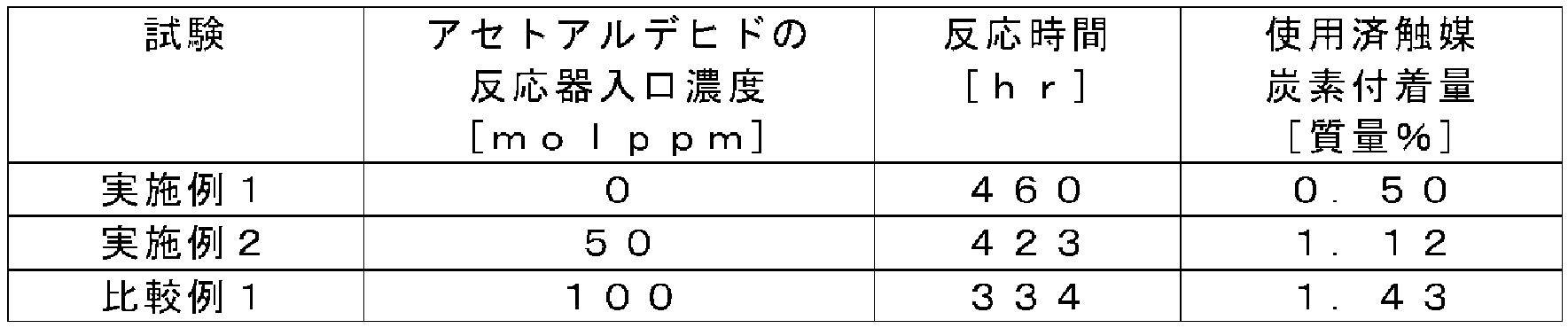
- Table 1 shows the amount of carbon adhered to the used catalyst. Although the reaction time of Comparative Example 1 was the shortest, the amount of carbon adhered was larger than that of Examples 1 and 2, indicating that the solid acid catalyst was deteriorated by caulking.
- the catalyst in the production of alcohol by hydration reaction of olefin using a heteropolymetalate catalyst, the catalyst can be used stably for a long period of time by reducing the aldehyde compound in the raw material, and a stable production amount of alcohol is secured. It is industrially useful in that it can be done.
- Evaporator 2 Reactor 3: Intermediate tank 4: Recycled olefin gas 5: Low boiling point component removal tower 6: Recycled ether 7: Water removal tower 8: Recycled water 9: Crude alcohol 10: Raw material olefin gas 11: Raw material water 12: Raw material mixture
Landscapes
- Chemical & Material Sciences (AREA)
- Organic Chemistry (AREA)
- Engineering & Computer Science (AREA)
- Materials Engineering (AREA)
- Chemical Kinetics & Catalysis (AREA)
- Organic Low-Molecular-Weight Compounds And Preparation Thereof (AREA)
Abstract
Description
[1]ヘテロポリ酸又はその塩が担持された固体酸触媒を用い、水と炭素原子数2~5のオレフィンとを反応器へ供給し、気相中で水和反応させることによるアルコールの製造方法において、反応器に供給される原料混合物中のアルデヒド化合物の含有量が70molppm以下であることを特徴とするアルコールの製造方法。
[2]
未反応の水、未反応の炭素原子数2~5のオレフィン、及び反応により副生したエーテル化合物からなる群より選ばれる少なくとも一種を、リサイクル原料として反応器に再度供給することを特徴とする[1]に記載のアルコールの製造方法。
[3]
リサイクル原料に含まれるアルデヒド化合物を除去することを特徴とする[1]又は[2]に記載のアルコールの製造方法。
[4]
リサイクル原料よりアルデヒド化合物を除去する手段として、ガス吸収、吸着、蒸留、及び反応転化からなる群より選ばれる少なくとも一つを用いる[2]又は[3]のいずれかに記載のアルコールの製造方法。
[5]
固体酸触媒の担体としてシリカを用いる[1]~[4]のいずれかに記載のアルコールの製造方法。
[6]
ヘテロポリ酸が、ケイタングステン酸、リンタングステン酸、リンモリブデン酸、ケイモリブデン酸、ケイバナドタングステン酸、リンバナドタングステン酸及びリンバナドモリブデン酸からなる群より選ばれる少なくとも一種の化合物である[1]~[5]のいずれかに記載のアルコールの製造方法。
[7]
炭素原子数2~5のオレフィンがエチレンであり、水和反応により製造されるアルコールがエタノールである[1]~[6]のいずれかに記載のアルコールの製造方法。
一実施形態のヘテロポリ酸触媒とは、触媒の主要な活性成分として、ヘテロポリ酸又はその塩を含む触媒をいう。
ヘテロポリ酸とは、中心元素及び酸素が結合した周辺元素からなるものである。中心元素は、通常ケイ素又はリンであるが、元素の周期表の第1族~第17族の多種の元素から選ばれる任意の一つからなることができる。具体的には、例えば、第二銅イオン;二価のベリリウム、亜鉛、コバルト又はニッケルのイオン;三価のホウ素、アルミニウム、ガリウム、鉄、セリウム、ヒ素、アンチモン、リン、ビスマス、クロム又はロジウムのイオン;四価のケイ素、ゲルマニウム、スズ、チタン、ジルコニウム、バナジウム、硫黄、テルル、マンガン、ニッケル、白金、トリウム、ハフニウム、セリウムのイオン及び他の希土類イオン;五価のリン、ヒ素、バナジウム、アンチモンイオン;六価のテルルイオン;及び七価のヨウ素イオン等を挙げることができるが、これに限定されるものではない。また、周辺元素の具体例としては、タングステン、モリブデン、バナジウム、ニオブ、タンタル等を挙げることができるが、これらに限定されるものではない。
ケイタングステン酸 H4[SiW12O40]・xH2O
リンタングステン酸 H3[PW12O40]・xH2O
リンモリブデン酸 H3[PMo12O40]・xH2O
ケイモリブデン酸 H4[SiMo12O40]・xH2O
ケイバナドタングステン酸 H4+n[SiVnW12-nO40]・xH2O
リンバナドタングステン酸 H3+n[PVnW12-nO40]・xH2O
リンバナドモリブデン酸 H3+n[PVnMo12-nO40]・xH2O
ケイバナドモリブデン酸 H4+n[SiVnMo12-nO40]・xH2O
ケイモリブドタングステン酸 H4[SiMonW12-nO40]・xH2O
リンモリブドタングステン酸 H3[PMonW12-nO40]・xH2O
(式中、nは1~11の整数であり、xは1以上の整数である。)
などを挙げることができるが、これらに限定されない。
ヘテロポリ酸触媒はそのままでも使用することができるが、担体に担持して使用することが好ましい。担体は、シリカ、珪藻土、チタニア、活性炭、アルミナ、及びシリカアルミナからなる群より選ばれる少なくとも一種であることが好ましく、シリカであることがより好ましい。
次に、ヘテロポリ酸触媒を用いたオレフィンの水和反応によるアルコールの製造方法について説明する。アルコールは、ヘテロポリ酸又はその塩が担持された固体酸触媒を用い、水と炭素原子数2~5のオレフィンとを反応器へ供給し、気相中で水和反応させることで得ることができる。

フュームドシリカF-1 25質量部、シリカゲルS-1 75質量部、コロイダルシリカC-1 45質量部(固形分で9質量部)をニーダーにて混練した後、混練物の状態を観察しながら、水及び添加剤(メチルセルロース:信越化学工業株式会社製メトローズ(登録商標)SM-4000 10質量部、樹脂系バインダー:ユケン工業株式会社製セランダー(登録商標)YB-132A 5質量部)を適量加え、更に混練して、混練物を得た。次いで、混練物を6mmφの円孔を設けたダイスを取り付けた押出成形機に投入し、混練物を押出し、押し出された中間物を長さが用いた円孔の直径と同じ長さになるようにカッターで切断しながら押出成形を行った。得られた焼成前成形体をマルメライザー(登録商標)で球状に成形し、次いで70℃で24時間以上乾燥した後、空気雰囲気下約820℃で焼成し、冷却してシリカ担体Aを得た。
市販のKeggin型ケイタングステン酸・26水和物(H4SiW12O40・26H2O;日本無機化学工業株式会社製)40.7gを100mLのビーカーにはかりとり、少量の蒸留水を加え、ケイタングステン酸を溶解させた後、200mLのメスシリンダーに移液した。次いで、メスシリンダーのケイタングステン酸溶液の液量が、担持する担体の吸水率の95%になるように、蒸留水を加え、全体が均一になるように撹拌した。撹拌後、ケイタングステン酸の水溶液を、200mLのメスフラスコに移液し、次いで、秤量したシリカ担体A、100mLを200mLメスフラスコに投入し、ケイタングステン酸の水溶液が担体全体に行きわたるように、メスフラスコ内を混合した。ケイタングステン酸が担持されたシリカ担体Aを磁性皿に移し、一時間風乾させた後、150℃に調節した熱風乾燥器で、5時間乾燥した。乾燥後、デシケーター内に移し、室温になるまで冷却し、固体酸触媒Aを得た。
所定量の固体酸触媒を充填した反応器を所定温度、圧力に昇温、昇圧コントロールし、蒸発器により気化した所定量の水、及びマスフローコントローラーより所定量のエチレンを反応器に導入した。反応器通過後の反応ガスを冷却し、凝縮した液体、及び凝縮物が取り除かれた反応ガスを、それぞれ一定時間サンプリングした。サンプリングした液体(反応液)、及び反応ガスを、ガスクロマトフィー分析装置、及びカールフィッシャー分析装置を用いて分析し、反応成績を算出した。
サンプリングしたガスは、アジレント(Agilent)・テクノロジー社製ガスクロマトグラフィー装置(装置名:7890)を使用し、複数のカラムと二つの検出器によるシステムプログラムで分析した。
ガスクロマトグラフィー条件:
オーブン:40℃で3分間保持後、20℃/分で200℃まで昇温
キャリアガス:ヘリウム
スプリット比:10:1
・使用カラム:アジレント・テクノロジー社製
HP-1:2m
GasPro:30m×320μm
DB-624:60m×320μm×1.8μm
・検出器:
フロント検出器:FID(ヒーター:230℃、水素流量40mL/分、空気流量400L/分)
バック検出器:FID(ヒーター:230℃、水素流量40mL/分、空気流量400L/分)
Aux検出器:TCD(ヒーター:230℃、リファレンス流量45mL/分、メークアップ流量2mL/分)
サンプリングした反応液は、アジレント(Agilent)・テクノロジー社製ガスクロマトグラフィー装置(装置名:6850)を使用して分析した。また、反応液中の水濃度は、三菱化学株式会社製のカールフィッシャー分析装置で分析した。
使用カラム:PoraBONDQ 25m×0.53mmID×10μm
オーブン温度:100℃で2分間保持後、5℃/分で240℃まで昇温
インジェクション温度:250℃
検出器温度:300℃
反応で使用した触媒は粉砕して粉末サンプルとし、ヤナコテクニカルサイエンス社製炭素・水素・窒素同時定量装置MT-6を使用して分析し、炭素付着量を定量した。
固体酸触媒Aを4mL量りとり、管型の反応器(SUS316製、内径10mm、長さ300mm)に充填し、窒素ガスで置換した後、0.75MPaGまで昇圧した。次いで、反応器を160℃に加熱し、温度が安定した段階で、GHSV(ガス空間速度)が4000/hr、エチレンに対する水のモル比が0.3となる量の水とエチレンを反応器にフィードして、エチレンの水和反応を行った。水及びエチレンのフィード後、温度が安定してから、触媒層のピーク温度が190℃となるように反応器の温度を調整した。ピーク温度が190℃で安定してから2時間後に、反応器を通過したガスを冷却し、凝縮した反応液と、凝縮液が除かれた反応ガスのサンプリングを1時間行った。取得した凝縮液と反応ガスの質量とガス流量、及び分析結果から、触媒の反応成績を算出した。2日目以降は、エチレン転化率が6%となるよう反応器の温度を調節しながら試験を継続した。
反応試験2日目より、水の替わりにアセトアルデヒドの反応器入口濃度が50molppmとなるよう調整したアセトアルデヒド水溶液を原料として用いた以外は、実施例1と同様に反応を行った。
反応試験2日目より、水の替わりにアセトアルデヒドの反応器入口濃度が100molppmとなるよう調整したアセトアルデヒド水溶液を原料として用いた以外は、実施例1と同様に反応を行った。
実施例1、実施例2及び比較例1の反応成績を図2~6に示す。実施例1及び2では、400時間にわたって触媒層ピーク温度を約1℃上げることにより、エチレン転化率6%を維持することができた。一方、比較例1では300時間以降触媒層ピーク温度を5℃以上上げないとエチレン転化率6%を維持することができず、触媒活性が低下したことがわかる。また副生物であるブテン及びアセトアルデヒドの選択率も悪化(増大)している。実施例2ではアセトアルデヒドの選択率が増加するものの、ブテン選択率は増加せず、上述のとおり触媒層ピーク温度を約1℃上げることにより、エチレン転化率6%を維持することができた。
2:反応器
3:中間タンク
4:リサイクルオレフィンガス
5:低沸点成分除去塔
6:リサイクルエーテル
7:水除去塔
8:リサイクル水
9:粗アルコール
10:原料オレフィンガス
11:原料水
12:原料混合物
Claims (7)
- ヘテロポリ酸又はその塩が担持された固体酸触媒を用い、水と炭素原子数2~5のオレフィンとを反応器へ供給し、気相中で水和反応させることによるアルコールの製造方法において、反応器に供給される原料混合物中のアルデヒド化合物の含有量が70molppm以下であることを特徴とするアルコールの製造方法。
- 未反応の水、未反応の炭素原子数2~5のオレフィン、及び反応により副生したエーテル化合物からなる群より選ばれる少なくとも一種を、リサイクル原料として反応器に再度供給することを特徴とする請求項1に記載のアルコールの製造方法。
- リサイクル原料に含まれるアルデヒド化合物を除去することを特徴とする請求項1又は2に記載のアルコールの製造方法。
- リサイクル原料よりアルデヒド化合物を除去する手段として、ガス吸収、吸着、蒸留、及び反応転化からなる群より選ばれる少なくとも一つを用いる請求項2又は3のいずれかに記載のアルコールの製造方法。
- 固体酸触媒の担体としてシリカを用いる請求項1~4のいずれか一項に記載のアルコールの製造方法。
- ヘテロポリ酸が、ケイタングステン酸、リンタングステン酸、リンモリブデン酸、ケイモリブデン酸、ケイバナドタングステン酸、リンバナドタングステン酸及びリンバナドモリブデン酸からなる群より選ばれる少なくとも一種の化合物である請求項1~5のいずれか一項に記載のアルコールの製造方法。
- 炭素原子数2~5のオレフィンがエチレンであり、水和反応により製造されるアルコールがエタノールである請求項1~6のいずれか一項に記載のアルコールの製造方法。
Priority Applications (4)
| Application Number | Priority Date | Filing Date | Title |
|---|---|---|---|
| JP2022501691A JPWO2021166485A1 (ja) | 2020-02-20 | 2021-01-08 | |
| EP21756863.3A EP4108652A4 (en) | 2020-02-20 | 2021-01-08 | PROCESS FOR PRODUCING ALCOHOL |
| CN202180003547.5A CN113874343A (zh) | 2020-02-20 | 2021-01-08 | 醇的制造方法 |
| US17/595,722 US20220251009A1 (en) | 2020-02-20 | 2021-01-08 | Method for producing alcohol |
Applications Claiming Priority (2)
| Application Number | Priority Date | Filing Date | Title |
|---|---|---|---|
| JP2020027332 | 2020-02-20 | ||
| JP2020-027332 | 2020-02-20 |
Publications (1)
| Publication Number | Publication Date |
|---|---|
| WO2021166485A1 true WO2021166485A1 (ja) | 2021-08-26 |
Family
ID=77392085
Family Applications (1)
| Application Number | Title | Priority Date | Filing Date |
|---|---|---|---|
| PCT/JP2021/000565 Ceased WO2021166485A1 (ja) | 2020-02-20 | 2021-01-08 | アルコールの製造方法 |
Country Status (5)
| Country | Link |
|---|---|
| US (1) | US20220251009A1 (ja) |
| EP (1) | EP4108652A4 (ja) |
| JP (1) | JPWO2021166485A1 (ja) |
| CN (1) | CN113874343A (ja) |
| WO (1) | WO2021166485A1 (ja) |
Citations (2)
| Publication number | Priority date | Publication date | Assignee | Title |
|---|---|---|---|---|
| JPH11269126A (ja) * | 1998-01-22 | 1999-10-05 | Bp Chem Internatl Ltd | エステル合成 |
| JPH11322646A (ja) * | 1998-03-25 | 1999-11-24 | Bp Chem Internatl Ltd | オレフィンの水和法 |
Family Cites Families (3)
| Publication number | Priority date | Publication date | Assignee | Title |
|---|---|---|---|---|
| US2173187A (en) * | 1937-02-25 | 1939-09-19 | Du Pont | Process for hydrating olefins |
| JP2004209469A (ja) * | 2002-12-20 | 2004-07-29 | Showa Denko Kk | ヘテロポリ酸及び/又はその塩の担持型触媒、該触媒の製造方法及び該触媒を用いた化合物の製造方法 |
| EP3875446A4 (en) * | 2018-11-02 | 2022-08-03 | Showa Denko K.K. | METHODS OF PRODUCTION OF ALCOHOL AND METHODS OF PRODUCTION OF ALCOHOL |
-
2021
- 2021-01-08 US US17/595,722 patent/US20220251009A1/en not_active Abandoned
- 2021-01-08 WO PCT/JP2021/000565 patent/WO2021166485A1/ja not_active Ceased
- 2021-01-08 EP EP21756863.3A patent/EP4108652A4/en not_active Withdrawn
- 2021-01-08 CN CN202180003547.5A patent/CN113874343A/zh active Pending
- 2021-01-08 JP JP2022501691A patent/JPWO2021166485A1/ja active Pending
Patent Citations (2)
| Publication number | Priority date | Publication date | Assignee | Title |
|---|---|---|---|---|
| JPH11269126A (ja) * | 1998-01-22 | 1999-10-05 | Bp Chem Internatl Ltd | エステル合成 |
| JPH11322646A (ja) * | 1998-03-25 | 1999-11-24 | Bp Chem Internatl Ltd | オレフィンの水和法 |
Non-Patent Citations (3)
| Title |
|---|
| "New Experimental Chemistry 8, Synthesis of Inorganic Compound (III", 20 August 1984, MARUZEN CO., LTD. |
| "Quarterly Chemical Review", 1993, CHEMICAL SOCIETY OF JAPAN, article "Chemistry of Polyacids" |
| See also references of EP4108652A4 |
Also Published As
| Publication number | Publication date |
|---|---|
| US20220251009A1 (en) | 2022-08-11 |
| EP4108652A4 (en) | 2024-07-10 |
| EP4108652A1 (en) | 2022-12-28 |
| JPWO2021166485A1 (ja) | 2021-08-26 |
| CN113874343A (zh) | 2021-12-31 |
Similar Documents
| Publication | Publication Date | Title |
|---|---|---|
| JP5512543B2 (ja) | グリセリンからアクロレインを製造する方法 | |
| RU2415121C2 (ru) | Способ получения этилена | |
| RU2419596C2 (ru) | Способ получения олефинов | |
| US20140024861A1 (en) | Catalyst For Reducing Selectively Saturated Aldehyde And A Process For Preparing The Catalyst | |
| EP2898948B1 (en) | Glycerin dehydration catalyst, preparation method therefor, and method for producing acrolein | |
| ES2988119T3 (es) | Procedimiento de deshidratación de compuestos oxigenados | |
| Yadav et al. | Selective dehydration of glycerol to acrolein: development of efficient and robust solid acid catalyst MUICaT-5 | |
| CN103717306A (zh) | 用于通过甘油的脱水反应制造丙烯醛和丙烯酸的催化剂及其制造方法 | |
| KR20140054070A (ko) | 탈수 반응의 개선된 방법 | |
| WO2020090756A1 (ja) | アルコールの製造方法及びアルコール製造用触媒 | |
| JP6091310B2 (ja) | ブタジエンの製造方法 | |
| JP2694177B2 (ja) | メチル―t―ブチルエーテルの一段階合成方法 | |
| RU2415832C2 (ru) | Способ получения пропилена | |
| Yu et al. | Catalytic synthesis of diphenolic acid from levulinic acid over cesium partly substituted Wells–Dawson type heteropolyacid | |
| JP2021079317A (ja) | アルコール製造用触媒及びその製造方法、並びにアルコールの製造方法 | |
| WO2021205900A1 (ja) | アルコールの製造方法 | |
| US20220251009A1 (en) | Method for producing alcohol | |
| JP2020070266A (ja) | アルコールの製造方法及びアルコール製造用触媒 | |
| KR20070009693A (ko) | 에틸 아세테이트의 제조 방법 | |
| US20240336546A1 (en) | Method for producing alcohol | |
| US20240360058A1 (en) | Method for producing alcohols | |
| CN105392766A (zh) | 用于生产丙烯酸和丙烯酸酯的集成方法 | |
| JP7685138B2 (ja) | 酢酸エチルの製造方法 | |
| Ninomiya et al. | An efficient synthesis of α-acyloxyacrylate esters as candidate monomers for bio-based polymers by heteropolyacid-catalyzed acylation of pyruvate esters | |
| US6818790B1 (en) | Process for producing mixed gas of lower olefin and lower aliphatic carboxylic acid, and process for producing lower aliphatic ester using the mixed gas |
Legal Events
| Date | Code | Title | Description |
|---|---|---|---|
| 121 | Ep: the epo has been informed by wipo that ep was designated in this application |
Ref document number: 21756863 Country of ref document: EP Kind code of ref document: A1 |
|
| ENP | Entry into the national phase |
Ref document number: 2022501691 Country of ref document: JP Kind code of ref document: A |
|
| NENP | Non-entry into the national phase |
Ref country code: DE |
|
| ENP | Entry into the national phase |
Ref document number: 2021756863 Country of ref document: EP Effective date: 20220920 |
|
| WWW | Wipo information: withdrawn in national office |
Ref document number: 2021756863 Country of ref document: EP |