WO2021166904A1 - タイヤ - Google Patents
タイヤ Download PDFInfo
- Publication number
- WO2021166904A1 WO2021166904A1 PCT/JP2021/005697 JP2021005697W WO2021166904A1 WO 2021166904 A1 WO2021166904 A1 WO 2021166904A1 JP 2021005697 W JP2021005697 W JP 2021005697W WO 2021166904 A1 WO2021166904 A1 WO 2021166904A1
- Authority
- WO
- WIPO (PCT)
- Prior art keywords
- mass
- layer
- parts
- rubber
- preferable
- Prior art date
- Legal status (The legal status is an assumption and is not a legal conclusion. Google has not performed a legal analysis and makes no representation as to the accuracy of the status listed.)
- Ceased
Links
Images

Classifications
-
- B—PERFORMING OPERATIONS; TRANSPORTING
- B32—LAYERED PRODUCTS
- B32B—LAYERED PRODUCTS, i.e. PRODUCTS BUILT-UP OF STRATA OF FLAT OR NON-FLAT, e.g. CELLULAR OR HONEYCOMB, FORM
- B32B25/00—Layered products comprising a layer of natural or synthetic rubber
- B32B25/18—Layered products comprising a layer of natural or synthetic rubber comprising butyl or halobutyl rubber
-
- B—PERFORMING OPERATIONS; TRANSPORTING
- B32—LAYERED PRODUCTS
- B32B—LAYERED PRODUCTS, i.e. PRODUCTS BUILT-UP OF STRATA OF FLAT OR NON-FLAT, e.g. CELLULAR OR HONEYCOMB, FORM
- B32B25/00—Layered products comprising a layer of natural or synthetic rubber
- B32B25/04—Layered products comprising a layer of natural or synthetic rubber comprising rubber as the main or only constituent of a layer, which is next to another layer of the same or of a different material
- B32B25/042—Layered products comprising a layer of natural or synthetic rubber comprising rubber as the main or only constituent of a layer, which is next to another layer of the same or of a different material of natural rubber or synthetic rubber
-
- B—PERFORMING OPERATIONS; TRANSPORTING
- B32—LAYERED PRODUCTS
- B32B—LAYERED PRODUCTS, i.e. PRODUCTS BUILT-UP OF STRATA OF FLAT OR NON-FLAT, e.g. CELLULAR OR HONEYCOMB, FORM
- B32B25/00—Layered products comprising a layer of natural or synthetic rubber
- B32B25/14—Layered products comprising a layer of natural or synthetic rubber comprising synthetic rubber copolymers
-
- B—PERFORMING OPERATIONS; TRANSPORTING
- B60—VEHICLES IN GENERAL
- B60C—VEHICLE TYRES; TYRE INFLATION; TYRE CHANGING; CONNECTING VALVES TO INFLATABLE ELASTIC BODIES IN GENERAL; DEVICES OR ARRANGEMENTS RELATED TO TYRES
- B60C1/00—Tyres characterised by the chemical composition or the physical arrangement or mixture of the composition
- B60C1/0016—Compositions of the tread
-
- B—PERFORMING OPERATIONS; TRANSPORTING
- B60—VEHICLES IN GENERAL
- B60C—VEHICLE TYRES; TYRE INFLATION; TYRE CHANGING; CONNECTING VALVES TO INFLATABLE ELASTIC BODIES IN GENERAL; DEVICES OR ARRANGEMENTS RELATED TO TYRES
- B60C11/00—Tyre tread bands; Tread patterns; Anti-skid inserts
- B60C11/0041—Tyre tread bands; Tread patterns; Anti-skid inserts comprising different tread rubber layers
- B60C11/005—Tyre tread bands; Tread patterns; Anti-skid inserts comprising different tread rubber layers with cap and base layers
-
- C—CHEMISTRY; METALLURGY
- C08—ORGANIC MACROMOLECULAR COMPOUNDS; THEIR PREPARATION OR CHEMICAL WORKING-UP; COMPOSITIONS BASED THEREON
- C08L—COMPOSITIONS OF MACROMOLECULAR COMPOUNDS
- C08L9/00—Compositions of homopolymers or copolymers of conjugated diene hydrocarbons
- C08L9/06—Copolymers with styrene
-
- B—PERFORMING OPERATIONS; TRANSPORTING
- B32—LAYERED PRODUCTS
- B32B—LAYERED PRODUCTS, i.e. PRODUCTS BUILT-UP OF STRATA OF FLAT OR NON-FLAT, e.g. CELLULAR OR HONEYCOMB, FORM
- B32B2250/00—Layers arrangement
- B32B2250/24—All layers being polymeric
- B32B2250/248—All polymers belonging to those covered by group B32B25/00
-
- B—PERFORMING OPERATIONS; TRANSPORTING
- B32—LAYERED PRODUCTS
- B32B—LAYERED PRODUCTS, i.e. PRODUCTS BUILT-UP OF STRATA OF FLAT OR NON-FLAT, e.g. CELLULAR OR HONEYCOMB, FORM
- B32B2270/00—Resin or rubber layer containing a blend of at least two different polymers
-
- B—PERFORMING OPERATIONS; TRANSPORTING
- B32—LAYERED PRODUCTS
- B32B—LAYERED PRODUCTS, i.e. PRODUCTS BUILT-UP OF STRATA OF FLAT OR NON-FLAT, e.g. CELLULAR OR HONEYCOMB, FORM
- B32B2307/00—Properties of the layers or laminate
- B32B2307/50—Properties of the layers or laminate having particular mechanical properties
- B32B2307/554—Wear resistance
-
- B—PERFORMING OPERATIONS; TRANSPORTING
- B32—LAYERED PRODUCTS
- B32B—LAYERED PRODUCTS, i.e. PRODUCTS BUILT-UP OF STRATA OF FLAT OR NON-FLAT, e.g. CELLULAR OR HONEYCOMB, FORM
- B32B2307/00—Properties of the layers or laminate
- B32B2307/70—Other properties
- B32B2307/744—Non-slip, anti-slip
-
- B—PERFORMING OPERATIONS; TRANSPORTING
- B32—LAYERED PRODUCTS
- B32B—LAYERED PRODUCTS, i.e. PRODUCTS BUILT-UP OF STRATA OF FLAT OR NON-FLAT, e.g. CELLULAR OR HONEYCOMB, FORM
- B32B2413/00—Belts
-
- B—PERFORMING OPERATIONS; TRANSPORTING
- B60—VEHICLES IN GENERAL
- B60C—VEHICLE TYRES; TYRE INFLATION; TYRE CHANGING; CONNECTING VALVES TO INFLATABLE ELASTIC BODIES IN GENERAL; DEVICES OR ARRANGEMENTS RELATED TO TYRES
- B60C11/00—Tyre tread bands; Tread patterns; Anti-skid inserts
- B60C11/0008—Tyre tread bands; Tread patterns; Anti-skid inserts characterised by the tread rubber
- B60C2011/0016—Physical properties or dimensions
- B60C2011/0033—Thickness of the tread
Definitions
- the present invention relates to a tire having a well-balanced improvement in grip performance and durability performance.
- thermoplastic elastomer The technology to improve the grip performance by blending a thermoplastic elastomer with the tread rubber is known.
- Thermoplastic elastomers are softer at room temperature than resins, and when added to rubber, the increase in hardness of the rubber composition is suppressed, and when heat is applied, the intermolecular force between hard segments weakens, resulting in energy. It is considered that loss can be generated and the grip performance at the initial stage of running is improved.
- thermoplastic elastomer when considering the vulcanization adhesiveness with other tire members composed of a rubber composition containing no thermoplastic elastomer, the thermoplastic elastomer is concentrated on the bonding interface due to the heat and concentration gradient during vulcanization. There is a concern that the durability performance may deteriorate due to the decrease in the adhesiveness between the rubber members.
- An object of the present invention is to provide a tire having improved grip performance and durability performance in a well-balanced manner.
- thermoplastic elastomer is blended in the first rubber layer (typically, a cap tread) constituting the tread surface, between the first layer and the belt layer.
- first rubber layer typically, a cap tread
- a tire with well-balanced grip performance and durability can be obtained by interposing a rubber layer containing a thermoplastic elastomer under predetermined conditions, and completed the present invention.
- the present invention [1] A tire having a tread having a first layer constituting a tread surface and a second layer adjacent to the inside in the radial direction of the first layer, wherein the first layer and the second layer are rubber.
- Tires composed of rubber compositions containing components and thermoplastic elastomers [2] The tire according to the above [1], wherein the rubber composition constituting the first layer contains 5 to 50 parts by mass of a thermoplastic elastomer with respect to 100 parts by mass of the rubber component constituting the first layer.
- the rubber composition constituting the second layer contains 3 to 30 parts by mass of a thermoplastic elastomer with respect to 100 parts by mass of the rubber component constituting the second layer.
- thermoplastic elastomer with respect to 100 parts by mass of the rubber component constituting the first layer is larger than the value of the mass part of the thermoplastic elastomer with respect to 100 parts by mass of the rubber component constituting the second layer.
- thermoplastic elastomer has a styrene block at the end of the polymer.
- thermoplastic elastomer when a thermoplastic elastomer is blended in a first rubber layer (typically a cap tread) constituting a tread surface, between the first layer and the belt layer under predetermined conditions.
- a first rubber layer typically a cap tread
- thermoplastic elastomer By interposing a rubber layer containing a thermoplastic elastomer, a tire having a well-balanced improvement in grip performance and durability is provided.
- a tire according to an embodiment of the present disclosure has a tread including a first layer constituting a tread surface and a second layer adjacent to the inside in the radial direction of the first layer, and the first layer and the said.
- the second layer is composed of a rubber composition containing a thermoplastic elastomer. Further, it is preferable that the content of the thermoplastic elastomer with respect to 100 parts by mass of the rubber component constituting the first layer is larger than the content of the thermoplastic elastomer with respect to 100 parts by mass of the rubber component constituting the second layer.
- the tires of the present disclosure have a well-balanced improvement in grip performance and durability performance by the following mechanism.
- a rubber layer containing a thermoplastic elastomer between the tread surface layer and the belt layer, vulcanization adhesion and the intermolecular force of the thermoplastic elastomer are provided between the tread surface layer and the second layer adjacent thereto.
- the adhesiveness between the second layer and the belt topping rubber is ensured by vulcanization adhesion between the diene rubbers. Therefore, even if the content of the thermoplastic elastomer in the entire tread portion is increased, it is considered that the adhesiveness with the adjacent rubber member is ensured, the durability performance is maintained, and the grip performance is also improved.
- the dimensions and angles of each member of the tire are measured in a state where the tire is incorporated into a regular rim and the tire is filled with air so as to have a regular internal pressure. At the time of measurement, no load is applied to the tire.
- a "regular rim” is a rim defined for each tire in the standard system including the standard on which the tire is based. For example, “Measuring Rim”. In the case of a tire of a size not specified in the above standard system, the narrowest rim can be assembled to the tire and has the smallest diameter that does not cause air leakage between the rim and the tire. Shall refer to.
- Regular internal pressure is the air pressure defined for each tire in the standard system including the standard on which the tire is based.
- maximum air pressure for TRA, the table “TIRELOAD LIMITSAT” The maximum value described in "VARIOUS COLD INFLATION PRESSURES", and in the case of ETRTO, it is "INFLATION PRESSURE".
- the normal internal pressure is 250 kPa.
- FIG. 1 is an enlarged cross-sectional view showing a part of the tread of the tire according to the present disclosure.
- FIG. 1 shows an enlarged portion of the tread according to the present disclosure in which a groove is not formed on the tread surface.
- the vertical direction is the radial direction of the tire
- the horizontal direction is the axial direction of the tire
- the direction perpendicular to the paper surface is the circumferential direction of the tire.
- the tread portion of the tire of the present disclosure includes a first layer and a second layer, the outer surface of the first layer constitutes the tread surface, and the second layer is adjacent to the inside in the radial direction of the first layer. ing.
- the first layer typically corresponds to a cap tread.
- one or more rubber layers may be further provided between the second layer and the belt layer as long as the object of the present disclosure is achieved.
- a rubber layer for imparting adhesiveness at the time of molding may be provided between the innermost layer and the belt layer in the radial direction among the rubber layers constituting the tread portion.
- double-headed arrow t1 is the thickness of the first layer
- double-headed arrow t2 is the thickness of the second layer
- double-headed arrow t3 is the thickness of the third layer.
- any point on the tread surface where the groove is not formed is indicated by the symbol P.
- the straight line represented by the symbol N is a straight line (normal line) that passes through the point P and is perpendicular to the tangent plane at this point P.
- the thicknesses t1, t2 and t3 are the points P at the tire equatorial plane when there is no groove on the tire equatorial plane, and the land portion closest to the tire equatorial plane when there is a groove on the tire equatorial plane.
- the central portion in the tire width direction of the tire is set as a point P, and the measurement is performed along the normal line N drawn from the point P.
- the thickness t1 of the first layer is not particularly limited, but from the viewpoint of grip performance, 2.0 mm or more is preferable, 3.0 mm or more is more preferable, and 4.0 mm or more is further preferable. On the other hand, from the viewpoint of heat generation, 10.0 mm or less is preferable, 9.0 mm or less is more preferable, and 8.0 mm or less is further preferable.
- the thickness t2 of the second layer is not particularly limited, but 1.0 mm or more is preferable, 1.5 mm or more is more preferable, and 2.0 mm or more is further preferable. Further, t2 is preferably 5.0 mm or less, more preferably 4.0 mm or less, and further preferably 3.0 mm or less.
- the thickness t3 of the third layer is not particularly limited, but is preferably 0.5 mm or more, and more preferably 1.0 mm or more. Further, t3 is preferably 4.0 mm or less, more preferably 3.0 mm or less, and further preferably 2.0 mm or less.
- the thickness t1 of the first layer with respect to the thickness of the entire tread portion is preferably 30 to 95%, more preferably 40 to 90%, further preferably 45 to 85%, and particularly preferably 50 to 80%.
- the thickness of the entire tread portion in the present disclosure means the total thickness of the rubber layers constituting the tread portion, and is determined by the shortest distance from the tread surface to the belt layer.
- the product of the content (parts by mass) of the thermoplastic elastomer with respect to 100 parts by mass of the rubber component constituting the first layer and the thickness t1 (mm) of the first layer is preferably 120 or more, more preferably 130 or more, and 140 or more.
- the above is more preferable, and 150 or more is particularly preferable.
- the product of the content of the thermoplastic elastomer (parts by mass) and the thickness t1 (mm) of the first layer with respect to 100 parts by mass of the rubber component constituting the first layer is preferably 400 or less, more preferably 300 or less. , 250 or less is more preferable, and 200 or less is particularly preferable.
- the product of the content (parts by mass) of the thermoplastic elastomer with respect to 100 parts by mass of the rubber component constituting the second layer and the thickness t2 (mm) of the second layer is preferably 6 or more, more preferably 9 or more, and 12 or more.
- the above is more preferable, and 15 or more is particularly preferable.
- the product of the content of the thermoplastic elastomer (parts by mass) and the thickness t2 (mm) of the second layer with respect to 100 parts by mass of the rubber component constituting the second layer is preferably 150 or less, more preferably 100 or less. , 75 or less is more preferable, and 50 or less is particularly preferable.
- the first tread layer is composed of a rubber composition containing a rubber component and a thermoplastic elastomer.
- the rubber composition constituting the first layer preferably contains at least one selected from the group consisting of styrene-butadiene rubber (SBR), butadiene rubber (BR), and isoprene-based rubber as a rubber component, and preferably contains styrene-butadiene. It is more preferable to contain rubber (SBR). Further, the rubber component may be a rubber component composed of only SBR.
- SBR solution polymerization SBR
- E-SBR emulsion polymerization SBR
- modified SBR modified SBR
- modified SBR include modified SBRs (condensates, those having a branched structure, etc.) coupled with SBRs having modified terminals and / or main chains, tin, silicon compounds and the like. Of these, S-SBR and modified SBR are preferable. Further, hydrogenated additives of these SBRs (hydrogenated SBR) and the like can also be used. These SBRs may be used alone or in combination of two or more.
- S-SBR manufactured and sold by JSR Co., Ltd., Sumitomo Chemical Co., Ltd., Ube Industries, Ltd., Asahi Kasei Co., Ltd., ZS Elastomer Co., Ltd., and the like. ..
- the styrene content of SBR is preferably 10% by mass or more, more preferably 15% by mass or more, still more preferably 20% by mass or more, from the viewpoint of grip performance and wear resistance performance. Further, from the viewpoint of temperature dependence of grip performance and blow resistance performance, 60% by mass or less is preferable, 55% by mass or less is more preferable, and 50% by mass or less is further preferable. In this specification, the styrene content of SBR is calculated by 1 1 H-NMR measurement.
- the vinyl bond amount of SBR is preferably 10 mol% or more, more preferably 15 mol% or more, still more preferably 20 mol% or more, from the viewpoint of ensuring reactivity with silica, rubber strength and wear resistance performance.
- the vinyl bond amount of SBR is preferably 70 mol% or less, more preferably 65 mol% or less, and more preferably 60 mol% or less from the viewpoints of preventing increase in temperature dependence, grip performance, elongation at break, and wear resistance. More preferred.
- the vinyl bond amount (1,2-bonded butadiene unit amount) of SBR is measured by infrared absorption spectrum analysis.
- the content of SBR in 100% by mass of the rubber component constituting the first layer is preferably 50% by mass or more, more preferably 60% by mass or more, further preferably 65% by mass or more, and 70% by mass. % Or more is particularly preferable. Further, the upper limit of the content of SBR in the rubber component is not particularly limited and may be 100% by mass.
- the BR is not particularly limited, and for example, a BR having a cis content (cis-1,4 bond content) of less than 50% (low cis BR), a BR having a cis content of 90% or more (high cis BR), and a rare earth element.
- Rare earth butadiene rubber (rare earth BR) synthesized using a system catalyst, BR containing syndiotactic polybutadiene crystals (SPB-containing BR), modified BR (Hisys modified BR, Rosis modified BR), etc. are common in the tire industry. Can be used.
- BRs those commercially available from Ube Industries, Ltd., Sumitomo Chemical Co., Ltd., JSR Corporation, Lanxess Co., Ltd., etc. can be used. These BRs may be used alone or in combination of two or more.
- Rare earth BR can be used that is generally used in the tire industry.
- a known rare earth element catalyst can be used for the synthesis (polymerization) of the rare earth BR, and includes, for example, a lanthanum series rare earth element compound, an organoaluminum compound, an aluminoxane, a halogen-containing compound, and a Lewis base if necessary. Examples include catalysts. Of these, an Nd-based catalyst using a neodymium (Nd) -containing compound as the lanthanum-series rare earth element compound is preferable from the viewpoint of obtaining a BR having a high cis content and a low vinyl content.
- Nd neodymium
- the SPB-containing BR includes 1,2-syndiotactic polybutadiene crystals that are not simply dispersed in BR, but are dispersed after being chemically bonded to BR.
- the modified BR is obtained by polymerizing 1,3-butadiene with a lithium initiator and then adding a tin compound, and further, the terminal of the modified BR molecule is bonded by a tin-carbon bond (tin).
- Modified BR butadiene rubber having a condensed alkoxysilane compound at the active end of the butadiene rubber (modified BR for silica), and the like.
- the content in 100% by mass of the rubber component is preferably 50% by mass or less, more preferably 40% by mass or less, further preferably 30% by mass or less, and 20% by mass or less from the viewpoint of grip performance. Is particularly preferable.
- the lower limit of the content when BR is contained is not particularly limited, but may be, for example, 1% by mass or more, 3% by mass or more, 5% by mass or more, 10% by mass or more, and 15% by mass or more. ..
- isoprene rubber As the isoprene-based rubber, for example, isoprene rubber (IR), natural rubber, and other rubbers commonly used in the tire industry can be used. Natural rubber includes non-modified natural rubber (NR), epoxidized natural rubber (ENR), hydrogenated natural rubber (HNR), deproteinized natural rubber (DPNR), high-purity natural rubber, and grafted natural rubber. Modified natural rubber and the like are also included. These isoprene-based rubbers may be used alone or in combination of two or more.
- the NR is not particularly limited, and a tire that is common in the tire industry can be used, and examples thereof include SIR20, RSS # 3, and TSR20.
- the content in 100% by mass of the rubber component is preferably 50% by mass or less from the viewpoint of grip performance. , 40% by mass or less is more preferable, 30% by mass or less is further preferable, and 20% by mass or less is particularly preferable.
- the lower limit of the content when the isoprene-based rubber is contained is not particularly limited, but is, for example, 1% by mass or more, 3% by mass or more, 5% by mass or more, 10% by mass or more, and 15% by mass or more. Can be done.
- a rubber component other than the above-mentioned isoprene-based rubber, SBR and BR may be contained.
- a crosslinkable rubber component generally used in the tire industry can be used, for example, a styrene-isoprene-butadiene copolymer rubber (SIBR), a styrene-isobutylene-styrene block copolymer ( SIBS), chloroprene rubber (CR), acrylonitrile-butadiene rubber (NBR), hydride nitrile rubber (HNBR), butyl rubber (IIR), ethylene propylene rubber, polynorbornene rubber, silicone rubber, polyethylene chloride rubber, fluorine rubber (FKM) , Acrylic rubber (ACM), hydrin rubber and the like.
- SIBR styrene-isoprene-butadiene copolymer rubber
- SIBS styrene-isobutylene-styrene block cop
- the rubber composition constituting the first layer contains a thermoplastic elastomer from the viewpoint of improving the grip performance.
- thermoplastic elastomer is a polymer compound having elasticity, and constitutes a polymer which is crystalline and constitutes a hard segment having a high melting point, and a soft segment which is amorphous and has a low glass transition temperature. It means a thermoplastic resin material composed of a copolymer having a polymer.
- the hard segment which is crystalline and has a high melting point, behaves as a pseudo cross-linking point and exhibits elasticity.
- rubber has a double bond or the like in the molecular chain, and by adding sulfur or the like and cross-linking (vulcanizing), a three-dimensional network structure is generated and elasticity is exhibited.
- thermoplastic elastomer when the thermoplastic elastomer is heated, the hard segment is melted and cooled, so that the pseudo cross-linking point can be regenerated and reused.
- rubber when rubber is crosslinked (vulcanized), it forms a three-dimensional network structure, loses its fluidity, and is difficult to reuse even when heated.
- the thermoplastic elastomer of the present disclosure does not contain the above-mentioned rubber component.
- thermoplastic elastomer that can be used in the present disclosure is not particularly limited, and examples thereof include styrene-based thermoplastic elastomers, polyurethane-based thermoplastic elastomers, olefin-based thermoplastic elastomers, polyester-based thermoplastic elastomers, and polyamide-based thermoplastic elastomers. Therefore, styrene-based thermoplastic elastomers and polyurethane-based thermoplastic elastomers are preferable. These thermoplastic elastomers may be used alone or in combination of two or more.
- the styrene-based thermoplastic elastomer is a copolymer having at least one styrene block (hard segment) and at least one elastomer block (soft segment).
- the molecular structure of the styrene-based thermoplastic elastomer is not particularly limited, but a molecular structure having a styrene block at one end or both ends and an elastomer block in the other end is preferable. Having a styrene block at least at one end tends to provide better grip performance.
- the styrene-based thermoplastic elastomer preferably has a structure having no styrene block in the main chain portion other than the terminal. With such a structure, the hardness of the rubber in the normal temperature range does not become too high, better grip performance can be obtained, and better fracture characteristics and wear resistance tend to be obtained.
- the elastomer block examples include vinyl-polydiene, polyisoprene, polybutadiene, polyethylene, polychloroprene, poly2,3-dimethylbutadiene and the like. Further, as the elastomer block, one obtained by hydrogenating the above-mentioned elastomer block can also be used.
- styrene-based thermoplastic elastomer examples include styrene-isobutylene block copolymer (SIB), styrene-butadiene-styrene block copolymer (SBS), styrene-isoprene-styrene block copolymer (SIS), and styrene-ethylene.
- SIB styrene-isobutylene block copolymer
- SBS styrene-butadiene-styrene block copolymer
- SIS styrene-isoprene-styrene block copolymer
- styrene-ethylene examples include styrene-ethylene block copolymer (SIB), styrene-butadiene-styrene block copolymer (SBS), styrene-isoprene-styrene block copolymer
- SEB styrene block copolymer
- SEP styrene-ethylene / propylene block copolymer
- SEBS styrene-ethylene / butylene-styrene block copolymer
- SEBC hydrogenated styrene / butadiene copolymer
- SEPS styrene-ethylene / propylene-styrene block copolymer
- SEEPS styrene-ethylene / ethylene / propylene-styrene block copolymer
- SEEPS styrene-ethylene / ethylene / propylene-styrene block copolymer
- SEEPS styrene-butadiene -Butylene-styrene block copolymer
- SBBS styrene-butadiene -Butylene-styrene block copolymer
- the content of the styrene unit (styrene content) of the styrene-based thermoplastic elastomer is preferably 5% by mass or more, more preferably 10% by mass or more, from the viewpoint of grip performance. Further, from the viewpoint of suppressing heat generation, 30% by mass or less is preferable, and 20% by mass or less is more preferable.
- the polyurethane-based thermoplastic elastomer is not particularly limited, but for example, those prepared from polyols and diisocyanates can be preferably used.
- the polyol include polyester-based polyols, polyester ether-based polyols, polycarbonate-based polyols, and polyether-based polyols.
- the diisocyanate include tolylene diisocyanate (TDI) and 4,4'-diphenylmethane diisocyanate (MDI).
- olefin-based thermoplastic elastomer examples include ethylene-propylene copolymer (EPR), ethylene-butene copolymer (EBR), ethylene-hexene copolymer (EHR), and ethylene-octene copolymer (EOR).
- the content of the thermoplastic elastomer with respect to 100 parts by mass of the rubber component constituting the first layer is preferably 5 parts by mass or more, more preferably 8 parts by mass or more, further preferably 10 parts by mass or more, and 15 parts by mass. More than parts by mass is particularly preferable. From the viewpoint of wear resistance, 50 parts by mass or less is preferable, 45 parts by mass or less is more preferable, 40 parts by mass or less is further preferable, 35 parts by mass or less is further preferable, and 30 parts by mass or less is particularly preferable.
- the rubber composition constituting the first layer preferably contains carbon black and / or silica as a filler.
- the filler may be a filler containing carbon black, or may be a filler composed of only carbon black.
- Carbon black As the carbon black, those commonly used in the tire industry can be appropriately used, and examples thereof include GPF, FEF, HAF, ISAF, and SAF. These carbon blacks may be used alone or in combination of two or more.
- the nitrogen adsorption specific surface area (N 2 SA) of carbon black is preferably 50 m 2 / g or more, more preferably 70 m 2 / g or more, from the viewpoint of elongation at break. Further, from the viewpoint of fuel efficiency and workability, 200 m 2 / g or less is preferable, and 150 m 2 / g or less is more preferable.
- the N 2 SA of carbon black is a value measured according to JIS K 6217-2 "Basic characteristics of carbon black for rubber-Part 2: How to obtain specific surface area-Nitrogen adsorption method-Single point method". ..
- the amount of dibutyl phthalate (DBP) oil absorbed by carbon black is preferably 50 mL / 100 g or more, more preferably 70 mL / 100 g or more, and even more preferably 90 mL / 100 g or more from the viewpoint of reinforcing properties. Further, from the viewpoint of fuel efficiency and workability, 400 mL / 100 g or less is preferable, and 350 mL / 100 g or less is more preferable.
- the DBP oil absorption amount of carbon black is a value measured according to JIS K 6221.
- the content of carbon black with respect to 100 parts by mass of the rubber component constituting the first layer is preferably 5 parts by mass or more, more preferably 10 parts by mass or more, further preferably 20 parts by mass or more, and 40 parts by mass. More than a portion is particularly preferable.
- the upper limit of the carbon black content is not particularly limited, but from the viewpoint of fuel efficiency and wear resistance, 150 parts by mass or less is preferable, 130 parts by mass or less is more preferable, and 110 parts by mass or less is further preferable.
- silica is not particularly limited, and for example, silica prepared by a dry method (anhydrous silica), silica prepared by a wet method (hydrous silica), and the like, which are common in the tire industry, can be used. Of these, hydrous silica prepared by a wet method is preferable because it has a large number of silanol groups. Silica may be used alone or in combination of two or more.
- the nitrogen adsorption specific surface area (N 2 SA) of silica is preferably 140 m 2 / g or more, more preferably 170 m 2 / g or more, still more preferably 200 m 2 / g or more, from the viewpoint of fuel efficiency and wear resistance. From the viewpoint of fuel efficiency and workability, 350 m 2 / g or less is preferable, 300 m 2 / g or less is more preferable, and 250 m 2 / g or less is further preferable.
- the N 2 SA of silica in the present specification is a value measured by the BET method according to ASTM D3037-93.
- the average primary particle size of silica is preferably 20 nm or less, more preferably 18 nm or less, and even more preferably 16 nm or less.
- the lower limit of the average primary particle size is not particularly limited, but is preferably 1 nm or more, more preferably 3 nm or more, still more preferably 5 nm or more.
- the average primary particle size of silica can be determined by observing with a transmission electron microscope or a scanning electron microscope, measuring 400 or more primary silica particles observed in the field of view, and averaging them.
- the content of the rubber component with respect to 100 parts by mass is preferably 5 parts by mass or more, more preferably 10 parts by mass or more, and further preferably 20 parts by mass or more from the viewpoint of wet grip performance. From the viewpoint of wear resistance, 150 parts by mass or less is preferable, 130 parts by mass or less is more preferable, 110 parts by mass or less is further preferable, and 95 parts by mass or less is particularly preferable.
- the total content of silica and carbon black with respect to 100 parts by mass of the rubber component constituting the first layer is preferably 40 parts by mass or more, more preferably 50 parts by mass or more, and further 60 parts by mass or more from the viewpoint of wear resistance performance. preferable. Further, from the viewpoint of fuel efficiency performance and elongation at break, 180 parts by mass or less is preferable, 160 parts by mass or less is more preferable, and 140 parts by mass or less is further preferable.
- Silica is preferably used in combination with a silane coupling agent.
- the silane coupling agent is not particularly limited, and any silane coupling agent conventionally used in combination with silica can be used in the tire industry.
- Specific examples of the silane coupling agent include a silane coupling agent having a sulfide group such as bis (3-triethoxysilylpropyl) disulfide and bis (3-triethoxysilylpropyl) tetrasulfide ;; 3-mercaptopropyl.
- Silane coupling agent having a thioester group a silane coupling agent having a vinyl group such as vinyltriethoxysilane and vinyltrimethoxysilane; 3-aminopropyltriethoxysilane, 3-aminopropyltrimethoxysilane, 3- (2) -Aminoethyl)
- a silane coupling agent having an amino group such as aminopropyltriethoxysilane
- a silane coupling agent having a glycidoxy group such as ⁇ -glycidoxypropyltriethoxysilane and ⁇ -glycidoxypropyltrimethoxysilane
- Silane coupling agent having a nitro group such as 3-nitropropyltrimethoxysilane and 3-nitropropyltriethoxysilane
- silane coupling having a chloro group such as 3-chloropropyltrimethoxysilane and 3-chloropropyltriethoxysilane.
- Examples include agents. Among them, a silane coupling agent having a sulfide group, a silane coupling agent having a mercapto group, and a silane coupling agent having a thioester group are preferable, and a silane coupling agent having a mercapto group is more preferable. These silane coupling agents may be used alone or in combination of two or more.
- the content of the rubber component with respect to 100 parts by mass is preferably 0.5 parts by mass or more, more preferably 1.0 parts by mass or more, and 2.0 parts by mass from the viewpoint of enhancing the dispersibility of silica. More than parts by mass is more preferable, and more than 4.0 parts by mass is particularly preferable. Further, from the viewpoint of preventing deterioration of wear resistance performance, 20 parts by mass or less is preferable, 12 parts by mass or less is more preferable, 10 parts by mass or less is further preferable, and 9.0 parts by mass or less is particularly preferable.
- filler other fillers may be used in addition to carbon black and silica.
- the filler is not particularly limited, and any filler generally used in this field such as aluminum hydroxide, alumina (aluminum oxide), calcium carbonate, magnesium sulfate, talc, and clay can be used. can. These fillers may be used alone or in combination of two or more.
- the rubber composition constituting the first layer preferably contains a softening agent in order to improve grip performance.
- a softening agent examples include resin components, oils, liquid rubbers and the like.
- the rubber composition constituting the first layer may contain a resin component for the purpose of improving the adhesiveness with the adjacent rubber member.
- the resin component is not particularly limited, and examples thereof include petroleum resin, terpene resin, rosin resin, and phenol resin commonly used in the tire industry. These resin components may be used alone or in combination of two or more.
- C5 petroleum resin refers to a resin obtained by polymerizing a C5 fraction.
- the C5 fraction include petroleum fractions having 4 to 5 carbon atoms such as cyclopentadiene, pentene, pentadiene, and isoprene.
- a dicyclopentadiene resin DCPD resin
- DCPD resin dicyclopentadiene resin
- the "aromatic petroleum resin” refers to a resin obtained by polymerizing a C9 fraction, and may be hydrogenated or modified.
- the C9 fraction include petroleum fractions having 8 to 10 carbon atoms such as vinyltoluene, alkylstyrene, indene, and methyl indene.
- the aromatic petroleum resin for example, a kumaron inden resin, a kumaron resin, an inden resin, and an aromatic vinyl resin are preferably used.
- aromatic vinyl resin a homopolymer of ⁇ -methylstyrene or styrene or a copolymer of ⁇ -methylstyrene and styrene is preferable because it is economical, easy to process, and has excellent heat generation. , A polymer of ⁇ -methylstyrene and styrene is more preferable.
- aromatic vinyl-based resin for example, those commercially available from Clayton, Eastman Chemical, etc. can be used.
- C5C9-based petroleum resin refers to a resin obtained by copolymerizing the C5 fraction and the C9 fraction, and may be hydrogenated or modified.
- Examples of the C5 fraction and the C9 fraction include the above-mentioned petroleum fraction.
- the C5C9-based petroleum resin for example, those commercially available from Tosoh Corporation, LUHUA, etc. can be used.
- the terpene-based resin is a polyterpene resin consisting of at least one selected from terpene compounds such as ⁇ -pinene, ⁇ -pinene, limonene, and dipentene; an aromatic-modified terpene resin made from the terpene compound and an aromatic compound; Examples thereof include terpene phenol resins made from terpene compounds and phenolic compounds; and terpene resins obtained by subjecting these terpene resins to hydrogenation treatment (hydrogenated terpene resins).
- Examples of the aromatic compound used as a raw material for the aromatic-modified terpene resin include styrene, ⁇ -methylstyrene, vinyltoluene, divinyltoluene and the like.
- Examples of the phenolic compound used as a raw material for the terpenphenol resin include phenol, bisphenol A, cresol, xylenol and the like.
- the rosin-based resin is not particularly limited, and examples thereof include natural resin rosin, and rosin-modified resin obtained by modifying it by hydrogenation, disproportionation, dimerization, esterification, or the like.
- the phenol-based resin is not particularly limited, and examples thereof include phenol formaldehyde resin, alkylphenol formaldehyde resin, alkylphenol acetylene resin, and oil-modified phenol formaldehyde resin.
- the softening point of the resin component is preferably 60 ° C. or higher, more preferably 65 ° C. or higher, from the viewpoint of grip performance. Further, from the viewpoint of improving workability and dispersibility between the rubber component and the filler, 150 ° C. or lower is preferable, 140 ° C. or lower is more preferable, and 130 ° C. or lower is further preferable.
- the softening point can be defined as the temperature at which the sphere has fallen by measuring the softening point defined in JIS K 6220-1: 2001 with a ring-ball type softening point measuring device.
- the content of the rubber component with respect to 100 parts by mass is preferably 1 part by mass or more, more preferably 5 parts by mass or more, further preferably 10 parts by mass or more, and 12 parts by mass or more from the viewpoint of grip performance. Is particularly preferable. From the viewpoint of suppressing heat generation, 60 parts by mass or less is preferable, 50 parts by mass or less is more preferable, 40 parts by mass or less is further preferable, and 30 parts by mass or less is particularly preferable.
- Examples of the oil include process oils, vegetable oils and fats, animal fats and oils, and the like.
- Examples of the process oil include paraffin-based process oils, naphthenic-based process oils, aromatic-based process oils, and the like.
- a process oil having a low content of a polycyclic aromatic compound (PCA) compound can also be used as an environmental measure.
- Examples of the low PCA content process oil include a mild extraction solvate (MES), a treated distillate aromatic extract (TDAE), and a heavy naphthenic oil.
- MES mild extraction solvate
- TDAE treated distillate aromatic extract
- heavy naphthenic oil a heavy naphthenic oil.
- the content of the rubber component with respect to 100 parts by mass is preferably 10 parts by mass or more, more preferably 15 parts by mass or more, and further preferably 20 parts by mass or more from the viewpoint of processability. From the viewpoint of wear resistance, 120 parts by mass or less is preferable, 110 parts by mass or less is more preferable, and 100 parts by mass or less is further preferable.
- the oil content also includes the amount of oil contained in the oil spread rubber.
- the liquid rubber is not particularly limited as long as it is a polymer in a liquid state at room temperature (25 ° C.), and is, for example, liquid butadiene rubber (liquid BR), liquid styrene butadiene rubber (liquid SBR), liquid isoprene rubber (liquid IR), and liquid. Examples thereof include styrene isoprene rubber (liquid SIR) and liquid farnesene rubber. These liquid rubbers may be used alone or in combination of two or more.
- the content of the rubber component with respect to 100 parts by mass is preferably 1 part by mass or more, more preferably 2 parts by mass or more, further preferably 3 parts by mass or more, and particularly preferably 5 parts by mass or more.
- the content of the liquid rubber is preferably 50 parts by mass or less, more preferably 40 parts by mass or less, and further preferably 20 parts by mass or less.
- the content of the rubber component with respect to 100 parts by mass is preferably 20 parts by mass or more, preferably 30 parts by mass or more. More preferably, 40 parts by mass or more is further preferable, and 50 parts by mass or more is particularly preferable. From the viewpoint of workability, 130 parts by mass or less is preferable, 120 parts by mass or less is more preferable, 110 parts by mass or less is further preferable, and 100 parts by mass or less is particularly preferable.
- the rubber composition constituting the first layer includes compounding agents generally used in the tire industry, such as wax, processing aid, stearic acid, zinc oxide, antiaging agent, and sulfur.
- a vulcanizing agent, a vulcanization accelerator and the like can be appropriately contained.
- the content of the rubber component with respect to 100 parts by mass is preferably 0.5 parts by mass or more, and more preferably 1 part by mass or more, from the viewpoint of weather resistance of rubber. Further, from the viewpoint of preventing whitening of the tire by bloom, 10 parts by mass or less is preferable, and 5 parts by mass or less is more preferable.
- processing aid examples include fatty acid metal salts, fatty acid amides, amide esters, silica surface activators, fatty acid esters, mixtures of fatty acid metal salts and amide esters, and mixtures of fatty acid metal salts and fatty acid amides. These processing aids may be used alone or in combination of two or more. As the processing aid, for example, those commercially available from Schill + Seilacher, Performance Additives and the like can be used.
- the content of the rubber component with respect to 100 parts by mass is preferably 0.5 parts by mass or more, and more preferably 1 part by mass or more, from the viewpoint of exerting the effect of improving processability. Further, from the viewpoint of wear resistance and breaking strength, 10 parts by mass or less is preferable, and 8 parts by mass or less is more preferable.
- the anti-aging agent is not particularly limited, and examples thereof include amine-based, quinolin-based, quinone-based, phenol-based, and imidazole-based compounds, and anti-aging agents such as carbamate metal salts.
- -(1,3-dimethylbutyl) -N'-phenyl-p-phenylenediamine, N-isopropyl-N'-phenyl-p-phenylenediamine, N, N'-diphenyl-p-phenylenediamine, N, N' -Di-2-naphthyl-p-phenylenediamine, N-cyclohexyl-N'-phenyl-p-phenylenediamine, N, N'-bis (1-methylheptyl) -p-phenylenediamine, N, N'-bis (1,4-Dimethylpentyl) -p-phenylenediamine, N, N'-bis (1-ethyl-3
- the content of the rubber component with respect to 100 parts by mass is preferably 0.5 parts by mass or more, more preferably 1 part by mass or more, from the viewpoint of ozone crack resistance of the rubber. Further, from the viewpoint of wear resistance performance and wet grip performance, 10 parts by mass or less is preferable, and 5 parts by mass or less is more preferable.
- the content of the rubber component with respect to 100 parts by mass is preferably 0.5 parts by mass or more, and more preferably 1 part by mass or more from the viewpoint of processability. Further, from the viewpoint of the vulcanization rate, 10 parts by mass or less is preferable, and 5 parts by mass or less is more preferable.
- the content of the rubber component with respect to 100 parts by mass is preferably 0.5 parts by mass or more, and more preferably 1 part by mass or more from the viewpoint of processability. Further, from the viewpoint of wear resistance performance, 10 parts by mass or less is preferable, and 5 parts by mass or less is more preferable.
- Sulfur is preferably used as the vulcanizing agent.
- the sulfur powdered sulfur, oil-treated sulfur, precipitated sulfur, colloidal sulfur, insoluble sulfur, highly dispersible sulfur and the like can be used.
- the content of the rubber component with respect to 100 parts by mass is preferably 0.1 part by mass or more, more preferably 0.3 parts by mass or more, from the viewpoint of ensuring a sufficient vulcanization reaction. More preferably, it is 0.5 parts by mass or more. From the viewpoint of preventing deterioration, 5.0 parts by mass or less is preferable, 4.0 parts by mass or less is more preferable, and 3.0 parts by mass or less is further preferable.
- the content of the vulcanizing agent is the total content of pure sulfur contained in the oil-containing sulfur.
- vulcanizing agents other than sulfur examples include alkylphenol / sulfur chloride condensate, 1,6-hexamethylene-sodium dithiosulfate / dihydrate, and 1,6-bis (N, N'-dibenzylthiocarbamoyldithio). ) Hexane and the like can be mentioned.
- vulcanizing agents other than sulfur those commercially available from Taoka Chemical Industry Co., Ltd., Lanxess Co., Ltd., Flexis Co., Ltd. and the like can be used.
- the vulcanization accelerator is not particularly limited, but for example, sulfenamide-based, thiazole-based, thiuram-based, thiourea-based, guanidine-based, dithiocarbamate-based, aldehyde-amine-based or aldehyde-ammonia-based, Examples thereof include imidazoline-based and xanthate-based vulcanization accelerators, and among them, sulfenamide-based vulcanization accelerators and thiuram-based vulcanization accelerators are preferable from the viewpoint of more preferably obtaining desired effects.
- the vulcanization reaction is likely to be inhibited by the thermoplastic elastomer.
- a highly reactive thiuram-based vulcanization accelerator vulcanization adhesiveness is provided between adjacent rubber layers. It is thought that this can be easily obtained and the durability performance can be improved.
- Examples of the sulfenamide-based vulcanization accelerator include (N-cyclohexyl-2-benzothiazolyl sulfenamide (CBS), N- (tert-butyl) -2-benzothiazolyl sulfenamide (TBBS), N- Examples thereof include oxyethylene-2-benzothiazolyl sulfenamide, N, N'-diisopropyl-2-benzothiazolyl sulfenamide, N, N-dicyclohexyl-2-benzothiazolyl sulfenamide and the like.
- Examples of the sulfurization accelerator include 2-mercaptobenzothiazole and dibenzothiazolyl disulfide.
- Examples of the thiuram-based vulcanization accelerator include tetramethylthium monosulfide, tetramethylthium disulfide, and tetrabenzylthiuram disulfide (TBzTD).
- Examples of the guanidine-based vulcanization accelerator include diphenylguanidine (DPG), dioltotrilguanidine, orthotolylbiguanidine, and examples of the dithiocarbamate-based vulcanization accelerator include zinc dibutyldithiocarbamate and dibutyldithiocarbamate.
- Examples thereof include zinc benzyl dithiocarbamate, sodium dibutyl dithiocarbamate, copper dimethyl dithiocarbamate, ferric dimethyl dithiocarbamate, telluryl diethyl dithiocarbamate, and the like. These vulcanization accelerators may be used alone or in combination of two. The above may be used together.
- the content of the rubber component with respect to 100 parts by mass is preferably 1.0 part by mass or more, more preferably 1.5 parts by mass or more, still more preferably 2.0 parts by mass or more. 5 parts by mass or more is particularly preferable.
- the content is preferably 8.0 parts by mass or less, more preferably 7.0 parts by mass or less, and further preferably 6.0 parts by mass or less.
- At least one of the rubber composition constituting the first layer and the rubber composition constituting the second layer contains a thiuram-based vulcanization accelerator.
- the content of the rubber component with respect to 100 parts by mass is preferably 0.5 parts by mass or more, more preferably 1.0 part by mass or more, and further preferably 1.5 parts by mass or more.
- the content is preferably 4.0 parts by mass or less, more preferably 3.0 parts by mass or less, and further preferably 2.0 parts by mass or less.
- the second tread layer is composed of a rubber composition containing a rubber component and a thermoplastic elastomer.
- the rubber composition constituting the second layer preferably contains at least one selected from the group consisting of styrene butadiene rubber (SBR), butadiene rubber (BR), and isoprene-based rubber as a rubber component, and styrene butadiene. It is more preferable to contain rubber (SBR). Further, the rubber component may be a rubber component containing SBR and isoprene-based rubber, a rubber component composed of only SBR, or a rubber component composed of only SBR and isoprene-based rubber.
- SBR SBR
- BR isoprene-based rubber
- other rubber components those similar to the rubber composition constituting the first layer can be preferably used in the same manner.
- the rubber composition constituting the second layer contains a thermoplastic elastomer.
- the same thermoplastic elastomer as the rubber composition constituting the first layer can be preferably used in the same manner. From the viewpoint of grip performance, the content of the thermoplastic elastomer with respect to 100 parts by mass of the rubber component constituting the first layer is larger than the content of the thermoplastic elastomer with respect to 100 parts by mass of the rubber component constituting the second layer. Is preferable.
- the content of the thermoplastic elastomer with respect to 100 parts by mass of the rubber component constituting the second layer is preferably 1 part by mass or more, more preferably 3 parts by mass or more, further preferably 5 parts by mass or more, and 7 More than parts by mass is particularly preferable. From the viewpoint of wear resistance, 30 parts by mass or less is preferable, 25 parts by mass or less is more preferable, 20 parts by mass or less is further preferable, and 15 parts by mass or less is particularly preferable.
- the rubber composition constituting the second layer preferably contains carbon black and / or silica as a filler, and more preferably contains carbon black.
- silica when silica is contained, it is preferable to also contain a silane coupling agent.
- the carbon black, silica, silane coupling agent, and other fillers those similar to the rubber composition constituting the first layer can be preferably used in the same manner.
- the content of carbon black with respect to 100 parts by mass of the rubber component constituting the second layer is preferably 30 parts by mass or more, more preferably 40 parts by mass or more, further preferably 50 parts by mass or more, and 60 parts by mass. More than a portion is particularly preferable.
- the upper limit of the carbon black content is not particularly limited, but from the viewpoint of fuel efficiency and wear resistance, 150 parts by mass or less is preferable, 130 parts by mass or less is more preferable, and 110 parts by mass or less is further preferable.
- the rubber composition constituting the second layer preferably contains a softening agent.
- the softening agent include resin components, oils, liquid rubbers, and the like, and those similar to the rubber composition constituting the first layer can be preferably used in the same manner.
- the rubber composition constituting the second layer contains a compounding agent generally used in the tire industry, for example, wax, processing aid, antiaging agent, stearic acid, zinc oxide, sulfur and the like.
- a vulcanizing agent, a vulcanization accelerator and the like can be appropriately contained.
- the same one as the rubber composition constituting the first layer can be preferably used in the same manner.
- the tread portion of the tire of the present disclosure may further have one or more rubber layers between the second layer and the belt layer as long as the object of the present disclosure is achieved. ..
- the tread portion preferably has a third layer composed of a rubber component and a rubber composition containing sulfur between the second layer and the belt layer.
- the rubber composition constituting the rubber layer that can exist between the second layer and the belt layer consists of a group consisting of styrene-butadiene rubber (SBR), butadiene rubber (BR), and isoprene-based rubber as rubber components. It preferably contains at least one selected, and more preferably contains styrene-butadiene rubber (SBR). Further, the rubber component may be a rubber component containing SBR and isoprene-based rubber, a rubber component composed of only SBR, or a rubber component composed of only SBR and isoprene-based rubber.
- SBR styrene-butadiene rubber
- BR butadiene rubber
- isoprene-based rubber as rubber components. It preferably contains at least one selected, and more preferably contains styrene-butadiene rubber (SBR).
- the rubber component may be a rubber component containing SBR and isoprene-based rubber, a rubber component composed of only SBR,
- SBR SBR
- BR isoprene-based rubber
- other rubber components those similar to the rubber composition constituting the first layer can be preferably used in the same manner.
- the rubber composition constituting the rubber layer that can exist between the second layer and the belt layer may contain a thermoplastic elastomer.
- the thermoplastic elastomer the same thermoplastic elastomer as the rubber composition constituting the first layer can be preferably used in the same manner.
- the content of the thermoplastic elastomer with respect to 100 parts by mass of the rubber component constituting the rubber layer (preferably the third layer) that can exist between the second layer and the belt layer is as described above. It is preferably less than the content of the thermoplastic elastomer with respect to 100 parts by mass of the rubber component constituting the second layer.
- the content of the thermoplastic elastomer with respect to 100 parts by mass of the rubber component constituting the rubber layer (preferably the third layer) that can exist between the second layer and the belt layer is preferably 1 part by mass or more and 2 parts by mass. More than 3 parts by mass is more preferable.
- the content is preferably 20 parts by mass or less, more preferably 15 parts by mass or less, and further preferably 10 parts by mass or less.
- the rubber composition constituting the rubber layer that can exist between the second layer and the belt layer preferably contains carbon black and / or silica as a filler.
- silica when silica is contained, it is preferable to also contain a silane coupling agent.
- the carbon black, silica, silane coupling agent, and other fillers those similar to the rubber composition constituting the first layer can be preferably used in the same manner.
- the rubber composition constituting the rubber layer that can exist between the second layer and the belt layer preferably contains a softening agent.
- the softening agent include resin components, oils, liquid rubbers, and the like, and those similar to the rubber composition constituting the first layer can be preferably used in the same manner.
- the rubber composition constituting the rubber layer that can exist between the second layer and the belt layer includes a compounding agent generally used in the tire industry, such as wax and a processing aid.
- a compounding agent generally used in the tire industry, such as wax and a processing aid.
- Anti-aging agent, vulcanizing agent such as stearic acid, zinc oxide, sulfur, vulcanization accelerator and the like can be appropriately contained.
- the same one as the rubber composition constituting the first layer can be preferably used in the same manner.
- the sulfur content with respect to 100 parts by mass of the rubber component constituting the third layer is the same as that of the second layer from the viewpoint of further enhancing the adhesiveness with the adjacent belt topping rubber. It is preferably larger than the sulfur content with respect to 100 parts by mass of the constituent rubber component.
- the sulfur content with respect to 100 parts by mass of the rubber component constituting the third layer is preferably 1.0 part by mass or more, more preferably 1.5 parts by mass or more, and further preferably 1.8 parts by mass or more. From the viewpoint of preventing deterioration, 5.0 parts by mass or less is preferable, 4.0 parts by mass or less is more preferable, and 3.0 parts by mass or less is further preferable.
- the rubber composition according to the present disclosure can be produced by a known method.
- a known kneader used in the general tire industry such as a Banbury mixer, a kneader, and an open roll is used to knead each of the above components other than the vulcanizing agent and the vulcanization accelerator, and then knead the components.
- It can be produced by a method of adding a vulcanizing agent and a vulcanization accelerator to the tire, further kneading the tire, and then vulcanizing.
- kneading is performed at 80 ° C. to 170 ° C. for 1 minute to 30 minutes
- vulcanization is performed at 130 ° C. to 190 ° C. for 3 minutes to 20 minutes.
- the tire according to the present disclosure includes a tread including the first layer and the second layer, and may be a pneumatic tire or a non-pneumatic tire.
- pneumatic tires include passenger car tires, truck / bus tires, motorcycle tires, and high-performance tires.
- the high-performance tire in the present specification is a tire having particularly excellent grip performance, and is a concept including a competition tire used for a competition vehicle.
- a tire having a tread containing the first layer and the second layer can be manufactured by a usual method using the rubber composition. That is, an unvulcanized rubber composition in which each of the above components is blended with the rubber component as necessary is extruded according to the shape of the tread and bonded together with other tire members on a tire molding machine. An unvulcanized tire is formed by molding according to the above method, and the tire can be manufactured by heating and pressurizing the unvulcanized tire in a vulcanizer.
- SBR1 Toughden 4850 manufactured by Asahi Kasei Corporation (unmodified S-SBR, styrene content: 40% by mass, vinyl bond amount: 46% by mass, oil content 50 parts by mass with respect to 100 parts by mass of rubber solid content)
- SBR2 Toughden 3830 manufactured by Asahi Kasei Corporation (unmodified S-SBR, styrene content: 33% by mass, vinyl bond amount: 34%, oil content 37.5 parts by mass with respect to 100 parts by mass of rubber solid content)
- NR TSR20 Carbon Black 1: Tokai Carbon Co., Ltd.
- Seest 9SAF (N 2 SA: 142m 2 / g, DBP oil absorption: 115mL / 100g) Carbon Black 2: Show Black N330 manufactured by Cabot Japan Co., Ltd. (N 2 SA: 75m 2 / g, DBP refueling amount: 102mL / 100g) Silica: ULTRASIL (registered trademark) 9100GR (N 2 SA: 235 m 2 / g, average primary particle size: 15 nm) manufactured by Evonik Degussa. Thermoplastic Elastomer 1: Dynalon 4600P manufactured by JSR Co., Ltd.
- Thermoplastic Elastomer 2 Hybler 5125 manufactured by Kuraray Co., Ltd.
- Thermoplastic Elastomer 3 Miractran P22M (polyurethane-based thermoplastic elastomer) manufactured by Nippon Miractran Co., Ltd.
- Resin component Petrotac 100V manufactured by Tosoh Corporation (C5C9 petroleum resin, softening point: 96 ° C., Mw: 3800, SP value: 8.3)
- Oil VivaTech500 (TDAE oil) manufactured by H & R
- Anti-aging agent Antigen 6C (N- (1,3-dimethylbutyl) -N'-phenyl-p-phenylenediamine) manufactured by Sumitomo Chemical Co., Ltd.
- Wax Sunknock N manufactured by Ouchi Shinko Kagaku Kogyo Co., Ltd.
- Stearic acid Stearic acid "Camellia” manufactured by NOF CORPORATION
- Zinc oxide Zinc oxide type 2 manufactured by Mitsui Metal Mining Co., Ltd.
- Sulfur Powdered sulfur vulcanization accelerator manufactured by Karuizawa Sulfur Co., Ltd .1: Noxeller CZ (N-cyclohexyl-2) manufactured by Ouchi Shinko Kagaku Kogyo Co., Ltd. -Benzothiazolyl sulfurenamide)
- Vulcanization Accelerator 2 Sunseller TBZTD (Tetrabenzyl Thiram Disulfide) manufactured by Sanshin Chemical Industry Co., Ltd.
- Vulcanization Accelerator 3 Sunseller NS-G (N- (tert-butyl) -2-benzothiazolysulfenamide) manufactured by Sanshin Chemical Industry Co., Ltd.
- ⁇ Adhesion test> According to the structure shown in Table 4, the unvulcanized rubber compositions constituting the first layer, the second layer and the third layer of the tread are stacked, press vulcanized for 15 minutes under the condition of 170 ° C., and vulcanized and adhered. A rubber composition was obtained. At this time, vulcanization was carried out with cellophane sandwiched about 60 mm from the end in order to allow the testing machine to be gripped. The vulcanized and bonded rubber composition was subjected to an adhesive performance test according to JIS K 6256-1 "Vulcanized rubber and thermoplastic rubber-How to determine adhesiveness-Part 1: Peeling strength with cloth".
- a rubber sheet of the vulcanized-bonded rubber composition was cut to a width of 25 mm to prepare a test piece, and the test piece was peeled off at a speed of 50 mm / min.
- the adhesiveness between the first layer and the second layer is Comparative Example 3 and Comparative Example 11
- the adhesiveness between the second layer and the third layer is Comparative Example 6 and Comparative Example 14
- the adhesiveness between the innermost tread layer and the belt layer is Comparative Example.
- the peel strength of 1 and Comparative Example 9 were expressed as 100, respectively, as an exponential notation. The larger the adhesive figure of merit, the better the adhesiveness.
- the innermost layer of the tread is the first layer when the number of layers of the tread portion is 1, the second layer when the number of layers of the tread portion is 2, and the number of layers of the tread portion is 3. Refers to the third layer.
- ⁇ Durability test> Using a drum tester, use a standard rim (6.0J), internal pressure (260kPa), load (4.56kN), and road surface temperature of 80 ° C. on a drum at a speed of 230km / h to make a tread rubber. The running time until peeling damage occurred was measured. The results were expressed exponentially with the reference comparative example (Comparative Example 7 in Table 4 and Comparative Example 15 in Table 5) as 100. The larger the index, the better the durability performance at high temperature and high speed running.
- Tables 4 and 5 also show the overall figure of merit (the sum of the durability figure of merit, the initial grip figure of merit, and the grip stability figure of merit).
- the tires of the present disclosure in which the first layer of the tread and the second layer are composed of a rubber composition containing a rubber component and a thermoplastic elastomer, have a well-balanced grip performance and durability performance. You can see that it has been improved.
Landscapes
- Chemical & Material Sciences (AREA)
- Engineering & Computer Science (AREA)
- Mechanical Engineering (AREA)
- Health & Medical Sciences (AREA)
- Chemical Kinetics & Catalysis (AREA)
- Medicinal Chemistry (AREA)
- Polymers & Plastics (AREA)
- Organic Chemistry (AREA)
- Compositions Of Macromolecular Compounds (AREA)
- Tires In General (AREA)
Abstract
トレッド面を構成する第一層と、前記第一層の半径方向内側に隣接する第二層とを備えたトレッドを有するタイヤであって、前記第一層および前記第二層がゴム成分および熱可塑性エラストマーを含有するゴム組成物により構成されるタイヤ。
Description
本発明は、グリップ性能および耐久性能をバランスよく改善したタイヤに関する。
トレッドゴムに熱可塑性エラストマーを配合し、グリップ性能を向上させる技術が知られている。
熱可塑性エラストマーは樹脂と比較すると常温で柔らかく、ゴムに添加した際にゴム組成物の硬度の上昇が抑えられ、かつ、熱が加わった際にハードセグメント間での分子間力が弱まるため、エネルギーロスを発生させることができ、走行初期のグリップ性能が向上すると考えられる。
一方で、熱可塑性エラストマーを含まないゴム組成物により構成された他のタイヤ部材との加硫接着性を考えた際、加硫時の熱と濃度勾配により接着界面に熱可塑性エラストマーが集中し、ゴム部材間の接着性が低下することにより、耐久性能が悪化することが懸念される。
本発明は、グリップ性能および耐久性能をバランスよく改善したタイヤを提供することを目的とする。
本発明者は、鋭意検討の結果、トレッド面を構成する第一のゴム層(典型的にはキャップトレッド)に熱可塑性エラストマーを配合した場合において、前記第一層とベルト層との間に、所定の条件で熱可塑性エラストマーを配合したゴム層を介在させることで、グリップ性能および耐久性能をバランスよく改善したタイヤが得られることを見出し、本発明を完成させた。
すなわち、本発明は、
〔1〕トレッド面を構成する第一層と、前記第一層の半径方向内側に隣接する第二層とを備えたトレッドを有するタイヤであって、前記第一層および前記第二層がゴム成分および熱可塑性エラストマーを含有するゴム組成物により構成されるタイヤ、
〔2〕前記第一層を構成するゴム組成物が、前記第一層を構成するゴム成分100質量部に対し、熱可塑性エラストマーを5~50質量部含有する、上記〔1〕記載のタイヤ、
〔3〕前記第二層を構成するゴム組成物が、前記第二層を構成するゴム成分100質量部に対し、熱可塑性エラストマーを3~30質量部含有する、上記〔1〕または〔2〕記載のタイヤ、
〔4〕前記第一層を構成するゴム成分100質量部に対する熱可塑性エラストマーの質量部の値が、前記第二層を構成するゴム成分100質量部に対する熱可塑性エラストマーの質量部の値よりも大きい、上記〔1〕~〔3〕のいずれかに記載のタイヤ、
〔5〕前記第一層および前記第二層を構成するゴム成分がスチレンブタジエンゴムを含む、上記〔1〕~〔4〕のいずれかに記載のタイヤ、
〔6〕前記熱可塑性エラストマーが、ポリマー末端にスチレンブロックを有する、上記〔1〕~〔5〕のいずれかに記載のタイヤ、
〔7〕前記第二層とベルト層との間に、さらに1または2以上のゴム層を有する、上記〔1〕~〔6〕のいずれかに記載のタイヤ、
〔8〕前記第二層とベルト層との間に、ゴム成分および硫黄を含有するゴム組成物により構成される第三層を有し、前記第三層を構成するゴム成分100質量部に対する硫黄の質量部の値が、前記第二層を構成するゴム成分100質量部に対する硫黄の質量部の値よりも大きい、上記〔1〕~〔7〕のいずれかに記載のタイヤ、
〔9〕前記第一層を構成するゴム組成物および前記第二層を構成するゴム組成物のうち少なくとも一方がチウラム系加硫促進剤を含有する、上記〔1〕~〔8〕のいずれかに記載のタイヤ、
〔10〕前記第一層を構成するゴム成分100質量部に対する熱可塑性エラストマーの含有量(質量部)と前記第一層の厚みt1(mm)との積が120以上である、上記〔1〕~〔9〕のいずれかに記載のタイヤ、
〔11〕前記第二層を構成するゴム成分100質量部に対する熱可塑性エラストマーの含有量(質量部)と前記第二層の厚みt2(mm)との積が6以上である、上記〔1〕~〔10〕のいずれかに記載のタイヤ、に関する。
〔1〕トレッド面を構成する第一層と、前記第一層の半径方向内側に隣接する第二層とを備えたトレッドを有するタイヤであって、前記第一層および前記第二層がゴム成分および熱可塑性エラストマーを含有するゴム組成物により構成されるタイヤ、
〔2〕前記第一層を構成するゴム組成物が、前記第一層を構成するゴム成分100質量部に対し、熱可塑性エラストマーを5~50質量部含有する、上記〔1〕記載のタイヤ、
〔3〕前記第二層を構成するゴム組成物が、前記第二層を構成するゴム成分100質量部に対し、熱可塑性エラストマーを3~30質量部含有する、上記〔1〕または〔2〕記載のタイヤ、
〔4〕前記第一層を構成するゴム成分100質量部に対する熱可塑性エラストマーの質量部の値が、前記第二層を構成するゴム成分100質量部に対する熱可塑性エラストマーの質量部の値よりも大きい、上記〔1〕~〔3〕のいずれかに記載のタイヤ、
〔5〕前記第一層および前記第二層を構成するゴム成分がスチレンブタジエンゴムを含む、上記〔1〕~〔4〕のいずれかに記載のタイヤ、
〔6〕前記熱可塑性エラストマーが、ポリマー末端にスチレンブロックを有する、上記〔1〕~〔5〕のいずれかに記載のタイヤ、
〔7〕前記第二層とベルト層との間に、さらに1または2以上のゴム層を有する、上記〔1〕~〔6〕のいずれかに記載のタイヤ、
〔8〕前記第二層とベルト層との間に、ゴム成分および硫黄を含有するゴム組成物により構成される第三層を有し、前記第三層を構成するゴム成分100質量部に対する硫黄の質量部の値が、前記第二層を構成するゴム成分100質量部に対する硫黄の質量部の値よりも大きい、上記〔1〕~〔7〕のいずれかに記載のタイヤ、
〔9〕前記第一層を構成するゴム組成物および前記第二層を構成するゴム組成物のうち少なくとも一方がチウラム系加硫促進剤を含有する、上記〔1〕~〔8〕のいずれかに記載のタイヤ、
〔10〕前記第一層を構成するゴム成分100質量部に対する熱可塑性エラストマーの含有量(質量部)と前記第一層の厚みt1(mm)との積が120以上である、上記〔1〕~〔9〕のいずれかに記載のタイヤ、
〔11〕前記第二層を構成するゴム成分100質量部に対する熱可塑性エラストマーの含有量(質量部)と前記第二層の厚みt2(mm)との積が6以上である、上記〔1〕~〔10〕のいずれかに記載のタイヤ、に関する。
本発明によれば、トレッド面を構成する第一のゴム層(典型的にはキャップトレッド)に熱可塑性エラストマーを配合した場合において、前記第一層とベルト層との間に、所定の条件で熱可塑性エラストマーを配合したゴム層を介在させることにより、グリップ性能および耐久性能をバランスよく改善したタイヤが提供される。
本開示の一実施形態であるタイヤは、トレッド面を構成する第一層と、前記第一層の半径方向内側に隣接する第二層とを備えたトレッドを有し、前記第一層および前記第二層が、熱可塑性エラストマーを含有するゴム組成物により構成される。また、前記第一層を構成するゴム成分100質量部に対する熱可塑性エラストマーの含有量が、前記第二層を構成するゴム成分100質量部に対する熱可塑性エラストマーの含有量よりも多いことが好ましい。
理論に拘束されることは意図しないが、本開示のタイヤは、以下のメカニズムにより、グリップ性能および耐久性能がバランスよく改善されるものと考えられる。トレッド表面層とベルト層との間に熱可塑性エラストマーを配合したゴム層を介在させることで、トレッド表面層とそれに隣接する第二層との間では、加硫接着および熱可塑性エラストマーの分子間力による接着性が得られるとともに、前記第二層とベルトトッピングゴムとの間では、ジエン系ゴム間での加硫接着による接着性が担保される。そのため、トレッド部全体での熱可塑性エラストマーの含有量を多くしても、隣接するゴム部材との接着性が担保され耐久性能が維持されるとともに、グリップ性能も改善されるものと考えられる。
本開示の一実施形態であるゴム組成物の作製を含むタイヤの作製手順について、以下に詳細に説明する。但し、以下の記載は本開示を説明するための例示であり、本発明の技術的範囲をこの記載範囲にのみ限定する趣旨ではない。なお、本明細書において、「~」を用いて数値範囲を示す場合、その両端の数値を含むものとする。
本開示では、特に言及された場合を除き、タイヤの各部材の寸法および角度は、タイヤが正規リムに組み込まれ、正規内圧となるようにタイヤに空気が充填された状態で測定される。なお、測定時には、タイヤには荷重がかけられない。
「正規リム」は、タイヤが基づいている規格を含む規格体系において、当該規格がタイヤ毎に定めるリムであり、JATMAであれば“標準リム”、TRAであれば“Design Rim”、ETRTOであれば“Measuring Rim”である。なお、前記の規格体系において定めを持たないサイズのタイヤの場合は、そのタイヤにリム組可能であり、リム/タイヤの間でエア漏れを発生させない最小径のリムのうち、最も幅の狭いものを指すものとする。
「正規内圧」は、タイヤが基づいている規格を含む規格体系において、各規格がタイヤ毎に定めている空気圧であり、JATMAであれば“最高空気圧”、TRAであれば表“TIRE LOAD LIMITS AT VARIOUS COLD INFLATION PRESSURES”に記載の最大値、ETRTOであれば“INFLATION PRESSURE”である。なお、前記の規格体系において定めを持たないサイズのタイヤの場合は、正規内圧を250kPaとする。
図1は、本開示に係るタイヤのトレッドの一部が示された拡大断面図である。図1には、本開示に係るトレッドのうち、そのトレッド面に溝が形成されていない部分が、拡大して示されている。図1において、上下方向がタイヤの半径方向であり、左右方向がタイヤの軸方向であり、紙面に垂直な方向がタイヤの周方向である。
図示される通り、本開示のタイヤのトレッド部は、第一層および第二層を備え、第一層の外面がトレッド面を構成し、第二層が第一層の半径方向内側に隣接している。第一層は、典型的にはキャップトレッドに相当する。また、本開示の目的が達成される限り、第二層とベルト層との間に、さらに1または2以上のゴム層を有していてもよい。
さらに、前記トレッド部を構成するゴム層のうち最も半径方向に内側の層とベルト層との間に、成型時に粘着性を付与するためのゴム層を有していてもよい。
図1において、両矢印t1は第一層の厚み、両矢印t2は第二層の厚み、両矢印t3は第三層の厚みである。図1には、溝が形成されていないトレッド面上の任意の点が、記号Pとして示されている。記号Nで示される直線は、点Pを通り、この点Pにおける接平面に垂直な直線(法線)である。本明細書では、厚みt1、t2およびt3は、タイヤ赤道面上に溝が存在しない場合はタイヤ赤道面を点P、タイヤ赤道面上に溝が存在する場合はタイヤ赤道面に最も近い陸部のタイヤ幅方向中央部を点Pとし、前記点Pから引いた法線Nに沿って測定される。
本開示において、第一層の厚みt1は特に限定されないが、グリップ性能の観点から、2.0mm以上が好ましく、3.0mm以上がより好ましく、4.0mm以上がさらに好ましい。一方、発熱性の観点からは、10.0mm以下が好ましく、9.0mm以下がより好ましく、8.0mm以下がさらに好ましい。
本開示において、第二層の厚みt2は特に限定されないが、1.0mm以上が好ましく、1.5mm以上がより好ましく、2.0mm以上がさらに好ましい。またt2は、5.0mm以下が好ましく、4.0mm以下がより好ましく、3.0mm以下がさらに好ましい。
本開示において、第三層の厚みt3は特に限定されないが、0.5mm以上が好ましく、1.0mm以上がより好ましい。またt3は、4.0mm以下が好ましく、3.0mm以下がより好ましく、2.0mm以下がさらに好ましい。
トレッド部全体の厚さに対する第一層の厚みt1は30~95%が好ましく、40~90%がより好ましく、45~85%がさらに好ましく、50~80%が特に好ましい。なお、本開示におけるトレッド部全体の厚さとは、トレッド部を構成するゴム層の合計厚さを意味し、トレッド面からベルト層までの最短距離により求められる。
第一層を構成するゴム成分100質量部に対する熱可塑性エラストマーの含有量(質量部)と前記第一層の厚みt1(mm)との積は、120以上が好ましく、130以上がより好ましく、140以上がさらに好ましく、150以上が特に好ましい。第一層中の熱可塑性エラストマーの含有量および第一層の厚みの積を前記の範囲とすることで、第一層でのグリップ性能を良好なものとすることができるため、耐久性能を維持しつつ優れた初期グリップ性能が得やすくなると考えられる。また、第一層を構成するゴム成分100質量部に対する熱可塑性エラストマーの含有量(質量部)と前記第一層の厚みt1(mm)との積は、400以下が好ましく、300以下がより好ましく、250以下がさらに好ましく、200以下が特に好ましい。
第二層を構成するゴム成分100質量部に対する熱可塑性エラストマーの含有量(質量部)と前記第二層の厚みt2(mm)との積は、6以上が好ましく、9以上がより好ましく、12以上がさらに好ましく、15以上が特に好ましい。第二層中の熱可塑性エラストマーの含有量および第二層の厚みの積を前記の範囲とすることで、第二層において、第一層と良好な接着性を維持するとともに、第二層内でも良好な発熱性を発揮することができることから、耐久性能を維持しつつ優れた初期グリップ性能が得やすくなると考えられる。また、第二層を構成するゴム成分100質量部に対する熱可塑性エラストマーの含有量(質量部)と前記第二層の厚みt2(mm)との積は、150以下が好ましく、100以下がより好ましく、75以下がさらに好ましく、50以下が特に好ましい。
[トレッド第一層]
上述のように、トレッド第一層は、ゴム成分および熱可塑性エラストマーを含有するゴム組成物により構成される。
上述のように、トレッド第一層は、ゴム成分および熱可塑性エラストマーを含有するゴム組成物により構成される。
<ゴム成分>
第一層を構成するゴム組成物は、ゴム成分として、スチレンブタジエンゴム(SBR)、ブタジエンゴム(BR)、およびイソプレン系ゴムからなる群から選ばれる少なくとも1種を含有することが好ましく、スチレンブタジエンゴム(SBR)を含有することがより好ましい。またゴム成分は、SBRのみからなるゴム成分としてもよい。
第一層を構成するゴム組成物は、ゴム成分として、スチレンブタジエンゴム(SBR)、ブタジエンゴム(BR)、およびイソプレン系ゴムからなる群から選ばれる少なくとも1種を含有することが好ましく、スチレンブタジエンゴム(SBR)を含有することがより好ましい。またゴム成分は、SBRのみからなるゴム成分としてもよい。
(SBR)
SBRとしては特に限定はなく、溶液重合SBR(S-SBR)、乳化重合SBR(E-SBR)、これらの変性SBR(変性S-SBR、変性E-SBR)等が挙げられる。変性SBRとしては、末端および/または主鎖が変性されたSBR、スズ、ケイ素化合物等でカップリングされた変性SBR(縮合物、分岐構造を有するもの等)等が挙げられる。なかでもS-SBRおよび変性SBRが好ましい。さらに、これらSBRの水素添加物(水素添加SBR)等も使用することができる。これらのSBRは、1種単独で用いてもよく、2種以上を併用してもよい。
SBRとしては特に限定はなく、溶液重合SBR(S-SBR)、乳化重合SBR(E-SBR)、これらの変性SBR(変性S-SBR、変性E-SBR)等が挙げられる。変性SBRとしては、末端および/または主鎖が変性されたSBR、スズ、ケイ素化合物等でカップリングされた変性SBR(縮合物、分岐構造を有するもの等)等が挙げられる。なかでもS-SBRおよび変性SBRが好ましい。さらに、これらSBRの水素添加物(水素添加SBR)等も使用することができる。これらのSBRは、1種単独で用いてもよく、2種以上を併用してもよい。
本開示で使用できるS-SBRとしては、JSR(株)、住友化学(株)、宇部興産(株)、旭化成(株)、ZSエラストマー(株)等によって製造販売されるS-SBRが挙げられる。
SBRのスチレン含有量は、グリップ性能および耐摩耗性能の観点から、10質量%以上が好ましく、15質量%以上がより好ましく、20質量%以上がさらに好ましい。また、グリップ性能の温度依存性および耐ブロー性能の観点からは、60質量%以下が好ましく、55質量%以下がより好ましく、50質量%以下がさらに好ましい。なお、本明細書において、SBRのスチレン含有量は、1H-NMR測定により算出される。
SBRのビニル結合量は、シリカとの反応性の担保、ゴム強度や耐摩耗性能の観点から10モル%以上が好ましく、15モル%以上がより好ましく、20モル%以上がさらに好ましい。また、SBRのビニル結合量は、温度依存性の増大防止、グリップ性能、破断伸び、および耐摩耗性能の観点から、70モル%以下が好ましく、65モル%以下がより好ましく、60モル%以下がさらに好ましい。なお、本明細書において、SBRのビニル結合量(1,2-結合ブタジエン単位量)は、赤外吸収スペクトル分析法によって測定される。
第一層を構成するゴム成分100質量%中のSBRの含有量は、グリップ性能の観点から、50質量%以上が好ましく、60質量%以上がより好ましく、65質量%以上がさらに好ましく、70質量%以上が特に好ましい。また、SBRのゴム成分中の含有量の上限値は特に制限されず、100質量%としてもよい。
(BR)
BRとしては特に限定されるものではなく、例えば、シス含量(シス-1,4結合含量)が50%未満のBR(ローシスBR)、シス含量が90%以上のBR(ハイシスBR)、希土類元素系触媒を用いて合成された希土類系ブタジエンゴム(希土類系BR)、シンジオタクチックポリブタジエン結晶を含有するBR(SPB含有BR)、変性BR(ハイシス変性BR、ローシス変性BR)等タイヤ工業において一般的なものを使用することができる。これらのBRは、宇部興産(株)、住友化学(株)、JSR(株)、ランクセス(株)等より市販されているものを使用することができる。これらのBRは、1種単独で用いてもよく、2種以上を併用してもよい。
BRとしては特に限定されるものではなく、例えば、シス含量(シス-1,4結合含量)が50%未満のBR(ローシスBR)、シス含量が90%以上のBR(ハイシスBR)、希土類元素系触媒を用いて合成された希土類系ブタジエンゴム(希土類系BR)、シンジオタクチックポリブタジエン結晶を含有するBR(SPB含有BR)、変性BR(ハイシス変性BR、ローシス変性BR)等タイヤ工業において一般的なものを使用することができる。これらのBRは、宇部興産(株)、住友化学(株)、JSR(株)、ランクセス(株)等より市販されているものを使用することができる。これらのBRは、1種単独で用いてもよく、2種以上を併用してもよい。
希土類系BRは、タイヤ工業において一般的に用いられているもの使用することができる。希土類系BRの合成(重合)に使用する希土類元素系触媒は、公知のものを使用でき、例えば、ランタン系列希土類元素化合物、有機アルミニウム化合物、アルミノキサン、ハロゲン含有化合物、必要に応じてルイス塩基を含む触媒が挙げられる。なかでも、高シス含量、低ビニル含量のBRが得られる観点から、ランタン系列希土類元素化合物としてネオジム(Nd)含有化合物を用いたNd系触媒が好ましい。
SPB含有BRは、1,2-シンジオタクチックポリブタジエン結晶が、単にBR中に結晶を分散させたものではなく、BRと化学結合したうえで分散しているものが挙げられる。
変性BRとしては、リチウム開始剤により1,3-ブタジエンの重合を行ったのち、スズ化合物を添加することにより得られ、さらに変性BR分子の末端がスズ-炭素結合で結合されているもの(スズ変性BR)や、ブタジエンゴムの活性末端に縮合アルコキシシラン化合物を有するブタジエンゴム(シリカ用変性BR)等が挙げられる。
BRを含有する場合のゴム成分100質量%中の含有量は、グリップ性能の観点から、50質量%以下が好ましく、40質量%以下がより好ましく、30質量%以下がさらに好ましく、20質量%以下が特に好ましい。また、BRを含有する場合の含有量の下限値は特に制限されないが、例えば、1質量%以上、3質量%以上、5質量%以上、10質量%以上、15質量%以上とすることができる。
(イソプレン系ゴム)
イソプレン系ゴムとしては、例えば、イソプレンゴム(IR)および天然ゴム等タイヤ工業において一般的なものを使用することができる。天然ゴムには、非改質天然ゴム(NR)の他に、エポキシ化天然ゴム(ENR)、水素化天然ゴム(HNR)、脱タンパク質天然ゴム(DPNR)、高純度天然ゴム、グラフト化天然ゴム等の改質天然ゴム等も含まれる。これらのイソプレン系ゴムは、1種単独で用いてもよく、2種以上を併用してもよい。
イソプレン系ゴムとしては、例えば、イソプレンゴム(IR)および天然ゴム等タイヤ工業において一般的なものを使用することができる。天然ゴムには、非改質天然ゴム(NR)の他に、エポキシ化天然ゴム(ENR)、水素化天然ゴム(HNR)、脱タンパク質天然ゴム(DPNR)、高純度天然ゴム、グラフト化天然ゴム等の改質天然ゴム等も含まれる。これらのイソプレン系ゴムは、1種単独で用いてもよく、2種以上を併用してもよい。
NRとしては、特に限定されず、タイヤ業界において一般的なものを用いることができ、例えば、SIR20、RSS#3、TSR20等が挙げられる。
イソプレン系ゴム(好ましくは天然ゴム、より好ましくは、非改質天然ゴム(NR))を含有する場合のゴム成分100質量%中の含有量は、グリップ性能の観点から、50質量%以下が好ましく、40質量%以下がより好ましく、30質量%以下がさらに好ましく、20質量%以下が特に好ましい。また、イソプレン系ゴムを含有する場合の含有量の下限値は特に制限されないが、例えば、1質量%以上、3質量%以上、5質量%以上、10質量%以上、15質量%以上とすることができる。
(その他のゴム成分)
本開示に係るゴム成分として、前記のイソプレン系ゴム、SBRおよびBR以外のゴム成分を含有してもよい。他のゴム成分としては、タイヤ工業で一般的に用いられる架橋可能なゴム成分を用いることができ、例えば、スチレン-イソプレン-ブタジエン共重合ゴム(SIBR)、スチレン-イソブチレン-スチレンブロック共重合体(SIBS)、クロロプレンゴム(CR)、アクリロニトリル-ブタジエンゴム(NBR)、水素化ニトリルゴム(HNBR)、ブチルゴム(IIR)、エチレンプロピレンゴム、ポリノルボルネンゴム、シリコーンゴム、塩化ポリエチレンゴム、フッ素ゴム(FKM)、アクリルゴム(ACM)、ヒドリンゴム等が挙げられる。これらその他のゴム成分は、1種単独で用いてもよく、2種以上を併用してもよい。
本開示に係るゴム成分として、前記のイソプレン系ゴム、SBRおよびBR以外のゴム成分を含有してもよい。他のゴム成分としては、タイヤ工業で一般的に用いられる架橋可能なゴム成分を用いることができ、例えば、スチレン-イソプレン-ブタジエン共重合ゴム(SIBR)、スチレン-イソブチレン-スチレンブロック共重合体(SIBS)、クロロプレンゴム(CR)、アクリロニトリル-ブタジエンゴム(NBR)、水素化ニトリルゴム(HNBR)、ブチルゴム(IIR)、エチレンプロピレンゴム、ポリノルボルネンゴム、シリコーンゴム、塩化ポリエチレンゴム、フッ素ゴム(FKM)、アクリルゴム(ACM)、ヒドリンゴム等が挙げられる。これらその他のゴム成分は、1種単独で用いてもよく、2種以上を併用してもよい。
<熱可塑性エラストマー>
第一層を構成するゴム組成物は、グリップ性能を向上させる観点から、熱可塑性エラストマーを含有する。
第一層を構成するゴム組成物は、グリップ性能を向上させる観点から、熱可塑性エラストマーを含有する。
本明細書において、「熱可塑性エラストマー」とは、弾性を有する高分子化合物であって、結晶性で融点の高いハードセグメントを構成するポリマーと、非晶性でガラス転移温度の低いソフトセグメントを構成するポリマーとを有する共重合体からなる熱可塑性樹脂材料を意味する。熱可塑性エラストマーは結晶性で融点の高いハードセグメントが、擬似的な架橋点として振る舞い弾性を発現する。一方、ゴムは分子鎖中に二重結合などを有しており、硫黄等を加えて架橋(加硫)することで、三次元の網目構造を生成し、弾性を発現する。そのため、熱可塑性エラストマーは加熱することで、ハードセグメントが溶融し、冷却することで、擬似的な架橋点を再生し、再利用が可能である。一方、ゴムは架橋(加硫)すると三次元網目構造を生成し、流動性を失い、加熱しても再利用が困難である。なお、本開示の熱可塑性エラストマーは、前記のゴム成分を含まないものとする。
本開示において使用可能な熱可塑性エラストマーとしては特に限定されないが、例えば、スチレン系熱可塑性エラストマー、ポリウレタン系熱可塑性エラストマー、オレフィン系熱可塑性エラストマー、ポリエステル系熱可塑性エラストマー、ポリアミド系熱可塑性エラストマー等が挙げられ、スチレン系熱可塑性エラストマーおよびポリウレタン系熱可塑性エラストマーが好ましい。これらの熱可塑性エラストマーは、1種単独で用いてもよく、2種以上を併用してもよい。
前記スチレン系熱可塑性エラストマーとは、少なくとも1つのスチレンブロック(ハードセグメント)と少なくとも1つのエラストマーブロック(ソフトセグメント)とを有する共重合体である。スチレン系熱可塑性エラストマーの分子構造は特に限定されないが、スチレンブロックを片末端または両末端に有し、それ以外にエラストマーブロックを有する分子構造であることが好ましい。少なくとも片末端にスチレンブロックを有することにより、より良好なグリップ性能が得られる傾向がある。また、スチレン系熱可塑性エラストマーは、末端以外の主鎖部分にスチレンブロックを有さない構造であることがより好ましい。そのような構造とすることにより、常温領域でのゴムの硬度が高くなり過ぎず、より良好なグリップ性能が得られ、またより良好な破壊特性や耐摩耗性が得られる傾向がある。
エラストマーブロックとしては、例えば、ビニル-ポリジエン、ポリイソプレン、ポリブタジエン、ポリエチレン、ポリクロロプレン、ポリ2,3-ジメチルブタジエン等が挙げられる。また、エラストマーブロックとして、前記のエラストマーブロックを水素添加したものも用いることもできる。
スチレン系熱可塑性エラストマーとしては、例えば、スチレン-イソブチレンブロック共重合体(SIB)、スチレン-ブタジエン-スチレンブロック共重合体(SBS)、スチレン-イソプレン-スチレンブロック共重合体(SIS)、スチレン-エチレン・ブチレンブロック共重合体(SEB)、スチレン-エチレン・プロピレンブロック共重合体(SEP)、スチレン-エチレン・ブチレン-スチレンブロック共重合体(SEBS)、スチレン-エチレン・ブチレン-エチレンブロック共重合体(SEBC)、水添スチレン・ブタジエン共重合体(HSBR)、スチレン-エチレン・プロピレン-スチレンブロック共重合体(SEPS)、スチレン-エチレン・エチレン・プロピレン-スチレンブロック共重合体(SEEPS)、スチレン-ブタジエン・ブチレン-スチレンブロック共重合体(SBBS)等が挙げられる。
スチレン系熱可塑性エラストマーのスチレンユニットの含有率(スチレン含有率)は、グリップ性能の観点から、5質量%以上が好ましく、10質量%以上がより好ましい。また、発熱性抑制の観点からは、30質量%以下が好ましく、20質量%以下がより好ましい。
ポリウレタン系熱可塑性エラストマーとしては特に限定されないが、例えば、ポリオールおよびジイソシアネートより調製されるものを好適に使用することができる。ポリオールとしては、ポリエステル系ポリオール、ポリエステルエーテル系ポリオール、ポリカーボネート系ポリオールおよびポリエーテル系ポリオール等が挙げられる。ジイソシアネートとしては、例えばトリレンジイソシアネート(TDI)、4,4’-ジフェニルメタンジイソシアネート(MDI)等が挙げられる。
オレフィン系熱可塑性エラストマーとしては、例えば、エチレン-プロピレン共重合体(EPR)、エチレン-ブテン共重合体(EBR)、エチレン-ヘキセン共重合体(EHR)、エチレン-オクテン共重合体(EOR)等のエチレン・α-オレフィン共重合体;エチレン-プロピレン-エチリデンノルボルネン共重合体、エチレン-プロピレン-ブタジエン共重合体、エチレン-プロピレン-イソプレン共重合体等のエチレン・α-オレフィン・ジエン三元共重合体等が挙げられる。
第一層を構成するゴム成分100質量部に対する熱可塑性エラストマーの含有量は、グリップ性能の観点から、5質量部以上が好ましく、8質量部以上がより好ましく、10質量部以上がさらに好ましく、15質量部以上が特に好ましい。また、耐摩耗性能の観点からは、50質量部以下が好ましく、45質量部以下がより好ましく、40質量部以下がさらに好ましく、35質量部以下がさらに好ましく、30質量部以下が特に好ましい。
<フィラー>
第一層を構成するゴム組成物は、フィラーとして、カーボンブラックおよび/またはシリカを含有することが好ましい。また、フィラーはカーボンブラックを含むフィラーとしてもよく、カーボンブラックのみからなるフィラーとしてもよい。
第一層を構成するゴム組成物は、フィラーとして、カーボンブラックおよび/またはシリカを含有することが好ましい。また、フィラーはカーボンブラックを含むフィラーとしてもよく、カーボンブラックのみからなるフィラーとしてもよい。
(カーボンブラック)
カーボンブラックとしては、タイヤ工業において一般的なものを適宜利用することができる、例えば、GPF、FEF、HAF、ISAF、SAF等が挙げられる。これらのカーボンブラックは、1種単独で用いてもよく、2種以上を併用してもよい。
カーボンブラックとしては、タイヤ工業において一般的なものを適宜利用することができる、例えば、GPF、FEF、HAF、ISAF、SAF等が挙げられる。これらのカーボンブラックは、1種単独で用いてもよく、2種以上を併用してもよい。
カーボンブラックの窒素吸着比表面積(N2SA)は、破断時伸びの観点から、50m2/g以上が好ましく、70m2/g以上がより好ましい。また、低燃費性能および加工性の観点からは、200m2/g以下が好ましく、150m2/g以下がより好ましい。なお、カーボンブラックのN2SAは、JIS K 6217-2「ゴム用カーボンブラック基本特性-第2部:比表面積の求め方-窒素吸着法-単点法」に準じて測定された値である。
カーボンブラックのジブチルフタレート(DBP)吸油量は、補強性の観点から、50mL/100g以上が好ましく、70mL/100g以上がより好ましく、90mL/100g以上がさらに好ましい。また、低燃費性能および加工性の観点からは、400mL/100g以下が好ましく、350mL/100g以下がより好ましい。なお、カーボンブラックのDBP吸油量は、JIS K 6221に準じて測定される値である。
第一層を構成するゴム成分100質量部に対するカーボンブラックの含有量は、グリップ性能の観点から、5質量部以上が好ましく、10質量部以上がより好ましく、20質量部以上がさらに好ましく、40質量部以上が特に好ましい。また、カーボンブラックの含有量の上限は特に限定されないが、低燃費性能や耐摩耗性能の観点から、150質量部以下が好ましく、130質量部以下がより好ましく、110質量部以下がさらに好ましい。
(シリカ)
シリカとしては、特に限定されず、例えば、乾式法により調製されたシリカ(無水シリカ)、湿式法により調製されたシリカ(含水シリカ)等、タイヤ工業において一般的なものを使用することができる。なかでもシラノール基が多いという理由から、湿式法により調製された含水シリカが好ましい。シリカは単独で用いてもよく、2種以上を併用してもよい。
シリカとしては、特に限定されず、例えば、乾式法により調製されたシリカ(無水シリカ)、湿式法により調製されたシリカ(含水シリカ)等、タイヤ工業において一般的なものを使用することができる。なかでもシラノール基が多いという理由から、湿式法により調製された含水シリカが好ましい。シリカは単独で用いてもよく、2種以上を併用してもよい。
シリカの窒素吸着比表面積(N2SA)は、低燃費性能および耐摩耗性能の観点から、140m2/g以上が好ましく、170m2/g以上がより好ましく、200m2/g以上がさらに好ましい。また、低燃費性能および加工性の観点からは、350m2/g以下が好ましく、300m2/g以下がより好ましく、250m2/g以下がさらに好ましい。なお、本明細書におけるシリカのN2SAは、ASTM D3037-93に準じてBET法で測定される値である。
シリカの平均一次粒子径は、20nm以下が好ましく、18nm以下がより好ましく、16nm以下がさらに好ましい。該平均一次粒子径の下限は特に限定されないが、1nm以上が好ましく、3nm以上がより好ましく、5nm以上がさらに好ましい。シリカの平均一次粒子径が前期の範囲であることによって、シリカの分散性をより改善でき、補強性、破壊特性、耐摩耗性をさらに改善できる。なお、シリカの平均一次粒子径は、透過型または走査型電子顕微鏡により観察し、視野内に観察されたシリカの一次粒子を400個以上測定し、その平均により求めることができる。
シリカを含有する場合のゴム成分100質量部に対する含有量は、ウェットグリップ性能の観点から、5質量部以上が好ましく、10質量部以上がより好ましく、20質量部以上がさらに好ましい。また、耐摩耗性能の観点からは、150質量部以下が好ましく、130質量部以下がより好ましく、110質量部以下がさらに好ましく、95質量部以下が特に好ましい。
第一層を構成するゴム成分100質量部に対するシリカとカーボンブラックの合計含有量は、耐摩耗性能の観点から、40質量部以上が好ましく、50質量部以上がより好ましく、60質量部以上がさらに好ましい。また、低燃費性能および破断時伸びの観点からは、180質量部以下が好ましく、160質量部以下がより好ましく、140質量部以下がさらに好ましい。
シリカは、シランカップリング剤と併用することが好ましい。シランカップリング剤としては、特に限定されず、タイヤ工業において、従来からシリカと併用される任意のシランカップリング剤を使用することができる。シランカップリング剤の具体例としては、例えば、ビス(3-トリエトキシシリルプロピル)ジスルフィド、ビス(3-トリエトキシシリルプロピル)テトラスルフィド等のスルフィド基を有するシランカップリング剤;;3-メルカプトプロピルトリメトキシシラン、3-メルカプトプロピルトリエトキシシラン、2-メルカプトエチルトリメトキシシラン、2-メルカプトエチルトリエトキシシラン、モメンティブ社製のNXT-Z30、NXT-Z45、NXT-Z60、NXT-Z100、エボニックデグサ社製のSi363等のメルカプト基を有するシランカップリング剤;3-オクタノイルチオ-1-プロピルトリエトキシシラン、3-ヘキサノイルチオ-1-プロピルトリエトキシシラン、3-オクタノイルチオ-1-プロピルトリメトキシシラン等のチオエステル基を有するシランカップリング剤;ビニルトリエトキシシラン、ビニルトリメトキシシラン等のビニル基を有するシランカップリング剤;3-アミノプロピルトリエトキシシラン、3-アミノプロピルトリメトキシシラン、3-(2-アミノエチル)アミノプロピルトリエトキシシラン等のアミノ基を有するシランカップリング剤;γ-グリシドキシプロピルトリエトキシシラン、γ-グリシドキシプロピルトリメトキシシラン等のグリシドキシ基を有するシランカップリング剤;3-ニトロプロピルトリメトキシシラン、3-ニトロプロピルトリエトキシシラン等のニトロ基を有するシランカップリング剤;3-クロロプロピルトリメトキシシラン、3-クロロプロピルトリエトキシシラン等のクロロ基を有するシランカップリング剤等が挙げられる。なかでも、スルフィド基を有するシランカップリング剤、メルカプト基を有するシランカップリング剤、およびチオエステル基を有するシランカップリング剤が好ましく、メルカプト基を有するシランカップリング剤がより好ましい。これらのシランカップリング剤は、1種単独で用いてもよく、2種以上を併用してもよい。
シランカップリング剤を含有する場合のゴム成分100質量部に対する含有量は、シリカの分散性を高める観点から、0.5質量部以上が好ましく、1.0質量部以上がより好ましく、2.0質量部以上がさらに好ましく、4.0質量部以上が特に好ましい。また、耐摩耗性能の低下を防止する観点からは、20質量部以下が好ましく、12質量部以下がより好ましく、10質量部以下がさらに好ましく、9.0質量部以下が特に好ましい。
フィラーとしては、カーボンブラック、シリカ以外に、さらにその他のフィラーを用いてもよい。そのようなフィラーとしては、特に限定されず、例えば、水酸化アルミニウム、アルミナ(酸化アルミニウム)、炭酸カルシウム、硫酸マグネシウム、タルク、クレー等この分野で一般的に使用されるフィラーをいずれも用いることができる。これらのフィラーは、1種単独で用いてもよく、2種以上を併用してもよい。
<軟化剤>
前記第一層を構成するゴム組成物は、グリップ性能を向上させるために、軟化剤を配合することが好ましい。軟化剤としては、例えば、樹脂成分、オイル、液状ゴム等が挙げられる。
前記第一層を構成するゴム組成物は、グリップ性能を向上させるために、軟化剤を配合することが好ましい。軟化剤としては、例えば、樹脂成分、オイル、液状ゴム等が挙げられる。
第一層を構成するゴム組成物は、隣接するゴム部材との接着性を向上させる目的で、樹脂成分を含有してもよい。樹脂成分としては、特に限定されないが、タイヤ工業で慣用される石油樹脂、テルペン系樹脂、ロジン系樹脂、フェノール系樹脂等が挙げられる。これらの樹脂成分は、1種単独で用いてもよく、2種以上を併用してもよい。
本明細書において「C5系石油樹脂」とは、C5留分を重合することにより得られる樹脂をいう。C5留分としては、例えば、シクロペンタジエン、ペンテン、ペンタジエン、イソプレン等の炭素数4~5個相当の石油留分が挙げられる。C5系石油樹脂しては、ジシクロペンタジエン樹脂(DCPD樹脂)が好適に用いられる。
本明細書において「芳香族系石油樹脂」とは、C9留分を重合することにより得られる樹脂をいい、それらを水素添加したものや変性したものであってもよい。C9留分としては、例えば、ビニルトルエン、アルキルスチレン、インデン、メチルインデン等の炭素数8~10個相当の石油留分が挙げられる。芳香族系石油樹脂の具体例としては、例えば、クマロンインデン樹脂、クマロン樹脂、インデン樹脂、および芳香族ビニル系樹脂が好適に用いられる。芳香族ビニル系樹脂としては、経済的で、加工しやすく、発熱性に優れているという理由から、α-メチルスチレンもしくはスチレンの単独重合体またはα-メチルスチレンとスチレンとの共重合体が好ましく、α-メチルスチレンとスチレンとの共重合体がより好ましい。芳香族ビニル系樹脂としては、例えば、クレイトン社、イーストマンケミカル社等より市販されているものを使用することができる。
本明細書において「C5C9系石油樹脂」とは、前記C5留分と前記C9留分を共重合することにより得られる樹脂をいい、それらを水素添加したものや変性したものであってもよい。C5留分およびC9留分としては、前記の石油留分が挙げられる。C5C9系石油樹脂としては、例えば、東ソー(株)、LUHUA社等より市販されているものを使用することができる。
テルペン系樹脂としては、α-ピネン、β-ピネン、リモネン、ジペンテン等のテルペン化合物から選ばれる少なくとも1種からなるポリテルペン樹脂;前記テルペン化合物と芳香族化合物とを原料とする芳香族変性テルペン樹脂;テルペン化合物とフェノール系化合物とを原料とするテルペンフェノール樹脂;並びにこれらのテルペン系樹脂に水素添加処理を行ったもの(水素添加されたテルペン系樹脂)が挙げられる。芳香族変性テルペン樹脂の原料となる芳香族化合物としては、例えば、スチレン、α-メチルスチレン、ビニルトルエン、ジビニルトルエン等が挙げられる。テルペンフェノール樹脂の原料となるフェノール系化合物としては、例えば、フェノール、ビスフェノールA、クレゾール、キシレノール等が挙げられる。
ロジン系樹脂としては、特に限定されないが、例えば天然樹脂ロジン、それを水素添加、不均化、二量化、エステル化等で変性したロジン変性樹脂等が挙げられる。
フェノール系樹脂としては、特に限定されないが、フェノールホルムアルデヒド樹脂、アルキルフェノールホルムアルデヒド樹脂、アルキルフェノールアセチレン樹脂、オイル変性フェノールホルムアルデヒド樹脂等が挙げられる。
樹脂成分の軟化点は、グリップ性能の観点から、60℃以上が好ましく、65℃以上がより好ましい。また、加工性、ゴム成分とフィラーとの分散性向上という観点からは、150℃以下が好ましく、140℃以下がより好ましく、130℃以下がさらに好ましい。なお、本明細書において、軟化点は、JIS K 6220-1:2001に規定される軟化点を環球式軟化点測定装置で測定し、球が降下した温度として定義され得る。
樹脂成分を含有する場合のゴム成分100質量部に対する含有量は、グリップ性能の観点から、1質量部以上が好ましく、5質量部以上がより好ましく、10質量部以上がさらに好ましく、12質量部以上が特に好ましい。また、発熱性抑制の観点からは、60質量部以下が好ましく、50質量部以下がより好ましく、40質量部以下がさらに好ましく、30質量部以下が特に好ましい。
オイルとしては、例えば、プロセスオイル、植物油脂、動物油脂等が挙げられる。前記プロセスオイルとしてはパラフィン系プロセスオイル、ナフテン系プロセスオイル、芳香族系プロセスオイル等が挙げられる。また、環境対策で多環式芳香族(polycyclic aromatic compound:PCA)化合物の含量の低いプロセスオイルを使用することもできる。前記低PCA含量プロセスオイルとしては、軽度抽出溶媒和物(MES)、処理留出物芳香族系抽出物(TDAE)、重ナフテン系オイル等が挙げられる。
オイルを含有する場合のゴム成分100質量部に対する含有量は、加工性の観点から、10質量部以上が好ましく、15質量部以上がより好ましく、20質量部以上がさらに好ましい。また、耐摩耗性能の観点からは、120質量部以下が好ましく、110質量部以下がより好ましく、100質量部以下がさらに好ましい。なお、本明細書において、オイルの含有量には、油展ゴムに含まれるオイル量も含まれる。
液状ゴムは、常温(25℃)で液体状態のポリマーであれば特に限定されないが、例えば、液状ブタジエンゴム(液状BR)、液状スチレンブタジエンゴム(液状SBR)、液状イソプレンゴム(液状IR)、液状スチレンイソプレンゴム(液状SIR)、液状ファルネセンゴム等が挙げられる。これらの液状ゴムは、1種単独で用いてもよく、2種以上を併用してもよい。
液状ゴムを含有する場合のゴム成分100質量部に対する含有量は、1質量部以上が好ましく、2質量部以上がより好ましく、3質量部以上がさらに好ましく、5質量部以上が特に好ましい。また、液状ゴムの含有量は、50質量部以下が好ましく、40質量部以下がより好ましく、20質量部以下がさらに好ましい。
軟化剤を含有する場合のゴム成分100質量部に対する含有量(複数の軟化剤を併用する場合は全ての合計量)は、グリップ性能の観点から、20質量部以上が好ましく、30質量部以上がより好ましく、40質量部以上がさらに好ましく、50質量部以上が特に好ましい。また、加工性の観点からは、130質量部以下が好ましく、120質量部以下がより好ましく、110質量部以下がさらに好ましく、100質量部以下が特に好ましい。
<その他の配合剤>
第一層を構成するゴム組成物には、前記成分以外にも、従来タイヤ工業で一般に使用される配合剤、例えば、ワックス、加工助剤、ステアリン酸、酸化亜鉛、老化防止剤、硫黄等の加硫剤、加硫促進剤等を適宜含有することができる。
第一層を構成するゴム組成物には、前記成分以外にも、従来タイヤ工業で一般に使用される配合剤、例えば、ワックス、加工助剤、ステアリン酸、酸化亜鉛、老化防止剤、硫黄等の加硫剤、加硫促進剤等を適宜含有することができる。
ワックスを含有する場合のゴム成分100質量部に対する含有量は、ゴムの耐候性の観点から、0.5質量部以上が好ましく、1質量部以上がより好ましい。また、ブルームによるタイヤの白色化防止の観点からは、10質量部以下が好ましく、5質量部以下がより好ましい。
加工助剤としては、例えば、脂肪酸金属塩、脂肪酸アミド、アミドエステル、シリカ表面活性剤、脂肪酸エステル、脂肪酸金属塩とアミドエステルとの混合物、脂肪酸金属塩と脂肪酸アミドとの混合物等が挙げられる。これらの加工助剤は、1種単独で用いてもよく、2種以上を併用してもよい。加工助剤としては、例えば、Schill+Seilacher社、パフォーマンスアディティブス社等より市販されているものを使用することができる。
加工助剤を含有する場合のゴム成分100質量部に対する含有量は、加工性の改善効果を発揮させる観点から、0.5質量部以上が好ましく、1質量部以上がより好ましい。また、耐摩耗性および破壊強度の観点からは、10質量部以下が好ましく、8質量部以下がより好ましい。
老化防止剤としては、特に限定されるものではないが、例えば、アミン系、キノリン系、キノン系、フェノール系、イミダゾール系の各化合物や、カルバミン酸金属塩等の老化防止剤が挙げられ、N-(1,3-ジメチルブチル)-N’-フェニル-p-フェニレンジアミン、N-イソプロピル-N’-フェニル-p-フェニレンジアミン、N,N’-ジフェニル-p-フェニレンジアミン、N,N’-ジ-2-ナフチル-p-フェニレンジアミン、N-シクロヘキシル-N’-フェニル-p-フェニレンジアミン、N,N’-ビス(1-メチルヘプチル)-p-フェニレンジアミン、N,N’-ビス(1,4-ジメチルペンチル)-p-フェニレンジアミン、N,N’-ビス(1-エチル-3-メチルペンチル)-p-フェニレンジアミン、N-4-メチル-2-ペンチル-N’-フェニル-p-フェニレンジアミン、N,N’-ジアリール-p-フェニレンジアミン、ヒンダードジアリール-p-フェニレンジアミン、フェニルヘキシル-p-フェニレンジアミン、フェニルオクチル-p-フェニレンジアミン等のフェニレンジアミン系老化防止剤、および2,2,4-トリメチル-1,2-ジヒドロキノリン重合体、6-エトキシ-2,2,4-トリメチル-1,2-ジヒドロキノリン等のキノリン系老化防止剤が好ましい。これらの老化防止剤は、1種単独で使用してもよく、2種以上を併用してもよい。
老化防止剤を含有する場合のゴム成分100質量部に対する含有量は、ゴムの耐オゾンクラック性の観点から、0.5質量部以上が好ましく、1質量部以上がより好ましい。また、耐摩耗性能やウェットグリップ性能の観点からは、10質量部以下が好ましく、5質量部以下がより好ましい。
ステアリン酸を含有する場合のゴム成分100質量部に対する含有量は、加工性の観点から、0.5質量部以上が好ましく、1質量部以上がより好ましい。また、加硫速度の観点からは、10質量部以下が好ましく、5質量部以下がより好ましい。
酸化亜鉛を含有する場合のゴム成分100質量部に対する含有量は、加工性の観点から、0.5質量部以上が好ましく、1質量部以上がより好ましい。また、耐摩耗性能の観点からは、10質量部以下が好ましく、5質量部以下がより好ましい。
加硫剤としては硫黄が好適に用いられる。硫黄としては、粉末硫黄、油処理硫黄、沈降硫黄、コロイド硫黄、不溶性硫黄、高分散性硫黄等を用いることができる。
加硫剤として硫黄を含有する場合のゴム成分100質量部に対する含有量は、十分な加硫反応を確保する観点から、0.1質量部以上が好ましく、0.3質量部以上がより好ましく、0.5質量部以上がさらに好ましい。また、劣化防止の観点からは、5.0質量部以下が好ましく、4.0質量部以下がより好ましく、3.0質量部以下がさらに好ましい。なお、加硫剤として、オイル含有硫黄を使用する場合の加硫剤の含有量は、オイル含有硫黄に含まれる純硫黄分の合計含有量とする。
硫黄以外の加硫剤としては、例えば、アルキルフェノール・塩化硫黄縮合物、1,6-ヘキサメチレン-ジチオ硫酸ナトリウム・二水和物、1,6-ビス(N,N’-ジベンジルチオカルバモイルジチオ)ヘキサン等が挙げられる。これらの硫黄以外の加硫剤は、田岡化学工業(株)、ランクセス(株)、フレクシス社等より市販されているものを使用することができる。
加硫促進剤としては、特に限定されるものではないが、例えば、スルフェンアミド系、チアゾール系、チウラム系、チオウレア系、グアニジン系、ジチオカルバミン酸塩系、アルデヒド-アミン系もしくはアルデヒド-アンモニア系、イミダゾリン系、キサンテート系加硫促進剤が挙げられ、なかでも、所望の効果がより好適に得られる点から、スルフェンアミド系加硫促進剤およびチウラム系加硫促進剤が好ましい。本開示に係るゴム組成物は、熱可塑性エラストマーにより加硫反応の阻害が生じやすくなると考えられるが、反応性の高いチウラム系加硫促進剤を用いることにより、隣接したゴム層間で加硫接着性が得やすくなり、耐久性能を向上させ得ると考えられる。
スルフェンアミド系加硫促進剤としては、(N-シクロヘキシル-2-ベンゾチアゾリルスルフェンアミド(CBS)、N-(tert-ブチル)-2-ベンゾチアゾリルスルフェンアミド(TBBS)、N-オキシエチレン-2-ベンゾチアゾリルスルフェンアミド、N,N’-ジイソプロピル-2-ベンゾチアゾリルスルフェンアミド、N,N-ジシクロヘキシル-2-ベンゾチアゾリルスルフェンアミド等が挙げられる。チアゾール系加硫促進剤としては、2-メルカプトベンゾチアゾール、ジベンゾチアゾリルジスルフィド等が挙げられる。チウラム系加硫促進剤としては、テトラメチルチウラムモノスルフィド、テトラメチルチウラムジスルフィド、テトラベンジルチウラムジスルフィド(TBzTD)等が挙げられる。グアニジン系加硫促進剤としては、ジフェニルグアニジン(DPG)、ジオルトトリルグアニジン、オルトトリルビグアニジン等が挙げられる。ジチオカルバミン酸塩系加硫促進剤としては、ジブチルジチオカルバミン酸亜鉛、ジベンジルジチオカルバミン酸亜鉛、ジブチルジチオカルバミン酸ナトリウム、ジメチルジチオカルバミン酸銅、ジメチルジチオカルバミン酸第二鉄、ジエチルジチオカルバミン酸テルル等が挙げられる。これらの加硫促進剤は、1種単独で用いてもよく、2種以上を併用してもよい。
加硫促進剤を含有する場合のゴム成分100質量部に対する含有量は、1.0質量部以上が好ましく、1.5質量部以上がより好ましく、2.0質量部以上がさらに好ましく、2.5質量部以上が特に好ましい。また、該含有量は、8.0質量部以下が好ましく、7.0質量部以下がより好ましく、6.0質量部以下がさらに好ましい。
第一層を構成するゴム組成物および第二層を構成するゴム組成物のうち少なくとも一方がチウラム系加硫促進剤を含有することが好ましい。チウラム系加硫促進剤を含有する場合のゴム成分100質量部に対する含有量は、0.5質量部以上が好ましく、1.0質量部以上がより好ましく、1.5質量部以上がさらに好ましい。また、該含有量は、4.0質量部以下が好ましく、3.0質量部以下がより好ましく、2.0質量部以下がさらに好ましい。
[トレッド第二層]
上述のように、トレッド第二層は、ゴム成分および熱可塑性エラストマーを含有するゴム組成物により構成される。
上述のように、トレッド第二層は、ゴム成分および熱可塑性エラストマーを含有するゴム組成物により構成される。
<ゴム成分>
第二層を構成するゴム組成物は、ゴム成分として、スチレンブタジエンゴム(SBR)、ブタジエンゴム(BR)、およびイソプレン系ゴムからなる群から選ばれる少なくとも1種を含有することが好ましく、スチレンブタジエンゴム(SBR)を含有することがより好ましい。またゴム成分は、SBRおよびイソプレン系ゴムを含むゴム成分としてもよく、SBRのみからなるゴム成分としてもよく、SBRおよびイソプレン系ゴムのみからなるゴム成分としてもよい。
第二層を構成するゴム組成物は、ゴム成分として、スチレンブタジエンゴム(SBR)、ブタジエンゴム(BR)、およびイソプレン系ゴムからなる群から選ばれる少なくとも1種を含有することが好ましく、スチレンブタジエンゴム(SBR)を含有することがより好ましい。またゴム成分は、SBRおよびイソプレン系ゴムを含むゴム成分としてもよく、SBRのみからなるゴム成分としてもよく、SBRおよびイソプレン系ゴムのみからなるゴム成分としてもよい。
SBR、BR、イソプレン系ゴム、およびその他のゴム成分としては、第一層を構成するゴム組成物と同様のものを同様の態様で好適に使用できる。
<熱可塑性エラストマー>
第二層を構成するゴム組成物は、熱可塑性エラストマーを含有する。熱可塑性エラストマーとしては、第一層を構成するゴム組成物と同様のものを同様の態様で好適に使用できる。なお、グリップ性能の観点から、第一層を構成するゴム成分100質量部に対する熱可塑性エラストマーの含有量は、前記第二層を構成するゴム成分100質量部に対する熱可塑性エラストマーの含有量よりも多いことが好ましい。
第二層を構成するゴム組成物は、熱可塑性エラストマーを含有する。熱可塑性エラストマーとしては、第一層を構成するゴム組成物と同様のものを同様の態様で好適に使用できる。なお、グリップ性能の観点から、第一層を構成するゴム成分100質量部に対する熱可塑性エラストマーの含有量は、前記第二層を構成するゴム成分100質量部に対する熱可塑性エラストマーの含有量よりも多いことが好ましい。
第二層を構成するゴム成分100質量部に対する熱可塑性エラストマーの含有量は、グリップ性能の観点から、1質量部以上が好ましく、3質量部以上がより好ましく、5質量部以上がさらに好ましく、7質量部以上が特に好ましい。また、耐摩耗性能の観点からは、30質量部以下が好ましく、25質量部以下がより好ましく、20質量部以下がさらに好ましく、15質量部以下が特に好ましい。
<フィラー>
第二層を構成するゴム組成物は、フィラーとして、カーボンブラックおよび/またはシリカを含有することが好ましく、カーボンブラックを含有することがより好ましい。またはシリカを含有する場合は、併せてシランカップリング剤を含有することが好ましい。カーボンブラック、シリカ、シランカップリング剤、およびその他のフィラーとしては、第一層を構成するゴム組成物と同様のものを同様の態様で好適に使用できる。
第二層を構成するゴム組成物は、フィラーとして、カーボンブラックおよび/またはシリカを含有することが好ましく、カーボンブラックを含有することがより好ましい。またはシリカを含有する場合は、併せてシランカップリング剤を含有することが好ましい。カーボンブラック、シリカ、シランカップリング剤、およびその他のフィラーとしては、第一層を構成するゴム組成物と同様のものを同様の態様で好適に使用できる。
第二層を構成するゴム成分100質量部に対するカーボンブラックの含有量は、耐久性能の観点から、30質量部以上が好ましく、40質量部以上がより好ましく、50質量部以上がさらに好ましく、60質量部以上が特に好ましい。また、カーボンブラックの含有量の上限は特に限定されないが、低燃費性能や耐摩耗性能の観点から、150質量部以下が好ましく、130質量部以下がより好ましく、110質量部以下がさらに好ましい。
<軟化剤>
第二層を構成するゴム組成物は、軟化剤を配合することが好ましい。軟化剤としては、例えば、樹脂成分、オイル、液状ゴム等が挙げられ、第一層を構成するゴム組成物と同様のものを同様の態様で好適に使用できる。
第二層を構成するゴム組成物は、軟化剤を配合することが好ましい。軟化剤としては、例えば、樹脂成分、オイル、液状ゴム等が挙げられ、第一層を構成するゴム組成物と同様のものを同様の態様で好適に使用できる。
<その他の配合剤>
第二層を構成するゴム組成物には、前記成分以外にも、従来タイヤ工業で一般に使用される配合剤、例えば、ワックス、加工助剤、老化防止剤、ステアリン酸、酸化亜鉛、硫黄等の加硫剤、加硫促進剤等を適宜含有することができる。前記の配合剤は、第一層を構成するゴム組成物と同様のものを同様の態様で好適に使用できる。
第二層を構成するゴム組成物には、前記成分以外にも、従来タイヤ工業で一般に使用される配合剤、例えば、ワックス、加工助剤、老化防止剤、ステアリン酸、酸化亜鉛、硫黄等の加硫剤、加硫促進剤等を適宜含有することができる。前記の配合剤は、第一層を構成するゴム組成物と同様のものを同様の態様で好適に使用できる。
前記のように、本開示のタイヤのトレッド部は、本開示の目的が達成される限り、第二層とベルト層との間に、さらに1または2以上のゴム層を有していてもよい。トレッド部は、第二層とベルト層との間にゴム成分および硫黄を含有するゴム組成物により構成される第三層を有していることが好ましい。
第二層とベルト層との間に存在することができるゴム層を構成するゴム組成物は、ゴム成分として、スチレンブタジエンゴム(SBR)、ブタジエンゴム(BR)、およびイソプレン系ゴムからなる群から選ばれる少なくとも1種を含有することが好ましく、スチレンブタジエンゴム(SBR)を含有することがより好ましい。またゴム成分は、SBRおよびイソプレン系ゴムを含むゴム成分としてもよく、SBRのみからなるゴム成分としてもよく、SBRおよびイソプレン系ゴムのみからなるゴム成分としてもよい。
SBR、BR、イソプレン系ゴム、およびその他のゴム成分としては、第一層を構成するゴム組成物と同様のものを同様の態様で好適に使用できる。
第二層とベルト層との間に存在することができるゴム層を構成するゴム組成物は、熱可塑性エラストマーを含有してもよい。熱可塑性エラストマーとしては、第一層を構成するゴム組成物と同様のものを同様の態様で好適に使用できる。なお、グリップ性能の観点から、第二層とベルト層との間に存在することができるゴム層(好ましくは第三層)を構成するゴム成分100質量部に対する熱可塑性エラストマーの含有量は、前記第二層を構成するゴム成分100質量部に対する熱可塑性エラストマーの含有量よりも少ないことが好ましい。第二層とベルト層との間に存在することができるゴム層(好ましくは第三層)を構成するゴム成分100質量部に対する熱可塑性エラストマーの含有量は、1質量部以上が好ましく、2質量部以上がより好ましく、3質量部以上がさらに好ましい。また、該含有量は、20質量部以下が好ましく、15質量部以下がより好ましく、10質量部以下がさらに好ましい。
第二層とベルト層との間に存在することができるゴム層を構成するゴム組成物は、フィラーとして、カーボンブラックおよび/またはシリカを含有することが好ましい。またはシリカを含有する場合は、併せてシランカップリング剤を含有することが好ましい。カーボンブラック、シリカ、シランカップリング剤、およびその他のフィラーとしては、第一層を構成するゴム組成物と同様のものを同様の態様で好適に使用できる。
第二層とベルト層との間に存在することができるゴム層を構成するゴム組成物は、軟化剤を配合することが好ましい。軟化剤としては、例えば、樹脂成分、オイル、液状ゴム等が挙げられ、第一層を構成するゴム組成物と同様のものを同様の態様で好適に使用できる。
第二層とベルト層との間に存在することができるゴム層を構成するゴム組成物には、前記成分以外にも、従来タイヤ工業で一般に使用される配合剤、例えば、ワックス、加工助剤、老化防止剤、ステアリン酸、酸化亜鉛、硫黄等の加硫剤、加硫促進剤等を適宜含有することができる。前記の配合剤は、第一層を構成するゴム組成物と同様のものを同様の態様で好適に使用できる。
なお、トレッド部が3層構造である場合、隣接するベルトトッピングゴムとの接着性をより高める観点から、第三層を構成するゴム成分100質量部に対する硫黄の含有量は、前記第二層を構成するゴム成分100質量部に対する硫黄の含有量よりも多いことが好ましい。第三層を構成するゴム成分100質量部に対する硫黄の含有量は、1.0質量部以上が好ましく、1.5質量部以上がより好ましく、1.8質量部以上がさらに好ましい。また、劣化防止の観点からは、5.0質量部以下が好ましく、4.0質量部以下がより好ましく、3.0質量部以下がさらに好ましい。
本開示に係るゴム組成物は、公知の方法により製造することができる。例えば、バンバリーミキサーやニーダー、オープンロール等の一般的なタイヤ工業で使用される公知の混練機で、前記各成分のうち、加硫剤および加硫促進剤以外の成分を混練りした後、これに、加硫剤および加硫促進剤を加えてさらに混練りし、その後加硫する方法等により製造できる。例えば、混練工程では、80℃~170℃で1分間~30分間混練りし、加硫工程では、130℃~190℃で3分間~20分間加硫する。
[タイヤ]
本開示に係るタイヤは、前記第一層および第二層を含むトレッドを備えるものであり、空気入りタイヤ、非空気入りタイヤを問わない。また、空気入りタイヤとしては、乗用車用タイヤ、トラック・バス用タイヤ、二輪車用タイヤ、高性能タイヤ等が挙げられる。なお、本明細書における高性能タイヤとは、グリップ性能に特に優れたタイヤであり、競技車両に使用する競技用タイヤをも含む概念である。
本開示に係るタイヤは、前記第一層および第二層を含むトレッドを備えるものであり、空気入りタイヤ、非空気入りタイヤを問わない。また、空気入りタイヤとしては、乗用車用タイヤ、トラック・バス用タイヤ、二輪車用タイヤ、高性能タイヤ等が挙げられる。なお、本明細書における高性能タイヤとは、グリップ性能に特に優れたタイヤであり、競技車両に使用する競技用タイヤをも含む概念である。
前記第一層および第二層を含むトレッドを備えたタイヤは、前記のゴム組成物を用いて、通常の方法により製造できる。すなわち、ゴム成分に対して上記各成分を必要に応じて配合した未加硫のゴム組成物を、トレッドの形状にあわせて押出し加工し、タイヤ成型機上で他のタイヤ部材とともに貼り合わせ、通常の方法にて成型することにより、未加硫タイヤを形成し、この未加硫タイヤを加硫機中で加熱加圧することにより、タイヤを製造することができる。
本開示を実施例に基づいて説明するが、本開示は、実施例のみに限定されるものではない。
以下、実施例および比較例において用いた各種薬品をまとめて示す。
SBR1:旭化成(株)製のタフデン4850(未変性S-SBR、スチレン含有量:40質量%、ビニル結合量:46質量%、ゴム固形分100質量部に対してオイル分50質量部含有)
SBR2:旭化成(株)製のタフデン3830(未変性S-SBR、スチレン含有量:33質量%、ビニル結合量:34%、ゴム固形分100質量部に対してオイル分37.5質量部含有)
NR:TSR20
カーボンブラック1:東海カーボン(株)製のシースト9SAF(N2SA:142m2/g、DBP吸油量:115mL/100g)
カーボンブラック2:キャボットジャパン(株)製ショウブラックN330(N2SA:75m2/g、DBP給油量:102mL/100g)
シリカ:エボニックデグサ社製のULTRASIL(登録商標)9100GR(N2SA:235m2/g、平均一次粒子径:15nm)
熱可塑性エラストマー1:JSR(株)製のダイナロン4600P(スチレン-エチレン・ブチレン-エチレンブロック共重合体(SEBC)、スチレン含有量:20%)
熱可塑性エラストマー2:(株)クラレ製のハイブラー5125(スチレン-イソプレン-スチレンブロック共重合体(SIS)、スチレン含有量:20%)
熱可塑性エラストマー3:日本ミラクトラン(株)製のミラクトランP22M(ポリウレタン系熱可塑性エラストマー)
樹脂成分:東ソー(株)製のペトロタック100V(C5C9系石油樹脂、軟化点:96℃、Mw:3800、SP値:8.3)
オイル:H&R社製のVivaTec500(TDAEオイル)
老化防止剤:住友化学(株)製のアンチゲン6C(N-(1,3-ジメチルブチル)-N’-フェニル-p-フェニレンジアミン)
ワックス:大内新興化学工業(株)製のサンノックN
ステアリン酸:日油(株)製のステアリン酸「椿」
酸化亜鉛:三井金属鉱業(株)製の酸化亜鉛2種
硫黄:軽井沢硫黄(株)製の粉末硫黄
加硫促進剤1:大内新興化学工業(株)製のノクセラーCZ(N-シクロヘキシル-2-ベンゾチアゾリルスルフェンアミド)
加硫促進剤2:三新化学工業(株)製のサンセラーTBZTD(テトラベンジルチウラムジスルフィド)
加硫促進剤3:三新化学工業(株)製のサンセラーNS-G(N-(tert-ブチル)-2-ベンゾチアゾリルスルフェンアミド)
SBR1:旭化成(株)製のタフデン4850(未変性S-SBR、スチレン含有量:40質量%、ビニル結合量:46質量%、ゴム固形分100質量部に対してオイル分50質量部含有)
SBR2:旭化成(株)製のタフデン3830(未変性S-SBR、スチレン含有量:33質量%、ビニル結合量:34%、ゴム固形分100質量部に対してオイル分37.5質量部含有)
NR:TSR20
カーボンブラック1:東海カーボン(株)製のシースト9SAF(N2SA:142m2/g、DBP吸油量:115mL/100g)
カーボンブラック2:キャボットジャパン(株)製ショウブラックN330(N2SA:75m2/g、DBP給油量:102mL/100g)
シリカ:エボニックデグサ社製のULTRASIL(登録商標)9100GR(N2SA:235m2/g、平均一次粒子径:15nm)
熱可塑性エラストマー1:JSR(株)製のダイナロン4600P(スチレン-エチレン・ブチレン-エチレンブロック共重合体(SEBC)、スチレン含有量:20%)
熱可塑性エラストマー2:(株)クラレ製のハイブラー5125(スチレン-イソプレン-スチレンブロック共重合体(SIS)、スチレン含有量:20%)
熱可塑性エラストマー3:日本ミラクトラン(株)製のミラクトランP22M(ポリウレタン系熱可塑性エラストマー)
樹脂成分:東ソー(株)製のペトロタック100V(C5C9系石油樹脂、軟化点:96℃、Mw:3800、SP値:8.3)
オイル:H&R社製のVivaTec500(TDAEオイル)
老化防止剤:住友化学(株)製のアンチゲン6C(N-(1,3-ジメチルブチル)-N’-フェニル-p-フェニレンジアミン)
ワックス:大内新興化学工業(株)製のサンノックN
ステアリン酸:日油(株)製のステアリン酸「椿」
酸化亜鉛:三井金属鉱業(株)製の酸化亜鉛2種
硫黄:軽井沢硫黄(株)製の粉末硫黄
加硫促進剤1:大内新興化学工業(株)製のノクセラーCZ(N-シクロヘキシル-2-ベンゾチアゾリルスルフェンアミド)
加硫促進剤2:三新化学工業(株)製のサンセラーTBZTD(テトラベンジルチウラムジスルフィド)
加硫促進剤3:三新化学工業(株)製のサンセラーNS-G(N-(tert-ブチル)-2-ベンゾチアゾリルスルフェンアミド)
(実施例および比較例)
表1~表3に示す配合処方にしたがい、(株)神戸製鋼所製の1.7Lバンバリーミキサーを用いて、硫黄および加硫促進剤以外の薬品を混練りした。次に、オープンロールを用いて、得られた混練り物に硫黄および加硫促進剤を添加して練り込み、未加硫ゴム組成物を得た。得られた未加硫ゴム組成物を用いて、トレッドの第一層、第二層および第三層の形状に合わせて成形し、他のタイヤ部材とともに貼り合わせて未加硫タイヤを作製し、170℃で加硫して試験用タイヤ(205/65R15)を得た。
表1~表3に示す配合処方にしたがい、(株)神戸製鋼所製の1.7Lバンバリーミキサーを用いて、硫黄および加硫促進剤以外の薬品を混練りした。次に、オープンロールを用いて、得られた混練り物に硫黄および加硫促進剤を添加して練り込み、未加硫ゴム組成物を得た。得られた未加硫ゴム組成物を用いて、トレッドの第一層、第二層および第三層の形状に合わせて成形し、他のタイヤ部材とともに貼り合わせて未加硫タイヤを作製し、170℃で加硫して試験用タイヤ(205/65R15)を得た。
<接着性試験>
表4に示す構成に従い、トレッドの第一層、第二層および第三層を構成する未加硫のゴム組成物を重ねて、170℃の条件下で15分間プレス加硫し加硫接着させたゴム組成物を得た。このとき、試験機の掴みしろとするため、端から60mm程度にセロファンを挟んで加硫を行なった。加硫接着させたゴム組成物についてJIS K 6256-1「加硫ゴム及び熱可塑性ゴム-接着性の求め方- 第1部:布との剥離強さ」に準じて接着性能試験を行なった。具体的には、加硫接着させたゴム組成物のゴムシートを幅25mmに切断し試験片を作製し、この試験片を50mm/分の速度で剥離した。第一層-第二層間の接着性は比較例3および比較例11、第二層-第三層間の接着性は比較例6および比較例14、トレッド最内層-ベルト層間の接着性は比較例1および比較例9の剥離強さをそれぞれ100として指数表示した。接着性能指数の大きいほど、接着性に優れていることを示す。なお、前記のトレッド最内層は、トレッド部の層数が1である場合は第一層、トレッド部の層数が2である場合は第二層、トレッド部の層数が3である場合は第三層を指す。
表4に示す構成に従い、トレッドの第一層、第二層および第三層を構成する未加硫のゴム組成物を重ねて、170℃の条件下で15分間プレス加硫し加硫接着させたゴム組成物を得た。このとき、試験機の掴みしろとするため、端から60mm程度にセロファンを挟んで加硫を行なった。加硫接着させたゴム組成物についてJIS K 6256-1「加硫ゴム及び熱可塑性ゴム-接着性の求め方- 第1部:布との剥離強さ」に準じて接着性能試験を行なった。具体的には、加硫接着させたゴム組成物のゴムシートを幅25mmに切断し試験片を作製し、この試験片を50mm/分の速度で剥離した。第一層-第二層間の接着性は比較例3および比較例11、第二層-第三層間の接着性は比較例6および比較例14、トレッド最内層-ベルト層間の接着性は比較例1および比較例9の剥離強さをそれぞれ100として指数表示した。接着性能指数の大きいほど、接着性に優れていることを示す。なお、前記のトレッド最内層は、トレッド部の層数が1である場合は第一層、トレッド部の層数が2である場合は第二層、トレッド部の層数が3である場合は第三層を指す。
<耐久性能試験>
ドラム試験機を用いて、標準リム(6.0J)、内圧(260kPa)、荷重(4.56kN)、路面温度80℃の条件にて、ドラム上で、速度を230km/hとして、トレッドゴムに剥離損傷が発生するまでの走行時間を測定した。結果は、基準比較例(表4では比較例7、表5では比較例15)を100として指数表示した。指数が大きいほど、高温時や高速走行時における耐久性能に優れることを示す。
ドラム試験機を用いて、標準リム(6.0J)、内圧(260kPa)、荷重(4.56kN)、路面温度80℃の条件にて、ドラム上で、速度を230km/hとして、トレッドゴムに剥離損傷が発生するまでの走行時間を測定した。結果は、基準比較例(表4では比較例7、表5では比較例15)を100として指数表示した。指数が大きいほど、高温時や高速走行時における耐久性能に優れることを示す。
<初期グリップ性能試験>
各試験用タイヤを排気量2000ccの国産4WD車の全輪に装着し、1周3kmのドライアスファルト路面のテストコースにて15周の実車走行を行った。各周回でのタイムを計測し、2周目におけるラップタイムとベストラップとの差の逆数の値について、基準比較例(表4では比較例7、表5では比較例15)を100として指数表示した。指数が大きいほど、2周目におけるラップタイムとベストラップとの差が小さく、走行開始時のグリップ性能が高いことを示す。
各試験用タイヤを排気量2000ccの国産4WD車の全輪に装着し、1周3kmのドライアスファルト路面のテストコースにて15周の実車走行を行った。各周回でのタイムを計測し、2周目におけるラップタイムとベストラップとの差の逆数の値について、基準比較例(表4では比較例7、表5では比較例15)を100として指数表示した。指数が大きいほど、2周目におけるラップタイムとベストラップとの差が小さく、走行開始時のグリップ性能が高いことを示す。
<グリップ安定性能試験>
各試験用タイヤを排気量2000ccの国産4WD車の全輪に装着し、1周3kmのドライアスファルト路面のテストコースにて15周の実車走行を行った。ベストラップと10~15周目の平均ラップタイムを測定し、そのタイム差の逆数の値について、基準比較例(表4では比較例7、表5では比較例15)を100として指数表示した。数値が大きいほどグリップ安定性能が高いことを示す。
各試験用タイヤを排気量2000ccの国産4WD車の全輪に装着し、1周3kmのドライアスファルト路面のテストコースにて15周の実車走行を行った。ベストラップと10~15周目の平均ラップタイムを測定し、そのタイム差の逆数の値について、基準比較例(表4では比較例7、表5では比較例15)を100として指数表示した。数値が大きいほどグリップ安定性能が高いことを示す。
表4および表5に、総合性能指数(耐久性能指数、初期グリップ性能指数、およびグリップ安定性能指数の合計)を併せて示す。

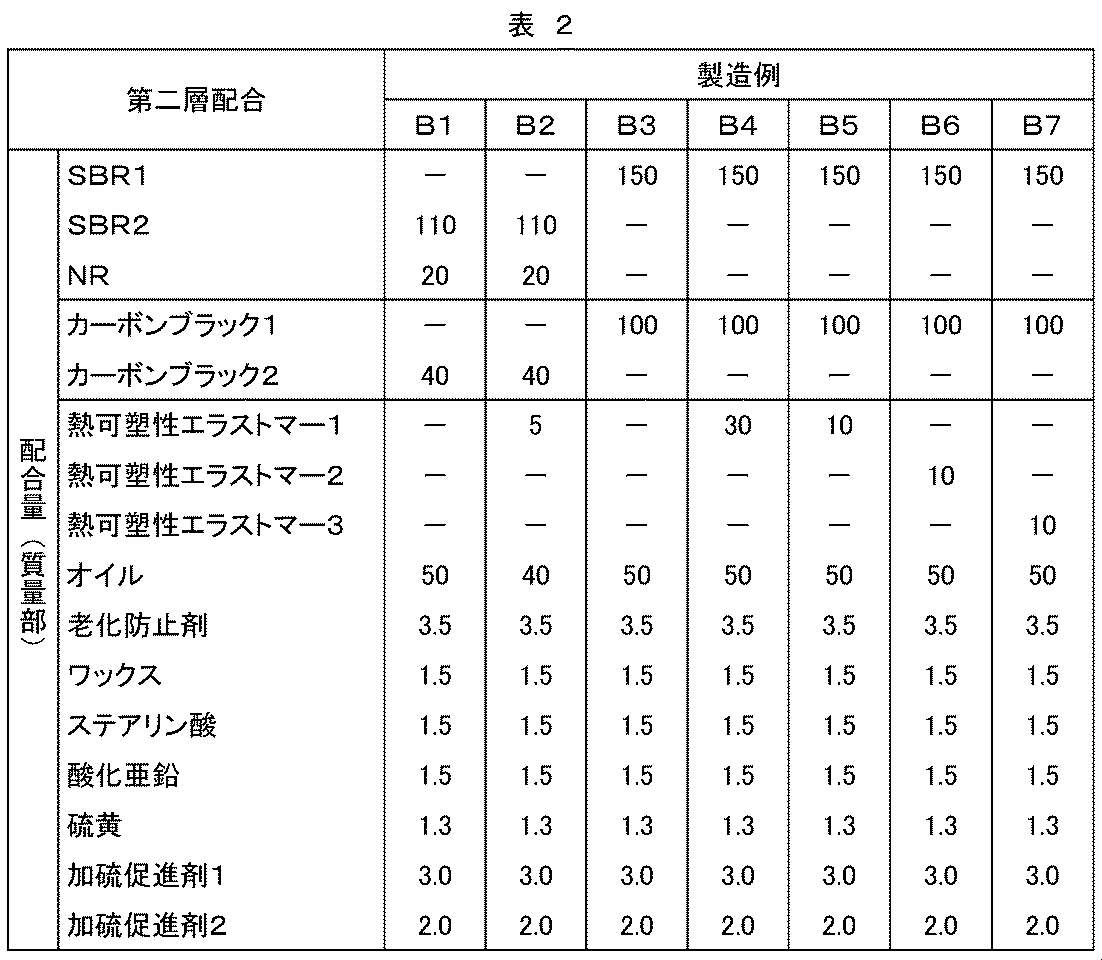
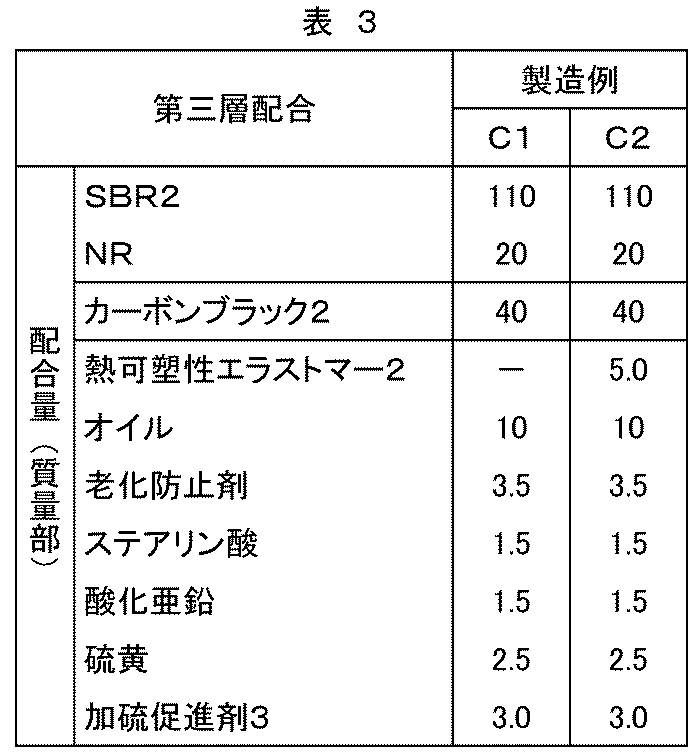


表1~表5の結果より、トレッドの第一層および前記第二層がゴム成分および熱可塑性エラストマーを含有するゴム組成物により構成される本開示のタイヤは、グリップ性能および耐久性能がバランスよく改善されていることがわかる。
1・・・トレッド面
2・・・第一層
3・・・第二層
4・・・第三層
2・・・第一層
3・・・第二層
4・・・第三層
Claims (11)
- トレッド面を構成する第一層と、前記第一層の半径方向内側に隣接する第二層とを備えたトレッドを有するタイヤであって、前記第一層および前記第二層がゴム成分および熱可塑性エラストマーを含有するゴム組成物により構成されるタイヤ。
- 前記第一層を構成するゴム組成物が、前記第一層を構成するゴム成分100質量部に対し、熱可塑性エラストマーを5~50質量部含有する、請求項1記載のタイヤ。
- 前記第二層を構成するゴム組成物が、前記第二層を構成するゴム成分100質量部に対し、熱可塑性エラストマーを3~30質量部含有する、請求項1または2記載のタイヤ。
- 前記第一層を構成するゴム成分100質量部に対する熱可塑性エラストマーの質量部の値が、前記第二層を構成するゴム成分100質量部に対する熱可塑性エラストマーの質量部の値よりも大きい、請求項1~3のいずれか一項に記載のタイヤ。
- 前記第一層および前記第二層を構成するゴム成分がスチレンブタジエンゴムを含む、請求項1~4のいずれか一項に記載のタイヤ。
- 前記熱可塑性エラストマーが、ポリマー末端にスチレンブロックを有する、請求項1~5のいずれか一項に記載のタイヤ。
- 前記第二層とベルト層との間に、さらに1または2以上のゴム層を有する、請求項1~6のいずれか一項に記載のタイヤ。
- 前記第二層とベルト層との間に、ゴム成分および硫黄を含有するゴム組成物により構成される第三層を有し、前記第三層を構成するゴム成分100質量部に対する硫黄の質量部の値が、前記第二層を構成するゴム成分100質量部に対する硫黄の質量部の値よりも大きい、請求項1~7のいずれか一項に記載のタイヤ。
- 前記第一層を構成するゴム組成物および前記第二層を構成するゴム組成物のうち少なくとも一方がチウラム系加硫促進剤を含有する、請求項1~8のいずれか一項に記載のタイヤ。
- 前記第一層を構成するゴム成分100質量部に対する熱可塑性エラストマーの含有量(質量部)と前記第一層の厚みt1(mm)との積が120以上である、請求項1~9のいずれか一項に記載のタイヤ。
- 前記第二層を構成するゴム成分100質量部に対する熱可塑性エラストマーの含有量(質量部)と前記第二層の厚みt2(mm)との積が6以上である、請求項1~10のいずれか一項に記載のタイヤ。
Priority Applications (4)
| Application Number | Priority Date | Filing Date | Title |
|---|---|---|---|
| JP2022501903A JP7735993B2 (ja) | 2020-02-19 | 2021-02-16 | タイヤ |
| EP21757275.9A EP4082774A4 (en) | 2020-02-19 | 2021-02-16 | TIRES |
| CN202180012439.4A CN115038595A (zh) | 2020-02-19 | 2021-02-16 | 轮胎 |
| JP2025105876A JP2025123505A (ja) | 2020-02-19 | 2025-06-23 | タイヤ |
Applications Claiming Priority (2)
| Application Number | Priority Date | Filing Date | Title |
|---|---|---|---|
| JP2020026357 | 2020-02-19 | ||
| JP2020-026357 | 2020-02-19 |
Publications (1)
| Publication Number | Publication Date |
|---|---|
| WO2021166904A1 true WO2021166904A1 (ja) | 2021-08-26 |
Family
ID=77391278
Family Applications (1)
| Application Number | Title | Priority Date | Filing Date |
|---|---|---|---|
| PCT/JP2021/005697 Ceased WO2021166904A1 (ja) | 2020-02-19 | 2021-02-16 | タイヤ |
Country Status (4)
| Country | Link |
|---|---|
| EP (1) | EP4082774A4 (ja) |
| JP (2) | JP7735993B2 (ja) |
| CN (1) | CN115038595A (ja) |
| WO (1) | WO2021166904A1 (ja) |
Cited By (1)
| Publication number | Priority date | Publication date | Assignee | Title |
|---|---|---|---|---|
| JP2024014499A (ja) * | 2022-07-22 | 2024-02-01 | 住友ゴム工業株式会社 | タイヤ |
Citations (12)
| Publication number | Priority date | Publication date | Assignee | Title |
|---|---|---|---|---|
| JPH1160810A (ja) * | 1997-08-20 | 1999-03-05 | Bridgestone Corp | 重荷重用空気入りタイヤ |
| JP2004306730A (ja) * | 2003-04-04 | 2004-11-04 | Yokohama Rubber Co Ltd:The | 空気入りタイヤ |
| JP2007119582A (ja) * | 2005-10-27 | 2007-05-17 | Toyo Tire & Rubber Co Ltd | 空気入りタイヤ |
| JP2007326909A (ja) * | 2006-06-06 | 2007-12-20 | Toyo Tire & Rubber Co Ltd | 空気入りタイヤ |
| WO2009093695A1 (ja) * | 2008-01-23 | 2009-07-30 | Ube Industries, Ltd. | ゴム組成物、ベーストレッド用ゴム組成物、チェーファー用ゴム組成物、及びサイドウォール用ゴム組成物、並びにそれらを用いたタイヤ |
| JP2013159626A (ja) * | 2012-02-01 | 2013-08-19 | Bridgestone Corp | 空気入りタイヤ |
| WO2013180257A1 (ja) * | 2012-05-31 | 2013-12-05 | 横浜ゴム株式会社 | 空気入りタイヤ |
| JP2015514040A (ja) * | 2012-04-02 | 2015-05-18 | コンパニー ゼネラール デ エタブリッスマン ミシュラン | クラウン領域が熱可塑性エラストマーを含むサブレイヤを備えたタイヤ |
| JP2016210937A (ja) | 2015-05-12 | 2016-12-15 | 住友ゴム工業株式会社 | ゴム組成物およびタイヤ |
| JP2017101199A (ja) * | 2015-12-04 | 2017-06-08 | 住友ゴム工業株式会社 | ゴム組成物およびタイヤ |
| JP2017210044A (ja) * | 2016-05-24 | 2017-11-30 | 住友ゴム工業株式会社 | 空気入りタイヤ |
| JP2018083884A (ja) * | 2016-11-22 | 2018-05-31 | 住友ゴム工業株式会社 | 空気入りタイヤ |
Family Cites Families (7)
| Publication number | Priority date | Publication date | Assignee | Title |
|---|---|---|---|---|
| JP2010031117A (ja) * | 2008-07-28 | 2010-02-12 | Yokohama Rubber Co Ltd:The | トレッド用ゴム組成物 |
| JP5486869B2 (ja) * | 2009-08-17 | 2014-05-07 | 住友ゴム工業株式会社 | 空気入りタイヤ |
| EP2415617B1 (en) * | 2010-07-30 | 2014-05-14 | Sumitomo Rubber Industries, Ltd. | Polymer sheet for inner liner, polymer laminate for inner liner, and pneumatic tire |
| EP2985310B1 (en) * | 2013-04-30 | 2018-02-21 | Sumitomo Rubber Industries, Ltd. | Pneumatic tire |
| CA3008805C (en) * | 2015-12-17 | 2023-10-31 | Compagnie Generale Des Etablissements Michelin | A tire comprising a tread |
| JP6417064B1 (ja) * | 2018-04-09 | 2018-10-31 | 住友ゴム工業株式会社 | タイヤ用ゴム組成物及びタイヤ |
| EP4166354A4 (en) * | 2020-06-15 | 2024-08-14 | Sumitomo Rubber Industries, Ltd. | TIRES |
-
2021
- 2021-02-16 WO PCT/JP2021/005697 patent/WO2021166904A1/ja not_active Ceased
- 2021-02-16 CN CN202180012439.4A patent/CN115038595A/zh active Pending
- 2021-02-16 JP JP2022501903A patent/JP7735993B2/ja active Active
- 2021-02-16 EP EP21757275.9A patent/EP4082774A4/en active Pending
-
2025
- 2025-06-23 JP JP2025105876A patent/JP2025123505A/ja active Pending
Patent Citations (12)
| Publication number | Priority date | Publication date | Assignee | Title |
|---|---|---|---|---|
| JPH1160810A (ja) * | 1997-08-20 | 1999-03-05 | Bridgestone Corp | 重荷重用空気入りタイヤ |
| JP2004306730A (ja) * | 2003-04-04 | 2004-11-04 | Yokohama Rubber Co Ltd:The | 空気入りタイヤ |
| JP2007119582A (ja) * | 2005-10-27 | 2007-05-17 | Toyo Tire & Rubber Co Ltd | 空気入りタイヤ |
| JP2007326909A (ja) * | 2006-06-06 | 2007-12-20 | Toyo Tire & Rubber Co Ltd | 空気入りタイヤ |
| WO2009093695A1 (ja) * | 2008-01-23 | 2009-07-30 | Ube Industries, Ltd. | ゴム組成物、ベーストレッド用ゴム組成物、チェーファー用ゴム組成物、及びサイドウォール用ゴム組成物、並びにそれらを用いたタイヤ |
| JP2013159626A (ja) * | 2012-02-01 | 2013-08-19 | Bridgestone Corp | 空気入りタイヤ |
| JP2015514040A (ja) * | 2012-04-02 | 2015-05-18 | コンパニー ゼネラール デ エタブリッスマン ミシュラン | クラウン領域が熱可塑性エラストマーを含むサブレイヤを備えたタイヤ |
| WO2013180257A1 (ja) * | 2012-05-31 | 2013-12-05 | 横浜ゴム株式会社 | 空気入りタイヤ |
| JP2016210937A (ja) | 2015-05-12 | 2016-12-15 | 住友ゴム工業株式会社 | ゴム組成物およびタイヤ |
| JP2017101199A (ja) * | 2015-12-04 | 2017-06-08 | 住友ゴム工業株式会社 | ゴム組成物およびタイヤ |
| JP2017210044A (ja) * | 2016-05-24 | 2017-11-30 | 住友ゴム工業株式会社 | 空気入りタイヤ |
| JP2018083884A (ja) * | 2016-11-22 | 2018-05-31 | 住友ゴム工業株式会社 | 空気入りタイヤ |
Non-Patent Citations (1)
| Title |
|---|
| See also references of EP4082774A4 |
Cited By (1)
| Publication number | Priority date | Publication date | Assignee | Title |
|---|---|---|---|---|
| JP2024014499A (ja) * | 2022-07-22 | 2024-02-01 | 住友ゴム工業株式会社 | タイヤ |
Also Published As
| Publication number | Publication date |
|---|---|
| CN115038595A (zh) | 2022-09-09 |
| JPWO2021166904A1 (ja) | 2021-08-26 |
| JP7735993B2 (ja) | 2025-09-09 |
| EP4082774A4 (en) | 2024-01-24 |
| JP2025123505A (ja) | 2025-08-22 |
| EP4082774A1 (en) | 2022-11-02 |
Similar Documents
| Publication | Publication Date | Title |
|---|---|---|
| EP3950387B1 (en) | Tire | |
| JP2022003115A (ja) | タイヤ用ゴム組成物 | |
| JP6919744B1 (ja) | タイヤ | |
| JPWO2017209261A1 (ja) | ゴム組成物、及びタイヤ | |
| EP4331868A1 (en) | Heavy duty tire | |
| EP4389457B1 (en) | Heavy-duty tire | |
| WO2021261010A1 (ja) | タイヤ | |
| WO2021261009A1 (ja) | タイヤ | |
| EP4357154B1 (en) | Tire | |
| JP7392356B2 (ja) | タイヤ | |
| JP2025123505A (ja) | タイヤ | |
| WO2021256124A1 (ja) | タイヤ | |
| EP4212354A1 (en) | Tire | |
| JP7484174B2 (ja) | 重荷重用タイヤのキャップトレッド用ゴム組成物、重荷重用タイヤのキャップトレッドおよび重荷重用タイヤ | |
| JP2023062957A (ja) | タイヤ | |
| EP4309917B1 (en) | Tire | |
| JP7830954B2 (ja) | タイヤ | |
| JP7676732B2 (ja) | タイヤ | |
| JP6483771B1 (ja) | 空気入りタイヤ | |
| JP2021178565A (ja) | タイヤ | |
| JP2022063032A (ja) | 重荷重用タイヤ | |
| JP2021130442A (ja) | タイヤ | |
| JP6728622B2 (ja) | タイヤ用ゴム組成物 | |
| EP4155346A1 (en) | Tire | |
| EP4559697A1 (en) | Tire for heavy load |
Legal Events
| Date | Code | Title | Description |
|---|---|---|---|
| 121 | Ep: the epo has been informed by wipo that ep was designated in this application |
Ref document number: 21757275 Country of ref document: EP Kind code of ref document: A1 |
|
| ENP | Entry into the national phase |
Ref document number: 2022501903 Country of ref document: JP Kind code of ref document: A |
|
| ENP | Entry into the national phase |
Ref document number: 2021757275 Country of ref document: EP Effective date: 20220726 |
|
| NENP | Non-entry into the national phase |
Ref country code: DE |