WO2021166914A1 - 樹脂複合材及び樹脂成形体 - Google Patents
樹脂複合材及び樹脂成形体 Download PDFInfo
- Publication number
- WO2021166914A1 WO2021166914A1 PCT/JP2021/005741 JP2021005741W WO2021166914A1 WO 2021166914 A1 WO2021166914 A1 WO 2021166914A1 JP 2021005741 W JP2021005741 W JP 2021005741W WO 2021166914 A1 WO2021166914 A1 WO 2021166914A1
- Authority
- WO
- WIPO (PCT)
- Prior art keywords
- resin
- composite material
- mass
- coffee
- resin particles
- Prior art date
- Legal status (The legal status is an assumption and is not a legal conclusion. Google has not performed a legal analysis and makes no representation as to the accuracy of the status listed.)
- Ceased
Links
Classifications
-
- C—CHEMISTRY; METALLURGY
- C08—ORGANIC MACROMOLECULAR COMPOUNDS; THEIR PREPARATION OR CHEMICAL WORKING-UP; COMPOSITIONS BASED THEREON
- C08L—COMPOSITIONS OF MACROMOLECULAR COMPOUNDS
- C08L5/00—Compositions of polysaccharides or of their derivatives not provided for in groups C08L1/00 or C08L3/00
-
- C—CHEMISTRY; METALLURGY
- C08—ORGANIC MACROMOLECULAR COMPOUNDS; THEIR PREPARATION OR CHEMICAL WORKING-UP; COMPOSITIONS BASED THEREON
- C08L—COMPOSITIONS OF MACROMOLECULAR COMPOUNDS
- C08L1/00—Compositions of cellulose, modified cellulose or cellulose derivatives
- C08L1/02—Cellulose; Modified cellulose
-
- C—CHEMISTRY; METALLURGY
- C08—ORGANIC MACROMOLECULAR COMPOUNDS; THEIR PREPARATION OR CHEMICAL WORKING-UP; COMPOSITIONS BASED THEREON
- C08L—COMPOSITIONS OF MACROMOLECULAR COMPOUNDS
- C08L23/00—Compositions of homopolymers or copolymers of unsaturated aliphatic hydrocarbons having only one carbon-to-carbon double bond; Compositions of derivatives of such polymers
- C08L23/26—Compositions of homopolymers or copolymers of unsaturated aliphatic hydrocarbons having only one carbon-to-carbon double bond; Compositions of derivatives of such polymers modified by chemical after-treatment
-
- B—PERFORMING OPERATIONS; TRANSPORTING
- B29—WORKING OF PLASTICS; WORKING OF SUBSTANCES IN A PLASTIC STATE IN GENERAL
- B29C—SHAPING OR JOINING OF PLASTICS; SHAPING OF MATERIAL IN A PLASTIC STATE, NOT OTHERWISE PROVIDED FOR; AFTER-TREATMENT OF THE SHAPED PRODUCTS, e.g. REPAIRING
- B29C70/00—Shaping composites, i.e. plastics material comprising reinforcements, fillers or preformed parts, e.g. inserts
- B29C70/04—Shaping composites, i.e. plastics material comprising reinforcements, fillers or preformed parts, e.g. inserts comprising reinforcements only, e.g. self-reinforcing plastics
- B29C70/06—Fibrous reinforcements only
- B29C70/10—Fibrous reinforcements only characterised by the structure of fibrous reinforcements, e.g. hollow fibres
- B29C70/12—Fibrous reinforcements only characterised by the structure of fibrous reinforcements, e.g. hollow fibres using fibres of short length, e.g. in the form of a mat
-
- B—PERFORMING OPERATIONS; TRANSPORTING
- B29—WORKING OF PLASTICS; WORKING OF SUBSTANCES IN A PLASTIC STATE IN GENERAL
- B29C—SHAPING OR JOINING OF PLASTICS; SHAPING OF MATERIAL IN A PLASTIC STATE, NOT OTHERWISE PROVIDED FOR; AFTER-TREATMENT OF THE SHAPED PRODUCTS, e.g. REPAIRING
- B29C70/00—Shaping composites, i.e. plastics material comprising reinforcements, fillers or preformed parts, e.g. inserts
- B29C70/04—Shaping composites, i.e. plastics material comprising reinforcements, fillers or preformed parts, e.g. inserts comprising reinforcements only, e.g. self-reinforcing plastics
- B29C70/28—Shaping operations therefor
-
- C—CHEMISTRY; METALLURGY
- C08—ORGANIC MACROMOLECULAR COMPOUNDS; THEIR PREPARATION OR CHEMICAL WORKING-UP; COMPOSITIONS BASED THEREON
- C08K—Use of inorganic or non-macromolecular organic substances as compounding ingredients
- C08K5/00—Use of organic ingredients
- C08K5/04—Oxygen-containing compounds
- C08K5/07—Aldehydes; Ketones
-
- C—CHEMISTRY; METALLURGY
- C08—ORGANIC MACROMOLECULAR COMPOUNDS; THEIR PREPARATION OR CHEMICAL WORKING-UP; COMPOSITIONS BASED THEREON
- C08K—Use of inorganic or non-macromolecular organic substances as compounding ingredients
- C08K5/00—Use of organic ingredients
- C08K5/04—Oxygen-containing compounds
- C08K5/15—Heterocyclic compounds having oxygen in the ring
- C08K5/151—Heterocyclic compounds having oxygen in the ring having one oxygen atom in the ring
- C08K5/1545—Six-membered rings
-
- C—CHEMISTRY; METALLURGY
- C08—ORGANIC MACROMOLECULAR COMPOUNDS; THEIR PREPARATION OR CHEMICAL WORKING-UP; COMPOSITIONS BASED THEREON
- C08L—COMPOSITIONS OF MACROMOLECULAR COMPOUNDS
- C08L101/00—Compositions of unspecified macromolecular compounds
-
- C—CHEMISTRY; METALLURGY
- C08—ORGANIC MACROMOLECULAR COMPOUNDS; THEIR PREPARATION OR CHEMICAL WORKING-UP; COMPOSITIONS BASED THEREON
- C08L—COMPOSITIONS OF MACROMOLECULAR COMPOUNDS
- C08L23/00—Compositions of homopolymers or copolymers of unsaturated aliphatic hydrocarbons having only one carbon-to-carbon double bond; Compositions of derivatives of such polymers
- C08L23/02—Compositions of homopolymers or copolymers of unsaturated aliphatic hydrocarbons having only one carbon-to-carbon double bond; Compositions of derivatives of such polymers not modified by chemical after-treatment
- C08L23/10—Homopolymers or copolymers of propene
- C08L23/12—Polypropene
-
- C—CHEMISTRY; METALLURGY
- C08—ORGANIC MACROMOLECULAR COMPOUNDS; THEIR PREPARATION OR CHEMICAL WORKING-UP; COMPOSITIONS BASED THEREON
- C08L—COMPOSITIONS OF MACROMOLECULAR COMPOUNDS
- C08L67/00—Compositions of polyesters obtained by reactions forming a carboxylic ester link in the main chain; Compositions of derivatives of such polymers
- C08L67/02—Polyesters derived from dicarboxylic acids and dihydroxy compounds
-
- C—CHEMISTRY; METALLURGY
- C08—ORGANIC MACROMOLECULAR COMPOUNDS; THEIR PREPARATION OR CHEMICAL WORKING-UP; COMPOSITIONS BASED THEREON
- C08L—COMPOSITIONS OF MACROMOLECULAR COMPOUNDS
- C08L93/00—Compositions of natural resins; Compositions of derivatives thereof
-
- C—CHEMISTRY; METALLURGY
- C08—ORGANIC MACROMOLECULAR COMPOUNDS; THEIR PREPARATION OR CHEMICAL WORKING-UP; COMPOSITIONS BASED THEREON
- C08L—COMPOSITIONS OF MACROMOLECULAR COMPOUNDS
- C08L99/00—Compositions of natural macromolecular compounds or of derivatives thereof not provided for in groups C08L89/00 - C08L97/00
-
- C—CHEMISTRY; METALLURGY
- C08—ORGANIC MACROMOLECULAR COMPOUNDS; THEIR PREPARATION OR CHEMICAL WORKING-UP; COMPOSITIONS BASED THEREON
- C08K—Use of inorganic or non-macromolecular organic substances as compounding ingredients
- C08K3/00—Use of inorganic substances as compounding ingredients
- C08K3/02—Elements
- C08K3/08—Metals
- C08K2003/0812—Aluminium
-
- C—CHEMISTRY; METALLURGY
- C08—ORGANIC MACROMOLECULAR COMPOUNDS; THEIR PREPARATION OR CHEMICAL WORKING-UP; COMPOSITIONS BASED THEREON
- C08L—COMPOSITIONS OF MACROMOLECULAR COMPOUNDS
- C08L2205/00—Polymer mixtures characterised by other features
- C08L2205/02—Polymer mixtures characterised by other features containing two or more polymers of the same C08L -group
- C08L2205/025—Polymer mixtures characterised by other features containing two or more polymers of the same C08L -group containing two or more polymers of the same hierarchy C08L, and differing only in parameters such as density, comonomer content, molecular weight, structure
-
- C—CHEMISTRY; METALLURGY
- C08—ORGANIC MACROMOLECULAR COMPOUNDS; THEIR PREPARATION OR CHEMICAL WORKING-UP; COMPOSITIONS BASED THEREON
- C08L—COMPOSITIONS OF MACROMOLECULAR COMPOUNDS
- C08L2205/00—Polymer mixtures characterised by other features
- C08L2205/03—Polymer mixtures characterised by other features containing three or more polymers in a blend
- C08L2205/035—Polymer mixtures characterised by other features containing three or more polymers in a blend containing four or more polymers in a blend
-
- C—CHEMISTRY; METALLURGY
- C08—ORGANIC MACROMOLECULAR COMPOUNDS; THEIR PREPARATION OR CHEMICAL WORKING-UP; COMPOSITIONS BASED THEREON
- C08L—COMPOSITIONS OF MACROMOLECULAR COMPOUNDS
- C08L2205/00—Polymer mixtures characterised by other features
- C08L2205/14—Polymer mixtures characterised by other features containing polymeric additives characterised by shape
- C08L2205/16—Fibres; Fibrils
-
- C—CHEMISTRY; METALLURGY
- C08—ORGANIC MACROMOLECULAR COMPOUNDS; THEIR PREPARATION OR CHEMICAL WORKING-UP; COMPOSITIONS BASED THEREON
- C08L—COMPOSITIONS OF MACROMOLECULAR COMPOUNDS
- C08L2207/00—Properties characterising the ingredient of the composition
- C08L2207/06—Properties of polyethylene
- C08L2207/066—LDPE (radical process)
-
- C—CHEMISTRY; METALLURGY
- C08—ORGANIC MACROMOLECULAR COMPOUNDS; THEIR PREPARATION OR CHEMICAL WORKING-UP; COMPOSITIONS BASED THEREON
- C08L—COMPOSITIONS OF MACROMOLECULAR COMPOUNDS
- C08L2207/00—Properties characterising the ingredient of the composition
- C08L2207/20—Recycled plastic
Definitions
- the present invention relates to a resin composite material and a resin molded product.
- thermoplastic resin is excellent in moldability, and the molded product using the thermoplastic resin is excellent in mechanical physical characteristics, electrical characteristics, chemical resistance, etc. Therefore, the thermoplastic resin is widely used as a material for the resin molded product. There is.
- thermoplastic resin molded body in addition to being molded using a virgin material, a thermoplastic resin molded body using a recycled resin is known.
- a technique for obtaining a thermoplastic resin composite material using a used material containing polyolefin such as laminated paper and a beverage pack has also been reported.
- the cellulose fibers derived from paper act as reinforcing fibers of the resin in the obtained composite material, and the mechanical properties of the thermoplastic resin molded body obtained by using this composite material are brought to a desired level. It is said that it can be increased.
- Patent Document 1 proposes a resin composite material using coffee residue and a method for producing the same.
- portion-capsule coffee which contains powdered coffee in plastic capsules, has been sold, and it has become popular that you can easily enjoy fresh flavors, and the market is expanding. Since the coffee residue after extraction of such portion capsule type coffee is still trapped in the capsule, it is difficult to recycle the coffee residue. In addition to coffee, potion capsule-type beverages using black tea, matcha, etc. are also sold, and it is similarly difficult to recycle these extraction residues.
- the powder that is the extraction residue of the above coffee, tea, matcha, etc. contains polysaccharides in its components, so it is mixed with a thermoplastic resin to form a resin composite.
- a thermoplastic resin to form a resin composite.
- the fiber strengthening effect of the resin by the polysaccharide is expected.
- the present inventors examined a resin composite material using a powder containing a polysaccharide as described above the inclusion of these powders may adversely affect the moldability and impact resistance of the resin composite material. , It has become clear that improvement is needed.
- the present invention provides a resin composite material which is excellent in moldability and mechanical properties such as impact resistance while containing a powder containing a polysaccharide in a thermoplastic resin, and a resin molded product using the same. Make it an issue.
- thermoplastic resin The powder containing polysaccharides dispersed in the thermoplastic resin, A resin composite material containing monosaccharides.
- the polyolefin resin contains an acid-modified polyolefin resin [6].
- the resin composite material contains resin particles containing a resin different from the polyolefin resin, the melting point of the resin different from the polyolefin resin is 10 ° C. or higher higher than the melting point of the polyolefin resin, and the maximum diameter of the resin particles is 10 ⁇ m or more.
- the resin composite material of the present invention is excellent in moldability and mechanical properties such as impact resistance while containing a powder containing a polysaccharide in the thermoplastic resin. Further, the molded product of the present invention is excellent in moldability in its production while containing a powder containing a polysaccharide in the thermoplastic resin, and is also excellent in mechanical properties such as impact resistance.
- the resin composite material of the present invention contains a thermoplastic resin, a powder containing polysaccharides dispersed in the thermoplastic resin, and monosaccharides. do. That is, a powder containing a polysaccharide is dispersed in a thermoplastic resin, and a monosaccharide is further contained.
- the resin composite material means a material in which each component constituting the composite material is mixed and integrated substantially uniformly.
- a part of the components constituting the resin composite material may form an agglomerate. These agglomerates are in a state of being almost uniformly dispersed in the matrix resin when viewed as a whole composite material.
- the powder containing a polysaccharide can be used without limitation as long as it contains a polysaccharide as its component.
- powders of coffee beans, tea leaves, beans, grains (including rice, wheat, corn, buckwheat, etc.), organic residues after extracting beverages, etc. from these (coffee residues, tea leaves, etc.) Can be given.
- the term "vegetable powder” is used in the sense that it includes both the above powder and the organic residue. That is, unless otherwise specified, the "vegetable powder” is the powder before extraction (before use) and / or the organic residue after extraction (after use).
- the term "vegetable” means that it contains a plant-derived component (preferably, the main component is a plant-derived component, more preferably 50% by mass or more of the plant-derived component, and more preferably 80 plant-derived components. (Including mass% or more).
- organic means that it contains an organic substance (preferably, the main component is an organic substance, more preferably 50% by mass or more of the organic substance is contained, and more preferably 80% by mass or more of the organic substance is contained).
- Examples of the form of the powder include powder, fibrous, plate and the like.
- the polysaccharide include arabinogalactan, galactomannan, cellulose and the like.
- the powder may contain at least one polysaccharide. These polysaccharides are contained as components of the coffee beans and the like.
- the powder containing the polysaccharide is preferably the organic residue, more preferably a coffee residue and / or a coffee powder.
- a case where coffee residue and / or coffee powder is used as the powder containing a polysaccharide will be described as an example.
- the description described below (maximum diameter of coffee residue and / or coffee powder, content in composite material, monosaccharides to be used in combination, thermoplastic resin to be used in combination, cellulose fibers and / or resin particles to be used in combination may be further used in combination.
- the method for producing a composite material, the production conditions, etc. also applies when a powder and / or an organic residue other than "coffee powder and coffee residue" is used.
- the residue after coffee is extracted from the coffee powder can be used without particular limitation, and unused (unextracted) coffee powder waste or the like can be used or included.
- the coffee powder include crushed coffee beans, and specific examples thereof include crushed roasted coffee beans. From the viewpoint of effective use of resources, it is preferable that the powder containing a polysaccharide contains a coffee residue, and further, the powder containing a polysaccharide is preferably a coffee residue.
- Coffee beans contain polysaccharides such as arabinogalactan, galactomannan, and cellulose.
- the maximum diameter of the coffee residue and / or coffee powder to be used is not particularly limited, and examples thereof include those having a diameter of 0.1 ⁇ m to 1 mm.
- the size of the coffee residue and / or the coffee powder is within the above range, a composite material having excellent moldability and appearance quality can be obtained, which is preferable.
- the lower limit of the maximum diameter of the coffee residue and / or coffee powder is preferably 1 ⁇ m or more, more preferably 5 ⁇ m or more.
- the upper limit of the maximum diameter of the coffee residue and / or the coffee powder is preferably 900 ⁇ m or less. More preferably, it is 800 ⁇ m or less.
- the maximum diameter of the coffee residue and / or coffee powder is obtained by observing the cross section of the composite material under a microscope and averaging the maximum diameters of the observed coffee powder. More specifically, the maximum diameter can be obtained in the same manner as the maximum diameter of the resin fine particles, which will be described later.
- the content of the coffee residue and / or coffee powder in the composite material is not particularly limited, but is preferably 1 to 80% by mass, more preferably 5 to 70% by mass in the composite material.
- the "content of coffee residue and / or coffee powder” means the total content of coffee residue and coffee powder when the composite material contains coffee residue and / or coffee powder. When either the residue or the coffee powder is contained, it means the content of either of them.) If the content of the coffee residue and / or the coffee powder in the composite material is within the above range, coffee It is possible to obtain a composite material having better moldability, mechanical properties, appearance quality, etc., while suppressing the cost for compounding the residue and / or coffee powder with the resin.
- the content of coffee residue and / or coffee powder in the composite material is, for example, a cellulose fiber that is not derived from coffee residue and is not derived from coffee powder (also referred to as coffee residue and cellulose fiber not derived from coffee powder). In the non-form form, it can be grasped by measuring the cellulose fiber described later.
- the lower limit of the content of coffee residue and / or coffee powder in the composite material is preferably 10% by mass or more, more preferably 20% by mass or more, still more preferably 25% by mass or more.
- the upper limit of the content of coffee residue and / or coffee powder in the composite material is preferably 70% by mass or less, more preferably 65% by mass or less, still more preferably 55% by mass or less.
- the composite material of the present invention contains monosaccharides.
- containing monosaccharides means that a monosaccharide is detected by the [determination of monosaccharide] method described in Examples described later.
- monosaccharides include mannose, glucose, galactose and the like. Further, the monosaccharide may be generated by positively decomposing the components of the coffee residue, or may be added separately.
- the kneading is carried out in the presence of water to promote the hydrolysis of the polysaccharide component contained in the coffee residue and / or the coffee powder.
- the content of the monosaccharide is not particularly limited, but is preferably 0.001 to 5% by mass, more preferably 0.002 to 4% by mass, and 0.003 to 3% by mass in the composite material. Is more preferable.
- the moldability can be further improved while maintaining the mechanical properties of the composite material.
- the content of monosaccharides in the composite material can be grasped by, for example, extracting the crushed composite material with water and measuring the components in the water using high performance liquid chromatography (HPLC) / differential refractometer detector or the like. ..
- the thermoplastic resin is a resin that serves as a matrix of the composite material.
- the thermoplastic resin preferably contains a polyolefin resin.
- the proportion of the polyolefin resin in the thermoplastic resin is preferably 50% by mass or more, preferably 70% by mass or more, preferably 80% by mass or more, and 90% by mass. It is also preferable to make the above. It is also preferable that the thermoplastic resin is made of a polyolefin resin.
- thermoplastic resin instead of the polyolefin resin, or in addition to the polyolefin resin, a polyvinyl chloride resin, an acrylonitrile-butadiene-styrene copolymer resin (ABS resin), an acrylonitrile-styrene copolymer resin (AS resin), Polypolymer resin (nylon), polyethylene terephthalate resin, polybutylene terephthalate resin, thermoplastic resin such as polystyrene resin, 3-hydroxybutyrate-co-3-hydroxyhexanoate polymer resin (PHBH), polybutylene succinate resin, It is also preferable to use a thermoplastic biodegradable resin such as a polylactic acid resin.
- thermoplastic resin constituting the composite material of the present invention one or more of these resins can be used. Of these, it is preferable to contain a polyolefin resin.
- a polyolefin resin used as the matrix resin will be mainly described. Unless otherwise specified, the description regarding the polyolefin resin described below also applies to the case where a thermoplastic resin other than the "polyolefin resin" is used.
- polyethylene resin or a polypropylene resin is preferable, or a mixture (blended resin) of a polyethylene resin and a polypropylene resin is also preferable.
- An ethylene-based copolymer (copolymer containing ethylene as a constituent) such as an ethylene-propylene copolymer and a resin such as polybutene are also preferable as the polyolefin resin used for the composite material.
- the polyolefin resin constituting the composite material is preferably a polyethylene resin and / or a polypropylene resin, and more preferably a polypropylene resin.
- the polyethylene include low density polyethylene (LDPE) and high density polyethylene (HDPE).
- LDPE low density polyethylene
- HDPE high density polyethylene
- the low density polyethylene has a density means the polyethylene of less than 880 kg / m 3 or more 940 kg / m 3.
- the high-density polyethylene means polyethylene having a density higher than that of the low-density polyethylene.
- the low-density polyethylene may be a so-called “low-density polyethylene” or “ultra-low-density polyethylene” having a long-chain branch, and is a linear low-density polyethylene obtained by copolymerizing ethylene with a small amount of ⁇ -olefin monomer.
- LLDPE low-density polyethylene
- the polyolefin resin may be acid-modified with an unsaturated carboxylic acid or a derivative thereof, which is usually used.
- a polyolefin resin that has not been acid-modified and an acid-modified polyolefin resin may be used in combination. It may contain a silane-modified polyolefin resin.
- polypropylene it is preferable to use it in combination with an acid-modified polypropylene resin.
- acid-modified polypropylene resin maleic acid-modified polypropylene resin is particularly preferable.
- the polyolefin resin constituting the composite material of the present invention may contain a trace amount of carbonyl group.
- carbonyl groups appears to enhance the adhesiveness of the composite.
- the presence of such a carbonyl group can be derived from, for example, oxidation of the polyolefin resin itself or a raw material, and the carbonyl group is contained in the polyolefin resin component of the polyethylene laminated paper having the polyolefin thin film layer and the aluminum thin film layer. There may be.
- the polyolefin resin has a low melt softening temperature, if the polyolefin resin is used, the coffee residue and / or coffee powder contained in the composite material can be melt-kneaded without being exposed to a high temperature, and can be molded. Therefore, it is possible to prevent or reduce deterioration, significant decomposition, and carbonization of coffee residue and / or coffee powder due to high temperature.
- the above-mentioned polyolefin resin has a low melt softening temperature
- the polyolefin resin when used, when the composite material contains cellulose fibers as described later, the contained cellulose fibers can be melt-kneaded without being exposed to a high temperature. It becomes possible to mold. Therefore, it is possible to prevent or reduce the deterioration of the cellulose fiber due to high temperature.
- the composite material contains resin particles as described later, if a polyolefin resin is used, exposure of the resin particles to a high temperature can be avoided, and the original mechanical properties of the resin particles can be sufficiently expressed. Become.
- the resin particles are polyester-based resins such as polyethylene terephthalate and polybutylene terephthalate
- these resins when these resins are exposed to a high temperature such as softening and melting, if the prior drying is insufficient, these resins may be used. Deterioration due to hydrolysis may be accelerated.
- the composite material can be kneaded and molded without being exposed to high temperatures, the above deterioration can be suppressed. As a result, the burden of moisture management on the material before melt-kneading is reduced.
- the content of the polyolefin resin in the composite material is not particularly limited as long as the content is such that the composite is integrated.
- 10 to 80% by mass of the composite material is preferably a polyolefin resin, and more preferably 15 to 70% by mass is a polyolefin resin. More preferably, it is 20 to 60% by mass.
- the polyolefin resin contains a polypropylene resin (preferably 50% by mass or more, more preferably 60% by mass or more, still more preferably 70% by mass or more, still more preferably 80% by mass or more of the polyolefin resin. Is a polypropylene resin).
- the polyolefin resin contains low density polyethylene (preferably 50% by mass or more, more preferably 60% by mass or more, still more preferably 70% by mass or more, still more preferably 80% by mass or more of the polyolefin resin. It is preferable that the mass% or more is low density polyethylene).
- Another form of the composite material of the present invention is a form in which the polyolefin resin contains a low-density polyethylene resin in an amount of preferably 40% by mass or less, more preferably 30% by mass or less, still more preferably 20% by mass or less of the polyolefin resin. ..
- Yet another form of the composite material of the present invention is a form in which the polyolefin resin contains a modified polyethylene resin in an amount of preferably 30% by mass or less, more preferably 20% by mass or less of the polyolefin resin.
- the polyolefin resin contains low-density polyethylene and contains resin particles described later, and the resin particles contain polyethylene terephthalate (preferably 50% by mass or more of the resin particles, more preferably 60% by mass or more, still more preferably. 70% by mass or more, more preferably 80% by mass or more is polyethylene terephthalate), which is also preferable as the form of the composite material of the present invention.
- polyethylene terephthalate preferably 50% by mass or more of the resin particles, more preferably 60% by mass or more, still more preferably. 70% by mass or more, more preferably 80% by mass or more is polyethylene terephthalate
- the content in the composite material can be determined based on the thermoxylene-dissolved mass ratio of the composite material.
- the mass ratio of hot xylene dissolved- is determined as follows. In accordance with the cross-linking degree measurement of the automobile electric wire standard JASOD618, 0.1 to 1 g of a composite molded sheet is cut out as a sample, and this sample is wrapped in 400 mesh stainless mesh and immersed in 100 ml of xylene at a predetermined temperature for 24 hours. do. The sample is then pulled up and then dried in vacuum at 80 ° C. for 24 hours.
- the thermal xylene dissolved mass ratio G (%) is calculated from the following formula.
- G ⁇ (W0-W) / W0 ⁇ x 100
- W0 Mass of composite material before immersion in hot xylene
- W Mass of composite material after immersion in hot xylene and dry removal of xylene
- Ga Mass of composite material before immersion in hot xylene
- Gb Mass of composite material after immersion in hot xylene and dry removal of xylene
- Ga mass ratio of the composite material dissolved in hot xylene at 138 ° C
- Gb The mass ratio dissolved in hot xylene at 105 ° C.
- Ga is the mass ratio of polyolefin (%)
- Ga-Gb is the mass ratio of polypropylene (%)
- Gb is polyethylene. Corresponds to the mass ratio (%).
- Ga ⁇ (W0-Wa) / W0 ⁇ x 100
- Gb ⁇ (W0-Wb) / W0 ⁇ ⁇ 100 W0: Mass of composite material before immersion in hot xylene
- Wa Mass of composite material after immersion in hot xylene at 138 ° C and drying and removal of xylene
- Wb Mass of composite material after immersion in hot xylene at 105 ° C, then dry xylene The mass of the composite after removal.
- Gc the thermal xylene insoluble mass ratio at 138 ° C.
- Gc is the total amount of the composite material excluding the polyolefin resin.
- the amount of resin particles can be calculated from the difference between this amount Gc and the amount of cellulose fibers.
- Gc ⁇ Wa / W0 ⁇ x 100
- the matrix resin may contain, for example, a resin compatible with the polyolefin resin as long as the effects of the present invention are not impaired.
- a resin a resin having a melting point and a softening temperature close to those of a polyolefin resin is preferable.
- polystyrene resin or polystyrene-based copolymer copolymer containing a styrene component
- the composite material of the present invention is excellent in moldability while containing coffee residue and / or coffee powder, and is also excellent in mechanical properties such as impact resistance. The reason is not clear, but it is considered that monosaccharides act as a lubricating component during processing, while acting as a binding component of coffee residue and / or coffee powder in a cooled composite material.
- One form of the resin composite material of the present invention may be a form in which resin particles are further dispersed in addition to coffee residue and / or coffee powder in a polyolefin resin.
- These "resin particles” are a type of resin different from the resin (matrix resin) (for example, polyolefin resin) that constitutes the matrix.
- the resin has a melting point higher than the melting point of the polyolefin resin by 10 ° C. or more (a resin of a type different from the polyolefin resin).
- the maximum diameter of the resin particles is preferably 10 ⁇ m or more.
- one form of the resin composite material of the present invention is a resin composite material in which coffee residue and / or coffee powder and the above resin particles are dispersed in a polyolefin resin, and further contains monosaccharides. good.
- the resin particles can be granular lumps of various shapes.
- the fact that the matrix resin and the resin particles are composed of "different types of resins" can be known by visually recognizing the contours of the resin particles by observing with an optical microscope or the like, as will be described later.
- the maximum diameter of the resin particles is 10 ⁇ m or more.
- the melting point of the resin particles is preferably 15 ° C. or higher, more preferably 20 ° C. or higher, higher than the melting point of the matrix resin.
- the "melting point of the matrix resin” is the melting point of the resin having the lowest melting point when the matrix resin is a blend of two or more kinds of resins.
- the composite material of the present invention preferably has a form in which the above resin particles are dispersed. As described above, by forming the composite material into a form containing the resin particles, the moldability of the composite material can be further enhanced, and the desired mechanical physical properties can also be further enhanced.
- the resin particles can be, for example, in the form of scales, small sheets, or granules and dispersed in the composite material, and when the resin particles are in the form of scales or small sheets, they can be folded. They may be dispersed in a bent, curved, or winding state (collectively referred to as a "bent structure").
- the resin constituting the resin particles is preferably a resin that is incompatible with the matrix resin (for example, polyolefin resin).
- “Incompatible” means that different types of resins (polymers) are not uniformly mixed at the molecular level by simple melt-kneading or the like. In general, in a composition or a molded product containing a plurality of resins that are incompatible with each other, phase separation is observed and a sea-island structure may be formed.
- the resin particles contained in the composite material of the present invention preferably have a maximum diameter of 10 ⁇ m or more.
- the maximum diameter is 10 ⁇ m or more, the mechanical characteristics, particularly the impact resistance characteristics can be further improved.
- the maximum diameter of the resin particles is preferably 20 ⁇ m or more, more preferably 50 ⁇ m or more, more preferably 100 ⁇ m or more, still more preferably 200 ⁇ m or more. .. Further, the maximum diameter is preferably 400 ⁇ m or more, and preferably 600 ⁇ m or more.
- the maximum diameter of the resin particles is preferably less than 4 mm from the viewpoint of moldability.
- the resin particles preferably have an aspect ratio (value of the ratio of the maximum diameter to the minimum diameter [maximum diameter / minimum diameter]) of 5 or more, more preferably 10 or more, and 20 or more. More preferably, it is more preferably 30 or more.
- the resin particles contained in the composite material of the present invention preferably have a bent structure (usually an irregular bent structure) from the viewpoint of further enhancing mechanical properties. Mechanical properties can be further enhanced by the anisotropy due to the bent structure and the anchor effect.
- the maximum diameter of the resin particles being X ⁇ m or more means the following. That is, the cross section of the composite material or its press sheet is observed with an optical microscope or the like as an observation surface, and the resin particles are observed in order of increasing area on the observation surface (that is, in a plan view from the observation surface). 10 are selected, and the maximum diameters of the 10 individual resin particles are measured to obtain the average value of the maximum diameters of the 10 resin particles. The observation surface is changed, and the average value of the maximum diameters of the 10 resin particles is obtained in the same manner on the observation surface. This is repeated to obtain the average value of the maximum diameters of the 10 resin particles for each of the three different observation surfaces.
- the average value of the obtained three average values is X ⁇ m or more
- it is determined that the maximum diameter of the resin particles is X ⁇ m or more. If the number of resin particles does not satisfy 10 on one observation surface, the observation surface is increased by 1 until the number of resin particles satisfies 10.
- the plurality of observed observation surfaces are collectively positioned as one observation surface for obtaining the average value of the maximum diameters of the above 10 resin particles.
- the aspect ratio of the resin particles being Y or more means the following. That is, the cross section of the composite material or its press sheet is observed with an optical microscope or the like as an observation surface, and 10 resin particles are selected in the order in which the area is recognized by visual observation on the observation surface, and 10 individual particles are selected.
- the aspect ratio of the resin particles (maximum diameter / minimum diameter of each resin particle) is measured to obtain the average value of the aspect ratios of the 10 resin particles.
- the observation surface is changed, and the average value of the aspect ratios of the 10 resin particles is obtained in the same manner on the observation surface. Similarly, for each of the three different observation surfaces, the average value of the aspect ratios of the 10 resin particles is obtained. When the average value of the obtained three average values is Y or more, it is determined that the aspect ratio of the resin particles is Y or more. If the number of resin particles does not satisfy 10 on one observation surface, the observation surface is increased by 1 until the number of resin particles satisfies 10.
- the plurality of observed observation surfaces are collectively positioned as one observation surface for obtaining the average value of the aspect ratios of the above 10 resin particles.
- the maximum diameter of the resin particles being less than Z ⁇ m means the following. That is, the cross section of the composite material or its press sheet is observed with an optical microscope or the like as an observation surface, and 10 resin particles are selected in the order in which the area is recognized by visual observation on the observation surface, and 10 individual resin particles are selected. The maximum diameter of the resin particles is measured to obtain the average value of the maximum diameters of the 10 resin particles. The observation surface is changed, and the average value of the maximum diameters of the 10 resin particles is obtained in the same manner on the observation surface.
- the average value of the maximum diameters of the 10 resin particles is obtained.
- the average value of the obtained three average values is less than Z ⁇ m, it is determined that the maximum diameter of the resin particles is less than Z ⁇ m. If the number of resin particles does not satisfy 10 on one observation surface, the observation surface is increased by 1 until the number of resin particles satisfies 10. In this case, the plurality of observed observation surfaces are collectively positioned as one observation surface for obtaining the average value of the maximum diameters of the above 10 resin particles.
- the “maximum diameter” of the individual resin particles means the diameter of the smallest circle inscribed with the resin particles in a plan view from the observation surface. That is, it means the diameter of the circle having the smallest diameter inscribed in the circle while containing the resin particles inside.
- the "smallest circle inscribed with the resin particles” is a circle that passes through at least two points on the outer circumference (contour) of the resin particles when the resin particles are viewed in a plan view from the observation surface. It means the smallest circle among the circles that enclose the outer circumference of the resin particles.
- the "minimum diameter" of each resin particle is the thickness of the thinnest portion of the resin particle.
- the thickness of the resin particles depends on the thickness of the sheet-shaped resin raw material.
- the minimum diameter of the resin particles is the thickness of the resin particles.
- the resin particles derived from the sheet-shaped resin raw material are bent to form an overlapping portion (for example, a laminated structure), one layer constituting the overlapping portion (for example, one layer constituting the laminated structure) is formed. ) Is the minimum diameter of the resin particles.
- the sheet-shaped resin raw material is a laminated sheet and the resin particles are formed in a state where the layers constituting the laminated sheet are in close contact with each other, the thickness of the entire laminated structure is the minimum diameter of the resin particles.
- the press pressure at the time of preparing the press sheet can be, for example, about 4.2 MPa.
- the resin of the resin particles may contain a crystalline resin, an amorphous resin, or both of them.
- the crystalline resin As the crystalline resin, a resin having a melting point higher than the melting point of the matrix resin (for example, polyolefin resin) by 10 ° C. or more is preferable. At the time of kneading, the target resin particles can be dispersed in the matrix resin, and the mechanical properties of the composite material can be effectively enhanced. From this point of view, the crystalline resin is preferably a resin having a melting point higher than the melting point of the matrix resin by 20 ° C. or more, more preferably a resin having a melting point higher than the melting point of the matrix resin by 30 ° C. or more, and further preferably a matrix resin. It is a resin having a melting point higher than the melting point of 50 ° C. or more.
- the crystalline resin is preferably a resin having a melting point of 170 ° C. or higher and / or a resin showing an endothermic peak at 170 ° C. or higher and 350 ° C. or lower by differential scanning calorimetry (DSC). Showing an endothermic peak at 170 ° C. or higher and 350 ° C. or lower means that when a plurality of endothermic peaks are detected, at least one endothermic peak is 170 ° C. or higher and 350 ° C. or lower.
- the polymer constituting such a crystalline resin include polyethylene terephthalate, polybutylene terephthalate, polyamide, ethylene-vinyl alcohol copolymer and the like.
- the resin particles include at least one of polyethylene terephthalate, polybutylene terephthalate, and polyamide (preferably 50% by mass or more, more preferably 60% by mass or more, still more preferably 70% by mass or more, still more preferable of the resin particles. 80% by mass or more is at least one of the above). Further, it contains polyethylene terephthalate and / or polyamide (preferably 50% by mass or more, more preferably 60% by mass or more, still more preferably 70% by mass or more, still more preferably 80% by mass or more of the resin particles. Alternatively, it is more preferably polyamide, in other words, the resin particles contain a total of the above mass% or more of a polymer selected from polyethylene terephthalate and polyamide).
- polyethylene terephthalate (preferably 50% by mass or more, more preferably 60% by mass or more, still more preferably 70% by mass or more, still more preferably 80% by mass or more of the resin particles being polyethylene terephthalate).
- the polymer constituting the resin particles is preferably at least one of polyethylene terephthalate, polybutylene terephthalate and polyamide, preferably polyethylene terephthalate and / or polyamide, and particularly preferably polyethylene terephthalate.
- Polyethylene terephthalate has a melting point in the vicinity of 250 to 260 ° C., and has an endothermic peak due to melting in the vicinity of 250 to 260 ° C. by differential scanning calorimetry (DSC).
- the resin particles when the resin particles are polyethylene terephthalate, the resin particles have a melting point in the vicinity of 250 to 260 ° C., and have an endothermic peak due to melting in the vicinity of 250 to 260 ° C. in differential scanning calorimetry (DSC).
- DSC differential scanning calorimetry
- a resin having a glass transition temperature of 70 ° C. or higher is preferable.
- the polymer constituting such a resin include polycarbonate and polyvinyl chloride.
- the resin particles contain polycarbonate and / or polyvinyl chloride (preferably 50% by mass or more, more preferably 60% by mass or more, still more preferably 70% by mass or more, still more preferably 80% by mass or more of the resin particles. / Or it is polyvinyl chloride, in other words, the resin particles contain a total of a polymer selected from polycarbonate and polyvinyl chloride in an amount of the above mass% or more). Further, the polymer constituting the resin particles is preferably at least one of polycarbonate and polyvinyl chloride.
- the resin particles may be in the form in which the above-mentioned plurality of resins are laminated. Further, the resin particles may have a thin film layer of alnium. That is, the aluminum in close contact with the resin of the resin particles constitutes the resin particles in the present invention, and is not regarded as the aluminum dispersoid described later.
- the content of the resin particles is preferably 0.1% by mass or more and 60% by mass or less in the composite material.
- the mechanical properties can be further enhanced.
- the content of the resin particles in the composite material is more preferably 0.3% by mass or more, more preferably 0.5% by mass or more, still more preferably 1% by mass or more, still more preferably. 2% by mass or more.
- the moldability can be further improved.
- the content of the resin particles in the composite material is more preferably 50% by mass or less, further preferably 40% by mass or less, still more preferably 30% by mass or less, still more preferably 20% by mass or less, still more preferable. Is 12% by mass or less, and preferably 10% by mass or less.
- the amount of cellulose fibers obtained by thermal analysis is further subtracted from the amount of insoluble matter obtained by immersing the composite material in thermal xylene at a predetermined temperature and dissolving the polyolefin resin. It can be decided by. If the temperature of the hot xylene is, for example, 138 ° C., polyethylene terephthalate, polyamide resin and the like are not dissolved, and only the polyolefin resin is dissolved.
- the resin composite material of the present invention contains cellulose fibers derived from coffee residue and / or coffee powder (in other words, cellulose fibers derived from vegetable powder), and separately blended cellulose fibers not derived from coffee residue and coffee powder. Even if it contains fibers (in other words, cellulose fibers not derived from vegetable powder.
- cellulose fiber means cellulose fibers not derived from vegetable powder unless otherwise specified). good.
- Mechanical properties can be further enhanced by forming the composite material in a form in which coffee residue and / or coffee powder and cellulose fibers are dispersed and monosaccharides are contained. For example, the impact resistance, flexural modulus, and moldability can be improved to a desired high level in a well-balanced manner.
- the above-mentioned "cellulose fiber not derived from coffee residue and coffee powder” (in other words, cellulose fiber not derived from vegetable powder) is distinguished from the above-mentioned “powder containing polysaccharide”. That is, "cellulose fibers not derived from coffee residue and / or coffee powder” (in other words, cellulose fibers not derived from vegetable powder) are not included in "powder containing polysaccharides”.
- the content of cellulose fibers in the composite material of the present invention is preferably 0.1% by mass or more and 60% by mass or less. By setting the content of the cellulose fiber to 0.1% by mass or more, the mechanical properties can be further enhanced.
- the content of the cellulose fiber in the composite material is more preferably 1% by mass or more, further preferably 5% by mass or more, still more preferably 8% by mass or more, still more preferably 10% by mass or more, and 15% by mass. It is also preferable to set it to% or more. Further, by setting the content of the cellulose fiber to 60% by mass or less, the moldability can be further improved. Further, by setting the content of the cellulose fibers to 60% by mass or less, a composite material in which the cellulose fibers are uniformly dispersed can be stably obtained by melt-kneading, and the water absorption of the obtained composite material can be suppressed.
- the content of the cellulose fiber in the composite material is more preferably 50% by mass or less, further preferably 40% by mass or less, still more preferably 30% by mass or less.
- the cellulose fibers dispersed in the composite material preferably contain cellulose fibers having a fiber length of 0.3 mm or more.
- cellulose fibers having a fiber length of 0.3 mm or more By containing cellulose fibers having a fiber length of 0.3 mm or more, mechanical properties such as impact resistance and tensile strength can be further improved. From this point of view, it is preferable to contain cellulose fibers having a fiber length of 0.5 mm or more, more preferably a fiber length of 0.8 mm or more, and further preferably a fiber length of 1 mm or more.
- the cellulose fibers dispersed in the composite material preferably have a length-weighted average fiber length of 0.3 mm or more.
- the mechanical properties of the composite material or its molded product can be further improved.
- the length-weighted average fiber length of the cellulose fibers is more preferably 0.6 mm or more.
- the length-weighted average fiber length of the cellulose fibers in the composite material is usually 1.3 mm or less.
- the length-weighted average fiber length is the pulp defined in ISO 16065 2001 (JIS P8226 2006) with respect to the dissolution residue (insoluble matter) of the composite material when the composite material is immersed in a soluble solvent of the resin component. It is determined by the fiber length measurement method by the optical automatic analysis method.
- the length-weighted average fiber length can be determined by the same measurement method for the dissolution residue (insoluble matter) in hot xylene (130 to 150 ° C.).
- the length-weighted average fiber length is the sum of the squares of the fiber lengths of each fiber used for measurement divided by the total of the measured fiber lengths.
- this length-weighted average fiber length are the influence of the fiber length of the fiber having a longer fiber length than the number average fiber length, which is a simple average of the fiber length, and the probability density of the fiber longer than the number average fiber length. The impact will be greater.
- the total content of the cellulose fibers, coffee residue and / or coffee powder in the composite material is preferably 2 to 90% by mass.
- the mechanical properties can be further enhanced.
- the total content of the cellulose fibers, the coffee residue and / or the coffee powder in the composite material is more preferably 5% by mass or more, further preferably 10% by mass or more, and particularly preferably 15% by mass or more.
- the moldability can be further improved.
- the total content of the cellulose fibers and the coffee residue and / or coffee powder in the composite material is more preferably 80% by mass or less, further preferably 75% by mass or less, still more preferably 65% by mass or less, and particularly preferably 50. It is less than mass%.
- the composite material of the present invention contains cellulose fibers, resin particles, coffee residue and / or coffee powder
- the total content of the cellulose fibers, resin particles, coffee residue and / or coffee powder in the composite material is 2. It is preferably about 80% by mass.
- the mechanical properties can be further enhanced by setting the total content of the cellulose fibers, the resin particles, the coffee residue and / or the coffee powder in the composite material to 2% by mass or more.
- the total content of the cellulose fibers, the resin particles, the coffee residue and / or the coffee powder in the composite material is more preferably 5% by mass or more, further preferably 10% by mass or more, and particularly preferably 15% by mass or more. ..
- the moldability can be further improved.
- the total content of the cellulose fibers, the resin particles, the coffee residue and / or the coffee powder in the composite material is more preferably 60% by mass or less, still more preferably 50% by mass or less, still more preferably 40% by mass or less. , Particularly preferably 35% by mass or less.
- the total content (% by mass) of the cellulose fibers derived from coffee residue and / or coffee powder and the cellulose fibers not derived from coffee residue and coffee powder contained in the composite material of the present invention is 100% by mass of the composite material. It is preferably 10 to 50% by mass, and preferably 20 to 40% by mass.
- the total content (% by mass) of the cellulose fibers derived from the coffee residue and / or the coffee powder and the cellulose fibers not derived from the coffee residue and the coffee powder contained in the composite material of the present invention is calculated as follows. It can be determined by adopting the value obtained by weight analysis. ⁇ Method of determining the total content of cellulose fibers (effective mass ratio of cellulose)> A composite sample (10 mg) previously dried at 80 ° C. for 1 hour in an air atmosphere is subjected to thermal weight analysis (TGA) from 23 ° C. to 400 ° C. at a heating rate of + 10 ° C./min in a nitrogen atmosphere.
- TGA thermal weight analysis
- the content of cellulose fibers (also referred to as mass% or effective mass ratio of cellulose) is calculated by the following [Formula I].
- the mass% calculated by the above [Formula I] is regarded as the content of the cellulose fibers contained in the composite material.
- the mass% calculated by [Formula I] is used as the "cellulose fiber amount" for grasping the content of the cellulose fiber, but the amount of the cellulose fiber and the composite material thus obtained are used.
- the relationship between mechanical properties is highly relevant.
- thermogravimetric analysis of the cellulose fibers about 50 to 55% by mass, typically 53% by mass, of the coffee residue disappears at 200 ° C to 380 ° C where the cellulose fibers disappear. That is, when the composite material does not contain cellulose fibers and contains coffee residue, 100/53 times the amount of disappearance (200 to 380 ° C. reduced mass%) by the thermogravimetric analysis is converted into the content of coffee residue. ..
- the coffee powder also shows the same tendency of thermogravimetric analysis as the coffee residue, and is converted in the same manner.
- the form of the composite material of the present invention may be one in which coffee residue and / or coffee powder and resin particles are dispersed, and a cellulose fiber having a fiber length of 0.3 mm or more and a monosaccharide may be contained. It is possible to achieve a high degree of compatibility between the moldability of the composite material and the mechanical properties.
- the composite material of the present invention is formed by dispersing aluminum in a polyolefin resin.
- the content of aluminum (hereinafter, also referred to as aluminum dispersoid) in the composite material is preferably 0.1% by mass or more and 40% by mass or less.
- aluminum dispersoid the thermal conductivity, visual recognition, and light shielding property of the composite material are improved.
- the composite material of the present invention containing resin particles by setting the aluminum content within this range, the workability of the composite material can be further improved, and lumps of aluminum are less likely to occur during processing of the composite material. Become.
- This aluminum can be derived from the aluminum thin film layer of the polyethylene-laminated paper as a raw material.
- the aluminum thin film layer of the polyethylene-laminated paper does not melt during melt-kneading, but is gradually sheared and made finer by the shearing force during kneading.
- the composite material of the present invention preferably has an aluminum content of 0.5% by mass or more and 30% by mass or less, and further. It is preferably 1% by mass or more and 20% by mass or less.
- the composite material of the present invention preferably contains an aluminum dispersoid having a maximum XY length of 0.005 mm or more. It is preferable that the ratio of the number of aluminum dispersoids having a maximum XY length of 3 mm or more to the number of aluminum dispersoids having a maximum XY length of 0.005 mm or more is less than 10%. By setting this ratio to less than 10%, the workability of the composite material can be further improved, and lumps of aluminum are less likely to occur during the processing of the composite material.
- the maximum XY length is determined by observing the surface of the composite material.
- a straight line is randomly drawn with respect to the aluminum dispersoid in a specific direction (X-axis direction), and the distance connecting the two intersections where the straight line and the outer periphery of the aluminum dispersoid intersect is maximized.
- the distance (maximum length on the X-axis) is measured, and a straight line is drawn in the direction perpendicular to the specific direction (Y-axis direction), and the distance connecting the two intersections where this straight line and the outer circumference of the aluminum dispersoid intersect.
- the distance (maximum length on the Y-axis) at which is maximum is measured, and the longer of the maximum length on the X-axis and the maximum length on the Y-axis is defined as the maximum length of XY.
- the maximum XY length can be determined by using image analysis software as described in Examples described later.
- the average of the maximum XY lengths of the individual aluminum dispersoids is preferably 0.02 to 2 mm, preferably 0.04 to 1 mm. More preferred.
- the average of the maximum XY lengths is the average of the maximum XY lengths measured by using image analysis software, as will be described later.
- At least a part of the above-mentioned coffee residue and / or coffee powder, monosaccharide, matrix resin, resin particles, cellulose fiber and the like that can constitute the composite material of the present invention can be derived from a recycled material. .. Further, at least a part of aluminum that can be contained in the composite material of the present invention can be derived from a recycled material. By using the recycled material, the manufacturing cost of the composite material can be suppressed.
- the recycled material examples include coffee residue and / or coffee powder itself, and portion capsules containing coffee residue and / or coffee powder.
- Potion capsules may also contain monosaccharides in addition to coffee residues and / or coffee powder.
- the container constituting the portion capsule generally includes a lid, a container body, a structure (for example, a partition plate, a filter, etc.) arranged in the container body, and a resin such as a polyolefin resin as a material constituting these. Contains components and / or aluminum and the like.
- Potion capsules may contain water.
- Beverage packs and / or food packs comprising.
- the term "thin film” means a film (sheet) having a thickness of preferably 2 mm or less, more preferably 1 mm or less in a dry state.
- the "thin film” may have a thickness of 500 ⁇ m or less, 200 ⁇ m or less, or 100 ⁇ m or less in a dry state.
- cellulose fibers used paper, recycled resin, or the like can be used as a source of cellulose fibers.
- the above-mentioned beverage packs and food packs may be unused, used recovered products, or waste paper such as polyolefin laminated paper discharged in the manufacturing process of beverage packs and food packs. However, these may be used in combination.
- a polyolefin thin film piece to which cellulose fibers are attached obtained by treating the above-mentioned laminated paper and / or beverage / food pack with a pulper and peeling off the paper portion to remove the paper portion.
- the thin film pieces obtained by treating polyethylene laminated paper having an aluminum thin film layer with a pulper are also referred to as "cellulose fiber aluminum-attached polyolefin thin film pieces"). It can also be used as a recycled material. Further, a laminate having a resin sheet different from the polyolefin resin (resin sheet corresponding to the resin particles) and a polyolefin resin sheet and a resin sheet different from the polyolefin resin (resin sheet corresponding to the resin particles) is recycled. It can be used as a material. Further, a laminate having a structure in which an aluminum thin film sheet is laminated on this laminate can also be used as a recycled material.
- crushed products and the like can also be used.
- a packaging material such as a food pack having a laminated structure having a polyolefin resin sheet and a resin sheet different from the polyolefin resin (resin sheet corresponding to resin particles) can also be used as a recycled material.
- the ratio of the recycled material-derived component to the composite material of the present invention is preferably 10% by mass or more, more preferably 20% by mass or more, still more preferably 30% by mass or more, still more preferably 40% by mass or more, based on the dry mass. Is.
- the composite material of the present invention having the desired physical properties can be obtained by melt-kneading described later.
- the composite material of the present invention may contain an inorganic material other than the above-mentioned aluminum dispersoid. Bending elasticity, impact resistance, and flame retardancy can be improved by containing an inorganic material.
- the inorganic material include calcium carbonate, talc, clay, magnesium oxide, aluminum hydroxide, magnesium hydroxide, titanium oxide and the like.
- a preferred embodiment of the present invention contains 5 to 70% by mass of coffee residue and / or coffee powder, 0.001 to 5% by mass of monosaccharides, and 10 to 80% by mass of polyolefin resin in 100% by mass of the composite material.
- Another preferred embodiment of the present invention is not derived from coffee residue and / or coffee powder 5 to 70% by weight, monosaccharide 0.001 to 5% by weight, and coffee residue and coffee powder in 100% by weight of the composite material. Contains 0.1-40% by mass of cellulose fibers and 10-80% by mass of polyolefin resin.
- Yet another preferred embodiment of the present invention is not derived from coffee residue and / or coffee powder 5 to 70% by weight, monosaccharide 0.001 to 5% by weight, coffee residue and coffee powder in 100% by weight of the composite material. It contains 0.1 to 40% by mass of cellulose fibers, 0.1 to 10% by mass of resin particles, and 10 to 80% by mass of polyolefin resin.
- Another preferred embodiment of the present invention is not derived from coffee residue and / or coffee powder 5 to 70% by mass, monosaccharide 0.001 to 5% by mass, coffee residue and coffee powder in 100% by mass of the composite material. It contains 0.1 to 40% by mass of cellulose fibers, 0.1 to 10% by mass of resin particles, 0.1 to 3% by mass of aluminum, and 10 to 80% by mass of polyolefin resin.
- the composite material of the present invention may contain a flame retardant, an antioxidant, a stabilizer, a weather resistant agent, a compatibilizer, an impact improver, a modifier, etc., depending on the purpose.
- a flame retardant an antioxidant, a stabilizer, a weather resistant agent, a compatibilizer, an impact improver, a modifier, etc.
- an oil component and various additives can be included. Examples thereof include paraffin, modified polyethylene wax, stearate, hydroxystearate, vinylidene fluoride-based copolymer such as vinylidene fluoride-hexafluoropropylene copolymer, and organically modified siloxane.
- the composite material of the present invention can contain carbon black, various pigments, and dyes.
- the composite material of the present invention may also contain a metallic luster-based coloring material.
- a conductive component such as conductive carbon black can be contained.
- the composite material of the present invention can contain a heat conductive imparting component.
- the composite material of the present invention may be crosslinked.
- the cross-linking agent include organic peroxides, and specific examples thereof include dicumyl peroxide.
- the composite material of the present invention may be in the form of being crosslinked by a silane crosslinking method.
- the composite material of the present invention preferably has a melt flow rate (MFR) of 0.1 to 100 g / 10 min at a temperature of 230 ° C. and a load of 5 kgf.
- MFR melt flow rate
- the shape of the composite material of the present invention is not particularly limited.
- the composite material of the present invention may be pelletized, or the composite material of the present invention may be molded into a desired shape.
- the pellets are suitable as a material for forming a molded product (resin product).
- the composite material of the present invention is a modified masterbatch containing a polyolefin resin such as high-density polyethylene or polypropylene, containing coffee residue and / or coffee powder, and monosaccharides, and further containing resin particles and cellulose fibers. It can also be used.
- the composite material of the present invention preferably has a water content of less than 1% by mass.
- the composite material of the present invention is not limited to that obtained by the following method.
- the method for producing a composite material of the present invention at least the polyolefin resin, the coffee residue and / or the coffee powder, and the monosaccharide are melted by the polyolefin resin (that is, equal to or higher than the melting point of the polyolefin resin), and the coffee residue and / or Alternatively, it comprises a step of melt-kneading the coffee powder and the monosaccharide at a temperature at which carbonization does not proceed to obtain a resin composite material in which the coffee residue and / or the coffee powder is dispersed in the polyolefin resin and contains the monosaccharide.
- melt-kneading under the above temperature conditions deterioration of coffee residue and / or coffee powder and monosaccharides can be prevented.
- At least a polyolefin resin and coffee residue and / or coffee powder are melt-kneaded in the presence of water, and the polysaccharide component in the coffee residue and / or coffee powder is kneaded.
- the amount of water present at the time of kneading is 100 mass by mass of the coffee residue and / or the coffee powder (dry matter equivalent). 25 parts by mass or more is preferable, 50 parts by mass or more is more preferable, and 150 parts by mass or more is more preferable. From the viewpoint of manufacturability, the amount of water present at the time of kneading is preferably 1000 parts by mass or less with respect to 100 parts by mass of the coffee residue and / or coffee powder in terms of dry matter. 500 parts by mass or less is more preferable, and 300 parts by mass or less is further preferable.
- the source of water present at the time of kneading is not particularly limited.
- the water present at the time of kneading may be contained in the raw material or may be blended separately.
- the water content in the raw material may be any water content such that the total water content in the total of the raw materials is the water content with respect to the coffee residue and / or the coffee powder. It cannot be uniquely determined because it varies depending on the type, blending amount, etc. of the matrix resin, coffee residue and / or coffee powder used, but from the viewpoint of promoting hydrolysis, the temperature at the time of melt kneading is 175. It is preferably set to ° C. or higher, and more preferably set to 175 to 185 ° C.
- the melt-kneading time in the presence of water is preferably set to at least 30 seconds or more, preferably 1 minute or more. Further, although it depends on the kneading method, it is preferable that the time is such that the water sufficiently evaporates.
- a polyolefin resin, coffee residue and / or coffee powder, cellulose fibers, and a resin sheet for guiding the resin particles in the present invention, when simply referred to as "resin sheet", a matrix A sheet containing a resin different from the resin, preferably a sheet made of a resin different from the matrix resin) and a monosaccharide are melted by the polyolefin resin (that is, above the melting point of the polyolefin resin), and the coffee residue and /
- the coffee powder, the monosaccharides, and the cellulose fibers are melt-kneaded at a temperature at which the carbonization does not proceed at a temperature at which the resin sheet does not melt (that is, below the melting point of the resin of the resin sheet), and the coffee residue and / or the resin sheet is contained in the polyolefin resin.
- a resin composite material containing monosaccharides by dispersing coffee powder, cellulose fibers, and resin particles.
- the monosaccharide may be produced by promoting the hydrolysis of the polysaccharide component by performing melt-kneading in the presence of water.
- the resin constituting the resin sheet is the resin of the resin particles, and the preferred form thereof is as described above.
- the resin sheet becomes resin particles in the obtained composite material.
- the resin sheet may be used as it is and may be fragmented by melt-kneading into resin particles. Further, the resin sheet may be prepared as a cut product or a crushed product of a resin sheet having a certain size in advance, and then subjected to melt-kneading. In the method for producing a composite material of the present invention, it is preferable that the resin sheet is not positively melted when kneading under the above temperature conditions.
- a laminate having the polyolefin resin sheet and the resin sheet can be used as a common source of the polyolefin resin and the resin sheet.
- a polyolefin resin, the resin sheet, or the like that is not derived from the laminate may be blended.
- a polyolefin resin comprises at least a polyolefin resin, coffee residue and / or coffee powder, monosaccharides, and the resin particles whose size has been adjusted in advance. Melting and kneading at a melting temperature (that is, above the melting point of the polyolefin resin) and at a temperature at which carbonization of the coffee residue and / or coffee powder does not proceed and the resin particles do not melt (that is, below the melting point of the resin of the resin particles). Includes obtaining a resin composite material containing monosaccharides by dispersing coffee residue and / or coffee powder and resin particles in a polyolefin resin.
- the monosaccharide may be produced by promoting the hydrolysis of the polysaccharide component by performing melt-kneading in the presence of water.
- a material mainly composed of cellulose can be used as a raw material. Specifically, pulp, paper, used paper, paper dust, recycled pulp, paper sludge, laminated paper, waste paper of laminated paper, and a resin thin film to which cellulose fibers are attached, which is the residue after removing some paper from the laminated paper.
- other plant-derived cellulose fibers and the like can be mentioned.
- the above-mentioned paper and used paper may contain fillers (for example, kaolin, talc), sizing agents, etc., which are generally contained to enhance the whiteness of the paper.
- the sizing agent is added for the purpose of suppressing the permeability of a liquid such as ink to paper, preventing set-off and bleeding, and imparting a certain degree of water resistance.
- the main ones include rosin soap, alkyl ketene dimer, alkenyl succinic anhydride, polyvinyl alcohol and the like.
- the surface sizing agent include oxidized starch, a styrene / acrylic copolymer, and a styrene / methacrylic copolymer.
- various additives, ink components, lignin and the like may be contained in paper, used paper and the like.
- the laminated paper may contain a polyolefin resin, a cellulose fiber, a filler generally contained for enhancing the whiteness of the paper (for example, kaolin, talc), a sizing agent, and the like.
- the pulp includes mechanical pulp and chemical pulp, and the mechanical pulp contains lignin and impurities.
- chemical pulp contains almost no lignin, but may contain impurities other than lignin.
- polyolefin resin laminated paper and / or cellulose fiber-attached polyolefin thin film pieces can also be used.
- polyolefin resins, cellulose fibers, etc. that are not derived from these may be blended.
- an alnium thin film sheet can be mixed in the above melt kneading.
- the coffee residue and / or the coffee powder, the resin particles, and the aluminum are dispersed in the polyolefin resin, and a resin composite material containing a monosaccharide can be obtained.
- a laminate having the polyolefin resin sheet, the resin sheet, and the aluminum thin film sheet can be used as a supply source of the polyolefin resin, the resin sheet, and the aluminum thin film sheet.
- a polyolefin resin, the resin sheet, the aluminum thin film sheet, etc., which are not derived from the laminate may be blended.
- a polyolefin resin laminated paper having an aluminum thin film layer and / or a cellulose fiber aluminum-attached polyolefin thin film piece can also be used as a common source of the polyolefin resin and the aluminum thin film sheet.
- a polyolefin resin laminated paper having an aluminum thin film layer and / or a cellulose fiber aluminum-attached polyolefin thin film piece can also be used as a common source of the polyolefin resin and the aluminum thin film sheet.
- polyolefin resin laminated paper having an aluminum thin film layer and / or a cellulose fiber aluminum-attached polyolefin thin film piece can also be used as a common source of the polyolefin resin and the aluminum thin film sheet.
- polyolefin resin laminated paper having an aluminum thin film layer and / or a cellulose fiber aluminum-attached polyolefin thin film piece can also be used as a common source of the polyolefin resin and the aluminum thin film sheet.
- the above-mentioned recycled material can be used as a common source of polyolefin resin, coffee residue and / or coffee powder, cellulose fiber, resin sheet for guiding resin particles, monosaccharide, aluminum thin film sheet and the like.
- melt kneading can also be carried out by blending water.
- the formulation of water promotes the production of monosaccharides by hydrolysis, while suppressing the carbonization (dehydration reaction) of sugars. Further, the blending of water affects the properties and physical properties of the composite material, and contributes to the production of the target composite material in which resin particles having a desired shape are uniformly dispersed, for example.
- the resin of the resin sheet is melt-kneaded at a temperature at which the resin of the resin sheet does not melt even when water is mixed, the effect on the physical properties of the resin itself constituting the resin sheet or the resin particles is small.
- the blending of water in the melt-kneading may be performed from the beginning of the melt-kneading or may be performed from the middle of the melt-kneading. It is preferable to mix water from the beginning of melt-kneading.
- melt-kneading is performed by blending water in the presence of water, the blending amount of water is "when the monosaccharides contained in the composite material are generated by decomposing the coffee residue and / or the components of the coffee powder. It is the same as the abundance of water explained.
- the blending amount of each raw material can be appropriately set so as to satisfy the content in the above-mentioned composite material.
- the molded product of the present invention is a molded product formed into a desired shape using the composite material of the present invention.
- the molded product of the present invention include a sheet-shaped, plate-shaped, tube (ring) -shaped, and various-structured molded product.
- the tubular molded body include a straight tube having a substantially circular cross section and a quadrangular cross section, a curved tube, and a corrugated tube having a wavy shape.
- a multi-divided body obtained by dividing a tubular molded body such as a straight pipe having a substantially circular cross section or a quadrangular cross section, a curved pipe, and a corrugated pipe having a wavy shape by half-splitting or the like can be mentioned.
- the molded body of the present invention can be used as a member for civil engineering, building materials, automobiles, or electric wire protection.
- the molded product of the present invention can be obtained by subjecting the composite material of the present invention to ordinary molding means such as injection molding, extrusion molding, press molding, and blow molding.
- the molded product of the present invention has excellent mechanical properties and can be used for multiple purposes.
- the molded body of the present invention can be a cup, a tray, a plate, various containers, tableware, a shelf board, a storage case, a chest of drawers, or the like.
- the composite material was press-processed (press pressure 4.2 MPa) to obtain a molded product having a thickness of 6 mm.
- the average maximum diameter of 10 resin particles was 400 ⁇ m or more and less than 4 mm ( ⁇ )
- 10 resin particles were measured using the vertical cross section (6 mm thickness direction cross section) of the molded product as an observation surface.
- the case where the average of the maximum diameters was 10 ⁇ m or more and less than 400 ⁇ m or 4 mm or more was defined as ( ⁇ )
- the case where the average of the maximum diameters of 10 resin particles was less than 10 ⁇ m was defined as (x).
- the composite material was press-processed (press pressure 4.2 MPa) to obtain a molded product having a thickness of 6 mm.
- the case where the average aspect ratio of the 10 resin particles is 30 or more ( ⁇ ) measured by the method described above using the vertical cross section of the molded body as the observation surface is the case where the average aspect ratio of the 10 resin particles is 5 or more and less than 30.
- the case of ( ⁇ ) was defined as ( ⁇ ), and the case where the average aspect ratio of 10 resin particles was less than 5 was defined as (x).
- Tensile strength was evaluated as an index of mechanical properties.
- a test piece was prepared by injection molding, and the tensile strength of the No. 2 test piece was measured in accordance with JIS K 7113. The unit is "MPa”.
- the tensile strength of 20 MPa or more was defined as ( ⁇ )
- the tensile strength of 10 MPa or more and less than 20 MPa was defined as ( ⁇ )
- the tensile strength of less than 10 MPa was defined as (x).
- the flexural modulus and bending strength were evaluated as one index of mechanical properties. Using a composite material, the flexural modulus was measured at a sample thickness of 4 mm and a bending speed of 2 mm / min in accordance with JIS K 7171 2016. Specifically, a test piece (thickness 4 mm, width 10 mm, length 80 mm) is prepared by injection molding, and a load is applied at a distance between fulcrums of 64 mm, a radius of curvature of the fulcrum and the point of action of 5 mm, and a test speed of 2 mm / min.
- the amount of deflection S for obtaining the bending stress at this time is It can be calculated by the following formula.
- Bending elastic modulus is 2500 MPa or more ( ⁇ ), 2000 MPa or more and less than 2500 MPa ( ⁇ ), 1400 MPa or more and less than 2000 MPa ( ⁇ ), less than 1400 Ma ( ⁇ ).
- the bending strength was 40 MPa or more ( ⁇ ), 20 MPa or more and less than 40 MPa was ( ⁇ ), 10 MPa or more and less than 20 MPa was ( ⁇ ), and less than 10 MPa was (x).
- Impact resistance was evaluated as an index of mechanical properties.
- a test piece (thickness 4 mm, width 10 mm, length 80 mm) was prepared by injection molding, and the Izod impact strength was measured using the test piece with a notch according to JIS K 7110.
- the unit of impact resistance is "kJ / m 2 ".
- the Izod impact value of 2.0 kJ / m 2 or more was defined as ( ⁇ )
- 1.0 kJ / m 2 or more and less than 2.0 kJ / m 2 was defined as ( ⁇ )
- 1.0 kJ / m 2 or less was defined as (x).
- a used coffee capsule 1 was prepared.
- the used coffee capsule 1 contains coffee residue in a plastic container mainly made of polypropylene resin (PP).
- the plastic container has a partition aluminum foil.
- the main body of the plastic container is PP, and the lid of the container is made of a laminated film of polyethylene terephthalate (PET) / PP. Since the coffee capsule 1 is used, it contains water, and the water content (moisture content) in the entire used coffee capsule 1 is 60% by mass. When the used coffee capsule 1 is dried, it contains 70% by mass of coffee residue, 29% by mass of PP, and 1% by mass of aluminum (Al) and PET in total.
- PP polypropylene resin
- PET polyethylene terephthalate
- the amount of the used coffee capsule 1 and the modified PP resin 1 (polypropylene resin modified with maleic anhydride, acid value 41 mgKOH / g) are converted into a dry state for the used coffee capsule 1 and shown in Table 1. Then, it was put into a kneader, which is a batch type kneader, and in the presence of water (meaning the presence of water contained in the used coffee capsule 1), the maximum temperature reached during kneading was 180 ° C. for 10 minutes. It was kneaded to obtain a composite material.
- Example 2 A composite material was obtained in the same manner as in Example 1 except that the modified PP resin 1 was not blended.
- Table 1 shows the empty capsule 1 (the used coffee capsule 1 is made by cutting the container and removing the coffee residue inside to make only the capsule (plastic container body)), the used coffee capsule 1 and the modified PP resin 1.
- a composite material was obtained in the same manner as in Example 1 except that the compounding amount was as shown.
- Table 1 shows waste paper 1 (polyethylene laminated paper waste paper crushed using a rotary blade type crusher (manufactured by Horai)), used coffee capsules 1, and modified PP resin 1.
- a composite material was obtained in the same manner as in Example 1 except that the compounding amount was shown in 1.
- the polyethylene-laminated paper has a paper, a polyethylene thin film layer and an aluminum thin film layer, and the composition ratio is 75% by mass of paper, 18% by mass of low-density polyethylene (LDPE), and 7% by mass of aluminum foil.
- LDPE low-density polyethylene
- Example 6 A composite material was obtained in the same manner as in Example 1 except that the waste paper 1, the empty capsule 1, the used coffee capsule 1, and the modified PP resin 1 were blended in the blending amounts shown in Table 1.
- ⁇ Comparative example 1> The used coffee capsule 1 was dried to a moisture content of 0.2% by mass, and then put into a kneader, which is a batch kneader, and kneaded for 10 minutes at a maximum temperature reached at 180 ° C. during kneading. In this case, it was not possible to obtain a composite material in which each component was integrated.
- ⁇ Comparative example 3> The used coffee capsule 1 (moisture content: 60% by mass) was put into a kneader, which is a batch type kneader, and kneaded for 5 minutes at a maximum temperature of 170 ° C. to obtain a composite material.
- the upper part of Table 1 below (“used coffee capsule 1” to “waste paper 1”) shows the blending amount of each raw material when the total amount of the raw material is 100% by mass.
- the middle stage (“coffee residue” to “Al”), the content (% by mass) of coffee residue, PP, LDPE, modified PP resin, cellulose fiber, PET, and aluminum in the composite material, and the presence or absence of monosaccharides are present. Is shown together with the cellulose fiber length, the cellulose fiber content, the maximum diameter of the resin particles, and the aspect ratio.
- the lower row shows the evaluation results of each composite material.
- Example 2 when the particle size of the coffee residue was observed by observing the cross section of the composite material of Example 1 and Example 2 with an optical microscope, the maximum diameter was 14.3 ⁇ m in Example 1 and 18.5 ⁇ m in Example 2. Met. From the table, it can be seen that the composite materials of the examples containing monosaccharides are all excellent in moldability despite containing coffee residue. Further, when comparing Example 2 and Comparative Example 1, it can be seen that the composite material of Example 2 has a high MFR and is excellent in mechanical properties, although the composition is the same except for the presence or absence of monosaccharides. ..
- Example 5 As compared with Example 5 and Comparative Example 2, they have the same composition except for the presence or absence of monosaccharides, and all contain paper-derived cellulous fibers, which have relatively high strength and low MFR. It is a thing. However, Example 5 has a higher MFR, higher mechanical characteristics, and better moldability than Comparative Example 2. The composite material of Comparative Example 2 has poor moldability that causes breakage on the spool, whereas the composite material of Example 5 has good moldability without breakage on the spool. However, it is considered that this is because the composite material of Example 5 has a better balance between MFR and mechanical properties.
Landscapes
- Chemical & Material Sciences (AREA)
- Health & Medical Sciences (AREA)
- Chemical Kinetics & Catalysis (AREA)
- Medicinal Chemistry (AREA)
- Polymers & Plastics (AREA)
- Organic Chemistry (AREA)
- Engineering & Computer Science (AREA)
- Composite Materials (AREA)
- Mechanical Engineering (AREA)
- General Chemical & Material Sciences (AREA)
- Textile Engineering (AREA)
- Compositions Of Macromolecular Compounds (AREA)
Abstract
熱可塑性樹脂と、前記熱可塑性樹脂中に分散された、多糖類を含む粉末と、単糖類とを含有する樹脂複合材、それを用いた樹脂成形体。
Description
本発明は、樹脂複合材及び樹脂成形体に関する。
熱可塑性樹脂は成形性に優れ、また熱可塑性樹脂を用いた成形体は機械的物性、電気的特性、耐薬品性等に優れることから、熱可塑性樹脂は樹脂成形体の材料として広く用いられている。
熱可塑性樹脂成形体は、バージン材を用いて成形されるほか、再生樹脂を用いた熱可塑性樹脂成形体が知られている。また、ラミネート紙、飲料パック等のポリオレフィンを含む使用済材料を用いて熱可塑性樹脂複合材を得る技術も報告されている。紙を含む材料を用いた場合、得られる複合材において紙由来のセルロース繊維が樹脂の強化繊維として作用し、この複合材を用いて得られる熱可塑性樹脂成形体の機械的物性を所望のレベルに高めることができるとされる。
このような使用済材料の樹脂複合材へのリサイクル技術の一環として、コーヒー残渣(屑)の使用が検討されている。コーヒー残渣は、コーヒー粉末からコーヒーを抽出した後の残渣である。例えば特許文献1には、コーヒー残渣を利用した樹脂複合材やその製法が提案されている。
近年、粉末化されたコーヒーをプラスチックカプセルに収納したポーションカプセル式のコーヒーが販売され、新鮮な風味を簡単に楽しめることなどが人気となり、その市場は拡大している。このようなポーションカプセル式コーヒーの抽出後のコーヒー残渣は依然としてカプセル内に閉じ込められているため、コーヒー残渣のリサイクルは難しいものとなっている。加えて、コーヒー以外にも紅茶、抹茶等を用いたポーションカプセル式の飲料も販売されており、これらの抽出残渣についても、同様にリサイクルが難しくなっている。
上記のコーヒー、紅茶、抹茶等の抽出残渣である粉末(抽出前のコーヒー、紅茶、抹茶等の粉末についても同様)はその成分に多糖類を含むために、熱可塑性樹脂と混合して樹脂複合材を調製した場合、多糖類による樹脂の繊維強化作用が期待される。
しかし、上記のような多糖類を含む粉末を用いた樹脂複合材について本発明者らが検討したところ、これらの粉末の含有が樹脂複合材の成形性や耐衝撃特性に不利に働く場合があり、改善の必要があることが分かってきた。
本発明は、熱可塑性樹脂中に多糖類を含む粉末を含みながらも成形性に優れ、耐衝撃特性等の機械的物性にも優れる樹脂複合材及びこれを用いた樹脂成形体を提供することを課題とする。
しかし、上記のような多糖類を含む粉末を用いた樹脂複合材について本発明者らが検討したところ、これらの粉末の含有が樹脂複合材の成形性や耐衝撃特性に不利に働く場合があり、改善の必要があることが分かってきた。
本発明は、熱可塑性樹脂中に多糖類を含む粉末を含みながらも成形性に優れ、耐衝撃特性等の機械的物性にも優れる樹脂複合材及びこれを用いた樹脂成形体を提供することを課題とする。
本発明の上記課題は下記の手段により解決された。
〔1〕
熱可塑性樹脂と、
前記熱可塑性樹脂中に分散された、多糖類を含む粉末と、
単糖類と
を含有する樹脂複合材。
〔2〕
前記多糖類を含む粉末が、有機性残渣を含む、〔1〕に記載の樹脂複合材。
〔3〕
前記多糖類を含む粉末が、コーヒー残渣及び/又はコーヒー粉末を含む、〔1〕に記載の樹脂複合材。
〔4〕
前記熱可塑性樹脂がポリオレフィン樹脂を含む、〔1〕~〔3〕のいずれか1項に記載の樹脂複合材。
〔5〕
前記ポリオレフィン樹脂が酸変性ポリオレフィン樹脂を含む、〔4〕に記載の樹脂複合材
〔6〕
前記樹脂複合材が、前記ポリオレフィン樹脂とは異なる樹脂を含む樹脂粒子を含み、前記ポリオレフィン樹脂とは異なる樹脂の融点が前記ポリオレフィン樹脂の融点より10℃以上高く、前記樹脂粒子の最大直径が10μm以上である、〔4〕又は〔5〕に記載の樹脂複合材。
〔7〕
前記樹脂粒子が、ポリエチレンテレフタレートを含む、〔6〕に記載の樹脂複合材。
〔8〕
繊維長0.3mm以上のセルロース繊維を含む、〔1〕~〔7〕のいずれか1項に記載の樹脂複合材。
〔9〕
土木用、建材用、家具用もしくは自動車用の材料又は構成部材として用いる、〔1〕~〔8〕のいずれか1項に記載の樹脂複合材。
〔10〕
〔1〕~〔8〕のいずれか1項に記載の樹脂複合材を用いた樹脂成形体。
〔11〕
土木用、建材用、家具用もしくは自動車用の材料又は構成部材として用いる、〔10〕に記載の樹脂成形体。
熱可塑性樹脂と、
前記熱可塑性樹脂中に分散された、多糖類を含む粉末と、
単糖類と
を含有する樹脂複合材。
〔2〕
前記多糖類を含む粉末が、有機性残渣を含む、〔1〕に記載の樹脂複合材。
〔3〕
前記多糖類を含む粉末が、コーヒー残渣及び/又はコーヒー粉末を含む、〔1〕に記載の樹脂複合材。
〔4〕
前記熱可塑性樹脂がポリオレフィン樹脂を含む、〔1〕~〔3〕のいずれか1項に記載の樹脂複合材。
〔5〕
前記ポリオレフィン樹脂が酸変性ポリオレフィン樹脂を含む、〔4〕に記載の樹脂複合材
〔6〕
前記樹脂複合材が、前記ポリオレフィン樹脂とは異なる樹脂を含む樹脂粒子を含み、前記ポリオレフィン樹脂とは異なる樹脂の融点が前記ポリオレフィン樹脂の融点より10℃以上高く、前記樹脂粒子の最大直径が10μm以上である、〔4〕又は〔5〕に記載の樹脂複合材。
〔7〕
前記樹脂粒子が、ポリエチレンテレフタレートを含む、〔6〕に記載の樹脂複合材。
〔8〕
繊維長0.3mm以上のセルロース繊維を含む、〔1〕~〔7〕のいずれか1項に記載の樹脂複合材。
〔9〕
土木用、建材用、家具用もしくは自動車用の材料又は構成部材として用いる、〔1〕~〔8〕のいずれか1項に記載の樹脂複合材。
〔10〕
〔1〕~〔8〕のいずれか1項に記載の樹脂複合材を用いた樹脂成形体。
〔11〕
土木用、建材用、家具用もしくは自動車用の材料又は構成部材として用いる、〔10〕に記載の樹脂成形体。
本発明の樹脂複合材は、熱可塑性樹脂中に多糖類を含む粉末を含有しながらも成形性に優れ、耐衝撃性等の機械的物性にも優れる。また本発明の成形体は、熱可塑性樹脂中に多糖類を含む粉末を含有しながらもその製造における成形性に優れ、耐衝撃性等の機械的物性にも優れる。
本発明の上記及び他の特徴及び利点は、下記の記載からより明らかになるであろう。
本発明の上記及び他の特徴及び利点は、下記の記載からより明らかになるであろう。
本発明の好ましい実施の形態について説明する。
[樹脂複合材]
本発明の樹脂複合材(以下、単に「本発明の複合材」とも称す。)は、熱可塑性樹脂と、前記熱可塑性樹脂中に分散された、多糖類を含む粉末と、単糖類とを含有する。すなわち、熱可塑性樹脂中に多糖類を含む粉末を分散してなり、さらに単糖類を含有する。
本発明において、樹脂複合材とは、複合材を構成する各成分が略均一にまじりあって一体化された材料を意味する。なお、樹脂複合材を構成する成分の一部は凝集物を形成していてもよい。これらの凝集物は複合材全体としてみれば、マトリックス樹脂中にほぼ均一に分散された状態にある。
本発明の樹脂複合材(以下、単に「本発明の複合材」とも称す。)は、熱可塑性樹脂と、前記熱可塑性樹脂中に分散された、多糖類を含む粉末と、単糖類とを含有する。すなわち、熱可塑性樹脂中に多糖類を含む粉末を分散してなり、さらに単糖類を含有する。
本発明において、樹脂複合材とは、複合材を構成する各成分が略均一にまじりあって一体化された材料を意味する。なお、樹脂複合材を構成する成分の一部は凝集物を形成していてもよい。これらの凝集物は複合材全体としてみれば、マトリックス樹脂中にほぼ均一に分散された状態にある。
多糖類を含む粉末は、その成分として多糖類を含むものであれば制限なく用いることができる。具体的には、コーヒー豆、茶葉、豆類、穀類(コメ、小麦、トウモロコシ、そば等を含む)等の粉末、これらから飲料等を抽出した後の有機性残渣(コーヒー残渣、茶がしら等)があげられる。本発明では上記粉末と有機性残渣との両方を含む意味で「植物性粉末」という用語を用いる。すなわち、特に断りのない限り、「植物性粉末」は抽出等する前(使用前)の上記粉末、及び/又は、抽出後(使用後)の上記有機性残渣である。なお、「植物性」とは、植物由来の成分を含むこと(好ましくは主成分が植物由来成分であること、より好ましくは植物由来成分を50質量%以上含み、さらに好ましくは植物由来成分を80質量%以上含むこと)を意味する。「有機性」とは、有機物を含むこと(好ましくは主成分が有機物であること、より好ましくは有機物を50質量%以上含み、さらに好ましくは有機物を80質量%以上含むこと)を意味する。上記粉末の形態として、粉状、繊維状、板状等があげられる。
多糖類としては、アラビノガラクタン、ガラクトマンナン、セルロース等があげられる。上記粉末は少なくとも1種の多糖類を含んでいればよい。これらの多糖類は、上記コーヒー豆等の成分として含まれている。
多糖類を含む粉末は、上記有機性残渣であることが好ましく、コーヒー残渣及び/又はコーヒー粉末であることがより好ましい。
多糖類としては、アラビノガラクタン、ガラクトマンナン、セルロース等があげられる。上記粉末は少なくとも1種の多糖類を含んでいればよい。これらの多糖類は、上記コーヒー豆等の成分として含まれている。
多糖類を含む粉末は、上記有機性残渣であることが好ましく、コーヒー残渣及び/又はコーヒー粉末であることがより好ましい。
本発明の好ましい実施形態として、多糖類を含む粉末としてコーヒー残渣及び/又はコーヒー粉末を用いる場合を例にとって説明する。以下に記載する説明(コーヒー残渣及び/又はコーヒー粉末の最大直径、複合材中の含有量、併用する単糖類、併用する熱可塑性樹脂、別途セルロース繊維及び/又は樹脂粒子をさらに併用してもよいこと、複合材の製造方法及び製造条件など)は、特段の言及がない限り、「コーヒー粉末及びコーヒー残渣」以外の粉末及び/又は有機性残渣を用いる場合にも適用される。
コーヒー残渣及び/又はコーヒー粉末としては、コーヒー粉末からコーヒーを抽出した後の残渣を特に制限なく用いることができる他、未使用(未抽出)のコーヒー粉末の廃棄物等を用いたり、含めることができる。コーヒー粉末としては、コーヒー豆の粉砕物で、具体的に焙煎コーヒー豆の粉砕物があげられる。資源の有効利用の点からは、多糖類を含む粉末がコーヒー残渣を含むことが好ましく、さらには多糖類を含む粉末がコーヒー残渣であることが好ましい。コーヒー豆は、アラビノガラクタン、ガラクトマンナン、セルロース等の多糖類を含む。
コーヒー残渣及び/又はコーヒー粉末としては、コーヒー粉末からコーヒーを抽出した後の残渣を特に制限なく用いることができる他、未使用(未抽出)のコーヒー粉末の廃棄物等を用いたり、含めることができる。コーヒー粉末としては、コーヒー豆の粉砕物で、具体的に焙煎コーヒー豆の粉砕物があげられる。資源の有効利用の点からは、多糖類を含む粉末がコーヒー残渣を含むことが好ましく、さらには多糖類を含む粉末がコーヒー残渣であることが好ましい。コーヒー豆は、アラビノガラクタン、ガラクトマンナン、セルロース等の多糖類を含む。
コーヒー残渣及び/又はコーヒー粉末を使用する場合、使用するコーヒー残渣及び/又はコーヒー粉末の最大直径は特に限定されないが、例えば0.1μm~1mmのものがあげられる。コーヒー残渣及び/又はコーヒー粉末の大きさが上記範囲内であると、成形性及び外観品質に優れた複合材とすることができ好ましい。この点からコーヒー残渣及び/又はコーヒー粉末の最大直径の下限は、好ましくは1μm以上、さらに好ましくは5μm以上である。また、同様の観点からコーヒー残渣及び/又はコーヒー粉末の最大直径の上限は好ましくは、900μm以下である。さらに好ましくは、800μm以下である。
コーヒー残渣及び/又はコーヒー粉末の最大直径は、複合材の断面を顕微鏡で観察し、観測されるコーヒー粉の最大直径の平均をとることにより得られる。より具体的には、最大直径は、後述する、樹脂微粒子の最大直径と同様にして求めることができる。
コーヒー残渣及び/又はコーヒー粉末の最大直径は、複合材の断面を顕微鏡で観察し、観測されるコーヒー粉の最大直径の平均をとることにより得られる。より具体的には、最大直径は、後述する、樹脂微粒子の最大直径と同様にして求めることができる。
複合材中のコーヒー残渣及び/又はコーヒー粉末の含有量は、特に限定されないが、複合材中、1~80質量%であることが好ましく、5~70質量%であることがより好ましい。(ここで、「コーヒー残渣及び/又はコーヒー粉末の含有量」とは、複合材中にコーヒー残渣及びコーヒー粉末が含まれている場合にはこれらの合計含有量を意味し、複合材中にコーヒー残渣又はコーヒー粉末のいずれかが含まれている場合には、そのいずれかの含有量を意味する。)複合材中のコーヒー残渣及び/又はコーヒー粉末の含有量が上記範囲内にあれば、コーヒー残渣及び/又はコーヒー粉末を樹脂と複合化するためのコストを抑制しつつ、成形性、機械的物性、外観品質等により優れた複合材とすることができる。複合材中のコーヒー残渣及び/又はコーヒー粉末の含有量は、例えばコーヒー残渣に由来せず、かつコーヒー粉末にも由来しないセルロース繊維(コーヒー残渣及びコーヒー粉末に由来しないセルロース繊維とも称す)を別途配合しない形態では、後述するセルロース繊維の測定により把握することができる。
複合材中のコーヒー残渣及び/又はコーヒー粉末の含有量の下限は、好ましくは10質量%以上、より好ましくは20質量%以上、さらに好ましくは25質量%以上である。複合材中のコーヒー残渣及び/又はコーヒー粉末の含有量の上限は、好ましくは70質量%以下、より好ましくは65質量%以下、さらに好ましくは55質量%以下である。
複合材中のコーヒー残渣及び/又はコーヒー粉末の含有量の下限は、好ましくは10質量%以上、より好ましくは20質量%以上、さらに好ましくは25質量%以上である。複合材中のコーヒー残渣及び/又はコーヒー粉末の含有量の上限は、好ましくは70質量%以下、より好ましくは65質量%以下、さらに好ましくは55質量%以下である。
本発明の複合材は単糖類を含有する。単糖類を含有することにより、コーヒー残渣及び/又はコーヒー粉末を含有するにもかかわらず成形性を高めることができる。
本発明において、「単糖類を含有する」とは、後述する実施例に記載の[単糖類の判定]方法において、単糖類が検出されることをいう。
単糖類としては例えば、マンノース、グルコース、ガラクトース等があげられる。また、単糖類は、積極的にコーヒー残渣の成分を分解させて生じさせたものであっても、別途添加したものであってもよい。また、例えば、コーヒー残渣及び/又はコーヒー粉末と熱可塑性樹脂とを混練する際に、水の存在下で混練して、コーヒー残渣及び/又はコーヒー粉末に含まれる多糖類成分の加水分解を促進することにより、複合材中に単糖類を多く含むようにすることができる。
単糖類の含有量は、特に限定されないが、複合材中、0.001~5質量%であることが好ましく、0.002~4質量%であることがより好ましく、0.003~3質量%であることがさらに好ましい。単糖類の含有量が上記範囲内であれば、複合材の機械的物性を維持しつつ、成形性をさらに向上させることができる。複合材中の単糖類の含有量は、例えば粉砕した複合材を水で抽出し、水中の成分を、高速液体クロマトグラフィー(HPLC)/示差屈折率検出器等を用いて測定することで把握できる。
本発明において、「単糖類を含有する」とは、後述する実施例に記載の[単糖類の判定]方法において、単糖類が検出されることをいう。
単糖類としては例えば、マンノース、グルコース、ガラクトース等があげられる。また、単糖類は、積極的にコーヒー残渣の成分を分解させて生じさせたものであっても、別途添加したものであってもよい。また、例えば、コーヒー残渣及び/又はコーヒー粉末と熱可塑性樹脂とを混練する際に、水の存在下で混練して、コーヒー残渣及び/又はコーヒー粉末に含まれる多糖類成分の加水分解を促進することにより、複合材中に単糖類を多く含むようにすることができる。
単糖類の含有量は、特に限定されないが、複合材中、0.001~5質量%であることが好ましく、0.002~4質量%であることがより好ましく、0.003~3質量%であることがさらに好ましい。単糖類の含有量が上記範囲内であれば、複合材の機械的物性を維持しつつ、成形性をさらに向上させることができる。複合材中の単糖類の含有量は、例えば粉砕した複合材を水で抽出し、水中の成分を、高速液体クロマトグラフィー(HPLC)/示差屈折率検出器等を用いて測定することで把握できる。
本発明の複合材において、熱可塑性樹脂は、複合材のマトリックスとなる樹脂である。熱可塑性樹脂としては、ポリオレフィン樹脂を含むことが好ましい。熱可塑性樹脂がポリオレフィン樹脂を含む場合、熱可塑性樹脂に占めるポリオレフィン樹脂の割合は50質量%以上が好ましく、70質量%以上とすることも好ましく、80質量%以上とすることも好ましく、90質量%以上とすることも好ましい。また、熱可塑性樹脂がポリオレフィン樹脂からなる形態も好ましい。また、熱可塑性樹脂としてポリオレフィン樹脂に代えて、又はポリオレフィン樹脂に加えて、ポリ塩化ビニル樹脂、アクリロニトリル-ブタジエン-スチレン共重合体樹脂(ABS樹脂)、アクリロニトリル-スチレン共重合体樹脂(AS樹脂)、ポリアミド樹脂(ナイロン)、ポリエチレンテレフタレート樹脂、ポリブチレンテレフタレート樹脂、ポリスチレン樹脂等の熱可塑性樹脂、3-ヒドロキシブチレート-co-3-ヒドロキシヘキサノエート重合体樹脂(PHBH)、ポリブチレンサクシネート樹脂、ポリ乳酸樹脂等の熱可塑性の生分解性の樹脂等を用いることも好ましい。本発明の複合材を構成する熱可塑性樹脂には、これらの樹脂の1種又は2種以上を用いることができる。なかでもポリオレフィン樹脂を含むことが好ましい。
以下の説明においては、マトリックス樹脂としてポリオレフィン樹脂を使用する場合を中心に説明をする。以下に記載するポリオレフィン樹脂に関する説明は、特段の言及がない限り、「ポリオレフィン樹脂」以外の熱可塑性樹脂を用いる場合にも適用される。
以下の説明においては、マトリックス樹脂としてポリオレフィン樹脂を使用する場合を中心に説明をする。以下に記載するポリオレフィン樹脂に関する説明は、特段の言及がない限り、「ポリオレフィン樹脂」以外の熱可塑性樹脂を用いる場合にも適用される。
ポリオレフィン樹脂としては、ポリエチレン樹脂やポリプロピレン樹脂が好ましく、あるいはポリエチレン樹脂とポリプロピレン樹脂との混合物(ブレンド樹脂)も好ましい。また、エチレン-酢酸ビニル共重合体、エチレン-エチルアクリレート共重合体、エチレン-メチルメタクリレート共重合体、エチレン-アクリル酸共重合体、エチレン-メタクリル酸共重合体、エチレン-グリシジルメタクリレート共重合体、エチレン-プロピレン共重合体等のエチレン系共重合体(エチレンを構成成分として含む共重合体)や、ポリブテン等の樹脂も、複合材に用いるポリオレフィン樹脂として好ましい。ポリオレフィン樹脂は1種を単独で用いても2種以上を併用してもよい。複合材を構成するポリオレフィン樹脂はポリエチレン樹脂及び/又はポリプロピレン樹脂であることが好ましく、ポリプロピレン樹脂であることがより好ましい。
上記ポリエチレンとしては、低密度ポリエチレン(LDPE)、高密度ポリエチレン(HDPE)が挙げられる。
本発明において、上記低密度ポリエチレンは、密度が880kg/m3以上940kg/m3未満のポリエチレンを意味する。上記高密度ポリエチレンは、上記低密度ポリエチレンの密度より密度が大きいポリエチレンを意味する。
低密度ポリエチレンは、長鎖分岐を有する、いわゆる「低密度ポリエチレン」及び「超低密度ポリエチレン」といわれるものでもよく、エチレンと少量のα-オレフィンモノマーを共重合させた直鎖状低密度ポリエチレン(LLDPE)でもよく、さらには上記密度範囲に包含される「エチレン-α-オレフィン共重合体エラストマー」であってもよい。
上記ポリオレフィン樹脂は、通常用いられる不飽和カルボン酸又はその誘導体等で酸変性されていてもよい。
ポリオレフィン樹脂は、酸変性されていないポリオレフィン樹脂と酸変性ポリオレフィン樹脂とを併用してもよい。シラン変性ポリオレフィン樹脂を含んでもよい。特に、ポリプロピレンを用いる場合には、酸変性ポリプロピレン樹脂と併用することが好ましい。酸変性ポリプロピレン樹脂としては、マレイン酸変性ポリプロピレン樹脂が特に好ましくあげられる。
本発明の複合材を構成するポリオレフィン樹脂は、微量のカルボニル基を含有してもよい。カルボニル基(C=O)は、例えば赤外吸収スペクトルで1700/cm付近の吸収ピークとして観察される。カルボニル基の存在は、複合材の接着性を高めるとみられる。このようなカルボニル基の存在は、例えば、ポリオレフィン樹脂自体の酸化や、原料に由来することができ、カルボニル基はポリオレフィン薄膜層及びアルミニウム薄膜層を有するポリエチレンラミネート紙のポリオレフィン樹脂成分に含まれるものであってもよい。
上記ポリエチレンとしては、低密度ポリエチレン(LDPE)、高密度ポリエチレン(HDPE)が挙げられる。
本発明において、上記低密度ポリエチレンは、密度が880kg/m3以上940kg/m3未満のポリエチレンを意味する。上記高密度ポリエチレンは、上記低密度ポリエチレンの密度より密度が大きいポリエチレンを意味する。
低密度ポリエチレンは、長鎖分岐を有する、いわゆる「低密度ポリエチレン」及び「超低密度ポリエチレン」といわれるものでもよく、エチレンと少量のα-オレフィンモノマーを共重合させた直鎖状低密度ポリエチレン(LLDPE)でもよく、さらには上記密度範囲に包含される「エチレン-α-オレフィン共重合体エラストマー」であってもよい。
上記ポリオレフィン樹脂は、通常用いられる不飽和カルボン酸又はその誘導体等で酸変性されていてもよい。
ポリオレフィン樹脂は、酸変性されていないポリオレフィン樹脂と酸変性ポリオレフィン樹脂とを併用してもよい。シラン変性ポリオレフィン樹脂を含んでもよい。特に、ポリプロピレンを用いる場合には、酸変性ポリプロピレン樹脂と併用することが好ましい。酸変性ポリプロピレン樹脂としては、マレイン酸変性ポリプロピレン樹脂が特に好ましくあげられる。
本発明の複合材を構成するポリオレフィン樹脂は、微量のカルボニル基を含有してもよい。カルボニル基(C=O)は、例えば赤外吸収スペクトルで1700/cm付近の吸収ピークとして観察される。カルボニル基の存在は、複合材の接着性を高めるとみられる。このようなカルボニル基の存在は、例えば、ポリオレフィン樹脂自体の酸化や、原料に由来することができ、カルボニル基はポリオレフィン薄膜層及びアルミニウム薄膜層を有するポリエチレンラミネート紙のポリオレフィン樹脂成分に含まれるものであってもよい。
ポリオレフィン樹脂は溶融軟化温度が低いため、ポリオレフィン樹脂を用いると、複合材が含有するコーヒー残渣及び/又はコーヒー粉末を高温に暴露せずに溶融混練でき、また成形することが可能となる。それゆえ、コーヒー残渣及び/又はコーヒー粉末の高温による劣化や、著しい分解や、炭化を防ぎ、あるいは低減することが可能となる。
また、上記ポリオレフィン樹脂は溶融軟化温度が低いため、ポリオレフィン樹脂を用いると、後述のように複合材がセルロース繊維を含有する場合は、含有するセルロース繊維を高温に暴露せずに溶融混練でき、また成形することが可能となる。それゆえ、セルロース繊維の高温による劣化を防ぎ、あるいは低減することが可能となる。
また、後述のように複合材が樹脂粒子を含有する場合、ポリオレフィン樹脂を用いると、樹脂粒子の高温への暴露も回避でき、樹脂粒子の本来の機械的物性を十分に発現させることが可能となる。例えば、樹脂粒子がポリエチレンテレフタレート、ポリブチレンテレフタレート等のポリエステル系の樹脂等の場合は、これら樹脂が軟化溶融するような高温に暴露すると、事前の乾燥が不十分であった場合にはこれら樹脂の加水分解による劣化が促進されるおそれがある。しかし、高温に暴露せずに複合材を混練・成形できれば上記劣化を抑えることができる。結果、溶融混練前の材料についての水分管理の負担が軽減される。
また、後述のように複合材が樹脂粒子を含有する場合、ポリオレフィン樹脂を用いると、樹脂粒子の高温への暴露も回避でき、樹脂粒子の本来の機械的物性を十分に発現させることが可能となる。例えば、樹脂粒子がポリエチレンテレフタレート、ポリブチレンテレフタレート等のポリエステル系の樹脂等の場合は、これら樹脂が軟化溶融するような高温に暴露すると、事前の乾燥が不十分であった場合にはこれら樹脂の加水分解による劣化が促進されるおそれがある。しかし、高温に暴露せずに複合材を混練・成形できれば上記劣化を抑えることができる。結果、溶融混練前の材料についての水分管理の負担が軽減される。
複合材中のポリオレフィン樹脂の含有量は、複合体が一体となる含有量であれば特に限定されない。例えば、複合材中の、10~80質量%がポリオレフィン樹脂であることが好ましく、15~70質量%がポリオレフィン樹脂であることがより好ましい。さらに好ましくは、20~60質量%である。
本発明の複合材の形態は、ポリオレフィン樹脂がポリプロピレン樹脂を含む(ポリオレフィン樹脂の好ましくは50質量%以上、より好ましくは60質量%以上、さらに好ましくは70質量%以上、さらに好ましくは80質量%以上がポリプロピレン樹脂である)ことが好ましい。
本発明の複合材の別の形態は、ポリオレフィン樹脂が低密度ポリエチレンを含む(ポリオレフィン樹脂の好ましくは50質量%以上、より好ましくは60質量%以上、さらに好ましくは70質量%以上、さらに好ましくは80質量%以上が低密度ポリエチレンである)ことが好ましい。本発明の複合材の別の形態は、ポリオレフィン樹脂が、低密度ポリエチレン樹脂を、ポリオレフィン樹脂の好ましくは40質量%以下、より好ましくは30質量%以下、さらに好ましくは20質量%以下含む形態である。本発明の複合材のさらに別の形態は、ポリオレフィン樹脂が、変性ポリエチレン樹脂を、ポリオレフィン樹脂の好ましくは30質量%以下、より好ましくは20質量%以下含む形態である。
また、ポリオレフィン樹脂が低密度ポリエチレンを含み、かつ、後述する樹脂粒子を含み、この樹脂粒子がポリエチレンテレフタレートを含む(樹脂粒子の好ましくは50質量%以上、より好ましくは60質量%以上、さらに好ましくは70質量%以上、さらに好ましくは80質量%以上がポリエチレンテレフタレートである)ことも、本発明の複合材の形態として好ましい。
本発明の複合材の別の形態は、ポリオレフィン樹脂が低密度ポリエチレンを含む(ポリオレフィン樹脂の好ましくは50質量%以上、より好ましくは60質量%以上、さらに好ましくは70質量%以上、さらに好ましくは80質量%以上が低密度ポリエチレンである)ことが好ましい。本発明の複合材の別の形態は、ポリオレフィン樹脂が、低密度ポリエチレン樹脂を、ポリオレフィン樹脂の好ましくは40質量%以下、より好ましくは30質量%以下、さらに好ましくは20質量%以下含む形態である。本発明の複合材のさらに別の形態は、ポリオレフィン樹脂が、変性ポリエチレン樹脂を、ポリオレフィン樹脂の好ましくは30質量%以下、より好ましくは20質量%以下含む形態である。
また、ポリオレフィン樹脂が低密度ポリエチレンを含み、かつ、後述する樹脂粒子を含み、この樹脂粒子がポリエチレンテレフタレートを含む(樹脂粒子の好ましくは50質量%以上、より好ましくは60質量%以上、さらに好ましくは70質量%以上、さらに好ましくは80質量%以上がポリエチレンテレフタレートである)ことも、本発明の複合材の形態として好ましい。
複合材中のポリオレフィン樹脂が、マトリックス樹脂としてポリエチレンとポリプロピレンを含む場合、それらの複合材中の含有量は、複合材の熱キシレン溶解質量比に基づき決定することができる。
-熱キシレン溶解質量比-
本発明において、熱キシレン溶解質量比は次のように決定される。自動車電線用規格JASOD618の架橋度測定に準拠し、複合材の成形シートから0.1~1gを切だし試料とし、この試料を400メッシュのステンレスメッシュで包み、所定温度のキシレン100mlに24時間浸漬する。次いで試料を引き上げ、その後試料を80℃の真空中で24時間乾燥させる。試験前後の試料の質量から、次式より熱キシレン溶解質量比G(%)が算出される。
G={(W0-W)/W0}×100
W0:熱キシレン中に浸漬する前の複合材の質量
W:熱キシレンに浸漬後、キシレンを乾燥除去した後の複合材の質量
複合材の、138℃の熱キシレンへの溶解質量比をGa(%)、105℃の熱キシレンへの溶解質量比をGb(%)としたき、Gaがポリオレフィンの質量比(%)に、Ga-Gbがポリプロピレンの質量比(%)に、Gbがポリエチレンの質量比(%)に相応する。
ここで、
Ga={(W0-Wa)/W0}×100
Gb={(W0-Wb)/W0}×100
W0:熱キシレン中に浸漬する前の複合材の質量
Wa:138℃の熱キシレンに浸漬後、キシレンを乾燥除去した後の複合材の質量
Wb:105℃の熱キシレンに浸漬後、キシレンを乾燥除去した後の複合材の質量
である。
また、138℃の熱キシレン不溶解質量比をGc(%)とすると、Gcは複合材からポリオレフィン樹脂を除いたものの合計量となる。複合材がセルロース繊維を含有し、アルミニウム等のその他のメッシュを通過しない無機材を含まない場合は、この量Gcとセルロース繊維量の差より樹脂粒子の量を算出することもできる。
Gc={Wa/W0}×100
-熱キシレン溶解質量比-
本発明において、熱キシレン溶解質量比は次のように決定される。自動車電線用規格JASOD618の架橋度測定に準拠し、複合材の成形シートから0.1~1gを切だし試料とし、この試料を400メッシュのステンレスメッシュで包み、所定温度のキシレン100mlに24時間浸漬する。次いで試料を引き上げ、その後試料を80℃の真空中で24時間乾燥させる。試験前後の試料の質量から、次式より熱キシレン溶解質量比G(%)が算出される。
G={(W0-W)/W0}×100
W0:熱キシレン中に浸漬する前の複合材の質量
W:熱キシレンに浸漬後、キシレンを乾燥除去した後の複合材の質量
複合材の、138℃の熱キシレンへの溶解質量比をGa(%)、105℃の熱キシレンへの溶解質量比をGb(%)としたき、Gaがポリオレフィンの質量比(%)に、Ga-Gbがポリプロピレンの質量比(%)に、Gbがポリエチレンの質量比(%)に相応する。
ここで、
Ga={(W0-Wa)/W0}×100
Gb={(W0-Wb)/W0}×100
W0:熱キシレン中に浸漬する前の複合材の質量
Wa:138℃の熱キシレンに浸漬後、キシレンを乾燥除去した後の複合材の質量
Wb:105℃の熱キシレンに浸漬後、キシレンを乾燥除去した後の複合材の質量
である。
また、138℃の熱キシレン不溶解質量比をGc(%)とすると、Gcは複合材からポリオレフィン樹脂を除いたものの合計量となる。複合材がセルロース繊維を含有し、アルミニウム等のその他のメッシュを通過しない無機材を含まない場合は、この量Gcとセルロース繊維量の差より樹脂粒子の量を算出することもできる。
Gc={Wa/W0}×100
マトリックス樹脂は、ポリオレフィン樹脂以外にも、本発明の効果を損なわない範囲で、例えば、ポリオレフィン樹脂と相溶性の樹脂を含んでもよい。このような樹脂としては、ポリオレフィン樹脂と融点や軟化温度が近いものが好ましい。例えばポリスチレン樹脂又はポリスチレン系共重合体(スチレン成分を含む共重合体)が挙げられる。
本発明の複合材は、コーヒー残渣及び/又はコーヒー粉末を含みながらも成形性に優れ、耐衝撃特性等の機械的物性にも優れる。その理由は定かではないが、単糖類が、加工時には潤滑成分として働く一方、冷却された複合材においてはコーヒー残渣及び/又はコーヒー粉末の結着成分として働くことが一因と考えられる。
本発明の樹脂複合材の一形態は、ポリオレフィン樹脂中にコーヒー残渣及び/又はコーヒー粉末に加えてさらに樹脂粒子を分散してなる形態であってもよい。この「樹脂粒子」はマトリックスを構成する樹脂(マトリックス樹脂)(例えば、ポリオレフィン樹脂)とは異なる種類の樹脂である。また、前記ポリオレフィン樹脂の融点より10℃以上高い融点を有する樹脂(ポリオレフィン樹脂とは異なる種類の樹脂)であることが好ましい。また、樹脂粒子の最大直径は10μm以上であることが好ましい。すなわち、本発明の樹脂複合材の一形態は、ポリオレフィン樹脂中に、コーヒー残渣及び/又はコーヒー粉末と、上記樹脂粒子とを分散してなり、さらに単糖類を含有する樹脂複合材であってもよい。
本発明において樹脂粒子は、種々の形状の粒状の塊であり得る。マトリックス樹脂と樹脂粒子が互いに「異なる種類の樹脂」から構成されていることは、後述するように、光学顕微鏡等による観察で樹脂粒子の輪郭を視認することにより知ることができる。本発明において、当該樹脂粒子の最大直径は10μm以上である。
樹脂粒子の融点は、マトリックス樹脂の融点より、15℃以上高いことが好ましく、20℃以上高いことがさらに好ましい。当該「マトリックス樹脂の融点」は、マトリックス樹脂が2種以上の樹脂のブレンドである場合、最も融点の低い樹脂の当該融点である。
本発明において樹脂粒子は、種々の形状の粒状の塊であり得る。マトリックス樹脂と樹脂粒子が互いに「異なる種類の樹脂」から構成されていることは、後述するように、光学顕微鏡等による観察で樹脂粒子の輪郭を視認することにより知ることができる。本発明において、当該樹脂粒子の最大直径は10μm以上である。
樹脂粒子の融点は、マトリックス樹脂の融点より、15℃以上高いことが好ましく、20℃以上高いことがさらに好ましい。当該「マトリックス樹脂の融点」は、マトリックス樹脂が2種以上の樹脂のブレンドである場合、最も融点の低い樹脂の当該融点である。
本発明の複合材は、上記樹脂粒子を分散してなる形態をとすることが好ましい。このように、複合材を樹脂粒子を含む形態とすることにより、複合材の成形性をより高めることができ、所望の機械的物性もより高めることができる。
上記樹脂粒子は、例えば、鱗片状や小さなシート状、あるいは粒状となって複合材中に分散した状態とすることができ、また、樹脂粒子が鱗片状や小さなシート状のものである場合は折曲がったり湾曲したり曲がりくねったりした状態(これらをまとめて「折曲がり構造」と称す。)で分散していてもよい。
樹脂粒子を構成する樹脂は、マトリックス樹脂(例えば、ポリオレフィン樹脂)とは非相溶性の樹脂であることが好ましい。「非相溶性」とは、種類の異なる樹脂(ポリマー)が、単なる溶融混練等では分子レベルで均一に混合されないことをいう。一般に、相互に非相溶性の複数の樹脂を含む組成物や成形体では、相分離が認められ、海島構造が形成されることもある。
本発明の複合材に含有される、上記樹脂粒子は、上述の通り、最大直径が10μm以上であることが好ましい。最大直径が10μm以上であることにより、機械的物性、特に耐衝撃特性をより高めることができる。機械的物性をより高める観点から、上記樹脂粒子の最大直径が20μm以上であることが好ましく、50μm以上であることがより好ましく、100μm以上であることがより好ましく、200μm以上であることがさらに好ましい。また、上記最大直径は400μm以上とすることも好ましく、600μm以上とすることも好ましい。上記樹脂粒子は、成形性の観点から最大直径が4mm未満であることが好ましい。
同様の観点から、上記樹脂粒子はアスペクト比(最小直径に対する最大直径の比の値[最大直径/最小直径])が5以上であることが好ましく、10以上であることがより好ましく、20以上であることがさらに好ましく、30以上であることがさらに好ましい。
同様の観点から、上記樹脂粒子はアスペクト比(最小直径に対する最大直径の比の値[最大直径/最小直径])が5以上であることが好ましく、10以上であることがより好ましく、20以上であることがさらに好ましく、30以上であることがさらに好ましい。
本発明の複合材に含まれる、上記樹脂粒子は、機械的物性をより高める観点から、折曲がり構造(通常は不規則な折曲がり構造)を有することが好ましい。折曲がり構造による異方性やアンカー効果により機械的物性をより高めることができる。
本発明において、樹脂粒子の最大直径がXμm以上であるとは、次のことを意味する。すなわち、複合材又はそのプレスシートの断面を観察面として光学顕微鏡等により観察し、当該観察面において(すなわち当該観察面からの平面視において)、目視観察にて面積が大きいと認められる順に樹脂粒子を10個選択し、10個の個々の樹脂粒子の最大直径を測定して当該10個の樹脂粒子の最大直径の平均値を求める。観察面を変えて、当該観察面において同様にして10個の樹脂粒子の最大直径の平均値を求める。これを繰り返し、互いに異なる観察面3つの各々について、10個の樹脂粒子の最大直径の平均値を得る。得られた3つの平均値をさらに平均した値がXμm以上の場合、樹脂粒子の最大直径がXμm以上であると判断する。
一つの観察面では樹脂粒子の個数が10個を満たさない場合は、個数が10個を満たすまで観察面を1つずつ増やして観察する。この場合、観察した複数の観察面をまとめて、上記10個の樹脂粒子の最大直径の平均値を求めるための1つの観察面と位置付ける。
本発明において、樹脂粒子のアスペクト比がY以上であるとは、次のことを意味する。すなわち、複合材又はそのプレスシートの断面を観察面として光学顕微鏡等により観察し、当該観察面において、目視観察にて面積が大きいと認められる順に樹脂粒子を10個選択し、10個の個々の樹脂粒子のアスペクト比(個々の樹脂粒子の、最大直径/最小直径)を測定して当該10個の樹脂粒子のアスペクト比の平均値を求める。観察面を変えて、当該観察面において同様にして10個の樹脂粒子のアスペクト比の平均値を求める。同様にして、互いに異なる観察面3つの各々について、10個の樹脂粒子のアスペクト比の平均値を得る。得られた3つの平均値をさらに平均した値がY以上の場合、樹脂粒子のアスペクト比がY以上であると判断する。
一つの観察面では樹脂粒子の個数が10個を満たさない場合は、個数が10個を満たすまで観察面を1つずつ増やして観察する。この場合、観察した複数の観察面をまとめて、上記10個の樹脂粒子のアスペクト比の平均値を求めるための1つの観察面と位置付ける。
本発明において、樹脂粒子の最大直径がZμm未満であるとは、次のことを意味する。すなわち、複合材又はそのプレスシートの断面を観察面として光学顕微鏡等により観察し、当該観察面において、目視観察にて面積が大きいと認められる順に樹脂粒子を10個選択し、10個の個々の樹脂粒子の最大直径を測定して当該10個の樹脂粒子の最大直径の平均値を求める。観察面を変えて、当該観察面において同様にして10個の樹脂粒子の最大直径の平均値を求める。同様にして、互いに異なる観察面3つの各々について、10個の樹脂粒子の最大直径の平均値を得る。得られた3つの平均値をさらに平均した値がZμm未満の場合、樹脂粒子の最大直径がZμm未満であると判断する。
一つの観察面では樹脂粒子の個数が10個を満たさない場合は、個数が10個を満たすまで観察面を1つずつ増やして観察する。この場合、観察した複数の観察面をまとめて、上記10個の樹脂粒子の最大直径の平均値を求めるための1つの観察面と位置付ける。
一つの観察面では樹脂粒子の個数が10個を満たさない場合は、個数が10個を満たすまで観察面を1つずつ増やして観察する。この場合、観察した複数の観察面をまとめて、上記10個の樹脂粒子の最大直径の平均値を求めるための1つの観察面と位置付ける。
本発明において、樹脂粒子のアスペクト比がY以上であるとは、次のことを意味する。すなわち、複合材又はそのプレスシートの断面を観察面として光学顕微鏡等により観察し、当該観察面において、目視観察にて面積が大きいと認められる順に樹脂粒子を10個選択し、10個の個々の樹脂粒子のアスペクト比(個々の樹脂粒子の、最大直径/最小直径)を測定して当該10個の樹脂粒子のアスペクト比の平均値を求める。観察面を変えて、当該観察面において同様にして10個の樹脂粒子のアスペクト比の平均値を求める。同様にして、互いに異なる観察面3つの各々について、10個の樹脂粒子のアスペクト比の平均値を得る。得られた3つの平均値をさらに平均した値がY以上の場合、樹脂粒子のアスペクト比がY以上であると判断する。
一つの観察面では樹脂粒子の個数が10個を満たさない場合は、個数が10個を満たすまで観察面を1つずつ増やして観察する。この場合、観察した複数の観察面をまとめて、上記10個の樹脂粒子のアスペクト比の平均値を求めるための1つの観察面と位置付ける。
本発明において、樹脂粒子の最大直径がZμm未満であるとは、次のことを意味する。すなわち、複合材又はそのプレスシートの断面を観察面として光学顕微鏡等により観察し、当該観察面において、目視観察にて面積が大きいと認められる順に樹脂粒子を10個選択し、10個の個々の樹脂粒子の最大直径を測定して当該10個の樹脂粒子の最大直径の平均値を求める。観察面を変えて、当該観察面において同様にして10個の樹脂粒子の最大直径の平均値を求める。同様にして、互いに異なる観察面3つの各々について、10個の樹脂粒子の最大直径の平均値を得る。得られた3つの平均値をさらに平均した値がZμm未満の場合、樹脂粒子の最大直径がZμm未満であると判断する。
一つの観察面では樹脂粒子の個数が10個を満たさない場合は、個数が10個を満たすまで観察面を1つずつ増やして観察する。この場合、観察した複数の観察面をまとめて、上記10個の樹脂粒子の最大直径の平均値を求めるための1つの観察面と位置付ける。
上記の個々の樹脂粒子の「最大直径」とは、上記観察面からの平面視において、樹脂粒子を内接する最小の円の直径を意味する。即ち、内部に樹脂粒子を包含すると同時に、当該円に樹脂粒子が内接される最小直径の円の当該直径を意味する。換言すれば、「樹脂粒子を内接する最小の円」とは、観察面から樹脂粒子を平面視したときの当該樹脂粒子の外周(輪郭)上の、少なくとも2点を通る円であって、当該樹脂粒子の外周を内包する円のうち最小の円を意味する。
また、個々の樹脂粒子の「最小直径」とは、樹脂粒子の最も薄い部分の厚さである。例えば、樹脂粒子がシート状の樹脂原料由来の場合は、樹脂粒子の厚さはシート状の樹脂原料の厚さに依存する。この場合、樹脂粒子の最小直径は、この樹脂粒子の厚さである。また、例えば、シート状の樹脂原料に由来する樹脂粒子が折曲がって重なり部分(例えば積層構造)を生じている場合、当該重なり部分を構成する1層分(例えば積層構造を構成する1層分)の厚さが樹脂粒子の最小直径となる。なお、シート状の樹脂原料が積層シートであり、当該積層シートを構成する各層が密着した状態で樹脂粒子を構成している場合には、当該積層構造全体の厚さが樹脂粒子の最小直径となる。
上記プレスシートの調製の際のプレス圧は、例えば4.2MPa程度とすることができる。
また、個々の樹脂粒子の「最小直径」とは、樹脂粒子の最も薄い部分の厚さである。例えば、樹脂粒子がシート状の樹脂原料由来の場合は、樹脂粒子の厚さはシート状の樹脂原料の厚さに依存する。この場合、樹脂粒子の最小直径は、この樹脂粒子の厚さである。また、例えば、シート状の樹脂原料に由来する樹脂粒子が折曲がって重なり部分(例えば積層構造)を生じている場合、当該重なり部分を構成する1層分(例えば積層構造を構成する1層分)の厚さが樹脂粒子の最小直径となる。なお、シート状の樹脂原料が積層シートであり、当該積層シートを構成する各層が密着した状態で樹脂粒子を構成している場合には、当該積層構造全体の厚さが樹脂粒子の最小直径となる。
上記プレスシートの調製の際のプレス圧は、例えば4.2MPa程度とすることができる。
上記樹脂粒子の樹脂は、結晶性樹脂を含んでもよく、非晶性樹脂を含んでもよく、これら両方を含んでいてもよい。
結晶性樹脂としては、マトリックス樹脂(例えばポリオレフィン樹脂)の融点より10℃以上高い融点を有する樹脂が好ましい。混練の際に目的の樹脂粒子としてマトリックス樹脂中に分散させることができ、複合材の機械的物性を効果的に高めることが可能となる。この観点から、結晶性樹脂としては、マトリックス樹脂の融点より20℃以上高い融点を有する樹脂が好ましく、さらに好ましくはマトリックス樹脂の融点より30℃以上高い融点を有する樹脂であり、さらに好ましくはマトリックス樹脂の融点より50℃以上高い融点を有する樹脂である。
また、結晶性樹脂としては、170℃以上に融点を有する樹脂及び/又は示差走査熱量分析(DSC)により170℃以上350℃以下に吸熱ピークを示す樹脂であることも好ましい。170℃以上350℃以下に吸熱ピークを示すとは、吸熱ピークが複数検出される場合には、少なくとも1つの吸熱ピークが170℃以上350℃以下であることを意味する。
このような結晶性樹脂を構成するポリマーとしては、例えば、ポリエチレンテレフタレート、ポリブチレンテレフタレート、ポリアミド、エチレン-ビニルアルコール共重合体等が挙げられる。ここで、樹脂粒子はポリエチレンテレフタレート、ポリブチレンテレフタレート及びポリアミドの少なくとも1種を含むこと(樹脂粒子の好ましくは50質量%以上、より好ましくは60質量%以上、さらに好ましくは70質量%以上、さらに好ましくは80質量%以上が当該少なくとも1種であること)が好ましい。また、ポリエチレンテレフタレート及び/又はポリアミドを含むこと(樹脂粒子の好ましくは50質量%以上、より好ましくは60質量%以上、さらに好ましくは70質量%以上、さらに好ましくは80質量%以上がポリエチレンテレフタレート及び/又はポリアミドであること、換言すれば、樹脂粒子がポリエチレンテレフタレート及びポリアミドから選ばれるポリマーを合計で上記質量%以上含むこと)がより好ましい。また、ポリエチレンテレフタレートを含むこと(樹脂粒子の好ましくは50質量%以上、より好ましくは60質量%以上、さらに好ましくは70質量%以上、さらに好ましくは80質量%以上がポリエチレンテレフタレートであること)がさらに好ましい。
上記樹脂粒子を構成するポリマーは、ポリエチレンテレフタレート、ポリブチレンテレフタレート及びポリアミドの少なくとも1種であることも好ましく、ポリエチレンテレフタレート及び/又はポリアミドであることも好ましく、ポリエチレンテレフタレートであることが特に好ましい。ポリエチレンテレフタレートは250~260℃付近に融点を有し、示差走査熱量分析(DSC)で250~260℃付近に融解による吸熱ピークを有する。即ち、樹脂粒子がポリエチレンテレフタレートである場合は、樹脂粒子は250~260℃付近に融点を有し、示差走査熱量分析(DSC)で250~260℃付近に融解による吸熱ピークを有する。
また、結晶性樹脂としては、170℃以上に融点を有する樹脂及び/又は示差走査熱量分析(DSC)により170℃以上350℃以下に吸熱ピークを示す樹脂であることも好ましい。170℃以上350℃以下に吸熱ピークを示すとは、吸熱ピークが複数検出される場合には、少なくとも1つの吸熱ピークが170℃以上350℃以下であることを意味する。
このような結晶性樹脂を構成するポリマーとしては、例えば、ポリエチレンテレフタレート、ポリブチレンテレフタレート、ポリアミド、エチレン-ビニルアルコール共重合体等が挙げられる。ここで、樹脂粒子はポリエチレンテレフタレート、ポリブチレンテレフタレート及びポリアミドの少なくとも1種を含むこと(樹脂粒子の好ましくは50質量%以上、より好ましくは60質量%以上、さらに好ましくは70質量%以上、さらに好ましくは80質量%以上が当該少なくとも1種であること)が好ましい。また、ポリエチレンテレフタレート及び/又はポリアミドを含むこと(樹脂粒子の好ましくは50質量%以上、より好ましくは60質量%以上、さらに好ましくは70質量%以上、さらに好ましくは80質量%以上がポリエチレンテレフタレート及び/又はポリアミドであること、換言すれば、樹脂粒子がポリエチレンテレフタレート及びポリアミドから選ばれるポリマーを合計で上記質量%以上含むこと)がより好ましい。また、ポリエチレンテレフタレートを含むこと(樹脂粒子の好ましくは50質量%以上、より好ましくは60質量%以上、さらに好ましくは70質量%以上、さらに好ましくは80質量%以上がポリエチレンテレフタレートであること)がさらに好ましい。
上記樹脂粒子を構成するポリマーは、ポリエチレンテレフタレート、ポリブチレンテレフタレート及びポリアミドの少なくとも1種であることも好ましく、ポリエチレンテレフタレート及び/又はポリアミドであることも好ましく、ポリエチレンテレフタレートであることが特に好ましい。ポリエチレンテレフタレートは250~260℃付近に融点を有し、示差走査熱量分析(DSC)で250~260℃付近に融解による吸熱ピークを有する。即ち、樹脂粒子がポリエチレンテレフタレートである場合は、樹脂粒子は250~260℃付近に融点を有し、示差走査熱量分析(DSC)で250~260℃付近に融解による吸熱ピークを有する。
上記非晶性樹脂としては、70℃以上にガラス転移温度を有する樹脂が好ましい。このような樹脂を構成するポリマーとして、例えば、ポリカーボネート及びポリ塩化ビニルが挙げられる。樹脂粒子はポリカーボネート及び/又はポリ塩化ビニルを含むこと(樹脂粒子の好ましくは50質量%以上、より好ましくは60質量%以上、さらに好ましくは70質量%以上、さらに好ましくは80質量%以上がポリカーボネート及び/又はポリ塩化ビニルであること、換言すれば、樹脂粒子がポリカーボネート及びポリ塩化ビニルから選ばれるポリマーを合計で上記質量%以上含むこと)が好ましい。また、上記樹脂粒子を構成するポリマーは、ポリカーボネート及びポリ塩化ビニルの少なくとも1種であることも好ましい。
上記樹脂粒子は、上述した複数の樹脂が積層された形態であってもよい。
また、樹脂粒子は、アルニウムの薄膜層を有するものであってもよい。つまり、樹脂粒子の樹脂と密着しているアルミニウムは、本発明において樹脂粒子を構成するものとし、後述するアルミニウム分散質とはみなさない。
また、樹脂粒子は、アルニウムの薄膜層を有するものであってもよい。つまり、樹脂粒子の樹脂と密着しているアルミニウムは、本発明において樹脂粒子を構成するものとし、後述するアルミニウム分散質とはみなさない。
本発明の複合材において、樹脂粒子を含有する場合は、樹脂粒子の含有量は、複合材中、0.1質量%以上60質量%以下であることが好ましい。0.1質量%以上とすることにより、機械的物性をより高めることができる。機械的物性をさらに高める観点から、複合材中の樹脂粒子の含有量はより好ましくは0.3質量%以上、より好ましくは0.5質量%以上、さらに好ましくは1質量%以上、さらに好ましくは2質量%以上である。また、複合材中の樹脂粒子の含有量を60質量%以下とすることにより、成形性をより高めることができる。成形性の観点から、複合材中の樹脂粒子の含有量はより好ましくは50質量%以下、さらに好ましくは40質量%以下、さらに好ましくは30質量%以下、さらに好ましくは20質量%以下、さらに好ましくは12質量%以下であり、10質量%以下とすることも好ましい。
ここで、樹脂粒子の含有量は、例えば、所定温度の熱キシレン中に複合材を浸漬して、ポリオレフィン樹脂を溶解して得られる不溶分の量から、さらに熱分析によるセルロース繊維の量を差し引くことにより決定することができる。熱キシレンの温度は、例えば138℃であれば、ポリエチレンテレフタレートやポリアミド樹脂等は溶解されず、ポリオレフィン樹脂のみが溶解される。
ここで、樹脂粒子の含有量は、例えば、所定温度の熱キシレン中に複合材を浸漬して、ポリオレフィン樹脂を溶解して得られる不溶分の量から、さらに熱分析によるセルロース繊維の量を差し引くことにより決定することができる。熱キシレンの温度は、例えば138℃であれば、ポリエチレンテレフタレートやポリアミド樹脂等は溶解されず、ポリオレフィン樹脂のみが溶解される。
本発明の樹脂複合材は、コーヒー残渣及び/又はコーヒー粉末に由来するセルロース繊維(換言すれば、植物性粉末に由来するセルロース繊維)に加え、別途配合した、コーヒー残渣及びコーヒー粉末に由来しないセルロース繊維(換言すれば、植物性粉末に由来しないセルロース繊維。以下、単に「セルロース繊維」という場合、特段の断りのない限り、植物性粉末に由来しないセルロース繊維を意味する。)を含有してもよい。複合材を、コーヒー残渣及び/又はコーヒー粉末とセルロース繊維とを分散してなり、かつ単糖類を含有する形態とすることにより機械的物性をより高めることができる。例えば、耐衝撃性と曲げ弾性率、成形性をバランス良く所望の高いレベルへと高めることができる。本発明において、上記「コーヒー残渣及びコーヒー粉末に由来しないセルロース繊維」(換言すれば、植物性粉末に由来しないセルロース繊維)は、上記「多糖類を含む粉末」とは区別する。すなわち、「コーヒー残渣及び/又はコーヒー粉末に由来しないセルロース繊維」(換言すれば、植物性粉末に由来しないセルロース繊維)は「多糖類を含む粉末」には含まれないものとする。
本発明の複合材中、セルロース繊維の含有量は0.1質量%以上60質量%以下であることが好ましい。セルロース繊維の含有量を0.1質量%以上とすることにより、機械的物性をより高めることができる。この観点から、複合材中のセルロース繊維の含有量はより好ましくは1質量%以上、さらに好ましくは5質量%以上、さらに好ましくは8質量%以上、さらに好ましくは10質量%以上であり、15質量%以上とすることも好ましい。
また、セルロース繊維の含有量を60質量%以下とすることにより、成形性をより高めることができる。また、セルロース繊維の含有量を60質量%以下とすることにより溶融混練によりセルロース繊維が均一に分散した複合材を安定的に得ることができ、得られる複合材の吸水性を抑えることができる。このような観点から、複合材中のセルロース繊維の含有量はより好ましくは50質量%以下、さらに好ましくは40質量%以下、さらに好ましくは30質量%以下である。セルロース繊維の含有量を上記好ましい範囲とすることにより、本発明の複合材の耐衝撃性、成形性を高めると同時に複合材の吸水性も十分に抑えることができる。
本発明の複合材中、セルロース繊維の含有量は0.1質量%以上60質量%以下であることが好ましい。セルロース繊維の含有量を0.1質量%以上とすることにより、機械的物性をより高めることができる。この観点から、複合材中のセルロース繊維の含有量はより好ましくは1質量%以上、さらに好ましくは5質量%以上、さらに好ましくは8質量%以上、さらに好ましくは10質量%以上であり、15質量%以上とすることも好ましい。
また、セルロース繊維の含有量を60質量%以下とすることにより、成形性をより高めることができる。また、セルロース繊維の含有量を60質量%以下とすることにより溶融混練によりセルロース繊維が均一に分散した複合材を安定的に得ることができ、得られる複合材の吸水性を抑えることができる。このような観点から、複合材中のセルロース繊維の含有量はより好ましくは50質量%以下、さらに好ましくは40質量%以下、さらに好ましくは30質量%以下である。セルロース繊維の含有量を上記好ましい範囲とすることにより、本発明の複合材の耐衝撃性、成形性を高めると同時に複合材の吸水性も十分に抑えることができる。
複合材中に分散しているセルロース繊維は、繊維長が0.3mm以上のセルロース繊維を含むことが好ましい。繊維長0.3mm以上のセルロース繊維を含むことにより、耐衝撃性、引張強度等の機械的物性をより向上させることができる。この点から好ましくは、繊維長0.5mm以上、より好ましくは繊維長0.8mm以上、さらに好ましくは繊維長1mm以上のセルロース繊維を含むことが好ましい。
複合材中に分散しているセルロース繊維は、長さ加重平均繊維長が0.3mm以上であることが好ましい。長さ加重平均繊維長0.3mm以上のセルロース繊維を含むことにより、複合材ないしその成形体の機械的物性をより向上させることができる。この観点から、セルロース繊維の長さ加重平均繊維長は0.6mm以上であることがさらに好ましい。複合材中のセルロース繊維の長さ加重平均繊維長は、通常は1.3mm以下である。
ここで長さ加重平均繊維長は、複合材をその樹脂分の可溶な溶媒へ浸漬したときの複合材の溶解残さ(不溶分)についてISO 16065 2001(JIS P8226 2006)で規定されたパルプ-光学的自動分析法による繊維長測定方法により決定される。複合材を構成する樹脂がポリオレフィン樹脂である場合は、熱キシレン(130~150℃)への溶解残さ(不溶分)について、同測定法により、長さ加重平均繊維長を決定することができる。
長さ加重平均繊維長は、測定に供したそれぞれの繊維の繊維長の2乗の総和を、測定したそれぞれの繊維長の合計で割ったものである。この長さ加重平均繊維長の特徴としては、繊維長の単純平均である数平均繊維長に比べて繊維長の長い繊維の繊維長さの影響と、数平均繊維長より長い繊維の確率密度の影響とが大きくなる。
ここで長さ加重平均繊維長は、複合材をその樹脂分の可溶な溶媒へ浸漬したときの複合材の溶解残さ(不溶分)についてISO 16065 2001(JIS P8226 2006)で規定されたパルプ-光学的自動分析法による繊維長測定方法により決定される。複合材を構成する樹脂がポリオレフィン樹脂である場合は、熱キシレン(130~150℃)への溶解残さ(不溶分)について、同測定法により、長さ加重平均繊維長を決定することができる。
長さ加重平均繊維長は、測定に供したそれぞれの繊維の繊維長の2乗の総和を、測定したそれぞれの繊維長の合計で割ったものである。この長さ加重平均繊維長の特徴としては、繊維長の単純平均である数平均繊維長に比べて繊維長の長い繊維の繊維長さの影響と、数平均繊維長より長い繊維の確率密度の影響とが大きくなる。
本発明の複合材がセルロース繊維を含む場合においては、複合材中のセルロース繊維とコーヒー残渣及び/又はコーヒー粉末の総含有量は2~90質量%であることが好ましい。複合材中のセルロース繊維とコーヒー残渣及び/又はコーヒー粉末の総含有量を2質量%以上とすることにより、機械的物性をより高めることができる。この観点から、複合材中のセルロース繊維とコーヒー残渣及び/又はコーヒー粉末の総含有量は5質量%以上がより好ましく、10質量%以上がさらに好ましく、15質量%以上が特に好ましい。また、本発明の複合材中のセルロース繊維とコーヒー残渣及び/又はコーヒー粉末の総含有量を90質量%以下とすることにより、成形性をより高めることができる。この観点から複合材中のセルロース繊維とコーヒー残渣及び/又はコーヒー粉末の総含有量はより好ましくは80質量%以下、さらに好ましくは75質量%以下、さらに好ましくは65質量%以下、特に好ましくは50質量%以下である。
本発明の複合材がセルロース繊維と樹脂粒子とコーヒー残渣及び/又はコーヒー粉末とを含む場合においては、複合材中のセルロース繊維と樹脂粒子とコーヒー残渣及び/又はコーヒー粉末との総含有量は2~80質量%であることが好ましい。複合材中のセルロース繊維と樹脂粒子とコーヒー残渣及び/又はコーヒー粉末との総含有量は2質量%以上とすることにより、機械的物性をより高めることができる。この観点から、複合材中のセルロース繊維と樹脂粒子とコーヒー残渣及び/又はコーヒー粉末との総含有量は5質量%以上がより好ましく、10質量%以上がさらに好ましく、15質量%以上が特に好ましい。また、本発明の複合材中のセルロース繊維と樹脂粒子とコーヒー残渣及び/又はコーヒー粉末との総含有量を80質量%以下とすることにより、成形性をより高めることができる。この観点から、複合材中のセルロース繊維と樹脂粒子とコーヒー残渣及び/又はコーヒー粉末との総含有量はより好ましくは60質量%以下、さらに好ましくは50質量%以下、さらに好ましくは40質量%以下、特に好ましくは35質量%以下である。
本発明の複合材がセルロース繊維と樹脂粒子とコーヒー残渣及び/又はコーヒー粉末とを含む場合においては、複合材中のセルロース繊維と樹脂粒子とコーヒー残渣及び/又はコーヒー粉末との総含有量は2~80質量%であることが好ましい。複合材中のセルロース繊維と樹脂粒子とコーヒー残渣及び/又はコーヒー粉末との総含有量は2質量%以上とすることにより、機械的物性をより高めることができる。この観点から、複合材中のセルロース繊維と樹脂粒子とコーヒー残渣及び/又はコーヒー粉末との総含有量は5質量%以上がより好ましく、10質量%以上がさらに好ましく、15質量%以上が特に好ましい。また、本発明の複合材中のセルロース繊維と樹脂粒子とコーヒー残渣及び/又はコーヒー粉末との総含有量を80質量%以下とすることにより、成形性をより高めることができる。この観点から、複合材中のセルロース繊維と樹脂粒子とコーヒー残渣及び/又はコーヒー粉末との総含有量はより好ましくは60質量%以下、さらに好ましくは50質量%以下、さらに好ましくは40質量%以下、特に好ましくは35質量%以下である。
本発明の複合材中に含まれる、コーヒー残渣及び/又はコーヒー粉末由来のセルロース繊維と、コーヒー残渣及びコーヒー粉末に由来しないセルロース繊維の含有量の合計(質量%)は、複合材100質量%中、10~50質量%であることが好ましく、20~40質量%であることが好ましい。
本発明の複合材中に含まれる、コーヒー残渣及び/又はコーヒー粉末由来のセルロース繊維と、コーヒー残渣及びコーヒー粉末に由来しないセルロース繊維の含有量の合計(質量%)は、下記のようにして熱重量分析により求められる値を採用して決定することができる。
<セルロース繊維の合計含有量(セルロース有効質量比)の決定方法>
事前に大気雰囲気にて80℃で1時間乾燥した複合材試料(10mg)を、窒素雰囲気下において+10℃/分の昇温速度で、23℃から400℃までの熱重量分析(TGA)に付し、下記[式I]によりセルロース繊維の含有量(質量%、セルロース有効質量比とも称す。)を算出する。
[式I](セルロース繊維の含有量[質量%])=(200~380℃の間における複合材試料の質量減少量[mg])×100/(熱重量分析に付す前の乾燥状態の複合材試料の質量[mg])
なお、窒素雰囲気下において+10℃/minの昇温速度で200~380℃まで昇温させた場合、セルロース繊維はほぼ熱分解して消失する。本発明では、上記[式I]により算出される質量%を、複合材中に含まれるセルロース繊維の含有量とみなす。ただし、セルロース繊維の一部はこの温度範囲内で消失せずに残る場合があるが、この温度範囲を超えると例えば樹脂成分の消失や、高温分解性の化合物が共存する場合にその加熱分解減量や残存成分と区別することができず、セルロース繊維量の測定が困難になる。そのため、本発明においては、[式I]により算出される質量%を、「セルロース繊維量」として、セルロース繊維の含有量の把握に用いるが、このようにして求めたセルロース繊維量と複合材の機械的物性の関係は、関連性が高いものである。
<セルロース繊維の合計含有量(セルロース有効質量比)の決定方法>
事前に大気雰囲気にて80℃で1時間乾燥した複合材試料(10mg)を、窒素雰囲気下において+10℃/分の昇温速度で、23℃から400℃までの熱重量分析(TGA)に付し、下記[式I]によりセルロース繊維の含有量(質量%、セルロース有効質量比とも称す。)を算出する。
[式I](セルロース繊維の含有量[質量%])=(200~380℃の間における複合材試料の質量減少量[mg])×100/(熱重量分析に付す前の乾燥状態の複合材試料の質量[mg])
なお、窒素雰囲気下において+10℃/minの昇温速度で200~380℃まで昇温させた場合、セルロース繊維はほぼ熱分解して消失する。本発明では、上記[式I]により算出される質量%を、複合材中に含まれるセルロース繊維の含有量とみなす。ただし、セルロース繊維の一部はこの温度範囲内で消失せずに残る場合があるが、この温度範囲を超えると例えば樹脂成分の消失や、高温分解性の化合物が共存する場合にその加熱分解減量や残存成分と区別することができず、セルロース繊維量の測定が困難になる。そのため、本発明においては、[式I]により算出される質量%を、「セルロース繊維量」として、セルロース繊維の含有量の把握に用いるが、このようにして求めたセルロース繊維量と複合材の機械的物性の関係は、関連性が高いものである。
コーヒー残渣は、上記セルロース繊維の熱重量分析において、その含有量の50~55質量%程度、典型的には53質量%が、セルロース繊維の消失する200℃~380℃で消失する。即ち、複合材がセルロース繊維を含有せずコーヒー残渣を含有する場合は、上記熱重量分析による消失量(200~380℃減少質量%)の100/53倍がコーヒー残渣の含有量と換算される。なお、コーヒー粉末もコーヒー残渣と同様の熱重量分析の傾向を示し、同じように換算される。
本発明の複合材の形態は、コーヒー残渣及び/又はコーヒー粉末と樹脂粒子とを分散してなり、かつ繊維長0.3mm以上のセルロース繊維と単糖類とを含有するものであってもよい。複合材の成形性と機械的物性とを高度に両立することが可能となる。
本発明の複合材は、ポリオレフィン樹脂中にアルミニウムを分散してなることも好ましい。複合材中のアルミニウム(以下、アルミニウム分散質ともいう。)の含有量は、0.1質量%以上40質量%以下であることが好ましい。アルミニウムを含有することにより、複合材の熱伝導性や目視認識性、光遮蔽性が向上する。樹脂粒子を含有する本発明の複合材において、アルミニウムの含有量をこの範囲内とすることにより、複合材の加工性をより高めることができ、複合材の加工時にアルミニウムの塊まりがより生じにくくなる。このアルミニウムは、原料とするポリエチレンラミネート加工紙のアルミニウム薄膜層に由来し得る。ポリエチレンラミネート加工紙のアルミニウム薄膜層は、溶融混練時にアルミニウムが溶融することはないが、混練時の剪断力により、徐々に剪断され微細化する。
上記加工性の観点に加え、熱伝導性、難燃性等をも考慮した場合、本発明の複合材は、アルミニウムの含有量が好ましくは0.5質量%以上30質量%以下であり、さらに好ましくは1質量%以上20質量%以下である。
上記加工性の観点に加え、熱伝導性、難燃性等をも考慮した場合、本発明の複合材は、アルミニウムの含有量が好ましくは0.5質量%以上30質量%以下であり、さらに好ましくは1質量%以上20質量%以下である。
本発明の複合材は、X-Y最大長が0.005mm以上のアルミニウム分散質を含むことが好ましい。X-Y最大長が0.005mm以上のアルミニウム分散質の数に占めるX-Y最大長が3mm以上のアルミニウム分散質の数の割合が10%未満であることが好ましい。この割合を10%未満とすることにより、複合材の加工性をより高めることができ、また、複合材の加工時にアルミニウムの塊まりがより生じにくくなる。
X-Y最大長は、複合材の表面を観察して決定されるものである。この観察面において、アルミニウム分散質に対し、無作為に特定の一方向(X軸方向)に直線を引き、当該直線とアルミニウム分散質の外周とが交わる2つの交点間を結ぶ距離が最大となる当該距離(X軸最大長)を測定し、また、当該特定方向に対して垂直方向(Y軸方向)に直線を引き、この直線とアルミニウム分散質の外周とが交わる2つの交点間を結ぶ距離が最大となる当該距離(Y軸最大長)を測定し、X軸最大長とY軸最大長のうち長い方の長さをX-Y最大長とする。X-Y最大長は、後述する実施例に記載されるように画像解析ソフトを用いて決定することができる。
本発明の複合材中に分散しているアルミニウム分散質は、個々のアルミニウム分散質のX-Y最大長の平均が0.02~2mmであることが好ましく、0.04~1mmであることがより好ましい。X-Y最大長の平均は、後述するように、画像解析ソフトを用いて測定されるX-Y最大長の平均とする。
X-Y最大長は、複合材の表面を観察して決定されるものである。この観察面において、アルミニウム分散質に対し、無作為に特定の一方向(X軸方向)に直線を引き、当該直線とアルミニウム分散質の外周とが交わる2つの交点間を結ぶ距離が最大となる当該距離(X軸最大長)を測定し、また、当該特定方向に対して垂直方向(Y軸方向)に直線を引き、この直線とアルミニウム分散質の外周とが交わる2つの交点間を結ぶ距離が最大となる当該距離(Y軸最大長)を測定し、X軸最大長とY軸最大長のうち長い方の長さをX-Y最大長とする。X-Y最大長は、後述する実施例に記載されるように画像解析ソフトを用いて決定することができる。
本発明の複合材中に分散しているアルミニウム分散質は、個々のアルミニウム分散質のX-Y最大長の平均が0.02~2mmであることが好ましく、0.04~1mmであることがより好ましい。X-Y最大長の平均は、後述するように、画像解析ソフトを用いて測定されるX-Y最大長の平均とする。
本発明の複合材を構成し得る上記の、コーヒー残渣及び/又はコーヒー粉末、単糖類、マトリックス樹脂、樹脂粒子、セルロース繊維等は、これらの少なくとも一部をリサイクル材由来のものとすることができる。また、本発明の複合材に含まれ得るアルミニウムも、少なくとも一部をリサイクル材由来のものとすることができる。リサイクル材を利用することにより、複合材の製造コストを抑えることができる。
リサイクル材としては、コーヒー残渣及び/又はコーヒー粉末そのもの、コーヒー残渣及び/又はコーヒー粉末を含有するポーションカプセル等が挙げられる。ポーションカプセル中には、コーヒー残渣及び/又はコーヒー粉末に加えて単糖類が含まれている場合もある。ポーションカプセルを構成する容器は、一般的に、蓋、容器本体、容器本体中に配される構造物(例えば、仕切り板、フィルター等)等を含み、これらを構成する材料としてポリオレフィン樹脂等の樹脂成分、及び/又はアルミニウム等を含有する。ポーションカプセルには、水が含まれている場合がある。
その他、本発明に用いることができるリサイクル材としては、例えば、紙とポリオレフィン薄膜層とを有するポリオレフィン樹脂ラミネート紙、紙とポリオレフィン薄膜層とアルミニウム薄膜層とを有するポリオレフィン樹脂ラミネート紙、これらのラミネート紙からなる飲料パック及び/又は食品パックが挙げられる。本発明において「薄膜」という場合、乾燥状態で、好ましくは厚さ2mm以下、より好ましくは厚さ1mm以下の膜(シート)を意味する。「薄膜」は、乾燥状態で厚さ500μm以下でもよく、200μm以下でもよく、100μm以下でもよい。
また、セルロース繊維の供給源として古紙、再生樹脂等を用いることもできる。
上記の飲料パックや食品パックは、使用前のものであっても、使用済みの回収物であっても、あるいは飲料パックや食品パックの製造工程で排出されるポリオレフィンラミネート紙等の損紙であてもよく、これらの併用であってもよい。
また、上記のラミネート紙及び/又は飲料・食品パックをパルパーで処理して紙部分を剥ぎ取り除去して得られた、セルロース繊維が付着してなるポリオレフィン薄膜片(以下、「セルロース繊維付着ポリオレフィン薄膜片」とも称す。「セルロース繊維付着ポリオレフィン薄膜片」のなかでも、アルミニウム薄膜層を有するポリエチレンラミネート紙をパルパーで処理して得られる薄膜片を「セルロース繊維アルミニウム付着ポリオレフィン薄膜片」とも称す。)をリサイクル材として用いることもできる。
また、ポリオレフィン樹脂とは異なる樹脂のシート(樹脂粒子に対応する樹脂シート)や、ポリオレフィン樹脂シートとポリオレフィン樹脂とは異なる樹脂のシート(樹脂粒子に対応する樹脂シート)とを有する積層物を、リサイクル材として用いることができる。さらに、この積層物にアルミニウム薄膜シートを積層した構造の積層物をリサイクル材として用いることもできる。また、これらの粉砕物等を用いることもできる。また、ポリオレフィン樹脂シートとポリオレフィン樹脂とは異なる樹脂のシート(樹脂粒子に対応する樹脂シート)とを有する積層構造の食品パック等の包装材をリサイクル材として用いることもできる。
本発明の複合材に占めるリサイクル材由来成分の割合は、乾燥質量を基準として10質量%以上が好ましく、20質量%以上がより好ましく、さらに好ましくは30質量%以上、さらに好ましくは40質量%以上である。
また、セルロース繊維の供給源として古紙、再生樹脂等を用いることもできる。
上記の飲料パックや食品パックは、使用前のものであっても、使用済みの回収物であっても、あるいは飲料パックや食品パックの製造工程で排出されるポリオレフィンラミネート紙等の損紙であてもよく、これらの併用であってもよい。
また、上記のラミネート紙及び/又は飲料・食品パックをパルパーで処理して紙部分を剥ぎ取り除去して得られた、セルロース繊維が付着してなるポリオレフィン薄膜片(以下、「セルロース繊維付着ポリオレフィン薄膜片」とも称す。「セルロース繊維付着ポリオレフィン薄膜片」のなかでも、アルミニウム薄膜層を有するポリエチレンラミネート紙をパルパーで処理して得られる薄膜片を「セルロース繊維アルミニウム付着ポリオレフィン薄膜片」とも称す。)をリサイクル材として用いることもできる。
また、ポリオレフィン樹脂とは異なる樹脂のシート(樹脂粒子に対応する樹脂シート)や、ポリオレフィン樹脂シートとポリオレフィン樹脂とは異なる樹脂のシート(樹脂粒子に対応する樹脂シート)とを有する積層物を、リサイクル材として用いることができる。さらに、この積層物にアルミニウム薄膜シートを積層した構造の積層物をリサイクル材として用いることもできる。また、これらの粉砕物等を用いることもできる。また、ポリオレフィン樹脂シートとポリオレフィン樹脂とは異なる樹脂のシート(樹脂粒子に対応する樹脂シート)とを有する積層構造の食品パック等の包装材をリサイクル材として用いることもできる。
本発明の複合材に占めるリサイクル材由来成分の割合は、乾燥質量を基準として10質量%以上が好ましく、20質量%以上がより好ましく、さらに好ましくは30質量%以上、さらに好ましくは40質量%以上である。
このようなリサイクル材を原料とした場合にも、例えば、後述の溶融混練により目的の物性を有する本発明の複合材を得ることができる。
本発明の複合材は、上記アルミニウム分散質以外の無機質材を含有してもよい。無機質材を含有することにより曲げ弾性、耐衝撃性、難燃性が向上し得る。無機質材としては、炭酸カルシウム、タルク、クレー、酸化マグネシウム、水酸化アルミニウム、水酸化マグネシウム、酸化チタン等があげられる。
本発明の好ましい実施形態は、複合材100質量%中に、コーヒー残渣及び/又はコーヒー粉末5~70質量%、単糖類0.001~5質量%、及びポリオレフィン樹脂10~80質量%を含む。
本発明の別の好ましい実施形態は、複合材100質量%中に、コーヒー残渣及び/又はコーヒー粉末5~70質量%、単糖類0.001~5質量%、及びコーヒー残渣及びコーヒー粉末に由来しないセルロース繊維0.1~40質量%、及びポリオレフィン樹脂10~80質量%を含む。
本発明のさらに別の好ましい実施形態は、複合材100質量%中に、コーヒー残渣及び/又はコーヒー粉末5~70質量%、単糖類0.001~5質量%、コーヒー残渣及びコーヒー粉末に由来しないセルロース繊維0.1~40質量%、及び樹脂粒子0.1~10質量%、及びポリオレフィン樹脂10~80質量%を含む。
本発明のまた別の好ましい実施形態は、複合材100質量%中に、コーヒー残渣及び/又はコーヒー粉末5~70質量%、単糖類0.001~5質量%、コーヒー残渣及びコーヒー粉末に由来しないセルロース繊維0.1~40質量%、樹脂粒子0.1~10質量%、アルミニウム0.1~3質量%、及びポリオレフィン樹脂10~80質量%を含む。
本発明の別の好ましい実施形態は、複合材100質量%中に、コーヒー残渣及び/又はコーヒー粉末5~70質量%、単糖類0.001~5質量%、及びコーヒー残渣及びコーヒー粉末に由来しないセルロース繊維0.1~40質量%、及びポリオレフィン樹脂10~80質量%を含む。
本発明のさらに別の好ましい実施形態は、複合材100質量%中に、コーヒー残渣及び/又はコーヒー粉末5~70質量%、単糖類0.001~5質量%、コーヒー残渣及びコーヒー粉末に由来しないセルロース繊維0.1~40質量%、及び樹脂粒子0.1~10質量%、及びポリオレフィン樹脂10~80質量%を含む。
本発明のまた別の好ましい実施形態は、複合材100質量%中に、コーヒー残渣及び/又はコーヒー粉末5~70質量%、単糖類0.001~5質量%、コーヒー残渣及びコーヒー粉末に由来しないセルロース繊維0.1~40質量%、樹脂粒子0.1~10質量%、アルミニウム0.1~3質量%、及びポリオレフィン樹脂10~80質量%を含む。
本発明の複合材は、目的に応じて、難燃剤、酸化防止剤、安定剤、耐候剤、相溶化剤衝撃改良剤、改質剤等を含んでもよい。また、加工性向上のため、オイル成分や各種の添加剤を含むことができる。例えば、パラフィン、変性ポリエチレンワックス、ステアリン酸塩、ヒドロキシステアリン酸塩、フッ化ビニリデン-ヘキサフルオロプロピレン共重合体等のフッ化ビニリデン系共重合体、有機変性シロキサン等があげられる。
本発明の複合材は、カーボンブラック、各種の顔料、染料を含有することができる。本発明の複合材は、金属光沢系の着色材を含有することもできる。また、導電性カーボンブラック等の、導電性付与成分を含むことができる。さらに、本発明の複合材は熱伝導性付与成分を含むことができる。
本発明の複合材は、架橋されていてもよい。架橋剤としては、有機過酸化物等が挙げられ、具体例としてジクミルパーオキサイドなどが挙げられる。本発明の複合材はシラン架橋法により架橋された形態であってもよい。
本発明の複合材は、温度230℃、荷重5kgfにおけるメルトフローレート(MFR)が、0.1~100g/10minであることが好ましい。MFRを上記好ましい範囲内とすることにより、より良好な成形性を実現することができ、得られる成形体の耐衝撃性もより高めることができる。
本発明の複合材の形状に特に制限はない。例えば、本発明の複合材をペレット状とすることもできるし、本発明の複合材は所望の形状に成形されたものでもよい。本発明の複合材がペレット状の場合、このペレットは、成形品(樹脂製品)の形成材料として好適である。
本発明の複合材は、高密度ポリエチレン、ポリプロピレン等のポリオレフィン樹脂に対して、コーヒー残渣及び/又はコーヒー粉末、並びに単糖類を含む、さらには樹脂粒子とセルロース繊維とを含む、改質マスターバッチとして使用することもできる。
本発明の複合材は、含水率が1質量%未満であることが好ましい。
本発明の複合材は、高密度ポリエチレン、ポリプロピレン等のポリオレフィン樹脂に対して、コーヒー残渣及び/又はコーヒー粉末、並びに単糖類を含む、さらには樹脂粒子とセルロース繊維とを含む、改質マスターバッチとして使用することもできる。
本発明の複合材は、含水率が1質量%未満であることが好ましい。
続いて、本発明の複合材の製造方法について、好ましい実施形態を以下に説明するが、本発明の複合材は、下記方法により得られたものに限定されるものではない。
本発明の複合材の製造方法の一例では、少なくともポリオレフィン樹脂と、コーヒー残渣及び/又はコーヒー粉末と、単糖類とを、ポリオレフィン樹脂が溶融し(すなわちポリオレフィン樹脂の融点以上とし)、コーヒー残渣及び/又はコーヒー粉末と単糖類の炭化が進まない温度で溶融混練し、ポリオレフィン樹脂中にコーヒー残渣及び/又はコーヒー粉末を分散してなり、かつ単糖類を含有する樹脂複合材を得る工程を含む。上記温度条件で溶融混練することにより、コーヒー残渣及び/又はコーヒー粉末及び単糖類の変質を防ぐことができる。
本発明の複合材の製造方法の別の例では、少なくともポリオレフィン樹脂と、コーヒー残渣及び/又はコーヒー粉末とを、水の存在下で溶融混練し、コーヒー残渣及び/又はコーヒー粉末中の多糖類成分の加水分解を促進し、ポリオレフィン樹脂中にコーヒー残渣及び/又はコーヒー粉末を分散してなり、かつ単糖類を含有する樹脂複合材を得る工程を含む。上記条件で溶融混練することにより、コーヒー残渣及び/又はコーヒー粉末の変質を防ぐことができ、また、単糖類を含有する樹脂複合材とすることが可能となる。
複合材中に含まれる単糖類を、コーヒー残渣及び/又はコーヒー粉末の成分を分解して生じさせる場合、混練時に存在する水の量は、コーヒー残渣及び/又はコーヒー粉末(乾燥物換算)100質量部に対して、25質量部以上であることが好ましく、50質量部以上がより好ましく、150質量部以上がより好ましい。混練時に存在する水の量は、製造性の観点からは、コーヒー残渣及び/又はコーヒー粉末を乾燥物換算で100質量部に対して、1000質量部以下が好ましい。500質量部以下がより好ましく、300質量部以下がさらに好ましい。
混練時に存在する水の供給源は特に限定されない。混練時に存在する水は、原材料中に含まれていてもよいし、別途配合してもよい。
水分を含む原材料を用いる場合には、原材料中における含水率は、原材料の合計に占める水分量の合計が上記コーヒー残渣及び/又はコーヒー粉末に対する水分量となる含水率であればよい。
使用するマトリックス樹脂、コーヒー残渣及び/又はコーヒー粉末の、種類、配合量等により変化するため一義的に決定することはできないが、加水分解を促進する観点からは、溶融混錬時の温度を175℃以上に設定することが好ましく、175~185℃に設定することがより好ましい。また、加水分解を促進する観点からは、水の存在下での溶融混練の時間を最低でも30秒以上、好ましくは1分以上に設定することが好ましい。また、混錬手法にもよるが、水が十分蒸発する程度の時間であることが好ましい。
複合材中に含まれる単糖類を、コーヒー残渣及び/又はコーヒー粉末の成分を分解して生じさせる場合、混練時に存在する水の量は、コーヒー残渣及び/又はコーヒー粉末(乾燥物換算)100質量部に対して、25質量部以上であることが好ましく、50質量部以上がより好ましく、150質量部以上がより好ましい。混練時に存在する水の量は、製造性の観点からは、コーヒー残渣及び/又はコーヒー粉末を乾燥物換算で100質量部に対して、1000質量部以下が好ましい。500質量部以下がより好ましく、300質量部以下がさらに好ましい。
混練時に存在する水の供給源は特に限定されない。混練時に存在する水は、原材料中に含まれていてもよいし、別途配合してもよい。
水分を含む原材料を用いる場合には、原材料中における含水率は、原材料の合計に占める水分量の合計が上記コーヒー残渣及び/又はコーヒー粉末に対する水分量となる含水率であればよい。
使用するマトリックス樹脂、コーヒー残渣及び/又はコーヒー粉末の、種類、配合量等により変化するため一義的に決定することはできないが、加水分解を促進する観点からは、溶融混錬時の温度を175℃以上に設定することが好ましく、175~185℃に設定することがより好ましい。また、加水分解を促進する観点からは、水の存在下での溶融混練の時間を最低でも30秒以上、好ましくは1分以上に設定することが好ましい。また、混錬手法にもよるが、水が十分蒸発する程度の時間であることが好ましい。
本発明の複合材の製造方法の一例では、少なくともポリオレフィン樹脂と、コーヒー残渣及び/又はコーヒー粉末と、セルロース繊維と、上記樹脂粒子を導く樹脂シート(本発明において単に「樹脂シート」という場合、マトリックス樹脂とは異なる樹脂を含むシート、好ましくはマトリックス樹脂とは異なる樹脂からなるシートを意味する。)と、単糖類とを、ポリオレフィン樹脂が溶融し(すなわちポリオレフィン樹脂の融点以上)、コーヒー残渣及び/又はコーヒー粉末と単糖類とセルロース繊維との炭化が進まない温度であって、樹脂シートが溶融しない温度(すなわち樹脂シートの樹脂の融点未満)で溶融混練し、ポリオレフィン樹脂中にコーヒー残渣及び/又はコーヒー粉末とセルロース繊維と樹脂粒子とを分散してなり、単糖類を含有する樹脂複合材を得ることを含む。上記温度条件で溶融混練することにより、コーヒー残渣及び/又はコーヒー粉末、単糖類、及びセルロース繊維の変質を防ぐことができ、また、所望の形状の樹脂粒子の分散状態を形成することが可能となる。上記形態の製造法において、単糖類を配合する代わりに、水の存在下で溶融混練を行うことにより、多糖類成分の加水分解を促進して単糖類を生成してもよい。
上記樹脂シートを構成する樹脂は、上記樹脂粒子の樹脂であり、その好ましい形態は上述した通りである。本発明の複合材の製造方法において、樹脂シートは、得られる複合材において樹脂粒子となる。樹脂シートは、そのまま使用して溶融混練により小片化して樹脂粒子としてもよい。また、樹脂シートを予め、ある程度の大きさの樹脂シートの裁断物あるいは粉砕物としてから、溶融混練に付してもよい。本発明の複合材の製法方法では、上記温度条件で混練する際に、樹脂シートは積極的に溶融させないことが好ましい。
ポリオレフィン樹脂と上記樹脂シートの共通の供給源として、ポリオレフィン樹脂シートと上記樹脂シートとを有する積層物を用いることができる。この場合において、当該積層物に加え、当該積層物に由来しない、ポリオレフィン樹脂や上記樹脂シート等を配合してもよい。
本発明の複合材の製造方法の別の好ましい形態としては、例えば、少なくともポリオレフィン樹脂と、コーヒー残渣及び/又はコーヒー粉末と、単糖類と、予めサイズを調整した上記樹脂粒子とを、ポリオレフィン樹脂が溶融する温度(すなわちポリオレフィン樹脂の融点以上)、かつコーヒー残渣及び/又はコーヒー粉末の炭化が進まない温度であって、樹脂粒子が溶融しない温度(すなわち樹脂粒子の樹脂の融点未満)で溶融混練し、ポリオレフィン樹脂中にコーヒー残渣及び/又はコーヒー粉末と樹脂粒子とを分散してなり、単糖類を含有する樹脂複合材を得ることを含む。上記温度条件で溶融混練することにより、コーヒー残渣及び/又はコーヒー粉末の変質を防ぐことができ、また、所望のサイズの樹脂粒子の分散状態を形成することが可能となる。上記形態の製造法において、単糖類を配合する代わりに、水の存在下で溶融混練を行うことにより、多糖類成分の加水分解を促進して単糖類を生成してもよい。
セルロース繊維の供給源としては、セルロースを主体とするものを原料として用いることができる。具体的には、パルプ、紙、古紙、紙粉、再生パルプ、ペーパースラッジ、ラミネート紙、ラミネート紙の損紙、ラミネート紙から紙分をある程度取り除かれた残りである、セルロース繊維が付着した樹脂薄膜片、その他の植物由来のセルロース繊維等があげられる。上記の紙や古紙には、セルロース繊維の他、紙の白色度を高めるために一般的に含まれる填料(例えばカオリン、タルク)、サイズ剤などが含まれていてもよい。
ここで、サイズ剤とは、紙に対してインクなど液体の浸透性を抑え、裏移りや滲みを防ぎ、ある程度の耐水性を与える目的で加えられるものである。主なものとして、ロジン石鹸、アルキルケテンダイマー、アルケニル無水コハク酸、ポリビニルアルコールなどが挙げられる。また、表面サイズ剤には酸化でんぷん、スチレン・アクリル共重合体、スチレン・メタクリル共重合体などが挙げられる。また、紙、古紙等には上記の他、各種添加剤、インク成分、リグニン等が含まれていても良い。
上記ラミネート紙には、ポリオレフィン樹脂、セルロース繊維、紙の白色度を高めるために一般的に含まれる填料(例えばカオリン、タルク)、サイズ剤などが含まれていてもよい。
上記パルプには、機械パルプと化学パルプがあり、機械パルプにはリグニンと夾雑物が含まれる。一方、化学パルプには、リグニンは殆ど含まれないが、リグニン以外の夾雑物が含まれることがある。
ここで、サイズ剤とは、紙に対してインクなど液体の浸透性を抑え、裏移りや滲みを防ぎ、ある程度の耐水性を与える目的で加えられるものである。主なものとして、ロジン石鹸、アルキルケテンダイマー、アルケニル無水コハク酸、ポリビニルアルコールなどが挙げられる。また、表面サイズ剤には酸化でんぷん、スチレン・アクリル共重合体、スチレン・メタクリル共重合体などが挙げられる。また、紙、古紙等には上記の他、各種添加剤、インク成分、リグニン等が含まれていても良い。
上記ラミネート紙には、ポリオレフィン樹脂、セルロース繊維、紙の白色度を高めるために一般的に含まれる填料(例えばカオリン、タルク)、サイズ剤などが含まれていてもよい。
上記パルプには、機械パルプと化学パルプがあり、機械パルプにはリグニンと夾雑物が含まれる。一方、化学パルプには、リグニンは殆ど含まれないが、リグニン以外の夾雑物が含まれることがある。
前記ポリオレフィン樹脂及び前記セルロース繊維の共通の供給源として、ポリオレフィン樹脂ラミネート紙及び/又はセルロース繊維付着ポリオレフィン薄膜片を用いることもできる。この場合において、これらに由来しないポリオレフィン樹脂やセルロース繊維等を配合してもよい。
本発明の複合材の製造方法は、上記溶融混練において、アルニウム薄膜シートを混合することができる。これにより、ポリオレフィン樹脂中にコーヒー残渣及び/又はコーヒー粉末と樹脂粒子とアルミニウムとを分散してなり、単糖類を含有する樹脂複合材を得ることができる。この場合において、前記ポリオレフィン樹脂、前記樹脂シート及び前記アルミニウム薄膜シートの供給源として、ポリオレフィン樹脂シートと、前記樹脂シートと、前記アルミニウム薄膜シートとを有する積層物を用いることができる。この場合において、当該積層物に加え、当該積層物に由来しない、ポリオレフィン樹脂、上記樹脂シート、上記アルミニウム薄膜シート等を配合してもよい。
例えば、前記ポリオレフィン樹脂、及び前記アルミニウム薄膜シートの共通の供給源として、アルミニウム薄膜層を有するポリオレフィン樹脂ラミネート紙及び/又はセルロース繊維アルミニウム付着ポリオレフィン薄膜片を用いることもできる。この場合において、これらに由来しないポリオレフィン樹脂、アルミニウム等を配合してもよい。
例えば、前記ポリオレフィン樹脂、及び前記アルミニウム薄膜シートの共通の供給源として、アルミニウム薄膜層を有するポリオレフィン樹脂ラミネート紙及び/又はセルロース繊維アルミニウム付着ポリオレフィン薄膜片を用いることもできる。この場合において、これらに由来しないポリオレフィン樹脂、アルミニウム等を配合してもよい。
ポリオレフィン樹脂、コーヒー残渣及び/又はコーヒー粉末、セルロース繊維、樹脂粒子を導く樹脂シート、単糖類、アルミニウム薄膜シート等の共通の供給源として、上述のリサイクル材を使用することができる。
本発明の製造方法において、溶融混練は、水を配合して行うこともできる。水の配合は、加水分解による単糖類の生成を促進する一方、糖類の炭化(脱水反応)を抑える。また、水の配合は複合材の性状や物性に影響し、例えば、所望の形状の樹脂粒子を均質に分散した目的の複合材の生成に寄与する。一方、水を配合しても樹脂シートの樹脂が溶融しない温度で溶融混練するため、樹脂シートないし樹脂粒子を構成する樹脂それ自体の物性への影響は少ない。例えば、樹脂シートないし樹脂粒子を構成する樹脂の加水分解等を生じにくい。
溶融混練における水の配合は、溶融混練の最初から行ってもよく、溶融混練の途中から行ってもよい。水の配合は、溶融混練の最初から行うことが好ましい。
溶融混練を、水を配合して、水の存在下で行う場合の水の配合量は、「複合材中に含まれる単糖類をコーヒー残渣及び/又はコーヒー粉末の成分を分解して生じさせる場合」について説明した水の存在量と同じである。
溶融混練における水の配合は、溶融混練の最初から行ってもよく、溶融混練の途中から行ってもよい。水の配合は、溶融混練の最初から行うことが好ましい。
溶融混練を、水を配合して、水の存在下で行う場合の水の配合量は、「複合材中に含まれる単糖類をコーヒー残渣及び/又はコーヒー粉末の成分を分解して生じさせる場合」について説明した水の存在量と同じである。
各原料の配合量は、上述の複合材中における含有量を満たすように適宜設定することができる。
本発明の成形体は、本発明の複合材を用いて所望の形状に成形してなる成形体である。本発明の成形体として、シート状、板状、管(環)状、各種構造の成形体があげられる。管状の成形体としては、断面略円形、四角形状の直管、曲がり管、波付けが付与された波付管等があげられる。また、断面略円形、四角形状の直管、曲がり管、波付けが付与された波付管等の管状成形体を半割れ等により分割した多分割体があげられる。また、管の接手部材の他、土木用、建材用、自動車用又は電線保護用の部材として本発明の成形体を用いることができる。本発明の成形体は、本発明の複合材を射出成形、押出成形、プレス成型、ブロー成形等の通常の成形手段に付して得ることができる。
本発明の成形体は、機械的物性に優れており、多目的な利用が可能なものである。例えば、土木用、建材用、家具用もしくは自動車用の材料又は構成部材として好適である。家具用に用いる場合、本発明の成形体は、カップ、トレー、皿、各種容器、食器、棚板、収納ケース、タンス等とすることができる。
本発明の成形体は、機械的物性に優れており、多目的な利用が可能なものである。例えば、土木用、建材用、家具用もしくは自動車用の材料又は構成部材として好適である。家具用に用いる場合、本発明の成形体は、カップ、トレー、皿、各種容器、食器、棚板、収納ケース、タンス等とすることができる。
本発明を実施例に基づきさらに説明するが、本発明はこれらの形態に限定されるものではない。
まず、本発明における各指標の測定方法、評価方法を説明する。
まず、本発明における各指標の測定方法、評価方法を説明する。
[単糖類の判定]
5mm以下の大きさに粉砕した複合材を水に20時間浸漬し、水中に抽出された成分を、高速液体クロマトグラフィー(HPLC)を用いて測定した。表中の「単糖類」欄に、単糖類が検出されたものを(〇)、単糖類が検出されなかったものを(×)として示した。
実施例1~6の複合材は、単糖類を0.003~3質量%含んでいた。
5mm以下の大きさに粉砕した複合材を水に20時間浸漬し、水中に抽出された成分を、高速液体クロマトグラフィー(HPLC)を用いて測定した。表中の「単糖類」欄に、単糖類が検出されたものを(〇)、単糖類が検出されなかったものを(×)として示した。
実施例1~6の複合材は、単糖類を0.003~3質量%含んでいた。
[セルロース繊維長]
シート状に成形した複合材を0.1~1gに切だして試料とした。この試料を400メッシュのステンレスメッシュで包み、138℃のキシレン100mLに24時間浸漬した。次いで試料を引き上げ、その後試料を80℃の真空中で24時間乾燥させた。乾燥試料0.1gをエタノール50ml中によく分散させ、得られた分散液をシャーレに滴下し、顕微鏡にて15mm×12mmの範囲を観察した。繊維長0.3mm以上のセルロース繊維が観察され、繊維長0.8mm以上のセルロース繊維が観察されなかったものを(○)、繊維長0.8mm以上のセルロース繊維が観察されたものを(◎)とし、繊維長0.3mm以上のセルロース繊維が観察されなかったものを(△)とした。
シート状に成形した複合材を0.1~1gに切だして試料とした。この試料を400メッシュのステンレスメッシュで包み、138℃のキシレン100mLに24時間浸漬した。次いで試料を引き上げ、その後試料を80℃の真空中で24時間乾燥させた。乾燥試料0.1gをエタノール50ml中によく分散させ、得られた分散液をシャーレに滴下し、顕微鏡にて15mm×12mmの範囲を観察した。繊維長0.3mm以上のセルロース繊維が観察され、繊維長0.8mm以上のセルロース繊維が観察されなかったものを(○)、繊維長0.8mm以上のセルロース繊維が観察されたものを(◎)とし、繊維長0.3mm以上のセルロース繊維が観察されなかったものを(△)とした。
[複合材中のセルロース繊維含有量(セルロース有効質量比)]
事前に大気雰囲気にて80℃×1時間乾燥した複合材試料(10mg)を、窒素雰囲気下において+10℃/minの昇温速度で、23℃から400℃まで熱重量分析(TGA)を行い、下記[式I]によりセルロース繊維の含有量(質量%)を算出した。同一の複合材試料を5つ調製し、各複合材試料について上記と同様にして熱重量分析を行い、算出されたセルロース繊維の含有量(質量%)の5つの値の平均値を求めて、その平均値をセルロース繊維の含有量(質量%)とした。
[式I](セルロース繊維の含有量[質量%])=(200~380℃の間における複合材試料の質量減少量[mg])×100/(熱重量分析に付す前の乾燥状態の複合材試料の質量[mg])
事前に大気雰囲気にて80℃×1時間乾燥した複合材試料(10mg)を、窒素雰囲気下において+10℃/minの昇温速度で、23℃から400℃まで熱重量分析(TGA)を行い、下記[式I]によりセルロース繊維の含有量(質量%)を算出した。同一の複合材試料を5つ調製し、各複合材試料について上記と同様にして熱重量分析を行い、算出されたセルロース繊維の含有量(質量%)の5つの値の平均値を求めて、その平均値をセルロース繊維の含有量(質量%)とした。
[式I](セルロース繊維の含有量[質量%])=(200~380℃の間における複合材試料の質量減少量[mg])×100/(熱重量分析に付す前の乾燥状態の複合材試料の質量[mg])
[樹脂粒子の最大直径の判定]
複合材をプレス加工(プレス圧4.2MPa)して6mm厚の成形体を得た。この成形体の縦断面(6mm厚さ方向断面)を観察面として上述した方法で測定した、樹脂粒子10個の最大直径の平均が400μm以上4mm未満の場合を(○)、樹脂粒子10個の最大直径の平均が10μm以上400μm未満又は4mm以上の場合を(△)、樹脂粒子10個の最大直径の平均が10μm未満の場合を(×)とした。
複合材をプレス加工(プレス圧4.2MPa)して6mm厚の成形体を得た。この成形体の縦断面(6mm厚さ方向断面)を観察面として上述した方法で測定した、樹脂粒子10個の最大直径の平均が400μm以上4mm未満の場合を(○)、樹脂粒子10個の最大直径の平均が10μm以上400μm未満又は4mm以上の場合を(△)、樹脂粒子10個の最大直径の平均が10μm未満の場合を(×)とした。
[樹脂粒子のアスペクト比の判定]
複合材をプレス加工(プレス圧4.2MPa)して6mm厚の成形体を得た。この成形体の縦断面を観察面として上述した方法で測定した、樹脂粒子10個のアスペクト比の平均が30以上の場合を(○)、樹脂粒子10個のアスペクト比の平均が5以上30未満の場合を(△)、樹脂粒子10個のアスペクト比の平均が5未満の場合を(×)とした。
複合材をプレス加工(プレス圧4.2MPa)して6mm厚の成形体を得た。この成形体の縦断面を観察面として上述した方法で測定した、樹脂粒子10個のアスペクト比の平均が30以上の場合を(○)、樹脂粒子10個のアスペクト比の平均が5以上30未満の場合を(△)、樹脂粒子10個のアスペクト比の平均が5未満の場合を(×)とした。
[結果物(樹脂複合材)の形状]
溶融混練して得た樹脂複合材の外観を目視にて評価した。バルク(塊)の状態を合格品(○)、バルク(塊)の状態と未混練状態の粒状体(溶融混練によっても一体化しなかったもの)が混在するものを(△)、未混練状態の粒状体のものを(×)とした。
溶融混練して得た樹脂複合材の外観を目視にて評価した。バルク(塊)の状態を合格品(○)、バルク(塊)の状態と未混練状態の粒状体(溶融混練によっても一体化しなかったもの)が混在するものを(△)、未混練状態の粒状体のものを(×)とした。
[引張強度]
機械的物性の一指標として、引張強度を評価した。
射出成形で試験片を作製し、JIS K 7113に準拠し、2号試験片について引張強度を測定した。単位は「MPa」である。引張強度が20MPa以上を(○)、10MPa以上20MPa未満を(△)、10MPa未満を(×)とした。
機械的物性の一指標として、引張強度を評価した。
射出成形で試験片を作製し、JIS K 7113に準拠し、2号試験片について引張強度を測定した。単位は「MPa」である。引張強度が20MPa以上を(○)、10MPa以上20MPa未満を(△)、10MPa未満を(×)とした。
[曲げ弾性率及び曲げ強度]
機械的物性の一指標として、曲げ弾性率及び曲げ強度を評価した。
複合材を用い、JIS K 7171 2016に準拠し、サンプル厚さ4mm、曲げ速度2mm/minにて、曲げ弾性率を測定した。詳細には、射出成形で試験片(厚さ4mm、幅10mm、長さ80mm)を作製し、支点間距離64mm、支点及び作用点の曲率半径5mm、試験速度2mm/minにて荷重の負荷を行い、JIS K 7171 2016に準拠して曲げ試験を行ない、曲げ弾性率(MPa)及び曲げ強度(MPa)を測定した。
ここで、曲げ弾性率 Efは、
曲げ歪み0.0005(εf1)におけるたわみ量S1において測定した曲げ応力σf1
曲げ歪み0.0025(εf2)におけるたわみ量S2において測定した曲げ応力σf2
を求めて、これらの差を、それぞれの対応する歪み量の差で割ること、
すなわち、下記の式
Ef=(σf2-σf1)/(εf2-εf1)
で求める。
このときの曲げ応力を求めるための、たわみ量Sは、
下記の式により求めることができる。
S=(εf・L2)/(6・h)
S:たわみ量
εf:曲げ歪み
L:支点間距離
h:厚さ
曲げ弾性率が2500MPa以上を(◎)、2000MPa以上2500MPa未満を(〇)、1400MPa以上2000MPa未満を(△)、1400Ma未満を(×)とした。
曲げ強度が40MPa以上を(◎)、20MPa以上40MPa未満を(○)、10MPa以上20MPa未満を(△)、10MPa未満を(×)とした。
機械的物性の一指標として、曲げ弾性率及び曲げ強度を評価した。
複合材を用い、JIS K 7171 2016に準拠し、サンプル厚さ4mm、曲げ速度2mm/minにて、曲げ弾性率を測定した。詳細には、射出成形で試験片(厚さ4mm、幅10mm、長さ80mm)を作製し、支点間距離64mm、支点及び作用点の曲率半径5mm、試験速度2mm/minにて荷重の負荷を行い、JIS K 7171 2016に準拠して曲げ試験を行ない、曲げ弾性率(MPa)及び曲げ強度(MPa)を測定した。
ここで、曲げ弾性率 Efは、
曲げ歪み0.0005(εf1)におけるたわみ量S1において測定した曲げ応力σf1
曲げ歪み0.0025(εf2)におけるたわみ量S2において測定した曲げ応力σf2
を求めて、これらの差を、それぞれの対応する歪み量の差で割ること、
すなわち、下記の式
Ef=(σf2-σf1)/(εf2-εf1)
で求める。
このときの曲げ応力を求めるための、たわみ量Sは、
下記の式により求めることができる。
S=(εf・L2)/(6・h)
S:たわみ量
εf:曲げ歪み
L:支点間距離
h:厚さ
曲げ弾性率が2500MPa以上を(◎)、2000MPa以上2500MPa未満を(〇)、1400MPa以上2000MPa未満を(△)、1400Ma未満を(×)とした。
曲げ強度が40MPa以上を(◎)、20MPa以上40MPa未満を(○)、10MPa以上20MPa未満を(△)、10MPa未満を(×)とした。
[耐衝撃性]
機械的物性の一指標として、耐衝撃性を評価した。
射出成形で試験片(厚さ4mm、幅10mm、長さ80mm)を作製し、JIS K 7110に準じて、ノッチ有りの試験片を用いてアイゾット衝撃強度を測定した。耐衝撃性の単位は「kJ/m2」である。アイゾット衝撃値が2.0kJ/m2以上を(○)、1.0kJ/m2以上2.0kJ/m2未満を(△)、1.0kJ/m2未満を(×)とした。
機械的物性の一指標として、耐衝撃性を評価した。
射出成形で試験片(厚さ4mm、幅10mm、長さ80mm)を作製し、JIS K 7110に準じて、ノッチ有りの試験片を用いてアイゾット衝撃強度を測定した。耐衝撃性の単位は「kJ/m2」である。アイゾット衝撃値が2.0kJ/m2以上を(○)、1.0kJ/m2以上2.0kJ/m2未満を(△)、1.0kJ/m2未満を(×)とした。
上記機械的物性の各指標が、何れも(△)以上である場合を、機械的物性に合格とする。
[成形性]
射出成形(シリダー温度:200℃、射出速度:150mm/sec、金型温度:40℃、金型のスプールのサイズは、長さ130mmで下流側に向かって拡径形状のもので、下流側(ランナー側)が直径7mmであり、上流側が直径3mmである。)で問題なく成形できたものを(〇)、スプールで若干の詰まりや材料の破断を生ずることがあったが成形可能であったものを(△)とした。(〇)が合格である。
射出成形(シリダー温度:200℃、射出速度:150mm/sec、金型温度:40℃、金型のスプールのサイズは、長さ130mmで下流側に向かって拡径形状のもので、下流側(ランナー側)が直径7mmであり、上流側が直径3mmである。)で問題なく成形できたものを(〇)、スプールで若干の詰まりや材料の破断を生ずることがあったが成形可能であったものを(△)とした。(〇)が合格である。
[メルトフローレート]
温度230℃、荷重5kgfの条件で、JIS-K7210に準じて測定した。MFRの単位は「g/10min」である。
温度230℃、荷重5kgfの条件で、JIS-K7210に準じて測定した。MFRの単位は「g/10min」である。
<実施例1>
使用済みコーヒーカプセル1を用意した。この使用済みコーヒーカプセル1は、ポリプロピレン樹脂(PP)を主体とするプラスチック容器内にコーヒー残渣を収納したものである。また、プラスチック容器内には仕切りのアルミニウム箔を有している。プラスチック容器本体はPPで、容器の蓋部はポリエチレンテレフタレート(PET)/PPの積層フィルムで構成される。コーヒーカプセル1は使用済みのため水を含有し、使用済みコーヒーカプセル1全体に占める水分量(含水率)は60質量%である。使用済みコーヒーカプセル1は、乾燥状態にすると、コーヒー残渣70質量%、PP29質量%、及びアルミニウム(Al)とPETとを合計量で1質量%を含有したものとなる。
上記使用済みコーヒーカプセル1と変性PP樹脂1(無水マレイン酸で変性されたポリプロピレン樹脂、酸価41mgKOH/g)とを、使用済みコーヒーカプセル1については乾燥状態に換算して表1に示す配合量で、バッチ式混練機であるニーダに投入し、水の存在下(使用済みコーヒーカプセル1内に含有する水の存在下を意味する)で、混練時の最高到達温度は180℃として、10分間混練して、複合材を得た。
使用済みコーヒーカプセル1を用意した。この使用済みコーヒーカプセル1は、ポリプロピレン樹脂(PP)を主体とするプラスチック容器内にコーヒー残渣を収納したものである。また、プラスチック容器内には仕切りのアルミニウム箔を有している。プラスチック容器本体はPPで、容器の蓋部はポリエチレンテレフタレート(PET)/PPの積層フィルムで構成される。コーヒーカプセル1は使用済みのため水を含有し、使用済みコーヒーカプセル1全体に占める水分量(含水率)は60質量%である。使用済みコーヒーカプセル1は、乾燥状態にすると、コーヒー残渣70質量%、PP29質量%、及びアルミニウム(Al)とPETとを合計量で1質量%を含有したものとなる。
上記使用済みコーヒーカプセル1と変性PP樹脂1(無水マレイン酸で変性されたポリプロピレン樹脂、酸価41mgKOH/g)とを、使用済みコーヒーカプセル1については乾燥状態に換算して表1に示す配合量で、バッチ式混練機であるニーダに投入し、水の存在下(使用済みコーヒーカプセル1内に含有する水の存在下を意味する)で、混練時の最高到達温度は180℃として、10分間混練して、複合材を得た。
<実施例2>
変性PP樹脂1を配合しなかった以外は、実施例1と同様にして複合材を得た。
変性PP樹脂1を配合しなかった以外は、実施例1と同様にして複合材を得た。
<実施例3>
空カプセル1(使用済みコーヒーカプセル1から、容器を切開いて中身のコーヒー残渣を取り除いてカプセル(プラスチック容器本体)だけとしたもの)と、使用済みコーヒーカプセル1と変性PP樹脂1とを表1に示す配合量で配合した以外は、実施例1と同様にして複合材を得た。
空カプセル1(使用済みコーヒーカプセル1から、容器を切開いて中身のコーヒー残渣を取り除いてカプセル(プラスチック容器本体)だけとしたもの)と、使用済みコーヒーカプセル1と変性PP樹脂1とを表1に示す配合量で配合した以外は、実施例1と同様にして複合材を得た。
<実施例4、5>
損紙1(ポリエチレンラミネート加工紙の損紙を、回転刃式の粉砕機(ホーライ社製)を使用して粉砕したもの)と、使用済みコーヒーカプセル1と、変性PP樹脂1とを、表1に示す配合量で配合した以外は、実施例1と同様にして複合材を得た。ポリエチレンラミネート加工紙は、紙、ポリエチレン薄膜層及びアルミニウム薄膜層を有し、構成比率は紙75質量%、低密度ポリエチレン(LDPE)18質量%、アルミニウム箔7質量%である。
損紙1(ポリエチレンラミネート加工紙の損紙を、回転刃式の粉砕機(ホーライ社製)を使用して粉砕したもの)と、使用済みコーヒーカプセル1と、変性PP樹脂1とを、表1に示す配合量で配合した以外は、実施例1と同様にして複合材を得た。ポリエチレンラミネート加工紙は、紙、ポリエチレン薄膜層及びアルミニウム薄膜層を有し、構成比率は紙75質量%、低密度ポリエチレン(LDPE)18質量%、アルミニウム箔7質量%である。
<実施例6>
損紙1と、空カプセル1と、使用済みコーヒーカプセル1と、変性PP樹脂1とを、表1に示す配合量で配合した以外は、実施例1と同様にして複合材を得た。
損紙1と、空カプセル1と、使用済みコーヒーカプセル1と、変性PP樹脂1とを、表1に示す配合量で配合した以外は、実施例1と同様にして複合材を得た。
<比較例1>
使用済みコーヒーカプセル1を含水率0.2質量%になるまで乾燥してから、バッチ式混練機であるニーダに投入し、混練時の最高到達温度は180℃として、10分間混練した。この場合、各成分が一体化した複合材を得ることはできなかった。
使用済みコーヒーカプセル1を含水率0.2質量%になるまで乾燥してから、バッチ式混練機であるニーダに投入し、混練時の最高到達温度は180℃として、10分間混練した。この場合、各成分が一体化した複合材を得ることはできなかった。
<比較例2>
使用済みコーヒーカプセル1を含水率0.2質量%になるまで乾燥してから、この使用済みコーヒーカプセル1と、損紙1と、変性PP樹脂1とを、表1に示す配合量で配合した以外は、比較例1と同様にして溶融混練した。この場合、各成分が一体化した複合材を得ることはできなかった。
使用済みコーヒーカプセル1を含水率0.2質量%になるまで乾燥してから、この使用済みコーヒーカプセル1と、損紙1と、変性PP樹脂1とを、表1に示す配合量で配合した以外は、比較例1と同様にして溶融混練した。この場合、各成分が一体化した複合材を得ることはできなかった。
<比較例3>
使用済みコーヒーカプセル1(含水率60質量%)を、バッチ式混練機であるニーダに投入し、混練時の最高到達温度は170℃として、5分間混練して、複合材を得た。
使用済みコーヒーカプセル1(含水率60質量%)を、バッチ式混練機であるニーダに投入し、混練時の最高到達温度は170℃として、5分間混練して、複合材を得た。
<比較例4>
使用済みコーヒーカプセル1に乾燥処理を施して含水量を低減(含水率8質量%)してから、バッチ式混練機であるニーダに投入し、混練時の最高到達温度は180℃として、10分間混練して、複合材を得た。
使用済みコーヒーカプセル1に乾燥処理を施して含水量を低減(含水率8質量%)してから、バッチ式混練機であるニーダに投入し、混練時の最高到達温度は180℃として、10分間混練して、複合材を得た。
下記表1上段(「使用済みコーヒーカプセル1」~「損紙1」)には原材料の全量を100質量%とした場合の各原材料の配合量を示す。中段(「コーヒー残渣」~「Al」)には、複合材中のコーヒー残渣、PP、LDPE、変性PP樹脂、セルロース繊維、PET、及びアルミニウムの各含有量(質量%)、並びに単糖類の有無を、セルロース繊維長、セルロース繊維含有量、樹脂粒子の最大直径及びアスペクト比と併せて示す。下段には、各複合材の評価結果を示す。
また、実施例1と実施例2の複合材について、断面の光学顕微鏡による観察により、コーヒー残渣の粒子径をみたところ、最大直径は、実施例1は14.3μm、実施例2は18.5μmであった。
表より、単糖類を含有する実施例の複合材は、いずれもコーヒー残渣を含有するにもかかわらず成形性に優れることがわかる。また、実施例2と比較例1を比較すると、互いに単糖類の有無が異なるだけで、その他は同じ組成であるが、実施例2の複合材がMFRが高く機械的物性にも優れることがわかる。また、実施例5と比較例2と比較すると、互いに単糖類の有無が異なるだけで、その他は同じ組成であり、いずれも紙由来のセルース繊維を含有し、比較的強度が高く、MFRが低いものである。しかし、実施例5のほうが比較例2よりもMFRが高く、機械的物性が高く、成形性も良いものとなっている。比較例2の複合材がスプールでの破断を生ずる成形性が良くないものとなっているのに対して、実施例5の複合材がスプールでの破断のない成形性が良いものとなっているが、これは、実施例5の複合材の方がMFRと機械的物性のバランスがよいためと考えられる。
また、0.3mm以上のセルロース繊維を含む実施例4~6の複合材と、0.3mm以上のセルロース繊維を含まない実施例1及び3の複合材との比較から、0.3mm以上のセルロース繊維を含む実施例4~6の複合材は、コーヒー残渣を含むにもかわわらず、さらに機械的物性に優れるとともに加工性にも優れることがわかる。
また、実施例1と実施例2の複合材について、断面の光学顕微鏡による観察により、コーヒー残渣の粒子径をみたところ、最大直径は、実施例1は14.3μm、実施例2は18.5μmであった。
表より、単糖類を含有する実施例の複合材は、いずれもコーヒー残渣を含有するにもかかわらず成形性に優れることがわかる。また、実施例2と比較例1を比較すると、互いに単糖類の有無が異なるだけで、その他は同じ組成であるが、実施例2の複合材がMFRが高く機械的物性にも優れることがわかる。また、実施例5と比較例2と比較すると、互いに単糖類の有無が異なるだけで、その他は同じ組成であり、いずれも紙由来のセルース繊維を含有し、比較的強度が高く、MFRが低いものである。しかし、実施例5のほうが比較例2よりもMFRが高く、機械的物性が高く、成形性も良いものとなっている。比較例2の複合材がスプールでの破断を生ずる成形性が良くないものとなっているのに対して、実施例5の複合材がスプールでの破断のない成形性が良いものとなっているが、これは、実施例5の複合材の方がMFRと機械的物性のバランスがよいためと考えられる。
また、0.3mm以上のセルロース繊維を含む実施例4~6の複合材と、0.3mm以上のセルロース繊維を含まない実施例1及び3の複合材との比較から、0.3mm以上のセルロース繊維を含む実施例4~6の複合材は、コーヒー残渣を含むにもかわわらず、さらに機械的物性に優れるとともに加工性にも優れることがわかる。

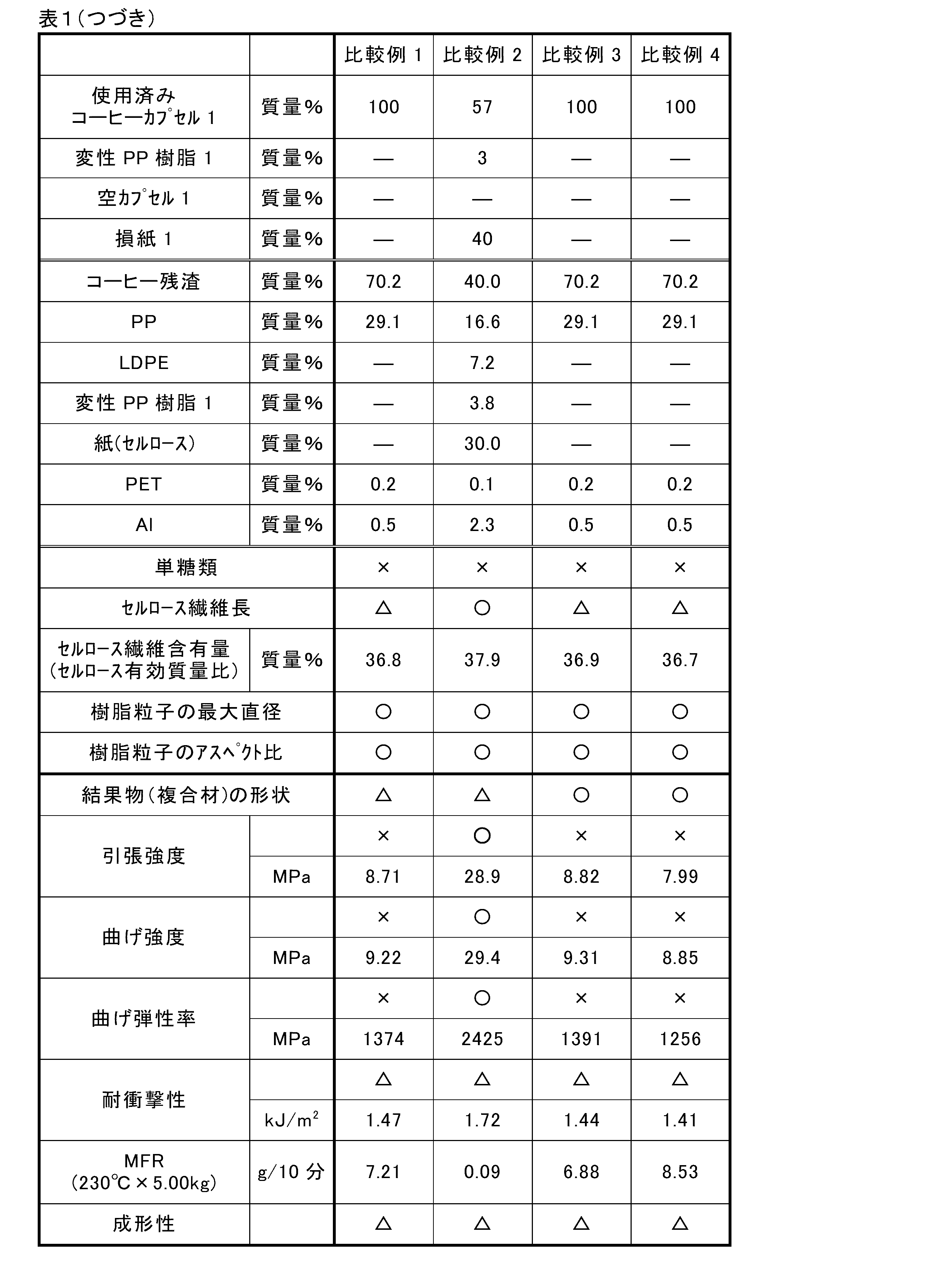
本発明をその実施態様とともに説明したが、我々は特に指定しない限り我々の発明を説明のどの細部においても限定しようとするものではなく、添付の請求の範囲に示した発明の精神と範囲に反することなく幅広く解釈されるべきであると考える。
本願は、2020年2月17日に日本国で特許出願された特願2020-024327に基づく優先権を主張するものであり、これはここに参照してその内容を本明細書の記載の一部として取り込む。
Claims (11)
- 熱可塑性樹脂と、
前記熱可塑性樹脂中に分散された、多糖類を含む粉末と、
単糖類と
を含有する樹脂複合材。 - 前記多糖類を含む粉末が、有機性残渣を含む、請求項1に記載の樹脂複合材。
- 前記多糖類を含む粉末が、コーヒー残渣及び/又はコーヒー粉末を含む、請求項1に記載の樹脂複合材。
- 前記熱可塑性樹脂がポリオレフィン樹脂を含む、請求項1~3のいずれか1項に記載の樹脂複合材。
- 前記ポリオレフィン樹脂が酸変性ポリオレフィン樹脂を含む、請求項4に記載の樹脂複合材。
- 前記樹脂複合材が、前記ポリオレフィン樹脂とは異なる樹脂を含む樹脂粒子を含み、前記ポリオレフィン樹脂とは異なる樹脂の融点が前記ポリオレフィン樹脂の融点より10℃以上高く、前記樹脂粒子の最大直径が10μm以上である、請求項4又は5に記載の樹脂複合材。
- 前記樹脂粒子が、ポリエチレンテレフタレートを含む、請求項6に記載の樹脂複合材。
- 繊維長0.3mm以上のセルロース繊維を含む、請求項1~7のいずれか1項に記載の樹脂複合材。
- 土木用、建材用、家具用もしくは自動車用の材料又は構成部材として用いる、請求項1~8のいずれか1項に記載の樹脂複合材。
- 請求項1~8のいずれか1項に記載の樹脂複合材を用いた樹脂成形体。
- 土木用、建材用、家具用もしくは自動車用の材料又は構成部材として用いる、請求項10に記載の樹脂成形体。
Priority Applications (4)
| Application Number | Priority Date | Filing Date | Title |
|---|---|---|---|
| CN202180003262.1A CN113795545A (zh) | 2020-02-17 | 2021-02-16 | 树脂复合材料和树脂成型体 |
| JP2021549292A JPWO2021166914A1 (ja) | 2020-02-17 | 2021-02-16 | |
| EP21757098.5A EP4108440A4 (en) | 2020-02-17 | 2021-02-16 | RESIN COMPOSITE AND RESIN MOLDED BODY |
| US17/489,157 US20220017726A1 (en) | 2020-02-17 | 2021-09-29 | Resin composite material and resin formed body |
Applications Claiming Priority (2)
| Application Number | Priority Date | Filing Date | Title |
|---|---|---|---|
| JP2020024327 | 2020-02-17 | ||
| JP2020-024327 | 2020-02-17 |
Related Child Applications (1)
| Application Number | Title | Priority Date | Filing Date |
|---|---|---|---|
| US17/489,157 Continuation US20220017726A1 (en) | 2020-02-17 | 2021-09-29 | Resin composite material and resin formed body |
Publications (1)
| Publication Number | Publication Date |
|---|---|
| WO2021166914A1 true WO2021166914A1 (ja) | 2021-08-26 |
Family
ID=77392252
Family Applications (1)
| Application Number | Title | Priority Date | Filing Date |
|---|---|---|---|
| PCT/JP2021/005741 Ceased WO2021166914A1 (ja) | 2020-02-17 | 2021-02-16 | 樹脂複合材及び樹脂成形体 |
Country Status (5)
| Country | Link |
|---|---|
| US (1) | US20220017726A1 (ja) |
| EP (1) | EP4108440A4 (ja) |
| JP (1) | JPWO2021166914A1 (ja) |
| CN (1) | CN113795545A (ja) |
| WO (1) | WO2021166914A1 (ja) |
Families Citing this family (1)
| Publication number | Priority date | Publication date | Assignee | Title |
|---|---|---|---|---|
| AU2024201331B1 (en) * | 2024-02-28 | 2025-01-23 | Fullthom Pty Ltd | Composite material and method |
Citations (9)
| Publication number | Priority date | Publication date | Assignee | Title |
|---|---|---|---|---|
| JP2000136579A (ja) * | 1998-08-26 | 2000-05-16 | Matsushita Electric Works Ltd | パネル及びその製造方法 |
| JP2001032515A (ja) * | 1999-07-27 | 2001-02-06 | Matsushita Electric Works Ltd | 床 材 |
| JP2004181881A (ja) * | 2002-12-05 | 2004-07-02 | Daiken Trade & Ind Co Ltd | 化粧材基材、及びこの化粧材基材を用いた化粧材、及びこの化粧材を用いた床材 |
| JP2004292805A (ja) * | 2003-03-07 | 2004-10-21 | Nof Corp | 熱可塑性樹脂組成物およびその製造方法 |
| JP2010173169A (ja) | 2009-01-29 | 2010-08-12 | Toppan Printing Co Ltd | コーヒーかすを含有する成形品の製造方法および成形品 |
| JP2011505172A (ja) * | 2007-10-22 | 2011-02-24 | イリカフェ・ソシエタ・ペル・アチオニ | 容器 |
| JP2011526535A (ja) * | 2008-06-20 | 2011-10-13 | ネステク ソシエテ アノニム | カプセル処理装置 |
| JP2016520343A (ja) * | 2013-03-21 | 2016-07-14 | ユニリーバー・ナームローゼ・ベンノートシヤープ | 飲料を抽出するための方法、装置、及びカプセル |
| JP2020024327A (ja) | 2018-08-08 | 2020-02-13 | キヤノン株式会社 | 投射型表示装置 |
Family Cites Families (15)
| Publication number | Priority date | Publication date | Assignee | Title |
|---|---|---|---|---|
| US6608121B2 (en) * | 2000-08-07 | 2003-08-19 | Kuraray Co., Ltd. | Water-soluble resin composition and water-soluble film |
| CN1886446A (zh) * | 2003-09-30 | 2006-12-27 | 内山幸助 | 螺杆型加工装置及用该装置加工的制品 |
| JP2005272754A (ja) * | 2004-03-26 | 2005-10-06 | Teijin Techno Products Ltd | 繊維含有樹脂ペレット |
| JP2005336217A (ja) * | 2004-05-24 | 2005-12-08 | Mitsubishi Paper Mills Ltd | 複合材及びその製造方法 |
| JP2009197104A (ja) * | 2008-02-20 | 2009-09-03 | Daicel Chem Ind Ltd | オリゴ糖アルコール組成物及びそれを用いて得られた分散体及び樹脂粒子 |
| JP2010138238A (ja) * | 2008-12-10 | 2010-06-24 | Aga S Kk | 熱可塑性樹脂組成物及びその成形品の製造方法 |
| JP2010270315A (ja) * | 2009-04-24 | 2010-12-02 | Sumitomo Bakelite Co Ltd | 複合体組成物 |
| KR101675654B1 (ko) * | 2011-12-22 | 2016-11-11 | 도요다 보쇼꾸 가부시키가이샤 | 열가소성 수지 조성물 및 그의 제조 방법, 및 성형체 |
| CN103289210A (zh) * | 2012-01-23 | 2013-09-11 | 住友化学株式会社 | 聚丙烯树脂组合物以及含有其的成型体 |
| JP2014005392A (ja) * | 2012-06-26 | 2014-01-16 | Sumitomo Chemical Co Ltd | 有機繊維含有ポリオレフィン樹脂複合体の製造方法 |
| US10273354B2 (en) * | 2014-06-30 | 2019-04-30 | Sabic Global Technologies B.V. | Reinforced thermoplastic polymer composition |
| WO2018180469A1 (ja) * | 2017-03-29 | 2018-10-04 | 古河電気工業株式会社 | ポリオレフィン樹脂複合材及びその製造方法 |
| JP6994520B2 (ja) * | 2018-02-08 | 2022-02-04 | 長瀬産業株式会社 | 繊維強化樹脂組成物及びその製造方法 |
| JP7178183B2 (ja) * | 2018-06-06 | 2022-11-25 | 古河電気工業株式会社 | セルロース・アルミニウム分散ポリエチレン樹脂複合材、これを用いたペレット及び成形体、並びにこれらの製造方法 |
| CN110172258A (zh) * | 2019-05-30 | 2019-08-27 | 上海互见创意设计有限公司 | 一种含咖啡渣的聚烯烃复合材料及其制备方法 |
-
2021
- 2021-02-16 WO PCT/JP2021/005741 patent/WO2021166914A1/ja not_active Ceased
- 2021-02-16 EP EP21757098.5A patent/EP4108440A4/en not_active Withdrawn
- 2021-02-16 CN CN202180003262.1A patent/CN113795545A/zh active Pending
- 2021-02-16 JP JP2021549292A patent/JPWO2021166914A1/ja active Pending
- 2021-09-29 US US17/489,157 patent/US20220017726A1/en not_active Abandoned
Patent Citations (9)
| Publication number | Priority date | Publication date | Assignee | Title |
|---|---|---|---|---|
| JP2000136579A (ja) * | 1998-08-26 | 2000-05-16 | Matsushita Electric Works Ltd | パネル及びその製造方法 |
| JP2001032515A (ja) * | 1999-07-27 | 2001-02-06 | Matsushita Electric Works Ltd | 床 材 |
| JP2004181881A (ja) * | 2002-12-05 | 2004-07-02 | Daiken Trade & Ind Co Ltd | 化粧材基材、及びこの化粧材基材を用いた化粧材、及びこの化粧材を用いた床材 |
| JP2004292805A (ja) * | 2003-03-07 | 2004-10-21 | Nof Corp | 熱可塑性樹脂組成物およびその製造方法 |
| JP2011505172A (ja) * | 2007-10-22 | 2011-02-24 | イリカフェ・ソシエタ・ペル・アチオニ | 容器 |
| JP2011526535A (ja) * | 2008-06-20 | 2011-10-13 | ネステク ソシエテ アノニム | カプセル処理装置 |
| JP2010173169A (ja) | 2009-01-29 | 2010-08-12 | Toppan Printing Co Ltd | コーヒーかすを含有する成形品の製造方法および成形品 |
| JP2016520343A (ja) * | 2013-03-21 | 2016-07-14 | ユニリーバー・ナームローゼ・ベンノートシヤープ | 飲料を抽出するための方法、装置、及びカプセル |
| JP2020024327A (ja) | 2018-08-08 | 2020-02-13 | キヤノン株式会社 | 投射型表示装置 |
Non-Patent Citations (1)
| Title |
|---|
| See also references of EP4108440A4 |
Also Published As
| Publication number | Publication date |
|---|---|
| EP4108440A1 (en) | 2022-12-28 |
| JPWO2021166914A1 (ja) | 2021-08-26 |
| US20220017726A1 (en) | 2022-01-20 |
| EP4108440A4 (en) | 2024-03-27 |
| CN113795545A (zh) | 2021-12-14 |
Similar Documents
| Publication | Publication Date | Title |
|---|---|---|
| Quiles-Carrillo et al. | Compatibilization of highly sustainable polylactide/almond shell flour composites by reactive extrusion with maleinized linseed oil | |
| JP5128595B2 (ja) | マスターバッチおよびポリマー組成物 | |
| JP6979983B2 (ja) | セルロース・アルミニウム分散ポリエチレン樹脂複合材、これを用いたペレット及び成形体、並びにこれらの製造方法 | |
| US20210309814A1 (en) | Resin composite material and formed body | |
| JP7672109B2 (ja) | 生分解性バイオ複合材料及びその調製方法 | |
| EP3436526A1 (en) | Cellulosic composites comprising wood pulp | |
| EP3892434A1 (en) | Cellulose fiber-dispersing resin composite material, formed body, and composite member | |
| US12612512B2 (en) | Cellulose fiber-dispersing resin composite material, formed body, and composite member | |
| JP7495278B2 (ja) | 繊維分散樹脂複合材、成形体、及び複合部材 | |
| JP2017071676A (ja) | 樹脂組成物 | |
| JP2019210407A (ja) | セルロース・アルミニウム分散ポリエチレン樹脂複合材、これを用いたペレット及び成形体、並びにこれらの製造方法 | |
| US20220275202A1 (en) | Flexible wood composite material | |
| JP2014133835A (ja) | 樹脂組成物 | |
| US20220017726A1 (en) | Resin composite material and resin formed body | |
| JP2020193263A (ja) | 樹脂成形体及び複合部材 | |
| KR20250073627A (ko) | 셀룰로스 섬유 강화 폴리바이닐 알코올 복합 재료 | |
| JP3478288B2 (ja) | カレンダー成形用ポリオレフィン樹脂組成物、カレンダー成形用組成物および成形体 | |
| TW201819528A (zh) | 樹脂組成物及成形體 | |
| EP3978571A1 (en) | Resin composite material and molded body | |
| US12391812B2 (en) | Fiber-dispersed resin composite material, molding, and composite member | |
| JP2025054056A (ja) | 樹脂組成物及び成形体 | |
| EP3527622A1 (en) | Resin composition and molded article | |
| Montanes et al. | Document downloaded from |
Legal Events
| Date | Code | Title | Description |
|---|---|---|---|
| ENP | Entry into the national phase |
Ref document number: 2021549292 Country of ref document: JP Kind code of ref document: A |
|
| 121 | Ep: the epo has been informed by wipo that ep was designated in this application |
Ref document number: 21757098 Country of ref document: EP Kind code of ref document: A1 |
|
| NENP | Non-entry into the national phase |
Ref country code: DE |
|
| ENP | Entry into the national phase |
Ref document number: 2021757098 Country of ref document: EP Effective date: 20220919 |