WO2021167029A1 - 架橋型ヌクレオシドおよびそれを用いたヌクレオチド - Google Patents
架橋型ヌクレオシドおよびそれを用いたヌクレオチド Download PDFInfo
- Publication number
- WO2021167029A1 WO2021167029A1 PCT/JP2021/006222 JP2021006222W WO2021167029A1 WO 2021167029 A1 WO2021167029 A1 WO 2021167029A1 JP 2021006222 W JP2021006222 W JP 2021006222W WO 2021167029 A1 WO2021167029 A1 WO 2021167029A1
- Authority
- WO
- WIPO (PCT)
- Prior art keywords
- group
- carbon atoms
- nucleic acid
- acid synthesis
- linear
- Prior art date
- Legal status (The legal status is an assumption and is not a legal conclusion. Google has not performed a legal analysis and makes no representation as to the accuracy of the status listed.)
- Ceased
Links
- 0 *C[C@@]1(C2(CC(*)C(*)C2)*2)O[C@@](*)C2C1* Chemical compound *C[C@@]1(C2(CC(*)C(*)C2)*2)O[C@@](*)C2C1* 0.000 description 5
Images
Classifications
-
- C—CHEMISTRY; METALLURGY
- C07—ORGANIC CHEMISTRY
- C07H—SUGARS; DERIVATIVES THEREOF; NUCLEOSIDES; NUCLEOTIDES; NUCLEIC ACIDS
- C07H21/00—Compounds containing two or more mononucleotide units having separate phosphate or polyphosphate groups linked by saccharide radicals of nucleoside groups, e.g. nucleic acids
- C07H21/02—Compounds containing two or more mononucleotide units having separate phosphate or polyphosphate groups linked by saccharide radicals of nucleoside groups, e.g. nucleic acids with ribosyl as saccharide radical
-
- C—CHEMISTRY; METALLURGY
- C07—ORGANIC CHEMISTRY
- C07H—SUGARS; DERIVATIVES THEREOF; NUCLEOSIDES; NUCLEOTIDES; NUCLEIC ACIDS
- C07H19/00—Compounds containing a hetero ring sharing one ring hetero atom with a saccharide radical; Nucleosides; Mononucleotides; Anhydro-derivatives thereof
- C07H19/02—Compounds containing a hetero ring sharing one ring hetero atom with a saccharide radical; Nucleosides; Mononucleotides; Anhydro-derivatives thereof sharing nitrogen
- C07H19/04—Heterocyclic radicals containing only nitrogen atoms as ring hetero atom
- C07H19/06—Pyrimidine radicals
-
- C—CHEMISTRY; METALLURGY
- C07—ORGANIC CHEMISTRY
- C07H—SUGARS; DERIVATIVES THEREOF; NUCLEOSIDES; NUCLEOTIDES; NUCLEIC ACIDS
- C07H1/00—Processes for the preparation of sugar derivatives
-
- C—CHEMISTRY; METALLURGY
- C07—ORGANIC CHEMISTRY
- C07H—SUGARS; DERIVATIVES THEREOF; NUCLEOSIDES; NUCLEOTIDES; NUCLEIC ACIDS
- C07H19/00—Compounds containing a hetero ring sharing one ring hetero atom with a saccharide radical; Nucleosides; Mononucleotides; Anhydro-derivatives thereof
- C07H19/02—Compounds containing a hetero ring sharing one ring hetero atom with a saccharide radical; Nucleosides; Mononucleotides; Anhydro-derivatives thereof sharing nitrogen
- C07H19/04—Heterocyclic radicals containing only nitrogen atoms as ring hetero atom
- C07H19/16—Purine radicals
-
- C—CHEMISTRY; METALLURGY
- C07—ORGANIC CHEMISTRY
- C07H—SUGARS; DERIVATIVES THEREOF; NUCLEOSIDES; NUCLEOTIDES; NUCLEIC ACIDS
- C07H21/00—Compounds containing two or more mononucleotide units having separate phosphate or polyphosphate groups linked by saccharide radicals of nucleoside groups, e.g. nucleic acids
-
- C—CHEMISTRY; METALLURGY
- C12—BIOCHEMISTRY; BEER; SPIRITS; WINE; VINEGAR; MICROBIOLOGY; ENZYMOLOGY; MUTATION OR GENETIC ENGINEERING
- C12N—MICROORGANISMS OR ENZYMES; COMPOSITIONS THEREOF; PROPAGATING, PRESERVING, OR MAINTAINING MICROORGANISMS; MUTATION OR GENETIC ENGINEERING; CULTURE MEDIA
- C12N15/00—Mutation or genetic engineering; DNA or RNA concerning genetic engineering, vectors, e.g. plasmids, or their isolation, preparation or purification; Use of hosts therefor
- C12N15/09—Recombinant DNA-technology
- C12N15/11—DNA or RNA fragments; Modified forms thereof; Non-coding nucleic acids having a biological activity
- C12N15/113—Non-coding nucleic acids modulating the expression of genes, e.g. antisense oligonucleotides; Antisense DNA or RNA; Triplex- forming oligonucleotides; Catalytic nucleic acids, e.g. ribozymes; Nucleic acids used in co-suppression or gene silencing
-
- C—CHEMISTRY; METALLURGY
- C12—BIOCHEMISTRY; BEER; SPIRITS; WINE; VINEGAR; MICROBIOLOGY; ENZYMOLOGY; MUTATION OR GENETIC ENGINEERING
- C12N—MICROORGANISMS OR ENZYMES; COMPOSITIONS THEREOF; PROPAGATING, PRESERVING, OR MAINTAINING MICROORGANISMS; MUTATION OR GENETIC ENGINEERING; CULTURE MEDIA
- C12N2310/00—Structure or type of the nucleic acid
- C12N2310/10—Type of nucleic acid
- C12N2310/11—Antisense
-
- C—CHEMISTRY; METALLURGY
- C12—BIOCHEMISTRY; BEER; SPIRITS; WINE; VINEGAR; MICROBIOLOGY; ENZYMOLOGY; MUTATION OR GENETIC ENGINEERING
- C12N—MICROORGANISMS OR ENZYMES; COMPOSITIONS THEREOF; PROPAGATING, PRESERVING, OR MAINTAINING MICROORGANISMS; MUTATION OR GENETIC ENGINEERING; CULTURE MEDIA
- C12N2310/00—Structure or type of the nucleic acid
- C12N2310/30—Chemical structure
- C12N2310/31—Chemical structure of the backbone
- C12N2310/315—Phosphorothioates
-
- C—CHEMISTRY; METALLURGY
- C12—BIOCHEMISTRY; BEER; SPIRITS; WINE; VINEGAR; MICROBIOLOGY; ENZYMOLOGY; MUTATION OR GENETIC ENGINEERING
- C12N—MICROORGANISMS OR ENZYMES; COMPOSITIONS THEREOF; PROPAGATING, PRESERVING, OR MAINTAINING MICROORGANISMS; MUTATION OR GENETIC ENGINEERING; CULTURE MEDIA
- C12N2310/00—Structure or type of the nucleic acid
- C12N2310/30—Chemical structure
- C12N2310/32—Chemical structure of the sugar
- C12N2310/323—Chemical structure of the sugar modified ring structure
- C12N2310/3231—Chemical structure of the sugar modified ring structure having an additional ring, e.g. LNA, ENA
-
- Y—GENERAL TAGGING OF NEW TECHNOLOGICAL DEVELOPMENTS; GENERAL TAGGING OF CROSS-SECTIONAL TECHNOLOGIES SPANNING OVER SEVERAL SECTIONS OF THE IPC; TECHNICAL SUBJECTS COVERED BY FORMER USPC CROSS-REFERENCE ART COLLECTIONS [XRACs] AND DIGESTS
- Y02—TECHNOLOGIES OR APPLICATIONS FOR MITIGATION OR ADAPTATION AGAINST CLIMATE CHANGE
- Y02P—CLIMATE CHANGE MITIGATION TECHNOLOGIES IN THE PRODUCTION OR PROCESSING OF GOODS
- Y02P20/00—Technologies relating to chemical industry
- Y02P20/50—Improvements relating to the production of bulk chemicals
- Y02P20/55—Design of synthesis routes, e.g. reducing the use of auxiliary or protecting groups
Definitions
- the present invention relates to a crosslinked nucleoside and a nucleotide using the same. More specifically, the present invention relates to a crosslinked nucleoside having good nuclease resistance and which can be efficiently produced, and a nucleotide using the same.
- an artificial nucleic acid in which a substituent such as a methyl group or a methoxymethyl group is introduced at the 6'position of 2'and 4'-BNA improves the binding affinity for ssRNA and has excellent enzyme resistance. It has been reported (Non-Patent Document 4). However, when these substituents are introduced at the 6'position, isomers may be generated, which requires a complicated separation operation.
- an artificial nucleic acid in which a cyclopropyl group is introduced at the 6'position can be synthesized by a synthetic pathway that does not require separation of isomers, and has high enzyme resistance while maintaining high binding affinity for ssRNA.
- Patent Document 1 and Non-Patent Document 5 it cannot be said that the yields of various products obtained in the synthetic pathway of scpBNA are sufficiently satisfactory. It is desired to develop an artificial nucleic acid that can be synthesized in a higher yield that can meet industrial applications.
- the present invention solves the above-mentioned problems, and an object of the present invention is that a substituent is introduced at the 6'position, which does not require complicated operations such as isomer separation and is higher. It is an object of the present invention to provide a crosslinked nucleoside that can be produced in a yield and a nucleotide using the same.
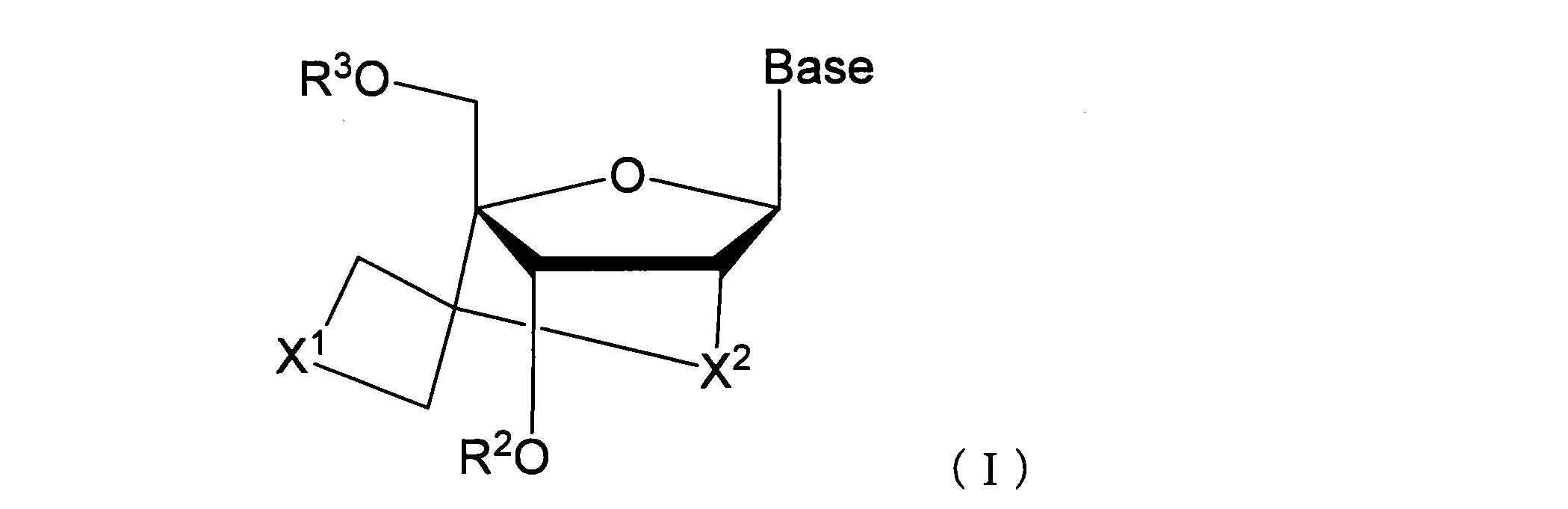
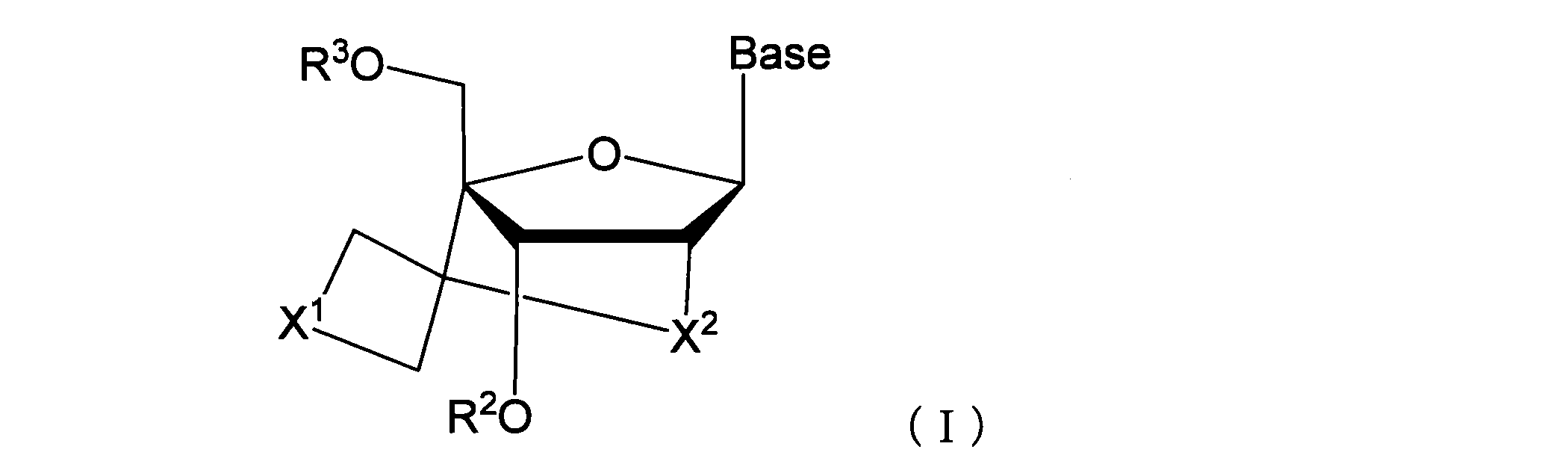
- the present invention describes the compound represented by the following formula (I) or a salt thereof:
- Base represents a purine-9-yl group or 2-oxo-1,2-dihydropyrimidine-1-yl group which may have one or more of any substituents selected from the ⁇ group, where here.
- the ⁇ group is protected by a hydroxyl group, a hydroxyl group protected by a protective group for nucleic acid synthesis, a linear alkyl group having 1 to 6 carbon atoms, a linear alkoxy group having 1 to 6 carbon atoms, a mercapto group, and a protective group for nucleic acid synthesis.
- R 2 and R 3 independently form a hydrogen atom, a protective group for a hydroxyl group in nucleic acid synthesis, an alkyl group having 1 to 7 carbon atoms which may form a branch or a ring, a branch or a ring, respectively.
- R 4a and R 5a are independently hydroxyl groups, respectively.
- X 1 is a linear alkyl group having 1 to 3 carbon atoms, -NHR 4b [where R 4b is a hydrogen atom or a linear alkyl group having 1 to 3 carbon atoms], or -OR 5b [here. R 5b is a hydrogen atom or a linear alkyl group having 1 to 3 carbon atoms], an alkylene group having 2 to 8 carbon atoms; or a linear alkyl group having 1 to 3 carbon atoms. Or -NHR 4b [where R 4b is a hydrogen atom or a linear alkyl group having 1 to 3 carbon atoms] or -OR 5b [where R 5b is a hydrogen atom or a linear alkyl group having 1 to 3 carbon atoms].
- X 2 is an oxygen atom, a sulfur atom, -NH-, -N (CH 3 )-. Or it is a methylene group).
- Base represents a purine-9-yl group or 2-oxo-1,2-dihydropyrimidine-1-yl group which may have one or more of any substituents selected from the ⁇ group, where here.
- the ⁇ group is protected by a hydroxyl group, a hydroxyl group protected by a protective group for nucleic acid synthesis, a linear alkyl group having 1 to 6 carbon atoms, a linear alkoxy group having 1 to 6 carbon atoms, a mercapto group, and a protective group for nucleic acid synthesis.
- R 2 and R 3 independently form a hydrogen atom, a protective group for a hydroxyl group in nucleic acid synthesis, an alkyl group having 1 to 7 carbon atoms which may form a branch or a ring, a branch or a ring, respectively.
- R 4a and R 5a are independently hydroxyl groups, respectively.
- X 2 is an oxygen atom, a sulfur atom, -NH-, -N (CH 3 )-or a methylene group, and R 6 , R 7 , R 8 , R 9 , R 10 and R 11 are independent of each other. , Hydrogen atom, linear alkyl group with 1 to 3 carbon atoms, -NHR 4b [where R 4b is a hydrogen atom or linear alkyl group with 1 to 3 carbon atoms], or -OR 5b [here, R 5b is a hydrogen atom or a linear alkyl group having 1 to 3 carbon atoms].
- Base represents a purine-9-yl group or 2-oxo-1,2-dihydropyrimidine-1-yl group which may have one or more of any substituents selected from the ⁇ group, where here.
- the ⁇ group is protected by a hydroxyl group, a hydroxyl group protected by a protective group for nucleic acid synthesis, a linear alkyl group having 1 to 6 carbon atoms, a linear alkoxy group having 1 to 6 carbon atoms, a mercapto group, and a protective group for nucleic acid synthesis.
- R 2 and R 3 independently form a hydrogen atom, a protective group for a hydroxyl group in nucleic acid synthesis, an alkyl group having 1 to 7 carbon atoms which may form a branch or a ring, a branch or a ring, respectively.
- R 4a and R 5a are independently hydroxyl groups, respectively.
- X 2 is an oxygen atom, a sulfur atom, -NH-, -N (CH 3 )-or a methylene group
- R 6 and R 7 are independent hydrogen atoms, linear chains having 1 to 3 carbon atoms, respectively.
- Alkyl group, -NHR 4b [where R 4b is a hydrogen atom or a linear alkyl group having 1 to 3 carbon atoms]
- -OR 5b [where R 5b is a hydrogen atom or a linear alkyl group having 1 to 3 carbon atoms. It is a straight chain alkyl group]).
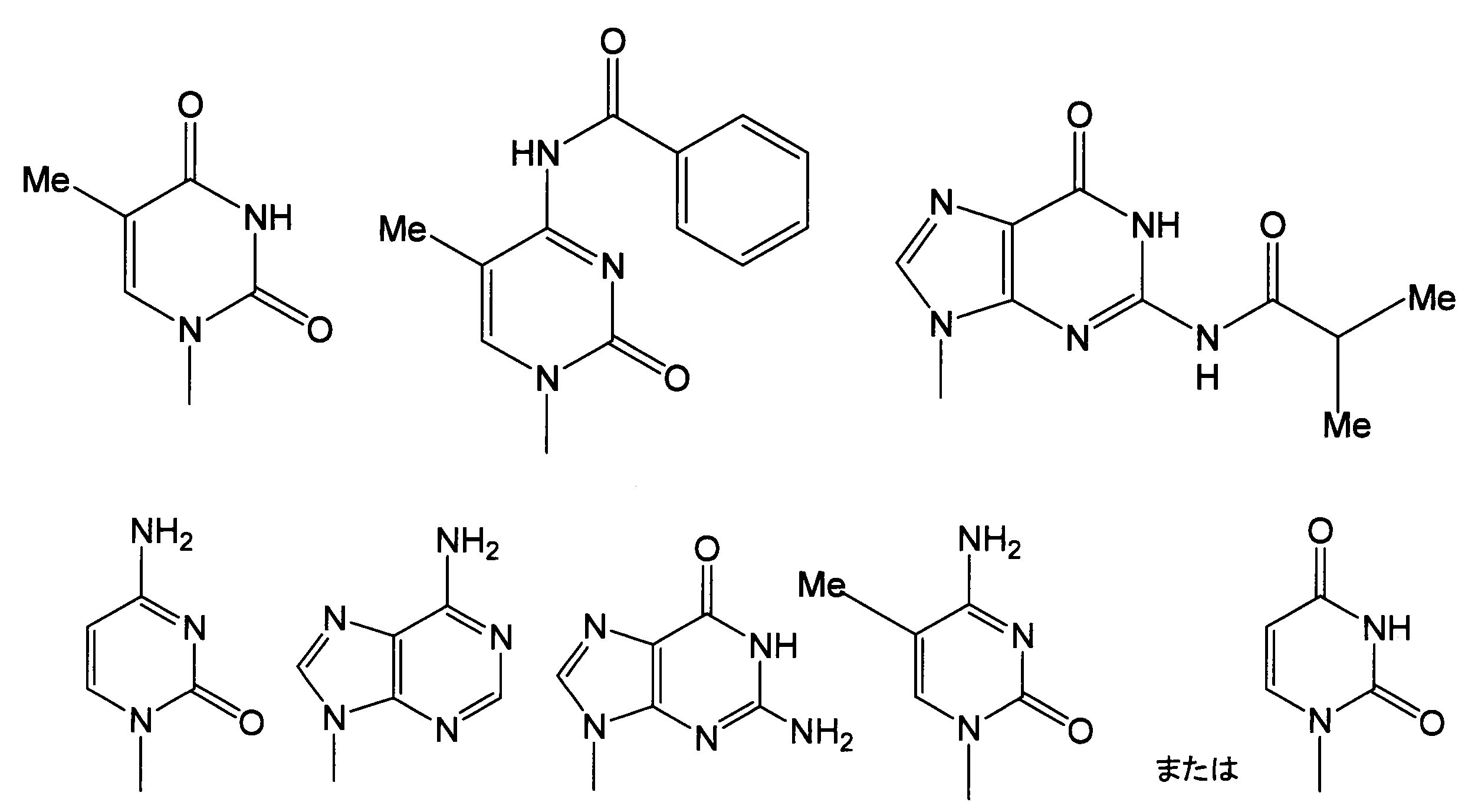
- the Base is a 6-aminopurine-9-yl group, a 2,6-diaminopurine-9-yl group, a 2-amino-6-chloropurine-9-.
- Il group 2-amino-6-fluoropurine-9-yl group, 2-amino-6-bromopurine-9-yl group, 2-amino-6-hydroxypurine-9-yl group, 6-amino-2 -Methoxypurine-9-yl group, 6-amino-2-chloropurine-9-yl group, 6-amino-2-fluoropurine-9-yl group, 2,6-dimethoxypurin-9-yl group, 2 , 6-Dichloropurine-9-yl group, 6-mercaptopurine-9-yl group, 2-oxo-4-amino-1,2-dihydropyrimidine-1-yl group, 4-amino-2-oxo-5 -Fluoro-1,2-dihydr
- the above Base is the following formula:
- the present invention also includes an oligonucleotide containing at least one nucleoside structure represented by the following formula (II) or a pharmacologically acceptable salt thereof:
- Base represents a purine-9-yl group or 2-oxo-1,2-dihydropyrimidine-1-yl group which may have one or more of any substituents selected from the ⁇ group, where here.
- the ⁇ group is protected by a hydroxyl group, a hydroxyl group protected by a protective group for nucleic acid synthesis, a linear alkyl group having 1 to 6 carbon atoms, a linear alkoxy group having 1 to 6 carbon atoms, a mercapto group, and a protective group for nucleic acid synthesis.
- X 1 is a linear alkyl group having 1 to 3 carbon atoms, -NHR 4b [where R 4b is a hydrogen atom or a linear alkyl group having 1 to 3 carbon atoms], or -OR 5b [here.
- R 5b is a hydrogen atom or a linear alkyl group having 1 to 3 carbon atoms], an alkylene group having 2 to 8 carbon atoms; or a linear alkyl group having 1 to 3 carbon atoms.
- -NHR 4b [where R 4b is a hydrogen atom or a linear alkyl group having 1 to 3 carbon atoms] or -OR 5b [where R 5b is a hydrogen atom or a linear alkyl group having 1 to 3 carbon atoms]. It is an alkaneylene group having 2 to 8 carbon atoms, which may be substituted with], and X 2 is an oxygen atom, a sulfur atom, -NH-, -N (CH 3 )-. Or it is a methylene group).
- equation (II) is the following equation:
- Base represents a purine-9-yl group or 2-oxo-1,2-dihydropyrimidine-1-yl group which may have one or more of any substituents selected from the ⁇ group, where here.
- the ⁇ group is protected by a hydroxyl group, a hydroxyl group protected by a protective group for nucleic acid synthesis, a linear alkyl group having 1 to 6 carbon atoms, a linear alkoxy group having 1 to 6 carbon atoms, a mercapto group, and a protective group for nucleic acid synthesis.
- X 2 is an oxygen atom, a sulfur atom, -NH-, -N (CH 3 )-or a methylene group, and R 6 , R 7 , R 8 , R 9 , R 10 and R 11 are independent of each other.
- Hydrogen atom linear alkyl group with 1 to 3 carbon atoms, -NHR 4 [where R 4 is a hydrogen atom or linear alkyl group with 1 to 3 carbon atoms], or -OR 5 [here, R 5 is a hydrogen atom or a linear alkyl group having 1 to 3 carbon atoms].
- equation (II) is the following equation:
- Base represents a purine-9-yl group or 2-oxo-1,2-dihydropyrimidine-1-yl group which may have one or more of any substituents selected from the ⁇ group, where here.
- the ⁇ group is protected by a hydroxyl group, a hydroxyl group protected by a protective group for nucleic acid synthesis, a linear alkyl group having 1 to 6 carbon atoms, a linear alkoxy group having 1 to 6 carbon atoms, a mercapto group, and a protective group for nucleic acid synthesis.
- X 2 is an oxygen atom, a sulfur atom, -NH-, -N (CH 3 )-or a methylene group, and R 6 and R 7 are independent hydrogen atoms, linear chains having 1 to 3 carbon atoms, respectively.
- the present invention is also a method for producing the above-mentioned oligonucleotide or a pharmacologically acceptable salt thereof.
- Base represents a purine-9-yl group or 2-oxo-1,2-dihydropyrimidine-1-yl group which may have one or more of any substituents selected from the ⁇ group, where here.
- the ⁇ group is protected by a hydroxyl group, a hydroxyl group protected by a protective group for nucleic acid synthesis, a linear alkyl group having 1 to 6 carbon atoms, a linear alkoxy group having 1 to 6 carbon atoms, a mercapto group, and a protective group for nucleic acid synthesis.
- R 2 and R 3 independently form a hydrogen atom, a protective group for a hydroxyl group in nucleic acid synthesis, an alkyl group having 1 to 7 carbon atoms which may form a branch or a ring, a branch or a ring, respectively.
- R 4a and R 5a are independently hydroxyl groups, respectively.
- X 1 is a linear alkyl group having 1 to 3 carbon atoms, -NHR 4b [where R 4b is a hydrogen atom or a linear alkyl group having 1 to 3 carbon atoms], or -OR 5b [here. R 5b is a hydrogen atom or a linear alkyl group having 1 to 3 carbon atoms], an alkylene group having 2 to 8 carbon atoms; or a linear alkyl group having 1 to 3 carbon atoms. Or -NHR 4b [where R 4b is a hydrogen atom or a linear alkyl group having 1 to 3 carbon atoms] or -OR 5b [where R 5b is a hydrogen atom or a linear alkyl group having 1 to 3 carbon atoms].
- a novel crosslinked nucleoside modified at the 6'position having a high binding affinity for ssRNA and high enzyme resistance and a nucleotide using the same are provided. Since the crosslinked nucleoside of the present invention does not require an isomer separation step in its production, it is also excellent in industrial productivity.
- linear alkyl group having 1 to 6 carbon atoms refers to any linear alkyl group having 1 to 6 carbon atoms, specifically, a methyl group, an ethyl group, an n-propyl group, and the like. Refers to an n-butyl group, an n-pentyl group, and an n-hexyl group.
- linear alkyl group having 1 to 3 carbon atoms refers to any linear alkyl group having 1 to 3 carbon atoms, and specifically refers to a methyl group, an ethyl group, or an n-propyl group.
- alkyl group having 1 to 6 carbon atoms refers to any linear, branched chain or cyclic alkyl group having 1 to 6 carbon atoms.
- linear alkoxy group having 1 to 6 carbon atoms includes an alkoxy group having an arbitrary linear alkyl group having 1 to 6 carbon atoms.
- a methoxy group, an ethoxy group, an n-propoxy group and the like can be mentioned.
- alkoxy group having 1 to 6 carbon atoms refers to any linear, branched chain or cyclic alkoxy group having 1 to 6 carbon atoms.
- linear alkoxy group having 1 to 6 carbon atoms which may be substituted with a linear alkoxy group having 1 to 6 carbon atoms
- linear alkoxy group having 1 to 6 carbon atoms the above-mentioned “linear alkoxy group having 1 to 6 carbon atoms”
- one or more hydrogen atoms constituting the "linear alkoxy group having 1 to 6 carbon atoms” are replaced with another "linear alkoxy group having 1 to 6 carbon atoms" which may be the same or different. Alkoxy group.
- Examples of such a "linear alkoxy group having 1 to 6 carbon atoms which may be substituted with a linear alkoxy group having 1 to 6 carbon atoms" include a methoxy group, an ethoxy group, an n-propoxy group, and a methoxymethoxy group. , Ethoxymethoxy group, n-propoxymethoxy group, methoxyethoxy group (for example, 2-methoxyethoxy group), ethoxyethoxy group (for example, 2-ethoxyethoxy group), and n-propoxyethoxy group.
- cyanoalkoxy group having 1 to 6 carbon atoms is used in which at least one hydrogen atom in any linear, branched or cyclic alkoxy group having 1 to 6 carbon atoms is substituted with a cyano group. Refers to the group.
- linear alkylthio group having 1 to 6 carbon atoms includes an alkylthio group having an arbitrary linear alkylthio group having 1 to 6 carbon atoms.
- a methylthio group, an ethylthio group, an n-propylthio group and the like can be mentioned.
- alkylthio group having 1 to 6 carbon atoms refers to any linear, branched chain or cyclic alkylthio group having 1 to 6 carbon atoms.
- linear alkylamino group having 1 to 6 carbon atoms includes an alkylamino group having one or two alkylamino groups having any linear alkylamino group having 1 to 6 carbon atoms. do.
- a methylamino group, a dimethylamino group, an ethylamino group, a methylethylamino group, a diethylamino group and the like can be mentioned.
- alkyl group having 1 to 7 carbon atoms which may form a branch or a ring is an arbitrary linear alkyl group having 1 to 7 carbon atoms and any branching having 3 to 7 carbon atoms. It includes a chain alkyl group and any cyclic alkyl group having 3 to 7 carbon atoms. Sometimes referred to simply as a "lower alkyl group".
- any linear alkyl group having 1 to 7 carbon atoms includes a methyl group, an ethyl group, an n-propyl group, an n-butyl group, an n-pentyl group, an n-hexyl group, and an n-heptyl group.
- Examples of the arbitrary branched chain alkyl group having 3 to 7 carbon atoms include an isopropyl group, an isobutyl group, a tert-butyl group, an isopentyl group and the like, and an arbitrary cyclic alkyl group having 3 to 7 carbon atoms includes an optional cyclic alkyl group having 3 to 7 carbon atoms. Cyclobutyl group, cyclopentyl group, cyclohexyl group and the like can be mentioned.
- alkenyl group having 2 to 7 carbon atoms which may form a branch or a ring is an arbitrary linear alkenyl group having 2 to 7 carbon atoms and an arbitrary branching having 3 to 7 carbon atoms. Includes chain alkenyl groups and any cyclic alkenyl group with 3-7 carbon atoms. Sometimes simply referred to as a "lower alkenyl group”.
- any linear alkenyl group having 2 to 7 carbon atoms includes an ethenyl group, a 1-propenyl group, a 2-propenyl group, a 1-butenyl group, a 2-butenyl group, a 1-pentenyl group, a 2-pentenyl group, and the like.
- Examples thereof include 3-pentenyl group, 4-pentenyl group, 1-hexenyl group and the like
- examples of any branched alkenyl group having 3 to 7 carbon atoms include isopropenyl group, 1-methyl-1-propenyl group and 1-methyl.
- -2-propenyl group 2-methyl-1-propenyl group, 2-methyl-2-propenyl group, 1-methyl-2-butenyl group and the like, and as any cyclic alkenyl group having 3-7 carbon atoms.
- Examples include a cyclobutenyl group, a cyclopentenyl group, a cyclohexenyl group and the like.
- aryl group having 3 to 10 carbon atoms which may contain a heteroatom refers to any aryl group having 6 to 10 carbon atoms composed only of a hydrocarbon and the aryl group. Includes any heteroaryl group having 3 to 12 carbon atoms in which at least one carbon atom constituting the ring structure is substituted with a heteroatom (for example, a nitrogen atom, an oxygen atom, and a sulfur atom, and a combination thereof). do.
- Examples of the aryl group having 6 to 10 carbon atoms include a phenyl group, a naphthyl group, an indenyl group, an azulenyl group and the like, and examples of the arbitrary heteroaryl group having 3 to 12 carbon atoms include a pyridyl group and a pyrrolyl group. Examples thereof include a quinolyl group, an indrill group, an imidazolyl group, a frill group, and a thienyl group.
- examples of the term "aralkyl group having an aryl moiety having 3 to 12 carbon atoms which may contain a hetero atom” include a benzyl group, a phenethyl group, a naphthylmethyl group, a 3-phenylpropyl group, and 2 -Phenylpropyl group, 4-phenylbutyl group, 2-phenylbutyl group, pyridylmethyl group, indolylmethyl group, furylmethyl group, thienylmethyl group, pyrrolylmethyl group, 2-pyridylethyl group, 1-pyridylethyl group, 3 -Examples include a thienylpropyl group.
- examples of the term "acyl group” include an aliphatic acyl group and an aromatic acyl group.
- examples of the aliphatic acyl group include a formyl group, an acetyl group, a propionyl group, a butyryl group, an isobutyryl group, a pentanoyl group, a pivaloyl group, a valeryl group, an isovaleryl group, an octanoyl group, a nonanoyl group and a decanoyyl group.
- aromatic acyl groups include arylcarbonyl groups such as benzoyl groups, ⁇ -naphthoyl groups and ⁇ -naphthoyl groups; halogenoarylcarbonyl groups such as 2-bromobenzoyl groups and 4-chlorobenzoyl groups; 2 , 4,6-trimethylbenzoyl group, lower alkylated arylcarbonyl group such as 4-toluole group; lower alkoxylated arylcarbonyl group such as 4-anisoil group; 2-carboxybenzoyl group, 3-carboxybenzoyl group, 4 -Carboxylated arylcarbonyl groups such as carboxybenzoyl groups; Nitrated arylcarbonyl groups such as 4-nitrobenzoyl groups, 2-nitrobenzoyl groups; Lower alkoxycarbonylated arylcarbonyl groups such as 2- (methoxycarbonyl) benzoyl groups Groups; Examples include arylated aryl
- alkylene group having 2 to 8 carbon atoms refers to a divalent group having 2 to 8 carbon atoms, which is composed of repeating methylene groups (-CH 2-). Specific examples, -CH 2 CH 2 -, - CH 2 CH 2 CH 2 CH 2 -, and -CH 2 CH 2 CH 2 CH 2 CH 2 - and the like.
- linear alkyl group with 1 to 3 carbon atoms or -NHR 4b [where R 4b is a hydrogen atom or linear alkyl group with 1 to 3 carbon atoms] or -OR 5b [here.
- R 5b is a hydrogen atom or a linear alkyl group having 1 to 3 carbon atoms], and the alkylene group having 2 to 8 carbon atoms "is from the above-mentioned 2 carbon atoms which have not been substituted.
- At least one hydrogen atom in a divalent group having 2 to 8 carbon atoms composed only of repeating 8 alkylene groups, that is, a methylene group is a linear alkyl group having 1 to 3 carbon atoms, -NHR 4b , or. -Refer to the group substituted with OR 5b.
- R 5b is a hydrogen atom or a linear alkyl group having 1 to 3 carbon atoms], the alkaneylene group having 2 to 8 carbon atoms "means from the above-mentioned 2 carbon atoms which have not been substituted. It refers to a group in which at least one hydrogen atom in the alkaneylene group of 8 is substituted with a linear alkyl group having 1 to 3 carbon atoms, -NHR 4b , or -OR 5b.
- sil group examples include a trimethylsilyl group, a triethylsilyl group, an isopropyldimethylsilyl group, a t-butyldimethylsilyl group, a methyldiisopropylsilyl group, a methyldi-t-butylsilyl group and a triisopropylsilyl group.
- Tri-lower alkylsilyl groups such as; diphenylmethylsilyl groups, butyldiphenylbutylsilyl groups, diphenylisopropylsilyl groups, tri-lower alkylsilyl groups substituted with one or two aryl groups such as phenyldiisopropylsilyl groups, etc. Can be mentioned.
- a trimethylsilyl group, a triethylsilyl group, a triisopropylsilyl group, a t-butyldimethylsilyl group, a t-butyldiphenylsilyl group are preferable, and a trimethylsilyl group is more preferable.
- halogen atom includes, for example, a fluorine atom, a chlorine atom, a bromine atom, or an iodine atom.
- a fluorine atom or a chlorine atom is preferable.
- protecting group of amino group of nucleic acid synthesis is a group capable of stably protecting an amino group, a hydroxyl group, a phosphoric acid group or a mercapto group during nucleic acid synthesis. If so, there is no particular limitation.
- protective group that is stable under acidic or neutral conditions and can be cleaved by chemical methods such as hydrogenation, hydrolysis, electrolysis, and photolysis.
- protective groups include, for example, lower alkyl groups, lower alkenyl groups, acyl groups, tetrahydropyranyl or tetrahydrothiopyranyl groups, tetrahydrofuranyl or tetrahydrothiofuranyl groups, silyl groups, lower alkoxymethyl groups, lower alkoxys.
- Lower Alkoxy Methyl Group Harogeno Lower Alkoxy Methyl Group, Lower Alkoxy Alkoxy Group, Ethyl Halcolated Group, Methyl Group Substituted by 1-3 aryl Groups, "Lower Alkoxy Group, Lower Alkoxy Group, Halogen Atomic Or Cyano" "Methyl group substituted with 1 to 3 aryl groups whose aryl ring is substituted with a group", lower alkoxycarbonyl group, "aryl group substituted with halogen atom, lower alkoxy group or nitro group", "halogen atom or Examples thereof include a lower alkoxycarbonyl group substituted with a tri-lower alkylsilyl group, an alkoxyoxycarbonyl group, and an aralkyloxycarbonyl group in which the aryl ring may be substituted with a lower alkoxy or nitro group.
- the tetrahydropyranyl group or the tetrahydrothiopyranyl group includes a tetrahydropyran-2-yl group, a 3-bromotetrahydropyran-2-yl group, a 4-methoxytetrahydropyran-4-yl group, and a tetrahydro. Examples thereof include a thiopyran-4-yl group and a 4-methoxytetrahydropyran-4-yl group.
- Examples of the tetrahydrofuranyl group or the tetrahydrothiofuranyl group include a tetrahydrofuran-2-yl group and a tetrahydrothiofuran-2-yl group.
- Examples of the lower alkoxymethyl group include a methoxymethyl group, a 1,1-dimethyl-1-methoxymethyl group, an ethoxymethyl group, a propoxymethyl group, an isopropoxymethyl group, a butoxymethyl group, a t-butoxymethyl group and the like.
- Lower Alkoxy Group Examples of the lower alkoxymethyl group include a 2-methoxyethoxymethyl group.
- Examples of the halogeno lower alkoxymethyl group include a 2,2,2-trichloroethoxymethyl group and a bis (2-chloroethoxy) methyl group.
- Examples of the lower alkoxylated ethyl group include 1-ethoxyethyl group and 1- (isopropoxy) ethyl group.
- Examples of the ethyl halide group include a 2,2,2-trichloroethyl group.
- Methyl groups substituted with 1 to 3 aryl groups include benzyl group, ⁇ -naphthylmethyl group, ⁇ -naphthylmethyl group, diphenylmethyl group, triphenylmethyl group, ⁇ -naphthyldiphenylmethyl group, 9-an. Examples include a thrill methyl group.
- Examples of the "methyl group substituted with 1 to 3 aryl groups in which the aryl ring is substituted with a lower alkyl group, lower alkoxy group, halogen atom or cyano group" include 4-methylbenzyl group, 2,4,6-.
- Trimethylbenzyl group 3,4,5-trimethylbenzyl group, 4-methoxybenzyl group, 4-methoxyphenyldiphenylmethyl group, 4,4'-dimethoxytriphenylmethyl group, 2-nitrobenzyl group, 4-nitrobenzyl group , 4-Chlorobenzyl group, 4-bromobenzyl group, 4-cyanobenzyl group and the like.
- the lower alkoxycarbonyl group include a methoxycarbonyl group, an ethoxycarbonyl group, a t-butoxycarbonyl group, an isobutoxycarbonyl group and the like.
- Examples of the "aryl group substituted with a halogen atom, a lower alkoxy group or a nitro group” include a 4-chlorophenyl group, a 2-fluorophenyl group, a 4-methoxyphenyl group, a 4-nitrophenyl group and a 2,4-dinitrophenyl group. And so on.
- Examples of the "lower alkoxycarbonyl group substituted with a halogen atom or a trilower alkylsilyl group” include a 2,2,2-trichloroethoxycarbonyl group and a 2-trimethylsilylethoxycarbonyl group.
- alkenyloxycarbonyl group examples include a vinyloxycarbonyl group and an aryloxycarbonyl group.
- alkenyloxycarbonyl group examples include a vinyloxycarbonyl group and an aryloxycarbonyl group.
- alkenyloxycarbonyl group examples include a vinyloxycarbonyl group and an aryloxycarbonyl group.
- alkenyloxycarbonyl group examples include a vinyloxycarbonyl group and an aryloxycarbonyl group.
- aralkyloxycarbonyl group in which the aryl ring may be substituted with a lower alkoxy or nitro group examples include a benzyloxycarbonyl group, 4-methoxybenzyloxycarbonyl group, 3,4-dimethoxybenzyloxycarbonyl group and 2-nitro. Examples thereof include a benzyloxycarbonyl group and a 4-nitrobenzyloxycarbonyl group.
- protecting groups for hydroxyl groups in nucleic acid synthesis include, for example, aliphatic acyl groups, aromatic acyl groups, methyl groups substituted with 1 to 3 aryl groups, "lower alkyl, lower alkoxy, etc.” Examples thereof include halogen, a methyl group substituted with 1 to 3 aryl groups in which the aryl ring is substituted with a cyano group, and a silyl group.
- the "protective group for the hydroxyl group in nucleic acid synthesis” includes, for example, an acetyl group, a benzoyl group, a benzyl group, a p-methoxybenzoyl group, a dimethoxytrityl group, a monomethoxytrityl group, a tert-butyldiphenylsilyl.
- the protecting groups for the "protecting group for nucleic acid synthesis” include, for example, an aliphatic acyl group, an aromatic acyl group, and a "methyl group substituted with 1 to 3 aryl groups". , "Aryl groups substituted with halogen atoms, lower alkoxy groups or nitro groups", lower alkyl groups, and lower alkenyl groups.
- the protecting groups for the "protecting group for nucleic acid synthesis” include, for example, benzoyl groups, benzyl groups, 2-chlorophenyl groups, 4-chlorophenyl groups, and 2-propenyl groups. Be done.
- examples of the "protecting group for an amino group in nucleic acid synthesis” include an acyl group, preferably a benzoyl group.
- the "protective group” of the “protective group of nucleic acid synthesis” includes, for example, a lower alkyl group, a lower alkyl group substituted with a cyano group, an aralkyl group, a "nitro group or”. Included are “aralkyl groups substituted with an aryl ring with a halogen atom” and “aryl groups substituted with a lower alkyl group, halogen atom, or nitro group”.
- the "protecting group" of the “protecting group for nucleic acid synthesis” includes, for example, 2-cyanoethyl group, 2,2,2-trichloroethyl group, benzyl group, 2 -Chlorophenyl group and 4-chlorophenyl group can be mentioned.
- examples of the "protecting group” of the “protecting group for nucleic acid synthesis” include aliphatic acyl groups and aromatic acyl groups, preferably benzoyl groups.
- R 4a and R 5a are independently a hydroxyl group, a hydroxyl group protected by a protective group for nucleic acid synthesis, a mercapto group, and a protective group for nucleic acid synthesis, respectively.
- the phosphoramidite group is preferably a group represented by the formula-P (OC 2 H 4 CN) (N (iPr) 2 ) or a group represented by the formula -P (OCH 3 ) (N (iPr) 2 ).
- the groups represented are mentioned.
- iPr represents an isopropyl group.
- nucleoside and nucleoside analog refer to an unnatural type of “nucleoside” in which a purine or a pyrimidine base and a sugar are bonded, and an aromatic heterocycle other than purine and pyrimidine. And an aromatic hydrocarbon ring that can be substituted with a purine or pyrimidine base and a sugar bound to it.
- oligonucleotide in which the same or different "nucleoside” or “nucleoside analog” is bonded, for example, 2 to 50 phosphodiester bonds.
- Such analogs are preferably sugar derivatives with modified sugar moieties; thioate derivatives with phosphate diester moieties thioated; esters with terminal phosphate moieties esterified; on purine bases. Examples thereof include an amide derivative in which an amino group is amidated.
- salt thereof refers to a salt of a compound represented by the formula (I) or (II) of the present invention.
- Such salts include, for example, alkali metal salts such as sodium salt, potassium salt, lithium salt, calcium salt, alkaline earth metal salt such as magnesium salt, aluminum salt, iron salt, zinc salt, copper salt, etc.
- Metal salts such as nickel salts and cobalt salts; inorganic salts such as ammonium salts, t-octylamine salts, dibenzylamine salts, morpholin salts, glucosamine salts, phenylglycine alkyl ester salts, ethylenediamine salts, N-methylglucamine salts.
- Amine salts such as organic salts such as (hydroxymethyl) aminomethane salts; halogen atomized hydrorates such as hydrofluoride, hydrochlorides, hydrobromide, hydroiodide, nitrates, excess.
- Inorganic acid salts such as chlorates, sulfates and phosphates; lower alkane sulfonates such as methane sulfonate, trifluoromethane sulfonate, ethane sulfonate, benzene sulfonate, p-toluene sulfonic acid
- Organic acid salts such as aryl sulfonates such as salts, acetates, malates, fumarates, succinates, citrates, tartrates, oxalates, maleates; and glycine salts, lysines. Examples include amino acid salts such as salts, arginine salts, ornithine salts, glutamates, asparaginates.
- the term "the pharmacologically acceptable salt” refers to a salt of an oligonucleotide analog containing at least one nucleoside structure represented by the formula (II) of the present invention.
- Such salts include, for example, alkali metal salts such as sodium salt, potassium salt, lithium salt, calcium salt, alkaline earth metal salt such as magnesium salt, aluminum salt, iron salt, zinc salt, copper salt, etc.
- Metal salts such as nickel salts and cobalt salts; inorganic salts such as ammonium salts, t-octylamine salts, dibenzylamine salts, morpholin salts, glucosamine salts, phenylglycine alkyl ester salts, ethylenediamine salts, N-methylglucamine salts.
- Amine salts such as organic salts such as (hydroxymethyl) aminomethane salts; halogen atomized hydrorates such as hydrofluoride, hydrochlorides, hydrobromide, hydroiodide, nitrates, excess.
- Inorganic acid salts such as chlorates, sulfates and phosphates; lower alkane sulfonates such as methane sulfonate, trifluoromethane sulfonate, ethane sulfonate, benzene sulfonate, p-toluene sulfonic acid
- Organic acid salts such as aryl sulfonates such as salts, acetates, malates, fumarates, succinates, citrates, tartrates, oxalates, maleates; and glycine salts, lysines. Examples include amino acid salts such as salts, arginine salts, ornithine salts, glutamates, asparaginates.
- Crosslinked nucleoside The crosslinked nucleoside of the present invention has the following formula (I):
- Base represents a purine-9-yl group or 2-oxo-1,2-dihydropyrimidine-1-yl group which may have one or more of any substituents selected from the ⁇ group, where here.
- the ⁇ group is protected by a hydroxyl group, a hydroxyl group protected by a protective group for nucleic acid synthesis, a linear alkyl group having 1 to 6 carbon atoms, a linear alkoxy group having 1 to 6 carbon atoms, a mercapto group, and a protective group for nucleic acid synthesis.
- R 2 and R 3 independently form a hydrogen atom, a protective group for a hydroxyl group in nucleic acid synthesis, an alkyl group having 1 to 7 carbon atoms which may form a branch or a ring, a branch or a ring, respectively.
- R 4a and R 5a are independently hydroxyl groups, respectively.
- X 1 is a linear alkyl group having 1 to 3 carbon atoms, -NHR 4b [where R 4b is a hydrogen atom or a linear alkyl group having 1 to 3 carbon atoms], or -OR 5b [here. R 5b is a hydrogen atom or a linear alkyl group having 1 to 3 carbon atoms], an alkylene group having 2 to 8 carbon atoms; or a linear alkyl group having 1 to 3 carbon atoms. Or -NHR 4b [where R 4b is a hydrogen atom or a linear alkyl group having 1 to 3 carbon atoms] or -OR 5b [where R 5b is a hydrogen atom or a linear alkyl group having 1 to 3 carbon atoms].
- X 2 is an oxygen atom, a sulfur atom, -NH-, -N (CH 3 )-. Or it is a methylene group).
- Base is, for example, a purine base (that is, a purine-9-yl group) or a pyrimidine base (that is, a 2-oxo-1,2-dihydropyrimidine-1-yl group).
- bases are hydroxyl groups, linear alkyl groups having 1 to 6 carbon atoms, linear alkoxy groups having 1 to 6 carbon atoms, mercapto groups, linear alkylthio groups having 1 to 6 carbon atoms, amino groups, and 1 to 6 carbon atoms. It may have one or more arbitrary substituents selected from the ⁇ group consisting of 6 linear alkylamino groups and halogen atoms.
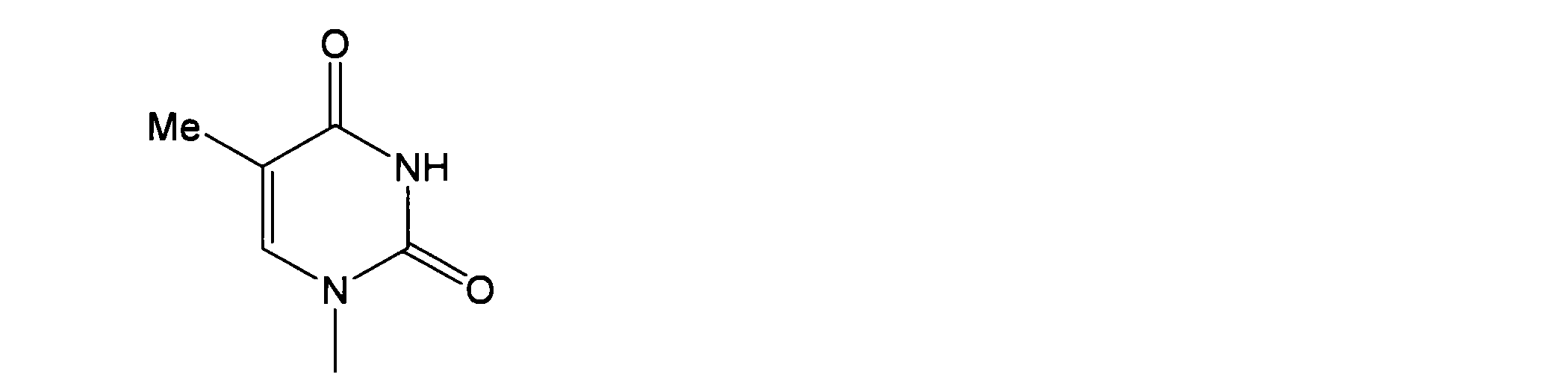
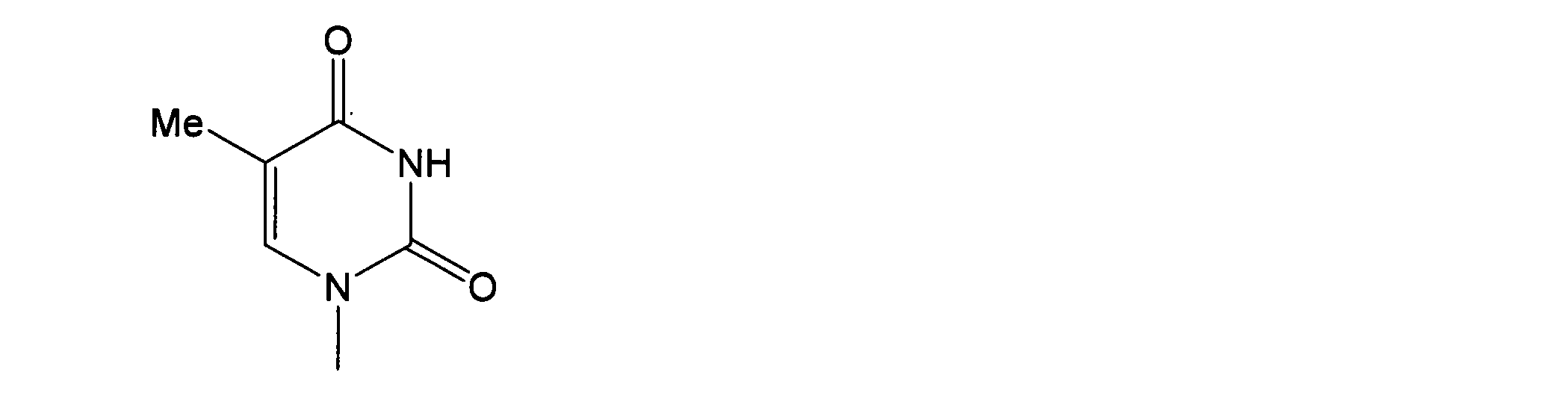
- Base examples include an adeninyl group, a guanynyl group, a cytosynyl group, a urasinyl group, and a timyl group, and a 6-aminopurine-9-yl group, a 2,6-diaminopurine-9-yl group, and 2 -Amino-6-chloropurine-9-yl group, 2-amino-6-fluoropurine-9-yl group, 2-amino-6-bromopurine-9-yl group, 2-amino-6-hydroxypurine- 9-yl group, 6-amino-2-methoxypurine-9-yl group, 6-amino-2-chloropurine-9-yl group, 6-amino-2-fluoropurine-9-yl group, 2,6 -Dimethoxypurine-9-yl group, 2,6-dichloropurine-9-yl group, 6-mercaptopurin-9-yl group
- Base has the following structural formula from the viewpoint of introduction into nucleic acid drugs:
- Group, 6-aminopurine-9-yl group, 2-amino-6-hydroxypurine-9-yl group, 4-amino-5-methyl-2-oxo-1,2-dihydropyrimidine-1-yl group, And 2-oxo-4-hydroxy-1,2-dihydropyrimidine-1-yl groups are preferred.
- "Base" preferably has a hydroxyl group and an amino group constituting the above group protected by a protecting group.
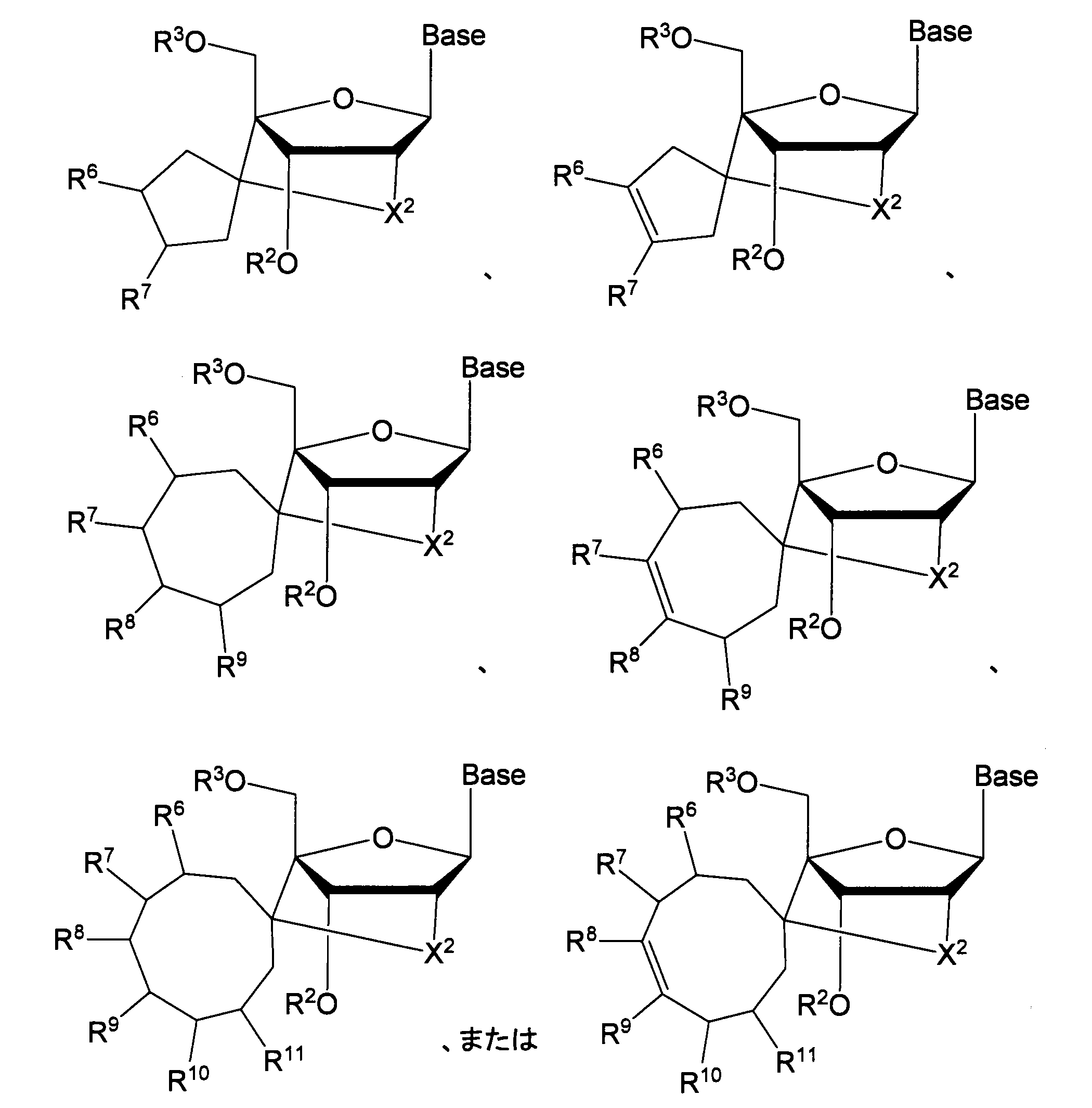
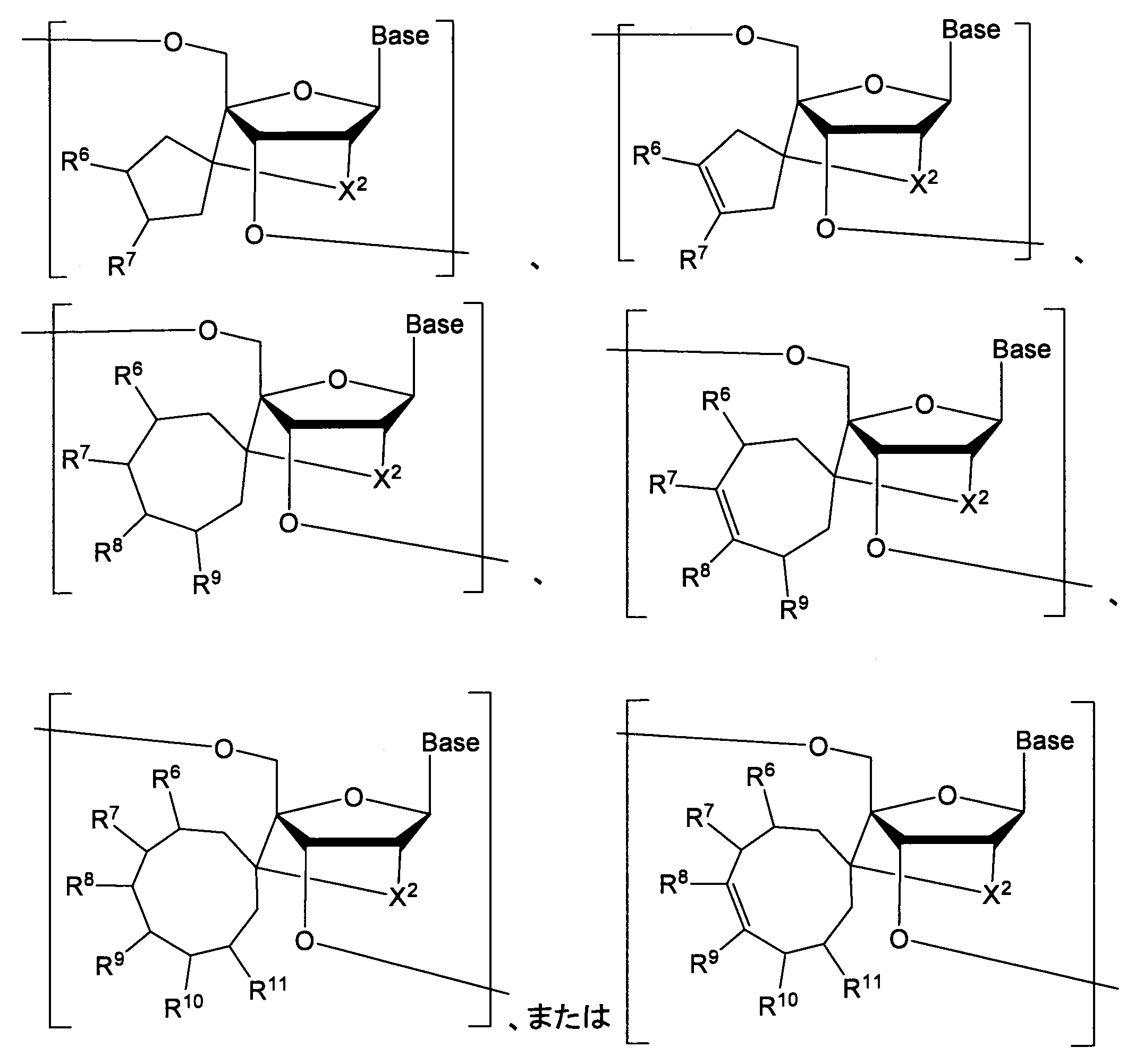
- R 2 , R 3 , and X 2 are similar to those defined in formula (I) above, and R 6 , R 7 , R 8 , R 9 , R 10 and R 11 are independent of each other.
- R 6 and R 7 in the above formulas (I-1) and (I-4) are both hydrogen atoms.
- R 6 , R 7 , R 8 and R 9 in the above formulas (I-2) and (I-5) are hydrogen atoms.
- all of R 6 , R 7 , R 8 , and R 9 , R 10 , and R 11 in the above formulas (I-3) and (I-6) are hydrogen atoms.
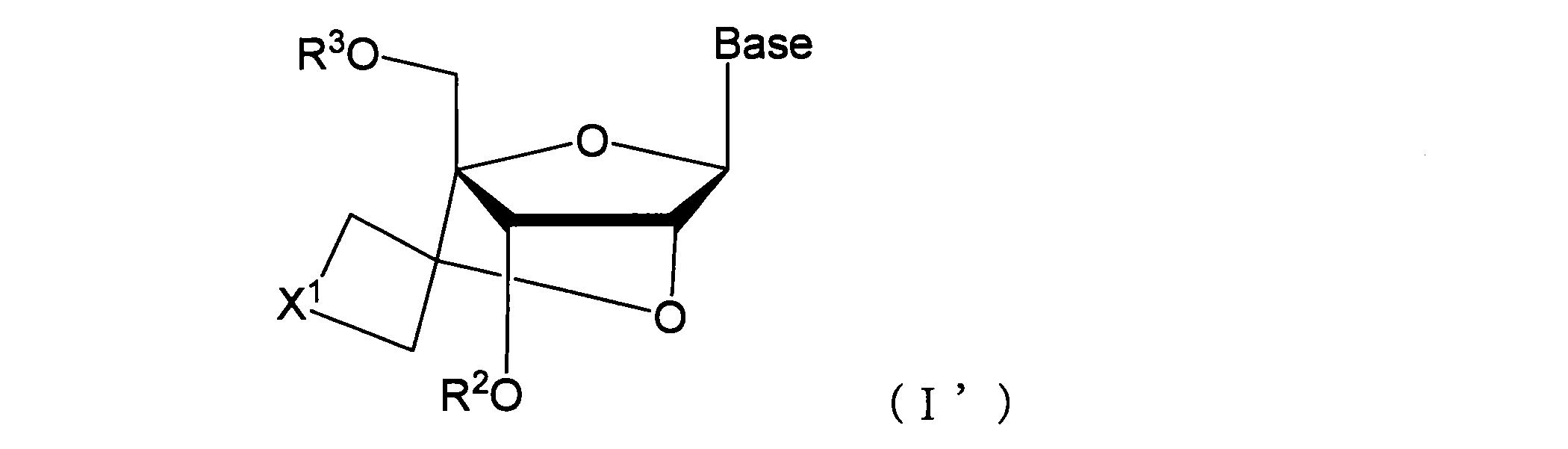
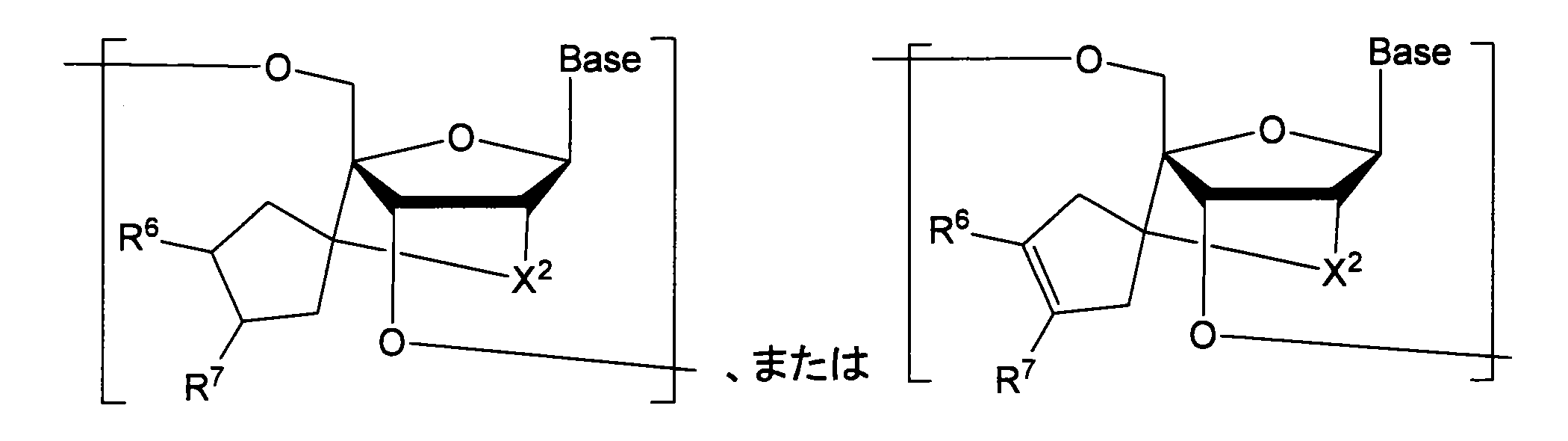
- R 6 and R 7 are independently from the hydrogen atom, carbon number 1, respectively. 3 linear alkyl groups, -NHR 4b [where R 4b is a hydrogen atom or a linear alkyl group having 1 to 3 carbon atoms], or -OR 5b [where R 5b is a hydrogen atom or carbon number. It is a linear alkyl group of 1 to 3]).
- R 6 and R 7 in the above formulas (I-1) and (I-4) are both hydrogen atoms.
- R 6 and R 7 are independent hydrogen atoms, directly having 1 to 3 carbon atoms, respectively.
- R 6 and R 7 in the above formulas (I'-1) and (I'-4) are both hydrogen atoms.
- the crosslinked nucleoside of the present invention a cyclic substituent is introduced at the 6'position of the formula (I) as described above.
- the nucleoside of the present invention cannot have an isomer structure at the 6'position, and is freed from the need to separate isomers during its synthesis.
- the crosslinked nucleoside of the present invention can improve the nuclease resistance performance in the oligonucleotide described later by the cyclic substituent introduced at the 6'position of the formula (I).
- the ring strain of such a substituent directly affects the conformation of the sugar moiety. Therefore, the crosslinked nucleoside of the present invention can further improve the binding affinity with ssRNA for the oligonucleotide obtained by using the nucleotide.
- the oligonucleotide uses such a crosslinked nucleoside of the formula (I), for example, the amidite method well known in the art, or M. Kuwahara et al., Nucleic Acids Res., 2008, Vol. 36, 13. It can be easily produced through triphosphorylation as described in No. 4257-4265.
- oligonucleotide of the present invention or a pharmacologically acceptable salt thereof (hereinafter, these may be collectively referred to as “oligonucleotide of the present invention") is defined by the following formula (II):
- Base represents a purine-9-yl group or 2-oxo-1,2-dihydropyrimidine-1-yl group which may have one or more of any substituents selected from the ⁇ group, where here.
- the ⁇ group is protected by a hydroxyl group, a hydroxyl group protected by a protective group for nucleic acid synthesis, a linear alkyl group having 1 to 6 carbon atoms, a linear alkoxy group having 1 to 6 carbon atoms, a mercapto group, and a protective group for nucleic acid synthesis.
- X 1 is a linear alkyl group having 1 to 3 carbon atoms, -NHR 4b [where R 4b is a hydrogen atom or a linear alkyl group having 1 to 3 carbon atoms], or -OR 5b [here.
- R 5b is a hydrogen atom or a linear alkyl group having 1 to 3 carbon atoms], an alkylene group having 2 to 8 carbon atoms; or a linear alkyl group having 1 to 3 carbon atoms.
- -NHR 4b [where R 4b is a hydrogen atom or a linear alkyl group having 1 to 3 carbon atoms] or -OR 5b [where R 5b is a hydrogen atom or a linear alkyl group having 1 to 3 carbon atoms]. It is an alkaneylene group having 2 to 8 carbon atoms, which may be substituted with], and X 2 is an oxygen atom, a sulfur atom, -NH-, -N (CH 3 )-. Or it contains at least one nucleoside structure represented by (or a methylene group).
- Base and X 2 are similar to the groups defined in formula (II) above, and R 6 , R 7 , R 8 , R 9 , R 10 and R 11 are independently from the hydrogen atom, carbon number 1. 3 linear alkyl groups, -NHR 4b [where R 4b is a hydrogen atom or a linear alkyl group with 1 to 3 carbon atoms], or -OR 5b [where R 5b is a hydrogen atom or carbon number. It is a linear alkyl group of 1 to 3]).
- R 6 and R 7 in the above formulas (II-1) and (II-4) are both hydrogen atoms.
- R 6 , R 7 , R 8 and R 9 in the above formulas (II-2) and (II-5) are hydrogen atoms.
- all of R 6 , R 7 , R 8 , and R 9 , R 10 , and R 11 in the above formulas (II-3) and (II-6) are hydrogen atoms.
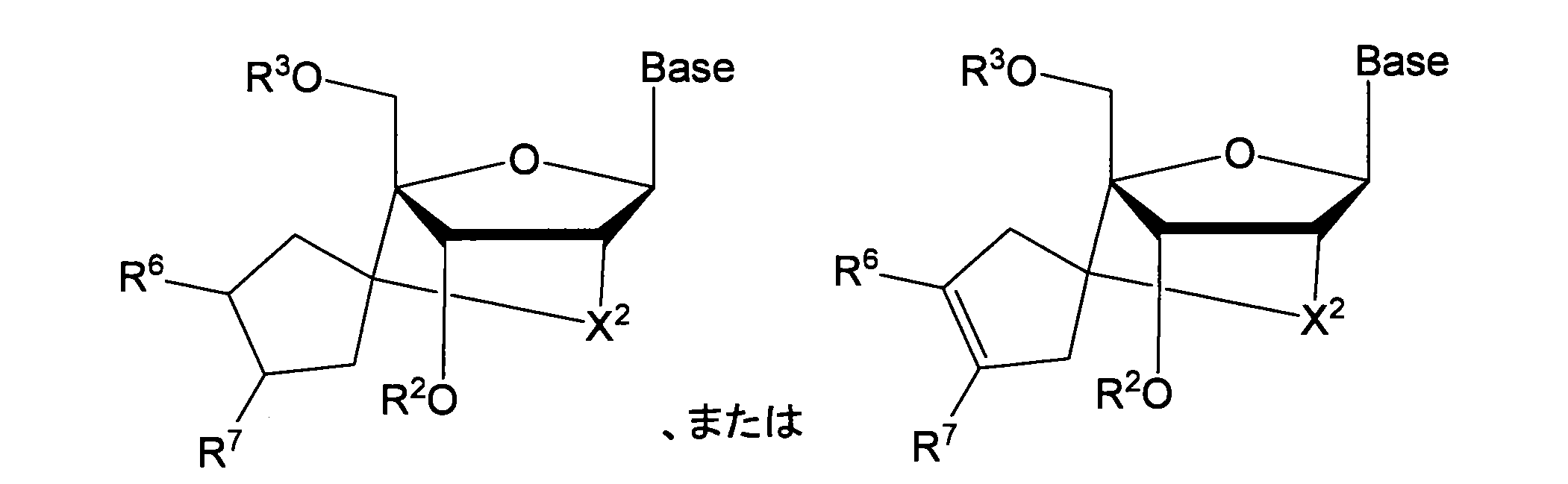
- nucleoside structure of formula (II) contained in the oligonucleotide of the present invention is the following formula (II'):
- formulas (II-1) and (II-4) As another example of the nucleoside structure of formula (II) contained in the oligonucleotide of the present invention:
- Base and X 2 are similar to the groups defined in formula (II) above, and R 6 and R 7 are independent hydrogen atoms, linear alkyl groups with 1 to 3 carbon atoms, -NHR 4b [here. And R 4b is a hydrogen atom or a linear alkyl group having 1 to 3 carbon atoms], or -OR 5b [where R 5b is a hydrogen atom or a linear alkyl group having 1 to 3 carbon atoms]. There is one represented by).
- R 6 and R 7 in the above formulas (II-1) and (II-4) are both hydrogen atoms.
- R 6 and R 7 are independent hydrogen atoms, linear alkyl groups with 1 to 3 carbon atoms, -NHR 4b [where R 4b is a hydrogen atom or a linear alkyl group having 1 to 3 carbon atoms], or -OR 5b [where R 5b is a hydrogen atom or a linear alkyl group having 1 to 3 carbon atoms].
- R 6 and R 7 in the above formulas (II'-1) and (II'-4) are both hydrogen atoms.
- the oligonucleotide of the present invention has at least one of the above nucleoside structures at an arbitrary position.
- the position and number thereof are not particularly limited, and may be appropriately designed according to the purpose.
- Oligonucleotides containing such a nucleoside structure have dramatically improved nuclease resistance performance as compared with the case of using conventional 2', 4'-BNA / LNA. It also has an ssRNA binding affinity comparable to the known 2', 4'-BNA / LNA.
- the oligonucleotide of the present invention synthesized by using the crosslinked nucleoside of the present invention is a drug for treating a disease by inhibiting the action of a specific gene, including an antitumor agent and an antiviral agent. It is expected to be useful as an (antisense molecule).
- the antisense method requires both binding affinity for complementary sense strand RNA and resistance to in vivo DNase.
- a nucleic acid in a single-stranded state, a nucleic acid has a "fluctuation" between a form in which the sugar portion structure is constantly close to a DNA double strand and a form close to a DNA-RNA double strand or an RNA duplex. exist. By immobilizing this "fluctuation" in advance to the conformation during double chain formation, the binding affinity for the target ssRNA can be improved.
- nucleic acid degrading enzyme cleaves the phosphate diester portion of the oligonucleic acid, but by introducing a bulky substituent into the sugar portion or the like, the degradation of the oligonucleic acid can be suppressed through steric hindrance.
- the crosslinked nucleoside of the present invention has a bulky cyclic substituent at the 6'position as described above. Therefore, the oligonucleotide obtained by using this can improve the binding affinity for the ssRNA and have excellent enzyme resistance.
- the oligonucleotide of the present invention contains, for example, an auxiliary agent commonly used in the pharmaceutical formulation technology field such as an excipient, a binder, a preservative, an oxidation stabilizer, a disintegrant, a lubricant, and a flavoring agent. It can be a parenteral administration preparation or a liposome preparation.
- a pharmaceutical carrier usually used in the art can be blended to prepare a topical preparation such as a liquid, a cream, or an ointment.
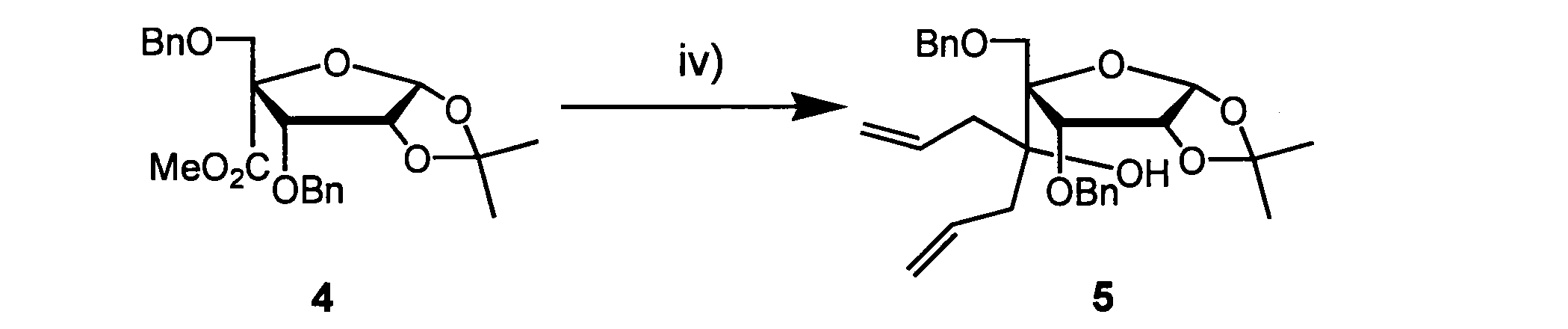
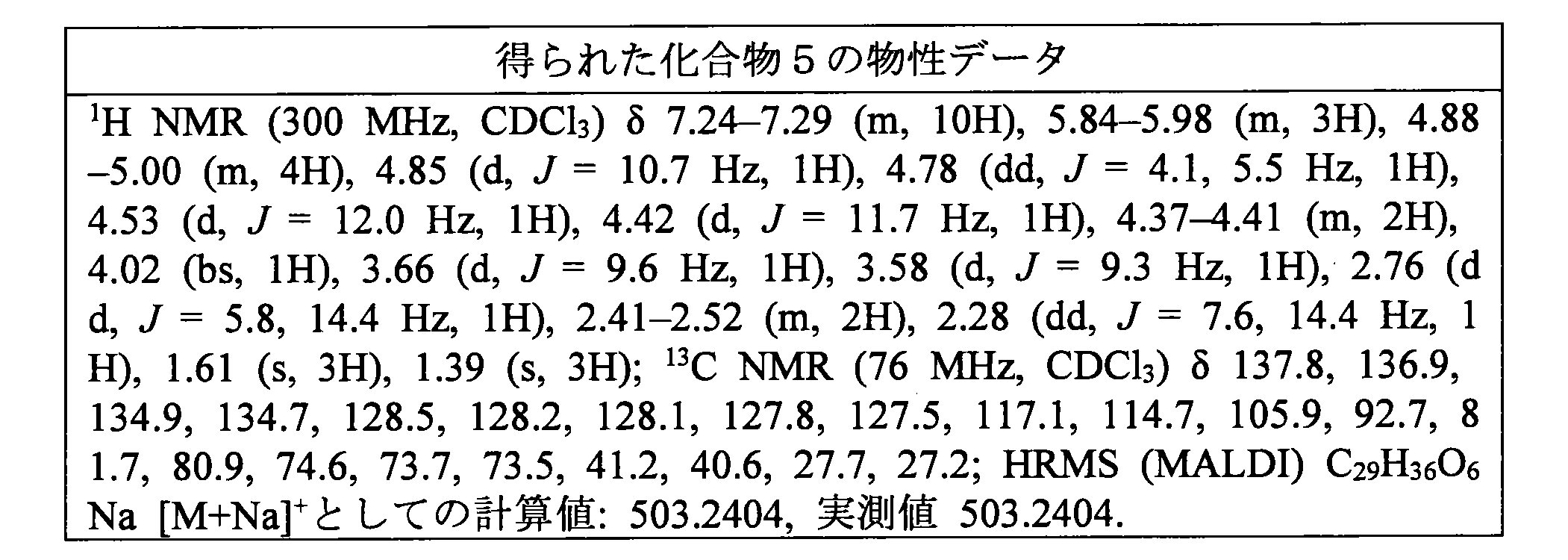
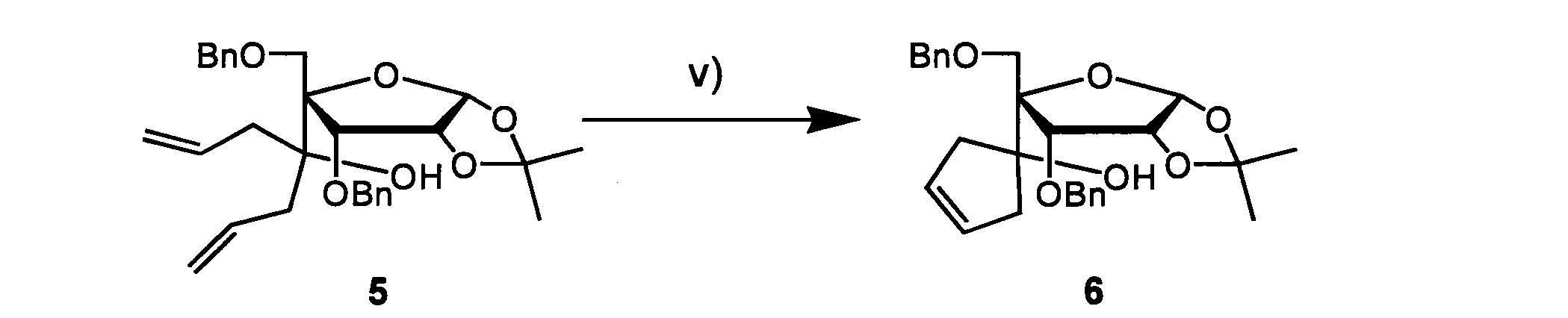
- Table 1 shows the physical property data of the obtained compound 5.
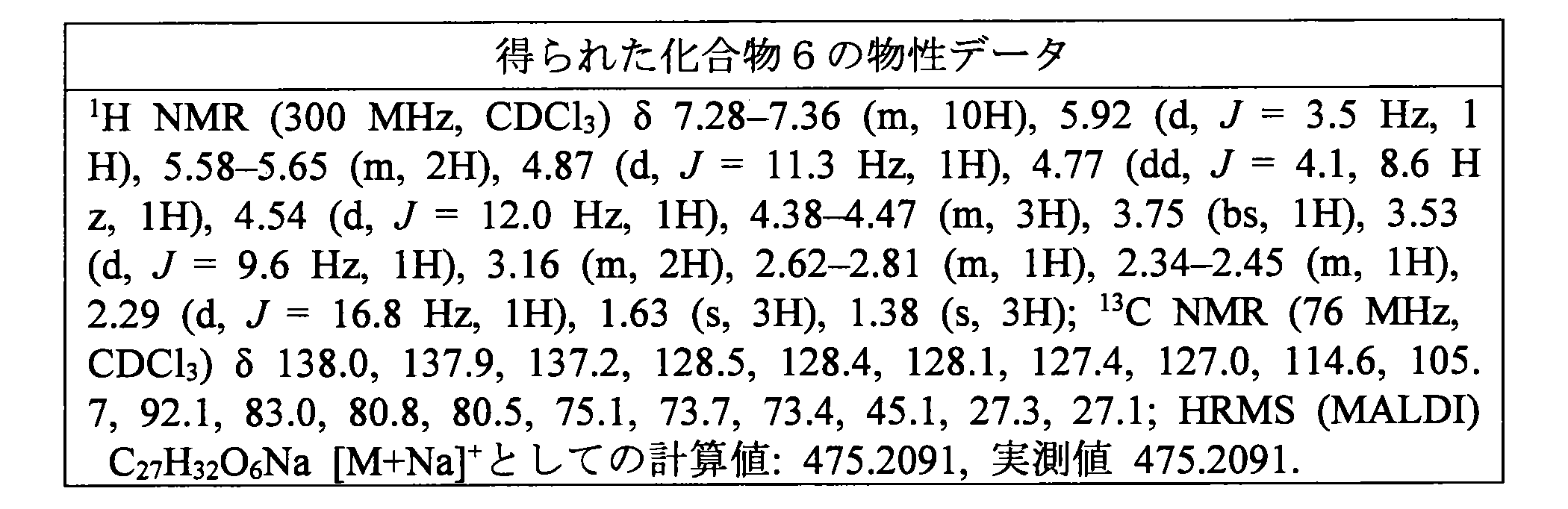
- Table 2 shows the physical property data of the obtained compound 6.
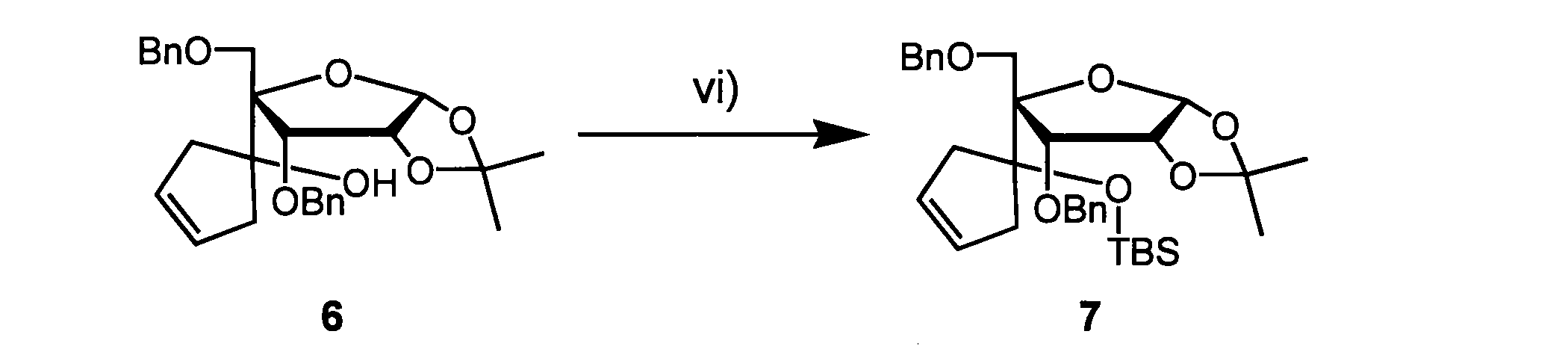
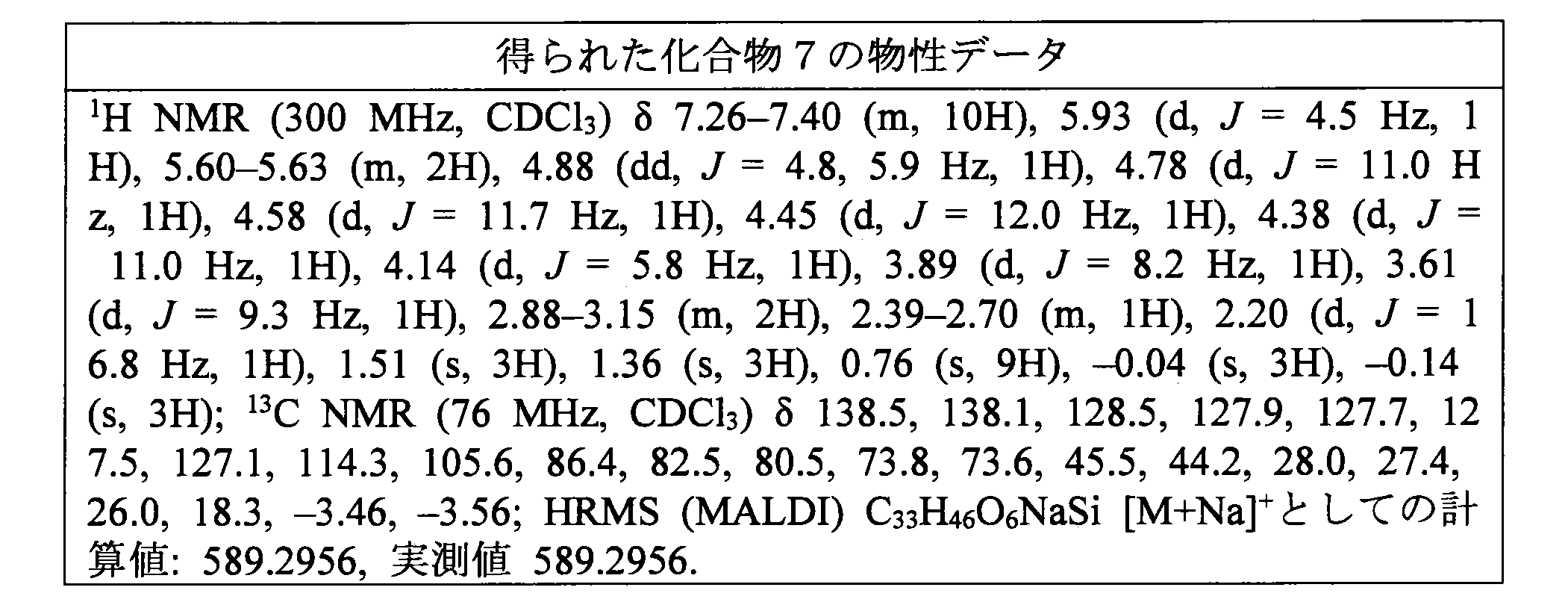
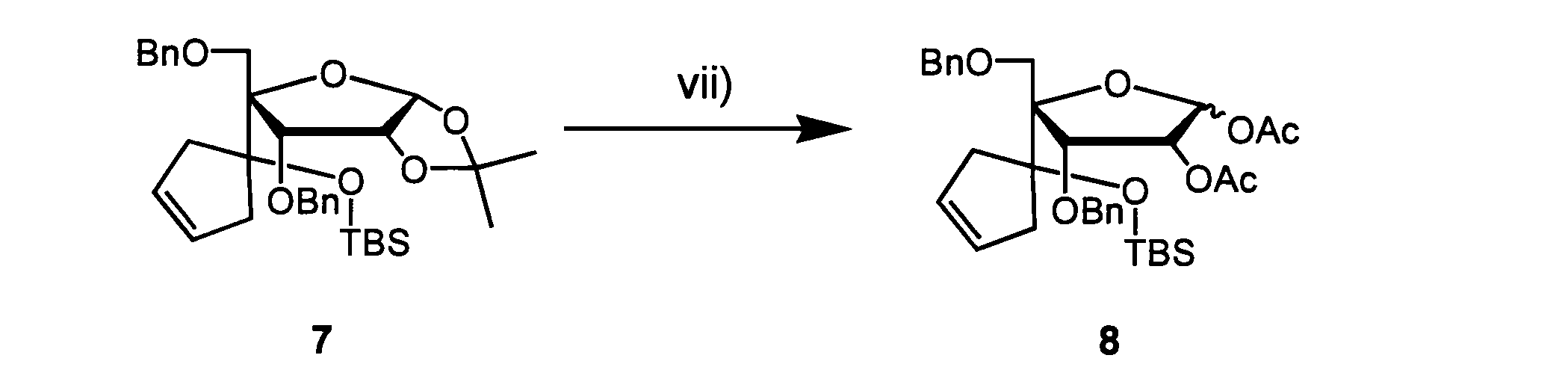
- Table 3 shows the physical property data of the obtained compound 7.
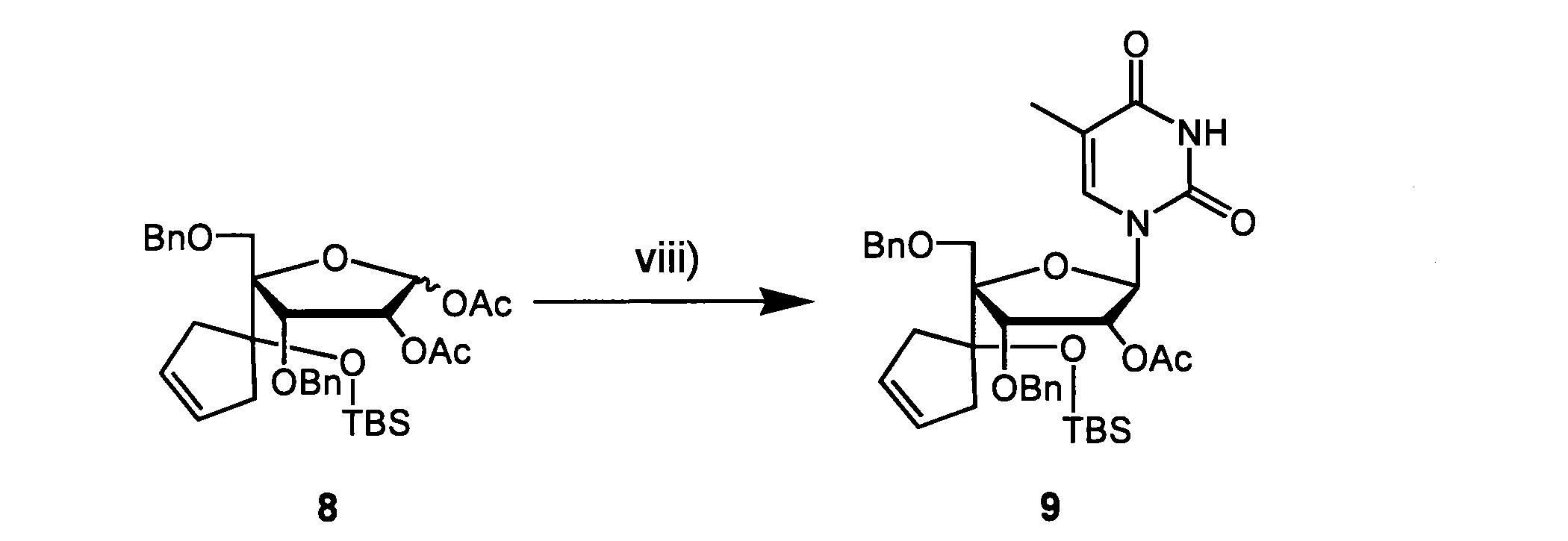
- Table 4 shows the physical property data of the obtained compound 8.
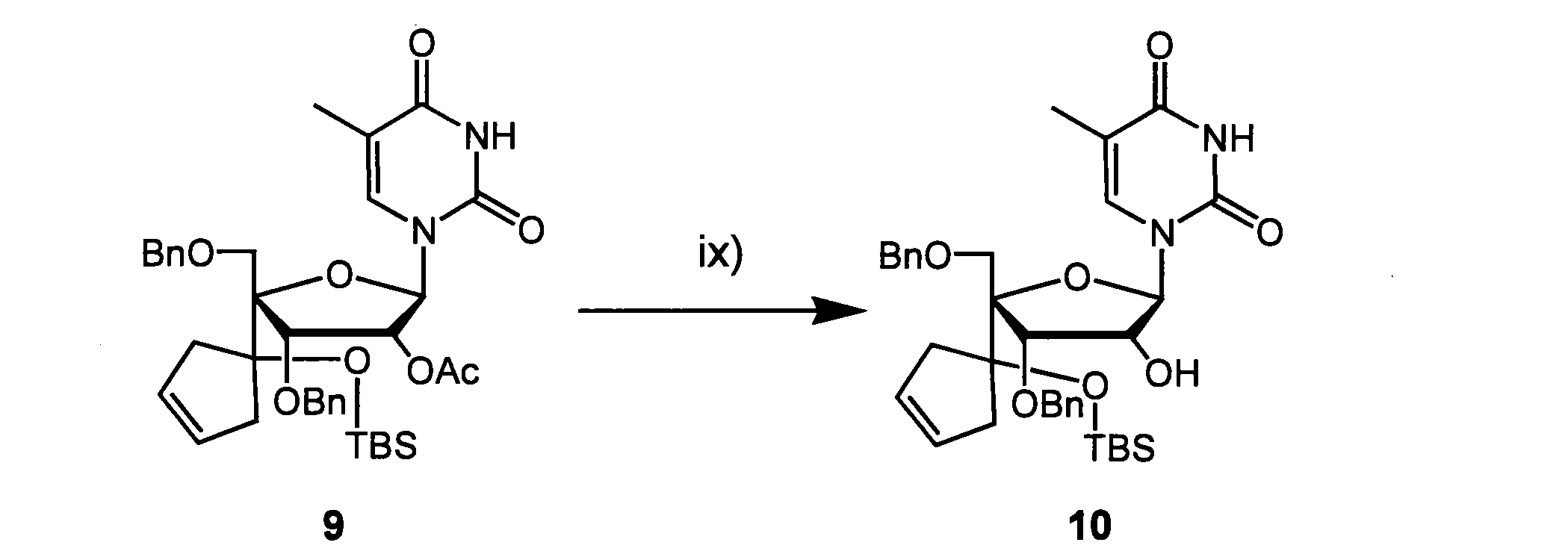
- Table 5 shows the physical property data of the obtained compound 9.
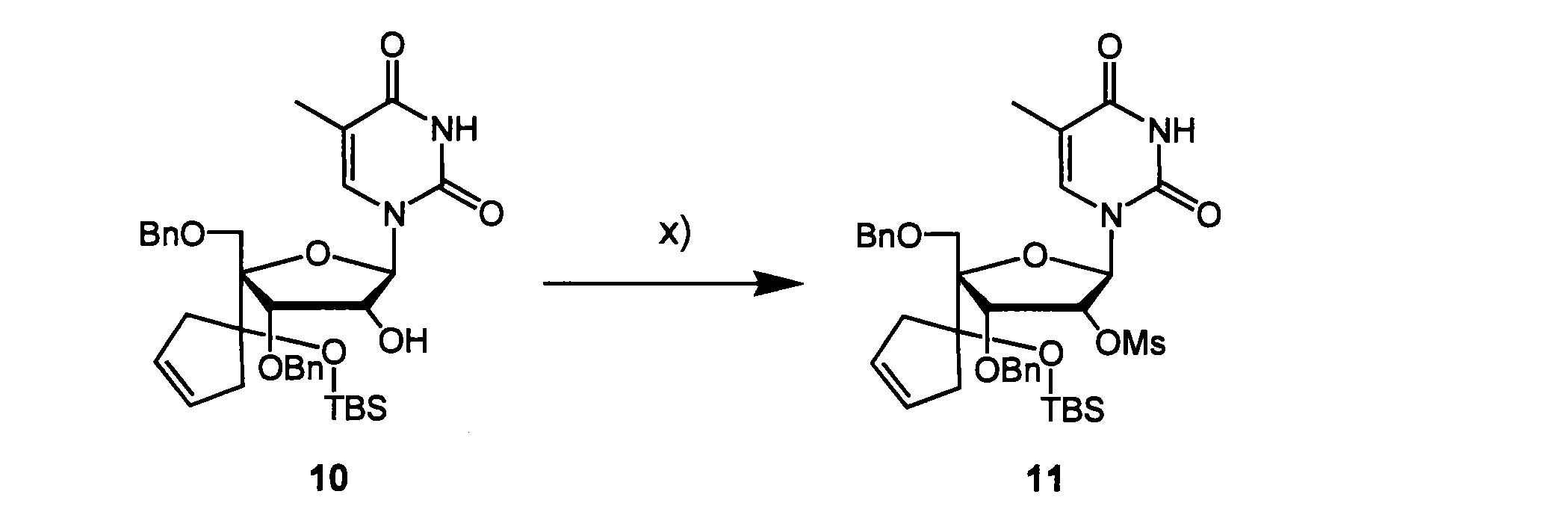
- Table 6 shows the physical property data of the obtained compound 10.
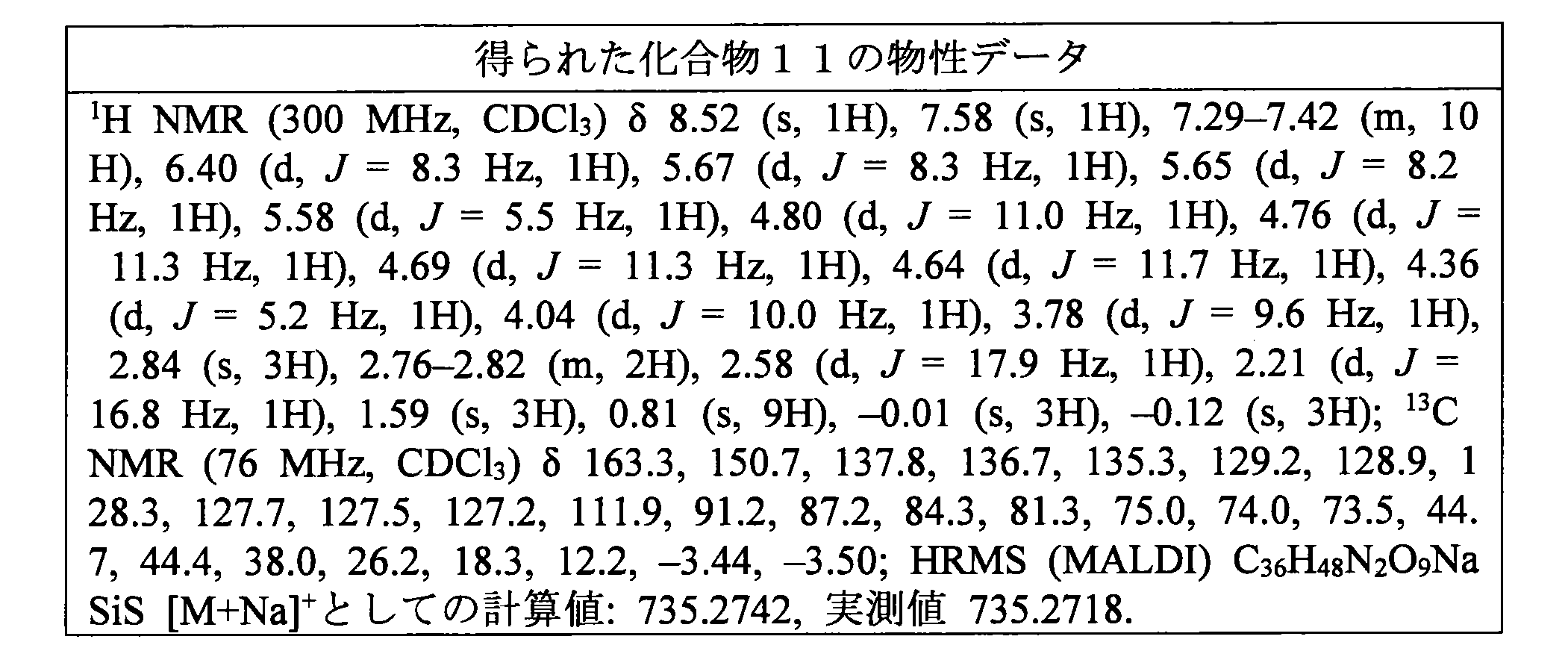
- Table 7 shows the physical property data of the obtained compound 11.
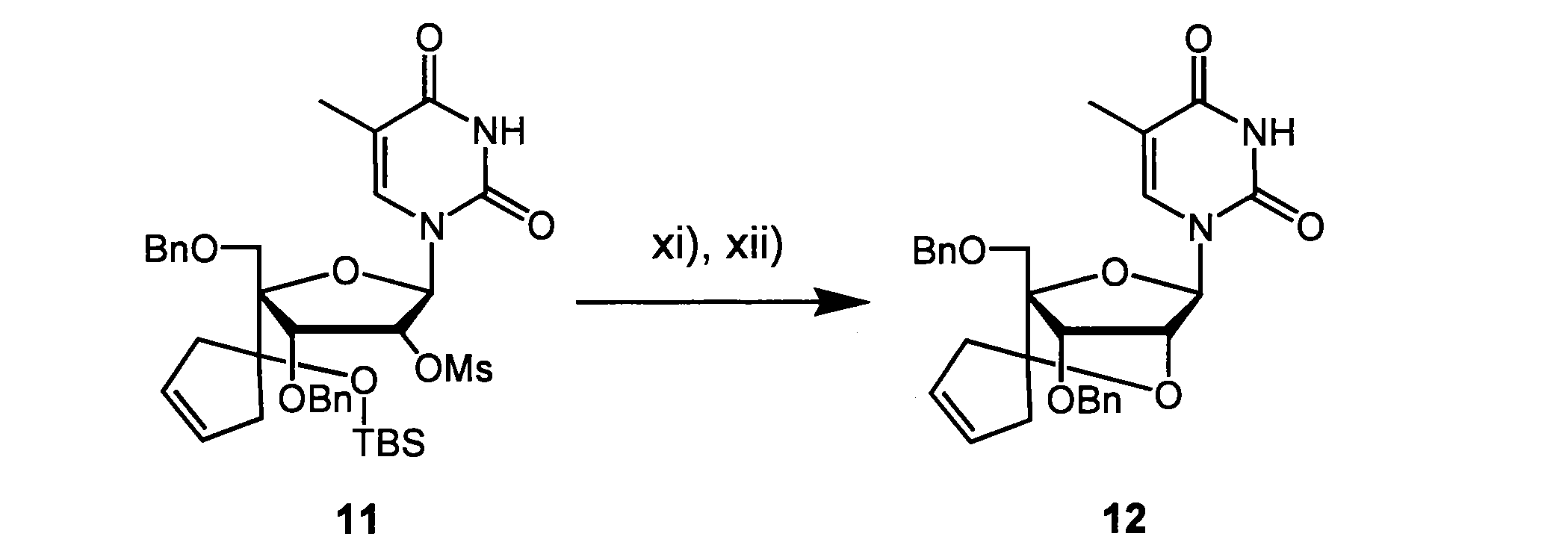
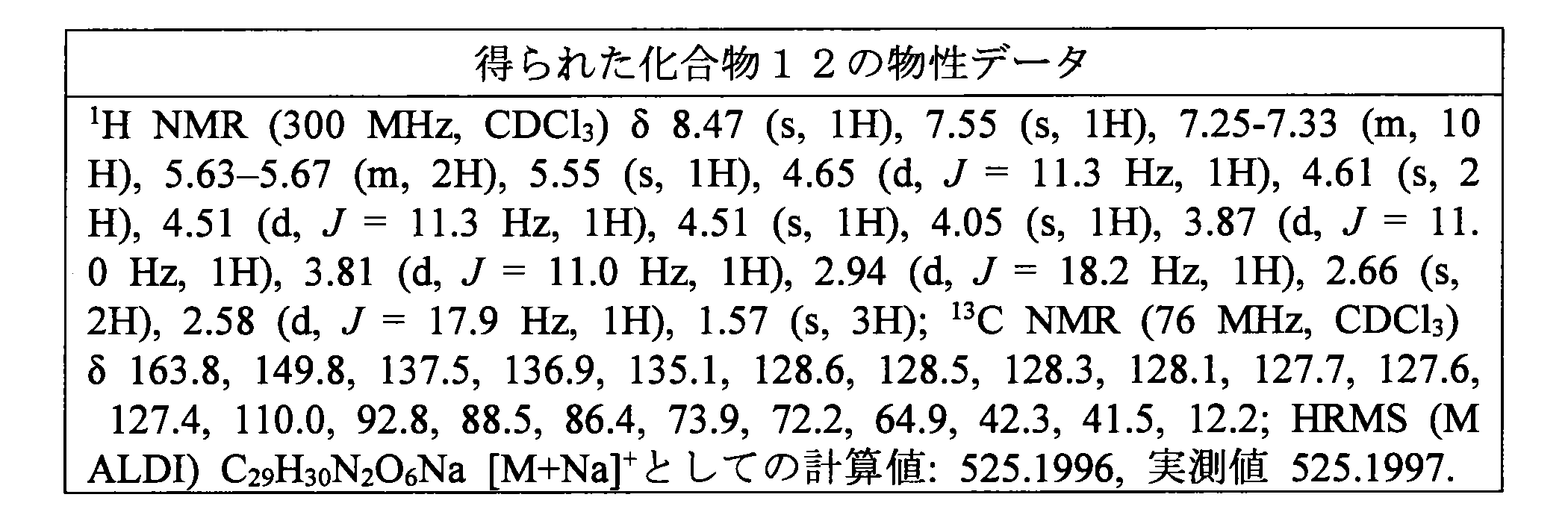
- Table 8 shows the physical property data of the obtained compound 12.
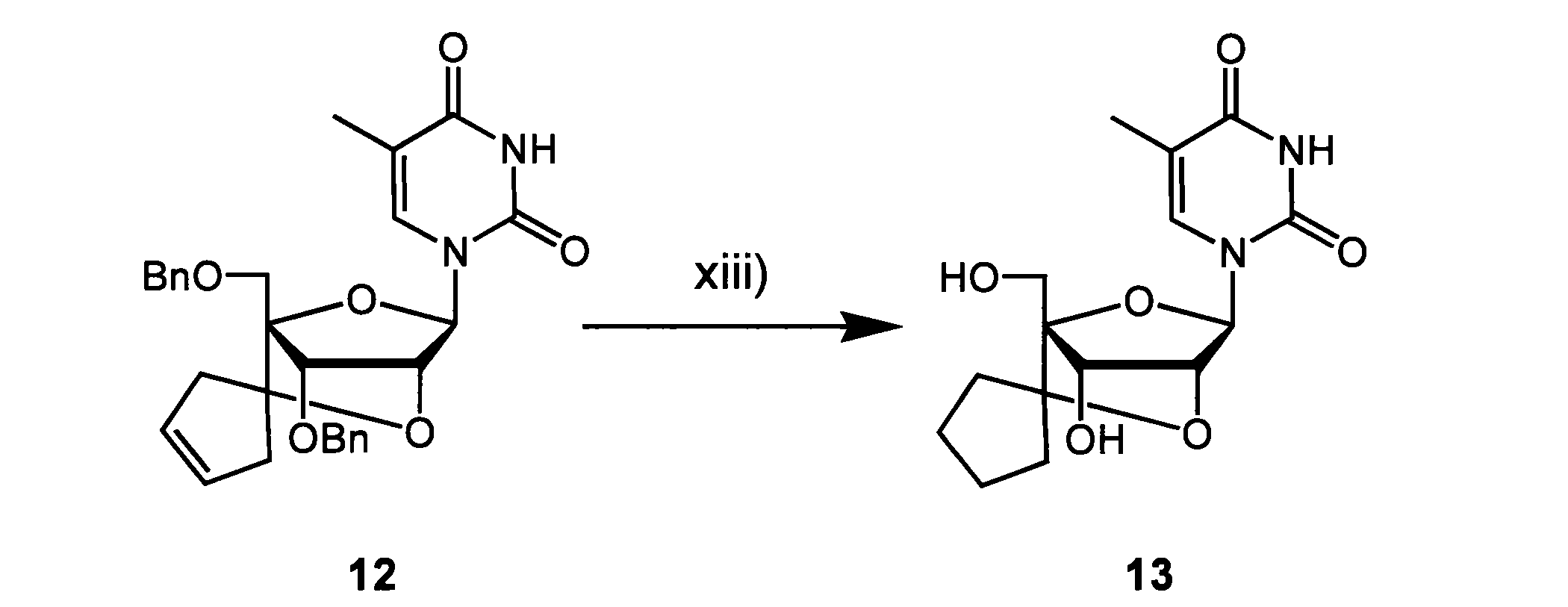
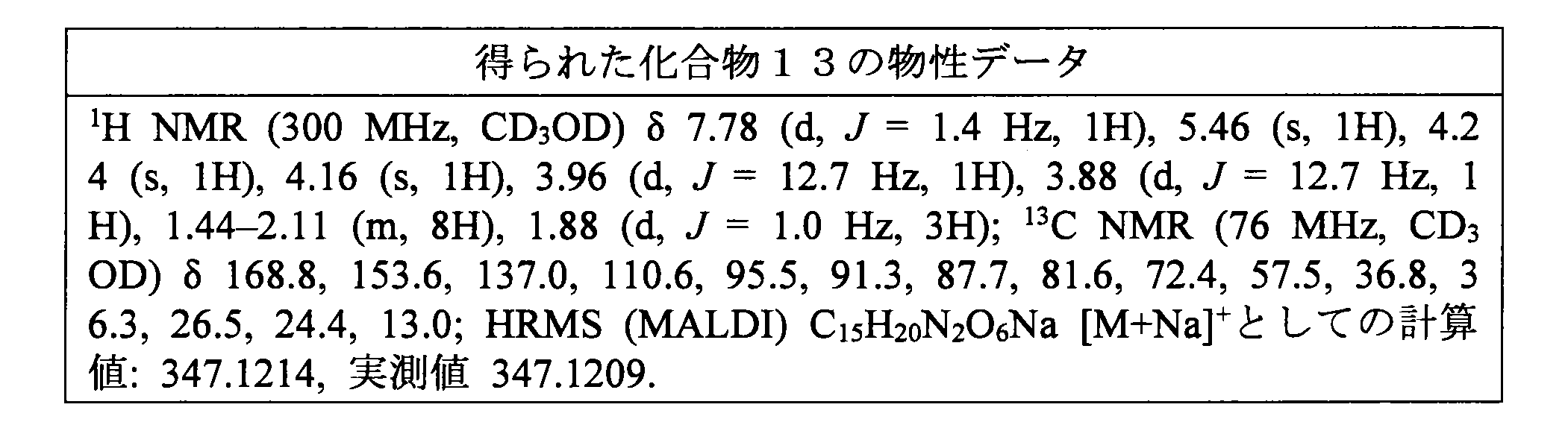
- Table 9 shows the physical property data of the obtained compound 13.
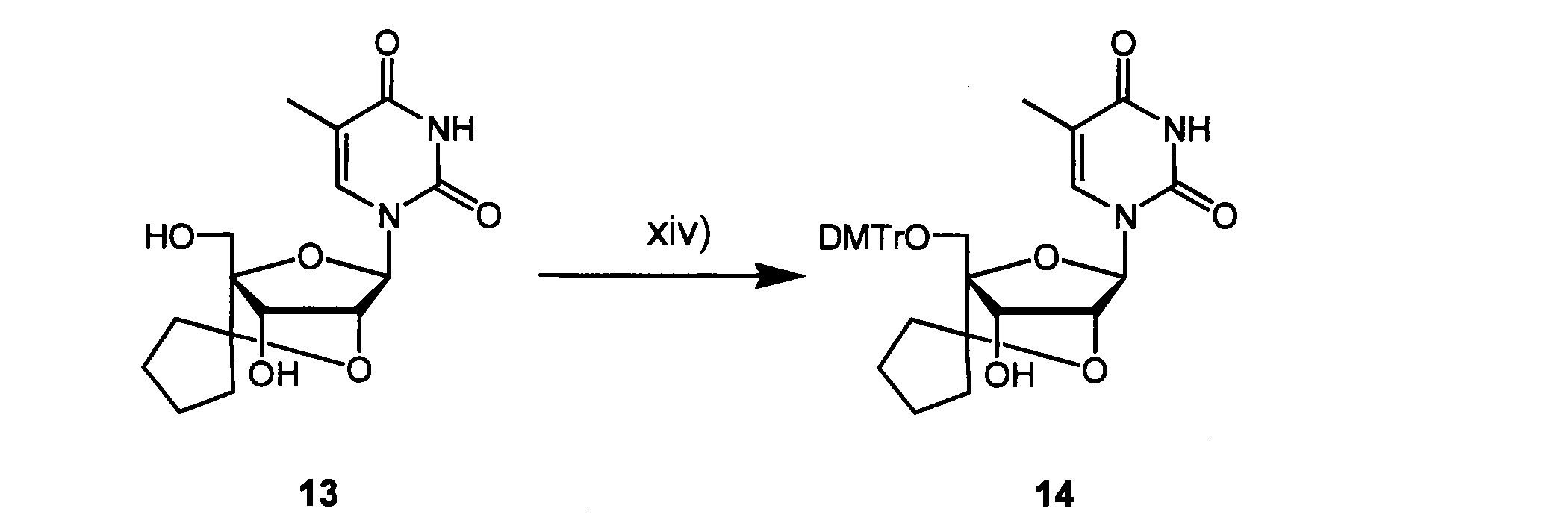
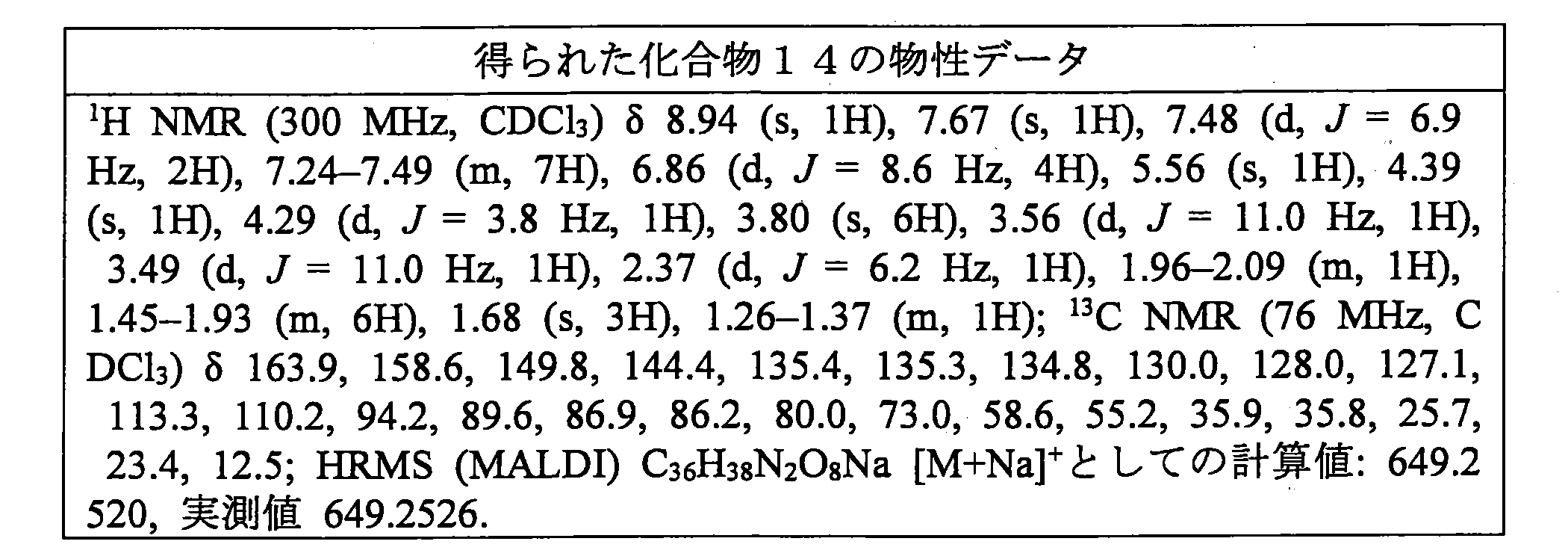
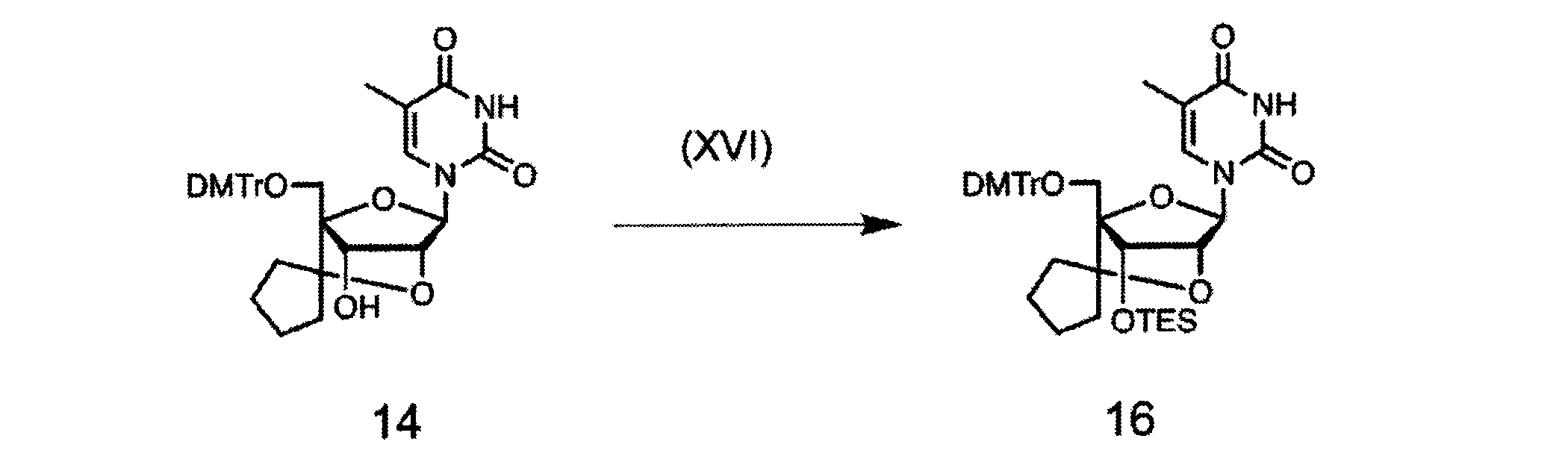
- Table 10 shows the physical property data of the obtained compound 14.
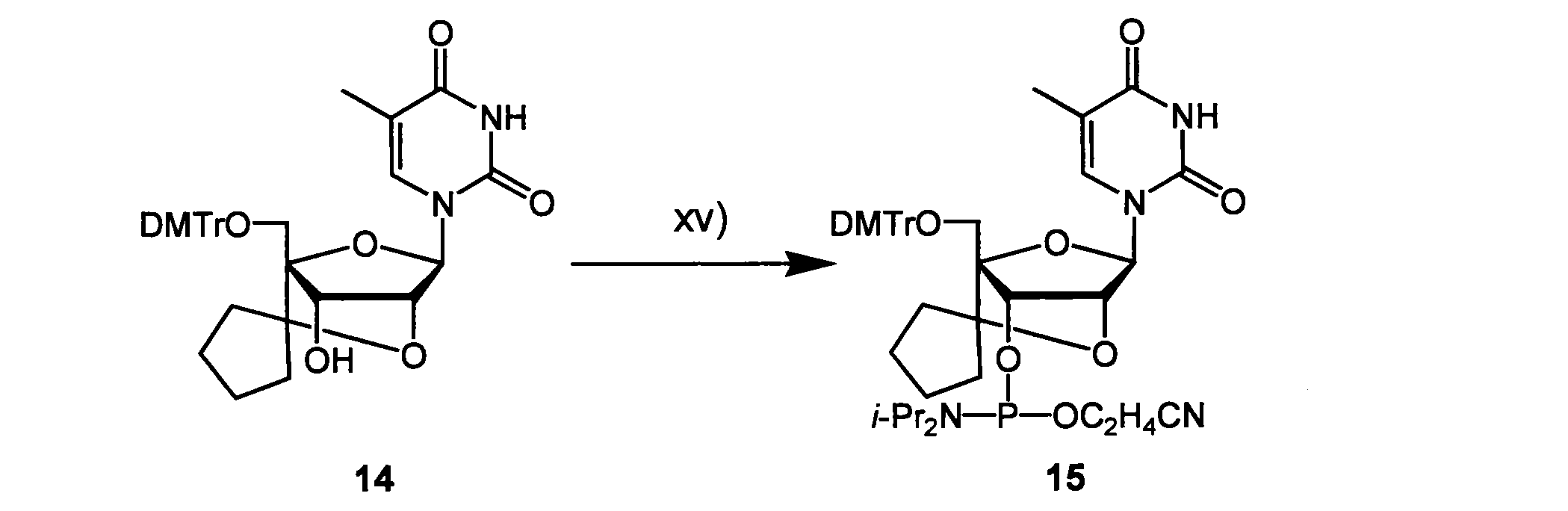
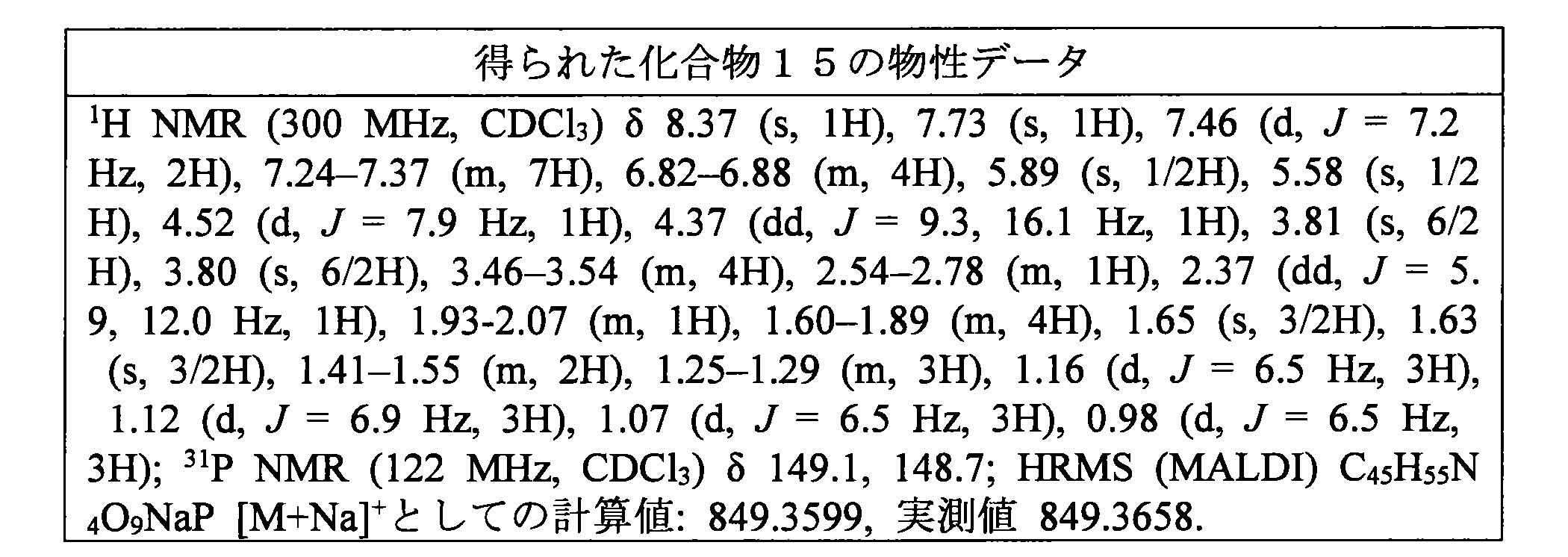
- Table 11 shows the physical property data of the obtained compound 15.
- the total yield of the finally obtained compound 15 was 22% through a series of synthetic routes from the above compound 1 to the acquisition of the compound 15. This is a high value as compared with the total yield (18%) of the final product obtained by the synthetic route of the crosslinked nucleoside (scpBNA) described in Patent Document 1 and Non-Patent Document 5, for example. It can be seen that the crosslinked nucleoside of the example could be efficiently synthesized.
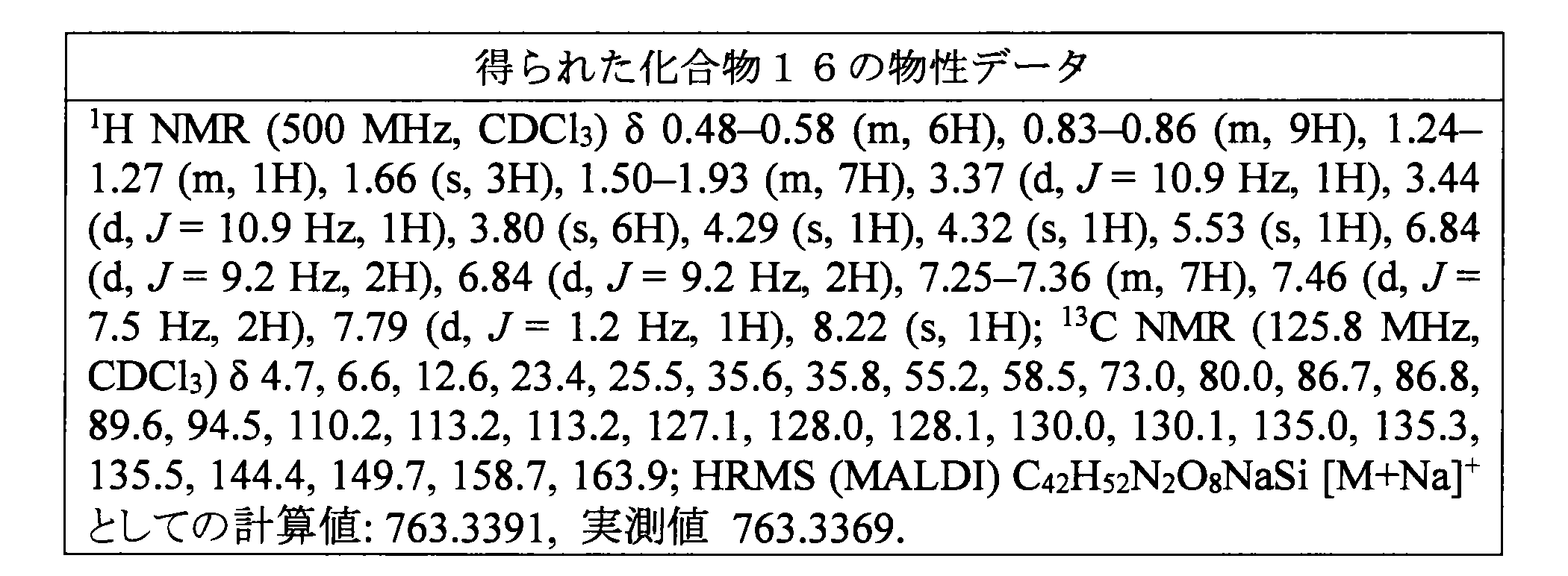
- Table 12 shows the physical property data of the obtained compound 16.
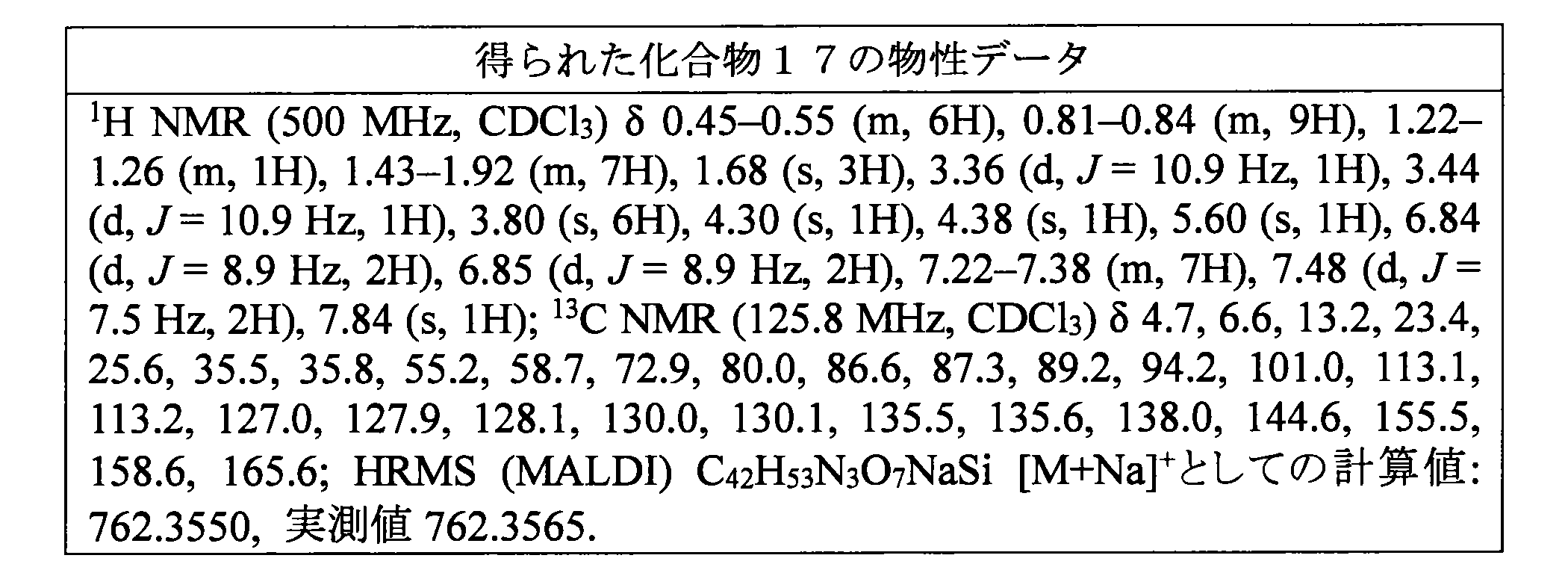
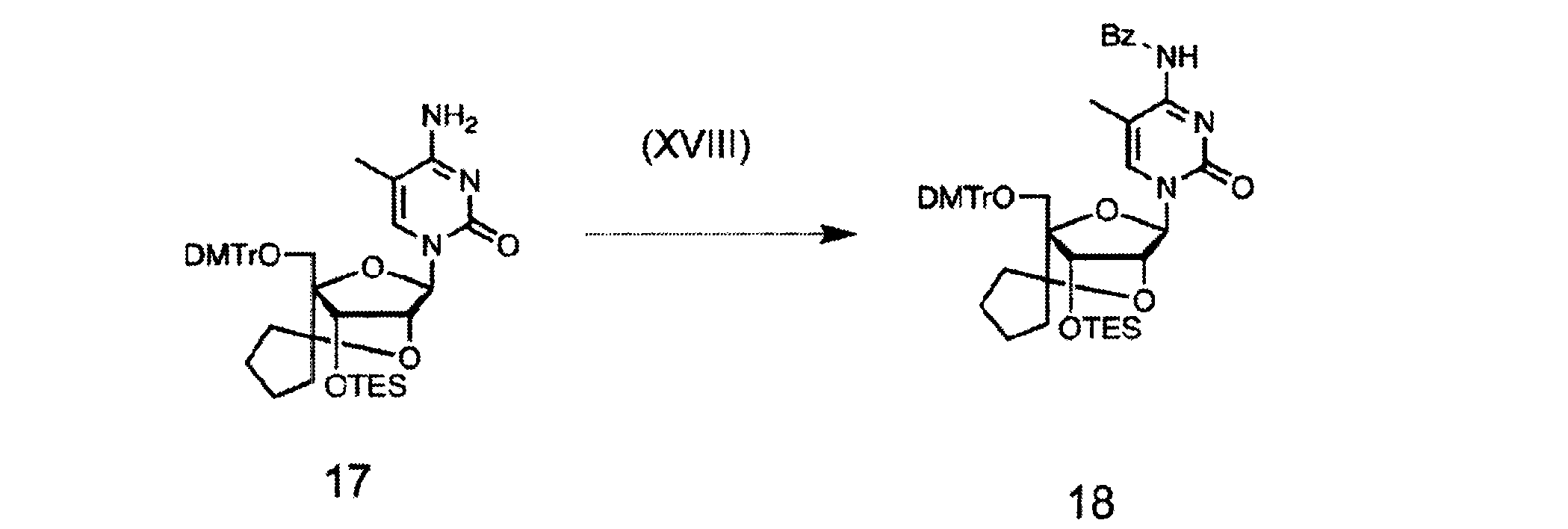
- Table 13 shows the physical property data of the obtained compound 17.
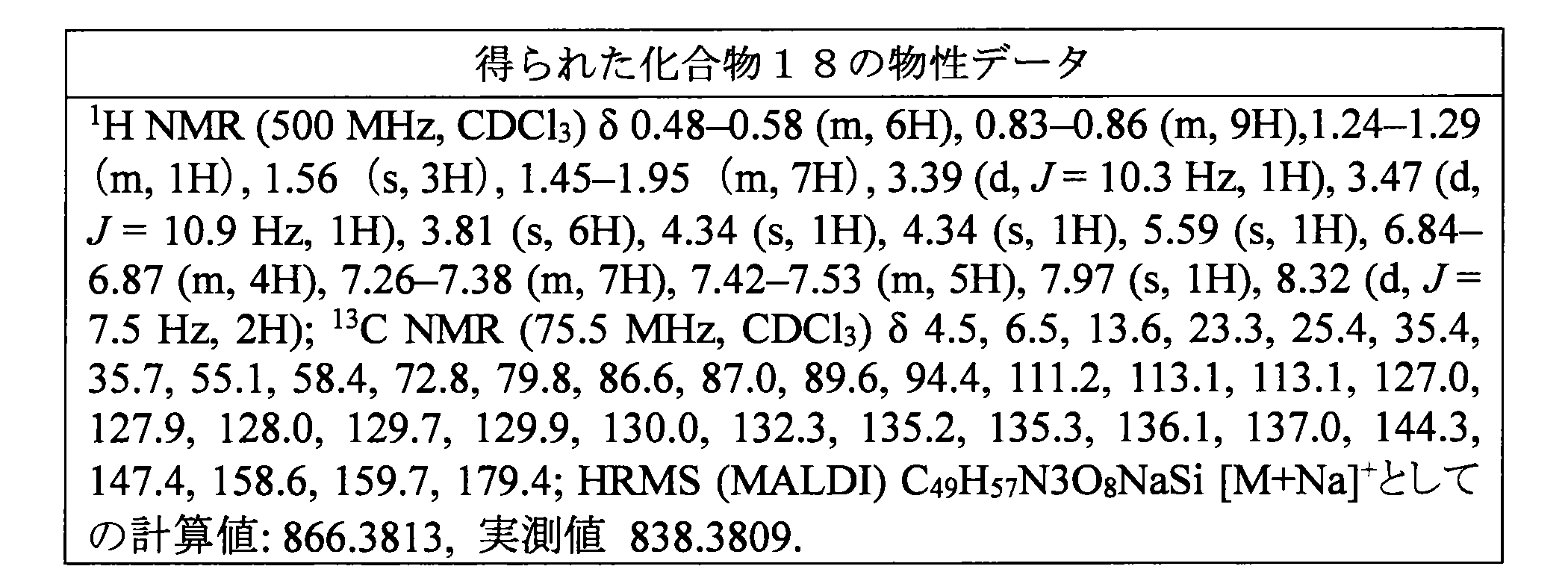
- Table 14 shows the physical property data of the obtained compound 18.
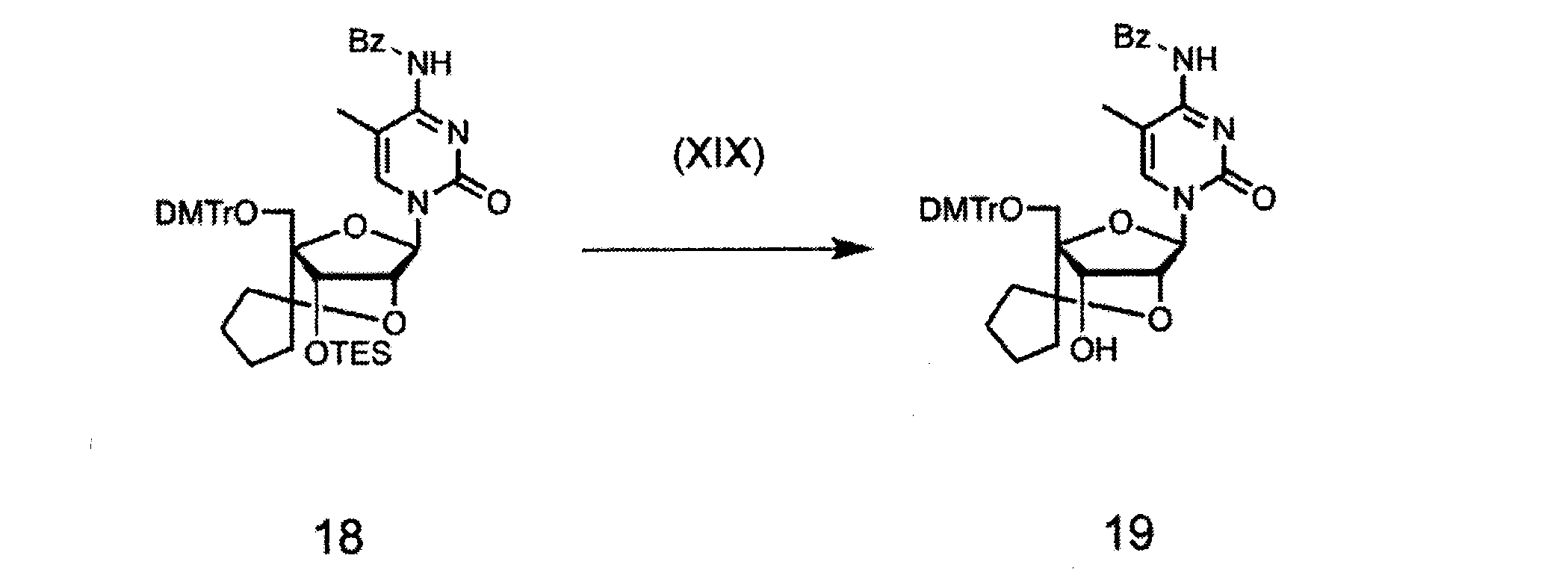
- Table 15 shows the physical property data of the obtained compound 19.
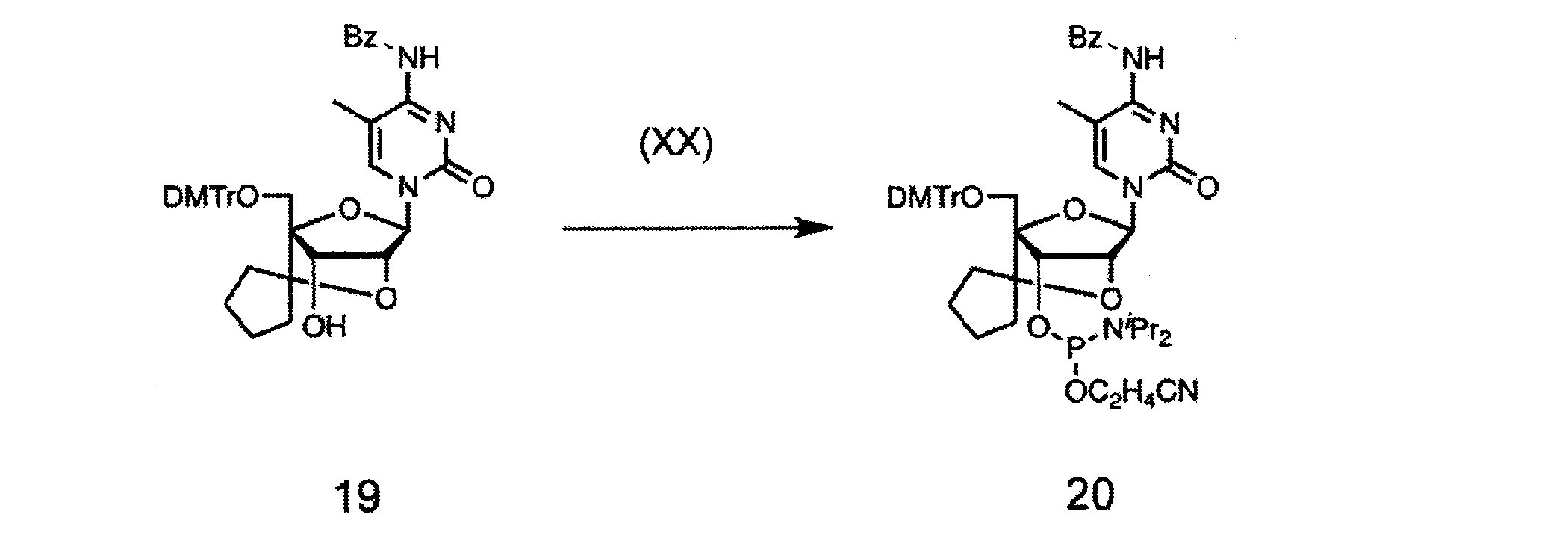
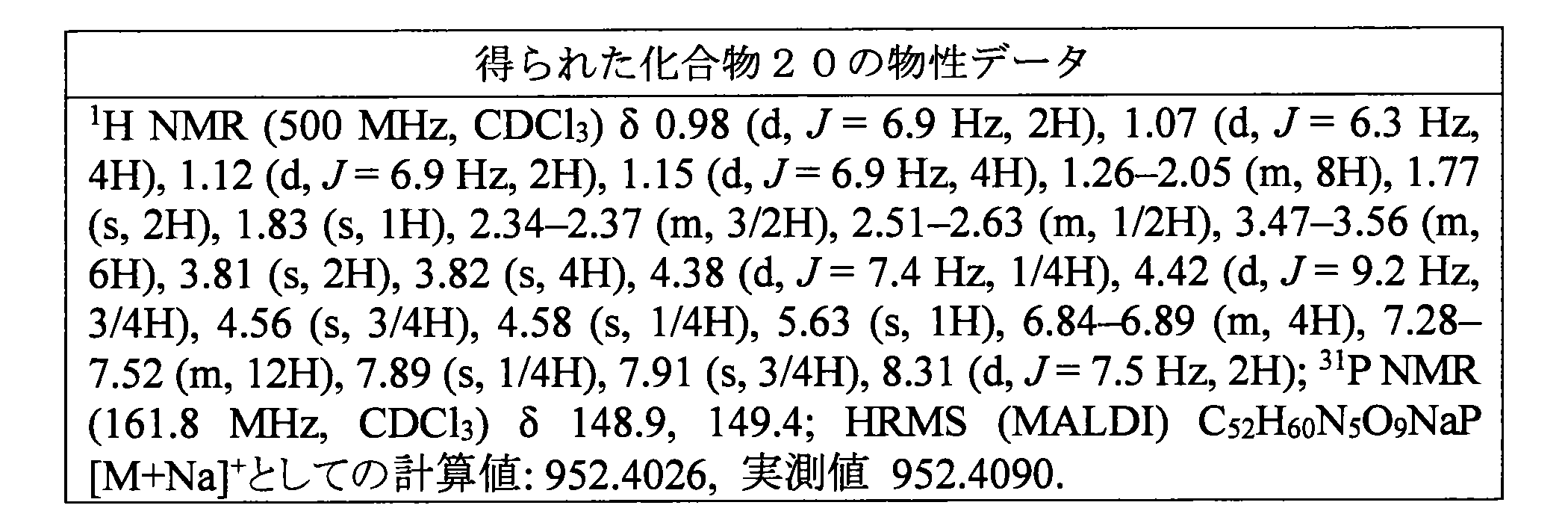
- Table 16 shows the physical property data of the obtained compound 20.
- Example 3 Synthesis and purification of oligonucleotide (1)
- Compound 15 (scpBNA2nd-T) prepared in Example 1 was used as an amidite block, and oligonucleotides were synthesized as follows. Compounds other than compound 15 constituting the oligonucleotide were purchased from Proligo unless otherwise specified. The following oligonucleotides were synthesized.
- ON5: 5'-d (TTTTTTTY) -3' ON6: 5'-d (TTTTTTTYT) -3' Y Compound 15 (scpBNA2nd-T)
- each was prepared as a 0.1 M anhydrous acetonitrile or anhydrous dichloromethane solution, and charged into an nS-8 Oligonucleotide Synthesizer manufactured by GeneDesign. Each synthesis was performed under trityl-on conditions.
- Activator-42 registered trademark (manufactured by Proligo) (0.25M acetonitrile solution) was used as the activator, and the condensation time was extended from compound 15 to 150 seconds ⁇ 5. For other operations, synthesis was performed according to the usual phosphoramidite method.
- the product is treated with a 28% aqueous ammonia solution at room temperature for 1.5 hours to cut out from the column carrier, and then allowed to stand at 55 ° C. for 10 hours to deprotect the base portion. went. Then, it was purified by a simple reverse phase column (Sep-Pak (registered trademark) Plus C18 Cartridges manufactured by Waters), and further purified by reverse phase HPLC.
- a simple reverse phase column Sep-Pak (registered trademark) Plus C18 Cartridges manufactured by Waters
- the composition of the purified oligonucleotide was determined by MALDI-TOF MS measurement.
- a matrix (1 ⁇ L) obtained by mixing a 3-hydroxypicolinic acid aqueous solution (10 mg / mL) and a diammonium citrate aqueous solution (1 mg / mL) in a volume ratio of 1: 1 was dried on an anchor tip.
- An aqueous oligonucleotide solution (50 ⁇ M, 1 ⁇ L) was placed therein and dried again, and then MALDI-TOF MS measurement was performed.
- Molecular weight measurements were performed in negative mode and oligothymidylic acid (7 mer, 9 mer, 11 mer and 13 mer) was used as an external standard.
- the synthesized oligonucleotide was quantified by measuring the ultraviolet absorption at 260 nm using an absorbance measuring device (SHIMADZU UV-1800 manufactured by Shimadzu Corporation).
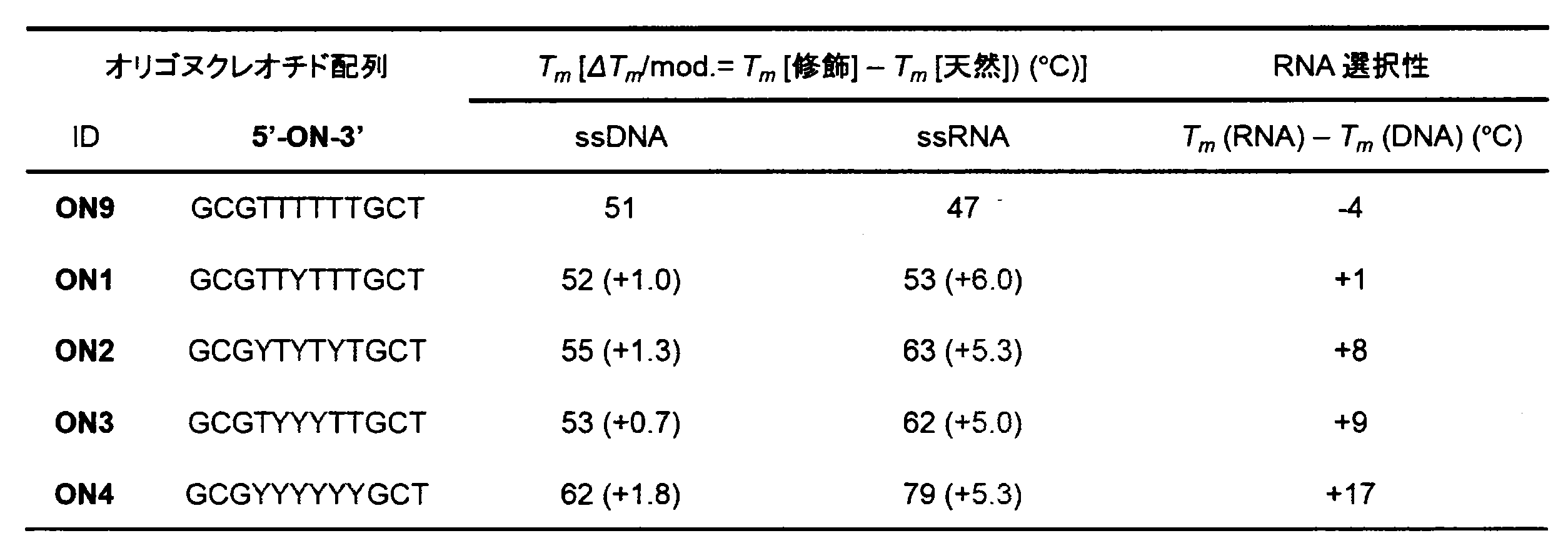
- Example 4 Evaluation of double chain forming ability The double chain forming ability was examined for ON1 to ON4. As a control, 5'-d (GCGTTTTTTGCT) -3'("ON9": SEQ ID NO: 5) using natural DNA was also used. Single-stranded oligo RNA 5'-r (AGCAAAAAACGC) -3'(SEQ ID NO: 6) and single-stranded oligo DNA 5'-d (AGCAAAAAACGC) -3'(SEQ ID NO: 7) were used as target strands.
- the double-strand-forming ability of the oligonucleotide was examined by annealing various oligonucleotides and the target strand to form a double-strand, and then measuring the Tm value. More specifically, a mixture of each oligonucleotide (final concentration 4 ⁇ M) and sodium chloride (final concentration 100 mM) phosphate buffer (10 mM, pH 7.2, 130 ⁇ L) was bathed in boiling water and slowly cooled to room temperature. .. Then, the temperature was cooled to 5 ° C. under a nitrogen stream, and the measurement was started. The temperature was raised to 90 ° C. or 110 ° C. at 0.5 ° C./min, and the absorbance at 260 nm was plotted at 0.5 ° C. intervals. The T m value was calculated by the midline method and used as the average value in three independent measurements.
- results are shown in Table 18.
- the results for single-strand oligo RNA are shown in “ssRNA”
- the results for single-strand oligo DNA are shown in “ssDNA”
- T m variable temperature per base of artificially modified nucleic acid for each oligonucleotide (“ ⁇ T m”). / Mod. ”)
- RNA selectivity difference between melting temperature for RNA and melting temperature for DNA
- both single-stranded oligo DNA and single-stranded oligo RNA exhibited higher melting temperatures than the native oligonucleotide (ON9). Furthermore, when compound 15 was used, the Tm value was increased especially for single-stranded oligo RNA as compared with the natural oligonucleotide (ON9), and thus high binding affinity for single-stranded oligo RNA was exhibited. .. Moreover, when compound 15 was used, RNA selectivity was observed.
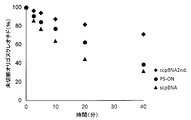
- Fig. 1 The results are shown in Fig. 1.
- the black rhombus represents the result of (1) above
- the black circle represents the result of (2) above
- the black triangle represents (3) above.
- the oligonucleotide having compound 15 ((1) above) has much higher nuclease resistance than the oligonucleotide with phosphorothioated (PS) oligo ((2) above) and the oligonucleotide having spirocyclopropylene BNA ((3) above). It was seen.
- PS phosphorothioated
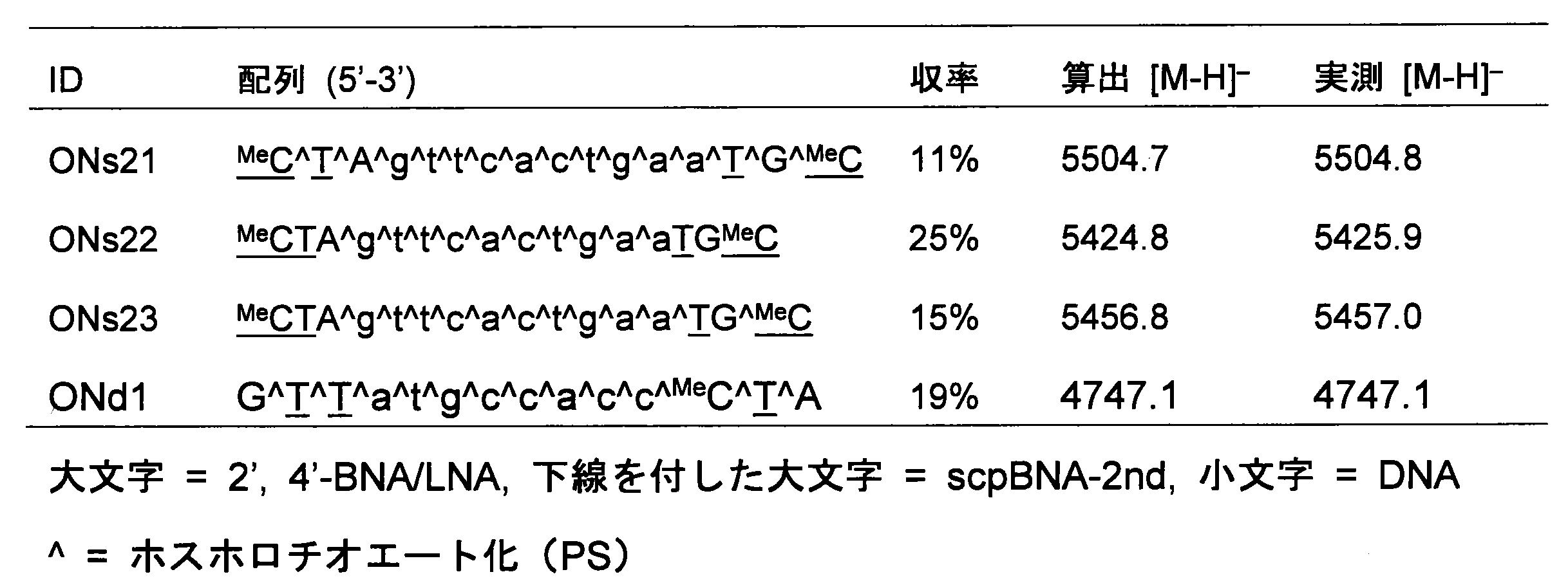
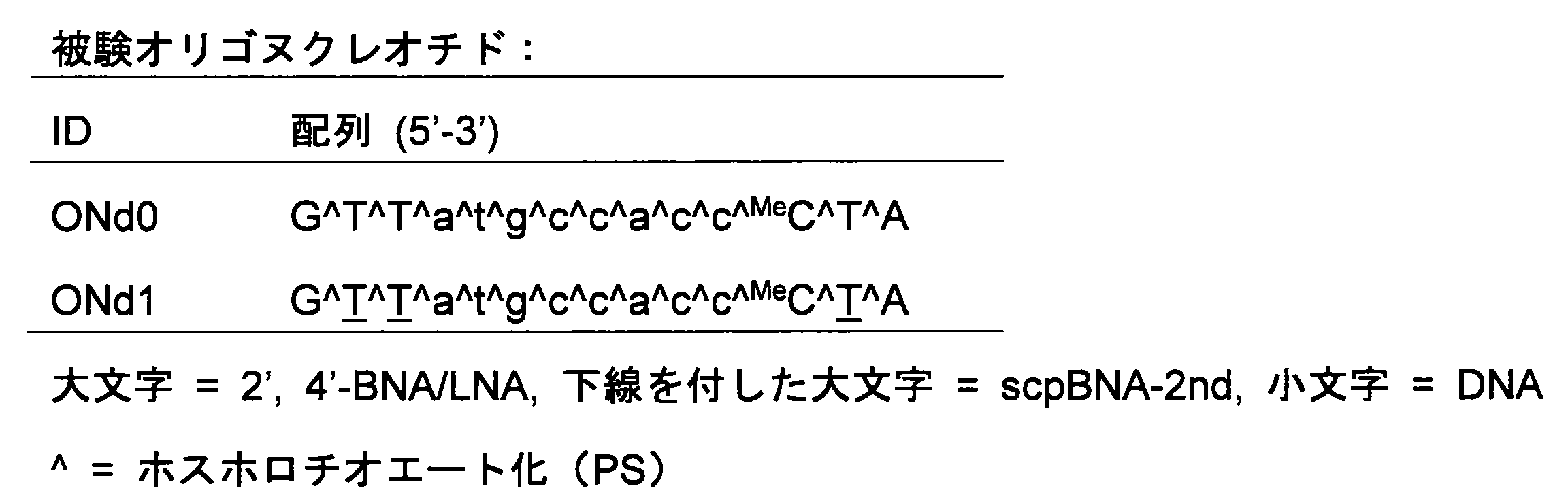
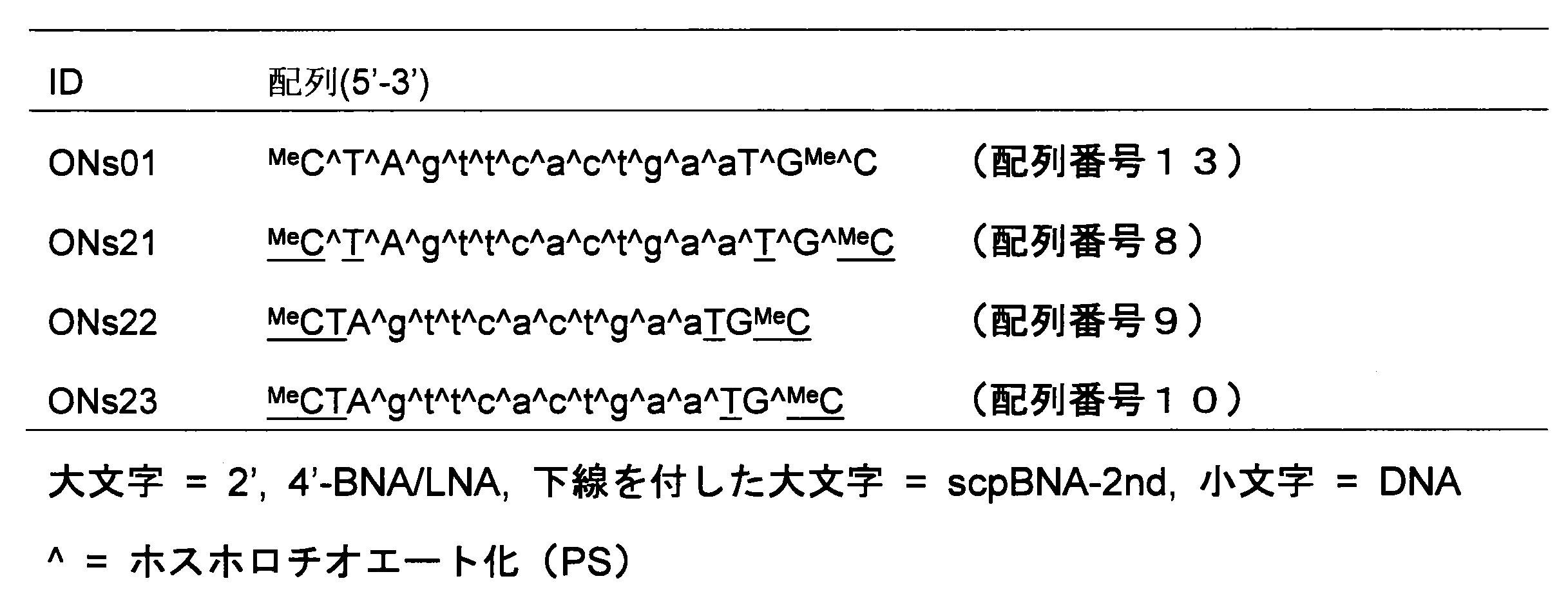
- Example 6 Synthesis and purification of oligonucleotide (2) Compound 15 (scpBNA2nd-T) prepared in Example 1 and compound 20 (scpBNA2nd- Me C) prepared in Example 2 were used as amidite blocks, and the oligonucleotides shown in Table 19 were used in the same manner as in Example 3. Synthesized. Regarding phosphorothioatetization, 0.05 M ((dimethylamino-methylidene) amino) -3H-1,2,4-dithiazolin-3-thione (DDTT) (pyridine / acetonitrile (3: 2)) solution, GLEN RESEARCH Company) was used. The sequences of the obtained oligonucleotides ONs21, ONs22, ONs23 and ONd1 are also shown in SEQ ID NOs: 8 to 11, respectively.
- Example 7 Evaluation of toxicity reducing effect
- the test oligonucleotides (20 mg / kg) shown in Table 20 were administered intraperitoneally to 6-week-old mice (C57BL / 6J, male) (5 animals / group). After 96 hours, blood was collected under inhalation anesthesia (isoflurane) and exsanguinated. Then, the activities of aspartate transaminase (AST) and alanine transaminase (ALT) in serum were measured by an automatic analyzer (FUJIFILM FUJIFILM 4000V).
- ONd1 SEQ ID NO: 11
- ONd0 SEQ ID NO: 12
- ONd1 was prepared in the same manner as ONd1 except that compound 15 (scpBNA2nd-T) was not contained in the amidite block.
- Table 21 shows the activities of aspartate transaminase (AST) and alanine transaminase (ALT) in blood when the test oligonucleotide was administered and when physiological saline was administered.
- AST aspartate transaminase
- ALT alanine transaminase
- Example 8 Evaluation of antisense activity Oligonucleotides (ONs21, ONs22, ONs23) containing compound 15 (scpBNA2nd-T) prepared in Example 1 and compound 20 (scpBNA2nd- Me C) prepared in Example 2 : Prepared in Example 6) and oligonucleotides (ONs01) containing LNA instead of compound 15 and compound 20 were examined for antisense activity in each tissue.
- ONs01 was synthesized in the same manner as in Example 3 using LNA as an amidite block instead of compound 15 and compound 20.
- the sequences of ONs21, ONs22, ONs23 and ONs01 are shown in Table 22 below.
- a test oligonucleotide (20 nmol: 200 ⁇ L of 100 ⁇ M physiological saline solution) was administered to the tail vein of 6-week-old mice (BALB / cAnNCrlCrlj, female) (5 mice / group). After 72 hours, blood was collected under inhalation anesthesia (isoflurane) and exsanguinated. Then, each tissue was collected and RNA extraction (use kit: RNeasy) was performed. The expression level of MALAT1 mRNA in each tissue was measured by real-time PCR (kit used: One Step TB Green (registered trademark) PrimeScript TM RT-PCR Kit (Perfect Real Time), manufactured by Takara Bio Inc.).
- MALAT1 forward acatctcttaggggtgggaa
- MALAT1 reverse caccccgcaaaggcctata
- GAPDH forward tcaccaccatggagaaggc
- GAPDH reverse gctagactagttgtgtgggtgca (SEQ ID NO: 17)
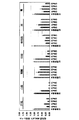
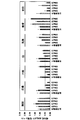
- FIGS. 2 and 3 show relative MALAT1 expression levels in various tissues of mice upon administration of various oligonucleotides (FIG. 2: liver, heart, kidney, pancreas, skeletal muscle, lung and stomach, and FIG. 3: spleen, Skin, large intestine, brain, mammary gland, eyeball and cartilage).
- the "relative MALAT1 expression level” was expressed as a relative value when the expression level was 1 when only physiological saline was administered (without oligonucleotide).
- the bar indicating the result is displayed as a control (administered with saline only), an oligonucleotide (ONs01) containing LNA instead of compound 15 and compound 20, and an oligonucleotide containing compound 15 and compound 20.
- a control administered with saline only
- an oligonucleotide ONs01
- an oligonucleotide containing compound 15 and compound 20 an oligonucleotide containing compound 15 and compound 20.
- Oligonucleotides containing compound 15 and compound 20 are equal to or higher targets in many tissues than oligonucleotides containing LNA instead of compound 15 and compound 20 (ONs01). It showed a gene-suppressing effect.
- a novel crosslinked nucleoside capable of substituting for a phosphorothioate-modified nucleic acid and a nucleotide using the same are provided.
- the oligonucleotide obtained by using the crosslinked nucleoside of the present invention is useful as a material for, for example, a nucleic acid drug.
Landscapes
- Chemical & Material Sciences (AREA)
- Organic Chemistry (AREA)
- Health & Medical Sciences (AREA)
- Life Sciences & Earth Sciences (AREA)
- Molecular Biology (AREA)
- Engineering & Computer Science (AREA)
- Genetics & Genomics (AREA)
- Biochemistry (AREA)
- Biotechnology (AREA)
- General Health & Medical Sciences (AREA)
- Biomedical Technology (AREA)
- General Engineering & Computer Science (AREA)
- Wood Science & Technology (AREA)
- Zoology (AREA)
- Bioinformatics & Cheminformatics (AREA)
- Microbiology (AREA)
- Plant Pathology (AREA)
- Biophysics (AREA)
- Physics & Mathematics (AREA)
- Saccharide Compounds (AREA)
- Pharmaceuticals Containing Other Organic And Inorganic Compounds (AREA)
Abstract
Description
Baseは、α群から選択される任意の置換基を1以上有していてもよいプリン-9-イル基または2-オキソ-1,2-ジヒドロピリミジン-1-イル基を表し、ここで、該α群は、水酸基、核酸合成の保護基で保護された水酸基、炭素数1から6の直鎖アルキル基、炭素数1から6の直鎖アルコキシ基、メルカプト基、核酸合成の保護基で保護されたメルカプト基、炭素数1から6の直鎖アルキルチオ基、アミノ基、炭素数1から6の直鎖アルキルアミノ基、核酸合成の保護基で保護されたアミノ基、およびハロゲン原子からなり、
R2およびR3は、それぞれ独立して、水素原子、核酸合成の水酸基の保護基、分岐または環を形成していてもよい炭素数1から7のアルキル基、分岐または環を形成していてもよい炭素数2から7のアルケニル基、該α群から選択される任意の置換基を1以上有していてもよくそしてヘテロ原子を含んでいてもよい炭素数3から10のアリール基、該α群から選択される任意の置換基を1以上有していてもよくそしてヘテロ原子を含んでいてもよい炭素数3から12のアリール部分を有するアラルキル基、該α群から選択される任意の置換基を1以上有していてもよいアシル基、該α群から選択される任意の置換基を1以上有していてもよいシリル基、該α群から選択される任意の置換基を1以上有していてもよいリン酸基、核酸合成の保護基で保護されたリン酸基、-P(R4a)R5a[式中、R4aおよびR5aは、それぞれ独立して、水酸基、核酸合成の保護基で保護された水酸基、メルカプト基、核酸合成の保護基で保護されたメルカプト基、アミノ基、炭素数1から6のアルコキシ基、炭素数1から6のアルキルチオ基、炭素数1から6のシアノアルコキシ基、または炭素数1から6のアルキル基を有するジアルキルアミノ基を表す]を表し、
X1は、炭素数1から3の直鎖アルキル基か、-NHR4b[ここで、R4bは水素原子または炭素数1から3の直鎖アルキル基である]か、または-OR5b[ここで、R5bは水素原子または炭素数1から3の直鎖アルキル基である]かで置換されていてもよい、炭素数2から8のアルキレン基;あるいは炭素数1から3の直鎖アルキル基か、-NHR4b[ここで、R4bは水素原子または炭素数1から3の直鎖アルキル基である]か、または-OR5b[ここで、R5bは水素原子または炭素数1から3の直鎖アルキル基である]かで置換されていてもよい、炭素数2から8のアルケニレン基;であり、そして
X2は、酸素原子、硫黄原子、-NH-、-N(CH3)-またはメチレン基である)である。

Baseは、α群から選択される任意の置換基を1以上有していてもよいプリン-9-イル基または2-オキソ-1,2-ジヒドロピリミジン-1-イル基を表し、ここで、該α群は、水酸基、核酸合成の保護基で保護された水酸基、炭素数1から6の直鎖アルキル基、炭素数1から6の直鎖アルコキシ基、メルカプト基、核酸合成の保護基で保護されたメルカプト基、炭素数1から6の直鎖アルキルチオ基、アミノ基、炭素数1から6の直鎖アルキルアミノ基、核酸合成の保護基で保護されたアミノ基、およびハロゲン原子からなり、
R2およびR3は、それぞれ独立して、水素原子、核酸合成の水酸基の保護基、分岐または環を形成していてもよい炭素数1から7のアルキル基、分岐または環を形成していてもよい炭素数2から7のアルケニル基、該α群から選択される任意の置換基を1以上有していてもよくそしてヘテロ原子を含んでいてもよい炭素数3から10のアリール基、該α群から選択される任意の置換基を1以上有していてもよくそしてヘテロ原子を含んでいてもよい炭素数3から12のアリール部分を有するアラルキル基、該α群から選択される任意の置換基を1以上有していてもよいアシル基、該α群から選択される任意の置換基を1以上有していてもよいシリル基、該α群から選択される任意の置換基を1以上有していてもよいリン酸基、核酸合成の保護基で保護されたリン酸基、-P(R4a)R5a[式中、R4aおよびR5aは、それぞれ独立して、水酸基、核酸合成の保護基で保護された水酸基、メルカプト基、核酸合成の保護基で保護されたメルカプト基、アミノ基、炭素数1から6のアルコキシ基、炭素数1から6のアルキルチオ基、炭素数1から6のシアノアルコキシ基、または炭素数1から6のアルキル基を有するジアルキルアミノ基を表す]を表し、
X2は、酸素原子、硫黄原子、-NH-、-N(CH3)-またはメチレン基であり、そして
R6、R7、R8、R9、R10およびR11はそれぞれ独立して、水素原子、炭素数1から3の直鎖アルキル基、-NHR4b[ここで、R4bは水素原子または炭素数1から3の直鎖アルキル基である]、または-OR5b[ここで、R5bは水素原子または炭素数1から3の直鎖アルキル基である]である)で表される。
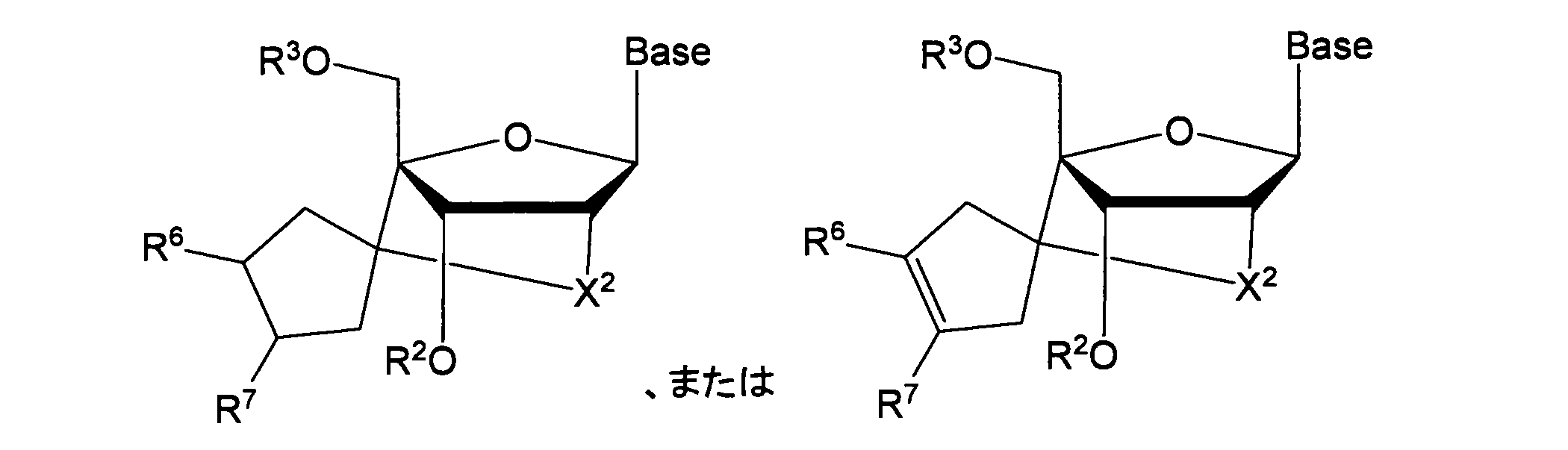
Baseは、α群から選択される任意の置換基を1以上有していてもよいプリン-9-イル基または2-オキソ-1,2-ジヒドロピリミジン-1-イル基を表し、ここで、該α群は、水酸基、核酸合成の保護基で保護された水酸基、炭素数1から6の直鎖アルキル基、炭素数1から6の直鎖アルコキシ基、メルカプト基、核酸合成の保護基で保護されたメルカプト基、炭素数1から6の直鎖アルキルチオ基、アミノ基、炭素数1から6の直鎖アルキルアミノ基、核酸合成の保護基で保護されたアミノ基、およびハロゲン原子からなり、
R2およびR3は、それぞれ独立して、水素原子、核酸合成の水酸基の保護基、分岐または環を形成していてもよい炭素数1から7のアルキル基、分岐または環を形成していてもよい炭素数2から7のアルケニル基、該α群から選択される任意の置換基を1以上有していてもよくそしてヘテロ原子を含んでいてもよい炭素数3から10のアリール基、該α群から選択される任意の置換基を1以上有していてもよくそしてヘテロ原子を含んでいてもよい炭素数3から12のアリール部分を有するアラルキル基、該α群から選択される任意の置換基を1以上有していてもよいアシル基、該α群から選択される任意の置換基を1以上有していてもよいシリル基、該α群から選択される任意の置換基を1以上有していてもよいリン酸基、核酸合成の保護基で保護されたリン酸基、-P(R4a)R5a[式中、R4aおよびR5aは、それぞれ独立して、水酸基、核酸合成の保護基で保護された水酸基、メルカプト基、核酸合成の保護基で保護されたメルカプト基、アミノ基、炭素数1から6のアルコキシ基、炭素数1から6のアルキルチオ基、炭素数1から6のシアノアルコキシ基、または炭素数1から6のアルキル基を有するジアルキルアミノ基を表す]を表し、
X2は、酸素原子、硫黄原子、-NH-、-N(CH3)-またはメチレン基であり、そして
R6およびR7はそれぞれ独立して、水素原子、炭素数1から3の直鎖アルキル基、-NHR4b[ここで、R4bは水素原子または炭素数1から3の直鎖アルキル基である]、または-OR5b[ここで、R5bは水素原子または炭素数1から3の直鎖アルキル基である]である)で表される。
Baseは、α群から選択される任意の置換基を1以上有していてもよいプリン-9-イル基または2-オキソ-1,2-ジヒドロピリミジン-1-イル基を表し、ここで、該α群は、水酸基、核酸合成の保護基で保護された水酸基、炭素数1から6の直鎖アルキル基、炭素数1から6の直鎖アルコキシ基、メルカプト基、核酸合成の保護基で保護されたメルカプト基、炭素数1から6の直鎖アルキルチオ基、アミノ基、炭素数1から6の直鎖アルキルアミノ基、核酸合成の保護基で保護されたアミノ基、およびハロゲン原子からなり、
X1は、炭素数1から3の直鎖アルキル基か、-NHR4b[ここで、R4bは水素原子または炭素数1から3の直鎖アルキル基である]か、または-OR5b[ここで、R5bは水素原子または炭素数1から3の直鎖アルキル基である]かで置換されていてもよい、炭素数2から8のアルキレン基;あるいは炭素数1から3の直鎖アルキル基か、-NHR4b[ここで、R4bは水素原子または炭素数1から3の直鎖アルキル基である]か、または-OR5b[ここで、R5bは水素原子または炭素数1から3の直鎖アルキル基である]かで置換されていてもよい、炭素数2から8のアルケニレン基;であり、そして
X2は、酸素原子、硫黄原子、-NH-、-N(CH3)-またはメチレン基である)である。

Baseは、α群から選択される任意の置換基を1以上有していてもよいプリン-9-イル基または2-オキソ-1,2-ジヒドロピリミジン-1-イル基を表し、ここで、該α群は、水酸基、核酸合成の保護基で保護された水酸基、炭素数1から6の直鎖アルキル基、炭素数1から6の直鎖アルコキシ基、メルカプト基、核酸合成の保護基で保護されたメルカプト基、炭素数1から6の直鎖アルキルチオ基、アミノ基、炭素数1から6の直鎖アルキルアミノ基、核酸合成の保護基で保護されたアミノ基、およびハロゲン原子からなり、
X2は、酸素原子、硫黄原子、-NH-、-N(CH3)-またはメチレン基であり、そして
R6、R7、R8、R9、R10およびR11はそれぞれ独立して、水素原子、炭素数1から3の直鎖アルキル基、-NHR4[ここで、R4は水素原子または炭素数1から3の直鎖アルキル基である]、または-OR5[ここで、R5は水素原子または炭素数1から3の直鎖アルキル基である]である)で表される。
Baseは、α群から選択される任意の置換基を1以上有していてもよいプリン-9-イル基または2-オキソ-1,2-ジヒドロピリミジン-1-イル基を表し、ここで、該α群は、水酸基、核酸合成の保護基で保護された水酸基、炭素数1から6の直鎖アルキル基、炭素数1から6の直鎖アルコキシ基、メルカプト基、核酸合成の保護基で保護されたメルカプト基、炭素数1から6の直鎖アルキルチオ基、アミノ基、炭素数1から6の直鎖アルキルアミノ基、核酸合成の保護基で保護されたアミノ基、およびハロゲン原子からなり、
X2は、酸素原子、硫黄原子、-NH-、-N(CH3)-またはメチレン基であり、そして
R6およびR7はそれぞれ独立して、水素原子、炭素数1から3の直鎖アルキル基、-NHR4b[ここで、R4bは水素原子または炭素数1から3の直鎖アルキル基である]、または-OR5b[ここで、R5bは水素原子または炭素数1から3の直鎖アルキル基である]である)で表される。
以下の式(I)で表される化合物またはその薬理学上許容される塩:
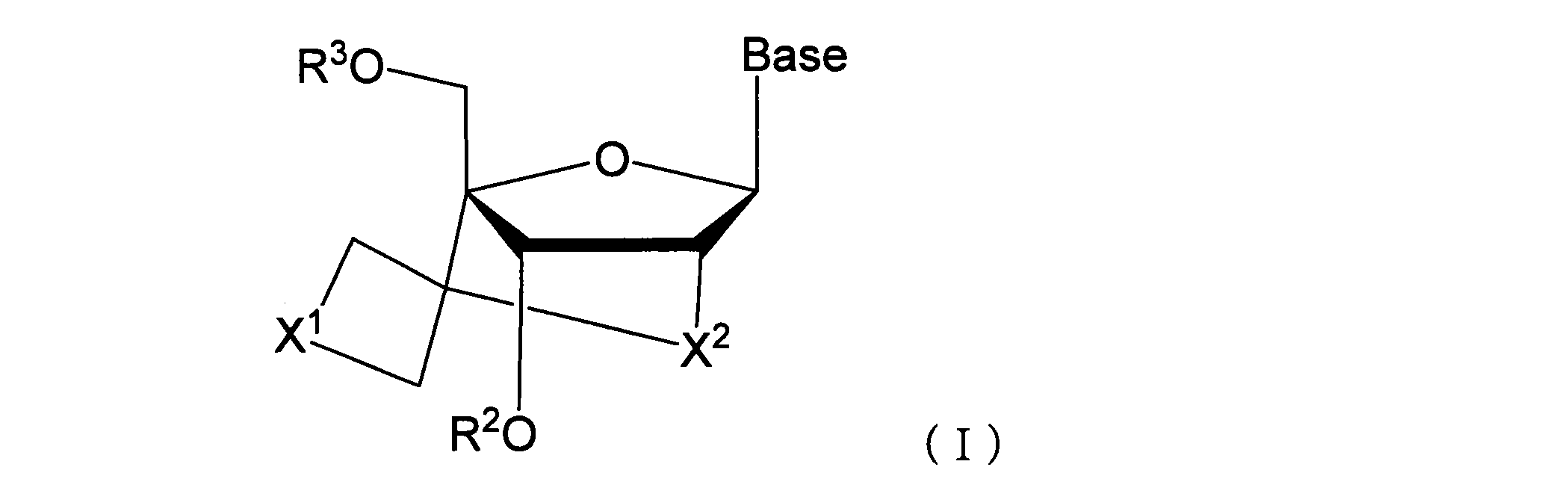
Baseは、α群から選択される任意の置換基を1以上有していてもよいプリン-9-イル基または2-オキソ-1,2-ジヒドロピリミジン-1-イル基を表し、ここで、該α群は、水酸基、核酸合成の保護基で保護された水酸基、炭素数1から6の直鎖アルキル基、炭素数1から6の直鎖アルコキシ基、メルカプト基、核酸合成の保護基で保護されたメルカプト基、炭素数1から6の直鎖アルキルチオ基、アミノ基、炭素数1から6の直鎖アルキルアミノ基、核酸合成の保護基で保護されたアミノ基、およびハロゲン原子からなり、
R2およびR3は、それぞれ独立して、水素原子、核酸合成の水酸基の保護基、分岐または環を形成していてもよい炭素数1から7のアルキル基、分岐または環を形成していてもよい炭素数2から7のアルケニル基、該α群から選択される任意の置換基を1以上有していてもよくそしてヘテロ原子を含んでいてもよい炭素数3から10のアリール基、該α群から選択される任意の置換基を1以上有していてもよくそしてヘテロ原子を含んでいてもよい炭素数3から12のアリール部分を有するアラルキル基、該α群から選択される任意の置換基を1以上有していてもよいアシル基、該α群から選択される任意の置換基を1以上有していてもよいシリル基、該α群から選択される任意の置換基を1以上有していてもよいリン酸基、核酸合成の保護基で保護されたリン酸基、-P(R4a)R5a[式中、R4aおよびR5aは、それぞれ独立して、水酸基、核酸合成の保護基で保護された水酸基、メルカプト基、核酸合成の保護基で保護されたメルカプト基、アミノ基、炭素数1から6のアルコキシ基、炭素数1から6のアルキルチオ基、炭素数1から6のシアノアルコキシ基、または炭素数1から6のアルキル基を有するジアルキルアミノ基を表す]を表し、
X1は、炭素数1から3の直鎖アルキル基か、-NHR4b[ここで、R4bは水素原子または炭素数1から3の直鎖アルキル基である]か、または-OR5b[ここで、R5bは水素原子または炭素数1から3の直鎖アルキル基である]かで置換されていてもよい、炭素数2から8のアルキレン基;あるいは炭素数1から3の直鎖アルキル基か、-NHR4b[ここで、R4bは水素原子または炭素数1から3の直鎖アルキル基である]か、または-OR5b[ここで、R5bは水素原子または炭素数1から3の直鎖アルキル基である]かで置換されていてもよい、炭素数2から8のアルケニレン基;であり、そして
X2は、酸素原子、硫黄原子、-NH-、-N(CH3)-またはメチレン基である)
を用いてオリゴヌクレオチドを合成する工程を包含する、方法である。
本発明の架橋型ヌクレオシドは、以下の式(I):

Baseは、α群から選択される任意の置換基を1以上有していてもよいプリン-9-イル基または2-オキソ-1,2-ジヒドロピリミジン-1-イル基を表し、ここで、該α群は、水酸基、核酸合成の保護基で保護された水酸基、炭素数1から6の直鎖アルキル基、炭素数1から6の直鎖アルコキシ基、メルカプト基、核酸合成の保護基で保護されたメルカプト基、炭素数1から6の直鎖アルキルチオ基、アミノ基、炭素数1から6の直鎖アルキルアミノ基、核酸合成の保護基で保護されたアミノ基、およびハロゲン原子からなり、
R2およびR3は、それぞれ独立して、水素原子、核酸合成の水酸基の保護基、分岐または環を形成していてもよい炭素数1から7のアルキル基、分岐または環を形成していてもよい炭素数2から7のアルケニル基、該α群から選択される任意の置換基を1以上有していてもよくそしてヘテロ原子を含んでいてもよい炭素数3から10のアリール基、該α群から選択される任意の置換基を1以上有していてもよくそしてヘテロ原子を含んでいてもよい炭素数3から12のアリール部分を有するアラルキル基、該α群から選択される任意の置換基を1以上有していてもよいアシル基、該α群から選択される任意の置換基を1以上有していてもよいシリル基、該α群から選択される任意の置換基を1以上有していてもよいリン酸基、核酸合成の保護基で保護されたリン酸基、-P(R4a)R5a[式中、R4aおよびR5aは、それぞれ独立して、水酸基、核酸合成の保護基で保護された水酸基、メルカプト基、核酸合成の保護基で保護されたメルカプト基、アミノ基、炭素数1から6のアルコキシ基、炭素数1から6のアルキルチオ基、炭素数1から6のシアノアルコキシ基、または炭素数1から6のアルキル基を有するジアルキルアミノ基を表す]を表し、
X1は、炭素数1から3の直鎖アルキル基か、-NHR4b[ここで、R4bは水素原子または炭素数1から3の直鎖アルキル基である]か、または-OR5b[ここで、R5bは水素原子または炭素数1から3の直鎖アルキル基である]かで置換されていてもよい、炭素数2から8のアルキレン基;あるいは炭素数1から3の直鎖アルキル基か、-NHR4b[ここで、R4bは水素原子または炭素数1から3の直鎖アルキル基である]か、または-OR5b[ここで、R5bは水素原子または炭素数1から3の直鎖アルキル基である]かで置換されていてもよい、炭素数2から8のアルケニレン基;であり、そして
X2は、酸素原子、硫黄原子、-NH-、-N(CH3)-またはメチレン基である)である。
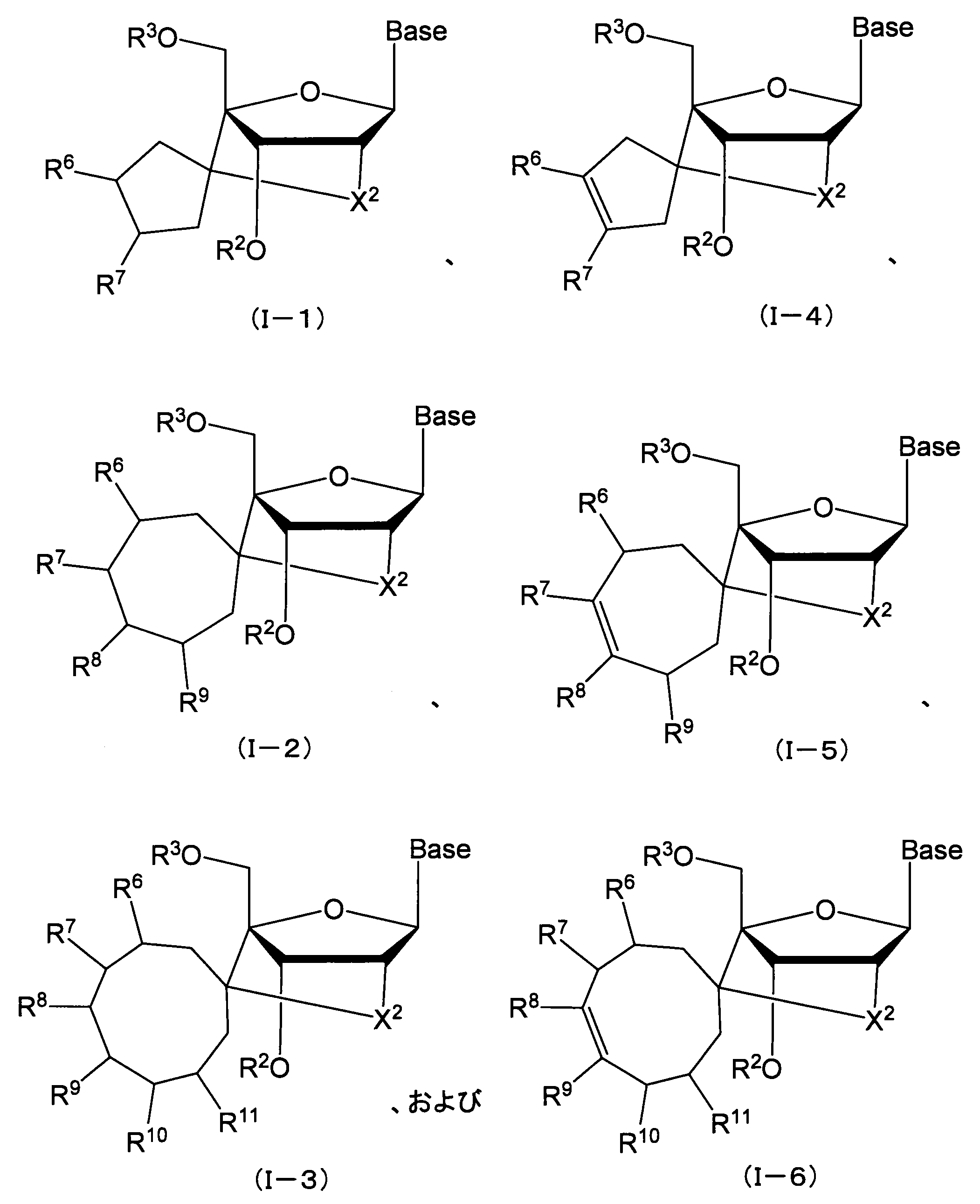
Base、R2、R3、およびX2は上記式(I)で定義されるものと同様であり、そしてR6、R7、R8、R9、R10およびR11はそれぞれ独立して、水素原子、炭素数1から3の直鎖アルキル基、-NHR4b[ここで、R4bは水素原子または炭素数1から3の直鎖アルキル基である]、または-OR5b[ここで、R5bは水素原子または炭素数1から3の直鎖アルキル基である]である)で表される化合物が挙げられる。ここで、例えば、上記式(I-1)および(I-4)におけるR6およびR7はともに水素原子である。あるいは、例えば、上記式(I-2)および(I-5)におけるR6、R7、R8、およびR9のすべては水素原子である。あるいは、例えば、上記式(I-3)および(I-6)におけるR6、R7、R8、およびR9、R10、およびR11のすべては水素原子である。
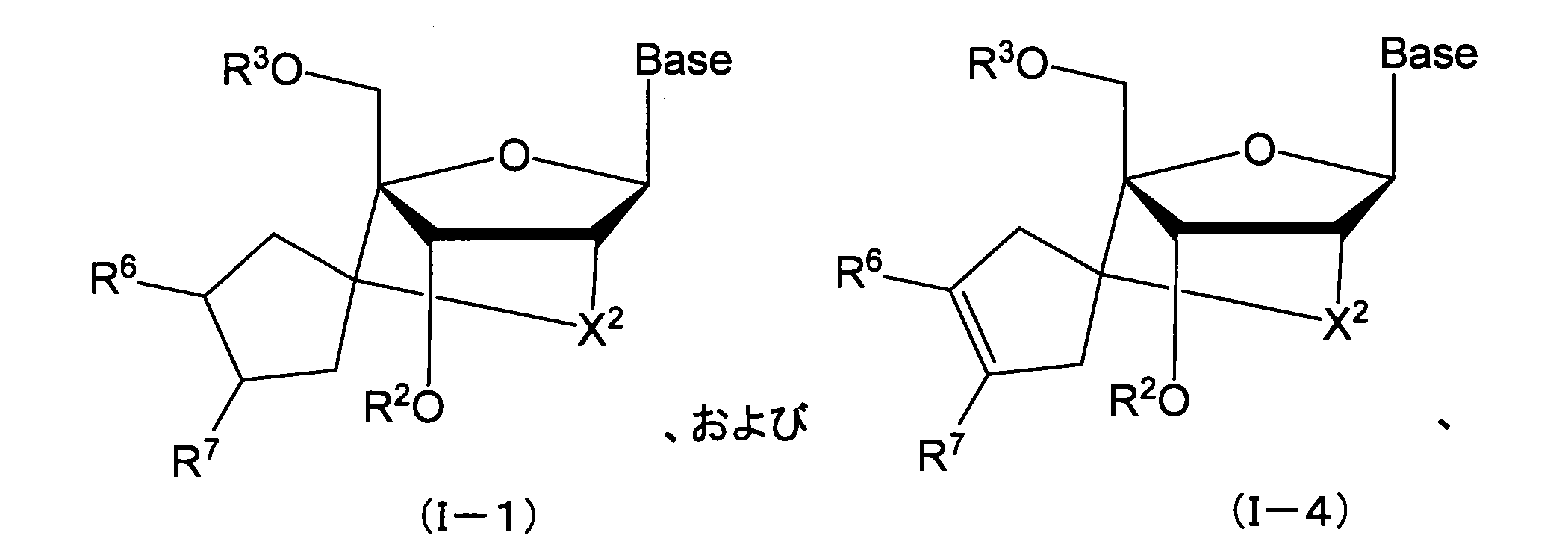

本発明において、オリゴヌクレオチドは、このような式(I)の架橋型ヌクレオシドを用い、例えば、当該分野において周知のアミダイト法、またはM. Kuwaharaら、Nucleic Acids Res.,2008年,36巻,13号,4257-4265頁に記載されるような三リン酸化を経て容易に製造することができる。
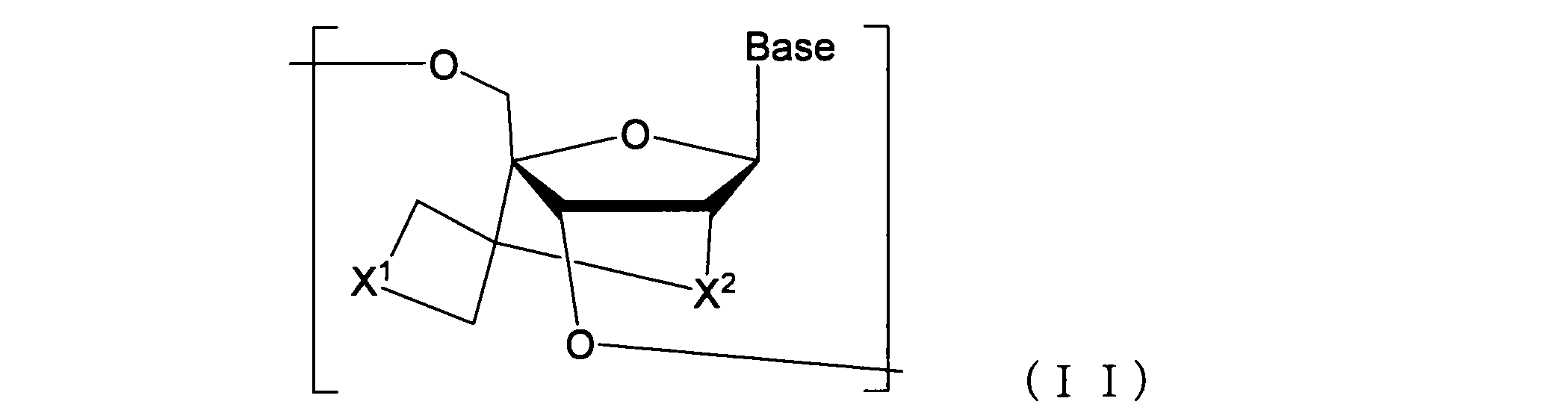
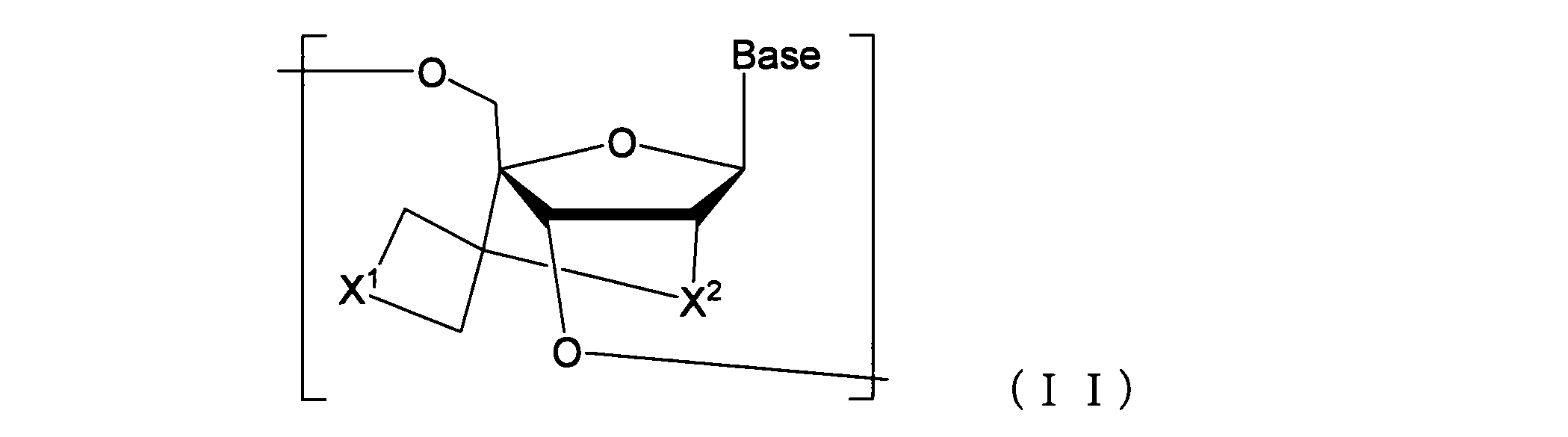
Baseは、α群から選択される任意の置換基を1以上有していてもよいプリン-9-イル基または2-オキソ-1,2-ジヒドロピリミジン-1-イル基を表し、ここで、該α群は、水酸基、核酸合成の保護基で保護された水酸基、炭素数1から6の直鎖アルキル基、炭素数1から6の直鎖アルコキシ基、メルカプト基、核酸合成の保護基で保護されたメルカプト基、炭素数1から6の直鎖アルキルチオ基、アミノ基、炭素数1から6の直鎖アルキルアミノ基、核酸合成の保護基で保護されたアミノ基、およびハロゲン原子からなり、
X1は、炭素数1から3の直鎖アルキル基か、-NHR4b[ここで、R4bは水素原子または炭素数1から3の直鎖アルキル基である]か、または-OR5b[ここで、R5bは水素原子または炭素数1から3の直鎖アルキル基である]かで置換されていてもよい、炭素数2から8のアルキレン基;あるいは炭素数1から3の直鎖アルキル基か、-NHR4b[ここで、R4bは水素原子または炭素数1から3の直鎖アルキル基である]か、または-OR5b[ここで、R5bは水素原子または炭素数1から3の直鎖アルキル基である]かで置換されていてもよい、炭素数2から8のアルケニレン基;であり、そして
X2は、酸素原子、硫黄原子、-NH-、-N(CH3)-またはメチレン基である)で表されるヌクレオシド構造を少なくとも1つ含む。
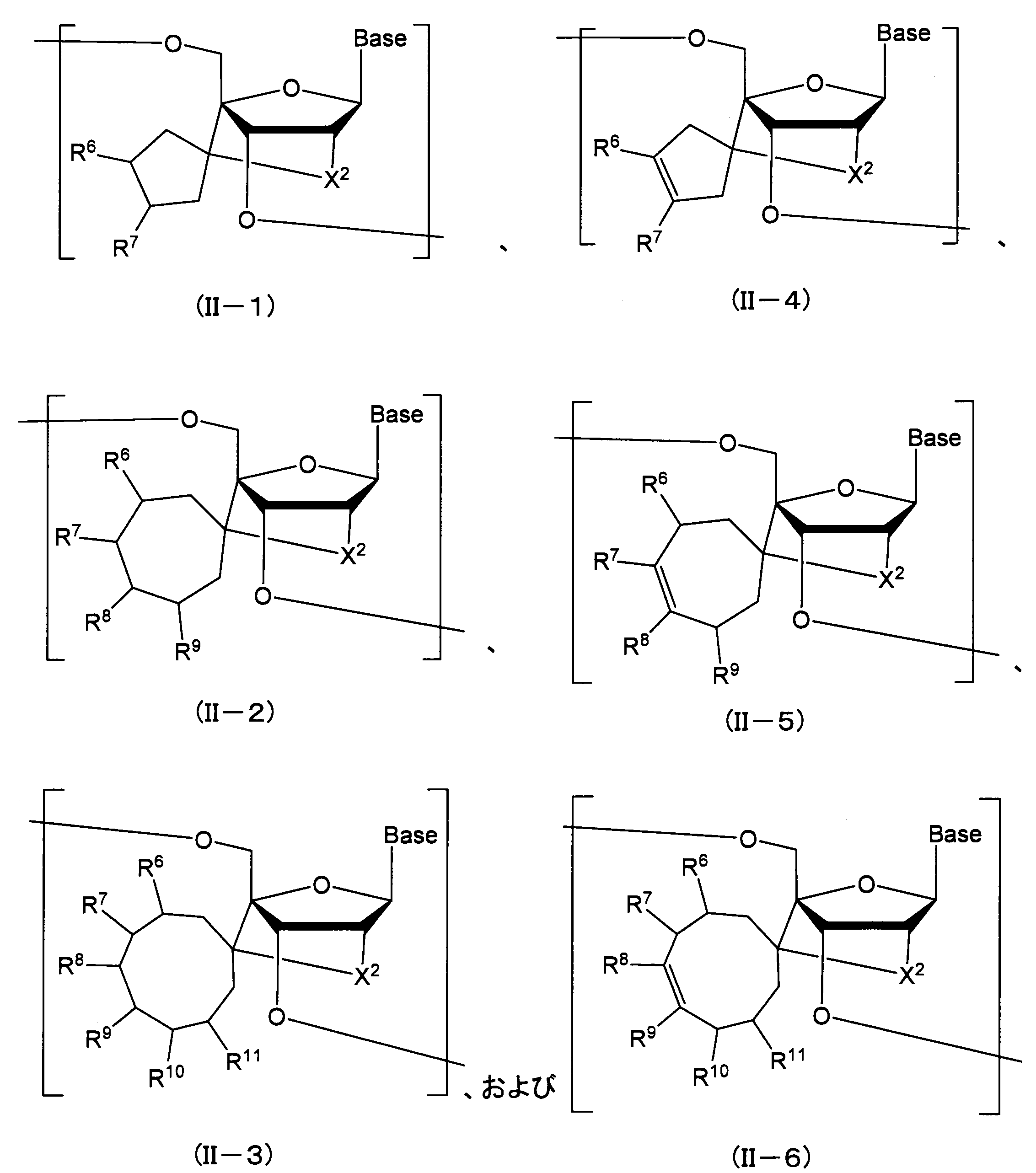
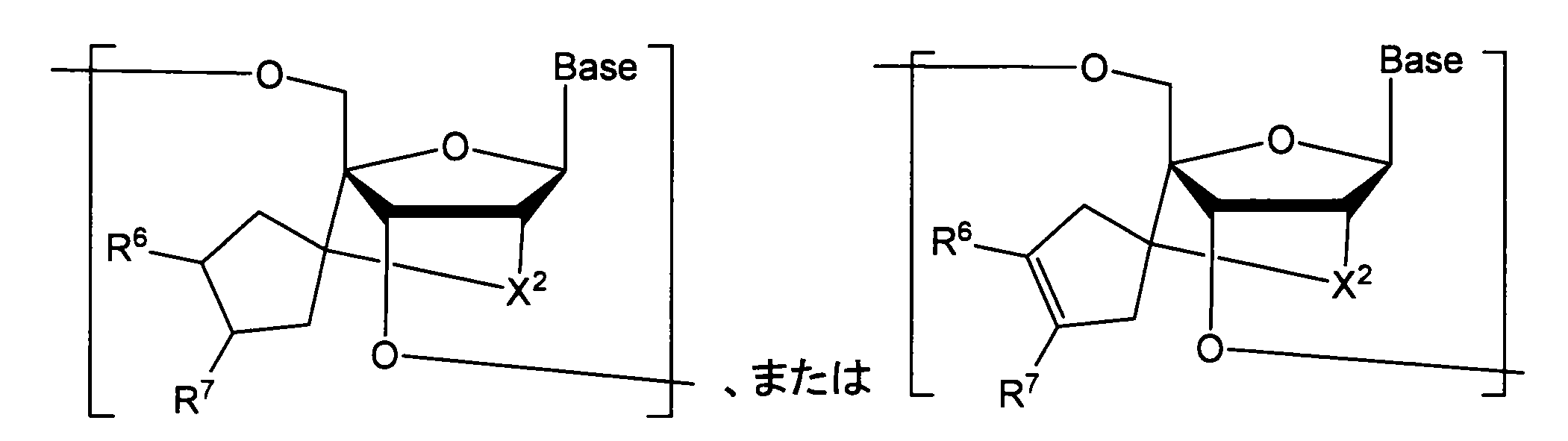
BaseおよびX2は上記式(II)に定義した基と同様であり、そしてR6、R7、R8、R9、R10およびR11はそれぞれ独立して、水素原子、炭素数1から3の直鎖アルキル基、-NHR4b[ここで、R4bは水素原子または炭素数1から3の直鎖アルキル基である]、または-OR5b[ここで、R5bは水素原子または炭素数1から3の直鎖アルキル基である]である)で表されるものが挙げられる。ここで、例えば、上記式(II-1)および(II-4)におけるR6およびR7はともに水素原子である。あるいは、例えば、上記式(II-2)および(II-5)におけるR6、R7、R8、およびR9のすべては水素原子である。あるいは、例えば、上記式(II-3)および(II-6)におけるR6、R7、R8、およびR9、R10、およびR11のすべては水素原子である。
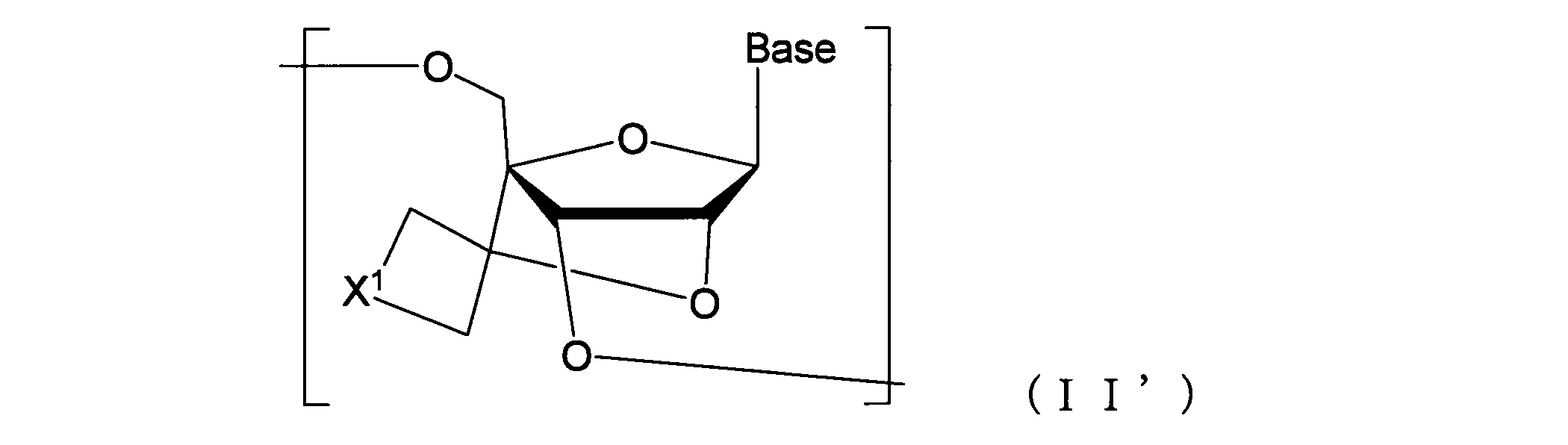
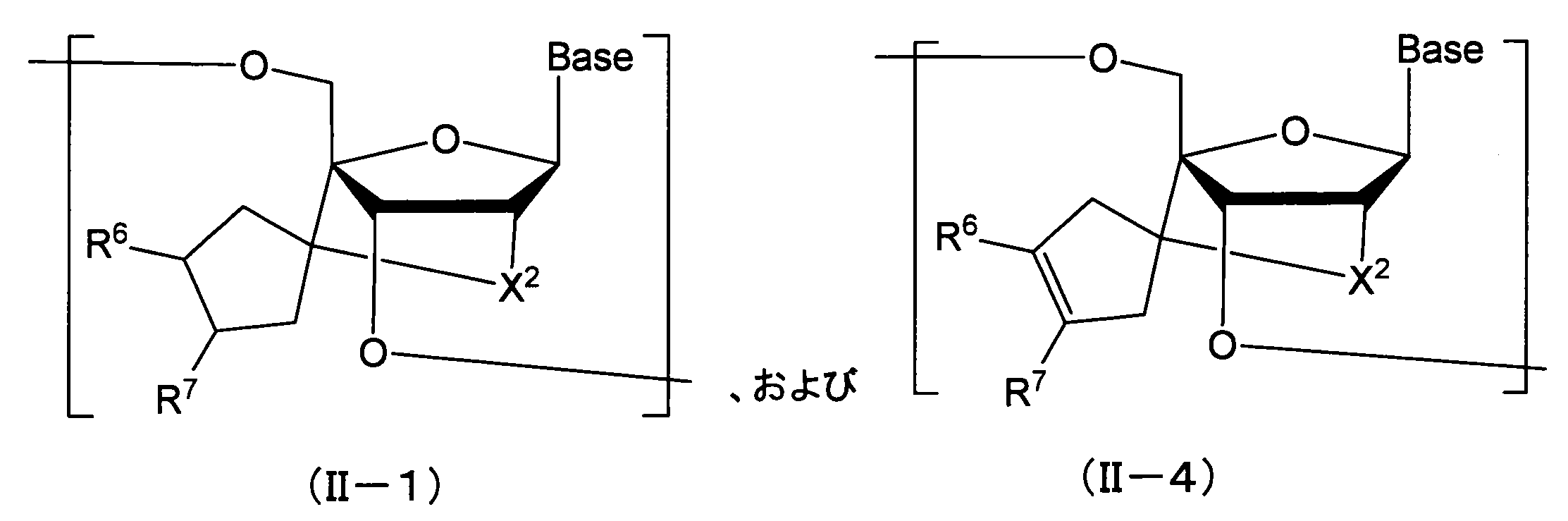
BaseおよびX2は上記式(II)に定義した基と同様であり、そしてR6およびR7はそれぞれ独立して、水素原子、炭素数1から3の直鎖アルキル基、-NHR4b[ここで、R4bは水素原子または炭素数1から3の直鎖アルキル基である]、または-OR5b[ここで、R5bは水素原子または炭素数1から3の直鎖アルキル基である]である)で表されるものが挙げられる。ここで、例えば、上記式(II-1)および(II-4)におけるR6およびR7はともに水素原子である。
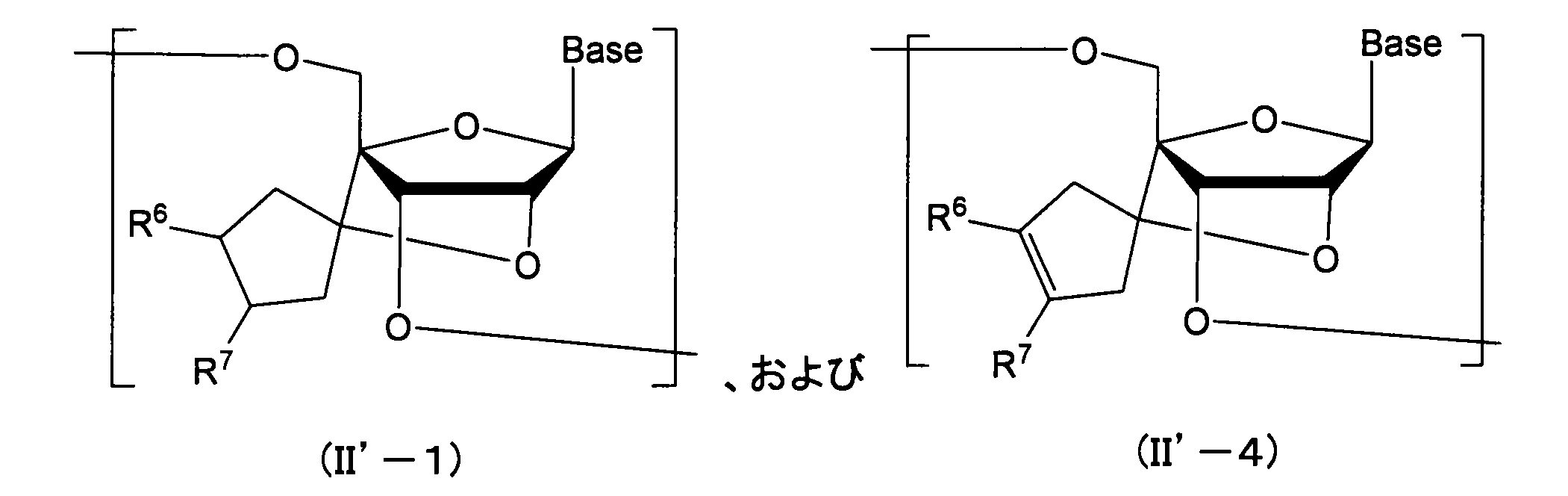
Baseは上記式(II)に定義した基と同様であり、そしてR6およびR7はそれぞれ独立して、水素原子、炭素数1から3の直鎖アルキル基、-NHR4b[ここで、R4bは水素原子または炭素数1から3の直鎖アルキル基である]、または-OR5b[ここで、R5bは水素原子または炭素数1から3の直鎖アルキル基である]である)で表されるものが挙げられる。ここで、例えば、上記式(II’-1)および(II’-4)におけるR6およびR7はともに水素原子である。







実施例1で作製された化合物15(scpBNA2nd-T)をアミダイトブロックとして用い、以下のようにしてオリゴヌクレオチドを合成した。オリゴヌクレオチドを構成する化合物15以外の化合物は、特に表記がない限り、Proligo社から購入した。以下のオリゴヌクレオチドを合成した。
ON1:5’-d(GCGTTYTTTGCT)-3’(配列番号1)
ON2:5’-d(GCGYTYTYTGCT)-3’(配列番号2)
ON3:5’-d(GCGTYYYYTGCT)-3’(配列番号3)
ON4:5’-d(GCGYYYYYYGCT)-3’(配列番号4)
ON5:5’-d(TTTTTTTTTY)-3’
ON6:5’-d(TTTTTTTTYT)-3’
Y=化合物15(scpBNA2nd-T)

ON1~ON4について二重鎖形成能を調べた。対照として、天然DNAを用いた5’-d(GCGTTTTTTGCT)-3’(「ON9」:配列番号5)もまた用いた。標的鎖として一本鎖オリゴRNA5’-r(AGCAAAAAACGC)-3’(配列番号6)および一本鎖オリゴDNA5’-d(AGCAAAAAACGC)-3’(配列番号7)を用いた。
ON5および以下の10merの配列のオリゴヌクレオチドを合成および精製し、被験オリゴヌクレオチドとして用いた:
5’-d(TTTTTTTTTX)-3’
(1)X=化合物15(ON5:「scpBNA2nd-T」)
(2)X=ホスホロチオエートチミジン(「PS-T」:ホスホロチオエート化に関しては、0.05Mの((ジメチルアミノ-メチリデン)アミノ)-3H-1,2,4-ジチアゾリン-3-チオン(DDTT)(ピリジン/アセトニトリル(3:2)溶液、GLEN RESEARCH社)を用いた。)
(3)X=スピロシクロプロピレンBNA(特許文献1および非特許文献5:「scpBNA-T」)
実施例1で作製された化合物15(scpBNA2nd-T)と実施例2で作製された化合物20(scpBNA2nd-MeC)をアミダイトブロックとして用い、実施例3と同様にして表19に示すオリゴヌクレオチドを合成した。なお、ホスホロチオエート化に関しては、0.05Mの((ジメチルアミノ-メチリデン)アミノ)-3H-1,2,4-ジチアゾリン-3-チオン(DDTT)(ピリジン/アセトニトリル(3:2)溶液、GLEN RESEARCH社)を用いた。得られたオリゴヌクレオチドであるONs21、ONs22、ONs23およびONd1の配列をそれぞれ配列番号8~11にも示す。
6週齢のマウス(C57BL/6J、雄)の腹腔内に、表20に示す被験オリゴヌクレオチド(20mg/kg)を投与した(5匹/群)。96時間後、吸入麻酔下(イソフルラン)で採血を行い、放血安楽死させた。その後、血清中のアスパラギン酸トランスアミナーゼ(AST)およびアラニントランスアミナーゼ(ALT)の活性を自動分析装置(FUJIFILM製 富士ドライケム4000V)により測定した。

実施例1で作製された化合物15(scpBNA2nd-T)と実施例2で作製された化合物20(scpBNA2nd-MeC)を含むオリゴヌクレオチド(ONs21、ONs22、ONs23:実施例6にて作製)と、化合物15と化合物20に代えてLNAを含むオリゴヌクレオチド(ONs01)とについて、各組織におけるアンチセンス活性を調べた。
MALAT1 forward:acattccttgaggtcggcaa(配列番号14)
MALAT1 reverse:cacccgcaaaggcctacata(配列番号15)
GAPDH forward:tcaccaccatggagaaggc(配列番号16)
GAPDH reverse:gctaagcagttggtggtgca(配列番号17)
Claims (9)
- 以下の式(I)で表される化合物またはその塩:

Baseは、α群から選択される任意の置換基を1以上有していてもよいプリン-9-イル基または2-オキソ-1,2-ジヒドロピリミジン-1-イル基を表し、ここで、該α群は、水酸基、核酸合成の保護基で保護された水酸基、炭素数1から6の直鎖アルキル基、炭素数1から6の直鎖アルコキシ基、メルカプト基、核酸合成の保護基で保護されたメルカプト基、炭素数1から6の直鎖アルキルチオ基、アミノ基、炭素数1から6の直鎖アルキルアミノ基、核酸合成の保護基で保護されたアミノ基、およびハロゲン原子からなり、
R2およびR3は、それぞれ独立して、水素原子、核酸合成の水酸基の保護基、分岐または環を形成していてもよい炭素数1から7のアルキル基、分岐または環を形成していてもよい炭素数2から7のアルケニル基、該α群から選択される任意の置換基を1以上有していてもよくそしてヘテロ原子を含んでいてもよい炭素数3から10のアリール基、該α群から選択される任意の置換基を1以上有していてもよくそしてヘテロ原子を含んでいてもよい炭素数3から12のアリール部分を有するアラルキル基、該α群から選択される任意の置換基を1以上有していてもよいアシル基、該α群から選択される任意の置換基を1以上有していてもよいシリル基、該α群から選択される任意の置換基を1以上有していてもよいリン酸基、核酸合成の保護基で保護されたリン酸基、-P(R4a)R5a[式中、R4aおよびR5aは、それぞれ独立して、水酸基、核酸合成の保護基で保護された水酸基、メルカプト基、核酸合成の保護基で保護されたメルカプト基、アミノ基、炭素数1から6のアルコキシ基、炭素数1から6のアルキルチオ基、炭素数1から6のシアノアルコキシ基、または炭素数1から6のアルキル基を有するジアルキルアミノ基を表す]を表し、
X1は、炭素数1から3の直鎖アルキル基か、-NHR4b[ここで、R4bは水素原子または炭素数1から3の直鎖アルキル基である]か、または-OR5b[ここで、R5bは水素原子または炭素数1から3の直鎖アルキル基である]かで置換されていてもよい、炭素数2から8のアルキレン基;あるいは炭素数1から3の直鎖アルキル基か、-NHR4b[ここで、R4bは水素原子または炭素数1から3の直鎖アルキル基である]か、または-OR5b[ここで、R5bは水素原子または炭素数1から3の直鎖アルキル基である]かで置換されていてもよい、炭素数2から8のアルケニレン基;であり、そして
X2は、酸素原子、硫黄原子、-NH-、-N(CH3)-またはメチレン基である)。 - 前記式(I)が以下の式:
Baseは、α群から選択される任意の置換基を1以上有していてもよいプリン-9-イル基または2-オキソ-1,2-ジヒドロピリミジン-1-イル基を表し、ここで、該α群は、水酸基、核酸合成の保護基で保護された水酸基、炭素数1から6の直鎖アルキル基、炭素数1から6の直鎖アルコキシ基、メルカプト基、核酸合成の保護基で保護されたメルカプト基、炭素数1から6の直鎖アルキルチオ基、アミノ基、炭素数1から6の直鎖アルキルアミノ基、核酸合成の保護基で保護されたアミノ基、およびハロゲン原子からなり、
R2およびR3は、それぞれ独立して、水素原子、核酸合成の水酸基の保護基、分岐または環を形成していてもよい炭素数1から7のアルキル基、分岐または環を形成していてもよい炭素数2から7のアルケニル基、該α群から選択される任意の置換基を1以上有していてもよくそしてヘテロ原子を含んでいてもよい炭素数3から10のアリール基、該α群から選択される任意の置換基を1以上有していてもよくそしてヘテロ原子を含んでいてもよい炭素数3から12のアリール部分を有するアラルキル基、該α群から選択される任意の置換基を1以上有していてもよいアシル基、該α群から選択される任意の置換基を1以上有していてもよいシリル基、該α群から選択される任意の置換基を1以上有していてもよいリン酸基、核酸合成の保護基で保護されたリン酸基、-P(R4a)R5a[式中、R4aおよびR5aは、それぞれ独立して、水酸基、核酸合成の保護基で保護された水酸基、メルカプト基、核酸合成の保護基で保護されたメルカプト基、アミノ基、炭素数1から6のアルコキシ基、炭素数1から6のアルキルチオ基、炭素数1から6のシアノアルコキシ基、または炭素数1から6のアルキル基を有するジアルキルアミノ基を表す]を表し、
X2は、酸素原子、硫黄原子、-NH-、-N(CH3)-またはメチレン基であり、そして
R6、R7、R8、R9、R10およびR11はそれぞれ独立して、水素原子、炭素数1から3の直鎖アルキル基、-NHR4b[ここで、R4bは水素原子または炭素数1から3の直鎖アルキル基である]、または-OR5b[ここで、R5bは水素原子または炭素数1から3の直鎖アルキル基である]である)で表される、請求項1に記載の化合物またはその塩。 - 前記式(I)が以下の式:
Baseは、α群から選択される任意の置換基を1以上有していてもよいプリン-9-イル基または2-オキソ-1,2-ジヒドロピリミジン-1-イル基を表し、ここで、該α群は、水酸基、核酸合成の保護基で保護された水酸基、炭素数1から6の直鎖アルキル基、炭素数1から6の直鎖アルコキシ基、メルカプト基、核酸合成の保護基で保護されたメルカプト基、炭素数1から6の直鎖アルキルチオ基、アミノ基、炭素数1から6の直鎖アルキルアミノ基、核酸合成の保護基で保護されたアミノ基、およびハロゲン原子からなり、
R2およびR3は、それぞれ独立して、水素原子、核酸合成の水酸基の保護基、分岐または環を形成していてもよい炭素数1から7のアルキル基、分岐または環を形成していてもよい炭素数2から7のアルケニル基、該α群から選択される任意の置換基を1以上有していてもよくそしてヘテロ原子を含んでいてもよい炭素数3から10のアリール基、該α群から選択される任意の置換基を1以上有していてもよくそしてヘテロ原子を含んでいてもよい炭素数3から12のアリール部分を有するアラルキル基、該α群から選択される任意の置換基を1以上有していてもよいアシル基、該α群から選択される任意の置換基を1以上有していてもよいシリル基、該α群から選択される任意の置換基を1以上有していてもよいリン酸基、核酸合成の保護基で保護されたリン酸基、-P(R4a)R5a[式中、R4aおよびR5aは、それぞれ独立して、水酸基、核酸合成の保護基で保護された水酸基、メルカプト基、核酸合成の保護基で保護されたメルカプト基、アミノ基、炭素数1から6のアルコキシ基、炭素数1から6のアルキルチオ基、炭素数1から6のシアノアルコキシ基、または炭素数1から6のアルキル基を有するジアルキルアミノ基を表す]を表し、
X2は、酸素原子、硫黄原子、-NH-、-N(CH3)-またはメチレン基であり、そして
R6およびR7はそれぞれ独立して、水素原子、炭素数1から3の直鎖アルキル基、-NHR4b[ここで、R4bは水素原子または炭素数1から3の直鎖アルキル基である]、または-OR5b[ここで、R5bは水素原子または炭素数1から3の直鎖アルキル基である]である)で表される、請求項1に記載の化合物またはその塩。 - 前記式(I)において、前記Baseが、6-アミノプリン-9-イル基、2,6-ジアミノプリン-9-イル基、2-アミノ-6-クロロプリン-9-イル基、2-アミノ-6-フルオロプリン-9-イル基、2-アミノ-6-ブロモプリン-9-イル基、2-アミノ-6-ヒドロキシプリン-9-イル基、6-アミノ-2-メトキシプリン-9-イル基、6-アミノ-2-クロロプリン-9-イル基、6-アミノ-2-フルオロプリン-9-イル基、2,6-ジメトキシプリン-9-イル基、2,6-ジクロロプリン-9-イル基、6-メルカプトプリン-9-イル基、2-オキソ-4-アミノ-1,2-ジヒドロピリミジン-1-イル基、4-アミノ-2-オキソ-5-フルオロ-1,2-ジヒドロピリミジン-1-イル基、4-アミノ-2-オキソ-5-クロロ-1,2-ジヒドロピリミジン-1-イル基、2-オキソ-4-メトキシ-1,2-ジヒドロピリミジン-1-イル基、2-オキソ-4-メルカプト-1,2-ジヒドロピリミジン-1-イル基、2-オキソ-4-ヒドロキシ-1,2-ジヒドロピリミジン-1-イル基、2-オキソ-4-ヒドロキシ-5-メチル-1,2-ジヒドロピリミジン-1-イル基、または4-アミノ-5-メチル-2-オキソ-1,2-ジヒドロピリミジン-1-イル基である、請求項1から3のいずれかに記載の化合物またはその塩。
- 前記式(I)において、前記Baseが、以下の式:
- 以下の式(II)で表されるヌクレオシド構造を少なくとも1つ含有するオリゴヌクレオチドまたはその薬理学上許容される塩:

Baseは、α群から選択される任意の置換基を1以上有していてもよいプリン-9-イル基または2-オキソ-1,2-ジヒドロピリミジン-1-イル基を表し、ここで、該α群は、水酸基、核酸合成の保護基で保護された水酸基、炭素数1から6の直鎖アルキル基、炭素数1から6の直鎖アルコキシ基、メルカプト基、核酸合成の保護基で保護されたメルカプト基、炭素数1から6の直鎖アルキルチオ基、アミノ基、炭素数1から6の直鎖アルキルアミノ基、核酸合成の保護基で保護されたアミノ基、およびハロゲン原子からなり、
X1は、炭素数1から3の直鎖アルキル基か、-NHR4b[ここで、R4bは水素原子または炭素数1から3の直鎖アルキル基である]か、または-OR5b[ここで、R5bは水素原子または炭素数1から3の直鎖アルキル基である]かで置換されていてもよい、炭素数2から8のアルキレン基;あるいは炭素数1から3の直鎖アルキル基か、-NHR4b[ここで、R4bは水素原子または炭素数1から3の直鎖アルキル基である]か、または-OR5b[ここで、R5bは水素原子または炭素数1から3の直鎖アルキル基である]かで置換されていてもよい、炭素数2から8のアルケニレン基;であり、そして
X2は、酸素原子、硫黄原子、-NH-、-N(CH3)-またはメチレン基である)。 - 前記式(II)が以下の式:
Baseは、α群から選択される任意の置換基を1以上有していてもよいプリン-9-イル基または2-オキソ-1,2-ジヒドロピリミジン-1-イル基を表し、ここで、該α群は、水酸基、核酸合成の保護基で保護された水酸基、炭素数1から6の直鎖アルキル基、炭素数1から6の直鎖アルコキシ基、メルカプト基、核酸合成の保護基で保護されたメルカプト基、炭素数1から6の直鎖アルキルチオ基、アミノ基、炭素数1から6の直鎖アルキルアミノ基、核酸合成の保護基で保護されたアミノ基、およびハロゲン原子からなり、
X2は、酸素原子、硫黄原子、-NH-、N(CH3)-またはメチレン基であり、そして
R6、R7、R8、R9、R10およびR11はそれぞれ独立して、水素原子、炭素数1から3の直鎖アルキル基、-NHR4b[ここで、R4bは水素原子または炭素数1から3の直鎖アルキル基である]、または-OR5b[ここで、R5bは水素原子または炭素数1から3の直鎖アルキル基である]である)で表される、請求項6に記載のオリゴヌクレオチドまたはその薬理学上許容される塩。 - 前記式(II)が以下の式:
Baseは、α群から選択される任意の置換基を1以上有していてもよいプリン-9-イル基または2-オキソ-1,2-ジヒドロピリミジン-1-イル基を表し、ここで、該α群は、水酸基、核酸合成の保護基で保護された水酸基、炭素数1から6の直鎖アルキル基、炭素数1から6の直鎖アルコキシ基、メルカプト基、核酸合成の保護基で保護されたメルカプト基、炭素数1から6の直鎖アルキルチオ基、アミノ基、炭素数1から6の直鎖アルキルアミノ基、核酸合成の保護基で保護されたアミノ基、およびハロゲン原子からなり、
X2は、酸素原子、硫黄原子、-NH-、-N(CH3)-またはメチレン基であり、そして
R6およびR7はそれぞれ独立して、水素原子、炭素数1から3の直鎖アルキル基、-NHR4b[ここで、R4bは水素原子または炭素数1から3の直鎖アルキル基である]、または-OR5b[ここで、R5bは水素原子または炭素数1から3の直鎖アルキル基である]である)で表される、請求項6に記載のオリゴヌクレオチドまたはその薬理学上許容される塩。 - 請求項6に記載のオリゴヌクレオチドまたはその薬理学上許容される塩の製造方法であって、
以下の式(I)で表される化合物またはその薬理学上許容される塩:
Baseは、α群から選択される任意の置換基を1以上有していてもよいプリン-9-イル基または2-オキソ-1,2-ジヒドロピリミジン-1-イル基を表し、ここで、該α群は、水酸基、核酸合成の保護基で保護された水酸基、炭素数1から6の直鎖アルキル基、炭素数1から6の直鎖アルコキシ基、メルカプト基、核酸合成の保護基で保護されたメルカプト基、炭素数1から6の直鎖アルキルチオ基、アミノ基、炭素数1から6の直鎖アルキルアミノ基、核酸合成の保護基で保護されたアミノ基、およびハロゲン原子からなり、
R2およびR3は、それぞれ独立して、水素原子、核酸合成の水酸基の保護基、分岐または環を形成していてもよい炭素数1から7のアルキル基、分岐または環を形成していてもよい炭素数2から7のアルケニル基、該α群から選択される任意の置換基を1以上有していてもよくそしてヘテロ原子を含んでいてもよい炭素数3から10のアリール基、該α群から選択される任意の置換基を1以上有していてもよくそしてヘテロ原子を含んでいてもよい炭素数3から12のアリール部分を有するアラルキル基、該α群から選択される任意の置換基を1以上有していてもよいアシル基、該α群から選択される任意の置換基を1以上有していてもよいシリル基、該α群から選択される任意の置換基を1以上有していてもよいリン酸基、核酸合成の保護基で保護されたリン酸基、-P(R4a)R5a[式中、R4aおよびR5aは、それぞれ独立して、水酸基、核酸合成の保護基で保護された水酸基、メルカプト基、核酸合成の保護基で保護されたメルカプト基、アミノ基、炭素数1から6のアルコキシ基、炭素数1から6のアルキルチオ基、炭素数1から6のシアノアルコキシ基、または炭素数1から6のアルキル基を有するジアルキルアミノ基を表す]を表し、
X1は、炭素数1から3の直鎖アルキル基か、-NHR4b[ここで、R4bは水素原子または炭素数1から3の直鎖アルキル基である]か、または-OR5b[ここで、R5bは水素原子または炭素数1から3の直鎖アルキル基である]かで置換されていてもよい、炭素数2から8のアルキレン基;あるいは炭素数1から3の直鎖アルキル基か、-NHR4b[ここで、R4bは水素原子または炭素数1から3の直鎖アルキル基である]か、または-OR5b[ここで、R5bは水素原子または炭素数1から3の直鎖アルキル基である]かで置換されていてもよい、炭素数2から8のアルケニレン基;であり、そして
X2は、酸素原子、硫黄原子、-NH-、-N(CH3)-またはメチレン基である)
を用いてオリゴヌクレオチドを合成する工程を包含する、方法。
Priority Applications (4)
| Application Number | Priority Date | Filing Date | Title |
|---|---|---|---|
| CN202180015710.XA CN115151555B (zh) | 2020-02-19 | 2021-02-18 | 桥连型核苷和使用了该桥连型核苷的核苷酸 |
| EP21756952.4A EP4108670A4 (en) | 2020-02-19 | 2021-02-18 | BRIDGED NUCLEOSIDE AND NUCLEOTIDE USING IT |
| JP2022501990A JP7678994B2 (ja) | 2020-02-19 | 2021-02-18 | 架橋型ヌクレオシドおよびそれを用いたヌクレオチド |
| US17/791,799 US12606589B2 (en) | 2020-02-19 | 2021-02-18 | Bridged nucleoside and nucleotide using same |
Applications Claiming Priority (2)
| Application Number | Priority Date | Filing Date | Title |
|---|---|---|---|
| JP2020-026646 | 2020-02-19 | ||
| JP2020026646 | 2020-02-19 |
Publications (1)
| Publication Number | Publication Date |
|---|---|
| WO2021167029A1 true WO2021167029A1 (ja) | 2021-08-26 |
Family
ID=77391326
Family Applications (1)
| Application Number | Title | Priority Date | Filing Date |
|---|---|---|---|
| PCT/JP2021/006222 Ceased WO2021167029A1 (ja) | 2020-02-19 | 2021-02-18 | 架橋型ヌクレオシドおよびそれを用いたヌクレオチド |
Country Status (5)
| Country | Link |
|---|---|
| US (1) | US12606589B2 (ja) |
| EP (1) | EP4108670A4 (ja) |
| JP (1) | JP7678994B2 (ja) |
| CN (1) | CN115151555B (ja) |
| WO (1) | WO2021167029A1 (ja) |
Cited By (1)
| Publication number | Priority date | Publication date | Assignee | Title |
|---|---|---|---|---|
| JPWO2023167094A1 (ja) * | 2022-03-01 | 2023-09-07 |
Citations (6)
| Publication number | Priority date | Publication date | Assignee | Title |
|---|---|---|---|---|
| WO2009006478A2 (en) * | 2007-07-05 | 2009-01-08 | Isis Pharmaceuticals, Inc. | 6-disubstituted bicyclic nucleic acid analogs |
| WO2015125783A1 (ja) | 2014-02-18 | 2015-08-27 | 国立大学法人大阪大学 | 架橋型ヌクレオシドおよびヌクレオチド |
| WO2017119463A1 (ja) * | 2016-01-07 | 2017-07-13 | 国立大学法人大阪大学 | α-シヌクレイン発現抑制剤 |
| WO2018155451A1 (ja) * | 2017-02-21 | 2018-08-30 | 国立大学法人大阪大学 | 核酸化合物およびオリゴヌクレオチド |
| WO2019009298A1 (ja) * | 2017-07-05 | 2019-01-10 | 国立大学法人大阪大学 | α-シヌクレイン発現抑制剤 |
| WO2020027227A1 (ja) * | 2018-07-31 | 2020-02-06 | 国立大学法人大阪大学 | オリゴヌクレオチドを含有する小細胞肺癌治療薬 |
-
2021
- 2021-02-18 EP EP21756952.4A patent/EP4108670A4/en active Pending
- 2021-02-18 JP JP2022501990A patent/JP7678994B2/ja active Active
- 2021-02-18 CN CN202180015710.XA patent/CN115151555B/zh active Active
- 2021-02-18 WO PCT/JP2021/006222 patent/WO2021167029A1/ja not_active Ceased
- 2021-02-18 US US17/791,799 patent/US12606589B2/en active Active
Patent Citations (6)
| Publication number | Priority date | Publication date | Assignee | Title |
|---|---|---|---|---|
| WO2009006478A2 (en) * | 2007-07-05 | 2009-01-08 | Isis Pharmaceuticals, Inc. | 6-disubstituted bicyclic nucleic acid analogs |
| WO2015125783A1 (ja) | 2014-02-18 | 2015-08-27 | 国立大学法人大阪大学 | 架橋型ヌクレオシドおよびヌクレオチド |
| WO2017119463A1 (ja) * | 2016-01-07 | 2017-07-13 | 国立大学法人大阪大学 | α-シヌクレイン発現抑制剤 |
| WO2018155451A1 (ja) * | 2017-02-21 | 2018-08-30 | 国立大学法人大阪大学 | 核酸化合物およびオリゴヌクレオチド |
| WO2019009298A1 (ja) * | 2017-07-05 | 2019-01-10 | 国立大学法人大阪大学 | α-シヌクレイン発現抑制剤 |
| WO2020027227A1 (ja) * | 2018-07-31 | 2020-02-06 | 国立大学法人大阪大学 | オリゴヌクレオチドを含有する小細胞肺癌治療薬 |
Non-Patent Citations (7)
| Title |
|---|
| E. SWAYZE ET AL., NUCLEIC ACIDS RES., vol. 35, 2007, pages 687 - 700 |
| M. KUWAHARA ET AL., NUCLEIC ACIDS RES., vol. 36, no. 13, 2008, pages 4257 - 4265 |
| P.P. SETH ET AL., J. ORG. CHEM., vol. 75, 2010, pages 1569 - 1581 |
| S. OBIKA ET AL., T. TETRAHEDRON LETT., vol. 38, 1997, pages 8735 - 8738 |
| S. SINGH ET AL., J. CHEM. COMMUN., 1998, pages 455 - 456 |
| See also references of EP4108670A4 |
| YAMAGUCHI, T. ET AL., CHEM. COMMUN., vol. 51, no. 51, 2015, pages 9737 - 9740 |
Cited By (3)
| Publication number | Priority date | Publication date | Assignee | Title |
|---|---|---|---|---|
| JPWO2023167094A1 (ja) * | 2022-03-01 | 2023-09-07 | ||
| WO2023167094A1 (ja) * | 2022-03-01 | 2023-09-07 | 国立大学法人大阪大学 | 5'位修飾ヌクレオシドおよびそれを用いたヌクレオチド |
| JP7650412B2 (ja) | 2022-03-01 | 2025-03-25 | 国立大学法人大阪大学 | 5′位修飾ヌクレオシドおよびそれを用いたヌクレオチド |
Also Published As
| Publication number | Publication date |
|---|---|
| EP4108670A1 (en) | 2022-12-28 |
| JP7678994B2 (ja) | 2025-05-19 |
| US20230340008A1 (en) | 2023-10-26 |
| US12606589B2 (en) | 2026-04-21 |
| CN115151555A (zh) | 2022-10-04 |
| CN115151555B (zh) | 2026-03-17 |
| JPWO2021167029A1 (ja) | 2021-08-26 |
| EP4108670A4 (en) | 2024-04-17 |
Similar Documents
| Publication | Publication Date | Title |
|---|---|---|
| JP5030998B2 (ja) | ヌクレオシド類縁体およびそのヌクレオチド類縁体を含むオリゴヌクレオチド誘導体 | |
| EP3109254B1 (en) | Crosslinked nucleoside and nucleotide | |
| JP4731324B2 (ja) | N−o結合性架橋構造型新規人工核酸 | |
| JP5669073B2 (ja) | 架橋型人工ヌクレオシドおよびヌクレオチド | |
| JP6562517B2 (ja) | 架橋型ヌクレオシドおよびヌクレオチド | |
| JP7441523B2 (ja) | 5’位修飾ヌクレオシドおよびそれを用いたヌクレオチド | |
| JP7438546B2 (ja) | 5’位修飾ヌクレオシドおよびそれを用いたヌクレオチド | |
| JP7678994B2 (ja) | 架橋型ヌクレオシドおよびそれを用いたヌクレオチド | |
| JP7650412B2 (ja) | 5′位修飾ヌクレオシドおよびそれを用いたヌクレオチド | |
| WO2022004388A1 (ja) | 5'位修飾ヌクレオシドおよびそれを用いたヌクレオチド | |
| JP7709690B2 (ja) | 架橋型ヌクレオシドおよびそれを用いたヌクレオチド | |
| CN118946575A (zh) | 5'位修饰核苷和使用其的核苷酸 | |
| WO2024101446A1 (ja) | 架橋部にグアニジノ構造を有する修飾ヌクレオシドおよびそれを用いたオリゴヌクレオチドの製造方法 | |
| WO2021256297A1 (ja) | 架橋型ヌクレオシドおよびヌクレオチド |
Legal Events
| Date | Code | Title | Description |
|---|---|---|---|
| 121 | Ep: the epo has been informed by wipo that ep was designated in this application |
Ref document number: 21756952 Country of ref document: EP Kind code of ref document: A1 |
|
| ENP | Entry into the national phase |
Ref document number: 2022501990 Country of ref document: JP Kind code of ref document: A |
|
| NENP | Non-entry into the national phase |
Ref country code: DE |
|
| ENP | Entry into the national phase |
Ref document number: 2021756952 Country of ref document: EP Effective date: 20220919 |
|
| WWG | Wipo information: grant in national office |
Ref document number: 17791799 Country of ref document: US |