WO2021172463A1 - ホスト基及び/又はゲスト基を有するシロキサン結合含有高分子化合物を含む化粧料 - Google Patents
ホスト基及び/又はゲスト基を有するシロキサン結合含有高分子化合物を含む化粧料 Download PDFInfo
- Publication number
- WO2021172463A1 WO2021172463A1 PCT/JP2021/007182 JP2021007182W WO2021172463A1 WO 2021172463 A1 WO2021172463 A1 WO 2021172463A1 JP 2021007182 W JP2021007182 W JP 2021007182W WO 2021172463 A1 WO2021172463 A1 WO 2021172463A1
- Authority
- WO
- WIPO (PCT)
- Prior art keywords
- group
- polymer compound
- host
- guest
- alkyl
- Prior art date
- Legal status (The legal status is an assumption and is not a legal conclusion. Google has not performed a legal analysis and makes no representation as to the accuracy of the status listed.)
- Ceased
Links
Classifications
-
- A—HUMAN NECESSITIES
- A61—MEDICAL OR VETERINARY SCIENCE; HYGIENE
- A61K—PREPARATIONS FOR MEDICAL, DENTAL OR TOILETRY PURPOSES
- A61K8/00—Cosmetics or similar toiletry preparations
- A61K8/18—Cosmetics or similar toiletry preparations characterised by the composition
- A61K8/72—Cosmetics or similar toiletry preparations characterised by the composition containing organic macromolecular compounds
- A61K8/84—Cosmetics or similar toiletry preparations characterised by the composition containing organic macromolecular compounds obtained by reactions otherwise than those involving only carbon-carbon unsaturated bonds
- A61K8/89—Polysiloxanes
-
- A—HUMAN NECESSITIES
- A61—MEDICAL OR VETERINARY SCIENCE; HYGIENE
- A61K—PREPARATIONS FOR MEDICAL, DENTAL OR TOILETRY PURPOSES
- A61K8/00—Cosmetics or similar toiletry preparations
- A61K8/18—Cosmetics or similar toiletry preparations characterised by the composition
- A61K8/72—Cosmetics or similar toiletry preparations characterised by the composition containing organic macromolecular compounds
- A61K8/84—Cosmetics or similar toiletry preparations characterised by the composition containing organic macromolecular compounds obtained by reactions otherwise than those involving only carbon-carbon unsaturated bonds
- A61K8/89—Polysiloxanes
- A61K8/891—Polysiloxanes saturated, e.g. dimethicone, phenyl trimethicone, C24-C28 methicone or stearyl dimethicone
-
- A—HUMAN NECESSITIES
- A61—MEDICAL OR VETERINARY SCIENCE; HYGIENE
- A61K—PREPARATIONS FOR MEDICAL, DENTAL OR TOILETRY PURPOSES
- A61K8/00—Cosmetics or similar toiletry preparations
- A61K8/18—Cosmetics or similar toiletry preparations characterised by the composition
- A61K8/72—Cosmetics or similar toiletry preparations characterised by the composition containing organic macromolecular compounds
- A61K8/84—Cosmetics or similar toiletry preparations characterised by the composition containing organic macromolecular compounds obtained by reactions otherwise than those involving only carbon-carbon unsaturated bonds
- A61K8/89—Polysiloxanes
- A61K8/895—Polysiloxanes containing silicon bound to unsaturated aliphatic groups, e.g. vinyl dimethicone
-
- A—HUMAN NECESSITIES
- A61—MEDICAL OR VETERINARY SCIENCE; HYGIENE
- A61K—PREPARATIONS FOR MEDICAL, DENTAL OR TOILETRY PURPOSES
- A61K8/00—Cosmetics or similar toiletry preparations
- A61K8/18—Cosmetics or similar toiletry preparations characterised by the composition
- A61K8/72—Cosmetics or similar toiletry preparations characterised by the composition containing organic macromolecular compounds
- A61K8/84—Cosmetics or similar toiletry preparations characterised by the composition containing organic macromolecular compounds obtained by reactions otherwise than those involving only carbon-carbon unsaturated bonds
- A61K8/89—Polysiloxanes
- A61K8/896—Polysiloxanes containing atoms other than silicon, carbon, oxygen and hydrogen, e.g. dimethicone copolyol phosphate
- A61K8/898—Polysiloxanes containing atoms other than silicon, carbon, oxygen and hydrogen, e.g. dimethicone copolyol phosphate containing nitrogen, e.g. amodimethicone, trimethyl silyl amodimethicone or dimethicone propyl PG-betaine
-
- A—HUMAN NECESSITIES
- A61—MEDICAL OR VETERINARY SCIENCE; HYGIENE
- A61K—PREPARATIONS FOR MEDICAL, DENTAL OR TOILETRY PURPOSES
- A61K8/00—Cosmetics or similar toiletry preparations
- A61K8/18—Cosmetics or similar toiletry preparations characterised by the composition
- A61K8/72—Cosmetics or similar toiletry preparations characterised by the composition containing organic macromolecular compounds
- A61K8/91—Graft copolymers
-
- A—HUMAN NECESSITIES
- A61—MEDICAL OR VETERINARY SCIENCE; HYGIENE
- A61Q—SPECIFIC USE OF COSMETICS OR SIMILAR TOILETRY PREPARATIONS
- A61Q19/00—Preparations for care of the skin
-
- C—CHEMISTRY; METALLURGY
- C08—ORGANIC MACROMOLECULAR COMPOUNDS; THEIR PREPARATION OR CHEMICAL WORKING-UP; COMPOSITIONS BASED THEREON
- C08G—MACROMOLECULAR COMPOUNDS OBTAINED OTHERWISE THAN BY REACTIONS ONLY INVOLVING UNSATURATED CARBON-TO-CARBON BONDS
- C08G77/00—Macromolecular compounds obtained by reactions forming a linkage containing silicon with or without sulfur, nitrogen, oxygen or carbon in the main chain of the macromolecule
- C08G77/04—Polysiloxanes
- C08G77/045—Polysiloxanes containing less than 25 silicon atoms
-
- C—CHEMISTRY; METALLURGY
- C08—ORGANIC MACROMOLECULAR COMPOUNDS; THEIR PREPARATION OR CHEMICAL WORKING-UP; COMPOSITIONS BASED THEREON
- C08G—MACROMOLECULAR COMPOUNDS OBTAINED OTHERWISE THAN BY REACTIONS ONLY INVOLVING UNSATURATED CARBON-TO-CARBON BONDS
- C08G77/00—Macromolecular compounds obtained by reactions forming a linkage containing silicon with or without sulfur, nitrogen, oxygen or carbon in the main chain of the macromolecule
- C08G77/04—Polysiloxanes
- C08G77/14—Polysiloxanes containing silicon bound to oxygen-containing groups
- C08G77/16—Polysiloxanes containing silicon bound to oxygen-containing groups to hydroxyl groups
-
- C—CHEMISTRY; METALLURGY
- C08—ORGANIC MACROMOLECULAR COMPOUNDS; THEIR PREPARATION OR CHEMICAL WORKING-UP; COMPOSITIONS BASED THEREON
- C08G—MACROMOLECULAR COMPOUNDS OBTAINED OTHERWISE THAN BY REACTIONS ONLY INVOLVING UNSATURATED CARBON-TO-CARBON BONDS
- C08G77/00—Macromolecular compounds obtained by reactions forming a linkage containing silicon with or without sulfur, nitrogen, oxygen or carbon in the main chain of the macromolecule
- C08G77/04—Polysiloxanes
- C08G77/14—Polysiloxanes containing silicon bound to oxygen-containing groups
- C08G77/18—Polysiloxanes containing silicon bound to oxygen-containing groups to alkoxy or aryloxy groups
-
- C—CHEMISTRY; METALLURGY
- C08—ORGANIC MACROMOLECULAR COMPOUNDS; THEIR PREPARATION OR CHEMICAL WORKING-UP; COMPOSITIONS BASED THEREON
- C08G—MACROMOLECULAR COMPOUNDS OBTAINED OTHERWISE THAN BY REACTIONS ONLY INVOLVING UNSATURATED CARBON-TO-CARBON BONDS
- C08G77/00—Macromolecular compounds obtained by reactions forming a linkage containing silicon with or without sulfur, nitrogen, oxygen or carbon in the main chain of the macromolecule
- C08G77/04—Polysiloxanes
- C08G77/20—Polysiloxanes containing silicon bound to unsaturated aliphatic groups
-
- C—CHEMISTRY; METALLURGY
- C08—ORGANIC MACROMOLECULAR COMPOUNDS; THEIR PREPARATION OR CHEMICAL WORKING-UP; COMPOSITIONS BASED THEREON
- C08G—MACROMOLECULAR COMPOUNDS OBTAINED OTHERWISE THAN BY REACTIONS ONLY INVOLVING UNSATURATED CARBON-TO-CARBON BONDS
- C08G77/00—Macromolecular compounds obtained by reactions forming a linkage containing silicon with or without sulfur, nitrogen, oxygen or carbon in the main chain of the macromolecule
- C08G77/04—Polysiloxanes
- C08G77/22—Polysiloxanes containing silicon bound to organic groups containing atoms other than carbon, hydrogen and oxygen
- C08G77/26—Polysiloxanes containing silicon bound to organic groups containing atoms other than carbon, hydrogen and oxygen nitrogen-containing groups
-
- C—CHEMISTRY; METALLURGY
- C08—ORGANIC MACROMOLECULAR COMPOUNDS; THEIR PREPARATION OR CHEMICAL WORKING-UP; COMPOSITIONS BASED THEREON
- C08G—MACROMOLECULAR COMPOUNDS OBTAINED OTHERWISE THAN BY REACTIONS ONLY INVOLVING UNSATURATED CARBON-TO-CARBON BONDS
- C08G77/00—Macromolecular compounds obtained by reactions forming a linkage containing silicon with or without sulfur, nitrogen, oxygen or carbon in the main chain of the macromolecule
- C08G77/04—Polysiloxanes
- C08G77/38—Polysiloxanes modified by chemical after-treatment
-
- C—CHEMISTRY; METALLURGY
- C08—ORGANIC MACROMOLECULAR COMPOUNDS; THEIR PREPARATION OR CHEMICAL WORKING-UP; COMPOSITIONS BASED THEREON
- C08G—MACROMOLECULAR COMPOUNDS OBTAINED OTHERWISE THAN BY REACTIONS ONLY INVOLVING UNSATURATED CARBON-TO-CARBON BONDS
- C08G77/00—Macromolecular compounds obtained by reactions forming a linkage containing silicon with or without sulfur, nitrogen, oxygen or carbon in the main chain of the macromolecule
- C08G77/04—Polysiloxanes
- C08G77/38—Polysiloxanes modified by chemical after-treatment
- C08G77/382—Polysiloxanes modified by chemical after-treatment containing atoms other than carbon, hydrogen, oxygen or silicon
- C08G77/388—Polysiloxanes modified by chemical after-treatment containing atoms other than carbon, hydrogen, oxygen or silicon containing nitrogen
-
- C—CHEMISTRY; METALLURGY
- C08—ORGANIC MACROMOLECULAR COMPOUNDS; THEIR PREPARATION OR CHEMICAL WORKING-UP; COMPOSITIONS BASED THEREON
- C08K—Use of inorganic or non-macromolecular organic substances as compounding ingredients
- C08K5/00—Use of organic ingredients
- C08K5/16—Nitrogen-containing compounds
- C08K5/17—Amines; Quaternary ammonium compounds
-
- A—HUMAN NECESSITIES
- A61—MEDICAL OR VETERINARY SCIENCE; HYGIENE
- A61K—PREPARATIONS FOR MEDICAL, DENTAL OR TOILETRY PURPOSES
- A61K2800/00—Properties of cosmetic compositions or active ingredients thereof or formulation aids used therein and process related aspects
- A61K2800/40—Chemical, physico-chemical or functional or structural properties of particular ingredients
- A61K2800/56—Compounds, absorbed onto or entrapped into a solid carrier, e.g. encapsulated perfumes, inclusion compounds, sustained release forms
-
- C—CHEMISTRY; METALLURGY
- C08—ORGANIC MACROMOLECULAR COMPOUNDS; THEIR PREPARATION OR CHEMICAL WORKING-UP; COMPOSITIONS BASED THEREON
- C08G—MACROMOLECULAR COMPOUNDS OBTAINED OTHERWISE THAN BY REACTIONS ONLY INVOLVING UNSATURATED CARBON-TO-CARBON BONDS
- C08G77/00—Macromolecular compounds obtained by reactions forming a linkage containing silicon with or without sulfur, nitrogen, oxygen or carbon in the main chain of the macromolecule
- C08G77/04—Polysiloxanes
- C08G77/12—Polysiloxanes containing silicon bound to hydrogen
-
- C—CHEMISTRY; METALLURGY
- C08—ORGANIC MACROMOLECULAR COMPOUNDS; THEIR PREPARATION OR CHEMICAL WORKING-UP; COMPOSITIONS BASED THEREON
- C08G—MACROMOLECULAR COMPOUNDS OBTAINED OTHERWISE THAN BY REACTIONS ONLY INVOLVING UNSATURATED CARBON-TO-CARBON BONDS
- C08G77/00—Macromolecular compounds obtained by reactions forming a linkage containing silicon with or without sulfur, nitrogen, oxygen or carbon in the main chain of the macromolecule
- C08G77/04—Polysiloxanes
- C08G77/14—Polysiloxanes containing silicon bound to oxygen-containing groups
Definitions
- the present disclosure relates to cosmetics containing a siloxane bond-containing polymer compound having a host group and / or a guest group.
- a film is formed by using a crosslinked polymer compound.
- a film-forming agent containing a crosslinked silicone resin is widely used as various coating agents and cosmetics.
- Patent Document 1 discloses a cosmetic containing trimethylsiloxysilicic acid or the like as a film-forming agent.
- a host body composed of a polymer compound having a host group and a guest body composed of a polymer compound having a guest group, or a host-guest body composed of a polymer compound having a host group and a guest group is the host group and the guest body. It is known that a bond can be reversibly formed by a combination of guest groups (Patent Document 2).
- Patent Document 3 discloses a method for producing an aqueous solvent solution of a host group-containing monomer, a guest group-containing monomer, and an acrylic monomer.
- Conventional cosmetics containing crosslinked polymer compounds may have insufficient usability. Specifically, conventional cosmetics containing a crosslinked polymer compound may have an undesired feeling of use in terms of adhesion, elasticity, and / or tension after application to the skin or the like. ..
- the purpose of this disclosure is to provide a cosmetic having an excellent feeling of use.
- the inventors of the present invention have made extensive studies in order to solve such a problem, and have invented the present application.
- the invention according to the present disclosure includes the following aspects: ⁇ Aspect 1> A host body composed of a polymer compound having a host group and a guest body composed of a polymer compound having a guest group, or a host-guest body composed of a polymer compound having a host group and a guest group, and containing the host body and a guest body.
- Cosmetics in which at least one of the polymer compound having a host group and the polymer compound having a guest group, or the polymer compound having the host group and the guest group contains a siloxane bond.
- the cosmetic according to aspect 1, wherein the polymer compound having a host group and the polymer compound having a guest group contain a siloxane bond.
- ⁇ Aspect 6> The polymer compound having a host group has a host group in the side chain, and the polymer compound having a guest group has a guest group at the terminal.
- ⁇ Aspect 7> The polymer compound having a host group has a host group at the terminal, and the polymer compound having a guest group has a guest group in the side chain.
- ⁇ Aspect 8> At least one of the polymer compound having a host group and the polymer compound having a guest group, or the polymer compound having the host group and the guest group is crosslinked.
- At least one of the polymer compound having a host group and the polymer compound having a guest group, or the polymer compound having the host group and the guest group has a structure represented by the following formula (1).
- R R1, R R2, and R R3 are each a carbon number of 1 to 10 alkyl or alkylene Groups;
- X 1 and X 2 are independently O, Si (OH) 2 , Si (R 10 ) 2 , N (H), or N (COCH 3 ), or urethane bonds, urea.
- R 10 is a hydrogen atom or an alkyl group, a cycloalkyl group, an alkenyl group, an alkoxy group, a cycloalkoxy group, a hydroxy group.
- R 10s may be the same or different, respectively. If there are a plurality of X 1 and X 2 , they may be the same or different; p and q each independently represent an integer greater than or equal to 0; RY is a host group; R Z. Is a guest group; h, i, j, and k each represent an integer greater than or equal to 0, which may be the same or different from each other; at least j or k is an integer greater than or equal to 1. ; N represents an integer greater than or equal to 1. ].
- ⁇ Aspect 10> The cosmetic according to aspect 9, wherein the polymer compound having a host group and the polymer compound having a guest group have a structure represented by the formula (1).
- the cosmetic according to aspect 9 or 10 which has the above-mentioned structure.
- At least one of the polymer compound having a host group and the polymer compound having a guest group, or the polymer compound having the host group and the guest group is It has a vinyl main chain, an acrylic main chain, a urethane main chain, an epoxy main chain, a polyimide main chain, a polyester main chain, a polyurea main chain, or a polycarbonate main chain, and The side chain has a structure represented by the above formula (1).
- ⁇ Aspect 13> At least one of the polymer compound having a host group and the polymer compound having a guest group, or the polymer compound having the host group and the guest group is a structural unit represented by the following formula (2).
- R 1 to R 6 are independently hydrogen atoms, or an alkyl group, a cycloalkyl group, an alkenyl group, an alkoxy group, a cycloalkoxy group, a hydroxy group, a carboxy group, and an aldehyde group.
- R R1, R R2, and R R3 are each a carbon number of 1 to 10 alkyl or alkylene
- X 1 and X 2 are independently O, Si (OH) 2 , Si (R 10 ) 2 , NH, or N (COCH 3 ), or are urethane or urea bonds, respectively.
- R 10 is a hydrogen atom or an alkyl group, a cycloalkyl group, an alkenyl group, an alkoxy group, a cycloalkoxy group, a hydroxy group, a carboxy group.
- An aldehyde group, an aryl group, an aryloxy group, or a heterocyclic group, and these groups may have a substituent; a plurality of R 10s may be the same or different, respectively; X 1 And X 2 may be the same or different if there are more than one; p and q each independently represent an integer greater than or equal to 0; RY is the host group; R Z is the guest group. There; h, i, j, and k each represent an integer greater than or equal to 0, which may be the same or different from each other, where at least j or k is an integer greater than or equal to 1.
- R m1 to R m3 are independently hydrogen atoms or alkyl groups
- Y 1 is an ether bond, an amide bond, or an ester bond
- R m4 is.
- Y 2 is an ether bond, an amide bond, or an ester bond.
- R m5 ⁇ R m7 are each independently a hydrogen atom or an alkyl group
- Y 3 is an ether bond, amide bond, or ester bond
- R m8 is alkylene group, a cycloalkylene group, an alkenylene group, alkoxylene group, or an arylene group, which may have a substituent group
- Y 4 is a hydrogen atom, an alkyl group, a hydroxyl group, Si (OH ) 3 , Si (R 10 ) 3 , NH 2 , C (O) CH 3 , C (O) NH 2 , or N (COCH 3 ), where d and e are independently integers from 0 to 3.
- R 11 is an alkylene group having 1 to 12 carbon atoms which may have a substituent, and k is an integer of 1 or more.
- It consists of a chain alkyl group, (4) a linear alkyl group having 4 to 18 carbon atoms having an amino group, (5) a cyclic alkyl group, (6) a phenyl group, (7) an azobenzene group, and (8) a cinnamic acid group.
- the host group is ⁇ -cyclodextrin and The guest group is a (1') t-butyl group, a (2') adamantyl group, a (3') aryl group, an aryl group having a (4') hydroxyl group, an aryl group having a (5') carboxyl group, ( At least one selected from the group consisting of an aryl group having a 6') amino group, a (7') ferrosenyl group, an (8') azobenzene group, and a (9') dansyl group;
- the host group is ⁇ -cyclodextrin and The guest group is an alkyl group having a (1 ′′) up to 18 carbon atoms, an alkyl group having a (2 ′′) hydroxyl group up to 18 carbon atoms, and an alkyl group having a (3 ′′) carboxyl group up to 18 carbon atoms.
- cosmetics having an excellent usability are provided.
- the cosmetics according to this disclosure are A host body composed of a polymer compound having a host group and a guest body composed of a polymer compound having a guest group, or a host-guest body composed of a polymer compound having a host group and a guest group, and containing the host body and a guest body. At least one of the polymer compound having a host group and the polymer compound having a guest group, or the polymer compound having a host group and a guest group contains a siloxane bond.
- cosmetics containing a polymer compound having a host group and / or a guest group have an excellent usability as compared with conventional cosmetics. I found it. Specifically, it has been found that a cosmetic containing a siloxane bond-containing polymer compound having a host group and / or a guest group has excellent properties in terms of adhesion, elasticity, and tension. Further, the cosmetics according to the present disclosure are also excellent in long-lasting makeup.
- the cosmetics according to the present disclosure contain a polymer compound having a host group and / or a guest group, and therefore, when applied to the skin or the like, a host-guest interaction. It is considered that the polymer compounds are bonded to each other via the above to form a film (decorative coating film). Therefore, it is considered that the cosmetics according to the present disclosure exhibit excellent properties in terms of elasticity.
- the cosmetic coating film formed by the cosmetics according to the present disclosure is high due to the covalent bond. It is considered that the elasticity is relatively high (the Young's modulus is small) as compared with the decorative coating film formed by bonding the molecules, and as a result, excellent properties are exhibited in terms of adhesion and tension.
- the cosmetics according to the present disclosure use a polymer compound having a siloxane bond, it is possible to provide a chemically stable cosmetic.
- cosmetics containing a polymer compound having a siloxane bond are relatively highly soluble in non-polar solvents such as hydrocarbon oil and silicone oil.
- non-polar solvents such as hydrocarbon oil and silicone oil.
- Conventional polymer compounds having a host group and / or a guest group may have insufficient solubility in a solvent.
- the polymer compound contained in the cosmetics according to the present disclosure has a siloxane bond, thereby improving the solubility.
- the solubility in a volatile non-polar solvent is relatively high, it becomes easy to apply the cosmetic to the skin or the like by applying the cosmetic, and it is possible to form a uniform and thin film relatively easily. become.
- the cosmetics according to the present disclosure include, in particular, sunscreen emulsions and ultraviolet protective cosmetics such as sunscreen creams; makeup bases (base makeup), foundations, concealers, lipsticks, eye shadows, mascara, eyeliners. , Eyebrow, overcoating agent, and make-up cosmetics such as lipstick can be suitably used.
- Host-guest interaction refers to the bond formed between a host group and a guest group.
- the host group is attached to the guest group by including the guest group.
- the size of the guest group is suitable for being incorporated into the internal space of the host group, and the host group and the guest group are of among hydrophobic interaction, hydrogen bond, electrostatic interaction, and coordination bond.
- a host-guest interaction occurs when there is an interaction involving at least one of the above.
- host group examples include cyclodextrin (CD). Specific examples thereof include ⁇ -cyclodextrin, ⁇ -cyclodextrin and ⁇ -cyclodextrin. When these groups are used as host groups, stable host-guest interactions can be formed.
- the guest group is not particularly limited as long as it can be a guest group with respect to the corresponding host group.
- the guest group include an alkyl group which may have a substituent and an aryl group which may have a substituent.
- the alkyl group which may have a substituent as a guest group and the aryl group which may have a substituent have 1 to 18, preferably 3 to 12, and more preferably 3 to 9 carbon atoms.
- examples of the guest group include a trialkylsilyl group (for example, a trimethylsilyl group, a triethylsilyl group, and a tripropylsilyl group, particularly a trimethylsilyl group).
- alkyl group which may have a substituent examples include linear, branched or cyclic C1-18 alkyl groups. Specifically, alkyl groups such as methyl, ethyl, n-propyl, isopropyl, n-butyl, isobutyl, sec-butyl, tert-butyl, pentyl, cyclopentyl, hexyl, cyclohexyl, isohexyl, dodecyl, octadecyl, and adamantyl. Can be mentioned.
- an adamantyl group or a butyl group is preferable, and an adamantyl group is particularly preferable.
- This alkyl group may have, for example, 1 to 3 substituents such as a halogen atom (for example, fluorine, chlorine, bromine, etc.), a carboxyl group, an ester group, an amide group, and a hydroxyl group which may be protected. good. It may be an alkyl group to which ferrocene, which is an organometallic complex, is bonded as a substituent.
- examples of the aryl group which may have a substituent include a single ring or an aryl group having two or more rings, and specific examples thereof include phenyl, toluyl, xsilyl, naphthyl, anthryl, phenanthryl and the like.
- the aryl group is, for example, an alkyl group (for example, C1-18 alkyl group, etc.), a halogen atom (for example, fluorine, chlorine, bromine, etc.), a carboxyl group, an ester group, an amide group, an azo group having an aryl group, and protection. It may have 1 to 3 substituents such as hydroxyl groups.
- the host group and guest group in the cosmetics are any one of the following combinations (a) to (c):
- the host group is ⁇ -cyclodextrin and
- the guest groups are (1) a linear alkyl group having 4 to 18 carbon atoms, (2) a linear alkyl group having 4 to 18 carbon atoms having a hydroxyl group, and (3) a linear alkyl group having 4 to 18 carbon atoms having a carboxyl group.
- the host group is ⁇ -cyclodextrin and
- the guest groups are (1') t-butyl group, (2') adamantyl group, (3') aryl group, (4') hydroxyl group-bearing aryl group, (5') carboxyl group-bearing aryl group, (6').
- the host group is ⁇ -cyclodextrin and The guest group is an alkyl group having a (1 ′′) up to 18 carbon atoms, an alkyl group having a (2 ′′) hydroxyl group up to 18 carbon atoms, an alkyl group having a (3 ′′) carboxyl group up to 18 carbon atoms, and the like.
- the “polymer compound” means a polymer composed of one or more kinds of monomers, and in particular, has a molecular weight distribution and has a polystyrene-equivalent number average molecular weight of 1 ⁇ 10 3 or more (for example, 1 ⁇ 10 3 to 1). It is a polymer of 1 ⁇ 10 8).
- the polymer compound may be a block copolymer, a random copolymer, an alternating copolymer, a graft copolymer, or any other embodiment.
- the polymer compound having a host group and / or a guest group according to the present disclosure may be a polymer composed of a single monomer, or may be a copolymer, a block copolymer, or a graft copolymer. May be good.
- the silicon atom (Si) constituting the siloxane bond is preferably represented by a hydrogen atom or RS.
- RS is an alkyl group, a cycloalkyl group, an alkenyl group, an alkoxy group, a cycloalkoxy group, a hydroxy group, a carboxy group, an aldehyde group, an aryl group, an aryloxy group, or a monovalent heterocyclic group.
- these groups may have a substituent group, if R S there are a plurality, or different in each of them the same.
- RS may be an alkyl group having 1 to 12 carbon atoms or an aryl group which may have a substituent.
- RS is preferably an alkyl group having 1 to 12 carbon atoms, more preferably 1 to 6 carbon atoms, and particularly preferably 1 or 2 carbon atoms.
- At least one of the polymer compound having a host group and the polymer compound having a guest group, or the polymer compound having a host group and a guest group contains a polyorganosiloxane main chain.
- the polymer compound contained in the cosmetics according to the present disclosure contains a siloxane bond in the main chain, or when the polyorganosiloxane main chain is contained, the chemical stability of the cosmetics is further improved. It is preferable because it may be used, and it is preferable because it exhibits better solubility in hydrocarbon oils, silicone oils, and the like.
- the polymer compound according to the present disclosure may have a polyorganosiloxane unit in the main chain or side chain.
- the proportion of the polyorganosiloxane unit is 20% by weight or more, 30% by weight or more, or 40% by weight or more with respect to the entire polymer compound. It may be 100% by weight or less, 90% by weight or less, 80% by weight or less, 70% by weight or less, or 60% by weight or less.
- the proportion of the polyorganosiloxane unit is in this range, the chemical stability and solubility of the polymer compound are further improved.
- both the polymer compound having a host group and the polymer compound having a guest group contain a siloxane bond in the main chain.
- the present invention for hydrocarbon oil, silicone oil, etc. The solubility of the disclosed cosmetics is further improved.
- siloxane polymer compound may be, for example, poly. Organosiloxane; Block copolymer of polyorganosiloxane and vinyl resin, acrylic resin, urethane resin, epoxy resin, polyimide resin, polyester resin, or polycarbonate resin; vinyl resin, acrylic resin, urethane resin, epoxy resin, polyimide resin , Polyimide resin, or a graft copolymer in which polyorganosiloxane is grafted on a polycarbonate resin.
- These resins and / or polyorganosiloxanes may have substituents other than host and / or guest groups.
- examples of such a polymer compound include an acrylic silicone resin and an acrylic-silicone graft copolymer. , A copolymer of polynorbornene and silicone, a copolymer of pullulan and silicone, and the like.
- polyorganosiloxane examples include methylpolysiloxane, phenylpolysiloxane, and methylphenylpolysiloxane, and these polysiloxanes may have a substituent other than a host group and / or a guest group.
- the polymer compound according to the present disclosure particularly preferably has a methylpolysiloxane skeleton.
- At least one of the polymer compound having a host group and the polymer compound having the guest group, or the polymer compound having the host group and the guest group is represented by the following formula (1).
- R R1, R R2, and R R3 are each a carbon number of 1 to 10 alkyl or alkylene
- X 1 and X 2 are independently O, Si (OH) 2 , Si (R 10 ) 2 , NH, or N (COCH 3 ), or are urethane or urea bonds, respectively.
- R 10 is a hydrogen atom or an alkyl group, a cycloalkyl group, an alkenyl group, an alkoxy group, a cycloalkoxy group, a hydroxy group, a carboxy group.
- An aldehyde group, an aryl group, an aryloxy group, or a heterocyclic group, and these groups may have a substituent; a plurality of R 10s may be the same or different, respectively; X 1 And X 2 may be the same or different if there are more than one; p and q each independently represent an integer greater than or equal to 0; RY is the host group; R Z is the guest.
- the groups; h, i, j, and k each represent an integer greater than or equal to 0, which may be the same or different from each other; at least j or k is an integer greater than or equal to 1.
- n represents an integer of 1 or more. ].
- the polymer compound having a host group and the polymer compound having a guest group have a structure represented by the above formula (1).
- the polymer compound contained in the resin composition according to the present disclosure has a structure represented by the above formula (1)
- the polymer compound is applied to both ends of the structure represented by the above formula (1). It may have a structure in which end groups are bonded.
- the terminal group (RE ) that can be bonded to the end of the structure represented by the above formula (1) is an alkyl group having 1 to 10 carbon atoms, particularly an alkyl group having 1 to 6 carbon atoms, or Si.
- RE1 Examples thereof include a group represented by 3 ⁇ , wherein RE1 is a hydrogen atom, an alkyl group having 1 to 10 carbon atoms, or an aryl group.
- At least one of a polymer compound having a host group and a polymer compound having a guest group, or a polymer compound having a host group and a guest group is placed in the main chain. It has a structure represented by the above formula (1).
- the polymer compound according to the present disclosure includes, for example, a vinyl resin, an acrylic resin, a urethane resin, an epoxy resin, a polyimide resin, a polyester resin, or a polycarbonate resin, and a polyorganosiloxane having a structure represented by the above formula (1). It may be a block copolymer with.
- the polymeric compound contained in the cosmetic is. It has a vinyl main chain, an acrylic main chain, a urethane main chain, an epoxy main chain, a polyimide main chain, a polyester main chain, a polyurea main chain, or a polycarbonate main chain, and
- the side chain has a structure represented by the above formula (1).
- the polymer compound according to the present disclosure is, for example, a vinyl resin, an acrylic resin, a urethane resin, an epoxy resin, a polyurea resin, a polyimide resin, a polyester resin, a polycarbonate resin, or the like, according to the above formula (1). It may be a graft polymer grafted with a polyorganosiloxane having the structure represented.
- At least one of a polymer compound having a host group and a polymer compound having a guest group, or a polymer compound having a host group and a guest group is represented by the following formula ( Has a structural unit represented by 2): [In the formula (2), R 1 to R 6 are independently hydrogen atoms, or an alkyl group, a cycloalkyl group, an alkenyl group, an alkoxy group, a cycloalkoxy group, a hydroxy group, a carboxy group, and an aldehyde group.
- X 1 and X 2 are independently O, Si (OH) 2 , Si (R 10 ) 2 , N (H), or N (COCH 3). ), Urethane bond, urea bond, ether bond, amide bond, or ester bond, or carbonyl group, alkylene group, cycloalkylene group, alkenylene group, alkoxylen group, divalent complex It is a ring group, a urethane group, a urea group, or an arylene group, and these groups may have a substituent; R 10 is a hydrogen atom or an alkyl group, a cycloalkyl group, an alkenyl group.
- R m4 is an alkylene group, a cycloalkylene group, an alkenylene group, an alkoxylen group, or an arylene group, and these groups may have a substituent and Y 2 Is an ether bond, an amide bond, or an ester bond, O, Si (OH) 2 , Si (R 10 ) 2. , N (H), or N (COCH 3 ), where a, b, and c each independently represent an integer of 0 to 3; * represents a single bond constituting the main chain of the polymer compound. .. ]
- At least one of a polymer compound having a host group and a polymer compound having a guest group, or a polymer compound having a host group and a guest group is the above-mentioned formula (2).
- R m5 ⁇ R m7 are each independently a hydrogen atom or an alkyl group
- Y 3 is an ether bond, amide bond, or ester bond
- R m8 is alkylene group, a cycloalkylene group, an alkenylene group, alkoxylene group, or an arylene group, which may have a substituent group
- Y 4 is a hydrogen atom, an alkyl group, a hydroxyl group, Si (OH ) 3 , Si (R 10 ) 3 , NH 2 , C (O) CH 3 , C (O) NH 2 , or N (COCH 3 ), where d and e are independently integers from 0 to 3.
- the polymer compound having a host group and the polymer compound having a guest group have a structural unit represented by the above formula (2) and optionally a structural unit represented by the above formula (3).
- a terminal group (RE ) may be bonded to the end of the polymer compound having the structural unit represented by the above formula (2).
- Examples of the terminal group include an alkyl group having 1 to 10 carbon atoms or a group represented by Si (RE1 ) 3- , where RE1 is a hydrogen atom or a carbon atom. It is an alkyl group or an aryl group having a number of 1 to 10, 1 to 6, 1 to 3, or 1 to 2.
- the polymer compound having the structural units represented by the above formulas (2) and (3) may be a random copolymer, a block copolymer, an alternating sequence copolymer or the like, and the arrangement order of the constituent units is not particularly limited.
- the content ratio of the structural unit in the polymer compound having the structural unit represented by the above formula (2) is not particularly limited.
- the content ratio of the structural unit represented by the above formula (2) is set with respect to the entire structural unit (monomer unit) constituting the polymer compound having the structural unit represented by the above formula (2). 0.01 mol% or more, 0.1 mol% or more, 1.0 mol% or more, 5 mol% or more, 10 mol% or more, or 15 mol% or more, and / or 90 mol% or less, It may be 75 mol% or less, 50 mol% or less, 25 mol% or less, or 20 mol% or less.
- the structural unit represented by the above formula (2) The content ratio may be 0.01 mol% or more, 0.1 mol% or more, 1.0 mol% or more, 5 mol% or more, 10 mol% or more, or 15 mol% or more, and / or 30 It may be mol% or less, 25 mol% or less, or 20 mol% or less, and the content ratio of the structural unit represented by the above formula (3) is 70 mol% or more, 75 mol% or more, or 80. It may be mol% or more and / or 99.99 mol% or less, 99.9 mol% or less, 99 mol% or less, 95 mol% or less, or 90 mol% or less.
- R m1 to R m3 are independently hydrogen atoms or alkyl groups, preferably hydrogen atoms or carbon atoms 1 to 12, 1 to 6 or 1 to 1. It is an alkyl group of 3, and is particularly preferably a hydrogen atom. R m1 to R m3 are preferably the same as each other.
- R m4 is preferably an alkylene group having 1 to 12, 1 to 6 or 1 to 3 carbon atoms, or an arylene group having 6 to 12 carbon atoms, and is particularly preferably. , 1 to 12, 1 to 6 or 1 to 3 alkylene groups having 1 to 3 carbon atoms.
- Y 2 is preferably an ether bond, an amide bond, an ester bond, N (H), or N (COCH 3 ), and particularly preferably an ether bond, an amide bond, or an ester. It is a bond.
- a, b, and c are preferably integers of 0 to 2 independently of each other, and particularly preferably 0 or 1.
- R m5 to R m7 are independently hydrogen atoms or alkyl groups, preferably hydrogen atoms or carbon atoms 1 to 12, 1 to 6 or 1 to 1. It is an alkyl group of 3, and is particularly preferably a hydrogen atom.
- R m1 to R m3 are preferably the same as each other.
- R m8 is preferably an alkylene group having 1 to 12, 1 to 6 or 1 to 3 carbon atoms, or an arylene group having 6 to 12 carbon atoms, and is particularly preferably. , 1 to 12, 1 to 6 or 1 to 3 alkylene groups having 1 to 3 carbon atoms.
- Y 4 is preferably an alkyl group having 1 to 12, 1 to 6 or 1 to 3 carbon atoms, C (O) CH 3 , C (O) NH 2 , or N (COCH). 3 ).
- d and e are preferably integers of 0 to 2 independently of each other, and particularly preferably 0 or 1.
- R m1 , R m2 , R m3 , R m4 , Y 1 , a, and b in the above formula (2) are R m5 , R m6 , respectively in the above formula (3).
- the host group represented by RY is preferably ⁇ -cyclodextrin, ⁇ -cyclodextrin, or ⁇ -cyclodextrin.
- the guest group represented by R Z is preferably an alkyl group which may have a substituent or an aryl group which may have a substituent.
- Each of R 1 to R 5 is independently a hydrogen atom, or an alkyl group, a cycloalkyl group, an alkenyl group, an alkoxy group, a cycloalkoxy group, a hydroxy group, a carboxy group, an aldehyde group, an aryl group, or an aryloxy. It is preferably a group, more preferably an alkyl group, a cycloalkyl group, an alkenyl group, an alkoxy group, a cycloalkoxy group, a hydroxy group, a carboxy group, an aldehyde group, or an aryl group or an aryloxy group.
- R 1 to R 5 preferably have 1 to 10, more preferably 1 to 6, particularly preferably 1 to 3, and most preferably 1 to 2 carbon atoms.
- R 1 , R 2 , R 3 , R 4 and R 5 are preferably methyl groups or phenyl groups, and particularly preferably methyl groups. ..
- R 1 , R 2 , R 3 , R 4 and R 5 are methyl groups, the solubility in a non-polar solvent such as a hydrocarbon compound or silicone is further improved.
- R 6 is a group represented by -R R1 -COOH, or -R R2- COO-R R3, because the synthesis becomes easier.
- These groups may have a substituent, and RR1 , RR2 , and RR3 are alkyl groups or alkylene groups having 1 to 10 carbon atoms, respectively. .. RR1 , RR2 , and RR3 may be alkyl or alkylene groups having 1 to 8 carbon atoms, 1 to 6 carbon atoms, or 1 to 3 carbon atoms, respectively.
- R 1 to R 5 may be a methyl group and / or R 6 is a group represented by -R R1-COOH or it may be a group represented by -R R2 -COO-R R3.
- the cosmetics according to the present disclosure may bring about excellent physical properties such as improved makeup retention due to self-healing properties based on host-guest interaction.
- the cosmetics according to the present disclosure are used as a cosmetic coating film, the cosmetics are made up by reversibly rebinding the polymer compounds via a host-guest interaction. It is conceivable that the scratches on the coating film (including minute scratches that cannot be seen) are closed, and as a result, the longevity of the cosmetics is further improved.
- a k 0, and, R 1 ⁇ R 3, R 5, and R 6, It is an alkyl group.
- a cosmetic having a particularly excellent makeup retention may be obtained.
- the Si atom constituting the main chain or side chain of a polymer compound having a host group is modified with an alkyl group, it is modified with a substituent having a relatively high polarity.
- the compatibility between the polymer compound having a host group and the polymer compound having a guest group is improved, and as a result, the bond (rebonding) based on the host-guest interaction is promoted. Therefore, it is considered that the self-healing property of the cosmetic is further improved.
- R 1 ⁇ R 3 and R 5 is a methyl group
- R 6 is a alkyl group having 2 or more carbon atoms, more preferably a alkyl group having 4 or more carbon atoms, More preferably, it is an alkyl group having 4 to 30 carbon atoms, 4 to 24 carbon atoms, 4 to 18 carbon atoms, 4 to 12 carbon atoms, or 4 to 8 carbon atoms, and particularly a pentyl group. .. In this case, a cosmetic having particularly excellent self-healing property can be obtained.
- p and / or q are preferably 1 to 3, respectively, and more preferably 1 or 2, respectively, because the synthesis becomes easier. ..
- X 1 and X 2 are independently Si (OH) 2 , N (H), or N (COCH 3 ), an amide bond, or an ester bond, or a carbonyl group, an alkylene group, or a cyclo. It is preferably an alkylene group or an arylene group, and more preferably an N (H) or N (COCH 3 ), an amide bond, an ester bond, or an alkylene group.
- R 10 is preferably a hydrogen atom or is preferably an alkyl group, a cycloalkyl group, a carboxy group, an aldehyde group or an aryl group, and is a hydrogen atom or an alkyl group, a cycloalkyl group or an aryl group. It is more preferable, and it is particularly preferable that it is a hydrogen atom or an alkyl group.
- R 10 as an alkyl group preferably has 1 to 10, more preferably 1 to 6, and particularly preferably 1 to 3 carbon atoms.
- X 1 is an alkylene group having 1 to 10 carbon atoms, an N (COCH 3 ), an amide bond, or a carbonyl group because the synthesis becomes easier. Is preferable.
- X 1 as an alkylene group preferably has 1 to 6, more preferably 1 to 4, and particularly preferably 1 to 2 carbon atoms.
- (X 1) p is, R P1 -N (COCH 3) or (CH 2) 2 -N (COCH 3).
- - (X 1) p -R Y is represented by -R P1 -N (COCH 3) -R Y.
- RP1 is an alkylene group which may have a substituent and preferably has 1 to 10, more preferably 1 to 6, and particularly preferably 1 to 3 carbon atoms.
- R P1 preferably has no substituents.
- (X 1 ) p is (CH 2 ) 3- N (COCH 3 ).
- X 2 may have a substituent, an alkylene group having 1 to 12 carbon atoms, an amide bond, or a carbonyl, because the synthesis becomes easier. It is preferably a group.
- X 2 as an alkylene group preferably has 1 to 8, more preferably 1 to 6, and particularly preferably 1 to 3 carbon atoms.
- (X 2) q is particularly preferably, -R 11 -CO-O-or -R 11 -CO-N (H) - is.
- -(X 2 ) q- R Z is -R 11- CO- OR Z , or -CO-N (H).
- R 11 is an alkylene group having 1 to 12 carbon atoms which may have a substituent, preferably 1 to 10, more preferably 1 to 6, particularly preferably 2 to 4, and most preferably 3. It has a carbon number. R 11 preferably has no substituents.
- (X 1 ) p is-(CH 2 ) 3- N (COCH 3 )-and j is an integer greater than or equal to 1, and / or (X 2 ) q is -R 11- CO-O.
- R 11 is an alkylene group having 1 to 12 carbon atoms which may have a substituent, particularly an alkylene group having 3 to 6 carbon atoms.
- k is an integer of 1 or more.
- n may be an integer of 5 or more, 10 or more, 20 or more, or 50 or more, and / or an integer of 1000 or less, 500 or less, 250 or less, 200 or less, 150 or less, or 100 or less. ..
- examples of the alkyl group include an alkyl group which may have a substituent and a linear, branched or cyclic C1 to 18 alkyl group.
- alkyl groups such as methyl, ethyl, n-propyl, isopropyl, n-butyl, isobutyl, sec-butyl, tert-butyl, pentyl, cyclopentyl, hexyl, cyclohexyl, isohexyl, dodecyl, octadecyl, and adamantyl.
- Examples of the alkylene group include linear, branched or cyclic C1-18 alkylene groups, methylene, ethylene, n-propylene, isopropylene, n-butylene and isobutylene.
- examples of the aryl group include an aryl group which may have a substituent, and specific examples thereof include an aryl group having a single ring or two or more rings. Specific examples thereof include phenyl, toluyl, xylyl, naphthyl, anthryl, phenanthryl and the like. Examples of the arylene group include a monocyclic or bicyclic arylene group, phenylene and the like.
- the alkenyl group is a linear or branched alkenyl group having 2 to 20 carbon atoms, for example, vinyl, 1-propene-1-yl, 2-propene-1. -Il, isopropenyl, 2-butene-1-yl, 4-pentene-1-yl, and 5-hexene-1-yl can be mentioned.
- the alkoxy group includes an alkoxy group having 1 to 10 carbon atoms, for example, a methoxy group, an ethoxy group, a propoxy group, an isopropoxy group, a butoxy group, an isobutoxy group, and sec-butoxy.
- Examples include a group, a pentyloxy group, and a hexyloxy group.
- examples of the substituent include an alkyl group such as a methyl group and an ethyl group, a halogen atom, a carboxyl group, an ester group, an amide group, and a hydroxyl group.
- Ph 100 x h / (h + i + j + k)
- P i 100 x i / (h + i + j + k)
- P j 100 x j / (h + i + j + k)
- P k 100 x k / (h + i + j + k)
- P h , P i , P j , and P k are h, i, j, with respect to the total number of moles of all the structural units constituting the structure represented by the above formula (1) or (2). It represents the ratio of the number of moles of each constituent unit subscripted by each of and k.
- the value of P h may be 70 mol% ⁇ 100 mol%, is preferably 90 mol% ⁇ 100 mol%, more preferably 95 mol% ⁇ 98 mol%, further preferably 96 mol% ⁇ 97 mol% ..
- the value of P i may be 0 mol% ⁇ 30 mol%, is preferably from 0 mol% ⁇ 20 mol%, more preferably from 0.5 mol% ⁇ 10 mol%, it is 1 mol% ⁇ 5 mol% More preferred.
- the value of P j may be 0.01 mol% to 25 mol%, 0.01 mol% to 10 mol%, 0.1 mol% to 5 mol%, or 0.1 mol% to 2 mol%.
- the value of P j is, 0.1mol% ⁇ 0.9mol%, 0.2mol % ⁇ 0.8mol%, 0.3mol% ⁇ 0.7mol%, or 0.4 mol% ⁇ 0.6 mol% Yes, in this case the membranous or film-like cosmetics may have particularly good elasticity.
- the value of P k may be 0.01 mol% to 25 mol%, 0.01 mol% to 10 mol%, 0.1 mol% to 5 mol%, or 0.5 mol% to 3 mol%.
- P h, P i, P j , and the value of P k is, h, i, j, and k charged amount of the raw materials used to manufacture each of the structural units which are indices by each, and, a polymer It can be calculated from 1 1 H-NMR measurement data relating to the compound.
- the polymer compound having a host group contained in the cosmetic has a host group in the side chain
- the polymer compound having a guest group contained in the cosmetic has a guest group in the side chain
- the polymer compound having a host group contained in the cosmetic has a host group in the side chain, and the polymer compound having a guest group contained in the cosmetic has a guest group at the terminal.
- the polymer compound having a host group contained in the cosmetic has a host group at the terminal, and the polymer compound having a guest group contained in the cosmetic has a guest group in the side chain.
- the polymer compound having a host group or the polymer compound having a guest group contained in the cosmetic does not contain a siloxane bond.
- examples of the polymer compound containing no siloxane bond include vinyl compounds, acrylic compounds, olefins, styrenes, acrylic acid esters, and methacrylic acid. Examples include polymers and copolymers of at least one monomer selected from esters, and block copolymers containing these polymers and copolymers, such as vinyl resins, acrylic resins, urethane resins, and epoxy resins.
- Siloxane resin polyester resin, or polycarbonate resin.
- These resins may have substituents other than host and / or guest groups.
- the description in Patent Document 2 can be referred to.
- the cosmetic according to the present disclosure may have at least one of the following polymer compounds (i) to (iv): (I) Non-siloxane polymer compound having a host group and siloxane polymer compound having a guest group; (Ii) A siloxane polymer compound having a host group and a non-siloxane polymer compound having a guest group; (Iii) A siloxane polymer compound having a host group and a siloxane polymer compound having a guest group; (Iv) A siloxane polymer compound having a host group and a guest group.
- the content ratio of each in the cosmetic is not particularly limited.
- the content of the polymer compound having a host group may be 10 to 90% by mass with respect to the total of the polymer compound having a host group and the polymer compound having a guest group, and the content is high having a guest group.
- the content of the molecular compound may be 90% by mass to 10% by mass.
- the amount of host groups and the ratio of guest groups contained in cosmetics are not particularly limited.
- the molar ratio of host group to guest group contained in the cosmetic may be 0.1: 1 to 1: 0.1.
- the cosmetic may contain 1 part by mass or more, 10 parts by mass or more, or 20 parts by mass or more of the polymer compound having a guest group with respect to 100 parts by mass of the polymer compound having a host group. And / or 1000 parts by mass or less, 250 parts by mass or less, or 100 parts by mass or less may be contained.
- non-siloxane polymer compounds having a host group A polymer compound having a host group and not containing a siloxane bond (non-siloxane polymer compound having a host group) can be produced by a known method, for example, the method described in Patent Document 2. Can be manufactured by.
- non-siloxane polymer compounds having guest groups A polymer compound having a guest group and not containing a siloxane bond (non-siloxane polymer compound having a guest group) can be produced by a known method, for example, the method described in Patent Document 2. Can be manufactured by.
- the siloxane polymer compound having a host group can be produced, for example, by a method having the following steps: (I) A polymer providing step of providing a polymer compound having a siloxane bond (siloxane polymer compound). (Ii) Host group precursor providing step of providing a host group precursor compound (iii) A siloxane polymer compound and a host group precursor compound are reacted in the presence of a metal catalyst to cause a siloxane polymer having a host group. Host group addition reaction step to obtain a compound.
- a polymer compound having a siloxane bond (siloxane polymer compound) is provided.
- the polymer compound having a siloxane bond is preferably a polyorganosiloxane.
- the polymer compound having a siloxane bond preferably has a structure suitable for reaction with the host group precursor compound, and has, for example, a hydrogen atom directly bonded to Si.
- the siloxane polymer compound provided in the polymer providing step may be, for example, SiH-containing silicone, and specifically, for example, a polymer having a structure represented by the following formula (4). :
- X may be 2 or more, 5 or more, 10 or more, or 20 or more, and / or 95 or less, 90 or less, 75 or less, or 50 or less.
- n may be 5 or more, 10 or more, or 50 or more, and / or 1000 or less, 500 or less, 250 or less, 100 or less, or 75 or less.
- the host group precursor compound is provided.
- the host group precursor compound preferably has a linker structure for binding to a polymer compound having a siloxane bond.
- Examples of the host group precursor compound include cyclodextrin having a linker structure.
- Examples of the linker structure include vinyl groups, and in particular, groups represented by the following formula (XL).
- C (H) 2 C ( H) -C (H) 2 -N (COCH 3) - * ⁇ (X L) [In formula ( XL ), * represents a single bond with cyclodextrin. ]
- the siloxane polymer compound and the host precursor compound are reacted in the presence of a metal catalyst to obtain a siloxane polymer compound having a host group.
- a metal catalyst for example, by reacting a siloxane polymer compound having a hydrogen atom directly bonded to Si in the main chain with cyclodextrin having a vinyl group as a linker structure in the presence of a metal catalyst, cyclodextrin is transmitted through the linker structure.
- a siloxane polymer compound bonded to the Si atom of the main chain can be obtained.
- the hydrogen atom directly bonded to the Si atom is substituted in the polymer compound.
- the compound that can be used for this substitution include an acrylic acid ester and an alkene having 2 or more carbon atoms.
- an alkene having 2 or more carbon atoms is used, the self-repairing property of the obtained cosmetic is particularly excellent, which is preferable.
- a more preferable compound is an alkene having 5 or more carbon atoms, and further preferable compounds are 5 to 30 carbon atoms, 5 to 24 carbon atoms, 5 to 18 carbon atoms, and 5 to 5 carbon atoms. It is an alkene with 12 or 5 to 8 carbon atoms, especially 1-pentene.
- Metal catalyst examples of the metal catalyst used in the above-mentioned host group addition reaction step include platinum (Pt).
- the siloxane polymer compound having a guest group can be produced, for example, by a method having the following steps: (I) A polymer providing step of providing a polymer compound having a siloxane bond (siloxane polymer compound). (Ii) A guest group precursor providing step, which provides a guest group precursor compound. (Iii) A reaction step of reacting a siloxane polymer compound and a guest group precursor compound in a solvent to obtain a siloxane polymer compound having a guest group.
- a polymer compound having a siloxane bond having a carboxy group is provided.
- the polymer compound having a siloxane bond is preferably a polyorganosiloxane.
- the polymer compound having a siloxane bond provided in the polymer providing step preferably has a structure suitable for reacting with the guest group precursor compound to produce a siloxane polymer compound having a guest group. For example, it has a carboxy group bonded to Si in the main chain via an alkylene group having 1 to 12 carbon atoms.
- the guest group precursor compound In the guest group precursor providing step, the guest group precursor compound is provided.
- the guest group precursor compound preferably has a linker structure for binding to a polymer compound having a siloxane bond.
- Specific examples of the guest group precursor compound include adamantyl having a linker structure.
- Examples of the linker structure include an amino group.
- reaction process In the reaction step, the siloxane polymer compound and the guest group precursor compound are reacted in a solvent to obtain a siloxane polymer compound having a guest group.
- a siloxane polymer compound having a carboxy group bonded to Si in the main chain via an alkyl group and adamantyl having an amino group as a linker structure are reacted in a solvent in the presence of a condensing agent to cause a guest.
- a siloxane polymer compound having a group can be obtained.
- the siloxane polymer compound having a guest group has a structure in which adamantyl is bonded to a Si atom constituting the main chain of the siloxane polymer compound via a linker structure.
- the condensing agent include 1-hydroxybenzotriazole (HOBt; Tokyo Chemical Industry Co., Ltd., H0468, Cas: 80029-43-2) and N, N'-dicyclohexylcarbodiimide (DCC; Nacalai Tesque Co., Ltd., 11913-52). , Cas: 538-75-0).
- siloxane polymer compounds having host and guest groups The siloxane polymer compound having a host group and a guest group is obtained by, for example, polymerizing a siloxane polymer compound having a host group produced by the above method and a siloxane polymer compound having a guest group produced by the above method. It can be obtained by forming a block copolymer.
- a polymer compound having a host group and / or a guest group and having a siloxane bond is produced, for example, by polymerizing a monomer represented by the following formula (5) and a monomer represented by the formula (6). You can also do it.
- the mode of the polymerization reaction is not particularly limited, and a known method can be used.
- R E represents a terminal group.
- R E reference may be made to the above description.
- Cross-linking may be a cross-linking other than the host-guest interaction, for example by a covalent bond (eg, a siloxane cross-link).
- a polymer compound having a host group may form a host body by being crosslinked, and / or a polymer compound having a guest group may form a guest body by being crosslinked.
- cross-linking the polymer compound and the cross-linking agent known ones may be used depending on the type of the polymer compound.
- the crosslinks may be formed, for example, by irradiation with light.
- the cross-linking agent include N, N'-methylenebisacrylamide (MBAAm) and ethylene glycol dimethacrylate (EDMA).
- the cosmetics according to the present disclosure have a polymer compound having a host group and a polymer compound having a guest group, which are obtained by individually producing a polymer compound having a host group and a guest group. It can be prepared by mixing each with a polymer compound.
- a polymer compound having a host group and the polymer compound having a guest group for example, both may be mixed in a solid state, one or both may be mixed in a liquid state, or , One or both may be mixed in a solution.
- a method of adding the other polymer compound in a solid state to a solution of one polymer compound may also be used.
- the conditions for mixing the polymer compound having a host group and the polymer compound having a guest group are not particularly limited.
- the temperature at the time of mixing, the mixing time, the mixing means, and the like can be performed under appropriate conditions.
- the cosmetics are paste-like at room temperature.
- a paste-like cosmetic can be obtained by selecting a paste-like compound at room temperature as the polymer compound contained in the cosmetic.
- a liquid cosmetic may be obtained by dissolving the polymer compound in a solvent.
- Cosmetics that are liquid or paste at room temperature are particularly preferable because they are relatively easy to form.
- Examples of the polymer compound that is liquid at room temperature include a polymer compound having polyorganosiloxane in the main chain, particularly dimethylpolysiloxane.
- the solvent for dissolving the polymer compound in the production of cosmetics is not particularly limited, and examples thereof include silicone oil and hydrocarbon oil.
- silicone oil one or more selected from octamethylcyclotetrasiloxane, decamethylcyclopentasiloxane, dodecamethylcyclohexasiloxane, dimethylpolysiloxane, and caprylylmethicone are preferable, and decamethylcyclopentasiloxane and dimethylpoly
- siloxanes are more preferable, and dimethylpolysiloxane having a degree of polymerization of 10 or less is further preferable.
- hydrocarbon oil agent include toluene and isododecane, and isododecane is preferable.
- the polymer compounds contained in the cosmetics according to the present disclosure may be bound to each other by a host-guest interaction, or may not be bound to each other by a host-guest interaction.
- Cosmetics can be formed into a film. If the cosmetic is in the form of a film, it can be used as a cosmetic coating applied on the skin or the like.
- the thickness is not particularly limited and can be set to an appropriate thickness according to the intended use.
- the cosmetic can be adjusted to 1 nm to 1 cm, and can be adjusted to 1 ⁇ m to 100 ⁇ m in terms of good film forming property.
- a cosmetic coating film can be formed by preparing a solution or dispersion of a polymer compound and applying this solution or dispersion.
- the method for producing a cosmetic may include, for example, the following steps: To prepare a host solution by dissolving a polymer compound having a host group in a solvent, and to prepare cosmetic A by adding a polymer compound having a guest group to this host solution.
- cosmetic A is prepared by dissolving a polymer compound having a guest group in a solvent to prepare a guest solution, and adding the polymer compound having a host group to the guest solution. May be produced.
- the step of forming the cosmetic coating film A produced as described above may include, for example, the following operations: Applying cosmetic A to an object with a finger and drying it to form a cosmetic coating film.
- the method for producing a cosmetic may include, for example, the following steps: To prepare a cosmetic B by mixing a polymer compound having a paste-like or liquid host group and a polymer compound having a paste-like or liquid guest group.
- the step of converting the cosmetic B produced as described above into a decorative coating film may include, for example, the following operations: Applying the above cosmetic B to an object to form a decorative coating film.
- either the polymer compound having a host group or the polymer compound having a guest group may be in the form of a paste or a liquid.
- the cosmetics according to the present disclosure may further contain a solvent in addition to the above-mentioned components. By further having a solvent, it is possible to provide a cosmetic having particularly excellent applicability to the skin or the like.
- the solvent that can be contained in the cosmetics according to the present disclosure is not particularly limited, and examples thereof include water, alcohols, silicones, hydrocarbon compounds, ester compounds, ethers, and waxes.
- alcohols examples include glycerin, butylene glycol (BG), propylene glycol (PG), dipropylene glycol (DPG), polyethylene glycol (PEG), ethanol, and oleyl alcohol.
- Silicones include dodecamethylcyclohexasiloxane, octamethylcyclotetrasiloxane, decamethylcyclopentasiloxane, dimethylpolysiloxane, caprylylmethicone, methylpolysiloxane, methylphenylpolysiloxane, cyclopentasiloxane, aminoethylaminopropylmethylsiloxane.
- Examples include dimethylsiloxane copolymer, aminopropyldimethicone, methyltrimethicone, tris (trimethylsilyl) methylsilane, tetrakis (trimethylsilyl) silane, amodimethicone, cyclomethicone, and phenyltrimethicone.
- dimethylsiloxane copolymer aminopropyldimethicone, methyltrimethicone, tris (trimethylsilyl) methylsilane, tetrakis (trimethylsilyl) silane, amodimethicone, cyclomethicone, and phenyltrimethicone.
- decamethylcyclopentasiloxane and dimethylpolysiloxane are more preferable, and dimethylpolysiloxane having a degree of polymerization of 10 or less is further preferable.
- hydrocarbon compound examples include hydrogenated polyisobutene, vaseline, mineral oil, squalane, paraffin, isoparaffin, alkyl benzoate, polyisobutene, isododecane, isotridecane, and isohexadecane light isoparaffin, and isododecane is preferable.
- ester compound examples include isopropyl palmitate, ethylhexyl palmitate, isopropyl myristate, and octyldodecyl myristate.
- ethers examples include ethyl perfluorobutyl ether.
- the solvent is volatile.
- the solvent volatilizes when the cosmetic is applied to the skin or the like, so that the cosmetic becomes a film, so that a decorative coating film can be easily formed. can do.
- volatile solvents include dimethylpolysiloxane, methyltrimethicone, octamethylcyclotetrasiloxane, decamethylcyclopentasiloxane, dodecamethylcyclohexasiloxane, tris (trimethylsilyl) methylsilane, and tetrakis (trimethylsilyl).
- silicones such as silane, hydrocarbon compounds such as isododecane, isotridecane, isohexadecane, light isoparaffin, and hydrogenated polyisobutene, and ethers such as ethyl perfluorobutyl ether.
- the cosmetics according to the present disclosure can contain each main component other than the above-mentioned components to the extent that the effects of the present invention are not impaired.
- each main component other than the above-mentioned components for example, lower alcohols, higher alcohols, spherical powders, film-forming agents, and refreshing agents.
- Lower alcohol is widely used in cosmetics as a usability adjuster and an antiseptic aid.
- Examples of the lower alcohol include ethanol and isopropyl alcohol.
- spherical powder examples include inorganic powders such as spherical anhydrous silicic acid, spherical polymethylmethacrylate, spherical cellulose, spherical nylon, spherical polyethylene, and spherical silicone powder.
- examples of the film-forming agent include latexes such as polyvinyl alcohol, polyvinylpyrrolidone, polyvinyl acetate and alkyl polyacrylate, and cellulose derivatives such as dextrin, alkyl cellulose and nitrocellulose. ..
- Examples of the refreshing agent include menthol derivatives, camphor derivatives, and essential oils.
- ⁇ MALDI-TOF MAS> The MALDI-TOF MS spectrum was measured using a Bruker autoflex maX LRF as an instrument.
- Elemental analysis was performed using an elemental analyzer (manufactured by Yanaco, CHN coder) based on the differential thermal conductivity method.
- Host precursor compound 2 was prepared according to the method below: 20 g (17.0 mmol) of Compound 1 obtained by the above method is prepared, and 300 mL (300 g, 3.8 mol) of dry pyridine and 170 mL (184 g, 1.8 mol) of acetic anhydride are added thereto. , 70 ° C. overnight. Then, 60 mL of methanol was added dropwise while cooling the reaction solution with ice. Then, the reaction solution was dried under reduced pressure with an evaporator to obtain a dry product. The obtained dry matter was dissolved in 100 mL of acetone and added dropwise to 2 L of water.
- the precipitate in the solution was collected by suction filtration, and the solution obtained by dissolving it in 100 mL of acetone was added dropwise to 1.5 L of water. Then, the precipitate in the solution was collected by suction filtration and dried under reduced pressure in a vacuum oven at 70 ° C. for 1 day to obtain the host precursor compound 2.
- the synthesis of host precursor compound 2 was confirmed by MALDI-TOFMS, 1 H-NMR, and elemental analysis.
- the polymer compound H1 having a host group was produced by the following method: 1.8 g (0.9 mmol) of the host precursor compound 2 was dissolved in 400 ml of toluene, substituted with nitrogen, and stirred at 105 ° C. There, 12.0 g (14.4 mmol) of methylhydrogen polysiloxane (dynamic viscosity 20 mm 2 / s, effective hydrogen amount 7.5 mol%) and 165 ⁇ L of Carlstead platinum solution were dissolved in 400 mL toluene. The solution was added dropwise over 1 hour.
- the Carlstead platinum solution is platinum (0) -1,3-divinyltetramethyldisiloxane complex (Platinum (0) -1,3-Divinyltetramethylloxane Complex (19.0% -21.5% as Pt), TCI. , P2075, Cas: 68478-92-2 Product code: P2075).
- the weight of Pt used was 28.5 mg.
- 4.8 g (48 mmol) of ethyl acrylate manufactured by Tokyo Chemical Industry Co., Ltd., Cas: 140-88-5) was added by a syringe.
- the obtained polymer compound H1 was analyzed by 1 H-NMR and IR spectrum, and it was confirmed that the desired product was obtained.
- the host group introduction rate measured by 1 H-NMR was 0.32 mol%.
- ⁇ Production Example 4 Production of Polymer Compound H2 Having a Host Group> It has the above host groups, except that 0.6 g (0.3 mmol) of the host precursor compound 2, 4.0 g (4.8 mmol) of methylhydrogenpolysiloxane, and 55 ⁇ L of Carlstead platinum solution were used. A polymer compound H2 having a host group was produced in the same manner as in the production of the polymer compound H1.
- the host group introduction rate measured by 1 H-NMR was 0.31 mol%.
- the host group introduction rate measured by 1 H-NMR was 0.20 mol%.
- the host group introduction rate measured by 1 H-NMR was 0.37 mol%.
- ⁇ Production Example 7 Production of Polymer Compound H5 Having a Host Group> It has the above host groups, except that 0.6 g (0.3 mmol) of the host precursor compound 2, 2.0 g (2.4 mmol) of methylhydrogenpolysiloxane, and 55 ⁇ L of Carlstead platinum solution were used. A polymer compound H5 having a host group was produced in the same manner as in the production of the polymer compound H1.
- the host group introduction rate measured by 1 H-NMR was 1.0 mol%.
- ⁇ Production Example 8 Production of Polymer Compound H6 Having a Host Group> It has the above host groups, except that 0.6 g (0.3 mmol) of the host precursor compound 2, 4.0 g (4.8 mmol) of methylhydrogenpolysiloxane, and 55 ⁇ L of Carlstead platinum solution were used. A polymer compound H6 having a host group was produced in the same manner as in the production of the polymer compound H1.
- the host group introduction rate measured by 1 H-NMR was 0.5 mol%.
- the polymer compound H7 having a host group was produced by the following method: 1.8 g (0.9 mmol) of the host precursor compound 2 was dissolved in 900 ml of toluene, substituted with nitrogen, and stirred at 105 ° C. A solution prepared by dissolving 12.0 g (11.48 mmol) of methylhydrogenpolysiloxane and 165.0 ⁇ L of Carlstead platinum solution in 250 mL of toluene was added thereto by dropping over 30 minutes.
- the Carlstead platinum solution is platinum (0) -1,3-divinyltetramethyldisiloxane complex (Platinum (0) -1,3-Divinyltetramethylloxane Complex (19.0% -21.5% as Pt), TCI. , P2075, Cas: 68478-92-2 Product code: P2075).
- 2.0 g (29.0 mmol) of 1-Pentene manufactured by Tokyo Chemical Industry Co., Ltd.
- Reflux was carried out overnight, toluene was distilled off by an evaporator, the mixture was dissolved in hexane, and the precipitate was removed by a centrifuge to obtain a polymer compound H7 having a host group dissolved in hexane.
- the obtained polymer compound H7 was analyzed by 1 H-NMR and IR spectrum, and it was confirmed that the desired product was obtained.
- the host group introduction rate measured by 1 H-NMR was 0.47 mol%.
- the polymer compound having a host group is the same as the above-mentioned production of the polymer compound H7 having a host group, except that the host precursor compound of 3.6 g (1.8 mmol) of the host precursor compound 2 is used. H8 was manufactured. The host group introduction rate of the polymer compound H8 was 0.63 mol%.
- N-octylamine Nacalai Tesque, Inc., 25512-72, Cas: 111-86-4
- the solution 4 was stirred overnight to give a clear supernatant and a white precipitate.
- This white precipitate was removed by filtration to give a clear filtrate.
- This clear filtrate was washed with saturated aqueous sodium hydrogen carbonate and dehydrated with anhydrous sodium sulfate.
- Toluene was removed by an evaporator to obtain a colorless and transparent oil. This colorless and transparent oil was vacuum dried at 85 ° C. overnight to obtain a polymer compound G1 having a guest group.
- the obtained polymer compound G1 was analyzed by 1 H-NMR spectrum (500 MHz) measurement.
- the guest group introduction rate measured by 1 1 H-NMR was 0.46 mol%.
- ⁇ Production Example 12 Production of Polymer Compound G1'with Guest Group>
- the polymer compound G1' was obtained by the same method as in Production Example 11.
- the guest group introduction rate in the polymer compound G1' was 0.51 mol%.
- the guest group introduction rate measured by 1 1 H-NMR was 1.3 mol%.
- Polymer compound A2 was produced using methylhydrogenpolysiloxane, Carlstead platinum solution, and 1-Pentene (manufactured by Tokyo Chemical Industry Co., Ltd.).
- ⁇ Production Example 15 Production of Polymer Compound CH-4 Having a Host Group> Macromolecules CH-4 having a polyethyl acrylate backbone and having ⁇ -cyclodextrin as a host group was produced according to the method described in Macromolecules 2019, 52 (7), 2659-2668. The production was carried out so that the unit having a host group was 1.0 mol% in the obtained polymer compound.
- Example 1 >> The polymer compound H5 having a host group produced as described in Production Example 7 described above and the polymer compound G1 having a guest group produced as described in Production Example 11 described above are dissolved in isododecane and in Table 1 below.
- the cosmetic according to Example 1 was produced by adding the additional compounds shown in Table 1 in the amounts shown in Table 1.
- the polymer compound H5 and the polymer compound G1 having a polymethylsiloxane main chain showed good solubility in isododecane used as a solvent.
- the cosmetic according to Example 1 was applied to the cheeks with a finger to form a decorative coating film. Then, the following items were evaluated: (A) Tightness (b) Adhesion (c) Elasticity (d) Makeup lasting.
- Table 2 shows the evaluation results of Example 1.
- Example 2 >> The polymer compound H5 having a host group produced as described in Production Example 7 described above and the polymer compound G2 having a guest group produced as described in Production Example 13 described above are dissolved in isododecane and in Table 1 below.
- the cosmetic according to Example 2 was produced by adding the additional compounds shown in Table 1 in the amounts shown in Table 1.
- the polymethylsiloxane main chain polymer compound H5 and the polymer compound G2 showed good solubility in isododecane used as a solvent.
- Example 2 The feeling of use of the cosmetics according to Example 2 was evaluated in the same manner as in Example 1. The results are shown in Table 2.
- Example 3 >> The polymer compound H7 having a host group produced as described in Production Example 9 and the polymer compound G1 having a guest group produced as described in Production Example 11 above are dissolved in isododecane and in Table 1 below.
- the cosmetic according to Example 3 was produced by adding the additional compounds shown in Table 1 in the amounts shown in Table 1.
- the polymethylsiloxane main chain polymer compound H7 and the polymer compound G1 showed good solubility in isododecane used as a solvent.
- Comparative Example 1 A cosmetic according to Comparative Example 1 was produced in the same manner as in Example 1 except that trimethylsiloxysilicic acid (manufactured by MOMENTIVE, SR1000) was used instead of the isododecane solution of the polymer compound H5 and the polymer compound G1. bottom.
- trimethylsiloxysilicic acid manufactured by MOMENTIVE, SR1000
- Comparative Example 2 Comparison was performed in the same manner as in Example 1 except that a silicone resin (siloxane crosslinked product, Silicon Flexible Resin (trade name) (manufactured by MOMENTIVE)) was used instead of the isododecane solution of the polymer compound H5 and the polymer compound G1. The cosmetic according to Example 2 was produced.
- a silicone resin silicone resin (siloxane crosslinked product, Silicon Flexible Resin (trade name) (manufactured by MOMENTIVE)) was used instead of the isododecane solution of the polymer compound H5 and the polymer compound G1.
- the cosmetic according to Example 2 was produced.
- Example 4 Production of cosmetics in the same manner as in Example 1 using the polymer compound CH-4 having a host group according to Production Example 15 described above and the same siloxane crosslinked product used in Comparative Example 2 described above. And evaluation was performed. The results are shown in Table 3 below.
- Example 5 Using the polymer compound CH-4 having a host group according to Production Example 15 and the polymer compound G2 having a guest group according to Production Example 13 described above, in the same manner as in Example 1, cosmetics were prepared. Manufactured and evaluated. The results are shown in Table 3 below.
Landscapes
- Health & Medical Sciences (AREA)
- Chemical & Material Sciences (AREA)
- Life Sciences & Earth Sciences (AREA)
- Veterinary Medicine (AREA)
- Animal Behavior & Ethology (AREA)
- General Health & Medical Sciences (AREA)
- Public Health (AREA)
- Polymers & Plastics (AREA)
- Chemical Kinetics & Catalysis (AREA)
- Medicinal Chemistry (AREA)
- Organic Chemistry (AREA)
- Epidemiology (AREA)
- Birds (AREA)
- Dermatology (AREA)
- General Chemical & Material Sciences (AREA)
- Cosmetics (AREA)
- Silicon Polymers (AREA)
Abstract
Description
〈態様1〉
ホスト基を有する高分子化合物からなるホスト体及びゲスト基を有する高分子化合物からなるゲスト体、又は、ホスト基及びゲスト基を有する高分子化合物からなるホスト-ゲスト体を含有し、かつ、
前記ホスト基を有する高分子化合物及び前記ゲスト基を有する高分子化合物のうちの少なくともいずれか、又は前記ホスト基及びゲスト基を有する高分子化合物が、シロキサン結合を含んでいる、化粧料
〈態様2〉
前記ホスト基を有する高分子化合物及び前記ゲスト基を有する高分子化合物が、シロキサン結合を含んでいる、態様1に記載の化粧料。
〈態様3〉
前記ホスト基を有する高分子化合物及び前記ゲスト基を有する高分子化合物のうちの少なくともいずれか、又は前記ホスト基及びゲスト基を有する高分子化合物が、主鎖にシロキサン結合を含んでいる、態様1に記載の化粧料。
〈態様4〉
前記ホスト基を有する高分子化合物及び前記ゲスト基を有する高分子化合物が、主鎖にシロキサン結合を含んでいる、態様3に記載の化粧料。
〈態様5〉
前記ホスト基を有する高分子化合物が、側鎖にホスト基を有しており、かつ
前記ゲスト基を有する高分子化合物が、側鎖にゲスト基を有している、
態様1~4のいずれか一項に記載の化粧料。
〈態様6〉
前記ホスト基を有する高分子化合物が、側鎖にホスト基を有しており、かつ
前記ゲスト基を有する高分子化合物が、末端にゲスト基を有している、
態様1~4のいずれか一項に記載の化粧料。
〈態様7〉
前記ホスト基を有する高分子化合物が、末端にホスト基を有しており、かつ
前記ゲスト基を有する高分子化合物が、側鎖にゲスト基を有している、
態様1~4のいずれか一項に記載の化粧料。
〈態様8〉
前記ホスト基を有する高分子化合物及び前記ゲスト基を有する高分子化合物の少なくともいずれか、又は前記ホスト基及びゲスト基を有する高分子化合物が、架橋されている、
態様1~7のいずれか一項に記載の化粧料。
〈態様9〉
前記ホスト基を有する高分子化合物及び前記ゲスト基を有する高分子化合物のうちの少なくともいずれか、又は前記ホスト基及びゲスト基を有する高分子化合物が、下記の式(1)で表される構造を有する、態様1~8のいずれか一項に記載の化粧料:

〈態様10〉
前記ホスト基を有する高分子化合物及び前記ゲスト基を有する高分子化合物が、前記式(1)で表される構造を有する、態様9に記載の化粧料。
〈態様11〉
前記ホスト基を有する高分子化合物及び前記ゲスト基を有する高分子化合物のうちの少なくともいずれか、又は前記ホスト基及びゲスト基を有する高分子化合物が、主鎖に、前記式(1)で表される構造を有する、態様9又は10に記載の化粧料。
〈態様12〉
前記ホスト基を有する高分子化合物及び前記ゲスト基を有する高分子化合物のうちの少なくともいずれか、又は前記ホスト基及びゲスト基を有する高分子化合物が、
ビニル主鎖、アクリル主鎖、ウレタン主鎖、エポキシ主鎖、ポリイミド主鎖、ポリエステル主鎖、ポリウレア主鎖、又はポリカーボネート主鎖を有しており、かつ、
側鎖に、前記式(1)で表される構造を有している、
態様9又は10に記載の化粧料。
〈態様13〉
前記ホスト基を有する高分子化合物及び前記ゲスト基を有する高分子化合物のうちの少なくともいずれか、又は前記ホスト基及びゲスト基を有する高分子化合物が、下記の式(2)で表される構造単位を有する、態様1~12のいずれか一項に記載の化粧料:

〈態様14〉
前記ホスト基を有する高分子化合物及び前記ゲスト基を有する高分子化合物が、前記式(2)で表される構造を有する、態様13に記載の化粧料。
〈態様15〉
前記ホスト基を有する高分子化合物及び前記ゲスト基を有する高分子化合物のうちの少なくともいずれか、又は前記ホスト基及びゲスト基を有する高分子化合物が、下記の式(3)で表される構造単位をさらに有する、態様13又は14に記載の化粧料:

〈態様16〉
前記式(1)及び/又は前記式(2)において、
RYで表されるホスト基が、α-シクロデキストリン、β-シクロデキストリン、又はγ-シクロデキストリンであり、かつ、
RZで表されるゲスト基が、置換基を有してもよいアルキル基、又は置換基を有してもよいアリール基である、
態様9~15のいずれか一項に記載の化粧料。
〈態様17〉
前記式(1)及び/又は前記式(2)において、
R1、R2、R3、R4及びR5が、メチル基である、
態様9~16のいずれか一項に記載の化粧料。
〈態様18〉
前記式(1)及び/又は前記式(2)において、
k=0であり、かつ、
R1~R3、R5、及びR6が、アルキル基である、
態様9~16のいずれか一項に記載の化粧料。
〈態様19〉
前記式(1)及び/又は前記式(2)において、
k=0であり、
R1~R3及びR5が、メチル基であり、かつ
R6が、ペンチル基である、
態様9~16のいずれか一項に記載の化粧料。
〈態様20〉
前記式(1)又は(2)において、
(X1)pが、-(CH2)3-N(COCH3)-であり、かつjが1以上の整数であり、かつ/又は
(X2)qが、-R11-CO-O-又は-R11-CO-NH-であり、R11は置換基を有していてもよい炭素数1~12のアルキレン基であり、かつkが1以上の整数である、
態様9~19のいずれか一項に記載の化粧料。
〈態様21〉
前記ホスト基と前記ゲスト基が、以下の組み合わせ(a)~(c)のいずれか1種である、態様1~20のいずれか一項に記載の化粧料:
(a)前記ホスト基が、α-シクロデキストリンであって、かつ、
前記ゲスト基が、(1)炭素数4~18の直鎖アルキル基、(2)水酸基を有する炭素数4~18の直鎖アルキル基、(3)カルボキシル基を有する炭素数4~18の直鎖アルキル基、(4)アミノ基を有する炭素数4~18の直鎖アルキル基、(5)環状アルキル基、(6)フェニル基、(7)アゾベンゼン基、及び(8)桂皮酸基からなる群から選ばれた少なくとも1種である;
(b)前記ホスト基が、β-シクロデキストリンであって、かつ、
前記ゲスト基が、(1′)t-ブチル基、(2′)アダマンチル基、(3′)アリール基、(4′)水酸基を有するアリール基、(5′)カルボキシル基を有するアリール基、(6′)アミノ基を有するアリール基、(7′)フェロセニル基、(8′)アゾベンゼン基、及び(9′)ダンシル基からなる群から選ばれた少なくとも1種である;
(c)前記ホスト基が、γ-シクロデキストリンであって、かつ、
前記ゲスト基が、(1′′)炭素数18までのアルキル基、(2′′)水酸基を有する炭素数18までのアルキル基、(3′′)カルボキシル基を有する炭素数18までのアルキル基、(4′′)アミノ基を有する炭素数18までのアルキル基、(5′′)アダマンチル基、(6′′)炭素原子で構成されるクラスター類を有する基、(7′′)アリール基を有するダンシル基、(8′′)フェロセニル基、及び(9′′)アントラセニル基からなる群から選ばれた少なくとも1種である。
〈態様22〉
溶媒をさらに含む、態様1~19のいずれか一項に記載の化粧料。
〈態様23〉
前記溶媒が、揮発性のシリコーン、又は揮発性の炭化水素化合物である、態様20に記載の化粧料。
本開示に係る化粧料は、
ホスト基を有する高分子化合物からなるホスト体及びゲスト基を有する高分子化合物からなるゲスト体、又は、ホスト基及びゲスト基を有する高分子化合物からなるホスト-ゲスト体を含有しており、かつ、
ホスト基を有する高分子化合物及びゲスト基を有する高分子化合物のうちの少なくともいずれか、又はホスト基及びゲスト基を有する高分子化合物が、シロキサン結合を含んでいる。
「ホスト-ゲスト相互作用」とは、ホスト基とゲスト基との間で形成される結合のことをいう。ホスト基は、ゲスト基を包接することによって、ゲスト基に結合する。ゲスト基の大きさが、ホスト基の内部空間に取り込まれることに適しており、かつ、ホスト基とゲスト基とが、疎水性相互作用、水素結合、静電相互作用、及び配位結合のうちの少なくとも1つ以上が関与する相互作用を有する場合に、ホスト-ゲスト相互作用が生じる。
ホスト基としては、例えば、シクロデキストリン(CD)が挙げられる。具体的には、α-シクロデキストリン、β-シクロデキストリン及びγ-シクロデキストリンが挙げられる。ホスト基としてこれらの基を用いた場合には、安定的なホスト-ゲスト相互作用を形成することができる。
ゲスト基は、対応するホスト基に対してゲスト基となりうる基であれば、特に制限されない。ゲスト基としては、例えば、置換基を有してもよいアルキル基、及び置換基を有してもよいアリール基などが挙げられる。ゲスト基としての置換基を有してもよいアルキル基及び置換基を有してもよいアリール基は、1~18、好ましくは3~12、より好ましくは3~9の炭素数を有する。また、ゲスト基として、トリアルキルシリル基(例えばトリメチルシリル基、トリエチルシリル基、及びトリプロピルシリル基、特にはトリメチルシリル基)が挙げられる。
本開示に係る1つの実施態様では、化粧料におけるホスト基とゲスト基が、以下の組み合わせ(a)~(c)のいずれか1種である:
(a) ホスト基が、α-シクロデキストリンであって、かつ、
ゲスト基が、(1)炭素数4~18の直鎖アルキル基、(2)水酸基を有する炭素数4~18の直鎖アルキル基、(3)カルボキシル基を有する炭素数4~18の直鎖アルキル基、(4)アミノ基を有する炭素数4~18の直鎖アルキル基、(5)環状アルキル基、(6)フェニル基、(7)アゾベンゼン基、及び(8)桂皮酸基からなる群から選ばれた少なくとも1種である;
(b) ホスト基が、β-シクロデキストリンであって、かつ、
ゲスト基が、(1′)t-ブチル基、(2′)アダマンチル基、(3′)アリール基、(4′)水酸基を有するアリール基、(5′)カルボキシル基を有するアリール基、(6′)アミノ基を有するアリール基、(7′)フェロセニル基、(8′)アゾベンゼン基、及び(9′)ダンシル基からなる群から選ばれた少なくとも1種である;
(c) ホスト基が、γ-シクロデキストリンであって、かつ、
ゲスト基が、(1′′)炭素数18までのアルキル基、(2′′)水酸基を有する炭素数18までのアルキル基、(3′′)カルボキシル基を有する炭素数18までのアルキル基、(4′′)アミノ基を有する炭素数18までのアルキル基、(5′′)アダマンチル基、(6′′)炭素原子で構成されるクラスター類を有する基、(7′′)アリール基を有するダンシル基、(8′′)フェロセニル基、及び(9′′)アントラセニル基からなる群から選ばれた少なくとも1種である。
「高分子化合物」とは、1種類以上のモノマーからなる重合物を意味し、特には、分子量分布を有し、ポリスチレン換算の数平均分子量が1×10³以上(例えば、1×10³~1×10⁸)である重合体である。高分子化合物は、ブロック共重合体、ランダム共重合体、交互共重合体、グラフト共重合体のいずれであってもよいし、その他の態様であってもよい。

ビニル主鎖、アクリル主鎖、ウレタン主鎖、エポキシ主鎖、ポリイミド主鎖、ポリエステル主鎖、ポリウレア主鎖、又はポリカーボネート主鎖を有しており、かつ、
側鎖に、前記式(1)で表される構造を有している。

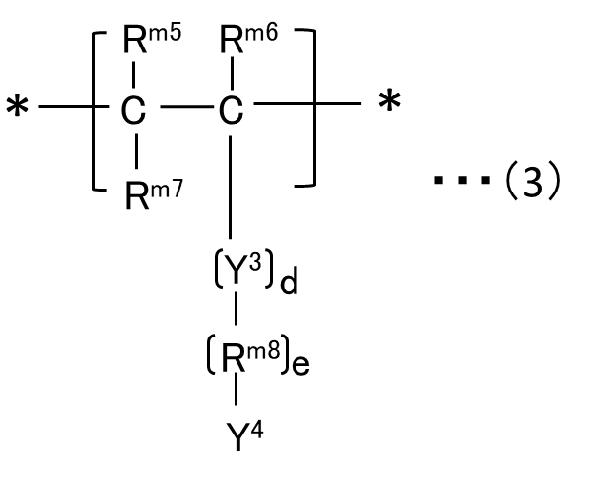
k=0であり、R1~R3及びR5がメチル基であり、かつ、R6が、炭素数2以上のアルキル基であり、より好ましくは、炭素数4以上のアルキル基であり、さらに好ましくは、炭素原子数4~30、炭素原子数4~24、炭素原子数4~18、炭素原子数4~12、又は炭素数4~8のアルキル基であり、特にはペンチル基である。この場合には、特に優れた自己修復性を有する化粧料を得ることができる。
(X1)pが、-(CH2)3-N(COCH3)-であり、かつjが1以上の整数であり、かつ/又は
(X2)qが、-R11-CO-O-又は-R11-CO-N(H)-であり、R11は置換基を有していてもよい炭素数1~12のアルキレン基、特には炭素数3~6のアルキレン基であり、かつkが1以上の整数である。
上記の式(1)又は式(2)において、h、i、j、及びkそれぞれによって添え字されている各構成単位について、上記の式(1)又は式(2)で表される構造を構成する構成単位の全ての合計に対する各構成単位の存在比率Ph,Pi、Pj,及びPkを、それぞれ、下記のとおり定義することができる。
Ph=100 × h/(h+i+j+k)
Pi=100 × i/(h+i+j+k)
Pj=100 × j/(h+i+j+k)
Pk=100 × k/(h+i+j+k)
本開示に係る化粧料の1つの実施態様では、
化粧料に含有されるホスト基を有する高分子化合物が、側鎖にホスト基を有しており、かつ
化粧料に含有されるゲスト基を有する高分子化合物が、側鎖にゲスト基を有する。
化粧料に含有されるホスト基を有する高分子化合物が、側鎖にホスト基を有しており、かつ
化粧料に含有されるゲスト基を有する高分子化合物が、末端にゲスト基を有する。
化粧料に含有されるホスト基を有する高分子化合物が、末端にホスト基を有しており、かつ
化粧料に含有されるゲスト基を有する高分子化合物が、側鎖にゲスト基を有する。
本開示に係る1つの実施態様では、化粧料に含まれるホスト基を有する高分子化合物又はゲスト基を有する高分子化合物が、シロキサン結合を含んでいない。この実施態様において、シロキサン結合を含んでいない高分子化合物(以下、「非シロキサン高分子化合物」ともいう。)としては、例えば、ビニル化合物、アクリル化合物、オレフィン、スチレン、アクリル酸エステル、及びメタクリル酸エステルから選択される少なくとも1つのモノマーの重合体及び共重合体、並びにこれらの重合体及び共重合体を含むブロック共重合体、が挙げられ、例えば、ビニル樹脂、アクリル樹脂、ウレタン樹脂、エポキシ樹脂、ポリイミド樹脂、ポリエステル樹脂、又はポリカーボネート樹脂が挙げられる。これらの樹脂は、ホスト基及び/又はゲスト基以外の置換基を有していてよい。ゲスト基及び/又はホスト基を有しており、かつシロキサン結合を含まない高分子化合物については、特許文献2の記載を参照することができる。
例えば、本開示に係る化粧料は、下記(i)~(iv)のうちの少なくともいずれかの高分子化合物を有していてよい:
(i)ホスト基を有する非シロキサン高分子化合物、及び、ゲスト基を有するシロキサン高分子化合物;
(ii)ホスト基を有するシロキサン高分子化合物、及び、ゲスト基を有する非シロキサン高分子化合物;
(iii)ホスト基を有するシロキサン高分子化合物、及び、ゲスト基を有するシロキサン高分子化合物;
(iv)ホスト基及びゲスト基を有するシロキサン高分子化合物。
化粧料が、ホスト基を有する高分子化合物及びゲスト基を有する高分子化合物を含む場合、化粧料におけるそれぞれの含有割合は、特に限定されない。例えば、ホスト基を有する高分子化合物及びゲスト基を有する高分子化合物の合計に対して、ホスト基を有する高分子化合物の含有量が10~90質量%であってよく、かつゲスト基を有する高分子化合物の含有量が90質量%~10質量%であってよい。
〈高分子化合物の製造:ホスト基を有する非シロキサン高分子化合物〉
ホスト基を有する高分子化合物であってシロキサン結合を含まないもの(ホスト基を有する非シロキサン高分子化合物)は、公知の方法によって製造することができ、例えば、特許文献2に記載されている方法によって製造することができる。
ゲスト基を有する高分子化合物であってシロキサン結合を含まないもの(ゲスト基を有する非シロキサン高分子化合物)は、公知の方法によって製造することができ、例えば、特許文献2に記載されている方法によって製造することができる。
ホスト基を有するシロキサン高分子化合物は、例えば、下記の工程を有する方法によって製造することができる:
(i)シロキサン結合を有する高分子化合物(シロキサン高分子化合物)を提供する、高分子提供工程、
(ii)ホスト基前駆体化合物を提供する、ホスト基前駆体提供工程
(iii)シロキサン高分子化合物及びホスト基前駆体化合物を、金属触媒の存在下で反応させて、ホスト基を有するシロキサン高分子化合物を得る、ホスト基付加反応工程。
高分子提供工程では、シロキサン結合を有する高分子化合物(シロキサン高分子化合物)を提供する。シロキサン結合を有する高分子化合物は、好ましくは、ポリオルガノシロキサンである。シロキサン結合を有する高分子化合物は、好ましくは、ホスト基前駆体化合物との反応に適した構造を有しており、例えば、Siに直接結合した水素原子を有している。

ホスト基前駆体提供工程では、ホスト基前駆体化合物を提供する。ホスト基前駆体化合物は、好ましくは、シロキサン結合を有する高分子化合物に結合するためのリンカー構造を有する。ホスト基前駆体化合物としては、例えば、リンカー構造を有するシクロデキストリンが挙げられる。リンカー構造としては、例えば、ビニル基が挙げられ、特には下記の式(XL)で表される基が挙げられる。
C(H)2=C(H)-C(H)2-N(COCH3)-* ・・・(XL)
[式(XL)中、*は、シクロデキストリンとの単結合を表す。]
ホスト基付加反応工程では、シロキサン高分子化合物及びホスト前駆体化合物を、金属触媒の存在下で反応させて、ホスト基を有するシロキサン高分子化合物を得る。例えば、主鎖のSiに直接結合した水素原子を有するシロキサン高分子化合物と、リンカー構造としてビニル基を有するシクロデキストリンとを、金属触媒の存在下で反応させることによって、シクロデキストリンがリンカー構造を介して主鎖のSi原子に結合したシロキサン高分子化合物を得ることができる。
上記のホスト基付加反応工程で使用される金属触媒としては、白金(Pt)が挙げられる。
ゲスト基を有するシロキサン高分子化合物は、例えば、下記の工程を有する方法によって製造することができる:
(i)シロキサン結合を有する高分子化合物(シロキサン高分子化合物)を提供する、高分子提供工程、
(ii)ゲスト基前駆体化合物を提供する、ゲスト基前駆体提供工程、
(iii)シロキサン高分子化合物及びゲスト基前駆体化合物を溶媒中で反応させて、ゲスト基を有するシロキサン高分子化合物を得る、反応工程。
高分子提供工程では、カルボキシ基を有するシロキサン結合を有する高分子化合物を提供する。シロキサン結合を有する高分子化合物は、好ましくは、ポリオルガノシロキサンである。高分子提供工程で提供されるシロキサン結合を有する高分子化合物は、好ましくは、ゲスト基前駆体化合物と反応してゲスト基を有するシロキサン高分子化合物を生ずるために適した構造を有しており、例えば、炭素数1~12のアルキレン基を介して主鎖のSiに結合したカルボキシ基を有する。
ゲスト基前駆体提供工程では、ゲスト基前駆体化合物を提供する。ゲスト基前駆体化合物は、好ましくは、シロキサン結合を有する高分子化合物に結合するためのリンカー構造を有する。ゲスト基前駆体化合物としては、具体的には、例えば、リンカー構造を有するアダマンチルが挙げられる。リンカー構造としては、例えば、アミノ基が挙げられる。
反応工程では、シロキサン高分子化合物及びゲスト基前駆体化合物を溶媒中で反応させて、ゲスト基を有するシロキサン高分子化合物を得る。例えば、アルキル基を介して主鎖のSiに結合したカルボキシ基を有するシロキサン高分子化合物と、リンカー構造としてアミノ基を有するアダマンチルとを、縮合剤の存在下において溶媒中で反応させることによって、ゲスト基を有するシロキサン高分子化合物を得ることができる。なお、この場合、ゲスト基を有するシロキサン高分子化合物は、アダマンチルが、リンカー構造を介してシロキサン高分子化合物の主鎖を構成するSi原子に結合した構造を有している。縮合剤としては、例えば、1-ヒドロキシベンゾトリアゾール(HOBt;東京化成工業株式会社、H0468、Cas:80029-43-2)及びN,N′-ジシクロヘキシルカルボジイミド(DCC;ナカライテスク株式会社、11913-52、Cas:538-75-0)を挙げることができる。
ホスト基及びゲスト基を有するシロキサン高分子化合物は、例えば、上記の方法によって製造されたホスト基を有するシロキサン高分子化合物、及び上記の方法によって製造されたゲスト基を有するシロキサン高分子化合物を重合させてブロック共重合体を形成することによって得ることができる。
ホスト基及び/又はゲスト基を有しかつシロキサン結合を有する高分子化合物は、例えば、下記の式(5)で表されるモノマーと式(6)で表されるモノマーとを重合反応させて製造することもできる。重合反応の様式は特に限定されず、公知の方法を用いることができる。


本開示に係る化粧料の1つの実施態様では、ホスト基を有する高分子化合物及びゲスト基を有する高分子化合物の少なくともいずれか、又はホスト基及びゲスト基を有する高分子化合物が、架橋されている。架橋は、ホスト-ゲスト相互作用以外の、例えば共有結合による架橋(例えばシロキサン架橋)であってよい。
本開示に係る化粧料は、例えば、ホスト基を有する高分子化合物と、ゲスト基を有する高分子化合物とをそれぞれ個別に製造し、得られたホスト基を有する高分子化合物と、ゲスト基を有する高分子化合物とをそれぞれ混合することで調製することができる。ホスト基を有する高分子化合物と、ゲスト基を有する高分子化合物とを混合するにあたっては、例えば、両者とも固体状態で混合してよく、一方若しくは両方が液体の状態で混合してもよく、又は、一方若しくは両者を溶液にした状態で混合してよい。一方の高分子化合物の溶液に、他方の高分子化合物を固体状態で添加する方法でもよい。
化粧料を化粧塗膜として成形する方法は特に限定されない。例えば、高分子化合物の溶液又は分散液を調製し、この溶液又は分散液を塗布することによって、化粧料を化粧塗膜に形成することができる。
ホスト基を有する高分子化合物を溶媒に溶解させてホスト溶液を作製すること、及び
このホスト溶液にゲスト基を有する高分子化合物を加えることによって化粧料Aを作製すること。
化粧料Aを指で対象物に塗布し、かつ乾燥させて、化粧塗膜を形成すること。
ペースト状又は液体状のホスト基を有する高分子化合物と、ペースト状又は液体状のゲスト基を有する高分子化合物とを混合して化粧料Bを作成すること。
上記の化粧料Bを、対象物に塗布して、化粧塗膜を形成すること。
本開示に係る化粧料は、上述の成分以外に、さらに溶媒を含有することができる。溶媒をさらに有していることによって、肌等への塗布性が特に優れている化粧料を提供することができる。
本開示に係る化粧料は、本発明の効果を損なわない程度で、上述の成分以外の各主成分を含有することができ、例えば、低級アルコール、高級アルコール、球状粉末、皮膜形成剤、清涼剤、油性成分、界面活性剤、水性成分、水溶性高分子、紫外線吸収剤、保湿剤、褐色防止剤、酸化防止剤、消泡剤、美容成分、防腐剤、金属イオン封止剤、血行促進剤、各種抽出液、無機顔料、有機顔料、鉱物、有機染料等の色剤、色素、増粘剤、pH調整剤、冷感剤、制汗剤、殺菌剤、皮膚賦活剤、香料等を、各種の効果を付与するために適宜含有することができる。
下記に示す測定及び評価は、以下の方法で行った。
核磁気共鳴(NMR)スペクトルを、機器として日本電子ECA500用いて記録した。計測は、25℃で行った。重水素化クロロホルムを、溶媒として使用した。NMR化学シフトは、7.26ppm(クロロホルム)における残存溶媒ピークに対して、ppm(パーツパーミリオン)で、記録した。
フーリエ変換赤外スペクトルを、日本分光FT/IR 6100スペクトロメータによって、500cm-1~4000cm-1の範囲で計測した。
MALDI-TOF MSスペクトルは、機器としてBruker autoflex maX LRFを用いて計測した。
元素分析は、差動熱伝導度法に基づいて、元素分析装置(ヤナコ製、CHNコーダー)を用いて行った。

下記の方法に従って、化合物1を製造した:
化合物0(βシクロデキストリン-OTs;C-6 monotosylate d-β-CD)を、Tetrahedron Letters、Vol.25、No.31、3331-3334、1984に記載の方法に従って製造した。30.0 g(23.28 mmol)の化合物0を、300 g(5.25mol)のアリルアミンに溶解した後に、一晩還流した。そして、この反応溶液を、エバポレーターで減圧乾燥して、乾固物を得た。得られた乾固物を、600mLのアセトニトリルに加えて、溶解させた。そして、溶液中の沈殿を吸引ろ過で回収し、600mLのアセトニトリルへ加え溶解させた。そして、溶液中の沈殿を吸引ろ過で回収し、100℃のバキュームオーブンで一晩にわたって減圧乾燥して、化合物1を得た。
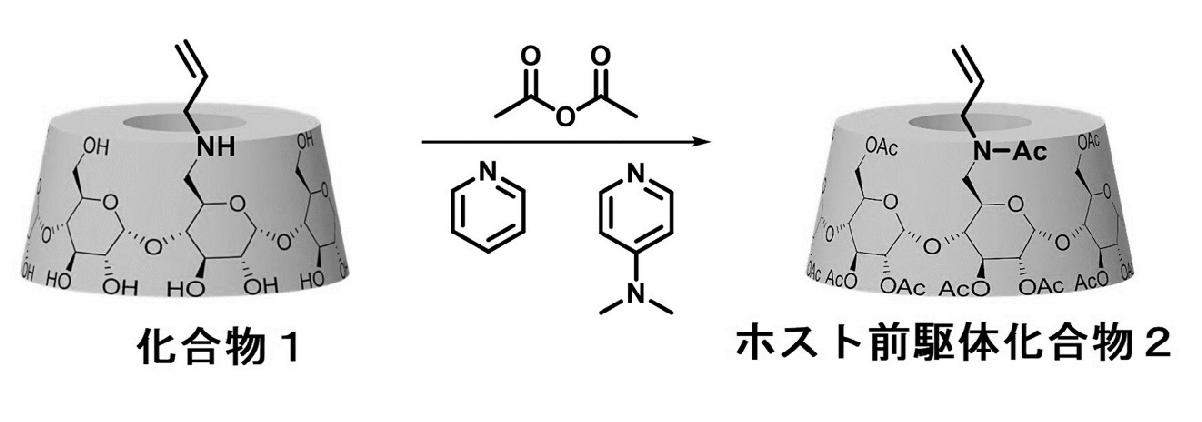
下記の方法に従って、ホスト前駆体化合物2を製造した:
上記の方法で得られた化合物1を20g(17.0mmol)用意し、これに、300 mL(300 g,3.8mol)の乾燥ピリジン、及び170mL(184g,1.8mol)の無水酢酸を加え、70℃で一晩攪拌した。そして、反応溶液を氷冷しながらメタノール60mLを滴下した。そして、反応溶液をエバポレーターで減圧乾燥して、乾固物を得た。得られた乾固物を100mLのアセトンに溶解し、水2Lへ滴下した。そして、溶液中の沈殿を吸引ろ過で回収し、かつ100mLのアセトンに溶解して得られた溶液を、水1.5Lへ滴下した。そして、溶液中の沈殿を吸引ろ過で回収し、70℃のバキュームオーブンで1日減圧乾燥して、ホスト前駆体化合物2を得た。

ホスト基を有する高分子化合物H1を、下記の方法で製造した:
1.8g(0.9mmol)のホスト前駆体化合物2をトルエン400mlに溶かして窒素置換し、105℃で攪拌した。そこへ、12.0g(14.4mmol)のメチルハイドロジェンポリシロキサン(methyl hydrogen polysiloxane;動粘度20mm2/s、有効水素量7.5mol%)及び165μLのカールステッド白金溶液を400mLトルエンに溶解させた溶液を、1時間かけて滴下によって加えた。なお、カールステッド白金溶液は、白金(0)-1,3-ジビニルテトラメチルジシロキサン コンプレックス(Platinum(0)-1,3-Divinyltetramethyldisiloxane Complex (19.0%-21.5% as Pt)、TCI製、P2075、Cas:68478-92-2製品コード:P2075)を用いて調整した。使用したPtの重量は、28.5mgであった。滴下終了から4時間後に、4.8g(48mmol)のアクリル酸エチル(Etylacrylate;東京化成工業株式会社製、Cas:140-88-5)を、注射器によって加えた。得られた反応液のうち10gを、イソドデカン(マルカゾールR,丸善石油化学株式会社)114mlに溶かした。溶け残った未反応CD(0.499g)を、酢酸エチルへの抽出によって除いて、イソドデカンに溶解した、ホスト基を有する高分子化合物H1を得た。
0.6g(0.3mmol)のホスト前駆体化合物2、4.0g(4.8mmol)のメチルハイドロジェンポリシロキサン、及び55μLのカールステッド白金溶液を使用したこと以外は、上記のホスト基を有する高分子化合物H1の製造と同様にして、ホスト基を有する高分子化合物H2を製造した。
4.0g(4.8mmol)のホスト前駆体化合物2、4.0g(4.8mmol)のメチルハイドロジェンポリシロキサン、及び55μLのカールステッド白金溶液を使用し、溶媒量を調整し主鎖シリコーン濃度を34.3mmolとしたこと以外は、上記のホスト基を有する高分子化合物H1の製造と同様にして、ホスト基を有する高分子化合物H3を製造した。
2.4g(1.2mmol)のホスト前駆体化合物2、16.0g(19.2mmol)のメチルハイドロジェンポリシロキサン、及び220μLのカールステッド白金溶液を使用したこと以外は、上記のホスト基を有する高分子化合物H1の製造と同様にして、ホスト基を有する高分子化合物H4を製造した。
0.6g(0.3mmol)のホスト前駆体化合物2、2.0g(2.4mmol)のメチルハイドロジェンポリシロキサン、及び55μLのカールステッド白金溶液を使用したこと以外は、上記のホスト基を有する高分子化合物H1の製造と同様にして、ホスト基を有する高分子化合物H5を製造した。
0.6g(0.3mmol)のホスト前駆体化合物2、4.0g(4.8mmol)のメチルハイドロジェンポリシロキサン、及び55μLのカールステッド白金溶液を使用したこと以外は、上記のホスト基を有する高分子化合物H1の製造と同様にして、ホスト基を有する高分子化合物H6を製造した。
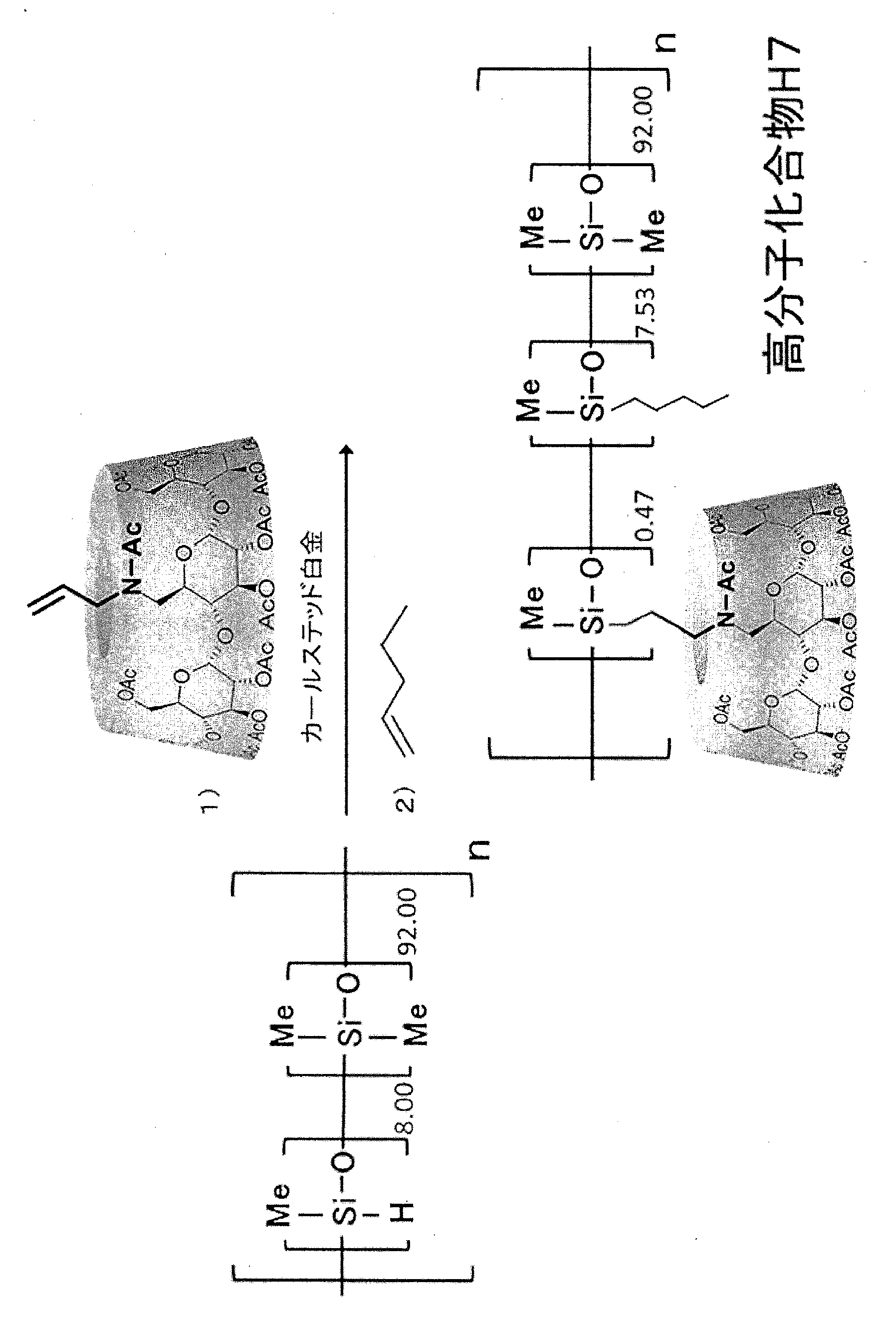
ホスト基を有する高分子化合物H7を、下記の方法で製造した:
1.8g(0.9mmol)のホスト前駆体化合物2をトルエン900mlに溶かして窒素置換し、105℃で攪拌した。そこへ、12.0g(11.48mmol)のメチルハイドロジェンポリシロキサン及び165.0μLのカールステッド白金溶液を250mLのトルエンに溶解させた溶液を、30分間かけて滴下によって加えた。なお、カールステッド白金溶液は、白金(0)-1,3-ジビニルテトラメチルジシロキサン コンプレックス(Platinum(0)-1,3-Divinyltetramethyldisiloxane Complex (19.0%-21.5% as Pt)、TCI製、P2075、Cas:68478-92-2製品コード:P2075)を用いて調整した。使用したPtの重量は、28.2mgであり、反応溶液中の試薬濃度は、[Pt]=0.09mMであった。滴下終了から4時間後に、2.0g(29.0mmol)の1-Pentene(東京化成工業社製)を加えた。一晩にわたって還流を行い、エバポレーターによってトルエンを留去した後、ヘキサンに溶解し、遠心分離器によって沈殿物を取り除いて、ヘキサンに溶解したホスト基を有する高分子化合物H7を得た。
3.6g(1.8mmol)のホスト前駆体化合物2のホスト前駆体化合物を使用したこと以外は、上記のホスト基を有する高分子化合物H7の製造と同様にして、ホスト基を有する高分子化合物H8を製造した。高分子化合物H8のホスト基導入率は、0.63mol%であった。
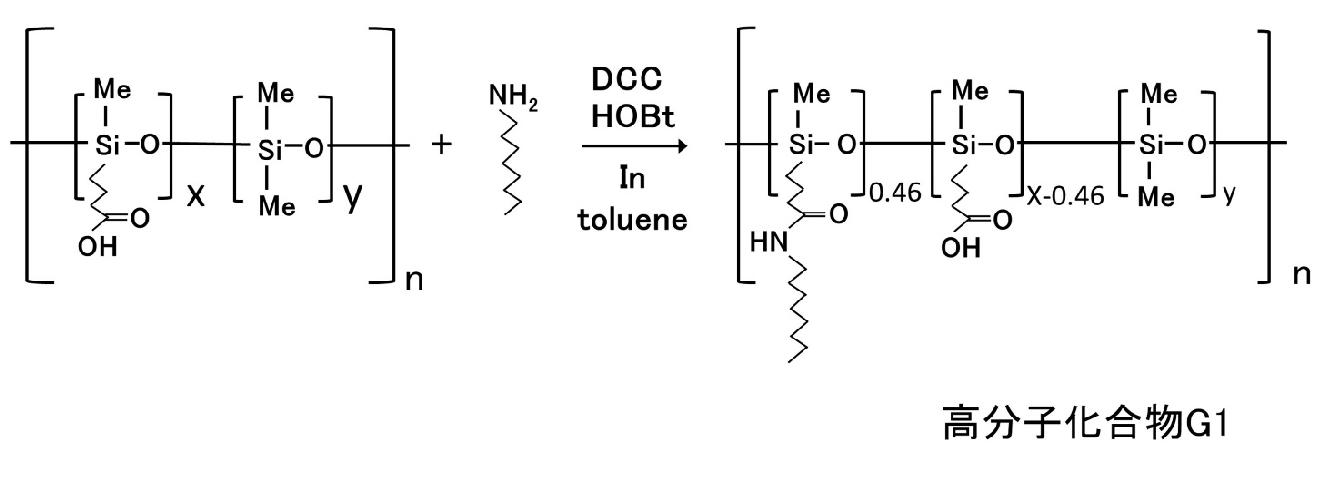
10.0g(1.3mol)の側鎖型カルボキシル変性シリコーンオイル(信越シリコーン社製、X-22-3701E、カルボキシル基当量=4,000g/mol)を100mLのトルエンに溶解させて、溶液1を得た。そして、この溶液1に、68.24mg(0.5mol)のHOBtを加えて溶液2を得た。そして、トルエン50mLに溶解させた104.19mg(0.5mol)のDCCをこの溶液2に加えて、溶液3を得た。そして、65.26mg(0.5mmol)のN-オクチルアミン(ナカライテスク(株)、25512-72、Cas:111-86-4)を50mLのトルエンに分散させ、溶液3に加えて溶液4を得た。この溶液4を1晩撹拌して、透明な上澄み液と白い沈殿を得た。この白い沈殿をろ過によって取り除いて、透明なろ液を得た。この透明なろ液を飽和重曹水で洗浄し、かつ無水硫酸ナトリウムにて脱水した。エバポレータでトルエンを取り除いて、無色透明のオイルを得た。この無色透明のオイルを、85℃で一晩真空乾燥させて、ゲスト基を有する高分子化合物G1を得た。
製造例11と同様の方法によって、高分子化合物G1’を得た。高分子化合物G1’におけるゲスト基導入率は、0.51mol%であった。

10000mg(1.3mol)の側鎖型カルボキシル変性シリコーンオイル、及び、N-オクチルアミンの代わりに95.7mg(0.63mmol)の1-アダマンチルアミン(富士フイルムワコーケミカル社製)を用いたこと以外は、上記のゲスト基を有する高分子化合物G1の製造と同様にして、ゲスト基を有する高分子化合物G2を製造した。

Macromolecules 2019,52(7)、2659-2668に記載の方法に従って、ポリエチルアクリレート主鎖を有し、かつホスト基としてγ-シクロデキストリンを有する高分子化合物CH-4を製造した。なお、得られる高分子化合物中においてホスト基を有するユニットが1.0mol%となるように、製造を行った。
上述の製造例7のとおりに製造したホスト基を有する高分子化合物H5と、上述の製造例11のとおりに製造したゲスト基を有する高分子化合物G1を、イソドデカンに溶解させ、かつ下記の表1に示される追加の化合物を、表1に示されている量で添加することによって、実施例1に係る化粧料を製造した。
(a)つっぱり感
(b)密着感
(c)はり感
(d)化粧持ち。
つっぱり感は、下記の3段階基準によって評価判定した:
(判定):(評価基準)
〇 :つっぱり感がない。
△ :ややつっぱり感がある。
× :つっぱり感がある。
密着感は、下記の3段階基準によって評価判定した:
(判定):(評価基準)
◎ :密着感が特に優れている
〇 :密着感がある
× :密着感がない
はり感は、下記の3段階基準によって評価判定した:
(判定):(評価基準)
〇 :はり感がある。
△ :ややはり感がある。
× :はり感が無い。
化粧持ちの良さについては、下記の3段階基準によって評価判定した:
(判定):(評価基準)
〇 :優れている
△ :ふつう
× :劣る
上述の製造例7のとおりに製造したホスト基を有する高分子化合物H5と、上述の製造例13のとおりに製造したゲスト基を有する高分子化合物G2を、イソドデカンに溶解させ、かつ下記の表1に示される追加の化合物を、表1に示されている量で添加することによって、実施例2に係る化粧料を製造した。
上述の製造例9のとおりに製造したホスト基を有する高分子化合物H7と、上述の製造例11のとおりに製造したゲスト基を有する高分子化合物G1を、イソドデカンに溶解させ、かつ下記の表1に示される追加の化合物を、表1に示されている量で添加することによって、実施例3に係る化粧料を製造した。
高分子化合物H5及び高分子化合物G1のイソドデカン溶液の代わりにトリメチルシロキシケイ酸(MOMENTIVE社製、SR1000)を用いたこと以外は、実施例1と同様にして、比較例1に係る化粧料を製造した。
高分子化合物H5及び高分子化合物G1のイソドデカン溶液の代わりにシリコーンレジン(シロキサン架橋物、Silform Flexible Resin(商品名)(MOMENTIVE社製)を用いたこと以外は、実施例1と同様にして、比較例2に係る化粧料を製造した。

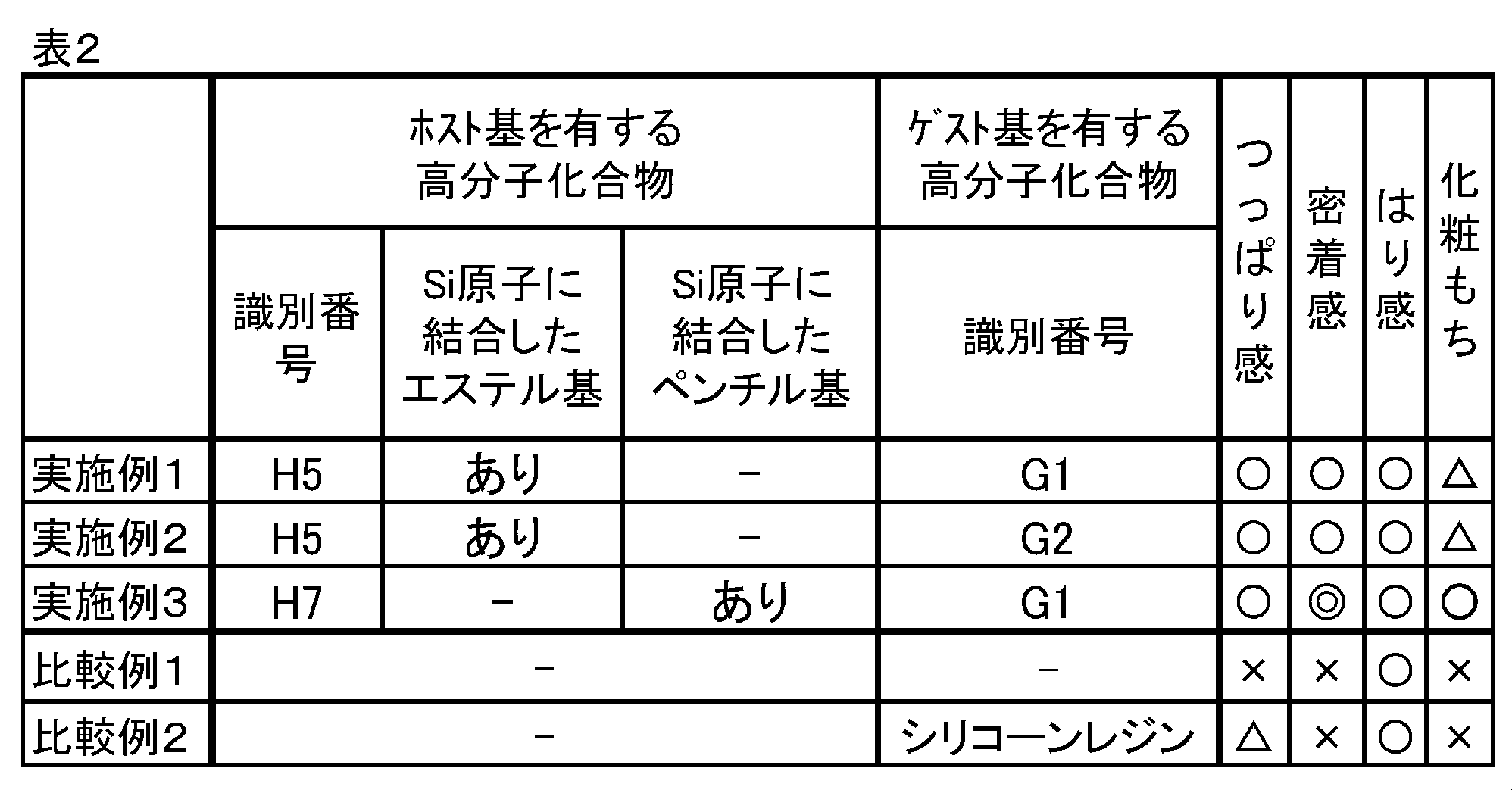
上述の製造例15に係るホスト基を有する高分子化合物CH-4と、上述の比較例2で用いたのと同じシロキサン架橋物とを用いて、実施例1と同様にして、化粧料の製造及び評価を行った。結果を下記の表3に示す。
上述の製造例15に係るホスト基を有する高分子化合物CH-4と、上述の製造例13に係るゲスト基を有する高分子化合物G2とを用いて、実施例1と同様にして、化粧料の製造及び評価を行った。結果を下記の表3に示す。

Claims (23)
- ホスト基を有する高分子化合物からなるホスト体及びゲスト基を有する高分子化合物からなるゲスト体、又は、ホスト基及びゲスト基を有する高分子化合物からなるホスト-ゲスト体を含有し、かつ、
前記ホスト基を有する高分子化合物及び前記ゲスト基を有する高分子化合物のうちの少なくともいずれか、又は前記ホスト基及びゲスト基を有する高分子化合物が、シロキサン結合を含んでいる、化粧料。 - 前記ホスト基を有する高分子化合物及び前記ゲスト基を有する高分子化合物が、シロキサン結合を含んでいる、請求項1に記載の化粧料。
- 前記ホスト基を有する高分子化合物及び前記ゲスト基を有する高分子化合物のうちの少なくともいずれか、又は前記ホスト基及びゲスト基を有する高分子化合物が、主鎖にシロキサン結合を含んでいる、請求項1に記載の化粧料。
- 前記ホスト基を有する高分子化合物及び前記ゲスト基を有する高分子化合物が、主鎖にシロキサン結合を含んでいる、請求項3に記載の化粧料。
- 前記ホスト基を有する高分子化合物が、側鎖にホスト基を有しており、かつ
前記ゲスト基を有する高分子化合物が、側鎖にゲスト基を有している、
請求項1~4のいずれか一項に記載の化粧料。 - 前記ホスト基を有する高分子化合物が、側鎖にホスト基を有しており、かつ
前記ゲスト基を有する高分子化合物が、末端にゲスト基を有している、
請求項1~4のいずれか一項に記載の化粧料。 - 前記ホスト基を有する高分子化合物が、末端にホスト基を有しており、かつ
前記ゲスト基を有する高分子化合物が、側鎖にゲスト基を有している、
請求項1~4のいずれか一項に記載の化粧料。 - 前記ホスト基を有する高分子化合物及び前記ゲスト基を有する高分子化合物の少なくともいずれか、又は前記ホスト基及びゲスト基を有する高分子化合物が、架橋されている、
請求項1~7のいずれか一項に記載の化粧料。 - 前記ホスト基を有する高分子化合物及び前記ゲスト基を有する高分子化合物のうちの少なくともいずれか、又は前記ホスト基及びゲスト基を有する高分子化合物が、下記の式(1)で表される構造を有する、請求項1~8のいずれか一項に記載の化粧料:

- 前記ホスト基を有する高分子化合物及び前記ゲスト基を有する高分子化合物が、前記式(1)で表される構造を有する、請求項9に記載の化粧料。
- 前記ホスト基を有する高分子化合物及び前記ゲスト基を有する高分子化合物のうちの少なくともいずれか、又は前記ホスト基及びゲスト基を有する高分子化合物が、主鎖に、前記式(1)で表される構造を有する、請求項9又は10に記載の化粧料。
- 前記ホスト基を有する高分子化合物及び前記ゲスト基を有する高分子化合物のうちの少なくともいずれか、又は前記ホスト基及びゲスト基を有する高分子化合物が、
ビニル主鎖、アクリル主鎖、ウレタン主鎖、エポキシ主鎖、ポリイミド主鎖、ポリエステル主鎖、ポリウレア主鎖、又はポリカーボネート主鎖を有しており、かつ、
側鎖に、前記式(1)で表される構造を有している、
請求項9又は10に記載の化粧料。 - 前記ホスト基を有する高分子化合物及び前記ゲスト基を有する高分子化合物のうちの少なくともいずれか、又は前記ホスト基及びゲスト基を有する高分子化合物が、下記の式(2)で表される構造単位を有する、請求項1~12のいずれか一項に記載の化粧料:

- 前記ホスト基を有する高分子化合物及び前記ゲスト基を有する高分子化合物が、前記式(2)で表される構造を有する、請求項13に記載の化粧料。
- 前記ホスト基を有する高分子化合物及び前記ゲスト基を有する高分子化合物のうちの少なくともいずれか、又は前記ホスト基及びゲスト基を有する高分子化合物が、下記の式(3)で表される構造単位をさらに有する、請求項13又は14に記載の化粧料:

- 前記式(1)及び/又は前記式(2)において、
RYで表されるホスト基が、α-シクロデキストリン、β-シクロデキストリン、又はγ-シクロデキストリンであり、かつ、
RZで表されるゲスト基が、置換基を有してもよいアルキル基、又は置換基を有してもよいアリール基である、
請求項9~15のいずれか一項に記載の化粧料。 - 前記式(1)及び/又は前記式(2)において、
R1、R2、R3、R4及びR5が、メチル基である、
請求項9~16のいずれか一項に記載の化粧料。 - 前記式(1)及び/又は前記式(2)において、
k=0であり、かつ、
R1~R3、R5、及びR6が、アルキル基である、
請求項9~16のいずれか一項に記載の化粧料。 - 前記式(1)及び/又は前記式(2)において、
k=0であり、
R1~R3及びR5が、メチル基であり、かつ
R6が、ペンチル基である、
請求項9~16のいずれか一項に記載の化粧料。 - 前記式(1)又は(2)において、
(X1)pが、-(CH2)3-N(COCH3)-であり、かつjが1以上の整数であり、かつ/又は
(X2)qが、-R11-CO-O-又は-R11-CO-NH-であり、R11は置換基を有していてもよい炭素数1~12のアルキレン基であり、かつkが1以上の整数である、
請求項9~19のいずれか一項に記載の化粧料。 - 前記ホスト基と前記ゲスト基が、以下の組み合わせ(a)~(c)のいずれか1種である、請求項1~20のいずれか一項に記載の化粧料:
(a)前記ホスト基が、α-シクロデキストリンであって、かつ、
前記ゲスト基が、(1)炭素数4~18の直鎖アルキル基、(2)水酸基を有する炭素数4~18の直鎖アルキル基、(3)カルボキシル基を有する炭素数4~18の直鎖アルキル基、(4)アミノ基を有する炭素数4~18の直鎖アルキル基、(5)環状アルキル基、(6)フェニル基、(7)アゾベンゼン基、及び(8)桂皮酸基からなる群から選ばれた少なくとも1種である;
(b)前記ホスト基が、β-シクロデキストリンであって、かつ、
前記ゲスト基が、(1′)t-ブチル基、(2′)アダマンチル基、(3′)アリール基、(4′)水酸基を有するアリール基、(5′)カルボキシル基を有するアリール基、(6′)アミノ基を有するアリール基、(7′)フェロセニル基、(8′)アゾベンゼン基、及び(9′)ダンシル基からなる群から選ばれた少なくとも1種である;
(c)前記ホスト基が、γ-シクロデキストリンであって、かつ、
前記ゲスト基が、(1′′)炭素数18までのアルキル基、(2′′)水酸基を有する炭素数18までのアルキル基、(3′′)カルボキシル基を有する炭素数18までのアルキル基、(4′′)アミノ基を有する炭素数18までのアルキル基、(5′′)アダマンチル基、(6′′)炭素原子で構成されるクラスター類を有する基、(7′′)アリール基を有するダンシル基、(8′′)フェロセニル基、及び(9′′)アントラセニル基からなる群から選ばれた少なくとも1種である。 - 溶媒をさらに含む、請求項1~19のいずれか一項に記載の化粧料。
- 前記溶媒が、揮発性のシリコーン、又は揮発性の炭化水素化合物である、請求項20に記載の化粧料。
Priority Applications (5)
| Application Number | Priority Date | Filing Date | Title |
|---|---|---|---|
| JP2022503716A JPWO2021172463A1 (ja) | 2020-02-25 | 2021-02-25 | |
| EP21761787.7A EP4112040A4 (en) | 2020-02-25 | 2021-02-25 | COSMETICS WITH SILOXANE LINKAGE-CONTAINING POLYMER COMPOUND WITH A HOST GROUP AND/OR GUEST GROUP |
| CN202180016392.9A CN115135300B (zh) | 2020-02-25 | 2021-02-25 | 包含具有主体基团和/或客体基团的含硅氧烷键的高分子化合物的化妆品 |
| US17/802,042 US20230107893A1 (en) | 2020-02-25 | 2021-02-25 | Cosmetic containing siloxane linkage-containing polymer compound having host group and/or guest group |
| KR1020227028553A KR20220145828A (ko) | 2020-02-25 | 2021-02-25 | 호스트기 및/또는 게스트기를 갖는 실록산 결합 함유 고분자 화합물을 포함하는 화장료 |
Applications Claiming Priority (2)
| Application Number | Priority Date | Filing Date | Title |
|---|---|---|---|
| JP2020-029779 | 2020-02-25 | ||
| JP2020029779 | 2020-02-25 |
Publications (1)
| Publication Number | Publication Date |
|---|---|
| WO2021172463A1 true WO2021172463A1 (ja) | 2021-09-02 |
Family
ID=77491518
Family Applications (1)
| Application Number | Title | Priority Date | Filing Date |
|---|---|---|---|
| PCT/JP2021/007182 Ceased WO2021172463A1 (ja) | 2020-02-25 | 2021-02-25 | ホスト基及び/又はゲスト基を有するシロキサン結合含有高分子化合物を含む化粧料 |
Country Status (7)
| Country | Link |
|---|---|
| US (1) | US20230107893A1 (ja) |
| EP (1) | EP4112040A4 (ja) |
| JP (1) | JPWO2021172463A1 (ja) |
| KR (1) | KR20220145828A (ja) |
| CN (1) | CN115135300B (ja) |
| TW (1) | TW202145998A (ja) |
| WO (1) | WO2021172463A1 (ja) |
Citations (5)
| Publication number | Priority date | Publication date | Assignee | Title |
|---|---|---|---|---|
| JP2005536653A (ja) * | 2002-08-23 | 2005-12-02 | ワツカー−ケミー ゲゼルシヤフト ミツト ベシユレンクテル ハフツング | シクロデキストリン残基を含む有機ケイ素化合物 |
| JP2015512955A (ja) * | 2011-12-30 | 2015-04-30 | ユニバーシティ オブ ワシントン スルー イッツ センター フォー コマーシャリゼーション | 狭帯域発光を有する蛍光性ポリマードット |
| US20180362814A1 (en) * | 2017-06-14 | 2018-12-20 | City University Of Hong Kong | Adhesive system, method of manufacture thereof and biological kit comprising same |
| CN110746943A (zh) * | 2019-10-22 | 2020-02-04 | 中国石油大学(华东) | 一种非氟硅超临界二氧化碳流体增黏剂、制备方法及应用 |
| WO2021045203A1 (ja) * | 2019-09-05 | 2021-03-11 | 国立大学法人大阪大学 | 高分子材料及びその製造方法 |
Family Cites Families (13)
| Publication number | Priority date | Publication date | Assignee | Title |
|---|---|---|---|---|
| JP3484303B2 (ja) * | 1996-11-08 | 2004-01-06 | 花王株式会社 | 化粧料 |
| EP1736138B1 (en) * | 2004-03-31 | 2012-09-19 | Shin-Etsu Chemical Co., Ltd. | Cosmetic preparation containing silicone polymer |
| JP2012036069A (ja) | 2010-08-03 | 2012-02-23 | Hosen:Kk | 鶏糞炭ペレットの製造方法及び鶏糞炭ペレット |
| JP5615373B2 (ja) * | 2010-09-14 | 2014-10-29 | 国立大学法人大阪大学 | 分子認識に基づいた物質材料の選択的接着法および自己組織化法 |
| JP6611433B2 (ja) * | 2012-01-04 | 2019-11-27 | モメンティブ パフォーマンス マテリアルズ インコーポレイテッド | シリコーンイオノマーのポリマー複合体 |
| JP5668707B2 (ja) | 2012-02-07 | 2015-02-12 | トヨタ自動車株式会社 | 半導体モジュール |
| US10391569B2 (en) * | 2015-02-13 | 2019-08-27 | The Gleason Works | Lock spring and cutting tool having a lock spring |
| KR102453363B1 (ko) * | 2015-09-30 | 2022-10-07 | (주)아모레퍼시픽 | 묻어남이 개선된 메이크업 조성물 및 이의 제조 방법 |
| KR102224355B1 (ko) * | 2016-09-30 | 2021-03-09 | (주)아모레퍼시픽 | 극차광 재배 녹차 추출물을 함유하는 피부 외용제 조성물 |
| FR3061428A1 (fr) * | 2016-12-29 | 2018-07-06 | L'oreal | Composition cosmetique superhydrophobe sous forme d'aerosol |
| WO2019111831A1 (ja) | 2017-12-04 | 2019-06-13 | 花王株式会社 | 油中水型乳化化粧料 |
| CN109966208A (zh) * | 2019-04-19 | 2019-07-05 | 湖南博隽生物医药有限公司 | 一种卸妆面膜及其制作方法 |
| US20230100274A1 (en) * | 2020-02-25 | 2023-03-30 | Shiseido Company, Ltd. | Resin material including siloxane-bond-containing polymer having host group and/or guest group |
-
2021
- 2021-02-25 WO PCT/JP2021/007182 patent/WO2021172463A1/ja not_active Ceased
- 2021-02-25 TW TW110106780A patent/TW202145998A/zh unknown
- 2021-02-25 KR KR1020227028553A patent/KR20220145828A/ko active Pending
- 2021-02-25 EP EP21761787.7A patent/EP4112040A4/en active Pending
- 2021-02-25 CN CN202180016392.9A patent/CN115135300B/zh active Active
- 2021-02-25 JP JP2022503716A patent/JPWO2021172463A1/ja active Pending
- 2021-02-25 US US17/802,042 patent/US20230107893A1/en active Pending
Patent Citations (5)
| Publication number | Priority date | Publication date | Assignee | Title |
|---|---|---|---|---|
| JP2005536653A (ja) * | 2002-08-23 | 2005-12-02 | ワツカー−ケミー ゲゼルシヤフト ミツト ベシユレンクテル ハフツング | シクロデキストリン残基を含む有機ケイ素化合物 |
| JP2015512955A (ja) * | 2011-12-30 | 2015-04-30 | ユニバーシティ オブ ワシントン スルー イッツ センター フォー コマーシャリゼーション | 狭帯域発光を有する蛍光性ポリマードット |
| US20180362814A1 (en) * | 2017-06-14 | 2018-12-20 | City University Of Hong Kong | Adhesive system, method of manufacture thereof and biological kit comprising same |
| WO2021045203A1 (ja) * | 2019-09-05 | 2021-03-11 | 国立大学法人大阪大学 | 高分子材料及びその製造方法 |
| CN110746943A (zh) * | 2019-10-22 | 2020-02-04 | 中国石油大学(华东) | 一种非氟硅超临界二氧化碳流体增黏剂、制备方法及应用 |
Non-Patent Citations (3)
| Title |
|---|
| MACROMOLECULES, vol. 52, no. 7, 2019, pages 2659 - 2668 |
| See also references of EP4112040A4 |
| TETRAHEDRON LETTERS, vol. 25, no. 31, 1984, pages 3331 - 3334 |
Also Published As
| Publication number | Publication date |
|---|---|
| CN115135300B (zh) | 2024-08-23 |
| CN115135300A (zh) | 2022-09-30 |
| US20230107893A1 (en) | 2023-04-06 |
| KR20220145828A (ko) | 2022-10-31 |
| EP4112040A4 (en) | 2024-06-12 |
| JPWO2021172463A1 (ja) | 2021-09-02 |
| EP4112040A1 (en) | 2023-01-04 |
| TW202145998A (zh) | 2021-12-16 |
Similar Documents
| Publication | Publication Date | Title |
|---|---|---|
| JP7174015B2 (ja) | 高屈折率シロキサン | |
| AU2006316830B2 (en) | Swollen silicone composition, process of producing same and products thereof | |
| US12338259B2 (en) | Branched organosilicon compound, method of preparing same, and copolymer formed therewith | |
| KR102861862B1 (ko) | 조성물, 공중합체의 제조 방법, 및 이의 방법 및 최종 용도 | |
| EP3906274A1 (en) | Acrylate-functional branched organosilicon compound, method of preparing same, and copolymer formed therewith | |
| JP7721090B2 (ja) | ホスト基及び/又はゲスト基を有するシロキサン結合含有高分子化合物を含む樹脂材料 | |
| JP2014159550A (ja) | シルセスキオキサンコポリマー微粒子、その製造方法、およびその使用 | |
| JP2022517913A (ja) | 分岐状有機ケイ素化合物、その調製方法、及びそれを含む組成物 | |
| JP2022516107A (ja) | 分岐状有機ケイ素化合物、その調製方法、及びそれを含む組成物 | |
| JP5139619B2 (ja) | パーソナルケア製品用シリコーン組成物および製造方法 | |
| WO2024232289A1 (ja) | ホスト基及び/又はゲスト基を有するシロキサン結合含有高分子化合物を含む組成物 | |
| WO2021172463A1 (ja) | ホスト基及び/又はゲスト基を有するシロキサン結合含有高分子化合物を含む化粧料 | |
| US10927219B2 (en) | Crosslinked silsesquioxane random copolymers absorbing both UVA and UVB and method for preparing the same | |
| CN109310891B (zh) | 交联的聚有机硅氧烷和包含其的个人护理组合物 | |
| JPH02204410A (ja) | 紫外線吸収剤 |
Legal Events
| Date | Code | Title | Description |
|---|---|---|---|
| 121 | Ep: the epo has been informed by wipo that ep was designated in this application |
Ref document number: 21761787 Country of ref document: EP Kind code of ref document: A1 |
|
| ENP | Entry into the national phase |
Ref document number: 2022503716 Country of ref document: JP Kind code of ref document: A |
|
| NENP | Non-entry into the national phase |
Ref country code: DE |
|
| ENP | Entry into the national phase |
Ref document number: 2021761787 Country of ref document: EP Effective date: 20220926 |
|
| WWW | Wipo information: withdrawn in national office |
Ref document number: 1020227028553 Country of ref document: KR |