WO2021172571A1 - 熱可塑性エラストマー組成物 - Google Patents
熱可塑性エラストマー組成物 Download PDFInfo
- Publication number
- WO2021172571A1 WO2021172571A1 PCT/JP2021/007562 JP2021007562W WO2021172571A1 WO 2021172571 A1 WO2021172571 A1 WO 2021172571A1 JP 2021007562 W JP2021007562 W JP 2021007562W WO 2021172571 A1 WO2021172571 A1 WO 2021172571A1
- Authority
- WO
- WIPO (PCT)
- Prior art keywords
- cross
- styrene
- linking
- polymer
- group
- Prior art date
- Legal status (The legal status is an assumption and is not a legal conclusion. Google has not performed a legal analysis and makes no representation as to the accuracy of the status listed.)
- Ceased
Links
Classifications
-
- C—CHEMISTRY; METALLURGY
- C08—ORGANIC MACROMOLECULAR COMPOUNDS; THEIR PREPARATION OR CHEMICAL WORKING-UP; COMPOSITIONS BASED THEREON
- C08L—COMPOSITIONS OF MACROMOLECULAR COMPOUNDS
- C08L23/00—Compositions of homopolymers or copolymers of unsaturated aliphatic hydrocarbons having only one carbon-to-carbon double bond; Compositions of derivatives of such polymers
- C08L23/26—Compositions of homopolymers or copolymers of unsaturated aliphatic hydrocarbons having only one carbon-to-carbon double bond; Compositions of derivatives of such polymers modified by chemical after-treatment
-
- C—CHEMISTRY; METALLURGY
- C08—ORGANIC MACROMOLECULAR COMPOUNDS; THEIR PREPARATION OR CHEMICAL WORKING-UP; COMPOSITIONS BASED THEREON
- C08L—COMPOSITIONS OF MACROMOLECULAR COMPOUNDS
- C08L101/00—Compositions of unspecified macromolecular compounds
- C08L101/02—Compositions of unspecified macromolecular compounds characterised by the presence of specified groups, e.g. terminal or pendant functional groups
-
- C—CHEMISTRY; METALLURGY
- C08—ORGANIC MACROMOLECULAR COMPOUNDS; THEIR PREPARATION OR CHEMICAL WORKING-UP; COMPOSITIONS BASED THEREON
- C08L—COMPOSITIONS OF MACROMOLECULAR COMPOUNDS
- C08L53/00—Compositions of block copolymers containing at least one sequence of a polymer obtained by reactions only involving carbon-to-carbon unsaturated bonds; Compositions of derivatives of such polymers
- C08L53/02—Compositions of block copolymers containing at least one sequence of a polymer obtained by reactions only involving carbon-to-carbon unsaturated bonds; Compositions of derivatives of such polymers of vinyl-aromatic monomers and conjugated dienes
-
- C—CHEMISTRY; METALLURGY
- C08—ORGANIC MACROMOLECULAR COMPOUNDS; THEIR PREPARATION OR CHEMICAL WORKING-UP; COMPOSITIONS BASED THEREON
- C08F—MACROMOLECULAR COMPOUNDS OBTAINED BY REACTIONS ONLY INVOLVING CARBON-TO-CARBON UNSATURATED BONDS
- C08F210/00—Copolymers of unsaturated aliphatic hydrocarbons having only one carbon-to-carbon double bond
- C08F210/02—Ethene
-
- C—CHEMISTRY; METALLURGY
- C08—ORGANIC MACROMOLECULAR COMPOUNDS; THEIR PREPARATION OR CHEMICAL WORKING-UP; COMPOSITIONS BASED THEREON
- C08F—MACROMOLECULAR COMPOUNDS OBTAINED BY REACTIONS ONLY INVOLVING CARBON-TO-CARBON UNSATURATED BONDS
- C08F210/00—Copolymers of unsaturated aliphatic hydrocarbons having only one carbon-to-carbon double bond
- C08F210/04—Monomers containing three or four carbon atoms
- C08F210/08—Butenes
-
- C—CHEMISTRY; METALLURGY
- C08—ORGANIC MACROMOLECULAR COMPOUNDS; THEIR PREPARATION OR CHEMICAL WORKING-UP; COMPOSITIONS BASED THEREON
- C08F—MACROMOLECULAR COMPOUNDS OBTAINED BY REACTIONS ONLY INVOLVING CARBON-TO-CARBON UNSATURATED BONDS
- C08F212/00—Copolymers of compounds having one or more unsaturated aliphatic radicals, each having only one carbon-to-carbon double bond, and at least one being terminated by an aromatic carbocyclic ring
- C08F212/02—Monomers containing only one unsaturated aliphatic radical
- C08F212/04—Monomers containing only one unsaturated aliphatic radical containing one ring
- C08F212/06—Hydrocarbons
- C08F212/08—Styrene
-
- C—CHEMISTRY; METALLURGY
- C08—ORGANIC MACROMOLECULAR COMPOUNDS; THEIR PREPARATION OR CHEMICAL WORKING-UP; COMPOSITIONS BASED THEREON
- C08F—MACROMOLECULAR COMPOUNDS OBTAINED BY REACTIONS ONLY INVOLVING CARBON-TO-CARBON UNSATURATED BONDS
- C08F222/00—Copolymers of compounds having one or more unsaturated aliphatic radicals, each having only one carbon-to-carbon double bond, and at least one being terminated by a carboxyl radical and containing at least one other carboxyl radical in the molecule; Salts, anhydrides, esters, amides, imides, or nitriles thereof
- C08F222/04—Anhydrides, e.g. cyclic anhydrides
- C08F222/06—Maleic anhydride
-
- C—CHEMISTRY; METALLURGY
- C08—ORGANIC MACROMOLECULAR COMPOUNDS; THEIR PREPARATION OR CHEMICAL WORKING-UP; COMPOSITIONS BASED THEREON
- C08K—Use of inorganic or non-macromolecular organic substances as compounding ingredients
- C08K5/00—Use of organic ingredients
- C08K5/04—Oxygen-containing compounds
- C08K5/14—Peroxides
-
- C—CHEMISTRY; METALLURGY
- C08—ORGANIC MACROMOLECULAR COMPOUNDS; THEIR PREPARATION OR CHEMICAL WORKING-UP; COMPOSITIONS BASED THEREON
- C08L—COMPOSITIONS OF MACROMOLECULAR COMPOUNDS
- C08L23/00—Compositions of homopolymers or copolymers of unsaturated aliphatic hydrocarbons having only one carbon-to-carbon double bond; Compositions of derivatives of such polymers
- C08L23/02—Compositions of homopolymers or copolymers of unsaturated aliphatic hydrocarbons having only one carbon-to-carbon double bond; Compositions of derivatives of such polymers not modified by chemical after-treatment
- C08L23/04—Homopolymers or copolymers of ethene
- C08L23/08—Copolymers of ethene
- C08L23/0807—Copolymers of ethene with unsaturated hydrocarbons only containing four or more carbon atoms
- C08L23/0815—Copolymers of ethene with unsaturated hydrocarbons only containing four or more carbon atoms with aliphatic 1-olefins containing one carbon-to-carbon double bond
-
- C—CHEMISTRY; METALLURGY
- C08—ORGANIC MACROMOLECULAR COMPOUNDS; THEIR PREPARATION OR CHEMICAL WORKING-UP; COMPOSITIONS BASED THEREON
- C08L—COMPOSITIONS OF MACROMOLECULAR COMPOUNDS
- C08L23/00—Compositions of homopolymers or copolymers of unsaturated aliphatic hydrocarbons having only one carbon-to-carbon double bond; Compositions of derivatives of such polymers
- C08L23/02—Compositions of homopolymers or copolymers of unsaturated aliphatic hydrocarbons having only one carbon-to-carbon double bond; Compositions of derivatives of such polymers not modified by chemical after-treatment
- C08L23/10—Homopolymers or copolymers of propene
- C08L23/12—Polypropene
-
- C—CHEMISTRY; METALLURGY
- C08—ORGANIC MACROMOLECULAR COMPOUNDS; THEIR PREPARATION OR CHEMICAL WORKING-UP; COMPOSITIONS BASED THEREON
- C08L—COMPOSITIONS OF MACROMOLECULAR COMPOUNDS
- C08L23/00—Compositions of homopolymers or copolymers of unsaturated aliphatic hydrocarbons having only one carbon-to-carbon double bond; Compositions of derivatives of such polymers
- C08L23/02—Compositions of homopolymers or copolymers of unsaturated aliphatic hydrocarbons having only one carbon-to-carbon double bond; Compositions of derivatives of such polymers not modified by chemical after-treatment
- C08L23/16—Ethylene-propylene or ethylene-propylene-diene copolymers
-
- C—CHEMISTRY; METALLURGY
- C08—ORGANIC MACROMOLECULAR COMPOUNDS; THEIR PREPARATION OR CHEMICAL WORKING-UP; COMPOSITIONS BASED THEREON
- C08L—COMPOSITIONS OF MACROMOLECULAR COMPOUNDS
- C08L53/00—Compositions of block copolymers containing at least one sequence of a polymer obtained by reactions only involving carbon-to-carbon unsaturated bonds; Compositions of derivatives of such polymers
- C08L53/02—Compositions of block copolymers containing at least one sequence of a polymer obtained by reactions only involving carbon-to-carbon unsaturated bonds; Compositions of derivatives of such polymers of vinyl-aromatic monomers and conjugated dienes
- C08L53/025—Compositions of block copolymers containing at least one sequence of a polymer obtained by reactions only involving carbon-to-carbon unsaturated bonds; Compositions of derivatives of such polymers of vinyl-aromatic monomers and conjugated dienes modified
-
- C—CHEMISTRY; METALLURGY
- C08—ORGANIC MACROMOLECULAR COMPOUNDS; THEIR PREPARATION OR CHEMICAL WORKING-UP; COMPOSITIONS BASED THEREON
- C08L—COMPOSITIONS OF MACROMOLECULAR COMPOUNDS
- C08L91/00—Compositions of oils, fats or waxes; Compositions of derivatives thereof
-
- C—CHEMISTRY; METALLURGY
- C08—ORGANIC MACROMOLECULAR COMPOUNDS; THEIR PREPARATION OR CHEMICAL WORKING-UP; COMPOSITIONS BASED THEREON
- C08L—COMPOSITIONS OF MACROMOLECULAR COMPOUNDS
- C08L2205/00—Polymer mixtures characterised by other features
- C08L2205/02—Polymer mixtures characterised by other features containing two or more polymers of the same C08L -group
- C08L2205/025—Polymer mixtures characterised by other features containing two or more polymers of the same C08L -group containing two or more polymers of the same hierarchy C08L, and differing only in parameters such as density, comonomer content, molecular weight, structure
-
- C—CHEMISTRY; METALLURGY
- C08—ORGANIC MACROMOLECULAR COMPOUNDS; THEIR PREPARATION OR CHEMICAL WORKING-UP; COMPOSITIONS BASED THEREON
- C08L—COMPOSITIONS OF MACROMOLECULAR COMPOUNDS
- C08L2205/00—Polymer mixtures characterised by other features
- C08L2205/03—Polymer mixtures characterised by other features containing three or more polymers in a blend
-
- C—CHEMISTRY; METALLURGY
- C08—ORGANIC MACROMOLECULAR COMPOUNDS; THEIR PREPARATION OR CHEMICAL WORKING-UP; COMPOSITIONS BASED THEREON
- C08L—COMPOSITIONS OF MACROMOLECULAR COMPOUNDS
- C08L2207/00—Properties characterising the ingredient of the composition
- C08L2207/04—Thermoplastic elastomer
-
- C—CHEMISTRY; METALLURGY
- C08—ORGANIC MACROMOLECULAR COMPOUNDS; THEIR PREPARATION OR CHEMICAL WORKING-UP; COMPOSITIONS BASED THEREON
- C08L—COMPOSITIONS OF MACROMOLECULAR COMPOUNDS
- C08L2312/00—Crosslinking
Definitions
- the present invention relates to a thermoplastic elastomer composition.
- Thermoplastic elastomer is an extremely useful material in the industry because it melts at the processing temperature during its molding process and can be molded by a well-known resin molding method.
- various compositions have been studied in order to exhibit properties according to the intended use.
- Patent Document 1 Japanese Patent Application Laid-Open No. 2017-206589
- Patent Document 1 has a side chain containing a hydrogen-bonding cross-linking site having a carbonyl-containing group and / or a nitrogen-containing polymer ring, and has a glass transition point of 25 ° C. or lower.
- thermoplastic elastomer composition comprising at least one selected elastomer component, an organic clay having a content ratio of 20 parts by mass or less with respect to 100 parts by mass of the elastomer component, and a lubricant is disclosed.
- thermoplastic elastomer composition described in Patent Document 1 has sufficiently high processability at the time of extrusion molding. However, even in the thermoplastic elastomer composition as described in Patent Document 1, the resistance to compression set at high temperature is not always sufficient.
- the present invention has been made in view of the above-mentioned problems of the prior art, and provides a thermoplastic elastomer composition which is excellent in resistance to compression set at high temperature and can have sufficiently high fluidity.
- the purpose is to do.
- thermoplastic elastomer composition contain the following components (I) and (II), whereby the obtained composition is compressed and permanently strained at a high temperature.
- thermoplastic elastomer composition of the present invention has the following components (I) and (II): [Component (I)] A polymer (A) having a side chain (a) containing a hydrogen-binding cross-linking site having a carbonyl-containing group and / or a nitrogen-containing heterocycle and having a glass transition point of 25 ° C. or lower, and a polymer (A). , At least one polymer component selected from the group consisting of the polymer (B) containing a hydrogen-binding cross-linking site and a covalent-bonding cross-linking site in the side chain and having a glass transition point of 25 ° C. or lower; [Component (II)] A cross-linked styrene-based block copolymer having a covalent cross-linking site and no hydrogen-bonding cross-linking site; Is included.
- the component (II) is covalently bonded to a styrene-based block copolymer having a crosslinkable double bond in the main chain by reacting with the crosslinkable double bond. It preferably consists of a reaction product with a cross-linking agent that forms a cross-linking site.
- the styrene-based block copolymer having a crosslinkable double bond in the main chain is a styrene-butadiene-styrene block copolymer, a styrene-isoprene-styrene block copolymer, or a styrene-isoprene-.
- butadiene-styrene block copolymer styrene-ethylene-butylene-styrene block copolymer, styrene-ethylene-propylene-styrene block copolymer, and styrene-ethylene-ethylene-propylene-styrene block copolymer More preferably, it is at least one selected from.
- the covalent cross-linking site for cross-linking the molecules of the styrene-based block copolymer in the component (II) comprises carbon cross-linking, oxygen cross-linking, and sulfur cross-linking. It preferably consists of at least one crosslink selected from the group.
- the content of the component (II) is preferably 0.1 to 80% by mass of the total amount of the composition.
- the main chains of the polymers (A) and (B) are polypropylene, polyethylene, ethylene-butene copolymer, and ethylene-propylene copolymer, respectively. , And at least one selected from the group consisting of ethylene-octene copolymers.
- thermoplastic elastomer composition which is excellent in resistance to compression set at high temperature and can have sufficiently high fluidity.
- thermoplastic elastomer composition of the present invention contains the following components (I) and (II): [Component (I)] A polymer (A) having a side chain (a) containing a hydrogen-binding cross-linking site having a carbonyl-containing group and / or a nitrogen-containing heterocycle and having a glass transition point of 25 ° C. or lower, and a polymer (A). , At least one polymer component selected from the group consisting of the polymer (B) containing a hydrogen-binding cross-linking site and a covalent-bonding cross-linking site in the side chain and having a glass transition point of 25 ° C.
- Component (II) A cross-linked styrene-based block copolymer having a covalent cross-linking site and no hydrogen-bonding cross-linking site; Is included.
- each component will be described separately.
- the polymer component as the component (I) according to the present invention is at least one selected from the group consisting of the above-mentioned polymers (A) to (B).
- the “side chain” refers to the side chain and the end of the polymer.
- the “side chain (a) containing a hydrogen-bonding cross-linking site having a carbonyl-containing group and / or a nitrogen-containing heterocycle” is a hydrogen bond to an atom (usually a carbon atom) forming the main chain of the polymer. It means that the carbonyl-containing group and / or the nitrogen-containing heterocycle (more preferably, the carbonyl-containing group and the nitrogen-containing heterocycle) as the sex cross-linking site have a chemically stable bond (covalent bond).
- the side chain contains a hydrogen-bonding cross-linking site and a covalent-bonding cross-linking site
- a side chain having a hydrogen-bonding cross-linking site hereinafter, for convenience, in some cases, "side chain (a')”.
- side chain (b) a side chain having a covalent cross-linking site
- side chain having both a hydrogen-bonding cross-linking site and a covalent-bonding cross-linking site (a hydrogen-bonding cross-linking site and a covalent-bonding site in one side chain)
- Side chain containing both cross-linking sites are sometimes referred to as "side chains (c)" for convenience), so that the side chains of the polymer contain hydrogen-bonding cross-linking sites and covalent bonds. It is a concept including the case where both of the binding cross-linking sites are contained.
- the polymer is a polymer having an elastomeric property (elastomeric polymer). Therefore, as the polymer component, an elastomeric polymer (A) having a side chain (a) containing a hydrogen-bonding cross-linking site having a carbonyl-containing group and / or a nitrogen-containing heterocycle and having a glass transition point of 25 ° C. or lower. ), And at least one selected from the group consisting of the elastomeric polymer (B) containing a hydrogen-binding cross-linking site and a covalent-bonding cross-linking site in the side chain and having a glass transition point of 25 ° C. or lower.
- the elastomer component suitable as such a polymer component has the same meaning as the elastomer component described in Japanese Patent No. 5918878, and those described in paragraphs [0032] to [0145] of the same publication can be preferably used. ..
- the main chain (polymer forming the main chain portion) of such a polymer component is a generally known natural polymer or synthetic polymer, and the glass thereof. It is not particularly limited as long as it is made of a polymer having a transition point of room temperature (25 ° C.) or lower.
- the main chains of such polymers (A) to (B) are diene rubber, hydrogenated diene rubber, olefin rubber, silicone rubber, chlorosulfonated polyethylene rubber, epichlorohydrin rubber, and many.
- polystyrene-based polymer which may be hydrogenated, polyolefin-based polymer (preferably high-density polyethylene (HDPE), polyolefin-based elastomeric polymer), polyvinyl chloride-based polymer (preferably high-density polyethylene (HDPE), polyolefin-based elastomeric polymer), polyvinyl chloride-based polymer (preferably, high-density polyethylene (HDPE), polyolefin-based elastomeric polymer)
- Polyvinyl chloride-based elastomeric polymers are preferable, polyurethane-based polymers (preferably polyurethane-based elastomeric polymers), polyester-based polymers (preferably polyester-based elastomeric polymers), and polyamide-based polymers (preferably polyamide-based elastomeric polymers).
- polystyrene resin Is preferably composed of at least one selected from the above.
- polyolefin-based polymers include low-density polyethylene (LDPE), high-density polyethylene (HDPE), linear polyethylene (LLDPE), polypropylene and the like.
- LDPE low-density polyethylene
- HDPE high-density polyethylene
- LLDPE linear polyethylene
- polypropylene polypropylene and the like.
- the polymer component is the elastomeric polymers (A) to (B)
- the main chain (polymer forming the main chain portion) of the elastomeric polymers (A) to (B) is generally used.
- Any known natural polymer or synthetic polymer whose glass transition point is made of an elastomeric polymer at room temperature (25 ° C.) or lower (it may be made of a so-called elastomer), and is particularly limited. It is not something that is done.
- the main chain (polymer forming the main chain portion) of such an elastomeric polymer (A) to (B) a known elastomeric polymer having a glass transition point of room temperature (25 ° C.) or less (for example, Patent No. 1). (Described in paragraphs [0033] to [0036] of Japanese Patent Application Laid-Open No. 5918878) can be appropriately used. Further, from the viewpoint that the main chain of such a polymer component (the polymers (A) to (B)) does not have a double bond that easily ages, a diene rubber hydrogenated product, an olefin rubber, and a polyolefin The based polymer is preferable.
- the main chain of the polymer components (polymers (A) to (B)) may not contain a crosslinkable double bond from the viewpoint of not reacting with the crosslinking agent (A) described later. preferable.
- the main chains of the polymers (A) to (B) have a better balance between compressive permanent strain and fluidity, respectively, from the viewpoints of polypropylene, polyethylene, and ethylene-. More preferably, it is at least one selected from the group consisting of a butene copolymer, an ethylene-propylene copolymer, and an ethylene-octene copolymer, and polypropylene, polyethylene (more preferably, high-density polyethylene (HDPE)). ) And at least one selected from the group consisting of ethylene-butene copolymers.
- the high-density polyethylene referred to here means polyethylene having a density of 0.93 g / cm 3 or more.
- one of the polymers (A) to (B) may be used alone, or a mixture of two or more of the polymers (A) to (B) may be used alone.
- the glass transition point of such polymers (A) to (B) is 25 ° C. or lower as described above.
- the polymers (A) to (B) are elastomeric polymers, they exhibit rubbery elasticity at room temperature.
- the "glass transition point" is a glass transition point measured by differential scanning calorimetry. In the measurement, the temperature rising rate is preferably 10 ° C./min.
- the polymer (A) does not contain a cross-linking double bond and / or the polymer (B) does not contain a cross-linking double bond. ) Is preferred.
- the polymers (A) to (B) are side chains (a) containing a hydrogen-bonding cross-linking site having a carbonyl-containing group and / or a nitrogen-containing heterocycle as a side chain; hydrogen bonding.
- the side chain (c) can be said to be a side chain that also functions as a side chain (a') and also as a side chain (b). Each side chain will be described below.
- the side chain (a') containing a hydrogen-bonding cross-linking site has a group capable of forming a cross-linking by hydrogen bonding (for example, a hydroxyl group, a hydrogen-bonding cross-linking site contained in the side chain (a) described later, etc.).
- the side chain that forms a hydrogen bond based on the group may be used, and the structure is not particularly limited.
- the hydrogen-bonding cross-linking site is a site for cross-linking polymers (more preferably elastomers) by hydrogen bonding.
- a portion that can function as a hydrogen acceptor for example, a carbonyl group
- a portion that can function as a hydrogen donor for example, a hydroxyl group
- the portion of the side chain that can function as a hydrogen acceptor and the portion that can function as a donor can be determined to be hydrogen-bonding cross-linking sites.
- the side chain (a) described later is more preferable from the viewpoint of forming stronger hydrogen bonds.
- the hydrogen-bonding cross-linking site in the side chain (a') is more preferably a hydrogen-bonding cross-linking site having a carbonyl-containing group and a nitrogen-containing heterocycle.
- Such a carbonyl-containing group may be any one containing a carbonyl group and is not particularly limited, and specific examples thereof include amides, esters, imides, carboxy groups, carbonyl groups and the like.
- Such a carbonyl-containing group may be a group introduced into the main chain (polymer of the main chain portion) by using a compound capable of introducing the carbonyl-containing group into the main chain.
- the compound capable of introducing such a carbonyl-containing group into the main chain is not particularly limited, and specific examples thereof include ketones, carboxylic acids and derivatives thereof.
- a compound capable of introducing a carbonyl-containing group such as such a carboxylic acid and a derivative thereof into the main chain known compounds (for example, those described in paragraphs [0051] to [0053] of Japanese Patent No. 5918878. Etc.) can be used as appropriate.
- cyclic acid anhydrides such as succinic anhydride, maleic anhydride, glutaric anhydride and phthalic anhydride are preferable, and maleic anhydride is particularly preferable. ..
- the nitrogen-containing heterocycle may be introduced into the main chain directly or via an organic group, and its configuration and the like are particularly limited. It's not a thing.
- a nitrogen-containing heterocycle may be used even if it contains a nitrogen atom in the heterocycle and has a heteroatom other than the nitrogen atom in the heterocycle, for example, a sulfur atom, an oxygen atom, a phosphorus atom and the like. can.
- a nitrogen-containing heterocycle is used in the side chain (a)
- having a heterocyclic structure makes the hydrogen bonds forming crosslinks stronger, and the tensile strength of the obtained composition is further improved. Therefore, it is preferable.
- known ones for example, those described in paragraphs [0054] to [0067] of Japanese Patent No. 5918878
- such a nitrogen-containing heterocycle may have a substituent.
- Such a nitrogen-containing heterocycle may have a substituent because it is excellent in recyclability, compressive permanent strain, hardness and mechanical strength, particularly tensile strength, respectively.
- Pyridine ring, imidazole ring, triazine ring and hydantoin ring preferably at least one selected from, and may have a substituent, respectively, triazole ring, isocyanurate ring, thiazizole ring, pyridine ring.
- At least one selected from the imidazole ring and the hydantoin ring is preferable.
- Examples of the substituent that such a nitrogen-containing heterocycle may have include a hydroxyl group, a thiol group, an amino group, a carboxy group, an isocyanate group, an epoxy group, an alkoxysilyl group, an ether group, an ester group and an amide group. And so on.
- the carbonyl-containing group and the nitrogen-containing heterocycle are contained in the side chain (a)
- the carbonyl-containing group and the nitrogen-containing heterocycle are introduced into the main chain as side chains independent of each other.
- the carbonyl-containing group and the nitrogen-containing heterocycle are introduced into the main chain as one side chain bonded via different groups.
- the structure of the side chain (a) may be, for example, the structure described in paragraphs [0068] to [0081] of Japanese Patent No. 5918878.
- the side chain (a) is a polymer (material for forming a polymer (more preferably a material for forming an elastomeric polymer)) that forms the main chain after the reaction, and a cyclic acid anhydride group (more preferably) as a functional group.
- a polymer having (preferably a maleic anhydride group) (a polymer having a cyclic acid anhydride group in a side chain) is used to react with the functional group (cyclic acid anhydride group) and hydrogen.
- the side chain of the polymer is the side chain (a) by reacting with a compound forming a binding cross-linking site (a compound capable of introducing a nitrogen-containing heterocycle) to form a hydrogen-binding cross-linking site.
- the compound forming such a hydrogen-bonded cross-linking site may be the nitrogen-containing heterocycle itself, and reacts with a cyclic acid anhydride group such as maleic anhydride. It may be a nitrogen-containing heterocycle having a substituent (for example, a hydroxyl group, a thiol group, an amino group, etc.).
- the “side chain (b) containing a covalently cross-linked site” is a site for covalently cross-linking polymer molecules forming a main chain (covalent cross-linked site: for example, maleic anhydride group).
- a chemically stable bond (covalent bond) such as at least one bond selected from the group consisting of amides, esters, and thioesters, which can be formed by reacting a compound that reacts with a maleic anhydride group. It means that it is a side chain containing a site that crosslinks the polymers with each other.
- the "covalent bridging site” is a site that crosslinks polymer molecules by covalent bonding.
- the side chain (b) is a side chain containing a covalent bridging site, but has a covalently bridging site and also has a group capable of hydrogen bonding, and hydrogen is present between the side chains.
- a side chain (c) described later note that a hydrogen bond is formed between the side chains of the molecules of the polymer (more preferably elastomer).
- an ester group and a hydroxyl group coexist between the side chains of the resin molecules, and the groups cause hydrogen between the side chains.
- the site where the hydrogen bond is formed becomes a hydrogen-bonding bridging site. Therefore, the structure itself of the side chain (b) or the structure of the side chain (b) and other side chains are present. It may be used as a side chain (c) depending on the type of substituents it has).
- the side chain (b) containing such a covalent cross-linking site is not particularly limited, but for example, a polymer having a functional group in the side chain (a polymer for forming the main chain portion (note that such functional) As the polymer having a group in the side chain, an elastomeric polymer having a functional group in the side chain is preferable)) and a compound that reacts with the functional group to form a covalent crosslink site (a compound that forms a covalent bond). It is preferable that the covalently bonded cross-linking site formed by reacting with is contained.
- the cross-linking of the side chain (b) at the covalent cross-linking site is formed by at least one bond selected from the group consisting of amides, esters, lactones, urethanes, ethers, thiourethanes and thioethers.
- the functional groups of the polymer for forming the main chain portion include amide, ester, lactone, urethane, ether, thiourethane and thioether. It is preferably a functional group capable of causing at least one bond selected from the group consisting of.
- Examples of such a "compound that forms a covalent bridging site (a compound that forms a covalent bond)" include two or more amino groups and / or imino groups (both amino groups and imino groups) in one molecule. Polyamine compounds having two or more of these groups in total if they have; polyol compounds having two or more hydroxyl groups in one molecule; polyisocyanate compounds having two or more isocyanate (NCO) groups in one molecule; 1 Polythiol compounds having two or more thiol groups (mercapto groups) in the molecule; and the like can be mentioned.
- the "compound that forms a covalent bridging site (compound that produces a covalent bond)" exemplified here also includes a "compound that forms both a hydrogen-bonding cross-linking site and a covalent cross-linking site”.
- Glycollaurylamine eg, N, N-bis (2-methyl-2-hydroxyethyl) laurylamine
- polyethylene glycol octylamine eg, N, N-bis (2-hydroxyethyl) octylamine
- polypropylene glycol octyl Amines eg, N, N-bis (2-methyl-2-hydroxyethyl) octylamine
- polyethylene glycol stearylamine eg, N, N-bis (2-hydroxyethyl) stearylamine
- polypropylene glycol stearylamine eg, N, N-bis (2-hydroxyethyl) stearylamine
- N, N-bis (2-methyl-2-hydroxyethyl) stearylamine is preferable.
- a side chain (c) is a side chain containing both a hydrogen-bonding cross-linking site and a covalent-bonding cross-linking site in one side chain.
- the hydrogen-bonding cross-linking site contained in the side chain (c) is the same as the hydrogen-bonding cross-linking site described in the side chain (a'), and the hydrogen-bonding cross-linking site in the side chain (a). The same as the site is preferable.
- the covalent cross-linking site contained in the side chain (c) the same one as the covalent cross-linking site in the side chain (b) can be used (the same suitable cross-linking site can be used. ).
- Such a side chain (c) includes a polymer having a functional group in the side chain (a polymer for forming the main chain portion: more preferably an elastomeric polymer having a functional group in the side chain) and the functional group.
- a heterocycle particularly preferably nitrogen-containing.
- Compounds having (heterocycles) and capable of forming covalent bridging sites are preferable, and among them, heterocycle-containing polyols, heterocycle-containing polyamines, heterocycle-containing polythiols and the like are more preferable. preferable.
- the polyol, polyamine and polythiol containing such a heterocycle can form the above-mentioned "covalent bridging site" except that the polyol, polyamine and polythiol have a heterocycle (particularly preferably a nitrogen-containing heterocycle).
- the same as the polyol compound, the polyamine compound, and the polythiol compound described in "Possible compounds (compounds that generate covalent bonds)" can be appropriately used.
- known polyols, polyamines and polythiols containing a heterocycle for example, those described in paragraph [0113] of Japanese Patent No. 5918878) can be appropriately used.
- a functional group contained in the polymer a functional group capable of causing (forming: forming) at least one bond selected from the group consisting of amide, ester, lactone, urethane, thiourethane and thioether is preferable, and the functional group is preferable.
- Cyclic acid anhydride group, hydroxyl group, amino group, carboxy group, isocyanate group, thiol group and the like are preferably exemplified.
- these bond sites also function as hydrogen-bonding cross-linking sites, it is preferable because the compression set and mechanical strength (break elongation, break strength) of the obtained composition are improved to a higher degree.
- Examples of the compound capable of forming both the site and the covalently bonded site) include polyethylene glycol laurylamine (for example, N, N-bis (2-hydroxyethyl) laurylamine) and polypropylene glycol laurylamine (for example,).
- N, N-bis (2-methyl-2-hydroxyethyl) laurylamine polyethylene glycol octylamine (eg, N, N-bis (2-hydroxyethyl) octylamine), polypropylene glycol octylamine (eg, N, N-bis (2-methyl-2-hydroxyethyl) octylamine), polyethylene glycol stearylamine (eg, N, N-bis (2-hydroxyethyl) stearylamine), polypropylene glycolstearylamine (eg, N, N- Bis (2-methyl-2-hydroxyethyl) stearylamine) can be mentioned as suitable.
- the cross-linking of the side chain (b) and / or the side chain (c) at the covalent cross-linking site contains at least one structure represented by any of the following general formulas (1) to (3). It is preferable that G in the formula contains a tertiary amino bond and an ester bond (in the following structure, when a hydrogen-bonding cross-linking site is included, the side having that structure is preferable.
- the chain is used as a side chain (c)).
- E, J, K and L are independently single bonds; an oxygen atom and an amino group NR'(R'is a hydrogen atom or an alkyl group having 1 to 10 carbon atoms. ) Or a sulfur atom; or an organic group which may contain these atoms or groups, where G may contain an oxygen atom, a sulfur atom or a nitrogen atom and has a linear, branched or cyclic carbon number. It is a hydrocarbon group of 1 to 20.
- the groups represented by the following general formulas (111) to (114) are preferable, and from the viewpoint of high heat resistance and high strength due to hydrogen bonding, the following general formula (111) It is more preferable that the group is represented by and the group represented by the following general formula (112).
- the cross-linking at the covalent cross-linking site is preferably formed by the reaction of the cyclic acid anhydride group with a hydroxyl group or an amino group and / or an imino group. ..
- the polymer forming the main chain portion after the reaction has a cyclic acid anhydride group (for example, maleic anhydride group) as a functional group
- the cross-linking at the covalent cross-linking site is at least one selected from the group consisting of amides, esters, lactones, urethanes, ethers, thiourethanes and thioethers. It is more preferably formed by bonding.
- the side chain (a'), the side chain (a), the side chain (b), and the side chain (c) have been described above. It can be confirmed by a commonly used analytical means such as an IR spectrum.
- one of the polymers (A) to (B) may be used alone, or two or more of them may be mixed. You may use it.
- the polymer (B) (more preferably, the elastomeric polymer (B)) is a polymer having both a side chain (a') and a side chain (b), but a polymer having a side chain (c).
- the hydrogen-binding cross-linking site contained in the side chain of the polymer (B) may be a carbonyl-containing group and / or nitrogen-containing from the viewpoint of forming a stronger hydrogen bond.
- the cross-linking at the covalent cross-linking site contained in the side chain of the polymer (B) can also cause an intermolecular interaction such as hydrogen bond between the side chains including the cross-linking site.
- it is preferably formed by at least one bond selected from the group consisting of amides, esters, lactones, urethanes, ethers, thiourethanes and thioethers.
- the method for producing such polymers (A) to (B) is not particularly limited, and a known method (for example, the method described in Japanese Patent No. 5918878 (method described in paragraphs [0139] to [0140] and the like) ))) Can be adopted as appropriate. Further, as a method for producing such polymers (A) to (B), for example, a polymer having a functional group (for example, a cyclic acid anhydride group) in the side chain (more preferably having a functional group in the side chain) is used.
- a functional group for example, a cyclic acid anhydride group
- the polymer is reacted with the functional group to form a hydrogen-binding cross-linking site, and a compound that reacts with the functional group to form a hydrogen-binding cross-linking site and the functional group.
- a method for producing a polymer having (b); and / or a polymer having the side chain (c) may be adopted.
- the conditions (temperature conditions, atmospheric conditions, etc.) adopted in such a reaction are not particularly limited, and a functional group or a compound that reacts with the functional group (a compound that forms a hydrogen-bonding cross-linking site and / or is shared). It may be appropriately set according to the type of the compound) forming the binding cross-linking site).
- a monomer having a hydrogen bond site may be polymerized to produce the polymer (A).
- polymer having such a functional group in the side chain As a polymer having such a functional group in the side chain (more preferably, an elastomeric polymer containing a functional group in the side chain), it is possible to form the main chain of the above-mentioned polymers (A) to (B).
- a polymer having a functional group in the side chain is preferable.
- the "polymer containing a functional group in the side chain” is a bond in which a functional group (such as the above-mentioned functional group, for example, a cyclic acid anhydride group) is chemically stable to an atom forming the main chain (the above-mentioned functional group or the like).
- a polymer having a covalent bond), and a polymer obtained by reacting a polymer (for example, a known natural polymer or synthetic polymer) with a compound capable of introducing a functional group can be preferably used.
- such a functional group is preferably a functional group capable of causing at least one bond selected from the group consisting of amide, ester, lactone, urethane, ether, thiourethane and thioether, and among them, cyclic.
- Acid anhydride groups, hydroxyl groups, amino groups, carboxy groups, isocyanate groups, thiol groups and the like are preferable, and cyclic acid anhydride groups are particularly preferable.
- a succinic anhydride group, a maleic anhydride group, a glutaric anhydride group, and a phthalic anhydride group are preferable, and among them, they can be easily introduced into the polymer side chain and are industrially available. Maleic anhydride groups are more preferred from the viewpoint of ease of use.
- the functional group is a cyclic acid anhydride group, for example, as a compound into which the functional group can be introduced, succinic anhydride, maleic anhydride, glutaric anhydride, phthalic anhydride and derivatives thereof are used.
- a functional group may be introduced into a polymer (for example, a known natural polymer or synthetic polymer: an elastomeric polymer is preferable as such a polymer) using a cyclic acid anhydride.
- At least one polymer component selected from the group consisting of the polymers (A) and (B) it is industrially easily available and has a high balance between mechanical strength and resistance to compression set. From the point of view that it is possible to have it well With a polymer having a cyclic acid anhydride group in the side chain; Triazole, which may have at least one substituent of a hydroxyl group, a thiol group and an amino group, and a pyridine which may have at least one of a hydroxyl group, a thiol group and an amino group.
- Thiasiazol which may have at least one substituent of a hydroxyl group, a thiol group and an amino group
- imidazole which may have at least one substituent of a hydroxyl group, a thiol group and an amino group
- Isocyanurate which may have at least one substituent of a hydroxyl group, a thiol group and an amino group
- triazine which may have at least one of a hydroxyl group, a thiol group and an amino group.
- Hydantin tris (2-hydroxyethyl) isocyanurate, 2,4-diamino-6-phenyl-1,3, which may have at least one substituent of a hydroxyl group, a thiol group and an amino group.
- 5-triazine, pentaerythritol, sulfamide, and at least one compound of polyether polyols (hereinafter, sometimes simply referred to as "compound (X)"); It is preferably at least one selected from the group consisting of the reactants of.
- the polymers (A) and (B) (more preferably, the elastomeric polymers (A) and (B)), the polymer having the cyclic acid anhydride group in the side chain and the compound (X) are used.
- the reactants are more preferred.
- a compound (X) at least one of a hydroxyl group, a thiol group and an amino group can be produced from the viewpoint that a covalently binding cross-linking site can be generated and a hydrogen-binding cross-linking site can be generated at the same time.
- Hydantin tris (2-hydroxyethyl) isocyanurate, which may have at least one substituent of triazine, hydroxyl group, thiol group and amino group which may have one substituent, 2 , 4-Diamino-6-phenyl-1,3,5-triazine, pentaerythritol, sulfamide, and polyether polyols are more preferred.
- the method for preparing a reaction product of the polymer having such a cyclic acid anhydride group in the side chain and the compound (X) is not particularly limited, but for example, the cyclic acid anhydride group is used in the side chain.
- a method is adopted in which a mixture containing the polymer and the compound (X) is prepared by mixing (for example, mixing with a pressure kneader) under temperature conditions (preferably 50 to 230 ° C.) at which they react. You may.
- the reaction temperature and the like may be appropriately set according to the compound (X) to be used, the type of the cyclic acid anhydride group, and the like.
- the present invention it is also possible to appropriately impart properties according to the intended use to the obtained composition according to the type of the polymer component (more preferably, the elastomer component).
- the polymer (A) when used as a polymer component, more properties derived from the side chain (a) can be imparted to the composition, so that the elongation at break, the strength at break, and the fluidity can be particularly improved. It will be possible.
- the polymer (B) is used as a polymer component, more properties derived from the covalently bonded site in the side chain can be imparted to the composition, so that resistance to compression set (compression resistance permanent) can be imparted. Distortion) can be further improved.
- the hydrogen-bonding cross-linking site (side chain (a')) will be described in the composition in addition to the properties derived from the covalent cross-linking site. Since it is possible to impart properties derived from the hydrogen-bonding crosslinked site), it is possible to further improve the compression resistance to permanent strain while maintaining the fluidity (formability), and the type of side chain and polymer (formability) can be further improved. By appropriately changing the type of B) and the like, it is possible to more efficiently exhibit the desired characteristics according to the application.
- the content ratio of the polymer (A) to the polymer (B) is a mass ratio ([polymer (A)]: [polymer (B)). ]), It is preferably 1: 9 to 9: 1, and more preferably 2: 8 to 8: 2. If the content ratio of the polymer (A) is less than the lower limit, the fluidity (moldability) and mechanical strength tend to be insufficient, while if it exceeds the upper limit, the resistance to compression set tends to decrease. It is in.
- the total amount of the side chain (a') and the side chain (b) is preferably 1: 9 to 9: 1, and more preferably 2: 8 to 8: 2, based on the mass ratio. If the total amount of such side chains (a') is less than the lower limit, the fluidity (formability) and mechanical strength tend to be insufficient, while if the total amount exceeds the upper limit, the resistance to compression set is lowered. There is a tendency. It should be noted that such a side chain (a') is a concept including the side chain (a). Therefore, even when only the side chain (a) is included as the side chain (a'), both the side chain (a) and the side chain (b) are present in the composition at the above mass ratio. Is preferable.
- the component (II) according to the present invention is a cross-linked styrene-based block copolymer having a covalent cross-linking site and no hydrogen-bonding cross-linking site.
- the "styrene-based block copolymer” referred to here may be a copolymer having a styrene block structure at any site. Further, here, the meaning of "hydrogen-bonding cross-linking site” is synonymous with that described in the component (I).
- "having no hydrogen-bonding cross-linking site” means between molecules in a styrene-based block copolymer or between a styrene-based block copolymer and another component. It means that it does not have a site to be crosslinked by a hydrogen bond, and a structural portion that can form a crosslink by a hydrogen bond (for example, a group such as a hydroxyl group or a carbonyl group that can form a crosslink by a hydrogen bond). ) Does not mean.
- the "covalently cross-linking site" in the component (II) may be a site that crosslinks the molecules of the styrene block copolymer by covalent bonding, and its form is not particularly limited.
- a covalent cross-linking site for cross-linking the molecules of the styrene-based block copolymer in the component (II) a stronger cross-link can be formed and the cross-linking is easy to form. Therefore, it is preferably composed of at least one type of cross-link selected from the group consisting of carbon cross-link, oxygen cross-link and sulfur cross-link, and more preferably composed of carbon cross-link.
- a styrene-based block copolymer having a crosslinkable double bond in the main chain is reacted with the crosslinkable double bond to form a crosslinked site by a covalent bond.
- It is preferably composed of a reaction product with a cross-linking agent (hereinafter, in some cases, simply referred to as "cross-linking agent (A)").
- cross-linking agent (A) a cross-linking agent
- crosslinkable double bond is a double bond capable of radically reacting with another double bond and forming a crosslink by a radical reaction (a double bond capable of crosslinking by a radical reaction); so-called.
- a vulcanizing agent sulfur or peroxide
- a double bond that can form a crosslink can participate in a crosslink reaction.
- the "main chain” means a part other than the side chain and is the longest molecular chain forming the skeleton of the structure in the molecule, and "having a crosslinkable double bond in the main chain” means.
- crosslinkable double bond means that the styrene-based block copolymer only needs to have a double bond capable of forming a crosslink (can participate in the crosslink reaction).
- the styrene-based block copolymer having a crosslinkable double bond in the main chain is a styrene-butadiene-styrene block copolymer (SBS) or a styrene-isoprene-styrene block copolymer (SIS)
- SBS styrene-butadiene-styrene block copolymer
- SIS styrene-isoprene-styrene block copolymer
- SEBS styrene-ethylene-butylene-styrene block copolymer
- SEPS styrene-ethylene-propylene-styrene block copolymer
- SEEPS styrene-ethylene-ethylene-propylene-styrene block copolymer
- styrene-based block copolymer having a crosslinkable double bond in such a main chain styrene-based block copolymer before cross-linking
- SEBS styrene-based block copolymer
- SEPS styrene-ethylene-propylene-styrene block copolymer
- SEEPS styrene-ethylene-ethylene-propylene-styrene block copolymer
- SBS, SEBS, SIS and SEEPS are more preferable, and SBS, SEBS and SEEPS are further preferable.
- SBS, SEBS and SEEPS are further preferable.
- a styrene-based block copolymer having a crosslinkable double bond in the main chain one type may be used alone, or two or more types may be used in combination.
- such a styrene-based block copolymer having a crosslinkable double bond in the main chain can exhibit both fluidity (extruded skin / oil bleed suppression) and compressive permanent strain at a higher level in a well-balanced manner. From the viewpoint, it is preferable to use two or more types in combination. Further, when two or more kinds of styrene-based block copolymers having a crosslinkable double bond in the main chain are used, one of them has a low crosslink density after cross-linking (for example, SEBS) and the other has a low cross-link density after cross-linking.
- SEBS crosslink density after cross-linking
- SBS SBS and SEBS in combination.
- SEBS has only about 1 mol% of crosslinkable double bonds, so that the crosslink density after crosslinks is low, and SBS has 60 to 90 mol% of crosslinkable double bonds. Therefore, the cross-linking density after cross-linking can be increased.
- SBS and SEBS are used so that their mass ratios (SBS: SEBS) are 1: 9 to 9: 1 (more preferably 2: 8 to 8: 2). It is preferable to use it.
- radial shape of the SBS referred to here means a structure in which the molecular chains are radially connected
- linear shape means that the molecular structure is a linear structure
- the styrene-based block copolymer having a crosslinkable double bond in the main chain is a styrene-based block copolymer having a styrene content of 10 to 70% by mass (more preferably 20 to 60% by mass). Is preferable. If the styrene content is less than the lower limit, the thermoplasticity tends to decrease due to the decrease in the styrene block component, while if the styrene content exceeds the upper limit, the rubber elasticity tends to decrease due to the decrease in the olefin component.
- the styrene content in such a styrene-based block copolymer can be measured by a method based on the IR method described in JIS K6239 (issued in 2007).
- the weight average molecular weight (Mw), the number average molecular weight (Mn), and the dispersity (Mw / Mn) of the molecular weight distribution of the styrene-based block copolymer having a crosslinkable double bond in the main chain are set, respectively.
- the Mw is preferably 100,000 or more and 1 million or less, more preferably 200,000 or more and 800,000 or less, and further preferably 300,000 or more and 700,000 or less. ..
- Mn is preferably 50,000 or more and 600,000 or less, more preferably 100,000 or more and 550,000 or less, and further preferably 150,000 or more and 500,000 or less.
- Mw / Mn is preferably 5 or less, and more preferably 1 to 3.
- the weight average molecular weight (Mw), the number average molecular weight (Mn), and the dispersion degree (Mw / Mn) of the molecular weight distribution can be determined by a so-called gel permeation chromatography (GPC) method. Further, as a specific device and conditions for measuring such a molecular weight and the like, a "Prominence GPC system" manufactured by Shimadzu Corporation can be used.
- the glass transition point of the soft block portion thereof is ⁇ 80 to 0 ° C.
- the "soft block portion” refers to a segment composed of a non-aromatic monomer in the present styrene-based block copolymer.
- the "glass transition point” referred to here is a glass transition point measured by differential scanning calorimetry as described above. In such DSC measurement, the rate of temperature rise is preferably 10 ° C./min.
- styrene-based block copolymer having a crosslinkable double bond in the main chain a commercially available product may be used as long as it has a crosslinkable double bond in the main chain, for example, manufactured by Clayton.
- the cross-linking agent (A) is capable of reacting with a cross-linking double bond in the main chain of the styrene-based block copolymer to form a cross-link by a covalent bond, and also reacts.
- the crosslinks formed later may be any crosslinks capable of having a covalently-binding crosslinking site and not having a hydrogen-binding crosslinking site, and are not particularly limited, but are not particularly limited, but are not particularly limited, but are not particularly limited, but are not particularly limited, but are peroxide-based crosslinkers and sulfur.
- cross-linking agent phenol resin-based cross-linking agent, amino resin-based cross-linking agent, quinone-based cross-linking agent, halogen-based cross-linking agent, azo-based cross-linking agent, aldehyde-based cross-linking agent, epoxy-based cross-linking agent, bipolar compound-based cross-linking agent, optical system A cross-linking agent can be preferably used, and among them, a peroxide-based cross-linking agent and a sulfur-based cross-linking agent are more preferable, and a peroxide-based cross-linking agent is particularly preferable.
- Such a peroxide-based cross-linking agent is not particularly limited, and can react with the cross-linking double bond to form a covalent cross-linking site composed of so-called carbon (oxygen) cross-linking.
- a cross-linking agent composed of a known peroxide can be appropriately used, and among them, an organic peroxide is preferable. Examples of such organic peroxides include di-t-butyl peroxide, t-butyl cumyl peroxide, dicumyl peroxide, and 2,5-dimethyl-2,5-di (t-butyl peroxide).
- such an organic peroxide preferably has a half-life temperature of 50 to 250 ° C. (more preferably 100 to 230 ° C.) for 1 minute from the viewpoint of making the processing temperature appropriate.
- Examples of the organic peroxide that satisfies such conditions include di-t-butyl peroxide, t-butyl cumyl peroxide, dicumyl peroxide, and 2,5-dimethyl-2,5-di (t-butyl).
- 2,5-dimethyl-2,5-di (t-butylperoxy) hexane and 2,5-dimethyl-2 are used from the viewpoint of having a higher half-life temperature.
- 5-Di (t-butylperoxy) hexin-3, dicumyl peroxide, 1,3-bis (t-butylperoxyisopropyl) benzene are more preferred, and 2,5-dimethyl-2,5-di (2,5-dimethyl-2,5-di ( t-Butylperoxy) hexane and 2,5-dimethyl-2,5-di (t-butylperoxy) hexin-3 are particularly preferred.
- a peroxide-based cross-linking agent one type may be used alone, or two or more types may be used in combination.
- cross-linking agent (A) When an organic peroxide (a type of peroxide-based cross-linking agent) is used as such a cross-linking agent (A), it is preferable to use a cross-linking aid when obtaining the reaction product.
- cross-linking aids include divinyl compounds such as divinylbenzene; oxime compounds such as p-quinone dioxime and p, p'-dibenzoylquinone dioxime; N-methyl-N-4-dinitrosoaniline.
- Nitroso compounds such as nitrosobenzene; Malereimide compounds such as trimethylpropan-N, N'-m-phenylenedi maleimide; ethylene glycol dimethacrylate, diethylene glycol dimethacrylate, polyethylene glycol dimethacrylate, trimethylpropantrimethacrylate, allyl methacrylate and the like.
- the sulfur-based cross-linking agent is not particularly limited, and is a known sulfur-based cross-linking agent capable of reacting with the cross-linking double bond to form a covalent cross-linking site composed of so-called sulfur cross-linking. Can be used as appropriate.
- sulfur-based cross-linking agents include sulfur-based vulcanizers such as powdered sulfur, sedimentary sulfur, highly dispersible sulfur, surface-treated sulfur, inert sulfur, oil-treated sulfur, dimorphophosphorindisulfide, and alkylphenol disulfide.
- a cross-linking aid (vulcanization accelerator and / or vulcanization accelerator) is used when obtaining the reaction product.
- vulcanization accelerators include thiazole-based (MBT, MBTS, ZnMBT, etc.), sulfenamide-based (CBS, DCBS, BBS, etc.), guanidine-based (DPG, DOTG, OTBG, etc.), and thiuram-based (Thiram-based).
- TMTD TMTD
- TMTM TMTM
- TBzTD TTD
- TOTN tetrakis (2-ethylhexyl) thiuram disulfide, etc.
- dithiocarbamate ZTC, NaBDC, etc.
- thiourea ETU, etc.
- xanthogenate ZnBX, etc.
- the vulcanization accelerator is preferred.
- vulverization accelerators include zinc oxide (for example, three types of zinc oxide); fatty acids such as stearic acid, acetyl acid, propionic acid, butanoic acid, acrylic acid, and maleic acid; zinc acetylate, Fatty acid zinc such as zinc propionate, zinc butanoate, zinc stearate, zinc acrylate, zinc maleate and the like are preferable.
- zinc oxide for example, three types of zinc oxide
- fatty acids such as stearic acid, acetyl acid, propionic acid, butanoic acid, acrylic acid, and maleic acid
- zinc acetylate Fatty acid zinc such as zinc propionate, zinc butanoate, zinc stearate, zinc acrylate, zinc maleate and the like are preferable.
- the permanent strain resistance is further improved.
- a reaction product of at least one selected from the group consisting of SBS, SEBS, SIS and SEEPS and a peroxide-based cross-linking agent is more preferable, and at least one selected from the group consisting of SBS, SEBS and SEEPS.
- a reaction product with an oxide-based cross-linking agent is more preferable.
- the method for preparing a reaction product of such a styrene-based block copolymer having a crosslinkable double bond in the main chain and the crosslinking agent (A) is not particularly limited. Temperature conditions such that the cross-linking double bond reacts with the cross-linking agent (A) in a mixture containing a styrene-based block copolymer having a double bond, the cross-linking agent (A), and if necessary, a cross-linking aid.
- a method of preparing by mixing at (preferably 60 to 250 ° C.) for example, mixing with a pressurized kneader
- the temperature conditions in such a reaction may be appropriately set to a temperature at which the cross-linking reaction proceeds according to the type of the cross-linking agent (A) and the like.
- thermoplastic elastomer composition of the present invention contains the above components (I) and (II).
- the content of the component (I) is not particularly limited, but is preferably 1 to 99% by mass, preferably 10 to 90% by mass, based on the total amount of the composition. It is more preferably%, and further preferably 20 to 80% by mass.
- the content of such a component (I) in the above range, a higher effect tends to be obtained in terms of fluidity.
- the permanent strain resistance compression / tension
- the content of the component (II) is not particularly limited, but is preferably 0.1 to 80% by mass with respect to the total amount of the composition. It is more preferably 0.5 to 70% by mass, further preferably 1 to 60% by mass.
- a higher effect tends to be obtained in terms of permanent strain resistance (compression / tension) and fluidity. That is, by setting the content of the component (II) to a value equal to or higher than the lower limit value, the permanent strain resistance (compression / tension) tends to be further improved, and on the other hand, by setting the content to a value equal to or lower than the upper limit value. Liquidity tends to improve.
- the content of such a component (II) is preferably 1 to 3000 parts by mass, more preferably 10 to 2000 parts by mass, and 20 to 2000 parts by mass with respect to 100 parts by mass of the component (I). It is more preferably 1500 parts by mass, particularly preferably 30 to 1000 parts by mass, and most preferably 50 to 750 parts by mass. As described above, by setting the content of the component (II) with respect to 100 parts by mass of the component (I) in the above range, a higher effect can be obtained in terms of permanent strain resistance (compression / tension) and fluidity. It is in.
- the thermoplastic elastomer composition of the present invention further contains clay (hereinafter, in some cases, simply referred to as "component (III)") from the viewpoint of further improving the tensile properties.
- component (III) clay
- Such clay is not particularly limited, and known clays (for example, those described in paragraphs [0146] to [0156] of Japanese Patent No. 5918878) can be appropriately used.
- organic clay is more preferable from the viewpoint of improving tensile properties.
- the organic clay is not particularly limited, but it is preferable that the clay is organicized by an organicizing agent.
- the organic agent is not particularly limited, and a known organic agent capable of organicizing clay (for example, the one described in paragraph [0152] of Japanese Patent No. 5918878) is appropriately used. Can be done.
- a quaternary ammonium salt of clay can be preferably used.
- dimethylstearylbenzylammonium salt, dimethyldioctadecylammonium salt, and a mixture thereof can be more preferably used, and dimethylstearylbenzylammonium salt and dimethyldioctadecylammonium. Mixtures with salts can be more preferably used.
- the content of the component (III) is not particularly limited, but from the viewpoint of further improving the tensile properties, the content of the component (I) is 100 parts by mass. On the other hand, it is preferably 20 parts by mass or less, more preferably 0.01 to 10 parts by mass, further preferably 0.05 to 5 parts by mass, and 0.08 to 3 parts by mass. Is particularly preferable.
- thermoplastic elastomer composition of the present invention is referred to as a process oil (hereinafter, in some cases, simply referred to as "component (IV)" from the viewpoint that the hardness can be lowered and the fluidity can be further improved. ) Is further contained.
- the "process oil” is not particularly limited, and known process oils can be appropriately used. For example, paraffin oil (paraffin oil), naphthen oil (naphthen oil), and aroma oil (aroma oil) can be used as appropriate. Oil) and the like. As such a process oil, a commercially available one may be appropriately used.
- paraffin oil is used from the viewpoint that higher compatibility with elastomers can be obtained and yellowing due to thermal deterioration can be suppressed at a higher level.
- the paraffin oil suitable as such a process oil is not particularly limited, and known paraffin oils (for example, those described in paragraphs [0153] to [0157] of JP-A-2017-57323) are used. Can be used as appropriate.
- a correlation ring analysis (nd-M ring analysis) based on ASTM D3238-85 is performed on the oil, and a percentage of the paraffin carbon number to the total carbon number (paraffin).
- CP the percentage of naphthen carbon to the total number of carbons
- aromatic part CA
- the percentage (CP) with respect to the total carbon number of paraffin is preferably 60% or more.
- the paraffin oil is measured in accordance with JIS K 2283 (published in 2000), it is preferable that the kinematic viscosity at 40 ° C. is of 5mm 2 / s ⁇ 1000mm 2 / s, 10 ⁇ 900mm 2 It is more preferably / s, and even more preferably 15 to 800 mm 2 / s.
- the fluidity of the thermoplastic elastomer composition of the present invention can be further improved.
- the paraffin oil preferably has an aniline point of 0 ° C. to 150 ° C., more preferably 10 to 145 ° C., as measured by a U-shaped tube method based on JIS K2256 (issued in 2013). It is more preferably 15 to 145 ° C.
- the aniline point By setting the aniline point within the above range, higher compatibility between the elastomer components can be obtained.
- the method for measuring the kinematic viscosity and the aniline point the methods described in paragraphs [0153] to [0157] of JP-A-2017-57323 can be adopted. Further, the method for preparing such a process oil is not particularly limited, and a known method can be appropriately adopted. Further, as such a process oil, a commercially available product may be used.
- the content of the component (IV) is not particularly limited, but from the viewpoint of lowering the hardness and further improving the fluidity, the component (IV) is contained.
- the content of the component (IV) is not particularly limited, but from the viewpoint of lowering the hardness and further improving the fluidity, the above-mentioned
- the amount is preferably 10 to 2000 parts by mass, more preferably 20 to 1500 parts by mass, still more preferably 30 to 1200 parts by mass, and 50 to 1000 parts by mass with respect to 100 parts by mass of the component (II). Is particularly preferable.
- thermoplastic elastomer composition of the present invention may contain other polymers, reinforcing agents (a type of filler: for example, silica, carbon black, etc.), if necessary.
- reinforcing agents a type of filler: for example, silica, carbon black, etc.
- Fillers with introduced amino groups amino group-containing compounds other than the amino group-introduced fillers, compounds containing metal elements, antioxidants, antioxidants, pigments (dye), plasticizers other than the process oil, Shaking modifiers, UV absorbers, flame retardants, solvents, surfactants (including leveling agents), deodorants (such as baking soda), dispersants, dehydrators, rust preventives, adhesives, antistatic agents, Contains various additives other than clay, such as fillers, lubricants, slip agents, light stabilizers, conductivity-imparting agents, antibacterial agents, neutralizers, softeners, fillers, colorants, and heat conductive fillers. be able to.
- Such additives are not particularly limited, and are described in known ones (for example, those described in paragraphs [0169] to [0174] of Japanese Patent No. 5918878, and are exemplified in Japanese Patent Application Laid-Open No. 2006-131663. Etc.) can be used as appropriate.
- an ⁇ -olefin resin having no chemically bondable crosslinked site can be preferably used as the other polymer as the additive.
- the ⁇ -olefin resin having no such chemically bondable crosslinked site for example, those described in paragraphs [0204] to [0214] of JP-A-2017-57322 can be preferably used.
- the content of the additive is about 0.001 to 20 parts by mass with respect to 100 parts by mass of the component (I).
- the content of the lubricant is about 1 to 10 parts by mass with respect to 100 parts by mass of the total amount of the components (I) and (II). More preferred.
- another polymer is added, it is preferably about 1 to 1000 parts by mass with respect to 100 parts by mass of the component (I).
- the thermoplastic elastomer composition of the present invention preferably has a gel fraction (mass basis) of 1 to 99%, more preferably 10 to 95%, and even more preferably 20 to 90%.
- a gel fraction mass basis
- the fluidity tends to be further improved
- the permanent strain resistance tends to be further improved.
- the gel fraction value (mass%) of the thermoplastic elastomer composition of the present invention is 0.8 to 1.
- the value of the content (mass%: charged amount) of the component (II) in the composition is more preferably about twice the size (more preferably about 0.9 to 1.1 times).
- the content (mass%) of the component (II) in the composition and the gel fraction value are substantially equal (preferably a value having a size of about 0.8 to 1.2 times, more preferably. Is a value with a size of about 0.9 to 1.1 times), it can be recognized that the gel is composed of the component (II), and the component (II) is crosslinked by this. It is also possible to confirm that.
- the "gel fraction" referred to here can be measured by the method described below. That is, first, a large number of sheet pieces having a size of 5 mm in length, 5 mm in width, and 2 mm in thickness are cut out from a sheet of the thermoplastic elastomer composition, and about 1 g of the sheet pieces are collected and used as a sample for measurement. Next, the mass of the sample for such measurement is measured. Separately, an 80 mesh stainless steel wire mesh (stainless steel mesh: stainless mesh) is prepared, and its mass is measured in advance. Next, the sample for measurement is wrapped in a stainless steel net whose mass has been measured in advance, immersed in 300 mL of a solvent (for example, xylene), and refluxed for 7 hours.
- a solvent for example, xylene
- a solvent one that can dissolve the component (I) in the thermoplastic elastomer composition to be measured and that does not dissolve the component (II) should be selected and used.
- the component (I) is a polymer component having a main chain made of polypropylene
- xylene can be preferably used.
- the stainless steel net wrapping the measurement sample was taken out from the solvent, washed with toluene, air-dried for 24 hours at room temperature, and then air-dried. Further, it is dried in a vacuum dryer at a pressure of 1 to 10 Pa and a temperature of 50 ° C. for 6 hours. After drying in this way, the mass of the stainless steel net containing the residual component is measured.
- the mass of the residual component is calculated by subtracting the mass of the stainless steel net.
- the thermoplastic elastomer composition of the present invention has a melt flow rate (MFR) of 0.01 g / 10 minutes or more at 230 ° C. and a load of 10 kg measured according to JIS K6922-2 (issued in 2010). It is preferably 0.1 g / 10 minutes or more, and even more preferably 1 g / 10 minutes.
- MFR melt flow rate
- Such a melt flow rate (MFR) is a value measured in accordance with the B method described in JIS K6922-2 (issued in 2010), and is a method adopted in the column of Examples described later. It can be measured in the same way as.
- the method for preparing the thermoplastic elastomer composition of the present invention is not particularly limited, and the components (I) to (II) are uniformly mixed (if necessary, the components (I) to (I) to It is preferable to adopt a method capable of uniformly mixing the components (III) to (IV) together with (II).
- thermoplastic elastomer composition of the present invention for example, With the polymer having a cyclic acid anhydride group in the side chain (hereinafter, sometimes simply referred to as "polymer (P)"); With a styrene-based block copolymer having a crosslinkable double bond in the main chain; With the cross-linking agent (A) for reacting with the cross-linking double bond to form a cross-linking site by a covalent bond; After mixing to obtain a mixture, further, with respect to the mixture, The compound (i) that reacts with the cyclic acid anhydride group to form a hydrogen-binding cross-linking site, and the compound (i) and the compound that reacts with the cyclic acid anhydride group to form a covalent cross-linking site.
- thermoplastic elastomer composition containing the above components (I) and (II) by adding and mixing at least one raw material compound from the mixed raw material of (ii) is preferably adopted. can do.
- a method (A) for obtaining a thermoplastic elastomer composition containing the above components (I) and (II) by adding and mixing at least one raw material compound from the mixed raw material of (ii) will be described.
- the above-mentioned one can be appropriately used.
- the cyclic acid anhydride group chemically stabilizes a bond (covalent bond) to the atom forming the main chain of the polymer.
- the polymer is obtained, for example, by reacting a polymer capable of forming the main chain portion of the polymers (A) to (B) with a compound capable of introducing a cyclic acid anhydride group. Can be preferably used.
- Examples of such a polymer (P) include a polyolefin polymer having a cyclic acid anhydride group in the side chain (for example, high-density polyethylene (HDPE) having a cyclic acid anhydride group in the side chain, and a cyclic acid anhydride group.
- a polyolefin polymer having a cyclic acid anhydride group in the side chain for example, high-density polyethylene (HDPE) having a cyclic acid anhydride group in the side chain, and a cyclic acid anhydride group.
- HDPE high-density polyethylene
- Polypropylene (PP) on the side chain ethylene propylene copolymer with cyclic acid anhydride group on the side chain, ethylene butylene copolymer with cyclic acid anhydride group on the side chain, ethylene octene copolymer with cyclic acid anhydride group on the side chain , A polyolefin-based elastomeric polymer having a cyclic acid anhydride group in the side chain, etc.) and the like.
- a polymer (P) known ones (for example, those described in paragraphs [0183] to [0193] of Japanese Patent No. 5918878) can be appropriately used.
- a polymer (P) from the viewpoint of high molecular weight and high strength, it does not react with the cross-linking agent (A) because it does not have a cross-linking double bond, and only a desired reaction is carried out. From the viewpoint that the reaction can be more easily controlled, a polyolefin polymer having a cyclic acid anhydride group in the side chain is more preferable, and maleic anhydride-modified polypropylene, maleic anhydride-modified polyethylene, and maleic anhydride-modified polyethylene are more preferable. Polypropylene copolymers and maleic anhydride-modified polyethylene polybutylene copolymers are more preferred.
- the above-mentioned ones can be appropriately used.
- the amount of the styrene-based block copolymer having a crosslinkable double bond in the main chain is preferably 10 to 2000 parts by mass, and 20 to 1500 parts by mass with respect to 100 parts by mass of the polymer (P). It is more preferable that the amount is 30 to 100 parts by mass.
- the amount of the cross-linking agent (A) added is preferably 0.1 to 20 parts by mass with respect to 100 parts by mass of the styrene-based block copolymer having a cross-linking double bond in the main chain. It is more preferably 2 to 15 parts by mass, and further preferably 0.3 to 10.0 parts by mass.
- the amount of the cross-linking agent (A) used is not less than the lower limit, the fluidity tends to be further improved, while when it is not more than the upper limit, the permanent strain resistance (compression) is reduced. ⁇ There is a tendency that it becomes possible to further improve tension, etc.).
- the amount of the cross-linking aid used should be 0.1 to 2000 parts by mass with respect to 100 parts by mass of the cross-linking agent (A). It is preferably 1 to 1500 parts by mass, more preferably 5 to 1000 parts by mass.
- the mixture is kept in a plasticized state.
- the temperature at the time of mixing can be adjusted from the viewpoint that the reaction between the styrene-based block copolymer having a crosslinkable double bond in the main chain and the crosslink agent (A) can be caused more efficiently.
- the temperature is preferably 100 to 250 ° C, more preferably 120 to 230 ° C.
- the method of mixing each of the above components is not particularly limited, and for example, a method of mixing with a roll, a kneader, a Banbury mixer, an extruder, a universal stirrer, or the like can be adopted.
- a method of mixing with a roll, a kneader, a Banbury mixer, an extruder, a universal stirrer, or the like can be adopted.
- the polymer (P), a styrene-based block copolymer having a crosslinkable double bond in the main chain, and a crosslinking agent (A) were mixed to obtain a mixture.
- the raw material compounds (compound (i) and / or compound (ii)) are added to the mixture and mixed.
- Such compound (i) may be, for example, the above-mentioned nitrogen-containing heterocycle itself, or a substituent (for example,) that reacts with the nitrogen-containing heterocycle with a cyclic acid anhydride group such as maleic anhydride. , A hydroxyl group, a thiol group, an amino group, etc.) may be bonded to the compound (nitrogen-containing heterocycle having the substituent).
- a compound forming both a hydrogen-binding cross-linking site and a covalent-bonding cross-linking site both the hydrogen-binding cross-linking site and the covalent-bonding cross-linking site can be introduced at the same time).
- the same compound as the above-mentioned "compound forming a covalent bridging site (compound forming a covalent bond)" can be preferably used (a compound suitable as the compound is also available). The same is true). Further, as such a compound (ii), it is possible to simultaneously introduce both a compound forming both a hydrogen-binding cross-linking site and a covalent-bonding cross-linking site (both a hydrogen-binding cross-linking site and a covalent-bonding cross-linking site).
- a compound may be used (note that a side chain having both a hydrogen-binding cross-linking site and a covalent cross-linking site can be said to be a preferable form of a side chain having a covalent cross-linking site).
- Examples of the compound forming both the hydrogen-bonding cross-linking site and the covalent-bonding cross-linking site include tris (2-hydroxyethyl) isocyanurate and 2,4-diamino-6-phenyl-1,3,5-triazine. Is particularly preferable.
- the compound (i) and the compound (ii) used as such a raw material compound for example, those described in paragraphs [0203] to [0207] of Japanese Patent No. 5918878 can be appropriately used. Further, as the raw material compound (compound (i) and / or compound (ii)), the above-mentioned compound (X) is more preferable. Further, the addition amount of the compound (i) and the compound (ii) (the total amount thereof: when only one compound is used, the amount of the other compound) and the addition method are not particularly limited. It can be appropriately set according to the target design (for example, the design may be appropriately changed with reference to paragraphs [0208] to [0210] of Japanese Patent No. 5918878).
- a raw material compound (compound (i) and / or compound (ii)) from the viewpoint of compression set resistance, tris (2-hydroxyethyl) isocyanurate, sulfamide, pentaerythritol, 2, 4-Diamino-6-phenyl-1,3,5-triazine, polyether polyol is preferable, pentaerythritol, 2,4-diamino-6-phenyl-1,3,5-triazine, tris (2-hydroxyethyl). Isocyanurate is more preferred.
- the amount of the raw material compound added is 100 parts by mass of the polymer (P) (when the polymer is the elastomeric polymer, 100 parts by mass of the elastomeric polymer). ), It is preferably 0.1 to 10 parts by mass, more preferably 0.3 to 7 parts by mass, and even more preferably 0.5 to 5.0 parts by mass.
- the addition amount of such a raw material compound is equal to or higher than the lower limit, the cross-linking density tends to be higher, so that the desired physical properties can be more efficiently expressed, while the upper limit is mentioned. By setting the following, it tends to be possible to suppress the formation of excessive branches and further improve the crosslink density.
- the temperature at the time of mixing should be 100 to 250 ° C. from the viewpoint that the mixture can be softened and the reaction can proceed instantly. Is preferable, and the temperature is more preferably 120 to 230 ° C.
- the cyclic acid anhydride group contained in the polymer is opened, and the cyclic acid anhydride group and the raw material are formed. Since the compound is chemically bonded, this forms at least one polymer component (component (I)) selected from the group consisting of the polymer (A) and the polymer (B) in the mixture. can do.
- the method of mixing each of the above components is not particularly limited, and for example, a method of mixing with a roll, a kneader, a Banbury mixer, an extruder, a universal stirrer, or the like can be adopted.
- the above-mentioned components (III) to (IV) and other additives may be appropriately contained, if necessary.
- the timing of adding such components (III) to (IV) and other additives is not particularly limited, but in the stage before adding the raw material compound (in the stage of obtaining the mixture), the above component (III). )-(IV) and other additives are preferably added.
- the component (III) can be used more efficiently and more uniformly in the composition by using the component (III) before adding the raw material compound (at the stage of obtaining the mixture). It becomes possible to disperse.
- thermoplastic elastomer composition thus obtained is not particularly limited, and may be appropriately molded using a known device such as a pelletizer to form pellets, veils, rods, ribbons, etc. It may be in various forms such as a sheet.
- the thermoplastic elastomer composition of the present invention can be appropriately used for, for example, daily necessities, automobile parts, electrical appliances, industrial parts, etc., but is particularly resistant to compression set at high temperature (125 ° C.).
- thermoplastic elastomer compositions Because it can be used even at high temperatures where it is difficult to use with conventional thermoplastic elastomer compositions, automobile parts that are used under high temperature conditions (for example, in the engine room) It can also be suitably used for hoses, belts, bushes, rubber parts such as mounts) and the like.
- -SEEPS Styrene-ethylene-ethylene-propylene-styrene block copolymer (trade name "V9461” manufactured by Kuraray Co., Ltd .: molecular shape, etc .:, double bond introduced into isoprene part and styrene part before hydrogenation. (Contains a crosslinkable double bond in the main chain), styrene content: 30% by mass,) -SBS- (I): Styrene-butadiene-styrene block copolymer (trade name "DX410JS” manufactured by Clayton, molecular shape, etc .: radial (note that it is derived from the butadiene part and has a crosslinkable property in the main chain.
- styrene content 18% by mass, styrene and butadiene diblock content 60% by mass (total amount of polystyrene and polybutadiene, styrene, butadiene, styrene triblock, etc .: 40% by mass)
- thermoplastic elastomer composition [Method for evaluating the properties of thermoplastic elastomer composition] Next, a method for evaluating the characteristics of the thermoplastic elastomer composition obtained in each example and the like will be described. The results obtained for each Example and Comparative Example are shown in Tables 1 to 3.
- thermoplastic elastomer compositions obtained in each example and the like a sheet to be used for evaluating the characteristics of the composition was prepared as follows. That is, first, using a pressure press machine with a water-cooled cooling function, after heating to 200 ° C., 43 g of the thermoplastic elastomer composition is placed in a mold having a length of 15 cm, a width of 15 cm, and a thickness of 2 mm, and pressure is applied. Before heating (preheating) at 200 ° C. for 5 minutes, then pressurizing (heat pressing) under the conditions of temperature: 200 ° C., working pressure: 20 MPa, pressurizing time: 5 minutes, and then working pressure: 20 MPa, pressurization. A water-cooled cooling press was further performed under the condition of time: 2 minutes, and the thermoplastic elastomer composition after pressing was taken out from the mold to obtain a sheet for measurement having a thickness of 2 mm.
- melt flow rate (MFR, unit: g / 10 minutes) was determined in accordance with Method B described in JIS K6922-2 (issued in 2010). It was measured. That is, using the thermoplastic elastomer composition obtained in each example and the like, and using the trade name "Melt Indexer G-01" manufactured by Toyo Seiki Seisakusho as a melt flow rate measuring device, heat is generated in the furnace body of the device. After adding 3 g of the thermoplastic elastomer composition, the temperature is kept at 230 ° C. for 5 minutes, and then the temperature is maintained at 230 ° C.
- the mass (g) flowing out per unit time was measured from the opening of the 8 mm tubular orifice member (opening with a diameter of 1 mm) (the temperature was kept at 230 ° C. for 5 minutes in the furnace body, and then the load was applied. The measurement of the mass of the thermoplastic elastomer composition flowing out after the start was started), and the measurement was performed by converting to the mass (g) of the thermoplastic elastomer composition flowing out in 10 minutes.
- the gel fraction (unit:%) of the thermoplastic elastomer composition obtained in each example and the like was calculated as follows. That is, first, a large number of sheet pieces having a size of 5 mm in length, 5 mm in length, and 2 mm in thickness were cut out from the above-mentioned sheet of the thermoplastic elastomer composition, and about 1 g of the sheet was collected to prepare a sample for measuring the gel fraction. Next, the mass of the obtained sample for measurement was measured. Separately, an 80-mesh stainless steel net was prepared and its mass was measured.
- the sample for measurement was wrapped in the stainless steel net, immersed in 300 ml of xylene, and then refluxed for 7 hours. After refluxing for 7 hours in this way, the stainless steel net is taken out from xylene, washed with toluene, air-dried at room temperature for 24 hours, and then further pressure-dried in a vacuum dryer at a pressure of 1 to 10 Pa. It was dried at a temperature of 50 ° C. for 6 hours. After drying in this manner, the mass of the stainless steel net containing the residual component was measured, and then the mass of the stainless steel net measured in advance was subtracted from the mass to calculate the mass of the residual component. Then, the gel fraction was obtained by calculating the mass of the residual component with respect to the mass (usage amount) of the sample for measurement.
- the "crosslinked styrene block copolymer” which is basically a component that does not dissolve in xylene, remains as the residual component. Therefore, the contents (theoretical amount (unit: mass%)) of the crosslinked styrene-based block copolymer with respect to the total amount of the composition are also shown in Tables 1 to 3. The content of the styrene-based block copolymer is simply referred to as "theoretical amount" in Tables 1 to 3.
- the residual component (gel) obtained during the measurement of the gel fraction is infrared spectroscopically measured by an infrared spectroscopic analysis measuring device (trade name "NICOLET is10" manufactured by Thermo Scientific Co., Ltd.) by the ATR method.
- the absorption spectrum (IR spectrum) was measured, and it was confirmed whether or not there was absorption (peak) derived from the benzene ring of 1400-1450 cm -1 with respect to the residual component (gel).
- E those in which a peak derived from the benzene ring of 1400-1450 cm -1 was confirmed are indicated by "E”, and those in which such a peak was not confirmed are indicated by "N".
- the residual component (gel) is a styrene block copolymer (SEBS, etc.) depending on the type of material used for preparing the composition. It can be determined that it is a derived component. Further, since the residual component (gel) is gelled, when a peak is confirmed at the position of 1400-1450 cm -1 in the IR spectrum, the styrene block copolymer (SEBS or the like) is crosslinked. It can be understood as a thing.
- SEBS styrene block copolymer
- Example 1 A premixture of 14 g SEBS, 14 g SBS- (I), 28 g paraffin oil, 0.56 g cross-linking agent and 1.68 g cross-linking aid and 7 g of maleinated PP were heated to 200 ° C. It was put into a pressurized kneader and kneaded at a rotation speed of 100 rpm for 3 minutes to be plasticized, then 0.007 g of organic clay was further added, kneaded at a temperature condition of 200 ° C. for 4 minutes, and added. The mixture was obtained in a pressure kneader. Next, 0.125 g of the compound (X1) was further added to the mixture and kneaded at a temperature of 200 ° C. for 8 minutes to prepare a thermoplastic elastomer composition.
- Example 5 (Examples 2 to 5) Except that SBS- (II) was used instead of SBS- (I), and the amounts of SEBS, SBS- (II), cross-linking agent and cross-linking aid were changed to the ratios shown in Table 1, respectively.
- SBS- (II) was used instead of SBS- (I)
- SEBS sodium bicarbonate
- SBS- (II) was used instead of SBS- (I)
- cross-linking agent cross-linking agent
- cross-linking aid were changed to the ratios shown in Table 1, respectively.
- Example 6 Example 1 and Example 1 except that SEEPS was used alone instead of SEBS and SBS- (I), and the amounts of SEEPS, cross-linking agent, and cross-linking aid used were changed to the ratios shown in Table 1, respectively.
- Thermoplastic elastomer compositions were prepared in the same manner.
- thermoplastic elastomer composition was prepared in the same manner as in Example 1 except that SBS- (I) was not used and the amounts of SEBS and the cross-linking aid used were changed to the ratios shown in Table 1. Each was prepared.
- thermoplastic elastomer composition was prepared in the same manner as in Example 1 except that SEBS was not used and the amounts of SBS- (I) and the cross-linking aid used were changed to the ratios shown in Table 1. Each was prepared.
- thermoplastic elastomer composition was prepared in the same manner as in Example 2 except that the organic clay was not used.
- thermoplastic elastomer composition was prepared in the same manner as in Example 7 except that no cross-linking agent and cross-linking aid were used.
- Example 10 to 12 Thermoplastic elastomer in the same manner as in Example 3 except that the cross-linking agent (II) was used instead of the cross-linking agent (I) and the amount of the cross-linking aid used was changed to the ratio shown in Table 2.
- Each composition was prepared.
- Table 2 shows the evaluation results of the characteristics of the obtained thermoplastic elastomer composition.
- Table 2 shows the mass ratio of the components used in the preparation of the composition (the mass ratio of each component when the content of maleated PP is 100 parts by mass).
- thermoplastic elastomer compositions were prepared in the same manner as in Example 3 except that the cross-linking agent (III) or the cross-linking agent (IV) was used in the proportions shown in Table 3 instead of the cross-linking agent (I).
- Table 3 shows the evaluation results of the properties of the obtained thermoplastic elastomer composition.
- Table 3 also shows the evaluation results of the characteristics of the thermoplastic elastomer composition obtained in Example 3.
- Table 3 also shows the evaluation results of the characteristics of the thermoplastic elastomer compositions obtained in Examples 3 and 10.
- Table 3 shows the mass ratio of the components used in the preparation of the composition (the mass ratio of each component when the content of maleated PP is 100 parts by mass).
- thermoplastic elastomer compositions obtained in Examples 1 to 14 the styrene-based block copolymer components (SEBS, SBS, SEEPS) used in the production are crosslinked in the composition. I understand.
- thermoplastic elastomer compositions obtained in Examples 1 to 14 are subject to higher temperatures than the thermoplastic elastomer compositions obtained in Comparative Example 1. It was confirmed that the resistance to compression set was excellent, the MFR was higher, and the fluidity during processing was excellent. In particular, in all of the thermoplastic elastomer compositions obtained in Examples 1 to 14, the compression set at high temperature (measurement conditions: 125 ° C., 22 hours) was 40% or less.
- thermoplastic elastomer composition containing crosslinked SEBS in the composition (Example 7) is a thermoplastic elastomer containing only uncrosslinked SEBS.
- the value of the compression set (%) under high temperature conditions (122 ° C., 22 hours) is smaller than that of the composition (Comparative Example 1), and the resistance to the compressive settling to a high temperature is improved. I found out.
- thermoplastic elastomer composition containing crosslinked SEBS in the composition has a higher MFR value than the thermoplastic elastomer composition containing only uncrosslinked SEBS (Comparative Example 1). It was found that the fluidity was higher and the processability was better.
- the cross-linking agents having a higher half-life temperature of 1 minute (Note that the cross-linking agents (I) to (IV)).
- the order of the high half-life temperature for 1 minute is that the cross-linking agent (I), the cross-linking agent (II), the cross-linking agent (IV), and the cross-linking agent (III) are used in descending order). It was found that the resistance to strain became higher. From these results, the present inventors presume that it is possible to form a crosslink more efficiently by using a cross-linking agent having a higher half-life temperature for 1 minute.
- thermoplastic elastomer composition which is excellent in resistance to compression set at high temperature and can have sufficiently high fluidity.
- thermoplastic elastomer composition of the present invention is particularly excellent in resistance to compression set at high temperatures, and is therefore particularly useful as a material for manufacturing automobile parts and the like used under high temperature conditions.
Landscapes
- Chemical & Material Sciences (AREA)
- Health & Medical Sciences (AREA)
- Chemical Kinetics & Catalysis (AREA)
- Medicinal Chemistry (AREA)
- Polymers & Plastics (AREA)
- Organic Chemistry (AREA)
- General Chemical & Material Sciences (AREA)
- Oil, Petroleum & Natural Gas (AREA)
- Compositions Of Macromolecular Compounds (AREA)
- Addition Polymer Or Copolymer, Post-Treatments, Or Chemical Modifications (AREA)
- Graft Or Block Polymers (AREA)
Abstract
下記成分(I)及び(II): 〔成分(I)〕特定のポリマー(A)及び特定のポリマー(B)からなる群から選択される少なくとも1種のポリマー成分; 〔成分(II)〕共有結合性架橋部位を有しかつ水素結合性架橋部位を有さない架橋したスチレン系ブロック共重合体; を含む、熱可塑性エラストマー組成物。
Description
本発明は、熱可塑性エラストマー組成物に関する。
熱可塑性エラストマーは、その成形加工時に加工温度で溶融し、周知の樹脂成形法で成形することが可能であることから、産業上極めて有用な材料である。そして、このような熱可塑性エラストマー組成物の分野においては、用途に応じた特性を発揮させるために、様々な組成物が研究されている。例えば、特開2017-206589号公報(特許文献1)には、カルボニル含有基および/または含窒素複素環を有する水素結合性架橋部位を含有する側鎖を有しかつガラス転移点が25℃以下であるエラストマー性ポリマー(A)、並びに、側鎖に水素結合性架橋部位及び共有結合性架橋部位が含有されておりかつガラス転移点が25℃以下であるエラストマー性ポリマー(B)からなる群から選択される少なくとも1種のエラストマー成分と、前記エラストマー成分100質量部に対して20質量部以下の含有比率の有機化クレイと、潤滑剤とを含有してなる熱可塑性エラストマー組成物が開示されている。このような特許文献1に記載の熱可塑性エラストマー組成物は、押出成形時の加工性が十分に高いものであった。しかしながら、上記特許文献1に記載のような熱可塑性エラストマー組成物においても、高温における圧縮永久歪に対する耐性が必ずしも十分なものではなかった。
本発明は、前記従来技術の有する課題に鑑みてなされたものであり、高温における圧縮永久歪に対する耐性に優れるとともに、流動性を十分に高いものとすることが可能な熱可塑性エラストマー組成物を提供することを目的とする。
本発明者らは、前記目的を達成すべく鋭意研究を重ねた結果、熱可塑性エラストマー組成物を下記成分(I)及び(II)を含むものとすることにより、得られる組成物を高温における圧縮永久歪に対する耐性に優れたものとすることができると共に、十分に高い流動性を有するものとすることが可能となることを見出し、本発明を完成するに至った。
すなわち、本発明の熱可塑性エラストマー組成物は、下記成分(I)及び(II):
〔成分(I)〕カルボニル含有基および/または含窒素複素環を有する水素結合性架橋部位を含有する側鎖(a)を有しかつガラス転移点が25℃以下であるポリマー(A)、並びに、側鎖に水素結合性架橋部位及び共有結合性架橋部位が含有されておりかつガラス転移点が25℃以下であるポリマー(B)からなる群から選択される少なくとも1種のポリマー成分;
〔成分(II)〕共有結合性架橋部位を有しかつ水素結合性架橋部位を有さない架橋したスチレン系ブロック共重合体;
を含むものである。
〔成分(I)〕カルボニル含有基および/または含窒素複素環を有する水素結合性架橋部位を含有する側鎖(a)を有しかつガラス転移点が25℃以下であるポリマー(A)、並びに、側鎖に水素結合性架橋部位及び共有結合性架橋部位が含有されておりかつガラス転移点が25℃以下であるポリマー(B)からなる群から選択される少なくとも1種のポリマー成分;
〔成分(II)〕共有結合性架橋部位を有しかつ水素結合性架橋部位を有さない架橋したスチレン系ブロック共重合体;
を含むものである。
上記本発明の熱可塑性エラストマー組成物においては、前記成分(II)が、主鎖に架橋性二重結合を有するスチレン系ブロック共重合体と、該架橋性二重結合と反応して共有結合による架橋部位を形成する架橋剤との反応物からなることが好ましい。また、本発明においては、前記主鎖に架橋性二重結合を有するスチレン系ブロック共重合体が、スチレン-ブタジエン-スチレンブロック共重合体、スチレン-イソプレン-スチレンブロック共重合体、スチレン-イソプレン-ブタジエン-スチレンブロック共重合体、スチレン-エチレン-ブチレン-スチレンブロック共重合体、スチレン-エチレン-プロピレン-スチレンブロック共重合体、及び、スチレン-エチレン-エチレン-プロピレン-スチレンブロック共重合体からなる群から選択される少なくとも1種であることがより好ましい。
また、上記本発明の熱可塑性エラストマー組成物においては、前記成分(II)中のスチレン系ブロック共重合体の分子同士を架橋する共有結合性架橋部位が、炭素架橋、酸素架橋及び硫黄架橋からなる群から選択される少なくとも1種の架橋からなることが好ましい。
さらに、本発明の熱可塑性エラストマー組成物においては、前記成分(II)の含有量が組成物の総量の0.1~80質量%であることが好ましい。
本発明の熱可塑性エラストマー組成物においては、前記成分(I)において、前記ポリマー(A)及び(B)の主鎖がそれぞれ、ポリプロピレン、ポリエチレン、エチレン-ブテン共重合体、エチレン-プロピレン共重合体、及び、エチレン-オクテン共重合体からなる群から選択される少なくとも1種であることが好ましい。
本発明によれば、高温における圧縮永久歪に対する耐性に優れるとともに、流動性を十分に高いものとすることが可能な熱可塑性エラストマー組成物を提供することが可能となる。
以下、本発明をその好適な実施形態に即して詳細に説明する。
本発明の熱可塑性エラストマー組成物は、下記成分(I)及び(II):
〔成分(I)〕カルボニル含有基および/または含窒素複素環を有する水素結合性架橋部位を含有する側鎖(a)を有しかつガラス転移点が25℃以下であるポリマー(A)、並びに、側鎖に水素結合性架橋部位及び共有結合性架橋部位が含有されておりかつガラス転移点が25℃以下であるポリマー(B)からなる群から選択される少なくとも1種のポリマー成分;
〔成分(II)〕共有結合性架橋部位を有しかつ水素結合性架橋部位を有さない架橋したスチレン系ブロック共重合体;
を含むものである。ここで、先ず、各成分を分けて説明する。
〔成分(I)〕カルボニル含有基および/または含窒素複素環を有する水素結合性架橋部位を含有する側鎖(a)を有しかつガラス転移点が25℃以下であるポリマー(A)、並びに、側鎖に水素結合性架橋部位及び共有結合性架橋部位が含有されておりかつガラス転移点が25℃以下であるポリマー(B)からなる群から選択される少なくとも1種のポリマー成分;
〔成分(II)〕共有結合性架橋部位を有しかつ水素結合性架橋部位を有さない架橋したスチレン系ブロック共重合体;
を含むものである。ここで、先ず、各成分を分けて説明する。
<成分(I):ポリマー成分について>
本発明にかかる成分(I)としてのポリマー成分は、上述のポリマー(A)~(B)からなる群から選択される少なくとも1種のものである。
本発明にかかる成分(I)としてのポリマー成分は、上述のポリマー(A)~(B)からなる群から選択される少なくとも1種のものである。
このようなポリマー(A)~(B)において、「側鎖」とは、ポリマーの側鎖および末端をいう。また、「カルボニル含有基および/または含窒素複素環を有する水素結合性架橋部位を含有する側鎖(a)」とは、ポリマーの主鎖を形成する原子(通常、炭素原子)に、水素結合性架橋部位としてのカルボニル含有基および/または含窒素複素環(より好ましくはカルボニル含有基および含窒素複素環)が化学的に安定な結合(共有結合)をしていることを意味する。また、「側鎖に水素結合性架橋部位及び共有結合性架橋部位が含有され」とは、水素結合性架橋部位を有する側鎖(以下、便宜上、場合により「側鎖(a’)」と称する。)と、共有結合性架橋部位を有する側鎖(以下、便宜上、場合により「側鎖(b)」と称する。)の双方の側鎖を含むことによってポリマーの側鎖に水素結合性架橋部位及び共有結合性架橋部位の双方が含有されている場合の他、水素結合性架橋部位及び共有結合性架橋部位の双方を有する側鎖(1つの側鎖中に水素結合性架橋部位及び共有結合性架橋部位の双方を含む側鎖:以下、このような側鎖を便宜上、場合により「側鎖(c)」と称する。)を含むことで、ポリマーの側鎖に、水素結合性架橋部位及び共有結合性架橋部位の双方が含有されている場合を含む概念である。
ここで、このようなポリマー成分としては、前記ポリマーが、エラストマー性を有するポリマー(エラストマー性ポリマー)であることが好ましい。そのため、ポリマー成分としては、カルボニル含有基および/または含窒素複素環を有する水素結合性架橋部位を含有する側鎖(a)を有しかつガラス転移点が25℃以下であるエラストマー性ポリマー(A)、並びに、側鎖に水素結合性架橋部位及び共有結合性架橋部位が含有されておりかつガラス転移点が25℃以下であるエラストマー性ポリマー(B)からなる群から選択される少なくとも1種のエラストマー成分であることが好ましい。なお、このようなポリマー成分として好適なエラストマー成分は、特許第5918878号公報に記載のエラストマー成分と同義であり、同公報の段落[0032]~段落[0145]に記載のものを好適に利用できる。
また、このようなポリマー成分(前記ポリマー(A)~(B))の主鎖(主鎖部分を形成するポリマー)は、一般的に公知の天然高分子または合成高分子であって、そのガラス転移点が室温(25℃)以下のポリマーからなるものであればよく、特に限定されるものではない。このようなポリマー(A)~(B)の主鎖は、それぞれ、ジエン系ゴム、ジエン系ゴムの水素添加物、オレフィン系ゴム、シリコーン系ゴム、クロロスルホン化ポリエチレンゴム、エピクロロヒドリンゴム、多硫化ゴム、フッ素ゴム、アクリルゴム、ウレタンゴム、水添されていてもよいポリスチレン系ポリマー、ポリオレフィン系ポリマー(好ましくは、高密度ポリエチレン(HDPE)、ポリオレフィン系エラストマー性ポリマー)、ポリ塩化ビニル系ポリマー(好ましくはポリ塩化ビニル系エラストマー性ポリマー)、ポリウレタン系ポリマー(好ましくはポリウレタン系エラストマー性ポリマー)、ポリエステル系ポリマー(好ましくはポリエステル系エラストマー性ポリマー)、及び、ポリアミド系ポリマー(好ましくはポリアミド系エラストマー性ポリマー)の中から選択される少なくとも1種からなることが好ましい。なお、このようなポリオレフィン系ポリマーとしては、例えば、低密度ポリエチレン(LDPE)、高密度ポリエチレン(HDPE)、リニアポリエチレン(LLDPE)、ポリプロピレン等が挙げられる。なお、前記ポリマー成分が、前記エラストマー性ポリマー(A)~(B)である場合、かかるエラストマー性ポリマー(A)~(B)の主鎖(主鎖部分を形成するポリマー)は、一般的に公知の天然高分子または合成高分子であって、そのガラス転移点が室温(25℃)以下のエラストマー性のポリマーからなるものであればよく(いわゆるエラストマーからなるものであればよく)、特に限定されるものではない。このようなエラストマー性ポリマー(A)~(B)の主鎖(主鎖部分を形成するポリマー)としては、ガラス転移点が室温(25℃)以下の公知のエラストマー性のポリマー(例えば、特許第5918878号公報の段落[0033]~[0036]に記載のもの)を適宜利用できる。また、このようなポリマー成分(前記ポリマー(A)~(B))の主鎖としては、老化しやすい二重結合がないという観点からは、ジエン系ゴムの水添物、オレフィン系ゴム、ポリオレフィン系ポリマーが好ましい。なお、前記ポリマー成分(前記ポリマー(A)~(B))の主鎖としては、後述の架橋剤(A)と反応しないといった観点からは、架橋性二重結合を含まないものであることが好ましい。
また、このようなポリマー成分において、前記ポリマー(A)~(B)の主鎖はそれぞれ、圧縮永久歪と流動性のバランスがより優れたものとなるといった観点からは、ポリプロピレン、ポリエチレン、エチレン-ブテン共重合体、エチレン-プロピレン共重合体、及び、エチレン-オクテン共重合体からなる群から選択される少なくとも1種であることがより好ましく、ポリプロピレン、ポリエチレン(より好ましくは高密度ポリエチレン(HDPE))、及び、エチレン-ブテン共重合体からなる群から選択される少なくとも1種であることが特に好ましい。なお、ここにいう高密度ポリエチレンとは、密度が0.93g/cm3以上のポリエチレンをいう。
また、このようなポリマー成分としては、前記ポリマー(A)~(B)の1種を単独で利用するものであってもあるいは2種以上の混合物であってもよい。また、このようなポリマー(A)~(B)のガラス転移点は前述のように25℃以下である。なお、前記ポリマー(A)~(B)がエラストマー性ポリマーである場合、室温でゴム状弾性を示す。また、本発明において「ガラス転移点」は、示差走査熱量測定(DSC-Differential Scanning Calorimetry)により測定したガラス転移点である。測定に際しては、昇温速度は10℃/minにするのが好ましい。なお、このようなポリマー成分は、後述の架橋剤(A)と反応しないといった観点からは、架橋性二重結合を含まないポリマー(A)及び/又は架橋性二重結合を含まないポリマー(B)を利用することが好ましい。
また、前記ポリマー(A)~(B)は、上述のように、側鎖として、カルボニル含有基および/または含窒素複素環を有する水素結合性架橋部位を含有する側鎖(a);水素結合性架橋部位を含有する側鎖(a’)及び共有結合性架橋部位を含有する側鎖(b);並びに、水素結合性架橋部位及び共有結合性架橋部位を含有する側鎖(c);のうちの少なくとも1種を有するものとなる。なお、本発明において、側鎖(c)は、側鎖(a’)としても機能しつつ側鎖(b)としても機能するような側鎖であるとも言える。以下において、各側鎖を説明する。
〈側鎖(a’):水素結合性架橋部位を含有する側鎖〉
水素結合性架橋部位を含有する側鎖(a’)は、水素結合による架橋を形成し得る基(例えば、水酸基、後述の側鎖(a)に含まれる水素結合性架橋部位等)を有し、その基に基づいて水素結合を形成する側鎖であればよく、その構造は特に制限されるものではない。ここにおいて、水素結合性架橋部位は、水素結合によりポリマー同士(より好ましくはエラストマー同士)を架橋する部位である。なお、水素結合による架橋は、水素のアクセプター(孤立電子対を含む原子を含有する基等)と、水素のドナー(電気陰性度が大きな原子に共有結合した水素原子を備える基等)とがあって初めて形成されることから、ポリマー同士(より好ましくはエラストマー同士)の側鎖間において水素のアクセプターと水素のドナーの双方が存在しない場合には、水素結合による架橋が形成されない。そのため、ポリマー同士(より好ましくはエラストマー同士)の側鎖間において、水素のアクセプターと水素のドナーの双方が存在することによって初めて、水素結合性架橋部位が系中に存在することとなる。なお、本発明においては、ポリマー同士(より好ましくはエラストマー同士)の側鎖間において、水素のアクセプターとして機能し得る部分(例えばカルボニル基等)と、水素のドナーとして機能し得る部分(例えば水酸基等)の双方が存在することをもって、その側鎖の水素のアクセプターとして機能し得る部分とドナーとして機能し得る部分とを、水素結合性架橋部位と判断することができる。
水素結合性架橋部位を含有する側鎖(a’)は、水素結合による架橋を形成し得る基(例えば、水酸基、後述の側鎖(a)に含まれる水素結合性架橋部位等)を有し、その基に基づいて水素結合を形成する側鎖であればよく、その構造は特に制限されるものではない。ここにおいて、水素結合性架橋部位は、水素結合によりポリマー同士(より好ましくはエラストマー同士)を架橋する部位である。なお、水素結合による架橋は、水素のアクセプター(孤立電子対を含む原子を含有する基等)と、水素のドナー(電気陰性度が大きな原子に共有結合した水素原子を備える基等)とがあって初めて形成されることから、ポリマー同士(より好ましくはエラストマー同士)の側鎖間において水素のアクセプターと水素のドナーの双方が存在しない場合には、水素結合による架橋が形成されない。そのため、ポリマー同士(より好ましくはエラストマー同士)の側鎖間において、水素のアクセプターと水素のドナーの双方が存在することによって初めて、水素結合性架橋部位が系中に存在することとなる。なお、本発明においては、ポリマー同士(より好ましくはエラストマー同士)の側鎖間において、水素のアクセプターとして機能し得る部分(例えばカルボニル基等)と、水素のドナーとして機能し得る部分(例えば水酸基等)の双方が存在することをもって、その側鎖の水素のアクセプターとして機能し得る部分とドナーとして機能し得る部分とを、水素結合性架橋部位と判断することができる。
このような側鎖(a’)中の水素結合性架橋部位としては、より強固な水素結合を形成するといった観点から、後述の側鎖(a)がより好ましい。また、同様の観点で、前記側鎖(a’)中の水素結合性架橋部位としては、カルボニル含有基および含窒素複素環を有する水素結合性架橋部位であることがより好ましい。
〈側鎖(a):カルボニル含有基および/または含窒素複素環を有する水素結合性架橋部位を含有する側鎖〉
カルボニル含有基および/または含窒素複素環を有する水素結合性架橋部位を含有する側鎖(a)は、カルボニル含有基および/または含窒素複素環を有するものであればよく、他の構成は特に限定されない。このような水素結合性架橋部位としては、カルボニル含有基および含窒素複素環を有するものがより好ましい。
カルボニル含有基および/または含窒素複素環を有する水素結合性架橋部位を含有する側鎖(a)は、カルボニル含有基および/または含窒素複素環を有するものであればよく、他の構成は特に限定されない。このような水素結合性架橋部位としては、カルボニル含有基および含窒素複素環を有するものがより好ましい。
このようなカルボニル含有基としては、カルボニル基を含むものであればよく、特に限定されず、その具体例としては、アミド、エステル、イミド、カルボキシ基、カルボニル基等が挙げられる。このようなカルボニル含有基は、カルボニル含有基を前記主鎖に導入し得る化合物を用いて、前記主鎖(主鎖部分のポリマー)に導入した基であってもよい。このようなカルボニル含有基を前記主鎖に導入し得る化合物は特に限定されず、その具体例としては、ケトン、カルボン酸およびその誘導体等が挙げられる。なお、このようなカルボン酸およびその誘導体等のカルボニル含有基を前記主鎖に導入し得る化合物としては、公知のもの(例えば特許第5918878号公報の段落[0051]~[0053]に記載のもの等)を適宜利用できる。また、このようなカルボニル基(カルボニル含有基)を導入し得る化合物としては、無水コハク酸、無水マレイン酸、無水グルタル酸、無水フタル酸等の環状酸無水物が好ましく、無水マレイン酸が特に好ましい。
また、前記側鎖(a)が含窒素複素環を有する場合、前記含窒素複素環は、直接又は有機基を介して前記主鎖に導入されていればよく、その構成等は特に制限されるものではない。このような含窒素複素環は、複素環内に窒素原子を含むものであれば複素環内に窒素原子以外のヘテロ原子、例えば、イオウ原子、酸素原子、リン原子等を有するものでも用いることができる。ここで、前記側鎖(a)中に含窒素複素環を用いた場合には、複素環構造を有すると架橋を形成する水素結合がより強くなり、得られる組成物の引張強度がより向上するため好ましい。なお、このような含窒素複素環としては、公知のもの(例えば特許第5918878号公報の段落[0054]~[0067]に記載のもの等)を適宜利用できる。なお、このような含窒素複素環は置換基を有するものであってもよい。
このような含窒素複素環としては、リサイクル性、圧縮永久歪、硬度および機械的強度、特に引張強度に優れるため、それぞれ置換基を有していてもよい、トリアゾール環、イソシアヌレート環、チアジアゾール環、ピリジン環、イミダゾール環、トリアジン環及びヒダントイン環の中から選択される少なくとも1種であることが好ましく、それぞれ置換基を有していてもよい、トリアゾール環、イソシアヌレート環、チアジアゾール環、ピリジン環、イミダゾール環およびヒダントイン環の中から選択される少なくとも1種であることが好ましい。このような含窒素複素環が有していてもよい置換基としては、例えば、水酸基、チオール基、アミノ基、カルボキシ基、イソシアネート基、エポキシ基、アルコキシシリル基、エーテル基、エステル基、アミド基等が挙げられる。
また、前記側鎖(a)において、上記カルボニル含有基および上記含窒素複素環の双方が含まれる場合、上記カルボニル含有基および上記含窒素複素環は、互いに独立の側鎖として主鎖に導入されていてもよいが、上記カルボニル含有基と上記含窒素複素環とが互いに異なる基を介して結合した1つの側鎖として主鎖に導入されていることが好ましい。このような側鎖(a)の構造としては、例えば、特許第5918878号公報の段落[0068]~[0081]に記載されているような構造としてもよい。
また、側鎖(a)としては、反応後に前記主鎖を形成するポリマー(ポリマー形成用の材料(より好ましくはエラストマー性ポリマー形成用の材料))に、官能基として環状酸無水物基(より好ましくは無水マレイン酸基)を有するポリマー(環状酸無水物基を側鎖に有するポリマー)を用いて、前記官能基(環状酸無水物基)と、該環状酸無水物基と反応して水素結合性架橋部位を形成する化合物(含窒素複素環を導入し得る化合物)とを反応させて、水素結合性架橋部位を形成して、ポリマーの側鎖を側鎖(a)としたものが好ましい。このような水素結合性架橋部位を形成する化合物(含窒素複素環を導入し得る化合物)は、上記含窒素複素環そのものであってもよく、無水マレイン酸等の環状酸無水物基と反応する置換基(例えば、水酸基、チオール基、アミノ基等)を有する含窒素複素環であってもよい。
〈側鎖(b):共有結合性架橋部位を含有する側鎖〉
本明細書において「共有結合性架橋部位を含有する側鎖(b)」は、主鎖を形成するポリマーの分子同士を共有結合により架橋する部位(共有結合性架橋部位:例えば、無水マレイン酸基と、無水マレイン酸基と反応する化合物とを反応せしめて形成し得る、アミド、エステル、および、チオエステルからなる群より選択される少なくとも1つの結合等の化学的に安定な結合(共有結合)等によりポリマー同士を架橋する部位)を含有している側鎖であることを意味する。このように、本明細書において「共有結合性架橋部位」は、共有結合によりポリマーの分子同士を架橋する部位である。なお、側鎖(b)は共有結合性架橋部位を含有する側鎖であるが、共有結合性架橋部位を有しつつ、更に、水素結合が可能な基を有して、側鎖間において水素結合による架橋を形成するような場合には、後述の側鎖(c)として利用されることとなる(なお、前記ポリマー(より好ましくはエラストマー)の分子同士の側鎖間に水素結合を形成することが可能な、水素のドナーと、水素のアクセプターの双方が含まれていない場合、例えば、系中に単にエステル基(-COO-)が含まれている側鎖のみが存在するような場合には、エステル基(-COO-)同士では特に水素結合は形成されないため、かかる基は水素結合性架橋部位としては機能しない。他方、例えば、カルボキシ基やトリアゾール環のような、水素結合の水素のドナーとなる部位と、水素のアクセプターとなる部位の双方を有する構造をポリマー同士の側鎖にそれぞれ含む場合には、前記ポリマー同士(より好ましくはエラストマー同士)の側鎖間で水素結合が形成されるため、水素結合性架橋部位が含有されることとなる。また、例えば、前記樹脂の分子同士の側鎖間に、エステル基と水酸基とが共存して、それらの基により側鎖間で水素結合が形成される場合、その水素結合を形成する部位が水素結合性架橋部位となる。そのため、側鎖(b)が有する構造自体や、側鎖(b)が有する構造と他の側鎖が有する置換基の種類等に応じて、側鎖(c)として利用される場合がある。)。
本明細書において「共有結合性架橋部位を含有する側鎖(b)」は、主鎖を形成するポリマーの分子同士を共有結合により架橋する部位(共有結合性架橋部位:例えば、無水マレイン酸基と、無水マレイン酸基と反応する化合物とを反応せしめて形成し得る、アミド、エステル、および、チオエステルからなる群より選択される少なくとも1つの結合等の化学的に安定な結合(共有結合)等によりポリマー同士を架橋する部位)を含有している側鎖であることを意味する。このように、本明細書において「共有結合性架橋部位」は、共有結合によりポリマーの分子同士を架橋する部位である。なお、側鎖(b)は共有結合性架橋部位を含有する側鎖であるが、共有結合性架橋部位を有しつつ、更に、水素結合が可能な基を有して、側鎖間において水素結合による架橋を形成するような場合には、後述の側鎖(c)として利用されることとなる(なお、前記ポリマー(より好ましくはエラストマー)の分子同士の側鎖間に水素結合を形成することが可能な、水素のドナーと、水素のアクセプターの双方が含まれていない場合、例えば、系中に単にエステル基(-COO-)が含まれている側鎖のみが存在するような場合には、エステル基(-COO-)同士では特に水素結合は形成されないため、かかる基は水素結合性架橋部位としては機能しない。他方、例えば、カルボキシ基やトリアゾール環のような、水素結合の水素のドナーとなる部位と、水素のアクセプターとなる部位の双方を有する構造をポリマー同士の側鎖にそれぞれ含む場合には、前記ポリマー同士(より好ましくはエラストマー同士)の側鎖間で水素結合が形成されるため、水素結合性架橋部位が含有されることとなる。また、例えば、前記樹脂の分子同士の側鎖間に、エステル基と水酸基とが共存して、それらの基により側鎖間で水素結合が形成される場合、その水素結合を形成する部位が水素結合性架橋部位となる。そのため、側鎖(b)が有する構造自体や、側鎖(b)が有する構造と他の側鎖が有する置換基の種類等に応じて、側鎖(c)として利用される場合がある。)。
このような共有結合性架橋部位を含有する側鎖(b)は特に制限されないが、例えば、官能基を側鎖に有するポリマー(前記主鎖部分を形成させるためのポリマー(なお、このような官能基を側鎖に有するポリマーとしては、官能基を側鎖に有するエラストマー性ポリマーが好ましい))と、前記官能基と反応して共有結合性架橋部位を形成する化合物(共有結合を生成する化合物)とを反応させることで、形成される共有結合性架橋部位を含有するものであることが好ましい。このような側鎖(b)の前記共有結合性架橋部位における架橋は、アミド、エステル、ラクトン、ウレタン、エーテル、チオウレタンおよびチオエーテルからなる群より選択される少なくとも1つの結合により形成されてなることが好ましい。そのため、前記主鎖部分を形成させるためのポリマー(以下、場合により「主鎖を構成するポリマー」と称する)が有する前記官能基としては、アミド、エステル、ラクトン、ウレタン、エーテル、チオウレタンおよびチオエーテルからなる群より選択される少なくとも1つの結合を生起しうる官能基であることが好ましい。
このような「共有結合性架橋部位を形成する化合物(共有結合を生成する化合物)」としては、例えば、1分子中にアミノ基および/またはイミノ基を2個以上(アミノ基およびイミノ基をともに有する場合はこれらの基を合計して2個以上)有するポリアミン化合物;1分子中に水酸基を2個以上有するポリオール化合物;1分子中にイソシアネート(NCO)基を2個以上有するポリイソシアネート化合物;1分子中にチオール基(メルカプト基)を2個以上有するポリチオール化合物;等が挙げられる。ここにおいて「共有結合性架橋部位を形成する化合物(共有結合を生成する化合物)」は、かかる化合物が有する置換基の種類や、かかる化合物を利用して反応せしめた場合に反応の進行の程度、等によっては、前記水素結合性架橋部位及び前記共有結合性架橋部位の双方を導入し得る化合物となる(例えば、水酸基を3個以上有する化合物を利用して、共有結合による架橋部位を形成する場合において、反応の進行の程度によっては、官能基を側鎖に有するポリマー(より好ましくは官能基を側鎖に有するエラストマー性ポリマー)の該官能基に2個の水酸基が反応して、残りの1個の水酸基が水酸基として残るような場合も生じ、その場合には、水素結合性の架橋を形成する部位も併せて導入され得ることとなる。)。そのため、ここに例示する「共有結合性架橋部位を形成する化合物(共有結合を生成する化合物)」には、「水素結合性架橋部位及び共有結合性架橋部位の双方を形成する化合物」も含まれ得る。このような観点から、側鎖(b)を形成する場合には、「共有結合性架橋部位を形成する化合物(共有結合を生成する化合物)」の中から目的の設計に応じて化合物を適宜選択したり、反応の進行の程度を適宜制御する等して、側鎖(b)を形成すればよい。なお、共有結合性架橋部位を形成する化合物が複素環を有している場合には、より効率よく水素結合性架橋部位も同時に製造することが可能になり、後述の側鎖(c)として、前記共有結合性架橋部位を有する側鎖を効率よく形成することが可能となる。そのため、かかる複素環を有しているような化合物の具体例については、側鎖(c)を製造するための好適な化合物として、特に側鎖(c)と併せて説明する。なお、側鎖(c)は、その構造から、側鎖(a)や側鎖(b)等の側鎖の好適な一形態であるとも言える。
このような「共有結合性架橋部位を形成する化合物(共有結合を生成する化合物)」として利用可能な前記ポリアミン化合物、前記ポリオール化合物、前記ポリイソシアネート化合物、前記ポリチオール化合物としては、公知のもの(例えば特許第5918878号公報の段落[0094]~[0106]に記載のもの等)を適宜利用することができる。
また、このような「共有結合性架橋部位を形成する化合物(共有結合を生成する化合物)」としては、ポリエチレングリコールラウリルアミン(例えば、N,N-ビス(2-ヒドロキシエチル)ラウリルアミン)、ポリプロピレングリコールラウリルアミン(例えば、N,N-ビス(2-メチル-2-ヒドロキシエチル)ラウリルアミン)、ポリエチレングリコールオクチルアミン(例えば、N,N-ビス(2-ヒドロキシエチル)オクチルアミン)、ポリプロピレングリコールオクチルアミン(例えば、N,N-ビス(2-メチル-2-ヒドロキシエチル)オクチルアミン)、ポリエチレングリコールステアリルアミン(例えば、N,N-ビス(2-ヒドロキシエチル)ステアリルアミン)、ポリプロピレングリコールステアリルアミン(例えば、N,N-ビス(2-メチル-2-ヒドロキシエチル)ステアリルアミン)であることが好ましい。
このような「共有結合性架橋部位を形成する化合物(共有結合を生成する化合物)」と反応する、前記主鎖を構成するポリマーが有する官能基としては、アミド、エステル、ラクトン、ウレタン、チオウレタンおよびチオエーテルからなる群より選択される少なくとも1つの結合を生起(生成:形成)し得る官能基が好ましく、かかる官能基としては、環状酸無水物基、水酸基、アミノ基、カルボキシ基、イソシアネート基、チオール基等が好適に例示される。
〈側鎖(c):水素結合性架橋部位及び共有結合性架橋部位の双方を含む側鎖〉
このような側鎖(c)は、1つの側鎖中に水素結合性架橋部位及び共有結合性架橋部位の双方を含む側鎖である。このような側鎖(c)に含まれる水素結合性架橋部位は、側鎖(a’)において説明した水素結合性架橋部位と同様のものであり、側鎖(a)中の水素結合性架橋部位と同様のものが好ましい。また、側鎖(c)に含まれる共有結合性架橋部位としては、側鎖(b)中の共有結合性架橋部位と同様のものを利用できる(その好適な架橋も同様のものを利用できる。)。
このような側鎖(c)は、1つの側鎖中に水素結合性架橋部位及び共有結合性架橋部位の双方を含む側鎖である。このような側鎖(c)に含まれる水素結合性架橋部位は、側鎖(a’)において説明した水素結合性架橋部位と同様のものであり、側鎖(a)中の水素結合性架橋部位と同様のものが好ましい。また、側鎖(c)に含まれる共有結合性架橋部位としては、側鎖(b)中の共有結合性架橋部位と同様のものを利用できる(その好適な架橋も同様のものを利用できる。)。
このような側鎖(c)は、官能基を側鎖に有するポリマー(前記主鎖部分を形成させるためのポリマー:より好ましくは官能基を側鎖に有するエラストマー性ポリマー)と、前記官能基と反応して水素結合性架橋部位及び共有結合性架橋部位の双方を形成する化合物(水素結合性架橋部位及び共有結合性架橋部位の双方を導入する化合物)とを反応させることで、形成される側鎖であることが好ましい。
このような水素結合性架橋部位及び共有結合性架橋部位の双方を形成する化合物(水素結合性架橋部位及び共有結合性架橋部位の双方を導入する化合物)としては、複素環(特に好ましくは含窒素複素環)を有しかつ共有結合性架橋部位を形成することが可能な化合物(共有結合を生成する化合物)が好ましく、中でも、複素環含有ポリオール、複素環含有ポリアミン、複素環含有ポリチオール等がより好ましい。なお、このような複素環を含有する、ポリオール、ポリアミンおよびポリチオールは、複素環(特に好ましくは含窒素複素環)を有するものである以外は、前述の「共有結合性架橋部位を形成することが可能な化合物(共有結合を生成する化合物)」において説明した前記ポリオール化合物、前記ポリアミン化合物および前記ポリチオール化合物と同様のものを適宜利用することができる。また、複素環を含有する、ポリオール、ポリアミンおよびポリチオールとしては公知のもの(例えば、特許5918878号公報の段落[0113]に記載のもの)を適宜利用できる。なお、「水素結合性架橋部位及び共有結合性架橋部位の双方を形成する化合物(水素結合性架橋部位及び共有結合性架橋部位の双方を導入する化合物)」と反応する、前記主鎖を構成するポリマーが有する官能基としては、アミド、エステル、ラクトン、ウレタン、チオウレタンおよびチオエーテルからなる群より選択される少なくとも1つの結合を生起(生成:形成)し得る官能基が好ましく、かかる官能基としては、環状酸無水物基、水酸基、アミノ基、カルボキシ基、イソシアネート基、チオール基等が好適に例示される。
〈側鎖(b)~(c)中の共有結合性架橋部位として好適な構造について〉
側鎖(b)及び/又は(c)に関して、共有結合性架橋部位における架橋が、第三級アミノ結合(-N=)、エステル結合(-COO-)を含有している場合であって、これらの結合部位が水素結合性架橋部位としても機能する場合、得られる組成物の圧縮永久歪および機械的強度(破断伸び、破断強度)がより高度に改善されるとの理由から好ましい。このように、共有結合性架橋部位を有する側鎖中の第三級アミノ結合(-N=)やエステル結合(-COO-)が、他の側鎖との間において、水素結合を形成するような場合、かかる第三級アミノ結合(-N=)、エステル結合(-COO-)を含有している共有結合性架橋部位は、水素結合性架橋部位も備えることとなり、側鎖(c)として機能し得る。
側鎖(b)及び/又は(c)に関して、共有結合性架橋部位における架橋が、第三級アミノ結合(-N=)、エステル結合(-COO-)を含有している場合であって、これらの結合部位が水素結合性架橋部位としても機能する場合、得られる組成物の圧縮永久歪および機械的強度(破断伸び、破断強度)がより高度に改善されるとの理由から好ましい。このように、共有結合性架橋部位を有する側鎖中の第三級アミノ結合(-N=)やエステル結合(-COO-)が、他の側鎖との間において、水素結合を形成するような場合、かかる第三級アミノ結合(-N=)、エステル結合(-COO-)を含有している共有結合性架橋部位は、水素結合性架橋部位も備えることとなり、側鎖(c)として機能し得る。
前記主鎖を構成するポリマーが有する官能基と反応して前記第三級アミノ結合及び/又は前記エステル結合を含有している共有結合性架橋部位を形成させることが可能な化合物(水素結合性架橋部位及び共有結合性架橋部位の双方を形成することが可能な化合物)としては、ポリエチレングリコールラウリルアミン(例えば、N,N-ビス(2-ヒドロキシエチル)ラウリルアミン)、ポリプロピレングリコールラウリルアミン(例えば、N,N-ビス(2-メチル-2-ヒドロキシエチル)ラウリルアミン)、ポリエチレングリコールオクチルアミン(例えば、N,N-ビス(2-ヒドロキシエチル)オクチルアミン)、ポリプロピレングリコールオクチルアミン(例えば、N,N-ビス(2-メチル-2-ヒドロキシエチル)オクチルアミン)、ポリエチレングリコールステアリルアミン(例えば、N,N-ビス(2-ヒドロキシエチル)ステアリルアミン)、ポリプロピレングリコールステアリルアミン(例えば、N,N-ビス(2-メチル-2-ヒドロキシエチル)ステアリルアミン)を好適なものとして挙げることができる。
前記側鎖(b)及び/又は側鎖(c)の上記共有結合性架橋部位における架橋としては、下記一般式(1)~(3)のいずれかで表される構造を少なくとも1つ含有しているものが好ましく、式中のGが第三級アミノ結合、エステル結合を含有しているものがより好ましい(なお、以下の構造において、水素結合性架橋部位を含む場合、その構造を有する側鎖は、側鎖(c)として利用されるものである。)。

上記一般式(1)~(3)中、E、J、KおよびLはそれぞれ独立に単結合;酸素原子、アミノ基NR’(R’は水素原子または炭素数1~10のアルキル基である。)またはイオウ原子;あるいはこれらの原子または基を含んでもよい有機基であり、Gは酸素原子、イオウ原子または窒素原子を含んでいてもよく、直鎖状、分岐鎖状又は環状の炭素数1~20の炭化水素基である。
このような置換基Gとしては、下記一般式(111)~(114)で表される基が好ましく、耐熱性が高く、水素結合により、高強度になるという観点から、下記一般式(111)で表される基及び下記一般式(112)で表される基であることがより好ましい。

また、前記側鎖(b)及び(c)において、上記共有結合性架橋部位における架橋は、環状酸無水物基と、水酸基あるいはアミノ基及び/又はイミノ基との反応により形成されることが好ましい。例えば、反応後に主鎖部分を形成するポリマーが官能基として環状酸無水物基(例えば無水マレイン酸基)を有している場合に、該ポリマーの環状酸無水物基と、水酸基あるいはアミノ基および/またはイミノ基を有する前記共有結合性架橋部位を形成する化合物(共有結合を生成する化合物)とを反応させて、共有結合により架橋する部位を形成してポリマー間を架橋させることで、形成される架橋としてもよい。
また、このような側鎖(b)及び(c)において、前記共有結合性架橋部位における架橋は、アミド、エステル、ラクトン、ウレタン、エーテル、チオウレタンおよびチオエーテルからなる群より選択される少なくとも1つの結合により形成されてなることがより好ましい。
以上、側鎖(a’)、側鎖(a)、側鎖(b)、側鎖(c)について説明したが、このようなポリマー中の側鎖の各基(構造)等は、NMR、IRスペクトル等の通常用いられる分析手段により確認することができる。
このようなポリマー成分(より好ましくはエラストマー成分)としては、前記ポリマー(A)~(B)のうちの1種を単独で利用してもよく、あるいは、それらのうちの2種以上を混合して利用してもよい。なお、前記ポリマー(B)(より好ましくはエラストマー性ポリマー(B))は、側鎖(a’)及び側鎖(b)の双方を有するポリマーであっても、側鎖(c)を有するポリマーであってもよいが、このようなポリマー(B)の側鎖に含有される水素結合性架橋部位としては、より強固な水素結合が形成されるといった観点から、カルボニル含有基および/または含窒素複素環を有する水素結合性架橋部位(より好ましくはカルボニル含有基および含窒素複素環を有する水素結合性架橋部位)であることが好ましい。また、前記ポリマー(B)の側鎖に含有される前記共有結合性架橋部位における架橋は、その架橋部位を含む側鎖間において水素結合等の分子間相互作用を引き起こさせることも可能となるといった観点から、アミド、エステル、ラクトン、ウレタン、エーテル、チオウレタンおよびチオエーテルからなる群より選択される少なくとも1つの結合により形成されてなることが好ましい。
このようなポリマー(A)~(B)を製造する方法としては特に制限されず、公知の方法(例えば、特許5918878号公報に記載の方法(段落[0139]~[0140]に記載の方法等))を適宜採用できる。また、このようなポリマー(A)~(B)を製造する方法としては、例えば、官能基(例えば環状酸無水物基等)を側鎖に有するポリマー(より好ましくは官能基を側鎖に有するエラストマー性ポリマー)を用いて、該ポリマーを、前記官能基と反応して水素結合性架橋部位を形成する化合物、並びに、前記官能基と反応して水素結合性架橋部位を形成する化合物及び前記官能基と反応して共有結合性架橋部位を形成する化合物の混合原料のうちの少なくとも1種の原料化合物と反応させて、前記側鎖(a)を有するポリマー;側鎖(a')及び側鎖(b)を有するポリマー;及び/又は前記側鎖(c)を有するポリマーを製造する方法を採用してもよい。なお、このような反応の際に採用する条件(温度条件や雰囲気条件等)は特に制限されず、官能基や該官能基と反応させる化合物(水素結合性架橋部位を形成する化合物及び/又は共有結合性架橋部位を形成する化合物)の種類に応じて適宜設定すればよい。なお、前記ポリマー(A)の場合は、水素結合部位を持つモノマーを重合して製造しても良い。
このような官能基を側鎖に有するポリマー(より好ましくは官能基を側鎖に含有するエラストマー性ポリマー)としては、前述のポリマー(A)~(B)の主鎖を形成することが可能なポリマーであって、官能基を側鎖に有するものが好ましい。ここで、「官能基を側鎖に含有するポリマー」とは、主鎖を形成する原子に官能基(上述の官能基等、例えば、環状酸無水物基等)が化学的に安定な結合(共有結合)をしているポリマーをいい、ポリマー(例えば公知の天然高分子または合成高分子)と官能基を導入し得る化合物とを反応させることにより得られるものを好適に利用できる。
また、このような官能基としては、アミド、エステル、ラクトン、ウレタン、エーテル、チオウレタンおよびチオエーテルからなる群より選択される少なくとも1つの結合を生起し得る官能基であることが好ましく、中でも、環状酸無水物基、水酸基、アミノ基、カルボキシ基、イソシアネート基、チオール基等が好ましく、環状酸無水物基が特に好ましい。また、このような環状酸無水物基としては、無水コハク酸基、無水マレイン酸基、無水グルタル酸基、無水フタル酸基が好ましく、中でも、容易にポリマー側鎖に導入可能で、工業上入手が容易である観点からは、無水マレイン酸基がより好ましい。また、前記官能基が環状酸無水物基である場合には、例えば、前記官能基を導入し得る化合物として、無水コハク酸、無水マレイン酸、無水グルタル酸、無水フタル酸およびこれらの誘導体等の環状酸無水物を用いて、ポリマー(例えば公知の天然高分子または合成高分子:なお、このようなポリマーとしてはエラストマー性ポリマーが好ましい)に官能基を導入してもよい。
また、このようなポリマー(A)及び(B)からなる群から選択される少なくとも1種のポリマー成分としては、工業的に入手しやすく、しかも機械的強度及び圧縮永久歪に対する耐性を高度にバランスよく有するものとすることが可能であるといった観点から、
環状酸無水物基を側鎖に有するポリマーと;
水酸基、チオール基及びアミノ基のうちの少なくとも1種の置換基を有していてもよいトリアゾール、水酸基、チオール基及びアミノ基のうちの少なくとも1種の置換基を有していてもよいピリジン、水酸基、チオール基及びアミノ基のうちの少なくとも1種の置換基を有していてもよいチアジアゾール、水酸基、チオール基及びアミノ基のうちの少なくとも1種の置換基を有していてもよいイミダゾール、水酸基、チオール基及びアミノ基のうちの少なくとも1種の置換基を有していてもよいイソシアヌレート、水酸基、チオール基及びアミノ基のうちの少なくとも1種の置換基を有していてもよいトリアジン、水酸基、チオール基及びアミノ基のうちの少なくとも1種の置換基を有していてもよいヒダントイン、トリス(2-ヒドロキシエチル)イソシアヌレート、2,4-ジアミノ-6-フェニル-1,3,5-トリアジン、ペンタエリスリトール(pentaerythritol)、スルファミド、並びに、ポリエーテルポリオールのうちの少なくとも1種の化合物(以下、場合により単に「化合物(X)」と称する。)と;
の反応物からなる群から選択される少なくとも1種であることが好ましい。このように、ポリマー(A)及び(B)(より好ましくはエラストマー性ポリマー(A)及び(B))としては、前記環状酸無水物基を側鎖に有するポリマーと前記化合物(X)との反応物がより好ましい。なお、このような化合物(X)としては、共有結合性の架橋部位の生成と同時に水素結合性の架橋部位の生成も可能であるといった観点から、水酸基、チオール基及びアミノ基のうちの少なくとも1種の置換基を有していてもよいピリジン、水酸基、チオール基及びアミノ基のうちの少なくとも1種の置換基を有していてもよいチアジアゾール、水酸基、チオール基及びアミノ基のうちの少なくとも1種の置換基を有していてもよいイミダゾール、水酸基、チオール基及びアミノ基のうちの少なくとも1種の置換基を有していてもよいイソシアヌレート、水酸基、チオール基及びアミノ基のうちの少なくとも1種の置換基を有していてもよいトリアジン、水酸基、チオール基及びアミノ基のうちの少なくとも1種の置換基を有していてもよいヒダントイン、トリス(2-ヒドロキシエチル)イソシアヌレート、2,4-ジアミノ-6-フェニル-1,3,5-トリアジン、ペンタエリスリトール(pentaerythritol)、スルファミド、並びに、ポリエーテルポリオールがより好ましい。
環状酸無水物基を側鎖に有するポリマーと;
水酸基、チオール基及びアミノ基のうちの少なくとも1種の置換基を有していてもよいトリアゾール、水酸基、チオール基及びアミノ基のうちの少なくとも1種の置換基を有していてもよいピリジン、水酸基、チオール基及びアミノ基のうちの少なくとも1種の置換基を有していてもよいチアジアゾール、水酸基、チオール基及びアミノ基のうちの少なくとも1種の置換基を有していてもよいイミダゾール、水酸基、チオール基及びアミノ基のうちの少なくとも1種の置換基を有していてもよいイソシアヌレート、水酸基、チオール基及びアミノ基のうちの少なくとも1種の置換基を有していてもよいトリアジン、水酸基、チオール基及びアミノ基のうちの少なくとも1種の置換基を有していてもよいヒダントイン、トリス(2-ヒドロキシエチル)イソシアヌレート、2,4-ジアミノ-6-フェニル-1,3,5-トリアジン、ペンタエリスリトール(pentaerythritol)、スルファミド、並びに、ポリエーテルポリオールのうちの少なくとも1種の化合物(以下、場合により単に「化合物(X)」と称する。)と;
の反応物からなる群から選択される少なくとも1種であることが好ましい。このように、ポリマー(A)及び(B)(より好ましくはエラストマー性ポリマー(A)及び(B))としては、前記環状酸無水物基を側鎖に有するポリマーと前記化合物(X)との反応物がより好ましい。なお、このような化合物(X)としては、共有結合性の架橋部位の生成と同時に水素結合性の架橋部位の生成も可能であるといった観点から、水酸基、チオール基及びアミノ基のうちの少なくとも1種の置換基を有していてもよいピリジン、水酸基、チオール基及びアミノ基のうちの少なくとも1種の置換基を有していてもよいチアジアゾール、水酸基、チオール基及びアミノ基のうちの少なくとも1種の置換基を有していてもよいイミダゾール、水酸基、チオール基及びアミノ基のうちの少なくとも1種の置換基を有していてもよいイソシアヌレート、水酸基、チオール基及びアミノ基のうちの少なくとも1種の置換基を有していてもよいトリアジン、水酸基、チオール基及びアミノ基のうちの少なくとも1種の置換基を有していてもよいヒダントイン、トリス(2-ヒドロキシエチル)イソシアヌレート、2,4-ジアミノ-6-フェニル-1,3,5-トリアジン、ペンタエリスリトール(pentaerythritol)、スルファミド、並びに、ポリエーテルポリオールがより好ましい。
なお、このような環状酸無水物基を側鎖に有するポリマーと前記化合物(X)との反応物を調製するための方法は特に制限されないが、例えば、前記環状酸無水物基を側鎖に有するポリマーと前記化合物(X)とを含む混合物を、これらが反応するような温度条件(好ましくは50~230℃)で混合(例えば加圧ニーダーにて混合)することにより調製する方法を採用してもよい。なお、このような反応温度等は利用する化合物(X)や前記環状酸無水物基の種類等に応じて適宜設定すればよい。
また、本発明においては、前記ポリマー成分(より好ましくはエラストマー成分)の種類に応じて、得られる組成物に用途に応じた特性を適宜付与することも可能である。例えば、前記ポリマー(A)をポリマー成分とする場合においては、組成物中に側鎖(a)に由来する特性をより多く付与できるため、特に破断伸び、破断強度、流動性を向上させることが可能となる。また、前記ポリマー(B)をポリマー成分とする場合においては、組成物中に、側鎖中の共有結合性架橋部位に由来する特性をより多く付与できるため、圧縮永久歪に対する耐性(耐圧縮永久歪性)をより向上させることが可能となる。なお、前記ポリマー(B)をポリマー成分として含有する場合においては、組成物中において、共有結合性架橋部位に由来する特性の他に、水素結合性架橋部位(側鎖(a’)において説明した水素結合性架橋部位)に由来する特性をも付与できるため、流動性(成形性)を保持した状態で、耐圧縮永久歪性をより向上させることも可能となり、その側鎖の種類やポリマー(B)の種類等を適宜変更することで、用途に応じた所望の特性を、より効率よく発揮させることも可能となる。
また、前記ポリマー成分として、ポリマー(A)及び(B)を含有する場合には、ポリマー(A)とポリマー(B)の含有比率は質量比([ポリマー(A)]:[ポリマー(B)])で1:9~9:1とすることが好ましく、2:8~8:2とすることがより好ましい。このようなポリマー(A)の含有比率が前記下限未満では流動性(成形性)、機械的強度が不十分となる傾向にあり、他方、前記上限を超えると圧縮永久歪に対する耐性が低下する傾向にある。
また、ポリマー成分に由来して、組成物中に側鎖(a’)と側鎖(b)の双方が存在する場合には、その側鎖(a’)の全量と側鎖(b)の全量とが、質量比を基準として、1:9~9:1となっていることが好ましく、2:8~8:2となっていることがより好ましい。このような側鎖(a’)の全量が前記下限未満では流動性(成形性)、機械的強度が不十分となる傾向にあり、他方、前記上限を超えると圧縮永久歪に対する耐性が低下する傾向にある。なお、このような側鎖(a’)は、側鎖(a)を含む概念である。そのため、側鎖(a’)として側鎖(a)のみが含まれるような場合においても、上記質量比で、組成物中に側鎖(a)と側鎖(b)の双方が存在することが好ましい。
<成分(II):架橋したスチレン系ブロック共重合体について>
本発明にかかる成分(II)は、共有結合性架橋部位を有しかつ水素結合性架橋部位を有さない架橋したスチレン系ブロック共重合体である。なお、ここにいう「スチレン系ブロック共重合体」とは、いずれかの部位にスチレンブロック構造を有するコポリマーであればよい。また、ここにおいて「水素結合性架橋部位」の意味は成分(I)において説明したものと同義である。なお、このような成分(II)において「水素結合性架橋部位を有さない」とは、スチレン系ブロック共重合体での分子同士や、スチレン系ブロック共重合体と他の成分との間で水素結合により架橋する部位を有していないことを意味し、水素結合による架橋を形成し得るような構造部分(例えば、水素結合による架橋を形成し得るような、水酸基やカルボニル基等といった基等)を有していないことを意味する。
本発明にかかる成分(II)は、共有結合性架橋部位を有しかつ水素結合性架橋部位を有さない架橋したスチレン系ブロック共重合体である。なお、ここにいう「スチレン系ブロック共重合体」とは、いずれかの部位にスチレンブロック構造を有するコポリマーであればよい。また、ここにおいて「水素結合性架橋部位」の意味は成分(I)において説明したものと同義である。なお、このような成分(II)において「水素結合性架橋部位を有さない」とは、スチレン系ブロック共重合体での分子同士や、スチレン系ブロック共重合体と他の成分との間で水素結合により架橋する部位を有していないことを意味し、水素結合による架橋を形成し得るような構造部分(例えば、水素結合による架橋を形成し得るような、水酸基やカルボニル基等といった基等)を有していないことを意味する。
また、成分(II)における「共有結合性架橋部位」は、共有結合によりスチレン系ブロック共重合体の分子同士を架橋する部位であればよく、その形態は特に制限されるものではない。このような成分(II)中のスチレン系ブロック共重合体の分子同士を架橋する共有結合性架橋部位としては、より強固な架橋の形成が可能であるとともに、架橋形成の簡便さに優れるといった観点から、炭素架橋、酸素架橋及び硫黄架橋からなる群から選択される少なくとも1種の架橋からなることが好ましく、炭素架橋からなることがより好ましい。
また、このような成分(II)としては、主鎖に架橋性二重結合を有するスチレン系ブロック共重合体と、該架橋性二重結合と反応して共有結合による架橋部位を形成するための架橋剤(以下、場合により、単に「架橋剤(A)」と称する)との反応物からなることが好ましい。ここにおいて「架橋性二重結合」とは、他の二重結合とラジカル反応可能で、ラジカル反応により架橋を形成可能な二重結合(ラジカル反応により架橋することが可能な二重結合);いわゆる加硫剤(硫黄や過酸化物)を用いた加硫反応(架橋反応)により架橋を形成することが可能な二重結合;付加反応可能な二重結合、水素が引き抜かれやすいアリル水素を有する二重結合;等のように、架橋を形成することが可能(架橋反応に関与可能)な二重結合をいう。また、ここにおいて「主鎖」とは、側鎖以外の部分であって分子内で構造の骨格をなす最も長い分子鎖をいい、また、「主鎖に架橋性二重結合を有する」とは、主鎖中のいずれかの部位に0.1モル%以上の割合(かかる割合は主鎖を構成する全構造単位(全モノマー単位)に対する架橋性二重結合を含む構造単位の割合である)で架橋性二重結合が存在することによってスチレン系ブロック共重合体が架橋を形成することが可能(架橋反応に関与可能)な二重結合を有していればよいことを意味する。例えば、主鎖に架橋性二重結合を有するスチレン系ブロック共重合体がスチレン-ブタジエン-スチレンブロック共重合体(SBS)、スチレン-イソプレン-スチレンブロック共重合体(SIS)である場合には、ブタジエンやイソプレンが重合した後の二重結合が架橋可能となり、また、主鎖に架橋性二重結合を有するスチレン系ブロック共重合体がスチレン-エチレン-ブチレン-スチレンブロック共重合体(SEBS)、スチレン-エチレン-プロピレン-スチレンブロック共重合体(SEPS)、スチレン-エチレン-エチレン-プロピレン-スチレンブロック共重合体(SEEPS)である場合には、これらがSBSやSISに対して水素添加することにより製造されるものではあるが、その製造時に水素添加量を制御して二重結合を残すことにより、その残った二重結合により架橋可能となる。また、重合時にジビニルベンゼン等の多官能ビニル化合物を共重合して主鎖中に二重結合が導入されたもの等を好適に利用してもよい。
このような主鎖に架橋性二重結合を有するスチレン系ブロック共重合体(架橋前のスチレン系ブロック共重合体)としては、より高い架橋密度及びより高いオイル保持性を有するものととすることが可能となるといった観点から、スチレン-ブタジエン-スチレンブロック共重合体(SBS)、スチレン-イソプレン-スチレンブロック共重合体(SIS)、スチレン-イソプレン-ブタジエン-スチレンブロック共重合体(SIBS)、スチレン-エチレン-ブチレン-スチレンブロック共重合体(SEBS)、スチレン-エチレン-プロピレン-スチレンブロック共重合体(SEPS)、スチレン-エチレン-エチレン-プロピレン-スチレンブロック共重合体(SEEPS)が好ましい。また、このような主鎖に架橋性二重結合を有するスチレン系ブロック共重合体の中でも、SBS、SEBS、SIS、SEEPSがより好ましく、SBS、SEBS、SEEPSが更に好ましい。このような主鎖に架橋性二重結合を有するスチレン系ブロック共重合体は、1種を単独で利用してもよく、あるいは、2種以上を併用してもよい。
また、このような主鎖に架橋性二重結合を有するスチレン系ブロック共重合体は、流動性(押出肌・オイルブリード抑制)と圧縮永久歪の双方をより高度な水準でバランスよく発揮できるという観点からは、2種以上を組み合わせて利用することが好ましい。また、主鎖に架橋性二重結合を有するスチレン系ブロック共重合体を2種以上利用する場合、一方が架橋後に架橋密度が低くなるもの(たとえばSEBS)となりかつもう一方が架橋後に架橋密度が高くなるもの(たとえばSBS)となるように2種以上のものを選択して組み合わせることが好ましく、SBSとSEBSを組み併せて利用することが好ましい。このようにSBSとSEBSを組み合わせることでSEBSは架橋性二重結合が1モル%程度しかないので架橋後の架橋密度が低くなり、SBSは架橋性二重結合を60~90モル%有しているので、架橋後の架橋密度を高くできる。なお、SBSとSEBSを組み合わせて利用する場合、これらの質量比(SBS:SEBS)が1:9~9:1(より好ましくは2:8~8:2)となるようにしてSBSとSEBSを利用することが好ましい。また、SBSとSEBSを組み合わせて利用する場合、耐永久歪性(圧縮・引張)及び流動性がより向上するといった観点からは、SEBSとラジアル状のSBSを組み合わせることが好ましい。ここにいうSBSの「ラジアル状」とは分子鎖が放射状に結びついている構造であることをいい、「リニア状」とは分子構造が直鎖状の構造であることをいう。
また、前記主鎖に架橋性二重結合を有するスチレン系ブロック共重合体は、スチレン含有量が10~70質量%(より好ましくは20~60質量%)のスチレン系ブロック共重合体であることが好ましい。このようなスチレン含有量が前記下限未満ではスチレンブロック成分の減少により熱可塑性が低下する傾向にあり、他方、前記上限を超えるとオレフィン成分の減少によりゴム弾性が低下する傾向にある。なお、このようなスチレン系ブロック共重合体中のスチレン含有量は、JIS K6239(2007年発行)に記載のIR法に準拠した方法により測定できる。
さらに、前記主鎖に架橋性二重結合を有するスチレン系ブロック共重合体の重量平均分子量(Mw)、数平均分子量(Mn)、及び、分子量分布の分散度(Mw/Mn)は、それぞれ、機械的強度、オイル吸収性の観点から、Mwは10万以上100万以下であることが好ましく、20万以上80万以下であることがより好ましく、30万以上70万以下であることが更に好ましい。また、Mnは、5万以上60万以下であることが好ましく、10万以上55万以下であることがより好ましく、15万以上50万以下であることが更に好ましい。更に、Mw/Mnは、5以下であることが好ましく、1~3であることがより好ましい。なお、このような重量平均分子量(Mw)や前記数平均分子量(Mn)および分子量分布の分散度(Mw/Mn)は、いわゆるゲルパーミエーションクロマトグラフィー(GPC)法により求めることができる。また、このような分子量等の測定の具体的な装置や条件としては、島津製作所製の「Prominence GPCシステム」を利用できる。
また、このようなスチレン系ブロック共重合体が十分なエラストマー性を発現するためには、そのソフトブロック部のガラス転移点が、-80~0℃であることが好ましい。ここで「ソフトブロック部」とは、本スチレン系ブロック共重合体中で非芳香族モノマーから構成されているセグメントのことをいう。なお、ここにいう「ガラス転移点」は、前述のように、示差走査熱量測定(DSC-Differential Scanning Calorimetry)により測定したガラス転移点である。このようなDSC測定に際しては、昇温速度は10℃/minにするのが好ましい。
このような主鎖に架橋性二重結合を有するスチレン系ブロック共重合体としては、主鎖に架橋性二重結合を有するものであれば、市販品を用いてもよく、例えば、クレイトン社製の商品名「G1633」「D1101」「DX410」「G1651」「D1111」;クラレ社製の商品名「V9461」「4055」「4077」「4099」「タフプレンA」;旭化成社製の商品名「H1053」「H1051」;李長英(LCY)社製の商品名「GP3501」「GP3502」「GP3411」「GP9901」、「GP7533」、「GP7551」;等を適宜用いてもよい。
また、前記架橋剤(A)としては、スチレン系ブロック共重合体の主鎖中の架橋性二重結合と反応して共有結合による架橋を形成することが可能なものであって、かつ、反応後に形成される架橋を共有結合性架橋部位を有しかつ水素結合性架橋部位を有さないものとすることが可能なものであればよく、特に制限されないが、過酸化物系架橋剤、硫黄系架橋剤、フェノール樹脂系架橋剤、アミノ樹脂系架橋剤、キノン系架橋剤、ハロゲン系架橋剤、アゾ系架橋剤、アルデヒド系架橋剤、エポキシ系架橋剤、双極性化合物系架橋剤、光系架橋剤を好適に利用することができ、中でも、過酸化物系架橋剤、硫黄系架橋剤がより好ましく、過酸化物系架橋剤が特に好ましい。
また、このような過酸化物系架橋剤としては、特に制限されず、前記架橋性二重結合と反応して、いわゆる炭素(酸素)架橋からなる共有結合性架橋部位を形成することが可能な公知の過酸化物からなる架橋剤を適宜利用できるが、中でも、有機過酸化物が好ましい。また、このような有機過酸化物としては、例えば、ジ-t-ブチルパーオキシド、t-ブチルクミルパーオキシド、ジクミルパーオキシド、2,5-ジメチル-2,5-ジ(t-ブチルパーオキシ)ヘキサン、2,5-ジメチル-2,5-ジ(t-ブチルパーオキシ)ヘキシン-3、1,3-ビス(t-ブチルパーオキシイソプロピル)ベンゼン、1,1-ジ(t-ヘキシルパーオキシ)-3,3,5-トリメチルシクロヘキサン等のジアルキルパーオキシド類;t-ブチルパーオキシベンゾエート、t-ブチルパーオキシイソプロピルモノカーボネート、シド、ラn-ブチル-4,4-ビス(t-ブチルペルオキシ)バレレート、2,5-ジメチル-2,5-ジ(ベンゾイルパーオキシ)ヘキサン、2,5-ジメチル-2,5-ジ(ベンゾイルパーオキシ)ヘキシン-3等のパーオキシエステル類;ジアセチルパーオキウロイルパーオキシド、ジベンゾイルパーオキシド、p-クロロベンゾイルパーオキシド、2,4-ジクロロベンゾイルパーオキシド等のジアシルパーオキシド類等が挙げられる。この中では、2,5-ジメチル-2,5-ジ(t-ブチルパーオキシ)ヘキサン、1,3-ビス(t-ブチルパーオキシイソプロピル)ベンゼンを好適に使用することができる。
また、このような有機過酸化物は、加工温度を適切にする観点から、1分間半減期温度が50~250℃(より好ましくは100~230℃)であることが好ましい。このような条件を満たす有機過酸化物としては、例えば、ジ-t-ブチルパーオキシド、t-ブチルクミルパーオキシド、ジクミルパーオキシド、2,5-ジメチル-2,5-ジ(t-ブチルパーオキシ)ヘキサン、2,5-ジメチル-2,5-ジ(t-ブチルパーオキシ)ヘキシン-3、1,3-ビス(t-ブチルパーオキシイソプロピル)ベンゼン、1,1-ジ(t-ヘキシルパーオキシ)-3,3,5-トリメチルシクロヘキサン等のジアルキルパーオキシド類;t-ブチルパーオキシベンゾエート、t-ブチルパーオキシイソプロピルモノカーボネート、n-ブチル-4,4-ビス(t-ブチルペルオキシ)バレレート、2,5-ジメチル-2,5-ジ(ベンゾイルパーオキシ)ヘキサン、2,5-ジメチル-2,5-ジ(ベンゾイルパーオキシ)ヘキシン-3等が挙げられる。
また、このような有機過酸化物の中でも、より高い半減期温度を有するといった観点から、2,5-ジメチル-2,5-ジ(t-ブチルパーオキシ)ヘキサン、2,5-ジメチル-2,5-ジ(t-ブチルパーオキシ)ヘキシン-3、ジクミルパーオキシド、1,3-ビス(t-ブチルパーオキシイソプロピル)ベンゼンがより好ましく、2,5-ジメチル-2,5-ジ(t-ブチルパーオキシ)ヘキサン、2,5-ジメチル-2,5-ジ(t-ブチルパーオキシ)ヘキシン-3が特に好ましい。なお、このような過酸化物系架橋剤は、1種を単独で利用してもよく、あるいは、2種以上を組み合わせて利用してもよい。
なお、このような架橋剤(A)として有機過酸化物(過酸化物系架橋剤の一種)を用いる場合、前記反応物を得る際に、架橋助剤を利用することが好ましい。このような架橋助剤としては、例えば、ジビニルベンゼン等のジビニル化合物;p-キノンジオキシム、p,p’-ジベンゾイルキノンジオキシム等のオキシム化合物;N-メチル-N-4-ジニトロソアニリン、ニトロソベンゼン等のニトロソ化合物;トリメチロールプロパン-N,N’-m-フェニレンジマレイミド等のマレレイミド化合物;エチレングリコールジメタクリレート、ジエチレングリコールジメタクリレート、ポリエチレングリコールジメタクリレート、トリメチロールプロパントリメタクリレート、アリルメタクリレート等の多官能性メタクリレートモノマー;ビニルブチラート、ビニルステアレート等の多官能性ビニルモノマー等;その他イオウ、ジフェニルグアニジン、トリアリルシアヌレート、ジメタクリル酸亜鉛、ジアクリル酸亜鉛等等が挙げられる。
また、前記硫黄系架橋剤としては、特に制限されず、前記架橋性二重結合と反応して、いわゆる硫黄架橋からなる共有結合性架橋部位を形成することが可能な公知の硫黄系の架橋剤を適宜利用できる。このような硫黄系架橋剤としては、粉末イオウ、沈降性イオウ、高分散性イオウ、表面処理イオウ、不活性イオウ、油処理イオウ、ジモルフォリンジサルファイド、アルキルフェノールジサルファイドなどのイオウ系加硫剤や、亜鉛華、酸化マグネシウム、リサージ、p-キノンジオキシム、p-ジベンゾイルキノンジオキシム、テトラクロロ-p-ベンゾキノン、ポリ-p-ジニトロソベンゼン、メチレンジアニリンなどが挙げられる。なお、反応性の観点から、粉末イオウ、沈降性イオウ、高分散性イオウ、表面処理イオウ、不活性イオウ、油処理イオウが好ましく、中でも、粉末硫黄、油処理硫黄がより好ましく、油処理硫黄が更に好ましい。なお、このような硫黄系架橋剤は、1種を単独で利用してもよく、あるいは、2種以上を組み合わせて利用してもよい。
また、このような架橋剤(A)として硫黄系架橋剤を利用する場合には、前記反応物を得る際に、架橋助剤(加硫促進剤及び/又は加硫促進助剤)を利用することが好ましい。このような加硫促進剤としては、例えば、チアゾール系(MBT、MBTS、ZnMBT等)、スルフェンアミド系(CBS、DCBS、BBS等)、グアニジン系(DPG、DOTG、OTBG等)、チウラム系(TMTD、TMTM、TBzTD、TETD、TBTD、TOTN(テトラキス(2-エチルヘキシル)チウラムジスルフィド)等)、ジチオカルバミン酸塩系(ZTC、NaBDC等)、チオウレア系(ETU等)、キサントゲン酸塩系(ZnBX等)の加硫促進剤が好ましい。また、このような加硫促進助剤としては、例えば、酸化亜鉛(例えば酸化亜鉛3種);ステアリン酸、アセチル酸、プロピオン酸、ブタン酸、アクリル酸、マレイン酸等の脂肪酸;アセチル酸亜鉛、プロピオン酸亜鉛、ブタン酸亜鉛、ステアリン酸亜鉛、アクリル酸亜鉛、マレイン酸亜鉛等の脂肪酸亜鉛等が好ましい。
このような主鎖に架橋性二重結合を有するスチレン系ブロック共重合体と前記架橋剤(A)との反応物としては、耐永久歪性(圧縮・引張)がより向上するといった観点から、SBS、SEBS、SIS、SEEPSからなる郡から選択される少なくとも1種と、過酸化物系架橋剤との反応物がより好ましく、SBS、SEBS、SEEPSからなる郡から選択される少なくとも1種と過酸化物系架橋剤との反応物がより好ましい。
このような主鎖に架橋性二重結合を有するスチレン系ブロック共重合体と前記架橋剤(A)との反応物を調製するための方法は特に制限されないが、例えば、主鎖に架橋性二重結合を有するスチレン系ブロック共重合体と前記架橋剤(A)と必要に応じて架橋助剤とを含む混合物を架橋性二重結合と前記架橋剤(A)とが反応するような温度条件(好ましくは60~250℃)で混合(例えば加圧ニーダーにて混合)することにより調製する方法を採用してもよい。なお、このような反応における温度条件は前記架橋剤(A)の種類等に応じて、架橋反応が進行するような温度に適宜設定すればよい。
〔組成について〕
本発明の熱可塑性エラストマー組成物は、上記成分(I)及び(II)を含むものである。
本発明の熱可塑性エラストマー組成物は、上記成分(I)及び(II)を含むものである。
このような熱可塑性エラストマー組成物において、前記成分(I)の含有量は特に制限されるものではないが、組成物の総量に対して1~99質量%であることが好ましく、10~90質量%であることがより好ましく、20~80質量%であることが更に好ましい。このような成分(I)の含有量を前記範囲とすることで、流動性の点でより高い効果を得られる傾向にある。なお、成分(I)の含有量を前記下限値以上の値とすることで、耐永久歪性(圧縮・引張)がより向上する傾向にある。
また、このような熱可塑性エラストマー組成物において、前記成分(II)の含有量は特に制限されるものではないが、組成物の総量に対して0.1~80質量%であることが好ましく、0.5~70質量%であることがより好ましく、1~60質量%であることが更に好ましい。このような成分(II)の含有量を前記範囲とすることで、耐永久歪性(圧縮・引張)及び流動性の点でより高い効果を得られる傾向にある。すなわち、成分(II)の含有量を前記下限値以上の値とすることで、耐永久歪性(圧縮・引張)がより向上する傾向にあり、他方、前記上限値以下の値とすることで流動性がより向上する傾向にある。
また、このような成分(II)の含有量は、前記成分(I)100質量部に対して1~3000質量部とすることが好ましく、10~2000質量部とすることがより好ましく、20~1500質量部とすることが更に好ましく、30~1000質量部とすることが特に好ましく、50~750質量部とすることが最も好ましい。このように、前記成分(I)100質量部に対する成分(II)の含有量を前記範囲とすることで、耐永久歪性(圧縮・引張)及び流動性の点でより高い効果を得られる傾向にある。すなわち、成分(II)の含有量を前記下限値以上の値とすることで、耐永久歪性(圧縮・引張)がより向上する傾向にあり、他方、前記上限値以下の値とすることで流動性がより向上する傾向にある。
また、本発明の熱可塑性エラストマー組成物は、引張特性の更なる改善が可能となるといった観点から、クレイ(以下、場合により、単に「成分(III)」と称する)を更に含有しているものが好ましい。このようなクレイとしては、特に制限されるものではなく、公知のクレイ(例えば、特許第5918878号公報の段落[0146]~段落[0156]に記載のもの等)を適宜利用することができる。このようなクレイとしては、引張特性改善の観点から、有機化クレイがより好ましい。このような有機化クレイとしては特に制限されないが、クレイが有機化剤により有機化されてなるものであることが好ましい。このような有機化剤としても特に制限されず、クレイを有機化することが可能な公知の有機化剤(例えば、特許第5918878号公報の段落[0152]に記載のもの)を適宜利用することができる。
また、このような有機化クレイとしては、クレイの4級アンモニウム塩を好適に利用することができる。なお、このような有機化クレイの4級アンモニウム塩としては、ジメチルステアリルベンジルアンモニウム塩、ジメチルジオクタデシルアンモニウム塩、及び、これらの混合物をより好適に利用でき、ジメチルステアリルベンジルアンモニウム塩とジメチルジオクタデシルアンモニウム塩との混合物を更に好適に利用できる。
このような成分(III)を含有する場合、前記成分(III)の含有量としては特に制限されるものではないが、引張特性がより向上するといった観点から、前記成分(I)100質量部に対して20質量部以下であることが好ましく、0.01~10質量部であることがより好ましく、0.05~5質量部であることが更に好ましく、0.08~3質量部であることが特に好ましい。
また、本発明の熱可塑性エラストマー組成物は、低硬度化を図れるとともに流動性をより向上させることが可能となるといった観点から、プロセスオイル(以下、場合により、単に「成分(IV)」と称する)を更に含有しているものが好ましい。このような「プロセスオイル」としては、特に制限されず、公知のプロセスオイルを適宜利用することができ、例えば、パラフィンオイル(パラフィン系オイル)、ナフテンオイル(ナフテン系オイル)、アロマオイル(アロマ系オイル)等が挙げられる。このようなプロセスオイルとしては、市販のものを適宜利用してもよい。
また、このようなプロセスオイルの中でも、エラストマーとの間でより高い相溶性が得られるとともに、熱劣化による黄変をより高度な水準で抑制することが可能であるという観点からは、パラフィンオイルが特に好ましい。また、このようなプロセスオイルとして好適なパラフィンオイルとしては特に制限されず、公知のパラフィンオイル(例えば、特開2017-57323号公報の段落[0153]~段落[0157]に記載のもの等)を適宜利用できる。なお、このようなパラフィンオイルとしては、そのオイルに対して、ASTM D3238-85に準拠した相関環分析(n-d-M環分析)を行って、パラフィン炭素数の全炭素数に対する百分率(パラフィン部:CP)、ナフテン炭素数の全炭素数に対する百分率(ナフテン部:CN)、及び、芳香族炭素数の全炭素数に対する百分率(芳香族部:CA)をそれぞれ求めた場合において、パラフィン炭素数の全炭素数に対する百分率(CP)が60%以上であることが好ましい。また、前記パラフィンオイルは、JIS K 2283(2000年発行)に準拠して測定される、40℃における動粘度が5mm2/s~1000mm2/sのものであることが好ましく、10~900mm2/sであることがより好ましく、15~800mm2/sであることが更に好ましい。動粘度を上記範囲内とすることで、本発明の熱可塑性エラストマー組成物の流動性をより向上させることが可能となる。さらに、前記パラフィンオイルは、JIS K2256(2013年発行)に準拠したU字管法により測定されるアニリン点が0℃~150℃であることが好ましく、10~145℃であることがより好ましく、15~145℃であることが更に好ましい。アニリン点を上記範囲内とすることで、エラストマー成分の間により高い相溶性が得られる。なお、これらの動粘度及びアニリン点の測定方法はそれぞれ特開2017-57323号公報の段落[0153]~段落[0157]に記載されている方法を採用できる。また、このようなプロセスオイルの調製方法は特に制限されず、公知の方法を適宜採用できる。また、このようなプロセスオイルとしては、市販品を利用してもい。
このような成分(IV)を含有する場合、前記成分(IV)の含有量としては特に制限されるものではないが、低硬度化を図れるとともに流動性がより向上するといった観点から、前記成分(I)100質量部に対して10~2000質量部であることが好ましく、20~1500質量部であることがより好ましく、30~1200質量部であることが更に好ましく、50~1000質量部であることが特に好ましい。
また、このような成分(IV)を含有する場合、前記成分(IV)の含有量としては特に制限されるものではないが、低硬度化を図れるとともに流動性がより向上するといった観点から、前記成分(II)100質量部に対して10~2000質量部であることが好ましく、20~1500質量部であることがより好ましく、30~1200質量部であることが更に好ましく、50~1000質量部であることが特に好ましい。
また、本発明の熱可塑性エラストマー組成物は、必要に応じて、前記成分(III)及び(IV)以外にも、他のポリマー、補強剤(充填剤の一種:例えばシリカ、カーボンブラック等)、アミノ基を導入してなる充填剤、該アミノ基導入充填剤以外のアミノ基含有化合物、金属元素を含む化合物、老化防止剤、酸化防止剤、顔料(染料)、前記プロセスオイル以外の可塑剤、揺変性付与剤、紫外線吸収剤、難燃剤、溶剤、界面活性剤(レベリング剤を含む)、消臭剤(重曹等)、分散剤、脱水剤、防錆剤、接着付与剤、帯電防止剤、クレイ以外のフィラー、滑剤、スリップ剤、光安定剤、導電性付与剤、防菌剤、中和剤、軟化剤、充填材、着色剤、熱伝導性充填材などの各種の添加剤を含有することができる。このような添加剤は、特に制限されず、公知のもの(例えば、特許5918878号公報の段落[0169]~[0174]に記載のものや、特開2006-131663号公報に例示されているようなもの等)を適宜使用することができる。また、前記添加剤としての他のポリマーとしては、化学結合性の架橋部位を有さないα-オレフィン系樹脂を好適に利用することができる。このような化学結合性の架橋部位を有さないα-オレフィン系樹脂としては、例えば、特開2017-57322号公報の段落[0204]~[0214]に記載のものを好適に利用できる。
また、本発明の熱可塑性エラストマー組成物に前記添加剤を含有せしめる場合、前記添加剤の含有量が、前記成分(I)100質量部に対して0.001~20質量部程度であることが好ましい。なお、成形加工性の観点から滑剤を利用する場合には、滑剤の含有量は、前記成分(I)及び(II)の合計量100質量部に対して1~10質量部程度であることがより好ましい。また、他のポリマーを添加する場合は、前記成分(I)100質量部に対して1~1000質量部程度であることが好ましい。
本発明の熱可塑性エラストマー組成物は、ゲル分率(質量基準)が1~99%であることが好ましく、10~95%であることがより好ましく、20~90%であることが更に好ましい。このようなゲル分率が前記下限以上となることで流動性がより向上する傾向にあり、他方、前記上限以下とした場合には耐永久歪性(圧縮・引張等)がより向上する傾向にある。このように、ゲル分率が前記範囲内にある場合には、流動性と耐永久歪性(圧縮・引張等)をより高い次元でバランスよく発揮できる傾向にある。また、本発明の熱可塑性エラストマー組成物のゲル分率の値(質量%)が、該組成物中の成分(II)の含有量(質量%:仕込み量)の値の0.8~1.2倍程度(更に好ましくは0.9~1.1倍程度)の大きさであることがより好ましい。このように、該組成物中の成分(II)の含有量(質量%)とゲル分率の値がほぼ等しい値(好ましくは0.8~1.2倍程度の大きさの値、より好ましくは0.9~1.1倍程度の大きさの値)となる場合には、ゲルが成分(II)からなるものと認識することができ、また、これにより成分(II)が架橋したものであることも確認することが可能である。
なお、ここにいう「ゲル分率」は以下に記載の方法で測定できる。すなわち、先ず、熱可塑性エラストマー組成物のシートから縦5mm、横5mm、厚み2mmの大きさのシート片を多数切り出し、約1g分集めて測定用の試料とする。次に、かかる測定用の試料の質量を測定する。また、別途、80メッシュのステンレス製の金網(ステンレス網:ステンレスメッシュ)を準備し、その質量を予め測定しておく。次いで、予め質量を測定したステンレス網で、前記測定用の試料を包んで、300mLの溶媒(例えばキシレン)に浸漬して7時間還流させる。なお、このような溶媒としては、測定対象となる熱可塑性エラストマー組成物中の成分(I)を溶解可能なものであって、成分(II)が溶解されないようなものを選択して利用することが好ましく、例えば、前記成分(I)が、主鎖がポリプロピレンからなるポリマー成分の場合にはキシレンを好適に利用できる。次に、このようにして7時間還流させた後、前記溶媒の中から前記測定試料を包んだ前記ステンレス網を取り出し、トルエンで洗浄した後、24時間、室温の温度条件で風乾し、その後、更に、真空乾燥器にて圧力1~10Pa、温度50℃の条件で6時間乾燥させる。このようにして乾燥させた後に残留成分の入ったステンレス網の質量を測定する。そして、ステンレス網の質量を差し引いて、残留成分の質量を算出する。次いで、測定用の試料の質量(使用量)に対する前記残留成分の質量を算出することにより、ゲル分率([ゲル分率(単位:%)]={(残留成分の質量)/(測定用の試料の質量)}×100)を求めることができる。
また、本発明の熱可塑性エラストマー組成物は、JIS K6922-2(2010年発行)に準拠して測定される230℃、10kg荷重におけるメルトフローレート(MFR)が0.01g/10分以上であることが好ましく、0.1g/10分以上であることがより好ましく、1g/10分であることが更に好ましい。このようなメルトフローレート(MFR)が、前記下限以上の値となる場合にはより高度な加工性を発現できる。なお、このようなメルトフローレート(MFR)は、JIS K6922-2(2010年発行)に記載のB法に準拠して測定される値であり、後述の実施例の欄で採用している方法と同様にして測定できる。
本発明の熱可塑性エラストマー組成物を調製するための方法としては、特に制限されるものではなく、前記成分(I)~(II)を均一に混合(必要に応じて、前記成分(I)~(II)とともに更に成分(III)~(IV)を均一に混合)することが可能な方法を採用することが好ましい。また、このような本発明の熱可塑性エラストマー組成物を製造するための方法としては、例えば、
前記環状酸無水物基を側鎖に有するポリマー(以下、場合により単に「ポリマー(P)」と称する)と;
主鎖に架橋性二重結合を有するスチレン系ブロック共重合体と;
該架橋性二重結合と反応して共有結合による架橋部位を形成するための架橋剤(A)と;
を混合して混合物を得た後、更に、前記混合物に対して、
前記環状酸無水物基と反応して水素結合性架橋部位を形成する化合物(i)、並びに、前記化合物(i)及び前記環状酸無水物基と反応して共有結合性架橋部位を形成する化合物(ii)の混合原料のうちの少なくとも1種の原料化合物
を添加し、混合することにより、上記成分(I)及び(II)を含む熱可塑性エラストマー組成物を得る方法(A)を好適に採用することができる。以下、このような方法(A)について説明する。
前記環状酸無水物基を側鎖に有するポリマー(以下、場合により単に「ポリマー(P)」と称する)と;
主鎖に架橋性二重結合を有するスチレン系ブロック共重合体と;
該架橋性二重結合と反応して共有結合による架橋部位を形成するための架橋剤(A)と;
を混合して混合物を得た後、更に、前記混合物に対して、
前記環状酸無水物基と反応して水素結合性架橋部位を形成する化合物(i)、並びに、前記化合物(i)及び前記環状酸無水物基と反応して共有結合性架橋部位を形成する化合物(ii)の混合原料のうちの少なくとも1種の原料化合物
を添加し、混合することにより、上記成分(I)及び(II)を含む熱可塑性エラストマー組成物を得る方法(A)を好適に採用することができる。以下、このような方法(A)について説明する。
このような方法(A)に用いる「環状酸無水物基を側鎖に有するポリマー」としては、上述のものを適宜利用できる。なお、前記環状酸無水物基を側鎖に有するポリマー(ポリマー(P))は、ポリマーの主鎖を形成する原子に環状酸無水物基が化学的に安定な結合(共有結合)をしているポリマーのことをいい、例えば、前記ポリマー(A)~(B)の主鎖部分を形成することが可能なポリマーと、環状酸無水物基を導入し得る化合物とを反応させることにより得られるものを好適に利用することができる。このようなポリマー(P)としては、例えば、環状酸無水物基を側鎖に有するポリオレフィンポリマー(例えば、環状酸無水物基を側鎖に有する高密度ポリエチレン(HDPE)、環状酸無水物基を側鎖に有するポリプロピレン(PP)、環状酸無水物基を側鎖に有するエチレンプロピレンコポリマー、環状酸無水物基を側鎖に有するエチレンブチレンコポリマー、環状酸無水物基を側鎖に有するエチレンオクテンコポリマー、環状酸無水物基を側鎖に有するポリオレフィン系エラストマー性ポリマー等)等が挙げられる。なお、このようなポリマー(P)としては、公知のもの(例えば、特許第5918878号公報の段落[0183]~段落[0193]に記載のもの)を適宜利用することができる。また、このようなポリマー(P)としては、高分子量で高強度であるといった観点、架橋性二重結合を有していないため架橋剤(A)と反応せず、所望の反応のみが行われるように反応を制御することがより容易となるといった観点等から、環状酸無水物基を側鎖に有するポリオレフィンポリマーがより好ましく、無水マレイン酸変性ポリプロピレン、無水マレイン酸変性ポリエチレン、無水マレイン酸変性ポリエチレンポリプロピレンコポリマー、無水マレイン酸変性ポリエチレンポリブチレンコポリマーが更に好ましい。
また、前記主鎖に架橋性二重結合を有するスチレン系ブロック共重合体及び架橋剤(A)としては、上述のものを適宜利用できる。
また、このような方法(A)において、前記ポリマー(P)と前記主鎖に架橋性二重結合を有するスチレン系ブロック共重合体と前記架橋剤(A)とを混合する際には、前記主鎖に架橋性二重結合を有するスチレン系ブロック共重合体の添加量は、前記ポリマー(P)100質量部に対して、10~2000質量部とすることが好ましく、20~1500質量部とすることがより好ましく、30~100質量部とすることが更に好ましい。また、前記架橋剤(A)の添加量は、前記主鎖に架橋性二重結合を有するスチレン系ブロック共重合体100質量部に対して0.1~20質量部とすることが好ましく、0.2~15質量部とすることがより好ましく、0.3~10.0質量部とすることが更に好ましい。このような架橋剤(A)の使用量が前記下限以上とすることで、流動性をより向上させることが可能となる傾向にあり、他方、前記上限以下とすることで耐永久歪性(圧縮・引張等)をより向上させることが可能となる傾向にある。
また、このような方法(A)において、前記ポリマー(P)と前記主鎖に架橋性二重結合を有するスチレン系ブロック共重合体と前記架橋剤(A)とを混合する際には、前記主鎖に架橋性二重結合を有するスチレン系ブロック共重合体及び架橋剤(A)をより効率よく反応させるために、前記架橋助剤を更に含有させることが好ましい。このように、前記架橋剤(A)とともに架橋助剤を使用する場合には、前記架橋助剤の添加量を、前記主鎖に架橋性二重結合を有するスチレン系ブロック共重合体100質量部に対して、0.1~100質量部とすることが好ましく、1~80質量部とすることがより好ましく、2~50質量部とすることが更に好ましい。また、前記架橋剤(A)とともに架橋助剤を使用する場合には、前記架橋助剤の使用量を前記架橋剤(A)100質量部に対して、0.1~2000質量部とすることが好ましく、1~1500質量部とすることがより好ましく、5~1000質量部とすることが更に好ましい。このような架橋助剤の使用量を前記範囲内とすることで、架橋密度をより効率よく上昇させることができ、耐永久歪性(圧縮・引張等)の点でより高い効果を得ることが可能となる。
また、前記ポリマー(P)と、前記主鎖に架橋性二重結合を有するスチレン系ブロック共重合体と、架橋剤(A)とを混合する際には、混合物を可塑化した状態とすることができ、かつ、前記主鎖に架橋性二重結合を有するスチレン系ブロック共重合体と架橋剤(A)との反応をより効率よく引き起こすことが可能となるといった観点から、混合時の温度を100~250℃とすることが好ましく、120~230℃とすることがより好ましい。なお、前記各成分を混合する方法は特に制限されず、例えば、ロール、ニーダー、バンバリーミキサー、押出し機、万能撹拌機等により混合する方法を採用することができる。なお、このような温度条件で混合することで、前記主鎖に架橋性二重結合を有するスチレン系ブロック共重合体と、架橋剤(A)とを反応させることが可能となり、これにより混合物を可塑化させつつ、混合物中に架橋したスチレン系ブロック共重合体(成分(II))を形成することも可能となる。
また、前記方法(A)においては、前記ポリマー(P)と、前記主鎖に架橋性二重結合を有するスチレン系ブロック共重合体と、架橋剤(A)とを混合して混合物を得た後、該混合物に前記原料化合物(化合物(i)及び/又は化合物(ii))を添加し、混合する。
このような化合物(i)としては、例えば、前述の含窒素複素環そのものであってもよく、あるいは、前記含窒素複素環に無水マレイン酸等の環状酸無水物基と反応する置換基(例えば、水酸基、チオール基、アミノ基等)が結合した化合物(前記置換基を有する含窒素複素環)であってもよい。なお、このような化合物(i)としては、水素結合性架橋部位及び共有結合性架橋部位の双方を形成する化合物(水素結合性架橋部位及び共有結合性架橋部位の双方を同時に導入することが可能な化合物)を利用してもよい(なお、水素結合性架橋部位及び共有結合性架橋部位の双方を有する側鎖は、水素結合性架橋部位を有する側鎖の好適な一形態といえる。)。
また、前記化合物(ii)は、前述の「共有結合性架橋部位を形成する化合物(共有結合を生成する化合物)」と同様のものを好適に利用することができる(その化合物として好適なものも同様である)。また、このような化合物(ii)としては、水素結合性架橋部位及び共有結合性架橋部位の双方を形成する化合物(水素結合性架橋部位及び共有結合性架橋部位の双方を同時に導入することが可能な化合物)を利用してもよい(なお、水素結合性架橋部位及び共有結合性架橋部位の双方を有する側鎖は、共有結合性架橋部位を有する側鎖の好適な一形態といえる。)。このような水素結合性架橋部位及び共有結合性架橋部位の双方を形成する化合物としては、トリス(2-ヒドロキシエチル)イソシアヌレート、2,4-ジアミノ-6-フェニル-1,3,5-トリアジンが特に好ましい。
なお、このような原料化合物として用いられる化合物(i)及び化合物(ii)としては、例えば、特許5918878号公報の段落[0203]~[0207]に記載のものを適宜利用できる。また、前記原料化合物(化合物(i)及び/又は化合物(ii))としては、前述の化合物(X)がより好ましい。さらに、化合物(i)及び化合物(ii)の添加量(これらの総量:一方の化合物のみを利用する場合には、その一方の化合物の量となる。)や添加方法は、特に制限されず、目的とする設計に応じて適宜設定できる(例えば、特許5918878号公報の段落[0208]~[0210]を参照して適宜設計変更してもよい)。
また、このような原料化合物(化合物(i)及び/又は化合物(ii))としては、耐圧縮永久歪性の観点からは、トリス(2-ヒドロキシエチル)イソシアヌレート、スルファミド、ペンタエリスリトール、2,4-ジアミノ-6-フェニル-1,3,5-トリアジン、ポリエーテルポリオールが好ましく、ペンタエリスリトール、2,4-ジアミノ-6-フェニル-1,3,5-トリアジン、トリス(2-ヒドロキシエチル)イソシアヌレートが更に好ましい。
また、前記混合物に前記原料化合物を添加する際には、前記原料化合物の添加量を、前記ポリマー(P)100質量部(前記ポリマーが前記エラストマー性ポリマーである場合、前記エラストマー性ポリマー100質量部)に対して、0.1~10質量部とすることが好ましく、0.3~7質量部とすることがより好ましく、0.5~5.0質量部とすることが更に好ましい。このような原料化合物の添加量を、前記下限以上とすることで、架橋密度をより高くすることがで、所望の物性をより効率よく発現させることが可能となる傾向にあり、他方、前記上限以下とすることで過剰なブランチの生成を抑制して架橋密度をより向上させることが可能となる傾向にある。
また、前記混合物に前記原料化合物を添加した後に混合する際には、混合物を軟化させて反応を瞬時に進めることが可能となるといった観点からは、混合時の温度を100~250℃とすることが好ましく、120~230℃とすることがより好ましい。このような温度条件下において混合しながら、前記ポリマー(P)と前記原料化合物とを反応させることにより、前記ポリマーが有する環状酸無水物基が開環されて、環状酸無水物基と前記原料化合物とが化学結合されるため、これにより、混合物中において、前記ポリマー(A)、並びに、前記ポリマー(B)からなる群から選択される少なくとも1種のポリマー成分(成分(I))を形成することができる。なお、前記各成分を混合する方法は特に制限されず、例えば、ロール、ニーダー、バンバリーミキサー、押出し機、万能撹拌機等により混合する方法を採用することができる。
また、このような組成物の調製の際には、必要に応じて、上記成分(III)~(IV)や他の添加剤などを適宜含有させてもよい。このような成分(III)~(IV)や他の添加剤を添加するタイミング等は特に制限されないが、前記原料化合物を添加する前の段階において(前記混合物を得る段階において)、上記成分(III)~(IV)や他の添加剤を添加しておくことが好ましい。特に、上記成分(III)は、前記原料化合物を添加する前の段階で(前記混合物を得る段階で)用いることで、より効率よく、かつ、より均一に上記成分(III)を組成物中に分散させることが可能となる。
また、このようにして得られる熱可塑性エラストマー組成物の形態は特に制限されず、ペレタイザー等の公知の装置を利用して適宜成形する等して、ペレット状、ベール状、ロッド状、リボン状、シート状等の各種形態としてもよい。なお、このような本発明の熱可塑性エラストマー組成物は、例えば、日用品、自動車部品、電化製品、工業部品等の用途に適宜利用可能であるが、特に高温(125℃)における圧縮永久歪に対する耐性が高いものとなることから、従来の熱可塑性エラストマー組成物では利用が困難となるような高温下においても使用可能であることから、高温条件で使用されるような自動車部品(例えばエンジンルーム内のホース、ベルト、ブッシュ、マウント等のゴム部品)等にも好適に利用することができる。
以下、実施例及び比較例に基づいて本発明をより具体的に説明するが、本発明は以下の実施例に限定されるものではない。
〔各実施例等において利用した材料について〕
先ず、後述の実施例等において組成物等の製造に利用した材料(化合物等)の商品名等を分けて説明する。なお、下記実施例においては、ここに記載する略称や名称等により各材料を表現する。
(1)ポリマー成分形成用の材料について
・マレイン化PP:無水マレイン酸変性ポリプロピレン(理研ビタミン株式会社製の商品名「リケエイドMG670P」、マレイン化率:1.834質量%、重量平均分子量:153000)
・化合物(X1):トリスヒドロキシエチルイソシアヌレート(日星産業株式会社製の商品名「タナックP」)
(2)架橋したスチレン系ブロック共重合体の形成用の材料について
・SEBS:スチレン-エチレン-ブチレン-スチレンブロック共重合体(クレイトン社製の商品名「G1633」、分子の形状等:リニア状(なお、水素添加前のブタジエン部に由来して主鎖中に0.1モル%以上1.0モル%以下の架橋性二重結合を含む)、スチレン含有量:30質量%)
・SEEPS:スチレン-エチレン-エチレン-プロピレン-スチレンブロック共重合体(株式会社クラレ製の商品名「V9461」:分子の形状等:、水素添加前のイソプレン部およびスチレン部に導入された二重結合に由来して主鎖中に架橋性二重結合を含む)、スチレン含有量:30質量%、)
・SBS-(I):スチレン-ブタジエン-スチレンブロック共重合体(クレイトン社製の商品名「DX410JS」、分子の形状等:ラジアル状(なお、ブタジエン部に由来して主鎖中に架橋性二重結合を含む)、スチレン含有量:18質量%、スチレンとブタジエンのジブロックの含有量60質量%(ポリスチレンとポリブタジエン、スチレン・ブタジエン・スチレンのトリブロック等の合計量:40質量%))
・SBS-(II):スチレン-ブタジエン-スチレンブロック共重合体(クレイトン社製の商品名「D1101JO」、分子の形状等:リニア状(なお、ブタジエン部に由来して主鎖中に架橋性二重結合を含む)、スチレン含有量:31質量%、スチレンとブタジエンのジブロックの含有量16質量%(ポリスチレンとポリブタジエン、スチレン・ブタジエン・スチレンのトリブロック等の合計量:84質量%))
・架橋剤(I):2,5-ジメチル-2,5-ジ(t-ブチルパーオキシ)ヘキシン-3(日本油脂株式会社製の商品名「パーヘキシン25B-40」、分子量:286.42、1分間半減期温度:194.3℃)
・架橋剤(II):2,5-ジメチル-2,5-ジ(t-ブチルパーオキシ)ヘキサン(日本油脂株式会社製の商品名「パーヘキサ25B-40」、分子量:290、1分間半減期温度:179.8℃)
・架橋剤(III):ジクミルパーオキシド(日本油脂株式会社製の商品名「パークミルD-40」、分子量:270、1分間半減期温度:175.2℃)
・架橋剤(IV):α,α’-ビス(t-ブチルパーオキシ)ジイソピロピルベンゼン(日本油脂株式会社製の商品名「パーブチルP-40」、分子量:338.49、1分間半減期温度:175.4℃)
・架橋助剤:トリアリルイソシアヌレート(三菱ケミカル株式会社製の商品名「TAIC WH-60」)
(3)その他の添加成分
・パラフィンオイル:JXTGエネルギー株式会社製の商品名「300HV-S(J)」
・有機化クレイ(株式会社ホージュン製の商品名「エスベンWX」)。
先ず、後述の実施例等において組成物等の製造に利用した材料(化合物等)の商品名等を分けて説明する。なお、下記実施例においては、ここに記載する略称や名称等により各材料を表現する。
(1)ポリマー成分形成用の材料について
・マレイン化PP:無水マレイン酸変性ポリプロピレン(理研ビタミン株式会社製の商品名「リケエイドMG670P」、マレイン化率:1.834質量%、重量平均分子量:153000)
・化合物(X1):トリスヒドロキシエチルイソシアヌレート(日星産業株式会社製の商品名「タナックP」)
(2)架橋したスチレン系ブロック共重合体の形成用の材料について
・SEBS:スチレン-エチレン-ブチレン-スチレンブロック共重合体(クレイトン社製の商品名「G1633」、分子の形状等:リニア状(なお、水素添加前のブタジエン部に由来して主鎖中に0.1モル%以上1.0モル%以下の架橋性二重結合を含む)、スチレン含有量:30質量%)
・SEEPS:スチレン-エチレン-エチレン-プロピレン-スチレンブロック共重合体(株式会社クラレ製の商品名「V9461」:分子の形状等:、水素添加前のイソプレン部およびスチレン部に導入された二重結合に由来して主鎖中に架橋性二重結合を含む)、スチレン含有量:30質量%、)
・SBS-(I):スチレン-ブタジエン-スチレンブロック共重合体(クレイトン社製の商品名「DX410JS」、分子の形状等:ラジアル状(なお、ブタジエン部に由来して主鎖中に架橋性二重結合を含む)、スチレン含有量:18質量%、スチレンとブタジエンのジブロックの含有量60質量%(ポリスチレンとポリブタジエン、スチレン・ブタジエン・スチレンのトリブロック等の合計量:40質量%))
・SBS-(II):スチレン-ブタジエン-スチレンブロック共重合体(クレイトン社製の商品名「D1101JO」、分子の形状等:リニア状(なお、ブタジエン部に由来して主鎖中に架橋性二重結合を含む)、スチレン含有量:31質量%、スチレンとブタジエンのジブロックの含有量16質量%(ポリスチレンとポリブタジエン、スチレン・ブタジエン・スチレンのトリブロック等の合計量:84質量%))
・架橋剤(I):2,5-ジメチル-2,5-ジ(t-ブチルパーオキシ)ヘキシン-3(日本油脂株式会社製の商品名「パーヘキシン25B-40」、分子量:286.42、1分間半減期温度:194.3℃)
・架橋剤(II):2,5-ジメチル-2,5-ジ(t-ブチルパーオキシ)ヘキサン(日本油脂株式会社製の商品名「パーヘキサ25B-40」、分子量:290、1分間半減期温度:179.8℃)
・架橋剤(III):ジクミルパーオキシド(日本油脂株式会社製の商品名「パークミルD-40」、分子量:270、1分間半減期温度:175.2℃)
・架橋剤(IV):α,α’-ビス(t-ブチルパーオキシ)ジイソピロピルベンゼン(日本油脂株式会社製の商品名「パーブチルP-40」、分子量:338.49、1分間半減期温度:175.4℃)
・架橋助剤:トリアリルイソシアヌレート(三菱ケミカル株式会社製の商品名「TAIC WH-60」)
(3)その他の添加成分
・パラフィンオイル:JXTGエネルギー株式会社製の商品名「300HV-S(J)」
・有機化クレイ(株式会社ホージュン製の商品名「エスベンWX」)。
〔熱可塑性エラストマー組成物の特性の評価方法〕
次に、各実施例等で得られた熱可塑性エラストマー組成物の特性を評価するための方法について説明する。なお、各実施例及び比較例ごとに、得られた結果を表1~3に示す。
次に、各実施例等で得られた熱可塑性エラストマー組成物の特性を評価するための方法について説明する。なお、各実施例及び比較例ごとに、得られた結果を表1~3に示す。
<測定用のシートの調製>
各実施例等で得られた熱可塑性エラストマー組成物をそれぞれ用いて、以下のようにして、組成物の特性の評価に利用するためのシートを調製した。すなわち、先ず、水冷冷却機能付の加圧プレス機を用い、200℃に加熱した後、縦15cm、横15cm、厚み2mmの大きさの金型に熱可塑性エラストマー組成物43gを入れて、加圧前に200℃で5分間加熱(予熱)し、次いで、温度:200℃、使用圧力:20Mpa、加圧時間:5分の条件で加圧(熱プレス)した後、使用圧力:20MPa、加圧時間:2分の条件で水冷冷却プレスを更に行い、前記金型からプレス後の熱可塑性エラストマー組成物を取り出して、厚み2mmの測定用のシートを得た。
各実施例等で得られた熱可塑性エラストマー組成物をそれぞれ用いて、以下のようにして、組成物の特性の評価に利用するためのシートを調製した。すなわち、先ず、水冷冷却機能付の加圧プレス機を用い、200℃に加熱した後、縦15cm、横15cm、厚み2mmの大きさの金型に熱可塑性エラストマー組成物43gを入れて、加圧前に200℃で5分間加熱(予熱)し、次いで、温度:200℃、使用圧力:20Mpa、加圧時間:5分の条件で加圧(熱プレス)した後、使用圧力:20MPa、加圧時間:2分の条件で水冷冷却プレスを更に行い、前記金型からプレス後の熱可塑性エラストマー組成物を取り出して、厚み2mmの測定用のシートを得た。
<圧縮永久歪(C-Set)の測定>
上述のようにして得られた測定用のシートをそれぞれ用いて、以下のようにして、各実施例等で得られた熱可塑性エラストマー組成物の圧縮永久歪(C-Set)を求めた。先ず、上記測定用のシートを直径29mmの円盤状に打ち抜いて7枚重ね合わせ、高さ(厚み)が12.5±0.5mmになるようにしてサンプルを調製した。このようにして得られたサンプルを用い、専用治具で25%圧縮し、125℃で22時間放置した後の圧縮永久歪(単位:%)をJIS K6262(2013年発行)に準拠して測定した。なお、圧縮装置としてはダンベル社製の商品名「加硫ゴム圧縮永久歪試験器 SCM-1008L」を用いた。
上述のようにして得られた測定用のシートをそれぞれ用いて、以下のようにして、各実施例等で得られた熱可塑性エラストマー組成物の圧縮永久歪(C-Set)を求めた。先ず、上記測定用のシートを直径29mmの円盤状に打ち抜いて7枚重ね合わせ、高さ(厚み)が12.5±0.5mmになるようにしてサンプルを調製した。このようにして得られたサンプルを用い、専用治具で25%圧縮し、125℃で22時間放置した後の圧縮永久歪(単位:%)をJIS K6262(2013年発行)に準拠して測定した。なお、圧縮装置としてはダンベル社製の商品名「加硫ゴム圧縮永久歪試験器 SCM-1008L」を用いた。
<メルトフローレート(MFR)の測定>
各実施例等で得られた熱可塑性エラストマー組成物をそれぞれ用いて、JIS K6922-2(2010年発行)に記載のB法に準拠してメルトフローレート(MFR、単位:g/10分)を測定した。すなわち、各実施例等で得られた熱可塑性エラストマー組成物をそれぞれ用い、メルトフローレート測定装置として東洋精機製作所製の商品名「Melt Indexer G-01」を用いて、該装置の炉体内に熱可塑性エラストマー組成物を3g添加した後、温度を230℃にして5分間保持した後、230℃に維持しつつ5kgに荷重する条件で、前記炉体の下部に接続されている直径1mm、長さ8mmの筒状のオリフィス部材の開口部(直径1mmの開口部)から、単位時間あたりに流出する質量(g)を測定(前記炉体内において温度を230℃にして5分間保持した後、荷重を開始してから流出する熱可塑性エラストマー組成物の質量の測定を開始する)し、10分間に流出する熱可塑性エラストマー組成物の質量(g)に換算することにより求めた。
各実施例等で得られた熱可塑性エラストマー組成物をそれぞれ用いて、JIS K6922-2(2010年発行)に記載のB法に準拠してメルトフローレート(MFR、単位:g/10分)を測定した。すなわち、各実施例等で得られた熱可塑性エラストマー組成物をそれぞれ用い、メルトフローレート測定装置として東洋精機製作所製の商品名「Melt Indexer G-01」を用いて、該装置の炉体内に熱可塑性エラストマー組成物を3g添加した後、温度を230℃にして5分間保持した後、230℃に維持しつつ5kgに荷重する条件で、前記炉体の下部に接続されている直径1mm、長さ8mmの筒状のオリフィス部材の開口部(直径1mmの開口部)から、単位時間あたりに流出する質量(g)を測定(前記炉体内において温度を230℃にして5分間保持した後、荷重を開始してから流出する熱可塑性エラストマー組成物の質量の測定を開始する)し、10分間に流出する熱可塑性エラストマー組成物の質量(g)に換算することにより求めた。
<ゲル分率の測定>
上述のようにして得られた測定用のシートをそれぞれ用いて、以下のようにして、各実施例等で得られた熱可塑性エラストマー組成物のゲル分率(単位:%)を算出した。すなわち、先ず、熱可塑性エラストマー組成物の上記シートから、縦5mm、縦5mm、厚み2mmの大きさのシート片を多数切り出し、約1g分集めてゲル分率の測定用の試料とした。次に、得られた測定用の試料の質量を測定した。また、別途、80メッシュのステンレス網を準備し、その質量を測定した。その後、前記測定用の試料を前記ステンレス網で包み、これを300mlのキシレンに浸漬した後、7時間還流させた。このように7時間還流させた後に、キシレン中から前記ステンレス網を取り出し、その後、トルエンで洗浄して室温の温度条件で24時間風乾し、その後、更に、真空乾燥器にて圧力1~10Pa、温度50℃の条件で6時間乾燥させた。このようにして乾燥させた後に、残留成分を内部に含むステンレス網の質量を測定し、次いで、その質量から予め測定したステンレス網の質量を差し引いて、残留成分の質量を算出した。そして、測定用の試料の質量(使用量)に対する前記残留成分の質量を算出することにより、ゲル分率を求めた。
上述のようにして得られた測定用のシートをそれぞれ用いて、以下のようにして、各実施例等で得られた熱可塑性エラストマー組成物のゲル分率(単位:%)を算出した。すなわち、先ず、熱可塑性エラストマー組成物の上記シートから、縦5mm、縦5mm、厚み2mmの大きさのシート片を多数切り出し、約1g分集めてゲル分率の測定用の試料とした。次に、得られた測定用の試料の質量を測定した。また、別途、80メッシュのステンレス網を準備し、その質量を測定した。その後、前記測定用の試料を前記ステンレス網で包み、これを300mlのキシレンに浸漬した後、7時間還流させた。このように7時間還流させた後に、キシレン中から前記ステンレス網を取り出し、その後、トルエンで洗浄して室温の温度条件で24時間風乾し、その後、更に、真空乾燥器にて圧力1~10Pa、温度50℃の条件で6時間乾燥させた。このようにして乾燥させた後に、残留成分を内部に含むステンレス網の質量を測定し、次いで、その質量から予め測定したステンレス網の質量を差し引いて、残留成分の質量を算出した。そして、測定用の試料の質量(使用量)に対する前記残留成分の質量を算出することにより、ゲル分率を求めた。
なお、このようなゲル分率の測定方法によれば、基本的にキシレンに溶解しない成分である「架橋したスチレン系ブロック共重合体」が前記残留成分として残るものと考えられる。そこで、組成物の総量に対する架橋したスチレン系ブロック共重合体の含有量(理論量(単位:質量%))を併せて表1~3に示す。なお、かかるスチレン系ブロック共重合体の含有量に関して、表1~3には単に「理論量」と記載する。
<IR(赤外分光分析)測定>
前記ゲル分率の測定の際に得られた残留成分(ゲル)に対して、赤外分光分析測定装置(Thermo Scientific社製の商品名「NICOLET is10」)を用いて、ATR法にて赤外吸収スペクトル(IRスペクトル)の測定を行い、前記残留成分(ゲル)に関して1400-1450cm-1のベンゼン環に由来する吸収(ピーク)があるか否かを確認した。なお、表1~3には、1400-1450cm-1のベンゼン環に由来するピークが確認されたものを「E」と示し、かかるピークが確認されなかったものを「N」と示す。また、かかる1400-1450cm-1の位置にピークが確認される場合には、組成物の調製に利用した材料の種類から、前記残留成分(ゲル)はスチレン系ブロック共重合体(SEBS等)に由来した成分であるものと判断することができる。また、前記残留成分(ゲル)はゲル化していることから、IRスペクトルにおいて1400-1450cm-1の位置にピークが確認される場合、そのスチレン系ブロック共重合体(SEBS等)が架橋しているものと理解できる。
前記ゲル分率の測定の際に得られた残留成分(ゲル)に対して、赤外分光分析測定装置(Thermo Scientific社製の商品名「NICOLET is10」)を用いて、ATR法にて赤外吸収スペクトル(IRスペクトル)の測定を行い、前記残留成分(ゲル)に関して1400-1450cm-1のベンゼン環に由来する吸収(ピーク)があるか否かを確認した。なお、表1~3には、1400-1450cm-1のベンゼン環に由来するピークが確認されたものを「E」と示し、かかるピークが確認されなかったものを「N」と示す。また、かかる1400-1450cm-1の位置にピークが確認される場合には、組成物の調製に利用した材料の種類から、前記残留成分(ゲル)はスチレン系ブロック共重合体(SEBS等)に由来した成分であるものと判断することができる。また、前記残留成分(ゲル)はゲル化していることから、IRスペクトルにおいて1400-1450cm-1の位置にピークが確認される場合、そのスチレン系ブロック共重合体(SEBS等)が架橋しているものと理解できる。
(実施例1)
14gのSEBS、14gのSBS-(I)、28gのパラフィンオイル、0.56gの架橋剤及び1.68gの架橋助剤を予め混合した混合物と、7gのマレイン化PPとを200℃に加熱した加圧ニーダーに投入し、100rpmの回転速度で3分間素練りして可塑化させた後、更に、0.007gの有機化クレイを添加し、200℃の温度条件で4分間混練して、加圧ニーダー中に混合物を得た。次いで、前記混合物に対して0.125gの化合物(X1)を更に加え、200℃の温度条件で8分間混練し、熱可塑性エラストマー組成物を調製した。
14gのSEBS、14gのSBS-(I)、28gのパラフィンオイル、0.56gの架橋剤及び1.68gの架橋助剤を予め混合した混合物と、7gのマレイン化PPとを200℃に加熱した加圧ニーダーに投入し、100rpmの回転速度で3分間素練りして可塑化させた後、更に、0.007gの有機化クレイを添加し、200℃の温度条件で4分間混練して、加圧ニーダー中に混合物を得た。次いで、前記混合物に対して0.125gの化合物(X1)を更に加え、200℃の温度条件で8分間混練し、熱可塑性エラストマー組成物を調製した。
(実施例2~5)
SBS-(I)の代わりにSBS-(II)を用い、かつ、SEBS、SBS-(II)、架橋剤及び架橋助剤の使用量をそれぞれ表1に記載の割合となるように変更した以外は、実施例1と同様にして熱可塑性エラストマー組成物をそれぞれ調製した。
SBS-(I)の代わりにSBS-(II)を用い、かつ、SEBS、SBS-(II)、架橋剤及び架橋助剤の使用量をそれぞれ表1に記載の割合となるように変更した以外は、実施例1と同様にして熱可塑性エラストマー組成物をそれぞれ調製した。
(実施例6)
SEBS及びSBS-(I)の代わりにSEEPSを単独で用い、かつ、SEEPS、架橋剤及び架橋助剤の使用量をそれぞれ表1に記載の割合となるように変更した以外は、実施例1と同様にして熱可塑性エラストマー組成物をそれぞれ調製した。
SEBS及びSBS-(I)の代わりにSEEPSを単独で用い、かつ、SEEPS、架橋剤及び架橋助剤の使用量をそれぞれ表1に記載の割合となるように変更した以外は、実施例1と同様にして熱可塑性エラストマー組成物をそれぞれ調製した。
(実施例7)
SBS-(I)を利用せず、かつ、SEBS及び架橋助剤の使用量をそれぞれ表1に記載の割合となるように変更した以外は、実施例1と同様にして熱可塑性エラストマー組成物をそれぞれ調製した。
SBS-(I)を利用せず、かつ、SEBS及び架橋助剤の使用量をそれぞれ表1に記載の割合となるように変更した以外は、実施例1と同様にして熱可塑性エラストマー組成物をそれぞれ調製した。
(実施例8)
SEBSを利用せず、かつ、SBS-(I)及び架橋助剤の使用量をそれぞれ表1に記載の割合となるように変更した以外は、実施例1と同様にして熱可塑性エラストマー組成物をそれぞれ調製した。
SEBSを利用せず、かつ、SBS-(I)及び架橋助剤の使用量をそれぞれ表1に記載の割合となるように変更した以外は、実施例1と同様にして熱可塑性エラストマー組成物をそれぞれ調製した。
(実施例9)
有機化クレイを利用しなかった以外は、実施例2と同様にして熱可塑性エラストマー組成物を調製した。
有機化クレイを利用しなかった以外は、実施例2と同様にして熱可塑性エラストマー組成物を調製した。
(比較例1)
架橋剤及び架橋助剤を使用しなかった以外は、実施例7と同様にして熱可塑性エラストマー組成物を調製した。
架橋剤及び架橋助剤を使用しなかった以外は、実施例7と同様にして熱可塑性エラストマー組成物を調製した。
なお、表1には、実施例1~9及び比較例1において、熱可塑性エラストマー組成物の調製に用いた成分の質量比(マレイン化PPの含有量を100質量部とした場合の各成分の質量割合)も併せて示す。

(実施例10~12)
架橋剤(I)の代わりに架橋剤(II)を用い、かつ、架橋助剤の使用量を表2に記載の割合となるように変更した以外は、実施例3と同様にして熱可塑性エラストマー組成物をそれぞれ調製した。得られた熱可塑性エラストマー組成物の特性の評価結果を表2に示す。なお、かかる組成物の調製に用いた成分の質量比(マレイン化PPの含有量を100質量部とした場合の各成分の質量割合)を表2に示す。
架橋剤(I)の代わりに架橋剤(II)を用い、かつ、架橋助剤の使用量を表2に記載の割合となるように変更した以外は、実施例3と同様にして熱可塑性エラストマー組成物をそれぞれ調製した。得られた熱可塑性エラストマー組成物の特性の評価結果を表2に示す。なお、かかる組成物の調製に用いた成分の質量比(マレイン化PPの含有量を100質量部とした場合の各成分の質量割合)を表2に示す。
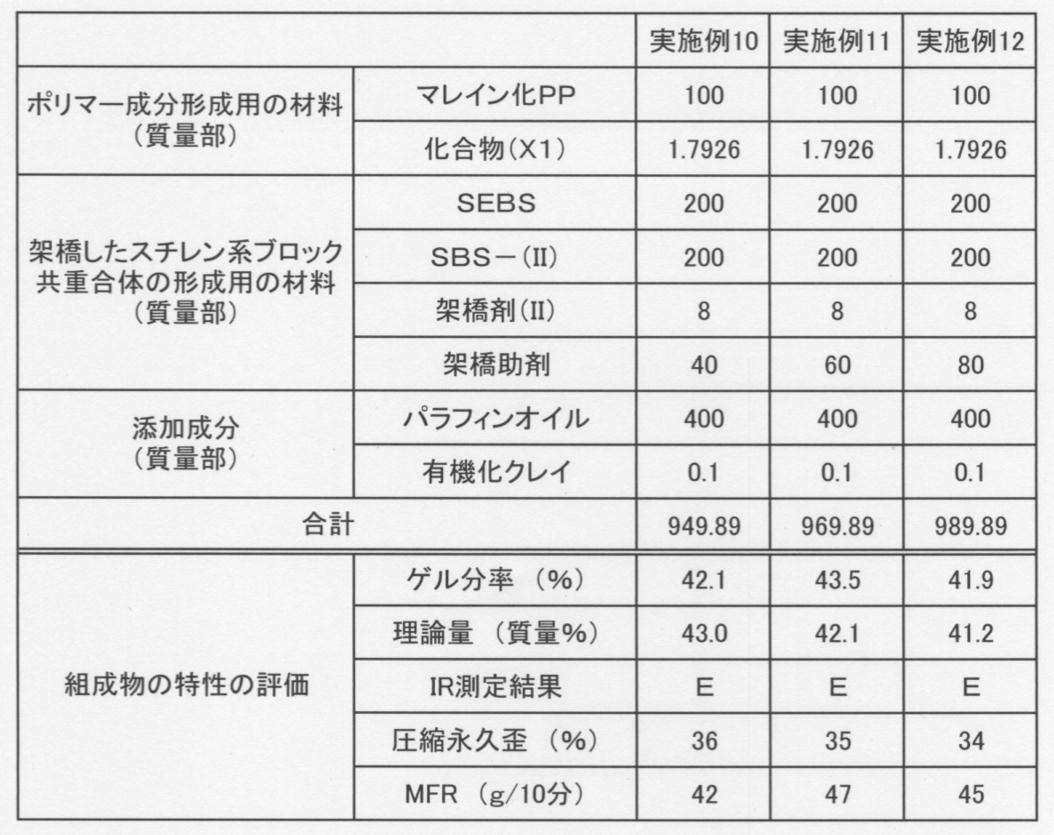
(実施例13~14)
架橋剤(I)の代わりに、表3に記載の割合で架橋剤(III)又は架橋剤(IV)を利用した以外は、実施例3と同様にして熱可塑性エラストマー組成物をそれぞれ調製した。得られた熱可塑性エラストマー組成物の特性の評価結果を表3に示す。なお、表3には、実施例3で得られた熱可塑性エラストマー組成物の特性の評価結果も併せて示す。なお、表3には、実施例3及び10で得られた熱可塑性エラストマー組成物の特性の評価結果も併せて示す。なお、かかる組成物の調製に用いた成分の質量比(マレイン化PPの含有量を100質量部とした場合の各成分の質量割合)を表3に示す。
架橋剤(I)の代わりに、表3に記載の割合で架橋剤(III)又は架橋剤(IV)を利用した以外は、実施例3と同様にして熱可塑性エラストマー組成物をそれぞれ調製した。得られた熱可塑性エラストマー組成物の特性の評価結果を表3に示す。なお、表3には、実施例3で得られた熱可塑性エラストマー組成物の特性の評価結果も併せて示す。なお、表3には、実施例3及び10で得られた熱可塑性エラストマー組成物の特性の評価結果も併せて示す。なお、かかる組成物の調製に用いた成分の質量比(マレイン化PPの含有量を100質量部とした場合の各成分の質量割合)を表3に示す。

表1~3に示した結果から明らかなように、実施例1~14で得られた熱可塑性エラストマー組成物においてはゲル分率と前記理論量(架橋したスチレン系ブロック共重合体の含有量:組成物の総量に対するスチレン系ブロック共重合体と架橋剤との合計量の割合(質量%))がほぼ同等の値となっており、かつ、IR測定においてベンゼン環に由来するピークが観測されていること等から、ゲル化している残留成分が、利用している材料の種類等から、基本的に、スチレン系ブロック共重合体と架橋剤との反応物(架橋したスチレン系ブロック共重合体)からなるものであると分かる。そのため、実施例1~14で得られた熱可塑性エラストマー組成物においては、製造に利用したスチレン系ブロック共重合体成分(SEBS、SBS、SEEPS)が組成物中において架橋したものとなっていることが分かる。
表1~3に示した結果から明らかなように、実施例1~14で得られた熱可塑性エラストマー組成物においてはいずれも、比較例1で得られた熱可塑性エラストマー組成物よりも、高温に対する圧縮永久歪に対する耐性により優れたものとなり、更にMFRがより高い値となって加工時の流動性に優れたものとなることが確認された。特に、実施例1~14で得られた熱可塑性エラストマー組成物においてはいずれも、高温における圧縮永久歪(測定条件:125℃、22時間)が40%以下となっていた。
また、表1に示した結果から明らかなように、実施例7と比較例1とは、組成物の調製時の架橋剤(I)及び架橋助剤の使用の有無のみが相違し、他の成分の使用量などが同一であることから、これらを比較すると、組成物中に架橋したSEBSを含む熱可塑性エラストマー組成物(実施例7)の方が、未架橋のSEBSのみを含む熱可塑性エラストマー組成物(比較例1)よりも、高温条件下(122℃、22時間)における圧縮永久歪(%)の値がより小さくなっており、高温に対する圧縮永久歪に対する耐性により優れたものとなることが分かった。更に、組成物中に架橋したSEBSを含む熱可塑性エラストマー組成物(実施例7)の方が、未架橋のSEBSのみを含む熱可塑性エラストマー組成物(比較例1)よりも、MFRがより高い値となり、流動性がより高く、加工性により優れたものとなることが分かった。
さらに、表1に示した実施例1と実施例2の特性の評価結果から、SEBSと組み合わせてラジアル状のSBS(SBS-(I))を利用した場合に、リニア状のSBS(SBS-(II))を利用した場合よりも、圧縮永久歪に対する耐性及び流動性が更に優れたものとなることも分かった。
また、表1に示した実施例2と実施例3の特性の評価結果、並びに、表2に示した実施例10~12の特性の評価結果から、架橋助剤の量比に基く効果の違いを確認したところ、架橋助剤の量比を増やせば増やすほど圧縮永久歪に対する耐性がより高度なものとなることが分かった。これは、架橋助剤をより多く利用することにより架橋助剤が架橋の起点となって星状に架橋することに起因するものと本発明者らは推察する。他方、表2に示した実施例10~12の特性の評価結果から、MFRの値は、架橋助剤の質量を架橋剤の質量の7.5倍程度(実施例11)とした場合により高い値となっていた。
また、表3に示した実施例3、実施例9及び実施例12~13の特性の評価結果から、1分間半減期温度がより高い架橋剤(なお、架橋剤(I)~(IV)の1分間半減期温度の高さの順序は、高い方から順に、架橋剤(I)、架橋剤(II)、架橋剤(IV)、架橋剤(III)となる)を利用するほど、圧縮永久歪に対する耐性がより高度なものとなることが分かった。このような結果から、1分間半減期温度がより高い架橋剤を利用することで、より効率的に架橋を形成することが可能となるものと本発明者らは推察する。
以上説明したように、本発明によれば、高温における圧縮永久歪に対する耐性に優れるとともに、流動性を十分に高いものとすることが可能な熱可塑性エラストマー組成物を提供することが可能となる。このように、本発明の熱可塑性エラストマー組成物は、特に高温における圧縮永久歪に対する耐性に優れるため、高温条件下で利用される自動車部品等を製造するための材料等として特に有用である。
Claims (6)
- 下記成分(I)及び(II):
〔成分(I)〕カルボニル含有基および/または含窒素複素環を有する水素結合性架橋部位を含有する側鎖(a)を有しかつガラス転移点が25℃以下であるポリマー(A)、並びに、側鎖に水素結合性架橋部位及び共有結合性架橋部位が含有されておりかつガラス転移点が25℃以下であるポリマー(B)からなる群から選択される少なくとも1種のポリマー成分;
〔成分(II)〕共有結合性架橋部位を有しかつ水素結合性架橋部位を有さない架橋したスチレン系ブロック共重合体;
を含む、熱可塑性エラストマー組成物。 - 前記成分(II)が、主鎖に架橋性二重結合を有するスチレン系ブロック共重合体と、該架橋性二重結合と反応して共有結合による架橋部位を形成する架橋剤との反応物からなる、請求項1に記載の熱可塑性エラストマー組成物。
- 前記主鎖に架橋性二重結合を有するスチレン系ブロック共重合体が、スチレン-ブタジエン-スチレンブロック共重合体、スチレン-イソプレン-スチレンブロック共重合体、スチレン-イソプレン-ブタジエン-スチレンブロック共重合体、スチレン-エチレン-ブチレン-スチレンブロック共重合体、スチレン-エチレン-プロピレン-スチレンブロック共重合体、及び、スチレン-エチレン-エチレン-プロピレン-スチレンブロック共重合体からなる群から選択される少なくとも1種である、請求項2に記載の熱可塑性エラストマー組成物。
- 前記成分(II)中のスチレン系ブロック共重合体の分子同士を架橋する共有結合性架橋部位が、炭素架橋、酸素架橋及び硫黄架橋からなる群から選択される少なくとも1種の架橋からなる、請求項1~3のうちのいずれか一項に記載の熱可塑性エラストマー組成物。
- 前記成分(II)の含有量が組成物の総量の0.1~80質量%である、請求項1~4のうちのいずれか一項に記載の熱可塑性エラストマー組成物。
- 前記成分(I)において、前記ポリマー(A)及び(B)の主鎖がそれぞれ、ポリプロピレン、ポリエチレン、エチレン-ブテン共重合体、エチレン-プロピレン共重合体、及び、エチレン-オクテン共重合体からなる群から選択される少なくとも1種である、請求項1~5のうちのいずれか一項に記載の熱可塑性エラストマー組成物。
Priority Applications (4)
| Application Number | Priority Date | Filing Date | Title |
|---|---|---|---|
| US17/802,864 US20230159736A1 (en) | 2020-02-28 | 2021-02-26 | Thermoplastic elastomer composition |
| CN202180017189.3A CN115175966A (zh) | 2020-02-28 | 2021-02-26 | 热塑性弹性体组合物 |
| EP21760913.0A EP4112690A4 (en) | 2020-02-28 | 2021-02-26 | THERMOPLASTIC ELASTOMER COMPOSITION |
| KR1020227029038A KR102751867B1 (ko) | 2020-02-28 | 2021-02-26 | 열가소성 엘라스토머 조성물 |
Applications Claiming Priority (2)
| Application Number | Priority Date | Filing Date | Title |
|---|---|---|---|
| JP2020-034078 | 2020-02-28 | ||
| JP2020034078A JP7426853B2 (ja) | 2020-02-28 | 2020-02-28 | 熱可塑性エラストマー組成物 |
Publications (1)
| Publication Number | Publication Date |
|---|---|
| WO2021172571A1 true WO2021172571A1 (ja) | 2021-09-02 |
Family
ID=77491631
Family Applications (1)
| Application Number | Title | Priority Date | Filing Date |
|---|---|---|---|
| PCT/JP2021/007562 Ceased WO2021172571A1 (ja) | 2020-02-28 | 2021-02-26 | 熱可塑性エラストマー組成物 |
Country Status (6)
| Country | Link |
|---|---|
| US (1) | US20230159736A1 (ja) |
| EP (1) | EP4112690A4 (ja) |
| JP (1) | JP7426853B2 (ja) |
| KR (1) | KR102751867B1 (ja) |
| CN (1) | CN115175966A (ja) |
| WO (1) | WO2021172571A1 (ja) |
Cited By (1)
| Publication number | Priority date | Publication date | Assignee | Title |
|---|---|---|---|---|
| JP7634745B1 (ja) | 2024-03-25 | 2025-02-21 | アイカ工業株式会社 | ホットメルト組成物 |
Families Citing this family (1)
| Publication number | Priority date | Publication date | Assignee | Title |
|---|---|---|---|---|
| CN118702923B (zh) * | 2024-06-18 | 2025-09-16 | 中国工程物理研究院材料研究所 | 一种苯乙烯-丁二烯-苯乙烯嵌段共聚物的高吸油材料、制备方法及应用 |
Citations (8)
| Publication number | Priority date | Publication date | Assignee | Title |
|---|---|---|---|---|
| JP2004307576A (ja) * | 2003-04-03 | 2004-11-04 | Yokohama Rubber Co Ltd:The | 熱可塑性エラストマー組成物 |
| JP2006131663A (ja) | 2004-11-02 | 2006-05-25 | Yokohama Rubber Co Ltd:The | 熱可塑性エラストマー |
| JP5918878B1 (ja) | 2015-03-31 | 2016-05-18 | Jxエネルギー株式会社 | 熱可塑性エラストマー組成物及びその製造方法 |
| JP2017057393A (ja) * | 2015-09-17 | 2017-03-23 | Jxエネルギー株式会社 | 熱可塑性エラストマー組成物、その製造方法及び積層体 |
| JP2017057322A (ja) | 2015-09-17 | 2017-03-23 | Jxエネルギー株式会社 | 熱可塑性エラストマー組成物及びその製造方法 |
| JP2017057323A (ja) | 2015-09-17 | 2017-03-23 | Jxエネルギー株式会社 | 熱可塑性エラストマー組成物及びその製造方法 |
| JP2017206589A (ja) | 2016-05-16 | 2017-11-24 | Jxtgエネルギー株式会社 | 熱可塑性エラストマー組成物及びその製造方法 |
| JP2019056033A (ja) * | 2017-09-20 | 2019-04-11 | Jxtgエネルギー株式会社 | ゴム組成物 |
Family Cites Families (10)
| Publication number | Priority date | Publication date | Assignee | Title |
|---|---|---|---|---|
| GB1148529A (en) * | 1965-09-10 | 1969-04-16 | Dunlop Co Ltd | Improvements in and relating to balls |
| US5936037A (en) * | 1996-05-28 | 1999-08-10 | Riken Vinyl Industry Co., Ltd. | Thermoplastic elastomeric resin composition and a process for the preparation thereof |
| JP2004238422A (ja) * | 2003-02-03 | 2004-08-26 | Mitsubishi Chemicals Corp | 熱可塑性エラストマー組成物、及び製造方法 |
| JP3987448B2 (ja) * | 2003-03-20 | 2007-10-10 | リケンテクノス株式会社 | 難燃性熱可塑性樹脂組成物及びその成形体 |
| KR101006613B1 (ko) * | 2006-02-13 | 2011-01-07 | 아사히 가세이 케미칼즈 가부시키가이샤 | 수소 첨가 블록 공중합체, 상기 수소 첨가 블록 공중합체 함유 수지 조성물, 이들의 가교체 및 가교 발포체 |
| KR101183733B1 (ko) | 2008-02-08 | 2012-09-17 | 아사히 가세이 케미칼즈 가부시키가이샤 | 열가소성 엘라스토머 조성물 및 그의 제조 방법 |
| ES2583329T3 (es) * | 2010-03-08 | 2016-09-20 | Asahi Kasei Chemicals Corporation | Composición de espuma, procedimiento para producirla y espuma |
| US9175164B2 (en) * | 2011-05-31 | 2015-11-03 | Torray Industries, Inc. | Process for producing polymer alloy, polymer alloy, and molded article |
| CN105315600B (zh) * | 2015-04-15 | 2018-04-13 | 江苏金陵奥普特高分子材料有限公司 | 一种高耐油性热塑性弹性体及其制备方法 |
| JP7055808B2 (ja) * | 2017-08-02 | 2022-04-18 | Eneos株式会社 | ゴム組成物、架橋ゴム組成物、タイヤ及び工業用ゴム部品 |
-
2020
- 2020-02-28 JP JP2020034078A patent/JP7426853B2/ja active Active
-
2021
- 2021-02-26 US US17/802,864 patent/US20230159736A1/en not_active Abandoned
- 2021-02-26 KR KR1020227029038A patent/KR102751867B1/ko active Active
- 2021-02-26 CN CN202180017189.3A patent/CN115175966A/zh active Pending
- 2021-02-26 WO PCT/JP2021/007562 patent/WO2021172571A1/ja not_active Ceased
- 2021-02-26 EP EP21760913.0A patent/EP4112690A4/en active Pending
Patent Citations (8)
| Publication number | Priority date | Publication date | Assignee | Title |
|---|---|---|---|---|
| JP2004307576A (ja) * | 2003-04-03 | 2004-11-04 | Yokohama Rubber Co Ltd:The | 熱可塑性エラストマー組成物 |
| JP2006131663A (ja) | 2004-11-02 | 2006-05-25 | Yokohama Rubber Co Ltd:The | 熱可塑性エラストマー |
| JP5918878B1 (ja) | 2015-03-31 | 2016-05-18 | Jxエネルギー株式会社 | 熱可塑性エラストマー組成物及びその製造方法 |
| JP2017057393A (ja) * | 2015-09-17 | 2017-03-23 | Jxエネルギー株式会社 | 熱可塑性エラストマー組成物、その製造方法及び積層体 |
| JP2017057322A (ja) | 2015-09-17 | 2017-03-23 | Jxエネルギー株式会社 | 熱可塑性エラストマー組成物及びその製造方法 |
| JP2017057323A (ja) | 2015-09-17 | 2017-03-23 | Jxエネルギー株式会社 | 熱可塑性エラストマー組成物及びその製造方法 |
| JP2017206589A (ja) | 2016-05-16 | 2017-11-24 | Jxtgエネルギー株式会社 | 熱可塑性エラストマー組成物及びその製造方法 |
| JP2019056033A (ja) * | 2017-09-20 | 2019-04-11 | Jxtgエネルギー株式会社 | ゴム組成物 |
Non-Patent Citations (1)
| Title |
|---|
| See also references of EP4112690A4 |
Cited By (2)
| Publication number | Priority date | Publication date | Assignee | Title |
|---|---|---|---|---|
| JP7634745B1 (ja) | 2024-03-25 | 2025-02-21 | アイカ工業株式会社 | ホットメルト組成物 |
| JP2025147520A (ja) * | 2024-03-25 | 2025-10-07 | アイカ工業株式会社 | ホットメルト組成物 |
Also Published As
| Publication number | Publication date |
|---|---|
| CN115175966A (zh) | 2022-10-11 |
| EP4112690A4 (en) | 2024-04-10 |
| JP7426853B2 (ja) | 2024-02-02 |
| KR102751867B1 (ko) | 2025-01-07 |
| EP4112690A1 (en) | 2023-01-04 |
| JP2021134333A (ja) | 2021-09-13 |
| US20230159736A1 (en) | 2023-05-25 |
| KR20220131539A (ko) | 2022-09-28 |
Similar Documents
| Publication | Publication Date | Title |
|---|---|---|
| JP5770416B2 (ja) | 架橋性組成物、その架橋性組成物から得られる熱可塑性エラストマー及びそれらの使用 | |
| US20080146737A1 (en) | Thermoplastic elastomer composition | |
| JPWO2017047274A1 (ja) | 熱可塑性エラストマー組成物及びその製造方法 | |
| EP2627686A1 (en) | A process for preparing high melt strength propylene polymers | |
| US7169849B2 (en) | Process for production of thermoplatic elastomer composition | |
| JP2017057322A (ja) | 熱可塑性エラストマー組成物及びその製造方法 | |
| JP2017057323A (ja) | 熱可塑性エラストマー組成物及びその製造方法 | |
| EP1983027A1 (en) | Modified butyl rubber composition | |
| KR102751867B1 (ko) | 열가소성 엘라스토머 조성물 | |
| JP2016003265A (ja) | 非空気式タイヤ用熱可塑性エラストマー組成物および非空気式タイヤ | |
| KR20090033812A (ko) | 변성 부틸 고무 조성물 | |
| JP4040669B2 (ja) | 発泡体用組成物および発泡体 | |
| EP1550693A1 (en) | Thermoplastic elastomer and molded object thereof | |
| JP2019056033A (ja) | ゴム組成物 | |
| WO2018235961A1 (ja) | ゴム粒子含有エラストマー組成物及びその製造方法 | |
| TWI811903B (zh) | 熱塑性彈性體組合物及成形體 | |
| JP3938850B2 (ja) | 熱可塑性エラストマー組成物 | |
| KR100585330B1 (ko) | 용융물성이 우수한 폴리올레핀 수지조성물 | |
| JP2022103044A (ja) | 熱可塑性エラストマー組成物および成形体 | |
| JP4758588B2 (ja) | 架橋オレフィン系ゴム組成物 | |
| JP2000103909A (ja) | エラストマー組成物の製造方法 | |
| JP7320005B2 (ja) | 熱可塑性エラストマー組成物、及び熱可塑性エラストマー組成物の製造方法 | |
| CN116615494A (zh) | 热塑性弹性体组合物及成型体 | |
| JPWO2001064783A1 (ja) | オレフィン系ゴム組成物 | |
| CN121712826A (zh) | 经交联的热塑性弹性体 |
Legal Events
| Date | Code | Title | Description |
|---|---|---|---|
| 121 | Ep: the epo has been informed by wipo that ep was designated in this application |
Ref document number: 21760913 Country of ref document: EP Kind code of ref document: A1 |
|
| ENP | Entry into the national phase |
Ref document number: 20227029038 Country of ref document: KR Kind code of ref document: A |
|
| NENP | Non-entry into the national phase |
Ref country code: DE |
|
| ENP | Entry into the national phase |
Ref document number: 2021760913 Country of ref document: EP Effective date: 20220928 |