WO2021182580A1 - 潤滑油組成物 - Google Patents
潤滑油組成物 Download PDFInfo
- Publication number
- WO2021182580A1 WO2021182580A1 PCT/JP2021/009859 JP2021009859W WO2021182580A1 WO 2021182580 A1 WO2021182580 A1 WO 2021182580A1 JP 2021009859 W JP2021009859 W JP 2021009859W WO 2021182580 A1 WO2021182580 A1 WO 2021182580A1
- Authority
- WO
- WIPO (PCT)
- Prior art keywords
- mass
- lubricating oil
- oil composition
- less
- group
- Prior art date
- Legal status (The legal status is an assumption and is not a legal conclusion. Google has not performed a legal analysis and makes no representation as to the accuracy of the status listed.)
- Ceased
Links
- 0 C*(C)N(C(C(*)C1)=O)*1=O Chemical compound C*(C)N(C(C(*)C1)=O)*1=O 0.000 description 3
Classifications
-
- C—CHEMISTRY; METALLURGY
- C10—PETROLEUM, GAS OR COKE INDUSTRIES; TECHNICAL GASES CONTAINING CARBON MONOXIDE; FUELS; LUBRICANTS; PEAT
- C10M—LUBRICATING COMPOSITIONS; USE OF CHEMICAL SUBSTANCES EITHER ALONE OR AS LUBRICATING INGREDIENTS IN A LUBRICATING COMPOSITION
- C10M169/00—Lubricating compositions characterised by containing as components a mixture of at least two types of ingredient selected from base-materials, thickeners or additives, covered by the preceding groups, each of these compounds being essential
- C10M169/02—Mixtures of base-materials and thickeners
-
- C—CHEMISTRY; METALLURGY
- C10—PETROLEUM, GAS OR COKE INDUSTRIES; TECHNICAL GASES CONTAINING CARBON MONOXIDE; FUELS; LUBRICANTS; PEAT
- C10M—LUBRICATING COMPOSITIONS; USE OF CHEMICAL SUBSTANCES EITHER ALONE OR AS LUBRICATING INGREDIENTS IN A LUBRICATING COMPOSITION
- C10M137/00—Lubricating compositions characterised by the additive being an organic non-macromolecular compound containing phosphorus
- C10M137/02—Lubricating compositions characterised by the additive being an organic non-macromolecular compound containing phosphorus having no phosphorus-to-carbon bond
- C10M137/04—Phosphate esters
- C10M137/10—Thio derivatives
-
- C—CHEMISTRY; METALLURGY
- C10—PETROLEUM, GAS OR COKE INDUSTRIES; TECHNICAL GASES CONTAINING CARBON MONOXIDE; FUELS; LUBRICANTS; PEAT
- C10M—LUBRICATING COMPOSITIONS; USE OF CHEMICAL SUBSTANCES EITHER ALONE OR AS LUBRICATING INGREDIENTS IN A LUBRICATING COMPOSITION
- C10M169/00—Lubricating compositions characterised by containing as components a mixture of at least two types of ingredient selected from base-materials, thickeners or additives, covered by the preceding groups, each of these compounds being essential
- C10M169/04—Mixtures of base-materials and additives
-
- C—CHEMISTRY; METALLURGY
- C10—PETROLEUM, GAS OR COKE INDUSTRIES; TECHNICAL GASES CONTAINING CARBON MONOXIDE; FUELS; LUBRICANTS; PEAT
- C10M—LUBRICATING COMPOSITIONS; USE OF CHEMICAL SUBSTANCES EITHER ALONE OR AS LUBRICATING INGREDIENTS IN A LUBRICATING COMPOSITION
- C10M171/00—Lubricating compositions characterised by purely physical criteria, e.g. containing as base-material, thickener or additive, ingredients which are characterised exclusively by their numerically specified physical properties, i.e. containing ingredients which are physically well-defined but for which the chemical nature is either unspecified or only very vaguely indicated
- C10M171/02—Specified values of viscosity or viscosity index
-
- C—CHEMISTRY; METALLURGY
- C10—PETROLEUM, GAS OR COKE INDUSTRIES; TECHNICAL GASES CONTAINING CARBON MONOXIDE; FUELS; LUBRICANTS; PEAT
- C10M—LUBRICATING COMPOSITIONS; USE OF CHEMICAL SUBSTANCES EITHER ALONE OR AS LUBRICATING INGREDIENTS IN A LUBRICATING COMPOSITION
- C10M171/00—Lubricating compositions characterised by purely physical criteria, e.g. containing as base-material, thickener or additive, ingredients which are characterised exclusively by their numerically specified physical properties, i.e. containing ingredients which are physically well-defined but for which the chemical nature is either unspecified or only very vaguely indicated
- C10M171/04—Specified molecular weight or molecular weight distribution
-
- C—CHEMISTRY; METALLURGY
- C10—PETROLEUM, GAS OR COKE INDUSTRIES; TECHNICAL GASES CONTAINING CARBON MONOXIDE; FUELS; LUBRICANTS; PEAT
- C10M—LUBRICATING COMPOSITIONS; USE OF CHEMICAL SUBSTANCES EITHER ALONE OR AS LUBRICATING INGREDIENTS IN A LUBRICATING COMPOSITION
- C10M2201/00—Inorganic compounds or elements as ingredients in lubricant compositions
- C10M2201/085—Phosphorus oxides, acids or salts
-
- C—CHEMISTRY; METALLURGY
- C10—PETROLEUM, GAS OR COKE INDUSTRIES; TECHNICAL GASES CONTAINING CARBON MONOXIDE; FUELS; LUBRICANTS; PEAT
- C10M—LUBRICATING COMPOSITIONS; USE OF CHEMICAL SUBSTANCES EITHER ALONE OR AS LUBRICATING INGREDIENTS IN A LUBRICATING COMPOSITION
- C10M2203/00—Organic non-macromolecular hydrocarbon compounds and hydrocarbon fractions as ingredients in lubricant compositions
- C10M2203/10—Petroleum or coal fractions, e.g. tars, solvents, bitumen
- C10M2203/102—Aliphatic fractions
- C10M2203/1025—Aliphatic fractions used as base material
-
- C—CHEMISTRY; METALLURGY
- C10—PETROLEUM, GAS OR COKE INDUSTRIES; TECHNICAL GASES CONTAINING CARBON MONOXIDE; FUELS; LUBRICANTS; PEAT
- C10M—LUBRICATING COMPOSITIONS; USE OF CHEMICAL SUBSTANCES EITHER ALONE OR AS LUBRICATING INGREDIENTS IN A LUBRICATING COMPOSITION
- C10M2205/00—Organic macromolecular hydrocarbon compounds or fractions, whether or not modified by oxidation as ingredients in lubricant compositions
- C10M2205/003—Organic macromolecular hydrocarbon compounds or fractions, whether or not modified by oxidation as ingredients in lubricant compositions used as base material
-
- C—CHEMISTRY; METALLURGY
- C10—PETROLEUM, GAS OR COKE INDUSTRIES; TECHNICAL GASES CONTAINING CARBON MONOXIDE; FUELS; LUBRICANTS; PEAT
- C10M—LUBRICATING COMPOSITIONS; USE OF CHEMICAL SUBSTANCES EITHER ALONE OR AS LUBRICATING INGREDIENTS IN A LUBRICATING COMPOSITION
- C10M2205/00—Organic macromolecular hydrocarbon compounds or fractions, whether or not modified by oxidation as ingredients in lubricant compositions
- C10M2205/02—Organic macromolecular hydrocarbon compounds or fractions, whether or not modified by oxidation as ingredients in lubricant compositions containing acyclic monomers
- C10M2205/028—Organic macromolecular hydrocarbon compounds or fractions, whether or not modified by oxidation as ingredients in lubricant compositions containing acyclic monomers containing aliphatic monomers having more than four carbon atoms
- C10M2205/0285—Organic macromolecular hydrocarbon compounds or fractions, whether or not modified by oxidation as ingredients in lubricant compositions containing acyclic monomers containing aliphatic monomers having more than four carbon atoms used as base material
-
- C—CHEMISTRY; METALLURGY
- C10—PETROLEUM, GAS OR COKE INDUSTRIES; TECHNICAL GASES CONTAINING CARBON MONOXIDE; FUELS; LUBRICANTS; PEAT
- C10M—LUBRICATING COMPOSITIONS; USE OF CHEMICAL SUBSTANCES EITHER ALONE OR AS LUBRICATING INGREDIENTS IN A LUBRICATING COMPOSITION
- C10M2207/00—Organic non-macromolecular hydrocarbon compounds containing hydrogen, carbon and oxygen as ingredients in lubricant compositions
- C10M2207/26—Overbased carboxylic acid salts
- C10M2207/262—Overbased carboxylic acid salts derived from hydroxy substituted aromatic acids, e.g. salicylates
-
- C—CHEMISTRY; METALLURGY
- C10—PETROLEUM, GAS OR COKE INDUSTRIES; TECHNICAL GASES CONTAINING CARBON MONOXIDE; FUELS; LUBRICANTS; PEAT
- C10M—LUBRICATING COMPOSITIONS; USE OF CHEMICAL SUBSTANCES EITHER ALONE OR AS LUBRICATING INGREDIENTS IN A LUBRICATING COMPOSITION
- C10M2215/00—Organic non-macromolecular compounds containing nitrogen as ingredients in lubricant Compositions
- C10M2215/24—Organic non-macromolecular compounds containing nitrogen as ingredients in lubricant Compositions having hydrocarbon substituents containing thirty or more carbon atoms, e.g. nitrogen derivatives of substituted succinic acid
- C10M2215/28—Amides; Imides
-
- C—CHEMISTRY; METALLURGY
- C10—PETROLEUM, GAS OR COKE INDUSTRIES; TECHNICAL GASES CONTAINING CARBON MONOXIDE; FUELS; LUBRICANTS; PEAT
- C10M—LUBRICATING COMPOSITIONS; USE OF CHEMICAL SUBSTANCES EITHER ALONE OR AS LUBRICATING INGREDIENTS IN A LUBRICATING COMPOSITION
- C10M2223/00—Organic non-macromolecular compounds containing phosphorus as ingredients in lubricant compositions
- C10M2223/02—Organic non-macromolecular compounds containing phosphorus as ingredients in lubricant compositions having no phosphorus-to-carbon bonds
- C10M2223/04—Phosphate esters
- C10M2223/045—Metal containing thio derivatives
-
- C—CHEMISTRY; METALLURGY
- C10—PETROLEUM, GAS OR COKE INDUSTRIES; TECHNICAL GASES CONTAINING CARBON MONOXIDE; FUELS; LUBRICANTS; PEAT
- C10M—LUBRICATING COMPOSITIONS; USE OF CHEMICAL SUBSTANCES EITHER ALONE OR AS LUBRICATING INGREDIENTS IN A LUBRICATING COMPOSITION
- C10M2290/00—Mixtures of base materials or thickeners or additives
- C10M2290/10—Thickener
-
- C—CHEMISTRY; METALLURGY
- C10—PETROLEUM, GAS OR COKE INDUSTRIES; TECHNICAL GASES CONTAINING CARBON MONOXIDE; FUELS; LUBRICANTS; PEAT
- C10N—INDEXING SCHEME ASSOCIATED WITH SUBCLASS C10M RELATING TO LUBRICATING COMPOSITIONS
- C10N2010/00—Metal present as such or in compounds
- C10N2010/04—Groups 2 or 12
-
- C—CHEMISTRY; METALLURGY
- C10—PETROLEUM, GAS OR COKE INDUSTRIES; TECHNICAL GASES CONTAINING CARBON MONOXIDE; FUELS; LUBRICANTS; PEAT
- C10N—INDEXING SCHEME ASSOCIATED WITH SUBCLASS C10M RELATING TO LUBRICATING COMPOSITIONS
- C10N2020/00—Specified physical or chemical properties or characteristics, i.e. function, of component of lubricating compositions
- C10N2020/01—Physico-chemical properties
- C10N2020/02—Viscosity; Viscosity index
-
- C—CHEMISTRY; METALLURGY
- C10—PETROLEUM, GAS OR COKE INDUSTRIES; TECHNICAL GASES CONTAINING CARBON MONOXIDE; FUELS; LUBRICANTS; PEAT
- C10N—INDEXING SCHEME ASSOCIATED WITH SUBCLASS C10M RELATING TO LUBRICATING COMPOSITIONS
- C10N2020/00—Specified physical or chemical properties or characteristics, i.e. function, of component of lubricating compositions
- C10N2020/01—Physico-chemical properties
- C10N2020/04—Molecular weight; Molecular weight distribution
-
- C—CHEMISTRY; METALLURGY
- C10—PETROLEUM, GAS OR COKE INDUSTRIES; TECHNICAL GASES CONTAINING CARBON MONOXIDE; FUELS; LUBRICANTS; PEAT
- C10N—INDEXING SCHEME ASSOCIATED WITH SUBCLASS C10M RELATING TO LUBRICATING COMPOSITIONS
- C10N2020/00—Specified physical or chemical properties or characteristics, i.e. function, of component of lubricating compositions
- C10N2020/01—Physico-chemical properties
- C10N2020/071—Branched chain compounds
-
- C—CHEMISTRY; METALLURGY
- C10—PETROLEUM, GAS OR COKE INDUSTRIES; TECHNICAL GASES CONTAINING CARBON MONOXIDE; FUELS; LUBRICANTS; PEAT
- C10N—INDEXING SCHEME ASSOCIATED WITH SUBCLASS C10M RELATING TO LUBRICATING COMPOSITIONS
- C10N2030/00—Specified physical or chemical properties which is improved by the additive characterising the lubricating composition, e.g. multifunctional additives
- C10N2030/02—Pour-point; Viscosity index
-
- C—CHEMISTRY; METALLURGY
- C10—PETROLEUM, GAS OR COKE INDUSTRIES; TECHNICAL GASES CONTAINING CARBON MONOXIDE; FUELS; LUBRICANTS; PEAT
- C10N—INDEXING SCHEME ASSOCIATED WITH SUBCLASS C10M RELATING TO LUBRICATING COMPOSITIONS
- C10N2030/00—Specified physical or chemical properties which is improved by the additive characterising the lubricating composition, e.g. multifunctional additives
- C10N2030/04—Detergent property or dispersant property
-
- C—CHEMISTRY; METALLURGY
- C10—PETROLEUM, GAS OR COKE INDUSTRIES; TECHNICAL GASES CONTAINING CARBON MONOXIDE; FUELS; LUBRICANTS; PEAT
- C10N—INDEXING SCHEME ASSOCIATED WITH SUBCLASS C10M RELATING TO LUBRICATING COMPOSITIONS
- C10N2030/00—Specified physical or chemical properties which is improved by the additive characterising the lubricating composition, e.g. multifunctional additives
- C10N2030/06—Oiliness; Film-strength; Anti-wear; Resistance to extreme pressure
-
- C—CHEMISTRY; METALLURGY
- C10—PETROLEUM, GAS OR COKE INDUSTRIES; TECHNICAL GASES CONTAINING CARBON MONOXIDE; FUELS; LUBRICANTS; PEAT
- C10N—INDEXING SCHEME ASSOCIATED WITH SUBCLASS C10M RELATING TO LUBRICATING COMPOSITIONS
- C10N2030/00—Specified physical or chemical properties which is improved by the additive characterising the lubricating composition, e.g. multifunctional additives
- C10N2030/74—Noack Volatility
-
- C—CHEMISTRY; METALLURGY
- C10—PETROLEUM, GAS OR COKE INDUSTRIES; TECHNICAL GASES CONTAINING CARBON MONOXIDE; FUELS; LUBRICANTS; PEAT
- C10N—INDEXING SCHEME ASSOCIATED WITH SUBCLASS C10M RELATING TO LUBRICATING COMPOSITIONS
- C10N2040/00—Specified use or application for which the lubricating composition is intended
- C10N2040/02—Bearings
-
- C—CHEMISTRY; METALLURGY
- C10—PETROLEUM, GAS OR COKE INDUSTRIES; TECHNICAL GASES CONTAINING CARBON MONOXIDE; FUELS; LUBRICANTS; PEAT
- C10N—INDEXING SCHEME ASSOCIATED WITH SUBCLASS C10M RELATING TO LUBRICATING COMPOSITIONS
- C10N2040/00—Specified use or application for which the lubricating composition is intended
- C10N2040/25—Internal-combustion engines
Definitions
- the present invention relates to a lubricating oil composition.
- a lubricating oil composition having a low viscosity, a low evaporation property, and an excellent performance of appropriately holding an oil film on a sliding portion inside an engine (hereinafter, also referred to as "oil film holding property").
- the lubricating oil composition is also required to have high temperature cleanliness from the viewpoint of making the lubricating oil composition excellent in long drainage and the like.
- the lubricating oil composition is also required to have a performance of enhancing compatibility with a rubber material used for a sealing material or the like and suppressing swelling or curing of the rubber material.
- a lubricating oil composition that satisfies all of these requirements has not yet been fully studied.
- An object of the present invention is to provide a lubricating oil composition having low viscosity, low evaporation property, excellent oil film retention, high temperature cleanliness, and excellent compatibility with rubber materials.
- the olefin polymer (A1) contains a first olefin polymer (A1-1) having a kinematic viscosity of 3.0 mm 2 / s or more at 100 ° C., and the first olefin polymer (A1-1). ) Is 30% by mass or more based on the total amount of the base oil (A).
- the olefin-based polymer (A1) does not contain the second olefin-based polymer (A1-2) having a kinematic viscosity of less than 3.0 mm 2 / s at 100 ° C., or even if it contains the base oil (based oil). It is less than 18.5% by mass based on the total amount of A).
- the content of the resin content (B1) derived from the viscosity index improver (B) is 0.01% by mass or more based on the total amount of the lubricating oil composition.
- the nitrogen atom content derived from the imide-based dispersant (C) is 0.06% by mass or more based on the total amount of the lubricating oil composition.
- the content ratio [(B1) / (A1-1)] of the resin component (B1) derived from the viscosity index improver (B) and the first olefin polymer (A1-1) is a mass ratio. It is over 0.001
- the kinematic viscosity at 100 ° C. is 5.0 mm 2 / s or more and less than 7.1 mm 2 / s.
- [2] A method for lubricating an internal combustion engine using the lubricating oil composition according to the above [1].
- a lubricating oil composition having low viscosity, low evaporation property, excellent oil film retention, high temperature cleanliness, and excellent compatibility with rubber materials. ..
- the lower limit value and the upper limit value described stepwise can be combined independently.
- the “preferable lower limit value (10)” and the “more preferable upper limit value (60)” are combined to obtain “10 to 60". You can also do it.
- the numerical values of Examples are numerical values that can be used as upper limit values or lower limit values.
- the numerical range expressed as "AA to BB” shall mean "AA or more and BB or less" unless otherwise specified.
- the mass average molecular weight (Mw) and the number average molecular weight (Mn) of each component are values in terms of standard polystyrene measured by a gel permeation chromatography (GPC) method, and specifically, Examples. Means the value measured by the method described in.
- GPC gel permeation chromatography
- kinematic viscosity at 40 ° C.” is also referred to as “40 ° C. kinematic viscosity”.
- kinematic viscosity at 100 ° C.” is also referred to as “100 ° C. kinematic viscosity”.
- the lubricating oil composition of the present invention is a lubricating oil composition containing a base oil (A) containing an olefin polymer (A1), a viscosity index improver (B), and an imide-based dispersant (C).
- the olefin polymer (A1) contains a first olefin polymer (A1-1) having a kinematic viscosity of 3.0 mm 2 / s or more at 100 ° C., and the first olefin polymer (A1-1). ) Is 30% by mass or more based on the total amount of the base oil (A).
- the olefin-based polymer (A1) does not contain the second olefin-based polymer (A1-2) having a kinematic viscosity of less than 3.0 mm 2 / s at 100 ° C., or even if it contains the base oil (based oil). It is less than 18.5% by mass based on the total amount of A).
- the content of the resin content (B1) derived from the viscosity index improver (B) is 0.01% by mass or more based on the total amount of the lubricating oil composition.
- the nitrogen atom content derived from the imide-based dispersant (C) is 0.06% by mass or more based on the total amount of the lubricating oil composition.
- the content ratio [(B1) / (A1-1)] of the resin content (B1) and the first olefin polymer (A1) is more than 0.001 by mass ratio.
- the kinematic viscosity at 100 ° C. is 5.0 mm 2 / s or more and less than 7.1 mm 2 / s.
- the present inventor has diligently studied low-viscosity lubricating oil compositions having a kinematic viscosity at 100 ° C. in the range of 5.0 mm 2 / s or more and less than 7.1 mm 2 / s. Stacked.
- a base oil containing a specific amount of a specific olefin polymer but having a small content of another olefin polymer different from the specific olefin polymer is used, and a resin derived from a viscosity index improver is used.
- the amount and the specific olefin polymer are adjusted to a specific ratio, the content of the resin content derived from the viscosity index improver, the content of the imide-based dispersant, etc. are adjusted to a specific range, and the aniline point is further adjusted. It has been found that a lubricating oil composition adjusted to a specific range can solve the above-mentioned problems.
- the present inventor has further conducted various studies based on such findings, and has completed the present invention.
- base oil (A) viscosity index improver (B)"
- imide-based dispersant (C) are referred to as “component (A)” and “component (B), respectively.”
- component (C) The lubricating oil composition of one aspect of the present invention may be composed of only the component (A), the component (B), and the component (C), but the component (A) may be composed as long as the effect of the present invention is not impaired. ), Component (B), and components other than component (C) may be contained.
- the total content of the component (A), the component (B), and the component (C) is preferably 70% by mass to 100% by mass based on the total amount of the lubricating oil composition. %, More preferably 75% by mass to 100% by mass, still more preferably 80% by mass to 100% by mass.
- each component contained in the lubricating oil composition of the present invention will be described in detail.
- the lubricating oil composition of the present invention contains a base oil (A) containing an olefin polymer (A1).
- the olefin polymer (A1) contains a first olefin polymer (A1-1) having a kinematic viscosity of 3.0 mm 2 / s or more at 100 ° C.
- the content of the first olefin polymer (A1-1) is 30% by mass or more based on the total amount of the base oil (A). If the content of the first olefin polymer (A1-1) is less than 30% by mass based on the total amount of the base oil (A), the lubricating oil composition cannot be made low in evaporability.
- the 100 ° C. kinematic viscosity of the first olefin polymer (A1-1) is preferably 3.1 mm 2 / s or more, more preferably 3.1 mm 2 / s or more, from the viewpoint of facilitating the preparation of a low evaporative lubricating oil composition. It is 3.2 mm 2 / s or more, more preferably 3.3 mm 2 / s or more. Further, from the viewpoint of facilitating the fuel efficiency of the lubricating oil composition, the kinematic viscosity of the olefin polymer (A1) at 100 ° C. is preferably 7.0 mm 2 / s or less, more preferably 5.0 mm.
- the 100 ° C. kinematic viscosity of the base oil is a value measured in accordance with JIS K2283: 2000.
- the content of the first olefin polymer (A1-1) is preferably 40% by mass or more based on the total amount of the base oil (A) from the viewpoint of facilitating the preparation of a low-evaporative lubricating oil composition. It is 100% by mass, more preferably 50% by mass to 100% by mass, and further preferably 60% by mass to 100% by mass.
- the first olefin polymer (A1-1) will be described in detail.
- the first olefin-based polymer (A1-1) is a polymer containing a structural unit (a1) derived from an ⁇ -olefin (hereinafter, also referred to as “monomer (a1)”).
- a1 ⁇ -olefin
- the carbon number of the monomer (a1) is preferably 6 or more, more preferably 8 or more, from the viewpoint of facilitating the effect of the present invention. Further, it is preferably 20 or less, more preferably 16 or less, and further preferably 12 or less. The upper and lower limits of these numerical ranges can be arbitrarily combined.
- the monomer (a1) may be linear or branched. Specific examples of the monomer (a1) are preferably 1-hexene, 1-heptene, 1-octene, 1-nonene, 1-decene, 1-undecene, 1-dodecene, 1-tridecene, 1-tetradecene, 1 -Pentadecene, 1-hexadecene, 1-heptene, 1-octadecene, 1-nonadecene, and 1-eikosen can be mentioned.
- 1-octene, 1-nonene, 1-decene, 1-undecene, 1-dodecene, 1-tridecene, 1-tetradecene, 1-pentadecene, 1-hexadecene, and 1-heptadecene are more preferable
- 1- Octene, 1-nonene, 1-decene, 1-undecene, and 1-dodecene are more preferred, and 1-decene is even more preferred.
- the monomer (a1) one type may be used alone, or two or more types may be used in combination.
- the first olefin polymer (A1-1) preferably contains 1-decene as the monomer (a1).
- the content of 1-decene is preferably 80 to 100% by mass, more preferably 90 to 100% by mass, still more preferably 95 to 100% by mass, based on the total amount of the monomers constituting the first olefin polymer (A1-1). It is 100% by mass, more preferably 100% by mass.
- the first olefin-based polymer (A1-1) contains an ⁇ -olefin other than 1-decene as the monomer (a1)
- the ⁇ -olefin other than 1-decene is listed as the monomer (a1).
- one or more selected from ⁇ -olefins other than 1-decene can be mentioned.
- the first olefin polymer (A1-1) preferably contains a dimer to a pentamer of the monomer (a1), and the dimer to 4-4. More preferably, it contains a trimer, and even more preferably it contains a trimer.
- the monomer (a1) is 1-decene
- the first olefin polymer (A1-1) preferably contains a decentrimer.
- the first olefin polymer (A1-1) has a reduced terminal vinylidene double bond by hydrogenation treatment. It is preferable that it is. That is, the first olefin polymer (A1-1) is preferably a partially hydride, and more preferably a completely hydride.
- the polymerization method of the first olefin-based polymer (A1-1) is not particularly limited, and a known method (for example, a known method capable of polymerizing the first olefin-based polymer (A1-1) by a polymerization reaction of ⁇ -olefin) is possible. , A polymerization method using an acid catalyst such as BF 3 catalyst) can be appropriately adopted.
- the metallocene catalyst is used. It is preferable to adopt the polymerization method used.
- a complex containing a Group 4 element and having a conjugated carbon 5-membered ring is preferable.
- the Group 4 element include one or more selected from titanium, zirconium, and hafnium, and among these, zirconium is preferable.
- the complex having a conjugated carbon 5-membered ring a complex having a substituted or unsubstituted cyclopentadienyl ligand is preferable.
- metallocene catalyst examples include bis (n-octadecylcyclopentadienyl) zirconium dichloride, bis (trimethylsilylcyclopentadienyl) zirconium dichloride, bis (tetrahydroindenyl) zirconium dichloride, and bis [(t-butyldimethylsilyl).
- Cyclopentadienyl] zirconium dichloride bis (di-t-butylcyclopentadienyl) zirconium dichloride, (ethylidene-bisindenyl) zirconium dichloride, biscyclopentadienyl zirconium dichloride, etilidenbis (tetrahydroindenyl) zirconium dichloride, and , Bis [3,3 (2-methyl-benzindenyl)] dimethylsilanediyl zirconium dichloride and the like.
- One type of metallocene catalyst may be used alone, or two or more types may be used in combination.
- an oxygen-containing organoaluminum compound may be used together with the metallocene catalyst as the co-catalyst.
- the oxygen-containing organoaluminum compound include methylarmoxane, ethylarmoxane, isobutylarmoxane and the like.
- the oxygen-containing organoaluminum compound one type may be used alone, or two or more types may be used in combination.
- the mixing ratio of co-catalyst to metallocene catalyst is from the viewpoint of obtaining a first olefin polymer (A1-1) that makes it easier to exert the effects of the present invention. Therefore, the molar ratio is preferably 5 to 1000, more preferably 7 to 500, and even more preferably 10 to 200.
- the first olefin polymer (A1-1) is preferably produced through the following steps (i) to (iii).
- Step (i) A step of polymerizing the monomer (a1) using a metallocene catalyst.
- -Step (ii) A step of treating the polymer obtained in step (i) with an alkali.
- -Step (iii) A step of hydrogenating the polymer after being treated with alkali in the step (iii).
- Step (i) The step (i) may be carried out in a batch manner or in a continuous manner. Further, the above-mentioned oxygen-containing organoaluminum compound as a co-catalyst may be used together with the metallocene catalyst.
- the polymerization of the monomer (a1) may proceed in the presence of one or more organic solvents selected from benzene, ethylbenzene, toluene and the like.
- the polymerization reaction in the step (i) is preferably carried out under the conditions of a reaction temperature of 15 to 100 ° C. and a reaction pressure of atmospheric pressure to 0.2 MPa. After the polymerization has proceeded sufficiently, the reaction can be stopped by adding water or alcohol.
- the step (ii) is a step of treating the polymer obtained in the step (i) with an alkali to remove catalyst components such as a metallocene catalyst and an oxygen-containing organoaluminum compound.
- the alkali used in the step (ii) include one or more selected from sodium hydroxide, sodium carbonate, sodium hydrogen carbonate and the like.
- a solution prepared by dissolving these alkalis in water or an alcohol such as methanol, ethanol, or propanol is added to the reaction solution containing the polymer, and then the mixture is sufficiently stirred to perform a liquid separation operation to form an organic layer. By taking it out, the catalyst component can be removed.
- the pH of the solution is preferably 9 or higher.
- the temperature of the solution is preferably 20 to 100 ° C.
- the step (iii) is a step of hydrogenating the polymer after the treatment with alkali in the step (iii) to convert the polymer into a hydride.
- the hydride may be a partially hydride, but is preferably a complete hydride.
- the hydrogenation treatment in the step (iii) is carried out by filling a system containing a polymer with hydrogen gas and heating in the presence of a metal catalyst.
- a metal catalyst used in the hydrogenation treatment for example, one or more selected from nickel-based catalysts, cobalt-based catalysts, palladium-based catalysts, platinum-based catalysts and the like can be used, and specifically, diatomaceous soil-supported nickel. Examples thereof include one or more selected from catalysts, cobalt trisacetylacetonate / organic aluminum catalysts, activated carbon-supported palladium catalysts, alumina-supported platinum catalysts and the like.
- the temperature condition of the hydrogenation treatment is usually 200 ° C. or lower, and is appropriately set depending on the type of metal catalyst used. For example, when a nickel-based catalyst is used, the temperature is preferably 150 to 200 ° C. When a palladium-based catalyst or a platinum-based catalyst is used, the temperature is preferably 50 to 150 ° C. When a homogeneous reducing agent such as cobalt trisacetylacetonate / organoaluminum is used, the temperature is preferably 20 to 100 ° C. Further, the hydrogen pressure at the time of hydrogenation treatment is preferably normal pressure to 20 MPa.
- distillation treatment After the hydrogenation treatment, it is preferable to carry out a distillation treatment to remove by-products.
- the distillation treatment is preferably carried out under the conditions of a temperature of 180 to 450 ° C. and a pressure of 0.01 to 100 kPa.
- the olefin polymer (A1) does not contain the second olefin polymer (A1-2) having a kinematic viscosity of less than 3.0 mm 2 / s at 100 ° C. Or, even if it is contained, it is less than 18.5% by mass based on the total amount of the base oil (A). If the content of the second olefin polymer (A1-2) is 18.5% by mass or more based on the total amount of the base oil (A), the lubricating oil composition cannot be made low in evaporability.
- the content of the second olefin polymer (A1-2) is preferably as small as possible from the viewpoint of facilitating the preparation of a low-evaporation lubricating oil composition.
- the content of the second olefin polymer (A1-2) is preferably 0% by mass to 15% by mass, more preferably 0% by mass to 10% by mass, based on the total amount of the base oil (A). %, More preferably 0% by mass to 5% by mass, even more preferably 0% by mass to 1% by mass, and even more preferably no second olefin polymer (A1-2).
- the second olefin polymer (A1-2) one type may be used alone, or two or more types may be used in combination. Further, the second olefin polymer (A1-2) is produced, for example, by using the same method as the above-mentioned production method of the first olefin polymer (A1-1) and changing the distillation temperature or the like. can do.
- the base oil (A) may contain another base oil different from the above base oil.
- the base oil (A) is other than the mineral oil (A2) and the first olefin polymer (A1-1) and the second olefin polymer (A1-2). It may contain one or more selected from the group consisting of the synthetic oil (A3) of.
- the content of the other base oil is 70% by mass or less based on the total amount of the base oil (A), but from the viewpoint of facilitating the effect of the present invention, it is preferably 0% by mass to 60% by mass. , More preferably 0% by mass to 50% by mass, still more preferably 0% by mass to 40% by mass.
- mineral oil (A2) and synthetic oil (A3) will be described in detail.
- mineral oil (A2) a general mineral oil used as a lubricating oil base oil can be used without particular limitation as long as the effects of the present invention are not impaired.
- Specific examples of the mineral oil (A2) include atmospheric residual oil obtained by atmospheric distillation of crude oils such as paraffin crude oil, intermediate base crude oil, and naphthenic crude oil; these atmospheric residual oils are obtained by vacuum distillation. Distillate oil; Mineral oil obtained by subjecting the distillate oil to one or more treatments such as solvent desorption, solvent extraction, hydrocracking, solvent dewaxing, contact dewaxing, hydrorefining, etc .; wax isomerized mineral oil And so on.
- the mineral oil (A2) one type may be used alone, or two or more types may be used in combination.
- the content of the mineral oil (A2) is preferably 50% by mass or less, more preferably 40% by mass, based on the total amount of the base oil (A). % Or less, more preferably 35% by mass or less.
- the lubricating oil composition of one aspect of the present invention it is preferable to add a certain amount or more of the mineral oil (A2) within a range in which the content of the mineral oil (A2) does not exceed the above upper limit value.
- This makes it easier to adjust the aniline point of the lubricating oil composition to 95 ° C. or higher while suppressing the cost of the base oil (A), making it easier to improve compatibility with the rubber material, and swelling and the effect of the rubber material. It is also possible to make it easier to exert the effect of suppressing.
- the content of the mineral oil (A2) is preferably 10% by mass or more, more preferably 20% by mass or more, still more preferably 25% by mass or more, based on the total amount of the base oil (A).
- the total content of the first olefin polymer (A1-1) and the mineral oil (A2) is preferably 70% by mass to 100% by mass, more preferably, based on the total amount of the base oil (A). Is 80% by mass to 100% by mass, more preferably 90% by mass to 100% by mass, still more preferably 95% by mass to 100% by mass, and even more preferably 100% by mass.
- the content ratio [(A1-1) / (A2)] of the first olefin polymer (A1-1) and the mineral oil (A2) is preferably 50/50 or more in terms of mass ratio. It is preferably 60/40 or more, more preferably 65/35 or more. Further, it is preferably 90/10 or less, more preferably 80/20 or less, and further preferably 75/25 or less. The upper and lower limits of these numerical ranges can be arbitrarily combined. Specifically, it is preferably 50/50 to 90/10, more preferably 60/40 to 80/20, and even more preferably 65/35 to 75/25.
- the 100 ° C. kinematic viscosity of the mineral oil (A2) is preferably 1.0 mm 2 / s or more, more preferably 1.5 mm 2 / s or more, still more preferably 2.0 mm, from the viewpoint of facilitating the effect of the present invention. It is 2 / s or more. Further, it is preferably 7.5 mm 2 / s or less, more preferably 5.0 mm 2 / s or less, and further preferably 3.5 mm 2 / s or less. The upper and lower limits of these numerical ranges can be arbitrarily combined.
- the viscosity index of the mineral oil (A2) is preferably 90 or more, more preferably 95 or more, and further preferably 100 or more.
- the kinematic viscosity and the viscosity index of the mixture may be within the above ranges.
- Synthetic oil (A3)) As the synthetic oil (A3), a general synthetic oil used as a lubricating oil base oil can be used without particular limitation as long as the effects of the present invention are not impaired.
- Specific examples of the synthetic oil (A3) include polyphenyl ether, alkylbenzene, alkylnaphthalene, polyphenyl hydrocarbon, ester oil, naphthenic synthetic oil, glycol synthetic oil, and natural gas by the Fisher-Tropsch method. Examples thereof include GTL base oil obtained by isomerizing the produced wax (GTL wax (Gas To Liquids WAX)).
- the content of the synthetic oil (A3) is 70% by mass or less based on the total amount of the base oil (A), but the effect of the present invention is more exhibited. From the viewpoint of facilitating the production, it is preferably 0% by mass to 60% by mass, more preferably 0% by mass to 50% by mass, and further preferably 0% by mass to 40% by mass.
- the base oil (A) Is preferably free of ester oil (A3-1).
- the ester oil (A3-1) is contained, it is preferably 15% by mass or less, more preferably 10% by mass or less, based on the total amount of the base oil (A).
- the base oil (A) does not contain the naphthenic synthetic oil (A3-2).
- the naphthenic synthetic oil (A3-2) is contained, it is preferably 15% by mass or less, more preferably 10% by mass or less, based on the total amount of the base oil (A).
- the lubricating oil composition of the present invention contains a viscosity index improver (B).
- the content of the resin content (B1) derived from the viscosity index improver (B) in the lubricating oil composition of the present invention is 0.01% by mass or more based on the total amount of the lubricating oil composition. If the content of the resin content (B1) derived from the viscosity index improver (B) is less than 0.01% by mass based on the total amount of the lubricating oil composition, sufficient oil film retention cannot be ensured.
- the content of the resin component (B1) derived from the viscosity index improver (B) is preferably 0.10 mass based on the total amount of the lubricating oil composition. % Or more, more preferably 0.30% by mass or more, still more preferably 0.50% by mass or more. Further, from the viewpoint of the shear stability of the viscosity index improver (B), it is preferably 5.0% by mass or less, more preferably 4.0% by mass or less, and further preferably 3.0% by mass or less. Yes, and even more preferably 1.5% by mass or less. The upper and lower limits of these numerical ranges can be arbitrarily combined.
- it is preferably 0.10% by mass to 5.0% by mass, more preferably 0.30% by mass to 4.0% by mass, still more preferably 0.50% by mass to 3.0% by mass, and more. More preferably, it is 0.50 to 1.5% by mass.
- the "resin content (B1) derived from the viscosity index improver (B)” means a polymer having a mass average molecular weight (Mw) of 1,000 or more and having a certain repeating unit.
- the mass average molecular weight (Mw) of the resin component (B1) derived from the viscosity index improver (B) is determined in use in a wide temperature environment from a low temperature region to a high temperature region.
- it is preferably 200,000 to 1,000,000, more preferably 200,000 to 800,000. , More preferably 200,000 to 700,000.
- the molecular weight distribution (Mw / Mn) of the resin content (B1) derived from the viscosity index improver (B) (where Mw is the mass average molecular weight of the resin content (B1)).
- Mn indicates the number average molecular weight of the resin content (B1)), preferably 8.00 or less, more preferably 7.00 or less, more preferably from the viewpoint of improving the fuel saving performance of the lubricating oil composition. It is 6.50 or less, more preferably 6.00 or less, still more preferably 5.00 or less, and even more preferably 3.00 or less.
- the molecular weight distribution of the resin content (B1) is not particularly limited as a lower limit value, but is usually 1.01 or more, preferably 1.05 or more, and more preferably 1.10 or more.
- the resin component (B1) derived from the viscosity index improver (B) is selected from, for example, non-dispersive polymethacrylate, dispersed polymethacrylate, comb-shaped polymer and the like1 Includes seeds and above.
- the resin component (B1) may contain other resin components and the like as long as the effects of the present invention are not impaired.
- the resin component (B1) derived from the viscosity index improver (B) is a comb-shaped polymer (B1).
- B1-1) is preferable.
- the comb-shaped polymer (B1-1) will be described in detail.
- the "comb-shaped polymer (B1-1)" refers to a polymer having a structure having a large number of three-pronged branch points in the main chain where high molecular weight side chains appear.
- the mass average molecular weight (Mw) of the comb-shaped polymer (B1-1) is preferably 100,000 or more, more preferably 200,000 or more, still more preferably 250,000 or more, still more preferably, from the viewpoint of improving fuel efficiency. It is 300,000 or more, and even more preferably 350,000 or more.
- it is preferably 1 million or less, more preferably 800,000 or less, further preferably 750,000 or less, still more preferably 700,000 or less, still more preferably 650,000 or less.
- the upper and lower limits of these numerical ranges can be arbitrarily combined. Specifically, it is preferably 100,000 to 1,000,000, more preferably 200,000 to 800,000, still more preferably 250,000 to 750,000, even more preferably 300,000 to 700,000, and even more preferably 350,000 to 650,000. Is.
- Mw / Mn the molecular weight distribution (Mw / Mn) of the comb polymer (B1-1) (where Mw indicates the mass average molecular weight of the comb polymer (B1-1) and Mn indicates the number average molecular weight of the comb polymer (B1-1)).
- Mw indicates the mass average molecular weight of the comb polymer (B1-1)
- Mn indicates the number average molecular weight of the comb polymer (B1-1).
- Mw indicates the mass average molecular weight of the comb polymer (B1-1)
- Mn the number average molecular weight of the comb polymer (B1-1)
- the molecular weight distribution of the comb polymer (B1-1) is not particularly limited as a lower limit value, but is usually 1.01 or more, preferably 1.05 or more, and more preferably 1.10 or more.
- the content of the comb-shaped polymer (B1-1) is preferably 0.10% by mass or more, more preferably 0.30% by mass, based on the total amount of the lubricating oil composition. The above is even more preferably 0.50% by mass or more. Further, in the lubricating oil composition of one aspect of the present invention, the content of the comb-shaped polymer (B1-1) is preferably 5.0% by mass or less, more preferably 4 based on the total amount of the lubricating oil composition. It is 0.0% by mass or less, and more preferably 3.0% by mass or less.
- the SSI (shear stability index) of the comb polymer (B1-1) is preferably 12.0 or less, more preferably 10.0 or less, still more preferably 5.0 or less, still more preferably 3.0 or less. Even more preferably, it is 1.0 or less.
- the SSI of the comb polymer (B1-1) is not particularly limited to a lower limit, but is usually 0.1 or more, preferably 0.2 or more.
- the SSI (shear stability index) of the comb polymer (B1-1) indicates the decrease in viscosity due to shearing derived from the resin content in the comb polymer (B1-1) as a percentage, and is ASTM. It is a value measured according to D6278. More specifically, it is a value calculated from the following formula (1).
- Kv 0 is the value of the kinematic viscosity of the sample oil obtained by diluting the viscosity index improver containing a resin content with mineral oil at 100 ° C.
- Kv 1 is the value of the viscosity index containing the resin content. It is the value of the kinematic viscosity at 100 ° C. after passing the sample oil obtained by diluting the agent with mineral oil through a 30-cycle high shear diesel injector according to the procedure of ASTM D6278.
- Kv oil is the value of the kinematic viscosity of the mineral oil used when diluting the viscosity index improver at 100 ° C.
- the SSI value of the comb polymer (B1-1) changes depending on the structure of the comb polymer (B1-1). Specifically, there is a tendency shown below, and by considering these matters, the SSI value of the comb polymer (B1-1) can be easily adjusted.
- the following items are merely examples and can be adjusted by considering items other than these items.
- -The side chain of the comb-shaped polymer (B1-1) is composed of a macromonomer (x1), and the content of the structural unit (X1) derived from the macromonomer (x1) is 0.5 based on the total amount of the structural unit.
- Comb-shaped polymers having a molar% or more tend to have a low SSI value.
- the larger the molecular weight of the macromonomer (x1) constituting the side chain of the comb-shaped polymer (B1-1) the lower the SSI value tends to be.
- a polymer having at least a structural unit (X1) derived from a macromonomer (x1) is preferable.
- This structural unit (X1) corresponds to the above-mentioned "high molecular weight side chain".
- the above-mentioned "macromonomer” means a high molecular weight monomer having a polymerizable functional group, and is preferably a high molecular weight monomer having a polymerizable functional group at the terminal.
- the comb-shaped polymer (B1-1) whose main chain is relatively longer than the side chain has lower shear stability. It is considered that this property contributes to the improvement of fuel efficiency even in a low temperature region around 50 ° C.
- the content of the structural unit (X1) is preferably 0. It is 1 mol% or more and less than 10 mol%, more preferably 0.2 to 7 mol%, still more preferably 0.3 to 5 mol%, still more preferably 0.5 to 3 mol%.
- the content of each structural unit in the comb-shaped polymer (B1-1) means a value calculated by analyzing the 13 C-NMR quantitative spectrum.
- the number average molecular weight (Mn) of the macromonomer (x1) is preferably 300 or more, more preferably 500 or more, still more preferably 1,000 or more, still more preferably 2,000 or more, and particularly preferably 2,000 or more. It is 4,000 or more, preferably 100,000 or less, more preferably 50,000 or less, still more preferably 20,000 or less, still more preferably 10,000 or less.
- the macromonomer (x1) may have, for example, one or more repeating units represented by the following general formulas (i) to (iii) in addition to the above-mentioned polymerizable functional group.
- R b1 represents a linear or branched alkylene group having 1 to 10 carbon atoms, and specifically, a methylene group, an ethylene group, a 1,2-propylene group, 1,3. -Propylene group, 1,2-butylene group, 1,3-butylene group, 1,4-butylene group, pentylene group, hexylene group, heptylene group, octylene group, nonylene group, decylene group, and 2-ethylhexylene group. And so on.
- R b2 represents a linear or branched alkylene group having 2 to 4 carbon atoms, and specifically, an ethylene group, a 1,2-propylene group, or a 1,3-propylene group. , 1,2-butylene group, 1,3-butylene group, 1,4-butylene group and the like.
- R b3 represents a hydrogen atom or a methyl group.
- R b4 represents a linear or branched alkyl group having 1 to 10 carbon atoms, and specifically, a methyl group, an ethyl group, an n-propyl group, an n-butyl group, an n-pentyl group, or n-.
- R b1 , R b2 , R b3 , and R b4 may be the same or different from each other. It may be a thing.
- the macromonomer (x1) is preferably a polymer having a repeating unit represented by the general formula (i), and R b1 in the general formula (i) is 1, More preferably, it is a polymer having a repeating unit (X1-1) which is a 2-butylene group and / or a 1,4-butylene group.
- the content of the repeating unit (X1-1) is preferably 1 to 100 mol%, more preferably 20 to 95 mol%, still more preferably, based on the total amount (100 mol%) of the constituent units of the macromonomer (x1). Is 40 to 90 mol%, more preferably 50 to 80 mol%.
- the macromonomer (x1) is a copolymer having two or more repeating units selected from the general formulas (i) to (iii)
- the form of copolymerization is a block copolymer. It may be a random copolymer or a random copolymer.
- the comb-shaped polymer (B1-1) used in one embodiment of the present invention may be a homopolymer consisting of only a structural unit (X1) derived from one type of macromonomer (x1), or two or more types of macromonomers (x1). It may be a copolymer containing a structural unit (X1) derived from. Further, the comb-shaped polymer (B1-1) used in one embodiment of the present invention has a structural unit derived from a macromonomer (x1) and a structural unit (X2) derived from a monomer (x2) other than the macromonomer (x1). ) May be a copolymer containing.
- a structural unit (X1) derived from a macromonomer (x1) is used with respect to a main chain containing a structural unit (X2) derived from the monomer (x2).
- a copolymer having a side chain is preferable. More preferably, the copolymer contains a structural unit (X1) derived from the macromonomer (x1) as a main chain, as opposed to a main chain containing the structural unit (X2) derived from the monomer (x2). ..
- Examples of the monomer (x2) include a monomer (x2-a) represented by the following general formula (a1), an alkyl (meth) acrylate (x2-b), and a nitrogen atom-containing vinyl monomer (x2-c). ), Hydroxyl-containing vinyl monomer (x2-d), phosphorus atom-containing monomer (x2-e), aliphatic hydrocarbon-based vinyl monomer (x2-f), alicyclic hydrocarbon-based vinyl single amount Body (x2-g), vinyl esters (x2-h), vinyl ethers (x2-i), vinyl ketones (x2-j), epoxy group-containing vinyl monomer (x2-k), halogen element-containing vinyl monomer Monomer (x2-l), ester of unsaturated polycarboxylic acid (x2-m), (di) alkyl fumarate (x2-n), (di) alkyl maleate (x2-o), and aromatic hydrocarbon Examples thereof include a vinyl monomer (x2-p).
- the monomer (x2) is other than the nitrogen atom-containing vinyl monomer (x2-c), the phosphorus atom-containing monomer (x2-e), and the aromatic hydrocarbon-based vinyl monomer (x2-p). Monomer is preferred.
- the monomer (x2) includes a monomer (x2-a) represented by the following general formula (a1), an alkyl (meth) acrylate (x2-b), and a hydroxyl group-containing vinyl monomer (x2-d). ), And more preferably at least a hydroxyl group-containing vinyl monomer (x2-d).
- R b11 represents a hydrogen atom or a methyl group.
- R b12 represents a single bond, a linear or branched alkylene group having 1 to 10 carbon atoms, -O-, or -NH-.
- R b13 represents a linear or branched alkylene group having 2 to 4 carbon atoms.
- n represents an integer of 1 or more (preferably an integer of 1 to 20, more preferably an integer of 1 to 5). When n is an integer of 2 or more, the plurality of R b13s may be the same or different, and the (R b13 O) n portion may be a random bond or a block bond.
- R b14 represents a linear or branched alkyl group having 1 to 60 carbon atoms (preferably 10 to 50, more preferably 20 to 40).
- Specific examples of the "alkyl group” include the same groups as those exemplified in the above-mentioned general formulas (i) to (iii).
- alkyl (meth) acrylate (x2-b) examples include methyl (meth) acrylate, ethyl (meth) acrylate, n-propyl (meth) acrylate, isopropyl (meth) acrylate, n-butyl (meth) acrylate, and t.
- the alkyl group of the alkyl (meth) acrylate (x2-b) preferably has 4 to 30 carbon atoms, more preferably 4 to 24 carbon atoms, and even more preferably 4 to 18 carbon atoms.
- the alkyl group may be a straight chain alkyl group or a branched chain alkyl group.
- the content of the structural unit ( ⁇ ) derived from butyl (meth) acrylate is preferably 40 to 95 mol%, more preferably 50 to 90 mol% based on the total amount (100 mol%) of the structural unit of the comb polymer. , More preferably 60-85 mol%.
- the content of the structural unit ( ⁇ ) derived from the alkyl (meth) acrylate having an alkyl group having 12 to 20 carbon atoms is based on the total amount (100 mol%) of the structural units of the comb polymer, preferably 1 to 30 mol. %, More preferably 3 to 25 mol%, still more preferably 5 to 20 mol%.
- nitrogen atom-containing vinyl monomer (x2-c) examples include an amide group-containing vinyl monomer (x2-c1), a nitro group-containing monomer (x2-c2), and a primary amino group-containing vinyl monomer.
- Examples of the amide group-containing vinyl monomer (x2-c1) include (meth) acrylamide; N-methyl (meth) acrylamide, N-ethyl (meth) acrylamide, N-isopropyl (meth) acrylamide, and Nn-.
- Monoalkylamino (meth) acrylamides such as butyl (meth) acrylamide and N-isobutyl (meth) acrylamide; N-methylaminoethyl (meth) acrylamide, N-ethylaminoethyl (meth) acrylamide, N-isopropylamino-n Monoalkylaminoalkyl (meth) acrylamides such as -butyl (meth) acrylamide, Nn-butylamino-n-butyl (meth) acrylamide, and N-isobutylamino-n-butyl (meth) acrylamide; N, N- Dialkylamino (meth) acrylamides such as dimethyl (meth) acrylamide, N, N-diethyl (meth) acrylamide, N, N-diisopropyl (meth) acrylamide, and N, N-di-n-butyl (meth) acrylamide
- Dialkylaminoalkyl (meth) acrylamides such as N-vinylformamide, N-vinylacetamide, N-vinyl-n-propionylamide, N-vinylisopropionylamide, and N-vinylcarboxylic acid amides such as N-vinylhydroxyacetamide. ; Etc. can be mentioned.
- nitro group-containing monomer (x2-c2) examples include nitroethylene and 3-nitro-1-propene.
- Examples of the primary amino group-containing vinyl monomer (x2-c3) include alkenylamines having an alkenyl group having 3 to 6 carbon atoms such as (meth) allylamine and crotylamine; and having aminoethyl (meth) acrylate and the like. Aminoalkyl (meth) acrylates having 2 to 6 alkyl groups; and the like.
- Examples of the secondary amino group-containing vinyl monomer (x2-c4) include monoalkylaminoalkyl (meth) acrylates such as t-butylaminoethyl (meth) acrylate and methylaminoethyl (meth) acrylate; di (meth) acrylate. ) Dialkenylamine having 6 to 12 carbon atoms such as allylamine; and the like.
- Examples of the tertiary amino group-containing vinyl monomer (x2-c5) include dialkylaminoalkyl (meth) acrylates such as dimethylaminoethyl (meth) acrylate and diethylaminoethyl (meth) acrylate; morpholinoethyl (meth) acrylate and the like.
- nitrile group-containing vinyl monomer (x2-c6) examples include (meth) acrylonitrile.
- the content of the structural unit derived from the nitrogen atom-containing vinyl monomer (x2-c) is preferably as small as possible.
- the content of the structural unit derived from the specific nitrogen atom-containing vinyl monomer (x2-c) is preferably less than 1.0 mol% based on the total amount (100 mol%) of the structural unit of the comb-shaped polymer. It is more preferably less than 0.5 mol%, further preferably less than 0.1 mol%, even more preferably less than 0.01 mol%, and particularly preferably 0 mol%.
- hydroxyl group-containing vinyl monomer (x2-d) examples include a hydroxyl group-containing vinyl monomer (x2-d1) and a polyoxyalkylene chain-containing vinyl monomer (x2-d2).
- the hydroxyl group-containing vinyl monomer (x2-d1) has, for example, an alkyl group having 2 to 6 carbon atoms such as 2-hydroxyethyl (meth) acrylate and 2- or 3-hydroxypropyl (meth) acrylate.
- a compound in which an unsaturated group such as the above-mentioned polymerizable functional group possessed by the macromonomer (x1) is introduced; Examples thereof include a compound having an unsaturated group introduced therein.
- a hydroxyl group-containing vinyl monomer having two or more hydroxyl groups is preferable, and a compound in which the unsaturated group is introduced into a polyhydric alcohol or glyceric acid is more preferable.
- polyoxyalkylene chain-containing vinyl monomer (x2-d2) examples include polyoxyalkylene glycol (alkylene group having 2 to 4 carbon atoms and degree of polymerization of 2 to 50) and polyoxyalkylene polyol (the above-mentioned polyhydric alcohol).
- Polyoxyalkylene ether alkylene group having 2 to 4 carbon atoms, degree of polymerization of 2 to 100
- a compound selected from polyoxyalkylene glycol or an alkyl (carbon number 1 to 4) ether of a polyoxyalkylene polyol examples thereof include compounds into which the unsaturated group has been introduced.
- polyethylene glycol (Mn: 100 to 300) mono (meth) acrylate, polypropylene glycol (Mn: 130 to 500) mono (meth) acrylate, methoxypolyethylene glycol (Mn: 110 to 310) (meth) acrylate examples thereof include lauryl alcohol ethylene oxide adduct (2 to 30 mol) (meth) acrylate, and polyoxyethylene mono (meth) acrylate (Mn: 150 to 230) sorbitan.
- the content of the structural unit derived from the hydroxyl group-containing vinyl monomer (x2-d) is preferably 0.1 to 30 mol%, more preferably 0.1 to 30 mol%, based on the total amount (100 mol%) of the structural unit of the comb polymer. It is 0.5 to 20 mol%, more preferably 1 to 15 mol%, and even more preferably 3 to 10 mol%.
- Examples of the phosphorus atom-containing monomer (x2-e) include a phosphoric acid ester group-containing monomer (x2-e1) and a phosphono group-containing monomer (x2-e2).
- Examples of the phosphoric acid ester group-containing monomer (x2-e1) include (meth) acryloyloxyethyl phosphate and (meth) acryloyloxyisopropyl phosphate having an alkyl group having 2 to 4 carbon atoms (meth) acryloyloxy.
- Alkyl phosphate ester; vinyl phosphate, allyl phosphate, propenyl phosphate, isopropenyl phosphate, butenyl phosphate, pentenyl phosphate, octenyl phosphate, decenyl phosphate, dodecenyl phosphate, etc. having 2 to 12 carbon atoms.
- Phosphate alkenyl ester having an alkenyl group; and the like.
- Examples of the phosphono group-containing monomer (x2-e2) include (meth) acryloyloxyalkylphosphonic acid having an alkyl group having 2 to 4 carbon atoms such as (meth) acryloyloxyethyl phosphonic acid; vinylphosphonic acid and allyl. Examples thereof include phosphonic acid, alkenylphosphonic acid having an alkenyl group having 2 to 12 carbon atoms such as octenylphosphonic acid; and the like.
- the content of the structural unit derived from the phosphorus atom-containing monomer (x2-e) is preferably as small as possible.
- the content of the structural unit derived from the specific phosphorus atom-containing monomer (x2-e) is preferably less than 1.0 mol% based on the total amount (100 mol%) of the structural unit of the comb-shaped polymer. It is preferably less than 0.5 mol%, more preferably less than 0.1 mol%, even more preferably less than 0.01 mol%, and particularly preferably 0 mol%.
- aliphatic hydrocarbon vinyl monomer (x2-f) examples include alkenes having 2 to 20 carbon atoms such as ethylene, propylene, butene, isobutylene, pentene, heptene, diisobutylene, octene, dodecene, and octadecene; Alkenes having 4 to 12 carbon atoms such as butadiene, isoprene, 1,4-pentadiene, 1,6-heptadiene and 1,7-octadiene; and the like can be mentioned.
- the carbon number of the aliphatic hydrocarbon-based vinyl monomer (x2-f) is preferably 2 to 30, more preferably 2 to 20, and even more preferably 2 to 12.
- alpha-2-g alpha-2-(2-g)
- alicyclic hydrocarbon-based vinyl monomer (x2-g) examples include cyclohexene, (di) cyclopentadiene, pinene, limonene, vinylcyclohexene, and ethylidene bicycloheptene.
- the alicyclic hydrocarbon-based vinyl monomer (x2-g) preferably has 3 to 30, more preferably 3 to 20, and even more preferably 3 to 12.
- vinyl esters (x2-h) examples include vinyl esters of saturated fatty acids having 2 to 12 carbon atoms such as vinyl acetate, vinyl propionate, vinyl butyrate, and vinyl octanate.
- vinyl ethers (x2-i) examples include alkyl vinyl ethers having 1 to 12 carbon atoms such as methyl vinyl ether, ethyl vinyl ether, propyl vinyl ether, butyl vinyl ether, and 2-ethylhexyl vinyl ether; vinyl-2-methoxyethyl ether, and vinyl.
- alkoxyalkyl vinyl ether having 1 to 12 carbon atoms such as -2-butoxyethyl ether; and the like can be mentioned.
- vinyl ketones (x2-j) examples include methyl vinyl ketone, alkyl vinyl ketone having 1 to 8 carbon atoms such as ethyl vinyl ketone; and the like.
- Epoxy group-containing vinyl monomer (x2-k) examples include glycidyl (meth) acrylate and glycidyl (meth) allyl ether.
- Halogen element-containing vinyl monomer (x2-l) examples include vinyl chloride, vinyl bromide, vinylidene chloride, and (meth) allyl chloride.
- Examples of the unsaturated polycarboxylic acid ester (x2-m) include an alkyl ester of an unsaturated polycarboxylic acid, a cycloalkyl ester of an unsaturated polycarboxylic acid, an aralkyl ester of an unsaturated polycarboxylic acid, and the like.
- Examples of the saturated carboxylic acid include maleic acid, fumaric acid, and itaconic acid.
- ((Di) Alkyl fumarate (x2-n)) examples include monomethyl fumarate, dimethyl fumarate, monoethyl fumarate, diethyl fumarate, methyl ethyl fumarate, monobutyl fumarate, dibutyl fumarate, and dipentyl fumarate. , And dihexyl fumarate and the like.
- ((Di) Alkyl maleate (x2-o)) examples include monomethyl maleate, dimethyl maleate, monoethyl maleate, diethyl maleate, methyl ethyl maleate, monobutyl maleate, and dibutyl maleate. Be done.
- Aromaatic hydrocarbon-based vinyl monomer (x2-p) examples include styrene, ⁇ -methylstyrene, ⁇ -ethylstyrene, vinyltoluene, 2,4-dimethylstyrene, 4-ethylstyrene, and 4-isopropylstyrene.
- the content of the structural unit derived from the aromatic hydrocarbon-based vinyl monomer (x2-p) is preferably as small as possible.
- the content of the structural unit derived from the specific aromatic hydrocarbon-based vinyl monomer (x2-p) is preferably 1.0 mol% based on the total amount (100 mol%) of the structural unit of the comb-shaped polymer. Less than, more preferably less than 0.5 mol%, even more preferably less than 0.1 mol%, even more preferably less than 0.01 mol%, particularly preferably 0 mol%.
- the lubricating oil composition of the present invention contains the resin content (B1) derived from the viscosity index improver (B) and the first olefin polymer (A1-1) [(B1) / (A1-1)]. However, the mass ratio is more than 0.001. [(B1) / (A1-1)] means the amount of the resin content (B1) derived from the viscosity index improver (B) with respect to the first olefin polymer (A1-1), and this value is 0. When it is 001 or less, the lubricating oil composition is inferior in oil film retention.
- [(B1) / (A1-1)] is preferably 0.002 from the viewpoint of facilitating the preparation of a lubricating oil composition having excellent oil film retention.
- it is more preferably 0.003 or more, further preferably 0.004 or more, still more preferably 0.005 or more.
- it is preferably 0.10 or less, more preferably 0.05 or less, and further preferably 0.02 or less.
- the upper and lower limits of these numerical ranges can be arbitrarily combined. Specifically, it is preferably 0.002 to 0.10, more preferably 0.003 to 0.05, still more preferably 0.004 to 0.02, and even more preferably 0.005 to 0.02. ..
- the lubricating oil composition of the present invention contains an imide-based dispersant (C).
- the lubricating oil composition of the present invention has a nitrogen atom content derived from the imide-based dispersant (C) of 0.06% by mass or more based on the total amount of the lubricating oil composition. If the nitrogen atom content derived from the imide-based dispersant (C) is less than 0.06% by mass, the high-temperature cleanliness of the lubricating oil composition cannot be ensured. Moreover, the oil film retention cannot be made sufficient.
- the lubricating oil composition of one aspect of the present invention preferably has a nitrogen atom content derived from the imide-based dispersant (C) of 0.08 mass from the viewpoint of improving high-temperature cleanliness and oil film retention.
- C imide-based dispersant
- % Or more more preferably 0.10% by mass or more, still more preferably 0.11% by mass or more.
- it is preferably 1.00% by mass or less, more preferably 0.50% by mass or less, and further preferably 0.20% by mass or less.
- the upper and lower limits of these numerical ranges can be arbitrarily combined. Specifically, it is preferably 0.08% by mass to 1.00% by mass, more preferably 0.10% by mass to 0.50% by mass, and further preferably 0.11% by mass to 0.20% by mass. ..
- the content of the imide-based dispersant (C) is adjusted so that the nitrogen atom content derived from the imide-based dispersant (C) satisfies the above range.
- the content of the imide-based dispersant (C) is preferably 1.0% by mass or more, more preferably 5.0% by mass or more, still more preferably 7.5% by mass or more, based on the total amount of the lubricating oil composition. be. Further, it is preferably 20.0% by mass or less, more preferably 15.0% by mass or less, still more preferably 12.5% by mass or less.
- the upper and lower limits of these numerical ranges can be arbitrarily combined. Specifically, it is preferably 1.0% by mass to 20.0% by mass, more preferably 5.0% by mass to 15.0% by mass, and further preferably 7.5% by mass to 12.5% by mass. ..
- Examples of the imide-based dispersant (C) include monoimide succinates such as monoimide alkenylsuccinate and monoimide alkylsuccinate; boron-modified compounds of monoimide succinate; bisimide succinates such as bisimide alkenylsuccinate and bisimide alkylsuccinate; Included is one or more compounds selected from the group consisting of modified boron succinate bisimides. Among these, one or more selected from the group consisting of monoimide succinate (non-boron modified product) and bisimide succinate (non-boron modified product) is preferable. As the imide-based dispersant (C), one type may be used alone, or two or more types may be used in combination.
- alkenyl succinate monoimide or alkyl succinate monoimide examples include compounds represented by the following general formula (c-1).
- Examples of the bisimide alkenyl succinate or the bisimide alkyl succinate include compounds represented by the following general formula (c-2).
- R 3C , R 5C , and R 6C are alkenyl groups or alkyl groups, and the mass average molecular weight (Mw) is preferably 500 to 3, respectively. It is 000, more preferably 1,000 to 3,000.
- Mw mass average molecular weight
- the mass average molecular weights of R 3C , R 5C , and R 6C are 500 or more, the solubility in the base oil (A) can be improved. Further, when it is 3,000 or less, the effect of the present invention can be more easily exhibited.
- R 5C and R 6C may be the same or different.
- R 4C , R 7C , and R 8C are alkylene groups having 2 to 5 carbon atoms, respectively, and R 7C and R 8C may be the same or different.
- n1 indicates an integer of 1 to 10
- n2 indicates an integer of 0 or 1 to 10.
- n1 is preferably 2 to 5, more preferably 2 to 4.
- n1 is 2 or more, the effect of the present invention can be more easily exerted.
- n1 is 5 or less, the solubility in the base oil (A) becomes even better.
- n2 is preferably 1 to 6, and more preferably 2 to 6.
- n2 is 1 or more, the effect of the present invention can be more easily exerted.
- n2 is 6 or less, the solubility in the base oil (A) becomes even better.
- Examples of the alkenyl group that can be selected as R 3C , R 5C , and R 6C include a polybutenyl group, a polyisobutenyl group, and an ethylene-propylene copolymer, and preferably a polybutenyl group or a polyisobutenyl group. ..
- As the polybutenyl group a mixture of 1-butene and isobutene or a polymer of high-purity isobutene is preferably used.
- Examples of the alkyl group that can be selected as R 3C , R 5C , and R 6C include those hydrogenated with a polybutenyl group, a polyisobutenyl group, an ethylene-propylene copolymer, and the like, and a polybutenyl group or a polyisobutenyl is preferable. Examples include hydrogenated groups.
- the above-mentioned alkenyl succinimide or alkyl succinimide is usually obtained by reacting a polyolefin with maleic anhydride to obtain an alkenyl succinimide, or hydrogenating the alkenyl succinimide to obtain a polyamine. It can be produced by reacting. Monoimide or bisimide can be produced by changing the ratio of alkenyl succinic anhydride or alkyl succinic anhydride to polyamine.
- the above-mentioned alkenyl succinimide or alkyl succinimide succinimide may be a boron-modified product.
- the boron-modified product can be produced, for example, by reacting a boron-free monoimide alkenyl succinate or monoimide alkyl succinate, or bisimide alkenyl succinate or bisimide alkyl succinate with a boron compound.
- polyolefin monomer forming the polyolefin for example, one or more selected from ⁇ -olefins having 2 to 8 carbon atoms can be used, and a mixture of isobutene and 1-butene can be preferably used. ..
- polyamines include single diamines such as ethylenediamine, propylenediamine, butylenediamine, and pentylenediamine; diethylenetriamine, triethylenetetramine, tetraethylenepentamine, pentaethylenehexamine, di (methylethylene) triamine, dibutylenetriamine, and triamine.
- Polyalkylene polyamines such as butylenetetramine and pentapentylenehexamine; piperazine derivatives such as aminoethylpiperazine and the like can be mentioned.
- One type of polyamine may be used alone, or two or more types may be used in combination.
- Examples of the boron compound include boric acid, borate, boric acid ester and the like.
- Examples of boric acid include orthoboric acid, metaboric acid, paraboric acid and the like.
- Examples of the borate include ammonium borate such as ammonium metaborate, ammonium tetraborate, ammonium pentaborate and ammonium octaborate.
- Examples of borate esters include monomethyl borate, dimethyl borate, trimethyl borate, monoethyl borate, diethyl borate, triethyl borate, monopropyl borate, dipropyl borate, tripropyl borate, monobutyl borate, and boric acid. Examples thereof include dibutyl and tributyl borate.
- the lubricating oil composition of one aspect of the present invention may contain a metal-based cleaning agent (D).
- the metal-based cleaning agent (D) When the lubricating oil composition of one aspect of the present invention contains the metal-based cleaning agent (D), the high-temperature cleaning property of the lubricating oil composition can be further improved.
- the content of the metal atom derived from the metal-based cleaning agent (D) is from the viewpoint of improving the high-temperature cleaning property and from the viewpoint of suppressing the sulfated ash content to a low level.
- the content of the metal-based cleaning agent (D) is adjusted so that the content of the metal atom derived from the metal-based cleaning agent (D) satisfies the above range. do it.
- the content of the metal-based cleaning agent (D) is preferably 0.1% by mass to 10.0% by mass, more preferably 0.5% by mass to 5.0% by mass, based on the total amount of the lubricating oil composition. More preferably, it is 0.75% by mass to 2.0% by mass.
- the metal-based cleaning agent (D) examples include an alkali metal-based cleaning agent and an alkaline earth metal-based cleaning agent, and among these, an alkaline earth metal-based cleaning agent is preferable.
- the alkaline earth metal constituting the alkaline earth metal-based cleaning agent include magnesium (Mg), calcium (Ca), strontium (Sr), and barium (Ba).
- magnesium (Mg) magnesium (Mg)
- Ca calcium
- Ba barium
- calcium (Ca) Magnesium (Mg) is preferable.
- the metal-based cleaning agent (D) is preferably one or more selected from the group consisting of the calcium-based cleaning agent (D1) and the magnesium-based cleaning agent (D2).
- the calcium-based cleaning agent (D1) and the magnesium-based cleaning agent (D2) will be described in detail.
- Examples of the calcium-based cleaning agent (D1) include calcium salts such as calcium sulfonate, calcium phenate, and calcium salicylate. Among these, calcium phenate and calcium salicylate are preferable, and calcium salicylate is more preferable, from the viewpoint of improving high-temperature cleanliness.
- the calcium sulfonate in the metal sulfonate represented by the following general formula (d1-1), a compound in which M is a calcium atom is preferable.
- As the calcium phenate in the metal phenate represented by the following general formula (d1-2), a compound in which M'is a calcium atom is preferable.
- the calcium salicylate in the metal salicylate represented by the following general formula (d1-3), a compound in which M is a calcium atom is preferable.
- the calcium-based cleaning agent (D1) one type may be used alone, or two or more types may be used in combination.
- M is a metal atom selected from an alkali metal and an alkaline earth metal, and M'is an alkaline earth metal.
- p is the valence of M, which is 1 or 2.
- R is a hydrogen atom or a hydrocarbon group having 1 to 18 carbon atoms.
- q is an integer of 0 or more, preferably an integer of 0 to 3.
- the hydrocarbon group that can be selected as R include an alkyl group having 1 to 18 carbon atoms, an alkenyl group having 1 to 18 carbon atoms, a cycloalkyl group having 3 to 18 ring-forming carbon atoms, and 6 to 18 ring-forming carbon atoms.
- Examples thereof include an aryl group of 7 to 18, an alkylaryl group having 7 to 18 carbon atoms, and an arylalkyl group having 7 to 18 carbon atoms.
- the calcium-based cleaning agent (D1) may be neutral, basic, or hyperbasic, but from the viewpoint of facilitating the improvement of base value maintenance, basic or hyperbasic ones are used. It is preferable, and a hyperbasic one is more preferable.
- the basic or hyperbasic metal-based cleaning agent is a stoichiometric amount required for neutralizing the metal and the acidic organic compound by reacting the metal with the acidic organic compound. Means one containing an excess of metal. That is, the total chemical equivalent of the metal in the metal-based cleaning agent with respect to the chemical equivalent of the metal in the metal salt (neutral salt) obtained by reacting the metal according to the stoichiometric amount required for neutralization of the acidic organic compound.
- the metal ratio of the basic or hyperbasic metal-based cleaning agent is larger than 1.
- the metal ratio of the basic or hyperbasic metal-based cleaning agent used in the present embodiment is preferably more than 1.3, more preferably 5 to 30, and even more preferably 7 to 22.
- Specific examples of the basic or hyperbasic metal-based cleaning agent include those containing one or more selected from the group consisting of the above-mentioned metal salicylate, metal phenate and metal sulfonate, and containing an excess of metal. ..
- those having a base value of less than 50 mgKOH / g measured by the measurement method described later are “neutral”, those having a base value of 50 mgKOH / g or more and less than 150 mgKOH / g are “basic”, 150 mgKOH / g. The above is defined as “hyperbasic”.
- the base value of the calcium-based cleaning agent (D1) is preferably 5 mgKOH / g or more, more preferably 100 mgKOH / g or more, still more preferably 150 mgKOH / g or more, still more preferably 200 mgKOH / g or more, and preferably. It is 500 mgKOH / g or less, more preferably 450 mgKOH / g or less, still more preferably 400 mgKOH / g or less.
- the "base value" of the metal-based cleaning agent (D) means the base value measured by the perchloric acid method in accordance with JIS K 2501: 2003.
- the content of the calcium atom derived from the calcium-based cleaning agent (D1) is from the viewpoint of improving the high-temperature cleaning property and from the viewpoint of suppressing the sulfated ash content to a low level. Based on the total amount of the lubricating oil composition, preferably 0.01% by mass to 0.75% by mass, more preferably 0.02% by mass to 0.30% by mass, and further preferably 0.05% by mass to 0. It is 15% by mass. Further, in the lubricating oil composition of one aspect of the present invention, the content of the calcium-based cleaning agent (D1) is adjusted so that the content of calcium atoms derived from the calcium-based cleaning agent (D1) satisfies the above range.
- the content of the calcium-based cleaning agent (D1) is preferably 0.01% by mass to 10.0% by mass, more preferably 0.10% by mass to 5.0% by mass, based on the total amount of the lubricating oil composition. More preferably, it is 0.80% by mass to 2.00% by mass.
- magnesium-based cleaning agent (D2) examples include magnesium salts such as magnesium sulfonate, magnesium phenate, and magnesium salicylate. Among these, magnesium sulfonate is preferable from the viewpoint of improving high-temperature cleanliness.
- magnesium sulfonate in the metal sulfonate represented by the above general formula (d1-1), a compound in which M is a magnesium atom is preferable.
- magnesium phenate in the metal phenate represented by the above general formula (d1-2), a compound in which M'is a magnesium atom is preferable.
- magnesium salicylate a compound in which M is a magnesium atom in the metal salicylate represented by the above general formula (d1-3) is preferable.
- M is a magnesium atom in the metal salicylate represented by the above general formula (d1-3)
- the magnesium-based cleaning agent (D2) one type may be used alone, or two or more types may be used in combination.
- the magnesium-based cleaning agent (D2) may be either neutral, basic or hyperbasic, but from the viewpoint of cleanliness, a basic or superbasic one is preferable.
- the base value of the magnesium-based cleaning agent (D2) is preferably 5 mgKOH / g or more, more preferably 100 mgKOH / g or more, still more preferably 150 mgKOH / g or more, still more preferably 200 mgKOH / g or more, and preferably. It is 500 mgKOH / g or less, more preferably 450 mgKOH / g or less, still more preferably 400 mgKOH / g or less.
- the content of the magnesium atom derived from the magnesium-based cleaning agent (D2) is from the viewpoint of improving the high-temperature cleaning property and from the viewpoint of suppressing the sulfated ash content to a low level. Based on the total amount of the lubricating oil composition, preferably 0.001% by mass to 0.1% by mass, more preferably 0.010% by mass to 0.050% by mass, and further preferably 0.015% by mass to 0. It is 025% by mass. Further, in the lubricating oil composition of one aspect of the present invention, the content of the magnesium-based cleaning agent (D2) is adjusted so that the content of magnesium atoms derived from the magnesium-based cleaning agent (D2) satisfies the above range.
- the content of the magnesium-based cleaning agent (D2) is preferably 0.001% by mass to 2.000% by mass, more preferably 0.005% by mass to 1.000% by mass, based on the total amount of the lubricating oil composition. More preferably, it is 0.01% by mass to 0.300% by mass.
- the lubricating oil composition of one aspect of the present invention may contain zinc dithiophosphate (E).
- the lubricating oil composition of one aspect of the present invention contains zinc dithiophosphate (E)
- the abrasion resistance of the lubricating oil composition can be further improved.
- the zinc dithiophosphate (E) used in the lubricating oil composition of one aspect of the present invention is preferably represented by the following general formula (e-1).
- R 21E to R 24E each independently represent a hydrocarbon group.
- the hydrocarbon group is not particularly limited as long as it is a monovalent hydrocarbon group.
- an alkyl group, an alkenyl group, a cycloalkyl group, an aryl group and the like are preferably mentioned from the viewpoint of improving oxidative stability.
- a group and an aryl group are more preferable, and an alkyl group is further preferable. That is, as the zinc dithiophosphate used in one aspect of the present invention, zinc dialkyldithiophosphate is preferable.
- the alkyl group and alkenyl group that can be selected as R 21E to R 24E may be linear or branched, but are primary or secondary from the viewpoint of obtaining better oxidative stability. Is preferable, and among them, a primary alkyl group and a secondary alkyl group are preferable. That is, as the zinc dialkyl dithiophosphate, primary zinc dialkyl dithiophosphate and zinc secondary dialkyl dithiophosphate are preferable.
- the number of carbon atoms of the hydrocarbon groups that can be selected as R 21E to R 24E is preferably 1 or more, more preferably 2 or more, still more preferably 3 or more when the monovalent hydrocarbon group is an alkyl group.
- the upper limit is preferably 24 or less, more preferably 18 or less, still more preferably 12 or less.
- the monovalent hydrocarbon is an alkenyl group, it is preferably 2 or more, more preferably 3 or more, and the upper limit is preferably 24 or less, more preferably 18 or less, still more preferably 12 or less.
- the cycloalkyl group and aryl group that can be selected as R 21E to R 24E may be a polycyclic group such as a decalyl group or a naphthyl group.
- the carbon number of the hydrocarbon group that can be selected as R 21E to R 24E when the monovalent hydrocarbon is a cycloalkyl group, the carbon number is preferably 5 or more, and the upper limit is preferably 20 or less.
- the monovalent hydrocarbon is an aryl group, the number of carbon atoms is preferably 6 or more, and the upper limit is preferably 20 or less.
- the monovalent hydrocarbon group may be partially substituted with a group containing an oxygen atom and / or a nitrogen atom such as a hydroxyl group, a carboxy group, an amino group, an amide group, a nitro group and a cyano group, and the nitrogen atom may be partially substituted.
- a group containing an oxygen atom and / or a nitrogen atom such as a hydroxyl group, a carboxy group, an amino group, an amide group, a nitro group and a cyano group, and the nitrogen atom may be partially substituted.
- Oxygen atom, halogen atom or the like may be partially substituted, and when the monovalent hydrocarbon group is a cycloalkyl group or an aryl group, it further has a substituent such as an alkyl group or an alkenyl group. May be.
- the lubricating oil composition according to one aspect of the present invention is provided in an exhaust gas purification device from the viewpoint of making it easier to improve the wear resistance of the lubricating oil composition and suppressing the amount of phosphorus in the lubricating oil composition.
- the content of the phosphorus atom derived from zinc dithiophosphate (E) is preferably 0.005% by mass to 0.200% by mass based on the total amount of the lubricating oil composition. It is preferably 0.010% by mass to 0.150% by mass, and more preferably 0.05% by mass to 0.100% by mass.
- the content of zinc atom derived from zinc dithiophosphate (E) is preferably 0.005% by mass to 0.200% by mass, more preferably 0. It is 010% by mass to 0.150% by mass, more preferably 0.06% by mass to 0.110% by mass. Further, in the lubricating oil composition of one aspect of the present invention, the content of zinc dithiophosphate (E) is such that the phosphorus atom content and the zinc atom content derived from zinc dithiophosphate (E) satisfy the above ranges. It should be adjusted to.
- the content of zinc dithiophosphate (E) is preferably 0.10% by mass to 5.00% by mass, more preferably 0.50% by mass to 2.50% by mass, and further, based on the total amount of the lubricating oil composition. It is preferably 0.75% by mass to 1.25% by mass.
- the lubricating oil composition according to one aspect of the present invention is, if necessary, an additive for lubricating oil other than the above-mentioned components (hereinafter, also simply referred to as "additive for lubricating oil") as long as the effect of the present invention is not impaired. ) May be contained.
- the additive for lubricating oil include antioxidants, extreme pressure agents, friction modifiers, defoamers, rust inhibitors, corrosion inhibitors, metal inactivating agents and the like.
- an abrasion resistant agent other than zinc dithiophosphate (E) can be mentioned.
- one type may be used alone, or two or more types may be used in combination.
- each of these additives for lubricating oil can be appropriately adjusted within a range that does not impair the effects of the present invention, but is usually 0.001% by mass or more based on the total amount of the lubricating oil composition. It is preferably 0.005% by mass or more, more preferably 0.01% by mass or more, and preferably 30% by mass or less, more preferably 27% by mass or less, still more preferably 24% by mass or less.
- the total content of these additives for lubricating oil is preferably 5% by mass or more, more preferably 10 based on the total amount (100% by mass) of the lubricating oil composition. It is mass% or more, more preferably 15% by mass or more, and preferably 35% by mass or less, preferably 30% by mass or less, more preferably 27% by mass or less, still more preferably 25% by mass or less.
- antioxidant any known antioxidant that has been conventionally used as an antioxidant for lubricating oils can be appropriately selected and used.
- amine-based antioxidants and phenol-based antioxidants can be used.
- examples include antioxidants.
- One type of antioxidant may be used alone, or two or more types may be used in combination.
- Extreme pressure agent examples include sulfur-based extreme pressure agents such as sulfides, sulfoxides, sulfones, and thiophosphinates, halogen-based extreme pressure agents such as chlorinated hydrocarbons, and organic metal-based extreme pressure agents. Be done.
- the extreme pressure agent may be used alone or in combination of two or more.
- ⁇ Friction modifier for example, there is no aliphatic amine, fatty acid ester, fatty acid amide, fatty acid, aliphatic alcohol, aliphatic ether or the like having at least one alkyl group or alkenyl group having 6 to 30 carbon atoms in the molecule.
- Examples thereof include ash friction modifiers; fats and oils; amines; amides; sulfurized esters; phosphoric acid esters; phosphite esters; phosphoric acid ester amine salts and the like.
- One type of friction modifier may be used alone, or two or more types may be used in combination.
- defoaming agent examples include silicone oil, fluorosilicone oil, fluoroalkyl ether and the like.
- the defoaming agent one type may be used alone, or two or more types may be used in combination.
- rust preventive agent examples include fatty acids, alkenyl succinic acid half esters, fatty acid sicken, alkyl sulfonates, polyhydric alcohol fatty acid esters, fatty acid amines, oxidized paraffins, alkyl polyoxyethylene ethers and the like.
- fatty acids alkenyl succinic acid half esters, fatty acid sicken, alkyl sulfonates, polyhydric alcohol fatty acid esters, fatty acid amines, oxidized paraffins, alkyl polyoxyethylene ethers and the like.
- the rust preventive agent one type may be used alone, or two or more types may be used in combination.
- corrosion inhibitor examples include benzotriazole-based compounds, tolyltriazole-based compounds, thiadiazol-based compounds, imidazole-based compounds, pyrimidine-based compounds and the like. These may be used individually by 1 type, and may be used in combination of 2 or more type.
- the abrasion resistant agent include zinc phosphate other than zinc dithiophosphate (E), zinc dithiocarbamate, disulfides, olefin sulfides, oils and fats sulfides, sulfide esters, thiocarbonates, thiocarbamates, polysulfides and the like.
- Sulfur-containing compounds Phosphoric acid esters, phosphoric acid esters, phosphonic acid esters, phosphorus-containing compounds such as their amine salts or metal salts; , Sulfur and phosphorus-containing abrasion resistant agents such as these amine salts or metal salts. These may be used individually by 1 type, and may be used in combination of 2 or more type.
- the lubricating oil composition of one aspect of the present invention may contain a molybdenum-based compound, but the content of the molybdenum-based compound is preferably small.
- the lubricating oil composition of one aspect of the present invention is excellent in abrasion resistance even if it does not contain a molybdenum-based compound. Therefore, excellent effects can be exhibited without adding a molybdenum-based compound that causes a decrease in high-temperature cleanliness.
- the content of Mo atoms derived from the molybdenum-based compound is preferably less than 0.10% by mass, more preferably less than 0.05% by mass, still more preferably less than 0.04% by mass, based on the total amount of the lubricating oil composition. Even more preferably, it does not contain a molybdenum-based compound.
- molybdenum-based compounds include binuclear organic molybdenum compounds such as dinuclear molybdenum dithiocarbamate; and trinuclear organic molybdenum compounds.
- the lubricating oil composition of one aspect of the present invention may contain an anti-mist agent, but the content of the anti-mist agent is preferably small.
- the content of the mist inhibitor is preferably less than 0.01% by mass, more preferably less than 0.001% by mass, and even more preferably no mist inhibitor, based on the total amount of the lubricating oil composition.
- a hydrocarbon-based polymer compound such as polyisobutylene or an ethylene-propylene copolymer can be used.
- the number average molecular weight of the polymer compound is preferably 100,000 to 3 million, more preferably 200,000 to 2 million.
- the lubricating oil composition of the present invention has a 100 ° C. kinematic viscosity of 5.0 mm 2 / s or more and less than 7.1 mm 2 / s.
- 100 ° C. kinematic viscosity is less than 5.0 mm 2 / s, it becomes difficult to hold the oil film and the amount of NOACK evaporation tends to increase.
- the 100 ° C. kinematic viscosity is 7.1 mm 2 / s or more, the fuel saving property is lowered.
- one embodiment lubricating oil compositions of the present invention 100 ° C. kinematic viscosity is preferably 5.1 mm 2 / s or more, more preferably 5.2 mm 2 / s or more, more preferably 5.3 mm 2 / S or more. Further, it is preferably 6.8 mm 2 / s or less, more preferably 6.6 mm 2 / s or less, and further preferably 6.4 mm 2 / s or less. The upper and lower limits of these numerical ranges can be arbitrarily combined.
- the kinematic viscosity of the lubricating oil composition at 100 ° C. is a value measured in accordance with JIS K2283: 2000.
- the lubricating oil composition according to one aspect of the present invention preferably has an HTHS viscosity at 150 ° C. of 2.0 mPa ⁇ s or more and less than 2.3 mPa ⁇ s.
- the HTHS viscosity at 150 ° C. is 2.0 mPa ⁇ s or more, the oil film can be easily held. Further, when the HTHS viscosity at 150 ° C. is less than 2.3 mPa ⁇ s, it is easy to improve the fuel efficiency.
- the lubricating oil composition of one aspect of the present invention has a HTHS viscosity at 150 ° C., more preferably 2.0 mPa ⁇ s or more and 2.2 mPa ⁇ s or less.
- HTHS viscosity at 0.99 ° C. conforms to ASTM D4683, using TBS hot viscometer (Tapered Bearing Simulator Viscometer), a temperature of 0.99 ° C., measured at a shear rate of 10 6 / s Is the value to be.
- One aspect lubricating oil composition of the present invention preferably has a 40 ° C. kinematic viscosity of 15.0mm 2 /s ⁇ 30.0mm 2 / s.
- the 40 ° C. kinematic viscosity is 15.0 mm 2 / s or more, it becomes easy to hold the oil film and it becomes easy to suppress the NOACK evaporation amount.
- the 40 ° C. kinematic viscosity is 30 mm 2 / s or less, it is easy to improve fuel efficiency. From this point of view, one embodiment lubricating oil compositions of the present invention, is 40 ° C.
- the 40 ° C. kinematic viscosity of the lubricating oil composition is a value measured in accordance with JIS K2283: 2000.
- the lubricating oil composition of one aspect of the present invention has a viscosity index of preferably 150 or more, more preferably 160 or more, still more preferably 170 or more. Further, it is preferably 230 or less, more preferably 220 or less, and further preferably 210 or less. The upper and lower limits of these numerical ranges can be arbitrarily combined. Specifically, it is preferably 150 to 230, more preferably 160 to 220, and even more preferably 170 to 210. In this specification, the viscosity index of the lubricating oil composition is a value calculated in accordance with JIS K2283: 2000.
- the lubricating oil composition according to one aspect of the present invention has a NOACK evaporation amount (250 ° C., 1 hour) of less than 23% by mass.
- NOACK evaporation amount 250 ° C., 1 hour
- the lubricating oil composition is thickened, which causes a decrease in fuel consumption.
- the lubricating oil composition of one aspect of the present invention has a NOACK evaporation amount of preferably 22% by mass or less, more preferably 21% by mass or less, still more preferably 20% by mass or less. Further, it is usually 0.1% by mass or more.
- the NOACK evaporation amount is a value measured according to JPI-5S-41-2004 under the conditions of 250 ° C. and 1 hour.
- the lubricating oil composition of the present invention has an aniline point of 95 ° C. or higher. If the aniline point of the lubricating oil composition is less than 95 ° C., the rubber material may be swollen or hardened.
- the aniline point is preferably 100 ° C. or higher, more preferably 110 ° C. or higher, from the viewpoint of further improving the compatibility with the rubber material without swelling or hardening the rubber material.
- the aniline point is a value measured in accordance with JIS K 2256: 2013.
- the lubricating oil composition of the present invention is excellent in high temperature cleanliness.
- the score of the hot tube test carried out by the method described in Examples described later is preferably 2.5 or more.
- the lubricating oil composition of the present invention is excellent in oil film retention.
- the oil film thickness carried out by the method described in Examples described later is preferably 60 nm or more.
- the lubricating oil composition according to one aspect of the present invention has a molybdenum (Mo) atom content of preferably less than 0.10% by mass, more preferably less than 0.05% by mass, based on the total amount of the lubricating oil composition. It is more preferably less than 0.04% by mass, even more preferably less than 0.02% by mass, and particularly preferably free of molybdenum (Mo) atoms.
- the content of molybdenum atoms can be measured in accordance with JIS-5S-38-03.
- the method for producing the lubricating oil composition of the present invention is not particularly limited.
- the method for producing a lubricating oil composition according to one aspect of the present invention includes a base oil (A) containing an olefin polymer (A1), a viscosity index improver (B), and an imide dispersant (C).
- the olefin polymer (A1) contains a first olefin polymer (A1-1) having a kinematic viscosity of 3.0 mm 2 / s or more at 100 ° C., and the first olefin polymer (A1-1).
- the olefin-based polymer (A1) does not contain the second olefin-based polymer (A1-2) having a kinematic viscosity of less than 3.0 mm 2 / s at 100 ° C., or even if it contains the base oil (based oil). It is less than 18.5% by mass based on the total amount of A).
- the content of the resin content (B1) derived from the viscosity index improver (B) is 0.01% by mass or more based on the total amount of the lubricating oil composition.
- the nitrogen atom content derived from the imide-based dispersant (C) is 0.06% by mass or more based on the total amount of the lubricating oil composition.
- the content ratio [(B1) / (A1-1)] of the resin component (B1) derived from the viscosity index improver (B) and the first olefin polymer (A1-1) is a mass ratio. It is over 0.001
- the kinematic viscosity at 100 ° C. is 5.0 mm 2 / s or more and less than 7.1 mm 2 / s. This is a method for producing a lubricating oil composition having an aniline point of 95 ° C. or higher.
- the method for mixing each of the above components is not particularly limited, but for example, the viscosity index improver (B) and the imide-based dispersant (C) are added to the base oil (A) containing the olefin polymer (A1).
- examples thereof include a method having a step of blending.
- the viscosity index improver (B) and the imide-based dispersant (C) may be simultaneously blended with the base oil (A) containing the olefin-based polymer (A1), or may be blended separately.
- each component may be blended after adding a diluting oil or the like to form a solution (dispersion). After blending each component, it is preferable to stir and uniformly disperse by a known method.
- the lubricating oil composition according to one aspect of the present invention is preferably used as a lubricating oil composition for an automobile such as a two-wheeled vehicle or a four-wheeled vehicle, a generator, a gasoline engine such as a ship, a diesel engine, or an internal combustion engine such as a gas engine.
- it can be preferably used as a lubricating oil composition used in an environment with a high heat load such as an internal combustion engine such as an engine equipped with a supercharger such as a turbocharger.
- the lubricating oil composition of one aspect of the present invention fills these internal combustion engines, particularly an internal combustion engine equipped with a supercharger (engine equipped with a supercharger), and lubricates each component related to these internal combustion engines. It is preferably used for this purpose. Therefore, according to one aspect of the present invention, there is provided a method of lubricating an internal combustion engine by using the lubricating oil composition. Further, a method for lubricating an internal combustion engine (supercharger-mounted engine) equipped with a supercharger by using the lubricating oil composition is provided.
- a lubricating oil composition containing a base oil (A) containing an olefin polymer (A1), a viscosity index improver (B), and an imide dispersant (C).
- the olefin polymer (A1) contains a first olefin polymer (A1-1) having a kinematic viscosity of 3.0 mm 2 / s or more at 100 ° C., and the first olefin polymer (A1-1). ) Is 30% by mass or more based on the total amount of the base oil (A).
- the olefin-based polymer (A1) does not contain the second olefin-based polymer (A1-2) having a kinematic viscosity of less than 3.0 mm 2 / s at 100 ° C., or even if it contains the base oil (based oil). It is less than 18.5% by mass based on the total amount of A).
- the content of the resin content (B1) derived from the viscosity index improver (B) is 0.01% by mass or more based on the total amount of the lubricating oil composition.
- the nitrogen atom content derived from the imide-based dispersant (C) is 0.06% by mass or more based on the total amount of the lubricating oil composition.
- the content ratio [(B1) / (A1-1)] of the resin component (B1) derived from the viscosity index improver (B) and the first olefin polymer (A1-1) is a mass ratio. It is over 0.001
- the kinematic viscosity at 100 ° C. is 5.0 mm 2 / s or more and less than 7.1 mm 2 / s.
- the base oil (A) is a synthetic oil (A3) other than the mineral oil (A2) and the first olefin polymer (A1-1) and the second olefin polymer (A1-2).
- HTHS viscosity high temperature and high shear viscosity
- Mass average molecular weight (Mw), number average molecular weight (Mn) It was measured under the following conditions using a gel permeation chromatograph device (manufactured by Agilent, "1260 type HPLC"), and the value measured in terms of standard polystyrene was used.
- Measurement condition -Column: Two "Shodex LF404" are connected in sequence.
- Development solvent Chloroform-Flow velocity: 0.3 mL / min
- Examples 1 to 4 and Comparative Examples 1 to 6 The following base oil (A), viscosity index improver (B), imide-based dispersant (C), and various additives are sufficiently mixed in the blending amounts (unit: mass%) shown in Table 1 and carried out.
- Lubricating oil compositions of Examples 1 to 4 and Comparative Examples 1 to 6 were prepared, respectively. Details of the base oil (A), viscosity index improver (B), imide-based dispersant (C), and various additives used in the preparation of the lubricating oil compositions of Examples 1 to 4 and Comparative Examples 1 to 6 are as follows. , As shown below.
- the blending amount of the viscosity index improver (B) shown in Table 1 is the blending amount of the active ingredient (resin content (B1)) excluding the diluted oil.
- ⁇ Base oil (A)> (First olefin polymer (A1-1) -1) Olefin polymer produced in Production Example 1 described later 40 ° C. kinematic viscosity: 13.61 mm 2 / s, 100 ° C. kinematic viscosity: 3.42 mm 2 / s, viscosity index 129 (First olefin polymer (A1-1) -2) Made by Ineos, product name "Durasin 133" 40 ° C. kinematic viscosity: 13.41 mm 2 / s, 100 ° C.
- kinematic viscosity 3.36 mm 2 / s, viscosity index: 125 (Second olefin polymer (A1-2) -1) Made by Ineos, product name "Durasin 162" 40 ° C.
- kinematic viscosity 5.10mm 2 / s, 100 °C kinematic viscosity: 1.80 mm 2 / s (Second olefin polymer (A1-2) -2)
- Poly ⁇ -olefin oligomer obtained by synthesizing 1-decene, which is a raw material monomer, using a BF 3 catalyst. 40 ° C.
- kinematic viscosity 5 mm 2 / s, 100 ° C. kinematic viscosity: 1.7 mm 2 / s (Mineral oil (A2) -1) Mineral oils classified into Group III in the API category 40 ° C kinematic viscosity: 19 mm 2 / s, 100 ° C kinematic viscosity: 4.2 mm 2 / s, viscosity index: 126 (Mineral oil (A2) -2) Mineral oils classified into Group II in the API category 40 ° C kinematic viscosity: 12 mm 2 / s, 100 ° C kinematic viscosity: 3.0 mm 2 / s, viscosity index: 106 (Ester oil (A3-1)) Dioctyl sebacate 40 ° C. kinematic viscosity: 12 mm 2 / s, 100 ° C. kinematic viscosity: 3.2 mm 2 / s,
- reaction mixture was taken out from the three-necked flask, 4 liters of a 5 mol / L sodium hydroxide aqueous solution was added, and the mixture was stirred at room temperature (25 ° C.) for 4 hours to carry out a liquid separation operation. Then, the organic layer of the upper layer was taken out to obtain a solution of decent trimmer.
- ⁇ Viscosity index improver (B)> (Resin (B1) -1: comb-shaped polymer) It has at least a structural unit derived from a macromonomer having a mass average molecular weight (Mw) of 600,000, Mw / Mn: 2.9, SSI: 1, and Mn of 500 or more.
- the high temperature cleanliness of the lubricating oil compositions of Examples 1 to 4 and Comparative Examples 1 to 6 was evaluated. First, the oil temperature of the lubricating oil compositions of Examples 1 to 4 and Comparative Examples 1 to 6 was set to 150 ° C., and NO X gas having a concentration of 4,000 volume ppm was blown into the lubricating oil composition for 72 hours to lubricate the lubricating oil. The composition was degraded. By this deterioration treatment, the lubricating oil composition corresponds to the state after traveling about 16,000 km. The volume of the test container was 300 mL, and 100 mL of the lubricating oil composition was used.
- a hot tube test was performed on the deteriorated lubricating oil composition under the condition of temperature: 260 ° C.
- the score of 2.5 or more out of the scores of 0 to 10 in the hot tube test it was evaluated as a lubricating oil composition in which high temperature cleanliness was maintained for a long period of time.
- the oil film thickness of the lubricating oil composition obtained under the following conditions was measured.
- the oil film thickness was measured three times under the same conditions, and the average value of the three measured values was taken as the EHL oil film thickness of the lubricating oil composition.
- the EHL oil film thickness was 60 nm or more, it was evaluated as a lubricating oil composition having excellent oil film retention.
- EHD2 manufactured by PCS Instruments
- Test piece Steel Ball (diameter: 7.5 mm)
- -Disc Glass Disc coated with SiO 2 / Cr ⁇ Oil temperature: 100 ° C ⁇
- Load 20N (surface pressure: 0.5GPa)
- Speed 100 mm / s ⁇ Slip rate (SRR): 200%
- the lubricating oil compositions of Examples 1 to 4 have low evaporation properties, excellent oil film retention, and excellent high-temperature cleanliness.
- the aniline point is 95 ° C. or higher, and it can be seen that the rubber material compatibility is also excellent.
- the content of the second olefin polymer (A1-2) is 18.5% by mass or more based on the total amount of the base oil (A). , It can be seen that it is inferior in low evaporation. It can be seen that the lubricating oil composition of Comparative Example 2 is inferior in rubber material compatibility because the aniline point is at room temperature.
- the lubricating oil composition of Comparative Example 3 does not contain the first olefin polymer (A1-1), it can be seen that it is inferior in low evaporation property. It can be seen that the lubricating oil compositions of Comparative Examples 4 and 5 are inferior in high-temperature cleanliness because the nitrogen atom content derived from the imide-based dispersant (C) is less than 0.06% by mass. It can also be seen that the oil film retention is also inferior. Further, in the lubricating oil composition of Comparative Example 5, the content ratio of the resin content (B1) derived from the viscosity index improver (B) and the first olefin polymer (A1-1) [(B1) / (A1-A1-).
- the lubricating oil composition of Comparative Example 6 does not contain the viscosity index improver (B), and contains a resin component (B1) derived from the viscosity index improver (B) and a first olefin polymer (A1-1). Since the content ratio [(B1) / (A1-1)] is 0.001 or less in terms of mass ratio, it can be seen that the oil film retention is inferior.
Landscapes
- Chemical & Material Sciences (AREA)
- Chemical Kinetics & Catalysis (AREA)
- General Chemical & Material Sciences (AREA)
- Oil, Petroleum & Natural Gas (AREA)
- Organic Chemistry (AREA)
- Lubricants (AREA)
Abstract
Description
さらに、潤滑油組成物には、シール材等に使用されているゴム材料との適合性を高め、当該ゴム材の膨潤や硬化を抑制する性能も要求される。
しかしながら、これらの要求をすべて満足する潤滑油組成物は、未だ十分に検討されていない。
本発明は、下記[1]~[2]に関する。
[1] オレフィン系重合体(A1)を含む基油(A)と、粘度指数向上剤(B)と、イミド系分散剤(C)とを含有する潤滑油組成物であり、
前記オレフィン系重合体(A1)として、100℃における動粘度が3.0mm2/s以上である第一オレフィン系重合体(A1-1)を含み、前記第一オレフィン系重合体(A1-1)の含有量が基油(A)の全量基準で30質量%以上であり、
前記オレフィン系重合体(A1)として、100℃における動粘度が3.0mm2/s未満である第二オレフィン系重合体(A1-2)を含まないか、又は、含んでいても基油(A)の全量基準で18.5質量%未満であり、
前記粘度指数向上剤(B)由来の樹脂分(B1)の含有量が、前記潤滑油組成物の全量基準で、0.01質量%以上であり、
前記イミド系分散剤(C)由来の窒素原子含有量が、前記潤滑油組成物の全量基準で、0.06質量%以上であり、
前記粘度指数向上剤(B)由来の前記樹脂分(B1)と前記第一オレフィン系重合体(A1-1)との含有比率[(B1)/(A1-1)]が、質量比で、0.001超であり、
100℃における動粘度が、5.0mm2/s以上7.1mm2/s未満であり、
アニリン点が、95℃以上である、潤滑油組成物。
[2] 上記[1]に記載の潤滑油組成物を用いる、内燃機関の潤滑方法。
本明細書において、実施例の数値は、上限値又は下限値として用いられ得る数値である。
本明細書において、「AA~BB」と表現された数値範囲は、特に断りのない限り、「AA以上BB以下」を意味するものとする。
本明細書において、例えば、「(メタ)アクリレート」とは、「アクリレート」及び「メタクリレート」の双方を示す語として用いており、他の類似用語や同様の標記についても、同じである。
本発明の潤滑油組成物は、オレフィン系重合体(A1)を含む基油(A)と、粘度指数向上剤(B)と、イミド系分散剤(C)とを含有する潤滑油組成物であり、
前記オレフィン系重合体(A1)として、100℃における動粘度が3.0mm2/s以上である第一オレフィン系重合体(A1-1)を含み、前記第一オレフィン系重合体(A1-1)の含有量が基油(A)の全量基準で30質量%以上であり、
前記オレフィン系重合体(A1)として、100℃における動粘度が3.0mm2/s未満である第二オレフィン系重合体(A1-2)を含まないか、又は、含んでいても基油(A)の全量基準で18.5質量%未満であり、
前記粘度指数向上剤(B)由来の樹脂分(B1)の含有量が、前記潤滑油組成物の全量基準で、0.01質量%以上であり、
前記イミド系分散剤(C)由来の窒素原子含有量が、前記潤滑油組成物の全量基準で、0.06質量%以上であり、
前記樹脂分(B1)と前記第一オレフィン系重合体(A1)との含有比率[(B1)/(A1-1)]が、質量比で、0.001超であり、
100℃における動粘度が、5.0mm2/s以上7.1mm2/s未満であり、
アニリン点が、95℃以上である、潤滑油組成物である。
その結果、特定のオレフィン系重合体を特定量含む一方で、当該特定のオレフィン系重合体とは異なる他のオレフィン系重合体の含有量が少ない基油を用いると共に、粘度指数向上剤由来の樹脂分と当該特定のオレフィン系重合体とを特定の比率に調整し、粘度指数向上剤由来の樹脂分の含有量及びイミド系分散剤の含有量等を特定の範囲に調整し、更にアニリン点を特定の範囲に調整した潤滑油組成物が、上記課題を解決し得ることを知見した。本発明者は、かかる知見に基づいてさらに種々検討を行い、本発明を完成するに至った。
本発明の一態様の潤滑油組成物は、成分(A)、成分(B)、及び成分(C)のみから構成されていてもよいが、本発明の効果を損なわない範囲で、成分(A)、成分(B)、及び成分(C)以外の他の成分を含有していてもよい。
本発明の一態様の潤滑油組成物において、成分(A)、成分(B)、及び成分(C)の合計含有量は、潤滑油組成物の全量基準で、好ましくは70質量%~100質量%、より好ましくは75質量%~100質量%、更に好ましくは80質量%~100質量%である。
以下、本発明の潤滑油組成物が含有する各成分について、詳細に説明する。
本発明の潤滑油組成物は、オレフィン系重合体(A1)を含む基油(A)を含有する。
本発明の潤滑油組成物においては、オレフィン系重合体(A1)として、100℃における動粘度が3.0mm2/s以上である第一オレフィン系重合体(A1-1)を含む。第一オレフィン系重合体(A1-1)の含有量は、基油(A)の全量基準で、30質量%以上である。
第一オレフィン系重合体(A1-1)の含有量が、基油(A)の全量基準で、30質量%未満であると、潤滑油組成物を低蒸発性にすることができない。
これらの数値範囲の上限値及び下限値は任意に組み合わせることができる。具体的には、好ましくは3.1mm2/s~7.0mm2/s、より好ましくは3.2mm2/s~5.0mm2/s、更に好ましくは3.3mm2/s~4.0mm2/s、より更に好ましくは3.3mm2/s~3.7mm2/sである。
なお、本明細書において、基油の100℃動粘度は、JIS K2283:2000に準拠して測定される値である。
以下、第一オレフィン系重合体(A1-1)について、詳細に説明する。
第一オレフィン系重合体(A1-1)は、α-オレフィンに由来する構成単位(a1)(以下、「モノマー(a1)」ともいう)を含む重合体である。
第一オレフィン系重合体(A1-1)は、1種を単独で用いてもよく、2種以上を組み合わせて用いてもよい。
モノマー(a1)の炭素数は、本発明の効果を発揮させやすくする観点から、好ましくは6以上、より好ましくは8以上である。また、好ましくは20以下、より好ましくは16以下、更に好ましくは12以下である。これらの数値範囲の上限値及び下限値は任意に組み合わせることができる。具体的には、好ましくは6~20、より好ましくは8~16、更に好ましくは8~12である。なお、より更に好ましくは10である。なお、モノマー(a1)は、直鎖状であってもよく、分岐鎖状であってもよい。
モノマー(a1)の具体例としては、好ましくは、1-ヘキセン、1-ヘプテン、1-オクテン、1-ノネン、1-デセン、1-ウンデセン、1-ドデセン、1-トリデセン、1-テトラデセン、1-ペンタデセン、1-ヘキサデセン、1-ヘプタデセン、1-オクタデセン、1-ノナデセン、及び1-エイコセンが挙げられる。これらの中でも、1-オクテン、1-ノネン、1-デセン、1-ウンデセン、1-ドデセン、1-トリデセン、1-テトラデセン、1-ペンタデセン、1-ヘキサデセン、及び1-ヘプタデセンがより好ましく、1-オクテン、1-ノネン、1-デセン、1-ウンデセン、及び1-ドデセンが更に好ましく、1-デセンがより更に好ましい。
モノマー(a1)は、1種を単独で用いてもよく、2種以上を組み合わせて用いてもよい。
1-デセンの含有量は、第一オレフィン系重合体(A1-1)を構成するモノマーの全量基準で、好ましくは80~100質量%、より好ましくは90~100質量%、更に好ましくは95~100質量%、より更に好ましくは100質量%である。
なお、第一オレフィン系重合体(A1-1)が、モノマー(a1)として1-デセン以外のα-オレフィンを含む場合、1-デセン以外のα-オレフィンとしては、モノマー(a1)として挙げた上記α-オレフィンのうち、1-デセン以外のα-オレフィンから選択される1種以上が挙げられる。
第一オレフィン系重合体(A1-1)の重合方法は、特に限定されず、α-オレフィンの重合反応により第一オレフィン系重合体(A1-1)を重合することのできる公知の方法(例えば、BF3触媒等の酸触媒を用いた重合方法)を適宜採用することができる。
ここで、第一オレフィン系重合体(A1-1)における所望の重合体(例えば、デセントリマー)の含有割合(純度)を高めて、本発明の効果を発揮させやすくする観点から、メタロセン触媒を用いた重合方法を採用することが好ましい。
メタロセン触媒としては、第4族元素を含有し、共役炭素5員環を有する錯体が好ましい。
第4族元素としては、チタン、ジルコニウム、及びハフニウムから選択される1種以上が挙げられるが、これらの中でもジルコニウムが好ましい。
また、共役炭素5員環を有する錯体としては、置換又は無置換のシクロペンタジエニル配位子を有する錯体が好ましい。
メタロセン触媒の具体例としては、ビス(n-オクタデシルシクロペンタジエニル)ジルコニウムジクロリド、ビス(トリメチルシリルシクロペンタジエニル)ジルコニウムジクロリド、ビス(テトラヒドロインデニル)ジルコニウムジクロリド、ビス[(t-ブチルジメチルシリル)シクロペンタジエニル]ジルコニウムジクロリド、ビス(ジ-t-ブチルシクロペンタジエニル)ジルコニウムジクロリド、(エチリデン-ビスインデニル)ジルコニウムジクロリド、ビスシクロペンタジエニルジルコニウムジクロリド、エチリデンビス(テトラヒドロインデニル)ジルコニウムジクロリド、及び、ビス[3,3(2-メチル-ベンズインデニル)]ジメチルシランジイルジルコニウムジクロリド等が挙げられる。
メタロセン触媒は、1種を単独で用いてもよく、2種以上を組み合わせて用いてもよい。
メタロセン触媒を用いた重合方法を採用する場合、助触媒として酸素含有有機アルミニウム化合物を、メタロセン触媒と共に用いてもよい。
酸素含有有機アルミニウム化合物の具体例としては、メチルアルモキサン、エチルアルモキサン、及びイソブチルアルモキサン等が挙げられる。
酸素含有有機アルミニウム化合物は、1種を単独で用いてもよく、2種以上を組み合わせて用いてもよい。
メタロセン触媒に対する助触媒の配合比(助触媒/メタロセン触媒)は、本発明の効果をより発揮させやすい第一オレフィン系重合体(A1-1)を得る観点から、モル比で、好ましくは5~1000、より好ましくは7~500、更に好ましくは10~200である。
第一オレフィン系重合体(A1-1)は、以下の工程(i)~(iii)を経て製造されたものであることが好ましい。
・工程(i):モノマー(a1)を、メタロセン触媒を用いて、重合する工程。
・工程(ii):工程(i)で得られた重合体をアルカリで処理する工程。
・工程(iii):工程(ii)においてアルカリで処理した後の重合体を、水素化処理する工程。
工程(i)は、バッチ式で実施してもよく、連続式で実施してもよい。
また、メタロセン触媒と共に、助触媒である上述の酸素含有有機アルミニウム化合物を用いてもよい。
工程(i)では、ベンゼン、エチルベンゼン、及びトルエン等から選択される1種以上の有機溶媒の存在下で、モノマー(a1)の重合を進行させてもよい。
工程(i)における重合反応は、反応温度が15~100℃で、反応圧力が大気圧~0.2MPaの条件下で行われることが好ましい。
十分に重合が進行した後、水やアルコールを加えることで、反応を停止させることができる。
工程(ii)は、工程(i)で得られた重合体をアルカリで処理し、メタロセン触媒及び酸素含有有機アルミニウム化合物等の触媒成分を除去する工程である。
工程(ii)で用いるアルカリとしては、例えば、水酸化ナトリウム、炭酸ナトリウム、及び炭酸水素ナトリウム等から選択される1種以上が挙げられる。
これらのアルカリを、水、又は、メタノール、エタノール、もしくはプロパノール等のアルコールに溶解させた溶液を、重合体を含む反応液に加えた後、十分に撹拌し、分液操作を行い、有機層を取り出すことで、触媒成分を除去することができる。
当該溶液のpHは9以上であることが好ましい。また当該溶液の温度は、20~100℃であることが好ましい。
工程(iii)は、工程(ii)においてアルカリで処理した後の重合体を、水素化処理し、重合体を水素化物に変換する工程である。当該水素化物は、部分水素化物であってもよいが、完全水素化物であることが好ましい。
工程(iii)における水素化処理は、重合体を含む系内に、水素ガスを充填し、金属触媒の存在下で加熱することで行われる。
水素化処理で用いる金属触媒としては、例えば、ニッケル系触媒、コバルト系触媒、パラジウム系触媒、及び白金系触媒等から選択される1種以上を用いることができ、具体的には、珪藻土担持ニッケル触媒、コバルトトリスアセチルアセトナート/有機アルミニウム触媒、活性炭担持パラジウム触媒、及びアルミナ担持白金触媒等から選択される1種以上が挙げられる。
また、水素化処理を行う際の水素圧としては、常圧~20MPaとすることが好ましい。
蒸留処理は、温度180~450℃、圧力は0.01~100kPaの条件下で行われることが好ましい。
本発明の潤滑油組成物においては、オレフィン系重合体(A1)として、100℃における動粘度が3.0mm2/s未満である第二オレフィン系重合体(A1-2)を含まないか、又は、含んでいても基油(A)の全量基準で18.5質量%未満である。
第二オレフィン系重合体(A1-2)の含有量が、基油(A)の全量基準で、18.5質量%以上であると、潤滑油組成物を低蒸発性にすることができない。
したがって、第二オレフィン系重合体(A1-2)の含有量は、低蒸発性の潤滑油組成物を調製しやすくする観点から、少ないほど好ましい。具体的には、第二オレフィン系重合体(A1-2)の含有量は、基油(A)の全量基準で、好ましくは0質量%~15質量%、より好ましくは0質量%~10質量%、更に好ましくは0質量%~5質量%、より更に好ましくは0質量%~1質量%、更になお好ましくは第二オレフィン系重合体(A1-2)を含まないことである。
また、第二オレフィン系重合体(A1-2)は、例えば、上記の第一オレフィン系重合体(A1-1)の製造方法と同様の方法を用い、蒸留温度等を変更することにより、製造することができる。
本発明の一態様の潤滑油組成物において、基油(A)は、上記基油とは異なる他の基油を含んでいてもよい。例えば、本発明の一態様の潤滑油組成物において、基油(A)は、鉱油(A2)並びに第一オレフィン系重合体(A1-1)及び第二オレフィン系重合体(A1-2)以外の合成油(A3)からなる群から選択される1種以上を含んでいてもよい。
当該他の基油の含有量は、基油(A)の全量基準で、70質量%以下であるが、本発明の効果をより発揮させやすくする観点から、好ましくは0質量%~60質量%、より好ましくは0質量%~50質量%、更に好ましくは0質量%~40質量%である。
以下、鉱油(A2)及び合成油(A3)について、詳細に説明する。
鉱油(A2)としては、本発明の効果を損なうことのない範囲で、潤滑油基油として用いられる鉱油として一般的なものを、特に制限なく用いることができる。
鉱油(A2)の具体例としては、パラフィン系原油、中間基系原油、ナフテン系原油等の原油を常圧蒸留して得られる常圧残油;これらの常圧残油を減圧蒸留して得られる留出油;当該留出油を、溶剤脱れき、溶剤抽出、水素化分解、溶剤脱ろう、接触脱ろう、水素化精製等の処理を1つ以上施して得られる鉱油;ワックス異性化鉱油等が挙げられる。
鉱油(A2)は、1種を単独で用いてもよく、2種以上を組み合わせて用いてもよい。
なお、この場合、第一オレフィン系重合体(A1-1)と鉱油(A2)との合計含有量は、基油(A)の全量基準で、好ましくは70質量%~100質量%、より好ましくは80質量%~100質量%、更に好ましくは90質量%~100質量%、より更に好ましくは95質量%~100質量%、更になお好ましくは100質量%である。
また、この場合、第一オレフィン系重合体(A1-1)と鉱油(A2)との含有比率[(A1-1)/(A2)]は、質量比で、好ましくは50/50以上、より好ましくは60/40以上、更に好ましくは65/35以上である。また、好ましくは90/10以下、より好ましくは80/20以下、更に好ましくは75/25以下である。これらの数値範囲の上限値及び下限値は任意に組み合わせることができる。具体的には、好ましくは50/50~90/10、より好ましくは60/40~80/20、更に好ましくは65/35~75/25である。
鉱油(A2)の100℃動粘度は、本発明の効果を発揮させやすくする観点から、好ましくは1.0mm2/s以上、より好ましくは1.5mm2/s以上、更に好ましくは2.0mm2/s以上である。また、好ましくは7.5mm2/s以下、より好ましくは5.0mm2/s以下、更に好ましくは3.5mm2/s以下である。これらの数値範囲の上限値及び下限値は任意に組み合わせることができる。具体的には、好ましくは1.0mm2/s~7.5mm2/s、より好ましくは1.5mm2/s~5.0mm2/s、更に好ましくは2.0mm2/s~3.5mm2/sである。
鉱油(A2)の粘度指数としては、好ましくは90以上、より好ましくは95以上、更に好ましくは100以上である。
なお、鉱油(A2)が2種以上の混合物である場合、当該混合物の動粘度及び粘度指数が上記範囲に属していればよい。
合成油(A3)としては、本発明の効果を損なうことのない範囲で、潤滑油基油として用いられる合成油として一般的なものを、特に制限なく用いることができる。
合成油(A3)の具体例としては、ポリフェニルエーテル、アルキルベンゼン、アルキルナフタレン、ポリフェニル系炭化水素、エステル系油、ナフテン系合成油、グリコール系合成油、及び天然ガスからフィッシャー・トロプシュ法等により製造されるワックス(GTLワックス(Gas To Liquids WAX))を異性化することで得られるGTL基油等が挙げられる。
同様の観点から、基油(A)は、ナフテン系合成油(A3-2)を含まないことが好ましい。又は、ナフテン系合成油(A3-2)を含んでいたとしても、基油(A)の全量基準で、15質量%以下であることが好ましく、10質量%以下であることがより好ましい。
本発明の潤滑油組成物は、粘度指数向上剤(B)を含有する。そして、本発明の潤滑油組成物において、粘度指数向上剤(B)由来の樹脂分(B1)の含有量は、潤滑油組成物の全量基準で、0.01質量%以上である。
粘度指数向上剤(B)由来の樹脂分(B1)の含有量が、潤滑油組成物の全量基準で、0.01質量%未満であると、油膜保持性を十分に確保することができない。
ここで、油膜保持性を良好なものとしやすくする観点から、粘度指数向上剤(B)由来の樹脂分(B1)の含有量は、潤滑油組成物の全量基準で、好ましくは0.10質量%以上、より好ましくは0.30質量%以上、更に好ましくは0.50質量%以上である。また、粘度指数向上剤(B)のせん断安定性の観点から、好ましくは5.0質量%以下であり、より好ましくは4.0質量%以下であり、更に好ましくは3.0質量%以下であり、より更に好ましくは1.5質量%以下である。これらの数値範囲の上限値及び下限値は任意に組み合わせることができる。具体的には、好ましくは0.10質量%~5.0質量%、より好ましくは0.30質量%~4.0質量%、更に好ましくは0.50質量%~3.0質量%、より更に好ましくは0.50~1.5質量%である。
本発明の一態様の潤滑油組成物において、粘度指数向上剤(B)由来の樹脂分(B1)の質量平均分子量(Mw)は、低温領域から高温領域の広範な温度環境下での使用においても、優れた省燃費性を安定して発現し得る潤滑油組成物とする観点、油膜保持性を優れたものとする観点から、好ましくは20万~100万、より好ましくは20万~80万、更に好ましくは20万~70万である。
また、本発明の一態様の潤滑油組成物において、粘度指数向上剤(B)由来の樹脂分(B1)の分子量分布(Mw/Mn)(但し、Mwは樹脂分(B1)の質量平均分子量、Mnは樹脂分(B1)の数平均分子量を示す)としては、潤滑油組成物の省燃費性能の向上の観点から、好ましくは8.00以下、より好ましくは7.00以下、より好ましくは6.50以下、更に好ましくは6.00以下、更に好ましくは5.00以下、より更に好ましくは3.00以下である。なお、樹脂分(B1)の分子量分布が小さくなる程、樹脂分(B1)を基油(A)と共に含有した潤滑油組成物の省燃費性能がより向上する傾向にある。
また、樹脂分(B1)の分子量分布は、下限値としては特に制限はないが、通常1.01以上、好ましくは1.05以上、より好ましくは1.10以上である。
以下、櫛形ポリマー(B1-1)について、詳細に説明する。
本発明において「櫛形ポリマー(B1-1)」とは、高分子量の側鎖が出ている三叉分岐点を主鎖に数多くもつ構造を有するポリマーを指す。
櫛形ポリマー(B1-1)の質量平均分子量(Mw)としては、省燃費性能の向上の観点から、好ましくは10万以上、より好ましくは20万以上、更に好ましくは25万以上、より更に好ましくは30万以上、更になお好ましくは35万以上である。また、好ましくは100万以下、より好ましくは80万以下、更に好ましくは75万以下、より更に好ましくは70万以下、更になお好ましくは65万以下である。これらの数値範囲の上限値及び下限値は任意に組み合わせることができる。具体的には、好ましくは10万~100万、より好ましくは20万~80万、更に好ましくは25万~75万、より更に好ましくは30万~70万、更になお好ましくは35万~65万である。
また、櫛形ポリマー(B1-1)の分子量分布は、下限値としては特に制限はないが、通常1.01以上、好ましくは1.05以上、より好ましくは1.10以上である。
また、本発明の一態様の潤滑油組成物において、櫛形ポリマー(B1-1)の含有量は、潤滑油組成物の全量基準で、好ましくは5.0質量%以下であり、より好ましくは4.0質量%以下であり、よりさらに好ましくは3.0質量%以下ある。
また、櫛形ポリマー(B1-1)のSSIは、下限値の制限は特に無いが、通常0.1以上、好ましくは0.2以上である。

・櫛形ポリマー(B1-1)の側鎖がマクロモノマー(x1)で構成され、当該マクロモノマー(x1)に由来する構成単位(X1)の含有量が、構成単位の全量基準で、0.5モル%以上である櫛形ポリマーは、SSIの値が低くなる傾向にある。
・櫛形ポリマー(B1-1)の側鎖を構成するマクロモノマー(x1)の分子量が大きくなるほど、SSIの値が低くなる傾向にある。
以下、本発明の一態様で用いる櫛形ポリマー(B1-1)の構成単位について説明する。
櫛形ポリマー(B1-1)としては、マクロモノマー(x1)に由来する構成単位(X1)を少なくとも有する重合体が好ましい。この構成単位(X1)が、上述の「高分子量の側鎖」に該当する。
なお、本発明において、上記の「マクロモノマー」とは、重合性官能基を有する高分子量モノマーのことを意味し、末端に重合性官能基を有する高分子量モノマーであることが好ましい。
なお、本明細書において、櫛形ポリマー(B1-1)における各構成単位の含有量は、13C-NMR定量スペクトルを解析して算出した値を意味する。
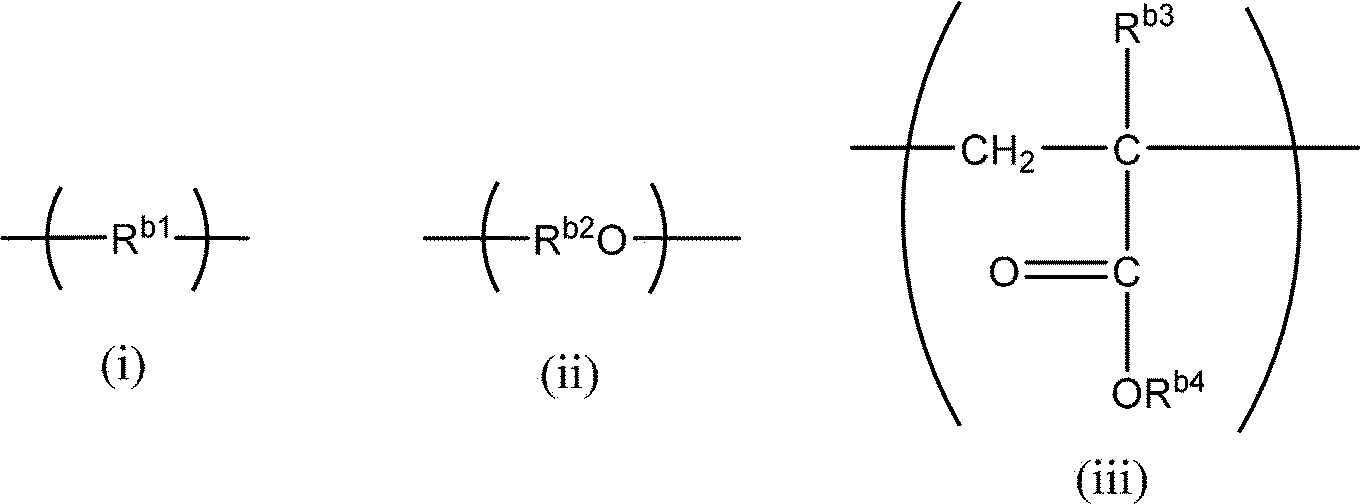
上記一般式(ii)中、Rb2は、炭素数2~4の直鎖又は分岐鎖のアルキレン基を示し、具体的には、エチレン基、1,2-プロピレン基、1,3-プロピレン基、1,2-ブチレン基、1,3-ブチレン基、及び1,4-ブチレン基等が挙げられる。
上記一般式(iii)中、Rb3は、水素原子又はメチル基を示す。
また、Rb4は炭素数1~10の直鎖又は分岐鎖のアルキル基を示し、具体的には、メチル基、エチル基,n-プロピル基、n-ブチル基、n-ペンチル基、n-ヘキシル基、n-ヘプチル基、n-オクチル基、n-ノニル基、n-デシル基、イソプロピル基、イソブチル基、sec-ブチル基、t-ブチル基、イソペンチル基、t-ペンチル基、イソヘキシル基、t-ヘキシル基、イソヘプチル基、t-ヘプチル基、2-エチルヘキシル基、イソオクチル基、イソノニル基、及びイソデシル基等が挙げられる。
なお、上記一般式(i)~(iii)で表される繰り返し単位をそれぞれ複数有する場合には、Rb1、Rb2、Rb3、及びRb4は、それぞれ同一であってもよく、互いに異なるものであってもよい。
また、本発明の一態様で用いる櫛形ポリマー(B1-1)は、マクロモノマー(x1)に由来する構成単位と共に、マクロモノマー(x1)以外の他のモノマー(x2)に由来する構成単位(X2)を含む共重合体であってもよい。
このような櫛形ポリマー(B1-1)の具体的な構造としては、モノマー(x2)に由来する構成単位(X2)を含む主鎖に対して、マクロモノマー(x1)に由来する構成単位(X1)を含む、側鎖を有する共重合体が好ましい。より好ましくは、モノマー(x2)に由来する構成単位(X2)を含む主鎖に対して、マクロモノマー(x1)に由来する構成単位(X1)も主鎖として含む共重合体とすることである。
また、モノマー(x2)としては、下記一般式(a1)で表される単量体(x2-a)、アルキル(メタ)アクリレート(x2-b)、及び水酸基含有ビニル単量体(x2-d)から選ばれる1種以上を含むことが好ましく、水酸基含有ビニル単量体(x2-d)を少なくとも含むことがより好ましい。

Rb12は、単結合、炭素数1~10の直鎖又は分岐鎖のアルキレン基、-O-、もしくは-NH-を示す。
Rb13は、炭素数2~4の直鎖又は分岐鎖のアルキレン基を示す。また、nは1以上の整数(好ましくは1~20の整数、より好ましくは1~5の整数)を示す。なお、nが2以上の整数の場合、複数のRb13は、同一であってもよく、異なっていてもよく、さらに、(Rb13O)n部分は、ランダム結合でもブロック結合でもよい。
Rb14は、炭素数1~60(好ましくは10~50、より好ましくは20~40)の直鎖又は分岐鎖のアルキル基を示す。
上記の「炭素数1~10の直鎖又は分岐鎖のアルキレン基」、「炭素数2~4の直鎖又は分岐鎖のアルキレン基」、及び「炭素数1~60の直鎖又は分岐鎖のアルキル基」の具体的な基としては、上述の一般式(i)~(iii)に関する記載で例示した基と同じものが挙げられる。
アルキル(メタ)アクリレート(x2-b)としては、例えば、メチル(メタ)アクリレート、エチル(メタ)アクリレート、n-プロピル(メタ)アクリレート、イソプロピル(メタ)アクリレート、n-ブチル(メタ)アクリレート、t-ブチル(メタ)アクリレート、ペンチル(メタ)アクリレート、ヘキシル(メタ)アクリレート、2-エチルヘキシル(メタ)アクリレート、ヘプチル(メタ)アクリレート、2-t-ブチルヘプチル(メタ)アクリレート、オクチル(メタ)アクリレート、及び3-イソプロピルヘプチル(メタ)アクリレート等が挙げられる。
なお、当該アルキル基は、直鎖アルキル基でもよく、分岐鎖アルキル基でもよい。
窒素原子含有ビニル単量体(x2-c)としては、例えば、アミド基含有ビニル単量体(x2-c1)、ニトロ基含有単量体(x2-c2)、1級アミノ基含有ビニル単量体(x2-c3)、2級アミノ基含有ビニル単量体(x2-c4)、3級アミノ基含有ビニル単量体(x2-c5)、及びニトリル基含有ビニル単量体(x2-c6)等が挙げられる。
具体的な窒素原子含有ビニル単量体(x2-c)に由来する構成単位の含有量としては、櫛形ポリマーの構成単位の全量(100モル%)基準で、好ましくは1.0モル%未満、より好ましくは0.5モル%未満、更に好ましくは0.1モル%未満、より更に好ましくは0.01モル%未満、特に好ましくは0モル%である。
水酸基含有ビニル単量体(x2-d)としては、例えば、ヒドロキシル基含有ビニル単量体(x2-d1)、及びポリオキシアルキレン鎖含有ビニル単量体(x2-d2)等が挙げられる。
これらの中でも、2つ以上の水酸基を有するヒドロキシル基含有ビニル単量体が好ましく、多価アルコール又はグリセリン酸に前記不飽和基を導入した化合物がより好ましい。
具体的には、ポリエチレングリコール(Mn:100~300)モノ(メタ)アクリレート、ポリプロピレングリコール(Mn:130~500)モノ(メタ)アクリレート、メトキシポリエチレングリコール(Mn:110~310)(メタ)アクリレート、ラウリルアルコールエチレンオキサイド付加物(2~30モル)(メタ)アクリレート、及びモノ(メタ)アクリル酸ポリオキシエチレン(Mn:150~230)ソルビタン等が挙げられる。
リン原子含有単量体(x2-e)としては、例えば、リン酸エステル基含有単量体(x2-e1)及びホスホノ基含有単量体(x2-e2)等が挙げられる。
具体的なリン原子含有単量体(x2-e)に由来する構成単位の含有量としては、櫛形ポリマーの構成単位の全量(100モル%)基準で、好ましくは1.0モル%未満、より好ましくは0.5モル%未満、更に好ましくは0.1モル%未満、より更に好ましくは0.01モル%未満、特に好ましくは0モル%である。
脂肪族炭化水素系ビニル単量体(x2-f)としては、例えば、エチレン、プロピレン、ブテン、イソブチレン、ペンテン、ヘプテン、ジイソブチレン、オクテン、ドデセン、及びオクタデセン等の炭素数2~20のアルケン;ブタジエン、イソプレン、1,4-ペンタジエン、1,6-ヘプタジエン及び1,7-オクタジエン等の炭素数4~12のアルカジエン;等が挙げられる。
脂肪族炭化水素系ビニル単量体(x2-f)の炭素数としては、好ましくは2~30、より好ましくは2~20、更に好ましくは2~12である。
脂環式炭化水素系ビニル単量体(x2-g)としては、例えば、シクロヘキセン、(ジ)シクロペンタジエン、ピネン、リモネン、ビニルシクロヘキセン、及びエチリデンビシクロヘプテン等が挙げられる。
脂環式炭化水素系ビニル単量体(x2-g)の炭素数としては、好ましくは3~30、より好ましくは3~20、更に好ましくは3~12である。
ビニルエステル類(x2-h)としては、例えば、酢酸ビニル、プロピオン酸ビニル、酪酸ビニル、及びオクタン酸ビニル等の炭素数2~12の飽和脂肪酸のビニルエステル等が挙げられる。
ビニルエーテル類(x2-i)としては、例えば、メチルビニルエーテル、エチルビニルエーテル、プロピルビニルエーテル、ブチルビニルエーテル、及び2-エチルヘキシルビニルエーテル等の炭素数1~12のアルキルビニルエーテル;ビニル-2-メトキシエチルエーテル、及びビニル-2-ブトキシエチルエーテル等の炭素数1~12のアルコキシアルキルビニルエーテル;等が挙げられる。
ビニルケトン類(x2-j)としては、例えば、メチルビニルケトン、及びエチルビニルケトン等の炭素数1~8のアルキルビニルケトン;等が挙げられる。
エポキシ基含有ビニル単量体(x2-k)としては、例えば、グリシジル(メタ)アクリレート及びグリシジル(メタ)アリルエーテル等が挙げられる。
ハロゲン元素含有ビニル単量体(x2-l)としては、例えば、塩化ビニル、臭化ビニル、塩化ビニリデン、塩化(メタ)アリル等が挙げられる。
不飽和ポリカルボン酸のエステル(x2-m)としては、例えば、不飽和ポリカルボン酸のアルキルエステル、不飽和ポリカルボン酸のシクロアルキルエステル、不飽和ポリカルボン酸のアラルキルエステル等が挙げられ、不飽和カルボン酸としては、例えば、マレイン酸、フマル酸、及びイタコン酸等が挙げられる。
(ジ)アルキルフマレート(x2-n)としては、例えば、モノメチルフマレート、ジメチルフマレート、モノエチルフマレート、ジエチルフマレート、メチルエチルフマレート、モノブチルフマレート、ジブチルフマレート、ジペンチルフマレート、及びジヘキシルフマレート等が挙げられる。
(ジ)アルキルマレエート(x2-o)としては、例えば、モノメチルマレエート、ジメチルマレエート、モノエチルマレエート、ジエチルマレエート、メチルエチルマレエート、モノブチルマレエート、及びジブチルマレエート等が挙げられる。
芳香族炭化水素系ビニル単量体(x2-p)としては、例えば、スチレン、α-メチルスチレン、α-エチルスチレン、ビニルトルエン、2,4-ジメチルスチレン、4-エチルスチレン、4-イソプロピルスチレン、4-ブチルスチレン、4-フェニルスチレン、4-シクロヘキシルスチレン、4-ベンジルスチレン、p-メチルスチレン、モノクロロスチレン、ジクロロスチレン、トリブロモスチレン、テトラブロモスチレン、4-クロチルベンゼン、インデン、及び2-ビニルナフタレン等が挙げられる。
芳香族炭化水素系ビニル単量体(x2-p)の炭素数としては、好ましくは8~30、より好ましくは8~20、更に好ましくは8~18である。
具体的な芳香族炭化水素系ビニル単量体(x2-p)に由来する構成単位の含有量としては、櫛形ポリマーの構成単位の全量(100モル%)基準で、好ましくは1.0モル%未満、より好ましくは0.5モル%未満、更に好ましくは0.1モル%未満、より更に好ましくは0.01モル%未満、特に好ましくは0モル%である。
本発明の潤滑油組成物は、粘度指数向上剤(B)由来の樹脂分(B1)と第一オレフィン系重合体(A1-1)との含有比率[(B1)/(A1-1)]が、質量比で、0.001超である。
[(B1)/(A1-1)]は、第一オレフィン系重合体(A1-1)に対する粘度指数向上剤(B)由来の樹脂分(B1)の量を意味し、この値が0.001以下であると、油膜保持性に劣る潤滑油組成物となる。
ここで、本発明の一態様の潤滑油組成物において、油膜保持性に優れる潤滑油組成物を調製しやすくする観点から、[(B1)/(A1-1)]は、好ましくは0.002以上、より好ましくは0.003以上、更に好ましくは0.004以上、より更に好ましくは0.005以上である。また、せん断安定性の観点から、好ましくは0.10以下であり、より好ましくは0.05以下であり、更に好ましくは0.02以下である。これらの数値範囲の上限値及び下限値は任意に組み合わせることができる。具体的には、好ましくは0.002~0.10、より好ましくは0.003~0.05、更に好ましくは0.004~0.02、より更に好ましくは0.005~0.02である。
本発明の潤滑油組成物は、イミド系分散剤(C)を含有する。
そして、本発明の潤滑油組成物は、イミド系分散剤(C)由来の窒素原子含有量が、潤滑油組成物の全量基準で、0.06質量%以上である。
イミド系分散剤(C)由来の窒素原子含有量が、0.06質量%未満であると、潤滑油組成物の高温清浄性を確保することができない。また、油膜保持性を十分なものとできない。
また、本発明の一態様の潤滑油組成物において、イミド系分散剤(C)の含有量は、イミド系分散剤(C)由来の窒素原子含有量が、上記範囲を充足するように調整すればよい。イミド系分散剤(C)の含有量は、潤滑油組成物の全量基準で、好ましくは1.0質量%以上、より好ましくは5.0質量%以上、更に好ましくは7.5質量%以上である。また、好ましくは20.0質量%以下、より好ましくは15.0質量%以下、更に好ましくは12.5質量%以下である。これらの数値範囲の上限値及び下限値は任意に組み合わせることができる。具体的には、好ましくは1.0質量%~20.0質量%、より好ましくは5.0質量%~15.0質量%、更に好ましくは7.5質量%~12.5質量%である。
これらの中でも、コハク酸モノイミド(非ホウ素変性体)及びコハク酸ビスイミド(非ホウ素変性体)からなる群から選択される1種以上が好ましい。
イミド系分散剤(C)は、1種を単独で用いてもよく、2種以上を組み合わせて用いてもよい。

R3C、R5C、及びR6Cの質量平均分子量が500以上であると、基油(A)への溶解性を良好にできる。また、3,000以下であると、本発明の効果をより発揮させやすくすることができる。R5C及びR6Cは同一でも異なっていてもよい。
R4C、R7C、及びR8Cは、それぞれ炭素数2~5のアルキレン基であり、R7C及びR8Cは同一でも異なっていてもよい。n1は1~10の整数を示し、n2は0又は1~10の整数を示す。ここで、n1は、好ましくは2~5、より好ましくは2~4である。n1が2以上であると、本発明の効果をより発揮させやすくすることができる。n1が5以下であると、基油(A)に対する溶解性がより一層良好となる。
一般式(c-2)において、n2は好ましくは1~6であり、より好ましくは2~6である。n2が1以上であると、本発明の効果をより発揮させやすくすることができる。n2が6以下であると、基油(A)に対する溶解性がより一層良好となる。
R3C、R5C、及びR6Cとして選択され得るアルキル基としては、例えば、ポリブテニル基、ポリイソブテニル基、エチレン-プロピレン共重合体等を水添したものを挙げることができ、好ましくはポリブテニル基又はポリイソブテニル基を水添したものを挙げることができる。
上記のアルケニルコハク酸イミド又はアルキルコハク酸イミドコハク酸イミドは、ホウ素変性体であってもよい。当該ホウ素変性体は、例えば、ホウ素未含有のアルケニルコハク酸モノイミド又はアルキルコハク酸モノイミドや、アルケニルコハク酸ビスイミド又はアルキルコハク酸ビスイミドを、ホウ素化合物と反応させて製造することができる。
一方、ポリアミンとしては、エチレンジアミン、プロピレンジアミン、ブチレンジアミン、ペンチレンジアミン等の単一ジアミン;ジエチレントリアミン、トリエチレンテトラミン、テトラエチレンペンタミン、ペンタエチレンヘキサミン、ジ(メチルエチレン)トリアミン、ジブチレントリアミン、トリブチレンテトラミン、ペンタペンチレンヘキサミン等のポリアルキレンポリアミン;アミノエチルピペラジン等のピペラジン誘導体等を挙げることができる。ポリアミンは、1種を単独で用いてもよく、2種以上を組み合わせて用いてもよい。
ホウ酸としては、オルトホウ酸、メタホウ酸及びパラホウ酸等が挙げられる。
ホウ酸塩としては、メタホウ酸アンモニウム、四ホウ酸アンモニウム、五ホウ酸アンモニウム及び八ホウ酸アンモニウム等のホウ酸アンモニウム等が挙げられる。
ホウ酸エステルとしては、ホウ酸モノメチル、ホウ酸ジメチル、ホウ酸トリメチル、ホウ酸モノエチル、ホウ酸ジエチル、ホウ酸トリエチル、ホウ酸モノプロピル、ホウ酸ジプロピル、ホウ酸トリプロピル、ホウ酸モノブチル、ホウ酸ジブチル及びホウ酸トリブチル等が挙げられる。
本発明の一態様の潤滑油組成物は、金属系清浄剤(D)を含有していてもよい。
本発明の一態様の潤滑油組成物が、金属系清浄剤(D)を含有することで、潤滑油組成物の高温清浄性をより向上させ得る。
本発明の一態様の潤滑油組成物において、金属系清浄剤(D)に由来する金属原子の含有量は、高温清浄性をより良好なものとする観点、及び、硫酸灰分を低く抑える観点から、潤滑油組成物の全量基準で、好ましくは0.01質量%~0.20質量%、より好ましくは0.05質量%~0.18質量%、更に好ましくは0.08質量%~0.15質量%である。
また、本発明の一態様の潤滑油組成物において、金属系清浄剤(D)の含有量は、金属系清浄剤(D)に由来する金属原子の含有量が上記範囲を充足するように調整すればよい。金属系清浄剤(D)の含有量は、潤滑油組成物の全量基準で、好ましくは0.1質量%~10.0質量%、より好ましくは0.5質量%~5.0質量%、更に好ましくは0.75質量%~2.0質量%である。
また、アルカリ土類金属系清浄剤を構成するアルカリ土類金属としては、マグネシウム(Mg)、カルシウム(Ca)、ストロンチウム(Sr)、バリウム(Ba)が挙げられ、これらの中でも、カルシウム(Ca)、マグネシウム(Mg)が好ましい。
すなわち、金属系清浄剤(D)としては、カルシウム系清浄剤(D1)及びマグネシウム系清浄剤(D2)からなる群から選択される1種以上であることが好ましい。
以下、カルシウム系清浄剤(D1)及びマグネシウム系清浄剤(D2)について、詳細に説明する。
カルシウム系清浄剤(D1)としては、例えば、カルシウムスルホネート、カルシウムフェネート、カルシウムサリチレート等のカルシウム塩が挙げられる。
これらの中でも、高温清浄性をより良好なものとする観点から、カルシウムフェネート、カルシウムサリチレートが好ましく、カルシウムサリチレートがより好ましい。
カルシウムスルホネートとしては、下記一般式(d1-1)で表される金属スルホネートにおいて、Mがカルシウム原子である化合物が好ましい。カルシウムフェネートとしては、下記一般式(d1-2)で表される金属フェネートにおいて、M’がカルシウム原子である化合物が好ましい。カルシウムサリチレートとしては、下記一般式(d1-3)で表される金属サリチレートにおいて、Mがカルシウム原子である化合物が好ましい。
カルシウム系清浄剤(D1)は、1種を単独で用いてもよく、2種以上を組み合わせて用いてもよい。
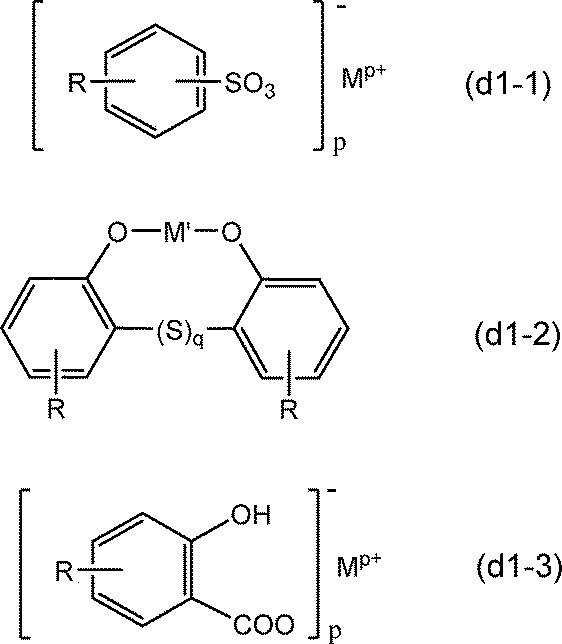
Rとして選択し得る炭化水素基としては、例えば、炭素数1~18のアルキル基、炭素数1~18のアルケニル基、環形成炭素数3~18のシクロアルキル基、環形成炭素数6~18のアリール基、炭素数7~18のアルキルアリール基、炭素数7~18のアリールアルキル基等が挙げられる。
なお、本明細書において、塩基性又は過塩基性金属系清浄剤とは、金属と酸性有機化合物とを反応させてなり、該金属と該酸性有機化合物との中和に必要な化学量論量よりも過剰の金属を含有するものを意味する。すなわち、金属と酸性有機化合物との中和に必要な化学量論量に従って反応させて得られる金属塩(中性塩)中の金属の化学当量に対する、金属系清浄剤中の金属の総化学当量を「金属比」としたときに、塩基性又は過塩基性金属系清浄剤の金属比は1より大きくなる。本実施形態に用いられる塩基性又は過塩基性金属系清浄剤の金属比は、好ましくは1.3超、より好ましくは5~30、更に好ましくは7~22である。塩基性又は過塩基性金属系清浄剤の具体例としては、上記した金属サリチレート、金属フェネート及び金属スルホネートからなる群から選択される1種以上を含み、且つ過剰の金属を含有するものが挙げられる。
なお、本明細書において、後述する測定方法により測定される塩基価が、50mgKOH/g未満のものを「中性」、50mgKOH/g以上150mgKOH/g未満のものを「塩基性」、150mgKOH/g以上のものを「過塩基性」と定義する。
なお、本明細書において、金属系清浄剤(D)の「塩基価」とは、JIS K 2501:2003に準拠して、過塩素酸法により測定した塩基価を意味する。
また、本発明の一態様の潤滑油組成物において、カルシウム系清浄剤(D1)の含有量は、カルシウム系清浄剤(D1)に由来するカルシウム原子の含有量が上記範囲を充足するように調整すればよい。カルシウム系清浄剤(D1)の含有量は、潤滑油組成物の全量基準で、好ましくは0.01質量%~10.0質量%、より好ましくは0.10質量%~5.0質量%、更に好ましくは0.80質量%~2.00質量%である。
マグネシウム系清浄剤(D2)としては、例えば、マグネシウムスルホネート、マグネシウムフェネート、マグネシウムサリチレート等のマグネシウム塩が挙げられる。
これらの中でも、高温清浄性をより良好なものとする観点から、マグネシウムスルホネートが好ましい。
マグネシウムスルホネートとしては、上記一般式(d1-1)で表される金属スルホネートにおいて、Mがマグネシウム原子である化合物が好ましい。マグネシウムフェネートとしては、上記一般式(d1-2)で表される金属フェネートにおいて、M’がマグネシウム原子である化合物が好ましい。マグネシウムサリチレートとしては、上記一般式(d1-3)で表される金属サリチレートにおいて、Mがマグネシウム原子である化合物が好ましい。
マグネシウム系清浄剤(D2)は、1種を単独で用いてもよく、2種以上を併用してもよい。
マグネシウム系清浄剤(D2)の塩基価は、好ましくは5mgKOH/g以上、より好ましくは100mgKOH/g以上、更に好ましくは150mgKOH/g以上、より更に好ましくは200mgKOH/g以上であり、そして、好ましくは500mgKOH/g以下、より好ましくは450mgKOH/g以下、更に好ましくは400mgKOH/g以下である。
また、本発明の一態様の潤滑油組成物において、マグネシウム系清浄剤(D2)の含有量は、マグネシウム系清浄剤(D2)に由来するマグネシウム原子の含有量が上記範囲を充足するように調整すればよい。マグネシウム系清浄剤(D2)の含有量は、潤滑油組成物の全量基準で、好ましくは0.001質量%~2.000質量%、より好ましくは0.005質量%~1.000質量%、更に好ましくは0.01質量%~0.300質量%である。
本発明の一態様の潤滑油組成物は、ジチオリン酸亜鉛(E)を含有していてもよい。
本発明の一態様の潤滑油組成物が、ジチオリン酸亜鉛(E)を含有することで、潤滑油組成物の耐摩耗性をより向上させ得る。

また、R21E~R24Eとして選択され得る炭化水素基の炭素数としては、1価の炭化水素基がアルキル基の場合、好ましくは1以上、より好ましくは2以上、更に好ましくは3以上であり、上限として好ましくは24以下、より好ましくは18以下、更に好ましくは12以下である。1価の炭化水素がアルケニル基の場合、好ましくは2以上、より好ましくは3以上であり、上限として好ましくは24以下、より好ましくは18以下、更に好ましくは12以下である。
また、同様の観点から、ジチオリン酸亜鉛(E)由来の亜鉛原子の含有量が、潤滑油組成物の全量基準で、好ましくは0.005質量%~0.200質量%、より好ましくは0.010質量%~0.150質量%、更に好ましくは0.06質量%~0.110質量%である。
また、本発明の一態様の潤滑油組成物において、ジチオリン酸亜鉛(E)の含有量は、ジチオリン酸亜鉛(E)由来のリン原子含有量及び亜鉛原子含有量が、上記範囲を充足するように調整すればよい。ジチオリン酸亜鉛(E)の含有量は、潤滑油組成物の全量基準で、好ましくは0.10質量%~5.00質量%、より好ましくは0.50質量%~2.50質量%、更に好ましくは0.75質量%~1.25質量%である。
本発明の一態様の潤滑油組成物は、本発明の効果を損なわない範囲で、必要に応じて、上記各成分以外の潤滑油用添加剤(以下、単に「潤滑油用添加剤」ともいう)を含有してもよい。
潤滑油用添加剤としては、例えば、酸化防止剤、極圧剤、摩擦調整剤、消泡剤、防錆剤、腐食防止剤、金属不活性化剤等が挙げられる。また、ジチオリン酸亜鉛(E)以外の耐摩耗剤が挙げられる。
潤滑油用添加剤は、各々について、1種を単独で用いてもよく、2種以上を組み合わせて用いてもよい。
本発明の一態様の潤滑油組成物において、これらの潤滑油用添加剤の合計含有量は、潤滑油組成物の全量(100質量%)基準で、好ましくは5質量%以上、より好ましくは10質量%以上、更に好ましくは15質量%以上であり、そして、好ましくは35質量%以下、好ましくは30質量%以下、より好ましくは27質量%以下、更に好ましくは25質量%以下である。
酸化防止剤としては、従来潤滑油の酸化防止剤として使用されている公知の酸化防止剤の中から、任意のものを適宜選択して用いることができ、例えば、アミン系酸化防止剤、フェノール系酸化防止剤等が挙げられる。
酸化防止剤は、1種を単独で用いてもよく、2種以上を組み合わせて用いてもよい。
極圧剤としては、例えば、スルフィド類、スルフォキシド類、スルフォン類、チオホスフィネート類等の硫黄系極圧剤、塩素化炭化水素等のハロゲン系極圧剤、有機金属系極圧剤等が挙げられる。
極圧剤は、1種を単独で用いてもよく、2種以上を組み合わせて用いてもよい。
摩擦調整剤としては、例えば、炭素数6~30のアルキル基又はアルケニル基を分子中に少なくとも1個有する、脂肪族アミン、脂肪酸エステル、脂肪酸アミド、脂肪酸、脂肪族アルコール、脂肪族エーテル等の無灰摩擦調整剤;油脂類;アミン;アミド;硫化エステル;リン酸エステル;亜リン酸エステル;リン酸エステルアミン塩等が挙げられる。
摩擦調整剤は、1種を単独で用いてもよく、2種以上を組み合わせて用いてもよい。
消泡剤としては、例えば、シリコーン油、フルオロシリコーン油、フルオロアルキルエーテル等が挙げられる。
消泡剤は、1種を単独で用いてもよく、2種以上を組み合わせて用いてもよい。
防錆剤としては、例えば、脂肪酸、アルケニルコハク酸ハーフエステル、脂肪酸セッケン、アルキルスルホン酸塩、多価アルコール脂肪酸エステル、脂肪酸アミン、酸化パラフィン、アルキルポリオキシエチレンエーテル等が挙げられる。
防錆剤は、1種を単独で用いてもよく、2種以上を組み合わせて用いてもよい。
腐食防止剤及び金属不活性化剤としては、例えば、ベンゾトリアゾール系化合物、トリルトリアゾール系化合物、チアジアゾール系化合物、イミダゾール系化合物、ピリミジン系化合物等が挙げられる。
これらは、1種を単独で用いてもよく、2種以上を組み合わせて用いてもよい。
耐摩耗剤としては、例えば、ジチオリン酸亜鉛(E)以外のリン酸亜鉛、ジチオカルバミン酸亜鉛、ジスルフィド類、硫化オレフィン類、硫化油脂類、硫化エステル類、チオカーボネート類、チオカーバメート類、ポリサルファイド類等の硫黄含有化合物;亜リン酸エステル類、リン酸エステル類、ホスホン酸エステル類、これらのアミン塩又は金属塩等のリン含有化合物;チオ亜リン酸エステル類、チオリン酸エステル類、チオホスホン酸エステル類、これらのアミン塩又は金属塩等の硫黄及びリン含有耐摩耗剤が挙げられる。
これらは、1種を単独で用いてもよく、2種以上を組み合わせて用いてもよい。
本発明の一態様の潤滑油組成物は、モリブデン系化合物を含有していてもよいが、モリブデン系化合物の含有量は少ないことが好ましい。本発明の一態様の潤滑油組成物は、モリブデン系化合物を含有せずとも、耐摩耗性に優れる。したがって、高温清浄性の低下を引き起こすモリブデン系化合物を配合せずとも、優れた効果が発揮される。
モリブデン系化合物由来のMo原子の含有量は、潤滑油組成物の全量基準で、好ましくは0.10質量%未満、より好ましくは0.05質量%未満、更に好ましくは0.04質量%未満、より更に好ましくはモリブデン系化合物を含まないことである。
モリブデン系化合物としては、二核モリブデンジチオカーバメート等の二核の有機モリブデン化合物;三核の有機モリブデン化合物が挙げられる。
本発明の一態様の潤滑油組成物は、ミスト防止剤を含有していてもよいが、ミスト防止剤の含有量は少ないことが好ましい。
ミスト防止剤の含有量は、潤滑油組成物の全量基準で、好ましくは0.01質量%未満、より好ましくは0.001質量%未満、更に好ましくはミスト防止剤を含まないことである。
ミスト防止剤としては、ポリイソブチレン、エチレン-プロピレンコポリマー等の炭化水素系高分子化合物を用いることができる。当該高分子化合物の数平均分子量は10万~300万が好ましく、20万~200万がより好ましい。
<100℃動粘度>
本発明の潤滑油組成物は、100℃動粘度が5.0mm2/s以上7.1mm2/s未満である。
100℃動粘度が5.0mm2/s未満であると、油膜を保持しにくくなると共に、NOACK蒸発量も増加しやすくなる。また、100℃動粘度が7.1mm2/s以上であると、省燃費性が低下する。
かかる観点から、本発明の一態様の潤滑油組成物は、100℃動粘度が、好ましくは5.1mm2/s以上、より好ましくは5.2mm2/s以上、更に好ましくは5.3mm2/s以上である。また、好ましくは6.8mm2/s以下、より好ましくは6.6mm2/s以下、更に好ましくは6.4mm2/s以下である。これらの数値範囲の上限値及び下限値は任意に組み合わせることができる。具体的には、好ましくは5.1mm2/s以上6.8mm2/s以下、より好ましくは5.2mm2/s以上6.6mm2/s以下、更に好ましくは5.3mm2/s以上6.4mm2/s以下である。
なお、本明細書において、潤滑油組成物の100℃動粘度は、JIS K2283:2000に準拠して測定される値である。
本発明の一態様の潤滑油組成物は、150℃におけるHTHS粘度が2.0mPa・s以上2.3mPa・s未満であることが好ましい。
150℃におけるHTHS粘度が2.0mPa・s以上であると、油膜を保持しやすくなる。また、150℃におけるHTHS粘度が2.3mPa・s未満であると、省燃費性を良好なものとしやすい。
かかる観点から、本発明の一態様の潤滑油組成物は、150℃におけるHTHS粘度が、より好ましくは2.0mPa・s以上2.2mPa・s以下である。
なお、本明細書において、150℃におけるHTHS粘度は、ASTM D4683に準拠し、TBS高温粘度計(Tapered Bearing Simulator Viscometer)を用いて、150℃の温度条件下、せん断速度106/sにて測定される値である。
本発明の一態様の潤滑油組成物は、40℃動粘度が15.0mm2/s~30.0mm2/sであることが好ましい。
40℃動粘度が15.0mm2/s以上であると、油膜を保持しやすくなると共に、NOACK蒸発量も抑制しやすくなる。また、40℃動粘度が30mm2/s以下であると、省燃費性を良好なものとしやすい。
かかる観点から、本発明の一態様の潤滑油組成物は、40℃動粘度が、より好ましくは18.0mm2/s~29.0mm2/s、より好ましくは20.0mm2/s~28.0mm2/s、更に好ましくは21.0mm2/s~27.0mm2/sである。
なお、本明細書において、潤滑油組成物の40℃動粘度は、JIS K2283:2000に準拠して測定される値である。
本発明の一態様の潤滑油組成物は、粘度指数が、好ましくは150以上、より好ましくは160以上、更に好ましくは170以上である。また、好ましくは230以下、より好ましくは220以下、更に好ましくは210以下である。これらの数値範囲の上限値及び下限値は任意に組み合わせることができる。具体的には、好ましくは150~230、より好ましくは160~220、更に好ましくは170~210である。
なお、本明細書において、潤滑油組成物の粘度指数は、JIS K2283:2000に準拠して算出される値である。
本発明の一態様の潤滑油組成物は、NOACK蒸発量(250℃、1時間)が23質量%未満である。NOACK蒸発量が23質量%以上であると、潤滑油組成物の増粘が生じ、燃費低下の要因となる。
かかる観点から、本発明の一態様の潤滑油組成物は、NOACK蒸発量が、好ましくは22質量%以下、より好ましくは21質量%以下、更に好ましくは20質量%以下である。また、通常0.1質量%以上である。
なお、本明細書において、NOACK蒸発量は、250℃、1時間の条件にて、JPI-5S-41-2004に準拠して測定される値である。
本発明の潤滑油組成物は、アニリン点が、95℃以上である。
潤滑油組成物のアニリン点が95℃未満であると、ゴム材料を膨潤させたり、硬化させたりする恐れがある。
ここで、ゴム材料を膨潤させたり硬化させたりすることなく、ゴム材料との適合性をより向上させる観点から、アニリン点は、好ましくは100℃以上、より好ましくは110℃以上である。
なお、本明細書において、アニリン点は、JIS K 2256:2013に準拠して測定される値である。
本発明の潤滑油組成物は、高温清浄性に優れる。具体的には、後述する実施例に記載の方法で実施したホットチューブ試験の評点が、好ましくは2.5以上である。
本発明の潤滑油組成物は、油膜保持性に優れる。具体的には、後述する実施例に記載の方法で実施した油膜厚さが、好ましくは60nm以上である。
本発明の一態様の潤滑油組成物は、モリブデン(Mo)原子の含有量が、潤滑油組成物の全量基準で、好ましくは0.10質量%未満、より好ましくは0.05質量%未満、更に好ましくは0.04質量%未満、より更に好ましくは0.02質量%未満、特に好ましくはモリブデン(Mo)原子を含まないことである。
なお、モリブデン原子の含有量は、JIS-5S-38-03に準拠して測定することができる。
本発明の潤滑油組成物の製造方法は、特に制限されない。
例えば、本発明の一態様の潤滑油組成物の製造方法は、オレフィン系重合体(A1)を含む基油(A)と、粘度指数向上剤(B)と、イミド系分散剤(C)とを混合する工程を含み、
前記オレフィン系重合体(A1)として、100℃における動粘度が3.0mm2/s以上である第一オレフィン系重合体(A1-1)を含み、前記第一オレフィン系重合体(A1-1)の含有量が基油(A)の全量基準で30質量%以上であり、
前記オレフィン系重合体(A1)として、100℃における動粘度が3.0mm2/s未満である第二オレフィン系重合体(A1-2)を含まないか、又は、含んでいても基油(A)の全量基準で18.5質量%未満であり、
前記粘度指数向上剤(B)由来の樹脂分(B1)の含有量が、前記潤滑油組成物の全量基準で、0.01質量%以上であり、
前記イミド系分散剤(C)由来の窒素原子含有量が、前記潤滑油組成物の全量基準で、0.06質量%以上であり、
前記粘度指数向上剤(B)由来の前記樹脂分(B1)と前記第一オレフィン系重合体(A1-1)との含有比率[(B1)/(A1-1)]が、質量比で、0.001超であり、
100℃における動粘度が、5.0mm2/s以上7.1mm2/s未満であり、
アニリン点が95℃以上である、潤滑油組成物の製造方法である。
上記各成分を混合する方法としては、特に制限はないが、例えば、オレフィン系重合体(A1)を含む基油(A)に、粘度指数向上剤(B)及びイミド系分散剤(C)を配合する工程を有する方法が挙げられる。粘度指数向上剤(B)及びイミド系分散剤(C)は、オレフィン系重合体(A1)を含む基油(A)に同時に配合してもよいし、別々に配合してもよい。粘度指数向上剤(B)及びイミド系分散剤(C)以外の他の成分の配合についても同様である。なお、各成分は、希釈油等を加えて溶液(分散体)の形態とした上で配合してもよい。各成分を配合した後、公知の方法により、撹拌して均一に分散させることが好ましい。
本発明の一態様の潤滑油組成物は、二輪車、四輪車等の自動車、発電機、船舶等のガソリンエンジン、ディーゼルエンジン、ガスエンジン等の内燃機関用の潤滑油組成物として好ましく使用することができ、特に、ターボチャージャー等の過給機を搭載したエンジン等の内燃機関ように熱負荷が高い環境で使用される潤滑油組成物として好ましく使用することができる。
そして、本発明の一態様の潤滑油組成物は、これらの内燃機関、特に、過給機を搭載した内燃機関(過給機搭載エンジン)に充填して、これら内燃機関に係る各部品を潤滑するために好適に用いられる。
したがって、本発明の一態様によれば、前記潤滑油組成物を用いることによる、内燃機関を潤滑する方法が提供される。また、前記潤滑油組成物を用いることによる、過給機を搭載した内燃機関(過給機搭載エンジン)を潤滑する方法が提供される。
本発明の一態様では、下記[1]~[11]が提供される。
[1] オレフィン系重合体(A1)を含む基油(A)と、粘度指数向上剤(B)と、イミド系分散剤(C)とを含有する潤滑油組成物であり、
前記オレフィン系重合体(A1)として、100℃における動粘度が3.0mm2/s以上である第一オレフィン系重合体(A1-1)を含み、前記第一オレフィン系重合体(A1-1)の含有量が基油(A)の全量基準で30質量%以上であり、
前記オレフィン系重合体(A1)として、100℃における動粘度が3.0mm2/s未満である第二オレフィン系重合体(A1-2)を含まないか、又は、含んでいても基油(A)の全量基準で18.5質量%未満であり、
前記粘度指数向上剤(B)由来の樹脂分(B1)の含有量が、前記潤滑油組成物の全量基準で、0.01質量%以上であり、
前記イミド系分散剤(C)由来の窒素原子含有量が、前記潤滑油組成物の全量基準で、0.06質量%以上であり、
前記粘度指数向上剤(B)由来の前記樹脂分(B1)と前記第一オレフィン系重合体(A1-1)との含有比率[(B1)/(A1-1)]が、質量比で、0.001超であり、
100℃における動粘度が、5.0mm2/s以上7.1mm2/s未満であり、
アニリン点が、95℃以上である、潤滑油組成物。
[2] 前記基油(A)は、さらに、鉱油(A2)並びに前記第一オレフィン系重合体(A1-1)及び前記第二オレフィン系重合体(A1-2)以外の合成油(A3)からなる群から選択される1種以上を含む、上記[1]に記載の潤滑油組成物。
[3] 前記鉱油(A2)の含有量が、前記基油(A)の全量基準で、50質量%以下である、上記[2]に記載の潤滑油組成物。
[4] 150℃における高温高せん断粘度(HTHS粘度)が、2.0mPa・s以上2.3mPa・s未満である、上記[1]~[3]のいずれかに記載の潤滑油組成物。
[5] 前記樹脂分(B1)の質量平均分子量(Mw)が20万以上である、上記[1]~[4]のいずれかに記載の潤滑油組成物。
[6] さらに、金属系清浄剤(D)を含有する、上記[1]~[5]のいずれかに記載の潤滑油組成物。
[7] さらに、ジチオリン酸亜鉛(E)を含有する、上記[1]~[6]のいずれかに記載の潤滑油組成物。
[8] 内燃機関に用いられる、上記[1]~[7]のいずれかに記載の潤滑油組成物。
[9] 過給機を搭載した内燃機関に用いられる、上記[1]~[7]のいずれかに記載の潤滑油組成物。
[10] 上記[1]~[7]のいずれかに記載の潤滑油組成物を用いる、内燃機関の潤滑方法。
[11] 前記内燃機関が、過給機を搭載した内燃機関である、上記[10]に記載の潤滑方法。
各実施例及び各比較例で用いた各原料並びに各実施例及び各比較例の潤滑油組成物の各性状の測定は、以下に示す要領に従って行ったものである。
基油及び潤滑油組成物の40℃動粘度並びに100℃動粘度は、JIS K2283:2000に準拠して測定した。
(2)粘度指数
基油及び潤滑油組成物の粘度指数は、JIS K2283:2000に準拠して測定した40℃動粘度及び100℃動粘度の測定値から算出した。
(3)150℃におけるHTHS粘度
潤滑油組成物の150℃におけるHTHS粘度は、ASTM D4683に準拠し、TBS高温粘度計(Tapered Bearing Simulator Viscometer)を用いて、150℃の温度条件下、せん断速度106/sにて測定した。
(4)NOACK蒸発量
潤滑油組成物のNOACK蒸発量は、250℃、1時間の条件にて、JPI-5S-41-2004に準拠して測定した。
(5)アニリン点
潤滑油組成物のアニリン点は、JIS K 2256:2013に準拠して測定した。
(6)質量平均分子量(Mw)、数平均分子量(Mn)
ゲル浸透クロマトグラフ装置(アジレント社製、「1260型HPLC」)を用いて、下記の条件下で測定し、標準ポリスチレン換算にて測定した値を用いた。
(測定条件)
・カラム:「Shodex LF404」を2本、順次連結したもの。
・カラム温度:35℃
・展開溶媒:クロロホルム
・流速:0.3mL/min
以下に示す基油(A)、粘度指数向上剤(B)、イミド系分散剤(C)、及び各種添加剤を、表1に示す配合量(単位:質量%)で十分に混合し、実施例1~4及び比較例1~6の潤滑油組成物をそれぞれ調製した。
実施例1~4及び比較例1~6の潤滑油組成物の調製に用いた基油(A)、粘度指数向上剤(B)、イミド系分散剤(C)、及び各種添加剤の詳細は、以下に示すとおりである。
なお、表1に示す粘度指数向上剤(B)の配合量は、希釈油を除いた有効成分(樹脂分(B1))の配合量である。
(第一オレフィン系重合体(A1-1)-1)
後述する製造例1で製造されたオレフィン系重合体
40℃動粘度:13.61mm2/s、100℃動粘度:3.42mm2/s、粘度指数:129
(第一オレフィン系重合体(A1-1)-2)
イネオス社製、製品名「Durasyn 133」
40℃動粘度:13.41mm2/s、100℃動粘度:3.36mm2/s、粘度指数:125
(第二オレフィン系重合体(A1-2)-1)
イネオス社製、製品名「Durasyn 162」
40℃動粘度:5.10mm2/s、100℃動粘度:1.80mm2/s
(第二オレフィン系重合体(A1-2)-2)
原料モノマーである1-デセンを、BF3触媒を用いて合成した、ポリα-オレフィンオリゴマー
40℃動粘度:5mm2/s、100℃動粘度:1.7mm2/s
(鉱油(A2)-1)
APIカテゴリーでグループIIIに分類される鉱油
40℃動粘度:19mm2/s、100℃動粘度:4.2mm2/s、粘度指数:126
(鉱油(A2)-2)
APIカテゴリーでグループIIに分類される鉱油
40℃動粘度:12mm2/s、100℃動粘度:3.0mm2/s、粘度指数:106
(エステル系油(A3-1))
セバシン酸ジオクチル
40℃動粘度:12mm2/s、100℃動粘度:3.2mm2/s、粘度指数:151
(1)1-デセンの重合
内容積5リットルの三つ口フラスコに、窒素気流下、1-デセン(出光興産株式会社製、製品名「リニアレン10」)を4リットル(21.4mol)加えた後、更に、メタロセン触媒であるビスシクロペンタジエニルジルコニウムジクロリド(錯体質量:1168mg(4mmol))をトルエンで溶解した溶液と、助触媒であるメチルアルモキサン(Al換算:40mmol)をトルエンで溶解した溶液とを添加した。
添加後、40℃で20時間撹拌してデセンモノマーのオリゴマー化を進めた後、メタノールを20ml添加して、オリゴマー化反応を停止させた。
次いで、反応混合物を三つ口フラスコから取り出し、5mol/Lの水酸化ナトリウム水溶液を4リットル添加し、室温(25℃)で4時間撹拌して分液操作を行った。そして、上層の有機層を取り出し、デセントリマーの溶液を得た。
内容積5リットルのオートクレーブに、窒素気流下、上記(1)で得たデセンオリゴマーの溶液を3リットル加えた後、更に、コバルトトリスアセチルアセトナート(触媒質量:3.0g)をトルエンで溶解した溶液と、トリイソブチルアルミニウム(30mmol)をトルエンで溶解した溶液とを添加した。
添加後、水素で系内を2回置換してから、昇温し、反応温度80℃、水素圧0.9MPaにて保持し、水素化反応を進行させた。そして、反応開始後4時間で室温(25℃)まで降温し、水素化反応を停止させた。
次いで、脱圧し、オートクレーブ内の反応生成物を取り出し、単蒸留にて、留出温度240~270℃、圧力530Paの留分を分離し、デセントリマーの水素化物からなる第一オレフィン系重合体(A1-1)-1を得た。
(樹脂分(B1)-1:櫛形ポリマー)
質量平均分子量(Mw):60万、Mw/Mn:2.9、SSI:1、Mnが500以上のマクロモノマーに由来する構成単位を少なくとも有する。
(樹脂分(B1)-2:PMA)
ポリメタクリレート(三洋化成社製、製品名「アクルーブ740」)、質量平均分子量(Mw):23万、Mw/Mn:2.1。
ポリブテニルコハク酸ビスイミド(非ホウ素変性体):窒素含有量1.2質量%
(金属系清浄剤(D))
カルシウムサリチレート、マグネシウムサリチレート
実施例1~4、比較例1~4、及び比較例6では、潤滑油組成物中のCa含有量が0.11質量%、Mg含有量が0.02質量%になるように、カルシウムサリチレート及びマグネシウムサリチレートを配合した。
比較例5では、潤滑油組成物中のCa含有量が0.23質量%になるように、カルシウムサリチレートを配合した。
(ジチオリン酸亜鉛(E))
第1級のZnDTP、第2級のZnDTP
実施例1~4、比較例1~4、及び比較例6では、潤滑油組成物中のP含有量が0.07質量%、Zn含有量が0.08質量%になるように、第1級のZnDTP及び第2級のZnDTPを配合した。
比較例5では、潤滑油組成物中のP含有量が0.08質量%、Zn含有量が0.09質量%になるように、第1級のZnDTP及び第2級のZnDTPを配合した。
(酸化防止剤)
実施例1~4及び比較例1~6において、アミン系酸化防止剤を配合した。アミン系酸化防止剤の潤滑油組成物中の添加量は0.5質量%であった。
実施例1~4及び比較例1~6の潤滑油組成物について、高温清浄性の評価を実施した。
まず、実施例1~4及び比較例1~6の潤滑油組成物の油温を150℃とし、濃度:4,000体積ppmのNOXガスを潤滑油組成物に72時間吹込み、潤滑油組成物を劣化処理した。本劣化処理により、潤滑油組成物は、約1.6万km走行後の状態に相当する。なお、試験容器の容積は300mLであり、潤滑油組成物は100mL使用した。
劣化処理された潤滑油組成物に対し、温度:260℃の条件で、ホットチューブ試験を行った。
ホットチューブ試験の評点0~10のうち、2.5以上であると、高温清浄性が長期間維持される潤滑油組成物であると評価した。
以下の条件にて得られた潤滑油組成物の油膜厚さを測定した。前記油膜厚さを同一の条件で3回測定し、3回の測定値の平均値を、潤滑油組成物のEHL油膜厚さとした。前記EHL油膜厚さが、60nm以上であると、油膜保持性に優れる潤滑油組成物であると評価した。
・装置名:EHD2(PCS Insturments社製)
・試験片:Steel Ball(直径:7.5mm)
・ディスク:SiO2/CrコーティングしたGlass Disc
・油温:100℃
・荷重:20N(面圧:0.5GPa)
・速度:100mm/s
・滑り率(SRR):200%

実施例1~4の潤滑油組成物は、低蒸発性であると共に油膜保持性に優れ、高温清浄性にも優れることがわかる。また、アニリン点も95℃以上であり、ゴム材料適合性にも優れることがわかる。
これに対し、比較例1の潤滑油組成物は、第二オレフィン系重合体(A1-2)の含有量が、基油(A)の全量基準で、18.5質量%以上であることから、低蒸発性に劣ることがわかる。
比較例2の潤滑油組成物は、アニリン点が室温であることから、ゴム材料適合性に劣ることがわかる。
比較例3の潤滑油組成物は、第一オレフィン系重合体(A1-1)を含まないことから、低蒸発性に劣ることがわかる。
比較例4及び5の潤滑油組成物は、イミド系分散剤(C)由来の窒素原子含有量が、0.06質量%未満であることから、高温清浄性に劣ることがわかる。また、油膜保持性も劣ることがわかる。また、比較例5の潤滑油組成物は、粘度指数向上剤(B)由来の樹脂分(B1)と第一オレフィン系重合体(A1-1)との含有比率[(B1)/(A1-1)]が、質量比で、0.001以下であることから、比較例4と比べて油膜保持性に劣ることがわかる。
比較例6の潤滑油組成物は、粘度指数向上剤(B)を含有せず、粘度指数向上剤(B)由来の樹脂分(B1)と第一オレフィン系重合体(A1-1)との含有比率[(B1)/(A1-1)]が、質量比で、0.001以下であることから、油膜保持性に劣ることがわかる。
Claims (11)
- オレフィン系重合体(A1)を含む基油(A)と、粘度指数向上剤(B)と、イミド系分散剤(C)とを含有する潤滑油組成物であり、
前記オレフィン系重合体(A1)として、100℃における動粘度が3.0mm2/s以上である第一オレフィン系重合体(A1-1)を含み、前記第一オレフィン系重合体(A1-1)の含有量が基油(A)の全量基準で30質量%以上であり、
前記オレフィン系重合体(A1)として、100℃における動粘度が3.0mm2/s未満である第二オレフィン系重合体(A1-2)を含まないか、又は、含んでいても基油(A)の全量基準で18.5質量%未満であり、
前記粘度指数向上剤(B)由来の樹脂分(B1)の含有量が、前記潤滑油組成物の全量基準で、0.01質量%以上であり、
前記イミド系分散剤(C)由来の窒素原子含有量が、前記潤滑油組成物の全量基準で、0.06質量%以上であり、
前記粘度指数向上剤(B)由来の前記樹脂分(B1)と前記第一オレフィン系重合体(A1-1)との含有比率[(B1)/(A1-1)]が、質量比で、0.001超であり、
100℃における動粘度が、5.0mm2/s以上7.1mm2/s未満であり、
アニリン点が、95℃以上である、潤滑油組成物。 - 前記基油(A)は、さらに、鉱油(A2)並びに前記第一オレフィン系重合体(A1-1)及び前記第二オレフィン系重合体(A1-2)以外の合成油(A3)からなる群から選択される1種以上を含む、請求項1に記載の潤滑油組成物。
- 前記鉱油(A2)の含有量が、前記基油(A)の全量基準で、50質量%以下である、請求項2に記載の潤滑油組成物。
- 150℃における高温高せん断粘度(HTHS粘度)が、2.0mPa・s以上2.3mPa・s未満である、請求項1~3のいずれか1項に記載の潤滑油組成物。
- 前記樹脂分(B1)の質量平均分子量(Mw)が20万以上である、請求項1~4のいずれか1項に記載の潤滑油組成物。
- さらに、金属系清浄剤(D)を含有する、請求項1~5のいずれか1項に記載の潤滑油組成物。
- さらに、ジチオリン酸亜鉛(E)を含有する、請求項1~6のいずれか1項に記載の潤滑油組成物。
- 内燃機関に用いられる、請求項1~7のいずれか1項に記載の潤滑油組成物。
- 過給機を搭載した内燃機関に用いられる、請求項1~7のいずれか1項に記載の潤滑油組成物。
- 請求項1~7のいずれか1項に記載の潤滑油組成物を用いる、内燃機関の潤滑方法。
- 前記内燃機関が、過給機を搭載した内燃機関である、請求項10に記載の潤滑方法。
Priority Applications (4)
| Application Number | Priority Date | Filing Date | Title |
|---|---|---|---|
| JP2022507280A JP7623350B2 (ja) | 2020-03-13 | 2021-03-11 | 潤滑油組成物 |
| EP21768257.4A EP4119642A4 (en) | 2020-03-13 | 2021-03-11 | LUBRICATING COMPOSITION |
| CN202180020818.8A CN115210346A (zh) | 2020-03-13 | 2021-03-11 | 润滑油组合物 |
| US17/906,164 US20230115470A1 (en) | 2020-03-13 | 2021-03-11 | Lubricant composition |
Applications Claiming Priority (2)
| Application Number | Priority Date | Filing Date | Title |
|---|---|---|---|
| JP2020044225 | 2020-03-13 | ||
| JP2020-044225 | 2020-03-13 |
Publications (1)
| Publication Number | Publication Date |
|---|---|
| WO2021182580A1 true WO2021182580A1 (ja) | 2021-09-16 |
Family
ID=77671640
Family Applications (1)
| Application Number | Title | Priority Date | Filing Date |
|---|---|---|---|
| PCT/JP2021/009859 Ceased WO2021182580A1 (ja) | 2020-03-13 | 2021-03-11 | 潤滑油組成物 |
Country Status (5)
| Country | Link |
|---|---|
| US (1) | US20230115470A1 (ja) |
| EP (1) | EP4119642A4 (ja) |
| JP (1) | JP7623350B2 (ja) |
| CN (1) | CN115210346A (ja) |
| WO (1) | WO2021182580A1 (ja) |
Cited By (2)
| Publication number | Priority date | Publication date | Assignee | Title |
|---|---|---|---|---|
| CN114560883A (zh) * | 2022-03-07 | 2022-05-31 | 西安石油大学 | 一种含硼螺环型原油处理剂及其制备方法 |
| EP4453152A1 (en) * | 2021-12-21 | 2024-10-30 | ExxonMobil Technology and Engineering Company | Engine oil lubricant compostions and methods for making same with superior oil consumption |
Citations (5)
| Publication number | Priority date | Publication date | Assignee | Title |
|---|---|---|---|---|
| US5972852A (en) * | 1995-06-05 | 1999-10-26 | Exxon Chemical Patents, Inc. | Ester-free synthetic lubricating oils comprising polybutenyl substituted succinic acid or anhydride and hydrocarbon polymer |
| JP2010100707A (ja) * | 2008-10-22 | 2010-05-06 | Idemitsu Kosan Co Ltd | 内燃機関用潤滑油組成物 |
| WO2014136973A1 (ja) * | 2013-03-08 | 2014-09-12 | 出光興産株式会社 | 潤滑油組成物 |
| JP2014210844A (ja) * | 2013-04-17 | 2014-11-13 | コスモ石油ルブリカンツ株式会社 | 内燃機関用潤滑油組成物 |
| WO2019031404A1 (ja) * | 2017-08-10 | 2019-02-14 | 出光興産株式会社 | 潤滑油組成物、内燃機関、及び内燃機関の潤滑方法 |
Family Cites Families (2)
| Publication number | Priority date | Publication date | Assignee | Title |
|---|---|---|---|---|
| SG11201502836TA (en) * | 2012-10-10 | 2015-05-28 | Jx Nippon Oil & Energy Corp | Lubricating oil composition for trunk-piston-type diesel engine |
| JP6716360B2 (ja) * | 2016-06-24 | 2020-07-01 | Jxtgエネルギー株式会社 | 内燃機関用潤滑油組成物 |
-
2021
- 2021-03-11 EP EP21768257.4A patent/EP4119642A4/en active Pending
- 2021-03-11 US US17/906,164 patent/US20230115470A1/en not_active Abandoned
- 2021-03-11 JP JP2022507280A patent/JP7623350B2/ja active Active
- 2021-03-11 CN CN202180020818.8A patent/CN115210346A/zh active Pending
- 2021-03-11 WO PCT/JP2021/009859 patent/WO2021182580A1/ja not_active Ceased
Patent Citations (5)
| Publication number | Priority date | Publication date | Assignee | Title |
|---|---|---|---|---|
| US5972852A (en) * | 1995-06-05 | 1999-10-26 | Exxon Chemical Patents, Inc. | Ester-free synthetic lubricating oils comprising polybutenyl substituted succinic acid or anhydride and hydrocarbon polymer |
| JP2010100707A (ja) * | 2008-10-22 | 2010-05-06 | Idemitsu Kosan Co Ltd | 内燃機関用潤滑油組成物 |
| WO2014136973A1 (ja) * | 2013-03-08 | 2014-09-12 | 出光興産株式会社 | 潤滑油組成物 |
| JP2014210844A (ja) * | 2013-04-17 | 2014-11-13 | コスモ石油ルブリカンツ株式会社 | 内燃機関用潤滑油組成物 |
| WO2019031404A1 (ja) * | 2017-08-10 | 2019-02-14 | 出光興産株式会社 | 潤滑油組成物、内燃機関、及び内燃機関の潤滑方法 |
Non-Patent Citations (2)
| Title |
|---|
| HAMAGUCHI, HITOSHI: "Global lubricants / lubricants additives technology and market / standard trends", 7 October 2016, S & T PUBLISHING CO., LTD., JP, ISBN: 978-4-907002-59-6, article HITOSHI HAMAGUCHI: "6.2 Chemical Composition Testing of Lubricants", pages: 165 - 168, XP009539695 * |
| See also references of EP4119642A4 * |
Cited By (3)
| Publication number | Priority date | Publication date | Assignee | Title |
|---|---|---|---|---|
| EP4453152A1 (en) * | 2021-12-21 | 2024-10-30 | ExxonMobil Technology and Engineering Company | Engine oil lubricant compostions and methods for making same with superior oil consumption |
| CN114560883A (zh) * | 2022-03-07 | 2022-05-31 | 西安石油大学 | 一种含硼螺环型原油处理剂及其制备方法 |
| CN114560883B (zh) * | 2022-03-07 | 2024-01-26 | 西安石油大学 | 一种含硼螺环型原油处理剂及其制备方法 |
Also Published As
| Publication number | Publication date |
|---|---|
| EP4119642A4 (en) | 2024-04-03 |
| JP7623350B2 (ja) | 2025-01-28 |
| EP4119642A1 (en) | 2023-01-18 |
| US20230115470A1 (en) | 2023-04-13 |
| JPWO2021182580A1 (ja) | 2021-09-16 |
| CN115210346A (zh) | 2022-10-18 |
Similar Documents
| Publication | Publication Date | Title |
|---|---|---|
| CN106459821B (zh) | 润滑油组合物 | |
| JP6572900B2 (ja) | 潤滑油組成物、及び当該潤滑油組成物の製造方法 | |
| JP4805457B2 (ja) | 潤滑油組成物 | |
| JP6197124B2 (ja) | ガソリンエンジン用潤滑油組成物、及びその製造方法 | |
| JP6014540B2 (ja) | 内燃機関用潤滑油組成物 | |
| JP7098623B2 (ja) | 潤滑油組成物、内燃機関、及び内燃機関の潤滑方法 | |
| JP6336095B2 (ja) | 潤滑油組成物及び潤滑油組成物の製造方法 | |
| WO2016159258A1 (ja) | ガソリンエンジン用潤滑油組成物、及びその製造方法 | |
| WO2021182580A1 (ja) | 潤滑油組成物 | |
| CN1952091B (zh) | 液压油组合物 | |
| WO2015129022A1 (ja) | エンジン油組成物 | |
| JP6936041B2 (ja) | 内燃機関用潤滑油組成物 | |
| JP7028411B2 (ja) | 潤滑油組成物 | |
| JP7189941B2 (ja) | 潤滑油組成物および潤滑油用粘度調整剤 | |
| WO2017150687A1 (ja) | 潤滑油組成物、潤滑方法、及び変速機 | |
| CN113748189B (zh) | 变速器用润滑油组合物、其制造方法、使用了变速器用润滑油组合物的润滑方法及变速器 | |
| JP7341979B2 (ja) | 潤滑油組成物 | |
| WO2017150688A1 (ja) | 潤滑油組成物、潤滑方法、及び変速機 | |
| JP2026005766A (ja) | 自動車エンジン用潤滑油組成物 |
Legal Events
| Date | Code | Title | Description |
|---|---|---|---|
| 121 | Ep: the epo has been informed by wipo that ep was designated in this application |
Ref document number: 21768257 Country of ref document: EP Kind code of ref document: A1 |
|
| ENP | Entry into the national phase |
Ref document number: 2022507280 Country of ref document: JP Kind code of ref document: A |
|
| WWE | Wipo information: entry into national phase |
Ref document number: 2021768257 Country of ref document: EP |
|
| ENP | Entry into the national phase |
Ref document number: 2021768257 Country of ref document: EP Effective date: 20221013 |
|
| NENP | Non-entry into the national phase |
Ref country code: DE |