WO2021187253A1 - 冷間圧延鋼板 - Google Patents
冷間圧延鋼板 Download PDFInfo
- Publication number
- WO2021187253A1 WO2021187253A1 PCT/JP2021/009376 JP2021009376W WO2021187253A1 WO 2021187253 A1 WO2021187253 A1 WO 2021187253A1 JP 2021009376 W JP2021009376 W JP 2021009376W WO 2021187253 A1 WO2021187253 A1 WO 2021187253A1
- Authority
- WO
- WIPO (PCT)
- Prior art keywords
- film
- steel sheet
- rolled steel
- binder
- wax
- Prior art date
- Legal status (The legal status is an assumption and is not a legal conclusion. Google has not performed a legal analysis and makes no representation as to the accuracy of the status listed.)
- Ceased
Links
Images


Classifications
-
- C—CHEMISTRY; METALLURGY
- C21—METALLURGY OF IRON
- C21D—MODIFYING THE PHYSICAL STRUCTURE OF FERROUS METALS; GENERAL DEVICES FOR HEAT TREATMENT OF FERROUS OR NON-FERROUS METALS OR ALLOYS; MAKING METAL MALLEABLE, e.g. BY DECARBURISATION OR TEMPERING
- C21D9/00—Heat treatment, e.g. annealing, hardening, quenching or tempering, adapted for particular articles; Furnaces therefor
- C21D9/46—Heat treatment, e.g. annealing, hardening, quenching or tempering, adapted for particular articles; Furnaces therefor for sheet metals
- C21D9/48—Heat treatment, e.g. annealing, hardening, quenching or tempering, adapted for particular articles; Furnaces therefor for sheet metals deep-drawing sheets
-
- C—CHEMISTRY; METALLURGY
- C21—METALLURGY OF IRON
- C21D—MODIFYING THE PHYSICAL STRUCTURE OF FERROUS METALS; GENERAL DEVICES FOR HEAT TREATMENT OF FERROUS OR NON-FERROUS METALS OR ALLOYS; MAKING METAL MALLEABLE, e.g. BY DECARBURISATION OR TEMPERING
- C21D8/00—Modifying the physical properties of ferrous metals or ferrous alloys by deformation combined with, or followed by, heat treatment
- C21D8/02—Modifying the physical properties of ferrous metals or ferrous alloys by deformation combined with, or followed by, heat treatment during manufacturing of plates or strips
- C21D8/0278—Modifying the physical properties of ferrous metals or ferrous alloys by deformation combined with, or followed by, heat treatment during manufacturing of plates or strips involving a particular surface treatment
- C21D8/0284—Application of a separating or insulating coating
-
- C—CHEMISTRY; METALLURGY
- C21—METALLURGY OF IRON
- C21D—MODIFYING THE PHYSICAL STRUCTURE OF FERROUS METALS; GENERAL DEVICES FOR HEAT TREATMENT OF FERROUS OR NON-FERROUS METALS OR ALLOYS; MAKING METAL MALLEABLE, e.g. BY DECARBURISATION OR TEMPERING
- C21D9/00—Heat treatment, e.g. annealing, hardening, quenching or tempering, adapted for particular articles; Furnaces therefor
- C21D9/46—Heat treatment, e.g. annealing, hardening, quenching or tempering, adapted for particular articles; Furnaces therefor for sheet metals
-
- B—PERFORMING OPERATIONS; TRANSPORTING
- B32—LAYERED PRODUCTS
- B32B—LAYERED PRODUCTS, i.e. PRODUCTS BUILT-UP OF STRATA OF FLAT OR NON-FLAT, e.g. CELLULAR OR HONEYCOMB, FORM
- B32B15/00—Layered products comprising a layer of metal
- B32B15/04—Layered products comprising a layer of metal comprising metal as the main or only constituent of a layer, which is next to another layer of the same or of a different material
- B32B15/08—Layered products comprising a layer of metal comprising metal as the main or only constituent of a layer, which is next to another layer of the same or of a different material of synthetic resin
-
- B—PERFORMING OPERATIONS; TRANSPORTING
- B32—LAYERED PRODUCTS
- B32B—LAYERED PRODUCTS, i.e. PRODUCTS BUILT-UP OF STRATA OF FLAT OR NON-FLAT, e.g. CELLULAR OR HONEYCOMB, FORM
- B32B15/00—Layered products comprising a layer of metal
- B32B15/04—Layered products comprising a layer of metal comprising metal as the main or only constituent of a layer, which is next to another layer of the same or of a different material
- B32B15/08—Layered products comprising a layer of metal comprising metal as the main or only constituent of a layer, which is next to another layer of the same or of a different material of synthetic resin
- B32B15/082—Layered products comprising a layer of metal comprising metal as the main or only constituent of a layer, which is next to another layer of the same or of a different material of synthetic resin comprising vinyl resins; comprising acrylic resins
-
- B—PERFORMING OPERATIONS; TRANSPORTING
- B32—LAYERED PRODUCTS
- B32B—LAYERED PRODUCTS, i.e. PRODUCTS BUILT-UP OF STRATA OF FLAT OR NON-FLAT, e.g. CELLULAR OR HONEYCOMB, FORM
- B32B15/00—Layered products comprising a layer of metal
- B32B15/18—Layered products comprising a layer of metal comprising iron or steel
-
- C—CHEMISTRY; METALLURGY
- C09—DYES; PAINTS; POLISHES; NATURAL RESINS; ADHESIVES; COMPOSITIONS NOT OTHERWISE PROVIDED FOR; APPLICATIONS OF MATERIALS NOT OTHERWISE PROVIDED FOR
- C09D—COATING COMPOSITIONS, e.g. PAINTS, VARNISHES OR LACQUERS; FILLING PASTES; CHEMICAL PAINT OR INK REMOVERS; INKS; CORRECTING FLUIDS; WOODSTAINS; PASTES OR SOLIDS FOR COLOURING OR PRINTING; USE OF MATERIALS THEREFOR
- C09D5/00—Coating compositions, e.g. paints, varnishes or lacquers, characterised by their physical nature or the effects produced; Filling pastes
- C09D5/08—Anti-corrosive paints
-
- C—CHEMISTRY; METALLURGY
- C21—METALLURGY OF IRON
- C21D—MODIFYING THE PHYSICAL STRUCTURE OF FERROUS METALS; GENERAL DEVICES FOR HEAT TREATMENT OF FERROUS OR NON-FERROUS METALS OR ALLOYS; MAKING METAL MALLEABLE, e.g. BY DECARBURISATION OR TEMPERING
- C21D8/00—Modifying the physical properties of ferrous metals or ferrous alloys by deformation combined with, or followed by, heat treatment
- C21D8/02—Modifying the physical properties of ferrous metals or ferrous alloys by deformation combined with, or followed by, heat treatment during manufacturing of plates or strips
- C21D8/0221—Modifying the physical properties of ferrous metals or ferrous alloys by deformation combined with, or followed by, heat treatment during manufacturing of plates or strips characterised by the working steps
- C21D8/0236—Cold rolling
-
- C—CHEMISTRY; METALLURGY
- C21—METALLURGY OF IRON
- C21D—MODIFYING THE PHYSICAL STRUCTURE OF FERROUS METALS; GENERAL DEVICES FOR HEAT TREATMENT OF FERROUS OR NON-FERROUS METALS OR ALLOYS; MAKING METAL MALLEABLE, e.g. BY DECARBURISATION OR TEMPERING
- C21D8/00—Modifying the physical properties of ferrous metals or ferrous alloys by deformation combined with, or followed by, heat treatment
- C21D8/02—Modifying the physical properties of ferrous metals or ferrous alloys by deformation combined with, or followed by, heat treatment during manufacturing of plates or strips
- C21D8/04—Modifying the physical properties of ferrous metals or ferrous alloys by deformation combined with, or followed by, heat treatment during manufacturing of plates or strips to produce plates or strips for drawing, e.g. for deep-drawing
-
- C—CHEMISTRY; METALLURGY
- C21—METALLURGY OF IRON
- C21D—MODIFYING THE PHYSICAL STRUCTURE OF FERROUS METALS; GENERAL DEVICES FOR HEAT TREATMENT OF FERROUS OR NON-FERROUS METALS OR ALLOYS; MAKING METAL MALLEABLE, e.g. BY DECARBURISATION OR TEMPERING
- C21D8/00—Modifying the physical properties of ferrous metals or ferrous alloys by deformation combined with, or followed by, heat treatment
- C21D8/02—Modifying the physical properties of ferrous metals or ferrous alloys by deformation combined with, or followed by, heat treatment during manufacturing of plates or strips
- C21D8/04—Modifying the physical properties of ferrous metals or ferrous alloys by deformation combined with, or followed by, heat treatment during manufacturing of plates or strips to produce plates or strips for drawing, e.g. for deep-drawing
- C21D8/0421—Modifying the physical properties of ferrous metals or ferrous alloys by deformation combined with, or followed by, heat treatment during manufacturing of plates or strips to produce plates or strips for drawing, e.g. for deep-drawing characterised by the working steps
- C21D8/0436—Cold rolling
-
- C—CHEMISTRY; METALLURGY
- C21—METALLURGY OF IRON
- C21D—MODIFYING THE PHYSICAL STRUCTURE OF FERROUS METALS; GENERAL DEVICES FOR HEAT TREATMENT OF FERROUS OR NON-FERROUS METALS OR ALLOYS; MAKING METAL MALLEABLE, e.g. BY DECARBURISATION OR TEMPERING
- C21D8/00—Modifying the physical properties of ferrous metals or ferrous alloys by deformation combined with, or followed by, heat treatment
- C21D8/02—Modifying the physical properties of ferrous metals or ferrous alloys by deformation combined with, or followed by, heat treatment during manufacturing of plates or strips
- C21D8/04—Modifying the physical properties of ferrous metals or ferrous alloys by deformation combined with, or followed by, heat treatment during manufacturing of plates or strips to produce plates or strips for drawing, e.g. for deep-drawing
- C21D8/0478—Modifying the physical properties of ferrous metals or ferrous alloys by deformation combined with, or followed by, heat treatment during manufacturing of plates or strips to produce plates or strips for drawing, e.g. for deep-drawing involving a particular surface treatment
-
- C—CHEMISTRY; METALLURGY
- C23—COATING METALLIC MATERIAL; COATING MATERIAL WITH METALLIC MATERIAL; CHEMICAL SURFACE TREATMENT; DIFFUSION TREATMENT OF METALLIC MATERIAL; COATING BY VACUUM EVAPORATION, BY SPUTTERING, BY ION IMPLANTATION OR BY CHEMICAL VAPOUR DEPOSITION, IN GENERAL; INHIBITING CORROSION OF METALLIC MATERIAL OR INCRUSTATION IN GENERAL
- C23C—COATING METALLIC MATERIAL; COATING MATERIAL WITH METALLIC MATERIAL; SURFACE TREATMENT OF METALLIC MATERIAL BY DIFFUSION INTO THE SURFACE, BY CHEMICAL CONVERSION OR SUBSTITUTION; COATING BY VACUUM EVAPORATION, BY SPUTTERING, BY ION IMPLANTATION OR BY CHEMICAL VAPOUR DEPOSITION, IN GENERAL
- C23C26/00—Coating not provided for in groups C23C2/00 - C23C24/00
-
- B—PERFORMING OPERATIONS; TRANSPORTING
- B32—LAYERED PRODUCTS
- B32B—LAYERED PRODUCTS, i.e. PRODUCTS BUILT-UP OF STRATA OF FLAT OR NON-FLAT, e.g. CELLULAR OR HONEYCOMB, FORM
- B32B2325/00—Polymers of vinyl-aromatic compounds, e.g. polystyrene
-
- B—PERFORMING OPERATIONS; TRANSPORTING
- B32—LAYERED PRODUCTS
- B32B—LAYERED PRODUCTS, i.e. PRODUCTS BUILT-UP OF STRATA OF FLAT OR NON-FLAT, e.g. CELLULAR OR HONEYCOMB, FORM
- B32B2333/00—Polymers of unsaturated acids or derivatives thereof
-
- B—PERFORMING OPERATIONS; TRANSPORTING
- B32—LAYERED PRODUCTS
- B32B—LAYERED PRODUCTS, i.e. PRODUCTS BUILT-UP OF STRATA OF FLAT OR NON-FLAT, e.g. CELLULAR OR HONEYCOMB, FORM
- B32B2391/00—Waxes
Definitions
- the present invention relates to a cold rolled steel sheet having improved press formability.
- Cold-rolled steel sheets are used in a wide range of fields, mainly for automobile body applications. In such applications, it is generally press molded and used. In particular, in recent years, in order to integrate a plurality of parts and improve the design, molding into a more complicated shape has been required. During press forming into such a complicated shape, a portion where the surface pressure of the steel sheet rises is likely to occur, so that the steel material is likely to be broken and mold galling is likely to occur. Therefore, further improvement in press moldability is required.
- Patent Document 1 discloses a technique for forming a film containing an alkali metal borate as a film component and a mixture of zinc stearate and wax as a lubricant on a steel sheet.
- Patent Document 2 discloses a technique for forming a film on a steel sheet by adding lithium silicate as a film component and wax as a lubricant and metal soap.
- Patent Document 3 discloses a technique for forming an alkali-soluble organic film on a steel plate by adding a lubricant to a copolymer containing styrene and a vinyl compound having a carboxyl group copolymerizable therewith as an essential monomer. There is.
- Patent Documents 1 and 2 did not sufficiently satisfy the required characteristics regarding press moldability, particularly deep drawing molding and overhang molding.
- Patent Document 3 may not be able to obtain sufficient press moldability depending on the type and amount of the lubricant.
- the present invention has been made in view of such circumstances, and an object of the present invention is to provide a steel sheet having a film having high lubrication performance and excellent press moldability, together with an advantageous manufacturing method thereof.
- the inventors include a binder satisfying a specific condition and a wax satisfying a specific condition, and the wax is contained in a specific mass ratio. It has been found that the above-mentioned problems can be solved by a cold-rolled steel sheet having a specific coating amount.
- the gist of the present invention is as follows. 1.
- a cold-rolled steel sheet having a film on at least one side.
- the film contains binder A and natural wax B.
- the binder A is at least one selected from the group of salts of a copolymer of styrene and maleic acid, a copolymer of styrene and maleic anhydride, and a copolymer of styrene and maleic acid.
- the natural wax B is at least one selected from paraffin wax and microcrystalline wax having 20 or more carbon atoms, and has a median diameter ⁇ of 0.2 ⁇ m or more and 2.5 ⁇ m or less and a melting point ⁇ of 100 ° C. or more and 115 ° C. or less.
- the mass ratio C of the natural wax B defined by the following formula (1) is 20% or more.
- C ⁇ M B / (M A + M B) ⁇ ⁇ 100 ...
- M A mass obtained by converting the binder A as an acid anhydride
- M B weight of the natural wax B
- the present invention it is possible to provide a cold-rolled steel sheet having excellent press formability, which can be used in a wide range of fields mainly for automobile body applications. Further, by further adding specific conditions to the binder and natural wax, excellent alkaline defilmability and weldability can be imparted, and a cold-rolled steel sheet optimal as an automobile steel sheet can be provided. Steel sheets for automobiles need to be welded, degreased, chemical conversion treated, and electrodeposited after being press-formed, and the film used for steel sheets for automobiles is also required not to interfere with such post-processes. Therefore, the significance of applying the steel sheet of the present invention is great.
- the film on the cold-rolled steel sheet of the present invention is a residue generated after heating of the aqueous chemical, and the solvent is applied by applying the aqueous chemical to at least one side of the cold-rolled steel sheet and heating it. Formed by evaporation.
- the water-based drug is a drug in which the components forming the film are blended in water at a specific ratio, and water is the main solvent.
- the pH of the aqueous chemical is preferably adjusted to a range of 7 or more and 12 or less, more preferably 8 or more and 10 or less, and applied to at least one side of the steel sheet. If the pH of the aqueous chemical is less than 7, the cold-rolled steel sheet may rust when the aqueous chemical is applied.
- a sample diluted with deionized water was adjusted to 25 ° C. so that the mass concentration of the film component in the aqueous drug was 10%, and the pH was adjusted to 25 ° C. with a portable pH meter HM-30P (manufactured by DKK-TOA CORPORATION).
- Measurement can be performed using a composite electrode GST-2739C (manufactured by DKK-TOA CORPORATION) that has been calibrated according to a method specified by the manufacturer.
- the calibration solution it is preferable to use a neutral phosphate pH standard solution pH 6.86, a borate pH standard solution pH 9.18, and a saturated calcium hydroxide solution pH 12.45.
- binder A means a compound that prevents wax from falling off from a cold-rolled steel sheet.
- a binder is present around the wax particles, and the binder serves as a bridge between the wax particles and the cold-rolled steel sheet. In other words, in the film, the binder evenly disperses and holds the wax particles on the surface of the base steel sheet.
- At least one selected from the group consisting of a copolymer of styrene and maleic acid, a copolymer of styrene and maleic anhydride, and a salt of a copolymer of styrene and maleic acid is used. Two or more of them may be used together.
- the reason for selecting styrene as the monomer component of the binder is that it contributes to the improvement of press moldability. Moreover, the reason for selecting maleic acid is that the removability by alkali is improved. The reason for selecting maleic anhydride is the same as that for maleic acid.
- the same effect can be obtained by selecting any of a copolymer of styrene and maleic acid, a copolymer of styrene and maleic anhydride, and a salt of a copolymer of styrene and maleic acid. Be done. This is because the binder only needs to retain the wax particles and has excellent removability with an alkali, and is not affected by the type of salt or whether maleic acid is anhydrous or not.
- the copolymer in the present invention can be obtained by polymerizing styrene and maleic acid or styrene and maleic anhydride.
- the polymerization reaction may be a method using a generally known copolymerization reaction.
- the salt of the copolymer in the present invention can be obtained by neutralizing the polymer.
- the neutralization method may be a generally known method.
- the salt of the above-mentioned copolymer is not particularly limited as long as it is a salt of a known copolymer with a cation, but a salt with ammonium is most preferable.
- the mass average molecular weight of the copolymer is preferably 4000 to 4000,000, more preferably 6000 to 100,000, and even more preferably 9000 to 50,000.
- the weight average molecular weight can be measured by GPC (gel permeation chromatography).
- GPC gel permeation chromatography
- HLC-8320GPC manufactured by Tosoh Corporation
- TSKgel-G can be used for the column
- tetrahydrofuran can be used for the eluent
- polystyrene can be used as a standard sample for measurement.
- the monomer arrangement of styrene and maleic acid or styrene and maleic anhydride in the copolymer is not particularly limited. That is, the copolymer may be any of a random copolymer, an alternating copolymer, a block copolymer, and a graft copolymer, but a random copolymer is preferable in consideration of production cost.
- the structural units derived from both monomers that is, the structural units derived from styrene and the structural unit derived from maleic acid, or the structural units derived from styrene and the structural unit derived from maleic anhydride are irregularly arranged. Means the copolymer that has been used.
- the ratio of the copolymer of styrene and maleic acid or styrene and maleic anhydride containing a structural unit derived from each monomer of styrene and maleic acid or styrene and maleic anhydride is not particularly limited, but is preferably 1/9 or more, more preferably 2/8 or more, and further preferably 5/5 or more. Further, it is preferably 9/1 or less, more preferably 8/2 or less, and further preferably 8/2 or less. If the ratio is less than 1/9, the press moldability may be inferior.
- the ratio is more than 9/1, the degreasing property (removability of the film by alkaline degreasing) remains at the same level as that of the prior art.
- the molar ratio of each monomer to be used and the reaction conditions may be appropriately adjusted according to the ratio of the structural units derived from each monomer in the desired copolymer.
- Natural wax The natural wax used in the present invention will be described.
- the natural wax used in the present invention means a hydrocarbon that is solid at room temperature and is present in petroleum.
- paraffin wax and microcrystalline wax having 20 or more carbon atoms can be preferably used. These have the same effect when used alone or in combination.
- paraffin wax and microcrystalline wax are soft, and it is considered that the wax is appropriately deformed by the pressure at the time of pressing.
- a wax other than the above for example, a polyethylene wax (synthetic wax) which is produced by synthesizing from a hydrocarbon which is liquid at room temperature and exists in petroleum, is used in combination with a binder. Is as described above.
- the natural wax used in the present invention has an average particle size (median diameter: d50) in the range of 0.2 ⁇ m or more and 2.5 ⁇ m or less. Preferably, it is 0.3 ⁇ m or more. Further, it is preferably 2.0 ⁇ m or less, more preferably 1.5 ⁇ m or less, and further preferably 0.7 ⁇ m or less. If the average particle size exceeds 2.5 ⁇ m, the natural wax will fall off from the film and the problem will not be solved. On the other hand, if the average particle size is less than 0.2 ⁇ m, the natural wax is buried in the binder layer and the natural wax is not exposed on the film surface, so that the mold and the natural wax cannot come into contact with each other and the press formability is improved. do not.
- d50 average particle size
- the average particle diameter (median diameter) is preferably measured by using a dynamic light scattering method (DLS).
- a sample diluted with deionized water so that its mass concentration becomes 300 ppm can be measured using a wet particle size distribution measuring device Nanotrack UPA-EX150 (manufactured by Nikkiso Co., Ltd.).
- the measurement conditions of the wet particle size distribution measuring device are SetZero time: 60 seconds, measurement time: 180 seconds, number of measurements: 1 time, permeability: transmission, particle refractive index: 1.55, particle shape: non-spherical, solvent. : WATER, solvent refractive index: 1.333, filter: Stand: Norm, sensitivity: Standard, are preferable.
- the melting point ⁇ of the natural wax is in the range of 100 ° C. or higher and 115 ° C. or lower. It is preferably 102 ° C. or higher, more preferably 105 ° C. or higher. Further, it is preferably 113 ° C. or lower, more preferably 110 ° C. or lower. The reason is not clear at the current technical level of analysis, but it is thought to be as follows. If the melting point ⁇ is less than 100 ° C., the natural wax melts in the heating step when forming the film, and the particle size changes, so that the friction coefficient of the film does not decrease. On the other hand, when the melting point ⁇ exceeds 115 ° C., the natural wax does not melt due to the processing heat generated during pressing, so that the friction coefficient does not decrease.
- the melting point ⁇ of the natural wax used in the present invention means the melting point measured based on 5.3 “Melting Point Test Method” of JIS K2235: 2009.
- the mass ratio C of the natural wax (B) defined by the following formula (1) is 20% or more. It is preferably 22% by mass or more, more preferably 27% by mass or more.
- C ⁇ M B / (M A + M B) ⁇ ⁇ 100 ...
- M A binder mass (A) was calculated as anhydride
- M B the case of natural wax (B) of the weight of the binder (A) is a copolymer of styrene and maleic anhydride, the the actual mass of the copolymer and M a.
- the binder (A) is a salt of a copolymer of styrene and maleic acid or a copolymer of styrene and maleic acid
- the mass of them converted as acid anhydride maleic acid or maleate portion is maleic acid
- mass was calculated as acid anhydride and M a.
- M A and M B is the mass contained in the film of any given amount. If the mass ratio C is less than 20% by mass, the press moldability is not improved. This is because there is a shortage of wax that has the effect of lowering the coefficient of friction.
- the upper limit of the mass ratio C is not particularly limited, but it is preferable that the upper limit is 60% by mass from the viewpoint of film degreasing property (removability of the film by alkaline degreasing).
- the mass ratio C exceeds 60% by mass, the proportion of the binder that is easily removed by alkaline degreasing decreases, which may lead to a decrease in film degreasing property. More preferably, it is 35% by mass or less.
- the total ratio ((Wa + Wb) / W, abbreviated as "Rab") of the mass (Wa) of the binder A and the mass (Wb) of the natural wax B in the mass (W) of the lubricating film is 70 mass.
- the binder A is converted to an acid anhydride
- the press formability is not satisfied even if the molar ratio of styrene and maleic acid in the binder A is 1/9 or more and 9/1 or less.
- a test piece is prepared in which the amount of adhesion after heating can be known from the content in the aqueous chemical and the amount applied on the steel sheet, and used as a calibration plate. Then, the intensity of the infrared absorption spectrum on the surface of the calibration curve after heating is measured by a Fourier transform infrared spectrophotometer (FT-IR measuring device), and each infrared absorption spectrum derived from the binder and natural wax is measured. A calibration curve is created showing the relationship between the strength and the amount of each post-heated residue of the binder and the natural wax.
- FT-IR measuring device Fourier transform infrared spectrophotometer
- the intensity of the infrared absorption spectrum derived from the binder is indexed by the spectrum characteristic of the aromatic group of the styrene-derived structural unit, the ester group of the maleic anhydride-derived structural unit, and the lactone ring portion of the maleic anhydride-derived structural unit.
- the ratio of each structural unit constituting the copolymer may be taken into consideration when measuring.
- the intensity of the infrared absorption spectrum derived from natural wax may be measured by using the spectrum characteristic of the methylene group as an index.
- a film according to the present invention is formed on a cold-rolled steel sheet, the intensity of the infrared absorption spectrum is measured, and the intensity of the infrared absorption spectrum derived from the binder and the intensity of the infrared absorption spectrum derived from the natural wax are determined in the film.
- the amount of each of the binder and the natural wax adhered to the above is calculated from the above calibration curve.
- the mass ratio C of the residue after heating of the natural wax can be obtained.
- the film according to the present invention contains, for example, a compound such as a wettability improver or a surfactant as a defoaming agent in order to form a uniform film on the cold-rolled steel sheet as an optional component other than the binder and the natural wax. It may be. There is no problem if the content of such an optional component in the film is less than 30% by mass.
- the type of the compound is not particularly limited as long as it is a conventionally known wettability improver or defoamer, and is, for example, a cationic surfactant, an anionic surfactant, a nonionic surfactant, or an alcohol. Examples thereof include based organic solvents, mineral oil-based compounds, and compounds containing Si in the structure.
- the total content of the binder and the natural wax in the film is determined as follows. After measuring the mass of the cold-rolled steel sheet having the film whose intensity of the infrared absorption spectrum is measured, the film is removed by using an alkaline aqueous solution according to the method described below. Then, the amount of adhesion D of the film per square meter is calculated by using the amount of mass change of the cold-rolled steel sheet before and after the removal of the film and the area of the cold-rolled steel sheet on which the film was formed.
- the method of removing the film from the cold-rolled steel sheet is to immerse the cold-rolled steel sheet having the film in an alkaline aqueous solution.
- the immersion time is preferably in the range of 30 seconds or more and 120 seconds or less.
- the temperature of the alkaline aqueous solution at the time of immersion is preferably in the range of 30 ° C. or higher and 50 ° C. or lower.
- the pH of the alkaline aqueous solution when the film is removed from the cold-rolled steel sheet is preferably in the range of 10 or more and 13 or less.
- the alkaline component for preparing the alkaline aqueous solution is not particularly limited, and examples thereof include sodium hydroxide, sodium carbonate, sodium phosphate, and sodium silicate.
- the adhesion amount D of the film in the present invention is 0.5 g / m 2 or more. Preferably, it is 0.8 g / m 2 or more. If the above D is less than 0.5 g / m 2 , the press moldability is not improved. This is because the amount of the film adhering to the film, which has the effect of lowering the coefficient of friction, is insufficient.
- the conductivity of the film is lowered, so that when considering the use as a steel sheet for automobiles, welding defects may occur during resistance spot welding. More preferably, it is in the range of 1.5 g / m 2 or less.
- Cold-rolled steel sheets which are substrates having a film according to the present invention, are used for all soft processing, from cold-rolled steel sheets for general processing to cold-rolled steel sheets for deep drawing, cold-rolled steel sheets for high-deep drawing, and cold-rolled steel sheets for ultra-deep drawing.
- All high-strength steel sheets can be used, from cold-rolled steel sheets and high-tensile steel sheets having a shrinkability and having a relatively low strength level to general high-tensile steel sheets exceeding 440 MPa. And all of them can be manufactured by a generally known manufacturing method.
- the film according to the present invention is formed by applying the aqueous chemical containing the film components (binder A and natural wax B) to at least one side of a cold-rolled steel sheet and heating to evaporate the solvent.
- the heating method and heating temperature are particularly limited as long as they can evaporate and remove the water-based solvent contained in the aqueous chemical and do not decompose or denature the film components (binder and natural wax). Not done.
- a heating furnace, an oven, a heater, a hot air drying furnace, or the like may be used to heat the plate so that the surface temperature of the plate is 50 ° C. to 100 ° C., preferably 60 ° C. to 80 ° C.
- the method for applying the aqueous chemical may be a known method and is not particularly limited. For example, a method of applying while controlling the adhesion amount with a bar coater or a roll coater, a method of applying a large amount of the treatment liquid by spraying or dipping, and then squeezing with a roll or the like to control the adhesion amount.
- test material a cold-rolled steel sheet for deep drawing with a plate thickness of 0.7 mm was used.
- the steel sheet was degreased using Fine Cleaner E6403 (manufactured by Nihon Parkerizing Co., Ltd.) as a pretreatment to remove oil and dirt on the surface. Subsequently, it was washed with tap water to confirm that the test material was 100% wet with water, and then heated using an electric oven in which the heating temperature was set to 100 ° C. to form a base material for forming a lubricating film.
- Fine Cleaner E6403 manufactured by Nihon Parkerizing Co., Ltd.
- a coating liquid adjusted to have the mass concentration of the film components (binder and natural wax) shown in Table 1 and the film composition shown in Table 1 was applied to Table 1 with a heated steel plate. It was applied with a bar coater so as to have the indicated adhesion amount D, and heated to a surface temperature of 80 ° C. using the electric oven to form a film on the surface of the steel sheet.
- the characteristics such as the types of binder and natural wax are the same between the coating liquid and the film.
- the friction coefficient was measured as a method for evaluating the press formability of the steel sheet having the film obtained by the above procedure, and the sliding property which is the press formability was evaluated. Further, as a method for evaluating the film degreasing property, a method was used in which the steel sheet on which the film was formed was subjected to alkaline degreasing to determine the film peeling rate. Furthermore, as a method for evaluating weldability, continuous spot welding by resistance spot welding was evaluated. More specific evaluation methods for press moldability (sliding characteristics), film removal properties, and weldability are as follows.
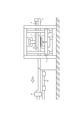
- FIG. 1 shows a schematic front view of the friction coefficient measuring device.
- a sample 1 for measuring the coefficient of friction hereinafter referred to as “sample 1” collected from the test material is fixed to the sample table 2
- the sample table 2 is a slide table 3 that can move horizontally. It is fixed to the upper surface.
- a vertically movable slide table support 5 having a roller 4 in contact with the slide table 3 is provided on the lower surface of the slide table 3, and by pushing up the slide table support 5, a pressing load N on the sample 1 by the bead 6 can be applied.
- a first load cell 7 for measuring the pressing load N is attached to the slide table support base 5. Then, in such a device, the slide table 3 is moved in the horizontal direction while the pressing load N is applied. A second load cell 8 for measuring the sliding resistance force F at that time is attached above the rail 9 at one end of the slide table 3.
- the lubricating oil Preton R352L, a cleaning oil for pressing manufactured by Sugimura Chemical Industrial Co., Ltd., was used, and this lubricating oil was applied to the surface of the sample 1 for the test.
- FIGS. 2 and 3 are schematic perspective views showing the shape and dimensions of the beads used in this embodiment.
- a bead of the size shown in FIGS. 2 and 3 slides as the bead 6 of FIG. 1 with its lower surface pressed against the surface of the sample 1.
- the beads shown in FIG. 2 have a width (length in the direction perpendicular to the sliding direction): 10 mm, a length (length in the sliding direction): 5 mm, and a curvature of the lower ends of both ends in the sliding direction: 1.0 mmR.
- the lower surface of the bead on which the sample 1 is pressed is formed of a flat surface having a width of 10 mm and a length in the sliding direction of 3 mm.
- the lower surface of the bead on which the sample 1 is pressed has a width. It is composed of a plane having a length of 10 mm and a length in the sliding direction of 50 mm.
- each test piece was degreased with a mixed solution of fine cleaner E6403A and fine cleaner E6403B1 (both manufactured by Nihon Parkerizing Co., Ltd.), which are alkaline degreasing agents.
- the test piece was immersed in a degreasing solution having a fine cleaner E6403A concentration of 20 g / L, a fine cleaner E6403B1 concentration of 12 g / L, and a temperature of 40 ° C. for a predetermined time, and washed with tap water.
- the surface carbon strength of the treated test piece was measured using a fluorescent X-ray analyzer, and the measured values and the measured values of the pre-defatted surface carbon strength and the surface carbon strength of the untreated steel plate were measured in advance.
- the film peeling rate was calculated by the following formula.
- the degreasing property of the steel sheet was evaluated according to the following criteria based on the immersion time in the alkaline degreasing solution at which the film peeling rate was 98% or more.
- Film peeling rate (%) [(carbon strength before degreasing-carbon strength after degreasing) / (carbon strength before degreasing-carbon strength of untreated steel sheet)] ⁇ 100 ⁇ Evaluation criteria> ⁇ : Within 60 seconds ⁇ : Within 120 seconds ⁇ : Over 120 seconds
- A1 Copolymer of styrene and maleic anhydride
- A2 Copolymer of styrene and maleic anhydride
- A3 Salt of copolymer of styrene and maleic anhydride
- A4 Acrylic resin (for styrene, maleic anhydride and maleic anhydride) Does not contain the building blocks of origin)
- A5 Polyester resin (does not contain structural units derived from styrene, maleic acid and maleic anhydride)
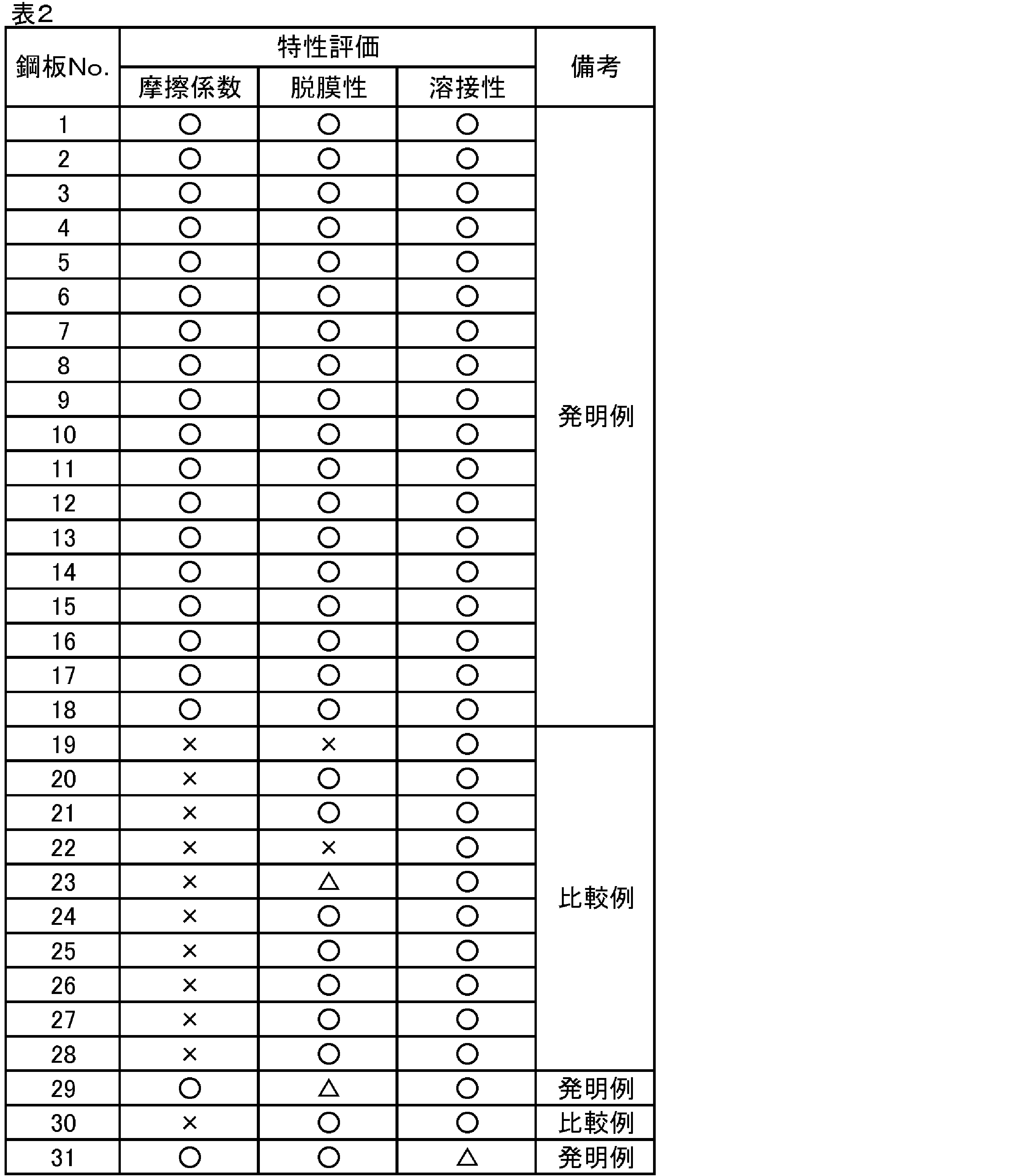
- Table 2 shows the results of this example. The following can be seen from the results shown in Table 2.
- Steel sheets Nos. 1 to 18, 29 and 31 according to the present invention have excellent friction coefficients.
- the steel plates Nos. 19 to 28 and 30, which are comparative examples that do not satisfy the present invention, have inferior friction coefficients.
- the steel sheet according to the present invention has excellent press moldability, it can be applied to a wide range of fields mainly for automobile body applications.
Landscapes
- Chemical & Material Sciences (AREA)
- Engineering & Computer Science (AREA)
- Materials Engineering (AREA)
- Organic Chemistry (AREA)
- Metallurgy (AREA)
- Mechanical Engineering (AREA)
- Crystallography & Structural Chemistry (AREA)
- Physics & Mathematics (AREA)
- Thermal Sciences (AREA)
- Chemical Kinetics & Catalysis (AREA)
- Life Sciences & Earth Sciences (AREA)
- Wood Science & Technology (AREA)
- Laminated Bodies (AREA)
- Lubricants (AREA)
- Other Surface Treatments For Metallic Materials (AREA)
- Heat Treatment Of Sheet Steel (AREA)
Abstract
Description
1.少なくとも片面に皮膜を有する冷間圧延鋼板であって、
前記皮膜はバインダーAと天然ワックスBとを含み、
前記バインダーAは、スチレンとマレイン酸との共重合体、スチレンと無水マレイン酸との共重合体およびスチレンとマレイン酸との共重合体の塩の群から選ばれる少なくとも1種であり、
前記天然ワックスBは、炭素数が20以上のパラフィンワックス及びマイクロクリスタリンワックスから選ばれる少なくとも1種であり、かつメジアン径αが0.2μm以上2.5μm以下および融点βが100℃以上115℃以下であり、
次式(1)にて定義される前記天然ワックスBの質量割合Cが20%以上であり、
前記皮膜の付着量Dが0.5g/m2以上である冷間圧延鋼板。
C={MB/(MA+MB)}×100 …(1)
ここで、MA:バインダーAを酸無水物として換算した質量
MB:前記天然ワックスBの質量
(1)バインダーについて
本明細書におけるバインダーとは、冷間圧延鋼板からワックスが脱落しないように防止する化合物を意味する。本発明に従う皮膜では、ワックスの粒子の周辺にバインダーが存在し、そのバインダーがワックス粒子と冷間圧延鋼板との橋渡しを担っている。言い換えると、該皮膜においては、バインダーがワックス粒子を基材鋼板表面に均等に分散分布させ保持している。
なお、上記共重合体の塩は、公知のカチオンとの共重合体の塩であれば、特に限定されないが、アンモニウムとの塩が最も好ましい。
前記共重合体を共重合反応によって合成する場合は、所望する共重合体における各モノマー由来の構成単位の比率に応じて、使用する各モノマーのモル比および反応条件を適宜調整すればよい。
本発明に使用される天然ワックスについて説明する。本発明で用いられる天然ワックスとは、石油中に存在する常温で固体の炭化水素のことを意味する。該天然ワックスとしては、炭素数が20以上のパラフィンワックスおよびマイクロクリスタリンワックスが好適に使用できる。これらは単体または混合して使用しても同じ効果を奏する。
C={MB/(MA+MB)}×100 …(1)
ここで、MA:バインダー(A)を酸無水物として換算した質量
MB:前記天然ワックス(B)の質量
バインダー(A)がスチレンと無水マレイン酸との共重合体である場合は、当該共重合体の実際の質量をMAとする。バインダー(A)がスチレンとマレイン酸との共重合体またはスチレンとマレイン酸との共重合体の塩である場合、それらを酸無水物として換算した質量(マレイン酸またはマレイン酸塩の部分をマレイン酸無水物として換算した質量)をMAとする。
MAおよびMBは、任意の所定量の皮膜中に含まれる質量である。
上記質量割合Cが20質量%未満の場合は、プレス成形性が向上しない。なぜなら、摩擦係数を低下させる効果のあるワックスが不足するからである。
最初に、バインダーおよびワックスについて、水系薬剤中の含有量と鋼板上への塗布量から加熱後の付着量がわかる試験片を作製し、検量板とする。その後、フーリエ変換赤外分光光度計(FT-IR測定装置)により、加熱後の検量板表面の赤外吸収スペクトルの強度を測定して、バインダーおよび天然ワックスに由来する各々の赤外吸収スペクトルの強度とバインダーおよび天然ワックスの各々の加熱後残渣分の量との関係を示す検量線を作成する。その際、バインダー由来の赤外吸収スペクトルの強度は、スチレン由来構成単位の芳香族基、マレイン酸由来構成単位のエステル基、無水マレイン酸由来構成単位のラクトン環部分に特徴的なスペクトルを指標とし、共重合体を構成する各構成単位の比率も考慮して測定すればよい。また、天然ワックス由来の赤外吸収スペクトルの強度は、メチレン基に特徴的なスペクトルを指標として測定すればよい。
上記した赤外吸収スペクトルの強度を測定した皮膜を有する冷間圧延鋼板の質量を測定した後、以下に記載の方法等に準じアルカリ水溶液を用いてかかる皮膜を除去する。そして、皮膜の除去前後の冷間圧延鋼板の質量変化量と前記皮膜を形成されていた冷間圧延鋼板の面積とを用い、1平方メートルあたりの皮膜の付着量Dを算出する。上記質量割合Cを算出する際に用いた検量線を用いて算出した前記MAおよびMBの1平方メートルあたりの皮膜に含まれる各質量MA’およびMB’と後述の付着量Dとを用いて{(MA’+MB’)/D}×100の計算をする。かかる計算の結果が皮膜におけるバインダーと天然ワックスとの合算の含有率である。
皮膜を冷間圧延鋼板上から除去する際のアルカリ水溶液のpHは10以上13以下の範囲であることが好ましい。アルカリ水溶液を調製する際のアルカリ成分は特に制限されず、例えば、水酸化ナトリウム、炭酸ナトリウム、リン酸ナトリウム、珪酸ナトリウムなどが挙げられる。
供試材として、板厚:0.7mmの深絞り用冷延鋼板を使用した。
上記鋼板に対し、前処理としてファインクリーナーE6403(日本パーカライジング(株)製)を用いて脱脂処理し、表面の油分や汚れを取り除いた。続いて水道水で水洗して供試材が水で100%濡れることを確認した後、加熱温度を100℃に設定した電気オーブンを用いて加熱して、潤滑皮膜を形成させる基材とした。
プレス成形性(摺動特性)、脱膜性、溶接性のさらに具体的な評価方法は以下の通りである。
プレス成形性である摺動特性を評価するために、潤滑処理鋼板の各供試材の摩擦係数μを以下のようにして測定した。
図1に、摩擦係数測定装置の概略正面図を示す。同図に示したように、供試材から採取した摩擦係数測定用試料1(以下、「試料1」という)が試料台2に固定され、試料台2は、水平移動可能なスライドテーブル3の上面に固定されている。スライドテーブル3の下面には、これに接したローラ4を有する上下動可能なスライドテーブル支持台5が設けられ、これを押上げることにより、ビード6による試料1への押付荷重Nが負荷できる。また、かかる押付荷重Nを測定するための第1ロードセル7が、スライドテーブル支持台5に取付けられている。そして、かかる装置では上記押付荷重Nを作用させた状態でスライドテーブル3を水平方向へ移動させる。その際の摺動抵抗力Fを測定するための第2ロードセル8が、スライドテーブル3の一方の端部でレール9の上方に取付けられている。なお、潤滑油として、スギムラ化学工業(株)製のプレス用洗浄油プレトンR352Lを用い、この潤滑油を試料1の表面に塗布して試験を行った。
[条件1]
図2に示すビードを用い、押し付け荷重N:400kgf、試料の引き抜き速度(スライドテーブル3の水平移動速度):100cm/minとした。
[条件2]
図3に示すビードを用い、押し付け荷重N:400kgf、試料の引き抜き速度(スライドテーブル3の水平移動速度):20cm/minとした。
<評価基準>
○:条件1での摩擦係数μ≦0.120、かつ、条件2での摩擦係数μ≦0.120
×:条件1での摩擦係数μ>0.120、または、条件2での摩擦係数μ>0.120
なお、この試験での評価が○であれば合格、高面圧条件や複雑成形時においても優れたプレス成形性を有すると評価できる。
鋼板の脱膜性を求めるために、まず、各試験片をアルカリ脱脂剤のファインクリーナーE6403AとファインクリーナーE6403B1(いずれも日本パーカライジング株式会社製)の混合液で脱脂処理した。かかる処理は、試験片を、ファインクリーナーE6403A濃度20g/L、ファインクリーナーE6403B1濃度12g/L、温度40℃の脱脂液に所定の時間浸漬し、水道水で洗浄することとした。かかる処理後の試験片に対し、蛍光X線分析装置を用いて表面炭素強度を測定し、かかる測定値と予め測定しておいた脱脂前表面炭素強度および無処理鋼板の表面炭素強度の測定値を用いて、以下の式により皮膜剥離率を算出した。
鋼板の脱膜性は、かかる皮膜剥離率が98%以上となるアルカリ脱脂液への浸漬時間により、以下に示す基準で評価した。
<皮膜剥離率>
皮膜剥離率(%)=[(脱脂前炭素強度-脱脂後炭素強度)/(脱脂前炭素強度-無処理鋼板の炭素強度)]×100
<評価基準>
○:60秒以内
△:120秒以内
×:120秒超
各試験片について、使用電極:DR型Cr-Cu電極、加圧力:150kgf、通電時間:10サイクル/60Hz、溶接電流:7.5kAの条件で連続打点性の溶接試験を行い、ナゲットが形成しなくなるまでの連続可能打点数で評価した。その評価基準は以下のとおりである。
<評価基準>
○:5000点以上
△:5000点未満
表1に、本実施例で行った試験に供する皮膜の構成と付着量をそれぞれ示す。

A1:スチレンと無水マレイン酸との共重合体
A2:スチレンとマレイン酸との共重合体
A3:スチレンとマレイン酸との共重合体の塩
A4:アクリル樹脂(スチレン、マレイン酸及び無水マレイン酸に由来する構成単位を含有せず)
A5:ポリエステル樹脂(スチレン、マレイン酸及び無水マレイン酸に由来する構成単位を含有せず)
2 試料台
3 スライドテーブル
4 ローラ
5 スライドテーブル支持台
6 ビード
7 第1ロードセル
8 第2ロードセル
9 レール
N 押付荷重
F 摺動抵抗力(引き抜き荷重)
Claims (4)
- 少なくとも片面に皮膜を有する冷間圧延鋼板であって、
前記皮膜はバインダーAと天然ワックスBとを含み、
前記バインダーAは、スチレンとマレイン酸との共重合体、スチレンと無水マレイン酸との共重合体およびスチレンとマレイン酸との共重合体の塩の群から選ばれる少なくとも1種であり、
前記天然ワックスBは、炭素数が20以上のパラフィンワックス及びマイクロクリスタリンワックスから選ばれる少なくとも1種であり、かつメジアン径αが0.2μm以上2.5μm以下および融点βが100℃以上115℃以下であり、
次式(1)にて定義される前記天然ワックスBの質量割合Cが20%以上であり、
前記皮膜の付着量Dが0.5g/m2以上である冷間圧延鋼板。
C={MB/(MA+MB)}×100 …(1)
ここで、MA:バインダーAを酸無水物として換算した質量
MB:前記天然ワックスBの質量 - 前記質量割合Cが60質量%以下である請求項1に記載の冷間圧延鋼板。
- 前記皮膜の付着量Dが2.0g/m2以下である請求項1または2に記載の冷間圧延鋼板。
- 前記皮膜は、前記バインダーおよび天然ワックスを合計で70質量%以上含む請求項1から3のいずれか1項に記載の冷間圧延鋼板。
Priority Applications (5)
| Application Number | Priority Date | Filing Date | Title |
|---|---|---|---|
| EP21771717.2A EP4122702B1 (en) | 2020-03-18 | 2021-03-09 | Method of producing a cold rolled steel sheet |
| US17/905,940 US12305257B2 (en) | 2020-03-18 | 2021-03-09 | Cold rolled steel sheet |
| KR1020227028539A KR102798874B1 (ko) | 2020-03-18 | 2021-03-09 | 냉간압연 강판 |
| CN202180020206.9A CN115244218B (zh) | 2020-03-18 | 2021-03-09 | 冷轧钢板 |
| MX2022011340A MX2022011340A (es) | 2020-03-18 | 2021-03-09 | Lamina de acero laminada en frio. |
Applications Claiming Priority (2)
| Application Number | Priority Date | Filing Date | Title |
|---|---|---|---|
| JP2020048063A JP7056683B2 (ja) | 2020-03-18 | 2020-03-18 | 冷間圧延鋼板 |
| JP2020-048063 | 2020-03-18 |
Publications (1)
| Publication Number | Publication Date |
|---|---|
| WO2021187253A1 true WO2021187253A1 (ja) | 2021-09-23 |
Family
ID=77768238
Family Applications (1)
| Application Number | Title | Priority Date | Filing Date |
|---|---|---|---|
| PCT/JP2021/009376 Ceased WO2021187253A1 (ja) | 2020-03-18 | 2021-03-09 | 冷間圧延鋼板 |
Country Status (7)
| Country | Link |
|---|---|
| US (1) | US12305257B2 (ja) |
| EP (1) | EP4122702B1 (ja) |
| JP (1) | JP7056683B2 (ja) |
| KR (1) | KR102798874B1 (ja) |
| CN (1) | CN115244218B (ja) |
| MX (1) | MX2022011340A (ja) |
| WO (1) | WO2021187253A1 (ja) |
Cited By (1)
| Publication number | Priority date | Publication date | Assignee | Title |
|---|---|---|---|---|
| CN118159418A (zh) * | 2021-11-19 | 2024-06-07 | 杰富意钢铁株式会社 | 冷轧钢板 |
Families Citing this family (5)
| Publication number | Priority date | Publication date | Assignee | Title |
|---|---|---|---|---|
| US20250066625A1 (en) * | 2022-03-30 | 2025-02-27 | Jfe Steel Corporation | Steel sheet and method for manufacturing the same |
| WO2023238610A1 (ja) * | 2022-06-07 | 2023-12-14 | Jfeスチール株式会社 | 被覆鋼板およびその製造方法 |
| JP7380963B1 (ja) * | 2022-06-07 | 2023-11-15 | Jfeスチール株式会社 | 被覆鋼板およびその製造方法 |
| WO2023238612A1 (ja) * | 2022-06-07 | 2023-12-14 | Jfeスチール株式会社 | 被覆鋼板およびその製造方法 |
| US20250346783A1 (en) * | 2022-06-07 | 2025-11-13 | Jfe Steel Corporation | Coated steel sheet and method of producing same |
Citations (6)
| Publication number | Priority date | Publication date | Assignee | Title |
|---|---|---|---|---|
| JP2001234349A (ja) | 2000-02-18 | 2001-08-31 | Nippon Parkerizing Co Ltd | 金属表面処理剤並びにこれで処理した表面処理金属材料 |
| JP2002307613A (ja) | 2001-04-10 | 2002-10-23 | Sumitomo Metal Ind Ltd | 化成処理性、接着性に優れた潤滑処理鋼板 |
| JP2010270373A (ja) | 2009-05-22 | 2010-12-02 | Sumitomo Metal Ind Ltd | 潤滑処理鋼板および潤滑皮膜形成用処理液 |
| WO2011001653A1 (ja) * | 2009-06-29 | 2011-01-06 | 日本パーカライジング株式会社 | 耐食性に優れる塑性加工用水系潤滑剤および塑性加工性に優れる金属材料 |
| JP2011230425A (ja) * | 2010-04-28 | 2011-11-17 | Jfe Steel Corp | 塗装鋼板、加工品および薄型テレビ用パネル |
| JP2017105986A (ja) * | 2015-12-04 | 2017-06-15 | Jfeスチール株式会社 | ステンレス鋼板用潤滑塗料および潤滑ステンレス鋼板 |
Family Cites Families (7)
| Publication number | Priority date | Publication date | Assignee | Title |
|---|---|---|---|---|
| JP4172087B2 (ja) * | 1999-03-31 | 2008-10-29 | Jfeスチール株式会社 | 塗料組成物および潤滑処理金属板 |
| US20030211343A1 (en) * | 2000-02-18 | 2003-11-13 | Yasuhiro Kinoshita | Metal surface treatment agent |
| JP2003247082A (ja) * | 2002-02-22 | 2003-09-05 | Nippon Parkerizing Co Ltd | プレス成形性、接着剤適合性及び化成処理性に優れた表面処理板及びその製造方法 |
| KR100761308B1 (ko) * | 2002-04-01 | 2007-10-04 | 제이에프이 스틸 가부시키가이샤 | 도료 및 표면처리 금속판 |
| JP2005336511A (ja) * | 2004-05-24 | 2005-12-08 | Jfe Steel Kk | アルカリ脱膜性、プレス加工性および溶接性に優れた燃料タンク用鋼板 |
| JP2006218856A (ja) * | 2005-01-12 | 2006-08-24 | Nippon Steel Corp | しごき加工性、耐エマルジョン型プレス油性に優れたアルカリ可溶型潤滑鋼板 |
| JP2008248076A (ja) * | 2007-03-30 | 2008-10-16 | Jfe Steel Kk | ステンレス冷延鋼板用潤滑塗料組成物およびステンレス冷延鋼板 |
-
2020
- 2020-03-18 JP JP2020048063A patent/JP7056683B2/ja active Active
-
2021
- 2021-03-09 CN CN202180020206.9A patent/CN115244218B/zh active Active
- 2021-03-09 MX MX2022011340A patent/MX2022011340A/es unknown
- 2021-03-09 KR KR1020227028539A patent/KR102798874B1/ko active Active
- 2021-03-09 EP EP21771717.2A patent/EP4122702B1/en active Active
- 2021-03-09 WO PCT/JP2021/009376 patent/WO2021187253A1/ja not_active Ceased
- 2021-03-09 US US17/905,940 patent/US12305257B2/en active Active
Patent Citations (6)
| Publication number | Priority date | Publication date | Assignee | Title |
|---|---|---|---|---|
| JP2001234349A (ja) | 2000-02-18 | 2001-08-31 | Nippon Parkerizing Co Ltd | 金属表面処理剤並びにこれで処理した表面処理金属材料 |
| JP2002307613A (ja) | 2001-04-10 | 2002-10-23 | Sumitomo Metal Ind Ltd | 化成処理性、接着性に優れた潤滑処理鋼板 |
| JP2010270373A (ja) | 2009-05-22 | 2010-12-02 | Sumitomo Metal Ind Ltd | 潤滑処理鋼板および潤滑皮膜形成用処理液 |
| WO2011001653A1 (ja) * | 2009-06-29 | 2011-01-06 | 日本パーカライジング株式会社 | 耐食性に優れる塑性加工用水系潤滑剤および塑性加工性に優れる金属材料 |
| JP2011230425A (ja) * | 2010-04-28 | 2011-11-17 | Jfe Steel Corp | 塗装鋼板、加工品および薄型テレビ用パネル |
| JP2017105986A (ja) * | 2015-12-04 | 2017-06-15 | Jfeスチール株式会社 | ステンレス鋼板用潤滑塗料および潤滑ステンレス鋼板 |
Non-Patent Citations (1)
| Title |
|---|
| See also references of EP4122702A4 |
Cited By (1)
| Publication number | Priority date | Publication date | Assignee | Title |
|---|---|---|---|---|
| CN118159418A (zh) * | 2021-11-19 | 2024-06-07 | 杰富意钢铁株式会社 | 冷轧钢板 |
Also Published As
| Publication number | Publication date |
|---|---|
| JP7056683B2 (ja) | 2022-04-19 |
| US12305257B2 (en) | 2025-05-20 |
| EP4122702B1 (en) | 2025-06-25 |
| KR20220129052A (ko) | 2022-09-22 |
| CN115244218B (zh) | 2024-09-20 |
| MX2022011340A (es) | 2022-10-07 |
| EP4122702A1 (en) | 2023-01-25 |
| CN115244218A (zh) | 2022-10-25 |
| EP4122702A4 (en) | 2023-08-16 |
| US20230105429A1 (en) | 2023-04-06 |
| JP2021147657A (ja) | 2021-09-27 |
| KR102798874B1 (ko) | 2025-04-21 |
Similar Documents
| Publication | Publication Date | Title |
|---|---|---|
| JP7056683B2 (ja) | 冷間圧延鋼板 | |
| JP7164063B1 (ja) | 鋼板およびその製造方法 | |
| US20250346783A1 (en) | Coated steel sheet and method of producing same | |
| KR101590754B1 (ko) | 알칼리 가용형 윤활 피막을 갖는 강판, 그 제조방법 및 조성물 | |
| KR20240116762A (ko) | 윤활 피막 피복 아연계 도금 강판 및 그의 제조 방법 | |
| JP7567841B2 (ja) | 金属板塗布用塗料 | |
| JP2024103849A (ja) | ステンレス鋼板およびその製造方法 | |
| JP7533427B2 (ja) | 冷間圧延鋼板 | |
| US20250297124A1 (en) | Coated steel sheet and method of producing same | |
| WO2022123930A1 (ja) | 鋼板およびその製造方法 | |
| JP7552576B2 (ja) | 鋼板およびその製造方法 | |
| JP7616392B2 (ja) | 鋼板およびその製造方法 | |
| JP7616365B2 (ja) | 有機樹脂被覆鋼板 | |
| JP7380963B1 (ja) | 被覆鋼板およびその製造方法 | |
| JP7416336B1 (ja) | 鋼板およびその製造方法 | |
| JP7838724B1 (ja) | 皮膜付き亜鉛系めっき鋼板およびその製造方法 | |
| US12617951B2 (en) | Steel sheet and method for producing the same | |
| WO2023238612A1 (ja) | 被覆鋼板およびその製造方法 | |
| WO2023062874A1 (ja) | 金属板塗布用塗料 | |
| CN118076703A (zh) | 金属板涂布用涂料 |
Legal Events
| Date | Code | Title | Description |
|---|---|---|---|
| 121 | Ep: the epo has been informed by wipo that ep was designated in this application |
Ref document number: 21771717 Country of ref document: EP Kind code of ref document: A1 |
|
| WWE | Wipo information: entry into national phase |
Ref document number: 202217045480 Country of ref document: IN |
|
| NENP | Non-entry into the national phase |
Ref country code: DE |
|
| ENP | Entry into the national phase |
Ref document number: 2021771717 Country of ref document: EP Effective date: 20221018 |
|
| WWG | Wipo information: grant in national office |
Ref document number: 17905940 Country of ref document: US |
|
| WWG | Wipo information: grant in national office |
Ref document number: 2021771717 Country of ref document: EP |