WO2021192057A1 - 抗ウイルス繊維製品の製造方法及びこれを用いてなる抗ウイルスマスク - Google Patents
抗ウイルス繊維製品の製造方法及びこれを用いてなる抗ウイルスマスク Download PDFInfo
- Publication number
- WO2021192057A1 WO2021192057A1 PCT/JP2020/013102 JP2020013102W WO2021192057A1 WO 2021192057 A1 WO2021192057 A1 WO 2021192057A1 JP 2020013102 W JP2020013102 W JP 2020013102W WO 2021192057 A1 WO2021192057 A1 WO 2021192057A1
- Authority
- WO
- WIPO (PCT)
- Prior art keywords
- organic acid
- antiviral
- zinc
- fiber product
- producing
- Prior art date
- Legal status (The legal status is an assumption and is not a legal conclusion. Google has not performed a legal analysis and makes no representation as to the accuracy of the status listed.)
- Ceased
Links
Images

Classifications
-
- A—HUMAN NECESSITIES
- A41—WEARING APPAREL
- A41D—OUTERWEAR; PROTECTIVE GARMENTS; ACCESSORIES
- A41D13/00—Professional, industrial or sporting protective garments, e.g. surgeons' gowns or garments protecting against blows or punches
- A41D13/05—Professional, industrial or sporting protective garments, e.g. surgeons' gowns or garments protecting against blows or punches protecting only a particular body part
- A41D13/11—Protective face masks, e.g. for surgical use, or for use in foul atmospheres
- A41D13/1192—Protective face masks, e.g. for surgical use, or for use in foul atmospheres with antimicrobial agent
-
- A—HUMAN NECESSITIES
- A01—AGRICULTURE; FORESTRY; ANIMAL HUSBANDRY; HUNTING; TRAPPING; FISHING
- A01N—PRESERVATION OF BODIES OF HUMANS OR ANIMALS OR PLANTS OR PARTS THEREOF; BIOCIDES, e.g. AS DISINFECTANTS, AS PESTICIDES OR AS HERBICIDES; PEST REPELLANTS OR ATTRACTANTS; PLANT GROWTH REGULATORS
- A01N55/00—Biocides, pest repellants or attractants, or plant growth regulators, containing organic compounds containing elements other than carbon, hydrogen, halogen, oxygen, nitrogen and sulfur
- A01N55/02—Biocides, pest repellants or attractants, or plant growth regulators, containing organic compounds containing elements other than carbon, hydrogen, halogen, oxygen, nitrogen and sulfur containing metal atoms
-
- A—HUMAN NECESSITIES
- A01—AGRICULTURE; FORESTRY; ANIMAL HUSBANDRY; HUNTING; TRAPPING; FISHING
- A01N—PRESERVATION OF BODIES OF HUMANS OR ANIMALS OR PLANTS OR PARTS THEREOF; BIOCIDES, e.g. AS DISINFECTANTS, AS PESTICIDES OR AS HERBICIDES; PEST REPELLANTS OR ATTRACTANTS; PLANT GROWTH REGULATORS
- A01N25/00—Biocides, pest repellants or attractants, or plant growth regulators, characterised by their forms, or by their non-active ingredients or by their methods of application, e.g. seed treatment or sequential application; Substances for reducing the noxious effect of the active ingredients to organisms other than pests
- A01N25/08—Biocides, pest repellants or attractants, or plant growth regulators, characterised by their forms, or by their non-active ingredients or by their methods of application, e.g. seed treatment or sequential application; Substances for reducing the noxious effect of the active ingredients to organisms other than pests containing solids as carriers or diluents
- A01N25/10—Macromolecular compounds
-
- B—PERFORMING OPERATIONS; TRANSPORTING
- B01—PHYSICAL OR CHEMICAL PROCESSES OR APPARATUS IN GENERAL
- B01D—SEPARATION
- B01D39/00—Filtering material for liquid or gaseous fluids
- B01D39/08—Filter cloth, i.e. woven, knitted or interlaced material
- B01D39/083—Filter cloth, i.e. woven, knitted or interlaced material of organic material
-
- B—PERFORMING OPERATIONS; TRANSPORTING
- B01—PHYSICAL OR CHEMICAL PROCESSES OR APPARATUS IN GENERAL
- B01D—SEPARATION
- B01D39/00—Filtering material for liquid or gaseous fluids
- B01D39/14—Other self-supporting filtering material ; Other filtering material
- B01D39/16—Other self-supporting filtering material ; Other filtering material of organic material, e.g. synthetic fibres
- B01D39/1607—Other self-supporting filtering material ; Other filtering material of organic material, e.g. synthetic fibres the material being fibrous
- B01D39/1615—Other self-supporting filtering material ; Other filtering material of organic material, e.g. synthetic fibres the material being fibrous of natural origin
-
- B—PERFORMING OPERATIONS; TRANSPORTING
- B01—PHYSICAL OR CHEMICAL PROCESSES OR APPARATUS IN GENERAL
- B01D—SEPARATION
- B01D39/00—Filtering material for liquid or gaseous fluids
- B01D39/14—Other self-supporting filtering material ; Other filtering material
- B01D39/16—Other self-supporting filtering material ; Other filtering material of organic material, e.g. synthetic fibres
- B01D39/1607—Other self-supporting filtering material ; Other filtering material of organic material, e.g. synthetic fibres the material being fibrous
- B01D39/1623—Other self-supporting filtering material ; Other filtering material of organic material, e.g. synthetic fibres the material being fibrous of synthetic origin
-
- B—PERFORMING OPERATIONS; TRANSPORTING
- B01—PHYSICAL OR CHEMICAL PROCESSES OR APPARATUS IN GENERAL
- B01D—SEPARATION
- B01D39/00—Filtering material for liquid or gaseous fluids
- B01D39/14—Other self-supporting filtering material ; Other filtering material
- B01D39/16—Other self-supporting filtering material ; Other filtering material of organic material, e.g. synthetic fibres
- B01D39/18—Other self-supporting filtering material ; Other filtering material of organic material, e.g. synthetic fibres the material being cellulose or derivatives thereof
-
- A—HUMAN NECESSITIES
- A41—WEARING APPAREL
- A41D—OUTERWEAR; PROTECTIVE GARMENTS; ACCESSORIES
- A41D13/00—Professional, industrial or sporting protective garments, e.g. surgeons' gowns or garments protecting against blows or punches
- A41D13/05—Professional, industrial or sporting protective garments, e.g. surgeons' gowns or garments protecting against blows or punches protecting only a particular body part
- A41D13/11—Protective face masks, e.g. for surgical use, or for use in foul atmospheres
- A41D13/1107—Protective face masks, e.g. for surgical use, or for use in foul atmospheres characterised by their shape
- A41D13/1115—Protective face masks, e.g. for surgical use, or for use in foul atmospheres characterised by their shape with a horizontal pleated pocket
-
- B—PERFORMING OPERATIONS; TRANSPORTING
- B01—PHYSICAL OR CHEMICAL PROCESSES OR APPARATUS IN GENERAL
- B01D—SEPARATION
- B01D2239/00—Aspects relating to filtering material for liquid or gaseous fluids
- B01D2239/04—Additives and treatments of the filtering material
- B01D2239/0464—Impregnants
Definitions
- the present invention generally relates to a method for producing an antiviral fiber product, and more particularly to a method for producing an antiviral fiber product in which a virus inactivating agent is impregnated into a cellulosic fiber.
- Patent Document 1 a drug containing zinc organic acid at a concentration of 5000 to 10000 ppm has an ability to inactivate avian influenza virus, and proposed to use it as a virus inactivating drug (Patent Document). 1). In addition, a technique relating to clothes and the like to which the inactivating agent is attached has also been proposed (Patent Document 2).
- Patent No. 4980337 Utility model registration No. 3187328
- An object of the present invention is to provide a method for producing a textile product capable of continuously exerting an antiviral effect even after a large number of washings.
- the method for producing an antiviral fiber product according to the present invention comprises dispersing zinc oxide nanoparticles in an organic acid aqueous solution, and using cellulose as a main component of a virus inactivating agent containing zinc organic acid.
- the fiber is provided with a permeation step in which a temperature of 120 to 200 ° C. and a pressure of 0.0098 to 0.59 MPa are applied to permeate the fiber, and the organic acid aqueous solution contains an organic acid that partially becomes lactone when dissolved in water.
- a method for producing an antiviral fiber product which comprises 40 to 50% by weight.
- Zinc oxide nanoparticles also have the advantage of being well dispersed in organic acids. It is said that metal ions have bactericidal activity in the order of Hg>Ag>Cu>Zn>Fe> TiO 2 , and silver-based antibacterial agents are generally used. Shows disinfectant and bactericidal properties not inferior to. The bactericidal mechanism of ultrafine zinc oxide is considered to be the same as that of silver ions, and it is thought that it is not due to the toxicity and bactericidal properties of metals, but that it activates a part of oxygen in the air or water and destroys the cell membrane of the bacterium. ..
- the specific surface area is increased, the contact on the surface of the fungus is expanded, and the growth of the fungus is suppressed.
- Metal ion powder has little elution, has a high inhibitory effect and is safe, and exhibits antibacterial properties equivalent to silver against bacteria that come into direct contact with it.
- the diameter of the bacterium is 75 nm.
- the bacteria can be inactivated by selecting ultrafine zinc oxide having a diameter close to the diameter of the bacteria and dispersing it in an aqueous organic acid solution.
- the organic acid aqueous solution contains 40 to 50% by weight of an organic acid that is partially lactonized when dissolved in water.
- an organic acid that is partially lactonized when dissolved in water.
- the action of gluconic acid will be described using gluconic acid as an example of such an organic acid.
- gluconic acid When gluconic acid is dissolved in water, part of it becomes gluconolactone as shown in the following [Chemical formula 1]. This is called equilibrium.
- the ratio of gluconolactone to gluconic acid varies depending on temperature, concentration, pH and the like.
- acidified the amount of acid in the water increases, so the proportion of gluconolactone increases.
- gluconic acid becomes a salt and stabilizes, so that the proportion of gluconolactone decreases.
- Equilibrium is like connecting two tanks with a tube. When you put water in the tank on the left, the water flows to the right through the tube to keep the balance.
- proteins contain acidic amino acids and basic amino acids.
- Amino acid of the acidic has a such as -COOH, negative ions - become (COO).
- Basic amino acids have a -NH 2, become positive ions (-NH 3 +). If there are many positive ions or many negative ions in the protein, the protein will dissolve in water, but if the negative and positive ions are the same (called the isoelectric point), it will be just neutral and will not have an electric charge, so water. Does not dissolve in. Then, when the virus is set to the isoelectric point, the virus becomes insoluble and clumps to death.
- zinc oxide nanoparticles react with gluconic acid (an organic acid that partially lactoneizes when dissolved in water) to form zinc gluconate, which successfully adjusts the isoelectric point and is a bird influenza virus. It is probable that the cells were destroyed and inactivated.
- gluconic acid an organic acid that partially lactoneizes when dissolved in water
- the antibacterial property can be increased by further adding fumaric acid, malic acid or citric acid.
- the virus inactivating agent is permeated into the fibers mainly composed of cellulose by applying high temperature and high pressure. Due to the high temperature and high pressure, the virus inactivating agent containing zinc organic acid permeates through the fine space inside the fiber.
- cellulose is formed by glucosidic bonds of a large number of ⁇ -glucoses, and has three OH groups (polar functional groups) per monomer as shown in [Chemical Formula 3].
- Zinc ions Zn 2+
- the oxygen atom of the carboxyl group (COO ⁇ ) of the organic acid is coordinated with the hydrogen atom of the OH group to be trapped more strongly.
- High temperature and high pressure further accelerate this action and trap more zinc organic acid in the cellulose fibers.
- Zinc organic acid coordinated and trapped in the cellulose fibers in this way is unlikely to be desorbed by ordinary washing, and a high antiviral effect is maintained even after a large number of washings.
- the temperature is 120 to 200 ° C, preferably 130 to 180 ° C, and more preferably 140 to 170 ° C.
- the pressure is 0.0098 to 0.59 MPa, preferably 0.15 to 0.5 MPa, and more preferably 0.2 to 0.4 MPa.
- the value of this pressure means a pressure value applied to a normal pressure (about 0.1 MPa), and when pressurized to, for example, 1.5 atm, it is 0.5 atm (about 0.05 MPa). Minutes are the amount of pressure referred to in the present invention.
- High temperature and high pressure may be applied at the same time or sequentially. That is, the high temperature and the high pressure may be applied at the same time, or the temperature may be lowered after the high temperature is applied, or the high pressure may be applied after the temperature is lowered, and the pressure may be lowered or lowered after the high pressure is applied. After that, a high temperature may be applied.
- a commercially available autoclave or the like high temperature and high pressure can be applied at the same time, textile products can be sterilized at the same time, and a high temperature aqueous solution (virus inactivating agent) can be made into cellulose while being kept in a liquid state. Can be infiltrated.
- a method using a commercially available heat press machine may be used.
- the permeation time (the total time when high temperature and high pressure are applied sequentially, the time when simultaneous) is preferably 1 to 60 minutes, more preferably 5 to 45 minutes, and 10 to 30 minutes. Minutes are even more preferred.
- the processing time can be shortened.
- the textile products referred to in the present invention include not only the fibers (threads) themselves, but also cloths such as cloths, towels, and non-woven fabrics obtained by weaving or knitting fibers (plain weave, twill weave, red woven fabric). It means all textile products such as plain cloth processed clothes, gauze, sheets, bags, pillowcases, strings and ropes, rugs and carpets.
- the object to be subjected to the permeation step may be any of the above-mentioned textile products, and it may be appropriately selected whether the final product or the material thereof is to be subjected to.
- textile products is not particularly limited, and it is suitable for medical use and long-term care use. It is also suitable for.
- the textile product has durability against multiple washings.
- the thickness thereof is preferably 0.12 mm or more, more preferably 0.15 mm or more, and further preferably 0.18 mm or more.
- textile products examples include lawn fabrics made from cotton, broad fabrics, high-density broad fabrics, sheeting fabrics, double gauze fabrics, and processed products thereof.
- the drying after the permeation step may be performed by a known method, and air drying, moist heat drying, dry heat drying, etc. can be adopted. good.
- the zinc oxide nanoparticles preferably contain zinc oxide nanoparticles having a diameter of 50 nm to 70 nm.
- the zinc organic acid preferably contains zinc gluconate.
- virus inactivating agent is further contained with a pigment or dye, it can be dyed and imparted with antiviral properties at the same time.
- the activity of zinc gluconate is high when it is contained in a solution at 5000 to 10000 ppm. From the viewpoint of antiviral activity, it is preferably 6000 to 9000 ppm, more preferably 6500 to 8500 ppm. From this point of view, it is preferable to add the zinc gluconate so that the concentration of zinc gluconate contained in the fiber becomes such a value. Further, the concentration of zinc gluconate contained in the virus inactivating agent can be set to 5000 to 10000 ppm, preferably 6000 to 9000 ppm, more preferably 6500 to 8500 ppm as described above.
- the virus inactivating agent can be configured to further contain a binder.
- the configuration may further include a binder permeation step of permeating the binder into the fiber before the permeation step.
- a method is adopted in which the adhesion with the cellulosic fiber is enhanced and then the contact is made with the zinc organic acid, and the integrity with the zinc organic acid is enhanced and then the contact is made with the cellulosic fiber. Can be done.
- a binder As such a binder, a general-purpose resin such as a water-based acrylic binder, glyoxal resin, or butadiene resin latex can be used.
- the virus inactivating agent may contain a softener, a moisturizer, and the like as other additives.
- the binder when the binder is permeated first, the binder is dissolved in an appropriate solvent (water, etc.), and this solution is applied, sprayed, or immersed in this solution to permeate. At this time, normal temperature and pressure may be applied, or high temperature or high pressure may be applied for permeation.
- an appropriate solvent water, etc.
- 1,3dimethyl-2-imidazolidine by adding 1,3dimethyl-2-imidazolidine to the virus inactivating agent, the solubility of zinc organic acid in water can be increased. It should be noted that 1,3dimethyl-2-imidazolidine is not toxic.
- the amount of virus inactivation agent, in an amount in terms of the zinc oxide nanoparticles is preferably from 5g / m 2 ⁇ 13g / m 2, 7g / m 2 ⁇ It is more preferably 13 g / m 2 and even more preferably 8 g / m 2 to 12 g / m 2 .
- the antiviral power of zinc organic acid can be exerted for a long period of time, for example, it is possible to repeatedly use linen in a mask or a medical field. can get.
- the antiviral fiber product obtained by the present invention can suppress the bad odor caused by the propagation of various germs, and can realize the deodorizing effect for a long period of time.
- the zinc oxide nanoparticles when exposed to sunlight, they are reflected and have the effect of blocking heat and UV from the sun, so such an effect can be imparted to clothing, curtains, and the like.
- FIG. 1 (a) is the appearance
- the method for producing a textile product according to the present invention uses a virus inactivating agent obtained by dispersing zinc oxide nanoparticles in an aqueous organic acid solution so as to contain zinc organic acid at a concentration of 5000 to 10000 ppm.
- This aqueous organic acid solution contains 40 to 50% by weight of an organic acid that partially lactonizes when dissolved in water.
- gluconic acid As such an organic acid, gluconic acid, acetic acid, citric acid, tartaric acid, malic acid, lactic acid and the like can be used, and gluconic acid is particularly preferable.
- the virus inactivating agent can be produced, for example, as follows. Zinc oxide nanoparticles having a diameter of 50 nm to 70 nm are added to a gluconic acid aqueous solution containing 40 to 50% by weight of gluconic acid so that the obtained zinc gluconate concentration is 5000 to 10000 ppm at room temperature so as not to raise the temperature. , Stir to disperse. It was found that when zinc oxide nanoparticles were dispersed in an aqueous gluconic acid solution, heat was generated and gelation occurred when the temperature rose too high.
- the virus-inactivating agent thus obtained is permeated into a fiber mainly composed of cellulose by applying a temperature of 120 to 200 ° C. and a pressure of 0.0098 to 0.59 MPa.
- the high-temperature peak and the high-pressure peak may coincide with each other or may not coincide with each other.
- the fibers mainly composed of cellulose do not mean only cellulose-based natural fibers (cotton, hemp, flax, etc.) and regenerated fibers (rayon, etc.), but also fibers other than these fibers (synthetic fibers, etc.). Further included is also included. For example, fibers in which cellulose and other materials are blended and cloths using a plurality of types of fibers are also included in fibers mainly composed of cellulose.
- the mass ratio of cellulosic natural fibers and regenerated fibers contained in the fibers mainly composed of cellulose is preferably 30% or more, more preferably 50% or more, and more preferably 70% or more. More preferred.
- Zinc oxide nanoparticles with a diameter of 50 nm to 70 nm are dispersed in a 50% aqueous solution of an organic acid (gluconic acid in this example) that partially lactones when dissolved in water at room temperature without raising the temperature, and glucon is dispersed.
- an organic acid gluconic acid in this example
- Gluconic Zn a drug containing zinc acid
- the ultrafine particles of zinc oxide are uniformly dispersed in water and dissolved in the state of ultrafine particles with the assistance of an organic acid (gluconic acid).
- the step of dispersing the zinc oxide nanoparticles in the organic acid aqueous solution is preferably performed so as not to raise the temperature.
- a virus inactivating agent containing 7500 ppm of zinc gluconate was prepared.
- Example 1 In a high-pressure steam sterilizer manufactured by Rika Ikeda, 1 kg each of cellulosic fibers and cellulosic woven cloth was placed, and then 2 liters of a virus-inactivating agent were placed. Then, the treatment was carried out at 134 ° C. and 0.23 MPa for 10 minutes to allow the virus inactivating agent to permeate the cellulose fibers.
- the cellulose fibers and the cellulose woven fabric according to Example 1 were obtained by blowing and drying at room temperature.
- Example 2 Cellulose fibers and cellulose woven fabric according to Example 2 were obtained in the same manner as in Example 1 above, except that the temperature and pressure were set to 150 ° C. and 0.39 MPa.
- Example 3 Cellulose fibers and cellulose woven fabric according to Example 3 were obtained in the same manner as in Example 1 above, except that the temperature and pressure were 120 ° C., 0.10 MPa, and the treatment time was 20 minutes.
- Comparative Example 1 Cellulose fibers and cellulose woven fabric according to Comparative Example 1 were obtained in the same manner as in Example 1 above, except that the temperature and pressure were 110 ° C., 0.044 MPa, and the treatment time was 30 minutes.
- Comparative Example 2 Cellulose fibers and a cellulosic woven fabric which had not been treated were prepared and used as Comparative Example 2.
- FIG. 1A and 1B are views showing an antiviral mask using a textile product according to the present invention
- FIG. 1A is a partially cutaway view showing the appearance thereof
- FIG. 1B is a partially broken view showing a laminated state of the mask body. ..
- the mask body is made of a plurality of sheets (three sheets in the figure) of fiber cloth.
- the inner layer 13 is a cloth that touches the mouth, and it is preferable to select a material that has a pleasant mouthfeel. Since the middle layer 12 does not come into direct contact with the outside air or the mouth, application of the present invention to the cloth forming this layer provides antiviral activity over a long period of time. Further, although the outer layer 11 is exposed to the outside air, when the present invention is applied to this cloth, it is possible to prevent the hands from being contaminated with the virus when the mask is touched.
- any layer may be provided with a function of preventing the permeation of fine particles such as pollen and PM2.5.
- the textile product according to the present invention has robustness to washing 350 times or more, it is preferable to use a durable thread or fabric suitable for this.
- the antiviral fiber product according to the present invention can maintain the bactericidal and antiviral effects even after a large number of washings, and has great industrial applicability.
Landscapes
- Life Sciences & Earth Sciences (AREA)
- Health & Medical Sciences (AREA)
- General Health & Medical Sciences (AREA)
- Engineering & Computer Science (AREA)
- Chemical Kinetics & Catalysis (AREA)
- Chemical & Material Sciences (AREA)
- Dentistry (AREA)
- Agronomy & Crop Science (AREA)
- Pest Control & Pesticides (AREA)
- Plant Pathology (AREA)
- Wood Science & Technology (AREA)
- Zoology (AREA)
- Environmental Sciences (AREA)
- Textile Engineering (AREA)
- Toxicology (AREA)
- Physical Education & Sports Medicine (AREA)
- Treatments For Attaching Organic Compounds To Fibrous Goods (AREA)
- Chemical Or Physical Treatment Of Fibers (AREA)
- Agricultural Chemicals And Associated Chemicals (AREA)
Abstract
【課題】洗濯を多数回行っても活性が落ちることのない、抗ウイルス効果が付与された繊維製品、及びこれを用いたマスクを提供することを主要な目的とする。 【解決手段】酸化亜鉛ナノ粒子を有機酸水溶液に分散させてなり、有機酸亜鉛を含むウイルス不活性化薬剤を、セルロースを主体とする繊維に、120~200℃の温度と0.0098~0.59MPaの圧力とをかけて浸透させる浸透工程を備え、前記有機酸水溶液は、水に溶かせると一部ラクトン化する有機酸を40~50重量%含む、抗ウイルス繊維製品の製造方法。
Description
本発明は一般に、抗ウイルス繊維製品の製造方法に関するものであり、詳しくは、セルロース系繊維にウイルス不活性化薬剤を浸透させる抗ウイルス繊維製品の製造方法に関する。
布団やシーツや包布、病衣、白衣など、病院や介護施設において利用されているこれらの繊維製品は、洗濯の際に殺菌処理を行っても、使用開始から時間の経過に伴い、次第に細菌やウイルスに汚染される。
これら衣類等の清潔と安全を確保するには、毎日洗濯を行う必要があるが、患者の移動やベッドメーキングに計り知れない経費が必要になる。
また、一般消費者が感染症予防に使用するマスクは、抗ウイルス効果やウイルス不透過効果などが付与されていないものが多く、ウイルスの一部はマスクを透過して口腔内などに侵入してしまう。
マスクのウイルス対策のために、マスクに抗ウイルス性などを付与する薬剤をスプレーすることも行われている。しかしながら、使用のたびにマスクにスプレーするのは、手間とコストがかかってしまう。
このような中、抗ウイルス性などを付与する薬剤を繊維にあらかじめ浸透させておく技術に注目が集まっている。しかしながら、洗濯によって簡単に薬剤が脱離し、繰り返しての使用が難しいという問題があった。
本発明者らは、有機酸亜鉛を5000~10000ppmの濃度で含む薬剤が、鳥インフルエンザウイルスを不活性化する能力があることを見出し、ウイルス不活性化薬剤として利用することを提案した(特許文献1)。また、この不活性化薬剤を付着させてなる衣服等に関する技術も提案している(特許文献2)。
2020年のCOVID-19のパンデミックでは、マスクが品切れになり入手が困難になった。このため、抗ウイルス作用を失うことなく多数回再利用可能なマスクが求められている。また、医療現場でのスタッフへの感染事例が多くみられたため、防護服だけでなく医療スタッフ用の衣服などにも、手間をかけることなく抗ウイルス作用が持続する機能が求められている。
本発明者は、上述した有機酸亜鉛水溶液についてさらに研究を進めた結果、多数回の洗濯を行ってもその活性を失うことのない、洗濯堅牢性に優れた繊維への浸透方法を見出し、本発明に到達した。
本発明の目的は、多数回の洗濯を行っても抗ウイルス効果を持続的に発揮できる繊維製品の製造方法を提供することにある。
上記課題を解決するための、本発明に係る抗ウイルス繊維製品の製造方法は、酸化亜鉛ナノ粒子を有機酸水溶液に分散させてなり、有機酸亜鉛を含むウイルス不活性化薬剤を、セルロースを主体とする繊維に、120~200℃の温度と0.0098~0.59MPaの圧力とをかけて浸透させる浸透工程を備え、有機酸水溶液は、水に溶かせると一部ラクトン化する有機酸を40~50重量%含む、抗ウイルス繊維製品の製造方法。
酸化亜鉛ナノ粒子は、有機酸に良く分散することも利点である。金属イオンには、Hg>Ag>Cu>Zn>Fe>TiO2の順で殺菌力があるといわれ、一般に銀系抗菌剤が用いられているが、酸化亜鉛を超微粒子にすることにより、銀に劣らない消毒性、殺菌性を示す。超微粒子の酸化亜鉛の殺菌メカニズムは銀イオンと同じと考えられ、金属の毒性、殺菌性によるものでなく、空気中あるいは水中の酸素の一部を活性酸素化し、菌の細胞膜を破壊すると考えられる。ナノ粒子を使うことにより、比表面積が大きくなり、菌の表面での接触が拡大されて、菌の増殖が抑制される。金属イオン粉は溶出が少なく、抑制効果維持性が高く安全であり、直接接触する菌に対しては、銀と同等の抗菌性を示す。なお、菌の径は75nmである。菌の径に近い径を有する超微粒子の酸化亜鉛を選んで、有機酸水溶液に分散させることにより、菌を不活性化させることができる。
また、本発明では、有機酸水溶液は、水に溶かせると一部ラクトン化する有機酸を40~50重量%含んでいる。以下、このような有機酸の例としてグルコン酸を用い、その作用を説明する。
グルコン酸を水に溶かすと、次の[化1]に示すように、一部はグルコノラクトンになる。これを平衡という。グルコノラクトンとグルコン酸の割合は、温度、濃度、pHなどによって変わる。酸性にすると水中の酸が多くなるので、グルコノラクトンの割合が多くなる。アルカリ性にするとグルコン酸は塩になって安定化するので、グルコノラクトンの割合は少なくなる。平衡とは2つの水槽をチューブで連結したようなもので、左側の水槽に水を入れると、バランスを保つために水はチューブを通って右側に流れる。

酸化亜鉛ナノ粒子とグルコン酸(水に溶かすと一部がラクトン化する有機酸)を併用することによる相乗効果が生じることの説明について、タンパク質である鳥インフルエンザウイルスにグルコン酸が触れた場合を考える。[化2]に示すように、タンパク質には酸性のアミノ酸と塩基性のアミノ酸が含まれている。酸性のアミノ酸は、-COOHなどを持っており、マイナスイオン(COO-)になる。塩基性のアミノ酸は、-NH2を持っていて、プラスイオン(-NH3
+)になる。タンパク質中のプラスイオンが多かったり、マイナスイオンが多かったりするとタンパク質は水に溶けるが、マイナスとプラスのイオンが同じだけ(等電点という)だと、ちょうど中性になり電荷を持たないので水に溶けなくなる。そして、ウイルスを等電点にすると、ウイルスは溶けなくなり、固まり死滅する。

本発明によれば、酸化亜鉛ナノ粒子がグルコン酸(水に溶かすと一部がラクトン化する有機酸)と反応し、グルコン酸亜鉛となり、これが上記等電点の調整をうまく行ない、鳥インフルエンザウイルスの細胞を破壊させ、これを不活性化させたものと考えられる。
この場合、フマール酸、リンゴ酸又はクエン酸をさらに添加することにより、抗菌性を増大させることができる。
そして、本発明の構成では、ウイルス不活性化薬剤を、高温と高圧とをかけて、セルロースを主体とする繊維に浸透させている。高温と高圧とによって、有機酸亜鉛を含むウイルス不活性化薬剤が、繊維内部の微細な空間などにより浸透していく。
また、セルロースは、多数のβ-グルコースがグルコシド結合してなるものであり、[化3]に示すように、単量体1つあたり3つのOH基(極性官能基)を有している。このセルロースのOH基の酸素原子に亜鉛イオン(Zn2+)が、OH基の水素原子に有機酸のカルボキシル基(COO-)の酸素原子が、それぞれ配位してより強力にトラップされる。高温と高圧とによって、この作用はより促進され、より多くの有機酸亜鉛がセルロース繊維にトラップされる。このようにしてセルロース繊維に配位しトラップされた有機酸亜鉛は、通常の洗濯では脱離が起こり難く、多数回の洗濯を行っても高い抗ウイルス作用が維持される。

温度や圧力は、高すぎるとコスト高になり、低すぎると十分な効果が得られないおそれがある。このため、温度は120~200℃とし、好ましくは130~180℃とし、より好ましくは140~170℃とする。また、圧力は0.0098~0.59MPaとし、好ましくは0.15~0.5MPaとし、より好ましくは0.2~0.4MPaとする。なお、この圧力の値は、常圧(およそ0.1MPa)に付加される圧力値を意味し、例えば1.5気圧に加圧される場合には、0.5気圧(およそ0.05MPa)分が本発明でいう圧力量となる。
高温と高圧は、同時にかける構成であってもよく、順次かける構成であってもよい。つまり、高温と高圧とを同時にかけてもよく、高温をかけた後に、温度を下げつつ、または下げた後に高圧をかける構成であってもよく、高圧をかけた後に、圧力を下げつつ、または下げた後に高温をかける構成であってもよい。
たとえば、市販のオートクレーブなどを用いれば、高温と高圧とを同時に加えることが可能であり、繊維製品の滅菌が同時にできるとともに、高温の水溶液(ウイルス不活性化薬剤)を液状に保ったままセルロースに浸透させることができる。また、市販のヒートプレス機を用いる方法であってもよい
また、浸透時間(高温と高圧を順次かける場合はその合計時間、同時の場合はその時間)は、1~60分であることが好ましく、5~45分であることがより好ましく、10~30分であることがさらに好ましい。温度、圧力ともに高い場合には、処理時間を短くする構成にできる。
ここで、本発明でいう繊維製品とは、繊維(糸)そのものの他、繊維を織ったり(平織、綾織、朱子織)編んだりして得られる布やタオル、不織布などの布類、このような布類を加工した衣服、ガーゼ、シーツ、袋、枕カバー、紐やロープ、絨毯やカーペット類など、繊維製品すべてを含んだものを意味する。
また、本発明の浸透工程を経ることにより、繊維の隙間が埋められて通気性が下がる可能性があるが、通気性が下がるとその分抗ウイルス作用、ウイルス透過防止作用が高まる。
また、浸透工程が行われる対象物は、上記繊維製品のいずれでもよく、最終製品、その材料のいずれに対して行うかは適宜選択すればよい。
繊維製品の用途は特に限定されず、医療用途や介護用途に適してはいるが、インフルエンザが流行しやすい時期などにおいては、受験生や乳幼児、妊婦、高齢者などがいる家庭などでのウイルス予防対策にも好適である。
また、繊維製品は、多数回の洗濯に対する耐久性を備えていることが好ましい。例えば繊維製品が布や布を用いた製品の場合、その厚みは0.12mm以上であることが好ましく、0.15mm以上であることがより好ましく、0.18mm以上であることがさらに好ましい。
このような繊維製品としては、綿を原料としたローン生地、ブロード生地、高密度ブロード生地、シーチング生地、ダブルガーゼ生地や、これらを加工してなるもの等が挙げられる。
浸透工程後の乾燥は公知の方法でよく、風乾、湿熱乾燥、乾熱乾燥などを採用でき、高温や高圧をかける装置に乾燥機能がある場合には、当該装置の乾燥機能を利用してもよい。
上記酸化亜鉛ナノ粒子は、直径50nm~70nmの酸化亜鉛ナノ粒子を含むのが好ましい。
上記有機酸亜鉛はグルコン酸亜鉛を含むのが好ましい。
ウイルス不活性化薬剤は、顔料や染料をさらに含む構成とすると、染色と抗ウイルス性付与とを同時に行うことができる。
グルコン酸亜鉛の活性は、溶液中においては5000~10000ppm含まれる場合に抗ウイルス活性が高い。抗ウイルス活性の観点から、好ましくは6000~9000ppm、より好ましくは6500~8500ppmである。この観点から、繊維に含まれるグルコン酸亜鉛の濃度がこのような値となるように添加することが好ましい。また、ウイルス不活性化薬剤に含まれるグルコン酸亜鉛の濃度を、上記のように5000~10000ppm、好ましくは6000~9000ppm、より好ましくは6500~8500ppmとすることができる。
ウイルス不活性化薬剤は、バインダーをさらに含む構成とすることができる。
また、浸透工程の前にバインダーを繊維に浸透させるバインダー浸透工程をさらに備える構成としてもよい。
このように、バインダーを使用することにより、有機酸亜鉛がセルロース系の繊維により強固に固定されて洗濯堅牢性を高めることができる。
このようなバインダーは、セルロース系繊維との密着性が高められたのちに有機酸亜鉛と接触させる、有機酸亜鉛との一体性が高められたのちにセルロース系繊維と接触させる方法を採用することができる。
このようなバインダーとしては、水性のアクリル系バインダー、グリオキザール樹脂、ブタジエン樹脂ラテックスなど汎用の樹脂を用いることができる。また、ウイルス不活性化薬剤には、その他の添加剤として、柔軟剤、保湿剤などが含まれていてもよい。
また、バインダーを先んじて浸透させる場合、バインダーを適切な溶剤(水など)に溶解し、この溶液を塗布、スプレーしたり、この溶液に浸漬したりして浸透させる。この際、常温常圧で行ってもよく、高温や高圧をかけて浸透を行ってもよい。
また、1,3ジメチル-2-イミダゾリジンをウイルス不活性化薬剤に添加することにより、有機酸亜鉛の水への溶解度を増加させることができる。なお、1,3ジメチル-2-イミダゾリジンは毒性を有しない。
ウイルス不活性化薬剤を布に浸透させる場合、ウイルス不活性化薬剤の量は、酸化亜鉛ナノ粒子の量換算で、5g/m2~13g/m2であるのが好ましく、7g/m2~13g/m2であるのがより好ましく、8g/m2~12g/m2であるのがさらに好ましい。
本発明にかかる抗ウイルス繊維製品の製造方法によると、有機酸亜鉛による抗ウイルス力を長期にわたって発揮可能であるため、たとえばマスクや医療現場でのリネンの繰り返しの使用が可能になる等の効果が得られる。
上記本発明により得られる抗ウイルス繊維製品は、雑菌の繁殖による悪臭を抑えることができ、消臭効果をも長期にわたって実現できる。
また、酸化亜鉛のナノ粒子に太陽光が当たるとこれを反射させ、太陽からの熱やUVを遮る効果を有するので、このような効果を衣類やカーテンなどに付与することもできる。
本発明にかかる繊維製品の製造方法は、有機酸亜鉛を5000~10000ppmの濃度で含むように酸化亜鉛ナノ粒子を有機酸水溶液に分散させてなるウイルス不活性化薬剤を用いる。この有機酸水溶液は、水に溶かせると一部ラクトン化する有機酸を40~50重量%含む。
このような有機酸としては、グルコン酸、酢酸、クエン酸、酒石酸、リンゴ酸、乳酸等を使用でき、中でもグルコン酸が好ましい。
ウイルス不活性化薬剤は、例えば次のようにして製造できる。グルコン酸を40~50重量%含むグルコン酸水溶液に、直径50nm~70nmの酸化亜鉛ナノ粒子を、得られるグルコン酸亜鉛の濃度が5000~10000ppmになるように、室温で、温度を上昇させないように、かき混ぜて分散させる。グルコン酸水溶液に酸化亜鉛ナノ粒子を分散させていくと、発熱し、温度が上がり過ぎるとゲル化することが認められた。
このようにして得たウイルス不活性化薬剤を、セルロースを主体とする繊維に、120~200℃の温度と0.0098~0.59MPaの圧力とをかけて浸透させる。
また、高温のピークと高圧のピークとは、一致していてもよく、不一致であってもよい。
なお、セルロースを主体とする繊維は、セルロース系の天然繊維(木綿、麻、亜麻など)や再生繊維(レーヨンなど)のみを意味するのではなく、これらの繊維以外の繊維(合成繊維など)をさらに含んだものも含まれ、例えばセルロースと他の材料が混紡された繊維や複数種の繊維を使用した布類も、セルロースを主体とする繊維に含まれる。なお、セルロースを主体とする繊維に含まれるセルロース系の天然繊維や再生繊維の質量割合は、30%以上であることが好ましく、50%以上であることがより好ましく、70%以上であることがさらに好ましい。
(ウイルス不活性化薬剤の調整)
水に溶かせると一部ラクトン化する有機酸(本例ではグルコン酸)50%水溶液に、直径50nm~70nmの酸化亜鉛ナノ粒子を室温で、温度を上げないように、かき混ぜて分散させ、グルコン酸亜鉛(Gluconic Zn)を30,000ppm、10,000ppm、7,500ppm、5,000ppm、3,750ppm、2,000ppm含む薬剤の試験品を6種類作成した。
水に溶かせると一部ラクトン化する有機酸(本例ではグルコン酸)50%水溶液に、直径50nm~70nmの酸化亜鉛ナノ粒子を室温で、温度を上げないように、かき混ぜて分散させ、グルコン酸亜鉛(Gluconic Zn)を30,000ppm、10,000ppm、7,500ppm、5,000ppm、3,750ppm、2,000ppm含む薬剤の試験品を6種類作成した。
超微粒子の酸化亜鉛は、超微粒子の状態で、有機酸(グルコン酸)の補助を受けて、水中に均一に分散し、溶ける状態になるものと考えられる。
上記酸化亜鉛ナノ粒子を上記有機酸水溶液中に分散させる工程は温度を上昇させないように行なうことが好ましい。
それぞれのグルコン酸亜鉛溶液試料0.5ml(対照として滅菌蒸留水)と鳥インフルエンザウイルス(A/whistling swan/Shimane/499/83(H5N3)107.5EID50/0.1ml)0.5mlを加え、ボルテックスで混合し、室温(20℃)で10分間反応させた。試験品とウイルス混合液を、抗生物質を含む滅菌PBSで10倍段階希釈し、3個の10日齢発育鶏卵の漿尿膜腔内に0.1mlずつ接種する。発育鶏卵を37℃、2日間培養した後、赤血球凝集試験により漿尿膜腔内でのウイルス増殖の有無を確認し、ウイルス感染価をReed and Munchの方法により算出した。結果を表1に示す。
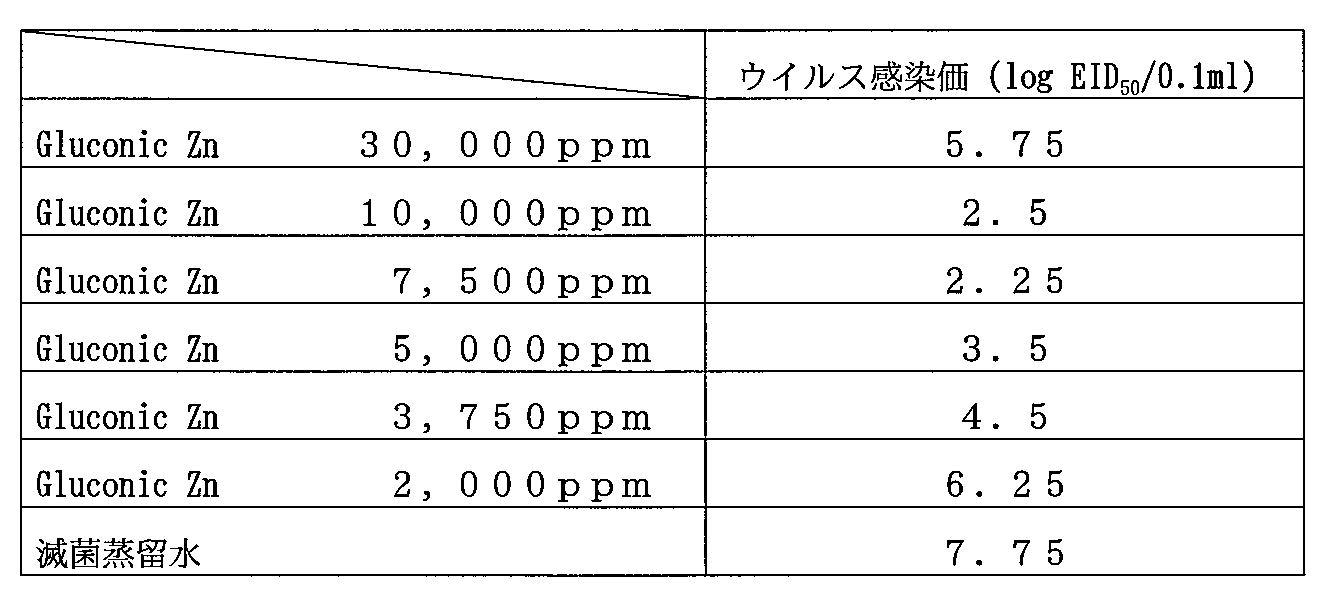
表1から明らかなように、グルコン酸濃度7,500ppmで、ウイルス感染価2.25と極小値を示した。このような極小値を示す理由は定かでない。
(繊維への浸透)
上記と同様にして、グルコン酸亜鉛を7500ppm含むウイルス不活性化薬剤を調整した。このウイルス不活性化薬剤を、市販のセルロース繊維(20番手)及びセルロース性の布(11号の帆布)に対して浸透させる実験を行った。
上記と同様にして、グルコン酸亜鉛を7500ppm含むウイルス不活性化薬剤を調整した。このウイルス不活性化薬剤を、市販のセルロース繊維(20番手)及びセルロース性の布(11号の帆布)に対して浸透させる実験を行った。
(実施例1)
池田理化製の高圧蒸気滅菌器に、セルロース繊維およびセルロース性の織布をそれぞれ1kg入れ、その後ウイルス不活性化薬剤を2l入れた。この後、134℃、0.23MPaで10分間処理し、ウイルス不活性化薬剤をセルロース繊維に浸透させた。
池田理化製の高圧蒸気滅菌器に、セルロース繊維およびセルロース性の織布をそれぞれ1kg入れ、その後ウイルス不活性化薬剤を2l入れた。この後、134℃、0.23MPaで10分間処理し、ウイルス不活性化薬剤をセルロース繊維に浸透させた。
この後、室温で送風乾燥して、実施例1にかかるセルロース繊維及びセルロース織布を得た。
(実施例2)
温度と圧力を、150℃、0.39MPaとしたこと以外は、上記実施例1と同様にして、実施例2にかかるセルロース繊維及びセルロース織布を得た。
温度と圧力を、150℃、0.39MPaとしたこと以外は、上記実施例1と同様にして、実施例2にかかるセルロース繊維及びセルロース織布を得た。
(実施例3)
温度と圧力を、120℃、0.10MPa、処理時間を20分としたこと以外は、上記実施例1と同様にして、実施例3にかかるセルロース繊維及びセルロース織布を得た。
温度と圧力を、120℃、0.10MPa、処理時間を20分としたこと以外は、上記実施例1と同様にして、実施例3にかかるセルロース繊維及びセルロース織布を得た。
(比較例1)
温度と圧力を、110℃、0.044MPa、処理時間を30分としたこと以外は、上記実施例1と同様にして、比較例1にかかるセルロース繊維及びセルロース織布を得た。
温度と圧力を、110℃、0.044MPa、処理時間を30分としたこと以外は、上記実施例1と同様にして、比較例1にかかるセルロース繊維及びセルロース織布を得た。
(比較例2)
何も処理していない、セルロース繊維およびセルロース性の織布を用意し、これを比較例2とした。
何も処理していない、セルロース繊維およびセルロース性の織布を用意し、これを比較例2とした。
(洗濯)
この後、実施例1~3、比較例1、2にかかるセルロース繊維及びセルロース織布をそれぞれ2分割し、半分量を、市販の家庭用洗濯機で、洗剤を使用することなく350回洗濯した。
この後、実施例1~3、比較例1、2にかかるセルロース繊維及びセルロース織布をそれぞれ2分割し、半分量を、市販の家庭用洗濯機で、洗剤を使用することなく350回洗濯した。
洗濯前後の実施例1~3、比較例1、及び比較例2にかかるセルロース繊維及びセルロース織布を用意した。上記の鳥インフルエンザウイルス溶液1.0mlの入った容器に上記繊維製品を0.5g加え、上記と同様に実験を行って、ウイルス感染価を算出した。この結果のうち、log EID50/0.1mlが3.5以下のものを良好(〇)、5より大きいものを不可(×)、その中間のものを可(△)と評価した。この結果を下記表2に示す。
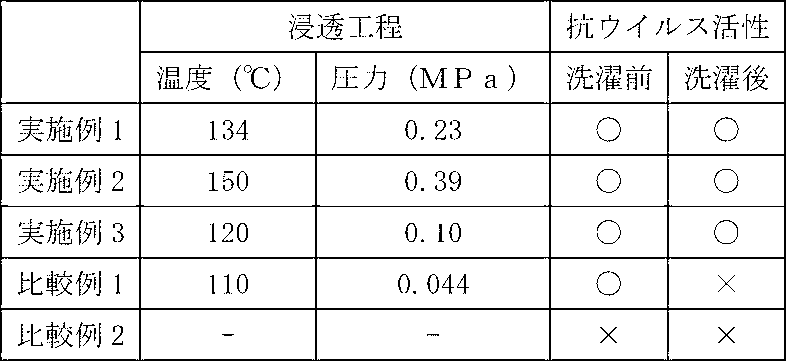
ウイルス不活性化薬剤の浸透処理を行っていない比較例2のセルロース繊維及びセルロース織布には、抗ウイルス作用がないことが分かった。また、実施例1~3にかかるセルロース繊維及びセルロース織布は、洗濯前後ともに抗ウイルス活性が良好であり、洗濯後においても優れた抗ウイルス作用が得られたことが分かった。他方、比較例1では、洗濯前のものでは実施例1~3と同等の抗ウイルス作用が得られたものの、洗濯後のものでは抗ウイルス作用は残っていなかった。
(マスクへの適用例)
図1は、本発明にかかる繊維製品を用いた抗ウイルスマスクを示す図であって、図1(a)はその外観、図1(b)はマスク本体の積層状態を示す部分破断図である。図1(b)に示すように、マスク本体は複数枚(同図では3枚)の繊維製の布からなっている。
図1は、本発明にかかる繊維製品を用いた抗ウイルスマスクを示す図であって、図1(a)はその外観、図1(b)はマスク本体の積層状態を示す部分破断図である。図1(b)に示すように、マスク本体は複数枚(同図では3枚)の繊維製の布からなっている。
同図において、内層13は、口に触れる布であり、口当たりのいい素材を選ぶことが好ましい。中層12は外気にも口にも直接当たらないので、この層を形成する布に本発明を適用すると、長期間にわたって抗ウイルス活性が得られる。また、外層11は外気に当たるものであるが、この布に本発明を適用すると、マスクに触れたときに手がウイルスに汚染されることを防止できる。
また、花粉やPM2.5などの微粒子の透過を防止する機能を、いずれかの層に付与してもよい。
また、マスクを構成する布地等は、350回以上の洗濯に対する耐久性を有する素材を用いることが好ましい。本発明にかかる繊維製品は、350回以上の洗濯に対する堅牢性を有しているので、これに見合った丈夫な糸や生地を用いることが好ましい。
また、医療業務や介護業務の従事者、病院や介護施設の利用者の衣服に本発明を適用することで、院内感染を予防することができる。
なお、上記実施例では、有機酸としてグルコン酸を使用したものを用いたが、この発明はこれに限られるものでない。
今回開示された実施例はすべての点で例示であって制限的なものではないと考えられるべきである。本発明の範囲は上記した説明ではなくて特許請求の範囲によって示され、特許請求の範囲と均等の意味および範囲内でのすべての変更が含まれることが意図される。
本発明に係る抗ウイルス繊維製品は、殺菌、抗ウイルスの効果を多数回の洗濯後においても保つことができ、その産業上の利用可能性は大きい。
1 抗ウイルスマスク
11 外層
12 中層
13 内層
11 外層
12 中層
13 内層
Claims (5)
- 酸化亜鉛ナノ粒子を有機酸水溶液に分散させてなり、有機酸亜鉛を含むウイルス不活性化薬剤を、セルロースを主体とする繊維に、120~200℃の温度と0.0098~0.59MPaの圧力とをかけて浸透させる浸透工程を備え、
前記有機酸水溶液は、水に溶かせると一部ラクトン化する有機酸を40~50重量%含む、
抗ウイルス繊維製品の製造方法。 - 前記酸化亜鉛ナノ粒子は、直径50nm~70nmの酸化亜鉛ナノ粒子を含む、請求項1に記載の抗ウイルス繊維製品の製造方法。
- 前記有機酸亜鉛は、グルコン酸亜鉛である、請求項1又は2に記載の抗ウイルス繊維製品の製造方法。
- 前記ウイルス不活性化薬剤は、前記グルコン酸亜鉛を5000~10000ppm含む、請求項3に記載の抗ウイルス繊維製品の製造方法。
- 請求項1ないし4のいずれかに記載の抗ウイルス繊維製品の製造方法により得られる繊維製品を用いてなる抗ウイルスマスク。
Priority Applications (5)
| Application Number | Priority Date | Filing Date | Title |
|---|---|---|---|
| JP2022509850A JPWO2021192057A1 (ja) | 2020-03-24 | 2020-03-24 | |
| EP20927866.2A EP3957202A4 (en) | 2020-03-24 | 2020-03-24 | METHOD OF MANUFACTURE OF AN ANTIVIRAL FIBER PRODUCT AND ANTIVIRAL MASK MANUFACTURED THEREOF |
| CN202080036295.1A CN113840552A (zh) | 2020-03-24 | 2020-03-24 | 抗病毒纤维产品的制造方法和使用其制成的抗病毒口罩 |
| US17/610,810 US20220192197A1 (en) | 2020-03-24 | 2020-03-24 | Method of manufacturing antiviral fiber product and antiviral mask containing the product |
| PCT/JP2020/013102 WO2021192057A1 (ja) | 2020-03-24 | 2020-03-24 | 抗ウイルス繊維製品の製造方法及びこれを用いてなる抗ウイルスマスク |
Applications Claiming Priority (1)
| Application Number | Priority Date | Filing Date | Title |
|---|---|---|---|
| PCT/JP2020/013102 WO2021192057A1 (ja) | 2020-03-24 | 2020-03-24 | 抗ウイルス繊維製品の製造方法及びこれを用いてなる抗ウイルスマスク |
Publications (1)
| Publication Number | Publication Date |
|---|---|
| WO2021192057A1 true WO2021192057A1 (ja) | 2021-09-30 |
Family
ID=77891235
Family Applications (1)
| Application Number | Title | Priority Date | Filing Date |
|---|---|---|---|
| PCT/JP2020/013102 Ceased WO2021192057A1 (ja) | 2020-03-24 | 2020-03-24 | 抗ウイルス繊維製品の製造方法及びこれを用いてなる抗ウイルスマスク |
Country Status (5)
| Country | Link |
|---|---|
| US (1) | US20220192197A1 (ja) |
| EP (1) | EP3957202A4 (ja) |
| JP (1) | JPWO2021192057A1 (ja) |
| CN (1) | CN113840552A (ja) |
| WO (1) | WO2021192057A1 (ja) |
Families Citing this family (1)
| Publication number | Priority date | Publication date | Assignee | Title |
|---|---|---|---|---|
| TWD224005S (zh) * | 2021-09-29 | 2023-03-01 | 楊銘域 中國大陸 | 口罩繩之部分 |
Citations (2)
| Publication number | Priority date | Publication date | Assignee | Title |
|---|---|---|---|---|
| JP2010143875A (ja) * | 2008-12-19 | 2010-07-01 | Shigadry With Earth:Kk | ウイルス不活性化薬剤およびその製造方法 |
| JP3179060U (ja) * | 2012-08-02 | 2012-10-11 | 株式会社シガドライウィザース | 抗ウイルス織物、それを素材として作られた衣類、カーテン及び網戸 |
Family Cites Families (14)
| Publication number | Priority date | Publication date | Assignee | Title |
|---|---|---|---|---|
| SU821592A1 (ru) * | 1979-03-26 | 1981-04-15 | Ивановский Научно-Исследователь-Ский Экспериментально-Конструк-Торский Машиностроительный Институт | Способ обработки текстильногоМАТЕРиАлА |
| US5981739A (en) * | 1996-09-26 | 1999-11-09 | Bp Amoco Corporation | Polyanhydride crosslinked fibrous cellulosic products and process for their preparation |
| FR2838295B1 (fr) * | 2002-04-15 | 2005-05-13 | Georgia Pacific France | Utilisation de sels metalliques du gluconate pour la fabrication de substrats a activite antimicrobienne |
| CN1302826C (zh) * | 2003-04-26 | 2007-03-07 | 北京中科安康医疗用品有限公司 | 灭菌抗病毒口罩及其制备方法 |
| JPWO2005083171A1 (ja) * | 2004-03-02 | 2008-01-17 | 日本エクスラン工業株式会社 | 抗ウイルス性繊維、及び該繊維の製法、並びに該繊維を用いた繊維製品 |
| CN201821963U (zh) * | 2009-11-25 | 2011-05-11 | 西安交大保赛生物技术股份有限公司 | 新型防病毒口罩 |
| CN202233138U (zh) * | 2011-10-18 | 2012-05-30 | 杭州个个爽竹纤维开发有限公司 | 竹纤维口罩 |
| ITUD20130150A1 (it) * | 2013-11-14 | 2015-05-15 | Roberto Franchetti | Procedimento di trattamento di materiale tessile e relativo apparato di trattamento |
| JP6162067B2 (ja) * | 2014-03-27 | 2017-07-12 | 東レ株式会社 | 繊維製品の処理装置 |
| AT516414B1 (de) * | 2014-10-28 | 2017-07-15 | Chemiefaser Lenzing Ag | Flüssigkeitsgetränkter Vliesstoff, enthaltend Zinkoxid-haltige Cellulosefasern |
| CN108755132A (zh) * | 2018-06-19 | 2018-11-06 | 明光市天淼新能源科技有限公司 | 一种抗菌植物纤维材料 |
| JP7405392B2 (ja) * | 2018-07-03 | 2023-12-26 | 国立研究開発法人産業技術総合研究所 | 機能性多孔質素材及びその製造方法 |
| CN108914577A (zh) * | 2018-07-12 | 2018-11-30 | 合肥连森裕腾新材料科技开发有限公司 | 一种抗菌纳米植物纤维材料 |
| CN109315856B (zh) * | 2018-11-07 | 2021-01-29 | 浙江金蓝医疗科技有限公司 | 一种天然抑菌医用口罩 |
-
2020
- 2020-03-24 EP EP20927866.2A patent/EP3957202A4/en not_active Withdrawn
- 2020-03-24 CN CN202080036295.1A patent/CN113840552A/zh active Pending
- 2020-03-24 JP JP2022509850A patent/JPWO2021192057A1/ja active Pending
- 2020-03-24 US US17/610,810 patent/US20220192197A1/en not_active Abandoned
- 2020-03-24 WO PCT/JP2020/013102 patent/WO2021192057A1/ja not_active Ceased
Patent Citations (3)
| Publication number | Priority date | Publication date | Assignee | Title |
|---|---|---|---|---|
| JP2010143875A (ja) * | 2008-12-19 | 2010-07-01 | Shigadry With Earth:Kk | ウイルス不活性化薬剤およびその製造方法 |
| JP4980337B2 (ja) | 2008-12-19 | 2012-07-18 | 株式会社シガドライウィザース | ウイルス不活性化薬剤およびその製造方法 |
| JP3179060U (ja) * | 2012-08-02 | 2012-10-11 | 株式会社シガドライウィザース | 抗ウイルス織物、それを素材として作られた衣類、カーテン及び網戸 |
Also Published As
| Publication number | Publication date |
|---|---|
| US20220192197A1 (en) | 2022-06-23 |
| CN113840552A (zh) | 2021-12-24 |
| EP3957202A1 (en) | 2022-02-23 |
| JPWO2021192057A1 (ja) | 2021-09-30 |
| EP3957202A4 (en) | 2023-01-11 |
Similar Documents
| Publication | Publication Date | Title |
|---|---|---|
| Andra et al. | Emerging nanomaterials for antibacterial textile fabrication | |
| JP6612375B6 (ja) | 布地及び関連する基材のための消毒性組成物、及び抗菌的、抗ウイルス的、及び抗真菌的消毒性、洗浄耐久性を提供し、多機能的特性を用いて必要に応じて強化するための基材の処理方法 | |
| CN101716359B (zh) | 一种杀菌消毒材料及其应用 | |
| KR20200024961A (ko) | 항균성을 갖는 텍스타일 | |
| ZA200208466B (en) | Methods and fabrics for combating nosocomial infections. | |
| CN105506984A (zh) | 用天然生物材料对纺织品进行抗菌、抗病毒整理的方法 | |
| EP2588662A1 (en) | Antimicrobial finish on fabrics | |
| JP2020125560A (ja) | ヨウ素担持素材 | |
| JP2022036046A (ja) | 多層型銅系ゼオライト繊維医療用材料、医療用防護用品及びその製造方法 | |
| JP2005009065A (ja) | 抗菌・殺菌性繊維製品及びその製造方法 | |
| US20210395652A1 (en) | Textile treatment compositions | |
| WO2021210025A1 (en) | Compositions and methods for coatings, antimicrobial textiles, sanitization and disinfection | |
| TWI691532B (zh) | 抗病毒加工製品之製造方法及由該製造方法獲得之抗病毒加工製品 | |
| CN111411510B (zh) | 一种抗菌防螨抗病毒整理剂、毛绒面料及其制备方法和应用 | |
| WO2021192057A1 (ja) | 抗ウイルス繊維製品の製造方法及びこれを用いてなる抗ウイルスマスク | |
| CN118147919A (zh) | 一种持久抗菌、抑螨、驱蚊的纤维素纤维织物及制备方法 | |
| CN108797100A (zh) | 一种医疗卫生用品用抗菌透湿无纺布 | |
| JP3179060U (ja) | 抗ウイルス織物、それを素材として作られた衣類、カーテン及び網戸 | |
| EP1608810B1 (en) | Disposable, paper-based hospital and operating theater products | |
| JP3187328U (ja) | 抗菌・抗ウイルス性病院用寝具及び衣類 | |
| JP2022098204A (ja) | 抗ウィルス繊維構造体およびその製造方法、抗ウィルス加工製品 | |
| CN212097850U (zh) | 一种长效抗病毒织物及其构成的口罩 | |
| ِElsaidy et al. | Enhancing the functional performance of medical scrubs fabrics using nanotechnology: a review | |
| CN111155177B (zh) | 静电纺丝抗病毒薄层及其在抗病毒领域的应用 | |
| CN213428460U (zh) | 可重复使用的杀菌抗病毒口罩 |
Legal Events
| Date | Code | Title | Description |
|---|---|---|---|
| 121 | Ep: the epo has been informed by wipo that ep was designated in this application |
Ref document number: 20927866 Country of ref document: EP Kind code of ref document: A1 |
|
| ENP | Entry into the national phase |
Ref document number: 2022509850 Country of ref document: JP Kind code of ref document: A |
|
| ENP | Entry into the national phase |
Ref document number: 2020927866 Country of ref document: EP Effective date: 20211117 |
|
| NENP | Non-entry into the national phase |
Ref country code: DE |