WO2021193317A1 - 樹脂組成物および樹脂組成物の製造方法、成形体、多層構造体および包装体 - Google Patents
樹脂組成物および樹脂組成物の製造方法、成形体、多層構造体および包装体 Download PDFInfo
- Publication number
- WO2021193317A1 WO2021193317A1 PCT/JP2021/010957 JP2021010957W WO2021193317A1 WO 2021193317 A1 WO2021193317 A1 WO 2021193317A1 JP 2021010957 W JP2021010957 W JP 2021010957W WO 2021193317 A1 WO2021193317 A1 WO 2021193317A1
- Authority
- WO
- WIPO (PCT)
- Prior art keywords
- resin composition
- acid
- resin
- carboxylic acid
- thermoplastic resin
- Prior art date
- Legal status (The legal status is an assumption and is not a legal conclusion. Google has not performed a legal analysis and makes no representation as to the accuracy of the status listed.)
- Ceased
Links
Classifications
-
- C—CHEMISTRY; METALLURGY
- C08—ORGANIC MACROMOLECULAR COMPOUNDS; THEIR PREPARATION OR CHEMICAL WORKING-UP; COMPOSITIONS BASED THEREON
- C08L—COMPOSITIONS OF MACROMOLECULAR COMPOUNDS
- C08L29/00—Compositions of homopolymers or copolymers of compounds having one or more unsaturated aliphatic radicals, each having only one carbon-to-carbon double bond, and at least one being terminated by an alcohol, ether, aldehydo, ketonic, acetal or ketal radical; Compositions of hydrolysed polymers of esters of unsaturated alcohols with saturated carboxylic acids; Compositions of derivatives of such polymers
- C08L29/02—Homopolymers or copolymers of unsaturated alcohols
- C08L29/04—Polyvinyl alcohol; Partially hydrolysed homopolymers or copolymers of esters of unsaturated alcohols with saturated carboxylic acids
-
- B—PERFORMING OPERATIONS; TRANSPORTING
- B32—LAYERED PRODUCTS
- B32B—LAYERED PRODUCTS, i.e. PRODUCTS BUILT-UP OF STRATA OF FLAT OR NON-FLAT, e.g. CELLULAR OR HONEYCOMB, FORM
- B32B27/00—Layered products comprising a layer of synthetic resin
- B32B27/06—Layered products comprising a layer of synthetic resin as the main or only constituent of a layer, which is next to another layer of the same or of a different material
- B32B27/08—Layered products comprising a layer of synthetic resin as the main or only constituent of a layer, which is next to another layer of the same or of a different material of synthetic resin
-
- B—PERFORMING OPERATIONS; TRANSPORTING
- B32—LAYERED PRODUCTS
- B32B—LAYERED PRODUCTS, i.e. PRODUCTS BUILT-UP OF STRATA OF FLAT OR NON-FLAT, e.g. CELLULAR OR HONEYCOMB, FORM
- B32B27/00—Layered products comprising a layer of synthetic resin
- B32B27/18—Layered products comprising a layer of synthetic resin characterised by the use of special additives
-
- B—PERFORMING OPERATIONS; TRANSPORTING
- B32—LAYERED PRODUCTS
- B32B—LAYERED PRODUCTS, i.e. PRODUCTS BUILT-UP OF STRATA OF FLAT OR NON-FLAT, e.g. CELLULAR OR HONEYCOMB, FORM
- B32B27/00—Layered products comprising a layer of synthetic resin
- B32B27/30—Layered products comprising a layer of synthetic resin comprising vinyl (co)polymers; comprising acrylic (co)polymers
- B32B27/302—Layered products comprising a layer of synthetic resin comprising vinyl (co)polymers; comprising acrylic (co)polymers comprising aromatic vinyl (co)polymers, e.g. styrenic (co)polymers
-
- B—PERFORMING OPERATIONS; TRANSPORTING
- B32—LAYERED PRODUCTS
- B32B—LAYERED PRODUCTS, i.e. PRODUCTS BUILT-UP OF STRATA OF FLAT OR NON-FLAT, e.g. CELLULAR OR HONEYCOMB, FORM
- B32B27/00—Layered products comprising a layer of synthetic resin
- B32B27/30—Layered products comprising a layer of synthetic resin comprising vinyl (co)polymers; comprising acrylic (co)polymers
- B32B27/306—Layered products comprising a layer of synthetic resin comprising vinyl (co)polymers; comprising acrylic (co)polymers comprising vinyl acetate or vinyl alcohol (co)polymers
-
- B—PERFORMING OPERATIONS; TRANSPORTING
- B32—LAYERED PRODUCTS
- B32B—LAYERED PRODUCTS, i.e. PRODUCTS BUILT-UP OF STRATA OF FLAT OR NON-FLAT, e.g. CELLULAR OR HONEYCOMB, FORM
- B32B27/00—Layered products comprising a layer of synthetic resin
- B32B27/32—Layered products comprising a layer of synthetic resin comprising polyolefins
-
- B—PERFORMING OPERATIONS; TRANSPORTING
- B32—LAYERED PRODUCTS
- B32B—LAYERED PRODUCTS, i.e. PRODUCTS BUILT-UP OF STRATA OF FLAT OR NON-FLAT, e.g. CELLULAR OR HONEYCOMB, FORM
- B32B27/00—Layered products comprising a layer of synthetic resin
- B32B27/34—Layered products comprising a layer of synthetic resin comprising polyamides
-
- C—CHEMISTRY; METALLURGY
- C08—ORGANIC MACROMOLECULAR COMPOUNDS; THEIR PREPARATION OR CHEMICAL WORKING-UP; COMPOSITIONS BASED THEREON
- C08K—Use of inorganic or non-macromolecular organic substances as compounding ingredients
- C08K5/00—Use of organic ingredients
- C08K5/04—Oxygen-containing compounds
- C08K5/09—Carboxylic acids; Metal salts thereof; Anhydrides thereof
-
- C—CHEMISTRY; METALLURGY
- C08—ORGANIC MACROMOLECULAR COMPOUNDS; THEIR PREPARATION OR CHEMICAL WORKING-UP; COMPOSITIONS BASED THEREON
- C08K—Use of inorganic or non-macromolecular organic substances as compounding ingredients
- C08K5/00—Use of organic ingredients
- C08K5/04—Oxygen-containing compounds
- C08K5/09—Carboxylic acids; Metal salts thereof; Anhydrides thereof
- C08K5/098—Metal salts of carboxylic acids
-
- C—CHEMISTRY; METALLURGY
- C08—ORGANIC MACROMOLECULAR COMPOUNDS; THEIR PREPARATION OR CHEMICAL WORKING-UP; COMPOSITIONS BASED THEREON
- C08L—COMPOSITIONS OF MACROMOLECULAR COMPOUNDS
- C08L23/00—Compositions of homopolymers or copolymers of unsaturated aliphatic hydrocarbons having only one carbon-to-carbon double bond; Compositions of derivatives of such polymers
- C08L23/02—Compositions of homopolymers or copolymers of unsaturated aliphatic hydrocarbons having only one carbon-to-carbon double bond; Compositions of derivatives of such polymers not modified by chemical after-treatment
- C08L23/10—Homopolymers or copolymers of propene
- C08L23/12—Polypropene
-
- C—CHEMISTRY; METALLURGY
- C08—ORGANIC MACROMOLECULAR COMPOUNDS; THEIR PREPARATION OR CHEMICAL WORKING-UP; COMPOSITIONS BASED THEREON
- C08L—COMPOSITIONS OF MACROMOLECULAR COMPOUNDS
- C08L25/00—Compositions of, homopolymers or copolymers of compounds having one or more unsaturated aliphatic radicals, each having only one carbon-to-carbon double bond, and at least one being terminated by an aromatic carbocyclic ring; Compositions of derivatives of such polymers
- C08L25/02—Homopolymers or copolymers of hydrocarbons
- C08L25/04—Homopolymers or copolymers of styrene
-
- B—PERFORMING OPERATIONS; TRANSPORTING
- B32—LAYERED PRODUCTS
- B32B—LAYERED PRODUCTS, i.e. PRODUCTS BUILT-UP OF STRATA OF FLAT OR NON-FLAT, e.g. CELLULAR OR HONEYCOMB, FORM
- B32B2250/00—Layers arrangement
- B32B2250/24—All layers being polymeric
-
- B—PERFORMING OPERATIONS; TRANSPORTING
- B32—LAYERED PRODUCTS
- B32B—LAYERED PRODUCTS, i.e. PRODUCTS BUILT-UP OF STRATA OF FLAT OR NON-FLAT, e.g. CELLULAR OR HONEYCOMB, FORM
- B32B2270/00—Resin or rubber layer containing a blend of at least two different polymers
-
- B—PERFORMING OPERATIONS; TRANSPORTING
- B32—LAYERED PRODUCTS
- B32B—LAYERED PRODUCTS, i.e. PRODUCTS BUILT-UP OF STRATA OF FLAT OR NON-FLAT, e.g. CELLULAR OR HONEYCOMB, FORM
- B32B2439/00—Containers; Receptacles
- B32B2439/70—Food packaging
-
- B—PERFORMING OPERATIONS; TRANSPORTING
- B32—LAYERED PRODUCTS
- B32B—LAYERED PRODUCTS, i.e. PRODUCTS BUILT-UP OF STRATA OF FLAT OR NON-FLAT, e.g. CELLULAR OR HONEYCOMB, FORM
- B32B2553/00—Packaging equipment or accessories not otherwise provided for
-
- C—CHEMISTRY; METALLURGY
- C08—ORGANIC MACROMOLECULAR COMPOUNDS; THEIR PREPARATION OR CHEMICAL WORKING-UP; COMPOSITIONS BASED THEREON
- C08L—COMPOSITIONS OF MACROMOLECULAR COMPOUNDS
- C08L2205/00—Polymer mixtures characterised by other features
- C08L2205/02—Polymer mixtures characterised by other features containing two or more polymers of the same C08L -group
- C08L2205/025—Polymer mixtures characterised by other features containing two or more polymers of the same C08L -group containing two or more polymers of the same hierarchy C08L, and differing only in parameters such as density, comonomer content, molecular weight, structure
-
- C—CHEMISTRY; METALLURGY
- C08—ORGANIC MACROMOLECULAR COMPOUNDS; THEIR PREPARATION OR CHEMICAL WORKING-UP; COMPOSITIONS BASED THEREON
- C08L—COMPOSITIONS OF MACROMOLECULAR COMPOUNDS
- C08L2205/00—Polymer mixtures characterised by other features
- C08L2205/03—Polymer mixtures characterised by other features containing three or more polymers in a blend
-
- Y—GENERAL TAGGING OF NEW TECHNOLOGICAL DEVELOPMENTS; GENERAL TAGGING OF CROSS-SECTIONAL TECHNOLOGIES SPANNING OVER SEVERAL SECTIONS OF THE IPC; TECHNICAL SUBJECTS COVERED BY FORMER USPC CROSS-REFERENCE ART COLLECTIONS [XRACs] AND DIGESTS
- Y02—TECHNOLOGIES OR APPLICATIONS FOR MITIGATION OR ADAPTATION AGAINST CLIMATE CHANGE
- Y02W—CLIMATE CHANGE MITIGATION TECHNOLOGIES RELATED TO WASTEWATER TREATMENT OR WASTE MANAGEMENT
- Y02W30/00—Technologies for solid waste management
- Y02W30/50—Reuse, recycling or recovery technologies
- Y02W30/62—Plastics recycling; Rubber recycling
Definitions
- the present invention may be referred to as a thermoplastic resin containing no polar group, a thermoplastic resin containing a polar group, or an ethylene-vinyl alcohol-based copolymer having an ethylene content of 20 to 60 mol% (hereinafter, referred to as "EVOH").
- EVOH ethylene-vinyl alcohol-based copolymer having an ethylene content of 20 to 60 mol%
- the present invention relates to a resin composition containing.), And more particularly, to a resin composition having excellent mechanical strength.
- a laminate containing a thermoplastic resin layer containing no polar group such as polyethylene and polypropylene and a layer made of EVOH having excellent gas barrier properties (hereinafter, may be abbreviated as "EVOH layer”) has been used.
- EVOH layer a layer made of EVOH having excellent gas barrier properties
- Films, sheets, cups, trays, bottles, etc. and are applied to various applications by taking advantage of their characteristics, and are especially commercialized as packaging materials for foods and chemicals.
- unnecessary parts such as scraps and edges, defective products, or the molded product thereof. Scraps such as dust are generated after using the product for various purposes.
- Such scrap amounts to 30-50% (area ratio) of the original laminate. Therefore, this scrap is collected, melt-molded, and the recovered product is applied to at least one layer of the laminate, which is a recycled layer (so-called regrind layer, and in the present invention, the recycled layer is referred to as a "regrind layer”. There is a case) and it may be reused.
- thermoplastic resin containing no polar group and EVOH are incompatible with each other, the recovered product of the thermoplastic resin layer containing no polar group and the laminate having the EVOH layer is remelted to be remelted or recycled.
- a thermoplastic resin that does not contain a polar group at the time of melting and EVOH tend to cause poor compatibility.
- it has been a cause of poor appearance such as rheumatism during the production of the molded product, fish eyes and holes in the molded product, and wavy patterns on the surface.
- an ethylene-vinyl acetate-based copolymer having a high ethylene content (hereinafter, may be referred to as "EVA”) is blended.
- EVA ethylene-vinyl acetate-based copolymer having a high ethylene content
- the EVA saponified product having a high ethylene content has a characteristic that the ethylene content is 70 mol% or more and the compatibility with the polyolefin is high.
- the EVOH which is also an EVA kenside, has an ethylene content of 20 to 60 mol% and is characterized by excellent gas barrier properties.
- the present inventor tried the methods described in Patent Documents 1 to 3, and found that these techniques were compared with respect to the problems associated with the low compatibility between the thermoplastic resin containing no polar group and EVOH. It was found that although good results were obtained, there was a problem that the obtained regrind layer turned yellow or red. Therefore, in order to suppress such discoloration, the present inventor has also tried a method of reducing the content of EVA saponified products having a high ethylene content, but the compatibility effect is reduced and problems associated with poor compatibility (machinery). Since the improvement of (decrease in target strength) is insufficient, further improvement is required.
- Patent Documents a resin composition using a resin in which EVA and an EVA saponified product having a high ethylene content are used in combination as a base resin.
- the present invention has been made in view of such circumstances, such as a thermoplastic resin containing no polar group, a thermoplastic resin containing a polar group, scraps of a product generated during the production of a laminate containing EVOH, an end portion, and the like. Even when the unnecessary parts and defective products of the above, or the collected products such as dust after using the molded product for various purposes are reused as a resin composition, the obtained molded product has excellent mechanical strength. To provide a resin composition.
- the present invention also provides a method for producing the above resin composition, a molded product, a multilayer structure and a packaging body.
- thermoplastic resin (A) containing no polar group a thermoplastic resin (B) containing a polar group, EVOH (C), acetic acid and / or The salt (D), an aliphatic carboxylic acid (E) having 3 or more carbon atoms, and an aliphatic carboxylic acid metal salt (F) which is a metal salt of the aliphatic carboxylic acid (E) are used in combination and contain the above polar group.
- a resin composition having excellent mechanical strength can be obtained by setting the contents of the thermoplastic resin (A) and EVOH (C) that do not exist within a specific range.
- an aliphatic carboxylic acid metal salt promotes the thermal decomposition of EVOH and lowers the mechanical strength of the resin composition containing EVOH. Therefore, those skilled in the art should avoid blending an aliphatic carboxylic acid metal salt for the purpose of improving the mechanical strength of the resin composition containing EVOH.
- the present inventor has made a polar group-free thermoplastic resin, a polar group-containing thermoplastic resin, EVOH, acetic acid and / or a salt thereof, an aliphatic carboxylic acid having 3 or more carbon atoms, and an aliphatic carboxylic acid thereof. It was found that when the metal salts of the above were used together to satisfy a specific relationship, the mechanical strength was improved contrary to the conventional expectation.
- the present invention relates to a thermoplastic resin (A) containing no polar group, a thermoplastic resin (B) containing a polar group, EVOH (C), acetic acid and / or a salt thereof (D), and 3 carbon atoms.
- the content of the resin (A) is 66 to 99% by weight based on the total amount of the resin composition, and the content of the EVOH (C) is 0.1 to 25% by weight based on the total amount of the resin composition.
- the resin composition is the first gist.
- the second gist is a method for producing a resin composition in which the resin composition of the first gist is melt-kneaded and pelletized, and the third gist is a molded product using the resin composition of the first gist.
- the fourth gist is a multi-layer structure having at least one layer made of the resin composition of the first gist, and the fifth gist is a package made of the multi-layer structure of the fourth gist. be.
- the resin composition of the present invention comprises a polar group-free thermoplastic resin (A), a polar group-containing thermoplastic resin (B), EVOH (C), acetic acid and / or a salt thereof (D), and 3 carbon atoms.
- thermoplastic resin (A) containing no polar group is at least one selected from a polyolefin resin and a polystyrene resin, it is more excellent in recyclability and economy.
- thermoplastic resin (A) containing no polar group is at least one selected from polyethylene, polypropylene, and polystyrene, it is further excellent in recyclability and economy.
- thermoplastic resin (B) containing the polar group when the content of the thermoplastic resin (B) containing the polar group is 0.1 to 50% by weight based on the total amount of the resin composition, it is more excellent in mechanical strength, recyclability and economy. ing.
- thermoplastic resin (B) containing the polar group is a modified thermoplastic resin containing a carboxy group or an acid anhydride group, it is further excellent in mechanical strength, recyclability and economic efficiency.
- thermoplastic resin (B) containing the polar group is at least one selected from a modified polyolefin resin containing a carboxy group or an acid anhydride group and a polyvinyl acetate resin, it is particularly mechanical. Excellent in strength, recyclability and economy.
- the mechanical strength is more excellent.
- the mechanical strength is more excellent. There is.
- the mechanical strength is more excellent.
- the manufacturing method of the above resin composition is a manufacturing method having more excellent mechanical strength.
- the molded product obtained by using the above resin composition is a molded product having excellent mechanical strength.
- the multilayer structure having at least one layer made of the above resin composition is a multilayer structure having excellent mechanical strength.
- the package of the present invention is composed of the above-mentioned multi-layer structure, the obtained package is also excellent in mechanical strength.
- y and / or z (y, z are arbitrary constituents or components) means three combinations of y only, z only, and y and z.
- the resin composition of the present invention contains a polar group-free thermoplastic resin (A) [hereinafter, may be simply referred to as "thermoplastic resin (A)”], and a polar group-containing thermoplastic resin (B) [ Hereinafter, it may be simply referred to as “thermoplastic resin (B)”], EVOH (C), acetic acid and / or a salt thereof (D), an aliphatic carboxylic acid (E) having 3 or more carbon atoms, and the above-mentioned aliphatic carboxylic acid. It contains an aliphatic carboxylic acid metal salt (F) which is a metal salt of the acid (E).
- the polar group-free thermoplastic resin (A) used in the present invention is, for example, a polar group-free thermoplastic resin such as a hydroxyl group, a carboxy group, an amino group, and an amide group, and the type thereof is not particularly limited. ..
- the thermoplastic resin (A) include polyolefin-based resins, polystyrene-based resins, fluororesins, and the like. These may be used alone or in combination of two.
- polystyrene-based resin examples include polyethylenes such as linear low-density polyethylene (LLDPE), low-density polyethylene (LDPE), ultra-low-density polyethylene (VLDPE), medium-density polyethylene (MDPE), and high-density polyethylene (HDPE).
- LLDPE linear low-density polyethylene
- LDPE low-density polyethylene
- VLDPE ultra-low-density polyethylene
- MDPE medium-density polyethylene
- HDPE high-density polyethylene
- PE polyethylene
- PP polyethylene
- PP polyethylene
- block or random copolymer propylene- ⁇ -olefin ( ⁇ -olefin having 4 to 20 carbon atoms) copolymer
- polyethylene- ⁇ -olefin (carbon number 4) ⁇ 20 ⁇ -Olefin) copolymers polyethylenes, polypentenes, polymethylpentenes and other olefins alone or copolymers, polycyclic olefins, blends thereof and the like can be mentioned. These may be used alone or in combination of two or more.
- polyethylene (PE), ethylene-propylene (block or random) copolymer, polypropylene (PP) and blends thereof are preferable in terms of economy and mechanical properties, and polyethylene (PE) and polypropylene ( PP) and ethylene-propylene (block or random) copolymers are particularly preferable because the effects of the present invention are particularly excellent.
- the ethylene or ⁇ -olefin of the polyolefin-based resin may be a plant-derived ethylene or ⁇ -olefin derived from bioethanol, or a non-plant-derived ethylene or ⁇ -olefin, that is, petroleum-derived ethylene or ⁇ -olefin. Often, these two types may be used in combination. Since a wide variety of petroleum-derived ⁇ -olefins are available, the physical characteristics of the polyolefin-based resin can be easily adjusted by producing them. By using plant-derived ethylene and ⁇ -olefin, the biomass degree of the final product can be further increased, and the burden on the environment can be reduced.
- a sugar solution or starch obtained from plants such as sugar cane, corn, and sweet potato is fermented by microorganisms such as yeast to produce bioethanol according to a conventional method. Then, this is heated in the presence of a catalyst, and plant-derived ethylene and ⁇ -olefin (1-butene, 1-hexene, etc.) can be obtained by an intramolecular dehydration reaction or the like. Further, using the obtained plant-derived ethylene and ⁇ -olefin, a plant-derived polyethylene-based resin can be produced in the same manner as in the production of a petroleum-derived polyethylene-based resin.
- the method for producing the above-mentioned plant-derived ethylene, ⁇ -olefin and plant-derived polyethylene-based resin is described in detail in, for example, Japanese Patent Publication No. 2011-506628.
- Examples of the plant-derived polyethylene-based resin preferably used in the present invention include green PE manufactured by Braskem SA.
- the polyolefin-based resin is produced by using a Ziegler-type catalyst, and chlorine caused by the catalyst is 0.01 to 500 ppm, preferably 0.1 to 400 ppm, and more preferably 1 to 300 ppm. Particularly preferably, a polyolefin resin containing 5 to 150 ppm is preferable. By using such a polyolefin-based resin, the effect of the present invention can be obtained more remarkably.
- polystyrene-based resin examples include homopolymers of styrene-based monomers such as styrene, ⁇ -methylstyrene, vinyltoluene, chlorostyrene, ethylstyrene, i-propylstyrene, dimethylstyrene, and bromostyrene, or copolymers thereof.
- a copolymer of a styrene-based monomer as a main component and a styrene-based monomer and a polymerizable vinyl monomer a copolymer of a styrene-based monomer and a rubber component such as butadiene, a homopolymer of a styrene-based monomer, or a polymer thereof.
- examples thereof include so-called high-impact polystyrene, which is a mixture or polymer of a copolymer or a copolymer of a styrene-based monomer and a vinyl monomer and a diene-based rubber-like polymer.
- These polystyrene-based resins may be used alone or in combination of two or more.
- Examples of the vinyl monomer that can be polymerized with the styrene-based monomer include alkyl (meth) acrylates such as methyl (meth) acrylate, ethyl (meth) acrylate, butyl (meth) acrylate, and cetyl (meth) acrylate, and (meth) acrylonitrile. , Dimethylmaleate, dimethyl fumarate, diethyl fumarate, ethyl fumarate, divinylbenzene, alkylene glycol dimethacrylate and other bifunctional monomers and the like. These vinyl monomers may be used alone or in combination of two or more.
- diene-based rubber-like polymer examples include polybutadiene, styrene-butadiene copolymer, ethylene-propylene-non-conjugated diene three-dimensional copolymer and the like.
- polystyrene-based resin a polystyrene-based resin containing 50% by mass or more of styrene is preferable, and polystyrene is more preferable from the viewpoint of economy.
- thermoplastic resins (A) at least one selected from polyolefin-based resin and polystyrene-based resin is preferable, and at least one selected from polyethylene, polypropylene, and polystyrene is preferable from the viewpoint of excellent recyclability and economic efficiency. It is more preferably a seed, especially polypropylene.
- the melt flow rate (MFR) (230 ° C., load 2160 g) of the thermoplastic resin (A) is usually 0.1 to 100 g / 10 minutes, preferably 0.5 to 50 g / 10 minutes. ..
- the content of the thermoplastic resin (A) is 66 to 99% by weight with respect to the total amount of the resin composition. It is preferably 70 to 98% by weight, more preferably 80 to 95% by weight. In the present invention, since the content of the thermoplastic resin (A) is in the above range, the mechanical strength is excellent. Further, if the content of the thermoplastic resin (A) is too small, the mechanical strength becomes insufficient, and if the content is too large, the gas barrier property and heat resistance rigidity of the laminated structure become insufficient.
- thermoplastic resin (B) containing a polar group used in the present invention is not particularly limited as long as it is a resin other than EVOH (C) described later.
- an unsaturated carboxylic acid or an anhydride thereof can be used as the above-mentioned thermoplastic resin.
- a modified thermoplastic resin containing a carboxy group or an acid anhydride group obtained by chemically bonding to (A) by an addition reaction, a graft reaction, or the like, or Examples thereof include a polyvinyl acetate-based resin, a polyvinyl alcohol-based resin, an ionomer-based resin modified with metal ions, a polyamide-based resin, a polyester-based resin, a polyurethane-based resin, a polycarbonate-based resin, and an acrylic-based resin. These may be used alone or in combination of two or more.
- a modified thermoplastic resin containing a carboxy group or an acid anhydride group is preferable from the viewpoint of excellent mechanical strength, recyclability and economy. Further, from the viewpoint of excellent mechanical strength, recyclability and economy, at least one selected from a polyolefin resin containing a carboxy group or an acid anhydride group and a polyvinyl acetate resin is preferable, and a carboxy group is preferable. Alternatively, it is more preferable to use a polyolefin resin containing an acid anhydride group and a polyvinyl acetate resin in combination.
- thermoplastic resin (A) used for the modified thermoplastic resin containing the carboxy group or acid anhydride group is preferably the polyolefin-based resin or polystyrene-based resin described in the thermoplastic resin (A).
- Examples of the unsaturated carboxylic acid used in the modified thermoplastic resin containing the carboxy group or the acid anhydride group include an unsaturated dicarboxylic acid and an unsaturated monocarboxylic acid.
- Examples of the unsaturated dicarboxylic acid include maleic acid, fumaric acid, chloromaleic acid, hymic acid, citraconic acid, and itaconic acid
- examples of the unsaturated monocarboxylic acid include acrylic acid, butanoic acid, and crotonic acid.
- Examples of the unsaturated carboxylic acid anhydride include the acid anhydride of the unsaturated dicarboxylic acid or the unsaturated monocarboxylic acid. Specific examples thereof include maleic anhydride, hymic anhydride, itaconic anhydride, citraconic anhydride, and acrylate anhydrides. Two or more kinds of unsaturated carboxylic acid or unsaturated carboxylic acid anhydride may be used in combination. Of these, maleic anhydride is particularly suitable from the viewpoint of more effectively obtaining the effects of the invention, and further being recyclable and economical.
- the acid value of such a modified thermoplastic resin is usually 0.01 to 120 mgKOH / g, preferably 0.5 to 10 mgKOH / g, more preferably 0.5 to 7 mgKOH / g, still more preferably 0. It is .5 to 5 mgKOH / g, and particularly preferably 0.5 to 3 mgKOH / g. If the acid value of the modified thermoplastic resin is too low, the dispersibility of EVOH (C) in the resin composition tends to decrease, and the mechanical strength of the obtained molded product tends to decrease.
- the acid value of the modified thermoplastic resin is defined as the weighted average of the acid values of each resin by the mixed mass ratio.
- polyvinyl acetate-based resin for example, a resin having a vinyl acetate content measured by JIS K6924-1 of 0.01 to 60% by weight based on all the monomer components can be used, and further, the effect of the invention. Is preferably 0.02 to 50% by weight, and particularly preferably 0.03 to 30% by weight.
- the polyvinyl acetate-based resin is a monomer component that can be copolymerized with vinyl acetate as a monomer component other than vinyl acetate, for example, an olefin-based monomer such as ethylene and propylene; acrylic acid, methacrylic acid, maleic acid, and fumal.
- Carboxyl group-containing monomer such as acid, crotonic acid, itaconic acid; carboxylic acid anhydride group-containing monomer such as maleic anhydride; (meth) acrylic such as (meth) acrylic acid alkyl ester having 1 to 18 carbon atoms in the alkyl group.
- Acid ester hydroxyl group-containing copolymerizable monomer such as hydroxyethyl (meth) acrylate, hydroxypropyl (meth) acrylate; epoxy group-containing copolymerizable monomer such as glycidyl (meth) acrylate; N, N-dimethylamino Amino group-containing copolymerizable monomer such as ethyl (meth) acrylic acid alkyl ester; amide group-containing copolymerizable monomer such as (meth) acrylamide; cyano group-containing copolymerizable monomer such as (meth) acrylonitrile; styrene such as styrene Monomer; Dienes such as butadiene and isoprene may be contained.
- the ethylene-vinyl acetate copolymer is particularly suitable from the viewpoint that the effects of the invention can be easily obtained.
- the polyvinyl acetate resin may be saponified. That is, the polyvinyl acetate-based resin may have a vinyl alcohol unit as the monomer unit.
- the saponification degree of the polyvinyl acetate resin is usually 20 mol% or more, and more preferably 40 to 99.5 mol%, particularly 70 to 99 mol%, so that the effect of the invention is more effective. It is preferable from the viewpoint that it is easy to obtain.
- the saponified polyvinyl acetate resin is contained in EVOH (C) described later, it is not included in the thermoplastic resin (B).
- the melt flow rate (MFR) (190 ° C., load 2160 g) of the polyvinyl acetate resin is usually 0.1 to 100 g / 10 minutes, and further 0.5 to 50 g / 10 minutes, particularly 1 to 1. 30 g / 10 minutes is preferable from the viewpoint that the effect of the invention can be easily obtained.
- the polyvinyl acetate-based resin is a modified product containing a carboxy group obtained by chemically bonding an unsaturated carboxylic acid or an anhydride thereof by an addition reaction, a graft reaction, or the like to the extent that the gist of the present invention is not impaired. There may be.
- the amount of such modification is preferably 10 mol% or less, for example.
- Examples of the unsaturated carboxylic acid or its anhydride include ethylenically unsaturated monocarboxylic acids such as acrylic acid, methacrylic acid, etacrilic acid and crotonic acid, fumaric acid, itaconic acid, citraconic acid, maleic acid and maleic acid.
- Examples thereof include ethylenically unsaturated dicarboxylic acids such as monomethyl, monoethyl maleate, and maleic anhydride, their anhydrides, and half esters.
- maleic anhydride is used from the viewpoint that the effects of the invention can be obtained more effectively. It is preferably used.
- polyvinyl acetate-based resin can be used alone or in combination of two or more different types such as vinyl acetate content, saponification degree, molecular weight, MFR, density, modifying group and its modified amount.
- the polyvinyl alcohol-based resin (hereinafter, may be referred to as "PVOH") is a resin usually produced by saponifying a vinyl ester-based polymer obtained by polymerizing a vinyl ester-based compound.
- the production method is also not particularly limited, and can be produced by a known method.
- vinyl ester compound examples include vinyl formate, vinyl acetate, trifluoroacetate, vinyl propionate, vinyl butyrate, vinyl caprate, vinyl laurate, vinyl versatic acid, vinyl palmitate, vinyl stearate and the like. Can be mentioned. Although these are used alone or in combination of two or more, vinyl acetate is practically preferable.
- the PVOH may be a copolymer of the vinyl ester compound and a copolymerizable monomer.
- the content of the monomer copolymerizable with the vinyl ester compound in the PVOH is preferably less than 20 mol%, more preferably 10 mol% or less, and particularly preferably 7 mol% or less.
- Examples of the monomer copolymerizable with the vinyl ester compound include olefins such as ethylene, propylene, isobutylene, ⁇ -octene, ⁇ -dodecene and ⁇ -octadecene, acrylic acid, methacrylic acid, crotonic acid and malein.
- Unsaturated acids such as acids, maleic anhydrides and itaconic acids or salts thereof or mono or dialkyl esters, nitriles such as acrylonitrile and metaacrylonitrile, amides such as acrylamide and methacrylicamide, ethylene sulfonic acid, allyl sulfonic acid and meta.
- Olefin sulfonic acid such as allyl sulfonic acid or a salt thereof, alkyl vinyl ethers, polyoxyethylene (meth) allyl ether, polyoxyalkylene (meth) allyl ether such as polyoxypropylene (meth) allyl ether, polyoxyethylene (meth) Polyoxyalkylene (meth) acrylates such as acrylates and polyoxypropylene (meth) acrylates, polyoxyalkylene (meth) acrylamides such as polyoxyethylene (meth) acrylamides and polyoxypropylene (meth) acrylamides, polyoxyethylene [1- (Meta) acrylamide-1,1-dimethylpropyl] ester, polyoxyethylene vinyl ether, polyoxypropylene vinyl ether, polyoxyethylene allylamine, polyoxypropylene allylamine, polyoxyethylene vinylamine, polyoxypropylene vinylamine, diacrylic acetone amide , N-acrylamide methyltrimethylammonium
- PVOH can be obtained by saponifying the vinyl ester-based polymer obtained by polymerizing the vinyl ester-based compound or the like.
- the saponification of the vinyl ester-based polymer is carried out by dissolving the vinyl ester-based polymer in an alcohol (methanol, ethanol, butanol, etc.) and using an alkaline catalyst (sodium hydroxide, potassium hydroxide, sodium methylate, sodium ethylate, etc.). It is carried out in the presence of alkali metal hydroxides such as potassium methylate and alcohols).
- the average saponification degree of PVOH is usually preferably 70 to 99.9 mol%, more preferably 75 to 99 mol%.
- two or more kinds of PVOH having different saponification degrees may be mixed and used, if necessary.
- the ionomer-based resin modified with the metal ion is a known resin, and is a thermoplastic resin having an ionic group in the side chain with respect to the hydrophobic polymer main chain.
- ionomer-based resins include sulfonic acid-based ionomers having a structure in which some or all of the sulfonic acid groups of the sulfonic acid group-containing polymer are neutralized with metal ions, and carboxy of an ethylene-unsaturated carboxylic acid copolymer. Examples thereof include carboxylic acid ionomers having a structure in which part or all of the groups are neutralized with metal ions.
- Metal ions that neutralize the acid moiety are usually monovalent metal ions such as lithium, sodium, potassium, rubidium, and cesium, and calcium, magnesium, iron, zinc, and the like. Examples thereof include divalent metal ions, trivalent metal ions such as iron and aluminum.
- the metal cation content in the ionomer is usually in the range of 0.4-4 mol, preferably 0.6-2 mol per kg of ionomer.
- the degree of neutralization is preferably one in which 15 to 80%, preferably 20 to 60% of the amount of acid in the copolymer component is neutralized with the cations of the metal.
- a divalent metal ion neutralized product is preferable from the viewpoint of affinity with EVOH (C), and a zinc ion neutralized product is particularly preferable.
- the sulfonic acid-based ionomer examples include polystyrene sulfonate (PSS) ionomer, ethylene-based sulfonate ionomer, and the like.
- Specific examples of the carboxylic acid ionomer include carboxylate ionomers such as an ethylene-unsaturated carboxylic acid copolymer. Among them, from the viewpoint of affinity with EVOH (C), it is preferable to use a carboxylic acid-based ionomer, and in particular, an ethylene-unsaturated carboxylic acid copolymer ionomer is preferably used.
- Examples of the unsaturated carboxylic acid in the ionomer of the ethylene-unsaturated carboxylic acid copolymer include (meth) acrylic acid, maleic acid, fumaric acid, maleic anhydride, maleic acid monomethyl ester, and maleic acid monoethyl ester. These can be mentioned, and these can be used alone or in combination of two or more at the same time. Of these, (meth) acrylic acid is particularly preferable.
- the ionomer of the ethylene-unsaturated carboxylic acid copolymer may contain a small amount of other monomers that can be copolymerization components (for example, less than 20% by weight).
- the other monomer include vinyl esters such as vinyl acetate, methyl (meth) acrylate, ethyl (meth) acrylate, isobutyl (meth) acrylate, n-butyl (meth) acrylate, and (meth).
- Unsaturated (meth) acrylic acid esters such as isooctyl acrylate and the like can be mentioned.
- a divalent metal ion-neutralized product of an ethylene- (meth) acrylic acid-based copolymer is preferable, and a zinc ion-neutralized product of an ethylene- (meth) acrylic acid-based copolymer is particularly preferable. Is.
- polyamide-based resin known homopolyamide-based resins and copolymerized polyamide-based resins can be used.
- the homopolyamide resin include polycoupled (nylon 6), poly- ⁇ -aminoheptanoic acid (nylon 7), poly- ⁇ -aminononanoic acid (nylon 9), polyundecaneamide (nylon 11), and polylauryl lactam. (Nylon 12) and the like.
- the copolymerized polyamide resin include polyethylenediamine adipamide (nylon 26), polytetramethylene adipamide (nylon 46), polyhexamethylene adipamide (nylon 66), and polyhexamethylene sebacamide (nylon).
- Nylon 610 Polyhexamethylene dodecamide (Nylon 612), Polyoctamethylene adipamide (Nylon 86), Polydecamethylene adipamide (Nylon 108), Caprolactam / Lauryl lactam copolymer (Nylon 6/12), Caprolactam / ⁇ -aminononanoic acid copolymer (nylon 6/9), caprolactam / hexamethylene diammonide adipate copolymer (nylon 6/66), lauryl lactam / hexamethylene diammonium adipate copolymer (nylon 12/66) , Ethylenediamine adipamide / hexamethylenediammonide adipate copolymer (nylon 26/66), caprolactam / hexamethylenediammonide adipate / hexamethylenediammonium sevacate copolymer (nylon 66/610), ethyleneammonium adip
- the polyamide-based resin may be a terminal-modified polyamide-based resin in which the ends of the homopolyamide-based resin or the copolymerized polyamide-based resin are modified. These may be used alone or in combination of two or more. Of these, a terminal-modified polyamide-based resin is preferable.
- polyester-based resin examples include polymers or copolymers obtained by a condensation reaction containing a dicarboxylic acid and a diol or an ester derivative thereof as main components.
- aromatic dicarboxylic acids are preferable, and for example, terephthalic acid, isophthalic acid, orthophthalic acid, 1,5-naphthalenedicarboxylic acid, 2,6-naphthalenedicarboxylic acid, 4,4'-biphenyldicarboxylic acid, 4,4'-biphenyl ether dicarboxylic acid, 4,4'-biphenylmethane dicarboxylic acid, 4,4'-biphenylsulfonedicarboxylic acid, 4,4'-biphenylisopropyridendicarboxylic acid, 1,2-bis (phenoxy) ethane Examples thereof include -4,4'-dicarboxylic acid, 2,5-anthracendicarboxylic acid, 2,6-anthracendicarboxylic acid, 4,4'-p-terphenylenedicarboxylic acid and 2,5-pyridinedicarboxylic acid. Two or more of these dicarcinol, 4,4'-b
- one or more adipic acid, azelaic acid, sebacic acid, dodecanoic acid and other aliphatic dicarboxylic acids, cyclohexanedicarboxylic acid and other alicyclic dicarboxylic acids may be mixed and used together with the above aromatic dicarboxylic acid. You can.
- diol examples include aliphatic diols such as ethylene glycol, propylene glycol, butylene glycol, hexylene glycol, neopentyl glycol, 2-methyl-1,3-propanediol, diethylene glycol, and triethylene glycol, 1,4.
- aliphatic diols such as ethylene glycol, propylene glycol, butylene glycol, hexylene glycol, neopentyl glycol, 2-methyl-1,3-propanediol, diethylene glycol, and triethylene glycol, 1,4.
- -Alicyclic diols such as cyclohexanedimethanol, and mixtures thereof.
- polyester-based resins include, for example, polyethylene terephthalate (hereinafter referred to as "PET”), polypropylene terephthalate, polybutylene terephthalate (hereinafter referred to as “PBT”), polyhexylene terephthalate, and polyethylene naphthalate (hereinafter referred to as "PBT”).
- PET polyethylene terephthalate
- PBT polypropylene terephthalate
- PBT polybutylene terephthalate
- PBT polyhexylene terephthalate
- PBT polyethylene naphthalate
- PEN polybutylene terephthalate
- PBN polybutylene terephthalate
- polyethylene-1,2-bis (phenoxy) ethane-4,4'-dicarboxylate etc.
- polyethylene isophthalate / Examples thereof include copolymerized polyesters such as terephthalate and polybutylene terephthalate / isophthalate.
- PET, PBT, PBN, and PEN with well-balanced mechanical properties and the like can be preferably used.
- thermoplastic resin (B) used in the present invention is obtained by acid-modifying the same type of thermoplastic resin as the thermoplastic resin (A) from the viewpoint of excellent compatibility with the thermoplastic resin (A). preferable.
- the thermoplastic resin (A) is polypropylene
- the thermoplastic resin (B) is preferably acid-modified polypropylene
- the thermoplastic resin (B) is preferably acid-modified polyethylene.
- the dispersion size of EVOH (C) present in the resin composition can be increased by using the thermoplastic resin (B). Since the resin composition is made finer, it is presumed that the resin composition easily absorbs energy when it undergoes external deformation, and as a result, the mechanical strength is improved.
- the melt flow rate (MFR) (190 ° C., load 2160 g) of the thermoplastic resin (B) is usually 0.01 to 1000 g / 10 minutes, preferably 0.05 to 800 g / 10 minutes, particularly. It is preferably 0.1 to 200 g / 10 minutes, and particularly preferably 0.5 to 50 g / 10 minutes.
- MFR melt flow rate
- the content of the thermoplastic resin (B) is preferably 0.1 to 50% by weight, more preferably 0.1 to 50% by weight, based on the total amount of the resin composition, from the viewpoints of mechanical strength, recyclability and economic efficiency. It is 0.3 to 25% by weight, more preferably 0.5 to 15% by weight, and particularly preferably 1.0 to 10% by weight. If the content of the thermoplastic resin (B) is too small, the dispersibility of EVOH (C) is lowered, and the mechanical strength of the molded product tends to be insufficient, and the content is too large.
- EVOH (C) used in the present invention is a resin usually obtained by copolymerizing an ethylene-vinyl ester-based copolymer obtained by copolymerizing ethylene and a vinyl ester-based monomer, and is an ethylene-vinyl alcohol.
- the polymerization method any known polymerization method, for example, solution polymerization, suspension polymerization, or emulsion polymerization can be used, but solution polymerization using methanol as a solvent is generally used.
- the obtained ethylene-vinyl ester copolymer can also be saponified by a known method.
- EVOH (C) used in the present invention is mainly composed of an ethylene structural unit and a vinyl alcohol structural unit, and contains a small amount of vinyl ester structural unit remaining without saponification.
- vinyl ester-based monomer vinyl acetate is typically used because it is easily available on the market and the processing efficiency of impurities during production is good.
- Other vinyl ester-based monomers include, for example, vinyl formate, vinyl propionate, vinyl valerate, vinyl butyrate, vinyl isobutyrate, vinyl pivalate, vinyl caprate, vinyl laurate, vinyl stearate, vinyl versatic acid and the like.
- examples thereof include aliphatic vinyl esters and aromatic vinyl esters such as vinyl benzoate.
- an aliphatic vinyl ester having 3 to 20 carbon atoms, more preferably 4 to 10 carbon atoms, and particularly preferably 4 to 7 carbon atoms is preferable. These are usually used alone, but if necessary, a plurality of types may be used at the same time.
- the EVOH (C) may further contain a structural unit derived from the comonomer shown below in addition to the ethylene structural unit and the vinyl alcohol structural unit (including the unsaponified vinyl ester structural unit). good.
- the comonomer include ⁇ -olefins such as propylene, isobutene, ⁇ -octene, ⁇ -dodecene, and ⁇ -octadecene; 3-butene-1-ol, 4-pentene-1-ol, 3-butene-1, Hydroxy group-containing ⁇ -olefins such as 2-diols and their esterified products, hydroxy group-containing ⁇ -olefin derivatives such as acylated products; 1,3-diacetoxy-2-methylenepropane, 1,3-dipropionyloxy-2- Hydroxymethylvinylidene diacetates such as methylenepropane, 1,3-dibutyronyloxy-2-methylene
- EVOH "post-modified” EVOH such as urethanization, acetalization, cyanoethylation, and oxyalkyleneization can also be used.
- EVOH in which a primary hydroxyl group is introduced into the side chain by copolymerization is preferable because it improves secondary moldability such as stretching treatment and vacuum / pressure forming.
- EVOH having a 1,2-diol structure in the side chain is preferable.
- the content of ethylene structural unit in the above EVOH (C) is a value measured based on ISO14663, which is 20 to 60 mol%, preferably 25 to 50 mol%, and particularly preferably 25 to 35 mol%. .. If the content is too small, the gas barrier property and melt moldability at high humidity are lowered, and if the content is too high, the gas barrier property is lowered.
- the degree of saponification of EVOH (C) is a value measured based on JIS K6726 (however, EVOH is a solution uniformly dissolved in water / methanol solvent), and is usually 90 to 100 mol%, preferably 95. It is -100 mol%, particularly preferably 99-100 mol%. If the saponification degree is too low, the gas barrier property, thermal stability, moisture resistance and the like tend to decrease.
- the melt flow rate (MFR) (210 ° C., load 2160 g) of EVOH (C) is usually 0.5 to 100 g / 10 minutes, preferably 1 to 50 g / 10 minutes, and particularly preferably 3 to 35 g. / 10 minutes. If the MFR is too high, the film-forming property tends to decrease. Further, if the MFR is too low, melt extrusion tends to be difficult.
- the EVOH (C) used in the present invention may be a mixture with other EVOHs different from each other, and such other EVOHs include, for example, those having a different ethylene content and those having a different degree of saponification. Examples thereof include those having a different melt flow rate (MFR), those having a different other copolymerization component, those having a different amount of modification (for example, those having a different content of structural units containing a primary hydroxyl group in the side chain). ..
- MFR melt flow rate
- those having a different other copolymerization component those having a different amount of modification (for example, those having a different content of structural units containing a primary hydroxyl group in the side chain).
- the content of EVOH (C) is 0.1 to 25% by weight, preferably 0.3 to 20% by weight, more preferably 0.3 to 20% by weight, based on the total amount of the resin composition, from the viewpoint of excellent mechanical strength. It is 0.5 to 15% by weight. If the content of EVOH (C) is too small, the gas barrier property of the molded product becomes insufficient, and if the content is too large, the mechanical strength of the molded product becomes insufficient.
- the resin composition of the present invention contains acetic acid and / or a salt (D) thereof, and specific examples of the acetic acid and / or the salt (D) thereof include acetic acid, sodium acetate, and acetic acid.
- Potassium, calcium acetate, magnesium acetate, manganese acetate, copper acetate, cobalt acetate, zinc acetate and the like can be mentioned, and these can be used alone or in combination of two or more.
- acetic acid, sodium acetate, potassium acetate, calcium acetate and magnesium acetate are preferable, acetic acid, sodium acetate and potassium acetate are particularly preferable, and acetic acid and sodium acetate are more preferable.
- the content of the acetic acid and / or its salt (D) in terms of acetate ions is preferably 0.01 to 1000 ppm, more preferably 0.01 to 1000 ppm, based on the total amount of the resin composition, from the viewpoint of excellent mechanical strength. Is 0.1 to 800 ppm, particularly preferably 5 to 600 ppm, and particularly preferably 10 to 400 ppm. If the content is too small, the mechanical strength tends to decrease due to the thermal decomposition product of the aliphatic carboxylic acid metal salt (F) described later, and if the content is too large, the effect of the invention cannot be sufficiently obtained. Tend.
- the content of the above acetic acid and / or its salt (D) in terms of acetate ion is not particularly limited and can be measured by a known analytical method. For example, it can be evaluated by using liquid chromatography-mass spectrometry (LC / MS), gas chromatography-mass spectrometry (GC / MS), or the like.
- LC / MS liquid chromatography-mass spectrometry
- GC / MS gas chromatography-mass spectrometry
- the ion-equivalent content / (D) acetate ion-equivalent content) is usually 0.001 ⁇ ((F) / (D)) ⁇ 1.3 on a weight basis, preferably 0.005 ⁇ ((F) / (D)) ⁇ 1.3.
- the resin composition of the present invention contains an aliphatic carboxylic acid other than acetic acid, that is, an aliphatic carboxylic acid (E) having 3 or more carbon atoms [hereinafter, may be referred to as "aliphatic carboxylic acid (E)"].
- the number of carbon atoms of the aliphatic carboxylic acid (E) is usually 3 to 30, preferably 4 to 20, and particularly preferably 5 to 14. When the carbon number of the aliphatic carboxylic acid (E) is within the above range, it is preferable from the viewpoint of economy.
- Examples of the aliphatic carboxylic acid (E) include an aliphatic monocarboxylic acid having one carboxy group, an aliphatic dicarboxylic acid having two carboxy groups, and an aliphatic tricarboxylic acid having three carboxy groups. ..
- aliphatic monocarboxylic acid examples include butyric acid, valeric acid, caproic acid, enanthic acid, capric acid, pelargonic acid, capric acid, lauric acid, myristic acid, pentadecylic acid, palmitic acid, margaric acid, stearic acid, 12 -Saturated aliphatic acids such as hydroxystearic acid, arachidic acid, henicosyl acid, bechenic acid, lignoseric acid, montanic acid, melisic acid, tartron acid, glyceric acid, hydroxybutyric acid, malic acid, tartaric acid, gluconic acid, mevalonic acid, pantoic acid, etc.
- aliphatic dicarboxylic acid examples include saturated aliphatic dicarboxylic acids such as succinic acid, adipic acid, pimelic acid, suberic acid, azelaic acid and sebacic acid, and unsaturated aliphatic dicarboxylic acids such as eikosazienoic acid and docosadienoic acid. Be done.
- saturated aliphatic dicarboxylic acids such as succinic acid, adipic acid, pimelic acid, suberic acid, azelaic acid and sebacic acid
- unsaturated aliphatic dicarboxylic acids such as eikosazienoic acid and docosadienoic acid. Be done.
- aliphatic tricarboxylic acid examples include saturated aliphatic tricarboxylic acids such as citric acid, isocitric acid, and aconitic acid.
- These aliphatic carboxylic acids (E) can be used alone or in combination of two or more
- an aliphatic monocarboxylic acid having one carboxy group is preferable, and a saturated aliphatic monocarboxylic acid is more preferable.
- Particularly preferred are stearic acid, caproic acid, capric acid, lauric acid and behenic acid.
- the content of the aliphatic carboxylic acid (E) in terms of carboxylic acid ion is preferably 0.0001 to 150 ppm, more preferably 0.0001 to 150 ppm, based on the total amount of the resin composition, from the viewpoint of excellent mechanical strength. It is 0.001 to 100 ppm, particularly preferably 0.005 to 75 ppm, and particularly preferably 0.01 to 50 ppm. If the content is too small, the thermal stability of the aliphatic carboxylic acid metal salt (F) described later becomes insufficient, and as a result, the effects of the invention tend not to be sufficiently obtained.
- the aliphatic carboxylic acid (E) itself acts as a plasticizing agent, and the effects of the invention tend not to be sufficiently obtained.
- the content of the aliphatic carboxylic acid (E) in terms of carboxylic acid ion can be determined by a method described later.
- the resin composition of the present invention contains an aliphatic carboxylic acid metal salt (F), which is a metal salt of the aliphatic carboxylic acid (E).
- Examples of the metal species of the aliphatic carboxylic acid metal salt (F) include alkali metals such as lithium, sodium and potassium, alkaline earth metals such as beryllium, magnesium, calcium and barium, chromium, cobalt, nickel and copper. Transition metals such as iron and zinc can be mentioned, preferably sodium, potassium, calcium, magnesium, iron and zinc, particularly preferably sodium, calcium, magnesium and zinc, particularly in which the effects of the invention can be easily obtained. Preferably, it is zinc which has a particularly excellent effect and is inexpensive and easily available.
- thermoplastic resin in the resin composition can be obtained by using the aliphatic carboxylic acid metal salt (F).
- thermoplastic resin in the resin composition can be obtained by using the aliphatic carboxylic acid metal salt (F).
- anion species of the aliphatic carboxylic acid metal salt (F) those exemplified as the aliphatic carboxylic acid (E) can be used. Further, in the present invention, it is important that the anionic species of the aliphatic carboxylic acid metal salt (F) and the anionic species of the aliphatic carboxylic acid (E) are the same species. When the anionic species of the aliphatic carboxylic acid metal salt (F) and the aliphatic carboxylic acid (E) are the same species, a resin composition having excellent mechanical strength can be obtained.
- the resin composition of the present invention contains a plurality of the aliphatic carboxylic acids (E) or a plurality of the aliphatic carboxylic acid metal salts (F), at least one kind of the aliphatic carboxylic acid (E) And the anion species of the above-mentioned aliphatic carboxylic acid metal salt (F) may be the same species.
- the aliphatic carboxylic acid (E) is considered to interact with the metal species of the aliphatic carboxylic acid metal salt (F) and exist in a state like a metal complex, and the aliphatic carboxylic acid metal salt (F) is considered to exist.
- the content of the aliphatic carboxylic acid metal salt (F) in terms of metal ions is preferably 0.01 to 90 ppm, more preferably 0.01 to 90 ppm, based on the total amount of the resin composition, from the viewpoint of excellent mechanical strength. Is 0.05 to 80 ppm, particularly preferably 0.08 to 60 ppm, and particularly preferably 0.1 to 50 ppm. If the content of the aliphatic carboxylic acid metal salt (F) is too small or too large, the effect of the invention tends not to be sufficiently obtained.
- the content of the aliphatic carboxylic acid metal salt (F) in terms of metal ions and the content of the aliphatic carboxylic acid (E) in terms of carboxylic acid ions are not particularly limited, and a known analysis method can be used. Can be measured. For example, the following methods can be obtained alone or in combination.
- [Content of aliphatic carboxylic acid metal salt (F) in terms of metal ions] The dried sample is precisely weighed, placed in a constant weight platinum evaporating dish, charred with an electric heater, then heated with a gas burner until no smoke is emitted, and the above platinum evaporating dish is placed in an electric furnace. The temperature is raised to completely incinerate.
- the ion-equivalent content / ((E) carboxylic acid ion-equivalent content) is usually 0.11 ⁇ ((F) / (E)) ⁇ 100, more preferably 0.13 ⁇ ((F) ⁇ ((F) / (E)) ⁇ 100 on a weight basis.
- the aliphatic carboxylic acid (E) itself acts as a plasticizer, so that the effect of the present invention (mechanical strength improving effect) can be sufficiently obtained. It is presumed that it cannot be done.
- thermoplastic resins In the resin composition of the present invention, other thermoplastic resins other than the thermoplastic resin (A), the thermoplastic resin (B), and EVOH (C) are used within a range that does not impair the effects of the present invention (for example, a resin). It may be contained in an amount of 30% by weight or less, preferably 10% by weight or less based on the total amount of the composition. By blending other thermoplastic resins, the strength can be further increased or other functions can be imparted.
- thermoplastic resin examples include polyvinyl chloride, polyvinylidene chloride, acrylic resin, polyester elastomer, polyurethane elastomer, chlorinated polyethylene, halogenated polyolefin such as chlorinated polypropylene, aromatic or aliphatic polyketones and the like. Can be mentioned. These may be used alone or in combination of two or more.
- Additions to the resin composition of the present invention are generally blended with the resin composition within a range that does not impair the effects of the present invention (for example, usually 30% by weight or less, preferably 10% by weight or less of the resin composition).
- Agents such as heat stabilizers, inorganic fillers, antioxidants, antioxidants, colorants, UV absorbers, lubricants (eg saturated aliphatic amides such as stearic acid amides, unsaturated fatty acid amides such as oleic acid amides) , Bis fatty acid amides such as ethylene bisstearic acid amides), plasticizers (eg, aliphatic polyhydric alcohols such as ethylene glycol, glycerin, hexanediol, etc.), light stabilizers, surfactants, antibacterial agents, desiccants, Antiblocking agents, flame retardants, cross-linking agents, foaming agents, crystal nucleating agents, antifogging agents, biodegradation additives, silane coupling agents, oxygen absorbers, phosphoric acid and / or salts thereof, cinnamic acid and / or its It contains known additives such as salts, conjugated polyene compounds, endiol group-containing substances
- examples of the inorganic filler include hydrotalcite compounds, mica, talcite, calcium carbonate, titanium oxide, kaolin, clay, glass flakes, glass beads, vermiculite, smectite, and the like. Two or more types may be used in combination.
- hydrotalcite-based compound examples include hydrotalcite-based solid solutions represented by the following general formula (1).
- Mg and Ca are preferable as M 1 2+
- Zn and Cd are preferable as M 2 2+
- examples of M x 3+ include Al, Bi, In, Sb, B, Ga, Ti and the like, and these are used alone or in combination of two or more, but Al is practical among them. ..
- Examples of the compounds represented by the general formula (2) specifically, Mg 4.5 Al 2 (OH) 13 CO 3 ⁇ 3.5H 2 O, Mg 5 Al 2 (OH) 14 CO 3 ⁇ 4H 2 O, Mg 6 Al 2 (OH) 16 CO 3 ⁇ 4H 2 O, Mg 8 Al 2 (OH) 20 CO 3 ⁇ 5H 2 O, Mg 10 Al 2 (OH) 22 (CO 3) 2 ⁇ 4H 2 O, Mg 6 Al 2 (OH) 16 HPO 4 ⁇ 4H 2 O, Ca 6 Al 2 (OH) 16 CO 3 ⁇ 4H 2 O, Zn 6 Al 6 (OH) 16 CO 3 ⁇ 4H 2 O , and the like.
- Mg 2 Al (OH) 9 ⁇ 3H 2 in which a part of OH in O is not explicitly shown in the formula such as those substituted with CO 3 or HPO 4 or more crystalline
- compounds in which M is Mg and E is CO 3 are suitable from the viewpoint of recyclability.
- the average particle size of the hydrotalcite compound for example, is usually 10 ⁇ m or less, more preferably 5 ⁇ m or less, and particularly preferably 1 ⁇ m or less. That is, when the average particle size is too large, the effect of the present invention tends not to be sufficiently obtained.
- the average particle size referred to here is a value measured by the LUZEX method.
- hydrotalcite-based solid solution represented by the above general formula (1) it is particularly preferable to use the hydrotalcite-based solid solution represented by the above general formula (1) from the viewpoint of high molding stability.
- the average particle size of the inorganic filler other than the hydrotalcite compound is usually preferably 1 to 20 ⁇ m, more preferably 3 to 18 ⁇ m, and particularly preferably 5 to 15 ⁇ m. If the average particle size is less than 1 ⁇ m, gel due to the aggregation of the particles will be generated in the molded product, the heat resistance and rigidity of the laminated structure will be insufficient, and if it exceeds 20 ⁇ m, the increase in resin pressure can be suppressed. It gets harder.
- the content of the inorganic filler is usually preferably 0.001 to 30% by weight, more preferably 0.005 to 20% by weight, and particularly preferably 0.01 to 10% by weight, based on the total amount of the resin composition. By weight%.
- antioxidants examples include hindered phenolic compounds: dibutylhydroxytoluene, 2,5-di-t-butylhydroquinone, 2,6-di-t-butyl-p-cresol, 4,4'-thiobis.
- Trialkyl phosphite such as alkylaryl phosphite, triisooctyl phosphite, tristearyl phosphite, bis (2,4-di-t-butylphenyl) pentaerythritol-di-phosphite, etc .; thioether compound: pentaerythritol -Tetrakiss- ( ⁇ -laurylthiopropionate), tetrakis [methylene-3- (dodecylthio) propionate] methane, bis [2-methyl-4- ⁇ 3-n-alkylthiopropionyloxy ⁇ -5-t-butylphenyl ] Sulfide, dilauryl-3,3'-thiodipropionate, dimystylyl-3,3'-thiodipropionate, distearyl-3,3'-thiodipropionate, pentaerythryl
- hindered phenolic antioxidants are preferable, and in particular, pentaerythritol-tetrakis-3- (3,5-di-t-butyl-4-hydroxyphenyl) propionate and octadecyl-3- (3,5-) are preferable.
- Di-t-butyl-4-hydroxyphenyl) propionate is preferably used because it is excellent in reducing thermal deterioration of the resin composition of the present invention.
- the content of the antioxidant is usually 0.001 to 10% by weight, preferably 0.005 to 5% by weight, particularly preferably 0.01 to 3% by weight, based on the total amount of the resin composition. be.
- phosphoric acid and / or a salt thereof include, for example, phosphoric acid, sodium dihydrogen phosphate, disodium hydrogen phosphate, potassium dihydrogen phosphate, dipotassium hydrogen phosphate, tripotassium phosphate, and phosphoric acid.
- Calcium monohydrogen, calcium dihydrogen phosphate, tricalcium phosphate, magnesium phosphate, magnesium hydrogen phosphate, magnesium dihydrogen phosphate, zinc hydrogen phosphate, barium hydrogen phosphate, manganese hydrogen phosphate, etc. can be mentioned. , These can be used alone or in combination of two or more.
- phosphoric acid sodium dihydrogen phosphate, potassium dihydrogen phosphate, calcium dihydrogen phosphate, magnesium dihydrogen phosphate, and zinc hydrogen phosphate are preferable, and phosphoric acid and sodium dihydrogen phosphate are particularly preferable.
- the content of the phosphoric acid and / or a salt thereof is usually preferably 0.001 to 300 ppm or less, more preferably 0.005 to 200 ppm, still more preferably 0.01 to 100 ppm, based on the total amount of the resin composition. Is.
- cinnamic acid and / or a salt thereof include cis-cinnamic acid and trans-cinnamic acid, and trans-cinnamic acid is preferably used from the viewpoint of stability and price.
- the cinnate salt include alkali metal silicates such as lithium cinnate, sodium cinnate, and potassium cinnate, alkaline earth metal salts of cinnate such as magnesium cinnate, calcium cinnate, and barium cinnate. Can be mentioned.
- These cinnamic acids and / or salts thereof can be used alone or in combination of two or more. Of these, it is preferable to use trans-cinnamic acid alone.
- the content of the cinnamic acid and / or a salt thereof is usually 0.1 to 120 ppm, preferably 0.1 to 100 ppm, and more preferably 1 to 80 ppm, based on the total amount of the resin composition. It is preferably 1.5 to 50 ppm.
- the conjugated polyene compound has a structure in which carbon-carbon double bonds and carbon-carbon single bonds are alternately connected, and the number of carbon-carbon double bonds is two or more, so-called conjugated double bonds. It is a compound having.
- a conjugated polyene compound is a conjugated diene having a structure in which two carbon-carbon double bonds and one carbon-carbon single bond are alternately connected, three carbon-carbon double bonds and two carbon-. It may be a conjugated triene having a structure in which carbon single bonds are alternately connected, or a conjugated polyene compound having a structure in which a larger number of carbon-carbon double bonds and carbon-carbon single bonds are alternately connected. ..
- the number of conjugated carbon-carbon double bonds is 8 or more, there is a concern that the molded product will be colored by the color of the conjugated polyene compound itself, so the number of conjugated carbon-carbon double bonds is 7 or less. It is preferably a certain polyene.
- the above-mentioned conjugate double bond composed of two or more carbon-carbon double bonds may be formed in a plurality of pairs in one molecule without being conjugated with each other.
- a compound having three conjugated trienes in the same molecule, such as tung oil is also included in the conjugated polyene compound.
- conjugated polyene compound examples include a conjugated diene compound having two carbon-carbon double bonds such as isoprene, milsen, farnesene, sembrene, sorbic acid, sorbic acid ester, sorbate, and avietic acid; 1,3.
- Conjugated triene compounds having three carbon-carbon double bonds such as 5-hexatriene, 2,4,6-octatriene-1-carboxylic acid, eleostearic acid, tung oil, and cholecalciferol; cyclooctatetraene, Examples thereof include conjugated polyene compounds having four or more carbon-carbon double bonds such as 2,4,6,8-decatetraene-1-carboxylic acid, retinol, and retinoic acid. These conjugated polyene compounds may be used alone or in combination of two or more.
- the content of the conjugated polyene compound is usually preferably 0.001 to 1000 ppm, more preferably 0.01 to 100 ppm, and particularly preferably 0.05 to 50 ppm, based on the total amount of the resin composition.
- the method for producing the resin composition of the present invention is not particularly limited, and examples thereof include the methods shown in (I) to (IV) below.
- the methods shown in (I) to (IV) below may be used in combination of two or more.
- Pellets of thermoplastic resin (A), thermoplastic resin (B), EVOH (C), acetic acid and / or a salt thereof (D), aliphatic carboxylic acid (E), aliphatic carboxylic acid metal salt A method in which at least one of F) is blended in a predetermined ratio and dry-blended (dry blend method).
- At least one pellet of the thermoplastic resin (A), the thermoplastic resin (B), and the EVOH (C) is subjected to acetic acid and / or a salt thereof (D), an aliphatic carboxylic acid (E), and an aliphatic carboxylic acid.
- a method in which at least one type is blended in a predetermined ratio and melt-kneaded, and then pellets are prepared (melt-kneading method).
- At least one of the above aliphatic carboxylic acid metal salts (F) is added and mixed, and then the solvent in the solution is removed (solution mixing method).
- a method of blending at least one salt (F) in a predetermined ratio, melt-kneading, and then producing pellets (melt-kneading method) is practical and industrially preferable in terms of productivity and economy.
- a resin composition containing the other thermoplastic resin or additive can be obtained by following the methods (I) to (IV) above.
- a known mixing device such as a locking mixer, a ribbon blender, or a line mixer can be used.
- the water content of at least one pellet of the thermoplastic resin (A), the thermoplastic resin (B), and the EVOH (C) is set to 0.1 to 5% by weight (further, 0.5 to 4). It is preferable to adjust the weight to%, particularly 1 to 3% by weight).
- the acetic acid and / or its salt (D), the aliphatic carboxylic acid (E), and the aliphatic carboxylic acid metal salt (F) is likely to fall off and the adhesion distribution is large. It tends to be non-uniform.
- at least one of the acetic acid and / or its salt (D), the aliphatic carboxylic acid (E), and the aliphatic carboxylic acid metal salt (F) are aggregated and the adhesion distribution is non-uniform. Tends to be.
- thermoplastic resin (A), thermoplastic resin (B), and EVOH (C) pellets The water content of at least one of the above-mentioned thermoplastic resin (A), thermoplastic resin (B), and EVOH (C) pellets is measured and calculated by the following method.
- the acetic acid and / or a salt (D) thereof is placed on the outside of at least one pellet of the thermoplastic resin (A), the thermoplastic resin (B), and the EVOH (C).
- the pellet to which at least one component of the aliphatic carboxylic acid (E) and the aliphatic carboxylic acid metal salt (F) is attached can be obtained.
- melt-kneading device such as a kneader, a ruder, an extruder, a mixing roll, a Banbury mixer, or a plast mill can be used, and usually 150 to It is preferable to melt-knead at 300 ° C. (more preferably 180 to 280 ° C.) for about 1 to 20 minutes.
- a vent suction device such as a gear pump device, a screen device, or the like, if necessary.
- the extruder in order to remove water and by-products (pyrolytic low molecular weight substances, etc.), the extruder is provided with one or more vent holes for suction under reduced pressure, and oxygen is prevented from being mixed into the extruder.
- an inert gas such as nitrogen
- the method of supplying to a melt-kneading device such as an extruder is not particularly limited.
- Method of blending and supplying to the extruder in a batch 2 At least one pellet of the thermoplastic resin (A), the thermoplastic resin (B), and the EVOH (C) is supplied to the extruder to be melted, and there.
- a method of supplying solid acetic acid and / or a salt thereof (D), an aliphatic carboxylic acid (E), and an aliphatic carboxylic acid metal salt (F) (solid side feed method). 3) Acetic acid and / or a salt thereof (D) in a molten state when at least one pellet of the thermoplastic resin (A), the thermoplastic resin (B), and the EVOH (C) is supplied to an extruder and melted. ), The aliphatic carboxylic acid (E), and the aliphatic carboxylic acid metal salt (F) (melt side feed method). Among them, the method 1) is practical in terms of the simplicity of the apparatus, the cost of the blended product, and the like.
- scrap containing a layer made of a thermoplastic resin (A) and a layer made of EVOH (C) as raw materials are also preferable.
- Pellets containing a melt-kneaded aliphatic carboxylate metal salt (F) and scrap containing a layer made of a thermoplastic resin (A) and a layer made of EVOH (C) are dry-blended and collectively supplied to an ex
- Method 6) Contains a layer made of a thermoplastic resin (A), a layer made of acetic acid and / or a salt thereof (D), an aliphatic carboxylic acid (E), an aliphatic carboxylic acid metal salt (F), and an EVOH (C).
- a method in which the scrap to be processed and the thermoplastic resin (B) are dry-blended and collectively supplied to the extruder include a method in which the scrap to be processed and the thermoplastic resin (B) are dry-blended and collectively supplied to the extruder.
- the methods 4) and 6) are practical in terms of convenience and cost of the apparatus.
- the scrap is a collection of edges and defective products generated when manufacturing a multi-layer structure or a molded product, and further, the scrap is a multi-layer structure containing a recovered material layer containing scrap.
- a multi-layer structure and a molded body containing a recovered material layer made of a resin composition obtained from an end portion or a defective product generated when the multi-layer structure and the molded body are manufactured are manufactured, and the multi-layer structure and the molded body are manufactured.
- the scrap of the molded product may be collected and used as a raw material for the resin composition of the present invention.
- the scrap is preferably crushed to an appropriate size, and as the scrap, scrap obtained from one type of multi-layer structure and molded body may be used, or two or more types of multi-layer structure and molding may be used. Scrap obtained from the body may be mixed and used.
- the scrap may consist of a multi-layer structure and a molded product discarded by general consumers as plastic waste. That is, the multilayer structure and the molded product discarded from general consumers as plastic waste may be collected, and the scrap recovered product of the multilayer structure and the molded product may be used as a raw material for the resin composition of the present invention.
- a known method can be used, and examples thereof include a strand cut method and a hot cut method (air cut method, underwater cut method).
- the strand cut method is preferable.
- a known good solvent may be used.
- water and an aliphatic alcohol having 1 to 4 carbon atoms are typical good solvents for EVOH (C).
- a mixed solvent with and is used preferably a mixed solvent of water and methanol.
- the aliphatic carboxylate metal salt (F) may be blended.
- acetic acid and / or a salt thereof (D), an aliphatic carboxylic acid (E), and an aliphatic carboxylic acid metal salt (F) can be blended in a solid state, a solution, a dispersion liquid, or the like.
- the resin composition solution or paste that has been uniformly stirred is pelletized by the above-mentioned known method. In terms of industrial productivity, the underwater cut method is preferable. The obtained pellets are dried by a known method.
- any shape such as a spherical shape, an oval shape, a cylindrical shape, a cubic shape, and a rectangular parallelepiped shape can be adopted.
- it is an oval type or a cylindrical shape, and the size thereof is usually 1 to 6 mm, preferably 2 to 5 mm, and a major axis in the case of the oval type from the viewpoint of convenience when it is used as a molding material later.
- the diameter of the bottom surface is usually 1 to 6 mm, preferably 2 to 5 mm
- the length is usually 1 to 6 mm, preferably 2 to 5 mm.
- the molded product of the present invention is melt-molded from the above-mentioned resin composition of the present invention.
- the above-mentioned molded body can be used as it is for various shapes (for example, films, sheets, cups, trays, bottles, tanks, pipes, tubes, transport pallets, chairs, desks, piles, etc.), but it is necessary. (Heating) stretching treatment is performed accordingly.
- the stretching treatment may be either uniaxial stretching or biaxial stretching, and in the case of biaxial stretching, it may be simultaneous stretching or sequential stretching.
- the stretching method a roll stretching method, a tenter stretching method, a tubular stretching method, a stretching blow method, vacuum compressed air forming, or the like, which has a high stretching ratio, can also be adopted.
- the stretching temperature is usually selected from the range of 40 to 170 ° C., preferably about 60 to 160 ° C. If the stretching temperature is too low, the stretchability tends to be poor, and if it is too high, it tends to be difficult to maintain a stable stretched state.
- the molded product may be heat-fixed for the purpose of imparting dimensional stability after stretching.
- the heat treatment can be carried out by a well-known means.
- the stretched multilayer structure (stretched film) is kept in a tense state at usually 80 to 180 ° C., preferably 100 to 165 ° C. for usually 2 to 600 seconds. Perform degree heat treatment.
- the above heat fixing is not performed in order to impart heat shrinkage, for example, after stretching.
- the film may be cooled and fixed by applying cold air to the film.
- a cup or tray-shaped single-layer container from the molded product of the present invention.
- a draw forming method is usually adopted, and specific examples thereof include a vacuum forming method, a vacuum forming method, a vacuum forming method, a plug-assisted vacuum forming method, and the like.
- a blow molding method is adopted, specifically, an extrusion blow molding method (for example, a double-headed type).
- Mold moving type, parison shift type, rotary type, accumulator type, horizontal parison type, etc.), cold parison type blow molding method, injection blow molding method, biaxial stretching blow molding method (for example, extrusion cold parison biaxial) Stretch blow molding method, injection cold parison biaxial stretch blow molding method, injection molding in-line biaxial stretch blow molding method, etc.) and the like can be mentioned.
- the molded body of the present invention is subjected to heat treatment, cooling treatment, rolling treatment, printing treatment, dry laminating treatment, solution or melt coating treatment, bag making processing, deep drawing processing, box processing, tube processing, split processing and the like, as necessary. be able to.
- the thickness of the molded product (including the stretched product) of the present invention is appropriately set depending on the intended use, packaging form, required physical properties, and the like.
- the thickness of the molded product (including the stretched product) of the present invention is usually 10 to 500,000 ⁇ m, preferably 30 to 300,000 ⁇ m, and particularly preferably 50 to 200,000 ⁇ m. If the thickness of the molded product is too thin, the mechanical strength tends to decrease. Further, if the thickness of the molded product is too thick, the mechanical strength becomes excessive and unnecessary raw materials are used excessively, which is economically unfavorable.
- the multilayer structure of the present invention has at least one layer made of the resin composition of the present invention.
- the layer made of the resin composition of the present invention (hereinafter, simply referred to as "resin composition layer”) can be further increased in strength or imparted with other functions by laminating with another base material.
- Examples of the other base material include a layer made of an adhesive resin (hereinafter, simply referred to as an "adhesive resin layer”), a layer made of a polyamide resin (hereinafter, simply referred to as a “polyamide layer”), and EVOH (C).
- a layer made of (hereinafter, simply referred to as “EVOH layer”) and a layer made of a thermoplastic resin other than EVOH (hereinafter, simply referred to as “thermoplastic resin layer”) are preferably used.
- the layer structure of the multilayer structure is such that the resin composition layer of the present invention is R (R1, R2, 7), The EVOH layer is ⁇ ( ⁇ 1, ⁇ 2, 7), And the adhesive resin layer is ⁇ ( ⁇ 1, ).
- the polyamide layer is ⁇ ( ⁇ 1, ⁇ 2, 7),
- the thermoplastic resin layer is ⁇ ( ⁇ 1, ⁇ 2, 7), ⁇ / R / ⁇ / ⁇ , ⁇ 1 / R / ⁇ 2 / ⁇ 3, ⁇ / R / ⁇ 1 / ⁇ / ⁇ 2, ⁇ 1 / R / ⁇ / / / ⁇ 2, R1 / ⁇ 1 / ⁇ / ⁇ 2 / R2, R1 / ⁇ 1 / ⁇ 2 / ⁇ 3 / R2, ⁇ 1 / R1 / ⁇ 1 / ⁇ / ⁇ 2 / R2 / ⁇ 2, ⁇ 1 / R1 / ⁇ 1 / / ⁇ 2
- polyamide resin known ones can be used. Specifically, for example, polycapramid (nylon 6), poly- ⁇ -aminoheptanoic acid (nylon 7), poly- ⁇ -aminononanoic acid (nylon 9), polyundecaneamide (nylon 11), polylauryl lactam (nylon 12). ) And the like, and among them, polycapramide (nylon 6) is preferable.
- polycapramide nylon 6
- the copolymerized polyamide resin include polyethylenediamine adipamide (nylon 26), polytetramethylene adipamide (nylon 46), polyhexamethylene adipamide (nylon 66), and polyhexamethylene sebacamide (nylon).
- nylon 612 polyhexamethylene dodecamide
- nylon 86 polyoctamethylene adipamide
- nylon 108 polydecamethylene adipamide
- caprolactam / lauryllactam copolymer nylon 6/12
- caprolactam / ⁇ -Aminononanoic acid copolymer nylon 6/9
- caprolactam / hexamethylene diammonide adipate copolymer nylon 6/66
- lauryl lactam / hexamethylene diammonium adipate copolymer (nylon 12/66)
- Aromatic polyamides such as amide / terephthalamide copolymers, poly-p-phenylene terephthalamide, poly-p-phenylene 3,4'-diphenyl ether terephthalamide, amorphous polyamides, and methylenebenzyl for these polyamide-based resins.
- Examples thereof include those modified with aromatic amines such as amines and polymer amines, and polymers such as metal xylylene diam adipates.
- these terminal-modified polyamide-based resins may be used, preferably terminal-modified polyamide-based resins.
- thermoplastic resin other than EVOH examples include linear low-density polyethylene, low-density polyethylene, ultra-low-density polyethylene, medium-density polyethylene, high-density polyethylene, ethylene-propylene (block and random) copolymer, and ethylene-.
- Polyolefin resins such as ⁇ -olefin ( ⁇ -olefin having 4 to 20 carbon atoms) copolymers, polypropylene, polypropylene resins such as propylene- ⁇ -olefin ( ⁇ -olefin having 4 to 20 carbon atoms) copolymers, (Unmodified) polyolefin-based resins such as polybutene, polypentene, and polycyclic olefin resins (polymers having a cyclic olefin structure in the main chain and / or side chains) and these polyolefins with unsaturated carboxylic acids or esters thereof.
- ⁇ -olefin ⁇ -olefin having 4 to 20 carbon atoms copolymers
- polypropylene such as propylene- ⁇ -olefin ( ⁇ -olefin having 4 to 20 carbon atoms) copolymers
- (Unmodified) polyolefin-based resins such as polybutene
- polyolefin resins including modified olefin resins such as graft-modified unsaturated carboxylic acid-modified polyolefin resins, ionomers, ethylene-vinyl acetate copolymers, ethylene-acrylic acid copolymers, ethylene-acrylic acid ester copolymers.
- hydrophobic resins such as polyolefin resins, polyester resins, and polystyrene resins are preferable, and polyethylene resins, polypropylene resins, polycyclic olefin resins, and these are more preferable.
- a polyolefin-based resin such as an unsaturated carboxylic acid-modified polyolefin-based resin, and in particular, a polycyclic olefin-based resin is preferably used as a hydrophobic resin.
- the ethylene or ⁇ -olefin of the polyolefin-based resin may be a plant-derived ethylene or ⁇ -olefin derived from bioethanol, or a non-plant-derived ethylene or ⁇ -olefin, that is, a petroleum-derived ethylene or ⁇ -olefin. These two types may be used in combination. Since a wide variety of petroleum-derived ⁇ -olefins are available, the physical characteristics of the polyolefin-based resin can be easily adjusted by producing them. Further, by using plant-derived ethylene and ⁇ -olefin, the biomass degree of the final product can be further increased, and the burden on the environment can be reduced.
- bioethanol is produced by fermenting sugar solution or starch obtained from plants such as sugar cane, corn, and sweet potato with microorganisms such as yeast according to a conventional method. , This can be heated in the presence of a catalyst to obtain plant-derived ethylene and ⁇ -olefins (1-butene, 1-hexene, etc.) by an intramolecular dehydration reaction or the like.
- the plant-derived polyethylene-based resin can be produced by using the obtained plant-derived ethylene and ⁇ -olefin in the same manner as in the production of the petroleum-derived polyethylene-based resin.
- plant-derived ethylene, ⁇ -olefin and plant-derived polyethylene-based resin are described in detail in, for example, Japanese Patent Publication No. 2011-506628.
- plant-derived polyethylene-based resin preferably used in the present invention include green PE manufactured by Braskem SA.
- the adhesive resin which is the material for forming the adhesive resin layer a known adhesive resin can be used, and it may be appropriately selected according to the type of the thermoplastic resin used for the other thermoplastic resin as the base material.
- a modified polyolefin-based polymer containing a carboxy group obtained by chemically bonding an unsaturated carboxylic acid or an anhydride thereof to a polyolefin-based resin by an addition reaction, a graft reaction, or the like can be mentioned.
- maleic anhydride graft-modified polyethylene maleic anhydride graft-modified polypropylene, maleic anhydride graft-modified ethylene-propylene (block and random) copolymer, maleic anhydride graft-modified ethylene-ethyl acrylate copolymer, maleic anhydride graft.
- the content of the unsaturated carboxylic acid or its anhydride in the modified polyolefin-based polymer containing a carboxy group is usually 0.001 to 3% by weight based on the total amount of the modified polyolefin-based polymer containing a carboxy group. Yes, preferably 0.01 to 1% by weight, particularly preferably 0.03 to 0.5% by weight. If the content (modification amount) of the unsaturated carboxylic acid or its anhydride is small, the adhesiveness tends to be insufficient, and conversely, if it is large, a cross-linking reaction tends to occur and the moldability tends to deteriorate.
- adhesive resins can be blended with rubber / elastomer components such as ethylene-vinyl alcohol-based copolymers, polyisobutylene, and ethylene-propylene rubber, and resins of a polyolefin-based resin layer.
- rubber / elastomer components such as ethylene-vinyl alcohol-based copolymers, polyisobutylene, and ethylene-propylene rubber
- resins of a polyolefin-based resin layer In particular, it is also possible to blend a polyolefin-based resin different from the polyolefin-based resin that is the base of the adhesive tree fat.
- the adhesive resin layer, polyamide layer, and thermoplastic resin layer are provided with acetic acid and / or used in the present invention within a range that does not impair the gist of the present invention (for example, 30% by weight or less, preferably 10% by weight or less).
- acetic acid for example, 30% by weight or less, preferably 10% by weight or less.
- plasticizers for example, ethylene glycol, glycerin, hexanediol, etc.
- fillers for example, for example.
- Montmorillonite, etc. colorants, antioxidants, antioxidants, lubricants (eg, alkali metal salts of higher fatty acids with 8 to 30 carbon atoms, alkaline earth metal salts, higher fatty acid esters (eg, methyl esters of higher fatty acids, etc.) Isopropyl ester, butyl ester, octyl ester, etc.), higher fatty acid amides (eg, saturated aliphatic amides such as stearic acid amides and behenic acid amides, unsaturated fatty acid amides such as oleic acid amides and erucic acid amides, ethylene bisstearic acid amides).
- lubricants eg, alkali metal salts of higher fatty acids with 8 to 30 carbon atoms, alkaline earth metal salts, higher fatty acid esters (eg, methyl esters of higher fatty acids, etc.) Isopropyl ester, butyl
- Ethylene bisoleic acid amide Ethylene bisoleic acid amide, ethylene bisuelca acid amide, bis fatty acid amide such as ethylene bislauric acid amide
- low molecular weight polyolefin for example, low molecular weight polyethylene having a molecular weight of about 500 to 10000, or low molecular weight polypropylene
- nucleating agent for example, low molecular weight polyethylene having a molecular weight of about 500 to 10000, or low molecular weight polypropylene
- nucleating agent for example, low molecular weight polyethylene having a molecular weight of about 500 to 10000, or low molecular weight polypropylene
- nucleating agent for example, low molecular weight polyethylene having a molecular weight of about 500 to 10000, or low molecular weight polypropylene
- nucleating agent for example, low molecular weight polyethylene having a molecular weight of about 500 to 10000, or low molecular weight polypropy
- thermoplastic resin (A), the thermoplastic resin (B), the EVOH (C), the acetic acid and / or its salt (D), and the aliphatic It is also preferable to blend at least one selected from the group consisting of the carboxylic acid (E) and the aliphatic carboxylic acid metal salt (F).
- the laminating method in the case of laminating the resin composition layer with the other base material to prepare a multilayer structure can be performed by a known method.
- a method of melt-extruding and laminating another base material on a film, sheet or the like made of the resin composition of the present invention conversely, a method of melt-extruding and laminating the resin composition of the present invention on another base material, a method of melt-extruding and laminating the resin of the present invention.
- a method of coextruding the composition and another base material, a film (layer) made of the resin composition of the present invention and another base material (layer) are prepared, and these are made into an organic titanium compound, an isocyanate compound, and a polyester.
- Examples thereof include a method of dry laminating using a known adhesive such as a system compound and a polyurethane compound, and a method of applying a solution of the resin composition of the present invention on another substrate and then removing the solvent.
- the coextrusion molding method is preferable from the viewpoint of cost and environment.
- the multilayer structure is then subjected to (heating) stretching treatment as necessary.
- the stretching treatment may be either uniaxial stretching or biaxial stretching, and in the case of biaxial stretching, it may be simultaneous stretching or sequential stretching.
- a roll stretching method a tenter stretching method, a tubular stretching method, a stretching blow method, a vacuum compressed air forming method, or the like, which has a high stretching ratio, can also be adopted.
- the stretching temperature is usually selected from the range of 40 to 170 ° C., preferably about 60 to 160 ° C. If the stretching temperature is too low, the stretchability becomes poor, and if it is too high, it becomes difficult to maintain a stable stretched state.
- heat fixing may be performed next for the purpose of imparting dimensional stability after stretching.
- Heat treatment can be carried out by a well-known means.
- the stretched multilayer structure is usually held at 80 to 180 ° C., preferably 100 to 165 ° C. for about 2 to 600 seconds while maintaining a tense state. Perform heat treatment.
- the above heat fixing is not performed in order to impart heat shrinkage, for example, a film after stretching.
- the film may be cooled and fixed by applying cold air to the film.
- a cup or tray-shaped multi-layer container from the multi-layer structure of the present invention.
- a drawing molding method is usually adopted, and specific examples thereof include a vacuum forming method, a vacuum forming method, a vacuum forming method, a plug-assisted vacuum forming method, and the like.
- a blow molding method is adopted, specifically, an extrusion blow molding method (for example, double-headed molding, mold).
- the multilayer laminate of the present invention can be subjected to heat treatment, cooling treatment, rolling treatment, printing treatment, dry laminating treatment, solution or melt coating treatment, bag making processing, deep drawing processing, box processing, tube processing, split processing, etc., as necessary. Can be done.
- the thickness of the multilayer structure (including stretched one) of the present invention, and the thickness of the resin composition layer, EVOH layer, polyamide resin layer, adhesive resin layer, and other thermoplastic resin layers constituting the multilayer structure are , The layer structure, the type of thermoplastic resin, the type of polyamide resin, the type of adhesive resin, the application and packaging form, the required physical properties, and the like.
- the total thickness of the multilayer structure (including stretched one) of the present invention is usually 10 to 5000 ⁇ m, preferably 30 to 3000 ⁇ m, and particularly preferably 50 to 2000 ⁇ m. If the total thickness of the multilayer structure is too thin, the gas barrier property and mechanical strength may decrease. Further, when the total thickness of the multilayer structure is too thick, the gas barrier property and the mechanical strength become excessive performance, and unnecessary raw materials are used in excess, which tends to be uneconomical.
- the resin composition layer (R) is usually 5 to 3000 ⁇ m, preferably 10 to 2000 ⁇ m, particularly preferably 20 to 1000 ⁇ m, and the EVOH layer ( ⁇ ) is usually 1 to 500 ⁇ m, preferably 3 to 300 ⁇ m, particularly.
- the thermoplastic resin layer ( ⁇ ) is usually 5 to 3000 ⁇ m, preferably 10 to 2000 ⁇ m, particularly preferably 20 to 1000 ⁇ m, and the adhesive resin layer ( ⁇ ) is usually 0.5 to 3000 ⁇ m. It is 250 ⁇ m, preferably 1 to 150 ⁇ m, and particularly preferably 3 to 100 ⁇ m.
- the above numerical values are when two or more layers of at least one of the resin composition layer (R), the EVOH layer ( ⁇ ), the adhesive resin layer ( ⁇ ), and the thermoplastic resin layer ( ⁇ ) are present. Is the total thickness of layers of the same type.
- the ratio of the thickness of the EVOH layer ( ⁇ ) to the resin composition layer (R) in the multilayer structure (EVOH layer ( ⁇ ) / resin composition layer (R)) is the thickest when there are a plurality of layers.
- the ratio between the layers is usually 1/99 to 50/50, preferably 2/98 to 45/55, particularly preferably 5/95 to 40/60, and particularly preferably 10/90 to 35/65. ..
- the effect of the present invention tends to be obtained more remarkably, and when it is smaller than the above range, the gas barrier property and mechanical strength tend to be insufficient, and when it is larger than the above range, it tends to be insufficient.
- the multi-layer structure tends to crack easily.
- the thickness ratio of the EVOH layer ( ⁇ ) to the polyamide layer ( ⁇ ) in the multilayer structure (EVOH layer ( ⁇ ) / polyamide layer ( ⁇ )) is the ratio of the thickest layers when there are a plurality of layers. It is usually 10/90 to 99/1, preferably 20/80 to 80/20, and particularly preferably 40/60 to 60/40. When such a value is within the above range, the effect of the present invention tends to be obtained more remarkably, when it is smaller than the above range, the gas barrier property tends to be insufficient, and when it is larger than the above range, the mechanical strength tends to be insufficient. Tends to be inadequate.
- the thickness ratio (EVOH layer ( ⁇ ) / adhesive resin layer ( ⁇ )) of the EVOH layer ( ⁇ ) to the adhesive resin layer ( ⁇ ) in the multilayer structure is the thickest layer when there are a plurality of layers.
- the ratio is usually 10/90 to 99/1, preferably 20/80 to 95/5, and particularly preferably 50/50 to 90/10.
- the effect of the present invention tends to be obtained more remarkably, when it is smaller than the above range, the gas barrier property tends to be insufficient, and when it is larger than the above range, the adhesive strength tends to be insufficient. It tends to be inadequate.
- the multilayer structure containing the layer made of the above resin composition includes various foods such as general foods, seasonings such as mayonnaise and dressings, fermented foods such as miso, oil and fat foods such as salad oil, beverages, cosmetics, and pharmaceuticals. It is useful as a raw material for packaging.
- Thermoplastic resin (A)] -Polypropylene (a1) ("EA7AD” manufactured by Japan Polypropylene Corporation, MFR 1.4 g / 10 minutes [230 ° C, load 2160 g])
- Thermoplastic resin (B) Maleic anhydride graft-modified polypropylene (b1) (“PLEXAR PX6002” manufactured by Lyondell Basell, MFR 2.3 g / 10 minutes [230 ° C., load 2160 g]) -Polyvinyl acetate resin (b2) [Ethylene-vinyl acetate copolymer (b3) ["Ultrasen 3B53A" manufactured by Tosoh Corporation, vinyl acetate content: 28% by weight, MFR: 5.7 g / 10 minutes (190 ° C.) , Load 2160 g) and ethylene-vinyl acetate copolymer saponified product (b4) ["Mersen H0051K” manufactured by Tosoh Corporation, ethylene content: 89 mol%, saponification degree: 99 mol%, MFR: 6.5 g / 10 Minutes (190 ° C., load 2160 g) are melt-kneaded at b
- EVOH (C) EVOH (c1) [ethylene structural unit content 29 mol%, saponification degree 99.7 mol%, MFR 3.8 g / 10 minutes (210 ° C., load 2160 g)]
- EVOH (c2) [ethylene structural unit content 29 mol%, saponification degree 99.7 mol%, MFR 8.0 g / 10 minutes (210 ° C., load 2160 g)]
- Pellets, acetic acid and / or its salt (D) are sodium acetate (d1), aliphatic carboxylic acid (E) is stearic acid (e1), and aliphatic carboxylic acid metal salt (F) is zinc stearate (f1). board.
- the polypropylene (a1) is 94% by weight based on the total resin composition
- the maleic anhydride graft-modified polypropylene (b1) is 1% by weight based on the total resin composition
- EVOH (c1) is contained in the resin composition.
- the resin composition produced above was heat-press molded at 230 ° C. using a manual hydraulic vacuum heating press (MIC-1867 type) manufactured by Imoto Seisakusho Co., Ltd. to prepare a single-layer sheet having a thickness of 1 mm. Then, by cutting out the obtained single-layer sheet, a strip-shaped test piece having a thickness of 1 mm, a width of 15 mm, and a length of 100 mm was finally produced.
- the strip-shaped test piece prepared above was sandwiched between the test pieces at a distance between the gauge points of 50 mm using a tensile tester "Autograph AGS-X manufactured by Shimadzu Corporation" under the conditions of 23 ° C. and 50% RH.
- Example 2 In Example 1, stearic acid (e1) was 0.11 ppm in terms of carboxylic acid ion with respect to the total of the resin composition, and zinc stearate (f1) was used with respect to the total of the resin composition in terms of metal ion. The same procedure was carried out except that 0.3 ppm was used to prepare a resin composition, which was evaluated in the same manner as in Example 1.
- Example 3 In Example 1, polypropylene (a1) is 90% by weight based on the total resin composition, maleic anhydride graft-modified polypropylene (b1) is 1% by weight based on the total resin composition, and is thermoplastic.
- polyvinyl acetate resin (b2) pellets were added in an amount of 4% by weight based on the total amount of the resin composition
- EVOH (c1) was used in an amount of 5% by weight based on the total amount of the resin composition
- sodium acetate ( d1) is 22 ppm in terms of acetate ion with respect to the total amount of the resin composition
- stearic acid (e1) 0.11 ppm in terms of carboxylate ion with respect to the total amount of the resin composition
- zinc stearate (f1) The same procedure was carried out except that the total amount of the resin composition was set to 2.3 ppm in terms of metal ions to prepare a resin composition, which was evaluated in the same manner as in Example 1.
- Example 4 In Example 1, stearic acid (e1) was 0.45 ppm in terms of carboxylic acid ion with respect to the total of the resin composition, and zinc stearate (f1) was added with zinc stearate (f1) in terms of metal ion with respect to the total of the resin composition. A resin composition was prepared in the same manner except that it was set to 0.3 ppm, and evaluated in the same manner as in Example 1.
- Example 5 In Example 1, caprylic acid (e2) was used instead of stearic acid (e1) at 0.06 ppm in terms of carboxylic acid ion with respect to the total resin composition, and zinc caprylic acid (f1) was used instead of zinc stearate (f1). F2) was carried out in the same manner except that the total amount of the resin composition was 0.5 ppm in terms of metal ions to prepare a resin composition, which was evaluated in the same manner as in Example 1.
- Example 6 In Example 5, caprylic acid (e2) was 0.31 ppm in terms of carboxylic acid ion with respect to the total of the resin composition, and zinc caprylic acid (f2) was 2 in terms of metal ion with respect to the total of the resin composition. The same procedure was carried out except that 0.3 ppm was used to prepare a resin composition, which was evaluated in the same manner as in Example 1.
- Example 7 In Example 3, caprylic acid (e2) was used instead of stearic acid (e1) at 0.31 ppm in terms of carboxylic acid ion with respect to the total resin composition, and zinc caprylic acid (f1) was used instead of zinc stearate (f1). F2) was carried out in the same manner except that the total amount of the resin composition was set to 2.3 ppm in terms of metal ions to prepare a resin composition, which was evaluated in the same manner as in Example 1.
- Example 8 In Example 5, caprylic acid (e2) was 1.28 ppm in terms of carboxylic acid ion with respect to the total of the resin composition, and zinc caprylic acid (f2) was added to the total of the resin composition in terms of metal ion.
- a resin composition was prepared in the same manner except that the pH was set to 3 ppm, and the evaluation was carried out in the same manner as in Example 1.
- Example 9 In Example 1, lauric acid (e3) was used instead of stearic acid (e1) at 0.02 ppm in terms of carboxylic acid ion with respect to the total resin composition, and zinc laurate (f1) was used instead of zinc stearate (f1). F3) was carried out in the same manner except that the total amount of the resin composition was 0.5 ppm in terms of metal ions to prepare a resin composition, which was evaluated in the same manner as in Example 1.
- Example 10 In Example 9, lauric acid (e3) was 0.08 ppm in terms of carboxylic acid ion with respect to the total of the resin composition, and zinc laurate (f3) was used in terms of metal ion with respect to the total of the resin composition.
- a resin composition was prepared in the same manner except that the pH was set to 3 ppm, and the evaluation was carried out in the same manner as in Example 1.
- Example 11 In Example 3, lauric acid (e3) was used instead of stearic acid (e1) at 0.08 ppm in terms of carboxylic acid ion with respect to the total resin composition, and zinc stearate (f1) was replaced with zinc lauric acid (f1). The same procedure was carried out except that f3) was set to 2.3 ppm in terms of metal ions with respect to the total sum of the resin compositions to prepare a resin composition, which was evaluated in the same manner as in Example 1.
- Example 12 In Example 9, lauric acid (e3) was added to the total resin composition at 0.33 ppm in terms of carboxylic acid ion, and zinc laurate (f3) was added to the total resin composition in terms of metal ion. A resin composition was prepared in the same manner except that the pH was set to 3 ppm, and the evaluation was carried out in the same manner as in Example 1.
- Example 13 In Example 1, behenic acid (e4) was used instead of stearic acid (e1) at 0.03 ppm in terms of carboxylic acid ion with respect to the total resin composition, and zinc behenate (f1) was used instead of zinc stearate (f1). e4) was carried out in the same manner except that the total amount of the resin composition was 0.5 ppm in terms of metal ions to prepare a resin composition, which was evaluated in the same manner as in Example 1.
- Example 14 In Example 13, behenic acid (e4) was 0.13 ppm in terms of carboxylic acid ion with respect to the total of the resin composition, and zinc behenate (f4) was used in terms of metal ion with respect to the total of the resin composition.
- a resin composition was prepared in the same manner except that the pH was set to 3 ppm, and the evaluation was carried out in the same manner as in Example 1.
- Example 15 In Example 3, behenic acid (e4) was used instead of stearic acid (e1) at 0.13 ppm in terms of carboxylic acid ion with respect to the total resin composition, and zinc behenate (f1) was used instead of zinc stearate (f1). F4) was carried out in the same manner except that the total amount of the resin composition was set to 2.3 ppm in terms of metal ions to prepare a resin composition, which was evaluated in the same manner as in Example 1.
- Example 16 behenic acid (e4) is 0.53 ppm in terms of carboxylic acid ion with respect to the total of the resin composition, and zinc behenate (f4) is 9 in terms of metal ion with respect to the total of the resin composition.
- a resin composition was prepared in the same manner except that the pH was set to 3 ppm, and the evaluation was carried out in the same manner as in Example 1.
- Example 17 In Example 1, stearic acid (e1) was added to the total resin composition at 0.69 ppm in terms of carboxylic acid ion, and magnesium stearate (f5) was used instead of zinc stearate (f1) in the resin composition. The same procedure was carried out except that the total amount was 2.3 ppm in terms of metal ions to prepare a resin composition, which was evaluated in the same manner as in Example 1.
- Example 18 In Example 3, stearic acid (e1) was added to the total resin composition at 0.69 ppm in terms of carboxylic acid ion, and magnesium stearate (f5) was used instead of zinc stearate (f1) in the resin composition. The same procedure was carried out except that the total amount was 2.3 ppm in terms of metal ions to prepare a resin composition, which was evaluated in the same manner as in Example 1.
- Example 19 In Example 1, stearic acid (e1) was added to the total resin composition at 0.15 ppm in terms of carboxylic acid ion, and sodium stearate (e6) was used instead of zinc stearate (f1) in the resin composition. The same procedure was carried out except that the total amount was 2.3 ppm in terms of metal ions to prepare a resin composition, which was evaluated in the same manner as in Example 1.
- Example 20 In Example 3, stearic acid (e1) was 0.15 ppm in terms of carboxylic acid ion with respect to the total of the resin composition, and sodium stearate (f6) was used instead of zinc stearate (f1) in the resin composition. The same procedure was carried out except that the total amount was 2.3 ppm in terms of metal ions to prepare a resin composition, which was evaluated in the same manner as in Example 1.
- Example 1 In Example 1, the same procedure was carried out except that stearic acid (e1) and zinc stearate (f1) were not used to prepare a resin composition, which was evaluated in the same manner as in Example 1.
- Example 3 In Example 3, the same procedure was carried out except that stearic acid (e1) and zinc stearate (f1) were not used to prepare a resin composition, which was evaluated in the same manner as in Example 1.
- Example 2 In Example 2, the same procedure was carried out except that stearic acid (e1) was not used to prepare a resin composition, which was evaluated in the same manner as in Example 1.
- Example 5 polypropylene (a1) is 69% by weight based on the total resin composition, EVOH (c1) is 30% by weight based on the total resin composition, and sodium acetate (d1) is added to the resin composition. 130 ppm of caprylic acid (e2) in terms of acetate ion with respect to the total of substances, 7.7 ppm of carboxylic acid ion in terms of total of resin composition, zinc caprylate (f2) in total of resin composition On the other hand, the same procedure was carried out except that the metal ion equivalent was 55.8 ppm to prepare a resin composition, which was evaluated in the same manner as in Example 1.
- Example 7 polypropylene (a1) is 65% by weight based on the total resin composition, EVOH (c1) is 30% by weight based on the total resin composition, and sodium acetate (d1) is added to the resin composition. 130 ppm of caprylic acid (e2) in terms of acetate ion with respect to the total of substances, 7.7 ppm of carboxylic acid ion in terms of total of resin composition, zinc caprylate (f2) in total of resin composition On the other hand, the same procedure was carried out except that the metal ion equivalent was 55.8 ppm to prepare a resin composition, which was evaluated in the same manner as in Example 1.
- Example 6 In Example 1, stearic acid (e1) was added to the total resin composition at 0.11 ppm in terms of carboxylic acid ion, and zinc gluconate trihydrate (f7) was used instead of zinc stearate (f1). The same procedure was carried out except that the total amount of the resin composition was set to 2.3 ppm in terms of metal ions to prepare a resin composition, which was evaluated in the same manner as in Example 1.
- Example 7 zinc stearate (f1) was replaced with zinc gluconate trihydrate (f7) in the same manner except that the total amount of the resin composition was 2.3 ppm in terms of metal ions.
- a composition was prepared and evaluated in the same manner as in Example 1.
- Example 8 In Example 1, stearic acid (e1) was 0.11 ppm in terms of carboxylic acid ion with respect to the total of the resin composition, and zinc citrate dihydrate (f8) was used instead of zinc stearate (f1). The same procedure was carried out except that the total amount of the resin composition was set to 2.3 ppm in terms of metal ions to prepare a resin composition, which was evaluated in the same manner as in Example 1.
- Example 9 In Example 6, EVOH (c2) was used instead of EVOH (c1), and the same procedure was carried out except that sodium acetate (d1) was not used to prepare a resin composition, which was evaluated in the same manner as in Example 1.
- the resin compositions of Comparative Examples 1 to 9 having no characteristic structure of the present invention had low mechanical strength.
- the resin compositions of Examples 1 to 20 having the characteristic constitution of the present invention had excellent mechanical strength.
- the resin composition of the present invention has excellent mechanical strength. Therefore, the multilayer structure and the molded product containing the layer made of the above resin composition include general foods, seasonings such as mayonnaise and dressings, fermented foods such as miso, oil and fat foods such as salad oil, beverages, and cosmetics. It is useful as a raw material for various packages such as pharmaceuticals.
Landscapes
- Chemical & Material Sciences (AREA)
- Health & Medical Sciences (AREA)
- Chemical Kinetics & Catalysis (AREA)
- Medicinal Chemistry (AREA)
- Polymers & Plastics (AREA)
- Organic Chemistry (AREA)
- Compositions Of Macromolecular Compounds (AREA)
- Laminated Bodies (AREA)
Abstract
機械的強度に優れた成形物が得られる樹脂組成物として、極性基を含有しない熱可塑性樹脂(A)、極性基を含有する熱可塑性樹脂(B)、エチレン含有量20~60モル%のエチレン-ビニルアルコール系共重合体(C)、酢酸および/またはその塩(D)、炭素数3以上の脂肪族カルボン酸(E)、上記脂肪族カルボン酸(E)の金属塩である脂肪族カルボン酸金属塩(F)を含有する樹脂組成物であって、上記(A)の含有量が、樹脂組成物の総和に対して66~99重量%、上記(C)の含有量が、樹脂組成物の総和に対して0.1~25重量%である樹脂組成物を提供する。
Description
本発明は、極性基を含有しない熱可塑性樹脂、極性基を含有する熱可塑性樹脂、エチレン含有量20~60モル%のエチレン-ビニルアルコール系共重合体(以下、「EVOH」と称する場合がある。)を含有する樹脂組成物に関し、さらに詳しくは、機械的強度に優れる樹脂組成物に関するものである。
従来、ポリエチレン,ポリプロピレンを始めとする極性基を含有しない熱可塑性樹脂層と、ガスバリア性に優れたEVOHからなる層(以下、「EVOH層」と略記することがある)、とを含む積層体は、フィルム、シート、カップ、トレイ、ボトル等に成形され、その特性を活かして各種用途に適用されており、特に食品や薬品の包装材料等に商用されている。このような極性基を含有しない熱可塑性樹脂層およびEVOH層を含む積層体を用いて、上記の成形物を製造する際には、クズ,端部等の不要部分や不良品、あるいはその成形物を各種用途に使用した後のゴミ等のスクラップが発生する。かかるスクラップは、元の積層体の30~50%(面積比)にものぼる。そこで、このスクラップを回収して、溶融成形し、その回収物を積層体の少なくとも1層に、リサイクル層(いわゆるリグラインド層であり、本発明では該リサイクル層を「リグラインド層」と称することがある)として再利用する場合がある。
また、近年、廃棄プラスチックごみ削減のための活動が活発化しており、一般家庭から排出される上記成形物からなる使用済み容器の廃棄物を回収して、溶融成形し、フィルム、シート、カップ、トレイ、ボトル等のリサイクル成形体として再利用する場合がある。このような再生技術は、廃棄物削減や経済性の点で産業上有用であり、実用化されている。
しかしながら、極性基を含有しない熱可塑性樹脂とEVOHとは相溶性が悪いため、極性基を含有しない熱可塑性樹脂層およびEVOH層を有する積層体の回収物を、再溶融しリグラインド層やリサイクル成形体として再利用する際、溶融時に極性基を含有しない熱可塑性樹脂とEVOHとが相溶性不良を起こしやすい。例えば、成形物の製造時に目ヤニの発生や、成形物においてフィッシュアイや穴あきの発生があったり、また、表面に波模様が発生したりする等の外観不良の原因となっていた。
そこで、上記目ヤニ発生や外観不良の原因である相溶性を改善するため、エチレン含有量の高いエチレン-酢酸ビニル系共重合体(以下、「EVA」と称することがある)ケン化物をブレンドする技術が知られている(特許文献1~3参照)。
上記エチレン含有量の高いEVAケン化物は、具体的には、エチレン含有量が70モル%以上であり、ポリオレフィンとの相溶性が高いという特徴を有する。
これに対し、前記EVOHも、EVAケン化物であるが、エチレン含有量が20~60モル%であり、ガスバリア性に優れるという特徴を有する。
これに対し、前記EVOHも、EVAケン化物であるが、エチレン含有量が20~60モル%であり、ガスバリア性に優れるという特徴を有する。
本発明者は、上記特許文献1~3に記載の方法を試みたところ、これらの技術は、極性基を含有しない熱可塑性樹脂とEVOHとの低い相溶性に伴う問題点に対しては、比較的良好な結果が得られるものの、得られるリグラインド層が黄色や赤色に変色するという問題があることを見出した。そこで、本発明者はこのような変色を抑えるため、エチレン含有量の高いEVAケン化物の含有量を少なくする方法も試みたが、相溶化効果が低下し、相溶性不良に伴う問題点(機械的強度の低下)の改善が不充分となるため、更なる改善が求められる。
一方、リグラインド層の相溶性不良を改質するための改質剤として、EVAとエチレン含有量の高いEVAケン化物を併用した樹脂をベース樹脂とした樹脂組成物も提案されている(特許文献4参照)。しかしながら、この樹脂組成物を用いても、上記機械強度低下問題に対して未だ改善の余地があるものであった。
また、上記機械強度低下の原因である相溶性を改善するため、無水マレイン酸変性ポリエチレン、無水マレイン酸変性ポリプロピレンを始めとする極性基を含有する熱可塑性樹脂をブレンドする技術が知られている(特許文献5参照)。しかしながら、この樹脂組成物を用いても、上記機械強度低下問題に対して未だ改善の余地があるものであった。
本発明は、このような事情に鑑みなされたもので、極性基を含有しない熱可塑性樹脂、極性基を含有する熱可塑性樹脂、EVOHを含む積層体の製造時に発生する製品のクズ,端部等の不要部分や不良品、あるいは成形物を各種用途に使用した後のゴミ等の回収物を、樹脂組成物として再利用した場合であっても、得られる成形物が機械的強度に優れたものとなる樹脂組成物を提供する。また、本発明は、上記樹脂組成物の製造方法、成形体、多層構造体および包装体を提供する。
しかるに本発明者は、かかる事情に鑑み鋭意研究を重ねた結果、極性基を含有しない熱可塑性樹脂(A)、極性基を含有する熱可塑性樹脂(B)、EVOH(C)、酢酸および/またはその塩(D)、炭素数3以上の脂肪族カルボン酸(E)、上記脂肪族カルボン酸(E)の金属塩である脂肪族カルボン酸金属塩(F)を併用し、上記極性基を含有しない熱可塑性樹脂(A)とEVOH(C)の含有量を特定範囲とすることにより、機械的強度に優れた樹脂組成物が得られることを見出した。
すなわち、一般的に脂肪族カルボン酸金属塩は、EVOHの熱分解を促進し、EVOHを含む樹脂組成物の機械的強度を低下させることが知られている。そのため、EVOHを含む樹脂組成物の機械的強度改善を目的とした場合に、脂肪族カルボン酸金属塩を配合することは当業者であれば避けるものである。しかし、本発明者が、極性基を含有しない熱可塑性樹脂、極性基を含有する熱可塑性樹脂、EVOH、酢酸および/またはその塩、炭素数3以上の脂肪族カルボン酸、およびその脂肪族カルボン酸の金属塩を、特定の関係を満たすように併用したところ、その機械的強度が、従来の予想に反して改善されることを見出した。
このように、本発明は、極性基を含有しない熱可塑性樹脂(A)、極性基を含有する熱可塑性樹脂(B)、EVOH(C)、酢酸および/またはその塩(D)、炭素数3以上の脂肪族カルボン酸(E)、上記脂肪族カルボン酸(E)の金属塩である脂肪族カルボン酸金属塩(F)を含有する樹脂組成物であって、上記極性基を含有しない熱可塑性樹脂(A)の含有量が、樹脂組成物の総和に対して66~99重量%、上記EVOH(C)の含有量が、樹脂組成物の総和に対して0.1~25重量%である樹脂組成物を第1の要旨とする。
また、上記第1の要旨の樹脂組成物を溶融混練し、ペレット化する樹脂組成物の製造方法を第2の要旨とし、上記第1の要旨の樹脂組成物を用いる成形体を第3の要旨とし、上記第1の要旨の樹脂組成物からなる層を少なくとも一層有する多層構造体を第4の要旨とし、上記第4の要旨の多層構造体からなる包装体を第5の要旨とするものである。
本発明の樹脂組成物は、極性基を含有しない熱可塑性樹脂(A)、極性基を含有する熱可塑性樹脂(B)、EVOH(C)、酢酸および/またはその塩(D)、炭素数3以上の脂肪族カルボン酸(E)、上記脂肪族カルボン酸(E)の金属塩である脂肪族カルボン酸金属塩(F)を含有する樹脂組成物であって、上記極性基を含有しない熱可塑性樹脂(A)の含有量が、樹脂組成物の総和に対して66~99重量%、EVOH(C)の含有量が、樹脂組成物の総和に対して0.1~25重量%であるため、機械的強度が優れている。
また、上記極性基を含有しない熱可塑性樹脂(A)が、ポリオレフィン系樹脂、ポリスチレン系樹脂から選ばれる少なくとも1種であると、よりリサイクル性および経済性に優れている。
また、上記極性基を含有しない熱可塑性樹脂(A)が、ポリエチレン、ポリプロピレン、ポリスチレンから選ばれる少なくとも1種であると、さらにリサイクル性および経済性に優れている。
また、上記極性基を含有する熱可塑性樹脂(B)の含有量が、樹脂組成物の総和に対して0.1~50重量%であると、より機械的強度、リサイクル性および経済性に優れている。
また、上記極性基を含有する熱可塑性樹脂(B)が、カルボキシ基または酸無水物基を含有する変性熱可塑性樹脂であると、さらに機械的強度、リサイクル性および経済性に優れている。
また、上記極性基を含有する熱可塑性樹脂(B)が、カルボキシ基または酸無水物基を含有する変性ポリオレフィン系樹脂、ポリ酢酸ビニル系樹脂から選ばれる少なくとも1種以上であると、特に機械的強度、リサイクル性および経済性に優れている。
また、上記酢酸および/またはその塩(D)の酢酸イオン換算での含有量が、樹脂組成物の総和に対して0.01~1000ppmであると、より機械的強度に優れている。
また、上記炭素数3以上の脂肪族カルボン酸(E)のカルボン酸イオン換算での含有量が、樹脂組成物の総和に対して0.0001~150ppmであると、より機械的強度に優れている。
また、上記脂肪族カルボン酸金属塩(F)の金属イオン換算での含有量が、樹脂組成物の総和に対して、0.01~90ppmであると、より機械的強度に優れている。
また、上記樹脂組成物の製造方法は、より機械的強度に優れた製造方法である。
また、上記樹脂組成物を用いて得られる成形体は、機械的強度が優れた成形体である。
また、上記樹脂組成物からなる層を少なくとも一層有する多層構造体は、機械的強度が優れた多層構造体である。
さらに、本発明の包装体は、上記多層構造体からなることから、得られる包装体もまた、機械的強度が優れている。
以下、本発明を詳細に説明するが、これらは望ましい実施態様の一例を示すものである。
また、本発明において、「yおよび/またはz(y,zは任意の構成または成分)」とは、yのみ、zのみ、yおよびz、という3通りの組合せを意味するものである。
また、本発明において、「yおよび/またはz(y,zは任意の構成または成分)」とは、yのみ、zのみ、yおよびz、という3通りの組合せを意味するものである。
本発明の樹脂組成物は、極性基を含有しない熱可塑性樹脂(A)〔以下、単に「熱可塑性樹脂(A)」と称する場合がある〕、極性基を含有する熱可塑性樹脂(B)〔以下、単に「熱可塑性樹脂(B)」と称する場合がある〕、EVOH(C)、酢酸および/またはその塩(D)、炭素数3以上の脂肪族カルボン酸(E)、上記脂肪族カルボン酸(E)の金属塩である脂肪族カルボン酸金属塩(F)を含むものである。以下、各構成成分について説明する。
<熱可塑性樹脂(A)>
本発明で用いる極性基を含有しない熱可塑性樹脂(A)とは、例えば、水酸基、カルボキシ基、アミノ基、アミド基等の極性基を含有しない熱可塑性樹脂であり、その種類は、特に制限されない。
上記熱可塑性樹脂(A)としては、例えば、ポリオレフィン系樹脂、ポリスチレン系樹脂、フッ素系樹脂等が挙げられる。これらは単独で使用しても、2種併用して使用してもよい。
本発明で用いる極性基を含有しない熱可塑性樹脂(A)とは、例えば、水酸基、カルボキシ基、アミノ基、アミド基等の極性基を含有しない熱可塑性樹脂であり、その種類は、特に制限されない。
上記熱可塑性樹脂(A)としては、例えば、ポリオレフィン系樹脂、ポリスチレン系樹脂、フッ素系樹脂等が挙げられる。これらは単独で使用しても、2種併用して使用してもよい。
上記ポリオレフィン系樹脂としては、例えば、直鎖状低密度ポリエチレン(LLDPE)、低密度ポリエチレン(LDPE)、超低密度ポリエチレン(VLDPE)、中密度ポリエチレン(MDPE)、高密度ポリエチレン(HDPE)等のポリエチレン(PE)、ポリプロピレン(PP)、エチレン-プロピレン(ブロックまたはランダム)共重合体、プロピレン-α-オレフィン(炭素数4~20のα-オレフィン)共重合体、エチレン-α-オレフィン(炭素数4~20のα-オレフィン)共重合体、ポリブテン、ポリペンテン、ポリメチルペンテン等のオレフィンの単独または共重合体、ポリ環状オレフィン、或いはこれらのブレンド物等をあげることができる。これらは、単独でもしくは2種以上併せて用いられる。なかでも、ポリエチレン(PE)、エチレン-プロピレン(ブロックまたはランダム)共重合体、ポリプロピレン(PP)およびこれらのブレンド物が、経済性や機械的特性の点で好ましく、さらにポリエチレン(PE)、ポリプロピレン(PP)やエチレン-プロピレン(ブロックまたはランダム)共重合体が、本発明の効果が特に優れる点から、特に好ましい。
また、上記ポリオレフィン系樹脂のエチレンやα-オレフィンは、バイオエタノールから誘導された植物由来のエチレン、α-オレフィンであっても、非植物由来、すなわち石油由来のエチレン、α-オレフィンであってもよく、これらを2種併用して使用してもよい。上記石油由来α-オレフィンとしては多種多様なものが入手可能であるため、これらを用いて製造することにより、ポリオレフィン系樹脂の物性等を容易に調整することができる。植物由来のエチレン、α-オレフィンを用いることにより、最終製品のバイオマス度をより一層高めることができ、環境への負荷を低減することができる。
上記植物由来のエチレン、α-オレフィンの製造方法としては、慣用の方法にしたがって、サトウキビ、トウモロコシ、サツマイモ等の植物から得られる糖液や澱粉を、酵母等の微生物により発酵させてバイオエタノールを製造し、これを触媒存在下で加熱し、分子内脱水反応等により植物由来のエチレン、α-オレフィン(1-ブテン、1-ヘキセン等)を得ることができる。また、得られた植物由来のエチレン、α-オレフィンを用いて、石油由来ポリエチレン系樹脂の製造と同様にして、植物由来ポリエチレン系樹脂を製造することができる。
上記植物由来のエチレン、α-オレフィンおよび植物由来ポリエチレン系樹脂の製造方法については、例えば特表2011-506628号公報等に詳細に記載されている。本発明において好適に使用される植物由来ポリエチレン系樹脂としては、ブラスケム(Braskem S.A.)社製のグリーンPE等が挙げられる。
また、上記ポリオレフィン系樹脂は、チーグラー型触媒を用いて製造されたものであって、上記触媒に起因する塩素が0.01~500ppm、好ましくは0.1~400ppm、さらに好ましくは1~300ppm、特に好ましくは5~150ppm含有されているポリオレフィン系樹脂が好ましい。このようなポリオレフィン系樹脂を用いることにより、本発明の効果をより顕著に得ることが可能となる。
前記ポリスチレン系樹脂としては、例えば、スチレン、α-メチルスチレン、ビニルトルエン、クロロスチレン、エチルスチレン、i-プロピルスチレン、ジメチルスチレン、ブロモスチレン等のスチレン系モノマーの単独重合体またはこれらの共重合体;スチレン系モノマーを主成分とし、スチレン系モノマーと重合可能なビニルモノマーとの共重合体:スチレン系モノマーとブタジエン等のゴム分との共重合体や、スチレン系モノマーの単独重合体もしくはこれらの共重合体もしくはスチレン系モノマーとビニルモノマーとの共重合体とジエン系のゴム状重合体との混合物または重合体である、いわゆるハイインパクトポリスチレン;等が挙げられる。これらのポリスチレン系樹脂は、1種単独で用いられてもよいし、2種以上が組み合わされて用いられてもよい。
上記スチレン系モノマーと重合可能なビニルモノマーとしては、例えば、メチル(メタ)アクリレート、エチル(メタ)アクリレート、ブチル(メタ)アクリレート、セチル(メタ)アクリレート等のアルキル(メタ)アクリレート、(メタ)アクリロニトリル、ジメチルマレエート、ジメチルフマレート、ジエチルフマレート、エチルフマレート、ジビニルベンゼン、アルキレングリコールジメタクリレート等の二官能性モノマー等が挙げられる。これらのビニルモノマーは、1種単独で用いられてもよいし、2種以上が組み合わされて用いられてもよい。
上記ジエン系のゴム状重合体としては、例えば、ポリブタジエン、スチレン-ブタジエン共重合体、エチレン-プロピレン-非共役ジエン三次元共重合体等が挙げられる。
また、上記ポリスチレン系樹脂としては、スチレンを50質量%以上含有するポリスチレン系樹脂が好ましく、なかでも経済性の観点でポリスチレンがより好ましい。
上記熱可塑性樹脂(A)のなかでも、リサイクル性および経済性に優れる点から、ポリオレフィン系樹脂、ポリスチレン系樹脂から選ばれる少なくとも1種であることが好ましく、ポリエチレン、ポリプロピレン、ポリスチレンから選ばれる少なくとも1種であることがより好ましく、ポリプロピレンが特に好ましい。
上記熱可塑性樹脂(A)のメルトフローレート(MFR)(230℃、荷重2160g)は、通常0.1~100g/10分であり、好ましくは0.5~50g/10分であることが好ましい。
上記熱可塑性樹脂(A)の含有量は、樹脂組成物の総和に対して、66~99重量%である。好ましくは70~98重量%、さらに好ましくは80~95重量%である。本発明においては、熱可塑性樹脂(A)の含有量が上記範囲であるため、機械的強度に優れる。また、かかる熱可塑性樹脂(A)の含有量が少なすぎると、機械的強度が不充分となり、含有量が多すぎると積層構造体のガスバリア性と耐熱剛性が不充分となる。
<熱可塑性樹脂(B)>
本発明で用いる極性基を含有する熱可塑性樹脂(B)は、後述するEVOH(C)以外の樹脂であれば特に制限されず、例えば、不飽和カルボン酸またはその無水物を、上記熱可塑性樹脂(A)に付加反応やグラフト反応等により化学的に結合させて得られる、カルボキシ基または酸無水物基を含有する変性熱可塑性樹脂(例えば、変性ポリオレフィン系樹脂、変性ポリスチレン系樹脂等)や、ポリ酢酸ビニル系樹脂、ポリビニルアルコール系樹脂、金属イオンが修飾されたアイオノマー系樹脂、ポリアミド系樹脂、ポリエステル系樹脂、ポリウレタン系樹脂、ポリカーボネート系樹脂、アクリル系樹脂等が挙げられる。これらは単独で使用しても、2種以上併用して使用してもよい。なかでも、機械的強度、リサイクル性および経済性に優れる点から、カルボキシ基または酸無水物基を含有する変性熱可塑性樹脂であることが好ましい。また、機械的強度、リサイクル性および経済性に優れる点からは、カルボキシ基または酸無水物基を含有するポリオレフィン系樹脂、ポリ酢酸ビニル系樹脂から選ばれる少なくとも1種であることが好ましく、カルボキシ基または酸無水物基を含有するポリオレフィン系樹脂とポリ酢酸ビニル系樹脂を併用することがより好ましい。
本発明で用いる極性基を含有する熱可塑性樹脂(B)は、後述するEVOH(C)以外の樹脂であれば特に制限されず、例えば、不飽和カルボン酸またはその無水物を、上記熱可塑性樹脂(A)に付加反応やグラフト反応等により化学的に結合させて得られる、カルボキシ基または酸無水物基を含有する変性熱可塑性樹脂(例えば、変性ポリオレフィン系樹脂、変性ポリスチレン系樹脂等)や、ポリ酢酸ビニル系樹脂、ポリビニルアルコール系樹脂、金属イオンが修飾されたアイオノマー系樹脂、ポリアミド系樹脂、ポリエステル系樹脂、ポリウレタン系樹脂、ポリカーボネート系樹脂、アクリル系樹脂等が挙げられる。これらは単独で使用しても、2種以上併用して使用してもよい。なかでも、機械的強度、リサイクル性および経済性に優れる点から、カルボキシ基または酸無水物基を含有する変性熱可塑性樹脂であることが好ましい。また、機械的強度、リサイクル性および経済性に優れる点からは、カルボキシ基または酸無水物基を含有するポリオレフィン系樹脂、ポリ酢酸ビニル系樹脂から選ばれる少なくとも1種であることが好ましく、カルボキシ基または酸無水物基を含有するポリオレフィン系樹脂とポリ酢酸ビニル系樹脂を併用することがより好ましい。
上記カルボキシ基または酸無水物基を含有する変性熱可塑性樹脂に用いられる熱可塑性樹脂(A)としては、前記熱可塑性樹脂(A)で説明したポリオレフィン系樹脂やポリスチレン系樹脂であることが好ましい。
また、上記カルボキシ基または酸無水物基を含有する変性熱可塑性樹脂に用いられる不飽和カルボン酸としては、例えば、不飽和ジカルボン酸や不飽和モノカルボン酸が挙げられる。
上記不飽和ジカルボン酸としては、例えば、マレイン酸、フマル酸、クロロマレイン酸、ハイミック酸、シトラコン酸、イタコン酸等が挙げられ、上記不飽和モノカルボン酸としては、アクリル酸、ブタン酸、クロトン酸、ビニル酢酸、メタクリル酸、ペンテン酸、ドデセン酸、リノール酸、アンゲリカ酸、けい皮酸等が挙げられる。
また上記不飽和カルボン酸無水物としては、例えば、前記の不飽和ジカルボン酸または不飽和モノカルボン酸の酸無水物が挙げられる。具体的には、例えば、無水マレイン酸、無水ハイミック酸、無水イタコン酸、無水シトラコン酸、アクリル酸の無水物等が挙げられる。上記不飽和カルボン酸または不飽和カルボン酸無水物は2種以上が併用されていてもよい。これらのうち、特に無水マレイン酸は、発明の効果がより効果的に得られ、さらにリサイクル性および経済性という観点から好適である。
上記不飽和ジカルボン酸としては、例えば、マレイン酸、フマル酸、クロロマレイン酸、ハイミック酸、シトラコン酸、イタコン酸等が挙げられ、上記不飽和モノカルボン酸としては、アクリル酸、ブタン酸、クロトン酸、ビニル酢酸、メタクリル酸、ペンテン酸、ドデセン酸、リノール酸、アンゲリカ酸、けい皮酸等が挙げられる。
また上記不飽和カルボン酸無水物としては、例えば、前記の不飽和ジカルボン酸または不飽和モノカルボン酸の酸無水物が挙げられる。具体的には、例えば、無水マレイン酸、無水ハイミック酸、無水イタコン酸、無水シトラコン酸、アクリル酸の無水物等が挙げられる。上記不飽和カルボン酸または不飽和カルボン酸無水物は2種以上が併用されていてもよい。これらのうち、特に無水マレイン酸は、発明の効果がより効果的に得られ、さらにリサイクル性および経済性という観点から好適である。
かかる変性熱可塑性樹脂の酸価は、通常0.01~120mgKOH/gであり、好ましくは0.5~10mgKOH/gであり、より好ましくは0.5~7mgKOH/gであり、さらに好ましくは0.5~5mgKOH/gであり、特に好ましくは0.5~3mgKOH/gである。変性熱可塑性樹脂の酸価が低すぎると、樹脂組成物中のEVOH(C)の分散性が低下して、得られる成形品の機械的強度が低下する傾向がある。また、変性熱可塑性樹脂の酸価が高すぎると、樹脂組成物の流動性が悪化し、得られる成形品の層厚みが不均一になる傾向がある。なお、変性熱可塑性樹脂が複数種類の樹脂の混合物である場合には、それぞれの樹脂の酸価を混合質量比で加重平均した値を酸変性熱可塑性樹脂の酸価とする。
前記ポリ酢酸ビニル系樹脂としては、例えば、JIS K6924-1で測定した酢酸ビニル含有量が、全モノマー成分に対して0.01~60重量%のものを用いることができ、さらには発明の効果が得られやすいことから、好ましくは0.02~50重量%、特に好ましくは0.03~30重量%である。
また、ポリ酢酸ビニル系樹脂は、酢酸ビニル以外の他のモノマー成分として、酢酸ビニルと共重合可能なモノマー成分、例えば、エチレン、プロピレン等のオレフィン系モノマー;アクリル酸、メタクリル酸、マレイン酸、フマル酸、クロトン酸、イタコン酸等のカルボキシル基含有モノマー;無水マレイン酸等のカルボン酸無水物基含有モノマー;アルキル基の炭素数が1~18の(メタ)アクリル酸アルキルエステル等の(メタ)アクリル酸エステル;(メタ)アクリル酸ヒドロキシエチル、(メタ)アクリル酸ヒドロキシプロピル等のヒドロキシル基含有共重合性モノマー;(メタ)アクリル酸グリシジル等のエポキシ基含有共重合性モノマー;N,N-ジメチルアミノエチル(メタ)アクリル酸アルキルエステル等のアミノ基含有共重合性モノマー;(メタ)アクリルアミド等のアミド基含有共重合性モノマー;(メタ)アクリロニトリル等のシアノ基含有共重合性モノマー;スチレン等のスチレン系モノマー;ブタジエン、イソプレン等のジエン類等が含まれていてもよい。これらは単独でもしくは2種以上を併せて用いることができる。これらのうち、特にエチレン-酢酸ビニル共重合体は、発明の効果がより効果的に得られやすいという観点から好適である。
さらに、上記ポリ酢酸ビニル系樹脂は、ケン化されていてもよい。すなわち、ポリ酢酸ビニル系樹脂は、モノマー単位としてビニルアルコール単位を有していてもよい。上記ポリ酢酸ビニル系樹脂のケン化度としては、通常20モル%以上であり、さらには40~99.5モル%、特には70~99モル%であることが、発明の効果がより効果的に得られやすいという観点から好ましい。ただし、ケン化されたポリ酢酸ビニル系樹脂が、後述のEVOH(C)に含まれる場合は、熱可塑性樹脂(B)には含めない。
上記ポリ酢酸ビニル系樹脂のメルトフローレート(MFR)(190℃、荷重2160g)としては、通常0.1~100g/10分であり、さらには0.5~50g/10分、特には1~30g/10分であることが、発明の効果がより効果的に得られやすいという観点から好ましい。
上記ポリ酢酸ビニル系樹脂は、本発明の趣旨を阻害しない範囲で不飽和カルボン酸またはその無水物を、付加反応やグラフト反応等により化学的に結合させて得られるカルボキシ基を含有する変性体であってもよい。かかる変性量としては、例えば、10モル%以下が好ましい。
上記不飽和カルボン酸またはその無水物としては、例えば、アクリル酸、メタクリル酸、エタクリル酸、クロトン酸等のエチレン性不飽和モノカルボン酸や、フマール酸、イタコン酸、シトラコン酸、マレイン酸、マレイン酸モノメチル、マレイン酸モノエチル、無水マレイン酸等のエチレン性不飽和ジカルボン酸やその無水物、ハーフエステル等があげられ、なかでも、発明の効果がより効果的に得られやすいという観点から無水マレイン酸が好適に用いられる。
上記ポリ酢酸ビニル系樹脂は、単独で、もしくは酢酸ビニル含有量、ケン化度、分子量、MFR、密度、変性基やその変性量等の異なる2種以上併せて用いることができる。
前記ポリビニルアルコール系樹脂(以下、「PVOH」と称する場合がある)は、通常、ビニルエステル系化合物を重合して得られるビニルエステル系重合体をケン化することにより製造される樹脂であり、その製造方法も特に限定されることなく、公知の方法で製造することができる。
上記ビニルエステル系化合物としては、例えば、ギ酸ビニル、酢酸ビニル、トリフルオロ酢酸ビニル、プロピオン酸ビニル、酪酸ビニル、カプリン酸ビニル、ラウリル酸ビニル、バーサティック酸ビニル、パルミチン酸ビニル、ステアリン酸ビニル等が挙げられる。これらは単独でまたは2種以上併せて用いられるが、実用的には酢酸ビニルが好適である。
また、上記PVOHは、上記ビニルエステル系化合物と共重合可能な単量体とを共重合させたものであってもよい。上記PVOHにおけるビニルエステル系化合物と共重合可能な単量体の含有量としては、好ましくは20モル%未満、より好ましくは10モル%以下、殊に好ましくは7モル%以下である。
上記ビニルエステル系化合物と共重合可能な単量体としては、例えば、エチレン、プロピレン、イソブチレン、α-オクテン、α-ドデセン、α-オクタデセン等のオレフィン類、アクリル酸、メタクリル酸、クロトン酸、マレイン酸、無水マレイン酸、イタコン酸等の不飽和酸類あるいはその塩あるいはモノまたはジアルキルエステル等、アクリロニトリル、メタアクリロニトリル等のニトリル類、アクリルアミド、メタクリルアミド等のアミド類、エチレンスルホン酸、アリルスルホン酸、メタアリルスルホン酸等のオレフィンスルホン酸あるいはその塩、アルキルビニルエーテル類、ポリオキシエチレン(メタ)アリルエーテル、ポリオキシプロピレン(メタ)アリルエーテル等のポリオキシアルキレン(メタ)アリルエーテル、ポリオキシエチレン(メタ)アクリレート、ポリオキシプロピレン(メタ)アクリレート等のポリオキシアルキレン(メタ)アクリレート、ポリオキシエチレン(メタ)アクリルアミド、ポリオキシプロピレン(メタ)アクリルアミド等のポリオキシアルキレン(メタ)アクリルアミド、ポリオキシエチレン〔1-(メタ)アクリルアミド-1,1-ジメチルプロピル〕エステル、ポリオキシエチレンビニルエーテル、ポリオキシプロピレンビニルエーテル、ポリオキシエチレンアリルアミン、ポリオキシプロピレンアリルアミン、ポリオキシエチレンビニルアミン、ポリオキシプロピレンビニルアミン、ジアクリルアセトンアミド、N-アクリルアミドメチルトリメチルアンモニウムクロライド、アリルトリメチルアンモニウムクロライド、ジメチルジアリルアンモニウムクロリド、ジメチルアリルビニルケトン、N-ビニルピロリドン、塩化ビニル、塩化ビニリデン等が挙げられる。これらは、単独でもしくは2種以上併せて用いられる。
上記ビニルエステル系化合物等を重合して得られるビニルエステル系重合体をケン化することにより、PVOHが得られる。上記ビニルエステル系重合体のケン化は、上記ビニルエステル系重合体をアルコール(メタノール、エタノール、ブタノール等)に溶解し、アルカリ触媒(水酸化ナトリウム、水酸化カリウム、ナトリウムメチラート、ナトリウムエチラート、カリウムメチラート等のアルカリ金属の水酸化物やアルコラート等)の存在下にて行なわれる。
PVOHの平均ケン化度は、通常70~99.9モル%であることが好ましく、より好ましくは75~99モル%である。
このようにして得られるPVOHは、必要に応じてケン化度の異なる2種以上のPVOHを混合して用いてもよい。
PVOHの平均ケン化度は、通常70~99.9モル%であることが好ましく、より好ましくは75~99モル%である。
このようにして得られるPVOHは、必要に応じてケン化度の異なる2種以上のPVOHを混合して用いてもよい。
前記金属イオンが修飾されたアイオノマー系樹脂は、公知の樹脂であり、疎水性の高分子主鎖に対し、側鎖にイオン基を有する熱可塑性樹脂である。かかるアイオノマー系樹脂としては、例えば、スルホン酸基含有ポリマーのスルホン酸基の一部もしくは全部が金属イオンで中和された構造のスルホン酸系アイオノマーや、エチレン-不飽和カルボン酸共重合体のカルボキシ基の一部もしくは全部が金属イオンで中和された構造のカルボン酸系アイオノマー等が挙げられる。
アイオノマー系樹脂のスルホン酸基やカルボキシ基等、酸部分を中和する金属イオンとしては、通常、リチウム、ナトリウム、カリウム、ルビジウム、セシウム等の1価金属イオン、カルシウム、マグネシウム、鉄、亜鉛等の2価金属イオン、鉄、アルミニウム等の3価金属イオン等が挙げられる。アイオノマー中の金属カチオン含有量は、アイオノマー1kg当たり通常0.4~4モル、好ましくは0.6~2モルの範囲にあることが望ましい。また、中和度は、前記金属の陽イオンで共重合体成分中の酸量の15~80%、好ましくは20~60%が中和されたものが好適に用いられる。なかでも、EVOH(C)との親和性の点から2価金属イオン中和物が好ましく、特に好ましくは亜鉛イオン中和物である。
上記スルホン酸系アイオノマーとして、具体的には、例えば、ポリスチレンスルホン酸塩(PSS)アイオノマー、エチレン系スルホン酸塩アイオノマー等が挙げられる。また、上記カルボン酸系アイオノマーとして具体的には、例えば、エチレン-不飽和カルボン酸共重合体のようなカルボン酸塩アイオノマー等を挙げることができる。なかでも、EVOH(C)との親和性の点から、カルボン酸系アイオノマーを用いることが好ましく、特にはエチレン-不飽和カルボン酸共重合体のアイオノマーを用いることが好ましい。
上記エチレン-不飽和カルボン酸共重合体のアイオノマーにおける不飽和カルボン酸としては、例えば、(メタ)アクリル酸、マレイン酸、フマル酸、無水マレイン酸、マレイン酸モノメチルエステル、マレイン酸モノエチルエステル等を挙げることができ、これらは単独でも複数を同時に用いることも可能である。なかでも特に(メタ)アクリル酸が好ましい
また、エチレン-不飽和カルボン酸共重合体のアイオノマーには、共重合成分となりうる他の単量体を少量含有(例えば、20重量%未満にて)していてもよい。上記他の単量体としては、例えば、酢酸ビニル等のビニルエステル、(メタ)アクリル酸メチル、(メタ)アクリル酸エチル、(メタ)アクリル酸イソブチル、(メタ)アクリル酸n-ブチル、(メタ)アクリル酸イソオクチル等の不飽和(メタ)アクリル酸エステル等が挙げられる。
すなわち、上記アイオノマー系樹脂としては、エチレン-(メタ)アクリル酸系共重合体の2価金属イオン中和物が好ましく、特に好ましくエチレン-(メタ)アクリル酸系共重合体の亜鉛イオン中和物である。
前記ポリアミド系樹脂としては、公知のホモポリアミド系樹脂や共重合ポリアミド系樹脂を用いることができる。
上記ホモポリアミド系樹脂としては、例えば、ポリカプラミド(ナイロン6)、ポリ-ω-アミノヘプタン酸(ナイロン7)、ポリ-ω-アミノノナン酸(ナイロン9)、ポリウンデカンアミド(ナイロン11)、ポリラウリルラクタム(ナイロン12)等が挙げられる。
また、上記共重合ポリアミド系樹脂としては、ポリエチレンジアミンアジパミド(ナイロン26)、ポリテトラメチレンアジパミド(ナイロン46)、ポリヘキサメチレンアジパミド(ナイロン66)、ポリヘキサメチレンセバカミド(ナイロン610)、ポリヘキサメチレンドデカミド(ナイロン612)、ポリオクタメチレンアジパミド(ナイロン86)、ポリデカメチレンアジパミド(ナイロン108)、カプロラクタム/ラウリルラクタム共重合体(ナイロン6/12)、カプロラクタム/ω-アミノノナン酸共重合体(ナイロン6/9)、カプロラクタム/ヘキサメチレンジアンモニウムアジペート共重合体(ナイロン6/66)、ラウリルラクタム/ヘキサメチレンジアンモニウムアジペート共重合体(ナイロン12/66)、エチレンジアミンアジパミド/ヘキサメチレンジアンモニウムアジペート共重合体(ナイロン26/66)、カプロラクタム/ヘキサメチレンジアンモニウムアジペート/ヘキサメチレンジアンモニウムセバケート共重合体(ナイロン66/610)、エチレンアンモニウムアジペート/ヘキサメチレンジアンモニウムアジペート/ヘキサメチレンジアンモニウムセバケート共重合体(ナイロン6/66/610)等の脂肪族ポリアミドや、ポリヘキサメチレンイソフタルアミド、ポリヘキサメチレンテレフタルアミド、ポリメタキシリレンアジパミド、ヘキサメチレンイソフタルアミド/テレフタルアミド共重合体、ポリ-p-フェニレンテレフタルアミドや、ポリ-p-フェニレン・3,4'-ジフェニルエーテルテレフタルアミド等の芳香族ポリアミド、非晶性ポリアミド、これらのポリアミド系樹脂をメチレンベンジルアミン、メタキシレンジアミン等の芳香族アミンで変性したものやメタキシリレンジアンモニウムアジペート等が挙げられる。さらにポリアミド系樹脂としては、上記ホモポリアミド系樹脂または共重合ポリアミド系樹脂の末端を変性させた末端変性ポリアミド系樹脂であってもよい。これらは単独でもしくは2種以上を併せて用いてもよい。なかでも、好ましくは末端変性ポリアミド系樹脂である。
上記ホモポリアミド系樹脂としては、例えば、ポリカプラミド(ナイロン6)、ポリ-ω-アミノヘプタン酸(ナイロン7)、ポリ-ω-アミノノナン酸(ナイロン9)、ポリウンデカンアミド(ナイロン11)、ポリラウリルラクタム(ナイロン12)等が挙げられる。
また、上記共重合ポリアミド系樹脂としては、ポリエチレンジアミンアジパミド(ナイロン26)、ポリテトラメチレンアジパミド(ナイロン46)、ポリヘキサメチレンアジパミド(ナイロン66)、ポリヘキサメチレンセバカミド(ナイロン610)、ポリヘキサメチレンドデカミド(ナイロン612)、ポリオクタメチレンアジパミド(ナイロン86)、ポリデカメチレンアジパミド(ナイロン108)、カプロラクタム/ラウリルラクタム共重合体(ナイロン6/12)、カプロラクタム/ω-アミノノナン酸共重合体(ナイロン6/9)、カプロラクタム/ヘキサメチレンジアンモニウムアジペート共重合体(ナイロン6/66)、ラウリルラクタム/ヘキサメチレンジアンモニウムアジペート共重合体(ナイロン12/66)、エチレンジアミンアジパミド/ヘキサメチレンジアンモニウムアジペート共重合体(ナイロン26/66)、カプロラクタム/ヘキサメチレンジアンモニウムアジペート/ヘキサメチレンジアンモニウムセバケート共重合体(ナイロン66/610)、エチレンアンモニウムアジペート/ヘキサメチレンジアンモニウムアジペート/ヘキサメチレンジアンモニウムセバケート共重合体(ナイロン6/66/610)等の脂肪族ポリアミドや、ポリヘキサメチレンイソフタルアミド、ポリヘキサメチレンテレフタルアミド、ポリメタキシリレンアジパミド、ヘキサメチレンイソフタルアミド/テレフタルアミド共重合体、ポリ-p-フェニレンテレフタルアミドや、ポリ-p-フェニレン・3,4'-ジフェニルエーテルテレフタルアミド等の芳香族ポリアミド、非晶性ポリアミド、これらのポリアミド系樹脂をメチレンベンジルアミン、メタキシレンジアミン等の芳香族アミンで変性したものやメタキシリレンジアンモニウムアジペート等が挙げられる。さらにポリアミド系樹脂としては、上記ホモポリアミド系樹脂または共重合ポリアミド系樹脂の末端を変性させた末端変性ポリアミド系樹脂であってもよい。これらは単独でもしくは2種以上を併せて用いてもよい。なかでも、好ましくは末端変性ポリアミド系樹脂である。
前記ポリエステル系樹脂としては、ジカルボン酸とジオール、またはそのエステル誘導体とを主成分とする縮合反応により得られる重合体ないしは共重合体が挙げられる。
上記ジカルボン酸としては、芳香族系ジカルボン酸が好ましく、例えば、テレフタル酸、イソフタル酸、オルトフタル酸、1,5-ナフタレンジカルボン酸、2,6-ナフタレンジカルボン酸、4,4'-ビフェニルジカルボン酸、4,4'-ビフェニルエーテルジカルボン酸、4,4'-ビフェニルメタンジカルボン酸、4,4'-ビフェニルスルホンジカルボン酸、4,4'-ビフェニルイソプロピリデンジカルボン酸、1,2-ビス(フェノキシ)エタン-4,4'-ジカルボン酸、2,5-アントラセンジカルボン酸、2,6-アントラセンジカルボン酸、4,4'-p-ターフェニレンジカルボン酸、2,5-ピリジンジカルボン酸等が挙げられる。これらのジカルボン酸は二種以上を混合して使用してもよい。
なお少量であれば、上記芳香族系ジカルボン酸と共にアジピン酸、アゼライン酸、セバシン酸、ドデカンジ酸等の脂肪族ジカルボン酸、シクロヘキサンジカルボン酸等の脂環族ジカルボン酸等を一種以上混合使用することが出来る。
またジオールとしては、例えば、エチレングリコール、プロピレングリコール、ブチレングリコール、ヘキシレングリコール、ネオペンチルグリコール、2-メチル-1,3-プロパンジオール、ジエチレングリコール、トリエチレングリコール、等の脂肪族ジオール、1,4-シクロヘキサンジメタノール等の脂環族ジオール等、およびそれらの混合物等が挙げられる。
具体的なポリエステル系樹脂としては、例えば、ポリエチレンテレフタレート(以下、「PET」と称する)、ポリプロピレンテレフタレート、ポリブチレンテレフタレート(以下、「PBT」と称する)、ポリへキシレンテレフタレート、ポリエチレンナフタレート(以下、「PEN」と称する)、ポリブチレンナフタレート(以下、「PBN」と称する)、ポリエチレン-1,2-ビス(フェノキシ)エタン-4,4'-ジカルボキシレート、等の他、ポリエチレンイソフタレート/テレフタレート、ポリブチレンテレフタレート/イソフタレート、等の共重合ポリエステルが挙げられる。これらのうち、機械的性質等のバランスがとれたPET、PBT、PBN、およびPENが好ましく使用できる。
本発明で用いる熱可塑性樹脂(B)は、熱可塑性樹脂(A)との相溶性に優れる観点から、熱可塑性樹脂(A)と同じ種類の熱可塑性樹脂を酸変性させたものであることが好ましい。例えば、熱可塑性樹脂(A)がポリプロピレンである場合には、熱可塑性樹脂(B)は、酸変性ポリプロピレンであることが好ましく、熱可塑性樹脂(A)がポリエチレンである場合には、熱可塑性樹脂(B)は、酸変性ポリエチレンであることが好ましい。
上記熱可塑性樹脂(B)を用いることにより優れた効果が得られる理由は明らかではないが、熱可塑性樹脂(B)を用いることで、樹脂組成物中に存在するEVOH(C)の分散サイズが微細化するため、樹脂組成物が外部変形を受けた際のエネルギーを吸収しやすくなり、結果として機械的強度が改善されると推測される。
また、熱可塑性樹脂(B)のメルトフローレート(MFR)(190℃、荷重2160g)は、通常0.01~1000g/10分であり、好ましくは0.05~800g/10分であり、特に好ましくは0.1~200g/10分であり、殊に好ましくは0.5~50g/10分である。熱可塑性樹脂(B)のMFRがこのような範囲であることにより、熱可塑性樹脂(B)と、熱可塑性樹脂(A)およびEVOH(C)の粘度のバランスが良好となる。その結果、EVOH(C)の分散性がさらに向上して、成形品としたときの機械的強度がさらに向上する傾向がある。
上記熱可塑性樹脂(B)の含有量は、機械的強度、リサイクル性および経済性の点から、樹脂組成物の総和に対して、0.1~50重量%であることが好ましく、より好ましくは0.3~25重量%、さらに好ましくは0.5~15重量%、特に好ましくは1.0~10重量%である。かかる熱可塑性樹脂(B)の含有量が少なすぎると、EVOH(C)の分散性が低下し、成形品としたときの機械的強度が不充分となる傾向があり、かかる含有量が多すぎると、EVOH(C)との親和性が高くなりすぎて、高重合度化物が発生しやすくなり、樹脂組成物としての成形加工性が不充分となったり、成形品としたときの機械的強度が不充分となる傾向がある。
<EVOH(C)>
本発明で用いるEVOH(C)は、通常、エチレンとビニルエステル系モノマーとを共重合させて得られるエチレン-ビニルエステル系共重合体をケン化させることにより得られる樹脂であり、エチレン-ビニルアルコール系共重合体またはエチレン-ビニルエステル系共重合体ケン化物として知られる非水溶性の熱可塑性樹脂である。重合法も公知の任意の重合法、例えば、溶液重合、懸濁重合、エマルジョン重合を用いることができるが、一般的にはメタノールを溶媒とする溶液重合が用いられる。得られたエチレン-ビニルエステル系共重合体のケン化も公知の方法で行ない得る。
本発明で用いるEVOH(C)は、通常、エチレンとビニルエステル系モノマーとを共重合させて得られるエチレン-ビニルエステル系共重合体をケン化させることにより得られる樹脂であり、エチレン-ビニルアルコール系共重合体またはエチレン-ビニルエステル系共重合体ケン化物として知られる非水溶性の熱可塑性樹脂である。重合法も公知の任意の重合法、例えば、溶液重合、懸濁重合、エマルジョン重合を用いることができるが、一般的にはメタノールを溶媒とする溶液重合が用いられる。得られたエチレン-ビニルエステル系共重合体のケン化も公知の方法で行ない得る。
すなわち、本発明で用いるEVOH(C)は、エチレン構造単位とビニルアルコール構造単位とを主とし、ケン化されずに残存した若干量のビニルエステル構造単位を含むものである。
上記ビニルエステル系モノマーとしては、市場からの入手のしやすさや製造時の不純物の処理効率がよい点から、代表的には酢酸ビニルが用いられる。この他、ビニルエステル系モノマーとしては、例えば、ギ酸ビニル、プロピオン酸ビニル、バレリン酸ビニル、酪酸ビニル、イソ酪酸ビニル、ピバリン酸ビニル、カプリン酸ビニル、ラウリン酸ビニル、ステアリン酸ビニル、バーサチック酸ビニル等の脂肪族ビニルエステル、安息香酸ビニル等の芳香族ビニルエステル等が挙げられる。なかでも、好ましくは炭素数3~20、より好ましくは炭素数4~10、特に好ましくは炭素数4~7の脂肪族ビニルエステルである。これらは通常単独で用いるが、必要に応じて複数種を同時に用いてもよい。
また、上記EVOH(C)には、エチレン構造単位、ビニルアルコール構造単位(未ケン化のビニルエステル構造単位を含む)の他、以下に示すコモノマーに由来する構造単位が、さらに含まれていてもよい。
前記コモノマーとしては、例えば、プロピレン、イソブテン、α-オクテン、α-ドデセン、α-オクタデセン等のα-オレフィン;3-ブテン-1-オール、4-ペンテン-1-オール、3-ブテン-1,2-ジオール等のヒドロキシ基含有α-オレフィン類やそのエステル化物、アシル化物等のヒドロキシ基含有α-オレフィン誘導体;1,3-ジアセトキシ-2-メチレンプロパン、1,3-ジプロピオニルオキシ-2-メチレンプロパン、1,3-ジブチロニルオキシ-2-メチレンプロパン等のヒドロキシメチルビニリデンジアセテート類;不飽和カルボン酸またはその塩,部分アルキルエステル,完全アルキルエステル,ニトリル,アミド若しくは無水物;不飽和スルホン酸またはその塩;ビニルシラン化合物;塩化ビニル;スチレン等が挙げられる。
前記コモノマーとしては、例えば、プロピレン、イソブテン、α-オクテン、α-ドデセン、α-オクタデセン等のα-オレフィン;3-ブテン-1-オール、4-ペンテン-1-オール、3-ブテン-1,2-ジオール等のヒドロキシ基含有α-オレフィン類やそのエステル化物、アシル化物等のヒドロキシ基含有α-オレフィン誘導体;1,3-ジアセトキシ-2-メチレンプロパン、1,3-ジプロピオニルオキシ-2-メチレンプロパン、1,3-ジブチロニルオキシ-2-メチレンプロパン等のヒドロキシメチルビニリデンジアセテート類;不飽和カルボン酸またはその塩,部分アルキルエステル,完全アルキルエステル,ニトリル,アミド若しくは無水物;不飽和スルホン酸またはその塩;ビニルシラン化合物;塩化ビニル;スチレン等が挙げられる。
さらに、上記EVOH(C)としては、ウレタン化、アセタール化、シアノエチル化、オキシアルキレン化等の「後変性」されたEVOHを用いることもできる。
そして、上記のような変性されたEVOHのなかでも、共重合によって一級水酸基が側鎖に導入されたEVOHは、延伸処理や真空・圧空成形等の二次成形性が良好になる点で好ましく、とりわけ、1,2-ジオール構造を側鎖に有するEVOHが好ましい。
上記EVOH(C)におけるエチレン構造単位の含有量は、ISO14663に基づいて測定される値で、20~60モル%であり、好ましくは25~50モル%、特に好ましくは25~35モル%である。かかる含有量が少なすぎると、高湿時のガスバリア性、溶融成形性が低下する、また、逆に多すぎると、ガスバリア性が低下する。
上記EVOH(C)のケン化度は、JIS K6726(ただし、EVOHは水/メタノール溶媒に均一に溶解した溶液にて)に基づいて測定される値で、通常90~100モル%、好ましくは95~100モル%、特に好ましくは99~100モル%である。かかるケン化度が低すぎる場合にはガスバリア性、熱安定性、耐湿性等が低下する傾向がある。
また、上記EVOH(C)のメルトフローレート(MFR)(210℃、荷重2160g)は、通常0.5~100g/10分であり、好ましくは1~50g/10分、特に好ましくは3~35g/10分である。かかるMFRが高すぎると、製膜性が低下する傾向がある。また、MFRが低すぎると溶融押出が困難となる傾向がある。
また、本発明で使用されるEVOH(C)は、異なる他のEVOHとの混合物であってもよく、かかる他のEVOHとしては、例えば、エチレン含有率が異なるもの、ケン化度が異なるもの、メルトフローレート(MFR)が異なるもの、他の共重合成分が異なるもの、変性量が異なるもの(例えば、側鎖に一級水酸基を含有する構造単位の含有量が異なるもの)等を挙げることができる。
上記EVOH(C)の含有量は、機械的強度に優れる点から、樹脂組成物の総和に対して、0.1~25重量%であり、好ましくは0.3~20重量%、さらに好ましくは0.5~15重量%である。かかるEVOH(C)の含有量が少なすぎると、成形品としたときのガスバリア性が不充分となり、含有量が多すぎると、成形品としたときの機械的強度が不充分となる。
<酢酸および/またはその塩(D)>
本発明の樹脂組成物は、酢酸および/またはその塩(D)を含有するものであり、上記酢酸および/またはその塩(D)としては、具体的には、例えば、酢酸、酢酸ナトリウム、酢酸カリウム、酢酸カルシウム、酢酸マグネシウム、酢酸マンガン、酢酸銅、酢酸コバルト、酢酸亜鉛等を挙が挙げることができ、これらは単独でもしくは2種類以上併せて用いることができる。なかでも、好ましくは酢酸、酢酸ナトリウム、酢酸カリウム、酢酸カルシウム、酢酸マグネシウム、特に好ましくは酢酸、酢酸ナトリウム、酢酸カリウム、さらに好ましくは酢酸、酢酸ナトリウムである。
本発明の樹脂組成物は、酢酸および/またはその塩(D)を含有するものであり、上記酢酸および/またはその塩(D)としては、具体的には、例えば、酢酸、酢酸ナトリウム、酢酸カリウム、酢酸カルシウム、酢酸マグネシウム、酢酸マンガン、酢酸銅、酢酸コバルト、酢酸亜鉛等を挙が挙げることができ、これらは単独でもしくは2種類以上併せて用いることができる。なかでも、好ましくは酢酸、酢酸ナトリウム、酢酸カリウム、酢酸カルシウム、酢酸マグネシウム、特に好ましくは酢酸、酢酸ナトリウム、酢酸カリウム、さらに好ましくは酢酸、酢酸ナトリウムである。
上記酢酸および/またはその塩(D)の酢酸イオン換算での含有量は、機械的強度に優れる点から、樹脂組成物の総和に対して、0.01~1000ppmであることが好ましく、さらに好ましくは0.1~800ppm、特に好ましくは5~600ppm、殊に好ましくは10~400ppmである。
かかる含有量が少なすぎると、後述する脂肪族カルボン酸金属塩(F)の熱分解物によって機械的強度が低下する傾向があり、含有量が多すぎると、発明の効果が充分に得られない傾向がある。
かかる含有量が少なすぎると、後述する脂肪族カルボン酸金属塩(F)の熱分解物によって機械的強度が低下する傾向があり、含有量が多すぎると、発明の効果が充分に得られない傾向がある。
上記酢酸および/またはその塩(D)の酢酸イオン換算での含有量は、特に限定されず、公知の分析方法にて測定することができる。例えば、液体クロマトグラフィー質量分析法(LC/MS)やガスクロマトグラフィー質量分析法(GC/MS)等を用いることによって評価することができる。
本発明の樹脂組成物は、上記酢酸および/またはその塩(D)の酢酸イオン換算での含有量に対する後述する脂肪族カルボン酸金属塩(F)の金属イオン換算含有量比((F)金属イオン換算含有量/(D)酢酸イオン換算含有量)は、重量基準で、通常0.001≦((F)/(D))≦1.3であり、好ましくは0.005≦((F)/(D))≦1.1、特に好ましくは0.005≦((F)/(D))≦1.0、殊に好ましくは0.01≦((F)/(D))≦0.8である。かかる値が上記範囲内にあると、本発明の効果がより顕著に得られる傾向があり、上記範囲より小さいと、本発明の効果が充分に得られない傾向があり、上記範囲より大きいと、接着強度が不充分となる傾向がある。
上記酢酸および/またはその塩(D)と後述する脂肪族カルボン酸金属塩(F)の含有量比((F)/(D))が、上記範囲を満たすことにより優れた効果が得られる理由は明らかではないが、特定量の酢酸および/またはその塩(D)は、脂肪族カルボン酸金属塩(F)の熱分解物を捕捉し、接着強度低下を抑制する効果がある一方で、酢酸および/またはその塩(D)の含有量が多すぎるとEVOH(C)の熱安定性を著しく低下させるため、本発明の効果が充分に得られないものと推測される。
<炭素数3以上の脂肪族カルボン酸(E)>
本発明の樹脂組成物は、酢酸以外の脂肪族カルボン酸、すなわち、炭素数3以上の脂肪族カルボン酸(E)〔以下、「脂肪族カルボン酸(E)」と称する場合がある〕を含有するものであり、上記脂肪族カルボン酸(E)の炭素数としては、通常3~30、好ましくは4~20、特に好ましくは5~14である。上記脂肪族カルボン酸(E)の炭素数が上記範囲内であると、経済性の観点で好ましい。
本発明の樹脂組成物は、酢酸以外の脂肪族カルボン酸、すなわち、炭素数3以上の脂肪族カルボン酸(E)〔以下、「脂肪族カルボン酸(E)」と称する場合がある〕を含有するものであり、上記脂肪族カルボン酸(E)の炭素数としては、通常3~30、好ましくは4~20、特に好ましくは5~14である。上記脂肪族カルボン酸(E)の炭素数が上記範囲内であると、経済性の観点で好ましい。
上記脂肪族カルボン酸(E)としては、例えば、カルボキシ基を1個有する脂肪族モノカルボン酸、カルボキシ基を2個有する脂肪族ジカルボン酸、カルボキシ基を3個有する脂肪族トリカルボン酸等が挙げられる。
上記脂肪族モノカルボン酸としては、例えば、酪酸、吉草酸、カプロン酸、エナント酸、カプリル酸、ペラルゴン酸、カプリン酸、ラウリン酸、ミリスチン酸、ペンタデシル酸、パルミチン酸、マルガリン酸、ステアリン酸、12-ヒドロキシステアリン酸、アラキジン酸、ヘンイコシル酸、ベヘン酸、リグノセリン酸、モンタン酸、メリシン酸、タルトロン酸、グリセリン酸、ヒドロキシ酪酸、リンゴ酸、酒石酸、グルコン酸、メバロン酸、パントイン酸等の飽和脂肪族モノカルボン酸、リノール酸、リノレン酸、ピノレン酸、エレオステアリン酸、イソステアリン酸、イソノナン酸、2-エチルヘキサン酸、2-ヘプチルウンデカン酸、2-オクチルドデカン酸、パルミトレイン酸、サピエン酸、オレイン酸、エライジン酸、バクセン酸、ガドレイン酸、エイコセン酸、エルカ酸、ネルボン酸、リシノール酸等の不飽和脂肪族モノカルボン酸が挙げられる。
上記脂肪族ジカルボン酸としては、例えば、コハク酸、アジピン酸、ピメリン酸、スベリン酸、アゼライン酸、セバシン酸等の飽和脂肪族ジカルボン酸、エイコサジエン酸、ドコサジエン酸等の不飽和脂肪族ジカルボン酸が挙げられる。
上記脂肪族トリカルボン酸としては、例えば、クエン酸、イソクエン酸、アコニット酸等の飽和脂肪族トリカルボン酸等が挙げられる。
これらの脂肪族カルボン酸(E)は、単独で、もしくは2種以上併せて用いることができる。なかでも熱安定性(溶融成形時の粘度増加およびフィッシュアイ発生の防止)の観点から、好ましくはカルボキシ基を1個有する脂肪族モノカルボン酸であり、より好ましくは飽和脂肪族モノカルボン酸であり、特に好ましくは、ステアリン酸、カプロン酸、カプリル酸、ラウリン酸、ベヘン酸である。
上記脂肪族モノカルボン酸としては、例えば、酪酸、吉草酸、カプロン酸、エナント酸、カプリル酸、ペラルゴン酸、カプリン酸、ラウリン酸、ミリスチン酸、ペンタデシル酸、パルミチン酸、マルガリン酸、ステアリン酸、12-ヒドロキシステアリン酸、アラキジン酸、ヘンイコシル酸、ベヘン酸、リグノセリン酸、モンタン酸、メリシン酸、タルトロン酸、グリセリン酸、ヒドロキシ酪酸、リンゴ酸、酒石酸、グルコン酸、メバロン酸、パントイン酸等の飽和脂肪族モノカルボン酸、リノール酸、リノレン酸、ピノレン酸、エレオステアリン酸、イソステアリン酸、イソノナン酸、2-エチルヘキサン酸、2-ヘプチルウンデカン酸、2-オクチルドデカン酸、パルミトレイン酸、サピエン酸、オレイン酸、エライジン酸、バクセン酸、ガドレイン酸、エイコセン酸、エルカ酸、ネルボン酸、リシノール酸等の不飽和脂肪族モノカルボン酸が挙げられる。
上記脂肪族ジカルボン酸としては、例えば、コハク酸、アジピン酸、ピメリン酸、スベリン酸、アゼライン酸、セバシン酸等の飽和脂肪族ジカルボン酸、エイコサジエン酸、ドコサジエン酸等の不飽和脂肪族ジカルボン酸が挙げられる。
上記脂肪族トリカルボン酸としては、例えば、クエン酸、イソクエン酸、アコニット酸等の飽和脂肪族トリカルボン酸等が挙げられる。
これらの脂肪族カルボン酸(E)は、単独で、もしくは2種以上併せて用いることができる。なかでも熱安定性(溶融成形時の粘度増加およびフィッシュアイ発生の防止)の観点から、好ましくはカルボキシ基を1個有する脂肪族モノカルボン酸であり、より好ましくは飽和脂肪族モノカルボン酸であり、特に好ましくは、ステアリン酸、カプロン酸、カプリル酸、ラウリン酸、ベヘン酸である。
上記脂肪族カルボン酸(E)のカルボン酸イオン換算での含有量は、機械的強度に優れる点から、樹脂組成物の総和に対して、0.0001~150ppmであることが好ましく、より好ましくは0.001~100ppmであり、特に好ましくは0.005~75ppm、殊に好ましくは0.01~50ppmである。
かかる含有量が少なすぎると、後述する脂肪族カルボン酸金属塩(F)の熱安定性が不充分となり、結果として発明の効果が充分に得られない傾向があり、含有量が多すぎると、上記脂肪族カルボン酸(E)自体が可塑剤として作用し、発明の効果が充分に得られない傾向がある。なお、上記脂肪族カルボン酸(E)のカルボン酸イオン換算での含有量は、後述する方法により求めることができる。
かかる含有量が少なすぎると、後述する脂肪族カルボン酸金属塩(F)の熱安定性が不充分となり、結果として発明の効果が充分に得られない傾向があり、含有量が多すぎると、上記脂肪族カルボン酸(E)自体が可塑剤として作用し、発明の効果が充分に得られない傾向がある。なお、上記脂肪族カルボン酸(E)のカルボン酸イオン換算での含有量は、後述する方法により求めることができる。
<脂肪族カルボン酸金属塩(F)>
本発明の樹脂組成物は、上記脂肪族カルボン酸(E)の金属塩である脂肪族カルボン酸金属塩(F)を含有するものである。
本発明の樹脂組成物は、上記脂肪族カルボン酸(E)の金属塩である脂肪族カルボン酸金属塩(F)を含有するものである。
上記脂肪族カルボン酸金属塩(F)の金属種としては、例えば、リチウム、ナトリウム、カリウム等のアルカリ金属、ベリリウム、マグネシウム、カルシウム、バリウム等のアルカリ土類金属、クロム、コバルト、ニッケル、銅、鉄、亜鉛等の遷移金属等をあげることができ、好ましくは、発明の効果が得られやすいナトリウム、カリウム、カルシウム、マグネシウム、鉄、亜鉛、特に好ましくは、ナトリウム、カルシウム、マグネシウム、亜鉛、殊に好ましくは、とりわけ優れた効果が得られ、かつ安価で入手しやすい亜鉛である。
上記脂肪族カルボン酸金属塩(F)を用いることによって優れた効果が得られる理由は明らかではないが、上記脂肪族カルボン酸金属塩(F)を用いることで、樹脂組成物中の熱可塑性樹脂(A)、熱可塑性樹脂(B)、EVOH(C)間の相互作用を高めることで、樹脂組成物を押出成形した際に形成される分子配向や結晶構造等の高次構造が高度に均一化されるため、結果として機械的強度が改善されると推測される。
上記脂肪族カルボン酸金属塩(F)のアニオン種としては、上記脂肪族カルボン酸(E)として例示したものを用いることができる。また、本発明においては、上記脂肪族カルボン酸金属塩(F)のアニオン種と上記脂肪族カルボン酸(E)のアニオン種とが同一種であることが重要である。上記脂肪族カルボン酸金属塩(F)のアニオン種と上記脂肪族カルボン酸(E)とが同一種であることにより、機械的強度に優れた樹脂組成物とすることができる。
なお、本発明の樹脂組成物が複数の上記脂肪族カルボン酸(E)あるいは複数の上記脂肪族カルボン酸金属塩(F)を含有する場合は、少なくとも1種類の上記脂肪族カルボン酸(E)と上記脂肪族カルボン酸金属塩(F)のアニオン種が同一種であればよい。
なお、本発明の樹脂組成物が複数の上記脂肪族カルボン酸(E)あるいは複数の上記脂肪族カルボン酸金属塩(F)を含有する場合は、少なくとも1種類の上記脂肪族カルボン酸(E)と上記脂肪族カルボン酸金属塩(F)のアニオン種が同一種であればよい。
上記脂肪族カルボン酸(E)と上記脂肪族カルボン酸金属塩(F)のアニオン種が同一種であることにより優れた効果が得られる理由は明らかではないが、脂肪族カルボン酸(E)と、アニオン種が上記脂肪族カルボン酸(E)と同一種である脂肪族カルボン酸金属塩(F)とを併用することで、上記脂肪族カルボン酸金属塩(F)の分散性が顕著に向上し、より優れた発明の効果が得られるものと推測される。また、上記脂肪族カルボン酸(E)は上記脂肪族カルボン酸金属塩(F)の金属種と相互作用し、金属錯体のような状態で存在すると考えられ、かかる脂肪族カルボン酸金属塩(F)のアニオン種が脂肪族カルボン酸(E)と同一種であることにより、よりエネルギー的に安定な状態で存在することが可能となり、溶融成形した際にも熱安定性に優れ、結果として樹脂組成物の機械的特性が改善されると推測される。
上記脂肪族カルボン酸金属塩(F)の金属イオン換算での含有量は、機械的強度に優れる点から、樹脂組成物の総和に対して、0.01~90ppmであることが好ましく、より好ましくは0.05~80ppmであり、特に好ましくは0.08~60ppmであり、殊に好ましくは0.1~50ppmである。上記脂肪族カルボン酸金属塩(F)の含有量が少なすぎたり、多すぎると発明の効果が充分に得られない傾向がある。
上記脂肪族カルボン酸金属塩(F)の金属イオン換算での含有量、および前記脂肪族カルボン酸(E)のカルボン酸イオン換算での含有量は、特に限定されず、公知の分析方法にて測定することができる。例えば、下記のような方法を単独で、またはそれらを組み合わせることで求めることができる。
[脂肪族カルボン酸金属塩(F)の金属イオン換算での含有量]
乾燥した試料を精秤して、恒量化した白金蒸発皿に入れ、電熱器で炭化し、次いでガスバーナーで、煙が出なくなるまで加熱し、さらに電気炉内に上記の白金蒸発皿を入れ、昇温して、完全に灰化させる。これを冷却後、灰化物に塩酸および純水を入れ、電熱器で加熱して溶解し、メスフラスコに流し込み、純水で容量を一定にして原子吸光分析用の試料とする。この原子吸光分析用試料中の金属量を原子吸光度法で定量分析することにより、脂肪族カルボン酸金属塩(F)の金属イオン換算での含有量を求めることができる。
[脂肪族カルボン酸(E)のカルボン酸イオン換算での含有量]
液体クロマトグラフィー質量分析法(LC/MS)やガスクロマトグラフィー質量分析法(GC/MS)等を用いて、樹脂組成物中の脂肪族カルボン酸(E)とその金属塩(F)のカルボン酸イオン換算での含有量の総和(ex)を定量する。その後、前述の脂肪族カルボン酸金属塩(F)の金属イオン換算での含有量から、脂肪族カルボン酸金属塩(F)のカルボン酸イオン換算での含有量(ey)を算出する。そして、脂肪族カルボン酸(E)とその金属塩(F)のカルボン酸イオン換算での含有量の総和(ex)と脂肪族カルボン酸金属塩(F)のカルボン酸イオン換算での含有量(ey)の差((ex)―(ey))から、脂肪族カルボン酸(E)のカルボン酸イオン換算での含有量を求める。
[脂肪族カルボン酸金属塩(F)の金属イオン換算での含有量]
乾燥した試料を精秤して、恒量化した白金蒸発皿に入れ、電熱器で炭化し、次いでガスバーナーで、煙が出なくなるまで加熱し、さらに電気炉内に上記の白金蒸発皿を入れ、昇温して、完全に灰化させる。これを冷却後、灰化物に塩酸および純水を入れ、電熱器で加熱して溶解し、メスフラスコに流し込み、純水で容量を一定にして原子吸光分析用の試料とする。この原子吸光分析用試料中の金属量を原子吸光度法で定量分析することにより、脂肪族カルボン酸金属塩(F)の金属イオン換算での含有量を求めることができる。
[脂肪族カルボン酸(E)のカルボン酸イオン換算での含有量]
液体クロマトグラフィー質量分析法(LC/MS)やガスクロマトグラフィー質量分析法(GC/MS)等を用いて、樹脂組成物中の脂肪族カルボン酸(E)とその金属塩(F)のカルボン酸イオン換算での含有量の総和(ex)を定量する。その後、前述の脂肪族カルボン酸金属塩(F)の金属イオン換算での含有量から、脂肪族カルボン酸金属塩(F)のカルボン酸イオン換算での含有量(ey)を算出する。そして、脂肪族カルボン酸(E)とその金属塩(F)のカルボン酸イオン換算での含有量の総和(ex)と脂肪族カルボン酸金属塩(F)のカルボン酸イオン換算での含有量(ey)の差((ex)―(ey))から、脂肪族カルボン酸(E)のカルボン酸イオン換算での含有量を求める。
また、本発明の樹脂組成物は、前記脂肪族カルボン酸(E)のカルボン酸イオン換算での含有量に対する上記脂肪族カルボン酸金属塩(F)の金属イオン換算含有量比((F)金属イオン換算含有量/(E)カルボン酸イオン換算含有量)は、重量基準で、通常0.11≦((F)/(E))≦100が好ましく、さらに好ましくは0.13≦((F)/(E))≦90、特に好ましくは0.15≦((F)/(E))≦80、殊に好ましくは0.2≦((F)/(E))≦70である。かかる値が上記範囲内にあると、本発明の効果がより顕著に得られる傾向があり、上記範囲より小さいと、本発明の効果が充分に得られない傾向があり、上記範囲より大きいと、成形性が不充分となる傾向がある。
上記脂肪族カルボン酸(E)と上記脂肪族カルボン酸金属塩(F)の含有量比((F)/(E))が、上記の範囲内とすることにより優れた効果が得られる理由は明らかではないが、上記脂肪族カルボン酸(E)と、アニオン種が上記脂肪族カルボン酸(E)と同一種である脂肪族カルボン酸金属塩(F)を特定比率で用いることにより、上記脂肪族カルボン酸金属塩(F)の分散性および熱安定性を高める効果がある。一方、上記脂肪族カルボン酸(E)の含有量が多すぎると、上記脂肪族カルボン酸(E)自体が可塑剤として作用するため、本発明の効果(機械的強度改善効果)が充分に得られないものと推察される。
[その他の熱可塑性樹脂]
本発明の樹脂組成物には、前記熱可塑性樹脂(A)、熱可塑性樹脂(B)、EVOH(C)以外の、その他の熱可塑性樹脂を、本発明の効果を阻害しない範囲(例えば、樹脂組成物の総和に対して、30重量%以下、好ましくは10重量%以下)含んでいてもよい。その他の熱可塑性樹脂を配合することにより、さらに強度を上げたり、他の機能を付与することができる。
本発明の樹脂組成物には、前記熱可塑性樹脂(A)、熱可塑性樹脂(B)、EVOH(C)以外の、その他の熱可塑性樹脂を、本発明の効果を阻害しない範囲(例えば、樹脂組成物の総和に対して、30重量%以下、好ましくは10重量%以下)含んでいてもよい。その他の熱可塑性樹脂を配合することにより、さらに強度を上げたり、他の機能を付与することができる。
上記その他の熱可塑性樹脂としては、例えば、ポリ塩化ビニル、ポリ塩化ビニリデン、アクリル系樹脂、ポリエステルエラストマー、ポリウレタンエラストマー、塩素化ポリエチレン、塩素化ポリプロピレン等のハロゲン化ポリオレフィン、芳香族または脂肪族ポリケトン類等が挙げられる。これらは単独でもしくは2種以上併せて用いてもよい。
<その他の添加剤>
本発明の樹脂組成物には、本発明の効果を阻害しない範囲(例えば、通常、樹脂組成物の30重量%以下、好ましくは10重量%以下)において、一般的に樹脂組成物に配合する添加剤、例えば、熱安定剤、無機充填剤、酸化防止剤、帯電防止剤、着色剤、紫外線吸収剤、滑剤(例えば、ステアリン酸アミド等の飽和脂肪族アミド、オレイン酸アミド等の不飽和脂肪酸アミド、エチレンビスステアリン酸アミド等のビス脂肪酸アミド等)、可塑剤(例えば、エチレングリコール、グリセリン、ヘキサンジオール等の脂肪族多価アルコール等)、光安定剤、界面活性剤、抗菌剤、乾燥剤、アンチブロッキング剤、難燃剤、架橋剤、発泡剤、結晶核剤、防曇剤、生分解用添加剤、シランカップリング剤、酸素吸収剤、リン酸および/またはその塩、桂皮酸および/またはその塩、共役ポリエン化合物、エンジオール基含有物質(例えば、没食子酸プロピル等のフェノール類等)、アルデヒド化合物(例えば、クロトンアルデヒド等の不飽和アルデヒド類等)等の公知の添加剤等が含有されていてもよい。これらは単独で、もしくは2種以上併せて用いることができる。
本発明の樹脂組成物には、本発明の効果を阻害しない範囲(例えば、通常、樹脂組成物の30重量%以下、好ましくは10重量%以下)において、一般的に樹脂組成物に配合する添加剤、例えば、熱安定剤、無機充填剤、酸化防止剤、帯電防止剤、着色剤、紫外線吸収剤、滑剤(例えば、ステアリン酸アミド等の飽和脂肪族アミド、オレイン酸アミド等の不飽和脂肪酸アミド、エチレンビスステアリン酸アミド等のビス脂肪酸アミド等)、可塑剤(例えば、エチレングリコール、グリセリン、ヘキサンジオール等の脂肪族多価アルコール等)、光安定剤、界面活性剤、抗菌剤、乾燥剤、アンチブロッキング剤、難燃剤、架橋剤、発泡剤、結晶核剤、防曇剤、生分解用添加剤、シランカップリング剤、酸素吸収剤、リン酸および/またはその塩、桂皮酸および/またはその塩、共役ポリエン化合物、エンジオール基含有物質(例えば、没食子酸プロピル等のフェノール類等)、アルデヒド化合物(例えば、クロトンアルデヒド等の不飽和アルデヒド類等)等の公知の添加剤等が含有されていてもよい。これらは単独で、もしくは2種以上併せて用いることができる。
上記無機充填材としては、例えば、ハイドロタルサイト系化合物、マイカ、タルク、炭酸カルシウム、酸化チタン、カオリン、クレー、ガラスフレーク、ガラスビース、バーミキュライト、スメクタイト等が挙げられ、単独で使用しても、2種以上を併用してもよい。
上記ハイドロタルサイト系化合物としては、例えば、下記一般式(1)で示されるハイドロタルサイト系固溶体が挙げられる。
〔化1〕
〔(M1 2+)y1(M2 2+)y2〕1-xMx 3+(OH)2An- x/n・mH2O ……(1)
[式中M1 2+は、Mg,Ca,SrおよびBaから選ばれる金属の少なくとも1種、M2 2+は、Zn,Cd,Pb,Snから選ばれる金属の少なくとも1種、Mx 3+は3価金属、An-はn価のアニオン、x,y1,y2,mはそれぞれ0<x≦0.5、0.5<y1<1、y1+y2=1、0≦m<2で示される正数である。]
〔(M1 2+)y1(M2 2+)y2〕1-xMx 3+(OH)2An- x/n・mH2O ……(1)
[式中M1 2+は、Mg,Ca,SrおよびBaから選ばれる金属の少なくとも1種、M2 2+は、Zn,Cd,Pb,Snから選ばれる金属の少なくとも1種、Mx 3+は3価金属、An-はn価のアニオン、x,y1,y2,mはそれぞれ0<x≦0.5、0.5<y1<1、y1+y2=1、0≦m<2で示される正数である。]
上記一般式(1)中、M1
2+としては、Mg,Caが好ましく、M2
2+としては、Zn,Cdが好ましい。さらにMx
3+としては、例えば、Al,Bi,In,Sb,B,Ga,Ti等があげられ、これらは単独でもしくは2種以上併せて用いられるが、なかでもAlが実用的である。また、上記一般式(1)中、An-としては、例えば、CO3
2-,OH-,HCO3
-,サリチル酸イオン,クエン酸イオン,酒石酸イオン,NO3
-,I-,(OOC-COO)2-,ClO4-,CH3COO-,(OOCHC=CHCOO)2-,〔Fe(CN)6〕4-等があげられ、これらは単独でもしくは2種以上併せて用いられるが、なかでもCO3
2-やOH-が有用である。
そして、上記ハイドロタルサイト系固溶体の具体例として、[Mg0.75Zn0.25]0.67Al0.33(OH)2(CO3)0.165・0.45H2O、[Mg0.79Zn0.21]0.7Al0.3(OH)2(CO3)0.15、[Mg1/7Ca3/7Zn3/7]0.7Al0.3(OH)2(OOCHC=CHCOO)0.15・0.41H2O、[Mg6/7Cd1/7]0.7Al0.3(OH)2(CH3COO)0.3・0.34H2O、[Mg5/7Pd2/7]0.7Al0.30(OH)2(CO3)0.15・0.52H2O、[Mg0.74Zn0.26]0.68Al0.32(OH)2(CO3)0.16、[Mg0.56Zn0.44]0.68Al0.32(OH)2(CO3)0.16・0.2H2O、[Mg0.81Zn0.19]0.74Al0.26(OH)2(CO3)0.13、[Mg0.75Zn0.25]0.8Al0.20(OH)2(CO3)0.10・0.16H2O、[Mg0.71Zn0.29]0.7Al0.30(OH)2(NO3)0.30、[Mg0.71Zn0.29]0.7Al0.30(OH)2(OOCHC=CHCOO)0.15、[Mg0.14Ca0.57Zn0.28]0.7Al0.30(OH)2.3・0.25H2O等があげられ、なかでも、[Mg0.75Zn0.25]0.67Al0.33(OH)2(CO3)0.165・0.45H2O、[Mg0.79Zn0.21]0.7Al0.3(OH)2(CO3)0.15、[Mg6/7Cd1/7]0.7Al0.3(OH)2(CH3COO)0.3・0.34H2O、[Mg5/7Pd2/7]0.7Al0.30(OH))2(CO3)0.15・0.52H2O等が挙げられる。
また、他にも、例えば、下記の一般式(2)で表される化合物が挙げられる。
〔化2〕
MxAly(OH)2x+3y-2z(E)z・aH2O ……(2)
[式中、MはMg,CaまたはZn、EはCO3またはHPO4であり、x,y,zは正数、aは0または正数である。]
MxAly(OH)2x+3y-2z(E)z・aH2O ……(2)
[式中、MはMg,CaまたはZn、EはCO3またはHPO4であり、x,y,zは正数、aは0または正数である。]
上記一般式(2)で示される化合物として、具体的には、Mg4.5Al2(OH)13CO3・3.5H2O、Mg5Al2(OH)14CO3・4H2O,Mg6Al2(OH)16CO3・4H2O、Mg8Al2(OH)20CO3・5H2O,Mg10Al2(OH)22(CO3)2・4H2O、Mg6Al2(OH)16HPO4・4H2O、Ca6Al2(OH)16CO3・4H2O、Zn6Al6(OH)16CO3・4H2O等が挙げられる。また、以上に限らず、例えば、Mg2Al(OH)9・3H2O中のOHの一部がCO3またはHPO4に置換されたような化学式の明確に示されないものや、さらには結晶水の除去されたもの(a=0)であっても同等の効果が期待できる。特に、これらのうちMがMgで、EがCO3である化合物がリサイクル性の観点から好適である。
上記ハイドロタルサイト系化合物の粒子径については、例えば、平均粒子径は通常10μm以下であり、さらに好ましくは5μm以下、特に好ましくは1μm以下である。すなわち、上記平均粒子径が大きすぎた場合、本発明の効果を充分に得られない傾向がみられる。なお、ここで言う平均粒子径とはLUZEX法によって測定される値である。
上記ハイドロタルサイト類のなかでも、成形安定性が高い点から、特に上記一般式(1)で示されるハイドロタルサイト系固溶体を用いることが好ましい。
また、上記ハイドロタルサイト系化合物以外の上記無機充填材の平均粒子径は、通常1~20μmであることが好ましく、さらに好ましくは3~18μm、特に好ましくは5~15μmである。該平均粒子径が1μm未満では該粒子の凝集によるゲルが成形物中に発生し、また積層構造物の耐熱剛性も不足することになり、また20μmを超えると樹脂圧力の上昇を抑制することが難しくなる。
また、上記無機充填材の含有量は、樹脂組成物の総和に対して、通常0.001~30重量%が好ましく、さらに好ましくは0.005~20重量%、特に好ましくは0.01~10重量%である。
前記酸化防止剤としては、例えば、ヒンダードフェノール系化合物:ジブチルヒドロキシトルエン、2,5-ジ-t-ブチルハイドロキノン、2,6-ジ-t-ブチル-p-クレゾール、4,4'-チオビス-(6-t-ブチルフェノール)、2,2'-メチレン-ビス(4-メチル-6-t-ブチルフェノール)、テトラキス-[メチレン-3-(3',5'-ジ-t-ブチル-4'-ヒドロキシフェニル)プロピオネート]メタン、N,N'-ヘキサメチレン-ビス(3,5-ジ-t-ブチル-4'-ヒドロキシ-ヒドロシンナマミド)、1,3,5-トリメチル-2,4,6トリス(3,5-ジ-t-ブチル-4-ヒドロキシベンジル)ベンゼン、ペンタエリスリトール-テトラキス[3-(3,5-ジ-t-ブチル-4-ヒドロキシフェニル)プロピオネート、トリエチレングリコール-ビス〔3-(3-t-ブチル-5-メチル-4-ヒドロキシフェニル)プロピオネート〕、1,6-ヘキサンジオール-ビス[3-(3,5-ジ-t-ブチル-4-ヒドロキシフェニル)プロピオネート]、2,4-ビス-(n-オクチルチオ)-6-(4-ヒドロキシ-3,5-ジ-t-ブチルアニリノ)-1,3,5-トリアジン、2,2-チオ-ジエチレンビス[3-(3,5-ジ-t-ブチル-4-ヒドロキシフェニル)プロピオネート]、オクタデシル-3-(3,5-ジ-t-ブチル-4-ヒドロキシフェニル)プロピオネート、3,5-ジ-t-ブチル-4-ヒドロキシ-ベンジルフォスフォネート-ジエチルエステル、ビス(3,5-ジ-t-ブチル-4-ヒドロキシベンジルホスホン酸エチル)カルシウム、トリス-(3,5-ジ-t-ブチル-4-ヒドロキシベンジル)-イソシアヌレイト、2,4-ビス[(オクチルチオ)メチル]-o-クレゾール、イソオクチル-3-(3,5-ジ-t-ブチル-4-ヒドロキシフェニル)プロピオネート、n-オクタデシル-3-(3,5-ジ-t-ブチル-4-ヒドロキシフェニル)プロピオネート、2-t-ブチル-6-(3-t-ブチル-2-ヒドロキシ-5-メチルベンジル)-4-メチルフェニルアクリレート、2-[1-(2-ヒドロキシ-3,5-ジ-t-ペンチルフェニル)エチル]-4,6-ジ-t-ペンチルフェニルアクリレート、4,4'-ブチリデンビス(3-メチル-6-t-ブチルフェノール)、4,4'-チオビス(3-メチル-6-t-ブチルフェノール)、3,9-ビス{2-[3-(3-t-ブチル-4-ヒドロキシ-5-メチルフェニル)-プロピオニロキシ]-1,1-ジメチルエチル}-2,4,8,10-テトラオキサスピロ(5・5)ウンデカン等;ホスファイト系化合物:トリフェニルホスファイト、トリス(p-ノニルフェニル)ホスファイト、トリス(2,4-ジ-t-ブチルフェニル)ホスファイト等のトリアリールホスファイト、ジフェニルイソオクチルホスファイト、ジフェニルイソデシルホスファイトの如きモノアルキルジフェニルホスファイトや、フェニルジイソオクチルホスファイト、フェニルジイソデシルホスファイトの如きジアルキルモノフェニルホスファイト等のアルキルアリールホスファイト、トリイソオクチルホスファイト、トリステアリルホスファイト等のトリアルキルホスファイト、ビス(2,4-ジ-t-ブチルフェニル)ペンタエリスリトール-ジ-ホスファイト等;チオエーテル系化合物:ペンタエリスリトール-テトラキス-(β-ラウリルチオプロピオネート)、テトラキス〔メチレン-3-(ドデシルチオ)プロピオネート〕メタン、ビス〔2-メチル-4-{3-n-アルキルチオプロピオニルオキシ}-5-t-ブチルフェニル〕スルフィド、ジラウリル-3,3'-チオジプロピオネート、ジミスチリル-3,3'-チオジプロピオネート、ジステアリル-3,3'-チオジプロピオネート、ペンタエリスリル-テトラキス(3-ラウリルチオプロピオネート)、ジトリデシル-3,3'-チオジプロピオネート、2-メルカプトベンズイミダゾール等;ヒンダードアミン系化合物:コハク酸ジメチル・1-(2-ヒドロキシエチル)-4-ヒドロキシ-2,2,6,6-テトラメチルペピリジン重縮合物、ポリ{[6-(1,1,3,3-テトラメチルブチル)アミノ-1,3,5-トリアジン-2,4-ジイル][(2,2,6,6-テトラメチル-4-ピペリジル)イミノ]ヘキサメチレン[(2,2,6,6-テトラメチル-4-ピペリジル)イミノ]}、N,N'-ビス(3-アミノプロピル)エチレンジアミン・2,4-ビス[N-ブチル-N-(1,2,2,6,6-ペンタメチル-4ピペリジル)アミノ]-6-クロロ-1,3,5-トリアジン縮合物、ビス(2,2,6,6-テトラメチル-4-ピペリジル)セバケート、ビス(1,2,2,6,6-ペンタメチル-4-ピペリジニル)セバケート、2-(3,5-ジ-t-ブチル-4-ヒドロキシベンジル)-2-n-ブチルマロン酸ビス(1,2,2,6,6-ペンタメチル-4-ピペリジル等;ベンゾトリアゾール系化合物:2-(5-メチル-2-ヒドロキシフェニル)ベンゾトリアゾール、2-[2-ヒドロキシ-3,5-ビス(α,α-ジメチルベンジル)フェニル]-2H-ベンゾトリアゾール、2-(3,5-ジ-t-ブチル-2-ヒドロキシフェニル)ベンゾトリアゾール、2-(3-t-ブチル-5-メチル-2-ヒドロキシフェニル)-5-クロロベンゾトリアゾール、2-(3,5-ジ-t-ブチル-2-ヒドロキシフェニル)-5-クロロベンゾトリアゾール、2-(3,5-ジ-t-アミル-2-ヒドロキシフェニル)ベンゾトリアゾール、2-(2'-ヒドロキシ-5'-t-オクチルフェニル)ベンゾトリアゾール、メチル-3-[3-t-ブチル-5-(2H-ベンゾトリアゾール-2-イル)-4-ヒドロキシフェニル]プロピオネート-ポリエチレングリコール縮合物、ヒドロキシフェニルベンゾトリアゾール誘導体、2-[2-ヒドロキシ-3-(3,4,5,6-テトラ-ヒドロフタリミド-メチル)-5-メチルフェニル]ベンゾトリアゾール等;ベンゾフェノン系化合物:2-ヒドロキシ-4-メトキシベンゾフェノン、2-ヒドロキシ-4-オクチロキシベンゾフェノン、2,2',4,4'-テトラヒドロキシベンゾフェノン等;等をあげることができ、これらの中から少なくとも1種以上を選ぶことができる。この酸化防止剤の性状としては、粉末状、顆粒状、液体状、ペースト状、エマルジョン状等、任意の形態のものが使用可能である。
なかでも、ヒンダードフェノール系酸化防止剤が好ましく、特には、ペンタエリスリトール-テトラキス-3-(3,5-ジ-t-ブチル-4-ヒドロキシフェニル)プロピオネートやオクタデシル-3-(3,5-ジ-t-ブチル-4-ヒドロキシフェニル)プロピオネートが、本発明の樹脂組成物の熱劣化の低減効果に優れる点で好ましく用いられる。
上記酸化防止剤の含有量は、樹脂組成物の総和に対して、通常0.001~10重量%であり、好ましくは0.005~5重量%、特に好ましくは0.01~3重量%である。
前記リン酸および/またはその塩の具体例としては、例えば、リン酸、リン酸二水素ナトリウム、リン酸水素二ナトリウム、リン酸二水素カリウム、リン酸水素二カリウム、リン酸三カリウム、リン酸一水素カルシウム、リン酸二水素カルシウム、リン酸三カルシウム、リン酸マグネシウム、リン酸水素マグネシウム、リン酸二水素マグネシウム、リン酸水素亜鉛、リン酸水素バリウム、リン酸水素マンガン等を挙げることができ、これらは単独でもしくは2種類以上併せて用いることができる。なかでも、好ましくはリン酸、リン酸二水素ナトリウム、リン酸二水素カリウム、リン酸二水素カルシウム、リン酸二水素マグネシウム、リン酸水素亜鉛であり、特に好ましくはリン酸、リン酸二水素ナトリウム、リン酸二水素カルシウム、リン酸二水素マグネシウムであり、殊に好ましくはリン酸である。
上記リン酸および/またはその塩の含有量は、樹脂組成物の総和に対して、通常0.001~300ppm以下が好ましく、より好ましくは0.005~200ppm、さらにより好ましくは0.01~100ppmである。
前記桂皮酸および/またはその塩の具体例としては、例えば、シス-桂皮酸、トランス―桂皮酸を挙げることができ、安定性および価格の観点から、好適にはトランス-桂皮酸が用いられる。また、桂皮酸塩としては、例えば、桂皮酸リチウム、桂皮酸ナトリウム、桂皮酸カリウム等の桂皮酸アルカリ金属塩、桂皮酸マグネシウム、桂皮酸カルシウム、桂皮酸バリウム等の桂皮酸アルカリ土類金属塩等が挙げられる。これら桂皮酸および/またはその塩は、単独でもしくは2種類以上併せて用いることができる。なかでも、トランス―桂皮酸を単独で用いることが好ましい。
上記桂皮酸および/またはその塩の含有量は、樹脂組成物の総和に対して、通常0.1~120ppmであり、0.1~100ppmであることが好ましく、より好ましくは1~80ppm、さらに好ましくは1.5~50ppmである。
前記共役ポリエン化合物とは、炭素-炭素二重結合と炭素-炭素単結合が交互に繋がってなる構造であって、炭素-炭素二重結合の数が2個以上である、いわゆる共役二重結合を有する化合物である。共役ポリエン化合物は、2個の炭素-炭素二重結合と1個の炭素-炭素単結合が交互に繋がってなる構造である共役ジエン、3個の炭素-炭素二重結合と2個の炭素-炭素単結合が交互に繋がってなる構造である共役トリエン、あるいはそれ以上の数の炭素-炭素二重結合と炭素-炭素単結合が交互に繋がってなる構造である共役ポリエン化合物であってもよい。ただし、共役する炭素-炭素二重結合の数が8個以上になると共役ポリエン化合物自身の色により成形物が着色する懸念があるので、共役する炭素-炭素二重結合の数が7個以下であるポリエンであることが好ましい。また、2個以上の炭素-炭素二重結合からなる上記共役二重結合が互いに共役せずに1分子中に複数組あってもよい。例えば、桐油のように共役トリエンが同一分子内に3個ある化合物も共役ポリエン化合物に含まれる。
共役ポリエン化合物の具体例としては、イソプレン、ミルセン、ファルネセン、センブレン、ソルビン酸、ソルビン酸エステル、ソルビン酸塩、アビエチン酸等の炭素-炭素二重結合を2個有する共役ジエン化合物;1,3,5-ヘキサトリエン、2,4,6-オクタトリエン-1-カルボン酸、エレオステアリン酸、桐油、コレカルシフェロール等の炭素-炭素二重結合を3個有する共役トリエン化合物;シクロオクタテトラエン、2,4,6,8-デカテトラエン-1-カルボン酸、レチノール、レチノイン酸等の炭素-炭素二重結合を4個以上有する共役ポリエン化合物等が挙げられる。これらの共役ポリエン化合物は、それぞれ単独で用いてもよいし、2種類以上を併用して用いてもよい。
共役ポリエン化合物の含有量は、樹脂組成物の総和に対して、通常0.001~1000ppmが好ましく、さらに好ましくは0.01~100ppm、特に好ましくは0.05~50ppmである。
<樹脂組成物の製造方法>
本発明の樹脂組成物の製造方法は、特に限定するものではないが、例えば、以下の(I)~(IV)に示す方法等が挙げられる。なお、以下の(I)~(IV)に示す方法は複数を組み合わせて用いてもよい。
(I)熱可塑性樹脂(A)のペレットに、熱可塑性樹脂(B)、EVOH(C)、酢酸および/またはその塩(D)、脂肪族カルボン酸(E)、脂肪族カルボン酸金属塩(F)の少なくとも1種を所定割合で配合して、ドライブレンドする方法(ドライブレンド法)。
(II)熱可塑性樹脂(A)、熱可塑性樹脂(B)、EVOH(C)の少なくとも1種のペレットを、酢酸および/またはその塩(D)、脂肪族カルボン酸(E)、脂肪族カルボン酸金属塩(F)の少なくとも1種を含有する溶液に浸漬させた後、ペレットを乾燥させる方法(浸漬法)。
(III)熱可塑性樹脂(A)、熱可塑性樹脂(B)、EVOH(C)、酢酸および/またはその塩(D)、脂肪族カルボン酸(E)、脂肪族カルボン酸金属塩(F)の少なくとも1種を所定割合で配合して溶融混練し、その後ペレットを作製する方法(溶融混練法)。
(IV)熱可塑性樹脂(A)、熱可塑性樹脂(B)、EVOH(C)の少なくとも1種のペレットを含有した溶液に、酢酸および/またはその塩(D)、脂肪族カルボン酸(E)、上記脂肪族カルボン酸金属塩(F)の少なくとも1種を添加して混合後、溶液中の溶媒を除去する方法(溶液混合法)。
本発明の樹脂組成物の製造方法は、特に限定するものではないが、例えば、以下の(I)~(IV)に示す方法等が挙げられる。なお、以下の(I)~(IV)に示す方法は複数を組み合わせて用いてもよい。
(I)熱可塑性樹脂(A)のペレットに、熱可塑性樹脂(B)、EVOH(C)、酢酸および/またはその塩(D)、脂肪族カルボン酸(E)、脂肪族カルボン酸金属塩(F)の少なくとも1種を所定割合で配合して、ドライブレンドする方法(ドライブレンド法)。
(II)熱可塑性樹脂(A)、熱可塑性樹脂(B)、EVOH(C)の少なくとも1種のペレットを、酢酸および/またはその塩(D)、脂肪族カルボン酸(E)、脂肪族カルボン酸金属塩(F)の少なくとも1種を含有する溶液に浸漬させた後、ペレットを乾燥させる方法(浸漬法)。
(III)熱可塑性樹脂(A)、熱可塑性樹脂(B)、EVOH(C)、酢酸および/またはその塩(D)、脂肪族カルボン酸(E)、脂肪族カルボン酸金属塩(F)の少なくとも1種を所定割合で配合して溶融混練し、その後ペレットを作製する方法(溶融混練法)。
(IV)熱可塑性樹脂(A)、熱可塑性樹脂(B)、EVOH(C)の少なくとも1種のペレットを含有した溶液に、酢酸および/またはその塩(D)、脂肪族カルボン酸(E)、上記脂肪族カルボン酸金属塩(F)の少なくとも1種を添加して混合後、溶液中の溶媒を除去する方法(溶液混合法)。
これらのなかでも(III)の熱可塑性樹脂(A)、熱可塑性樹脂(B)、EVOH(C)、酢酸および/またはその塩(D)、脂肪族カルボン酸(E)、脂肪族カルボン酸金属塩(F)の少なくとも1種を所定割合で配合して溶融混練し、その後ペレットを作製する方法(溶融混練法)が生産性、経済性の点で実用的であり工業上好ましい。また、前記その他の熱可塑性樹脂や添加剤を配合する場合も上記(I)~(IV)の方法に準じることにより、その他の熱可塑性樹脂や添加剤を含有する樹脂組成物が得られる。
上記(I)の方法におけるドライブレンドの手段としては、例えば、ロッキングミキサー、リボンブレンダー、ラインミキサー等の公知の混合装置を用いることができる。
上記(I)の方法におけるドライブレンドにあたっては、上記酢酸および/またはその塩(D)、上記脂肪族カルボン酸(E)、上記脂肪族カルボン酸金属塩(F)の少なくとも1種の成分の付着性を向上させるために、熱可塑性樹脂(A)、熱可塑性樹脂(B)、EVOH(C)の少なくとも1種のペレットの含水率を0.1~5重量%(さらには0.5~4重量%、特には1~3重量%)に調整しておくことが好ましい。かかる含水率が小さすぎる場合では、上記酢酸および/またはその塩(D)、上記脂肪族カルボン酸(E)、上記脂肪族カルボン酸金属塩(F)の少なくとも1種が脱落しやすく付着分布が不均一となりやすい傾向がある。逆に大きすぎる場合では、上記酢酸および/またはその塩(D)、上記脂肪族カルボン酸(E)、上記脂肪族カルボン酸金属塩(F)の少なくとも1種が凝集して付着分布が不均一となる傾向がある。
なお、上記熱可塑性樹脂(A)、熱可塑性樹脂(B)、EVOH(C)の少なくとも1種のペレットの含水率については、以下の方法により測定・算出されるものである。
[含水率の測定方法]
熱可塑性樹脂(A)、熱可塑性樹脂(B)、EVOH(C)の少なくとも1種のペレットを電子天秤にて秤量(W1:単位g)後、150℃に維持された熱風オーブン型乾燥器に入れ、5時間乾燥させてから、さらにデシケーター中で30分間放冷させた後の重量を同様に秤量(W2:単位g)して、以下の式から算出する。
[式] 含水率(%)={(W1-W2)/W1}×100
[含水率の測定方法]
熱可塑性樹脂(A)、熱可塑性樹脂(B)、EVOH(C)の少なくとも1種のペレットを電子天秤にて秤量(W1:単位g)後、150℃に維持された熱風オーブン型乾燥器に入れ、5時間乾燥させてから、さらにデシケーター中で30分間放冷させた後の重量を同様に秤量(W2:単位g)して、以下の式から算出する。
[式] 含水率(%)={(W1-W2)/W1}×100
上記(I)、(II)の方法では、熱可塑性樹脂(A)、熱可塑性樹脂(B)、EVOH(C)の少なくとも1種のペレットの外側に、上記酢酸および/またはその塩(D)、上記脂肪族カルボン酸(E)、上記脂肪族カルボン酸金属塩(F)の少なくとも1種の成分が付着したペレットが得られる。
上記(III)の方法における溶融混練の手段としては、例えば、ニーダー、ルーダー、押出機、ミキシングロール、バンバリーミキサー、プラストミル等の公知の溶融混練装置を使用して行うことができ、通常は150~300℃(さらに好ましくは180~280℃)で、1~20分間程度溶融混練することが好ましい。特に単軸または二軸の押出機を用いることが容易にペレットを得られる点で工業上有利であり、また必要に応じて、ベント吸引装置、ギヤポンプ装置、スクリーン装置等を設けることも好ましい。特に、水分や副生成物(熱分解低分子量物等)を除去するために、押出機に1個以上のベント孔を設けて減圧下に吸引したり、押出機中への酸素の混入を防ぐために、ホッパー内に窒素等の不活性ガスを連続的に供給したりすることにより、熱着色や熱劣化が軽減された品質の優れた樹脂組成物を得ることができる。
また、押出機等の溶融混練装置への供給方法についても特に限定されず、
1)熱可塑性樹脂(A)、熱可塑性樹脂(B)、EVOH(C)、酢酸および/またはその塩(D)、脂肪族カルボン酸(E)、脂肪族カルボン酸金属塩(F)をドライブレンドし、一括して押出機に供給する方法
2)熱可塑性樹脂(A)、熱可塑性樹脂(B)、EVOH(C)の少なくとも1種のペレットを押出機に供給して溶融させ、そこに固体状の酢酸および/またはその塩(D)、脂肪族カルボン酸(E)、脂肪族カルボン酸金属塩(F)を供給する方法(ソリッドサイドフィード法)
3)熱可塑性樹脂(A)、熱可塑性樹脂(B)、EVOH(C)の少なくとも1種のペレットを押出機に供給して溶融させたところに溶融状態の、酢酸および/またはその塩(D)、脂肪族カルボン酸(E)、脂肪族カルボン酸金属塩(F)を供給する方法(メルトサイドフィード法)
等を挙げることができるが、なかでも、1)の方法が装置の簡便さ、ブレンド物のコスト面等で実用的である。
1)熱可塑性樹脂(A)、熱可塑性樹脂(B)、EVOH(C)、酢酸および/またはその塩(D)、脂肪族カルボン酸(E)、脂肪族カルボン酸金属塩(F)をドライブレンドし、一括して押出機に供給する方法
2)熱可塑性樹脂(A)、熱可塑性樹脂(B)、EVOH(C)の少なくとも1種のペレットを押出機に供給して溶融させ、そこに固体状の酢酸および/またはその塩(D)、脂肪族カルボン酸(E)、脂肪族カルボン酸金属塩(F)を供給する方法(ソリッドサイドフィード法)
3)熱可塑性樹脂(A)、熱可塑性樹脂(B)、EVOH(C)の少なくとも1種のペレットを押出機に供給して溶融させたところに溶融状態の、酢酸および/またはその塩(D)、脂肪族カルボン酸(E)、脂肪族カルボン酸金属塩(F)を供給する方法(メルトサイドフィード法)
等を挙げることができるが、なかでも、1)の方法が装置の簡便さ、ブレンド物のコスト面等で実用的である。
また、環境負荷低減という観点においては、熱可塑性樹脂(A)からなる層およびEVOH(C)からなる層を含有するスクラップを原料として用いる下記の4)~6)の方法も好ましい。
4)熱可塑性樹脂(A)からなる層およびEVOH(C)からなる層を含有するスクラップと、熱可塑性樹脂(B)、酢酸および/またはその塩(D)、脂肪族カルボン酸(E)、脂肪族カルボン酸金属塩(F)をドライブレンドし、一括して押出機に供給する方法
5)熱可塑性樹脂(B)、酢酸および/またはその塩(D)、脂肪族カルボン酸(E)、脂肪族カルボン酸金属塩(F)を溶融混練したペレットと、熱可塑性樹脂(A)からなる層およびEVOH(C)からなる層を含有するスクラップをドライブレンドし、一括して押出機に供給する方法
6)熱可塑性樹脂(A)からなる層、酢酸および/またはその塩(D)、脂肪族カルボン酸(E)、脂肪族カルボン酸金属塩(F)、EVOH(C)からなる層を含有するスクラップと、熱可塑性樹脂(B)をドライブレンドし、一括して押出機に供給する方法等を挙げることができる。
なかでも、4)、6)の方法が装置の簡便さ、コスト面等で実用的である。
4)熱可塑性樹脂(A)からなる層およびEVOH(C)からなる層を含有するスクラップと、熱可塑性樹脂(B)、酢酸および/またはその塩(D)、脂肪族カルボン酸(E)、脂肪族カルボン酸金属塩(F)をドライブレンドし、一括して押出機に供給する方法
5)熱可塑性樹脂(B)、酢酸および/またはその塩(D)、脂肪族カルボン酸(E)、脂肪族カルボン酸金属塩(F)を溶融混練したペレットと、熱可塑性樹脂(A)からなる層およびEVOH(C)からなる層を含有するスクラップをドライブレンドし、一括して押出機に供給する方法
6)熱可塑性樹脂(A)からなる層、酢酸および/またはその塩(D)、脂肪族カルボン酸(E)、脂肪族カルボン酸金属塩(F)、EVOH(C)からなる層を含有するスクラップと、熱可塑性樹脂(B)をドライブレンドし、一括して押出機に供給する方法等を挙げることができる。
なかでも、4)、6)の方法が装置の簡便さ、コスト面等で実用的である。
上記スクラップとは、多層構造体や成形体を製造する際に発生する端部や不良品を回収したものであり、さらには、上記スクラップは、スクラップを含む回収物層を含有する多層構造体であってもよい。すなわち、多層構造体および成形体を製造する際に発生する端部や不良品から得られた樹脂組成物からなる回収物層を含有する多層構造体および成形体を製造し、その多層構造体および成形体のスクラップを回収し、本願発明の樹脂組成物の原料として用いてもよい。
スクラップは、適当な寸法に粉砕しておくことが好ましく、また、スクラップとしては、1種類の多層構造体および成形体から得られるスクラップを用いてもよいし、2種類以上の多層構造体および成形体から得られるスクラップを混合して使用してもよい。
さらに、上記スクラップは、プラスチックごみとして一般消費者から廃棄された多層構造体および成形体からなるものであってもよい。すなわち、プラスチックごみとして一般消費者から廃棄された多層構造体および成形体を回収し、その多層構造体および成形体のスクラップ回収物を、本願発明の樹脂組成物の原料として用いてもよい。
また、溶融混練後にペレットを作製する方法としては、公知の手法を用いることが可能であり、ストランドカット法、ホットカット法(空中カット法、アンダーウォーターカット法)等が挙げられる。工業的生産性の点で、好ましくはストランドカット法である。
上記(IV)の方法における溶液混合法で使用する溶媒は、公知の良溶媒を用いればよく、特にEVOH(C)の代表的な良溶媒としては、水と炭素数1~4の脂肪族アルコールとの混合溶媒が用いられ、好ましくは水とメタノールとの混合溶媒である。溶解には任意に加熱や加圧を行うことが可能であり、濃度も任意である。熱可塑性樹脂(A)、熱可塑性樹脂(B)、EVOH(C)の少なくとも1種のペレットが溶解した溶液またはペーストに、酢酸および/またはその塩(D)、脂肪族カルボン酸(E)、脂肪族カルボン酸金属塩(F)を配合すればよい。このとき、酢酸および/またはその塩(D)、脂肪族カルボン酸(E)、脂肪族カルボン酸金属塩(F)は固体、溶液、分散液等の状態で配合することが可能である。
配合後、均一に撹拌した樹脂組成物溶液またはペーストは、上記した公知の手法でペレット化する。工業的生産性の点で、好ましくはアンダーウォーターカット法である。得られたペレットは、公知の手法で乾燥する。
配合後、均一に撹拌した樹脂組成物溶液またはペーストは、上記した公知の手法でペレット化する。工業的生産性の点で、好ましくはアンダーウォーターカット法である。得られたペレットは、公知の手法で乾燥する。
上記ペレットの形状は、例えば、球形、オーバル形、円柱形、立方体形、直方体形等任意の形状が採用可能である。通常、オーバル形または円柱形であり、その大きさは、後に成形材料として用いる場合の利便性の観点から、オーバル形の場合は短径が通常1~6mm、好ましくは2~5mmであり、長径が通常1~6mm、好ましくは2~5mmである。円柱形の場合は底面の直径が通常1~6mm、好ましくは2~5mmであり、長さは通常1~6mm、好ましくは2~5mmである。
このようにして、本発明の樹脂組成物を得ることができる。
<成形体>
本発明の成形体は、上記本発明の樹脂組成物から溶融成形されるものである。
上記成形体は、そのまま各種形状(例えば、フィルム、シート、カップ、トレイ、ボトル、タンク、パイプ、チューブ、運搬用パレット、椅子、机、杭等)のものに使用することができるが、必要に応じて(加熱)延伸処理が施される。延伸処理は、一軸延伸、二軸延伸のいずれであってもよく、二軸延伸の場合は同時延伸であっても逐次延伸であってもよい。また、延伸方法としてはロール延伸法、テンター延伸法、チューブラー延伸法、延伸ブロー法、真空圧空成形等のうち延伸倍率の高いものも採用できる。延伸温度は、通常40~170℃、好ましくは60~160℃程度の範囲から選ばれる。延伸温度が低すぎた場合は延伸性が不良となる傾向があり、高すぎた場合は安定した延伸状態を維持することが困難となる傾向がある。
本発明の成形体は、上記本発明の樹脂組成物から溶融成形されるものである。
上記成形体は、そのまま各種形状(例えば、フィルム、シート、カップ、トレイ、ボトル、タンク、パイプ、チューブ、運搬用パレット、椅子、机、杭等)のものに使用することができるが、必要に応じて(加熱)延伸処理が施される。延伸処理は、一軸延伸、二軸延伸のいずれであってもよく、二軸延伸の場合は同時延伸であっても逐次延伸であってもよい。また、延伸方法としてはロール延伸法、テンター延伸法、チューブラー延伸法、延伸ブロー法、真空圧空成形等のうち延伸倍率の高いものも採用できる。延伸温度は、通常40~170℃、好ましくは60~160℃程度の範囲から選ばれる。延伸温度が低すぎた場合は延伸性が不良となる傾向があり、高すぎた場合は安定した延伸状態を維持することが困難となる傾向がある。
なお、上記成形体に対し、延伸後に寸法安定性を付与することを目的として、熱固定を行なってもよい。熱固定は周知の手段で実施可能であり、例えば、上記延伸した多層構造体(延伸フィルム)を、緊張状態を保ちながら通常80~180℃、好ましくは100~165℃で、通常2~600秒間程度熱処理を行なう。
また、本発明の樹脂組成物を用いて得られてなる単層延伸フィルムをシュリンク用フィルムとして用いる場合には、熱収縮性を付与するために、上記の熱固定を行わず、例えば、延伸後のフィルムに冷風を当てて冷却固定する等の処理を行なえばよい。
さらに、本発明の成形体からカップやトレイ状の単層容器を得ることも可能である。単層容器の作製方法としては、通常、絞り成形法が採用され、具体的には真空成形法、圧空成形法、真空圧空成形法、プラグアシスト式真空圧空成形法等が挙げられる。さらに、単層パリソン(ブロー前の中空管状の予備成形物)からチューブやボトル状の単層容器を得る場合は、ブロー成形法が採用され、具体的には押出ブロー成形法(例えば、双頭式、金型移動式、パリソンシフト式、ロータリー式、アキュムレーター式、水平パリソン式等)、コールドパリソン式ブロー成形法、射出ブロー成形法、二軸延伸ブロー成形法(例えば、押出式コールドパリソン二軸延伸ブロー成形法、射出式コールドパリソン二軸延伸ブロー成形法、射出成形インライン式二軸延伸ブロー成形法等)等が挙げられる。本発明の成形体は必要に応じ、熱処理、冷却処理、圧延処理、印刷処理、ドライラミネート処理、溶液または溶融コート処理、製袋加工、深絞り加工、箱加工、チューブ加工、スプリット加工等を行なうことができる。
本発明の成形体(延伸したものを含む)の厚みは、用途や包装形態、要求される物性等により適宜設定される。
本発明の成形体(延伸したものを含む)の厚みは、通常10~500000μm、好ましくは30~300000μm、特に好ましくは50~200000μmである。成形体の厚みが薄すぎる場合には、機械的強度が低下する傾向がある。また、成形体の厚みが厚すぎる場合には、機械的強度が過剰性能となり、不必要な原料を余分に使用することとなるため経済的に好ましくない。
このようにして、本発明の成形体を得ることができる。
<多層構造体>
本発明の多層構造体は、上記本発明の樹脂組成物からなる層を少なくとも1層有するものである。本発明の樹脂組成物からなる層(以下、単に「樹脂組成物層」という。)は、他の基材と積層することで、さらに強度を上げたり、他の機能を付与することができる。
本発明の多層構造体は、上記本発明の樹脂組成物からなる層を少なくとも1層有するものである。本発明の樹脂組成物からなる層(以下、単に「樹脂組成物層」という。)は、他の基材と積層することで、さらに強度を上げたり、他の機能を付与することができる。
上記他の基材としては、接着性樹脂からなる層(以下、単に「接着性樹脂層」という。)、ポリアミド系樹脂からなる層(以下、単に「ポリアミド層」という。)、EVOH(C)からなる層(以下、単に「EVOH層」という。)、EVOH以外の熱可塑性樹脂からなる層(以下、単に「熱可塑性樹脂層」という。)が好ましく用いられる。
多層構造体の層構成は、本願発明の樹脂組成物層をR(R1、R2、・・・)、EVOH層をα(α1、α2、・・・)、接着性樹脂層をβ(β1、β2、・・・)、ポリアミド層をγ(γ1、γ2、・・・)、熱可塑性樹脂層をδ(δ1、δ2、・・・)とするとき、δ/R/β/α、α1/R/α2/α3、δ/R/α1/β/α2、δ1/R/α/β/δ2、R1/α1/β/α2/R2、R1/α1/α2/α3/R2、δ1/R1/β1/α/β2/R2/δ2、δ1/R1/β1/α1/α2/α3/β2/R2/δ2、δ1/R1/α1/β/α2/R2/δ2、δ/R/β/α/γ、δ/R/γ/α1/β/α2、δ1/R/γ/α/β/δ2、R1/γ/α1/β/α2/R2、δ1/R1/β1/γ/α/β2/R2/δ2、δ1/R1/γ1/α1/β/α2/γ2/R2/δ2等任意の組み合わせが可能である。また、任意のEVOH層(α)を基準にして、一方の積層方向に積層される層の構成と、他方に積層される層の構成とが互いに同一(対称)であっても、互いに異なっていてもよい(非対称)。さらに、任意のEVOH層(α)を基準にして、一方の積層方向に積層される層の厚みと、他方に積層される層の厚みとが互いに同一(対称)であっても、互いに異なっていてもよい(非対称)。
上記ポリアミド系樹脂としては、公知のものを用いることができる。具体的には、例えば、ポリカプラミド(ナイロン6)、ポリ-ω-アミノヘプタン酸(ナイロン7)、ポリ-ω-アミノノナン酸(ナイロン9)、ポリウンデカンアミド(ナイロン11)、ポリラウリルラクタム(ナイロン12)等のホモポリマーが挙げられ、なかでもポリカプラミド(ナイロン6)が好ましい。また、共重合ポリアミド系樹脂としては、ポリエチレンジアミンアジパミド(ナイロン26)、ポリテトラメチレンアジパミド(ナイロン46)、ポリヘキサメチレンアジパミド(ナイロン66)、ポリヘキサメチレンセバカミド(ナイロン610)、ポリヘキサメチレンドデカミド(ナイロン612)、ポリオクタメチレンアジパミド(ナイロン86)、ポリデカメチレンアジパミド(ナイロン108)、カプロラクタム/ラウリルラクタム共重合体(ナイロン6/12)、カプロラクタム/ω-アミノノナン酸共重合体(ナイロン6/9)、カプロラクタム/ヘキサメチレンジアンモニウムアジペート共重合体(ナイロン6/66)、ラウリルラクタム/ヘキサメチレンジアンモニウムアジペート共重合体(ナイロン12/66)、エチレンジアミンアジパミド/ヘキサメチレンジアンモニウムアジペート共重合体(ナイロン26/66)、カプロラクタム/ヘキサメチレンジアンモニウムアジペート/ヘキサメチレンジアンモニウムセバケート共重合体(ナイロン66/610)、エチレンアンモニウムアジペート/ヘキサメチレンジアンモニウムアジペート/ヘキサメチレンジアンモニウムセバケート共重合体(ナイロン6/66/610)等の脂肪族ポリアミドや、ポリヘキサメチレンイソフタルアミド、ポリヘキサメチレンテレフタルアミド、ポリメタキシリレンアジパミド、ヘキサメチレンイソフタルアミド/テレフタルアミド共重合体、ポリ-p-フェニレンテレフタルアミドや、ポリ-p-フェニレン・3,4'-ジフェニルエーテルテレフタルアミド等の芳香族ポリアミド、非晶性ポリアミド、これらのポリアミド系樹脂をメチレンベンジルアミン、メタキシレンジアミン等の芳香族アミンで変性したものやメタキシリレンジアンモニウムアジペート等が挙げられる。あるいは、これらの末端変性ポリアミド系樹脂であってもよく、好ましくは末端変性ポリアミド系樹脂である。
上記EVOH以外の熱可塑性樹脂としては、例えば、直鎖状低密度ポリエチレン、低密度ポリエチレン、超低密度ポリエチレン、中密度ポリエチレン、高密度ポリエチレン、エチレン-プロピレン(ブロックおよびランダム)共重合体、エチレン-α-オレフィン(炭素数4~20のα-オレフィン)共重合体等のポリエチレン系樹脂、ポリプロピレン、プロピレン-α-オレフィン(炭素数4~20のα-オレフィン)共重合体等のポリプロピレン系樹脂、ポリブテン、ポリペンテン、ポリ環状オレフィン系樹脂(環状オレフィン構造を主鎖および/または側鎖に有する重合体)等の(未変性)ポリオレフィン系樹脂や、これらのポリオレフィン類を不飽和カルボン酸またはそのエステルでグラフト変性した不飽和カルボン酸変性ポリオレフィン系樹脂等の変性オレフィン系樹脂を含む広義のポリオレフィン系樹脂、アイオノマー、エチレン-酢酸ビニル共重合体、エチレン-アクリル酸共重合体、エチレン-アクリル酸エステル共重合体、ポリエステル系樹脂、ポリ塩化ビニル、ポリ塩化ビニリデン、アクリル系樹脂、ポリスチレン系樹脂、ビニルエステル系樹脂、ポリエステルエラストマー、ポリウレタンエラストマー、塩素化ポリエチレン、塩素化ポリプロピレン等のハロゲン化ポリオレフィン、芳香族または脂肪族ポリケトン類等が挙げられる。これらは単独でもしくは2種以上併せて用いることができる。
これらのうち、疎水性を考慮した場合、疎水性樹脂である、ポリオレフィン系樹脂、ポリエステル系樹脂、ポリスチレン系樹脂が好ましく、より好ましくは、ポリエチレン系樹脂、ポリプロピレン系樹脂、ポリ環状オレフィン系樹脂およびこれらの不飽和カルボン酸変性ポリオレフィン系樹脂等のポリオレフィン系樹脂であり、特にポリ環状オレフィン系樹脂は疎水性樹脂として好ましく用いられる。
上記ポリオレフィン系樹脂のエチレンやα-オレフィンは、バイオエタノールから誘導された植物由来のエチレン、α-オレフィンであっても、非植物由来、すなわち石油由来のエチレン、α-オレフィンであってもよく、これらを2種併用して使用してもよい。石油由来のα-オレフィンとしては多種多様なものが入手可能であるため、これらを用いて製造することにより、ポリオレフィン系樹脂の物性等を容易に調整することができる。また、植物由来のエチレン、α-オレフィンを用いることにより、最終製品のバイオマス度をより一層高めることができ、環境への負荷を低減することができる。
植物由来のエチレン、α-オレフィンの製造方法としては、慣用の方法にしたがって、サトウキビ、トウモロコシ、サツマイモ等の植物から得られる糖液や澱粉を、酵母等の微生物により発酵させてバイオエタノールを製造し、これを触媒存在下で加熱し、分子内脱水反応等により植物由来のエチレン、α-オレフィン(1-ブテン、1-ヘキセン等)を得ることができる。次いで、得られた植物由来のエチレン、α-オレフィンを用いて、石油由来ポリエチレン系樹脂の製造と同様にして、植物由来ポリエチレン系樹脂を製造することができる。
植物由来のエチレン、α-オレフィンおよび植物由来ポリエチレン系樹脂の製造方法については、例えば特表2011-506628号公報等に詳細に記載されている。本発明において好適に使用される植物由来ポリエチレン系樹脂としては、ブラスケム(Braskem S.A.)社製のグリーンPE等が挙げられる。
また、上記接着性樹脂層の形成材料である接着性樹脂としては、公知のものを使用でき、基材となる他の熱可塑性樹脂に用いる熱可塑性樹脂の種類に応じて適宜選択すればよい。代表的には不飽和カルボン酸またはその無水物をポリオレフィン系樹脂に付加反応やグラフト反応等により化学的に結合させて得られるカルボキシ基を含有する変性ポリオレフィン系重合体をあげることができる。例えば、無水マレイン酸グラフト変性ポリエチレン、無水マレイン酸グラフト変性ポリプロピレン、無水マレイン酸グラフト変性エチレン-プロピレン(ブロックおよびランダム)共重合体、無水マレイン酸グラフト変性エチレン-エチルアクリレート共重合体、無水マレイン酸グラフト変性エチレン-酢酸ビニル共重合体、無水マレイン酸変性ポリ環状オレフィン系樹脂、無水マレイン酸グラフト変性ポリオレフィン系樹脂等であり、これらは単独でもしくは2種以上併せて用いることができる。
上記カルボキシ基を含有する変性ポリオレフィン系重合体における、不飽和カルボン酸またはその無水物の含有量は、カルボキシ基を含有する変性ポリオレフィン系重合体全量に対して、通常0.001~3重量%であり、好ましくは0.01~1重量%、特に好ましくは0.03~0.5重量%である。不飽和カルボン酸またはその無水物の含有量(変性量)が少ないと、接着性が不充分となる傾向があり、逆に多いと架橋反応を起こし、成形性が悪くなる傾向がある。
これらの接着性樹脂には、エチレン-ビニルアルコール系共重合体、ポリイソブチレン、エチレン-プロピレンゴム等のゴム・エラストマー成分、さらにはポリオレフィン系樹脂層の樹脂等をブレンドすることも可能である。特に、接着樹性脂の母体のポリオレフィン系樹脂と異なるポリオレフィン系樹脂をブレンドすることも可能である。
これらの接着性樹脂には、エチレン-ビニルアルコール系共重合体、ポリイソブチレン、エチレン-プロピレンゴム等のゴム・エラストマー成分、さらにはポリオレフィン系樹脂層の樹脂等をブレンドすることも可能である。特に、接着樹性脂の母体のポリオレフィン系樹脂と異なるポリオレフィン系樹脂をブレンドすることも可能である。
上記接着性樹脂層、ポリアミド層、熱可塑性樹脂層には、本発明の趣旨を阻害しない範囲内(例えば、30重量%以下、好ましくは10重量%以下)において、本発明で用いる酢酸および/またはその塩(D)、脂肪族カルボン酸(E)、脂肪族カルボン酸金属塩(F)の他、従来公知の可塑剤(例えば、エチレングリコール、グリセリン、ヘキサンジオール等)、フィラー、クレー(例えば、モンモリロナイト等)、着色剤、酸化防止剤、帯電防止剤、滑剤(例えば、炭素数8~30の高級脂肪酸のアルカリ金属塩、アルカリ土類金属塩、高級脂肪酸エステル(例えば、高級脂肪酸のメチルエステル、イソプロピルエステル、ブチルエステル、オクチルエステル等)、高級脂肪酸アミド(例えば、ステアリン酸アミド、ベヘニン酸アミド等の飽和脂肪族アミド、オレイン酸アミド、エルカ酸アミド等の不飽和脂肪酸アミド、エチレンビスステアリン酸アミド、エチレンビスオレイン酸アミド、エチレンビスエルカ酸アミド、エチレンビスラウリン酸アミド等のビス脂肪酸アミド)、低分子量ポリオレフィン(例えば、分子量500~10000程度の低分子量ポリエチレン、または低分子量ポリプロピレン)、フッ化エチレン樹脂等)、核剤、ブロッキング防止剤、紫外線吸収剤、ワックス等を含んでいてもよい。これらは単独で、もしくは2種以上併せて用いることができる。
また、上記接着性樹脂層および/またはポリアミド層で用いる樹脂に対し、前記熱可塑性樹脂(A)、熱可塑性樹脂(B)、EVOH(C)、酢酸および/またはその塩(D)、脂肪族カルボン酸(E)、脂肪族カルボン酸金属塩(F)からなる群より選ばれる少なくとも1種を配合することも好ましい。
上記樹脂組成物層を上記他の基材と積層させて多層構造体を作製する場合の積層方法は、公知の方法にて行なうことができる。例えば、本発明の樹脂組成物からなるフィルム、シート等に他の基材を溶融押出ラミネートする方法、逆に他の基材に本発明の樹脂組成物を溶融押出ラミネートする方法、本発明の樹脂組成物と他の基材とを共押出成形する方法、本発明の樹脂組成物からなるフィルム(層)および他の基材(層)を各々作製し、これらを有機チタン化合物、イソシアネート化合物、ポリエステル系化合物、ポリウレタン化合物等の公知の接着剤を用いてドライラミネートする方法、他の基材上に本発明の樹脂組成物の溶液を塗工してから溶媒を除去する方法等が挙げられる。これらのなかでも、コストや環境の観点から考慮して共押出成形する方法が好ましい。
上記多層構造体は、ついで必要に応じて(加熱)延伸処理が施される。延伸処理は、一軸延伸、二軸延伸のいずれであってもよく、二軸延伸の場合は同時延伸であっても逐次延伸であってもよい。また、延伸方法としてはロール延伸法、テンター延伸法、チューブラー延伸法、延伸ブロー法、真空圧空成形法等のうち延伸倍率の高いものも採用できる。延伸温度は、通常40~170℃、好ましくは60~160℃程度の範囲から選ばれる。延伸温度が低すぎた場合は延伸性が不良となり、高すぎた場合は安定した延伸状態を維持することが困難となる。
なお、延伸後に寸法安定性を付与することを目的として、次いで熱固定を行なってもよい。熱固定は周知の手段で実施可能であり、例えば上記延伸した多層構造体(延伸フィルム)を、緊張状態を保ちながら通常80~180℃、好ましくは100~165℃で、通常2~600秒間程度熱処理を行なう。
また、本発明の樹脂組成物を用いて得られてなる多層延伸フィルムをシュリンク用フィルムとして用いる場合には、熱収縮性を付与するために、上記の熱固定を行わず、例えば延伸後のフィルムに冷風を当てて冷却固定する等の処理を行なえばよい。
さらに、場合によっては、本発明の多層構造体からカップやトレイ状の多層容器を得ることも可能である。多層容器の作製方法としては、通常絞り成形法が採用され、具体的には真空成形法、圧空成形法、真空圧空成形法、プラグアシスト式真空圧空成形法等が挙げられる。さらに、多層パリソン(ブロー前の中空管状の予備成形物)からチューブやボトル状の多層容器を得る場合はブロー成形法が採用され、具体的には押出ブロー成形法(例えば、双頭式、金型移動式、パリソンシフト式、ロータリー式、アキュムレーター式、水平パリソン式等)、コールドパリソン式ブロー成形法、射出ブロー成形法、二軸延伸ブロー成形法(例えば、押出式コールドパリソン二軸延伸ブロー成形法、射出式コールドパリソン二軸延伸ブロー成形法、射出成形インライン式二軸延伸ブロー成形法等)等が挙げられる。本発明の多層積層体は必要に応じ、熱処理、冷却処理、圧延処理、印刷処理、ドライラミネート処理、溶液または溶融コート処理、製袋加工、深絞り加工、箱加工、チューブ加工、スプリット加工等を行なうことができる。
本発明の多層構造体(延伸したものを含む)の厚み、さらには多層構造体を構成する樹脂組成物層、EVOH層、ポリアミド樹脂層、接着性樹脂層、他の熱可塑性樹脂層の厚みは、層構成、熱可塑性樹脂の種類、ポリアミド系樹脂の種類、接着性樹脂の種類、用途や包装形態、要求される物性等により適宜設定されるものである。
本発明の多層構造体(延伸したものを含む)の総厚みは、通常10~5000μm、好ましくは30~3000μm、特に好ましくは50~2000μmである。多層構造体の総厚みが薄すぎる場合には、ガスバリア性や機械的強度が低下することがある。また、多層構造体の総厚みが厚すぎる場合には、ガスバリア性や機械的強度が過剰性能となり、不必要な原料を余分に使用することとなるため経済的でない傾向がある。そして、樹脂組成物層(R)は、通常5~3000μm、好ましくは10~2000μm、特に好ましくは20~1000μmであり、EVOH層(α)は、通常1~500μm、好ましくは3~300μm、特に好ましくは5~200μmであり、熱可塑性樹脂層(δ)は通常5~3000μm、好ましくは10~2000μm、特に好ましくは20~1000μmであり、接着性樹脂層(β)は、通常0.5~250μm、好ましくは1~150μm、特に好ましくは3~100μmである。なお、上記の数値は、樹脂組成物層(R)、EVOH層(α)、接着性樹脂層(β)、熱可塑性樹脂層(δ)のうち少なくとも1種の層が2層以上存在する場合には、同種の層の厚みを総計した値である。
さらに、多層構造体におけるEVOH層(α)の樹脂組成物層(R)に対する厚みの比(EVOH層(α)/樹脂組成物層(R))は、各層が複数ある場合は最も厚みの厚い層同士の比にて、通常1/99~50/50、好ましくは2/98~45/55、特に好ましくは5/95~40/60、殊に好ましくは10/90~35/65である。かかる値が上記範囲内にあると、本発明の効果がより顕著に得られる傾向があり、上記範囲より小さいと、ガスバリア性や機械的強度が不充分となる傾向があり、上記範囲より大きいと、多層構造体が割れやすくなる傾向がある。
また、多層構造体におけるEVOH層(α)のポリアミド層(γ)に対する厚み比(EVOH層(α)/ポリアミド層(γ))は、各層が複数ある場合は最も厚みの厚い層同士の比にて、通常10/90~99/1、好ましくは20/80~80/20、特に好ましくは40/60~60/40である。かかる値が上記範囲内にあると、本発明の効果がより顕著に得られる傾向があり、上記範囲より小さいと、ガスバリア性が不充分となる傾向があり、上記範囲より大きいと、機械的強度が不充分となる傾向がある。
また、多層構造体におけるEVOH層(α)の接着性樹脂層(β)に対する厚み比(EVOH層(α)/接着性樹脂層(β))は、各層が複数ある場合は最も厚みの厚い層同士の比にて、通常10/90~99/1、好ましくは20/80~95/5、特に好ましくは50/50~90/10である。かかる値が上記範囲内にあると、本発明の効果がより顕著に得られる傾向があり、上記範囲より小さいと、ガスバリア性が不充分となる傾向があり、上記範囲より大きいと、接着強度が不充分となる傾向がある。
上記樹脂組成物からなる層を含有する多層構造体は、一般的な食品の他、マヨネーズ、ドレッシング等の調味料、味噌等の発酵食品、サラダ油等の油脂食品、飲料、化粧品、医薬品等の各種の包装体の原料として有用である。
以下、実施例を挙げて本発明をさらに具体的に説明するが、本発明はその要旨を越えない限り、以下の実施例に限定されるものではない。
実施例に先立ち、以下の成分を準備した。
[熱可塑性樹脂(A)]
・ポリプロピレン(a1)(日本ポリプロ社製「EA7AD」、MFR1.4g/10分〔230℃、荷重2160g〕)
・ポリプロピレン(a1)(日本ポリプロ社製「EA7AD」、MFR1.4g/10分〔230℃、荷重2160g〕)
[熱可塑性樹脂(B)]
・無水マレイン酸グラフト変性ポリプロピレン(b1)(LyondellBasell社製「PLEXAR PX6002」、MFR2.3g/10分〔230℃、荷重2160g〕)
・ポリ酢酸ビニル系樹脂(b2)[エチレン-酢酸ビニル共重合体(b3)〔東ソー社製「ウルトラセン3B53A」、酢酸ビニル含有率:28重量%、MFR:5.7g/10分(190℃、荷重2160g)と、エチレン-酢酸ビニル共重合体ケン化物(b4)〔東ソー社製「メルセンH0051K」、エチレン含有量:89モル%、ケン化度:99モル%、MFR:6.5g/10分(190℃、荷重2160g)を、重量比で(b3)/(b4)=97.8/2.2の割合で溶融混練したもの。]
・無水マレイン酸グラフト変性ポリプロピレン(b1)(LyondellBasell社製「PLEXAR PX6002」、MFR2.3g/10分〔230℃、荷重2160g〕)
・ポリ酢酸ビニル系樹脂(b2)[エチレン-酢酸ビニル共重合体(b3)〔東ソー社製「ウルトラセン3B53A」、酢酸ビニル含有率:28重量%、MFR:5.7g/10分(190℃、荷重2160g)と、エチレン-酢酸ビニル共重合体ケン化物(b4)〔東ソー社製「メルセンH0051K」、エチレン含有量:89モル%、ケン化度:99モル%、MFR:6.5g/10分(190℃、荷重2160g)を、重量比で(b3)/(b4)=97.8/2.2の割合で溶融混練したもの。]
[EVOH(C)]
・EVOH(c1)〔エチレン構造単位の含有量29モル%、ケン化度99.7モル%、MFR3.8g/10分(210℃、荷重2160g)〕
・EVOH(c2)〔エチレン構造単位の含有量29モル%、ケン化度99.7モル%、MFR8.0g/10分(210℃、荷重2160g)〕
・EVOH(c1)〔エチレン構造単位の含有量29モル%、ケン化度99.7モル%、MFR3.8g/10分(210℃、荷重2160g)〕
・EVOH(c2)〔エチレン構造単位の含有量29モル%、ケン化度99.7モル%、MFR8.0g/10分(210℃、荷重2160g)〕
[酢酸および/またはその塩(D)]
・酢酸ナトリウム(d1)
・酢酸ナトリウム(d1)
[脂肪族カルボン酸(E)]
・ステアリン酸(e1)
・カプリル酸(e2)
・ラウリン酸(e3)
・ベヘン酸(e4)
・ステアリン酸(e1)
・カプリル酸(e2)
・ラウリン酸(e3)
・ベヘン酸(e4)
[脂肪族カルボン酸金属塩(F)]
・ステアリン酸亜鉛(f1)
・カプリル酸亜鉛(f2)
・ラウリン酸亜鉛(f3)
・ベヘン酸亜鉛(f4)
・ステアリン酸マグネシウム(f5)
・ステアリン酸ナトリウム(f6)
・グルコン酸亜鉛三水和物(f7)
・クエン酸亜鉛二水和物(f8)
[実施例1]
〔樹脂組成物の製造〕
極性基を含有しない熱可塑性樹脂(A)としてポリプロピレン(a1)ペレット、極性基を含有する熱可塑性樹脂(B)として無水マレイン酸グラフト変性ポリプロピレン(b1)ペレット、EVOH(C)としてEVOH(c1)ペレット、酢酸および/またはその塩(D)として酢酸ナトリウム(d1)、脂肪族カルボン酸(E)としてステアリン酸(e1)、脂肪族カルボン酸金属塩(F)としてステアリン酸亜鉛(f1)を用いた。
上記ポリプロピレン(a1)を、樹脂組成物の総和に対して94重量%、無水マレイン酸グラフト変性ポリプロピレン(b1)を、樹脂組成物の総和に対して1重量%、EVOH(c1)を、樹脂組成物の総和に対して5重量%、酢酸ナトリウム(d1)を、樹脂組成物の総和に対して酢酸イオン換算で22ppm、ステアリン酸(e1)を、樹脂組成物の総和に対してカルボン酸イオン換算で0.02ppm、ステアリン酸亜鉛(f1)を、樹脂組成物の総和に対して金属イオン換算で0.5ppm配合し一括でドライブレンドしたあと、φ32mm二軸押出成形装置(L/D=56、成形温度=210℃)を用い、下記の溶融混練条件で溶融混練して再ペレット化することにより樹脂組成物を調製した。
・ステアリン酸亜鉛(f1)
・カプリル酸亜鉛(f2)
・ラウリン酸亜鉛(f3)
・ベヘン酸亜鉛(f4)
・ステアリン酸マグネシウム(f5)
・ステアリン酸ナトリウム(f6)
・グルコン酸亜鉛三水和物(f7)
・クエン酸亜鉛二水和物(f8)
[実施例1]
〔樹脂組成物の製造〕
極性基を含有しない熱可塑性樹脂(A)としてポリプロピレン(a1)ペレット、極性基を含有する熱可塑性樹脂(B)として無水マレイン酸グラフト変性ポリプロピレン(b1)ペレット、EVOH(C)としてEVOH(c1)ペレット、酢酸および/またはその塩(D)として酢酸ナトリウム(d1)、脂肪族カルボン酸(E)としてステアリン酸(e1)、脂肪族カルボン酸金属塩(F)としてステアリン酸亜鉛(f1)を用いた。
上記ポリプロピレン(a1)を、樹脂組成物の総和に対して94重量%、無水マレイン酸グラフト変性ポリプロピレン(b1)を、樹脂組成物の総和に対して1重量%、EVOH(c1)を、樹脂組成物の総和に対して5重量%、酢酸ナトリウム(d1)を、樹脂組成物の総和に対して酢酸イオン換算で22ppm、ステアリン酸(e1)を、樹脂組成物の総和に対してカルボン酸イオン換算で0.02ppm、ステアリン酸亜鉛(f1)を、樹脂組成物の総和に対して金属イオン換算で0.5ppm配合し一括でドライブレンドしたあと、φ32mm二軸押出成形装置(L/D=56、成形温度=210℃)を用い、下記の溶融混練条件で溶融混練して再ペレット化することにより樹脂組成物を調製した。
〔樹脂組成物の溶融混練条件〕
・2軸押出機: 直径32mm、L/D=56(日本製鋼製)
・押出機設定温度: C2/C3/C4/C5/C6/C7/C8/C9/C10/C11/C12/C13/C14/C15/C16/H/D=100/150/200/210/210/210/210/210/210/210/210/210/210/210/210/210/210℃
・スクリュー回転数: 330ppm
・吐出量: 25kg/時間
・ストランドの冷却: 水冷
・2軸押出機: 直径32mm、L/D=56(日本製鋼製)
・押出機設定温度: C2/C3/C4/C5/C6/C7/C8/C9/C10/C11/C12/C13/C14/C15/C16/H/D=100/150/200/210/210/210/210/210/210/210/210/210/210/210/210/210/210℃
・スクリュー回転数: 330ppm
・吐出量: 25kg/時間
・ストランドの冷却: 水冷
<樹脂組成物の機械的強度評価>
上記で製造した樹脂組成物を、井元製作所社製の手動油圧真空加熱プレス機(MIC-1867型)を用いて230℃にて熱プレス成形を行ない、厚み1mmの単層シートを作製した。そして、得られた単層シートを切り出すことで、最終的に厚み1mm、幅15mm、長さ100mmの短冊状の試験片を作製した。上記で作製した短冊状の試験片を、23℃、50%RHの条件下で、引張試験機「島津製作所製 オートグラフ AGS-X」を用い、標点間距離を50mmとして前記試験片を挟み、試験速度50mm/minにて引張試験を行い、弾性率および破断ひずみを評価した。かかる評価を5回試行し、その平均値を求めた。このとき、弾性率および破断ひずみの値が高いほど、樹脂組成物の機械的強度が優れることを意味する。
上記で製造した樹脂組成物を、井元製作所社製の手動油圧真空加熱プレス機(MIC-1867型)を用いて230℃にて熱プレス成形を行ない、厚み1mmの単層シートを作製した。そして、得られた単層シートを切り出すことで、最終的に厚み1mm、幅15mm、長さ100mmの短冊状の試験片を作製した。上記で作製した短冊状の試験片を、23℃、50%RHの条件下で、引張試験機「島津製作所製 オートグラフ AGS-X」を用い、標点間距離を50mmとして前記試験片を挟み、試験速度50mm/minにて引張試験を行い、弾性率および破断ひずみを評価した。かかる評価を5回試行し、その平均値を求めた。このとき、弾性率および破断ひずみの値が高いほど、樹脂組成物の機械的強度が優れることを意味する。
[実施例2]
実施例1において、ステアリン酸(e1)を、樹脂組成物の総和に対してカルボン酸イオン換算で0.11ppm、ステアリン酸亜鉛(f1)を、樹脂組成物の総和に対して金属イオン換算で2.3ppm用いた以外は同様に行ない、樹脂組成物を作製し、実施例1と同様に評価した。
実施例1において、ステアリン酸(e1)を、樹脂組成物の総和に対してカルボン酸イオン換算で0.11ppm、ステアリン酸亜鉛(f1)を、樹脂組成物の総和に対して金属イオン換算で2.3ppm用いた以外は同様に行ない、樹脂組成物を作製し、実施例1と同様に評価した。
[実施例3]
実施例1において、ポリプロピレン(a1)を、樹脂組成物の総和に対して90重量%、無水マレイン酸グラフト変性ポリプロピレン(b1)を、樹脂組成物の総和に対して1重量%、さらに、熱可塑性樹脂(B)として、ポリ酢酸ビニル系樹脂(b2)ペレットを、樹脂組成物の総和に対して4重量%、EVOH(c1)を、樹脂組成物の総和に対して5重量%、酢酸ナトリウム(d1)を、樹脂組成物の総和に対して酢酸イオン換算で22ppm、ステアリン酸(e1)を、樹脂組成物の総和に対してカルボン酸イオン換算で0.11ppm、ステアリン酸亜鉛(f1)を、樹脂組成物の総和に対して金属イオン換算で2.3ppmとした以外は同様に行ない、樹脂組成物を作製し、実施例1と同様に評価した。
実施例1において、ポリプロピレン(a1)を、樹脂組成物の総和に対して90重量%、無水マレイン酸グラフト変性ポリプロピレン(b1)を、樹脂組成物の総和に対して1重量%、さらに、熱可塑性樹脂(B)として、ポリ酢酸ビニル系樹脂(b2)ペレットを、樹脂組成物の総和に対して4重量%、EVOH(c1)を、樹脂組成物の総和に対して5重量%、酢酸ナトリウム(d1)を、樹脂組成物の総和に対して酢酸イオン換算で22ppm、ステアリン酸(e1)を、樹脂組成物の総和に対してカルボン酸イオン換算で0.11ppm、ステアリン酸亜鉛(f1)を、樹脂組成物の総和に対して金属イオン換算で2.3ppmとした以外は同様に行ない、樹脂組成物を作製し、実施例1と同様に評価した。
[実施例4]
実施例1において、ステアリン酸(e1)を、樹脂組成物の総和に対してカルボン酸イオン換算で0.45ppm、ステアリン酸亜鉛(f1)を、樹脂組成物の総和に対して金属イオン換算で9.3ppmとした以外は同様に行ない、樹脂組成物を作製し、実施例1と同様に評価した。
実施例1において、ステアリン酸(e1)を、樹脂組成物の総和に対してカルボン酸イオン換算で0.45ppm、ステアリン酸亜鉛(f1)を、樹脂組成物の総和に対して金属イオン換算で9.3ppmとした以外は同様に行ない、樹脂組成物を作製し、実施例1と同様に評価した。
[実施例5]
実施例1において、ステアリン酸(e1)の代わりにカプリル酸(e2)を、樹脂組成物の総和に対してカルボン酸イオン換算で0.06ppm、ステアリン酸亜鉛(f1)の代わりにカプリル酸亜鉛(f2)を、樹脂組成物の総和に対して金属イオン換算で0.5ppmとした以外は同様に行ない、樹脂組成物を作製し、実施例1と同様に評価した。
実施例1において、ステアリン酸(e1)の代わりにカプリル酸(e2)を、樹脂組成物の総和に対してカルボン酸イオン換算で0.06ppm、ステアリン酸亜鉛(f1)の代わりにカプリル酸亜鉛(f2)を、樹脂組成物の総和に対して金属イオン換算で0.5ppmとした以外は同様に行ない、樹脂組成物を作製し、実施例1と同様に評価した。
[実施例6]
実施例5において、カプリル酸(e2)を、樹脂組成物の総和に対してカルボン酸イオン換算で0.31ppm、カプリル酸亜鉛(f2)を、樹脂組成物の総和に対して金属イオン換算で2.3ppm用いた以外は同様に行ない、樹脂組成物を作製し、実施例1と同様に評価した。
実施例5において、カプリル酸(e2)を、樹脂組成物の総和に対してカルボン酸イオン換算で0.31ppm、カプリル酸亜鉛(f2)を、樹脂組成物の総和に対して金属イオン換算で2.3ppm用いた以外は同様に行ない、樹脂組成物を作製し、実施例1と同様に評価した。
[実施例7]
実施例3において、ステアリン酸(e1)の代わりにカプリル酸(e2)を、樹脂組成物の総和に対してカルボン酸イオン換算で0.31ppm、ステアリン酸亜鉛(f1)の代わりにカプリル酸亜鉛(f2)を、樹脂組成物の総和に対して金属イオン換算で2.3ppmとした以外は同様に行ない、樹脂組成物を作製し、実施例1と同様に評価した。
実施例3において、ステアリン酸(e1)の代わりにカプリル酸(e2)を、樹脂組成物の総和に対してカルボン酸イオン換算で0.31ppm、ステアリン酸亜鉛(f1)の代わりにカプリル酸亜鉛(f2)を、樹脂組成物の総和に対して金属イオン換算で2.3ppmとした以外は同様に行ない、樹脂組成物を作製し、実施例1と同様に評価した。
[実施例8]
実施例5において、カプリル酸(e2)を、樹脂組成物の総和に対してカルボン酸イオン換算で1.28ppm、カプリル酸亜鉛(f2)を、樹脂組成物の総和に対して金属イオン換算で9.3ppmとした以外は同様に行ない、樹脂組成物を作製し、実施例1と同様に評価した。
実施例5において、カプリル酸(e2)を、樹脂組成物の総和に対してカルボン酸イオン換算で1.28ppm、カプリル酸亜鉛(f2)を、樹脂組成物の総和に対して金属イオン換算で9.3ppmとした以外は同様に行ない、樹脂組成物を作製し、実施例1と同様に評価した。
[実施例9]
実施例1において、ステアリン酸(e1)の代わりにラウリン酸(e3)を、樹脂組成物の総和に対してカルボン酸イオン換算で0.02ppm、ステアリン酸亜鉛(f1)の代わりにラウリン酸亜鉛(f3)を、樹脂組成物の総和に対して金属イオン換算で0.5ppmとした以外は同様に行ない、樹脂組成物を作製し、実施例1と同様に評価した。
実施例1において、ステアリン酸(e1)の代わりにラウリン酸(e3)を、樹脂組成物の総和に対してカルボン酸イオン換算で0.02ppm、ステアリン酸亜鉛(f1)の代わりにラウリン酸亜鉛(f3)を、樹脂組成物の総和に対して金属イオン換算で0.5ppmとした以外は同様に行ない、樹脂組成物を作製し、実施例1と同様に評価した。
[実施例10]
実施例9において、ラウリン酸(e3)を、樹脂組成物の総和に対してカルボン酸イオン換算で0.08ppm、ラウリン酸亜鉛(f3)を、樹脂組成物の総和に対して金属イオン換算で2.3ppmとした以外は同様に行ない、樹脂組成物を作製し、実施例1と同様に評価した。
実施例9において、ラウリン酸(e3)を、樹脂組成物の総和に対してカルボン酸イオン換算で0.08ppm、ラウリン酸亜鉛(f3)を、樹脂組成物の総和に対して金属イオン換算で2.3ppmとした以外は同様に行ない、樹脂組成物を作製し、実施例1と同様に評価した。
[実施例11]
実施例3において、ステアリン酸(e1)に代えてラウリン酸(e3)を、樹脂組成物の総和に対してカルボン酸イオン換算で0.08ppm、ステアリン酸亜鉛(f1)に代えてラウリン酸亜鉛(f3)を、樹脂組成物の総和に対して金属イオン換算で2.3ppmとした以外は同様に行ない、樹脂組成物を作製し、実施例1と同様に評価した。
実施例3において、ステアリン酸(e1)に代えてラウリン酸(e3)を、樹脂組成物の総和に対してカルボン酸イオン換算で0.08ppm、ステアリン酸亜鉛(f1)に代えてラウリン酸亜鉛(f3)を、樹脂組成物の総和に対して金属イオン換算で2.3ppmとした以外は同様に行ない、樹脂組成物を作製し、実施例1と同様に評価した。
[実施例12]
実施例9において、ラウリン酸(e3)を、樹脂組成物の総和に対してカルボン酸イオン換算で0.33ppm、ラウリン酸亜鉛(f3)を、樹脂組成物の総和に対して金属イオン換算で9.3ppmとした以外は同様に行ない、樹脂組成物を作製し、実施例1と同様に評価した。
実施例9において、ラウリン酸(e3)を、樹脂組成物の総和に対してカルボン酸イオン換算で0.33ppm、ラウリン酸亜鉛(f3)を、樹脂組成物の総和に対して金属イオン換算で9.3ppmとした以外は同様に行ない、樹脂組成物を作製し、実施例1と同様に評価した。
[実施例13]
実施例1において、ステアリン酸(e1)の代わりにベヘン酸(e4)を、樹脂組成物の総和に対してカルボン酸イオン換算で0.03ppm、ステアリン酸亜鉛(f1)の代わりにベヘン酸亜鉛(e4)を、樹脂組成物の総和に対して金属イオン換算で0.5ppmとした以外は同様に行ない、樹脂組成物を作製し、実施例1と同様に評価した。
実施例1において、ステアリン酸(e1)の代わりにベヘン酸(e4)を、樹脂組成物の総和に対してカルボン酸イオン換算で0.03ppm、ステアリン酸亜鉛(f1)の代わりにベヘン酸亜鉛(e4)を、樹脂組成物の総和に対して金属イオン換算で0.5ppmとした以外は同様に行ない、樹脂組成物を作製し、実施例1と同様に評価した。
[実施例14]
実施例13において、ベヘン酸(e4)を、樹脂組成物の総和に対してカルボン酸イオン換算で0.13ppm、ベヘン酸亜鉛(f4)を、樹脂組成物の総和に対して金属イオン換算で2.3ppmとした以外は同様に行ない、樹脂組成物を作製し、実施例1と同様に評価した。
実施例13において、ベヘン酸(e4)を、樹脂組成物の総和に対してカルボン酸イオン換算で0.13ppm、ベヘン酸亜鉛(f4)を、樹脂組成物の総和に対して金属イオン換算で2.3ppmとした以外は同様に行ない、樹脂組成物を作製し、実施例1と同様に評価した。
[実施例15]
実施例3において、ステアリン酸(e1)に代えてベヘン酸(e4)を、樹脂組成物の総和に対してカルボン酸イオン換算で0.13ppm、ステアリン酸亜鉛(f1)に代えてベヘン酸亜鉛(f4)を、樹脂組成物の総和に対して金属イオン換算で2.3ppmとした以外は同様に行ない、樹脂組成物を作製し、実施例1と同様に評価した。
実施例3において、ステアリン酸(e1)に代えてベヘン酸(e4)を、樹脂組成物の総和に対してカルボン酸イオン換算で0.13ppm、ステアリン酸亜鉛(f1)に代えてベヘン酸亜鉛(f4)を、樹脂組成物の総和に対して金属イオン換算で2.3ppmとした以外は同様に行ない、樹脂組成物を作製し、実施例1と同様に評価した。
[実施例16]
実施例13において、ベヘン酸(e4)を、樹脂組成物の総和に対してカルボン酸イオン換算で0.53ppm、ベヘン酸亜鉛(f4)を、樹脂組成物の総和に対して金属イオン換算で9.3ppmとした以外は同様に行ない、樹脂組成物を作製し、実施例1と同様に評価した。
実施例13において、ベヘン酸(e4)を、樹脂組成物の総和に対してカルボン酸イオン換算で0.53ppm、ベヘン酸亜鉛(f4)を、樹脂組成物の総和に対して金属イオン換算で9.3ppmとした以外は同様に行ない、樹脂組成物を作製し、実施例1と同様に評価した。
[実施例17]
実施例1において、ステアリン酸(e1)を、樹脂組成物の総和に対してカルボン酸イオン換算で0.69ppm、ステアリン酸亜鉛(f1)の代わりにステアリン酸マグネシウム(f5)を、樹脂組成物の総和に対して金属イオン換算で2.3ppmとした以外は同様に行ない、樹脂組成物を作製し、実施例1と同様に評価した。
実施例1において、ステアリン酸(e1)を、樹脂組成物の総和に対してカルボン酸イオン換算で0.69ppm、ステアリン酸亜鉛(f1)の代わりにステアリン酸マグネシウム(f5)を、樹脂組成物の総和に対して金属イオン換算で2.3ppmとした以外は同様に行ない、樹脂組成物を作製し、実施例1と同様に評価した。
[実施例18]
実施例3において、ステアリン酸(e1)を、樹脂組成物の総和に対してカルボン酸イオン換算で0.69ppm、ステアリン酸亜鉛(f1)に代えてステアリン酸マグネシウム(f5)を、樹脂組成物の総和に対して金属イオン換算で2.3ppmとした以外は同様に行ない、樹脂組成物を作製し、実施例1と同様に評価した。
実施例3において、ステアリン酸(e1)を、樹脂組成物の総和に対してカルボン酸イオン換算で0.69ppm、ステアリン酸亜鉛(f1)に代えてステアリン酸マグネシウム(f5)を、樹脂組成物の総和に対して金属イオン換算で2.3ppmとした以外は同様に行ない、樹脂組成物を作製し、実施例1と同様に評価した。
[実施例19]
実施例1において、ステアリン酸(e1)を、樹脂組成物の総和に対してカルボン酸イオン換算で0.15ppm、ステアリン酸亜鉛(f1)の代わりにステアリン酸ナトリウム(e6)を、樹脂組成物の総和に対して金属イオン換算で2.3ppmとした以外は同様に行ない、樹脂組成物を作製し、実施例1と同様に評価した。
実施例1において、ステアリン酸(e1)を、樹脂組成物の総和に対してカルボン酸イオン換算で0.15ppm、ステアリン酸亜鉛(f1)の代わりにステアリン酸ナトリウム(e6)を、樹脂組成物の総和に対して金属イオン換算で2.3ppmとした以外は同様に行ない、樹脂組成物を作製し、実施例1と同様に評価した。
[実施例20]
実施例3において、ステアリン酸(e1)を、樹脂組成物の総和に対してカルボン酸イオン換算で0.15ppm、ステアリン酸亜鉛(f1)に代えてステアリン酸ナトリウム(f6)を、樹脂組成物の総和に対して金属イオン換算で2.3ppmとした以外は同様に行ない、樹脂組成物を作製し、実施例1と同様に評価した。
実施例3において、ステアリン酸(e1)を、樹脂組成物の総和に対してカルボン酸イオン換算で0.15ppm、ステアリン酸亜鉛(f1)に代えてステアリン酸ナトリウム(f6)を、樹脂組成物の総和に対して金属イオン換算で2.3ppmとした以外は同様に行ない、樹脂組成物を作製し、実施例1と同様に評価した。
[比較例1]
実施例1において、ステアリン酸(e1)およびステアリン酸亜鉛(f1)を用いなかった以外は同様に行ない、樹脂組成物を作製し、実施例1と同様に評価した。
実施例1において、ステアリン酸(e1)およびステアリン酸亜鉛(f1)を用いなかった以外は同様に行ない、樹脂組成物を作製し、実施例1と同様に評価した。
[比較例2]
実施例3において、ステアリン酸(e1)およびステアリン酸亜鉛(f1)を用いなかった以外は同様に行ない、樹脂組成物を作製し、実施例1と同様に評価した。
実施例3において、ステアリン酸(e1)およびステアリン酸亜鉛(f1)を用いなかった以外は同様に行ない、樹脂組成物を作製し、実施例1と同様に評価した。
[比較例3]
実施例2において、ステアリン酸(e1)を用いなかった以外は同様に行ない、樹脂組成物を作製し、実施例1と同様に評価した。
実施例2において、ステアリン酸(e1)を用いなかった以外は同様に行ない、樹脂組成物を作製し、実施例1と同様に評価した。
[比較例4]
実施例5において、ポリプロピレン(a1)を、樹脂組成物の総和に対して69重量%、EVOH(c1)を、樹脂組成物の総和に対して30重量%、酢酸ナトリウム(d1)を、樹脂組成物の総和に対して酢酸イオン換算で130ppm、カプリル酸(e2)を、樹脂組成物の総和に対してカルボン酸イオン換算で7.7ppm、カプリル酸亜鉛(f2)を、樹脂組成物の総和に対して金属イオン換算で55.8ppmとした以外は同様に行ない、樹脂組成物を作製し、実施例1と同様に評価した。
実施例5において、ポリプロピレン(a1)を、樹脂組成物の総和に対して69重量%、EVOH(c1)を、樹脂組成物の総和に対して30重量%、酢酸ナトリウム(d1)を、樹脂組成物の総和に対して酢酸イオン換算で130ppm、カプリル酸(e2)を、樹脂組成物の総和に対してカルボン酸イオン換算で7.7ppm、カプリル酸亜鉛(f2)を、樹脂組成物の総和に対して金属イオン換算で55.8ppmとした以外は同様に行ない、樹脂組成物を作製し、実施例1と同様に評価した。
[比較例5]
実施例7において、ポリプロピレン(a1)を、樹脂組成物の総和に対して65重量%、EVOH(c1)を、樹脂組成物の総和に対して30重量%、酢酸ナトリウム(d1)を、樹脂組成物の総和に対して酢酸イオン換算で130ppm、カプリル酸(e2)を、樹脂組成物の総和に対してカルボン酸イオン換算で7.7ppm、カプリル酸亜鉛(f2)を、樹脂組成物の総和に対して金属イオン換算で55.8ppmとした以外は同様に行ない、樹脂組成物を作製し、実施例1と同様に評価した。
実施例7において、ポリプロピレン(a1)を、樹脂組成物の総和に対して65重量%、EVOH(c1)を、樹脂組成物の総和に対して30重量%、酢酸ナトリウム(d1)を、樹脂組成物の総和に対して酢酸イオン換算で130ppm、カプリル酸(e2)を、樹脂組成物の総和に対してカルボン酸イオン換算で7.7ppm、カプリル酸亜鉛(f2)を、樹脂組成物の総和に対して金属イオン換算で55.8ppmとした以外は同様に行ない、樹脂組成物を作製し、実施例1と同様に評価した。
[比較例6]
実施例1において、ステアリン酸(e1)を、樹脂組成物の総和に対してカルボン酸イオン換算で0.11ppm、ステアリン酸亜鉛(f1)の代わりにグルコン酸亜鉛三水和物(f7)を、樹脂組成物の総和に対して金属イオン換算で2.3ppmとした以外は同様に行ない、樹脂組成物を作製し、実施例1と同様に評価した。
実施例1において、ステアリン酸(e1)を、樹脂組成物の総和に対してカルボン酸イオン換算で0.11ppm、ステアリン酸亜鉛(f1)の代わりにグルコン酸亜鉛三水和物(f7)を、樹脂組成物の総和に対して金属イオン換算で2.3ppmとした以外は同様に行ない、樹脂組成物を作製し、実施例1と同様に評価した。
[比較例7]
実施例3において、ステアリン酸亜鉛(f1)に代えてグルコン酸亜鉛三水和物(f7)を、樹脂組成物の総和に対して金属イオン換算で2.3ppmとした以外は同様に行ない、樹脂組成物を作製し、実施例1と同様に評価した。
実施例3において、ステアリン酸亜鉛(f1)に代えてグルコン酸亜鉛三水和物(f7)を、樹脂組成物の総和に対して金属イオン換算で2.3ppmとした以外は同様に行ない、樹脂組成物を作製し、実施例1と同様に評価した。
[比較例8]
実施例1において、ステアリン酸(e1)を、樹脂組成物の総和に対してカルボン酸イオン換算で0.11ppm、ステアリン酸亜鉛(f1)に代えてクエン酸亜鉛二水和物(f8)を、樹脂組成物の総和に対して金属イオン換算で2.3ppmとした以外は同様に行ない、樹脂組成物を作製し、実施例1と同様に評価した。
実施例1において、ステアリン酸(e1)を、樹脂組成物の総和に対してカルボン酸イオン換算で0.11ppm、ステアリン酸亜鉛(f1)に代えてクエン酸亜鉛二水和物(f8)を、樹脂組成物の総和に対して金属イオン換算で2.3ppmとした以外は同様に行ない、樹脂組成物を作製し、実施例1と同様に評価した。
[比較例9]
実施例6において、EVOH(c1)に代えてEVOH(c2)を用い、酢酸ナトリウム(d1)を用いなかった以外は同様に行ない、樹脂組成物を作製し、実施例1と同様に評価した。
実施例6において、EVOH(c1)に代えてEVOH(c2)を用い、酢酸ナトリウム(d1)を用いなかった以外は同様に行ない、樹脂組成物を作製し、実施例1と同様に評価した。
実施例、および比較例の評価結果を表1、および表2に示す。
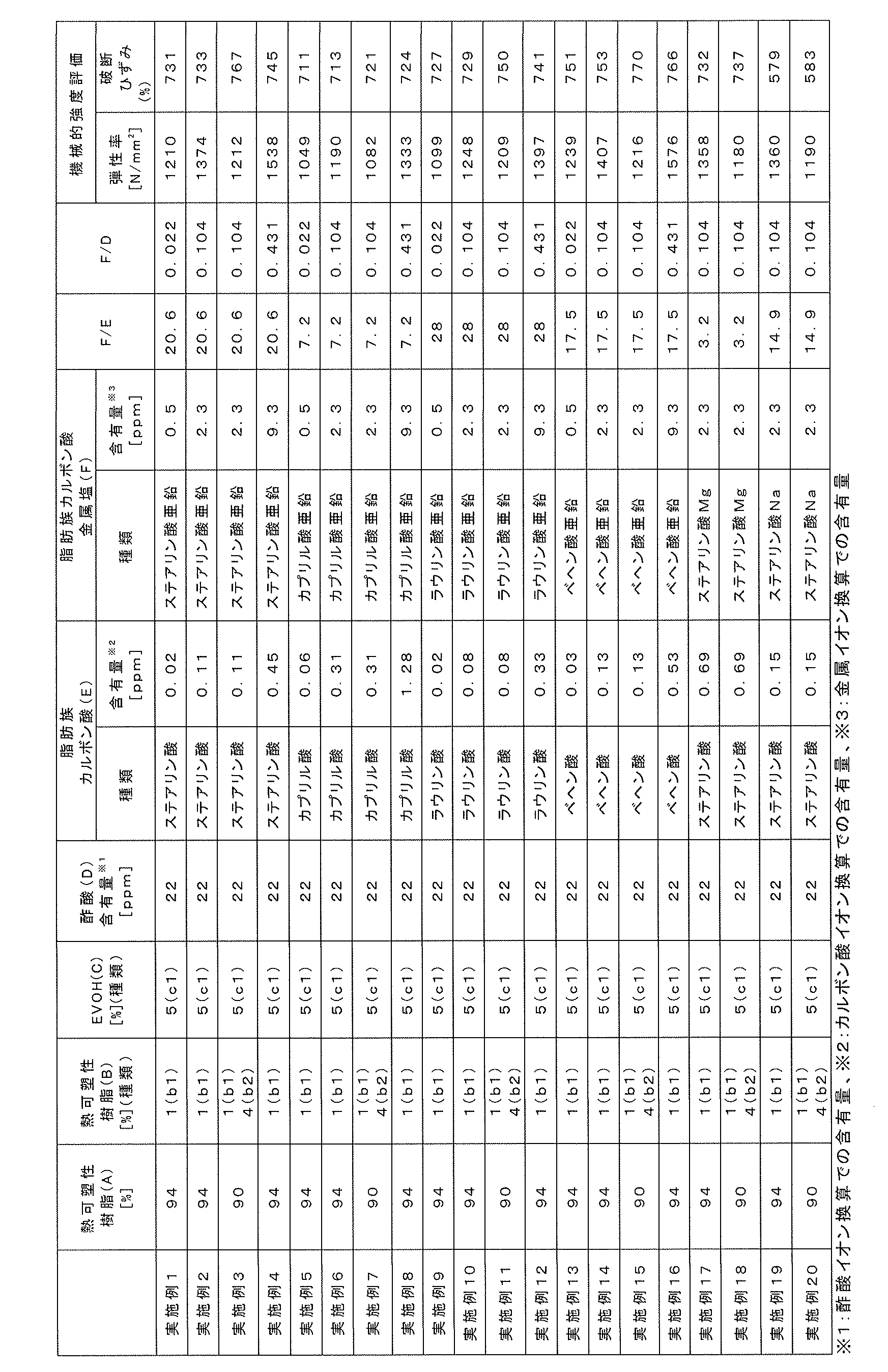

本発明の特徴的構成を有さない比較例1~9の樹脂組成物では、機械的強度が低いものであった。
これに対し、本発明の特徴的構成を有する実施例1~20の樹脂組成物では、機械的強度が優れたものであった。
これに対し、本発明の特徴的構成を有する実施例1~20の樹脂組成物では、機械的強度が優れたものであった。
上記実施例においては、本発明における具体的な形態について示したが、上記実施例は単なる例示にすぎず、限定的に解釈されるものではない。当業者に明らかな様々な変形は、本発明の範囲内であることが企図されている。
本発明の樹脂組成物は、機械的強度に優れている。そのため、上記樹脂組成物からなる層を含有する多層構造体および成形体は、一般的な食品の他、マヨネーズ、ドレッシング等の調味料、味噌等の発酵食品、サラダ油等の油脂食品、飲料、化粧品、医薬品等の各種の包装体の原料として有用である。
Claims (13)
- 極性基を含有しない熱可塑性樹脂(A)、極性基を含有する熱可塑性樹脂(B)、エチレン含有量20~60モル%のエチレン-ビニルアルコール系共重合体(C)、酢酸および/またはその塩(D)、炭素数3以上の脂肪族カルボン酸(E)、上記脂肪族カルボン酸(E)の金属塩である脂肪族カルボン酸金属塩(F)を含有する樹脂組成物であって、上記極性基を含有しない熱可塑性樹脂(A)の含有量が、樹脂組成物の総和に対して66~99重量%、エチレン含有量20~60モル%のエチレン-ビニルアルコール系共重合体(C)の含有量が、樹脂組成物の総和に対して0.1~25重量%であることを特徴とする樹脂組成物。
- 上記極性基を含有しない熱可塑性樹脂(A)が、ポリオレフィン系樹脂、ポリスチレン系樹脂から選ばれる少なくとも1種であることを特徴とする請求項1記載の樹脂組成物。
- 上記極性基を含有しない熱可塑性樹脂(A)が、ポリエチレン、ポリプロピレン、ポリスチレンから選ばれる少なくとも1種であることを特徴とする請求項1または2記載の樹脂組成物。
- 上記極性基を含有する熱可塑性樹脂(B)の含有量が、樹脂組成物の総和に対して0.1~50重量%であることを特徴とする請求項1~3のいずれか一項に記載の樹脂組成物。
- 上記極性基を含有する熱可塑性樹脂(B)が、カルボキシ基または酸無水物基を含有する変性熱可塑性樹脂であることを特徴とする請求項1~4のいずれか一項に記載の樹脂組成物。
- 上記極性基を含有する熱可塑性樹脂(B)が、カルボキシ基または酸無水物基を含有する変性ポリオレフィン系樹脂、ポリ酢酸ビニル系樹脂から選ばれる少なくとも1種であることを特徴とする請求項1~4のいずれか一項に記載の樹脂組成物。
- 上記酢酸および/またはその塩(D)の酢酸イオン換算での含有量が、樹脂組成物の総和に対して0.01~1000ppmであることを特徴とする請求項1~6のいずれか一項に記載の樹脂組成物。
- 上記脂肪族カルボン酸(E)のカルボン酸イオン換算での含有量が、樹脂組成物の総和に対して0.0001~150ppmであることを特徴とする請求項1~7のいずれか一項に記載の樹脂組成物。
- 上記脂肪族カルボン酸金属塩(F)の金属イオン換算での含有量が、樹脂組成物の総和に対して、0.01~90ppmであることを特徴とする請求項1~8のいずれか一項に記載の樹脂組成物。
- 請求項1~9のいずれか一項に記載の樹脂組成物を溶融混練し、ペレット化することを特徴とする樹脂組成物の製造方法。
- 請求項1~9のいずれか一項に記載の樹脂組成物を用いることを特徴とする成形体。
- 請求項1~9のいずれか一項に記載の樹脂組成物からなる層を少なくとも一層有することを特徴とする多層構造体。
- 請求項12記載の多層構造体からなることを特徴とする包装体。
Priority Applications (4)
| Application Number | Priority Date | Filing Date | Title |
|---|---|---|---|
| JP2022510017A JP7737631B2 (ja) | 2020-03-25 | 2021-03-18 | 樹脂組成物および樹脂組成物の製造方法、成形体、多層構造体および包装体 |
| CN202180023023.2A CN115335463A (zh) | 2020-03-25 | 2021-03-18 | 树脂组合物和树脂组合物的制造方法、成型体、多层结构体和包装体 |
| EP21775396.1A EP4130159B1 (en) | 2020-03-25 | 2021-03-18 | Resin composition, method for manufacturing resin composition, molded object, multilayer structure, and packaging body |
| US17/943,508 US12509578B2 (en) | 2020-03-25 | 2022-09-13 | Resin composition, method for manufacturing resin composition, molded object, multilayer structure, and packaging body |
Applications Claiming Priority (4)
| Application Number | Priority Date | Filing Date | Title |
|---|---|---|---|
| JP2020054975 | 2020-03-25 | ||
| JP2020-054975 | 2020-03-25 | ||
| JP2020080263 | 2020-04-30 | ||
| JP2020-080263 | 2020-04-30 |
Related Child Applications (1)
| Application Number | Title | Priority Date | Filing Date |
|---|---|---|---|
| US17/943,508 Continuation US12509578B2 (en) | 2020-03-25 | 2022-09-13 | Resin composition, method for manufacturing resin composition, molded object, multilayer structure, and packaging body |
Publications (1)
| Publication Number | Publication Date |
|---|---|
| WO2021193317A1 true WO2021193317A1 (ja) | 2021-09-30 |
Family
ID=77891697
Family Applications (1)
| Application Number | Title | Priority Date | Filing Date |
|---|---|---|---|
| PCT/JP2021/010957 Ceased WO2021193317A1 (ja) | 2020-03-25 | 2021-03-18 | 樹脂組成物および樹脂組成物の製造方法、成形体、多層構造体および包装体 |
Country Status (5)
| Country | Link |
|---|---|
| US (1) | US12509578B2 (ja) |
| EP (1) | EP4130159B1 (ja) |
| JP (1) | JP7737631B2 (ja) |
| CN (1) | CN115335463A (ja) |
| WO (1) | WO2021193317A1 (ja) |
Cited By (4)
| Publication number | Priority date | Publication date | Assignee | Title |
|---|---|---|---|---|
| JP7100933B1 (ja) | 2022-03-03 | 2022-07-14 | 株式会社Tbm | 積層シート及び食品包装容器 |
| WO2024204379A1 (ja) * | 2023-03-28 | 2024-10-03 | 三菱ケミカル株式会社 | 樹脂組成物、成形体、シート、フィルム、ボトル、チューブ、容器、多層構造体、及び樹脂組成物の製造方法 |
| WO2024204378A1 (ja) * | 2023-03-28 | 2024-10-03 | 三菱ケミカル株式会社 | 樹脂組成物、成形体、シート、フィルム、ボトル、チューブ、容器、多層構造体、及び樹脂組成物の製造方法 |
| WO2025084354A1 (ja) * | 2023-10-20 | 2025-04-24 | 三菱ケミカル株式会社 | 樹脂組成物 |
Citations (8)
| Publication number | Priority date | Publication date | Assignee | Title |
|---|---|---|---|---|
| JPS6268837A (ja) * | 1985-09-20 | 1987-03-28 | Mitsui Toatsu Chem Inc | 樹脂組成物 |
| JPH10204229A (ja) * | 1996-11-19 | 1998-08-04 | Kuraray Co Ltd | 樹脂組成物および多層構造体 |
| JP2011506628A (ja) | 2007-12-05 | 2011-03-03 | ブラスケム エス.エイ. | エチレン−ブチレンコポリマーの製造のための統合された方法、エチレン−ブチレンコポリマー及び再生可能な天然原料から供給されるエチレン及びコモノマーとしての1−ブチレンの使用 |
| JP2012504689A (ja) * | 2008-09-30 | 2012-02-23 | イー・アイ・デュポン・ドウ・ヌムール・アンド・カンパニー | カルボン酸金属塩を含むエチレンビニルアルコール組成物 |
| US20150299432A1 (en) * | 2012-08-24 | 2015-10-22 | Tristano Pty Ltd | Polyolefin composition comprising thermoplastic starch |
| WO2018088347A1 (ja) * | 2016-11-09 | 2018-05-17 | 日本合成化学工業株式会社 | 樹脂組成物及びそれを用いた多層構造体 |
| WO2019083000A1 (ja) * | 2017-10-27 | 2019-05-02 | 日本合成化学工業株式会社 | エチレン-ビニルアルコール系共重合体樹脂組成物、多層構造体および包装体 |
| JP2019143001A (ja) * | 2018-02-16 | 2019-08-29 | 東ソー株式会社 | 接着剤及びこれよりなる積層体 |
Family Cites Families (12)
| Publication number | Priority date | Publication date | Assignee | Title |
|---|---|---|---|---|
| JP2593952B2 (ja) | 1989-05-30 | 1997-03-26 | 株式会社クラレ | 樹脂組成物 |
| JP2604484B2 (ja) | 1989-05-30 | 1997-04-30 | 株式会社クラレ | 樹脂組成物およびそれを用いた多層構造体 |
| DE69017085T2 (de) | 1989-05-30 | 1995-06-14 | Kuraray Co | Kunststoff-Zusammensetzung. |
| DE69025000T2 (de) | 1989-05-30 | 1996-09-19 | Kuraray Co | Mehrschichtige Struktur |
| JP2604485B2 (ja) | 1989-05-30 | 1997-04-30 | 株式会社クラレ | 多層構造体 |
| US5260371A (en) * | 1991-07-23 | 1993-11-09 | E. I. Du Pont De Nemours And Company | Process for making melt stable ethylene vinyl alcohol polymer compositions |
| US6388007B1 (en) | 1996-11-19 | 2002-05-14 | Kuraray Co., Ltd. | Resin composition and multilayered structure |
| JP2002234971A (ja) | 2001-02-13 | 2002-08-23 | Nippon Synthetic Chem Ind Co Ltd:The | 樹脂組成物及びその使用方法 |
| MY161605A (en) | 2010-11-02 | 2017-04-28 | Kuraray Co | Resin mixture and multilayer structure |
| JP2015071709A (ja) * | 2013-10-03 | 2015-04-16 | 株式会社クラレ | 樹脂組成物、多層構造体及びそれからなる熱成形容器 |
| EP3053959B1 (en) | 2013-10-03 | 2020-05-20 | Kuraray Co., Ltd. | Resin composition, multilayer structure, and thermoformed container including the same |
| JP6653727B2 (ja) * | 2018-05-25 | 2020-02-26 | 株式会社クラレ | 樹脂組成物、多層構造体、熱成形容器及びその製造方法 |
-
2021
- 2021-03-18 EP EP21775396.1A patent/EP4130159B1/en active Active
- 2021-03-18 WO PCT/JP2021/010957 patent/WO2021193317A1/ja not_active Ceased
- 2021-03-18 JP JP2022510017A patent/JP7737631B2/ja active Active
- 2021-03-18 CN CN202180023023.2A patent/CN115335463A/zh active Pending
-
2022
- 2022-09-13 US US17/943,508 patent/US12509578B2/en active Active
Patent Citations (8)
| Publication number | Priority date | Publication date | Assignee | Title |
|---|---|---|---|---|
| JPS6268837A (ja) * | 1985-09-20 | 1987-03-28 | Mitsui Toatsu Chem Inc | 樹脂組成物 |
| JPH10204229A (ja) * | 1996-11-19 | 1998-08-04 | Kuraray Co Ltd | 樹脂組成物および多層構造体 |
| JP2011506628A (ja) | 2007-12-05 | 2011-03-03 | ブラスケム エス.エイ. | エチレン−ブチレンコポリマーの製造のための統合された方法、エチレン−ブチレンコポリマー及び再生可能な天然原料から供給されるエチレン及びコモノマーとしての1−ブチレンの使用 |
| JP2012504689A (ja) * | 2008-09-30 | 2012-02-23 | イー・アイ・デュポン・ドウ・ヌムール・アンド・カンパニー | カルボン酸金属塩を含むエチレンビニルアルコール組成物 |
| US20150299432A1 (en) * | 2012-08-24 | 2015-10-22 | Tristano Pty Ltd | Polyolefin composition comprising thermoplastic starch |
| WO2018088347A1 (ja) * | 2016-11-09 | 2018-05-17 | 日本合成化学工業株式会社 | 樹脂組成物及びそれを用いた多層構造体 |
| WO2019083000A1 (ja) * | 2017-10-27 | 2019-05-02 | 日本合成化学工業株式会社 | エチレン-ビニルアルコール系共重合体樹脂組成物、多層構造体および包装体 |
| JP2019143001A (ja) * | 2018-02-16 | 2019-08-29 | 東ソー株式会社 | 接着剤及びこれよりなる積層体 |
Non-Patent Citations (1)
| Title |
|---|
| See also references of EP4130159A4 |
Cited By (5)
| Publication number | Priority date | Publication date | Assignee | Title |
|---|---|---|---|---|
| JP7100933B1 (ja) | 2022-03-03 | 2022-07-14 | 株式会社Tbm | 積層シート及び食品包装容器 |
| JP2023128224A (ja) * | 2022-03-03 | 2023-09-14 | 株式会社Tbm | 積層シート及び食品包装容器 |
| WO2024204379A1 (ja) * | 2023-03-28 | 2024-10-03 | 三菱ケミカル株式会社 | 樹脂組成物、成形体、シート、フィルム、ボトル、チューブ、容器、多層構造体、及び樹脂組成物の製造方法 |
| WO2024204378A1 (ja) * | 2023-03-28 | 2024-10-03 | 三菱ケミカル株式会社 | 樹脂組成物、成形体、シート、フィルム、ボトル、チューブ、容器、多層構造体、及び樹脂組成物の製造方法 |
| WO2025084354A1 (ja) * | 2023-10-20 | 2025-04-24 | 三菱ケミカル株式会社 | 樹脂組成物 |
Also Published As
| Publication number | Publication date |
|---|---|
| JPWO2021193317A1 (ja) | 2021-09-30 |
| US20230019812A1 (en) | 2023-01-19 |
| CN115335463A (zh) | 2022-11-11 |
| EP4130159A1 (en) | 2023-02-08 |
| US12509578B2 (en) | 2025-12-30 |
| EP4130159B1 (en) | 2024-04-24 |
| EP4130159A4 (en) | 2023-08-30 |
| JP7737631B2 (ja) | 2025-09-11 |
Similar Documents
| Publication | Publication Date | Title |
|---|---|---|
| US12509578B2 (en) | Resin composition, method for manufacturing resin composition, molded object, multilayer structure, and packaging body | |
| JP7180380B2 (ja) | エチレン-ビニルアルコール系共重合体樹脂組成物、多層構造体および包装体 | |
| JP7694559B2 (ja) | 樹脂組成物および樹脂組成物の製造方法、成形体、多層構造体および包装体 | |
| JP7031590B2 (ja) | エチレン-ビニルアルコール系共重合体組成物、ペレット群および多層構造体 | |
| CN109952345A (zh) | 树脂组合物和使用其的多层结构体 | |
| JPWO2019004257A1 (ja) | 溶融成形用エチレン−ビニルアルコール系共重合体組成物、ペレットおよび多層構造体 | |
| JP7070414B2 (ja) | エチレン-ビニルアルコール系共重合体組成物、溶融成形用エチレン-ビニルアルコール系共重合体組成物、ペレットおよび多層構造体 | |
| US11286377B2 (en) | Ethylene-vinyl alcohol copolymer composition, multilayer structure, and package | |
| WO2023176784A1 (ja) | 多層構造体 | |
| JP2002234971A (ja) | 樹脂組成物及びその使用方法 | |
| JP7367520B2 (ja) | エチレン-ビニルアルコール系共重合体樹脂組成物、多層構造体および包装体 | |
| JP4678930B2 (ja) | 樹脂組成物の使用方法 | |
| JP2002234979A (ja) | 樹脂組成物及びその使用方法 | |
| JP7413914B2 (ja) | 樹脂組成物および樹脂組成物の製造方法、ならびに樹脂組成物を用いた成形体および多層構造体および包装体 | |
| JP7677337B2 (ja) | エチレン-ビニルアルコール系共重合体樹脂組成物、多層構造体および包装体 | |
| JP7388184B2 (ja) | エチレン-ビニルアルコール系共重合体樹脂組成物、多層構造体および包装体 | |
| JP4968650B2 (ja) | 樹脂組成物及びその使用方法 | |
| JP2020152895A (ja) | エチレン−ビニルアルコール系共重合体樹脂組成物、多層構造体および包装体 | |
| JP7388181B2 (ja) | エチレン-ビニルアルコール系共重合体樹脂組成物、多層構造体および包装体 | |
| JP7388183B2 (ja) | エチレン-ビニルアルコール系共重合体樹脂組成物、多層構造体および多層容器 | |
| JP7388182B2 (ja) | エチレン-ビニルアルコール系共重合体樹脂組成物、多層構造体および包装体 | |
| JPWO2019103072A1 (ja) | エチレン−ビニルアルコール系共重合体組成物、溶融成形用材料および多層構造体 | |
| JP2024166853A (ja) | エチレン-ビニルアルコール系共重合体組成物、溶融成形材料、および溶融成形品 |
Legal Events
| Date | Code | Title | Description |
|---|---|---|---|
| 121 | Ep: the epo has been informed by wipo that ep was designated in this application |
Ref document number: 21775396 Country of ref document: EP Kind code of ref document: A1 |
|
| ENP | Entry into the national phase |
Ref document number: 2022510017 Country of ref document: JP Kind code of ref document: A |
|
| NENP | Non-entry into the national phase |
Ref country code: DE |
|
| ENP | Entry into the national phase |
Ref document number: 2021775396 Country of ref document: EP Effective date: 20221025 |