WO2021193886A1 - 核剤、樹脂組成物、樹脂組成物の製造方法および成形品 - Google Patents
核剤、樹脂組成物、樹脂組成物の製造方法および成形品 Download PDFInfo
- Publication number
- WO2021193886A1 WO2021193886A1 PCT/JP2021/012754 JP2021012754W WO2021193886A1 WO 2021193886 A1 WO2021193886 A1 WO 2021193886A1 JP 2021012754 W JP2021012754 W JP 2021012754W WO 2021193886 A1 WO2021193886 A1 WO 2021193886A1
- Authority
- WO
- WIPO (PCT)
- Prior art keywords
- metal salt
- general formula
- tert
- resin composition
- carboxylic acid
- Prior art date
- Legal status (The legal status is an assumption and is not a legal conclusion. Google has not performed a legal analysis and makes no representation as to the accuracy of the status listed.)
- Ceased
Links
- 0 *c1c(*)c(*)c(*N)c(*)c1* Chemical compound *c1c(*)c(*)c(*N)c(*)c1* 0.000 description 2
Classifications
-
- C—CHEMISTRY; METALLURGY
- C08—ORGANIC MACROMOLECULAR COMPOUNDS; THEIR PREPARATION OR CHEMICAL WORKING-UP; COMPOSITIONS BASED THEREON
- C08K—Use of inorganic or non-macromolecular organic substances as compounding ingredients
- C08K5/00—Use of organic ingredients
- C08K5/49—Phosphorus-containing compounds
- C08K5/51—Phosphorus bound to oxygen
- C08K5/52—Phosphorus bound to oxygen only
- C08K5/527—Cyclic esters
-
- C—CHEMISTRY; METALLURGY
- C08—ORGANIC MACROMOLECULAR COMPOUNDS; THEIR PREPARATION OR CHEMICAL WORKING-UP; COMPOSITIONS BASED THEREON
- C08K—Use of inorganic or non-macromolecular organic substances as compounding ingredients
- C08K5/00—Use of organic ingredients
- C08K5/49—Phosphorus-containing compounds
- C08K5/51—Phosphorus bound to oxygen
- C08K5/52—Phosphorus bound to oxygen only
- C08K5/529—Esters containing heterocyclic rings not representing cyclic esters of phosphoric or phosphorous acids
-
- C—CHEMISTRY; METALLURGY
- C08—ORGANIC MACROMOLECULAR COMPOUNDS; THEIR PREPARATION OR CHEMICAL WORKING-UP; COMPOSITIONS BASED THEREON
- C08K—Use of inorganic or non-macromolecular organic substances as compounding ingredients
- C08K5/00—Use of organic ingredients
- C08K5/0008—Organic ingredients according to more than one of the "one dot" groups of C08K5/01 - C08K5/59
- C08K5/0083—Nucleating agents promoting the crystallisation of the polymer matrix
-
- C—CHEMISTRY; METALLURGY
- C08—ORGANIC MACROMOLECULAR COMPOUNDS; THEIR PREPARATION OR CHEMICAL WORKING-UP; COMPOSITIONS BASED THEREON
- C08K—Use of inorganic or non-macromolecular organic substances as compounding ingredients
- C08K5/00—Use of organic ingredients
- C08K5/04—Oxygen-containing compounds
- C08K5/09—Carboxylic acids; Metal salts thereof; Anhydrides thereof
- C08K5/098—Metal salts of carboxylic acids
-
- C—CHEMISTRY; METALLURGY
- C08—ORGANIC MACROMOLECULAR COMPOUNDS; THEIR PREPARATION OR CHEMICAL WORKING-UP; COMPOSITIONS BASED THEREON
- C08K—Use of inorganic or non-macromolecular organic substances as compounding ingredients
- C08K5/00—Use of organic ingredients
- C08K5/16—Nitrogen-containing compounds
- C08K5/20—Carboxylic acid amides
-
- C—CHEMISTRY; METALLURGY
- C08—ORGANIC MACROMOLECULAR COMPOUNDS; THEIR PREPARATION OR CHEMICAL WORKING-UP; COMPOSITIONS BASED THEREON
- C08K—Use of inorganic or non-macromolecular organic substances as compounding ingredients
- C08K5/00—Use of organic ingredients
- C08K5/49—Phosphorus-containing compounds
- C08K5/51—Phosphorus bound to oxygen
- C08K5/52—Phosphorus bound to oxygen only
- C08K5/521—Esters of phosphoric acids, e.g. of H3PO4
-
- C—CHEMISTRY; METALLURGY
- C08—ORGANIC MACROMOLECULAR COMPOUNDS; THEIR PREPARATION OR CHEMICAL WORKING-UP; COMPOSITIONS BASED THEREON
- C08L—COMPOSITIONS OF MACROMOLECULAR COMPOUNDS
- C08L23/00—Compositions of homopolymers or copolymers of unsaturated aliphatic hydrocarbons having only one carbon-to-carbon double bond; Compositions of derivatives of such polymers
- C08L23/02—Compositions of homopolymers or copolymers of unsaturated aliphatic hydrocarbons having only one carbon-to-carbon double bond; Compositions of derivatives of such polymers not modified by chemical after-treatment
- C08L23/10—Homopolymers or copolymers of propene
- C08L23/12—Polypropene
Definitions
- the present invention relates to a nucleating agent, a resin composition, a method for producing a resin composition (hereinafter, also simply referred to as "manufacturing method") and a molded product.
- the present invention relates to a resin composition, a method for producing the resin composition, and a molded product.
- thermoplastic general-purpose resins polyolefin-based resins are used in a wide range of applications as one of the plastic materials with the widest application fields in terms of physical properties, moldability, price, etc.
- Molded products made of polyolefin resin may be required to have excellent rigidity.
- a method of adding a nucleating agent to the polyolefin resin is known.
- a nucleating agent to be added to a polyolefin resin for example, Patent Document 1 below proposes a nucleating agent containing an aromatic phosphate metal salt.
- nucleating agent described in Patent Document 1 has room for further improvement from the viewpoint of imparting sufficient mechanical properties to the molded product.
- an object of the present invention is to provide a nucleating agent, a resin composition, a method for producing a resin composition, and a molded product that can impart excellent mechanical properties to the molded product.
- R 1 to R 5 independently represent an alkyl group having a hydrogen atom or 1 to 6 carbon atoms, n represents 1 or 2, and when n is 1, M 1 is an alkali metal or dihydroxy aluminum, when n is 2, M 1 represents an alkaline earth metal, zinc or hydroxy
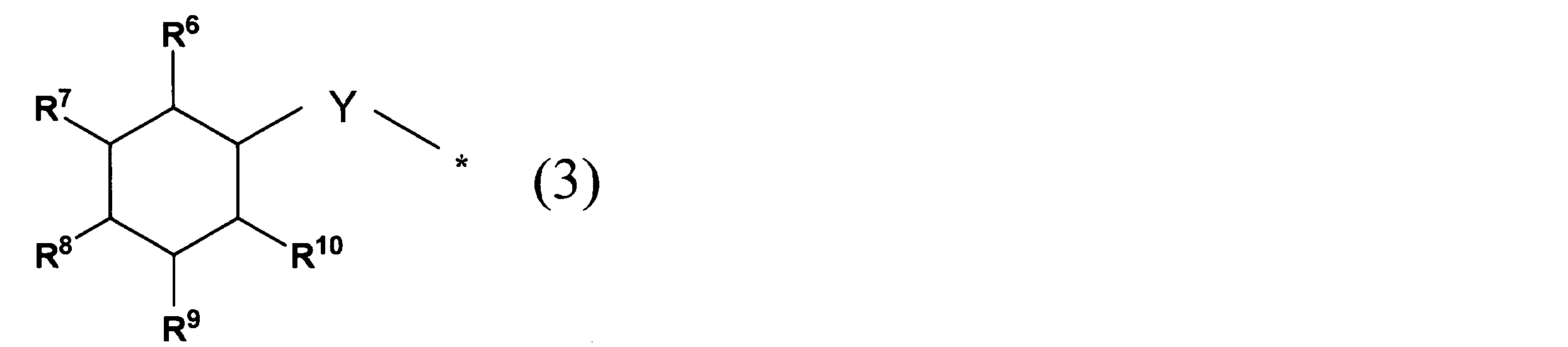
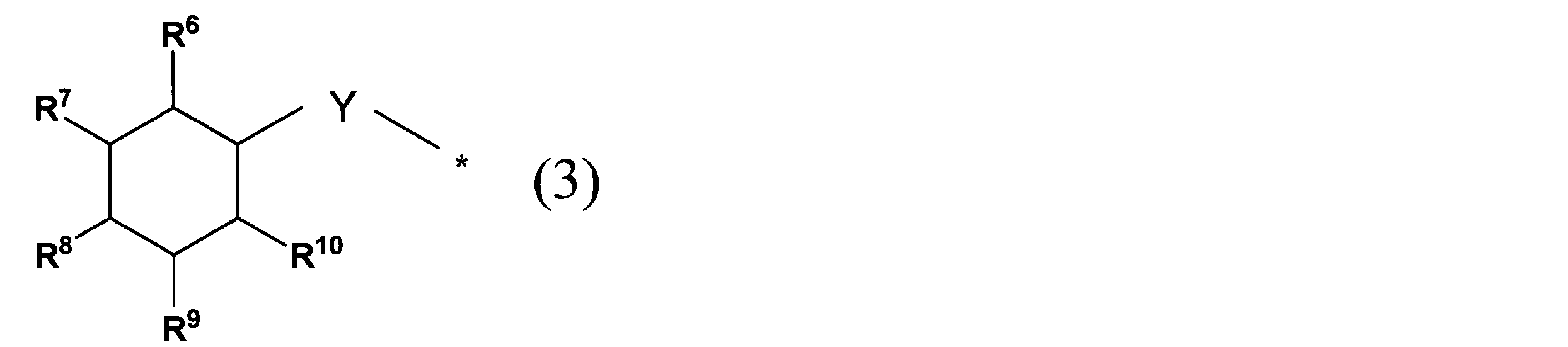
- Z represents a group having a structure represented by the following general formula (3) or (4).
- Y represents a direct bond or an alkylene group having 1 to 4 carbon atoms
- R 6 to R 15 independently represent a hydrogen atom, a halogen atom or 1 carbon atom.
- Carboxylic acid metal salt having the structure represented by It is characterized by including.
- M 2 in the general formula (2) is preferably sodium.
- the mass ratio (A) / (B) of the content of the (A) aromatic phosphate metal salt and the content of the (B) carboxylic acid metal salt is 1/99 to 50/50. Is preferable.
- the mass ratio (A) / (B) of the content of the (A) aromatic phosphate metal salt and the content of the (B) carboxylic acid metal salt is 50/50 to 99/1. It is also preferable, and it is more preferable that it is 50/50 to 80/20.
- Z represents a group having a structure represented by the following general formula (3) or (4).
- Y represents a direct bond or an alkylene group having 1 to 4 carbon atoms
- R 6 to R 15 independently represent a hydrogen atom, a halogen atom or 1 carbon atom.
- Carboxylic acid metal salt having the structure represented by Including The total content of the (A) aromatic phosphoric acid ester metal salt and the (B) carboxylic acid metal salt with respect to 100 parts by mass of the polyolefin resin is 0.001 to 10 parts by mass. Is.
- the polyolefin-based resin is preferably a polypropylene-based resin.
- the method for producing a resin composition of the present invention is characterized by comprising a compounding step of blending the above-mentioned nucleating agent into a polyolefin-based resin.
- the molded product of the present invention is characterized in that it is obtained by molding the above resin composition.
- a nucleating agent for producing a resin composition
- a method for producing a resin composition for producing a resin composition
- a molded product that can impart excellent mechanical properties to the molded product.
- the nucleating agent according to the present embodiment has (A) an aromatic phosphate metal salt having a structure represented by the following general formula (1) and (B) a structure represented by the following general formula (2). Includes carboxylic acid metal salts.
- R 1 to R 5 independently represent hydrogen atoms or alkyl groups having 1 to 6 carbon atoms, n represents 1 or 2, and when n is 1, M 1 represents an alkali metal or dihydroxy aluminum, when n is 2, M 1 represents an alkaline earth metal, zinc or hydroxy aluminum.
- Z represents a group having a structure represented by the following general formula (3) or (4).
- Y represents a direct bond or an alkylene group having 1 to 4 carbon atoms
- R 6 to R 15 independently represent a hydrogen atom, a halogen atom or a carbon atom number. It represents an alkyl group of 1 to 6, and * represents a position where it is bonded to a carbonyl carbon.
- nucleating agent According to the nucleating agent according to the present embodiment, excellent mechanical properties can be imparted to the molded product.
- the aromatic phosphate metal salt (A) has a structure represented by the above general formula (1).
- specific examples of M 1 include lithium, sodium, potassium, magnesium, calcium, barium, hydroxyaluminum, dihydroxyaluminum, zinc and the like. From the viewpoint of imparting better mechanical properties to the molded product, M 1 is preferably lithium, sodium, hydroxyaluminum, or dihydroxyaluminum, and particularly preferably sodium. Further, n in the general formula (1) is preferably 1.
- examples of the alkyl group having 1 to 6 carbon atoms represented by R 1 to R 5 include a methyl group, an ethyl group, an n-propyl group, an isopropyl group, a cyclopropyl group and an n-.
- examples thereof include a butyl group, a sec-butyl group, a tert-butyl group, an isobutyl group, a cyclobutyl group, an n-amyl group, a tert-amyl group, a cyclopentyl group, an n-hexyl group and a cyclohexyl group.
- R 1 to R 4 are tert-butyl groups.
- R 5 is a hydrogen atom or a methyl group, and particularly preferably a hydrogen atom.
- (A) aromatic phosphate metal salt examples include the following. These may be contained alone or in combination of two or more. However, the (A) aromatic phosphate metal salt is not limited thereto.
- the carboxylic acid metal salt (B) has a structure represented by the above general formula (2).
- M 2 in the general formula (2) include lithium, sodium, potassium, magnesium, calcium, barium, hydroxyaluminum, and dihydroxyaluminum.
- M 2 is preferably sodium, calcium, hydroxyaluminum or dihydroxyaluminum, preferably sodium or hydroxyaluminum, and preferably sodium.
- x is 1 and a is 2.
- Z in the general formula (2) is preferably a group having a structure represented by the general formula (4). In this case, more excellent mechanical properties can be imparted to the molded product.
- Examples of the alkylene group having 1 to 4 carbon atoms represented by Y in the general formulas (3) and (4) include a methylene group, an ethylene group, a propylene group, a butylene group, and an isobutylene group.
- Y is preferably a direct bond or a methylene group, and more preferably a direct bond.
- Examples of the halogen atom represented by R 6 to R 15 in the general formulas (3) and (4) include fluorine, chlorine, bromine and iodine. Among these, chlorine is particularly preferable from the viewpoint of imparting more excellent mechanical properties to the molded product.
- Examples of the alkyl group having 1 to 6 carbon atoms represented by R 6 to R 15 in the general formulas (3) and (4) include a linear or branched alkyl group or 3 carbon atoms. Examples thereof include cycloalkyl groups of ⁇ 6. Specific examples of the alkyl group having 1 to 6 carbon atoms include a methyl group, an ethyl group, an n-propyl group, an isopropyl group, a cyclopropyl group, an n-butyl group, a sec-butyl group, a tert-butyl group, and the like. Examples thereof include isobutyl group, cyclobutyl group, n-amyl group, tert-amyl group, cyclopentyl group, n-hexyl group and cyclohexyl group.
- a hydrogen atom or a halogen atom is preferable, and a hydrogen atom is particularly preferable, from the viewpoint of imparting more excellent mechanical properties to the molded product.
- (B) carboxylic acid metal salt examples include the following. These may be contained alone or in combination of two or more. However, the (B) carboxylic acid metal salt is not limited to these.
- the carboxylic acid metal salt is produced, for example, by reacting aspartic acid with a carboxylic acid chloride such as benzoic acid chloride or cyclohexanecarboxylic acid chloride in the presence of a base such as sodium hydroxide. Can be done.
- a carboxylic acid chloride such as benzoic acid chloride or cyclohexanecarboxylic acid chloride in the presence of a base such as sodium hydroxide.
- the mass ratio (A) / (B) of (A) the content of the aromatic phosphate metal salt and (B) the content of the carboxylic acid metal salt is, for example, It may be 1/99 to 99/1.
- the mass ratio (A) / (B) is preferably 1/99 to 50/50.
- excellent impact resistance can be imparted to the molded product.
- (A) / (B) is more preferably 1/99 to 20/80, and 4/96 to 20/80. It is even more preferably 80, and even more preferably 4/96 to 16/84.
- the mass ratio (A) / (B) is 50/50 to 99/1.
- more excellent rigidity can be imparted to the molded product.
- (A) / (B) is more preferably 50/50 to 96/4, and further preferably 50/50 to 84/16.
- 50/50 to 80/20 is even more preferable, and 60/40 to 80/20 is particularly preferable.
- the nuclear agent according to the present embodiment may further contain (C) a fatty acid metal salt.
- C a fatty acid metal salt.
- the dispersibility of the (A) aromatic phosphoric acid ester metal salt and the (B) carboxylic acid metal salt is improved, and more excellent mechanical properties can be imparted to the molded product.
- Examples of the (C) fatty acid metal salt include metal salts of fatty acids having 12 to 20 carbon atoms including linear or branched fatty acid residues.
- Examples of the metal ion constituting the fatty acid metal salt include sodium ion, potassium ion, lithium ion, dihydroxyaluminum ion, calcium ion, zinc ion, barium ion, magnesium ion, hydroxyaluminum ion and the like, and among these, sodium. Ions, potassium ions, lithium ions and calcium ions are particularly preferable.
- fatty acid metal salt (C) examples include sodium laurate, sodium myristate, sodium palmitate, sodium stearate, sodium oleate, sodium linoleate, sodium linolenate, sodium arachidate, and sodium 12-hydroxystearate.
- sodium myristate, sodium stearate, sodium 12-hydroxystearate, lithium myristate, lithium stearate, 12-hydroxystearic acid sodium myristate, sodium stearate, sodium 12-hydroxystearate, lithium myristate, lithium stearate, 12-hydroxystearic acid.
- Lithium, calcium myristate, calcium stearate, calcium 12-hydroxystearate are preferred, lithium myristate, lithium stearate, lithium 12-hydroxystearate, calcium myristate, calcium stearate, calcium 12-hydroxystearate are more preferred, myristic acid. Lithium, lithium stearate, and lithium 12-hydroxystearate are more preferred.
- the content of (C) fatty acid metal salt is, for example, (A) content of aromatic phosphate metal salt and (B) carboxylic acid. It may be 10 to 150 parts by mass, preferably 30 to 120 parts by mass, and more preferably 50 to 100 parts by mass with respect to 100 parts by mass of the total content of the acid metal salt.
- the nucleating agent according to the present embodiment further comprises crystallization of a polyolefin-based resin, which is a compound different from (A) aromatic phosphoric acid ester metal salt and (B) carboxylic acid metal salt.
- a polyolefin-based resin which is a compound different from (A) aromatic phosphoric acid ester metal salt and (B) carboxylic acid metal salt.
- Those with a function to promote, phenol-based antioxidants, phosphorus-based antioxidants, sulfur-based antioxidants, other antioxidants, hindered amine compounds, ultraviolet absorbers, flame retardants, flame retardant aids, lubricants, fillers , Hydrotalcites, antistatic agents, fluorescent whitening agents, pigments, dyes and other various additives may be contained.
- Examples of compounds different from the aromatic phosphate metal salt (A) and the carboxylic acid metal salt (B) and having a function of promoting the crystallization of the polyolefin resin include sodium benzoate, 4-.
- Carboxylic acid metal salts such as tert-butylaluminum benzoate, sodium adipate, disodium bicyclo [2.2.1] heptane-2,3-dicarboxylate, calciumcyclohexane-1,2-dicarboxylate, di Benzylene sorbitol, bis (methylbenzylene) sorbitol, bis (3,4-dimethylbenzylene) sorbitol, bis (p-ethylbenzylene) sorbitol, bis (dimethylbenzylene) sorbitol, 1,2,3-trideoxy-4,6: 5 , 7-o-bis (4-propylbenzylene) nonitol and other polyol derivatives, N, N', N "-tris [2-
- phenolic antioxidant examples include 2,6-di-tert-butyl-4-ethylphenol, 2-tert-butyl-4,6-dimethylphenol, styrene phenol, and 2,2′-methylenebis (4).
- phosphorus-based antioxidants include triphenylphosphite, diisooctylphosphite, heptaxis (dipropylene glycol) triphosphite, triisodecylphosphite, diphenylisooctylphosphite, diisooctylphenylphosphite, and diphenyl.
- Tridecylphosphite triisooctylphosphite, trilaurylphosphite, diphenylphosphite, tris (dipropylene glycol) phosphite, dioleylhydrogenphosphite, trilauryltrithiophosphite, bis (tridecyl) phosphite, tris (Isodecyl) phosphite, tris (tridecyl) phosphite, diphenyldecylphosphite, dinonylphenylbis (nonylphenyl) phosphite, poly (dipropylene glycol) phenylphosphite, tetraphenyldipropylene glycol diphosphite, trisnonyl Phenyl Phenyl Phenyl Phenyl, Tris (2,4-di-tert-Butylpheny
- sulfur-based antioxidant examples include tetrakis [methylene-3- (laurylthio) propionate] methane and bis (methyl-4- [3-n-alkyl (C12 / C14) thiopropionyloxy] 5-tert-butylphenyl.
- antioxidants include N-benzyl- ⁇ -phenylnitrone, N-ethyl- ⁇ -methylnitrone, N-octyl- ⁇ -heptylnitrone, N-lauryl- ⁇ -undecylnitrone, N-tetradecyl- ⁇ .
- hindered amine compound examples include 2,2,6,6-tetramethyl-4-piperidyl stearate, 1,2,2,6,6-pentamethyl-4-piperidyl stearate, 2,2,6,6- Tetramethyl-4-piperidylbenzoate, bis (2,2,6,6-tetramethyl-4-piperidyl) sebacate, tetrakis (2,2,6,6-tetramethyl-4-piperidyl) -1,2,3 , 4-Butan Tetracarboxylate, Tetrakiss (1,2,2,6,6-Pentamethyl-4-piperidyl) -1,2,3,4-Butane Tetracarboxylate, Bis (2,2,6,6- Tetramethyl-4-piperidyl) di (tridecyl) -1,2,3,4-butanetetracarboxylate, bis (1,2,2,6,6-pentamethyl-4-piperidyl) -di (tridecyl)- 1,2,3,4-butanetetracar
- Examples of the ultraviolet absorber include 2-hydroxybenzophenones such as 2,4-dihydroxybenzophenone and 5,5'-methylenebis (2-hydroxy-4-methoxybenzophenone); 2- (2-hydroxy-5-methylphenyl).
- Bentriazole 2- (2-hydroxy-5-tert-octylphenyl) benzotriazole, 2- (2-hydroxy-3,5-di-tert-butylphenyl) -5-chlorobenzotriazole, 2- (2) -Hydroxy-3-tert-butyl-5-methylphenyl) -5-chlorobenzotriazole, 2- (2-hydroxy-3,5-dicumylphenyl) benzotriazole, 2,2'-methylenebis (4-tert- Octyl-6-benzotriazolylphenol), 2- (2-hydroxy-3-tert-butyl-5-carboxyphenyl) benzotriazole polyethylene glycol ester, 2- [2-hydroxy-3- (2-acryloyloxy) Ethy
- Examples of the flame retardant include triphenyl phosphate, tricresyl phosphate, trixylenyl phosphate, cresyldiphenyl phosphate, cresyl-2,6-dixylenyl phosphate, resorcinolbis (diphenyl phosphate), (1-methylethylidene).
- FP-800 ”aromatic phosphate ester divinyl phenylphosphonate, diallyl phenylphosphonate, phosphonic acid ester such as phenylphosphonic acid (1-butenyl), phenyl diphenylphosphinate, methyl diphenylphosphinate, 9,10-dihydro Phenylate esters such as -9-oxa-10-phosphaphenanthrene-10-oxide derivative, phosphazene compounds such as bis (2-allylphenoxy) phosphazene, dicredylphosphazene, melamine phosphate, melamine pyrophosphate, melamine polyphosphate, Melam polyphosphate, ammonium polyphosphate, piperazine phosphate, piperazine pyrophosphate, piperazine polyphosphate, phosphorus-containing vinylbenzyl compound and phosphorus-based flame retardants such as red phosphorus, metal hydroxides such as magnesium hydroxide and aluminum hydroxide, and
- Bisphenol A type epoxy resin brominated phenol novolac type epoxy resin, hexabromobenzene, pentabromotoluene, ethylenebis (pentabromophenyl), ethylenebistetrabromophthalimide, 1,2-dibromo-4- (1,2-) Dibromoethyl) cyclohexane, tetrabromocyclooctane, hexabromocyclododecane, bis (tribromophenoxy) ethane, brominated polyphenylene ether, brominated polystyrene and 2,4,6-tris (tribromophenoxy) -1,3,5 -Triazine, tribromophenylmaleimide, tribromophenyl acrylate, tribromophenyl methacrylate, tetrabromobisphenol A-type dimethacrylate, pentabromobenzyl acrylate, and bromine-based flame retard
- the lubricant examples include unsaturated fatty acid amides such as oleic acid amide and erucic acid amide; saturated fatty acid amides such as bechenic acid amide and stearic acid amide, butyl stearate, stearyl alcohol, stearic acid monoglyceride, and sorbitan monopalmitite. Examples thereof include sorbitan monostearate, mannitol, stearic acid, hardened castor oil, stearic acid amide, oleic acid amide, and ethylene bisstearic acid amide.
- unsaturated fatty acid amides such as oleic acid amide and erucic acid amide
- saturated fatty acid amides such as bechenic acid amide and stearic acid amide, butyl stearate, stearyl alcohol, stearic acid monoglyceride, and sorbitan monopalmitite. Examples thereof include sorbitan monostearate,
- fillers for example, talc, mica, calcium carbonate, calcium oxide, calcium hydroxide, magnesium carbonate, magnesium hydroxide, magnesium oxide, magnesium sulfate, aluminum hydroxide, barium sulfate, glass powder, glass fiber, clay, dolomite, etc.
- examples thereof include silica, alumina, potassium titanate whiskers, wallastenite, and fibrous magnesium oxysulfate, and the particle size (fiber diameter, fiber length, and aspect ratio in the fibrous form) can be appropriately selected and used.
- talc is particularly preferably used because it has an excellent effect of imparting rigidity and is easily available.
- a surface-treated filler can be used if necessary.
- Hydrotalcites are complex salt compounds consisting of magnesium, aluminum, hydroxyl groups, carbonic acid groups and arbitrary crystalline water known as natural products or synthetic products, and magnesium or a part of aluminum is part of other materials such as alkali metal and zinc. Examples thereof include those substituted with a metal and those substituted with a hydroxyl group and a carbonic acid group with another anionic group. Hydrotalcites may be obtained by dehydrating crystalline water, and are higher fatty acids such as stearic acid, higher fatty acid metal salts such as oleic acid alkali metal salt, and organic sulfonic acid metals such as dodecylbenzene sulfonic acid alkali metal salt.
- hydrotalcites may be natural products or synthetic products. Examples of the method for synthesizing hydrotalcites include Japanese Patent Publication No. 46-2280, Japanese Patent Publication No. 50-30039, Japanese Patent Publication No. 51-29129, Japanese Square Root Extraction 3-36839, and Japanese Patent Application Laid-Open No. 61-174270. , Known methods described in JP-A-5-179502, etc. can be mentioned. Further, hydrotalcites can be used without being limited by their crystal structure, crystal particles and the like.
- the antistatic agent examples include a low molecular weight antistatic agent using a nonionic, anionic, cationic or amphoteric surfactant, and a high molecular weight antistatic agent using a polymer compound.
- Nonionic surfactants include polyethylene glycol-type nonionic surfactants such as higher alcohol ethylene oxide adducts, fatty acid ethylene oxide adducts, higher alkylamine ethylene oxide adducts, and polyolefin glycol ethylene oxide adducts; fatty acid esters of polyethylene oxide and glycerin.
- a carboxylate such as an alkali metal salt of a higher fatty acid
- a sulfate ester salt such as a higher alcohol sulfate ester salt, a higher alkyl ether sulfate ester salt, an alkylbenzene sulfonate, an alkyl sulfonate, a paraffin sulfonate and the like.
- Phosphoric acid ester salts such as higher alcohol phosphoric acid ester salts and the like can be mentioned
- examples of the cationic surfactant include quaternary ammonium salts such as alkyltrimethylammonium salt and the like.
- examples of the amphoteric tenside include amino acid amphoteric tenside agents such as higher alkylaminopropionate, betaine amphoteric tenside agents such as higher alkyldimethylbetaine and higher alkyldihydroxyethyl betaine, and the like.
- anionic surfactants are preferable, and sulfonates such as alkylbenzene sulfonates, alkyl sulfonates, and paraffin sulfonates are particularly preferable.
- Examples of the polymer type antistatic agent include ionomer and block polymer having polyethylene glycol as a hydrophilic part.
- Examples of the ionomer include the ionomer described in JP-A-2010-132927.
- Examples of the polymer having polyethylene glycol as a hydrophilic portion include a polyether ester amide described in JP-A-7-10989, a polymer composed of polyolefin and polyethylene glycol described in US Pat. No. 6,552,131, and JP-A-2016-023254. Examples thereof include polymers composed of polyester and polyethylene glycol described in the publication.
- Fluorescent whitening agent is a compound that absorbs ultraviolet rays of sunlight or artificial light, converts it into visible light of purple to blue and radiates it, and promotes the whiteness and bluish tint of the molded product.
- fluorescent whitening agent include benzoxazole compounds C.I. I. Fluorescent Fluorescent 184; Coumarin-based compound C.I. I. Fluorescent Fluorescent 52; diaminostilbene disulphonic acid-based compound C.I. I. Fluorescent Fluorescenter 24, 85, 71 and the like can be mentioned.
- the pigment is not particularly limited, and a commercially available pigment can also be used. Specific examples of pigments include, for example, Pigment Red 1, 2, 3, 9, 10, 17, 22, 23, 31, 38, 41, 48, 49, 88, 90, 97, 112, 119, 122, 123.
- Dyes include azo dyes, anthraquinone dyes, indigoid dyes, triarylmethane dyes, xanthene dyes, alizarin dyes, acrydin dyes, stillben dyes, thiazole dyes, naphthol dyes, quinoline dyes, nitro dyes, indamine dyes, oxazine dyes, and phthalocyanine dyes. , Cyanine dye and the like.
- the nucleating agent according to the present embodiment may be a one-pack composite additive further blended with a granulating aid such as a binder, wax, solvent, and silica, and granulated. Further, the nucleating agent according to the present embodiment may be a masterbatch further containing a polyolefin-based resin.
- polystyrene-based resins examples include polyethylene-based resins such as low-density polyethylene, linear low-density polyethylene, high-density polyethylene, crosslinked polyethylene, and ultrahigh-molecular-weight polyethylene, homopolypoly, random copolymer polypropylene, and block copolymer.
- Polypropylene resins such as polypropylene, impact copolymer polypropylene, high impact copolymer polypropylene, maleic anhydride-modified polypropylene, polybutene-1, cycloolefin polymer, poly-3-methyl-1-butene, poly-3-methyl-1-pentene, Examples thereof include ⁇ -olefin polymers such as poly-4-methyl-1-pentene, ethylene-methylmethacrylate copolymers, and ⁇ -olefin copolymers such as ethylene-vinyl acetate copolymers.
- One of these polyolefin resins may be used alone, or two or more thereof may be used in combination. Further, the polyolefin-based resin may be alloyed.
- the type for example, Cheegler catalyst, metallocene catalyst, etc.
- the type is not particularly limited and is appropriately selected.
- a polypropylene resin is particularly preferable.
- the content of the polyolefin resin in the master batch may be, for example, 90% by mass or less, preferably 80% by mass or less, and 60% by mass. The following is more preferable.
- the content of the polyolefin resin in the masterbatch may be, for example, 20% by mass or more.
- the resin composition according to the present embodiment includes a polyolefin resin, (A) an aromatic phosphate metal salt having a structure represented by the above general formula (1), and (B) the above general formula (2). Includes a carboxylic acid metal salt having the structure represented.
- the resin composition according to the present embodiment has a total content of the (A) aromatic phosphoric acid ester metal salt and the (B) carboxylic acid metal salt in an amount of 0.001 to 100 parts by mass of the polyolefin resin. It is 10 parts by mass.
- the resin composition according to the present embodiment may contain a polyolefin-based resin and the above-mentioned nucleating agent.
- the content of the nucleating agent with respect to 100 parts by mass of the polyolefin resin is 0.001 to 10 parts by mass.
- the molded product obtained by molding the resin composition according to the present embodiment has excellent mechanical properties.
- the polyolefin-based resin contained in the resin composition according to the present embodiment may be the same as the polyolefin-based resin contained in the masterbatch described above.
- polypropylene-based resin is preferable as the polyolefin-based resin contained in the resin composition.
- the molded product obtained by molding the resin composition has excellent mechanical properties and excellent heat resistance.
- the total content of (A) aromatic phosphoric acid ester metal salt and (B) carboxylic acid metal salt or the content of the nucleating agent with respect to 100 parts by mass of the polyolefin resin is 0.001 to 10 mass by mass. It is a department.
- the total content of (A) aromatic phosphoric acid ester metal salt and (B) carboxylic acid metal salt with respect to 100 parts by mass of the polyolefin resin, or the content of the nucleating agent is less than 0.001 parts by mass, the resin The mechanical properties of the molded product obtained by molding the composition are not sufficient.
- the molded product Bloom may be generated from the surface of the product, or (A) aromatic phosphate metal salt, (B) carboxylic acid metal salt or nucleating agent may be transferred from the molded product to the outside.
- the mechanical properties of the molded product obtained by molding the resin composition are further improved, and bloom is generated from the molded product, (A) aromatic phosphoric acid ester metal salt, and (B) carboxylic acid metal.
- the amount is more preferably 0.01 to 1 part by mass, and further preferably 0.02 to 0.2 parts by mass.
- the content of the aromatic phosphate metal salt (A) with respect to 100 parts by mass of the polyolefin resin is not particularly limited, and may be, for example, 0.0005 to 9.9995 parts by mass, and 0.001 to 5 parts by mass. It is preferably 0.01 to 1 part by mass, more preferably 0.02 to 0.2 part by mass.
- the content of the metal carboxylic acid salt (B) with respect to 100 parts by mass of the polyolefin resin is not particularly limited, and may be, for example, 0.0005 to 9.9995 parts by mass, and 0.001 to 5 parts by mass. , More preferably 0.01 to 1 part by mass, and even more preferably 0.02 to 0.2 parts by mass.
- the mass ratio (A) / (B) of (A) the content of the aromatic phosphate metal salt and (B) the content of the carboxylic acid metal salt is, for example, , 1/99 to 99/1.
- the mass ratio (A) / (B) is preferably 1/99 to 50/50.
- excellent impact resistance can be imparted to the molded product.
- (A) / (B) is more preferably 1/99 to 20/80, and 4/96 to 20/80. It is even more preferably 80, and even more preferably 4/96 to 16/84.
- the mass ratio (A) / (B) is 50/50 to 99/1.
- more excellent rigidity can be imparted to the molded product.
- (A) / (B) is more preferably 50/50 to 96/4, and further preferably 50/50 to 84/16.
- 50/50 to 80/20 is even more preferable, and 60/40 to 80/20 is particularly preferable.
- the resin composition according to the present embodiment may further contain (C) a fatty acid metal salt.
- C a fatty acid metal salt.
- the dispersibility of the (A) aromatic phosphoric acid ester metal salt and the (B) carboxylic acid metal salt is improved, and more excellent mechanical properties can be imparted to the molded product.
- the same ones as those mentioned for the nucleating agent can be used.
- the content of the (C) fatty acid metal salt is, for example, (A) the content of the aromatic phosphate metal salt and (B). It may be 10 to 150 parts by mass, preferably 30 to 120 parts by mass, and more preferably 50 to 100 parts by mass with respect to 100 parts by mass of the total content of the carboxylic acid metal salt.
- the content of (C) fatty acid metal salt with respect to 100 parts by mass of the polyolefin resin is not particularly limited, and is, for example, 0.001 to 10 It may be any part by mass, more preferably 0.01 to 1 part by mass, and further preferably 0.02 to 0.2 part by mass.
- the resin composition according to the present embodiment preferably further contains a filler.
- the rigidity of the molded product obtained by molding the resin composition becomes more excellent.
- the filler include the same fillers listed as the fillers that may be contained in the nucleating agent. Among these fillers, talc is particularly preferable from the viewpoint of obtaining a molded product having even more excellent rigidity.
- the content of the filler contained in the resin composition may be, for example, 0.01 to 80 parts by mass with respect to 100 parts by mass of the polyolefin resin, and is preferably 1 to 50 parts by mass.
- the resin composition according to the present embodiment is a compound different from (A) aromatic phosphate metal salt and (B) carboxylic acid metal salt, and crystallizes a polyolefin resin.
- Various additives such as agents, hydrotalcites, antistatic agents, fluorescent whitening agents, pigments and dyes may be contained. Examples of these various additives include the same as those mentioned as various additives that may be contained in the nucleating agent.
- the method for producing a resin composition according to the present embodiment includes a compounding step of blending the above-mentioned nucleating agent into a polyolefin-based resin.
- the molded product obtained by molding the resin composition produced by the production method according to the present embodiment has excellent mechanical properties.
- the nucleating agent is blended with the polyolefin resin.
- the blending method is not particularly limited, and for example, after adding a polyolefin resin, a nucleating agent, and various additives described above as necessary, a Henschel mixer, a mill roll, a Banbury mixer, a super mixer, etc. Examples thereof include a method of mixing using a mixing device.
- at least one component of the nucleating agent and the above-mentioned various additives may be added before or during the polymerization of the polyolefin resin monomer or oligomer, and the remaining component may be added to the obtained polymer. ..
- (A) aromatic phosphoric acid ester metal salt, (B) carboxylic acid metal salt, and various additives, if necessary, are added to the polyolefin resin. It may be blended in an appropriate order.
- the preparatory step and the blending step can be carried out in the same manner as described in the above (preparation step) and (blending step).
- the resin composition is produced as described above.
- the method for producing the resin composition may be a method including a melt-kneading step in which the mixture obtained by the above method is further melt-kneaded using a melt-kneading device such as a single-screw extruder or a twin-screw extruder. good.
- the temperature of melt-kneading may be, for example, 160 to 260 ° C.
- the method for producing the resin composition may be a method including a granulation step of granulating the kneaded product obtained by melt-kneading.
- the granulation method is not particularly limited, and examples thereof include a method using a granulation device such as a granulator.
- the shape of the resin composition obtained by granulation is not particularly limited, and may be in the form of pellets, for example.
- the molded product according to the present embodiment is obtained by molding the above-mentioned resin composition. This molded product will have excellent mechanical properties.
- Examples of the molded product according to the present embodiment include an injection molded product, a fiber, a flat yarn, a biaxially stretched film, a uniaxially stretched film, a non-stretched film, a sheet, a thermoforming molded product, an extrusion blow molded product, and an injection blow molded product. , Injection stretch blow molded products, deformed extrusion molded products, rotary molded products, and the like, and more specifically, automobile exterior parts, automobile interior parts, housings, containers, pipes, and the like.
- Automotive exterior parts include, for example, bumpers, radiator grills, front grills, front panels, fenders, pillars, pillar covers, door mirror stay covers, glass run channels, door mirror housings, lamp housings, wheel covers, spoilers, air spoilers, weather strips, etc.
- Examples include window moldings, belt moldings, sun roofs, front end modules, door modules, back door modules, skin panels, etc.
- Examples of automobile interior parts include instrument panels, door trim panels, pillar trims, door trims, pillar garnishes, and package trays. , Rear tray, console box, air conditioning duct, etc.
- Examples of the housing include a housing for home appliances, a housing for an arcade game machine, a housing for a home-use game machine, a housing for a portable game machine, and a camera. Examples thereof include a housing, a mobile phone housing, a smartphone housing, an electronic device housing, a secondary battery housing, a safety breaker housing, and the like. Examples of the container include tableware, delicatessen container, and frozen food. Containers, microwave heat-resistant containers, frozen storage containers, retort containers, cups, chilled confectionery cups and other food containers, beverage bottles, infusion bottles, medical hollow bottles and other bottle containers, beakers, measuring cylinders and other physics and chemistry test containers, Examples thereof include chemical containers, medical containers, detergent containers, cosmetic containers, perfume containers, toner containers, etc.
- Examples of piping include water pipes, gas pipes, infrastructure pipes, factory utility pipes, and vehicle fuel delivery pipes.
- Examples include various pipes such as air intake pipes for vehicles, tubes for cosmetic / perfume sprays, medical tubes, various tubes such as infusion tubes, water hoses, and various hoses such as air duct hoses for vehicles.
- the molding method of the molded product according to the present embodiment is not particularly limited, and for example, an injection molding method, an extrusion molding method, a blow molding method, a rotary molding, a vacuum molding method, an inflation molding method, a calendar molding method, and the like.
- Examples include a slush molding method, a dip molding method, and a thermoforming molding method.
- the polyolefin resin, (A) aromatic phosphoric acid ester metal salt, (B) carboxylic acid metal salt, and (C) fatty acid metal salt used in this example are as follows.
- Aromatic phosphate metal salt > (A-1) Sodium 2,2'-methylenebis (4,6-di-tert-butylphenyl) phosphate (A-2) hydroxyaluminum bis [2,2'-methylenebis (4,6-di-tert-butyl) Phenyl) phosphate] (A-3) Lithium 2,2'-methylenebis (4,6-di-tert-butylphenyl) phosphate
- a phenolic antioxidant tetrakis [methylene-3- (3', 5'-tert-butyl-4'-hydroxyphenyl) propionate] methane
- a phosphorus-based antioxidant Tris (2,4-Di-tert-butylphenyl) phosphite
- the obtained mixture was melt-kneaded using a twin-screw extruder (manufactured by Japan Steel Works, Ltd., TEX-28V) under processing conditions of a resin temperature of 220 ° C. and a screw speed of 150 rpm, and then granulated and granulated.
- Pellets 1 to 20 and Comparative Examples 1 to 2 were obtained.
- the obtained pellets were dried at 80 ° C. for 8 hours and then used for characterization.
- Tables 1 to 5 below, the unit of the blending amount is parts by mass.
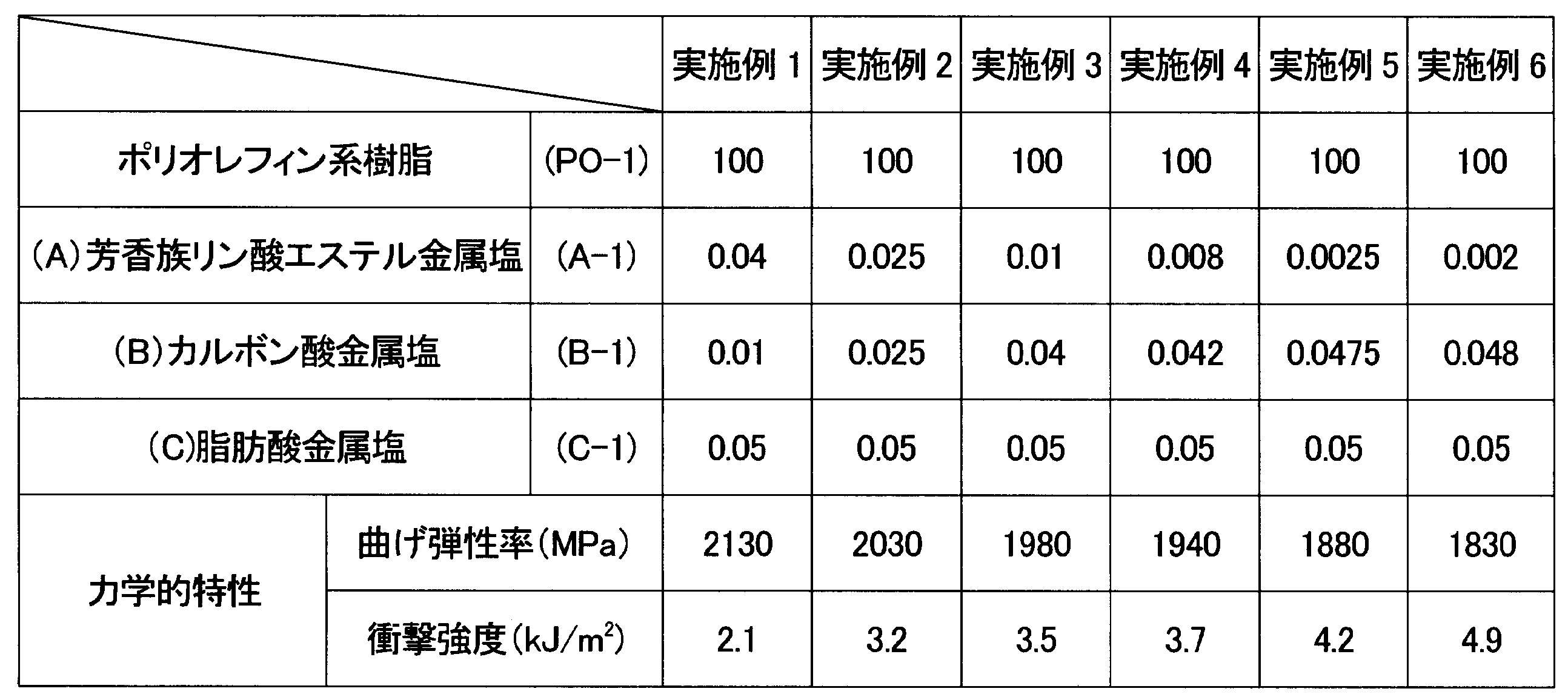
- pellets of Examples 1 to 20 using a nucleating agent containing (A) aromatic phosphate metal salt and (B) carboxylic acid metal salt having a specific structure were formed.
- the molded product thus obtained is superior to the molded product obtained by molding the pellet of Comparative Example 2 containing (A) an aromatic phosphate metal salt and (B) not containing a carboxylic acid metal salt. It has the same rigidity or the same rigidity, and also has excellent impact resistance.
Landscapes
- Chemical & Material Sciences (AREA)
- Health & Medical Sciences (AREA)
- Chemical Kinetics & Catalysis (AREA)
- Medicinal Chemistry (AREA)
- Polymers & Plastics (AREA)
- Organic Chemistry (AREA)
- Crystallography & Structural Chemistry (AREA)
- Compositions Of Macromolecular Compounds (AREA)
- Manufacture Of Macromolecular Shaped Articles (AREA)
Abstract
Description

で表される構造を有する芳香族リン酸エステル金属塩と、
(B)下記一般式(2)、


で表される構造を有するカルボン酸金属塩と、
を含むことを特徴とするものである。
(A)下記一般式(1)、

で表される構造を有する芳香族リン酸エステル金属塩と、
(B)下記一般式(2)、



で表される構造を有するカルボン酸金属塩と、
を含み、
前記ポリオレフィン系樹脂100質量部に対する、前記(A)芳香族リン酸エステル金属塩および前記(B)カルボン酸金属塩の合計含有量が、0.001~10質量部であることを特徴とするものである。
本実施形態に係る核剤は、(A)下記一般式(1)で表される構造を有する芳香族リン酸エステル金属塩と、(B)下記一般式(2)で表される構造を有するカルボン酸金属塩とを含む。


本実施形態に係る樹脂組成物は、ポリオレフィン系樹脂と、(A)上記一般式(1)で表される構造を有する芳香族リン酸エステル金属塩と、(B)上記一般式(2)で表される構造を有するカルボン酸金属塩とを含む。そして、本実施形態に係る樹脂組成物は、ポリオレフィン系樹脂100質量部に対する、上記(A)芳香族リン酸エステル金属塩および上記(B)カルボン酸金属塩の合計含有量が、0.001~10質量部であるものである。
本実施形態に係る樹脂組成物の製造方法は、上述した核剤をポリオレフィン系樹脂に配合する配合工程を備えるものである。
本実施形態に係る製造方法においては、まず、上述したポリオレフィン系樹脂と、上述した核剤とを準備する。
次に、核剤を、ポリオレフィン系樹脂に配合する。配合の方法としては特に限定されるものではなく、例えば、ポリオレフィン系樹脂、核剤、および、必要に応じて上述の各種添加剤を添加した後、ヘンシェルミキサー、ミルロール、バンバリーミキサー、スーパーミキサー等の混合装置を用いて混合する方法などが挙げられる。ここで、核剤および上述の各種添加剤のうち少なくとも一つの成分が、ポリオレフィン系樹脂モノマーまたはオリゴマーの重合前または重合中に添加され、得られた重合体に残りの成分が添加されてもよい。
本実施形態に係る成形品は、上記した樹脂組成物を成形して得られるものである。この成形品は、優れた力学的特性を備えるものとなる。
(PO-1)ホモポリプロピレン(シリンダー温度230℃、荷重2.16kgにおけるメルトフローレート:8g/10min)
(A-1)ナトリウム 2,2’-メチレンビス(4,6-ジ-tert-ブチルフェニル)ホスフェート
(A-2)ヒドロキシアルミニウム ビス[2,2’-メチレンビス(4,6-ジ-tert-ブチルフェニル)ホスフェート]
(A-3)リチウム 2,2’-メチレンビス(4,6-ジ-tert-ブチルフェニル)ホスフェート
(B-1)N-ベンゾイル-L-アスパラギン酸ジナトリウム
(B-2)N-シクロヘキシルカルボニル-L-アスパラギン酸ジナトリウム
(B-3)N-(4-メチルベンゾイル)-L-アスパラギン酸ジナトリウム
(B-4)N-(2,4,6-トリメチルベンゾイル)-L-アスパラギン酸アルミニウム水酸化物
(C-1)ステアリン酸カルシウム
(C-2)ミリスチン酸リチウム
ポリオレフィン系樹脂100質量部に対し、(A)芳香族リン酸エステル金属塩、(B)カルボン酸金属塩、および、(C)脂肪酸金属塩を、下記の表1~5に記載の配合量で、さらに、フェノール系酸化防止剤(テトラキス[メチレン-3-(3’,5’-tert-ブチル-4’-ヒドロキシフェニル)プロピオネート]メタン)を0.05質量部、リン系酸化防止剤(トリス(2,4-ジ-tert-ブチルフェニル)ホスファイト)を0.1質量部配合した後、ヘンシェルミキサー(三井鉱山社製、FM200)を用いて、回転速度1000rpmで1分間混合した。得られた混合物を、2軸押出機(日本製鋼所社製、TEX-28V)を用いて、樹脂温度220℃、150rpmのスクリュー速度の加工条件で溶融混練した後、造粒して、実施例1~20および比較例1~2のペレットを得た。得られたペレットは、80℃で8時間乾燥させた後、特性評価に用いた。なお、下記の表1~5において、配合量の単位は質量部である。
実施例1~20および比較例1~2のペレットを成形して得られた成形品の力学的特性を、以下に従い、曲げ弾性率および衝撃強度を測定することにより評価した。
実施例1~20および比較例1~2のペレットを80℃で8時間乾燥後、射出成形機(東芝機械社製、EC-220)を用いて、樹脂温度230℃、金型温度40℃の条件で射出成形し、80mm×10mm×4mmの曲げ試験片を作製した。この試験片を温度23℃、湿度50%の恒温恒湿槽内に48時間静置した後、恒温恒湿槽から試験片を取り出し、曲げ試験機(島津製作所製、AG-IS)を用い、ISO178に準拠して試験片の曲げ弾性率(MPa)を測定した。その結果を、下記の表1~5に示す。
実施例1~20および比較例1~2のペレットを80℃で8時間乾燥後、射出成形機(装置;日精樹脂工業社製、横型射出成形機 NEX80)により、樹脂温度230℃、金型温度40℃の加工条件で成形し、中央部にV字型ノッチを有する80mm×10mm×4mmのシャルピー衝撃強さ測定用試験片を作製した。この試験片を温度23℃、湿度60%の恒温恒湿槽内に7日間静置した後、恒温恒湿槽から試験片を取り出し、ISO179-1に準拠して試験片のシャルピー衝撃強度(kJ/m2)を測定した。その結果を、下記の表1~5に、「衝撃強度(kJ/m2)」として示す。


Claims (9)
- (A)下記一般式(1)、
(上記一般式(1)中、R1~R5はそれぞれ独立に水素原子または炭素原子数1~6のアルキル基を表し、nは1または2を表し、nが1の場合、M1はアルカリ金属またはジヒドロキシアルミニウムを表し、nが2の場合、M1はアルカリ土類金属、亜鉛またはヒドロキシアルミニウムを表す。)
で表される構造を有する芳香族リン酸エステル金属塩と、
(B)下記一般式(2)、
(上記一般式(2)中、M2はアルカリ金属、アルカリ土類金属、ヒドロキシアルミニウムまたはジヒドロキシアルミニウムを表し、aは1または2を表し、xは1または2を表し、ax=2を満たす。Zは下記一般式(3)または(4)で表される構造を有する基を表す。)
 (上記一般式(3)および(4)中、Yは直接結合または炭素原子数1~4のアルキレン基を表し、R6~R15はそれぞれ独立に、水素原子、ハロゲン原子または炭素原子数1~6のアルキル基を表し、*はカルボニル炭素と結合する位置を表す。)
で表される構造を有するカルボン酸金属塩と、
を含むことを特徴とする核剤。 - 前記一般式(2)中のM2がナトリウムである請求項1記載の核剤。
- 前記(A)芳香族リン酸エステル金属塩の含有量と、前記(B)カルボン酸金属塩の含有量と、の質量比(A)/(B)が、1/99~50/50である請求項1記載の核剤。
- 前記(A)芳香族リン酸エステル金属塩の含有量と、前記(B)カルボン酸金属塩の含有量と、の質量比(A)/(B)が、50/50~99/1である請求項1記載の核剤。
- 前記(A)芳香族リン酸エステル金属塩の含有量と、前記(B)カルボン酸金属塩の含有量と、の質量比(A)/(B)が、50/50~80/20である請求項4記載の核剤。
- ポリオレフィン系樹脂と、
(A)下記一般式(1)、
(上記一般式(1)中、R1~R5はそれぞれ独立に水素原子または炭素原子数1~6のアルキル基を表し、nは1または2を表し、nが1の場合、M1はアルカリ金属またはジヒドロキシアルミニウムを表し、nが2の場合、M1はアルカリ土類金属、亜鉛またはヒドロキシアルミニウムを表す。)
で表される構造を有する芳香族リン酸エステル金属塩と、
(B)下記一般式(2)、
(上記一般式(2)中、M2はアルカリ金属、アルカリ土類金属、ヒドロキシアルミニウムまたはジヒドロキシアルミニウムを表し、aは1または2を表し、xは1または2を表し、ax=2を満たす。Zは下記一般式(3)または(4)で表される構造を有する基を表す。)
 (上記一般式(3)および(4)中、Yは直接結合または炭素原子数1~4のアルキレン基を表し、R6~R15はそれぞれ独立に、水素原子、ハロゲン原子または炭素原子数1~6のアルキル基を表し、*はカルボニル炭素と結合する位置を表す。)
で表される構造を有するカルボン酸金属塩と、
を含み、
前記ポリオレフィン系樹脂100質量部に対する、前記(A)芳香族リン酸エステル金属塩および前記(B)カルボン酸金属塩の合計含有量が、0.001~10質量部であることを特徴とする樹脂組成物。 - 前記ポリオレフィン系樹脂がポリプロピレン系樹脂である請求項6記載の樹脂組成物。
- 請求項1記載の核剤をポリオレフィン系樹脂に配合する配合工程を備えることを特徴とする樹脂組成物の製造方法。
- 請求項6記載の樹脂組成物を成形して得られることを特徴とする成形品。
Priority Applications (8)
| Application Number | Priority Date | Filing Date | Title |
|---|---|---|---|
| US17/914,464 US20230124644A1 (en) | 2020-03-27 | 2021-03-25 | Nucleating agent, resin composition, method for producing resin composition, and molded article |
| CN202180024124.1A CN115335447B (zh) | 2020-03-27 | 2021-03-25 | 成核剂、树脂组合物、树脂组合物的制造方法和成形品 |
| JP2022510711A JP7668784B2 (ja) | 2020-03-27 | 2021-03-25 | 核剤、樹脂組成物、樹脂組成物の製造方法および成形品 |
| KR1020227034870A KR20220161346A (ko) | 2020-03-27 | 2021-03-25 | 핵제, 수지 조성물, 수지 조성물의 제조 방법 및 성형품 |
| EP21775917.4A EP4130128A4 (en) | 2020-03-27 | 2021-03-25 | NUCLEATION AGENT, RESIN COMPOSITION, METHOD FOR PRODUCING THE RESIN COMPOSITION AND MOLDED BODIES |
| AU2021242608A AU2021242608A1 (en) | 2020-03-27 | 2021-03-25 | Nucleating agent, resin composition, method for producing resin composition, and molded article |
| BR112022019329A BR112022019329A2 (pt) | 2020-03-27 | 2021-03-25 | Agente de nucleação, composição de resina, método para produção de composição de resina e artigo moldado |
| SA522440676A SA522440676B1 (ar) | 2020-03-27 | 2022-09-26 | عامل تنوي وتركيبة راتنجية وطريقة لإنتاج التركيبة الراتنجية ومنتج مقولب |
Applications Claiming Priority (4)
| Application Number | Priority Date | Filing Date | Title |
|---|---|---|---|
| JP2020-058942 | 2020-03-27 | ||
| JP2020058942 | 2020-03-27 | ||
| JP2020194374 | 2020-11-24 | ||
| JP2020-194374 | 2020-11-24 |
Publications (1)
| Publication Number | Publication Date |
|---|---|
| WO2021193886A1 true WO2021193886A1 (ja) | 2021-09-30 |
Family
ID=77890337
Family Applications (1)
| Application Number | Title | Priority Date | Filing Date |
|---|---|---|---|
| PCT/JP2021/012754 Ceased WO2021193886A1 (ja) | 2020-03-27 | 2021-03-25 | 核剤、樹脂組成物、樹脂組成物の製造方法および成形品 |
Country Status (9)
| Country | Link |
|---|---|
| US (1) | US20230124644A1 (ja) |
| EP (1) | EP4130128A4 (ja) |
| JP (1) | JP7668784B2 (ja) |
| KR (1) | KR20220161346A (ja) |
| CN (1) | CN115335447B (ja) |
| AU (1) | AU2021242608A1 (ja) |
| BR (1) | BR112022019329A2 (ja) |
| SA (1) | SA522440676B1 (ja) |
| WO (1) | WO2021193886A1 (ja) |
Cited By (2)
| Publication number | Priority date | Publication date | Assignee | Title |
|---|---|---|---|---|
| CN114524974A (zh) * | 2021-12-30 | 2022-05-24 | 弘元(上海)高分子材料有限公司 | 透明聚丙烯用成核剂组合物及其应用和聚丙烯组合物 |
| WO2023096280A1 (ko) * | 2021-11-29 | 2023-06-01 | 롯데케미칼 주식회사 | 열안정성 및 강성이 우수한 폴리프로필렌 수지 조성물 및 이를 포함하는 용기 |
Citations (7)
| Publication number | Priority date | Publication date | Assignee | Title |
|---|---|---|---|---|
| JPS581736A (ja) | 1981-06-25 | 1983-01-07 | Adeka Argus Chem Co Ltd | ポリオレフイン系樹脂組成物 |
| US6552131B1 (en) | 1999-02-10 | 2003-04-22 | Sanyo Chemical Industries, Ltd. | Block polymer and antistatic agent comprising the same |
| JP2005120237A (ja) * | 2003-10-16 | 2005-05-12 | Asahi Denka Kogyo Kk | 結晶核剤組成物及びこれを含有してなる結晶性高分子組成物 |
| JP2010132927A (ja) | 2007-12-07 | 2010-06-17 | Du Pont Mitsui Polychem Co Ltd | カリウムアイオノマーからなる高分子型帯電防止剤 |
| JP2016023254A (ja) | 2014-07-22 | 2016-02-08 | 株式会社Adeka | 帯電防止剤、帯電防止剤組成物、帯電防止性樹脂組成物および成形体 |
| JP2020015862A (ja) * | 2018-07-27 | 2020-01-30 | 株式会社Adeka | ポリオレフィン用核剤、これを含有するポリオレフィン用核剤組成物、ポリオレフィン系樹脂組成物、およびその成形品 |
| WO2020137179A1 (ja) * | 2018-12-27 | 2020-07-02 | 株式会社Adeka | ポリオレフィン系樹脂用核剤、これを含有するポリオレフィン系樹脂用核剤組成物、ポリオレフィン系樹脂用マスターバッチ、ポリオレフィン系樹脂組成物、その成形品、そのフィルム、多孔質フィルムの製造方法および包装体 |
Family Cites Families (2)
| Publication number | Priority date | Publication date | Assignee | Title |
|---|---|---|---|---|
| JP4674839B2 (ja) * | 2001-05-17 | 2011-04-20 | 株式会社Adeka | 結晶性高分子組成物 |
| JP7084729B2 (ja) * | 2018-01-23 | 2022-06-15 | 株式会社Adeka | 核剤組成物、これを含有するオレフィン系樹脂組成物およびその成形品 |
-
2021
- 2021-03-25 AU AU2021242608A patent/AU2021242608A1/en active Pending
- 2021-03-25 WO PCT/JP2021/012754 patent/WO2021193886A1/ja not_active Ceased
- 2021-03-25 JP JP2022510711A patent/JP7668784B2/ja active Active
- 2021-03-25 CN CN202180024124.1A patent/CN115335447B/zh active Active
- 2021-03-25 US US17/914,464 patent/US20230124644A1/en active Pending
- 2021-03-25 BR BR112022019329A patent/BR112022019329A2/pt not_active Application Discontinuation
- 2021-03-25 EP EP21775917.4A patent/EP4130128A4/en active Pending
- 2021-03-25 KR KR1020227034870A patent/KR20220161346A/ko active Pending
-
2022
- 2022-09-26 SA SA522440676A patent/SA522440676B1/ar unknown
Patent Citations (7)
| Publication number | Priority date | Publication date | Assignee | Title |
|---|---|---|---|---|
| JPS581736A (ja) | 1981-06-25 | 1983-01-07 | Adeka Argus Chem Co Ltd | ポリオレフイン系樹脂組成物 |
| US6552131B1 (en) | 1999-02-10 | 2003-04-22 | Sanyo Chemical Industries, Ltd. | Block polymer and antistatic agent comprising the same |
| JP2005120237A (ja) * | 2003-10-16 | 2005-05-12 | Asahi Denka Kogyo Kk | 結晶核剤組成物及びこれを含有してなる結晶性高分子組成物 |
| JP2010132927A (ja) | 2007-12-07 | 2010-06-17 | Du Pont Mitsui Polychem Co Ltd | カリウムアイオノマーからなる高分子型帯電防止剤 |
| JP2016023254A (ja) | 2014-07-22 | 2016-02-08 | 株式会社Adeka | 帯電防止剤、帯電防止剤組成物、帯電防止性樹脂組成物および成形体 |
| JP2020015862A (ja) * | 2018-07-27 | 2020-01-30 | 株式会社Adeka | ポリオレフィン用核剤、これを含有するポリオレフィン用核剤組成物、ポリオレフィン系樹脂組成物、およびその成形品 |
| WO2020137179A1 (ja) * | 2018-12-27 | 2020-07-02 | 株式会社Adeka | ポリオレフィン系樹脂用核剤、これを含有するポリオレフィン系樹脂用核剤組成物、ポリオレフィン系樹脂用マスターバッチ、ポリオレフィン系樹脂組成物、その成形品、そのフィルム、多孔質フィルムの製造方法および包装体 |
Non-Patent Citations (1)
| Title |
|---|
| See also references of EP4130128A4 |
Cited By (5)
| Publication number | Priority date | Publication date | Assignee | Title |
|---|---|---|---|---|
| WO2023096280A1 (ko) * | 2021-11-29 | 2023-06-01 | 롯데케미칼 주식회사 | 열안정성 및 강성이 우수한 폴리프로필렌 수지 조성물 및 이를 포함하는 용기 |
| KR20230079921A (ko) * | 2021-11-29 | 2023-06-07 | 롯데케미칼 주식회사 | 열안정성 및 강성이 우수한 폴리프로필렌 수지 조성물 및 이를 포함하는 용기 |
| KR102795387B1 (ko) | 2021-11-29 | 2025-04-11 | 롯데케미칼 주식회사 | 열안정성 및 강성이 우수한 폴리프로필렌 수지 조성물 및 이를 포함하는 용기 |
| CN114524974A (zh) * | 2021-12-30 | 2022-05-24 | 弘元(上海)高分子材料有限公司 | 透明聚丙烯用成核剂组合物及其应用和聚丙烯组合物 |
| CN114524974B (zh) * | 2021-12-30 | 2024-04-09 | 弘元(上海)高分子材料有限公司 | 透明聚丙烯用成核剂组合物及其应用和聚丙烯组合物 |
Also Published As
| Publication number | Publication date |
|---|---|
| KR20220161346A (ko) | 2022-12-06 |
| EP4130128A1 (en) | 2023-02-08 |
| US20230124644A1 (en) | 2023-04-20 |
| JP7668784B2 (ja) | 2025-04-25 |
| EP4130128A4 (en) | 2024-04-24 |
| AU2021242608A1 (en) | 2022-11-03 |
| BR112022019329A2 (pt) | 2022-11-16 |
| JPWO2021193886A1 (ja) | 2021-09-30 |
| CN115335447B (zh) | 2023-12-29 |
| SA522440676B1 (ar) | 2024-04-07 |
| CN115335447A (zh) | 2022-11-11 |
Similar Documents
| Publication | Publication Date | Title |
|---|---|---|
| AU2016309150B2 (en) | Resin additive composition and synthetic resin composition using same | |
| JP6728506B1 (ja) | ポリオレフィン系樹脂用核剤、これを含有するポリオレフィン系樹脂用核剤組成物、ポリオレフィン系樹脂用マスターバッチ、ポリオレフィン系樹脂組成物、その成形品、そのフィルム、多孔質フィルムの製造方法および包装体 | |
| CN104428350B (zh) | 混合粒料 | |
| CN113330058A (zh) | 成核剂组合物、烯烃系树脂组合物、其成型品及烯烃系树脂组合物的制造方法 | |
| WO2021193886A1 (ja) | 核剤、樹脂組成物、樹脂組成物の製造方法および成形品 | |
| JP2022011537A (ja) | 発泡成形品および発泡成形品の製造方法 | |
| JP7842683B2 (ja) | 添加剤組成物、これを含む樹脂組成物、その製造方法および成形品 | |
| JP7802002B2 (ja) | 添加剤組成物、樹脂組成物、樹脂組成物の製造方法および成形品 | |
| WO2021125184A1 (ja) | 樹脂組成物、その成形品、および、その樹脂組成物の製造方法 | |
| EP4357405A1 (en) | Nucleating agent composition, resin composition, molded article thereof, and method for manufacturing resin composition | |
| RU2824600C2 (ru) | Зародышеобразователь кристаллизации полиолефиновой смолы, композиция зародышеобразователя кристаллизации полиолефиновой смолы, мастербатч полиолефиновой смолы, композиция полиолефиновой смолы, формованное изделие, плёнка из полиолефиновой смолы, способ изготовления пористой плёнки и упаковки | |
| JP2020152838A (ja) | ポリオレフィン系樹脂の核形成を促す化合物、マスターバッチ、樹脂組成物および成形品 | |
| JP2024117817A (ja) | 樹脂組成物、成形品、樹脂組成物の製造方法、合成樹脂の結晶化促進方法および合成樹脂の透明性向上方法 | |
| JP2022017798A (ja) | ポリオレフィン系樹脂組成物の製造方法、ポリオレフィン系樹脂組成物およびその成形品 |
Legal Events
| Date | Code | Title | Description |
|---|---|---|---|
| 121 | Ep: the epo has been informed by wipo that ep was designated in this application |
Ref document number: 21775917 Country of ref document: EP Kind code of ref document: A1 |
|
| ENP | Entry into the national phase |
Ref document number: 2022510711 Country of ref document: JP Kind code of ref document: A |
|
| REG | Reference to national code |
Ref country code: BR Ref legal event code: B01A Ref document number: 112022019329 Country of ref document: BR |
|
| WWE | Wipo information: entry into national phase |
Ref document number: 2021775917 Country of ref document: EP |
|
| ENP | Entry into the national phase |
Ref document number: 2021775917 Country of ref document: EP Effective date: 20221027 |
|
| NENP | Non-entry into the national phase |
Ref country code: DE |
|
| ENP | Entry into the national phase |
Ref document number: 2021242608 Country of ref document: AU Date of ref document: 20210325 Kind code of ref document: A |
|
| ENP | Entry into the national phase |
Ref document number: 112022019329 Country of ref document: BR Kind code of ref document: A2 Effective date: 20220926 |
|
| WWE | Wipo information: entry into national phase |
Ref document number: 522440676 Country of ref document: SA |
|
| WWG | Wipo information: grant in national office |
Ref document number: 522440676 Country of ref document: SA |