WO2021193961A1 - 2液硬化型接着剤組成物 - Google Patents
2液硬化型接着剤組成物 Download PDFInfo
- Publication number
- WO2021193961A1 WO2021193961A1 PCT/JP2021/013080 JP2021013080W WO2021193961A1 WO 2021193961 A1 WO2021193961 A1 WO 2021193961A1 JP 2021013080 W JP2021013080 W JP 2021013080W WO 2021193961 A1 WO2021193961 A1 WO 2021193961A1
- Authority
- WO
- WIPO (PCT)
- Prior art keywords
- compound
- polyol
- adhesive composition
- group
- curable adhesive
- Prior art date
- Legal status (The legal status is an assumption and is not a legal conclusion. Google has not performed a legal analysis and makes no representation as to the accuracy of the status listed.)
- Ceased
Links
Classifications
-
- C—CHEMISTRY; METALLURGY
- C08—ORGANIC MACROMOLECULAR COMPOUNDS; THEIR PREPARATION OR CHEMICAL WORKING-UP; COMPOSITIONS BASED THEREON
- C08G—MACROMOLECULAR COMPOUNDS OBTAINED OTHERWISE THAN BY REACTIONS ONLY INVOLVING UNSATURATED CARBON-TO-CARBON BONDS
- C08G18/00—Polymeric products of isocyanates or isothiocyanates
- C08G18/06—Polymeric products of isocyanates or isothiocyanates with compounds having active hydrogen
- C08G18/28—Polymeric products of isocyanates or isothiocyanates with compounds having active hydrogen characterised by the compounds used containing active hydrogen
- C08G18/40—High-molecular-weight compounds
- C08G18/48—Polyethers
- C08G18/4854—Polyethers containing oxyalkylene groups having four carbon atoms in the alkylene group
-
- C—CHEMISTRY; METALLURGY
- C08—ORGANIC MACROMOLECULAR COMPOUNDS; THEIR PREPARATION OR CHEMICAL WORKING-UP; COMPOSITIONS BASED THEREON
- C08G—MACROMOLECULAR COMPOUNDS OBTAINED OTHERWISE THAN BY REACTIONS ONLY INVOLVING UNSATURATED CARBON-TO-CARBON BONDS
- C08G18/00—Polymeric products of isocyanates or isothiocyanates
- C08G18/003—Polymeric products of isocyanates or isothiocyanates with epoxy compounds having no active hydrogen
-
- C—CHEMISTRY; METALLURGY
- C08—ORGANIC MACROMOLECULAR COMPOUNDS; THEIR PREPARATION OR CHEMICAL WORKING-UP; COMPOSITIONS BASED THEREON
- C08G—MACROMOLECULAR COMPOUNDS OBTAINED OTHERWISE THAN BY REACTIONS ONLY INVOLVING UNSATURATED CARBON-TO-CARBON BONDS
- C08G18/00—Polymeric products of isocyanates or isothiocyanates
- C08G18/06—Polymeric products of isocyanates or isothiocyanates with compounds having active hydrogen
- C08G18/08—Processes
- C08G18/10—Prepolymer processes involving reaction of isocyanates or isothiocyanates with compounds having active hydrogen in a first reaction step
-
- C—CHEMISTRY; METALLURGY
- C08—ORGANIC MACROMOLECULAR COMPOUNDS; THEIR PREPARATION OR CHEMICAL WORKING-UP; COMPOSITIONS BASED THEREON
- C08G—MACROMOLECULAR COMPOUNDS OBTAINED OTHERWISE THAN BY REACTIONS ONLY INVOLVING UNSATURATED CARBON-TO-CARBON BONDS
- C08G18/00—Polymeric products of isocyanates or isothiocyanates
- C08G18/06—Polymeric products of isocyanates or isothiocyanates with compounds having active hydrogen
- C08G18/28—Polymeric products of isocyanates or isothiocyanates with compounds having active hydrogen characterised by the compounds used containing active hydrogen
- C08G18/2805—Compounds having only one group containing active hydrogen
- C08G18/288—Compounds containing at least one heteroatom other than oxygen or nitrogen
- C08G18/289—Compounds containing at least one heteroatom other than oxygen or nitrogen containing silicon
-
- C—CHEMISTRY; METALLURGY
- C08—ORGANIC MACROMOLECULAR COMPOUNDS; THEIR PREPARATION OR CHEMICAL WORKING-UP; COMPOSITIONS BASED THEREON
- C08G—MACROMOLECULAR COMPOUNDS OBTAINED OTHERWISE THAN BY REACTIONS ONLY INVOLVING UNSATURATED CARBON-TO-CARBON BONDS
- C08G18/00—Polymeric products of isocyanates or isothiocyanates
- C08G18/06—Polymeric products of isocyanates or isothiocyanates with compounds having active hydrogen
- C08G18/28—Polymeric products of isocyanates or isothiocyanates with compounds having active hydrogen characterised by the compounds used containing active hydrogen
- C08G18/30—Low-molecular-weight compounds
- C08G18/32—Polyhydroxy compounds; Polyamines; Hydroxyamines
- C08G18/3225—Polyamines
- C08G18/3237—Polyamines aromatic
-
- C—CHEMISTRY; METALLURGY
- C08—ORGANIC MACROMOLECULAR COMPOUNDS; THEIR PREPARATION OR CHEMICAL WORKING-UP; COMPOSITIONS BASED THEREON
- C08G—MACROMOLECULAR COMPOUNDS OBTAINED OTHERWISE THAN BY REACTIONS ONLY INVOLVING UNSATURATED CARBON-TO-CARBON BONDS
- C08G18/00—Polymeric products of isocyanates or isothiocyanates
- C08G18/06—Polymeric products of isocyanates or isothiocyanates with compounds having active hydrogen
- C08G18/28—Polymeric products of isocyanates or isothiocyanates with compounds having active hydrogen characterised by the compounds used containing active hydrogen
- C08G18/40—High-molecular-weight compounds
- C08G18/42—Polycondensates having carboxylic or carbonic ester groups in the main chain
- C08G18/44—Polycarbonates
-
- C—CHEMISTRY; METALLURGY
- C08—ORGANIC MACROMOLECULAR COMPOUNDS; THEIR PREPARATION OR CHEMICAL WORKING-UP; COMPOSITIONS BASED THEREON
- C08G—MACROMOLECULAR COMPOUNDS OBTAINED OTHERWISE THAN BY REACTIONS ONLY INVOLVING UNSATURATED CARBON-TO-CARBON BONDS
- C08G18/00—Polymeric products of isocyanates or isothiocyanates
- C08G18/06—Polymeric products of isocyanates or isothiocyanates with compounds having active hydrogen
- C08G18/28—Polymeric products of isocyanates or isothiocyanates with compounds having active hydrogen characterised by the compounds used containing active hydrogen
- C08G18/40—High-molecular-weight compounds
- C08G18/48—Polyethers
- C08G18/4825—Polyethers containing two hydroxy groups
-
- C—CHEMISTRY; METALLURGY
- C08—ORGANIC MACROMOLECULAR COMPOUNDS; THEIR PREPARATION OR CHEMICAL WORKING-UP; COMPOSITIONS BASED THEREON
- C08G—MACROMOLECULAR COMPOUNDS OBTAINED OTHERWISE THAN BY REACTIONS ONLY INVOLVING UNSATURATED CARBON-TO-CARBON BONDS
- C08G18/00—Polymeric products of isocyanates or isothiocyanates
- C08G18/06—Polymeric products of isocyanates or isothiocyanates with compounds having active hydrogen
- C08G18/28—Polymeric products of isocyanates or isothiocyanates with compounds having active hydrogen characterised by the compounds used containing active hydrogen
- C08G18/40—High-molecular-weight compounds
- C08G18/61—Polysiloxanes
-
- C—CHEMISTRY; METALLURGY
- C08—ORGANIC MACROMOLECULAR COMPOUNDS; THEIR PREPARATION OR CHEMICAL WORKING-UP; COMPOSITIONS BASED THEREON
- C08G—MACROMOLECULAR COMPOUNDS OBTAINED OTHERWISE THAN BY REACTIONS ONLY INVOLVING UNSATURATED CARBON-TO-CARBON BONDS
- C08G18/00—Polymeric products of isocyanates or isothiocyanates
- C08G18/06—Polymeric products of isocyanates or isothiocyanates with compounds having active hydrogen
- C08G18/28—Polymeric products of isocyanates or isothiocyanates with compounds having active hydrogen characterised by the compounds used containing active hydrogen
- C08G18/40—High-molecular-weight compounds
- C08G18/62—Polymers of compounds having carbon-to-carbon double bonds
- C08G18/6204—Polymers of olefins
-
- C—CHEMISTRY; METALLURGY
- C08—ORGANIC MACROMOLECULAR COMPOUNDS; THEIR PREPARATION OR CHEMICAL WORKING-UP; COMPOSITIONS BASED THEREON
- C08G—MACROMOLECULAR COMPOUNDS OBTAINED OTHERWISE THAN BY REACTIONS ONLY INVOLVING UNSATURATED CARBON-TO-CARBON BONDS
- C08G18/00—Polymeric products of isocyanates or isothiocyanates
- C08G18/06—Polymeric products of isocyanates or isothiocyanates with compounds having active hydrogen
- C08G18/70—Polymeric products of isocyanates or isothiocyanates with compounds having active hydrogen characterised by the isocyanates or isothiocyanates used
- C08G18/71—Monoisocyanates or monoisothiocyanates
- C08G18/718—Monoisocyanates or monoisothiocyanates containing silicon
-
- C—CHEMISTRY; METALLURGY
- C08—ORGANIC MACROMOLECULAR COMPOUNDS; THEIR PREPARATION OR CHEMICAL WORKING-UP; COMPOSITIONS BASED THEREON
- C08G—MACROMOLECULAR COMPOUNDS OBTAINED OTHERWISE THAN BY REACTIONS ONLY INVOLVING UNSATURATED CARBON-TO-CARBON BONDS
- C08G18/00—Polymeric products of isocyanates or isothiocyanates
- C08G18/06—Polymeric products of isocyanates or isothiocyanates with compounds having active hydrogen
- C08G18/70—Polymeric products of isocyanates or isothiocyanates with compounds having active hydrogen characterised by the isocyanates or isothiocyanates used
- C08G18/72—Polyisocyanates or polyisothiocyanates
- C08G18/74—Polyisocyanates or polyisothiocyanates cyclic
- C08G18/76—Polyisocyanates or polyisothiocyanates cyclic aromatic
- C08G18/7657—Polyisocyanates or polyisothiocyanates cyclic aromatic containing two or more aromatic rings
- C08G18/7664—Polyisocyanates or polyisothiocyanates cyclic aromatic containing two or more aromatic rings containing alkylene polyphenyl groups
- C08G18/7671—Polyisocyanates or polyisothiocyanates cyclic aromatic containing two or more aromatic rings containing alkylene polyphenyl groups containing only one alkylene bisphenyl group
-
- C—CHEMISTRY; METALLURGY
- C08—ORGANIC MACROMOLECULAR COMPOUNDS; THEIR PREPARATION OR CHEMICAL WORKING-UP; COMPOSITIONS BASED THEREON
- C08G—MACROMOLECULAR COMPOUNDS OBTAINED OTHERWISE THAN BY REACTIONS ONLY INVOLVING UNSATURATED CARBON-TO-CARBON BONDS
- C08G59/00—Polycondensates containing more than one epoxy group per molecule; Macromolecules obtained by polymerising compounds containing more than one epoxy group per molecule using curing agents or catalysts which react with the epoxy groups
- C08G59/18—Macromolecules obtained by polymerising compounds containing more than one epoxy group per molecule using curing agents or catalysts which react with the epoxy groups ; e.g. general methods of curing
- C08G59/40—Macromolecules obtained by polymerising compounds containing more than one epoxy group per molecule using curing agents or catalysts which react with the epoxy groups ; e.g. general methods of curing characterised by the curing agents used
- C08G59/50—Amines
- C08G59/5033—Amines aromatic
-
- C—CHEMISTRY; METALLURGY
- C09—DYES; PAINTS; POLISHES; NATURAL RESINS; ADHESIVES; COMPOSITIONS NOT OTHERWISE PROVIDED FOR; APPLICATIONS OF MATERIALS NOT OTHERWISE PROVIDED FOR
- C09J—ADHESIVES; NON-MECHANICAL ASPECTS OF ADHESIVE PROCESSES IN GENERAL; ADHESIVE PROCESSES NOT PROVIDED FOR ELSEWHERE; USE OF MATERIALS AS ADHESIVES
- C09J163/00—Adhesives based on epoxy resins; Adhesives based on derivatives of epoxy resins
-
- C—CHEMISTRY; METALLURGY
- C09—DYES; PAINTS; POLISHES; NATURAL RESINS; ADHESIVES; COMPOSITIONS NOT OTHERWISE PROVIDED FOR; APPLICATIONS OF MATERIALS NOT OTHERWISE PROVIDED FOR
- C09J—ADHESIVES; NON-MECHANICAL ASPECTS OF ADHESIVE PROCESSES IN GENERAL; ADHESIVE PROCESSES NOT PROVIDED FOR ELSEWHERE; USE OF MATERIALS AS ADHESIVES
- C09J175/00—Adhesives based on polyureas or polyurethanes; Adhesives based on derivatives of such polymers
- C09J175/04—Polyurethanes
- C09J175/06—Polyurethanes from polyesters
-
- C—CHEMISTRY; METALLURGY
- C09—DYES; PAINTS; POLISHES; NATURAL RESINS; ADHESIVES; COMPOSITIONS NOT OTHERWISE PROVIDED FOR; APPLICATIONS OF MATERIALS NOT OTHERWISE PROVIDED FOR
- C09J—ADHESIVES; NON-MECHANICAL ASPECTS OF ADHESIVE PROCESSES IN GENERAL; ADHESIVE PROCESSES NOT PROVIDED FOR ELSEWHERE; USE OF MATERIALS AS ADHESIVES
- C09J175/00—Adhesives based on polyureas or polyurethanes; Adhesives based on derivatives of such polymers
- C09J175/04—Polyurethanes
- C09J175/08—Polyurethanes from polyethers
-
- C—CHEMISTRY; METALLURGY
- C08—ORGANIC MACROMOLECULAR COMPOUNDS; THEIR PREPARATION OR CHEMICAL WORKING-UP; COMPOSITIONS BASED THEREON
- C08K—Use of inorganic or non-macromolecular organic substances as compounding ingredients
- C08K3/00—Use of inorganic substances as compounding ingredients
- C08K3/18—Oxygen-containing compounds, e.g. metal carbonyls
- C08K3/24—Acids; Salts thereof
- C08K3/26—Carbonates; Bicarbonates
- C08K2003/265—Calcium, strontium or barium carbonate
-
- C—CHEMISTRY; METALLURGY
- C08—ORGANIC MACROMOLECULAR COMPOUNDS; THEIR PREPARATION OR CHEMICAL WORKING-UP; COMPOSITIONS BASED THEREON
- C08K—Use of inorganic or non-macromolecular organic substances as compounding ingredients
- C08K5/00—Use of organic ingredients
- C08K5/0008—Organic ingredients according to more than one of the "one dot" groups of C08K5/01 - C08K5/59
- C08K5/0016—Plasticisers
Definitions
- the present invention relates to a two-component curable adhesive composition having a main agent and a curing agent.
- parts made of different materials may be joined together using an adhesive. Since they are joined via an adhesive, it is possible to suppress the occurrence of distortion and warpage even if the difference in the coefficient of thermal expansion between the parts is large. Adhesives used in such applications are required to have particularly good adhesive strength to parts made of metal materials.
- Patent Document 1 describes a polyurethane resin composition having high adhesiveness to a metal, which contains a polyester polyol containing a phosphorus compound residue as a constituent component, and has an acid value and a urethane group concentration within a predetermined range.
- a polyurethane resin composition containing a resin (A) and an epoxy resin (B) has been described.
- High adhesive strength against shear force is important for adhesives used to join structural parts to each other. Further, the adhesive used in such an application is required to have good elongation at break so as to absorb not only the adhesive strength but also the difference in the amount of thermal expansion between the parts. However, it is difficult for conventional polyurethane-based adhesives to exhibit excellent physical properties in terms of both adhesive strength against shear force and elongation at break.
- An object of the present invention is to provide a polyurethane-based adhesive composition having excellent breaking elongation and adhesive strength.
- the urethane prepolymer (a1) comprises a raw material polyisocyanate and a polyol compound (a3) having at least one hydroxyl group in the molecule, and the isocyanate group in the raw material polyisocyanate with respect to the hydroxyl group in the polyol compound (a3).
- the main agent (A) further contains the urethane prepolymer (a1) and the residual polyisocyanate (a4) which is the remainder of the raw material polyisocyanate that did not react with the polyol compound (a3).
- At least one of the main agent (A) and the curing agent (B) contains a silane compound (X).
- the SP values of the polyol compound (a3) and the polyol compound (b1) are 14.0 to 21.0 (J / cm 3 ) 1/2 , respectively.
- the difference between the SP values of the polyol compound (a3) and the polyol compound (b1) is 0.1 to 4.0 (J / cm 3 ) 1/2 .
- the equivalent ratio of the isocyanate group in the main agent (A) to the active hydrogen group in the curing agent (B) is 0.8 to 4.
- the equivalent ratio of the isocyanate group in the main agent (A) to the amino group in the polyamine compound (b2) is preferably 1.2 to 6.
- the polyol compound (a3) is at least one selected from polyester polyols, polytetramethylene ether glycols, polycarbonate polyols, polycaprolactone polyols, and partially modified products obtained by partially modifying each of these. Is preferable.
- the sex polyol compound (b1) is at least one selected from polyoxypropylene glycol, polybutadiene polyol, polyisoprene polyol, polyacrylic polyol, and partially modified products obtained by partially modifying each of them. , Is preferable.
- the epoxy equivalent of the epoxy compound (a2) is preferably 100 to 500 g / eq.
- the epoxy compound (a2) is preferably an epoxy compound having at least one urethane bond in the molecule.
- the silane compound (X) is preferably a silane compound having at least one isocyanate group in the molecule.
- the mass of the epoxy compound (a2) is preferably 0.1 to 30% by mass with respect to the mass of the two-component curable adhesive composition.
- the tensile shear adhesive strength of the cured product obtained by curing the two-component curable adhesive composition in accordance with JIS K6850 is 10 MPa or more.
- the two-component curable adhesive composition of the above aspect it is possible to provide a polyurethane-based adhesive composition having excellent breaking elongation and adhesive strength.
- the two-component curable adhesive composition of the present embodiment will be described.
- the present embodiment includes various embodiments described later.
- the two-component curable adhesive composition of the present embodiment (hereinafter, also simply referred to as an adhesive composition) has a main agent (A) and a curing agent (B).
- the main agent (A) contains a urethane prepolymer (a1) and an epoxy compound (a2).
- the urethane prepolymer (a1) was obtained by reacting the raw material polyisocyanate with the polyol compound (a3). Therefore, the urethane prepolymer (a1) has a monomer unit of the polyisocyanate and a monomer unit of the polyol compound (a3). In this reaction, specifically, the equivalent ratio (hereinafter, also referred to as index) of the isocyanate group in the raw material polyisocyanate to the hydroxyl group in the polyol compound (a3) is set to 2.05 to 12, and all of the polyol compound (a3). Is a monomer unit of the urethane prepolymer (a1).
- the index means the tensile shear adhesive strength according to JIS K6850.
- the residual polyisocyanate can be sufficiently reacted with the curing agent (B).
- the elongation at break means the elongation at the time of cutting in accordance with JIS K6251.
- the breaking strength means the tensile strength in accordance with JIS K6251.
- the index is preferably 3 or more, and more preferably 4 or more.
- the higher the index the more it is possible to avoid the consumption of isocyanate groups and the generation of excess polyol compound (b1) when the main agent (A) and the curing agent (B) are mixed and reacted. It is possible to avoid adversely affecting the physical properties of.
- the equivalent ratio is 12 or less, preferably 10 or less, and more preferably 8 or less.
- the raw material polyisocyanate is added to the polyol compound (a3) and then reacted with each active hydrogen group of the curing agent (B), and the polyol compound (a3) After remaining unreacted, those that have reacted with each active hydrogen group of the curing agent (B) are formed in the cured product.
- the time lag between these reactions of the isocyanate group, the polyol compound (a3), and the polyol compound (b1) of the curing agent (B) are mixed to obtain a cured product having a characteristic structure. Be done.
- Such a cured product formed on the metal surface further has a form in which at least one of a soft segment and a hard segment is bonded to the metal via an epoxy compound (a2) or a silane compound (X). It can be taken.
- the raw material polyisocyanate has at least one, preferably two or more isocyanate groups in the molecule.
- Specific examples of the polyisocyanate compound used in the raw material polyisocyanate include TDI (for example, 2,4-tolylene diisocyanate (2,4-TDI)) and 2,6-tolylene diisocyanate (2,6).
- Aromatic polyisocyanates such as methylenepolyphenylene polyisocyanate, xylylene diisocyanate (XDI), tetramethylxylylene diisocyanate (TMXDI), trizine diisocyanate (TODI), 1,5-naphthalenediocyanate (NDI), triphenylmethane triisocyanate; Alibo polyisocyanates such as pentamethylene diisocyanate (PDI), hexamethylene diisocyanate (HDI), trimethylhexamethylene diisocyanate (TMHDI), lysine diisocyanate, norbornan diisocyanate (NBDI); transcyclohexane
- Such polyisocyanates can be used alone or in combination of two or more.
- the raw material polyisocyanate is at least one of the isocyanate compounds containing diphenylmethane diisocyanate, polypeptide methane diisocyanate, and isocyanurate group from the viewpoint of improving the reaction activity and exhibiting good strength when cured. It is preferable to include one type.
- the raw material polyisocyanate preferably has at least one aromatic ring in the molecule.
- the breaking strength of the cured product is improved.
- such a raw material polyisocyanate has a good interaction with the epoxy compound (a2).
- the polyol compound (a3) is a polyol compound having at least one, preferably at least two hydroxyl groups in the molecule. According to one embodiment, the number average molecular weight of the polyol compound (a3) is preferably 250 or more, more preferably 500 or more. If the number average molecular weight of the polyol compound is less than the above range, the elongation at break of the cured product may decrease, and the cured product may become too hard.
- the number average molecular weight of the polyol compound (a3) is preferably 3000 or less.
- the polyol compound (a3) is preferably a polyester polyol, a polytetramethylene ether glycol, a polycarbonate polyol, a polycaprolactone polyol, and each of these is partially modified in that it contributes to the improvement of the adhesive strength of the cured product. At least one selected from the partially modified products is used.
- polyester polyol examples include a condensate (condensation type polyester polyol) of a low molecular weight polyolic acid and a polybasic carboxylic acid.
- condensate condensation type polyester polyol
- low-molecular-weight polyhydric alcohols include ethylene glycol (EG), diethylene glycol, propylene glycol (PG), dipropylene glycol, (1,3- or 1,4-) butanediol, and pentandiol.
- TMP 1,1,1-trimethylolpropane
- low molecular weight polyols such as pentaerythritol
- sugars such as sorbitol
- Examples of the polybasic carboxylic acid include glutaric acid, adipic acid, azelaic acid, fumaric acid, maleic acid, pimelli acid, suberic acid, sebacic acid, phthalic acid, terephthalic acid, isophthalic acid, dimer acid and pyromellitic acid.
- examples thereof include other low molecular weight carboxylic acids, oligomeric acids, castor oil, hydroxycar
- Polycarbonate polyol is produced through a reaction such as a demethanol condensation reaction between a polyol and dimethyl carbonate, a dephenol condensation reaction between a polyol and diphenyl carbonate, or a deethylene glycol condensation reaction between a polyol and ethylene carbonate.
- a reaction such as a demethanol condensation reaction between a polyol and dimethyl carbonate, a dephenol condensation reaction between a polyol and diphenyl carbonate, or a deethylene glycol condensation reaction between a polyol and ethylene carbonate.
- Examples of the polyol used in these reactions include 1,6-hexanediol, diethylene glycol, triethylene glycol, propylene glycol, 1,3-butanediol, 1,4-butanediol, neopentyl glycol, and pentanediol.
- saturated or unsaturated glycols such as 3-methyl-1,5-pentanediol, octanediol, 1,4-butanediol, dipropylene glycol, tripropylene glycol, polytetramethylene ether glycol, 1,4-cyclohexane
- examples thereof include alicyclic glycols such as diglycol and 1,4-cyclohexanedimethanol.
- Polycaprolactone polyol is obtained by ring-opening polymerization of lactones such as ⁇ -caprolactone, ⁇ -methyl- ⁇ -caprolactone, and ⁇ -methyl- ⁇ -caprolactone with an appropriate polymerization initiator and having hydroxyl groups at both ends. Can be mentioned.
- Examples of the partially modified product include those in which a modifying group is introduced into the molecule of polyester polyol, polytetramethylene ether glycol, polycarbonate polyol, or polycaprolactone polyol by copolymerization or the like.
- Examples of such a partially modified product include those in which a part of the repeating units in the molecule is replaced with a modifying group.
- Examples of the modifying group include an alkylene group. Specific examples of the alkylene group include an ethylene group, a 1,2-propylene group, a 1,3-propylene group, a 2-methyl-1,3-propylene group, and a 2,2-dimethyl-1,3-propylene group.
- the alkylene group has, for example, 2 to 10 carbon atoms.
- the amount of modification is, for example, 3 to 50% by weight.
- the type and amount of modification of the alkylene group are not limited to those described above, and are appropriately selected.
- Specific examples of the partially modified product include modified polytetramethylene ether glycol.
- Examples of the modified polytetramethylene ether glycol include those obtained by replacing a part of- (OH 2 ) 4-O-in the molecule of ordinary polytetramethylene ether glycol with -RO-.
- R is preferably the alkylene group of the above specific example in the range of the above carbon number.
- This modified polytetramethylene ether glycol can be produced, for example, by copolymerization of tetrahydrofuran and diol catalyzed by a heteropolyacid, copolymerization of cyclic ether which is a condensate of diol or diol, and butanediol. ..
- the number average molecular weight of the urethane prepolymer (a1) is preferably 1000 or more and 15000 or less, and more preferably 1000 or more and 10000 or less.
- the number average molecular weight is a number average molecular weight (polystyrene equivalent) measured by gel permeation chromatography (GPC), and is measured by tetrahydrofuran (THF), N, N-dimethylformamide (GPC). DMF) is preferably used as the solvent.
- the epoxy compound (a2) has at least one epoxy group, preferably two or more epoxy groups in the molecule.
- the epoxy group is added to the end of the molecule, for example.
- the epoxy compound (a2) when the epoxy compound (a2) is contained in the adhesive composition together with the silane compound (X) described later, the effect of improving the adhesive strength of the cured product to the metal can be obtained.
- the epoxy compound (a2) has a good interaction with a polyamine compound (b2) having an aromatic ring, particularly a primary aromatic polyamine.
- the epoxy compound (a2) Since the epoxy compound (a2) has high reactivity with the polyamine compound (b2) of the curing agent (B), it is blended in the main agent (A).
- Examples of the epoxy compound (a2) include epoxy compounds having a bisphenyl group such as bisphenol A type, bisphenol F type, brominated bisphenol A type, hydrogenated bisphenol A type, bisphenol S type, bisphenol AF type, and biphenyl type.
- Polyalkylene glycol type alkylene glycol type epoxy compound, epoxy compound having naphthalene ring, bifunctional glycidyl ether type epoxy resin such as epoxy compound having fluorene group; phenol novolac type, orthocresol novolac type, trishydroxyphenyl Polyfunctional glycidyl ether type epoxy resin such as methane type and tetraphenylol ethane type; glycidyl ester type epoxy resin of synthetic fatty acid such as dimer acid; N, N, N', N'-tetraglycidyldiaminodiphenylmethane ( TGDDM), tetraglycidyl-m-xylylene diamine, triglycidyl-p-aminophenol, N, N-diglycidyl aniline and other aromatic epoxy resins with glycidyl amino groups; epoxy compounds with tricyclodecane rings (eg, , Epoxy compounds obtained by a production method in which di
- the epoxy compound (a2) is preferably an epoxy compound (urethane-modified epoxy compound) having at least one urethane bond in the molecule.
- an epoxy compound (a2) easily reacts with a hydroxyl group existing on the metal surface, and the effect of improving the adhesive strength of the cured product is increased. Further, such an epoxy compound (a2) has an extremely good affinity with the urethane portion of the urethane prepolymer (a1).
- Examples of the urethane-modified epoxy compound include a urethane bond-containing compound (X) having an isocyanate group obtained by reacting a polyol compound (x 1 ) with a polyisocyanate compound (x 2), and a hydroxy group-containing epoxy compound (Y). ) And the one obtained by reacting with) can be preferably used.
- polyol compound (x 1 ) examples include polyether polyols such as polypropylene glycol, polyester polyols, adducts of hydroxycarboxylic acids and alkylene oxides, polybutadiene polyols, and polyolefin polyols.
- the molecular weight of the polyol compound (x 1 ) is preferably in the range of 300 to 5000, particularly 500 to 2000, as the mass average molecular weight from the viewpoint of excellent balance between flexibility and curability.
- the polyisocyanate compound (x 2 ) is not particularly limited as long as it is a compound having two or more isocyanate groups.
- an aliphatic polymer isocyanate, an aromatic polyisocyanate, and a polyisocyanate group having an aromatic hydrocarbon group can be mentioned.
- aromatic polyisocyanates are preferable.
- the aromatic polyisocyanate include tolylene diisocyanate, diphenylmethane diisocyanate, and naphthalene diisocyanate.
- urethane bond-containing compound (X) When the urethane bond-containing compound (X) is reacted with the hydroxy group-containing epoxy compound (Y), a urethane prepolymer containing a free isocyanate group at the terminal is obtained. Urethane modification is carried out by reacting this with an epoxy resin having at least one hydroxyl group in the molecule (for example, diglycidyl ether of bisphenol A, diglycidyl ether of bisphenol F, diglycidyl ether of aliphatic polyhydric alcohol and glycidol). An epoxy compound is obtained.
- an epoxy resin having at least one hydroxyl group in the molecule for example, diglycidyl ether of bisphenol A, diglycidyl ether of bisphenol F, diglycidyl ether of aliphatic polyhydric alcohol and glycidol.
- the urethane-modified epoxy compound is not particularly limited in its production.
- it can be produced by reacting urethane with epoxy in a large amount of epoxy (for example, epoxy resin).
- epoxy for example, epoxy resin
- the epoxy used in producing the urethane-modified epoxy compound is not particularly limited.
- conventionally known ones can be mentioned.
- urethane-modified epoxy compound examples include adeka resin EPU-78-11, EPU-1395, EPU-17T-6, EPU-78-13S, EPU-6E, EPU-11N, EPU-15N, and EPU. -16AN, EPU-18BN (manufactured by ADEKA) and the like can be used.
- Such epoxy compounds (a2) can be used alone or in combination of two or more.
- the epoxy equivalent of the epoxy compound (a2) is preferably 100 to 500 g / eq.
- the epoxy equivalent of the epoxy compound (a2) and the addition amount thereof indicate the amount as an epoxy compound (for example, urethane-modified epoxy compound) containing an excess epoxy resin used in the production.
- the epoxy compound (a2) is preferably contained in an adhesive composition in an amount of 0.1 to 30% by mass. If the content of the epoxy compound (a2) is less than 0.1% by mass, the effect of improving the adhesive strength of the cured product cannot be sufficiently obtained. If the content of the epoxy compound (a2) exceeds 30% by mass, the characteristics as a polyurethane-based adhesive are not sufficiently exhibited, and it becomes difficult to improve the breaking elongation and breaking strength of the cured product.
- the main agent (A) further contains the residual polyisocyanate (a4) in addition to the urethane prepolymer (a1).
- the residual polyisocyanate (a4) is the remainder of the raw material polyisocyanate that did not react with the polyol compound (a3). Since the main agent (A) contains the residual polyisocyanate (a4), the reaction with the curing agent (B) can be carried out quickly. As a result, the curing time can be shortened, foaming due to the reaction of the residual polyisocyanate (a4) with water can be suppressed, and deterioration of tensile properties such as breaking elongation and breaking strength of the cured product can be suppressed.
- the curing agent (B) contains a polyamine compound (b2) and a polyol compound (b1).
- the reaction with the main agent (A) proceeds rapidly.
- the urethane prepolymer (a1) grows while being cured.
- heat is generated due to the reaction between the polyamine compound (b2) and the main agent (A), so that the polyol compound (b1) and the main agent (b1) are heated.
- the reaction with A) is promoted.
- the polyamine compound (b2) has two or more amino groups in the molecule.
- a conventionally known polyamine compound can be used as the polyamine compound (b2).
- polyamine compound (b2) examples include ethylenediamine, propylenediamine, butylenediamine, diethylenetriamine, triethylenetriamine, triethylenetetramine, tetraethylenepentamine, pentaethylenehexamine, hexamethylenediamine, and trimethylhexamethylenediamine.
- 1,2-Propanediamine iminobispropylamine, methyliminobispropylamine, 1,5-diamino-2-methylpentane (MPMD, manufactured by DuPont Japan) and other aliphatic polyamines; metaphenylenediamine, orthophenylene.
- Diamines Diamines; isophoronediamine, 1,3-bisaminomethylcyclohexane (1,3BAC, manufactured by Mitsubishi Gas Chemicals, Inc.), 1-cyclohexylamino-3-aminopropane, 3-aminomethyl-3,3,5-trimethyl-cyclohexyl
- Alicyclic polyamines such as amines; diamines with a norbornan skeleton such as norbornandiamine (NBDA, manufactured by Mitsui Chemicals, Inc.); polyamide amines having an amino group at the molecular end of polyamide; 2,5-dimethyl-2,5-hexamethylenediamine , Mensendiamine, 1,4-bis (2-amino-2-methylpropyl) piperazine, Jeffamine D230, Jeffamine D400; etc. manufactured by San Techno Chemical Co., Ltd. having polypropylene glycol (PPG) as a skeleton. May be used alone or in combination of two or more.
- PPG polypropylene glyco
- the polyamine compound (b2) is preferably the aromatic polyamine.
- the reaction rate with the main agent (A) is too fast, and the adhesive strength and breaking elongation of the cured product may not be sufficiently improved.
- the polyamine compound (b2) is particularly preferably a primary aromatic polyamine among the aromatic polyamines.
- the polyamine compound (b2) preferably has a number average molecular weight of less than 500 from the viewpoint of increasing the reaction rate with the isocyanate group in the main agent (A).
- the polyol compound (b1) has at least two hydroxyl groups in the molecule.
- the number average molecular weight of the polyol compound (b1) is preferably 500 or more, more preferably 1000 or more. When such a polyol compound (b1) is contained in the curing agent (B), the elongation at break of the cured product can be increased. If the number average molecular weight of the polyol compound (b1) is less than 500, the elongation at break of the cured product may decrease, and the cured product may become too hard.
- the polyol compound (b1) is a polyoxypropylene glycol, a polybutadiene polyol, a polyisoprene polyol, a polyacrylic polyol, and a partial modification of each of these in that it contributes to the improvement of the elongation at break of the cured product. It is preferable that it is at least one selected from the substances.
- the partially modified product include those in which a modifying group is introduced into the molecule of polyoxypropylene glycol, polybutadiene polyol, polyisoprene polyol, or polyacrylic polyol by copolymerization or the like.
- Examples of such a partially modified product include those in which a part of the repeating units in the molecule is replaced with a modifying group.
- the modifying group and the modifying amount are the same as the modifying group and the modifying amount described for the polyol compound (a3).
- the polyol compound (b1) is preferably a polyol compound different from the polyol compound (a3). If the polyol compound (b1) and the polyol compound (a3) are the same polyol compound, it becomes difficult to achieve both the adhesive strength of the cured product and the elongation at break.
- the difference in SP value between the polyol compound (a3) and the polyol compound (b1) is 0.1 to 4.0 (J / cm 3 ) 1/2 .
- the SP value of both polyol compounds is 0.1 (J / cm 3 ) 1/2 or more, it becomes easy to achieve both the adhesive strength of the cured product and the elongation at break, and 4.0 (J). / Cm 3 )
- the difference between the SP values is preferably 0.1 to 2.0 (J / cm 3 ) 1/2 , and more preferably 0.1 to 1.0 (J / cm 3 ) 1/2 .
- the SP value refers to a value ⁇ calculated from the following Small formula.
- ⁇ d ⁇ G / M
- d the density
- G the intermolecular attractive constant (Small constant)
- M the molecular weight.
- the SP values of the polyol compound (a3) and the polyol compound (b1) are 14.0 to 21.0 (J / cm 3 ) 1/2 , respectively.
- the SP values of the polyol compound (a3) and the polyol compound (b1) are out of the above range, the polarities of the polyol compounds are too high or too low, and the effect of improving the adhesive strength and breaking elongation of the cured product is obtained. It will be damaged.
- the SP values of the polyol compound (a3) and the polyol compound (b1) are preferably 14.5 to 20.5 (J / cm 3 ) 1/2 , and more preferably 14.0 to 20.0 (J). / Cm 3 ) 1/2 .
- the equivalent ratio of the isocyanate groups in the main agent (A) to the active hydrogen groups in the curing agent (B) is 0.8 to 4. Is preferable.
- the active hydrogen group in the curing agent (B) means a hydroxyl group in the polyol compound (b1) and an amino group in the polyamine compound (b2).
- the isocyanate group in the main agent (A) means the isocyanate group in the urethane prepolymer (a1) and the residual polyisocyanate (a4).
- the adhesive strength and breaking elongation of the cured product do not change significantly.
- the rate of change in the adhesive strength and the elongation at break is relative to the adhesive strength and the elongation at break when the mixing ratio (mass ratio) of the main agent (A) and the curing agent (B) is 1: 1. It can be suppressed within ⁇ 20%.
- the mixing ratio (mass ratio) of the main agent (A) and the curing agent (B) can be 4: 6 to 6: 4.
- the equivalent ratio of the isocyanate group in the main agent (A) to the amino group in the polyamine compound (b2) is preferably 1.2 to 6.
- the isocyanate group / amino group ratio is less than 1.2, the opportunity for the isocyanate group in the main agent (A) to react with the hydroxyl group of the polyol compound (b1) is reduced, and it is difficult to improve the breaking elongation of the cured product. Become.
- the isocyanate group / amino group ratio exceeds 6, the curing rate of the adhesive composition becomes slow and the possibility of foaming increases.
- the equivalent ratio of the isocyanate groups in the main agent (A) to the hydroxyl groups in the polyol compound (b1) is preferably 2 to 12.
- the isocyanate group / hydroxyl group ratio is less than 2
- the isocyanate group / amino group ratio is small
- the curing rate is too fast and the breaking elongation of the cured product becomes small.
- the isocyanate group / hydroxyl group ratio is less than 2 and the isocyanate group / amino group ratio is large, the curing rate is slow and foaming is likely to occur, and as a result, the adhesive strength is difficult to improve.
- foaming is likely to occur.
- the polyol compound (b1) preferably contains at least one of polyethylene glycol and polypropylene glycol. Further, according to one embodiment, it is particularly preferable that the polyol compound (b1) has a primary hydroxyl group at the terminal.
- the equivalent ratio of amino groups in the polyamine compound (b2) to the hydroxyl groups in the polyol compound (b1) is 1.5 to 6. preferable.
- the speed of the curing reaction can be set to an appropriate speed, and the adhesive strength and the elongation at break can be improved in a well-balanced manner.
- the equivalent ratio is preferably 1.5 to 4.
- the ratio of the mass of the polyol compound (a3) reacted with the raw material polyisocyanate to the mass of the polyol compound (b1) is 1 or less from the viewpoint of adjusting the physical properties of the cured product. preferable.
- the main agent (A) and the curing agent (B) described above are, as long as they do not impair the object of the present invention, further, if necessary, further, a filler, a curing catalyst, a plasticizer, an antistatic agent, an antioxidant, and a pigment.
- a filler such as (dye), rocking modifier, ultraviolet absorber, flame retardant, surfactant (including leveling agent), dispersant, dehydrating agent, adhesive additive, antistatic agent, etc. can do.
- the main agent (A) preferably contains at least one selected from the group consisting of fillers, anti-aging agents, colorants, viscosity regulators, and plasticizers.
- the curing agent (B) preferably contains at least one selected from the group consisting of fillers, anti-aging agents, colorants, viscosity modifiers, plasticizers, and polyhydric alcohols having a number average molecular weight of less than 500. .. Polyhydric alcohols having a number average molecular weight of less than 500 are used as components for adjusting the physical characteristics of the cured product with the curing agent (B).
- the polyhydric alcohols having a number average molecular weight of less than 500 for example, the above-mentioned low molecular weight polyhydric alcohols can be used.
- the number average molecular weight of the polyhydric alcohols is preferably 200 or less.
- the number of hydroxyl groups contained in the molecule of the polyhydric alcohol is, for example, 2 to 4.
- the polyhydric alcohols are preferably contained in the curing agent (B) in an amount of 5 to 20% by mass.
- the adhesive composition does not need to be provided with a catalyst such as an organometallic compound or a tertiary amine. That is, according to one embodiment, it is preferable that the adhesive composition does not contain a catalyst such as an organometallic compound or a tertiary amine.
- the adhesive composition contains a silane compound (X) in at least one of the main agent (A) and the curing agent (B).
- a silane compound (X) is contained in the adhesive composition, the effect of improving the adhesive strength of the cured product to the metal can be obtained.
- the epoxy compound (a2) improves the compatibility of the adhesive with the metal, the silane compound (X) forms a covalent bond with the metal, so that a higher effect of improving the adhesive strength can be obtained.
- the silane compound (X) is preferably contained in the main agent (A) and the curing agent (B) that do not contain a component having high reactivity with the silane compound (X). This makes it possible to prevent the silane compound (X) from reacting with the component before mixing the main agent (A) and the curing agent (B).
- the silane compound (X) contains an isocyanate group, an amino group, an epoxy group, a mercapto group, an isocyanurate group, and ketimine in the molecule from the viewpoint of enhancing the reactivity with the components in the main agent (A) and the curing agent (B). It is preferable to have any one functional group such as a group. Of these, a silane compound having at least one isocyanate group in the molecule is preferable from the viewpoint of binding the soft segment in the cured product to the metal and improving the adhesive strength.
- the isocyanate group-containing silane compound is contained in the main agent (A).
- the number of functional groups contained in the silane compound (X) is preferably 1 to 3.
- the functional group is preferably bonded to a silicon atom via an alkylene group.
- the alkylene group preferably has 1 to 5 carbon atoms, and for example, a methylene group, an ethylene group, and a propylene group are used.
- the silane compound (X) preferably has at least one functional group such as an alkoxy group from the viewpoint of enhancing the reactivity with the metal in addition to the above functional groups.
- the functional group is preferably bonded to a silicon atom and contains 1 to 3 of the silane compound (X).
- the alkoxy group preferably has 1 to 3 carbon atoms, and for example, a methoxy group and an ethoxy group are preferably used.
- silane compound (X) having an isocyanate group examples include 3-isocyanatepropyltriethoxysilane, 3-isocyanatepropyltriethoxysilane, 3-isocyanatepropylmethyldimethoxysilane, 3-isocyanatepropylmethyldiethoxysilane and the like. ..
- silane compound (X) having an amino group examples include N-2- (aminoethyl) -3-aminopropylmethyldimethoxysilane, N-2- (aminoethyl) -3-aminopropyltrimethoxysilane, and 3-.
- silane compound (X) having an epoxy group examples include 2- (3,4-epoxycyclohexyl) ethyltrimethoxysilane, 3-glycidoxypropylmethyldimethoxysilane, 3-glycidoxypropyltrimethoxysilane, and 3 -Glysidoxypropylmethyldiethoxysilane, 3-glycidoxypropyltriethoxysilane and the like can be mentioned.
- silane compound (X) having a mercapto group examples include 3-mercaptopropylmethyldimethoxysilane and 3-mercaptopropyltrimethoxysilane.
- silane compound (X) having an isocyanurate group examples include tris (3-trimethoxysilylpropyl) isocyanurate.
- silane compound (X) having a ketimine group examples include 3-trimethoxysilyl-N- (1,3-dimethyl-butylidene) propylamine.
- the adhesive composition of the present embodiment excellent physical properties are exhibited in both adhesive strength and breaking elongation.
- the adhesive strength is 10 MPa or more, and the elongation at break is 100% or more.
- the physical properties of such a cured product are such that the elongation at break is equivalent to that of a conventional polyurethane-based adhesive, but the adhesive strength is similar to the adhesive strength of an epoxy resin-based adhesive.
- a cured product having such characteristics is suitable for joining parts of a structure such as an automobile body, for example.
- the adhesive strength is preferably 15 MPa or more, more preferably 20 MPa or more.
- the upper limit of the adhesive strength is not particularly limited, but is, for example, about 80 MPa.
- the elongation at break is preferably 150% or more, more preferably 200% or more, and further preferably 250% or more.
- the upper limit of the elongation at break is not particularly limited, but is, for example, about 500%.
- the breaking strength is 10 MPa or more, preferably 15 MPa or more, more preferably 20 MPa or more, and further preferably 25 MPa or more.
- the upper limit of the breaking strength is not particularly limited, but is, for example, about 100 MPa.
- the adhesive composition of the present embodiment is not limited to, for example, the body of an automobile, and is used for joining parts of various structures.
- the adhesive composition of the present embodiment can be used, for example, as a paint, a waterproof material, a floor material, an elastomer, artificial leather, spandex, or the like.
- the method for producing an adhesive composition of one embodiment includes a step of producing a main agent (A) and a step of producing a curing agent (B).
- the raw material polyisocyanate and the polyol compound (a3) have indexes of 2.05 to 12, and all of the polyol compounds (a3) are monomer units of the urethane prepolymer (a1).
- a urethane prepolymer (a1) is prepared by reacting so as to be, and an epoxy compound (a2) is added thereto.
- the main agent (A) containing the urethane prepolymer (a1), the epoxy compound (a2) and the residual polyisocyanate (a4) is produced.
- the raw material polyisocyanate, the polyol compound (a3), the urethane prepolymer (a1), the residual polyisocyanate (a4), and the epoxy compound (a2) are the raw material polyisocyanate and the polyol compound (a3) described above, respectively.
- the curing agent (B) containing the polyol compound (b1) and the polyamine compound (b2) is prepared.
- the polyol compound (b1) and the polyamine compound (b2) are configured in the same manner as the polyol compound (b1) and the polyamine compound (b2) described above.
- the silane compound (X) is further added in at least one of the steps of producing the main agent (A) and the curing agent (B).
- the adhesive composition described above can be produced by using the above production method.
- Urethane prepolymers 1 to 5 were prepared in the following manner, and the epoxy compound (a2), silane compound (X) and additives shown in the table were added to prepare a main agent. Moreover, the raw materials shown in the table were mixed to prepare a curing agent.
- urethane prepolymer 2 100 g of polytetramethylene ether glycol and 150 g of 4,4'-diphenylmethane diisocyanate (index 6.0) were stirred at 80 ° C. for 4 hours in a nitrogen atmosphere and reacted to synthesize urethane prepolymer 2.
- urethane prepolymer 3 100 g of polycarbonate diol and 100 g of 4,4'-diphenylmethane diisocyanate (index 4.0) were stirred at 80 ° C. for 4 hours in a nitrogen atmosphere and reacted to synthesize urethane prepolymer 3.
- urethane prepolymer 4 100 g of polytetramethylene ether glycol and 50 g of 4,4'-diphenylmethane diisocyanate (index 2.0) were stirred at 80 ° C. for 4 hours in a nitrogen atmosphere and reacted to synthesize urethane prepolymer 4.
- polytetramethylene ether glycol PTMG1000 (number average molecular weight 1000)
- 4,4'-diphenylmethane diisocyanate Methanolate MT (molecular weight 250), manufactured by Tosoh Co., Ltd.
- both-terminal carbinol-modified silicone oil Carbinol-modified silicone oil at both ends, KF-6002, manufactured by Shin-Etsu Chemical Co., Ltd.
- the values of urethane prepolymers 1 to 5 indicate the total amount of urethane prepolymer (a1) and residual polyisocyanate (a4).
- the raw materials other than the urethane prepolymers 1 to 5 shown in the table those shown below were used.
- the amount of raw material is indicated by parts by mass.
- ADEKA-Epoxy 1 Urethane-modified epoxy, Adecaledin EPU-1395 (epoxy equivalent 215 g / eq), manufactured by ADEKA-Epoxy 2: Urethane-modified epoxy, EPU-80, epoxy equivalent 1400 g / eq, manufactured by ADEKA-Epoxy 3: 2 functional Reactive epoxy, ED-523T, epoxy equivalent 140 g / eq, ADEKA, silane 1: 3-isocyanatepropyltrimethoxysilane, Siliquest A-Link35, Momentive Performance Materials, silane 2: tris- (tri) (Methocyanylpropyl) Isocyanurate, KBM-9569, Shin-Etsu Chemical Industry Co., Ltd.-Carbon Black: 200MP, Shin Nikka Carbon Co., Ltd.-Calcium Carbonate 1: Heavy Calcium Carbonate, Super S, Maruo Calcium Co., Ltd.-Plasticizer: Phthal Diisocyanate acid, J
- the isocyanate group / amino group ratio and the isocyanate group / hydroxyl group ratio are also shown in the table. Although not shown in the table, the amino group / hydroxyl group ratio was adjusted within the range of 1.5 to 6.
- the prepared main agent and curing agent were mixed at a mass ratio of 1: 1 and the breaking strength, breaking elongation, and adhesive strength were measured as follows.
- a dumbbell-shaped No. 3 test piece was subjected to a tensile test in accordance with JIS K6251, and under the conditions of a temperature of 20 ° C. and a crosshead speed (tensile speed) of 200 mm / min, tensile strength (breaking strength) and elongation at cutting (Elongation at break) was measured. Marked lines for measuring elongation at break were attached at intervals of 20 mm. As a result, it was evaluated that when the breaking strength was 10 MPa or more, the breaking strength was excellent, and when the breaking elongation was 100% or more, the breaking elongation was excellent.
- ⁇ Adhesive strength> A tensile shear test was conducted in accordance with JIS K6850 using aluminum and steel test pieces as the adherend, and the tensile shear adhesive strength (adhesive strength) was obtained under the conditions of a temperature of 20 ° C. and a crosshead speed of 50 mm / min. Was measured. As a result, it was evaluated that the adhesive strength was excellent when the adhesive strength was 10 MPa or more.
- the SP values of the polyol compound (a3) and the polyol compound (b1) are 14.0 to 21.0 (J / cm 3 ) 1/2 , respectively, and the polyol compound (a3) and the polyol compound (b1)
- the adhesive composition in which the difference in SP values of is 0.1 to 4.0 (J / cm 3 ) 1/2 a cured product having both excellent adhesive strength and breaking elongation can be obtained. Recognize.
- a polyurethane-based adhesive having excellent adhesive strength to metal materials can be obtained.
- a polyurethane-based adhesive having excellent breaking strength can be obtained according to the adhesive composition. That is, it can be seen that the adhesive composition can achieve both excellent tensile properties such as breaking elongation and breaking strength and excellent adhesive strength.
- the two-component curable adhesive composition of the present invention has been described above, but the present invention is not limited to the above-described embodiments and examples, and various improvements and changes have been made without departing from the gist of the present invention. Of course, it is also good.
Landscapes
- Chemical & Material Sciences (AREA)
- Organic Chemistry (AREA)
- Health & Medical Sciences (AREA)
- Chemical Kinetics & Catalysis (AREA)
- Medicinal Chemistry (AREA)
- Polymers & Plastics (AREA)
- Adhesives Or Adhesive Processes (AREA)
Abstract
Description
ウレタンプレポリマー(a1)と、エポキシ化合物(a2)と、を含む主剤(A)と、
ポリオール化合物(b1)と、ポリアミン化合物(b2)と、を含む硬化剤(B)と、を有し、
前記ウレタンプレポリマー(a1)は、原料ポリイソシアネートと、分子内に少なくとも1つの水酸基を有するポリオール化合物(a3)とを、前記ポリオール化合物(a3)中の水酸基に対する前記原料ポリイソシアネート中のイソシアネート基の当量比を2.05~12として、前記ポリオール化合物(a3)のすべてが前記ウレタンプレポリマー(a1)の単量体単位となるよう反応させて得たものであり、
前記主剤(A)は、前記ウレタンプレポリマー(a1)のほか、前記ポリオール化合物(a3)と反応しなかった前記原料ポリイソシアネートの残部である残存ポリイソシアネート(a4)をさらに含み、
前記主剤(A)及び前記硬化剤(B)の少なくとも一方にシラン化合物(X)を含み、
前記ポリオール化合物(a3)及び前記ポリオール化合物(b1)のSP値はそれぞれ14.0~21.0(J/cm3)1/2であり、
前記ポリオール化合物(a3)及び前記ポリオール化合物(b1)のSP値の差が0.1~4.0(J/cm3)1/2である、ことを特徴とする。
前記ポリアミン化合物(b2)中のアミノ基に対する前記主剤(A)中のイソシアネート基の当量比は1.2~6である、ことが好ましい。
本実施形態の2液硬化型接着剤組成物(以降、単に接着剤組成物ともいう)は、主剤(A)と、硬化剤(B)と、を有する。
主剤(A)は、ウレタンプレポリマー(a1)と、エポキシ化合物(a2)とを含む。
原料ポリイソシアネートに使用されるポリイソシアネート化合物としては、具体的には、例えば、TDI(例えば、2,4-トリレンジイソシアネート(2,4-TDI)、2,6-トリレンジイソシアネート(2,6-TDI))、MDI(例えば、4,4′-ジフェニルメタンジイソシアネート(4,4′-MDI)、2,4′-ジフェニルメタンジイソシアネート(2,4′-MDI))、1,4-フェニレンジイソシアネート、ポリメチレンポリフェニレンポリイソシアネート、キシリレンジイソシアネート(XDI)、テトラメチルキシリレンジイソシアネート(TMXDI)、トリジンジイソシアネート(TODI)、1,5-ナフタレンジイソシアネート(NDI)、トリフェニルメタントリイソシアネートのような芳香族ポリイソシアネート;ペンタメチレンジイソシアネート(PDI)、ヘキサメチレンジイソシアネート(HDI)、トリメチルヘキサメチレンジイソシアネート(TMHDI)、リジンジイソシアネート、ノルボルナンジイソシアネート(NBDI)のような脂肪族ポリイソシアネート;トランスシクロヘキサン-1,4-ジイソシアネート、イソホロンジイソシアネート(IPDI)、ビス(イソシアネートメチル)シクロヘキサン(H6XDI)、ジシクロヘキシルメタンジイソシアネート(H12MDI)のような脂環式ポリイソシアネート;これらのカルボジイミド変性ポリイソシアネート;これらのイソシアヌレート変性ポリイソシアネート;等が挙げられる。
これらのうち、原料ポリイソシアネートは、MDIであることが好ましい。
一実施形態によれば、ポリオール化合物(a3)の数平均分子量は、好ましくは250以上であり、より好ましくは500以上である。ポリオール化合物の数平均分子量が上記範囲を下回ると、硬化物の破断伸度が低下し、硬化物が硬くなりすぎる場合がある。ポリオール化合物(a3)の数平均分子量は、3000以下であることが好ましい。
低分子多価アルコール類としては、具体的には、例えば、エチレングリコール(EG)、ジエチレングリコール、プロピレングリコール(PG)、ジプロピレングリコール、(1,3-または1,4-)ブタンジオール、ペンタンジオール、ネオペンチルグリコール、ヘキサンジオール、シクロヘキサンジメタノール、グリセリン、1,1,1-トリメチロールプロパン(TMP)、1,2,5-ヘキサントリオール、ペンタエリスリトールなどの低分子ポリオール;ソルビトールなどの糖類;等が挙げられる。
多塩基性カルボン酸としては、例えば、グルタル酸、アジピン酸、アゼライン酸、フマル酸、マレイン酸、ピメリン酸、スベリン酸、セバシン酸、フタル酸、テレフタル酸、イソフタル酸、ダイマー酸、ピロメリット酸、他の低分子カルボン酸、オリゴマー酸、ヒマシ油、ヒマシ油とエチレングリコール(もしくはプロピレングリコール)との反応生成物などのヒドロキシカルボン酸等が挙げられる。
ここで、数平均分子量は、ゲルパーミエションクロマトグラフィー(Gel permeation chromatography(GPC))により測定した数平均分子量(ポリスチレン換算)であり、測定にはテトラヒドロフラン(THF)、N,N-ジメチルホルムアミド(DMF)を溶媒として用いるのが好ましい。
残存ポリイソシアネート(a4)は、ポリオール化合物(a3)と反応しなかった原料ポリイソシアネートの残部である。主剤(A)に残存ポリイソシアネート(a4)が含まれていることで、速やかに硬化剤(B)との反応を行うことができる。これにより、硬化時間を短くでき、残存ポリイソシアネート(a4)の水分との反応による発泡を抑制でき、硬化物の破断伸度、破断強度等の引張特性の低下を抑制することができる。
硬化剤(B)は、ポリアミン化合物(b2)と、ポリオール化合物(b1)と、を含む。
δ=dΣG/M
式中、dは密度、Gは分子間引力恒数(Small定数)、Mは分子量を示す。
硬化剤(B)は、フィラー、老化防止剤、着色剤、粘度調整剤、可塑剤、及び数平均分子量が500未満の多価アルコール類からなる群から選択される少なくとも1つを含むことが好ましい。数平均分子量が500未満の多価アルコール類は、硬化剤(B)により硬化物の物性を調整する成分として用いられる。数平均分子量が500未満の多価アルコール類として、例えば、上述した低分子多価アルコール類を用いることができる。一実施形態によれば、当該多価アルコール類の数平均分子量は200以下であることが好ましい。当該多価アルコール類の分子内に含まれる水酸基数は、例えば2~4である。当該多価アルコール類は、硬化剤(B)中、好ましくは5~20質量%含まれる。
接着剤組成物は、主剤(A)及び硬化剤(B)の少なくとも一方に、シラン化合物(X)を含む。接着剤組成物にシラン化合物(X)が含まれていることで、金属に対する硬化物の接着強度が向上する効果が得られる。エポキシ化合物(a2)によって接着剤の金属へのなじみやすさを向上させた状態において、シラン化合物(X)が金属との共有結合を形成することで、より高い接着強度の向上効果が得られる。
破断伸度は、好ましくは150%以上であり、より好ましくは200%以上であり、さらに好ましくは250%以上である。破断伸度の上限値は、特に制限されないが、例えば、500%程度である。
一実施形態の接着剤組成物の製造方法は、主剤(A)を作製するステップと、硬化剤(B)を作製するステップと、を備える。
本発明の効果を調べるために、表1及び表2に示した配合量に従って接着剤組成物を作製し、硬化物の破断強度、破断伸度、及び、アルミ材及びスチール材それぞれに対する接着強度を測定した。
ポリテトラメチレンエーテルグリコール100gと4,4’-ジフェニルメタンジイソシアネート100g(インデックス4.0)を、窒素雰囲気下、80℃で4時間撹拌を行い、反応させて、ウレタンプレポリマー1を合成した。
ポリテトラメチレンエーテルグリコール100gと4,4’-ジフェニルメタンジイソシアネート150g(インデックス6.0)を窒素雰囲気下、80℃で4時間撹拌を行い、反応させて、ウレタンプレポリマー2を合成した。
ポリカーボネートジオール100gと4,4’-ジフェニルメタンジイソシアネート100g(インデックス4.0)を窒素雰囲気下、80℃で4時間撹拌を行い、反応させて、ウレタンプレポリマー3を合成した。
ポリテトラメチレンエーテルグリコール100gと4,4’-ジフェニルメタンジイソシアネート50g(インデックス2.0)を窒素雰囲気下、80℃で4時間撹拌を行い、反応させて、ウレタンプレポリマー4を合成した。
両末端カルビノール変性シリコーンオイル100gと4,4’-ジフェニルメタンジイソシアネート31g(インデックス4.0)を、窒素雰囲気下、80℃で8時間撹拌を行い、反応させて、ウレタンプレポリマー5を合成した。
・ポリテトラメチレンエーテルグリコール:
PTMG1000(数平均分子量1000)、三菱ケミカル社製
・ポリカーボネートジオール:
デュラノールT6001(数平均分子量1000)、旭化成社製
・4,4’-ジフェニルメタンジイソシアネート:
ミリオネートMT(分子量250)、東ソー社製
・両末端カルビノール変性シリコーンオイル:
両末端カルビノール変性シリコーンオイル、KF-6002、信越化学社製
・エポキシ1:ウレタン変性エポキシ、アデカレジンEPU-1395(エポキシ当量215g/eq)、ADEKA社製
・エポキシ2:ウレタン変性エポキシ、EPU‐80、エポキシ当量1400g/eq、ADEKA社製
・エポキシ3:2官能反応型エポキシ、ED‐523T、エポキシ当量140g/eq、ADEKA社製
・シラン1:3-イソシアネートプロピルトリメトキシシラン、Siliquest A-Link35、モメンティブ・パフォーマンス・マテリアルズ社製
・シラン2:トリス‐(トリメトキシシリルプロピル)イソシアヌレート、KBM‐9659、信越化学工業社製
・カーボンブラック:200MP、新日化カーボン社製
・炭酸カルシウム1:重質炭酸カルシウム、スーパーS、丸尾カルシウム社製
・可塑剤:フタル酸ジイソノニル、ジェイプラス社製
・ポリオール1:ポリプロピレングリコール(数平均分子量2000~3000)、サンニックスPL-2100、三洋化成社製
・ポリオール2:ポリイソプレンポリオール、Poly ip、出光興産社製
・ポリオール3:両末端カルビノール変性シリコーンオイル、KF-6002、信越化学社製
・ポリオール4:ポリテトラメチレンエーテルグリコール、PTMG2000(数平均分子量2000)、三菱ケミカル社製
・ポリアミン:ジエチルメチルベンゼンジアミン、DETDA、三井化学ファイン社製
・炭酸カルシウム2:軽質炭酸カルシウム、カルファイン200、丸尾カルシウム社製
・シリカ:レオロシールQS-102S、トクヤマ社製
ダンベル状3号形試験片とし、JIS K6251に準拠して引張試験を行い、温度20℃、クロスヘッドスピード(引張速さ)200mm/分の条件で、引張強さ(破断強度)および切断時伸び(破断伸度)を測定した。破断伸度測定用の標線は20mmの間隔で付けた。この結果、破断強度が10MPa以上であった場合を破断強度に優れ、破断伸度が100%以上であった場合を破断伸度に優れると評価した。
被着材としてアルミ及びスチールの試験片それぞれを用いて、JIS K6850に準拠して引張せん断試験を行い、温度20℃、クロスヘッドスピード50mm/分の条件で、引張せん断接着強さ(接着強度)を測定した。この結果、接着強度が10MPa以上であった場合を接着強度に優れると評価した。
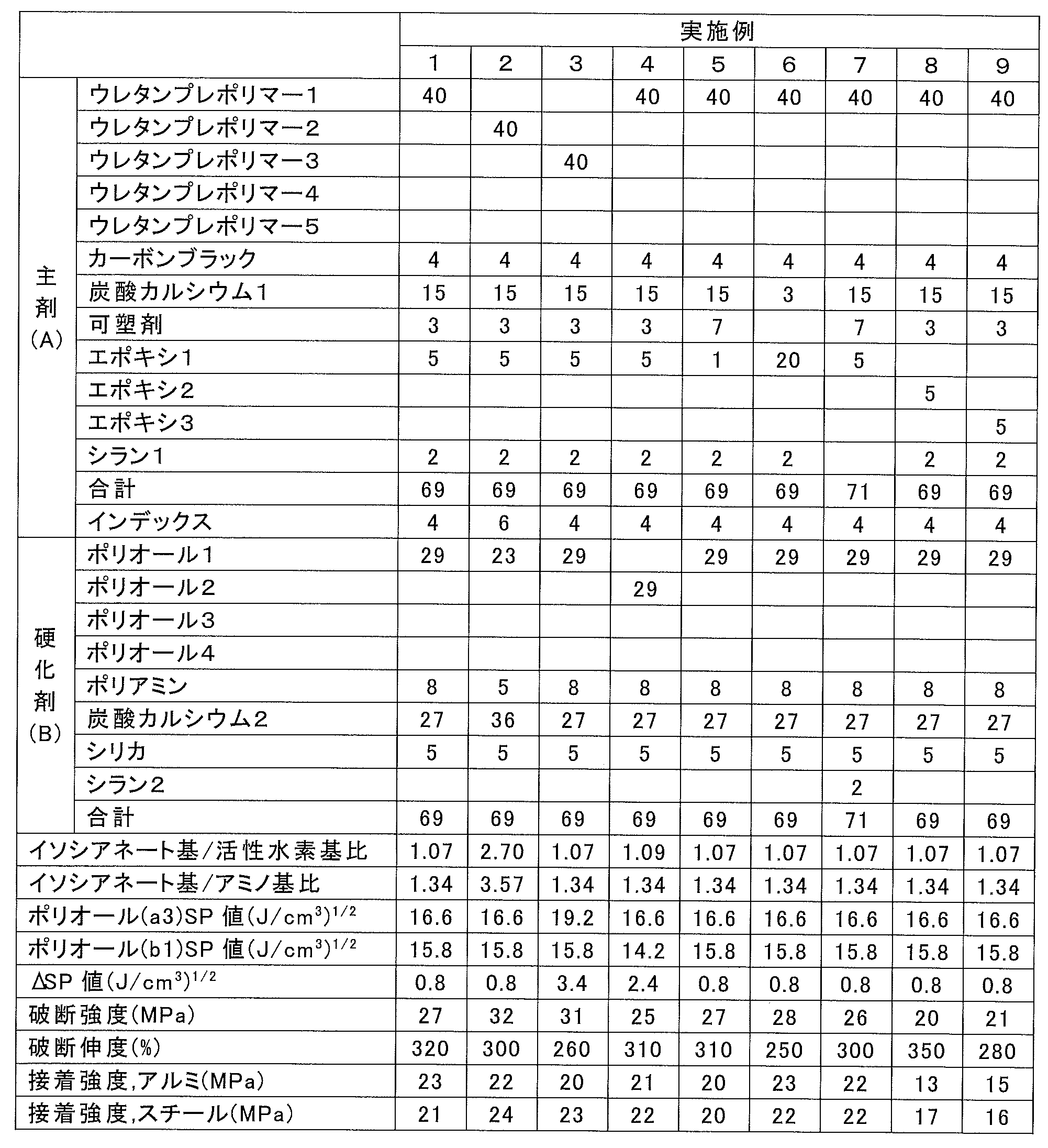

また、当該接着剤組成物によれば、破断強度に優れるポリウレタン系接着剤が得られることがわかる。すなわち、当該接着剤組成物によれば、破断伸度、破断強度等の優れた引張特性と、優れた接着強度とを両立できることがわかる。
Claims (9)
- ウレタンプレポリマー(a1)と、エポキシ化合物(a2)と、を含む主剤(A)と、
ポリオール化合物(b1)と、ポリアミン化合物(b2)と、を含む硬化剤(B)と、を有し、
前記ウレタンプレポリマー(a1)は、原料ポリイソシアネートと、分子内に少なくとも1つの水酸基を有するポリオール化合物(a3)とを、前記ポリオール化合物(a3)中の水酸基に対する前記原料ポリイソシアネート中のイソシアネート基の当量比を2.05~12として、前記ポリオール化合物(a3)のすべてが前記ウレタンプレポリマー(a1)の単量体単位となるよう反応させて得たものであり、
前記主剤(A)は、前記ウレタンプレポリマー(a1)のほか、前記ポリオール化合物(a3)と反応しなかった前記原料ポリイソシアネートの残部である残存ポリイソシアネート(a4)をさらに含み、
前記主剤(A)及び前記硬化剤(B)の少なくとも一方にシラン化合物(X)を含み、
前記ポリオール化合物(a3)及び前記ポリオール化合物(b1)のSP値はそれぞれ14.0~21.0(J/cm3)1/2であり、
前記ポリオール化合物(a3)及び前記ポリオール化合物(b1)のSP値の差が0.1~4.0(J/cm3)1/2である、ことを特徴とする2液硬化型接着剤組成物。 - 前記硬化剤(B)中の活性水素基に対する前記主剤(A)中のイソシアネート基の当量比が0.8~4であり、
前記ポリアミン化合物(b2)中のアミノ基に対する前記主剤(A)中のイソシアネート基の当量比は1.2~6である、請求項1に記載の2液硬化型接着剤組成物。 - 前記ポリオール化合物(a3)は、ポリエステルポリオール、ポリテトラメチレンエーテルグリコール、ポリカーボネートポリオール、ポリカプロラクトンポリオール、及びこれらのそれぞれを部分的に変性させた部分変性物の中から選択される少なくとも1種である、請求項1又は2に記載の2液硬化型接着剤組成物。
- 前記性ポリオール化合物(b1)は、ポリオキシプロピレングリコール、ポリブタジエンポリオール、ポリイソプレンポリオール、ポリアクリルポリオール、及びこれらのそれぞれを部分的に変性させた部分変性物の中から選択される少なくとも1種である、請求項1から3のいずれか1項に記載の2液硬化型接着剤組成物。
- 前記エポキシ化合物(a2)のエポキシ当量は100~500g/eqである、請求項1から4のいずれか1項に記載の2液硬化型接着剤組成物。
- 前記エポキシ化合物(a2)は、分子内に少なくとも1つのウレタン結合を有するエポキシ化合物である、請求項1から5のいずれか1項に記載の2液硬化型接着剤組成物。
- 前記シラン化合物(X)は、分子内に少なくとも1つのイソシアネート基を有するシラン化合物である、請求項1から6のいずれか1項に記載の2液硬化型接着剤組成物。
- 前記2液硬化型接着剤組成物の質量に対する前記エポキシ化合物(a2)の質量が0.1~30質量%である、請求項1から7のいずれか1項に記載の2液硬化型接着剤組成物。
- 前記2液硬化型接着剤組成物を硬化させた硬化物のJIS K6850に準拠した引張せん断接着強さが10MPa以上である、請求項1から8のいずれか1項に記載の2液硬化型接着剤組成物。
Priority Applications (2)
| Application Number | Priority Date | Filing Date | Title |
|---|---|---|---|
| EP21776358.0A EP4130184B1 (en) | 2020-03-27 | 2021-03-26 | Two-liquid curable adhesive composition |
| CN202180024821.7A CN115516055B (zh) | 2020-03-27 | 2021-03-26 | 2液固化型粘接剂组合物 |
Applications Claiming Priority (2)
| Application Number | Priority Date | Filing Date | Title |
|---|---|---|---|
| JP2020057587A JP6904455B1 (ja) | 2020-03-27 | 2020-03-27 | 2液硬化型接着剤組成物 |
| JP2020-057587 | 2020-03-27 |
Publications (1)
| Publication Number | Publication Date |
|---|---|
| WO2021193961A1 true WO2021193961A1 (ja) | 2021-09-30 |
Family
ID=76753218
Family Applications (1)
| Application Number | Title | Priority Date | Filing Date |
|---|---|---|---|
| PCT/JP2021/013080 Ceased WO2021193961A1 (ja) | 2020-03-27 | 2021-03-26 | 2液硬化型接着剤組成物 |
Country Status (4)
| Country | Link |
|---|---|
| EP (1) | EP4130184B1 (ja) |
| JP (1) | JP6904455B1 (ja) |
| CN (1) | CN115516055B (ja) |
| WO (1) | WO2021193961A1 (ja) |
Cited By (1)
| Publication number | Priority date | Publication date | Assignee | Title |
|---|---|---|---|---|
| JP7595206B1 (ja) | 2023-07-18 | 2024-12-05 | artience株式会社 | 接着剤樹脂組成物、硬化物及び積層体 |
Families Citing this family (3)
| Publication number | Priority date | Publication date | Assignee | Title |
|---|---|---|---|---|
| JP7138581B2 (ja) * | 2019-02-06 | 2022-09-16 | サンスター技研株式会社 | 硬化性組成物 |
| KR20240098460A (ko) * | 2022-12-21 | 2024-06-28 | 주식회사 포스코 | 전기강판 접착 코팅 조성물, 전기강판 적층체 및 이의 제조 방법 |
| WO2026063979A1 (en) * | 2024-09-18 | 2026-03-26 | Ppg Industries Ohio, Inc. | Curable compositions |
Citations (6)
| Publication number | Priority date | Publication date | Assignee | Title |
|---|---|---|---|---|
| JPH0363060A (ja) * | 1989-07-31 | 1991-03-19 | Sanyo Chem Ind Ltd | エポキシ系医療用接着剤 |
| JP2014522426A (ja) * | 2011-05-16 | 2014-09-04 | アシュランド・インコーポレーテッド | 高い高温貯蔵弾性率を有する二液型ポリウレア−ウレタン接着剤 |
| WO2014157151A1 (ja) * | 2013-03-26 | 2014-10-02 | 三菱瓦斯化学株式会社 | 活性エネルギー線硬化性樹脂及び該樹脂の硬化物を含むガスバリア性積層体 |
| JP5743042B1 (ja) | 2013-09-26 | 2015-07-01 | 東洋紡株式会社 | ポリウレタン樹脂組成物およびこれを用いた接着剤組成物、積層体、プリント配線板 |
| JP2016074840A (ja) * | 2014-10-08 | 2016-05-12 | スリーボンドファインケミカル株式会社 | 二液型硬化性樹脂組成物 |
| JP2020055921A (ja) * | 2018-09-28 | 2020-04-09 | 横浜ゴム株式会社 | 2液硬化型接着剤組成物 |
Family Cites Families (12)
| Publication number | Priority date | Publication date | Assignee | Title |
|---|---|---|---|---|
| JP4548072B2 (ja) * | 2004-09-30 | 2010-09-22 | 横浜ゴム株式会社 | 2液硬化型ポリウレタン樹脂組成物 |
| JP4747585B2 (ja) * | 2005-01-24 | 2011-08-17 | 横浜ゴム株式会社 | 二成分系常温硬化型液状ウレタン組成物およびそれを含む接着材料 |
| JP4677818B2 (ja) * | 2005-04-12 | 2011-04-27 | 横浜ゴム株式会社 | 室温硬化型ポリウレタン樹脂組成物 |
| ATE517134T1 (de) * | 2007-02-06 | 2011-08-15 | Nolax Ag | Zwei-komponenten klebstoff |
| JP5177252B2 (ja) * | 2011-04-12 | 2013-04-03 | 横浜ゴム株式会社 | エポキシ樹脂組成物 |
| WO2014184270A1 (de) * | 2013-05-15 | 2014-11-20 | Sika Technology Ag | Struktureller polyurethanklebstoff |
| JP2017172053A (ja) * | 2016-03-18 | 2017-09-28 | 日華化学株式会社 | 自動車用内装材料及びその製造方法 |
| EP3436497B1 (en) * | 2016-03-28 | 2022-08-31 | Dow Global Technologies LLC | Two-component solventless adhesive compositions and methods of making same |
| JP6950150B2 (ja) * | 2016-06-09 | 2021-10-13 | 横浜ゴム株式会社 | 2液硬化型ウレタン接着剤組成物 |
| MX2019000364A (es) * | 2016-07-11 | 2019-06-24 | Dow Global Technologies Llc | Composiciones adhesivas de dos componentes y métodos para realizar las mismas. |
| KR101967043B1 (ko) * | 2017-05-12 | 2019-04-08 | 부산대학교 산학협력단 | 높은 연신율 및 내충격성을 갖는 구조용 접착제 조성물 |
| JP6519687B1 (ja) * | 2018-04-12 | 2019-05-29 | 東洋インキScホールディングス株式会社 | 粘着剤、粘着シート、および水酸基末端ウレタンプレポリマーの製造方法 |
-
2020
- 2020-03-27 JP JP2020057587A patent/JP6904455B1/ja active Active
-
2021
- 2021-03-26 WO PCT/JP2021/013080 patent/WO2021193961A1/ja not_active Ceased
- 2021-03-26 EP EP21776358.0A patent/EP4130184B1/en active Active
- 2021-03-26 CN CN202180024821.7A patent/CN115516055B/zh active Active
Patent Citations (6)
| Publication number | Priority date | Publication date | Assignee | Title |
|---|---|---|---|---|
| JPH0363060A (ja) * | 1989-07-31 | 1991-03-19 | Sanyo Chem Ind Ltd | エポキシ系医療用接着剤 |
| JP2014522426A (ja) * | 2011-05-16 | 2014-09-04 | アシュランド・インコーポレーテッド | 高い高温貯蔵弾性率を有する二液型ポリウレア−ウレタン接着剤 |
| WO2014157151A1 (ja) * | 2013-03-26 | 2014-10-02 | 三菱瓦斯化学株式会社 | 活性エネルギー線硬化性樹脂及び該樹脂の硬化物を含むガスバリア性積層体 |
| JP5743042B1 (ja) | 2013-09-26 | 2015-07-01 | 東洋紡株式会社 | ポリウレタン樹脂組成物およびこれを用いた接着剤組成物、積層体、プリント配線板 |
| JP2016074840A (ja) * | 2014-10-08 | 2016-05-12 | スリーボンドファインケミカル株式会社 | 二液型硬化性樹脂組成物 |
| JP2020055921A (ja) * | 2018-09-28 | 2020-04-09 | 横浜ゴム株式会社 | 2液硬化型接着剤組成物 |
Non-Patent Citations (1)
| Title |
|---|
| See also references of EP4130184A4 |
Cited By (2)
| Publication number | Priority date | Publication date | Assignee | Title |
|---|---|---|---|---|
| JP7595206B1 (ja) | 2023-07-18 | 2024-12-05 | artience株式会社 | 接着剤樹脂組成物、硬化物及び積層体 |
| JP2025015406A (ja) * | 2023-07-18 | 2025-01-30 | artience株式会社 | 接着剤樹脂組成物、硬化物及び積層体 |
Also Published As
| Publication number | Publication date |
|---|---|
| CN115516055A (zh) | 2022-12-23 |
| CN115516055B (zh) | 2025-01-10 |
| EP4130184B1 (en) | 2025-10-08 |
| EP4130184A1 (en) | 2023-02-08 |
| JP6904455B1 (ja) | 2021-07-14 |
| EP4130184A4 (en) | 2024-05-01 |
| JP2021155563A (ja) | 2021-10-07 |
Similar Documents
| Publication | Publication Date | Title |
|---|---|---|
| JP6904454B1 (ja) | 2液硬化型接着剤組成物 | |
| US12091586B2 (en) | Two-pack curable adhesive composition | |
| EP4130184B1 (en) | Two-liquid curable adhesive composition | |
| US11932787B2 (en) | Two-part curable adhesive composition | |
| US11993732B2 (en) | Two-part curable adhesive composition | |
| JP7477752B2 (ja) | 2液硬化型接着剤組成物 | |
| US12163061B2 (en) | Two-pack curable adhesive composition | |
| JP7477751B2 (ja) | 2液硬化型接着剤組成物 | |
| JP2023102148A (ja) | 2液硬化型接着剤組成物 |
Legal Events
| Date | Code | Title | Description |
|---|---|---|---|
| 121 | Ep: the epo has been informed by wipo that ep was designated in this application |
Ref document number: 21776358 Country of ref document: EP Kind code of ref document: A1 |
|
| NENP | Non-entry into the national phase |
Ref country code: DE |
|
| ENP | Entry into the national phase |
Ref document number: 2021776358 Country of ref document: EP Effective date: 20221027 |
|
| WWG | Wipo information: grant in national office |
Ref document number: 202180024821.7 Country of ref document: CN |
|
| WWG | Wipo information: grant in national office |
Ref document number: 2021776358 Country of ref document: EP |