WO2021201054A1 - 電池用非水電解液、リチウム二次電池前駆体、リチウム二次電池の製造方法、リチウム二次電池、ホスファゼン化合物、及び電池用添加剤 - Google Patents
電池用非水電解液、リチウム二次電池前駆体、リチウム二次電池の製造方法、リチウム二次電池、ホスファゼン化合物、及び電池用添加剤 Download PDFInfo
- Publication number
- WO2021201054A1 WO2021201054A1 PCT/JP2021/013723 JP2021013723W WO2021201054A1 WO 2021201054 A1 WO2021201054 A1 WO 2021201054A1 JP 2021013723 W JP2021013723 W JP 2021013723W WO 2021201054 A1 WO2021201054 A1 WO 2021201054A1
- Authority
- WO
- WIPO (PCT)
- Prior art keywords
- bonded
- battery
- lithium secondary
- secondary battery
- phosphazene compound
- Prior art date
- Legal status (The legal status is an assumption and is not a legal conclusion. Google has not performed a legal analysis and makes no representation as to the accuracy of the status listed.)
- Ceased
Links
Images


Classifications
-
- C—CHEMISTRY; METALLURGY
- C07—ORGANIC CHEMISTRY
- C07F—ACYCLIC, CARBOCYCLIC OR HETEROCYCLIC COMPOUNDS CONTAINING ELEMENTS OTHER THAN CARBON, HYDROGEN, HALOGEN, OXYGEN, NITROGEN, SULFUR, SELENIUM OR TELLURIUM
- C07F9/00—Compounds containing elements of Groups 5 or 15 of the Periodic Table
- C07F9/02—Phosphorus compounds
- C07F9/06—Phosphorus compounds without P—C bonds
- C07F9/062—Organo-phosphoranes without P-C bonds
- C07F9/065—Phosphoranes containing the structure P=N-
- C07F9/067—Polyphosphazenes containing the structure [P=N-n]
-
- H—ELECTRICITY
- H01—ELECTRIC ELEMENTS
- H01M—PROCESSES OR MEANS, e.g. BATTERIES, FOR THE DIRECT CONVERSION OF CHEMICAL ENERGY INTO ELECTRICAL ENERGY
- H01M10/00—Secondary cells; Manufacture thereof
- H01M10/05—Accumulators with non-aqueous electrolyte
- H01M10/056—Accumulators with non-aqueous electrolyte characterised by the materials used as electrolytes, e.g. mixed inorganic/organic electrolytes
- H01M10/0564—Accumulators with non-aqueous electrolyte characterised by the materials used as electrolytes, e.g. mixed inorganic/organic electrolytes the electrolyte being constituted of organic materials only
- H01M10/0566—Liquid materials
- H01M10/0567—Liquid materials characterised by the additives
-
- C—CHEMISTRY; METALLURGY
- C07—ORGANIC CHEMISTRY
- C07C—ACYCLIC OR CARBOCYCLIC COMPOUNDS
- C07C309/00—Sulfonic acids; Halides, esters, or anhydrides thereof
- C07C309/01—Sulfonic acids
- C07C309/02—Sulfonic acids having sulfo groups bound to acyclic carbon atoms
- C07C309/03—Sulfonic acids having sulfo groups bound to acyclic carbon atoms of an acyclic saturated carbon skeleton
- C07C309/06—Sulfonic acids having sulfo groups bound to acyclic carbon atoms of an acyclic saturated carbon skeleton containing halogen atoms, or nitro or nitroso groups bound to the carbon skeleton
-
- C—CHEMISTRY; METALLURGY
- C07—ORGANIC CHEMISTRY
- C07C—ACYCLIC OR CARBOCYCLIC COMPOUNDS
- C07C311/00—Amides of sulfonic acids, i.e. compounds having singly-bound oxygen atoms of sulfo groups replaced by nitrogen atoms, not being part of nitro or nitroso groups
- C07C311/48—Amides of sulfonic acids, i.e. compounds having singly-bound oxygen atoms of sulfo groups replaced by nitrogen atoms, not being part of nitro or nitroso groups having nitrogen atoms of sulfonamide groups further bound to another hetero atom
-
- C—CHEMISTRY; METALLURGY
- C07—ORGANIC CHEMISTRY
- C07F—ACYCLIC, CARBOCYCLIC OR HETEROCYCLIC COMPOUNDS CONTAINING ELEMENTS OTHER THAN CARBON, HYDROGEN, HALOGEN, OXYGEN, NITROGEN, SULFUR, SELENIUM OR TELLURIUM
- C07F5/00—Compounds containing elements of Groups 3 or 13 of the Periodic Table
- C07F5/02—Boron compounds
- C07F5/022—Boron compounds without C-boron linkages
-
- C—CHEMISTRY; METALLURGY
- C07—ORGANIC CHEMISTRY
- C07F—ACYCLIC, CARBOCYCLIC OR HETEROCYCLIC COMPOUNDS CONTAINING ELEMENTS OTHER THAN CARBON, HYDROGEN, HALOGEN, OXYGEN, NITROGEN, SULFUR, SELENIUM OR TELLURIUM
- C07F9/00—Compounds containing elements of Groups 5 or 15 of the Periodic Table
- C07F9/02—Phosphorus compounds
- C07F9/06—Phosphorus compounds without P—C bonds
- C07F9/22—Amides of acids of phosphorus
- C07F9/24—Esteramides
- C07F9/2454—Esteramides the amide moiety containing a substituent or a structure which is considered as characteristic
- C07F9/2458—Esteramides the amide moiety containing a substituent or a structure which is considered as characteristic of aliphatic amines
-
- C—CHEMISTRY; METALLURGY
- C07—ORGANIC CHEMISTRY
- C07F—ACYCLIC, CARBOCYCLIC OR HETEROCYCLIC COMPOUNDS CONTAINING ELEMENTS OTHER THAN CARBON, HYDROGEN, HALOGEN, OXYGEN, NITROGEN, SULFUR, SELENIUM OR TELLURIUM
- C07F9/00—Compounds containing elements of Groups 5 or 15 of the Periodic Table
- C07F9/02—Phosphorus compounds
- C07F9/547—Heterocyclic compounds, e.g. containing phosphorus as a ring hetero atom
- C07F9/6564—Heterocyclic compounds, e.g. containing phosphorus as a ring hetero atom having phosphorus atoms, with or without nitrogen, oxygen, sulfur, selenium or tellurium atoms, as ring hetero atoms
- C07F9/6571—Heterocyclic compounds, e.g. containing phosphorus as a ring hetero atom having phosphorus atoms, with or without nitrogen, oxygen, sulfur, selenium or tellurium atoms, as ring hetero atoms having phosphorus and oxygen atoms as the only ring hetero atoms
- C07F9/657163—Heterocyclic compounds, e.g. containing phosphorus as a ring hetero atom having phosphorus atoms, with or without nitrogen, oxygen, sulfur, selenium or tellurium atoms, as ring hetero atoms having phosphorus and oxygen atoms as the only ring hetero atoms the ring phosphorus atom being bound to at least one carbon atom
- C07F9/657181—Heterocyclic compounds, e.g. containing phosphorus as a ring hetero atom having phosphorus atoms, with or without nitrogen, oxygen, sulfur, selenium or tellurium atoms, as ring hetero atoms having phosphorus and oxygen atoms as the only ring hetero atoms the ring phosphorus atom being bound to at least one carbon atom the ring phosphorus atom and, at least, one ring oxygen atom being part of a (thio)phosphonic acid derivative
-
- H—ELECTRICITY
- H01—ELECTRIC ELEMENTS
- H01M—PROCESSES OR MEANS, e.g. BATTERIES, FOR THE DIRECT CONVERSION OF CHEMICAL ENERGY INTO ELECTRICAL ENERGY
- H01M10/00—Secondary cells; Manufacture thereof
- H01M10/05—Accumulators with non-aqueous electrolyte
- H01M10/052—Li-accumulators
-
- H—ELECTRICITY
- H01—ELECTRIC ELEMENTS
- H01M—PROCESSES OR MEANS, e.g. BATTERIES, FOR THE DIRECT CONVERSION OF CHEMICAL ENERGY INTO ELECTRICAL ENERGY
- H01M10/00—Secondary cells; Manufacture thereof
- H01M10/05—Accumulators with non-aqueous electrolyte
- H01M10/052—Li-accumulators
- H01M10/0525—Rocking-chair batteries, i.e. batteries with lithium insertion or intercalation in both electrodes; Lithium-ion batteries
-
- H—ELECTRICITY
- H01—ELECTRIC ELEMENTS
- H01M—PROCESSES OR MEANS, e.g. BATTERIES, FOR THE DIRECT CONVERSION OF CHEMICAL ENERGY INTO ELECTRICAL ENERGY
- H01M10/00—Secondary cells; Manufacture thereof
- H01M10/05—Accumulators with non-aqueous electrolyte
- H01M10/056—Accumulators with non-aqueous electrolyte characterised by the materials used as electrolytes, e.g. mixed inorganic/organic electrolytes
- H01M10/0564—Accumulators with non-aqueous electrolyte characterised by the materials used as electrolytes, e.g. mixed inorganic/organic electrolytes the electrolyte being constituted of organic materials only
- H01M10/0566—Liquid materials
- H01M10/0568—Liquid materials characterised by the solutes
-
- H—ELECTRICITY
- H01—ELECTRIC ELEMENTS
- H01M—PROCESSES OR MEANS, e.g. BATTERIES, FOR THE DIRECT CONVERSION OF CHEMICAL ENERGY INTO ELECTRICAL ENERGY
- H01M10/00—Secondary cells; Manufacture thereof
- H01M10/05—Accumulators with non-aqueous electrolyte
- H01M10/056—Accumulators with non-aqueous electrolyte characterised by the materials used as electrolytes, e.g. mixed inorganic/organic electrolytes
- H01M10/0564—Accumulators with non-aqueous electrolyte characterised by the materials used as electrolytes, e.g. mixed inorganic/organic electrolytes the electrolyte being constituted of organic materials only
- H01M10/0566—Liquid materials
- H01M10/0569—Liquid materials characterised by the solvents
-
- H—ELECTRICITY
- H01—ELECTRIC ELEMENTS
- H01M—PROCESSES OR MEANS, e.g. BATTERIES, FOR THE DIRECT CONVERSION OF CHEMICAL ENERGY INTO ELECTRICAL ENERGY
- H01M10/00—Secondary cells; Manufacture thereof
- H01M10/05—Accumulators with non-aqueous electrolyte
- H01M10/058—Construction or manufacture
-
- H—ELECTRICITY
- H01—ELECTRIC ELEMENTS
- H01M—PROCESSES OR MEANS, e.g. BATTERIES, FOR THE DIRECT CONVERSION OF CHEMICAL ENERGY INTO ELECTRICAL ENERGY
- H01M10/00—Secondary cells; Manufacture thereof
- H01M10/42—Methods or arrangements for servicing or maintenance of secondary cells or secondary half-cells
- H01M10/4235—Safety or regulating additives or arrangements in electrodes, separators or electrolyte
-
- H—ELECTRICITY
- H01—ELECTRIC ELEMENTS
- H01M—PROCESSES OR MEANS, e.g. BATTERIES, FOR THE DIRECT CONVERSION OF CHEMICAL ENERGY INTO ELECTRICAL ENERGY
- H01M4/00—Electrodes
- H01M4/02—Electrodes composed of, or comprising, active material
- H01M4/36—Selection of substances as active materials, active masses, active liquids
- H01M4/48—Selection of substances as active materials, active masses, active liquids of inorganic oxides or hydroxides
- H01M4/50—Selection of substances as active materials, active masses, active liquids of inorganic oxides or hydroxides of manganese
- H01M4/505—Selection of substances as active materials, active masses, active liquids of inorganic oxides or hydroxides of manganese of mixed oxides or hydroxides containing manganese for inserting or intercalating light metals, e.g. LiMn2O4 or LiMn2OxFy
-
- H—ELECTRICITY
- H01—ELECTRIC ELEMENTS
- H01M—PROCESSES OR MEANS, e.g. BATTERIES, FOR THE DIRECT CONVERSION OF CHEMICAL ENERGY INTO ELECTRICAL ENERGY
- H01M4/00—Electrodes
- H01M4/02—Electrodes composed of, or comprising, active material
- H01M4/36—Selection of substances as active materials, active masses, active liquids
- H01M4/48—Selection of substances as active materials, active masses, active liquids of inorganic oxides or hydroxides
- H01M4/52—Selection of substances as active materials, active masses, active liquids of inorganic oxides or hydroxides of nickel, cobalt or iron
- H01M4/525—Selection of substances as active materials, active masses, active liquids of inorganic oxides or hydroxides of nickel, cobalt or iron of mixed oxides or hydroxides containing iron, cobalt or nickel for inserting or intercalating light metals, e.g. LiNiO2, LiCoO2 or LiCoOxFy
-
- H—ELECTRICITY
- H01—ELECTRIC ELEMENTS
- H01M—PROCESSES OR MEANS, e.g. BATTERIES, FOR THE DIRECT CONVERSION OF CHEMICAL ENERGY INTO ELECTRICAL ENERGY
- H01M2300/00—Electrolytes
- H01M2300/0017—Non-aqueous electrolytes
- H01M2300/0025—Organic electrolyte
-
- Y—GENERAL TAGGING OF NEW TECHNOLOGICAL DEVELOPMENTS; GENERAL TAGGING OF CROSS-SECTIONAL TECHNOLOGIES SPANNING OVER SEVERAL SECTIONS OF THE IPC; TECHNICAL SUBJECTS COVERED BY FORMER USPC CROSS-REFERENCE ART COLLECTIONS [XRACs] AND DIGESTS
- Y02—TECHNOLOGIES OR APPLICATIONS FOR MITIGATION OR ADAPTATION AGAINST CLIMATE CHANGE
- Y02E—REDUCTION OF GREENHOUSE GAS [GHG] EMISSIONS, RELATED TO ENERGY GENERATION, TRANSMISSION OR DISTRIBUTION
- Y02E60/00—Enabling technologies; Technologies with a potential or indirect contribution to GHG emissions mitigation
- Y02E60/10—Energy storage using batteries
-
- Y—GENERAL TAGGING OF NEW TECHNOLOGICAL DEVELOPMENTS; GENERAL TAGGING OF CROSS-SECTIONAL TECHNOLOGIES SPANNING OVER SEVERAL SECTIONS OF THE IPC; TECHNICAL SUBJECTS COVERED BY FORMER USPC CROSS-REFERENCE ART COLLECTIONS [XRACs] AND DIGESTS
- Y02—TECHNOLOGIES OR APPLICATIONS FOR MITIGATION OR ADAPTATION AGAINST CLIMATE CHANGE
- Y02P—CLIMATE CHANGE MITIGATION TECHNOLOGIES IN THE PRODUCTION OR PROCESSING OF GOODS
- Y02P70/00—Climate change mitigation technologies in the production process for final industrial or consumer products
- Y02P70/50—Manufacturing or production processes characterised by the final manufactured product
Definitions
- the present disclosure relates to a non-aqueous electrolyte solution for a battery, a lithium secondary battery precursor, a method for manufacturing a lithium secondary battery, a lithium secondary battery, a phosphazene compound, and an additive for a battery.
- non-aqueous electrolytic solution for example, a lithium secondary battery
- various additives are added to the non-aqueous electrolytic solution.
- Patent Document 1 as an electrolytic solution for a non-aqueous battery having high flame retardancy, an electrolytic solution for a non-aqueous battery containing an additive containing a cyclic phosphazene compound represented by (NPR 2 ) n in a non-aqueous solvent.
- Liquids are described (where R represents a halogen element, an alkoxy group or an aryloxy group, respectively, and n represents 3 or 4).
- Patent Document 2 describes a positive electrode and a negative electrode capable of storing and releasing lithium as a non-aqueous electrolyte battery showing excellent battery performance without risk of explosion or ignition even in the event of an abnormality such as a short circuit.
- a non-aqueous electrolyte battery comprising a non-aqueous electrolyte containing lithium ions
- a non-aqueous electrolyte battery using a solution of a lithium salt in a phosphazene derivative having a viscosity of 300 cP or less at 25 ° C. is described as the electrolyte. There is.
- Patent Document 1 Japanese Patent Application Laid-Open No. 2009-129541
- Patent Document 2 Japanese Patent Application Laid-Open No. 6-13108
- An object of one aspect of the present disclosure is a non-aqueous electrolyte solution for a battery, a lithium secondary battery precursor, a method for producing a lithium secondary battery, a phosphazene compound, which can suppress an increase in the temperature rise rate inside the battery when an internal short circuit occurs. And to provide battery additives.
- Z ⁇ is an anion represented by removing protons from an inorganic acid or an active hydrogen compound
- 24 Rs are hydrocarbon groups having 1 to 10 carbon atoms independently.
- Y - and Z - is independently an anion represented by the form obtained by removing a proton from an inorganic acid or an active hydrogen compound
- 24 R are each independently a carbon number of 1 to ⁇ Of the 24 Rs, which are 10 hydrocarbon groups, 2 Rs bonded to the same nitrogen atom may be bonded to each other.
- the 24 Rs are independently alkyl groups having 1 to 3 carbon atoms, and of the 24 Rs, the two Rs bonded to the same nitrogen atom are mutually exclusive. May be combined,
- the 24 Rs are independently alkyl groups having 1 to 3 carbon atoms, and of the 24 Rs, the two Rs bonded to the same nitrogen atom are bonded to each other.
- all Rs are methyl groups or ethyl groups, and two Rs bonded to the same nitrogen atom among the 24 Rs may be bonded to each other.
- Z - is, PF 6 -, SO 3 CF 3 -, BF 4 -, ClO 4 -, PO 2 F 2 -, the following (TFSI -), the following (FSI -), below (FOB -), the following (BOB -), or the following - a, (CA)
- Y - and Z - is independently, PF 6 -, SO 3 CF 3 -, BF 4 -, ClO 4 -, PO 2 F 2 -, the following (TFSI -), the following (FSI -), the following (FOB -), the following (BOB -), or following (CA - a)
- ⁇ 6> The non-aqueous electrolytic solution for a battery according to any one of ⁇ 1> to ⁇ 5>, which further contains a cyclic carbonate having an unsaturated bond.
- ⁇ 7> The non-aqueous electrolyte solution for a battery according to ⁇ 6>, wherein the cyclic carbonate having an unsaturated bond is vinylene carbonate.
- ⁇ 8> The battery according to ⁇ 6> or ⁇ 7>, wherein the ratio of the content mass of the cyclic carbonate having an unsaturated bond to the content mass of the phosphazene compound (A) is in the range of 0.05 to 30.
- Non-aqueous electrolyte is in the range of 0.05 to 30.
- the positive electrode is a positive electrode capable of occluding and releasing lithium ions.
- the negative electrode is a negative electrode capable of occluding and releasing lithium ions.
- a lithium secondary battery precursor in which the electrolytic solution is the non-aqueous electrolytic solution for a battery according to any one of ⁇ 1> to ⁇ 8>.
- the step of preparing the lithium secondary battery precursor according to ⁇ 9> or ⁇ 10>, and A step of obtaining a lithium secondary battery by subjecting the lithium secondary battery precursor to an activation treatment, and Including The activation treatment is a method for producing a lithium secondary battery, which comprises subjecting the lithium secondary battery precursor to at least one of charging and discharging in an environment of 15 ° C. to 70 ° C.
- Z ⁇ is an inorganic acid (excluding hydrogen chloride, hexafluorophosphoric acid, (TFSI ⁇ ), and (FSI ⁇ )) or an active hydrogen compound (provided that water, formic acid, and It is an anion represented by removing protons from (excluding acetic acid), and 24 Rs are each independently a hydrocarbon group having 1 to 10 carbon atoms, and the same nitrogen atom among the 24 Rs. The two Rs bound to may be bound to each other.
- Y - and Z - is independently an anion represented by the form obtained by removing a proton from an inorganic acid or an active hydrogen compound
- 24 R are each independently a carbon number of 1 to ⁇ Of the 24 Rs, which are 10 hydrocarbon groups, 2 Rs bonded to the same nitrogen atom may be bonded to each other.
- An additive for a battery which comprises a phosphazene compound (A) containing at least one of a phosphazene compound represented by the following formula (1) and a phosphazene compound represented by the following formula (2).
- Z ⁇ is an anion represented by removing protons from an inorganic acid or an active hydrogen compound
- 24 Rs are each independently a hydrocarbon group having 1 to 10 carbon atoms. There, two Rs that are bonded to the same nitrogen atom among the 24 Rs may be bonded to each other.
- Y - and Z - is independently an anion represented by the form obtained by removing a proton from an inorganic acid or an active hydrogen compound
- 24 R are each independently a carbon number of 1 to ⁇ Of the 24 Rs, which are 10 hydrocarbon groups, 2 Rs bonded to the same nitrogen atom may be bonded to each other.
- the numerical range represented by using “-” means a range including the numerical values before and after "-" as the lower limit value and the upper limit value.
- the amount of each component in the composition is the total amount of the plurality of substances present in the composition unless otherwise specified, when a plurality of substances corresponding to each component are present in the composition. Means.
- the term "process” is included in this term not only as an independent process but also as long as the intended purpose of the process is achieved even if it cannot be clearly distinguished from other processes. Is done.
- the phosphazene compound (A) contained in the non-aqueous electrolytic solution for batteries of the present disclosure includes at least one of a phosphazene compound represented by the following formula (1) and a phosphazene compound represented by the following formula (2).
- Z ⁇ is an anion represented by removing protons from an inorganic acid or an active hydrogen compound
- 24 Rs are hydrocarbon groups having 1 to 10 carbon atoms independently.
- Y - and Z - is independently an anion represented by the form obtained by removing a proton from an inorganic acid or an active hydrogen compound
- 24 R are each independently a carbon number of 1 to ⁇ Of the 24 Rs, which are 10 hydrocarbon groups, 2 Rs bonded to the same nitrogen atom may be bonded to each other.
- inorganic acids include hydrogen halide (eg, hydrogen fluoride, hydrogen chloride, hydrogen bromide, hydrogen iodide, bromoform, etc.), sulfuric acid, perchloric acid, and phosphoric acid compounds (eg, hydrogen fluoride, hydrogen chloride, bromoform, etc.). , Hexafluorophosphate, etc.), boric acid compounds (eg, tetrafluoroboric acid, etc.), hydrogen cyanide, thiocyan acid, hydrogen azide, and the like.
- hydrogen halide eg, hydrogen fluoride, hydrogen chloride, hydrogen bromide, hydrogen iodide, bromoform, etc.
- sulfuric acid perchloric acid
- phosphoric acid compounds eg, hydrogen fluoride, hydrogen chloride, bromoform, etc.
- phosphoric acid compounds eg, hydrogen fluoride, hydrogen chloride, bromoform, etc.
- phosphoric acid compounds eg, hydrogen fluoride, hydrogen chloride
- the above-mentioned active hydrogen compound is not limited as long as it can give an anion other than a proton.
- a compound in which an active hydrogen atom is bonded to a carbon atom and an active hydrogen atom in which an oxygen atom is bonded to an oxygen atom examples include compounds in which an active hydrogen atom is bonded to a nitrogen atom, and compounds in which an active hydrogen atom is bonded to a sulfur atom.
- Examples of the compound in which an active hydrogen atom is bonded to a carbon atom include a cyano group, a nitro group, a phenyl group, an acyl group, an alkoxycarbonyl group, an alkenyl group, and an alkynyl group in the carbon atom having at least one hydrogen atom.
- Examples thereof include a compound to be bonded or a compound in which an active hydrogen atom is directly bonded to an alkenyl group or an alkynyl group.
- Specific examples of compounds in which an active hydrogen atom is bonded to a carbon atom include acetonitrile, n-valeronitrile, n-butyronitrile, adiponitrile, malononitrile, phenylnitrile, succinate nitrile, and 3-methoxypropionitrile. , 4-Methylbenzylcyanide, 2-nitrophenylnitrile, 4-methoxyphenyl acetonitrile, glutaronitrile, 3-phenylpropionitrile, cyclopentenyl acetonitrile, isopropyridene malononitrile, benzoyl acetonitrile, pivaloyl acetonitrile and other cyano groups.
- Compounds in which an active hydrogen atom is bonded to an oxygen atom include, for example, water, carboxylic acids having a total carbon number of 1 to 20 including a carbon atom of a carbonyl group, and compounds having a total carbon number of 2 to 20 including a carbon atom of a carbonyl group.
- carboxylic acids having a total carbon number of 1 to 20 including a carbon atom of a carbonyl group
- compounds having a total carbon number of 2 to 20 including a carbon atom of a carbonyl group examples thereof include carbamic acids, sulfonic acids having 1 to 20 carbon atoms, alcohols having 1 to 20 carbon atoms, saccharides or derivatives thereof, aromatic compounds having a hydroxyl group having 6 to 20 carbon atoms, and polyalkylene oxides.
- carboxylic acids having a total carbon number of 1 to 20 containing a carbon atom of a carbonyl group include formic acid, acetic acid, butyric acid, isobutyric acid, lauric acid, stearic acid, oleic acid, phenylacetic acid, dihydroceramic acid, cyclohexanecarboxylic acid, and the like.
- Monocarboxylic acids such as benzoic acid and 2-carboxynaphthalene; oxalic acid, malonic acid, succinic acid, maleic acid, fumaric acid, adipic acid, butanetetracarboxylic acid, isophthalic acid, terephthalic acid, trimellitic acid, pyromellitic acid, etc.
- carbamic acids having a total carbon number of 2 to 20 including a carbon atom of a carbonyl group include N, N-diethylcarbamic acid, N-carboxypyrrolidone, N-carboxyaniline or N, N'-dicarboxy-2,4. -Toluenediamine and the like can be mentioned.
- sulfonic acids having 1 to 20 carbon atoms include fluorosulfonic acid, methanesulfonic acid, ethanesulfonic acid, p-toluenesulfonic acid, 4-ethylbenzenesulfonic acid, picrylsulfonic acid, 4-nitrobenzenesulfonic acid, 3-.
- examples thereof include (N-morpholino) propanesulfonic acid, 2-morpholinoetansulfonic acid, 2-naphthalenesulfonic acid, 4,4′-biphenyldisulfonic acid, 4-nitrotoluene-2-sulfonic acid and 3-pyridinesulfonic acid.
- alcohols having 1 to 20 carbon atoms include methanol, ethanol, n-butyl alcohol, sec-butyl alcohol, tert-butyl alcohol, n-octyl alcohol, lauryl alcohol, cyclopentanol, cyclohexanol, and allyl alcohol.
- Monohydric alcohols such as benzyl alcohol, 1-phenylethyl alcohol, triphenylcarbinol, cinnamyl alcohol; ethylene glycol, propylene glycol, diethylene glycol, dipropylene glycol, 1,3-propanediol, 1,4-butanediol , 1,6-Hexanediol, 1,4-Cyclohexanediol, trimethylolpropane, glycerin, diglycerin, pentaerythritol or dipentaerythritol and other polyhydric alcohols.
- saccharides or derivatives thereof include glucose, sorbitol, dextrose, fructose, sucrose and the like.
- aromatic compounds having a hydroxyl group having 6 to 20 carbon atoms include phenol, catechol, resorcinol, hydroquinone, 1-naphthol, 2-naphthol, 1,2-dihydroxynaphthalene, 2,6-dihydroxynaphthalene, and o-.
- aromatic compounds having a hydroxyl group having 6 to 20 carbon atoms include phenol, catechol, resorcinol, hydroquinone, 1-naphthol, 2-naphthol, 1,2-dihydroxynaphthalene, 2,6-dihydroxynaphthalene, and o-.
- polyalkylene oxides examples include polyethylene oxide, polypropylene oxide, and copolymers thereof.
- Compounds in which an active hydrogen atom is bonded to a nitrogen atom include aliphatic primary amines having 1 to 20 carbon atoms, aromatic primary amines having 6 to 20 carbon atoms, and aliphatic secondary amines having a total carbon number of 2 to 20.
- Amines aromatic secondary amines with a total carbon number of 6 to 20, polyvalent amines having a primary or secondary amino group with a total carbon number of 2 to 20, saturated or unsaturated cyclic amines with a total carbon number of 4 to 20
- Secondary amines cyclic polyvalent amines containing secondary amino groups having 4 to 20 total carbon atoms, acid amides having 2 to 20 total carbon atoms containing carbon atoms of carbonyl groups obtained from primary or secondary amines, Examples thereof include cyclic amides having a 5- to 7-membered ring, and imides of dicarboxylic acids having a total carbon number of 4 to 10 containing a carbon atom of a carbonyl group.
- Examples of aliphatic primary amines having 1 to 20 carbon atoms include methylamine, ethylamine, n-butylamine, isobutylamine, sec-butylamine, tert-butylamine and cyclohexylamine.
- aromatic primary amines having 6 to 20 carbon atoms include benzylamine, ⁇ -phenylethylamine, aniline, o-toluidine, m-toluidine, p-toluidine and the like.
- Examples of aliphatic secondary amines having a total carbon number of 2 to 20 include dimethylamine, methylethylamine, diethylamine, ethyl-n-butylamine, methyl-sec-butylamine, dipentylamine, dicyclohexylamine and the like.
- aromatic secondary amines having a total carbon number of 6 to 20 include N-methylaniline and diphenylamine.
- polyvalent amines having a primary or secondary amino group having 2 to 20 total carbon atoms examples include ethylenediamine, di (2-aminoethyl) amine, hexamethylenediamine, 4,4'-diaminodiphenylmethane, and tri (2).
- -Aminoethyl) amine, N, N'-dimethylethylenediamine, N, N'-diethylethylenediamine, di (2-methylaminoethyl) amine and the like can be mentioned.
- saturated or unsaturated cyclic secondary amines having 4 to 20 total carbon atoms include pyrrolidine, piperidine, morpholine, 1,2,3,4-tetrahydroquinoline, 3-pyrroline, pyrrole, indole, carbazole, and imidazole. , Pyrazole or purine.
- cyclic polyvalent amines containing a secondary amino group having 4 to 20 total carbon atoms include piperazine, pyrazine, 1,4,7-triazacyclononane and the like.
- acid amides having a total carbon number of 2 to 20 including a carbon atom of a carbonyl group obtained from a primary or secondary amine include acetamide, propionamide, N-methylpropionamide, N-methylbenzoic acid amide or N-. Examples thereof include ethyl stearate amide.
- Examples of the 5- to 7-membered cyclic amides include 2-pyrrolidone and ⁇ -caprolactam.
- imides of dicarboxylic acids having a total carbon number of 4 to 10 including carbon atoms of a carbonyl group include succinimide, maleate imide, and phthalimide.
- Compounds in which an active hydrogen atom is bonded to a sulfur atom include monovalent thiols having 1 to 10 carbon atoms, polyvalent thiols having 1 to 10 carbon atoms, aromatic mercapto compounds having 1 to 10 carbon atoms, and the like. Can be mentioned.
- Examples of monovalent thiols having 1 to 10 carbon atoms include methanethiol, ethanethiol, n-butanethiol, tert-butanethiol, hexanethiol, decanethiol, cyclopentyl mercaptan, cyclohexyl mercaptan and the like.
- polyvalent thiols having 1 to 10 carbon atoms examples include 1,2-ethanedithiol, 1,3-propanedithiol, 2,3-butanedithiol, 1,6-hexanedithiol, 1,2,3-propane. Examples thereof include trithiol or 2,3-di (mercaptomethyl) -1,4-butanedithiol.
- aromatic mercapto compounds having 1 to 10 carbon atoms examples include thiophenol, o-thiocresol, thionaphthol, 1,2-benzenedithiol and the like.
- Z - is, PF 6 -, SO 3 CF 3 -, BF 4 -, ClO 4 -, PO 2 F 2 -, the following (TFSI -), the following (FSI -), the following (FOB - ), the following (BOB -), or following (CA - is preferably).
- Y - and Z - is independently, PF 6 -, SO 3 CF 3 -, BF 4 -, ClO 4 -, PO 2 F 2 -, the following (TFSI -), the following (FSI -), the following (FOB -), the following (BOB -), or following (CA - is preferably).
- the 24 Rs are each independently a hydrocarbon group having 1 to 10 carbon atoms, and of the 24 Rs, the two Rs bonded to the same nitrogen atom are bonded to each other. May be good.
- the 24 Rs are each independently a hydrocarbon group having 1 to 10 carbon atoms, and of the 24 Rs, the two Rs bonded to the same nitrogen atom are bonded to each other. May be good.
- hydrocarbon group having 1 to 10 carbon atoms examples include a methyl group, an ethyl group, an n-butyl group, a sec-butyl group, a tert-butyl group, a 2-butenyl group, a 1-pentyl group and a 2-methyl-1 group.
- tert-pentyl group 3-methyl-2-butyl group, neopentyl group, n-hexyl group, 4-methyl-2-pentyl group, cyclopentyl group, cyclohexyl group, 1-octyl group, 2-octyl group , 2-Ethyl-1-hexyl group, 1,1-dimethyl-3,3-dimethylbutyl (commonly known as tert-octyl) group, phenyl group, 4-toluyl group, benzyl group, 1-phenylethyl group or 2- Examples include aliphatic or aromatic hydrocarbon groups such as phenylethyl groups.
- a methyl group, an ethyl group, an n-propyl group, an isopropyl group, a tert-butyl group, a tert-pentyl group or a 1,1-dimethyl-3,3-dimethylbutyl group is preferable, and a methyl group is more preferable.
- the ring is a divalent linear chain having a main chain having 4 to 6 carbon atoms. It is preferably formed together with a state hydrocarbon group and a nitrogen atom to which the hydrocarbon group is bonded (the ring is a 5- to 7-membered ring containing a nitrogen atom), and the hydrocarbon group is a tetramethylene group. It is preferable that the pentamethylene group or hexamethylene group or their main chain is substituted with an alkyl group such as a methyl group or an ethyl group. Among these, a tetramethylene group or a pentamethylene group is more preferable.
- two Rs in which some or all of the groups are bonded to the same nitrogen atom are bonded to each other. May form a ring.
- a part of the group in which two Rs are bonded to the same nitrogen atom forms a ring, it is bonded to a group in which two Rs are bonded to the other same nitrogen atom that does not form a ring.
- the two Rs include the groups exemplified when the above-mentioned R alone represents a hydrocarbon group, and the same applies to preferable groups.
- each of the 24 Rs is preferably an alkyl group having 1 to 3 carbon atoms independently, and the two Rs bonded to the same nitrogen atom among the 24 Rs are bonded to each other. You may be doing it.
- each of the 24 Rs is preferably an alkyl group having 1 to 3 carbon atoms independently, and the two Rs bonded to the same nitrogen atom among the 24 Rs are bonded to each other. You may be doing it.
- an embodiment in which the two Rs are bonded to the same nitrogen atom among the 24 Rs includes an embodiment in which the above two Rs are integrated to form a tetramethylene group, a pentamethylene group, or the like.
- the compounds belonging to the compound represented by the formula (1) or the formula (2) can be used alone or in combination of two or more.
- the compound represented by the formula (1) or the formula (2) can be synthesized by the method described in JP-A-10-77289 or a similar method.
- the phosphazene compound (A) contained in the non-aqueous electrolyte solution for batteries of the present disclosure is used as an additive for a battery (preferably an additive for a lithium secondary battery, more preferably for a non-aqueous electrolyte solution for a lithium secondary battery).
- a battery preferably an additive for a lithium secondary battery, more preferably for a non-aqueous electrolyte solution for a lithium secondary battery.
- the phosphazene compound (A) contained in the non-aqueous electrolyte solution for batteries of the present disclosure is particularly suitable as an additive for the non-aqueous electrolyte solution for lithium secondary batteries.
- Non-aqueous electrolytic solution for batteries The non-aqueous electrolytic solution for a battery according to an embodiment of the present disclosure (hereinafter, also simply referred to as “non-aqueous electrolytic solution of the present embodiment”) is Electrolytes that are lithium salts and With non-aqueous solvent With the above-mentioned phosphazene compound (A), Contains.
- the non-aqueous electrolyte solution of this embodiment is Electrolytes that are lithium salts and With non-aqueous solvent It contains at least one of a first ion group and a second ion group.
- the first ion group consists of a cation represented by the following formula (PZN + ) and an anion represented by (Z ⁇ ).
- the second ion group consists of a cation represented by the following formula (PZN 2+ ), an anion represented by (Y ⁇ ), and an anion represented by (Z ⁇ ).
- non-aqueous electrolytic solution of the present embodiment it is possible to suppress an increase in the temperature rising rate inside the battery when an internal short circuit occurs.
- non-aqueous electrolytic solution of the present embodiment contains the phosphazene compound (A).
- the non-aqueous electrolytic solution of the present embodiment can suppress an increase in the temperature rising rate inside the battery at the time of an internal short circuit.
- the non-aqueous electrolytic solution of the present embodiment is not limited to the following reasons.
- the lithium secondary battery containing the non-aqueous electrolyte solution of the present embodiment metal due to metal foreign matter brought in from the outside of the battery or metal precipitates inside the battery comes into contact with both positive and negative electrodes inside the battery, causing an internal short circuit.
- the cationic molecule of the phosphazene compound (A) contained in the non-aqueous electrolytic solution is adsorbed on the metal surface to form a film on the metal.
- the electronic resistance of the contact surface between the metal foreign matter or metal precipitate and the positive electrode and the negative electrode is increased, and the short-circuit discharge accompanied by heat generation at the initial stage of short-circuit is suppressed.
- the non-aqueous electrolyte solution of the present embodiment can suppress an increase in the temperature rising rate inside the battery when an internal short circuit occurs.
- the non-aqueous electrolytic solution of the present embodiment may contain only one of the phosphazene compound represented by the formula (1) and the phosphazene compound represented by the following formula (2). Either one may be contained in two or more kinds, or both may be contained in a total of at least two kinds or more.
- the content of the phosphazene compound (A) in the non-aqueous electrolytic solution of the present embodiment is not particularly limited, but is preferably 0.1% by mass to 5.0% by mass with respect to the total amount of the non-aqueous electrolytic solution.
- the content of the phosphazene compound (A) with respect to the total amount of the non-aqueous electrolytic solution is more preferably 0.2% by mass or more, further preferably 0.3% by mass or more, still more preferably 0.5% by mass or more.
- the content of the phosphazene compound (A) with respect to the total amount of the non-aqueous electrolyte solution is 5.0% by mass or less, the chemical stability of the non-aqueous electrolyte solution is further improved.
- the content of the phosphazene compound (A) with respect to the total amount of the non-aqueous electrolytic solution is more preferably 3.0% by mass or less, further preferably 2.5% by mass or less, still more preferably 2.0% by mass or less. ..
- the amount of the phosphazene compound (A) may be reduced as compared with the amount added to the non-aqueous electrolytic solution. .. Therefore, when the phosphazene compound (A) can be detected even in a small amount in the non-aqueous electrolytic solution taken out from the battery, it is included in the range of the non-aqueous electrolytic solution of the present embodiment.
- the compound derived from the decomposition product of the phosphazene compound (A) is detected in the non-aqueous electrolyte solution or in the coating of the electrode.
- the case is also considered to be included in the range of the non-aqueous electrolyte solution of the present embodiment.
- the non-aqueous electrolyte solution of the present embodiment contains at least one type of electrolyte which is a lithium salt.
- the electrolyte for example; Lithium hexafluorophosphate (LiPF 6), lithium tetrafluoroborate (LiBF 4), lithium hexafluoroarsenate (LiAsF 6), lithium hexafluoro tantalate (LiTaF 6), lithium perchlorate (LiClO 4 ), Inorganic acid anion salts such as lithium tetrachloride (LiAlCl 4 ), lithium decachlorodecaborate (Li 2 B 10 Cl 10); Lithium trifluoromethanesulfonate (LiCF 3 SO 3 ), Lithium bis (trifluoromethanesulfonyl) imide (Li (CF 3 SO 2 ) 2 N), Lithium bis (fluorosulfonyl) imide (
- the proportion of the lithium salt in the total electrolyte contained in the non-aqueous electrolyte solution of the present embodiment is preferably 50% by mass to 100% by mass, more preferably 60% by mass to 100% by mass, and further preferably. Is 80% by mass to 100% by mass.
- the ratio of LiPF 6 to the total electrolyte contained in the non-aqueous electrolyte solution of the present embodiment is preferably 50% by mass to 100% by mass, more preferably 60% by mass to 100% by mass, and further preferably. Is 80% by mass to 100% by mass.
- the concentration of the electrolyte in the non-aqueous electrolyte solution of the present embodiment is preferably 0.1 mol / L to 3.0 mol / L, and more preferably 0.5 mol / L to 2.0 mol / L.
- the concentration of LiPF 6 in the non-aqueous electrolytic solution of the present embodiment is preferably 0.1 mol / L to 3.0 mol / L, and more preferably 0.5 mol / L to 2.0 mol / L.
- the non-aqueous electrolytic solution of the present embodiment contains at least one non-aqueous solvent.
- the non-aqueous solvent include cyclic carbonates, fluorocyclic carbonates, chain carbonates, fluorochain carbonates, aliphatic carboxylic acid esters, fluoroaliphatic carboxylic acid esters, and ⁇ -lactones.
- Fluorine-containing ⁇ -lactones Fluorine-containing ⁇ -lactones, cyclic ethers, fluorocyclic ethers, chain ethers, fluorine-containing chain ethers, nitriles, amides, lactams, nitromethane, nitroethane, sulfolane, trimethyl phosphate, dimethyl sulfoxide , Dimethylsulfoxidophosphate, and the like.
- Examples of the cyclic carbonates include ethylene carbonate (EC), propylene carbonate (PC), butylene carbonate (BC), and the like.
- Examples of the fluorine-containing cyclic carbonates include fluoroethylene carbonate (FEC) and the like.
- Examples of chain carbonates include dimethyl carbonate (DMC), diethyl carbonate (DEC), ethyl methyl carbonate (EMC), methyl propyl carbonate (MPC), ethyl propyl carbonate (EPC), dipropyl carbonate (DPC), and the like. Can be mentioned.
- Examples of aliphatic carboxylic acid esters include methyl formate, methyl acetate, methyl propionate, methyl butyrate, methyl isobutyrate, methyl trimethylbutyrate, ethyl formate, ethyl acetate, ethyl propionate, ethyl butyrate, ethyl isobutyrate, and trimethyl. Ethyl butyrate, etc. may be mentioned.
- Examples of ⁇ -lactones include ⁇ -butyrolactone, ⁇ -valerolactone, and the like.
- Examples of the cyclic ethers include tetrahydrofuran, 2-methyltetrahydrofuran, tetrahydropyran, 1,3-dioxolane, 4-methyl-1,3-dioxolane, 1,3-dioxane, 1,4-dioxane, and the like.
- Examples of chain ethers include 1,2-ethoxyethane (DEE), ethoxymethoxyethane (EME), diethyl ether, 1,2-dimethoxyethane, 1,2-dibutoxyethane, and the like.
- nitriles include acetonitrile, glutaronitrile, adiponitrile, methoxynitrile, 3-methoxypropionitrile, and the like.
- amides include N, N-dimethylformamide, and the like.
- lactams include N-methylpyrrolidinone, N-methyloxazolidinone, N, N'-dimethylimidazolidinone, and the like.
- the non-aqueous solvent preferably contains at least one selected from the group consisting of cyclic carbonates, fluorine-containing cyclic carbonates, chain carbonates, and fluorine-containing chain carbonates.
- the total ratio of the cyclic carbonates, the fluorocyclic carbonates, the chain carbonates, and the fluorine-containing chain carbonates to the non-aqueous solvent is preferably 50% by mass to 100% by mass. It is more preferably 60% by mass to 100% by mass, and further preferably 80% by mass to 100% by mass.
- the non-aqueous solvent preferably contains at least one selected from the group consisting of cyclic carbonates and chain carbonates.
- the total ratio of the cyclic carbonates and the chain carbonates to the non-aqueous solvent is preferably 50% by mass to 100% by mass, more preferably 60% by mass to 100% by mass, and further. It is preferably 80% by mass to 100% by mass.
- the proportion of the non-aqueous solvent in the non-aqueous electrolytic solution of the present embodiment is preferably 60% by mass or more, more preferably 70% by mass or more.
- the upper limit of the ratio of the non-aqueous solvent to the non-aqueous electrolyte solution of the present embodiment depends on the content of other components (phosphazene compound (A), electrolyte, etc.), but the upper limit is, for example, 99% by mass. It is preferably 97% by mass, and more preferably 90% by mass.
- the intrinsic viscosity of the non-aqueous solvent is preferably 10.0 mPa ⁇ s or less at 25 ° C. from the viewpoint of further improving the dissociability of the electrolyte and the mobility of ions.
- the non-aqueous electrolytic solution of the present embodiment may contain at least one cyclic carbonate having an unsaturated bond from the viewpoint of further improving the chemical stability of the non-aqueous electrolytic solution.
- Examples of the cyclic carbonate having an unsaturated bond include a vinylene carbonate-based compound, a vinylethylene carbonate-based compound, and a methyleneethylene carbonate-based compound.
- vinylene carbonate-based compound examples include vinylene carbonate (also known as 1,3-dioxol-2-one), methylvinylene carbonate (also known as 4-methyl-1,3-dioxol-2-one), and ethylvinylene carbonate (also known as 4-methyl-1,3-dioxol-2-one).
- vinylethylene carbonate-based compound examples include vinylethylene carbonate (also known as 4-vinyl-1,3-dioxolane-2-one), 4-methyl-4-vinyl-1,3-dioxolane-2-one, and 4, -Ethyl-4-vinyl-1,3-dioxolane-2-one, 4-n-propyl-4-vinyl-1,3-dioxolane-2-one, 5-methyl-4-vinyl-1,3-dioxolane -2-one, 4,4-divinyl-1,3-dioxolane-2-one, 4,5-divinyl-1,3-dioxolane-2-one, and the like can be mentioned.
- vinylethylene carbonate also known as 4-vinyl-1,3-dioxolane-2-one
- 4-methyl-4-vinyl-1,3-dioxolane-2-one examples include 4-methyl-4-vinyl-1,3-dioxolane-2-one, and 4, -
- methylene ethylene carbonate compounds examples include 4-methylene-1,3-dioxolane-2-one, 4,4-dimethyl-5-methylene-1,3-dioxolane-2-one, and 4,4-diethyl-5-one. Examples thereof include methylene-1,3-dioxolane-2-one, and the like.
- vinylene carbonate is particularly preferable.
- the content of the cyclic carbonate having an unsaturated bond is preferably 0.1 with respect to the total amount of the non-aqueous electrolyte solution. It is from mass% to 10.0% by mass, more preferably 0.2% by mass to 5.0% by mass, and further preferably 0.3% by mass to 3.0% by mass.
- the content of vinylene carbonate is preferably 0.1% by mass to 5.0% by mass, more preferably, based on the total amount of the non-aqueous electrolyte solution. Is 0.2% by mass to 4.0% by mass, more preferably 0.3% by mass to 3.0% by mass, and further preferably 0.3% by mass to 2.0% by mass.
- the ratio of the content of the cyclic carbonate having an unsaturated bond to the content of the phosphazenic compound (A) (hereinafter, "containing").
- the mass ratio [also referred to as "cyclic carbonate / phosphazene compound (A) having an unsaturated bond”) is preferably 0.05 or more, more preferably 0.10 or more, still more preferably 0.50 or more. Is.
- the content mass ratio [cyclic carbonate / phosphazene compound (A) having an unsaturated bond] is 0.05 or more, an increase in the temperature rising rate inside the battery at the time of an internal short circuit can be effectively suppressed.
- the upper limit of the content mass ratio [cyclic carbonate ester having an unsaturated bond / phosphazenic compound (A)] is not particularly limited, and is preferably 30 from the viewpoint of more effectively obtaining the effect of the cyclic carbonate having an unsaturated bond. It is less than or equal to, more preferably 15 or less.
- the non-aqueous electrolytic solution of the present embodiment may contain at least one kind of other components other than the above-mentioned components.
- Other components include sultone (ie, cyclic sulfonic acid ester), acid anhydride, and the like.
- the sultone examples include propane sultone and propene sultone. These may be used alone or in admixture of a plurality of types. As the sultone, propene sultone is preferable.
- the content of sultone with respect to the total amount of the non-aqueous electrolytic solution is preferably 0.1% by mass to 3.0% by mass, more preferably 0.1. It is from mass% to 1.0 mass%.
- an acid anhydride for example; Carboxylic anhydrides such as succinic anhydride, glutaric anhydride, maleic anhydride; Disulfonic acid anhydrides such as ethanedisulfonic acid anhydride and propanedisulfonic acid anhydride; Anhydride of sulfonic acid and carboxylic acid such as sulfobenzoic acid anhydride, sulfopropionic anhydride, sulfobutyric acid anhydride; And so on. These may be used alone or in admixture of a plurality of types. As the acid anhydride, anhydrous sulfobenzoic acid is preferable.
- the content of the acid anhydride with respect to the total amount of the non-aqueous electrolytic solution is preferably 0.1% by mass to 3.0% by mass, more preferably. Is 0.5% by mass to 3.0% by mass.
- the intrinsic viscosity of the non-aqueous electrolyte solution of the present embodiment is preferably 10.0 mPa ⁇ s or less at 25 ° C. from the viewpoint of further improving the dissociability of the electrolyte and the mobility of ions.
- the method for producing the non-aqueous electrolytic solution of the present embodiment is not particularly limited.
- the non-aqueous electrolytic solution of the present embodiment may be produced by mixing each component.
- non-aqueous electrolytic solution of the present embodiment for example, The process of dissolving the electrolyte in a non-aqueous solvent to obtain a solution, A step of adding the phosphazene compound (A) (and other additives, if necessary) to the obtained solution and mixing them to obtain a non-aqueous electrolyte solution.
- Examples thereof include manufacturing methods including.
- the lithium secondary battery precursor according to one embodiment of the present disclosure (hereinafter, also simply referred to as “battery precursor of the present embodiment”) is With the case
- the positive electrode is a positive electrode capable of occluding and releasing lithium ions.
- the negative electrode is a negative electrode capable of occluding and releasing lithium ions.
- the electrolytic solution is the lithium secondary battery precursor which is the non-aqueous electrolytic solution of the present embodiment described above.
- the lithium secondary battery precursor means a lithium secondary battery before being charged and discharged.
- a positive electrode, a negative electrode, a separator, and a non-aqueous electrolytic solution are housed in a case to produce a lithium secondary battery precursor, and the obtained lithium secondary battery precursor is used.
- activation treatment including charging and discharging).
- the battery precursor of the present embodiment includes the non-aqueous electrolytic solution of the present embodiment. Therefore, according to the battery precursor of the present embodiment, the same effect as that of the non-aqueous electrolytic solution of the present embodiment is exhibited.
- the case of the battery precursor of the present embodiment is not particularly limited, and examples thereof include known cases for lithium secondary batteries.
- Examples of the case include a case containing a laminated film, a case composed of a battery can and a battery can lid, and the like.
- the positive electrode in the battery precursor of the present embodiment is a positive electrode capable of occluding and releasing lithium ions.
- the positive electrode in the battery precursor of the present embodiment preferably contains at least one positive electrode active material capable of occluding and releasing lithium ions.
- the positive electrode in the battery precursor of the present embodiment more preferably includes a positive electrode current collector and a positive electrode mixture layer containing a positive electrode active material and a binder. The positive electrode mixture layer is provided on at least a part of the surface of the positive electrode current collector.
- the positive electrode active material is not particularly limited as long as it can store and release lithium ions, and may be a positive electrode active material usually used in a lithium secondary battery.
- the positive electrode active material include; Oxides containing lithium (Li) and nickel (Ni) as constituent metal elements; An oxide containing Li, Ni, and at least one metal element other than Li and Ni (for example, a transition metal element, a typical metal element, etc.) as a constituent metal element; And so on.
- metal elements other than Li and Ni are preferably contained in the same amount as Ni or less than Ni in terms of atomic number.
- Metal elements other than Li and Ni include, for example, Co, Mn, Al, Cr, Fe, V, Mg, Ca, Na, Ti, Zr, Nb, Mo, W, Cu, Zn, Ga, In, Sn, La. And at least one selected from the group consisting of Ce. These positive electrode active materials may be used alone or in combination of two or more.
- the positive electrode active material preferably contains a lithium-containing composite oxide represented by the following general formula (C1) (hereinafter, also referred to as “NCM”).
- C1 a lithium-containing composite oxide represented by the following general formula (C1) (hereinafter, also referred to as “NCM”).
- C1 has the advantages of high energy density per unit volume and excellent thermal stability.
- NCM include LiNi 0.33 Co 0.33 Mn 0.33 O 2 , LiNi 0.5 Co 0.2 Mn 0.3 O 2 , LiNi 0.6 Co 0.2 Mn 0.2 O. 2. Examples thereof include LiNi 0.8 Co 0.1 Mn 0.1 O 2.
- the positive electrode active material may contain a lithium-containing composite oxide represented by the following general formula (C2) (hereinafter, also referred to as “NCA”).
- C2 a lithium-containing composite oxide represented by the following general formula (C2) (hereinafter, also referred to as “NCA”).
- NCA LiNi 0.80 Co 0.15 Al 0.05 O 2 .
- the content of the positive electrode active material in the positive electrode mixture layer is a positive electrode. It is, for example, 10% by mass or more, preferably 30% by mass or more, more preferably 50% by mass or more, and particularly preferably 70% by mass or more, based on the total amount of the mixture layer.
- the content of the positive electrode active material in the positive electrode mixture layer is, for example, 99.9% by mass or less, preferably 99% by mass or less.
- binder examples of the binder that can be contained in the positive electrode mixture layer include polyvinyl acetate, polymethylmethacrylate, nitrocellulose, fluororesin, rubber particles and the like.
- fluororesin examples include polytetrafluoroethylene (PTFE), polyvinylidene fluoride (PVDF), tetrafluoroethylene-hexafluoropropylene copolymer (FEP), vinylidene fluoride-hexafluoropropylene copolymer and the like.
- the rubber particles include styrene-butadiene rubber particles and acrylonitrile rubber particles.
- the binder is preferably a fluororesin from the viewpoint of improving the oxidation resistance of the positive electrode mixture layer.
- One type of binder can be used alone, and two or more types can be used in combination as required.
- the content of the binder in the positive electrode mixture layer is based on the total amount of the positive electrode mixture layer from the viewpoint of achieving both the physical characteristics of the positive electrode mixture layer (for example, electrolyte permeability, peel strength, etc.) and battery performance. It is preferably 0.1% by mass to 4.0% by mass. When the content of the binder is 0.1% by mass or more, the adhesiveness of the positive electrode mixture layer to the positive electrode current collector and the binding property between the positive electrode active materials are further improved. When the content of the binder is 4.0% by mass or less, the amount of the positive electrode active material in the positive electrode mixture layer can be increased, so that the battery capacity is further improved.
- the positive electrode in the battery precursor of the present embodiment includes a positive electrode current collector and a positive electrode mixture layer
- the positive electrode mixture layer preferably contains a conductive auxiliary material.
- a known conductive auxiliary material can be used as the conductive auxiliary material.
- the conductive auxiliary material a known conductive auxiliary material can be used.
- the known conductive auxiliary material is not particularly limited as long as it is a conductive carbon material, but graphite, carbon black, conductive carbon fibers (carbon nanotubes, carbon nanofibers, carbon fibers), fullerene and the like can be used. It can be used alone or in combination of two or more.
- Commercially available carbon blacks include, for example, Talker Black # 4300, # 4400, # 4500, # 5500 (Tokai Carbon Co., Ltd., Furness Black), Printex L etc. (Degsa Co., Ltd., Furness Black), Raven7000, 5750, etc.
- graphite examples include, but are not limited to, artificial graphite, natural graphite (for example, flake graphite, lump graphite, earth graphite, etc.) and the like.
- the positive electrode in the battery precursor of the present embodiment includes a positive electrode current collector and a positive electrode mixture layer
- the positive electrode mixture layer may contain other components in addition to the above components.
- other components include thickeners, surfactants, dispersants, wetting agents, antifoaming agents and the like.
- the positive electrode current collector As the positive electrode current collector, various types can be used, and for example, a metal or an alloy is used. More specific examples of the positive electrode current collector include aluminum, nickel, and SUS. Above all, from the viewpoint of the balance between high conductivity and cost, the positive electrode current collector is preferably aluminum. Here, “aluminum” means pure aluminum or an aluminum alloy. As the positive electrode current collector, aluminum foil is particularly preferable. The aluminum foil is not particularly limited, and examples thereof include A1085 material and A3003 material.
- the positive electrode mixture layer can be formed, for example, by applying a positive electrode mixture slurry containing a positive electrode active material and a binder to the surface of a positive electrode current collector and drying it.
- a positive electrode mixture slurry containing a positive electrode active material and a binder
- an organic solvent such as N-methyl-2-pyrrolidone (NMP) is preferable.
- the coating method and the drying method are not particularly limited in applying the positive electrode mixture slurry to the positive electrode current collector and drying it.
- Examples of the coating method include slot die coating, slide coating, curtain coating, gravure coating and the like.
- Examples of the drying method include drying with warm air, hot air, and low humidity air; vacuum drying; drying with infrared (for example, far infrared) irradiation;
- the drying time and the drying temperature are not particularly limited, but the drying time is, for example, 1 minute to 30 minutes, and the drying temperature is, for example, 40 ° C. to 80 ° C.
- the positive electrode mixture layer is manufactured by applying a positive electrode mixture slurry on a positive electrode current collector, drying it, and then applying pressure treatment using a mold press, a roll press, or the like to obtain a void ratio of the positive electrode active material layer. It is preferable to have a step of lowering the temperature.
- the negative electrode in the battery precursor of the present embodiment is a negative electrode capable of occluding and releasing lithium ions.
- the negative electrode in the battery precursor of the present embodiment preferably contains at least one negative electrode active material capable of occluding and releasing lithium ions.
- the negative electrode in the battery precursor of the present embodiment more preferably includes a negative electrode current collector and a negative electrode mixture layer containing a negative electrode active material and a binder. The negative electrode mixture layer is provided on at least a part of the surface of the negative electrode current collector.
- the negative electrode active material is not particularly limited as long as it can occlude and release lithium ions.
- metallic lithium a lithium-containing alloy, a metal or alloy capable of alloying with lithium, or a lithium ion dope.
- the negative electrode active material is preferably a carbon material capable of doping and dedoping lithium ions.
- the carbon material examples include carbon black, activated carbon, graphite material (for example, artificial graphite, natural graphite, etc.), amorphous carbon material, and the like.
- the form of the carbon material may be any of fibrous, spherical, potato-like, and flake-like forms.
- the particle size of the carbon material is not particularly limited, but is, for example, 5 ⁇ m to 50 ⁇ m, preferably 10 ⁇ m to 30 ⁇ m.
- amorphous carbon material examples include hard carbon, coke, mesocarbon microbeads (MCMB) fired at 1500 ° C. or lower, and mesophase pitch carbon fiber (MCF).
- MCMB mesocarbon microbeads
- MCF mesophase pitch carbon fiber
- Examples of the graphite material include natural graphite and artificial graphite.
- artificial graphite graphitized MCMB, graphitized MCF and the like are used.
- graphite material a material containing boron or the like can also be used.
- a material coated with a metal such as gold, platinum, silver, copper or tin, a material coated with amorphous carbon, or a mixture of amorphous carbon and graphite can also be used.
- These carbon materials may be used alone or in combination of two or more.
- the binder is one or two selected from styrene-butadiene rubber (SBR), acrylonitrile-butadiene rubber, acrylonitrile-butadiene-styrene rubber, carboxymethyl cellulose (CMC), hydroxypropyl methyl cellulose, polyvinyl alcohol, hydroxypropyl cellulose, and diacetyl cellulose. More than a seed can be used in combination.
- SBR styrene-butadiene rubber
- CMC carboxymethyl cellulose
- hydroxypropyl methyl cellulose polyvinyl alcohol
- hydroxypropyl cellulose hydroxypropyl cellulose
- diacetyl cellulose More than a seed can be used in combination.
- As the binder for the negative electrode mixture layer it is desirable to use a binder in which styrene-butadiene rubber and carboxymethyl cellulose are appropriately mixed.
- the content of the binder in the negative electrode mixture layer is 0.1 mass with respect to the total amount of the negative electrode mixture layer from the viewpoint of achieving both the physical characteristics (electrolyte permeability / peeling strength) of the negative electrode mixture layer and the battery performance. It is preferably% to 4.0% by mass.
- the content of the binder is 0.1% by mass or more, the adhesiveness of the negative electrode mixture layer to the negative electrode current collector and the binding property between the negative electrode active materials are further improved.
- the content of the binder is 4.0% by mass or less, the amount of the negative electrode active material in the negative electrode mixture layer can be increased, so that the battery capacity is further improved.
- the negative electrode in the battery precursor of the present embodiment includes a negative electrode current collector and a negative electrode mixture layer
- the negative electrode mixture layer preferably contains a conductive auxiliary material.
- a conductive auxiliary material a known conductive auxiliary material can be used. Specific examples of the conductive auxiliary material that can be contained in the negative electrode mixture layer are the same as the specific examples of the conductive auxiliary material that can be contained in the positive electrode mixture layer described above.
- the negative electrode in the battery precursor of the present embodiment includes the negative electrode current collector and the negative electrode mixture layer
- the negative electrode mixture layer may contain other components in addition to the above components.
- other components include thickeners, surfactants, dispersants, wetting agents, antifoaming agents and the like.
- the negative electrode mixture layer can be formed, for example, by applying a negative electrode mixture slurry containing a negative electrode active material and a binder to the surface of the negative electrode current collector and drying it.
- Water is preferably used as the solvent contained in the negative electrode mixture slurry, but if necessary, for example, a liquid medium compatible with water is used in order to improve the coatability on the current collector. You may.
- Liquid media compatible with water include alcohols, glycols, cellosolves, aminoalcohols, amines, ketones, carboxylic acid amides, phosphoric acid amides, sulfoxides, carboxylic acid esters, and phosphoric acid esters. , Ethers, nitriles and the like, and may be used as long as they are compatible with water.
- the preferred embodiment of the method for forming the negative electrode mixture layer is the same as the preferred embodiment of the method for forming the positive electrode mixture layer described above.
- Examples of the separator in the battery precursor of the present embodiment include a porous flat plate containing a resin such as polyethylene (PE), polypropylene (PP), polyester, cellulose, and polyamide. Further, as the separator, a non-woven fabric containing the above resin can also be mentioned.
- a preferable example of the separator is a porous resin sheet having a single-layer or multi-layer structure composed mainly of one or more kinds of polyolefin resins. The thickness of the separator can be, for example, 5 ⁇ m to 30 ⁇ m.
- the separator is preferably arranged between the positive electrode and the negative electrode.
- the electrolytic solution in the battery precursor of the present embodiment is the non-aqueous electrolytic solution of the present embodiment described above.
- the preferred embodiment of the non-aqueous electrolytic solution of the present embodiment is as described above.
- the method for producing the battery precursor of the present embodiment is not particularly limited.
- An example of the method for producing a battery precursor of the present embodiment includes a step of accommodating a positive electrode, a negative electrode, a separator, and an electrolytic solution in a case.
- the above example is preferably The process of accommodating the positive electrode, negative electrode, and separator in the case, A process of injecting an electrolytic solution into a case containing a positive electrode, a negative electrode, and a separator, including.
- FIG. 1 is a schematic cross-sectional view showing a lithium secondary battery precursor 1, which is an example of the lithium secondary battery precursor of the present embodiment.
- the lithium secondary battery precursor 1 is an example of a laminated lithium secondary battery.
- Examples of the lithium secondary battery precursor of the present embodiment include a wound type lithium secondary battery in addition to the laminated lithium secondary battery.
- the wound lithium secondary battery has a structure in which a positive electrode, a separator, a negative electrode, and a separator are stacked in this order and wound in a layered manner.
- the lithium secondary battery precursor 1 has a structure in which a battery element 10 to which a positive electrode lead 21 and a negative electrode lead 22 are attached is enclosed inside an exterior body 30 formed of a laminated film. doing.
- the positive electrode lead 21 and the negative electrode lead 22 are led out from the inside of the exterior body 30 toward the outside in opposite directions.
- the positive electrode lead 21 and the negative electrode lead 22 can be attached to the positive electrode current collector and the negative electrode current collector described later by, for example, ultrasonic welding or resistance welding.
- the positive electrode lead and the negative electrode lead may be led out in the same direction from the inside to the outside of the exterior body.
- the battery element 10 includes both the positive electrode 11 in which the positive electrode mixture layer 11B is formed on both main surfaces of the positive electrode current collector 11A, the separator 13, and the negative electrode current collector 12A. It has a structure in which a negative electrode 12 having a negative electrode mixture layer 12B formed on a main surface and a negative electrode 12 are laminated.
- the positive electrode mixture layer 11B formed on one main surface of the positive electrode current collector 11A of the positive electrode 11 and the negative electrode current collector 12A of the negative electrode 12 adjacent to the positive electrode 11 are formed on one main surface.
- the negative electrode mixture layer 12B is opposed to the negative electrode mixture layer 12B with the separator 13 interposed therebetween.
- the non-aqueous electrolytic solution (not shown) of the present embodiment is injected into the exterior body 30 of the lithium secondary battery precursor 1.
- the non-aqueous electrolytic solution of the present embodiment is impregnated in the positive electrode mixture layer 11B, the separator 13, and the negative electrode mixture layer 12B.
- one single battery layer 14 is formed by the adjacent positive electrode mixture layer 11B, the separator 13, and the negative electrode mixture layer 12B.
- the positive electrode and the negative electrode may have each active material layer formed on one surface of each current collector.
- the lithium secondary is applied to the surfaces of the positive electrode mixture layer 11B and the negative electrode mixture layer 12B in the lithium secondary battery precursor 1.
- examples thereof include a lithium secondary battery in which a film is formed by charging and discharging the battery precursor 1.
- the method for manufacturing a lithium secondary battery according to the embodiment of the present disclosure (hereinafter, also referred to as “method for manufacturing a battery of the present embodiment”) is The step of preparing the battery precursor of the present embodiment (hereinafter, also referred to as “preparation step”) and A step of obtaining a lithium secondary battery by subjecting a battery precursor to an activation treatment (hereinafter, also referred to as a “activation step”).
- the activation treatment is a method for producing a lithium secondary battery, which comprises charging and discharging a battery precursor in an environment of 15 to 70 ° C.
- the activation treatment in the activation step is preferably An initial retention phase in which the battery precursor is retained in an environment of 15 ° C. to 70 ° C. (preferably 25 ° C. to 60 ° C.).
- An initial charging phase in which the battery precursor after the initial holding phase is charged in an environment of 15 ° C. to 50 ° C. (preferably 25 ° C. to 45 ° C.)
- a second holding phase in which the battery precursor after the initial charging phase is held in an environment of 15 ° C. to 70 ° C. (preferably 25 ° C. to 60 ° C.)
- a charge / discharge phase in which at least one combination of charging and discharging is applied to the battery precursor after the second holding phase in an environment of 15 ° C. to 50 ° C. (preferably 25 ° C. to 45 ° C.) at least once. including.
- the effect of suppressing an increase in the temperature rising rate inside the lithium secondary battery when the lithium secondary battery is internally short-circuited is more effectively exhibited.
- the lithium secondary battery according to one embodiment of the present disclosure (hereinafter, also referred to as “battery of the present embodiment”) was obtained by charging and discharging the above-mentioned battery precursor (that is, the lithium secondary battery precursor). It is a lithium secondary battery. Preferably, it is a lithium secondary battery obtained by subjecting the battery precursor to the above activation treatment.
- the non-aqueous electrolyte solution for a battery of the present disclosure, the lithium secondary battery precursor of the present disclosure, the method for producing a lithium secondary battery of the present disclosure, and the lithium secondary battery of the present disclosure described above are, for example, mobile phones. , Electronic devices such as laptop computers; electric vehicles; hybrid vehicles; power supplies for power storage; etc.
- the non-aqueous electrolyte solution for a battery of the present disclosure, the lithium secondary battery precursor of the present disclosure, the method for producing a lithium secondary battery of the present disclosure, and the lithium secondary battery of the present disclosure are particularly applicable to a hybrid vehicle or an electric vehicle. It is particularly preferably used.
- the phosphazene compound of the present disclosure includes at least one of a phosphazene compound represented by the following formula (1) and a phosphazene compound represented by the following formula (2).
- Z - is an inorganic acid (except hydrogen chloride, hexafluorophosphate, (TFSI -), and (FSI -.) Excluding) or an active hydrogen compound (provided that water, formic acid, and acetic acid It is an anion expressed in the form of removing protons from), and each of the 24 Rs is a hydrocarbon group having 1 to 10 carbon atoms independently, and is the same nitrogen atom among the 24 Rs. The two Rs to be bonded may be bonded to each other.
- Y - and Z - is independently an anion represented by the form obtained by removing a proton from an inorganic acid or an active hydrogen compound
- 24 R are each independently a carbon number of 1 to ⁇ Of the 24 Rs, which are 10 hydrocarbon groups, 2 Rs bonded to the same nitrogen atom may be bonded to each other.
- the phosphazene compound of the present disclosure When used as an additive for a battery, an increase in the rate of temperature rise inside the battery when the lithium secondary battery is internally short-circuited can be suppressed.
- the phosphazene compound represented by the formula (1) in the phosphazene compound of the present disclosure is disclosed in the present disclosure except that the inorganic acid does not contain hydrogen chloride and the active hydrogen compound does not contain water, formic acid, and acetic acid.
- Examples of the phosphazene compound (A) contained in the non-aqueous electrolyte solution for a battery include the same as those exemplified as the phosphazene compound represented by the formula (1).
- Z ⁇ is preferably PO 2 F 2 ⁇ .
- the phosphazene compound represented by the formula (2) in the phosphazene compound of the present disclosure is exemplified as the phosphazene compound represented by the formula (2) in the phosphazene compound (A) contained in the non-aqueous electrolyte solution for batteries of the present disclosure. The same thing as the one that was done can be mentioned.
- phosphazene compound of the present disclosure include battery additives (preferably lithium secondary battery additives, more preferably lithium secondary battery non-aqueous electrolyte solutions), reaction reagents, synthetic reaction catalysts, and various types. Examples include electrolytes for electrochemical devices, doping agents, additives for lubricating oils, and the like.
- the battery additives of the present disclosure are: It contains a phosphazene compound (A) containing at least one of a phosphazene compound represented by the following formula (1) and a phosphazene compound represented by the following formula (2).
- Z ⁇ is an anion represented by removing protons from an inorganic acid or an active hydrogen compound
- 24 Rs are hydrocarbon groups having 1 to 10 carbon atoms independently.
- Y - and Z - is independently an anion represented by the form obtained by removing a proton from an inorganic acid or an active hydrogen compound
- 24 R are each independently a carbon number of 1 to ⁇ Of the 24 Rs, which are 10 hydrocarbon groups, 2 Rs bonded to the same nitrogen atom may be bonded to each other.
- the battery additive of the present disclosure can suppress an increase in the temperature rise rate inside the battery when the lithium secondary battery is internally short-circuited.
- Examples of the phosphazene compound (A) contained in the battery additive of the present disclosure include those similar to those exemplified as the phosphazene compound (A) contained in the non-aqueous electrolyte solution for batteries of the present disclosure.
- the “addition amount” means the content in the finally obtained non-aqueous electrolyte solution (that is, the amount with respect to the total amount of the finally obtained non-aqueous electrolyte solution).
- wt% means mass%.
- the reaction solution was filtered by a nitrogen pressure with a gauge pressure of 0.2 MPa. As a result, a white solid was separated from the reaction solution.
- the white solid in the pressure filter was washed 3 times with 100 ml of water.
- the white solid was then removed from the pressure filter and transferred to a petri dish.
- the white solid was air dried at room temperature for 2 days. Then, the petri dish was placed in a desiccator, and the white solid was vacuum dried at room temperature until the mass change of the white solid disappeared. As a result, a white dry solid was obtained.
- the mass of the obtained white dry solid was 4.24 g.
- the yield was 78% when the total amount of the white dry solid was tetrakis [tris (dimethylamino) phosphoranilideneamino] phosphonium difluorophosphate.
- quintuplets five signals (hereinafter referred to as "quintuplets") are observed at -33.50 ppm to -34.58 ppm.
- the quintuplet is attributed to a single phosphorus atom located at the center of the tetrakis [tris (dimethylamino) phosphoranilideneamino] phosphonium cation.
- two signals hereinafter referred to as “double line” are observed at 7.27 ppm and 7.00 ppm.
- the double line is attributed to four phosphorus atoms located on the outer shell of the tetrakis [tris (dimethylamino) phosphoranilideneamino] phosphonium cation.
- triple line three signals (hereinafter referred to as "triple line”) are observed at -9.97 ppm, -14.72 ppm, and -19.47 ppm.
- the triplet is assigned to one phosphorus atom of the difluorophosphate anion.
- first integral value the integral value of one phosphorus atom at the center assigned as described above
- second integral value the integral value of the phosphorus atoms of the four outer shells attributed as described above was 4.03.
- the first stacked value: the second integrated value was approximately 1: 4.
- the integral value of one phosphorus atom of the difluorophosphate anion is 1.00. Therefore, it was suggested that the tetrakis [tris (dimethylamino) phosphoranilideneamino] phosphonium cation and the difluorophosphate anion were present in a molar ratio of 1: 1 to form an electrically neutral salt. ..
- EC Ethylene carbonate
- EMC ethyl methyl carbonate
- Sample 0 is a non-aqueous electrolytic solution used for the battery of Comparative Example 1.
- Samples 1 to 11 Further, the sample was added except that the compound shown in Table 1, which is an example of the phosphazene compound (A), was added so that the content of the finally obtained non-aqueous electrolytic solution with respect to the total amount was the addition amount shown in Table 1. Samples 1 to 11 were obtained in the same manner as in 0. Samples 1 to 11 are non-aqueous electrolytic solutions used for the batteries of Examples 1 to 11, respectively.
- Samples 12 to 13 Further, the content of the comparative phosphazene compound (hexafluorocyclotriphosphazene or hexaphenoxycyclotriphosphazene) shown in Table 1 with respect to the total amount of the finally obtained non-aqueous electrolytic solution is set to 1.0% by mass. Samples 12 to 13 were obtained in the same manner as in Sample 0 except that they were added to Sample 0. Samples 12 to 13 are non-aqueous electrolytic solutions used for the batteries of Comparative Examples 2 to 3, respectively.
- the comparative phosphazene compound hexafluorocyclotriphosphazene or hexaphenoxycyclotriphosphazene
- Coating / Drying A die coater was used for slurry coating.
- the positive electrode mixture slurry was applied to a part of one side of an aluminum foil (thickness 20 ⁇ m, width 200 mm) as a positive electrode current collector so that the coating mass after drying was 19.0 mg / cm 2, and the mixture was dried.
- the positive electrode mixture slurry was applied to an aluminum foil and dried so that the coating mass was 19.0 mg / cm 2 on a part of the opposite surface (uncoated surface).
- the double-sided coated (38.0 mg / cm 2 ) aluminum foil thus obtained was dried in a vacuum drying oven at 130 ° C. for 12 hours.
- the electrode was slit so that the electrode coating area (29 mm ⁇ 40 mm) and the tab welding margin could be obtained.
- Coating / Drying A die coater was used for slurry coating.
- the negative electrode mixture slurry was applied to a part of one side of a copper foil (thickness 10 ⁇ m) as a negative electrode current collector and dried so that the coating mass after drying was 11.0 mg / cm 2.
- the negative electrode mixture slurry was applied and dried on a part of the opposite surface (uncoated surface) of the copper foil so that the coating mass was 11.0 mg / cm 2.
- the double-sided coated (22.0 mg / cm 2 ) copper foil thus obtained was dried in a vacuum drying oven at 120 ° C. for 12 hours.
- the electrode was slit so that the electrode coating area (31 mm ⁇ 42 mm) and the tab welding margin could be obtained.
- a polyethylene porous membrane 50 mm ⁇ 50 mm having a porosity of 45% and a thickness of 25 ⁇ m was used as the laminated separator.
- an aluminum tab was bonded to the margin of the positive electrode by an ultrasonic bonding machine, and a nickel tab was bonded to the margin of the negative electrode by an ultrasonic bonding machine. This was sandwiched between laminated sheets and heat-sealed on three sides.
- Electrolytic solution injection Before the electrolytic solution injection, the above was dried under reduced pressure at 70 ° C. for 12 hours in a vacuum dryer. After injecting 1.20 ⁇ 0.05 g of the electrolytic solution corresponding to each sample prepared above, heat-sealing was performed while drawing a vacuum.
- the laminated battery (design capacity 300 mAh) produced above was charged at a constant current constant voltage (0.1C-CCCV) to 4.2 V (SOC 100%) at 0.1 C, and a nail piercing test was conducted.
- a nail having a diameter of 3 mm, a length of 15 mm, a tip angle of 30 °, and a bottomed hole having a diameter of 0.6 mm was covered with Macol (registered trademark).
- a sheath-type K thermocouple (product number: IP10-K-0.5-200) having a sheath diameter of 0.5 mm and a sheath length of 200 mm was inserted to a position near the tip of the nail to obtain a nail piercing test tool. ..
- a nail test tool and a laminated battery are fixed to a nail piercing test device (“TYS-94DM45” manufactured by Toyo System Co., Ltd.), pierced into the center of the battery (cell) at a speed of 1 mm / sec, and a positive electrode is formed inside the battery container. And the negative electrode were short-circuited.
- the temperature inside the battery measured by the nail piercing test tool at this time and the surface temperature obtained from the thermocouple mounted on the surface of the battery were measured over time.
- the heat generation rate of each battery is calculated as shown below from the measurement results of the above nail piercing test.
- the time when the internal temperature of the battery rises by 0.2 ° C. after the short circuit is defined as the heat generation start time T 0 (seconds), and the time 1 second after T 0 is defined as T 1 (seconds).
- the heat generation rate immediately after the short circuit was calculated by the following formula, where the internal battery temperature at T 0 was H 0 (° C.) and the internal battery temperature at T 1 was H 1 (° C.).
- the results are shown in Table 1.
- the values shown in Table 1 are relative values [%] in each example when the value of the heat generation rate in Comparative Example 1 is 100%. Heat generation rate: (H 1- H 0 ) / (T 1- T 0 )
- the activated battery was charged to a constant voltage of 4.2 V at room temperature, then discharged at a constant current of 0.1 C at room temperature, and the amount of first potential decrease in 10 seconds from the start of discharge was measured.
- the activated battery was charged to a constant voltage of 4.2 V at room temperature, then discharged at a constant current of 0.2 C at room temperature, and the amount of decrease in the second potential in 10 seconds from the start of discharge was measured.
- the activated battery was charged to a constant voltage of 4.2 V at room temperature, then discharged at a constant current of 0.5 C at room temperature, and the amount of decrease in the third potential in 10 seconds from the start of discharge was measured.
- the activated battery was charged to a constant voltage of 4.2 V at room temperature, then discharged at a constant current of 1.0 C at room temperature, and the amount of decrease in the fourth potential in 10 seconds from the start of discharge was measured.
- the battery resistance (DC resistance; DC-IR) at the initial stage of discharge was calculated from the first potential decrease amount to the fourth potential decrease amount when discharging at each current rate.
- the results are shown in Table 1.
- the values shown in Table 1 are relative values (%) in each example when the initial battery resistance (DC-IR) value in Comparative Example 1 is set to 100.
- PZN-PF 6 In the above formula (1) are all the 24 R methyl group, Z - is PF 6 -, compound.
- PZN-FSI In the above formula (1), 24 R are all methyl groups and Z ⁇ is the above (FSI ⁇ ) compound.
- PZN-TFSI In the above formula (1), 24 R are all methyl groups and Z ⁇ is the above (TFSI ⁇ ).
- ⁇ PZN-BOB In the above formula (1) are all the 24 R methyl group, Z - is the - compound which is (BOB).
- ⁇ PZN-FOB In the above formula (1) are all the 24 R methyl group, Z - is the (FOB -) compounds wherein.
- ⁇ PZN-DFP In the above formula (1) are all the 24 R methyl group, Z - is PO 2 F 2 -, compound.
- PZN-CA In the above formula (1), a compound in which all 24 Rs are methyl groups and Z ⁇ is the above (CA ⁇ ).
- the relative value (%) of the heat generation rate is lower than that in the comparative example, that is, an internal short circuit. It can be seen that the increase in the temperature rising rate inside the battery at that time is suppressed.
- the non-aqueous electrolyte solution of Examples 1 to 4 contains PZN-PF 6. Therefore, the heat generation start temperature of the non-aqueous electrolytic solution of Examples 1 to 4 was in the range of 256 ° C. to 269 ° C., which was higher than that of Comparative Example 1. As a result, it was found that the non-aqueous electrolytic solutions of Examples 1 to 4 had higher thermal stability than the non-aqueous electrolytic solutions of Comparative Example 1.
- the non-aqueous electrolyte solution of Example 5 contains PZN-FSI. Therefore, the heat generation start temperature of the non-aqueous electrolytic solution of Example 5 was 256 ° C., which was higher than that of Comparative Example 1.
- the non-aqueous electrolytic solution of Example 5 had higher thermal stability than the non-aqueous electrolytic solution of Comparative Example 1.
- the non-aqueous electrolyte solution of Example 6 contains PZN-TFSI. Therefore, the heat generation start temperature of the non-aqueous electrolytic solution of Example 6 was 252 ° C., which was higher than that of Comparative Example 1. As a result, it was found that the non-aqueous electrolytic solution of Example 6 had higher thermal stability than the non-aqueous electrolytic solution of Comparative Example 1.
- the non-aqueous electrolyte solution of Example 7 contains PZN-BOB.
- the heat generation start temperature of the non-aqueous electrolytic solution of Example 7 was 258 ° C., which was higher than that of Comparative Example 1.
- the non-aqueous electrolytic solution of Example 7 had higher thermal stability than the non-aqueous electrolytic solution of Comparative Example 1.
- the non-aqueous electrolyte solution of Example 8 contains PZN-FOB. Therefore, the heat generation start temperature of the non-aqueous electrolytic solution of Example 8 was 258 ° C., which was higher than that of Comparative Example 1.
- the non-aqueous electrolytic solution of Example 8 had higher thermal stability than the non-aqueous electrolytic solution of Comparative Example 1.
- the non-aqueous electrolyte solution of Example 9 contains PZN-DFP. Therefore, the heat generation start temperature of the non-aqueous electrolytic solution of Example 9 was 254 ° C., which was higher than that of Comparative Example 1. As a result, it was found that the non-aqueous electrolytic solution of Example 9 had higher thermal stability than the non-aqueous electrolytic solution of Comparative Example 1.
- the content of PZN-PF 6 was 2.0% by mass or less. Therefore, the relative value of the initial DCIR of the lithium secondary batteries of Examples 1 to 3 was 103% or less. That is, it was found that the lithium secondary batteries of Examples 1 to 3 did not deteriorate in initial resistance as compared with the lithium secondary batteries of Comparative Example 1.
Landscapes
- Chemical & Material Sciences (AREA)
- Organic Chemistry (AREA)
- Engineering & Computer Science (AREA)
- Chemical Kinetics & Catalysis (AREA)
- General Chemical & Material Sciences (AREA)
- Electrochemistry (AREA)
- Manufacturing & Machinery (AREA)
- Inorganic Chemistry (AREA)
- Physics & Mathematics (AREA)
- General Physics & Mathematics (AREA)
- Condensed Matter Physics & Semiconductors (AREA)
- Health & Medical Sciences (AREA)
- Life Sciences & Earth Sciences (AREA)
- Biochemistry (AREA)
- General Health & Medical Sciences (AREA)
- Molecular Biology (AREA)
- Materials Engineering (AREA)
- Secondary Cells (AREA)
- Battery Electrode And Active Subsutance (AREA)
Abstract
Description
また、特許文献2には、短絡などの異常時にも破裂、発火等の危険性がなく、かつ優れた電池性能を示す非水電解質電池として、正極と、リチウムを吸蔵・放出可能な負極と、リチウムイオンを含む非水電解質とを具備してなる非水電解質電池において、電解質として、25℃の粘度が300cP以下のホスファゼン誘導体にリチウム塩を溶解した溶液を使用した非水電解質電池が記載されている。
特許文献2:特開平6-13108号公報
<1> 下記式(1)で表されるホスファゼン化合物及び下記式(2)で表されるホスファゼン化合物の少なくとも一方を含むホスファゼン化合物(A)を含有する電池用非水電解液。
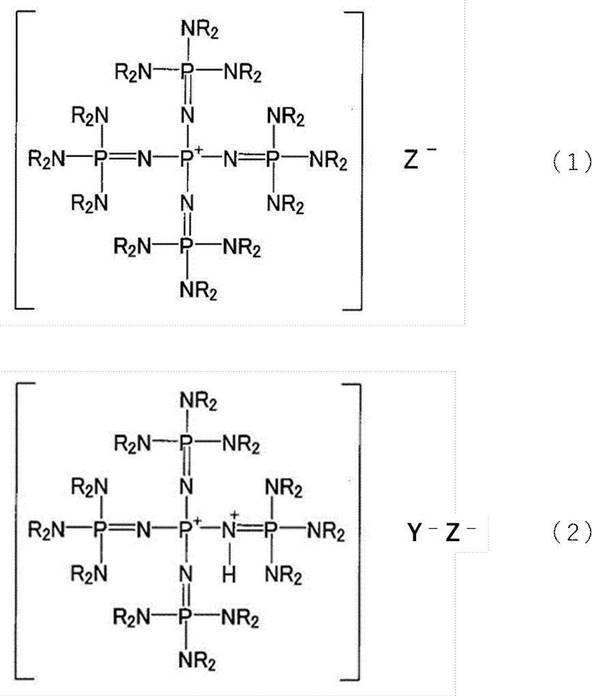
式(2)中、Y-及びZ-は、それぞれ独立に、無機酸または活性水素化合物からプロトンを除いた形式で表されるアニオンであり、24個のRは、それぞれ独立に炭素数1~10の炭化水素基であり、24個のRのうち同一の窒素原子に結合する2個のRは互いに結合していてもよい。
<2> 前記式(1)中、24個のRは、それぞれ独立に、炭素数1~3のアルキル基であり、24個のRのうち同一の窒素原子に結合する2個のRは互いに結合していてもよく、
前記式(2)中、24個のRは、それぞれ独立に、炭素数1~3のアルキル基であり、24個のRのうち同一の窒素原子に結合する2個のRは互いに結合していてもよい<1>に記載の電池用非水電解液。
<3> 前記式(1)中、Rは全てメチル基またはエチル基であり、24個のRのうち同一窒素原子に結合する2個のRが互いに結合していてもよく、
前記式(2)中、Rは全てメチル基またはエチル基であり、24個のRのうち同一窒素原子に結合する2個のRが互いに結合していてもよい<1>に記載の電池用非水電解液。
<4> 前記ホスファゼン化合物(A)の含有量が、電池用非水電解液の全量に対し、0.1質量%~2.0質量%である<1>に記載の電池用非水電解液。
<5> 前記式(1)中、Z-は、PF6 -、SO3CF3 -、BF4 -、ClO4 -、PO2F2 -、下記(TFSI-)、下記(FSI-)、下記(FOB-)、下記(BOB-)、又は下記(CA-)であり、
式(2)中、Y-及びZ-は、それぞれ独立に、PF6 -、SO3CF3 -、BF4 -、ClO4 -、PO2F2 -、下記(TFSI-)、下記(FSI-)、下記(FOB-)、下記(BOB-)、又は下記(CA-)である、<1>~<4>のいずれか1つに記載の電池用非水電解液。
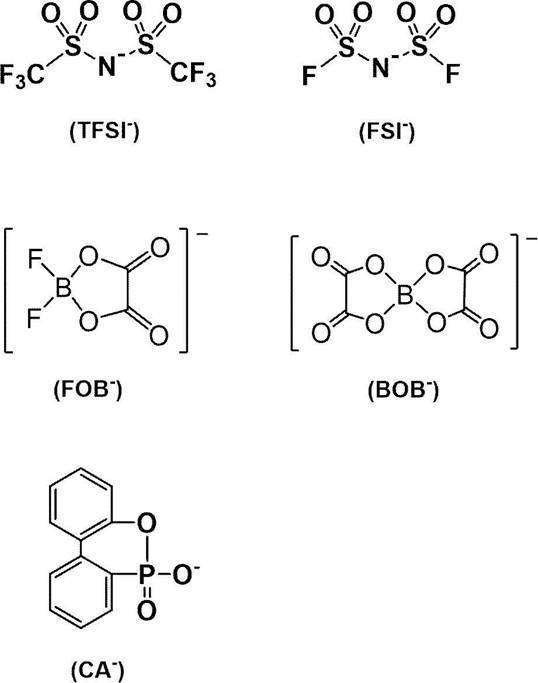
<7> 前記不飽和結合を有する環状炭酸エステルがビニレンカーボネートである<6>記載の電池用非水電解液。
<8> 前記ホスファゼン化合物(A)の含有質量に対する前記不飽和結合を有する環状炭酸エステルの含有質量の比が、0.05~30の範囲にある<6>または<7>に記載の電池用非水電解液。
<9> ケースと、
前記ケースに収容された、正極、負極、セパレータ、及び電解液と、
を備え、
前記正極が、リチウムイオンを吸蔵及び放出可能な正極であり、
前記負極が、リチウムイオンを吸蔵及び放出可能な負極であり、
前記電解液が、<1>~<8>のいずれか1つに記載の電池用非水電解液であるリチウム二次電池前駆体。
<10> 前記正極が、正極活物質として、下記一般式(C1)で表されるリチウム含有複合酸化物を含む<9>に記載のリチウム二次電池前駆体。
LiNiaCobMncO2 … 一般式(C1)
〔一般式(C1)中、a、b及びcは、それぞれ独立に、0超1未満であり、かつ、a、b及びcの合計は、0.99~1.00である。〕
<11> <9>又は<10>に記載のリチウム二次電池前駆体を準備する工程と、
前記リチウム二次電池前駆体に対して活性化処理を施すことにより、リチウム二次電池を得る工程と、
を含み、
前記活性化処理は、前記リチウム二次電池前駆体に対し、15℃~70℃の環境下で、充電及び放電の少なくとも一方を施すことを含むリチウム二次電池の製造方法。
<12> <9>又は<10>に記載のリチウム二次電池前駆体を充放電させて得られたリチウム二次電池。
<13> 下記式(1)で表されるホスファゼン化合物及び下記式(2)で表されるホスファゼン化合物の少なくとも一方を含むホスファゼン化合物。
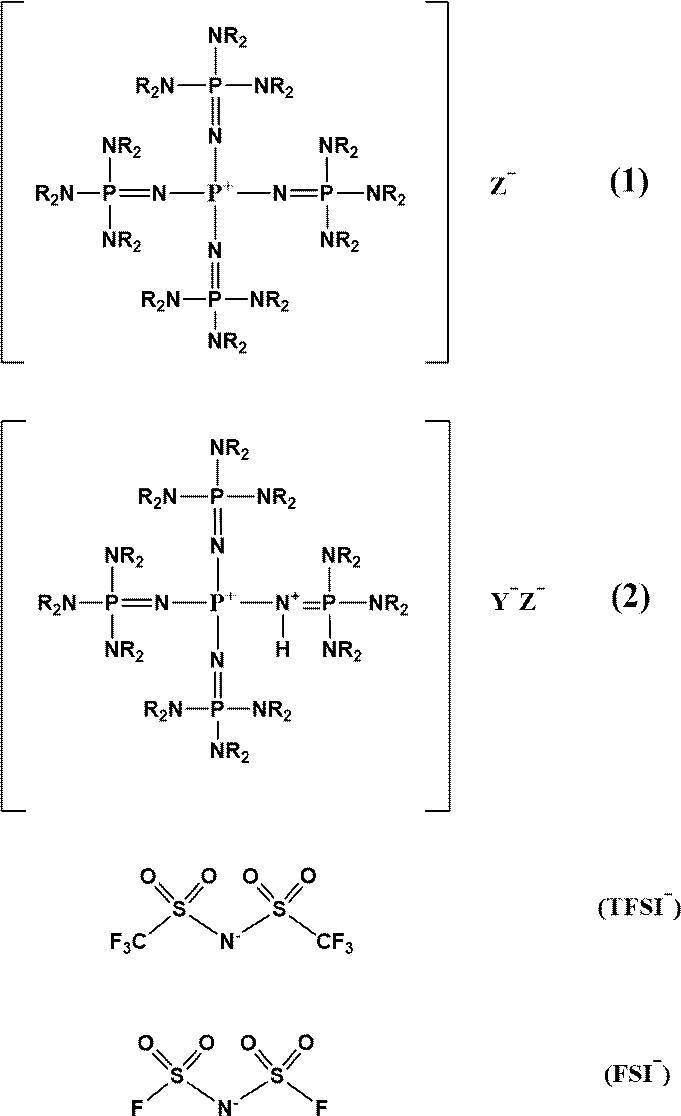
式(2)中、Y-及びZ-は、それぞれ独立に、無機酸または活性水素化合物からプロトンを除いた形式で表されるアニオンであり、24個のRは、それぞれ独立に炭素数1~10の炭化水素基であり、24個のRのうち同一の窒素原子に結合する2個のRは互いに結合していてもよい。)
<14> 前記式(1)中、Z-は、PO2F2 -である、<13>に記載のホスファゼン化合物。
<15> 下記式(1)で表されるホスファゼン化合物及び下記式(2)で表されるホスファゼン化合物の少なくとも一方を含むホスファゼン化合物(A)を含む、電池用添加剤。
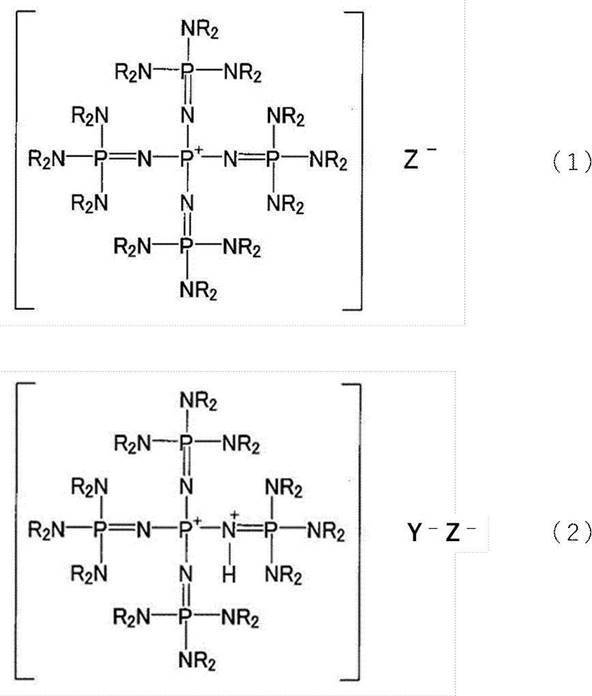
式(2)中、Y-及びZ-は、それぞれ独立に、無機酸または活性水素化合物からプロトンを除いた形式で表されるアニオンであり、24個のRは、それぞれ独立に炭素数1~10の炭化水素基であり、24個のRのうち同一の窒素原子に結合する2個のRは互いに結合していてもよい。)
本明細書において、組成物中の各成分の量は、組成物中に各成分に該当する物質が複数存在する場合は、特に断らない限り、組成物中に存在する当該複数の物質の合計量を意味する。
本明細書において、「工程」との用語は、独立した工程だけではなく、他の工程と明確に区別できない場合であってもその工程の所期の目的が達成されれば、本用語に含まれる。
本開示の電池用非水電解液に含有されるホスファゼン化合物(A)は、下記式(1)で表されるホスファゼン化合物及び下記式(2)で表されるホスファゼン化合物の少なくとも一方を含む。
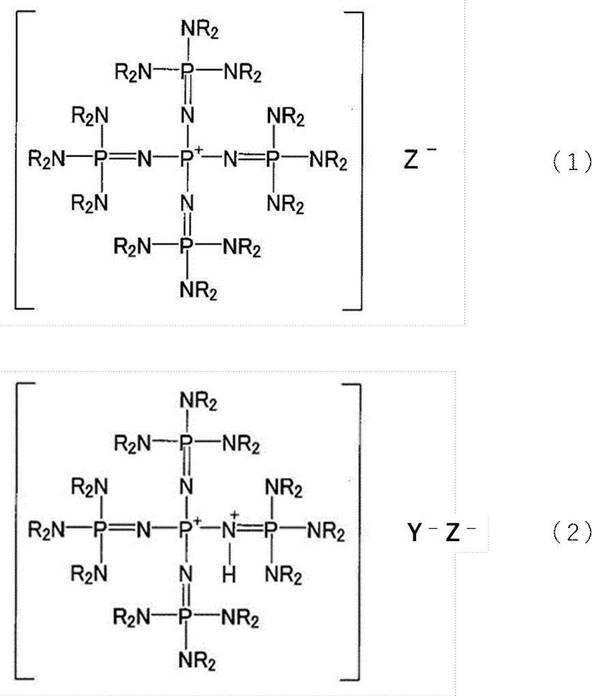
式(2)中、Y-及びZ-は、それぞれ独立に、無機酸または活性水素化合物からプロトンを除いた形式で表されるアニオンであり、24個のRは、それぞれ独立に炭素数1~10の炭化水素基であり、24個のRのうち同一の窒素原子に結合する2個のRは互いに結合していてもよい。
式(2)中、Y-及びZ-は、それぞれ独立に、PF6 -、SO3CF3 -、BF4 -、ClO4 -、PO2F2 -、下記(TFSI-)、下記(FSI-)、下記(FOB-)、下記(BOB-)、又は下記(CA-)であることが好ましい。
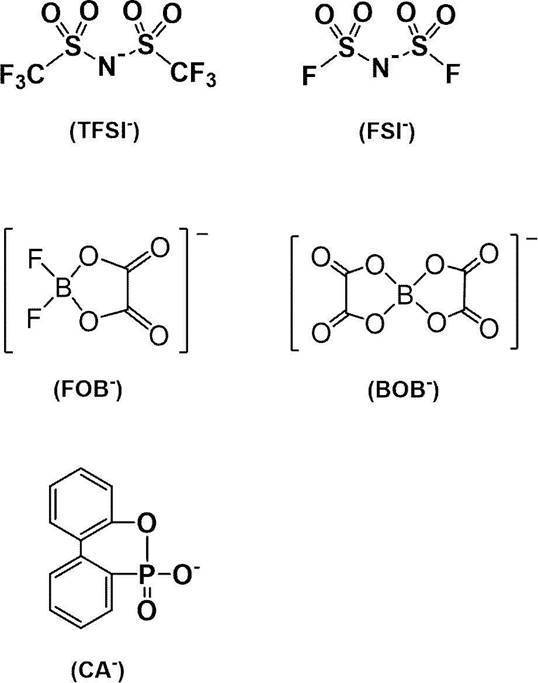
式(2)中、24個のRは、それぞれ独立に炭素数1~10の炭化水素基であり、24個のRのうち同一の窒素原子に結合する2個のRは互いに結合していてもよい。
式(2)中、24個のRは、それぞれ独立に、炭素数1~3のアルキル基であることが好ましく、24個のRのうち同一の窒素原子に結合する2個のRは互いに結合していてもよい。
式(2)中、Rは全てメチル基またはエチル基であることがより好ましく、24個のRのうち同一窒素原子に結合する2個のRは互いに結合していてもよい。
本開示の一実施形態に係る電池用非水電解液(以下、単に「本実施形態の非水電解液」ともいう)は、
リチウム塩である電解質と、
非水溶媒と、
上述したホスファゼン化合物(A)と、
を含有する。
リチウム塩である電解質と、
非水溶媒と、
第1イオン群及び第2イオン群の少なくとも一方と
を含有する。
第1イオン群は、下記式(PZN+)で表されるカチオン及び(Z-)で表されるアニオンからなる。
第2イオン群は、下記式(PZN2+)で表されるカチオン、(Y-)で表されるアニオン、及び(Z-)で表されるアニオンからなる。

本実施形態の非水電解液は、ホスファゼン化合物(A)を含有することにより、内部短絡時の電池内部の昇温速度の上昇を抑制できる。
非水電解液の全量に対するホスファゼン化合物(A)の含有量が0.1質量%以上である場合には、本実施形態の非水電解液による効果がより効果的に奏される。非水電解液の全量に対するホスファゼン化合物(A)の含有量は、より好ましくは0.2質量%以上であり、更に好ましくは0.3質量%以上であり、更に好ましくは0.5質量%以上、更に好ましくは1.5質量%以上である。
非水電解液の全量に対するホスファゼン化合物(A)の含有量が5.0質量%以下である場合には、非水電解液の化学的安定性がより向上する。
非水電解液の全量に対するホスファゼン化合物(A)の含有量は、より好ましくは3.0質量%以下であり、更に好ましくは2.5質量%以下、更に好ましくは2.0質量%以下である。
また、非水電解液から上記ホスファゼン化合物(A)が検出できない場合であっても、非水電解液中や電極の被膜中に、上記ホスファゼン化合物(A)の分解物由来の化合物が検出される場合も、本実施形態の非水電解液の範囲に含まれるとみなされる。
これらの取り扱いは、非水電解液に含有され得る上記ホスファゼン化合物(A)以外の化合物についても同様である。
本実施形態の非水電解液は、リチウム塩である電解質を少なくとも1種含有する。
電解質としては、例えば;
六フッ化リン酸リチウム(LiPF6)、四フッ化ホウ酸リチウム(LiBF4)、六フッ化ヒ酸リチウム(LiAsF6)、六フッ化タンタル酸リチウム(LiTaF6)、過塩素酸リチウム(LiClO4)、四塩化アルミニウム酸リチウム(LiAlCl4)、リチウムデカクロロデカホウ素酸(Li2B10Cl10)等の無機酸陰イオン塩;
トリフルオロメタンスルホン酸リチウム(LiCF3SO3)、リチウムビス(トリフルオロメタンスルホニル)イミド(Li(CF3SO2)2N)、リチウムビス(フルオロスルホニル)イミド(Li(FSO2)2N)、リチウムビス(ペンタフルオロエタンスルホニル)イミド(Li(C2F5SO2)2N)等の有機酸陰イオン塩;
等が挙げられる。
リチウム塩としては、LiPF6が特に好ましい。
本実施形態の非水電解液は、非水溶媒を少なくとも1種含有する。
非水溶媒としては、例えば、環状カーボネート類、含フッ素環状カーボネート類、鎖状カーボネート類、含フッ素鎖状カーボネート類、脂肪族カルボン酸エステル類、含フッ素脂肪族カルボン酸エステル類、γ-ラクトン類、含フッ素γ-ラクトン類、環状エーテル類、含フッ素環状エーテル類、鎖状エーテル類、含フッ素鎖状エーテル類、ニトリル類、アミド類、ラクタム類、ニトロメタン、ニトロエタン、スルホラン、燐酸トリメチル、ジメチルスルホキシド、ジメチルスルホキシド燐酸、等が挙げられる。
含フッ素環状カーボネート類としては、例えば、フルオロエチレンカーボネート(FEC)、等が挙げられる。
鎖状カーボネート類としては、例えば、ジメチルカーボネート(DMC)、ジエチルカーボネート(DEC)、エチルメチルカーボネート(EMC)、メチルプロピルカーボネート(MPC)、エチルプロピルカーボネート(EPC)、ジプロピルカーボネート(DPC)、等が挙げられる。
脂肪族カルボン酸エステル類としては、例えば、ギ酸メチル、酢酸メチル、プロピオン酸メチル、酪酸メチル、イソ酪酸メチル、トリメチル酪酸メチル、ギ酸エチル、酢酸エチル、プロピオン酸エチル、酪酸エチル、イソ酪酸エチル、トリメチル酪酸エチル、等が挙げられる。
γ-ラクトン類としては、例えば、γ-ブチロラクトン、γ-バレロラクトン、等が挙げられる。
環状エーテル類としては、例えば、テトラヒドロフラン、2-メチルテトラヒドロフラン、テトラヒドロピラン、1,3-ジオキソラン、4-メチル-1,3-ジオキソラン、1,3-ジオキサン、1,4-ジオキサン、等が挙げられる。
鎖状エーテル類としては、例えば、1,2-エトキシエタン(DEE)、エトキシメトキシエタン(EME)、ジエチルエーテル、1,2-ジメトキシエタン、1,2-ジブトキシエタン、等が挙げられる。
ニトリル類としては、例えば、アセトニトリル、グルタロニトリル、アジポニトリル、メトキシアセトニトリル、3-メトキシプロピオニトリル、等が挙げられる。
アミド類としては、例えば、N,N-ジメチルホルムアミド、等が挙げられる。
ラクタム類としては、例えば、N-メチルピロリジノン、N-メチルオキサゾリジノン、N,N'-ジメチルイミダゾリジノン、等が挙げられる。
この場合、非水溶媒中に占める、環状カーボネート類、含フッ素環状カーボネート類、鎖状カーボネート類、及び含フッ素鎖状カーボネート類の合計の割合は、好ましくは50質量%~100質量%であり、より好ましくは60質量%~100質量%であり、更に好ましくは80質量%~100質量%である。
この場合、非水溶媒中に占める、環状カーボネート類及び鎖状カーボネート類の合計の割合は、好ましくは50質量%~100質量%であり、より好ましくは60質量%~100質量%であり、更に好ましくは80質量%~100質量%である。
本実施形態の非水電解液中に占める非水溶媒の割合の上限は、他の成分(ホスファゼン化合物(A)、電解質、等)の含有量にもよるが、上限は、例えば、99質量%であり、好ましくは97質量%であり、更に好ましくは90質量%である。
本実施形態の非水電解液は、非水電解液の化学的安定性をより向上させる観点から、不飽和結合を有する環状炭酸エステルの少なくとも1種を含有していてもよい。
含有質量比〔不飽和結合を有する環状炭酸エステル/ホスファゼン化合物(A)〕が0.05以上である場合には、内部短絡時の電池内部の昇温速度の上昇を効果的に抑制できる。
本実施形態の非水電解液は、上述した成分以外のその他の成分を少なくとも1種含有していてもよい。
その他の成分としては、スルトン(即ち、環状スルホン酸エステル)、酸無水物、等が挙げられる。
スルトンとしては、プロペンスルトンが好ましい。
本実施形態の非水電解液がスルトンを含有する場合、非水電解液の全量に対するスルトンの含有量は、好ましくは0.1質量%~3.0質量%であり、より好ましくは0.1質量%~1.0質量%である。
無水コハク酸、無水グルタル酸、無水マレイン酸などのカルボン酸無水物;
無水エタンジスルホン酸、無水プロパンジスルホン酸などのジスルホン酸無水物;
無水スルホ安息香酸、無水スルホプロピオン酸、無水スルホ酪酸などのカルボン酸とスルホン酸との無水物;
等が挙げられる。
これらは単独で用いられてもよいし、複数種が混合されて用いられてもよい。
酸無水物としては、無水スルホ安息香酸が好ましい。
本実施形態の非水電解液が酸無水物を含有する場合、非水電解液の全量に対する酸無水物の含有量は、好ましくは0.1質量%~3.0質量%であり、より好ましくは0.5質量%~3.0質量%である。
本実施形態の非水電解液を製造する方法は特に限定されない。本実施形態の非水電解液は、各成分を混合して製造すればよい。
非水溶媒に電解質を溶解させて溶液を得る工程と、
得られた溶液に対し、ホスファゼン化合物(A)(及び必要に応じ、その他の添加剤)を添加して混合し、非水電解液を得る工程と、
を含む製造方法が挙げられる。
本開示の一実施形態に係るリチウム二次電池前駆体(以下、単に「本実施形態の電池前駆体」ともいう)は、
ケースと、
ケースに収容された、正極、負極、セパレータ、及び電解液と、
を備え、
上記正極が、リチウムイオンを吸蔵及び放出可能な正極であり、
上記負極が、リチウムイオンを吸蔵及び放出可能な負極であり、
上記電解液が、上述した本実施形態の非水電解液であるリチウム二次電池前駆体である。
後述する本実施形態のリチウム二次電池は、正極、負極、セパレータ、及び非水電解液をケースに収容してリチウム二次電池前駆体を製造し、得られたリチウム二次電池前駆体に対し、充電及び放電(好ましくは、充電及び放電を含む活性化処理)を施すことによって製造される。
このため、本実施形態の電池前駆体によれば、本実施形態の非水電解液による効果と同様の効果が奏される。
本実施形態の電池前駆体におけるケースとしては特に限定はなく、公知のリチウム二次電池用のケースが挙げられる。
ケースとしては、ラミネートフィルムを含むケース、電池缶と電池缶蓋とからなるケース、等が挙げられる。
本実施形態の電池前駆体における正極は、リチウムイオンを吸蔵及び放出可能な正極である。
本実施形態の電池前駆体における正極は、好ましくは、リチウムイオンを吸蔵及び放出可能な正極活物質を少なくとも1種含む。
本実施形態の電池前駆体における正極は、より好ましくは、正極集電体と、正極活物質及びバインダーを含有する正極合材層と、を備える。
正極合材層は、正極集電体の表面の少なくとも一部に設けられる。
正極活物質としては、リチウムイオンの吸蔵及び放出が可能な物質であれば特に限定されず、リチウム二次電池に通常用いられる正極活物質であり得る。
正極活物質としては、例えば;
リチウム(Li)とニッケル(Ni)とを構成金属元素とする酸化物;
Liと、Niと、Li及びNi以外の金属元素(例えば、遷移金属元素、典型金属元素等)の少なくとも1種と、を構成金属元素として含む酸化物;
等が挙げられる。
酸化物中において、Li及びNi以外の金属元素は、好ましくは、原子数換算で、Niと同程度、又は、Niよりも少ない割合で含まれる。
Li及びNi以外の金属元素は、例えば、Co、Mn、Al、Cr、Fe、V、Mg、Ca、Na、Ti、Zr、Nb、Mo、W、Cu、Zn、Ga、In、Sn、La及びCeからなる群から選択される少なくとも1種であり得る。これらの正極活物質は、単独で用いても複数を混合して用いてもよい。
リチウム含有複合酸化物(C1)は、単位体積当たりのエネルギー密度が高く、熱安定性にも優れるという利点を有する。
〔一般式(C1)中、a、b及びcは、それぞれ独立に、0超1未満であり、a、b及びcの合計は、0.99~1.00である。〕
(一般式(C2)中、tは、0.95以上1.15以下であり、xは、0以上0.3以下であり、yは、0以上0.2以下であり、x及びyの合計は、0.5未満である。)
また、正極合材層中の正極活物質の含有量は、例えば、99.9質量%以下、好ましくは99質量%以下である。
正極合材層に含有され得るバインダーとしては、例えば、ポリ酢酸ビニル、ポリメチルメタクリレート、ニトロセルロース、フッ素樹脂、ゴム粒子等が挙げられる。
フッ素樹脂としては、ポリテトラフルオロエチレン(PTFE)、ポリフッ化ビニリデン(PVDF)、テトラフルオロエチレン-ヘキサフルオロプロピレン共重合体(FEP)、フッ化ビニリデン-ヘキサフルオロプロピレン共重合体等が挙げられる。
ゴム粒子としては、スチレン-ブタジエンゴム粒子、アクリロニトリルゴム粒子等が挙げられる。
これらの中でも、正極合材層の耐酸化性を向上させる観点から、バインダーは、フッ素樹脂であることが好ましい。
バインダーは1種を単独で使用でき、必要に応じて2種以上を組み合わせて使用できる。
バインダーの含有量が0.1質量%以上である場合には、正極集電体に対する正極合材層の接着性、及び、正極活物質同士の結着性がより向上する。
バインダーの含有量が4.0質量%以下である場合には、正極合材層中における正極活物質の量をより多くすることができるので、電池容量がより向上する。
本実施形態の電池前駆体における正極が、正極集電体と正極合材層とを備える場合、正極合材層は、導電助材を含むことが好ましい。
導電助材としては、公知の導電助材を使用することができる。
公知の導電助材としては、導電性を有する炭素材料であれば特に限定されるものではないが、グラファイト、カーボンブラック、導電性炭素繊維(カーボンナノチューブ、カーボンナノファイバー、カーボンファイバー)、フラーレン等を単独で、もしくは2種類以上を併せて使用することができる。
市販のカーボンブラックとしては、例えば、トーカブラック#4300、#4400、#4500、#5500等(東海カーボン社製、ファーネスブラック)、プリンテックスL等(デグサ社製、ファーネスブラック)、Raven7000、5750、5250、5000ULTRAIII、5000ULTRA等、Conductex SC ULTRA、Conductex 975ULTRA等、PUER BLACK100、115、205等(コロンビヤン社製、ファーネスブラック)、#2350、#2400B、#2600B、#30050B、#3030B、#3230B、#3350B、#3400B、#5400B等(三菱化学社製、ファーネスブラック)、MONARCH1400、1300、900、VulcanXC-72R、BlackPearls2000、LITX-50、LITX-200等(キャボット社製、ファーネスブラック)、Ensaco250G、Ensaco260G、Ensaco350G、Super-P(TIMCAL社製)、ケッチェンブラックEC-300J、EC-600JD(アクゾ社製)、デンカブラック、デンカブラックHS-100、FX-35(電気化学工業社製、アセチレンブラック)等が挙げられる。
グラファイトとしては、例えば、人造黒鉛、天然黒鉛(例えば、燐片状黒鉛、塊状黒鉛、土状黒鉛等)等が挙げられるが、これらに限定されるものではない。
本実施形態の電池前駆体における正極が、正極集電体と正極合材層とを備える場合、正極合材層は、上記各成分に加えて、その他の成分を含んでいてもよい。
その他の成分としては、増粘剤、界面活性剤、分散剤、濡れ剤、消泡剤等が挙げられる。
正極集電体としては、各種のものを使用することができるが、例えば、金属又は合金が用いられる。
正極集電体として、より具体的には、アルミニウム、ニッケル、SUS等が挙げられる。中でも、導電性の高さとコストとのバランスの観点から、正極集電体はアルミニウムであることが好ましい。ここで、「アルミニウム」は、純アルミニウム又はアルミニウム合金を意味する。
正極集電体として、特に好ましくはアルミニウム箔である。
アルミニウム箔としては特に限定されないが、A1085材、A3003材、等が挙げられる。
正極合材層は、例えば、正極活物質及びバインダーを含む正極合材スラリーを正極集電体の表面に塗布し、乾燥させることによって形成できる。
正極合材スラリーに含まれる溶媒としては、N-メチル-2-ピロリドン(NMP)等の有機溶媒が好ましい。
塗布方法としては、例えば、スロット・ダイコーティング、スライドコーティング、カーテンコーティング、グラビアコーティング等が挙げられる。
乾燥方法としては、温風、熱風、低湿風による乾燥;真空乾燥;赤外線(例えば、遠赤外線)照射による乾燥;が挙げられる。
乾燥時間及び乾燥温度については、特に限定されないが、乾燥時間は、例えば、1分~30分であり、乾燥温度は、例えば、40℃~80℃である。
正極合材層の製造方法は、正極集電体上に正極合剤スラリーを塗布し、乾燥させた後、金型プレス、ロールプレス等を用いた加圧処理により、正極活物質層の空隙率を低くする工程を有することが好ましい。
本実施形態の電池前駆体における負極は、リチウムイオンを吸蔵及び放出可能な負極である。
本実施形態の電池前駆体における負極は、好ましくは、リチウムイオンを吸蔵及び放出可能な負極活物質を少なくとも1種含む。
本実施形態の電池前駆体における負極は、より好ましくは、負極集電体と、負極活物質及びバインダーを含有する負極合材層と、を備える。
負極合材層は、負極集電体の表面の少なくとも一部に設けられる。
負極活物質としては、リチウムイオンを吸蔵及び放出可能な物質であれば特に制限はないが、例えば、金属リチウム、リチウム含有合金、リチウムとの合金化が可能な金属もしくは合金、リチウムイオンのドープ・脱ドープが可能な酸化物、リチウムイオンのドープ・脱ドープが可能な遷移金属窒素化物、および、リチウムイオンのドープ・脱ドープが可能な炭素材料からなる群から選ばれる少なくとも1種(単独で用いてもよいし、これらの2種以上を含む混合物を用いてもよい)を用いることができる。
これらの中でも、負極活物質は、リチウムイオンをドープ・脱ドープすることが可能な炭素材料であることが好ましい。
上記炭素材料としては、カーボンブラック、活性炭、黒鉛材料(例えば、人造黒鉛、天然黒鉛等)、非晶質炭素材料、等が挙げられる。
上記炭素材料の形態は、繊維状、球状、ポテト状、フレーク状のいずれの形態であってもよい。
上記炭素材料の粒径は特に限定されないが、例えば、5μm~50μm、好ましくは10μm~30μmである。
人造黒鉛としては、黒鉛化MCMB、黒鉛化MCFなどが用いられる。
また、黒鉛材料としては、ホウ素を含有するものなども用いることができる。
また、黒鉛材料としては、金、白金、銀、銅、スズなどの金属で被覆したもの、非晶質炭素で被覆したもの、非晶質炭素と黒鉛を混合したものも使用することができる。
バインダーとしては、スチレンブタジエンゴム(SBR)、アクリロニトリル-ブタジエンゴム、アクリロニトリル-ブタジエン-スチレンゴム、カルボキシメチルセルロース(CMC)、ヒドロキシプロピルメチルセルロース、ポリビニルアルコール、ヒドロキシプロピルセルロース、及びジアセチルセルロースから選ばれる1種もしくは2種以上を組み合わせて用いることができる。
負極合材層用のバインダーとしては、スチレンブタジエンゴムとカルボキシメチルセルロースを適宜混合したものを用いることが望ましい。
バインダーの含有量が0.1質量%以上である場合には、負極集電体に対する負極合材層の接着性、及び、負極活物質同士の結着性がより向上する。
バインダーの含有量を4.0質量%以下である場合には、負極合材層中における負極活物質の量をより多くすることができるので、電池容量がより向上する。
本実施形態の電池前駆体における負極が、負極集電体と負極合材層とを備える場合、負極合材層は、導電助材を含むことが好ましい。
導電助材としては、公知の導電助材を使用することができる。
負極合材層に含まれ得る導電助材の具体例は、前述した、正極合材層に含まれ得る導電助材の具体例と同様である。
本実施形態の電池前駆体における負極が、負極集電体と負極合材層とを備える場合、負極合材層は、上記各成分に加えて、その他の成分を含んでいてもよい。
その他の成分としては、増粘剤、界面活性剤、分散剤、濡れ剤、消泡剤等が挙げられる。
負極合材層は、例えば、負極活物質及びバインダーを含む負極合材スラリーを負極集電体の表面に塗布し、乾燥させることによって形成できる。
負極合材スラリーに含まれる溶媒としては、水を使用することが好ましいが、必要に応じて、例えば、集電体への塗工性向上のために、水と相溶する液状媒体を使用してもよい。
水と相溶する液状媒体としては、アルコール類、グリコール類、セロソルブ類、アミノアルコール類、アミン類、ケトン類、カルボン酸アミド類、リン酸アミド類、スルホキシド類、カルボン酸エステル類、リン酸エステル類、エーテル類、ニトリル類等が挙げられ、水と相溶する範囲で使用してもよい。
本実施形態の電池前駆体におけるセパレータとしては、例えば、ポリエチレン(PE)、ポリプロピレン(PP)、ポリエステル、セルロース、ポリアミド等の樹脂を含む多孔質の平板が挙げられる。また、セパレータとしては、上記樹脂を含む不織布も挙げられる。
セパレータの好適例として、一種または二種以上のポリオレフィン樹脂を主体に構成された単層または多層構造の多孔性樹脂シートが挙げられる。
セパレータの厚みは、例えば、5μm~30μmとすることができる。
セパレータは、好ましくは、正極と負極との間に配置される。
本実施形態の電池前駆体における電解液は、前述した本実施形態の非水電解液である。
本実施形態の非水電解液の好ましい態様は前述したとおりである。
本実施形態の電池前駆体を製造する方法は、特に限定されない。
本実施形態の電池前駆体を製造する方法の一例は、ケースに、正極、負極、セパレータ、及び電解液を収容する工程を含む。
上記一例は、好ましくは、
ケースに、正極、負極、及びセパレータを収容する工程と、
正極、負極、及びセパレータが収容されたケースに、電解液を注入する工程と、
を含む。
以下、本実施形態のリチウム二次電池前駆体の一例について、図1を参照しながら説明するが、本実施形態のリチウム二次電池前駆体は、以下の一例に限定されない。
リチウム二次電池前駆体1は、積層型リチウム二次電池の一例である。
本実施形態のリチウム二次電池前駆体としては、この積層型リチウム二次電池以外にも、例えば、捲回型のリチウム二次電池も挙げられる。捲回型のリチウム二次電池は、正極、セパレータ、負極、及びセパレータをこの順の配置で重ねて層状に巻いた構造を有する。
リチウム二次電池前駆体1では、正極リード21及び負極リード22が、外装体30の内部から外部に向かって、反対方向に導出されている。
正極リード21及び負極リード22は、例えば、超音波溶接や抵抗溶接などにより後述する正極集電体及び負極集電体に取り付けることができる。
なお、図示しないが、正極リード及び負極リードが、外装体の内部から外部に向かって、同一方向に導出されていてもよい。
この構造において、正極11の正極集電体11Aの片方の主面上に形成された正極合材層11Bと、正極11に隣接する負極12の負極集電体12Aの片方の主面上に形成された負極合材層12Bとは、セパレータ13を介して向き合っている。
リチウム二次電池前駆体1では、隣接する正極合材層11B、セパレータ13及び負極合材層12Bによって、1つの単電池層14が形成されている。
なお、正極及び負極は、各集電体の片面上に各活物質層が形成されているものであってもよい。
本開示の実施形態に係るリチウム二次電池の製造方法(以下、「本実施形態の電池の製造方法」ともいう)は、
本実施形態の電池前駆体を準備する工程(以下、「準備工程」ともいう)と、
電池前駆体に対して活性化処理を施すことにより、リチウム二次電池を得る工程(以下、「活性化工程」ともいう)と、
を含み、
活性化処理は、電池前駆体に対し、15~70℃の環境下で、充電及び放電を施すことを含むリチウム二次電池の製造方法である。
電池前駆体を15℃~70℃(好ましくは、25℃~60℃)の環境下で保持する初期保持フェーズと、
初期保持フェーズ後の電池前駆体を、15℃~50℃(好ましくは、25℃~45℃)の環境下で充電する初期充電フェーズと、
初期充電フェーズ後の電池前駆体を、15℃~70℃(好ましくは、25℃~60℃)の環境下で保持する第2保持フェーズと、
第2保持フェーズ後の電池前駆体に対し、15℃~50℃(好ましくは、25℃~45℃)の環境下で、充電及び放電の少なくとも一方の組み合わせを1回以上施す充放電フェーズと、
を含む。
本開示の一実施形態に係るリチウム二次電池(以下、「本実施形態の電池」ともいう)は、上記の電池前駆体(すなわち、リチウム二次電池前駆体)を充放電させて得られたリチウム二次電池である。好ましくは、電池前駆体に対して、上記の活性化処理を施すことにより得られたリチウム二次電池である。
本開示の電池用非水電解液、本開示のリチウム二次電池前駆体、本開示のリチウム二次電池の製造方法、及び本開示のリチウム二次電池は、特に、ハイブリッド自動車又は電気自動車に対して特に好適に用いられるものである。
本開示のホスファゼン化合物は、下記式(1)で表されるホスファゼン化合物及び下記式(2)で表されるホスファゼン化合物の少なくとも一方を含む。

式(2)中、Y-及びZ-は、それぞれ独立に、無機酸または活性水素化合物からプロトンを除いた形式で表されるアニオンであり、24個のRは、それぞれ独立に炭素数1~10の炭化水素基であり、24個のRのうち同一の窒素原子に結合する2個のRは互いに結合していてもよい。
本開示の電池用添加剤は、
下記式(1)で表されるホスファゼン化合物及び下記式(2)で表されるホスファゼン化合物の少なくとも一方を含むホスファゼン化合物(A)を含む。

式(2)中、Y-及びZ-は、それぞれ独立に、無機酸または活性水素化合物からプロトンを除いた形式で表されるアニオンであり、24個のRは、それぞれ独立に炭素数1~10の炭化水素基であり、24個のRのうち同一の窒素原子に結合する2個のRは互いに結合していてもよい。
以下の実施例において、「添加量」は、最終的に得られる非水電解液中における含有量(即ち、最終的に得られる非水電解液全量に対する量)を意味する。
また、「wt%」は、質量%を意味する。
以下、本実施例において使用した水は、ミリポア社製の「MQ Academic A10システム」により精製された水を使用した。
室温で反応液を1時間撹拌した。その後、加圧濾過機に反応液を全量移した。加圧濾過機は、細孔径0.2μmのメンブランフィルター(ADVANTEC社製、「H020A142C」、直径142mm)を備える。加圧濾過機の容積は、1リットルであった。
ゲージ圧0.2MPaの窒素圧により、反応液を濾過した。これにより、反応液から白色固体を分離した。加圧濾過機内の白色固体を水100mlで3回洗浄した。その後、白色固体を加圧濾過機から取り出して、シャーレに移した。
白色固体を室温で2日間風乾させた。その後、シャーレをデジケーターに入れ、白色固体の質量変化がなくなるまで、白色固体を室温で真空乾燥した。これにより、白色乾燥固体を得た。
上記白色乾燥固体の0.500gを重メタノール0.499gに溶解させ、核磁気共鳴装置(日本電子株式会社製の「ECA500」)を用いて、31P-NMRを測定した。白色乾燥固体の31P-NMRの測定チャートを図2に示す。
また、7.27ppm、及び7.00ppmに2つのシグナル(以下、「二重線」という。)が観測される。二重線は、テトラキス[トリス(ジメチルアミノ)ホスホラニリデンアミノ]ホスホニウムカチオンの外郭に位置する4つのリン原子に帰属される。
さらに、-9.97ppm、-14.72ppm、及び-19.47ppmに3つのシグナル(以下、「三重線」という。)が観測される。三重線は、ジフルオロホスフェイトアニオンの1つのリン原子に帰属される。
テトラキス[トリス(ジメチルアミノ)ホスホラニリデンアミノ]ホスホニウムカチオンについて、上記のように帰属される中心の1つのリン原子の積分値(以下、「第1積分値」という。)は、1.02であった。上記のように帰属される4つの外郭のリン原子の積分値(以下、「第2積分値」という。)は、4.03であった。第1積層値:第2積分値は、ほぼ1:4であった。
また、ジフルオロホスフェイトアニオンの1つのリン原子の積分値は1.00である。そのため、テトラキス[トリス(ジメチルアミノ)ホスホラニリデンアミノ]ホスホニウムカチオンとジフルオロホスフェイトアニオンとが1:1のモル比で存在し、電気的に中性な塩を形成していることが示唆された。
上記白色乾燥固体の0.0500gをメタノールに溶解し10mlの溶液とした。イオンクロマトグラフ(サーモフィッシャーサイエンティフィック社製の「ICS-3000」)を使用して、溶液中の塩素イオンの分析を行った。その結果、溶液中の塩素イオン含量は50μg/g未満であった。
原料として使用したテトラキス[トリス(ジメチルアミノ)ホスホラニリデンアミノ]ホスホニウムクロリド中の塩素イオン含量は45,726μg/gである。そのため、テトラキス[トリス(ジメチルアミノ)ホスホラニリデンアミノ]ホスホニウムクロリド中の99.9質量%が他のアニオン種に置換されていることが分かった。
31P-NMRの分析結果から、テトラキス[トリス(ジメチルアミノ)ホスホラニリデンアミノ]ホスホニウムカチオンと、ジフルオロホスフェイトアニオンとが1:1のモル比で存在していること、及び、
塩素イオンの分析結果から、原料のテトラキス[トリス(ジメチルアミノ)ホスホラニリデンアミノ]ホスホニウムクロリド中の99.9質量%の塩素イオンが消失し、他のアニオン種に置換されていることが示唆され、
白色乾燥固体は、テトラキス[トリス(ジメチルアミノ)ホスホラニリデンアミノ]ホスホニウムジフルオロホスフェイトであることが判明した。
<非水電解液(試料0~試料13)の作製>
(試料0)
エチレンカーボネート(以下、EC)とエチルメチルカーボネート(EMC)とを、EC:EMC=30:70(体積比)で混合することにより、非水溶媒としての混合溶媒を作製した。
混合溶媒に対し、電解質としてのLiPF6を、最終的に得られる非水電解液中の濃度が1モル/リットルとなるように、また、添加剤としてのビニレンカーボネート(VC)を、最終的に得られる非水電解液の全量に対して0.5質量%となるように溶解させた。
以上により、試料0を得た。
試料0は、比較例1の電池に使用する非水電解液である。
更に、ホスファゼン化合物(A)の一例である表1に示す化合物を、最終的に得られる非水電解液の全量に対する含有量が、表1に示す添加量となるように添加したこと以外は試料0と同様にして、試料1~試料11を得た。
試料1~試料11は、それぞれ、実施例1~実施例11の電池に使用する非水電解液である。
更に、表1に示す比較ホスファゼン化合物(ヘキサフルオロシクロトリホスファゼン、又は、ヘキサフェノキシシクロトリホスファゼン)を、最終的に得られる非水電解液の全量に対する含有量が、1.0質量%となるように添加したこと以外は試料0と同様にして、試料12~試料13を得た。
試料12~試料13は、それぞれ、比較例2~比較例3の電池に使用する非水電解液である。
以下のようにして、リチウム二次電池としての積層型電池(設計容量300mAh)(以下、単に「電池」ともいう)を作製した。
1.スラリー調製
スラリー調製は5Lのプラネタリーディスパを用いた。
正極活物質としてのNCM523(即ち、LiNi0.5Co0.2Mn0.3O2)920g、導電助材としてのSuper-P(TIMCAL社製導電性カーボン)20g、及び導電助材としてのKS-6(TIMREX社製鱗片状黒鉛)20gを10分間混合した後、ここにN-メチルピロリドン(NMP)を100g加え、更に20分間混合した。
次いで、8%-PVDF溶液(クレハ製PVDFW#7200をNMPに溶解)150gを加えて、30分間混練した後、更に、上記8%-PVDF溶液150gを加えて30分間混練した。その後、上記8%-PVDF溶液200gを加えて30分間混練した。次いで、NMPに溶解した溶液を80g加えて30分間混練した。その後、粘度調整のためNMP27gを加えて30分間混合した後、真空脱泡30分間を行った。
以上により、固形分濃度60%の正極合材スラリーを得た。
スラリー塗工にはダイコーターを用いた。
乾燥後の塗布質量が19.0mg/cm2になるように、上記正極合材スラリーを、正極集電体としてのアルミニウム箔(厚み20μm、幅200mm)の片面の一部に塗布し乾燥した。次いで、反対面(未塗工面)の一部に、同様に塗布質量が19.0mg/cm2になるように、上記正極合材スラリーをアルミニウム箔に塗布し乾燥した。
こうして得た両面塗工(38.0mg/cm2)されたアルミニウム箔を、真空乾燥オーブンで130℃、12時間乾燥した。
35トンプレス機を用いた。上下ロールのギャップ(隙間)を調整し、上記正極をプレス密度が2.9±0.05g/cm3になるように圧縮した。
電極塗布面積(29mm×40mm)とタブ溶接余白が得られるように電極をスリットした。
1.スラリー調製
スラリー調製は5Lのプラネタリーディスパを用いた。
負極活物質としての天然黒鉛960g及び導電助材としてのSuper-P(導電性カーボン、BET比表面積62m2/g)10gに対し、1%-CMC水溶液(即ち、カルボキシメチルセルロース(CMC)の1質量%水溶液)を450g加え、30分間混合した。
得られた混合物に対し、1%-CMC水溶液300gを加えて30分間混練した後、更に、1%-CMC水溶液250gを加えて30分間混練した。
得られた混練物に対し、バインダーとしてのスチレンブタジエンゴム(SBR)(40%乳化液)50gを加えて30分間混合した後、真空脱泡を30分間行った。
以上により、固形分濃度45%の負極合材スラリーを得た。
スラリー塗工にはダイコーターを用いた。
乾燥後の塗布質量が11.0mg/cm2になるように、上記負極合材スラリーを、負極集電体としての銅箔(厚み10μm)の片面の一部に塗布し乾燥した。次いで、銅箔の反対面(未塗工面)の一部に、塗布質量が11.0mg/cm2になるように、上記負極合材スラリーを塗布し乾燥した。
こうして得た両面塗工(22.0mg/cm2)された銅箔を、真空乾燥オーブンで120℃、12時間乾燥した。
小型プレス機を用いた。
上下ロールのギャップ(隙間)を調整し、上記負極をプレス密度が1.45±0.05g/cm3になるように圧縮した。
電極塗布面積(31mm×42mm)とタブ溶接余白が得られるように電極をスリットした。
1.積層
セパレータには、空隙率45%、厚み25μmのポリエチレン製多孔質膜(50mm×50mm)を用いた。
負極(表面)とセパレータと正極(裏面/表面)とセパレータと負極(表面)を順に重ねて固定した。次いで、正極の余白部分にアルミニウム製タブを超音波接合機で接合し、負極の余白部分にニッケル製タブを超音波接合機で接合した。これをラミネートシートで挟み込み、3辺を加熱シールした。
電解液注液前に、上記を真空乾燥機にて、70℃×12h減圧乾燥した。上記で作製した各試料に対応する電解液をそれぞれ1.20±0.05g注液した後、真空引きしながら加熱シールした。
電解液注液後の各電池を大気下、25℃で24時間保持し、次いでこの電池に対し、0.1Cで3時間定電流充電(0.1C-CC)し、次いで25℃で12時間休止した。
次に、0.1Cで4.2V(SOC100%)まで定電流定電圧充電(0.1C-CCCV)し、30分間休止した後、2.8Vまで0.1Cで定電流放電(0.1C-CC)した。
実施例及び比較例の非水電解液(前記非水電解液の作成にて得られた非水電解液)について、示差走査熱量計(株式会社日立ハイテクサイエンス製の「DSC7000X」)を用い、昇温速度5℃/分、測定温度範囲40℃~340℃の条件で示差走査熱量測定を行った。
200℃~300℃の間で下記式(a)で表される熱流束変化率が50μW/℃以上となる点を非水電解液の分解による発熱開始温度とした。
発熱開始温度を表1に示す。
式(a):熱流束変化率=熱流束変化量/温度変化量
実施例及び比較例の電池について、それぞれ、短絡時の電池内部の昇温速度の評価として、釘刺し試験を行った。
以下、詳細を示す。
上記で作製した積層型電池(設計容量300mAh)を0.1Cで4.2V(SOC100%)まで定電流定電圧充電(0.1C-CCCV)して釘刺し試験を行った。直径3mm、長さ15mm、先端角度が30°であり、直径0.6mmの有底孔を持つ釘をマコール(登録商標)で覆った。次いで、シース部直径0.5mm、シース長さ200mmのシース型K熱電対(品番:IP10-K-0.5-200)を釘先端部近傍の位置まで差しこみ、釘刺し試験具を得た。
釘刺し試験装置(東洋システム株式会社製の「TYS-94DM45」)に釘試験具と積層型電池を固定し、速度1mm/秒で電池(セル)の中部に刺し込み、電池容器の内部において正極と負極とを短絡させた。このときの釘刺し試験具により測定される電池内部の温度及び電池表面に装着した熱電対から得られる表面温度を経時的に測定した。
各電池の発熱速度は、上記の釘刺し試験による測定結果から、以下に示すようにして算出する。短絡後、電池内部温度が0.2℃上昇した時間を発熱開始時間T0(秒)とし、T0から1秒後をT1(秒)とする。T0での電池内部温度をH0(℃)、T1での電池内部温度をH1(℃)として、以下の式で短絡直後の発熱速度を算出した。
結果を表1に示す。なお、表1に示す値は、比較例1での発熱速度の値を100%としたときの各例での相対値[%]である。
発熱速度:(H1-H0)/(T1-T0)
実施例及び比較例の電池(上記活性化処理が施された電池)について、下記の通り、初期の電池抵抗値を測定した。
活性化処理後の電池を、室温で定電圧4.2Vまで充電し、次いで室温で0.1C定電流で放電し、放電開始から10秒間における第1電位低下量を測定した。
同様に、活性化処理後の電池を、室温で定電圧4.2Vまで充電し、次いで室温で0.2C定電流で放電し、放電開始から10秒間における第2電位低下量を測定した。
活性化処理後の電池を、室温で定電圧4.2Vまで充電し、次いで室温で0.5C定電流で放電し、放電開始から10秒間における第3電位低下量を測定した。
活性化処理後の電池を、室温で定電圧4.2Vまで充電し、次いで室温で1.0C定電流で放電し、放電開始から10秒間における第4電位低下量を測定した。
各電流レートで放電した際の第1電位低下量~第4電位低下量から、放電初期の電池抵抗(直流抵抗;DC-IR)を算出した。
結果を表1に示す。なお、表1に示す値は、比較例1での初期の電池抵抗(DC-IR)の値を100としたときの各例での相対値(%)である。

・PZN-PF6:上記式(1)において、24個のRが全てメチル基であり、Z-がPF6-である化合物。
・PZN-FSI:上記式(1)において、24個のRが全てメチル基であり、Z-が上記(FSI-)である化合物。
・PZN-TFSI:上記式(1)において、24個のRが全てメチル基であり、Z-が上記(TFSI-)である化合物。
・PZN-BOB:上記式(1)において、24個のRが全てメチル基であり、Z-が上記(BOB-)である化合物。
・PZN-FOB:上記式(1)において、24個のRが全てメチル基であり、Z-が上記(FOB-)である化合物。
・PZN-DFP:上記式(1)において、24個のRが全てメチル基であり、Z-がPO2F2 -である化合物。
・PZN-CA:上記式(1)において、24個のRが全てメチル基であり、Z-が上記(CA-)である化合物。
・PZN+-(PF6/TFSI):上記式(2)において、24個のRが全てメチル基であり、Y-がPF6 -で、Z-が上記(TFSI-)である化合物。
実施例5の非水電解液は、PZN-FSIを含む。そのため、実施例5の非水電解液の発熱開始温度は、比較例1よりも高い256℃であった。この結果、実施例5の非水電解液は、比較例1の非水電解液よりも熱安定性が高いことがわかった。
実施例6の非水電解液は、PZN-TFSIを含む。そのため、実施例6の非水電解液の発熱開始温度は、比較例1よりも高い252℃であった。この結果、実施例6の非水電解液は、比較例1の非水電解液よりも熱安定性が高いことがわかった。
実施例7の非水電解液は、PZN-BOBを含む。そのため、実施例7の非水電解液の発熱開始温度は、比較例1よりも高い258℃であった。この結果、実施例7の非水電解液は、比較例1の非水電解液よりも熱安定性が高いことがわかった。
実施例8の非水電解液は、PZN-FOBを含む。そのため、実施例8の非水電解液の発熱開始温度は、比較例1よりも高い258℃であった。この結果、実施例8の非水電解液は、比較例1の非水電解液よりも熱安定性が高いことがわかった。
実施例9の非水電解液は、PZN-DFPを含む。そのため、実施例9の非水電解液の発熱開始温度は、比較例1よりも高い254℃であった。この結果、実施例9の非水電解液は、比較例1の非水電解液よりも熱安定性が高いことがわかった。
本明細書に記載された全ての文献、特許出願、及び技術規格は、個々の文献、特許出願、及び技術規格が参照により取り込まれることが具体的かつ個々に記された場合と同程度に、本明細書中に参照により取り込まれる。
Claims (15)
- 下記式(1)で表されるホスファゼン化合物及び下記式(2)で表されるホスファゼン化合物の少なくとも一方を含むホスファゼン化合物(A)を含有する電池用非水電解液。
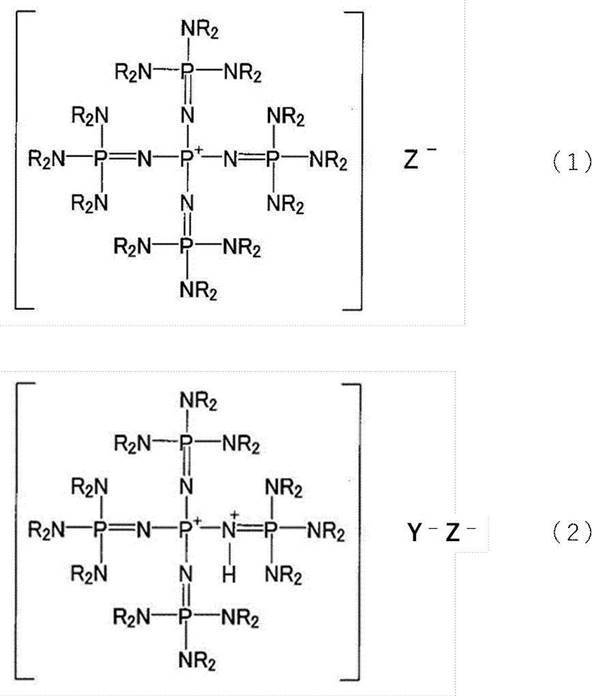
(式(1)中、Z-は、無機酸または活性水素化合物からプロトンを除いた形式で表されるアニオンであり、24個のRは、それぞれ独立に炭素数1~10の炭化水素基であり、24個のRのうち同一の窒素原子に結合する2個のRは互いに結合していてもよい。
式(2)中、Y-及びZ-は、それぞれ独立に、無機酸または活性水素化合物からプロトンを除いた形式で表されるアニオンであり、24個のRは、それぞれ独立に炭素数1~10の炭化水素基であり、24個のRのうち同一の窒素原子に結合する2個のRは互いに結合していてもよい。) - 前記式(1)中、24個のRは、それぞれ独立に、炭素数1~3のアルキル基であり、24個のRのうち同一の窒素原子に結合する2個のRは互いに結合していてもよく、
前記式(2)中、24個のRは、それぞれ独立に、炭素数1~3のアルキル基であり、24個のRのうち同一の窒素原子に結合する2個のRは互いに結合していてもよい請求項1に記載の電池用非水電解液。 - 前記式(1)中、Rは全てメチル基またはエチル基であり、24個のRのうち同一窒素原子に結合する2個のRが互いに結合していてもよく、
前記式(2)中、Rは全てメチル基またはエチル基であり、24個のRのうち同一窒素原子に結合する2個のRが互いに結合していてもよい請求項1に記載の電池用非水電解液。 - 前記ホスファゼン化合物(A)の含有量が、電池用非水電解液の全量に対し、0.1質量%~2.0質量%である請求項1~請求項3のいずれか1項に記載の電池用非水電解液。
- 前記式(1)中、Z-は、PF6 -、SO3CF3 -、BF4 -、ClO4 -、PO2F2 -、下記(TFSI-)、下記(FSI-)、下記(FOB-)、下記(BOB-)、又は下記(CA-)であり、
式(2)中、Y-及びZ-は、それぞれ独立に、PF6 -、SO3CF3 -、BF4 -、ClO4 -、PO2F2 -、下記(TFSI-)、下記(FSI-)、下記(FOB-)、下記(BOB-)、又は下記(CA-)である、請求項1~請求項4のいずれか1項に記載の電池用非水電解液。
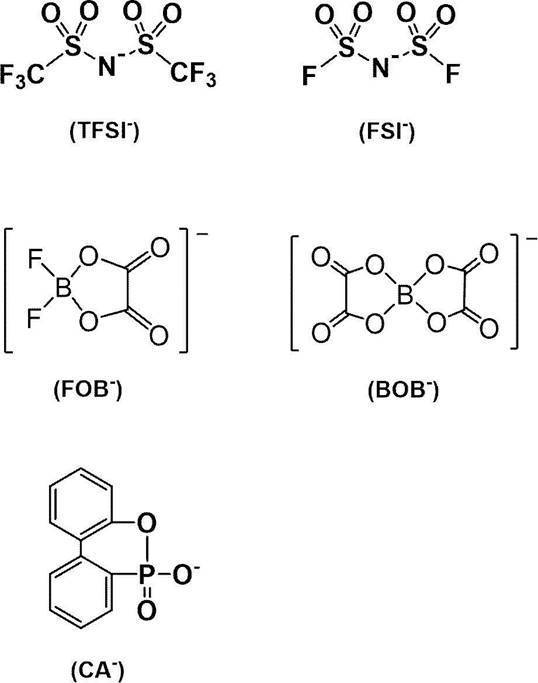
- 更に、不飽和結合を有する環状炭酸エステルを含有する請求項1~請求項5のいずれか1項に記載の電池用非水電解液。
- 前記不飽和結合を有する環状炭酸エステルがビニレンカーボネートである請求項6記載の電池用非水電解液。
- 前記ホスファゼン化合物(A)の含有質量に対する前記不飽和結合を有する環状炭酸エステルの含有質量の比が、0.05~30の範囲にある請求項6または請求項7に記載の電池用非水電解液。
- ケースと、
前記ケースに収容された、正極、負極、セパレータ、及び電解液と、
を備え、
前記正極が、リチウムイオンを吸蔵及び放出可能な正極であり、
前記負極が、リチウムイオンを吸蔵及び放出可能な負極であり、
前記電解液が、請求項1~請求項8のいずれか1項に記載の電池用非水電解液であるリチウム二次電池前駆体。 - 前記正極が、正極活物質として、下記一般式(C1)で表されるリチウム含有複合酸化物を含む請求項9に記載のリチウム二次電池前駆体。
LiNiaCobMncO2 … 一般式(C1)
〔一般式(C1)中、a、b及びcは、それぞれ独立に、0超1未満であり、かつ、a、b及びcの合計は、0.99~1.00である。〕 - 請求項9又は請求項10に記載のリチウム二次電池前駆体を準備する工程と、
前記リチウム二次電池前駆体に対して活性化処理を施すことにより、リチウム二次電池を得る工程と、
を含み、
前記活性化処理は、前記リチウム二次電池前駆体に対し、15℃~70℃の環境下で、充電及び放電の少なくとも一方を施すことを含むリチウム二次電池の製造方法。 - 請求項9又は請求項10に記載のリチウム二次電池前駆体を充放電させて得られたリチウム二次電池。
- 下記式(1)で表されるホスファゼン化合物及び下記式(2)で表されるホスファゼン化合物の少なくとも一方を含むホスファゼン化合物。
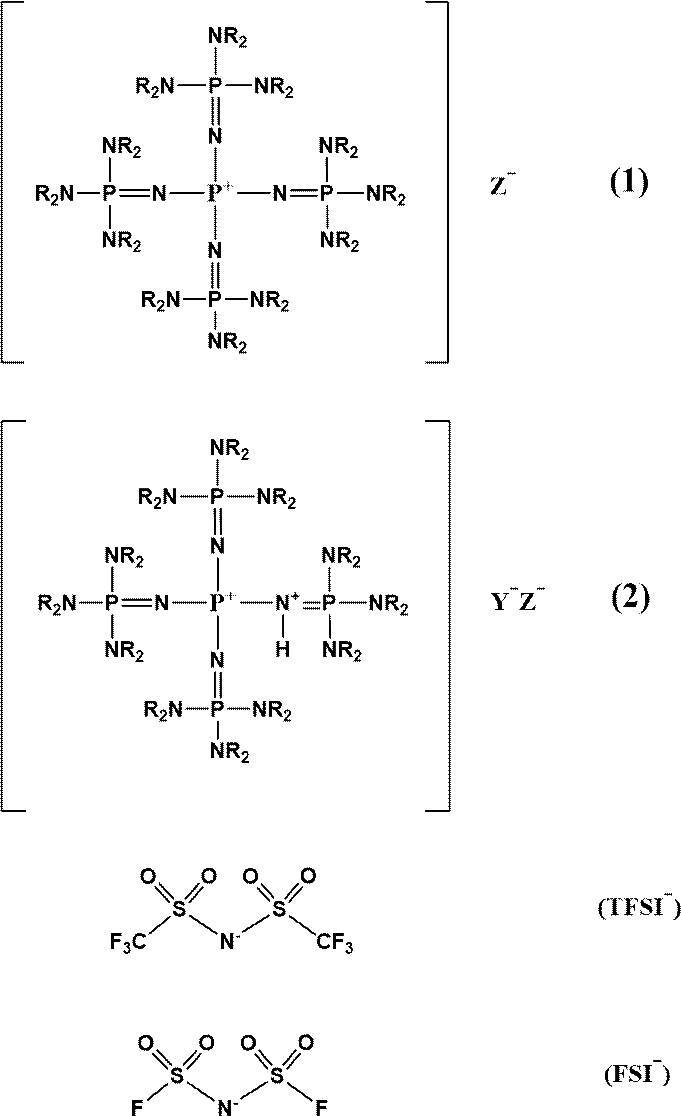
(式(1)中、Z-は、無機酸(但し、塩化水素、ヘキサフルオロリン酸、(TFSI-)、及び(FSI-)を除く。)または活性水素化合物(但し、水、蟻酸、及び酢酸を除く。)からプロトンを除いた形式で表されるアニオンであり、24個のRは、それぞれ独立に炭素数1~10の炭化水素基であり、24個のRのうち同一の窒素原子に結合する2個のRは互いに結合していてもよい。
式(2)中、Y-及びZ-は、それぞれ独立に、無機酸または活性水素化合物からプロトンを除いた形式で表されるアニオンであり、24個のRは、それぞれ独立に炭素数1~10の炭化水素基であり、24個のRのうち同一の窒素原子に結合する2個のRは互いに結合していてもよい。) - 前記式(1)中、Z-は、PO2F2 -である、請求項13に記載のホスファゼン化合物。
- 下記式(1)で表されるホスファゼン化合物及び下記式(2)で表されるホスファゼン化合物の少なくとも一方を含むホスファゼン化合物(A)を含む、電池用添加剤。
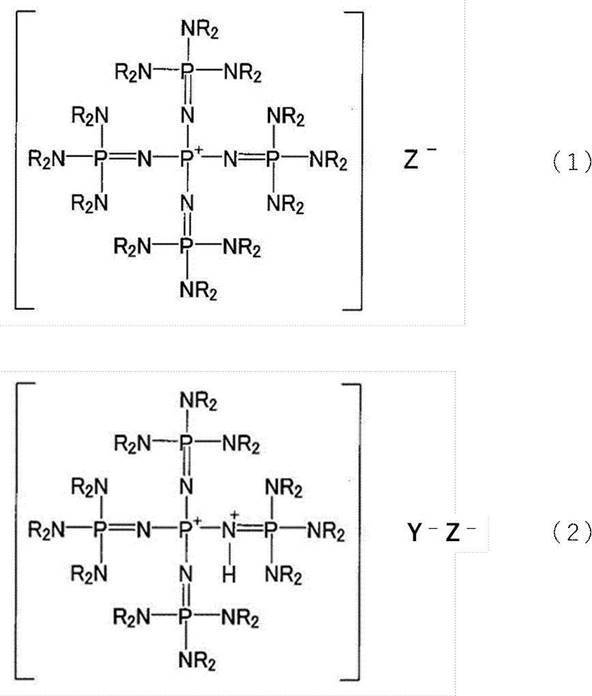
(式(1)中、Z-は、無機酸または活性水素化合物からプロトンを除いた形式で表されるアニオンであり、24個のRは、それぞれ独立に炭素数1~10の炭化水素基であり、24個のRのうち同一の窒素原子に結合する2個のRは互いに結合していてもよい。
式(2)中、Y-及びZ-は、それぞれ独立に、無機酸または活性水素化合物からプロトンを除いた形式で表されるアニオンであり、24個のRは、それぞれ独立に炭素数1~10の炭化水素基であり、24個のRのうち同一の窒素原子に結合する2個のRは互いに結合していてもよい。)
Priority Applications (4)
| Application Number | Priority Date | Filing Date | Title |
|---|---|---|---|
| CN202180023135.8A CN115315840A (zh) | 2020-03-31 | 2021-03-30 | 电池用非水电解液、锂二次电池前体、锂二次电池的制造方法、锂二次电池、磷腈化合物、及电池用添加剂 |
| JP2022512598A JP7454650B2 (ja) | 2020-03-31 | 2021-03-30 | 電池用非水電解液、リチウム二次電池前駆体、リチウム二次電池の製造方法、リチウム二次電池、ホスファゼン化合物、及び電池用添加剤 |
| US17/914,926 US20230110251A1 (en) | 2020-03-31 | 2021-03-30 | Non-aqueous electrolyte for battery, precursor for lithium secondary battery, method for manufacturing lithium secondary battery, lithium secondary battery, phosphazene compound, and additive for battery |
| EP21781744.4A EP4131548B1 (en) | 2020-03-31 | 2021-03-30 | Non-aqueous electrolyte for battery, precursor for lithium secondary battery, method for manufacturing lithium secondary battery, lithium secondary battery, phosphazene compound, and additive for battery |
Applications Claiming Priority (2)
| Application Number | Priority Date | Filing Date | Title |
|---|---|---|---|
| JP2020064371 | 2020-03-31 | ||
| JP2020-064371 | 2020-03-31 |
Publications (1)
| Publication Number | Publication Date |
|---|---|
| WO2021201054A1 true WO2021201054A1 (ja) | 2021-10-07 |
Family
ID=77929489
Family Applications (1)
| Application Number | Title | Priority Date | Filing Date |
|---|---|---|---|
| PCT/JP2021/013723 Ceased WO2021201054A1 (ja) | 2020-03-31 | 2021-03-30 | 電池用非水電解液、リチウム二次電池前駆体、リチウム二次電池の製造方法、リチウム二次電池、ホスファゼン化合物、及び電池用添加剤 |
Country Status (5)
| Country | Link |
|---|---|
| US (1) | US20230110251A1 (ja) |
| EP (1) | EP4131548B1 (ja) |
| JP (1) | JP7454650B2 (ja) |
| CN (1) | CN115315840A (ja) |
| WO (1) | WO2021201054A1 (ja) |
Families Citing this family (2)
| Publication number | Priority date | Publication date | Assignee | Title |
|---|---|---|---|---|
| CA3242707A1 (en) * | 2022-01-21 | 2023-07-27 | Octet Scientific, Inc. | ORGANIC SULFONATE-BASED ELECTROLYTIC ADDITIVES FOR ZINC BATTERIES |
| US12695123B1 (en) | 2025-08-20 | 2026-07-28 | Octet Scientific, Inc. | Electrolyte additives for batteries |
Citations (8)
| Publication number | Priority date | Publication date | Assignee | Title |
|---|---|---|---|---|
| JPH1077289A (ja) * | 1996-02-20 | 1998-03-24 | Mitsui Petrochem Ind Ltd | ホスファゼニウム塩およびその製造方法ならびにポリアルキレンオキシドの製造方法 |
| JP2002003427A (ja) * | 2000-04-20 | 2002-01-09 | Mitsui Chemicals Inc | 置換芳香族化合物の製造方法 |
| JP2004107266A (ja) * | 2002-09-19 | 2004-04-08 | Mitsui Chemicals Inc | 芳香族エーテル類の製造方法 |
| JP2006036709A (ja) * | 2004-07-28 | 2006-02-09 | Mitsui Chemicals Inc | イオン液体 |
| JP2008031348A (ja) * | 2006-07-31 | 2008-02-14 | Polyplastics Co | 安定化ポリアセタール樹脂の製造方法、安定化ポリアセタール樹脂、組成物及び成形体 |
| JP2014501434A (ja) * | 2010-12-22 | 2014-01-20 | コンツアー エナジー システムズ インコーポレイテッド | フッ化物イオン電池 |
| JP2017120370A (ja) * | 2015-12-28 | 2017-07-06 | 信越化学工業株式会社 | レジスト材料及びパターン形成方法 |
| JP2020064371A (ja) | 2018-10-15 | 2020-04-23 | 東京エレクトロン株式会社 | 温度制御システム及び温度制御方法 |
Family Cites Families (14)
| Publication number | Priority date | Publication date | Assignee | Title |
|---|---|---|---|---|
| US7960305B2 (en) * | 2005-02-25 | 2011-06-14 | Mitsui Chemicals, Inc. | Polymerization catalyst composition and process for production of polymer |
| WO2007074609A1 (ja) * | 2005-12-26 | 2007-07-05 | Bridgestone Corporation | 電池用非水電解液及びそれを備えた非水電解液電池、並びに電気二重層キャパシタ用電解液及びそれを備えた電気二重層キャパシタ |
| JP5623199B2 (ja) * | 2010-09-06 | 2014-11-12 | 株式会社Nttファシリティーズ | 非水電解液電池 |
| US9206210B2 (en) * | 2011-10-05 | 2015-12-08 | Battelle Energy Alliance, Llc | Ionic liquids, electrolyte solutions including the ionic liquids, and energy storage devices including the ionic liquids |
| JP2014060029A (ja) * | 2012-09-18 | 2014-04-03 | Sanyo Electric Co Ltd | 非水電解質二次電池 |
| JP6457205B2 (ja) * | 2014-06-19 | 2019-01-23 | 三井化学株式会社 | リチウム二次電池 |
| JP6607689B2 (ja) * | 2015-04-07 | 2019-11-20 | 三井化学株式会社 | 電池用非水電解液、及びリチウム二次電池 |
| US9958776B2 (en) * | 2015-12-28 | 2018-05-01 | Shin-Etsu Chemical Co., Ltd. | Resist composition and patterning process |
| JP6744412B2 (ja) * | 2016-08-05 | 2020-08-19 | 三井化学Skcポリウレタン株式会社 | 揮発性有機化合物の低減方法、ポリウレタンフォームの製造方法およびレジンプレミックス |
| CN106058316A (zh) * | 2016-08-10 | 2016-10-26 | 东莞市凯欣电池材料有限公司 | 一种高镍三元锂离子动力电池电解液及高镍三元锂离子动力电池 |
| TW201811811A (zh) * | 2016-09-02 | 2018-04-01 | 森普拉製藥公司 | 製備氟酮內酯之方法 |
| US10101654B2 (en) * | 2016-09-20 | 2018-10-16 | Shin-Etsu Chemical Co., Ltd. | Resist composition and patterning process |
| CN108239265B (zh) * | 2016-12-26 | 2019-11-01 | 青岛科技大学 | 有机磷腈盐催化剂及其制备方法和用途 |
| CN109671982B (zh) * | 2018-12-25 | 2021-05-11 | 河南电池研究院有限公司 | 一种匹配硅碳负极材料的锂离子电池高温高安全电解液 |
-
2021
- 2021-03-30 US US17/914,926 patent/US20230110251A1/en active Pending
- 2021-03-30 JP JP2022512598A patent/JP7454650B2/ja active Active
- 2021-03-30 EP EP21781744.4A patent/EP4131548B1/en active Active
- 2021-03-30 WO PCT/JP2021/013723 patent/WO2021201054A1/ja not_active Ceased
- 2021-03-30 CN CN202180023135.8A patent/CN115315840A/zh active Pending
Patent Citations (8)
| Publication number | Priority date | Publication date | Assignee | Title |
|---|---|---|---|---|
| JPH1077289A (ja) * | 1996-02-20 | 1998-03-24 | Mitsui Petrochem Ind Ltd | ホスファゼニウム塩およびその製造方法ならびにポリアルキレンオキシドの製造方法 |
| JP2002003427A (ja) * | 2000-04-20 | 2002-01-09 | Mitsui Chemicals Inc | 置換芳香族化合物の製造方法 |
| JP2004107266A (ja) * | 2002-09-19 | 2004-04-08 | Mitsui Chemicals Inc | 芳香族エーテル類の製造方法 |
| JP2006036709A (ja) * | 2004-07-28 | 2006-02-09 | Mitsui Chemicals Inc | イオン液体 |
| JP2008031348A (ja) * | 2006-07-31 | 2008-02-14 | Polyplastics Co | 安定化ポリアセタール樹脂の製造方法、安定化ポリアセタール樹脂、組成物及び成形体 |
| JP2014501434A (ja) * | 2010-12-22 | 2014-01-20 | コンツアー エナジー システムズ インコーポレイテッド | フッ化物イオン電池 |
| JP2017120370A (ja) * | 2015-12-28 | 2017-07-06 | 信越化学工業株式会社 | レジスト材料及びパターン形成方法 |
| JP2020064371A (ja) | 2018-10-15 | 2020-04-23 | 東京エレクトロン株式会社 | 温度制御システム及び温度制御方法 |
Non-Patent Citations (1)
| Title |
|---|
| See also references of EP4131548A4 |
Also Published As
| Publication number | Publication date |
|---|---|
| JP7454650B2 (ja) | 2024-03-22 |
| EP4131548A1 (en) | 2023-02-08 |
| EP4131548B1 (en) | 2025-08-27 |
| EP4131548A4 (en) | 2024-05-15 |
| JPWO2021201054A1 (ja) | 2021-10-07 |
| US20230110251A1 (en) | 2023-04-13 |
| CN115315840A (zh) | 2022-11-08 |
Similar Documents
| Publication | Publication Date | Title |
|---|---|---|
| EP2882030B1 (en) | Non-aqueous electrolyte and energy storage device using the same | |
| US11011774B2 (en) | Lithium-ion secondary battery | |
| JP7276957B2 (ja) | リチウムイオン二次電池 | |
| KR102229461B1 (ko) | 전해질 및 이를 포함하는 리튬 이차전지 | |
| US12269832B2 (en) | Lithium borate compound, additive for lithium secondary battery, non-aqueous electrolyte solution for lithium secondary battery, lithium secondary battery precursor, and lithium secondary battery and method of producing the same | |
| JPWO2015087580A1 (ja) | 二次電池の製造方法 | |
| US12315879B2 (en) | Lithium borate compound, additive for lithium secondary battery, nonaqueous electrolytic solution for lithium secondary battery, precursor for lithium secondary battery, and production method for lithium secondary battery | |
| KR20140000167A (ko) | 리튬 이차 전지 | |
| US20170317383A1 (en) | Lithium-ion secondary battery | |
| CN121713286A (zh) | 锂二次电池 | |
| KR20230119683A (ko) | 리튬 이차 전지용 비수 전해액, 리튬 이차 전지 전구체,리튬 이차 전지 및 리튬 이차 전지의 제조 방법 | |
| JP7454650B2 (ja) | 電池用非水電解液、リチウム二次電池前駆体、リチウム二次電池の製造方法、リチウム二次電池、ホスファゼン化合物、及び電池用添加剤 | |
| JP7276956B2 (ja) | リチウムイオン二次電池 | |
| JP7413635B2 (ja) | リン酸ホウ素リチウム化合物、リチウム二次電池用添加剤、リチウム二次電池用非水電解液、リチウム二次電池前駆体、リチウム二次電池の製造方法、及びリチウム二次電池 | |
| JP7346799B2 (ja) | リン酸ホウ素リチウム化合物、リチウム二次電池用添加剤、リチウム二次電池用非水電解液、リチウム二次電池前駆体、リチウム二次電池の製造方法、及びリチウム二次電池 | |
| JP7413636B2 (ja) | リン酸エステル化合物、リチウム二次電池用添加剤、リチウム二次電池用非水電解液、リチウム二次電池前駆体、リチウム二次電池の製造方法、及びリチウム二次電池 | |
| KR102954767B1 (ko) | 전지용 비수 전해액, 리튬 이차 전지 전구체, 리튬 이차 전지의 제조 방법, 및 리튬 이차 전지 | |
| WO2023119987A1 (ja) | 非水電解液、電気化学デバイス前駆体、電気化学デバイス、及び電気化学デバイスの製造方法 | |
| JP2025530513A (ja) | リチウム金属電池 | |
| JP2023129103A (ja) | 電池用非水電解液、リチウム二次電池前駆体、リチウム二次電池、及びリチウム二次電池の製造方法 | |
| JP2019216003A (ja) | リチウムイオン二次電池用電解液及びこれを備えたリチウムイオン二次電池 |
Legal Events
| Date | Code | Title | Description |
|---|---|---|---|
| 121 | Ep: the epo has been informed by wipo that ep was designated in this application |
Ref document number: 21781744 Country of ref document: EP Kind code of ref document: A1 |
|
| ENP | Entry into the national phase |
Ref document number: 2022512598 Country of ref document: JP Kind code of ref document: A |
|
| NENP | Non-entry into the national phase |
Ref country code: DE |
|
| ENP | Entry into the national phase |
Ref document number: 2021781744 Country of ref document: EP Effective date: 20221031 |
|
| WWG | Wipo information: grant in national office |
Ref document number: 2021781744 Country of ref document: EP |