WO2021201166A1 - 光学物品用重合性組成物、光学物品および眼鏡 - Google Patents
光学物品用重合性組成物、光学物品および眼鏡 Download PDFInfo
- Publication number
- WO2021201166A1 WO2021201166A1 PCT/JP2021/014016 JP2021014016W WO2021201166A1 WO 2021201166 A1 WO2021201166 A1 WO 2021201166A1 JP 2021014016 W JP2021014016 W JP 2021014016W WO 2021201166 A1 WO2021201166 A1 WO 2021201166A1
- Authority
- WO
- WIPO (PCT)
- Prior art keywords
- meth
- layer
- composition
- acrylate
- optical article
- Prior art date
- Legal status (The legal status is an assumption and is not a legal conclusion. Google has not performed a legal analysis and makes no representation as to the accuracy of the status listed.)
- Ceased
Links
Classifications
-
- G—PHYSICS
- G02—OPTICS
- G02B—OPTICAL ELEMENTS, SYSTEMS OR APPARATUS
- G02B1/00—Optical elements characterised by the material of which they are made; Optical coatings for optical elements
- G02B1/10—Optical coatings produced by application to, or surface treatment of, optical elements
- G02B1/14—Protective coatings, e.g. hard coatings
-
- C—CHEMISTRY; METALLURGY
- C08—ORGANIC MACROMOLECULAR COMPOUNDS; THEIR PREPARATION OR CHEMICAL WORKING-UP; COMPOSITIONS BASED THEREON
- C08F—MACROMOLECULAR COMPOUNDS OBTAINED BY REACTIONS ONLY INVOLVING CARBON-TO-CARBON UNSATURATED BONDS
- C08F222/00—Copolymers of compounds having one or more unsaturated aliphatic radicals, each having only one carbon-to-carbon double bond, and at least one being terminated by a carboxyl radical and containing at least one other carboxyl radical in the molecule; Salts, anhydrides, esters, amides, imides, or nitriles thereof
- C08F222/10—Esters
- C08F222/1006—Esters of polyhydric alcohols or polyhydric phenols
- C08F222/102—Esters of polyhydric alcohols or polyhydric phenols of dialcohols, e.g. ethylene glycol di(meth)acrylate or 1,4-butanediol dimethacrylate
-
- C—CHEMISTRY; METALLURGY
- C09—DYES; PAINTS; POLISHES; NATURAL RESINS; ADHESIVES; COMPOSITIONS NOT OTHERWISE PROVIDED FOR; APPLICATIONS OF MATERIALS NOT OTHERWISE PROVIDED FOR
- C09D—COATING COMPOSITIONS, e.g. PAINTS, VARNISHES OR LACQUERS; FILLING PASTES; CHEMICAL PAINT OR INK REMOVERS; INKS; CORRECTING FLUIDS; WOODSTAINS; PASTES OR SOLIDS FOR COLOURING OR PRINTING; USE OF MATERIALS THEREFOR
- C09D135/00—Coating compositions based on homopolymers or copolymers of compounds having one or more unsaturated aliphatic radicals, each having only one carbon-to-carbon double bond, and at least one being terminated by a carboxyl radical, and containing at least another carboxyl radical in the molecule, or of salts, anhydrides, esters, amides, imides or nitriles thereof; Coating compositions based on derivatives of such polymers
- C09D135/02—Homopolymers or copolymers of esters
-
- G—PHYSICS
- G02—OPTICS
- G02B—OPTICAL ELEMENTS, SYSTEMS OR APPARATUS
- G02B1/00—Optical elements characterised by the material of which they are made; Optical coatings for optical elements
- G02B1/04—Optical elements characterised by the material of which they are made; Optical coatings for optical elements made of organic materials, e.g. plastics
- G02B1/041—Lenses
-
- G—PHYSICS
- G02—OPTICS
- G02B—OPTICAL ELEMENTS, SYSTEMS OR APPARATUS
- G02B5/00—Optical elements other than lenses
- G02B5/20—Filters
- G02B5/22—Absorbing filters
- G02B5/23—Photochromic filters
-
- G—PHYSICS
- G02—OPTICS
- G02C—SPECTACLES; SUNGLASSES OR GOGGLES INSOFAR AS THEY HAVE THE SAME FEATURES AS SPECTACLES; CONTACT LENSES
- G02C7/00—Optical parts
- G02C7/10—Filters, e.g. for facilitating adaptation of the eyes to the dark; Sunglasses
- G02C7/102—Photochromic filters
-
- G—PHYSICS
- G02—OPTICS
- G02C—SPECTACLES; SUNGLASSES OR GOGGLES INSOFAR AS THEY HAVE THE SAME FEATURES AS SPECTACLES; CONTACT LENSES
- G02C7/00—Optical parts
- G02C7/16—Shades; shields; Obturators, e.g. with pinhole, with slot
-
- G—PHYSICS
- G02—OPTICS
- G02C—SPECTACLES; SUNGLASSES OR GOGGLES INSOFAR AS THEY HAVE THE SAME FEATURES AS SPECTACLES; CONTACT LENSES
- G02C2202/00—Generic optical aspects applicable to one or more of the subgroups of G02C7/00
- G02C2202/16—Laminated or compound lenses
Definitions
- the present invention relates to polymerizable compositions for optical articles, optical articles and eyeglasses.
- a photochromic compound is a compound having the property of developing color under irradiation with light in a wavelength range having photoresponsiveness and fading under non-irradiation (photochromic property).
- a coating is provided on a substrate using a polymerizable composition containing a photochromic compound and a polymerizable compound, and the coating is cured to have photochromic properties. Examples thereof include a method of forming a cured layer (photochromic layer) (see, for example, Patent Document 1).
- the properties desired for an optical article having the above-mentioned photochromic properties include high color density when color is developed by receiving light irradiation and excellent weather resistance. It is also desirable that the polymerizable composition used to form the photochromic layer has excellent solubility of the photochromic compound.
- One aspect of the present invention is a polymerizable composition for an optical article, which has a high color-developing density when subjected to light irradiation, can form a photochromic layer having excellent weather resistance, and has excellent solubility of a photochromic compound. offer.
- Photochromic compounds and Component A Acyclic methacrylate having a molecular weight of 500 or more
- Component B a bifunctional (meth) acrylate containing a structure selected from the group consisting of a cyclic structure and a branched structure
- composition Polymerizable composition for optical articles
- the above composition contains the above-mentioned component A and component B together with the photochromic compound.
- the photochromic layer formed by curing this composition can exhibit excellent weather resistance, and in this photochromic layer, the photochromic compound subjected to light irradiation can develop a color at a high concentration.
- the above composition containing the above component A and the above component B can also exhibit excellent solubility in a photochromic compound.
- a polymerizable composition for an optical article which has a high color-developing density when subjected to light irradiation, can form a photochromic layer having excellent weather resistance, and has excellent solubility of a photochromic compound.
- the optical article can be a spectacle lens.
- the polymerizable composition means a composition containing a polymerizable compound.
- the polymerizable compound is a compound having a polymerizable group.
- the polymerizable composition for an optical article according to one aspect of the present invention is a polymerizable composition used for producing an optical article, and can be a coating composition for an optical article. More specifically, optical It can be a coating composition for forming a photochromic layer of an article.
- the coating composition for an optical article means a composition applied to a surface to be coated such as the surface of a base material for manufacturing an optical article.
- optical article examples include various lenses such as spectacle lenses and goggles lenses, a visor portion of a sun visor, a shield member of a helmet, and the like.
- a spectacle lens produced by applying the above composition to a lens base material becomes a spectacle lens having a photochromic layer, and can exhibit photochromic properties.
- (meth) acrylate is used in the sense of including acrylate and methacrylate.
- “Acrylate” is a compound having one or more acryloyl groups in one molecule.
- a “methacrylate” is a compound having one or more methacryloyl groups in one molecule.
- the functional number is the number of groups selected from the group consisting of acryloyl groups and methacryloyl groups contained in one molecule.
- methacrylate means a (meth) acryloyl group containing only a methacryloyl group, and a (meth) acryloyl group containing both an acryloyl group and a methacryloyl group is an acrylate.
- the acryloyl group may be contained in the form of an acryloyloxy group, and the methacryloyl group may be contained in the form of a methacryloyloxy group.
- the "(meth) acryloyl group” described below is used in the sense of including an acryloyl group and a methacryloyl group, and the "(meth) acryloyloxy group” includes an acryloyloxy group and a methacryloyloxy group. Used in the sense. Further, unless otherwise specified, the described groups may have a substituent or may be unsubstituted.
- the substituents include an alkyl group (for example, an alkyl group having 1 to 6 carbon atoms), a hydroxyl group, an alkoxy group (for example, an alkoxy group having 1 to 6 carbon atoms), and a halogen atom (for example, a fluorine atom). , Chlorine atom, bromine atom), cyano group, amino group, nitro group, acyl group, carboxy group and the like.
- the "carbon number” shall mean the carbon number of the portion not containing the substituent.
- the composition contains at least component A and component B as a polymerizable compound.
- the component A and the component B will be described below.
- Component A is an acyclic methacrylate having a molecular weight of 500 or more.
- non-cyclic means that it does not include a cyclic structure.
- the acyclic methacrylate refers to a monofunctional or higher methacrylate that does not contain a cyclic structure. It is presumed that the component A can contribute to the ability of the photochromic layer formed from the above composition to exhibit excellent weather resistance.
- Component A can be monofunctional or bifunctional or higher, preferably bifunctional or trifunctional methacrylate, more preferably bifunctional methacrylate.
- polyalkylene glycol dimethacrylate can be mentioned.
- Polyalkylene glycol dimethacrylate is prepared by the following formula 1: , R represents an alkylene group, n represents the number of repetitions of the alkoxy group represented by RO, and is 2 or more. Examples of the alkylene group represented by R include an ethylene group, a propylene group, and a tetramethylene group. n is 2 or more, and can be, for example, 30 or less, 25 or less, or 20 or less. Specific examples of polyalkylene glycol dimethacrylate include polyethylene glycol dimethacrylate, polypropylene glycol dimethacrylate, and polytetramethylene glycol dimethacrylate.
- the molecular weight of component A is 500 or more.
- acyclic bifunctional methacrylate (component A) having a molecular weight of 500 or more together with component B, the details of which will be described later, is a high concentration of the photochromic compound subjected to light irradiation in the photochromic layer formed from the above composition. It is presumed that it can contribute to the ability to develop color.
- the molecular weight of the polymer is the theoretical molecular weight calculated from the structural formula determined by the structural analysis of the compound or the raw material charging ratio at the time of production.
- the molecular weight of the component A is 500 or more, preferably 510 or more, more preferably 520 or more, preferably 550 or more, more preferably 570 or more, and 600 or more. Is even more preferable, 630 or more is more preferable, and 650 or more is even more preferable.
- the molecular weight of the component A is preferably 2000 or less, 1500 or less, 1200 or less, 1000 or less, or 800 or less, for example, from the viewpoint of increasing the hardness of the photochromic layer.
- Component B is a bifunctional (meth) acrylate containing a structure selected from the group consisting of cyclic and branched structures. It is presumed that the inclusion of the component B together with the component A in the composition may contribute to the ability of the photochromic compound subjected to light irradiation to develop a color at a high concentration in the photochromic layer formed from the composition. It is also considered that the component B can contribute to increasing the solubility of the photochromic compound in the above composition.
- the component B contains one or more cyclic structures in one molecule and does not contain a branched structure, and in the other form, it contains one or more branched structures in one molecule and does not contain a cyclic structure, and the other.
- one molecule contains one or more cyclic structures and one or more branched structures.
- the number of structures selected from the group consisting of cyclic and branched structures contained in one molecule may be one or more, for example one, two or three, and one or two. It is preferable, and it is more preferable that there is one.
- the branched structure contained in the methacryloyl group shall not be considered.
- the component B containing one or more cyclic structures can, in one form, be an alicyclic bifunctional (meth) acrylate.
- Difunctional (meth) acrylates of cycloaliphatic for example, R 1 - (L 1) n1-Q- (L 2) may be a compound having a structure represented by n2-R 2.
- Q represents a divalent alicyclic group
- R 1 and R 2 independently represent a (meth) acryloyl group or a (meth) acryloyloxy group
- L 1 and L 2 each independently represent a linking group.
- n1 and n2 independently represent 0 or 1, respectively.
- an alicyclic hydrocarbon group having 3 to 20 carbon atoms is preferable, and for example, a cyclopentylene group, a cyclohexylene group, a cycloheptylene group, a cyclooctylene group, or a tri. Cyclodecanilen group, adamantylene group and the like can be mentioned.
- Examples of the linking group represented by L 1 and L 2 include an alkylene group.
- the alkylene group can be, for example, an alkylene group having 1 to 6 carbon atoms.
- alicyclic bifunctional (meth) acrylate examples include cyclohexanedimethanol di (meth) acrylate, ethoxylated cyclohexanedimethanol di (meth) acrylate, propoxylated cyclohexanedimethanol di (meth) acrylate, and ethoxylated propoxy.
- the component B containing one or more branched structures can, in one form, be a bifunctional (meth) acrylate containing a branched alkylene group.
- the number of carbon atoms of the branched alkylene group can be 1 or more, 2 or more, 3 or more, or 4 or more. Further, the number of carbon atoms of the branched alkylene group can be 10 or less, 9 or less, 8 or less, 7 or less, 6 or less or 5 or less.
- the branched alkylene group can include a quaternary carbon (ie, a carbon bonded to four carbons).
- component B containing one or more branched structures include neopentyl glycol di (meth) acrylate, ethoxylated neopentyl glycol di (meth) acrylate, propoxylated neopentyl glycol di (meth) acrylate, and the like. Can be done.
- the molecular weight of component B is not particularly limited, but in one form, it can be in the range of, for example, 200 to 400.
- the component B may contain only an acryloyl group, may contain only a methacryloyl group, or may contain an acryloyl group and a methacryloyl group as the (meth) acryloyl group.
- the content of the component A is preferably 50.0% by mass or more, more preferably 60.0% by mass or more, based on the total amount (100% by mass) of the (meth) acrylate contained in the composition. It is preferably 70.0% by mass or more, and more preferably 70.0% by mass or more. Further, the content of the component A can be, for example, 95.0% by mass or less, or 90.0% by mass or less.
- the composition may contain only one component A, or may contain two or more components A. When two or more kinds of component A are contained, the above-mentioned content rate is the total content rate of those two or more kinds of component A. This point is the same for the content rate of other components such as component B.
- a component corresponding to both component A and component B shall be regarded as component A.
- the component A can be the most contained component among the (meth) acrylates contained in the above composition.
- the content of the component B can be 1.0% by mass or more, and 5.0% by mass or more, based on the total amount (100% by mass) of the (meth) acrylate contained in the composition. It is preferably 10.0% by mass or more, and more preferably 10.0% by mass or more.
- the content of the component B can be, for example, 30.0% by mass or less, 25.0% by mass or less, or 20.0% by mass or less.
- the composition may or may not contain other (meth) acrylates other than the components A and B.
- the content thereof is 10.0 with respect to the total amount (100% by mass) of the (meth) acrylate contained in the composition. It is preferably 5% by mass or less, and more preferably 5.0% by mass or less.
- the composition may also contain only component A and component B as the (meth) acrylate.
- the above composition may or may not contain a polymerizable compound other than the (meth) acrylate.
- the composition may contain (meth) acrylate in a total content of, for example, 80.0 to 99.9% by mass with respect to the total amount (100% by mass) of the composition.
- the total amount of the composition means the total amount of all the components excluding the solvent for the composition containing the solvent.
- the composition may or may not contain a solvent. When a solvent is contained, any solvent can be used as a usable solvent as long as it does not hinder the progress of the polymerization reaction of the polymerizable composition.
- the above composition contains a photochromic compound together with the various components described above.
- a known compound exhibiting photochromic properties can be used as the photochromic compound contained in the above composition.
- the photochromic compound can exhibit photochromic properties to, for example, ultraviolet rays.
- examples of the photochromic compound include compounds having a known skeleton exhibiting photochromic properties, such as a flugimid compound, a spirooxazine compound, a chromene compound, and an indeno-condensed naphthopyrane compound.
- the photochromic compound can be used alone or in combination of two or more.
- the content of the photochromic compound in the above composition can be, for example, about 0.1 to 15.0% by mass, assuming that the total amount of the composition is 100% by mass, but the content is not limited to this range.
- the composition may contain one or more of various additives usually contained in the polymerizable composition at an arbitrary content rate.
- the additive that can be contained in the above composition include a polymerization initiator for advancing the polymerization reaction.
- the polymerization initiator a known polymerization initiator can be used, a radical polymerization initiator is preferable, and it is more preferable that only the radical polymerization initiator is contained as the polymerization initiator.
- a photopolymerization initiator or a thermal polymerization initiator can be used, and the photopolymerization initiator is preferable from the viewpoint of advancing the polymerization reaction in a short time.
- the photoradical polymerization initiator include benzoinketals such as 2,2-dimethoxy-1,2-diphenylethane-1-one; 1-hydroxycyclohexylphenylketone, 2-hydroxy-2-methyl-1-phenylpropane-.
- ⁇ -Hydroxyketones such as 1-one, 1- [4- (2-hydroxyethoxy) phenyl] -2-hydroxy-2-methyl-1-propane-1-one; 2-benzyl-2-dimethylamino-1 ⁇ -Aminoketones such as-(4-morpholinophenyl) -butane-1-one, 1,2-methyl-1- [4- (methylthio) phenyl] -2-morpholinopropan-1-one; 1-[ (4-Phenylthio) phenyl] -1,2-octadion-2- (benzoyl) oxime and other oxime esters; bis (2,4,6-trimethylbenzoyl) phenylphosphine oxide, bis (2,6-dimethoxybenzoyl)- Phenyl oxides such as 2,4,4-trimethylpentylphosphenyl oxide, 2,4,6-trimethylbenzoyldiphenylphosphenyl oxide; 2- (
- Benzoin compounds such as benzoin, methylbenzoin and ethylbenzoin
- Benzyl compounds such as benzyldimethylketal
- Acrydin compounds such as 9-phenylaclysine and 1,7-bis (9,9'-acridinylheptane): N- Examples thereof include phenylglycine and coumarin.
- the substituents of the aryl groups at the two triarylimidazole sites may give the same and symmetric compound, and give different and asymmetric compounds. May be good.
- a thioxanthone compound and a tertiary amine may be combined, such as a combination of diethyl thioxanthone and dimethylaminobenzoic acid.
- ⁇ -hydroxyketone and phosphine oxide are preferable from the viewpoint of curability, transparency and heat resistance.
- the content of the polymerization initiator can be in the range of, for example, 0.1 to 5.0% by mass, assuming that the total amount of the composition is 100% by mass.
- known additives which can be usually added to a composition containing a photochromic compound, such as a surfactant, an antioxidant, a radical scavenger, a light stabilizer, an ultraviolet absorber, and an antioxidant.
- a photochromic compound such as a surfactant, an antioxidant, a radical scavenger, a light stabilizer, an ultraviolet absorber, and an antioxidant.
- Antistatic agents, fluorescent dyes, dyes, pigments, fragrances, plasticizers, silane coupling agents and the like can be added in any amount.
- Known compounds can be used as these additives.
- the above composition can be prepared by sequentially mixing the various components described above at the same time or in any order.
- optical article One aspect of the present invention relates to an optical article having a base material and a photochromic layer obtained by curing the above composition.
- a base material and a photochromic layer obtained by curing the above composition.
- the optical article can have a photochromic layer on a substrate selected according to the type of the optical article.
- the spectacle lens base material can be a plastic lens base material or a glass lens base material.
- the glass lens base material can be, for example, a lens base material made of inorganic glass.
- a plastic lens base material is preferable from the viewpoint of being lightweight, hard to break, and easy to handle.
- the plastic lens base material include styrene resins such as (meth) acrylic resins, polycarbonate resins, allyl resins, allyl carbonate resins such as diethylene glycol bisallyl carbonate resin (CR-39), vinyl resins, polyester resins, and polyether resins.
- Urethane resin obtained by reacting an isocyanate compound with a hydroxy compound such as diethylene glycol thiourethane resin obtained by reacting an isocyanate compound with a polythiol compound, and a (thio) epoxy compound having one or more disulfide bonds in the molecule.
- a cured product generally referred to as a transparent resin obtained by curing the curable composition contained therein.
- the lens base material an undyed lens (colorless lens) may be used, or a dyed lens (dyed lens) may be used.
- the refractive index of the lens base material can be, for example, about 1.60 to 1.75.
- the refractive index of the lens base material is not limited to the above range, and may be within the above range or may be vertically separated from the above range.
- the refractive index means the refractive index for light having a wavelength of 500 nm.
- the lens base material may be a lens having a refractive power (so-called prescription lens) or a lens without refractive power (so-called prescription lens).
- pretreatments such as alkali treatment and UV ozone treatment are optionally applied for cleaning the surface of the base material. be able to.
- the spectacle lens can be various lenses such as a single focus lens, a multifocal lens, and a progressive power lens.
- the type of lens is determined by the surface shapes of both sides of the lens base material.
- the surface of the lens base material may be a convex surface, a concave surface, or a flat surface.
- the surface on the object side is convex and the surface on the eyeball side is concave.
- the photochromic layer can usually be provided on the object-side surface of the lens base material, but may be provided on the eyeball-side surface.
- the photochromic layer of the optical article is a cured layer obtained by curing the composition.
- the photochromic layer can be formed by directly or indirectly applying the composition on the surface of the base material via another layer or more, and applying a curing treatment to the applied composition.
- a known coating method such as a spin coating method or a dip coating method can be adopted, and the spin coating method is preferable from the viewpoint of coating uniformity.
- the curing treatment can be light irradiation and / or heat treatment, and light irradiation is preferable from the viewpoint of advancing the curing reaction in a short time.
- the curing treatment conditions may be determined according to the types of various components (polymerizable compounds, polymerization initiators, etc. described above) contained in the composition and the composition of the composition.
- the thickness of the photochromic layer thus formed is preferably in the range of, for example, 5 to 80 ⁇ m, and more preferably in the range of 20 to 60 ⁇ m.
- Primer layer As another layer that can be located between the base material and the photochromic layer, a primer layer for improving the adhesion between the base material and the photochromic layer can be mentioned.
- the primer layer can be a cured layer obtained by curing a polymerizable composition for forming a primer layer (hereinafter, also referred to as “composition for primer layer”).
- the composition for the primer layer comprises a polyisocyanate, a hydroxy group-containing polymerizable compound, and a polymerizable compound having a viscosity of 100 cP or less and selected from the group consisting of (meth) acrylate and vinyl ether.
- a polyisocyanate a hydroxy group-containing polymerizable compound
- a polymerizable compound having a viscosity of 100 cP or less selected from the group consisting of (meth) acrylate and vinyl ether.
- the composition for the primer layer can suppress the occurrence of optical defects caused by the primer layer by containing the above three kinds of components, whereby the occurrence of optical defects due to the primer layer can be suppressed. It has been newly found that it becomes possible to provide an optical article having excellent optical homogeneity. Further, the primer layer formed from the composition for the primer layer is also preferable in that it has excellent adhesion to the photochromic layer formed from the polymerizable composition for optical articles described above.
- various components contained in the composition for the primer layer will be described in more detail.
- the composition for the primer layer contains polyisocyanate.
- Polyisocyanate is a compound having two or more isocyanate groups in one molecule.
- the number of isocyanate groups contained in one molecule of polyisocyanate is 2 or more, preferably 3 or more.
- the number of isocyanate groups contained in one molecule of polyisocyanate can be, for example, 6 or less, 5 or less, or 4 or less.
- the molecular weight of the polyisocyanate can be, for example, in the range of 100 to 500, but is not limited to this range.
- polyisocyanate examples include aromatic diisocyanates such as xylylene diisocyanate, phenylenedi isocyanate, tolylene diisocyanate, diphenylmethane diisocyanate, and naphthalene diisocyanate, hexamethylene diisocyanate, lysine diisocyanate, cyclohexane diisocyanate, isophorone diisocyanate, and 4,4'-dicyclohexylmethane.
- aromatic diisocyanates such as xylylene diisocyanate, phenylenedi isocyanate, tolylene diisocyanate, diphenylmethane diisocyanate, and naphthalene diisocyanate, hexamethylene diisocyanate, lysine diisocyanate, cyclohexane diisocyanate, isophorone diisocyanate, and 4,4'-dicyclohexy
- Examples thereof include aliphatic or alicyclic diisocyanates such as diisocyanate, 1,3-bisisocyanatomethylcyclohexane, and tetramethylxylylene diisocyanate.
- diisocyanate 1,3-bisisocyanatomethylcyclohexane
- tetramethylxylylene diisocyanate examples thereof include aliphatic or alicyclic diisocyanates such as diisocyanate, 1,3-bisisocyanatomethylcyclohexane, and tetramethylxylylene diisocyanate.
- the allophanate form, the adduct form, the biuret form, the isocyanurate form and the like of the polyisocyanate exemplified above can also be mentioned.
- the composition for the primer layer contains a hydroxy group-containing polymerizable compound.
- the number of hydroxy groups contained in one molecule of the hydroxy group-containing polymerizable compound is 1 or more, preferably 2 or more.
- the number of hydroxy groups contained in one molecule of component B is preferably 4 or less, and more preferably 3 or less.
- a urethane bond can be formed by reacting the isocyanate group of the polyisocyanate with the hydroxy group of the hydroxy group-containing polymerizable compound. The present inventor speculates that this urethane bond contributes to the ability of the primer layer to function as a layer for improving adhesion.
- the hydroxy group-containing polymerizable compound can have one or more polymerizable groups in one molecule, and preferably has two or more polymerizable groups.
- the hydroxy group-containing polymerizable compound can be (meth) acrylate in one form.
- the number of functionalities as the (meth) acrylate is 1 or more (that is, monofunctional or more), and preferably 2 or more. Moreover, the functional number is preferably 3 or less.
- the component B may contain only an acryloyl group, may contain only a methacryloyl group, or may contain an acryloyl group and a methacryloyl group as the (meth) acryloyl group.
- the hydroxy group-containing polymerizable compound preferably contains only an acryloyl group as the (meth) acryloyl group.
- the molecular weight of the hydroxy group-containing polymerizable compound can be, for example, in the range of 300 to 400, but is not limited to this range.
- Specific examples of the hydroxy group-containing polymerizable compound include 2-hydroxyethyl (meth) acrylate, Hydroxypropyl (meth) acrylate, 4-hydroxybutyl (meth) acrylate, 1,4-cyclohexanedimethanol monoacrylate, and 2-hydroxy-.
- the hydroxy group-containing polymerizable compound can have an amide group.
- Specific examples of the hydroxy group-containing polymerizable compound having an amide group include N- (2-hydroxyethyl) acrylamide and the like.
- the hydroxy group-containing polymerizable compound can have an epoxy ester structure in one form.
- hydroxy group-containing polymerizable compounds having an epoxy ester structure include, for example, epoxy ester 40EM (manufactured by Kyoeisha Chemical Co., Ltd.), epoxy ester 70PA (manufactured by Kyoeisha Chemical Co., Ltd.), epoxy ester 80MFA (manufactured by Kyoeisha Chemical Co., Ltd.), and epoxy ester 200PA (manufactured by Kyoeisha Chemical Co., Ltd.).
- Examples include Kyoeisha Chemical Co., Ltd.), Epoxy Ester 3002M (N) (Kyoeisha Chemical Co., Ltd.), Epoxy Ester 3002A (N) (Kyoeisha Chemical Co., Ltd.), Epoxy Ester 3000MK (Kyoeisha Chemical Co., Ltd.), Epoxy Ester 3000A (Kyoeisha Chemical Co., Ltd.), etc. ..
- a polymerizable compound having a viscosity of 100 cP or less and selected from the group consisting of (meth) acrylate and vinyl ether The composition for the primer layer has a viscosity of 100 cP (centipores) or less and contains a polymerizable compound selected from the group consisting of (meth) acrylate and vinyl ether.
- the inclusion of such a low-viscosity polymerizable compound causes optical defects in the primer layer formed from the polymerizable composition for forming a primer layer containing the polyisocyanate and the hydroxy group-containing polymerizable compound. The present inventor speculates that it contributes to the suppression of.
- the "viscosity" in the present invention and the present specification is a value measured by a vibrating viscometer in an air atmosphere at a temperature of 25 ° C.
- the viscosity of the polymerizable compound is 100 cP or less, preferably 70 cP or less, and more preferably 50 cP or less. Further, the viscosity of the polymerizable compound can be, for example, 5 cP or more or 10 cP or more.
- the (meth) acrylate which is a form of the above-mentioned polymerizable compound, can be monofunctional to trifunctional, and is preferably monofunctional to bifunctional.
- the (meth) acrylate which is one form of the above-mentioned polymerizable compound, can contain an aryl group (for example, a phenyl group), an amide group and the like.
- the "vinyl ether” is a compound having one or more vinyl groups and one or more ether bonds in one molecule, and may have two or more vinyl groups in one molecule. It is preferable to have 2 to 4 of them. The number of ether bonds contained in the vinyl ether is preferably 2 to 4 in one molecule.
- the molecular weight of the polymerizable compound can be, for example, in the range of 150 to 250, but is not limited to this range.
- polymerizable compound examples include 2-phenoxyethyl (meth) acrylate, acrylamide, methoxypolyethylene glycol (meth) acrylate, phenoxypolyethylene glycol (meth) acrylate, stearyl (meth) acrylate, and 1,10-decanediol di.
- the content of the polymerizable compound selected from the group consisting of (meth) acrylate and vinyl ether having a viscosity of 100 cP or less is such a polymerizable compound, a polyisocyanate, and a hydroxy group-containing polymerizable compound.
- the total of the above is 100% by mass, it is preferably 30.0% by mass or more, and more preferably 40.0% by mass or more.
- the content of the polymerizable compound selected from the group consisting of (meth) acrylate and vinyl ether having a viscosity of 100 cP or less is 100% by mass based on the total of the polymerizable compound, the polyisocyanate and the hydroxy group-containing polymerizable compound. For example, it can be 90.0% by mass or less, 80.0% by mass or less, or 70.0% by mass or less.
- the polymerizable compound having a viscosity of 100 cP or less and selected from the group consisting of (meth) acrylate and vinyl ether is, in one form, the primer layer among such polymerizable compounds, polyisocyanates and hydroxy group-containing polymerizable compounds. It is preferably the component most contained in the composition for use.
- the polyisocyanate content is the total of the polyisocyanate, the hydroxy group-containing polymerizable compound, and the polymerizable compound selected from the group consisting of (meth) acrylate and vinyl ether having a viscosity of 100 cP or less. Is preferably 70.0% by mass or less, more preferably 60.0% by mass or less, and further preferably 50.0% by mass or less.
- the content of the polyisocyanate is, for example, 100% by mass as a total of the polyisocyanate, the hydroxy group-containing polymerizable compound and the polymerizable compound selected from the group consisting of (meth) acrylate and vinyl ether having a viscosity of 100 cP or less. It can be 10.0% by mass or more, 20.0% by mass or more, or 30.0% by mass or more.
- the content of the hydroxy group-containing polymerizable compound is selected from the group consisting of polyisocyanate, hydroxy group-containing polymerizable compound and viscosity of 100 cP or less, consisting of (meth) acrylate and vinyl ether.
- the total amount of the polymerizable compounds to be polymerized is 100% by mass, preferably 3.0% by mass or more, more preferably 5.0% by mass or more, and further preferably 7.0% by mass or more. ..
- the content of the hydroxy group-containing polymerizable compound is 100% by mass based on the total of the polyisocyanate, the hydroxy group-containing polymerizable compound and the polymerizable compound selected from the group consisting of (meth) acrylate and vinyl ether having a viscosity of 100 cP or less.
- it can be 30.0% by mass or less or 20.0% by mass or less.
- the composition for the primer layer may further contain a polymerization initiator.
- the composition for the primer layer is polymerized with the total of the polyisocyanate, the hydroxy group-containing polymerizable compound and the polymerizable compound having a viscosity of 100 cP or less and selected from the group consisting of (meth) acrylate and vinyl ether as 100% by mass.
- the initiator can be included, for example, in a content range of 0.01 to 3.0% by mass.
- the polymerization initiator a known polymerization initiator can be used, a radical polymerization initiator is preferable, and it is more preferable that only the radical polymerization initiator is contained as the polymerization initiator. Further, as the polymerization initiator, a photopolymerization initiator or a thermal polymerization initiator can be used, and the photopolymerization initiator is preferable from the viewpoint of advancing the polymerization reaction in a short time. For specific examples of the photoradical polymerization initiator, the above description regarding the polymerization initiator that can be contained in the polymerizable composition for an optical article can be referred to.
- the composition for the primer layer may or may not contain a solvent.
- any solvent can be used as a solvent as long as it does not hinder the progress of the polymerization reaction of the polymerizable composition.
- the total content of the polyisocyanate, the hydroxy group-containing polymerizable compound and the polymerizable compound having a viscosity of 100 cP or less and selected from the group consisting of (meth) acrylate and vinyl ether is 100% by mass, and the content of the solvent is Is preferably 10.0% by mass or less, more preferably 5.0% by mass or less, and further preferably 3.0% by mass or less.
- the composition for the primer layer can further contain an arbitrary amount of a known additive that can be usually added to the composition for forming the primer layer.
- a known compound can be used as the additive.
- the composition for the primer layer is composed of polyisocyanate, a hydroxy group-containing polymerizable compound, and a viscosity of 100 cP or less, based on (meth) acrylate and vinyl ether, with the total amount of the composition (excluding the polymerization initiator) being 100% by mass.
- a total of 80.0% by mass or more, 85.0% by mass or more, 90.0% by mass or more, or 95.0% by mass or more of the polymerizable compounds selected from the above group can be contained.
- the total amount of the composition (excluding the polymerization initiator) is 100% by mass, and the polyisocyanate, the hydroxy group-containing polymerizable compound and the viscosity are 100 cP or less, and the (meth) acrylate and the (meth) acrylate and the composition are used.
- the total content of the polymerizable compound selected from the group consisting of vinyl ethers may be, for example, 100% by mass, 100% by mass or less, less than 100% by mass, 99.0% by mass or less, or 98.0% by mass or less. can.
- composition for the primer layer can be prepared by mixing the various components described above at the same time or in any order in sequence.
- a primer layer which is a cured layer obtained by curing the primer layer composition
- a coating method a known coating method such as a spin coating method or a dip coating method can be adopted, and the spin coating method is preferable from the viewpoint of coating uniformity.
- the curing treatment can be light irradiation and / or heat treatment, and light irradiation is preferable from the viewpoint of advancing the curing reaction in a short time.
- the curing treatment conditions may be determined according to the types of various components contained in the primer layer composition and the composition of the primer layer composition.
- an annealing treatment heat treatment
- the annealing treatment can be performed, for example, in a heat treatment furnace having an atmospheric temperature of about 90 to 130 ° C.
- the thickness of the primer layer can be, for example, 3 ⁇ m or more, and is preferably 5 ⁇ m or more.
- the thickness of the primer layer can be, for example, 15 ⁇ m or less, and is preferably 10 ⁇ m or less.
- the optical article having the photochromic layer may or may not have one or more functional layers in addition to the photochromic layer.
- An example of the functional layer is a primer layer, the details of which are as described above.
- a protective layer for improving the durability of an optical article a hardened layer generally called a hard coat layer, an antireflection layer, a water-repellent or hydrophilic antifouling layer, an anti-fog layer, etc. Examples thereof include various functional layers that can be contained in the optical article.
- the protective layer can be formed on the photochromic layer as a cured layer obtained by curing, for example, a polymerizable composition for forming a protective layer (hereinafter, also referred to as “composition for protective layer”).
- composition for protective layer a polymerizable composition for forming a protective layer
- Providing a protective layer on the photochromic layer is preferable from the viewpoint of improving the durability of the optical article having the photochromic layer. From this point of view, it is desired that the protective layer has a high hardness. It is also desirable that the protective layer has excellent solvent resistance.
- a wiping treatment with a solvent is usually performed to clean the surface of the formed layer.
- the polymerizable composition capable of forming a preferable protective layer from the viewpoint of hardness and solvent resistance contains one or more (meth) acrylates, and is an alicyclic bifunctional (alicyclic bifunctional) with respect to the total amount of the (meth) acrylate.
- a polymerizable composition containing 70.0% by mass or more of a meta) acrylate can be mentioned.
- the composition for the protective layer contains 70.0% by mass or more of the alicyclic bifunctional (meth) acrylate with respect to the total amount of the (meth) acrylate. The present inventor believes that this is the reason why the protective layer formed from the above-mentioned protective layer composition can exhibit high hardness and excellent solvent resistance.
- the protective layer composition is of an alicyclic type with respect to the total amount of (meth) acrylate.
- the bifunctional (meth) acrylate of the above is preferably contained in an amount of 75.0% by mass or more, more preferably 80.0% by mass or more, further preferably 85.0% by mass or more, and 90.0% by mass or more. It is even more preferable, and it is even more preferable to contain 95.0% by mass or more.
- the protective layer composition may be an alicyclic bifunctional (meth) acrylate in which the total amount of the (meth) acrylate is.
- the protective layer composition may contain one or more other (meth) acrylates in addition to the alicyclic bifunctional (meth) acrylate as the (meth) acrylate, and the other form. Then, only the alicyclic bifunctional (meth) acrylate can be contained as the (meth) acrylate.
- the former form there is no particular limitation on other (meth) acrylates contained together with the alicyclic bifunctional (meth) acrylate, and one or more of various (meth) acrylates may be used. can.
- Examples of other (meth) acrylates include monofunctional, bifunctional, trifunctional, tetrafunctional and pentafunctional (meth) acrylates, which may be acyclic or cyclic.
- the (meth) acrylate containing a cyclic structure may have an alicyclic structure as the cyclic structure, or may have another cyclic structure.
- the above description regarding the alicyclic bifunctional (meth) acrylate can be referred to.
- the content of the other (meth) acrylate is 30.0% by mass or less, 25.0% by mass or less, 20.0% by mass or less, based on the total amount of the (meth) acrylate.
- the content of the other (meth) acrylate is 0% by mass, 0% by mass or more, more than 0% by mass, and 1.0% by mass with respect to the total amount of the (meth) acrylate. As mentioned above, it can be 5.0% by mass or more or 10.0% by mass or more.
- the composition for a protective layer contains at least one (meth) acrylate as a polymerizable compound, and in one form can contain one or more polymerizable compounds other than the (meth) acrylate, and the other one. In the form, only (meth) acrylate can be contained as the polymerizable compound.
- the other polymerizable compounds are not particularly limited, and one or more known polymerizable compounds can be used.
- the total amount of the polymerizable compound is 100% by mass
- the (meth) acrylate is 80.0% by mass or more, 85.0% by mass or more, 90.0% by mass or more, or 95.0% by mass.
- the above can be included, and the total amount of the polymerizable compound can be (meth) acrylate.
- the protective layer composition has a (meth) acrylate content (in the case of containing two or more (meth) acrylates, the total content thereof) with the total amount of the composition being 100% by mass. , 80.0% by mass or more, more preferably 85.0% by mass or more, further preferably 90.0% by mass or more, and more preferably 95.0% by mass or more. preferable.
- the composition for the protective layer may or may not contain a solvent. When a solvent is contained, any solvent can be used as a usable solvent as long as it does not hinder the progress of the polymerization reaction of the polymerizable composition.
- the composition for the protective layer can contain one or more of various additives that can be contained in the polymerizable composition at an arbitrary content.
- additives include various known additives such as a polymerization initiator for advancing the polymerization reaction and a leveling agent for improving the coating suitability of the composition.
- the polymerization initiator a known polymerization initiator capable of functioning as a polymerization initiator with respect to (meth) acrylate can be used, a radical polymerization initiator is preferable, and a radical polymerization initiator is used as the polymerization initiator. It is more preferable to contain only the agent. Further, as the polymerization initiator, a photopolymerization initiator or a thermal polymerization initiator can be used, and the photopolymerization initiator is preferable from the viewpoint of advancing the polymerization reaction in a short time. For specific examples of the photoradical polymerization initiator, the above description regarding the polymerization initiator that can be contained in the polymerizable composition for an optical article can be referred to. The content of the polymerization initiator can be in the range of, for example, 0.1 to 5.0% by mass, assuming that the total amount of the composition is 100% by mass.
- the composition for the protective layer may contain an ultraviolet absorber.
- the ultraviolet absorber include 2,4-bis (2,4-dimethylphenyl) -6- (2-hydroxy-4-n-octyloxyphenyl) -s-triazine and 2,4,6-tris ( 2-Hydroxy-4-hexyloxy-3-methylphenyl) -s-triazine, 2- [2-hydroxy-4- (2-ethylhexyloxy) phenyl] -4,6-dibiphenyl-s-triazine, 2- [[2-Hydroxy-4- [1- (2-ethylhexyloxycarbonyl) ethyloxy] phenyl]], Hydroxyphenyltriazine compounds such as -4,6-diphenyl-s-triazine, 2- (5-chloro-2H-benzo) Benzotriazole-based UV absorption such as triazole-2-yl) -6-ter
- the inclusion of the UV absorber in the protective layer composition may contribute to further improvement of the weather resistance of the optical article having the protective layer formed from this composition.
- the content of the ultraviolet absorber can be in the range of, for example, 0.1 to 1.0% by mass, assuming that the total amount of the composition is 100% by mass.
- composition for the protective layer can be prepared by mixing the various components described above at the same time or in any order in sequence.
- a protective layer which is a cured layer obtained by curing the protective layer composition, can be formed on the photochromic layer.
- a known coating method such as a spin coating method or a dip coating method can be adopted, and the spin coating method is preferable from the viewpoint of coating uniformity.
- the curing treatment can be light irradiation and / or heat treatment, and light irradiation is preferable from the viewpoint of advancing the curing reaction in a short time.
- the curing treatment conditions may be determined according to the types of various components contained in the protective layer composition and the composition of the protective layer composition.
- the protective layer can be provided directly on the surface of the photochromic layer, or can be provided on the surface of a layer located above the photochromic layer.
- Examples of the layer that can be located between the photochromic layer and the protective layer include a primer layer and the like.
- the thickness of the protective layer is preferably 10 ⁇ m or more, more preferably 15 ⁇ m or more, further preferably 20 ⁇ m or more, and even more preferably 25 ⁇ m or more.
- the thickness of the protective layer is preferably 45 ⁇ m or less, more preferably 40 ⁇ m or less.
- the protective layer can contribute to improving the durability of the optical article. Further, it is possible to protect the photochromic layer and prevent the photochromic layer from being scratched until further treatment (for example, formation of a cured layer described later) is performed.
- the above optical article can have a layer structure of "photochromic layer / protective layer".
- “/" is used to include a form in which it is in direct contact with each other without interposing another layer and a form in which one layer or more of the other layer is provided.
- the optical article can have a layer structure of "photochromic layer / protective layer / other cured layer".
- the other hardened layer can be a hardened layer generally called a hard coat layer.
- the durability of the optical article can be further enhanced.
- the impact resistance of the optical article can be enhanced by providing the hard coat layer.
- the other cured layer can be in direct contact with the protective layer without intervention.
- the thickness of the other cured layer can be, for example, in the range of 1 to 10 ⁇ m, preferably in the range of 1 to 8 ⁇ m, and more preferably in the range of 1 to 5 ⁇ m. In one form, the other cured layer can be thinner than the protective layer.
- an organosilicon-based hardened layer can be mentioned.
- the organosilicon-based cured layer is generally preferable because it has excellent impact resistance. Further, for example, when an antireflection film is further provided, the organosilicon-based cured layer is generally preferable from the viewpoint of excellent adhesion to the antireflection film.
- the organosilicon-based cured layer is a cured layer obtained by curing a polymerizable composition containing an organosilicon compound.
- organosilicon compound examples include an organosilicon compound capable of producing a silanol group by being subjected to a polymerization treatment, an organopolysiloxane having a reactive group such as a halogen atom or an amino group that condenses with the silanol group, and the like. can.
- the organic silicon compound examples include a silane coupling agent having a polymerizable group such as a vinyl group, an allyl group, a (meth) acryloyl group and a (meth) acryloyloxy group and a hydrolyzable group such as an alkoxy group. You can also.
- the polymerizable composition containing an organosilicon compound may contain particles of an inorganic substance such as a silicon oxide or a titanium oxide in order to adjust the refractive index or the like.
- a known technique regarding an organosilicon-based cured layer capable of functioning as a hard coat layer can be applied.
- Such a polymerizable composition can be cured by advancing the polymerization reaction by light irradiation and / or heat treatment, depending on the type of the component contained in the composition.
- the cleanliness of the surface can be improved. It is preferable to perform the wiping treatment with a solvent in this way from the viewpoint of preventing foreign matter from interposing between the protective layer and the other cured layer.
- the protective layer is inferior in solvent resistance, the protective layer will be damaged by the solvent wiping treatment (for example, surface roughness will occur). The occurrence of such damage causes fogging and optical defects in the optical article containing this protective layer.
- the protective layer formed from the protective layer composition having the composition described above can exhibit excellent solvent resistance.
- the wiping process with a solvent can be performed by a known method. For example, by wiping the surface of the protective layer with a cloth soaked with a solvent, the wiping process with the solvent can be performed.
- the solvent include a ketone solvent such as acetone and an alcohol solvent such as ethanol and isopropyl alcohol.
- the protective layer preferably has high resistance to a ketone solvent commonly used as a solvent for wiping during the manufacture of optical articles.
- the above optical article can have a layer structure of "base material / (primer layer) / photochromic layer / (protective layer / other cured layer)".
- the layers in parentheses are layers that can be arbitrarily provided, and the reason why it is preferable that one or more of these layers are provided is as described above.
- One form of the above optical article is a spectacle lens. Further, as one form of the above optical article, a lens for goggles, a visor (eaves) portion of a sun visor, a shield member of a helmet, and the like can also be mentioned.
- An optical article having an antiglare function can be obtained by applying the above composition on a base material for these optical articles and subjecting the applied composition to a curing treatment to form a photochromic layer.
- One aspect of the present invention relates to spectacles provided with a spectacle lens, which is a form of the above optical article.
- the details of the spectacle lens included in the spectacles are as described above.
- the photochromic compound contained in the photochromic layer can exert an antiglare effect like sunglasses by being irradiated with sunlight to develop a color indoors. When it returns, the photochromic compound fades and the permeability can be restored.
- a known technique can be applied to the structure of the frame and the like for the above-mentioned eyeglasses.
- Example 1 ⁇ Preparation of Polymerizable Composition for Optical Articles (Coating Composition for Forming Photochromic Layer)>
- a photochromic compound an indeno-condensed naphthopyrane compound represented by the structural formula described in US Pat. No.
- a polymerizable composition for optical articles (coating composition for forming a photochromic layer) was prepared.
- the content of the above components which is 100% by mass in the total amount of the composition, is 90.0% by mass for the mixture of the above polymerizable compounds, 5.7% by mass for the photochromic compound, and 0.7% by mass for the photoradical polymerization initiator.
- the antioxidant is 2.7% by mass and the light stabilizer is 0.9% by mass.
- a plastic lens base material (trade name EYAS manufactured by HOYA Corporation; center wall thickness 2.5 mm, radius 75 mm, S-4.00) is immersed in a 10 mass% sodium hydroxide aqueous solution (liquid temperature 60 ° C.) for 5 minutes and then pure. It was washed with water and dried. Then, a primer layer was formed on the convex surface (object side surface) of this plastic lens base material.
- the polymerizable composition for forming a primer layer thus obtained was applied to the convex surface of a plastic lens base material by a spin coating method in an environment of a temperature of 25 ° C.
- the composition was irradiated with ultraviolet rays (wavelength 405 nm) in a nitrogen atmosphere (oxygen concentration 500 ppm or less), and the composition was cured to form a primer layer.
- the thickness of the formed primer layer was 8 ⁇ m.
- the coating composition for forming a photochromic layer prepared above was applied onto the primer layer by a spin coating method. Spin coating was performed by the method described in Japanese Patent Application Laid-Open No. 2005-218994.
- the composition coated on the primer layer was irradiated with ultraviolet rays (wavelength 405 nm) in a nitrogen atmosphere (oxygen concentration 500 ppm or less), and the composition was cured to form a photochromic layer.
- the thickness of the formed photochromic layer was 45 ⁇ m.
- a polymerizable composition for forming a protective layer prepared as follows was applied onto the photochromic layer by a spin coating method to form a coating layer.
- the surface of the coating layer was irradiated with ultraviolet rays (wavelength 405 nm) in a nitrogen atmosphere (oxygen concentration of 500 ppm or less), and the coating layer was cured to form a protective layer.
- the thickness of the protective layer formed was 15 ⁇ m.
- a hard coating solution prepared as follows was coated by a dip coating method (pulling speed 20 cm / min). Then, a hard coat layer (organosilicon-based cured layer) having a thickness of 3 ⁇ m was formed on the protective layer by heating and curing in a heat treatment furnace at a furnace temperature of 100 ° C. for 60 minutes.
- the content of the alicyclic bifunctional (meth) acrylate is the (meth) acrylate. It is 100% by mass with respect to the total amount of.
- a spectacle lens having a base material, a primer layer, a photochromic layer, a protective layer and a hard coat layer (organosilicon-based cured layer) in this order was obtained.
- a polymerizable composition for an optical article (coating composition for forming a photochromic layer) was prepared in the same manner as in Example 1 except for the above points.
- An spectacle lens was obtained in the same manner as in Example 1 except that the polymerizable composition for an optical article (coating composition for forming a photochromic layer) prepared in this manner was prepared.
- Example 1 A polymerizable composition for an optical article (coating composition for forming a photochromic layer) was prepared in the same manner as in Example 1 except that 10 parts by mass of 2-phenoxyethyl acrylate (monofunctional acrylate) was mixed in place of component B. ..
- An spectacle lens was obtained in the same manner as in Example 1 except that the polymerizable composition for an optical article (coating composition for forming a photochromic layer) prepared in this manner was prepared.
- Example 2 A polymerizable composition for an optical article (for forming a photochromic layer) in the same manner as in Example 2 except that 20 parts by mass of 1,9-nonanediol diacrylate (bifunctional acrylate having a linear structure) was mixed instead of component B. Coating composition) was prepared. An spectacle lens was obtained in the same manner as in Example 1 except that the polymerizable composition for an optical article (coating composition for forming a photochromic layer) prepared in this manner was prepared.
- the color density was evaluated by the following method according to JIS T7333: 2005.
- the object-side surfaces of the spectacle lenses of Examples and Comparative Examples were irradiated with light for 15 minutes (900 seconds) through an aeromas filter using a xenon lamp to develop a color of the photochromic compound in the photochromic layer.
- the transmittance (measurement wavelength: 550 nm) at the time of color development was measured by a spectrophotometer manufactured by Otsuka Electronics Co., Ltd.
- the light irradiation was carried out so that the irradiance and the permissible difference of the irradiance became the values shown in Table 1 below as specified in JIS T7333: 2005.
- transmittance at the time of color development The smaller the value of the transmittance measured above (hereinafter referred to as "transmittance at the time of color development"), the higher the concentration of the photochromic compound.
- the polymerizable composition for optical articles (coating composition for forming a photochromic layer) containing component A and component B together with the photochromic compound has excellent solubility of the photochromic compound and develops color when irradiated with light. It can be confirmed that a photochromic layer having a high color-developing density can be formed.
- Example 3 A polymerizable composition for an optical article (coating composition for forming a photochromic layer) was prepared in the same manner as in Example 1 except that 10 parts by mass of neopentylglucol dimethacrylate (molecular weight 240) was mixed as component B. When this composition was visually observed, no undissolved residue was observed.
- An spectacle lens was obtained in the same manner as in Example 1 except that the polymerizable composition for an optical article (coating composition for forming a photochromic layer) prepared in this manner was prepared. When the color development density of the obtained spectacle lens was evaluated in the same manner as above, a value of less than 19% of the color transmittance at the time of color development was obtained, and it was confirmed that the color development density was high as in Examples 1 and 2. rice field.
- Example 3 Same as Example 1 except that 90 parts by mass of polyethylene glycol diacrylate (molecular weight 708) and 10 parts by mass of tricyclodecanedimethanol diacrylate (molecular weight 304, acyclic acrylate) were mixed as component B instead of component A.
- a polymerizable composition for an optical article a coating composition for forming a photochromic layer.
- An spectacle lens was obtained in the same manner as in Example 1 except that the polymerizable composition for an optical article (coating composition for forming a photochromic layer) prepared in this manner was prepared.
- Example 4 0.3% by mass of an ultraviolet absorber (hydroxyphenyltriazine-based ultraviolet absorber, trade name: Tinubin479 (manufactured by BASF)) was added to the polymerizable composition for forming a protective layer, with the total amount of the composition being 100% by mass. Except for the points, a spectacle lens having a base material, a primer layer, a photochromic layer, a protective layer, and a hard coat layer in this order was produced in the same manner as in Example 1.
- an ultraviolet absorber hydroxyphenyltriazine-based ultraviolet absorber, trade name: Tinubin479 (manufactured by BASF)
- the spectacle lens of Example 1 and the spectacle lens of Example 4 were evaluated for color density by the method described above. Then, in a QUV ultraviolet fluorescent tube type accelerated weathering tester (manufactured by Q-Lab), ultraviolet rays were irradiated toward the object side surface of the spectacle lens under an irradiation condition of 0.2 W / m 2 for one week. The spectacle lens after the ultraviolet irradiation was once placed in a dark room to fade the photochromic compound, and then the transmittance at the time of color development was determined in the same manner as described above. For the spectacle lens of Example 4, the value of "(transmittance at the time of color development after ultraviolet irradiation)-(transmittance at the time of color development before ultraviolet irradiation)" was 0.3%.
- the YI value specified in JIS K 7373: 2006 was measured using a spectral transmittance measuring device DOT-3 manufactured by Murakami Color Technology Laboratory Co., Ltd.
- the YI value is an index indicating the degree of coloring, and the smaller the value, the less the coloring.
- a QUV ultraviolet fluorescent tube type accelerated weathering tester manufactured by Q-Lab
- ultraviolet rays were irradiated toward the object side surface of the spectacle lens under an irradiation condition of 0.2 W / m 2 for one week.
- the YI value of the spectacle lens after the ultraviolet irradiation was determined in the same manner as described above.
- the value of "(YI value after ultraviolet irradiation)-(YI value before ultraviolet irradiation)" calculated for the spectacle lens of Example 4 is smaller than the value calculated for the spectacle lens of Example 1, and is smaller than the value calculated for the spectacle lens of Example 1. It was about 1/2 of the value calculated for the spectacle lens of.
- polymerizable composition for forming a primer layer prepared in Example 1 will be referred to as "polymerizable composition for forming a primer layer A”.
- polymerizable composition B for forming a primer layer a hydroxy group-containing bifunctional acrylate (27.5 parts by mass) having the structure shown above was used as a polyisocyanate, and a coronate 2715 (25.0 parts by mass) manufactured by Tosoh Corporation was used as a polyisocyanate.
- a plurality of optical defects of about several tens of ⁇ m were confirmed in the spectacle lens having the primer layer formed by using the polymerizable composition B for forming the primer layer, whereas the polymerizable composition A for forming the primer layer was used. No such optical defect was found in the spectacle lens having the primer layer formed in the above. That is, a spectacle lens having a primer layer formed by using the polymerizable composition A for forming a primer layer is more optical than a spectacle lens having a primer layer formed by using the polymerizable composition B for forming a primer layer. It was excellent in homogeneity.
- polymerizable composition for forming a protective layer prepared in Example 1 is referred to as "polymerizable composition for forming a protective layer A”.
- the polymerizable composition for forming a protective layer prepared by the following method is referred to as "polymerizable composition for forming a protective layer B”.
- polymerizable composition for forming a protective layer B In a plastic container, 86.7 parts by mass of tricyclodecanedimethanol diacrylate (alicyclic bifunctional (meth) acrylate), 4.3 parts by mass of pentaerythritol tetraacrylate, and 8.7 parts by mass of isobornyl acrylate.
- the polymerizable composition B for forming a protective layer was prepared.
- the content of the alicyclic bifunctional (meth) acrylate is 87.0% by mass with respect to the total amount of the (meth) acrylate.
- the polymerizable composition for forming a protective layer prepared by the following method is referred to as "polymerizable composition for forming a protective layer C".
- the content of the alicyclic bifunctional (meth) acrylate is 68.0% by mass with respect to the total amount of the (meth) acrylate.
- Martens hardness is defined as a value obtained by dividing the load F by the surface area invaded by the indenter when the indenter is pushed to a predetermined pushing amount h by applying the load F. It is the hardness measured when a test load is applied, and is obtained from the value of the load-push depth curve when the load increases.
- a spectacle lens having a protective layer formed by using the polymerizable composition for forming a protective layer A or B is compared with a spectacle lens having a protective layer formed by using the polymerizable composition C for forming a protective layer.
- the surface of the protective layer of each of the produced spectacle lenses was wiped with a cloth impregnated with acetone.
- the evaluation result of the spectacle lens having the protective layer formed by using the polymerizable composition A or B for forming the protective layer was "Good”.
- the evaluation result of the spectacle lens having the protective layer formed by using the polymerizable composition C for forming the protective layer was "Damaged”. Good: No surface roughness Damaged: Surface roughness is observed.
- a photochromic compound containing a structure selected from the group consisting of a cyclic structure and a branched structure.
- component A acyclic methacrylate having a molecular weight of 500 or more
- component B bifunctional (meth) acrylate containing a structure selected from the group consisting of a cyclic structure and a branched structure.
- the polymerizable composition for optical articles it is possible to form a photochromic layer having a high color-developing density when colored by being irradiated with light and having excellent weather resistance. Further, the polymerizable composition for an optical article can be a composition having excellent solubility of a photochromic compound.
- component B can include an alicyclic bifunctional (meth) acrylate.
- component B can include a bifunctional (meth) acrylate having a branched structure.
- the polymerizable composition for an optical article can contain 50.0% by mass or more of component A with respect to the total amount of (meth) acrylate contained in the composition.
- an optical article having a base material and a photochromic layer obtained by curing the above-mentioned polymerizable composition for an optical article is provided.
- the optical article can have the base material, the photochromic layer, and the protective layer in this order.
- the protective layer can contain an ultraviolet absorber.
- the protective layer can be a cured layer obtained by curing the protective layer-forming polymerizable composition, and the protective layer-forming polymerizable composition contains one or more (meth) acrylates. Moreover, it can be a polymerizable composition containing 70.0% by mass or more of an alicyclic bifunctional (meth) acrylate with respect to the total amount of the (meth) acrylate.
- the thickness of the protective layer can be in the range of 10 to 45 ⁇ m.
- the optical article can have the base material, the photochromic layer, the protective layer, and the organosilicon-based cured layer in this order.
- the optical article may further have a primer layer between the substrate and the photochromic layer.
- the primer layer can be a cured layer obtained by curing a polymerizable composition for forming a primer layer, and the polymerizable composition for forming a primer layer is a polyisocyanate and a hydroxy group-containing polymerizable compound. And a polymerizable compound having a viscosity of 100 cP or less and selected from the group consisting of (meth) acrylate and vinyl ether.
- the optical article can be a spectacle lens.
- the optical article can be a goggle lens.
- the optical article can be the visor portion of a sun visor.
- the optical article can be a shield member of a helmet.
- spectacles equipped with an upper spectacle lens are provided.
- the present invention is useful in technical fields such as eyeglasses, goggles, sun visors, and helmets.
Landscapes
- Physics & Mathematics (AREA)
- Optics & Photonics (AREA)
- General Physics & Mathematics (AREA)
- Health & Medical Sciences (AREA)
- Ophthalmology & Optometry (AREA)
- Chemical & Material Sciences (AREA)
- General Health & Medical Sciences (AREA)
- Organic Chemistry (AREA)
- Chemical Kinetics & Catalysis (AREA)
- Wood Science & Technology (AREA)
- Life Sciences & Earth Sciences (AREA)
- Medicinal Chemistry (AREA)
- Polymers & Plastics (AREA)
- Materials Engineering (AREA)
- Engineering & Computer Science (AREA)
- Addition Polymer Or Copolymer, Post-Treatments, Or Chemical Modifications (AREA)
- Eyeglasses (AREA)
- Macromonomer-Based Addition Polymer (AREA)
- Laminated Bodies (AREA)
- Optical Filters (AREA)
- Surface Treatment Of Optical Elements (AREA)
- Compositions Of Macromolecular Compounds (AREA)
- Paints Or Removers (AREA)
Abstract
Description
フォトクロミック化合物と、
成分A:分子量500以上の非環状のメタクリレートと、
成分B:環状構造および分岐構造からなる群から選ばれる構造を含む2官能(メタ)アクリレートと、
を含む、光学物品用重合性組成物(以下、単に「組成物」とも記載する。)、
に関する。
以下に、本発明の一態様にかかる光学物品用重合性組成物について、更に詳細に説明する。
上記組成物は、重合性化合物として、少なくとも成分Aおよび成分Bを含む。以下に、成分Aおよび成分Bについて説明する。
成分Aは、分子量500以上の非環状のメタクリレートである。本発明および本明細書において、「非環状」とは、環状構造を含まないことを意味する。非環状のメタクリレートとは、環状構造を含まない単官能以上のメタクリレートをいうものとする。成分Aは、上記組成物から形成されるフォトクロミック層が優れた耐候性を示すことができることに寄与し得ると推察される。

成分Bは、環状構造および分岐構造からなる群から選ばれる構造を含む2官能(メタ)アクリレートである。上記組成物が成分Bを上記成分Aとともに含むことは、この組成物から形成されるフォトクロミック層において光照射を受けたフォトクロミック化合物が高濃度で発色可能であることに寄与し得ると推察される。また、成分Bは、上記組成物においてフォトクロミック化合物の溶解性を高めることにも寄与し得ると考えられる。成分Bは、一形態では1分子中に1つ以上の環状構造を含み分岐構造を含まず、他の一形態では1分子中に1つ以上の分岐構造を含み環状構造を含まず、また他の一形態では1分子中に1つ以上の環状構造と1つ以上の分岐構造とを含む。1分子中に含まれる環状構造および分岐構造からなる群から選ばれる構造の数は、1つ以上であり、例えば1つ、2つまたは3つであることができ、1つまたは2つであることが好ましく、1つであることがより好ましい。上記分岐構造について、成分Bがメタクリロイル基を有する場合、メタクリロイル基に含まれる分岐構造は考慮されないものとする。
上記組成物は、以上説明した各種成分とともにフォトクロミック化合物を含む。上記組成物に含まれるフォトクロミック化合物としては、フォトクロミック性を示す公知の化合物を使用することができる。フォトクロミック化合物は、例えば紫外線に対してフォトクロミック性を示すことができる。例えば、フォトクロミック化合物としては、フルギミド化合物、スピロオキサジン化合物、クロメン化合物、インデノ縮合ナフトピラン化合物等のフォトクロミック性を示す公知の骨格を有する化合物を例示できる。フォトクロミック化合物は、1種単独で使用することができ、2種以上を混合して使用することもできる。上記組成物のフォトクロミック化合物の含有率は、組成物の全量を100質量%として、例えば0.1~15.0質量%程度であることができるが、この範囲に限定されるものではない。
上記組成物は、以上説明した各種成分に加えて、重合性組成物に通常含まれ得る各種添加剤の1種以上を任意の含有率で含むことができる。上記組成物に含まれ得る添加剤としては、例えば、重合反応を進行させるための重合開始剤を挙げることができる。
本発明の一態様は、基材と、上記組成物を硬化させたフォトクロミック層と、を有する光学物品に関する。
以下、上記光学物品について、更に詳細に説明する。
上記光学物品は、光学物品の種類に応じて選択した基材上にフォトクロミック層を有することができる。基材の一例として、眼鏡レンズ基材は、プラスチックレンズ基材またはガラスレンズ基材であることができる。ガラスレンズ基材は、例えば無機ガラス製のレンズ基材であることができる。レンズ基材としては、軽量で割れ難く取扱いが容易であるという観点から、プラスチックレンズ基材が好ましい。プラスチックレンズ基材としては、(メタ)アクリル樹脂をはじめとするスチレン樹脂、ポリカーボネート樹脂、アリル樹脂、ジエチレングリコールビスアリルカーボネート樹脂(CR-39)等のアリルカーボネート樹脂、ビニル樹脂、ポリエステル樹脂、ポリエーテル樹脂、イソシアネート化合物とジエチレングリコールなどのヒドロキシ化合物との反応で得られたウレタン樹脂、イソシアネート化合物とポリチオール化合物とを反応させたチオウレタン樹脂、分子内に1つ以上のジスルフィド結合を有する(チオ)エポキシ化合物を含有する硬化性組成物を硬化した硬化物(一般に透明樹脂と呼ばれる。)を挙げることができる。レンズ基材としては、染色されていないもの(無色レンズ)を用いてもよく、染色されているもの(染色レンズ)を用いてもよい。レンズ基材の屈折率は、例えば、1.60~1.75程度であることができる。ただしレンズ基材の屈折率は、上記範囲に限定されるものではなく、上記の範囲内でも、上記の範囲から上下に離れていてもよい。本発明および本明細書において、屈折率とは、波長500nmの光に対する屈折率をいうものとする。また、レンズ基材は、屈折力を有するレンズ(いわゆる度付レンズ)であってもよく、屈折力なしのレンズ(いわゆる度なしレンズ)であってもよい。基材表面には、その上に一層以上の層を形成する前に、基材表面の清浄化等のために、アルカリ処理、UVオゾン処理等の公知の前処理の1つ以上を任意に施すことができる。
上記光学物品のフォトクロミック層は、上記組成物を硬化させた硬化層である。上記フォトクロミック層は、基材の表面上に直接または一層以上の他の層を介して間接的に上記組成物を塗布し、塗布された組成物に硬化処理を施すことによって形成することができる。塗布方法としては、スピンコート法、ディップコート法等の公知の塗布方法を採用することができ、塗布の均一性の観点からはスピンコート法が好ましい。硬化処理は、光照射および/または加熱処理であることができ、短時間で硬化反応を進行させる観点からは光照射が好ましい。硬化処理条件は、上記組成物に含まれる各種成分(先に記載した重合性化合物、重合開始剤等)の種類や上記組成物の組成に応じて決定すればよい。こうして形成されるフォトクロミック層の厚さは、例えば5~80μmの範囲であることが好ましく、20~60μmの範囲であることがより好ましい。
基材とフォトクロミック層との間に位置し得る他の層としては、基材とフォトクロミック層との密着性を向上させるためのプライマー層を挙げることができる。プライマー層は、プライマー層形成用重合性組成物(以下、「プライマー層用組成物」とも記載する。)を硬化させた硬化層であることができる。
上記プライマー層用組成物は、ポリイソシアネートを含む。ポリイソシアネートとは、1分子中に2個以上のイソシアネート基を有する化合物である。ポリイソシアネートの1分子中に含まれるイソシアネート基の数は、2以上であり、3以上であることが好ましい。また、ポリイソシアネートの1分子中に含まれるイソシアネート基の数は、例えば6以下、5以下または4以下であることができる。ポリイソシアネートの分子量は、例えば100~500の範囲であることができるが、この範囲に限定されるものではない。ポリイソシアネートの具体例としては、キシリレンジイソシアネート、フェニレンジイソシアネート、トリレンジイソシアネート、ジフェニルメタンジイソシアネート、ナフタレンジイソシアネート等の芳香族ジイソシアネート、ヘキサメチレンジイソシアネート、リジンジイソシアネート、シクロヘキサンジイソシアネート、イソホロンジイソシアネート、4,4’-ジシクロヘキシルメタンジイソシアネート、1,3-ビスイソシアナトメチルシクロヘキサン、テトラメチルキシリレンジイソシアネート等の脂肪族または脂環式ジイソシアネート等が挙げられる。また、上記で例示したポリイソシアネートのアロファネート体、アダクト体、ビュウレット体、イソシアヌレート体等を挙げることもできる。ポリイソシアネートの市販品としては、コロネートHX、コロネートHXR、コロネートHXLV、コロネートHK,コロネート2715、コロネートHL、コロネートL,コロネート2037、HDI、TDI、MDI(東ソー社製)、タケネート500、タケネート600、デュラネート24A-100、TPA-100、TKA-100、P301-75E、タケネートD-110N、D-120N、D-127N、D-140N、D-160N、D15N、D-170N、D-170HN、D-172N、D-177N、D-178N、D-101E(三井化学社製)等が挙げられる。
上記プライマー層用組成物は、ヒドロキシ基含有重合性化合物を含む。ヒドロキシ基含有重合性化合物の1分子中に含まれるヒドロキシ基の数は、1以上であり、2以上であることが好ましい。また、成分Bの1分子中に含まれるヒドロキシ基の数は、4以下であることが好ましく、3以下であることがより好ましい。ポリイソシアネートが有するイソシアネート基とヒドロキシ基含有重合性化合物が有するヒドロキシ基を反応させることによりウレタン結合を形成することができる。このウレタン結合が、プライマー層が密着性向上のための層として機能し得ることに寄与すると本発明者は推察している。
上記プライマー層用組成物は、粘度100cP(センチポアズ)以下であって、(メタ)アクリレートおよびビニルエーテルからなる群から選択される重合性化合物を含む。このように低粘度の重合性化合物が含まれることが、ポリイソシアネートとヒドロキシ基含有重合性化合物とを含むプライマー層形成用重合性組成物から形成されるプライマー層において、光学的欠陥が発生することを抑制することに寄与すると、本発明者は推察している。本発明および本明細書における「粘度」は、温度25℃の大気雰囲気中で振動式粘度計によって測定される値である。上記重合性化合物の粘度は、100cP以下であり、70cP以下であることが好ましく、50cP以下であることがより好ましい。また、上記重合性化合物の粘度は、例えば、5cP以上または10cP以上であることができる。上記重合性化合物の一形態である(メタ)アクリレートは、単官能~3官能であることができ、単官能~2官能であることが好ましい。また、上記重合性化合物の一形態である(メタ)アクリレートは、アリール基(例えばフェニル基)、アミド基等を含むことができる。本発明および本明細書において、「ビニルエーテル」とは、1分子中に1個以上のビニル基および1個以上のエーテル結合を有する化合物であり、1分子中にビニル基を2個以上有することが好ましく、2~4個有することがより好ましい。また、ビニルエーテルに含まれるエーテル結合の数は、1分子中、2~4個であることが好ましい。上記重合性化合物の分子量は、例えば150~250の範囲であることができるが、この範囲に限定されるものではない。上記重合性化合物の具体例としては、2-フェノキシエチル(メタ)アクリレート、アクリルアミド、メトキシポリエチレングリコール(メタ)アクリレート、フェノキシポリエチレングリコール(メタ)アクリレート、ステアリル(メタ)アクリレート、1,10-デカンジオールジ(メタ)アクリレート、1,6-ヘキサンジオールジ(メタ)アクリレート、1,9-ノナンジオールジ(メタ)アクリレート、ジプロピレングリコールジ(メタ)アクリレート、トリプロピレングリコールジ(メタ)アクリレート、ポリプロピレングリコールジ(メタ)アクリレート、フェノキシエチル(メタ)アクリレート、エチレングリコールジ(メタ)アクリレート、ジエチレングリコールジ(メタ)アクリレート、トリエチレングリコールジ(メタ)アクリレート、トリシクロデカンジメタノールジ(メタ)アクリレート、エトキシ化(Ethoxylated)ポリプロピレングリコールジ(メタ)アクリレート、トリメチロールプロパントリ(メタ)アクリレート、エチル(メタ)アクリレート、ブチル(メタ)アクリレート、イソブチル(メタ)アクリレート、tert-ブチル(メタ)アクリレート、2-エチルヘキシル(メタ)アクリレート、イソデシル(メタ)アクリレート、ドデシル(メタ)アクリレート、トリデシル(メタ)アクリレート、ジエチレングリコールブチルエーテル(メタ)アクリレート、シクロヘキシル(メタ)アクリレート、テトラヒドロフルフリル(メタ)アクリレート、ベンジル(メタ)アクリレート、2-フェノキシエチル(メタ)アクリレート、イソボルニル(メタ)アクリレート、2-(ジメチルアミノ)エチル(メタ)アクリレート、2-(ジエチルアミノ)エチル(メタ)アクリレート、グリシジル(メタ)アクリレート、エチレングリコールジ(メタ)アクリレート、ジエチレングリコールジ(メタ)アクリレート、トリエチレングリコールジ(メタ)アクリレート、ポリエチレングリコールジ(メタ)アクリレート、テトラメチレングリコールジ(メタ)アクリレート、ネオペンチルグリコールジ(メタ)アクリレート、ヘキサンジオールジ(メタ)アクリレート、ノナメチレングリコールジ(メタ)アクリレート、イソアミル(メタ)アクリレート、エチレングリコールモノビニルエーテル、テトラメチレングリコールモノビニルエーテル、ジエチレングリコールモノビニルエーテル、2-エチルヘキシルビニルエーテル、2-プロペノイックアシッド(Propenoic acid),2-[2-(エテニロキシ)エトキシ]エチルエステル、2-(2-エテノキシエトキシ)エチル2-メチルプロプ-2-エノエート等を挙げることができる。
保護層は、例えば、保護層形成用重合性組成物(以下、「保護層用組成物」とも記載する。)を硬化させた硬化層としてフォトクロミック層上に形成することができる。フォトクロミック層上に保護層を設けることは、フォトクロミック層を有する光学物品の耐久性向上の観点から好ましい。かかる観点からは、保護層には、高い硬度を有することが望まれる。また、保護層が溶剤耐性に優れることも望ましい。光学物品の製造工程においては、通常、層を形成した後、形成された層の表面の清浄化のために溶剤による拭き取り処理が行われる。この拭き取り処理において保護層がダメージを受けてしまうと、光学物品に曇りや光学的欠陥が発生する原因となってしまうからである。硬度および溶剤耐性の観点から好ましい保護層を形成可能な重合性組成物としては、1種以上の(メタ)アクリレートを含み、かつ(メタ)アクリレートの全量に対して、脂環式の2官能(メタ)アクリレートを70.0質量%以上含む重合性組成物を挙げることができる。
本発明の一態様は、上記光学物品の一形態である眼鏡レンズを備えた眼鏡に関する。この眼鏡に含まれる眼鏡レンズの詳細については、先に記載した通りである。上記眼鏡は、かかる眼鏡レンズを備えることにより、例えば屋外ではフォトクロミック層に含まれるフォトクロミック化合物が太陽光の照射を受けて発色することでサングラスのように防眩効果を発揮することができ、屋内に戻るとフォトクロミック化合物が退色することで透過性を回復することができる。上記眼鏡について、フレーム等の構成については、公知技術を適用することができる。
<光学物品用重合性組成物(フォトクロミック層形成用コーティング組成物)の調製>
プラスチック製容器内で、成分Aであるポリエチレングリコールジメタクリレート(上式1中、n=14、Rはエチレン基、分子量736)90質量部、成分Bであるトリシクロデカンジメタノールジメタクリレート(分子量332)10質量部を混合した。
こうして得られた重合性化合物の混合物に、フォトクロミック化合物(米国特許第5645767号明細書に記載の構造式で示されるインデノ縮合ナフトピラン化合物)、光ラジカル重合開始剤(ビス(2,4,6-トリメチルベンゾイル)フェニルホスフィンオキシド(IGM Resin B.V.社製Omnirad819))、酸化防止剤(エチレンビス (オキシエチレン)ビス-(3-(5-tert-ブチル-4-ヒドロキシ-m-トリル)プロピオネート))、光安定化剤(ビス(1,2,2,6,6-ペンタメチル-4-ピペリジニル)セバケートとメチル(1,2,2,6,6-ペンタメチル-4-ピペリジニル)セバケートとの混合物)を混合し十分に撹拌した。その後、自転公転方式撹拌脱泡装置で脱泡した。こうして、光学物品用重合性組成物(フォトクロミック層形成用コーティング組成物)を調製した。組成物の全量を100質量%とした上記成分の含有率は、上記重合性化合物の混合物は90.0質量%、フォトクロミック化合物は5.7質量%、光ラジカル重合開始剤は0.7質量%、酸化防止剤は2.7質量%、光安定化剤は0.9質量%である。
プラスチックレンズ基材(HOYA社製商品名EYAS;中心肉厚2.5mm、半径75mm、S-4.00)を10質量%水酸化ナトリウム水溶液(液温60℃)に5分間浸漬処理した後に純水で洗浄し乾燥させた。その後、このプラスチックレンズ基材の凸面(物体側表面)にプライマー層を形成した。詳しくは、下記構造:

上記プライマー層の上に、上記で調製したフォトクロミック層形成用コーティング組成物をスピンコート法により塗布した。スピンコートは、特開2005-218994号公報に記載の方法により行った。その後、プライマー層上に塗布された上記組成物に対して窒素雰囲気中(酸素濃度500ppm以下)で紫外線(波長405nm)を照射し、この組成物を硬化させてフォトクロミック層を形成した。形成されたフォトクロミック層の厚さは45μmであった。
上記フォトクロミック層の上に、以下のように調製した保護層形成用重合性組成物をスピンコート法により塗布して塗布層を形成した。この塗布層の表面に向かって窒素雰囲気中(酸素濃度500ppm以下)で紫外線(波長405nm)を照射し、この塗布層を硬化させて保護層を形成した。形成された保護層の厚さは15μmであった。
上記保護層の表面に、アセトンによる拭き取り処理を施した後、以下のように調製したハードコーティング液をディップコート法(引き上げ速度20cm/分)でコーティングした。その後、炉内温度100℃の熱処理炉内で60分加熱硬化することにより、厚さ3μmのハードコート層(有機ケイ素系硬化層)を保護層上に形成した。
プラスチック製容器内で、トリシクロデカンジメタノールジアクリレート(脂環式の2官能(メタ)アクリレート)99.0質量部およびビス(2,4,6-トリメチルベンゾイル)フェニルホスフィンオキシド(IGM Resin B.V.社製Omnirad819)1.0質量部を、混合して十分に撹拌した後、自転公転方式撹拌脱泡装置で脱泡した。こうして保護層形成用重合性組成物を調製した。
上記保護層形成用重合性組成物では、(メタ)アクリレートは脂環式の2官能(メタ)アクリレートのみであるため、脂環式の2官能(メタ)アクリレートの含有率は、(メタ)アクリレートの全量に対して100質量%である。
マグネティックスターラーを備えたガラス製の容器にγ-グリシドキシプロピルトリメトキシシラン17質量部、メタノール30質量部、および水分散コロイダルシリカ(固形分40質量%、平均粒子径15nm)28質量部を加え十分に混合し、5℃で24時間撹拌を行った。次に、プロピレングリコールモノメチルエーテル15質量部、シリコ-ン系界面活性剤0.05質量部、および硬化剤としてアルミニウムアセチルアセトネ-トを1.5質量部加え、十分に撹拌した後、ろ過を行ってハードコーティング液(ハードコート層形成用重合性組成物)を調製した。
成分Aであるポリエチレングリコールジメタクリレート(上式1中、n=14、Rはエチレン基、分子量736)80質量部、成分Bであるトリシクロデカンジメタノールジメタクリレート(分子量332)20質量部を混合した点以外は実施例1と同様にして光学物品用重合性組成物(フォトクロミック層形成用コーティング組成物)を調製した。
こうして調製された光学物品用重合性組成物(フォトクロミック層形成用コーティング組成物)した点以外は実施例1と同様にして眼鏡レンズを得た。
成分Bに代えて2-フェノキシエチルアクリレート(単官能アクリレート)10質量部を混合した点以外は実施例1と同様にして光学物品用重合性組成物(フォトクロミック層形成用コーティング組成物)を調製した。
こうして調製された光学物品用重合性組成物(フォトクロミック層形成用コーティング組成物)した点以外は実施例1と同様にして眼鏡レンズを得た。
成分Bに代えて1,9-ノナンジオールジアクリレート(直鎖構造の2官能アクリレート)20質量部を混合した点以外は実施例2と同様にして光学物品用重合性組成物(フォトクロミック層形成用コーティング組成物)を調製した。
こうして調製された光学物品用重合性組成物(フォトクロミック層形成用コーティング組成物)した点以外は実施例1と同様にして眼鏡レンズを得た。
JIS T7333:2005に準じた以下の方法によって発色濃度の評価を行った。
実施例および比較例の各眼鏡レンズの物体側表面に対し、キセノンランプを使用してエアロマスフィルターを介して15分間(900秒)光照射し、フォトクロミック層中のフォトクロミック化合物を発色させた。この発色時の透過率(測定波長:550nm)を大塚電子工業社製分光光度計により測定した。上記光照射は、JIS T7333:2005に規定されているように放射照度および放射照度の許容差が下記表1に示す値となるように行った。
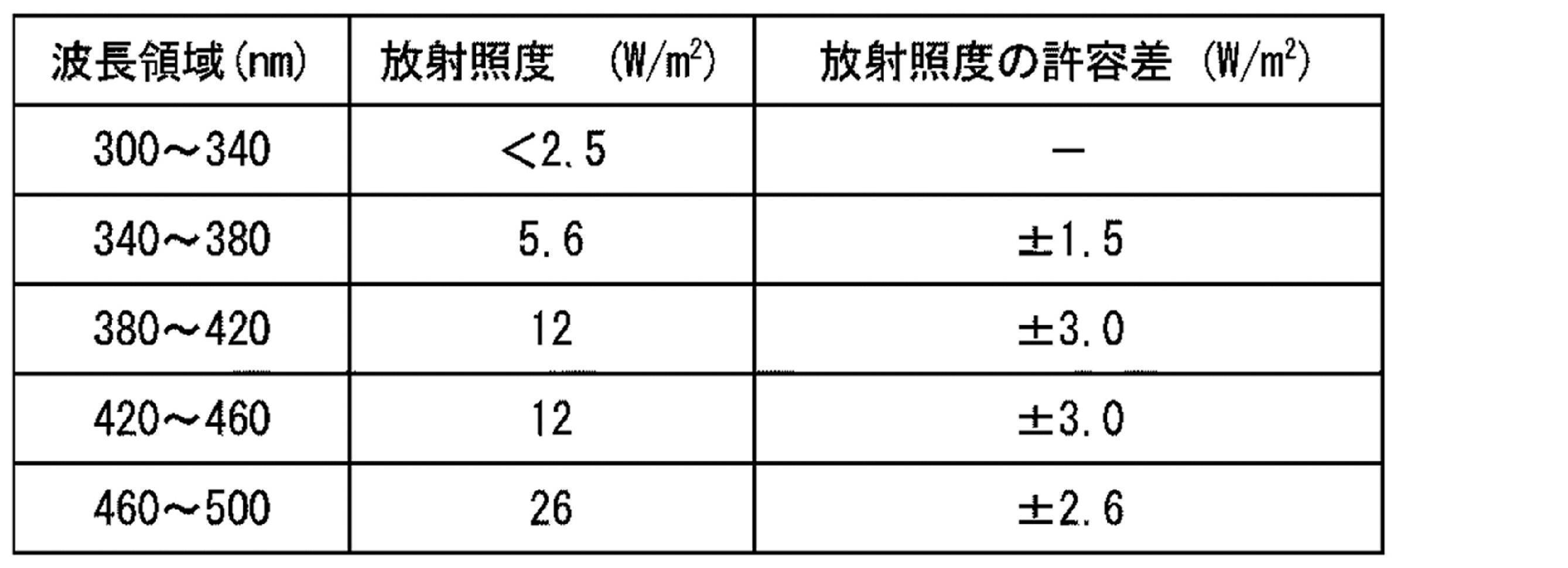
実施例および比較例について、それぞれ調製した光学物品用重合性組成物(フォトクロミック層形成用コーティング組成物)を目視で観察し、フォトクロミック化合物の溶け残りが確認されなかった場合、溶解性を「A」と評価し、溶け残りが観察された場合、溶解性を「B」と評価した。
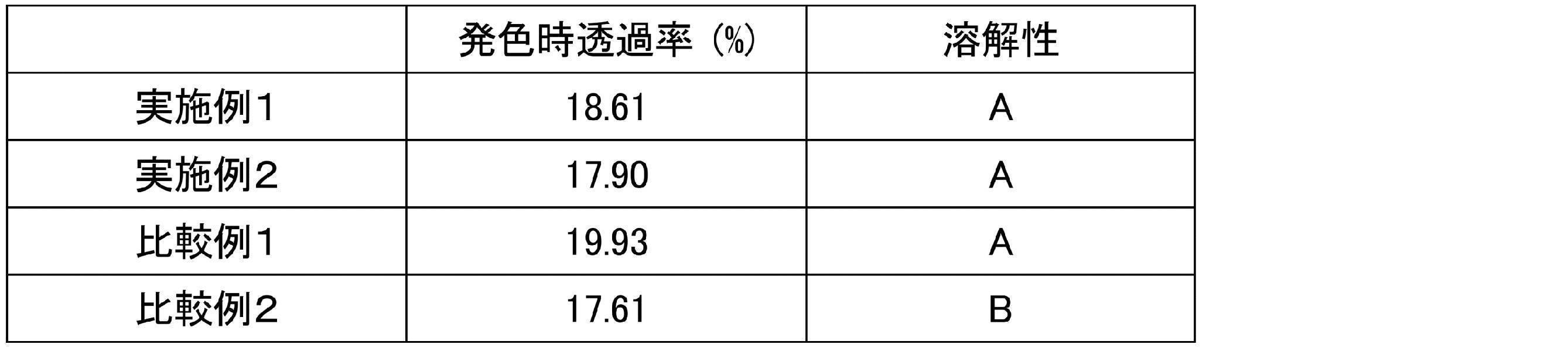
成分Bとしてネオペンチルグルコールジメタクリレート(分子量240)10質量部を混合した点以外は実施例1と同様にして光学物品用重合性組成物(フォトクロミック層形成用コーティング組成物)を調製した。この組成物を目視で観察したところ、溶け残りは観察されなかった。
こうして調製された光学物品用重合性組成物(フォトクロミック層形成用コーティング組成物)した点以外は実施例1と同様にして眼鏡レンズを得た。
得られた眼鏡レンズについて、上記と同様に発色濃度の評価を行ったところ、19%未満の発色時透過率の値が得られ、実施例1、2と同様に発色濃度が高いことが確認された。
成分Aに代えてポリエチレングリコールジアクリレート(分子量708)90質量部、成分Bとしてトリシクロデカンジメタノールジアクリレート(分子量304、非環状のアクリレート)10質量部を混合した点以外は実施例1と同様にして光学物品用重合性組成物(フォトクロミック層形成用コーティング組成物)を調製した。
こうして調製された光学物品用重合性組成物(フォトクロミック層形成用コーティング組成物)した点以外は実施例1と同様にして眼鏡レンズを得た。
比較例3の眼鏡レンズについて、上記と同様に発色時透過率を求めた。
その後、QUV紫外線蛍光管式促進耐候試験機(Q-Lab社製)において、眼鏡レンズの物体側表面に向けて0.2W/m2の照射条件で紫外線を1週間照射した。
上記紫外線照射後の眼鏡レンズについて、一旦暗室に置きフォトクロミック化合物を退色させた後に上記と同様に発色時透過率を求めた。紫外線照射前に対して紫外線照射後の発色時透過率の上昇が小さいほど、フォトクロミック層の耐候性に優れると評価することができる。比較例3については、「(紫外線照射後の発色時透過率)-(紫外線照射前の発色時透過率)」の値は43.55%であった。これに対し、実施例1の眼鏡レンズについても同様の評価を行ったところ、「(紫外線照射後の発色時透過率)-(紫外線照射前の発色時透過率)」の値は1.49%であった。
以上の実施例1と比較例3との対比から、成分A(分子量500以上の非環状のメタクリレート)がフォトクロミック層の耐候性向上に寄与することが確認できる。
実施例1~実施例3について、それぞれJIS K5600-5-6:1999にしたがい、眼鏡レンズの物体側表面においてクロスカット法によって密着性を評価した。評価結果は、「残存マス目数/総マス目数」=「100/100」であり、実施例1~3の眼鏡レンズが、フォトクロミック層と隣接層(プライマー層、保護層)との密着性に優れることが確認された。
保護層形成用重合性組成物に、組成物の全量を100質量%として、0.3質量%の紫外線吸収剤(ヒドロキシフェニルトリアジン系紫外線吸収剤、商品名Tinubin479(BASF社製))を添加した点以外、実施例1と同様に、基材、プライマー層、フォトクロミック層、保護層およびハードコート層をこの順に有する眼鏡レンズを作製した。
その後、QUV紫外線蛍光管式促進耐候試験機(Q-Lab社製)において、眼鏡レンズの物体側表面に向けて0.2W/m2の照射条件で紫外線を1週間照射した。
上記紫外線照射後の眼鏡レンズについて、一旦暗室に置きフォトクロミック化合物を退色させた後に上記と同様に発色時透過率を求めた。実施例4の眼鏡レンズについて、「(紫外線照射後の発色時透過率)-(紫外線照射前の発色時透過率)」の値は0.3%であった。
その後、QUV紫外線蛍光管式促進耐候試験機(Q-Lab社製)において、眼鏡レンズの物体側表面に向けて0.2W/m2の照射条件で紫外線を1週間照射した。
上記紫外線照射後の眼鏡レンズについて、上記と同様にYI値を求めた。紫外線照射前に対して紫外線照射後のYI値の上昇が小さいほど、耐候性に優れると評価することができる。実施例4の眼鏡レンズについて算出された「(紫外線照射後のYI値)-(紫外線照射前のYI値)」の値は、実施例1の眼鏡レンズについて算出された値より小さく、実施例1の眼鏡レンズについて算出された値の約1/2の値であった。
以下において、実施例1において調製したプライマー層形成用重合性組成物を「プライマー層形成用重合性組成物A」と呼ぶ。
「プライマー層形成用重合性組成物B」として、先に示した構造を有するヒドロキシ基含有2官能アクリレート(27.5質量部)を、ポリイソシアネートとして東ソー社製コロネート2715(25.0質量部)および2-フェノキシエチルアクリレート(粘度:13cP)を使用せず代わりにプロピレングリコールモノメチルエーテルアセテート(27.5質量部)と混合した点以外はプライマー層形成用重合性組成物Aの調製と同様にしてプライマー層形成用重合性組成物を調製した。
プライマー層形成用重合性組成物A、Bをそれぞれ用いて、その他の条件は同様にして、基材上にプライマー層(厚さ8μm)とフォトクロミック層とをこの順に有する眼鏡レンズを作製した。作製した各眼鏡レンズを、暗室内でジルコンランプによる高輝度光の照射下で光学顕微鏡によって観察した。プライマー層形成用重合性組成物Bを用いて形成されたプライマー層を有する眼鏡レンズでは数十μm程度の光学的欠陥が複数確認されたのに対し、プライマー層形成用重合性組成物Aを用いて形成されたプライマー層を有する眼鏡レンズにはそのような光学的欠陥は見られなかった。即ち、プライマー層形成用重合性組成物Aを用いて形成されたプライマー層を有する眼鏡レンズは、プライマー層形成用重合性組成物Bを用いて形成されたプライマー層を有する眼鏡レンズよりも光学的均質性に優れていた。
以下において、実施例1において調製した保護層形成用重合性組成物を「保護層形成用重合性組成物A」と呼ぶ。
以下の方法によって調製された保護層形成用重合性組成物を、「保護層形成用重合性組成物B」と呼ぶ。
プラスチック製容器内で、トリシクロデカンジメタノールジアクリレート(脂環式の2官能(メタ)アクリレート)86.7質量部、ペンタエリスリトールテトラアクリレート4.3質量部、イソボルニルアクリレート8.7質量部、ビス(2,4,6-トリメチルベンゾイル)フェニルホスフィンオキシド(IGM Resin B.V.社製Omnirad819)0.3質量部を、混合して十分に撹拌した後、自転公転方式撹拌脱泡装置で脱泡した。こうして、保護層形成用重合性組成物Bを調製した。保護層形成用重合性組成物Bにおいて、脂環式の2官能(メタ)アクリレートの含有率は、(メタ)アクリレートの全量に対して87.0質量%である。
以下の方法によって調製された保護層形成用重合性組成物を、「保護層形成用重合性組成物C」と呼ぶ。
プラスチック製容器内で、トリシクロデカンジメタノールジメタクリレート(脂環式の2官能(メタ)アクリレート)68.0質量部、ネオペンチルグリコールジメタクリレート20.0質量部、トリメチロールプロパントリメタクリレート12.0質量部およびビス(2,4,6-トリメチルベンゾイル)フェニルホスフィンオキシド(IGM Resin B.V.社製Omnirad819)0.3質量部を、混合して十分に撹拌した後、自転公転方式撹拌脱泡装置で脱泡した。こうして、保護層形成用重合性組成物Cを調製した。保護層形成用重合性組成物Cにおいて、脂環式の2官能(メタ)アクリレートの含有率は、(メタ)アクリレートの全量に対して68.0質量%である。
保護層形成用重合性組成物A~Cをそれぞれ用いて、その他の条件は同様にして、基材上にプライマー層、フォトクロミック層および保護層(厚さ15μm)をこの順に有する眼鏡レンズを作製した。作製した各眼鏡レンズについて、エリオニクス社製超微小押し込み硬さ試験機ENT-2100を用いて、保護層の表面に荷重100mgfをかけて圧子を押し込んだ。このときに圧子の侵入した表面積を押し込み深さから測定し、「荷重/圧子の侵入した表面積」としてマルテンス硬さを求めた。マルテンス硬さは、荷重Fをかけて圧子を所定の押し込み量hまで押し込んだときに、荷重Fを圧子の侵入した表面積で除した値と定義される。試験荷重が負荷された状態で測定される硬さであり、負荷増加時の荷重-押し込み深さ曲線の値から求められる。保護層形成用重合性組成物AまたはBを用いて形成された保護層を有する眼鏡レンズは、保護層形成用重合性組成物Cを用いて形成された保護層を有する眼鏡レンズと比べて、1.5~2.0倍のマルテンス硬さを示した。また、作製した各眼鏡レンズの保護層の表面を、アセトンを染み込ませた布で拭き取った。拭き取り後の保護層の表面を目視で観察し、以下の基準で評価したところ、保護層形成用重合性組成物AまたはBを用いて形成された保護層を有する眼鏡レンズの評価結果は「Good」、保護層形成用重合性組成物Cを用いて形成された保護層を有する眼鏡レンズの評価結果は「Damaged」であった。
Good:面粗れなし
Damaged:面粗れが認められる。
Claims (17)
- フォトクロミック化合物と、
成分A:分子量500以上の非環状のメタクリレートと、
成分B:環状構造および分岐構造からなる群から選ばれる構造を含む2官能(メタ)アクリレートと、
を含む、光学物品用重合性組成物。 - 成分Bは、脂環式の2官能(メタ)アクリレートを含む、請求項1に記載の光学物品用重合性組成物。
- 成分Bは、分岐構造を有する2官能(メタ)アクリレートを含む、請求項1または2に記載の光学物品用重合性組成物。
- 組成物に含まれる(メタ)アクリレートの全量に対して、成分Aを50.0質量%以上含む、請求項1~3のいずれか1項に記載の光学物品用重合性組成物。
- 基材と、
請求項1~4のいずれか1項に記載の光学物品用重合性組成物を硬化させたフォトクロミック層と、
を有する光学物品。 - 前記基材と、前記フォトクロミック層と、保護層と、をこの順に有する、請求項5に記載の光学物品。
- 前記保護層は、紫外線吸収剤を含む、請求項6に記載の光学物品。
- 前記保護層は、保護層形成用重合性組成物を硬化させた硬化層であり、
前記保護層形成用重合性組成物は、1種以上の(メタ)アクリレートを含み、かつ(メタ)アクリレートの全量に対して、脂環式の2官能(メタ)アクリレートを70.0質量%以上含む、請求項6または7に記載の光学物品。 - 前記保護層の厚さは、10~45μmの範囲である、請求項6~8のいずれか1項に記載の光学物品。
- 前記基材と、前記フォトクロミック層と、前記保護層と、有機ケイ素系硬化層と、をこの順に有する、請求項6~9のいずれか1項に記載の光学物品。
- 前記基材と前記フォトクロミック層との間に、プライマー層を更に有する、請求項5~10のいずれか1項に記載の光学物品。
- 前記プライマー層は、プライマー層形成用重合性組成物を硬化させた硬化層であり、
前記プライマー層形成用重合性組成物は、
ポリイソシアネートと、
ヒドロキシ基含有重合性化合物と、
粘度100cP以下であって、(メタ)アクリレートおよびビニルエーテルからなる群から選択される重合性化合物と、
を含む、請求項11に記載の光学物品。 - 眼鏡レンズである、請求項5~12のいずれか1項に記載の光学物品。
- ゴーグル用レンズである、請求項5~12のいずれか1項に記載の光学物品。
- サンバイザーのバイザー部分である、請求項5~12のいずれか1項に記載の光学物品。
- ヘルメットのシールド部材である、請求項5~12のいずれか1項に記載の光学物品。
- 請求項13に記載の眼鏡レンズを備えた眼鏡。
Priority Applications (6)
| Application Number | Priority Date | Filing Date | Title |
|---|---|---|---|
| EP21782121.4A EP4130855B1 (en) | 2020-03-31 | 2021-03-31 | Polymerizable composition for optical article, optical article, and eyeglasses |
| CN202180025283.3A CN115335734B (zh) | 2020-03-31 | 2021-03-31 | 光学物品用聚合性组合物、光学物品及眼镜 |
| JP2022512661A JP7460756B2 (ja) | 2020-03-31 | 2021-03-31 | 光学物品用重合性組成物、光学物品および眼鏡 |
| ES21782121T ES3063617T3 (en) | 2020-03-31 | 2021-03-31 | Polymerizable composition for optical article, optical article, and eyeglasses |
| US17/954,715 US20230032602A1 (en) | 2020-03-31 | 2022-09-28 | Polymerizable composition for optical article, optical article and eyeglasses |
| JP2024044667A JP7650388B2 (ja) | 2020-03-31 | 2024-03-21 | 光学物品用重合性組成物、光学物品および眼鏡 |
Applications Claiming Priority (4)
| Application Number | Priority Date | Filing Date | Title |
|---|---|---|---|
| JP2020064621 | 2020-03-31 | ||
| JP2020-064807 | 2020-03-31 | ||
| JP2020-064621 | 2020-03-31 | ||
| JP2020064807 | 2020-03-31 |
Related Child Applications (1)
| Application Number | Title | Priority Date | Filing Date |
|---|---|---|---|
| US17/954,715 Continuation US20230032602A1 (en) | 2020-03-31 | 2022-09-28 | Polymerizable composition for optical article, optical article and eyeglasses |
Publications (1)
| Publication Number | Publication Date |
|---|---|
| WO2021201166A1 true WO2021201166A1 (ja) | 2021-10-07 |
Family
ID=77927311
Family Applications (1)
| Application Number | Title | Priority Date | Filing Date |
|---|---|---|---|
| PCT/JP2021/014016 Ceased WO2021201166A1 (ja) | 2020-03-31 | 2021-03-31 | 光学物品用重合性組成物、光学物品および眼鏡 |
Country Status (6)
| Country | Link |
|---|---|
| US (1) | US20230032602A1 (ja) |
| EP (1) | EP4130855B1 (ja) |
| JP (2) | JP7460756B2 (ja) |
| CN (1) | CN115335734B (ja) |
| ES (1) | ES3063617T3 (ja) |
| WO (1) | WO2021201166A1 (ja) |
Cited By (2)
| Publication number | Priority date | Publication date | Assignee | Title |
|---|---|---|---|---|
| WO2025205698A1 (ja) * | 2024-03-28 | 2025-10-02 | ホヤ レンズ タイランド リミテッド | プラスチックレンズ及びその製造方法、並びに眼鏡 |
| WO2026004832A1 (ja) * | 2024-06-27 | 2026-01-02 | 株式会社トクヤマ | 積層体、光学物品、レンズ、眼鏡、及び保護層用硬化性組成物 |
Families Citing this family (1)
| Publication number | Priority date | Publication date | Assignee | Title |
|---|---|---|---|---|
| WO2025249536A1 (ja) * | 2024-05-31 | 2025-12-04 | ホヤ レンズ タイランド リミテッド | フォトクロミック物品の保護層形成用硬化性組成物、フォトクロミック物品及び眼鏡 |
Citations (10)
| Publication number | Priority date | Publication date | Assignee | Title |
|---|---|---|---|---|
| US5645767A (en) | 1994-11-03 | 1997-07-08 | Transitions Optical, Inc. | Photochromic indeno-fused naphthopyrans |
| JP2005218994A (ja) | 2004-02-06 | 2005-08-18 | Hoya Corp | 塗布方法及び眼鏡レンズの製造方法 |
| JP2005331718A (ja) * | 2004-05-20 | 2005-12-02 | Tsutsunaka Plast Ind Co Ltd | 偏光板 |
| JP2006513276A (ja) * | 2002-04-17 | 2006-04-20 | コーニング インコーポレイテッド | フォトクロミック組成物、その調製およびそれから製造されたまたはそれにより被覆された製品 |
| WO2012165579A1 (ja) * | 2011-06-03 | 2012-12-06 | Hoya株式会社 | プラスチックレンズ |
| WO2013008825A1 (ja) * | 2011-07-11 | 2013-01-17 | 株式会社トクヤマ | フォトクロミック硬化性組成物 |
| JP2013023556A (ja) * | 2011-07-20 | 2013-02-04 | Ube Industries Ltd | 水性ポリウレタン樹脂分散体組成物及びその製造方法 |
| WO2015016313A1 (ja) * | 2013-08-02 | 2015-02-05 | 株式会社トクヤマ | 光学物品用光硬化性プライマー組成物、該組成物の硬化体を含むフォトクロミック積層体及び該積層体の製造方法 |
| WO2019189855A1 (ja) * | 2018-03-30 | 2019-10-03 | ホヤ レンズ タイランド リミテッド | 光学物品 |
| JP2019174776A (ja) * | 2018-03-29 | 2019-10-10 | ホヤ レンズ タイランド リミテッドHOYA Lens Thailand Ltd | 眼鏡レンズ |
Family Cites Families (9)
| Publication number | Priority date | Publication date | Assignee | Title |
|---|---|---|---|---|
| WO2001002449A2 (en) * | 1999-07-02 | 2001-01-11 | Ppg Industries Ohio, Inc. | Poly(meth)acrylic photochromic coating |
| JP3922873B2 (ja) * | 2000-09-29 | 2007-05-30 | 株式会社トクヤマ | 硬化性組成物 |
| JP4152714B2 (ja) * | 2002-10-10 | 2008-09-17 | 株式会社トクヤマ | フォトクロミック組成物 |
| ES2342013T3 (es) * | 2002-12-05 | 2010-06-30 | Tokuyama Corporation | Composicion de recubrimiento y articulos opticos. |
| EP2221325B1 (en) * | 2007-12-13 | 2014-04-16 | Tokuyama Corporation | Photochromic curable composition |
| JP5713528B2 (ja) * | 2008-11-18 | 2015-05-07 | 三菱化学株式会社 | 活性エネルギー線硬化性樹脂組成物、ハードコート用硬化膜及び積層体 |
| JP5543573B2 (ja) * | 2009-03-16 | 2014-07-09 | カール ツァイス ビジョン オーストラリア ホールディングス リミテッド | 液状注型組成物、製造方法、及びフォトクロミック光学素子 |
| SG10202101422PA (en) * | 2016-08-10 | 2021-03-30 | Tokuyama Corp | Photochromic curable composition, use thereof, and polyrotaxane monomers |
| EP4082784A4 (en) * | 2019-12-27 | 2024-01-24 | Hoya Lens Thailand Ltd. | POLYMERIZABLE COMPOSITION FOR FORMING A PROTECTIVE LAYER ON A PHOTOCHROMIC ARTICLE, PHOTOCHROMIC ARTICLE AND GLASSES |
-
2021
- 2021-03-31 EP EP21782121.4A patent/EP4130855B1/en active Active
- 2021-03-31 ES ES21782121T patent/ES3063617T3/es active Active
- 2021-03-31 WO PCT/JP2021/014016 patent/WO2021201166A1/ja not_active Ceased
- 2021-03-31 JP JP2022512661A patent/JP7460756B2/ja active Active
- 2021-03-31 CN CN202180025283.3A patent/CN115335734B/zh active Active
-
2022
- 2022-09-28 US US17/954,715 patent/US20230032602A1/en active Pending
-
2024
- 2024-03-21 JP JP2024044667A patent/JP7650388B2/ja active Active
Patent Citations (10)
| Publication number | Priority date | Publication date | Assignee | Title |
|---|---|---|---|---|
| US5645767A (en) | 1994-11-03 | 1997-07-08 | Transitions Optical, Inc. | Photochromic indeno-fused naphthopyrans |
| JP2006513276A (ja) * | 2002-04-17 | 2006-04-20 | コーニング インコーポレイテッド | フォトクロミック組成物、その調製およびそれから製造されたまたはそれにより被覆された製品 |
| JP2005218994A (ja) | 2004-02-06 | 2005-08-18 | Hoya Corp | 塗布方法及び眼鏡レンズの製造方法 |
| JP2005331718A (ja) * | 2004-05-20 | 2005-12-02 | Tsutsunaka Plast Ind Co Ltd | 偏光板 |
| WO2012165579A1 (ja) * | 2011-06-03 | 2012-12-06 | Hoya株式会社 | プラスチックレンズ |
| WO2013008825A1 (ja) * | 2011-07-11 | 2013-01-17 | 株式会社トクヤマ | フォトクロミック硬化性組成物 |
| JP2013023556A (ja) * | 2011-07-20 | 2013-02-04 | Ube Industries Ltd | 水性ポリウレタン樹脂分散体組成物及びその製造方法 |
| WO2015016313A1 (ja) * | 2013-08-02 | 2015-02-05 | 株式会社トクヤマ | 光学物品用光硬化性プライマー組成物、該組成物の硬化体を含むフォトクロミック積層体及び該積層体の製造方法 |
| JP2019174776A (ja) * | 2018-03-29 | 2019-10-10 | ホヤ レンズ タイランド リミテッドHOYA Lens Thailand Ltd | 眼鏡レンズ |
| WO2019189855A1 (ja) * | 2018-03-30 | 2019-10-03 | ホヤ レンズ タイランド リミテッド | 光学物品 |
Non-Patent Citations (1)
| Title |
|---|
| See also references of EP4130855A4 |
Cited By (2)
| Publication number | Priority date | Publication date | Assignee | Title |
|---|---|---|---|---|
| WO2025205698A1 (ja) * | 2024-03-28 | 2025-10-02 | ホヤ レンズ タイランド リミテッド | プラスチックレンズ及びその製造方法、並びに眼鏡 |
| WO2026004832A1 (ja) * | 2024-06-27 | 2026-01-02 | 株式会社トクヤマ | 積層体、光学物品、レンズ、眼鏡、及び保護層用硬化性組成物 |
Also Published As
| Publication number | Publication date |
|---|---|
| CN115335734A (zh) | 2022-11-11 |
| JP7650388B2 (ja) | 2025-03-24 |
| EP4130855B1 (en) | 2026-01-28 |
| EP4130855A4 (en) | 2024-05-15 |
| EP4130855A1 (en) | 2023-02-08 |
| JP7460756B2 (ja) | 2024-04-02 |
| ES3063617T3 (en) | 2026-04-17 |
| JP2024073640A (ja) | 2024-05-29 |
| EP4130855C0 (en) | 2026-01-28 |
| CN115335734B (zh) | 2026-03-17 |
| US20230032602A1 (en) | 2023-02-02 |
| JPWO2021201166A1 (ja) | 2021-10-07 |
Similar Documents
| Publication | Publication Date | Title |
|---|---|---|
| JP7650388B2 (ja) | 光学物品用重合性組成物、光学物品および眼鏡 | |
| JP7596076B2 (ja) | フォトクロミック物品および眼鏡 | |
| JP2022105057A (ja) | 光学物品 | |
| WO2020203864A1 (ja) | 光学物品用コーティング組成物、眼鏡レンズ、眼鏡および眼鏡レンズの製造方法、ならびに光学物品および光学物品の製造方法 | |
| US12378347B2 (en) | Polymerizable composition for optical article and optical article | |
| US12572064B2 (en) | Optical article and method for producing optical article | |
| WO2021132047A1 (ja) | 光学物品用重合性組成物および光学物品 | |
| JP2022135955A (ja) | フォトクロミック物品の製造方法 | |
| WO2021132049A1 (ja) | フォトクロミック物品の保護層形成用重合性組成物、フォトクロミック物品および眼鏡 | |
| WO2020203865A1 (ja) | 光学物品用コーティング組成物、眼鏡レンズ、眼鏡および眼鏡レンズの製造方法、ならびに光学物品および光学物品の製造方法 | |
| JP7377285B2 (ja) | 光学物品および光学物品の製造方法 | |
| WO2025205698A1 (ja) | プラスチックレンズ及びその製造方法、並びに眼鏡 | |
| WO2025205701A1 (ja) | フィニッシュレンズの製造方法 | |
| WO2025249536A1 (ja) | フォトクロミック物品の保護層形成用硬化性組成物、フォトクロミック物品及び眼鏡 | |
| WO2025205700A1 (ja) | プラスチックレンズの製造方法 | |
| WO2025205699A1 (ja) | プラスチックレンズの製造方法 | |
| WO2025205702A1 (ja) | 眼鏡レンズの製造方法 |
Legal Events
| Date | Code | Title | Description |
|---|---|---|---|
| 121 | Ep: the epo has been informed by wipo that ep was designated in this application |
Ref document number: 21782121 Country of ref document: EP Kind code of ref document: A1 |
|
| ENP | Entry into the national phase |
Ref document number: 2022512661 Country of ref document: JP Kind code of ref document: A |
|
| NENP | Non-entry into the national phase |
Ref country code: DE |
|
| ENP | Entry into the national phase |
Ref document number: 2021782121 Country of ref document: EP Effective date: 20221031 |
|
| WWG | Wipo information: grant in national office |
Ref document number: 2021782121 Country of ref document: EP |