WO2021205596A1 - 冗長レゾルバ及び冗長レゾルバを搭載した電動パワーステアリング装置 - Google Patents
冗長レゾルバ及び冗長レゾルバを搭載した電動パワーステアリング装置 Download PDFInfo
- Publication number
- WO2021205596A1 WO2021205596A1 PCT/JP2020/015954 JP2020015954W WO2021205596A1 WO 2021205596 A1 WO2021205596 A1 WO 2021205596A1 JP 2020015954 W JP2020015954 W JP 2020015954W WO 2021205596 A1 WO2021205596 A1 WO 2021205596A1
- Authority
- WO
- WIPO (PCT)
- Prior art keywords
- winding
- main system
- teeth
- sub
- exciting
- Prior art date
- Legal status (The legal status is an assumption and is not a legal conclusion. Google has not performed a legal analysis and makes no representation as to the accuracy of the status listed.)
- Ceased
Links
Images





Classifications
-
- G—PHYSICS
- G01—MEASURING; TESTING
- G01D—MEASURING NOT SPECIALLY ADAPTED FOR A SPECIFIC VARIABLE; ARRANGEMENTS FOR MEASURING TWO OR MORE VARIABLES NOT COVERED IN A SINGLE OTHER SUBCLASS; TARIFF METERING APPARATUS; MEASURING OR TESTING NOT OTHERWISE PROVIDED FOR
- G01D5/00—Mechanical means for transferring the output of a sensing member; Means for converting the output of a sensing member to another variable where the form or nature of the sensing member does not constrain the means for converting; Transducers not specially adapted for a specific variable
- G01D5/12—Mechanical means for transferring the output of a sensing member; Means for converting the output of a sensing member to another variable where the form or nature of the sensing member does not constrain the means for converting; Transducers not specially adapted for a specific variable using electric or magnetic means
- G01D5/14—Mechanical means for transferring the output of a sensing member; Means for converting the output of a sensing member to another variable where the form or nature of the sensing member does not constrain the means for converting; Transducers not specially adapted for a specific variable using electric or magnetic means influencing the magnitude of a current or voltage
- G01D5/20—Mechanical means for transferring the output of a sensing member; Means for converting the output of a sensing member to another variable where the form or nature of the sensing member does not constrain the means for converting; Transducers not specially adapted for a specific variable using electric or magnetic means influencing the magnitude of a current or voltage by varying inductance, e.g. by a movable armature
- G01D5/204—Mechanical means for transferring the output of a sensing member; Means for converting the output of a sensing member to another variable where the form or nature of the sensing member does not constrain the means for converting; Transducers not specially adapted for a specific variable using electric or magnetic means influencing the magnitude of a current or voltage by varying inductance, e.g. by a movable armature by influencing the mutual induction between two or more coils
- G01D5/2046—Mechanical means for transferring the output of a sensing member; Means for converting the output of a sensing member to another variable where the form or nature of the sensing member does not constrain the means for converting; Transducers not specially adapted for a specific variable using electric or magnetic means influencing the magnitude of a current or voltage by varying inductance, e.g. by a movable armature by influencing the mutual induction between two or more coils by a movable ferromagnetic element, e.g. a core
-
- B—PERFORMING OPERATIONS; TRANSPORTING
- B62—LAND VEHICLES FOR TRAVELLING OTHERWISE THAN ON RAILS
- B62D—MOTOR VEHICLES; TRAILERS
- B62D5/00—Power-assisted or power-driven steering
- B62D5/04—Power-assisted or power-driven steering electrical, e.g. using an electric servo-motor connected to, or forming part of, the steering gear
- B62D5/0457—Power-assisted or power-driven steering electrical, e.g. using an electric servo-motor connected to, or forming part of, the steering gear characterised by control features of the drive means as such
- B62D5/0481—Power-assisted or power-driven steering electrical, e.g. using an electric servo-motor connected to, or forming part of, the steering gear characterised by control features of the drive means as such monitoring the steering system, e.g. failures
-
- G—PHYSICS
- G01—MEASURING; TESTING
- G01B—MEASURING LENGTH, THICKNESS OR SIMILAR LINEAR DIMENSIONS; MEASURING ANGLES; MEASURING AREAS; MEASURING IRREGULARITIES OF SURFACES OR CONTOURS
- G01B7/00—Measuring arrangements characterised by the use of electric or magnetic techniques
- G01B7/30—Measuring arrangements characterised by the use of electric or magnetic techniques for measuring angles or tapers; for testing the alignment of axes
-
- H—ELECTRICITY
- H02—GENERATION; CONVERSION OR DISTRIBUTION OF ELECTRIC POWER
- H02K—DYNAMO-ELECTRIC MACHINES
- H02K1/00—Details of the magnetic circuit
- H02K1/06—Details of the magnetic circuit characterised by the shape, form or construction
- H02K1/12—Stationary parts of the magnetic circuit
- H02K1/16—Stator cores with slots for windings
-
- H—ELECTRICITY
- H02—GENERATION; CONVERSION OR DISTRIBUTION OF ELECTRIC POWER
- H02K—DYNAMO-ELECTRIC MACHINES
- H02K1/00—Details of the magnetic circuit
- H02K1/06—Details of the magnetic circuit characterised by the shape, form or construction
- H02K1/22—Rotating parts of the magnetic circuit
- H02K1/24—Rotor cores with salient poles ; Variable reluctance rotors
-
- H—ELECTRICITY
- H02—GENERATION; CONVERSION OR DISTRIBUTION OF ELECTRIC POWER
- H02K—DYNAMO-ELECTRIC MACHINES
- H02K24/00—Machines adapted for the instantaneous transmission or reception of the angular displacement of rotating parts, e.g. synchro, selsyn
-
- H—ELECTRICITY
- H02—GENERATION; CONVERSION OR DISTRIBUTION OF ELECTRIC POWER
- H02K—DYNAMO-ELECTRIC MACHINES
- H02K3/00—Details of windings
- H02K3/04—Windings characterised by the conductor shape, form or construction, e.g. with bar conductors
- H02K3/28—Layout of windings or of connections between windings
Definitions
- the present application relates to a redundant resolver and an electric power steering device equipped with a redundant resolver.
- a multi-system resolver having two sets of exciting windings connected to different exciting circuits a so-called redundant resolver, is known as a resolver that utilizes a change in permeance between a rotor and a stator.
- one resolver stator is divided in the circumferential direction into a first system and a second system in order to reduce the axial dimension.
- the redundant one is disclosed.
- Patent Document 1 since the number of teeth constituting the first system and the second system is half of the total number of teeth of the resolver stator, there is a problem that the angle detection accuracy is deteriorated as compared with the single system resolver. was there.
- the present application discloses a technique for solving the above problems, and an object of the present application is to provide a redundant resolver having high angle detection accuracy of the main system without increasing the size.
- the redundant resolver disclosed in the present application is A rotor with Nx (Nx is a natural number) salient poles, a stator with teeth having Ns (Ns is an integer of 3 or more) arranged in the circumferential direction facing the rotor, and an excitation winding wound around the teeth.
- Nx is a natural number
- a resolver body with wires and two-phase output windings It has an exciting circuit that applies a voltage to the exciting winding.
- the main system is the excitation winding wound around Nsm (Nsm is an integer of 2 or more) teeth and the two-phase output winding, and the excitation wound around Ns-Nsm teeth.
- the winding and the two-phase output winding are used as a secondary system.
- a main system calculation unit that inputs the voltage of the two-phase output windings in the main system and calculates the angle in the main system.
- a sub-system calculation unit that inputs the voltage of the two-phase output windings in the sub-system and calculates the angle in the sub-system is provided. It is characterized in that the number of teeth Nsm corresponding to the main system is larger than the number of teeth Ns-Nsm corresponding to the sub system.
- the angle detection accuracy is improved without increasing the size.
- FIG. 1 It is a figure which shows the example which attached the redundant resolver which concerns on Embodiment 1 to a rotary electric machine. It is a figure which shows an example of the hardware composition of a control circuit. It is a figure which shows the structure of the redundant resolver which concerns on Embodiment 1.
- FIG. It is sectional drawing of the resolver main body of the redundant resolver which concerns on Embodiment 1.
- FIG. It is sectional drawing of the stator of the redundant resolver which concerns on Embodiment 1.
- FIG. It is a figure which shows the number of turns of the excitation winding of the redundant resolver which concerns on Embodiment 1.
- FIG. It is a figure which shows the number of turns of the output winding of the redundant resolver which concerns on Embodiment 1.
- FIG. 1 It is a figure which shows the angle detection accuracy of the redundant resolver which concerns on Embodiment 1 and the comparative example. It is a figure which shows the relationship between the number of teeth of the main system of the redundant resolver which concerns on Embodiment 1, and the angle detection accuracy. It is a figure which shows the structure of the redundant resolver which concerns on Embodiment 2. It is a figure which shows the excitation signal of the main system and the excitation signal of a sub system of the redundant resolver which concerns on Embodiment 2. FIG. It is a figure which shows the output signal waveform of the main system of the redundant resolver which concerns on Embodiment 2. FIG. It is a figure which shows the output signal waveform of the sub system of the redundant resolver which concerns on Embodiment 2. FIG. It is a schematic block diagram of the electric power steering apparatus which concerns on Embodiment 3. FIG.
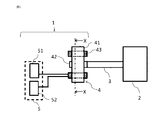
- FIG. 1 is a diagram showing an example in which the redundant resolver 1 according to the first embodiment is attached to a rotary electric machine. Although an example of mounting on the shaft 3 of the rotary electric machine 2 is shown, the mounting target is not limited to the rotary electric machine as long as it is the rotating shaft of the rotating portion (rotating body) of various devices.
- the redundant resolver 1 is attached to a shaft 3 which is a rotation shaft of a rotary electric machine 2.
- the redundant resolver 1 includes a resolver main body 4 which is a sensor and a control circuit 5 for controlling the resolver main body 4.
- the resolver main body 4 includes a pair of stator 41 and a rotor 42, and a winding 43 is wound around the stator 41.
- the rotor 42 is connected to the rotating portion of the rotating electric machine 2 via a shaft 3.
- the control circuit 5 is an angle calculation unit that calculates a rotation angle from the signal waveforms of the excitation circuit 51 of the winding 43, which will be described later, by applying an AC voltage to the exciting winding, and the output winding of the winding 43, which will be described later. 52 and.
- the excitation circuit 51 and the angle calculation unit 52 include an excitation circuit 511, 512 and an angle calculation unit 521 and 522 in the main system and the sub system.
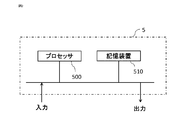
- FIG. 2 shows an example of the hardware of the microcomputer of the control circuit 5. It is composed of a processor 500 and a storage device 510, and although not shown, the storage device 510 includes a volatile storage device such as a random access memory and a non-volatile auxiliary storage device such as a flash memory. Further, an auxiliary storage device of a hard disk may be provided instead of the flash memory.
- the processor 500 executes an angle calculation by, for example, the angle calculation unit 52 by executing a program input from the storage device 510. In this case, a program is input from the auxiliary storage device to the processor 500 via the volatile storage device.
- the processor 500 may output data such as a calculation result to the volatile storage device of the storage device 510, or may store the data in the auxiliary storage device via the volatile storage device.
- the hardware in the control circuit 5 does not have to be a microcomputer, and may be an ASIC (Application Specific Integrated Circuit), an FPGA (Field Programmable Gate Array), a simple logic circuit, a relay, or the like.
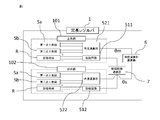
- FIG. 3 is a diagram showing a configuration of a redundant resolver 1 according to the first embodiment.
- the redundant resolver 1 includes a resolver of the main system 101 and a resolver of the sub system 102.
- the resolver of the main system 101 and the resolver of the sub system 102 have a first output winding Sa, a second output winding Sb, and an exciting winding R as a configuration of the winding 43.
- the first output winding Sa and the second output winding Sb are connected to the angle calculation units 521 and 522, respectively, and the exciting winding R is connected to the exciting circuits 511 and 512, respectively.
- the angle calculation unit 521 of the main system 101 and the angle calculation unit 522 of the sub system 102 are connected by the angle calculation unit communication device 6.
- the main system detection angle ⁇ m and the sub system detection angle ⁇ s are input to the angle calculation unit communication device 6, and when both the main system 101 and the sub system 102 are normal, the main system detection angle ⁇ m is set to, for example, the control device 13 ( Output to (see FIG. 14).
- the main system detection angle ⁇ m and the sub system detection angle ⁇ s are input to the angle calculation unit communication device 6, and when the main system 101 is out of order, the sub system detection angle ⁇ s is output to the control device 13. When the sub system 102 is out of order, the main system detection angle ⁇ m is output to the control device 13.
- the exciting circuit 511 of the main system 101 and the exciting circuit 512 of the sub system 102 are connected by the exciting circuit communication device 7.
- the phases of the main system excitation signal and the sub system excitation signal output from the excitation circuit 511 of the main system 101 and the excitation circuit 512 of the sub system 102 are matched, and the main system 101 and the sub system 102 are combined with each other. Avoids magnetic interference between them. In this way, the angle calculation units 521 and 522 and the excitation circuits 511 and 512 are provided in each system to ensure redundancy.
- FIG. 4 is a cross-sectional view of the resolver main body 4 for X-rays in FIG.
- the winding 43 is wound around each tooth 411 of the stator 41 having the yoke 412 and the teeth 411.
- the rotor 42 having the salient pole portion is attached to the shaft 3.
- the number Ns of the teeth 411 of the stator of the redundant resolver 1 is 12, and the number Nx of the salient poles of the rotor 42 is 5.
- the number of salient poles Nx is also called the axial double angle.
- FIG. 5 is a diagram in which the rotor 42 and the shaft 3 are removed from FIG. 4, which corresponds to a cross-sectional view of the stator 41, and is a diagram showing a partial configuration of a resolver of the main system 101 and the sub system 102.
- the number Ns of the teeth 411 of the stator 41 of the redundant resolver 1 is 12.
- each tooth 411 is designated as teeth T1 to teeth T12 in the clockwise direction
- the main system teeth consisting of teeth T1 to teeth T7 and the subs consisting of teeth T8 to teeth T12 so as to be separated by the YY line in the figure. It is divided into two parts in the circumferential direction by the system teeth.
- This main system tooth constitutes a resolver of the main system 101
- a sub system tooth constitutes a resolver of the sub system 102, and both form a redundant redundant resolver 1 of a dual system.
- the sub-system teeth T8 to T12 are wound with exciting windings R8 to R12 of the sub system 102, first output windings Sa8 to Sa12 of the sub system 102, and second output windings Sb8 to Sb12 of the sub system 102. It is rotated (in FIG. 5, the first output winding Sa1 of the teeth T1, the second output winding Sb1, the exciting winding R1, the first output winding Sa11 of the teeth T11, the second output winding Sb11, and the excitation. Only winding R11 is shown).
- the exciting windings R1 to R7 of the main system 101 and the exciting windings R8 to R12 of the sub system 102 are respectively provided in the extending portion (not shown) of the resolver via the exciting terminals (not shown) of the main system 101. It is connected to the exciting circuit 511 of the above and the exciting circuit 512 of the sub system 102.
- the first output windings Sa1 to Sa7 of the main system 101 and the second output windings Sb1 to Sb7 of the main system 101 are connected to the main system 101 via output terminals (not shown) provided in the extension portion of the resolver, respectively. It is connected to the angle calculation unit 521.
- the first output windings Sa8 to Sa12 of the sub system 102 and the second output windings Sb8 to Sb12 of the sub system 102 are connected to the sub system 102 via output terminals (not shown) provided in the extension portion of the resolver, respectively. It is connected to the angle calculation unit 522.
- the angle calculation unit 521 of the main system 101 and the angle calculation unit 522 of the sub system 102 are rotors based on output signals output from the two-phase output windings of the first output winding Sa and the second output winding Sb, respectively.
- the main detection angle ⁇ m and the sub-system detection angle ⁇ s of are calculated and output (see FIG. 3).
- the exciting winding R1 is first wound, then the first output winding Sa1 and the second output winding Sb1 are wound in this order. That is, the exciting winding R1 is wound first, and the two-phase output winding is wound from above.
- the winding order of the two-phase first output winding Sa1 and the second output winding Sb1 is not limited to this order, and any of them may be wound first. Further, a tooth that does not wind the output winding of any one of the two-phase first output winding Sa1 and the second output winding Sb1 may be provided.
- the stator core including the teeth T1 and the windings R1, Sa1 and Sb1 are insulated from each other by insulating paper, coating, resin or the like (not shown). Although the teeth T1 have been described, the excitation windings R2 to R12, the first output windings Sa2 to Sa12, and the second output windings Sb2 to Sb12 are wound in the same manner for the other teeth T2 to T12. ..
- the exciting windings R1 to R7, the first output windings Sa1 to Sa7, and the second output windings Sb1 to Sb7 are connected in series, respectively.
- the exciting windings R8 to R12, the first output windings Sa8 to Sa12, and the second output windings Sb8 to Sb12 are also connected in series.
- the respective windings are connected in series in the order of the teeth T1 to T7 and the teeth T8 to T12, but the teeth at the beginning of winding are any teeth Ti in the system and are adjacent to each other. The same effect can be obtained even if the teeth are connected in series in order.
- the one-phase exciting winding R, the first output winding Sa and the second output winding Sb which are the two-phase output windings, are wound side by side in the circumferential direction, but this is not the case, and the radial direction is not limited to this.
- the same effect can be obtained by arranging them in the same direction or changing the winding order for each tooth.
- FIG. 6 is a diagram showing the distribution of windings in the redundant resolver according to the first embodiment.
- the number of excitation turns is standardized by amplitude, and the number of turns of the excitation winding R wound around the main system teeth T1 to T7 and the sub system teeth T8 to T12 is continuously shown.
- a winding direction (+) and a winding direction (-) are defined for the exciting winding of the resolver.
- the winding direction (+) and the winding direction ( ⁇ ) of the exciting winding R are alternately arranged.
- the winding direction (+) and winding direction (-) represent different winding polarities of the windings, and when the winding direction of a coil is represented by the winding direction (+), the windings are wound in opposite directions.
- the coil is expressed as the winding direction (-).
- the absolute value of the number of turns in the winding direction (+) and the number of turns in the winding direction (-) are the same. Therefore, the spatial order Ne of the exciting winding R is 6. That is, if the number of turns in the winding direction (+) is + X times, the number of turns in the winding direction ( ⁇ ) is ⁇ X times.
- winding direction (+) and the winding direction (-) are wound alternately, and the spatial order of the exciting winding R is 6, but this is not the case, and the winding direction (+) and the winding direction are not limited to this.
- Other winding arrangements may be used, such as winding arrangements in which the spatial order of the exciting windings arranged every two teeth in the direction ( ⁇ ) is three.
- FIG. 7 shows the first output windings Sa1 to Sa7, the second output windings Sb1 to Sb7 of the main system 101 of the redundant resolver 1 according to the present embodiment, and the first output windings Sa8 to Sa12 of the sub system 102.
- the number of output turns is standardized by amplitude, and the number of turns of the output windings wound around the main system teeth T1 to T7 and the sub system teeth T8 to T12 is continuously shown.
- the first output winding and the second output winding, N Sai and N Sbi which are wound around the i-th tooth, have a winding phase difference of 90 ° and can be expressed by the following equation (1). ..
- N 1 represents the amplitude of the number of turns of the output winding
- ⁇ teeth represent the circumferential position of the teeth. Since the spatial order Ne of the exciting winding R is 6 and the axial double angle Nx is 5, the spatial order of the output winding is 1 here.
- the output windings are distributed in a sinusoidal direction in the circumferential direction of the teeth. If the number of turns is a decimal, it is rounded to an integer. In the drawing, where the number of turns of the output winding is normalized by the amplitude, i.e. N 1.
- FIG. 8 compares the angle detection accuracy of the redundant resolver 1 according to the first embodiment and the comparative example, that is, the redundant resolver having 6 main system teeth.
- the vertical axis standardizes the fifth-order electrical angle component of the angle error with the values of the comparative examples.
- the redundant resolver 1 communicates between the angle calculation unit 521 of the main system 101 and the angle calculation unit 522 of the sub system 102, inputs the main system detection angle ⁇ m to the control device 13, and is a rotary electric machine. 2 is controlled.
- the sub system detection angle ⁇ s is input to the control device 13.
- the main system detection angle ⁇ m is input to the control device 13.
- the redundant resolver according to the first embodiment can be made redundant while having the same dimensions as the single-system resolver, and is normal as compared with the redundant resolver in which the stator is divided in half and made redundant. The time angle detection accuracy can be improved.
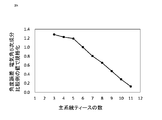
- FIG. 9 shows the angle detection accuracy when the number of main system teeth is changed from 3 to 11.
- the vertical axis normalizes the fifth-order electric angle component of the angle error with the value of the comparative example.
- the axial double angle Nx of the redundant resolver according to the first embodiment is set to 5, and the number Ns of teeth is set to 12, but the present invention is not limited to this, and if Nx is a natural number and Ns is an integer of 3 or more, other The same effect can be obtained even with a number.
- FIG. 10 is a diagram showing a configuration of a redundant resolver 1a according to the second embodiment.
- the redundant resolver 1a includes a resolver of the main system 101a and a resolver of the sub system 102a.
- the exciting circuit 511a of the main system 101a and the exciting circuit 512a of the sub system 102a are not connected by the exciting circuit communication device and are independent of each other. With such a configuration, it is possible to prevent a common failure due to the excitation circuit communication device, so that it is possible to obtain an effect that the safety of the redundant resolver can be further improved.
- the redundant resolver 1a sends an excitation signal to the excitation circuits 511a that give an excitation signal to the excitation windings R1 to R7 of the main system 101a and the excitation windings R8 to R12 of the sub system 102a.
- the excitation circuit 512a and the giving excitation circuit 512a are independent of each other to ensure redundancy.
- the excitation circuit 511a and the excitation circuit 512a for example, the microcomputers have variations in manufacturing, even if the frequencies of the excitation signal of the main system 101a and the excitation signal of the sub system 102a are designed to be the same, they do not completely match. , There is a slight difference. As a result, the difference between the excitation signal of the main system 101a and the excitation signal of the sub system 102a is not constant but changes with time, affects other systems, and causes deterioration of angle detection accuracy.
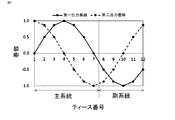
- FIG. 11 shows the excitation signal of the main system 101a and the excitation signal of the sub system 102a of the redundant resolver 1 according to the second embodiment.
- the frequency f1 of the excitation signal of the main system 101a is 10 kHz
- the frequency f2 of the excitation signal of the sub system 102a is 20 kHz.
- the vertical axis normalizes the voltage of the excitation signal by amplitude.
- the angle calculation unit 521a of the main system 101a and the angle calculation unit 522a of the sub system 102a each have a function of removing frequency components of other systems. That is, the component due to the excitation signal of the sub system 102a is removed from the first output signal of the main system 101a and the second output signal of the main system 101a, and only the component due to the excitation signal of the main system 101a is extracted. Further, the component due to the excitation signal of the main system 101a is removed from the first output signal of the sub system 102a and the second output signal of the sub system 102a, and only the component due to the excitation signal of the sub system 102a is taken out. The method of removing the frequency component of another system will be described below.
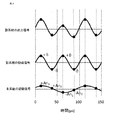
- FIG. 12 is a diagram for explaining the waveform of the output signal of the main system 101a, and shows the waveforms of the output signal of the main system 101a, the excitation signal of the main system 101a, and the excitation signal of the sub system 102a in order from the top.
- the output signal of the main system 101a is originally a waveform having a frequency f1 corresponding to the excitation signal of the main system 101a, but a waveform obtained by adding a component of the frequency f2 of the excitation signal of the sub system 102a.
- each of + A and ⁇ A of the excitation signal of the main system 101a corresponds to a positive peak and a negative peak of the signal.
- the excitation signal component + Bn of the sub system 102a is added to each, it can be seen that the output signal of the main system 101a has a distorted waveform from the sine wave. Therefore, if the output signal of the main system 101a is sampled at a period of 1 / f1 and the inverse tangent calculation is performed as it is, an error due to the component of the excitation signal frequency f2 of the sub system occurs.
- the output signal of the main system 101a is sampled at 2 / f1 and set to ⁇ (A + Bn)-(-A + Bn) ⁇ / 2.
- FIG. 13 is a diagram for explaining the waveform of the output signal of the sub system 102a, and shows the waveforms of the output signal of the sub system 102a, the excitation signal of the sub system 102a, and the excitation signal of the main system 101a in order from the top.
- the output signal of the sub system 102a is originally a waveform having a frequency f2 corresponding to the excitation signal of the sub system 102a, but a waveform obtained by adding a component of the frequency f1 of the excitation signal of the main system 101a.
- each of + B, ⁇ B, + B, and ⁇ B of the excitation signal of the sub system 102a corresponds to a positive peak and a negative peak of the signal.
- the output signal of the sub system 102a has a distorted waveform from the sine wave. Therefore, if the output signal of the sub system 102a is sampled at a period of 1 / f2 and the inverse tangent calculation is performed as it is, an error due to the component of the excitation signal frequency f1 of the main system 101a occurs.
- the output signal of the sub system 102a is sampled at 2 / f2, and is set to ⁇ (B + An1) + (B-An1)-(-B + An2)-(-B-An2) ⁇ / 4.
- the main system 101a and the sub system 102a are arranged in a circular stator. Then, the excitation signals of different frequencies are supplied to each system, and the influence of the excitation signals of other systems is removed by each angle calculation unit 521a and 522a.
- an excitation signal is applied to the exciting winding R of the sub system 102a wound around the teeth of the sub system 102a.
- the sub-system 102a is in the same physical state as when a failure such as disconnection occurs.
- the main system 101a is in the same physical state as when a failure such as disconnection occurs.
- signals that do not affect the signals of other systems can be obtained by supplying excitation signals of different frequencies from the independent excitation circuits 511a and 512a.
- magnetic interference between the main system and the sub system can be avoided, the angle detection accuracy can be improved.
- Embodiment 3 ⁇ Installation on electric power steering>
- the redundant resolver 1 described above can be applied to an electric power steering device for a vehicle.
- the electric power steering device according to the third embodiment will be described with reference to FIG.
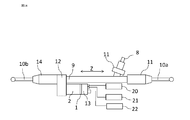
- FIG. 14 is a schematic configuration diagram of an electric power steering device mounted on a vehicle such as an automobile.
- a steering wheel (not shown) operated by the driver is connected to one end of the shaft 8, the driver steers the steering wheel, and the torque thereof is transmitted to the shaft 8.
- the shaft 8 is connected to a rack shaft (not shown) in the housing 9.
- a front right wheel tie rod 10a and a front left wheel tie rod 10b are connected to both ends of the rack shaft, respectively, and a front right wheel tie rod 10a has a right wheel (not shown) via a knuckle arm (not shown).
- the left wheel (not shown) is connected to the front left wheel tie rod 10b via a knuckle arm (not shown).
- the left and right front wheels are steered according to the driver's steering wheel operation.
- the rack boots 14 are provided so that foreign matter does not enter the device.
- the electric power steering device assists the driver in operating the steering wheel.
- the assist is performed by generating an auxiliary torque that assists the steering torque.
- this auxiliary torque is generated by using the rotary electric machine 2 which is a permanent magnet type rotary electric machine as a power source.
- the torque is detected by the torque sensor 11 attached to the shaft 8.
- the detected torque is transmitted to the main system power supply source 20 and the sub system power supply source 21.
- vehicle information such as vehicle speed is also converted into an electric signal and transmitted to the main system power supply source 20 and the sub system power supply source 21.
- the main system power supply source 20 and the sub system power supply source 21 calculate the required assist torque from the detected torque and vehicle information such as vehicle speed, and transmit the required assist torque to the rotary electric machine 2 through the control device 13 (inverter or the like) of the rotary electric machine. Supply current. Power is supplied to the control device 13 from the power supply 22 via the power connector. Further, as described with reference to FIG. 1, a redundant resolver 1 is attached to the shaft 3 of the rotary electric machine 2. The redundant resolver 1 detects the rotation angle of the rotor of the rotary electric machine 2 and outputs a rotation angle signal corresponding to the rotation angle. Note that the control device 13 may be configured with the hardware configuration shown in FIG. 2 as in the control circuit 5.
- the rotary electric machine 2 is arranged in a direction parallel to the moving direction of the rack axis (arrow Z).
- the torque generated by the rotary electric machine 2 is transmitted to the belt and the ball screw in the gear box 12 to generate a thrust that moves the rack shaft inside the housing 8 in the direction of the arrow Z.
- This thrust assists the driver's steering force.
- the front right wheel tie rod 10a and the front left wheel tie rod 10b operate by the thrust force of the revolver 2 and the steering force of the driver, and both wheels can be steered to turn the vehicle.
- the redundant resolver 1 of the above-described first or second embodiment is applied for detecting the rotation angle of the rotary electric machine 2.
- the cogging torque and torque ripple generated by the rotary electric machine 2 are transmitted to the driver via the gears. Therefore, it is desirable that the cogging torque and torque ripple are small in order to obtain a good steering feeling. Further, it is desirable that the vibration and noise when the rotary electric machine 2 operates are also small.
- the electric power steering device in which the redundant resolver 1 of the first or second embodiment is mounted on the rotary electric machine 2 can provide a good steering feeling to the driver.
- the redundant resolver 1 of the first or second embodiment can detect the rotation angle with high accuracy in the other system even if one system fails, and continuously outputs the assist force. Can be done.
- the redundant resolver 1 is attached to the rotary electric machine in FIG. 1, it goes without saying that the main body of the redundant resolver 1 can be attached to the inside of the rotary electric machine and the control circuit 5 can be provided outside the rotary electric machine 2.
Landscapes
- Engineering & Computer Science (AREA)
- Power Engineering (AREA)
- Physics & Mathematics (AREA)
- General Physics & Mathematics (AREA)
- Chemical & Material Sciences (AREA)
- Combustion & Propulsion (AREA)
- Transportation (AREA)
- Mechanical Engineering (AREA)
- Transmission And Conversion Of Sensor Element Output (AREA)
- Measurement Of Length, Angles, Or The Like Using Electric Or Magnetic Means (AREA)
Abstract
Nx(Nxは自然数)個の突極を有する回転子(42)、回転子(42)と対向し周方向にNs(Nsは3以上の整数)個配置されたティース(411)を有する固定子(41)、ティースに巻回された励磁巻線(R)及び2相の出力巻線(Sa、Sb)、を有するレゾルバ本体(4)と、励磁巻線(R)に電圧を印加する励磁回路(511、512)とを有し、 Ns個のティースのうちNsm(Nsmは2以上の整数)個のティースに巻回された励磁巻線及び2相の出力巻線を主系統(101)とし、Ns-Nsm個のティースに巻回された励磁巻線及び2相の出力巻線を副系統(102)とし、主系統(101)に対応するティース数Nsmが副系統(102)に対応するティース数Ns-Nsmより多いことを特徴とする。
Description
本願は、冗長レゾルバ及び冗長レゾルバを搭載した電動パワーステアリング装置に関する。
回転子と固定子の空隙におけるパーミアンスの変化を利用したレゾルバにおいて、異なる励磁回路に接続された2組の励磁巻線を有する多重系のレゾルバ、いわゆる冗長レゾルバが知られている。
例えば、特許文献1においては、2つの励磁巻線を有する冗長レゾルバにおいて、軸方向寸法を小さくするために、一つのレゾルバ固定子を周方向に分割し、第一系統、第二系統とすることで冗長化したものが開示されている。
しかしながら、特許文献1では、第一系統および第二系統を構成するティースの数が、レゾルバステータの全ティース数の半数であるため、一重系のレゾルバと比較して角度検出精度が悪化するという課題があった。
このような冗長レゾルバにおける角度検出精度の悪化を抑制するために、2つのレゾルバを軸線方向に2段積みし、一方のレゾルバには第一出力巻線のみを巻回し、他方のレゾルバには第二出力巻線のみを巻回したものが開示されている(例えば、特許文献2参照)。
しかし、特許文献2では、2つのレゾルバを、シャフトを介して2段積みしているため、一系統レゾルバに比べ、軸線方向寸法が2倍に増大するという課題があった。
しかし、特許文献2では、2つのレゾルバを、シャフトを介して2段積みしているため、一系統レゾルバに比べ、軸線方向寸法が2倍に増大するという課題があった。
本願は、上記の課題を解決するための技術を開示するものであり、大型化することなく、主系統の角度検出精度が高い冗長レゾルバを提供することを目的とする。
本願に開示される冗長レゾルバは、
Nx(Nxは自然数)個の突極を有する回転子、回転子と対向し周方向にNs(Nsは3以上の整数)個配置されたティースを有する固定子、ティースに巻回された励磁巻線及び2相の出力巻線、を有するレゾルバ本体と、
励磁巻線に電圧を印加する励磁回路とを有し、
Ns個のティースのうちNsm(Nsmは2以上の整数)個のティースに巻回された励磁巻線及び2相の出力巻線を主系統とし、Ns-Nsm個のティースに巻回された励磁巻線及び2相の出力巻線を副系統としたものであって、
主系統における前記2相の出力巻線の電圧を入力し主系統における角度を演算する主系統演算部、
副系統における前記2相の出力巻線の電圧を入力し副系統における角度を演算する副系統演算部、を備え、
主系統に対応するティース数Nsmが副系統に対応するティース数Ns-Nsmより多いことを特徴とするものである。
Nx(Nxは自然数)個の突極を有する回転子、回転子と対向し周方向にNs(Nsは3以上の整数)個配置されたティースを有する固定子、ティースに巻回された励磁巻線及び2相の出力巻線、を有するレゾルバ本体と、
励磁巻線に電圧を印加する励磁回路とを有し、
Ns個のティースのうちNsm(Nsmは2以上の整数)個のティースに巻回された励磁巻線及び2相の出力巻線を主系統とし、Ns-Nsm個のティースに巻回された励磁巻線及び2相の出力巻線を副系統としたものであって、
主系統における前記2相の出力巻線の電圧を入力し主系統における角度を演算する主系統演算部、
副系統における前記2相の出力巻線の電圧を入力し副系統における角度を演算する副系統演算部、を備え、
主系統に対応するティース数Nsmが副系統に対応するティース数Ns-Nsmより多いことを特徴とするものである。
本願に開示される冗長レゾルバによれば、主系統を構成するステータのティース数を全ティース数の半数より多くすることで、大型化することなく、角度検出精度が向上する。
以下、本実施の形態について図を参照して説明する。なお、各図中、同一符号は、同一または相当する部分を示すものとする。
実施の形態1.
<励磁同期>
以下、実施の形態1に係る冗長レゾルバについて説明する。
図1は、本実施の形態1に係る冗長レゾルバ1を回転電機に取り付けた例を示す図である。なお、回転電機2のシャフト3に取り付けた例を示すが、その他、種々の装置の回転部(回転体)の回転軸であれば、取り付け対象は回転電機に限るものではない。
実施の形態1.
<励磁同期>
以下、実施の形態1に係る冗長レゾルバについて説明する。
図1は、本実施の形態1に係る冗長レゾルバ1を回転電機に取り付けた例を示す図である。なお、回転電機2のシャフト3に取り付けた例を示すが、その他、種々の装置の回転部(回転体)の回転軸であれば、取り付け対象は回転電機に限るものではない。
図1において、冗長レゾルバ1は回転電機2の回転軸であるシャフト3に取り付けられている。冗長レゾルバ1は、センサであるレゾルバ本体4とそれを制御する制御回路5とを具備する。レゾルバ本体4は、一対の固定子41と回転子42とを備え、固定子41には巻線43が巻回されている。回転子42はシャフト3を介して回転電機2の回転部と接続されている。制御回路5は、巻線43のうち後述する励磁巻線に交流電圧を印加して励磁する励磁回路51と巻線43のうち後述する出力巻線の信号波形から回転角度を演算する角度演算部52とを備える。図3で後述するように、励磁回路51および角度演算部52は、主系統と副系統に励磁回路511、512、角度演算部521、522を備える。
制御回路5のマイコンのハードウエアの一例を図2に示す。プロセッサ500と記憶装置510から構成され、図示していないが、記憶装置510はランダムアクセスメモリ等の揮発性記憶装置と、フラッシュメモリ等の不揮発性の補助記憶装置とを具備する。また、フラッシュメモリの代わりにハードディスクの補助記憶装置を具備してもよい。プロセッサ500は、記憶装置510から入力されたプログラムを実行することにより、例えば、角度演算部52での角度演算を行う。この場合、補助記憶装置から揮発性記憶装置を介してプロセッサ500にプログラムが入力される。また、プロセッサ500は、演算結果等のデータを記憶装置510の揮発性記憶装置に出力してもよいし、揮発性記憶装置を介して補助記憶装置にデータを保存してもよい。
なお、制御回路5内のハードウエアはマイコンでなくてもよく、ASIC(Application Specific Integrated Circuit)、FPGA(Field Programmable Gate Array)、簡単な論理回路、またはリレーなどでもよい。
なお、制御回路5内のハードウエアはマイコンでなくてもよく、ASIC(Application Specific Integrated Circuit)、FPGA(Field Programmable Gate Array)、簡単な論理回路、またはリレーなどでもよい。
図3は、本実施の形態1に係る冗長レゾルバ1の構成を示す図である。図において冗長レゾルバ1は主系統101のレゾルバと副系統102のレゾルバとを備えている。主系統101のレゾルバ及び副系統102のレゾルバは、巻線43の構成として、第一出力巻線Sa、第二出力巻線Sb、励磁巻線Rを有している。第一出力巻線Sa及び第二出力巻線Sbは角度演算部521、522にそれぞれ接続され、励磁巻線Rは励磁回路511、512にそれぞれ接続されている。主系統101の角度演算部521および副系統102の角度演算部522は角度演算部通信器6により接続されている。角度演算部通信器6には、主系統検出角度θmと副系統検出角度θsが入力され、主系統101および副系統102がいずれも正常な場合は主系統検出角度θmを、例えば制御装置13(図14参照)へ出力する。
角度演算部通信器6には、主系統検出角度θmと副系統検出角度θsが入力され、主系統101が故障している場合には、副系統検出角度θsを制御装置13へ出力する。また、副系統102が故障している場合には、主系統検出角度θmを制御装置13へ出力する。同様に、主系統101の励磁回路511と副系統102の励磁回路512は励磁回路通信器7により接続されている。励磁回路通信器7では、主系統101の励磁回路511および副系統102の励磁回路512から出力される主系統励磁信号および副系統励磁信号の位相を一致させ、主系統101と副系統102との間の磁気干渉を回避している。このように、角度演算部521,522及び励磁回路511、512は各系統に設けられ、冗長性を確保している。
図4は、図1中、X―X線のレゾルバ本体4の断面図である。図4において、ヨーク412とティース411を有する固定子41の各ティース411に巻線43が巻回されている。突極部を有する回転子42はシャフト3に取り付けられている。本実施の形態1において、冗長レゾルバ1の固定子のティース411の数Nsは12、回転子42の突極の数Nxを5とする。突極の数Nxは軸倍角とも呼ばれている。
図5は、図4から回転子42とシャフト3を除いた図で固定子41の断面図に相当し、主系統101及び副系統102のレゾルバの一部構成を示す図である。上述したように、冗長レゾルバ1の固定子41のティース411の数Nsは12である。図5中、各ティース411を時計方向にティースT1~ティースT12とすると、図中Y-Y線で分けられるように、ティースT1~ティースT7からなる主系統ティース、ティースT8~ティースT12からなる副系統ティースに周方向に2分割されている。つまり、主系統ティースの数は7つ、副系統ティースの数は5となり、主系統ティースの数が多い構成である。この主系統ティースは主系統101のレゾルバを、副系統ティースは副系統102のレゾルバを構成し、両者で二重系の冗長レゾルバ1を構成している。
次に、各ティースT1~T12に巻回される巻線43について説明する。
各ティースT1~T12には、1相の励磁巻線Rと、2相の出力巻線である第一出力巻線Sa、第二出力巻線Sbからなる巻線群が巻回されている。つまり、主系統ティースT1~T7には、主系統101の励磁巻線R1~R7、主系統101の第一出力巻線Sa1~Sa7、主系統101の第二出力巻線Sb1~Sb7が巻回されている。同様に、副系統ティースT8~T12には、副系統102の励磁巻線R8~R12、副系統102の第一出力巻線Sa8~Sa12、副系統102の第二出力巻線Sb8~Sb12が巻回されている(図5中では、ティースT1の第一出力巻線Sa1、第二出力巻線Sb1、励磁巻線R1、ティースT11の第一出力巻線Sa11、第二出力巻線Sb11、励磁巻線R11のみを示している)。
各ティースT1~T12には、1相の励磁巻線Rと、2相の出力巻線である第一出力巻線Sa、第二出力巻線Sbからなる巻線群が巻回されている。つまり、主系統ティースT1~T7には、主系統101の励磁巻線R1~R7、主系統101の第一出力巻線Sa1~Sa7、主系統101の第二出力巻線Sb1~Sb7が巻回されている。同様に、副系統ティースT8~T12には、副系統102の励磁巻線R8~R12、副系統102の第一出力巻線Sa8~Sa12、副系統102の第二出力巻線Sb8~Sb12が巻回されている(図5中では、ティースT1の第一出力巻線Sa1、第二出力巻線Sb1、励磁巻線R1、ティースT11の第一出力巻線Sa11、第二出力巻線Sb11、励磁巻線R11のみを示している)。
主系統101の励磁巻線R1~R7および副系統102の励磁巻線R8~R12はそれぞれレゾルバの延出部(図示せず)に設けられた励磁端子(図示せず)を介して主系統101の励磁回路511、副系統102の励磁回路512に接続されている。
主系統101の第一出力巻線Sa1~Sa7、主系統101の第二出力巻線Sb1~Sb7はそれぞれレゾルバの延出部に設けられた出力端子(図示せず)を介して主系統101の角度演算部521に接続されている。副系統102の第一出力巻線Sa8~Sa12、副系統102の第二出力巻線Sb8~Sb12はそれぞれレゾルバの延出部に設けられた出力端子(図示せず)を介して副系統102の角度演算部522に接続されている。主系統101の角度演算部521および副系統102の角度演算部522は、それぞれ第一出力巻線Sa及び第二出力巻線Sbの2相の出力巻線から出力される出力信号により、回転子の主統検出角度θmおよび副系統検出角度θsを計算して出力する(図3参照)。
図5中、ティースT1に着目すると、まず励磁巻線R1が巻回され、次に第一出力巻線Sa1、第二出力巻線Sb1の順で巻回されている。すなわち、励磁巻線R1を先に巻き、その上から2相の出力巻線を巻いた構成となっている。この2相の第一出力巻線Sa1、第二出力巻線Sb1の巻回する順序はこの順に限らず、いずれを先に巻回してもよい。また、2相の第一出力巻線Sa1、第二出力巻線Sb1のうちいずれか1相の出力巻線を巻回しないティースを設ける場合がある。ティースT1を含む固定子鉄心と巻線R1、Sa1、Sb1とは絶縁紙、塗装、樹脂等(図示せず)により絶縁されている。なお、ティースT1について説明したが、他のティースT2~T12も同様の方法で励磁巻線R2~R12、第一出力巻線Sa2~Sa12、第二出力巻線Sb2~Sb12が巻回されている。
励磁巻線R1~R7、第一出力巻線Sa1~Sa7、第二出力巻線Sb1~Sb7は、それぞれ直列に接続される。同様に、励磁巻線R8~R12、第一出力巻線Sa8~Sa12、第二出力巻線Sb8~Sb12もそれぞれ直列に接続される。
なお、ここではそれぞれの巻線は、ティースT1~T7およびティースT8~T12の順に直列に接続されるとしたが、巻き始めのティースはそれぞれ系統内の任意のティースTiであって、かつ隣接するティースから順に直列に接続されていても、同様の効果が得られる。
なお、ここではそれぞれの巻線は、ティースT1~T7およびティースT8~T12の順に直列に接続されるとしたが、巻き始めのティースはそれぞれ系統内の任意のティースTiであって、かつ隣接するティースから順に直列に接続されていても、同様の効果が得られる。
また、1相の励磁巻線Rと2相の出力巻線である第一出力巻線Sa、第二出力巻線Sbを周方向に並べて巻回するものとしたがこの限りではなく、径方向に並べる、あるいはティースごとに巻回する順序を変更する等しても同様の効果を得ることができる。
次に、本実施の形態1に係る冗長レゾルバの主系統101の励磁巻線R1~R7および副系統102の励磁巻線R8~R12の巻数について説明する。図6は本実施の形態1に係る冗長レゾルバにおける巻線の分布を示す図である。図において、励磁巻数を振幅で規格化し、主系統ティースT1~T7および副系統ティースT8~T12に巻かれる励磁巻線Rの巻数を連続的に示している。レゾルバの励磁巻線には、巻き方向(+)、巻き方向(-)が定義されている。本実施の形態1における冗長レゾルバ1では、励磁巻線Rの巻方向(+)と巻方向(―)が交互に配置されている。巻方向(+)および巻方向(-)は、巻線の互いに異なる巻極性を表し、あるコイルの巻線の方向を巻き方向(+)で表すと、巻線が逆向きに巻かれているコイルは巻き方向(-)と表現する。巻き方向(+)の巻数と巻き方向(-)の巻数は、絶対値が同じである。よって、励磁巻線Rの空間次数Neは6である。すなわち、巻き方向(+)の巻数を+X回とすると巻き方向(-)の巻数は、-X回となる。なお、ここでは巻き方向(+)、巻き方向(-)が交互に巻かれており、励磁巻線Rの空間次数が6であるとしたが、この限りではなく、巻き方向(+)、巻き方向(-)が2ティースごとに配置された励磁巻線の空間次数が3となる巻線配置など、ほかの巻線配置であってもよい。
図7は、本実施の形態に係る冗長レゾルバ1の主系統101の第一出力巻線Sa1~Sa7、第二出力巻線Sb1~Sb7と副系統102の第一出力巻線Sa8~Sa12、第二出力巻線Sb8~Sb12の巻数の分布を示す図である。図において、出力巻数を振幅で規格化し、主系統ティースT1~T7および副系統ティースT8~T12に巻かれる出力巻線の巻数を連続的に示している。i番目のティースに巻回される第一出力巻線、第二出力巻線の巻数NSaiおよびNSbiは巻線の位相差が90°であり、以下の式(1)で表すことができる。

ここで、N1は出力巻線の巻数の振幅、θteethはティースの周方向位置を表している。励磁巻線Rの空間次数Neが6、軸倍角Nxが5であるから、ここでは出力巻線の空間次数は1である。出力巻線は、ティースの周方向に正弦波状に分布している。巻数が小数になる場合は四捨五入して整数としている。ここで同図において、出力巻線の巻数は、その振幅、すなわちN1で規格化している。
図8は、本実施の形態1に係る冗長レゾルバ1と、比較例、すなわち主系統ティースの数が6である冗長レゾルバの角度検出精度を比較したものである。縦軸は角度誤差の電気角5次成分を、比較例の値で規格化している。主系統ティースの数を7とすることで、出力信号を得るティースの数が増えるため、主系統101の角度検出精度を向上することができるといった効果を得ることができる。
本実施の形態1に係る冗長レゾルバ1は、主系統101の角度演算部521と副系統102の角度演算部522の間で通信し、主系統検出角度θmを制御装置13へ入力し、回転電機2を制御している。角度演算部521または角度演算部通信器6で主系統101の故障を検知した場合には副系統検出角度θsを制御装置13に入力する。角度演算部522または角度演算部通信器6で副系統102の故障を検知した場合には主系統検出角度θmを制御装置13に入力する。このように、本実施の形態1に係る冗長レゾルバでは、一重系レゾルバと同等の寸法でありながら冗長化が可能となり、かつ、ステータを半分に分けて冗長化した冗長レゾルバと比較して、正常時の角度検出精度を向上することができる。
図9は、主系統ティースの数を3から11まで変化させたときの角度検出精度を示すものである。ここで、縦軸は角度誤差の電気角5次成分を、比較例の値で規格化している。主系統ティースの数を7以上、すなわち全ティースの数の半数より多くすることにより、主系統ティースと副系統ティースの数が同数であるときと比べ、角度検出精度を向上することが可能である。
ここで、本実施の形態1に係る冗長レゾルバの軸倍角Nxを5、ティースの数Nsを12としたが、この限りではなく、Nxは自然数、Nsは3以上の整数であれば、他の数であっても同様の効果を得ることができる。
実施の形態2.
<励磁周波数分離>
図10は、本実施の形態2に係る冗長レゾルバ1aの構成を示す図である。図において冗長レゾルバ1aは主系統101aのレゾルバと副系統102aのレゾルバとを備えている。主系統101aの励磁回路511aと副系統102aの励磁回路512aは励磁回路通信器により接続されておらず、互いに独立している。このような構成にすることにより、励磁回路通信器による共通故障を防ぐことができるため、冗長レゾルバの安全性をより向上することができるといった効果を得ることができる。
<励磁周波数分離>
図10は、本実施の形態2に係る冗長レゾルバ1aの構成を示す図である。図において冗長レゾルバ1aは主系統101aのレゾルバと副系統102aのレゾルバとを備えている。主系統101aの励磁回路511aと副系統102aの励磁回路512aは励磁回路通信器により接続されておらず、互いに独立している。このような構成にすることにより、励磁回路通信器による共通故障を防ぐことができるため、冗長レゾルバの安全性をより向上することができるといった効果を得ることができる。
上述したように、本実施の形態2に係る冗長レゾルバ1aは、主系統101aの励磁巻線R1~R7に励磁信号を与える励磁回路511aと副系統102aの励磁巻線R8~R12に励磁信号を与える励磁回路512aとは互いに独立して、冗長性を確保している。
しかし、互いに独立させることにより、主系統101aの励磁信号および副系統102aの励磁信号を同期させることが難しい。励磁回路511aおよび励磁回路512aを構成する、例えばマイコンには製造上ばらつきがあるため、主系統101aの励磁信号および副系統102aの励磁信号の周波数を同等に設計しても、完全に一致せず、微小な差が生じる。これにより、主系統101aの励磁信号および副系統102aの励磁信号の差異は一定ではなく時刻とともに変化し、他系統に影響を及ぼし、角度検出精度悪化の原因となる。
このため、それぞれの励磁回路511a、512aから異なる周波数の励磁信号を、対応する励磁巻線Rに供給する。図11は、本実施の形態2に係る冗長レゾルバ1の主系統101aの励磁信号および副系統102aの励磁信号を示したものである。主系統101aの励磁信号の周波数f1は10kHz、副系統102aの励磁信号の周波数f2は20kHzである。なお、縦軸は励磁信号の電圧を振幅で規格化している。
さらに、主系統101aの角度演算部521aおよび副系統102aの角度演算部522aはそれぞれ他系統の周波数成分を除去する機能を有する。つまり、主系統101aの第一出力信号、主系統101aの第二出力信号から副系統102aの励磁信号による成分を除去し、主系統101aの励磁信号による成分のみを取り出す。また、副系統102aの第一出力信号、副系統102aの第二出力信号から主系統101aの励磁信号による成分を除去し、副系統102aの励磁信号による成分のみを取り出す。以下に、他系統の周波数成分を除去する方法について説明する。
図12は、主系統101aの出力信号の波形を説明する図で、上から順に、主系統101aの出力信号、主系統101aの励磁信号、副系統102aの励磁信号の波形を示している。主系統101aの出力信号は、本来、主系統101aの励磁信号に対応した周波数f1の波形となるところ、副系統102aの励磁信号の周波数f2の成分が加算された波形となる。
図12に示すように、主系統101aの励磁信号の+A、-Aのそれぞれは、信号の正のピーク、負のピークに相当する。しかし、それぞれ副系統102aの励磁信号成分+Bnが加算されるため、主系統101aの出力信号では正弦波から歪んだ波形となることがわかる。そのため、この主系統101aの出力信号を周期1/f1でサンプルし、そのまま逆正接演算を行うと、副系統の励磁信号周波数f2の成分に起因した誤差を生ずる。
そこで、主系統101aの出力信号を2/f1でサンプルし、{(A+Bn)-(-A+Bn)}/2とする。これにより、主系統101aの励磁信号周波数f1の成分Aのみを抽出し、副系統102aの励磁信号周波数f2の成分Bnを除去することが可能となり、回転角度の検出精度を向上することが可能である。
図13は、副系統102aの出力信号の波形を説明する図で、上から順に、副系統102aの出力信号、副系統102aの励磁信号、主系統101aの励磁信号の波形を示している。副系統102aの出力信号は、本来、副系統102aの励磁信号に対応した周波数f2の波形となるところ、主系統101aの励磁信号の周波数f1の成分が加算された波形となる。図に示すように、副系統102aの励磁信号の+B、-B、+B、-Bのそれぞれは信号の正のピーク、負のピークに相当する。しかし、それぞれ主系統101aの励磁信号成分+An1、+An2、―An1、―An2が加算されるため、副系統102aの出力信号では正弦波から歪んだ波形となることがわかる。そのため、この副系統102aの出力信号を周期1/f2でサンプルし、そのまま逆正接演算を行うと、主系統101aの励磁信号周波数f1の成分に起因した誤差を生ずる。
そこで、副系統102aの出力信号を2/f2でサンプルし、{(B+An1)+(B-An1)-(-B+An2)―(-B-An2)}/4とする。これにより、副系統102aの励磁信号周波数f2の成分Bのみを抽出し、主系統101aの励磁信号周波数f1の成分Anを除去することが可能となり、回転角度の検出精度を向上することが可能である。
本実施の形態2における冗長レゾルバでは、一円状の固定子に主系統101aと副系統102aが配置されている。そして、系統ごとに異なる周波数の励磁信号を供給し、各角度演算部521a、522aにおいて他系統の励磁信号の影響を除去している。このことにより、主系統101aと副系統102aとは独立した状態、すなわち、主系統101aに着目すると、副系統102aのティースに巻回された副系統102aの励磁巻線Rには励磁信号が印加されず、副系統102aが断線等の故障が起きた場合と同様の物理状態となる。逆に副系統102aに着目すると、主系統101aが断線等の故障が起きた場合と同様の物理状態となる。このことは、独立した励磁回路511a、512aから互いに異なる周波数の励磁信号を供給することで、他系統の信号に影響しない信号が得られる、という優位性を示唆している。
このような構成にすることにより、励磁回路通信器による共通故障が起きないため安全性を向上することができるといった効果を得ることができる。また、主系統と副系統間の磁気干渉を回避することができるため、角度検出精度を向上することができる。
このような構成にすることにより、励磁回路通信器による共通故障が起きないため安全性を向上することができるといった効果を得ることができる。また、主系統と副系統間の磁気干渉を回避することができるため、角度検出精度を向上することができる。
実施の形態3.
<電動パワーステアリングへの搭載>
以上説明した冗長レゾルバ1は、車両用の電動パワーステアリング装置に適用することができる。
以下、実施の形態3に係る電動パワーステアリング装置について図14を用いて説明する。
<電動パワーステアリングへの搭載>
以上説明した冗長レゾルバ1は、車両用の電動パワーステアリング装置に適用することができる。
以下、実施の形態3に係る電動パワーステアリング装置について図14を用いて説明する。
図14は、自動車等の車両に搭載される電動パワーステアリング装置の概略構成図である。図14において、シャフト8の一端には運転者が操作するステアリングホイール(図示せず)が連結されており、運転者がステアリングホイールを操舵し、そのトルクがシャフト8に伝達される。シャフト8はハウジング9内のラック軸(図示せず)に連結されている。ラック軸の両端には、それぞれ前右輪用タイロッド10a、前左輪用タイロッド10bが連結され、前右輪用タイロッド10aにはナックルアーム(図示せず)を介して右輪(図示せず)が連結され、前左輪用タイロッド10bにはナックルアーム(図示せず)を介して左輪(図示せず)が連結されている。運転者のステアリングホイール操作に応じて、左右の前輪が操向される。なお、ラックブーツ14は異物が装置内に侵入しないように設けられている。
電動パワーステアリング装置は、運転者が行うステアリングホイール操作をアシストする。そのアシストは運転者がステアリングホイールを操舵し、操舵トルクを発生させた場合、その操舵トルクを補助する補助トルクを発生させることにより行われる。この補助トルクは、図1で説明したように、永久磁石型回転電機である回転電機2を動力源として発生させる。運転者がステアリングホイールを操舵すると、シャフト8に取り付けられたトルクセンサ11によりトルクが検知される。検知されたトルクは主系統電力供給源20および副系統電力供給源21に伝達される。また、車速などの車両の情報も電気信号に変換され主系統電力供給源20および副系統電力供給源21に伝達される。主系統電力供給源20および副系統電力供給源21は検知されたトルクと車速などの車両の情報から、必要なアシストトルクを演算し、回転電機の制御装置13(インバータなど)を通じて回転電機2に電流を供給する。制御装置13には電源22から電源コネクタを介して電力が供給される。また、図1で説明したように、回転電機2のシャフト3に冗長レゾルバ1が取り付けられている。冗長レゾルバ1は、回転電機2の回転子の回転角を検出し、それに対応する回転角度信号を出力する。なお、制御装置13は、制御回路5同様、図2で示したハードウエア構成で構成されていてもよい。
回転電機2は、ラック軸の移動方向(矢印Z)に平行な向きに配置されている。回転電機2で発生したトルクはギヤボックス12内のベルト及びボールネジに伝達され、ハウジング8内部にあるラック軸を矢印Zの方向に動かす推力を発生させる。この推力により、運転者の操舵力をアシストする。回転電機2による推力と運転者による操舵力により前右輪用タイロッド10a及び前左輪用タイロッド10bが動作し、両輪が転舵され車両を旋回させることができる。
このように、回転電機2のトルクによってアシストされるため、運転者は少ない操舵力で車両を旋回させることができる。本実施の形態に係る電動パワーステアリング装置においては、上記実施の形態1または2の冗長レゾルバ1を回転電機2の回転角度検出用に適用した。電動パワーステアリング装置においては、回転電機2が発生するコギングトルク及びトルクリップルはギヤを介して運転者に伝わるため、良好な操舵感覚を得るためにはコギングトルク及びトルクリップルが小さい方が望ましい。また、回転電機2が動作するときの振動及び騒音も小さい方が望ましい。
このため、回転電機2の回転角度を精度よく検知することで回転電機を円滑に制御することが可能となり、回転角度の検出精度が低い場合よりもトルクリップルの発生を抑制することが可能となる。また、振動及び騒音についても同様である。そのため、上記実施の形態1または2の冗長レゾルバ1を回転電機2に搭載した電動パワーステアリング装置は、運転者に良好な操舵感を提供することが可能となる。
さらに、実施の形態1または2の冗長レゾルバ1は、一系統が故障した場合であっても他系統で回転角度を高精度に検出することが可能であり、継続してアシスト力を出力することができる。なお、図1において、回転電機に冗長レゾルバ1を取り付けて示したが、冗長レゾルバ1の本体を回転電機内部に取り付け、制御回路5は回転電機2の外部に設けることができることは言うまでもない。
本開示は、様々な例示的な実施の形態及び実施例が記載されているが、1つ、または複数の実施の形態に記載された様々な特徴、態様、及び機能は特定の実施の形態の適用に限られるのではなく、単独で、または様々な組み合わせで実施の形態に適用可能である。
従って、例示されていない無数の変形例が、本願明細書に開示される技術の範囲内において想定される。例えば、少なくとも1つの構成要素を変形する場合、追加する場合または省略する場合、さらには、少なくとも1つの構成要素を抽出し、他の実施の形態の構成要素と組み合わせる場合が含まれるものとする。
従って、例示されていない無数の変形例が、本願明細書に開示される技術の範囲内において想定される。例えば、少なくとも1つの構成要素を変形する場合、追加する場合または省略する場合、さらには、少なくとも1つの構成要素を抽出し、他の実施の形態の構成要素と組み合わせる場合が含まれるものとする。
1:冗長レゾルバ、2:回転電機、3:シャフト、4:レゾルバ本体、5:制御回路、6:角度演算部通信器、7:励磁回路通信器、101、101a:主系統、102、102a:副系統、511、511a、512、512a:励磁回路、521、521a、522、522a:角度演算部
Claims (7)
- Nx(Nxは自然数)個の突極を有する回転子、前記回転子と対向し周方向にNs(Nsは3以上の整数)個配置されたティースを有する固定子、前記ティースに巻回された励磁巻線及び2相の出力巻線、を有するレゾルバ本体と、
前記励磁巻線に電圧を印加する励磁回路とを有し、
Ns個のティースのうちNsm(Nsmは2以上の整数)個のティースに巻回された励磁巻線及び2相の出力巻線を主系統とし、Ns-Nsm個のティースに巻回された励磁巻線及び2相の出力巻線を副系統とした冗長レゾルバであって、
前記主系統における2相の出力巻線の電圧を入力し前記主系統における角度を演算する主系統角度演算部、
前記副系統における2相の出力巻線の電圧を入力し前記副系統における角度を演算する副系統角度演算部、
を備え、
前記主系統に対応するティース数Nsmが前記副系統に対応するティース数Ns-Nsmより多いことを特徴とする冗長レゾルバ。 - 前記主系統角度演算部と前記副系統角度演算部とが、角度演算部通信器と接続されていることを特徴とする、請求項1に記載の冗長レゾルバ。
- 前記励磁回路は、前記主系統に対応する前記励磁巻線に電圧を印加する主系統励磁回路および前記副系統に対応する前記励磁巻線に電圧を印加する副系統励磁回路から構成されていることを特徴とする請求項1または2に記載の冗長レゾルバ。
- 前記主系統励磁回路と前記副系統励磁回路とが、励磁回路通信器と接続されていることを特徴とする請求項3に記載の冗長レゾルバ。
- 前記主系統励磁回路が前記励磁巻線に供給する交流電圧の主系統励磁周波数と、前記副系統励磁回路が前記励磁巻線に供給する交流電圧の副系統励磁周波数とが異なる周波数であることを特徴とする、請求項3に記載の冗長レゾルバ。
- 前記主系統励磁周波数と前記副系統励磁周波数とを用いて、前記主系統角度演算部は、前記副系統の励磁信号成分を除去し、かつ、前記副系統角度演算部は、前記主系統の励磁信号成分を除去することを特徴とする請求項5に記載の冗長レゾルバ。
- 請求項1から6のいずれか一項に記載の冗長レゾルバを搭載した電動パワーステアリング装置。
Priority Applications (5)
| Application Number | Priority Date | Filing Date | Title |
|---|---|---|---|
| PCT/JP2020/015954 WO2021205596A1 (ja) | 2020-04-09 | 2020-04-09 | 冗長レゾルバ及び冗長レゾルバを搭載した電動パワーステアリング装置 |
| JP2022513793A JP7459233B2 (ja) | 2020-04-09 | 2020-04-09 | 冗長レゾルバ及び冗長レゾルバを搭載した電動パワーステアリング装置 |
| US17/915,860 US12163809B2 (en) | 2020-04-09 | 2020-04-09 | Redundant resolver and electric power steering device equipped with redundant resolver |
| CN202080099187.9A CN115443401B (zh) | 2020-04-09 | 2020-04-09 | 冗余旋转变压器及搭载有冗余旋转变压器的电动助力转向装置 |
| EP20930079.7A EP4134631A4 (en) | 2020-04-09 | 2020-04-09 | REDUNDANT RESOLVER AND ELECTRIC POWER STEERING DEVICE WITH REDUNDANT RESOLVER |
Applications Claiming Priority (1)
| Application Number | Priority Date | Filing Date | Title |
|---|---|---|---|
| PCT/JP2020/015954 WO2021205596A1 (ja) | 2020-04-09 | 2020-04-09 | 冗長レゾルバ及び冗長レゾルバを搭載した電動パワーステアリング装置 |
Publications (1)
| Publication Number | Publication Date |
|---|---|
| WO2021205596A1 true WO2021205596A1 (ja) | 2021-10-14 |
Family
ID=78023087
Family Applications (1)
| Application Number | Title | Priority Date | Filing Date |
|---|---|---|---|
| PCT/JP2020/015954 Ceased WO2021205596A1 (ja) | 2020-04-09 | 2020-04-09 | 冗長レゾルバ及び冗長レゾルバを搭載した電動パワーステアリング装置 |
Country Status (5)
| Country | Link |
|---|---|
| US (1) | US12163809B2 (ja) |
| EP (1) | EP4134631A4 (ja) |
| JP (1) | JP7459233B2 (ja) |
| CN (1) | CN115443401B (ja) |
| WO (1) | WO2021205596A1 (ja) |
Families Citing this family (2)
| Publication number | Priority date | Publication date | Assignee | Title |
|---|---|---|---|---|
| WO2021100076A1 (ja) * | 2019-11-18 | 2021-05-27 | 三菱電機株式会社 | 冗長レゾルバ及びそれを搭載した電動パワーステアリング装置 |
| US20220181940A1 (en) * | 2020-12-03 | 2022-06-09 | Joby Aero, Inc. | Redundant resolver |
Citations (7)
| Publication number | Priority date | Publication date | Assignee | Title |
|---|---|---|---|---|
| JP4147930B2 (ja) | 2002-12-18 | 2008-09-10 | 株式会社デンソー | 蒸気圧縮式冷凍機 |
| JP2009222435A (ja) | 2008-03-13 | 2009-10-01 | Toyota Motor Corp | レゾルバ |
| JP2010002205A (ja) * | 2008-06-18 | 2010-01-07 | Nsk Ltd | 多重系回転センサ |
| JP2013053890A (ja) * | 2011-09-02 | 2013-03-21 | Japan Aviation Electronics Industry Ltd | バリアブルリラクタンス型レゾルバ及び回転角検出装置 |
| JP2013247828A (ja) * | 2012-05-29 | 2013-12-09 | Tamagawa Seiki Co Ltd | 冗長系レゾルバ巻線構造 |
| JP2018185221A (ja) * | 2017-04-26 | 2018-11-22 | 三菱電機株式会社 | 高精度分割型回転角度検出装置 |
| JP2020024104A (ja) * | 2018-08-06 | 2020-02-13 | 株式会社デンソー | 回転検出装置、および、これを用いた電動パワーステアリング装置 |
Family Cites Families (12)
| Publication number | Priority date | Publication date | Assignee | Title |
|---|---|---|---|---|
| JP5016165B2 (ja) * | 2001-04-11 | 2012-09-05 | 株式会社アミテック | 相対回転位置検出装置 |
| JP4034691B2 (ja) * | 2003-05-09 | 2008-01-16 | ミネベア株式会社 | 回転角度センサー |
| JP5120586B2 (ja) * | 2005-06-28 | 2013-01-16 | 株式会社デンソー | 界磁巻線型同期機 |
| DE102007039050B8 (de) * | 2007-08-17 | 2024-02-15 | Avago Technologies International Sales Pte. Limited | Linearsegment- oder Umdrehungszähler mit einem ferromagnetischen Element |
| US9094015B2 (en) * | 2011-01-14 | 2015-07-28 | Infineon Technologies Ag | Low-power activation circuit with magnetic motion sensor |
| CN106797169B (zh) * | 2014-08-21 | 2020-01-24 | 三菱电机株式会社 | 旋转变压器 |
| US10222240B2 (en) * | 2015-06-05 | 2019-03-05 | Mitsubishi Electric Corporation | Resolver, rotating electrical machine, and elevator hoisting machine |
| EP3399283B1 (en) * | 2015-12-28 | 2020-09-30 | Mitsubishi Electric Corporation | Rotation angle detecting device and dynamo-electric machine |
| JP2019032200A (ja) * | 2017-08-07 | 2019-02-28 | マブチモーター株式会社 | 位置センサ及びモータ |
| JP6918142B2 (ja) | 2017-12-21 | 2021-08-11 | 三菱電機株式会社 | 冗長型レゾルバ、およびそれを用いた回転角度検出装置 |
| WO2020001552A1 (zh) * | 2018-06-29 | 2020-01-02 | 广东威灵汽车部件有限公司 | 旋转式变压器 |
| CN109781195B (zh) * | 2019-01-21 | 2022-01-04 | 西南石油大学 | 一种基于双频励磁的电磁流量计系统及信号提取方法 |
-
2020
- 2020-04-09 EP EP20930079.7A patent/EP4134631A4/en active Pending
- 2020-04-09 WO PCT/JP2020/015954 patent/WO2021205596A1/ja not_active Ceased
- 2020-04-09 US US17/915,860 patent/US12163809B2/en active Active
- 2020-04-09 CN CN202080099187.9A patent/CN115443401B/zh active Active
- 2020-04-09 JP JP2022513793A patent/JP7459233B2/ja active Active
Patent Citations (7)
| Publication number | Priority date | Publication date | Assignee | Title |
|---|---|---|---|---|
| JP4147930B2 (ja) | 2002-12-18 | 2008-09-10 | 株式会社デンソー | 蒸気圧縮式冷凍機 |
| JP2009222435A (ja) | 2008-03-13 | 2009-10-01 | Toyota Motor Corp | レゾルバ |
| JP2010002205A (ja) * | 2008-06-18 | 2010-01-07 | Nsk Ltd | 多重系回転センサ |
| JP2013053890A (ja) * | 2011-09-02 | 2013-03-21 | Japan Aviation Electronics Industry Ltd | バリアブルリラクタンス型レゾルバ及び回転角検出装置 |
| JP2013247828A (ja) * | 2012-05-29 | 2013-12-09 | Tamagawa Seiki Co Ltd | 冗長系レゾルバ巻線構造 |
| JP2018185221A (ja) * | 2017-04-26 | 2018-11-22 | 三菱電機株式会社 | 高精度分割型回転角度検出装置 |
| JP2020024104A (ja) * | 2018-08-06 | 2020-02-13 | 株式会社デンソー | 回転検出装置、および、これを用いた電動パワーステアリング装置 |
Non-Patent Citations (1)
| Title |
|---|
| See also references of EP4134631A4 |
Also Published As
| Publication number | Publication date |
|---|---|
| CN115443401B (zh) | 2026-04-07 |
| CN115443401A (zh) | 2022-12-06 |
| JPWO2021205596A1 (ja) | 2021-10-14 |
| US12163809B2 (en) | 2024-12-10 |
| EP4134631A4 (en) | 2023-05-10 |
| JP7459233B2 (ja) | 2024-04-01 |
| EP4134631A1 (en) | 2023-02-15 |
| US20230125647A1 (en) | 2023-04-27 |
Similar Documents
| Publication | Publication Date | Title |
|---|---|---|
| JP4775294B2 (ja) | レゾルバ | |
| CN114729823B (zh) | 冗余旋转变压器以及搭载有该冗余旋转变压器的电动助力转向装置 | |
| US9755470B2 (en) | Rotary electric machine and electric power steering device using rotary electric machine | |
| CN108369112B (zh) | 旋转角度检测装置及旋转电机 | |
| WO2011104898A1 (ja) | 回転角検出又は同期装置用巻線の巻線方法 | |
| JP7459233B2 (ja) | 冗長レゾルバ及び冗長レゾルバを搭載した電動パワーステアリング装置 | |
| JP2005172721A (ja) | アブソリュート磁気エンコーダ | |
| US20240159572A1 (en) | Resolver and electric power steering device equipped with same | |
| JPWO2021100076A5 (ja) | ||
| KR101655297B1 (ko) | 리니어 홀 센서 위치보정장치 및 그 위치보정방법 | |
| JP7142776B2 (ja) | 冗長レゾルバ装置及び電動パワーステアリング装置 | |
| JP5363136B2 (ja) | ブラシレスモータ | |
| JP4991992B2 (ja) | レゾルバ | |
| JP3014955B2 (ja) | 回転角度検出装置及び回転角検出信号生成回路 | |
| JP7297103B2 (ja) | レゾルバおよび電動パワーステアリング装置 | |
| CN115427763B (zh) | 多系统旋转传感器及搭载了多系统旋转传感器的电动助力转向装置 | |
| US12546629B2 (en) | Angle detection apparatus | |
| JP2011036105A (ja) | 回転電機の製造方法、回転電機、及び電動パワーステアリング装置 | |
| JP5671920B2 (ja) | モータ駆動装置 | |
| US12562618B2 (en) | Dual motor drive assembly |
Legal Events
| Date | Code | Title | Description |
|---|---|---|---|
| 121 | Ep: the epo has been informed by wipo that ep was designated in this application |
Ref document number: 20930079 Country of ref document: EP Kind code of ref document: A1 |
|
| ENP | Entry into the national phase |
Ref document number: 2022513793 Country of ref document: JP Kind code of ref document: A |
|
| NENP | Non-entry into the national phase |
Ref country code: DE |
|
| ENP | Entry into the national phase |
Ref document number: 2020930079 Country of ref document: EP Effective date: 20221109 |