WO2021206021A1 - 農薬含有粘着テープ - Google Patents
農薬含有粘着テープ Download PDFInfo
- Publication number
- WO2021206021A1 WO2021206021A1 PCT/JP2021/014334 JP2021014334W WO2021206021A1 WO 2021206021 A1 WO2021206021 A1 WO 2021206021A1 JP 2021014334 W JP2021014334 W JP 2021014334W WO 2021206021 A1 WO2021206021 A1 WO 2021206021A1
- Authority
- WO
- WIPO (PCT)
- Prior art keywords
- pesticide
- sensitive adhesive
- pressure
- adhesive
- mass
- Prior art date
- Legal status (The legal status is an assumption and is not a legal conclusion. Google has not performed a legal analysis and makes no representation as to the accuracy of the status listed.)
- Ceased
Links
Images


Classifications
-
- C—CHEMISTRY; METALLURGY
- C09—DYES; PAINTS; POLISHES; NATURAL RESINS; ADHESIVES; COMPOSITIONS NOT OTHERWISE PROVIDED FOR; APPLICATIONS OF MATERIALS NOT OTHERWISE PROVIDED FOR
- C09J—ADHESIVES; NON-MECHANICAL ASPECTS OF ADHESIVE PROCESSES IN GENERAL; ADHESIVE PROCESSES NOT PROVIDED FOR ELSEWHERE; USE OF MATERIALS AS ADHESIVES
- C09J7/00—Adhesives in the form of films or foils
- C09J7/30—Adhesives in the form of films or foils characterised by the adhesive composition
- C09J7/38—Pressure-sensitive adhesives [PSA]
- C09J7/381—Pressure-sensitive adhesives [PSA] based on macromolecular compounds obtained by reactions involving only carbon-to-carbon unsaturated bonds
- C09J7/385—Acrylic polymers
-
- A—HUMAN NECESSITIES
- A01—AGRICULTURE; FORESTRY; ANIMAL HUSBANDRY; HUNTING; TRAPPING; FISHING
- A01N—PRESERVATION OF BODIES OF HUMANS OR ANIMALS OR PLANTS OR PARTS THEREOF; BIOCIDES, e.g. AS DISINFECTANTS, AS PESTICIDES OR AS HERBICIDES; PEST REPELLANTS OR ATTRACTANTS; PLANT GROWTH REGULATORS
- A01N25/00—Biocides, pest repellants or attractants, or plant growth regulators, characterised by their forms, or by their non-active ingredients or by their methods of application, e.g. seed treatment or sequential application; Substances for reducing the noxious effect of the active ingredients to organisms other than pests
- A01N25/24—Biocides, pest repellants or attractants, or plant growth regulators, characterised by their forms, or by their non-active ingredients or by their methods of application, e.g. seed treatment or sequential application; Substances for reducing the noxious effect of the active ingredients to organisms other than pests containing ingredients to enhance the sticking of the active ingredients
-
- A—HUMAN NECESSITIES
- A01—AGRICULTURE; FORESTRY; ANIMAL HUSBANDRY; HUNTING; TRAPPING; FISHING
- A01N—PRESERVATION OF BODIES OF HUMANS OR ANIMALS OR PLANTS OR PARTS THEREOF; BIOCIDES, e.g. AS DISINFECTANTS, AS PESTICIDES OR AS HERBICIDES; PEST REPELLANTS OR ATTRACTANTS; PLANT GROWTH REGULATORS
- A01N25/00—Biocides, pest repellants or attractants, or plant growth regulators, characterised by their forms, or by their non-active ingredients or by their methods of application, e.g. seed treatment or sequential application; Substances for reducing the noxious effect of the active ingredients to organisms other than pests
- A01N25/34—Shaped forms, e.g. sheets, not provided for in any other sub-group of this main group
-
- A—HUMAN NECESSITIES
- A01—AGRICULTURE; FORESTRY; ANIMAL HUSBANDRY; HUNTING; TRAPPING; FISHING
- A01N—PRESERVATION OF BODIES OF HUMANS OR ANIMALS OR PLANTS OR PARTS THEREOF; BIOCIDES, e.g. AS DISINFECTANTS, AS PESTICIDES OR AS HERBICIDES; PEST REPELLANTS OR ATTRACTANTS; PLANT GROWTH REGULATORS
- A01N25/00—Biocides, pest repellants or attractants, or plant growth regulators, characterised by their forms, or by their non-active ingredients or by their methods of application, e.g. seed treatment or sequential application; Substances for reducing the noxious effect of the active ingredients to organisms other than pests
- A01N25/08—Biocides, pest repellants or attractants, or plant growth regulators, characterised by their forms, or by their non-active ingredients or by their methods of application, e.g. seed treatment or sequential application; Substances for reducing the noxious effect of the active ingredients to organisms other than pests containing solids as carriers or diluents
- A01N25/10—Macromolecular compounds
-
- A—HUMAN NECESSITIES
- A01—AGRICULTURE; FORESTRY; ANIMAL HUSBANDRY; HUNTING; TRAPPING; FISHING
- A01N—PRESERVATION OF BODIES OF HUMANS OR ANIMALS OR PLANTS OR PARTS THEREOF; BIOCIDES, e.g. AS DISINFECTANTS, AS PESTICIDES OR AS HERBICIDES; PEST REPELLANTS OR ATTRACTANTS; PLANT GROWTH REGULATORS
- A01N33/00—Biocides, pest repellants or attractants, or plant growth regulators containing organic nitrogen compounds
- A01N33/16—Biocides, pest repellants or attractants, or plant growth regulators containing organic nitrogen compounds containing nitrogen-to-oxygen bonds
- A01N33/18—Nitro compounds
-
- A—HUMAN NECESSITIES
- A01—AGRICULTURE; FORESTRY; ANIMAL HUSBANDRY; HUNTING; TRAPPING; FISHING
- A01N—PRESERVATION OF BODIES OF HUMANS OR ANIMALS OR PLANTS OR PARTS THEREOF; BIOCIDES, e.g. AS DISINFECTANTS, AS PESTICIDES OR AS HERBICIDES; PEST REPELLANTS OR ATTRACTANTS; PLANT GROWTH REGULATORS
- A01N43/00—Biocides, pest repellants or attractants, or plant growth regulators containing heterocyclic compounds
- A01N43/48—Biocides, pest repellants or attractants, or plant growth regulators containing heterocyclic compounds having rings with two nitrogen atoms as the only ring hetero atoms
- A01N43/50—1,3-Diazoles; Hydrogenated 1,3-diazoles
-
- A—HUMAN NECESSITIES
- A01—AGRICULTURE; FORESTRY; ANIMAL HUSBANDRY; HUNTING; TRAPPING; FISHING
- A01P—BIOCIDAL, PEST REPELLANT, PEST ATTRACTANT OR PLANT GROWTH REGULATORY ACTIVITY OF CHEMICAL COMPOUNDS OR PREPARATIONS
- A01P13/00—Herbicides; Algicides
-
- A—HUMAN NECESSITIES
- A01—AGRICULTURE; FORESTRY; ANIMAL HUSBANDRY; HUNTING; TRAPPING; FISHING
- A01P—BIOCIDAL, PEST REPELLANT, PEST ATTRACTANT OR PLANT GROWTH REGULATORY ACTIVITY OF CHEMICAL COMPOUNDS OR PREPARATIONS
- A01P7/00—Arthropodicides
- A01P7/04—Insecticides
-
- C—CHEMISTRY; METALLURGY
- C09—DYES; PAINTS; POLISHES; NATURAL RESINS; ADHESIVES; COMPOSITIONS NOT OTHERWISE PROVIDED FOR; APPLICATIONS OF MATERIALS NOT OTHERWISE PROVIDED FOR
- C09J—ADHESIVES; NON-MECHANICAL ASPECTS OF ADHESIVE PROCESSES IN GENERAL; ADHESIVE PROCESSES NOT PROVIDED FOR ELSEWHERE; USE OF MATERIALS AS ADHESIVES
- C09J107/00—Adhesives based on natural rubber
- C09J107/02—Latex
-
- C—CHEMISTRY; METALLURGY
- C09—DYES; PAINTS; POLISHES; NATURAL RESINS; ADHESIVES; COMPOSITIONS NOT OTHERWISE PROVIDED FOR; APPLICATIONS OF MATERIALS NOT OTHERWISE PROVIDED FOR
- C09J—ADHESIVES; NON-MECHANICAL ASPECTS OF ADHESIVE PROCESSES IN GENERAL; ADHESIVE PROCESSES NOT PROVIDED FOR ELSEWHERE; USE OF MATERIALS AS ADHESIVES
- C09J133/00—Adhesives based on homopolymers or copolymers of compounds having one or more unsaturated aliphatic radicals, each having only one carbon-to-carbon double bond, and at least one being terminated by only one carboxyl radical, or of salts, anhydrides, esters, amides, imides, or nitriles thereof; Adhesives based on derivatives of such polymers
- C09J133/04—Homopolymers or copolymers of esters
- C09J133/06—Homopolymers or copolymers of esters of esters containing only carbon, hydrogen and oxygen, the oxygen atom being present only as part of the carboxyl radical
- C09J133/10—Homopolymers or copolymers of methacrylic acid esters
-
- C—CHEMISTRY; METALLURGY
- C09—DYES; PAINTS; POLISHES; NATURAL RESINS; ADHESIVES; COMPOSITIONS NOT OTHERWISE PROVIDED FOR; APPLICATIONS OF MATERIALS NOT OTHERWISE PROVIDED FOR
- C09J—ADHESIVES; NON-MECHANICAL ASPECTS OF ADHESIVE PROCESSES IN GENERAL; ADHESIVE PROCESSES NOT PROVIDED FOR ELSEWHERE; USE OF MATERIALS AS ADHESIVES
- C09J7/00—Adhesives in the form of films or foils
- C09J7/30—Adhesives in the form of films or foils characterised by the adhesive composition
- C09J7/38—Pressure-sensitive adhesives [PSA]
- C09J7/381—Pressure-sensitive adhesives [PSA] based on macromolecular compounds obtained by reactions involving only carbon-to-carbon unsaturated bonds
- C09J7/383—Natural or synthetic rubber
Definitions
- the present invention relates to a pesticide-containing adhesive tape.
- trunk injection it is necessary to make a hole in each object and process it, which is not only time-consuming but also may affect the growth of the object.
- tree trunk injection since it is only applied, the surface of the chemical solution is not protected, and there is a risk that it will leak to the soil due to rain, wind, etc. and the medicinal effect will not be obtained, and it will be applied to surrounding plants. Concerns about drift remain.
- Patent Document 1 proposes a herbicidal sheet in which picloram, which is an indoleacetic acid-like active herbicide, is mixed with lanolin and applied to a base material on the pressure-sensitive adhesive layer surface of the gum sheet.
- Patent Document 2 proposes an agricultural and horticultural disease control sheet in which an acrylic adhesive and an agricultural and horticultural fungicide are mixed.
- Patent Document 2 discloses an agricultural and horticultural disease control sheet including a base material and an agricultural and horticultural disease control composition layer including an adhesive layer, and describes an acrylic adhesive as a material of the adhesive layer. Has been done.
- Patent Document 1 has a large amount of drug per 1 cm 2 of a sheet, and a large amount of pesticide is required to kill the target plant.
- Patent Document 2 as the bactericide, a non-penetrating bactericide such as chlorosaronyl and manzeb is mentioned. Therefore, the manifestation of the effect deals only with the part to be protected such as the vicinity of the sticking part, the grafted part and the cut end, and it is unclear whether or not the effect has a medicinal effect on the whole plant.
- the present invention has been made in view of the above circumstances, and an object of the present invention is to provide a pesticide-containing adhesive tape capable of efficiently administering a pesticide to a target plant.
- the present inventors have used an emulsion-based pressure-sensitive adhesive as a material for the pressure-sensitive adhesive containing pesticides, so that the agent dispersed in the pressure-sensitive adhesive is transferred into the plant through the water evaporated from the plant. It was found that the pesticides have excellent permeability to the target plants because they are taken up, and the pesticides can be efficiently administered to the target plants. In addition, the present inventors have a larger surface area of the emulsion type, which is an aggregate of adhesive fine particles, and more opportunities to come into contact with water, as compared with an adhesive which is applied by dissolving it in a solvent even if it has the same composition. We have found that pesticides can be administered to plants more efficiently, and have arrived at the present invention.
- the present invention includes a base material and a pressure-sensitive adhesive layer containing a pesticide provided on the base material, and the pressure-sensitive adhesive layer contains an emulsion-based pressure-sensitive adhesive and a pesticide-containing pesticide having permeation transferability. It is a tape.
- the emulsion-based pressure-sensitive adhesive is preferably an acrylic emulsion-based pressure-sensitive adhesive.
- the emulsion adhesive may be a rubber emulsion adhesive containing latex rubber as a main component.
- the pesticide is preferably at least one of an insecticide, a fungicide, an insecticide fungicide, a herbicide, and a plant growth regulator.
- the acrylic emulsion-based pressure-sensitive adhesive is a monomer containing (a) an alkyl ester (meth) having 4 or more and 12 or less carbon atoms in an alkyl group, (b) a carboxyl group-containing monomer, and (c) a copolymerizable monomer. It is obtained by polymerizing a mixture, and (a) the content of the (meth) acrylic acid alkyl ester having 4 or more and 12 or less carbon atoms in the alkyl group is 50% by mass or more and 99.5% by mass or less. (B) The content of the carboxyl group-containing monomer is 0.5% by mass or more and 10% by mass or less, and (c) the content of the copolymerizable monomer is 0% by mass or more and 40% by mass or less. preferable.
- the rubber-based emulsion adhesive contains a latex rubber and a tackifier
- the latex rubber includes natural rubber, chloroprene rubber, styrene-butadiene rubber, butadiene rubber, acrylonitrile-butadiene rubber, methyl methacrylate butadiene rubber, and It is at least one of the ethylene-vinyl acetate copolymers, and the content of the latex rubber is preferably 30% by mass or more and 80% by mass or less with respect to 100% by mass of the rubber-based emulsion pressure-sensitive adhesive.
- pesticides can be efficiently administered to the target plant.
- the pesticide-containing adhesive tape 10 of the present invention includes a base material 11 and a pesticide-containing pressure-sensitive adhesive layer 12 provided on the base material.
- the pesticide-containing adhesive tape 10 of the present invention includes a base material 11 and a pesticide-containing pressure-sensitive adhesive layer 12 provided on the base material.
- the base material 11 Since the pesticide-containing adhesive tape 10 of the present invention is used by being attached or wrapped around the trunk or stem of a tree, the base material 11 is flexible or flexible and has adhesion to the trunk or stem. , It is preferable that the pesticide has physical properties that prevent evaporation and leakage.
- polyolefin materials such as polyethylene, polypropylene, ethylene propylene copolymer, ethylene butene-1 copolymer, ethylene octene copolymer, ethylene vinyl acetate copolymer, ethylene vinyl alcohol copolymer; polyvinyl alcohol material, Acrylic materials such as polymethylmethacrylate; polyester materials such as polyethylene terephthalate, polybutylene terephthalate, and polycarbonate; polyamide materials such as nylon 6, nylon 6, 6; various ionomers having metal ions such as zinc and sodium in the structure.
- styrene materials such as polystyrene, styrene isoprene copolymers, and styrene butadiene copolymers
- polyurethane materials vinyl chloride materials
- tetrafluoroethylene, tetrafluoropropylene polyvinylidene fluoride, tetrafluoride ethylene / ethylene copolymer
- Fluorine-based materials such as resins, polychlorotrifluoroethylene and polyvinylfluorofluoride
- cellulose-based materials such as acetate and cellophane
- biodegradable plastics such as polylactic acid
- metal foils such as aluminum, silver and gold
- Seeds or mixtures of two or more or laminated structures can be used.
- the thickness of the base material 11 can be appropriately selected in consideration of physical properties such as elongation, tensile strength, workability, and followability to the surface of the trunk or stem, but is 5 ⁇ m or more and 200 ⁇ m or less. It is preferably 20 ⁇ m or more and 100 ⁇ m or less, more preferably. If the thickness of the base material 11 is less than 5 ⁇ m, the strength and handleability of the pesticide-containing adhesive tape 10 will decrease, making it difficult to attach to the trunk or stem, and the adhesive tape may be torn by contact with the bark.
- the thickness of the base material 11 exceeds 200 ⁇ m, when the pesticide-containing adhesive tape 10 is wrapped around the trunk or stem, it becomes difficult to follow the trunk or stem, and the adhesive tape 10 easily peels off.
- the base material 11 is a metal foil
- its thickness is preferably 5 ⁇ m or more and 200 ⁇ m or less, and more preferably 20 ⁇ m or more and 100 ⁇ m or less.
- the base material 11 is a resin film, its thickness is preferably 5 ⁇ m or more and 200 ⁇ m or less, more preferably 10 ⁇ m or more and 200 ⁇ m or less, and further preferably 10 ⁇ m or more and 100 ⁇ m or less.
- the surface of the base material 11 opposite to the surface on which the adhesive layer 12 is provided (also referred to as one surface) (also referred to as the other surface) will be described later.
- a carrier film may be provided.
- the size of the base material 11 can be appropriately selected depending on the size of the target plant and the concentration of the herbicide.
- the base material 11 is a resin film
- at least one of the pressure-sensitive adhesive layer 12 and the base material 11 may be subjected to sandblasting treatment, corona treatment, or the like.
- the carrier film known ones can be used, for example, polyurethane, polyethylene, polypropylene, ionomer, polyamide, polyvinyl chloride, polyvinylidene chloride, ethylene vinyl acetate copolymer, thermoplastic polyester, polytetrafluoroethylene and the like. It is preferable to use various films made of various thermoplastic resins. Further, various films may be used in a state of being laminated on paper. It is desirable that the carrier film formed from these various films and the like is made of a thick material or a strong material. The thickness of the carrier film can be appropriately set, but is usually 10 ⁇ m or more, preferably 20 ⁇ m or more, and the upper limit thereof is about 500 ⁇ m.
- the base material 11 contains an antioxidant such as phenol and amines, an ultraviolet absorber such as benzophenones, a hindered amine-based light stabilizer, and a filler such as calcium carbonate and silica to the extent that the effects of the present invention are not impaired. You may.
- the base material 11 may be colored, printed with characters, etc., coated with a release agent, a primer, a weather resistant treatment agent, or the like, or subjected to a treatment such as vapor deposition, if necessary.
- the pressure-sensitive adhesive layer 12 contains an emulsion-based pressure-sensitive adhesive in which the pressure-sensitive adhesive is dispersed in water, and a permeation-migrating pesticide.
- the "emulsion-based pressure-sensitive adhesive” means an emulsion in which a water-insoluble pressure-sensitive adhesive (adhesive polymer compound) is dispersed in fine particles in an aqueous solvent.
- the water-insoluble adhesive include acrylic adhesives, rubber adhesives, silicone adhesives, vinyl alkyl ether adhesives, polyester adhesives, polyamide adhesives, urethane adhesives, and fluorine adhesives.
- an emulsion-based pressure-sensitive adhesive examples thereof include agents, epoxy-based pressure-sensitive adhesives, latexes, and pressure-sensitive adhesives containing other synthetic resins.
- an aqueous dispersion type polymer emulsion
- surfactant surfactant
- a polymerization initiator a polymerization initiator
- a rubber-based emulsion adhesive using latex rubber contains an emulsified latex rubber and an emulsified tackifier.
- latex rubber include natural rubber, chloroprene rubber, SBR (styrene-butadiene rubber), butadiene rubber, NBR (acrylonitrile-butadiene rubber, MBR (methyl methacrylate butadiene rubber), EVA (ethylene vinegar copolymer), and the like.
- the tackifier include rosin-based resin, terpene resin, aliphatic hydrocarbon resin, alicyclic hydrocarbon resin, aromatic hydrocarbon resin, kumaron resin, copolymers thereof, modified products, and hydrogenation. Examples thereof include tackifiers for substances and the like.
- the content of latex rubber is preferably 30% by mass or more and 80% by mass or less with respect to 100% by mass of the rubber-based emulsion pressure-sensitive adhesive.
- the acrylic copolymer constituting the acrylic emulsion-based pressure-sensitive adhesive can be produced, for example, by emulsion-polymerizing two or more kinds of acrylic-based polymerizable compounds to obtain a copolymer. More specifically, the acrylic emulsion-based pressure-sensitive adhesive can be copolymerized with (a) an alkyl ester (meth) having 4 or more and 12 or less carbon atoms in an alkyl group, (b) a carboxyl group-containing monomer, and (c) a copolymer. It can be produced by polymerizing a monomer mixture containing various monomers.
- Examples of the (meth) acrylic acid alkyl ester having (a) an alkyl group having 4 or more and 12 or less carbon atoms include (a) butyl acrylate, n-hexyl acrylate, 2-ethylhexyl acrylate, isooctyl acrylate, and lauryl methacrylate. Isodecyl acrylate and the like can be mentioned.
- Examples of the (b) carboxyl group-containing monomer include (meth) acrylic acid, crotonic acid, fumaric acid, itaconic acid, maleic acid, citraconic acid, 2-carboxyethyl methacrylate and the like.
- copolymerizable monomers examples include methyl (meth) acrylate, ethyl acrylate, 2-methoxyethyl acrylate, 2- (2-ethoxyethoxy) ethyl acrylate, tridecyl acrylate, tridecyl methacrylate, cyclohexyl acrylate, and isobonyl.
- the content of the (meth) acrylic acid alkyl ester in which the number of carbon atoms of the (a) alkyl group is 4 or more and 12 or less is preferably 50% by mass or more and 99.5% by mass or less with respect to 100% by mass of the monomer mixture.
- (B) The content of the carboxyl group-containing monomer is preferably 0.5% by mass or more and 10% by mass or less, and (c) the content of the copolymerizable monomer is 0% by mass or more and 40% by mass or less. Is preferable.
- the content of the copolymer in the pressure-sensitive adhesive layer is preferably 40% by mass or more and 97% by mass or less, and preferably 50% by mass or more and 90% by mass or less, from the viewpoint of the balance between cohesiveness and adhesive strength. More preferred.
- the average particle size of the copolymer particles is preferably 30 nm or more and 1000 nm or less, and more preferably 100 nm or more and 400 nm or less, from the viewpoint of ensuring the adhesive force to the trunk or stem of the tree.
- Acrylic emulsion adhesives include rosin resins, terpene resins, aliphatic hydrocarbon resins, alicyclic hydrocarbon resins, aromatic hydrocarbon resins, kumaron resins, copolymers and modified products thereof, as required.
- a tackifier such as a hydrocarbon may be added.
- the thickness of the pressure-sensitive adhesive layer 12 is preferably 10 ⁇ m or more and 300 ⁇ m or less, and more preferably 15 ⁇ m or more and 150 ⁇ m or less.
- the adhesive strength (with respect to) is preferably 0.5 N / 10 mm or more, and more preferably 1.0 N / 10 mm or more.
- the pressure-sensitive adhesive layer 12 may be composed of a single pressure-sensitive adhesive layer, or may be a structure in which a plurality of pressure-sensitive adhesive layers are laminated. When the pressure-sensitive adhesive layer 12 is formed by stacking a plurality of pressure-sensitive adhesive layers, different types of pressure-sensitive adhesive layers can be laminated.
- the pressure-sensitive adhesive layer 12 includes, as optional components, a liquid rubber, a cross-linking agent, a softening agent (plasticizer), a pH adjuster, an antioxidant (antioxidant, a preservative), a filler, an ultraviolet absorber, a light stabilizer, and the like.
- Additives such as colorants, surfactants, thickeners and the like that can normally be incorporated into the pressure-sensitive adhesive layer may be included.
- the pesticide is not particularly limited as long as it has osmotic transferability and acts on plants and pests. Considering the impact not only on plants but also on the environment and other animals and plants, it is preferable to use chemicals registered as pesticides.
- “agricultural chemicals” means “fungi, nematodes, worms, insects, mice and other animals and plants or viruses (including trees and agricultural and forestry products; hereinafter referred to as” agricultural products ").
- Pesticides Bactericides, pesticides and other chemicals used to control “pests” (hereinafter collectively referred to as “pests") (including those used as raw materials or materials used for the control, which are specified by government ordinance) and Refers to plant growth modifiers, germination inhibitors and other agents used to enhance or suppress the physiological functions of agricultural products. It is said. In addition, “natural enemies” for controlling pests such as agricultural products are also regarded as pesticides. It is said. Specific examples of pesticides include pesticides (drugs that control pests that damage crops), bactericides (drugs that control diseases that damage crops), and insecticidal bactericides (drugs that control pests and diseases of crops at the same time).
- Drugs drugs
- herbicides drugs that control weeds
- killing agents drugs that control crops such as rats
- plant growth regulators drugs that promote or suppress the growth of crops
- attractants mainly pests
- Drugs that attract by odor drugs that attract by odor
- spreading agents drugs that are mixed with other pesticides to increase the adhesion of the pesticides
- natural enemies natural enemies of pests that damage crops
- microbial agents crop using microorganisms
- An agent for controlling pest diseases, etc. that harms the disease can be used in the present invention.
- the pesticide-containing adhesive tape 10 of the present invention may have a release paper attached to the surface on the adhesive layer side.
- the release paper to be attached include plastic films such as polyethylene terephthalate (PET), polybutylene terephthalate, polyethylene naphthalate, unstretched polypropylene, stretched polypropylene, polyethylene, polyurethane, polyvinyl chloride, and polystyrene; Processed sheet that has undergone mold release treatment; Paper; Laminated paper in which plastic films such as polyethylene and polypropylene and processed sheets that have undergone mold release treatment are laminated on paper; These films or sheets are laminated to each other. Colorless or colored sheets such as laminated films or sheets can be used.
- the thickness of the release paper is not particularly limited, but is preferably 10 ⁇ m or more and 500 ⁇ m or less, more preferably 20 ⁇ m or more and 300 ⁇ m or less, and further preferably 40 ⁇ m or more and 200 ⁇ m or less.
- the pesticide-containing adhesive tape 10 of the present invention may be hermetically sealed in a bag from the viewpoint of storage stability of the product.
- the pesticide-containing adhesive tape 10 of the present invention is prepared by mixing an emulsion-based pressure-sensitive adhesive and a pesticide constituting the pressure-sensitive adhesive layer 12 to prepare a composition for the pressure-sensitive adhesive layer, and applying and drying the composition on the base material 11. Obtainable.
- an additive added to stabilize the pesticide in the pressure-sensitive adhesive layer and promote the permeability of the pesticide when applied can be mixed.
- the pesticide concentration in the pressure-sensitive adhesive layer is preferably 0.01% by mass or more and 30% by mass or less, more preferably 0.1% by mass or more and 25% by mass or less, based on 100% by mass of the pressure-sensitive adhesive composition. It is more preferably 1% by mass or more and 20% by mass or less.
- the coating amount of the pressure-sensitive adhesive layer 12 is preferably 10 g / m 2 or more and 300 g / m 2 or less, and 15 g / m 2 or more and 150 g / m 2 or less, in consideration of the permeation transfer property of pesticides. More preferred.
- the pesticide-containing adhesive tape 10 of the present invention is attached or wrapped so that the adhesive layer 12 adheres to the stems or trunks and leaves of plants or trees, and is used for a desired number of days until the effect is exhibited. be.
- the place where the pesticide-containing adhesive tape 10 on the stem or trunk is attached or wrapped is not particularly limited and may be appropriately selected.
- the pesticide-containing adhesive tape of the present invention simply attaches or wraps an adhesive sheet provided with pesticides to the trunk or stem, it saves the trouble of diluting and spraying, and exerts a medicinal effect only on the attached plant. Can be done.
- the pesticide-containing adhesive tape of the present invention works efficiently with a small amount as compared with the pesticide solution having the same concentration as the conventional spraying method, so that soil contamination, drift to the surroundings, and exposure to workers are suppressed. be able to.
- the pesticide-containing adhesive tape of the present invention by using an emulsion-based adhesive as the adhesive, the stems and leaves of the plant are sealed, and the water released from the plant is released into the atmosphere.
- the emulsion type which is an aggregate of adhesive fine particles, has a larger surface area and more chances to come into contact with moisture, as compared with an adhesive which is dissolved in a solvent and applied even if it has the same composition.
- pesticides can be efficiently administered to plants.
- a pesticide is added to the pressure-sensitive adhesive layer to have both an adhesive function and a medicinal effect, it may not be possible to add a desired amount of the pesticide due to the compatibility between the pesticide and the materials constituting the pressure-sensitive adhesive layer.
- due to recent advances in pesticides it is possible to develop medicinal effects even in small amounts, and it is possible to suppress soil contamination, drift to the surroundings, and exposure to workers.
- Base material ⁇ PET (polyethylene terephthalate, thickness 25 ⁇ m) ⁇ Cellulose (cellophane, thickness 35 ⁇ m)
- Adhesive layer (2-1) Acrylic Emulsion Adhesive ⁇ Acrylic Emulsion Adhesive I (2-ethylhexyl acrylate (2-EHA)) -Acrylic emulsion type adhesive II (n-butyl acrylate (BA) type)
- Rubber Emulsion Adhesive ⁇ Rubber Emulsion Adhesive I ⁇ Latex rubber (chloroprene rubber, trade name "Skyprene (registered trademark) GFL890", manufactured by Tosoh Corporation) and rosin ester adhesive (product) Mixture with the name "AQUATAC XR-4343
- Stylene-isoprene-styrene (SIS, trade name "Quintac 3421", manufactured by Nippon Zeon Co., Ltd.) and terpenphenol adhesive (trade name "YS Polystar T115", Yasuhara Chemical Co., Ltd.) Mixture with (manufactured by the company) ⁇ Acrylic adhesive (hot melt adhesive, solvent-free, trade name "Polythic AH-300", manufactured by Sanyo Kasei Kogyo Co., Ltd.) ⁇ Naphthenic oil (trade name "SUNPURE NX90, manufactured by Nippon Sun Oil Co., Ltd.)” (3) Target plants: camellia, debris (4) Agricultural chemicals: (4-1) Herbicide, Imazapill (ALS inhibitor) ⁇ Glyphosate (EPSP synthase inhibitor) (4-2) Insecticide, dinotefuran (neonicotinoid pest control agent)
- Example 1 First, a herbicide was mixed with the acrylic emulsion-based pressure-sensitive adhesive I (2-EHA-based) to adjust the pesticide concentration to 5% by mass, and the composition for the pressure-sensitive adhesive layer was adjusted. The composition for the pressure-sensitive adhesive layer was applied and dried on the substrate to prepare a pesticide-containing pressure-sensitive adhesive tape having a pressure-sensitive adhesive coating amount of 30 g / m 2.
- Example 2 A pesticide-containing adhesive tape was produced in the same manner as in Example 1 except that the acrylic emulsion adhesive II (BA adhesive) was used as the adhesive.
- BA adhesive acrylic emulsion adhesive II
- Example 3 The rubber emulsion pressure-sensitive adhesive I and the herbicide were mixed to prepare a composition for a pressure-sensitive adhesive layer having a pesticide concentration of 1% by mass.
- the composition for the pressure-sensitive adhesive layer was applied and dried on the substrate to prepare a pesticide-containing pressure-sensitive adhesive tape having a pressure-sensitive adhesive coating amount of 30 g / m 2.
- Acrylic adhesive Polysic AH-300 (hot melt) and pesticides are mixed with Laboplast Mill (registered trademark) manufactured by Toyo Seiki Seisakusho Co., Ltd. to prepare a composition for a pressure-sensitive adhesive layer with a pesticide concentration of 7% by mass. bottom.
- the composition for the pressure-sensitive adhesive layer was applied onto a base material to prepare a pesticide-containing pressure-sensitive adhesive tape having a pressure-sensitive adhesive coating amount of 150 g / m 2.
- a calibration curve was prepared using the Imazapill standard reagent manufactured by Fujifilm Wako Pure Chemical Industries, Ltd. as the standard reagent, and the amount of Imazapill in the sampling solution was quantified under the following conditions.
- Injection volume 10-40 ⁇ L
- a pesticide-containing adhesive tape left in 50% RH at 23 ° C. for 24 hours or more was cut into a test piece having a width of 10 mm and a length of 10 cm. It was attached to a stainless steel plate subjected to BA (bright annealing) treatment according to the 180-degree peeling test of No. 1 and crimped with a 1 kg crimping roller. After the roller crimping, the test piece was peeled off at a peeling angle of 180 ° and a speed of 300 mm / min, and the force at that time was measured.
- Example 4 A pesticide-containing adhesive tape with a pesticide amount of 0.9 mg per cm 2 using PET (thickness 25 ⁇ m) as the base material and acrylic emulsion-based pressure-sensitive adhesive II (BA-based) as the pressure-sensitive adhesive in the same manner as above. was produced.
- Example 5 A pesticide-containing adhesive tape was prepared in the same manner as in Example 4 except that the amount of pesticide per 1 cm 2 was 0.6 mg.
- Example 6 A pesticide-containing adhesive tape was prepared in the same manner as in Example 4 except that the amount of pesticide per 1 cm 2 was 0.1 mg.
- Comparative Example 4 In Comparative Example 4, a SIS / rosin ester-based pressure-sensitive adhesive was used as the pressure-sensitive adhesive layer.
- the pressure-sensitive adhesive layer was prepared by heat-melting SIS, a rosin-based resin, a naphthenic-based oil, and a pesticide with a laboplast mill. This pressure-sensitive adhesive composition was applied onto a PET substrate (thickness 25 ⁇ m) to prepare a pesticide-containing pressure-sensitive adhesive tape.
- Example 7 A pesticide-containing adhesive tape was prepared in the same manner as in Example 2 except that the base material was changed from PET to cellophane and the pesticide concentration was 10% by mass.
- Example 8 A pesticide-containing adhesive tape was prepared in the same manner as in Example 7 except that glyphosate was used as the pesticide.
- Example 5 A pesticide-containing adhesive tape was prepared in the same manner as in Example 7 except that no pesticide was added.
- 24h release rate of Imazapill The 24h release rate of Imazapill was measured for the pesticide-containing adhesive tape of Example 7. An adhesive tape punched to 1.15 mm ⁇ was fixed to the side surface of a 30 mm ⁇ brown glass sample bottle using a silicone-based adhesive so that the adhesive surface of the adhesive tape was exposed, and 20 mL of ultrapure water (pH 6.5 to 7. 3) was added and the mixture was stirred at 150 rpm using a stirrer while keeping the water temperature around 23 ° C. 2. 1 mL of the test solution was sampled at predetermined time intervals, and 1 mL of water was newly added each time. 3. 3.
- the sampling time was 10 minutes, 30 minutes, 1 hour, 4 hours, and 24 hours, and the sampling solution was analyzed by HPLC. 4.
- a calibration curve was prepared using a glyphosate standard reagent manufactured by Fujifilm Wako Pure Chemical Industries, Ltd. as the standard reagent, and the amount of glyphosate in the sampling solution was quantified under the following conditions.
- Injection volume 5 ⁇ L
- the pesticide-containing adhesive tape of the present invention releases pesticides well even when the pesticide is changed to glyphosate. It was also found that the pesticide-containing adhesive tape of the present invention gives good results even when applied to scraps. Furthermore, by using cellophane as the base material, it is possible to obtain an environment-friendly pesticide-containing tape because cellophane is biodegradable while obtaining a good herbicidal effect.
- a pesticide-containing pressure-sensitive adhesive tape (Examples 9 to 14 and Comparative Example 6) using a rubber-based emulsion pressure-sensitive adhesive was prepared and evaluated.
- Example 9 A pesticide-containing adhesive tape was produced in the same manner as in Example 3 except that the adhesive was changed to a rubber-based emulsion adhesive II.
- Example 10 A pesticide-containing adhesive tape was produced in the same manner as in Example 9 except that the amount of the adhesive applied was changed to 150 g / m 2.
- Example 11 A pesticide-containing adhesive tape was prepared in the same manner as in Example 9 except that the pesticide concentration was set to 5% by mass.
- Example 12 A pesticide-containing adhesive tape was produced in the same manner as in Example 11 except that the amount of the adhesive applied was changed to 150 g / m 2.
- Example 13 A pesticide-containing adhesive tape was prepared in the same manner as in Example 9 except that the pesticide concentration was changed to 10% by mass.
- Example 14 A pesticide-containing adhesive tape was produced in the same manner as in Example 13 except that the amount of the adhesive applied was changed to 150 g / m 2.
- Example 6 A pesticide-containing adhesive tape was prepared in the same manner as in Example 9 except that no pesticide was added.
- the growth rate (height)%, growth rate (tree diameter)%, sprout, residual leaf state, and defoliation rate (%) were set by the same method as that used for the pesticide-containing adhesive tape of Example 4. evaluated.
- the pesticide-containing adhesive tape of the present invention has a good effect even when a rubber-based emulsion adhesive is used as the adhesive.
- a pesticide-containing adhesive tape was prepared by changing the type of pesticide, and the release rate and adhesive strength for 24 hours were measured.
- Example 15 A pesticide-containing adhesive tape was prepared in the same manner as in Example 2 except that the pesticide used was dinotefuran (insecticide), the pesticide concentration was 10% by mass, and the amount of the adhesive applied was 150 g / m 2.
- a pesticide-containing adhesive tape was prepared in the same manner as in Comparative Example 3 except that the pesticide used was dinotefuran (insecticide) and the pesticide concentration was 10% by mass.
- a calibration curve was prepared using a dinotefuran standard reagent manufactured by Fujifilm Wako Pure Chemical Industries, Ltd. as the standard reagent, and the amount of dinotefuran in the sampling solution was quantified under the following conditions.
- Injection volume 40 ⁇ L
- Adhesive force The adhesive strength was measured by the same method as that used for the pesticide-containing adhesive tape of Example 1.
- the pesticide-containing tape of the present invention can be expected to have a good effect even when an insecticide is used as the pesticide.
- Adhesive tape containing pesticides 11 Base material 12 Adhesive layer
Landscapes
- Life Sciences & Earth Sciences (AREA)
- General Health & Medical Sciences (AREA)
- Health & Medical Sciences (AREA)
- Chemical & Material Sciences (AREA)
- Pest Control & Pesticides (AREA)
- Wood Science & Technology (AREA)
- Plant Pathology (AREA)
- Environmental Sciences (AREA)
- Engineering & Computer Science (AREA)
- Zoology (AREA)
- Dentistry (AREA)
- Agronomy & Crop Science (AREA)
- Chemical Kinetics & Catalysis (AREA)
- Organic Chemistry (AREA)
- Toxicology (AREA)
- General Chemical & Material Sciences (AREA)
- Insects & Arthropods (AREA)
- Agricultural Chemicals And Associated Chemicals (AREA)
- Adhesives Or Adhesive Processes (AREA)
- Adhesive Tapes (AREA)
- Catching Or Destruction (AREA)
Abstract
本発明は、基材11と、基材11上に設けられた粘着剤層12とを有し、粘着剤層12が、エマルジョン系粘着剤と浸透移行性農薬を含有する農薬含有粘着テープ10である。エマルジョン系粘着剤は、アクリルエマルジョン系粘着剤、または、ラテックスゴムを主成分とするゴム系エマルジョン粘着剤であることが好ましい。農薬としては、殺虫剤、殺菌剤、殺虫殺菌剤、除草剤、及び植物成長調整剤の少なくとも1つであることが好ましい。
Description
本発明は、農薬含有粘着テープに関する。
現在、農薬は、薬剤の種類や対象物に応じて定められた使用法によって、安全に処理されている。しかしながら、その処理方法の多くは、空中への散布に代表されるように圃場に対して一斉に処理されることが多い。この方法は、作業コストが低く圃場へ画一的な処理ができるというメリットがある一方、処理時の農薬飛散(ドリフト)による作業者への被爆は避けられないだけでなく、近隣環境、生態系への影響も議論されている。また、画一的な処理ができる一方、対象区へ投下した薬剤は対象物へ付着するものと、付着せずに対象区の土壌へ落ちて効果を発揮できないものとがあり、薬効という観点でも効果的ではないとも言える。
一方、処理の方法によっては、樹幹注入や塗布等の方法もある。しかしながら、樹幹注入では個々の対象物に対して、穴をあけて処理をする必要があり、手間がかかるだけではなく、対象物の育成に影響を与える可能性もある。また、塗布については、樹幹注入よりは簡便ではあるが、塗布するだけであるので、薬液表面が保護されず、雨や風等により土壌へ漏洩し薬効が得られない恐れや、周辺植物へのドリフトに対する懸念は解消されない。
そこで、上記の方法とは異なる処理方法として、特許文献1に、ガムシートの粘着剤層面にインドール酢酸様活性の除草剤であるピクロラムをラノリンに混合させて基材に塗布した除草シートが提案されている。また、特許文献2には、アクリル系粘着剤と農園芸用殺菌剤を混合した農園芸用病害防除シートが提案されている。
また、特許文献2では、基材と粘着剤層を含む農園芸用病害防除組成物層とを備えた農園芸病害防除シートが開示されており、粘着剤層の材料としてアクリル系粘着剤が記載されている。
また、特許文献2では、基材と粘着剤層を含む農園芸用病害防除組成物層とを備えた農園芸病害防除シートが開示されており、粘着剤層の材料としてアクリル系粘着剤が記載されている。
しかしながら、特許文献1に記載の農薬は、シート1cm2当りの薬量が多く、対象植物を枯死させる為には大量の農薬が必要となる。
また、特許文献2では、殺菌剤としては、クロロサロニル、マンゼブ等の非浸透性殺菌剤が挙げられている。このため、効果の発現は、貼付部近辺、接木部や切り口等、保護したい部分のみを対処するものであり、植物全体に薬効を有するものであるかどうかが不明である。
本発明は、上記事情に鑑みてなされたものであり、対象植物に対して農薬を効率良く投与できる農薬含有粘着テープを提供することを目的とする。
また、特許文献2では、殺菌剤としては、クロロサロニル、マンゼブ等の非浸透性殺菌剤が挙げられている。このため、効果の発現は、貼付部近辺、接木部や切り口等、保護したい部分のみを対処するものであり、植物全体に薬効を有するものであるかどうかが不明である。
本発明は、上記事情に鑑みてなされたものであり、対象植物に対して農薬を効率良く投与できる農薬含有粘着テープを提供することを目的とする。
本発明者らは、鋭意検討の結果、農薬を含有させる粘着剤の材料として、エマルジョン系粘着剤を用いることによって、粘着剤中に分散した薬剤が、植物から蒸散した水分を介して植物中に取り込まれるため、農薬の対象植物への浸透性が優れ、効率よく農薬を対象植物に投与できることを見出した。また、本発明者らは、同じ組成でも溶媒に溶解して塗布した粘着剤と比較して、粘着性微粒子の凝集体であるエマルジョンタイプは表面積が大きく、水分と接する機会が多くなるために、より効率的に農薬を植物に投与できることを見出し、本発明に至った。
すなわち、本発明は、基材と、基材上に設けられた農薬を含有する粘着剤層とを備え、粘着剤層が、エマルジョン系粘着剤と浸透移行性を有する農薬を含有する農薬含有粘着テープである。
エマルジョン系粘着剤は、アクリルエマルジョン系粘着剤であることが好ましい。
エマルジョン系粘着剤は、ラテックスゴムを主成分とするゴム系エマルジョン粘着剤であってもよい。
農薬は、殺虫剤、殺菌剤、殺虫殺菌剤、除草剤、及び植物成長調整剤の少なくとも1つであることが好ましい。
アクリルエマルジョン系粘着剤が、(a)アルキル基の炭素数が4以上12以下である(メタ)アクリル酸アルキルエステル、(b)カルボキシル基含有モノマー及び(c)共重合可能なモノマーを含有するモノマー混合物を重合させてなるものであり、(a)アルキル基の炭素数が4以上12以下である(メタ)アクリル酸アルキルエステルの含有量が、50質量%以上99.5質量%以下であり、(b)カルボキシル基含有モノマーの含有量が、0.5質量%以上10質量%以下であり、(c)共重合可能なモノマーの含有量が、0質量%以上40質量%以下であることが好ましい。
ゴム系エマルジョン粘着剤が、ラテックスゴムと粘着付与剤とを含有してなり、ラテックスゴムは、天然ゴム、クロロプレンゴム、スチレン・ブタジエンゴム、ブタジエンゴム、アクリロニトリル・ブタジエンゴム、メチルメタクリレートブタジエンゴム、及び、エチレン-酢酸ビニル共重合体のうち少なくとも1種であり、ラテックスゴムの含有量は、ゴム系エマルジョン粘着剤100質量%に対し、30質量%以上80質量%以下であることが好ましい。
本発明の農薬含有粘着テープによれば、対象植物に対して農薬を効率良く投与できる。
以下、本発明の実施形態について図面を参照して説明する。以下の実施形態は例示の目的で提示するものであり、本発明は、以下に示す実施形態に何ら限定されるものではない。
[農薬含有粘着テープ]
本発明の実施形態について図1を参照しながら説明する。
図1に示すように、本発明の農薬含有粘着テープ10は、基材11と、基材上に設けられた農薬を含有する粘着剤層12とを備える。
以下、農薬含有粘着テープの各構成の詳細について説明する。
本発明の実施形態について図1を参照しながら説明する。
図1に示すように、本発明の農薬含有粘着テープ10は、基材11と、基材上に設けられた農薬を含有する粘着剤層12とを備える。
以下、農薬含有粘着テープの各構成の詳細について説明する。
(基材)
本発明の農薬含有粘着テープ10は、樹木の幹又は茎に、貼付又は巻き付けて使用するものであるため、基材11としては、可撓性又は柔軟性があり、幹又は茎への密着性、農薬の蒸発及び漏洩を防ぐような物性を有するものであることが好ましい。例えば、ポリエチレン、ポリプロピレン、エチレンプロピレン共重合体、エチレンブテン‐1共重合体、エチレンオクテン共重合体、エチレン酢酸ビニル共重合体、エチレンビニルアルコール共重合体等のポリオレフィン系材料;ポリビニルアルコール系材料、ポリメチルメタクリレート等のアクリル系材料;ポリエチレンテレフタレート、ポリブチレンテレフタレート、ポリカーボネート等のポリエステル系材料;ナイロン6、ナイロン6,6等のポリアミド系材料;構造内に亜鉛、ナトリウム等の金属イオンをもつ各種アイオノマー系材料;ポリスチレン、スチレンイソプレン共重合体、スチレンブタジエン共重合体等のスチレン系材料;ポリウレタン系材料;塩ビ系材料;テトラフルオロエチレン、テトラフルオロプロピレン、ポリフッ化ビニリデン、4フッ化エチレン・エチレン共重合樹脂、ポリクロロトリフルオロエチレン、ポリフッ化ビニル等のフッ素系材料;アセテート、セロファン等のセルロース系材料;ポリ乳酸等の生分解性プラスチック;アルミニウム、銀、金等の金属箔;上記各種材料の1種又は2種以上の混合物又は積層構造を用いることができる。
本発明の農薬含有粘着テープ10は、樹木の幹又は茎に、貼付又は巻き付けて使用するものであるため、基材11としては、可撓性又は柔軟性があり、幹又は茎への密着性、農薬の蒸発及び漏洩を防ぐような物性を有するものであることが好ましい。例えば、ポリエチレン、ポリプロピレン、エチレンプロピレン共重合体、エチレンブテン‐1共重合体、エチレンオクテン共重合体、エチレン酢酸ビニル共重合体、エチレンビニルアルコール共重合体等のポリオレフィン系材料;ポリビニルアルコール系材料、ポリメチルメタクリレート等のアクリル系材料;ポリエチレンテレフタレート、ポリブチレンテレフタレート、ポリカーボネート等のポリエステル系材料;ナイロン6、ナイロン6,6等のポリアミド系材料;構造内に亜鉛、ナトリウム等の金属イオンをもつ各種アイオノマー系材料;ポリスチレン、スチレンイソプレン共重合体、スチレンブタジエン共重合体等のスチレン系材料;ポリウレタン系材料;塩ビ系材料;テトラフルオロエチレン、テトラフルオロプロピレン、ポリフッ化ビニリデン、4フッ化エチレン・エチレン共重合樹脂、ポリクロロトリフルオロエチレン、ポリフッ化ビニル等のフッ素系材料;アセテート、セロファン等のセルロース系材料;ポリ乳酸等の生分解性プラスチック;アルミニウム、銀、金等の金属箔;上記各種材料の1種又は2種以上の混合物又は積層構造を用いることができる。
基材11の厚みは、伸び、引張り強さ、作業性などの物理的性質、及び幹又は茎の表面への追随性を考慮して適宜選択可能であるが、5μm以上200μm以下であることが好ましく、20μm以上100μm以下であることがより好ましい。基材11の厚みが5μm未満であると、農薬含有粘着テープ10の強度及び取り扱い性が低下して、幹や茎への貼付が困難になり、樹皮との接触によって破れる場合がある。また、基材11の厚みが200μmを超えると、農薬含有粘着テープ10が幹や茎に巻く際、幹や茎に追随しにくくなり、剥がれやすくなる。
基材11が金属箔の場合は、その厚みは、5μm以上200μm以下であることが好ましく、20μm以上100μm以下であることがより好ましい。
また、基材11が樹脂フィルムの場合は、その厚みは、5μm以上200μm以下であることが好ましく、10μm以上200μm以下であることがより好ましく、10μm以上100μm以下であることが更に好ましい。
基材11が金属箔の場合は、その厚みは、5μm以上200μm以下であることが好ましく、20μm以上100μm以下であることがより好ましい。
また、基材11が樹脂フィルムの場合は、その厚みは、5μm以上200μm以下であることが好ましく、10μm以上200μm以下であることがより好ましく、10μm以上100μm以下であることが更に好ましい。
なお、基材11の厚みが、ごく薄い場合は、基材11の粘着剤層12が設けられている面(一方の面ともいう)とは反対の面(他方の面ともいう)に、後述するキャリアフィルムを設けてもよい。
基材11の大きさは、対象植物の大きさ及び除草剤の濃度によって適宜選択することができる。
なお、基材11が樹脂フィルムである場合は、粘着剤層12と基材11の少なくとも一方にサンドブラスト処理、コロナ処理等の処理を行ってもよい。
キャリアフィルムとしては、公知のものを用いることができ、例えば、ポリウレタン、ポリエチレン、ポリプロピレン、アイオノマー、ポリアミド、ポリ塩化ビニル、ポリ塩化ビニリデン、エチレン酢酸ビニル共重合体、熱可塑性ポリエステル、ポリテトラフルオロエチレンなどの各種熱可塑性樹脂からなる各種フィルムを用いて形成することが好ましい。また、各種フィルムは、紙にラミネートされた状態のものを用いてもよい。
これらの各種フィルム等から形成されるキャリアフィルムは、厚みを厚いものとするか又は腰の強い材質からなるものとすることが望ましい。キャリアフィルムの厚みは、適宜設定できるが、通常、10μm以上、好ましくは20μm以上であり、その上限値は500μm程度である。
これらの各種フィルム等から形成されるキャリアフィルムは、厚みを厚いものとするか又は腰の強い材質からなるものとすることが望ましい。キャリアフィルムの厚みは、適宜設定できるが、通常、10μm以上、好ましくは20μm以上であり、その上限値は500μm程度である。
基材11は、フェノールやアミン類等の酸化防止剤又はベンゾフェノン類等の紫外線吸収剤、ヒンダードアミン系の光安定剤、炭酸カルシウムやシリカ等の充填剤を本発明の効果を阻害しない程度に含有してもよい。基材11は、必要に応じて着色、文字等の印刷、剥離剤、プライマー、耐候性のある処理剤等の塗布や蒸着等の処理を行ってもよい。
(粘着剤層)
粘着剤層12は、粘着剤が水に分散しているエマルジョン系粘着剤と、浸透移行性農薬を含有する。
「エマルジョン系粘着剤」とは、水性溶媒に非水溶性粘着剤(粘着性高分子化合物)が微粒子状に分散したエマルジョンを意味する。
非水溶性粘着剤としては、例えば、アクリル系粘着剤、ゴム系粘着剤、シリコーン系粘着剤、ビニルアルキルエーテル系粘着剤、ポリエステル系粘着剤、ポリアミド系粘着剤、ウレタン系粘着剤、フッ素系粘着剤、エポキシ系粘着剤、ラテックス、その他の合成樹脂を含有する粘着剤などが挙げられる。エマルジョン系粘着剤の作製には、粘着剤(粘着性高分子化合物)のモノマーを乳化重合する方法と、あらかじめ乳化した高分子を主成分とする方法がある。前者の乳化重合においては、水性溶媒中でモノマーとともに乳化剤(界面活性剤)、重合開始剤を混合して、重合反応を進行させることにより水分散型の重合体(エマルジョン)を得ることができる。
ラテックスゴムを用いたゴム系エマルジョン粘着剤は、乳化したラテックスゴムと乳化した粘着付与剤を含有してなるものである。ラテックスゴムとしては、例えば、天然ゴム、クロロプレンゴム、SBR(スチレン・ブタジエンゴム)、ブタジエンゴム、NBR(アクリロニトリル・ブタジエンゴム、MBR(メチルメタクリレートブタジエンゴム)、EVA(エチレン酢ビ共重合体)等が挙げられる。また、粘着付与剤としては、ロジン系樹脂、テルペン樹脂、脂肪系炭化水素樹脂、脂環炭化水素樹脂、芳香族炭化水素樹脂、クマロン樹脂、これらの共重合体、変性物、水添物等の粘着付与剤が挙げられる。ラテックスゴムの含有量は、ゴム系エマルジョン粘着剤100質量%に対し、30質量%以上80質量%以下であることが好ましい。
アクリルエマルジョン系粘着剤を構成するアクリル系共重合体は、例えば、2種以上のアクリル系重合性化合物を乳化重合して共重合体を得ることによって製造することができる。より具体的には、アクリルエマルジョン系粘着剤は、(a)アルキル基の炭素数が4以上12以下である(メタ)アクリル酸アルキルエステル、(b)カルボキシル基含有モノマー及び(c)共重合可能なモノマーを含有するモノマー混合物を重合させて製造することができる。
(a)アルキル基の炭素数が4以上12以下である(メタ)アクリル酸アルキルエステルとしては、例えば、(a)ブチルアクリレート、n-ヘキシルアクリレート、2-エチルヘキシルアクリレート、イソオクチルアクリレート、ラウリルメタクリレート、イソデシルアクリレート等を挙げることができる。
(b)カルボキシル基含有モノマーとしては、(メタ)アクリル酸、クロトン酸、フマル酸、イタコン酸、マレイン酸、シトラコン酸、2-カルボキシエチルメタクリレート等を挙げることができる。
(c)共重合可能なモノマーとしては、メチル(メタ)アクリレート、エチルアクリレート、2-メトキシエチルアクリレート、2-(2-エトキシエトキシ)エチルアクリレート、トリデシルアクリレート、トリデシルメタクリレート、シクロヘキシルアクリレート、イソボニルアクリレート、2-ヒドロキシエチル(メタ)アクリレート、2-ヒドロキシプロピル(メタ)アクリレート、3-ヒドロキシプロピル(メタ)アクリレート、2-ヒドロキシブチル(メタ)アクリレート、3-ヒドロキシブチル(メタ)アクリレート、4-ヒドロキシブチル(メタ)アクリレート、ビニルアルコール、アリルアルコール、(メタ)アクリルアミド、N,N-ジメチル(メタ)アクリルアミド、N-ブチル(メタ)アクリルアミド、N-メチロール(メタ)アクリルアミド、N-メチロールプロパン(メタ)アクリルアミド、N-メトキシメチル(メタ)アクリルアミド、N-ブトキシメチル(メタ)アクリルアミド、第2級アミノ基含有(メタ)アクリレートモノマー、第3級アミノ基含有(メタ)アクリレートモノマー、アミド基を形成する窒素原子上に3級アミノ基を含有する置換基が結合した第3級アミノ基含有N-置換(メタ)アクリルアミドモノマー、グリシジル(メタ)アクリレート、メチルグリシジル(メタ)アクリレート、アリルグリシジルエーテル、アクリロニトリル、メタクリロニトリル、ジアセトン(メタ)アクリルアミド、アセトン(メタ)アクリレート、ビニルメチルケトン、ビニルエチルケトン、アリルアセトアセテート、ビニルアセテート、スチレン、アセトアセチル(メタ)アクリレート、N-ビニル-2-ピロリドン、N-メチルビニルピロリドン、N-ビニルピペリドン、N-ビニルピペラジン、N-ビニルピラジン、N-ビニルピロール、N-ビニルイミダゾール、N-ビニルモルホリン、N-ビニルカプロラクタム、N-(メタ)アクリロイルモルホリン、3-(メタ)アクリロキシプロピルトリメトキシシラン、3-(メタ)アクリロキシプロピルトリエトキシシラン、3-アクリロキシプロピルトリエトキシシラン、3-(メタ)アクリロキシプロピルメチルジメトキシシラン、3-(メタ)アクリロキシプロピルメチルジエトキシシラン2-(アセトアセトキシ)エチル(メタ)アクリレート、2-(メタ)アクリロキシエチルトリメトキシシラン、2-(メタ)アクリロキシエチルトリエトキシシラン、γ-(メタ)アクリロキシプロピルトリクロロシラン、γ-(メタ)アクリロキシプロピルメチルジクロロシラン、γ-(メタ)アクリロキシプロピルジメチルクロロシラン、γ-(メタ)アクリロキシプロピルトリプロピオキシシラン、γ-(メタ)アクリロキシプロピルメチルジプロピオキシシラン、γ-(メタ)アクリロキシプロピルトリブトキシシラン、メタ)アクリロキシペンチルトリメトキシシラン、(メタ)アクリロキシヘキシルトリメトキシシラン、(メタ)アクリロキシヘキシルトリエトキシシラン、(メタ)アクリロキシオクチルトリメトキシシラン、(メタ)アクリロキシデシルトリメトキシシラン、(メタ)アクリロキシドデシルトリメトキシシラン、(メタ)アクリロキシオクタデシルトリメトキシシラン、ビニルトリメトキシシラン、ビニルトリエトキシシラン、ビニルトリプロポキシシラン、ビニルメチルジメトキシシラン、ビニルメチルジエトキシシラン、ビニルメチルジプロポキシシラン等を挙げることができる。
モノマー混合物100質量%に対し、(a)アルキル基の炭素数が4以上12以下である(メタ)アクリル酸アルキルエステルの含有量は、50質量%以上99.5質量%以下であることが好ましく、(b)カルボキシル基含有モノマーの含有量は、0.5質量%以上10質量%以下であることが好ましく、(c)共重合可能なモノマーの含有量は、0質量%以上40質量%以下であることが好ましい。
粘着剤層中の共重合体の含有量は、凝集性や粘着力のバランスの観点から、40質量%以上97質量%以下であることが好ましく、50質量%以上90質量%以下であることがより好ましい。
また、共重合体の粒子の平均粒径は、樹木の幹や茎への粘着力を確保する観点から、30nm以上1000nm以下であることが好ましく、100nm以上400nm以下であることがより好ましい。
また、共重合体の粒子の平均粒径は、樹木の幹や茎への粘着力を確保する観点から、30nm以上1000nm以下であることが好ましく、100nm以上400nm以下であることがより好ましい。
アクリルエマルジョン系粘着剤には、必要に応じて、ロジン系樹脂、テルペン樹脂、脂肪系炭化水素樹脂、脂環炭化水素樹脂、芳香族炭化水素樹脂、クマロン樹脂、これらの共重合体、変性物、水添物等の粘着付与剤を添加してもよい。
粘着剤層12の厚みは、10μm以上300μm以下であることが好ましく、15μm以上150μm以下であることがより好ましい。
粘着剤層の粘着力は凹凸のある植物の葉や茎に対して長期にわたり密着すること、粘着剤層と基材背面への粘着性を考慮すると、対BA-SUS(ブライトアニール処理済みステンレス板に対する)粘着力において、0.5N/10mm以上であることが好ましく、1.0N/10mm以上であることがより好ましい。
粘着剤層12は、単一の粘着剤層からなる構成としてもよく、複数の粘着剤層を積層した構成としてもよい。粘着剤層12が複数の粘着剤層を積層して形成された構成である場合、種類の異なる粘着剤層を積層したものとすることができる。
粘着剤層12は、任意成分として、液状ゴム、架橋剤、軟化剤(可塑剤)、pH調整剤、酸化防止剤(抗酸化剤、防腐剤)、充填剤、紫外線吸収剤、光安定剤、着色料、界面活性剤、増粘剤等の、粘着剤層に通常配合され得る添加剤を含有してもよい。
(農薬)
農薬は、浸透移行性を有し、植物、病害虫に作用するものであれば特に限定されない。植物だけでなく、環境、他の動植物への影響を鑑みると、農薬登録されている薬剤を使用することが好ましい。
農薬取締法によれば、「農薬」とは、「農作物(樹木及び農林産物を含む。以下「農作物等」という。)を害する菌、線虫、だに、昆虫、ねずみその他の動植物又はウイルス(以下「病害虫」と総称する。)の防除に用いられる殺菌剤、殺虫剤その他の薬剤(その薬剤を原料又は材料として使用した資材で当該防除に用いられるもののうち政令で定めるものを含む。)及び農作物等の生理機能の増進又は抑制に用いられる植物成長調整剤、発芽抑制剤その他の薬剤をいう。」とされている。また、「農作物等の病害虫を防除するための「天敵」も農薬とみなす。」とされている。
農薬としては、具体的には、殺虫剤(農作物を加害する害虫を防除する薬剤)、殺菌剤(農作物を加害する病気を防除する薬剤)、殺虫殺菌剤(農作物の害虫、病気を同時に防除する薬剤)、除草剤(雑草を防除する薬剤)、殺そ剤(農作物を加害するノネズミなどを防除する薬剤)、植物成長調整剤(農作物の生育を促進又は抑制する薬剤)、誘引剤(主として害虫をにおいなどで誘き寄せる薬剤)、展着剤(ほかの農薬と混合して用い、その農薬の付着性を高める薬剤)、天敵(農作物を加害する害虫の天敵)、微生物剤(微生物を用いて農作物を加害する害虫病気等を防除する剤)が挙げられる。これらのなかでも、殺虫剤、殺菌剤、殺虫殺菌剤、除草剤、植物成長調整剤で浸透移行性があるものについて本発明に用いることができる。
農薬の量は、植物の種類によって適切な農薬量を調整することが必要である。例えば植物への影響を考慮して、樹皮1cm2に対して、0.0002mg/cm2以上10mg/cm2未満であることが好ましく、0.0006mg/cm2以上5.0mg/cm2未満であることがより好ましい。このような除草剤の量となるように、濃度と量を調整することが好ましい。
(剥離紙)
本発明の農薬含有粘着テープ10は、粘着剤層側の表面に剥離紙を貼付してもよい。貼付される剥離紙としては、例えば、ポリエチレンテレフタレート(PET)、ポリブチレンテレフタレート、ポリエチレンナフタレート、無延伸ポリプロピレン、延伸ポリプロピレン、ポリエチレン、ポリウレタン、ポリ塩化ビニル、ポリスチレン等のプラスチックフィルム;上記のプラスチックフィルムに離型処理を施した加工シート;紙;紙に、ポリエチレンやポリプロピレンなどのプラスチックフィルムやそれらに離型処理を施した加工シートを積層したラミネート加工紙;これらのフィルム又はシートを相互に積層させた積層フィルム又はシートなどの、無色又は着色したシートを用いることができる。
剥離紙の厚みは、特に限定されないが、10μm以上500μm以下が好ましく、20μm以上300μm以下がより好ましく、40μm以上200μm以下が更に好ましい。
また、本発明の農薬含有粘着テープ10は、製品の保存安定性の観点から、袋に密閉されていてもよい。
本発明の農薬含有粘着テープ10は、粘着剤層12を構成するエマルジョン系粘着剤及び農薬を混合して粘着剤層用組成物を調製し、これを基材11上に塗布及び乾燥することによって得ることができる。本実施形態で使用する粘着剤層の中には、粘着剤層中での農薬の安定化、貼付したときの農薬の浸透性を促進させるために添加した添加剤を混合することができる。
粘着剤層中の農薬濃度としては、粘着剤組成物100質量%に対して、0.01質量%以上30質量%以下であることが好ましく、0.1質量%以上25質量%以下がより好ましく、1質量%以上20質量%以下であることが更に好ましい。
また、粘着剤層12の塗布量は、農薬の浸透移行性を考慮すると、10g/m2以上300g/m2以下であることが好ましく、15g/m2以上150g/m2以下であることがより好ましい。
また、粘着剤層12の塗布量は、農薬の浸透移行性を考慮すると、10g/m2以上300g/m2以下であることが好ましく、15g/m2以上150g/m2以下であることがより好ましい。
[農薬含有粘着テープの使用方法]
本発明の農薬含有粘着テープ10は、植物又は樹木の茎又は幹並びに葉に粘着剤層12を密着させるように貼付又は巻き付け、効果が発現するまで、所望の日数、放置して使用するものである。
茎又は幹の農薬含有粘着テープ10を貼付又は巻き付ける場所は、特に制限はなく、適宜選択してよい。
本発明の農薬含有粘着テープ10は、植物又は樹木の茎又は幹並びに葉に粘着剤層12を密着させるように貼付又は巻き付け、効果が発現するまで、所望の日数、放置して使用するものである。
茎又は幹の農薬含有粘着テープ10を貼付又は巻き付ける場所は、特に制限はなく、適宜選択してよい。
本発明の農薬含有粘着テープは、農薬が設けられた粘着性シートを幹又は茎に貼付又は巻き付けるだけであるため、希釈して散布する手間が省かれ、貼付した植物のみに薬効を発現することができる。
また、本発明の農薬含有粘着テープは、従来の散布方法と同程度の濃度の農薬溶液に比べ少量で効率よく作用するため、土壌の汚染や、周囲へのドリフト、作業者への被爆を抑えることができる。
さらに、本発明の農薬含有粘着テープは、粘着剤にエマルジョン系粘着剤を用いることによって、植物の茎や葉の貼付された部分が密閉されており、植物から放出される水分が大気中に放出できず、粘着剤層と植物の間の湿度が上昇する。この水分(湿度)が、粘着剤の農薬を効率的に植物へ放出及び浸透させると推測する。すなわち、本発明の農薬含有粘着テープは、同じ組成でも溶媒に溶解し塗布した粘着剤と比較して、粘着性微粒子の凝集体であるエマルジョンタイプは表面積が大きく、水分と接する機会が多くなるために、効率的に農薬を植物に投与できる。
特に、粘着剤層中に農薬を添加して粘着機能と薬効の両方を持たせようとすると、農薬と粘着剤層を構成する材料との相性から、農薬を所望の量添加できない場合がある。しかしながら、近年の農薬の進歩により少量であっても、薬効を発現させることが可能であり、土壌の汚染や、周囲へのドリフト、作業者への被爆を抑えることができる。
以下、本発明の実施例について説明する。
実施例及び比較例に用いる、基材、粘着剤層の材料、対象植物、及び農薬(除草剤)を以下に示す。
(1)基材:
・PET(ポリエチレンテレフタレート、厚さ25μm)
・セルロース(セロファン、厚さ35μm)
(2)粘着剤層:
(2-1)アクリルエマルジョン系粘着剤
・アクリルエマルジョン系粘着剤I(2-エチルヘキシルアクリレート(2-EHA)系)
・アクリルエマルジョン系粘着剤II(n-ブチルアクリレート(BA)系)
(2-2)ゴム系エマルジョン粘着剤
・ゴム系エマルジョン粘着剤I{ラテックスゴム(クロロプレンゴム、商品名「スカイプレン(登録商標)GFL890」、東ソー株式会社製)とロジンエステル系粘着付与剤(商品名「AQUATAC XR-4343」、クレイトン製)との混合物}
・ゴム系エマルジョン粘着剤II{ラテックスゴム(クロロプレンゴム、商品名「ショウプレン(商標登録)654、昭和電工株式会社製)とロジンエステル系粘着付与剤(商品名「スーパーエステルE720」、荒川化学工業株式会社製)との混合物}
(2-3)ホットメルト系粘着剤
・スチレン-イソプレン-スチレン(SIS、商品名「クインタック3421」、日本ゼオン株式会社製)とロジンエステル系粘着付与剤(商品名[スーパーエステルA115」、荒川化学工業株式会社製)との混合物
・スチレン-イソプレン-スチレン(SIS、商品名「クインタック3421」、日本ゼオン株式会社製)とテルペンフェノール系粘着付与剤(商品名「YSポリスターT115」、ヤスハラケミカル株式会社製)との混合物
・アクリル系粘着剤(ホットメルト系、無溶剤、商品名「ポリシック AH-300」、三洋化成工業株式会社製)
・ナフテン系オイル(商品名「SUNPURE NX90、日本サン石油株式会社製)
(3)対象植物:ツバキ、クズ
(4)農薬:
(4-1)除草剤
・イマザピル(ALS阻害剤)
・グリホサート(EPSP合成酵素阻害剤)
(4-2)殺虫剤
・ジノテフラン(ネオニコチノイド系害虫防除剤)
[実施例1]
まず、アクリルエマルジョン系粘着剤I(2-EHA系)に、除草剤を混合し、農薬濃度が5質量%となるようにして、粘着剤層用組成物を調整した。この粘着剤層用組成物を基材上に塗布及び乾燥して、粘着剤塗布量が30g/m2の農薬含有粘着テープを作製した。
まず、アクリルエマルジョン系粘着剤I(2-EHA系)に、除草剤を混合し、農薬濃度が5質量%となるようにして、粘着剤層用組成物を調整した。この粘着剤層用組成物を基材上に塗布及び乾燥して、粘着剤塗布量が30g/m2の農薬含有粘着テープを作製した。
[実施例2]
粘着剤として、アクリルエマルジョン系粘着剤II(BA系)を用いた以外は実施例1と同様に農薬含有粘着テープを作製した。
粘着剤として、アクリルエマルジョン系粘着剤II(BA系)を用いた以外は実施例1と同様に農薬含有粘着テープを作製した。
[実施例3]
ゴム系エマルジョン粘着剤Iと除草剤とを混合して、農薬濃度が1質量%の粘着剤層用組成物を調製した。この粘着剤層用組成物を基材上に塗布及び乾燥して、粘着剤塗布量が30g/m2の農薬含有粘着テープを作製した。
ゴム系エマルジョン粘着剤Iと除草剤とを混合して、農薬濃度が1質量%の粘着剤層用組成物を調製した。この粘着剤層用組成物を基材上に塗布及び乾燥して、粘着剤塗布量が30g/m2の農薬含有粘着テープを作製した。
[比較例1]
株式会社東洋精機製作所製ラボプラストミル(登録商標)で、粘着剤層の材料(SIS、ロジンエステル系樹脂及びナフテン系オイル)を溶融混合した後、農薬を添加して、農薬濃度7質量%の粘着剤層用組成物を調製した。この粘着剤層用組成物を基材上に塗布して、粘着剤塗布量が150g/m2の農薬含有粘着テープを作製した。
株式会社東洋精機製作所製ラボプラストミル(登録商標)で、粘着剤層の材料(SIS、ロジンエステル系樹脂及びナフテン系オイル)を溶融混合した後、農薬を添加して、農薬濃度7質量%の粘着剤層用組成物を調製した。この粘着剤層用組成物を基材上に塗布して、粘着剤塗布量が150g/m2の農薬含有粘着テープを作製した。
[比較例2]
株式会社東洋精機製作所製ラボプラストミル(登録商標)で、粘着剤層の材料(SIS、テルペンフェノール樹脂及びナフテン系オイル)を溶融混合した後、農薬を添加して、農薬濃度7質量%の粘着剤層用組成物を調製した。この粘着剤層用組成物を基材上に塗布して、粘着剤塗布量が150g/m2の農薬含有粘着テープを作製した。
株式会社東洋精機製作所製ラボプラストミル(登録商標)で、粘着剤層の材料(SIS、テルペンフェノール樹脂及びナフテン系オイル)を溶融混合した後、農薬を添加して、農薬濃度7質量%の粘着剤層用組成物を調製した。この粘着剤層用組成物を基材上に塗布して、粘着剤塗布量が150g/m2の農薬含有粘着テープを作製した。
[比較例3]
アクリル系粘着剤(ポリシック AH-300)(ホットメルト系)と農薬とを株式会社東洋精機製作所製ラボプラストミル(登録商標)で混合して農薬濃度7質量%の粘着剤層用組成物を調製した。この粘着剤層用組成物を基材上に塗布して、粘着剤塗布量が150g/m2の農薬含有粘着テープを作製した。
アクリル系粘着剤(ポリシック AH-300)(ホットメルト系)と農薬とを株式会社東洋精機製作所製ラボプラストミル(登録商標)で混合して農薬濃度7質量%の粘着剤層用組成物を調製した。この粘着剤層用組成物を基材上に塗布して、粘着剤塗布量が150g/m2の農薬含有粘着テープを作製した。
上記実施例1から3及び比較例1から3について、粘着剤層からの農薬の放出のし易さを、「24h(時間)放出率」として評価した。また、上記実施例1から3及び比較例1から3について、粘着剤層の粘着力を測定した。評価手順は以下のとおりである。評価結果を表1に示す。
(24h放出率)
1.20mmφに打ち抜いた粘着テープを27mmφの褐色ガラス製サンプル瓶の底にシリコーン系粘着剤を用いて粘着テープの粘着面を上にして固定し、超純水(pH6.5~7.3)10mLを加えて水温23℃付近に保ちながら攪拌羽を用いて75~100rpmにて攪拌した。
2.所定の時間ごとに、試験液1mLをサンプリングし、その都度、新たに水1mLを追加した。
3.サンプリング時間は、2時間、4時間、6時間、24時間とし、サンプリング液をHPLCにて分析した。なお、サンプリング時間の24時間以前の2時間、4時間、6時間のサンプリングは、必要に応じて行ったものである(以下、同様)。
4.標準試薬には、富士フイルム和光純薬株式会社製のイマザピル標準試薬を用いて検量線を作製し、サンプリング液中のイマザピル量を以下の条件で定量した。
<分析条件>
移動相:H2O/アセトニトリル/リン酸=80/20/0.04vol.
カラム:TSgel ODS-100z 5μm 4.6mm×25cm
カラム温度:40℃
流速:1.0mL/min
注入量:10~40μL
(粘着力)
23℃50%RH中に24時間以上放置した農薬含有粘着テープを、幅10mm、長さ10cmに裁断して試験片とし、この試験片を、JIS Z0237の対BA-SUS板(ブライトアニールステンレス)の180度剥離試験に準じて、BA(ブライトアニール)処理を行ったステンレス鋼板に貼付け、1kgの圧着ローラーで圧着した。ローラー圧着後に、試験片を、引き剥がし角度180°、速度300mm/minで引き剥し、その時の力を測定した。
23℃50%RH中に24時間以上放置した農薬含有粘着テープを、幅10mm、長さ10cmに裁断して試験片とし、この試験片を、JIS Z0237の対BA-SUS板(ブライトアニールステンレス)の180度剥離試験に準じて、BA(ブライトアニール)処理を行ったステンレス鋼板に貼付け、1kgの圧着ローラーで圧着した。ローラー圧着後に、試験片を、引き剥がし角度180°、速度300mm/minで引き剥し、その時の力を測定した。

表1に示すように、エマルジョン系粘着剤を用いた本発明の農薬含有粘着テープは、ホットメルト系の粘着剤を用いた比較例1から3に比べて、放出率が格段に高いことが分かった。
次に、本発明の農薬含有粘着テープの実用試験を行った。
[実施例4]
基材としてPET(厚さ25μm)を用い、粘着剤としてアクリルエマルジョン系粘着剤II(BA系)を用い、上記と同様の方法で、1cm2当りの農薬量が0.9mgの農薬含有粘着テープを作製した。
基材としてPET(厚さ25μm)を用い、粘着剤としてアクリルエマルジョン系粘着剤II(BA系)を用い、上記と同様の方法で、1cm2当りの農薬量が0.9mgの農薬含有粘着テープを作製した。
[実施例5]
1cm2当りの農薬量を0.6mgとした以外は実施例4と同様に農薬含有粘着テープを作製した。
1cm2当りの農薬量を0.6mgとした以外は実施例4と同様に農薬含有粘着テープを作製した。
[実施例6]
1cm2当りの農薬量を0.1mgとした以外は実施例4と同様に農薬含有粘着テープを作製した。
1cm2当りの農薬量を0.1mgとした以外は実施例4と同様に農薬含有粘着テープを作製した。
[比較例4]
比較例4は、粘着剤層としてSIS/ロジンエステル系粘着付与剤を用いた。粘着剤層は、SIS、ロジン系樹脂及びナフテン系オイルと、農薬とをラボプラストミルで熱溶融して作製した。この粘着剤組成物を、PET基材(厚さ25μm)上に塗布して農薬含有粘着テープを作製した。
比較例4は、粘着剤層としてSIS/ロジンエステル系粘着付与剤を用いた。粘着剤層は、SIS、ロジン系樹脂及びナフテン系オイルと、農薬とをラボプラストミルで熱溶融して作製した。この粘着剤組成物を、PET基材(厚さ25μm)上に塗布して農薬含有粘着テープを作製した。
[実用試験]
上記実施例4から6及び比較例4について、以下の手順で実用試験を行い、試験前後に後述の評価を行った。評価結果を表2に示す。また、実施例4の試験前のツバキの写真を図2に示し、試験後のツバキの写真を図3に示す。
1.上記実施例4から6及び比較例4の農薬含有粘着テープをツバキの土面から約2~3cm離した箇所に巻きつけた。
2.光による粘着剤及び農薬の劣化を防ぐために、農薬含有粘着テープの表面をアルミ箔で覆った。
3.試験期間:2019年6月16日から2019年9月5日まで
上記実施例4から6及び比較例4について、以下の手順で実用試験を行い、試験前後に後述の評価を行った。評価結果を表2に示す。また、実施例4の試験前のツバキの写真を図2に示し、試験後のツバキの写真を図3に示す。
1.上記実施例4から6及び比較例4の農薬含有粘着テープをツバキの土面から約2~3cm離した箇所に巻きつけた。
2.光による粘着剤及び農薬の劣化を防ぐために、農薬含有粘着テープの表面をアルミ箔で覆った。
3.試験期間:2019年6月16日から2019年9月5日まで
(成長率(高さ)%)
ツバキの高さを、試験前後に測定して、以下の式から成長率(高さ)%を求めた。
(試験後の樹木の高さ-試験前の樹木の高さ)/試験前の樹木の高さ×100
ツバキの高さを、試験前後に測定して、以下の式から成長率(高さ)%を求めた。
(試験後の樹木の高さ-試験前の樹木の高さ)/試験前の樹木の高さ×100
(成長率(樹木径)%)
地面から2~3cmの箇所のツバキの茎の最大径を、試験前後に測定して、以下の式から成長率(樹木径)%を求めた。
(試験後の樹木の最大径-試験前の樹木の最大径)/試験前の樹木の最大径×100
地面から2~3cmの箇所のツバキの茎の最大径を、試験前後に測定して、以下の式から成長率(樹木径)%を求めた。
(試験後の樹木の最大径-試験前の樹木の最大径)/試験前の樹木の最大径×100
(新芽)
ツバキ全体で、新芽の有無を確認し、以下の基準で評価した。
A:新芽が無い
B:新芽が芽吹く気配がある
C:新芽(葉)が出ている
ツバキ全体で、新芽の有無を確認し、以下の基準で評価した。
A:新芽が無い
B:新芽が芽吹く気配がある
C:新芽(葉)が出ている
(残葉の状態)
ツバキの葉の状況を観察し、以下の基準で評価した。
A:樹木全体の葉の80%以上が変色している
B:樹木全体の葉の50%以上80%未満が変色している
C:樹木全体の葉の50%未満が変色している
ツバキの葉の状況を観察し、以下の基準で評価した。
A:樹木全体の葉の80%以上が変色している
B:樹木全体の葉の50%以上80%未満が変色している
C:樹木全体の葉の50%未満が変色している
(落葉率(%))
落葉率は、以下の式により求めた。
(試験前の葉の枚数-試験後の葉の枚数)/試験前の葉の枚数×100
落葉率は、以下の式により求めた。
(試験前の葉の枚数-試験後の葉の枚数)/試験前の葉の枚数×100
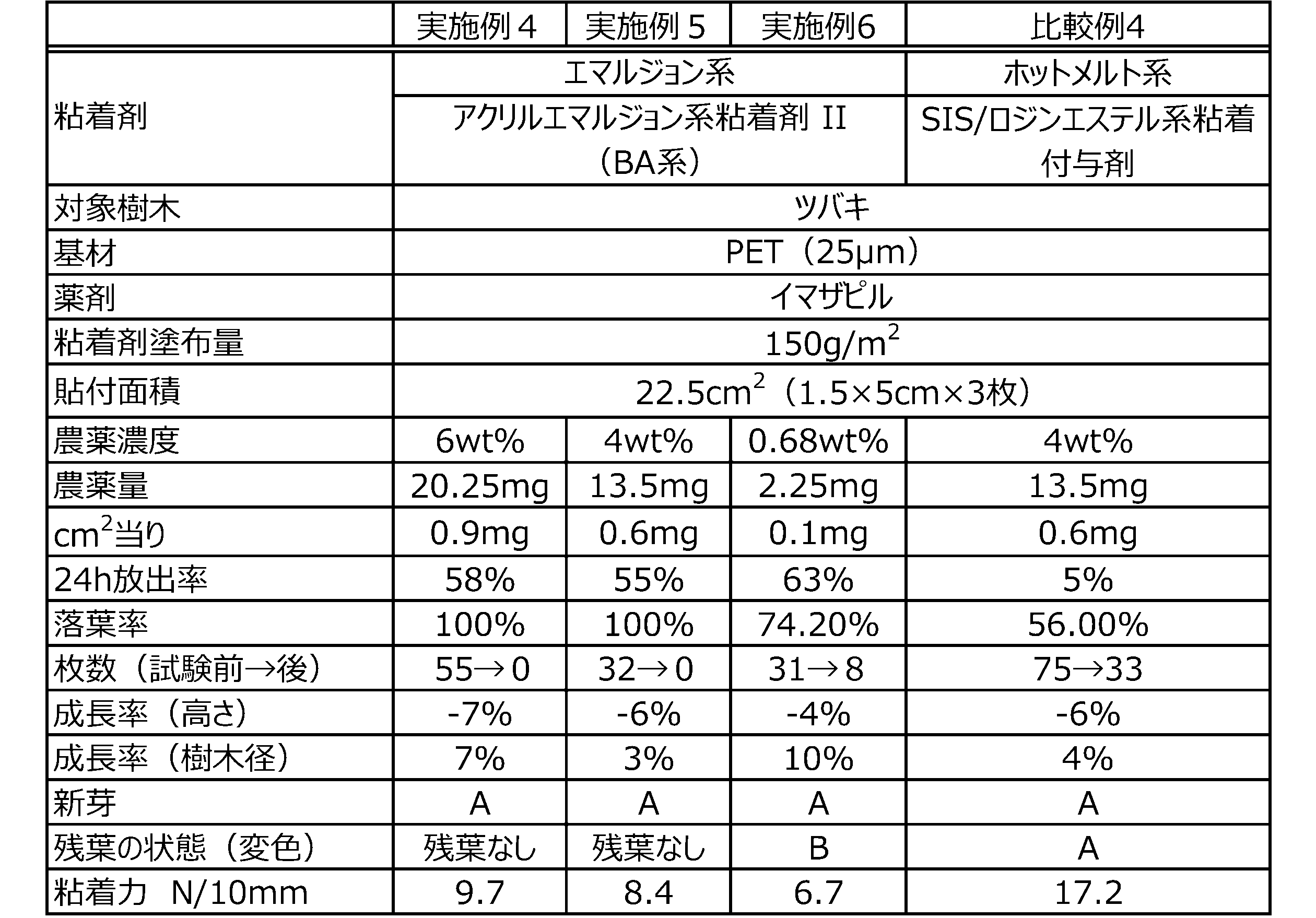
表2に示すように、エマルジョン系粘着剤を用いた実施例4、5及び6は、ホットメルト系のゴム系粘着剤を用いた比較例4に比べて、効率よく樹木を枯死させる、又は成長を抑制することがわかった。これは、エマルジョン系粘着剤を含有する粘着剤が、植物から放出される水分を粘着剤層と植物の間に留めて、この水分によって除草剤を効率的に植物へ放出及び浸透させることができるためと推測する。
次に、上記とは異なる仕様の農薬含有粘着テープ(実施例7、8及び比較例5)を作製し、24h放出率及び粘着力を測定し、対象植物をクズとして実用試験を行った。評価結果を表3に示す。
[実施例7]
基材をPETからセロファンに変更し、農薬濃度を10質量%としたこと以外は、実施例2と同様に農薬含有粘着テープを作製した。
基材をPETからセロファンに変更し、農薬濃度を10質量%としたこと以外は、実施例2と同様に農薬含有粘着テープを作製した。
[実施例8]
農薬としてグリホサートを用いたこと以外は実施例7と同様に農薬含有粘着テープを作製した。
農薬としてグリホサートを用いたこと以外は実施例7と同様に農薬含有粘着テープを作製した。
[比較例5]
農薬未添加としたこと以外は実施例7と同様に農薬含有粘着テープを作製した。
農薬未添加としたこと以外は実施例7と同様に農薬含有粘着テープを作製した。
次に、上記実施例7及び実施例8について、イマザピルとグリホサートの24h放出率を測定した。
(24h放出率)
(1)イマザピルの24h放出率
実施例7の農薬含有粘着テープについてイマザピルの24h放出率を測定した。1.15mmφに打ち抜いた粘着テープを30mmφの褐色ガラス製サンプル瓶の側面にシリコーン系粘着剤を用いて粘着テープの粘着面が露出するように固定し、超純水20mL(pH6.5~7.3)を加えて水温23℃付近に保ちながら攪拌子を用いて150rpmにて攪拌した。
2.所定の時間ごとに、試験液1mLをサンプリングし、その都度、新たに水1mLを追加した。
3.サンプリング時間は、10分、30分、1時間、4時間、24時間とし、サンプリング液をHPLCにて分析した。
4.標準試薬には、富士フイルム和光純薬株式会社製のイマザピル標準試薬を用いて検量線を作製し、サンプリング液中のイマザピル量を以下の条件で定量した。
<分析条件>
移動相:H2O/アセトニトリル/リン酸=80/20/0.04vol.
カラム:TSgel ODS-100z 5μm 4.6mm×25cm
カラム温度:40℃
流速:1.0mL/min
注入量:10μL
(2)グリホサートの24h放出率
実施例8の農薬含有粘着テープについて24h放出率を測定した。
1.15mmφに打ち抜いた粘着テープを50mmφの褐色ガラス製サンプル瓶の側面にシリコーン系粘着剤を用いて粘着テープの粘着面が露出するように固定し、超純水100mL(pH6.5~7.3)を加えて水温23℃付近に保ちながら攪拌子を用いて150rpmにて攪拌した。
2.所定の時間ごとに、試験液1mLをサンプリングし、その都度、新たに水1mLを追加した。
3.サンプリング時間は、10分、30分、1時間、4時間、24時間とし、サンプリング液をHPLCにて分析した。
4.標準試薬には、富士フイルム和光純薬株式会社製のグリホサート標準試薬を用いて検量線を作製し、サンプリング液中のグリホサート量を以下の条件で定量した。
<分析条件>
移動相:
A:アセトニトリル
B:50mMリン酸緩衝液
送液:A/B=35/65vol.
カラム:Mightysil RP-18 GP 5μm 4.6mm×15cm
カラム温度:40℃
流速:0.7mL/min
注入量:5μL
(粘着力)
実施例7、実施例8及び比較例5の農薬含有粘着テープの粘着力を、実施例1に対して行った方法と同様の方法により測定した。
実施例7、実施例8及び比較例5の農薬含有粘着テープの粘着力を、実施例1に対して行った方法と同様の方法により測定した。
[実用試験]
上記実施例7、実施例8及び比較例5について、以下の手順で実用試験を行い、試験前後に後述の評価を行った。評価結果を表3に示す。実施例7の試験前のクズの写真を図4に示し、試験後のクズの写真を図5に示す。
1.上記実施例7、実施例8及び比較例5の農薬含有粘着テープを、クズの株元から約2cm離した箇所に巻きつけた。
2.試験期間:2020年8月19日から2020年9月16日まで
上記実施例7、実施例8及び比較例5について、以下の手順で実用試験を行い、試験前後に後述の評価を行った。評価結果を表3に示す。実施例7の試験前のクズの写真を図4に示し、試験後のクズの写真を図5に示す。
1.上記実施例7、実施例8及び比較例5の農薬含有粘着テープを、クズの株元から約2cm離した箇所に巻きつけた。
2.試験期間:2020年8月19日から2020年9月16日まで
(残葉の状態)
クズの葉の状況を観察し、以下の基準で評価した。
A:全体の葉の80%以上が変色している
B:全体の葉の50%以上80%未満が変色している
C:全体の葉の50%未満が変色している
クズの葉の状況を観察し、以下の基準で評価した。
A:全体の葉の80%以上が変色している
B:全体の葉の50%以上80%未満が変色している
C:全体の葉の50%未満が変色している
(ツルの状態)
クズ全体で、ツルの状態を確認し、以下の基準で評価した。
a:ツル全体の80%以上が変色し、しおれている
b:ツル全体の30%以上80%未満が変色し、しおれかけている
c:ツル全体の30%未満が変色している
クズ全体で、ツルの状態を確認し、以下の基準で評価した。
a:ツル全体の80%以上が変色し、しおれている
b:ツル全体の30%以上80%未満が変色し、しおれかけている
c:ツル全体の30%未満が変色している
(成長抑制)
ツルの成長具合を以下の基準で評価した。
a:ツルが伸びていない
b:ツルが伸びる気配がある
c:ツルが伸びている
ツルの成長具合を以下の基準で評価した。
a:ツルが伸びていない
b:ツルが伸びる気配がある
c:ツルが伸びている
(新芽)
クズ全体で、新芽の有無を確認し、以下の基準で評価した。
A:新芽が無い
B:新芽が芽吹く気配がある
C:新芽(葉)が出ている
クズ全体で、新芽の有無を確認し、以下の基準で評価した。
A:新芽が無い
B:新芽が芽吹く気配がある
C:新芽(葉)が出ている
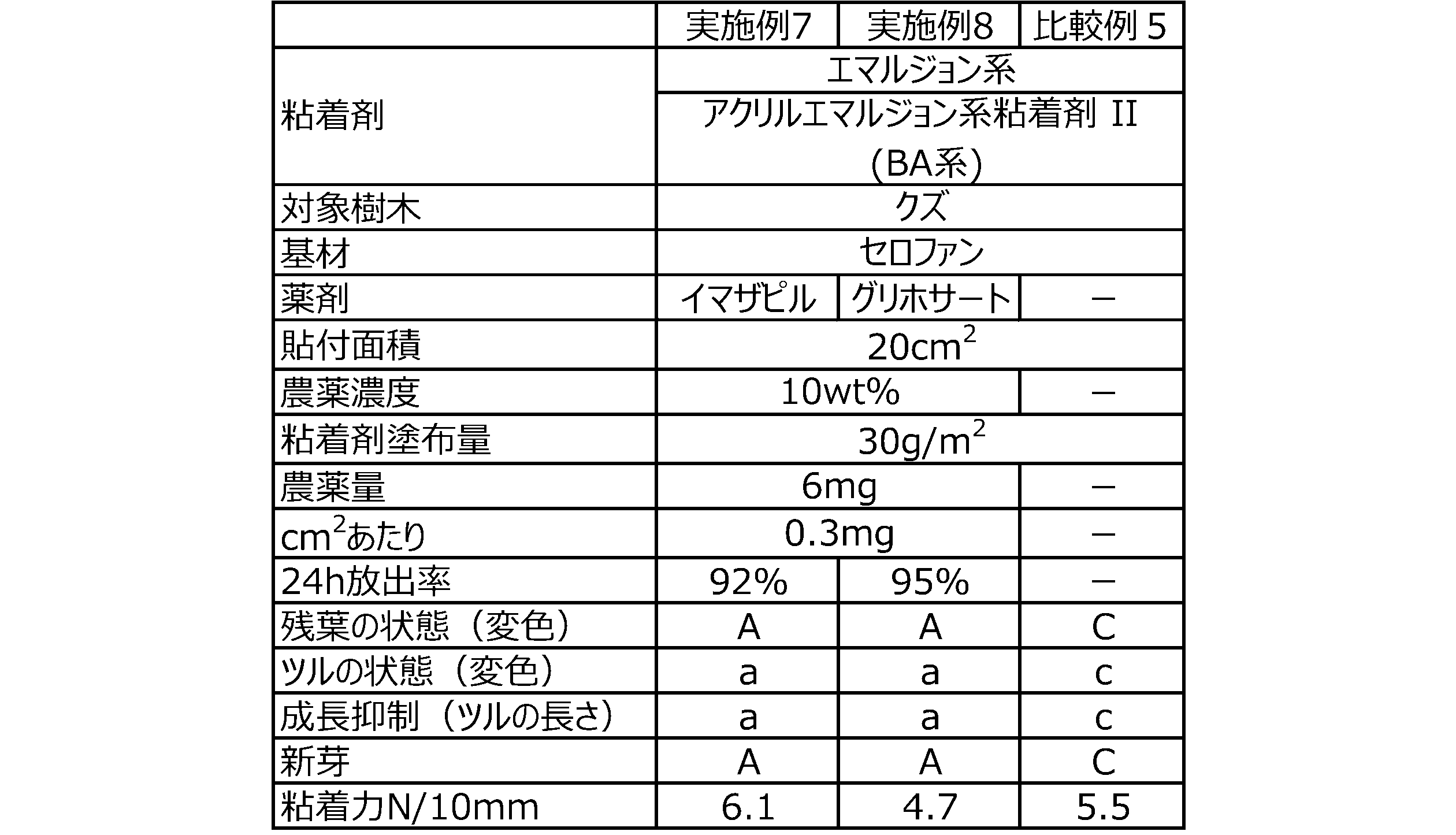
表3に示されるように、農薬をグリホサートに変更した場合でも、本発明の農薬含有粘着テープは、農薬が良好に放出されることがわかった。また、本発明の農薬含有粘着テープは、クズに適用した場合でも良好な結果を得られることがわかった。さらに、基材にセロファンを用いることにより、良好な除草効果を得ながら、セロファンが生分解性であることから、環境に配慮された農薬含有テープを得ることができる。
次に、粘着剤として、ゴム系エマルジョン粘着剤を用いた農薬含有粘着テープ(実施例9~14及び比較例6)を作製し、評価を行った。
[実施例9]
粘着剤として、ゴム系エマルジョン粘着剤IIに変更したこと以外は、実施例3と同様に農薬含有粘着テープを作製した。
粘着剤として、ゴム系エマルジョン粘着剤IIに変更したこと以外は、実施例3と同様に農薬含有粘着テープを作製した。
[実施例10]
粘着剤塗布量を150g/m2に変更したこと以外は、実施例9と同様に農薬含有粘着テープを作製した。
粘着剤塗布量を150g/m2に変更したこと以外は、実施例9と同様に農薬含有粘着テープを作製した。
[実施例11]
農薬濃度を5質量%にしたこと以外は、実施例9と同様に農薬含有粘着テープを作製した。
農薬濃度を5質量%にしたこと以外は、実施例9と同様に農薬含有粘着テープを作製した。
[実施例12]
粘着剤塗布量を150g/m2に変更したこと以外は、実施例11と同様に農薬含有粘着テープを作製した。
粘着剤塗布量を150g/m2に変更したこと以外は、実施例11と同様に農薬含有粘着テープを作製した。
[実施例13]
農薬濃度を10質量%に変更したこと以外は、実施例9と同様に農薬含有粘着テープを作製した。
農薬濃度を10質量%に変更したこと以外は、実施例9と同様に農薬含有粘着テープを作製した。
[実施例14]
粘着剤塗布量を150g/m2に変更したこと以外は、実施例13と同様に農薬含有粘着テープを作製した。
粘着剤塗布量を150g/m2に変更したこと以外は、実施例13と同様に農薬含有粘着テープを作製した。
[比較例6]
農薬を添加しなかったこと以外は、実施例9と同様に農薬含有粘着テープを作製した。
農薬を添加しなかったこと以外は、実施例9と同様に農薬含有粘着テープを作製した。
(24h放出率及び粘着力)
上記実施例9から14及び比較例6について、24h放出率及び粘着力を、それぞれ実施例1の農薬含有粘着テープに対して行った方法と同様の方法により測定した。
上記実施例9から14及び比較例6について、24h放出率及び粘着力を、それぞれ実施例1の農薬含有粘着テープに対して行った方法と同様の方法により測定した。
[実用試験]
上記実施例9から14及び比較例6について、対象植物をツバキとして実用試験を行った。
1.上記実施例9から14及び比較例6の農薬含有粘着テープをツバキの土面から約2~3cm離した箇所に巻きつけた。
2.試験期間:2021年1月9日から2021年3月8日まで
3.冬季試験であったため、ツバキの成長が抑制されていたことから、温室内で試験を実施した。平日7時~18時の間はヒーターにて温室を30℃に加温し、夜間及び休日はヒーターを停止した。
上記実施例9から14及び比較例6について、対象植物をツバキとして実用試験を行った。
1.上記実施例9から14及び比較例6の農薬含有粘着テープをツバキの土面から約2~3cm離した箇所に巻きつけた。
2.試験期間:2021年1月9日から2021年3月8日まで
3.冬季試験であったため、ツバキの成長が抑制されていたことから、温室内で試験を実施した。平日7時~18時の間はヒーターにて温室を30℃に加温し、夜間及び休日はヒーターを停止した。
成長率(高さ)%、成長率(樹木径)%、新芽、残葉の状態、及び落葉率(%)を、実施例4の農薬含有粘着テープに対して行った方法と同様の方法により評価した。
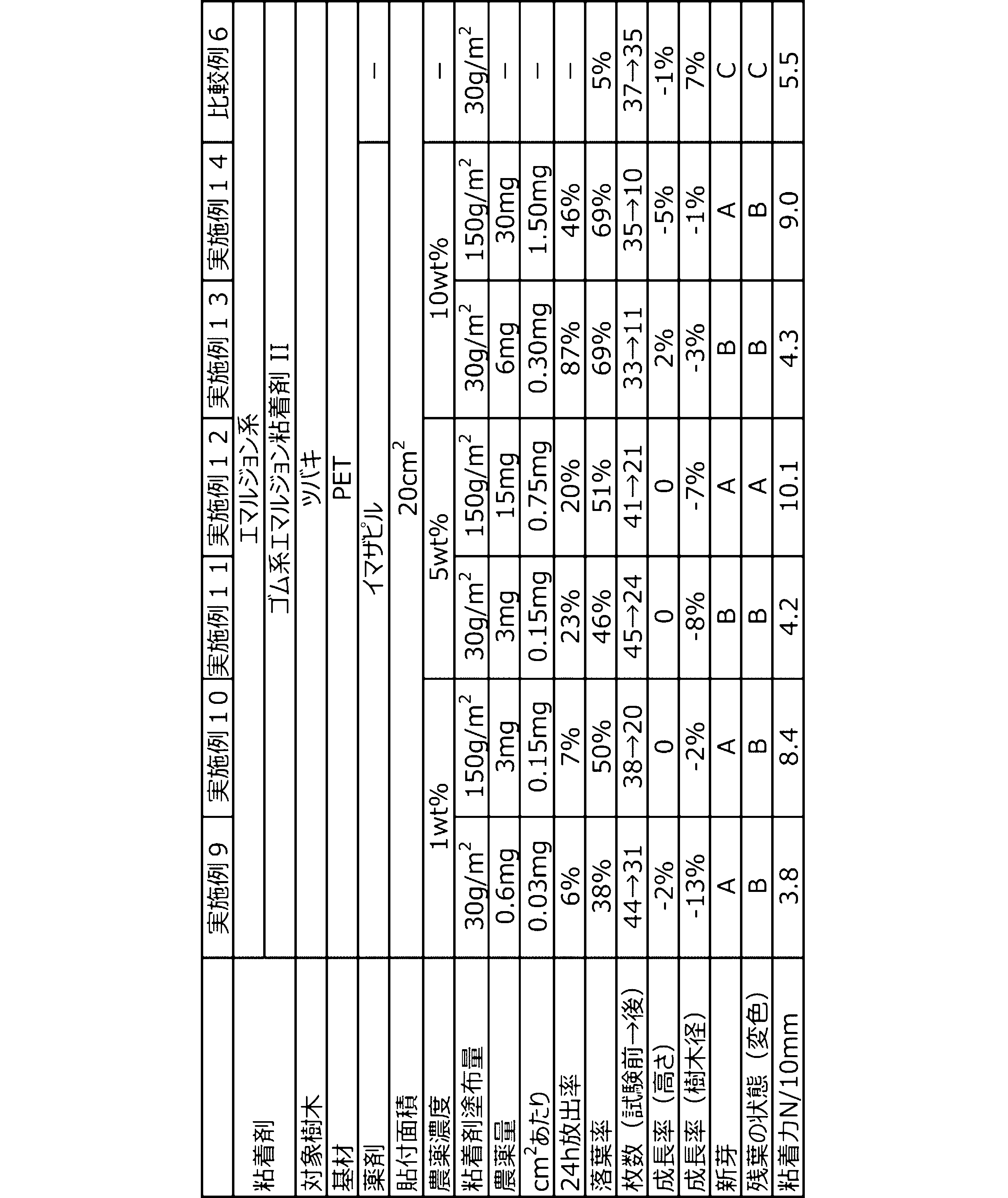
表4に示すように、粘着剤として、ゴム系エマルジョン粘着剤を用いた場合でも、本発明の農薬含有粘着テープは、良好な効果が得られることがわかった。
次に、農薬の種類を替えて農薬含有粘着テープを作製し、24h放出率及び粘着力を測定した。
[実施例15]
使用する農薬をジノテフラン(殺虫剤)とし、農薬濃度を10質量%とし、粘着剤塗布量を150g/m2とした以外は実施例2と同様に農薬含有粘着テープを作製した。
使用する農薬をジノテフラン(殺虫剤)とし、農薬濃度を10質量%とし、粘着剤塗布量を150g/m2とした以外は実施例2と同様に農薬含有粘着テープを作製した。
[比較例7]
使用する農薬をジノテフラン(殺虫剤)とし、農薬濃度を10質量%とした以外は比較例3と同様に農薬含有粘着テープを作製した。
使用する農薬をジノテフラン(殺虫剤)とし、農薬濃度を10質量%とした以外は比較例3と同様に農薬含有粘着テープを作製した。
上記実施例15及び比較例7について、24h放出率及び粘着力を以下のようにして測定した。
(24h放出率)
・ジノテフラン
1.15mmφに打ち抜いた粘着テープを30mmφの褐色ガラス製サンプル瓶の側面にシリコーン系粘着剤を用いて粘着テープの粘着面が露出するように固定し、超純水20mL(pH6.5~7.3)を加えて水温23℃付近に保ちながら攪拌子を用いて150rpmにて攪拌した。
2.所定の時間ごとに、試験液1mLをサンプリングし、その都度、新たに水1mLを追加した。
3.サンプリング時間は、10分、30分、1、4、24時間とし、サンプリング液をHPLCにて分析した。
4.標準試薬には、富士フイルム和光純薬株式会社製のジノテフラン標準試薬を用いて検量線を作製し、サンプリング液中のジノテフラン量を以下の条件で定量した。
<分析条件>
移動相:H2O/アセトニトリル=90/10vol.
カラム:TSgel ODS-100z 5μm 4.6mm×25cm
カラム温度:40℃
流速:1.0mL/min
注入量:40μL
(粘着力)
粘着力は、実施例1の農薬含有粘着テープに対して行った方法と同様方法で測定した。
粘着力は、実施例1の農薬含有粘着テープに対して行った方法と同様方法で測定した。

表5に示すように、農薬を殺虫剤に変更した場合でも、良好な放出率を得ることがわかった。一方、ホットメルト系の粘着剤を用いた場合は、同じ薬剤濃度でも薬剤の放出率が極めて低いことがわかった。本発明の農薬含有テープは、農薬に殺虫剤を用いても良好な効果を期待することができる。
10 農薬含有粘着テープ
11 基材
12 粘着剤層
11 基材
12 粘着剤層
Claims (6)
- 基材と、該基材上に設けられた粘着剤層とを備え、
前記粘着剤層が、エマルジョン系粘着剤と浸透移行性を有する農薬とを含有する農薬含有粘着テープ。 - 前記エマルジョン系粘着剤が、アクリルエマルジョン系粘着剤である請求項1記載の農薬含有粘着テープ。
- 前記エマルジョン系粘着剤が、ラテックスゴムを主成分とするゴム系エマルジョン粘着剤である請求項1記載の農薬含有粘着テープ
- 前記農薬が、殺虫剤、殺菌剤、殺虫殺菌剤、除草剤、及び植物成長調整剤の少なくとも1つである請求項1から3いずれか1項記載の農薬含有粘着テープ。
- 前記アクリルエマルジョン系粘着剤が、(a)アルキル基の炭素数が4以上12以下である(メタ)アクリル酸アルキルエステル、(b)カルボキシル基含有モノマー及び(c)共重合可能なモノマーを含有するモノマー混合物を重合させてなるものであり、
前記(a)アルキル基の炭素数が4以上12以下である(メタ)アクリル酸アルキルエステルの含有量が、50質量%以上99.5質量%以下であり、
前記(b)カルボキシル基含有モノマーの含有量が、0.5質量%以上10質量%以下であり、
前記(c)共重合可能なモノマーの含有量が、0質量%以上40質量%以下である請求項2記載の農薬含有粘着テープ。 - 前記ゴム系エマルジョン粘着剤が、ラテックスゴムと粘着付与剤とを含有してなり、
前記ラテックスゴムが、天然ゴム、クロロプレンゴム、スチレン・ブタジエンゴム、ブタジエンゴム、アクリロニトリル・ブタジエンゴム、メチルメタクリレートブタジエンゴム、及び、エチレン-酢酸ビニル共重合体のうち少なくとも1種であり、
前記ラテックスゴムの含有量が、ゴム系エマルジョン粘着剤100質量%に対し、30質量%以上80質量%以下である請求項3記載の農薬含有粘着テープ。
Priority Applications (5)
| Application Number | Priority Date | Filing Date | Title |
|---|---|---|---|
| CN202180026666.2A CN115361869A (zh) | 2020-04-06 | 2021-04-02 | 含有农药的胶粘带 |
| EP21784857.1A EP4133940A4 (en) | 2020-04-06 | 2021-04-02 | PRESSURE-SENSITIVE ADHESIVE TAPE CONTAINING AN AGROCHEMICAL PRODUCT |
| JP2022514046A JP7748363B2 (ja) | 2020-04-06 | 2021-04-02 | 農薬含有粘着テープ |
| US17/916,847 US20230279272A1 (en) | 2020-04-06 | 2021-04-02 | Agrochemical-containing pressure-sensitive adhesive tape |
| KR1020227034362A KR20220165738A (ko) | 2020-04-06 | 2021-04-02 | 농약 함유 점착테이프 |
Applications Claiming Priority (2)
| Application Number | Priority Date | Filing Date | Title |
|---|---|---|---|
| JP2020068514 | 2020-04-06 | ||
| JP2020-068514 | 2020-04-06 |
Publications (1)
| Publication Number | Publication Date |
|---|---|
| WO2021206021A1 true WO2021206021A1 (ja) | 2021-10-14 |
Family
ID=78023287
Family Applications (1)
| Application Number | Title | Priority Date | Filing Date |
|---|---|---|---|
| PCT/JP2021/014334 Ceased WO2021206021A1 (ja) | 2020-04-06 | 2021-04-02 | 農薬含有粘着テープ |
Country Status (7)
| Country | Link |
|---|---|
| US (1) | US20230279272A1 (ja) |
| EP (1) | EP4133940A4 (ja) |
| JP (1) | JP7748363B2 (ja) |
| KR (1) | KR20220165738A (ja) |
| CN (1) | CN115361869A (ja) |
| TW (1) | TW202203763A (ja) |
| WO (1) | WO2021206021A1 (ja) |
Cited By (1)
| Publication number | Priority date | Publication date | Assignee | Title |
|---|---|---|---|---|
| WO2022071026A1 (ja) * | 2020-09-30 | 2022-04-07 | ニチバン株式会社 | 農薬テープ |
Citations (4)
| Publication number | Priority date | Publication date | Assignee | Title |
|---|---|---|---|---|
| JPS5899402A (ja) * | 1981-12-05 | 1983-06-13 | Susumu Ito | 農薬つきテ−プ |
| JPS6333301A (ja) * | 1986-07-17 | 1988-02-13 | セラフロール・ゲゼルシヤフト・ミツト・ベシユレンクテル・ハフツング | 植物への活性物質の経表皮膜施用のための器具 |
| JPS6351301A (ja) * | 1986-08-22 | 1988-03-04 | Hisamitsu Pharmaceut Co Inc | 農園芸用病害防除組成物並びに農園芸用病害防除シート |
| JPH06312903A (ja) * | 1993-04-28 | 1994-11-08 | Dainippon Printing Co Ltd | 虫害防止シート |
Family Cites Families (12)
| Publication number | Priority date | Publication date | Assignee | Title |
|---|---|---|---|---|
| JPS4966U (ja) * | 1972-04-03 | 1974-01-05 | ||
| JPS5137164B2 (ja) * | 1973-01-29 | 1976-10-14 | ||
| JPS6251603A (ja) * | 1985-08-29 | 1987-03-06 | Hisamitsu Pharmaceut Co Inc | 農園芸用病害防除粘着シ−ト組成物 |
| US5201925A (en) * | 1986-07-17 | 1993-04-13 | Celaflor Gmbh | Device for transcuticular application of active substances to plants |
| JPH01153601A (ja) * | 1987-12-11 | 1989-06-15 | Unie Kogyo Kk | 野菜、果実等の防黴、防菌、防虫用粘着テープ或いはシート |
| JP3723986B2 (ja) | 1993-06-29 | 2005-12-07 | カシオ計算機株式会社 | 携帯型撮像装置 |
| JP2001048710A (ja) * | 1999-08-02 | 2001-02-20 | Manabu Hayase | 抗菌防虫性粘着テープ、タックシールと両面テープ |
| JP2006327149A (ja) | 2005-05-30 | 2006-12-07 | Nichiban Co Ltd | クラフトパーツ用糊付けシート及び糊付け方法 |
| ATE509969T1 (de) * | 2005-09-23 | 2011-06-15 | Nat Starch Chem Invest | Klebstoffe auf acrylpolymerbasis |
| US9226496B2 (en) * | 2010-11-29 | 2016-01-05 | Institute of Medicinal Plant Development The Chinese Academy of Medical Sciences | Biomimetic adhesive and preparation method and application thereof |
| JP5306517B1 (ja) * | 2012-05-31 | 2013-10-02 | ニチバン株式会社 | 撥水性の貼付材 |
| CN104671929A (zh) * | 2013-11-27 | 2015-06-03 | 天津市植物保护研究所 | 一种对林木具有强健防病功能的树贴药肥膏剂配方、制备方法及其应用 |
-
2021
- 2021-04-02 JP JP2022514046A patent/JP7748363B2/ja active Active
- 2021-04-02 WO PCT/JP2021/014334 patent/WO2021206021A1/ja not_active Ceased
- 2021-04-02 EP EP21784857.1A patent/EP4133940A4/en active Pending
- 2021-04-02 CN CN202180026666.2A patent/CN115361869A/zh active Pending
- 2021-04-02 US US17/916,847 patent/US20230279272A1/en not_active Abandoned
- 2021-04-02 KR KR1020227034362A patent/KR20220165738A/ko active Pending
- 2021-04-06 TW TW110112377A patent/TW202203763A/zh unknown
Patent Citations (4)
| Publication number | Priority date | Publication date | Assignee | Title |
|---|---|---|---|---|
| JPS5899402A (ja) * | 1981-12-05 | 1983-06-13 | Susumu Ito | 農薬つきテ−プ |
| JPS6333301A (ja) * | 1986-07-17 | 1988-02-13 | セラフロール・ゲゼルシヤフト・ミツト・ベシユレンクテル・ハフツング | 植物への活性物質の経表皮膜施用のための器具 |
| JPS6351301A (ja) * | 1986-08-22 | 1988-03-04 | Hisamitsu Pharmaceut Co Inc | 農園芸用病害防除組成物並びに農園芸用病害防除シート |
| JPH06312903A (ja) * | 1993-04-28 | 1994-11-08 | Dainippon Printing Co Ltd | 虫害防止シート |
Non-Patent Citations (1)
| Title |
|---|
| See also references of EP4133940A4 * |
Cited By (1)
| Publication number | Priority date | Publication date | Assignee | Title |
|---|---|---|---|---|
| WO2022071026A1 (ja) * | 2020-09-30 | 2022-04-07 | ニチバン株式会社 | 農薬テープ |
Also Published As
| Publication number | Publication date |
|---|---|
| EP4133940A4 (en) | 2024-06-05 |
| JP7748363B2 (ja) | 2025-10-02 |
| CN115361869A (zh) | 2022-11-18 |
| KR20220165738A (ko) | 2022-12-15 |
| US20230279272A1 (en) | 2023-09-07 |
| JPWO2021206021A1 (ja) | 2021-10-14 |
| EP4133940A1 (en) | 2023-02-15 |
| TW202203763A (zh) | 2022-02-01 |
Similar Documents
| Publication | Publication Date | Title |
|---|---|---|
| JP3805361B2 (ja) | 植物用の噴霧吹き付け可能な膜形成型活性物質徐放投与システム | |
| JP2012503642A5 (ja) | ||
| EA200601454A1 (ru) | Композиция для обработки семян, содержащая полимерные клеящие вещества | |
| CN102946723A (zh) | 由生长介质的pH改变触发的种子和土壤处理的受控释放 | |
| US6329324B1 (en) | Active substance-containing composition, its production and its use | |
| JP7748363B2 (ja) | 農薬含有粘着テープ | |
| NO301862B1 (no) | Spröytbare blandinger for jordbruk og anvendelse derav | |
| KR20170077179A (ko) | 토양 훈증용 자가-접착성 필름 | |
| GB2141932A (en) | Pest control | |
| US11992009B2 (en) | Pesticide-containing soil disinfestation material without use of fumigant | |
| JP6892533B2 (ja) | 除草シート | |
| JP7510777B2 (ja) | 植物用貼付剤 | |
| CN107267088A (zh) | 一种环保型诱性粘虫胶板及其制备方法 | |
| JPS6115626A (ja) | 樹木の栽培育成工法 | |
| WO2022071026A1 (ja) | 農薬テープ | |
| JPS6251603A (ja) | 農園芸用病害防除粘着シ−ト組成物 | |
| EP1786260A1 (en) | Novel methods of delivering active ingredients to plants | |
| JP4064406B2 (ja) | 穿孔性害虫の防除及び拡散を防止する方法、及び当該方法にて使用する高分子製剤 | |
| JPS6351301A (ja) | 農園芸用病害防除組成物並びに農園芸用病害防除シート | |
| JP3183976B2 (ja) | 飛翔害虫捕殺用粘着剤組成物 | |
| JP2010193798A (ja) | 飛翔害虫捕殺具 | |
| JPH1077201A (ja) | 植物体コーティング剤およびコーティング方法 | |
| WO2004098287A1 (en) | Protective composition and coating | |
| JP5002253B2 (ja) | 捕虫用粘着シート及び紫外線誘引型捕虫器 | |
| GB2223662A (en) | Coated seeds |
Legal Events
| Date | Code | Title | Description |
|---|---|---|---|
| 121 | Ep: the epo has been informed by wipo that ep was designated in this application |
Ref document number: 21784857 Country of ref document: EP Kind code of ref document: A1 |
|
| ENP | Entry into the national phase |
Ref document number: 2022514046 Country of ref document: JP Kind code of ref document: A |
|
| NENP | Non-entry into the national phase |
Ref country code: DE |
|
| ENP | Entry into the national phase |
Ref document number: 2021784857 Country of ref document: EP Effective date: 20221107 |