WO2021207210A1 - Methods for synthesis of chk1 inhibitors - Google Patents

Methods for synthesis of chk1 inhibitors Download PDF

Info

Publication number
WO2021207210A1
WO2021207210A1 PCT/US2021/025977 US2021025977W WO2021207210A1 WO 2021207210 A1 WO2021207210 A1 WO 2021207210A1 US 2021025977 W US2021025977 W US 2021025977W WO 2021207210 A1 WO2021207210 A1 WO 2021207210A1
Authority
WO
WIPO (PCT)
Prior art keywords
compound
mol
pharmaceutical composition
impurities
formula
Prior art date
Legal status (The legal status is an assumption and is not a legal conclusion. Google has not performed a legal analysis and makes no representation as to the accuracy of the status listed.)
Ceased
Application number
PCT/US2021/025977
Other languages
French (fr)
Inventor
Michael Schwaebe
Thorsten Rosner
Dalian Zhao
Ross Miller
Rich DULINA
Michael Humora
Stephen E. GOTTSCHLING
Current Assignee (The listed assignees may be inaccurate. Google has not performed a legal analysis and makes no representation or warranty as to the accuracy of the list.)
Sierra Oncology Inc
Original Assignee
Sierra Oncology Inc
Priority date (The priority date is an assumption and is not a legal conclusion. Google has not performed a legal analysis and makes no representation as to the accuracy of the date listed.)
Filing date
Publication date
Application filed by Sierra Oncology Inc filed Critical Sierra Oncology Inc
Priority to EP21784225.1A priority Critical patent/EP4132922A4/en
Priority to US17/995,564 priority patent/US12606550B2/en
Priority to BR112022020278A priority patent/BR112022020278A2/en
Priority to JP2022561181A priority patent/JP2023523165A/en
Priority to CA3174222A priority patent/CA3174222A1/en
Priority to CN202180027747.4A priority patent/CN115443271A/en
Priority to CN202510460667.8A priority patent/CN120441567A/en
Publication of WO2021207210A1 publication Critical patent/WO2021207210A1/en
Anticipated expiration legal-status Critical
Ceased legal-status Critical Current

Links

Classifications

    • CCHEMISTRY; METALLURGY
    • C07ORGANIC CHEMISTRY
    • C07DHETEROCYCLIC COMPOUNDS
    • C07D413/00Heterocyclic compounds containing two or more hetero rings, at least one ring having nitrogen and oxygen atoms as the only ring hetero atoms
    • C07D413/14Heterocyclic compounds containing two or more hetero rings, at least one ring having nitrogen and oxygen atoms as the only ring hetero atoms containing three or more hetero rings
    • CCHEMISTRY; METALLURGY
    • C07ORGANIC CHEMISTRY
    • C07CACYCLIC OR CARBOCYCLIC COMPOUNDS
    • C07C59/00Compounds having carboxyl groups bound to acyclic carbon atoms and containing any of the groups OH, O—metal, —CHO, keto, ether, groups, groups, or groups
    • C07C59/235Saturated compounds containing more than one carboxyl group
    • C07C59/245Saturated compounds containing more than one carboxyl group containing hydroxy or O-metal groups
    • C07C59/265Citric acid
    • CCHEMISTRY; METALLURGY
    • C07ORGANIC CHEMISTRY
    • C07DHETEROCYCLIC COMPOUNDS
    • C07D265/00Heterocyclic compounds containing six-membered rings having one nitrogen atom and one oxygen atom as the only ring hetero atoms
    • C07D265/281,4-Oxazines; Hydrogenated 1,4-oxazines
    • C07D265/301,4-Oxazines; Hydrogenated 1,4-oxazines not condensed with other rings
    • CCHEMISTRY; METALLURGY
    • C07ORGANIC CHEMISTRY
    • C07BGENERAL METHODS OF ORGANIC CHEMISTRY; APPARATUS THEREFOR
    • C07B2200/00Indexing scheme relating to specific properties of organic compounds
    • C07B2200/13Crystalline forms, e.g. polymorphs

Definitions

  • SRA737 is a heterocyclic small molecule and a potent checkpoint 1 inhibitor that is currently under clinical study as a chemotherapy agent.
  • the structure of SRA737 is:
  • SRA737 is also known by its IUPAC name: 5-[[4-[[morpholin-2-yl]methylamino]-5- (trifluoromethyl)-2-pyridyl]amino]pyrazine-2-carbonitrile.
  • the existing, conventional synthesis of SRA737 is described in U.S. Patent No. 9,663,503, which is hereby incorporated by reference in its entirety.
  • the present disclosure provides novel compounds, compositions, and methods of making such compounds and compositions.
  • the compounds disclosed herein are novel synthetic intermediates of SRA737.
  • the compounds are protected forms of SRA737, that is, the compound is masked with a protecting organic group that, when exposed to appropriate conditions, is removed to produce SRA737.
  • the present disclosure provides novel compositions, compounds and solvates comprising very low concentrations of palladium impurities.
  • the compound is an active pharmaceutical ingredient (API) compound.
  • the present disclosure provides novel compositions, compounds and solvates comprising very low concentrations of other organic compounds as impurities, i.e. side-products from a given reaction or cumulative reactions to a given point in the total synthesis of SRA737.
  • the present disclosure provides novel synthetic intermediates and SRA737, or protected forms of SRA737 that are substantially free of palladium and other organic molecules as impurities.
  • compositions of one or more compounds disclosed herein that are substantially free of palladium and other organic molecules as impurities.
  • compositions comprising a novel synthetic intermediate compound and/or SRA737, or protected forms of SRA737, that are substantially free of palladium and other organic molecules as impurities.
  • the compounds disclosed herein are novel solvates. In some embodiments, the compounds disclosed herein are novel dimethylformamide (DMF) solvates. In some embodiments, the compounds disclosed herein are novel crystalline solids. In some embodiments, the compounds disclosed herein are novel crystalline solids that are substantially free of palladium and other organic molecules as impurities.
  • DMF dimethylformamide
  • the present disclosure provides pharmaceutical compositions comprising one or more compounds or solvates.
  • the present disclosure provides a kit comprising one or more compounds disclosed herein, or one or more compositions as disclosed herein.
  • the present disclosure provides methods of administering to a subject in need of chemotherapy at least one of the compounds described herein. [0017] In some embodiments, the present disclosure provides methods of manufacturing novel compounds, compositions and solvates.
  • Figure 1 shows a total synthesis of SRA737.
  • Figure 2 shows the X-ray powder diffraction pattern (XRPD) of the crystalline solid form of the compound of formula II.
  • Figure 3 shows the differential scanning calorimetry (DSC) thermogram of the crystalline solid form of the compound of formula II.
  • FIG. 4 shows the thermogravimetric analysis (TGA) of the crystalline solid form of the compound of formula II.
  • Figure 5 shows the X-ray powder diffraction pattern (XRPD) of the crystalline solid form of a compound of formula X.
  • Figure 6 shows the X-ray powder diffraction pattern (XRPD) of the crystalline solid form of a compound of formula VIII.
  • Figure 7 shows the X-ray powder diffraction pattern (XRPD) of the crystalline solid form of the compound salt of formula IX.
  • Figure 8 shows the differential scanning calorimetry (DSC) thermogram of the crystalline solid form of compound salt of formula IX.
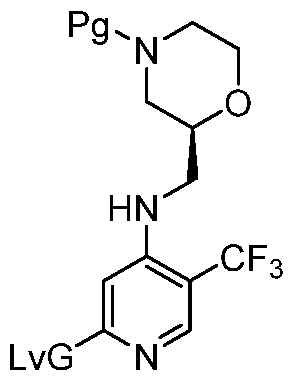
  • LvG or “Leaving group” has the meaning conventionally associated with it in synthetic organic chemistry and refers to an atom or organic group which is capable of being displaced from a molecule by a nucleophile via covalent bond cleavage.
  • exemplary leaving groups include, but are not limited to: F, Cl, Br, I, OTs (-OSO2C6H4CH3), OMs (-OSO2CH3),
  • substantially purified or free of impurities refers to a mixture in which one small organic molecule of interest far exceeds the amount of minerals, metal, and/or other small organic molecules as impurities, and at least 95% by dry weight is the small organic molecule of interest, such as at least 96%, at least 97%, at least 98%, at least 99% or at least 99.5% by dry weight.
  • amino protecting group refers to an organic group that can be covalently attached to a reactive amino group to block undesirable reactions and is capable of being selectively removed from the amino group using a deprotection method.
  • protecting groups and the reaction conditions to install and remove protecting groups include those described in Greene's Protective Groups in Organic Synthesis, 4th edition, John Wiley & Sons, New York, 2007, the disclosure of which is incorporated herein by reference in its entirety.
  • Exemplary amino protecting groups include, but are not limited to, TMS, TBDMS,
  • Alkyl refers to monovalent saturated aliphatic hydrocarbyl groups having from 1 to 20 carbon atoms, such as 1-12 carbons. This term includes, by way of example, linear and branched hydrocarbyl groups such as methyl (CEE-), ethyl (CH3CH2-), «-propyl (CH3CH2CH2-), isopropyl ((CH3) 2 CH-), «-butyl (CH3CH2CH2CH2-), isobutyl ((Cft ⁇ CHClL ⁇ -), sec-butyl ((CH3)(CH 3 CH2)CH-), /-butyl ((CIE ⁇ C-), «-pentyl (CH3CH2CH2CH2CH2-), and neopentyl ((CH 3 )3CCH2-).
  • C X alkyl refers to an alkyl group having x number of carbon atoms.
  • Cx alkenyl refers to an alkenyl group having x number of carbon atoms.
  • Alkynyl refers to straight or branched monovalent hydrocarbyl groups having from 2 to 6 carbon atoms and preferably 2 to 3 carbon atoms and having at least 1 and preferably from 1 to 2 sites of acetylenic (-Co C-) unsaturation. Examples of such alkynyl groups include acetylenyl (-Co CH), and propargyl (-CH2Co CH). Cx alkynyl refers to an alkynyl group having x number of carbon atoms.
  • Substituted alkyl refers to an alkyl group having from 1 to 5, preferably 1 to 3, or more preferably 1 to 2 substituents selected from the group consisting of alkoxy, substituted alkoxy, acyl, acylamino, aminocarbonylamino, acyloxy, amino, substituted amino, aminocarbonyl, aminothiocarbonyl, aminocarbonylamino, aminothiocarbonylamino, aminocarbonyloxy, aminosulfonyl, aminosulfonyloxy, aminosulfonylamino, amidino, aryl, substituted aryl, aryloxy, substituted aryloxy, arylthio, substituted arylthio, carboxyl, carboxyl ester, (carboxyl ester)amino, (carboxyl ester)oxy, cyano, cycloalkyl, substituted cycloalkyl, cycloalkyloxy, substituted cycloalkyl, substituted
  • the substituted alkyl groups include halogenated alkyl groups and particularly halogenated methyl groups such as trifluoromethyl, difluromethyl, fluoromethyl and the like.
  • Alkyl aryl refers to an alkyl group having from 1 to 8, preferably 1 to 5, or more preferably 1 to 3 carbon atoms in length and is substituted specifically at any one of the carbons along the chain with an aryl group.
  • Alkenyl aryl refers to an alkenyl or alkene group having from 1 to 8, preferably 1 to 5, or more preferably 1 to 3 carbon atoms in length and is substituted specifically at any one of the carbons along the chain with an aryl group.
  • the aryl group can include heteroatoms or not.
  • Alkynyl aryl refers to an alkynyl or alkyne group having from 1 to 8, preferably 1 to 5, or more preferably 1 to 3 carbon atoms in length and is substituted specifically at any one of the carbons along the chain with an aryl group.
  • the aryl group can include heteroatoms or not.
  • Cycloalkyl or “Cyclyl alkyl” refers to a saturated or partially saturated, but not aromatic, group having from 3 to 10 ring carbon atoms and no heteroatoms. Cycloalkyl encompasses single ring systems.
  • Alkoxy refers to the group -O-alkyl wherein alkyl is defined herein. Alkoxy includes, by way of example, methoxy, ethoxy, //-propoxy, isopropoxy, //-butoxy, /-butoxy, .suc-butoxy, and //-pentoxy.
  • Substituted alkoxy refers to the group -0-(substituted alkyl) wherein substituted alkyl is defined herein.
  • Preferred substituted alkyl groups in -0-(substituted alkyl) include halogenated alkyl groups and particularly halogenated methyl groups such as trifluoromethyl, difluromethyl, fluoromethyl and the like.
  • Acyl refers to the groups H-C(O)-, alkyl-C(O)-, substituted alkyl-C(O)-, alkenyl-C(O)-, substituted alkenyl-C(O)-, alkynyl-C(O)-, substituted alkynyl-C(O)-, cycloalkyl-C(O)-, substituted cycloalkyl-C(O)-, aryl-C(O)-, substituted aryl-C(O)-, heteroaryl-C(O)-, substituted heteroaryl-C(O)-, heterocyclic-C(O)-, and substituted heterocyclic-C(O)-, wherein alkyl, substituted alkyl, alkenyl, substituted alkenyl, alkoxy, substituted alkoxy, alkynyl, substituted alkynyl, cycloalkyl, substituted cycloalkyl, wherein alkyl,
  • Acylamino refers to the groups -NRC(0)alkyl, -NRC(0)substituted alkyl, -NRC(0)cycloalkyl, substituted -NRC(O) cycloalkyl, -NRC(0)alkenyl, substituted -NRC(O) alkenyl, alkoxy, substituted alkoxy-NR A C(0)alkynyl, substituted -NRC(O) alkynyl, -NRC(0)aryl, substituted -NRC(O) aryl, -NRC(0)heteroaryl, substituted -NRC(O) heteroaryl, -NRC(0)heterocyclic, and substituted -NRC(O) heterocyclic wherein R is hydrogen or alkyl, and wherein alkyl, substituted alkyl, alkenyl, substituted alkenyl, alkynyl, substituted alkynyl, cycloalkyl, substituted cyclic wherein alky
  • Acyloxy refers to the groups alkyl-C(0)0-, substituted alkyl-C(0)0-, alkenyl-C(0)0-, substituted alkenyl-C(0)0-, alkynyl-C(0)0-, substituted alkynyl-C(0)0-, aryl-C(0)0-, substituted aryl-C(0)0-, cycloalkyl-C(0)0-, substituted cycloalkyl-C(0)0-, heteroaryl-C(0)0-, substituted heteroaryl-C(0)0-, heterocyclic-C(0)0-, and substituted heterocyclic-C(0)0- wherein alkyl, substituted alkyl, alkenyl, substituted alkenyl, alkynyl, substituted alkynyl, cycloalkyl, substituted cycloalkyl, aryl, substituted aryl, heteroaryl, substituted heteroaryl, heterocyclic, and substituted heterocyclic are as defined herein.
  • Amino refers to the group -NH2.
  • Aminocarbonyl refers to the group -C(0)NR A R A where R A and R B are independently selected from the group consisting of hydrogen, alkyl, substituted alkyl, alkenyl, substituted alkenyl, alkoxy, substituted alkoxy, alkynyl, substituted alkynyl, aryl, substituted aryl, cycloalkyl, substituted cycloalkyl heteroaryl, substituted heteroaryl, heterocyclic, and substituted heterocyclic and where R A and R B are optionally joined together with the nitrogen bound thereto to form a heterocyclic or substituted heterocyclic group, and wherein alkyl, substituted alkyl, alkenyl, substituted alkenyl, alkoxy, substituted alkoxy, alkynyl, substituted alkynyl, cycloalkyl, substituted cycloalkyl, aryl, substituted aryl, heteroaryl, substituted heteroaryl, heterocyclic and
  • Substituted aryl refers to aryl groups which are substituted with 1 to 5, preferably 1 to 3, or more preferably 1 to 2 substituents selected from the group consisting of alkyl, substituted alkyl, alkenyl, substituted alkenyl, alkynyl, substituted alkynyl, alkoxy, substituted alkoxy, acyl, acylamino, aminocarbonylamino, acyloxy, amino, substituted amino, aminocarbonyl, aminothiocarbonyl, aminocarbonylamino, aminothiocarbonylamino, aminocarbonyloxy, aminosulfonyl, aminosulfonyloxy, aminosulfonylamino, amidino, aryl, substituted aryl, aryloxy, substituted aryloxy, arylthio, substituted arylthio, carboxyl, carboxyl ester, (carboxyl esterjamino, (carboxyl esterj
  • Carboxy or “carboxyl” refers to -COOH or salts thereof.
  • Carboxyl ester or “carboxy ester” refers to the groups -C(0)0-alkyl, -C(0)0-substituted alkyl, -C(0)0-alkenyl, -C(0)0-substituted alkenyl, -C(0)0-alkynyl, -C(0)0-substituted alkynyl, -C(0)0-aryl, -C(0)0-substituted aryl, -C(0)0-cycloalkyl, -C(0)0-substituted cycloalkyl, -C(0)0-heteroaryl, -C(0)0-substituted heteroaryl, -C(0)0-heterocyclic, and -C(0)0-substituted heterocyclic wherein alkyl, substituted alkyl, alkenyl, substituted alkenyl, alkynyl, substituted alkynyl, cycloalkyl, substituted cycloalkyl, substituted cycloal
  • Cyano refers to the group -CoN.
  • Cycloalkyl refers to a saturated or unsaturated but nonaromatic cyclic alkyl groups of from 3 to 10 carbon atoms having single or multiple cyclic rings including fused, bridged, and spiro ring systems.
  • Cx cycloalkyl refers to a cycloalkyl group having x number of ring carbon atoms.
  • suitable cycloalkyl groups include, for instance, adamantyl, cyclopropyl, cyclobutyl, cyclopentyl, and cyclooctyl.
  • One or more the rings can be aryl, heteroaryl, or heterocyclic provided that the point of attachment is through the non-aromatic, non-heterocyclic ring saturated carbocyclic ring.
  • Substituted cycloalkyl refers to a cycloalkyl group having from 1 to 5 or preferably 1 to 3 substituents selected from the group consisting of oxo, thione, alkyl, substituted alkyl, alkenyl, substituted alkenyl, alkynyl, substituted alkynyl, alkoxy, substituted alkoxy, acyl, acylamino, aminocarbonylamino, acyloxy, amino, substituted amino, aminocarbonyl, aminothiocarbonyl, aminocarbonylamino, aminothiocarbonylamino, aminocarbonyloxy, aminosulfonyl, aminosulfonyloxy, aminosulfonylamino, amidino, aryl, substituted aryl, aryloxy, substituted aryloxy, arylthio, substituted arylthio, carboxyl, carboxyl ester, (carboxyl ester)amino
  • Halo or “halogen” refers to fluoro, chloro, bromo and iodo and preferably is fluoro or chi or o.
  • Heteroaryl refers to an aromatic group of from 4 to 10 carbon atoms and 1 to 4 heteroatoms selected from the group consisting of oxygen, nitrogen and sulfur within the ring.
  • Such heteroaryl groups can have a single ring (e.g ., pyridinyl or furyl) or multiple condensed rings (e.g., indolizinyl or benzothienyl) wherein the condensed rings may or may not be aromatic and/or contain a heteroatom provided that the point of attachment is through an atom of the aromatic heteroaryl group.
  • the nitrogen and/or the sulfur ring atom(s) of the heteroaryl group are optionally oxidized to provide for the N-oxide (N 0), sulfmyl, or sulfonyl moieties.
  • Preferred heteroaryls include 5 or 6 membered heteroaryls such as pyridinyl, pyrrolyl, indolyl, thiophenyl, and furanyl.
  • Substituted heteroaryl refers to heteroaryl groups that are substituted with from 1 to 5, preferably 1 to 3, or more preferably 1 to 2 substituents selected from the group consisting of the same group of substituents defined for substituted aryl.
  • “Heterocycle” or “heterocyclic” or “heterocycloalkyl” or “heterocyclyl” refers to a saturated or partially saturated, but not aromatic, group having from 2 to 10 ring carbon atoms and from 1 to 4 ring heteroatoms selected from the group consisting of nitrogen, sulfur, or oxygen.
  • Cx cycloalkyl or heterocycloalkyl refers to a group having x number of ring carbon atoms excluding the ring heteroatoms.
  • Heterocycle encompasses single ring or multiple condensed rings, including fused, bridged and spiro ring systems. In fused ring systems, one or more the rings can be cycloalkyl, aryl or heteroaryl provided that the point of attachment is through the non-aromatic ring.
  • the nitrogen and/or sulfur atom(s) of the heterocyclic group are optionally oxidized to provide for the N-oxide, sulfmyl, sulfonyl moieties.
  • Substituted heterocyclic or “substituted heterocycloalkyl” or “substituted heterocyclyl” refers to heterocyclyl groups that are substituted with from 1 to 5 or preferably 1 to 3 of the same substituents as defined for substituted cycloalkyl.
  • heterocycle and heteroaryl include, but are not limited to, azetidine, pyrrole, imidazole, pyrazole, pyridine, pyrazine, pyrimidine, pyridazine, indolizine, isoindole, indole, dihydroindole, dexahydroindole, dihydropyridine, indazole, purine, quinolizine, isoquinoline, quinoline, phthalazine, naphthylpyridine, quinoxaline, quinazoline, cinnoline, pteridine, carbazole, carboline, phenanthridine, acridine, phenanthroline, isothiazole, phenazine, isoxazole, phenoxazine, phenothiazine, imidazolidine, imidazoline, imidazolinone, piperidine, piperazine, indoline, phthalimi
  • salt or “pharmaceutically acceptable salt” refers to a salt which is acceptable for administration to a subject. It is understood that such salts, with counter ions, will have acceptable mammalian safety for a given dosage regime. Such salts can also be derived from pharmaceutically acceptable inorganic or organic bases and from pharmaceutically acceptable inorganic or organic acids, and may comprise organic and inorganic counter ions.
  • salts include, but are not limited to: acetate, adipate, alginate, aspartate, benzoate, benzenesulfonate, bisulfate, butyrate, citrate, camphorate, camphorsulfonate, cyclopentanepropionate, digluconate, dodecyl sulfate, ethanesulfonate, fumarate, flucoheptanoate, glycerophosphate, hemisulfate, heptanoate, hexanoate, hydrochloride, hydrobromide, hydroiodide, 2-hydroxyethanesulfonate, lactate, maleate, methanesulfonate, 2- naphthalenesulfonate, nicotinate, oxalate, palmoate,
  • salts include anions of the compounds of the present disclosure compounded with a suitable cation such as N+, NH4+, and NW4+ (where W can be a C1-C8 alkyl group), and the like.
  • a suitable cation such as N+, NH4+, and NW4+ (where W can be a C1-C8 alkyl group), and the like.
  • salts of the compounds of the present disclosure can be pharmaceutically acceptable.
  • salts of acids and bases that are non- pharmaceutically acceptable may also find use, for example, in the preparation or purification of a pharmaceutically acceptable compound.
  • substitution or “substitution” or “substituted” generally refers groups which are covalently bonded to an atom to replace a hydrogen atom.
  • the atom in this general context can be a carbon atom or a heteroatom, for example a nitrogen atom.
  • ameliorating refers to any therapeutically beneficial result in the treatment of a disease state, e.g., a cellular proliferation disease state, including lessening in the severity or progression, remission, or cure thereof.
  • mammal includes both humans and non-humans and include but is not limited to humans, non-human primates, canines, felines, murines, bovines, equines, and porcines.
  • therapeutically effective amount is an amount that is effective to ameliorate a symptom of a disease.
  • a therapeutically effective amount can, in some embodiments, be a “prophylactically effective amount” as prophylaxis can be considered therapy.
  • Subject refers to a mammalian organism treated using a compound of the present invention.
  • the “subject” can be a human or non-human mammalian organism.
  • Treating” or “treatment” of a disease or disorder in a subject refers to ameliorating the disease, as defined above.
  • an agent is said to be “specific” if it reacts or associates more frequently, more rapidly, with greater duration and/or with greater affinity with a specified target than it does with alternative substances, especially as compared to substances that are structurally related to the target, e.g., an isoform of the target.
  • an agent is “specific” for a target if a concentration of the agent that produces a maximal effect in an in vitro or in vivo target assay (e.g., a binding assay or an enzyme activity assay) produces no measurable effect in a comparable assay carried out using another substance, especially one or more substances that are structurally related to the target.
  • contacting includes both directly contacting cells, for example, in vivo , in vitro , or ex vivo , or indirectly contacting cells, such as, for example, by administering an agent to a subject. Further, “contacting” a cell with an agent includes administering or applying a prodrug version of the agent.
  • an agent can be administered prophylactically to prevent the onset of a disease, disorder, or condition, or to prevent the recurrence of a disease, disorder, or condition.
  • mol % refers to the percentage of the total moles of a particular component as compared to the limiting reagent of any given reaction.
  • wt% refers to the weight percent of a particular component within a solution.
  • ppm refers to parts per million.
  • references to or depiction of a certain element such as hydrogen or H is meant to include all isotopes of that element.
  • an R group is defined to include hydrogen or H, it also includes deuterium and tritium.
  • Compounds comprising radioisotopes such as tritium, 14 C, 32 P and 35 S are thus within the scope of the present technology. Procedures for inserting such labels into the compounds of the present technology will be readily apparent to those skilled in the art based on the disclosure herein.
  • the compounds described herein may exist as solvates, especially hydrates, and unless otherwise specified, all such solvates and hydrates are intended. Hydrates may form during manufacture of the compounds or compositions comprising the compounds, or hydrates may form over time due to the hygroscopic nature of the compounds.
  • Compounds of the present technology may exist as organic solvates as well, including DMF, ether, and alcohol solvates, among others. The identification and preparation of any particular solvate is within the skill of the ordinary artisan of synthetic organic or medicinal chemistry.
  • impermissible substitution patterns e.g ., methyl substituted with 5 fluoro groups. Such impermissible substitution patterns are well known to the skilled artisan.
  • the present disclosure provides a process of manufacture of SRA737 (compound formula VIII). In some embodiments, the disclosure provides for a process of manufacturing SRA737 wherein the process returns an amount of SRA737 greater than or equivalent to five hundred (500) grams. In some embodiments, the present disclosure provides for a process of manufacturing SRA737 wherein the process returns an amount of SRA737 greater than or equivalent to one (1) kilogram of SRA737. In some embodiments, the present disclosure provides for a process of manufacturing novel synthetic intermediates useful for the total synthesis of SRA737.
  • the present disclosure provides for a process of crystallizing a compound or a salt.
  • a process of crystallization is used to purify a compound from a mixture after a coupling step.
  • a process of crystallization is used to purify a compound from a mixture after a deprotection step.
  • a process of crystallization is used to purify a salt from a mixture.
  • a process of crystallization is used to isolate a compound from a mixture after a coupling step.
  • a process of crystallization is used to isolate a compound from a mixture after a deprotection step.
  • a process of crystallization is used to isolate a salt from a mixture.
  • a process of crystallization comprises the addition of water, an acid, or an alcohol to the mixture.
  • a process of crystallization comprises maintaining the temperature of the mixture at about -78 °C, about -15 °C, about 0 °C, about 10 °C, about 20 °C, about 30 °C, about 40 °C, or about 50 °C.
  • the present disclosure provides for a process of coupling two heterocyclic compounds, each of which contain one or more nitrogen atoms.
  • the present disclosure provides a process of coupling two heterocyclic compounds together.
  • the process couples two heterocyclic compounds, each of which contain one or more nitrogen atoms.
  • the coupling is carried out in the presence of relatively low concentrations of metal catalysts, for example about 0.01 to about 0.3 mol%, and ligand additive, for example about 0.01 to about 0.4 mol%.
  • the disclosure provides a process comprising: a) coupling a compound of formula A: A with a compound of formula B: b) crystallizing and isolating the compound of formula C from the reaction mixture of step a); wherein R 1 and R 2 are independently selected from: Ci-12 alkyl, substituted Ci-12 alkyl, Ci- 12 alkenyl, substituted Ci-12 alkenyl, Ci-12 alkynyl, substituted Ci-12 alkynyl, Ci-12 alkoxy, substituted Ci-12 alkoxy, amino, substituted amino, C3-8 cycloalkyl, and substituted C3-8 cycloalkyl; and wherein R 3 is selected from: cyano, halogen, nitro, carboxy ester and acy
  • the cross coupling reaction conditions further comprise: a) providing a first mixture comprising a compound of formula A, a compound of formula B, a catalyst, a ligand and DMF; b) providing a second mixture comprising an inorganic base and DMF, wherein the second mixture has been heated to between about 125-135 °C; c) contacting the first mixture with the second mixture to provide a third mixture, wherein the temperature of the third mixture is maintained between about 125-135 °C for a period of time sufficient to produce a compound of formula C.
  • a process of crystallization is used to purify a compound from a mixture after the cross coupling step. [0099] In some embodiments, a process of crystallization is used to isolate a compound from a mixture after the cross coupling step.
  • the process provides cross coupling reaction conditions comprising a palladium compound, an organophosphorus compound, an inorganic base, and a polar aprotic organic solvent.
  • the process provides cross coupling reaction conditions wherein the amount of palladium is no more than about 0.3 mol%.
  • the process provides cross coupling reaction conditions wherein the amount of palladium is no more than about 0.25 mol%.
  • the process provides cross coupling reaction conditions wherein the amount of palladium is no more than about 0.2 mol%.
  • the process provides cross coupling reaction conditions wherein the amount of palladium is no more than about 0.15 mol%.
  • the process provides cross coupling reaction conditions wherein the amount of palladium is no more than about 0.1 mol%.
  • the process provides cross coupling reaction conditions comprising an organophosphorus compound wherein the organophosphorus compound is selected from the group consisting of: 2-Dicyclohexylphosphino-2',6'-dimethoxybiphenyl (SPhos), XPhos [2-Dicyclohexylphosphino-2',4',6'-triisopropylbiphenyl], 2-Di -tert- butylphosphino-2',4',6'-triisopropylbiphenyl (tBuXPhos), CyJohnPhos [(2- Biphenyl)dicyclohexylphosphine], DavePhos [2-Dicyclohexylphosphino-2'-(N,N- dimethylamino)biphenyl], JohnPhos [(2-Biphenyl)di-tert-butylphosphine, (2-Biphenylyl)di-ter
  • SPhos 2-Dicycl
  • the process provides cross coupling reaction conditions comprising an organophosphorus compound wherein the organophosphorus compound is selected from the group consisting of: 2-(Di-/er -butylphosphino)-2',4',6'- triisopropyl-3, 6- dimethoxy-l,l'-biphenyl, [/-Bu BrettPhos], [(l,3,5,7-Tetramethyl-6-phenyl-2,4,6-trioxa-6- phosphaadamantane)-2-(2’ -amino- 1,1’- biphenyl)], and [(di(l-adamantyl)-n-butylphosphine)-2- (2 '-amino- 1 , 1 '-biphenyl)] [cataCXium- A] .
  • organophosphorus compound is selected from the group consisting of: 2-(Di-/er -butylphosphino)-2',4',6'- tri
  • the process provides cross coupling reaction conditions comprising an organophosphorus compound wherein the organophosphorus compound is cataCXium -A [(di( 1 -adamantyl)-n-butylphosphine)-2-(2 '-amino- 1 , 1 '-biphenyl)] .
  • the process provides cross coupling reaction conditions comprising an organophosphorus compound wherein the organophosphorus compound is Josiphos [(R) or (S)-l-[(SP)-2-(Dicyclohexylphosphino)ferrocenyl]ethyldi-tert-butylphosphine].
  • the process provides cross coupling reaction conditions comprising a palladium compound wherein the palladium compound is [2-(2 '-amino- 1,1'- biphenyl)] palladium(II) methanesulfonate.
  • the process provides cross coupling reaction conditions comprising a palladium compound wherein the palladium compound is [2-(2'-methylamino-l,l'-biphenyl)] palladium(II) methanesulfonate (i.e. there is a methyl group on the nitrogen atom).
  • the process provides cross coupling reaction conditions comprising a palladium compound wherein the palladium compound is Pd(dba)2 [Bis(dibenzylideneacetone) palladium(O)].
  • the process provides cross coupling reaction conditions comprising a palladium compound wherein the palladium compound is Pd(OAc)2 [palladium(II)acetate] .
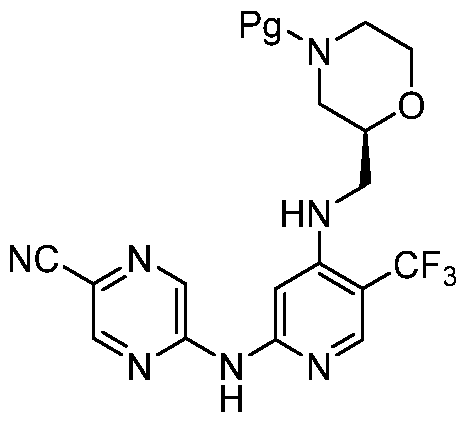
  • the disclosure provides a process to manufacture a compound of formula VII:
  • the process to manufacture the compound of formula VII further comprises: a) providing a first mixture comprising the compound of formula V, the compound of formula VI, a catalyst, a ligand, and DMF; b) providing a second mixture comprising an inorganic base and DMF, wherein the second mixture has been heated to between about 125-135 °C; c) contacting the first mixture with the second mixture to provide a third mixture, wherein the temperature of the third mixture is maintained between about 125-135 °C for a period of time sufficient to produce the compound of formula VII.
  • a process is provided to manufacture the compound of formula VII wherein N-Pg forms a sulfonamide group.
  • N-Pg forms a carbamate group.
  • N-Pg forms an amide group.
  • N- Pg forms a urea group.
  • a process is provided to manufacture the compound of formula VII wherein Pg is selected form the group consisting of: Boc, Fmoc, acetamide, trifluoroacetamide, tosylate, mesylate, and allyl.
  • isolating a compound is achieved by crystallization of the compound.
  • the process of manufacturing the compound of formula VII comprises heating the mixture during the deprotection.
  • VII comprises maintaining the temperature of the mixture at about 0 °C, about 5 °C, about 10 °C, about 20 °C, about 30 °C, about 40 °C, about 50 °C, about 60 °C, about 70 °C or about 80 °C during the deprotection step.
  • the process of manufacturing the compound of formula VII comprises heating and no additional reagents to perform the deprotection.
  • the process of manufacturing the compound of formula VII comprises heating the mixture during coupling.
  • the process of manufacturing the compound of formula VII comprises cooling the mixture during crystallization.
  • a process is provided to manufacture the compound of formula VII wherein the process further comprises maintaining the temperature of the mixture at about -78 °C, about -15 °C, about 0 °C, about 10 °C, about 20 °C, about 30 °C, about 40 °C, or about 50 °C during crystallization.
  • the present disclosure provides a process of manufacturing the compound of SRA737 according to formula VIII:
  • the process of manufacturing the compound of formula VIII further comprises: a) providing a first mixture comprising the compound of formula XII, the compound of formula VI, a catalyst, a ligand, and DMF; b) providing a second mixture comprising an inorganic base and DMF, wherein the second mixture has been heated to between about 125-135 °C; c) contacting the first mixture with the second mixture to provide a third mixture, wherein the temperature of the third mixture is maintained between about 125—
  • the process of manufacturing the compound of formula VIII comprises heating one or more of the mixtures for a period of time sufficient to produce the desired compound.
  • the process of manufacturing the compound of formula VIII comprises heating the mixture during the deprotection.
  • VIII comprises maintaining the temperature of the mixture at about 0 °C, about 5 °C, about 10 °C, about 20 °C, about 30 °C, about 40 °C, about 50 °C, about 60 °C, about 70 °C or about 80 °C during the deprotection step.
  • the process of manufacturing the compound of formula VIII comprises heating and no additional reagents to perform the deprotection.
  • the process of manufacturing the compound of formula VIII comprises heating the mixture during coupling.
  • the process of manufacturing the compound of formula VIII comprises cooling the mixture during crystallization.
  • a process is provided to manufacture the compound of formula VIII wherein the process further comprises maintaining the temperature of the mixture at about -78 °C, about -15 °C, about 0 °C, about 10 °C, about 20 °C, about 30 °C, about 40 °C, or about 50 °C during crystallization.
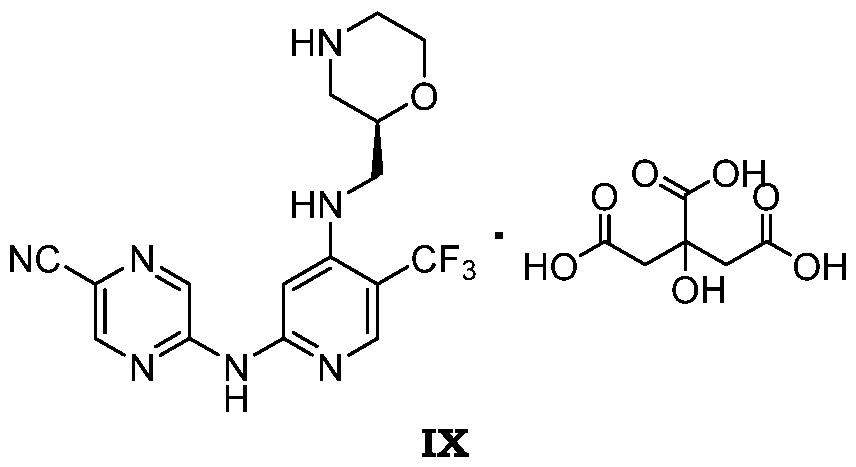
  • the disclosure provides a process of manufacturing the compound salt of formula IX: the process comprising: a) providing a first mixture comprising the compound of formula VIII:
  • the first mixture is prepared by combining the compound of formula VIII, acetic acid, water, and an alcohol at about 30-45 °C.
  • the second mixture is prepared by combining the first mixture with citric acid at about 20-25 °C.
  • the alcohol is selected from a group consisting of methanol, ethanol, propanol, butanol, pentanol, tert-butanol, and isopropanol.
  • the disclosure provides a process for preparing the solvate of any one of the compounds disclosed herein, the process comprising crystallizing the solvate from a mixture comprising a compound, water, and dimethylformamide (DMF).
  • a process for preparing the solvate of any one of the compounds disclosed herein comprising crystallizing the solvate from a mixture comprising a compound, water, and dimethylformamide (DMF).
  • the disclosure provides a process for preparing the solvate of any one of the compounds disclosed herein, wherein the process further comprises maintaining the temperature of the mixture at about -78 °C, about -15 °C, about 0 °C, about 10 °C, about 20 °C, about 30 °C, about 40 °C, or about 50 °C during crystallization.
  • the disclosure provides a process for preparing the solvate of a compound of formula VII: the process comprising crystallizing the solvate from a mixture comprising the compound of formula VII, water, and dimethylformamide (DMF).
  • the disclosure provides a process for preparing the solvate of a compound of formula VII, the process comprising crystallizing the solvate from a mixture comprising a compound of formula VII, water, and dimethylformamide (DMF), wherein Pg is selected form the group consisting of Boc, Fmoc, acetamide, trifluoroacetamide, tosylate, mesylate, and allyl.
  • DMF dimethylformamide
  • the present disclosure provides compounds that are novel synthetic intermediates in the total synthesis process of SRA737.
  • the present disclosure provides novel solvates and crystalline solids of heterocyclic compounds described herein.
  • the present disclosure provides a novel solvate of a protected form of SRA737 comprising a nitrogen atom protecting group (Pg).
  • the compound is a solvate form of a compound of formula I: wherein R 1 is selected from the group consisting of Ci-12 alkyl, substituted Ci-12 alkyl, Ci-12 alkenyl, substituted Ci-12 alkenyl, Ci-12 alkynyl, substituted Ci-12 alkynyl, Ci-12 alkoxy, substituted Ci-12 alkoxy, C3-8 cycloalkyl, substituted C3-8 cycloalkyl, C3-8 heterocycloalkyl, substituted C3-8 heterocycloalkyl, Ci-12 amino, Ci-12 substituted amino, phenyl, substituted phenyl, C3-8 heteroaryl, and substituted C3-8 heteroaryl; and wherein the solvate is a dimethylformamide (DMF) solvate.
  • R 1 is selected from the group consisting of Ci-12 alkyl, substituted Ci-12 alkyl, Ci-12 alkenyl, substituted Ci-12 alkenyl, Ci-12 alkynyl, substituted Ci-12 alkyny
  • the compound is a solvate form of a compound of formula I wherein R1 is CI-12 alkoxy or substituted CI-12 alkoxy.
  • the compound is a solvate form of a compound of formula I wherein R1 is substituted C12 alkoxy.
  • the compound is a solvate form of a compound of formula I wherein R1 is CI-12 alkyl or substituted CI-12 alkyl.
  • the compound is a solvate form of a compound of formula I wherein R1 is Cl alkyl.
  • the compound is a solvate form of a compound of formula I wherein R1 is substituted Cl alkyl.
  • the compound is a solvate form of a compound of formula I wherein R1 is substituted CIO alkyl.
  • the compound is a solvate form of a compound of formula I wherein R1 is substituted C12 alkyl.
  • the compound is a solvate form of a compound of formula I wherein R1 is CIO alkyl.
  • the compound is a solvate form of a compound of formula I wherein R1 is substituted C2 alkyl.
  • the compound is a solvate form of a compound of formula
  • the compound is a solvate form of a compound of formula
  • R1 is C3-8 cycloalkyl or substituted C3-8 cycloalkyl.
  • the compound is a solvate form of a compound of formula
  • the compound is a solvate form of a compound of formula
  • the compound is a solvate form of a compound of formula
  • the compound is a solvate form of a compound of formula
  • the compound is a solvate form of a compound of formula
  • the compound is a solvate form of a compound of formula
  • the compound is a solvate form of a compound of formula
  • the compound is a solvate form of a compound of formula
  • R1 is C6 heterocycloalkyl, wherein the C6 heterocycloalkyl contain 1 nitrogen atom.
  • the compound is a solvate form of a compound of formula
  • the compound is a solvate form of a compound of formula
  • the compound is a solvate form of a compound of formula
  • the compound is a solvate form of a compound of formula
  • the compound is a solvate form of a compound of formula
  • the compound is a solvate form of a compound of formula
  • the compound is a solvate form of a compound of formula
  • the compound is a solvate form of a compound of formula I wherein R1 is -0(CH)CH2.
  • the compound is a solvate form of a compound of formula I wherein R1 is -OCH2(CH)CH2.
  • the compound is a solvate of any one of compounds disclosed herein and which is substantially purified.
  • the compound is a solvate of any one of compounds disclosed herein and which is substantially free of small molecule impurities.
  • the compound is a solvate of any one of compounds disclosed herein and which is substantially purified in that is free of small organic compounds ( ⁇ 500 Da) that are impurities carried forward, i.e. organic compounds that are side products from the reaction to make the intermediate, SRA737, protected form of SRA737, compound of Formula I, or any other compound disclosed herein.
  • the compound is a solvate form of any one of the compounds disclosed herein and is substantially free of impurities, i.e. a small molecule that is an undesired isomer of the disclosed compounds.
  • the compound is purified by crystallization. In a further embodiment, the compound is further purified by recrystallization from a polar aprotic solvent.
  • the recrystallization process comprises: a) mixing the purified crystalline form of a compound disclosed herein with a polar aprotic solvent; b) heating the mixture to a temperature of about 30 °C, about 40 °C, about 50 °C, about 60 °C, about 70 °C, about 80 °C, about 90 °C, about 100 °C, or about 110 °C; c) cooling the mixture to a temperature of about 40 °C, about 30 °C, about 20 °C, about 10 °C, about 0 °C, about -10 °C, about -20 °C, about -30 °C, or about -78 °C; d) isolating the recrystallized crystalline form of the compound.
  • the polar aprotic solvent comprises acetonitrile, dimethylformamide, ethanol, methanol, isopropanol, tetrahydrofuran, pyridine and diethyl ether.
  • the compound is a solvate of any one of the compounds disclosed herein and which is substantially purified or is substantially free of impurities. In some embodiments, the compound is a solvate of any one of the compounds disclosed herein and which is substantially purified or is substantially free of impurities and is crystalline. In some embodiments, the compound is a solvate of any one of the compounds disclosed herein and which is substantially purified or is substantially free of palladium impurities.
  • the compound is a solvate of any one of the compounds disclosed herein and which is substantially purified or is substantially free of organic impurities. In some embodiments, the compound is a solvate of any one of the compounds disclosed herein and which is substantially purified or is substantially free of organic and palladium impurities. In some embodiments, the compound is crystalline and is a polymorph. In some embodiments, the compound is polymorphic and has more than one form.
  • the compound is a solid form of a compound of formula
  • Pg is an organic group that is an amino protecting group.
  • the compound of formula VII is a crystalline compound. In some embodiments, the compound of formula VII is a semi-crystalline compound. In some embodiments, the compound of formula VII is an amorphous compound. In some embodiments, the compound of formula VII is a solid form of compound having one or more polymorphic forms.
  • the compound of formula VII has a Pg group that is selected from the group consisting of: acyl, formyl, acylamino, aminocarbonyl, aminothiocarbonyl, aminosulfonyl, amidino, carboxy ester, benzyl, benzyidene, hydroxy, substituted sulfonyl, substituted sulfmyl, and sulfonyloxy.
  • the compound of formula VII has a Pg group that is selected from the group consisting of: Boc, Ms, Ts, benzyl
  • the compound of formula VII has a Pg group that is Boc.
  • the compound of formula VII has a Pg group that is allyl ( y o ). [00186] In some embodiments, the compound of formula VII has a Pg group that is Ts.
  • the compound of formula VII has a Pg group that is Fmoc.
  • the compound of formula VII has a Pg group that is trimethysilyl (TMS).
  • the compound of formula VII has a Pg group that is vinyl.
  • the compound of formula VII is a crystalline compound. In some embodiments, the compound of formula VII is a semi-crystalline compound. In some embodiments, the compound of formula VII is an amorphous compound. In some embodiments, the compound of formula VII is a solid form of compound having one or more polymorphic forms.
  • the compound is a solid form of formula II, of formula VII, or of formula VIII. In some embodiments, the compound is a crystalline or semi-crystalline solid form of formula II.
  • the compound is a crystalline solid form of the compound of formula II: ⁇
  • the compound is a crystalline solid form of a compound of formula II: having an X-ray powder diffraction pattern comprising a peak, in terms of 2-theta, at about 12.9 °, about 18.1°, about 20.6 °, about 21.6 °, about 22.3 °, about 26.5 °, and 27.8 °.
  • the compound is a crystalline solid form of a compound of formula II: having an X-ray powder diffraction pattern substantially as shown in Figure 2.
  • the compound is a crystalline solid form of a compound of formula II: having a differential scanning calorimetry (DSC) thermogram comprising an endothermic peak at about 215.1 °C.
  • DSC differential scanning calorimetry
  • the compound is a crystalline solid form of a compound of formula II: having a differential scanning calorimetry (DSC) thermogram substantially as shown in Figure 3.
  • DSC differential scanning calorimetry
  • the compound is a crystalline solid form of a compound of formula II: having a thermogravimetric analysis (TGA) substantially as shown in Figure 4.
  • TGA thermogravimetric analysis
  • the compound is a crystalline solid form of a compound of formula II: which is substantially purified or is substantially free of impurities.
  • the crystalline solid form of a compound of formula II is substantially free of organic compound impurities.
  • the compound is a crystalline solid form of the compound
  • the compound is a crystalline solid form of a compound of formula X: having an X-ray powder diffraction pattern comprising a peak, in terms of °2Th, at about 5.6 °, about 11.1 °, about 14.8 °, about 16.7 °, about 19.0 °, about 19.4 °, about 24. 4 °, and about 28.0°.
  • the compound is a crystalline solid form of the compound of formula X: having an X-ray powder diffraction pattern substantially as shown in Figure 5.
  • a morpholine derivative (formula I or another such derivative compound possessing for instance, a differing nitrogen protecting group than Boc or a differing handle group than hydroxy) is transformed into a mesylated compound that may be crystalline.
  • This mesylated morpholine intermediate product can then undergo nucleophilic displacement by an amino-pyridine heterocyclic compound (optionally substituted), optionally in the presence of a weak inorganic or organic base.
  • the resulting intermediate product is then optionally purified on a silica-gel packed chromatography column or by filtration and washing or by crystallization.
  • the purified intermediate product can then be coupled with an amino-pyrazine compound, optionally substituted.
  • the resulting intermediate product is precipitated out and then carried forward to be de-protected on the nitrogen atom to give the desired final product.
  • the starting materials for the following reactions are generally known compounds or can be prepared by known procedures or obvious modifications thereof.
  • many of the starting materials are available from commercial suppliers such as Aldrich Chemical Co. (Milwaukee, Wisconsin, USA), Bachem (Torrance, California, USA), Emka-Chemce or Sigma (St. Louis, Missouri, USA), CombiChem (San Diego, CA).
  • Others may be prepared by procedures, or obvious modifications thereof, described in standard reference texts such as Fieser and Fieser's Reagents for Organic Synthesis, Volumes 1-15 (John Wiley, and Sons, 1991),
  • stereoisomers i.e., as individual enantiomers or d(l) stereoisomers, or as stereoisomer-enriched mixtures. All such stereoisomers (and enriched mixtures) are included within the scope of the present technology, unless otherwise indicated. Pure stereoisomers (or enriched mixtures) may be prepared using, for example, optically active starting materials or stereoselective reagents well known in the art. Alternatively, racemic mixtures of such compounds can be separated using, for example, chiral column chromatography, chiral resolving agents and the like.
  • compositions are provided that comprise at least one compound as described herein.
  • compositions are provided that comprise at least one compound as described herein and an excipient and/or antioxidant and no more than about 1 ppm palladium impurity.
  • compositions are provided that comprise at least one compound as described herein and an excipient and/or antioxidant and no more than about 10 ppb, no more than about 5 ppb, no more than about 2 ppb, or no more than about 1 ppb palladium impurity.
  • compositions are provided that are at least about 99%, at least about 99.5%, at least about 99.7%, at least about 99.9%, or at least about 99.99% of the pure compound by weight.
  • the composition provided comprise one compound as described herein and an excipient and/or antioxidant. The skilled artisan will appreciate that these percentages for purity are each based on the relative amount of the desired compound in the dry weight composition.
  • the present disclosure provides for a process of manufacturing salt forms of SRA737 (e.g., as described herein).
  • the salt is a SRA737 citrate salt.
  • the SRA737 citrate salt comprises SRA737 with citric acid in a 1:1 ratio.
  • the salt form of SRA737 is the compound salt of formula understood that the structure of formula IX is one representation of the salt form of SRA737 and that alternative representations are possible. All such representations of the salt are meant to be included.
  • the process of manufacturing the compound salt of formula IX involves a process of crystallization.
  • the compound is a crystalline solid form of a compound salt of formula IX.
  • the compound is a crystalline solid form of a compound salt of formula IX having an X-ray powder diffraction pattern comprising a peak, in terms of 2- theta, at about 5.9 °, about 11.3 °, about 11.8 °, about 14.5 °, about 14.8 °, about 17.8 °, about
  • the compound is a crystalline solid form of a compound salt of formula IX: having an X-ray powder diffraction pattern substantially as shown in Figure
  • compositions that comprise SRA737 and very low concentrations of one or more palladium compounds as impurities as described herein and a pharmaceutically acceptable carrier or excipient.
  • the pharmaceutical composition comprises no more than 1 mol%, 0.9 mol%, 0.8 mol%, 0.7 mol%, 0.6 mol%, 0.5 mol%, 0.4 mol%, 0.3 mol%, 0.2 mol%, 0.1 mol%, 0.05 mol%, 0.04 mol%, 0.03 mol%, 0.02 mol%, 0.01 mol%, 0.005 mol%, 0.004 mol%, 0.003 mol%, 0.002 mol%, 0.001 mol% or 0.0001 mol% of one or more palladium compounds as impurities.
  • the pharmaceutical composition comprises no more than 5 ppm, 4 ppm, 3 ppm, 2 ppm, 1 ppm, 0.9 ppm, 0.8 ppm, 0.7 ppm, 0.6, ppm, 0.5 ppm, 0.4 ppm, 0.3 ppm, 0.2 ppm, 0.1 ppm, 0.05 ppm. 0.04 ppm, 0.03 ppm, 0.02 ppm or 0.01 ppm of one or more palladium compounds as impurities.
  • the pharmaceutical compositions comprise no more than 5 ng/ml, 4 ng/ml, 3 ng/ml, 2 ng/ml, 1 ng/ml, 0.9 ng/ml, 0.8 ng/ml, 0.7 ng/ml, 0.6 ng/ml, 0.5 ng/ml, 0.4 ng/ml, 0.3 ng/ml, 0.2 ng/ml, 0.1 ng/ml, 0.09 ng/ml, 0.08 ng/ml, 0.07 ng/ml, 0.06 ng/ml, 0.05 ng/ml, 0.04 ng/ml, 0.03 ng/ml, 0.02 ng/ml, 0.01 ng/ml, 0.005 ng/ml, 0.004 ng/ml, 0.003 ng/ml, 0.002 ng/ml or 0.001 ng/ml of one or more palladium compounds as impurities.
  • the pharmaceutical compositions comprise no less than 100:1, 200:1, 300:1, 400:1, 500:1, 600:1, 700:1, 800:1, 900:1, 1000:1, 2000:1, 3000:1, 4000:1, 5000:1, 6000:1, 7000:1, 8000:1, 9000:1, 10,000:1, 50,000:1 or 100,000:1 weight ratios of SRA737 to one or more palladium compounds as impurities.
  • the pharmaceutical compositions comprise 100: 1, 200: 1, 300:1, 400:1, 500:1, 600:1, 700:1, 800:1, 900:1, 1000:1, 2000:1, 3000:1, 4000:1, 5000:1, 6000:1, 7000:1, 8000:1, 9000:1, 10,000:1, 50,000:1 or 100,000:1 weight ratios of SRA737 salt form, measured as free base of SRA737, to one or more palladium compounds as impurities.
  • the pharmaceutical compositions comprise SRA737 and very low concentrations of one or more organic compounds as impurities as described herein.
  • the pharmaceutical composition comprises no more than 1 mol%, 0.9 mol%, 0.8 mol%, 0.7 mol%, 0.6 mol%, 0.5 mol%, 0.4 mol%, 0.3 mol%, 0.2 mol%, 0.1 mol%, 0.05 mol%, 0.04 mol%, 0.03 mol%, 0.02 mol%, 0.01 mol%, 0.005 mol%, 0.004 mol%, 0.003 mol%, 0.002 mol%, 0.001 mol% or 0.0001 mol% of one or more organic compounds as impurities.
  • the pharmaceutical composition comprises no more than 5 ppm, 4 ppm, 3 ppm, 2 ppm, 1 ppm, 0.9 ppm, 0.8 ppm, 0.7 ppm, 0.6, ppm, 0.5 ppm, 0.4 ppm, 0.3 ppm, 0.2 ppm, 0.1 ppm, 0.05 ppm. 0.04 ppm, 0.03 ppm, 0.02 ppm or 0.01 ppm of one or more organic compounds as impurities.
  • the pharmaceutical compositions comprise no more than 5 ng/ml, 4 ng/ml, 3 ng/ml, 2 ng/ml, 1 ng/ml, 0.9 ng/ml, 0.8 ng/ml, 0.7 ng/ml, 0.6 ng/ml, 0.5 ng/ml, 0.4 ng/ml, 0.3 ng/ml, 0.2 ng/ml, 0.1 ng/ml, 0.09 ng/ml, 0.08 ng/ml, 0.07 ng/ml, 0.06 ng/ml, 0.05 ng/ml, 0.04 ng/ml, 0.03 ng/ml, 0.02 ng/ml, 0.01 ng/ml, 0.005 ng/ml, 0.004 ng/ml, 0.003 ng/ml, 0.002 ng/ml or 0.001 ng/ml of one or more organic compounds as impurities.
  • the pharmaceutical compositions comprise no less than 100:1, 200:1, 300:1, 400:1, 500:1, 600:1, 700:1, 800:1, 900:1, 1000:1, 2000:1, 3000:1, 4000:1, 5000:1, 6000:1, 7000:1, 8000:1, 9000:1, 10,000:1, 50,000:1 or 100,000:1 weight ratios of SRA737 to one or more organic compounds as impurities.
  • the pharmaceutical compositions comprise 100: 1, 200: 1, 300:1, 400:1, 500:1, 600:1, 700:1, 800:1, 900:1, 1000:1, 2000:1, 3000:1, 4000:1, 5000:1, 6000:1, 7000:1, 8000:1, 9000:1, 10,000:1, 50,000:1 or 100,000:1 weight ratios of SRA737 salt form, measured as free base of SRA737, to one or more organic compounds as impurities.
  • the pharmaceutical compositions comprise SRA737 and very low concentrations of one or more palladium compounds and one or more organic compounds all together as impurities as described herein.
  • the pharmaceutical composition comprises no more than 1 mol%, 0.9 mol%, 0.8 mol%, 0.7 mol%, 0.6 mol%, 0.5 mol%, 0.4 mol%, 0.3 mol%, 0.2 mol%, 0.1 mol%, 0.05 mol%, 0.04 mol%, 0.03 mol%, 0.02 mol%, 0.01 mol%, 0.005 mol%, 0.004 mol%, 0.003 mol%, 0.002 mol%, 0.001 mol% or 0.0001 mol% of one or more palladium compounds and one or more organic compounds all together as impurities.
  • the pharmaceutical composition comprises no more than 5 ppm, 4 ppm, 3 ppm, 2 ppm, 1 ppm, 0.9 ppm, 0.8 ppm, 0.7 ppm, 0.6, ppm, 0.5 ppm, 0.4 ppm, 0.3 ppm, 0.2 ppm, 0.1 ppm, 0.05 ppm. 0.04 ppm, 0.03 ppm, 0.02 ppm or 0.01 ppm of one or more palladium compounds and one or more organic compounds all together as impurities.
  • the pharmaceutical compositions comprise no more than 5 ng/ml, 4 ng/ml, 3 ng/ml, 2 ng/ml, 1 ng/ml, 0.9 ng/ml, 0.8 ng/ml, 0.7 ng/ml, 0.6 ng/ml, 0.5 ng/ml, 0.4 ng/ml, 0.3 ng/ml, 0.2 ng/ml, 0.1 ng/ml, 0.09 ng/ml, 0.08 ng/ml, 0.07 ng/ml, 0.06 ng/ml, 0.05 ng/ml, 0.04 ng/ml, 0.03 ng/ml, 0.02 ng/ml, 0.01 ng/ml, 0.005 ng/ml, 0.004 ng/ml, 0.003 ng/ml, 0.002 ng/ml or 0.001 ng/ml of one or more palladium compounds and one or more organic compounds all
  • the pharmaceutical compositions comprise 100: 1, 200: 1, 300:1, 400:1, 500:1, 600:1, 700:1, 800:1, 900:1, 1000:1, 2000:1, 3000:1, 4000:1, 5000:1, 6000:1, 7000:1, 8000:1, 9000:1, 10,000:1, 50,000:1 or 100,000:1 weight ratios of SRA737 to one or more palladium compounds and one or more organic compounds all together as impurities.
  • the pharmaceutical compositions comprise 100: 1, 200: 1, 300:1, 400:1, 500:1, 600:1, 700:1, 800:1, 900:1, 1000:1, 2000:1, 3000:1, 4000:1, 5000:1, 6000:1, 7000:1, 8000:1, 9000:1, 10,000:1, 50,000:1 or 100,000:1 weight ratios of SRA737 salt form, measured as free base of SRA737, to one or more palladium compounds and one or more organic compounds all together as impurities.
  • the pharmaceutical compositions comprise 1, 2, 3, 4, or 5 or more of the herein described compounds, with SRA737 being the API and the other organic compounds, as trace impurities.
  • the composition comprises a plurality of compounds.
  • the pharmaceutical composition comprises at least one compound of Formula I, or tautomers, stereoisomers, salts, solvates or hydrates thereof.
  • the pharmaceutical composition comprises at least one compound of Formula II, or tautomers, stereoisomers, salts, solvates or hydrates thereof.
  • the pharmaceutical composition is formulated for enteral route of administration. In various embodiments, the pharmaceutical composition is formulated for intravenous route of administration.
  • compositions for enteral route of administration can be in tablet, capsule, powder or liquid form.
  • a tablet can include a solid carrier such as gelatin or an adjuvant.
  • Liquid pharmaceutical compositions generally include a liquid carrier such as water, petroleum, animal or vegetable oils, mineral oil or synthetic oil. Physiological saline solution, dextrose or other saccharide solution or glycols such as ethylene glycol, propylene glycol or polyethylene glycol can be included.
  • a pharmaceutical composition can include a cyclodextrin.
  • a pharmaceutical composition can contain poloxamer and/or D-a-Tocopheryl polyethylene glycol 1000 succinate (Vitamin E TPGS).
  • the composition will contain, on a weight percent (wt %) basis, from about 0.01 - 99.99 wt % of the compound of the present technology based on the total formulation, with the balance being one or more suitable pharmaceutical excipients.
  • the compound is present at a level of about 1 - 80 wt %.
  • the pharmaceutical composition is formulated for inhalation suspended in solutions or mixtures of excipients (e.g., preservatives, viscosity modifiers, emulsifiers, buffering agents) in non-pressurized or pressurized dispensers that deliver a spray containing a metered dose of at least one compound as described herein.
  • excipients e.g., preservatives, viscosity modifiers, emulsifiers, buffering agents
  • the pharmaceutical composition is formulated for nasal or oral administration.
  • the pharmaceutical composition is formulated for topical administration.
  • the pharmaceutical composition is formulated for enepidermic route, Epidermic route, Instillation administration, or Painting/Swabbing.
  • the pharmaceutical composition is formulated for parenteral administration.
  • the pharmaceutical composition is formulated for intravenous, subcutaneous, or intradermal administration.
  • the pharmaceutical composition is formulated for intrathecal or intracerebroventricular administration.
  • the composition will be in the form of a parenterally acceptable aqueous solution that is pyrogen-free and has suitable pH, isotonicity and stability.
  • a parenterally acceptable aqueous solution that is pyrogen-free and has suitable pH, isotonicity and stability.
  • Those of relevant skill in the art are well able to prepare suitable solutions using, for example, isotonic vehicles such as Sodium Chloride Injection, Ringer's Injection, Lactated Ringer's Injection.
  • Preservatives, stabilizers, buffers, antioxidants and/or other additives can be included, as required.
  • HC1 solution was added (1000 g) and allowed to stir for 10 min at 15 °C.
  • the layers were separated and the organic layer was washed with a saturated sodium bicarbonate solution followed by brine.
  • the organic layer was then distilled at atmospheric pressure to reduce the water content and more MTBE was added followed by heptanes.
  • the turbid mixture was seeded with mesylate product seeds and more heptanes were added over 6 hours.
  • Step 2 Synthesis of tert-butyl (S)-2-(((2-chloro-5-(trifluoromethyl)pyridin-4- yl)amino)methyl)morpholine-4-carboxylate [00250] Tert- butyl (R)-2-(((methylsulfonyl)oxy)methyl)morpholine-4-carboxylate (12.8
  • the batch was concentrated to approximately 3 volumes and seeded at 35-40 °C and held for 1 hour.
  • the resulting suspension was cooled to 20-25 °C and stirred for 12 hours.
  • the product was collected by filtration, washing with a 3:1 mixture of heptanes and toluene, followed by heptanes.
  • Step 3 Synthesis of tert- butyl (S)-2-(((2-((5-cyanopyrazin-2-yl)amino)-5- (trifluoromethyl)pyridin-4-yl)amino)methyl)morpholine-4-carboxylate
  • Degassed DMF (12.9 Kg) was added followed by degassed water (2.22 g) and the solution was stirred for 1 hour under a steady stream of argon.
  • Step 5 Synthesis of (R)-2-(((2-((5-cyanopyrazin-2-yl)amino)-5-(trifluoromethyl)pyridin-4- yl)amino)methyl)morpholin-4-ium 3-carboxy-2-(carboxymethyl)-2-hydroxypropanoate
  • Citric acid in water (3.9 Kg in 5L) is added and the slurry is allowed to stir at ambient temperature overnight.
  • the product is isolated via filtration, washing with a 1 : 1 solution of ethanol and water (2 times) followed by absolute ethanol.
  • the material is dried in a vacuum oven to afford the compound salt of formula IX as a crystalline solid (10.5 Kg).
  • the compound citrate salt is determined to be a 1 : 1 salt using 3 ⁇ 4 NMR or ion chromatography.
  • the desired product of formula VIII as confirmed by 1H NMR analysis, was further analyzed by LC-MS and showed a purity of 94.5%. This crude material was then further purified with 10% methanol in diethyl ether to give the desired product of formula VIII with a purity of >97% in 80% yield.

Landscapes

  • Chemical & Material Sciences (AREA)
  • Organic Chemistry (AREA)
  • Pharmaceuticals Containing Other Organic And Inorganic Compounds (AREA)
  • Organic Low-Molecular-Weight Compounds And Preparation Thereof (AREA)
  • Plural Heterocyclic Compounds (AREA)

Abstract

The present technology relates to processes, compounds, compositions, and methods useful for coupling reactions. Also, the present disclosure provides for novel intermediates, compositions of matter, and processes relating to the Chk1 inhibitor, SRA737.

Description

METHODS FOR SYNTHESIS OF CHK1 INHIBITORS
CROSS REFERENCE TO RELATED APPLICATIONS [0001] This application claims priority to U.S. Provisional Application No. 63/006,305, filed on April 7, 2020, the disclosure of which is hereby incorporated by reference in its entirety.
INTRODUCTION
[0002] SRA737 is a heterocyclic small molecule and a potent checkpoint 1 inhibitor that is currently under clinical study as a chemotherapy agent. The structure of SRA737 is:
Figure imgf000003_0001
[0003] SRA737 is also known by its IUPAC name: 5-[[4-[[morpholin-2-yl]methylamino]-5- (trifluoromethyl)-2-pyridyl]amino]pyrazine-2-carbonitrile. The existing, conventional synthesis of SRA737 is described in U.S. Patent No. 9,663,503, which is hereby incorporated by reference in its entirety.
[0004] The synthesis of SRA737 and similar heterocyclic compounds currently employs cross coupling reactions that require high loadings of metal complexes as catalysts and organic phosphine compounds as ligands. While these reactions are essential for rapid construction of molecular complexity, they produce undesired impurities in the intermediates and the final active pharmaceutical ingredient (API) product that are often difficult to purify. Furthermore, these reactions require careful preparations and often harsh reaction conditions, such as elevated temperature and pressure, which can undesirably increase cost for manufacturing.
[0005] Due to its molecular complexity, industrial scale manufacturing of SRA737 can be a challenging process. The requirements of multi-step synthesis, purifications, and waste management often lead to low yields of both the intermediates and the final product. Thus, concise and operationally simple synthetic processes for large scale manufacturing of SRA737 and related heterocyclic small molecules are highly desirable. There is a high demand for improved synthetic processes to produce heterocyclic compounds, such as SRA737, on industrial scales with improved atom economy, waste management, and purification process to reduce manufacturing cost. SUMMARY
[0006] The present disclosure provides novel compounds, compositions, and methods of making such compounds and compositions.
[0007] In some embodiments, the compounds disclosed herein are novel synthetic intermediates of SRA737. In some embodiments, the compounds are protected forms of SRA737, that is, the compound is masked with a protecting organic group that, when exposed to appropriate conditions, is removed to produce SRA737.
[0008] In some embodiments, the present disclosure provides novel compositions, compounds and solvates comprising very low concentrations of palladium impurities. In some embodiments, the compound is an active pharmaceutical ingredient (API) compound.
[0009] In some embodiments, the present disclosure provides novel compositions, compounds and solvates comprising very low concentrations of other organic compounds as impurities, i.e. side-products from a given reaction or cumulative reactions to a given point in the total synthesis of SRA737.
[0010] In some embodiments, the present disclosure provides novel synthetic intermediates and SRA737, or protected forms of SRA737 that are substantially free of palladium and other organic molecules as impurities.
[0011] In some embodiments, the present disclosure provides compositions of one or more compounds disclosed herein that are substantially free of palladium and other organic molecules as impurities.
[0012] In some embodiments, the present disclosure provides compositions comprising a novel synthetic intermediate compound and/or SRA737, or protected forms of SRA737, that are substantially free of palladium and other organic molecules as impurities.
[0013] In some embodiments, the compounds disclosed herein are novel solvates. In some embodiments, the compounds disclosed herein are novel dimethylformamide (DMF) solvates. In some embodiments, the compounds disclosed herein are novel crystalline solids. In some embodiments, the compounds disclosed herein are novel crystalline solids that are substantially free of palladium and other organic molecules as impurities.
[0014] In some embodiments, the present disclosure provides pharmaceutical compositions comprising one or more compounds or solvates.
[0015] In some embodiments, the present disclosure provides a kit comprising one or more compounds disclosed herein, or one or more compositions as disclosed herein.
[0016] In some embodiments, the present disclosure provides methods of administering to a subject in need of chemotherapy at least one of the compounds described herein. [0017] In some embodiments, the present disclosure provides methods of manufacturing novel compounds, compositions and solvates.
[0018] These and other embodiments are described in further detail herein.
BRIEF DESCRIPTION OF THE FIGURES [0019] Figure 1 shows a total synthesis of SRA737.
[0020] Figure 2 shows the X-ray powder diffraction pattern (XRPD) of the crystalline solid form of the compound of formula II.
[0021] Figure 3 shows the differential scanning calorimetry (DSC) thermogram of the crystalline solid form of the compound of formula II.
[0022] Figure 4 shows the thermogravimetric analysis (TGA) of the crystalline solid form of the compound of formula II.
[0023] Figure 5 shows the X-ray powder diffraction pattern (XRPD) of the crystalline solid form of a compound of formula X.
[0024] Figure 6 shows the X-ray powder diffraction pattern (XRPD) of the crystalline solid form of a compound of formula VIII.
[0025] Figure 7 shows the X-ray powder diffraction pattern (XRPD) of the crystalline solid form of the compound salt of formula IX.
[0026] Figure 8 shows the differential scanning calorimetry (DSC) thermogram of the crystalline solid form of compound salt of formula IX.
DETAILED DESCRIPTION
Definitions
[0027] Various terms used in the specification and claims herein are defined as set forth below. All technical and scientific terms not defined herein have the meaning commonly understood by a person skilled in the art to which this invention belongs.
[0028] “LvG” or “Leaving group” has the meaning conventionally associated with it in synthetic organic chemistry and refers to an atom or organic group which is capable of being displaced from a molecule by a nucleophile via covalent bond cleavage. Exemplary leaving groups include, but are not limited to: F, Cl, Br, I, OTs (-OSO2C6H4CH3), OMs (-OSO2CH3),
ONs (SO2C6H4NO2), OTf (-OSO2CF3), N2 +, ace, carbonates (-OCO2R), esters (-OCOR), acid (- OCOH), and anhydrides (-OCO2COR).
[0029] “Substantially purified or free of impurities” refers to a mixture in which one small organic molecule of interest far exceeds the amount of minerals, metal, and/or other small organic molecules as impurities, and at least 95% by dry weight is the small organic molecule of interest, such as at least 96%, at least 97%, at least 98%, at least 99% or at least 99.5% by dry weight.
[0030] It is understood that it may be desirable to protect certain reactive groups or substituents (e.g., amino groups) during some of the procedures described herein. Any convenient protection and deprotection methods and chemistries can be utilized in conjunction with such reactive groups or substituents. “Amino protecting group” refers to an organic group that can be covalently attached to a reactive amino group to block undesirable reactions and is capable of being selectively removed from the amino group using a deprotection method. The choice and use of protecting groups and the reaction conditions to install and remove protecting groups include those described in Greene's Protective Groups in Organic Synthesis, 4th edition, John Wiley & Sons, New York, 2007, the disclosure of which is incorporated herein by reference in its entirety. Exemplary amino protecting groups include, but are not limited to, TMS, TBDMS,
O
TBDPS, Ms, Ns, Tf, Fmoc, Boc, Cbz, Troc, Alloc, acetyl
Figure imgf000006_0001
R) including acetamide where
OH
R=methyl or trifluoroacetamide where R=trifluouromethyl, hydroxylamine
Figure imgf000006_0002
Tr or trityl (-
H
C(Ph)3), benzylidene (
Figure imgf000006_0003
), hydrazinyl (
Figure imgf000006_0004
) where R also can be C(0)R’, benzoyl (-
C(O)Ph), benzyl (-CEbPh), allyl, vinyl, Bul, and Piv.
[0031] “Alkyl” refers to monovalent saturated aliphatic hydrocarbyl groups having from 1 to 20 carbon atoms, such as 1-12 carbons. This term includes, by way of example, linear and branched hydrocarbyl groups such as methyl (CEE-), ethyl (CH3CH2-), «-propyl (CH3CH2CH2-), isopropyl ((CH3)2CH-), «-butyl (CH3CH2CH2CH2-), isobutyl ((Cft^CHClL·-), sec-butyl ((CH3)(CH3CH2)CH-), /-butyl ((CIE^C-), «-pentyl (CH3CH2CH2CH2CH2-), and neopentyl ((CH3)3CCH2-). CX alkyl refers to an alkyl group having x number of carbon atoms.
[0032] “Alkenyl” refers to straight or branched hydrocarbyl groups having from 1 to 12 carbon atoms and preferably 2 to 4 carbon atoms and having at least 1 and preferably from 1 to 2 sites of unsaturation (>C=C<). Such groups are exemplified, for example, by vinyl, allyl, and but-3-en-l-yl. Included within this term are the cis and trans isomers or mixtures of these isomers. Cx alkenyl refers to an alkenyl group having x number of carbon atoms.
[0033] “Alkynyl” refers to straight or branched monovalent hydrocarbyl groups having from 2 to 6 carbon atoms and preferably 2 to 3 carbon atoms and having at least 1 and preferably from 1 to 2 sites of acetylenic (-Cº C-) unsaturation. Examples of such alkynyl groups include acetylenyl (-Cº CH), and propargyl (-CH2Cº CH). Cx alkynyl refers to an alkynyl group having x number of carbon atoms.
[0034] “Substituted alkyl” refers to an alkyl group having from 1 to 5, preferably 1 to 3, or more preferably 1 to 2 substituents selected from the group consisting of alkoxy, substituted alkoxy, acyl, acylamino, aminocarbonylamino, acyloxy, amino, substituted amino, aminocarbonyl, aminothiocarbonyl, aminocarbonylamino, aminothiocarbonylamino, aminocarbonyloxy, aminosulfonyl, aminosulfonyloxy, aminosulfonylamino, amidino, aryl, substituted aryl, aryloxy, substituted aryloxy, arylthio, substituted arylthio, carboxyl, carboxyl ester, (carboxyl ester)amino, (carboxyl ester)oxy, cyano, cycloalkyl, substituted cycloalkyl, cycloalkyloxy, substituted cycloalkyloxy, cycloalkylthio, substituted cycloalkylthio, guanidino, substituted guanidino, halo, hydroxy, heteroaryl, substituted heteroaryl, heteroaryloxy, substituted heteroaryloxy, heteroarylthio, substituted heteroarylthio, heterocyclic, substituted heterocyclic, heterocyclyloxy, substituted heterocyclyloxy, heterocyclylthio, substituted heterocyclylthio, nitro, SCbH, substituted sulfonyl, sulfonyloxy, thioacyl, thiol, alkylthio, and substituted alkylthio, wherein said substituents are defined herein.
[0035] In some embodiments, the substituted alkyl groups include halogenated alkyl groups and particularly halogenated methyl groups such as trifluoromethyl, difluromethyl, fluoromethyl and the like.
[0036] “Alkyl aryl” refers to an alkyl group having from 1 to 8, preferably 1 to 5, or more preferably 1 to 3 carbon atoms in length and is substituted specifically at any one of the carbons along the chain with an aryl group.
[0037] “Alkenyl aryl” refers to an alkenyl or alkene group having from 1 to 8, preferably 1 to 5, or more preferably 1 to 3 carbon atoms in length and is substituted specifically at any one of the carbons along the chain with an aryl group. The aryl group can include heteroatoms or not.
[0038] “Alkynyl aryl” refers to an alkynyl or alkyne group having from 1 to 8, preferably 1 to 5, or more preferably 1 to 3 carbon atoms in length and is substituted specifically at any one of the carbons along the chain with an aryl group. The aryl group can include heteroatoms or not.
[0039] “Cycloalkyl” or “Cyclyl alkyl” refers to a saturated or partially saturated, but not aromatic, group having from 3 to 10 ring carbon atoms and no heteroatoms. Cycloalkyl encompasses single ring systems.
[0040] “Ar” and/or “aryl” refers to any group which is aromatic. This group must be cyclic; and does not contain heteroatoms. [0041] “Alkoxy” refers to the group -O-alkyl wherein alkyl is defined herein. Alkoxy includes, by way of example, methoxy, ethoxy, //-propoxy, isopropoxy, //-butoxy, /-butoxy, .suc-butoxy, and //-pentoxy.
[0042] “Substituted alkoxy” refers to the group -0-(substituted alkyl) wherein substituted alkyl is defined herein. Preferred substituted alkyl groups in -0-(substituted alkyl) include halogenated alkyl groups and particularly halogenated methyl groups such as trifluoromethyl, difluromethyl, fluoromethyl and the like.
[0043] “Acyl” refers to the groups H-C(O)-, alkyl-C(O)-, substituted alkyl-C(O)-, alkenyl-C(O)-, substituted alkenyl-C(O)-, alkynyl-C(O)-, substituted alkynyl-C(O)-, cycloalkyl-C(O)-, substituted cycloalkyl-C(O)-, aryl-C(O)-, substituted aryl-C(O)-, heteroaryl-C(O)-, substituted heteroaryl-C(O)-, heterocyclic-C(O)-, and substituted heterocyclic-C(O)-, wherein alkyl, substituted alkyl, alkenyl, substituted alkenyl, alkoxy, substituted alkoxy, alkynyl, substituted alkynyl, cycloalkyl, substituted cycloalkyl, aryl, substituted aryl, heteroaryl, substituted heteroaryl, heterocyclic and substituted heterocyclic are as defined herein. Acyl includes the “acetyl” group CH3C(0)-.
[0044] “Acylamino” refers to the groups -NRC(0)alkyl, -NRC(0)substituted alkyl, -NRC(0)cycloalkyl, substituted -NRC(O) cycloalkyl, -NRC(0)alkenyl, substituted -NRC(O) alkenyl, alkoxy, substituted alkoxy-NRAC(0)alkynyl, substituted -NRC(O) alkynyl, -NRC(0)aryl, substituted -NRC(O) aryl, -NRC(0)heteroaryl, substituted -NRC(O) heteroaryl, -NRC(0)heterocyclic, and substituted -NRC(O) heterocyclic wherein R is hydrogen or alkyl, and wherein alkyl, substituted alkyl, alkenyl, substituted alkenyl, alkynyl, substituted alkynyl, cycloalkyl, substituted cycloalkyl, aryl, substituted aryl, heteroaryl, substituted heteroaryl, heterocyclic and substituted heterocyclic are as defined herein.
[0045] “Acyloxy” refers to the groups alkyl-C(0)0-, substituted alkyl-C(0)0-, alkenyl-C(0)0-, substituted alkenyl-C(0)0-, alkynyl-C(0)0-, substituted alkynyl-C(0)0-, aryl-C(0)0-, substituted aryl-C(0)0-, cycloalkyl-C(0)0-, substituted cycloalkyl-C(0)0-, heteroaryl-C(0)0-, substituted heteroaryl-C(0)0-, heterocyclic-C(0)0-, and substituted heterocyclic-C(0)0- wherein alkyl, substituted alkyl, alkenyl, substituted alkenyl, alkynyl, substituted alkynyl, cycloalkyl, substituted cycloalkyl, aryl, substituted aryl, heteroaryl, substituted heteroaryl, heterocyclic, and substituted heterocyclic are as defined herein.
[0046] “Amino” refers to the group -NH2.
[0047] “Aminocarbonyl” refers to the group -C(0)NRARA where RA and RB are independently selected from the group consisting of hydrogen, alkyl, substituted alkyl, alkenyl, substituted alkenyl, alkoxy, substituted alkoxy, alkynyl, substituted alkynyl, aryl, substituted aryl, cycloalkyl, substituted cycloalkyl heteroaryl, substituted heteroaryl, heterocyclic, and substituted heterocyclic and where RA and RB are optionally joined together with the nitrogen bound thereto to form a heterocyclic or substituted heterocyclic group, and wherein alkyl, substituted alkyl, alkenyl, substituted alkenyl, alkoxy, substituted alkoxy, alkynyl, substituted alkynyl, cycloalkyl, substituted cycloalkyl, aryl, substituted aryl, heteroaryl, substituted heteroaryl, heterocyclic and substituted heterocyclic are as defined herein.
[0048] “Substituted aryl” refers to aryl groups which are substituted with 1 to 5, preferably 1 to 3, or more preferably 1 to 2 substituents selected from the group consisting of alkyl, substituted alkyl, alkenyl, substituted alkenyl, alkynyl, substituted alkynyl, alkoxy, substituted alkoxy, acyl, acylamino, aminocarbonylamino, acyloxy, amino, substituted amino, aminocarbonyl, aminothiocarbonyl, aminocarbonylamino, aminothiocarbonylamino, aminocarbonyloxy, aminosulfonyl, aminosulfonyloxy, aminosulfonylamino, amidino, aryl, substituted aryl, aryloxy, substituted aryloxy, arylthio, substituted arylthio, carboxyl, carboxyl ester, (carboxyl esterjamino, (carboxyl esterjoxy, cyano, cycloalkyl, substituted cycloalkyl, cycloalkyloxy, substituted cycloalkyloxy, cycloalkylthio, substituted cycloalkylthio, guanidino, substituted guanidino, halo, hydroxy, heteroaryl, substituted heteroaryl, heteroaryloxy, substituted heteroaryloxy, heteroarylthio, substituted heteroarylthio, heterocyclic, substituted heterocyclic, heterocyclyloxy, substituted heterocyclyloxy, heterocyclylthio, substituted heterocyclylthio, nitro, SCbH, substituted sulfonyl, sulfonyloxy, thioacyl, thiol, alkylthio, a monosaccharide (which may be covalently bonded to the aryl group thru any oxygen atom on the saccharide), and substituted alkylthio, wherein said substituents are defined herein.
[0049] “Carbonyl” refers to the divalent group -C(O)- which is equivalent to -C(=0)-.
[0050] “Carboxy” or “carboxyl” refers to -COOH or salts thereof.
[0051] “Carboxyl ester” or “carboxy ester” refers to the groups -C(0)0-alkyl, -C(0)0-substituted alkyl, -C(0)0-alkenyl, -C(0)0-substituted alkenyl, -C(0)0-alkynyl, -C(0)0-substituted alkynyl, -C(0)0-aryl, -C(0)0-substituted aryl, -C(0)0-cycloalkyl, -C(0)0-substituted cycloalkyl, -C(0)0-heteroaryl, -C(0)0-substituted heteroaryl, -C(0)0-heterocyclic, and -C(0)0-substituted heterocyclic wherein alkyl, substituted alkyl, alkenyl, substituted alkenyl, alkynyl, substituted alkynyl, cycloalkyl, substituted cycloalkyl, aryl, substituted aryl, heteroaryl, substituted heteroaryl, heterocyclic, and substituted heterocyclic are as defined herein.
[0052] “Cyano” refers to the group -CºN.
[0053] “Cycloalkyl” refers to a saturated or unsaturated but nonaromatic cyclic alkyl groups of from 3 to 10 carbon atoms having single or multiple cyclic rings including fused, bridged, and spiro ring systems. Cx cycloalkyl refers to a cycloalkyl group having x number of ring carbon atoms. Examples of suitable cycloalkyl groups include, for instance, adamantyl, cyclopropyl, cyclobutyl, cyclopentyl, and cyclooctyl. One or more the rings can be aryl, heteroaryl, or heterocyclic provided that the point of attachment is through the non-aromatic, non-heterocyclic ring saturated carbocyclic ring.
[0054] “Substituted cycloalkyl” refers to a cycloalkyl group having from 1 to 5 or preferably 1 to 3 substituents selected from the group consisting of oxo, thione, alkyl, substituted alkyl, alkenyl, substituted alkenyl, alkynyl, substituted alkynyl, alkoxy, substituted alkoxy, acyl, acylamino, aminocarbonylamino, acyloxy, amino, substituted amino, aminocarbonyl, aminothiocarbonyl, aminocarbonylamino, aminothiocarbonylamino, aminocarbonyloxy, aminosulfonyl, aminosulfonyloxy, aminosulfonylamino, amidino, aryl, substituted aryl, aryloxy, substituted aryloxy, arylthio, substituted arylthio, carboxyl, carboxyl ester, (carboxyl ester)amino, (carboxyl ester)oxy, cyano, cycloalkyl, substituted cycloalkyl, cycloalkyloxy, substituted cycloalkyloxy, cycloalkylthio, substituted cycloalkylthio, guanidino, substituted guanidino, halo, hydroxy, heteroaryl, substituted heteroaryl, heteroaryloxy, substituted heteroaryloxy, heteroarylthio, substituted heteroarylthio, heterocyclic, substituted heterocyclic, heterocyclyloxy, substituted heterocyclyloxy, heterocyclylthio, substituted heterocyclylthio, nitro, SO3H, substituted sulfonyl, sulfonyloxy, thioacyl, thiol, alkylthio, and substituted alkylthio, wherein said substituents are defined herein.
[0055] “Halo” or “halogen” refers to fluoro, chloro, bromo and iodo and preferably is fluoro or chi or o.
[0056] “Hydroxy” or “hydroxyl” refers to the group -OH.
[0057] “Heteroaryl” refers to an aromatic group of from 4 to 10 carbon atoms and 1 to 4 heteroatoms selected from the group consisting of oxygen, nitrogen and sulfur within the ring. Such heteroaryl groups can have a single ring ( e.g ., pyridinyl or furyl) or multiple condensed rings (e.g., indolizinyl or benzothienyl) wherein the condensed rings may or may not be aromatic and/or contain a heteroatom provided that the point of attachment is through an atom of the aromatic heteroaryl group. In one embodiment, the nitrogen and/or the sulfur ring atom(s) of the heteroaryl group are optionally oxidized to provide for the N-oxide (N 0), sulfmyl, or sulfonyl moieties. Preferred heteroaryls include 5 or 6 membered heteroaryls such as pyridinyl, pyrrolyl, indolyl, thiophenyl, and furanyl.
[0058] “Substituted heteroaryl” refers to heteroaryl groups that are substituted with from 1 to 5, preferably 1 to 3, or more preferably 1 to 2 substituents selected from the group consisting of the same group of substituents defined for substituted aryl. [0059] “Heterocycle” or “heterocyclic” or “heterocycloalkyl” or “heterocyclyl” refers to a saturated or partially saturated, but not aromatic, group having from 2 to 10 ring carbon atoms and from 1 to 4 ring heteroatoms selected from the group consisting of nitrogen, sulfur, or oxygen. Cx cycloalkyl or heterocycloalkyl refers to a group having x number of ring carbon atoms excluding the ring heteroatoms. Heterocycle encompasses single ring or multiple condensed rings, including fused, bridged and spiro ring systems. In fused ring systems, one or more the rings can be cycloalkyl, aryl or heteroaryl provided that the point of attachment is through the non-aromatic ring. In one embodiment, the nitrogen and/or sulfur atom(s) of the heterocyclic group are optionally oxidized to provide for the N-oxide, sulfmyl, sulfonyl moieties. [0060] “Substituted heterocyclic” or “substituted heterocycloalkyl” or “substituted heterocyclyl” refers to heterocyclyl groups that are substituted with from 1 to 5 or preferably 1 to 3 of the same substituents as defined for substituted cycloalkyl. Examples of heterocycle and heteroaryl include, but are not limited to, azetidine, pyrrole, imidazole, pyrazole, pyridine, pyrazine, pyrimidine, pyridazine, indolizine, isoindole, indole, dihydroindole, dexahydroindole, dihydropyridine, indazole, purine, quinolizine, isoquinoline, quinoline, phthalazine, naphthylpyridine, quinoxaline, quinazoline, cinnoline, pteridine, carbazole, carboline, phenanthridine, acridine, phenanthroline, isothiazole, phenazine, isoxazole, phenoxazine, phenothiazine, imidazolidine, imidazoline, imidazolinone, piperidine, piperazine, indoline, phthalimide, 1,2,3,4-tetrahydroisoquinoline, 4,5,6,7-tetrahydrobenzo[b]thiophene, thiazole, thiazolidine, thiophene, benzo[b]thiophene, morpholinyl, thiomorpholinyl (also referred to as thiamorpholinyl), 1,1-dioxothiomorpholinyl, piperidinyl, pyrrolidine, and tetrahydrofuranyl. [0061] The term “salt” or “pharmaceutically acceptable salt” refers to a salt which is acceptable for administration to a subject. It is understood that such salts, with counter ions, will have acceptable mammalian safety for a given dosage regime. Such salts can also be derived from pharmaceutically acceptable inorganic or organic bases and from pharmaceutically acceptable inorganic or organic acids, and may comprise organic and inorganic counter ions.
The neutral forms of the compounds described herein may be converted to the corresponding salt forms by contacting the compound with a base or acid and isolating the resulting salts. Examples of salts include, but are not limited to: acetate, adipate, alginate, aspartate, benzoate, benzenesulfonate, bisulfate, butyrate, citrate, camphorate, camphorsulfonate, cyclopentanepropionate, digluconate, dodecyl sulfate, ethanesulfonate, fumarate, flucoheptanoate, glycerophosphate, hemisulfate, heptanoate, hexanoate, hydrochloride, hydrobromide, hydroiodide, 2-hydroxyethanesulfonate, lactate, maleate, methanesulfonate, 2- naphthalenesulfonate, nicotinate, oxalate, palmoate, pectinate, persulfate, phenylpropionate, picrate, pivalate, propionate, succinate, tartrate, thiocyanate, tosylate, undecanoate, and the like. [0062] Other examples of salts include anions of the compounds of the present disclosure compounded with a suitable cation such as N+, NH4+, and NW4+ (where W can be a C1-C8 alkyl group), and the like. For therapeutic use, salts of the compounds of the present disclosure can be pharmaceutically acceptable. However, salts of acids and bases that are non- pharmaceutically acceptable may also find use, for example, in the preparation or purification of a pharmaceutically acceptable compound.
[0063] “Substitution” or “substitution” or “substituted” generally refers groups which are covalently bonded to an atom to replace a hydrogen atom. The atom in this general context can be a carbon atom or a heteroatom, for example a nitrogen atom.
[0064] “Tautomer” refers to alternate forms of a compound that differ in the position of a proton, such as enol-keto and imine-enamine tautomers, or the tautomeric forms of heteroaryl groups containing a ring atom attached to both a ring NH moiety and a ring =N moiety such as pyrazoles, imidazoles, benzimidazoles, triazoles, and tetrazoles.
[0065] The term “ameliorating” refers to any therapeutically beneficial result in the treatment of a disease state, e.g., a cellular proliferation disease state, including lessening in the severity or progression, remission, or cure thereof.
[0066] The term “mammal” includes both humans and non-humans and include but is not limited to humans, non-human primates, canines, felines, murines, bovines, equines, and porcines.
[0067] The term “therapeutically effective amount” is an amount that is effective to ameliorate a symptom of a disease. A therapeutically effective amount can, in some embodiments, be a “prophylactically effective amount” as prophylaxis can be considered therapy.
[0068] “Subject” refers to a mammalian organism treated using a compound of the present invention. The “subject” can be a human or non-human mammalian organism.
[0069] “Treating” or “treatment” of a disease or disorder in a subject refers to ameliorating the disease, as defined above.
[0070] An agent is said to be “specific” if it reacts or associates more frequently, more rapidly, with greater duration and/or with greater affinity with a specified target than it does with alternative substances, especially as compared to substances that are structurally related to the target, e.g., an isoform of the target. In some embodiments, an agent is “specific” for a target if a concentration of the agent that produces a maximal effect in an in vitro or in vivo target assay (e.g., a binding assay or an enzyme activity assay) produces no measurable effect in a comparable assay carried out using another substance, especially one or more substances that are structurally related to the target.
[0071] The term “contacting” includes both directly contacting cells, for example, in vivo , in vitro , or ex vivo , or indirectly contacting cells, such as, for example, by administering an agent to a subject. Further, “contacting” a cell with an agent includes administering or applying a prodrug version of the agent.
[0072] The terms “prevent,” “preventing,” “prevention,” “prophylactic treatment” and the like refer to reducing the probability of developing a disease, disorder, or condition in a subject, who does not have, but is at risk of or susceptible to developing a disease, disorder, or condition. Thus, in some embodiments, an agent can be administered prophylactically to prevent the onset of a disease, disorder, or condition, or to prevent the recurrence of a disease, disorder, or condition.
[0073] The term “mol %” refers to the percentage of the total moles of a particular component as compared to the limiting reagent of any given reaction.
[0074] The term “wt%” refers to the weight percent of a particular component within a solution. [0075] The term “ppm” refers to parts per million.
Additional interpretational conventions
[0076] Generally, reference to or depiction of a certain element such as hydrogen or H is meant to include all isotopes of that element. For example, if an R group is defined to include hydrogen or H, it also includes deuterium and tritium. Compounds comprising radioisotopes such as tritium, 14C, 32P and 35S are thus within the scope of the present technology. Procedures for inserting such labels into the compounds of the present technology will be readily apparent to those skilled in the art based on the disclosure herein.
[0077] Unless the specific stereochemistry is expressly indicated, all chiral, diastereomeric, and racemic forms of a compound are intended. Thus, compounds described herein include enriched or resolved optical isomers at any or all asymmetric atoms as are apparent from the depictions. Racemic mixtures, and d or 1 enriched stereomeric mixtures, as well as the individual optical isomers can be isolated or synthesized so as to be substantially free of their enantiomeric or diastereomeric partners, and these stereoisomers are all within the scope of the present technology.
[0078] The compounds described herein may exist as solvates, especially hydrates, and unless otherwise specified, all such solvates and hydrates are intended. Hydrates may form during manufacture of the compounds or compositions comprising the compounds, or hydrates may form over time due to the hygroscopic nature of the compounds. Compounds of the present technology may exist as organic solvates as well, including DMF, ether, and alcohol solvates, among others. The identification and preparation of any particular solvate is within the skill of the ordinary artisan of synthetic organic or medicinal chemistry.
[0079] It is understood that the definitions presented herein are not intended to include impermissible substitution patterns ( e.g ., methyl substituted with 5 fluoro groups). Such impermissible substitution patterns are well known to the skilled artisan.
[0080] Throughout this application, the text refers to various embodiments of the present compounds, compositions, and methods. The various embodiments described are meant to provide a variety of illustrative examples and should not be construed as descriptions of alternative species. Rather, it should be noted that the descriptions of various embodiments provided herein may be of overlapping scope. The embodiments discussed herein are merely illustrative and are not meant to limit the scope of the present technology.
[0081] Singular articles such as “a,” “an” and “the” and similar referents in the context of describing the elements (especially in the context of the following claims) are to be construed to cover both the singular and the plural, unless otherwise indicated herein or clearly contradicted by context. Recitation of ranges of values herein are merely intended to serve as a shorthand method of referring individually to each separate value falling within the range, including the upper and lower bounds of the range, unless otherwise indicated herein, and each separate value is incorporated into the specification as if it were individually recited herein. All methods described herein can be performed in any suitable order unless otherwise indicated herein or otherwise clearly contradicted by context. The use of any and all examples, or exemplary language (e.g., “such as”) provided herein, is intended merely to better illuminate the embodiments and does not pose a limitation on the scope of the claims unless otherwise stated. No language in the specification should be construed as indicating any non-claimed element as essential.
[0082] Unless indicated otherwise, the nomenclature of substituents that are not explicitly defined herein are arrived at by naming the terminal portion of the functionality followed by the adjacent functionality toward the point of attachment. For example, the substituent “alkoxycarbonylalkyl” refers to the group (alkoxy)-C(0)-(alkyl)-.
Processes
[0083] In a first aspect, the present disclosure provides a process of manufacture of SRA737 (compound formula VIII). In some embodiments, the disclosure provides for a process of manufacturing SRA737 wherein the process returns an amount of SRA737 greater than or equivalent to five hundred (500) grams. In some embodiments, the present disclosure provides for a process of manufacturing SRA737 wherein the process returns an amount of SRA737 greater than or equivalent to one (1) kilogram of SRA737. In some embodiments, the present disclosure provides for a process of manufacturing novel synthetic intermediates useful for the total synthesis of SRA737.
I. Crystallization
[0084] In some embodiments, the present disclosure provides for a process of crystallizing a compound or a salt.
[0085] In some embodiments, a process of crystallization is used to purify a compound from a mixture after a coupling step.
[0086] In some embodiments, a process of crystallization is used to purify a compound from a mixture after a deprotection step.
[0087] In some embodiments, a process of crystallization is used to purify a salt from a mixture. [0088] In some embodiments, a process of crystallization is used to isolate a compound from a mixture after a coupling step.
[0089] In some embodiments, a process of crystallization is used to isolate a compound from a mixture after a deprotection step.
[0090] In some embodiments, a process of crystallization is used to isolate a salt from a mixture. [0091] In some embodiments, a process of crystallization comprises the addition of water, an acid, or an alcohol to the mixture.
[0092] In some embodiments, a process of crystallization comprises maintaining the temperature of the mixture at about -78 °C, about -15 °C, about 0 °C, about 10 °C, about 20 °C, about 30 °C, about 40 °C, or about 50 °C.
II. Coupling reaction
[0093] In some embodiments, the present disclosure provides for a process of coupling two heterocyclic compounds, each of which contain one or more nitrogen atoms.
[0094] In some embodiments, the present disclosure provides a process of coupling two heterocyclic compounds together. In some embodiments, the process couples two heterocyclic compounds, each of which contain one or more nitrogen atoms.
[0095] In some embodiments, the coupling is carried out in the presence of relatively low concentrations of metal catalysts, for example about 0.01 to about 0.3 mol%, and ligand additive, for example about 0.01 to about 0.4 mol%. [0096] In some embodiments, the disclosure provides a process comprising:
Figure imgf000016_0001
a) coupling a compound of formula A: A with a compound of formula B:
Figure imgf000016_0002
b) crystallizing and isolating the compound of formula C from the reaction mixture of step a); wherein R1 and R2 are independently selected from: Ci-12 alkyl, substituted Ci-12 alkyl, Ci- 12 alkenyl, substituted Ci-12 alkenyl, Ci-12 alkynyl, substituted Ci-12 alkynyl, Ci-12 alkoxy, substituted Ci-12 alkoxy, amino, substituted amino, C3-8 cycloalkyl, and substituted C3-8 cycloalkyl; and wherein R3 is selected from: cyano, halogen, nitro, carboxy ester and acylamino. [0097] In some embodiments, the cross coupling reaction conditions further comprise: a) providing a first mixture comprising a compound of formula A, a compound of formula B, a catalyst, a ligand and DMF; b) providing a second mixture comprising an inorganic base and DMF, wherein the second mixture has been heated to between about 125-135 °C; c) contacting the first mixture with the second mixture to provide a third mixture, wherein the temperature of the third mixture is maintained between about 125-135 °C for a period of time sufficient to produce a compound of formula C.
[0098] In some embodiments, a process of crystallization is used to purify a compound from a mixture after the cross coupling step. [0099] In some embodiments, a process of crystallization is used to isolate a compound from a mixture after the cross coupling step.
[00100] In some embodiments, the process provides cross coupling reaction conditions comprising a palladium compound, an organophosphorus compound, an inorganic base, and a polar aprotic organic solvent.
[00101] In some embodiments, the process provides cross coupling reaction conditions wherein the amount of palladium is no more than about 0.3 mol%.
[00102] In some embodiments, the process provides cross coupling reaction conditions wherein the amount of palladium is no more than about 0.25 mol%.
[00103] In some embodiments, the process provides cross coupling reaction conditions wherein the amount of palladium is no more than about 0.2 mol%.
[00104] In some embodiments, the process provides cross coupling reaction conditions wherein the amount of palladium is no more than about 0.15 mol%.
[00105] In some embodiments, the process provides cross coupling reaction conditions wherein the amount of palladium is no more than about 0.1 mol%.
[00106] In some embodiments, the process provides cross coupling reaction conditions comprising an organophosphorus compound wherein the organophosphorus compound is selected from the group consisting of: 2-Dicyclohexylphosphino-2',6'-dimethoxybiphenyl (SPhos), XPhos [2-Dicyclohexylphosphino-2',4',6'-triisopropylbiphenyl], 2-Di -tert- butylphosphino-2',4',6'-triisopropylbiphenyl (tBuXPhos), CyJohnPhos [(2- Biphenyl)dicyclohexylphosphine], DavePhos [2-Dicyclohexylphosphino-2'-(N,N- dimethylamino)biphenyl], JohnPhos [(2-Biphenyl)di-tert-butylphosphine, (2-Biphenylyl)di-tert- butylphosphine, 2-(Di-tert-butylphosphino)biphenyl], MePhos [2-Dicyclohexylphosphino-2'- methylbiphenyl, 2-Methyl-2'-dicyclohexylphosphinobiphenyl, MebiphPCy2], Me4tButylXphos [2-Di-tert-butylphosphino-3,4,5,6-tetramethyl-2',4',6'-triisopropyl-l,r-biphenyl], PhDave-Phos [2'-(Diphenylphosphino)-N,N'-dimethyl-(l, 1 '-biphenyl)-2-amine], SPhos [2- Dicyclohexylphosphino-2',6'-dimethoxybiphenyl], RuPhos [2-Dicyclohexylphosphino-2',6'- diisopropoxybiphenyl], sSPhos [Sodium 2'-dicyclohexylphosphino-2,6-dimethoxy-l,l'-biphenyl- 3-sulfonate], tBuMePhos [2-Di-tert-butylphosphino-2'-methylbiphenyl], 2-Di-tert- butylphosphino-2',4',6'-triisopropylbiphenyl, (tert-Butyl XPhos), 2-Di-tert-butylphosphino- 3,4,5,6-tetramethyl-2',4',6'-triisopropyl-l,r-biphenyl, 2-Di-fer/-butylphosphino-2'-( V,/V- dimethylamino)biphenyl (tBuDavePhos), 2-(Dicyclohexylphosphino)biphenyl (Cyclohexyl JohnPhos), 2-Dicyclohexylphosphino-2',6'-diisopropoxybiphenyl, 2-Diphenylphosphino-2'-(/V,/V- dimethylamino)biphenyl (PhDavePhos), sodium 2-dicyclohexylphosphino-2',6'- dimethoxybiphenyl-3 '-sulfonate, 2-(Dicyclohexylphosphino)3,6-dimethoxy-2',4',6'-triisopropyl- I,G-biphenyl (BrettPhos), Di-admantyl BrettPhos - 2-(Diadamantylphosphino)3,6-dimethoxy- 2',4',6'-triisopropyl-l,l'-biphenyl [AdBrettPhos], (2-Di-tert-butylphosphino-3-methoxy-6- methyl-2',4',6'-triisopropyl-l, 1 '-biphenyl) [RockPhos], 2-(Di-/er -butylphosphino)-2',4',6'- triisopropyl-3,6-dimethoxy-l,l'-biphenyl, [/-Bu BrettPhos] or Josiphos [(R) or (S)-l-[(SP)-2- (Dicyclohexylphosphino)ferrocenyl]ethyldi-/er -butylphosphine].
[00107] In some embodiments, the process provides cross coupling reaction conditions comprising an organophosphorus compound wherein the organophosphorus compound is selected from the group consisting of: 2-(Di-/er -butylphosphino)-2',4',6'- triisopropyl-3, 6- dimethoxy-l,l'-biphenyl, [/-Bu BrettPhos], [(l,3,5,7-Tetramethyl-6-phenyl-2,4,6-trioxa-6- phosphaadamantane)-2-(2’ -amino- 1,1’- biphenyl)], and [(di(l-adamantyl)-n-butylphosphine)-2- (2 '-amino- 1 , 1 '-biphenyl)] [cataCXium- A] .
[00108] In some embodiments, the process provides cross coupling reaction conditions comprising an organophosphorus compound wherein the organophosphorus compound is cataCXium -A [(di( 1 -adamantyl)-n-butylphosphine)-2-(2 '-amino- 1 , 1 '-biphenyl)] .
[00109] In some embodiments, the process provides cross coupling reaction conditions comprising an organophosphorus compound wherein the organophosphorus compound is Josiphos [(R) or (S)-l-[(SP)-2-(Dicyclohexylphosphino)ferrocenyl]ethyldi-tert-butylphosphine]. [00110] In some embodiments, the process provides cross coupling reaction conditions comprising a palladium compound wherein the palladium compound is [2-(2 '-amino- 1,1'- biphenyl)] palladium(II) methanesulfonate. In some embodiments, the process provides cross coupling reaction conditions comprising a palladium compound wherein the palladium compound is [2-(2'-methylamino-l,l'-biphenyl)] palladium(II) methanesulfonate (i.e. there is a methyl group on the nitrogen atom).
[00111] In some embodiments, the process provides cross coupling reaction conditions comprising a palladium compound wherein the palladium compound is Pd(dba)2 [Bis(dibenzylideneacetone) palladium(O)].
[00112] In some embodiments, the process provides cross coupling reaction conditions comprising a palladium compound wherein the palladium compound is Pd(OAc)2 [palladium(II)acetate] .
[00113] In some embodiments, the disclosure provides a process to manufacture a compound of formula VII:
Figure imgf000019_0001
VII the process comprising:
Figure imgf000019_0002
coupling a compound of formula V: v with a compound of formula VI:
Figure imgf000019_0003
VI under cross coupling reaction conditions to form the compound of formula VII; crystallizing and isolating the compound of formula VII from the reaction mixture; wherein Pg is an organic group that is an amino protecting group and LvG is an organic group that is a leaving group.
[00114] In some embodiments, the process to manufacture the compound of formula VII further comprises: a) providing a first mixture comprising the compound of formula V, the compound of formula VI, a catalyst, a ligand, and DMF; b) providing a second mixture comprising an inorganic base and DMF, wherein the second mixture has been heated to between about 125-135 °C; c) contacting the first mixture with the second mixture to provide a third mixture, wherein the temperature of the third mixture is maintained between about 125-135 °C for a period of time sufficient to produce the compound of formula VII. [00115] In some embodiments, a process is provided to manufacture the compound of formula VII wherein N-Pg forms a sulfonamide group. In some embodiments, N-Pg forms a carbamate group. In some embodiments, N-Pg forms an amide group. In some embodiments, N- Pg forms a urea group.
[00116] In some embodiments, a process is provided to manufacture the compound of formula VII wherein Pg is selected form the group consisting of: Boc, Fmoc, acetamide, trifluoroacetamide, tosylate, mesylate, and allyl.
[00117] In some embodiments, isolating a compound is achieved by crystallization of the compound.
[00118] In some embodiments, the process of manufacturing the compound of formula VII comprises heating the mixture during the deprotection.
[00119] In some embodiments, the process of manufacturing the compound of formula
VII comprises maintaining the temperature of the mixture at about 0 °C, about 5 °C, about 10 °C, about 20 °C, about 30 °C, about 40 °C, about 50 °C, about 60 °C, about 70 °C or about 80 °C during the deprotection step.
[00120] In some embodiments, the process of manufacturing the compound of formula VII comprises heating and no additional reagents to perform the deprotection.
[00121] In some embodiments, the process of manufacturing the compound of formula VII comprises heating the mixture during coupling.
[00122] In some embodiments, the process of manufacturing the compound of formula VII comprises cooling the mixture during crystallization.
[00123] In some embodiments, a process is provided to manufacture the compound of formula VII wherein the process further comprises maintaining the temperature of the mixture at about -78 °C, about -15 °C, about 0 °C, about 10 °C, about 20 °C, about 30 °C, about 40 °C, or about 50 °C during crystallization.
III. Manufacture of SRA737
[00124] In another aspect, the present disclosure provides a process of manufacturing the compound of SRA737 according to formula VIII:
Figure imgf000021_0001
VIII the process comprising: a) coupling the compound of formula
Figure imgf000021_0002
the compound of
Figure imgf000021_0005
formula II: II to provide the compound of formula XII: XII
Figure imgf000021_0003
b) coupling the compound of formula XII: xn with the compound of Ύ N NH2 formula VI: VI under cross coupling reaction conditions to provide the
Figure imgf000021_0004
compound of formula X: X c) crystallizing and isolating the compound of formula X from the reaction mixture; d) subjecting the compound of formula X to deprotection conditions to provide the compound of formula VIII.
[00125] In some embodiments, the process of manufacturing the compound of formula VIII further comprises: a) providing a first mixture comprising the compound of formula XII, the compound of formula VI, a catalyst, a ligand, and DMF; b) providing a second mixture comprising an inorganic base and DMF, wherein the second mixture has been heated to between about 125-135 °C; c) contacting the first mixture with the second mixture to provide a third mixture, wherein the temperature of the third mixture is maintained between about 125—
135 °C for a period of time sufficient to produce the compound of formula X.
[00126] In some embodiments, the process of manufacturing the compound of formula VIII comprises heating one or more of the mixtures for a period of time sufficient to produce the desired compound.
[00127] In some embodiments, the process of manufacturing the compound of formula VIII comprises heating the mixture during the deprotection.
[00128] In some embodiments, the process of manufacturing the compound of formula
VIII comprises maintaining the temperature of the mixture at about 0 °C, about 5 °C, about 10 °C, about 20 °C, about 30 °C, about 40 °C, about 50 °C, about 60 °C, about 70 °C or about 80 °C during the deprotection step.
[00129] In some embodiments, the process of manufacturing the compound of formula VIII comprises heating and no additional reagents to perform the deprotection.
[00130] In some embodiments, the process of manufacturing the compound of formula VIII comprises heating the mixture during coupling.
[00131] In some embodiments, the process of manufacturing the compound of formula VIII comprises cooling the mixture during crystallization.
[00132] In some embodiments, a process is provided to manufacture the compound of formula VIII wherein the process further comprises maintaining the temperature of the mixture at about -78 °C, about -15 °C, about 0 °C, about 10 °C, about 20 °C, about 30 °C, about 40 °C, or about 50 °C during crystallization.
[00133] In another aspect, the disclosure provides a process of manufacturing the compound salt of formula IX:
Figure imgf000023_0002
the process comprising: a) providing a first mixture comprising the compound of formula VIII:
Figure imgf000023_0001
VIII , acetic acid, water and an alcohol; b) combining the first mixture with citric acid to provide a second mixture; c) crystallizing and isolating the compound salt of formula IX:
Figure imgf000023_0003
from the second mixture.
[00134] In some embodiments, the first mixture is prepared by combining the compound of formula VIII, acetic acid, water, and an alcohol at about 30-45 °C.
[00135] In some embodiments, the second mixture is prepared by combining the first mixture with citric acid at about 20-25 °C.
[00136] In some embodiments, the alcohol is selected from a group consisting of methanol, ethanol, propanol, butanol, pentanol, tert-butanol, and isopropanol. IV. Crystallizing solvates
[00137] In another aspect, the disclosure provides a process for preparing the solvate of any one of the compounds disclosed herein, the process comprising crystallizing the solvate from a mixture comprising a compound, water, and dimethylformamide (DMF).
[00138] In some embodiments, the disclosure provides a process for preparing the solvate of any one of the compounds disclosed herein, wherein the process further comprises maintaining the temperature of the mixture at about -78 °C, about -15 °C, about 0 °C, about 10 °C, about 20 °C, about 30 °C, about 40 °C, or about 50 °C during crystallization.
[00139] In one some embodiments, the disclosure provides a process for preparing the solvate of a compound of formula VII:
Figure imgf000024_0001
the process comprising crystallizing the solvate from a mixture comprising the compound of formula VII, water, and dimethylformamide (DMF).
[00140] In some embodiments, the disclosure provides a process for preparing the solvate of a compound of formula VII, the process comprising crystallizing the solvate from a mixture comprising a compound of formula VII, water, and dimethylformamide (DMF), wherein Pg is selected form the group consisting of Boc, Fmoc, acetamide, trifluoroacetamide, tosylate, mesylate, and allyl.
Compounds
[00141] The present disclosure provides compounds that are novel synthetic intermediates in the total synthesis process of SRA737.
[00142] In yet another aspect, the present disclosure provides novel solvates and crystalline solids of heterocyclic compounds described herein.
[00143] In some embodiments, the present disclosure provides a novel solvate of a protected form of SRA737 comprising a nitrogen atom protecting group (Pg).
[00144] In some embodiments, the compound is a solvate form of a compound of formula I:
Figure imgf000025_0001
wherein R1 is selected from the group consisting of Ci-12 alkyl, substituted Ci-12 alkyl, Ci-12 alkenyl, substituted Ci-12 alkenyl, Ci-12 alkynyl, substituted Ci-12 alkynyl, Ci-12 alkoxy, substituted Ci-12 alkoxy, C3-8 cycloalkyl, substituted C3-8 cycloalkyl, C3-8 heterocycloalkyl, substituted C3-8 heterocycloalkyl, Ci-12 amino, Ci-12 substituted amino, phenyl, substituted phenyl, C3-8 heteroaryl, and substituted C3-8 heteroaryl; and wherein the solvate is a dimethylformamide (DMF) solvate.
[00145] In some embodiments, the compound is a solvate form of a compound of formula I wherein R1 is CI-12 alkoxy or substituted CI-12 alkoxy.
[00146] In some embodiments, the compound is a solvate form of a compound of formula I wherein R1 is substituted C12 alkoxy.
[00147] In some embodiments, the compound is a solvate form of a compound of formula I wherein R1 is CI-12 alkyl or substituted CI-12 alkyl.
[00148] In some embodiments, the compound is a solvate form of a compound of formula I wherein R1 is Cl alkyl.
[00149] In some embodiments, the compound is a solvate form of a compound of formula I wherein R1 is substituted Cl alkyl.
[00150] In some embodiments, the compound is a solvate form of a compound of formula I wherein R1 is substituted CIO alkyl.
[00151] In some embodiments, the compound is a solvate form of a compound of formula I wherein R1 is substituted C12 alkyl.
[00152] In some embodiments, the compound is a solvate form of a compound of formula I wherein R1 is CIO alkyl.
[00153] In some embodiments, the compound is a solvate form of a compound of formula I wherein R1 is substituted C2 alkyl. [00154] In some embodiments, the compound is a solvate form of a compound of formula
I wherein R1 is C2 alkyl. [00155] In some embodiments, the compound is a solvate form of a compound of formula
I wherein R1 is C3-8 cycloalkyl or substituted C3-8 cycloalkyl. [00156] In some embodiments, the compound is a solvate form of a compound of formula
I wherein R1 is C3 cycloalkyl. [00157] In some embodiments, the compound is a solvate form of a compound of formula
I wherein R1 is C5 cycloalkyl. [00158] In some embodiments, the compound is a solvate form of a compound of formula
I wherein R1 is C6 cycloalkyl. [00159] In some embodiments, the compound is a solvate form of a compound of formula
I wherein R1 is C3-8 heterocycloalkyl or C3-8 heteroaryl. [00160] In some embodiments, the compound is a solvate form of a compound of formula
I wherein R1 is C3 heterocycloalkyl. [00161] In some embodiments, the compound is a solvate form of a compound of formula
I wherein R1 is C4 heterocycloalkyl. [00162] In some embodiments, the compound is a solvate form of a compound of formula
I wherein R1 is C5 heterocycloalkyl, wherein the C5 heterocycloalkyl contain 1 nitrogen atom. [00163] In some embodiments, the compound is a solvate form of a compound of formula
I wherein R1 is C6 heterocycloalkyl, wherein the C6 heterocycloalkyl contain 1 nitrogen atom. [00164] In some embodiments, the compound is a solvate form of a compound of formula
I wherein R1 is Cl -12 alkenyl or substituted Cl -12 alkenyl. [00165] In some embodiments, the compound is a solvate form of a compound of formula
I wherein R1 is C2 alkenyl. [00166] In some embodiments, the compound is a solvate form of a compound of formula
I wherein R1 is C3 alkenyl. [00167] In some embodiments, the compound is a solvate form of a compound of formula
I wherein R1 is substituted C2 alkenyl. [00168] In some embodiments, the compound is a solvate form of a compound of formula
I wherein R1 is -OC(CH3)3. [00169] In some embodiments, the compound is a solvate form of a compound of formula
I wherein R1 is -C(CH3)3. [00170] In some embodiments, the compound is a solvate form of a compound of formula
I wherein R1 is -CH(CH3)2. [00171] In some embodiments, the compound is a solvate form of a compound of formula I wherein R1 is -0(CH)CH2.
[00172] In some embodiments, the compound is a solvate form of a compound of formula I wherein R1 is -OCH2(CH)CH2.
[00173] In some embodiments, the compound is a solvate of any one of compounds disclosed herein and which is substantially purified.
[00174] In some embodiments, the compound is a solvate of any one of compounds disclosed herein and which is substantially free of small molecule impurities.
[00175] In some embodiments, the compound is a solvate of any one of compounds disclosed herein and which is substantially purified in that is free of small organic compounds (< 500 Da) that are impurities carried forward, i.e. organic compounds that are side products from the reaction to make the intermediate, SRA737, protected form of SRA737, compound of Formula I, or any other compound disclosed herein.
[00176] In some embodiments, the compound is a solvate form of any one of the compounds disclosed herein and is substantially free of impurities, i.e. a small molecule that is an undesired isomer of the disclosed compounds.
[00177] In some embodiments, the compound is purified by crystallization. In a further embodiment, the compound is further purified by recrystallization from a polar aprotic solvent. [00178] In some embodiments, the recrystallization process comprises: a) mixing the purified crystalline form of a compound disclosed herein with a polar aprotic solvent; b) heating the mixture to a temperature of about 30 °C, about 40 °C, about 50 °C, about 60 °C, about 70 °C, about 80 °C, about 90 °C, about 100 °C, or about 110 °C; c) cooling the mixture to a temperature of about 40 °C, about 30 °C, about 20 °C, about 10 °C, about 0 °C, about -10 °C, about -20 °C, about -30 °C, or about -78 °C; d) isolating the recrystallized crystalline form of the compound.
[00179] In some embodiments, the polar aprotic solvent comprises acetonitrile, dimethylformamide, ethanol, methanol, isopropanol, tetrahydrofuran, pyridine and diethyl ether. [00180] In some embodiments, the compound is a solvate of any one of the compounds disclosed herein and which is substantially purified or is substantially free of impurities. In some embodiments, the compound is a solvate of any one of the compounds disclosed herein and which is substantially purified or is substantially free of impurities and is crystalline. In some embodiments, the compound is a solvate of any one of the compounds disclosed herein and which is substantially purified or is substantially free of palladium impurities. In some embodiments, the compound is a solvate of any one of the compounds disclosed herein and which is substantially purified or is substantially free of organic impurities. In some embodiments, the compound is a solvate of any one of the compounds disclosed herein and which is substantially purified or is substantially free of organic and palladium impurities. In some embodiments, the compound is crystalline and is a polymorph. In some embodiments, the compound is polymorphic and has more than one form.
I. Synthetic intermediates
[00181] In some embodiments, the compound is a solid form of a compound of formula
VII:
Figure imgf000028_0001
VII wherein Pg is an organic group that is an amino protecting group.
[00182] In some embodiments, the compound of formula VII is a crystalline compound. In some embodiments, the compound of formula VII is a semi-crystalline compound. In some embodiments, the compound of formula VII is an amorphous compound. In some embodiments, the compound of formula VII is a solid form of compound having one or more polymorphic forms.
[00183] In some embodiments, the compound of formula VII has a Pg group that is selected from the group consisting of: acyl, formyl, acylamino, aminocarbonyl, aminothiocarbonyl, aminosulfonyl, amidino, carboxy ester, benzyl, benzyidene, hydroxy, substituted sulfonyl, substituted sulfmyl, and sulfonyloxy. In some embodiments, the compound of formula VII has a Pg group that is selected from the group consisting of: Boc, Ms, Ts, benzyl
(-CPhPh), allyl
Figure imgf000028_0002
vinyl.
[00184] In some embodiments, the compound of formula VII has a Pg group that is Boc.
[00185] In some embodiments, the compound of formula VII has a Pg group that is allyl (yo ). [00186] In some embodiments, the compound of formula VII has a Pg group that is Ts.
[00187] In some embodiments, the compound of formula VII has a Pg group that is Fmoc.
[00188] In some embodiments, the compound of formula VII has a Pg group that is trimethysilyl (TMS).
[00189] In some embodiments, the compound of formula VII has a Pg group that is vinyl.
[00190] In some embodiments, the compound of formula VII is a crystalline compound. In some embodiments, the compound of formula VII is a semi-crystalline compound. In some embodiments, the compound of formula VII is an amorphous compound. In some embodiments, the compound of formula VII is a solid form of compound having one or more polymorphic forms.
[00191] In some embodiments, the compound is a solid form of formula II, of formula VII, or of formula VIII. In some embodiments, the compound is a crystalline or semi-crystalline solid form of formula II.
[00192] In some embodiments, the compound is a crystalline solid form of the compound
Figure imgf000029_0001
of formula II: ^
[00193] In some embodiments, the compound is a crystalline solid form of a compound of formula II: having an X-ray powder diffraction pattern comprising a peak, in terms of 2-theta, at about 12.9 °, about 18.1°, about 20.6 °, about 21.6 °, about 22.3 °, about 26.5 °, and 27.8 °. [00194] In some embodiments, the compound is a crystalline solid form of a compound of formula II: having an X-ray powder diffraction pattern substantially as shown in Figure 2. [00195] In some embodiments, the compound is a crystalline solid form of a compound of formula II: having a differential scanning calorimetry (DSC) thermogram comprising an endothermic peak at about 215.1 °C.
[00196] In some embodiments, the compound is a crystalline solid form of a compound of formula II: having a differential scanning calorimetry (DSC) thermogram substantially as shown in Figure 3.
[00197] In some embodiments, the compound is a crystalline solid form of a compound of formula II: having a thermogravimetric analysis (TGA) substantially as shown in Figure 4. [00198] In some embodiments, the compound is a crystalline solid form of a compound of formula II: which is substantially purified or is substantially free of impurities. In some embodiments, the crystalline solid form of a compound of formula II is substantially free of organic compound impurities.
[00199] In some embodiments, the compound is a crystalline solid form of the compound
Figure imgf000030_0001
[00200] In some embodiments, the compound is a crystalline solid form of a compound of formula X: having an X-ray powder diffraction pattern comprising a peak, in terms of °2Th, at about 5.6 °, about 11.1 °, about 14.8 °, about 16.7 °, about 19.0 °, about 19.4 °, about 24. 4 °, and about 28.0°.
[00201] In some embodiments, the compound is a crystalline solid form of the compound of formula X: having an X-ray powder diffraction pattern substantially as shown in Figure 5.
II. General methods to make and use solvates and synthetic intermediates [00202] The solvate and/or solid form compounds described herein can be prepared from readily available starting materials using the following general methods and procedures.
[00203] Briefly, a morpholine derivative (formula I or another such derivative compound possessing for instance, a differing nitrogen protecting group than Boc or a differing handle group than hydroxy) is transformed into a mesylated compound that may be crystalline. This mesylated morpholine intermediate product can then undergo nucleophilic displacement by an amino-pyridine heterocyclic compound (optionally substituted), optionally in the presence of a weak inorganic or organic base. The resulting intermediate product is then optionally purified on a silica-gel packed chromatography column or by filtration and washing or by crystallization.
The purified intermediate product can then be coupled with an amino-pyrazine compound, optionally substituted. The resulting intermediate product is precipitated out and then carried forward to be de-protected on the nitrogen atom to give the desired final product.
[00204] The starting materials for the following reactions are generally known compounds or can be prepared by known procedures or obvious modifications thereof. For example, many of the starting materials are available from commercial suppliers such as Aldrich Chemical Co. (Milwaukee, Wisconsin, USA), Bachem (Torrance, California, USA), Emka-Chemce or Sigma (St. Louis, Missouri, USA), CombiChem (San Diego, CA). Others may be prepared by procedures, or obvious modifications thereof, described in standard reference texts such as Fieser and Fieser's Reagents for Organic Synthesis, Volumes 1-15 (John Wiley, and Sons, 1991),
Rodd's Chemistry of Carbon Compounds, Volumes 1-5, and Supplementals (Elsevier Science Publishers, 1989), Organic Reactions, Volumes 1-40 (John Wiley, and Sons, 1991), March's Advanced Organic Chemistry, (John Wiley, and Sons, 5th Edition, 2001), and Larock's Comprehensive Organic Transformations (VCH Publishers Inc., 1989).
[00205] It will also be appreciated that where typical process conditions (i.e., reaction temperatures, times, mole ratios of reactants, solvents, pressures, etc.) are given to make these compounds, minor modifications to these process conditions can also be used unless otherwise stated. Optimum reaction conditions may vary with the particular reactant or solvent used, but such conditions can be determined by one skilled in the art by routine optimization procedures as long as the reagents stay the same.
[00206] Additionally, as will be apparent to those skilled in the art, conventional protecting groups may be necessary to prevent certain functional groups from undergoing undesired reactions. Herein it is understood that amino, keto, thio, hydroxyl, and any other necessary protecting groups and their methods of deprotection are known in the art, such as those described in T. W. Greene and P. G. M. Wuts, Protecting Groups in Organic Synthesis, Third Edition, Wiley, New York, 1999, which is incorporated in its entirety along with the references cited therein.
[00207] If the compounds described herein contain one or more chiral centers, such compounds can be prepared or isolated as pure stereoisomers, i.e., as individual enantiomers or d(l) stereoisomers, or as stereoisomer-enriched mixtures. All such stereoisomers (and enriched mixtures) are included within the scope of the present technology, unless otherwise indicated. Pure stereoisomers (or enriched mixtures) may be prepared using, for example, optically active starting materials or stereoselective reagents well known in the art. Alternatively, racemic mixtures of such compounds can be separated using, for example, chiral column chromatography, chiral resolving agents and the like.
Compositions
[00208] In another aspect, compositions are provided that comprise at least one compound as described herein. In some embodiments, compositions are provided that comprise at least one compound as described herein and an excipient and/or antioxidant and no more than about 1 ppm palladium impurity. In some embodiments, compositions are provided that comprise at least one compound as described herein and an excipient and/or antioxidant and no more than about 10 ppb, no more than about 5 ppb, no more than about 2 ppb, or no more than about 1 ppb palladium impurity. In some embodiments, compositions are provided that are at least about 99%, at least about 99.5%, at least about 99.7%, at least about 99.9%, or at least about 99.99% of the pure compound by weight. In some embodiments, the composition provided comprise one compound as described herein and an excipient and/or antioxidant. The skilled artisan will appreciate that these percentages for purity are each based on the relative amount of the desired compound in the dry weight composition.
I. Salt form of SRA737
[00209] In another aspect, the present disclosure provides for a process of manufacturing salt forms of SRA737 (e.g., as described herein). In certain cases, the salt is a SRA737 citrate salt. In some instances, the SRA737 citrate salt comprises SRA737 with citric acid in a 1:1 ratio. [00210] In some embodiments, the salt form of SRA737 is the compound salt of formula
Figure imgf000032_0001
understood that the structure of formula IX is one representation of the salt form of SRA737 and that alternative representations are possible. All such representations of the salt are meant to be included.
[00211] In some embodiments, the process of manufacturing the compound salt of formula IX involves a process of crystallization.
[00212] In some embodiments, the compound is a crystalline solid form of a compound salt of formula IX.
[00213] In some embodiments, the compound is a crystalline solid form of a compound salt of formula IX having an X-ray powder diffraction pattern comprising a peak, in terms of 2- theta, at about 5.9 °, about 11.3 °, about 11.8 °, about 14.5 °, about 14.8 °, about 17.8 °, about
18.4 °, about 18.7 °, about 19.0 °, about 19.3 °, about 20.2 °, about 20.6 °, about 20.9 °, about
21.2 °, about 21.7 °, about 23.0 °, about 23.7 °, about 24.0 °, about 24.4 °, and about 24.7 °.
[00214] In some embodiments, the compound is a crystalline solid form of a compound salt of formula IX: having an X-ray powder diffraction pattern substantially as shown in Figure
7. II. Pharmaceutical Compositions
[00215] In a further aspect, pharmaceutical compositions are provided that comprise SRA737 and very low concentrations of one or more palladium compounds as impurities as described herein and a pharmaceutically acceptable carrier or excipient.
[00216] In some embodiments, the pharmaceutical composition comprises no more than 1 mol%, 0.9 mol%, 0.8 mol%, 0.7 mol%, 0.6 mol%, 0.5 mol%, 0.4 mol%, 0.3 mol%, 0.2 mol%, 0.1 mol%, 0.05 mol%, 0.04 mol%, 0.03 mol%, 0.02 mol%, 0.01 mol%, 0.005 mol%, 0.004 mol%, 0.003 mol%, 0.002 mol%, 0.001 mol% or 0.0001 mol% of one or more palladium compounds as impurities.
[00217] In some embodiments, the pharmaceutical composition comprises no more than 5 ppm, 4 ppm, 3 ppm, 2 ppm, 1 ppm, 0.9 ppm, 0.8 ppm, 0.7 ppm, 0.6, ppm, 0.5 ppm, 0.4 ppm, 0.3 ppm, 0.2 ppm, 0.1 ppm, 0.05 ppm. 0.04 ppm, 0.03 ppm, 0.02 ppm or 0.01 ppm of one or more palladium compounds as impurities.
[00218] In some embodiments, the pharmaceutical compositions comprise no more than 5 ng/ml, 4 ng/ml, 3 ng/ml, 2 ng/ml, 1 ng/ml, 0.9 ng/ml, 0.8 ng/ml, 0.7 ng/ml, 0.6 ng/ml, 0.5 ng/ml, 0.4 ng/ml, 0.3 ng/ml, 0.2 ng/ml, 0.1 ng/ml, 0.09 ng/ml, 0.08 ng/ml, 0.07 ng/ml, 0.06 ng/ml, 0.05 ng/ml, 0.04 ng/ml, 0.03 ng/ml, 0.02 ng/ml, 0.01 ng/ml, 0.005 ng/ml, 0.004 ng/ml, 0.003 ng/ml, 0.002 ng/ml or 0.001 ng/ml of one or more palladium compounds as impurities.
[00219] In some embodiments, the pharmaceutical compositions comprise no less than 100:1, 200:1, 300:1, 400:1, 500:1, 600:1, 700:1, 800:1, 900:1, 1000:1, 2000:1, 3000:1, 4000:1, 5000:1, 6000:1, 7000:1, 8000:1, 9000:1, 10,000:1, 50,000:1 or 100,000:1 weight ratios of SRA737 to one or more palladium compounds as impurities.
[00220] In some embodiments, the pharmaceutical compositions comprise 100: 1, 200: 1, 300:1, 400:1, 500:1, 600:1, 700:1, 800:1, 900:1, 1000:1, 2000:1, 3000:1, 4000:1, 5000:1, 6000:1, 7000:1, 8000:1, 9000:1, 10,000:1, 50,000:1 or 100,000:1 weight ratios of SRA737 salt form, measured as free base of SRA737, to one or more palladium compounds as impurities.
[00221] In some embodiments, the pharmaceutical compositions comprise SRA737 and very low concentrations of one or more organic compounds as impurities as described herein. [00222] In some embodiments, the pharmaceutical composition comprises no more than 1 mol%, 0.9 mol%, 0.8 mol%, 0.7 mol%, 0.6 mol%, 0.5 mol%, 0.4 mol%, 0.3 mol%, 0.2 mol%, 0.1 mol%, 0.05 mol%, 0.04 mol%, 0.03 mol%, 0.02 mol%, 0.01 mol%, 0.005 mol%, 0.004 mol%, 0.003 mol%, 0.002 mol%, 0.001 mol% or 0.0001 mol% of one or more organic compounds as impurities. [00223] In some embodiments, the pharmaceutical composition comprises no more than 5 ppm, 4 ppm, 3 ppm, 2 ppm, 1 ppm, 0.9 ppm, 0.8 ppm, 0.7 ppm, 0.6, ppm, 0.5 ppm, 0.4 ppm, 0.3 ppm, 0.2 ppm, 0.1 ppm, 0.05 ppm. 0.04 ppm, 0.03 ppm, 0.02 ppm or 0.01 ppm of one or more organic compounds as impurities.
[00224] In some embodiments, the pharmaceutical compositions comprise no more than 5 ng/ml, 4 ng/ml, 3 ng/ml, 2 ng/ml, 1 ng/ml, 0.9 ng/ml, 0.8 ng/ml, 0.7 ng/ml, 0.6 ng/ml, 0.5 ng/ml, 0.4 ng/ml, 0.3 ng/ml, 0.2 ng/ml, 0.1 ng/ml, 0.09 ng/ml, 0.08 ng/ml, 0.07 ng/ml, 0.06 ng/ml, 0.05 ng/ml, 0.04 ng/ml, 0.03 ng/ml, 0.02 ng/ml, 0.01 ng/ml, 0.005 ng/ml, 0.004 ng/ml, 0.003 ng/ml, 0.002 ng/ml or 0.001 ng/ml of one or more organic compounds as impurities.
[00225] In some embodiments, the pharmaceutical compositions comprise no less than 100:1, 200:1, 300:1, 400:1, 500:1, 600:1, 700:1, 800:1, 900:1, 1000:1, 2000:1, 3000:1, 4000:1, 5000:1, 6000:1, 7000:1, 8000:1, 9000:1, 10,000:1, 50,000:1 or 100,000:1 weight ratios of SRA737 to one or more organic compounds as impurities.
[00226] In some embodiments, the pharmaceutical compositions comprise 100: 1, 200: 1, 300:1, 400:1, 500:1, 600:1, 700:1, 800:1, 900:1, 1000:1, 2000:1, 3000:1, 4000:1, 5000:1, 6000:1, 7000:1, 8000:1, 9000:1, 10,000:1, 50,000:1 or 100,000:1 weight ratios of SRA737 salt form, measured as free base of SRA737, to one or more organic compounds as impurities.
[00227] In some embodiments, the pharmaceutical compositions comprise SRA737 and very low concentrations of one or more palladium compounds and one or more organic compounds all together as impurities as described herein.
[00228] In some embodiments, the pharmaceutical composition comprises no more than 1 mol%, 0.9 mol%, 0.8 mol%, 0.7 mol%, 0.6 mol%, 0.5 mol%, 0.4 mol%, 0.3 mol%, 0.2 mol%, 0.1 mol%, 0.05 mol%, 0.04 mol%, 0.03 mol%, 0.02 mol%, 0.01 mol%, 0.005 mol%, 0.004 mol%, 0.003 mol%, 0.002 mol%, 0.001 mol% or 0.0001 mol% of one or more palladium compounds and one or more organic compounds all together as impurities.
[00229] In some embodiments, the pharmaceutical composition comprises no more than 5 ppm, 4 ppm, 3 ppm, 2 ppm, 1 ppm, 0.9 ppm, 0.8 ppm, 0.7 ppm, 0.6, ppm, 0.5 ppm, 0.4 ppm, 0.3 ppm, 0.2 ppm, 0.1 ppm, 0.05 ppm. 0.04 ppm, 0.03 ppm, 0.02 ppm or 0.01 ppm of one or more palladium compounds and one or more organic compounds all together as impurities.
[00230] In some embodiments, the pharmaceutical compositions comprise no more than 5 ng/ml, 4 ng/ml, 3 ng/ml, 2 ng/ml, 1 ng/ml, 0.9 ng/ml, 0.8 ng/ml, 0.7 ng/ml, 0.6 ng/ml, 0.5 ng/ml, 0.4 ng/ml, 0.3 ng/ml, 0.2 ng/ml, 0.1 ng/ml, 0.09 ng/ml, 0.08 ng/ml, 0.07 ng/ml, 0.06 ng/ml, 0.05 ng/ml, 0.04 ng/ml, 0.03 ng/ml, 0.02 ng/ml, 0.01 ng/ml, 0.005 ng/ml, 0.004 ng/ml, 0.003 ng/ml, 0.002 ng/ml or 0.001 ng/ml of one or more palladium compounds and one or more organic compounds all together as impurities.
[00231] In some embodiments, the pharmaceutical compositions comprise 100: 1, 200: 1, 300:1, 400:1, 500:1, 600:1, 700:1, 800:1, 900:1, 1000:1, 2000:1, 3000:1, 4000:1, 5000:1, 6000:1, 7000:1, 8000:1, 9000:1, 10,000:1, 50,000:1 or 100,000:1 weight ratios of SRA737 to one or more palladium compounds and one or more organic compounds all together as impurities.
[00232] In some embodiments, the pharmaceutical compositions comprise 100: 1, 200: 1, 300:1, 400:1, 500:1, 600:1, 700:1, 800:1, 900:1, 1000:1, 2000:1, 3000:1, 4000:1, 5000:1, 6000:1, 7000:1, 8000:1, 9000:1, 10,000:1, 50,000:1 or 100,000:1 weight ratios of SRA737 salt form, measured as free base of SRA737, to one or more palladium compounds and one or more organic compounds all together as impurities.
[00233] In some embodiments, the pharmaceutical compositions comprise 1, 2, 3, 4, or 5 or more of the herein described compounds, with SRA737 being the API and the other organic compounds, as trace impurities. In some embodiments, the composition comprises a plurality of compounds.
[00234] In some embodiments, the pharmaceutical composition comprises at least one compound of Formula I, or tautomers, stereoisomers, salts, solvates or hydrates thereof.
[00235] In some embodiments, the pharmaceutical composition comprises at least one compound of Formula II, or tautomers, stereoisomers, salts, solvates or hydrates thereof.
[00236] In some embodiments, the pharmaceutical composition is formulated for enteral route of administration. In various embodiments, the pharmaceutical composition is formulated for intravenous route of administration.
[00237] Pharmaceutical compositions for enteral route of administration can be in tablet, capsule, powder or liquid form. A tablet can include a solid carrier such as gelatin or an adjuvant. Liquid pharmaceutical compositions generally include a liquid carrier such as water, petroleum, animal or vegetable oils, mineral oil or synthetic oil. Physiological saline solution, dextrose or other saccharide solution or glycols such as ethylene glycol, propylene glycol or polyethylene glycol can be included. A pharmaceutical composition can include a cyclodextrin.
A pharmaceutical composition can contain poloxamer and/or D-a-Tocopheryl polyethylene glycol 1000 succinate (Vitamin E TPGS).
[00238] In some embodiments in which the pharmaceutical composition is formulated for enteral route of administration in a solid dosage form, the composition will contain, on a weight percent (wt %) basis, from about 0.01 - 99.99 wt % of the compound of the present technology based on the total formulation, with the balance being one or more suitable pharmaceutical excipients. Preferably, the compound is present at a level of about 1 - 80 wt %.
[00239] In some embodiments, the pharmaceutical composition is formulated for inhalation suspended in solutions or mixtures of excipients (e.g., preservatives, viscosity modifiers, emulsifiers, buffering agents) in non-pressurized or pressurized dispensers that deliver a spray containing a metered dose of at least one compound as described herein. In certain inhalation embodiments, the pharmaceutical composition is formulated for nasal or oral administration.
[00240] In some embodiments, the pharmaceutical composition is formulated for topical administration. In certain topical embodiments, the pharmaceutical composition is formulated for enepidermic route, Epidermic route, Instillation administration, or Painting/Swabbing.
[00241] In some embodiments, the pharmaceutical composition is formulated for parenteral administration. In certain parenteral embodiments, the pharmaceutical composition is formulated for intravenous, subcutaneous, or intradermal administration. In some embodiments, the pharmaceutical composition is formulated for intrathecal or intracerebroventricular administration.
[00242] In typical parenteral embodiments, the composition will be in the form of a parenterally acceptable aqueous solution that is pyrogen-free and has suitable pH, isotonicity and stability. Those of relevant skill in the art are well able to prepare suitable solutions using, for example, isotonic vehicles such as Sodium Chloride Injection, Ringer's Injection, Lactated Ringer's Injection. Preservatives, stabilizers, buffers, antioxidants and/or other additives can be included, as required.
EXAMPLES
[00243] The following synthetic and biological examples are offered to illustrate this the present technology and are not to be construed in any way as limiting the scope of this the present technology. Unless otherwise stated, all temperatures are in degrees Celsius.
[00244] The examples are offered for illustrative purposes only, and are not intended to limit the scope of the present invention in any way. Efforts have been made to ensure accuracy with respect to numbers used (e.g., amounts, temperatures, etc.), but some experimental error and deviation should be allowed for.
[00245] The present technology is further understood by reference to the following examples, which are intended to be purely exemplary of the present technology. The present technology is not limited in scope by the exemplified embodiments, which are intended as illustrations of single embodiments of the present technology only. Any methods that are functionally equivalent are within the scope of the present technology. Various modifications of the present technology in addition to those described herein will become apparent to those skilled in the art from the foregoing description and accompanying figures. Such modifications fall within the scope of the appended claims.
[00246] In the examples below, the following abbreviations have the following meanings. If an abbreviation is not defined, it has its generally accepted meaning. aq. aqueous
LC-MS liquid chromatography-mass spectrometry
MS mass spectrometry
THF tetrahydrofuran
NaHCCb sodium bicarbonate
DIEA diisopropylethylamine
MS mass spectrometry
NaH sodium hydride o/n overnight
HATU l-[Bis(dimethylamino)methylene]-lH-l,2,3- trl zolo[4,5-b]pyridinium 3-oxid hexafluorophosphate r.t. room temperature
LAH lithium aluminum hydride
DCM dichloromethane
DMF dimethylformamide
DMSO dimethyl sulfoxide equiv. equivalent
EtOAc ethyl acetate
EtOH ethanol g gram h hours
HC1 hydrochloric acid
HPLC high-performance liquid chromatography
HOAc acetic acid
M molar
MeOH methanol mg milligrams mL milliliters mmol millimols mp melting point m/z mass to charge ratio
NaCl sodium chloride
Na2C03 sodium carbonate
NMR nuclear magnetic resonance
NaOH sodium hydroxide
NaiSOr sodium sulfate ppm parts per million
TFA trifluoroacetic acid
TLC thin layer chromatography
TsOH p-Toluenesulfonic acid
UV ultraviolet wt % weight percent mM micromolar
Example 1 - Total Synthesis of SRA737
General experimental details:
[00247] Final compounds were confirmed by HPLC/MS analysis and determined to be > 90% pure by weight. 'H and 13C NMR spectra were recorded in CDCb (residual internal standard CHCb = d 7.26), DMSO-r/r, (residual internal standard CD3SOCD2H = d 2.50), methanol-r/r (residual internal standard CD2HOD = d 3.20), or acetone-rife (residual internal standard CD3COCD2H = d 2.05). The chemical shifts (d) reported are given in parts per million (ppm) and the coupling constants (./) are in Hertz (Hz). The spin multiplicities are reported as s = singlet, bs = broad singlet, bm = broad multiplet, d = doublet, t = triplet, q = quartet, p = pentuplet, dd = doublet of doublet, ddd = doublet of doublet of doublet, dt = doublet of triplet, td = triplet of doublet, tt = triplet of triplet, and m = multiplet.
[00248] HPLC-MS analysis was carried out with gradient elution. Medium pressure liquid chromatography (MPLC) was performed with silica gel columns in both the normal phase and reverse phase. Step 1 - Synthesis of terf-butyl (R)-2-(((methylsulfonyl)oxy)methyl)morpholine-4- carboxylate
Figure imgf000039_0002
[00249] Tert- butyl (R)-2-(hydroxymethyl)morpholine-4-carboxylate (1000 g, 4.6 mol, 1.0 eq.) was suspended in MTBE (8600 g, 8.6 w/w) and Et3N (559 g, 5.52 mol, 1.2 eq.) was added with stirring under a N2 atmosphere. The mixture was cooled to -5 °C and methanesulfonyl chloride (580 g, 5.06 mol, 1.1 eq.) was added dropwise over a period of 15 minutes. The mixture was stirred at 0 °C for 30 minutes then allowed to warm to room temperature over 2 hours. A 10% aq. HC1 solution was added (1000 g) and allowed to stir for 10 min at 15 °C. The layers were separated and the organic layer was washed with a saturated sodium bicarbonate solution followed by brine. The organic layer was then distilled at atmospheric pressure to reduce the water content and more MTBE was added followed by heptanes. The turbid mixture was seeded with mesylate product seeds and more heptanes were added over 6 hours. The resulting slurry was filtered and washed with heptanes and dried in a vacuum oven to afford the compound of formula II, tert-butyl (R)-2-(((methylsulfonyl)oxy)methyl)morpholine-4-carboxylate as a white crystalline solid (1250 g, with 99.6 % purity by weight). 1HNMR (400 MHz, CDCh) d (ppm) 4.23 (d, 2H), 3.92 (m, 3H), 3.69 (m, 1H), 3.54 (dt, 1H), 3.07 (s, 3H), 2.95 (br s, 1H), 2.77 (br s, 1H), 1.47 (s, 9H). 13C NMR (100MHz, CDCh) d 154.6, 80.5, 73.0, 69.4, 66.5, 37.7, 28.4.;
HRMS calcd. For C11H22NO6S [M+H+]: 296.1168; found: 296.1161 DSC 63.92 °C (peak); Pos. [°2Th.] (Rel. Int %) 12.868820 (8.85), 18.084000 (100), 20.606050 (45.58), 21.569860 (21.94), 22.349710 (9.99), 26.472810 (13.55), 27.782060 (10.77).
Step 2 - Synthesis of tert-butyl (S)-2-(((2-chloro-5-(trifluoromethyl)pyridin-4- yl)amino)methyl)morpholine-4-carboxylate
Figure imgf000039_0001
[00250] Tert- butyl (R)-2-(((methylsulfonyl)oxy)methyl)morpholine-4-carboxylate (12.8
Kg), 2-chloro-5-(trifluoromethyl)pyridin-4-amine (8.5 Kg, 1.0 eq.), potassium phosphate (36.8 Kg) and tetrabutylammonium bromide (700 g) were suspended in toluene (96 L) and water (400 g) was added. The mixture was heated to 103-108 °C over 2 hours with stirring. After 31 hours the reaction was determined to be complete by HPLC analysis. The mixture was cooled to 0-5 °C and water (77 L) was added over 30 minutes. The aqueous layer was discarded and the organic layer was washed with dilute HC1, a 10% bicarbonate solution and water. The batch was concentrated to approximately 3 volumes and seeded at 35-40 °C and held for 1 hour. The resulting suspension was cooled to 20-25 °C and stirred for 12 hours. The product was collected by filtration, washing with a 3:1 mixture of heptanes and toluene, followed by heptanes. The filter cake was dried to afford the compound of formula XII te/V-butyl (S)-2-(((2-chloro-5- (trifluoromethyl)pyridin-4-yl)amino)methyl)morpholine-4-carboxylate as a yellow crystalline solid ¾NMR (400 MHz, CDCb) d (ppm) 8.23 (s, 1H), 6.60 (s, 1H), 5.32 (br s, 1H), 3.93 (br d, 2H), 3.67 (m, 1H), 3.57 (dt, 1H), 3.33 (m, 1H), 3.20 (m, 1H), 2.97 (br m, 4H), 2.76 (br m, 4H), 3.21 (d, 1H), 1.47 (s, 9H), 13C NMR (100MHz, CDCb) d 156.15, 154.74, 152.27, 147.39 (q, J =
6 Hz). 124.44 (q, J = 271 Hz) 109.89 (q, J = 30 Hz), 105.61, 80.70, 73.03, 66.74, 44.99, 28.54: DSC 108.82 °C (peak); [°2Th.] (Rel. Int %) 8.0498 (21), 10.6105 (13.86), 12.9914 (25.34), 13.0971 (24.75), 14.7335 (11.00), 16.0964 (71.38), 16.4040 (11.84), 17.0986 (12.15), 17.2313 (18.69), 18.5062 (12.10), 19.0810 (17.33), 19.3499 (100), 20.51.35 (27.49), 20.9726 (20.31), 21.1684 (18.05), 22.9569 (12.14), 23.6437 (29.38), 25.7977 (12.15).
Step 3 - Synthesis of tert- butyl (S)-2-(((2-((5-cyanopyrazin-2-yl)amino)-5- (trifluoromethyl)pyridin-4-yl)amino)methyl)morpholine-4-carboxylate
Figure imgf000040_0001
XII VI X
[00251] To Reactor A was charged /cvV-butyl (S)-2-(((2-chloro-5-(trifluoromethyl)pyridin- 4-yl)amino)methyl)morpholine-4-carboxylate (5.55 Kg), 5-aminopyrazine-2-carbonitrile (1.78 Kg), Palladium Acetate (9.44 g, 0.28 mol%), (i?)-l-[(Dicyclohexylphosphino)ferrocenyl]ethyldi- tert-butlyphosphine (23.44 g, 0.30 mol%) followed by 3 cycles of sparging with argon. Degassed DMF (12.9 Kg) was added followed by degassed water (2.22 g) and the solution was stirred for 1 hour under a steady stream of argon. To Reactor B containing degassed DMF (20 L) was added potassium phosphate (3.72 Kg) under a constant argon stream. The slurry was stirred and heated to 125-135 °C. The content of Reactor A was added to Reactor B over 45 minutes, keeping the temperature in Reactor B between 125-135 °C. The reaction mixture was held at this temperature for 1 hour and HPLC analysis determined the reaction was complete. The mixture was cooled to room temperature and water (8.5 L) was added with stirring, keeping the temperature below 40 °C (at this point the mixture may be seeded). Water (51.2 L) was then added and the slurry was allowed to stir for an additional 30 minutes. The product compound salt of formula IX, /cvV-butyl (S)-2-(((2-((5-cyanopyrazin-2-yl)amino)-5-(trifluoromethyl)pyridin- 4-yl)amino)methyl)morpholine-4-carboxylate, was collected via filtration, washing with 1 : 1 DMF/water followed by water then heptane and then dried in a vacuum oven to afford the product as a crystalline DMF solvate (7.36 Kg). The DMF solvate product was recrystallized from 3.1 volumes of acetonitrile to afford the non-solvated product as a crystalline solid (79% recovery). ¾ NMR (400 MHz, DMSO) d (ppm) 10.76 (br s, 1H), 9.05 (d, 1H), 8.78 (d, 1H), 8.21 (s, 1H), 7.28 (s, 1H), 6.51 (br s, 1H), 3.89 (br s, 1H). 3.78 (br dd, 2H), 3.64 (br m, 1H), 3.44-3.27 (br ,m, 4H), 2.90 (br s, 1H), 2.66 (br s, 1H), 2.51 (m, 1H), 1.38 (s, 9H). 13C NMR (100MHz, DMSO) d 155.74, 153.88, 151.89, 151.50, 147.19, 145.97 (q, J = 7 Hz), 136.83. 124.79 (q, J = 269 Hz), 118.78, 117.06, 104.44 (q, J = 30 Hz), 93.39, 79.16, 72.58, 65.81, 27.93; DSC 198.37 °C (peak); [°2Th.] (Rel. Int %) 5.6080 (100), 11.1507 (28.25), 14.8083 (1.74), 16.7334 (9.81), 19.0723 (1.77), 19.4601 (3.46), 24.4798 (0.81), 28.0267 (1.14).
Step 4 - Synthesis of (R)-5-((4-((morpholin-2-ylmethyl)amino)-5-(trifluoromethyl)pyridin-
2-yl)amino)pyrazine-2-carbonitrile
Figure imgf000041_0001
[00252] 7¾r/-butyl (S)-2-(((2-((5-cyanopyrazin-2-yl)amino)-5-(trifluoromethyl)pyridin-4- yl)amino)methyl)morpholine-4-carboxylate (6.835 Kg) was added to a reactor followed by acetonitrile (39.98 Kg) and the slurry was cooled to 0-10 °C. Iodotrimethyl silane (3.68 Kg) was added over 30 minutes and the clear mixture was allowed to stir for an additional 45 minutes. The reaction mixture was quenched into a 10% potassium carbonate solution (4.1 Kg potassium carbonate) and ethyl acetate was added (36.2 Kg). The resulting slurry was filtered and washed with ethyl acetate (16.5 Kg), water (49.8 Kg) and ethyl acetate (18.4 Kg). The product compound of formula VIII was dried in a vacuum oven to afford (R)-5-((4-((morpholin-2- ylmethyl)amino)-5-(trifluoromethyl)pyridin-2-yl)amino)pyrazine-2-carbonitrile as a crystalline solid (3.88 Kg) with 71.7% isolated yield. 1HNMR (400 MHz, DMSO-ifc) d (ppm) 10.76 (br s, 1H), 10.33 (br s, 4H), 9.06 (d, 1H), 8.81 (d, 1H), 8.23 (s, 3H), 7.28 (s, 1H), 6.56 (brt, 1H), 4.00 (dd, 1H), 3.95-3.85 (m, 1H), 3.68 (brt, 1H), 3.40-3.29 (m, 2H), 3.21 (d, 1H), 3.14 (d, 1H), 2.98 (dt, 1H), 2.80 (brt, 1H), 2.58 (d, 2H), 2.51 (2, 2H). 13C NMR (100MHz, DMSO-ifc) d 156.03, 152.07, 151.58, 147.27, 145.91 (q, J = 6 Hz), 136.93, 124.89 (q, J = 270 Hz), 118.55, 117.22, 104.31 (q, J = 29 Hz), 93.40, 73.66, 67.29, 48.94, 45.46, 44.96; DSC 91.25, 227.89 °C (peak); [°2Th.] (Rel. Int %) 7.8452 (35.54), 10.55754 (98.75), 12.1764 (42.38), 16.09.4 (12.66), 16.8197 (100), 17.0873 (33.00), 17.7144 (9.67), 18.0371 (44.39), 20.5020 (11.45), 21.0506 (14.23), 21.9434 (49.47), 24.3626 (18.77), 25.2738 (34.48), 26.1521 (13.61), 27.0430 (15.52), 32.3872 (21.35), 36.0001 (13.30).
Step 5 - Synthesis of (R)-2-(((2-((5-cyanopyrazin-2-yl)amino)-5-(trifluoromethyl)pyridin-4- yl)amino)methyl)morpholin-4-ium 3-carboxy-2-(carboxymethyl)-2-hydroxypropanoate
Figure imgf000042_0001
[00253] To a reactor is charged the free base (R)-5-((4-((morpholin-2-ylmethyl)amino)-5- (trifluoromethyl)pyridin-2-yl)amino)pyrazine-2-carbonitrile (7.73 kg), ethanol (36.6 Kg) and water (38.8 Kg). The slurry is briefly heated to 40 °C and cooled to room temperature. Acetic acid is added (2.44 Kg) and the mixture is warmed to 30-35 °C with stirring until a homogeneous mixture is obtained. The warm solution is filtered into another reactor and citric acid is added (786 g in 1L water) followed by seeds. Citric acid in water (3.9 Kg in 5L) is added and the slurry is allowed to stir at ambient temperature overnight. The product is isolated via filtration, washing with a 1 : 1 solution of ethanol and water (2 times) followed by absolute ethanol. The material is dried in a vacuum oven to afford the compound salt of formula IX as a crystalline solid (10.5 Kg). The compound citrate salt is determined to be a 1 : 1 salt using ¾ NMR or ion chromatography. ¾ NMR (400 MHz, DMSO) d (ppm) 10.76 (br s, 1H), 10.26 (br s, 4H), 9.07 (s, 1H), 8.80 (s,lH), 8.23 (s , 1H), 7.28 (s, 1H), 6.55 (t, J = 8 Hz, 1H), 3.98 (dd, J = 12, 4 Hz, 1H), 3.91 (dtd, J = 8.1, 5.8, 2.1 Hz , 1H), 3.68 (dt, J = 12, 4 Hz 1H), 3.35 (dt, J = 8, 4 Hz, 2H), 3.21 (d, J = 12 Hz 1H), 3.14 (d, J = 12 Hz 1H), 2.98 (dt, J = 12, 4 Hz 1H), 2.80 (br t, 1H), 2.56 (ap q, J = 16, 4H) Hz. 13C NMR (100MHz, DMSO) d 176.93, 171.43, 155.79, 151.87, 151.53, 147.32, 146.08(q, J = 6 Hz), 136.80, 124.76 (q, J = 270 Hz), 118.86, 117.12, 104.53 (q, J = 29 Hz), 93.41, 71.42, 71.14, 63.79, 45.56, 44.40, 44.30, 42.66; FTIR (KBr) Vmax 3439, 3422, 2996, 2875, 2521, 2229, 1732, 1618, 1578, 1520, 1460, 1441, 1386; [M+H] = 380.0; ES Pos.; DSC 206.26 °C (peak); [°2Th.] (Rel. Int %) 5.9735 (100), 14.5577 (14.06), 17.8673 (17.00), 18.8133 (30.79), 23.8752 (17.46), 27.7527 (11.68).
Example 2 - Deprotection of the compound of formula X on small and large scales with trifluoroacetic acid
Figure imgf000043_0001
[00254] This example shows the differences in reaction profile of the deprotection of the compound of formula X on 1-gram and 10-gram scales to give the free base of SRA737 (formula VIII).
[00255] Initially, 1 gram of the compound of formula X was dissolved in DCM followed by the addition of trifluoroacetic acid (TFA) and triisopropylsilane. The profile of the reaction was monitored by LC analysis, which showed that the reaction was completed after 30 minutes. The reaction mixture was then concentrated in vacuo and the resulting crude material was subjected to a DCM and toluene strip out. The crude material was then dissolved in a mixture of DCM and methanol and passed through a lOg Biotage NH2 isolute cartridge. The product containing fractions were concentrated in vacuo to give a yellow solid. The desired product of formula VIII, as confirmed by 1H NMR analysis, was further analyzed by LC-MS and showed a purity of 94.5%. This crude material was then further purified with 10% methanol in diethyl ether to give the desired product of formula VIII with a purity of >97% in 80% yield.
[00256] This deprotection reaction was next repeated on a 10-gram scale. Similar to the 1- gram scale trial, the reaction was completed after 30 minutes. A portion of the reaction mixture was taken out and kept at room temperature overnight to examine the stability of the product in the reaction media, while the remaining mixture was concentrated in vacuo and azeotroped with toluene to give an orange oil. However, LC-MS analysis of this material showed significant degradation with a purity of 77% and two major impurities of 13% and 5% respectively. Examination of the reaction mixture that was kept overnight at room temperature showed degradation to 87% with the same impurities of 9% and 2% respectively.
[00257] The impurities formed in this 10-gram scale reaction were identified as the t-butyl amide compound of formula XIII and the corresponding t-butyl methyl imidate compound of formula XIV. Further inspection of the 1-gram reaction also showed the compound of formula XIII as an impurity but in a much lower quantity of <1%, which was easily removed by treatment with 10% methanol in diethyl ether.
Figure imgf000044_0001
XIII XIV
[00258] Thus, this example demonstrated that the TFA/DCM deprotection condition was not applicable to large scale manufacturing of the free base of SRA737 from the compound of formula X.
[00259] While some embodiments have been illustrated and described, a person with ordinary skill in the art, after reading the foregoing specification, can effect changes, substitutions of equivalents and other types of alterations to the compounds of the present technology or salts, pharmaceutical compositions, derivatives, prodrugs, metabolites, tautomers or racemic mixtures thereof as set forth herein. Each aspect and embodiment described above can also have included or incorporated therewith such variations or embodiments as disclosed in regard to any or all of the other embodiments and embodiments.
[00260] The present technology is also not to be limited in terms of the particular embodiments described herein, which are intended as single illustrations of individual embodiments of the present technology. Many modifications and variations of this present technology can be made without departing from its spirit and scope, as will be apparent to those skilled in the art. Functionally equivalent methods within the scope of the present technology, in addition to those enumerated herein, will be apparent to those skilled in the art from the foregoing descriptions. Such modifications and variations are intended to fall within the scope of the appended claims. It is to be understood that this present technology is not limited to particular methods, reagents, compounds, compositions, labeled compounds or biological systems, which can, of course, vary. It is also to be understood that the terminology used herein is for the purpose of describing particular embodiments only, and is not intended to be limiting. Thus, it is intended that the specification be considered as exemplary only with the breadth, scope and spirit of the present technology indicated only by the appended claims, definitions therein and any equivalents thereof.
[00261] In addition, where features or embodiments of the disclosure are described in terms of Markush groups, those skilled in the art will recognize that the disclosure is also thereby described in terms of any individual member or subgroup of members of the Markush group.
Each of the narrower species and subgeneric groupings falling within the generic disclosure also from part of the present technology. This includes the generic description of the present technology with a proviso or negative limitation removing any subject matter from the genus, regardless of whether or not the excised material is specifically recited herein.
[00262] All publications, patent applications, issued patents, and other documents (for example, journals, articles and/or textbooks) referred to in this specification are herein incorporated by reference as if each individual publication, patent application, issued patent, or other document was specifically and individually indicated to be incorporated by reference in its entirety. Definitions that are contained in text incorporated by reference are excluded to the extent that they contradict definitions in this disclosure.
[00263] Other embodiments are set forth in the following claims, along with the full scope of equivalents to which such claims are entitled.
[00264] While the invention has been particularly shown and described with reference to a preferred embodiment and various alternate embodiments, it will be understood by persons skilled in the relevant art that various changes in form and details can be made therein without departing from the spirit and scope of the invention.
[00265] All references, issued patents and patent applications cited within the body of the instant specification are hereby incorporated by reference in their entirety, for all purposes.

Claims

1. A compound of formula I:
Figure imgf000046_0001
I wherein R1 is selected from: Ci-12 alkyl, substituted Ci-12 alkyl, Ci-12 alkenyl, substituted Ci-12 alkenyl, Ci-12 alkynyl, substituted Ci-12 alkynyl, Ci-12 alkoxy, substituted Ci- 12 alkoxy, C3-8 cycloalkyl, substituted C3-8 cycloalkyl, C3-8 heterocycloalkyl, substituted C3-8 heterocycloalkyl, Ci-12 amino, Ci-12 substituted amino, phenyl, substituted phenyl, C3-8 heteroaryl, and substituted C3-8 heteroaryl; and wherein the compound is a dimethylformamide (DMF) solvate.
2. The compound of claim 1, wherein R1 is Ci-12 alkoxy or substituted Ci-12 alkoxy.
3. The compound of claim 1, wherein R1 is Ci-12 alkyl or substituted Ci-12 alkyl.
4. The compound of claim 1, wherein R1 is C3-8 heterocycloalkyl or C3-8 heteroaryl.
5. The compound of claim 1, wherein R1 is -OC(CH3)3.
6. The compound of any one of claims 1-5 which is substantially purified and is crystalline.
7. A pharmaceutical composition comprising a compound according to any one of claims 1- 6, or a pharmaceutically acceptable salt, solvate, hydrate, stereoisomer and/or N-oxide thereof, and at least one pharmaceutically acceptable carrier or excipient.
8. The pharmaceutical composition of claim 7, wherein the composition comprises no more than 1 mol% of one or more palladium compounds as impurities.
9. The pharmaceutical composition of claim 7, wherein the composition comprises no more than 0.5 mol% of one or more palladium compounds as impurities.
10. The pharmaceutical composition of claim 7, wherein the composition comprises no more than 0.1 mol% of one or more palladium compounds as impurities.
11. The pharmaceutical composition of claim 7, wherein the composition comprises no more than 0.05 mol% of one or more palladium compounds as impurities.
12. The pharmaceutical composition of claim 7, wherein the composition comprises no more than 0.01 mol% of one or more palladium compounds as impurities.
13. The pharmaceutical composition of claim 7, wherein the composition comprises no more than 0.005 mol% of one or more palladium compounds as impurities.
14. The pharmaceutical composition of claim 7, wherein the composition comprises no more than 0.001 mol% of one or more palladium compounds as impurities.
15. The pharmaceutical composition of claim 7, wherein the composition comprises no more than 1 mol% of one or more organic compounds as impurities.
16. The pharmaceutical composition of claim 7, wherein the composition comprises no more than 0.5 mol% of one or more organic compounds as impurities.
17. The pharmaceutical composition of claim 7, wherein the composition comprises no more than 0.1 mol% of one or more organic compounds as impurities.
18. The pharmaceutical composition of claim 7, wherein the composition comprises no more than 0.05 mol% of one or more organic compounds as impurities.
19. The pharmaceutical composition of claim 7, wherein the composition comprises no more than 0.01 mol% of one or more organic compounds as impurities.
20. The pharmaceutical composition of claim 7, wherein the composition comprises no more than 0.005 mol% of one or more organic compounds as impurities.
21. The pharmaceutical composition of claim 7, wherein the composition comprises no more than 0.001 mol% of one or more organic compounds as impurities.
22. The pharmaceutical composition of claim 7, wherein the composition comprises no more than 1 mol% of one or more organic compounds and one or more palladium compounds all together as impurities.
23. The pharmaceutical composition of claim 7, wherein the composition comprises no more than 0.5 mol% of one or more organic compounds and one or more palladium compounds all together as impurities.
24. The pharmaceutical composition of claim 7, wherein the composition comprises no more than 0.1 mol% of one or more organic compounds and one or more palladium compounds all together as impurities.
25. The pharmaceutical composition of claim 7, wherein the composition comprises no more than 0.05 mol% of one or more organic compounds and one or more palladium compounds all together as impurities.
26. The pharmaceutical composition of claim 7, wherein the composition comprises no more than 0.01 mol% of one or more organic compounds and one or more palladium compounds all together as impurities.
27. The pharmaceutical composition of claim 7, wherein the composition comprises no more than 0.005 mol% of one or more organic compounds and one or more palladium compounds all together as impurities.
28. The pharmaceutical composition of claim 7, wherein the composition comprises no more than 0.001 mol% of one or more organic compounds and one or more palladium compounds all together as impurities.
29. The pharmaceutical composition of any one of claims 7-28, wherein the composition is formulated for parenteral administration.
30. The pharmaceutical composition of any one of claims 7-28, wherein the composition is formulated for intravenous administration.
31. The pharmaceutical composition of any one of claims 7-28, wherein the composition is formulated for subcutaneous administration.
32. The pharmaceutical composition of any one of claims 7-28, wherein the composition is formulated for enteral administration.
33. The pharmaceutical composition of claim 32, wherein the composition is formulated for oral administraion.
34. A process for preparing the solvate of any one of claims 1-6, the process comprising crystallizing the solvate from a mixture comprising the compound of formula I, water and dimethylformamide (DMF).
Boct
Figure imgf000049_0001
35. A crystalline solid form of a compound of formula II: 11
36. The solid form of claim 35 having an X-ray powder diffraction pattern comprising a peak, in terms of2-theta, at about 12.9 °, about 18.1°, about 20.6 °, about 21.6 °, about 22.3 °, about 26.5 °, and 27.8 °.
37. The solid form of claim 35 having an X-ray powder diffraction pattern substantially as shown in Figure 2.
38. The solid form of any one of claims 35-37 having a differential scanning calorimetry (DSC) thermogram comprising an endothermic peak at about 215.1 °C.
39. The solid form of any one of claims 35-38 having a differential scanning calorimetry (DSC) thermogram substantially as shown in Figure 3.
40. The solid form of any one of claims 35-39 having a thermogravimetric analysis (TGA) substantially as shown in Figure 4.
41. The solid form of any one of claims 35-40 which is substantially purified.
Figure imgf000049_0002
42. A crystalline solid form of a compound of formula VIII: vm
43. The solid form of claim 42 having an X-ray powder diffraction pattern comprising a peak, in terms of 2-theta, at about 7.8 °, about 10.5 °, about 12.1 °, about 16.0 °, about 16.8 °, about 17.0 °, about 17.7 °, about 18.0 °, about 20.5 °, about 21.0 °, about 21.9 °, about 24.3 °, about 25.2 °, about 26.1 °1, about 27.0 °, about 32.3 °, and about 36.0 °.
44. The solid form of claim 42 having an X-ray powder diffraction pattern substantially as shown in Figure 6.
45. The solid form of any one of claims 42-44 which is substantially purified.
46. A crystalline solid form of a compound salt of formula IX:
Figure imgf000050_0001
47. The solid form of claim 46 having an X-ray powder diffraction pattern comprising a peak, in terms of 2-theta, at about 5.9 °, about 11.3 °, about 11.8 °, about 14.5 °, about 14.8 °, about 17.8 °, about 18.4 °, about 18.7 °, about 19.0 °, about 19.3 °, about 20.2 °, about 20.6 °, about 20.9 °, about 21.2 °, about 21.7 °, about 23.0 °, about 23.7 °, about 24.0 °, about 24.4 °, and about 24.7 °.
48. The solid form of claim 46 having an X-ray powder diffraction pattern substantially as shown in Figure 7.
49. The solid form of any one of claims 46-48 which is substantially purified.
Figure imgf000050_0002
50. A crystalline solid form of a compound of formula X: x
51. The solid form of claim 50 having an X-ray powder diffraction pattern comprising a peak, in terms of 2-theta, at about 5.6 °, about 11.1 °, about 14.8 °, about 16.7 °, about 19.0 °, about 19.4 °, about 24.4 °, and about 28.0 °.
52. The solid form of claim 50 having an X-ray powder diffraction pattern substantially as shown in Figure 5.
53. The solid form of any one of claims 50-52 which is substantially purified.
54. A pharmaceutical composition comprising a compound or a solid according to any one of claims 35 to 53, or a pharmaceutically acceptable salt, solvate, hydrate, stereoisomer and/or N-oxide thereof, and at least one pharmaceutically acceptable carrier or excipient.
55. The pharmaceutical composition of claim 54, wherein the composition comprises no more than 1 mol% of one or more palladium compounds as impurities.
56. The pharmaceutical composition of claim 54, wherein the composition comprises no more than 0.5 mol% of one or more palladium compounds as impurities.
57. The pharmaceutical composition of claim 54, wherein the composition comprises no more than 0.1 mol% of one or more palladium compounds as impurities.
58. The pharmaceutical composition of claim 54, wherein the composition comprises no more than 0.05 mol% of one or more palladium compounds as impurities.
59. The pharmaceutical composition of claim 54, wherein the composition comprises no more than 0.01 mol% of one or more palladium compounds as impurities.
60. The pharmaceutical composition of claim 54, wherein the composition comprises no more than 0.005 mol% of one or more palladium compounds as impurities.
61. The pharmaceutical composition of claim 54, wherein the composition comprises no more than 0.001 mol% of one or more palladium compounds as impurities.
62. The pharmaceutical composition of claim 54, wherein the composition comprises no more than 1 mol% of one or more organic compounds as impurities.
63. The pharmaceutical composition of claim 54, wherein the composition comprises no more than 0.5 mol% of one or more organic compounds as impurities.
64. The pharmaceutical composition of claim 54, wherein the composition comprises no more than 0.1 mol% of one or more organic compounds as impurities.
65. The pharmaceutical composition of claim 54, wherein the composition comprises no more than 0.05 mol% of one or more organic compounds as impurities.
66. The pharmaceutical composition of claim 54, wherein the composition comprises no more than 0.01 mol% of one or more organic compounds as impurities.
67. The pharmaceutical composition of claim 54, wherein the composition comprises no more than 0.005 mol% of one or more organic compounds as impurities.
68. The pharmaceutical composition of claim 54, wherein the composition comprises no more than 0.001 mol% of one or more organic compounds as impurities.
69. The pharmaceutical composition of claim 54, wherein the composition comprises no more than 1 mol% of one or more organic compounds and one or more palladium compounds all together as impurities.
70. The pharmaceutical composition of claim 54, wherein the composition comprises no more than 0.5 mol% of one or more organic compounds and one or more palladium compounds all together as impurities.
71. The pharmaceutical composition of claim 54, wherein the composition comprises no more than 0.1 mol% of one or more organic compounds and one or more palladium compounds all together as impurities.
72. The pharmaceutical composition of claim 54, wherein the composition comprises no more than 0.05 mol% of one or more organic compounds and one or more palladium compounds all together as impurities.
73. The pharmaceutical composition of claim 54, wherein the composition comprises no more than 0.01 mol% of one or more organic compounds and one or more palladium compounds all together as impurities.
74. The pharmaceutical composition of claim 54, wherein the composition comprises no more than 0.005 mol% of one or more organic compounds and one or more palladium compounds all together as impurities.
75. The pharmaceutical composition of claim 54, wherein the composition comprises no more than 0.001 mol% of one or more organic compounds and one or more palladium compounds all together as impurities.
76. The pharmaceutical composition of any one of claims 54-75, wherein the composition is formulated for parenteral administration.
77. The pharmaceutical composition of any one of claims 54-75, wherein the composition is formulated for intravenous administration.
78. The pharmaceutical composition of any one of claims 54-75, wherein the composition is formulated for subcutaneous administration.
79. The pharmaceutical composition of any one of claims 54-75, wherein the composition is formulated for enteral administration.
80. The pharmaceutical composition of claim 79, wherein the composition is formulated for oral administraion.
81. A process to manufacture a compound of formula VII:
Figure imgf000053_0001
VII the process comprising
Figure imgf000053_0002
a) coupling a compound of formula V : V with the compound of formula VI:
Figure imgf000054_0001
VI under cross coupling reaction conditions to provide the compound of formula VII; b) crystallizing and isolating the compound of formula VII from the mixture; wherein Pg is an organic group that is an amino protecting group and LvG is an organic group that is a leaving group.
82. The process of claim 81, wherein the process further comprises: a) providing a first mixture comprising the compound of formula V, the compound of formula VI, a catalyst, a ligand, and DMF; b) providing a second mixture comprising an inorganic base and DMF, wherein the second mixture has been heated to between about 125-135 °C; c) combining the first mixture with the second mixture to provide a third mixture, wherein the temperature of the third mixture is maintained at between about 125-135 °C.
83. The process of claim 82, wherein Pg is a Ci-12 alkoxy carbonyl or substituted Ci-12 alkoxycarbonyl protecting group.
84. The process of claim 82, wherein Pg is Ci-12 alkylcarbonyl or substituted Ci-12 alkylcarbonyl protecting group.
85. The process of claim 82, wherein Pg is
Figure imgf000054_0002
(tert-butoxycarbonyl or Boc group).
86. The process of claim 82, wherein a palladium compound is used for the cross coupling reaction conditions.
87. The process of claim 82, wherein a copper compound is used for the cross coupling reaction conditions.
88. The process of claim 86, wherein the cross coupling reaction conditions comprise a palladium compound, an organophosphorus compound, an inorganic base, and an organic solvent.
89. The process of claim 88, wherein the palladium compound is a Pd(II) compound.
90. The process of claim 89, wherein the palladium compound is a Pd(OAc)2 and the organophosphorus compound is (R)-l-[(SP)-2- (Dicyclohexylphosphino)fenOcenyl]ethyldi-tert-butylphosphine.
91. The process of claim 90, wherein the inorganic base is K3PO4.
92. The process of claim 91, wherein the organic solvent is a polar aprotic organic solvent.
93. The process of claim 92, wherein the polar aprotic organic solvent is dimethylformamide (DMF).
94. The process of any one of claims 88-93, wherein the amount of palladium is no more than 0.3 mol%.
95. The process of any one of claims 88-93, wherein the amount of palladium is no more than 0.25 mol%.
96. The process of any one of claims 81-95, wherein water is added to the reaction mixture to crystallize the compound of formula VII.
97. The process of any one of claims 81-96, wherein the compound of formula V is
Figure imgf000055_0001
98. The process of any one of claims 81-97, wherein LvG is chlorine.
99. A process to manufacture the compound of formula VIII:
Figure imgf000056_0001
VIII the process comprising: a) coupling the compound of formula I
Figure imgf000056_0002
the compound of
Figure imgf000056_0005
formula II: II to provide the compound of formula XII: XII
Figure imgf000056_0003
b) coupling the compound of formula XII: xn with the compound of Ύ N NH2 formula VI: VI under cross coupling reaction conditions to provide the
Figure imgf000056_0004
compound of formula X: X c) crystallizing and isolating the compound of formula X from the mixture; d) subjecting the compound of formula X to deprotection conditions to provide the compound of formula VIII.
100. The process of claim 99, wherein the process further comprises: d) providing a first mixture comprising the compound of formula XII, the compound of formula VI, a catalyst, a ligand, and DMF; e) providing a second mixture comprising an inorganic base and DMF, wherein the second mixture has been heated to between about 125-135 °C; f) combining the first mixture with the second mixture to provide a third mixture, wherein the temperature of the third mixture is maintained at between about 125-
135 °C.
101. The process of claim 99, wherein the deprotection conditions comprise contacting the compound of formula X with trimethyl silyl iodide (TMSI) in acetonitrile.
102. A process to manufacture the compound salt of formula IX:
Figure imgf000057_0001
the process comprising: a) providing a first mixture comprising the compound of formula VIII:
Figure imgf000057_0002
vm , acetic acid, water, and an alcohol; b) combining the first mixture with citric acid to provide a second mixture; c) crystallizing and isolating the compound salt of formula IX:
Figure imgf000058_0001
from the second mixture.
103. The process of claim 102, wherein the first mixture is prepared by combining the compound of formula VIII, acetic acid, water and an alcohol at about 30-45 °C.
104. The process of claim 103, wherein the second mixture is prepared by combining the first mixture with citric acid at about 20-25 °C.
105. The process of any one of claims 102-104, wherein the alcohol is selected from the group consisting of methanol, ethanol, propanol, butanol, pentanol, tert-butanol, and isopropanol.
106. The process of claim 105, wherein the alcohol is ethanol.
PCT/US2021/025977 2020-04-07 2021-04-06 Methods for synthesis of chk1 inhibitors Ceased WO2021207210A1 (en)

Priority Applications (7)

Application Number Priority Date Filing Date Title
EP21784225.1A EP4132922A4 (en) 2020-04-07 2021-04-06 METHOD FOR THE SYNTHESIS OF CHK1 INHIBITORS
US17/995,564 US12606550B2 (en) 2020-04-07 2021-04-06 Methods for synthesis of CHK1 inhibitors
BR112022020278A BR112022020278A2 (en) 2020-04-07 2021-04-06 CHK1-INHIBITOR COMPOUNDS, SOLID CRYSTALLINE FORMS, PROCESSES FOR PREPARING THEM AND PHARMACEUTICAL COMPOSITION
JP2022561181A JP2023523165A (en) 2020-04-07 2021-04-06 Methods for synthesizing Chk1 inhibitors
CA3174222A CA3174222A1 (en) 2020-04-07 2021-04-06 Methods for synthesis of chk1 inhibitors
CN202180027747.4A CN115443271A (en) 2020-04-07 2021-04-06 The synthetic method of CHK1 inhibitor
CN202510460667.8A CN120441567A (en) 2020-04-07 2021-04-06 Synthesis method of CHK1 inhibitor

Applications Claiming Priority (2)

Application Number Priority Date Filing Date Title
US202063006305P 2020-04-07 2020-04-07
US63/006,305 2020-04-07

Publications (1)

Publication Number Publication Date
WO2021207210A1 true WO2021207210A1 (en) 2021-10-14

Family

ID=78024095

Family Applications (1)

Application Number Title Priority Date Filing Date
PCT/US2021/025977 Ceased WO2021207210A1 (en) 2020-04-07 2021-04-06 Methods for synthesis of chk1 inhibitors

Country Status (8)

Country Link
US (1) US12606550B2 (en)
EP (1) EP4132922A4 (en)
JP (1) JP2023523165A (en)
CN (2) CN115443271A (en)
BR (1) BR112022020278A2 (en)
CA (1) CA3174222A1 (en)
TW (1) TW202204348A (en)
WO (1) WO2021207210A1 (en)

Cited By (1)

* Cited by examiner, † Cited by third party
Publication number Priority date Publication date Assignee Title
US12606550B2 (en) 2020-04-07 2026-04-21 Crt Pioneer Fund Lp Methods for synthesis of CHK1 inhibitors

Citations (1)

* Cited by examiner, † Cited by third party
Publication number Priority date Publication date Assignee Title
EP3210980A1 (en) * 2012-05-15 2017-08-30 Cancer Research Technology Limited Process for manufacturing 5-[[4-[[morpholin-2-yl]methylamino]-5-(trifluoromethyl)- 2-pyridyl]amino]pyrazine-2-carbonitrile

Family Cites Families (58)

* Cited by examiner, † Cited by third party
Publication number Priority date Publication date Assignee Title
US3773778A (en) 1972-01-24 1973-11-20 Squibb & Sons Inc Sulfur derivatives of pyrazolo (3,4-b)pyridines
US4107288A (en) 1974-09-18 1978-08-15 Pharmaceutical Society Of Victoria Injectable compositions, nanoparticles useful therein, and process of manufacturing same
US5145684A (en) 1991-01-25 1992-09-08 Sterling Drug Inc. Surface modified drug nanoparticles
IL112248A0 (en) 1994-01-25 1995-03-30 Warner Lambert Co Tricyclic heteroaromatic compounds and pharmaceutical compositions containing them
EP0836605B1 (en) 1995-07-06 2002-02-06 Novartis AG Pyrrolopyrimidines and processes for the preparation thereof
SK9742002A3 (en) 2000-01-07 2003-02-04 Transform Pharmaceuticals Inc High-throughput formation, identification, and analysis of diverse solid-forms
DE60221866T2 (en) 2001-10-19 2008-05-29 Ortho-Mcneil Pharmaceutical, Inc. 2-PHENYL BENZIMIDAZOLE AND IMIDAZO-i4,5ö-PYRIDINE AS CDS1 / CHK2 INHIBITORS AND ADJUVANTIES IN CHEMOTHERAPY OR RADIATION THERAPY FOR THE TREATMENT OF CANCER
JP5039268B2 (en) 2001-10-26 2012-10-03 アベンティス・ファーマスーティカルズ・インコーポレイテツド Benzimidazoles and analogs and their use as protein kinase inhibitors
CA2464934A1 (en) 2001-10-31 2003-05-08 Bayer Healthcare Ag Pyrimido [4,5-b] indole derivatives
CA2484209C (en) 2002-05-03 2013-06-11 Exelixis, Inc. Protein kinase modulators and methods of use
US7202244B2 (en) 2002-05-29 2007-04-10 Millennium Pharmaceuticals, Inc. Chk-1 inhibitors
WO2005011597A2 (en) 2003-07-29 2005-02-10 Irm Llc Compounds and compositions as protein kinase inhibitors
JP4758349B2 (en) 2003-10-08 2011-08-24 アイアールエム・リミテッド・ライアビリティ・カンパニー Compounds and compositions as protein kinase inhibitors
ES2344007T3 (en) 2003-10-14 2010-08-16 The Arizona Board Of Regents On Behalf Of The University Of Arizona PROTEIN QUINASE INHIBITORS.
US7691866B2 (en) 2003-10-16 2010-04-06 Novartis Vaccines And Diagnostics, Inc. 2,6-disubstituted quinazolines, quinoxalines, quinolines and isoquinolines and methods of their use as inhibitors of Raf kinase
US20050096324A1 (en) 2003-11-05 2005-05-05 Zhi-Fu Tao Macrocyclic kinase inhibitors
US7163939B2 (en) 2003-11-05 2007-01-16 Abbott Laboratories Macrocyclic kinase inhibitors
EP1742935B1 (en) 2004-04-13 2010-02-24 Icagen, Inc. Polycyclic pyrazines as potassium ion channel modulators
CN1243033C (en) 2004-07-15 2006-02-22 合肥工业大学 Method for preparing film poly-L-lactic acid copolymer by inner plasticizing
US20070054916A1 (en) 2004-10-01 2007-03-08 Amgen Inc. Aryl nitrogen-containing bicyclic compounds and methods of use
CA2604284A1 (en) 2005-04-28 2006-11-02 Supergen, Inc. Protein kinase inhibitors
EP1899322B1 (en) 2005-06-28 2009-09-02 Sanofi-Aventis Isoquinoline derivatives as inhibitors of rho-kinase
TW200804345A (en) 2005-08-30 2008-01-16 Novartis Ag Substituted benzimidazoles and methods of preparation
CA2624882C (en) 2005-10-06 2014-05-20 Schering Corporation Pyrazolopyrimidines as protein kinase inhibitors
US8119655B2 (en) 2005-10-07 2012-02-21 Takeda Pharmaceutical Company Limited Kinase inhibitors
GB0616747D0 (en) 2006-08-24 2006-10-04 Astrazeneca Ab Novel compounds
SA07280004B1 (en) 2006-02-02 2011-10-29 استرازينيكا ايه بي Citrate Salt of 2-Hydroxy-3-[5-(Morpholin-4-Ylmethyl)Pyridin-2-Yl]1H-Indole-5-Carbonitrile Citrate
AU2007338410B2 (en) 2006-12-27 2012-08-16 Sanofi-Aventis Cycloalkylamine substituted isoquinoline derivatives
CA2681015C (en) 2007-03-16 2016-06-21 The Scripps Research Institute Inhibitors of focal adhesion kinase
WO2008117050A1 (en) 2007-03-27 2008-10-02 Astrazeneca Ab Pyrazolyl-amino-substituted pyrazines and their use for the treatment of cancer
RU2009147819A (en) 2007-05-25 2011-06-27 Астразенека Аб (Se) Combination of SNK and PARP inhibitors for the treatment of malignant neoplasms
EP2170886A1 (en) 2007-07-02 2010-04-07 Cancer Research Technology Limited 9h-pyrimido[4,5-b]indoles, 9h-pyrido[4',3':4,5]pyrrolo[2,3-d]pyridines, and 9h-1,3,6,9-tetraaza-fluorenes as chk1 kinase function inhibitors
GB0719644D0 (en) 2007-10-05 2007-11-14 Cancer Rec Tech Ltd Therapeutic compounds and their use
WO2009099601A2 (en) 2008-02-04 2009-08-13 Dana-Farber Cancer Institute, Inc. Chk1 suppresses a caspase-2 apoptotic response to dna damage that bypasses p53, bcl-2 and caspase-3
GB0803018D0 (en) 2008-02-19 2008-03-26 Cancer Rec Tech Ltd Therapeutic compounds and their use
WO2010014784A2 (en) 2008-08-01 2010-02-04 Bristol-Myers Squibb Company Combination of anti-ctla4 antibody with diverse therapeutic regimens for the synergistic treatment of proliferative diseases
US8481557B2 (en) 2009-04-11 2013-07-09 Array Biopharma Inc. Method of treatment using checkpoint kinase 1 inhibitors
US8865726B2 (en) * 2009-09-03 2014-10-21 Array Biopharma Inc. Substituted pyrazolo[1,5-a]pyrimidine compounds as mTOR inhibitors
KR20130105675A (en) 2010-11-25 2013-09-25 라티오팜 게엠베하 New Salts and Polymorphs of Afatinib
EP2755482B1 (en) 2011-09-15 2016-06-01 Merck Sharp & Dohme Corp. Combination of mk-1775 and mk-8776 for treating cancer
JP6073910B2 (en) 2011-11-09 2017-02-01 キャンサー・リサーチ・テクノロジー・リミテッド 5- (Pyridin-2-yl-amino) -pyrazine-2-carbonitrile compound and therapeutic use thereof
US9254299B2 (en) 2011-12-22 2016-02-09 Threshold Pharmaceuticals, Inc. Administration of hypoxia activated prodrugs in combination with Chk1 inhibitors for treating cancer
CA2860665A1 (en) 2012-01-05 2013-07-11 Dana-Farber Cancer Institute, Inc. Methods of treating cancer
CN102675858A (en) 2012-05-22 2012-09-19 同济大学 Method for preparing degradable tear duct embolisms having shape memory function
GB201316526D0 (en) 2013-09-17 2013-10-30 King S College London Biomarkers
WO2015077602A1 (en) 2013-11-22 2015-05-28 Fred Hutchinson Cancer Research Center Methods for identifying therapeutic targets and treating and monitoring cancers
RU2695332C2 (en) 2014-05-15 2019-07-23 Бристол-Маерс Сквибб Компани Treating lung cancer by combination of anti-pd-1 and other anti-cancer agents
US10525082B2 (en) 2015-09-09 2020-01-07 Seattle Children's Hospital Genetic engineering of macrophages for immunotherapy
CN109476731A (en) 2016-02-29 2019-03-15 基础医药有限公司 Methods of treating cancer
EP3548897A4 (en) 2016-12-01 2020-08-12 Nantomics, LLC PROCESSING AND REPRESENTATION OF TUMOR ANTIGENITY
WO2018191299A1 (en) 2017-04-10 2018-10-18 Sierra Oncology, Inc. Chk1(sra737)wee1 inhibitor combination methods of inhibiting tumor growth
KR102645511B1 (en) 2017-04-10 2024-03-08 시에라 온코로지 엘엘씨 CHK1(SRA737)/PARPi combination method to inhibit tumor growth
AU2018278336A1 (en) 2017-06-01 2020-01-16 Crt Pioneer Fund Lp Biomarkers and patient selection strategies
WO2019012030A1 (en) 2017-07-13 2019-01-17 INSERM (Institut National de la Santé et de la Recherche Médicale) Dhodh inhibitor and chk1 inhibitor for treating cancer
AU2019224164A1 (en) 2018-02-26 2020-10-01 Crt Pioneer Fund Lp Methods of treatment of cancer comprising Chk1 inhibitors
CA3135165A1 (en) 2019-03-28 2020-10-01 Sierra Oncology, Inc. Methods of treating cancer with chk1 inhibitors
WO2020232154A2 (en) 2019-05-14 2020-11-19 Sierra Oncology, Inc. Methods of treating cancer using chk1 inhibitors
TW202204348A (en) 2020-04-07 2022-02-01 美商西爾拉癌症醫學公司 Methods for synthesis of chk1 inhibitors

Patent Citations (2)

* Cited by examiner, † Cited by third party
Publication number Priority date Publication date Assignee Title
EP3210980A1 (en) * 2012-05-15 2017-08-30 Cancer Research Technology Limited Process for manufacturing 5-[[4-[[morpholin-2-yl]methylamino]-5-(trifluoromethyl)- 2-pyridyl]amino]pyrazine-2-carbonitrile
US20180022739A1 (en) * 2012-05-15 2018-01-25 Cancer Research Technology Limited 5-[[4-[[Morpholin-2-yl]Methylamino]-5-(Trifluoromethyl)-2 Pyridyl]Amino]Pyrazine-2-Carbonitrile and Therapeutic Uses Thereof

Non-Patent Citations (2)

* Cited by examiner, † Cited by third party
Title
FLYNN G L; YALKOWSKY S H: "Correlation and Prediction of Mass Transport across Membranes I: Influence of Alkyl Chain Length on Flux-Determining Properties of Barrier and Diffusant", JOURNAL OF PHARMACEUTICAL SCIENCES, vol. 61, no. 6, pages 843 *
See also references of EP4132922A4 *

Cited By (1)

* Cited by examiner, † Cited by third party
Publication number Priority date Publication date Assignee Title
US12606550B2 (en) 2020-04-07 2026-04-21 Crt Pioneer Fund Lp Methods for synthesis of CHK1 inhibitors

Also Published As

Publication number Publication date
BR112022020278A2 (en) 2022-12-06
EP4132922A1 (en) 2023-02-15
JP2023523165A (en) 2023-06-02
TW202204348A (en) 2022-02-01
US12606550B2 (en) 2026-04-21
US20230150994A1 (en) 2023-05-18
EP4132922A4 (en) 2024-07-03
CA3174222A1 (en) 2021-10-14
CN120441567A (en) 2025-08-08
CN115443271A (en) 2022-12-06

Similar Documents

Publication Publication Date Title
EP3781563B1 (en) Hpk1 inhibitors, preparation method and application thereof
EP4495113A1 (en) Kif18a inhibitor
JP7797486B2 (en) Process for preparing novel rhos-associated protein kinase inhibitors and intermediates therein
JP6947749B2 (en) Methods for Producing Tyrosine Kinase Inhibitors and Their Derivatives
JP2016533372A (en) Fused heterocyclic compounds, methods for their preparation, pharmaceutical compositions and uses thereof
JP7690493B2 (en) IAP antagonist compounds and intermediates thereof, and methods for synthesizing same
CA3103120A1 (en) Chemical compounds
CA2758965C (en) Method for the preparation of amphiphilic imidazolinium compounds
WO2025062330A1 (en) Heterocyclic compounds as cbp selective degraders
WO2019094552A1 (en) Modulators of methyl modifying enzymes, compositions and uses thereof
EP4299575A1 (en) Btk and/or btk c481s small molecule inhibitor and use thereof
EP4143166A1 (en) Heterocyclic compounds as bet inhibitors
EP4132922A1 (en) Methods for synthesis of chk1 inhibitors
CA3215581A1 (en) Compounds
EP3421463A1 (en) New toxin and method for preparing intermediate thereof
JP2025521503A (en) Substituted pyrrolidinyl and piperidinyl compounds and related methods of treatment
CN102786527B (en) Tailed porphyrin compound modified by N1-substituted 3, 4-dihydropyrimidine-2-ketone and preparation method thereof
EP3074397B1 (en) A process for preparation of (2s, 5r)-7-oxo-n-[(2s)-pyrrolidin-2-yl-methyloxy]-6-(sulfooxy)-1,6-diazabicyclo[3.2.1]octane-2-carboxamide
EP4194454A1 (en) Heterocyclic compound as bcl-2 inhibitor
KR970004913B1 (en) Novel 2-methoxycarbonyl substituted N, N&#39;-di- (trimethoxybenzoyl) piperazines, methods for their preparation and therapeutic compositions containing them
HK40085073A (en) Preparation method for novel rho-related protein kinase inhibitor and intermediate in preparation method
WO2025008772A2 (en) Improved manufacturing process and intermediates for a pyrrolo[2,3-d]pyrimidine compound and use thereof
EP4688779A2 (en) Novel compounds and uses thereof
HK40104000A (en) Processes for preparing ask1 inhibitors
JP2003506374A (en) Novel cytotoxic pyrido [2,3,4-kl] acridine derivatives, their preparation and their therapeutic use

Legal Events

Date Code Title Description
121 Ep: the epo has been informed by wipo that ep was designated in this application

Ref document number: 21784225

Country of ref document: EP

Kind code of ref document: A1

ENP Entry into the national phase

Ref document number: 3174222

Country of ref document: CA

ENP Entry into the national phase

Ref document number: 2022561181

Country of ref document: JP

Kind code of ref document: A

REG Reference to national code

Ref country code: BR

Ref legal event code: B01A

Ref document number: 112022020278

Country of ref document: BR

NENP Non-entry into the national phase

Ref country code: DE

ENP Entry into the national phase

Ref document number: 2021784225

Country of ref document: EP

Effective date: 20221107

ENP Entry into the national phase

Ref document number: 112022020278

Country of ref document: BR

Kind code of ref document: A2

Effective date: 20221006

WWG Wipo information: grant in national office

Ref document number: 17995564

Country of ref document: US