WO2021214564A1 - Multi-lens system for presbyopia - Google Patents

Multi-lens system for presbyopia Download PDF

Info

Publication number
WO2021214564A1
WO2021214564A1 PCT/IB2021/051962 IB2021051962W WO2021214564A1 WO 2021214564 A1 WO2021214564 A1 WO 2021214564A1 IB 2021051962 W IB2021051962 W IB 2021051962W WO 2021214564 A1 WO2021214564 A1 WO 2021214564A1
Authority
WO
WIPO (PCT)
Prior art keywords
lenses
lens
add
group
power profile
Prior art date
Legal status (The legal status is an assumption and is not a legal conclusion. Google has not performed a legal analysis and makes no representation as to the accuracy of the status listed.)
Ceased
Application number
PCT/IB2021/051962
Other languages
French (fr)
Inventor
Derek Dean NANKIVIL
Benjamin Wooley
Current Assignee (The listed assignees may be inaccurate. Google has not performed a legal analysis and makes no representation or warranty as to the accuracy of the list.)
Johnson and Johnson Vision Care Inc
Original Assignee
Johnson and Johnson Vision Care Inc
Priority date (The priority date is an assumption and is not a legal conclusion. Google has not performed a legal analysis and makes no representation as to the accuracy of the date listed.)
Filing date
Publication date
Application filed by Johnson and Johnson Vision Care Inc filed Critical Johnson and Johnson Vision Care Inc
Priority to CN202180030105.XA priority Critical patent/CN115461672B/en
Priority to EP21792224.4A priority patent/EP4139738A4/en
Priority to CN202510158876.7A priority patent/CN119987050A/en
Priority to KR1020227040095A priority patent/KR20230002799A/en
Priority to CA3180519A priority patent/CA3180519A1/en
Priority to AU2021260153A priority patent/AU2021260153A1/en
Priority to JP2022563983A priority patent/JP7725499B2/en
Publication of WO2021214564A1 publication Critical patent/WO2021214564A1/en
Anticipated expiration legal-status Critical
Ceased legal-status Critical Current

Links

Classifications

    • GPHYSICS
    • G02OPTICS
    • G02CSPECTACLES; SUNGLASSES OR GOGGLES INSOFAR AS THEY HAVE THE SAME FEATURES AS SPECTACLES; CONTACT LENSES
    • G02C7/00Optical parts
    • G02C7/02Lenses; Lens systems ; Methods of designing lenses
    • G02C7/024Methods of designing ophthalmic lenses
    • G02C7/028Special mathematical design techniques
    • GPHYSICS
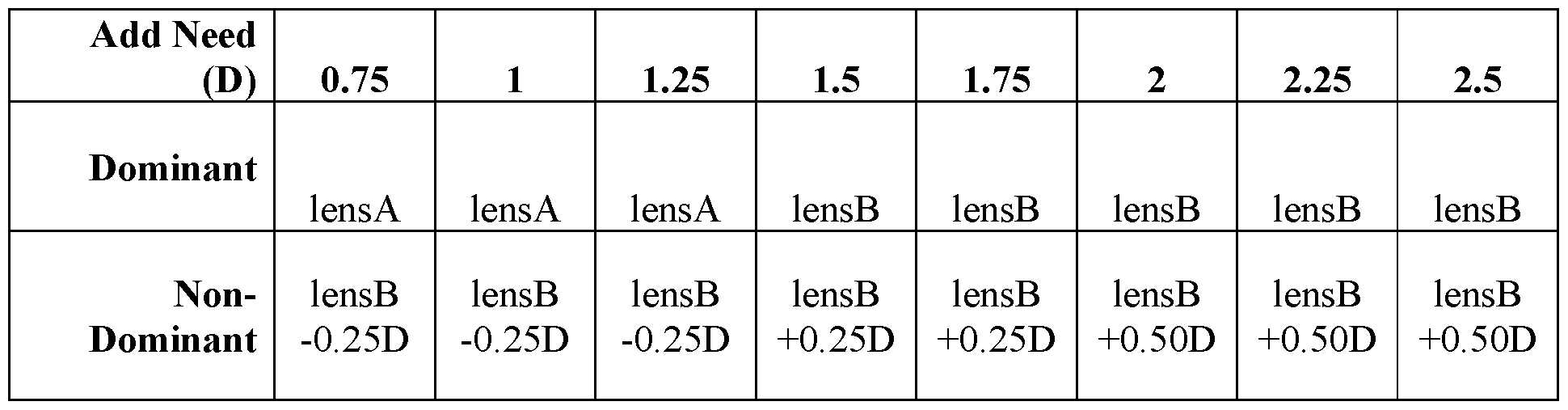
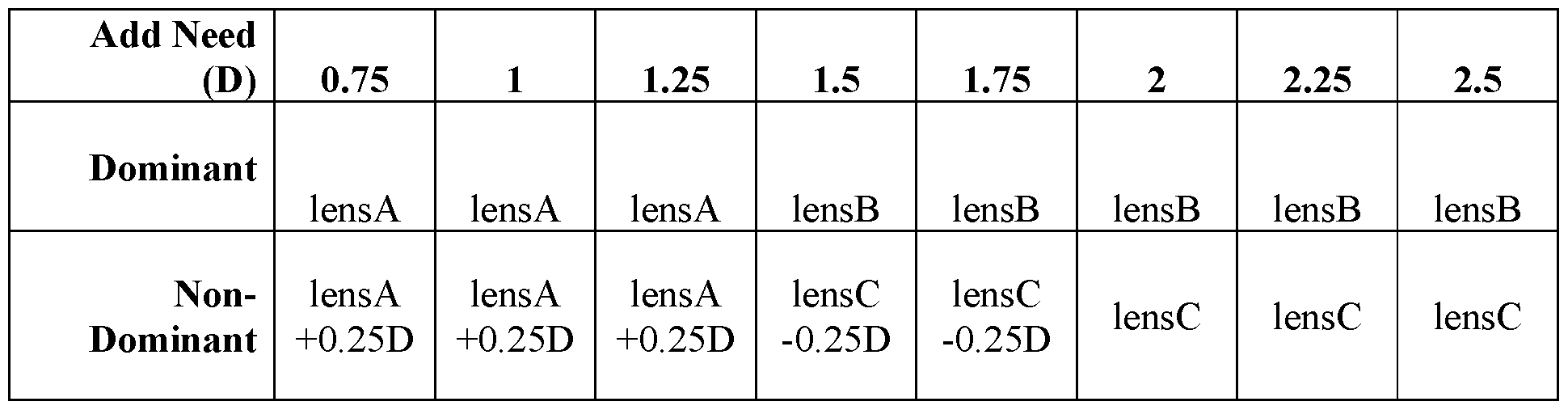
    • G02OPTICS
    • G02CSPECTACLES; SUNGLASSES OR GOGGLES INSOFAR AS THEY HAVE THE SAME FEATURES AS SPECTACLES; CONTACT LENSES
    • G02C7/00Optical parts
    • G02C7/02Lenses; Lens systems ; Methods of designing lenses
    • G02C7/024Methods of designing ophthalmic lenses
    • G02C7/027Methods of designing ophthalmic lenses considering wearer's parameters
    • GPHYSICS
    • G02OPTICS
    • G02CSPECTACLES; SUNGLASSES OR GOGGLES INSOFAR AS THEY HAVE THE SAME FEATURES AS SPECTACLES; CONTACT LENSES
    • G02C7/00Optical parts
    • G02C7/02Lenses; Lens systems ; Methods of designing lenses
    • G02C7/04Contact lenses for the eyes
    • GPHYSICS
    • G02OPTICS
    • G02CSPECTACLES; SUNGLASSES OR GOGGLES INSOFAR AS THEY HAVE THE SAME FEATURES AS SPECTACLES; CONTACT LENSES
    • G02C7/00Optical parts
    • G02C7/02Lenses; Lens systems ; Methods of designing lenses
    • G02C7/04Contact lenses for the eyes
    • G02C7/041Contact lenses for the eyes bifocal; multifocal
    • GPHYSICS
    • G02OPTICS
    • G02CSPECTACLES; SUNGLASSES OR GOGGLES INSOFAR AS THEY HAVE THE SAME FEATURES AS SPECTACLES; CONTACT LENSES
    • G02C7/00Optical parts
    • G02C7/02Lenses; Lens systems ; Methods of designing lenses
    • G02C7/04Contact lenses for the eyes
    • G02C7/041Contact lenses for the eyes bifocal; multifocal
    • G02C7/042Simultaneous type
    • GPHYSICS
    • G02OPTICS
    • G02CSPECTACLES; SUNGLASSES OR GOGGLES INSOFAR AS THEY HAVE THE SAME FEATURES AS SPECTACLES; CONTACT LENSES
    • G02C7/00Optical parts
    • G02C7/02Lenses; Lens systems ; Methods of designing lenses
    • G02C7/04Contact lenses for the eyes
    • G02C7/041Contact lenses for the eyes bifocal; multifocal
    • G02C7/044Annular configuration, e.g. pupil tuned
    • GPHYSICS
    • G02OPTICS
    • G02CSPECTACLES; SUNGLASSES OR GOGGLES INSOFAR AS THEY HAVE THE SAME FEATURES AS SPECTACLES; CONTACT LENSES
    • G02C7/00Optical parts
    • G02C7/02Lenses; Lens systems ; Methods of designing lenses
    • G02C7/04Contact lenses for the eyes
    • G02C7/047Contact lens fitting; Contact lenses for orthokeratology; Contact lenses for specially shaped corneae
    • GPHYSICS
    • G02OPTICS
    • G02CSPECTACLES; SUNGLASSES OR GOGGLES INSOFAR AS THEY HAVE THE SAME FEATURES AS SPECTACLES; CONTACT LENSES
    • G02C7/00Optical parts
    • G02C7/02Lenses; Lens systems ; Methods of designing lenses
    • G02C7/06Lenses; Lens systems ; Methods of designing lenses bifocal; multifocal ; progressive
    • GPHYSICS
    • G02OPTICS
    • G02CSPECTACLES; SUNGLASSES OR GOGGLES INSOFAR AS THEY HAVE THE SAME FEATURES AS SPECTACLES; CONTACT LENSES
    • G02C2202/00Generic optical aspects applicable to one or more of the subgroups of G02C7/00
    • G02C2202/08Series of lenses, lens blanks

Definitions

  • multifocal or extended depth of focus (EDOF) lenses significantly mitigate the effects of presbyopia, but they require performance trade-offs.
  • peak distance vision is sacrificed to deliver improved near visual performance.
  • Multifocal (MF) Multifocal
  • the present lenses, lens system, and methods provide a superior trade-off regarding overall visual performance across a range of accommodative demands over MF. This may be achieved by leveraging the capacity of the visual system to tolerate interocular refractive disparity (i.e. anisometropia) to further increase the cyclopean depth of focus (DOF). Alternatively, or in addition, differing from MF, this design employs more add power, more variation in design across stock keeping units (SKUs), where each SKU distinguishes a different prescription (Rx), and a visual performance manifold optimized fit/refit prescription (e.g., fitting guide).
  • SKUs stock keeping units
  • Rx prescription
  • a visual performance manifold optimized fit/refit prescription e.g., fitting guide
  • An example method may comprise a step of determining a plurality of lens types for inclusion in a system of contact lenses for treating presbyopes.
  • the lens system may comprise at least three lens types (lens A, a lens B, and a lens C designation).
  • the lens types may vary by effective add or DOF, or both.
  • Each of the plurality of lenses may be configured for an optical correction and may have a power profile associated therewith.
  • the plurality of lenses may be grouped based on the optical correction.
  • Each of the lenses of a particular type may have a different power profile.
  • the optical correction normalized power profile across a range of optical corrections for each of the lens designations may be varied to improve performance considering: [1] Rx, age and accommodation dependence of ocular spherical aberration, and/or [2] Rx, age and luminance dependence of entrance pupil diameter.
  • Other combinations of performance factors may be used and may include single, discrete factors.
  • the example method may comprise a step of creating, based at least on the plurality of lenses and an add need, a fit guide indicating which of the plurality of lenses to be worn on the dominant eye and non-dominant eye.
  • the fit guide may provide an interocular disparity of effective add.
  • An example method may comprise a step of determining a plurality of lenses for inclusion in a system of contact lenses for treating presbyopes.
  • Each of the plurality of lenses may be configured for an optical correction and may have a power profile associated therewith.
  • the plurality of lenses may be grouped based on the optical correction.
  • Each of the lenses in a particular group may have a different power profile.
  • the example method may comprise a step of creating, based at least on the plurality of lenses and an add need, a fit guide indicating which of the plurality of lenses to be worn on a dominant eye and a non-dominant eye.
  • the fit guide may provide an interocular disparity of effective add.
  • An example system may comprise a plurality of lens types for treating presbyopes.
  • the lens system may comprise at least three lens types (lens A, a lens B, and a lens C designation).
  • Each of the plurality of lenses may be configured for an optical correction and may have a power profile associated therewith.
  • the plurality of lenses may be grouped based on the optical correction.
  • Each of the lenses of a particular type may have a different power profile.
  • the optical correction normalized power profile across a range of optical corrections for each of the lens designations may be varied to improve performance considering [1] prescription (Rx), age and accommodation dependence of ocular spherical aberration, [2] Rx, age and luminance dependence of entrance pupil diameter.
  • the example system may comprise a fit guide indicating which of the plurality of lenses to be worn on a dominant eye and a non-dominant eye.
  • the fit guide provides an interocular disparity of effective add.
  • An example method may comprise a step of determining (e.g., selecting) a fit (e.g., profile) associated with at least one user exhibiting presbyopia.
  • the example method may comprise a step of selecting (e.g., simulating), based on the fit, one or more visual performance manifolds.
  • Each of the visual performance manifolds may be generated based on lens designs, an eye model, and environmental conditions.
  • the example method may comprise a step of selecting, based on one or more visual performance manifolds, a plurality of lenses for inclusion in a system of contact lenses for treating presbyopia or for alterations in lens fit given subjective feedback.
  • Each of the plurality of lenses may be configured for an optical correction and may have a power profile associated therewith.
  • the plurality of lenses may be grouped based on the optical correction.
  • Each of the lenses in a particular group may have a different power profile.
  • the example method may comprise a step of creating, based at least on the plurality of lenses and an add need, a fit guide indicating which of the plurality of lenses to be worn on a dominant eye and a non-dominant eye.
  • the fit guide may provide an interocular disparity of effective add.
  • the plurality of lenses may be grouped based on the optical correction such that a lens group is associated with a specific optical correction level or designation such as between -20D and +20D.
  • a lens system may comprise a plurality of lenses grouped based on an optical correction of -6D.
  • a fit guide may be used to select which of the lenses in the group/system should be worn on which eye of the user for preferred performance.
  • Each lens group may comprise at least three center near continuous multifocal lenses.
  • Each group of lenses may comprise three lenses.
  • Each group of lenses may comprise four lenses.
  • Each group of lenses may comprise five lenses.
  • FIG. 1 shows example power profiles of a comparative three lens system.
  • FIG. 2 shows example graphs of visual performance of a comparative lens system for various prescriptions (Rx) and an Add of 0.75D.
  • FIG. 3 shows example graphs of visual performance of a comparative lens system for various prescriptions (Rx) and an Add of 1.00D.
  • FIG. 4 shows example graphs of visual performance of a comparative lens system for various prescriptions (Rx) and an Add of 1.25D.
  • FIG. 5 shows example graphs of visual performance of a comparative lens system for various prescriptions (Rx) and an Add of 1.50D.
  • FIG. 6 shows example graphs of visual performance of a comparative lens system for various prescriptions (Rx) and an Add of 1.75D.
  • FIG. 7 shows example graphs of visual performance of a comparative lens system for various prescriptions (Rx) and an Add of 2.00D.
  • FIG. 8 shows example graphs of visual performance of a comparative lens system for various prescriptions (Rx) and an Add of 2.25D.
  • FIG. 9 shows example graphs of visual performance of a comparative lens system for various prescriptions (Rx) and an Add of 2.50D.
  • FIG. 10 shows example power profiles and fit guides for a lens system in accordance with the present disclosure.
  • FIG. 11 shows example graphs of visual performance of a lens system in accordance with the present disclosure for various prescriptions (Rx) and an Add of 0.75D.
  • FIG. 12 shows example graphs of visual performance of a lens system in accordance with the present disclosure for various prescriptions (Rx) and an Add of 1.00D.
  • FIG. 13 shows example graphs of visual performance of a lens system in accordance with the present disclosure for various prescriptions (Rx) and an Add of 1.25D.
  • FIG. 14 shows example graphs of visual performance of a lens system in accordance with the present disclosure for various prescriptions (Rx) and an Add of 1.50D.
  • FIG. 15 shows example graphs of visual performance of a lens system in accordance with the present disclosure for various prescriptions (Rx) and an Add of 1.75D.
  • FIG. 16 shows example graphs of visual performance of a lens system in accordance with the present disclosure for various prescriptions (Rx) and an Add of 2.0D.
  • FIG. 17 shows example graphs of visual performance of a lens system in accordance with the present disclosure for various prescriptions (Rx) and an Add of 2.25D.
  • FIG. 18 shows example graphs of visual performance of a lens system in accordance with the present disclosure for various prescriptions (Rx) and an Add of 2.5D.
  • Figure 19 shows a plot of visual performance as a function of vergence (viewing distance) to illustrate depth of focus (DOF) and effective add (E. Add).
  • the dashed line is a reference representing zero difference, below the line indicates a greater effective add for prior art lenses such as shown in Figure 1 and above the line indicates a greater effective add for lenses in accordance to the present disclosure such as shown in Figure 10.
  • the dashed line is a reference representing zero difference, below the line indicates a greater effective add for comparative lenses such as shown in Figure 1 and above the line indicates a greater effective add for lenses in accordance to the present disclosure such as shown in Figure 10.
  • the dashed line is a reference representing zero difference, below the line indicates a greater DOF for prior art lenses such as shown in Figure 1 and above the line indicates a greater effective add for lenses in accordance to the present disclosure such as shown in Figure 10.
  • the dashed line is a reference representing zero difference, below the line indicates a greater DOF for prior art lenses such as shown in Figure 1 and above the line indicates a greater effective add for lenses in accordance to the present disclosure such as shown in Figure 10.
  • the dashed line is a reference representing zero difference, below the line indicates a greater effective add for prior art lenses such as shown in Figure 1 and above the line indicates a greater effective add for lenses in accordance to the present disclosure such as shown in Figure 10.
  • the dashed line is a reference representing zero difference, below the line indicates a greater effective add for prior art lenses such as shown in Figure 1 and above the line indicates a greater effective add for lenses in accordance to the present disclosure such as shown in Figure 10.
  • the dashed line is a reference representing zero difference, below the line indicates a greater DOF prior art lenses such as shown in Figure 1 and above the line indicates a greater effective add for lenses in accordance to the present disclosure such as shown in Figure 10.
  • the dashed line is a reference representing zero difference, below the line indicates a greater DOF for prior art lenses such as shown in Figure 1 and above the line indicates a greater effective add for lenses in accordance to the present disclosure such as shown in Figure 10.
  • the dashed line is a reference representing zero difference, below the line indicates a greater effective add for prior art lenses such as shown in Figure 1 and above the line indicates a greater effective add for lenses in accordance to the present disclosure such as shown in Figure 10.
  • the dashed line is a reference representing zero difference, below the line indicates a greater effective add for prior art lenses such as shown in Figure 1 and above the line indicates a greater effective add for lenses in accordance to the present disclosure such as shown in Figure 10.
  • the dashed line is a reference representing zero difference, below the line indicates a greater DOF for prior art lenses such as shown in Figure 1 and above the line indicates a greater effective add for lenses in accordance to the present disclosure such as shown in Figure 10.
  • the dashed line is a reference representing zero difference, below the line indicates a greater DOF for prior art lenses such as shown in Figure 1 and above the line indicates a greater effective add for lenses in accordance to the present disclosure such as shown in Figure 10.
  • An example method may comprise a step of determining a fit associated with at least one user exhibiting presbyopia. Determining a fit may comprise optimizing a treatment plan for the particular user. Optimizing may comprise using one or more visual performance manifolds, as shown and described herein.
  • An example system may comprise a plurality of lens types for treating presbyopes.
  • the lens system may comprise at least three lens types (lens A, a lens B, and a lens C designation).
  • the lens types may vary by one or more of effective add or DOF.
  • Each of the plurality of lenses may be configured for an optical correction and may have a power profile associated therewith.
  • the plurality of lenses may be grouped based on the optical correction.
  • Each of the lenses of a particular type may have a different power profile.
  • the optical correction normalized power profile across a range of optical corrections for each of the lens designations may be varied to improve performance considering [1] prescription (Rx), age and accommodation dependence of ocular spherical aberration, [2] Rx, age and luminance dependence of entrance pupil diameter.
  • the example method may comprise selecting a fit associated with at least one user exhibiting presbyopia.
  • the method may comprise simulating, based on the fit profile, one or more visual performance manifolds, wherein each of the visual performance manifolds is generated based on lens designs, an eye model, and environmental conditions.
  • the method may comprise selecting, based on the selected one or more visual performance manifolds, a plurality of lenses for inclusion in a system of contact lenses for treating presbyopia, or for alterations in lens fit given the visual performance achieved, wherein each of the plurality of lenses is configured for an optical correction and has a power profile associated therewith, wherein the plurality of lenses are grouped based on the optical correction and wherein each of the lenses in a particular group has a different power profile.
  • the method may comprise creating, based at least on the plurality of lenses and an add need, a fit guide indicating which of the plurality of lenses to be worn on a dominant eye and a non-dominant eye, wherein the fit guide provides an interocular disparity of effective add.
  • An example method may comprise a step of determining a plurality of lens types for inclusion in a system of contact lenses for treating presbyopes.
  • the lens system may comprise at least three lens types (lens A, a lens B, and a lens C designation). Although other groupings and numbers of lens types may be used.
  • Each of the plurality of lenses may be configured for an optical correction and may have a power profile associated therewith.
  • the plurality of lenses may be grouped based on the optical correction.
  • Each lens group may comprise at least three center-near continuous multifocal lenses.
  • Each group of lenses may comprise three lenses.
  • Each group of lenses may comprise four lenses.
  • Each group of lenses may comprise five lenses.
  • Each of the lenses of a particular type may have a different power profile.
  • the optical correction normalized power profile across a range of optical corrections for each of the lens designations may be varied to improve performance considering prescription (Rx) and accommodation dependence of ocular spherical aberration and Rx, age and luminance dependence of entrance pupil diameter.
  • Rx prescription
  • Rx accommodation dependence of ocular spherical aberration and Rx
  • a variation of the normalized power profile across SKU e.g., optical correction levels
  • the disclosed lens systems and methods permit a superior trade-off regarding overall through focus visual performance over conventional lenses and lens systems.
  • such performance improvement may be achieved by leveraging the capacity of the visual system to tolerate interocular refractive disparity to further increase the cyclopean depth of focus (DOF).
  • the disclosed lens designs employ more add power, more variation in design across SKU, and a visual performance manifold optimized fit/refit prescription, as compared to conventional lenses or lens systems.
  • a fit guide may be created and/or used.
  • the fit guide may be created based at least on the plurality of lenses and an add need.
  • the fit guide may be customized for a user or users.
  • Various fit guides may be created and compared for optimal performance for a user or users.
  • a fit guide may indicate which of the plurality of lenses to be worn on a dominant eye and a non-dominant eye.
  • An example fit guide may comprise one or more of the following example fit guides. Although designations for a particular fit guide application is shown, this is for illustration and should not necessarily be limited, as such.
  • the fit guide or guides may provide an interocular disparity of effective add.
  • Figure 19 shows a plot of visual performance as a function of vergence (viewing distance).
  • the effective add may be defined as the shift between 0 vergence (distance vision) and the vergence of peak performance.
  • the interocular disparity of effective add is the difference in effective add between the dominant and non-dominant eyes.
  • DOF is a 3 -line drop from peak performance.
  • the plot in Figure 19 may be illustrative in describing each lens and the resulting disparity. Such disparity in the present disclosure may be different from 0, which is the disparity of the fit guide for the conventional lenses such as MF in low and mid add needs.
  • Other fit guides may be used. Optimization may be based on the use of additional fit guides for distance and/or near adjustments and based on patient reported performance. Although various techniques may be used, fit optimization may be conducted by the doctor with feedback from the patient.
  • the alternative fit guide(s) may be determined using visual performance manifolds to obtain the alternatives that provide the best visual performance in the event of certain complaints from the patient.
  • Figures 28-39 illustrate comparison of the effective add and DOF between the conventional lenses/lens systems (MF) and a lens system in accordance with the present disclosure.
  • fit guides may be based on one or more visual performance manifolds.
  • a fit guide may be customized for a user or group of users based on comparative testing or optimizing visual performance manifolds for the user or users.
  • lens design optimization procedure may be based on visual performance.
  • a metric of monocular visual performance is given by:
  • NCSF is the neural contrast sensitivity function for a given pupil size and luminance and v is spatial frequency.
  • Binocular visual performance is obtained using a vectorial model: where the subscripts dom and non refer to the dominant and nondominant eye, respectively, and a is a constant.
  • luminance 2cd/m 2
  • MF uses more effective add in the dominant eye
  • DOF uses more DOF for the mid and high adds.
  • MF uses more effective add in the non-dominant eye for the low add
  • the example lens system of the present disclosure uses more effective add in the mid and high add.
  • the example lens system of the present disclosure uses more DOF in the low and mid add, and MF uses more DOF in high add myopes while the example lens system of the present disclosure uses more DOF in high add hyperopes.
  • Figure 28 illustrates a comparison of the effective add for various Add powers for a dominant eye in dim light conditions between the conventional lenses/lens systems (MF) and a lens system in accordance with the present disclosure.
  • Figure 30 illustrates a comparison of the DOF for various Add powers for a dominant eye in dim light conditions between the conventional lenses/lens systems (MF) and a lens system in accordance with the present disclosure.
  • MF uses more effective add in the dominant eye
  • the example lens system of the present disclosure uses more DOF for the mid and high adds.
  • Figure 29 illustrates a comparison of the effective add for various Add powers for a non-dominant eye in dim light conditions between the conventional lenses/lens systems (MF) and a lens system in accordance with the present disclosure.
  • Figure 31 illustrates a comparison of the DOF for various Add powers for a non-dominant eye in dim light conditions between the conventional lenses/lens systems (MF) and a lens system in accordance with the present disclosure.
  • the example lens system of the present disclosure uses more effective add in the non-dominant eye for the mid and high adds.
  • the example lens system of the present disclosure uses more DOF in the low and mid add, and MF uses more DOF in high add myopes while the example lens system of the present disclosure uses more DOF in high add hyperopes.
  • Figure 32 illustrates a comparison of the effective add for various Add powers for a dominant eye in moderate light conditions between the conventional lenses/lens systems (MF) and a lens system in accordance with the present disclosure.
  • Figure 34 illustrates a comparison of the DOF for various Add powers for a dominant eye in moderate light conditions between the conventional lenses/lens systems (MF) and a lens system in accordance with the present disclosure. In moderate light conditions, MF uses more effective add in the dominant eye.
  • Figure 33 illustrates a comparison of the effective add for various Add powers for a non-dominant eye in moderate light conditions between the conventional lenses/lens systems (MF) and a lens system in accordance with the present disclosure.
  • Figure 35 illustrates a comparison of the DOF for various Add powers for a non-dominant eye in moderate light conditions between the conventional lenses/lens systems (MF) and a lens system in accordance with the present disclosure.
  • the example lens system of the present disclosure uses more effective add in the non-dominant eye and more DOF in the low and mid add.
  • Figure 36 illustrates a comparison of the effective add for various Add powers for a dominant eye in bright light conditions between the conventional lenses/lens systems (MF) and a lens system in accordance with the present disclosure.
  • Figure 38 illustrates a comparison of the DOF for various Add powers for a dominant eye in bright light conditions between the conventional lenses/lens systems (MF) and a lens system in accordance with the present disclosure. In bright light conditions, MF uses more effective add in the dominant eye.
  • Figure 37 illustrates a comparison of the effective add for various Add powers for a non-dominant eye in bright light conditions between the conventional lenses/lens systems (MF) and a lens system in accordance with the present disclosure.
  • Figure 39 illustrates a comparison of the DOF for various Add powers for a non-dominant eye in bright light conditions between the conventional lenses/lens systems (MF) and a lens system in accordance with the present disclosure.
  • the example lens system of the present disclosure uses more effective add in the non-dominant eye in the low and mid add.
  • simulations indicate that the example lens system of the present disclosure provides comparable or superior distance and near performance and sacrifices a bit of intermediate performance in low light when compared to MF.
  • the example lens system of the present disclosure uses more effective add and provides more DOF in the non-dominant eye, while MF uses more effective add and the example lens system of the present disclosure provides more DOF in the dominant eye.
  • MF uses more effective add and the example lens system of the present disclosure provides more DOF in the dominant eye.
  • cyclopean DOF with both designs are equivalent.
  • the increased DOF of the example lens system of the present disclosure may be significant in low light conditions, the predominant difference between the two systems (from dim to bright light) is due to differences in the effective add. Therefore, the example lens system of the present disclosure improves through-focus cyclopean visual performance by optimally leveraging the visual system’s tolerance of interocular disparity of effective add.
  • the power profiles of each lens in the lens system were plotted for refractive errors of -9, -6, -3, 2, 4 and 6D, and the visual performance manifold is presented.
  • the fit guide is presented in tabular form for each design.
  • the fit guide includes information about the lens design and the fit for both the dominant and non dominant eyes.
  • the fit is the difference between the power label of the fitted lens and the subject’s refraction.
  • Visual performance is gray-level coded in units of -lOlogMAR from -2 to 0.5. Values above 0.5 saturate and remain dark gray while values below -2 saturate and are displayed as white.
  • Figure 10 Power profile of the 3 lens designs of an example lens system of the present disclosure.
  • Figure 11 Visual performance manifold of an example lens system of the present disclosure for an add need of 0.75D.
  • Figure 12 Visual performance manifold of an example lens system of the present disclosure for an add need of ID.
  • Figure 13 Visual performance manifold of an example lens system of the present disclosure for an add need of 1.25D.
  • Figure 14 Visual performance manifold of an example lens system of the present disclosure for an add need of 1.5D.
  • Figure 15 Visual performance manifold of an example lens system of the present disclosure for an add need of 1.75D.
  • Figure 16 Visual performance manifold of an example lens system of the present disclosure for an add need of 2D.
  • Figure 17 Visual performance manifold of an example lens system of the present disclosure for an add need of 2.25D.
  • Figure 18 Visual performance manifold of an example lens system of the present disclosure for an add need of 2.5D.

Landscapes

  • Physics & Mathematics (AREA)
  • Health & Medical Sciences (AREA)
  • Ophthalmology & Optometry (AREA)
  • General Health & Medical Sciences (AREA)
  • General Physics & Mathematics (AREA)
  • Optics & Photonics (AREA)
  • Mathematical Physics (AREA)
  • Eyeglasses (AREA)
  • Eye Examination Apparatus (AREA)
  • Prostheses (AREA)

Abstract

Described herein are systems and/or methods for designing a system of contact lenses with interocular refractive disparity (i.e. anisometropia) for presbyopes. An example method may comprise a step of determining a plurality of lenses for inclusion in a system of contact lenses for treating presbyopes. Each of the plurality of lenses may be configured for an optical correction and may have a power profile associated therewith. The plurality of lenses may be grouped based on the optical correction. Each of the lenses in a particular group may have a different power profile. The example method may comprise a step of creating, based at least on the plurality of lenses and an add need, a fit guide. The fit guide may provide an interocular disparity of effective add. The interocular disparity of effective add may be determined by optimizing cyclopean performance across a range accommodative demands and light levels.

Description

MULTI-LENS SYSTEM FOR PRESBYOPIA
BACKGROUND
[0001] In general, multifocal or extended depth of focus (EDOF) lenses significantly mitigate the effects of presbyopia, but they require performance trade-offs. Typically, peak distance vision is sacrificed to deliver improved near visual performance. Despite the outstanding visual performance of some of the market leading multifocal simultaneous vision lens systems (Multifocal (MF)), simulations suggest that there is opportunity to improve performance across a range of accommodative demands, particularly at the near.
SUMMARY
[0002] The present lenses, lens system, and methods provide a superior trade-off regarding overall visual performance across a range of accommodative demands over MF. This may be achieved by leveraging the capacity of the visual system to tolerate interocular refractive disparity (i.e. anisometropia) to further increase the cyclopean depth of focus (DOF). Alternatively, or in addition, differing from MF, this design employs more add power, more variation in design across stock keeping units (SKUs), where each SKU distinguishes a different prescription (Rx), and a visual performance manifold optimized fit/refit prescription (e.g., fitting guide).
[0003] Described herein are systems and/or methods for designing a system of contact lenses with anisometropia for presbyopes. An example method may comprise a step of determining a plurality of lens types for inclusion in a system of contact lenses for treating presbyopes. The lens system may comprise at least three lens types (lens A, a lens B, and a lens C designation). The lens types may vary by effective add or DOF, or both. Each of the plurality of lenses may be configured for an optical correction and may have a power profile associated therewith. The plurality of lenses may be grouped based on the optical correction. Each of the lenses of a particular type may have a different power profile. The optical correction normalized power profile across a range of optical corrections for each of the lens designations may be varied to improve performance considering: [1] Rx, age and accommodation dependence of ocular spherical aberration, and/or [2] Rx, age and luminance dependence of entrance pupil diameter. Other combinations of performance factors may be used and may include single, discrete factors. The example method may comprise a step of creating, based at least on the plurality of lenses and an add need, a fit guide indicating which of the plurality of lenses to be worn on the dominant eye and non-dominant eye. The fit guide may provide an interocular disparity of effective add.
[0004] Described herein are systems and/or methods for designing a system of contact lenses with anisometropia for presbyopes. An example method may comprise a step of determining a plurality of lenses for inclusion in a system of contact lenses for treating presbyopes. Each of the plurality of lenses may be configured for an optical correction and may have a power profile associated therewith. The plurality of lenses may be grouped based on the optical correction. Each of the lenses in a particular group may have a different power profile. The example method may comprise a step of creating, based at least on the plurality of lenses and an add need, a fit guide indicating which of the plurality of lenses to be worn on a dominant eye and a non-dominant eye. The fit guide may provide an interocular disparity of effective add.
[0005] Disclosed herein are methods and/or systems of contact lenses with anisometropia for presbyopes. An example system may comprise a plurality of lens types for treating presbyopes. The lens system may comprise at least three lens types (lens A, a lens B, and a lens C designation). Each of the plurality of lenses may be configured for an optical correction and may have a power profile associated therewith. The plurality of lenses may be grouped based on the optical correction. Each of the lenses of a particular type may have a different power profile. The optical correction normalized power profile across a range of optical corrections for each of the lens designations may be varied to improve performance considering [1] prescription (Rx), age and accommodation dependence of ocular spherical aberration, [2] Rx, age and luminance dependence of entrance pupil diameter. The example system may comprise a fit guide indicating which of the plurality of lenses to be worn on a dominant eye and a non-dominant eye. The fit guide provides an interocular disparity of effective add.
[0006] Described herein are systems and/or methods for customizing a system of contact lenses with anisometropia for presbyopes. An example method may comprise a step of determining (e.g., selecting) a fit (e.g., profile) associated with at least one user exhibiting presbyopia. The example method may comprise a step of selecting (e.g., simulating), based on the fit, one or more visual performance manifolds. Each of the visual performance manifolds may be generated based on lens designs, an eye model, and environmental conditions. The example method may comprise a step of selecting, based on one or more visual performance manifolds, a plurality of lenses for inclusion in a system of contact lenses for treating presbyopia or for alterations in lens fit given subjective feedback. Each of the plurality of lenses may be configured for an optical correction and may have a power profile associated therewith. The plurality of lenses may be grouped based on the optical correction. Each of the lenses in a particular group may have a different power profile. The example method may comprise a step of creating, based at least on the plurality of lenses and an add need, a fit guide indicating which of the plurality of lenses to be worn on a dominant eye and a non-dominant eye. The fit guide may provide an interocular disparity of effective add.
[0007] The plurality of lenses may be grouped based on the optical correction such that a lens group is associated with a specific optical correction level or designation such as between -20D and +20D. For example, a lens system may comprise a plurality of lenses grouped based on an optical correction of -6D. However, there may be an add need of the user, and a fit guide may be used to select which of the lenses in the group/system should be worn on which eye of the user for preferred performance. Each lens group may comprise at least three center near continuous multifocal lenses. Each group of lenses may comprise three lenses. Each group of lenses may comprise four lenses. Each group of lenses may comprise five lenses.
BRIEF DESCRIPTION OF THE DRAWINGS
[0008] The following drawings show generally, by way of example, but not by way of limitation, various examples discussed in the present disclosure. In the drawings:
[0009] FIG. 1 shows example power profiles of a comparative three lens system.
[0010] FIG. 2 shows example graphs of visual performance of a comparative lens system for various prescriptions (Rx) and an Add of 0.75D.
[0011] FIG. 3 shows example graphs of visual performance of a comparative lens system for various prescriptions (Rx) and an Add of 1.00D. [0012] FIG. 4 shows example graphs of visual performance of a comparative lens system for various prescriptions (Rx) and an Add of 1.25D.
[0013] FIG. 5 shows example graphs of visual performance of a comparative lens system for various prescriptions (Rx) and an Add of 1.50D.
[0014] FIG. 6 shows example graphs of visual performance of a comparative lens system for various prescriptions (Rx) and an Add of 1.75D.
[0015] FIG. 7 shows example graphs of visual performance of a comparative lens system for various prescriptions (Rx) and an Add of 2.00D.
[0016] FIG. 8 shows example graphs of visual performance of a comparative lens system for various prescriptions (Rx) and an Add of 2.25D.
[0017] FIG. 9 shows example graphs of visual performance of a comparative lens system for various prescriptions (Rx) and an Add of 2.50D.
[0018] FIG. 10 shows example power profiles and fit guides for a lens system in accordance with the present disclosure.
[0019] FIG. 11 shows example graphs of visual performance of a lens system in accordance with the present disclosure for various prescriptions (Rx) and an Add of 0.75D.
[0020] FIG. 12 shows example graphs of visual performance of a lens system in accordance with the present disclosure for various prescriptions (Rx) and an Add of 1.00D.
[0021] FIG. 13 shows example graphs of visual performance of a lens system in accordance with the present disclosure for various prescriptions (Rx) and an Add of 1.25D.
[0022] FIG. 14 shows example graphs of visual performance of a lens system in accordance with the present disclosure for various prescriptions (Rx) and an Add of 1.50D.
[0023] FIG. 15 shows example graphs of visual performance of a lens system in accordance with the present disclosure for various prescriptions (Rx) and an Add of 1.75D.
[0024] FIG. 16 shows example graphs of visual performance of a lens system in accordance with the present disclosure for various prescriptions (Rx) and an Add of 2.0D.
[0025] FIG. 17 shows example graphs of visual performance of a lens system in accordance with the present disclosure for various prescriptions (Rx) and an Add of 2.25D.
[0026] FIG. 18 shows example graphs of visual performance of a lens system in accordance with the present disclosure for various prescriptions (Rx) and an Add of 2.5D. [0027] Figure 19 shows a plot of visual performance as a function of vergence (viewing distance) to illustrate depth of focus (DOF) and effective add (E. Add).
[0028] Figure 20 illustrates plots of location of peak (LoP) visual acuity of the comparative lens system of Figure 1 for a dominant eye in low luminance (luminance = 2cd/m2) across various Add powers.
[0029] Figure 21 illustrates plots of location of peak visual acuity of the comparative lens system of Figure 1 for a non-dominant eye in low luminance (luminance = 2cd/m2) across various Add powers.
[0030] Figure 22 illustrates plots of depth of focus of the comparative lens system of Figure 1 for a dominant eye in low luminance (luminance = 2cd/m2) across various Add powers.
[0031] Figure 23 illustrates plots of depth of focus of the comparative lens system of Figure 1 for a non-dominant eye in low luminance (luminance = 2cd/m2) across various Add powers.
[0032] Figure 24 illustrates plots of location of peak visual acuity of a lens system in accordance with the present disclosure and an example of which is shown in Figure 10 for a dominant eye in low luminance (luminance = 2cd/m2) across various Add powers.
[0033] Figure 25 illustrates plots of location of peak visual acuity of a lens system in accordance with the present disclosure and an example of which is shown in Figure 10 for a non-dominant eye in low luminance (luminance = 2cd/m2) across various Add powers.
[0034] Figure 26 illustrates plots of depth of focus of a lens system in accordance with the present disclosure and an example of which is shown in Figure 10 for a dominant eye in low luminance (luminance = 2cd/m2) across various Add powers.
[0035] Figure 27 illustrates plots of depth of focus of a lens system in accordance with the present disclosure and an example of which is shown in Figure 10 for a non dominant eye in low luminance (luminance = 2cd/m2) across various Add powers.
[0036] Figure 28 illustrates comparative plots of a difference in location of peak visual acuity between the comparative lens system of Figure 1 and the lens system in accordance with the present disclosure, an example of which is shown in Figure 10, for a dominant eye in low luminance (luminance = 2cd/m2) across various Add powers. The dashed line is a reference representing zero difference, below the line indicates a greater effective add for prior art lenses such as shown in Figure 1 and above the line indicates a greater effective add for lenses in accordance to the present disclosure such as shown in Figure 10.
[0037] Figure 29 illustrates comparative plots of a difference in location of peak visual acuity between the comparative lens system of Figure 1 and the lens system in accordance with the present disclosure, an example of which is shown in Figure 10, for a non-dominant eye in low luminance (luminance = 2cd/m2) across various Add powers. The dashed line is a reference representing zero difference, below the line indicates a greater effective add for comparative lenses such as shown in Figure 1 and above the line indicates a greater effective add for lenses in accordance to the present disclosure such as shown in Figure 10.
[0038] Figure 30 illustrates comparative plots of a difference in depth of focus between the comparative lens system of Figure 1 and the lens system in accordance with the present disclosure, an example of which is shown in Figure 10, for a dominant eye in low luminance (luminance = 2cd/m2) across various Add powers. The dashed line is a reference representing zero difference, below the line indicates a greater DOF for prior art lenses such as shown in Figure 1 and above the line indicates a greater effective add for lenses in accordance to the present disclosure such as shown in Figure 10.
[0039] Figure 31 illustrates comparative plots of a difference in depth of focus between the comparative lens system of Figure 1 and the lens system in accordance with the present disclosure, an example of which is shown in Figure 10, for a non-dominant eye in low luminance (luminance = 2cd/m2) across various Add powers. The dashed line is a reference representing zero difference, below the line indicates a greater DOF for prior art lenses such as shown in Figure 1 and above the line indicates a greater effective add for lenses in accordance to the present disclosure such as shown in Figure 10.
[0040] Figure 32 illustrates comparative plots of a difference in location of peak visual acuity between the comparative lens system of Figure 1 and the lens system in accordance with the present disclosure, an example of which is shown in Figure 10, for a dominant eye in mid luminance (luminance = 20cd/m2) across various Add powers. The dashed line is a reference representing zero difference, below the line indicates a greater effective add for prior art lenses such as shown in Figure 1 and above the line indicates a greater effective add for lenses in accordance to the present disclosure such as shown in Figure 10.
[0041] Figure 33 illustrates comparative plots of a difference in location of peak visual acuity between the comparative lens system of Figure 1 and the lens system in accordance with the present disclosure, an example of which is shown in Figure 10, for a non-dominant eye in mid luminance (luminance = 20cd/m2) across various Add powers. The dashed line is a reference representing zero difference, below the line indicates a greater effective add for prior art lenses such as shown in Figure 1 and above the line indicates a greater effective add for lenses in accordance to the present disclosure such as shown in Figure 10.
[0042] Figure 34 illustrates comparative plots of a difference in depth of focus between the comparative lens system of Figure 1 and the lens system in accordance with the present disclosure, an example of which is shown in Figure 10, for a dominant eye in mid luminance (luminance = 20cd/m2) across various Add powers. The dashed line is a reference representing zero difference, below the line indicates a greater DOF prior art lenses such as shown in Figure 1 and above the line indicates a greater effective add for lenses in accordance to the present disclosure such as shown in Figure 10.
[0043] Figure 35 illustrates comparative plots of a difference in depth of focus between the comparative lens system of Figure 1 and the lens system in accordance with the present disclosure, an example of which is shown in Figure 10, for a non-dominant eye in mid luminance (luminance = 20cd/m2) across various Add powers. The dashed line is a reference representing zero difference, below the line indicates a greater DOF for prior art lenses such as shown in Figure 1 and above the line indicates a greater effective add for lenses in accordance to the present disclosure such as shown in Figure 10.
[0044] Figure 36 illustrates comparative plots of a difference in location of peak visual acuity between the comparative lens system of Figure 1 and the lens system in accordance with the present disclosure, an example of which is shown in Figure 10, for a dominant eye in higher luminance (luminance = 400cd/m2) across various Add powers. The dashed line is a reference representing zero difference, below the line indicates a greater effective add for prior art lenses such as shown in Figure 1 and above the line indicates a greater effective add for lenses in accordance to the present disclosure such as shown in Figure 10.
[0045] Figure 37 illustrates comparative plots of a difference in location of peak visual acuity between the comparative lens system of Figure 1 and the lens system in accordance with the present disclosure, an example of which is shown in Figure 10, for a non-dominant eye in higher luminance (luminance = 400cd/m2) across various Add powers. The dashed line is a reference representing zero difference, below the line indicates a greater effective add for prior art lenses such as shown in Figure 1 and above the line indicates a greater effective add for lenses in accordance to the present disclosure such as shown in Figure 10.
[0046] Figure 38 illustrates comparative plots of a difference in depth of focus between the comparative lens system of Figure 1 and the lens system in accordance with the present disclosure, an example of which is shown in Figure 10, for a dominant eye in higher luminance (luminance = 400cd/m2) across various Add powers. The dashed line is a reference representing zero difference, below the line indicates a greater DOF for prior art lenses such as shown in Figure 1 and above the line indicates a greater effective add for lenses in accordance to the present disclosure such as shown in Figure 10.
[0047] Figure 39 illustrates comparative plots of a difference in depth of focus between the comparative lens system of Figure 1 and the lens system in accordance with the present disclosure, an example of which is shown in Figure 10, for a non-dominant eye in higher luminance (luminance = 400cd/m2) across various Add powers. The dashed line is a reference representing zero difference, below the line indicates a greater DOF for prior art lenses such as shown in Figure 1 and above the line indicates a greater effective add for lenses in accordance to the present disclosure such as shown in Figure 10.
DETAILED DESCRIPTION
[0048] Described herein are systems and/or methods for customizing a system of contact lenses with interocular disparity for presbyopes. An example method may comprise a step of determining a fit associated with at least one user exhibiting presbyopia. Determining a fit may comprise optimizing a treatment plan for the particular user. Optimizing may comprise using one or more visual performance manifolds, as shown and described herein.
[0049] Described herein are systems and/or methods for designing and implementing a system of contact lenses with interocular disparity for presbyopes. An example system may comprise a plurality of lens types for treating presbyopes. The lens system may comprise at least three lens types (lens A, a lens B, and a lens C designation).
The lens types may vary by one or more of effective add or DOF. Each of the plurality of lenses may be configured for an optical correction and may have a power profile associated therewith. The plurality of lenses may be grouped based on the optical correction. Each of the lenses of a particular type may have a different power profile. The optical correction normalized power profile across a range of optical corrections for each of the lens designations may be varied to improve performance considering [1] prescription (Rx), age and accommodation dependence of ocular spherical aberration, [2] Rx, age and luminance dependence of entrance pupil diameter.
[0050] The example method may comprise selecting a fit associated with at least one user exhibiting presbyopia. The method may comprise simulating, based on the fit profile, one or more visual performance manifolds, wherein each of the visual performance manifolds is generated based on lens designs, an eye model, and environmental conditions. The method may comprise selecting, based on the selected one or more visual performance manifolds, a plurality of lenses for inclusion in a system of contact lenses for treating presbyopia, or for alterations in lens fit given the visual performance achieved, wherein each of the plurality of lenses is configured for an optical correction and has a power profile associated therewith, wherein the plurality of lenses are grouped based on the optical correction and wherein each of the lenses in a particular group has a different power profile. The method may comprise creating, based at least on the plurality of lenses and an add need, a fit guide indicating which of the plurality of lenses to be worn on a dominant eye and a non-dominant eye, wherein the fit guide provides an interocular disparity of effective add.
[0051] An example method may comprise a step of determining a plurality of lens types for inclusion in a system of contact lenses for treating presbyopes. The lens system may comprise at least three lens types (lens A, a lens B, and a lens C designation). Although other groupings and numbers of lens types may be used. Each of the plurality of lenses may be configured for an optical correction and may have a power profile associated therewith. The plurality of lenses may be grouped based on the optical correction. Each lens group may comprise at least three center-near continuous multifocal lenses. Each group of lenses may comprise three lenses. Each group of lenses may comprise four lenses. Each group of lenses may comprise five lenses. The power profile may be between -20D and +20D. Determining a plurality of lens groups may comprise determining a visual performance manifold for one or more of the lenses in the plurality of lens groups.
[0052] Each of the lenses of a particular type may have a different power profile. However, the optical correction normalized power profile across a range of optical corrections for each of the lens designations may be varied to improve performance considering prescription (Rx) and accommodation dependence of ocular spherical aberration and Rx, age and luminance dependence of entrance pupil diameter. In other words, a variation of the normalized power profile across SKU (e.g., optical correction levels) may be increased compared to variation in conventional lenses or lens systems. The disclosed lens systems and methods permit a superior trade-off regarding overall through focus visual performance over conventional lenses and lens systems. As an illustrative example, such performance improvement may be achieved by leveraging the capacity of the visual system to tolerate interocular refractive disparity to further increase the cyclopean depth of focus (DOF). Additionally or alternatively, the disclosed lens designs employ more add power, more variation in design across SKU, and a visual performance manifold optimized fit/refit prescription, as compared to conventional lenses or lens systems.
[0053] A fit guide may be created and/or used. The fit guide may be created based at least on the plurality of lenses and an add need. The fit guide may be customized for a user or users. Various fit guides may be created and compared for optimal performance for a user or users. A fit guide may indicate which of the plurality of lenses to be worn on a dominant eye and a non-dominant eye. An example fit guide may comprise one or more of the following example fit guides. Although designations for a particular fit guide application is shown, this is for illustration and should not necessarily be limited, as such.
Initial lens selection:
Figure imgf000012_0001
Figure imgf000013_0001
Lens change if required for distance complaint:
Figure imgf000013_0002
Lens change if required for near complaint:
Figure imgf000013_0003
Lens change if required for second distance complaint:
Figure imgf000013_0004
Figure imgf000014_0002
Lens change if required for second near complaint:
Figure imgf000014_0001
[0054] The fit guide or guides may provide an interocular disparity of effective add. Figure 19 shows a plot of visual performance as a function of vergence (viewing distance). The effective add may be defined as the shift between 0 vergence (distance vision) and the vergence of peak performance. The interocular disparity of effective add is the difference in effective add between the dominant and non-dominant eyes.
[0055] DOF is a 3 -line drop from peak performance. The plot in Figure 19 may be illustrative in describing each lens and the resulting disparity. Such disparity in the present disclosure may be different from 0, which is the disparity of the fit guide for the conventional lenses such as MF in low and mid add needs. Other fit guides may be used. Optimization may be based on the use of additional fit guides for distance and/or near adjustments and based on patient reported performance. Although various techniques may be used, fit optimization may be conducted by the doctor with feedback from the patient. The alternative fit guide(s) may be determined using visual performance manifolds to obtain the alternatives that provide the best visual performance in the event of certain complaints from the patient.
[0056] As a comparison, the following tables show effective add for a conventional MF lens system and a lens system in accordance with the present disclosure.
Effective Add Tables
Figure imgf000014_0003
Figure imgf000015_0001
Figure imgf000015_0002
Figure imgf000015_0003
Figure imgf000016_0002
[0057] Figures 28-39 illustrate comparison of the effective add and DOF between the conventional lenses/lens systems (MF) and a lens system in accordance with the present disclosure.
[0058] As a further example, fit guides may be based on one or more visual performance manifolds. As such, a fit guide may be customized for a user or group of users based on comparative testing or optimizing visual performance manifolds for the user or users.
[0059] As an illustrative example, lens design optimization procedure may be based on visual performance. A metric of monocular visual performance is given by:
Figure imgf000016_0001
, where MTF is the modulation transfer function of the lens + eye combination, NCSF is the neural contrast sensitivity function for a given pupil size and luminance and v is spatial frequency.
[0060] Binocular visual performance is obtained using a vectorial model:
Figure imgf000017_0001
where the subscripts dom and non refer to the dominant and nondominant eye, respectively, and a is a constant.
[0061] Optimization of visual performance is obtained across a range of eye models (spanning the age and add need range typical of a presbyopic population) by minimization:
Figure imgf000017_0002
where '[/ deal is obtained using diffraction limited binocular visual performance.
[0062] Figure 20 illustrates plots of location of peak visual acuity of the comparative lens system of Figure 1 for a dominant eye in low luminance (luminance = 2cd/m2) across various Add powers. Figure 22 illustrates plots of depth of focus of the comparative lens system of Figure 1 for a dominant eye in low luminance (luminance = 2cd/m2) across various Add powers. Figure 24 illustrates plots of location of peak visual acuity of a lens system in accordance with the present disclosure and an example of which is shown in Figure 10 for a dominant eye in low luminance (luminance = 2cd/m2) across various Add powers. Figure 26 illustrates plots of depth of focus of a lens system in accordance with the present disclosure and an example of which is shown in Figure 10 for a dominant eye in low luminance (luminance = 2cd/m2) across various Add powers. In low light conditions, MF uses more effective add in the dominant eye, and the example lens system of the present disclosure uses more DOF for the mid and high adds.
[0063] Figure 21 illustrates plots of location of peak visual acuity of the comparative lens system of Figure 1 for a non-dominant eye in low luminance (luminance = 2cd/m2) across various Add powers. Figure 23 illustrates plots of depth of focus of the comparative lens system of Figure 1 for a non-dominant eye in low luminance (luminance = 2cd/m2) across various Add powers. Figure 25 illustrates plots of location of peak visual acuity of a lens system in accordance with the present disclosure and an example of which is shown in Figure 10 for a non-dominant eye in low luminance (luminance = 2cd/m2) across various Add powers. Figure 27 illustrates plots of depth of focus of a lens system in accordance with the present disclosure and an example of which is shown in Figure 10 for a non-dominant eye in low luminance (luminance = 2cd/m2) across various Add powers. In low light conditions, MF uses more effective add in the non-dominant eye for the low add, and the example lens system of the present disclosure uses more effective add in the mid and high add. The example lens system of the present disclosure uses more DOF in the low and mid add, and MF uses more DOF in high add myopes while the example lens system of the present disclosure uses more DOF in high add hyperopes.
[0064] Figure 28 illustrates a comparison of the effective add for various Add powers for a dominant eye in dim light conditions between the conventional lenses/lens systems (MF) and a lens system in accordance with the present disclosure. Figure 30 illustrates a comparison of the DOF for various Add powers for a dominant eye in dim light conditions between the conventional lenses/lens systems (MF) and a lens system in accordance with the present disclosure. In dim light conditions, MF uses more effective add in the dominant eye, and the example lens system of the present disclosure uses more DOF for the mid and high adds.
[0065] Figure 29 illustrates a comparison of the effective add for various Add powers for a non-dominant eye in dim light conditions between the conventional lenses/lens systems (MF) and a lens system in accordance with the present disclosure. Figure 31 illustrates a comparison of the DOF for various Add powers for a non-dominant eye in dim light conditions between the conventional lenses/lens systems (MF) and a lens system in accordance with the present disclosure. In dim light conditions, the example lens system of the present disclosure uses more effective add in the non-dominant eye for the mid and high adds. The example lens system of the present disclosure uses more DOF in the low and mid add, and MF uses more DOF in high add myopes while the example lens system of the present disclosure uses more DOF in high add hyperopes.
[0066] Figure 32 illustrates a comparison of the effective add for various Add powers for a dominant eye in moderate light conditions between the conventional lenses/lens systems (MF) and a lens system in accordance with the present disclosure. Figure 34 illustrates a comparison of the DOF for various Add powers for a dominant eye in moderate light conditions between the conventional lenses/lens systems (MF) and a lens system in accordance with the present disclosure. In moderate light conditions, MF uses more effective add in the dominant eye.
[0067] Figure 33 illustrates a comparison of the effective add for various Add powers for a non-dominant eye in moderate light conditions between the conventional lenses/lens systems (MF) and a lens system in accordance with the present disclosure. Figure 35 illustrates a comparison of the DOF for various Add powers for a non-dominant eye in moderate light conditions between the conventional lenses/lens systems (MF) and a lens system in accordance with the present disclosure. In moderate light conditions, the example lens system of the present disclosure uses more effective add in the non-dominant eye and more DOF in the low and mid add.
[0068] Figure 36 illustrates a comparison of the effective add for various Add powers for a dominant eye in bright light conditions between the conventional lenses/lens systems (MF) and a lens system in accordance with the present disclosure. Figure 38 illustrates a comparison of the DOF for various Add powers for a dominant eye in bright light conditions between the conventional lenses/lens systems (MF) and a lens system in accordance with the present disclosure. In bright light conditions, MF uses more effective add in the dominant eye.
[0069] Figure 37 illustrates a comparison of the effective add for various Add powers for a non-dominant eye in bright light conditions between the conventional lenses/lens systems (MF) and a lens system in accordance with the present disclosure. Figure 39 illustrates a comparison of the DOF for various Add powers for a non-dominant eye in bright light conditions between the conventional lenses/lens systems (MF) and a lens system in accordance with the present disclosure. In bright light conditions, the example lens system of the present disclosure uses more effective add in the non-dominant eye in the low and mid add.
[0070] As illustrated, simulations indicate that the example lens system of the present disclosure provides comparable or superior distance and near performance and sacrifices a bit of intermediate performance in low light when compared to MF. In general, the example lens system of the present disclosure uses more effective add and provides more DOF in the non-dominant eye, while MF uses more effective add and the example lens system of the present disclosure provides more DOF in the dominant eye. However, in bright conditions where the pupil is small, cyclopean DOF with both designs are equivalent. Although the increased DOF of the example lens system of the present disclosure may be significant in low light conditions, the predominant difference between the two systems (from dim to bright light) is due to differences in the effective add. Therefore, the example lens system of the present disclosure improves through-focus cyclopean visual performance by optimally leveraging the visual system’s tolerance of interocular disparity of effective add.
EXAMPLES
Power Profiles and Visual Performance Manifolds
[0071] For each design simulated, the power profiles of each lens in the lens system were plotted for refractive errors of -9, -6, -3, 2, 4 and 6D, and the visual performance manifold is presented. The fit guide is presented in tabular form for each design. The fit guide includes information about the lens design and the fit for both the dominant and non dominant eyes. The fit is the difference between the power label of the fitted lens and the subject’s refraction. Visual performance is gray-level coded in units of -lOlogMAR from -2 to 0.5. Values above 0.5 saturate and remain dark gray while values below -2 saturate and are displayed as white.
Multifocal (MF)
Figure imgf000020_0001
Example Lens System of the Present Disclosure
Figure imgf000020_0002
Figure imgf000021_0001
[0072] Figure 10: Power profile of the 3 lens designs of an example lens system of the present disclosure.
[0073] Figure 11 : Visual performance manifold of an example lens system of the present disclosure for an add need of 0.75D.
[0074] Figure 12: Visual performance manifold of an example lens system of the present disclosure for an add need of ID.
[0075] Figure 13: Visual performance manifold of an example lens system of the present disclosure for an add need of 1.25D.
[0076] Figure 14: Visual performance manifold of an example lens system of the present disclosure for an add need of 1.5D.
[0077] Figure 15: Visual performance manifold of an example lens system of the present disclosure for an add need of 1.75D.
[0078] Figure 16: Visual performance manifold of an example lens system of the present disclosure for an add need of 2D.
[0079] Figure 17: Visual performance manifold of an example lens system of the present disclosure for an add need of 2.25D.
[0080] Figure 18: Visual performance manifold of an example lens system of the present disclosure for an add need of 2.5D.
[0081] Although shown and described in what is believed to be the most practical and preferred embodiments, it is apparent that departures from specific designs and methods described and shown will suggest themselves to those skilled in the art and may be used without departing from the spirit and scope of the disclosure. The present disclosure is not restricted to the particular constructions described and illustrated but should be constructed to cohere with all modifications that may fall within the scope of the appended claims.

Claims

Claims What is claimed is:
1. A method for designing a system of contact lenses with interocular refractive disparity for presbyopes, the method comprising the steps of: determining a plurality of lens types for inclusion in a system of contact lenses for treating presbyopes, wherein the lens system comprises at least three lens types (lens A, a lens B, and a lens C designation), wherein each of the plurality of lenses is configured for an optical correction and has a power profile associated therewith, wherein the plurality of lenses are grouped based on the optical correction and wherein each of the lenses of a particular type has a different power profile, and wherein the optical correction normalized power profile across a range of optical corrections for each of the lens designations is varied to improve performance based on at least [1] prescription (Rx), age and accommodation dependence of ocular spherical aberration, or [2] Rx, age, and luminance dependence of entrance pupil diameter; and creating, based at least on the plurality of lenses and an add need, a fit guide indicating which of the plurality of lenses to be worn on a dominant eye and a non dominant eye, wherein the fit guide provides an interocular disparity of effective add.
2. The method of claim 1, wherein each lens group comprises at least three center- near continuous multifocal lenses.
3. The method of claim 1, wherein each group of lenses comprises three lenses.
4. The method of claim 1, wherein each group of lenses comprises four lenses.
5. The method of claim 1, wherein each group of lenses comprises five lenses.
6. The method of claim 1, wherein the optical correction is between -20D and +20D.
7. The method of claim 1, wherein determining a plurality of lens groups comprises determining a visual performance manifold for one or more of the lenses in the plurality of lens groups.
8. The method of claim 1, wherein the fit guide comprises one or more of:
Figure imgf000023_0001
Figure imgf000023_0002
Figure imgf000023_0003
Figure imgf000023_0004
Figure imgf000024_0001
Figure imgf000024_0002
9. A system of contact lenses with interocular disparity for presbyopes, the system comprising: a plurality of lens types for treating presbyopes, wherein the lens system comprises at least three lens types (lens A, a lens B, and a lens C designation), wherein each of the plurality of lenses is configured for an optical correction and has a power profile associated therewith, wherein the plurality of lenses are grouped based on the optical correction and wherein each of the lenses of a particular type has a different power profile, and wherein the optical correction normalized power profile across a range of optical corrections for each of the lens designations is varied to improve performance based on at least [1] prescription (Rx), age and accommodation dependence of ocular spherical aberration, [2] Rx, age, and luminance dependence of entrance pupil diameter; and a fit guide indicating which of the plurality of lenses to be worn on a dominant eye and a non-dominant eye, wherein the fit guide provides an interocular disparity of effective add.
10. The system of claim 9, wherein each lens group comprises at least three center near continuous multifocal lenses.
11. The system of claim 9, wherein each group of lenses comprises three lenses.
12. The system of claim 9, wherein each group of lenses comprises four lenses.
13. The system of claim 9, wherein each group of lenses comprises five lenses.
14. The system of claim 9, wherein the power profile is between -20D and +20D.
15. The system of claim 9, wherein the fit guide is dependent on a visual performance manifold for one or more of the lenses in the plurality of lens groups.
16. The method of claim 9, wherein the fit guide comprises one or more of:
Figure imgf000025_0001
Figure imgf000025_0002
Figure imgf000025_0003
Figure imgf000026_0001
Figure imgf000026_0002
Figure imgf000026_0003
17. A method for designing a system of contact lenses with interocular refractive disparity for presbyopes, the method comprising the steps of: determining a plurality of lenses for inclusion in a system of contact lenses for treating presbyopes, wherein each of the plurality of lenses is configured for an optical correction and has a power profile associated therewith, wherein the plurality of lenses are grouped based on the optical correction and wherein each of the lenses in a particular group has a different power profile; and creating, based at least on the plurality of lenses and an add need, a fit guide indicating which of the plurality of lenses to be worn on a dominant eye and a non dominant eye, wherein the fit guide provides an interocular disparity of effective add.
18. The method of claim 17, wherein each group of lenses comprises three lenses.
19. The method of claim 17, wherein each group of lenses comprises four lenses.
20. The method of claim 17, wherein each group of lenses comprises five lenses.
21. The method of claim 17, wherein the power profile is between -20D and +20D.
22. The method of claim 17, wherein determining a plurality of lenses comprises determining a visual performance manifold for one or more of the lenses.
23. The method of claim 17, wherein the fit guide comprises one or more of:
Figure imgf000027_0001
Figure imgf000027_0002
Figure imgf000027_0003
Figure imgf000028_0001
Figure imgf000028_0002
Figure imgf000028_0003
24. A method for customizing a system of contact lenses with interocular refractive disparity for presbyopes, the method comprising the steps of: determining a fit associated with at least one user exhibiting presbyopia; simulating, based on the fit, one or more visual performance manifolds, wherein each of the visual performance manifolds is generated based on lens designs, an eye model, and environmental conditions; selecting, based on the simulated one or more visual performance manifolds, a plurality of lenses for inclusion in a system of contact lenses for treating presbyopia, wherein each of the plurality of lenses is configured for an optical correction and has a power profile associated therewith, wherein the plurality of lenses are grouped based on the optical correction and wherein each of the lenses in a particular group has a different power profile; and creating, based at least on the plurality of lenses and an add need, a fit guide indicating which of the plurality of lenses to be worn on a dominant eye and a non dominant eye, wherein the fit guide provides an interocular disparity of effective add.
25. The method of claim 24, wherein each group of lenses comprises three lenses.
26. The method of claim 24, wherein each group of lenses comprises four lenses.
27. The method of claim 24, wherein each group of lenses comprises five lenses.
28. The method of claim 24, wherein the optical power is between -20D and +20D.
29. The method of claim 24, wherein determining a fit profile comprises optimizing a treatment plan for the particular user.
30. The method of claim 29, wherein the optimizing comprises using one or more visual performance manifolds.
31. The method of claim 24, wherein the fit guide comprises one or more of:
Figure imgf000029_0001
Figure imgf000030_0001
Figure imgf000030_0002
Figure imgf000030_0003
Figure imgf000030_0004
Figure imgf000031_0001
PCT/IB2021/051962 2020-04-21 2021-03-09 Multi-lens system for presbyopia Ceased WO2021214564A1 (en)

Priority Applications (7)

Application Number Priority Date Filing Date Title
CN202180030105.XA CN115461672B (en) 2020-04-21 2021-03-09 Multi-lens system for presbyopia
EP21792224.4A EP4139738A4 (en) 2020-04-21 2021-03-09 Multi-lens system for presbyopia
CN202510158876.7A CN119987050A (en) 2020-04-21 2021-03-09 Multi-lens system for presbyopia
KR1020227040095A KR20230002799A (en) 2020-04-21 2021-03-09 Multi-lens system for presbyopia
CA3180519A CA3180519A1 (en) 2020-04-21 2021-03-09 Multi-lens system for presbyopia
AU2021260153A AU2021260153A1 (en) 2020-04-21 2021-03-09 Multi-lens system for presbyopia
JP2022563983A JP7725499B2 (en) 2020-04-21 2021-03-09 Multi-lens system for presbyopia

Applications Claiming Priority (2)

Application Number Priority Date Filing Date Title
US16/854,058 2020-04-21
US16/854,058 US12366767B2 (en) 2020-04-21 2020-04-21 Multi-lens system for presbyopia

Publications (1)

Publication Number Publication Date
WO2021214564A1 true WO2021214564A1 (en) 2021-10-28

Family

ID=78081149

Family Applications (1)

Application Number Title Priority Date Filing Date
PCT/IB2021/051962 Ceased WO2021214564A1 (en) 2020-04-21 2021-03-09 Multi-lens system for presbyopia

Country Status (9)

Country Link
US (2) US12366767B2 (en)
EP (1) EP4139738A4 (en)
JP (1) JP7725499B2 (en)
KR (1) KR20230002799A (en)
CN (2) CN115461672B (en)
AU (1) AU2021260153A1 (en)
CA (1) CA3180519A1 (en)
TW (1) TWI876031B (en)
WO (1) WO2021214564A1 (en)

Families Citing this family (1)

* Cited by examiner, † Cited by third party
Publication number Priority date Publication date Assignee Title
WO2025003890A1 (en) * 2023-06-27 2025-01-02 Johnson & Johnson Vision Care, Inc. Presbyopia-correcting lens systems having hyperopic / myopic correction-dependent designs

Citations (6)

* Cited by examiner, † Cited by third party
Publication number Priority date Publication date Assignee Title
US20100026958A1 (en) * 2008-08-04 2010-02-04 Wooley C Benjamin Fitting Method for Multifocal Lenses
US20130201443A1 (en) * 2012-02-03 2013-08-08 Coopervision International Holding Company, Lp Multifocal Contact Lenses And Related Methods And Uses To Improve Vision Of Presbyopic Subjects
US20140268034A1 (en) * 2013-03-14 2014-09-18 Johnson & Johnson Vision Care, Inc. Presbyopia lens with pupil size correction based on level of refractive error
US20150342453A1 (en) 2014-05-30 2015-12-03 Johnson & Johnson Vision Care, Inc. Patient interactive fit tool and methodology for contact lens fitting
US20160062140A1 (en) 2014-08-29 2016-03-03 Johnson & Johnson Vision Care, Inc. Lens system for presbyopes with inter-eye disparity limits
US9952449B2 (en) * 2013-08-01 2018-04-24 Menicon Co., Ltd. Presbyopia contact lens set

Family Cites Families (14)

* Cited by examiner, † Cited by third party
Publication number Priority date Publication date Assignee Title
GB9008582D0 (en) 1990-04-17 1990-06-13 Pilkington Diffractive Lenses Method and contact lenses for treating presbyobia
GB9306424D0 (en) 1993-03-27 1993-05-19 Pilkington Visioncare Inc Contact lens designed to accommodate and correct for the effects of presbyopia
US5835192A (en) 1995-12-21 1998-11-10 Johnson & Johnson Vision Products, Inc. Contact lenses and method of fitting contact lenses
US20090033864A1 (en) 2007-07-30 2009-02-05 Shone Thomas R Multifocal contact lenses and methods for improving vision and for producing multifocal contact lenses
CN101884003B (en) 2007-12-04 2013-02-13 Hoya株式会社 Pair of incremental power lenses and design method thereof
US7753521B2 (en) 2008-03-31 2010-07-13 Johnson & Johnson Vision Care, Inc. Lenses for the correction of presbyopia and methods of designing the lenses
US20100079723A1 (en) * 2008-10-01 2010-04-01 Kingston Amanda C Toric Ophthalimc Lenses Having Selected Spherical Aberration Characteristics
US8992012B2 (en) * 2011-06-23 2015-03-31 Johnson & Johnson Vision Care, Inc. Lens systems for presbyopia
JP5525114B1 (en) 2013-02-19 2014-06-18 株式会社メニコン Contact lens set for presbyopia
JP6458262B2 (en) 2015-04-07 2019-01-30 東海光学株式会社 Design method and manufacturing method for eyeglass lens
US11061255B2 (en) 2015-06-23 2021-07-13 Johnson & Johnson Vision Care, Inc. Ophthalmic lens comprising lenslets for preventing and/or slowing myopia progression
US10838234B2 (en) 2016-08-18 2020-11-17 Johnson & Johnson Vision Care, Inc. Contact lens with improved visual performance and minimized halo utilizing pupil apodization
WO2019198889A1 (en) 2018-04-10 2019-10-17 (주)고려아이텍 Contact lens worn on one eye to improve presbyopia
JP7749585B2 (en) 2020-04-20 2025-10-06 ノバ ケミカルズ(インターナショナル)ソシエテ アノニム Rotational molding composition having low relative elasticity

Patent Citations (6)

* Cited by examiner, † Cited by third party
Publication number Priority date Publication date Assignee Title
US20100026958A1 (en) * 2008-08-04 2010-02-04 Wooley C Benjamin Fitting Method for Multifocal Lenses
US20130201443A1 (en) * 2012-02-03 2013-08-08 Coopervision International Holding Company, Lp Multifocal Contact Lenses And Related Methods And Uses To Improve Vision Of Presbyopic Subjects
US20140268034A1 (en) * 2013-03-14 2014-09-18 Johnson & Johnson Vision Care, Inc. Presbyopia lens with pupil size correction based on level of refractive error
US9952449B2 (en) * 2013-08-01 2018-04-24 Menicon Co., Ltd. Presbyopia contact lens set
US20150342453A1 (en) 2014-05-30 2015-12-03 Johnson & Johnson Vision Care, Inc. Patient interactive fit tool and methodology for contact lens fitting
US20160062140A1 (en) 2014-08-29 2016-03-03 Johnson & Johnson Vision Care, Inc. Lens system for presbyopes with inter-eye disparity limits

Also Published As

Publication number Publication date
KR20230002799A (en) 2023-01-05
TWI876031B (en) 2025-03-11
US20210325694A1 (en) 2021-10-21
US12366767B2 (en) 2025-07-22
JP2023523220A (en) 2023-06-02
CN115461672B (en) 2025-02-18
TW202204980A (en) 2022-02-01
AU2021260153A1 (en) 2023-01-05
CN115461672A (en) 2022-12-09
US20250199334A1 (en) 2025-06-19
EP4139738A1 (en) 2023-03-01
CN119987050A (en) 2025-05-13
JP7725499B2 (en) 2025-08-19
EP4139738A4 (en) 2024-05-29
CA3180519A1 (en) 2021-10-28

Similar Documents

Publication Publication Date Title
AU634051B2 (en) Method and contact lenses for treating presbyopia
US5835192A (en) Contact lenses and method of fitting contact lenses
US5448312A (en) Pupil-tuned multifocal ophthalmic lens
EP0742463B1 (en) Method of producing a spherical power multifocal ophthalmic lens for correcting an astigmatic presbyopic eye
CA2175652C (en) Multifocal lens designs with intermediate optical powers
EP0806694B1 (en) Neural network analysis for multifocal contact lens design
KR102529338B1 (en) Lens system for presbyopes with inter-eye vision disparity limits
JP2014222360A (en) Presbyopia treatment system
CA2733007C (en) Fitting method for multifocal lenses
US20250199334A1 (en) Multi-lens system for presbyopia
US20240210731A1 (en) Enhanced-summation contact lens pair for correction of presbyopia, and related lenses pair systems and fitting methods
RU2846715C1 (en) Multilens system for use in presbyopia
RU2024133522A (en) A PAIR OF CONTACT LENSES WITH ENHANCED SUMMATION FOR PRESBYOPIA CORRECTION AND RELATED SYSTEMS PAIRS OF LENSES AND FITTING METHODS
HK1056018A (en) Method for fitting concentric annular ring contact lenses for presbyopia
HK1003451A (en) Pupil-tuned multifocal ophthalmic lens
MXPA96001668A (en) Designs of ring lens concentrated annular parapresbiopes astigmati

Legal Events

Date Code Title Description
121 Ep: the epo has been informed by wipo that ep was designated in this application

Ref document number: 21792224

Country of ref document: EP

Kind code of ref document: A1

ENP Entry into the national phase

Ref document number: 3180519

Country of ref document: CA

ENP Entry into the national phase

Ref document number: 2022563983

Country of ref document: JP

Kind code of ref document: A

ENP Entry into the national phase

Ref document number: 20227040095

Country of ref document: KR

Kind code of ref document: A

NENP Non-entry into the national phase

Ref country code: DE

ENP Entry into the national phase

Ref document number: 2021792224

Country of ref document: EP

Effective date: 20221121

ENP Entry into the national phase

Ref document number: 2021260153

Country of ref document: AU

Date of ref document: 20210309

Kind code of ref document: A

WWG Wipo information: grant in national office

Ref document number: 202180030105.X

Country of ref document: CN

WWG Wipo information: grant in national office

Ref document number: 2022129747

Country of ref document: RU