WO2021220969A1 - 枕 - Google Patents
枕 Download PDFInfo
- Publication number
- WO2021220969A1 WO2021220969A1 PCT/JP2021/016497 JP2021016497W WO2021220969A1 WO 2021220969 A1 WO2021220969 A1 WO 2021220969A1 JP 2021016497 W JP2021016497 W JP 2021016497W WO 2021220969 A1 WO2021220969 A1 WO 2021220969A1
- Authority
- WO
- WIPO (PCT)
- Prior art keywords
- pillow
- person
- floor
- buttocks
- filler
- Prior art date
- Legal status (The legal status is an assumption and is not a legal conclusion. Google has not performed a legal analysis and makes no representation as to the accuracy of the status listed.)
- Ceased
Links
Images










Classifications
-
- A—HUMAN NECESSITIES
- A47—FURNITURE; DOMESTIC ARTICLES OR APPLIANCES; COFFEE MILLS; SPICE MILLS; SUCTION CLEANERS IN GENERAL
- A47C—CHAIRS; SOFAS; BEDS
- A47C27/00—Spring, stuffed or fluid mattresses or cushions specially adapted for chairs, beds or sofas
- A47C27/08—Fluid mattresses
- A47C27/086—Fluid mattresses with fluid-like particles, e.g. filled with beads
-
- A—HUMAN NECESSITIES
- A47—FURNITURE; DOMESTIC ARTICLES OR APPLIANCES; COFFEE MILLS; SPICE MILLS; SUCTION CLEANERS IN GENERAL
- A47G—HOUSEHOLD OR TABLE EQUIPMENT
- A47G9/00—Bed-covers; Counterpanes; Travelling rugs; Sleeping rugs; Sleeping bags; Pillows
- A47G9/10—Pillows
-
- A—HUMAN NECESSITIES
- A47—FURNITURE; DOMESTIC ARTICLES OR APPLIANCES; COFFEE MILLS; SPICE MILLS; SUCTION CLEANERS IN GENERAL
- A47G—HOUSEHOLD OR TABLE EQUIPMENT
- A47G9/00—Bed-covers; Counterpanes; Travelling rugs; Sleeping rugs; Sleeping bags; Pillows
- A47G9/10—Pillows
- A47G9/1072—Pillows for lying in reclined position, e.g. for reading
-
- A—HUMAN NECESSITIES
- A47—FURNITURE; DOMESTIC ARTICLES OR APPLIANCES; COFFEE MILLS; SPICE MILLS; SUCTION CLEANERS IN GENERAL
- A47C—CHAIRS; SOFAS; BEDS
- A47C27/00—Spring, stuffed or fluid mattresses or cushions specially adapted for chairs, beds or sofas
-
- A—HUMAN NECESSITIES
- A47—FURNITURE; DOMESTIC ARTICLES OR APPLIANCES; COFFEE MILLS; SPICE MILLS; SUCTION CLEANERS IN GENERAL
- A47C—CHAIRS; SOFAS; BEDS
- A47C3/00—Chairs characterised by structural features; Chairs or stools with rotatable or vertically-adjustable seats
- A47C3/16—Chairs characterised by structural features; Chairs or stools with rotatable or vertically-adjustable seats of legless type, e.g. with seat directly resting on the floor; Hassocks; Pouffes
-
- A—HUMAN NECESSITIES
- A47—FURNITURE; DOMESTIC ARTICLES OR APPLIANCES; COFFEE MILLS; SPICE MILLS; SUCTION CLEANERS IN GENERAL
- A47G—HOUSEHOLD OR TABLE EQUIPMENT
- A47G9/00—Bed-covers; Counterpanes; Travelling rugs; Sleeping rugs; Sleeping bags; Pillows
- A47G9/10—Pillows
- A47G9/1054—Pillows for lying face downwards
-
- A—HUMAN NECESSITIES
- A47—FURNITURE; DOMESTIC ARTICLES OR APPLIANCES; COFFEE MILLS; SPICE MILLS; SUCTION CLEANERS IN GENERAL
- A47G—HOUSEHOLD OR TABLE EQUIPMENT
- A47G9/00—Bed-covers; Counterpanes; Travelling rugs; Sleeping rugs; Sleeping bags; Pillows
- A47G9/10—Pillows
- A47G9/1081—Pillows comprising a neck support, e.g. a neck roll
- A47G9/109—Pillows comprising a neck support, e.g. a neck roll adapted to lie on the side and in supine position
-
- A—HUMAN NECESSITIES
- A47—FURNITURE; DOMESTIC ARTICLES OR APPLIANCES; COFFEE MILLS; SPICE MILLS; SUCTION CLEANERS IN GENERAL
- A47G—HOUSEHOLD OR TABLE EQUIPMENT
- A47G9/00—Bed-covers; Counterpanes; Travelling rugs; Sleeping rugs; Sleeping bags; Pillows
- A47G9/10—Pillows
- A47G2009/1018—Foam pillows
Definitions
- the present invention relates to pillows. More specifically, the present invention relates to a pillow whose shape can change in various ways, for example, when a person rides on it, along the outer shape of the person or according to the person's wishes.
- Patent Document 1 Japanese Patent Application Laid-Open No. 2004-223002
- Patent Document 2 Japanese Patent Application Laid-Open No. 2005-230137
- the cushion body described in Patent Document 1 is filled (overfilled) with an excess filler with respect to the internal volume of the bag body. Since the overfilled filler is difficult to move in the bag body, the cushion body has a hard tactile sensation.
- mobile information terminals such as smartphones may be used prone or on their backs.
- the cushion body having a hard tactile sensation is prone for a long time because, for example, when a person rides on it, its shape does not easily change along the outer shape of the person and gives a local pressure to the person. Or it was hard to say that it was suitable for use while lying on its back.
- the back muscles bend, which puts a strain on the lower back.
- Patent Document 2 describes that a cushion body with a bottom causes pressure ulcers at that site. There is no suggestion of a cushion body that is premised on bottoming.
- the filler comprises foamed beads
- the filling A material-free space is formed at the top of the pillow with a length of 1/10 to 2/3 of the maximum length of the pillow.
- a pillow for a person having at least a part of an elastic bag body and a filler in the bag body.
- the filler comprises foamed beads
- the pillow is erected on the floor so that the longest direction of the pillow is parallel to the direction of gravity and the top of the pillow is extended upward so that the contact area between the floor and the pillow does not fluctuate, the filling A material-free space is formed at the top of the pillow with a length of 1/10 to 2/3 of the maximum length of the pillow.
- the pillow is provided with at least a part of an elastic bag body and a filler in the bag body.
- the filling A material-free space is formed at the top of the pillow with a length of 1/10 to 2/3 of the maximum length of the pillow.
- the pillow of the present invention can be deformed into various shapes by bottoming in an appropriate range. Therefore, for example, when the pillow is used on its back or on its back, the shape of the pillow changes along the outer shape of a person. Therefore, the pillow of the present invention can be used in a prone or supine position for a long time. In addition, by moving the filler, the pillow can be deformed into a desired shape. In addition, when sitting on a pillow, it deforms greatly so as to wrap around the body, so a great healing effect (feeling of riding on a cloud) can be obtained. Further, when a person rolls over on the pillow, the foamed beads existing in the lower part of the buttocks act as a rolling element, so that the person can easily turn over.
- the pillow (cushion body) of the present invention will be described assuming that it is mainly used by humans (adults, children, women, men, etc.), but other than humans, pets (for example, dogs, cats, etc.) May use the pillow of the present invention.
- the pillow of the present invention has the following properties (i) to (iii). (I) When the pillow is erected on the floor so that the longest direction of the pillow is parallel to the direction of gravity, and the top of the pillow is extended upward so that the contact area between the floor and the pillow does not fluctuate, the presence of filler is present. A space is formed on the top of the pillow with a length of 1/10 to 2/3 of the maximum length of the pillow.
- the pillow can be transformed into various shapes. For example, when used prone or supine, the shape of the pillow changes along the contour of the person. As a result, the pillow of the present invention can be used in a prone or supine position for a long time.
- the pillow can be deformed into a desired shape by moving the filler with the hands or feet.
- it is greatly deformed so as to wrap around the body, so that a great healing effect can be obtained.
- the foamed beads existing in the lower part of the buttocks act as a rolling element, so that the person can easily turn over.
- the fact that the buttocks are attached to the bottom of the pillow (to be attached to the bottom) means that the inner surface of the portion of the bag that is in contact with the buttocks and the inner surface of the portion that is in contact with the floor surface are substantially in contact with each other.
- Substantial contact means that the inner surface of the part of the bag that is in contact with the buttocks and the inner surface of the part that is in contact with the floor are completely in contact with each other and there is no filler between them. This includes the case where a part is in direct contact and the filler is present in the other part.
- a space without filler is formed on the top of the pillow with a length of 1/10 to 2/3 of the maximum length of the pillow, so that it can be used on its back, on its back, or on its back. In either case, the pillow can be significantly deformed to wrap around the body.
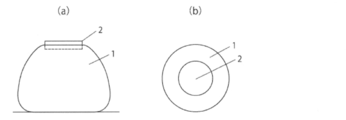
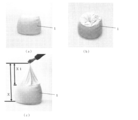
- Examples of the method for measuring the length of the space include the methods shown in FIGS. 1 (a) to 1 (c).
- 1 (a) and 1 (b) show a state in which the pillow is placed on the floor without applying an external force other than gravity.
- 1 (a) is a side view
- FIG. 1 (b) is a top view.
- "a" means a contact portion between the floor and the pillow.
- X means the maximum length of the pillow
- X1 means the maximum length of the space.
- the length of the space is more preferably 1/7 to 1/2 of the maximum length of the pillow, and even more preferably 1/5 to 1/3.
- the lower limit of the space length may be selected from 1/10, 1/9, 1/8, 1/7, 1/6, 1/5 of the maximum pillow length, and the upper limit is 2/3. You may select from 3, 5, 11/20, 1/2, 9/20, 2/5, and 1/3.
- the maximum length of the pillow can be appropriately set in the range of, for example, 10 cm to 3 m, depending on the intended use of the pillow.
- the maximum length may be 20 cm, 30 cm, 40 cm, 50 cm, 60 cm, 70 cm, 80 cm, 90 cm, 1 m, 1.25 m, 1.5 m, 1.75 m or 2 m.
- Pillows can have an average thickness of 5-100 cm when placed so that the longest direction is parallel to the floor.
- the average thickness may be 10 cm, 20 cm, 30 cm, 40 cm, 50 cm, 60 cm, 70 cm, 80 cm or 90 cm.
- the average thickness means the thickness when the pillow is smoothed so that the thickness of the placed pillow is as constant as possible.
- the average thickness may be 1/2 to 1/10 of the maximum length.
- the contact area between the floor and the pillow in a pillow that is erected so that the longest direction of the pillow is parallel to the direction of gravity is not particularly limited, but is in the range of 0.005 m 2 to 5 m 2 , depending on the use of the pillow. Can be set as appropriate. Range of the contact area of the pillow, 0.005m 2, 0.0075m 2, 0.01m 2, 0.015m 2, 0.02m 2, 0.025m 2, 0.03m 2, 0.035m 2, 0. 04m 2, 0.05m 2, 0.075m 2 , 0.1m 2, 0.125m 2, 0.15m 2, 0.2m 2, 0.25m 2, 0.3m 2, 0.4m 2, 0.
- the buttocks where the center of gravity of the entire body (body center of gravity) is located are bottomed out with a pillow.
- the presence of the filler from the shoulders to the head and the lower part of the thighs makes it possible to raise the thighs.
- the hips are in a moderately bent posture.
- This neutral position can be taken by lying down on the pillow.
- Property (iii) When a person rolls over on the pillow, the foam beads present at the bottom of the buttocks act as rolling elements, so that the rollover can be easily performed. Even during turning over, the filling material (foamed beads) flows (roles as a rolling element) while the bag body expands and contracts, so that the pillow 1 can be easily deformed according to the change of the body. Specifically, in the part where the pillow and the body (for example, the buttocks) come into contact, the body (buttocks) touches the bottom of the pillow, and in the part adjacent to the part in contact, the filler flows. The pillow rises along the outer shape of the body.
- the body pressure can be appropriately dispersed so that the body pressure does not concentrate on one point regardless of the posture. Therefore, it is possible to wrap the body when it is used on its back, when it is used on its back, or when it is used while sitting.
- Other Properties When a person is lying down so that the pillow has at least the buttocks, it may have a dent due to the movement of the filler so that the buttocks touch the bottom of the pillow and the upper body and thighs do not touch the bottom. By providing such a dent, the fetal posture and / or the neutral posture can be easily taken. Since the size of the dent is formed by the movement of the filler, it is possible to follow various changes in the human physique.
- the pillow may have a property that when a disk having a diameter of 20 cm is applied to the pillow and a force of 1 to 20 kg is applied to the disk along the direction of gravity, the disk attaches to the bottom of the pillow.
- the position where the disk is applied to the pillow is not particularly limited.
- the disk may be attached to the bottom of the entire pillow, or only a part of the disk may be attached.
- the position of the pillow to which the disk is applied may be near the center of the upper surface of the raised pillow when the pillow is erected so that the longest direction of the pillow is parallel to the direction of gravity. In this position, the pillow can be greatly deformed so as to wrap around the body, whether it is used on its back, on its back, or when sitting.
- the reason why the diameter of the disk is set to 20 cm is as follows.
- the diameter of 20 cm is assumed to be the diameter of a circle when the area where the buttocks are in contact with the floor is assumed to be a circle from the viewpoint of sitting on the pillow at the time of measurement.
- body pressure is concentrated in the two ischial nodules at the bottom of the pelvis. Then, it is necessary to define the diameter of the circle including the region showing relatively high body pressure around the ischial nodule in consideration of the bottoming situation.
- the distance between the two ischial nodules is 8 to 15 cm in adults.
- the diameter of the disk is defined as 20 cm in consideration of the area.
- the diameter of the disk can be selected from 30 cm, 40 cm, 50 cm and 60 cm in addition to 20 cm. Larger diameter discs allow the pillow to be more deformable, allowing it to be used for longer periods of time in a prone or supine position, or to be more deformed to wrap around the body when sitting.
- the force applied is in the range of 1 to 20 kg and can be selected according to the application of the pillow. For example, in the case of a pillow that sits on top, a relatively large force can be selected, and in the case of a pillow that sleeps on top, a relatively small force can be selected.
- the applied force may be 2 kg, 3 kg, 4 kg, 5 kg, 6 kg, 7 kg, 8 kg, 9 kg, 10 kg or 15 kg.
- the reason why the upper limit of the applied force is set to 20 kg is as follows. The upper limit of the force of 20 kg is determined based on the weight around the buttocks from the viewpoint of sitting on the pillow.
- the body pressure dispersion rate at the hips and hips is about 44%. That is, a force of about 23 kg (53 ⁇ 0.44) acts on the bottom of the buttock of the pillow.
- the disk 2 is placed on the pillow 1.
- the weight 3 is placed on the disk 2.
- the weight 3 is adjusted so that the total with the weight of the disk 2 becomes a predetermined force.
- the fact that the disk 2 is attached to the bottom of the pillow 1 means that the filler is substantially not present in the bag body immediately below the disk 2.
- the concept of "substantially nonexistent” includes not only the case where the filler is completely absent, but also the case where a part of the cloth constituting the bag is in direct contact with the other part and the filler is present in the other parts. Is.
- FIGS. 2 (b) and 3 (b) are top views. Further, a force of 3 g or more may be applied per unit area (cm 2 ) of the bottom of the disk.
- the left and right upper parts of the pillow have a tapered shape from the bottom to the top as shown by the dotted line in FIG. 3 (a). You may.
- the tapered shape makes it possible to deform the pillow in a more appropriate state.
- the degree of taper is not particularly limited, and may vary depending on the size of the pillow, the volume of the filler, the internal volume of the bag body, and the like.
- the upper part means a part about 1/3 of the maximum length in the direction of gravity from the top of the pillow.
- the pillow When the pillow is placed so that the longest direction of the pillow is parallel to the direction of gravity and the position of the pillow to which the disc is applied is near the center of the upper surface of the raised pillow, the disc touches the bottom only near the center and the disc. It is preferable that the height of the pillow before applying force to the pillow and the height of the pillow with the disk at the bottom are substantially the same. By being substantially the same, it is possible to deform the pillow in a more suitable state.
- the size of the pillow is not particularly limited. For example, if a pillow is placed on the floor so that the longest direction is parallel to the floor, and a person (for example, an adult: assuming a height of 150 to 170 cm) sits on his back, only the head, shoulders, and back.
- the pillow may be large enough to fit on the pillow, from the back to the thighs, or from the shoulders to the thighs.
- the shape of the pillow is not particularly limited. For example, various shapes such as columnar, oval, spherical, pyramidal, rectangular parallelepiped, cube, rugby ball, sheet, oval, character (for example, characters in animals, anime and cartoons) can be mentioned. Be done. Pillows are best used on relatively soft materials such as beds, duvets, sofas, rugs and tatami mats.
- the pillow includes at least a partially elastic bag body and a filler in the bag body.
- the constituent materials of the bag body and the filler are not particularly limited as long as they can give the pillow the property that the disk attaches to the bottom of the pillow by applying a force through the disk.
- (1a) Bag body The bag body may have at least a part of elasticity. In other words, the bag may include a non-stretchable portion and a stretchable portion. From the viewpoint of being deformable into more various shapes, it is preferable that the entire bag body has elasticity.
- the bag body may be made of a cloth material such as a woven cloth, a knitted cloth, a non-woven fabric, or a plastic sheet.
- the thickness of the cloth material is not particularly limited as long as it can impart appropriate elasticity to the bag body.
- the constituent material of the bag may be cotton, linen, silk, hair, synthetic fiber (for example, spandex; polyurethane elastic yarn) or the like, or may be blended.
- the bag body preferably has elasticity of 10 to 500%.
- the elasticity is more preferably 50 to 400%, further preferably 100 to 300%.
- the elasticity means, for example, a value measured as follows. A test piece having a tension interval of 10 cm and a width of 2.5 cm is cut out from the bag body. The test piece is stretched at a speed of 30 cm / min by a general tensile tester, and the elongation under a 9.8 N load is calculated by the following formula.
- the filler is not particularly limited, and examples thereof include foamed beads, urethane foam, cotton, non-woven fabric, resin pipe, three-dimensional composite of resin fibers, gel, rubber, sand, and air. These fillers may be used alone or in combination.
- the filler preferably contains foamed beads (for example, 50% by weight or more, 55% by weight or more, 60% by weight or more, 65% by weight or more, 70% by weight or more, 75% by weight or more, 80% by weight or more, 85% by weight. % Or more, 90% by weight or more, 95% by weight or more), all may be foamed beads.
- the foam beads present in the lower part of the buttocks have the effect of being able to easily turn over by acting as a rolling element such as a ball bearing when turning over on the pillow. This effect is more pronounced when the pillow is placed on the floor so that the longest directions are parallel and at least the buttocks are attached to the pillow, and the buttocks are attached to the bottom of the pillow. Since the foamed beads are easily charged with static electricity, they are easily attached to the bag body, and therefore it is difficult to completely remove them at the bottomed part. Therefore, since a part remains at the bottomed portion, it is easy to play the role of a rolling element.
- polystyrene foamed beads having an average particle size in the range of 200 to 2000 ⁇ m, in which a flow promoter adheres to the surface, are preferable. Due to the high fluidity of the polystyrene foam beads, it is possible to provide a pillow that can be deformed into a wider variety of shapes.
- the average particle size is more preferably in the range of 400 to 1500 ⁇ m, and further preferably in the range of 400 to 1000 ⁇ m.
- the average particle size can be measured by superimposing sieves having a predetermined opening and applying vibration to the sieves to classify them. For example, it can be measured as follows.
- a sieve having the above-mentioned opening value is changed from a sieve having a small opening value to 0.180 mm, 0.212 mm, 0.250 mm, 0.300 mm, 0.355 mm, and 0.35 mm.
- the average particle size may be the particle size (median size) at which the cumulative weight is 50%.
- the size of the cover may be the same as or larger than the size of the pillow.
- the size of the pillow can be replaced by the internal volume of the bag body.
- the size of the cover can be about 1 to 3 times the size of the pillow (internal volume ratio).
- the internal volume can be replaced by the amount of air filled in the cover by making a bag and cover of the same size with a non-stretchable film.
- the same cloth material and constituent material as the bag body can be used.
- the cloth material and constituent materials of the cover and the bag body may be the same or different.
- the elasticity of the cover is preferably about the same as the elasticity of the bag or higher than the elasticity of the bag.
- FIG. 4 to 10 show the pillow of the first embodiment.
- the bag body constituting this pillow is composed of a spandex woven cloth (85% polyester, 15% polyurethane) and about 250% elasticity, and the filler is polystyrene having an average particle size in the range of about 400 to 1500 ⁇ m.
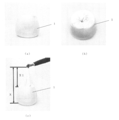
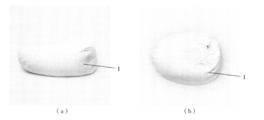
- Foam beads made of. 4 (a) and 4 (b) are photographs showing a state in which the pillow 1 is placed on the floor so that the longest direction of the bag body is parallel to the direction of gravity.
- FIG. 4 (a) is a side photograph
- FIG. 4 (b) is a top photograph.
- the pillow 1 is not overfilled with the filler, so that the top of the pillow 1 is depressed inside the pillow 1.
- the pillow 1 in this state, for example, as shown in the photograph of FIG. 5A, it is possible to use the pillow 1 so as to sit on the top. By sitting on the top, the pillow 1 is greatly deformed so as to wrap around the body due to the movement of the filler and the expansion and contraction of the bag body, so that a great healing effect can be obtained. As shown in the photograph of FIG. 5B, it is also possible to use the pillow 1 on its stomach. In this mode of use, the warp of the waist in the prone position can be alleviated. If you take a prone position for a long time, you may hurt your lower back due to the warp of your lower back. As shown in FIG.
- the pillow 1 since the warp of the waist can be reduced by deforming the pillow 1, the pillow 1 has an effect that the waist does not hurt even if the patient is in a prone position for a long time.
- the space (margin) in which the filler does not exist is 1/3 to 1/5 of the maximum length (X) of the pillow 1.
- (X1) can be formed on the upper part of the pillow 1.
- the maximum length of the pillow 1 is about 1 m. It was confirmed that when a disk having a diameter of 20 cm was applied to the pillow 1 and a force of 1 to 20 kg was applied to the disk along the direction of gravity, the disk was attached to the bottom of the pillow.
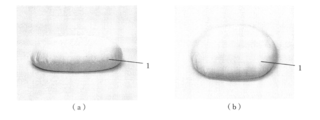
- FIGS. 7 (a) and 7 (b) are photographs showing a state in which the pillow 1 is placed on the floor surface so that the longest direction of the bag body is parallel to the floor surface.
- FIG. 6A is a side photograph
- FIG. 6B is a top photograph.
- the maximum length in this state is about 1.5 m
- the average thickness is about 40 cm.
- the pillow 1 spreads parallel to the floor surface.
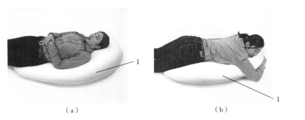
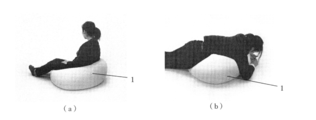
- FIGS. 7 (a) and 7 (b) it is possible to use the pillow 1 on its back or on its back.
- This pillow 1 has a size that can be placed from the head to the buttocks.
- the pillow 1 When used on its back or prone, the pillow 1 is greatly deformed so as to wrap around the body by extending back and forth and left and right with respect to the floor surface due to the movement of the filler and the expansion and contraction of the bag body, so that a great healing effect can be obtained. Can be done.
- the buttocks where the center of gravity of the entire body (center of gravity of the body) is located are bottomed out with the pillow 1.
- the presence of a filler from the shoulders to the head and the lower part of the thighs causes the body to rise. In this state, a dent is formed due to the movement of the filler, and the waist is in an appropriately bent posture.
- Neutral attitude means the attitude that is the least burdensome for astronauts in weightlessness. That is, it is known that in the weightless state, the back is slightly bent and the thighs are raised, and the muscle tension and the burden on the spine are minimized. This neutral posture can be taken by lying down on the pillow 1.
- the filler can be moved so that the pillow 1 has the desired shape. For example, by moving the filler from below the waist to below the shoulders, the warp of the waist in the prone position can be alleviated.
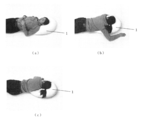
- FIGS. 8A to 8C it is possible to easily turn over on the pillow 1.
- the buttock where the center of gravity of the entire body (center of gravity of the body) is located, is used as a fulcrum, it is possible to easily turn over.
- FIG. 8 (a) shows a photograph of the supine position before turning over
- FIG. 8 (b) shows a photograph of lying sideways during turning over
- FIG. 8 (c) shows a photograph of prone position after turning over.
- the filling material (foamed beads) flows (roles as a rolling element) while the bag body expands and contracts, so that the pillow 1 can be easily deformed according to the change of the body.
- the body touches the bottom of the pillow, and in the part adjacent to the part in contact, the filler flows.
- Pillow 1 rises along the outer shape of the body. Therefore, the body pressure can be appropriately dispersed so that the body pressure does not concentrate on one point regardless of the posture. It was confirmed by the body pressure dispersometer that the body pressure from the head to the feet was dispersed almost evenly by using the pillow as compared with the case where the pillow was not used.
- the body pressure dispersometer that the body pressure from the head to the feet was dispersed almost evenly by using the pillow as compared with the case where the pillow was not used.
- the roll is turned over, the swelling on the left and right is maintained, and the plane positions of the body (buttocks) before and after the roll over can be made substantially the same.
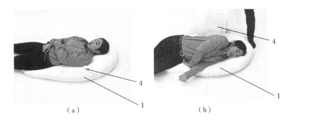
- FIGS. 9 (a) and 9 (b) after riding on the pillow 1 with a cloth (for example, a cloth having low elasticity) 4 on its back or lying down, a caregiver (another person)
- the pillow 1 has the effect of facilitating the change of posture with less force (for example, as compared with the case of directly riding on the cloth without the pillow) by pulling the cloth 4.
- FIG. 9A shows a photograph when the pillow 1 is laid on its back through the cloth 4, and FIG.
- FIGS. 9A and 9B shows a photograph when the posture is changed to the side by pulling the cloth 4.
- the mechanism that facilitates the change of position is that the filler existing under the cloth acts as a rolling element between the floor and the cloth 4.
- the pillow 1, which makes it easy to change the posture with a small amount of force, has an effect that a person who has difficulty in turning over can prevent pressure ulcers that occur on the contact surface with the pillow 1 by taking the same posture.
- the caregiver's power required to change the position of the care recipient can be reduced, the caregiver's back pain can be suppressed.
- FIGS. 9A and 9B it can be seen that the plane positions of the buttocks before and after pulling are almost the same.
- Pillow 1 is also suitable for use on a sofa.
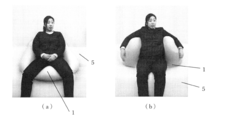
- FIGS. 10 (a) and 10 (b) show a state in which the pillow 1 placed on the sofa 5 is seated from the buttocks. In this state, the pillow 1 is greatly deformed along the shape of the dorsal side from the thigh to the neck, and an elbow rest is formed on the side of the body by moving the filler. Therefore, it is possible to sit on the sofa more relaxed because the whole body feels wrapped.
- FIG. 10B shows a state in which the back is rested on the pillow 1 placed along the side surface of the sofa 5.
- the pillow 1 By pressing the back against the side surface of the sofa 5, the pillow 1 is greatly deformed along the shape of the back side, and the elbow rest is formed by the movement of the filler to the side of the body. Since the amount of the pillow 1 on the dorsal side is larger than that of sitting from the buttocks, the feeling of being wrapped in the body on the dorsal side can be made larger than in the case of FIG. 10A.
- FIG. 11 (a) and 11 (b) are photographs showing a state in which the pillow 1 is placed on the floor so that the longest direction of the bag body is parallel to the direction of gravity.
- FIG. 11 (a) is a side photograph
- FIG. 11 (b) is a top photograph.
- the space (margin) in which the filler does not exist is 1/3 to 1/5 of the maximum length (X) of the pillow 1.
- (X1) can be formed on the upper part of the pillow 1.
- the maximum length of the pillow 1 is about 90 cm. It was confirmed that when a disk having a diameter of 20 cm was applied to the pillow 1 and a force of 1 to 20 kg was applied to the disk along the direction of gravity, the disk was attached to the bottom of the pillow.
- FIGS. 13 (a) and 13 (b) are photographs showing a state in which the pillow 1 is placed on the floor surface so that the longest direction of the bag body is parallel to the floor surface.
- FIG. 12 (a) is a side photograph
- FIG. 12 (b) is a top photograph.
- the maximum length in this state is about 1 m
- the average thickness is about 20 cm.
- the pillow 1 is not overfilled with the filler, so that the pillow 1 spreads parallel to the floor surface.
- this state for example, as shown in the photographs of FIGS. 13 (a) and 13 (b), it is possible to use the pillow 1 on its back or on its back.
- This pillow 1 has a size that allows it to be placed from the head to the buttocks.
- the pillow 1 When used on its back or prone, the pillow 1 stretches back and forth and left and right with respect to the floor surface due to the movement of the filler and the expansion and contraction of the bag body, and is greatly deformed so as to wrap around the head to the butt, so that it is a great healing. The effect can be obtained.
- the buttocks touch the bottom of the pillow, and in the part adjacent to the part in contact, the filler flows so that the pillow 1 moves from the head to the buttocks. It rises along the outer shape of. Therefore, the body pressure can be appropriately dispersed so that the body pressure does not concentrate on one point regardless of the posture.
- the filling material flows (roles as a rolling element) while the bag body expands and contracts, so that the pillow 1 can be easily deformed according to the change of the upper body.
- the photograph in FIG. 13 (c) shows the sideways state during the transition from supine to prone. It was confirmed by the body pressure dispersometer that the body pressure from the head to the feet was dispersed almost evenly by using the pillow as compared with the case where the pillow was not used.
- the pillow of the second embodiment as in the first embodiment, (i) the buttocks are attached to the bottom of the pillow, and (ii) the foam beads existing at the lower part of the buttocks when turning over on the pillow.
- the buttocks are bottomed out with pillow 1.
- the filler that has moved from the vicinity of the buttocks exists in the lower part thereof, so that the state is raised.
- the pillow 1 is wrapped from the head to the buttocks, and the hips are bent appropriately.
- the pillow 1 can be covered with the cover 1a shown in the plan view of FIG. 14 (a), the back surface view of FIG. 14 (b), and the side view of FIG. 14 (c).
- the cover 1a is made of an elastic material.
- the cover 1a preferably has elasticity equal to or higher than that of the bag body.
- the cover 1a may be made of the same woven fabric as the bag body, or may be made of a different woven fabric (for example, a woven fabric made of polyester and polyurethane).
- Pillow 1 is similar to Embodiment 1, for example, use to sit on the top and lie face down, as shown in FIGS. 15 (a) and 15 (b), as shown in FIGS. 16 (a) and 16 (b). Also suitable for use on the sofa.
- the posture can be easily changed with a small force through the cloth 4 having low elasticity.
- FIG. 3 shows the pillow of the third embodiment.
- Embodiment 3 shows a pillow that is supposed to be used from the head to the shoulders.
- 18 (a) and 18 (b) are photographs showing a state in which the pillow 1 is placed on the floor so that the longest direction of the bag body is parallel to the direction of gravity.
- FIG. 18 (a) is a side photograph
- FIG. 18 (b) is a top photograph. When the top of the pillow 1 is extended upward, as shown in FIG.
- the space (margin) in which the filler does not exist is 1/3 to 1/5 of the maximum length (X) of the pillow 1.
- (X1) can be formed on the upper part of the pillow 1.
- the maximum length of the pillow 1 is about 55 cm. It was confirmed that when a disk having a diameter of 20 cm was applied to the pillow 1 and a force of 1 to 20 kg was applied to the disk along the direction of gravity, the disk was attached to the bottom of the pillow.
- FIG. 19 (a) and 19 (b) are photographs showing a state in which the pillow 1 is placed on the floor surface so that the longest direction of the bag body is parallel to the floor surface.
- FIG. 19 (a) is a side photograph
- FIG. 19 (b) is a top photograph.
- the maximum length in this state is about 1 m
- the average thickness is about 30 cm.
- the pillow 1 is not overfilled with the filler, so that the pillow 1 spreads parallel to the floor surface.
- the pillow 1 has a size that allows the head to shoulders (upper body) to be placed on it.
- the pillow 1 When used on its back or prone, the pillow 1 stretches back and forth and left and right with respect to the floor surface due to the movement of the filler and the expansion and contraction of the bag body, and is greatly deformed so as to wrap the upper body, so that a great healing effect can be obtained. Can be done. Further, in the portion where the pillow and the upper body are in contact with each other, the upper body is attached to the bottom of the pillow, and in the portion adjacent to the contacted portion, the filler 1 flows to raise the pillow 1 along the outer shape of the upper body. Therefore, the body pressure can be appropriately dispersed so that the body pressure does not concentrate on one point regardless of the posture.
- the body pressure dispersometer that the body pressure from the head to the feet was dispersed almost evenly by using the pillow as compared with the case where the pillow was not used. Further, even during turning over, the filling material flows (roles as a rolling element) while the bag body expands and contracts, so that the pillow 1 can be easily deformed according to the change of the upper body.
- the photograph in FIG. 20 (c) shows the sideways state during the transition from supine to prone.
- the pillow of the third embodiment is slept so that the buttocks are attached, (i) the buttocks are attached to the bottom of the pillow, and (ii) when the pillow is turned over.
- the foamed beads existing in the lower part of the buttocks can easily turn over by acting as a rolling element.
- a pillow having one air chamber as a bag is illustrated.
- the pillow of the present invention may have a structure in which the bag body is divided into a plurality of air chambers having two or more air chambers by a partition wall.
- the above-mentioned properties (i) and (ii) may be provided by at least one of the plurality of air chambers.
- Other air chambers may or may not have the above properties (i) and (ii).
- the partition wall may be formed by attaching a separate cloth to the inside of the bag, or may be formed by directly attaching the bag.
- the filler type may or may not be changed for each air chamber.
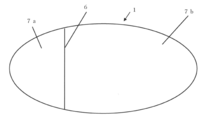
- FIG. 21 shows a schematic plan view of the pillow 1 of the two air chambers placed on the floor surface so that the longest direction thereof is parallel to the floor surface.
- the pillow of FIG. 21 is divided into two air chambers by directly sewing the bag body.
- 6 means a sewn portion
- 7a means a small air chamber
- 7b means an atmosphere chamber.
- the air chamber 7a as a pillow and the air chamber 7b as a mattress.
- Such a pillow-integrated mattress has the advantage that it can be turned over very easily and the head can be held at an appropriate height.
Landscapes
- Health & Medical Sciences (AREA)
- General Health & Medical Sciences (AREA)
- Otolaryngology (AREA)
- Pulmonology (AREA)
- Bedding Items (AREA)
- Mattresses And Other Support Structures For Chairs And Beds (AREA)
Abstract
Description
例えば、特開2004-223002号公報(特許文献1)では、「伸縮性を有する袋体の中に、袋体の内容積の1.1~3.5倍の体積の発泡樹脂粒子が充填材として封入されてなることを特徴とするクッション体。」が提案されている。
また、特開2005-230137号公報(特許文献2)では、褥瘡予防に使用できるクッション体が提案されている。
近年、スマートフォンのような携帯情報端末を、うつ伏せ又は仰向けで使用することがある。このような使用形態において、硬い触感のクッション体は、例えば、人が乗った場合に、人の外形に沿って、その形状が変化し難く、局所的な圧力を人に与えるため、長時間うつ伏せ又は仰向けの状態での使用に適切とは言い難かった。
特に、携帯情報端末をうつ伏せで使用する場合、背筋が反るため、腰に負担がかかる。この負担を軽減するには、胸から太ももの前側にかけて、局所的な圧力がかからないように、人の外形に沿って、その形状が変化する必要があるが、硬い触感のクッション体では、そのような変化は望むことができなかった。
また、特許文献2には、底付きするクッション体は、その部位において、褥瘡が発生すると記載されている。底付きを前提とするクッション体の示唆はない。
前記充填材が、発泡ビーズを含み、
前記枕の最長方向が重力方向に対して平行になるように前記枕を床に立て、前記床と前記枕との接触面積が変動しないように前記枕の頂部を上部に伸ばした場合、前記充填材の存在しない空間が、前記枕の最大長さの1/10~2/3の長さで前記枕の上部に形成され、
最長方向が平行となるように前記床に置いた前記枕に少なくともお尻が付くように人が寝た場合、前記お尻が枕の底につく枕が提供される。
更に、本発明によれば、少なくとも一部が伸縮性の袋体と、前記袋体中の充填材とを少なくとも備えた人用の枕であって、
前記充填材が、発泡ビーズを含み、
前記枕の最長方向が重力方向に対して平行になるように前記枕を床に立て、前記床と前記枕との接触面積が変動しないように前記枕の頂部を上部に伸ばした場合、前記充填材の存在しない空間が、前記枕の最大長さの1/10~2/3の長さで前記枕の上部に形成され、
最長方向が平行となるように前記床に置いた前記枕に少なくともお尻が付くように人が寝た場合、前記お尻が枕の底につき、
前記枕上で前記人が寝返りを打った際、前記お尻の下部に存在する前記発泡ビーズが転動体の役割を果たすことで、寝返りを容易に行い得る枕が提供される。
また、本発明によれば、少なくとも一部が伸縮性の袋体と、前記袋体中の充填材とを少なくとも備えた枕であって、
前記枕の最長方向が重力方向に対して平行になるように前記枕を床に立て、前記床と前記枕との接触面積が変動しないように前記枕の頂部を上部に伸ばした場合、前記充填材の存在しない空間が、前記枕の最大長さの1/10~2/3の長さで前記枕の上部に形成され、
前記枕に直径20cmの円盤を当て、前記円盤へ重力方向に沿って1~20kgの力を加えた場合、前記円盤が前記枕の底につく枕が提供される。
そのため、例えば、うつ伏せ又は仰向けで使用した場合、枕の形状は、人の外形に沿って変化する。従って、本発明の枕は、長時間うつ伏せ又は仰向けの状態での使用が可能となる。加えて、充填材を移動させることで、所望の形状に枕を変形させることができる。
また、枕に座った場合、体を包み込むように大きく変形するので、大きな癒し効果(雲の上に乗ったようなイメージの感触)を得ることができる。
更に、枕上で人が寝返りを打った際、お尻の下部に存在する発泡ビーズが転動体の役割を果たすことで、寝返りを容易に行うことができる。
本発明の枕は、以下の(i)~(iii)の性質を有している。
(i)枕の最長方向が重力方向に対して平行になるように枕を床に立て、床と枕との接触面積が変動しないように枕の頂部を上部に伸ばした場合、充填材の存在しない空間が、枕の最大長さの1/10~2/3の長さで枕の上部に形成される。
(ii)最長方向が平行となるように床に置いた枕に少なくともお尻が付くように人が寝た(仰向けで使用した)場合、お尻が枕の底につく。
(iii)枕上で人が寝返りを打った際、お尻の下部に存在する発泡ビーズが転動体の役割を果たすことで、寝返りを容易に行い得る。
そのため、枕は、多様な形に変形可能である。例えば、うつ伏せ又は仰向けで使用した場合、枕の形状は、人の外形に沿って変化する。その結果、本発明の枕は、長時間うつ伏せ又は仰向けの状態での使用が可能となる。加えて、手又は足で充填材を移動させることで、所望の形状に枕を変形させることができる。また、枕に座った場合、体を包み込むように大きく変形するので、大きな癒し効果を得ることができる。
更に、枕上で人が寝返りを打った際、お尻の下部に存在する発泡ビーズが転動体の役割を果たすことで、寝返りを容易に行うことができる。
お尻が枕の底に付く(底付きする)とは、袋体においてお尻に接する部分の内面と、床面に接する部分の内面とが実質的に接していることを意味する。実質的に接するとは、袋体のお尻に接している部分の内面と、床面に接している部分の内面とが完全に接して間に充填材が存在しない場合に加えて、内面の一部が直接接し、それ以外の部分に充填材が存在している場合も含む。
充填材の存在しない空間が、枕の最大長さの1/10~2/3の長さで枕の上部に形成されることで、うつ伏せで使用した場合、仰向けで使用した場合、及び座った場合のいずれでも、体を包み込むように枕を大きく変形させることができる。
空間の長さの測定法としては、例えば、図1(a)~(c)に示される方法が挙げられる。図1(a)及び(b)は、重力以外の外力を付与することなく床に枕を置いた状態を示している。図1(a)は側面図、図1(b)は上面図である。図1(a)及び(b)中、「a」は床と枕との接触部を意味する。図1(c)は、床と枕との接触面積が変動しないように枕の頂部を上部に伸ばした状態を示している。図1(c)中、Xは枕の最大長さ、X1は空間の最大長さを意味する。
空間の長さは、枕の最大長さの1/7~1/2であることがより好ましく、1/5~1/3であることが更に好ましい。空間の長さの下限は、枕の最大長さの1/10、1/9、1/8、1/7、1/6、1/5から選択してもよく、上限は、2/3、3/5、11/20、1/2、9/20、2/5、1/3から選択してもよい。
枕の最大長さは、例えば、10cm~3mの範囲で、枕の用途に応じて適宜設定できる。最大長さは、20cm、30cm、40cm、50cm、60cm、70cm、80cm、90cm、1m、1.25m、1.5m、1.75m又は2mとしてもよい。
枕は、最長方向が床面と平行になるように置いた場合、5~100cmの平均厚さを有しうる。平均厚さは、10cm、20cm、30cm、40cm、50cm、60cm、70cm、80cm又は90cmとしてもよい。平均厚さは、置かれた枕の厚さができるだけ一定となるように枕をならした場合の厚さを意味する。平均厚さは、最大長さの1/2~1/10としてもよい。
枕の最長方向が重力方向に対して平行になるように立てた枕における床と枕との接触面積は、特に限定されないが、0.005m2~5m2の範囲で、枕の用途に応じて適宜設定できる。枕の接触面積の範囲は、0.005m2、0.0075m2、0.01m2、0.015m2、0.02m2、0.025m2、0.03m2、0.035m2、0.04m2、0.05m2、0.075m2、0.1m2、0.125m2、0.15m2、0.2m2、0.25m2、0.3m2、0.4m2、0.5m2、0.6m2、0.7m2、0.75m2、0.8m2、0.9m2、1.0m2、1.25m2、1.5m2、1.75m2、2.0m2、2.5m2、3.0m2、3.5m2、4.0m2、4.5m2、5.0m2から選択される任意の上限値及び下限値の組み合わせで表される範囲とすることができる。
最長方向が平行となるように床に置いた枕に少なくともお尻が付くように人が寝た(仰向けで使用した)場合、お尻が枕の底につく(底付きする)ことで、うつ伏せで使用した場合、仰向けで使用した場合、及び座った場合のいずれでも、体を包み込むように枕を大きく変形させることができる。なお、ここでの人は、例えば、40kg以上の体重を有する者であり、大人を想定している。大人の場合、底付きする部位に加わる重さは、お尻周辺の重さである体重の約44%であると想定している。
例えば、仰向けで使用する場合、体全体の重心(身体重心)が位置するお尻は枕で底づきする。一方、肩から頭にかけて及び太ももの下部には充填材が存在することで、上がった状態とすることができる。この状態では、腰が適度に曲がった姿勢となる。従来、寝具用マットでは、直立した姿勢(背中のS姿勢)が保持されるように、人の外形に沿って変形することが、癒し付与性の向上及び睡眠の質の向上に有効であるとされてきた。しかしながら、人が四足歩行の動物から進化してきたことを考慮すると、胎児姿勢(膝を軽く胸に引き寄せ、背中を少しだけ丸めた姿勢)に近い姿勢をとることが癒し付与性の向上及び睡眠の質の向上により有効であると考えられる。胎児姿勢をとることで赤ちゃんが泣き止むように、大人になっても体や心の緊張がほぐれ、安心させる効果を枕は有している。また、枕で得られる姿勢は、中立姿勢に相当するともいえる。中立姿勢とは、無重力状態での宇宙飛行士が最も負担のかからない姿勢を意味している。即ち、無重力状態では、背中がやや曲がり、太ももが上がった姿勢となり、筋肉の緊張や背骨にかかる負担が最小限になることが知られている。この中立姿勢を枕の上で横になることで取ることができる。
性質(iii)
枕上で人が寝返りを打った際、お尻の下部に存在する発泡ビーズが転動体の役割を果たすことで、寝返りを容易に行うことができる。
寝返りの最中でも、袋体が伸縮しつつ充填材(発泡ビーズ)が流動する(転動体の役割を果たす)ことで、体の変化に合わせて枕1が容易に変形しうる。具体的には、枕と体(例えば、お尻)とが接触する部位では、体(お尻)が枕の底につき、接触している部位に隣接する部位では、充填材が流動することで枕が体の外形に沿って盛り上がる。そのため、どのような姿勢をとっても体圧が一点に集中しないように、体圧を適切に分散させることができる。そのため、うつ伏せで使用した場合、仰向けで使用した場合、及び座った場合のいずれでも、体を包み込むことが可能となる。
その他の性質
枕に少なくともお尻が付くように人が寝た状態で、お尻が枕の底につき、上半身及び太ももが底につかないように、充填材が移動することによる凹みを備え得る。このような凹みを備えることで、上記胎児姿勢及び/又は中立姿勢を容易にとることができる。凹みの大きさは、充填材が移動することにより形作られるので、人の体格の各種変化に追随することが可能である。
枕は、枕に直径20cmの円盤を当て、前記円盤へ重力方向に沿って1~20kgの力を加えた場合、円盤が枕の底につく性質を有していてもよい。
枕へ円盤を当てる位置は、特に限定されない。また、円盤は、枕全体にわたって底についてもよく、一部のみついてもよい。
円盤の当てられる枕の位置は、枕の最長方向が重力方向に対して平行になるように枕を立て、立てた枕の上面の中央付近であってもよい。この位置であれば、うつ伏せで使用した場合、仰向けで使用した場合、及び座った場合のいずれでも、体を包み込むように枕を大きく変形させることができる。
円盤の直径を20cmとした理由を下記する。
直径20cmは、測定時に枕に腰を下ろすという観点から、お尻が床と接する領域を円と仮定した場合の円の直径を想定している。お尻が床に接した場合、骨盤の底部の2つの座骨結節において体圧が集中する。そして、円の直径は、底付きの状況を考慮して、座骨結節周辺の比較的高い体圧を示す領域も含めて規定することが必要となる。ここで、お尻にかかる力の研究に関する文献(日本義肢装具学会誌Vol.29 No.3 pp168-174 2013)によれば、2つの座骨結節の間隔は、大人で8~15cmであることが知られている。お尻が床と接する場合、2つの座骨結節の周辺も接することになるので、その周辺を考慮して、円盤の直径を20cmと規定している。
円盤の直径は20cm以外にも、30cm、40cm、50cm及び60cmのいずれかの直径を選択できる。直径の大きな円盤であれば、枕がより大きく変形可能となるため、うつ伏せ又は仰向けの状態でのより長時間の使用、座った場合で体を包み込むようにより大きく変形させることが可能である。
加えられる力は1~20kgの範囲で、枕の用途に応じて選択できる。例えば、上に座る枕の場合、比較的大きい力を選択でき、上に寝る枕の場合、比較的小さい力を選択できる。加えられる力は、2kg、3kg、4kg、5kg、6kg、7kg、8kg、9kg、10kg又は15kgとしてもよい。
加えられる力の上限を20kgとした理由を下記する。
力の上限20kgは、枕に腰を下ろすという観点から、お尻周りの重さを基準に決定されている。例えば、産業技術総合研究所から2007年に公表された文献によると16歳以上の女性の平均体重が約53kgであるとされており、平成31年に西川株式会社から公表された文献(寝具などの睡眠最適化に係る評価方法の基準策定に向けた課題分析に関する調査)によると腰尻部の体圧分散率が約44%であるとされている。つまり、枕のお尻底部には約23kg(53×0.44)の力が働くことになる。力の上限を20kgとすることで、大人の女性でも確実に底付きを実現できる。
なお、大人の男性については、大人の女性より平均体重が重いので、力の上限が20kgであれば、確実に底付きを実現できる。
また、枕を積極的に利用するであろう小学生低学年(6~7歳)においては、枕に乗った場合、足も枕に乗ってしまうため、お尻の底部にはほぼ全体重がかかることが想定される。ここで、厚生労働省の厚生統計要覧(令和元年度)の第2編 保健衛生 第1章 保健の第2-6表「身長・体重の平均値,性・年次×年齢別」によれば、これら年代の体重が約23kg前後であるとされている。この年代においても、底付きを実現するには、力の上限を20kgとすることが適切となる。
なお、図2(a)及び図3(a)は側面図、図2(b)及び図3(b)は上面図である。
また、円盤の底部の単位面積(cm2)当たり3g以上の力を加えてもよい。
円盤が底についた状態の枕の重力方向の断面において、枕の左右の上部が、図3(a)の点線部に示されているように、下から上に向かうテーパー状の形状になっていてもよい。テーパー状の形状になっていることで、より適切な状態で枕を変形させることが可能である。テーパー状の形状において、テーパーの度合いは特に限定されず、枕の大きさ、充填材の体積、袋体の内容積等により変動しうる。なお、上部とは、枕の上から、重力方向の最大長さの1/3程度の部分を意味する。
枕の大きさは、特に限定されない。例えば、最長方向を床面と平行になるように床面に枕を置き、その枕上に人(例えば、大人:身長150~170cmを想定)が仰向けに乗った場合、頭のみ、肩のみ、背中のみ、お尻のみ、太もものみ、頭から肩まで、頭から背中まで、頭からお尻まで、頭から太ももまで、肩から背中まで、肩からお尻まで、肩から太ももまで、背中からお尻まで、背中から太ももまで、又はお尻から太ももまで、枕上に載せることが可能な程度の大きさを枕は備えてもよい。
枕の形状は、特に限定されない。例えば、円柱状、卵状、球状、角錐状、直方体状、立方体状、ラグビーボール状、シート状、小判状、キャラクター状(例えば、動物、アニメや漫画の登場人物)等の種々の形状が挙げられる。
枕は、ベッド、布団、ソファー、ラグ、畳等の比較的柔らかい部材上で使用することが向いている。
枕は、少なくとも一部が伸縮性の袋体と、袋体中の充填材とを少なくとも備える。袋体及び充填材の構成材料は、円盤を介して力を加えることで、円盤が枕の底につく性質を枕に与えることができさえすれば、特に限定されない。
(1a)袋体
袋体は、伸縮性を少なくとも一部備えていればよい。言い換えると、非伸縮性の部分と伸縮性の部分を袋体は備えていてもよい。より多様な形に変形可能である観点から、袋体全体が伸縮性を有していることが好ましい。
袋体は、織布、編布、不織布、プラスチックシート等の布材からなっていてもよい。布材の厚さは、袋体に適度な伸縮性を付与できさえすれば、特に限定されない。袋体の構成材料は、綿、麻、絹、毛、合成繊維(例えば、スパンデックス;ポリウレタン弾性糸)等のいずれであってもよく、混紡されていてもよい。
袋体は、10~500%の伸縮性を有することが好ましい。伸縮性は、50~400%であることがより好ましく、100~300%であることが更に好ましい。ここで、伸縮性は、例えば、次のように測定した値を意味する。引張間隔10cm×幅2.5cmの試験片を、袋体から切り出す。一般的な引張試験機により試験片を30cm/分の速度で伸張し、下記式により9.8N荷重時の伸度を算出する。この測定を試験片の縦方向と横方向について行う。縦方向と横方向の伸度の平均値を伸縮性とする。
伸度(%)={9.8N荷重時の試験片長さ(cm)-10}÷10×100
充填材としては、特に限定されず、例えば、発泡ビーズ、発泡ウレタン、綿、不織布、樹脂パイプ、樹脂繊維の三次元結合体、ゲル、ゴム、砂、空気等が挙げられる。これら充填材は、単独で使用してもよく、混合して使用してもよい。充填材は、発泡ビーズを含むことが好ましく(例えば50重量%以上、55重量%以上、60重量%以上、65重量%以上、70重量%以上、75重量%以上、80重量%以上、85重量%以上、90重量%以上、95重量%以上)、全てが発泡ビーズであってもよい。
お尻の下部に存在する発泡ビーズは、枕上で寝返りを打った際、ボールベアリングのような転動体の役割を果たすことで、寝返りを容易に行い得るという効果を奏する。この効果は、最長方向が平行となるように床に置いた枕に少なくともお尻がつくように寝、かつお尻が枕の底についた場合、より大きく発揮される。発泡ビーズは、静電気を帯びやすいので、袋体に付着しやすいため、底づき部位で完全に除かれ難い。従って、一部が底づき部位に残るため、転動体の役割を果たしやすい。
発泡ビーズの中でも、表面に流動促進剤が付着し、200~2000μmの範囲内の平均粒子径のポリスチレン製発泡ビーズが好ましい。このポリスチレン製発泡ビーズは、流動性が高いため、より多様な形に変形可能な枕を提供できる。平均粒子径は、400~1500μmの範囲内であることがより好ましく、400~1000μmの範囲内であることが更に好ましい。
平均粒子径は、所定の目開きのふるいを重ね合わせ、ふるいに振動を与えて分級することで測定できる。例えば、次のように測定できる。ふるい目開き4.00mm(4000μm)、目開き3.35mm、目開き2.80mm、目開き2.36mm、目開き2.00mm、目開き1.70mm、目開き1.40mm、目開き1.18mm、目開き1.00mm、目開き0.85mm、目開き0.71mm、目開き0.60mm、目開き0.50mm、目開き0.425mm、目開き0.355mm、目開き0.300mm、目開き0.250mm、目開き0.212mm、目開き0.180mm(180μm)のJIS標準ふるいで分級する。その結果から得られた累積重量分布曲線を元にして累積重量が50%となる粒子径(メディアン径)を平均粒子径とする。あるいは、上記目開き値を有したふるいを、目開き値の小さなふるいから目開き0.180mm、目開き0.212mm、目開き0.250mm、目開き0.300mm、目開き0.355mm、目開き0.425mm、目開き0.50mm、目開き0.60mm、目開き0.71mm、目開き0.85mm、目開き1.00mm、目開き1.18mm、目開き1.40mm、目開き1.70mm、目開き2.00mm、目開き2.36mm、目開き2.80mm、目開き3.35mm、目開き4.00mmの順に全て重ねて分級し、得られた累積重量分布曲線を元にして累積重量が50%となる粒子径(メディアン径)を平均粒子径としてもよい。
枕は、カバーで覆われていてもよい。カバーの大きさは、枕の大きさと同一であってもよく、大きくてもよい。一方、枕の大きさは、袋体の内容積で代用できる。カバーの大きさは、枕の大きさの1~3倍程度とすることができる(内容積比)。内容積は、非伸縮性のフィルムで同じ大きさの袋体とカバーを作成し、そのカバー内に満たした空気の量で代替えできる。
カバーは、袋体と同様の、布材及び構成材料を使用できる。カバーと袋体の布材及び構成材料は、同一でも、異なっていてもよい。カバーの伸縮性は、袋体の伸縮性と同程度又は袋体の伸縮性より高いことが好ましい。
図4~10は、実施の形態1の枕を示す。この枕を構成する袋体は、スパンデックス製織布(ポリエステル85%、ポリウレタン15%)、伸縮性約250%から構成され、充填材は、約400~1500μmの範囲内の平均粒子径を有するポリスチレン製の発泡ビーズである。
図4(a)及び(b)は、袋体の最長方向が重力方向に平行になるように枕1を床面に置いた状態を示す写真である。図4(a)は側面写真、図4(b)は上面写真である。
図4に示されているように、枕1は充填材が過充填されていないため、頂部が枕1内部に落ち込んでいる。この状態では、例えば、図5(a)の写真に示すように、頂部に座るように枕1を使用することが可能である。頂部に座ることで、枕1は、充填材の移動及び袋体の伸縮により、体を包み込むように大きく変形するので、大きな癒し効果を得ることができる。図5(b)の写真に示すように、うつ伏せで枕1を使用することも可能である。この使用態様では、うつ伏せ状態での腰の反りを緩和できる。長時間、うつ伏せ姿勢をとると、腰の反りにより、腰を痛めることがある。図5(b)に示すように、枕1を変形させることで、腰の反りを低減できるので、長時間うつ伏せ姿勢をとっても、腰が痛くなりにくいという効果を枕1は備えている。
枕1の頂部を上部に伸ばすと、図4(c)に示すように、充填材の存在しない空間(余白)を、枕1の最大長さ(X)の1/3~1/5の長さ(X1)で枕1上部に形成できる。なお、枕1の最大長さは、約1mである。
この枕1に直径20cmの円盤を当て、円盤へ重力方向に沿って1~20kgの力を加えた場合、円盤が枕の底につくことを確認した。
図6に示されているように、枕1は充填材が過充填されていないため、枕1が床面に平行に広がっている。この状態では、例えば、図7(a)及び(b)の写真に示すように、仰向け又はうつ伏せで枕1を使用することが可能である。この枕1は、頭からお尻まで載せることが可能な大きさを有している。仰向け又はうつ伏せで使用することで、枕1は、充填材の移動及び袋体の伸縮により、床面に対して前後左右に伸びて体を包み込むように大きく変形するので、大きな癒し効果を得ることができる。
仰向けで使用する場合、体全体の重心(身体重心)が位置するお尻は枕1で底づきする。一方、肩から頭にかけて及び太ももの下部には充填材が存在することで、上がった状態となる。この状態では、充填材が移動することによる凹みが形成され、腰が適度に曲がった姿勢となる。従来、寝具用マットでは、直立した姿勢(背中のS姿勢)が保持されるように、人の外形に沿って変形することが、癒し付与性の向上及び睡眠の質の向上に有効であるとされてきた。しかしながら、人が四足歩行の動物から進化してきたことを考慮すると、胎児姿勢(膝を軽く胸に引き寄せ、背中を少しだけ丸めた姿勢)に近い姿勢をとることが癒し付与性の向上及び睡眠の質の向上により有効であると考えられる。胎児姿勢をとることで赤ちゃんが泣き止むように、大人になっても体や心の緊張がほぐれ、安心させる効果を枕は有している。また、枕1で得られる姿勢は、中立姿勢に相当するともいえる。中立姿勢とは、無重力状態での宇宙飛行士が最も負担のかからない姿勢を意味している。即ち、無重力状態では、背中がやや曲がり、太ももが上がった姿勢となり、筋肉の緊張や背骨にかかる負担が最小限になることが知られている。この中立姿勢を枕1の上で横になることで取ることができる。
更に、上半身を浮かせることで、逆流性食道炎、循環器や呼吸器の病気(例えば、睡眠時無呼吸症候群)、糖尿病、アルツハイマー病、パーキンソン病、多発性硬化症(MS)、脊髄損傷、脳性小児まひ、静脈瘤、慢性静脈不全、下腿潰瘍、乾癬、不整脈、不眠症、偏頭痛、浮腫、頻尿等のさまざまな病気の症状を改善できる可能性がある。
うつ伏せで使用する場合、枕1が所望の形状になるように、充填材を移動させることが可能である。例えば、腰下から肩下にかけて、充填材を移動させることで、うつ伏せ状態での腰の反りを緩和できる。長時間、うつ伏せ姿勢をとると、腰の反りにより、腰を痛めることがある。枕1を変形させることで、腰の反りを低減できるので、長時間うつ伏せ姿勢をとっても、腰が痛くなりにくいという効果を枕1は備えている。
寝返りの最中でも、袋体が伸縮しつつ充填材(発泡ビーズ)が流動する(転動体の役割を果たす)ことで、体の変化に合わせて枕1が容易に変形しうる。具体的には、枕と体(例えば、お尻)とが接触する部位では、体(お尻)が枕の底につき、接触している部位に隣接する部位では、充填材が流動することで枕1が体の外形に沿って盛り上がる。そのため、どのような姿勢をとっても体圧が一点に集中しないように、体圧を適切に分散させることができる。
枕を使用することで、どのような姿勢をとっても頭から足までの体圧が、枕を使用しない場合に比べて、ほぼ均一に分散することを体圧分散計にて確認できた。
加えて、寝返りを打った際、左右の盛り上がりが維持され、かつ寝返りを打つ前と打った後の体(お尻)の平面位置をほぼ同一とすることができる。これは、袋体の伸縮性と発泡ビーズの転動体としての役割の両方の寄与による。ここで、左右の盛り上がりが維持されるとは、厳密な意味ではなく、左右の盛り上がりの、幅、高さ、平面視の面積、側面視の面積、体積等のいずれかの数値が枕1として実質的に同じ程度になることを意味する。例えば、これら数値が、±50%、±40%、±30%、±20%又は±10%の範囲で変動することが許容される。一方、平面位置をほぼ同一とすることができるには、平面視でのお尻の前後左右位置が、寝返りを打つ前後で、±30cm、±20cm、±15cm、±10cm又は±5cm変動することが許容される。
更に、図9(a)及び(b)に示すように、枕1上に、布(例えば、伸縮性の低い布)4を介して、仰向け又はうつ伏せで乗った後、介護者(他者)が布4を引っ張ることで、(例えば、枕なしで直接布上に乗った場合に比べて)少ない力で体位の変換が容易となる効果を枕1は有する。図9(a)は布4を介して仰向けに枕1に乗った場合の、図9(b)は布4を引っ張ることにより体位が横向けに変換された場合の写真をそれぞれ示す。体位変換が容易となる仕組みは、布の下に存在する充填材が、床と布4との間で転動体の役割を果たすためである。少ない力で体位の変換が容易となる枕1は、寝返りを打つことが困難な人が、同じ姿勢をとることで、枕1との接触面に生じる褥瘡を予防できるという効果を奏する。加えて、要介護者の体位変換に必要な介護者の力を低減できるため、介護者の腰痛の発生を抑制できるという効果も奏する。また、図9(a)及び(b)から、引っ張る前と引っ張った後のお尻の平面位置がほぼ同一であることが分かる。
図10(a)は、ソファー5上に置いた枕1にお尻から座った状態である。この状態では、太ももから首にかけて、背側の形状に沿って枕1が大きく変形し、体のサイドにも充填材の移動により肘置きが形成される。そのため、体全体の包まれ感が得られることから、よりリラックスしてソファーに座ることができる。
図10(b)は、ソファー5の側面に沿わせて置いた枕1に背中を預けて座った状態である。ソファー5の側面に背中を押し付けることで、背側の形状に沿って枕1が大きく変形し、体のサイドへの充填材の移動により肘置きが形成される。お尻から座るより背側の枕1の量が多いため、背側における体の包まれ感を図10(a)の場合より大きくすることができる。
図11~17は、実施の形態2の枕を示す。この枕には、実施の形態1と同様のスパンデックス製織布(袋体)及びポリスチレン製の発泡ビーズ(充填材)が使用されている。実施の形態2は、主として枕として使用することを想定している。
図11(a)及び(b)は、袋体の最長方向が重力方向に平行になるように枕1を床面に置いた状態を示す写真である。図11(a)は側面写真、図11(b)は上面写真である。
枕1の頂部を上部に伸ばすと、図11(c)に示すように、充填材の存在しない空間(余白)を、枕1の最大長さ(X)の1/3~1/5の長さ(X1)で枕1上部に形成できる。なお、枕1の最大長さは、約90cmである。
この枕1に直径20cmの円盤を当て、円盤へ重力方向に沿って1~20kgの力を加えた場合、円盤が枕の底につくことを確認した。
図12に示されているように、枕1は充填材が過充填されていないため、枕1が床面に平行に広がっている。この状態では、例えば、図13(a)及び(b)の写真に示すように、仰向け又はうつ伏せで枕1を使用することが可能である。この枕1は、頭からお尻までを載せることが可能な大きさを有している。仰向け又はうつ伏せで使用することで、枕1は、充填材の移動及び袋体の伸縮により、床面に対して前後左右に伸びて頭からお尻までを包み込むように大きく変形するので、大きな癒し効果を得ることができる。
また、枕と頭からお尻までとが接触する部位では、お尻が枕の底につき、接触している部位に隣接する部位では、充填材が流動することで枕1が頭からお尻までの外形に沿って盛り上がる。そのため、どのような姿勢をとっても体圧が一点に集中しないように、体圧を適切に分散させることができる。
更に、寝返りの最中でも、袋体が伸縮しつつ充填材が流動する(転動体の役割を果たす)ことで、上半身の変化に合わせて枕1が容易に変形しうる。例えば、図13(c)の写真には、仰向けからうつ伏せに移行する間の横向きの状態が示されている。
枕を使用することで、どのような姿勢をとっても頭から足までの体圧が、枕を使用しない場合に比べて、ほぼ均一に分散することを体圧分散計にて確認できた。
なお、実施の形態2の枕でも、実施の形態1と同様、(i)お尻が枕の底につくこと、(ii) 枕上で寝返りを打った際、お尻の下部に存在する発泡ビーズが転動体の役割を果たすことで、寝返りを容易に行い得ること、を確認している。
また、仰向けで使用する場合、お尻は枕1で底づきする。一方、肩から頭にかけては、その下部にお尻付近から移動した充填材が存在することで、上がった状態となる。この状態では、頭からお尻まで枕1で包まれ、かつ腰が適度に曲がった姿勢となる。この姿勢をとることで、癒し付与性の向上及び睡眠の質の向上が期待できる。
更に、枕1には、図14(a)の平面図、図14(b)の裏面図及び図14(c)の側面図に示すカバー1aをかけることも可能である。カバー1aは、枕1と同様に、伸縮性を有する生地でできている。カバー1aは、袋体以上の伸縮性を有していることが好ましい。カバー1aは、袋体と同じ織布から構成されていてもよく、異なる織布(例えば、ポリエステルとポリウレタンとからなる織布)から構成されていてもよい。
枕1は、実施の形態1と同様、例えば、図15(a)及び(b)に示すように、頂部に座る及びうつ伏せになる使用、図16(a)及び(b)に示すように、ソファー上での使用も適している。加えて、実施の形態1と同様、図17(a)及び(b)に示すように、伸縮性の低い布4を介して、少ない力で体位の変換が容易である。
図18~20は、実施の形態3の枕を示す。この枕には、実施の形態1と同様のスパンデックス製織布(袋体)及びポリスチレン製の発泡ビーズ(充填材)が使用されている。実施の形態3は、頭部から肩にかけて使用することを想定した枕を示している。
図18(a)及び(b)は、袋体の最長方向が重力方向に平行になるように枕1を床面に置いた状態を示す写真である。図18(a)は側面写真、図18(b)は上面写真である。
枕1の頂部を上部に伸ばすと、図18(c)に示すように、充填材の存在しない空間(余白)を、枕1の最大長さ(X)の1/3~1/5の長さ(X1)で枕1上部に形成できる。なお、枕1の最大長さは、約55cmである。
この枕1に直径20cmの円盤を当て、円盤へ重力方向に沿って1~20kgの力を加えた場合、円盤が前記枕の底につくことを確認した。
図19に示されているように、枕1は充填材が過充填されていないため、枕1が床面に平行に広がっている。この状態では、例えば、図20(a)及び(b)の写真に示すように、仰向け又はうつ伏せで枕1を使用することが可能である。この枕1は、頭から肩まで(上半身)を載せることが可能な大きさを有している。仰向け又はうつ伏せで使用することで、枕1は、充填材の移動及び袋体の伸縮により、床面に対して前後左右に伸びて上半身を包み込むように大きく変形するので、大きな癒し効果を得ることができる。
また、枕と上半身とが接触する部位では、上半身が枕の底につき、接触している部位に隣接する部位では、充填材が流動することで枕1が上半身の外形に沿って盛り上がる。そのため、どのような姿勢をとっても体圧が一点に集中しないように、体圧を適切に分散させることができる。
枕を使用することで、どのような姿勢をとっても頭から足までの体圧が、枕を使用しない場合に比べて、ほぼ均一に分散することを体圧分散計にて確認できた。
更に、寝返りの最中でも、袋体が伸縮しつつ充填材が流動する(転動体の役割を果たす)ことで、上半身の変化に合わせて枕1が容易に変形しうる。例えば、図20(c)の写真には、仰向けからうつ伏せに移行する間の横向きの状態が示されている。
なお、実施の形態3の枕でも、実施の形態1と同様、お尻がつくように寝た場合、(i)お尻が枕の底につくこと、(ii)枕上で寝返りを打った際、お尻の下部に存在する発泡ビーズが転動体の役割を果たすことで、寝返りを容易に行い得ることを確認している。
実施の形態1~3では、袋体が1気室の枕を例示している。本発明の枕は、袋体が2気室以上の複数気室に隔壁で区画された構造を有していてもよい。上記性質(i)及び(ii)は、複数気室の内、少なくとも1つの気室が備えていればよい。他の気室は、上記性質(i)及び(ii)を備えていても、備えなくてもよい。隔壁は、袋体内に別途の布を付けることで形成してもよく、袋体を直接付けることで形成してもよい。複数の気室を設ける場合、気室毎に充填材種を変えても、変えなくてもよい。更に、気室毎に充填率を変えてもよい。
図21に2気室の枕1を、その最長方向が床面に平行になるように床面に置いた状態の概略平面図を示す。図21の枕は、袋体を直接縫い付けることにより、2気室に分けられている。図中、6は縫付部、7aは小気室、7bは大気室を意味する。
例えば、小気室7aを過充填とし、大気室7bに上記性質(i)及び(ii)を備えさせることで、小気室7aを枕とし、大気室7bを敷布団として使用することも可能となる。このような枕一体型の敷布団は、寝返りを極めて容易に打つことができ、かつ適度な高さで頭を保持できるという利点を生じる。
Claims (10)
- 少なくとも一部が伸縮性の袋体と、前記袋体中の充填材とを少なくとも備えた人用の枕であって、
前記充填材が、発泡ビーズを含み、
前記枕の最長方向が重力方向に対して平行になるように前記枕を床に立て、前記床と前記枕との接触面積が変動しないように前記枕の頂部を上部に伸ばした場合、前記充填材の存在しない空間が、前記枕の最大長さの1/10~2/3の長さで前記枕の上部に形成され、
最長方向が平行となるように前記床に置いた前記枕に少なくともお尻が付くように人が寝た場合、前記お尻が枕の底につく枕。 - 少なくとも一部が伸縮性の袋体と、前記袋体中の充填材とを少なくとも備えた人用の枕であって、
前記充填材が、発泡ビーズを含み、
前記枕の最長方向が重力方向に対して平行になるように前記枕を床に立て、前記床と前記枕との接触面積が変動しないように前記枕の頂部を上部に伸ばした場合、前記充填材の存在しない空間が、前記枕の最大長さの1/10~2/3の長さで前記枕の上部に形成され、
最長方向が平行となるように前記床に置いた前記枕に少なくともお尻が付くように人が寝た場合、前記お尻が枕の底につき、
前記枕上で前記人が寝返りを打った際、前記お尻の下部に存在する前記発泡ビーズが転動体の役割を果たすことで、寝返りを容易に行い得る請求項1に記載の枕。 - 前記床に置いた枕が、前記お尻の左右で前記発泡ビーズの移動により盛り上がり、
前記人が寝返りを打った際、前記袋体の伸縮性と前記発泡ビーズの転動体としての役割により、左右の盛り上がりが維持され、かつ寝返りを打つ前と打った後の前記お尻の平面位置がほぼ同一である請求項1又は2に記載の枕。 - 前記枕上に布を介して、仰向け又はうつ伏せで人が乗った後、他者が前記布を引っ張ると、前記布の下部に存在する前記発泡ビーズが転動体の役割を果たすことで、少ない力で体位の変換が容易であり、かつ引っ張る前と引っ張った後の前記お尻の平面位置がほぼ同一である請求項1~3のいずれか1つに記載の枕。
- 前記枕に少なくともお尻が付くように人が寝た状態で、前記お尻が前記枕の底につき、上半身及び太ももが底につかないように、前記充填材が移動することによる凹みを備える請求項1~4のいずれか1つに記載の枕。
- 前記枕の最大長さが、20cm~3mである請求項1~5のいずれか1つに記載の枕。
- 最長方向を床面と平行になるように床面に前記枕を置き、前記枕上に人が仰向けに乗った場合、頭からお尻までを載せ得る大きさを備える請求項1~6のいずれか1つに記載の枕。
- 前記袋体が、10~500%の伸縮性を有する請求項1~7のいずれか1つに記載の枕。
- 前記人が、大人である、請求項1~8のいずれか1つに記載の枕。
- 少なくとも一部が伸縮性の袋体と、前記袋体中の充填材とを少なくとも備えた枕であって、
前記枕の最長方向が重力方向に対して平行になるように前記枕を床に立て、前記床と前記枕との接触面積が変動しないように前記枕の頂部を上部に伸ばした場合、前記充填材の存在しない空間が、前記枕の最大長さの1/10~2/3の長さで前記枕の上部に形成され、
前記枕に直径20cmの円盤を当て、前記円盤へ重力方向に沿って1~20kgの力を加えた場合、前記円盤が前記枕の底につく請求項1~9のいずれか1つに記載の枕。
Priority Applications (6)
| Application Number | Priority Date | Filing Date | Title |
|---|---|---|---|
| CA3174122A CA3174122A1 (en) | 2020-04-30 | 2021-04-23 | Cushion |
| KR1020227037794A KR20230002530A (ko) | 2020-04-30 | 2021-04-23 | 베개 |
| AU2021264718A AU2021264718A1 (en) | 2020-04-30 | 2021-04-23 | Cushion |
| US17/917,326 US20230157466A1 (en) | 2020-04-30 | 2021-04-23 | Cushion |
| EP21795480.9A EP4144262A4 (en) | 2020-04-30 | 2021-04-23 | Cushion |
| CN202180007336.9A CN114828697A (zh) | 2020-04-30 | 2021-04-23 | 枕 |
Applications Claiming Priority (4)
| Application Number | Priority Date | Filing Date | Title |
|---|---|---|---|
| JP2020096465 | 2020-04-30 | ||
| JP2020-096465 | 2020-04-30 | ||
| JP2021-052367 | 2021-02-01 | ||
| JP2021052367A JP2021176499A (ja) | 2020-04-30 | 2021-02-01 | 枕 |
Publications (1)
| Publication Number | Publication Date |
|---|---|
| WO2021220969A1 true WO2021220969A1 (ja) | 2021-11-04 |
Family
ID=78373557
Family Applications (1)
| Application Number | Title | Priority Date | Filing Date |
|---|---|---|---|
| PCT/JP2021/016497 Ceased WO2021220969A1 (ja) | 2020-04-30 | 2021-04-23 | 枕 |
Country Status (9)
| Country | Link |
|---|---|
| US (1) | US20230157466A1 (ja) |
| EP (1) | EP4144262A4 (ja) |
| JP (1) | JP2024003127A (ja) |
| KR (1) | KR20230002530A (ja) |
| CN (1) | CN114828697A (ja) |
| AU (1) | AU2021264718A1 (ja) |
| CA (1) | CA3174122A1 (ja) |
| TW (1) | TWI864282B (ja) |
| WO (1) | WO2021220969A1 (ja) |
Citations (7)
| Publication number | Priority date | Publication date | Assignee | Title |
|---|---|---|---|---|
| JP3081750U (ja) * | 2001-05-15 | 2001-11-22 | 株式会社エビス化成 | ビーズクッション |
| JP3093532U (ja) * | 2002-10-10 | 2003-05-16 | 邦喜 藤田 | バルーンチェアー |
| JP2004223002A (ja) | 2003-01-23 | 2004-08-12 | Sekisui Plastics Co Ltd | クッション体 |
| JP2005198856A (ja) * | 2004-01-16 | 2005-07-28 | Ebisu Kasei Co Ltd | クッション体 |
| JP2005230137A (ja) | 2004-02-18 | 2005-09-02 | Ebisu Kasei Co Ltd | クッション体 |
| JP2009219558A (ja) * | 2008-03-13 | 2009-10-01 | Futaba Kikaku Kk | クッション |
| JP2019071965A (ja) * | 2017-10-12 | 2019-05-16 | 美香 鈴木 | クッション体用充填剤及びクッション体 |
Family Cites Families (10)
| Publication number | Priority date | Publication date | Assignee | Title |
|---|---|---|---|---|
| JPS6385153U (ja) * | 1986-11-22 | 1988-06-03 | ||
| RU14342U1 (ru) * | 2000-04-28 | 2000-07-20 | Лупандин Андрей Юрьевич | Предмет мягкой мебели |
| GB2447658B (en) * | 2007-03-19 | 2011-09-28 | Fuda Internat Trading Company Ltd | Improved seating structure |
| FR3000885B1 (fr) * | 2013-01-17 | 2016-07-01 | Younow | Dispositif de soutien du corps a enveloppe contenant des particules, notamment des billes |
| KR20160083743A (ko) * | 2015-01-02 | 2016-07-12 | (주)인터피플 | 형상유지용 가이드 패드가 구비된 빈백 소파 |
| US20170231410A1 (en) * | 2016-02-15 | 2017-08-17 | Picasso Style LLC | Fillable Pillow |
| JP1582370S (ja) * | 2016-09-28 | 2017-07-31 | ||
| US12077647B2 (en) * | 2017-07-18 | 2024-09-03 | Bedgear, Llc | Fiber combination |
| US20240398139A1 (en) * | 2023-06-02 | 2024-12-05 | Coop Home Goods, Llc | Cooling pillow with shaped foam elements |
| US20250072637A1 (en) * | 2023-08-28 | 2025-03-06 | Riley Sylvestre | Multi-Chamber Adjustable Pillow |
-
2021
- 2021-04-23 CA CA3174122A patent/CA3174122A1/en active Pending
- 2021-04-23 US US17/917,326 patent/US20230157466A1/en not_active Abandoned
- 2021-04-23 EP EP21795480.9A patent/EP4144262A4/en not_active Withdrawn
- 2021-04-23 CN CN202180007336.9A patent/CN114828697A/zh active Pending
- 2021-04-23 AU AU2021264718A patent/AU2021264718A1/en not_active Abandoned
- 2021-04-23 WO PCT/JP2021/016497 patent/WO2021220969A1/ja not_active Ceased
- 2021-04-23 KR KR1020227037794A patent/KR20230002530A/ko not_active Ceased
- 2021-04-29 TW TW110115602A patent/TWI864282B/zh active
-
2023
- 2023-10-19 JP JP2023191173A patent/JP2024003127A/ja active Pending
Patent Citations (7)
| Publication number | Priority date | Publication date | Assignee | Title |
|---|---|---|---|---|
| JP3081750U (ja) * | 2001-05-15 | 2001-11-22 | 株式会社エビス化成 | ビーズクッション |
| JP3093532U (ja) * | 2002-10-10 | 2003-05-16 | 邦喜 藤田 | バルーンチェアー |
| JP2004223002A (ja) | 2003-01-23 | 2004-08-12 | Sekisui Plastics Co Ltd | クッション体 |
| JP2005198856A (ja) * | 2004-01-16 | 2005-07-28 | Ebisu Kasei Co Ltd | クッション体 |
| JP2005230137A (ja) | 2004-02-18 | 2005-09-02 | Ebisu Kasei Co Ltd | クッション体 |
| JP2009219558A (ja) * | 2008-03-13 | 2009-10-01 | Futaba Kikaku Kk | クッション |
| JP2019071965A (ja) * | 2017-10-12 | 2019-05-16 | 美香 鈴木 | クッション体用充填剤及びクッション体 |
Non-Patent Citations (4)
| Title |
|---|
| "Handbook of Health and Welfare Statistics", 2019, MINISTRY OF HEALTH |
| "Nihon Gishi Sougu Gakkaishi journal", BULLETIN OF THE JAPANESE SOCIETY OF PROSTHETICS AND ORTHOTICS, vol. 29, no. 3, 2013, pages 168 - 174 |
| LABORWELFARE: "Health and Hygiene", vol. 2, article "Average values of body height and body weight, by gender/year x age" |
| See also references of EP4144262A4 |
Also Published As
| Publication number | Publication date |
|---|---|
| TW202200053A (zh) | 2022-01-01 |
| EP4144262A1 (en) | 2023-03-08 |
| CN114828697A (zh) | 2022-07-29 |
| EP4144262A4 (en) | 2024-05-22 |
| US20230157466A1 (en) | 2023-05-25 |
| AU2021264718A1 (en) | 2022-12-01 |
| JP2024003127A (ja) | 2024-01-11 |
| CA3174122A1 (en) | 2021-11-04 |
| TWI864282B (zh) | 2024-12-01 |
| KR20230002530A (ko) | 2023-01-05 |
Similar Documents
| Publication | Publication Date | Title |
|---|---|---|
| US5475881A (en) | Sleep enhancing posturized mattress and mattress cover | |
| US5655241A (en) | Sleep enhancing posturized mattress and mattress cover assembly | |
| KR101790648B1 (ko) | 인체 중력 집산 평형 매트리스 | |
| US10709256B2 (en) | Efficient mattress having low pressure and alignment | |
| JP6535229B2 (ja) | 仰側臥位対応ベッド | |
| JP2024161114A (ja) | 体表面形状測定装置、寝具、寝具の製造方法、コンピュータプログラム、枕、及び枕の製造方法 | |
| JP2008544825A (ja) | 妊娠サポートクッション | |
| RU2607968C1 (ru) | Постельная принадлежность (варианты) | |
| JP2021176499A (ja) | 枕 | |
| TWI864282B (zh) | 枕及枕的使用方法 | |
| CN217090131U (zh) | 一种分区床垫 | |
| KR102426779B1 (ko) | 숙면 및 목과 허리 디스크 자세 교정을 위한 기능성 베개 | |
| CN202743081U (zh) | 可调背靠垫 | |
| US20260123600A1 (en) | Proprioceptive Materials for Pet Beds, Pet Carriers, and the Like | |
| US5175898A (en) | Sculptured, stretchable waterbed mattress with aesthetic appearance | |
| CN223392199U (zh) | 分区diy调节软硬度海绵床垫 | |
| CN221769398U (zh) | 一种腿部支撑护腰垫 | |
| JP3084917U (ja) | 介護用補助クッション | |
| JP7665283B2 (ja) | クッション材 | |
| CN222565450U (zh) | 一种五段式分区承托床垫 | |
| CN216256385U (zh) | 三分之一处护腰床垫 | |
| CN210276594U (zh) | 一种加热床垫 | |
| JP3208649U (ja) | 敷マット | |
| CN117461922A (zh) | 一种腿部支撑护腰垫 | |
| AU2005201183B2 (en) | Physical Therapy Support Surface and Method of Providing Physical Therapy |
Legal Events
| Date | Code | Title | Description |
|---|---|---|---|
| 121 | Ep: the epo has been informed by wipo that ep was designated in this application |
Ref document number: 21795480 Country of ref document: EP Kind code of ref document: A1 |
|
| ENP | Entry into the national phase |
Ref document number: 3174122 Country of ref document: CA |
|
| WWE | Wipo information: entry into national phase |
Ref document number: 202237068479 Country of ref document: IN |
|
| ENP | Entry into the national phase |
Ref document number: 2021264718 Country of ref document: AU Date of ref document: 20210423 Kind code of ref document: A |
|
| NENP | Non-entry into the national phase |
Ref country code: DE |
|
| ENP | Entry into the national phase |
Ref document number: 2021795480 Country of ref document: EP Effective date: 20221130 |
|
| WWW | Wipo information: withdrawn in national office |
Ref document number: 2021795480 Country of ref document: EP |
|
| WWR | Wipo information: refused in national office |
Ref document number: 1020227037794 Country of ref document: KR |