WO2021235554A1 - 次亜塩素酸水から夾雑イオンを分離する分離装置およびシステム - Google Patents
次亜塩素酸水から夾雑イオンを分離する分離装置およびシステム Download PDFInfo
- Publication number
- WO2021235554A1 WO2021235554A1 PCT/JP2021/019471 JP2021019471W WO2021235554A1 WO 2021235554 A1 WO2021235554 A1 WO 2021235554A1 JP 2021019471 W JP2021019471 W JP 2021019471W WO 2021235554 A1 WO2021235554 A1 WO 2021235554A1
- Authority
- WO
- WIPO (PCT)
- Prior art keywords
- hypochlorous acid
- aqueous solution
- membrane
- separation
- main component
- Prior art date
- Legal status (The legal status is an assumption and is not a legal conclusion. Google has not performed a legal analysis and makes no representation as to the accuracy of the status listed.)
- Ceased
Links
Classifications
-
- B—PERFORMING OPERATIONS; TRANSPORTING
- B01—PHYSICAL OR CHEMICAL PROCESSES OR APPARATUS IN GENERAL
- B01D—SEPARATION
- B01D61/00—Processes of separation using semi-permeable membranes, e.g. dialysis, osmosis or ultrafiltration; Apparatus, accessories or auxiliary operations specially adapted therefor
- B01D61/02—Reverse osmosis; Hyperfiltration ; Nanofiltration
- B01D61/04—Feed pretreatment
-
- B—PERFORMING OPERATIONS; TRANSPORTING
- B01—PHYSICAL OR CHEMICAL PROCESSES OR APPARATUS IN GENERAL
- B01D—SEPARATION
- B01D61/00—Processes of separation using semi-permeable membranes, e.g. dialysis, osmosis or ultrafiltration; Apparatus, accessories or auxiliary operations specially adapted therefor
- B01D61/42—Electrodialysis; Electro-osmosis ; Electro-ultrafiltration; Membrane capacitive deionization
- B01D61/44—Ion-selective electrodialysis
-
- C—CHEMISTRY; METALLURGY
- C01—INORGANIC CHEMISTRY
- C01B—NON-METALLIC ELEMENTS; COMPOUNDS THEREOF; METALLOIDS OR COMPOUNDS THEREOF NOT COVERED BY SUBCLASS C01C
- C01B11/00—Oxides or oxyacids of halogens; Salts thereof
- C01B11/04—Hypochlorous acid
-
- C—CHEMISTRY; METALLURGY
- C02—TREATMENT OF WATER, WASTE WATER, SEWAGE, OR SLUDGE
- C02F—TREATMENT OF WATER, WASTE WATER, SEWAGE, OR SLUDGE
- C02F1/00—Treatment of water, waste water, or sewage
- C02F1/44—Treatment of water, waste water, or sewage by dialysis, osmosis or reverse osmosis
-
- C—CHEMISTRY; METALLURGY
- C02—TREATMENT OF WATER, WASTE WATER, SEWAGE, OR SLUDGE
- C02F—TREATMENT OF WATER, WASTE WATER, SEWAGE, OR SLUDGE
- C02F1/00—Treatment of water, waste water, or sewage
- C02F1/66—Treatment of water, waste water, or sewage by neutralisation; pH adjustment
-
- B—PERFORMING OPERATIONS; TRANSPORTING
- B01—PHYSICAL OR CHEMICAL PROCESSES OR APPARATUS IN GENERAL
- B01D—SEPARATION
- B01D2311/00—Details relating to membrane separation process operations and control
- B01D2311/04—Specific process operations in the feed stream; Feed pretreatment
-
- B—PERFORMING OPERATIONS; TRANSPORTING
- B01—PHYSICAL OR CHEMICAL PROCESSES OR APPARATUS IN GENERAL
- B01D—SEPARATION
- B01D2311/00—Details relating to membrane separation process operations and control
- B01D2311/18—Details relating to membrane separation process operations and control pH control
-
- B—PERFORMING OPERATIONS; TRANSPORTING
- B01—PHYSICAL OR CHEMICAL PROCESSES OR APPARATUS IN GENERAL
- B01D—SEPARATION
- B01D2311/00—Details relating to membrane separation process operations and control
- B01D2311/26—Further operations combined with membrane separation processes
- B01D2311/2684—Electrochemical processes
-
- C—CHEMISTRY; METALLURGY
- C02—TREATMENT OF WATER, WASTE WATER, SEWAGE, OR SLUDGE
- C02F—TREATMENT OF WATER, WASTE WATER, SEWAGE, OR SLUDGE
- C02F1/00—Treatment of water, waste water, or sewage
- C02F1/42—Treatment of water, waste water, or sewage by ion-exchange
-
- C—CHEMISTRY; METALLURGY
- C02—TREATMENT OF WATER, WASTE WATER, SEWAGE, OR SLUDGE
- C02F—TREATMENT OF WATER, WASTE WATER, SEWAGE, OR SLUDGE
- C02F1/00—Treatment of water, waste water, or sewage
- C02F1/44—Treatment of water, waste water, or sewage by dialysis, osmosis or reverse osmosis
- C02F1/441—Treatment of water, waste water, or sewage by dialysis, osmosis or reverse osmosis by reverse osmosis
-
- C—CHEMISTRY; METALLURGY
- C02—TREATMENT OF WATER, WASTE WATER, SEWAGE, OR SLUDGE
- C02F—TREATMENT OF WATER, WASTE WATER, SEWAGE, OR SLUDGE
- C02F1/00—Treatment of water, waste water, or sewage
- C02F1/44—Treatment of water, waste water, or sewage by dialysis, osmosis or reverse osmosis
- C02F1/442—Treatment of water, waste water, or sewage by dialysis, osmosis or reverse osmosis by nanofiltration
-
- C—CHEMISTRY; METALLURGY
- C02—TREATMENT OF WATER, WASTE WATER, SEWAGE, OR SLUDGE
- C02F—TREATMENT OF WATER, WASTE WATER, SEWAGE, OR SLUDGE
- C02F1/00—Treatment of water, waste water, or sewage
- C02F1/44—Treatment of water, waste water, or sewage by dialysis, osmosis or reverse osmosis
- C02F1/444—Treatment of water, waste water, or sewage by dialysis, osmosis or reverse osmosis by ultrafiltration or microfiltration
-
- C—CHEMISTRY; METALLURGY
- C02—TREATMENT OF WATER, WASTE WATER, SEWAGE, OR SLUDGE
- C02F—TREATMENT OF WATER, WASTE WATER, SEWAGE, OR SLUDGE
- C02F1/00—Treatment of water, waste water, or sewage
- C02F1/46—Treatment of water, waste water, or sewage by electrochemical methods
- C02F1/461—Treatment of water, waste water, or sewage by electrochemical methods by electrolysis
- C02F1/467—Treatment of water, waste water, or sewage by electrochemical methods by electrolysis by electrochemical disinfection; by electrooxydation or by electroreduction
- C02F1/4672—Treatment of water, waste water, or sewage by electrochemical methods by electrolysis by electrochemical disinfection; by electrooxydation or by electroreduction by electrooxydation
- C02F1/4674—Treatment of water, waste water, or sewage by electrochemical methods by electrolysis by electrochemical disinfection; by electrooxydation or by electroreduction by electrooxydation with halogen or compound of halogens, e.g. chlorine, bromine
-
- C—CHEMISTRY; METALLURGY
- C02—TREATMENT OF WATER, WASTE WATER, SEWAGE, OR SLUDGE
- C02F—TREATMENT OF WATER, WASTE WATER, SEWAGE, OR SLUDGE
- C02F1/00—Treatment of water, waste water, or sewage
- C02F1/46—Treatment of water, waste water, or sewage by electrochemical methods
- C02F1/469—Treatment of water, waste water, or sewage by electrochemical methods by electrochemical separation, e.g. by electro-osmosis, electrodialysis, electrophoresis
- C02F1/4693—Treatment of water, waste water, or sewage by electrochemical methods by electrochemical separation, e.g. by electro-osmosis, electrodialysis, electrophoresis electrodialysis
-
- C—CHEMISTRY; METALLURGY
- C02—TREATMENT OF WATER, WASTE WATER, SEWAGE, OR SLUDGE
- C02F—TREATMENT OF WATER, WASTE WATER, SEWAGE, OR SLUDGE
- C02F1/00—Treatment of water, waste water, or sewage
- C02F1/48—Treatment of water, waste water, or sewage with magnetic or electric fields
-
- C—CHEMISTRY; METALLURGY
- C02—TREATMENT OF WATER, WASTE WATER, SEWAGE, OR SLUDGE
- C02F—TREATMENT OF WATER, WASTE WATER, SEWAGE, OR SLUDGE
- C02F1/00—Treatment of water, waste water, or sewage
- C02F1/42—Treatment of water, waste water, or sewage by ion-exchange
- C02F2001/425—Treatment of water, waste water, or sewage by ion-exchange using cation exchangers
-
- C—CHEMISTRY; METALLURGY
- C02—TREATMENT OF WATER, WASTE WATER, SEWAGE, OR SLUDGE
- C02F—TREATMENT OF WATER, WASTE WATER, SEWAGE, OR SLUDGE
- C02F2303/00—Specific treatment goals
- C02F2303/04—Disinfection
Definitions
- the present disclosure can provide an aqueous solution containing hypochlorous acid as a main component, which has excellent storage stability by separating contaminated ions other than hypochlorous acid from an aqueous solution containing hypochlorous acid as a main component. Concerning the separator or system.
- sodium hypochlorite as one of the chlorine-based halogen drugs exerts immediate bactericidal activity against bacteria at extremely low concentrations, and is also the most reliable in terms of its effect on viruses such as HIV and HBV.
- a disinfectant it is widely used in various fields such as public health such as disinfection and sterilization in daily life, food, and medical care.
- caliciviridae viruses such as norovirus and SLV (sapovirus) and non-enveloped viruses such as rotavirus cannot be expected to be eradicated by alcohol disinfection, and disinfection by hypochlorite system. ⁇ Disinfection is the first choice.
- an aqueous solution containing sodium hypochlorite is used in the form of a spray for disinfecting / sterilizing / sterilizing various items such as clothing, tableware, glass containers, plastic containers, and the environment at home and in the medical field. It is used, and powders are also used for sterilizing water and sewage and pools.
- sodium hypochlorite can be used for hand disinfection in the form of an aqueous solution or a wet tissue soaked with an aqueous solution at a very low concentration, but sodium hypochlorite salt is dissolved in water. Since the sodium hypochlorite aqueous solution is strongly alkaline and its diluted solution is also alkaline, it causes rough hands when used for hand disinfection (Patent Document 1).
- hypochlorous acid produced by electrolysis using sodium chloride or the like is said to have more than 80 times stronger bactericidal and antiviral effects than sodium hypochlorite.
- the chloric acid water shows acidity, and corrosion of metals and the like is likely to occur due to a low pH.
- hypochlorous acid is decomposed, and the concentration falls below the indicated concentration in a short period of time.
- hydrogen chloride dissolves in water, it becomes hydrochloric acid, and the aqueous solution becomes acidic.
- Patent Document 2 a two-diaphragm three-chamber type electrolytic cell provided between the anode chamber, the cathode chamber, and the anode chamber and the cathode chamber and having an intermediate chamber containing an electrolyzed substance separated by a diaphragm is used. It is described to produce hypochlorous acid water that is substantially free of contaminating ions other than hypochlorous acid.
- Patent Document 2 has a problem that when an attempt is made to increase the hypochlorous acid concentration, the pH decreases, the aqueous solution has a high total chlorine ion content, and the hypochlorous acid concentration decreases during storage. Further, when neutralizing with sodium hydroxide, sodium hydrogencarbonate or the like in order to reduce the amount of hydrogen chloride in the aqueous solution, there is a problem that undecomposed chloride such as NaCl increases.
- hypochlorous acid as a main component, which is more excellent in storage stability.
- the present inventors can separate contaminated ions other than hypochlorous acid in an aqueous solution containing hypochlorous acid as a main component by using a separation membrane, thereby making the next more stable. It has been found that an aqueous solution containing hypochlorous acid as a main component can be provided.
- a separation device or system using a separation membrane as a method for separating contaminated ions other than hypochlorous acid from an aqueous solution containing hypochlorous acid as a main component.
- An alkaline substance having a large molecular weight is added to an aqueous solution containing hypochlorous acid as a main component.
- an aqueous solution that is less likely to be deactivated by reducing the number of contaminated ions other than hypochlorous acid in the aqueous solution and has more excellent storage stability can be obtained. It can be obtained, and rust on the metal when an aqueous solution containing hypochlorous acid as a main component is spatially sprayed can be suppressed.
- hypochlorous acid is contained as a typical component other than water as a solvent, and is composed of hypochlorous acid. It does not mean that it occupies most of the components or that hypochlorous acid is the most abundant component among the components other than water.
- the content of undecomposed sodium chloride and hydrochloric acid which is a component of pH is large, and the ratio of hypochlorous acid is, for example, the embodiment 1 of the present disclosure described later. It is lower than the solution according to.
- contaminated ions other than hypochlorous acid means ions contained in other than hypochlorous acid.
- Specific examples of the contaminating ions other than hypochlorous acid include chlorine ions and sodium ions, which are separated from the aqueous solution containing hypochlorous acid as a main component as they are or as other compounds. Will be done.
- a separation device and a system for separating contaminated ions other than hypochlorous acid in the aqueous solution using a separation membrane in an aqueous solution containing hypochlorous acid as a main component By separating contaminated ions other than hypochlorous acid in the aqueous solution, the pH of the aqueous solution can be made as close to neutral as possible, and an aqueous solution containing hypochlorous acid as a main component, which has excellent storage stability, can be obtained. Is thought to be possible. In addition, the aqueous solution obtained in this way has less concern about metal corrosion and deterioration of the resin.
- the pH of the aqueous solution after separation is 4.0 or more due to the separation of congested ions other than hypochlorous acid in the aqueous solution by the separation membrane.
- pH 5.0 or higher is more preferable, and pH 6.0 or higher is particularly preferable. If there are many contaminated ions, especially chlorine ions, in the aqueous solution, the pH of the aqueous solution becomes low, resulting in an acidic aqueous solution. If the aqueous solution is acidic, damage such as irritation and corrosion tends to increase.
- the water used for preparing an aqueous solution containing hypochlorous acid as a main component applied to the apparatus or system according to the first embodiment includes unplanned components such as metal ions and organic substances contained in tap water. It is preferable to use pure water (for example, RO water), purified water, ion-exchanged water, or the like in order to suppress the mixing of water.
- a reverse osmosis membrane RO membrane, NF membrane
- UF membrane ultrafiltration membrane
- the separation membrane it is preferable to use a hydrophobic membrane whose surface is charged. This is because the charge of the membrane acts by using a membrane whose surface is charged, and it becomes difficult for charged ionized substances and the like in the aqueous solution to pass through the membrane, and the separation efficiency is improved. That is, separation is achieved by utilizing the relationship between the charged state of the substance to be separated and the charged state of the membrane to be used. It is also possible to generate an electric field and a magnetic field to adjust the amount of charge on the film surface and increase the proportion of substances to be separated.
- the separation membrane having a predetermined pore diameter it is possible to select a substance that passes through the membrane according to the size of the pores of the separation membrane.
- the pore size of the separation membrane is not particularly limited, but is preferably 50 nm or less, and more preferably 5 nm or less. Further, it is preferable to use a membrane having a charged surface and a predetermined pore size as the separation membrane, whereby the degree of separation, that is, the degree of separation and the selection of the substance to be separated can be controlled.
- a known material such as a polymer polymer, ceramics, or metal may be used alone or in combination of a plurality of known materials to form the separation membrane.
- the polymer polymers include PSF (polysulfone), PES (polyethersulfone), PP (polypropylene), PE (polyethylene), CTA (triacetate), CDA (diacetate), and PA. (Nylon-based polymer), and at least one selected from PMMA (polymethylmethacrylate) can be used.
- the aqueous solution containing hypochlorous acid as a main component applied to the separation device or system according to the first embodiment is preferably electrolyzed water, and specifically, electrolysis using hydrochloric acid or sodium chloride and potassium chloride as raw materials. It is preferable that the electrolyzed water contains hypochlorous acid as a main component.
- the pH of the aqueous solution containing hypochlorous acid as a main component obtained by the separation device or system according to the first embodiment is preferably 4.0 or more, more preferably 5.0 or more, further preferably 5.5 or more, and 6 .0 or more is particularly preferable.
- the pH of the aqueous solution containing hypochlorous acid as the main component is preferably 4.0 or higher, the corrosiveness is reduced and there is a tendency that the aqueous solution can be used for various purposes.
- the pH is preferably 5.5 or higher because there is a concern about corrosion and deterioration of parts used in the device. ..
- the pH of the aqueous solution containing hypochlorous acid as a main component is preferably 5.5 or more and 6.5 or less, which reduces irritation to mucous membranes and the like and at the same time conforms to drinking water standards. ..
- the aqueous solution containing hypochlorous acid as a main component obtained by the separation device or system according to the first embodiment shall be used for various purposes due to its not too low pH and its strong bactericidal and antiviral properties. It can be widely used in various fields such as public health such as disinfection and sterilization in daily life, food, and medical care. It can be suitably used for disinfection / sterilization / sterilization of various articles such as clothing, tableware, glass containers, plastic containers, etc. at home and medical sites, especially for skin such as hand washing (hand washing sterilization). It is suitably used for cleaning / sterilization and sterilization of spaces.
- the aqueous solution containing hypochlorous acid as a main component which is applied to the separation device or system according to the first embodiment, can be prepared by various methods. For example, first, in a two-diaphragm three-chamber type electrolytic cell, electrolysis is performed using an aqueous sodium chloride solution as an electrolytic solution to obtain an acidic hypochlorite water obtained in the anode chamber. At this time, in electrolysis with sodium chloride and water, chlorine ions normally migrate to the anode and sodium ions migrate to the cathode, and the migrated chlorine ions react with water to form hydrochloric acid (HCl) and hypochlorous acid (HClO). Is generated and oxygen gas is generated.
- HCl hydrochloric acid
- HClO hypochlorous acid
- hypochlorous acid reacts with water to produce sodium hydroxide, producing hydrogen gas.
- the production ratio of hypochlorous acid and hydrochloric acid does not become more than about 1: 1 stoichiometrically as shown in the following equation, so the production ratio of hypochlorous acid is hydrochloric acid. It will never exceed. 2NaCl + H 2 O ⁇ 2NaOH + HCl + HClO
- the obtained aqueous solution containing acidic hypochlorous acid as a main component can be conducted to the separation membrane to separate hydrochloric acid in the aqueous solution, and the proportion of hypochlorous acid in the aqueous solution can be increased.
- the pH By performing the treatment of increasing the ratio of hypochlorous acid to hydrochloric acid, the pH can be tilted toward the neutral side at the same time. This treatment can be repeated as many times as necessary to obtain the ratio of hypochlorous acid to the desired hydrochloric acid and the desired pH.
- an alkaline substance having a large molecular weight is added to an aqueous solution containing hypochlorous acid as a main component, and (i) the molecular weight of the chloride in the aqueous solution is higher than that of hypochlorite.
- a separation device or system that increases the size of the hydrate (eg, sodium ion or chloride ion) of the ion to be separated by increasing the size and / or (ii) neutralizing the aqueous solution and separating it with a separation membrane.
- an alkaline substance having a large molecular weight is added to a solution containing hypochlorous acid as a main component, and a solution having, for example, a pH of 6.0 to 6.5 is passed through a separation membrane, and NaCl and the like are added. Separate the chloride.
- the purpose of the neutralization treatment before separation is to neutralize HCl contained in an aqueous solution containing hypochlorous acid as a main component with an alkaline substance such as NaOH, so that the molecular weight is higher than that of HCl. This is to make it easier to separate with a separation membrane by using a large amount of NaCl.
- the pH after separation to 6.0 or more, it conforms to the standard for drinking water.
- the pH of the aqueous solution containing hypochlorous acid as a main component after separation is 6.0 to 6.8.
- various pH adjusters can be used as the alkaline substance having a large molecular weight, and specifically, sodium hydroxide, potassium hydroxide, calcium hydroxide, sodium hydrogencarbonate, potassium hydrogencarbonate, and hydrogen carbonate. Examples thereof include calcium, magnesium hydrogencarbonate, sodium acetate, potassium acetate, calcium acetate, magnesium acetate, sodium citrate, potassium citrate, calcium citrate or an aqueous solution of magnesium citrate, and the sodium hydroxide aqueous solution is particularly preferably used. Will be done.
- the pH of the aqueous solution obtained by the apparatus or system according to the second embodiment is neutral to weakly acidic from 5.0 to 7.0, it is close to the pH of the skin, and is caused by acid irritation or alkali. Itching is drastically reduced.
- the formation of trihalomethanes can be suppressed by not tilting to the alkaline side.
- the concentration of hydrogen chloride (HCl) and salt is low, so it is possible to suppress the effects of corrosion, especially on electronic substrates, to a low level.
- the aqueous solution according to the first embodiment it can be used for various purposes, for example, skin washing / sterilization such as hand washing (hand washing sterilization), space sterilization, equipment, etc. It is suitably used for sterilization of pressure ulcers and pressure ulcers.
- the hypochlorous acid-based aqueous solution obtained by the separator or system according to the first and second embodiments of the present disclosure cleans wounds that come into contact with blood, such as wounds caused by surgical or non-surgical means.
- it can be used for sterilization and sterilization, or it can be introduced into the lung by a nebulizer and used for sterilization of the lung.
- the separation device or system according to the first and second embodiments is subjected to a separation treatment in order to remove the generated chloride even when hypochlorous acid water is produced by a method other than electrolysis as described above. It can be done and the relative concentration of their hypochlorous acid can be increased. For example, a method of adding an acid to sodium hypochlorite to neutralize it, removing sodium hypochlorite by electrodialysis, replacing sodium hypochlorite with ion exchange to replace Na ion with H ion, and the like. It is possible to generate hypochlorous acid water and separate the chloride generated by the separation membrane.
- aqueous solution containing hypochlorous acid as a main component obtained in the present disclosure can be cryopreserved.
- Example 1 Using an aqueous sodium chloride solution as an electrolyte, electrolysis was performed in a two-septal three-chamber electrolytic cell to obtain a strongly acidic hypochlorite water from the anode side.
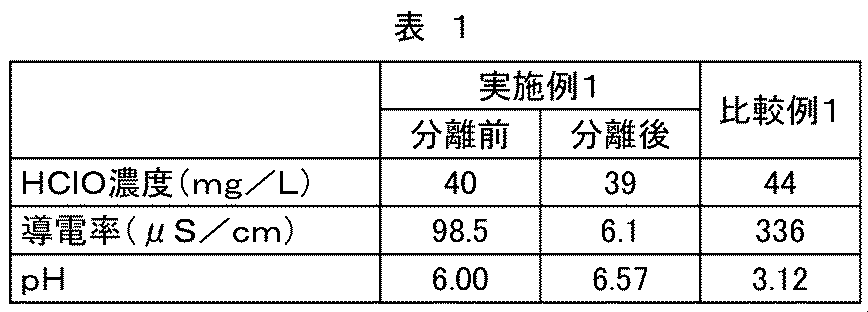
- the obtained strongly acidic hypochlorous acid water is passed through an RO film (RO film made of polyamide manufactured by Mitsubishi Chemical Aqua Solutions Co., Ltd.) to separate hydrochloric acid in the aqueous solution, and the ratio of hypochlorous acid in the aqueous solution is determined.
- An aqueous solution containing the enhanced hypochlorous acid as a main component was obtained.
- the concentration of hypochlorous acid in the obtained aqueous solution containing hypochlorous acid as a main component was measured using an absorptiometer (AQ-102, manufactured by Shibata Chemical Co., Ltd.).
- the pH was measured with a multi-water quality meter (MM-60, manufactured by DKK-TOA CORPORATION).
- Comparative Example 1 An aqueous solution containing hypochlorous acid as a main component was obtained in the same manner as in Example 1 except that the separation treatment with a separation membrane (RO membrane) was not performed. The concentration of hypochlorous acid and other physical characteristics of the obtained aqueous solution containing hypochlorous acid as a main component were obtained in the same manner as in Example 1. The results are shown in Table 1.
- Example 2 Comparative Example 2 Similar to Example 1 and Comparative Example 1, sodium hydroxide was added to an aqueous solution containing hypochlorous acid as a main component obtained by electrolysis, and the pH was adjusted to around 5.5. The obtained aqueous solution was separated by an RO membrane (cellulose membrane manufactured by Toyobo Co., Ltd.) in Example 2 as in Example 1 (separation treatment was not performed in Comparative Example 2). The measurement of Example 2 and Comparative Example 2 was carried out in the same manner as in Example 1 and Comparative Example 1. The results are shown in Table 2.
- RO membrane cellulose membrane manufactured by Toyobo Co., Ltd.
- Example 2 since it was confirmed that the pH increased and the conductivity decreased as compared with Comparative Example 2, the relative concentration of hypochlorous acid increased, and the metal had good stability. It can be seen that an aqueous solution containing hypochlorous acid as a main component, which suppresses the corrosive action against the like, could be obtained.
Landscapes
- Chemical & Material Sciences (AREA)
- Engineering & Computer Science (AREA)
- Water Supply & Treatment (AREA)
- Organic Chemistry (AREA)
- Chemical Kinetics & Catalysis (AREA)
- Inorganic Chemistry (AREA)
- Nanotechnology (AREA)
- Hydrology & Water Resources (AREA)
- Life Sciences & Earth Sciences (AREA)
- Environmental & Geological Engineering (AREA)
- Urology & Nephrology (AREA)
- Health & Medical Sciences (AREA)
- Separation Using Semi-Permeable Membranes (AREA)
Abstract
Description
[1]次亜塩素酸を主成分とする水溶液から、次亜塩素酸以外の夾雑するイオンを分離する方法として、分離膜を用いる分離装置またはシステム、
[2]次亜塩素酸を主成分とする水溶液に、分子量の大きなアルカリ性物質を加えて、
(i)前記水溶液中の塩化物の分子量を次亜塩素酸よりも大きくし、および/または
(ii)前記水溶液を中和することにより、分離したいイオンの水和物の大きさを大きくし
分離膜で分離する上記[1]記載の分離装置またはシステム、
[3]分離膜として、荷電した膜を用いるおよび/または所定の孔径の分離膜を用いることにより、分離の度合いを制御する上記[1]または[2]記載の分離装置またはシステム、
[4]分離膜として、RO膜、NF膜および/またはUF膜を用いる上記[1]~[3]のいずれかに記載の分離装置またはシステム、
[5]分離膜の材質として、高分子ポリマー、セラミックスおよび金属から選択される少なくとも1種を含む上記[1]~[4]のいずれかに記載の分離装置またはシステム、
[6]高分子ポリマーが、ポリスルフォン、ポリエーテルスルフォン、ポリプロピレン、ポリエチレン、トリアセテート、ジアセテート、ナイロン系ポリマーおよびPMMA(ポリメチルメタアクリレート)から選択される少なくとも1種である上記[5]記載の分離装置またはシステム、
[7]次亜塩素酸を主成分とする水溶液が、電気分解またはイオン交換により生成されるものである上記[1]~[6]のいずれかに記載の分離装置またはシステム、
[8]次亜塩素酸を主成分とする水溶液から、次亜塩素酸以外の夾雑するイオンを分離する補助として電場または磁場を利用する上記[1]~[7]のいずれかに記載の分離装置またはシステム、
[9]次亜塩素酸ナトリウムを酸により中和、または電気透析によりナトリウムを除去、またはイオン交換により、NaイオンをHイオンに置換することにより生成した次亜塩素酸水において、生じた塩化物を分離する上記[3]~[6]のいずれかに記載の分離装置またはシステム
に関する。
2NaCl+H2O → 2NaOH+HCl+HClO
次に、得られた酸性の次亜塩素酸を主成分とする水溶液を分離膜に導通し、水溶液中の塩酸を分離し、水溶液中の次亜塩素酸の割合を増加させることができる。この塩酸に対する次亜塩素酸の割合を増加させる処理を行うことにより、同時にpHを中性側へと傾けることができる。所望の塩酸に対する次亜塩素酸の割合や、所望のpHを得るために、この処理を、必要な回数、繰り返し行うことができる。
塩化ナトリウム水溶液を被電解質として、2隔膜3室型電解槽により電気分解し、陽極側から強酸性次亜塩素酸水を得た。得られた強酸性次亜塩素酸水をRO膜(三菱ケミカルアクア・ソリューションズ(株)製のポリアミド製RO膜)に通し、水溶液中の塩酸を分離し、水溶液中の次亜塩素酸の割合を高めた次亜塩素酸を主成分とする水溶液を得た。得られた次亜塩素酸を主成分とする水溶液の次亜塩素酸の濃度は、吸光光度計(AQ-102、柴田化学(株)製)を用いて測定した。なお、pHは、マルチ水質メーター(MM-60、東亜ディーケーケー(株)製)により測定した。
分離膜(RO膜)による分離処理を行わなかった以外は、実施例1と同様にして次亜塩素酸を主成分とする水溶液を得た。得られた次亜塩素酸を主成分とする水溶液の次亜塩素酸の濃度やその他の物性は、実施例1と同様にして得た。結果を表1に示す。
実施例1、比較例1と同様に、電気分解で得られた次亜塩素酸を主成分とする水溶液に、水酸化ナトリウムを加え、pHを5.5前後に調整した。得られた水溶液を実施例2では実施例1と同じくRO膜(東洋紡(株)製のセルロース膜)により分離処理を行った(分離処理は比較例2においては行わなかった。)。実施例2と比較例2の測定は、実施例1と比較例1と同様に測定した。結果を表2に示す。

Claims (9)
- 次亜塩素酸を主成分とする水溶液から、次亜塩素酸以外の夾雑するイオンを分離する方法として、分離膜を用いる分離装置またはシステム。
- 次亜塩素酸を主成分とする水溶液に、分子量の大きなアルカリ性物質を加えて、
(i)前記水溶液中の塩化物の分子量を次亜塩素酸よりも大きくし、および/または
(ii)前記水溶液を中和することにより、分離したいイオンの水和物の大きさを大きくし
分離膜で分離する請求項1記載の分離装置またはシステム。 - 分離膜として、荷電した膜を用いるおよび/または所定の孔径の分離膜を用いることにより、分離の度合いを制御する請求項1または2記載の分離装置またはシステム。
- 分離膜として、RO膜、NF膜および/またはUF膜を用いる請求項1~3のいずれか1項に記載の分離装置またはシステム。
- 分離膜の材質として、高分子ポリマー、セラミックスおよび金属から選択される少なくとも1種を含む請求項1~4のいずれか1項に記載の分離装置またはシステム。
- 高分子ポリマーが、ポリスルフォン、ポリエーテルスルフォン、ポリプロピレン、ポリエチレン、トリアセテート、ジアセテート、ナイロン系ポリマーおよびPMMA(ポリメチルメタアクリレート)から選択される少なくとも1種である請求項5記載の分離装置またはシステム。
- 次亜塩素酸を主成分とする水溶液が、電気分解またはイオン交換により生成されるものである請求項1~6のいずれか1項に記載の分離装置またはシステム。
- 次亜塩素酸を主成分とする水溶液から、次亜塩素酸以外の夾雑するイオンを分離する補助として電場または磁場を利用する請求項1~7のいずれか1項に記載の分離装置またはシステム。
- 次亜塩素酸ナトリウムを酸により中和、または電気透析によりナトリウムを除去、またはイオン交換により、NaイオンをHイオンに置換することにより生成した次亜塩素酸水において、生じた塩化物を分離する請求項3~6のいずれか1項に記載の分離装置またはシステム。
Priority Applications (4)
| Application Number | Priority Date | Filing Date | Title |
|---|---|---|---|
| JP2022524555A JP7802293B2 (ja) | 2020-05-22 | 2021-05-21 | 次亜塩素酸水から夾雑イオンを分離する分離装置およびシステム |
| US17/926,933 US20230201772A1 (en) | 2020-05-22 | 2021-05-21 | Separation device and system for separating impurity ions from aqueous hypochlorous acid solution |
| EP21809040.5A EP4155261A4 (en) | 2020-05-22 | 2021-05-21 | SEPARATION APPARATUS AND SYSTEM FOR REMOVING IMPURITIES IONS FROM AN AQUEOUS HYPOCHLOROUS ACID SOLUTION |
| CN202180036558.3A CN115803105B (zh) | 2020-05-22 | 2021-05-21 | 从次氯酸水中分离杂质离子的分离装置及系统 |
Applications Claiming Priority (2)
| Application Number | Priority Date | Filing Date | Title |
|---|---|---|---|
| JP2020090046 | 2020-05-22 | ||
| JP2020-090046 | 2020-05-22 |
Publications (1)
| Publication Number | Publication Date |
|---|---|
| WO2021235554A1 true WO2021235554A1 (ja) | 2021-11-25 |
Family
ID=78708657
Family Applications (1)
| Application Number | Title | Priority Date | Filing Date |
|---|---|---|---|
| PCT/JP2021/019471 Ceased WO2021235554A1 (ja) | 2020-05-22 | 2021-05-21 | 次亜塩素酸水から夾雑イオンを分離する分離装置およびシステム |
Country Status (5)
| Country | Link |
|---|---|
| US (1) | US20230201772A1 (ja) |
| EP (1) | EP4155261A4 (ja) |
| JP (1) | JP7802293B2 (ja) |
| CN (1) | CN115803105B (ja) |
| WO (1) | WO2021235554A1 (ja) |
Citations (13)
| Publication number | Priority date | Publication date | Assignee | Title |
|---|---|---|---|---|
| US3616385A (en) * | 1969-07-23 | 1971-10-26 | Procter & Gamble | Chlorine- and chloride-free hyprochlorous acid by electrodialysis |
| JPS61149288A (ja) * | 1984-12-25 | 1986-07-07 | Kobe Steel Ltd | 塩水の逆浸透処理方法 |
| JP2000093964A (ja) * | 1998-07-21 | 2000-04-04 | Toto Ltd | アルカリ水生成方法と電解装置 |
| JP2001104757A (ja) * | 1999-10-13 | 2001-04-17 | Takao Kokugan | 可溶性シクロデキストリン重合体を用いたアミノ酸の光学分割方法、及び、そのための可溶性シクロデキストリン重合体 |
| JP2007007502A (ja) * | 2005-06-28 | 2007-01-18 | Noritsu Koki Co Ltd | 低食塩電解水の製造方法とその製造装置 |
| JP2009072755A (ja) | 2007-04-13 | 2009-04-09 | Masaaki Arai | 電解水の製造装置、電解水の製造方法および電解水 |
| JP2009074279A (ja) * | 2007-09-19 | 2009-04-09 | Hitachi Plant Technologies Ltd | 膜を用いた2元給水システム |
| JP2011111386A (ja) * | 2009-11-27 | 2011-06-09 | Yasuharu Shima | 次亜塩素酸水の製法 |
| JP2011229833A (ja) | 2010-04-30 | 2011-11-17 | Yukio Matano | 除菌シート |
| JP2017535421A (ja) * | 2014-09-17 | 2017-11-30 | ヴイアイティーオー エヌヴイ | 膜分離を用いた反応方法 |
| JP2017222535A (ja) * | 2016-06-14 | 2017-12-21 | 淳一 熊倉 | 次亜塩素酸水溶液の製造又は調製方法及び装置 |
| JP2019043785A (ja) * | 2017-08-30 | 2019-03-22 | 岡山県 | 次亜塩素酸流体の製造方法 |
| JP2019516869A (ja) * | 2016-05-17 | 2019-06-20 | ディバーシー,インコーポレーテッド | 電気化学的活性化を使用して生産されるアルカリ溶液及び塩素溶液 |
Family Cites Families (4)
| Publication number | Priority date | Publication date | Assignee | Title |
|---|---|---|---|---|
| US6537456B2 (en) * | 1996-08-12 | 2003-03-25 | Debasish Mukhopadhyay | Method and apparatus for high efficiency reverse osmosis operation |
| TW404847B (en) * | 1996-08-12 | 2000-09-11 | Debasish Mukhopadhyay | Method and apparatus for high efficiency reverse osmosis operation |
| GB2488838A (en) * | 2011-03-11 | 2012-09-12 | Biomimetics Health Ind Ltd | A stable antimicrobial aqueous hypochlorous acid solution |
| EP2718482B1 (en) * | 2011-06-10 | 2019-10-09 | Lumetta, Michael | System and method for generating a chlorine-containing compound |
-
2021
- 2021-05-21 US US17/926,933 patent/US20230201772A1/en active Pending
- 2021-05-21 EP EP21809040.5A patent/EP4155261A4/en active Pending
- 2021-05-21 JP JP2022524555A patent/JP7802293B2/ja active Active
- 2021-05-21 WO PCT/JP2021/019471 patent/WO2021235554A1/ja not_active Ceased
- 2021-05-21 CN CN202180036558.3A patent/CN115803105B/zh active Active
Patent Citations (13)
| Publication number | Priority date | Publication date | Assignee | Title |
|---|---|---|---|---|
| US3616385A (en) * | 1969-07-23 | 1971-10-26 | Procter & Gamble | Chlorine- and chloride-free hyprochlorous acid by electrodialysis |
| JPS61149288A (ja) * | 1984-12-25 | 1986-07-07 | Kobe Steel Ltd | 塩水の逆浸透処理方法 |
| JP2000093964A (ja) * | 1998-07-21 | 2000-04-04 | Toto Ltd | アルカリ水生成方法と電解装置 |
| JP2001104757A (ja) * | 1999-10-13 | 2001-04-17 | Takao Kokugan | 可溶性シクロデキストリン重合体を用いたアミノ酸の光学分割方法、及び、そのための可溶性シクロデキストリン重合体 |
| JP2007007502A (ja) * | 2005-06-28 | 2007-01-18 | Noritsu Koki Co Ltd | 低食塩電解水の製造方法とその製造装置 |
| JP2009072755A (ja) | 2007-04-13 | 2009-04-09 | Masaaki Arai | 電解水の製造装置、電解水の製造方法および電解水 |
| JP2009074279A (ja) * | 2007-09-19 | 2009-04-09 | Hitachi Plant Technologies Ltd | 膜を用いた2元給水システム |
| JP2011111386A (ja) * | 2009-11-27 | 2011-06-09 | Yasuharu Shima | 次亜塩素酸水の製法 |
| JP2011229833A (ja) | 2010-04-30 | 2011-11-17 | Yukio Matano | 除菌シート |
| JP2017535421A (ja) * | 2014-09-17 | 2017-11-30 | ヴイアイティーオー エヌヴイ | 膜分離を用いた反応方法 |
| JP2019516869A (ja) * | 2016-05-17 | 2019-06-20 | ディバーシー,インコーポレーテッド | 電気化学的活性化を使用して生産されるアルカリ溶液及び塩素溶液 |
| JP2017222535A (ja) * | 2016-06-14 | 2017-12-21 | 淳一 熊倉 | 次亜塩素酸水溶液の製造又は調製方法及び装置 |
| JP2019043785A (ja) * | 2017-08-30 | 2019-03-22 | 岡山県 | 次亜塩素酸流体の製造方法 |
Non-Patent Citations (1)
| Title |
|---|
| See also references of EP4155261A4 |
Also Published As
| Publication number | Publication date |
|---|---|
| EP4155261A1 (en) | 2023-03-29 |
| US20230201772A1 (en) | 2023-06-29 |
| CN115803105B (zh) | 2025-09-05 |
| EP4155261A4 (en) | 2023-11-29 |
| JP7802293B2 (ja) | 2026-01-20 |
| CN115803105A (zh) | 2023-03-14 |
| JPWO2021235554A1 (ja) | 2021-11-25 |
Similar Documents
| Publication | Publication Date | Title |
|---|---|---|
| CN101679080B (zh) | 电化学处理的水,其制取方法和装置以及其作为消毒剂的应用 | |
| JP6457737B2 (ja) | 酸性電解水およびその製造方法、該酸性電解水を含む殺菌剤および洗浄剤、該酸性電解水を用いた殺菌方法、ならびに酸性電解水の製造装置 | |
| US20150119245A1 (en) | Method for Producing Shelf Stable Hypochlorous Acid Solutions | |
| US20140302168A1 (en) | Microbiocidal Solution with Ozone and Methods | |
| JP2025091415A (ja) | 次亜塩素酸を主成分とする水溶液 | |
| JP2011111386A (ja) | 次亜塩素酸水の製法 | |
| JP7504388B2 (ja) | 次亜塩素酸水噴霧システム | |
| WO2015029263A1 (ja) | 洗浄水及びその製造方法 | |
| JP7802293B2 (ja) | 次亜塩素酸水から夾雑イオンを分離する分離装置およびシステム | |
| CN112323090B (zh) | 一种可稳定保存的次氯酸溶液及其制备方法 | |
| CN107587160A (zh) | 杀菌消毒液壶 | |
| JP3705756B2 (ja) | 電解液及び該電解液により生成させた電解水 | |
| US20240317615A1 (en) | Electro-activated super oxidized water and method of synthesizing the same | |
| CN113180056A (zh) | 次氯酸消毒液 | |
| KR100491175B1 (ko) | 어병 병원성 세균 살균액, 그의 제조방법 및 중화방법 | |
| JPH11188246A (ja) | 中空糸膜の洗浄方法 | |
| KR102241577B1 (ko) | 전해질로서 염화나트륨을 이용한 화병의 물 전기분해 장치 | |
| KR102241536B1 (ko) | 분리막을 구비한 화병의 살균장치 | |
| KR102241574B1 (ko) | 꽃꽂이에 제공되는 물의 전기분해를 위한 전극구조 장치를 구비한 화병 | |
| JP4846298B2 (ja) | 海水の殺菌処理方法 | |
| US20130316019A1 (en) | Production Process for a Stabilized Aqueous Solution of Oxidizing Chlorine and a Stabilized Aqueous Solution of Oxidizing Chlorine Produced in this Manner | |
| JP2002210466A (ja) | 排水量を削減した電解水生成方法及び装置 | |
| HK1172888A (en) | Electrochemically treated water, method and device for the production thereof, and the use thereof as a disinfection agent | |
| JP4231272B2 (ja) | 海洋生物の養殖用水、同養殖用水の製造方法および製造装置 | |
| KR20050028541A (ko) | 수소수 생성용 조성물 |
Legal Events
| Date | Code | Title | Description |
|---|---|---|---|
| 121 | Ep: the epo has been informed by wipo that ep was designated in this application |
Ref document number: 21809040 Country of ref document: EP Kind code of ref document: A1 |
|
| ENP | Entry into the national phase |
Ref document number: 2022524555 Country of ref document: JP Kind code of ref document: A |
|
| ENP | Entry into the national phase |
Ref document number: 2021809040 Country of ref document: EP Effective date: 20221222 |
|
| NENP | Non-entry into the national phase |
Ref country code: DE |
|
| WWG | Wipo information: grant in national office |
Ref document number: 202180036558.3 Country of ref document: CN |