WO2021241475A1 - たるみ評価方法、装置、プログラム、およびシステム - Google Patents
たるみ評価方法、装置、プログラム、およびシステム Download PDFInfo
- Publication number
- WO2021241475A1 WO2021241475A1 PCT/JP2021/019525 JP2021019525W WO2021241475A1 WO 2021241475 A1 WO2021241475 A1 WO 2021241475A1 JP 2021019525 W JP2021019525 W JP 2021019525W WO 2021241475 A1 WO2021241475 A1 WO 2021241475A1
- Authority
- WO
- WIPO (PCT)
- Prior art keywords
- amount
- slack
- gravity
- face
- sagging
- Prior art date
- Legal status (The legal status is an assumption and is not a legal conclusion. Google has not performed a legal analysis and makes no representation as to the accuracy of the status listed.)
- Ceased
Links
Images













Classifications
-
- G—PHYSICS
- G06—COMPUTING OR CALCULATING; COUNTING
- G06T—IMAGE DATA PROCESSING OR GENERATION, IN GENERAL
- G06T7/00—Image analysis
- G06T7/0002—Inspection of images, e.g. flaw detection
- G06T7/0012—Biomedical image inspection
-
- A—HUMAN NECESSITIES
- A61—MEDICAL OR VETERINARY SCIENCE; HYGIENE
- A61B—DIAGNOSIS; SURGERY; IDENTIFICATION
- A61B5/00—Measuring for diagnostic purposes; Identification of persons
- A61B5/44—Detecting, measuring or recording for evaluating the integumentary system, e.g. skin, hair or nails
- A61B5/441—Skin evaluation, e.g. for skin disorder diagnosis
- A61B5/442—Evaluating skin mechanical properties, e.g. elasticity, hardness, texture, wrinkle assessment
-
- A—HUMAN NECESSITIES
- A61—MEDICAL OR VETERINARY SCIENCE; HYGIENE
- A61B—DIAGNOSIS; SURGERY; IDENTIFICATION
- A61B5/00—Measuring for diagnostic purposes; Identification of persons
- A61B5/0059—Measuring for diagnostic purposes; Identification of persons using light, e.g. diagnosis by transillumination, diascopy, fluorescence
- A61B5/0077—Devices for viewing the surface of the body, e.g. camera, magnifying lens
-
- A—HUMAN NECESSITIES
- A61—MEDICAL OR VETERINARY SCIENCE; HYGIENE
- A61B—DIAGNOSIS; SURGERY; IDENTIFICATION
- A61B5/00—Measuring for diagnostic purposes; Identification of persons
- A61B5/103—Measuring devices for testing the shape, pattern, colour, size or movement of the body or parts thereof, for diagnostic purposes
- A61B5/107—Measuring physical dimensions, e.g. size of the entire body or parts thereof
- A61B5/1072—Measuring physical dimensions, e.g. size of the entire body or parts thereof measuring distances on the body, e.g. measuring length, height or thickness
-
- A—HUMAN NECESSITIES
- A61—MEDICAL OR VETERINARY SCIENCE; HYGIENE
- A61B—DIAGNOSIS; SURGERY; IDENTIFICATION
- A61B5/00—Measuring for diagnostic purposes; Identification of persons
- A61B5/48—Other medical applications
- A61B5/4848—Monitoring or testing the effects of treatment, e.g. of medication
-
- A—HUMAN NECESSITIES
- A61—MEDICAL OR VETERINARY SCIENCE; HYGIENE
- A61B—DIAGNOSIS; SURGERY; IDENTIFICATION
- A61B5/00—Measuring for diagnostic purposes; Identification of persons
- A61B5/72—Signal processing specially adapted for physiological signals or for diagnostic purposes
- A61B5/7235—Details of waveform analysis
- A61B5/7264—Classification of physiological signals or data, e.g. using neural networks, statistical classifiers, expert systems or fuzzy systems
- A61B5/7267—Classification of physiological signals or data, e.g. using neural networks, statistical classifiers, expert systems or fuzzy systems involving training the classification device
-
- A—HUMAN NECESSITIES
- A61—MEDICAL OR VETERINARY SCIENCE; HYGIENE
- A61Q—SPECIFIC USE OF COSMETICS OR SIMILAR TOILETRY PREPARATIONS
- A61Q19/00—Preparations for care of the skin
- A61Q19/08—Anti-ageing preparations
-
- G—PHYSICS
- G06—COMPUTING OR CALCULATING; COUNTING
- G06T—IMAGE DATA PROCESSING OR GENERATION, IN GENERAL
- G06T15/00—Three-dimensional [3D] image rendering
-
- G—PHYSICS
- G06—COMPUTING OR CALCULATING; COUNTING
- G06T—IMAGE DATA PROCESSING OR GENERATION, IN GENERAL
- G06T7/00—Image analysis
- G06T7/50—Depth or shape recovery
-
- G—PHYSICS
- G06—COMPUTING OR CALCULATING; COUNTING
- G06V—IMAGE OR VIDEO RECOGNITION OR UNDERSTANDING
- G06V40/00—Recognition of biometric, human-related or animal-related patterns in image or video data
- G06V40/10—Human or animal bodies, e.g. vehicle occupants or pedestrians; Body parts, e.g. hands
- G06V40/16—Human faces, e.g. facial parts, sketches or expressions
- G06V40/168—Feature extraction; Face representation
- G06V40/171—Local features and components; Facial parts ; Occluding parts, e.g. glasses; Geometrical relationships
-
- G—PHYSICS
- G06—COMPUTING OR CALCULATING; COUNTING
- G06T—IMAGE DATA PROCESSING OR GENERATION, IN GENERAL
- G06T2207/00—Indexing scheme for image analysis or image enhancement
- G06T2207/30—Subject of image; Context of image processing
- G06T2207/30004—Biomedical image processing
- G06T2207/30088—Skin; Dermal
-
- G—PHYSICS
- G06—COMPUTING OR CALCULATING; COUNTING
- G06T—IMAGE DATA PROCESSING OR GENERATION, IN GENERAL
- G06T2207/00—Indexing scheme for image analysis or image enhancement
- G06T2207/30—Subject of image; Context of image processing
- G06T2207/30196—Human being; Person
- G06T2207/30201—Face
Definitions
- the present invention relates to a sagging evaluation method, an apparatus, a program, and a system.
- Patent Document 1 a method for evaluating the sagging of the face has been known.
- the area of a figure drawn by a closed curve on the skin surface is measured in two postures, a horizontal position and a vertical position, and the area ratio or the area difference of each is measured as the amount of sagging of the skin. ..
- the conventional evaluation of sagging has been performed on the premise that the face looks sagging because the morphology of the face hangs down in the direction of gravity.
- Non-Patent Document 1 reports a method of evaluating sagging in 6 stages from 0 to 5 from sagging in each part of the face (upper cheek, lower cheek, posterior cheek) that progresses in proportion to age.
- a method includes a step of acquiring a gravity bulge amount and a gravity dent amount obtained from a three-dimensional shape change between a horizontal position and a vertical position three-dimensional shape face image, and the gravity bulge amount and the above-mentioned gravity bulge amount. It includes a step of calculating the amount of slack in the face and the amount of slack in the front and back of the cheek from the amount of gravity dent, and a step of evaluating the slack type and the degree thereof using the amount of slack in the face and the amount of slack in the front and back of the cheek as an index.
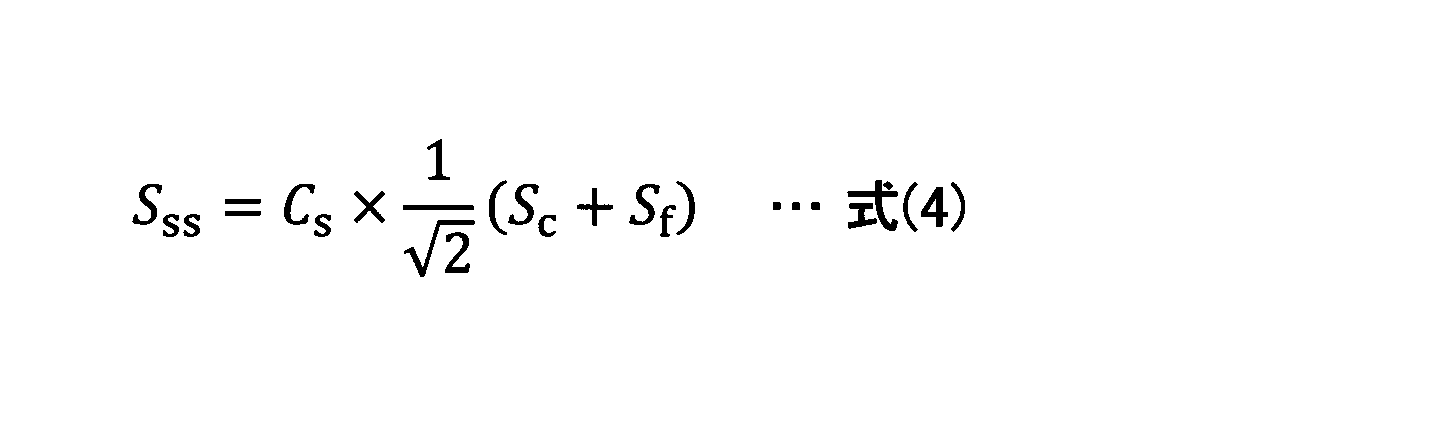
- the sagging skin coefficient was calculated using one of the parameters of the skin viscoelasticity acquired by the viscoelasticity acquisition device according to the embodiment of the present invention, and the visual perception score calculated using the equation (4) and the actual state. It is a figure which shows the case of having compared the visual sensation score obtained from the visual sensation evaluation performed in.
- the sagging skin coefficient was calculated using two or more of the parameters of the skin viscoelasticity acquired by the viscoelasticity acquisition device according to the embodiment of the present invention, and the visual perception score calculated using the equation (4) and the actual state.
- At least one of a gravity swelling amount (VCswelling), a gravity denting amount (VCshrinking), an intraface movement slack amount (Sf), and a cheek anterior-posterior slack amount (Sc) according to an embodiment of the present invention. It is a figure for demonstrating the representative value of the value calculated using the three-dimensional shape face image acquired repeatedly. At least one of a gravity swelling amount (VCswelling), a gravity denting amount (VCshrinking), an intraface movement slack amount (Sf), and a cheek anterior-posterior slack amount (Sc) according to an embodiment of the present invention.
- -"Three-dimensional shape face image means an image showing the three-dimensional shape of a person's face, which is the object of evaluation of sagging.
- -The "horizontal position” refers to the state in which the median line of the face is stationary at a right angle to the direction of gravity.
- -"Vertical position means the state where the median line of the face is stationary parallel to the direction of gravity.
- visual score (visual evaluation, also called Sss)" is a numerical value of the evaluation based on the visual sensation of sagging.
- the visual perception score is calculated by the determination of the judge as to which of the reference photographs 1 to 5 the face of the person to be evaluated for sagging is closest to.
- the visual score is an image of an oblique profile (face) when the face of the person to be evaluated for sagging is in a vertical position (that is, the midline of the face is stationary parallel to the direction of gravity). It is calculated from the image of the face taken from an angle of 45 degrees to the left and right from the front of.
- the visual perception score of the face of the person to be evaluated for sagging may be calculated using a trained model generated by machine learning using the image of the diagonal profile on which the visual perception score is determined as teacher data. ..
- the visual recognition score is determined at each site of the upper cheek, the lower cheek, and the posterior cheek, but may be newly generated by averaging any of them. Sss averages the visual scores, especially in the upper and lower cheeks, and indicates the apparent sagging in the upper and lower cheeks.
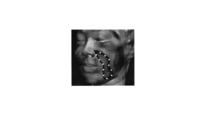
- FIG. 1 is a diagram for explaining a gravitational bulge according to an embodiment of the present invention.
- the three-dimensional shape face image when the subject's face is in the horizontal position and the three-dimensional shape face image when the subject's face is in the vertical position are acquired, and the three-dimensional shape in the horizontal position and the three-dimensional shape in the vertical position are obtained.
- the volume of the part in the broken line in FIG. 1 was larger in the vertical position. In this way, the difference in volume between the two parts (that is, the horizontal position and the vertical position) where the volume is larger in the vertical position is defined as the gravity swelling amount (VCswelling).
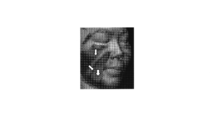
- FIG. 2 is a diagram for explaining a gravity dent according to an embodiment of the present invention.
- the three-dimensional shape face image when the subject's face is in the horizontal position and the three-dimensional shape face image when the subject's face is in the vertical position are acquired, and the three-dimensional shape in the horizontal position and the three-dimensional shape in the vertical position are obtained.
- the volume of the part in the broken line in FIG. 2 was smaller in the vertical position. In this way, the difference in volume between the two parts (that is, the horizontal position and the vertical position) where the volume is smaller in the vertical position is defined as the gravity dent (VCshrinking).
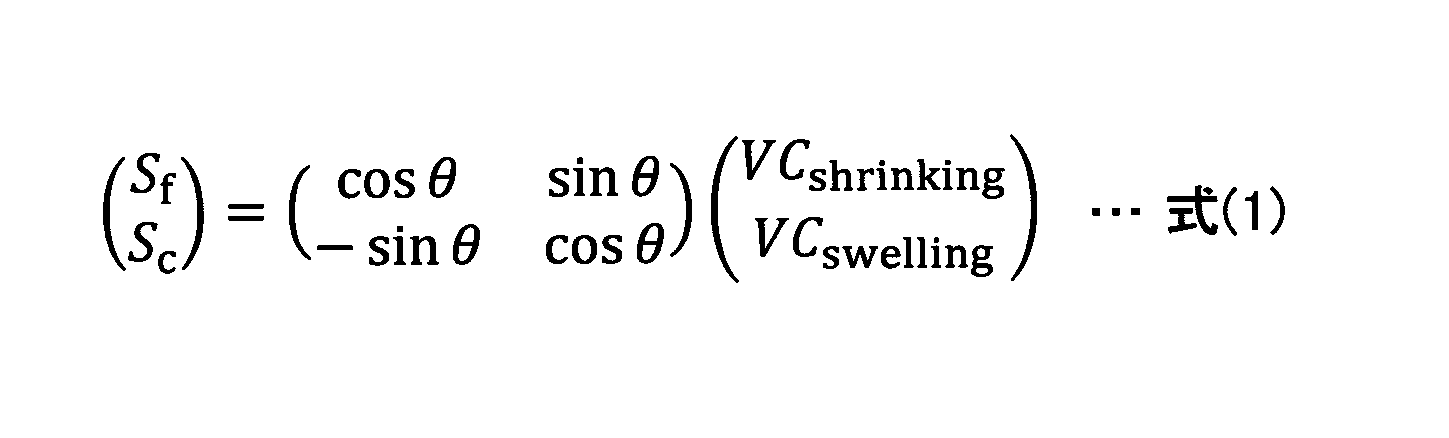
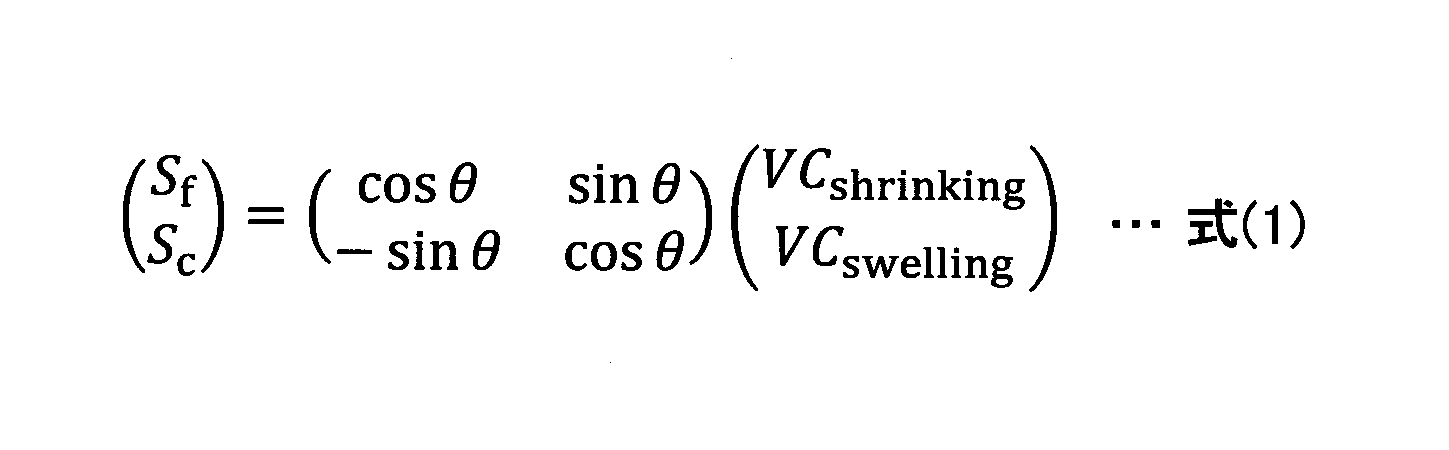
- FIG. 3 shows a phenomenon in which the face is deformed due to the influence of gravity swelling and gravity dents according to an embodiment of the present invention and two types of slack ("intraface movement slack (Sf)” and “”. It is a figure which shows the relationship of the sagging amount (Sc) ". The details will be described later). From the gravity swelling amount (VCswelling) in FIG. 1 and the gravity denting amount (VCshrinking) in FIG. 2, using the following formula (1), two types of slack (“intraface movement slack amount (Sf)” "Amount of sagging before and after cheek (Sc)”) can be calculated.
- FIG. 4 is a diagram for explaining the intra-face movement slack according to the embodiment of the present invention.
- the intra-face movement slack is a slack that hangs from the upper part of the cheek to the lower part.
- FIG. 5 is a diagram for explaining the cheek anterior-posterior sagging according to the embodiment of the present invention.
- the cheek anterior-posterior slack is a slack other than the slack that hangs down from the upper part to the lower part of the cheek (for example, the slack that the cheek moves back and forth from the oral side due to the deformation of the cheek at the mouth).
- FIG. 6 is a diagram comparing the intra-face movement sagging and the cheek anterior-posterior sagging according to the embodiment of the present invention. Hereinafter, each comparison item will be described.
- the contribution ratio R2 (also referred to as the coefficient of determination) of the intra-face movement sagging to the visual perception score is 53%.
- the correlation R between the cheek anterior-posterior sagging and the visual perception score which will be explained with reference to FIG. In each group, 9% or 0.4%.
- the visual score is a numerical value of the evaluation based on the visual perception of sagging.
- Intra-face movement sagging is sagging caused by gravity that progresses slowly over the long term throughout the face.
- cheek anterior-posterior sagging is sagging caused locally (mouth) by gravity regardless of age.
- sagging skin coefficient which contributes to the sagging appearance and is a third factor different from "movement sagging in the face” and "sagging before and after the cheeks", will be described with reference to FIGS. 7 and 8.
- FIG. 7 is a diagram showing the relationship between the gravity swelling and the visual evaluation (visual score) according to the embodiment of the present invention.
- VCswelling Even with the same amount of gravity swelling (VCswelling), there are some who have different visual scores (Sss). For example, looking at a person with a gravity swelling amount of about 5 cc, it can be seen that the visual perception score varies from about 1 to about 4.
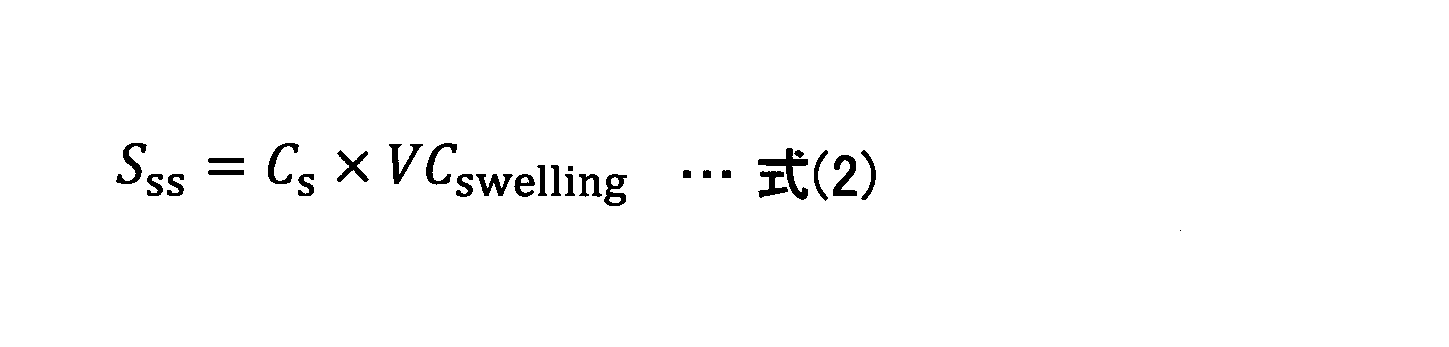
- the sagging skin coefficient (Cs) can be defined using the following equation (2). Since VC swelling ⁇ 0 is required to directly obtain Cs from the following equation (2), each Cs shown in FIG.
- the sagging skin coefficient was calculated for this. As will be described later, the sagging skin coefficient is directly calculated from the amount of gravity swelling (VCswelling) and the visual perception score (Sss) using the following equation (2), and as will be described later, equations (5) and (6). It may be calculated from the parameter of skin viscoelasticity by using the property that the sagging skin coefficient (Cs) correlates well with the parameter of skin viscoelasticity.
- FIG. 8 is a diagram for explaining a sagging skin coefficient according to an embodiment of the present invention.
- the sagging skin coefficient (Cs) was correlated with the parameter of the skin viscoelasticity acquired by the viscoelasticity acquisition device.
- a person with a high sagging skin coefficient (Cs) is a person without firmness, and such skin appears to have sagging emphasized even with sagging caused by the same gravity.
- FIG. 24 calculates the sagging skin coefficient using one of the parameters of the skin viscoelasticity acquired by the viscoelasticity acquisition device according to the embodiment of the present invention, and calculates it using the formula (4).
- the case where the sagging skin coefficient was calculated using two or more of the parameters, and the visual sensation score calculated using the equation (4) was compared with the visual sensation score obtained from the actual visual sensation evaluation is shown. There is. Comparing FIG. 24 and FIG. 25, FIG.
- FIG. 25 that is, when the sagging skin coefficient is calculated using two or more of the parameters of skin viscoelasticity
- FIG. 24 that is, the parameter of skin viscoelasticity
- FIG. 24 (a) is calculated from the parameters of skin viscoelasticity using the formula (5) as shown below, using the property that the sagging skin coefficient (Cs) correlates well with the parameters of skin viscoelasticity. It is each fitting coefficient of. Ai and bi were calculated from Cs and Ei of the subject group with VC swelling> 3.5 (cc) that a 30-year-old can have on average.
- Cs is obtained from Ei of all subject groups using ai and bi shown in FIG. 24 (a), and Sss calculated using the formula (4) and the reference as shown in Non-Patent Document 1. It is compared with the actual visual perception score Sss obtained using photographs.
- the correlation coefficient between Sss calculated using Eq. (4) and the actual Sss differs depending on the parameters of skin viscoelasticity used, but by using appropriate parameters, Sss can be accurately referred to as "sag skin coefficient (Cs)". It can be seen that it can be calculated from three factors, "the amount of slack in the face (Sf)” and “the amount of slack in the front and back of the cheek (Sc)".
- FIG. 25 (a) shows two or more skin viscoelastic parameters using equation (6) as shown below, using the property that the sagging skin coefficient (Cs) correlates well with the skin viscoelastic parameters. It is each fitting coefficient when calculated from. Ai and b were obtained from Cs and Ei of the subject group whose VC swelling> 3.5 (cc) that a 30-year-old can have on average.
- Cs is obtained from Ei of all the subject groups using ai and b shown in FIG. 25 (a), and Sss calculated using the formula (4) and the reference as shown in Non-Patent Document 1. It is compared with the actual visual perception score Sss obtained using photographs.
- the correlation coefficient between Sss calculated using Eq. (4) and the actual Sss differs depending on the parameters of skin viscoelasticity used, but by using appropriate parameters, the parameters of skin viscoelasticity can be set to 2 more than when one.
- Sss can be calculated more accurately from the three factors of "sag skin coefficient (Cs)", “intraface movement sagging amount (Sf)”, and “cheek anterior-posterior sagging amount (Sc)".
- the apparent sagging (that is, the visual sensation score (Sss)) is “sagging skin coefficient (Cs)", “intraface movement sagging amount (Sf)”, and “cheek anterior-posterior sagging amount (Sc)”. It is composed of two factors.
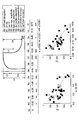
- FIG. 9 shows the correlation between the sagging skin coefficient (Cs) and the visual evaluation (visual score (Sss)) according to the embodiment of the present invention, and the amount of intra-face movement sagging (Sf) and the visual score (Sss). It is a figure which compared the correlation with, and the correlation with the amount of sagging (Sc) in front of and behind the cheek, and the visual perception score (Sss).
- the correlation coefficient between the sagging skin coefficient (Cs) and the visual perception score (Sss) is 0.72, and the coefficient of determination is 0.5184. Therefore, it can be said that the contribution rate of the sagging skin coefficient (Cs) to the visual perception score (Sss) is 52%.
- the correlation coefficient between the amount of movement in the face (Sf) and the visual perception score (Sss) is 0.73, and the coefficient of determination is 0.5305. Therefore, it can be said that the contribution ratio of the amount of intra-face movement sagging (Sf) to the visual perception score (Sss) is 53%.
- the correlation coefficient between the amount of cheek anterior-posterior sagging (Sc) and the visual perception score (Sss) is 0.30 in the group with cheek anterior-posterior sagging, and the coefficient of determination is It is 0.09. Therefore, it can be said that the contribution rate of the amount of cheek anterior-posterior sagging (Sc) to the visual perception score (Sss) is 9% in the group with cheek anterior-posterior sagging.
- the total contribution of the sagging skin coefficient (Cs), the intra-face movement sagging amount (Sf), and the cheek anterior-posterior sagging amount (Sc) is 114%, which is shown in FIG.
- the multiple co-linearity of the sagging skin coefficient (Cs) and the intra-face movement sagging amount (Sf) derived from the fact that both the sagging skin coefficient (Cs) and the intra-face movement sagging amount (Sf) strongly correlate with age (explanation). There is a strong correlation between the variables).
- FIG. 10 shows the correlation between the sagging skin coefficient (Cs) and age according to the embodiment of the present invention, the correlation between the amount of intra-face movement sagging (Sf) and age, and the amount of cheek anterior-posterior sagging (Sc) and age. It is a figure which compared with the correlation of.
- the sagging skin coefficient (Cs) increases as the age increases, and the correlation coefficient is 0.66. From this, it can be said that the sagging skin coefficient (Cs), which is a factor constituting the sagging appearance, is a phenomenon due to aging.
- the amount of intra-face movement slack (Sf) increases as the age increases, and the correlation coefficient is 0.64. From this, it can be said that the amount of intra-face movement slack (Sf), which is a factor constituting the appearance of slack, is a phenomenon due to aging.
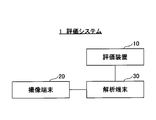
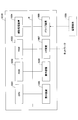
- FIG. 11 is a block diagram of the evaluation system 1 according to the embodiment of the present invention.
- the evaluation system (also referred to as an evaluation system for evaluating the sagging type and its degree) 1 according to an embodiment of the present invention includes an evaluation device (also referred to as an evaluation device for evaluating the sagging type and its degree) 10 and an image pickup terminal 20. , And the analysis terminal 30.
- the evaluation device 10 and the analysis terminal 30 can transmit and receive data via an arbitrary network. Each will be described below.
- the image pickup terminal 20 is a terminal that generates data of an image (three-dimensional shape face image) representing a three-dimensional shape of a person's face, which is an object of evaluation of sagging.
- the image pickup terminal 20 is a measuring device that captures a 3D (three-dimensional) image.
- the image pickup terminal 20 is used when the face of the person to be evaluated for sagging is in the horizontal position (specifically, when the median line of the face is stationary at a right angle to the direction of gravity). , And when it is in the vertical position (specifically, when the median plane of the face is stopped parallel to the direction of gravity), the data of the three-dimensional shape face image is generated. Later, the image pickup terminal 20 will be described in detail with reference to FIG.
- the analysis terminal 30 is a computer (for example, a personal computer, a tablet, a smartphone, etc.) for calculating information used for evaluating slack based on the data generated by the image pickup terminal 20.
- the analysis terminal 30 has a three-dimensional shape between a three-dimensional shape face image when the human face to be evaluated for sagging is in the horizontal position and a three-dimensional shape face image when the person's face is in the vertical position.
- the amount of gravity swelling (VCswelling) and the amount of gravity denting (VCshrinking) are calculated based on the change in shape. Later, the analysis terminal 30 will be described in detail with reference to FIG.
- the evaluation device 10 is a computer (for example, a server) for evaluating slack. For example, the evaluation device 10 calculates the amount of intra-face movement slack (Sf) and the amount of cheek anterior-posterior slack (Sc) based on the amount of gravity swelling (VCswelling) and the amount of gravity denting (VCshrinking). Later, the evaluation device 10 will be described in detail with reference to FIG.
- evaluation device 10 and the analysis terminal 30 are described as separate computers in FIG. 11, they may be mounted on one computer.
- FIG. 12 is a functional block diagram of the evaluation device 10 according to the embodiment of the present invention.
- the evaluation device 10 can include an acquisition unit 101, a calculation unit 102, an evaluation unit 103, and an output unit 104. Further, the evaluation device 10 can function as an acquisition unit 101, a calculation unit 102, an evaluation unit 103, and an output unit 104 by executing a program. Each will be described below.
- the acquisition unit 101 acquires the gravity swelling amount (VCswelling) and the gravity denting amount (VCshrinking) calculated by the analysis terminal 30. Further, the acquisition unit 101 stores the acquired gravity swelling amount (VCswelling) and gravity dent amount (VCshrinking) in the memory so that the calculation unit 102 can refer to them.
- the calculation unit 102 calculates the amount of intra-face movement slack (Sf) and the amount of cheek anterior-posterior slack (Sc) from the amount of gravity swelling (VCswelling) and the amount of gravity dent (VCshrinking). Further, the calculation unit 102 stores the calculated in-face movement slack amount (Sf) and cheek front-back slack amount (Sc) in the memory so that the evaluation unit 103 and the output unit 104 can refer to them.
- a method for calculating the amount of movement slack in the face (Sf) and the amount of slack in the front and back of the cheeks (Sc) will be described in detail.
- the evaluation unit 103 evaluates the slack type and its degree using the amount of slack in the face (Sf) and the amount of slack in the front and back of the cheek (Sc) as indexes.
- the output unit 104 outputs the values of the amount of movement slack in the face (Sf) and the amount of slack in the front and back of the cheeks (Sc), the slack type and its degree.
- the output unit 104 may be configured to transmit the values of the amount of slack (Sf) moved in the face and the amount of slack (Sc) before and after the cheek, the slack type and the degree thereof to the analysis terminal 30, or the evaluation device 10.
- the display means may be configured to display the values of the amount of movement slack in the face (Sf) and the amount of slack in the front and back of the cheeks (Sc), the type of slack, and the degree thereof.
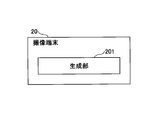
- FIG. 13 is a functional block diagram of the image pickup terminal 20 according to the embodiment of the present invention.
- the image pickup terminal 20 can include a generation unit 201. Further, the image pickup terminal 20 can function as the generation unit 201 by executing the program. Hereinafter, it will be described in detail.
- the generation unit 201 generates data of a three-dimensional shape face image when the face of the person to be evaluated for sagging is in the horizontal position and in the vertical position. Further, the generation unit 201 transmits the generated data to the analysis terminal 30.
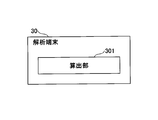
- FIG. 14 is a functional block diagram of the analysis terminal 30 according to the embodiment of the present invention.
- the analysis terminal 30 can include a calculation unit 301. Further, the analysis terminal 30 can function as the calculation unit 301 by executing the program. Hereinafter, it will be described in detail.
- the calculation unit 301 acquires the data generated by the image pickup terminal 20. Further, the calculation unit 301 is generated between the three-dimensional shape face image when the human face to be evaluated for slack is in the horizontal position and the three-dimensional shape face image when the face is in the vertical position, which is generated by the image pickup terminal 20. The amount of gravity swelling (VCswelling) and the amount of gravity denting (VCshrinking) are calculated based on the change in the three-dimensional shape. Further, the calculation unit 301 can transmit the calculated gravity swelling amount (VCswelling) and gravity denting amount (VCshrinking) to the evaluation device 10.
- the method of calculating the amount of gravity swelling (VCswelling) and the method of calculating the amount of gravity denting (VCshrinking) will be described in detail.
- the calculation unit 301 compares the three-dimensional shape in the horizontal position and the three-dimensional shape in the vertical position, and both the parts having a large volume (the parts described in FIG. 1) in the vertical position (that is, horizontal). The difference in volume between the position and the vertical position is defined as the amount of gravity swelling (VCswelling).
- the calculation unit 301 compares the three-dimensional shape in the horizontal position and the three-dimensional shape in the vertical position, and both the parts having a small volume (the parts described in FIG. 2) in the vertical position (that is, horizontal). The difference in volume between the position and the vertical position is defined as the amount of dent in gravity (VCshrinking).
- FIGS. 15 to 22 various sagging evaluation methods will be described with reference to FIGS. 15 to 22. It should be noted that some of the methods of FIGS. 15 to 22 may be performed by a person.
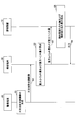
- FIG. 15 is a sequence diagram of evaluation processing according to an embodiment of the present invention.
- the amount of intra-face movement slack (Sf) and the amount of cheek anterior-posterior slack (Sc) are calculated.
- step 1 (S1) the image pickup terminal 20 is a tertiary when the face of the person whose slack is evaluated is in the horizontal position (that is, the midline of the face is stationary at a right angle to the direction of gravity).
- Three-dimensional shape face when the data of the original shape face image and the face of the person to be evaluated for sagging are in the vertical position (that is, the midline of the face is stationary parallel to the direction of gravity).
- step 2 (S2) the image pickup terminal 20 transmits the data generated in S1 to the analysis terminal 30.
- step 3 the analysis terminal 30 is based on the change in the three-dimensional shape between the three-dimensional shape face image in the horizontal position and the three-dimensional shape face image in the vertical position acquired in S2. , Gravity swelling (VCswelling) and gravity denting (VCshrinking) are calculated.
- the analysis terminal 30 compares the three-dimensional shape in the horizontal position with the three-dimensional shape in the vertical position, and the part having a large volume in the vertical position (the part described in FIG. 1). The difference between the volumes of both (that is, the horizontal position and the vertical position) is defined as the amount of gravity swelling (VCswelling).
- the analysis terminal 30 compares the three-dimensional shape in the horizontal position with the three-dimensional shape in the vertical position, and the part having a small volume in the vertical position (the part described in FIG. 2). The difference between the volumes of both (that is, the horizontal position and the vertical position) is defined as the amount of gravity dent (VCshrinking).
- step 4 the analysis terminal 30 transmits the gravity swelling amount (VCswelling) and the gravity denting amount (VCshrinking) calculated in S3 to the evaluation device 10.
- step 5 the evaluation device 10 calculates the amount of intra-face movement slack (Sf) and the amount of cheek anterior-posterior slack (Sc) from the gravity swelling amount (VCswelling) and the gravity denting amount (VCshrinking) acquired in S4. do.
- the evaluation device 10 uses the coordinate conversion of the above equation (1) to change the amount of gravity swelling (VCswelling) and the amount of gravity denting (VCshrinking) into the amount of intra-face movement slack (Sf) and the amount of cheek front-back slack (Sc). ) Is calculated.
- the evaluation device 10 may be configured to evaluate the slack type and its degree using the calculated in-face movement slack amount (Sf) and cheek anterior-posterior slack amount (Sc) as indexes.
- Sf in-face movement slack amount
- Sc cheek anterior-posterior slack amount
- the ratio of the amount of intra-face movement slack (Sf) is defined as the ratio of slack caused by aging
- the ratio of the amount of slack before and after the cheek (Sc) is defined as the ratio of slack caused by individual differences, as described below.
- the slack type can be evaluated.
- Type (sagging in the face, sagging back and forth on the cheeks)
- Type 1 (Yes, No): Aging Sagging Type Type Type 2, (No, Yes): Partial Sagging Type Type 3, (Yes, Yes): Sagging Face Type Type Type 4, (No, No): No Sagging Type Face
- the inward movement slack may be shown in terms of (large, medium, small), etc. by comparing with the average age of the subject.
- Type 1 (Medium): Sagging age-appropriate type 2
- (Small) Sagging type that looks young
- Type 3 (Large): Sagging type that looks old, etc.
- step 6 (S6) the evaluation device 10 transmits the intrafaceal movement slack amount (Sf) and the cheek anterior-posterior slack amount (Sc) calculated in S5 to the analysis terminal 30.
- the evaluation device 10 may be configured to transmit the slack type evaluated in S5 and the degree thereof to the analysis terminal 30.
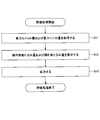
- FIG. 16 is a flowchart of the evaluation process according to the embodiment of the present invention.
- the amount of intra-face movement slack (Sf) and the amount of cheek anterior-posterior slack (Sc) are calculated.
- step 11 (S11) the acquisition unit 101 of the evaluation device 10 acquires the gravity swelling amount (VCswelling) and the gravity dent amount (VCshrinking). For example, the acquisition unit 101 of the evaluation device 10 acquires the gravity swelling amount (VCswelling) and the gravity denting amount (VCshrinking) from the analysis terminal 30.
- step 12 (S12) the calculation unit 102 of the evaluation device 10 obtains the amount of gravity swelling (VCswelling) and the amount of gravity denting (VCshrinking) obtained in S11, and the amount of intra-face movement slack (Sf) and the amount of cheek front-back slack (Sf). Sc) is calculated.
- the calculation unit 102 of the evaluation device 10 uses the coordinate transformation of the above equation (1) to change the amount of gravity swelling (VCswelling) and the amount of gravity denting (VCshrinking) into the facial movement slack (Sf) and the front and back of the cheek.
- the amount of slack (Sc) is calculated.
- the evaluation unit 103 of the evaluation device 10 may be configured to evaluate the slack type and its degree using the in-face movement slack amount (Sf) and the cheek anterior-posterior slack amount (Sc) calculated by the calculation unit 102 as indexes. ..
- the ratio of the amount of intra-face movement slack (Sf) is defined as the ratio of slack caused by aging
- the ratio of the amount of slack before and after the cheek (Sc) is defined as the ratio of slack caused by individual differences.
- the degree of sagging of the face can be evaluated.
- step 13 (S13) the output unit 104 of the evaluation device 10 outputs the amount of intra-face movement slack (Sf) and the amount of cheek front-back slack (Sc) calculated in S12 (for example, transmission to an analysis terminal 30 or the like for evaluation). Display on the display means of the device 10).
- the output unit 104 of the evaluation device 10 may be configured to output the slack type evaluated in S12 and its degree (for example, transmission to the analysis terminal 30 or the like, display on the display means of the evaluation device 10 or the like).
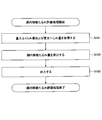
- FIG. 17 is a flowchart of the intra-face movement slack evaluation process according to the embodiment of the present invention.
- the amount of movement slack (Sf) in the face is calculated.
- step 101 (S101) the acquisition unit 101 of the evaluation device 10 acquires the gravity swelling amount (VCswelling) and the gravity dent amount (VCshrinking). For example, the acquisition unit 101 of the evaluation device 10 acquires the gravity swelling amount (VCswelling) and the gravity denting amount (VCshrinking) from the analysis terminal 30.
- step 102 the calculation unit 102 of the evaluation device 10 calculates the amount of intra-face movement slack (Sf) from the amount of gravity swelling (VCswelling) and the amount of gravity dent (VCshrinking) acquired in S101. Specifically, the calculation unit 102 of the evaluation device 10 calculates the amount of intra-face movement slack (Sf) from the amount of gravity swelling (VCswelling) and the amount of gravity dent (VCshrinking) by the coordinate transformation of the above-mentioned equation (1). ..
- step 103 the output unit 104 of the evaluation device 10 outputs the amount of intra-face movement slack (Sf) calculated in S102 (for example, transmits it to the analysis terminal 30 or the like, displays it on the display means of the evaluation device 10, etc.). )do.
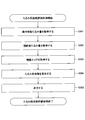
- FIG. 18 is a flowchart of the intra-face movement slack evaluation process according to the embodiment of the present invention.
- the amount of movement slack (Sf) in the face is calculated.
- step 111 the acquisition unit 101 of the evaluation device 10 determines the visual perception score (Sss) of the face of the person to be evaluated for sagging, the amount of sagging before and after the cheeks (Sc), and the sagging skin coefficient (Cs). And get.
- Sss visual perception score
- Sc amount of sagging before and after the cheeks
- Cs sagging skin coefficient
- the acquisition unit 101 of the evaluation device 10 is a state in which the face of a person to be evaluated for sagging is in a vertical position (that is, the median line of the face is stationary parallel to the direction of gravity).
- the visual perception score (Sss) calculated from the image can be obtained.
- the visual perception score (Sss) may be calculated using a trained model generated by machine learning.
- the acquisition unit 101 of the evaluation device 10 can acquire the cheek anterior-posterior slack amount (Sc) calculated from the gravity swelling amount (VCswelling) and the gravity dent amount (VCshrinking).
- Sc cheek anterior-posterior slack amount
- the acquisition unit 101 of the evaluation device 10 can acquire the sagging skin coefficient (Cs) based on the skin viscoelasticity acquired by the device for acquiring the viscoelasticity of the skin (viscoelasticity acquisition device).
- Cs sagging skin coefficient
- step 112 the calculation unit 102 of the evaluation device 10 is based on the visual perception score (Sss), the cheek anterior-posterior slack amount (Sc), and the slack skin coefficient (Cs) acquired in S111, and the amount of slack movement in the face. (Sf) is calculated. Specifically, the calculation unit 102 of the evaluation device 10 uses the above-mentioned equation (4) to determine the intra-face movement slack from the visual score (Sss), the cheek anterior-posterior slack amount (Sc), and the slack skin coefficient (Cs). Calculate the quantity (Sf).
- step 113 the output unit 104 of the evaluation device 10 outputs the amount of intra-face movement slack (Sf) calculated in S112 (for example, transmits it to the analysis terminal 30 or the like, displays it on the display means of the evaluation device 10 or the like). )do.
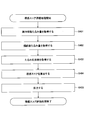
- FIG. 19 is a flowchart of the cheek front-back slack evaluation process according to the embodiment of the present invention.
- the amount of sagging before and after the cheek (Sc) is calculated.
- step 201 the acquisition unit 101 of the evaluation device 10 acquires the gravity swelling amount (VCswelling) and the gravity denting amount (VCshrinking).
- the acquisition unit 101 of the evaluation device 10 acquires the gravity swelling amount (VCswelling) and the gravity denting amount (VCshrinking) from the analysis terminal 30.
- step 202 the calculation unit 102 of the evaluation device 10 calculates the cheek anterior-posterior slack amount (Sc) from the gravity swelling amount (VCswelling) and the gravity dent amount (VCshrinking) acquired in S201. Specifically, the calculation unit 102 of the evaluation device 10 calculates the cheek anterior-posterior slack amount (Sc) from the gravity swelling amount (VCswelling) and the gravity dent amount (VCshrinking) by the coordinate transformation of the above-mentioned equation (1).
- the evaluation unit 103 of the evaluation device 10 may be configured to evaluate the slack type and its degree using the cheek anterior-posterior slack amount (Sc) calculated by the calculation unit 102 as an index. For example, the evaluation unit 103 of the evaluation device 10 can evaluate the degree of sagging of the face based on the increase / decrease from the past cheek anterior-posterior sagging amount (Sc).
- step 203 the output unit 104 of the evaluation device 10 outputs the cheek front-back slack amount (Sc) calculated in S202 (for example, transmission to the analysis terminal 30 or the like, display on the display means of the evaluation device 10 or the like). do.
- the output unit 104 of the evaluation device 10 may be configured to output the slack type evaluated in S202 and the degree thereof (for example, transmission to the analysis terminal 30 or the like, display on the display means of the evaluation device 10 or the like).
- FIG. 20 is a flowchart of the cheek front-back slack evaluation process according to the embodiment of the present invention.
- the amount of sagging before and after the cheek (Sc) is calculated.
- step 211 the acquisition unit 101 of the evaluation device 10 determines the visual perception score (Sss) of the face of the person to be evaluated for sagging, the amount of sagging movement in the face (Sf), and the sagging skin coefficient (Cs). ) And get.
- Sss visual perception score
- Sf amount of sagging movement in the face
- Cs sagging skin coefficient
- the acquisition unit 101 of the evaluation device 10 is a state in which the face of a person to be evaluated for sagging is in a vertical position (that is, the median line of the face is stationary parallel to the direction of gravity).
- the visual perception score (Sss) calculated from the image can be obtained.
- the visual perception score (Sss) may be calculated using a trained model generated by machine learning.
- the acquisition unit 101 of the evaluation device 10 can acquire the amount of intra-face movement slack (Sf) calculated from the amount of gravity swelling (VCswelling) and the amount of gravity denting (VCshrinking).
- Sf intra-face movement slack
- the acquisition unit 101 of the evaluation device 10 can acquire the sagging skin coefficient (Cs) based on the skin viscoelasticity acquired by the device for acquiring the viscoelasticity of the skin (viscoelasticity acquisition device).
- Cs sagging skin coefficient
- step 212 the calculation unit 102 of the evaluation device 10 determines the amount of sagging before and after the cheek from the visual perception score (Sss), the amount of intra-face movement sagging (Sf), and the sagging skin coefficient (Cs) acquired in S211. (Sc) is calculated. Specifically, the calculation unit 102 of the evaluation device 10 uses the above-mentioned equation (4) to obtain the cheek front-back slack from the visual score (Sss), the intra-face movement slack amount (Sf), and the slack skin coefficient (Cs). Calculate the amount (Sc).
- the evaluation unit 103 of the evaluation device 10 may be configured to evaluate the slack type and its degree using the cheek anterior-posterior slack amount (Sc) calculated by the calculation unit 102 as an index. For example, the evaluation unit 103 of the evaluation device 10 can evaluate the degree of sagging of the face based on the increase / decrease from the past cheek anterior-posterior sagging amount (Sc).
- step 213 the output unit 104 of the evaluation device 10 outputs the cheek front-back slack amount (Sc) calculated in S212 (for example, transmission to the analysis terminal 30 or the like, display on the display means of the evaluation device 10 or the like). do.
- the output unit 104 of the evaluation device 10 may be configured to output the slack type evaluated in S212 and its degree (for example, transmission to the analysis terminal 30 or the like, display on the display means of the evaluation device 10 or the like).
- FIG. 21 is a flowchart of the sagging skin coefficient evaluation process according to the embodiment of the present invention.
- the sagging skin coefficient (Cs) is calculated.
- the sagging skin coefficient (Cs) can be directly calculated using the above-mentioned equation (5) or equation (6) based on the skin viscoelasticity acquired by the viscoelasticity acquisition device, or the above-mentioned equation (2). It can also be calculated by.
- step 301 the acquisition unit 101 of the evaluation device 10 acquires the amount of intra-face movement slack (Sf).
- the acquisition unit 101 of the evaluation device 10 can acquire the amount of intra-face movement slack (Sf) calculated from the amount of gravity swelling (VCswelling) and the amount of gravity dent (VCshrinking).
- step 302 the acquisition unit 101 of the evaluation device 10 acquires the cheek anterior-posterior slack amount (Sc).
- the acquisition unit 101 of the evaluation device 10 can acquire the cheek anterior-posterior slack amount (Sc) calculated from the gravity swelling amount (VCswelling) and the gravity dent amount (VCshrinking).
- step 303 the acquisition unit 101 of the evaluation device 10 acquires the visual perception score (Sss).
- the acquisition unit 101 of the evaluation device 10 is a state in which the face of a person to be evaluated for sagging is in a vertical position (that is, the median line of the face is stationary parallel to the direction of gravity).
- the visual perception score (Sss) calculated from the image can be obtained.
- the visual perception score (Sss) may be calculated using a trained model generated by machine learning.
- S301 to S303 are in no particular order and may be performed at the same time.
- step 304 the calculation unit 102 of the evaluation device 10 is slackened from the amount of intra-face movement slack (Sf), the amount of cheek-front-back slack (Sc), and the visual perception score (Sss) acquired in S301 to S303.
- the calculation unit 102 of the evaluation device 10 uses the above-mentioned equation (4) to determine the amount of sagging skin in the face (Sf), the amount of sagging before and after the cheeks (Sc), and the visual perception score (Sss). Calculate the coefficient (Cs).
- the evaluation unit 103 of the evaluation device 10 may be configured to evaluate the sagging type and its degree using the sagging skin coefficient (Cs) calculated by the calculation unit 102 as an index.
- the evaluation unit 103 of the evaluation device 10 can evaluate the degree of sagging of the face based on the increase / decrease from the past sagging skin coefficient (Cs).
- the degree of sagging of the face may be evaluated based on whether the subject's sagging skin coefficient is larger or smaller than the average of the actual age.
- step 305 the output unit 104 of the evaluation device 10 outputs the sagging skin coefficient (Cs) calculated in S304 (for example, transmission to the analysis terminal 30 or the like, display on the display means of the evaluation device 10 or the like).
- the output unit 104 of the evaluation device 10 may be configured to output the slack type evaluated in S304 and the degree thereof (for example, transmission to the analysis terminal 30 or the like, display on the display means of the evaluation device 10 or the like).
- FIG. 22 is a flowchart of the visual recognition score evaluation process according to the embodiment of the present invention.
- the visual perception score (Sss) is calculated.
- step 401 the acquisition unit 101 of the evaluation device 10 acquires the amount of intra-face movement slack (Sf).
- the acquisition unit 101 of the evaluation device 10 can acquire the amount of intra-face movement slack (Sf) calculated from the amount of gravity swelling (VCswelling) and the amount of gravity dent (VCshrinking).
- step 402 the acquisition unit 101 of the evaluation device 10 acquires the cheek anterior-posterior slack amount (Sc).
- the acquisition unit 101 of the evaluation device 10 can acquire the cheek anterior-posterior slack amount (Sc) calculated from the gravity swelling amount (VCswelling) and the gravity dent amount (VCshrinking).
- step 403 the acquisition unit 101 of the evaluation device 10 acquires the sagging skin coefficient (Cs).
- the acquisition unit 101 of the evaluation device 10 can acquire the sagging skin coefficient (Cs) based on the skin viscoelasticity acquired by the device for acquiring the viscoelasticity of the skin (viscoelasticity acquisition device).
- S401 to S403 are in no particular order and may be performed at the same time.
- step 404 the calculation unit 102 of the evaluation device 10 visually recognizes the amount of intra-face movement slack (Sf), the amount of cheek-back slack (Sc), and the slack skin coefficient (Cs) acquired in S401 to S403. Calculate the feeling score (Sss). Specifically, the calculation unit 102 of the evaluation device 10 uses the above-mentioned equation (4) to obtain a visual sensation from the amount of intra-face movement slack (Sf), the amount of cheek anterior-posterior slack (Sc), and the slack skin coefficient (Cs). Calculate the score (Sss).
- step 405 the output unit 104 of the evaluation device 10 outputs the visual perception score (Sss) calculated in S404 (for example, transmission to the analysis terminal 30 or the like, display on the display means of the evaluation device 10 or the like). ..
- the output unit 104 of the evaluation device 10 outputs a predetermined solution according to the evaluation result (each value, slack type and degree thereof). For example, when the ratio of the amount of intra-face movement slack (Sf) is high, the output unit 104 of the evaluation device 10 recommends cosmetics and supplements for eliminating the intra-face movement slack, cosmetic treatment including massage, and training, and cheeks.
- the output unit 104 of the evaluation device 10 recommends cosmetics, supplements, beauty treatments including massage, and training according to the amount of intra-face movement slack (Sf) and the amount of cheek front-back slack (Sc).
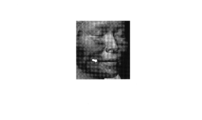
- FIG. 26 is a diagram showing a three-dimensional shape facial image acquired at the same place and at the same time zone on the same day according to the embodiment of the present invention.
- the three three-dimensional facial images of (1), (2), and (3) of FIG. 26 are three-dimensional facial images of the same person acquired at the same place on the same day and at the same time zone. Is. As shown in FIG. 26, it can be seen that the shape of the face is different even on the same day, place, and time zone, and the mouth is particularly moving.
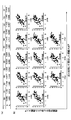
- FIG. 27 is a diagram showing variations in gravity swelling and gravity dents according to an embodiment of the present invention.
- the triangles in FIG. 27 indicate the amount of gravity swelling (VCswelling) and the amount of gravity denting (VCshrinking) before the solution of the sagging of a subject (specifically, massage to the scalp).
- the squares in FIG. 27 indicate the amount of gravity swelling (VCswelling) and the amount of gravity denting (VCshrinking) after the subject's sagging solution (specifically, massage to the scalp) is performed.
- the amount of gravity swelling (VCswelling) and the amount of gravity denting (VCshrinking) vary before and after the implementation of the sagging solution.
- the average value of the gravity swelling amount (VCswelling) is represented by a large triangular mark, and the average value of the gravity denting amount (VCshrinking) is represented by a large square mark.
- three-dimensional facial images of the horizontal and vertical positions of the target are repeatedly acquired, and the amount of gravity swelling (VCswelling), the amount of gravity denting (VCshrinking), and the intra-face movement slack are obtained.
- At least one of the amount (Sf) and the amount of sagging before and after the cheek (Sc) can be used as a representative value of the value calculated using the repeatedly acquired three-dimensional facial image.
- FIG. 28 is a diagram for explaining repeated acquisition of a three-dimensional shape face image according to an embodiment of the present invention.
- the evaluation device 10 repeatedly acquires the horizontal and vertical three-dimensional shape face images of the target (in the example of FIG. 28, three horizontal three-dimensional face images and a vertical three-dimensional face image). And get a total of 6). Then, the evaluation device 10 determines the three-dimensional shape change between the three-dimensional shape face images for each of the repeatedly acquired three-dimensional shape face images (in the example of FIG. 28, the three horizontal three-dimensional shape face images).
- the evaluation device 10 calculates a representative value of the in-face movement slack amount (Sf) calculated from each gravity swelling amount (VCswelling) and gravity dent amount (VCshrinking) as the in-face movement slack amount (Sf). ..
- the representative value is, for example, an average value, but may be a median value, a mode value, or the like.
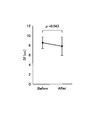
- FIG. 29 shows the amount of gravity swelling (VCswelling), the amount of gravity denting (VCshrinking), the amount of intra-face movement slack (Sf), and the amount of cheek anterior-posterior slack (Sc) according to an embodiment of the present invention. It is a figure for demonstrating the representative value of the value calculated using the three-dimensional shape face image acquired repeatedly, at least one of the above. Hereinafter, the case of the amount of movement slack (Sf) in the face will be described.
- the average value of the amount of movement in the face (Sf) and the amount of gravity swelling (VCswelling) and the amount of gravity denting (VCshrinking) after performing a solution for the sagging of a certain subject (specifically, massage to the scalp).
- the average value of the nine in-face movement slack (Sf) calculated from nine pairs is compared. It can be seen that the implementation of the sagging solution (specifically, massage to the scalp) slightly but significantly reduces the amount of sagging in the face (Sf).
- FIG. 30 shows, among the gravity swelling amount (VCswelling), the gravity denting amount (VCshrinking), the intraface movement slack amount (Sf), and the cheek anterior-posterior slack amount (Sc) according to the embodiment of the present invention. It is a figure for demonstrating the day-to-day difference of the representative value of the value calculated using the three-dimensional shape face image acquired repeatedly. Hereinafter, the case of the amount of movement slack (Sf) in the face will be described.
- the average value of nine facial movement sagging amounts (Sf) calculated from nine pairs of gravity swelling amount (VCswelling) and gravity denting amount (VCshrinking) of four subjects is calculated on a certain day and the next day. Obtained in.
- FIG. 31 shows, among the gravity swelling amount (VCswelling), the gravity denting amount (VCshrinking), the intraface movement slack amount (Sf), and the cheek anterior-posterior slack amount (Sc) according to the embodiment of the present invention.
- a treatment with a commercially available facial device (Denki Brown Brush ELECTRON EVERYONE) was performed on two subjects, and the three-dimensional shape obtained repeatedly immediately before, immediately after, and the next day.
- the average value of the amount of movement slack (Sf) in the face calculated using the face image is compared.
- subject E no significant difference was observed among all of the intrafaceal movement sagging amount (Sf) calculated using the three-dimensional facial image repeatedly acquired immediately before, immediately after, and the next day. This result means that the treatment with a commercially available facial device (Denki Brown Brush ELECTRON EVERYONE) had no effect on subject E for the purpose of measuring the effect on sagging.
- a substance or a cosmetological treatment that increases or decreases the representative value of the value calculated by using the repeatedly acquired three-dimensional shape facial image can be selected and obtained.
- a substance is a material intended to be incorporated into cosmetics such as plant extracts and compounds.
- the substance is a cosmetic, a medicine, a food, or the like.
- the three-dimensional shape face image repeatedly acquired is used based on the representative value of the value calculated by using the repeatedly acquired three-dimensional shape face image. It can further include presenting a beauty method that increases the representative value of the calculated value.
- FIG. 23 is a block diagram showing an example of the hardware configuration of the evaluation device 10 and the analysis terminal 30 according to the embodiment of the present invention.
- the evaluation device 10 and the analysis terminal 30 include a CPU (Central Processing Unit) 1001, a ROM (Read Only Memory) 1002, and a RAM (Random Access Memory) 1003.
- the CPU 1001, ROM 1002, and RAM 1003 form a so-called computer.
- the evaluation device 10 and the analysis terminal 30 can have an auxiliary storage device 1004, a display device 1005, an operation device 1006, an I / F (Interface) device 1007, and a drive device 1008.
- the hardware of the evaluation device 10 and the analysis terminal 30 are connected to each other via the bus B.
- the CPU 1001 is an arithmetic device that executes various programs installed in the auxiliary storage device 1004.
- ROM 1002 is a non-volatile memory.
- the ROM 1002 functions as a main storage device for storing various programs, data, and the like necessary for the CPU 1001 to execute various programs installed in the auxiliary storage device 1004.
- the ROM 1002 functions as a main storage device for storing boot programs such as BIOS (Basic Input / Output System) and EFI (Extensible Firmware Interface).
- RAM 1003 is a volatile memory such as DRAM (Dynamic Random Access Memory) or SRAM (Static Random Access Memory).
- the RAM 1003 functions as a main storage device that provides a work area to be expanded when various programs installed in the auxiliary storage device 1004 are executed by the CPU 1001.
- the auxiliary storage device 1004 is an auxiliary storage device that stores various programs and information used when various programs are executed.
- the display device 1005 is a display device that displays the internal state of the evaluation device 10 and the analysis terminal 30.
- the operation device 1006 is an input device in which the administrator of the evaluation device 10 and the analysis terminal 30 inputs various instructions to the evaluation device 10 and the analysis terminal 30.
- the I / F device 1007 is a communication device for connecting to a network and communicating with other devices.
- the drive device 1008 is a device for setting the storage medium 1009.
- the storage medium 1009 referred to here includes a medium such as a CD-ROM, a flexible disk, a magneto-optical disk, or the like, which records information optically, electrically, or magnetically. Further, the storage medium 1009 may include a semiconductor memory for electrically recording information such as an EPROM (ErasableProgrammableReadOnlyMemory) and a flash memory.
- EPROM ErasableProgrammableReadOnlyMemory
- the various programs installed in the auxiliary storage device 1004 are installed, for example, by setting the distributed storage medium 1009 in the drive device 1008 and reading the various programs recorded in the storage medium 1009 by the drive device 1008. Will be done.
- various programs installed in the auxiliary storage device 1004 may be installed by being downloaded from the network via the I / F device 1007.
- Evaluation system 10 Evaluation device 20 Imaging terminal 30 Analysis terminal 101 Acquisition unit 102 Calculation unit 103 Evaluation unit 104 Output unit 201 Generation unit 301 Calculation unit 1001 CPU 1002 ROM 1003 RAM 1004 Auxiliary storage device 1005 Display device 1006 Operation device 1007 I / F device 1008 Drive device 1009 Storage medium
Landscapes
- Health & Medical Sciences (AREA)
- Engineering & Computer Science (AREA)
- Life Sciences & Earth Sciences (AREA)
- Physics & Mathematics (AREA)
- General Health & Medical Sciences (AREA)
- Animal Behavior & Ethology (AREA)
- Veterinary Medicine (AREA)
- Public Health (AREA)
- Medical Informatics (AREA)
- Heart & Thoracic Surgery (AREA)
- Biophysics (AREA)
- Surgery (AREA)
- Molecular Biology (AREA)
- Biomedical Technology (AREA)
- Pathology (AREA)
- Theoretical Computer Science (AREA)
- Oral & Maxillofacial Surgery (AREA)
- General Physics & Mathematics (AREA)
- Computer Vision & Pattern Recognition (AREA)
- Dermatology (AREA)
- Artificial Intelligence (AREA)
- Computer Graphics (AREA)
- Multimedia (AREA)
- Gerontology & Geriatric Medicine (AREA)
- Human Computer Interaction (AREA)
- Mathematical Physics (AREA)
- Fuzzy Systems (AREA)
- Evolutionary Computation (AREA)
- Psychiatry (AREA)
- Physiology (AREA)
- Signal Processing (AREA)
- Dentistry (AREA)
- Nuclear Medicine, Radiotherapy & Molecular Imaging (AREA)
- Radiology & Medical Imaging (AREA)
- Quality & Reliability (AREA)
- Measurement Of The Respiration, Hearing Ability, Form, And Blood Characteristics Of Living Organisms (AREA)
Abstract
Description
・「三次元形状顔画像」とは、たるみの評価の対象である人の顔の三次元形状を表す画像のことをいう。
・「水平位」とは、顔の正中線を重力の方向に対して直角に静止させた状態のことをいう。
・「垂直位」とは、顔の正中線を重力の方向に対して平行に静止させた状態のことをいう。
・「視感スコア(視感評価、Sssとも呼ぶ)」とは、たるみの視感による評価を数値化したものである。非特許文献1にあるようにたるみの評価の対象である人の顔が、基準写真1~5のどれに最も近いか判定者の判定により視感スコアが算出される。例えば、視感スコアは、たるみの評価の対象である人の顔が垂直位(つまり、顔の正中線を重力の方向に対して平行に静止させた状態)のときの斜め横顔の画像(顔の正面から左右に45度の角度から顔を撮影した画像)から算出される。なお、たるみの評価の対象である人の顔の視感スコアは、視感スコアが判定された斜め横顔の画像を教師データとして機械学習により生成された学習済みモデルを用いて算出されてもよい。視感スコアは、頬上部、頬下部、頬後方の各部位で判定されるが、いずれかを平均することで新たに生成してもよい。Sssは、特に頬上部と頬下部における視感スコアを平均し、頬上下部における見た目のたるみを示す。
図1は、本発明の一実施形態に係る重力ふくらみについて説明するための図である。被験者の顔が水平位であるときの三次元形状顔画像と被験者の顔が垂直位であるときの三次元形状顔画像とを取得し、水平位のときの三次元形状と垂直位のときの三次元形状とを対比すると、図1の破線内の部位では、垂直位のときのほうが体積が大きかった。このように、垂直位のときのほうが体積が大きい部位の両者(つまり、水平位と垂直位)の体積の差分を重力ふくらみ量(VCswelling)とする。
図2は、本発明の一実施形態に係る重力へこみについて説明するための図である。被験者の顔が水平位であるときの三次元形状顔画像と被験者の顔が垂直位であるときの三次元形状顔画像とを取得し、水平位のときの三次元形状と垂直位のときの三次元形状とを対比すると、図2の破線内の部位では、垂直位のときのほうが体積が小さかった。このように、垂直位のときのほうが体積が小さい部位の両者(つまり、水平位と垂直位)の体積の差分を重力へこみ量(VCshrinking)とする。
顔内移動たるみは、頬全域に発生する。一方、頬前後たるみは、部分的(口元)に発生する。
図9を参照しながら説明する顔内移動たるみと視感スコアとの相関Rから、視感スコアに対する顔内移動たるみの寄与率R2(決定係数とも呼ばれる)は、53パーセントである。一方、図9を参照しながら説明する頬前後たるみと視感スコアとの相関Rから、視感スコアに対する頬前後たるみの寄与率R2(決定係数とも呼ばれる)は、頬前後たるみ有りもしくは無しと判定された群において、おのおの9パーセントもしくは0.4パーセントである。なお、視感スコアとは、たるみの視感による評価を数値化したものである。
図10を参照しながら説明する顔内移動たるみと年齢との関係から、顔内移動たるみと年齢とは相関する(相関係数は0.64)。一方、図10を参照しながら説明する頬前後たるみと年齢との関係から、驚くべきことに頬前後たるみと年齢とは相関せず、頬前後たるみは年齢に関わらない個人差により生じると言える。
図9および図10を参照しながら説明する顔内移動たるみと視感スコア、年齢との関係から、視感評価(視感スコア)0.5あたりの顔内移動たるみの体積の変化は、1.3ccであり、この体積の量は加齢14年分を意味する。一方、図9および図10を参照しながら説明する頬前後たるみと視感スコア、年齢との関係から、視感評価(視感スコア)0.5あたりの頬前後たるみの体積の変化は、1.8ccである。この体積の量は頬前後たるみの有無を意味する。なお、視感スコアとは、たるみの視感による評価を数値化したものである。
顔内移動たるみは、顔全体で長期的に緩やかに進行する重力によって発生するたるみである。一方、頬前後たるみは、年齢に関わらず局所的(口元)に重力によって発生するたるみである。
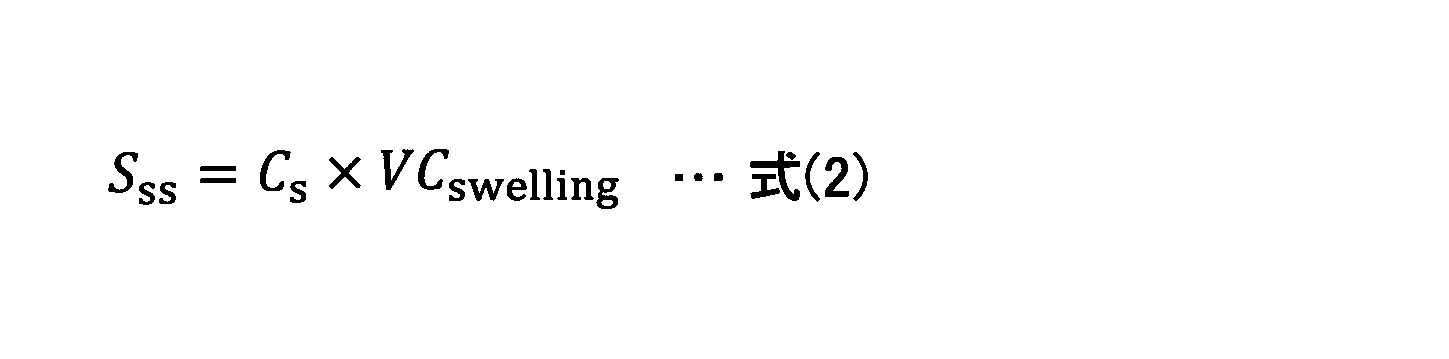

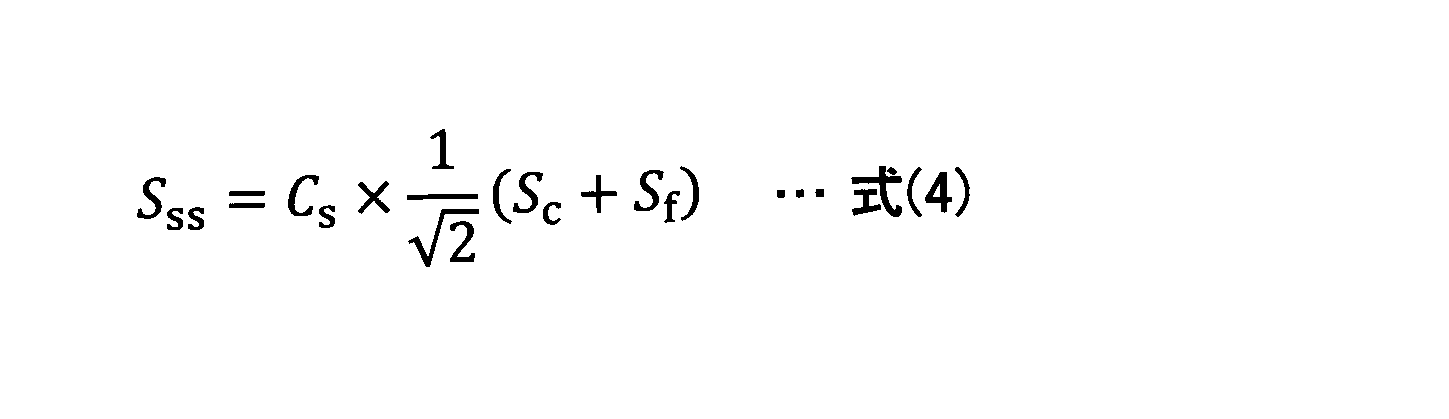


図11は、本発明の一実施形態に係る評価システム1の構成図である。本発明の一実施形態に係る評価システム(たるみタイプとその程度を評価する評価システムともいう)1は、評価装置(たるみタイプとその程度を評価する評価装置ともいう)10と、撮像端末20と、解析端末30と、を含む。評価装置10と解析端末30は、任意のネットワークを介して、データを送受信することができる。以下、それぞれについて説明する。
算出部102は、重力へこみ量(VCshrinking)をx軸とし、重力ふくらみ量(VCswelling)をy軸としたとき、下記の式(1)にあらわされるように反時計回りに45度だけ座標を変換することによって、顔内移動たるみ量(Sf)および頬前後たるみ量(Sc)を算出する。
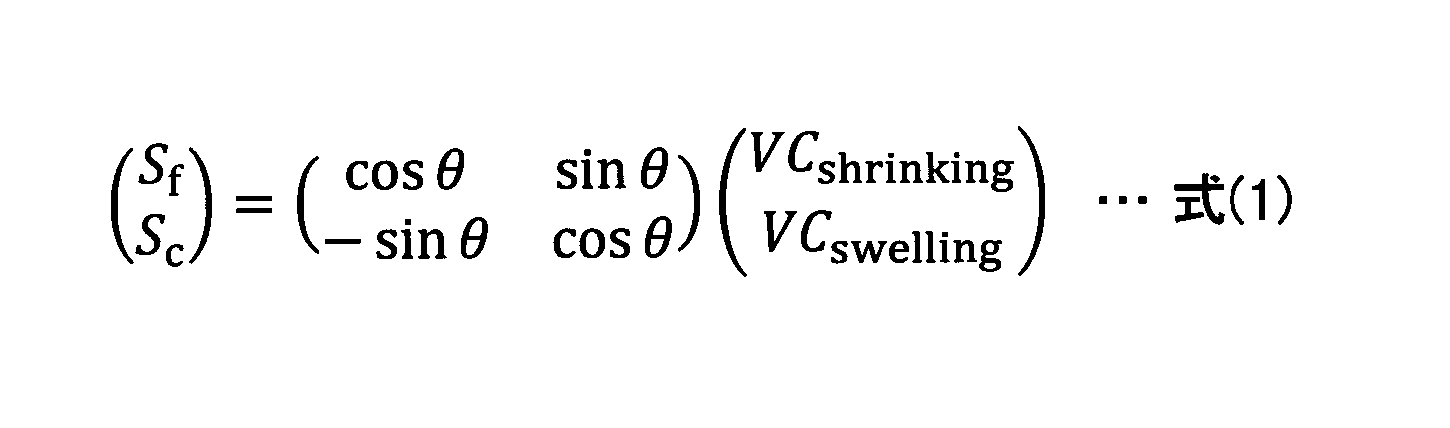
算出部301は、水平位のときの三次元形状と垂直位のときの三次元形状とを対比し、垂直位のときに体積が大きい部位(図1で説明した部位)の両者(つまり、水平位と垂直位)の体積の差分を重力ふくらみ量(VCswelling)とする。
算出部301は、水平位のときの三次元形状と垂直位のときの三次元形状とを対比し、垂直位のときに体積が小さい部位(図2で説明した部位)の両者(つまり、水平位と垂直位)の体積の差分を重力へこみ量(VCshrinking)とする。
以下、図15~図22を参照しながら、種々のたるみの評価方法について説明する。なお、図15~図22の方法の一部は、人によって実行されてもよい。
具体的には、解析端末30は、水平位のときの三次元形状と垂直位のときの三次元形状とを対比し、垂直位のときに体積が大きい部位(図1で説明した部位)の両者(つまり、水平位と垂直位)の体積の差分を重力ふくらみ量(VCswelling)とする。
具体的には、解析端末30は、水平位のときの三次元形状と垂直位のときの三次元形状とを対比し、垂直位のときに体積が小さい部位(図2で説明した部位)の両者(つまり、水平位と垂直位)の体積の差分を重力へこみ量(VCshrinking)とする。
タイプ(顔内移動たるみ、頬前後たるみ)
タイプ1、(有、無):加齢たるみタイプ
タイプ2、(無、有):部分たるみタイプ
タイプ3、(有、有):たるみ顔タイプ
タイプ4、(無、無):たるみゼロタイプ
顔内移動たるみを対象者の年齢の平均と比較して、(大、中、小)など程度で示してもよい。
タイプ1、(中):たるみ年齢相応タイプ
タイプ2、(小):若く見えるたるみタイプ
タイプ3、(大):老けて見えるたるみタイプなど。
上記のたるみの評価方法において、評価結果(各値やたるみタイプとその程度)とともに、たるみの解決策を出力するようにすることもできる。具体的には、評価装置10の出力部104は、予め定められた、評価結果(各値やたるみタイプとその程度)に応じた解決策を出力する。例えば、評価装置10の出力部104は、顔内移動たるみ量(Sf)の割合が高い場合には、顔内移動たるみを解消する化粧品やサプリメント、マッサージを含む美容施術、トレーニングを推奨し、頬前後たるみ量(Sc)の割合が高い場合には、頬前後たるみを解消する化粧品やサプリメント、マッサージを含む美容施術、トレーニングを推奨する。例えば、評価装置10の出力部104は、顔内移動たるみ量(Sf)と頬前後たるみ量(Sc)に応じた化粧品やサプリメント、マッサージを含む美容施術、トレーニングを推奨する。
上記のたるみタイプとその程度の評価において、視感スコア(Sss)に対するたるみ肌係数(Cs)の寄与率、視感スコア(Sss)に対する顔内移動たるみ量(Sf)の寄与率、視感スコア(Sss)に対する頬前後たるみ量(Sc)の寄与率に基づいて、各因子の評価に重みづけをするようにしてもよい。
本発明の一実施形態では、対象の水平位と垂直位の三次元形状顔画像を反復して取得し、重力ふくらみ量(VCswelling)と、重力へこみ量(VCshrinking)と、顔内移動たるみ量(Sf)と、頬前後たるみ量(Sc)と、のうちの少なくとも1つを、反復して取得された三次元形状顔画像を用いて算出された値の代表値とすることができる。以下、詳細に説明する。
図23は、本発明の一実施形態に係る評価装置10および解析端末30のハードウェア構成の一例を示すブロック図である。評価装置10および解析端末30は、CPU(Central Processing Unit)1001、ROM(Read Only Memory)1002、RAM(Random Access Memory)1003を有する。CPU1001、ROM1002、RAM1003は、いわゆるコンピュータを形成する。
10 評価装置
20 撮像端末
30 解析端末
101 取得部
102 算出部
103 評価部
104 出力部
201 生成部
301 算出部
1001 CPU
1002 ROM
1003 RAM
1004 補助記憶装置
1005 表示装置
1006 操作装置
1007 I/F装置
1008 ドライブ装置
1009 記憶媒体
Claims (18)
- 対象の水平位と垂直位の三次元形状顔画像間の三次元形状変化から得られる重力ふくらみ量および重力へこみ量を取得するステップと、
前記重力ふくらみ量および前記重力へこみ量から顔内移動たるみ量および頬前後たるみ量を算出するステップと、
前記顔内移動たるみ量および前記頬前後たるみ量を指標としてたるみタイプとその程度を評価するステップと
を含む、たるみ評価方法。 - 前記重力ふくらみ量をVCswelling、前記重力へこみ量をVCshrinking、前記顔内移動たるみ量をSf、前記頬前後たるみ量をSc、とした場合、前記顔内移動たるみ量と前記頬前後たるみ量は以下の式により求められる:
- 前記対象の垂直位の顔画像から視感スコアを取得し、
前記視感スコアから以下の式:
に従い、たるみ肌係数を算出するステップ、をさらに含む、請求項2に記載の方法。 - 粘弾性取得装置によって取得された前記対象の皮膚粘弾性に基づいてたるみ肌係数を取得し、
前記たるみ肌係数から以下の式:

に従い、視感スコアを算出するステップ、をさらに含む、請求項2に記載の方法。 - 前記対象の水平位と垂直位の三次元形状顔画像を反復して取得するステップをさらに含み、
前記重力ふくらみ量と、前記重力へこみ量と、前記顔内移動たるみ量と、前記頬前後たるみ量と、のうちの少なくとも1つは、前記反復して取得された三次元形状顔画像を用いて算出された値の代表値である、請求項1から4のいずれか一項に記載の方法。 - 前記対象の水平位と垂直位の三次元形状顔画像を反復して取得するステップをさらに含み、
前記重力ふくらみ量および前記重力へこみ量は、前記反復して取得された三次元形状顔画像の各々についての三次元形状顔画像間の三次元形状変化から得られ、
前記顔内移動たるみ量を算出するステップは、各々の重力ふくらみ量および重力へこみ量から算出された顔内移動たるみ量の代表値を、前記顔内移動たるみ量として算出することである、請求項1から4のいずれか一項に記載の方法。 - 前記反復して取得された三次元形状顔画像を用いて算出された値の代表値を増加または減少させる物質もしくは美容施術を選別することをさらに含む請求項5または6に記載の方法。
- 請求項7に記載の方法により選別された物質もしくは美容施術。
- 前記反復して取得された三次元形状顔画像を用いて算出された値の代表値をもとに、前記反復して取得された三次元形状顔画像を用いて算出された値の代表値を増加させる美容方法を提示することをさらに含む請求項5または6に記載の方法。
- 対象の水平位と垂直位の三次元形状顔画像間の三次元形状変化から得られる重力ふくらみ量および重力へこみ量を取得する取得部と、
前記重力ふくらみ量および前記重力へこみ量から顔内移動たるみ量および頬前後たるみ量を算出する算出部と、
前記顔内移動たるみ量および前記頬前後たるみ量を出力する出力部と
を有する、たるみタイプとその程度を評価する装置。 - たるみタイプとその程度を評価する装置が実行する方法であって、
対象の水平位と垂直位の三次元形状顔画像間の三次元形状変化から得られる重力ふくらみ量および重力へこみ量を取得するステップと、
前記重力ふくらみ量および前記重力へこみ量から顔内移動たるみ量および頬前後たるみ量を算出するステップと、
前記顔内移動たるみ量および前記頬前後たるみ量を出力するステップと
を含む方法。 - たるみタイプとその程度を評価する装置に、
対象の水平位と垂直位の三次元形状顔画像間の三次元形状変化から得られる重力ふくらみ量および重力へこみ量を取得し、
前記重力ふくらみ量および前記重力へこみ量から顔内移動たるみ量および頬前後たるみ量を算出し、
前記顔内移動たるみ量および前記頬前後たるみ量を出力する
処理を実行させるためのプログラム。 - 撮像端末と、解析端末と、サーバと、を有するたるみタイプとその程度を評価するシステムであって、
前記撮像端末は、対象の水平位と垂直位の三次元形状顔画像のデータを生成し、
前記解析端末は、前記データから前記対象の水平位と垂直位の三次元形状顔画像間の三次元形状変化から得られる重力ふくらみ量および重力へこみ量を算出し、
前記サーバは、
前記重力ふくらみ量および前記重力へこみ量を取得する取得部と、
前記重力ふくらみ量および前記重力へこみ量から顔内移動たるみ量および頬前後たるみ量を算出する算出部と、
前記顔内移動たるみ量および前記頬前後たるみ量を出力する出力部と
を有する、評価システム。 - 顔のたるみの視感スコアと、前記顔の顔内移動たるみ量と、前記顔の頬前後たるみ量と、前記顔のたるみ肌係数と、のうちの3つを評価するステップと、
前記3つの評価に基づいて、前記3つ以外の1つを評価するステップと
を含む方法。 - 対象の水平位と垂直位の三次元形状顔画像間の三次元形状変化から得られる重力ふくらみ量および重力へこみ量を取得するステップと、
前記重力ふくらみ量および前記重力へこみ量から頬前後たるみ量を算出するステップと、
前記頬前後たるみ量を指標としてたるみタイプとその程度を評価するステップと
を含む、たるみタイプとその程度を評価する方法。 - 対象の水平位と垂直位の三次元形状顔画像間の三次元形状変化から得られる重力ふくらみ量および重力へこみ量を取得するステップと、
前記重力ふくらみ量および前記重力へこみ量から顔内移動たるみ量を算出するステップと、
前記顔内移動たるみを指標としてたるみタイプとその程度を評価するステップと
を含む、たるみタイプとその程度を評価する方法。 - 対象の水平位と垂直位の三次元形状顔画像間の三次元形状変化から得られる重力ふくらみ量を取得するステップと、
前記対象の垂直位の顔画像から視感スコアを取得するステップと、
前記重力ふくらみ量および前記視感スコアから以下の式:
に従い、たるみ肌係数を算出するステップと、
前記たるみ肌係数を指標としてたるみタイプとその程度を評価するステップと
を含む、たるみタイプとその程度を評価する方法。 - 粘弾性取得装置によって取得された対象の皮膚粘弾性に基づいてたるみ肌係数を取得するステップと、
前記たるみ肌係数を指標としてたるみタイプとその程度を評価するステップと
を含む、たるみタイプとその程度を評価する方法。
Priority Applications (4)
| Application Number | Priority Date | Filing Date | Title |
|---|---|---|---|
| EP21813232.2A EP4160525A4 (en) | 2020-05-27 | 2021-05-24 | METHOD, DEVICE, PROGRAM AND SYSTEM FOR SUBSIDENCE EVALUATION |
| JP2022527014A JP7608692B2 (ja) | 2020-05-27 | 2021-05-24 | たるみ評価方法、装置、プログラム、およびシステム |
| US17/997,280 US20230172530A1 (en) | 2020-05-27 | 2021-05-24 | Sagging evaluation method, device, program, and system |
| CN202180031442.0A CN115484865A (zh) | 2020-05-27 | 2021-05-24 | 松弛评价方法、装置、程序以及系统 |
Applications Claiming Priority (4)
| Application Number | Priority Date | Filing Date | Title |
|---|---|---|---|
| JP2020092470 | 2020-05-27 | ||
| JP2020-092470 | 2020-05-27 | ||
| JP2020209513 | 2020-12-17 | ||
| JP2020-209513 | 2020-12-17 |
Publications (1)
| Publication Number | Publication Date |
|---|---|
| WO2021241475A1 true WO2021241475A1 (ja) | 2021-12-02 |
Family
ID=78744059
Family Applications (1)
| Application Number | Title | Priority Date | Filing Date |
|---|---|---|---|
| PCT/JP2021/019525 Ceased WO2021241475A1 (ja) | 2020-05-27 | 2021-05-24 | たるみ評価方法、装置、プログラム、およびシステム |
Country Status (5)
| Country | Link |
|---|---|
| US (1) | US20230172530A1 (ja) |
| EP (1) | EP4160525A4 (ja) |
| JP (1) | JP7608692B2 (ja) |
| CN (1) | CN115484865A (ja) |
| WO (1) | WO2021241475A1 (ja) |
Cited By (5)
| Publication number | Priority date | Publication date | Assignee | Title |
|---|---|---|---|---|
| JP2023155988A (ja) * | 2022-04-12 | 2023-10-24 | 花王株式会社 | 鼻唇側影分析方法 |
| WO2024142782A1 (ja) * | 2022-12-28 | 2024-07-04 | 株式会社資生堂 | システム、サーバ及び方法 |
| WO2024142765A1 (ja) * | 2022-12-28 | 2024-07-04 | 株式会社資生堂 | 美容システム、美容方法及び美容機器 |
| WO2024142766A1 (ja) * | 2022-12-28 | 2024-07-04 | 株式会社資生堂 | システム、サーバ及び方法 |
| WO2025142502A1 (ja) * | 2023-12-26 | 2025-07-03 | 株式会社資生堂 | むくみ評価システム、プログラム、および方法 |
Families Citing this family (1)
| Publication number | Priority date | Publication date | Assignee | Title |
|---|---|---|---|---|
| KR102883500B1 (ko) * | 2025-03-05 | 2025-11-12 | 조수익 | 안면 이미지를 분석하여 안면의 윤곽과 피부 처짐 정도를 평가하는 방법 및 그 장치 |
Citations (8)
| Publication number | Priority date | Publication date | Assignee | Title |
|---|---|---|---|---|
| JPH1043141A (ja) * | 1996-08-08 | 1998-02-17 | Kanebo Ltd | 皮膚のたるみ量測定装置及び測定方法 |
| JP2010051717A (ja) * | 2008-08-29 | 2010-03-11 | Kao Corp | たるみ改善効果の提示方法 |
| JP2011015862A (ja) * | 2009-07-10 | 2011-01-27 | Pola Chemical Industries Inc | 皮膚のタルミ度合いの鑑別法 |
| JP2013059529A (ja) * | 2011-09-14 | 2013-04-04 | Shiseido Co Ltd | 顎部のたるみの評価方法 |
| US20130172691A1 (en) * | 2006-05-16 | 2013-07-04 | Bao Tran | Health monitoring appliance |
| JP2014004105A (ja) * | 2012-06-22 | 2014-01-16 | Rohto Pharmaceut Co Ltd | 皮膚のたるみ量の測定方法 |
| JP6473959B1 (ja) | 2018-05-14 | 2019-02-27 | 株式会社三砂堂漢方 | 皮膚たるみ量測定方法および皮膚たるみ量測定装置 |
| JP2020092470A (ja) | 2018-12-03 | 2020-06-11 | トヨタ自動車株式会社 | モータ制御装置 |
Family Cites Families (3)
| Publication number | Priority date | Publication date | Assignee | Title |
|---|---|---|---|---|
| US7556605B2 (en) * | 2006-10-11 | 2009-07-07 | Access Business Group International Llc | Methods for determining elastic and viscoelastic properties of skin |
| JP2011150595A (ja) * | 2010-01-22 | 2011-08-04 | Shiseido Co Ltd | 顔形状評価装置、顔形状評価方法、及び顔形状評価プログラム |
| JP2013013628A (ja) * | 2011-07-05 | 2013-01-24 | Ands Corporation | 皮膚状態の測定装置及び測定方法 |
-
2021
- 2021-05-24 EP EP21813232.2A patent/EP4160525A4/en not_active Withdrawn
- 2021-05-24 JP JP2022527014A patent/JP7608692B2/ja active Active
- 2021-05-24 WO PCT/JP2021/019525 patent/WO2021241475A1/ja not_active Ceased
- 2021-05-24 US US17/997,280 patent/US20230172530A1/en active Pending
- 2021-05-24 CN CN202180031442.0A patent/CN115484865A/zh active Pending
Patent Citations (9)
| Publication number | Priority date | Publication date | Assignee | Title |
|---|---|---|---|---|
| JPH1043141A (ja) * | 1996-08-08 | 1998-02-17 | Kanebo Ltd | 皮膚のたるみ量測定装置及び測定方法 |
| US20130172691A1 (en) * | 2006-05-16 | 2013-07-04 | Bao Tran | Health monitoring appliance |
| JP2010051717A (ja) * | 2008-08-29 | 2010-03-11 | Kao Corp | たるみ改善効果の提示方法 |
| JP2011015862A (ja) * | 2009-07-10 | 2011-01-27 | Pola Chemical Industries Inc | 皮膚のタルミ度合いの鑑別法 |
| JP2013059529A (ja) * | 2011-09-14 | 2013-04-04 | Shiseido Co Ltd | 顎部のたるみの評価方法 |
| JP2014004105A (ja) * | 2012-06-22 | 2014-01-16 | Rohto Pharmaceut Co Ltd | 皮膚のたるみ量の測定方法 |
| JP6473959B1 (ja) | 2018-05-14 | 2019-02-27 | 株式会社三砂堂漢方 | 皮膚たるみ量測定方法および皮膚たるみ量測定装置 |
| JP2019198597A (ja) * | 2018-05-14 | 2019-11-21 | 株式会社三砂堂漢方 | 皮膚たるみ量測定方法および皮膚たるみ量測定装置 |
| JP2020092470A (ja) | 2018-12-03 | 2020-06-11 | トヨタ自動車株式会社 | モータ制御装置 |
Non-Patent Citations (2)
| Title |
|---|
| See also references of EP4160525A4 |
| T. EZUREJ. HOSOIS. AMANOT. TSUCHIYA, SKIN RESEARCH AND TECHNOLOGY, vol. 15, 2009, pages 299 - 305 |
Cited By (6)
| Publication number | Priority date | Publication date | Assignee | Title |
|---|---|---|---|---|
| JP2023155988A (ja) * | 2022-04-12 | 2023-10-24 | 花王株式会社 | 鼻唇側影分析方法 |
| JP7840772B2 (ja) | 2022-04-12 | 2026-04-06 | 花王株式会社 | 鼻唇側影分析方法 |
| WO2024142782A1 (ja) * | 2022-12-28 | 2024-07-04 | 株式会社資生堂 | システム、サーバ及び方法 |
| WO2024142765A1 (ja) * | 2022-12-28 | 2024-07-04 | 株式会社資生堂 | 美容システム、美容方法及び美容機器 |
| WO2024142766A1 (ja) * | 2022-12-28 | 2024-07-04 | 株式会社資生堂 | システム、サーバ及び方法 |
| WO2025142502A1 (ja) * | 2023-12-26 | 2025-07-03 | 株式会社資生堂 | むくみ評価システム、プログラム、および方法 |
Also Published As
| Publication number | Publication date |
|---|---|
| EP4160525A1 (en) | 2023-04-05 |
| CN115484865A (zh) | 2022-12-16 |
| JPWO2021241475A1 (ja) | 2021-12-02 |
| EP4160525A4 (en) | 2024-07-03 |
| JP7608692B2 (ja) | 2025-01-07 |
| US20230172530A1 (en) | 2023-06-08 |
Similar Documents
| Publication | Publication Date | Title |
|---|---|---|
| JP7608692B2 (ja) | たるみ評価方法、装置、プログラム、およびシステム | |
| Ramanathan et al. | Modeling age progression in young faces | |
| CN103649987B (zh) | 脸印象分析方法、美容信息提供方法和脸图像生成方法 | |
| AU2011224691B2 (en) | System for skin treatment analysis using spectral image data to generate 3D RGB model | |
| Duan et al. | 3D face reconstruction from skull by regression modeling in shape parameter spaces | |
| Niziol et al. | Is there an ideal outcome scoring system for facial reanimation surgery? A review of current methods and suggestions for future publications | |
| Pascali et al. | Face morphology: Can it tell us something about body weight and fat? | |
| US20150126907A1 (en) | Scale and associated metric for treatment of facial wrinkles and related conditions | |
| AU2016354889A1 (en) | Method and device for estimating absolute size dimensions of a test object | |
| US20150016732A1 (en) | Systems and Methods for Using Curvatures to Analyze Facial and Body Features | |
| JP7731228B2 (ja) | 肌画像分析方法 | |
| Do et al. | Analysis of Sasang constitutional types using facial features with compensation for photographic distance | |
| JP2017120595A (ja) | 化粧料の塗布状態の評価方法 | |
| JP6983831B2 (ja) | 弛み評価方法、弛み評価装置、及び弛み評価プログラム | |
| JP5897745B2 (ja) | 加齢分析方法及び加齢分析装置 | |
| Lu | Causal inference for observational studies/real-world data | |
| JP7386900B2 (ja) | 評価装置、方法、およびプログラム | |
| JP7790011B2 (ja) | 目元たるみ変化理由判定方法、目元たるみ変化理由判定装置、およびプログラム、目元たるみ評価方法、目元たるみ評価装置、およびプログラム | |
| JP7840772B2 (ja) | 鼻唇側影分析方法 | |
| JP7226745B2 (ja) | 三次元顔形態の判別装置、方法、プログラム、およびシステム | |
| Schmid | Analysis of landmark data using multidimensional regression | |
| WO2025142502A1 (ja) | むくみ評価システム、プログラム、および方法 | |
| JP6447971B2 (ja) | シミ発生リスクの鑑別法 | |
| HK1225148A1 (en) | Aging analysis method and aging analysis device | |
| AdrienDesbois et al. | The Importance of a 3D-Based Approach With Personalized Models for Accurately Assessing TBSA |
Legal Events
| Date | Code | Title | Description |
|---|---|---|---|
| 121 | Ep: the epo has been informed by wipo that ep was designated in this application |
Ref document number: 21813232 Country of ref document: EP Kind code of ref document: A1 |
|
| ENP | Entry into the national phase |
Ref document number: 2022527014 Country of ref document: JP Kind code of ref document: A |
|
| NENP | Non-entry into the national phase |
Ref country code: DE |
|
| ENP | Entry into the national phase |
Ref document number: 2021813232 Country of ref document: EP Effective date: 20230102 |
|
| WWW | Wipo information: withdrawn in national office |
Ref document number: 2021813232 Country of ref document: EP |