WO2021246404A1 - 繊維製品および繊維製品の製造方法 - Google Patents
繊維製品および繊維製品の製造方法 Download PDFInfo
- Publication number
- WO2021246404A1 WO2021246404A1 PCT/JP2021/020868 JP2021020868W WO2021246404A1 WO 2021246404 A1 WO2021246404 A1 WO 2021246404A1 JP 2021020868 W JP2021020868 W JP 2021020868W WO 2021246404 A1 WO2021246404 A1 WO 2021246404A1
- Authority
- WO
- WIPO (PCT)
- Prior art keywords
- zirconium phosphate
- textile product
- group
- base material
- layer
- Prior art date
- Legal status (The legal status is an assumption and is not a legal conclusion. Google has not performed a legal analysis and makes no representation as to the accuracy of the status listed.)
- Ceased
Links
Images


Classifications
-
- D—TEXTILES; PAPER
- D06—TREATMENT OF TEXTILES OR THE LIKE; LAUNDERING; FLEXIBLE MATERIALS NOT OTHERWISE PROVIDED FOR
- D06M—TREATMENT, NOT PROVIDED FOR ELSEWHERE IN CLASS D06, OF FIBRES, THREADS, YARNS, FABRICS, FEATHERS OR FIBROUS GOODS MADE FROM SUCH MATERIALS
- D06M13/00—Treating fibres, threads, yarns, fabrics or fibrous goods made from such materials, with non-macromolecular organic compounds; Such treatment combined with mechanical treatment
- D06M13/50—Treating fibres, threads, yarns, fabrics or fibrous goods made from such materials, with non-macromolecular organic compounds; Such treatment combined with mechanical treatment with organometallic compounds; with organic compounds containing boron, silicon, selenium or tellurium atoms
- D06M13/51—Compounds with at least one carbon-metal or carbon-boron, carbon-silicon, carbon-selenium, or carbon-tellurium bond
- D06M13/513—Compounds with at least one carbon-metal or carbon-boron, carbon-silicon, carbon-selenium, or carbon-tellurium bond with at least one carbon-silicon bond
-
- B—PERFORMING OPERATIONS; TRANSPORTING
- B01—PHYSICAL OR CHEMICAL PROCESSES OR APPARATUS IN GENERAL
- B01J—CHEMICAL OR PHYSICAL PROCESSES, e.g. CATALYSIS OR COLLOID CHEMISTRY; THEIR RELEVANT APPARATUS
- B01J35/00—Catalysts, in general, characterised by their form or physical properties
- B01J35/30—Catalysts, in general, characterised by their form or physical properties characterised by their physical properties
- B01J35/39—Photocatalytic properties
-
- D—TEXTILES; PAPER
- D06—TREATMENT OF TEXTILES OR THE LIKE; LAUNDERING; FLEXIBLE MATERIALS NOT OTHERWISE PROVIDED FOR
- D06M—TREATMENT, NOT PROVIDED FOR ELSEWHERE IN CLASS D06, OF FIBRES, THREADS, YARNS, FABRICS, FEATHERS OR FIBROUS GOODS MADE FROM SUCH MATERIALS
- D06M10/00—Physical treatment of fibres, threads, yarns, fabrics or fibrous goods made from such materials, e.g. by ultrasonic waves, corona discharge, irradiation, electric currents or magnetic fields; Physical treatment combined with treatment with chemical compounds or elements
- D06M10/001—Treatment with visible light, infrared or ultraviolet, X-rays
-
- D—TEXTILES; PAPER
- D06—TREATMENT OF TEXTILES OR THE LIKE; LAUNDERING; FLEXIBLE MATERIALS NOT OTHERWISE PROVIDED FOR
- D06M—TREATMENT, NOT PROVIDED FOR ELSEWHERE IN CLASS D06, OF FIBRES, THREADS, YARNS, FABRICS, FEATHERS OR FIBROUS GOODS MADE FROM SUCH MATERIALS
- D06M10/00—Physical treatment of fibres, threads, yarns, fabrics or fibrous goods made from such materials, e.g. by ultrasonic waves, corona discharge, irradiation, electric currents or magnetic fields; Physical treatment combined with treatment with chemical compounds or elements
- D06M10/003—Treatment with radio-waves or microwaves
-
- D—TEXTILES; PAPER
- D06—TREATMENT OF TEXTILES OR THE LIKE; LAUNDERING; FLEXIBLE MATERIALS NOT OTHERWISE PROVIDED FOR
- D06M—TREATMENT, NOT PROVIDED FOR ELSEWHERE IN CLASS D06, OF FIBRES, THREADS, YARNS, FABRICS, FEATHERS OR FIBROUS GOODS MADE FROM SUCH MATERIALS
- D06M11/00—Treating fibres, threads, yarns, fabrics or fibrous goods made from such materials, with inorganic substances or complexes thereof; Such treatment combined with mechanical treatment, e.g. mercerising
- D06M11/32—Treating fibres, threads, yarns, fabrics or fibrous goods made from such materials, with inorganic substances or complexes thereof; Such treatment combined with mechanical treatment, e.g. mercerising with oxygen, ozone, ozonides, oxides, hydroxides or percompounds; Salts derived from anions with an amphoteric element-oxygen bond
- D06M11/36—Treating fibres, threads, yarns, fabrics or fibrous goods made from such materials, with inorganic substances or complexes thereof; Such treatment combined with mechanical treatment, e.g. mercerising with oxygen, ozone, ozonides, oxides, hydroxides or percompounds; Salts derived from anions with an amphoteric element-oxygen bond with oxides, hydroxides or mixed oxides; with salts derived from anions with an amphoteric element-oxygen bond
- D06M11/46—Oxides or hydroxides of elements of Groups 4 or 14 of the Periodic Table; Titanates; Zirconates; Stannates; Plumbates
-
- D—TEXTILES; PAPER
- D06—TREATMENT OF TEXTILES OR THE LIKE; LAUNDERING; FLEXIBLE MATERIALS NOT OTHERWISE PROVIDED FOR
- D06M—TREATMENT, NOT PROVIDED FOR ELSEWHERE IN CLASS D06, OF FIBRES, THREADS, YARNS, FABRICS, FEATHERS OR FIBROUS GOODS MADE FROM SUCH MATERIALS
- D06M11/00—Treating fibres, threads, yarns, fabrics or fibrous goods made from such materials, with inorganic substances or complexes thereof; Such treatment combined with mechanical treatment, e.g. mercerising
- D06M11/68—Treating fibres, threads, yarns, fabrics or fibrous goods made from such materials, with inorganic substances or complexes thereof; Such treatment combined with mechanical treatment, e.g. mercerising with phosphorus or compounds thereof, e.g. with chlorophosphonic acid or salts thereof
- D06M11/70—Treating fibres, threads, yarns, fabrics or fibrous goods made from such materials, with inorganic substances or complexes thereof; Such treatment combined with mechanical treatment, e.g. mercerising with phosphorus or compounds thereof, e.g. with chlorophosphonic acid or salts thereof with oxides of phosphorus; with hypophosphorous, phosphorous or phosphoric acids or their salts
- D06M11/71—Salts of phosphoric acids
-
- D—TEXTILES; PAPER
- D06—TREATMENT OF TEXTILES OR THE LIKE; LAUNDERING; FLEXIBLE MATERIALS NOT OTHERWISE PROVIDED FOR
- D06M—TREATMENT, NOT PROVIDED FOR ELSEWHERE IN CLASS D06, OF FIBRES, THREADS, YARNS, FABRICS, FEATHERS OR FIBROUS GOODS MADE FROM SUCH MATERIALS
- D06M11/00—Treating fibres, threads, yarns, fabrics or fibrous goods made from such materials, with inorganic substances or complexes thereof; Such treatment combined with mechanical treatment, e.g. mercerising
- D06M11/68—Treating fibres, threads, yarns, fabrics or fibrous goods made from such materials, with inorganic substances or complexes thereof; Such treatment combined with mechanical treatment, e.g. mercerising with phosphorus or compounds thereof, e.g. with chlorophosphonic acid or salts thereof
- D06M11/72—Treating fibres, threads, yarns, fabrics or fibrous goods made from such materials, with inorganic substances or complexes thereof; Such treatment combined with mechanical treatment, e.g. mercerising with phosphorus or compounds thereof, e.g. with chlorophosphonic acid or salts thereof with metaphosphoric acids or their salts; with polyphosphoric acids or their salts; with perphosphoric acids or their salts
-
- D—TEXTILES; PAPER
- D06—TREATMENT OF TEXTILES OR THE LIKE; LAUNDERING; FLEXIBLE MATERIALS NOT OTHERWISE PROVIDED FOR
- D06M—TREATMENT, NOT PROVIDED FOR ELSEWHERE IN CLASS D06, OF FIBRES, THREADS, YARNS, FABRICS, FEATHERS OR FIBROUS GOODS MADE FROM SUCH MATERIALS
- D06M15/00—Treating fibres, threads, yarns, fabrics, or fibrous goods made from such materials, with macromolecular compounds; Such treatment combined with mechanical treatment
- D06M15/01—Treating fibres, threads, yarns, fabrics, or fibrous goods made from such materials, with macromolecular compounds; Such treatment combined with mechanical treatment with natural macromolecular compounds or derivatives thereof
- D06M15/03—Polysaccharides or derivatives thereof
-
- D—TEXTILES; PAPER
- D06—TREATMENT OF TEXTILES OR THE LIKE; LAUNDERING; FLEXIBLE MATERIALS NOT OTHERWISE PROVIDED FOR
- D06M—TREATMENT, NOT PROVIDED FOR ELSEWHERE IN CLASS D06, OF FIBRES, THREADS, YARNS, FABRICS, FEATHERS OR FIBROUS GOODS MADE FROM SUCH MATERIALS
- D06M15/00—Treating fibres, threads, yarns, fabrics, or fibrous goods made from such materials, with macromolecular compounds; Such treatment combined with mechanical treatment
- D06M15/01—Treating fibres, threads, yarns, fabrics, or fibrous goods made from such materials, with macromolecular compounds; Such treatment combined with mechanical treatment with natural macromolecular compounds or derivatives thereof
- D06M15/03—Polysaccharides or derivatives thereof
- D06M15/05—Cellulose or derivatives thereof
-
- D—TEXTILES; PAPER
- D06—TREATMENT OF TEXTILES OR THE LIKE; LAUNDERING; FLEXIBLE MATERIALS NOT OTHERWISE PROVIDED FOR
- D06M—TREATMENT, NOT PROVIDED FOR ELSEWHERE IN CLASS D06, OF FIBRES, THREADS, YARNS, FABRICS, FEATHERS OR FIBROUS GOODS MADE FROM SUCH MATERIALS
- D06M15/00—Treating fibres, threads, yarns, fabrics, or fibrous goods made from such materials, with macromolecular compounds; Such treatment combined with mechanical treatment
- D06M15/01—Treating fibres, threads, yarns, fabrics, or fibrous goods made from such materials, with macromolecular compounds; Such treatment combined with mechanical treatment with natural macromolecular compounds or derivatives thereof
- D06M15/15—Proteins or derivatives thereof
-
- D—TEXTILES; PAPER
- D06—TREATMENT OF TEXTILES OR THE LIKE; LAUNDERING; FLEXIBLE MATERIALS NOT OTHERWISE PROVIDED FOR
- D06M—TREATMENT, NOT PROVIDED FOR ELSEWHERE IN CLASS D06, OF FIBRES, THREADS, YARNS, FABRICS, FEATHERS OR FIBROUS GOODS MADE FROM SUCH MATERIALS
- D06M23/00—Treatment of fibres, threads, yarns, fabrics or fibrous goods made from such materials, characterised by the process
- D06M23/08—Processes in which the treating agent is applied in powder or granular form
-
- D—TEXTILES; PAPER
- D06—TREATMENT OF TEXTILES OR THE LIKE; LAUNDERING; FLEXIBLE MATERIALS NOT OTHERWISE PROVIDED FOR
- D06M—TREATMENT, NOT PROVIDED FOR ELSEWHERE IN CLASS D06, OF FIBRES, THREADS, YARNS, FABRICS, FEATHERS OR FIBROUS GOODS MADE FROM SUCH MATERIALS
- D06M16/00—Biochemical treatment of fibres, threads, yarns, fabrics, or fibrous goods made from such materials, e.g. enzymatic
-
- D—TEXTILES; PAPER
- D06—TREATMENT OF TEXTILES OR THE LIKE; LAUNDERING; FLEXIBLE MATERIALS NOT OTHERWISE PROVIDED FOR
- D06M—TREATMENT, NOT PROVIDED FOR ELSEWHERE IN CLASS D06, OF FIBRES, THREADS, YARNS, FABRICS, FEATHERS OR FIBROUS GOODS MADE FROM SUCH MATERIALS
- D06M2101/00—Chemical constitution of the fibres, threads, yarns, fabrics or fibrous goods made from such materials, to be treated
- D06M2101/16—Synthetic fibres, other than mineral fibres
- D06M2101/30—Synthetic polymers consisting of macromolecular compounds obtained otherwise than by reactions only involving carbon-to-carbon unsaturated bonds
- D06M2101/32—Polyesters
-
- D—TEXTILES; PAPER
- D06—TREATMENT OF TEXTILES OR THE LIKE; LAUNDERING; FLEXIBLE MATERIALS NOT OTHERWISE PROVIDED FOR
- D06M—TREATMENT, NOT PROVIDED FOR ELSEWHERE IN CLASS D06, OF FIBRES, THREADS, YARNS, FABRICS, FEATHERS OR FIBROUS GOODS MADE FROM SUCH MATERIALS
- D06M2200/00—Functionality of the treatment composition and/or properties imparted to the textile material
- D06M2200/01—Stain or soil resistance
-
- D—TEXTILES; PAPER
- D06—TREATMENT OF TEXTILES OR THE LIKE; LAUNDERING; FLEXIBLE MATERIALS NOT OTHERWISE PROVIDED FOR
- D06M—TREATMENT, NOT PROVIDED FOR ELSEWHERE IN CLASS D06, OF FIBRES, THREADS, YARNS, FABRICS, FEATHERS OR FIBROUS GOODS MADE FROM SUCH MATERIALS
- D06M2200/00—Functionality of the treatment composition and/or properties imparted to the textile material
- D06M2200/25—Resistance to light or sun, i.e. protection of the textile itself as well as UV shielding materials or treatment compositions therefor; Anti-yellowing treatments
-
- D—TEXTILES; PAPER
- D06—TREATMENT OF TEXTILES OR THE LIKE; LAUNDERING; FLEXIBLE MATERIALS NOT OTHERWISE PROVIDED FOR
- D06M—TREATMENT, NOT PROVIDED FOR ELSEWHERE IN CLASS D06, OF FIBRES, THREADS, YARNS, FABRICS, FEATHERS OR FIBROUS GOODS MADE FROM SUCH MATERIALS
- D06M2200/00—Functionality of the treatment composition and/or properties imparted to the textile material
- D06M2200/30—Flame or heat resistance, fire retardancy properties
-
- D—TEXTILES; PAPER
- D06—TREATMENT OF TEXTILES OR THE LIKE; LAUNDERING; FLEXIBLE MATERIALS NOT OTHERWISE PROVIDED FOR
- D06M—TREATMENT, NOT PROVIDED FOR ELSEWHERE IN CLASS D06, OF FIBRES, THREADS, YARNS, FABRICS, FEATHERS OR FIBROUS GOODS MADE FROM SUCH MATERIALS
- D06M2400/00—Specific information on the treatment or the process itself not provided in D06M23/00-D06M23/18
- D06M2400/01—Creating covalent bondings between the treating agent and the fibre
-
- D—TEXTILES; PAPER
- D10—INDEXING SCHEME ASSOCIATED WITH SUBLASSES OF SECTION D, RELATING TO TEXTILES
- D10B—INDEXING SCHEME ASSOCIATED WITH SUBLASSES OF SECTION D, RELATING TO TEXTILES
- D10B2331/00—Fibres made from polymers obtained otherwise than by reactions only involving carbon-to-carbon unsaturated bonds, e.g. polycondensation products
- D10B2331/04—Fibres made from polymers obtained otherwise than by reactions only involving carbon-to-carbon unsaturated bonds, e.g. polycondensation products polyesters, e.g. polyethylene terephthalate [PET]
Definitions
- the present invention relates to textile products and methods for manufacturing textile products.
- the functional substance buried in the fiber is in a state where it is difficult to exert the desired function depending on the functional substance.
- the functional substance is supported on the surface of the textile product, the functional substance is likely to be separated from the textile product due to friction during washing or use.
- Patent Document 1 carries a photocatalyst, characterized in that a zirconium phosphate layer is electrostatically fixed to a fiber substrate, and a photocatalyst is electrostatically fixed to the surface of the zirconium phosphate layer. Textile products have been proposed.
- Patent Document 1 in order to firmly fix the photocatalyst to the fiber substrate, it is necessary to form a plurality of zirconium phosphate layers on the surface of the fiber substrate via aluminum ions or polyaluminum ions. be. There is a demand for a method for manufacturing a textile product that can firmly fix a functional substance to a fiber base material more efficiently.
- an object of the present invention is to provide a textile product capable of firmly fixing a functional substance on the surface and having excellent washing durability and a method for producing a textile product capable of efficiently producing the textile product. It is in.
- the present inventors treated the surface of the fiber base material with a silane coupling agent having an amino group to form a surface-treated layer, and formed a surface-treated layer via the surface-treated layer. It has been found that by forming a zirconium phosphate layer on the surface of a fiber base material, a fiber product capable of firmly fixing a functional substance can be obtained. It was also found that the above method is simpler and more efficient than the conventional method. Based on the above findings, the present inventors further investigated and came to the present invention.
- the gist of the present invention is as follows.
- the fiber base material has a hydroxyl group and / or a carboxyl group on its surface, and has a hydroxyl group and / or a carboxyl group.
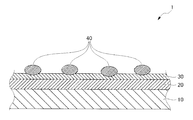
- FIG. 1 is a partially enlarged cross-sectional view of a textile product according to an embodiment of the present invention.
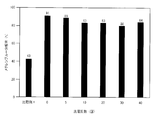
- FIG. 2 is a graph showing the results of the washing durability test of the textile products according to Example 1 and Comparative Example 1.
- FIG. 3 is a scanning electron microscope image of observing the fiber surface after each step of the method for producing a textile product according to Example 1.
- FIG. 4 is a spectrum obtained by observing the surfaces of the textile products according to Example 1 and Comparative Example 1 by energy dispersive microfluorescence X-ray analysis.
- FIG. 1 is a partially enlarged cross-sectional view of a textile product according to the present embodiment.
- the size of each member is appropriately emphasized for the sake of facilitation of explanation, and the actual ratio and size of each member are not shown.
- the textile product 1 shown in FIG. 1 includes a fiber base material 10, a surface-treated layer 20 arranged on at least a part of the surface of the fiber base material 10, and a zirconium phosphate layer 30 fixed on the surface-treated layer 20. , A functional substance 40 immobilized on the surface of the zirconium phosphate layer 30.
- the fiber base material 10 is a base material for textile products.
- the fiber base material 10 is usually composed mainly of fibers such as natural fibers and / or synthetic fibers.
- the form of the fiber base material 10 is not particularly limited and may be arbitrarily selected depending on the use of the textile product. For example, a single fiber, a twisted yarn, a composite yarn, a hollow yarn, a short fiber, a woven fabric, a knitted fabric, etc. It can be a net, a non-woven fabric, a cotton cloth, etc., and one of these can be used alone or in combination of two or more.
- the fiber substrate 10 contains natural fibers and / or synthetic fibers as described above.
- natural fibers include cotton, hemp, kenaf, pulp (chemical pulp, mechanical pulp), other plant fibers, especially natural cellulose fibers such as fibers derived from wood fiber, and regenerated cellulose fibers such as bisco rayon, cupra, and acetate.
- Various cellulose-based fibers such as chitin and chitosan, polysaccharide fibers having amide groups and amino groups such as chitin and chitosan, animal hair such as wool, cashmere and angora, silk and the like, and one of them alone or two kinds The above can be used in combination.
- the synthetic fiber examples include acrylic fibers such as acrylic fibers and modal acrylic fibers, polyester fibers such as polyethylene terephthalate, polytrimethylene terephthalate, polyethylene naphthalate and polybutylene terephthalate, polyether ester fibers, polyethylene and polypropylene.
- Polyethylene fibers polyacrylate fibers, polyvinyl chloride fibers, nylon 6, nylon 66 and other nylon fibers, polyamide fibers, polyimide fibers, aramid fibers, polyetherimide fibers, polyphenylene sulfide fibers, polyurethane fibers, polyvinyl alcohol Examples thereof include fibers, ethylene vinyl alcohol fibers, polyarylate fibers and the like, and one of these fibers can be used alone or in combination of two or more.
- the fiber base material 10 may be composed of natural fibers or synthetic fibers alone, or may be composed of a combination of natural fibers and synthetic fibers. In these cases, of course, a plurality of types of natural fibers and a plurality of types of synthetic fibers may be used.
- the fiber base material 10 preferably has a hydroxyl group and / or a carboxyl group on its surface. Specifically, it is preferable that the hydroxyl group and / or the carboxyl group is exposed on the surface of the fiber constituting the fiber base material 10.
- the reactive group of the silane coupling agent constituting the surface treatment layer 20 described later can be bonded to the hydroxyl group or the carboxyl group on the surface of the fiber base material 10, and the surface treatment layer 20 firmly forms the surface of the fiber base material 10.
- cellulosic fibers have abundant hydroxyl groups derived from cellulose.
- a hydroxyl group and / or a carboxyl group can be generated on the fiber surface by a method described later, and the silane coupling constituting the surface treatment layer 20 can be obtained.
- the silanol group of the agent can be bonded to the hydroxyl group or carboxyl group on the surface of the fiber base material 10, and the surface treatment layer 20 is more firmly fixed to the surface of the fiber base material 10.
- the fiber base material 10 is preferably one or more selected from the group consisting of cellulose-based fibers, polysaccharide fibers, polyester-based fibers and polyvinyl alcohol fibers, more preferably natural cellulose fibers and polyester-based fibers, and particularly preferably cotton. Includes one or more selected from the group consisting of hemp, kenaf and polyethylene terephthalate.
- Cellulose-based fibers have many hydroxyl groups or carboxyl groups exposed on the surface due to the chemical structure of the constituent components. Therefore, the adhesion between the surface treatment layer 20 and the fiber base material 10 is improved, and the functional substance is more firmly fixed to the fiber base material 10.
- polyester fibers such as polyethylene terephthalate have been difficult to support a functional substance on the surface of conventional fibers due to the chemical structure of the constituent components.
- the functional substance 40 can be firmly supported on the fiber surface. Further, by generating a hydroxyl group and / or a carboxyl group on the fiber surface by a method described later, the adhesion between the surface treatment layer 20 and the fiber base material 10 is improved, and the functional substance 40 becomes stronger in the fiber. It will be fixed to the base material 10.
- the surface treatment layer 20 is a layer formed by a silane coupling agent on at least a part of the surface of the fiber base material 10.
- the silane coupling agent constituting the surface treatment layer 20 contains a silane compound having an amino group. This makes it possible to firmly fix the zirconium phosphate layer 30 to the fiber base material 10 via the surface treatment layer 20. As a result, the functional substance 40 supported on the zirconium phosphate layer 30 can be firmly fixed to the surface of the textile product 1.
- the surface treatment layer 20 formed by the silane coupling agent has a siloxane bond formed by the reaction of the reactive groups of the silane coupling agent, for example, a silanol group or an alkoxy group bonded to a silicon atom, as a main skeleton. do.
- the reactive group of the silane coupling agent also reacts with a functional group existing on the surface of the fiber base material 10, for example, a hydroxyl group or a carboxyl group at the time of forming the surface treatment layer 20, to form a covalent bond.
- the formed surface treatment layer 20 is firmly fixed to the surface of the fiber base material 10 by covalent bonds.
- the silane coupling agent contains a silane compound having an amino group, as described above. Therefore, in the surface treatment layer 20 formed by the silane coupling agent, a large number of amino groups are exposed on the surface thereof. Then, the nitrogen atom in the amino group can be positively charged by binding to , for example, a hydrogen ion (H +) or the like. Then, the zirconium phosphate layer 30 can be fixed via the amino group exposed to the surface treatment layer 20 and positively charged.
- the amino group exposed on the surface of the surface treatment layer 20 is fixed to the surface treatment layer 20 by a covalent bond, and the surface treatment layer 20 is fixed to the surface of the fiber base material 10 by a covalent bond. ..
- the amino group is prevented from being separated from the surface of the fiber base material 10 as compared with the conventional technique of supporting the zirconium phosphate layer 30 by a metal cation such as aluminum. Therefore, the zirconium phosphate layer 30 can be reliably fixed to the surface of the fiber base material 10 via the surface treatment layer 20.
- the surface treatment layer 20 formed by the silane coupling agent is mainly composed of a relatively stable siloxane. Therefore, even when the textile product 1 carries a reactive substance as a functional substance or a substance that catalyzes the reaction on the zirconium phosphate layer 30, the surface treatment layer 20 protects the deterioration of the fiber base material 10. To.
- the silane coupling agent constituting the surface treatment layer 20 contains at least a silane compound having an amino group.
- the silane compound having an amino group include aminoalkyltrialkoxysilane, di- (aminoalkyl) -dialkoxysilane, aminoalkyl-di-(alkoxy) -monoalkylsilane and the like.
- aminoalkyltrialkoxysilane examples include a silane compound represented by the following formula (1). Si (OR 1 ) 3 R 2 NH 2 (1)
- R 1 is a linear or branched alkyl group having 1 or more and 10 or less carbon atoms
- R 2 is a linear or branched alkylene group having 1 or more and 10 or less carbon atoms.
- examples of the linear alkyl group a methyl group, an ethyl group, n- propyl group, n- butyl group, n- pentyl group, n- hexyl, n- heptyl, n- octyl, n- nonyl Examples include a group and an n-decyl group.
- examples of the branched alkyl group include an i-propyl group, a t-butyl group, and an i-butyl group.
- the carbon number of R 1 is preferably 2 or more in order to suppress deterioration of the silane coupling agent during storage. Further, the carbon number of R 1 is preferably 6 or less, more preferably 4 or less, in order to keep the reactivity of the silane coupling agent high at the time of forming the surface treatment layer 20.
- R 1 is preferably an ethyl group, an n-propyl group, an n-butyl group, an i-propyl group, a t-butyl group or an i-butyl group, and particularly preferably an ethyl group, an n-propyl group or n-. It is a butyl group.
- straight-chain alkylene group R 2 for example a methylene group, an ethylene group, n- propylene, n- butylene, n- pentylene group, a cyclohexylene group n-, carbon atoms such as n- heptylene group and n- octylene
- straight-chain alkylene group R 2 for example a methylene group, an ethylene group, n- propylene, n- butylene, n- pentylene group, a cyclohexylene group n-, carbon atoms such as n- heptylene group and n- octylene
- straight-chain alkylene group R 2 for example a methylene group, an ethylene group, n- propylene, n- butylene, n- pentylene group, a cyclohexylene group n-, carbon atoms such as n- heptylene group and n-
- the branched alkylene group R 2 for example, 1-methylpropylene group, 2-methylpropylene group, 1,1-dimethylpropylene group, 1,2-dimethylpropylene group, 1,3-dimethylpropylene group, 2,2 Dimethylpropylene group, 1,2,3-trimethylpropylene group, 1,1,2-trimethylpropylene group, 1,2,2-trimethylpropylene group, 1,1,3-trimethylpropylene group, 1-methylbutylene group, 2-Methylbutylene group, 1,1-dimethylbutylene group, 1,2-dimethylbutylene group, 1,3-dimethylbutylene group, 1,4-dimethylbutylene group, 2,2-dimethylbutylene group, 2,3- Dimethylbutylene group, 1,2,3-trimethylbutylene group, 1,2,4-trimethylbutylene group, 1,1,2-trimethylbutylene group, 1,2,2-trimethylbutylene group, 1,3,3- Examples thereof include a trimethylbutylene group, a 1-methylpent
- the number of carbon atoms of R 2, from the viewpoint of ensuring the stability of the silane coupling agent is preferably 2 or more.
- the number of carbon atoms in R 2 is preferably 6 or less, more preferably 4 or less.
- R 2 is preferably an ethylene group, n- propylene group, an n- butylene or n- pentylene group, particularly preferably an ethylene group, n- propylene or n- butylene.
- Preferred aminoalkyltrialkoxysilanes include, for example, 2-aminoethyltriethoxysilane, 2-aminoethyltri n-propoxysilane, 2-aminoethyltriisopropoxysilane, 2-aminoethyltri n-butoxysilane, 2-.
- di- (aminoalkyl) -dialkoxysilane examples include a silane compound represented by the following formula (2). Si (OR 3 ) 2 (R 4 NH 2 ) 2 (2)
- aminoalkyl-di- (alkoxy) -monoalkylsilane examples include silane compounds represented by the following formula (3). Si (OR 5 ) 2 (R 6 NH 2 ) R 7 (3)
- R 3 R 5 and R 7, including preferred embodiments thereof are the same as R 1 in the formula (1).
- R 4 and R 6 are the same as R 2 of the above formula (1), including the preferred embodiment thereof.
- the silane coupling agent preferably contains aminoalkyltrialkoxysilane, more preferably 2-aminoethyltriethoxysilane, 2-aminoethyltrin-propoxysilane, 2-aminoethyltriisopropoxysilane, Includes one or more selected from the group consisting of 2-aminoethyltri n-butoxysilane, 3-aminopropyltriethoxysilane, 3-aminopropyltri n-propoxysilane and 3-aminopropyltriisopropoxysilane.
- the silane coupling agent may contain a silane compound other than the silane compound having an amino group.
- silane compounds include methyltrimethoxysilane, dimethyldimethoxysilane, phenyltrimethoxysilane, dimethoxydiphenylsilane, n-propyltrimethoxysilane, hexyltrimethoxysilane, decyltrimethoxysilane, and 1,6-bis (tri).
- Ethalkylsilane compounds such as hexane, tetraethoxysilane, methyltriethoxysilane, dimethyldiethoxysilane, phenyltriethoxysilane, n-propyltriethoxysilane, hexyltriethoxysilane, octyltriethoxysilane, vinyltrimethoxysilane , Vinyl group-containing silane compounds such as vinyl ethoxysilane, 2- (3,4-epoxycyclohexyl) ethyltrimethoxysilane, 3-glycidoxypropylmethyldimethoxysilane, 3-glycidoxypropyltrimethoxysilane, 3-glyceride Epyl group-containing silane compounds such as sidoxylpropylmethyldiethoxysilane and 3-glycidoxypropyltrimeethoxysilane, styryl group-containing silane compounds such as p-st
- 3-Isocyanate group-containing silane compound such as propyltriethoxysilane, isocyanurate group-containing silane compound such as tris- (trimethoxysilylpropyl) isocyanurate, hexamethyldisilazane, hexamethyldisiloxane and the like.
- the content of the silane compound having an amino group in the silane coupling agent is 10% by mass or more, preferably 50% by mass or more.
- the surface treatment layer 20 is formed by using the silane coupling agent as described above. The details of the forming method will be described later.
- the average thickness of the surface treatment layer 20 is not particularly limited, but is, for example, 0.002 ⁇ m or more and 10 ⁇ m or less, preferably 0.1 ⁇ m or more and 1 ⁇ m or less.
- the surface treatment layer 20 may have a relatively uniform thickness, or the thickness may be different in each portion. When the thickness of the surface treatment layer 20 is different in each portion, the surface treatment layer 20 has irregularities. In this case, the surface treatment layer 20 can carry a larger amount of the zirconium phosphate polymer, and can further enhance the adsorption ability of the substance of the zirconium phosphate layer 30, which will be described later.
- the zirconium phosphate layer 30 is fixed on the surface treatment layer 20.
- the zirconium phosphate layer 30 is composed of one layer or a plurality of layers of plate-shaped inorganic polymers peeled off from zirconium phosphate having a layered structure.
- the zirconium phosphate layer 30 has a bulk in which some or all of hydrogen ions from crystalline zirconium phosphate ([Zr (HPO 4 ) 2 ] ⁇ nH 2 O) having a layered structure are represented by tetraalkylammonium ions.
- inorganic polymer is peeled by substituting higher alkyl ammonium ion layered ([Zr ((R 8 4 N) x H 1-x PO 4) 2]) is formed by laminating one or more layers.
- the phosphoric acid group in the plate-shaped polymer constituting the layer 30 is negatively charged.
- the amino group exposed on the surface of the surface treatment layer 20 becomes a positively charged ammonium cation by receiving hydrogen ions.
- the phosphoric acid group of the zirconium phosphate layer 30 and the ammonium cation of the surface treatment layer 20 are electrostatically bonded to fix the zirconium phosphate layer 30 to the surface treatment layer 20.
- the zirconium phosphate layer 30 has a large number of phosphoric acid groups on the contact surface with the surface treatment layer 20 due to its chemical structure.
- the surface treatment layer 20 also has a large number of ammonium cations on the contact surface with the zirconium phosphate layer 30. Therefore, electrostatic bonds (multi-point electrostatic bonds) between a large number of phosphoric acid groups and ammonium cations occur between the surface treatment layer 20 and the zirconium phosphate layer 30, and the surface treatment layer 20 and phosphoric acid are formed.
- the zirconium layer 30 is fixed. In this case, even if the bond between some of the phosphate groups and the ammonium cation is broken, the fixation between the surface treatment layer 20 and the zirconium phosphate layer 30 is maintained by other bonds. ..
- the phosphate group and ammonium cation of the bond once cleaved are also recombined when they are brought close to each other again.
- the zirconium phosphate layer 30 is firmly fixed to the surface treatment layer 20.
- the zirconium phosphate layer 30 can electrostatically or chemically immobilize the functional substance 40 via the phosphoric acid group.
- the zirconium phosphate layer 30 has an ion exchange ability similar to that of an ion exchange resin. Therefore, when the textile product 1 is used as clothing or the like, the zirconium phosphate layer 30 can adsorb ammonia or ammonium ions in sweat or urine. Since the ion exchange ability of the zirconium phosphate layer 30 is reversible, it can be regenerated by ion exchange with hydrogen ions in water during washing.
- the thickness of the plate-shaped polymer constituting the zirconium phosphate layer 30 is about 0.75 nm. Therefore, even if a large number of polymers, for example, several tens of layers are laminated, the zirconium phosphate layer 30 is relatively thinly coated and does not easily affect the texture of the textile product 1.
- Crystalline phosphate zirconium ⁇ -type and (Zr (HPO 4) 2 ⁇ 2H 2 O), ⁇ -type (Zr (PO 4) (H 2 PO 4) ⁇ 2H 2 O) are known.
- the ⁇ type has a smaller interlayer distance between the polymers, and intercalation of unnecessary ions such as Na + is less likely to occur.
- the ⁇ type has a partial structure of phosphate ion and dihydrogen phosphate ion, whereas the ⁇ type has only a partial structure of hydrogen phosphate ion, so that the charge on the surface of the polymer is charged.
- the density is more homogeneous and the bond with the ammonium cation is uniform and evenly distributed, and stronger bond can be expected. Therefore, it is preferable to use a zirconium phosphate polymer exfoliated from ⁇ -type crystalline zirconium phosphate.
- R 8 is independently H or H or each time it appears. It is a linear or branched alkyl group having 1 or more and 10 or less carbon atoms. As the linear alkyl group and the branched alkyl group, the same ones as those of R 1 described above can be used.
- R 8 is preferably a linear alkyl group having 1 or more and 6 or less carbon atoms, more preferably a linear alkyl group having 2 or more and 5 or less carbon atoms, and further preferably an n-propyl group, n-butyl group or n-. It is a pentyl group. It should be noted that each R 8 is preferably the same.
- the average thickness of the zirconium phosphate layer 30 is not particularly limited, but is, for example, 1 nm or more and 1000 nm or less, preferably 10 nm or more and 500 nm or less.
- the zirconium phosphate layer 30 may have a relatively uniform thickness, or the thickness may be different at each site. Alternatively, the zirconium phosphate layer 30 may have irregularities due to the irregularities of the surface treatment layer 20. For example, when the zirconium phosphate layer 30 has irregularities on its surface, such irregularities on the zirconium phosphate layer 30 increase the surface area of the zirconium phosphate layer 30, and the functional substance 40 and the like. Promotes the adsorption of substances such as ammonia and ammonium ions.
- the functional substance 40 is a substance for imparting a desired function to the fixed textile product 1.
- the intended functions to be imparted for example, flame retardancy, water repellency, heat shielding, shading (visible light / ultraviolet blocking), antibacterial, sterilization, self-cleaning (staining resistance), texture imparting, etc. Can be mentioned.
- the functional substance 40 is fixed on the zirconium phosphate layer 30.
- the mechanism for fixing the functional substance 40 to the zirconium phosphate layer 30 is not particularly limited, and is electrostatically fixed using the negative charge of the phosphoric acid group of the zirconium phosphate layer 30, or functions with the zirconium phosphate layer 30. It can be fixed by a chemical bond (eg, ionic bond, covalent bond) with the sex substance 40.
- the functional substance 40 is firmly fixed on the fiber base material 10 via the surface treatment layer 20 and the zirconium phosphate layer 30 described above.
- the functional substance 40 is not particularly limited as long as it can be fixed to the zirconium phosphate layer 30 and can exhibit the desired function.
- examples of the functional substance 40 include a photocatalyst, a texture-imparting agent, a water-repellent agent, a moisturizer, a water-absorbing agent, an absorbent, a fluorescent agent, an adsorbent, and the like, and one of these may be used alone or in combination of two or more. Can be used in combination.
- a photocatalyst is a substance that exhibits catalytic action when irradiated with electromagnetic waves such as light.
- the photocatalyst include metal compounds such as oxides of metal elements, nitrides, hydroxides and composite salts. Depending on the type of such a metal compound, it can be excited by light irradiation (particularly ultraviolet irradiation) to exhibit redox ability and decompose organic substances. This causes the photocatalyst to exert antibacterial, bactericidal and / or self-cleaning (antifouling) effects.
- the metal oxide include titanium dioxide, titanic acid, titanates, niobic acid, niobic acid, titanoniobic acid, zinc oxide, copper oxide, silver oxide, iron oxide, tungsten oxide, nickel oxide, and molybdenum acid.
- metal oxides such as tantalic acids, metal acid nitrides such as tantalic acid nitrides, metal composite salts such as vanadic acid bismuth salts, and metal hydroxide composite salts such as copper hydroxide phosphates.
- the functional substance 40 preferably contains a metal oxide, more preferably titanium oxide and / or silver oxide as a photocatalyst. Titanium oxide has high photocatalytic activity and can impart a high self-cleaning function to the textile product 1. In addition, silver oxide has high bactericidal and antibacterial functions. Various crystal types such as anatase type, rutile type, and brookite type are known for titanium oxide. Of these, the functional substance 40 preferably contains an anatase type.
- the average particle size of the primary particles of the metal oxide is not particularly limited, but is preferably less than 1 ⁇ m, more preferably 50 nm or less. As a result, the metal oxide exhibits high photocatalytic activity and strong binding force. Further, if the average particle size of the primary particles of the metal oxide is too small, the band gap may be widened due to the quantum size effect, and near-ultraviolet light may not be effectively used, and the reaction efficiency may be lowered. Therefore, the average particle size is preferably 20 nm or more. ..
- the "average particle size of the primary particles" referred to here is an average value obtained by obtaining the particle size from the image under the electron microscope photograph observation by FE-SEM (field emission scanning electron microscope): Hitachi, Ltd. S-5000 type. ..
- the particle size of the secondary particles of the metal oxide is not particularly limited, but is, for example, 50 to 5000 nm, preferably 1000, from the viewpoint of stable fixation to the zirconium phosphate layer 30 and maintenance of the texture of the fiber. It is ⁇ 3000 nm.
- the particle size of the metal oxide dispersed in water is measured by a light scattering method in the aqueous dispersion of the metal oxide.
- the secondary particles (functional substance 40) supported on the zirconium phosphate layer 40 have a secondary particle diameter due to aggregation or the like in the process of being supported on the surface.
- the particle size of the secondary particles in the aqueous dispersion of the metal oxide is reflected in the particle size of the metal oxide (functional substance 40) supported on the zirconium phosphate layer 40. ..
- the agglomerates formed by the particles coming into contact with each other on the supported surface inevitably have a larger particle size than the secondary particles observed in the solution.
- the metal oxides as the functional substance 40 are positively charged in an acidic solution and negatively charged in an alkaline solution due to the dissociation equilibrium of hydrophilic functional groups such as hydroxyl groups on the surface.
- the charging tendency of the metal oxide in water is utilized, and the functional substance 40 (metal oxide) positively charged in water is electrostatically charged in the zirconium phosphate layer 30.
- the phosphate group found in the partial structure of zirconium phosphate is proton dissociated to cause the zirconium phosphate layer 30 to be permanently negatively charged, and has the property of specifically binding to a metal oxide such as titanium oxide. Has.
- the density of the phosphoric acid structure of zirconium phosphate is 4.1 / square nm, and it exists at an extremely high density, so even a nanoparticulate metal oxide is unique to multipoint electrostatic bonds. Covalent bonding makes it possible to firmly fix.
- the texture-imparting agent imparts texture to the textile product 1.
- examples of the texture-imparting agent include proteins such as sericin. Sericin is a component constituting silk, and by fixing sericin as a functional substance 40 to the zirconium phosphate layer 30, the textile product 1 can exhibit the texture of silk.
- the protein has a peptide bond, and the nitrogen atom of the peptide bond can be positively charged by receiving a hydrogen ion. Therefore, the protein is immobilized on the phosphate group of the zirconium phosphate layer 30 via such a sex-charged moiety.
- the functional substance 40 may contain saccharides.
- saccharides include polysaccharides such as cellulose, hemicellulose, agarose, chitin, chitosan, and alginic acid, disaccharides such as sucrose, lactose, maltose, trehalose, turanose, and cellobiose, trisaccharides such as raffinose, meregitos, and maltotriose, and acarbohydrate.
- Stachiose and other polysaccharides, other oligosaccharides, glucose, xylose, fructose, mannose, galactose and other monosaccharides, and one of these can be used alone or in combination of two or more.
- the physical strength of the textile product 1 is ensured by the fiber base material 10 regardless of the degree of polymerization of the saccharide as the functional substance 40. Therefore, as the functional substance 40, saccharides having a low degree of polymerization such as monosaccharides and oligosaccharides can also be used.
- a layer made of a silane compound may be further formed on the zirconium phosphate layer 30.
- an alkoxy group derived from a silane compound is generated on the surface of the zirconium phosphate layer 30, and can be firmly bonded to the hydroxyl group of the saccharide.
- the functional substance 40 is granular and fixed on the zirconium phosphate layer 30, but the present invention is not limited to the illustrated embodiment, and the functional substance 40 is arbitrary. Can be fixed on the zirconium phosphate layer 30 in the shape of.
- the functional substance 40 is not limited to the illustrated embodiment, and may be particles having an inhomogeneous shape and particle size, or may be secondary particles in which a plurality of primary particles are aggregated.
- the functional substance 40 may be layered. In this case, the functional substance 40 may be fitted into the zirconium phosphate layer 30 and may have a porous structure.
- the zirconium phosphate layer 30 is firmly fixed to the textile product 1 by fixing the zirconium phosphate layer 30 to the fiber base material 10 via the surface treatment layer 20. It becomes a thing. Therefore, the detachment of the functional substance 40 due to the exfoliation of the zirconium phosphate layer 30 is suppressed. As a result, the functional substance 40 can be firmly fixed to the textile product 1.
- the textile product 1 has the functional substance 40, but the textile product according to the present invention does not have to have the functional substance.
- the textile product is distributed and used as an intermediate member, for example, and any kind of functional substance can be fixed after the fact if necessary.
- a method for manufacturing a textile product according to the present embodiment will be described.
- at least a part of the surface of the fiber base material is treated with a silane coupling agent to form a surface treatment layer on at least a part of the surface of the fiber base material (surface).
- Processing process and It has a step of forming a zirconium phosphate layer on the surface-treated layer (a step of forming a zirconium phosphate layer).
- the silane coupling agent contains a silane compound having an amino group.
- the manufacturing method according to the present embodiment includes a preparatory step of preparing a fiber base material and a step of introducing a hydroxyl group and / or a carboxyl group on the surface of the fiber base material (pretreatment step) prior to the surface treatment step.
- pretreatment step a step of introducing a hydroxyl group and / or a carboxyl group on the surface of the fiber base material
- production method according to the present embodiment includes a step of fixing a functional substance on the zirconium phosphate layer (functional substance fixing step) after the zirconium phosphate layer forming step.
- the fiber base material 10 is prepared.
- the fiber base material 10 include various fiber materials that can be used as the above-mentioned fiber base material 10. Further, the fiber base material 10 may be subjected to a known processing / cleaning treatment, if necessary.
- the method for introducing a hydroxyl group and / or a carboxyl group is not particularly limited, and for example, oxidation of a compound constituting the surface of the fiber base material 10, an amide group (peptide bond) or an ester group existing on the surface of the fiber base material 10 is used. Examples thereof include additive decomposition of the above, adsorption / bonding of a compound having a hydroxyl group and / or a carboxyl group to the surface of the fiber base material 10. These methods may be performed alone, or two or more methods may be used in combination.
- Specific methods for oxidizing the compounds constituting the surface of the fiber base material 10 include oxidation treatment with an oxidizing agent, irradiation with electromagnetic waves, or a combination thereof.
- the surface of the fiber base material 10 is treated in the presence of an oxidizing agent such as ozone, hydrogen peroxide, chlorine, chlorine dioxide, and perchloric acid. It is preferably performed in the presence of a liquid medium such as an aqueous solution.
- a liquid medium such as an aqueous solution.
- a relatively high concentration of oxidant can be retained in the liquid medium, enabling a uniform and efficient oxidative reaction.
- the liquid property of the liquid medium may be alkaline, acidic, or neutral, and is appropriate depending on the constituent material of the fiber base material 10, the type of oxidizing agent, the desired degree of oxidation, and the like. Can be changed.
- the electromagnetic waves that can be used for irradiating electromagnetic waves are not particularly limited, and ultraviolet rays, visible light, etc. can be used. Above all, considering the efficiency of oxidation, it is preferable to use ultraviolet rays. Further, the irradiation of electromagnetic waves can be performed in an oxygen-presence atmosphere, for example, in an atmospheric atmosphere. In this case, ozone is generated from oxygen existing in the atmosphere by electromagnetic waves, and ozone reacts and bonds on the surface of the fiber base material 10 to generate a hydroxyl group or a carboxyl group.
- Solvolysis of amide groups (peptide bonds) and ester groups existing on the surface of the fiber base material 10 can be performed by treating the fiber base material 10 in a solution containing an acid or a base. Solvolysis can be suitably used for decomposition of nitrile groups and ester groups.
- Examples of the acid include inorganic acids such as hydrochloric acid, sulfuric acid, nitric acid, and phosphoric acid, and one of these can be used alone or in combination of two or more.
- Examples of the base include sodium hydroxide, potassium hydroxide, sodium carbonate, potassium carbonate, ammonia and the like, and one of these can be used alone or in combination of two or more.
- Examples of the medium of the solution include various organic solvents such as water and alcohol solvents. When water is used as a medium, hydrolysis can be carried out. Alternatively, when an alcohol solvent is used as a medium, alcoholic decomposition can be performed.
- the alcohol solvent is not particularly limited, but methanol, ethanol, n-propyl alcohol, 2-methylpropyl alcohol, 1-butanol, 2-methoxyethanol, 2-ethoxyethanol, 1-methoxy-2-propanol, and the like. Examples thereof include ethylene glycol, 1,2-propanediol, 1,3-propanediol, 1,3-butanediol, 1,4-butanediol, 2-ethylhexanol, and benzyl alcohol.
- Adsorption / bonding of a compound having a hydroxyl group and / or a carboxyl group to the surface of the fiber base material 10 is suitable for introducing a hydroxyl group / carboxyl group onto the surface of a protein-based fiber such as wool, animal hair such as cashmere or angora.
- a protein-based fiber such as wool, animal hair such as cashmere or angora.
- the fiber base material 10 can be reacted with polyphenols having three or more hydroxyl groups in one molecule such as tannin, tannic acid, rhus chinensis, gallic acid and gallic acid.
- the fiber base material 10 can be immersed in a 1 to 100 mM aqueous solution of polyphenols (temperature: about 10 to 100 ° C.) for about 0.25 to 2 hours.
- the reaction amount of the polyphenols is preferably about 1 to 10% by weight with respect to the fiber base material 10.
- the introduction of the hydroxyl group and / or the carboxyl group onto the surface of the fiber base material 10 is preferably carried out by oxidation or solvolysis of the compound constituting the surface of the fiber base material 10.
- Such a method facilitates the introduction of a hydroxyl group and / or a carboxyl group regardless of the type of the fiber base material 10.
- chemical fibers such as acrylic fibers, polyester fibers, polyolefin fibers, and polyvinyl chloride fibers are relatively difficult to introduce ex post facto such as hydroxyl groups and carboxyl groups, but these are more preferably used by the above method. It is possible to introduce functional groups.
- this step may be omitted. Specifically, even if this step is omitted, if the surface treatment layer 20 is suitably formed in the surface treatment step described later, this step is omitted. For example, if the fiber substrate 10 has a sufficient amount of hydroxyl groups or carboxyl groups on the surface, this step may be omitted.
- a fiber base material 10 include a fiber base material made of cellulosic fibers.
- the surface treatment layer 20 is formed by applying the above-mentioned silane coupling agent to the target surface of the fiber base material 10 and reacting it.
- the method of applying the silane coupling agent to the fiber base material 10 is not particularly limited, and can be performed by dipping, spraying, coating, printing (for example, inkjet printing, screen printing) or the like. Among the above, immersion is preferable from the viewpoint that it can be uniformly applied to the uneven fiber base material 10.
- Immersion can be performed by immersing the fiber base material 10 in a treatment liquid containing a silane coupling agent.
- a silane coupling agent contained in the treatment liquid the silane coupling agent constituting the surface treatment layer 30 described above can be used.
- the treatment liquid contains an organic solvent.
- the organic solvent is not particularly limited as long as it can dissolve the silane coupling agent, but for example, methanol, ethanol, n-propyl alcohol, 2-methylpropyl alcohol, 1-butanol, 2-methoxyethanol, 2-ethoxy.
- Alcohol-based solvents such as ethanol, 1-methoxy-2-propanol, 1,3-butanediol, 1,4-butanediol, 2-ethylhexanol, and benzyl alcohol, acetone, methyl ethyl ketone, methyl propyl ketone, methyl isobutyl ketone, diethyl.
- Ketone solvents such as ketones, dipropyl ketones, diisobutyl ketones, cyclohexanones, diacetone alcohols, dimethyl ethers, diethyl ethers, din-propyl ethers, diisopropyl ethers, din-butyl ethers, dit-butyl ethers, t-butylmethyl ethers, Ethereal solvents such as 1,4-dioxane, ethylene glycol monomethyl ether, ethylene glycol monoethyl ether, ethylene glycol monobutyl ether, propylene glycol monomethyl ether propionate, tetrahydrofuran, ethyl acetate, methyl acetate, butyl acetate, sec-butyl acetate , Ester solvents such as methoxybutyl acetate, amyl acetate, n-propyl acetate, isopropyl acetate, methyl lactate,
- the treatment liquid is preferably one or more selected from the group consisting of an alcohol-based solvent and an ether-based solvent as the organic solvent, and more preferably ethanol, n-propyl alcohol, 2-methylpropyl alcohol and 1 -Contains one or more selected from the group consisting of butanol.
- the concentration of the silane coupling agent in the treatment liquid is, for example, 0.1% by mass or more and 10% by mass or less, preferably 0.2% by mass or more and 1% by mass or less.
- the immersion time of the fiber base material 10 in the treatment liquid is not particularly limited, but is 30 seconds or more and 30 minutes or less, preferably 1 minute or more and 15 minutes or less. As a result, an appropriate amount of the silane coupling agent can be attached to the fiber base material 10.
- the reaction of the silane coupling agent on the fiber base material 10 can be carried out, for example, by drying in an air atmosphere.
- air drying may be performed, or drying may be performed while heating at a temperature of 30 ° C. or higher and 150 ° C. or lower.
- the zirconium phosphate layer 30 is formed on the surface treatment layer 20.
- the formation of the zirconium phosphate layer 30 can be performed by applying a zirconium phosphate dispersion to the surface treatment layer 20 and fixing the zirconium phosphate on the surface treatment layer 20.
- a zirconium phosphate dispersion liquid in which zirconium phosphate is dispersed in a dispersion medium is prepared.
- the zirconium phosphate dispersion is prepared by, for example, dispersing crystalline zirconium phosphate having a layered structure in a dispersion medium by shaking, and further tetraalkylammonium (for example, tetraalkylammonium having an alkyl group having 1 or more and 6 or less carbon atoms, specifically.
- the pH is adjusted to, for example, 7.5 or more and 10.0 or less, preferably 8. while maintaining the 0 or 9.5, the individual zirconium phosphate polymer of crystalline zirconium phosphate ([Zr n (PO 4) 2n] 2n-) can be obtained by dispersing by peeling.
- the method of applying the zirconium phosphate dispersion liquid to the surface treatment layer 20 is not particularly limited, and can be performed by dipping, spraying, coating, printing (for example, inkjet printing, screen printing) or the like. Among the above, immersion is preferable from the viewpoint of uniformly imparting the zirconium phosphate polymer. Further, by immersing the polymer, the zirconium phosphate polymer can be fixed to the surface treatment layer 20 at the same time to form the zirconium phosphate layer 30.
- the immersion time of the fiber base material 10 supporting the surface treatment layer 20 in the zirconium phosphate dispersion is not particularly limited, but is, for example, 1 minute or more and 60 minutes or less, preferably 2 minutes or more and 15 minutes or less.
- the fiber base material 10 may be heated during or after the fiber base material 10 is immersed in the zirconium phosphate dispersion. This makes it possible to fix the zirconium phosphate polymer to the surface treatment layer 20.
- the heating method is not particularly limited, and any method can be adopted, but microwave irradiation is preferable.
- microwave irradiation is preferable.
- the zirconium phosphate polymer can be fixed to the surface treatment layer 20 in a short time.
- heating can be performed by using a microwave of 1 GHz or more and 5 GHz or less and irradiating the zirconium phosphate dispersion with the microwave for a time of 5 seconds or more and 200 seconds or less.
- the temperature of the zirconium phosphate dispersion may be set to 5 ° C or higher and 60 ° C or lower, and heating may be performed by maintaining this temperature for a period of 1 minute or longer and 60 minutes or lower. can.
- the zirconium phosphate dispersion liquid that adheres excessively or permeates between the fibers of the fiber base material 10 may be removed.
- the zirconium phosphate dispersion can be removed by washing with a liquid medium such as water or an organic solvent.
- drying is performed as necessary to obtain a fiber base material 10 in which the zirconium phosphate layer 30 is fixed on the surface treatment layer 20.
- air drying may be performed, or drying may be performed while heating at a temperature of 30 ° C. or higher and 150 ° C. or lower.
- the zirconium phosphate layer 30 is fixed to the surface treatment layer 20 by drying or heating after the application.
- the method for imparting the functional substance 40 to the zirconium phosphate layer 30 is not particularly limited, but it is preferable to impart the treatment liquid in which the functional substance 40 is dispersed or dissolved to the zirconium phosphate layer 30. This makes it possible to impart the functional substance 40 relatively uniformly.
- the dispersion medium or solvent of the functional substance 40 is not particularly limited, and can be appropriately selected according to the chemical and physical properties of the functional substance 40.
- the above-mentioned organic solvent, water, or the like can be used.
- the immersion time of the fiber base material 10 having the zirconium phosphate layer 30 in the treatment liquid is not particularly limited, but is, for example, 1 minute or more and 120 minutes or less, preferably 2 minutes or more and 15 minutes or less.
- the fiber base material 10 may be heated during or after the fiber base material 10 is immersed in the treatment liquid.
- the functional substance 40 can be fixed to the zirconium phosphate layer 30 via a chemical bond.
- the photocatalyst is used as the functional substance 40, the photocatalyst is fixed to the zirconium phosphate layer 30 by a chemical bond such as a covalent bond, a coordination bond, a hydrogen bond or an ionic bond.
- the heating method is not particularly limited, and any method can be adopted, but microwave irradiation is preferable.
- the functional substance 40 can be fixed to the zirconium phosphate layer 30 in a short time via a chemical bond.
- heating can be performed by using a microwave of 1 GHz or more and 5 GHz or less and irradiating the treatment liquid with the microwave for a time of 5 seconds or more and 300 seconds or less.
- heating can be performed by setting the temperature of the treatment liquid to 5 ° C. or higher and 90 ° C. or lower and maintaining this temperature for a time of 5 minutes or longer and 120 minutes or lower.
- a textile product 1 in which the functional substance 40 is fixed on the zirconium phosphate layer 30 is dried.
- air drying may be performed, or drying may be performed while heating at a temperature of 40 ° C. or higher and 150 ° C. or lower.
- the functional substance 40 can be firmly fixed to the surface, and the textile product 1 having excellent washing durability can be efficiently manufactured.
- the functional substance 40 does not have to form a plurality of zirconium phosphate layers. Can be firmly fixed to the zirconium phosphate layer 30. Therefore, the step of forming a plurality of zirconium phosphate layers can be omitted.
- the functional substance 40 can be firmly fixed to the surface of the fiber base material 10 via the surface treatment layer 20 and the zirconium phosphate layer 30.
- the method for producing a textile product according to the present embodiment has been described as including a functional substance fixing step, but the same step may be omitted.
- Example 1 Manufacturing method of textile products > [Example 1] (1.1. Fiber base material preparation process) First, a 5 cm square (about 0.6 g) sample cloth was cut from a polyester cloth (manufactured by hap Co., Ltd.) and used as a fiber base material.
- the sample cloth is immersed in the zirconium phosphate dispersion for 15 minutes, then the sample cloth is taken out from the zirconium phosphate dispersion, and microwaves are applied to the sample cloth in a microwave oven (650 W, 2.45 GHz) for 3 minutes. Irradiated. Then, the sample cloth was rinsed with tap water three times and air-dried in an air atmosphere.
- a microwave oven 650 W, 2.45 GHz
- the sample cloth is immersed in the TiO 2 treatment liquid for 15 minutes, then the sample cloth is taken out from the TiO 2 treatment liquid, and the sample cloth is irradiated with microwaves in a microwave oven (650 W, 2.45 GHz) for 3 minutes. did. Then, the sample cloth was rinsed with tap water three times and air-dried in an air atmosphere. From the above, the textile product according to Example 1 was obtained. A plurality of textile products according to Example 1 were produced for evaluation described later.
- Comparative Example 1 A 5 cm square (about 0.6 g) sample cloth was cut from a polyester cloth (manufactured by hap Co., Ltd.), and this was used as a textile product according to Comparative Example 1.
- the diffuse reflection absorption spectrum of the fiber surface was measured with an ultraviolet visible spectrophotometer (Shimadzu Seisakusho Co., Ltd., UV-2400PC, integrating sphere unit: ISR-2200 (inner diameter: 60 mm)). The results are shown in FIG.
- FIG. 2 is a graph showing the results of the washing durability test of the textile products according to Example 1 and Comparative Example 1.
- the textile product according to Example 1 has a higher decomposition rate of methylene blue than the textile product according to Comparative Example 1 in an unwashed (0 times) state, and is supported. It was found that the titanium dioxide functioned as a photocatalyst. Further, in the textile product according to Example 1, even when the number of washings is increased, the decrease in the decomposition rate of methylene blue is suppressed, and it can be understood that titanium dioxide is firmly fixed to the fiber surface. ..
- FIG. 3 is a scanning electron microscope image of observing the fiber surface after each step of the method for manufacturing a textile product according to the present embodiment.
- the surface-treated layer with the silane coupling agent has irregularities of about 1 ⁇ m and irregularity of 5 ⁇ m or less. It was a layer covering the fiber substrate with particles of shape. Further, the thickness of this surface treatment layer was estimated to be about 1 ⁇ m at the maximum.
- Example 1 (3.3. Energy dispersive microfluorescence X-ray analysis)
- the surfaces of the textile products according to Example 1 and Comparative Example 1 were observed using an energy dispersive micro-fluorescent X-ray analyzer (Shimadzu Corporation, model name: ⁇ EDX-1300).
- the results are shown in FIG. FIG. 4A shows the EDX spectra of the textile product according to Comparative Example 1
- FIG. 4B shows the EDX spectra of the textile product according to Example 1.
- Example 2 The textile product according to Example 2 was produced in the same manner as in Example 1.
- the sample cloth was irradiated with ultraviolet rays for 5 minutes with a low-pressure mercury lamp (output: 6 W, wavelength: 254 nm) under an air atmosphere and in a closed condition.
- a low-pressure mercury lamp output: 6 W, wavelength: 254 nm
- the sample cloth was immersed in 15 ml of a 3.67 mM potassium aluminum sulfate aqueous solution for 10 minutes, and then the sample cloth was rinsed twice with tap water and centrifugally dehydrated.
- a 3.67 mM potassium aluminum sulfate aqueous solution for 10 minutes, and then the sample cloth was rinsed twice with tap water and centrifugally dehydrated.
- the potassium alum aluminum sulfate a product manufactured by Fuji Film Wako Pure Chemical Industries, Ltd. was used.
- the sample cloth was immersed in 15 ml of a 3.67 mM potassium aluminum sulfate aqueous solution for 10 minutes, and then the sample cloth was rinsed twice with tap water and centrifugally dehydrated.
- a 3.67 mM potassium aluminum sulfate aqueous solution for 10 minutes, and then the sample cloth was rinsed twice with tap water and centrifugally dehydrated.
- the potassium alum aluminum sulfate a product manufactured by Fuji Film Wako Pure Chemical Industries, Ltd. was used.
- the sample cloth was immersed in the prepared zirconium phosphate dispersion for 10 minutes, and then the sample cloth was rinsed twice with tap water and centrifugally dehydrated.
- the diffuse reflection absorption spectrum of the fiber surface was measured with an ultraviolet visible spectrophotometer (Shimadzu Seisakusho Co., Ltd., UV-2400PC, integrating sphere unit: ISR-2200 (inner diameter: 60 mm)). Then, the decomposition rate of methylene blue was calculated from the diffuse reflection absorption spectra before and after the irradiation with ultraviolet rays. The results are shown in Table 1.
- the textile product according to Example 2 has a higher decomposition rate of methylene blue both before and after washing than the textile product according to Comparative Examples 2 and 3, and has significant photocatalytic activity. showed that.
- the zirconium phosphate layer is formed via the surface treatment layer formed by the silane coupling agent containing the silane compound having an amino group, compared with the case where the zirconium phosphate layer is formed via aluminum ions. Therefore, it was speculated that more titanium oxide could be supported and that the carried titanium oxide could be held more firmly even during washing.
- the textile product according to Comparative Example 2 had a higher decomposition rate of methylene blue before washing as compared with Comparative Examples 3 and 4, and showed significant photocatalytic activity.
- the textile product according to Comparative Example 2 has an increased affinity with aluminum ions due to the irradiation of the PET fiber surface of the fiber base material with ultraviolet rays, and has the PET fiber of the fiber base material whose surface has not been treated as shown in Comparative Example 3.
- the washing durability of the textile product according to Comparative Example 2 is remarkably lowered, so that it is confirmed that the washing durability is significantly lower than that of Example 2.
- methylene blue absorbs some ultraviolet rays, and a certain amount of methylene blue is decomposed only by irradiation with ultraviolet rays. Therefore, decomposition of methylene blue was also observed in the textile product according to Comparative Example 4, which does not support either zirconium phosphate or titanium oxide.
- the textile product according to Comparative Example 3 had a further reduced decomposition rate before washing as compared with Comparative Example 2. From this, it is inferred that the amount of titanium oxide supported on the textile product according to Comparative Example 3 is even smaller.
- the textile product according to Example 2 showed a significantly higher decomposition rate than the decomposition rate of methylene blue even after washing, before washing the textile product according to Comparative Example 4. From this, it was presumed that the textile product according to Example 2 still carried titanium oxide even after washing.
- the textile products according to Comparative Examples 2 and 3 showed a decomposition rate equal to or lower than the decomposition rate of methylene blue after washing and before washing the textile products according to Comparative Example 4. From this, it was presumed that the textile products according to Comparative Examples 2 and 3 were not already supported with titanium oxide after washing.
Landscapes
- Engineering & Computer Science (AREA)
- Textile Engineering (AREA)
- Chemical & Material Sciences (AREA)
- Organic Chemistry (AREA)
- Inorganic Chemistry (AREA)
- Materials Engineering (AREA)
- Chemical Kinetics & Catalysis (AREA)
- Treatments For Attaching Organic Compounds To Fibrous Goods (AREA)
- Chemical Or Physical Treatment Of Fibers (AREA)
Abstract
【課題】 表面に機能性物質を強固に固定可能であり、洗濯耐久性に優れた繊維製品および当該繊維製品を効率よく製造することのできる繊維製品の製造方法を提供する。 【解決手段】 繊維基材と、前記繊維基材の表面の少なくとも一部に、シランカップリング剤により形成された表面処理層と、前記表面処理層上に固定されたリン酸ジルコニウム層と、を有し、前記シランカップリング剤が、アミノ基を有するシラン化合物を含む、繊維製品が提供される。
Description
本発明は、繊維製品および繊維製品の製造方法に関する。
近年、織物、編物、不織布等の繊維製品に難燃性、撥水性、紫外線保護特性、抗菌性、殺菌性、防汚性(セルフクリーニング性)等の機能を付与する試みが行われている。このような繊維製品への機能の付与は、一般には、所望の機能を付与する機能性物質を繊維を構成する樹脂に練り込むことにより行われる。
しかしながら、繊維中に埋没した機能性物質は、機能性物質によっては、所期の機能を発揮しにくい状態にある。一方で、繊維製品表面に機能性物質を担持させた場合、洗濯や使用時の摩擦等によって機能性物質が繊維製品から離脱しやすい。
特許文献1では、繊維基材に、リン酸ジルコニウム層が静電的に固定され、該リン酸ジルコニウム層の表面に光触媒が静電的に固定されてなることを特徴とする、光触媒を担持した繊維製品が提案されている。
ところで、衣類をはじめとする繊維製品は、その用途に応じて頻繁に洗濯(洗浄)される。機能性物質を付与した繊維製品においては、多数回の洗濯を経ても機能性物質の機能が発揮される、洗濯耐久性を有することが望ましい。特許文献1に記載の繊維製品は一定の洗濯耐久性を有するものの、より一層の洗濯耐久性の向上が望まれている。
さらに、特許文献1に記載の技術において、光触媒を強固に繊維基材に固定するためには、アルミニウムイオンまたはポリアルミニウムイオンを介して複数のリン酸ジルコニウム層を繊維基材表面に形成する必要がある。より一層効率よく機能性物質を繊維基材に強固に固定できる繊維製品の製造方法が求められている。
したがって、本発明の目的は、表面に機能性物質を強固に固定可能であり、洗濯耐久性に優れた繊維製品および当該繊維製品を効率よく製造することのできる繊維製品の製造方法を提供することにある。
本発明者らは、上記目的を達成すべく鋭意検討した結果、繊維基材の表面に、アミノ基を有するシランカップリング剤により処理して表面処理層を形成し、当該表面処理層を介してリン酸ジルコニウム層を繊維基材表面に形成することにより、機能性物質を強固に固定可能な繊維製品が得られることを見出した。また、上記方法が従来の方法と比較して簡便かつ効率よいことも見出した。以上の知見に基づき、本発明者らはさらに検討を行い、本発明に至った。
本発明の要旨は、以下の通りである。
(1) 繊維基材と、
前記繊維基材の表面の少なくとも一部に、シランカップリング剤により形成された表面処理層と、
前記表面処理層上に固定されたリン酸ジルコニウム層と、を有し、
前記シランカップリング剤が、アミノ基を有するシラン化合物を含む、繊維製品。
(2) 前記繊維基材は、その表面に水酸基および/またはカルボキシル基を有し、
前記水酸基および/または前記カルボキシル基を介して前記表面処理層が前記繊維基材に固定される、(1)に記載の繊維製品。
(3) 前記繊維基材は、ポリエステル系繊維を含む、(1)または(2)に記載の繊維製品。
(4) 前記シランカップリング剤が、アミノアルキルトリアルコキシシランを含む、(1)~(3)のいずれか一項に記載の繊維製品。
(5) さらに、前記リン酸ジルコニウム層の表面に固定された機能性物質を有する、(1)~(4)のいずれか一項に記載の繊維製品。
(6) 前記機能性物質が、光触媒を含む、(5)に記載の繊維製品。
(7) 前記光触媒が、酸化チタンを含む、(6)に記載の繊維製品。
(8) 前記機能性物質が、タンパク質または糖類を含む、(5)~(7)のいずれか一項に記載の繊維製品。
(9) 前記機能性物質が、セリシンを含む、(5)~(8)のいずれか一項に記載の繊維製品。
(10)前記機能性物質が、セルロースを含む、(5)~(9)のいずれか一項に記載の繊維製品。
(11) 繊維基材の表面の少なくとも一部をシランカップリング剤により処理して前記繊維基材の表面の少なくとも一部に表面処理層を形成する工程と、
前記表面処理層上にリン酸ジルコニウム層を形成する工程と、を有し、
前記シランカップリング剤が、アミノ基を有するシラン化合物を含む、繊維製品の製造方法。
(12) 前記表面処理層を形成する工程に先立ち、さらに、前記繊維基材の表面に水酸基および/またはカルボキシル基を導入する工程を有する、(11)に記載の繊維製品の製造方法。
(13) さらに、前記リン酸ジルコニウム層上に機能性物質を固定する工程を有する、(11)または(12)に記載の繊維製品の製造方法。
(1) 繊維基材と、
前記繊維基材の表面の少なくとも一部に、シランカップリング剤により形成された表面処理層と、
前記表面処理層上に固定されたリン酸ジルコニウム層と、を有し、
前記シランカップリング剤が、アミノ基を有するシラン化合物を含む、繊維製品。
(2) 前記繊維基材は、その表面に水酸基および/またはカルボキシル基を有し、
前記水酸基および/または前記カルボキシル基を介して前記表面処理層が前記繊維基材に固定される、(1)に記載の繊維製品。
(3) 前記繊維基材は、ポリエステル系繊維を含む、(1)または(2)に記載の繊維製品。
(4) 前記シランカップリング剤が、アミノアルキルトリアルコキシシランを含む、(1)~(3)のいずれか一項に記載の繊維製品。
(5) さらに、前記リン酸ジルコニウム層の表面に固定された機能性物質を有する、(1)~(4)のいずれか一項に記載の繊維製品。
(6) 前記機能性物質が、光触媒を含む、(5)に記載の繊維製品。
(7) 前記光触媒が、酸化チタンを含む、(6)に記載の繊維製品。
(8) 前記機能性物質が、タンパク質または糖類を含む、(5)~(7)のいずれか一項に記載の繊維製品。
(9) 前記機能性物質が、セリシンを含む、(5)~(8)のいずれか一項に記載の繊維製品。
(10)前記機能性物質が、セルロースを含む、(5)~(9)のいずれか一項に記載の繊維製品。
(11) 繊維基材の表面の少なくとも一部をシランカップリング剤により処理して前記繊維基材の表面の少なくとも一部に表面処理層を形成する工程と、
前記表面処理層上にリン酸ジルコニウム層を形成する工程と、を有し、
前記シランカップリング剤が、アミノ基を有するシラン化合物を含む、繊維製品の製造方法。
(12) 前記表面処理層を形成する工程に先立ち、さらに、前記繊維基材の表面に水酸基および/またはカルボキシル基を導入する工程を有する、(11)に記載の繊維製品の製造方法。
(13) さらに、前記リン酸ジルコニウム層上に機能性物質を固定する工程を有する、(11)または(12)に記載の繊維製品の製造方法。
以上の構成により、表面に機能性物質を強固に固定可能であり、洗濯耐久性に優れた繊維製品および当該繊維製品を効率よく製造することのできる繊維製品の製造方法を提供することができる。
以下、図面を参照しつつ本発明に係る繊維製品および繊維製品の製造方法の好適な実施形態について詳細に説明する。
<1.繊維製品>
まず、本実施形態に係る繊維製品について説明する。図1は、本実施形態に係る繊維製品の部分拡大断面図である。なお、図中、各部材は、説明の容易化のため適宜大きさが強調されており、実際の各部材の比率及び大きさが示されているものではない。
まず、本実施形態に係る繊維製品について説明する。図1は、本実施形態に係る繊維製品の部分拡大断面図である。なお、図中、各部材は、説明の容易化のため適宜大きさが強調されており、実際の各部材の比率及び大きさが示されているものではない。
図1に示す繊維製品1は、繊維基材10と、繊維基材10の表面の少なくとも一部に配置された表面処理層20と、表面処理層20上に固定されたリン酸ジルコニウム層30と、リン酸ジルコニウム層30の表面に固定された機能性物質40とを含む。
(1.1.繊維基材)
繊維基材10は、繊維製品の基材である。繊維基材10は、通常天然繊維および/または合成繊維等の繊維を主として構成されている。
繊維基材10の形態は、特に限定されるものではなく繊維製品の用途に応じて任意に選択することができ、例えば、単繊維、撚糸、複合糸、中空糸、短繊維、織物、編物、ネット、不織布、わた等であることができ、これらのうち1種を単独でまたは2種以上を組み合わせて採用することができる。
繊維基材10は、繊維製品の基材である。繊維基材10は、通常天然繊維および/または合成繊維等の繊維を主として構成されている。
繊維基材10の形態は、特に限定されるものではなく繊維製品の用途に応じて任意に選択することができ、例えば、単繊維、撚糸、複合糸、中空糸、短繊維、織物、編物、ネット、不織布、わた等であることができ、これらのうち1種を単独でまたは2種以上を組み合わせて採用することができる。
繊維基材10は、上述したように天然繊維および/または合成繊維を含む。天然繊維としては、例えば、綿、麻、ケナフ、パルプ(化学パルプ、機械パルプ)、その他植物繊維、特に木質繊維由来の繊維等の天然セルロース繊維、ビスコースレーヨン、キュプラ、アセテート等の再生セルロース繊維等の各種セルロース系繊維、キチンやキトサン等のアミド基やアミノ基を有する多糖類繊維、羊毛、カシミヤ、アンゴラ等の獣毛、絹等が挙げられ、これらのうち1種を単独でまたは2種以上を組み合わせて用いることができる。
合成繊維としては、例えば、アクリル繊維、モダアクリル繊維等のアクリル系繊維、ポリエチレンテレフタレート、ポリトリメチレンテレフタレート、ポリエチレンナフタレート、ポリブチレンテレフタレート等のポリエステル系繊維、ポリエーテルエステル系繊維、ポリエチレン、ポリプロピレン等のポリオレフィン系繊維、ポリアクリレート系繊維、ポリ塩化ビニル系繊維、ナイロン6、ナイロン66等のナイロン繊維、ポリアミド繊維、ポリイミド繊維、アラミド系繊維、ポリエーテルイミド系繊維、ポリフェニレンサルファイド繊維、ポリウレタン繊維、ポリビニルアルコール繊維、エチレンビニルアルコール繊維、ポリアリレート系繊維等が挙げられ、これらのうち1種を単独でまたは2種以上を組み合わせて用いることができる。
合成繊維としては、例えば、アクリル繊維、モダアクリル繊維等のアクリル系繊維、ポリエチレンテレフタレート、ポリトリメチレンテレフタレート、ポリエチレンナフタレート、ポリブチレンテレフタレート等のポリエステル系繊維、ポリエーテルエステル系繊維、ポリエチレン、ポリプロピレン等のポリオレフィン系繊維、ポリアクリレート系繊維、ポリ塩化ビニル系繊維、ナイロン6、ナイロン66等のナイロン繊維、ポリアミド繊維、ポリイミド繊維、アラミド系繊維、ポリエーテルイミド系繊維、ポリフェニレンサルファイド繊維、ポリウレタン繊維、ポリビニルアルコール繊維、エチレンビニルアルコール繊維、ポリアリレート系繊維等が挙げられ、これらのうち1種を単独でまたは2種以上を組み合わせて用いることができる。
なお、繊維基材10は、天然繊維または合成繊維単独で構成されていてもよいし、天然繊維および合成繊維を組み合わせて構成されていてもよい。これらの場合において、当然、複数種の天然繊維、複数種の合成繊維を用いてもよい。
また、繊維基材10は、その表面に水酸基および/またはカルボキシル基を有することが好ましい。具体的には、繊維基材10を構成する繊維の表面に水酸基および/またはカルボキシル基が露出していることが好ましい。これにより、後述する表面処理層20を構成するシランカップリング剤の反応基が、繊維基材10表面の水酸基またはカルボキシル基と結合することができ、表面処理層20が強固に繊維基材10表面に固定されることができる。
例えば、上述した天然繊維のうち、セルロース系繊維は、セルロースに起因した水酸基を豊富に有している。
例えば、上述した天然繊維のうち、セルロース系繊維は、セルロースに起因した水酸基を豊富に有している。
あるいは、表面に水酸基および/またはカルボキシル基を有しない繊維であっても、後述する方法により、繊維表面に水酸基および/またはカルボキシル基を生成させることができ、表面処理層20を構成するシランカップリング剤のシラノール基と、繊維基材10表面の水酸基またはカルボキシル基との結合が可能となり、表面処理層20が繊維基材10の表面により一層強固に固定される。
繊維基材10は、好ましくはセルロース系繊維、多糖類繊維、ポリエステル系繊維およびポリビニルアルコール繊維からなる群から選択される1種以上を、より好ましくは天然セルロース繊維およびポリエステル系繊維、特に好ましくは綿、麻、ケナフおよびポリエチレンテレフタレートからなる群から選択される1種以上を含む。
セルロース系繊維は、構成する成分の化学構造上、表面に水酸基またはカルボキシル基が多く露出している。このため、表面処理層20と繊維基材10と間の密着性が向上するとともに、ひいては機能性物質がより強固に繊維基材10に固定されるものとなる。
一方で、ポリエチレンテレフタレート等のポリエステル系繊維は、構成する成分の化学構造上、従来繊維表面に機能性物質を担持することが困難な物質であった。しかしながら、本発明によれば、機能性物質40を繊維表面に強固に担持することが可能となる。また、後述する方法により繊維表面に水酸基および/またはカルボキシル基を生成させることにより、表面処理層20と繊維基材10と間の密着性が向上するとともに、ひいては機能性物質40がより強固に繊維基材10に固定されるものとなる。
(1.2.表面処理層)
表面処理層20は、繊維基材10の表面の少なくとも一部において、シランカップリング剤により形成された層である。そして、表面処理層20を構成するシランカップリング剤は、アミノ基を有するシラン化合物を含む。これにより、表面処理層20を介してリン酸ジルコニウム層30を強固に繊維基材10に固定することが可能となる。この結果、リン酸ジルコニウム層30に担持した機能性物質40を強固に繊維製品1の表面に固定することが可能となる。
表面処理層20は、繊維基材10の表面の少なくとも一部において、シランカップリング剤により形成された層である。そして、表面処理層20を構成するシランカップリング剤は、アミノ基を有するシラン化合物を含む。これにより、表面処理層20を介してリン酸ジルコニウム層30を強固に繊維基材10に固定することが可能となる。この結果、リン酸ジルコニウム層30に担持した機能性物質40を強固に繊維製品1の表面に固定することが可能となる。
詳しく説明すると、シランカップリング剤により形成される表面処理層20は、シランカップリング剤の反応基、例えばシラノール基やケイ素原子に結合したアルコキシ基同士が反応して生成するシロキサン結合を主骨格とする。そして、シランカップリング剤の反応基は、表面処理層20の形成時において、繊維基材10の表面に存在する官能基、例えば水酸基やカルボキシル基とも反応し、共有結合を形成する。この結果、形成される表面処理層20は、繊維基材10の表面に対し共有結合により強固に固定される。
一方で、シランカップリング剤は、上述したように、アミノ基を有するシラン化合物を含む。このため、シランカップリング剤により形成される表面処理層20は、多数のアミノ基がその表面に露出している。そして、アミノ基中の窒素原子は、例えば水素イオン(H+)等と結合して正に帯電することが可能である。そして、表面処理層20に露出し、正に帯電したアミノ基を介して、リン酸ジルコニウム層30を固定することができる。ここで、表面処理層20の表面に露出したアミノ基は、表面処理層20に共有結合により固定されており、かつ、表面処理層20は共有結合により繊維基材10の表面に固定されている。このため、アミノ基は、アルミニウムなどの金属カチオンによりリン酸ジルコニウム層30を担持する既往技術と比較して、繊維基材10の表面から離脱することが防止されている。このため、表面処理層20を介してリン酸ジルコニウム層30を確実に繊維基材10の表面に固定することができる。
また、シランカップリング剤により形成される表面処理層20は、比較的安定なシロキサンを主としている。したがって、繊維製品1がリン酸ジルコニウム層30上に機能性物質として反応性を有するあるいは反応を触媒する物質を担持した場合であっても、表面処理層20により繊維基材10の劣化が保護される。
上述したように、表面処理層20を構成するシランカップリング剤は、少なくともアミノ基を有するシラン化合物を含む。アミノ基を有するシラン化合物としては、例えば、アミノアルキルトリアルコキシシラン、ジ-(アミノアルキル)-ジアルコキシシラン、アミノアルキル-ジ-(アルコキシ)-モノアルキルシラン等が挙げられる。
アミノアルキルトリアルコキシシランとしては、例えば、下記式(1)で表されるシラン化合物が挙げられる。
Si(OR1)3R2NH2 (1)
Si(OR1)3R2NH2 (1)
式(1)中、R1は、炭素数1以上10以下の直鎖または分岐アルキル基、R2は、炭素数1以上10以下の直鎖または分岐アルキレン基である。
R1において、直鎖アルキル基としては、メチル基、エチル基、n-プロピル基、n-ブチル基、n-ペンチル基、n-ヘキシル基、n-ヘプチル基、n-オクチル基、n-ノニル基、n-デシル基が挙げられる。また、R1において、分岐アルキル基としては、i-プロピル基、t-ブチル基、i-ブチル基等が挙げられる。
R1の炭素数は、シランカップリング剤の保存時における劣化を抑制するために、好ましくは2以上である。また、R1の炭素数は、表面処理層20形成時におけるシランカップリング剤の反応性を高く保つために、好ましくは6以下、より好ましくは4以下である。R1は、好ましくは、エチル基、n-プロピル基、n-ブチル基、i-プロピル基、t-ブチル基またはi-ブチル基であり、特に好ましくはエチル基、n-プロピル基またはn-ブチル基である。
R2の直鎖アルキレン基としては、例えばメチレン基、エチレン基、n-プロピレン基、n-ブチレン基、n-ペンチレン基、n-へキシレン基、n-ヘプチレン基およびn-オクチレン基等の炭素数1以上10以下の直鎖アルキレン基が挙げられる。R2の分岐アルキレン基としては、例えば1-メチルプロピレン基、2-メチルプロピレン基、1,1-ジメチルプロピレン基、1,2-ジメチルプロピレン基、1,3-ジメチルプロピレン基、2,2-ジメチルプロピレン基、1,2,3-トリメチルプロピレン基、1,1,2-トリメチルプロピレン基、1,2,2-トリメチルプロピレン基、1,1,3-トリメチルプロピレン基、1-メチルブチレン基、2-メチルブチレン基、1,1-ジメチルブチレン基、1,2-ジメチルブチレン基、1,3-ジメチルブチレン基、1,4-ジメチルブチレン基、2,2-ジメチルブチレン基、2,3-ジメチルブチレン基、1,2,3-トリメチルブチレン基、1,2,4-トリメチルブチレン基、1,1,2-トリメチルブチレン基、1,2,2-トリメチルブチレン基、1,3,3-トリメチルブチレン基、1-メチルペンチレン基、2-メチルペンチレン基、3-メチルペンチレン基、1-メチルへキシレン基、2-メチルへキシレン基および3-メチルへキシレン基等が挙げられる。
R2の炭素数は、シランカップリング剤の安定性を確保する観点から、好ましくは2以上である。R2の炭素数は、好ましくは6以下、より好ましくは4以下である。R2は、好ましくは、エチレン基、n-プロピレン基、n-ブチレン基またはn-ペンチレン基であり、特に好ましくはエチレン基、n-プロピレン基またはn-ブチレン基である。
好ましいアミノアルキルトリアルコキシシランとしては、例えば、2-アミノエチルトリエトキシシラン、2-アミノエチルトリn-プロポキシシラン、2-アミノエチルトリイソプロポキシシラン、2-アミノエチルトリn-ブトキシシラン、2-アミノエチルトリi-ブトキシシラン、2-アミノエチルトリsec-ブトキシシラン、2-アミノエチルトリtert-ブトキシシラン、3-アミノプロピルトリエトキシシラン、3-アミノプロピルトリn-プロポキシシラン、3-アミノプロピルトリイソプロポキシシラン、3-アミノプロピルトリn-ブトキシシラン、3-アミノプロピルトリi-ブトキシシラン、3-アミノプロピルトリsec-ブトキシシランおよび3-アミノプロピルトリtert-ブトキシシラン等が挙げられる。
ジ-(アミノアルキル)-ジアルコキシシランとしては、例えば、下記式(2)で表されるシラン化合物が挙げられる。
Si(OR3)2(R4NH2)2 (2)
Si(OR3)2(R4NH2)2 (2)
アミノアルキル-ジ-(アルコキシ)-モノアルキルシランとしては、例えば、下記式(3)で表されるシラン化合物が挙げられる。
Si(OR5)2(R6NH2)R7 (3)
Si(OR5)2(R6NH2)R7 (3)
上記式(2)、(3)中、R3、R5およびR7は、その好ましい態様も含め、上記式(1)のR1と同様である。また、上記式(2)、(3)中、R4およびR6は、その好ましい態様も含め、上記式(1)のR2と同様である。
上述した中でも、シランカップリング剤は、好ましくはアミノアルキルトリアルコキシシランを含み、より好ましくは2-アミノエチルトリエトキシシラン、2-アミノエチルトリn-プロポキシシラン、2-アミノエチルトリイソプロポキシシラン、2-アミノエチルトリn-ブトキシシラン、3-アミノプロピルトリエトキシシラン、3-アミノプロピルトリn-プロポキシシランおよび3-アミノプロピルトリイソプロポキシシランからなる群から選択される1種以上を含む。
なお、シランカップリング剤は、アミノ基を有するシラン化合物以外のシラン化合物を含んでもよい。このようなシラン化合物としては、メチルトリメトキシシラン、ジメチルジメトキシシラン、フェニルトリメトキシシラン、ジメトキシジフェニルシラン、n-プロピルトリメトキシシラン、ヘキシルトリメトキシシラン、デシルトリメトキシシラン、1,6-ビス(トリメトキシシリル)ヘキサン、テトラエトキシシラン、メチルトリエトキシシラン、ジメチルジエトキシシラン、フェニルトリエトキシシラン、n-プロピルトリエトキシシラン、ヘキシルトリエトキシシラン、オクチルトリエトキシシラン等のアルコキシシラン化合物、ビニルトリメトキシシラン、ビニルエトキシシラン等のビニル基含有シラン化合物、2-(3,4-エポキシシクロヘキシル)エチルトリメトキシシラン、3-グリシドキシプロピルメチルジメトキシシラン、3-グリシドキシプロピルトリメトキシシラン、3-グリシドキシプロピルメチルジエトキシシラン、3-グリシドキシプロピルトリメエトキシシラン等のエポキシ基含有シラン化合物、p-スチリルトリメトキシシラン等のスチリル基含有シラン化合物、3-メタクリロキシプロピルメチルジメトキシシラン、3-メタクリロキシプロピルトリメトキシシラン、3-メタクリロキシプロピルメチルジエトキシシラン、3-メタクリロキシプロピルトリエトキシシラン等の(メタ)アクリロキシ基含有シラン化合物、3-ウレイドプロピルトリアルコキシシラン等のウレイド基含有シラン化合物、3-イソシアネートプロピルトリエトキシシラン等のイソシアネート基含有シラン化合物、トリス-(トリメトキシシリルプロピル)イソシアヌレート等のイソシアヌレート基含有シラン化合物、ヘキサメチルジシラザン、ヘキサメチルジシロキサン等が挙げられる。
また、このような場合において、シランカップリング剤におけるアミノ基を有するシラン化合物の含有量は、10質量%以上、好ましくは50質量%以上である。
表面処理層20は、上述したようなシランカップリング剤を用いて形成される。形成方法の詳細については、後述する。
表面処理層20の平均厚みは、特に限定されないが、例えば0.002μm以上10μm以下、好ましくは0.1μm以上1μm以下である。
表面処理層20は、比較的均一な厚みを有してもよいし、各部位で厚みが異なっていてもよい。表面処理層20の厚みが各部位で異なる場合、表面処理層20は、凹凸を有することとなる。この場合において、表面処理層20は、より多くのリン酸ジルコニウムの高分子を担持できることとなり、後述するリン酸ジルコニウム層30の物質の吸着能をより一層高めることができる。
(1.3.リン酸ジルコニウム層)
リン酸ジルコニウム層30は、表面処理層20上に固定されている。リン酸ジルコニウム層30は、層状構造を有するリン酸ジルコニウムから剥離された板状の無機高分子が、一層または複数層積層されて構成されている。例えば、リン酸ジルコニウム層30は、層状構造を有する結晶質リン酸ジルコニウム([Zr(HPO4)2]・nH2O)から一部または全部の水素イオンがテトラアルキルアンモニウムイオンに代表される嵩高いアルキルアンモニウムイオンに置換して剥離された層状の無機高分子([Zr((R8 4N)xH1-xPO4)2])が一層または複数層積層されて構成されている。
リン酸ジルコニウム層30は、表面処理層20上に固定されている。リン酸ジルコニウム層30は、層状構造を有するリン酸ジルコニウムから剥離された板状の無機高分子が、一層または複数層積層されて構成されている。例えば、リン酸ジルコニウム層30は、層状構造を有する結晶質リン酸ジルコニウム([Zr(HPO4)2]・nH2O)から一部または全部の水素イオンがテトラアルキルアンモニウムイオンに代表される嵩高いアルキルアンモニウムイオンに置換して剥離された層状の無機高分子([Zr((R8 4N)xH1-xPO4)2])が一層または複数層積層されて構成されている。
リン酸ジルコニウム層30は、これを構成する板状の高分子中のリン酸基が負電荷を帯びている。一方、表面処理層20の表面に露出したアミノ基は、水素イオンを受け取ることにより正電荷を帯びたアンモニウムカチオンとなる。そして、リン酸ジルコニウム層30のリン酸基と表面処理層20のアンモニウムカチオンが静電的に結合することにより、リン酸ジルコニウム層30が表面処理層20に固定される。ここで、リン酸ジルコニウム層30は、その化学構造に起因して表面処理層20との接触面に多数のリン酸基を有する。一方で、表面処理層20もリン酸ジルコニウム層30との接触面に多数のアンモニウムカチオンを有する。このため、表面処理層20とリン酸ジルコニウム層30との間で、多数のリン酸基とアンモニウムカチオンとの静電的な結合(多点静電結合)が生じ、表面処理層20とリン酸ジルコニウム層30とが固定される。この場合、一部のリン酸基とアンモニウムカチオンとの間の結合が切断された場合であっても、他の結合により表面処理層20とリン酸ジルコニウム層30との間の固定は維持される。さらに、一旦切断された結合のリン酸基とアンモニウムカチオンも、再度近接した際に再結合される。以上によりリン酸ジルコニウム層30は、強固に表面処理層20に固定されている。
一方で、リン酸ジルコニウム層30は、表面処理層20とは反対側の表面においても、リン酸基が露出している。したがって、リン酸ジルコニウム層30は、リン酸基を介して、機能性物質40を静電的または化学的に固定することが可能である。
さらに、リン酸ジルコニウム層30は、イオン交換樹脂に類似したイオン交換能を有する。したがって、繊維製品1を衣類等として使用した際に、リン酸ジルコニウム層30は、汗や尿中のアンモニアあるいはアンモニウムイオンを吸着することができる。リン酸ジルコニウム層30が有するイオン交換能は可逆的であるため、洗濯時には水中の水素イオンとのイオン交換により再生されることも可能である。
また、リン酸ジルコニウム層30を構成する板状の高分子の厚さは、0.75nm前後である。したがって、仮に高分子が多数層、例えば数十層積層した場合であっても、リン酸ジルコニウム層30は、比較的薄く被覆しており、繊維製品1の風合いに影響を与えにくい。
結晶質リン酸ジルコニウムにはα型(Zr(HPO4)2・2H2O)と、γ型(Zr(PO4)(H2PO4)・2H2O)が知られている。α型は、γ型と比較して高分子の層間距離が小さく、Na+等の不要なイオンのインターカレーションが生じにくい。また、リン酸基の構造において、γ型はリン酸イオンとリン酸二水素イオンの部分構造を有するのに対し、α型はリン酸水素イオンの部分構造のみからなるため、高分子表面の電荷密度がより均質であり、アンモニウムカチオンとの結合も均質でムラ無く分布すると考えられ、より強固な結合を期待できる。したがって、α型の結晶質リン酸ジルコニウムから剥離したリン酸ジルコニウムの高分子を用いることが好ましい。
また、リン酸ジルコニウム層30を構成する層状の無機高分子([Zr((R8
4N)xH1-xPO4)2])において、R8は、出現毎に独立してHまたは炭素数1以上10以下の直鎖もしくは分岐アルキル基である。直鎖アルキル基、分岐アルキル基としては、上述したR1と同様のものを用いることができる。R8は、好ましくは、炭素数1以上6以下の直鎖アルキル基、より好ましくは炭素数2以上5以下の直鎖アルキル基、さらに好ましくは、n-プロピル基、n-ブチル基またはn-ペンチル基である。なお、各R8は、好ましくは同一である。
リン酸ジルコニウム層30の平均厚みは、特に限定されないが、例えば、1nm以上1000nm以下、好ましくは10nm以上500nm以下である。
リン酸ジルコニウム層30は、比較的均一な厚みを有してもよいし、各部位で厚みが異なっていてもよい。あるいは、リン酸ジルコニウム層30は、表面処理層20の凹凸に起因して凹凸を有していてもよい。例えば、リン酸ジルコニウム層30がその表面に凹凸を有している場合、このようなリン酸ジルコニウム層30上の凹凸は、リン酸ジルコニウム層30の表面積を増加させ、機能性物質40や、他の物質例えばアンモニア、アンモニウムイオン等の吸着を促進する。
(1.4.機能性物質)
機能性物質40は、固定された繊維製品1に所期の機能を付与するための物質である。ここで、付与される所期の機能としては、例えば、難燃性、撥水性、遮熱、遮光(可視光・紫外線遮断)、抗菌、殺菌、セルフクリーニング(防汚性)、風合い付与等が挙げられる。
機能性物質40は、固定された繊維製品1に所期の機能を付与するための物質である。ここで、付与される所期の機能としては、例えば、難燃性、撥水性、遮熱、遮光(可視光・紫外線遮断)、抗菌、殺菌、セルフクリーニング(防汚性)、風合い付与等が挙げられる。
機能性物質40は、リン酸ジルコニウム層30上に固定されている。機能性物質40のリン酸ジルコニウム層30への固定機構は、特に限定されず、リン酸ジルコニウム層30のリン酸基の負帯電を用いた静電的な固定、またはリン酸ジルコニウム層30と機能性物質40との間での化学的な結合(例えばイオン結合、共有結合)による固定であることができる。
機能性物質40は、上述した表面処理層20およびリン酸ジルコニウム層30を介し、強固に繊維基材10上に固定される。
機能性物質40は、上述した表面処理層20およびリン酸ジルコニウム層30を介し、強固に繊維基材10上に固定される。
機能性物質40としては、リン酸ジルコニウム層30へ固定可能であり、所期の機能を発揮できるものであれば、特に限定されない。例えば機能性物質40としては、光触媒、風合い付与剤、撥水剤、保湿剤、吸水剤、吸光剤、蛍光剤、吸着剤等が挙げられ、これらのうち1種を単独でまたは2種以上を組み合わせて用いることができる。
光触媒は、光等の電磁波を照射した際に触媒作用を示す物質である。光触媒としては、例えば、金属元素の酸化物、窒化物、水酸化物および複合塩等の金属化合物が挙げられる。このような金属化合物は、その種類によっては、光照射(特に紫外線照射)により励起して、酸化還元能力を発揮し、有機物を分解することができる。これにより、光触媒は、抗菌、殺菌および/またはセルフクリーニング(防汚)作用を発揮する。金属酸化物として、具体的には、二酸化チタン、チタン酸、チタン酸塩類、ニオブ酸、ニオブ酸類、チタノニオブ酸類、酸化亜鉛、酸化銅、酸化銀、酸化鉄、酸化タングステン、酸化ニッケル、モリブデン酸、タンタル酸類等の金属酸化物、タンタル酸窒化物類等の金属酸窒化物、バナジン酸ビスマス塩類等の金属複合塩、水酸化リン酸銅塩類等の金属水酸化物複合塩等が挙げられる。
上述した中でも、機能性物質40は、光触媒として、好ましくは金属酸化物、より好ましくは酸化チタンおよび/または酸化銀を含む。酸化チタンは高い光触媒活性を有し、繊維製品1へ高いセルフクリーニング機能を付与することができる。また、酸化銀は、高い殺菌および抗菌機能を有している。
なお、酸化チタンはアナターゼ型、ルチル型、ブルッカイト型等の種々の結晶型が知られている。これらのうち、機能性物質40は、好ましくはアナターゼ型を含む。
なお、酸化チタンはアナターゼ型、ルチル型、ブルッカイト型等の種々の結晶型が知られている。これらのうち、機能性物質40は、好ましくはアナターゼ型を含む。
また、金属酸化物は、通常一次粒子が凝集した二次粒子が、機能性物質40としてリン酸ジルコニウム層30上に担持されている。金属酸化物の一次粒子の平均粒子径は、特に限定されないが、好ましくは1μm未満、より好ましくは50nm以下である。これにより、金属酸化物が高い光触媒活性と強固な結着力を示すものとなる。また、金属酸化物の一次粒子の平均粒子径は、小さすぎると、量子サイズ効果によりバンドギャップが広がって近紫外光を有効利用できなくなって反応効率が低下する恐れがあるため、20nm以上が好ましい。ここでいう「一次粒子の平均粒子径」は、FE-SEM(電界放射走査型電子顕微鏡):日立製作所製S-5000型による電子顕微鏡写真観察下の画像から粒子径を求めた平均値である。
また、金属酸化物の二次粒子の粒子径は、特に限定されないが、リン酸ジルコニウム層30への安定的な固定および繊維の風合い保持等の観点から、例えば、50~5000nm、好ましくは、1000~3000nmである。なお、水中に分散した金属酸化物の粒子径は、金属酸化物の水分散液中での光散乱法によって測定される。金属酸化物の水分散液中における二次粒子と比較してリン酸ジルコニウム層40に担持された二次粒子(機能性物質40)は表面に担持される過程において凝集等により二次粒子径が増大する傾向があるが、金属酸化物の水分散液中での二次粒子の粒子径が、リン酸ジルコニウム層40に担持された金属酸化物(機能性物質40)の粒子径に反映される。ここで、担持された表面で粒子が相互に接触して成る凝集体は、溶液中で観測された二次粒子よりも粒子径が必然的に増加する。
機能性物質40としての金属酸化物は、多くは、表面の水酸基等の親水性官能基の解離平衡により、酸性溶液中で正に帯電し、アルカリ性溶液中で負に帯電する。本実施形態においては、かかる水中での金属酸化物の帯電傾向を利用し、水中で正に帯電させた機能性物質40(金属酸化物)を負に帯電するリン酸ジルコニウム層30に静電的に吸着させて、機能性物質40を繊維基材の最外部に固定させる。リン酸ジルコニウムの部分構造に見られるリン酸基は、プロトン解離してリン酸ジルコニウム層30に恒久的な負電荷を帯びさせるとともに、酸化チタン等の金属酸化物に対して特異的に結合する性質を有する。リン酸ジルコニウムのリン酸構造の密度は4.1個/平方nmであり、極めて高密度に存在するため、ナノ粒子状の金属酸化物であっても多点的な静電結合と特異的な共有結合により強固に固定することが可能となる。
風合い付与剤は、繊維製品1に風合いを付与する。風合い付与剤としては、例えばセリシン等のタンパク質等が挙げられる。セリシンは、絹を構成する成分であり、セリシンを機能性物質40としてリン酸ジルコニウム層30に固定することにより、繊維製品1は絹の風合いを呈することができる。
なお、タンパク質は、ペプチド結合を有しており、ペプチド結合の窒素原子が水素イオンを受け取ることにより正に帯電することができる。したがって、タンパク質は、このような性に帯電した部分を介して、リン酸ジルコニウム層30のリン酸基に固定される。
また、機能性物質40は、糖類を含んでもよい。機能性物質40として糖類を用いることにより、綿や再生セルロース繊維に類似した風合い、吸水性、保水性など付与することができる。糖類としては、セルロース、ヘミセルロース、アガロース、キチン、キトサン、アルギン酸等の多糖類や、スクロース、ラクトース、マルトース、トレハロース、ツラノース、セロビオース等の二糖類、ラフィノース、メレジトース、マルトトリオース等の三糖類、アカルボース、スタキオース等の四糖類、その他オリゴ糖、グルコース、キシロース、フルクトース、マンノース、ガラクトース等の単糖類等が挙げられ、これらのうち1種を単独でまたは2種以上組み合わせて用いることができる。なお、繊維製品1の物理的な強度は、機能性物質40としての糖類の重合度に拘らず、繊維基材10により担保される。したがって、機能性物質40として、単糖類やオリゴ糖等の重合度の低い糖類も使用可能である。
また、リン酸ジルコニウム層30に糖類が固定されづらい場合には、リン酸ジルコニウム層30上にさらにシラン化合物による層を形成してもよい。これにより、リン酸ジルコニウム層30表面にシラン化合物由来のアルコキシ基が生成し、糖類の水酸基と強固に結合することができる。
なお、図1においては、機能性物質40は、粒状でリン酸ジルコニウム層30上に固定されているが、本発明は、図示の態様に限定されるものではなく、機能性物質40は、任意の形状でリン酸ジルコニウム層30上に固定されることができる。例えば、機能性物質40は、図示の態様に限定されず、形状、粒径の不均質な粒子であってもよいし、複数の一次粒子が凝集した二次粒子であってもよい。例えば、機能性物質40は、層状をなしていてもよい。この場合において、機能性物質40は、リン酸ジルコニウム層30と相互に嵌入していてもよいし、多孔質構造を有していてもよい。
以上説明した本実施形態によれば、リン酸ジルコニウム層30が表面処理層20を介して繊維基材10に固定されることにより、リン酸ジルコニウム層30は、繊維製品1に強固に固定されるものとなる。したがって、リン酸ジルコニウム層30が剥離することによる機能性物質40の離脱が抑制される。この結果、機能性物質40は、強固に繊維製品1に固定されることができる。
なお、上述した本実施形態の説明では、繊維製品1が機能性物質40を有するものとして説明したが、本発明に係る繊維製品は、機能性物質を有していなくてもよい。この場合、繊維製品は、例えば中間部材として流通・使用され、必要に応じて事後的に任意の種類の機能性物質が固定され得る。
<2.繊維製品の製造方法>
次に、本実施形態に係る繊維製品の製造方法について説明する。
本実施形態に係る繊維製品の製造方法は、繊維基材の表面の少なくとも一部をシランカップリング剤により処理して前記繊維基材の表面の少なくとも一部に表面処理層を形成する工程(表面処理工程)と、
前記表面処理層上にリン酸ジルコニウム層を形成する工程(リン酸ジルコニウム層形成工程)と、を有し、
前記シランカップリング剤が、アミノ基を有するシラン化合物を含む。
次に、本実施形態に係る繊維製品の製造方法について説明する。
本実施形態に係る繊維製品の製造方法は、繊維基材の表面の少なくとも一部をシランカップリング剤により処理して前記繊維基材の表面の少なくとも一部に表面処理層を形成する工程(表面処理工程)と、
前記表面処理層上にリン酸ジルコニウム層を形成する工程(リン酸ジルコニウム層形成工程)と、を有し、
前記シランカップリング剤が、アミノ基を有するシラン化合物を含む。
また、本実施形態に係る製造方法は、表面処理工程に先立ち、繊維基材を準備する準備工程と、繊維基材の表面に水酸基および/またはカルボキシル基を導入する工程(前処理工程)と、を有する。さらに、本実施形態に係る製造方法は、リン酸ジルコニウム層形成工程後に、リン酸ジルコニウム層上に機能性物質を固定する工程(機能性物質固定工程)を有する。以下、上述した繊維製品1の製造を例に、本実施形態に係る繊維製品の製造方法の一例について詳細に説明する。
(2.1.準備工程)
まず、本工程においては、繊維基材10を準備する。繊維基材10としては、上述した繊維基材10として使用できる各種繊維材料が挙げられる。また、繊維基材10は、必要に応じて、公知の加工・洗浄処理が施されてもよい。
まず、本工程においては、繊維基材10を準備する。繊維基材10としては、上述した繊維基材10として使用できる各種繊維材料が挙げられる。また、繊維基材10は、必要に応じて、公知の加工・洗浄処理が施されてもよい。
(2.2.前処理工程)
本工程においては、繊維基材10の表面に水酸基および/またはカルボキシル基を導入する。これにより、表面処理工程において、表面処理層20がより強力に繊維基材10の表面に形成・固定される。
本工程においては、繊維基材10の表面に水酸基および/またはカルボキシル基を導入する。これにより、表面処理工程において、表面処理層20がより強力に繊維基材10の表面に形成・固定される。
水酸基および/またはカルボキシル基を導入する方法は、特に限定されず、例えば、繊維基材10の表面を構成する化合物の酸化、繊維基材10の表面に存在するアミド基(ペプチド結合)やエステル基の加溶媒分解、水酸基および/またはカルボキシル基を有する化合物の繊維基材10の表面への吸着・結合等が挙げられる。これらの方法を単独で行ってもよいし、2種以上の方法を組み合わせて用いてもよい。
繊維基材10の表面を構成する化合物の酸化の具体的な方法としては、酸化剤による酸化処理、電磁波の照射またはこれらの組み合わせ等が挙げられる。
酸化剤による酸化処理においては、オゾン、過酸化水素、塩素、二酸化塩素、過塩素酸等の酸化剤の存在下において繊維基材10の表面を処理する。好ましくは、水溶液等の液性媒体の存在下において行われることが好ましい。比較的高濃度の酸化剤を液性媒体において留めることができ、均一かつ効率的な酸化反応が可能となる。この場合において、液性媒体の液性は、アルカリ性、酸性、中性のいずれであってもよく、繊維基材10の構成材料、酸化剤の種類、目的とする酸化の程度等に応じて適宜変更することができる。
酸化剤による酸化処理においては、オゾン、過酸化水素、塩素、二酸化塩素、過塩素酸等の酸化剤の存在下において繊維基材10の表面を処理する。好ましくは、水溶液等の液性媒体の存在下において行われることが好ましい。比較的高濃度の酸化剤を液性媒体において留めることができ、均一かつ効率的な酸化反応が可能となる。この場合において、液性媒体の液性は、アルカリ性、酸性、中性のいずれであってもよく、繊維基材10の構成材料、酸化剤の種類、目的とする酸化の程度等に応じて適宜変更することができる。
電磁波の照射に使用可能な電磁波は、特に限定されるものではなく、紫外線、可視光等を用いることができる。中でも、酸化の効率を考慮すると、紫外線を用いることが好ましい。また、電磁波の照射は、酸素存在雰囲気下、例えば大気雰囲気下で行うことができる。この場合において、電磁波により雰囲気中に存在する酸素からオゾンが生成するとともに、繊維基材10の表面においてオゾンが反応、結合し、水酸基またはカルボキシル基を生成させる。
繊維基材10の表面に存在するアミド基(ペプチド結合)やエステル基の加溶媒分解は、酸または塩基を含む溶液中において繊維基材10を処理することにより行うことができる。加溶媒分解は、ニトリル基、エステル基の分解に好適に利用できる。
酸としては、例えば、塩酸、硫酸、硝酸、リン酸等の無機酸が挙げられ、これらのうち1種を単独でまたは2種以上を組み合わせて用いることができる。塩基としては、例えば水酸化ナトリウム、水酸化カリウム、炭酸ナトリウム、炭酸カリウムおよびアンモニア等が挙げられ、これらのうち1種を単独でまたは2種以上を組み合わせて用いることができる。
溶液の媒体としては、例えば、水やアルコール系溶媒等の各種有機溶媒が挙げられる。水を媒体として使用した場合、加水分解を行うことができる。または、アルコール系溶媒を媒体として使用した場合、加アルコール分解を行うことができる。また、アルコール系溶媒としては、特に限定されないが、メタノール、エタノール、n-プロピルアルコール、2-メチルプロピルアルコール、1-ブタノール、2-メトキシエタノール、2-エトキシエタノール、1-メトキシ-2-プロパノール、エチレングリコール、1,2-プロパンジオール、1,3-プロパンジオール、1,3-ブタンジオール、1,4-ブタンジオール、2-エチルヘキサノール、ベンジルアルコール等が挙げられる。
水酸基および/またはカルボキシル基を有する化合物の繊維基材10の表面への吸着・結合は、羊毛、カシミアやアンゴラなどの獣毛等のタンパク質系繊維の表面に水酸基・カルボキシル基を導入するのに好適である。具体的には、例えば繊維基材10に対し、タンニン、タンニン酸、五倍子、没食子および没食子酸等の1分子中に3個以上の水酸基を有するポリフェノール類を反応させることができる。この場合、例えば、ポリフェノール類の1~100mM水溶液(温度:10~100℃程度)に繊維基材10を0.25~2時間程度浸漬することによって行うことができる。ポリフェノール類の反応量は、繊維基材10に対して1~10重量%程度が好ましい。
以上説明した中でも、繊維基材10の表面への水酸基および/またはカルボキシル基の導入は、好ましくは繊維基材10の表面を構成する化合物の酸化または加溶媒分解により行うことが好ましい。このような方法は、繊維基材10の種類に関わらず、水酸基および/またはカルボキシル基の導入が容易である。特に、アクリル系繊維、ポリエステル系繊維、ポリオレフィン系繊維、ポリ塩化ビニル系繊維等の化学繊維は、水酸基、カルボキシル基等の事後的な導入が比較的困難であるが、上記方法により好適にこれらの官能基の導入が可能である。
なお、本工程は、省略してもよい。具体的には、本工程を省略しても後述する表面処理工程において表面処理層20が好適に形成される場合には、本工程は省略される。例えば、繊維基材10が表面に十分な量の水酸基またはカルボキシル基を有している場合、本工程は省略されてもよい。このような繊維基材10としては、例えばセルロース系繊維により構成される繊維基材が挙げられる。
(2.3.表面処理工程)
本工程では、繊維基材10の表面の少なくとも一部をシランカップリング剤により処理して繊維基材10の表面の一部に表面処理層20を形成する。具体的には、本工程においては、繊維基材10の目的とする表面に対し、上述したシランカップリング剤を付与し、反応させることにより、表面処理層20が形成される。
本工程では、繊維基材10の表面の少なくとも一部をシランカップリング剤により処理して繊維基材10の表面の一部に表面処理層20を形成する。具体的には、本工程においては、繊維基材10の目的とする表面に対し、上述したシランカップリング剤を付与し、反応させることにより、表面処理層20が形成される。
繊維基材10へのシランカップリング剤の付与方法は、特に限定されるものではなく、浸漬、噴霧、塗布、印刷(例えば、インクジェット印刷、スクリーン印刷)等により行うことができる。上述した中でも、凹凸のある繊維基材10へ均一に付与できる観点から、浸漬が好ましい。
浸漬は、シランカップリング剤を含む処理液中に繊維基材10を浸漬することにより行なうことができる。処理液に含まれるシランカップリング剤としては、上述した表面処理層30を構成するシランカップリング剤を用いることができる。
また、処理液は、有機溶媒を含むことが好ましい。これによりシランカップリング剤の濃度が希釈され、繊維基材10に付着するシランカップリング剤の量が調節される。有機溶媒としては、シランカップリング剤を溶解可能であれば特に限定されないが、例えば、、メタノール、エタノール、n-プロピルアルコール、2-メチルプロピルアルコール、1-ブタノール、2-メトキシエタノール、2-エトキシエタノール、1-メトキシ-2-プロパノール、1,3-ブタンジオール、1,4-ブタンジオール、2-エチルヘキサノール、ベンジルアルコール等のアルコール系溶媒、アセトン、メチルエチルケトン、メチルプロピルケトン、メチルイソブチルケトン、ジエチルケトン、ジプロピルケトン、ジイソブチルケトン、シクロヘキサノン、ジアセトンアルコール等のケトン系溶媒、ジメチルエーテル、ジエチルエーテル、ジn-プロピルエーテル、ジイソプロピルエーテル、ジn-ブチルエーテル、ジt-ブチルエーテル、t-ブチルメチルエーテル、1,4-ジオキサン、エチレングリコールモノメチルエーテル、エチレングリコールモノエチルエーテル、エチレングリコールモノブチルエーテル、プロピレングリコールモノメチルエーテルプロピオネート、テトラヒドロフラン等のエーテル系溶媒、酢酸エチル、酢酸メチル、酢酸ブチル、酢酸sec-ブチル、酢酸メトキシブチル、酢酸アミル、酢酸n-プロピル、酢酸イソプロピル、乳酸メチル、乳酸エチル、乳酸ブチル等のエステル系溶媒、ジメチルカーボネート、ジエチルカーボネート、エチルメチルカーボネート等の炭酸エステル系溶媒、メチレンクロライド、トリクロロエチレン、パークロロエチレン、1-ブロモプロパン、クロロホルム、四塩化炭素等のハロゲン系溶媒2-ピロリドンN-メチル-2-ピロリドン、N-エチル-2-ピロリドン、ジメチルホルムアミド、ジメチルアセトアミド、スルフォラン、モルホリン、アセトニトリル、プロピオニトリル等が挙げられ、これらを1種単独でまたは2種以上組み合わせて用いることができる。
上述した中でも処理液は、有機溶媒として、好ましくはアルコール系溶媒、エーテル系溶媒からなる群から選択される1種以上を、より好ましくは、エタノール、n-プロピルアルコール、2-メチルプロピルアルコールおよび1-ブタノールからなる群から選択される1種以上を含む。
処理液中におけるシランカップリング剤の濃度は、例えば0.1質量%以上10質量%以下、好ましくは0.2質量%以上1質量%以下である。
処理液中における繊維基材10の浸漬時間は、特に限定されないが、30秒以上30分以下、好ましくは1分以上15分以下である。これにより、適切な量のシランカップリング剤が繊維基材10に付着することができる。
シランカップリング剤の繊維基材10上での反応は、例えば大気雰囲気下において乾燥することにより行うことができる。この場合において、風乾を行ってもよいし、30℃以上150℃以下の温度で加熱しつつ乾燥してもよい。
(2.4.リン酸ジルコニウム層形成工程)
本工程においては、表面処理層20上にリン酸ジルコニウム層30を形成する。リン酸ジルコニウム層30の形成は、表面処理層20に対し、リン酸ジルコニウム分散液を付与し、リン酸ジルコニウムを表面処理層20上に固定することにより行うことができる。
本工程においては、表面処理層20上にリン酸ジルコニウム層30を形成する。リン酸ジルコニウム層30の形成は、表面処理層20に対し、リン酸ジルコニウム分散液を付与し、リン酸ジルコニウムを表面処理層20上に固定することにより行うことができる。
より具体的には、まず、リン酸ジルコニウムを分散媒に分散させたリン酸ジルコニウム分散液を作成する。リン酸ジルコニウム分散液は、例えば、層状構造を有する結晶質リン酸ジルコニウムを分散媒に振盪により分散させ、さらにテトラアルキルアンモニウム(例えば、炭素数1以上6以下のアルキル基を有するテトラアルキルアンモニウム、具体的にはテトラメチルアンモニウム、テトラエチルアンモニウム、テトラプロピルアンモニウム、テトラブチルアンモニウム等)の水酸化物等からなるアルカリ剤によってイオン交換して、pHを例えば7.5以上10.0以下、好ましくは8.0以上9.5以下に保ちつつ、結晶質リン酸ジルコニウムから個々のリン酸ジルコニウム高分子([Zrn(PO4)2n]2n-)を剥離させて分散させることにより得ることができる。
表面処理層20へのリン酸ジルコニウム分散液の付与方法は、特に限定されるものではなく、浸漬、噴霧、塗布、印刷(例えば、インクジェット印刷、スクリーン印刷)等により行うことができる。上述した中でも、均一にリン酸ジルコニウム高分子を付与できる観点から、浸漬が好ましい。また、浸漬を行うことにより、同時に表面処理層20へのリン酸ジルコニウム高分子の固定を行い、リン酸ジルコニウム層30を形成することが可能となる。
表面処理層20を担持した繊維基材10のリン酸ジルコニウム分散液への浸漬時間は、特に限定されないが、例えば1分以上60分以下、好ましくは2分以上15分以下である。
また、繊維基材10のリン酸ジルコニウム分散液中での浸漬時または浸漬後において、繊維基材10を加熱してもよい。これにより、リン酸ジルコニウム高分子の表面処理層20への固定が可能となる。
加熱方法としては特に限定されず、任意の方法を採用することができるが、マイクロ波の照射が好ましい。マイクロ波を照射することにより、短時間でのリン酸ジルコニウム高分子の表面処理層20への固定が可能となる。例えば1GHz以上5GHz以下のマイクロ波を使用し、当該マイクロ波を5秒以上200秒以下の時間、リン酸ジルコニウム分散液に照射することにより加熱を行うことができる。
なお、ヒータ等の外部熱源を利用する場合、リン酸ジルコニウム分散液の温度を5℃以上60℃以下とし、1分以上60分以下の時間、この温度を保持することにより、加熱を行うことができる。
なお、繊維基材10のリン酸ジルコニウム分散液への浸漬後、余剰に付着、または繊維基材10の繊維間に浸透したリン酸ジルコニウム分散液を除去してもよい。これにより、リン酸ジルコニウム層30の吸着むらを低減し、表面処理層20および機能性物質40のそれぞれに対する結着力を高めることができる。リン酸ジルコニウム分散液の除去は、例えば、水や有機溶媒等の液性媒体により洗浄することにより行うことができる。
その後、必要に応じて乾燥を行い、表面処理層20上にリン酸ジルコニウム層30が固定された繊維基材10を得る。この場合において、風乾を行ってもよいし、30℃以上150℃以下の温度で加熱しつつ乾燥してもよい。
なお、浸漬以外の方法でリン酸ジルコニウム分散液を表面処理層20に付与する場合、付与後、乾燥または加熱を行って、リン酸ジルコニウム層30を表面処理層20に固定する。
(2.5.機能性物質固定工程)
最後に、リン酸ジルコニウム層30上に機能性物質40を固定する。これにより、機能性物質40がリン酸ジルコニウム層30上に固定された繊維製品1を得る。機能性物質40の固定は、リン酸ジルコニウム層30に対し、機能性物質40を付与することにより行うことができる。
最後に、リン酸ジルコニウム層30上に機能性物質40を固定する。これにより、機能性物質40がリン酸ジルコニウム層30上に固定された繊維製品1を得る。機能性物質40の固定は、リン酸ジルコニウム層30に対し、機能性物質40を付与することにより行うことができる。
リン酸ジルコニウム層30への機能性物質40の付与方法は、特に限定されないが、機能性物質40を分散または溶解させた処理液をリン酸ジルコニウム層30へ付与することが好ましい。これにより、比較的均一な機能性物質40の付与が可能となる。
機能性物質40の分散媒または溶媒は、特に限定されず、機能性物質40の化学的・物理的性質に合わせて適宜選択することができる。例えば、先述した有機溶媒や水等を用いることができる。
リン酸ジルコニウム層30を有する繊維基材10の処理液への浸漬時間は、特に限定されないが、例えば1分以上120分以下、好ましくは2分以上15分以下である。
また、繊維基材10の処理液中での浸漬時または浸漬後において、繊維基材10を加熱してもよい。これにより、機能性物質40の種類によっては、機能性物質40のリン酸ジルコニウム層30への化学結合を介した固定が可能となる。例えば、光触媒を機能性物質40として用いる場合、光触媒は、共有結合、配位結合、水素結合またはイオン結合等の化学結合によりリン酸ジルコニウム層30へ固定される。
加熱方法としては特に限定されず、任意の方法を採用することができるが、マイクロ波の照射が好ましい。マイクロ波を照射することにより、短時間での機能性物質40のリン酸ジルコニウム層30への化学結合を介した固定が可能となる。例えば1GHz以上5GHz以下のマイクロ波を使用し、当該マイクロ波を5秒以上300秒以下の時間、処理液に照射することにより加熱を行うことができる。
なお、ヒータ等の外部熱源を利用する場合、処理液の温度を5℃以上90℃以下とし、5分以上120分以下の時間、この温度を保持することにより、加熱を行うことができる。
その後、必要に応じて乾燥を行い、リン酸ジルコニウム層30上に機能性物質40が固定された繊維製品1を得る。この場合において、風乾を行ってもよいし、40℃以上150℃以下の温度で加熱しつつ乾燥してもよい。
以上、本実施形態によれば、表面に機能性物質40を強固に固定可能であり、洗濯耐久性に優れた繊維製品1を効率よく製造することができる。特に、本実施形態においては、リン酸ジルコニウム層30を特定の表面処理層20上に形成することにより、従来とは異なり、複数層のリン酸ジルコニウム層を形成しなくても、機能性物質40を強固にリン酸ジルコニウム層30に固定することができる。このため、複数層のリン酸ジルコニウム層を形成する工程を省略することができる。
特に、アクリル系繊維、ポリエステル系繊維、ポリオレフィン系繊維、ポリ塩化ビニル系繊維等の化学繊維は、従来表面に選択的に機能性物質を固定することが容易ではなく、機能性物質を予め化学繊維を構成する材料中に混合することが一般的であった。しかしながら、本実施形態においては、表面処理層20およびリン酸ジルコニウム層30を介して繊維基材10の表面に強固に機能性物質40を固定することができる。
なお、以上の説明においては、本実施形態に係る繊維製品の製造方法が機能性物質固定工程を含むものとして説明したが、同工程を省略してもよい。
以上、本発明について好適な実施形態に基づき詳細に説明したが、本発明はこれに限定されず、各構成は、同様の機能を発揮し得る任意のものと置換することができ、あるいは、任意の構成を付加することもできる。
以下、本発明を実施例によりさらに具体的に説明するが、本発明はこれらの実施例によって限定されるものではない。
<1.繊維製品の製造方法>
〔実施例1〕
(1.1.繊維基材準備工程)
まず、ポリエステル布(hap株式会社製)から、5cm角(約0.6g)の試料布を切り取り、これを繊維基材とした。
〔実施例1〕
(1.1.繊維基材準備工程)
まず、ポリエステル布(hap株式会社製)から、5cm角(約0.6g)の試料布を切り取り、これを繊維基材とした。
(1.2.前処理工程)
次に、試料布に対し、大気雰囲気下、密閉条件で低圧水銀灯(出力:6W、波長:254nm)により5分間、紫外線を照射した。
次に、試料布に対し、大気雰囲気下、密閉条件で低圧水銀灯(出力:6W、波長:254nm)により5分間、紫外線を照射した。
(1.3.表面処理工程)
まず、グローブボックス内でアミノプロピルトリエトキシシラン(信越化学工業株式会社製、製品名LS3150)2.1gを秤り取り、エタノール200mlと混合して、処理液を得た。得られた処理液に試料布を10分間浸漬した後、大気雰囲気下で風乾した。
まず、グローブボックス内でアミノプロピルトリエトキシシラン(信越化学工業株式会社製、製品名LS3150)2.1gを秤り取り、エタノール200mlと混合して、処理液を得た。得られた処理液に試料布を10分間浸漬した後、大気雰囲気下で風乾した。
(1.4.リン酸ジルコニウム層形成工程)
α-リン酸ジルコニウム(第一稀元素化学工業、製品名:CZP-100)0.043gに400mlの蒸留水を加え、さらに10質量%テトラブチルアンモニウムヒドロキシド水溶液2mlを徐々に滴下しながら一定速度で撹拌し、リン酸ジルコニウム分散液を得た。ここで、攪拌中においては、混合液のpHを8~9の範囲に保ちながら10質量%テトラブチルアンモニウムヒドロキシド水溶液の添加を行った。
α-リン酸ジルコニウム(第一稀元素化学工業、製品名:CZP-100)0.043gに400mlの蒸留水を加え、さらに10質量%テトラブチルアンモニウムヒドロキシド水溶液2mlを徐々に滴下しながら一定速度で撹拌し、リン酸ジルコニウム分散液を得た。ここで、攪拌中においては、混合液のpHを8~9の範囲に保ちながら10質量%テトラブチルアンモニウムヒドロキシド水溶液の添加を行った。
次いで、リン酸ジルコニウム分散液中に試料布を15分間浸漬し、その後試料布をリン酸ジルコニウム分散液から取り出して、試料布に対して電子レンジ(650W、2.45GHz)でマイクロ波を3分間照射した。次いで、試料布を水道水で3回すすぎ、大気雰囲気下で風乾した。
(1.5.機能性物質固定工程)
酸化チタン(日本エアロジル株式会社、製品名:P25)0.90gに蒸留水20mlを加え、15分間遊星ボールミルにて450rpmで粉砕後、得られた懸濁液1mLを蒸留水450mLで希釈し30分間スターラーで撹拌して、TiO2処理液を得た。
酸化チタン(日本エアロジル株式会社、製品名:P25)0.90gに蒸留水20mlを加え、15分間遊星ボールミルにて450rpmで粉砕後、得られた懸濁液1mLを蒸留水450mLで希釈し30分間スターラーで撹拌して、TiO2処理液を得た。
次いで、TiO2処理液中に試料布を15分間浸漬し、その後試料布をTiO2処理液から取り出して、試料布に対して電子レンジ(650W、2.45GHz)にてマイクロ波を3分間照射した。次いで、試料布を水道水で3回すすぎ、大気雰囲気下で風乾した。
以上により、実施例1に係る繊維製品を得た。なお、実施例1に係る繊維製品は、後述する評価のため、複数作製した。
以上により、実施例1に係る繊維製品を得た。なお、実施例1に係る繊維製品は、後述する評価のため、複数作製した。
〔比較例1〕
ポリエステル布(hap株式会社製)から、5cm角(約0.6g)の試料布を切り取り、これを比較例1に係る繊維製品とした。
ポリエステル布(hap株式会社製)から、5cm角(約0.6g)の試料布を切り取り、これを比較例1に係る繊維製品とした。
<2.評価>
(2.1.洗濯耐久性試験)
実施例1に係る繊維製品について、5、10、20、30、40回の洗濯を行なった。具体的には、まず、実施例1に係る繊維製品を20cm×30cm程度の大きさの布の角に縫い付けて、洗濯ネットに入れた。次いで、一般社団法人繊維評価技術協議会によるSEKマーク繊維製品の洗濯方法に記載の標準洗濯法に準拠して、5、10、20、30、40回の洗濯サイクルを繰り返し行った。具体的には、以下の手順で洗濯サイクルを繰り返し行った。
(2.1.洗濯耐久性試験)
実施例1に係る繊維製品について、5、10、20、30、40回の洗濯を行なった。具体的には、まず、実施例1に係る繊維製品を20cm×30cm程度の大きさの布の角に縫い付けて、洗濯ネットに入れた。次いで、一般社団法人繊維評価技術協議会によるSEKマーク繊維製品の洗濯方法に記載の標準洗濯法に準拠して、5、10、20、30、40回の洗濯サイクルを繰り返し行った。具体的には、以下の手順で洗濯サイクルを繰り返し行った。
1) 洗濯機水槽の一番上の水位線まで液温40℃の水を入れ、これに水30Lに対して40mlの割合で「JAFET標準配合洗剤」を添加して洗濯液とした。
2) この洗濯液に浴比が、1:30になるよう試料(実施例1、比較例1に係る繊維製品)および必要に応じて負荷布を投入して洗浄運転を実施した。
3) 5分間処理した後、運転を止め、試料および負荷布を脱水機で脱水し、次に洗濯液を常温の新しい水に替えて、同一の浴比で2分間すすぎを行った。
4) 試料と負荷布を脱水し、再び2分間すすぎを行い、脱水した。
5) 1)~4)の洗濯サイクルを規定回数繰り返して実施した。
2) この洗濯液に浴比が、1:30になるよう試料(実施例1、比較例1に係る繊維製品)および必要に応じて負荷布を投入して洗浄運転を実施した。
3) 5分間処理した後、運転を止め、試料および負荷布を脱水機で脱水し、次に洗濯液を常温の新しい水に替えて、同一の浴比で2分間すすぎを行った。
4) 試料と負荷布を脱水し、再び2分間すすぎを行い、脱水した。
5) 1)~4)の洗濯サイクルを規定回数繰り返して実施した。
未洗濯、および5、10、20、30、40回の洗濯を行なった実施例1に係る繊維製品ならびに比較例1に係る繊維製品について、5cm×2.5cmに切り取り、その上に24.5μMのメチレンブルー溶液を0.3ml滴下し乾燥させた。次いで、メチレンブルー溶液滴下部分に0.3mlの水を滴下し湿潤化した状態で、ブラックランプ(NEC20S BL-B、20W)により紫外線(0.6mWcm-2)を120分照射した後、メチレンブルーを吸着させた繊維表面の拡散反射吸収スペクトルを紫外線可視分光光度計(株式会社島津製作所、UV-2400PC、積分球ユニット:ISR-2200(内径:60mm))にて測定した。結果を図2に示す。
図2は、実施例1、比較例1に係る繊維製品の洗濯耐久性試験の結果を示すグラフである。図2に示すように、実施例1に係る繊維製品は、未洗濯(0回)の状態において、比較例1に係る繊維製品と比較して、メチレンブルーの分解率が高くなっており、担持された二酸化チタンが光触媒として機能していることが分かった。さらに、実施例1に係る繊維製品は、洗濯回数を増やした場合であっても、メチレンブルーの分解率の低下が抑制されており、二酸化チタンが強固に繊維表面に固定されていることが理解できる。
(2.2.走査型電子顕微鏡観察)
走査型電子顕微鏡(株式会社日立ハイテク社製、「S 3000N」)を用い、実施例1における(a)繊維基材準備工程後、(b)表面処理工程後、(c)リン酸ジルコニウム層形成工程後、および(d)機能性物質固定工程後の試料布の繊維表面を観察した。結果を図3に示す。
走査型電子顕微鏡(株式会社日立ハイテク社製、「S 3000N」)を用い、実施例1における(a)繊維基材準備工程後、(b)表面処理工程後、(c)リン酸ジルコニウム層形成工程後、および(d)機能性物質固定工程後の試料布の繊維表面を観察した。結果を図3に示す。
図3は、本実施形態に係る繊維製品の製造方法の各工程後の繊維表面を観察した走査型電子顕微鏡画像である。図3(b)に示すように、未処理の状態(図3(a))と比較して、シランカップリング剤による表面処理層は、約1μmの凹凸が生じるとともに、5μm以下の不規則な形状の粒子により繊維基材を覆う層であった。また、この表面処理層の厚さは、最大でも1μm程度であると見積もられた。
さらに、図3(c)に示すように、リン酸ジルコニウム層を形成すると、表面処理層由来の凹凸が観察されなくなった。また、機能性物質固定工程後では、図3(d)に示すように、200nm~1μm程度の大きさの二酸化チタンの凝集物が固定されていることが観察された。
(3.3.エネルギー分散型微小蛍光X線分析)
エネルギー分散型微小蛍光X線分析装置(株式会社島津製作所、形式名:μEDX-1300)を用いて、実施例1および比較例1に係る繊維製品の表面を観察した。図4に結果を示す。図4(a)に比較例1に係る繊維製品、図4(b)に実施例1に係る繊維製品のEDXスペクトルを示した。
エネルギー分散型微小蛍光X線分析装置(株式会社島津製作所、形式名:μEDX-1300)を用いて、実施例1および比較例1に係る繊維製品の表面を観察した。図4に結果を示す。図4(a)に比較例1に係る繊維製品、図4(b)に実施例1に係る繊維製品のEDXスペクトルを示した。
未処理である比較例1に係る繊維製品を観察すると、図4(a)に示すように、結合エネルギー(Binding energy)4.55keV付近においてTiKα由来のピークが、4.97keV付近においてTiKβ由来のピークがそれぞれ観察された。このピークは、繊維基材としてのポリエステル布(hap株式会社製)中に不透明性を付与するために添加する酸化チタンに由来すると考えられる。一方で、実施例1に係る繊維製品を観察すると、図4(a)に示すように、結合エネルギー(Binding energy)4.55keV付近においてTiKα由来のピークが、4.97keV付近においてTiKβ由来のピークが、それぞれ比較例1に係る繊維製品の場合と比較して有意に大きく観察された。このことから、実施例1に係る繊維製品においては、繊維製品の最外層に酸化チタンが結着されていることが裏付けられた。
<3.繊維製品の製造方法>
アルミニウムイオンを用いてリン酸ジルコニウム層を形成した繊維製品と、本開示に係る繊維製品とを比較することを目的として、以下のような繊維製品を製造、準備した。
アルミニウムイオンを用いてリン酸ジルコニウム層を形成した繊維製品と、本開示に係る繊維製品とを比較することを目的として、以下のような繊維製品を製造、準備した。
〔実施例2〕
実施例1と同様にして、実施例2に係る繊維製品を製造した。
実施例1と同様にして、実施例2に係る繊維製品を製造した。
〔比較例2〕
まず、ポリエステル布(hap株式会社製)から、5cm角(約0.6g)の試料布を切り取り、これを繊維基材とした。次に、試料布を水道水および中性洗剤を用いて洗浄し、水道水で2回すすぎ、遠心脱水後、大気雰囲気下で風乾した。
まず、ポリエステル布(hap株式会社製)から、5cm角(約0.6g)の試料布を切り取り、これを繊維基材とした。次に、試料布を水道水および中性洗剤を用いて洗浄し、水道水で2回すすぎ、遠心脱水後、大気雰囲気下で風乾した。
続いて、試料布に対し、大気雰囲気下、密閉条件で低圧水銀灯(出力:6W、波長:254nm)により5分間、紫外線を照射した。
次に、3.67mMの硫酸カリウムアルミニウム水溶液15mlに試料布を10分間浸漬し、その後試料布を水道水で2回すすぎ、遠心脱水した。なお、硫酸カリウムアルミニウムは、富士フィルム和光純薬株式会社製の製品を使用した。
次に、α-リン酸ジルコニウム(第一稀元素化学工業、製品名:CZP-100)0.043gに400mlの蒸留水を加え、さらに10質量%テトラブチルアンモニウムヒドロキシド水溶液を2mlを徐々に滴下しながら一定速度で撹拌し、リン酸ジルコニウム分散液を得た。ここで、攪拌中においては、混合液のpHを8~9の範囲に保ちながら10質量%テトラブチルアンモニウムヒドロキシド水溶液の添加を行った。
その後、リン酸ジルコニウム分散液中に試料布を10分間浸漬し、その後試料布を水道水で2回すすぎ、遠心脱水した。
その後、リン酸ジルコニウム分散液中に試料布を10分間浸漬し、その後試料布を水道水で2回すすぎ、遠心脱水した。
次いで、上述した1.5.で調整した酸化チタン処理液中に試料布を10分間浸漬し、その後試料布を水道水で2回すすぎ、遠心脱水した。
以上により、比較例2に係る繊維製品を得た。
以上により、比較例2に係る繊維製品を得た。
〔比較例3〕
まず、ポリエステル布(hap株式会社製)から、5cm角(約0.6g)の試料布を切り取り、これを繊維基材とした。
次に、試料布を水道水および中性洗剤を用いて洗浄し、水道水で2回すすぎ、遠心脱水後、大気雰囲気下で風乾した。
まず、ポリエステル布(hap株式会社製)から、5cm角(約0.6g)の試料布を切り取り、これを繊維基材とした。
次に、試料布を水道水および中性洗剤を用いて洗浄し、水道水で2回すすぎ、遠心脱水後、大気雰囲気下で風乾した。
次に、3.67mMの硫酸カリウムアルミニウム水溶液15mlに試料布を10分間浸漬し、その後試料布を水道水で2回すすぎ、遠心脱水した。なお、硫酸カリウムアルミニウムは、富士フィルム和光純薬株式会社製の製品を使用した。
次に、α-リン酸ジルコニウム(第一稀元素化学工業、製品名:CZP-100)0.043gに400mlの蒸留水を加え、さらに10質量%テトラブチルアンモニウムヒドロキシド水溶液2mlを徐々に滴下しながら一定速度で撹拌し、リン酸ジルコニウム分散液を得た。ここで、攪拌中においては、混合液のpHを8~9の範囲に保ちながら10質量%テトラブチルアンモニウムヒドロキシド水溶液の添加を行った。
次いで、調整したリン酸ジルコニウム分散液中に試料布を10分間浸漬し、その後試料布を水道水で2回すすぎ、遠心脱水した。
次に、上述した1.5.で調整した酸化チタン処理液中に試料布を10分間浸漬し、その後試料布を水道水で2回すすぎ、遠心脱水した。
以上により、比較例3に係る繊維製品を得た。
以上により、比較例3に係る繊維製品を得た。
〔比較例4〕
ポリエステル布(hap株式会社製)から、5cm角(約0.6g)の試料布を切り取り、水道水および中性洗剤を用いて洗浄し、水道水で2回すすぎ、遠心脱水後、大気雰囲気下で風乾した。これを比較例4に係る繊維製品とした。
ポリエステル布(hap株式会社製)から、5cm角(約0.6g)の試料布を切り取り、水道水および中性洗剤を用いて洗浄し、水道水で2回すすぎ、遠心脱水後、大気雰囲気下で風乾した。これを比較例4に係る繊維製品とした。
<4.評価>
(4.1. 光触媒活性評価)
実施例2に係る繊維製品ならびに比較例2、3に係る繊維製品について、5cm×5cmの試料布中央部に24.5μMのメチレンブルー溶液を0.3ml滴下し乾燥させた。次いで、メチレンブルー溶液滴下部分に0.3mlの水を滴下し湿潤化した状態で、ブラックランプ(NEC20S BL-B、20W)により紫外線(0.5mWcm-2)を120分照射した後、メチレンブルーを吸着させた繊維表面の拡散反射吸収スペクトルを紫外線可視分光光度計(株式会社島津製作所、UV-2400PC、積分球ユニット:ISR-2200(内径:60mm))にて測定した。そして、紫外線照射前後の拡散反射吸収スペクトルからメチレンブルーの分解率を算出した。結果を表1に示す。
(4.1. 光触媒活性評価)
実施例2に係る繊維製品ならびに比較例2、3に係る繊維製品について、5cm×5cmの試料布中央部に24.5μMのメチレンブルー溶液を0.3ml滴下し乾燥させた。次いで、メチレンブルー溶液滴下部分に0.3mlの水を滴下し湿潤化した状態で、ブラックランプ(NEC20S BL-B、20W)により紫外線(0.5mWcm-2)を120分照射した後、メチレンブルーを吸着させた繊維表面の拡散反射吸収スペクトルを紫外線可視分光光度計(株式会社島津製作所、UV-2400PC、積分球ユニット:ISR-2200(内径:60mm))にて測定した。そして、紫外線照射前後の拡散反射吸収スペクトルからメチレンブルーの分解率を算出した。結果を表1に示す。
(4.2. 洗濯耐久性試験)
実施例2、比較例2に係る繊維製品について、2.1.に記載される方法で40回の洗濯を行なった。次いで、4.1.に記載されるものと同様の方法で、光触媒活性評価を行い、紫外線照射前後の拡散反射吸収スペクトルからメチレンブルーの分解率を算出した。結果を表1に示す。
実施例2、比較例2に係る繊維製品について、2.1.に記載される方法で40回の洗濯を行なった。次いで、4.1.に記載されるものと同様の方法で、光触媒活性評価を行い、紫外線照射前後の拡散反射吸収スペクトルからメチレンブルーの分解率を算出した。結果を表1に示す。
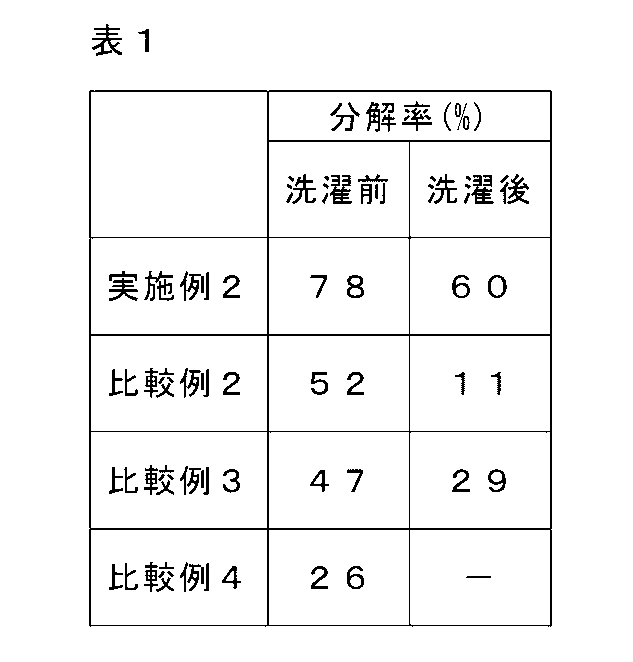
表1に示すように、実施例2に係る繊維製品は、比較例2、3に係る繊維製品と比較して、洗濯前、洗濯後のいずれにおいてもメチレンブルーの分解率が高く、有意の光触媒活性を示した。これにより、アミノ基を有するシラン化合物を含むシランカップリング剤により形成された表面処理層を介してリン酸ジルコニウム層を形成した場合、アルミニウムイオンを介してリン酸ジルコニウム層を形成する場合と比較して、酸化チタンをより多く担持できること、また、担持した酸化チタンを洗濯時においてもより強固に保持できることが推察された。
また、比較例2に係る繊維製品は、比較例3、4と比較して、洗濯前のメチレンブルーの分解率が高く、有意の光触媒活性を示した。これにより、比較例2に係る繊維製品が、繊維基材のPET繊維表面の紫外線照射によりアルミニウムイオンとの親和性が高まり、比較例3に示す表面を処理していない繊維基材のPET繊維と比較してリン酸ジルコニウムおよび、それに続く酸化チタンの担持量が増加していることが推測された。しかし洗濯後には、比較例2に係る繊維製品の洗濯耐久性は、著しく低下していることから、実施例2と比較して洗濯耐久性は大幅に低いことが確認される。なお、メチレンブルーは紫外線を若干吸収し、紫外線の照射のみでも一定量が分解する。このため、リン酸ジルコニウムと酸化チタンのいずれも担持していない比較例4に係る繊維製品においても、メチレンブルーの分解が観察された。
比較例3に係る繊維製品は、比較例2と比較して洗濯前の分解率がさらに低下した。このことから、比較例3に係る繊維製品への酸化チタンの担持量はさらに少ないことが推察される。
なお、実施例2に係る繊維製品は、洗濯後においても比較例4に係る繊維製品の洗濯前におけるメチレンブルーの分解率よりも有意に高い分解率を示した。このことより、実施例2に係る繊維製品は、洗濯後においても依然として酸化チタンを担持していることが推測された。一方で、比較例2、3に係る繊維製品は、洗濯後において比較例4に係る繊維製品の洗濯前におけるメチレンブルーの分解率と同等あるいは低い分解率を示した。このことより、比較例2、3に係る繊維製品は、洗濯後においては酸化チタンがすでに担持されていないことが推測された。
1 繊維製品
10 繊維基材
20 表面処理層
30 リン酸ジルコニウム層
40 機能性物質
10 繊維基材
20 表面処理層
30 リン酸ジルコニウム層
40 機能性物質
Claims (13)
- 繊維基材と、
前記繊維基材の表面の少なくとも一部に、シランカップリング剤により形成された表面処理層と、
前記表面処理層上に固定されたリン酸ジルコニウム層と、を有し、
前記シランカップリング剤が、アミノ基を有するシラン化合物を含む、繊維製品。 - 前記繊維基材は、その表面に水酸基および/またはカルボキシル基を有し、
前記水酸基および/または前記カルボキシル基を介して前記表面処理層が前記繊維基材に固定される、請求項1に記載の繊維製品。 - 前記繊維基材は、ポリエステル系繊維を含む、請求項1または2に記載の繊維製品。
- 前記シランカップリング剤が、アミノアルキルトリアルコキシシランを含む、請求項1~3のいずれか一項に記載の繊維製品。
- さらに、前記リン酸ジルコニウム層の表面に固定された機能性物質を有する、請求項1~4のいずれか一項に記載の繊維製品。
- 前記機能性物質が、光触媒を含む、請求項5に記載の繊維製品。
- 前記光触媒が、酸化チタンを含む、請求項6に記載の繊維製品。
- 前記機能性物質が、タンパク質または糖類を含む、請求項5~7のいずれか一項に記載の繊維製品。
- 前記機能性物質が、セリシンを含む、請求項5~8のいずれか一項に記載の繊維製品。
- 前記機能性物質が、セルロースを含む、請求項5~9のいずれか一項に記載の繊維製品。
- 繊維基材の表面の少なくとも一部をシランカップリング剤により処理して前記繊維基材の少なくとも表面の一部に表面処理層を形成する工程と、
前記表面処理層上にリン酸ジルコニウム層を形成する工程と、を有し、
前記シランカップリング剤が、アミノ基を有するシラン化合物を含む、繊維製品の製造方法。 - 前記表面処理層を形成する工程に先立ち、さらに、前記繊維基材の表面に水酸基および/またはカルボキシル基を導入する工程を有する、請求項11に記載の繊維製品の製造方法。
- さらに、前記リン酸ジルコニウム層上に機能性物質を固定する工程を有する、請求項11または請求項12に記載の繊維製品の製造方法。
Priority Applications (2)
| Application Number | Priority Date | Filing Date | Title |
|---|---|---|---|
| US17/928,962 US20230235502A1 (en) | 2020-06-02 | 2021-06-01 | A textile product and a method for producing the textile product |
| EP21816657.7A EP4159912A4 (en) | 2020-06-02 | 2021-06-01 | FIBRE PRODUCT AND METHOD FOR PRODUCING A FIBRE PRODUCT |
Applications Claiming Priority (2)
| Application Number | Priority Date | Filing Date | Title |
|---|---|---|---|
| JP2020-096164 | 2020-06-02 | ||
| JP2020096164A JP7569520B2 (ja) | 2020-06-02 | 2020-06-02 | 繊維製品および繊維製品の製造方法 |
Publications (1)
| Publication Number | Publication Date |
|---|---|
| WO2021246404A1 true WO2021246404A1 (ja) | 2021-12-09 |
Family
ID=78831136
Family Applications (1)
| Application Number | Title | Priority Date | Filing Date |
|---|---|---|---|
| PCT/JP2021/020868 Ceased WO2021246404A1 (ja) | 2020-06-02 | 2021-06-01 | 繊維製品および繊維製品の製造方法 |
Country Status (4)
| Country | Link |
|---|---|
| US (1) | US20230235502A1 (ja) |
| EP (1) | EP4159912A4 (ja) |
| JP (1) | JP7569520B2 (ja) |
| WO (1) | WO2021246404A1 (ja) |
Cited By (1)
| Publication number | Priority date | Publication date | Assignee | Title |
|---|---|---|---|---|
| WO2023234334A1 (ja) * | 2022-05-31 | 2023-12-07 | 国立大学法人信州大学 | 繊維製品、繊維製品の製造方法、繊維製品の再生方法および繊維製品の再生剤 |
Families Citing this family (2)
| Publication number | Priority date | Publication date | Assignee | Title |
|---|---|---|---|---|
| CN119301322A (zh) * | 2022-05-09 | 2025-01-10 | 信越化学工业株式会社 | 玻璃布处理液和表面处理玻璃布 |
| US11925928B2 (en) * | 2022-06-17 | 2024-03-12 | City University Of Hong Kong | Self-cleaning fabric and article |
Citations (8)
| Publication number | Priority date | Publication date | Assignee | Title |
|---|---|---|---|---|
| JP2588445B2 (ja) * | 1990-11-30 | 1997-03-05 | セーレン株式会社 | 合成繊維の改質加工の方法 |
| JP2001040574A (ja) * | 1999-07-22 | 2001-02-13 | Komatsu Seiren Co Ltd | 機能性繊維布帛 |
| JP2010185158A (ja) | 2009-02-13 | 2010-08-26 | Shinshu Univ | 光触媒を担持した繊維製品およびその製造方法 |
| JP2011246866A (ja) * | 2010-04-30 | 2011-12-08 | Honda Motor Co Ltd | 繊維製品に対するアレルゲン低減加工剤 |
| JP2012240356A (ja) * | 2011-05-23 | 2012-12-10 | Samsung Yokohama Research Institute Co Ltd | 電子機器用基板 |
| JP2013123819A (ja) * | 2011-12-13 | 2013-06-24 | Samsung Yokohama Research Institute Co Ltd | 電子デバイス用バリアフィルムとその製造方法 |
| JP2020032721A (ja) * | 2019-10-10 | 2020-03-05 | 平岡織染株式会社 | テント構造物用膜材 |
| CN111188192A (zh) * | 2018-11-15 | 2020-05-22 | 北京服装学院 | 一种阻燃组合物及其在聚酯织物中的应用 |
Family Cites Families (7)
| Publication number | Priority date | Publication date | Assignee | Title |
|---|---|---|---|---|
| JP3095960B2 (ja) * | 1994-10-05 | 2000-10-10 | 触媒化成工業株式会社 | 抗菌剤 |
| JP2001354902A (ja) * | 2000-04-13 | 2001-12-25 | Jsr Corp | コーティング組成物およびその製造方法 |
| JP2003171874A (ja) * | 2001-12-05 | 2003-06-20 | Art:Kk | セリシン・フィブロイン付着ポリエステル物品とその製造方法 |
| JP4585188B2 (ja) * | 2003-09-04 | 2010-11-24 | 株式会社Nbcメッシュテック | 抗菌性を有する部材 |
| CN105088786B (zh) * | 2015-09-02 | 2018-04-10 | 江西省川盛科技股份有限公司 | 一种含银抗菌织物涂层胶及其制备和使用方法 |
| JP6958898B2 (ja) * | 2017-07-18 | 2021-11-02 | 平岡織染株式会社 | 耐熱性高強度膜材及びその製造方法 |
| CN107724075A (zh) * | 2017-10-20 | 2018-02-23 | 安徽亚源印染有限公司 | 一种苎麻织物后整理专用阻燃整理剂 |
-
2020
- 2020-06-02 JP JP2020096164A patent/JP7569520B2/ja active Active
-
2021
- 2021-06-01 US US17/928,962 patent/US20230235502A1/en active Pending
- 2021-06-01 WO PCT/JP2021/020868 patent/WO2021246404A1/ja not_active Ceased
- 2021-06-01 EP EP21816657.7A patent/EP4159912A4/en active Pending
Patent Citations (8)
| Publication number | Priority date | Publication date | Assignee | Title |
|---|---|---|---|---|
| JP2588445B2 (ja) * | 1990-11-30 | 1997-03-05 | セーレン株式会社 | 合成繊維の改質加工の方法 |
| JP2001040574A (ja) * | 1999-07-22 | 2001-02-13 | Komatsu Seiren Co Ltd | 機能性繊維布帛 |
| JP2010185158A (ja) | 2009-02-13 | 2010-08-26 | Shinshu Univ | 光触媒を担持した繊維製品およびその製造方法 |
| JP2011246866A (ja) * | 2010-04-30 | 2011-12-08 | Honda Motor Co Ltd | 繊維製品に対するアレルゲン低減加工剤 |
| JP2012240356A (ja) * | 2011-05-23 | 2012-12-10 | Samsung Yokohama Research Institute Co Ltd | 電子機器用基板 |
| JP2013123819A (ja) * | 2011-12-13 | 2013-06-24 | Samsung Yokohama Research Institute Co Ltd | 電子デバイス用バリアフィルムとその製造方法 |
| CN111188192A (zh) * | 2018-11-15 | 2020-05-22 | 北京服装学院 | 一种阻燃组合物及其在聚酯织物中的应用 |
| JP2020032721A (ja) * | 2019-10-10 | 2020-03-05 | 平岡織染株式会社 | テント構造物用膜材 |
Non-Patent Citations (1)
| Title |
|---|
| See also references of EP4159912A4 |
Cited By (1)
| Publication number | Priority date | Publication date | Assignee | Title |
|---|---|---|---|---|
| WO2023234334A1 (ja) * | 2022-05-31 | 2023-12-07 | 国立大学法人信州大学 | 繊維製品、繊維製品の製造方法、繊維製品の再生方法および繊維製品の再生剤 |
Also Published As
| Publication number | Publication date |
|---|---|
| EP4159912A4 (en) | 2024-08-21 |
| JP7569520B2 (ja) | 2024-10-18 |
| EP4159912A1 (en) | 2023-04-05 |
| US20230235502A1 (en) | 2023-07-27 |
| JP2021188199A (ja) | 2021-12-13 |
Similar Documents
| Publication | Publication Date | Title |
|---|---|---|
| WO2021246404A1 (ja) | 繊維製品および繊維製品の製造方法 | |
| Fakin et al. | Synthesis of TiO2–SiO2 colloid and its performance in reactive dyeing of cotton fabrics | |
| EP1972437B1 (en) | Filter comprising a composite material having antifouling property | |
| Mihailović et al. | Functionalization of cotton fabrics with corona/air RF plasma and colloidal TiO2 nanoparticles | |
| Syafiuddin | Toward a comprehensive understanding of textiles functionalized with silver nanoparticles | |
| CN108642862A (zh) | 一种表面改性芳纶纤维及其制备方法 | |
| Guo et al. | Microwave‐assisted synthesis of silver nanoparticles on cotton fabric modified with 3‐aminopropyltrimethoxysilane | |
| Atta | Immobilization of silver and strontium oxide aluminate nanoparticles integrated into plasma‐activated cotton fabric: Luminescence, superhydrophobicity, and antimicrobial activity | |
| Zhang et al. | Immobilization of TiO2 nanoparticles on PET fabric modified with silane coupling agent by low temperature hydrothermal method | |
| Moazami et al. | A novel multifunctional cotton fabric using ZrO2 NPs/urea/CTAB/MA/SHP: introducing flame retardant, photoactive and antibacterial properties | |
| Chen et al. | In situ synthesis of TiO 2/NC on cotton fibers with antibacterial properties and recyclable photocatalytic degradation of dyes | |
| JP4965628B2 (ja) | 抗菌性を有する部材の製造方法 | |
| CN102317536B (zh) | 担载光催化剂的纤维产品和制造其的方法 | |
| Al-Balakocy et al. | Multi-Finishing of Polyester and Polyester Cotton Blend Fabrics Activated by Enzymatic Treatment | |
| Kanjana et al. | Multifunctional fluorine-free cotton fabrics modified by AgBr–TiO2/OV-POSS nanocomposites | |
| CN1635033A (zh) | 改性纳米氧化物、制备方法及其用途 | |
| Maity et al. | Aqueous sol–gel nano-coating of titanium dioxide on cotton and silk fabrics for self-cleaning and UV protection finish | |
| Milošević et al. | In situ photoreduction of Ag+-ions on the surface of titania nanotubes deposited on cotton and cotton/PET fabrics | |
| CN1299576C (zh) | 二氧化硅包覆电气石与二氧化钛颗粒的复合抗菌材料及其制备方法和用途 | |
| JP4585188B2 (ja) | 抗菌性を有する部材 | |
| Mahltig et al. | Nanocoatings by sol–gel processes for functionalization of polymer surfaces and textiles | |
| JP2006063160A (ja) | 親水性を有する複合部材 | |
| WO2023234334A1 (ja) | 繊維製品、繊維製品の製造方法、繊維製品の再生方法および繊維製品の再生剤 | |
| CN112663326B (zh) | 防护服面料及其制备方法 | |
| Farouk et al. | ZnTiO3 nanoparticles as novel multifunctional finishing of cotton fabric |
Legal Events
| Date | Code | Title | Description |
|---|---|---|---|
| 121 | Ep: the epo has been informed by wipo that ep was designated in this application |
Ref document number: 21816657 Country of ref document: EP Kind code of ref document: A1 |
|
| NENP | Non-entry into the national phase |
Ref country code: DE |
|
| ENP | Entry into the national phase |
Ref document number: 2021816657 Country of ref document: EP Effective date: 20230102 |