WO2021256270A1 - 接着剤、積層体、積層体の製造方法、包装材 - Google Patents
接着剤、積層体、積層体の製造方法、包装材 Download PDFInfo
- Publication number
- WO2021256270A1 WO2021256270A1 PCT/JP2021/021121 JP2021021121W WO2021256270A1 WO 2021256270 A1 WO2021256270 A1 WO 2021256270A1 JP 2021021121 W JP2021021121 W JP 2021021121W WO 2021256270 A1 WO2021256270 A1 WO 2021256270A1
- Authority
- WO
- WIPO (PCT)
- Prior art keywords
- polyol
- acid
- composition
- adhesive
- polyisocyanate
- Prior art date
- Legal status (The legal status is an assumption and is not a legal conclusion. Google has not performed a legal analysis and makes no representation as to the accuracy of the status listed.)
- Ceased
Links
Classifications
-
- C—CHEMISTRY; METALLURGY
- C09—DYES; PAINTS; POLISHES; NATURAL RESINS; ADHESIVES; COMPOSITIONS NOT OTHERWISE PROVIDED FOR; APPLICATIONS OF MATERIALS NOT OTHERWISE PROVIDED FOR
- C09J—ADHESIVES; NON-MECHANICAL ASPECTS OF ADHESIVE PROCESSES IN GENERAL; ADHESIVE PROCESSES NOT PROVIDED FOR ELSEWHERE; USE OF MATERIALS AS ADHESIVES
- C09J5/00—Adhesive processes in general; Adhesive processes not provided for elsewhere, e.g. relating to primers
- C09J5/04—Adhesive processes in general; Adhesive processes not provided for elsewhere, e.g. relating to primers involving separate application of adhesive ingredients to the different surfaces to be joined
-
- C—CHEMISTRY; METALLURGY
- C09—DYES; PAINTS; POLISHES; NATURAL RESINS; ADHESIVES; COMPOSITIONS NOT OTHERWISE PROVIDED FOR; APPLICATIONS OF MATERIALS NOT OTHERWISE PROVIDED FOR
- C09J—ADHESIVES; NON-MECHANICAL ASPECTS OF ADHESIVE PROCESSES IN GENERAL; ADHESIVE PROCESSES NOT PROVIDED FOR ELSEWHERE; USE OF MATERIALS AS ADHESIVES
- C09J175/00—Adhesives based on polyureas or polyurethanes; Adhesives based on derivatives of such polymers
- C09J175/04—Polyurethanes
- C09J175/14—Polyurethanes having carbon-to-carbon unsaturated bonds
-
- B—PERFORMING OPERATIONS; TRANSPORTING
- B32—LAYERED PRODUCTS
- B32B—LAYERED PRODUCTS, i.e. PRODUCTS BUILT-UP OF STRATA OF FLAT OR NON-FLAT, e.g. CELLULAR OR HONEYCOMB, FORM
- B32B27/00—Layered products comprising a layer of synthetic resin
- B32B27/06—Layered products comprising a layer of synthetic resin as the main or only constituent of a layer, which is next to another layer of the same or of a different material
- B32B27/08—Layered products comprising a layer of synthetic resin as the main or only constituent of a layer, which is next to another layer of the same or of a different material of synthetic resin
-
- B—PERFORMING OPERATIONS; TRANSPORTING
- B32—LAYERED PRODUCTS
- B32B—LAYERED PRODUCTS, i.e. PRODUCTS BUILT-UP OF STRATA OF FLAT OR NON-FLAT, e.g. CELLULAR OR HONEYCOMB, FORM
- B32B27/00—Layered products comprising a layer of synthetic resin
- B32B27/32—Layered products comprising a layer of synthetic resin comprising polyolefins
-
- B—PERFORMING OPERATIONS; TRANSPORTING
- B32—LAYERED PRODUCTS
- B32B—LAYERED PRODUCTS, i.e. PRODUCTS BUILT-UP OF STRATA OF FLAT OR NON-FLAT, e.g. CELLULAR OR HONEYCOMB, FORM
- B32B27/00—Layered products comprising a layer of synthetic resin
- B32B27/34—Layered products comprising a layer of synthetic resin comprising polyamides
-
- B—PERFORMING OPERATIONS; TRANSPORTING
- B32—LAYERED PRODUCTS
- B32B—LAYERED PRODUCTS, i.e. PRODUCTS BUILT-UP OF STRATA OF FLAT OR NON-FLAT, e.g. CELLULAR OR HONEYCOMB, FORM
- B32B27/00—Layered products comprising a layer of synthetic resin
- B32B27/36—Layered products comprising a layer of synthetic resin comprising polyesters
-
- B—PERFORMING OPERATIONS; TRANSPORTING
- B32—LAYERED PRODUCTS
- B32B—LAYERED PRODUCTS, i.e. PRODUCTS BUILT-UP OF STRATA OF FLAT OR NON-FLAT, e.g. CELLULAR OR HONEYCOMB, FORM
- B32B7/00—Layered products characterised by the relation between layers; Layered products characterised by the relative orientation of features between layers, or by the relative values of a measurable parameter between layers, i.e. products comprising layers having different physical, chemical or physicochemical properties; Layered products characterised by the interconnection of layers
- B32B7/04—Interconnection of layers
- B32B7/10—Interconnection of layers at least one layer having inter-reactive properties
-
- B—PERFORMING OPERATIONS; TRANSPORTING
- B32—LAYERED PRODUCTS
- B32B—LAYERED PRODUCTS, i.e. PRODUCTS BUILT-UP OF STRATA OF FLAT OR NON-FLAT, e.g. CELLULAR OR HONEYCOMB, FORM
- B32B7/00—Layered products characterised by the relation between layers; Layered products characterised by the relative orientation of features between layers, or by the relative values of a measurable parameter between layers, i.e. products comprising layers having different physical, chemical or physicochemical properties; Layered products characterised by the interconnection of layers
- B32B7/04—Interconnection of layers
- B32B7/12—Interconnection of layers using interposed adhesives or interposed materials with bonding properties
-
- C—CHEMISTRY; METALLURGY
- C08—ORGANIC MACROMOLECULAR COMPOUNDS; THEIR PREPARATION OR CHEMICAL WORKING-UP; COMPOSITIONS BASED THEREON
- C08G—MACROMOLECULAR COMPOUNDS OBTAINED OTHERWISE THAN BY REACTIONS ONLY INVOLVING UNSATURATED CARBON-TO-CARBON BONDS
- C08G18/00—Polymeric products of isocyanates or isothiocyanates
- C08G18/06—Polymeric products of isocyanates or isothiocyanates with compounds having active hydrogen
- C08G18/08—Processes
- C08G18/10—Prepolymer processes involving reaction of isocyanates or isothiocyanates with compounds having active hydrogen in a first reaction step
-
- C—CHEMISTRY; METALLURGY
- C08—ORGANIC MACROMOLECULAR COMPOUNDS; THEIR PREPARATION OR CHEMICAL WORKING-UP; COMPOSITIONS BASED THEREON
- C08G—MACROMOLECULAR COMPOUNDS OBTAINED OTHERWISE THAN BY REACTIONS ONLY INVOLVING UNSATURATED CARBON-TO-CARBON BONDS
- C08G18/00—Polymeric products of isocyanates or isothiocyanates
- C08G18/06—Polymeric products of isocyanates or isothiocyanates with compounds having active hydrogen
- C08G18/08—Processes
- C08G18/10—Prepolymer processes involving reaction of isocyanates or isothiocyanates with compounds having active hydrogen in a first reaction step
- C08G18/12—Prepolymer processes involving reaction of isocyanates or isothiocyanates with compounds having active hydrogen in a first reaction step using two or more compounds having active hydrogen in the first polymerisation step
-
- C—CHEMISTRY; METALLURGY
- C08—ORGANIC MACROMOLECULAR COMPOUNDS; THEIR PREPARATION OR CHEMICAL WORKING-UP; COMPOSITIONS BASED THEREON
- C08G—MACROMOLECULAR COMPOUNDS OBTAINED OTHERWISE THAN BY REACTIONS ONLY INVOLVING UNSATURATED CARBON-TO-CARBON BONDS
- C08G18/00—Polymeric products of isocyanates or isothiocyanates
- C08G18/06—Polymeric products of isocyanates or isothiocyanates with compounds having active hydrogen
- C08G18/08—Processes
- C08G18/16—Catalysts
- C08G18/161—Catalysts containing two or more components to be covered by at least two of the groups C08G18/166, C08G18/18 or C08G18/22
-
- C—CHEMISTRY; METALLURGY
- C08—ORGANIC MACROMOLECULAR COMPOUNDS; THEIR PREPARATION OR CHEMICAL WORKING-UP; COMPOSITIONS BASED THEREON
- C08G—MACROMOLECULAR COMPOUNDS OBTAINED OTHERWISE THAN BY REACTIONS ONLY INVOLVING UNSATURATED CARBON-TO-CARBON BONDS
- C08G18/00—Polymeric products of isocyanates or isothiocyanates
- C08G18/06—Polymeric products of isocyanates or isothiocyanates with compounds having active hydrogen
- C08G18/08—Processes
- C08G18/16—Catalysts
- C08G18/166—Catalysts not provided for in the groups C08G18/18 - C08G18/26
- C08G18/168—Organic compounds
-
- C—CHEMISTRY; METALLURGY
- C08—ORGANIC MACROMOLECULAR COMPOUNDS; THEIR PREPARATION OR CHEMICAL WORKING-UP; COMPOSITIONS BASED THEREON
- C08G—MACROMOLECULAR COMPOUNDS OBTAINED OTHERWISE THAN BY REACTIONS ONLY INVOLVING UNSATURATED CARBON-TO-CARBON BONDS
- C08G18/00—Polymeric products of isocyanates or isothiocyanates
- C08G18/06—Polymeric products of isocyanates or isothiocyanates with compounds having active hydrogen
- C08G18/08—Processes
- C08G18/16—Catalysts
- C08G18/22—Catalysts containing metal compounds
- C08G18/222—Catalysts containing metal compounds metal compounds not provided for in groups C08G18/225 - C08G18/26
-
- C—CHEMISTRY; METALLURGY
- C08—ORGANIC MACROMOLECULAR COMPOUNDS; THEIR PREPARATION OR CHEMICAL WORKING-UP; COMPOSITIONS BASED THEREON
- C08G—MACROMOLECULAR COMPOUNDS OBTAINED OTHERWISE THAN BY REACTIONS ONLY INVOLVING UNSATURATED CARBON-TO-CARBON BONDS
- C08G18/00—Polymeric products of isocyanates or isothiocyanates
- C08G18/06—Polymeric products of isocyanates or isothiocyanates with compounds having active hydrogen
- C08G18/08—Processes
- C08G18/16—Catalysts
- C08G18/22—Catalysts containing metal compounds
- C08G18/227—Catalysts containing metal compounds of antimony, bismuth or arsenic
-
- C—CHEMISTRY; METALLURGY
- C08—ORGANIC MACROMOLECULAR COMPOUNDS; THEIR PREPARATION OR CHEMICAL WORKING-UP; COMPOSITIONS BASED THEREON
- C08G—MACROMOLECULAR COMPOUNDS OBTAINED OTHERWISE THAN BY REACTIONS ONLY INVOLVING UNSATURATED CARBON-TO-CARBON BONDS
- C08G18/00—Polymeric products of isocyanates or isothiocyanates
- C08G18/06—Polymeric products of isocyanates or isothiocyanates with compounds having active hydrogen
- C08G18/08—Processes
- C08G18/16—Catalysts
- C08G18/22—Catalysts containing metal compounds
- C08G18/24—Catalysts containing metal compounds of tin
- C08G18/244—Catalysts containing metal compounds of tin tin salts of carboxylic acids
- C08G18/246—Catalysts containing metal compounds of tin tin salts of carboxylic acids containing also tin-carbon bonds
-
- C—CHEMISTRY; METALLURGY
- C08—ORGANIC MACROMOLECULAR COMPOUNDS; THEIR PREPARATION OR CHEMICAL WORKING-UP; COMPOSITIONS BASED THEREON
- C08G—MACROMOLECULAR COMPOUNDS OBTAINED OTHERWISE THAN BY REACTIONS ONLY INVOLVING UNSATURATED CARBON-TO-CARBON BONDS
- C08G18/00—Polymeric products of isocyanates or isothiocyanates
- C08G18/06—Polymeric products of isocyanates or isothiocyanates with compounds having active hydrogen
- C08G18/28—Polymeric products of isocyanates or isothiocyanates with compounds having active hydrogen characterised by the compounds used containing active hydrogen
- C08G18/2805—Compounds having only one group containing active hydrogen
- C08G18/2815—Monohydroxy compounds
- C08G18/283—Compounds containing ether groups, e.g. oxyalkylated monohydroxy compounds
-
- C—CHEMISTRY; METALLURGY
- C08—ORGANIC MACROMOLECULAR COMPOUNDS; THEIR PREPARATION OR CHEMICAL WORKING-UP; COMPOSITIONS BASED THEREON
- C08G—MACROMOLECULAR COMPOUNDS OBTAINED OTHERWISE THAN BY REACTIONS ONLY INVOLVING UNSATURATED CARBON-TO-CARBON BONDS
- C08G18/00—Polymeric products of isocyanates or isothiocyanates
- C08G18/06—Polymeric products of isocyanates or isothiocyanates with compounds having active hydrogen
- C08G18/28—Polymeric products of isocyanates or isothiocyanates with compounds having active hydrogen characterised by the compounds used containing active hydrogen
- C08G18/40—High-molecular-weight compounds
- C08G18/4009—Two or more macromolecular compounds not provided for in one single group of groups C08G18/42 - C08G18/64
- C08G18/4018—Mixtures of compounds of group C08G18/42 with compounds of group C08G18/48
-
- C—CHEMISTRY; METALLURGY
- C08—ORGANIC MACROMOLECULAR COMPOUNDS; THEIR PREPARATION OR CHEMICAL WORKING-UP; COMPOSITIONS BASED THEREON
- C08G—MACROMOLECULAR COMPOUNDS OBTAINED OTHERWISE THAN BY REACTIONS ONLY INVOLVING UNSATURATED CARBON-TO-CARBON BONDS
- C08G18/00—Polymeric products of isocyanates or isothiocyanates
- C08G18/06—Polymeric products of isocyanates or isothiocyanates with compounds having active hydrogen
- C08G18/28—Polymeric products of isocyanates or isothiocyanates with compounds having active hydrogen characterised by the compounds used containing active hydrogen
- C08G18/40—High-molecular-weight compounds
- C08G18/42—Polycondensates having carboxylic or carbonic ester groups in the main chain
- C08G18/4205—Polycondensates having carboxylic or carbonic ester groups in the main chain containing cyclic groups
- C08G18/4208—Polycondensates having carboxylic or carbonic ester groups in the main chain containing cyclic groups containing aromatic groups
- C08G18/4211—Polycondensates having carboxylic or carbonic ester groups in the main chain containing cyclic groups containing aromatic groups derived from aromatic dicarboxylic acids and dialcohols
- C08G18/4216—Polycondensates having carboxylic or carbonic ester groups in the main chain containing cyclic groups containing aromatic groups derived from aromatic dicarboxylic acids and dialcohols from mixtures or combinations of aromatic dicarboxylic acids and aliphatic dicarboxylic acids and dialcohols
-
- C—CHEMISTRY; METALLURGY
- C08—ORGANIC MACROMOLECULAR COMPOUNDS; THEIR PREPARATION OR CHEMICAL WORKING-UP; COMPOSITIONS BASED THEREON
- C08G—MACROMOLECULAR COMPOUNDS OBTAINED OTHERWISE THAN BY REACTIONS ONLY INVOLVING UNSATURATED CARBON-TO-CARBON BONDS
- C08G18/00—Polymeric products of isocyanates or isothiocyanates
- C08G18/06—Polymeric products of isocyanates or isothiocyanates with compounds having active hydrogen
- C08G18/28—Polymeric products of isocyanates or isothiocyanates with compounds having active hydrogen characterised by the compounds used containing active hydrogen
- C08G18/40—High-molecular-weight compounds
- C08G18/48—Polyethers
- C08G18/4804—Two or more polyethers of different physical or chemical nature
- C08G18/4808—Mixtures of two or more polyetherdiols
-
- C—CHEMISTRY; METALLURGY
- C08—ORGANIC MACROMOLECULAR COMPOUNDS; THEIR PREPARATION OR CHEMICAL WORKING-UP; COMPOSITIONS BASED THEREON
- C08G—MACROMOLECULAR COMPOUNDS OBTAINED OTHERWISE THAN BY REACTIONS ONLY INVOLVING UNSATURATED CARBON-TO-CARBON BONDS
- C08G18/00—Polymeric products of isocyanates or isothiocyanates
- C08G18/06—Polymeric products of isocyanates or isothiocyanates with compounds having active hydrogen
- C08G18/28—Polymeric products of isocyanates or isothiocyanates with compounds having active hydrogen characterised by the compounds used containing active hydrogen
- C08G18/40—High-molecular-weight compounds
- C08G18/48—Polyethers
- C08G18/4804—Two or more polyethers of different physical or chemical nature
- C08G18/482—Mixtures of polyethers containing at least one polyether containing nitrogen
-
- C—CHEMISTRY; METALLURGY
- C08—ORGANIC MACROMOLECULAR COMPOUNDS; THEIR PREPARATION OR CHEMICAL WORKING-UP; COMPOSITIONS BASED THEREON
- C08G—MACROMOLECULAR COMPOUNDS OBTAINED OTHERWISE THAN BY REACTIONS ONLY INVOLVING UNSATURATED CARBON-TO-CARBON BONDS
- C08G18/00—Polymeric products of isocyanates or isothiocyanates
- C08G18/06—Polymeric products of isocyanates or isothiocyanates with compounds having active hydrogen
- C08G18/28—Polymeric products of isocyanates or isothiocyanates with compounds having active hydrogen characterised by the compounds used containing active hydrogen
- C08G18/40—High-molecular-weight compounds
- C08G18/48—Polyethers
- C08G18/4825—Polyethers containing two hydroxy groups
-
- C—CHEMISTRY; METALLURGY
- C08—ORGANIC MACROMOLECULAR COMPOUNDS; THEIR PREPARATION OR CHEMICAL WORKING-UP; COMPOSITIONS BASED THEREON
- C08G—MACROMOLECULAR COMPOUNDS OBTAINED OTHERWISE THAN BY REACTIONS ONLY INVOLVING UNSATURATED CARBON-TO-CARBON BONDS
- C08G18/00—Polymeric products of isocyanates or isothiocyanates
- C08G18/06—Polymeric products of isocyanates or isothiocyanates with compounds having active hydrogen
- C08G18/28—Polymeric products of isocyanates or isothiocyanates with compounds having active hydrogen characterised by the compounds used containing active hydrogen
- C08G18/40—High-molecular-weight compounds
- C08G18/48—Polyethers
- C08G18/50—Polyethers having heteroatoms other than oxygen
- C08G18/5021—Polyethers having heteroatoms other than oxygen having nitrogen
- C08G18/5024—Polyethers having heteroatoms other than oxygen having nitrogen containing primary and/or secondary amino groups
-
- C—CHEMISTRY; METALLURGY
- C08—ORGANIC MACROMOLECULAR COMPOUNDS; THEIR PREPARATION OR CHEMICAL WORKING-UP; COMPOSITIONS BASED THEREON
- C08G—MACROMOLECULAR COMPOUNDS OBTAINED OTHERWISE THAN BY REACTIONS ONLY INVOLVING UNSATURATED CARBON-TO-CARBON BONDS
- C08G18/00—Polymeric products of isocyanates or isothiocyanates
- C08G18/06—Polymeric products of isocyanates or isothiocyanates with compounds having active hydrogen
- C08G18/70—Polymeric products of isocyanates or isothiocyanates with compounds having active hydrogen characterised by the isocyanates or isothiocyanates used
- C08G18/72—Polyisocyanates or polyisothiocyanates
- C08G18/74—Polyisocyanates or polyisothiocyanates cyclic
- C08G18/76—Polyisocyanates or polyisothiocyanates cyclic aromatic
- C08G18/7607—Compounds of C08G18/7614 and of C08G18/7657
-
- C—CHEMISTRY; METALLURGY
- C08—ORGANIC MACROMOLECULAR COMPOUNDS; THEIR PREPARATION OR CHEMICAL WORKING-UP; COMPOSITIONS BASED THEREON
- C08G—MACROMOLECULAR COMPOUNDS OBTAINED OTHERWISE THAN BY REACTIONS ONLY INVOLVING UNSATURATED CARBON-TO-CARBON BONDS
- C08G18/00—Polymeric products of isocyanates or isothiocyanates
- C08G18/06—Polymeric products of isocyanates or isothiocyanates with compounds having active hydrogen
- C08G18/70—Polymeric products of isocyanates or isothiocyanates with compounds having active hydrogen characterised by the isocyanates or isothiocyanates used
- C08G18/72—Polyisocyanates or polyisothiocyanates
- C08G18/74—Polyisocyanates or polyisothiocyanates cyclic
- C08G18/76—Polyisocyanates or polyisothiocyanates cyclic aromatic
- C08G18/7614—Polyisocyanates or polyisothiocyanates cyclic aromatic containing only one aromatic ring
- C08G18/7628—Polyisocyanates or polyisothiocyanates cyclic aromatic containing only one aromatic ring containing at least one isocyanate or isothiocyanate group linked to the aromatic ring by means of an aliphatic group
- C08G18/7642—Polyisocyanates or polyisothiocyanates cyclic aromatic containing only one aromatic ring containing at least one isocyanate or isothiocyanate group linked to the aromatic ring by means of an aliphatic group containing at least two isocyanate or isothiocyanate groups linked to the aromatic ring by means of an aliphatic group having a primary carbon atom next to the isocyanate or isothiocyanate groups, e.g. xylylene diisocyanate or homologues substituted on the aromatic ring
-
- C—CHEMISTRY; METALLURGY
- C08—ORGANIC MACROMOLECULAR COMPOUNDS; THEIR PREPARATION OR CHEMICAL WORKING-UP; COMPOSITIONS BASED THEREON
- C08G—MACROMOLECULAR COMPOUNDS OBTAINED OTHERWISE THAN BY REACTIONS ONLY INVOLVING UNSATURATED CARBON-TO-CARBON BONDS
- C08G18/00—Polymeric products of isocyanates or isothiocyanates
- C08G18/06—Polymeric products of isocyanates or isothiocyanates with compounds having active hydrogen
- C08G18/70—Polymeric products of isocyanates or isothiocyanates with compounds having active hydrogen characterised by the isocyanates or isothiocyanates used
- C08G18/72—Polyisocyanates or polyisothiocyanates
- C08G18/74—Polyisocyanates or polyisothiocyanates cyclic
- C08G18/76—Polyisocyanates or polyisothiocyanates cyclic aromatic
- C08G18/7657—Polyisocyanates or polyisothiocyanates cyclic aromatic containing two or more aromatic rings
- C08G18/7664—Polyisocyanates or polyisothiocyanates cyclic aromatic containing two or more aromatic rings containing alkylene polyphenyl groups
- C08G18/7671—Polyisocyanates or polyisothiocyanates cyclic aromatic containing two or more aromatic rings containing alkylene polyphenyl groups containing only one alkylene bisphenyl group
-
- C—CHEMISTRY; METALLURGY
- C09—DYES; PAINTS; POLISHES; NATURAL RESINS; ADHESIVES; COMPOSITIONS NOT OTHERWISE PROVIDED FOR; APPLICATIONS OF MATERIALS NOT OTHERWISE PROVIDED FOR
- C09J—ADHESIVES; NON-MECHANICAL ASPECTS OF ADHESIVE PROCESSES IN GENERAL; ADHESIVE PROCESSES NOT PROVIDED FOR ELSEWHERE; USE OF MATERIALS AS ADHESIVES
- C09J11/00—Features of adhesives not provided for in group C09J9/00, e.g. additives
- C09J11/02—Non-macromolecular additives
- C09J11/04—Non-macromolecular additives inorganic
-
- C—CHEMISTRY; METALLURGY
- C09—DYES; PAINTS; POLISHES; NATURAL RESINS; ADHESIVES; COMPOSITIONS NOT OTHERWISE PROVIDED FOR; APPLICATIONS OF MATERIALS NOT OTHERWISE PROVIDED FOR
- C09J—ADHESIVES; NON-MECHANICAL ASPECTS OF ADHESIVE PROCESSES IN GENERAL; ADHESIVE PROCESSES NOT PROVIDED FOR ELSEWHERE; USE OF MATERIALS AS ADHESIVES
- C09J175/00—Adhesives based on polyureas or polyurethanes; Adhesives based on derivatives of such polymers
- C09J175/04—Polyurethanes
-
- C—CHEMISTRY; METALLURGY
- C09—DYES; PAINTS; POLISHES; NATURAL RESINS; ADHESIVES; COMPOSITIONS NOT OTHERWISE PROVIDED FOR; APPLICATIONS OF MATERIALS NOT OTHERWISE PROVIDED FOR
- C09J—ADHESIVES; NON-MECHANICAL ASPECTS OF ADHESIVE PROCESSES IN GENERAL; ADHESIVE PROCESSES NOT PROVIDED FOR ELSEWHERE; USE OF MATERIALS AS ADHESIVES
- C09J175/00—Adhesives based on polyureas or polyurethanes; Adhesives based on derivatives of such polymers
- C09J175/04—Polyurethanes
- C09J175/06—Polyurethanes from polyesters
-
- C—CHEMISTRY; METALLURGY
- C09—DYES; PAINTS; POLISHES; NATURAL RESINS; ADHESIVES; COMPOSITIONS NOT OTHERWISE PROVIDED FOR; APPLICATIONS OF MATERIALS NOT OTHERWISE PROVIDED FOR
- C09J—ADHESIVES; NON-MECHANICAL ASPECTS OF ADHESIVE PROCESSES IN GENERAL; ADHESIVE PROCESSES NOT PROVIDED FOR ELSEWHERE; USE OF MATERIALS AS ADHESIVES
- C09J175/00—Adhesives based on polyureas or polyurethanes; Adhesives based on derivatives of such polymers
- C09J175/04—Polyurethanes
- C09J175/08—Polyurethanes from polyethers
-
- B—PERFORMING OPERATIONS; TRANSPORTING
- B32—LAYERED PRODUCTS
- B32B—LAYERED PRODUCTS, i.e. PRODUCTS BUILT-UP OF STRATA OF FLAT OR NON-FLAT, e.g. CELLULAR OR HONEYCOMB, FORM
- B32B2250/00—Layers arrangement
- B32B2250/02—2 layers
-
- B—PERFORMING OPERATIONS; TRANSPORTING
- B32—LAYERED PRODUCTS
- B32B—LAYERED PRODUCTS, i.e. PRODUCTS BUILT-UP OF STRATA OF FLAT OR NON-FLAT, e.g. CELLULAR OR HONEYCOMB, FORM
- B32B2250/00—Layers arrangement
- B32B2250/24—All layers being polymeric
- B32B2250/244—All polymers belonging to those covered by group B32B27/36
-
- B—PERFORMING OPERATIONS; TRANSPORTING
- B32—LAYERED PRODUCTS
- B32B—LAYERED PRODUCTS, i.e. PRODUCTS BUILT-UP OF STRATA OF FLAT OR NON-FLAT, e.g. CELLULAR OR HONEYCOMB, FORM
- B32B2255/00—Coating on the layer surface
- B32B2255/10—Coating on the layer surface on synthetic resin layer or on natural or synthetic rubber layer
-
- B—PERFORMING OPERATIONS; TRANSPORTING
- B32—LAYERED PRODUCTS
- B32B—LAYERED PRODUCTS, i.e. PRODUCTS BUILT-UP OF STRATA OF FLAT OR NON-FLAT, e.g. CELLULAR OR HONEYCOMB, FORM
- B32B2255/00—Coating on the layer surface
- B32B2255/20—Inorganic coating
- B32B2255/205—Metallic coating
-
- B—PERFORMING OPERATIONS; TRANSPORTING
- B32—LAYERED PRODUCTS
- B32B—LAYERED PRODUCTS, i.e. PRODUCTS BUILT-UP OF STRATA OF FLAT OR NON-FLAT, e.g. CELLULAR OR HONEYCOMB, FORM
- B32B2255/00—Coating on the layer surface
- B32B2255/26—Polymeric coating
-
- B—PERFORMING OPERATIONS; TRANSPORTING
- B32—LAYERED PRODUCTS
- B32B—LAYERED PRODUCTS, i.e. PRODUCTS BUILT-UP OF STRATA OF FLAT OR NON-FLAT, e.g. CELLULAR OR HONEYCOMB, FORM
- B32B2255/00—Coating on the layer surface
- B32B2255/28—Multiple coating on one surface
-
- B—PERFORMING OPERATIONS; TRANSPORTING
- B32—LAYERED PRODUCTS
- B32B—LAYERED PRODUCTS, i.e. PRODUCTS BUILT-UP OF STRATA OF FLAT OR NON-FLAT, e.g. CELLULAR OR HONEYCOMB, FORM
- B32B2305/00—Condition, form or state of the layers or laminate
- B32B2305/72—Cured, e.g. vulcanised, cross-linked
-
- B—PERFORMING OPERATIONS; TRANSPORTING
- B32—LAYERED PRODUCTS
- B32B—LAYERED PRODUCTS, i.e. PRODUCTS BUILT-UP OF STRATA OF FLAT OR NON-FLAT, e.g. CELLULAR OR HONEYCOMB, FORM
- B32B2307/00—Properties of the layers or laminate
- B32B2307/30—Properties of the layers or laminate having particular thermal properties
- B32B2307/31—Heat sealable
-
- B—PERFORMING OPERATIONS; TRANSPORTING
- B32—LAYERED PRODUCTS
- B32B—LAYERED PRODUCTS, i.e. PRODUCTS BUILT-UP OF STRATA OF FLAT OR NON-FLAT, e.g. CELLULAR OR HONEYCOMB, FORM
- B32B2311/00—Metals, their alloys or their compounds
- B32B2311/24—Aluminium
-
- B—PERFORMING OPERATIONS; TRANSPORTING
- B32—LAYERED PRODUCTS
- B32B—LAYERED PRODUCTS, i.e. PRODUCTS BUILT-UP OF STRATA OF FLAT OR NON-FLAT, e.g. CELLULAR OR HONEYCOMB, FORM
- B32B2367/00—Polyesters, e.g. PET, i.e. polyethylene terephthalate
-
- B—PERFORMING OPERATIONS; TRANSPORTING
- B32—LAYERED PRODUCTS
- B32B—LAYERED PRODUCTS, i.e. PRODUCTS BUILT-UP OF STRATA OF FLAT OR NON-FLAT, e.g. CELLULAR OR HONEYCOMB, FORM
- B32B2375/00—Polyureas; Polyurethanes
-
- B—PERFORMING OPERATIONS; TRANSPORTING
- B32—LAYERED PRODUCTS
- B32B—LAYERED PRODUCTS, i.e. PRODUCTS BUILT-UP OF STRATA OF FLAT OR NON-FLAT, e.g. CELLULAR OR HONEYCOMB, FORM
- B32B2553/00—Packaging equipment or accessories not otherwise provided for
-
- C—CHEMISTRY; METALLURGY
- C09—DYES; PAINTS; POLISHES; NATURAL RESINS; ADHESIVES; COMPOSITIONS NOT OTHERWISE PROVIDED FOR; APPLICATIONS OF MATERIALS NOT OTHERWISE PROVIDED FOR
- C09J—ADHESIVES; NON-MECHANICAL ASPECTS OF ADHESIVE PROCESSES IN GENERAL; ADHESIVE PROCESSES NOT PROVIDED FOR ELSEWHERE; USE OF MATERIALS AS ADHESIVES
- C09J2475/00—Presence of polyurethane
Definitions
- the present invention relates to an adhesive, a laminate obtained by using the adhesive, a method for manufacturing the laminate, and a packaging material.
- a step (aging step) of bonding the base materials to each other using an adhesive mixed with the two liquids and then curing the adhesive is performed. It will be provided.
- the aging process usually takes several days at about 40 to 50 ° C. (Patent Documents 1 and 2), but in recent years, efforts have been made to lower the temperature and shorten the time (Patent Document 3).
- an object of the present invention is to provide a two-component curable adhesive which can be aged at room temperature and has good adhesion to various substrates.
- the present inventors include a polyisocyanate composition (X) containing a polyisocyanate compound (A) and a polyol composition (Y) containing a polyol (B), and the viscosity of the polyol composition at 50 ° C. is 20 mPa. It has been found that the above-mentioned problems can be solved by a two-component curable adhesive having an s or more and 180 mPa ⁇ s or less.
- the present invention contains a polyisocyanate composition (X) containing a polyisocyanate compound (A) and a polyol composition (Y) containing a polyol (B), and the viscosity of the polyol composition at 50 ° C. is 20 mPa.
- the present invention relates to a two-component curable adhesive having s or more and 180 mPa ⁇ s or less.
- the adhesive of the present invention aging is possible at room temperature, and it is possible to provide an adhesive having excellent adhesion to various substrates.
- the adhesive of the present invention contains a polyisocyanate composition (X) containing a polyisocyanate compound (A) and a polyol composition (Y) containing a polyol (B), and the viscosity of the polyol composition at 50 ° C. is high. It is a two-component curable adhesive having a temperature of 20 mPa ⁇ s or more and 180 mPa ⁇ s or less.
- the adhesive of the present invention will be described in detail.
- the polyisocyanate composition (X) contains the polyisocyanate compound (A).
- the polyisocyanate compound (A) can be used without particular limitation, and can be used in the molecular structure of tolylene diisocyanate, diphenylmethane diisocyanate, polypeptide diphenylmethane diisocyanate, 1,5-naphthalenediocyanate, triphenylmethane triisocyanate, xylylene diisocyanate and the like.
- Linear aliphatic polyisocyanates such as 1,6-hexamethylene diisocyanate, 1,5-pentamethylene diisocyanate, lysine diisocyanate, and trimethylhexamethylene diisocyanate, compounds in which some of the NCO groups of these polyisocyanates are modified with carbodiimide;
- Isocyanurates of these polyisocyanates can be mentioned.
- polyurethane polyisocyanate is used as the polyisocyanate compound (A)
- the above-mentioned polyisocyanate and polyol are equivalent to the isocyanate group and hydroxyl group [NCO] from the viewpoint of the balance between the cohesive force and flexibility of the coating film of the adhesive.
- ] / [OH] is preferably obtained by reacting at a ratio of 1.2 to 5.0.
- polyol used for preparing polyurethane polyisocyanate examples include ethylene glycol, propylene glycol, 1,3-propanediol, 1,4-butanediol, 1,5-pentanediol, 3-methyl-1,5-pentanediol, and 1 , 6-Hexenediol, neopentyl glycol, methylpentanediol, dimethylbutanediol, butylethylpropanediol, diethylene glycol, triethylene glycol, tetraethylene glycol, dipropylene glycol, tripropylene glycol, bishydroxyethoxybenzene and other chain fats.
- Alicyclic glycols such as 1,4-cyclohexanediol and 1,4-cyclohexanedimethanol; Trifunctional or tetrafunctional aliphatic alcohols such as glycerin, trimethylolpropane, pentaerythritol; Bisphenols such as bisphenol A, bisphenol F, hydrogenated bisphenol A, hydrogenated bisphenol F; Dimerdiol;
- a polyether polyol obtained by addition-polymerizing an alkylene oxide such as ethylene oxide, propylene oxide, butylene oxide, styrene oxide, epichlorohydrin, tetrahydrofuran, or cyclohexylene in the presence of a polymerization initiator such as the glycol trifunctional or tetrafunctional aliphatic alcohol. ;
- Polyester obtained by ring-opening polymerization reaction of a cyclic ester compound such as propiolactone, butyrolactone, ⁇ -caprolactone, ⁇ -valerolactone, ⁇ -methyl- ⁇ -valerolactone, and the glycol or trifunctional or tetrafunctional aliphatic.
- Polyester polyol (1) which is a reaction product with alcohol
- Polyester polyol (2) obtained by reacting a polyol such as the chain aliphatic glycol, alicyclic glycol, dimerdiol, bisphenol or the polyether polyol with a polyvalent carboxylic acid;
- Polyester polyol (3) obtained by reacting the trifunctional or tetrafunctional aliphatic alcohol with a polyvalent carboxylic acid
- Polyester polyol (4) obtained by reacting a bifunctional polyol, the trifunctional or tetrafunctional aliphatic alcohol, and a polyvalent carboxylic acid.
- Polyester polyol (5) which is a polymer of hydroxyl acids such as dimethylolpropionic acid and castor oil fatty acid;
- examples thereof include castor oil, castor oil-based polyols such as castor oil, which is a hydrogenated additive of castor oil, and an adduct of 5 to 50 mol of alkylene oxide of castor oil, and can be used alone or in combination of two or more.
- Examples of the polyvalent carboxylic acid used for producing the polyester polyol (2), (3) or (4) include succinic acid, adipic acid, azelaic acid, sebacic acid, dodecandicarboxylic acid, maleic anhydride, fumaric acid and the like.
- Acyclic aliphatic dicarboxylic acid Alicyclic dicarboxylic acids such as 1,3-cyclopentanedicarboxylic acid and 1,4-cyclohexanedicarboxylic acid; terephthalic acid, isophthalic acid, phthalic acid, 1,4-naphthalenedicarboxylic acid, 2,5-naphthalenedicarboxylic acid, 2 , 6-Naphthalenedicarboxylic acid, naphthalic acid, biphenyldicarboxylic acid, 1,2-bis (phenoxy) ethane-p, p'-dicarboxylic acid and other aromatic dicarboxylic acids; Anhydrides or ester-forming derivatives of these aliphatic or aromatic dicarboxylic acids; Examples thereof include p-hydroxybenzoic acid, p- (2-hydroxyethoxy) benzoic acid, ester-forming derivatives of these dihydroxycarboxylic acids, and polybasic acids such as dimer acid.
- the polyisocyanate compound (A) is an aromatic polyisocyanate, particularly diphenylmethane diisocyanate or a derivative thereof, or reaction formation between diphenylmethane diisocyanate and a polyol. It is preferable to contain a polyurethane polyisocyanate (A1) which is a substance.
- the polyisocyanate compound (A) is a reaction product of an aromatic polyisocyanate and a polyester polyol because it has excellent adhesion to a metal substrate such as an aluminum foil and an inorganic vapor deposition layer such as silica or alumina. It preferably contains isocyanate (A2).
- the polyester polyol used for the synthesis of the polyurethane polyisocyanate (A2) preferably contains an aromatic polyvalent carboxylic acid or a derivative thereof as a raw material.
- the viscosity of the polyisocyanate composition (X) at 50 ° C. is preferably 200 mPa ⁇ s or more and 3000 mPa ⁇ s or less, and more preferably 300 mPa ⁇ s or more and 1500 mPa ⁇ s or less.
- the viscosity of the polyisocyanate composition (X) is in this range, it does not immediately mix with the polyol composition (Y) described later, and it takes time to be uniformly mixed. During this period, the reaction between the polyisocyanate composition (X) and the polyol composition (Y) also proceeds only locally, and the polyol composition (X) can be kept in a low viscosity state.
- the viscosity of the polyisocyanate composition (X) in the present application is a value measured using a rotary viscometer at a cone plate: 1 ° ⁇ diameter 50 mm, a shear rate: 100 sec -1 , 50 ° C ⁇ 1 ° C.
- the polyisocyanate composition (X) preferably has an isocyanate content of 5 to 20% by mass by a titration method (using di-n-butylamine).
- the polyol composition (Y) used in the adhesive of the present invention contains the polyol (B) and has a viscosity at 50 ° C. of 20 mPa ⁇ s or more and 180 mPa ⁇ s or less.
- a polyol composition (X) has extremely good wettability to various substrates such as a plastic film, an aluminum foil, an aluminum vapor deposition layer, and an inorganic vapor deposition layer, and the reaction with the polyisocyanate composition (X) begins.
- the adhesive layer can be sufficiently wetted and spread before the viscosity of the adhesive layer increases, and the adhesive layer and the base material can be further wetted and spread by the interaction between the polyol composition (Y) and, for example, a metal layer or a functional group present on the surface of a polyester film.
- Adhesion with is strong. That is, the adhesive of the present invention can be aged at room temperature and has excellent adhesion to various substrates.
- the viscosity of the polyol composition (Y) in the present specification is a value measured using a rotational viscometer at a cone plate: 1 ° ⁇ diameter 50 mm, shear rate: 100 sec -1 , 50 ° C ⁇ 1 ° C.
- polyol (B) The polyol (B) used in the present invention is, for example, ethylene glycol, propylene glycol, 1,3-propanediol, 1,4-butanediol, 1,5-pentanediol, 3-methyl-1,5-pentanediol.
- a polyester polyol (a reaction product of a polyester obtained by a ring-opening polymerization reaction of a cyclic ester compound such as lactone and ⁇ -methyl- ⁇ -valerolactone and a polyhydric alcohol such as glycol, glycerin, trimethylolpropane and pentaerythritol () 1); Polyester polyol obtained by reacting a bifunctional polyol such as the glycol, dimerdiol, or bisphenol with a polyvalent carboxylic acid (2): The trifunctional or tetrafunctional aliphatic alcohol and poly.
- Polyol polyol (3) obtained by reacting with a valent carboxylic acid
- polyester polyol (4) obtained by reacting a bifunctional polyol with the trifunctional or tetrafunctional aliphatic alcohol and a polyvalent carboxylic acid.
- Polyol polyol (5) which is a polymer of hydroxylic acids such as dimethylol propionic acid and castor oil fatty acid; Description Polyesterpolyol polyol obtained by reacting the polyester polyols (1) to (5) with the polyether polyol and an aromatic or aliphatic polyisocyanate; the polyester polyols (1) to (5) are aromatic or fatty.
- Polyester polyurethane polyols obtained by increasing the molecular weight with group polyisocyanates; castor oil, dehydrated castor oil, castor oil-based polyols such as castor oil, hardened castor oil which is a hydrogen additive of castor oil, 5 to 50 mol adducts of alkylene oxide of castor oil, and these. Examples include mixtures.
- examples of the polyvalent carboxylic acid include succinic acid, adipic acid, azelaic acid, sebacic acid, dodecandicarboxylic acid, maleic anhydride, fumaric acid, 1,3-cyclopentanedicarboxylic acid, and 1,4-cyclohexanedicarboxylic acid.
- Aliphatic dicarboxylic acids such as acids; terephthalic acid, isophthalic acid, orthophthalic acid, 1,4-naphthalenedicarboxylic acid, 2,5-naphthalenedicarboxylic acid, 2,6-naphthalenedicarboxylic acid, naphthalic acid, biphenyldicarboxylic acid, 1, Aromatic dicarboxylic acids such as 2-bis (phenoxy) ethane-p, p'-dicarboxylic acid; and anhydrides or ester-forming derivatives of these aliphatic or dicarboxylic acids; p-hydroxybenzoic acid, p- (2-hydroxy). Ethoxy) Examples thereof include benzoic acid, an ester-forming derivative of these dihydroxycarboxylic acids, and polybasic acids such as dimer acid.
- the polyol (B) preferably contains a polyol compound having a secondary hydroxyl group. Since the secondary hydroxyl group has lower reactivity than the primary hydroxyl group, it tends to wet and spread on the substrate before the reaction with the polyisocyanate composition (X) starts.
- the polyol compound having a secondary hydroxyl group include a polyether polyol obtained by adding a propylene oxide in the presence of a polymerization initiator such as an aliphatic alcohol.
- the polyol composition (Y) also preferably contains the amine compound (C).
- the amine compound (C) include an amine compound (C1) having a plurality of hydroxyl groups, an amine compound (C2) having an amino group, and a tertiary amine compound (C3) having no active hydrogen group.
- Examples of the amine compound (C1) include polypropylene glycol ethylenediamine ether, propylene oxide adduct of triethanolamine, N-ethyldiethanolamine, N-methyl-N-hydroxyethyl-N-hydroxyethoxyethylamine, pentaxylhydroxypropyldiethylenetriamine and tetraxhydroxy.
- Examples thereof include propylethylenediamine, N, N, N', N'-tetrakis (2-hydroxypropyl) ethylenediamine, triethanolamine, amino group-containing aspartic acid ester and the like.
- the hydroxyl group of the amine compound (C1) is preferably secondary or tertiary. This makes it possible to achieve both initial cohesive force and sufficient pot life. Further, when the polyisocyanate (X) and the polyol composition (Y) described later are separately applied, the mixed layer of (X) and (Y) after pressure bonding is not hindered.
- Amino group the amine compound (C2) has is a NH 2 group or NHR group (R represents an alkyl group or an aryl group which may have a functional group).
- R represents an alkyl group or an aryl group which may have a functional group.
- Examples of the amine compound (C2) include methylenediamine, ethylenediamine, isophoronediamine, 3,9-dipropaneamine-2,4,8,10-tetraoxaspirodoundecane, lysine, phenylenediamine, 2,2,4-trimethyl.
- 1,4-diaminobutane 1,5-diaminopentane, 1,6-diaminohexane, 1,7-diaminoheptane, 1,8-diaminooctane, 1,9-diaminononane, 1,10-diaminodecane, etc.
- benzyl Amine diethylenetriamine, dipropylenetriamine, triethylenetetramine, tripropylenetetramine, tetraethylenepentamine, tetrapropylenepentamine, pentaethylenehexamine, nonaethylenedecamine, trimethylhexamethylenediamine, etc., tetra (aminomethyl) methane, tetrakis ( 2-Aminoethylaminomethyl) methane, 1,3-bis (2'-aminoethylamino) propane, triethylene-bis (trimethylene) hexamine, bis (3-aminoethyl)
- Primary or secondary alkanolamines such as monoethanolamine, monoisopropanolamine, monobutanolamine, N-methylethanolamine, N-ethylethanolamine, N-methylpropanolamine, diethanolamine, diisopropanolamine (C2-2) ,
- Examples thereof include primary or secondary amines (C2-3) such as ethylamine, octylamine, laurylamine, myristylamine, stearylamine, oleylamine, diethylamine, dibutylamine, and distearylamine.
- C2-3 primary or secondary amines
- Examples of the tertiary amine compound (C3) having no active hydrogen group include triethylamine, dimethyloctylamine, dimethyldecylamine, dimethyllaurylamine, dimethylmyristylamine, dimethylvalmitylamine, dimethylstearylamine, dimethylbehenylamine, and dilaurylmonomethyl.
- the amine value of the polyol composition (Y) is preferably 1 mgKOH / g or more and 100 mgKOH / g or less. As a result, the aging process can be further shortened. More preferably, it is 5 mgKOH / g or more and 80 mgKOH / g or less, and further preferably 10 mgKOH / g or more and 60 mgKOH / g or less.
- the amine value in the present specification means the number of milligrams of KOH equivalent to the amount of HCl required to neutralize 1 g of the sample, and is not particularly limited and can be calculated by using a known method. can. If the chemical structure of the amine compound (C) and, if necessary, the average molecular weight, etc. are known, it can be calculated from (number of amino groups per molecule / average molecular weight) ⁇ 56.1 ⁇ 1000. can. When the chemical structure, average molecular weight, etc. of the amine compound are unknown, it can be measured according to a known amine value measuring method, for example, JISK7237-1995.
- the polyol composition (Y) may contain a monool compound (D) having one alcoholic hydroxyl group.
- the main chain of the monool compound (D) is not particularly limited, and examples thereof include vinyl resin, acrylic resin, polyester, epoxy resin, and urethane resin having one hydroxyl group. Further, aliphatic alcohols, alkylalkylene glycols and the like can also be used.
- the main chain of the monool compound (D) may be linear or branched.
- the bonding position of the hydroxyl group is also not particularly limited, but it is preferably present at the end of the molecular chain.
- the adhesive of the present invention is characterized in that the viscosity of the polyol composition (Y) at 50 ° C. is 20 mPa ⁇ s or more and 180 mPa ⁇ s or less, but in order to adjust the viscosity of the polyol composition (Y) within this range.
- the polyol (B) having a relatively small molecular weight is used, the cured coating film of the adhesive may become hard.
- the combined use of the monool compound (D) is useful in such a case as an example.
- Such a monool compound (D) include methanol, ethanol, propanol, butanol, pentanol, hexanol, heptanol, octanol, nonanol, decanol lauryl alcohol, myristyl alcohol, pentadecanol, and cetyl alcohol.
- Adipose monools such as heptadecanol, stearyl alcohol, nonadecanol, other alkanols (C20-50), oleyl alcohols, and isomers thereof,
- Aromatic aliphatic monools such as benzyl alcohol,
- Examples thereof include polyoxyalkylene monool obtained by ring-opening addition polymerization of alkylene oxides such as ethylene oxide, propylene oxide, butylene oxide, and tetrahydrofuran, using an alkyl compound or the like containing one active hydrogen as an initiator.
- alkylene oxides such as ethylene oxide, propylene oxide, butylene oxide, and tetrahydrofuran
- the adhesive of the present invention is used in a solvent-free form.
- the “solvent-free” adhesive means that the polyisocyanate composition (X) and the polyol composition (Y) are esters such as ethyl acetate, butyl acetate and cellosolve acetate, acetone, methyl ethyl ketone and isobutyl ketone.
- the adhesive of the present invention may contain components other than the above-mentioned components. These components may be contained in either or both of the polyisocyanate composition (X) and the polyol composition (Y), or may be prepared separately from these components, and the polyisocyanate may be prepared immediately before the application of the adhesive. It may be mixed and used together with the composition (X) and the polyol composition (Y). Each component will be described below.
- the adhesive of the present invention can accelerate the curing reaction by using a catalyst as needed.
- the catalyst is not particularly limited as long as it promotes the urethanization reaction between the polyisocyanate composition (X) and the polyol composition (Y), such as a metal catalyst (E1) and an aliphatic cyclic amide compound (E2). Is exemplified.
- the metal-based catalyst (E1) examples include metal complex-based catalysts, inorganic metal-based catalysts, and organometallic catalysts.
- the metal complex-based catalyst is a group consisting of Fe (iron), Mn (manganese), Cu (copper), Zr (zirconium), Th (thorium), Ti (titanium), Al (aluminum), and Co (cobalt).
- Examples thereof include acetylacetonate salts of metals selected from the above, such as iron acetylacetonate, manganese acetylacetonate, copper acetylacetonate, and zirconia acetylacetonate. From the viewpoint of toxicity and catalytic activity, iron acetylacetonate (Fe (acac) 3 ) or manganese acetylacetonate (Mn (acac) 2 ) is preferable.
- inorganic metal-based catalyst examples include those selected from Sn, Fe, Mn, Cu, Zr, Th, Ti, Al, Co and the like.
- organic metal catalyst examples include organic zinc compounds such as zinc octylate, zinc neodecanoate, and zinc naphthenate, stanus diacetate, stanus dioctate, stanus dioleate, stanus dilaurate, dibutyltin diacetate, and dibutyltin dilaurate.
- organic zinc compounds such as zinc octylate, zinc neodecanoate, and zinc naphthenate, stanus diacetate, stanus dioctate, stanus dioleate, stanus dilaurate, dibutyltin diacetate, and dibutyltin dilaurate.
- Organic tin compounds such as dioctyl tin dilaurate, dibutyl tin oxide, dibutyl tin dichloride, organic nickel compounds such as nickel octylate and nickel naphthenate, organic cobalt compounds such as cobalt octylate and cobalt naphthenate, bismuth octylate and neodecanoic acid.
- At least one of organic bismuth compounds such as bismuth and bismuth naphthenate, tetraisopropyloxytitanate, dibutyltitanium dichloride, tetrabutyltitanate, butoxytitanium trichloride, aliphatic diketone, aromatic diketone, and alcohol having 2 to 10 carbon atoms.
- organic bismuth compounds such as bismuth and bismuth naphthenate, tetraisopropyloxytitanate, dibutyltitanium dichloride, tetrabutyltitanate, butoxytitanium trichloride, aliphatic diketone, aromatic diketone, and alcohol having 2 to 10 carbon atoms.
- titanium compounds such as a titanium chelate complex as a ligand.
- Examples of the aliphatic cyclic amide compound (E2) include ⁇ -valerolactam, ⁇ -caprolactam, ⁇ -enantollactam, ⁇ -caprilactam, ⁇ -propiolactam and the like. Among these, ⁇ -caprolactam is more effective in promoting curing.
- the blending amount of the catalyst (E) is preferably 0.001 to 3 parts by mass, preferably 0.01 to 3 parts by mass with respect to 100 parts by mass of the total solid content of the polyisocyanate composition (X) and the polyol composition (Y). It is more preferable to use 2 parts by mass.
- the adhesive of the present invention may contain a pigment, if necessary.
- the pigments used are not particularly limited, and are described in the 1970 edition of the Paint Raw Material Handbook (edited by the Japan Paint Industry Association). Examples thereof include organic pigments such as pigments, metal powder pigments, luminescent pigments and pearl color pigments, inorganic pigments, and plastic pigments.
- extender pigment examples include precipitated barium sulfate, powder, precipitated calcium carbonate, calcium bicarbonate, cold water stone, alumina white, silica, hydrous fine powder silica (white carbon), ultrafine powder anhydrous silica (aerosil), and silica sand (silica). Sand), talc, precipitated magnesium carbonate, bentonite, clay, silica, ocher and the like.
- organic pigments include various insoluble azo pigments such as Benchinello, Hansaello, and Laked 4R; soluble azo pigments such as Laked C, Carmine 6B, and Bordeaux 10; and various types (copper) such as phthalocyanine blue and phthalocyanine green.
- Phthalocyanine pigments various chlorine dyeing lakes such as Rhodamine lake and methyl violet lake; various medium dye dye pigments such as quinoline lake and fast sky blue; various anthracinone pigments, thioindigo pigments, perinone pigments, etc.
- dye dye-based pigments examples include dye dye-based pigments; various quinacridone-based pigments such as Cincasia Red B; various dioxazine-based pigments such as dioxazine violet; various condensed azo pigments such as chromoftal; and aniline black.
- Inorganic pigments include various chromates such as yellow lead, zinc chromate, molybdate orange, etc .; various ferrussian compounds such as navy blue; titanium oxide, zinc flower, mapico ero, iron oxide, red iron oxide, chrome oxide green, etc.
- Various metal oxides such as zirconium oxide; various sulfides or selenium compounds such as cadmium ero, cadmium red, mercury sulfide; various sulfates such as barium sulfate and lead sulfate; various cay such as calcium silicate and ultramarine.
- Oxides Various carbonates such as calcium carbonate and magnesium carbonate; Various phosphates such as cobalt violet and manganese purple; Various metal powder pigments such as aluminum powder, gold powder, silver powder, copper powder, bronze powder and brass powder; Examples thereof include flake pigments of these metals, mica flake pigments; mica flake pigments coated with a metal oxide, metallic pigments such as mica-like iron oxide pigments, and pearl pigments; graphite, carbon black and the like.
- plastic pigment examples include "Grandol PP-1000" and “PP-2000S” manufactured by DIC Corporation.
- the pigment to be used may be appropriately selected according to the purpose, but for example, it is preferable to use an inorganic oxide such as titanium oxide or zinc oxide as the white pigment because it is excellent in durability, weather resistance and designability, and it is black. It is preferable to use carbon black as the pigment.
- the blending amount of the pigment is 1 to 400 parts by mass with respect to 100 parts by mass of the total solid content of the polyisocyanate composition (X) and the polyol composition (Y), and the adhesiveness and blocking resistance are better. It is more preferable to use 10 to 300 parts by mass.
- the adhesive of the present invention may contain an adhesion promoter.
- the adhesion accelerator include silane coupling agents, titanate-based coupling agents, coupling agents such as aluminum-based coupling agents, epoxy resins, and the like.
- silane coupling agent examples include ⁇ -aminopropyltriethoxysilane, ⁇ -aminopropyltrimethoxysilane, N- ⁇ (aminoethyl) - ⁇ -aminopropyltrimethoxysilane, and N- ⁇ (aminoethyl) - ⁇ -amino.
- Aminosilanes such as propyltrimethyldimethoxysilane and N-phenyl- ⁇ -aminopropyltrimethoxysilane; ⁇ - (3,4-epoxycyclohexyl) ethyltrimethoxysilane, ⁇ -glycidoxypropyltrimethoxysilane, ⁇ -glycidoxy Epoxysilanes such as propyltriethoxysilane; vinylsilanes such as vinyltris ( ⁇ -methoxyethoxy) silane, vinyltriethoxysilane, vinyltrimethoxysilane, ⁇ -methacryloxypropyltrimethoxysilane; hexamethyldisilazane, ⁇ -mercaptopropyltri Examples thereof include methoxysilane.
- titanate-based coupling agent examples include tetraisopropoxytitanium, tetra-n-butoxytitanium, butyl titanate dimer, tetrastearyl titanate, titanium acetylacetonate, titanium lactate, tetraoctylene glycol titanate, titanium lactate, and tetrastealoxy.
- examples include titanium.
- aluminum-based coupling agent examples include acetalkoxyaluminum diisopropyrate and the like.
- epoxy resin examples include commercially available epibis type, novolak type, ⁇ -methylepicro type, cyclic oxylane type, glycidyl ether type, glycidyl ester type, polyglycol ether type, glycol ether type, epoxidized fatty acid ester type, and many.
- epoxy resins such as valent carboxylic acid ester type, aminoglycidyl type, resorcin type, triglycidyltris (2-hydroxyethyl) isocyanurate, neopentyl glycol diglycidyl ether, 1,6-hexanediol diglycidyl ether, acrylic glycidyl Compounds such as ether, 2-ethylhexyl glycidyl ether, phenyl glycidyl ether, phenol glycidyl ether, pt-butyl phenyl glycidyl ether, adipic acid diglycidyl ester, o-phthalic acid diglycidyl ester, glycidyl methacrylate, butyl glycidyl ether, etc. Can be mentioned.
- the adhesive of the present invention includes leveling agents, inorganic fine particles such as colloidal silica and alumina sol, polymethylmethacrylate-based organic fine particles, defoaming agents, anti-sagging agents, wet dispersants, and viscosity modifiers.
- UV absorbers metal deactivating agents, peroxide decomposing agents, flame retardants, reinforcing agents, plasticizers, lubricants, rust preventives, fluorescent whitening agents, inorganic heat ray absorbers, flameproofing agents, charging It may contain an inhibitor, a dehydrating agent, a known and commonly used thermoplastic elastomer, a tackifier, a phosphoric acid compound, a melamine resin, a reactive elastomer and the like. The blending amount of these additives is appropriately adjusted within a range that does not impair the desire of the adhesive of the present invention.
- plasticizers examples include phthalic acid-based plasticizers, fatty acid-based plasticizers, aromatic polycarboxylic acid-based plasticizers, phosphoric acid-based plasticizers, polyol-based plasticizers, epoxy-based plasticizers, polyester-based plasticizers, and carbonate-based plasticizers.
- plasticizers include plasticizers.
- phthalate-based plastic agent examples include dimethylphthalate, diethylphthalate, dibutylphthalate, diisobutylphthalate, dihexylphthalate, diheptylphthalate, di- (2-ethylhexyl) phthalate, di-n-octylphthalate, and dinonyl.
- fatty acid-based plasticizer examples include adipic acids such as di-n-butyl adipate, di- (2-ethylhexyl) adipate, diisodecyl adipate, diisononyl adipate, di (C6-C10 alkyl) adipate, and dibutyl diglycol adipate.
- adipic acids such as di-n-butyl adipate, di- (2-ethylhexyl) adipate, diisodecyl adipate, diisononyl adipate, di (C6-C10 alkyl) adipate, and dibutyl diglycol adipate.
- Azelaic acid-based plasticizers such as di-n-hexyl azelate, di- (2-ethylhexyl) azelate, diisooctyl azelate, for example, di-n-butyl sebacate, di- (2-) Sevacinic acid plasticizers such as ethylhexyl) sebacate, diisononyl sebacate, eg, maleic acid plasticizers such as dimethylmalate, diethylmalate, di-n-butylmalate, di- (2-ethylhexyl) maleate, eg.
- Di-n-butyl fumarate, di- (2-ethylhexyl) fumarate and other fumaric acid plasticizers such as monomethylitaconate, monobutylitaconate, dimethylitaconate, diethylitaconate, dibutylitaconate, Itaconic acid-based plasticizers such as di- (2-ethylhexyl) itaconate, eg, stearic acid-based plasticizers such as n-butyl stearate, glycerin monostearate, diethylene glycol distearate, such as butyl oleate, glyceryl monoolate, Oleic acid-based plasticizers such as diethylene glycol monoolate, eg, citrates such as triethylcitrate, tri-n-butylcitrate, acetyltriethylcitrate, acetyltributylcitrate, acetyltri-
- Plasticizers such as lysinolic acid plasticizers such as methylacetyl lysinolate, butyl acetyl lysinolate, glyceryl monolithinolate, diethylene glycol monolithinolate, and diethylene glycol monolaurate, diethylene glycol diperargonate, pentaerythritol fatty acid esters, etc.
- lysinolic acid plasticizers such as methylacetyl lysinolate, butyl acetyl lysinolate, glyceryl monolithinolate, diethylene glycol monolithinolate, and diethylene glycol monolaurate, diethylene glycol diperargonate, pentaerythritol fatty acid esters, etc.
- Other fatty acid-based plasticizers and the like are examples of plasticizers and the like.
- aromatic polycarboxylic acid-based plasticizer examples include tri-n-hexyl trimellitate, tri- (2-ethylhexyl) trimellitate, tri-n-octylrimerite, triisooctylrimerite, and triisononyl.
- Trimellitic acid-based plasticizers such as trimellitate, tridecyl trimellitate, triisodecyl trimellitate, for example, pyromellitic acid-based plasticizers such as tetra- (2-ethylhexyl) pyromeritate and tetra-n-octylpyromellitate. Examples include plasticizers.
- Examples of the phosphoric acid-based plasticizer include triethyl phosphate, tributyl phosphate, tri- (2-ethylhexyl) phosphate, tributoxyethyl phosphate, triphenyl phosphate, octyldiphenyl phosphate, cresyldiphenyl phosphate, cresylphenyl phosphate, and tricure.
- Examples thereof include zyl phosphate, trixylenyl phosphate, tris (chloroethyl) phosphate, tris (chloropropyl) phosphate, tris (dichloropropyl) phosphate, tris (isopropylphenyl) phosphate and the like.
- polyol-based plasticizer examples include diethylene glycol dibenzoate, dipropylene glycol dibenzoate, triethylene glycol dibenzoate, triethylene glycol di- (2-ethylbutyrate), and triethylene glycol di- (2-ethylhexoate).
- Glycol-based plasticizers such as dibutylmethylene bisthioglycolate, for example, glycerin-based plasticizers such as glycerol monoacetate, glycerol triacetate, and glycerol tributyrate.
- epoxy-based plasticizer examples include epoxidized soybean oil, epoxy butyl stearate, epoxy hexahydrophthalate di2-ethylhexyl, epoxy hexahydrophthalate diisodecyl, epoxy triglyceride, epoxidized octyl oleate, and epoxidized oleate decyl. And so on.
- polyester-based plasticizer examples include adipic acid-based polyester, sebacic acid-based polyester, and phthalic acid-based polyester.
- Examples of the carbonate-based plasticizer include propylene carbonate and ethylene carbonate.
- plasticizer examples include partially hydrogenated terphenyl, adhesive plasticizer, diallyl phthalate, and polymerizable plasticizers such as acrylic monomers and oligomers. These plasticizers can be used alone or in combination of two or more.
- the laminate of the present invention can be obtained by a known method.
- the polyisocyanate composition (X) and the polyol composition (Y) are mixed in advance, then applied to the first base film, and then the second base film is laminated on the coated surface to form an adhesive layer.
- a method having a two-component mixing step obtained by curing the above, or after separately applying the polyisocyanate composition (X) and the composition polyol (Y) to the first base film and the second base film It is obtained by a method having a two-component separate coating step obtained by laminating a first base film and a second base film by contacting and crimping each coated surface and curing the adhesive layer.
- the adhesive of the present invention is preferably used in a method having a separate coating step because it is easier to secure a time for the polyol composition (Y) to wet and spread on the substrate.
- the polyisocyanate composition (X) and the polyol composition (Y) are applied to different substrates, the polyisocyanate composition (X) and the polyol composition (Y) are separated until they are brought into contact with each other. It can be sufficiently wet and spread on the substrate.
- a mixture of a polyisocyanate composition (X) and a compound having a hydroxyl group was applied to one base material, and a polyol composition (Y) was applied to the other base material. After that, it is also preferable to laminate these base materials by contacting and crimping the respective coated surfaces to cure the adhesive layer.
- the compound having a hydroxyl group to be mixed with the polyisocyanate composition (X) those exemplified as the polyol (B) and the monool compound (D) can be used.
- the polyol composition (Y) is coated on the aluminum-deposited layer of the base material having the aluminum-deposited layer, and the polyisocyanate composition (X) is applied to the other base material.
- examples thereof include a method of coating and contacting and crimping the polyisocyanate composition (X) and the polyol composition (Y).
- the solvent-free adhesive is often inferior in adhesion to the aluminum-deposited layer, but by using the adhesive of the present invention and adopting the above method, the adhesion between the adhesive layer and the aluminum-deposited layer is good. Can be.
- the polyisocyanate composition (X) is coated on the printed layer of the base material having the printed layer, and the polyol composition (Y) is applied to the other base material.
- examples thereof include a method of coating and contacting and crimping the polyisocyanate composition (X) and the polyol composition (Y).
- the adhesive may dissolve the printed layer, resulting in poor appearance.
- the crimping method is preferably a method of bonding by the pressure between the rolls while passing between the two rolls (laminated roll), the temperature of the laminated roll is about room temperature to 80 ° C (actually 50 ° C, at most 80 ° C), and the pressure is , 0.05 to 0.5 MPa is preferable. In this way, the laminated film can be obtained.
- the two-component curable adhesive of the present invention when used, after laminating, it is at room temperature (20 to 25 ° C.) or under heating, more specifically, at 15 to 35 ° C., 12 The adhesive cures in about 72 hours and develops practical properties.
- the coating amounts of the polyisocyanate composition (X) and the polyol composition (Y) are preferably 0.3 to 3.0 g / m 2 , more preferably about 0.3 to 2.0 g / m 2, respectively. It is preferable to use in.
- the plastic film usually used for the laminate film is preferable.
- the first base film includes a polyethylene terephthalate (hereinafter abbreviated as PET) film, a nylon (hereinafter abbreviated as Ny) film, a biaxially stretched polypropylene (hereinafter abbreviated as OPP) film, and a base film such as various vapor-deposited films.
- PET polyethylene terephthalate
- Ny nylon
- OPP biaxially stretched polypropylene
- OPP biaxially stretched polypropylene
- a base film such as various vapor-deposited films.
- examples include aluminum foil.
- the second base film include sealant films such as unstretched polypropylene (hereinafter abbreviated as CPP) film and linear low density polyethylene (hereinafter abbreviated as LLDPE) film.
- CPP unstretched polypropylene
- LLDPE linear low density polyethylene
- Paper can also be used as a base material. Examples of paper include natural paper and synthetic paper
- the laminated film thus obtained is industrially used as a packaging material for filling detergents and chemicals such as flexible packaging films and flexible packaging materials (packagings in which the shape of the packaging is formed by inserting the contents). be able to. Specific uses include detergents and chemicals such as laundry liquid detergents, kitchen liquid detergents, bath liquid detergents, bath liquid soaps, liquid shampoos, and liquid conditioners.
- the packaging material produced by using the two-component curable adhesive of the present invention can peel off the laminated body such as delamination not only when filling the contents such as detergents and chemicals but also after the lapse of time after filling. It does not occur and has excellent adhesiveness and content resistance.
- a printing ink printed by gravure or flexo on the first plastic film may be used, and even in this case, a good laminated appearance can be obtained.
- a solvent type, a water-based type, or an active energy ray-curable ink can be used.
- the adhesive cures in 12 to 72 hours at room temperature or under heating after laminating, and exhibits practical physical characteristics.
- the packaging material of the present invention is formed by molding the laminated film into a bag shape, and specifically, the laminated film is heat-sealed to form a packaging material.
- a packaging material required performance (easy tearing and hand-cutting properties), rigidity and durability required as a packaging material (for example, impact resistance and pinhole resistance), etc.
- Other layers can be laminated if necessary. It is usually used with a base material layer, a paper layer, a second sealant layer, an unemployed cloth layer and the like.
- a method for laminating other layers a known method can be used.
- an adhesive layer may be provided between layers with other layers and laminated by a dry laminating method, a heat laminating method, a heat sealing method, an extruded laminating method, or the like.
- a first plastic film layer / adhesive layer / second plastic layer As a specific laminate structure, a first plastic film layer / adhesive layer / second plastic layer, a first plastic layer, which can be suitably used for general packaging materials, lid materials, refill containers, and the like.
- a second plastic layer / paper that can be suitably used for a base material layer / adhesive layer / first plastic film layer / adhesive layer / second plastic layer, paper container, paper cup, etc.
- a second plastic layer / adhesive layer / first plastic layer / adhesive layer / second that can be suitably used for a layer, a paper layer / a first plastic film layer / an adhesive layer / a sealant layer, a tube container, or the like. Examples include the plastic layer of. These laminates may have a printing layer, a top coat layer, or the like, if necessary.
- the first plastic film layer is, for example, a polyester resin film such as polyethylene terephthalate (PET), polyethylene naphthalate (PEN), polylactic acid (PLA); a polyolefin resin film such as polypropylene; a polystyrene resin film; nylon 6, poly-.
- Polyamide resin film such as p-xylylene adipamide (MXD6 nylon); polycarbonate resin film; polyacrylic nitrile resin film; polyimide resin film; these multi-layers (eg, nylon 6 / MXD6 / nylon6, nylon6 / Ethylene-vinyl alcohol copolymer / nylon 6) or a mixture is used.
- a film arbitrarily stretched in the biaxial direction is preferably used.
- the first plastic film layer is a soft metal foil such as an aluminum foil in order to impart a barrier function, as well as a vapor deposition layer such as aluminum vapor deposition, silica vapor deposition, alumina vapor deposition, and silica-alumina binary vapor deposition; vinylidene chloride resin.
- a modified polyvinyl alcohol, an ethylene vinyl alcohol copolymer, an organic barrier layer made of MXD nylon or the like can be adopted. It was
- a conventionally known sealant resin can be used as the second plastic film layer.
- polyethylene such as low density polyethylene (LDPE), linear low density polyethylene (LLDPE) and high density polyethylene (HDPE), acid modified polyethylene, polypropylene (PP), acid modified polypropylene, copolymerized polypropylene, ethylene-vinyl acetate.
- LDPE low density polyethylene
- LLDPE linear low density polyethylene
- HDPE high density polyethylene
- acid modified polyethylene polypropylene
- PP polypropylene
- copolymerized polypropylene ethylene-vinyl acetate
- examples thereof include a copolymer, an ethylene- (meth) acrylic acid ester copolymer, an ethylene- (meth) acrylic acid copolymer, and a polyolefin resin such as ionomer.
- polyethylene-based resin is preferable from the viewpoint of low-temperature sealing property, and polyethylene is particularly preferable because it is inexpensive.
- the thickness of the sealant layer is not particularly limited, but is preferably in the range of 10 to 60 ⁇ m, more preferably in the range of 15 to 40 ⁇ m, in consideration of processability to the packaging material, heat sealability, and the like. Further, by providing the sealant layer with irregularities having a height difference of 5 to 20 ⁇ m, it is possible to impart slipperiness and tearability of the packaging material to the sealant layer. It was
- the paper layer examples include natural paper and synthetic paper.
- the first and second sealant layers can be formed of the same material as the above-mentioned sealant layer.
- a printing layer may be provided on the outer surface or the inner surface side of the base material layer and the paper layer, if necessary. It was
- the “other layer” may contain known additives and stabilizers such as antistatic agents, easy-adhesive coating agents, plasticizers, lubricants, antioxidants and the like.
- the “other layer” is a pretreatment in which the surface of the film is corona-treated, plasma-treated, ozone-treated, chemical-treated, solvent-treated, etc., in order to improve the adhesion when laminated with other materials. You may. It was
- Examples of the packaging material of the present invention include a three-way seal bag, a four-way seal bag, a gusset packaging bag, a pillow packaging bag, a Goebel top type bottomed container, a tetraclassic, a bruck type, a tube container, a paper cup, a lid material, and the like. There are various. Further, the packaging material of the present invention may be appropriately provided with an easy-opening process or a resealable means.
- Configuration 1 OPP film / adhesive layer / CPP film configuration 2: Ny film / adhesive layer / LLDPE film configuration 3: PET film / adhesive layer / CPP film configuration 4: PET film / adhesive layer / aluminum vapor-deposited PET film / adhesive layer / LLDPE film configuration 5: PET film / adhesive layer / aluminum vapor deposition CPP film, etc.
- Configuration 1 OPP film / adhesive layer / CPP film configuration 2: Ny film / adhesive layer / LLDPE film configuration 3: PET film / adhesive layer / CPP film configuration 4: PET film / adhesive layer / aluminum vapor-deposited PET film / adhesive layer / LLDPE film configuration 5: PET film / adhesive layer / aluminum vapor deposition CPP film, etc.
- the solvent-free adhesive is inferior in adhesion to the aluminum-deposited layer, but the adhesive of the present invention has excellent adhesion to the substrate, and peeling is unlikely to occur between these layers. It can also be suitably used for packaging materials manufactured under harsh conditions such as packaging materials with chucks. Needless to say, it is also suitable for laminates and packaging materials having other configurations.
- the packaging material of the present invention can be industrially used as a packaging material mainly for filling foods, detergents and chemicals. Specific uses include detergents and chemicals such as laundry liquid detergents, kitchen liquid detergents, bath liquid detergents, bath liquid soaps, liquid shampoos, liquid conditioners, and pharmaceutical tablets. It can also be used as a secondary packaging material for packaging the above containers. In particular, since the two-component adhesive is used, it can be suitably used as a packaging material for foods and pharmaceuticals in which elution becomes a problem.
- Polyisocyanate composition (X-1) 36 parts of 4,4-diphenylmethane diisocyanate and 19 parts of 2,4'-diphenylmethane diisocyanate were placed in a reaction vessel in a flask equipped with a stirrer, a thermometer, and a nitrogen gas introduction tube, and the mixture was stirred under nitrogen gas at 60 ° C. Heat up to.
- PPG polypropylene glycol having a number average molecular weight of 400
- 22 parts of PPG having a number average molecular weight of 1000 and 11 parts of PPG having a number average molecular weight of 2000 were added dropwise in several times.
- the urethanization reaction was terminated by stirring for 5 to 6 hours.
- the NCO group content of the obtained polyisocyanate was 13.5%, and the viscosity at 50 ° C. was 700 mPa. It was s. This was used as the polyisocyanate composition (X-1).
- Example 1 A polyisocyanate composition (X-1) is applied to a polyester film (PET, E5100, 12 ⁇ m manufactured by Toyobo Co., Ltd.), and a polyol composition is applied to an aluminum-deposited surface of an aluminum-deposited polyester film (VMPET, 1310, 12 ⁇ m manufactured by Toray Film Processing Co., Ltd.). (Y-1) was applied, and PET and VMPET were pressure-bonded with a nip roll (50 ° C.) to obtain a PET / adhesive layer / VMPET laminate 1. The coating amounts of the polyisocyanate composition (X-1) and the polyol composition (Y-1) were 1.3 g / m 2 and 0.7 g / m 2 , respectively.
- the polyisocyanate composition (X-1) was applied to the VMPET of the laminate 1, and the polyol composition (Y-1) was applied to the LLDPE film (TUX-HC, 60 ⁇ m manufactured by Mitsui Chemicals Tocello Co., Ltd.). After crimping with a nip roll (50 ° C.), aging was performed at 25 ° C. for 12 hours to obtain a laminate 2 of PET / adhesive layer / VMPET / adhesive layer / LLDPE. The coating amounts of the polyisocyanate composition (X-1) and the polyol composition (Y-1) were the same as described above.
- the laminated body 3 was obtained in the same manner as the laminated body 2 except that the aging time was set to 24 hours.
- laminated body 2 ′ Two laminated bodies 2 were cut out into 10 cm ⁇ 10 cm (referred to as laminated body 2 ′).
- laminated body 2 ′ Two laminated bodies 2 were cut out into 10 cm ⁇ 10 cm (referred to as laminated body 2 ′).
- the evaluation sample 2 was prepared by the same method except that the laminated body 3 was used. Five bags of each of the evaluation samples 1 and 2 were prepared and evaluated by the method described later.
- Example 1 Polyisocyanate composition (X-1) on polyamide film (Ny, manufactured by Unitika Ltd., ON, 15 ⁇ m), polyol composition on aluminum-deposited surface of aluminum-deposited polyester film (VMPET, 1310, 12 ⁇ m manufactured by Toray Film Processing Co., Ltd.) A product (Y-1) was applied, and Ny and VMPET were pressure-bonded with a nip roll (50 ° C.) to obtain a Ny / adhesive layer / VMPET laminate 4.
- the coating amounts of the polyisocyanate composition (X-1) and the polyol composition (Y-1) were 1.3 g / m 2 and 0.7 g / m 2 , respectively.
- the polyisocyanate composition (X-1) was applied to the VMPET side of the laminate 4, and the polyol composition (Y-1) was applied to the LLDPE film (TUX-MCS, 130 ⁇ m manufactured by Mitsui Chemicals Tocello Co., Ltd.).
- the LLDPE film (TUX-MCS, 130 ⁇ m manufactured by Mitsui Chemicals Tocello Co., Ltd.).
- TUX-MCS 130 ⁇ m manufactured by Mitsui Chemicals Tocello Co., Ltd.
- the coating amounts of the polyisocyanate composition (X-1) and the polyol composition (Y-1) were the same as described above.
- the laminated body 5 was cut out into a size of 10 cm ⁇ 10 cm (referred to as a laminated body 5 ′).
- the LLDPE films of the laminated body 5' are opposed to each other, and one side of the laminated body 5'is heat-sealed by heat sealing (200 ° C., 0.1 MPa, 1 second) and cut out to a width of 15 mm to prepare a sample 3 for evaluation. did.
- Example 2 Example 2 to (Example 11)
- Comparative Example 1 Comparative Example 5
- the evaluation samples 1 to 2 of Examples and Comparative Examples were the same as in Example 1 except that the polyisocyanate composition (X) and the polyol composition (Y) to be used and their coating amounts were changed as shown in Tables 4 to 7. I got 3.
- the adhesive of the present invention has excellent substrate adhesion even when aged at room temperature.
- the adhesives of Comparative Examples 1 to 5 did not have sufficient adhesion for application to a packaging material with a chuck.
Landscapes
- Chemical & Material Sciences (AREA)
- Organic Chemistry (AREA)
- Health & Medical Sciences (AREA)
- Chemical Kinetics & Catalysis (AREA)
- Medicinal Chemistry (AREA)
- Polymers & Plastics (AREA)
- Inorganic Chemistry (AREA)
- Adhesives Or Adhesive Processes (AREA)
- Wrappers (AREA)
- Laminated Bodies (AREA)
Abstract
Description
本発明の接着剤は、ポリイソシアネート化合物(A)を含むポリイソシアネート組成物(X)と、ポリオール(B)を含むポリオール組成物(Y)と、を含み、ポリオール組成物の50℃における粘度が20mPa・s以上180mPa・s以下である2液硬化型接着剤である。以下、本発明の接着剤について詳細に説明する。
ポリイソシアネート組成物(X)は、ポリイソシアネート化合物(A)を含む。ポリイソシアネート化合物(A)は特に制限なく公知のもの用いることができ、トリレンジイソシアネート、ジフェニルメタンジイソシアネート、ポリメリックジフェニルメタンジイソシアネート、1,5-ナフタレンジイソシアネート、トリフェニルメタントリイソシアネート、キシリレンジイソシアネート等の分子構造内に芳香族構造を持つポリイソシアネート、これらのポリイソシアネートのNCO基の一部をカルボジイミドで変性した化合物;
グリセリン、トリメチロールプロパン、ペンタエリスリトール等の3官能又は4官能の脂肪族アルコール;
ビスフェノールA、ビスフェノールF、水素添加ビスフェノールA、水素添加ビスフェノールF等のビスフェノール;
ダイマージオール;
前記鎖状脂肪族グリコール、脂環式グリコール、ダイマージオール、ビスフェノール又は前記ポリエーテルポリオール等のポリオールと、多価カルボン酸とを反応させて得られるポリエステルポリオール(2);
2官能型ポリオールと、前記3官能又は4官能の脂肪族アルコールと、多価カルボン酸とを反応させて得られるポリエステルポリオール(4);
ジメチロールプロピオン酸、ヒマシ油脂肪酸等のヒドロキシル酸の重合体である、ポリエステルポリオール(5);
ヒマシ油、ヒマシ油の水素添加物であるヒマシ硬化油、ヒマシ油のアルキレンオキサイド5~50モル付加体等のヒマシ油系ポリオール等が挙げられ、単独または複数を組み合わせて用いることができる。
1,3-シクロペンタンジカルボン酸、1,4-シクロヘキサンジカルボン酸等の脂環式ジカルボン酸;テレフタル酸、イソフタル酸、フタル酸、1,4-ナフタレンジカルボン酸、2,5-ナフタレンジカルボン酸、2,6-ナフタレンジカルボン酸、ナフタル酸、ビフェニルジカルボン酸、1,2-ビス(フェノキシ)エタン-p,p’-ジカルボン酸等の芳香族系ジカルボン酸;
これら脂肪族又は芳香族ジカルボン酸の無水物あるいはエステル形成性誘導体;
p-ヒドロキシ安息香酸、p-(2-ヒドロキシエトキシ)安息香酸及びこれらのジヒドロキシカルボン酸のエステル形成性誘導体、ダイマー酸等の多塩基酸類が挙げられる。
本発明の接着剤に用いられるポリオール組成物(Y)は、ポリオール(B)を含み、50℃における粘度が20mPa・s以上180mPa・s以下である。このようなポリオール組成物(X)はプラスチックフィルムやアルミニウム箔、アルミ蒸着層、無機蒸着層など種々の基材への濡れ性が極めて良好であり、ポリイソシアネート組成物(X)との反応が始まり接着剤層の粘度が上昇する前に十分に濡れ広がることができ、さらにポリオール組成物(Y)と例えば金属層や、ポリエステルフィルムの表面に存在する官能基との相互作用により接着層と基材との密着性が強固なものとなる。すなわち、本発明の接着剤は常温でエージングでき、なおかつ各種基材への密着性に優れたものとなる。なお本明細書におけるポリオール組成物(Y)の粘度は回転粘度計を用い、コーン・プレート:1°×直径50mm、せん断速度:100sec-1、50℃±1℃で測定した値である。
本発明において使用するポリオール(B)は、例えば、エチレングリコール、プロピレングリコール、1,3-プロパンジオール、1,4-ブタンジオール、1,5-ペンタンジオール、3-メチル-1,5-ペンタンジオール、1,6-ヘキサンジオール、ネオペンチルグリコール、メチルペンタンジオール、ジメチルブタンジオール、ブチルエチルプロパンジオール、ジエチレングリコール、トリエチレングリコール、テトラエチレングリコール、ジプロピレングリコール、トリプロピレングリコール、ビスヒドロキシエトキシベンゼン、1,4-シクロヘキサンジオール、1,4-シクロヘキサンジメタノール、トリエチレングリコール等のグリコール;グリセリン、トリメチロールプロパン、ペンタエリスリトール等の3官能又は4官能の脂肪族アルコール;ビスフェノールA、ビスフェノールF、水素添加ビスフェノールA、水素添加ビスフェノールF等のビスフェノール;ダイマージオール;前記グリコール、3官能又は4官能の脂肪族アルコール等の重合開始剤の存在下にエチレンオキサイド、プロピレンオキサイド、ブチレンオキサイド、スチレンオキサイド、エピクロルヒドリン、テトラヒドロフラン、シクロヘキシレン等のアルキレンオキシドを付加重合したポリエーテルポリオール;該ポリエーテルポリオールを更に前記芳香族又は脂肪族ポリイソシアネートで高分子量化したポリエーテルウレタンポリオール;プロピオラクトン、ブチロラクトン、ε-カプロラクトン、σ-バレロラクトン、β-メチル-σ-バレロラクトン等の環状エステル化合物の開環重合反応によって得られるポリエステルと前記グリコール、グリセリン、トリメチロールプロパン、ペンタエリスリトール等の多価アルコールとの反応物であるポリエステルポリオール(1);前記グリコール、ダイマージオール、又は前記ビスフェノール等の2官能型ポリオールと、多価カルボン酸とを反応させて得られるポリエステルポリオール(2):前記3官能又は4官能の脂肪族アルコールと、多価カルボン酸とを反応させて得られるポリエステルポリオール(3);2官能型ポリオールと、前記3官能又は4官能の脂肪族アルコールと、多価カルボン酸とを反応させて得られるポリエステルポリオール(4);ジメチロールプロピオン酸、ひまし油脂肪酸等のヒドロキシル酸の重合体である、ポリエステルポリオール(5);前記ポリエステルポリオール(1)~(5)と前記ポリエーテルポリオールと芳香族若しくは脂肪族ポリイソシアネートとを反応させて得られるポリエステルポリエーテルポリオール;前記ポリエステルポリオール(1)~(5)を芳香族若しくは脂肪族ポリイソシアネートで高分子量化して得られるポリエステルポリウレタンポリオール;ひまし油、脱水ひまし油、ひまし油の水素添加物であるヒマシ硬化油、ひまし油のアルキレンオキサイド5~50モル付加体等のひまし油系ポリオール等、及びこれらの混合物等が挙げられる。
ポリオール組成物(Y)は、アミン化合物(C)を含むことも好ましい。アミン化合物(C)としては、複数の水酸基を有するアミン化合物(C1)、アミノ基を有するアミン化合物(C2)、活性水素基を有しない3級アミン化合物(C3)が挙げられる。
ポリオール組成物(Y)は、アルコール性水酸基を1つ有するモノオール化合物(D)を含んでいてもよい。モノオール化合物(D)の主鎖は特に制限されず、水酸基を1つ有するビニル樹脂、アクリル樹脂、ポリエステル、エポキシ樹脂、ウレタン樹脂等が挙げられる。また、脂肪族アルコール、アルキルアルキレングリコール等も用いることができる。モノオール化合物(D)の主鎖は、直鎖状であってもよいし、分岐状であってもよい。水酸基の結合位置についても特に限定はないが、分子鎖の末端に存在することが好ましい。モノオール化合物(D)を用いることで、接着剤の硬化塗膜に柔軟性を与えることができ、シール強度の向上が期待できる。
本発明の接着剤は、無溶剤型の形態で用いられる。なお本明細書において「無溶剤型」の接着剤とは、ポリイソシアネート組成物(X)及びポリオール組成物(Y)が酢酸エチル、酢酸ブチル、セロソルブアセテート等のエステル類、アセトン、メチルエチルケトン、イソブチルケトン、シクロヘキサノン等のケトン類、テトラヒドロフラン、ジオキサン等のエーテル類、トルエン、キシレン等の芳香族炭化水素類、メチレンクロリド、エチレンクロリド等のハロゲン化炭化水素類、ジメチルスルホキシド、ジメチルスルホアミド等の溶解性の高い有機溶剤、特に酢酸エチル又はメチルエチルケトンを実質的に含まず、接着剤を基材に塗工した後に、オーブン等で加熱して溶剤を揮発させる工程を経ずに他の基材と貼り合せる方法、いわゆるノンソルベントラミネート法に用いられる接着剤の形態を指す。ポリイソシアネート組成物(X)またはポリオール組成物(Y)の構成成分や、その原料の製造時に反応媒体として使用された有機溶剤が除去しきれずに、ポリイソシアネート組成物(X)やポリオール組成物(Y)中に微量の有機溶剤が残留してしまっている場合は、有機溶剤を実質的に含まないと解される。また、ポリイソシアネート組成物(X)が低分子量アルコールを含む場合、低分子量アルコールはポリオール組成物(Y)と反応して塗膜の一部となるため、塗工後に揮発させる必要はない。従ってこのような形態も無溶剤型接着剤として扱い、低分子量アルコールは有機溶剤とはみなされない。
本発明の接着剤は、上述の成分以外の成分を含んでいてもよい。これらの成分はポリイソシアネート組成物(X)またはポリオール組成物(Y)のいずれかまたは両方に含まれていてもよいし、これらとは別に調整しておき、接着剤の塗工直前にポリイソシアネート組成物(X)、ポリオール組成物(Y)とともに混合して用いてもよい。以下では各成分について説明する。
本発明の接着剤は必要に応じて触媒を使用することにより硬化反応を促進することができる。触媒としては、ポリイソシアネート組成物(X)とポリオール組成物(Y)のウレタン化反応を促進するものであれば特に制限されず、金属系触媒(E1)、脂肪族環状アミド化合物(E2)等が例示される。
本発明の接着剤は、必要に応じて顔料を含んでいてもよい。用いられる顔料としては特に制限はなく、塗料原料便覧1970年度版(日本塗料工業会編)に記載されている体質顔料、白顔料、黒顔料、灰色顔料、赤色顔料、茶色顔料、緑色顔料、青顔料、金属粉顔料、発光顔料、真珠色顔料等の有機顔料や無機顔料、さらにはプラスチック顔料などが挙げられる。
本発明の接着剤は、接着促進剤を含んでいてもよい。接着促進剤としては、シランカップリング剤、チタネート系カップリング剤、アルミニウム系カップリング剤等のカップリング剤、エポキシ樹脂等が挙げられる。
本発明の接着剤は、上述した成分以外に、レベリング剤、コロイド状シリカやアルミナゾルなどの無機微粒子、ポリメチルメタクリレート系の有機微粒子、消泡剤、タレ性防止剤、湿潤分散剤、粘性調整剤、紫外線吸収剤、金属不活性化剤、過酸化物分解剤、難燃剤、補強剤、可塑剤、潤滑剤、防錆剤、蛍光性増白剤、無機系熱線吸収剤、防炎剤、帯電防止剤、脱水剤、公知慣用の熱可塑性エラストマー、粘着付与剤、燐酸化合物、メラミン樹脂、反応性エラストマー等を含んでいてもよい。これらの添加剤の配合量は、本発明の接着剤の希望を損なわない範囲で適宜調整される。
本発明の積層体は、公知の方法で得ることができる。例えばポリイソシアネート組成物(X)とポリオール組成物(Y)とを事前に混ぜ合わせた後、第一の基材フィルムに塗布、次いで塗布面に第二の基材フィルムを積層し、接着剤層を硬化させて得る2液混合工程を有する方法や、ポリイソシアネート組成物(X)と、組成物ポリオール(Y)とを第一の基材フィルム及び第二の基材フィルムに別々に塗布後、それぞれの塗布面を接触させ圧着させることにより第一の基材フィルムと第二の基材フィルムとを積層させ、接着剤層を硬化させて得る2液分別塗工工程を有する方法により得られる。
本発明の2液硬化型接着剤を用いて製造される積層体および包装材に使用される基材フィルムとしては、積層フィルムで通常使用されるプラスチックフィルムが好ましい。例えば第一の基材フィルムとしては、ポリエチレンテレフタラート(以下PETと略)フィルム、ナイロン(以下Nyと略)フィルム、2軸延伸ポリプロピレン(以下OPPと略)フィルム、各種蒸着フィルム等のベースフィルムやアルミ箔等が挙げられる。また第二の基材フィルムとしては、無延伸ポリプロピレン(以下CPPと略)フィルム、直鎖低密度ポリエチレン(以下LLDPEと略)フィルム等のシーラントフィルムが挙げられる。また基材として紙も使用することができる。紙としては、天然紙や合成紙などが挙げられる。基材層および紙層の外表面または内面側には、必要に応じて印刷層を設けてもよい。
本発明の包装材は、前記積層フィルムを袋状に成形してなり、具体的には前記積層フィルムをヒートシールすることにより包装材の形態となる。また、包装材としての用途、必要な性能(易引裂性やハンドカット性)、包装材として要求される剛性や耐久性(例えば、耐衝撃性や耐ピンホール性など)などを考慮した場合、必要に応じて他の層を積層することもできる。通常は基材層、紙層、第2のシーラント層、不職布層などを伴って使用される。他の層を積層する方法としては、公知の方法を用いることができる。たとえば、他の層との層間に接着剤層を設けてドライラミネート法、熱ラミネート法、ヒートシール法、押出しラミネート法などにより積層すればよい。
本発明の包装材の態様としては、三方シール袋、四方シール袋、ガセット包装袋、ピロー包装袋、ゲーベルトップ型の有底容器、テトラクラッシク、ブリュックタイプ、チューブ容器、紙カップ、蓋材、など種々ある。また、本発明の包装材に易開封処理や再封性手段を適宜設けてあってもよい。
構成1:OPPフィルム/接着層/CPPフィルム
構成2:Nyフィルム/接着層/LLDPEフィルム
構成3:PETフィルム/接着層/CPPフィルム
構成4:PETフィルム/接着層/アルミ蒸着PETフィルム/接着層/LLDPEフィルム
構成5:PETフィルム/接着層/アルミ蒸着CPPフィルム
などが挙げられるが、上述した不具合は、構成3のPETフィルムと接着剤との層間や、構成4、5のアルミ蒸着層と接着層との層間、特にアルミ蒸着層と接着層との層間に顕著に見られる。一般的に、無溶剤型接着剤はアルミ蒸着層との密着性に劣ることが知られているが、本発明の接着剤は基材との密着性に優れ、これらの層間でも剥離が生じにくく、チャック付き包装材のような過酷な条件下で製造される包装材にも好適に用いることができる。他の構成の積層体や包装材にも好適であるのは言うまでもない。
(ポリイソシアネート組成物(X-1))
撹拌機、温度計、窒素ガス導入管を備えたフラスコに、4,4-ジフェニルメタンジイソシアネート36部、2, 4’-ジフェニルメタンジイソシアネート19部を反応容器内に仕込み、窒素ガス下で攪拌し、60℃まで加熱する。数平均分子量400のポリプロピレングリコール(以下、「PPG」と略記する。)を11部、数平均分子量1000のPPGを22部、数平均分子量2000のPPGの11部を数回に分けて滴下し、5~6時間攪拌しウレタン化反応を終了させた。得られたポリイソシアネートのNCO基含有率は、13.5%、50℃における粘度は700mPa.sであった。これをポリイソシアネート組成物(X-1)として用いた。
攪拌機、窒素ガス導入管、スナイダー管、コンデンサーを備えたポリエステル反応容器に、エチレングリコール92.00部、無水フタル酸118.50部、アジピン酸29.23部及びチタニウムテトライソプロポキシド0.01部を仕込み、精留管上部温度が100℃を超えないように徐々に加熱して内温を220℃に保持した。酸価が1mgKOH/g以下になったところでエステル化反応を終了し、数平均分子量500のポリエステル中間体B1’を得た。
表1、2の配合に従ってポリオール組成物(Y-1)~(Y-11)、(Y’-1)~(Y’-5)を調整した。表中における粘度は50℃におけるものであり、単位はmPa・sである。アミン価の単位はmgKOH/gである。表中における化合物の詳細は以下の通りである。
ポリオール(B-1):ひまし油
ポリオール(B-2):ポリプロピレングリコール(Mw=1000)
ポリオール(B-3):ポリプロピレングリコール(Mw=400)
ポリオール(B-4):ポリプロピレントリオール(Mw=3000)
ポリオール(B-5):ポリプロピレングリコール(Mw=4000)
ポリオール(B-6):ポリエーテルポリウレタンポリオール(DIC株式会社製、HA-380B)
ポリオール(B-7):ポリエステルジオール(DIC株式会社製、ODX-2376)
ポリオール(B-8):ポリエステルジオール(DIC株式会社製、HA-700B)
ポリオール(B-9):ポリエステルジオール(上記ポリエステル中間体B1’)
モノオール化合物(D-1):ポリプロピレングリコールモノメチルエーテル(Mw=400)
触媒(E1-1):ジブチル錫ジラウレート(DBTDL)
触媒(E1-2):ネオデカン酸ビスマス
触媒(E1-3):ネオデカン酸亜鉛
触媒(E2-1):ε-カプロラクタム
消泡剤:EVONIK株式会社製、SURFYNOL440
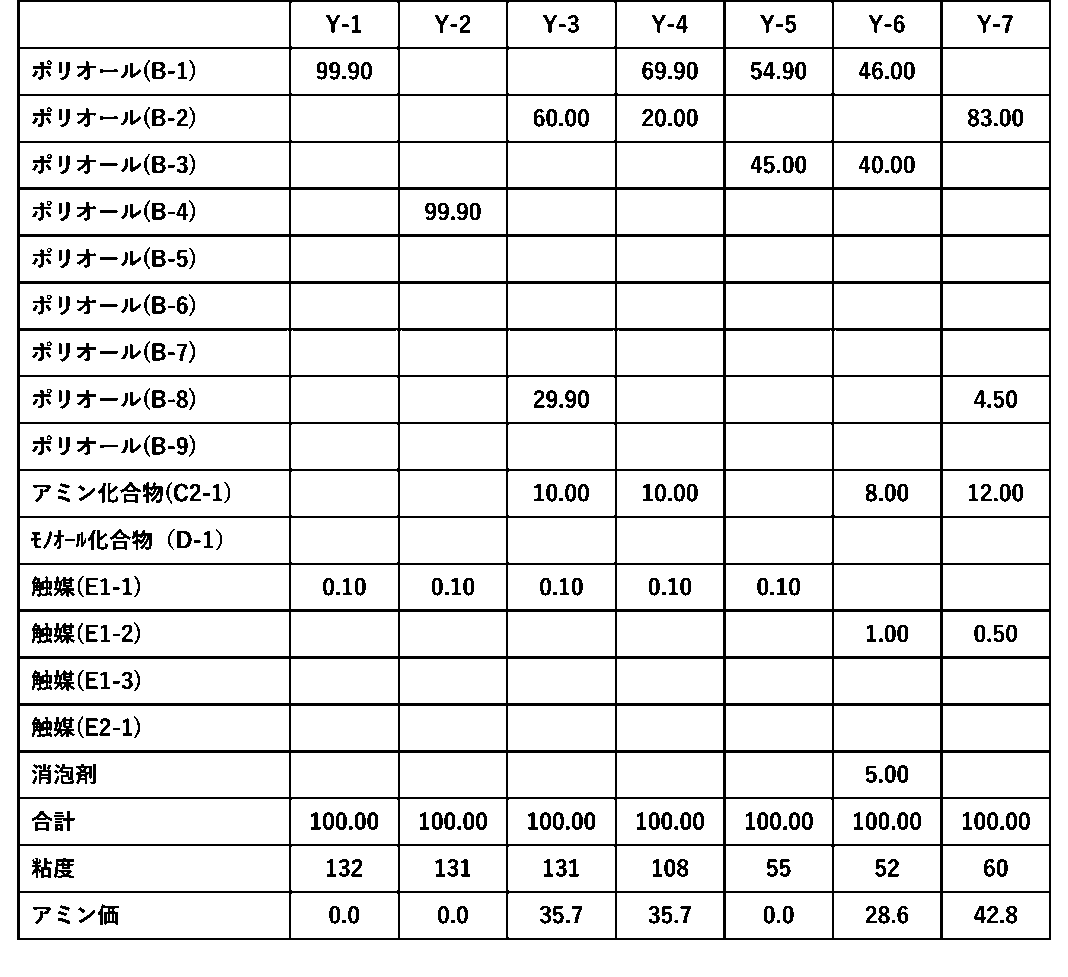


(実施例1)
ポリエステルフィルム(PET、東洋紡株式会社製 E5100、12μm)にポリイソシアネート組成物(X-1)を、アルミ蒸着ポリエステルフィルム(VMPET、東レフィルム加工株式会社製 1310、12μm)のアルミ蒸着面にポリオール組成物(Y-1)を塗布し、PETとVMPETとをニップロール(50℃)で圧着してPET/接着層/VMPETの積層体1を得た。ポリイソシアネート組成物(X-1)、ポリオール組成物(Y-1)の塗布量はそれぞれ、1.3g/m2、0.7g/m2であった。
エージング時間を24時間とした以外は積層体2と同様にして積層体3を得た。
(実施例1)
ポリアミドフィルム(Ny、ユニチカ株式会社製、ON、15μm)にポリイソシアネート組成物(X-1)を、アルミ蒸着ポリエステルフィルム(VMPET、東レフィルム加工株式会社製 1310、12μm)のアルミ蒸着面にポリオール組成物(Y-1)を塗布し、NyとVMPETとをニップロール(50℃)で圧着してNy/接着層/VMPETの積層体4を得た。ポリイソシアネート組成物(X-1)、ポリオール組成物(Y-1)の塗布量はそれぞれ、1.3g/m2、0.7g/m2であった。
用いるポリイソシアネート組成物(X)、ポリオール組成物(Y)と、その塗布量を表4~7のように変更した以外は実施例1と同様にして実施例、比較例の評価用サンプル1~3を得た。


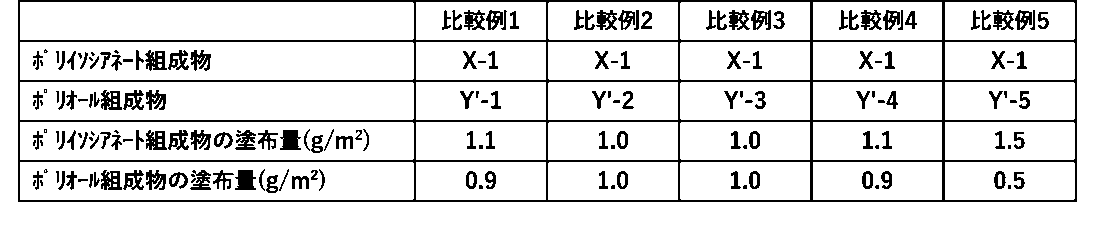
(チャックシール適性)
評価用サンプル1のチャックテープ端部とヒートシールが重なる部分においてアルミ蒸着層と接着層との間の剥離の有無を調べ、以下のようにして5段階で評価した。評価用サンプル2についても同様にして評価し、結果を表8~10にまとめた。
5:20箇所全てにおいて剥離がない
4:20箇所中1箇所で剥離が発生
3:20箇所中2~3箇所で剥離が発生
2:20箇所中4~8箇所で剥離が発生
1:20箇所中9箇所以上で剥離が発生
評価用サンプル3のフィルムの両端を引張試験機に固定し、引張モードで測定した(引張速度:300mm/min)。同じ測定条件で5回測定を行った。得られた強度の最大値の平均値に応じて5段階で評価を行った。
5:最大強度の平均値が100N以上
4:最大強度の平均値が80N以上100N未満
3:最大強度の平均値が70N以上80N未満
2:最大強度の平均値が60N以上70N未満
1:最大強度の平均値が60N未満

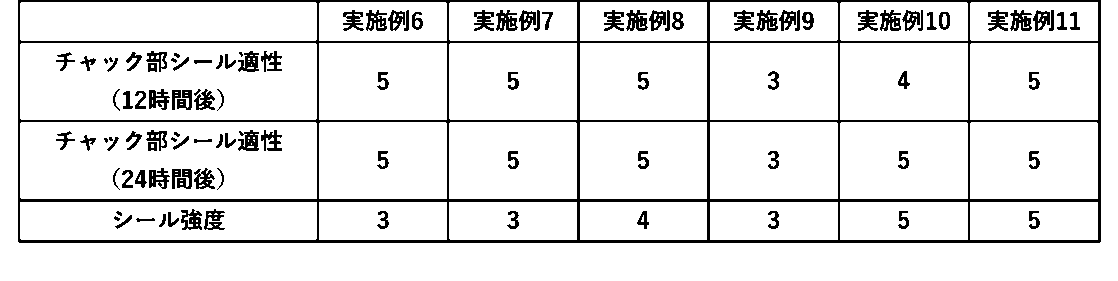

Claims (12)
- ポリイソシアネート化合物(A)を含むポリイソシアネート組成物(X)と、
ポリオール(B)を含むポリオール組成物(Y)と、を含み、
前記ポリオール組成物の50℃における粘度が20mPa・s以上180mPa・s以下である2液硬化型接着剤。 - 前記ポリオール組成物が、アミン化合物(C)を含む請求項1に記載の2液硬化型接着剤。
- 前記ポリオール組成物のアミン価が1mgKOH/g以上100mgKOH/g以下である請求項2に記載の2液硬化型接着剤。
- 前記アミン化合物(C)が複数の水酸基を有するアミン化合物(C1)を含む請求項2または3に記載の2液硬化型接着剤。
- 前記アミン化合物(C)がアミノ基を有するアミン化合物(C2)を含む請求項2~4のいずれか一項に記載の2液硬化型接着剤。
- 前記アミン化合物(C)が活性水素基を有しない3級アミン化合物(C3)を含む請求項2~5のいずれか一項に記載の2液硬化型接着剤。
- 前記ポリオール組成物(Y)がモノオール化合物(D)を含む請求項1~6のいずれか一項に記載の2液硬化型接着剤。
- 触媒(E)を含む請求項1~8のいずれか一項に記載の2液硬化型接着剤。
- 前記ポリイソシアネート組成物の50℃における粘度が200mPa・s以上3000mPa・s以下である請求項1~8のいずれか一項に記載の2液硬化型接着剤。
- 第1の基材に、ポリイソシアネート化合物(A)を含むポリイソシアネート組成物(X)を塗布する工程と、
第2の基材に、ポリオール(B)を含み、50℃における粘度が20mPa・s以上180mPa・s以下であるポリオール組成物(Y)を塗布する工程と、
前記第1の基材と前記第2の基材とを、前記ポリイソシアネート組成物(X)と前記ポリオール組成物(Y)とが接触するように貼り合わせる工程とを含む積層体の製造方法。 - 第1の基材と、第2の基材と、前記第1の記載と前記第2の基材とを貼り合わせる接着層とを含み、前記接着層は請求項1~9のいずれか一項に記載の2液硬化型接着剤の硬化塗膜である積層体。
- 請求項11に記載の積層体からなる包装材。
Priority Applications (5)
| Application Number | Priority Date | Filing Date | Title |
|---|---|---|---|
| JP2022522666A JP7207609B2 (ja) | 2020-06-18 | 2021-06-03 | 接着剤、積層体、積層体の製造方法、包装材 |
| US18/008,742 US20230212444A1 (en) | 2020-06-18 | 2021-06-03 | Adhesive agent, laminate, method for manufacturing laminate, and packaging material |
| EP21826327.5A EP4169997A4 (en) | 2020-06-18 | 2021-06-03 | ADHESIVE, LAMINATE, METHOD FOR PRODUCING THE LAMINATE AND PACKAGING MATERIAL |
| CN202180031512.2A CN115461424A (zh) | 2020-06-18 | 2021-06-03 | 粘接剂、层叠体、层叠体的制造方法、包装材料 |
| JP2022203098A JP2023024587A (ja) | 2020-06-18 | 2022-12-20 | 接着剤、積層体、積層体の製造方法、包装材 |
Applications Claiming Priority (2)
| Application Number | Priority Date | Filing Date | Title |
|---|---|---|---|
| JP2020105190 | 2020-06-18 | ||
| JP2020-105190 | 2020-06-18 |
Publications (1)
| Publication Number | Publication Date |
|---|---|
| WO2021256270A1 true WO2021256270A1 (ja) | 2021-12-23 |
Family
ID=79267876
Family Applications (1)
| Application Number | Title | Priority Date | Filing Date |
|---|---|---|---|
| PCT/JP2021/021121 Ceased WO2021256270A1 (ja) | 2020-06-18 | 2021-06-03 | 接着剤、積層体、積層体の製造方法、包装材 |
Country Status (5)
| Country | Link |
|---|---|
| US (1) | US20230212444A1 (ja) |
| EP (1) | EP4169997A4 (ja) |
| JP (2) | JP7207609B2 (ja) |
| CN (1) | CN115461424A (ja) |
| WO (1) | WO2021256270A1 (ja) |
Cited By (2)
| Publication number | Priority date | Publication date | Assignee | Title |
|---|---|---|---|---|
| WO2023166996A1 (ja) * | 2022-03-01 | 2023-09-07 | Dic株式会社 | 接着剤、積層体、積層体の製造方法、包装材 |
| WO2024004817A1 (ja) * | 2022-06-29 | 2024-01-04 | 東レ株式会社 | 活性エネルギー線硬化型接着剤および積層体の製造方法 |
Families Citing this family (4)
| Publication number | Priority date | Publication date | Assignee | Title |
|---|---|---|---|---|
| CN116723932B (zh) * | 2021-02-09 | 2026-03-31 | Dic株式会社 | 粘接剂、层叠体、包装材料 |
| WO2025071806A1 (en) * | 2023-09-27 | 2025-04-03 | Ddp Specialty Electronic Materials Us, Llc | Two-component thermally conductive adhesive with low e-modulus |
| WO2025071805A1 (en) * | 2023-09-27 | 2025-04-03 | Ddp Specialty Electronic Materials Us, Llc | Two-component thermally conductive adhesive with low e-modulus |
| WO2025104495A1 (en) * | 2023-11-14 | 2025-05-22 | Arkema France | 2k-low modulus polyurethane adhesive for bonding composites |
Citations (5)
| Publication number | Priority date | Publication date | Assignee | Title |
|---|---|---|---|---|
| US20110218275A1 (en) * | 2010-03-04 | 2011-09-08 | Microvast Technologies, Inc. | Two-component solvent-free polyurethane adhesives |
| JP2018030905A (ja) * | 2016-08-22 | 2018-03-01 | 東洋インキScホールディングス株式会社 | 接着剤組成物 |
| WO2018043469A1 (ja) * | 2016-09-05 | 2018-03-08 | Dic株式会社 | 軟包装用フィルムの製造方法 |
| JP2019533034A (ja) * | 2016-09-29 | 2019-11-14 | Dic株式会社 | 接着剤、それを使用した積層フィルム、及び接着剤用ポリオール組成物 |
| WO2020071134A1 (ja) * | 2018-10-01 | 2020-04-09 | Dic株式会社 | 接着剤、積層体および積層体の製造方法 |
Family Cites Families (10)
| Publication number | Priority date | Publication date | Assignee | Title |
|---|---|---|---|---|
| JP2001164229A (ja) * | 1999-12-09 | 2001-06-19 | Dainippon Ink & Chem Inc | 無溶剤型接着剤組成物およびラミネート方法 |
| JP2002249745A (ja) * | 2001-02-27 | 2002-09-06 | Mitsui Takeda Chemicals Inc | 2液硬化型無溶剤系接着剤組成物 |
| JP4474841B2 (ja) * | 2003-03-28 | 2010-06-09 | 東洋インキ製造株式会社 | ラミネート用2液型接着剤組成物及びこれを用いて得られる積層シート、トレー容器 |
| JP2015514848A (ja) * | 2012-04-16 | 2015-05-21 | ノボマー, インコーポレイテッド | 接着剤組成物および方法 |
| WO2018056293A1 (ja) * | 2016-09-20 | 2018-03-29 | サカタインクス株式会社 | 軟包装用ラミネート印刷用インキ組成物 |
| WO2019112930A1 (en) * | 2017-12-06 | 2019-06-13 | Saudi Aramco Technologies Company | Adhesive compositions and methods |
| TWI796450B (zh) * | 2018-03-23 | 2023-03-21 | 日商迪愛生股份有限公司 | 接著劑、積層薄膜、及積層薄膜之製造方法 |
| EP3827037A1 (en) * | 2018-07-26 | 2021-06-02 | Sun Chemical Corporation | Flexible food packaging laminates |
| JP7091991B2 (ja) * | 2018-10-19 | 2022-06-28 | 東洋インキScホールディングス株式会社 | 接着剤組成物、それを用いた積層体及び包装材 |
| WO2021246360A1 (ja) * | 2020-06-02 | 2021-12-09 | 東洋インキScホールディングス株式会社 | 2液硬化型接着剤、積層体及び包装体 |
-
2021
- 2021-06-03 CN CN202180031512.2A patent/CN115461424A/zh active Pending
- 2021-06-03 EP EP21826327.5A patent/EP4169997A4/en active Pending
- 2021-06-03 US US18/008,742 patent/US20230212444A1/en active Pending
- 2021-06-03 WO PCT/JP2021/021121 patent/WO2021256270A1/ja not_active Ceased
- 2021-06-03 JP JP2022522666A patent/JP7207609B2/ja active Active
-
2022
- 2022-12-20 JP JP2022203098A patent/JP2023024587A/ja active Pending
Patent Citations (5)
| Publication number | Priority date | Publication date | Assignee | Title |
|---|---|---|---|---|
| US20110218275A1 (en) * | 2010-03-04 | 2011-09-08 | Microvast Technologies, Inc. | Two-component solvent-free polyurethane adhesives |
| JP2018030905A (ja) * | 2016-08-22 | 2018-03-01 | 東洋インキScホールディングス株式会社 | 接着剤組成物 |
| WO2018043469A1 (ja) * | 2016-09-05 | 2018-03-08 | Dic株式会社 | 軟包装用フィルムの製造方法 |
| JP2019533034A (ja) * | 2016-09-29 | 2019-11-14 | Dic株式会社 | 接着剤、それを使用した積層フィルム、及び接着剤用ポリオール組成物 |
| WO2020071134A1 (ja) * | 2018-10-01 | 2020-04-09 | Dic株式会社 | 接着剤、積層体および積層体の製造方法 |
Non-Patent Citations (2)
| Title |
|---|
| "Toryo Genryou Binran", 1970 |
| See also references of EP4169997A4 |
Cited By (4)
| Publication number | Priority date | Publication date | Assignee | Title |
|---|---|---|---|---|
| WO2023166996A1 (ja) * | 2022-03-01 | 2023-09-07 | Dic株式会社 | 接着剤、積層体、積層体の製造方法、包装材 |
| JP7364136B1 (ja) * | 2022-03-01 | 2023-10-18 | Dic株式会社 | 接着剤、積層体、積層体の製造方法、包装材 |
| WO2024004817A1 (ja) * | 2022-06-29 | 2024-01-04 | 東レ株式会社 | 活性エネルギー線硬化型接着剤および積層体の製造方法 |
| JPWO2024004817A1 (ja) * | 2022-06-29 | 2024-01-04 |
Also Published As
| Publication number | Publication date |
|---|---|
| CN115461424A (zh) | 2022-12-09 |
| EP4169997A4 (en) | 2024-07-24 |
| EP4169997A1 (en) | 2023-04-26 |
| US20230212444A1 (en) | 2023-07-06 |
| JP7207609B2 (ja) | 2023-01-18 |
| JPWO2021256270A1 (ja) | 2021-12-23 |
| JP2023024587A (ja) | 2023-02-16 |
Similar Documents
| Publication | Publication Date | Title |
|---|---|---|
| JP7207609B2 (ja) | 接着剤、積層体、積層体の製造方法、包装材 | |
| JP7004090B2 (ja) | 接着剤、積層フィルム、及び積層フィルムの製造方法 | |
| JP7188047B2 (ja) | 反応性接着剤、積層フィルム、及び包装体 | |
| JP7231127B2 (ja) | 接着剤、積層体、包装材 | |
| JP6650134B1 (ja) | 反応性接着剤、積層フィルム、及び包装体 | |
| WO2018101242A1 (ja) | 反応型接着剤、積層フィルム及び包装体 | |
| JPWO2019116905A1 (ja) | 反応型接着剤、積層フィルム及び包装体 | |
| JP6452018B1 (ja) | 2液型接着剤用の硬化剤、2液型接着剤、積層フィルム及び包装体 | |
| JP7306597B1 (ja) | 接着剤、積層体、積層体の製造方法、包装材 | |
| JP2021181513A (ja) | ガスバリア性ラミネート接着剤、積層体及び包装体 | |
| JP7364130B2 (ja) | 接着剤、積層体、包装材 | |
| JP7803472B2 (ja) | 接着剤、積層体、包装材 | |
| JP2023094545A (ja) | インキ、接着剤、マット調積層フィルムを含む積層体 | |
| JP7193045B1 (ja) | 接着剤、積層体、包装材 | |
| JP7364136B1 (ja) | 接着剤、積層体、積層体の製造方法、包装材 | |
| CN111836866A (zh) | 反应性粘接剂、层叠膜及包装物 | |
| JP7206888B2 (ja) | 反応性接着剤、積層フィルム、及び包装体 | |
| JP2023516834A (ja) | 接着剤、積層体、包装材 | |
| WO2023042734A1 (ja) | ウレタンプレポリマーの製造方法 | |
| WO2025018166A1 (ja) | ポリイソシアネート組成物、2液硬化型組成物、2液硬化型コーティング剤、2液硬化型接着剤、積層体、包装材 |
Legal Events
| Date | Code | Title | Description |
|---|---|---|---|
| 121 | Ep: the epo has been informed by wipo that ep was designated in this application |
Ref document number: 21826327 Country of ref document: EP Kind code of ref document: A1 |
|
| ENP | Entry into the national phase |
Ref document number: 2022522666 Country of ref document: JP Kind code of ref document: A |
|
| WWE | Wipo information: entry into national phase |
Ref document number: 202217068721 Country of ref document: IN |
|
| NENP | Non-entry into the national phase |
Ref country code: DE |
|
| ENP | Entry into the national phase |
Ref document number: 2021826327 Country of ref document: EP Effective date: 20230118 |