WO2022004320A1 - 塩化ビニル樹脂用可塑剤、塩化ビニル樹脂組成物及びその成形品 - Google Patents
塩化ビニル樹脂用可塑剤、塩化ビニル樹脂組成物及びその成形品 Download PDFInfo
- Publication number
- WO2022004320A1 WO2022004320A1 PCT/JP2021/022015 JP2021022015W WO2022004320A1 WO 2022004320 A1 WO2022004320 A1 WO 2022004320A1 JP 2021022015 W JP2021022015 W JP 2021022015W WO 2022004320 A1 WO2022004320 A1 WO 2022004320A1
- Authority
- WO
- WIPO (PCT)
- Prior art keywords
- vinyl chloride
- chloride resin
- plasticizer
- carbon atoms
- acid
- Prior art date
- Legal status (The legal status is an assumption and is not a legal conclusion. Google has not performed a legal analysis and makes no representation as to the accuracy of the status listed.)
- Ceased
Links
- GSMDFPOITBNKDJ-UHFFFAOYSA-N CC(C)(N)NPC(C)(C)NC Chemical compound CC(C)(N)NPC(C)(C)NC GSMDFPOITBNKDJ-UHFFFAOYSA-N 0.000 description 1
Classifications
-
- C—CHEMISTRY; METALLURGY
- C08—ORGANIC MACROMOLECULAR COMPOUNDS; THEIR PREPARATION OR CHEMICAL WORKING-UP; COMPOSITIONS BASED THEREON
- C08L—COMPOSITIONS OF MACROMOLECULAR COMPOUNDS
- C08L67/00—Compositions of polyesters obtained by reactions forming a carboxylic ester link in the main chain; Compositions of derivatives of such polymers
- C08L67/02—Polyesters derived from dicarboxylic acids and dihydroxy compounds
-
- C—CHEMISTRY; METALLURGY
- C08—ORGANIC MACROMOLECULAR COMPOUNDS; THEIR PREPARATION OR CHEMICAL WORKING-UP; COMPOSITIONS BASED THEREON
- C08L—COMPOSITIONS OF MACROMOLECULAR COMPOUNDS
- C08L27/00—Compositions of homopolymers or copolymers of compounds having one or more unsaturated aliphatic radicals, each having only one carbon-to-carbon double bond, and at least one being terminated by a halogen; Compositions of derivatives of such polymers
- C08L27/02—Compositions of homopolymers or copolymers of compounds having one or more unsaturated aliphatic radicals, each having only one carbon-to-carbon double bond, and at least one being terminated by a halogen; Compositions of derivatives of such polymers not modified by chemical after-treatment
- C08L27/04—Compositions of homopolymers or copolymers of compounds having one or more unsaturated aliphatic radicals, each having only one carbon-to-carbon double bond, and at least one being terminated by a halogen; Compositions of derivatives of such polymers not modified by chemical after-treatment containing chlorine atoms
- C08L27/06—Homopolymers or copolymers of vinyl chloride
-
- C—CHEMISTRY; METALLURGY
- C08—ORGANIC MACROMOLECULAR COMPOUNDS; THEIR PREPARATION OR CHEMICAL WORKING-UP; COMPOSITIONS BASED THEREON
- C08G—MACROMOLECULAR COMPOUNDS OBTAINED OTHERWISE THAN BY REACTIONS ONLY INVOLVING UNSATURATED CARBON-TO-CARBON BONDS
- C08G63/00—Macromolecular compounds obtained by reactions forming a carboxylic ester link in the main chain of the macromolecule
- C08G63/02—Polyesters derived from hydroxycarboxylic acids or from polycarboxylic acids and polyhydroxy compounds
- C08G63/12—Polyesters derived from hydroxycarboxylic acids or from polycarboxylic acids and polyhydroxy compounds derived from polycarboxylic acids and polyhydroxy compounds
- C08G63/16—Dicarboxylic acids and dihydroxy compounds
-
- C—CHEMISTRY; METALLURGY
- C08—ORGANIC MACROMOLECULAR COMPOUNDS; THEIR PREPARATION OR CHEMICAL WORKING-UP; COMPOSITIONS BASED THEREON
- C08G—MACROMOLECULAR COMPOUNDS OBTAINED OTHERWISE THAN BY REACTIONS ONLY INVOLVING UNSATURATED CARBON-TO-CARBON BONDS
- C08G63/00—Macromolecular compounds obtained by reactions forming a carboxylic ester link in the main chain of the macromolecule
- C08G63/02—Polyesters derived from hydroxycarboxylic acids or from polycarboxylic acids and polyhydroxy compounds
- C08G63/12—Polyesters derived from hydroxycarboxylic acids or from polycarboxylic acids and polyhydroxy compounds derived from polycarboxylic acids and polyhydroxy compounds
- C08G63/16—Dicarboxylic acids and dihydroxy compounds
- C08G63/20—Polyesters having been prepared in the presence of compounds having one reactive group or more than two reactive groups
-
- C—CHEMISTRY; METALLURGY
- C08—ORGANIC MACROMOLECULAR COMPOUNDS; THEIR PREPARATION OR CHEMICAL WORKING-UP; COMPOSITIONS BASED THEREON
- C08G—MACROMOLECULAR COMPOUNDS OBTAINED OTHERWISE THAN BY REACTIONS ONLY INVOLVING UNSATURATED CARBON-TO-CARBON BONDS
- C08G63/00—Macromolecular compounds obtained by reactions forming a carboxylic ester link in the main chain of the macromolecule
- C08G63/02—Polyesters derived from hydroxycarboxylic acids or from polycarboxylic acids and polyhydroxy compounds
- C08G63/12—Polyesters derived from hydroxycarboxylic acids or from polycarboxylic acids and polyhydroxy compounds derived from polycarboxylic acids and polyhydroxy compounds
- C08G63/16—Dicarboxylic acids and dihydroxy compounds
- C08G63/20—Polyesters having been prepared in the presence of compounds having one reactive group or more than two reactive groups
- C08G63/21—Polyesters having been prepared in the presence of compounds having one reactive group or more than two reactive groups in the presence of unsaturated monocarboxylic acids or unsaturated monohydric alcohols or reactive derivatives thereof
-
- C—CHEMISTRY; METALLURGY
- C08—ORGANIC MACROMOLECULAR COMPOUNDS; THEIR PREPARATION OR CHEMICAL WORKING-UP; COMPOSITIONS BASED THEREON
- C08G—MACROMOLECULAR COMPOUNDS OBTAINED OTHERWISE THAN BY REACTIONS ONLY INVOLVING UNSATURATED CARBON-TO-CARBON BONDS
- C08G63/00—Macromolecular compounds obtained by reactions forming a carboxylic ester link in the main chain of the macromolecule
- C08G63/88—Post-polymerisation treatment
- C08G63/90—Purification; Drying
Definitions
- the present invention relates to a plasticizer for vinyl chloride resin, a vinyl chloride resin composition, and a molded product thereof.
- Vinyl chloride resin is one of the typical plastics, and because it has physical properties such as low cost and excellent heat resistance, its applications are wide-ranging. Since vinyl chloride resin has a hard and brittle property, it is usually used after adding a plasticizer to soften the vinyl chloride resin.
- esters of polybasic acids such as phthalates, adipates, and trimellitic acids are known as typical plasticizers used for vinyl chloride resins, and phthalates are used from the viewpoint of price and performance balance. Esters were often used.
- Trimellitic acid esters which have higher heat resistance than phthalates, are used in applications that require heat resistance, which cannot be handled by phthalates (for example, Patent Document 1).
- tri-2-ethylhexyl trimellitic acid, trinormaloctyltrimellitic acid, trinormaldecyltrimellitic acid, triisononyl trimellitic acid, triisodecyl ester of trimellitic acid and the like are plasticizers having extremely high heat resistance. Therefore, it is widely used in heat-resistant electric wires, wire harnesses for automobiles, dashboards for automobiles, and the like.
- Patent Document 2 discloses a plasticizer for polyester vinyl chloride resin.
- An object to be solved by the present invention is to provide a plasticizer for vinyl chloride resin having an excellent balance of non-migration property, fogging resistance, flexibility, heat resistance and cold resistance.
- polyester containing a certain amount or more of low molecular weight components while reducing low molecular weight components is excellent as a plasticizer for vinyl chloride resin.
- the present invention has been completed.
- the present invention comprises a glycol having 2 to 18 carbon atoms, an aliphatic dicarboxylic acid having 4 to 14 carbon atoms, a monoalcohol having 4 to 18 carbon atoms and / or a monocarboxylic acid having 2 to 21 carbon atoms.
- a plasticizer for vinyl chloride resin which is a polyester that uses an acid as a reaction raw material. The polyester has a number average molecular weight in the range of 500 to 6,000, and a component having a molecular weight of 600 or less is measured by gel permeation chromatography. It relates to a plasticizer for a vinyl chloride resin having an area ratio in the range of 0.5 to 3.0% by mass.
- the plasticizer for vinyl chloride resin of the present invention has a glycol having 2 to 18 carbon atoms, an aliphatic dicarboxylic acid having 4 to 14 carbon atoms, a monoalcohol having 4 to 18 carbon atoms and / or 2 carbon atoms. It is a polyester using to 21 monocarboxylic acids as a reaction raw material, and the polyester has a number average molecular weight of 500 to 6,000, and a component having a molecular weight of 600 or less has an area ratio of 0. It is in the range of 5 to 3.0% by mass.
- the polyester which is the plasticizer for vinyl chloride resin of the present invention may be simply referred to as "the polyester of the present invention" below.
- the polyester of the present invention has a number average molecular weight in the range of 500 to 6,000 and a component having a molecular weight of 600 or less in the range of 0.5 to 3.0% by mass to improve non-migration and fogging resistance. At the same time, flexibility and cold resistance can be guaranteed.
- the component of the polyester of the present invention having a molecular weight of 600 or less is preferably in the range of 1.0 to 3.0% by mass, more preferably in the range of 1.1 to 2.9% by mass, and further preferably 1. It is in the range of 1 to 2.8% by mass.
- the gel described in Examples that the polyester of the present invention has a number average molecular weight in the range of 500 to 6,000 and a component having a molecular weight of 600 or less in the range of 0.5 to 3.0 mass. Confirm by permeation chromatography (GPC) measurement.
- the polyester of the present invention has a glycol having 2 to 18 carbon atoms, an aliphatic dicarboxylic acid having 4 to 14 carbon atoms, a monoalcohol having 4 to 18 carbon atoms and / or a monocarboxylic acid having 4 to 21 carbon atoms. It is a polyester obtained by using a reaction raw material with an acid.
- reaction raw material means a raw material constituting the polyester of the present invention, and does not contain a solvent or a catalyst that does not constitute the polyester.
- the glycol having 2 to 18 carbon atoms is preferably an alkylene glycol having 2 to 18 carbon atoms or an oxyalkylene glycol having 2 to 18 carbon atoms.
- alkylene glycol having 2 to 18 carbon atoms examples include ethylene glycol, 1,2-propylene glycol, 1,3-propylene glycol, 1,2-butanediol, 1,3-butanediol, and 1,2-propanediol.
- the alkylene glycol having 2 to 18 carbon atoms is preferably an alkylene glycol having 3 to 10 carbon atoms, more preferably an alkylene glycol having 3 to 6 carbon atoms, and further preferably 1,2-propanediol. , 1,3-Butanediol, 1,4-Butanediol, Neopentyl Glycol, 2-Methyl-1,3-Propanediol, 3-Methyl-1,5-Pentanediol, 1,6-Hexanediol.
- the oxyalkylene glycol having 2 to 18 carbon atoms is, for example, one in which one of the carbon atoms of the alkylene glycol having 2 to 18 carbon atoms is replaced with an oxygen atom, and diethylene glycol, triethylene glycol, tetraethylene glycol, and the like. Examples thereof include dipropylene glycol and tripropylene glycol.
- the oxyalkylene glycol having 2 to 18 carbon atoms is preferably an oxyalkylene glycol having 3 to 10 carbon atoms, more preferably an oxyalkylene glycol having 4 to 10 carbon atoms, and further preferably diethylene glycol or tri. It is ethylene glycol.
- glycol having 2 to 18 carbon atoms which is the reaction raw material of the polyester of the present invention, may be used alone or in combination of two or more.
- the aliphatic dicarboxylic acid having 4 to 14 carbon atoms is preferably an alkylene dicarboxylic acid having 4 to 14 carbon atoms, and more preferably an alkylene dicarboxylic acid having 6 to 12 carbon atoms.
- alkylene dicarboxylic acid having 4 to 14 carbon atoms examples include succinic acid, glutaric acid, adipic acid, azelaic acid, sebacic acid, dodecanedicarboxylic acid (dodecanedioic acid), cyclohexanedicarboxylic acid, hexahydrophthalic acid and the like. Can be mentioned. Of these, adipic acid, azelaic acid, sebacic acid, and dodecanedioic acid are more preferable, adipic acid and sebacic acid are even more preferable, and adipic acid is particularly preferable.
- the alkylene dicarboxylic acid having 4 to 14 carbon atoms which is the reaction raw material of the polyester of the present invention, may be used alone or in combination of two or more.
- the monoalcohol having 4 to 18 carbon atoms is preferably an aliphatic monoalcohol having 4 to 18 carbon atoms.
- Examples of the aliphatic monoalcohol having 4 to 18 carbon atoms include butanol, heptanol, hexanol, cyclohexanol, heptanol, octanol, 2-ethylhexanol, isononyl alcohol, nonanol, decanol, undecanol, dodecanol and the like.
- the monoalcohol having 4 to 18 carbon atoms which is the reaction raw material of the polyester of the present invention, may be used alone or in combination of two or more.
- the monocarboxylic acid having 2 to 21 carbon atoms is preferably an aliphatic monocarboxylic acid having 2 to 21 carbon atoms.
- Examples of the aliphatic monocarboxylic acid having 2 to 21 carbon atoms include acetic acid, caproic acid, 2-ethylhexanoic acid, caprylic acid, caproic acid, lauric acid, myristic acid, pentadecic acid, palmitic acid, margaric acid and stea. Acids, caproic acid and the like can be mentioned.
- the monocarboxylic acid having 2 to 21 carbon atoms may be a hydrogenated vegetable oil fatty acid.
- the hydrogenated vegetable oil fatty acid include hydrogenated coconut oil fatty acid, hydrogenated palm kernel oil fatty acid, hydrogenated palm oil fatty acid, hydrogenated olive oil fatty acid, hydrogenated castor oil fatty acid, hydrogenated rapeseed oil fatty acid and the like. These are obtained by decomposing and hydrogenating oils obtained from palm, palm kernel, palm, olive, sunflower, and rapeseed, respectively, and all contain an aliphatic monocarboxylic acid having 8 to 21 carbon atoms 2 It is a mixture of long-chain aliphatic monocarboxylic acids of more than one species.
- the vegetable oil fatty acid which has not been hydrogenated may be used as long as the effect of the present invention is not impaired. Further, the vegetable oil fatty acid is not limited to the above.
- the polyester of the present invention has a glycol having 2 to 18 carbon atoms, an aliphatic dicarboxylic acid having 4 to 14 carbon atoms, a monoalcohol having 4 to 18 carbon atoms and / or a monocarboxylic acid having 2 to 21 carbon atoms.
- the reaction raw material may be an acid, and raw materials other than these may be used as long as the effects of the present invention are not impaired.
- the reaction raw material of the polyester of the present invention is preferably a glycol having 2 to 18 carbon atoms, an aliphatic dicarboxylic acid having 4 to 14 carbon atoms, a monoalcohol having 4 to 18 carbon atoms and / or 2 carbon atoms.
- Substantially consisting of ⁇ 21 monocarboxylic acids more preferably glycols with 2-18 carbon atoms, aliphatic dicarboxylic acids with 4-14 carbon atoms, monoalcohols with 4-18 carbon atoms and / Alternatively, it is composed only of a monocarboxylic acid having 2 to 21 carbon atoms.
- the polyester of the present invention has a mixture of compounds represented by the following formulas (1) having different p values, a mixture of compounds represented by the following formulas (2) having different q values, and r values of each other. It comprises one or more selected from the group consisting of different mixtures of compounds represented by the following formula (3).
- G is a glycol residue having 2 to 18 carbon atoms.
- A is an aliphatic dicarboxylic acid residue having 2 to 12 carbon atoms.
- S 11 and S 12 are independently monocarboxylic acid residues having 1 to 20 carbon atoms.
- S 21 and S 22 are independently monoalcohol residues having 4 to 18 carbon atoms.
- S 31 is a monocarboxylic acid residue having 1 to 20 carbon atoms.
- S 32 is a monoalcohol residue having 4 to 18 carbon atoms.
- p, q and r are each independently an integer.
- the "carboxylic acid residue” refers to the remaining organic group excluding the carboxyl group of the carboxylic acid. The number of carbon atoms in the “carboxylic acid residue” does not include the carbon atoms in the carboxy group.
- the "alcohol residue” refers to the remaining organic group obtained by removing the hydroxyl group from the alcohol.
- the "glycol residue” refers to the remaining organic group obtained by removing the hydroxyl group from the glycol.
- the glycol residue of G having 2 to 18 carbon atoms is a group corresponding to the glycol having 2 to 18 carbon atoms which is the reaction raw material of the polyester of the present invention.
- the aliphatic dicarboxylic acid residue having 2 to 12 carbon atoms in A is a group corresponding to the aliphatic dicarboxylic acid having 4 to 14 carbon atoms, which is the reaction raw material of the polyester of the present invention.
- the monocarboxylic acid residues having 1 to 20 carbon atoms in S 11 , S 12 and S 31 are groups corresponding to the monocarboxylic acids having 2 to 21 carbon atoms which are the reaction raw materials of the polyester of the present invention.
- the monoalcohol residues having 4 to 18 carbon atoms in S 21 , S 22 and S 32 are the groups corresponding to the monoalcohols having 4 to 18 carbon atoms which are the reaction raw materials of the polyester of the present invention.
- each of p, q and r is not particularly limited, but is, for example, 30.
- the average value of p is, for example, in the range of 3 to 20
- the average value of q is in the range of, for example, 3 to 20
- the average value of r is, for example, in the range of 3 to 20.
- the average values of p, q and r can be confirmed from the number average molecular weight of polyester.
- the number average molecular weight (Mn) of the polyester of the present invention is 500 to 6,000, preferably 1,000 to 5,000, more preferably 1,500 to 4,000, and even more preferably 1. , 700-3,700.
- the number average molecular weight (Mn) of the polyester of the present invention is confirmed by the method described in Examples.
- the acid value of the polyester of the present invention is preferably 2.0 or less, more preferably 1.0 or less.
- the hydroxyl value of the polyester of the present invention is preferably 15 or less, more preferably 10 or less.
- the viscosity of the polyester of the present invention is preferably 7,000 mPa ⁇ s or less, more preferably 5,000 mPa ⁇ s or less. The acid value, hydroxyl value and viscosity of the polyester of the present invention are confirmed by the method described in Examples.
- the plasticizer for vinyl chloride resin of the present invention has glycols having 2 to 18 carbon atoms, aliphatic dicarboxylic acids having 4 to 14 carbon atoms, monoalcohols having 4 to 18 carbon atoms and / or 4 carbon atoms.
- Polyester is synthesized by reacting with ⁇ 21 monocarboxylic acids, the synthesized polyester is thin-film distilled, and a component having a molecular weight of 600 or less contained in the polyester after thin-film distillation is added to the total amount of polyester after thin-film distillation. It can be manufactured by setting it in the range of 5 to 3.0 mass.
- the method for synthesizing the polyester before thin film distillation is not particularly limited, and it can be produced by a known method, and can be produced by the following production method.
- the polyester represented by the formula (1) can be obtained, for example, by the method shown below.
- Method 1 A method in which monocarboxylic acid, dicarboxylic acid and glycol constituting each residue of the polyester represented by the formula (1) are collectively charged and reacted.
- Method 2 The dicarboxylic acid and glycol constituting each residue of the polyester represented by the formula (1) are reacted under the condition that the equivalent of the hydroxyl group is larger than the equivalent of the carboxyl group, and the hydroxyl group is at the end of the main chain.
- method after obtaining the polyester the reaction of a monocarboxylic acid constituting the obtained polyester resin and S 11 and S 12 having a.
- the polyester represented by the formula (2) can be obtained, for example, by the method shown below.
- Method 3 A method in which monoalcohol, dicarboxylic acid and glycol constituting each residue of the polyester represented by the formula (2) are collectively charged and reacted.
- Method 4 The dicarboxylic acid and glycol constituting each residue of the polyester represented by the formula (2) are reacted under the condition that the equivalent of the carboxyl group is larger than the equivalent of the hydroxyl group to form the carboxyl group in the main chain.
- the polyester represented by the formula (3) can be obtained, for example, by the method shown below.
- Method 4 A method in which monoalcohol, monocarboxylic acid, dicarboxylic acid and glycol constituting each residue of the polyester represented by the formula (3) are collectively charged and reacted.
- Method 5 The dicarboxylic acid and glycol constituting each residue of the polyester represented by the formula (3) are reacted under the condition that the equivalent of the carboxyl group and the equivalent of the hydroxyl group are the same to form the carboxyl group and the hydroxyl group, respectively.
- the reaction may be carried out in the presence of an esterification catalyst, for example, in the temperature range of 180 to 250 ° C. for 5 to 25 hours.
- an esterification catalyst for example, in the temperature range of 180 to 250 ° C. for 5 to 25 hours.
- the conditions such as the temperature and time of the esterification reaction are not particularly limited and may be set as appropriate.
- esterification catalyst examples include titanium-based catalysts such as tetraisopropyl titanate and tetrabutyl titanate; tin-based catalysts such as dibutyltin oxide; and organic sulfonic acid-based catalysts such as p-toluenesulfonic acid.
- the amount of the esterification catalyst used may be appropriately set, but is usually in the range of 0.001 to 0.1 parts by mass with respect to 100 parts by mass of the total amount of the reaction raw material.
- an evaporative raw material is continuously supplied on a surface heated to a certain temperature under reduced pressure to form a uniform thin film, and the evaporative raw material is heated only while it is on the surface, relative to each other.
- This is a distillation method in which a component having a relatively low molecular weight is instantaneously evaporated and a component having a relatively high molecular weight is recovered from the surface.
- the thin film distillation of the synthesized polyester can be carried out by using, for example, a thin film distillation apparatus, a thin film evaporator, or the like.
- the thin-film distillation apparatus includes a flow-down membrane distillation apparatus, a centrifugal distillation apparatus, and the like, but is not particularly limited, and any of them can be used.
- the temperature during thin film distillation is, for example, in the range of 80 to 280 ° C, preferably in the range of 150 to 250 ° C, and more preferably in the range of 180 to 250 ° C.
- the degree of vacuum during thin film distillation is, for example, in the range of 0.1 to 300 Pa, preferably in the range of 0.1 to 150 Pa, and more preferably in the range of 0.1 to 100 Pa.
- the vinyl chloride resin composition of the present invention contains the plasticizer for vinyl chloride resin and the vinyl chloride resin of the present invention.
- the vinyl chloride resin includes a homopolymer of vinyl chloride, a homopolymer of vinylidene chloride, a copolymer containing vinyl chloride as an essential component, a copolymer containing vinylidene chloride as an essential component, and the like.
- the vinyl chloride resin is a copolymer containing vinyl chloride as an essential component or a copolymer containing vinylidene chloride as an essential component
- examples of the comonomer that can be copolymerized include ⁇ - such as ethylene, propylene, and 1-butene.
- Olefins such as butadiene, isoprene; Vinyl alcohol, styrene, acrylonitrile, vinyl acetate, vinyl propionate, fumaric acid, fumaric acid ester, maleic acid, maleic acid ester, maleic acid anhydride, acrylic acid, acrylic acid ester, Examples thereof include methacrylic acid, methacrylic acid ester, and isoprenol.
- the degree of polymerization of the vinyl chloride resin is usually 300 to 5,000, preferably 400 to 3,500, and more preferably 700 to 3,000.
- the degree of polymerization of the vinyl chloride resin is within the above range, a molded product having high heat resistance can be obtained, and a vinyl chloride resin composition having excellent processability can be obtained.
- the vinyl chloride resin can be produced by a known method, and examples thereof include suspension polymerization in the presence of an oil-soluble polymerization catalyst, emulsion polymerization in the presence of a water-soluble polymerization catalyst in an aqueous medium, and the like.
- a commercially available product may be used as the vinyl chloride resin.
- Commercially available vinyl chloride resins include TH-640, TH-700, TH-800 (above, manufactured by Taiyo PVC Co., Ltd.); S-1004, S-1008, PSH-10 (above, manufactured by Kaneka Corporation).
- TK-1300 aboveve, manufactured by Shin-Etsu Polymer Co., Ltd.
- ZEST800Z, ZEST1000Z, ZEST1300Z aboveve, manufactured by Shin-Etsu Polymer Co., Ltd.
- the content of the plasticizer for vinyl chloride resin of the present invention in the vinyl chloride resin composition of the present invention is preferably 10 to 100 parts by mass with respect to 100 parts by mass of the vinyl chloride resin from the viewpoint of compatibility with the vinyl chloride resin and the like. It is in the range of parts, more preferably in the range of 30 to 100 parts by mass, further preferably in the range of 40 to 80 parts by mass, and particularly preferably in the range of 50 to 80 parts by mass.
- the vinyl chloride resin composition of the present invention may contain the vinyl chloride resin and the plasticizer for vinyl chloride resin of the present invention, and may contain plasticizers other than the plasticizer for vinyl chloride resin of the present invention (other plasticizers), and other plasticizers. It may contain an additive or the like.
- plasticizer examples include benzoic acid esters such as diethylene glycol dibenzoate; dibutyl phthalate (DBP), di-2-ethylhexyl phthalate (DOP), diisononyl phthalate (DINP), diisodecyl phthalate (DIDP), and the like.
- benzoic acid esters such as diethylene glycol dibenzoate; dibutyl phthalate (DBP), di-2-ethylhexyl phthalate (DOP), diisononyl phthalate (DINP), diisodecyl phthalate (DIDP), and the like.
- Phthalate esters such as diundecyl phthalate (DUP), ditridecyl phthalate (DTDP); terephthalates such as bis terephthalate (2-ethylhexyl) (DOTP); isophthalates such as bis isophthalate (2-ethylhexyl) (DOIP) Acid Esters; Phthalate Esters such as Tetra-2-ethylhexyl Pyromatate (TOPM); Di-2-ethylhexyl adipate (DOA), Disononyl Adipate (DINA), Diisodecyl adipate (DIDA), Di-Sebasicate Aliphatic dibasic acid esters such as 2-ethylhexyl (DOS) and diisononyl sebacate (DINS); phthalates such as tri-2-ethylhexyl phosphate (TOP) and tricresyl phosphate (TCP); many such as pentaeryth
- Alkyl esters of valence alcohols polyesters with a molecular weight of 800-4,000 synthesized by polyesterification of dibasic acids such as adipic acid and glycols; epoxidized esters such as epoxidized soybean oil and epoxidized flaxseed oil; hexahydrophthalates Alicyclic dibasic acid such as acid diisononyl ester; fatty acid glycol ester such as dicapric acid 1.4-butanediol; tributyl acetylcitrate (ATBC); chlorinated paraffin chlorinated paraffin wax or n-paraffin; chlorinated Chlorinated fatty acid esters such as stearate esters; higher fatty acid esters such as butyl oleate and the like can be mentioned.
- dibasic acids such as adipic acid and glycols
- epoxidized esters such as epoxidized soybean oil and epoxidized flaxseed oil
- the content of the other plasticizer is, for example, 10 to 300 parts by mass with respect to 100 parts by mass of the plasticizer for vinyl chloride resin of the present invention.
- the range is preferably 20 to 200 parts by mass.
- Examples of the other additives include flame retardants, stabilizers, stabilizing aids, coloring agents, processing aids, fillers, antioxidants (antioxidants), ultraviolet absorbers, light stabilizers, lubricants, and antistatic agents.
- Examples thereof include an inhibitor, a cross-linking aid, and the like.
- the flame retardant examples include inorganic compounds such as aluminum hydroxide, antimony trioxide, magnesium hydroxide, and zinc borate; cresyldiphenyl phosphate, trischloroethyl phosphate, trischloropropyl phosphate, and trisdichloropropyl phos. Phosphorus compounds such as fate; halogen compounds such as chlorinated paraffin are exemplified.
- the flame retardant is blended in the vinyl chloride resin composition, the blending amount is usually in the range of 0.1 to 20 parts by mass with respect to 100 parts by mass of the vinyl chloride resin.
- the stabilizer examples include lithium stearate, magnesium stearate, magnesium laurate, calcium ricinolate, calcium stearate, barium laurate, barium lysinolate, barium stearate, zinc octylate, zinc laurate, zinc lysinolate.
- Metal soap compounds such as zinc stearate; organic tin compounds such as dimethyltinbis-2-ethylhexylthioglycolate, dibutyltin maleate, dibutyltin bisbutylmaleate, dibutyltin dilaurate; antimony mercaptide compounds; lanthanum oxide, water Examples thereof include lanthanoid-containing compounds such as lanthanum oxide.
- the blending amount thereof is usually in the range of 0.1 to 20 parts by mass with respect to 100 parts by mass of the vinyl chloride resin.
- the stabilizing aid examples include phosphite compounds such as triphenylphosphite, monooctyldiphenylphosphite and tridecylphosphite; beta-diketone compounds such as acetylacetone and benzoylacetone; glycerin, sorbitol, pentaerythritol and polyethylene.
- phosphite compounds such as triphenylphosphite, monooctyldiphenylphosphite and tridecylphosphite
- beta-diketone compounds such as acetylacetone and benzoylacetone
- glycerin examples include polyol compounds such as glycol; perchlorate compounds such as barium perchlorate salt and sodium perchlorate salt; hydrotalcite compounds; zeolite and the like.
- the colorant examples include carbon black, lead sulfide, white carbon, titanium white, lithopone, Benigara, antimony sulfide, chrome yellow, chrome green, cobalt blue, molybdenum orange and the like.
- the blending amount is usually in the range of 1 to 100 parts by mass with respect to 100 parts by mass of the vinyl chloride resin.
- processing aid examples include liquid paraffin, polyethylene wax, stearic acid, stearic acid amide, ethylene bisstearic acid amide, butyl steaerate, calcium stearate and the like.
- the processing aid is blended in the vinyl chloride resin composition, the blending amount is usually in the range of 0.1 to 20 parts by mass with respect to 100 parts by mass of the vinyl chloride resin.
- the filler examples include metal oxides such as calcium carbonate, silica, alumina, clay, talc, diatomaceous earth, and ferrite; fibers and powders such as glass, carbon, and metal; glass spheres, graphite, aluminum hydroxide, and barium sulfate. , Magnesium oxide, magnesium carbonate, magnesium silicate, calcium silicate and the like are exemplified.
- the blending amount is usually in the range of 1 to 100 parts by mass with respect to 100 parts by mass of the vinyl chloride resin.
- antioxidants examples include 2,6-di-tert-butylphenol, tetrakis [methylene-3- (3,5-tert-butyl-4-hydroxyphenol) propionate] methane, and 2-hydroxy-4-methoxy.
- Phenolic compounds such as benzophenone; sulfur compounds such as alkyldisulfide, thiodipropionic acid ester, benzothiazole; trisnonylphenylphosphite, diphenylisodecylphosphite, triphenylphosphite, tris (2,4-di-tert) -Phenol acid compounds such as butylphenyl) phosphite; organic metal compounds such as zinc dialkyldithiophosphate and zinc diaryldithiophosphate are exemplified.
- the antioxidant is blended in the vinyl chloride resin composition, the blending amount thereof is usually in the range of 0.2 to 20 parts by mass with respect to 100 parts by mass
- the ultraviolet absorber examples include salicylate compounds such as phenylsalicylate and p-tert-butylphenylsalicylate; benzophenones such as 2-hydroxy-4-n-octoxybenzophenone and 2-hydroxy-4-n-methoxybenzophenone.
- System compounds In addition to benzotriazole-based compounds such as 5-methyl-1H-benzotriazole and 1-dioctylaminomethylbenzotriazole, cyanoacrylate-based compounds and the like are exemplified.
- the ultraviolet absorber is blended in the vinyl chloride resin composition, the blending amount thereof is usually in the range of 0.1 to 10 parts by mass with respect to 100 parts by mass of the vinyl chloride resin.
- the light stabilizer examples include hindered amine-based light stabilizers. Specifically, for example, bis (2,2,6,6-tetramethyl-4-piperidyl) sebacate, bis (1,2,2,6,6-pentamethyl-4-piperidyl) sebacate and methyl 1,2 , 2,6,6-pentamethyl-4-piperidyl sebacate (mixture), bis (1,2,2,6,6-pentamethyl-4-piperidyl) [[3,5-bis (1,1-dimethylethyl) ) -4-Hydrikyphenyl] methyl] butylmalonate, bisdecanoate (2,2,6,6-tetramethyl-1 (octyloxy) -4-piperidyl) ester and 1,1-dimethylethylhydroperoxide And octane reaction product, 4-benzoyloxy-2,2,6,6-tetramethylpiperidine, 2,2,6,6-tetramethyl-4-piperidinol and
- the lubricant examples include fatty acid metal salts such as silicone, liquid paraffin, barafin wax, metal stearate and metal laurate; fatty acid amides, fatty acid wax, higher fatty acid wax and the like.
- the blending amount is usually in the range of 0.1 to 10 parts by mass with respect to 100 parts by mass of the vinyl chloride resin.
- the antistatic agent examples include an alkyl sulfonate type, an alkyl ether carboxylic acid type or a dialkyl sulfosuccinate type anionic antistatic agent; a nonionic antistatic agent such as a polyethylene glycol derivative, a sorbitan derivative and a diethanolamine derivative; an alkylamide amine.
- a nonionic antistatic agent such as a polyethylene glycol derivative, a sorbitan derivative and a diethanolamine derivative
- an alkylamide amine examples include quaternary ammonium salts such as type and alkyldimethylbenzyl type, cationic antistatic agents such as alkylpyridinium type organic acid salts or hydrochlorides; and amphoteric antistatic agents such as alkylbetaine type and alkylimidazolin type. ..
- the blending amount thereof is usually in the range of 0.1 to 10 parts by mass with respect to 100 parts by mass of the vinyl chloride resin.
- cross-linking aid examples include polyfunctional monomers such as tetraethylene glycol dimethacrylate, divinylbenzenediallyl phthalate, triallyl isocyanurate, trimethylolpropane trialilate, tetramethylolmethanetetramethacrylate, and trimethoxyethoxyvinylsilane.
- the cross-linking aid is blended in the vinyl chloride resin composition, the blending amount thereof is usually in the range of 0.5 to 30 parts by mass with respect to 100 parts by mass of the vinyl chloride resin.
- the vinyl chloride resin composition of the present invention can be produced by a known method.
- the vinyl chloride resin composition of the present invention comprises a vinyl chloride resin, a plasticizer for vinyl chloride resin of the present invention, and optional components (the other plasticizer and the other additive), such as a blender, a planetary mixer, and a Banbury mixer. It can be prepared by mixing using a kneader.
- a molded product can be obtained by molding the vinyl chloride resin composition of the present invention by a known molding method such as vacuum molding, compression molding, extrusion molding, calender molding, press molding, blow molding, powder molding and the like.
- Molded products obtained by using the vinyl chloride resin composition of the present invention include, for example, insulating tapes, insulating sheets, wiring connectors, wire coating materials, pipes such as water pipes, joints for pipes, and gutters such as rain gutters.
- Window frame siding flat plate, corrugated sheet, automobile underbody coat, dashboard, instrument panel, console, door sheet, undercarpet, trunk sheet, door trim and other automobile packaging, various leathers, decorative sheet, for agriculture Films, food packaging films, various foam products, hoses, medical tubes, food tubes, refrigerator gaskets, packings, wallpaper, flooring, boots, curtains, shoe soles, gloves, waterproof boards, toys, veneers , Blood bag, infusion bag, tarpaulin, mats, impermeable sheet, civil engineering sheet, roofing, waterproof sheet, industrial tape, glass film, erasing and the like.
- the acid value and the viscosity are the values evaluated by the following methods.
- the number average molecular weight of polyester is a value converted into polystyrene based on GPC measurement, and the measurement conditions are as follows.
- [GPC measurement conditions] Measuring device: High-speed GPC device "HLC-8320GPC” manufactured by Tosoh Corporation Column: “TSK GURDCOLUMN SuperHZ-L” manufactured by Tosoh Corporation + “TSK gel SuperHZM-M” manufactured by Tosoh Corporation + “TSK gel SuperHZM-M” manufactured by Tosoh Corporation + “TSK gel SuperHZ-2000” manufactured by Tosoh Corporation "TSK gel SuperHZ-2000” manufactured by Tosoh Corporation Detector: RI (Differential Refractometer) Data processing: "EcoSEC Data Analysis version 1.07” manufactured by Tosoh Corporation Column temperature: 40 ° C Developing solvent: Tetrahydrofuran Flow velocity: 0.35 mL / min Measurement sample: 7.5 mg of the sample was dissolved in 10
- Example 1 Synthesis of polyester plasticizer A
- adipic acid In the reaction vessel, 597 g (4.09 mol) of adipic acid, 448 g (3.80 mol) of 3-methyl 1,5-pentanediol, 177 g (1.23 mol) of isononyl alcohol, and tetraisopropyl titanate 0 as an esterification catalyst. .06 g was placed in a four-necked flask having an internal volume of 2 liters equipped with a thermometer, a stirrer, and a reflux condenser, and the temperature was gradually raised to 230 ° C. while stirring under a nitrogen stream. Heating was continued at 230 ° C.
- Vinyl Chloride Resin Composition (1) 100 parts by mass of vinyl chloride resin (polymerization degree 1,000, ZEST1000Z, manufactured by Shin-Daiichi PVC Co., Ltd.), 50 parts by mass of the obtained polyester plasticizer A, filler (Greg MP-677D (calcium / zinc-based composite stable) Agent) and 4 parts by mass (manufactured by Nittatsu Trading Co., Ltd.) were mixed to obtain a vinyl chloride resin composition (1). The following evaluation was performed using the obtained vinyl chloride resin composition (1).
- the kneaded vinyl chloride resin composition (1) After kneading the vinyl chloride resin composition (1) prepared by two rolls heated to 170 ° C. for 10 minutes, the kneaded vinyl chloride resin composition (1) can be obtained as a molded product having a thickness of 1.0 mm. Molding was performed using a mold (1.0 mm thick mold) and a press machine heated to 170 ° C. to prepare a 1.0 mm thick sheet.
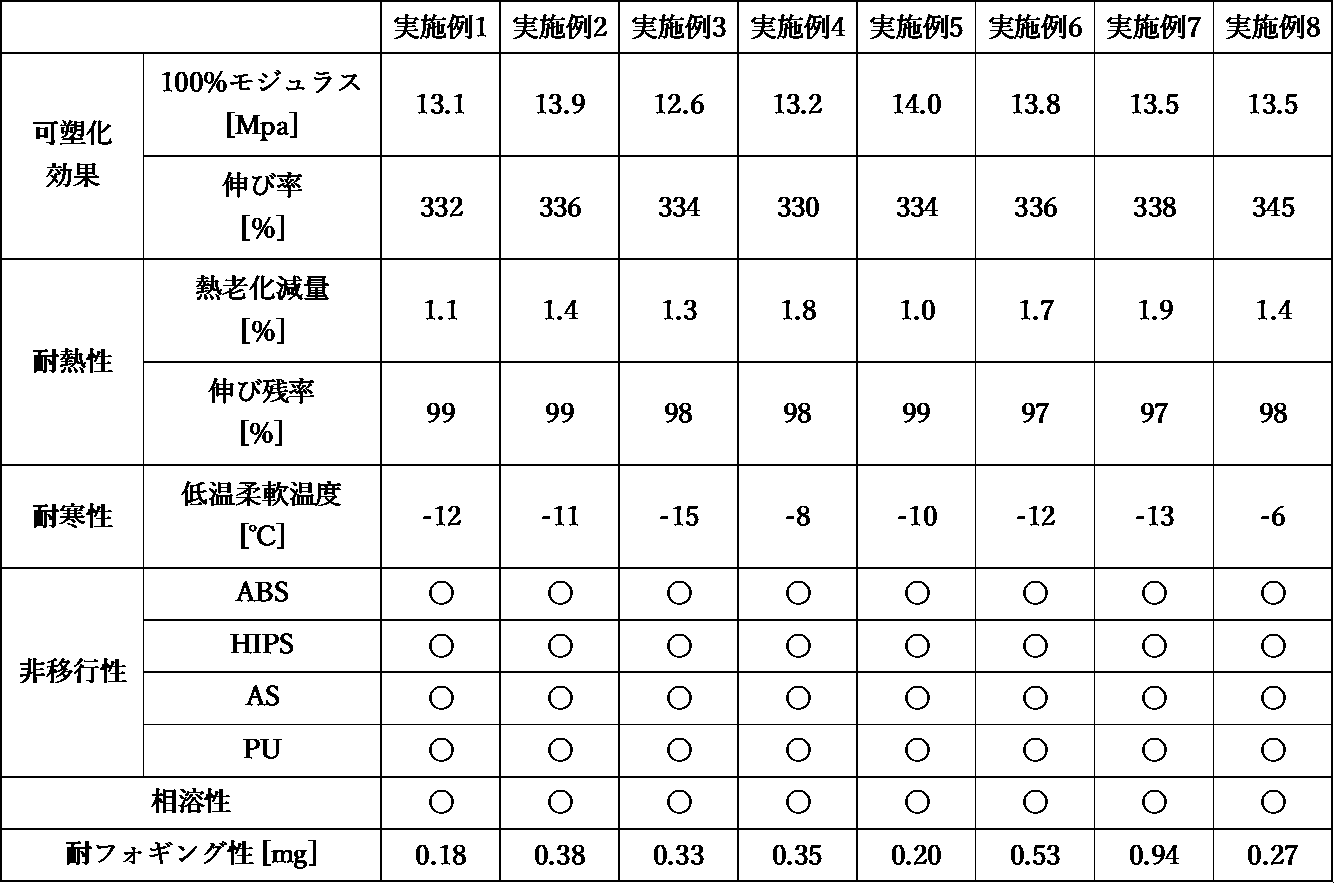
- the obtained sheet was evaluated for 100% modulus (tensile stress at 100% elongation) and elongation at break according to JISK6251: 2010. Specifically, a tensile test was carried out under the following conditions using a sheet having a thickness of 1.0 mm, and 100% modulus and elongation at break were evaluated. The results are shown in Table 1. The breaking elongation is expressed as a percentage by dividing the value obtained by subtracting the initial chuck distance of 20 mm from the chuck distance when the 1.0 mm thick sheet is tensilely broken by the chuck distance of 20 mm.
- Measuring equipment Tensilon universal material testing machine (manufactured by Orientec Co., Ltd.) Sample shape: Dumbbell-shaped No. 3 Chuck distance: 20 mm
- the kneaded vinyl chloride resin composition (1) After kneading the vinyl chloride resin composition (1) prepared by two rolls heated to 170 ° C. for 10 minutes, the kneaded vinyl chloride resin composition (1) can be obtained as a molded product having a thickness of 1.0 mm. Molding was performed using a mold (1.0 mm thick mold) and a press machine heated to 170 ° C. to prepare a 1.0 mm thick sheet. From the prepared 1.0 mm thick sheet, a dumbbell-shaped No. 3 dumbbell test piece was prepared according to JISK6251: 2010.
- the prepared dumbbell test piece was subjected to a heat aging test at 136 ° C. for 168 hours according to JIS K6257: 2017.
- the masses of the dumbbell test pieces before and after the heat aging test were measured, and the weight loss rate ((mass before the heat aging test-mass after the heat aging test) / mass before the heat aging test) was calculated.
- the results are shown in Table 1. The smaller the weight loss rate, the more the polyester plasticizer A remains in the molded product even after the heat aging test, and the effect of heat resistance by the polyester plasticizer A can be expected.
- the breaking elongation rate was evaluated in the same manner as in the evaluation of the plasticization effect, and the elongation rate of the dumbbell test piece after the heat aging test / the dumbbell test piece before the heat aging test.
- the growth rate was evaluated as the "remaining growth rate”. The results are shown in Table 1. It can be said that the higher the elongation residual ratio, the more the plasticizing effect can be maintained even after the heat aging test, and the vinyl chloride resin composition has excellent heat resistance.
- the kneaded vinyl chloride resin composition (1) After kneading the vinyl chloride resin composition (1) prepared by two rolls heated to 170 ° C. for 10 minutes, the kneaded vinyl chloride resin composition (1) can be obtained as a molded product having a thickness of 1.0 mm. Molding was performed using a mold (1.0 mm thick mold) and a press machine heated to 170 ° C. to prepare a 1.0 mm thick sheet. With respect to the obtained sheet, a test piece was prepared according to the test method specified in JIS K6773: 2007, and the flexible temperature (unit: ° C.) was evaluated using a Crashberg flexible temperature measuring tester. The results are shown in Table 1. The lower the softening temperature, the better the cold resistance.
- the kneaded vinyl chloride resin composition (1) After kneading the vinyl chloride resin composition (1) prepared by two rolls heated to 170 ° C. for 10 minutes, the kneaded vinyl chloride resin composition (1) can be obtained as a molded product having a thickness of 1.0 mm. Molding was performed using a mold (1.0 mm thick mold) and a press machine heated to 170 ° C. to prepare a 1.0 mm thick sheet. The obtained 1.0 mm-thick sheet was punched into a size of 6.0 mm ⁇ 38 mm and used as a test piece.
- This test piece is divided into two acrylonitrile-butadiene-styrene resin (ABS) plates, two impact-resistant polystyrene resin (HIPS) plates, two acrylonitrile-styrene resin (AS) plates, and two polyurethane resins (PU). ) It was sandwiched between each of the plates and held at 70 ° C. for 72 hours while applying a load of 0.22 kg / cm 2. The degree of contamination due to the transfer of the plasticizer to each of the ABS plate, the HIPS plate, the AS plate, and the PU plate was visually evaluated according to the following criteria. The results are shown in Table 1.
- the kneaded vinyl chloride resin composition (1) After kneading the vinyl chloride resin composition (1) prepared by two rolls heated to 170 ° C. for 10 minutes, the kneaded vinyl chloride resin composition (1) can be obtained as a molded product having a thickness of 1.0 mm. Molding was performed using a mold (1.0 mm thick mold) and a press machine heated to 170 ° C. to prepare a 1.0 mm thick sheet. Two 1.0 mm thick sheets cut into a size of 5 cm ⁇ 5 cm were prepared from this sheet. The two prepared sheets were stacked and left at 70 ° C. and a relative humidity of 95% for 30 days.
- the fogging resistance of the polyesterplasticizer A was evaluated according to DIN75201. Specifically, 10 g of the polyesterplasticizer A was placed in a glass sample bottle and the temperature was adjusted to 100 ° C. (Thermo Scientific Horizon Fog Testing System). It was set in PC-FTS / PC200-A25). The sample bottle was covered with aluminum foil and then heat-treated at 100 ° C. for 16 hours. After the heat treatment, the mixture was cooled to 21 ° C. and allowed to stand for 4 hours. Fogging resistance was evaluated by the increased weight of the aluminum foil. The results are shown in Table 1. The lower the weight gain, the better the fogging resistance.
- Example 2 Synthesis of polyester plasticizer B
- adipic acid In the reaction vessel, 597 g (4.09 mol) of adipic acid, 265 g (2.25 mol) of 3-methyl 1,5-pentanediol, 80 g (0.77 mol) of neopentyl glycol, 73 g of 1,4-butanediol ( 0.81 mol), 114 g (0.88 mol) of 2-ethylhexanol, 54 g (0.08 mol) of coconut oil, 0.06 g of tetraisopropyl titanate as an esterification catalyst, thermometer, stirrer, and reflux condenser.
- polyester plasticizer B (Mn3). , 137, acid value 0.5, viscosity 3,244 mPa ⁇ s (25 ° C.)) was obtained in an amount of 898 g.
- the component of the obtained polyester plasticizer B having a molecular weight of 600 or less was 1.9% by mass.
- the coconut oil is mainly composed of lauric acid (12 carbon atoms), octanic acid (8 carbon atoms), capric acid (10 carbon atoms), myristic acid (14 carbon atoms), and palmitic acid (14 carbon atoms). It is a mixture containing 16) carbon atoms, octadecanoic acid (18 carbon atoms) and the like.
- the vinyl chloride resin composition (2) was prepared and evaluated in the same manner as in Example 1 except that the plasticizer B was used instead of the plasticizer A. The results are shown in Table 1.
- Example 3 Synthesis of polyester plasticizer C
- adipic acid 489 g (3.35 mol) of adipic acid, 412 g (3.49 mol) of 3-methyl 1,5-pentanediol, 35 g (0.27 mol) of 2-ethylhexanol, 222 g of coconut oil (0.33).
- 0.06 g of tetraisopropyl titanate as an esterification catalyst was placed in a four-necked flask with an internal volume of 2 liters equipped with a thermometer, a stirrer, and a reflux condenser, and the temperature reached 230 ° C. while stirring under a nitrogen stream.
- the temperature was raised stepwise, and heating was continued at 230 ° C. until the acid value became 4 or less, and the produced water was continuously removed.
- excess 2-ethylhexanol was distilled off under reduced pressure at 230 to 200 ° C., and then treated with a thin film distillation apparatus under the conditions of 230 ° C., 30 Pa, 1.8 kg / hr to obtain a polyester plasticizer C (Mn3).
- 028, acid value 0.4, viscosity 2,230 mPa ⁇ s (25 ° C.)) was obtained in 873 g.
- the component of the obtained polyester plasticizer C having a molecular weight of 600 or less was 1.8% by mass.
- the vinyl chloride resin composition (3) was prepared and evaluated in the same manner as in Example 1 except that the plasticizer C was used instead of the plasticizer A. The results are shown in Table 1.
- Example 4 Preparation of polyester plasticizer D
- adipic acid In the reaction vessel, 596 g (4.08 mol) of adipic acid, 284 g (2.73 mol) of neopentyl glycol, 61 g (0.68 mol) of 1,4-butanediol, 282 g (2.17 mol) of 2-ethylhexanol.
- 0.06 g of tetraisopropyl titanate as an esterification catalyst was placed in a four-necked flask with an internal volume of 2 liters equipped with a thermometer, a stirrer, and a reflux condenser, and the temperature was gradually increased to 230 ° C. while stirring under a nitrogen stream.
- polyester plasticizer D (Mn1). , 976, acid value 0.3, viscosity 1,578 mPa ⁇ s (25 ° C.)) was obtained in an amount of 849 g.
- the component of the obtained polyester plasticizer D having a molecular weight of 600 or less was 2.0% by mass.
- the vinyl chloride resin composition (4) was prepared and evaluated in the same manner as in Example 1 except that the plasticizer D was used instead of the plasticizer A. The results are shown in Table 1.
- Example 5 Synthesis of polyester plasticizer E
- adipic acid In the reaction vessel, 597 g (4.09 mol) of adipic acid, 265 g (2.25 mol) of 3-methyl 1,5-pentanediol, 80 g (0.77 mol) of neopentyl glycol, 73 g of 1,4-butanediol ( 0.81 mol), 114 g (0.88 mol) of 2-ethylhexanol, 54 g (0.08 mol) of coconut oil, 0.06 g of tetraisopropyl titanate as an esterification catalyst, thermometer, stirrer, and reflux condenser.
- the vinyl chloride resin composition (5) was prepared and evaluated in the same manner as in Example 1 except that the plasticizer E was used instead of the plasticizer A. The results are shown in Table 1.
- Example 6 Synthesis of polyester plasticizer F
- adipic acid In the reaction vessel, 597 g (4.09 mol) of adipic acid, 265 g (2.25 mol) of 3-methyl 1,5-pentanediol, 80 g (0.77 mol) of neopentyl glycol, 73 g of 1,4-butanediol ( 0.81 mol), 114 g (0.88 mol) of 2-ethylhexanol, 54 g (0.08 mol) of coconut oil, 0.06 g of tetraisopropyl titanate as an esterification catalyst, thermometer, stirrer, and reflux condenser.
- the vinyl chloride resin composition (6) was prepared and evaluated in the same manner as in Example 1 except that the plasticizer F was used instead of the plasticizer A. The results are shown in Table 1.
- Example 7 Synthesis of polyester plasticizer G
- adipic acid In the reaction vessel, 597 g (4.09 mol) of adipic acid, 265 g (2.25 mol) of 3-methyl 1,5-pentanediol, 80 g (0.77 mol) of neopentyl glycol, 73 g of 1,4-butanediol ( 0.81 mol), 114 g (0.88 mol) of 2-ethylhexanol, 54 g (0.08 mol) of coconut oil, 0.06 g of tetraisopropyl titanate as an esterification catalyst, thermometer, stirrer, and reflux condenser.
- the vinyl chloride resin composition (7) was prepared and evaluated in the same manner as in Example 1 except that the plasticizer G was used instead of the plasticizer A. The results are shown in Table 1.
- Example 8 Synthesis of polyester plasticizer H
- adipic acid In the reaction vessel, 680.3 g (4.66 mol) of adipic acid, 394.2 g (4.38 mol) of 2-methyl 1,3-propanediol, 168.7 g (0.88 mol) of isononyl alcohol, esterification. 0.06 g of tetraisopropyl titanate as a catalyst was placed in a four-necked flask with an internal volume of 2 liters equipped with a thermometer, a stirrer, and a reflux cooler, and the temperature was gradually raised to 230 ° C. while stirring under a nitrogen stream. Then, heating was continued at 230 ° C.
- polyester plasticizer H (Mn3, Mn3) was treated with a thin film distillation apparatus under the conditions of 230 ° C., 30 Pa, 1.8 kg / hr. 872 g of 331, acid value 0.2, viscosity 6,360 mPa ⁇ s (25 ° C.) was obtained.
- the component of the obtained polyester plasticizer H having a molecular weight of 600 or less was 1.7% by mass.
- the vinyl chloride resin composition (8) was prepared and evaluated in the same manner as in Example 1 except that the plasticizer H was used instead of the plasticizer A. The results are shown in Table 1.
- Example 9 Synthesis of polyester plasticizer I
- 584 g (4.0 mol) of adipic acid and 418 g (5.5 mol) of 1,2-propanediol were added to a four-necked flask with an internal volume of 2 liters equipped with a thermometer, agitator, and a reflux condenser.
- the temperature was gradually raised to 220 ° C. while being charged in a flask and stirred under a nitrogen stream.
- 410 g (2.0 mol) of hydrogenated coconut oil cured fatty acid and 0.1 g of tetraisopropoxytitanium as an esterification catalyst were added, and the water produced was continuously removed.
- the reaction product was distilled off under reduced pressure at the same temperature, and then the obtained reaction product was treated with a thin film distillation apparatus under the conditions of 230 ° C., 30 Pa, 0.6 kg / hr, whereby the polyester plasticizer I (Mn 2,160, A viscosity of 792 mPa ⁇ s, an acid value of 0.3, and a hydroxyl value of 5.6) were obtained.
- the component of the obtained polyester plasticizer I having a molecular weight of 600 or less was 2.9% by mass.
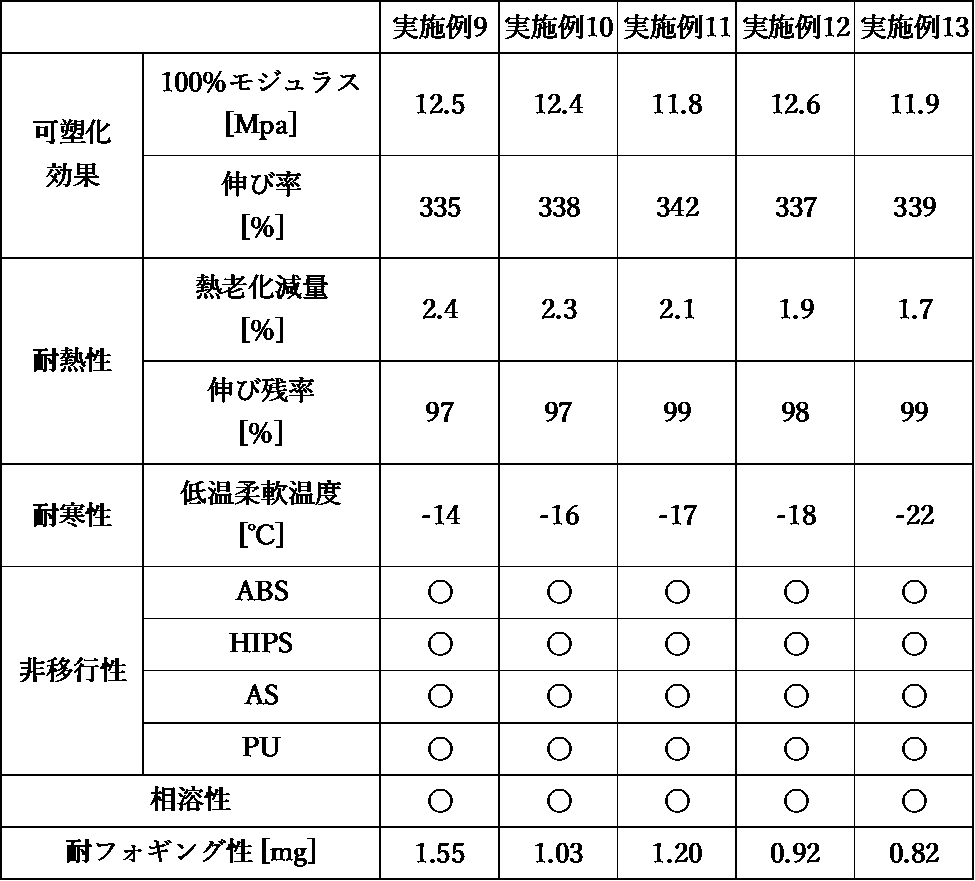
- the vinyl chloride resin composition (9) was prepared and evaluated in the same manner as in Example 1 except that the plasticizer I was used instead of the plasticizer A. The results are shown in Table 2.
- Example 10 Synthesis of polyester plasticizer J
- the reaction product was distilled off under reduced pressure at the same temperature, and then the obtained reaction product was treated with a thin film distillation apparatus under the conditions of 230 ° C., 30 Pa, 0.6 kg / hr to obtain a polyester plasticizer J (Mn2,172, A viscosity of 963 mPa ⁇ s, an acid value of 0.2, and a hydroxyl value of 5.2) were obtained.
- the component of the obtained polyester plasticizer J having a molecular weight of 600 or less was 2.8% by mass.
- the vinyl chloride resin composition (10) was prepared and evaluated in the same manner as in Example 1 except that the plasticizer J was used instead of the plasticizer A. The results are shown in Table 2.
- Example 11 Synthesis of polyester plasticizer K
- 808 g (4.0 mol) of sebacic acid and 418 g (5.5 mol) of 1,2-propanediol were added to a four-necked flask with an internal volume of 2 liters equipped with a thermometer, agitator, and a reflux condenser. The temperature was gradually raised to 220 ° C. while being charged in a flask and stirred under a nitrogen stream. Then, 410 g (2.0 mol) of hydrogenated coconut oil fatty acid and 0.1 g of tetraisopropoxytitanium as an esterification catalyst were added, and the water produced was continuously removed.
- the reaction product was distilled off under reduced pressure at the same temperature, and then the obtained reaction product was treated with a thin film distillation apparatus under the conditions of 230 ° C., 30 Pa, 0.6 kg / hr to obtain a polyester plasticizer K (Mn2,125, A viscosity of 867 mPa ⁇ s, an acid value of 0.2, and a hydroxyl value of 9.0) were obtained.
- the component of the obtained polyester plasticizer K having a molecular weight of 600 or less was 2.9% by mass.
- the vinyl chloride resin composition (11) was prepared and evaluated in the same manner as in Example 1 except that the plasticizer K was used instead of the plasticizer A. The results are shown in Table 2.
- Example 12 Synthesis of polyester plasticizer L
- 808 g (4.0 mol) of sebacic acid, 209 g (2.75 mol) of 1,3-propanediol, and 286 g (2.75 mol) of neopentyl glycol were placed in a thermometer, a stirrer, and a reflux condenser. The temperature was gradually raised to 220 ° C. while stirring under a nitrogen stream. Then, 400 g (2.0 mol) of lauric acid and 0.1 g of tetraisopropoxytitanium as an esterification catalyst were added, and the water produced was continuously removed.
- the reaction product was distilled off under reduced pressure at the same temperature, and then the obtained reaction product was treated with a thin film distillation apparatus under the conditions of 230 ° C., 30 Pa, 0.6 kg / hr to obtain a polyester plasticizer L (Mn2,262, A viscosity of 893 mPa ⁇ s, an acid value of 0.4, and a hydroxyl value of 4.9) were obtained.
- the component of the obtained polyester plasticizer L having a molecular weight of 600 or less was 2.7% by mass.
- the vinyl chloride resin composition (12) was prepared and evaluated in the same manner as in Example 1 except that the plasticizer L was used instead of the plasticizer A. The results are shown in Table 2.
- Example 13 Synthesis of polyester plasticizer M
- 808 g (4.0 mol) of sebacic acid, 209 g (2.75 mol) of 1,2-propanediol, and 324.5 g (2.75 mol) of 1,6-hexanediol were placed in a thermometer and a stirrer.
- a four-necked flask with an internal volume of 2 liters equipped with a reflux condenser and the temperature was gradually raised to 220 ° C. while stirring under a nitrogen stream.
- the vinyl chloride resin composition (13) was prepared and evaluated in the same manner as in Example 1 except that the plasticizer M was used instead of the plasticizer A. The results are shown in Table 2.
- Example 1 Example 1 except that the plasticizer N (tri2 ethylhexyl trimellitate, acid value 0.1, viscosity 210 mPa ⁇ s (25 ° C.), monosizer W-705 manufactured by DIC Corporation) was used instead of the plasticizer A.
- the vinyl chloride resin composition (1') was prepared and evaluated in the same manner as above. The results are shown in Table 3.
- Example 2 Comparative Example 2 except that the plasticizer O (trinormal octal remetrite, acid value 0.1, viscosity 90 mPa ⁇ s (25 ° C.), monosizer W-755 manufactured by DIC Corporation) was used instead of the plasticizer A.
- a vinyl chloride resin composition (2') was prepared and evaluated in the same manner as above. The results are shown in Table 3.
- polyester plasticizer P Mn 3,048, acid value 0.2, viscosity 3,300 mPa ⁇ s (25 ° C.)). rice field.
- the component of the obtained polyester plasticizer P having a molecular weight of 600 or less was 3.7% by mass.
- a vinyl chloride resin composition (3') was prepared and evaluated in the same manner as in Example 1 except that the plasticizer P was used instead of the plasticizer A. The results are shown in Table 3.
- polyester plasticizer Q (Mn 2,655, acid value 0.5, viscosity 2,614 mPa ⁇ s (25 ° C.)). Obtained.
- the component of the obtained polyester plasticizer Q having a molecular weight of 600 or less was 3.7% by mass.
- a vinyl chloride resin composition (4') was prepared and evaluated in the same manner as in Example 1 except that the plasticizer Q was used instead of the plasticizer A. The results are shown in Table 3.
- polyester plasticizer R Mn 1,677, acid value 0.2, viscosity 1,033 mPa ⁇ s (25 ° C.)
- a vinyl chloride resin composition (5') was prepared and evaluated in the same manner as in Example 1 except that the plasticizer R was used instead of the plasticizer A. The results are shown in Table 3.
- polyester plasticizer S (Mn2). , 793, acid value 0.5, viscosity 2,870 mPa ⁇ s (25 ° C.)) was obtained in 926 g.
- the component of the obtained polyester plasticizer S having a molecular weight of 600 or less was 3.1% by mass.
- a vinyl chloride resin composition (6') was prepared and evaluated in the same manner as in Example 1 except that the plasticizer S was used instead of the plasticizer A. The results are shown in Table 3.
- polyester plasticizer T (Mn 3,766, acid value 0.2, viscosity 4,173 mPa ⁇ s (25 ° C.)) was obtained in an amount of 847 g.
- the component of the obtained polyester plasticizer T having a molecular weight of 600 or less was 0.1% by mass or less.
- a vinyl chloride resin composition (7') was prepared and evaluated in the same manner as in Example 1 except that the plasticizer T was used instead of the plasticizer A. The results are shown in Table 3.
Landscapes
- Chemical & Material Sciences (AREA)
- Health & Medical Sciences (AREA)
- Chemical Kinetics & Catalysis (AREA)
- Medicinal Chemistry (AREA)
- Polymers & Plastics (AREA)
- Organic Chemistry (AREA)
- Compositions Of Macromolecular Compounds (AREA)
- Polyesters Or Polycarbonates (AREA)
- Addition Polymer Or Copolymer, Post-Treatments, Or Chemical Modifications (AREA)
Abstract
Description
本発明の塩化ビニル樹脂用可塑剤は、炭素原子数2~18のグリコールと、炭素原子数4~14の脂肪族ジカルボン酸と、炭素原子数4~18のモノアルコール及び/又は炭素原子数2~21のモノカルボン酸とを反応原料とするポリエステルであり、前記ポリエステルは、数平均分子量が500~6,000であり、分子量600以下の成分が、ゲル浸透クロマトグラフィー測定における面積比率で0.5~3.0質量%の範囲である。
本発明の塩化ビニル樹脂用可塑剤であるポリエステルを、以下、単に「本発明のポリエステル」という場合がある。
本発明のポリエステルについて、数平均分子量が500~6,000の範囲であること、及び、分子量600以下の成分が0.5~3.0質量の範囲であることは、実施例に記載のゲル浸透クロマトグラフィー(GPC)測定により確認する。
ここで「反応原料」とは、本発明のポリエステルを構成する原料という意味であり、ポリエステルを構成しない溶媒や触媒を含まない意味である。
前記炭素原子数2~18のオキシアルキレングリコールは、好ましくは炭素原子数3~10のオキシアルキレングリコールであり、より好ましくは炭素原子数4~10のオキシアルキレングリコールであり、さらに好ましくはジエチレングリコール又はトリエチレングリコールである。
前記炭素原子数4~18の脂肪族モノアルコールとしては、ブタノール、ヘプタノール、ヘキサノール、シクロヘキサノール、ヘプタノール、オクタノール、2-エチルヘキサノール、イソノニルアルコール、ノナノール、デカノール、ウンデカノール、ドデカノール等が挙げられる。
前記炭素原子数2~21の脂肪族モノカルボン酸としては、例えば酢酸、カプロン酸、2-エチルヘキサン酸、カプリル酸、カプリン酸、ラウリン酸、ミリスチン酸、ペンタデシル酸、パルミチン酸、マルガリン酸、ステアリン酸、アラキジン酸等が挙げられる。
尚、本発明の効果を損なわない範囲で水素添加をしていない上記植物油脂肪酸を用いてもよい。また、植物油脂肪酸は上記に限定されない。
本発明のポリエステルの反応原料は、好ましくは炭素原子数2~18のグリコールと、炭素原子数4~14の脂肪族ジカルボン酸と、炭素原子数4~18のモノアルコール及び/又は炭素原子数2~21のモノカルボン酸とから実質的になり、より好ましくは炭素原子数2~18のグリコールと、炭素原子数4~14の脂肪族ジカルボン酸と、炭素原子数4~18のモノアルコール及び/又は炭素原子数2~21のモノカルボン酸とのみからなる。

Gは、炭素原子数2~18のグリコール残基である。
Aは、炭素原子数2~12の脂肪族ジカルボン酸残基である。
S11及びS12は、それぞれ独立に、炭素原子数1~20のモノカルボン酸残基である。
S21及びS22は、それぞれ独立に、炭素原子数4~18のモノアルコール残基である。
S31は、炭素原子数1~20のモノカルボン酸残基である。
S32は、炭素原子数4~18のモノアルコール残基である。
p、q及びrは、それぞれ独立に、整数である。)
本発明において「アルコール残基」とは、アルコールから水酸基を除いた残りの有機基を示すものである。
本発明において「グリコール残基」とは、グリコールから水酸基を除いた残りの有機基を示すものである。
Aの炭素原子数2~12の脂肪族ジカルボン酸残基は、本発明のポリエステルの反応原料である炭素原子数4~14の脂肪族ジカルボン酸に対応する基である。
S11、S12及びS31の炭素原子数1~20のモノカルボン酸残基は、本発明のポリエステルの反応原料である炭素原子数2~21のモノカルボン酸に対応する基である。
S21、S22及びS32の炭素原子数4~18のモノアルコール残基は、本発明のポリエステルの反応原料である炭素原子数4~18のモノアルコールに対応する基である。
pの平均値は例えば3~20の範囲であり、qの平均値は例えば3~20の範囲であり、rの平均値は例えば3~20の範囲である。
尚、p、q及びrの平均値はポリエステルの数平均分子量から確認できる。
本発明のポリエステルの数平均分子量(Mn)は、実施例に記載の方法により確認する。
本発明のポリエステルの水酸基価は、15以下が好ましく、10以下がより好ましい。
本発明のポリエステルの粘度は、7,000mPa・s以下が好ましく、5,000mPa・s以下がより好ましい。
本発明のポリエステルの酸価、水酸基価及び粘度は実施例に記載の方法にて確認する。
本発明の塩化ビニル樹脂用可塑剤は、炭素原子数2~18のグリコールと、炭素原子数4~14の脂肪族ジカルボン酸と、炭素原子数4~18のモノアルコール及び/又は炭素原子数4~21のモノカルボン酸とを反応させてポリエステルを合成し、前記合成したポリエステルを薄膜蒸留して、薄膜蒸留後のポリエステルに含まれる分子量600以下の成分を薄膜蒸留後ポリエステル全量に対して0.5~3.0質量の範囲とすることにより製造できる。
方法1:式(1)で表されるポリエステルの各残基を構成するモノカルボン酸、ジカルボン酸及びグリコールを一括で仕込み、これらを反応させる方法。
方法2:式(1)で表されるポリエステルの各残基を構成するジカルボン酸とグリコールとを、水酸基の当量がカルボキシル基の当量よりも多くなる条件下で反応させて水酸基を主鎖の末端に有するポリエステルを得た後、得られたポリエステル樹脂とS11及びS12を構成するモノカルボン酸とを反応させる方法。
方法3:式(2)で表されるポリエステルの各残基を構成するモノアルコール、ジカルボン酸及びグリコールを一括で仕込み、これらを反応させる方法。
方法4:式(2)で表されるポリエステルの各残基を構成するジカルボン酸とグリコールとを、カルボキシル基の当量が水酸基の当量よりも多くなる条件下で反応させてカルボキシル基を主鎖の末端に有するポリエステルを得た後、得られたポリエステルとS21及びS22を構成するモノアルコールとを反応させる方法。
方法4:式(3)で表されるポリエステルの各残基を構成するモノアルコール、モノカルボン酸、ジカルボン酸及びグリコールを一括で仕込み、これらを反応させる方法。
方法5:式(3)で表されるポリエステルの各残基を構成するジカルボン酸とグリコールとを、カルボキシル基の当量と水酸基の当量が同じになる条件下で反応させてカルボキシル基と水酸基をそれぞれ主鎖の末端に有するポリエステルを得た後、得られたポリエステルとS31及びS32を構成するモノアルコール及びモノカルボン酸とを反応させる方法。
尚、エステル化反応の温度、時間などの条件は特に限定されず、適宜設定してよい。
合成したポリエステルの薄膜蒸留の実施は、例えば薄膜式蒸留装置、薄膜蒸発装置等を使用することにより実施できる。薄膜式蒸留装置には、流下膜式蒸留装置、遠心式蒸留装置等があるが、特に限定されず、いずれも使用できる。
薄膜蒸留時の真空度としては、例えば0.1~300Paの範囲であり、好ましくは0.1~150Paの範囲であり、より好ましくは0.1~100Paの範囲である。
真空度を低く設定することで薄膜蒸留の流速を上げることができ、当該流速と真空度のバランスをとることで、分子量600以下の成分を0.5~3.0質量%の範囲とすることができる。
本発明の塩化ビニル樹脂組成物は、本発明の塩化ビニル樹脂用可塑剤及び塩化ビニル樹脂を含有する。本発明において塩化ビニル樹脂は、塩化ビニルの単独重合体、塩化ビニリデンの単独重合体、塩化ビニルを必須成分とする共重合体、塩化ビニリデンを必須成分とする共重合体等を含む。
塩化ビニル樹脂が、塩化ビニルを必須成分とする共重合体又は塩化ビニリデンを必須成分とする共重合体である場合、共重合されうるコモノマーとしては、例えばエチレン、プロピレン、1-ブテン等のα-オレフィン;ブタジエン、イソプレン等の共役ジエン;ビニルアルコール、スチレン、アクリロニトリル、酢酸ビニル、プロピオン酸ビニル、フマル酸、フマル酸エステル、マレイン酸、マレイン酸エステル、マレイン酸無水物、アクリル酸、アクリル酸エステル、メタクリル酸、メタクリル酸エステル、イソプレノール等が挙げられる。
塩化ビニル樹脂は、市販品を用いてもよい。塩化ビニル系樹脂の市販品としては、TH-640、TH-700、TH-800(以上、大洋塩ビ株式会社製);S-1004、S-1008、PSH-10(以上、株式会社カネカ製);TK-700、TK-800.TK-1300(以上、信越ポリマー株式会社製);ZEST800Z、ZEST1000Z、ZEST1300Z(以上、新第一塩ビ株式会社製)等が挙げられる。
難燃剤を塩化ビニル樹脂組成物に配合する場合、その配合量は通常塩化ビニル樹脂100質量部に対して0.1~20質量部の範囲である。
安定剤を塩化ビニル樹脂組成物に配合する場合、その配合量は通常塩化ビニル樹脂100質量部に対して0.1~20質量部の範囲である。
安定化助剤を塩化ビニル樹脂組成物に配合する場合、その配合量は通常塩化ビニル樹脂100質量部に対して0.1~20質量部の範囲である。
着色剤を塩化ビニル樹脂組成物に配合する場合、その配合量は通常塩化ビニル樹脂100質量部に対して1~100質量部の範囲である。
加工助剤を塩化ビニル樹脂組成物に配合する場合、その配合量は通常塩化ビニル樹脂100質量部に対して0.1~20質量部の範囲である。
充填剤を塩化ビニル樹脂組成物に配合する場合、その配合量は通常塩化ビニル樹脂100質量部に対して1~100質量部の範囲である。
酸化防止剤を塩化ビニル樹脂組成物に配合する場合、その配合量は通常塩化ビニル樹脂100質量部に対して0.2~20質量部の範囲である。
紫外線吸収剤を塩化ビニル樹脂組成物に配合する場合、その配合量は通常塩化ビニル樹脂100質量部に対して0.1~10質量部の範囲である。
光安定剤を塩化ビニル樹脂組成物に配合する場合、その配合量は通常塩化ビニル樹脂100質量部に対して0.1~10質量部の範囲である。
滑剤を塩化ビニル樹脂組成物に配合する場合、その配合量は通常塩化ビニル樹脂100質量部に対して0.1~10質量部の範囲である。
帯電防止剤を塩化ビニル樹脂組成物に配合する場合、その配合量は通常塩化ビニル樹脂100質量部に対して0.1~10質量部の範囲である。
架橋助剤を塩化ビニル樹脂組成物に配合する場合、その配合量は通常塩化ビニル樹脂100質量部に対して0.5~30質量部の範囲である。
例えば、本発明の塩化ビニル樹脂組成物は、塩化ビニル樹脂、本発明の塩化ビニル樹脂用可塑剤及び任意成分(前記その他可塑剤及び前記その他添加剤)をブレンダー、プラネタリーミキサー、バンバリーミキサー等の混錬機を用いて混合することにより調製することができる。
<酸価の測定方法>
JIS K0070-1992に準じた方法により測定した。
<粘度の測定方法>
JIS K6901-1986に準じた方法により測定した。
[GPC測定条件]
測定装置:東ソー株式会社製高速GPC装置「HLC-8320GPC」
カラム:東ソー株式会社製「TSK GURDCOLUMN SuperHZ-L」+東ソー株式会社製「TSK gel SuperHZM-M」+東ソー株式会社製「TSK gel SuperHZM-M」+東ソー株式会社製「TSK gel SuperHZ-2000」+東ソー株式会社製「TSK gel SuperHZ-2000」
検出器:RI(示差屈折計)
データ処理:東ソー株式会社製「EcoSEC Data Analysis バージョン1.07」
カラム温度:40℃
展開溶媒:テトラヒドロフラン
流速:0.35mL/分
測定試料:試料7.5mgを10mlのテトラヒドロフランに溶解し、得られた溶液をマイクロフィルターでろ過したものを測定試料とした。
試料注入量:20μl
標準試料:前記「HLC-8320GPC」の測定マニュアルに準拠して、分子量が既知の下記の単分散ポリスチレンを用いた。
東ソー株式会社製「A-300」
東ソー株式会社製「A-500」
東ソー株式会社製「A-1000」
東ソー株式会社製「A-2500」
東ソー株式会社製「A-5000」
東ソー株式会社製「F-1」
東ソー株式会社製「F-2」
東ソー株式会社製「F-4」
東ソー株式会社製「F-10」
東ソー株式会社製「F-20」
東ソー株式会社製「F-40」
東ソー株式会社製「F-80」
東ソー株式会社製「F-128」
東ソー株式会社製「F-288」
反応容器に、アジピン酸597g(4.09モル)、3-メチル1,5-ペンタンジオール448g(3.80モル)、イソノニルアルコール177g(1.23モル)、エステル化触媒としてテトライソプロピルチタネート0.06gを、温度計、攪拌器、及び還流冷却器を付した内容積2リットルの四ツ口フラスコに仕込み、窒素気流下で攪拌しながら230℃まで段階的に昇温した。酸価が4以下になるまで230℃で加熱を続け、生成する水を連続的に除去した。反応後、230~200℃で過剰のイソノニルアルコールを減圧留去した後、得られた反応物を薄膜蒸留装置にて230℃、30Pa、1.8kg/hrの条件で処理することによって、ポリエステル可塑剤A(Mn3,288、酸価0.2、粘度3,585mPa・s(25℃))を905g得た。
得られたポリエステル可塑剤Aに含まれる分子量が600以下の成分は、面積比率で1.3質量%であった。
塩化ビニル樹脂(重合度1,000、ZEST1000Z、新第一塩ビ株式会社製)100質量部、得られたポリエステル可塑剤Aを50質量部、充填剤(グレッグMP-677D(カルシウム/亜鉛系複合安定剤)、日辰貿易株式会社製)4質量部を混合し、塩化ビニル樹脂組成物(1)を得た。得られた塩化ビニル樹脂組成物(1)を用いて以下の評価を行った。
170℃に加熱した2本ロールで調製した塩化ビニル樹脂組成物(1)を10分混錬した後、混錬後の塩化ビニル樹脂組成物(1)を1.0mm厚の成形品が得られる金型(1.0mm厚金型)と170℃に熱したプレス機とを用いて成形し、1.0mm厚のシートを作製した。
尚、破断伸び率は、1.0mm厚シートが引張破断した時のチャック間距離から初期のチャック間距離20mmを引いた値をチャック間距離20mmで除して百分率で表したものである。
測定機器 :テンシロン万能材料試験機(株式会社オリエンテック製)
サンプル形状 :ダンベル状3号形
チャック間距離:20mm
引張速度 :200mm/分
測定雰囲気 :温度23度、湿度50%
170℃に加熱した2本ロールで調製した塩化ビニル樹脂組成物(1)を10分混錬した後、混錬後の塩化ビニル樹脂組成物(1)を1.0mm厚の成形品が得られる金型(1.0mm厚金型)と170℃に熱したプレス機とを用いて成形し、1.0mm厚のシートを作製した。作製した1.0mm厚のシートから、JISK6251:2010に従い、ダンベル状3号形のダンベル試験片を作製した。
減量率が小さい程、熱老化試験後においてもポリエステル可塑剤Aが成形品内に留まっており、ポリエステル可塑剤Aによる耐熱性の効果が期待できる。
この伸び残率が高い程、熱老化試験後も可塑化効果を保持でき、耐熱性に優れる塩化ビニル樹脂組成物と言える。
170℃に加熱した2本ロールで調製した塩化ビニル樹脂組成物(1)を10分混錬した後、混錬後の塩化ビニル樹脂組成物(1)を1.0mm厚の成形品が得られる金型(1.0mm厚金型)と170℃に熱したプレス機とを用いて成形し、1.0mm厚のシートを作製した。
得られたシートについて、JISK6773:2007に規定される試験方法に準じて試験片を作製し、クラッシュバーグ柔軟温度測定試験機を用いて柔軟温度(単位:℃)を評価した。結果を表1に示す。柔軟温度が低いほど、耐寒性に優れることを表す。
170℃に加熱した2本ロールで調製した塩化ビニル樹脂組成物(1)を10分混錬した後、混錬後の塩化ビニル樹脂組成物(1)を1.0mm厚の成形品が得られる金型(1.0mm厚金型)と170℃に熱したプレス機とを用いて成形し、1.0mm厚のシートを作製した。
得られた1.0mm厚のシートについて、6.0mm×38mmサイズに打抜いたものを試験片とした。この試験片を2枚のアクリロニトリル・ブタジエン・スチレン樹脂(ABS)板、2枚の耐衝撃性ポリスチレン樹脂(HIPS)板、2枚のアクリロニトリル・スチレン樹脂(AS)板、2枚のポリウレタン樹脂(PU)板のそれぞれでサンドイッチ状に挟み、0.22kg/cm2の加重を掛けながら70℃×72時間保持した。ABS板、HIPS板、AS板、PU板それぞれへの可塑剤の移行による汚染度合いを目視にて下記基準で評価した。結果を表1に示す。
〇:樹脂板への移行痕跡無し、又は痕跡があってもエタノール含浸ガーゼによる拭き取りで痕跡が消える
×:明らかに可塑剤の移行による痕跡が有り、エタノール含浸ガーゼによる拭き取りでも痕跡が消えない
170℃に加熱した2本ロールで調製した塩化ビニル樹脂組成物(1)を10分混錬した後、混錬後の塩化ビニル樹脂組成物(1)を1.0mm厚の成形品が得られる金型(1.0mm厚金型)と170℃に熱したプレス機とを用いて成形し、1.0mm厚のシートを作製した。このシートから5cm×5cmの大きさに切断した1.0mm厚のシートを2枚作製した。作製した2枚のシートを重ね、70℃で相対湿度95%の条件下で30日間放置した。その後、シートの表面及びシート同士が重なっている面の状態を下記評価基準で評価した。結果を表1に示す。
〇:シートの表面及びシート同士が重なっている面を目視で確認し、粉状や粘性状等の異物(ブリード)が確認できず、且つ、シートの表面及びシート同士が重なっている面を指で触れてもブリードが確認できない。
×:シートの表面及びシート同士が重なっている面を目視で確認し、ブリードが確認できる、または、シートの表面及びシート同士が重なっている面を指で触れてブリードが確認できる。
ポリエステル可塑剤Aの耐フォギング性をDIN75201に従って評価した、具体的には、10gのポリエステル可塑剤Aをガラス製サンプル瓶に入れ、100℃に温度調節したフォギング試験機(Thermo Scientific製 Horizon Fog Testing System PC-FTS/PC200-A25)にセットした。前記サンプル瓶をアルミ箔で蓋をした後、100℃で16時間熱処理を実施した。熱処理後、21℃まで冷却し4時間静置した。アルミ箔の増加重量により耐フォギング性を評価した。結果を表1に示す。
増加重量が低い程、耐フォギング性に優れることを表す。
反応容器に、アジピン酸597g(4.09モル)、3-メチル1,5-ペンタンジオール265g(2.25モル)、ネオペンチルグリコール80g(0.77モル)、1,4-ブタンジオール73g(0.81モル)、2-エチルヘキサノール114g(0.88モル)、ヤシ油54g(0.08モル)、エステル化触媒としてテトライソプロピルチタネート0.06gを、温度計、攪拌器、及び還流冷却器を付した内容積2リットルの四ツ口フラスコに仕込み、窒素気流下で攪拌しながら230℃まで段階的に昇温し、酸価が4以下になるまで230℃で加熱を続け、生成する水を連続的に除去した。反応後、230~200℃で過剰の2-エチルヘキサノールを減圧留去した後、薄膜蒸留装置にて230℃、30Pa、1.8kg/hrの条件で処理することによって、ポリエステル可塑剤B(Mn3,137、酸価0.5、粘度3,244mPa・s(25℃))を898g得た。
得られたポリエステル可塑剤Bの分子量が600以下の成分は1.9質量%であった。
反応容器に、アジピン酸489g(3.35モル)、3-メチル1,5-ペンタンジオール412g(3.49モル)、2-エチルヘキサノール35g(0.27モル)、ヤシ油222g(0.33モル)、エステル化触媒としてテトライソプロピルチタネート0.06gを、温度計、攪拌器、及び還流冷却器を付した内容積2リットルの四ツ口フラスコに仕込み、窒素気流下で攪拌しながら230℃まで段階的に昇温し、酸価が4以下になるまで230℃で加熱を続け、生成する水を連続的に除去した。反応後、230~200℃で過剰の2-エチルヘキサノールを減圧留去した後、薄膜蒸留装置にて230℃、30Pa、1.8kg/hrの条件で処理することによって、ポリエステル可塑剤C(Mn3,028、酸価0.4、粘度2,230mPa・s(25℃))を873g得た。
得られたポリエステル可塑剤Cの分子量が600以下の成分は、1.8質量%であった。
反応容器に、アジピン酸596g(4.08モル)、ネオペンチルグリコール284g(2.73モル)、1,4-ブタンジオール61g(0.68モル)、2-エチルヘキサノール282g(2.17モル)、エステル化触媒としてテトライソプロピルチタネート0.06gを、温度計、攪拌器、及び還流冷却器を付した内容積2リットルの四ツ口フラスコに仕込み、窒素気流下で攪拌しながら230℃まで段階的に昇温し、酸価が4以下になるまで230℃で加熱を続け、生成する水を連続的に除去した。反応後、230~200℃で過剰の2-エチルヘキサノールを減圧留去した後、薄膜蒸留装置にて230℃、30Pa、1.8kg/hrの条件で処理することによって、ポリエステル可塑剤D(Mn1,976、酸価0.3、粘度1,578mPa・s(25℃))を849g得た。
得られたポリエステル可塑剤Dの分子量が600以下の成分は、2.0質量%であった。
反応容器に、アジピン酸597g(4.09モル)、3-メチル1,5-ペンタンジオール265g(2.25モル)、ネオペンチルグリコール80g(0.77モル)、1,4-ブタンジオール73g(0.81モル)、2-エチルヘキサノール114g(0.88モル)、ヤシ油54g(0.08モル)、エステル化触媒としてテトライソプロピルチタネート0.06gを、温度計、攪拌器、及び還流冷却器を付した内容積2リットルの四ツ口フラスコに仕込み、窒素気流下で攪拌しながら230℃まで段階的に昇温し、酸価が4以下になるまで230℃で加熱を続け、生成する水を連続的に除去した。反応後、230~200℃で過剰の2-エチルヘキサノールを減圧留去した後、薄膜蒸留装置にて230℃、30Pa、1.5kg/hrの条件で処理することによって、ポリエステル可塑剤E(Mn3,232、酸価0.5、粘度3,511mPa・s(25℃))を889g得た。
得られたポリエステル可塑剤Eの分子量が600以下の成分は、1.2質量%であった。
反応容器に、アジピン酸597g(4.09モル)、3-メチル1,5-ペンタンジオール265g(2.25モル)、ネオペンチルグリコール80g(0.77モル)、1,4-ブタンジオール73g(0.81モル)、2-エチルヘキサノール114g(0.88モル)、ヤシ油54g(0.08モル)、エステル化触媒としてテトライソプロピルチタネート0.06gを、温度計、攪拌器、及び還流冷却器を付した内容積2リットルの四ツ口フラスコに仕込み、窒素気流下で攪拌しながら230℃まで段階的に昇温し、酸価が4以下になるまで230℃で加熱を続け、生成する水を連続的に除去した。反応後、230~200℃で過剰の2-エチルヘキサノールを減圧留去した後、薄膜蒸留装置にて230℃、30Pa、6.0kg/hrの条件で処理することによって、ポリエステル可塑剤F(Mn2,944、酸価0.5、粘度3,003mPa・s(25℃))を902g得た。
得られたポリエステル可塑剤Fの分子量が600以下の成分は、2.3質量%であった。
反応容器に、アジピン酸597g(4.09モル)、3-メチル1,5-ペンタンジオール265g(2.25モル)、ネオペンチルグリコール80g(0.77モル)、1,4-ブタンジオール73g(0.81モル)、2-エチルヘキサノール114g(0.88モル)、ヤシ油54g(0.08モル)、エステル化触媒としてテトライソプロピルチタネート0.06gを、温度計、攪拌器、及び還流冷却器を付した内容積2リットルの四ツ口フラスコに仕込み、窒素気流下で攪拌しながら230℃まで段階的に昇温し、酸価が4以下になるまで230℃で加熱を続け、生成する水を連続的に除去した。反応後、230~200℃で過剰の2-エチルヘキサノールを減圧留去した後、薄膜蒸留装置にて230℃、30Pa、7.8kg/hrの条件で処理することによって、ポリエステル可塑剤G(Mn2,861、酸価0.5、粘度2,915mPa・s(25℃))を910g得た。
得られたポリエステル可塑剤Gの分子量が600以下の成分は、2.7質量%であった。
反応容器に、アジピン酸680.3g(4.66モル)、2-メチル1,3-プロパンジオール394.2g(4.38モル)、イソノニルアルコール168.7g(0.88モル)、エステル化触媒としてテトライソプロピルチタネート0.06gを、温度計、攪拌器、及び還流冷却器を付した内容積2リットルの四ツ口フラスコに仕込み、窒素気流下で攪拌しながら230℃まで段階的に昇温し、酸価が4以下になるまで230℃で加熱を続け、生成する水を連続的に除去した。反応後、230~200℃で過剰のイソノニルアルコールを減圧留去した後、薄膜蒸留装置にて230℃、30Pa、1.8kg/hrの条件で処理することによって、ポリエステル可塑剤H(Mn3,331、酸価0.2、粘度6,360mPa・s(25℃))を872g得た。
得られたポリエステル可塑剤Hの分子量が600以下の成分は、1.7質量%であった。
反応容器に、アジピン酸584g(4.0モル)、1,2-プロパンジオール418g(5.5モル)を、温度計、撹拌器、および還流冷却器を付した内容積2リットルの四ツ口フラスコに仕込み、窒素気流下で攪拌しながら220℃まで段階的に昇温した。次いで、水添ヤシ油硬化脂肪酸410g(2.0モル)、エステル化触媒としてテトライソプロポキシチタン0.1gを加え、生成する水を連続的に除去した。反応後、同温度で減圧留去した後、得られた反応物を薄膜蒸留装置にて230℃、30Pa、0.6kg/hrの条件で処理することによって、ポリエステル可塑剤I(Mn2,160、粘度792mPa・s、酸価0.3、水酸基価5.6)を得た。
得られたポリエステル可塑剤Iの分子量が600以下の成分は、2.9質量%であった。
反応容器に、セバシン酸1,010g(5.0モル)、2-メチル-1,3-プロパンジオール396g(4.4モル)を、温度計、撹拌器、および還流冷却器を付した内容積2リットルの四ツ口フラスコに仕込み、窒素気流下で攪拌しながら220℃まで段階的に昇温した。次いで、イソノニルアルコール317g(2.2モル)、エステル化触媒としてテトライソプロポキシチタン0.1gを加え、生成する水を連続的に除去した。反応後、同温度で減圧留去した後、得られた反応物を薄膜蒸留装置にて230℃、30Pa、0.6kg/hrの条件で処理することによって、ポリエステル可塑剤J(Mn2,172、粘度963mPa・s、酸価0.2、水酸基価5.2)を得た。
得られたポリエステル可塑剤Jの分子量が600以下の成分は、2.8質量%であった。
反応容器に、セバシン酸808g(4.0モル)、1,2-プロパンジオール418g(5.5モル)を、温度計、撹拌器、および還流冷却器を付した内容積2リットルの四ツ口フラスコに仕込み、窒素気流下で攪拌しながら220℃まで段階的に昇温した。次いで、水添ヤシ油脂肪酸410g(2.0モル)、エステル化触媒としてテトライソプロポキシチタン0.1gを加え、生成する水を連続的に除去した。反応後、同温度で減圧留去した後、得られた反応物を薄膜蒸留装置にて230℃、30Pa、0.6kg/hrの条件で処理することによって、ポリエステル可塑剤K(Mn2,125、粘度867mPa・s、酸価0.2、水酸基価9.0)を得た。
得られたポリエステル可塑剤Kの分子量が600以下の成分は、2.9質量%であった。
反応容器に、セバシン酸808g(4.0モル)、1,3-プロパンジオール209g(2.75モル)、ネオペンチルグリコール286g(2.75モル)を、温度計、撹拌器、および還流冷却器を付した内容積2リットルの四ツ口フラスコに仕込み、窒素気流下で攪拌しながら220℃まで段階的に昇温した。次いで、ラウリン酸400g(2.0モル)、エステル化触媒としてテトライソプロポキシチタン0.1gを加え、生成する水を連続的に除去した。反応後、同温度で減圧留去した後、得られた反応物を薄膜蒸留装置にて230℃、30Pa、0.6kg/hrの条件で処理することによって、ポリエステル可塑剤L(Mn2,262、粘度893mPa・s、酸価0.4、水酸基価4.9)を得た。
得られたポリエステル可塑剤Lの分子量が600以下の成分は、2.7質量%であった。
反応容器に、セバシン酸808g(4.0モル)、1,2-プロパンジオール209g(2.75モル)、1,6-ヘキサンジオール324.5g(2.75モル)を、温度計、撹拌器、および還流冷却器を付した内容積2リットルの四ツ口フラスコに仕込み、窒素気流下で攪拌しながら220℃まで段階的に昇温した。次いで、水添ヤシ油脂肪酸410g(2.0モル)、エステル化触媒としてテトライソプロポキシチタン0.1gを加え、生成する水を連続的に除去した。反応後、同温度で減圧留去した後、得られた反応物を薄膜蒸留装置にて230℃、30Pa、0.6kg/hrの条件で処理することによって、ポリエステル可塑剤M(Mn2,437、粘度1466mPa・s、酸価0.2、水酸基価4.1)を得た。
得られたポリエステル可塑剤Mの分子量が600以下の成分は、2.6質量%であった。
可塑剤Aの代わりに可塑剤N(トリ2エチルヘキシルトリメリテート、酸価0.1、粘度210mPa・s(25℃)、DIC株式会社製モノサイザーW-705)を用いた他は実施例1と同様にして塩化ビニル樹脂組成物(1’)を調製し、評価した。結果を表3に示す。
可塑剤Aの代わりに可塑剤O(トリノルマルオクチルトリメリテート、酸価0.1、粘度90mPa・s(25℃)、DIC株式会社製モノサイザーW-755)を用いた他は実施例1と同様にして塩化ビニル樹脂組成物(2’)を調製し、評価した。結果を表3に示す。
反応容器に、アジピン酸597g(4.09モル)、3-メチル1,5-ペンタンジオール448g(3.80モル)、イソノニルアルコール177g(1.23モル)、エステル化触媒としてテトライソプロピルチタネート0.06gを、温度計、攪拌器、及び還流冷却器を付した内容積2リットルの四ツ口フラスコに仕込み、窒素気流下で攪拌しながら230℃まで段階的に昇温し、酸価が4以下になるまで230℃で加熱を続け、生成する水を連続的に除去した。反応後、230~200℃で過剰のイソノニルアルコールを減圧留去することによって、ポリエステル可塑剤P(Mn3,048、酸価0.2、粘度3,300mPa・s(25℃))を965g得た。
得られたポリエステル可塑剤Pの分子量が600以下の成分は、3.7質量%であった。
反応容器に、アジピン酸597g(4.09モル)、3-メチル1,5-ペンタンジオール265g(2.25モル)、ネオペンチルグリコール80g(0.77モル)、1,4-ブタンジオール73g(0.81モル)、2-エチルヘキサノール114g(0.88モル)、ヤシ油54g(0.08モル)、エステル化触媒としてテトライソプロピルチタネート0.06gを、温度計、攪拌器、及び還流冷却器を付した内容積2リットルの四ツ口フラスコに仕込み、窒素気流下で攪拌しながら230℃まで段階的に昇温し、酸価が4以下になるまで230℃で加熱を続け、生成する水を連続的に除去した。反応後、230~200℃で過剰の2-エチルヘキサノールを減圧留去することによって、ポリエステル可塑剤Q(Mn2,655、酸価0.5、粘度2,614mPa・s(25℃))を944g得た。
得られたポリエステル可塑剤Qの分子量が600以下の成分は、3.7質量%であった。
反応容器に、アジピン酸596g(4.08モル)、ネオペンチルグリコール284g(2.73モル)、1,4-ブタンジオール61g(0.68モル)、2-エチルヘキサノール282g(2.17モル)、エステル化触媒としてテトライソプロピルチタネート0.06gを、温度計、攪拌器、及び還流冷却器を付した内容積2リットルの四ツ口フラスコに仕込み、窒素気流下で攪拌しながら230℃まで段階的に昇温し、酸価が4以下になるまで230℃で加熱を続け、生成する水を連続的に除去した。反応後、230~200℃で過剰の2-エチルヘキサノールを減圧留去することによって、ポリエステル可塑剤R(Mn1,677、酸価0.2、粘度1,033mPa・s(25℃))を929g得た。
得られたポリエステル可塑剤Rの分子量が600以下の成分は、7.8質量%であった。
反応容器に、アジピン酸597g(4.09モル)、3-メチル1,5-ペンタンジオール265g(2.25モル)、ネオペンチルグリコール80g(0.77モル)、1,4-ブタンジオール73g(0.81モル)、2-エチルヘキサノール114g(0.88モル)、ヤシ油54g(0.08モル)、エステル化触媒としてテトライソプロピルチタネート0.06gを、温度計、攪拌器、及び還流冷却器を付した内容積2リットルの四ツ口フラスコに仕込み、窒素気流下で攪拌しながら230℃まで段階的に昇温し、酸価が4以下になるまで230℃で加熱を続け、生成する水を連続的に除去した。反応後、230~200℃で過剰の2-エチルヘキサノールを減圧留去した後、薄膜蒸留装置にて230℃、30Pa、9.6kg/hrの条件で処理することによって、ポリエステル可塑剤S(Mn2,793、酸価0.5、粘度2,870mPa・s(25℃))を926g得た。
得られたポリエステル可塑剤Sの分子量が600以下の成分は、3.1質量%であった。
反応容器に、アジピン酸597g(4.09モル)、3-メチル1,5-ペンタンジオール265g(2.25モル)、ネオペンチルグリコール80g(0.77モル)、1,4-ブタンジオール73g(0.81モル)、2-エチルヘキサノール114g(0.88モル)、ヤシ油54g(0.08モル)、エステル化触媒としてテトライソプロピルチタネート0.06gを、温度計、攪拌器、及び還流冷却器を付した内容積2リットルの四ツ口フラスコに仕込み、窒素気流下で攪拌しながら230℃まで段階的に昇温し、酸価が4以下になるまで230℃で加熱を続け、生成する水を連続的に除去した。反応後、230~200℃で過剰の2-エチルヘキサノールを減圧留去した後、薄膜蒸留装置にて230℃、0.05Pa、0.4kg/hrの条件で処理することによって、ポリエステル可塑剤T(Mn3,766、酸価0.2、粘度4,173mPa・s(25℃))を847g得た。
得られたポリエステル可塑剤Tの分子量が600以下の成分は、0.1質量%以下であった。

Claims (10)
- 炭素原子数2~18のグリコールと、炭素原子数4~14の脂肪族ジカルボン酸と、炭素原子数4~18のモノアルコール及び/又は炭素原子数2~21のモノカルボン酸とを反応原料とするポリエステルである塩化ビニル樹脂用可塑剤であって、
前記ポリエステルは、数平均分子量が500~6,000の範囲であり、分子量600以下の成分が、ゲル浸透クロマトグラフィー測定における面積比率で0.5~3.0質量%の範囲である塩化ビニル樹脂用可塑剤。 - 前記炭素原子数4~14の脂肪族ジカルボン酸が、アジピン酸及びセバシン酸からなる群から選択される1種以上である請求項1に記載の塩化ビニル樹脂用可塑剤。
- 前記炭素原子数2~18のグリコールが、1,2-プロパンジオール、1,3-ブタンジオール、1,4-ブタンジオール、ネオペンチルグリコール、2-メチル-1,3-プロパンジオール、3-メチル-1,5-ペンタンジオール及び1,6-ヘキサンジオールからなる群から選択される1種以上である請求項1に記載の塩化ビニル樹脂用可塑剤。
- 前記炭素原子数4~18のモノアルコールが、オクタノール、2-エチルヘキサノール及びイソノニルアルコールからなる群から選択される1種以上である請求項1に記載の塩化ビニル樹脂用可塑剤。
- 前記炭素原子数4~21のモノカルボン酸が、2-エチルヘキサン酸、水添ヤシ油脂肪酸及びラウリン酸からなる群から選択される1種以上である請求項1に記載の塩化ビニル樹脂用可塑剤。
- 前記ポリエステルの数平均分子量が1,500~4,000の範囲である請求項1~5のいずれかに記載の塩化ビニル樹脂用可塑剤。
- 炭素原子数2~18のグリコールと、炭素原子数4~14の脂肪族ジカルボン酸と、炭素原子数4~18のモノアルコール及び/又は炭素原子数4~21のモノカルボン酸とを反応させてポリエステルを合成し、
前記ポリエステルを薄膜蒸留して、薄膜蒸留後のポリエステルに含まれる分子量600以下の成分をゲル浸透クロマトグラフィー測定における面積比率で0.5~3.0質量%の範囲とする塩化ビニル樹脂用可塑剤の製造方法。 - 請求項1~6のいずれかに記載の塩化ビニル樹脂用可塑剤及び塩化ビニル樹脂を含む塩化ビニル樹脂組成物。
- 前記塩化ビニル樹脂用可塑剤の含有量が、前記塩化ビニル樹脂100質量部に対して10~100質量部の範囲である請求項8に記載の塩化ビニル樹脂組成物。
- 請求項8又は9に記載の塩化ビニル樹脂用組成物の成形品。
Priority Applications (5)
| Application Number | Priority Date | Filing Date | Title |
|---|---|---|---|
| US18/008,460 US20230203301A1 (en) | 2020-07-02 | 2021-06-10 | Plasticizer for vinyl chloride resin, vinyl chloride resin composition, and molded article thereof |
| EP21833872.1A EP4177310B1 (en) | 2020-07-02 | 2021-06-10 | Vinyl chloride resin plasticizer, vinyl chloride resin composition, and molded article thereof |
| JP2022533793A JP7235172B2 (ja) | 2020-07-02 | 2021-06-10 | 塩化ビニル樹脂用可塑剤、塩化ビニル樹脂組成物及びその成形品 |
| MX2022016514A MX2022016514A (es) | 2020-07-02 | 2021-06-10 | Plastificante para resina de cloruro de vinilo, composición de resina de cloruro de vinilo, y artículo moldeado de la misma. |
| CN202180045221.9A CN115715305B (zh) | 2020-07-02 | 2021-06-10 | 氯乙烯树脂用增塑剂、氯乙烯树脂组合物及其成形品 |
Applications Claiming Priority (2)
| Application Number | Priority Date | Filing Date | Title |
|---|---|---|---|
| JP2020114756 | 2020-07-02 | ||
| JP2020-114756 | 2020-07-02 |
Publications (1)
| Publication Number | Publication Date |
|---|---|
| WO2022004320A1 true WO2022004320A1 (ja) | 2022-01-06 |
Family
ID=79315260
Family Applications (1)
| Application Number | Title | Priority Date | Filing Date |
|---|---|---|---|
| PCT/JP2021/022015 Ceased WO2022004320A1 (ja) | 2020-07-02 | 2021-06-10 | 塩化ビニル樹脂用可塑剤、塩化ビニル樹脂組成物及びその成形品 |
Country Status (6)
| Country | Link |
|---|---|
| US (1) | US20230203301A1 (ja) |
| EP (1) | EP4177310B1 (ja) |
| JP (1) | JP7235172B2 (ja) |
| CN (1) | CN115715305B (ja) |
| MX (1) | MX2022016514A (ja) |
| WO (1) | WO2022004320A1 (ja) |
Cited By (3)
| Publication number | Priority date | Publication date | Assignee | Title |
|---|---|---|---|---|
| CN115612076A (zh) * | 2022-10-14 | 2023-01-17 | 金华市龙达塑胶助剂有限公司 | 一种医用pvc片材润滑剂及制备工艺 |
| JP2023172846A (ja) * | 2022-05-23 | 2023-12-06 | 南亞塑膠工業股▲分▼有限公司 | 可塑剤及びその製造方法 |
| WO2025125093A1 (de) | 2023-12-14 | 2025-06-19 | Basf Se | Weichmacher auf basis von sebacinsäure |
Citations (8)
| Publication number | Priority date | Publication date | Assignee | Title |
|---|---|---|---|---|
| JPH0366727A (ja) | 1989-08-07 | 1991-03-22 | Adeka Argus Chem Co Ltd | ポリエステル系可塑剤の改質方法及び改質されたポリエステル系可塑剤 |
| JPH0931173A (ja) * | 1995-07-21 | 1997-02-04 | Kuraray Co Ltd | ポリエステル系の可塑剤 |
| JPH09208677A (ja) * | 1996-01-30 | 1997-08-12 | Kuraray Co Ltd | ポリエステル系可塑剤 |
| JPH1045882A (ja) * | 1996-08-02 | 1998-02-17 | Dainippon Ink & Chem Inc | 可塑剤及びそれを含む塩化ビニル系樹脂組成物 |
| JPH1112529A (ja) * | 1997-06-27 | 1999-01-19 | Asahi Chem Ind Co Ltd | ポリ塩化ビニル−ポリウレタン複合体用組成物 |
| JP2012214035A (ja) * | 2011-03-25 | 2012-11-08 | Toyobo Co Ltd | 積層フィルム |
| JP2016089155A (ja) | 2014-10-30 | 2016-05-23 | 新日本理化株式会社 | 耐久性に優れた塩化ビニル系樹脂用可塑剤およびそれを含有してなる塩化ビニル系樹脂組成物 |
| WO2020196396A1 (ja) * | 2019-03-26 | 2020-10-01 | 日本ゼオン株式会社 | 塩化ビニル樹脂組成物、塩化ビニル樹脂成形体および積層体 |
Family Cites Families (7)
| Publication number | Priority date | Publication date | Assignee | Title |
|---|---|---|---|---|
| JP2659750B2 (ja) * | 1988-05-12 | 1997-09-30 | 株式会社クラレ | ポリエステル系可塑剤 |
| JPH01294730A (ja) | 1988-05-23 | 1989-11-28 | Mitsubishi Kasei Vinyl Co | ポリエステル系可塑剤 |
| NL8902625A (nl) | 1989-10-23 | 1991-05-16 | Unilever Nv | Polyestermengsel, bereiding en toepassing. |
| JP4204305B2 (ja) * | 2002-11-08 | 2009-01-07 | 株式会社Adeka | ポリエステル系可塑剤及び塩素含有樹脂組成物 |
| JP2007297477A (ja) * | 2006-04-28 | 2007-11-15 | Kawasaki Kasei Chem Ltd | エステルオリゴマー及び防曇剤並びに防曇体 |
| JP5729627B2 (ja) * | 2013-01-25 | 2015-06-03 | Dic株式会社 | セルロースエステル樹脂用ポリエステル系改質剤組成物、セルロースエステル光学フィルム及び偏光板用保護フィルム |
| KR102227160B1 (ko) * | 2013-09-30 | 2021-03-12 | 디아이씨 가부시끼가이샤 | 광학 재료용 수지 조성물, 광학 필름 및 액정 표시 장치 |
-
2021
- 2021-06-10 US US18/008,460 patent/US20230203301A1/en active Pending
- 2021-06-10 WO PCT/JP2021/022015 patent/WO2022004320A1/ja not_active Ceased
- 2021-06-10 MX MX2022016514A patent/MX2022016514A/es unknown
- 2021-06-10 JP JP2022533793A patent/JP7235172B2/ja active Active
- 2021-06-10 CN CN202180045221.9A patent/CN115715305B/zh active Active
- 2021-06-10 EP EP21833872.1A patent/EP4177310B1/en active Active
Patent Citations (8)
| Publication number | Priority date | Publication date | Assignee | Title |
|---|---|---|---|---|
| JPH0366727A (ja) | 1989-08-07 | 1991-03-22 | Adeka Argus Chem Co Ltd | ポリエステル系可塑剤の改質方法及び改質されたポリエステル系可塑剤 |
| JPH0931173A (ja) * | 1995-07-21 | 1997-02-04 | Kuraray Co Ltd | ポリエステル系の可塑剤 |
| JPH09208677A (ja) * | 1996-01-30 | 1997-08-12 | Kuraray Co Ltd | ポリエステル系可塑剤 |
| JPH1045882A (ja) * | 1996-08-02 | 1998-02-17 | Dainippon Ink & Chem Inc | 可塑剤及びそれを含む塩化ビニル系樹脂組成物 |
| JPH1112529A (ja) * | 1997-06-27 | 1999-01-19 | Asahi Chem Ind Co Ltd | ポリ塩化ビニル−ポリウレタン複合体用組成物 |
| JP2012214035A (ja) * | 2011-03-25 | 2012-11-08 | Toyobo Co Ltd | 積層フィルム |
| JP2016089155A (ja) | 2014-10-30 | 2016-05-23 | 新日本理化株式会社 | 耐久性に優れた塩化ビニル系樹脂用可塑剤およびそれを含有してなる塩化ビニル系樹脂組成物 |
| WO2020196396A1 (ja) * | 2019-03-26 | 2020-10-01 | 日本ゼオン株式会社 | 塩化ビニル樹脂組成物、塩化ビニル樹脂成形体および積層体 |
Cited By (5)
| Publication number | Priority date | Publication date | Assignee | Title |
|---|---|---|---|---|
| JP2023172846A (ja) * | 2022-05-23 | 2023-12-06 | 南亞塑膠工業股▲分▼有限公司 | 可塑剤及びその製造方法 |
| JP7444951B2 (ja) | 2022-05-23 | 2024-03-06 | 南亞塑膠工業股▲分▼有限公司 | 可塑剤及びその製造方法 |
| US12492286B2 (en) | 2022-05-23 | 2025-12-09 | Nan Ya Plastics Corporation | Plasticizer and method for manufacturing the same |
| CN115612076A (zh) * | 2022-10-14 | 2023-01-17 | 金华市龙达塑胶助剂有限公司 | 一种医用pvc片材润滑剂及制备工艺 |
| WO2025125093A1 (de) | 2023-12-14 | 2025-06-19 | Basf Se | Weichmacher auf basis von sebacinsäure |
Also Published As
| Publication number | Publication date |
|---|---|
| CN115715305A (zh) | 2023-02-24 |
| MX2022016514A (es) | 2023-01-30 |
| JPWO2022004320A1 (ja) | 2022-01-06 |
| US20230203301A1 (en) | 2023-06-29 |
| JP7235172B2 (ja) | 2023-03-08 |
| CN115715305B (zh) | 2024-06-14 |
| EP4177310B1 (en) | 2025-10-29 |
| EP4177310A4 (en) | 2024-07-17 |
| EP4177310A1 (en) | 2023-05-10 |
Similar Documents
| Publication | Publication Date | Title |
|---|---|---|
| JP6954509B1 (ja) | 塩化ビニル樹脂用可塑剤、塩化ビニル樹脂組成物及びその成形品 | |
| JP6137427B1 (ja) | 塩化ビニル樹脂用可塑剤、塩化ビニル樹脂組成物、ワイヤーハーネス及びダッシュボード | |
| JP2014189688A (ja) | トリメリット酸トリエステルを含有する塩化ビニル系樹脂用可塑剤 | |
| JP7235172B2 (ja) | 塩化ビニル樹脂用可塑剤、塩化ビニル樹脂組成物及びその成形品 | |
| JP6409384B2 (ja) | 4−シクロヘキセン−1,2−ジカルボン酸ジエステルを含有する塩化ビニル系樹脂用可塑剤 | |
| TWI778152B (zh) | 氯乙烯樹脂用之塑化劑、氯乙烯樹脂組成物、電線及車輛內裝材料 | |
| JP2017082135A (ja) | 1,4−シクロヘキサンジカルボン酸ジエステルを含有する塩化ビニル系樹脂用可塑剤 | |
| JP7673880B2 (ja) | 塩化ビニル樹脂用可塑剤、塩化ビニル樹脂組成物およびその成形品 | |
| JP7131718B2 (ja) | 塩化ビニル樹脂用可塑剤、塩化ビニル樹脂組成物、並びに当該塩化ビニル樹脂組成物を用いた成形品及びワイヤーハーネス | |
| WO2017169730A1 (ja) | 塩化ビニル樹脂用可塑剤、塩化ビニル樹脂組成物、ワイヤーハーネス及びダッシュボード | |
| JP7414190B2 (ja) | 塩化ビニル樹脂用可塑剤、塩化ビニル樹脂組成物およびその成形品並びに積層体 | |
| JP6770226B2 (ja) | 塩化ビニル系樹脂成形体の耐熱着色性の改善方法 | |
| JP2005126637A (ja) | ポリエステル系可塑剤および塩化ビニル系樹脂組成物 | |
| JP6547587B2 (ja) | 4−シクロヘキセン−1,2−ジカルボン酸ジエステルを含有する塩化ビニル系樹脂用可塑剤 |
Legal Events
| Date | Code | Title | Description |
|---|---|---|---|
| 121 | Ep: the epo has been informed by wipo that ep was designated in this application |
Ref document number: 21833872 Country of ref document: EP Kind code of ref document: A1 |
|
| ENP | Entry into the national phase |
Ref document number: 2022533793 Country of ref document: JP Kind code of ref document: A |
|
| WWE | Wipo information: entry into national phase |
Ref document number: 2021833872 Country of ref document: EP |
|
| ENP | Entry into the national phase |
Ref document number: 2021833872 Country of ref document: EP Effective date: 20230202 |
|
| NENP | Non-entry into the national phase |
Ref country code: DE |
|
| WWG | Wipo information: grant in national office |
Ref document number: 2021833872 Country of ref document: EP |