WO2022009671A1 - 繊維強化樹脂成形体とその製造方法、繊維強化樹脂成形用プリプレグ、繊維強化成形体と繊維強化成形体の製造方法と樹脂シート、繊維強化サンドイッチ複合体、及び繊維強化成形体の製造方法 - Google Patents
繊維強化樹脂成形体とその製造方法、繊維強化樹脂成形用プリプレグ、繊維強化成形体と繊維強化成形体の製造方法と樹脂シート、繊維強化サンドイッチ複合体、及び繊維強化成形体の製造方法 Download PDFInfo
- Publication number
- WO2022009671A1 WO2022009671A1 PCT/JP2021/023675 JP2021023675W WO2022009671A1 WO 2022009671 A1 WO2022009671 A1 WO 2022009671A1 JP 2021023675 W JP2021023675 W JP 2021023675W WO 2022009671 A1 WO2022009671 A1 WO 2022009671A1
- Authority
- WO
- WIPO (PCT)
- Prior art keywords
- resin
- fiber
- reinforced
- thermosetting resin
- base material
- Prior art date
- Legal status (The legal status is an assumption and is not a legal conclusion. Google has not performed a legal analysis and makes no representation as to the accuracy of the status listed.)
- Ceased
Links
Images










Classifications
-
- C—CHEMISTRY; METALLURGY
- C08—ORGANIC MACROMOLECULAR COMPOUNDS; THEIR PREPARATION OR CHEMICAL WORKING-UP; COMPOSITIONS BASED THEREON
- C08J—WORKING-UP; GENERAL PROCESSES OF COMPOUNDING; AFTER-TREATMENT NOT COVERED BY SUBCLASSES C08B, C08C, C08F, C08G or C08H
- C08J5/00—Manufacture of articles or shaped materials containing macromolecular substances
- C08J5/24—Impregnating materials with prepolymers which can be polymerised in situ, e.g. manufacture of prepregs
- C08J5/241—Impregnating materials with prepolymers which can be polymerised in situ, e.g. manufacture of prepregs using inorganic fibres
- C08J5/243—Impregnating materials with prepolymers which can be polymerised in situ, e.g. manufacture of prepregs using inorganic fibres using carbon fibres
-
- B—PERFORMING OPERATIONS; TRANSPORTING
- B29—WORKING OF PLASTICS; WORKING OF SUBSTANCES IN A PLASTIC STATE IN GENERAL
- B29C—SHAPING OR JOINING OF PLASTICS; SHAPING OF MATERIAL IN A PLASTIC STATE, NOT OTHERWISE PROVIDED FOR; AFTER-TREATMENT OF THE SHAPED PRODUCTS, e.g. REPAIRING
- B29C70/00—Shaping composites, i.e. plastics material comprising reinforcements, fillers or preformed parts, e.g. inserts
- B29C70/04—Shaping composites, i.e. plastics material comprising reinforcements, fillers or preformed parts, e.g. inserts comprising reinforcements only, e.g. self-reinforcing plastics
- B29C70/28—Shaping operations therefor
- B29C70/40—Shaping or impregnating by compression not applied
- B29C70/42—Shaping or impregnating by compression not applied for producing articles of definite length, i.e. discrete articles
- B29C70/46—Shaping or impregnating by compression not applied for producing articles of definite length, i.e. discrete articles using matched moulds, e.g. for deforming sheet moulding compounds [SMC] or prepregs
- B29C70/465—Shaping or impregnating by compression not applied for producing articles of definite length, i.e. discrete articles using matched moulds, e.g. for deforming sheet moulding compounds [SMC] or prepregs and impregnating by melting a solid material, e.g. sheets, powders of fibres
-
- B—PERFORMING OPERATIONS; TRANSPORTING
- B29—WORKING OF PLASTICS; WORKING OF SUBSTANCES IN A PLASTIC STATE IN GENERAL
- B29C—SHAPING OR JOINING OF PLASTICS; SHAPING OF MATERIAL IN A PLASTIC STATE, NOT OTHERWISE PROVIDED FOR; AFTER-TREATMENT OF THE SHAPED PRODUCTS, e.g. REPAIRING
- B29C43/00—Compression moulding, i.e. applying external pressure to flow the moulding material; Apparatus therefor
- B29C43/02—Compression moulding, i.e. applying external pressure to flow the moulding material; Apparatus therefor of articles of definite length, i.e. discrete articles
- B29C43/18—Compression moulding, i.e. applying external pressure to flow the moulding material; Apparatus therefor of articles of definite length, i.e. discrete articles incorporating preformed parts or layers, e.g. compression moulding around inserts or for coating articles
-
- B—PERFORMING OPERATIONS; TRANSPORTING
- B29—WORKING OF PLASTICS; WORKING OF SUBSTANCES IN A PLASTIC STATE IN GENERAL
- B29C—SHAPING OR JOINING OF PLASTICS; SHAPING OF MATERIAL IN A PLASTIC STATE, NOT OTHERWISE PROVIDED FOR; AFTER-TREATMENT OF THE SHAPED PRODUCTS, e.g. REPAIRING
- B29C43/00—Compression moulding, i.e. applying external pressure to flow the moulding material; Apparatus therefor
- B29C43/02—Compression moulding, i.e. applying external pressure to flow the moulding material; Apparatus therefor of articles of definite length, i.e. discrete articles
- B29C43/20—Making multilayered or multicoloured articles
- B29C43/203—Making multilayered articles
-
- B—PERFORMING OPERATIONS; TRANSPORTING
- B29—WORKING OF PLASTICS; WORKING OF SUBSTANCES IN A PLASTIC STATE IN GENERAL
- B29C—SHAPING OR JOINING OF PLASTICS; SHAPING OF MATERIAL IN A PLASTIC STATE, NOT OTHERWISE PROVIDED FOR; AFTER-TREATMENT OF THE SHAPED PRODUCTS, e.g. REPAIRING
- B29C70/00—Shaping composites, i.e. plastics material comprising reinforcements, fillers or preformed parts, e.g. inserts
- B29C70/04—Shaping composites, i.e. plastics material comprising reinforcements, fillers or preformed parts, e.g. inserts comprising reinforcements only, e.g. self-reinforcing plastics
- B29C70/28—Shaping operations therefor
- B29C70/40—Shaping or impregnating by compression not applied
- B29C70/42—Shaping or impregnating by compression not applied for producing articles of definite length, i.e. discrete articles
-
- B—PERFORMING OPERATIONS; TRANSPORTING
- B32—LAYERED PRODUCTS
- B32B—LAYERED PRODUCTS, i.e. PRODUCTS BUILT-UP OF STRATA OF FLAT OR NON-FLAT, e.g. CELLULAR OR HONEYCOMB, FORM
- B32B27/00—Layered products comprising a layer of synthetic resin
- B32B27/12—Layered products comprising a layer of synthetic resin next to a fibrous or filamentary layer
-
- B—PERFORMING OPERATIONS; TRANSPORTING
- B32—LAYERED PRODUCTS
- B32B—LAYERED PRODUCTS, i.e. PRODUCTS BUILT-UP OF STRATA OF FLAT OR NON-FLAT, e.g. CELLULAR OR HONEYCOMB, FORM
- B32B5/00—Layered products characterised by the non- homogeneity or physical structure, i.e. comprising a fibrous, filamentary, particulate or foam layer; Layered products characterised by having a layer differing constitutionally or physically in different parts
- B32B5/02—Layered products characterised by the non- homogeneity or physical structure, i.e. comprising a fibrous, filamentary, particulate or foam layer; Layered products characterised by having a layer differing constitutionally or physically in different parts characterised by structural features of a fibrous or filamentary layer
- B32B5/022—Non-woven fabric
-
- B—PERFORMING OPERATIONS; TRANSPORTING
- B32—LAYERED PRODUCTS
- B32B—LAYERED PRODUCTS, i.e. PRODUCTS BUILT-UP OF STRATA OF FLAT OR NON-FLAT, e.g. CELLULAR OR HONEYCOMB, FORM
- B32B5/00—Layered products characterised by the non- homogeneity or physical structure, i.e. comprising a fibrous, filamentary, particulate or foam layer; Layered products characterised by having a layer differing constitutionally or physically in different parts
- B32B5/02—Layered products characterised by the non- homogeneity or physical structure, i.e. comprising a fibrous, filamentary, particulate or foam layer; Layered products characterised by having a layer differing constitutionally or physically in different parts characterised by structural features of a fibrous or filamentary layer
- B32B5/024—Woven fabric
-
- B—PERFORMING OPERATIONS; TRANSPORTING
- B32—LAYERED PRODUCTS
- B32B—LAYERED PRODUCTS, i.e. PRODUCTS BUILT-UP OF STRATA OF FLAT OR NON-FLAT, e.g. CELLULAR OR HONEYCOMB, FORM
- B32B5/00—Layered products characterised by the non- homogeneity or physical structure, i.e. comprising a fibrous, filamentary, particulate or foam layer; Layered products characterised by having a layer differing constitutionally or physically in different parts
- B32B5/18—Layered products characterised by the non- homogeneity or physical structure, i.e. comprising a fibrous, filamentary, particulate or foam layer; Layered products characterised by having a layer differing constitutionally or physically in different parts characterised by features of a layer of foamed material
-
- B—PERFORMING OPERATIONS; TRANSPORTING
- B32—LAYERED PRODUCTS
- B32B—LAYERED PRODUCTS, i.e. PRODUCTS BUILT-UP OF STRATA OF FLAT OR NON-FLAT, e.g. CELLULAR OR HONEYCOMB, FORM
- B32B5/00—Layered products characterised by the non- homogeneity or physical structure, i.e. comprising a fibrous, filamentary, particulate or foam layer; Layered products characterised by having a layer differing constitutionally or physically in different parts
- B32B5/22—Layered products characterised by the non- homogeneity or physical structure, i.e. comprising a fibrous, filamentary, particulate or foam layer; Layered products characterised by having a layer differing constitutionally or physically in different parts characterised by the presence of two or more layers which are next to each other and are fibrous, filamentary, formed of particles or foamed
- B32B5/24—Layered products characterised by the non- homogeneity or physical structure, i.e. comprising a fibrous, filamentary, particulate or foam layer; Layered products characterised by having a layer differing constitutionally or physically in different parts characterised by the presence of two or more layers which are next to each other and are fibrous, filamentary, formed of particles or foamed one layer being a fibrous or filamentary layer
- B32B5/245—Layered products characterised by the non- homogeneity or physical structure, i.e. comprising a fibrous, filamentary, particulate or foam layer; Layered products characterised by having a layer differing constitutionally or physically in different parts characterised by the presence of two or more layers which are next to each other and are fibrous, filamentary, formed of particles or foamed one layer being a fibrous or filamentary layer another layer next to it being a foam layer
-
- B—PERFORMING OPERATIONS; TRANSPORTING
- B32—LAYERED PRODUCTS
- B32B—LAYERED PRODUCTS, i.e. PRODUCTS BUILT-UP OF STRATA OF FLAT OR NON-FLAT, e.g. CELLULAR OR HONEYCOMB, FORM
- B32B5/00—Layered products characterised by the non- homogeneity or physical structure, i.e. comprising a fibrous, filamentary, particulate or foam layer; Layered products characterised by having a layer differing constitutionally or physically in different parts
- B32B5/22—Layered products characterised by the non- homogeneity or physical structure, i.e. comprising a fibrous, filamentary, particulate or foam layer; Layered products characterised by having a layer differing constitutionally or physically in different parts characterised by the presence of two or more layers which are next to each other and are fibrous, filamentary, formed of particles or foamed
- B32B5/24—Layered products characterised by the non- homogeneity or physical structure, i.e. comprising a fibrous, filamentary, particulate or foam layer; Layered products characterised by having a layer differing constitutionally or physically in different parts characterised by the presence of two or more layers which are next to each other and are fibrous, filamentary, formed of particles or foamed one layer being a fibrous or filamentary layer
- B32B5/26—Layered products characterised by the non- homogeneity or physical structure, i.e. comprising a fibrous, filamentary, particulate or foam layer; Layered products characterised by having a layer differing constitutionally or physically in different parts characterised by the presence of two or more layers which are next to each other and are fibrous, filamentary, formed of particles or foamed one layer being a fibrous or filamentary layer another layer next to it also being fibrous or filamentary
- B32B5/262—Layered products characterised by the non- homogeneity or physical structure, i.e. comprising a fibrous, filamentary, particulate or foam layer; Layered products characterised by having a layer differing constitutionally or physically in different parts characterised by the presence of two or more layers which are next to each other and are fibrous, filamentary, formed of particles or foamed one layer being a fibrous or filamentary layer another layer next to it also being fibrous or filamentary characterised by one fibrous or filamentary layer being a woven fabric layer
- B32B5/263—Layered products characterised by the non- homogeneity or physical structure, i.e. comprising a fibrous, filamentary, particulate or foam layer; Layered products characterised by having a layer differing constitutionally or physically in different parts characterised by the presence of two or more layers which are next to each other and are fibrous, filamentary, formed of particles or foamed one layer being a fibrous or filamentary layer another layer next to it also being fibrous or filamentary characterised by one fibrous or filamentary layer being a woven fabric layer next to one or more woven fabric layers
-
- B—PERFORMING OPERATIONS; TRANSPORTING
- B32—LAYERED PRODUCTS
- B32B—LAYERED PRODUCTS, i.e. PRODUCTS BUILT-UP OF STRATA OF FLAT OR NON-FLAT, e.g. CELLULAR OR HONEYCOMB, FORM
- B32B5/00—Layered products characterised by the non- homogeneity or physical structure, i.e. comprising a fibrous, filamentary, particulate or foam layer; Layered products characterised by having a layer differing constitutionally or physically in different parts
- B32B5/22—Layered products characterised by the non- homogeneity or physical structure, i.e. comprising a fibrous, filamentary, particulate or foam layer; Layered products characterised by having a layer differing constitutionally or physically in different parts characterised by the presence of two or more layers which are next to each other and are fibrous, filamentary, formed of particles or foamed
- B32B5/24—Layered products characterised by the non- homogeneity or physical structure, i.e. comprising a fibrous, filamentary, particulate or foam layer; Layered products characterised by having a layer differing constitutionally or physically in different parts characterised by the presence of two or more layers which are next to each other and are fibrous, filamentary, formed of particles or foamed one layer being a fibrous or filamentary layer
- B32B5/26—Layered products characterised by the non- homogeneity or physical structure, i.e. comprising a fibrous, filamentary, particulate or foam layer; Layered products characterised by having a layer differing constitutionally or physically in different parts characterised by the presence of two or more layers which are next to each other and are fibrous, filamentary, formed of particles or foamed one layer being a fibrous or filamentary layer another layer next to it also being fibrous or filamentary
- B32B5/265—Layered products characterised by the non- homogeneity or physical structure, i.e. comprising a fibrous, filamentary, particulate or foam layer; Layered products characterised by having a layer differing constitutionally or physically in different parts characterised by the presence of two or more layers which are next to each other and are fibrous, filamentary, formed of particles or foamed one layer being a fibrous or filamentary layer another layer next to it also being fibrous or filamentary characterised by one fibrous or filamentary layer being a non-woven fabric layer
- B32B5/266—Layered products characterised by the non- homogeneity or physical structure, i.e. comprising a fibrous, filamentary, particulate or foam layer; Layered products characterised by having a layer differing constitutionally or physically in different parts characterised by the presence of two or more layers which are next to each other and are fibrous, filamentary, formed of particles or foamed one layer being a fibrous or filamentary layer another layer next to it also being fibrous or filamentary characterised by one fibrous or filamentary layer being a non-woven fabric layer next to one or more non-woven fabric layers
-
- C—CHEMISTRY; METALLURGY
- C08—ORGANIC MACROMOLECULAR COMPOUNDS; THEIR PREPARATION OR CHEMICAL WORKING-UP; COMPOSITIONS BASED THEREON
- C08J—WORKING-UP; GENERAL PROCESSES OF COMPOUNDING; AFTER-TREATMENT NOT COVERED BY SUBCLASSES C08B, C08C, C08F, C08G or C08H
- C08J5/00—Manufacture of articles or shaped materials containing macromolecular substances
- C08J5/24—Impregnating materials with prepolymers which can be polymerised in situ, e.g. manufacture of prepregs
- C08J5/241—Impregnating materials with prepolymers which can be polymerised in situ, e.g. manufacture of prepregs using inorganic fibres
- C08J5/244—Impregnating materials with prepolymers which can be polymerised in situ, e.g. manufacture of prepregs using inorganic fibres using glass fibres
-
- C—CHEMISTRY; METALLURGY
- C08—ORGANIC MACROMOLECULAR COMPOUNDS; THEIR PREPARATION OR CHEMICAL WORKING-UP; COMPOSITIONS BASED THEREON
- C08J—WORKING-UP; GENERAL PROCESSES OF COMPOUNDING; AFTER-TREATMENT NOT COVERED BY SUBCLASSES C08B, C08C, C08F, C08G or C08H
- C08J5/00—Manufacture of articles or shaped materials containing macromolecular substances
- C08J5/24—Impregnating materials with prepolymers which can be polymerised in situ, e.g. manufacture of prepregs
- C08J5/246—Impregnating materials with prepolymers which can be polymerised in situ, e.g. manufacture of prepregs using polymer based synthetic fibres
-
- C—CHEMISTRY; METALLURGY
- C08—ORGANIC MACROMOLECULAR COMPOUNDS; THEIR PREPARATION OR CHEMICAL WORKING-UP; COMPOSITIONS BASED THEREON
- C08J—WORKING-UP; GENERAL PROCESSES OF COMPOUNDING; AFTER-TREATMENT NOT COVERED BY SUBCLASSES C08B, C08C, C08F, C08G or C08H
- C08J9/00—Working-up of macromolecular substances to porous or cellular articles or materials; After-treatment thereof
- C08J9/36—After-treatment
- C08J9/40—Impregnation
- C08J9/42—Impregnation with macromolecular compounds
-
- B—PERFORMING OPERATIONS; TRANSPORTING
- B29—WORKING OF PLASTICS; WORKING OF SUBSTANCES IN A PLASTIC STATE IN GENERAL
- B29B—PREPARATION OR PRETREATMENT OF THE MATERIAL TO BE SHAPED; MAKING GRANULES OR PREFORMS; RECOVERY OF PLASTICS OR OTHER CONSTITUENTS OF WASTE MATERIAL CONTAINING PLASTICS
- B29B15/00—Pretreatment of the material to be shaped, not covered by groups B29B7/00 - B29B13/00
- B29B15/08—Pretreatment of the material to be shaped, not covered by groups B29B7/00 - B29B13/00 of reinforcements or fillers
- B29B15/10—Coating or impregnating independently of the moulding or shaping step
- B29B15/105—Coating or impregnating independently of the moulding or shaping step of reinforcement of definite length with a matrix in solid form, e.g. powder, fibre or sheet form
-
- B—PERFORMING OPERATIONS; TRANSPORTING
- B29—WORKING OF PLASTICS; WORKING OF SUBSTANCES IN A PLASTIC STATE IN GENERAL
- B29K—INDEXING SCHEME ASSOCIATED WITH SUBCLASSES B29B, B29C OR B29D, RELATING TO MOULDING MATERIALS OR TO MATERIALS FOR MOULDS, REINFORCEMENTS, FILLERS OR PREFORMED PARTS, e.g. INSERTS
- B29K2061/00—Use of condensation polymers of aldehydes or ketones or derivatives thereof, as moulding material
- B29K2061/04—Phenoplasts
-
- B—PERFORMING OPERATIONS; TRANSPORTING
- B29—WORKING OF PLASTICS; WORKING OF SUBSTANCES IN A PLASTIC STATE IN GENERAL
- B29K—INDEXING SCHEME ASSOCIATED WITH SUBCLASSES B29B, B29C OR B29D, RELATING TO MOULDING MATERIALS OR TO MATERIALS FOR MOULDS, REINFORCEMENTS, FILLERS OR PREFORMED PARTS, e.g. INSERTS
- B29K2061/00—Use of condensation polymers of aldehydes or ketones or derivatives thereof, as moulding material
- B29K2061/20—Aminoplasts
-
- B—PERFORMING OPERATIONS; TRANSPORTING
- B29—WORKING OF PLASTICS; WORKING OF SUBSTANCES IN A PLASTIC STATE IN GENERAL
- B29K—INDEXING SCHEME ASSOCIATED WITH SUBCLASSES B29B, B29C OR B29D, RELATING TO MOULDING MATERIALS OR TO MATERIALS FOR MOULDS, REINFORCEMENTS, FILLERS OR PREFORMED PARTS, e.g. INSERTS
- B29K2105/00—Condition, form or state of moulded material or of the material to be shaped
- B29K2105/06—Condition, form or state of moulded material or of the material to be shaped containing reinforcements, fillers or inserts
- B29K2105/08—Condition, form or state of moulded material or of the material to be shaped containing reinforcements, fillers or inserts of continuous length, e.g. cords, rovings, mats, fabrics, strands or yarns
- B29K2105/0809—Fabrics
- B29K2105/0845—Woven fabrics
-
- B—PERFORMING OPERATIONS; TRANSPORTING
- B29—WORKING OF PLASTICS; WORKING OF SUBSTANCES IN A PLASTIC STATE IN GENERAL
- B29K—INDEXING SCHEME ASSOCIATED WITH SUBCLASSES B29B, B29C OR B29D, RELATING TO MOULDING MATERIALS OR TO MATERIALS FOR MOULDS, REINFORCEMENTS, FILLERS OR PREFORMED PARTS, e.g. INSERTS
- B29K2105/00—Condition, form or state of moulded material or of the material to be shaped
- B29K2105/25—Solid
- B29K2105/251—Particles, powder or granules
-
- B—PERFORMING OPERATIONS; TRANSPORTING
- B29—WORKING OF PLASTICS; WORKING OF SUBSTANCES IN A PLASTIC STATE IN GENERAL
- B29K—INDEXING SCHEME ASSOCIATED WITH SUBCLASSES B29B, B29C OR B29D, RELATING TO MOULDING MATERIALS OR TO MATERIALS FOR MOULDS, REINFORCEMENTS, FILLERS OR PREFORMED PARTS, e.g. INSERTS
- B29K2307/00—Use of elements other than metals as reinforcement
- B29K2307/04—Carbon
-
- B—PERFORMING OPERATIONS; TRANSPORTING
- B32—LAYERED PRODUCTS
- B32B—LAYERED PRODUCTS, i.e. PRODUCTS BUILT-UP OF STRATA OF FLAT OR NON-FLAT, e.g. CELLULAR OR HONEYCOMB, FORM
- B32B2260/00—Layered product comprising an impregnated, embedded, or bonded layer wherein the layer comprises an impregnation, embedding, or binder material
- B32B2260/02—Composition of the impregnated, bonded or embedded layer
- B32B2260/021—Fibrous or filamentary layer
-
- B—PERFORMING OPERATIONS; TRANSPORTING
- B32—LAYERED PRODUCTS
- B32B—LAYERED PRODUCTS, i.e. PRODUCTS BUILT-UP OF STRATA OF FLAT OR NON-FLAT, e.g. CELLULAR OR HONEYCOMB, FORM
- B32B2260/00—Layered product comprising an impregnated, embedded, or bonded layer wherein the layer comprises an impregnation, embedding, or binder material
- B32B2260/02—Composition of the impregnated, bonded or embedded layer
- B32B2260/021—Fibrous or filamentary layer
- B32B2260/023—Two or more layers
-
- B—PERFORMING OPERATIONS; TRANSPORTING
- B32—LAYERED PRODUCTS
- B32B—LAYERED PRODUCTS, i.e. PRODUCTS BUILT-UP OF STRATA OF FLAT OR NON-FLAT, e.g. CELLULAR OR HONEYCOMB, FORM
- B32B2260/00—Layered product comprising an impregnated, embedded, or bonded layer wherein the layer comprises an impregnation, embedding, or binder material
- B32B2260/04—Impregnation, embedding, or binder material
- B32B2260/046—Synthetic resin
-
- B—PERFORMING OPERATIONS; TRANSPORTING
- B32—LAYERED PRODUCTS
- B32B—LAYERED PRODUCTS, i.e. PRODUCTS BUILT-UP OF STRATA OF FLAT OR NON-FLAT, e.g. CELLULAR OR HONEYCOMB, FORM
- B32B2262/00—Composition or structural features of fibres which form a fibrous or filamentary layer or are present as additives
- B32B2262/02—Synthetic macromolecular fibres
- B32B2262/0276—Polyester fibres
-
- B—PERFORMING OPERATIONS; TRANSPORTING
- B32—LAYERED PRODUCTS
- B32B—LAYERED PRODUCTS, i.e. PRODUCTS BUILT-UP OF STRATA OF FLAT OR NON-FLAT, e.g. CELLULAR OR HONEYCOMB, FORM
- B32B2262/00—Composition or structural features of fibres which form a fibrous or filamentary layer or are present as additives
- B32B2262/04—Cellulosic plastic fibres, e.g. rayon
-
- B—PERFORMING OPERATIONS; TRANSPORTING
- B32—LAYERED PRODUCTS
- B32B—LAYERED PRODUCTS, i.e. PRODUCTS BUILT-UP OF STRATA OF FLAT OR NON-FLAT, e.g. CELLULAR OR HONEYCOMB, FORM
- B32B2262/00—Composition or structural features of fibres which form a fibrous or filamentary layer or are present as additives
- B32B2262/10—Inorganic fibres
- B32B2262/106—Carbon fibres, e.g. graphite fibres
-
- B—PERFORMING OPERATIONS; TRANSPORTING
- B32—LAYERED PRODUCTS
- B32B—LAYERED PRODUCTS, i.e. PRODUCTS BUILT-UP OF STRATA OF FLAT OR NON-FLAT, e.g. CELLULAR OR HONEYCOMB, FORM
- B32B2266/00—Composition of foam
- B32B2266/02—Organic
- B32B2266/0214—Materials belonging to B32B27/00
- B32B2266/0278—Polyurethane
-
- B—PERFORMING OPERATIONS; TRANSPORTING
- B32—LAYERED PRODUCTS
- B32B—LAYERED PRODUCTS, i.e. PRODUCTS BUILT-UP OF STRATA OF FLAT OR NON-FLAT, e.g. CELLULAR OR HONEYCOMB, FORM
- B32B2266/00—Composition of foam
- B32B2266/02—Organic
- B32B2266/0214—Materials belonging to B32B27/00
- B32B2266/0285—Condensation resins of aldehydes, e.g. with phenols, ureas, melamines
-
- B—PERFORMING OPERATIONS; TRANSPORTING
- B32—LAYERED PRODUCTS
- B32B—LAYERED PRODUCTS, i.e. PRODUCTS BUILT-UP OF STRATA OF FLAT OR NON-FLAT, e.g. CELLULAR OR HONEYCOMB, FORM
- B32B2266/00—Composition of foam
- B32B2266/06—Open cell foam
-
- B—PERFORMING OPERATIONS; TRANSPORTING
- B32—LAYERED PRODUCTS
- B32B—LAYERED PRODUCTS, i.e. PRODUCTS BUILT-UP OF STRATA OF FLAT OR NON-FLAT, e.g. CELLULAR OR HONEYCOMB, FORM
- B32B2307/00—Properties of the layers or laminate
- B32B2307/50—Properties of the layers or laminate having particular mechanical properties
- B32B2307/546—Flexural strength; Flexion stiffness
-
- B—PERFORMING OPERATIONS; TRANSPORTING
- B32—LAYERED PRODUCTS
- B32B—LAYERED PRODUCTS, i.e. PRODUCTS BUILT-UP OF STRATA OF FLAT OR NON-FLAT, e.g. CELLULAR OR HONEYCOMB, FORM
- B32B2307/00—Properties of the layers or laminate
- B32B2307/70—Other properties
- B32B2307/718—Weight, e.g. weight per square meter
-
- B—PERFORMING OPERATIONS; TRANSPORTING
- B32—LAYERED PRODUCTS
- B32B—LAYERED PRODUCTS, i.e. PRODUCTS BUILT-UP OF STRATA OF FLAT OR NON-FLAT, e.g. CELLULAR OR HONEYCOMB, FORM
- B32B2307/00—Properties of the layers or laminate
- B32B2307/70—Other properties
- B32B2307/72—Density
-
- B—PERFORMING OPERATIONS; TRANSPORTING
- B32—LAYERED PRODUCTS
- B32B—LAYERED PRODUCTS, i.e. PRODUCTS BUILT-UP OF STRATA OF FLAT OR NON-FLAT, e.g. CELLULAR OR HONEYCOMB, FORM
- B32B2307/00—Properties of the layers or laminate
- B32B2307/70—Other properties
- B32B2307/732—Dimensional properties
- B32B2307/737—Dimensions, e.g. volume or area
- B32B2307/7375—Linear, e.g. length, distance or width
- B32B2307/7376—Thickness
-
- C—CHEMISTRY; METALLURGY
- C08—ORGANIC MACROMOLECULAR COMPOUNDS; THEIR PREPARATION OR CHEMICAL WORKING-UP; COMPOSITIONS BASED THEREON
- C08J—WORKING-UP; GENERAL PROCESSES OF COMPOUNDING; AFTER-TREATMENT NOT COVERED BY SUBCLASSES C08B, C08C, C08F, C08G or C08H
- C08J2361/00—Characterised by the use of condensation polymers of aldehydes or ketones; Derivatives of such polymers
- C08J2361/04—Condensation polymers of aldehydes or ketones with phenols only
- C08J2361/06—Condensation polymers of aldehydes or ketones with phenols only of aldehydes with phenols
-
- C—CHEMISTRY; METALLURGY
- C08—ORGANIC MACROMOLECULAR COMPOUNDS; THEIR PREPARATION OR CHEMICAL WORKING-UP; COMPOSITIONS BASED THEREON
- C08J—WORKING-UP; GENERAL PROCESSES OF COMPOUNDING; AFTER-TREATMENT NOT COVERED BY SUBCLASSES C08B, C08C, C08F, C08G or C08H
- C08J2375/00—Characterised by the use of polyureas or polyurethanes; Derivatives of such polymers
- C08J2375/04—Polyurethanes
-
- C—CHEMISTRY; METALLURGY
- C08—ORGANIC MACROMOLECULAR COMPOUNDS; THEIR PREPARATION OR CHEMICAL WORKING-UP; COMPOSITIONS BASED THEREON
- C08J—WORKING-UP; GENERAL PROCESSES OF COMPOUNDING; AFTER-TREATMENT NOT COVERED BY SUBCLASSES C08B, C08C, C08F, C08G or C08H
- C08J2379/00—Characterised by the use of macromolecular compounds obtained by reactions forming in the main chain of the macromolecule a linkage containing nitrogen with or without oxygen, or carbon only, not provided for in groups C08J2361/00 - C08J2377/00
- C08J2379/02—Polyamines
-
- C—CHEMISTRY; METALLURGY
- C08—ORGANIC MACROMOLECULAR COMPOUNDS; THEIR PREPARATION OR CHEMICAL WORKING-UP; COMPOSITIONS BASED THEREON
- C08J—WORKING-UP; GENERAL PROCESSES OF COMPOUNDING; AFTER-TREATMENT NOT COVERED BY SUBCLASSES C08B, C08C, C08F, C08G or C08H
- C08J2379/00—Characterised by the use of macromolecular compounds obtained by reactions forming in the main chain of the macromolecule a linkage containing nitrogen with or without oxygen, or carbon only, not provided for in groups C08J2361/00 - C08J2377/00
- C08J2379/04—Polycondensates having nitrogen-containing heterocyclic rings in the main chain; Polyhydrazides; Polyamide acids or similar polyimide precursors
Definitions
- the present disclosure discloses a fiber-reinforced resin molded body and its manufacturing method, a fiber-reinforced resin molding prepreg, a fiber-reinforced molded body and a fiber-reinforced molded body manufacturing method and a resin sheet, a fiber-reinforced sandwich composite, and a fiber-reinforced molded body.
- This application is filed on July 6, 2020, Japanese Patent Application No. 2020-116251, Japanese Patent Application No. 2020-171081 filed on October 9, 2020, and April 28, 2021.
- thermosetting resin impregnated in the fiber base material when producing the prepreg is generally liquid, but there is a problem of the pot life of the liquid resin, and when a solvent is used, the working environment and air pollution There is a problem.
- Patent Document 1 a prepreg produced by using a powder resin has been proposed.
- a molding method that does not use a prepreg a method of producing a preform from a fiber base material, inserting the preform into a mold, and then injecting a liquid resin and curing the preform to obtain a molded body (RTM method).
- RTM method a method of producing a preform from a fiber base material, inserting the preform into a mold, and then injecting a liquid resin and curing the preform to obtain a molded body
- Patent Document 2 a lightweight fiber-reinforced sandwich composite obtained by laminating a prepreg and a core material and heating and pressing them has been proposed.
- Patent Document 1 a plurality of solid epoxy resins, tetracarboxylic acid dianhydride and a curing accelerator are once melt-kneaded to prepare an epoxy resin composition, and then the epoxy resin composition is prepared. A complicated process of crushing the epoxy resin composition to produce a powder resin is required, which is a factor of cost increase.
- the epoxy resin composition that is the source of the powder resin contains a curing accelerator, curing by the curing accelerator may proceed even after the preparation of the prepreg using the powder resin. The storage stability of the prepreg is not sufficient, which may affect the quality of the fiber-reinforced resin molded body molded from the prepreg.
- the conventional prepreg has poor storage stability because the curing reaction gradually proceeds even at room temperature during storage until use, and the fiber-reinforced resin molded body or sandwich structure obtained by using the stored prepreg is used. May affect the quality of.
- This disclosure is made to solve at least one of the above-mentioned problems.
- thermosetting resin is a fiber-reinforced resin molded product in which the powder of the thermosetting resin arranged in contact with the fiber base material is melt-cured at the time of heat compression. body.
- the fiber base material is a fiber reinforced molded body characterized by being composed of a plurality of layers.
- the powder of the thermosetting resin is arranged so as to be in contact with the fiber base material, and the powder is arranged so as to be in contact with the fiber base material.
- the powder of the thermosetting resin is melted, impregnated into the fiber base material, and cured.
- a method for manufacturing a fiber-reinforced resin molded product A method for producing a fiber-reinforced resin molded body, which comprises forming the fiber base material into a plurality of layers and arranging the powder of the thermosetting resin on at least one surface of the fiber base material having the plurality of layers. The temperature Tc ° C.
- thermosetting resin is Ta ° C. and the curing reaction start temperature is Tb ° C.
- Tb + (Tb-Ta) / 3] +20 A method for manufacturing a fiber-reinforced resin molded product, which is characterized by the above. -Assuming that the melting start temperature is Ta ° C and the curing reaction starting temperature is Tb ° C, the thermosetting resin has a value of (Tb-Ta). 30 ⁇ (Tb-Ta) ⁇ 100 A method for manufacturing a fiber-reinforced resin molded product, which is characterized by the above.
- thermosetting resin has a minimum viscosity of 2,000 Pa ⁇ s or less at a temperature of a melting start temperature of Ta ° C. or higher.
- thermosetting resin has a maximum viscosity of 1,000 Pa ⁇ s or more in a temperature range of a curing reaction start temperature Tb ° C to 190 ° C.
- thermosetting resin has a melting start temperature Ta ° C of 60 to 100 ° C.
- thermosetting resin is a resin selected from the group of phenol resin, mixed resin of phenol resin and epoxy resin, mixed resin of phenol resin and cyanate resin, and mixed resin of phenol resin, cyanate resin and epoxy resin.
- thermosetting resin obtained by heating and compressing a fiber base material together with a thermosetting resin.
- the thermosetting resin is in the form of powder before heat compression, has a viscosity of 2,000 Pa ⁇ s or less at the curing reaction start temperature Tb ° C., and is in the range of the curing reaction start temperature Tb ° C. to 190 ° C.
- a prepreg for forming a fiber-reinforced resin characterized by having a maximum viscosity of 1,000 Pa ⁇ s or more.
- the thermosetting resin is a fiber-reinforced resin molding prepreg, characterized in that the melting start temperature Ta ° C. is 60 to 100 ° C.
- thermosetting resin has a value of the curing reaction start temperature Tb ° C.-melting start temperature Ta ° C. 30 ⁇ (Tb-Ta) ⁇ 100
- the thermosetting resin is formed of a fiber-reinforced resin, wherein the melting start temperature Ta ° C. is equal to or lower than the temperature at the time of heating and compression, and the curing reaction starting temperature Tb ° C. is equal to or higher than the temperature at the time of heating and compressing.
- the thermosetting resin has a melting start temperature Ta ° C. of ⁇ 5 ° C. or lower at the time of heating and compression.
- thermosetting resin is a resin selected from the group of phenol resin, phenol resin and epoxy resin mixed resin, phenol resin and cyanate resin mixed resin, and phenol resin and epoxy resin and cyanate resin mixed resin.
- thermosetting resin has a viscosity of 2,000 Pa ⁇ s or less at a curing reaction start temperature Tb ° C. and a maximum viscosity of 1,000 Pa ⁇ s or more in the range of a curing reaction start temperature Tb ° C. to 190 ° C.
- Reinforced molded body -
- the resin sheet is a fiber reinforced molded body provided with a sheet base material.
- the thermosetting resin has a melting start temperature of Ta ° C. and a curing reaction starting temperature of Tb ° C.
- thermosetting resin is a phenol resin, a mixed resin of phenol resin and epoxy resin, a mixed resin of phenol resin and cyanate resin, a mixed resin of epoxy resin and cyanate resin, and a mixture of phenol resin, epoxy resin and cyanate resin.
- a fiber-reinforced molded body that is a resin selected from the group consisting of resins. ⁇ It is a manufacturing method of fiber reinforced molded products.
- a method for producing a fiber-reinforced molded body in which the fiber base material and the resin sheet are overlapped with each other, heated and compressed by a mold, and the thermosetting resin is impregnated into the fiber base material to be cured.
- the temperature Tc ° C during heat compression is [Tb + (Tb-Ta) / 3] -15 ⁇ Tc ⁇ [Tb + (Tb-Ta) / 3] +20, a method for producing a fiber-reinforced molded product.
- a resin sheet for manufacturing fiber reinforced molded products A resin sheet containing a thermosetting resin.
- ⁇ Fourth aspect> A fiber-reinforced sandwich composite in which a fiber base material and a core material are laminated and heat-compressed together with a thermosetting resin to be adhesively integrated.
- the core material has a 5% compressive stress of 0.10 MPa or more.
- the thermosetting resin is in the form of powder before heating, has a viscosity of 2,000 Pa ⁇ s or less at the curing reaction start temperature Tb ° C., and has a maximum viscosity in the range of the curing reaction start temperature Tb ° C. to 190 ° C.
- a fiber-reinforced sandwich composite characterized by a temperature of 1,000 Pa ⁇ s or more. In the thermosetting resin, the melting start temperature Ta ° C.
- thermosetting resin has a value of the curing reaction start temperature Tb ° C.-melting start temperature Ta ° C. 30 ⁇ (Tb-Ta) ⁇ 100 A fiber reinforced sandwich complex characterized by being.
- the thermosetting resin is a fiber-reinforced sandwich composite characterized in that the melting start temperature Ta ° C. is 60 to 100 ° C.
- the core material is a fiber-reinforced sandwich composite characterized by being a foam having a closed cell structure.
- the thermosetting resin is a resin selected from the group of phenol resin, mixed resin of phenol resin and epoxy resin, mixed resin of phenol resin and cyanate resin, and mixed resin of phenol resin, cyanate resin and epoxy resin.
- a fiber-reinforced sandwich complex characterized by being present.
- thermosetting resin a fiber-reinforced molded body in which a core material obtained by impregnating and curing a resin foam with a thermosetting resin and a fiber reinforcing material impregnated and cured with the thermosetting resin into a fiber base material are laminated and integrated.
- the resin foam has an open cell structure and has an open cell structure.
- the resin foam having the open cell structure, the thermosetting resin, and the fiber base material form a pre-molded laminate.
- the thermosetting resin is melted by heating and compressing the pre-molded laminate, and the melted thermosetting resin is impregnated into the resin foam having an open cell structure and the fiber substrate and cured.
- a method for producing a fiber-reinforced molded product which is characterized in that it is made to be made.
- the thermosetting resin in the pre-molded laminate is in the form of powder and has a viscosity of 2,000 Pa ⁇ s or less at the curing reaction start temperature Tb ° C. and a maximum viscosity in the range of the curing reaction start temperature Tb ° C. to 190 ° C.
- a method for producing a fiber-reinforced molded product characterized in that the temperature is 1,000 Pa ⁇ s or more.
- thermosetting resin the melting start temperature Ta ° C. and the curing reaction start temperature Tb ° C. are higher than the temperature Tc ° C. at the time of heating and compression.
- Tb + (Tb-Ta) / 3] -15 ⁇ Tc ⁇ [Tb + (Tb-Ta) / 3] +20 A method for manufacturing a fiber-reinforced molded product, which is characterized by the above.
- the thermosetting resin has a value of the curing reaction start temperature Tb ° C.-melting start temperature Ta ° C. 30 ⁇ (Tb-Ta) ⁇ 100 A method for manufacturing a fiber-reinforced molded product, which is characterized by the above.
- thermosetting resin has a melting start temperature Ta ° C of 60 to 100 ° C.
- the thermosetting resin is a resin selected from the group of phenol resin, mixed resin of phenol resin and epoxy resin, mixed resin of phenol resin and cyanate resin, and mixed resin of phenol resin, cyanate resin and epoxy resin.
- thermosetting resin has a viscosity of 2,000 Pa ⁇ s or less at a curing reaction start temperature Tb ° C. and a maximum viscosity of 1,000 Pa ⁇ s or more in the range of a curing reaction start temperature Tb ° C. to 190 ° C. Reinforced molded body.
- thermosetting resin powder is placed in contact with the fiber base material and used, so that the fiber-reinforced resin molded product having high strength and high rigidity does not require a solvent. It can be obtained without the risk of environmental pollution and without pot life.
- the thermosetting resin powder is arranged so as to be in contact with the fiber base material, and the fiber base material is heated and compressed together with the thermosetting resin powder. Since the fiber-reinforced resin molded body is manufactured by the above method, it is not necessary to prepare a prepreg or a preform such as the RTM method, and there is no need for a solvent for a liquid thermosetting resin, which may cause environmental pollution. Since there is no pot life of the thermosetting resin, it is possible to easily and inexpensively manufacture a high-strength and high-rigidity fiber-reinforced resin molded body safely without fear of environmental pollution.
- thermosetting resin powder [Tb + (Tb-Ta) / 3] -15 ⁇ Tc ⁇ [Tb + (Tb-) in relation to the temperature Tc ° C of the mold, the melting start temperature Ta ° C of the thermosetting resin, and the curing reaction start temperature Tb ° C.
- Ta) / 3] +20 By setting Ta) / 3] +20 and heating and compressing the thermosetting resin powder together with the thermosetting resin powder, the thermosetting resin powder in contact with the fiber base material is satisfactorily melted. Therefore, the thermosetting resin can be easily impregnated into the fiber base material, and a fiber-reinforced resin molded body having uniform physical properties can be produced with high production efficiency.
- thermosetting resin has 30 ⁇ (Tb-Ta) ⁇ 100
- the fiber base material can be sufficiently impregnated with the melted thermosetting resin, and a fiber-reinforced resin molded body having uniform physical characteristics can be obtained. Can be manufactured.
- thermosetting resin has a minimum viscosity of 2,000 Pa ⁇ s or less at a temperature of the melting start temperature of Ta ° C. or higher, so that the melted thermosetting resin can be sufficiently impregnated into the fiber base material and is uniform. It is possible to produce a fiber-reinforced resin molded product having various physical characteristics.
- thermosetting resin has a maximum viscosity of 1,000 Pa ⁇ s or more in the temperature range of the curing reaction start temperature Tb ° C. to 190 ° C., so that the melted thermosetting resin is impregnated into the fiber substrate and fastened.
- the fiber-reinforced resin molded body has good shapeability, and sufficient strength can be obtained in a short time.
- thermosetting resin Since the melting start temperature Ta ° C. of the thermosetting resin is 60 to 100 ° C., the temperature is adjusted when the fiber substrate is heat-compressed together with the powder of the thermosetting resin to melt-cure the thermosetting resin. It will be easier.
- thermosetting resin a resin selected from the group of phenol resin, mixed resin of phenol resin and epoxy resin, mixed resin of phenol resin and cyanate resin, and mixed resin of phenol resin and cyanate resin and epoxy resin.
- a fiber-reinforced resin molded body having excellent strength and flame retardancy can be obtained.
- the preparation of the prepreg is simple, inexpensive, and the prepreg having good storage stability and the fiber-reinforced resin molded product produced from the prepreg have good quality can be obtained.
- the fiber-reinforced molded product of the third aspect can be manufactured at low cost.
- the fiber reinforced integrated with the core material can be manufactured easily, inexpensively, and safely without fear of environmental pollution without using a prepreg and without worrying about the storage stability of the prepreg.
- a sandwich complex is obtained.
- a fiber-reinforced molded product can be obtained without using a prepreg. Further, according to the fifth aspect, it is also possible to obtain a fiber-reinforced molded product shaped into an uneven shape.
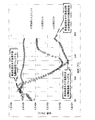
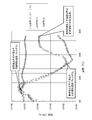
- the first aspect it is a graph which shows the viscosity measurement result of the thermosetting resin used in Examples 1A-3A and Comparative Examples 1A and 2A. It is sectional drawing which shows the fiber-reinforced resin molding prepreg which concerns on 1st Embodiment of 2nd Embodiment, and the heat compression at the time of manufacturing the prepreg. It is sectional drawing which shows the fiber-reinforced resin molding prepreg which concerns on 2nd Embodiment of 2nd Embodiment, and the heat compression at the time of manufacturing the prepreg.
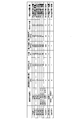
- thermosetting resin used for the fiber reinforced resin molding prepreg of each Example and each comparative example is a table which shows the viscosity measurement result of the thermosetting resin used in the fiber reinforced resin molding prepreg of Examples 1B to 3B and Comparative Examples 1B and 2B.
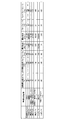
- it is a table which shows the structure, the physical property value, etc.
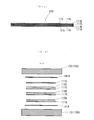
- FIG. 14 is a cross-sectional view of the fiber reinforced molded product according to the third embodiment.
- FIG. 15 is a cross-sectional view showing lamination and heat compression in one embodiment of the method for manufacturing a fiber-reinforced molded product of the present disclosure.
- FIG. 16 is a cross-sectional view showing lamination and heat compression in one embodiment of the method for manufacturing a fiber-reinforced molded product according to a third aspect.
- FIG. 17 is a cross-sectional view showing lamination and heat compression in one embodiment of the method for manufacturing a fiber-reinforced molded product according to a third aspect.
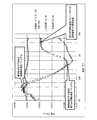
- the third aspect it is a graph which shows the viscosity measurement result of the mixed resin used in Example 1C, 6C-10C and Comparative Examples 1C, 2C.
- It is sectional drawing of the fiber reinforced sandwich composite which concerns on one Embodiment of 4th Embodiment.
- It is sectional drawing which shows the lamination and the heat compression in one Embodiment of the manufacturing method of the fiber reinforced sandwich composite of 4th aspect.
- the fourth aspect is a table showing the material, thickness, etc. of the core material used in each Example and each Comparative Example.
- it is a table which shows the melting start temperature, the curing reaction start temperature, etc. of the thermosetting resin used in each Example and each comparative example.
- the fourth aspect is a table which shows the structure, the physical property value, etc. of each Example and each comparative example.
- it is a graph which shows the viscosity measurement result of the thermosetting resin used in Example 1D, 6D, 7D and Comparative Example 2D, 3D. It is sectional drawing of the fiber reinforced molded article which concerns on 1st Embodiment of 5th Embodiment.
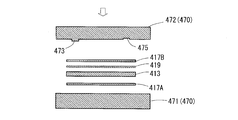
- a fifth aspect is a cross-sectional view showing lamination and heat compression in one embodiment of the method for manufacturing the fiber-reinforced molded product of FIG. 25.
- a fifth aspect is a cross-sectional view showing lamination and heat compression in another embodiment of the method for producing the fiber-reinforced molded product of FIG. 25. It is sectional drawing of the fiber reinforced molded article which concerns on 2nd Embodiment of 5th Embodiment.
- FIG. 28 is a cross-sectional view showing lamination and heat compression in one embodiment of the method for manufacturing a fiber-reinforced molded product of FIG. 28. It is sectional drawing of the fiber reinforced molded article which concerns on 3rd Embodiment of 5th Embodiment.
- a fifth aspect is a cross-sectional view showing lamination and heat compression in one embodiment of the method for manufacturing the fiber-reinforced molded product of FIG. 32.
- a fifth aspect is a cross-sectional view showing lamination and heat compression in another embodiment of the method for producing the fiber-reinforced molded product of FIG. 32.
- the fifth aspect it is a table which shows the kind of the powder-like thermosetting resin used in each Example and each comparative example, a melting start temperature, a curing reaction start temperature and the like.
- the fifth aspect it is a table which shows the structure and the physical property value of each Example and each comparative example.
- 5 is a graph showing the viscosity measurement results of the thermosetting resins used in Examples 1E, 6E to 15E, 20E to 26E and Comparative Examples 1E to 4E with respect to the fifth aspect.
- the fiber base material 11 may be a single layer or a plurality of layers, and the number of layers is determined according to the use of the fiber reinforced resin molded body 10 and the like.
- the fiber substrate 11 is composed of four layers.
- the fiber base material 11 include woven fabrics and non-woven fabrics made of glass fibers, aramid fibers, basalt fibers, carbon fibers and the like, and are not particularly limited, but are preferable because carbon fiber woven fabrics are excellent in light weight and high rigidity. Is.
- the carbon fiber woven fabric preferably has a weave in which the fibers are not only in one direction, and for example, a plain weave composed of warp threads and weft threads, a twill weave, a satin weave, and a triaxial weave composed of three-way threads are preferable. Is. Further, the carbon fiber woven fabric preferably has a fiber weight of 50 to 600 g / m 2 from the viewpoint of impregnation with the thermosetting resin 15 and the rigidity of the fiber reinforced resin molded body 10.
- thermosetting resin 15 a solid powder is used at the time of manufacturing the fiber reinforced resin molded body 10.
- the shape of the powder includes a spherical shape, a needle shape, a flake shape, and the like, and is not particularly limited.
- the thermosetting resin powder is arranged so as to be in contact with the fiber base material 11, and when the fiber base material 11 is heated and compressed together with the thermosetting resin powder, it melts and impregnates the fiber base material 11. Hardens.
- the powder of the thermosetting resin is arranged in contact with the fiber base material 11
- the fiber base material 11 when the fiber base material 11 is a single layer, at least one surface of the upper surface or the lower surface of the single layer fiber base material 11
- the fiber base material 11 when the fiber base material 11 has a plurality of layers, it is arranged on at least one surface, that is, the uppermost surface, the lowermost surface, and the laminated surface (between the fiber base materials) in the plurality of layers.
- the aspect to be done is mentioned.
- the thermosetting resin 15 preferably has a melting start temperature of Ta ° C. and a curing reaction starting temperature of Tb ° C., preferably 30 ⁇ (Tb—Ta) ⁇ 100, and 40 ⁇ (Tb—Ta) ⁇ 70. More preferred.
- Tb-Ta melting start temperature
- the thermosetting resin 15 can be sufficiently impregnated into the fiber base material 11, and the fiber reinforced resin molded body 10 having uniform physical characteristics can be obtained. ..
- the thermosetting resin 15 preferably has a minimum viscosity of 2,000 Pa ⁇ s or less, and more preferably 1,500 Pa ⁇ s or less, at a temperature of the melting start temperature of Ta ° C. or higher. By setting the minimum viscosity in this range, the molten thermosetting resin 15 can be sufficiently impregnated into the fiber base material 11, and the fiber reinforced resin molded body 10 having uniform physical characteristics can be obtained.
- thermosetting resin 15 preferably has a maximum viscosity of 1,000 Pa ⁇ s or more in the temperature range of the curing reaction start temperature Tb ° C. to 190 ° C. By setting the maximum viscosity within this range, the molten thermosetting resin 15 can be impregnated into the fiber base material 11 and fastened, and the fiber reinforced resin molded body 10 has good shapeability and is sufficient in a short time. Strength is obtained.
- the thermosetting resin 15 preferably has a melting start temperature Ta ° C. of 60 to 100 ° C. By setting the melting start temperature Ta ° C. of the thermosetting resin 15 in this range, the laminate in which the powder of the thermosetting resin 15 is arranged in at least one between the fiber substrates 11 is heated and compressed to heat it. When the curable resin 15 is melt-cured, the temperature can be easily adjusted.
- thermosetting resin capable of satisfying the above-mentioned melting start temperature Ta ° C., curing reaction starting temperature Tb ° C., (Tb-Ta) range, minimum viscosity, and maximum viscosity is a phenol resin, a mixture of a phenol resin and an epoxy resin. It is preferably selected from the group of a resin, a mixed resin of a phenol resin and a cyanate resin, and a mixed resin of a phenol resin, a cyanate resin and an epoxy resin. Since the phenol resin has excellent flame retardancy, it is possible to impart excellent strength and flame retardancy to the fiber-reinforced resin molded product 10.
- Various powder additives such as pigments, antibacterial agents, and ultraviolet absorbers may be added to the thermosetting resin 15 as long as the viscosity and reactivity of the thermosetting resin are not affected.
- thermosetting resin powder is arranged so as to be in contact with the fiber base material, and the fiber base material is heated and compressed together with the thermosetting resin powder in a mold. This is done by melting the powder of the thermosetting resin, impregnating it in the fiber base material, and curing it.
- the fiber base material and the thermosetting resin are as described for the fiber reinforced resin molded body 10.
- the thermosetting resin powder is arranged on at least one surface of the upper surface or the lower surface of the fiber base material, and when the fiber base material has a plurality of layers. Is arranged on at least one of the uppermost surface, the lowermost surface, and the laminated surface (between the fiber base materials) in the plurality of layers.
- the thermosetting resin powder is arranged on the laminated surface (between the fiber base materials) of the multi-layer fiber base material, it is not limited to one laminated surface (between one fiber base material), but all.
- thermosetting resin powder when the thermosetting resin powder is placed in contact with the upper surface or the lower surface of the single-layer fiber base material or the uppermost surface or the lowermost surface of the multi-layer fiber base material, the thermosetting resin powder is heat-cured for convenience of work.
- the release paper may be placed between the powder of the sex resin and the mold surface of the mold.
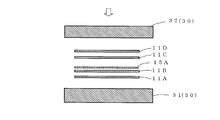
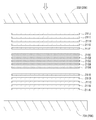
- FIG. 1 An embodiment of a method for manufacturing a fiber-reinforced resin molded body 10 in which the fiber base material 11 shown in FIG. 1 is composed of four layers will be described with reference to FIG.
- a plurality of fibrous base materials 11 are represented by a combination of "11” and “alphabet” such as "11A” in order to make it easier to understand the vertical positional relationship.
- the fiber base material 11 is shown.
- thermosetting resin powder 15A is placed between the fiber base materials (between the fiber base material 11B and the fiber base material 11C).
- the particle size of the thermosetting resin powder 15A is preferably 10 to 500 ⁇ m from the viewpoint of easy melting.
- the amount of the thermosetting resin powder 15A is preferably adjusted so that the VF value (%) of the molded product is 40 to 70%.
- the VF value (%) is a value calculated by (total weight of the fiber base material / density of the fiber) / (volume of the molded product) ⁇ 100.
- the lower mold of the mold 30 in which the laminated body of the fiber base materials 11A to 11D in which the powder 15A of the thermosetting resin is arranged between the fiber base materials 11B and the fiber base material 11C and laminated is heated. It is sandwiched between 31 and the upper mold 32 and heated and compressed.
- the mold 30 is heated to a temperature at which the thermosetting resin powder 15A can be melted and cured by a heating means such as an electric heater to a temperature of Tc ° C.
- the temperature Tc ° C. of the mold 30 is related to the melting start temperature Ta ° C. of the thermosetting resin and the curing reaction start temperature Tb ° C.
- Tb + (Tb-Ta) / 3] -15 ⁇ Tc ⁇ [Tb + (Tb-Ta) / 3] +20. It is more preferable to set [Tb + (Tb-Ta) / 3] -10 ⁇ Tc ⁇ [Tb + (Tb-Ta) / 3] +20.
- Tc ° C. is 140 ° C. to 170 ° C.
- the compressibility (%) of the fiber base materials 11A to 11D is (distance between the mold surface of the lower mold 31 and the mold surface of the upper mold 32) / (total thickness of all layers of the fiber base material) ⁇ 100. It is a calculated value, preferably 60 to 100%.
- thermosetting resin powder 15A between the fiber base materials (between the fiber base materials 11B and the fiber base material 11C) is melted, and the melted thermosetting resin is laminated.
- the lower fiber base materials 11B and 11A and the upper fiber base materials 11C and 11D are impregnated.
- the thermosetting resins impregnated in the fiber base materials 11A to 11D are cured, so that the fiber base materials 11A to 11D are integrated in a compressed state and shaped into the mold surface shapes of the lower mold 31 and the upper mold 32.
- the fiber-reinforced resin molded body 10 of FIG. 1 is obtained.
- FIG. 3 shows an embodiment in which six fiber base materials 11A to 11F are laminated, thermosetting resin powders 15A to 15E are arranged all over between the fiber base materials, and heat and compression is performed by a mold 30. ..
- the amount (total amount) of the thermosetting resin powder 15A, the heating temperature of the mold 30, the pressurization of the laminate, and the like are as described in the embodiment of FIG. ⁇ Example>
- thermosetting resin molded bodies of Examples 1A to 7A and Comparative Examples 1A and 2A were produced using the thermosetting resin shown in FIG. 4 as follows.
- the viscosity of the thermosetting resin was measured under the following conditions using a rheometer: Rheosol-G3000 manufactured by UBM Co., Ltd. 1) 0.4 g of a sample is molded into pellets (diameter ⁇ 18 mm, thickness about 0.4 mm), and the molded pellets are sandwiched between parallel plates having a diameter of ⁇ 18 mm. 2)
- the dynamic viscosity was measured at 2 ° C. intervals between 40 ° C. and 200 ° C. under a heating rate of 5 ° C./min, a frequency of 1 Hz, a rotation angle (strain) of 0.1 deg, and a constant rate of temperature rise.
- Example 1A As a fiber base material, a carbon fiber woven fabric (manufactured by Teijin Limited, product name: W-3101, basis weight: 200 g / m 2 , thickness 0.22 mm) cut into 250 x 200 mm was cut into 4 pieces. I prepared a sheet. The weight of the fiber base material per sheet after cutting was 10 g. Two fiber base materials are laminated, 25 g of resin A1 is arranged substantially uniformly on the powder of the thermosetting resin, and the remaining two fiber base materials are laminated on the resin base material before molding. The body was made.
- Resin A1 is a phenol resin, manufactured by Sumitomo Bakelite Co., Ltd., product name: PR-50252, average particle size 30 ⁇ m, melting start temperature Ta 69 ° C, reaction start temperature Tb 135 ° C, (Tb-Ta) 66 ° C, minimum.
- the viscosity (minimum viscosity at the melting start temperature Ta ° C. or higher) is 59 Pa ⁇ s
- the maximum viscosity maximum viscosity in the temperature range of the curing reaction start temperature Tb ° C to 190 ° C.) is 8,768 Pa ⁇ s, (Tb-Ta).
- the pre-molded laminate is placed on the molding surface (mold surface) of the lower mold of the mold heated to 150 ° C., the upper mold of the mold is placed on the pre-molded laminate, the mold is closed, and the pressure is 5 MPa for 10 minutes. , Heat-compressed at 150 ° C.
- the thermosetting resin powder arranged between the central fiber substrates is melted by heating, and the pre-molded laminate is compressed to impregnate the fiber substrates of each layer, and curing is completed in that state.
- a fiber-reinforced resin molded product of Example 1A was prepared, which consisted of a laminated integrated product obtained by impregnating a four-layer fiber base material with a thermosetting resin and curing it.
- Example 2A Using four fibers of the same fiber base material as in Example 1A and resin A1, 8.3 g of resin A1 (between all base materials) between each fiber base material (between all fiber base materials).
- the fiber-reinforced resin molded body of Example 2A was prepared by heating and compressing under the same conditions as in Example 1A except that the pre-molded laminate was prepared by arranging the total amount of the resin A1 (24.9 g) substantially uniformly. ..
- Example 3A 10 sheets of the same fiber base material as in Example 1A were prepared, 5 pieces of the fiber base material were laminated, 60 g of the resin A was placed on it substantially uniformly, and the resin A was placed on it.
- the fiber-reinforced resin molded body of Example 3A was prepared by heating and compressing under the same conditions as in Example 1A except that the remaining five fiber base materials were laminated to prepare a pre-molded laminate.
- Example 4A A fiber-reinforced resin molded product of Example 4A was prepared in the same manner as in Example 1A except that the resin B1 was used as the thermosetting resin.
- Resin B1 is a phenol resin manufactured by Sumitomo Bakelite Co., Ltd., product name: PR-310, average particle size 30 ⁇ m, melting start temperature Ta is 95 ° C, reaction start temperature Tb is 135 ° C, (Tb-Ta) is 40 ° C, minimum.
- the viscosity minimum viscosity at the melting start temperature Ta ° C. or higher
- the maximum viscosity maximum viscosity in the temperature range of the curing reaction start temperature Tb ° C to 190 ° C.
- the value of Ta) / 3 is 13 ° C.
- the value of Tb + (Tb ⁇ Ta) / 3 is 148 ° C.
- thermosetting resin a resin (25 g) in which 12.5 g of the resin A1 and 12.5 g of the resin C1 were uniformly mixed was used, and the mold temperature was set to 170 ° C.
- the fiber-reinforced resin molded product of Example 5A was produced in the same manner as in 1A.
- the resin C1 an epoxy resin manufactured by Mitsubishi Chemical Corporation, product name: jER-1001 was pulverized in a mortar and used.
- the average particle size is 100 ⁇ m.
- the resin in which 12.5 g of the resin A1 and 12.5 g of the resin C1 are uniformly mixed has a melting start temperature Ta of 73 ° C., a reaction starting temperature Tb of 140 ° C., (Tb-Ta) of 67 ° C., and a minimum viscosity (melting). The minimum viscosity at a start temperature of Ta ° C.
- thermosetting resin a resin (25 g) in which 12.5 g of the resin D1 and 12.5 g of the resin E1 were uniformly mixed was used, and the mold temperature was set to 160 ° C.
- the fiber-reinforced resin molded product of Example 6A was produced in the same manner as in 1A.
- the resin D1 was a phenol resin manufactured by Sumitomo Bakelite Co., Ltd., and was used by pulverizing a product name: PR-50235D in a mortar. The average particle size is 90 ⁇ m.
- the resin E1 was a cyanate resin manufactured by Mitsubishi Gas Chemical Company, Ltd., and was used by crushing a product name: CYTESTER TA in a mortar. The average particle size is 100 ⁇ m.
- the resin in which 12.5 g of the resin D1 and 12.5 g of the resin E1 are uniformly mixed has a melting start temperature Ta of 76 ° C., a reaction starting temperature Tb of 138 ° C., (Tb-Ta) of 62 ° C., and a minimum viscosity (melting).
- the minimum viscosity at a start temperature of Ta ° C. or higher is 475 Pa ⁇ s
- the maximum viscosity maximum viscosity (maximum viscosity in the temperature range of the curing reaction start temperature Tb ° C to 190 ° C.) is 51,895 Pa ⁇ s, (Tb-Ta) / 3.
- the value is 21 ° C.
- the value of Tb + (Tb—Ta) / 3 is 159 ° C.
- Example 7A -Preparation of Example 7A
- a resin (24.9 g) in which 8.3 g of the resin D1, 8.3 g of the resin E1 and 8.3 g of the resin C1 are uniformly mixed was used, and the mold temperature was used.
- the fiber-reinforced resin molded product of Example 7A was produced in the same manner as in Example 1A except that the temperature was set to 170 ° C.
- the resin in which 8.3 g of the resin D1, 8.3 g of the resin E, and 8.3 g of the resin C1 are uniformly mixed has a melting start temperature Ta of 75 ° C., a reaction start temperature Tb of 139 ° C., and (Tb-Ta).
- Comparative Example 1A A fiber-reinforced resin molded product of Comparative Example 1A was prepared in the same manner as in Example 1A except that the resin F1 was used as the thermosetting resin and the mold temperature was set to 100 ° C.
- the resin F1 is a phenol resin, manufactured by Sumitomo Bakelite Co., Ltd., product name: PR-50699, average particle size 30 ⁇ m, melting start temperature Ta is 72 ° C, reaction start temperature Tb is 91 ° C, (Tb-Ta) is 19 ° C, minimum.
- the viscosity (minimum viscosity at the melting start temperature Ta ° C. or higher) is 118,908 Pa ⁇ s
- the maximum viscosity maximum viscosity (maximum viscosity in the temperature range of the curing reaction start temperature Tb ° C to 190 ° C.) is 164,468 Pa ⁇ s, (Tb-).
- Comparative Example 1A the minimum viscosity and the maximum viscosity of the resin F1 used were high, the impregnation property of the resin F1 into the fiber base material (carbon fiber woven fabric) was poor, and a molded product uniformly impregnated with the thermosetting resin was obtained. There wasn't.
- thermosetting resin a resin (24.9 g) in which 8.3 g of resin A1 and 16.6 g of resin D1 were uniformly mixed was used, except that the mold temperature was set to 160 ° C.
- a fiber-reinforced resin molded product of Comparative Example 2A was produced in the same manner as in Example 1A.
- a resin in which 8.3 g of resin A1 and 16.6 g of resin D1 are uniformly mixed has a melting start temperature Ta of 80 ° C., a reaction starting temperature Tb of 140 ° C., (Tb-Ta) of 60 ° C., and a minimum viscosity (melting).
- the minimum viscosity at a start temperature of Ta ° C. or higher is 21 Pa ⁇ s
- the maximum viscosity maximum viscosity in the temperature range of the curing reaction start temperature Tb ° C to 190 ° C
- the value of (Tb-Ta) / 3 is.
- thermosetting resin was not sufficiently cured, and deformation occurred when the molded product was demolded, so that a good molded product could not be obtained.
- the measurement and appearance of the thickness (mm), VF value (%), bending strength (MPa), and bending elastic modulus (GPa) were measured. It was judged. The results are shown in FIG. 5, and will be described below.
- the VF value (%) was calculated by (total weight of fiber base material / density of fiber) / (volume of molded product) ⁇ 100.
- the bending strength (MPa) and the bending elastic modulus (GPa) were measured based on the JIS K7074 A method.
- the appearance was judged by visually checking whether or not there was a defect such as deformation or non-uniform resin impregnation on the surface of the molded product, and if there was no defect, it was marked as " ⁇ ", and if there was a defect, it was marked as " ⁇ ". ..
- Example 1A -Physical properties of Example 1A, etc.
- the number of laminated fiber base materials is 4, the thermosetting resin is resin A1, and the powder of the thermosetting resin is sandwiched between the central fiber base materials. It was manufactured by arranging the body, and the thickness of the molded body was 0.8 mm, the VF value was 58%, the bending strength was 550 MPa, the bending elasticity was 54 GPa, the appearance of the molded body was " ⁇ ", and the strength and rigidity were high. The appearance is good.
- Example 2A -Physical properties of Example 2A, etc.
- the number of laminated fiber base materials is 4, the thermosetting resin is resin A1, and the powder of the thermosetting resin is sandwiched between the fiber base materials.
- the thickness of the molded body is 0.8 mm, the VF value is 58%, the bending strength is 600 MPa, the bending elasticity is 55 GPa, and the appearance of the molded body is " ⁇ ".
- Example 3A Physical properties of Example 3A, etc.
- the number of laminated fiber base materials is 10
- the thermosetting resin is resin A1
- the powder of the thermosetting resin is sandwiched between the central fiber base materials. It was manufactured by arranging the body, and the thickness of the molded body was 2.0 mm, the VF value was 59%, the bending strength was 620 MPa, the bending elasticity was 53 GPa, the appearance of the molded body was " ⁇ ", and the strength and rigidity were high. The appearance is good.
- Example 4A -Physical properties of Example 4A, etc.
- the number of laminated fiber base materials is 4, the thermosetting resin is resin B1, and the powder of the thermosetting resin is sandwiched between the central fiber base materials. It was manufactured by arranging the body, and the thickness of the molded body was 0.8 mm, the VF value was 55%, the bending strength was 450 MPa, the bending elasticity was 45 GPa, the appearance of the molded body was " ⁇ ", and the strength and rigidity were high. The appearance is good.
- the strength and rigidity of Example 4A using the resin B1 were lower than those of the example 1A using the resin A.
- Example 5A Physical properties of Example 5A, etc.
- Example 6A Physical properties of Example 6A, etc.
- Example 7A Physical properties of Example 7A, etc.
- Comparative Example 1A -Physical properties of Comparative Example 1A, etc.
- the number of laminated fiber base materials is 4, the thermosetting resin is resin F1, and the powder of the thermosetting resin is sandwiched between the central fiber base materials.
- the impregnation property of the resin F1 was poor, and a molded body uniformly impregnated with the thermosetting resin could not be obtained. I could't measure it.
- Comparative Example 2A Physical properties of Comparative Example 2A, etc.
- the shape (mold shape) of the fiber reinforced resin molded body is not limited to the flat plate shape, but is a curved surface shape or an uneven shape. It can be any shape.
- Second aspect The second embodiment will be described.
- the fiber base material 111 is heat-compressed together with the thermosetting resin 115, and the fiber base material 111 is heated.
- the curable resin 115 is in a state of being attached.
- the thermosetting resin 115 adhering to the fiber base material 111 is in a solid state before the start of the curing reaction.
- the fiber base material 11 is composed of one layer in the prepreg 110 of the first embodiment, but the prepreg may be composed of a plurality of layers.
- the fiber base material 111 include woven fabrics and non-woven fabrics made of glass fibers, aramid fibers, basalt fibers, carbon fibers and the like, and are not particularly limited, but are preferable because carbon fiber woven fabrics are excellent in light weight and high rigidity.
- the carbon fiber woven fabric preferably has a weave in which the fibers are not only in one direction, and for example, a plain weave composed of warp threads and weft threads, a twill weave, a satin weave, and a triaxial weave composed of three-way threads are preferable.
- the carbon fiber woven fabric preferably has a fiber weight of 50 to 600 g / m 2 from the viewpoint of impregnation with the thermosetting resin 115 and the rigidity of the fiber-reinforced resin molded body.
- thermosetting resin 115 a resin that is in the form of a solid powder before heat compression is used when the prepreg 110 is manufactured.
- the shape of the powder includes a spherical shape, a needle shape, a flake shape, and the like, and is not particularly limited.
- the powder of the thermosetting resin 115 is arranged so as to be in contact with the fiber base material 111, and melts when the fiber base material 111 is heated and compressed together with the powder of the thermosetting resin 115.
- the fiber base material 111 is impregnated and cooled and solidified in a state before the start of the curing reaction.
- the thermosetting resin 115 has a viscosity at a curing reaction start temperature Tb ° C. of 2,000 Pa ⁇ s or less, preferably 1,500 Pa ⁇ s or less. Since the viscosity at the curing reaction start temperature Tb ° C. is 2,000 Pa ⁇ s or less, the thermosetting resin 115 is uniformly impregnated into the fiber base material 111 when the fiber reinforced resin molded product is manufactured using the prepreg 110. A fiber-reinforced resin molded product having good quality can be obtained.
- the thermosetting resin 115 has a maximum viscosity of 1,000 Pa ⁇ s or more in the range of the curing reaction start temperature Tb ° C to 190 ° C. Since the maximum viscosity in the range of the curing reaction start temperature Tb ° C. to 190 ° C. is 1,000 Pa ⁇ s or more, the melted thermosetting resin 115 is used when producing a fiber reinforced resin molded product using the prepreg 110.
- the fiber base material 111 can be impregnated and sufficiently cured, and the fiber-reinforced resin molded product has good shapeability and sufficient strength can be obtained in a short time (about 10 minutes).
- the thermosetting resin 115 preferably has a melting start temperature Ta ° C of 60 to 100 ° C.
- the melting start temperature Ta ° C. is in the above range, the heating temperature at the time of producing the prepreg 110 does not have to be so high, and the production of the prepreg 110 becomes easy.
- the thermosetting resin 115 preferably has a melting start temperature of Ta ° C. and a curing reaction starting temperature of Tb ° C., preferably 30 ⁇ (Tb—Ta) ⁇ 100, and more preferably 40 ⁇ (Tb—Ta) ⁇ 70. preferable.
- Tb-Ta melting start temperature
- the thermosetting resin 115 sufficiently impregnates the fiber base material 111 and has uniform physical properties when the fiber reinforced resin molded body is manufactured using the prepreg 110. A fiber reinforced resin molded body can be obtained.
- the thermosetting resin 115 preferably has a melting start temperature Ta ° C. of Tc ° C. or lower and a curing reaction start temperature Tb ° C. of Tc ° C. or higher with respect to the temperature Tc ° C. at the time of heating and compression at the time of producing the prepreg 110. .. More preferably, Ta ° C. is Tc ° C. ⁇ 5 ° C. or lower, and Tb ° C. is Tc ° C. + 5 ° C. or higher. When Ta ° C. and Tb ° C.
- thermosetting resin 115 can be melted and impregnated into the fiber base material 111 during the production of the prepreg 110, and the thermosetting resin 115 can be impregnated during the production of the prepreg 110. Since the curing reaction is not started, the quality of the prepreg 110 is improved, and the storage stability of the prepreg 110 is improved.
- the particle size of the powder of the thermosetting resin 115 used at the time of producing the prepreg 110 is preferably 10 to 500 ⁇ m from the viewpoint of easy melting.
- the amount of the thermosetting resin 115 used at the time of producing the prepreg is preferably adjusted so that the VF value (%) of the fiber-reinforced resin molded product is 40 to 70%.
- the VF value (%) is a value calculated by (total weight of fiber base material / density of fiber) / (volume of fiber reinforced resin molded product) ⁇ 100.
- thermosetting resin examples include phenol resin, phenol resin and epoxy resin. It is preferable to be selected from the group of the mixed resin of the above, the mixed resin of the phenol resin and the cyanate resin, and the mixed resin of the phenol resin, the cyanate resin and the epoxy resin. Since the phenol resin has excellent flame retardancy, it is possible to impart excellent strength and flame retardancy to the fiber-reinforced resin molded product.
- Various powder additives such as pigments, antibacterial agents, and ultraviolet absorbers may be added to the thermosetting resin 115 as long as the viscosity and reactivity of the thermosetting resin are not affected.
- thermosetting resin 115 powder may be indicated by a code that combines the numbers “115” and “alphabet”, such as “thermosetting resin powder 115A”. be.
- the fiber base material 111 and the thermosetting resin powder 115A arranged in contact with the fiber base material 111 are sandwiched between the mold release plastic films 141A and 141B.
- the prepreg 110 of the first embodiment is produced by sandwiching them between the lower mold 151 and the upper mold 152 of the heated mold 150 and heating and compressing them.
- the thermosetting resin powder 115A is arranged on one or both of the upper and lower surfaces of the fiber base material 111.
- the mold 150 is heated by a heating means such as an electric heater.
- the temperature (mold temperature) Tc ° C. at the time of heating and compressing the prepreg 110 is the melting start temperature Ta ° C. or higher of the thermosetting resin powder 115A (thermosetting resin 115), and the curing reaction start temperature. It is Tb ° C. or lower. More preferably, the temperature (mold temperature) Tc ° C. at the time of heat compression is the melting start temperature Ta ° C. + 5 ° C. or higher of the thermosetting resin 115, and the curing reaction start temperature Tb ° C. ⁇ 5 ° C. or lower.
- the pressurization (compression) by the mold 150 at the time of producing the prepreg is preferably 0.1 to 10 MPa so that the fiber base material 111 can be satisfactorily impregnated after the thermosetting resin powder 115A is melted.
- the compressibility (%) of the fiber base material 111 is (distance between the mold surface of the lower mold 151 and the mold surface of the upper mold 152-the total thickness of the release film) / (thickness of all layers of the fiber base material). It is a value calculated by (total) ⁇ 100, preferably 60 to 100%.
- the thermosetting resin powder 115A is melted by heat compression, impregnated into the fiber base material 111, and cooled and solidified in the state before the start of the curing reaction.
- the method for producing the prepreg is not limited to the method using the above-mentioned mold, and other methods such as a heat roller method in which heat and compression are performed by a heat roller and a double belt method in which heat and compression are performed between the upper and lower belts may be used.
- the fiber base material is indicated by a code that combines the numbers "111" and "alphabet” such as "111A”. In some cases.
- the fiber-reinforced resin molding prepreg 120 of the second embodiment shown in FIG. 8 (2-1) is composed of four layers of fiber base materials 111A, 111B, 111C, 111D and a thermosetting resin 115, and is thermosetting.
- the resin 115 is in a state of being attached to the fiber base materials 111A to 111D.
- the fiber base materials 111A to 111D and the thermosetting resin 115 are as described in the prepreg 110 of the first embodiment.
- thermosetting resin powder 115A is sandwiched between the lower two fiber substrates 111A and 111B and the upper two fiber substrates 111C and 111D.
- the prepreg for fiber reinforced resin molding of the second embodiment is formed by sandwiching the laminate between the plastic films 141A and 141B for mold release, sandwiching them between the lower mold 151 and the upper mold 152 of the heated mold 150, and heating and compressing them. 120 is made.
- the heat compression conditions are as described in the first embodiment.
- the thermosetting resin powder 115A is melted by heat compression, impregnated into the fiber substrates 111A to 111D, and cooled and solidified in the state before the start of the curing reaction.
- the third embodiment will be described.
- the fiber-reinforced resin molding prepreg 130 of the third embodiment shown in FIG. 9 (3-1) has four layers of fiber base materials 111A, 111B, 111C, 111D and a thermosetting resin 115, similarly to the second embodiment. Therefore, the thermosetting resin 115 is in a state of being attached to the fiber base materials 111A to 111D.
- the arrangement of the powder of the thermosetting resin 115 for producing the prepreg 130 is different from that of the second embodiment, as shown below.
- thermosetting resin powders 115A, 115B, 115C are sandwiched between each fiber base material (each layer) of the four fiber base materials 111A to 111D. Is sandwiched between the plastic films 141A and 141B for mold release, and these are sandwiched between the lower mold 151 and the upper mold 152 of the heated mold 150 and heated and compressed to obtain the fiber reinforced resin molding prepreg 130 of the third embodiment.
- the heat compression conditions are as described in the first embodiment.
- the thermosetting resin powders 115A to 115C are melted by heat compression, impregnated into the fiber substrates 111A to 111D, and cooled and solidified in the state before the start of the curing reaction.
- a fiber-reinforced resin molding prepreg in which the fiber base material 111 is composed of a single layer or a plurality of layers is heated and compressed with a shaping mold. This is done by reaction-curing the thermosetting resin 115.
- the shape of the mold surface of the shaping mold is not limited to a flat surface, but may be uneven, curved, or the like depending on the product.
- Pressurization (compression) of the fiber-reinforced resin molding prepreg during heat compression by the shaping die is performed from 2 to 1 so that the fiber base material 111 can be well impregnated after the thermosetting resin 115 is melted. 20 MPa is preferable.
- the compressibility (%) of the fiber-reinforced resin molding prepreg during heat compression by the shaping die is (distance between the mold surface of the lower mold 151 and the mold surface of the upper mold 152) / (thickness of the prepreg). It is a value calculated by ⁇ 100, preferably 60 to 100%.
- thermosetting resin 115 of the prepreg is melted by heating and compressing the fiber-reinforced resin molding prepreg with the shaping mold, and the melted thermosetting resin 115 is reaction-cured to form the lower mold and the upper mold.
- a fiber-reinforced resin molded body shaped into a mold surface shape can be obtained.
- thermosetting resin The prepregs for fiber reinforced resin molding of Examples 1B to 7B and Comparative Examples 1B and 2B were prepared using the powder of the thermosetting resin shown in FIG. 10, and the fiber reinforced resin molded body was prepared using the prepreg immediately after the production. did.
- the viscosity of the thermosetting resin was measured under the following conditions using a rheometer: Rheosol-G3000 manufactured by UBM Co., Ltd. 1) 0.4 g of a sample is molded into pellets (diameter ⁇ 18 mm, thickness about 0.4 mm), and the molded pellets are sandwiched between parallel plates having a diameter of ⁇ 18 mm. 2)
- the dynamic viscosity was measured at 2 ° C. intervals between 40 ° C. and 200 ° C. under a heating rate of 5 ° C./min, a frequency of 1 Hz, a rotation angle (strain) of 0.1 deg, and a constant rate of temperature rise.
- Example 1 is an example of one prepreg fiber base material (one layer).
- the fiber base material a carbon fiber woven fabric (manufactured by Teijin Limited, product name: W-3101, basis weight: 200 g / m 2 , thickness 0.22 mm) cut into 250 ⁇ 200 mm was prepared. The weight of the fiber base material per sheet after cutting was 10 g.
- the prepared fiber base material is placed on a PET film (plastic film for mold release) that has undergone mold release treatment (a mold release agent is applied), and the following resin is used as a powder of a thermosetting resin on the fiber base material.
- 7 g of A2 was arranged substantially uniformly, and a PET film released from the mold was placed on the PET film to prepare a laminate before prepreg molding.
- the resin A2 is a phenol resin, manufactured by Sumitomo Bakelite Co., Ltd., product name: PR-50252, and an average particle size of 30 ⁇ m.
- the viscosity measurement results of the resin A2 (Examples 1B, 2B, 3B) are shown in the graph of FIG.
- the pre-preg pre-molded laminate is placed on the molding surface (mold surface) of the lower mold of the mold heated to 100 ° C., the upper mold is placed on the pre-preg pre-molded laminate, the mold is closed, and the mold is closed for 5 minutes. It was heated and compressed at a pressure of 0.1 MPa. As a result, the powder of the resin A2 on the fiber base material is melted and impregnated into the fiber base material by melting, then the mold is opened, the laminate is taken out together with the PET film, naturally cooled to room temperature, and then the PET film is removed. , The prepreg of Example 1B was obtained.
- Example 2B is an example of four prepreg fiber base materials (four layers).
- Example 2B is the same as in Example 1B except that four fiber base materials and resin A2 similar to those in Example 1B are used and 28 g of resin A2 is arranged substantially uniformly between the four fiber base materials. Prepreg was prepared.
- Example 2B -Making a fiber-reinforced molded body
- the prepreg of Example 2B is placed on the molding surface (mold surface) of the lower mold of the mold preheated to 150 ° C., and the upper mold of the mold is put on the laminated body to form the mold. It was closed and heated and compressed at a pressure of 5 MPa for 10 minutes to react and cure the resin A2, then the mold was opened and the reinforced resin molded product of Example 2B was taken out.
- Example 3B ⁇ Example 3B> -Preparation of prepreg As shown in (3-1) and (3-2) of FIG. 9, in Example 3B, the resin A2 is arranged between each layer of four prepreg fiber base materials (four layers). This is an example of producing a prepreg.
- a prepreg of Example 3B was prepared in the same manner as in Example 1B, except that 9.3 g of the resin A2 was arranged substantially uniformly between the layers of the four fiber substrates similar to Example 1B.
- Example 3B -Making a fiber-reinforced molded body
- the prepreg of Example 3B is placed on the molding surface (mold surface) of the lower mold of the mold preheated to 150 ° C., and the upper mold of the mold is put on the laminated body to form the mold. It was closed and heated and compressed at a pressure of 5 MPa for 10 minutes to react and cure the resin A2, then the mold was opened and the reinforced resin molded product of Example 3B was taken out.
- Example 4B is an example in which the fiber base material of the prepreg is one sheet, and the same as in Example 1B except that the following resin B2 is used as the powder of the thermosetting resin.
- a prepreg was prepared.
- the resin B2 is a phenol resin, manufactured by Sumitomo Bakelite Co., Ltd., product name: PR-310, and has an average particle size of 30 ⁇ m.
- Example 4B a fiber-reinforced resin molded body of Example 4B was prepared in the same manner as in Example 1B.
- Example 5B is an example in which the fiber base material of the prepreg is one sheet, and a resin in which the resin A2 and the following resin C2 are uniformly mixed as a powder of a thermosetting resin at a weight ratio of 1: 1.
- a prepreg of Example 5B was prepared in the same manner as in Example 1B except that 7 g of the prepreg was used.
- the resin C2 an epoxy resin manufactured by Mitsubishi Chemical Corporation, product name: jER-1001, was pulverized in a mortar and used. The average particle size is 100 ⁇ m.
- Example 5B Preparation of fiber-reinforced resin molded body A fiber-reinforced resin molded body of Example 5B was produced in the same manner as in Example 1B except that four prepregs of Example 5B were used and the temperature of the mold was set to 170 ° C.
- Example 6B is an example in which the fiber base material of the prepreg is one sheet, and the following resin D2 and the following resin E2 are uniformly mixed as a powder of a thermosetting resin at a weight ratio of 1: 1.
- a prepreg of Example 6B was prepared in the same manner as in Example 1B except that 7 g of the resin was used.
- the resin D2 was a phenol resin manufactured by Sumitomo Bakelite Co., Ltd., and was used by pulverizing a product name: PR-50235D in a mortar. The average particle size is 90 ⁇ m.
- the resin E2 was a cyanate resin manufactured by Mitsubishi Gas Chemical Company, Ltd., and was used by crushing a product name: CYTESTER TA in a mortar. The average particle size is 100 ⁇ m.
- Example 6B Preparation of fiber-reinforced resin molded body A fiber-reinforced resin molded body of Example 6B was produced in the same manner as in Example 1B except that the temperature of the mold was set to 160 ° C. using four prepregs of Example 6B.
- Example 7B ⁇ Example 7B> -Preparation of prepreg
- the fiber base material of the prepreg is one sheet, and the resin D2, the resin E2, and the resin C2 are uniformly mixed as a powder of the thermosetting resin in a weight ratio of 1: 1: 1.
- a prepreg of Example 7B was prepared in the same manner as in Example 1B except that 7 g of the mixed resin was used.
- Comparative Example 1B is a fiber-reinforced resin molded product in which the minimum viscosity and the maximum viscosity of the resin F2 used are high, the impregnation property of the resin F2 into the fiber base material (carbon fiber woven fabric) is poor, and the thermosetting resin is uniformly impregnated. Was not obtained.
- Comparative Example 2B a fiber-reinforced resin molded body of Comparative Example 2B was prepared in the same manner as in Example 1B.
- the resin used was not sufficiently cured, and deformation occurred when the fiber-reinforced resin molded product was demolded, so that a good molded product could not be obtained.
- the thickness (mm), VF value (%), bending strength (MPa), and flexural modulus (GPa) of the fiber-reinforced resin molded bodies of Examples 1B to 7B and Comparative Examples 1B and 2B were measured and the appearance was judged. The results are shown in FIG. 12, which will be described below.
- the bending strength (MPa) and the bending elastic modulus (GPa) were measured based on the JIS K7074 A method. The appearance was judged by visually checking whether or not there was a defect such as deformation or non-uniform resin impregnation on the surface of the molded product, and if there was no defect, it was marked as " ⁇ ", and if there was a defect, it was marked as " ⁇ ". ..
- the fiber-reinforced resin molded product of Example 1B was produced by using the thermosetting resin powder as resin A2 and the fiber base material as one sheet. It is made by stacking four prepregs.
- the fiber-reinforced resin molded body of Example 1B has a thickness of 0.8 mm, a VF value of 58%, a bending strength of 610 MPa, a flexural modulus of 52 GPa, and an appearance of the molded body of “ ⁇ ”, and has strength and rigidity (bending elastic modulus). ) Is high and the appearance is good.
- the fiber-reinforced resin molded product of Example 2B was produced from the prepreg of Example 2B produced by arranging the resin A2 in the middle of the four fiber substrates. It is a thing.
- the fiber-reinforced resin molded product of Example 2B has a thickness of 0.8 mm, a VF value of 58%, a bending strength of 600 MPa, a flexural modulus of 53 GPa, and an appearance of the molded body of “ ⁇ ”, and has high strength and rigidity, and an appearance. Is a good one.
- the fiber-reinforced resin molded product of Example 3B was produced from the prepreg of Example 3B produced by arranging the resin A2 between the layers of each of the four fiber substrates. It was done.
- the fiber-reinforced resin molded product of Example 3B has a thickness of 0.8 mm, a VF value of 58%, a bending strength of 620 MPa, a flexural modulus of 53 GPa, and an appearance of the molded product “ ⁇ ”, and has high strength and rigidity, and an appearance. Is a good one.
- the fiber-reinforced resin molded product of Example 4B was produced by using the thermosetting resin powder as resin B2 and the fiber base material as one sheet. It is made by stacking four prepregs.
- the fiber-reinforced resin molded product of Example 4B has a thickness of 0.8 mm, a VF value of 55%, a bending strength of 460 MPa, a flexural modulus of 46 GPa, and an appearance of the molded product “ ⁇ ”, and has high strength and rigidity, and an appearance. Is a good one.
- Example 4B using the resin B2 had lower strength and rigidity than Example 1B using the resin A2.
- the fiber base material is one sheet. It was produced by laminating four prepared prepregs of Example 5B.
- the fiber-reinforced resin molded product of Example 5B has a thickness of 0.8 mm, a VF value of 57%, a bending strength of 980 MPa, a flexural modulus of 60 GPa, and an appearance of the molded product “ ⁇ ”, and has high strength and rigidity, and an appearance. Is a good one.
- the fiber base material is one sheet. It was produced by laminating four prepared prepregs of Example 6B.
- the fiber-reinforced resin molded product of Example 6B has a thickness of 0.8 mm, a VF value of 59%, a bending strength of 910 MPa, a flexural modulus of 61 GPa, and an appearance of the molded product “ ⁇ ”, and has high strength and rigidity, and an appearance. Is a good one.
- the fiber-reinforced resin molded product of Example 7B has a thickness of 0.8 mm, a VF value of 58%, a bending strength of 930 MPa, a flexural modulus of 59 GPa, and an appearance of the molded body of “ ⁇ ”, and has high strength and rigidity, and an appearance. Is a good one.
- the fiber-reinforced resin molded body of Comparative Example 1B was produced by using the thermosetting resin powder as resin F2 and the fiber base material as one sheet. Although it was produced by laminating four prepregs, the impregnation property of the resin F2 was poor, and a molded product uniformly impregnated with the thermosetting resin could not be obtained. Therefore, the thickness, VF value, bending strength, and bending elasticity were not obtained. The rate could not be measured.
- the appearance of the molded body was judged, the bending strength and the flexural modulus were measured, and the result when the fiber-reinforced resin molded body was produced using the prepreg immediately after the production of the prepreg (FIG. 12).
- the result shown in (1) was compared.
- the results of storage stability of the prepreg are shown in FIG.
- the bending strength retention rate in FIG. 13 is a ratio (%) to the value of the bending strength (value of the bending strength shown in FIG. 12) of the fiber-reinforced resin molded body produced by using the prepreg immediately after the production.
- the flexural modulus retention rate is a ratio (%) to the value of the flexural modulus (value of the flexural modulus shown in FIG. 12) of the fiber-reinforced resin molded body produced by using the prepreg immediately after the production.
- Example 1B (resin A2)
- the fiber-reinforced resin molded body of Example 1B produced 90 days after the production of the prepreg of Example 1B using the resin A2 has a molded body appearance " ⁇ ", a bending strength of 570 MPa, a flexural modulus of 48 GPa, and a bending strength retention.
- the modulus was 93% and the flexural modulus retention rate was 92%, and the deterioration of the physical properties of the fiber-reinforced resin molded body due to the storage of the prepreg was small.
- Example 4B (resin B2)
- the fiber-reinforced resin molded body of Example 4B produced 90 days after the preparation of the prepreg of Example 4B using the resin B2 has a molded body appearance " ⁇ ", a bending strength of 420 MPa, a flexural modulus of 42 GPa, and a bending strength retention.
- the rate was 91% and the flexural modulus retention rate was 91%, and the deterioration of the physical properties of the fiber-reinforced resin molded body due to the storage of the prepreg was small.
- the flexural modulus was 910 MPa
- the flexural modulus was 56 GPa
- the flexural modulus retention rate was 93%
- the flexural modulus retention rate was 93%.
- the flexural modulus was 880 MPa
- the flexural modulus was 60 GPa
- the flexural modulus retention rate was 97%
- the flexural modulus retention rate was 98%.
- ⁇ bending strength 880 MPa, bending elasticity 56 GPa, bending strength retention rate 95%, bending elasticity retention rate 95%, and there was little deterioration in the physical properties of the fiber-reinforced resin molded body due to storage of the prepreg.
- the shape (mold shape) of the fiber reinforced resin molded body is not limited to the flat plate shape, but is a curved surface shape or an uneven shape. It can be any shape. Further, this embodiment is not limited to the above embodiment, and can be changed without departing from the spirit.
- the fiber base material 211 is integrated with the thermosetting resin of the resin sheet 215 containing the thermosetting resin.
- the thermosetting resin has a viscosity at the curing reaction start temperature Tb ° C. of 2,000 Pa ⁇ s or less, and a maximum viscosity in the range of the curing reaction start temperature Tb ° C. to 190 ° C. of 1,000 Pa ⁇ s or more.
- the fiber base material 211 may be a single layer or a plurality of layers, and the number of layers is determined according to the use of the fiber reinforced molded product 210 and the like. In the embodiments shown in FIGS. 14 and 15, the fiber base material 211 is exemplified to have four layers.
- Examples of the fiber base material 211 include woven fabrics and non-woven fabrics made of glass fibers, aramid fibers, basalt fibers, carbon fibers and the like, and are not particularly limited, but are preferable because carbon fiber woven fabrics are excellent in light weight and high rigidity. Is.
- the carbon fiber woven fabric preferably has a weave in which the fibers are not only in one direction, and for example, a plain weave composed of warp threads and weft threads, a twill weave, a satin weave, and a triaxial weave composed of three-way threads are preferable. Is. Further, the carbon fiber woven fabric preferably has a fiber weight of 50 to 600 g / m 2 from the viewpoint of impregnation of the thermosetting resin contained in the resin sheet 215 and the rigidity of the fiber reinforced molded body 210.
- thermosetting resin one that is solid at room temperature (5 ° C. to 35 ° C.) is used at the time of manufacturing the fiber reinforced molded product 210.
- the solid shape is not particularly limited. Examples of the solid shape include powders such as spherical, needle-shaped, and flake-shaped.
- the resin sheet 215 preferably includes a sheet base material. Since the resin sheet 215 is provided with the sheet base material, the strength of the resin sheet 215 is increased, so that the handleability of the resin sheet 215 is improved. Even when the resin sheet 215 does not have a sheet base material, the handleability is better than when a powdered resin is used.
- the structure of the sheet base material is not particularly limited.
- the sheet base material preferably has a structure in which the molten resin can penetrate.
- the structure through which the molten resin can penetrate is not particularly limited, and examples thereof include a structure having communication holes. Further, it is preferable that the sheet base material does not melt at the reaction start temperature (Tb) of the thermosetting resin.
- the sheet base material is preferably one or more selected from the group consisting of foam, non-woven fabric, and fiber sheet. When the sheet base material has these structures, the thermosetting resin can be sufficiently held in the space inside the sheet base material.
- the material of the sheet base material is not particularly limited.
- the material of the sheet base material is preferably one or more selected from the group consisting of urethane, rayon, polyester, and carbon.
- the sheet base material is preferably one or more selected from the group consisting of urethane foam, rayon and polyester (PET) non-woven fabric, PET non-woven fabric, and carbon fiber sheet.
- PET rayon and polyester
- the thickness of the resin sheet base material is not particularly limited.
- the thickness of the resin sheet base material is preferably 0.05 mm or more and 1.0 mm or less, and more preferably 0.08 mm or more and 0.7 mm or less, from the viewpoint of sufficiently retaining the thermosetting resin required for adhesion.
- the basis weight of the resin sheet base material is not particularly limited.
- the basis weight of the resin sheet base material is preferably 20 g / m 2 or more and 50 g / m 2 or less, and more preferably 30 g / m 2 or more and 45 g / m 2 or less.
- the resin sheet 215 is arranged so as to be in contact with the fiber base material 211.
- the thermosetting resin contained in the resin sheet 215 melts and impregnates the fiber base material 211 to cure.
- the resin sheet 215 is arranged in contact with the fiber base material 211, when the fiber base material 211 is a single layer, the resin sheet 215 is at least one surface of the upper surface or the lower surface of the single layer fiber base material 211. Is placed in.
- the resin sheet 215 is arranged on at least one surface, that is, at least one of the uppermost surface, the lowest surface, and the laminated surface (between the fiber base materials) in the plurality of layers. Aspects to be taken are mentioned.
- thermosetting resin preferably satisfies 30 ⁇ (Tb-Ta) ⁇ 100 when the melting start temperature Ta ° C. and the curing reaction start temperature Tb ° C. are set.
- (Tb-Ta) in this range, the molten thermosetting resin can be sufficiently impregnated into the fiber base material 211, and the fiber reinforced molded product 210 having uniform physical properties can be obtained.
- the thermosetting resin has a minimum viscosity of 2,000 Pa ⁇ s or less at a temperature of the melting start temperature Ta ° C. or higher. This minimum viscosity is preferably 1,500 Pa ⁇ s or less. By setting the minimum viscosity in this range, the molten thermosetting resin can be sufficiently impregnated into the fiber base material 211, and the fiber reinforced molded body 210 having uniform physical properties can be obtained.
- the lower limit of the minimum viscosity is not particularly limited. The lower limit of the minimum viscosity is preferably 0.005 Pa ⁇ s.
- the minimum viscosity at the melting start temperature Ta ° C. or higher is the same as the viscosity at the curing reaction start temperature Tb ° C.
- thermosetting resin preferably has a maximum viscosity of 1,000 Pa ⁇ s or more in the temperature range of the curing reaction start temperature Tb ° C. to 190 ° C. By setting the maximum viscosity within this range, the molten thermosetting resin can be impregnated into the fiber base material 211 and fastened, and the fiber-reinforced molded body 210 has good shapeability and sufficient strength in a short time. can get.
- the upper limit of the maximum viscosity is not particularly limited, but the upper limit is preferably 300,000 Pa ⁇ s.
- the thermosetting resin preferably has a melting start temperature Ta ° C of 60 to 100 ° C. By setting the melting start temperature Ta ° C. of the thermosetting resin in this range, the laminate in which the resin sheet 215 is arranged at least one between the fiber base materials 211 is heated and compressed to melt and cure the thermosetting resin. The temperature can be easily adjusted when the temperature is adjusted.
- thermosetting resin capable of satisfying the above-mentioned melting start temperature Ta ° C., curing reaction starting temperature Tb ° C., (Tb-Ta) range, minimum viscosity, and maximum viscosity is a phenol resin or a mixed resin of a phenol resin and an epoxy resin.
- a resin selected from the group consisting of a mixed resin of a phenol resin and a cyanate resin, a mixed resin of an epoxy resin and a cyanate resin, and a mixed resin of a phenol resin, an epoxy resin and a cyanate resin is preferable. Since the phenol resin has excellent flame retardancy, it is possible to impart excellent strength and flame retardancy to the fiber-reinforced molded product 210.
- phenol resin for example, a novolak type powdered phenol resin is preferably used.
- the physical characteristics of the phenolic resin are not particularly limited.
- a phenol resin having the following physical characteristics is preferably adopted.
- -Melting point 80 ° C or higher and 100 ° C or lower
- the epoxy resin for example, a bisphenol A type solid resin is preferably used.
- the physical characteristics of the epoxy resin are not particularly limited.
- an epoxy resin having the following physical characteristics is preferably adopted.
- the cyanate resin is a thermosetting resin having a cyanate group, and is also called a cyanate monomer.
- the physical characteristics of the cyanate resin before curing are not particularly limited. For example, cyanate resins having the following physical characteristics are preferably used.
- thermosetting resin -Melting point: 75 ° C or higher and 85 ° C or lower-Viscosity: 0.010 Pa-s or higher and 0.015 Pa-s or lower (80 ° C)
- powder additives such as pigments, antibacterial agents, and ultraviolet absorbers may be added to the thermosetting resin as long as the viscosity and reactivity of the thermosetting resin are not affected.
- the basis weight of the thermosetting resin in the resin sheet 215 is not particularly limited.
- the basis weight of the thermosetting resin is preferably 200 g / m 2 or more and 800 g / m 2 or less, and 400 g / m 2 or more and 600 g / g / m from the viewpoint of ensuring the strength of the fiber-reinforced molded product 210 and not impairing the appearance. More preferably, m 2 or less.
- the flexural modulus of the fiber reinforced plastic 210 (JIS K7074 A method) is not particularly limited.
- the flexural modulus of the fiber-reinforced molded product 210 is preferably 40 GPa or more, more preferably 50 GPa or more, from the viewpoint of high rigidity.
- the bending strength of the fiber-reinforced molded product 210 (JIS K7074 A method) is not particularly limited.
- the bending strength of the fiber-reinforced molded product 210 is preferably 400 MPa or more, more preferably 800 MPa or more, from the viewpoint of high strength.
- the specific gravity of the fiber-reinforced molded product 210 is not particularly limited.
- the specific gravity of the fiber-reinforced molded product 210 is preferably 1.10 or more and 1.80 or less, and more preferably 1.30 or more and 1.69 or less, from the viewpoint of weight reduction and not impairing the appearance.
- a fiber base material 211 and a resin sheet 215 are stacked and heat-compressed by a mold to form a thermosetting resin as a fiber base. This is done by impregnating the material 211 and curing it.
- the description in "1. Fiber Reinforced Mold 210" is referred to as it is.
- the resin sheet 215 is arranged on at least one surface of the upper surface or the lower surface of the fiber base material 211 in the case of a single layer, and is arranged on at least one surface of the fiber base material 211 in the case of a plurality of layers. It is arranged on at least one of the uppermost surface, the lowermost surface, and the laminated surface (between the fiber base materials 211) in the plurality of layers.
- the resin sheet 215 is arranged on the laminated surface (between the fiber base materials 211) of the multi-layered fiber base material 211, it is not limited to one laminated surface (between one fiber base material 211) and all the laminated surfaces.
- the resin sheet 215 when the resin sheet 215 is arranged in contact with the upper surface or the lower surface of the single-layer fiber base material 211 or the uppermost surface or the lowermost surface of the multi-layer fiber base material 211, the resin sheet 215 and the resin sheet 215 are arranged for convenience of work.
- a mold release sheet may be placed between the mold surface and the mold surface.
- FIG. 14 An embodiment of a method for manufacturing a fiber-reinforced molded body 210 in which the fiber base material 211 shown in FIG. 14 is composed of four layers will be described with reference to FIG.
- a plurality of reference numerals such as "211A” and the like, which are a combination of "211” and "alphabet" are used.
- the fiber base material 211 is shown.
- the plurality of resin sheets 215 in order to make it easier to grasp the vertical positional relationship, the plurality of resin sheets 215 are indicated by a reference numeral combining "215" and "alphabet" such as "215A".
- the lower two fiber base materials 211A and 211B and the upper two fiber base materials 211C and 211D are used.
- the resin sheets 215A and 215B are arranged between the fiber base materials 211 (between the fiber base materials 211B and the fiber base materials 211C).
- the amount of the thermosetting resin contained in the resin sheets 215A and 215B is preferably adjusted so that the VF value (%) of the fiber-reinforced molded product 210 is 40 to 70%.
- the VF value (%) is a value calculated by (total weight of the fiber base material / density of the fiber) / (volume of the fiber reinforced molded product) ⁇ 100.
- the laminated body of the fiber base materials 211A to 211D in which the resin sheets 215A and 215B are arranged and laminated between the fiber base materials 211 of the fiber base material 211B and the fiber base material 211C is combined with the lower mold 231 of the heated mold 230. It is sandwiched between the upper mold 232 and heated and compressed.
- the mold 230 is heated to a temperature at which the thermosetting resin can be melted and cured by a heating means such as an electric heater to Tc ° C.
- the temperature Tc ° C. (temperature Tc ° C. of the mold 30) at the time of heat compression is related to the melting start temperature Ta ° C. of the thermosetting resin and the curing reaction start temperature Tb ° C.
- Tc ° C. is 135 ° C. to 170 ° C.
- the pressurization (compression) of the fiber base materials 211A to 211D during heating and compression by the mold 230 is performed after the thermosetting resins contained in the resin sheets 215A and 215B between the fiber base materials 211 are melted and then the fiber base materials 211A to 211D.
- 2 MPa to 20 MPa is preferable so that 211D can be well impregnated.
- the compressibility (%) of the fiber base materials 211A to 211D is (distance between the mold surface of the lower mold 231 and the mold surface of the upper mold 232) / (total thickness of all layers of the fiber base material) ⁇ 100. It is a calculated value, preferably 60 to 100%.
- thermosetting resins contained in the resin sheets 215A and 215B between the fiber base materials 211 are melted, and the melted heat is also melted.
- the curable resin impregnates the lower fiber substrates 211B and 211A and the upper fiber substrates 211C and 211D by compressing the laminate.
- the thermosetting resins impregnated in the fiber bases 211A to 211D are cured, so that the fiber bases 211A to 211D are integrated in a compressed state and shaped into the mold surface shapes of the lower mold 231 and the upper mold 232.
- the fiber-reinforced molded product 210 of FIG. 14 is obtained.
- FIG. 16 shows an embodiment in which four fiber base materials 211A to 211D are laminated, resin sheets 215A to 215C are arranged all over between the fiber base materials, and heat compression is performed by a mold 230.
- the amount (total amount) of the thermosetting resin, the heating temperature of the mold 230, the pressurization of the laminate, and the like are as described in the embodiment of FIG.
- the resin sheet 215 for manufacturing the fiber-reinforced molded product 210 contains a thermosetting resin. That is, the resin sheet 215 supports the thermosetting resin in an uncured state.
- the description in "1. Fiber reinforced molded body 210" is quoted as it is.
- thermosetting resins shown in Tables 1 and 2 were prepared as follows.
- Table 4 summarizes the characteristics of various sheet base materials used for producing the fiber-reinforced molded product.
- the viscosity of the thermosetting resin was measured under the following conditions using a rheometer: Rheosol-G3000 manufactured by UBM Co., Ltd. 1) 0.4 g of a sample is molded into pellets (diameter ⁇ 18 mm, thickness about 0.4 mm), and the molded pellets are sandwiched between parallel plates having a diameter of ⁇ 18 mm. 2)
- the dynamic viscosity was measured at 2 ° C. intervals between 40 ° C. and 200 ° C. under a heating rate of 5 ° C./min, a frequency of 1 Hz, a rotation angle (strain) of 0.1 deg, and a constant rate of temperature rise.
- Example 1C As solid thermosetting resins, cyanate resin (manufactured by Mitsubishi Gas Chemical Co., Ltd., product name: CYTESTER TA, average particle size: 100 ⁇ m) and epoxy resin (manufactured by DIC Corporation, product name: AM-020-P, average particle size: 100 ⁇ m). ) And a phenol resin (manufactured by Sumitomo Bakelite Corporation, product name; PR-50235D, average particle size: 90 ⁇ m) were uniformly mixed at a weight ratio of 3: 1: 1. The characteristics of the mixed resin of Example 1C are as follows and are shown in Tables 1 and 2.
- the viscosity measurement result of the mixed resin of Example 1C is shown in the graph of FIG. -Melting start temperature Ta: 69 ° C -Reaction start temperature Tb: 135 ° C. -(Tb-Ta): 66 ° C. -Minimum viscosity (minimum viscosity at melting start temperature Ta ° C or higher): 59 Pa ⁇ s -Maximum viscosity (maximum viscosity in the temperature range of curing reaction start temperature Tb ° C to 190 ° C): 8,768 Pa ⁇ s -Value of (Tb-Ta) / 3: 22 ° C.
- the PET non-woven fabric shown in Table 4 manufactured by Japan Vilene Co., Ltd., product name: JH-1004N1, basis weight: 45 g / m 2 , thickness 0.08 mm
- board. 20 g of the above solid thermosetting resin was placed on one sheet base material to prepare a pre-molded sheet base material.
- one sheet base material before molding is placed on the molding surface of the lower mold of the mold heated to 100 ° C., and then the mold is closed and heated and compressed at a pressure of 1 MPa for 1 minute to form the sheet base material.
- the solid thermosetting resin was melted and supported. Then, by cooling, a resin sheet was produced. Two resin sheets thus produced were prepared. The thickness of the resin sheet was adjusted by interposing a SUS spacer having a thickness of 1 mm between the lower mold and the upper mold, and a PET film having a thickness of 0.05 mm above and below the base material of the sheet before molding.
- As the fiber base material for reinforcement four carbon fiber woven fabrics (manufactured by Teijin Limited, product name: W-3101, basis weight: 200 g / m 2 , thickness 0.22 mm) cut into 200 mm ⁇ 250 mm were prepared. The weight per piece of the carbon fiber woven fabric after cutting was 12 g.
- FIG. 15 schematically shows the state of stacking.
- Example 1C as shown in FIG. 15, two resin sheets are arranged between the central fiber base materials (carbon fiber woven fabric) to form a pre-molded laminate.
- the pre-molding laminate is placed on the molding surface of the lower mold of the mold heated to 160 ° C., and then the mold is closed and heated and compressed at a pressure of 10 MPa for 10 minutes to obtain a solid thermosetting resin. It was melt-cured.
- thermosetting resin When the solid thermosetting resin is melted and pressure is applied, the fiber base material of each layer is impregnated with the resin, and then the thermosetting of the solid thermosetting resin is completed.
- a fiber-reinforced molded product in which a fiber base material was integrated was produced.
- the thickness of the fiber-reinforced molded product was adjusted by interposing a SUS spacer having a thickness of 1 mm between the lower mold and the upper mold for press molding and adjusting the distance between the lower mold and the upper mold.
- Example 2C As solid thermosetting resins, cyanate resin (manufactured by Mitsubishi Gas Chemical Co., Ltd., product name: CYTESTER TA, average particle size: 100 ⁇ m) and epoxy resin (manufactured by DIC Corporation, product name: AM-030-P, average particle size: 100 ⁇ m). ) And phenol resin (manufactured by Sumitomo Bakelite Co., Ltd., product name; PR-50235D, average particle size: 90 ⁇ m) using a mixed resin uniformly mixed at a weight ratio of 1: 1: 1 during fiber reinforced plastic molding. A fiber-reinforced molded body was produced in the same manner as in Example 1C except that the mold temperature was set to 150 ° C.
- the characteristics of the mixed resin of Example 2C are as follows and are shown in Tables 1 and 2.
- -Melting start temperature Ta 95 ° C.
- -Reaction start temperature Tb 135 ° C.
- -(Tb-Ta) 40 ° C.
- -Minimum viscosity minimum viscosity at melting start temperature Ta ° C or higher
- Maximum viscosity maximum viscosity (maximum viscosity in the temperature range of curing reaction start temperature Tb ° C to 190 ° C): 209,004 Pa ⁇ s -Value of (Tb-Ta) / 3: 13 ° C.
- Example 3C As solid thermosetting resins, phenol resin (manufactured by Sumitomo Bakelite Co., Ltd., product name: PR-50252, average particle size: 30 ⁇ m) and epoxy resin (manufactured by Mitsubishi Chemical Co., Ltd., product name: jER-1001, average particle size: 100 ⁇ m).
- a fiber-reinforced molded product was produced in the same manner as in Example 1C, except that a mixed resin in which the above was uniformly mixed at a weight ratio of 1: 1 was used and the mold temperature at the time of molding the fiber-reinforced molded product was set to 150 ° C. ..
- the characteristics of the mixed resin of Example 3C are as follows and are shown in Tables 1 and 2.
- Example 4C As solid thermosetting resins, phenol resin (manufactured by Sumitomo Bakelite Co., Ltd., product name; PR-50235D, average particle size: 90 ⁇ m) and cyanate resin (manufactured by Mitsubishi Gas Chemicals Co., Ltd., product name: CYTESTER TA, average particle size: 100 ⁇ m).
- a fiber-reinforced molded product was produced in the same manner as in Example 1C, except that a mixed resin in which the above was uniformly mixed at a weight ratio of 1: 1 was used and the mold temperature at the time of molding the fiber-reinforced molded product was set to 170 ° C. ..
- Example 5C Epoxy resin (manufactured by Mitsubishi Chemical Co., Ltd., product name: jER-1001, average particle size: 100 ⁇ m) and cyanate resin (manufactured by Mitsubishi Gas Chemical Co., Ltd., product name: CYTESTER TA, average particle size: 100 ⁇ m) as solid thermosetting resins.
- a fiber-reinforced molded product was produced in the same manner as in Example 1C, except that a mixed resin in which and was uniformly mixed at a weight ratio of 1: 1 was used and the mold temperature at the time of molding the fiber-reinforced molded product was set to 170 ° C. did.
- the characteristics of the mixed resin of Example 5C are as follows and are shown in Tables 1 and 2.
- Example 6C Four reinforcing fiber substrates similar to Example 1C and three resin sheets similar to Example 1C were prepared, and as shown in FIG. 16, one resin sheet was provided between the layers of each fiber substrate. A fiber-reinforced molded product was produced in the same manner as in Example 1C except that it was arranged.
- Example 7C Ten fiber base materials for reinforcement similar to those in Example 1C were prepared, five fiber base materials were laminated, five resin sheets were placed on the fiber base material, and the remaining five fibers were placed on the resin sheet. A fiber-reinforced molded product was produced in the same manner as in Example 1C, except that the base material before molding was produced by laminating the substrates. FIG. 17 schematically shows the state of stacking.
- Example 8C Example 1C except that a urethane resin foam (manufactured by Inoac Corporation, product name: MF-50, basis weight 35 g / m 2 ) cut out to a thickness of 0.7 mm and a plane size of 200 mm ⁇ 300 mm was used as the sheet base material.
- a fiber-reinforced molded body was produced in the same manner as in the above.
- Example 9C Example 1C except that a rayon / polyester non-woven fabric (manufactured by Kuraray Trading Co., Ltd., product name: SF-30C, grain size 31 g / m 2) cut out to a thickness of 0.22 mm and a plane size of 200 mm ⁇ 300 mm was used as the sheet base material.
- a fiber-reinforced molded body was produced in the same manner as in the above.
- Example 10C Example 1C except that a carbon fiber sheet (manufactured by Awa Paper Co., Ltd., product name: CARMIX C-2, basis weight 31 g / m 2) cut out to a thickness of 0.34 mm and a plane size of 200 mm ⁇ 300 mm was prepared as the sheet base material.
- a fiber-reinforced molded body was produced in the same manner as in the above.
- Comparative Example 1C Phenol resin (manufactured by Sumitomo Bakelite Co., Ltd., product name: PR-50699, average particle size: 30 ⁇ m) is used as the solid thermosetting resin, and the mold temperature at the time of producing the resin sheet is 80 ° C. A fiber-reinforced molded product was produced in the same manner as in Example 1C except that the mold temperature at that time was set to 100 ° C. The viscosity of the resin was high (the reaction was fast), the impregnation property of the resin was poor, and a uniform fiber-reinforced molded product could not be obtained.
- the characteristics of the resin of Comparative Example 1C are as follows, and are shown in Tables 1 and 2.
- Comparative Example 2C As solid thermosetting resins, two types of phenolic resins (Sumitomo Bakelite Co., Ltd., product name: PR-50252, average particle size: 30 ⁇ m and Sumitomo Bakelite Co., Ltd., product name: PR-50235D, average particle size: 90 ⁇ m) A fiber-reinforced molded product was produced in the same manner as in Example 1C except that a 1: 2 mixed resin (weight ratio) was used and the mold temperature at the time of molding the fiber-reinforced molded product was 160 ° C. The resin was not sufficiently cured, and deformation occurred during demolding. The characteristics of the resin of Comparative Example 2C are as follows, and are shown in Tables 1 and 2.
- each part of the fiber-reinforced molded body was measured by observing the cross section of the fiber-reinforced molded body with a digital microscope VHX-5000 (manufactured by KEYENCE CORPORATION).
- the thickness in Table 3 is the thickness near the central portion of the fiber-reinforced molded product.
- the specific gravity was calculated from the weight of the fiber-reinforced molded product and the volume of the fiber-reinforced molded product.
- the volume of the fiber-reinforced molded product was calculated from the thickness and area of the fiber-reinforced molded product.
- the fiber-reinforced molded product of Example 1C-10C can sufficiently impregnate the fiber base material with the melted thermosetting resin by further satisfying the following requirement (c), and the fiber has uniform physical properties.
- a reinforced molded product could be obtained.
- thermosetting resin is impregnated into a laminated body in which a fiber base material and a sheet base material different from the fiber base material are laminated.
- the fiber base material 311 may be a single layer or a plurality of layers, and the number of layers is determined according to the use of the fiber-reinforced sandwich composite 310 and the like.
- the fiber substrate 311 consists of four layers.
- the fiber base material 311 include woven fabrics and non-woven fabrics made of glass fibers, aramid fibers, basalt fibers, carbon fibers and the like, and are not particularly limited, but are preferable because carbon fiber woven fabrics are excellent in light weight and high rigidity. Is.
- the carbon fiber woven fabric preferably has a weave in which the fibers are not only in one direction, and for example, a plain weave composed of warp threads and weft threads, a twill weave, a satin weave, and a triaxial weave composed of three-way threads are preferable. Is. Further, the carbon fiber woven fabric preferably has a fiber weight of 50 to 600 g / m 2 from the viewpoint of impregnation with the thermosetting resin 321 and the rigidity of the fiber reinforced sandwich composite 310.
- the core material 315 preferably has the effect of improving the strength of the fiber-reinforced sandwich composite 310 and has a 5% compressive stress value of 0.15 MPa or more. A more preferred range of 5% compressive stress is 0.15 to 1 MPa.
- the 5% compressive stress is the stress when the core material cut to a size of 50 ⁇ 50 mm is compressed by 5% with respect to the thickness with a disk-shaped compressor having a diameter of 80 mm at a speed of 5 mm / min.
- Shimadzu Autograph AG-X is mentioned.
- the density of the core material 315 JIS Z8807
- the density of the core material 315 is preferably 20 to 120 kg / m 3.
- a foam having a closed cell structure is preferable.
- the foam having a closed cell structure has an independent structure in which cells (bubbles) do not communicate with each other and are closed to each other.
- the thermosetting resin melted during the production of the fiber reinforced sandwich composite 310 does not easily penetrate into the core material 315 having a closed cell structure, and the fiber reinforced sandwich composite 310 The surface appearance will be excellent.
- the core material 315 is made of a foam having a communicating bubble structure in which the cells are opened and the cells are communicated with each other, the thermosetting resin melted during the production of the fiber reinforced sandwich composite 310 is the core having the open cell structure. Since it easily penetrates into the material 315, the thermosetting resin is reduced on the surface of the fiber-reinforced sandwich composite 310, which may impair the appearance of the fiber-reinforced sandwich composite.
- Examples of the foam having a closed cell structure constituting the core material 315 include polyethylene terephthalate foam (PET foam), polymethacrylicimide foam (PMI foam), polyvinyl chloride foam (PVC foam), and rigid polyurethane foam (hard PU foam). Can be mentioned.
- PET foam polyethylene terephthalate foam
- PMI foam polymethacrylicimide foam
- PVC foam polyvinyl chloride foam
- hard PU foam rigid polyurethane foam
- the thickness of the core material 315 is determined depending on the use of the fiber-reinforced sandwich composite 310 and the like, and examples thereof include about 3 to 20 mm. Further, the core material 315 is not limited to a single layer, and may be a plurality of layers. When the core material 315 is a single layer and the fiber base material 311 is a multi-layer, the core material 315 is preferably located between the fiber base materials 311.
- the method for producing the core material 315 is not particularly limited.
- the following manufacturing method can be mentioned.
- -The mold is filled with the resin foam particles, the resin foam particles are heated and foamed by a heat medium such as hot water or steam, and the foamed particles are fused and integrated by the foaming pressure of the resin foam particles to form a desired shape.
- a method for producing a foam having in-mold foam molding method).
- the resin is supplied to the extruder together with a bubble regulator, etc., melt-kneaded in the presence of a foaming agent such as a chemical foaming agent or a physical foaming agent, and the melt-kneaded product is extruded and foamed from the extruder to produce a foam.
- Method (extrusion foaming method) -A method of producing a lumpy foamable resin molded product containing a chemical foaming agent and foaming the foamable resin molded product in a mold to produce a foamed product.
- thermosetting resin 321 a solid powder form is used at the time of producing the fiber-reinforced sandwich composite 310.
- the shape of the powder includes a spherical shape, a needle shape, a flake shape, and the like, and is not particularly limited.
- the powder of the thermosetting resin 321 is preferably arranged so as to be in contact with at least the fiber base material 311 and the core material 315.
- the core material 315 is a single layer
- the powder of the thermosetting resin 321 is arranged at least between the fiber base material 311 and the core material 315, and when the fiber base material 311 is a plurality of layers, the fiber base material 311 is arranged.
- the powder of the thermosetting resin 321 may be arranged between the core material 315 and the fiber base material 311. Further, when a plurality of layers of the core material 315 are laminated in contact with each other, the powder of the thermosetting resin 321 is arranged between the fiber base material 311 and the core material 315 and between the core materials 315. preferable.
- the powder of the thermosetting resin 321 melts when heated and compressed together with the fiber base material 311 and the core material 315, impregnates the fiber base material 311 and cures in contact with the core material 315.
- the thermosetting resin 321 preferably has a viscosity at the curing reaction start temperature Tb ° C. of 2,000 Pa ⁇ s or less, and more preferably 1,500 Pa ⁇ s or less.
- Tb ° C. 2,000 Pa ⁇ s or less
- the molten thermosetting resin 321 can be sufficiently impregnated into the fiber base material 311 to obtain a fiber-reinforced sandwich composite 310 having uniform physical characteristics. be able to.
- the thermosetting resin 321 preferably has a maximum viscosity of 1,000 Pa ⁇ s or more in the temperature range of the curing reaction start temperature Tb ° C to 190 ° C. By setting the maximum viscosity in this range, the melted thermosetting resin 321 can be impregnated into the fiber base material 311 and sufficiently cured, and the fiber-reinforced sandwich composite 310 has good shapeability and a short time. Sufficient strength can be obtained.
- the melting start temperature Ta ° C. and the curing reaction start temperature Tb ° C. of the thermosetting resin 321 are related to the temperature Tc ° C. at the time of heating and compression. It is preferable to set [Tb + (Tb-Ta) / 3] -15 ⁇ Tc ⁇ [Tb + (Tb-Ta) / 3] +20. [Tb + (Tb-Ta) / 3] -10 ⁇ Tc ⁇ [Tb + (Tb-Ta) / 3] +20 is more preferable.
- thermosetting resin 321 melts well at the time of heat compression. Therefore, the thermosetting resin 321 can be easily impregnated into the fiber base material 311 to obtain a fiber-reinforced sandwich composite 310 having uniform physical properties.
- the thermosetting resin 321 preferably has a curing reaction start temperature Tb ° C. ⁇ melting start temperature Ta ° C. of 30 ⁇ (Tb—Ta) ⁇ 100, and 40 ⁇ (Tb—Ta) ⁇ 70. Is more preferable.
- Tb-Ta curing reaction start temperature
- the molten thermosetting resin 321 can be sufficiently impregnated into the fiber base material 311, and a fiber-reinforced sandwich composite 310 having uniform physical characteristics can be obtained. ..
- the thermosetting resin 321 preferably has a melting start temperature Ta ° C of 60 to 100 ° C. By setting the melting start temperature Ta ° C. of the thermosetting resin 321 in this range, it is possible to easily control the temperature during heat compression.
- thermosetting resin that can satisfy the above-mentioned melting start temperature Ta ° C., curing reaction starting temperature Tb ° C., range of (Tb-Ta), minimum viscosity, maximum viscosity, etc. is a phenol resin, a phenol resin and an epoxy resin. It is preferably selected from the group of a mixed resin, a mixed resin of a phenol resin and a cyanate resin, and a mixed resin of a phenol resin, a cyanate resin and an epoxy resin. Since the phenol resin has excellent flame retardancy, it is possible to impart excellent strength and flame retardancy to the fiber-reinforced sandwich composite 310.
- Various powder additives such as pigments, antibacterial agents, and ultraviolet absorbers may be added to the thermosetting resin 321 as long as the viscosity and reactivity of the thermosetting resin are not affected.
- the powder of the thermosetting resin 321 is arranged so as to be in contact with the fiber base material 311 and the core material 315, and the fiber base material 311 and the core material 315 are placed in contact with the thermosetting resin 321.
- the powder of the thermosetting resin 321 is melted and impregnated into the fiber base material 311 and cured in contact with the core material 315. Can be done.
- the fibrous base material 311 at a plurality of positions is indicated by a reference numeral combining a number and an alphabet, such as "311A", in order to make it easy to grasp the vertical positional relationship.
- thermosetting resin powder 321A is placed thereon.
- a core material 315 is placed on the core material 315, a thermosetting resin powder 321B is placed on the core material 315, and the remaining two fiber base materials 311C and 311D are laminated on the core material 315 to prepare a pre-molded laminate.
- the particle size of the thermosetting resin powders 321A and 321B is preferably 10 to 500 ⁇ m from the viewpoint of easy melting. Further, the amount of the thermosetting resin powders 321A and 321B is preferably adjusted so that the VF value (%) of the molded product excluding the foam portion of the core material is 40 to 70%.
- the VF value (%) is a value calculated by (total weight of the fiber base material / density of the fiber) / (volume of the molded body excluding the foam portion of the core material) ⁇ 100.
- the prepared pre-molded laminate is sandwiched between the lower mold 331 and the upper mold 332 of the heated mold 330 and heated and compressed.
- a plastic film for mold release may be placed on the mold surface of the mold.
- the mold 330 is heated to the temperature Tc ° C. at the time of heating and compression by a heating means such as an electric heater.
- the pressurization (compression) of the pre-molded laminate during heat compression by the mold 330 is to enable the fiber substrates 311A to 311D to be satisfactorily impregnated after the thermosetting resin powders 321A and 321B are melted. 2 to 20 MPa is preferable.
- thermosetting resin powders 321A and 321B located on both sides (upper and lower) of the core material 315 are melted, and the melted thermosetting resin compresses the pre-molded laminate.
- 311B, 311A, and 311C, 311D, which are the upper fiber base materials, are impregnated with the lower fiber base material 311B, 311A.
- the thermosetting resin which is impregnated into the fiber base materials 311A to 311D and is in contact with the core material 315 is cured, so that the fiber base materials 311A to 311D and the core material 315 between the fiber base materials 311B and 311C are formed.
- the fiber-reinforced sandwich composite 310 of FIG. 19 shaped into the mold surface shapes of the lower mold 331 and the upper mold 332 is obtained by adhesively integrating in a compressed state.
- the 5% compressive stress of the core material is the stress when the core material cut to a size of 50 x 50 mm is compressed by 5% with respect to the thickness with a disk-shaped compressor of ⁇ 80 mm at a speed of 5 mm / min. did.
- the stress measuring device is Shimadzu Autograph AG-X.
- thermosetting resin The viscosity of the thermosetting resin was measured under the following conditions using a rheometer: Rheosol-G3000 manufactured by UBM Co., Ltd. 1) 0.4 g of a sample is molded into pellets (diameter ⁇ 18 mm, thickness about 0.4 mm), and the molded pellets are sandwiched between parallel plates having a diameter of ⁇ 18 mm. 2) The dynamic viscosity was measured at 2 ° C. intervals between 40 ° C. and 200 ° C. under a heating rate of 5 ° C./min, a frequency of 1 Hz, a rotation angle (strain) of 0.1 deg, and a constant rate of temperature rise.
- a rheometer Rheosol-G3000 manufactured by UBM Co., Ltd.
- Example 1D As the fiber base material, four carbon fiber woven fabrics (manufactured by Teijin Limited, product name: W-3101, basis weight: 200 g / m 2 , thickness 0.22 mm) cut into 210 ⁇ 297 mm were prepared. The weight of the fiber base material per sheet after cutting was 12.5 g. Two sheets of the fiber base material after cutting are laminated, and 25 g of the following resin A3 as a powder of a thermosetting resin is arranged substantially uniformly on the layer, and polyethylene terephthalate having a closed cell structure is used as a core material on the resin terephthalate.
- resin A3 as a powder of a thermosetting resin
- a foam (3A Composites Airex, AIREX (T10)) cut into 210 x 297 mm was placed, and 25 g of resin A3 was placed on it almost uniformly, and the remaining two fiber substrates were placed on it.
- the resin A3 is a phenol resin, manufactured by Sumitomo Bakelite Co., Ltd., product name: PR-50252, and an average particle size of 30 ⁇ m.
- the viscosity measurement results of the resin A3 (Examples 1D, 6D, 7D) are shown in the graph of FIG. 24.
- the pre-molded laminate is placed on the molding surface (mold surface) of the lower mold of the mold heated to 150 ° C., the upper mold of the mold is placed on the pre-molded laminate, the mold is closed, and the pressure is 5 MPa for 10 minutes. Heat-compressed with.
- the powder of the thermosetting resin is melted by heating, and the pre-molded laminate is compressed to impregnate the fiber base material of each layer, and the curing is completed in contact with the core material, so that the fiber base material is completed.
- the fiber-reinforced sandwich composite of Example 1D was prepared in which the core material was laminated and integrated by curing the thermosetting resin.
- the fiber-reinforced sandwich composite of Example 1D has a product appearance " ⁇ ", a density of 0.24 g / cm 3 , a bending strength of 23 MPa, and a flexural modulus of 6.2 GPa, and has a good appearance, high strength and rigidity, and light weight. Is.
- Example 2D A fiber-reinforced sandwich composite of Example 2D was prepared in the same manner as in Example 1D except that the following resin B3 was used as the powder of the thermosetting resin.
- the resin B3 is a phenol resin, manufactured by Sumitomo Bakelite Co., Ltd., product name: PR-310, and has an average particle size of 30 ⁇ m.
- the fiber-reinforced sandwich composite of Example 2D has a product appearance “ ⁇ ”, a density of 0.26 g / cm 3 , a bending strength of 19 MPa, and a flexural modulus of 4.3 GPa, and has a good appearance, high strength and rigidity, and light weight. Is.
- Example 3D As the powder of the thermosetting resin, a resin (25 g) in which 12.5 g of the resin A3 and 12.5 g of the following resin C3 are uniformly mixed was used, and the mold temperature was set to 170 ° C.
- the fiber-reinforced sandwich composite of Example 3D was prepared in the same manner as in the above.
- the fiber-reinforced sandwich composite of Example 3D has a product appearance " ⁇ ", a density of 0.23 g / cm 3 , a bending strength of 24 MPa, and a flexural modulus of 6.8 GPa, and has a good appearance, high strength and rigidity, and light weight. Is.
- Example 4D As the powder of the thermosetting resin, a resin (25 g) in which 12.5 g of the following resin D3 and 12.5 g of the following resin E3 were uniformly mixed was used, except that the mold temperature was set to 160 ° C.
- the fiber-reinforced sandwich composite of Example 4D was prepared in the same manner as in Example 1D.
- the resin E3 was a cyanate resin manufactured by Mitsubishi Gas Chemical Company, Ltd., and was used by crushing a product name: CYTESTER TA in a mortar. The average particle size is 100 ⁇ m.
- the fiber-reinforced sandwich composite of Example 4D has a product appearance " ⁇ ", a density of 0.26 g / cm 3 , a bending strength of 30 MPa, and a flexural modulus of 7.5 GPa, and has a good appearance, high strength and rigidity, and light weight. Is.
- Example 5D As the powder of the thermosetting resin, a resin (24.9 g) in which 8.3 g of the resin D3, 8.3 g of the resin E and 8.3 g of the resin C3 were uniformly mixed was used. A fiber-reinforced sandwich composite of Example 5D was prepared in the same manner as in Example 1D except that the mold temperature was set to 170 ° C.
- the fiber-reinforced sandwich composite of Example 5D has a product appearance “ ⁇ ”, a density of 0.28 g / cm 3 , a bending strength of 28 MPa, and a flexural modulus of 7.2 GPa, and has a good appearance, high strength and rigidity, and light weight. Is.
- Example 6D A fiber-reinforced sandwich composite of Example 6D was prepared in the same manner as in Example 1D except that polymethacrylicimide foam having a closed cell structure (manufactured by Evonik Industries, product name: Rohacelll (IG-31)) was used as the core material. did.
- polymethacrylicimide foam having a closed cell structure manufactured by Evonik Industries, product name: Rohacelll (IG-31)
- the fiber-reinforced sandwich composite of Example 6D has a product appearance “ ⁇ ”, a density of 0.38 g / cm 3 , a bending strength of 41 MPa, and a flexural modulus of 14.3 GPa, and has a good appearance, high strength and rigidity, and light weight. Is.
- Example 7D A fiber-reinforced sandwich composite of Example 7D was prepared in the same manner as in Example 1D except that polyvinyl chloride foam having a closed cell structure (manufactured by GURIT, product name CoreCell (HT-80)) was used as the core material. ..
- the fiber-reinforced sandwich composite of Example 7D has a product appearance “ ⁇ ”, a density of 0.25 g / cm 3 , a bending strength of 26 MPa, and a flexural modulus of 5.7 GPa, and has a good appearance, high strength and rigidity, and light weight. Is.
- Comparative Example 1D A fiber-reinforced sandwich composite of Comparative Example 1D was produced in the same manner as in Example 1D except that a rigid polyurethane foam (manufactured by Inoac Corporation, product name: Thermax (SII-25)) was used as the core material.
- a rigid polyurethane foam manufactured by Inoac Corporation, product name: Thermax (SII-25)
- the fiber-reinforced sandwich composite of Comparative Example 1D has a product appearance of " ⁇ ", a density of 0.21 g / cm 3 , a bending strength of 5 MPa, and a flexural modulus of 0.6 GPa, and the 5% compressive strength of the core material used is low. , The strength of the fiber reinforced sandwich complex became insufficient.
- the following resin F was used as the powder of the thermosetting resin, and the fiber-reinforced sandwich composite of Comparative Example 2D was prepared in the same manner as in Example 1D except that the mold temperature was set to 100 ° C.
- the resin F3 is a phenol resin, manufactured by Sumitomo Bakelite Co., Ltd., product name: PR-50699, and has an average particle size of 30 ⁇ m.
- the viscosity measurement result of the resin F3 (Comparative Example 2D) is shown in the graph of FIG. 24.
- thermosetting resin since the thermosetting resin has a high viscosity (fast reaction) and poor impregnation property with respect to the fiber substrate, a uniform fiber-reinforced sandwich composite cannot be obtained, and the density, thickness, bending strength and bending elasticity cannot be obtained. The rate could not be measured.
- thermosetting resin was not sufficiently cured, and the fiber-reinforced sandwich composite was deformed at the time of demolding, and the density, thickness, bending strength and flexural modulus could not be measured.
- thermosetting resin since no prepreg is used, no solvent for the liquid thermosetting resin is required, there is no risk of environmental pollution, and there is no pot life of the thermosetting resin, it is easy and inexpensive. It is possible to obtain a fiber-reinforced sandwich composite that can be safely manufactured without fear of environmental pollution.
- This aspect is not limited to the examples, and can be changed without departing from the spirit.
- the fiber-reinforced molded body 410 of the first embodiment shown in FIG. 25 includes a core material 411 in which a resin foam is impregnated and cured with a thermosetting resin, and a fiber reinforcing material 415 in which a fiber base material is impregnated and cured with a thermosetting resin. Is laminated and integrated, and is obtained by the method for producing a fiber-reinforced molded product of the present disclosure.
- the thermosetting resin impregnated and cured in the resin foam and the thermosetting resin impregnated and cured in the fiber base material are common thermosetting resins.
- the fiber reinforcing material 415 is preferably laminated on both sides of the core material 411 in order to prevent the fiber reinforced molded body 410 from warping.
- the number of laminated fiber reinforcing materials 415 is not limited to one layer on each side of the core material 411, and may be two or more layers. Further, the number of laminated fiber reinforcing materials 415 may be different on both sides of the core material 411.
- the resin foam a resin foam having an open cell structure is used.
- the resin foam having an open cell structure mainly means a resin foam having an open cell structure
- the resin foam mainly having a closed cell structure has a slightly open cell structure. Not a body.
- the resin foam having an open cell structure is not particularly limited, but a thermosetting resin foam having an open cell structure is preferable, and examples thereof include a urethane resin foam and a melamine resin foam. ..
- a thermosetting resin foam having an open cell structure is preferable, and examples thereof include a urethane resin foam and a melamine resin foam. ..
- the flame-retardant resin foam having an open cell structure is preferable, and the melamine resin foam is preferable.
- the fiber base material examples include woven fabrics and non-woven fabrics made of glass fibers, aramid fibers, basalt fibers, carbon fibers and the like, and are not particularly limited, but are preferable because carbon fiber woven fabrics are excellent in light weight and high rigidity.
- the carbon fiber woven fabric preferably has a weave in which the fibers are not only in one direction, and for example, a plain weave composed of warp threads and weft threads, a twill weave, a satin weave, and a triaxial weave composed of three-way threads are preferable. Is. Further, the carbon fiber woven fabric preferably has a grain size (fiber weight) of 50 to 600 g / m 2 from the viewpoint of impregnation with a thermosetting resin and the rigidity of the fiber reinforced molded body 410.
- thermosetting resin impregnated and cured in the resin foam having an open cell structure and the fiber substrate preferably has a viscosity of 2,000 Pa ⁇ s or less at the curing reaction start temperature Tb ° C., and more preferably 1,500 Pa ⁇ s or less.
- Tb ° C. the viscosity at the curing reaction start temperature Tb ° C.
- thermosetting resin 419 melted during the production of the fiber-reinforced molded product 410 is sufficiently applied to the resin foam having an open cell structure and the fiber substrate.
- a fiber-reinforced molded product 410 that can be impregnated and has uniform physical properties can be obtained.
- the thermosetting resin will be described in more detail in the method for manufacturing the fiber-reinforced molded product 410 described later.
- the flexural modulus (JIS K7074 A method) of the fiber-reinforced molded product 410 is preferably 24 GPa or more, and more preferably 30 GPa or more.
- the bending strength of the fiber-reinforced molded product 410 is preferably 300 MPa or more, and more preferably 380 MPa or more.
- FIG. 26 relates to an embodiment in a method for manufacturing a fiber reinforced molded product 410.
- the members having the same name are arranged at a plurality of positions, they are indicated by a reference numeral combining a number and an alphabet such as "417A" in order to make it easy to understand the vertical positional relationship.
- a resin foam 413 having an open cell structure is placed on one fiber base material 417A, a powdery thermosetting resin 419 is placed on the resin foam, and a powdery thermosetting resin 419 is placed on the resin foam 413.
- the fiber base material 417B is arranged to prepare a pre-molded laminate.
- the position and the number of places where the powdery thermosetting resin 419 is placed are not limited, but it is preferable to place the powdery thermosetting resin 419 at least at a position in contact with the resin foam 413.
- the produced pre-molded laminate is sandwiched between the lower mold 461 and the upper mold 462 of the heated mold 460 and heated and compressed.
- the mold 460 is heated to the temperature Tc ° C. at the time of heating and compression by a heating means such as an electric heater.
- the powdery thermosetting resin 419 used in the method for producing the fiber-reinforced molded product 410 is the thermosetting resin described in the fiber-reinforced molded product 410, and has a viscosity of 2,000 Pa at a curing reaction start temperature Tb ° C. -It is preferably s or less, and more preferably 1,500 Pa ⁇ s or less.
- Tb ° C. curing reaction start temperature
- the melted thermosetting resin 419 can be sufficiently impregnated into the resin foam 413 having an open cell structure and the fiber substrates 417A and 417B.
- a fiber-reinforced molded product 410 having uniform physical properties can be obtained.
- thermosetting resin 419 preferably has a maximum viscosity of 1,000 Pa ⁇ s or more in the temperature range of the curing reaction start temperature Tb ° C to 190 ° C. By setting the maximum viscosity within this range, it is sufficient to impregnate the melted thermosetting resin 419 into the resin foam 413 having an open cell structure and the fiber base materials 417A and 417B at the time of manufacturing the fiber reinforced molded product 410.
- the fiber-reinforced molded product 410 has good shapeability, and sufficient strength can be obtained in a short time.
- the melting start temperature Ta ° C. and the curing reaction start temperature Tb ° C. of the thermosetting resin 419 are related to the temperature Tc ° C. at the time of heating and compression. It is preferable to set [Tb + (Tb-Ta) / 3] -15 ⁇ Tc ⁇ [Tb + (Tb-Ta) / 3] +20. [Tb + (Tb-Ta) / 3] -10 ⁇ Tc ⁇ [Tb + (Tb-Ta) / 3] +20 is more preferable.
- thermosetting resin 419 melts well at the time of heat compression, and heat is obtained.
- the curable resin 419 can be easily impregnated into the resin foam 413 having an open cell structure and the fiber base materials 417A and 417B, and a fiber-reinforced molded body 410 having uniform physical properties can be obtained.
- thermosetting resin 419 the value of the curing reaction start temperature Tb ° C.-melting start temperature Ta ° C. is preferably 30 ⁇ (Tb-Ta) ⁇ 100, and 40 ⁇ (Tb-Ta) ⁇ 70. Is more preferable.
- Tb-Ta the molten thermosetting resin 419 can be sufficiently impregnated into the resin foam 413 having an open cell structure and the fiber base materials 417A and 417B, and have uniform physical properties. It is possible to obtain a fiber-reinforced molded product 410 having the above.
- the thermosetting resin 419 preferably has a melting start temperature Ta ° C of 60 to 100 ° C. By setting the melting start temperature Ta ° C. of the thermosetting resin 419 in this range, it is possible to easily control the temperature during heat compression.
- Thermosetting resins that can satisfy the above-mentioned melting start temperature Ta ° C., curing reaction starting temperature Tb ° C., range of (Tb-Ta), viscosity at curing reaction starting temperature Tb ° C., maximum viscosity, etc. are phenol resins and phenols. It is preferably selected from the group of a mixed resin of a resin and an epoxy resin, a mixed resin of a phenol resin and a cyanate resin, and a mixed resin of a phenol resin, a cyanate resin and an epoxy resin. Since the phenol resin has excellent flame retardancy, it is possible to impart excellent strength and flame retardancy to the fiber-reinforced molded product.
- thermosetting resin 419 Various powder additives such as pigments, antibacterial agents, and ultraviolet absorbers may be added to the thermosetting resin 419 as long as the viscosity and reactivity of the thermosetting resin are not affected.
- the powder shape of the thermosetting resin 419 includes a spherical shape, a needle shape, a flake shape, and the like, and is not particularly limited.
- the particle size of the powdery thermosetting resin 419 is preferably 10 to 500 ⁇ m from the viewpoint of easy melting.
- the amount of the thermosetting resin 419 is preferably 50 to 80% in the resin ratio specified by the formula (A1). By setting the resin ratio in this range, the fiber-reinforced molded product 410 can be made to have high strength.
- Pressurization (compression) of the pre-molded laminate during heat compression by the mold 460 satisfactorily impregnates the resin foam 413 having an open cell structure and the fiber base materials 417A and 417B after the thermosetting resin 419 is melted. 2 to 20 MPa is preferable so as to be possible. Further, the compression of the pre-molded laminate is preferably set so that the compressibility defined by the formula (A2) is 200 to 5,000%. By setting the compression ratio in this range, the fiber-reinforced molded product 410 can be made to have high strength.
- thermosetting resin 419 is melted by heating the pre-molded laminate by the mold 460, and the melted thermosetting resin is the pre-molded laminate by the mold 460.
- the resin foam 413 having an open cell structure and the fiber base materials 417A and 417B are impregnated.
- thermosetting resin 419 impregnated in the resin foam 413 having the open cell structure and the fiber base materials 417A and 417B is cured, so that the open cells between the fiber base materials 417A and 417B and the fiber base materials 417A and 417B are cured.
- the resin foam 413 having a structure is fixed in shape in a compressed state and adhered and integrated to obtain the fiber-reinforced molded body 410 of FIG. 25 shaped into the mold surface shapes of the lower mold 461 and the upper mold 462. ..
- the powdery thermosetting resin 419 was arranged only on one side (one side) of the resin foam 413 having an open cell structure, but both sides of the resin foam 413.
- the fiber-reinforced molded product 410 may be manufactured by arranging in.
- FIG. 27 shows an embodiment in which powdery thermosetting resin 419 is arranged on both sides of the resin foam 413 to produce a fiber-reinforced molded product 410.
- a powdery thermosetting resin 419A is placed on one fiber base material 417A
- a resin foam 413 having an open cell structure is placed on the powder-like thermosetting resin 419A
- powder is placed on the powder.
- a thermosetting resin 419B having a body shape is placed, and a fiber base material 417B is further placed on the thermosetting resin 419B to prepare a pre-molded laminate.
- the prepared pre-molded laminate is sandwiched between the lower mold 461 and the upper mold 462 of the heated mold 460, heated and compressed, and shaped into the mold surface shapes of the lower mold 461 and the upper mold 462.
- a reinforced molded body 410 is obtained.
- the production conditions such as the resin foam 413 having an open cell structure, the fiber base materials 417A and 417B, the powdery thermosetting resins 419A and 419B, the resin ratio, heating, and compression are described in the production embodiment of FIG. That's right.
- the fiber reinforced molded body 420 of the second embodiment shown in FIG. 28 is a case where two layers (two sheets) of fiber reinforced materials 415 are laminated on both sides of the core material 411, respectively.
- the core material 411 and the fiber reinforcing material 415 are as described in the fiber reinforced molded body 410 of the first embodiment.
- the flexural modulus JIS K7074 A method
- the bending strength is preferably 300 MPa or more, and more preferably 380 MPa or more.
- FIG. 29 An embodiment shown in FIG. 29 will be described with respect to the method for manufacturing the fiber-reinforced molded product 420 of the second embodiment.
- two fiber base materials 417A and 417B are laminated, a resin foam 413 having an open cell structure is placed on the two fiber base materials 417A and 417B, and a powdery thermosetting resin 419 is placed on the resin foam 413.
- two fiber base materials 417C and 417D are further laminated on the fiber base material to prepare a pre-molded laminate.
- the prepared pre-molded laminate is sandwiched between the lower mold 461 and the upper mold 462 of the heated mold 460, heated and compressed, and shaped into the mold surface shapes of the lower mold 461 and the upper mold 462.
- a reinforced molded body 420 is obtained.
- the mold 460 is heated to the temperature Tc ° C. at the time of heating and compression by a heating means such as an electric heater.
- the production conditions such as the resin foam 413 having an open cell structure, the fiber base materials 417A to 417D, the powdery thermosetting resin 419, the resin ratio, heating, and compression are as described in the production embodiment of FIG. be.
- the fiber reinforced molded product 430 of the third embodiment shown in FIG. 30 will be described.
- a core material 411 in which a resin foam is impregnated with a thermosetting resin and cured, and a fiber reinforcing material 415 in which a fiber base material is impregnated with a thermosetting resin and cured are laminated and integrated.
- the concave portion 431 and the convex portion 433 are formed on the surface of the fiber reinforced molded body 430.
- the fiber-reinforced molded body 430 of the third embodiment has the same configuration as the fiber-reinforced molded body 410 of the first embodiment except that the concave portion 431 and the convex portion 433 are formed.
- the flexural modulus (JIS K7074 A method) is preferably 24 GPa or more, and more preferably 30 GPa or more.
- the bending strength (JIS K7074 A method) is preferably 300 MPa or more, and more preferably 380 MPa or more.
- the concave-convex shape of the concave portion 431 and the convex portion 433 is not particularly limited as long as the compressibility defined by the above formula (A2) is within the range of 200 to 5,000%, and is not particularly limited, for example, depth and height.
- the planar shape (straight line, curved line) and the like are appropriately determined according to the use and the like of the fiber reinforced molded body 430. Further, the shaping of the unevenness is not limited to one side of the fiber reinforced molded body, and may be provided on both sides.
- FIG. 31 An embodiment shown in FIG. 31 will be described with respect to a method for manufacturing the fiber-reinforced molded product 430 of the third embodiment in which irregularities are formed on the surface.
- a resin foam 413 having an open cell structure is placed on one fiber base material 417A, a powdery thermosetting resin 419 is placed on the resin foam, and further.
- a fiber base material 417B is placed on the fiber base material to prepare a pre-molded laminate.
- the produced pre-molded laminate is sandwiched between a lower mold 471 of a heated mold 470 and an upper mold 472 having a recess forming protrusion 473 and a convex portion forming groove 475 formed on the mold surface, and is heated and compressed.
- the concave portion forming protrusion 473 is a portion forming the concave portion 431 of the fiber reinforced molded body 430
- the convex portion forming groove 475 is a portion forming the convex portion 433 of the fiber reinforced molded body 430.
- the mold 470 is heated to the temperature Tc ° C. at the time of heating and compression by a heating means such as an electric heater.
- the production conditions such as the resin foam 413 having an open cell structure, the fiber base materials 417A and 417B, the powdery thermosetting resin 419, the resin ratio, heating, and compression are as described in the production embodiment of FIG. be.
- the pre-molded laminate is compressed into a concavo-convex shape corresponding to the mold surface of the upper mold 472 by heat compression by the mold 470, and the thermosetting resin 419 is melted to form a resin foam 413 having an open cell structure.
- the fiber base materials 417A and 417B are impregnated. Then, the impregnated thermosetting resin is cured to obtain the fiber-reinforced molded product 430 of FIG. 30 shaped into the mold surface shapes of the lower mold 471 and the upper mold 472.
- the fiber reinforced molded body 440 of the fourth embodiment shown in FIG. 32 two layers (two sheets) of fiber reinforced materials 415 are laminated on both sides of the core material 411, and concave portions 441 and convex portions are formed on the surface of the fiber reinforced molded body 440. 443 is formed.
- the fiber-reinforced molded body 440 of the fourth embodiment has the same configuration as the fiber-reinforced molded body 420 of the second embodiment except that the concave portion 441 and the convex portion 443 are formed.
- the flexural modulus (JIS K7074 A method) is preferably 24 GPa or more, and more preferably 30 GPa or more.
- the bending strength (JIS K7074 A method) is preferably 300 MPa or more, and more preferably 380 MPa or more.
- FIG. 33 An embodiment shown in FIG. 33 will be described with respect to a method for manufacturing the fiber-reinforced molded product 440 of the fourth embodiment in which irregularities are formed on the surface.
- two fiber base materials 417A and 417B are laminated, a resin foam 413 having an open cell structure is placed on the two fiber base materials 417A and 417B, and a powdery thermosetting property is placed on the resin foam 413.
- a resin 419 is placed, and two fiber base materials 417C and 417D are further laminated on the resin 419 to prepare a pre-molded laminate.
- the produced pre-molded laminate is sandwiched between a lower mold 471 of a heated mold 470 and an upper mold 472 having a recess forming protrusion 473 and a convex portion forming groove 475 formed on the mold surface, and is heated and compressed.
- the concave portion forming protrusion 473 is a portion forming the concave portion 441 of the fiber reinforced molded body 440
- the convex portion forming groove 475 is a portion forming the convex portion 443 of the fiber reinforced molded body 440.
- the mold 470 is heated to the temperature Tc ° C. at the time of heating and compression by a heating means such as an electric heater.
- the production conditions such as the resin foam 413 having an open cell structure, the fiber base materials 417A to 417D, the powdery thermosetting resin 419, the resin ratio, heating, and compression are the fiber reinforced molded product 420 of the second embodiment. It is the same as the manufacturing method.
- the pre-molded laminate is compressed into a concavo-convex shape corresponding to the mold surface of the upper mold 472 by heat compression by the mold 470, and the thermosetting resin 419 is melted to form a resin foam 413 having an open cell structure.
- the fiber base materials 417A to 417D are impregnated. Then, the impregnated thermosetting resin is cured to obtain the resin molded body 440 of FIG. 32 shaped into the mold surface shapes of the lower mold 471 and the upper mold 472.
- the powdery thermosetting resin is not limited to one side of the resin foam having an open cell structure, and may be arranged on both sides. good. An embodiment of the manufacturing method in that case will be described with reference to FIG. 34.
- the embodiment shown in FIG. 34 relates to the production of the fiber reinforced molded product 440 of the fourth embodiment having an uneven shape on the surface shown in FIG. 32.
- two fiber base materials 417A and 417B are laminated, a powdery thermosetting resin 419A is placed therein, and a resin foam 413 having an open cell structure is placed thereon.
- a powdery thermosetting resin 419B is placed on the powder-like thermosetting resin 419B, and two fiber substrates 417C and 417D are further laminated on the powder-like thermosetting resin 419B to prepare a pre-molded laminate.
- the prepared pre-molded laminate is sandwiched between a lower mold 471 of a heated mold 470 and an upper mold 472 having a concave portion forming protrusion 473 and a convex portion forming groove 475 formed on the mold surface, and is heated and compressed.
- the production conditions such as the resin foam 413 having an open cell structure, the fiber base materials 417A to 417D, the powdery thermosetting resins 419A and 419B, the resin ratio, heating, and compression are as described above.
- the thermosetting resins 419A and 419B are melted by heating and compressing the pre-molded laminate by the mold 470, and impregnated into the resin foam 413 having an open cell structure and the fiber base materials 417A to 417D. Then, the impregnated thermosetting resin is cured to obtain the fiber-reinforced molded product 440 of FIG. 32 shaped into the mold surface shapes of the lower mold 471 and the upper mold 472.
- thermosetting resin The viscosity of the thermosetting resin was measured under the following conditions using a rheometer: Rheosol-G3000 manufactured by UBM Co., Ltd. 1) 0.4 g of a sample is molded into pellets (diameter ⁇ 18 mm, thickness about 0.4 mm), and the molded pellets are sandwiched between parallel plates having a diameter of ⁇ 18 mm. 2) The dynamic viscosity was measured at 2 ° C. intervals between 40 ° C. and 200 ° C. under a heating rate of 5 ° C./min, a frequency of 1 Hz, a rotation angle (strain) of 0.1 deg, and a constant rate of temperature rise.
- a rheometer Rheosol-G3000 manufactured by UBM Co., Ltd.
- the melting start temperature (Ta) is the temperature indicating the maximum viscosity (the maximum viscosity in the temperature range below the curing reaction starting temperature (Tb))
- the curing reaction starting temperature (Tb) is the temperature indicating the minimum viscosity
- the maximum viscosity is the curing. It is the maximum viscosity in the temperature range of reaction start temperature (Tb) to 190 ° C.
- the appearance of the product is judged, and the thickness of the molded body (general part, convex portion, concave portion), core material thickness (general part, convex portion, concave portion), and compressibility (general).
- Part, convex part, concave part), specific gravity, weight, resin ratio, bending strength, bending elastic modulus were calculated or measured.
- the compression ratio was calculated using the above formula (A2).
- the specific gravity was calculated from the weight of the fiber-reinforced molded product and the volume of the fiber-reinforced molded product.
- the volume of the fiber-reinforced molded product was calculated from the thickness and area of the fiber-reinforced molded product.
- the resin ratio was calculated using the above formula (A1).
- the weight of the fiber base material before molding and the resin foam having an open cell structure was calculated by the following formula.
- Weight of fiber base material Grain amount x Area of fiber reinforced molded body x
- Weight of resin foam Resin foam density x Area of fiber reinforced molded body x Thickness of resin foam before molding Bending strength and bending
- the elastic modulus was measured based on the JIS K7074 A method.
- Example 1E is examples of the manufacturing methods of the fiber-reinforced molded product 410 and FIG. 26 shown in FIG. 25.
- two carbon fiber woven fabrics manufactured by Teijin Limited, product name: W-3101, basis weight: 200 g / m 2 , thickness 0.22 mm
- the weight of the fiber base material per sheet after cutting was 12 g.
- a melamine resin foam manufactured by BASF, product name: Basotect G +, density 9 kg / m 3 ) cut into a thickness of 10 mm and a plane size of 200 ⁇ 300 mm (weight 5.4 g) is used.
- a melamine resin foam is laminated on one fiber base material, and 65.0 g of the following resin A4 as a powdery thermosetting resin is substantially uniformly arranged on the melamine resin foam, and another one is placed on the resin A4.
- a sheet of fiber base material was arranged to prepare a pre-molded laminate.
- the resin A4 is a phenol resin, manufactured by Sumitomo Bakelite Co., Ltd., product name: PR-50252, and an average particle size of 30 ⁇ m.
- the viscosity measurement results of the resin A4 (Examples 1E, 6E-15E, 20E-26E) are shown in the graph of FIG. 37.
- thermosetting resin is melted by heating, and the pressure from the mold is applied to impregnate the fiber base material and resin foam of each layer with the thermosetting resin, and the curing reaction is completed, so that the fiber base material is heated.
- a fiber-reinforced molded product was prepared by laminating and integrating a fiber reinforcing material impregnated with a curable resin and cured, and a core material obtained by impregnating and curing a resin foam having an open cell structure with a thermosetting resin.
- This fiber-reinforced molded product was trimmed to 170 ⁇ 260 mm to obtain the fiber-reinforced molded product of Example 1.
- a SUS spacer having a thickness of 1 mm was interposed between the lower mold and the upper mold, the distance between the lower mold and the upper mold was set to 1 mm, and the compression thickness of the pre-molded laminate was adjusted to 1 mm.
- the numerical values and physical property values of the fiber-reinforced molded product of Example 1E are as shown in FIG. 36.
- the main numerical values and physical property values are compressibility 1,686%, specific gravity 1.35, resin ratio 70%, bending strength 500MPa, bending elastic modulus 45GPa, product appearance " ⁇ ", good appearance and strength. And it is highly rigid and lightweight.
- Example 2E A fiber-reinforced molded product of Example 2E was produced in the same manner as in Example 1E except that the following resin B4 was used as the powdery thermosetting resin.
- the resin B4 is a phenol resin, manufactured by Sumitomo Bakelite Co., Ltd., product name: PR-310, and has an average particle size of 30 ⁇ m.
- the fiber-reinforced molded product of Example 2E has a compressibility of 1,686%, a specific gravity of 1.34, a resin ratio of 70%, a bending strength of 400 MPa, a bending elastic modulus of 40 GPa, and a product appearance of " ⁇ ", and has a good appearance and strength. And it is highly rigid and lightweight.
- Example 3E As the powdery thermosetting resin, a resin obtained by uniformly mixing the resin A4 and the following resin C4 at a weight ratio of 1: 1 was used, and the same as in Example 1E except that the mold temperature was set to 170 ° C. The fiber-reinforced molded product of Example 3E was produced.
- As the resin C4 an epoxy resin manufactured by Mitsubishi Chemical Corporation, product name: jER-1001, was pulverized in a mortar and used. The average particle size is 100 ⁇ m.
- the fiber-reinforced molded body of Example 3E has a compressibility of 1,686%, a specific gravity of 1.35, a resin ratio of 70%, a bending strength of 820 MPa, a bending elastic modulus of 50 GPa, and a product appearance of " ⁇ ", and has a good appearance and strength. And it is highly rigid and lightweight.
- Example 4E As the powdery thermosetting resin, a resin obtained by uniformly mixing the following resin D4 and the following resin E4 at a weight ratio of 1: 1 was used, and the mold temperature was set to 160 ° C. In the same manner, the fiber-reinforced molded product of Example 4E was produced.
- the resin D4 was a phenol resin manufactured by Sumitomo Bakelite Co., Ltd., and was used by pulverizing a product name: PR-50235D in a mortar. The average particle size is 90 ⁇ m.
- the resin E4 was a cyanate resin manufactured by Mitsubishi Gas Chemical Company, Inc., and was used by crushing a product name: CYTESTER TA in a mortar. The average particle size is 100 ⁇ m.
- the fiber-reinforced molded body of Example 4E has a compressibility of 1,686%, a specific gravity of 1.35, a resin ratio of 70%, a bending strength of 850 MPa, a bending elastic modulus of 52 GPa, and a product appearance of " ⁇ ", and has a good appearance and strength. And it is highly rigid and lightweight.
- Example 5E As the powdery thermosetting resin, a resin obtained by uniformly mixing resin D4, resin E4, and resin C4 at a weight ratio of 1: 1: 1 was used, and the mold temperature was set to 170 ° C. Except for Example 1E. In the same manner as in the above, the fiber-reinforced molded product of Example 5E was produced.
- the fiber-reinforced molded body of Example 5E has a compressibility of 1,686%, a specific gravity of 1.35, a resin ratio of 70%, a bending strength of 860 MPa, a bending elastic modulus of 53 GPa, and a product appearance of " ⁇ ", and has a good appearance and strength. And it is highly rigid and lightweight.
- Example 6E As the resin foam having an open cell structure, a melamine resin foam (manufactured by BASF, product name: Basotect G +, density 9 kg / m 3 ) cut into a thickness of 6 mm and a plane size of 200 ⁇ 300 mm (weight 3.2 g) was used. Except for the above, the fiber-reinforced molded body of Example 6E was produced in the same manner as in Example 1E.
- the fiber-reinforced molded body of Example 6E has a compressibility of 971%, a specific gravity of 1.35, a resin ratio of 70%, a bending strength of 510 MPa, a bending elastic modulus of 46 GPa, and a product appearance of " ⁇ ", and has a good appearance, strength and rigidity. Is high and lightweight.
- Example 7E As the resin foam having an open cell structure, a melamine resin foam (manufactured by BASF, product name: Basotect G +, density 9 kg / m 3 ) cut out to a thickness of 2 mm and a plane size of 200 ⁇ 300 mm (weight 1.1 g) was used. Except for the above, the fiber-reinforced molded body of Example 7E was produced in the same manner as in Example 1E.
- the fiber-reinforced molded body of Example 7E has a compressibility of 257%, a specific gravity of 1.35, a resin ratio of 70%, a bending strength of 420 MPa, a bending elastic modulus of 40 GPa, and a product appearance of " ⁇ ", and has a good appearance, strength and rigidity. Is high and lightweight.
- Example 8E As the resin foam having an open cell structure, a melamine resin foam (manufactured by BASF, product name: Basotect G +, density 9 kg / m 3 ) cut out to a thickness of 20 mm and a plane size of 200 ⁇ 300 mm (weight 10.8 g) was used. Except for the above, the fiber-reinforced molded body of Example 8E was produced in the same manner as in Example 1E.
- the fiber-reinforced molded body of Example 8E has a compressibility of 3,471%, a specific gravity of 1.36, a resin ratio of 71%, a bending strength of 450 MPa, a bending elastic modulus of 42 GPa, and a product appearance of " ⁇ ", and has a good appearance and strength. And it is highly rigid and lightweight.
- Example 9E As the resin foam having an open cell structure, a melamine resin foam (manufactured by BASF, product name: Basotect G +, density 9 kg / m 3 ) cut into a thickness of 28 mm and a plane size of 200 ⁇ 300 mm (weight 15.1 g) was used. Except for the above, the fiber-reinforced molded body of Example 9E was produced in the same manner as in Example 1E.
- the fiber-reinforced molded body of Example 9E has a compressibility of 4,900%, a specific gravity of 1.36, a resin ratio of 71%, a bending strength of 400 MPa, a bending elastic modulus of 39 GPa, and a product appearance of " ⁇ ", and has a good appearance and strength. And it is highly rigid and lightweight.
- Example 10E A fiber-reinforced molded product of Example 10E was produced in the same manner as in Example 1E except that 48 g of the resin A was used as the powdery thermosetting resin.
- the fiber-reinforced molded product of Example 10E has a compressibility of 2,074%, a specific gravity of 1.35, a resin ratio of 53%, a bending strength of 410 MPa, a bending elastic modulus of 43 GPa, and a product appearance of " ⁇ ", and has a good appearance and strength. And it is highly rigid and lightweight.
- Example 11E A fiber-reinforced molded product of Example 11E was produced in the same manner as in Example 1E except that 70 g of the resin A was used as the powdery thermosetting resin.
- the fiber-reinforced molded body of Example 11E has a compressibility of 1,415%, a specific gravity of 1.37, a resin ratio of 76%, a bending strength of 400 MPa, a bending elastic modulus of 42 GPa, and a product appearance of " ⁇ ", and has a good appearance and strength. And it is highly rigid and lightweight.
- Example 12E As a resin foam having an open cell structure, a urethane resin foam (manufactured by Inoac Corporation, product name: MF-50, density 30 kg / m 3 ) cut out to a thickness of 10 mm and a plane size of 200 x 300 mm (weight 18 g) is used. A fiber-reinforced molded product of Example 12E was produced in the same manner as in Example 1E.
- the fiber-reinforced molded product of Example 12E has a compressibility of 1,686%, a specific gravity of 1.35, a resin ratio of 70%, a bending strength of 450 MPa, a bending elastic modulus of 40 GPa, and a product appearance of " ⁇ ", and has a good appearance and strength. And it is highly rigid and lightweight.
- Example 13E is a case where powdery thermosetting resins are arranged on both sides of a resin foam having a continuous foaming structure, and is an example of the manufacturing method of the fiber reinforced molded body 410 and FIG. 27 shown in FIG. 25. Is. A fiber-reinforced molded body of Example 13E was produced in the same manner as in Example 1E, except that 32.5 g of the resin A4 as a powdery thermosetting resin was arranged substantially uniformly above and below the melamine resin foam. ..
- the fiber-reinforced molded product of Example 13E has a compressibility of 1,686%, a specific gravity of 1.35, a resin ratio of 70%, a bending strength of 500 MPa, a bending elastic modulus of 44 GPa, and a product appearance of " ⁇ ", and has a good appearance and strength. And it is highly rigid and lightweight.
- Example 14E is a case where two fiber base materials are laminated on both sides of a resin foam having an open cell structure, and is an example of the manufacturing method of the fiber reinforced molded body 420 and FIG. 29 shown in FIG. 28.
- a fiber base material a carbon fiber fabric (manufactured by Teijin Co., Ltd., product name: W-3101, grain amount: 200 g / m 2 , thickness 0.22 mm) cut into 200 x 300 mm (per sheet after cutting).
- Four fibers (weighing 12 g) are prepared, and a melamine resin foam is laminated on the two laminated fiber substrates, and 57.0 g of resin A4 as a powdery thermosetting resin is laminated on the melamine resin foam.
- Example 14E The fiber-reinforced molded body of Example 14E was produced in the same manner as in Example 1E.
- the fiber-reinforced molded body of Example 14E has a compressibility of 1,513%, a specific gravity of 1.40, a resin ratio of 62%, a bending strength of 550 MPa, a bending elastic modulus of 48 GPa, and a product appearance of " ⁇ ", and has a good appearance and strength. And it is highly rigid and lightweight.
- Example 15E Examples 15E to 19E and 22E are examples of the fiber reinforced molded body 430 (fiber reinforced layers on both sides of the core material are 1 each) and the manufacturing method of FIG. 31 in which irregularities are formed on the surface shown in FIG. Is.
- two carbon fiber woven fabrics manufactured by Teijin Limited, product name: W-3101, basis weight: 200 g / m 2 , thickness 0.22 mm
- a melamine resin foam manufactured by BASF, product name: Basotect G +, density 9 kg / m 3 ) cut into a thickness of 10 mm and a plane size of 200 ⁇ 300 mm (weight 5.4 g) is used.
- a melamine resin foam is laminated on one fiber base material, and 65.0 g of resin A4 as a powdery thermosetting resin is arranged substantially uniformly on the melamine resin foam, and another sheet is placed on the resin A4.
- a fiber base material was placed to prepare a pre-molded laminate.
- the pre-molding laminate was placed on the molding surface of the lower mold of the mold heated to 150 ° C., and then the upper mold was overlapped to close the mold, and the mold was heated and compressed at a pressure of 10 MPa for 10 minutes.
- protrusions for forming recesses height 1 mm, width 10 mm
- grooves for forming protrusions depth 0.5 mm, width 10 mm
- a SUS spacer having a thickness of 1 mm was interposed between the lower mold and the upper mold, the distance between the lower mold and the upper mold was set to 1 mm, and the compression thickness of the pre-molded laminate was adjusted to 1 mm.
- thermosetting resin is melted by heating during heat compression, and the pressure from the mold is applied to impregnate the fiber base material and resin foam of each layer with the thermosetting resin, and the curing reaction is completed.
- a fiber-reinforced molded product was prepared by laminating and integrating a fiber reinforcing material in which a base material was impregnated with a thermosetting resin and cured, and a core material in which a resin foam having an open cell structure was impregnated and cured with a thermosetting resin.
- One side of the fiber-reinforced molded body has a concave portion shaped by a protrusion for forming a concave portion of an upper mold and a convex portion shaped by a groove for forming a convex portion.
- This fiber-reinforced molded product was trimmed to 170 ⁇ 260 mm to obtain a fiber-reinforced molded product of Example 15E.
- the numerical values and physical property values of the fiber-reinforced molded product of Example 15E are as shown in FIG. 36.
- the main numerical values and physical property values are: general part with no unevenness, thickness 1.0 mm, compression modulus 1,329%, convex part thickness 2.0 mm, compression rate 413%, concave part thickness 0.6 mm, compression rate. It has a total specific gravity of 1.35, a resin ratio of 70%, a bending strength of 500 MPa, a bending elastic modulus of 46 GPa, and a product appearance of " ⁇ ". It has a good appearance, high strength and rigidity, and is lightweight. The bending strength and the bending ratio were measured for the general part having no unevenness.
- Example 16E A fiber-reinforced molded product of Example 16E was produced in the same manner as in Example 15E except that the resin B4 was used as the powdery thermosetting resin.
- the fiber-reinforced molded body of Example 16E has a general portion having no unevenness and a thickness of 1.0 mm and a compressibility of 1,329%, a convex portion having a thickness of 2.0 mm and a compressibility of 413%, and a concave portion having a thickness of 0.6 mm and a compressibility. It has a total specific gravity of 1.34, a resin ratio of 70%, a bending strength of 410 MPa, a bending elastic modulus of 40 GPa, and a product appearance of " ⁇ ". It has a good appearance, high strength and rigidity, and is lightweight.
- Example 17E As the powdery thermosetting resin, a resin in which resin A4 and resin C4 were uniformly mixed at a weight ratio of 1: 1 was used, and the same procedure as in Example 15E was carried out except that the mold temperature was set to 170 ° C. The fiber reinforced molded product of Example 17E was produced.
- the fiber-reinforced molded body of Example 17E has a general portion having no unevenness and a thickness of 1.0 mm and a compressibility of 1,329%, a convex portion having a thickness of 2.0 mm and a compressibility of 413%, and a concave portion having a thickness of 0.6 mm and a compressibility. It has a total specific gravity of 1.35, a resin ratio of 70%, a bending strength of 820 MPa, a bending elastic modulus of 51 GPa, and a product appearance of " ⁇ ". It has a good appearance, high strength and rigidity, and is lightweight.
- Example 18E As the powdery thermosetting resin, a resin in which resin D4 and resin E4 were uniformly mixed at a weight ratio of 1: 1 was used, and the same procedure as in Example 15E was carried out except that the mold temperature was set to 160 ° C. The fiber reinforced molded product of Example 18E was prepared.
- the fiber-reinforced molded body of Example 18E has a general portion having no unevenness and a thickness of 1.0 mm and a compressibility of 1,329%, a convex portion having a thickness of 2.0 mm and a compressibility of 413%, and a concave portion having a thickness of 0.6 mm and a compressibility. It has a total specific gravity of 1.35, a resin ratio of 70%, a bending strength of 860 MPa, a bending elastic modulus of 52 GPa, and a product appearance of " ⁇ ". It has a good appearance, high strength and rigidity, and is lightweight.
- Example 19E Example 15E except that a resin in which resin D4, resin E4, and resin C4 are uniformly mixed at a weight ratio of 1: 1: 1 was used as the powdery thermosetting resin and the mold temperature was set to 170 ° C. In the same manner as in the above, the fiber-reinforced molded product of Example 19E was produced.
- the fiber-reinforced molded body of Example 19E has a general portion having no unevenness and a thickness of 1.0 mm and a compressibility of 1,329%, a convex portion having a thickness of 2.0 mm and a compressibility of 413%, and a concave portion having a thickness of 0.6 mm and a compressibility. It has a total specific gravity of 1.35, a resin ratio of 70%, a bending strength of 860 MPa, a bending elastic modulus of 53 GPa, and a product appearance of " ⁇ ". It has a good appearance, high strength and rigidity, and is lightweight.
- Example 20E is an example of the fiber reinforced molded body 440 (two fiber reinforced layers on both sides of the core material) having irregularities formed on the surface shown in FIG. 32 and the manufacturing method of FIG. 33.
- Four fiber base materials similar to those of Example 15E were prepared, and a resin foam having the same open cell structure as that of Example 15E was laminated on the two laminated fiber base materials, and powdered on the resin foam.
- 57.0 g of resin A4 is arranged almost uniformly as a thermosetting resin, the remaining two fiber base materials are arranged on it, a pre-molded laminate is prepared, and a SUS spacer having a thickness of 1.5 mm is provided.
- a fiber-reinforced molded product of Example 20E was produced in the same manner as in Example 15E except that it was used.
- the fiber-reinforced molded body of Example 20E has a general portion having no unevenness and a thickness of 1.5 mm and a compressibility of 706%, a convex portion having a thickness of 2.5 mm and a compressibility of 209%, and a concave portion having a thickness of 1.1 mm and a compressibility of 2. It has 173%, overall specific gravity 1.40, resin ratio 62%, bending strength 490 MPa, bending elastic modulus 42 GPa, and product appearance " ⁇ ". It has a good appearance, high strength and rigidity, and is lightweight.
- Example 21E is an example of producing the fiber-reinforced molded product of FIG. 32 by arranging powdery thermosetting resins on both sides of a resin foam having an open cell structure as shown in FIG. 34.
- Four fiber substrates similar to those of Example 15E were prepared, 29 g of resin A4 as a powdery thermosetting resin was placed on the two laminated fiber substrates, and the same as Example 15E was placed on the resin A4.
- a resin foam having a similar open cell structure is laminated, 29 g of resin A4 as a powdery thermosetting resin is arranged substantially uniformly on the resin foam, and the remaining two fiber base materials are arranged on the resin foam.
- a fiber-reinforced molded body of Example 21E was prepared in the same manner as in Example 15E except that a SUS spacer having a thickness of 1.5 mm was used.
- the fiber-reinforced molded body of Example 21E has a general portion having no unevenness and a thickness of 1.5 mm and a compressibility of 706%, a convex portion having a thickness of 2.5 mm and a compressibility of 209%, and a concave portion having a thickness of 1.1 mm and a compressibility of 2. It has 173%, overall specific gravity 1.40, resin ratio 62%, bending strength 490 MPa, bending elastic modulus 42 GPa, and product appearance " ⁇ ". It has a good appearance, high strength and rigidity, and is lightweight.
- Example 22E is an example in which the type of the resin foam having an open cell structure in Example 15E is changed.
- a resin foam having an open cell structure a urethane resin foam (manufactured by Inoac Corporation, product name: MF-50, density 30 kg / m 3 ) cut into a thickness of 10 mm and a plane size of 200 ⁇ 300 mm (weight 18 g) was used.
- a fiber-reinforced molded product of Example 22E was produced in the same manner as in Example 15E except for the above.
- the fiber-reinforced molded body of Example 22E has a general portion having no unevenness and a thickness of 1.0 mm and a compressibility of 1,329%, a convex portion having a thickness of 2.0 mm and a compressibility of 413%, and a concave portion having a thickness of 0.6 mm and a compressibility. It has a total specific gravity of 1.35, a resin ratio of 70%, a bending strength of 460 MPa, a bending elastic modulus of 38 GPa, and a product appearance of " ⁇ ". It has a good appearance, high strength and rigidity, and is lightweight.
- Example 23E A fiber-reinforced molded product of Example 23E was produced in the same manner as in Example 1E except that the thickness of the resin foam having an open cell structure was 30 mm.
- the fiber-reinforced molded product of Example 23E had a compressibility of 5,257% and a product appearance of " ⁇ ".
- Example 24E As a thermosetting resin foam having an open cell structure, a urethane resin foam cut into a thickness of 1.5 mm and a plane size of 200 x 300 mm (weight 18 g) (manufactured by Inoac Corporation, product name: MF-50, density 30 kg /) except using m 3 was prepared a fiber-reinforced molded article of example 24E in the same manner as in example 1E.
- the fiber-reinforced molded product of Example 24E had a compressibility of 168%, a specific gravity of 1.35, a resin ratio of 70%, a bending strength of 300 MPa, a bending elastic modulus of 24 GPa, and a product appearance of " ⁇ ".
- Example 25E The fiber-reinforced molded product of Example 25E was produced in the same manner as in Example 1E except that the amount of the powdery thermosetting resin used was adjusted so that the resin ratio was 45%.
- the fiber-reinforced molded product of Example 25E had a compressibility of 2,074%, a specific gravity of 1.33, a resin ratio of 45%, a bending strength of 350 MPa, a bending elastic modulus of 28 GPa, and a product appearance of " ⁇ ".
- Example 26E The fiber-reinforced molded product of Example 26E was produced in the same manner as in Example 1E except that the amount of the powdery thermosetting resin used was adjusted so that the resin ratio was 85%.
- the fiber-reinforced molded product of Example 26E had a compressibility of 1,686%, a resin ratio of 85%, and a product appearance of " ⁇ ".
- Comparative Examples 1E and 2E are comparative examples with respect to Example 1E.
- the following resin F4 was used as the powdery thermosetting resin, and the fiber-reinforced molded product of Comparative Example 1E was produced in the same manner as in Example 1E except that the mold temperature was set to 100 ° C. did.
- the resin F4 is a phenol resin, manufactured by Sumitomo Bakelite Co., Ltd., product name: PR-50699, and an average particle size of 30 ⁇ m.
- the viscosity measurement results of the resin F4 (Comparative Examples 1E and 3E) are shown in the graph of FIG. 37.
- the reinforced molded product of Comparative Example 1E had a compression ratio of 1,686%, but the minimum viscosity of the thermosetting resin was high (the reaction was fast), and it was difficult for the fiber substrate to be impregnated with the thermosetting resin. A fiber-reinforced molded product could not be obtained, and physical property values and the like could not be measured.
- the fiber-reinforced molded product of Comparative Example 2E had a compression ratio of 1,686%, but the maximum viscosity of the thermosetting resin in the temperature range of Tb to 190 ° C. was low, and the thermosetting resin did not cure and was removed. Since the fiber-reinforced molded product was deformed during molding, it was not possible to measure the physical properties and the like.
- Comparative Example 3E Comparative Examples 3E and 4E are comparative examples with respect to Example 15E.
- the fiber-reinforced molded product of Comparative Example 3E was produced in the same manner as in Example 15E except that the resin F4 was used as the powdery thermosetting resin and the mold temperature was set to 100 ° C.
- the minimum viscosity of the thermosetting resin is high (the reaction is fast), and it is difficult for the thermosetting resin to impregnate the fiber base material and the resin foam having an open cell structure, so that the fiber-reinforced molded product is molded.
- the body could not be obtained and the physical properties could not be measured.
- Comparative Example 4E As a powdery thermosetting resin, a resin in which resin A4 and resin D4 were uniformly mixed at a weight ratio of 1: 2 was used, and a comparative example was carried out in the same manner as in Example 15E except that the mold temperature was set to 160 ° C. A 4E fiber reinforced molded product was produced.
- the fiber-reinforced molded product of Comparative Example 4E had a low maximum viscosity in the temperature range of Tb to 190 ° C. of the thermosetting resin, and the thermosetting resin did not cure. The physical properties could not be measured.
- a fiber-reinforced molded product can be obtained without using a prepreg. Further, according to this aspect, it is also possible to obtain a fiber-reinforced molded product shaped into an uneven shape. This aspect is not limited to the examples, and can be changed without departing from the spirit.
Landscapes
- Chemical & Material Sciences (AREA)
- Engineering & Computer Science (AREA)
- Materials Engineering (AREA)
- Textile Engineering (AREA)
- Polymers & Plastics (AREA)
- Medicinal Chemistry (AREA)
- Chemical Kinetics & Catalysis (AREA)
- Organic Chemistry (AREA)
- Mechanical Engineering (AREA)
- Health & Medical Sciences (AREA)
- Manufacturing & Machinery (AREA)
- Inorganic Chemistry (AREA)
- Composite Materials (AREA)
- Casting Or Compression Moulding Of Plastics Or The Like (AREA)
- Reinforced Plastic Materials (AREA)
Abstract
Description
本出願は、2020年7月6日に出願された日本国特許出願2020-116251号、2020年10月9日に出願された日本国特許出願2020-171081号、2021年4月28日に出願された日本国特許出願2021-076007号、2020年10月12日に出願された日本国特許出願2020-171814号、及び2020年12月14日に出願された日本国特許出願2020-206600号に基づくものであって、それらの優先権の利益を主張するものであり、それらの特許出願の全ての内容が、参照により本明細書に組み込まれる。
特に、自動車や鉄道、航空機などの輸送機器においては、低燃費化の要求が高く、車両や機体の軽量化による低燃費化の効果が高いため、軽量性に優れる繊維強化樹脂成形体が金属代替材料として期待されている。
プリプレグを作製する際に繊維基材に含浸させる熱硬化性樹脂は、液状が一般的であるが、液状樹脂のポットライフの問題があり、さらに溶剤を使用する場合には、作業環境や大気汚染の問題がある。
これらの問題を解決する方法として、粉体樹脂を使用して作製したプリプレグが提案されている(特許文献1)。
また、プリプレグを用いないRTM工法では、プリフォームの作製が必要であり、また液状樹脂を高圧、定量で金型に注入するための設備が必要になるため、プリプレグを用いる場合と同様に、繊維強化樹脂成形体の製造コストが高くなる問題がある。
・繊維基材が、熱硬化性樹脂と共に加熱圧縮されて、前記熱硬化性樹脂が前記繊維基材に含浸硬化した繊維強化樹脂成形体において、
前記硬化した前記熱硬化性樹脂は、前記繊維基材と接して配置された前記熱硬化性樹脂の粉体が、前記加熱圧縮時に溶融硬化したものであることを特徴とする、繊維強化樹脂成形体。
・前記繊維基材は、複数層からなることを特徴とする、繊維強化成形体。
・繊維基材を熱硬化性樹脂と共に加熱圧縮し、前記熱硬化性樹脂を前記繊維基材に含浸させて硬化させる繊維強化樹脂成形体の製造方法において、
前記熱硬化性樹脂の粉体を前記繊維基材と接するように配置し、
前記繊維基材を前記熱硬化性樹脂の粉体と共に金型で加熱・圧縮することにより、前記熱硬化性樹脂の粉体を溶融して前記繊維基材内に含浸させ、硬化させることを特徴とする、繊維強化樹脂成形体の製造方法。
・前記繊維基材を複数層とし、前記熱硬化性樹脂の粉体を前記複数層の繊維基材の少なくとも一つの面に配置することを特徴とする、繊維強化樹脂成形体の製造方法。
・前記金型の温度Tc℃は、前記熱硬化性樹脂の溶融開始温度をTa℃、硬化反応開始温度をTb℃とすると、
[Tb+(Tb-Ta)/3]-15≦Tc≦[Tb+(Tb-Ta)/3]+20
であることを特徴とする、繊維強化樹脂成形体の製造方法。
・前記熱硬化性樹脂は、溶融開始温度をTa℃、硬化反応開始温度をTb℃とすると、(Tb-Ta)の値が、
30≦(Tb-Ta)≦100
であることを特徴とする、繊維強化樹脂成形体の製造方法。
・前記熱硬化性樹脂は、溶融開始温度Ta℃以上の温度における最低粘度が、2,000Pa・s以下であることを特徴とする、繊維強化樹脂成形体の製造方法。
・前記熱硬化性樹脂は、硬化反応開始温度Tb℃~190℃の温度範囲における最高粘度が、1,000Pa・s以上であることを特徴とする、繊維強化樹脂成形体の製造方法。
・前記熱硬化性樹脂は、溶融開始温度Ta℃が、60~100℃であることを特徴とする、繊維強化樹脂成形体の製造方法。
・前記熱硬化性樹脂は、フェノール樹脂、フェノール樹脂とエポキシ樹脂との混合樹脂、フェノール樹脂とシアネート樹脂との混合樹脂、フェノール樹脂とシアネート樹脂とエポキシ樹脂との混合樹脂の群から選ばれる樹脂であることを特徴とする、繊維強化樹脂成形体の製造方法。
・繊維基材を熱硬化性樹脂と共に加熱圧縮して得られる繊維強化樹脂成形用プリプレグであって、
前記熱硬化性樹脂は、加熱圧縮前の状態が粉体状であって、硬化反応開始温度Tb℃の粘度が2,000Pa・s以下であり、硬化反応開始温度Tb℃~190℃の範囲における最高粘度が1,000Pa・s以上であることを特徴とする、繊維強化樹脂成形用プリプレグ。
・前記熱硬化性樹脂は、溶融開始温度Ta℃が60~100℃であることを特徴とする、繊維強化樹脂成形用プリプレグ。
・前記熱硬化性樹脂は、硬化反応開始温度Tb℃-溶融開始温度Ta℃の値が、
30≦(Tb-Ta)≦100
であることを特徴とする、繊維強化樹脂成形用プリプレグ。
・前記熱硬化性樹脂は、溶融開始温度Ta℃が前記加熱圧縮時の温度以下であり、硬化反応開始温度Tb℃が前記加熱圧縮時の温度以上であることを特徴とする、繊維強化樹脂成形用プリプレグ。
・前記熱硬化性樹脂は、溶融開始温度Ta℃が前記加熱圧縮時の温度-5℃以下であり、
硬化反応開始温度Tb℃が前記加熱圧縮時の温度+5℃以上であることを特徴とする、繊維強化樹脂用プリプレグ。
・前記熱硬化性樹脂は、フェノール樹脂、フェノール樹脂とエポキシ樹脂の混合樹脂、フェノール樹脂とシアネート樹脂の混合樹脂、フェノール樹脂とエポキシ樹脂とシアネート樹脂の混合樹脂の群から選ばれた樹脂であることを特徴とする、繊維強化樹脂成形用プリプレグ。
・繊維強化樹脂成形用プリプレグが加熱圧縮により硬化した繊維強化樹脂成形体。
・繊維基材が、熱硬化性樹脂を含有する樹脂シートの前記熱硬化性樹脂によって一体化された、繊維強化成形体であって、
前記熱硬化性樹脂は、硬化反応開始温度Tb℃の粘度が2,000Pa・s以下であり、硬化反応開始温度Tb℃~190℃の範囲における最高粘度が1,000Pa・s以上である、繊維強化成形体。
・前記樹脂シートは、シート基材を備える、繊維強化成形体。
・前記熱硬化性樹脂は、溶融開始温度をTa℃、硬化反応開始温度をTb℃とすると、
(Tb-Ta)の値が、
30≦(Tb-Ta)≦100
を満たす、繊維強化成形体。
・前記熱硬化性樹脂は、フェノール樹脂、フェノール樹脂とエポキシ樹脂の混合樹脂、フェノール樹脂とシアネート樹脂の混合樹脂、エポキシ樹脂とシアネート樹脂の混合樹脂、及び、フェノール樹脂とエポキシ樹脂とシアネート樹脂の混合樹脂からなる群より選ばれた樹脂である、繊維強化成形体。
・繊維強化成形体の製造方法であって、
前記繊維基材と前記樹脂シートとを重ねた状態で、金型によって加熱圧縮し、前記熱硬化性樹脂を前記繊維基材に含浸させて硬化させる、繊維強化成形体の製造方法。
・加熱圧縮時の温度Tc℃は、
[Tb+(Tb-Ta)/3]-15≦Tc≦[Tb+(Tb-Ta)/3]+20である、繊維強化成形体の製造方法。
・繊維強化成形体の製造用の樹脂シートであって、
熱硬化性樹脂を含有する、樹脂シート。
・繊維基材とコア材が積層されて熱硬化性樹脂と共に加熱圧縮されることにより接着一体化した繊維強化サンドイッチ複合体であって、
前記コア材は、5%圧縮応力が0.10MPa以上であり、
前記熱硬化性樹脂は、加熱前の状態が粉体状であり、硬化反応開始温度Tb℃の粘度が2,000Pa・s以下であり、硬化反応開始温度Tb℃~190℃の範囲における最高粘度が1,000Pa・s以上であることを特徴とする、繊維強化サンドイッチ複合体。
・前記熱硬化性樹脂は、溶融開始温度Ta℃と硬化反応開始温度Tb℃が、加熱圧縮時の温度Tc℃に対し、
[Tb+(Tb-Ta)/3]-15≦Tc≦[Tb+(Tb-Ta)/3]+20
であることを特徴とする繊維強化サンドイッチ複合体。
・前記熱硬化性樹脂は、硬化反応開始温度Tb℃-溶融開始温度Ta℃の値が、
30≦(Tb-Ta)≦100
であることを特徴とする、繊維強化サンドイッチ複合体。
・前記熱硬化性樹脂は、溶融開始温度Ta℃が、60~100℃であることを特徴とする、繊維強化サンドイッチ複合体。
・前記コア材は、独立気泡構造の発泡体であることを特徴とする、繊維強化サンドイッチ複合体。
・前記熱硬化性樹脂は、フェノール樹脂、フェノール樹脂とエポキシ樹脂との混合樹脂、フェノール樹脂とシアネート樹脂との混合樹脂、フェノール樹脂とシアネート樹脂とエポキシ樹脂との混合樹脂の群から選ばれる樹脂であることを特徴とする、繊維強化サンドイッチ複合体。
・樹脂発泡体に熱硬化性樹脂が含浸硬化した芯材と、繊維基材に前記熱硬化性樹脂が含浸硬化した繊維補強材とが積層一体化した繊維強化成形体の製造方法において、
前記樹脂発泡体は、連続気泡構造を有し、
前記連続気泡構造を有する前記樹脂発泡体と前記熱硬化性樹脂と前記繊維基材とで成形前積層体を形成し、
前記成形前積層体を加熱圧縮することにより、前記熱硬化性樹脂を溶融し、溶融した該熱硬化性樹脂を、前記連続気泡構造を有する前記樹脂発泡体と前記繊維基材に含浸させ、硬化させることを特徴とする、繊維強化成形体の製造方法。
・前記成形前積層体は、前記連続気泡構造を有する樹脂発泡体の両側に前記繊維基材が配置されていることを特徴とする、繊維強化成形体の製造方法。
・前記成形前積層体における熱硬化性樹脂は、粉体状であって、硬化反応開始温度Tb℃の粘度が2,000Pa・s以下、硬化反応開始温度Tb℃~190℃の範囲における最高粘度が1,000Pa・s以上であることを特徴とする、繊維強化成形体の製造方法。
・前記熱硬化性樹脂は、溶融開始温度Ta℃と硬化反応開始温度Tb℃が、加熱圧縮時の温度Tc℃に対し、
[Tb+(Tb-Ta)/3]-15≦Tc≦[Tb+(Tb-Ta)/3]+20
であることを特徴とする、繊維強化成形体の製造方法。
・前記熱硬化性樹脂は、硬化反応開始温度Tb℃-溶融開始温度Ta℃の値が、
30≦(Tb-Ta)≦100
であることを特徴とする、繊維強化成形体の製造方法。
・前記熱硬化性樹脂は、溶融開始温度Ta℃が、60~100℃であることを特徴とする、繊維強化成形体の製造方法。
・以下の式(A1)で規定される樹脂比率が50~80%であることを特徴とする、繊維強化成形体の製造方法。

・以下の式(A2)で規定される圧縮率が200~5,000%であることを特徴とする、繊維強化成形体の製造方法。
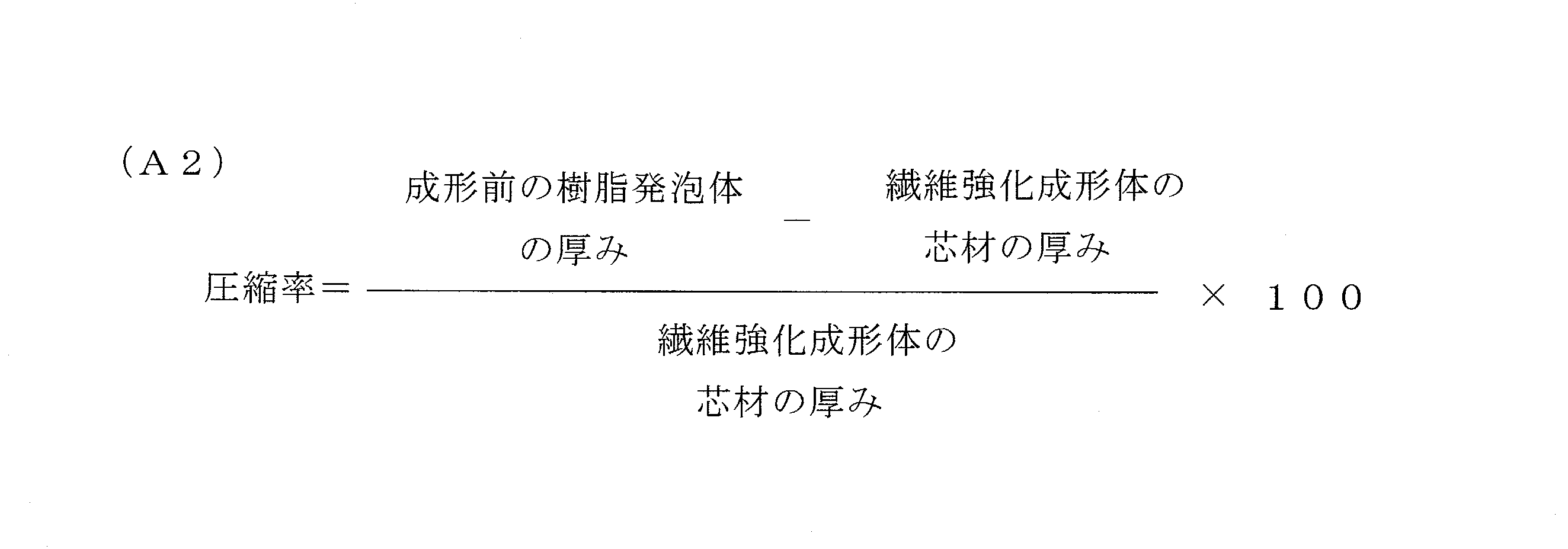
・前記熱硬化性樹脂は、フェノール樹脂、フェノール樹脂とエポキシ樹脂との混合樹脂、フェノール樹脂とシアネート樹脂との混合樹脂、フェノール樹脂とシアネート樹脂とエポキシ樹脂との混合樹脂の群から選ばれる樹脂であることを特徴とする、繊維強化成形体の製造方法。
・連続気泡構造を有する樹脂発泡体に熱硬化性樹脂が含浸硬化した芯材と、繊維基材に前記熱硬化性樹脂が含浸硬化した繊維補強材とが積層一体化した繊維強化成形体であって、
前記熱硬化性樹脂は、硬化反応開始温度Tb℃の粘度が2,000Pa・s以下であり、硬化反応開始温度Tb℃~190℃の範囲における最高粘度が1,000Pa・s以上である、繊維強化成形体。
第1態様の繊維強化樹脂成形体によれば、熱硬化性樹脂の粉体を繊維基材と接して配置して用いたことにより、高強度、高剛性の繊維強化樹脂成形体を、溶剤不要で環境汚染の恐れがなく、かつポットライフなく得ることができる。
第2態様の手段によれば、プリプレグの作製が簡略、安価で、保存安定性が良好なプリプレグ及びそのプリプレグから作製された良好な品質を有する繊維強化樹脂成形体が得られる。
第3態様の繊維強化成形体は、安価に製造可能である。
第4態様によれば、プリプレグを用いることなく、プリプレグの保存安定性を気にすることなく、簡単及び安価に、かつ環境汚染の恐れなく安全に製造可能な、コア材と一体化した繊維強化サンドイッチ複合体が得られる。
第5態様によれば、プリプレグを用いることなく繊維強化成形体を得ることができる。また、第5態様によれば、凹凸形状に賦形した繊維強化成形体を得ることもできる。
<<第1態様>>
第1態様の実施形態について説明する。図1に示す一実施形態の繊維強化樹脂成形体10は、積層された複数の繊維基材11が、熱硬化性樹脂15と共に加熱圧縮されて、熱硬化性樹脂15の硬化により賦形一体化したものである。
熱硬化性樹脂15は、溶融開始温度Ta℃が60~100℃にあるのが好ましい。熱硬化性樹脂15の溶融開始温度Ta℃をこの範囲とすることにより、繊維基材11間の少なくとも一つに熱硬化性樹脂15の粉体が配置された積層体を、加熱圧縮して熱硬化性樹脂15を溶融硬化させる際に、温調を容易に行うことができる。
なお、熱硬化性樹脂15には、熱硬化性樹脂の粘度、反応性に影響を与えない範囲において、顔料、抗菌剤、紫外線吸収剤などの各種粉体添加剤を添加してもよい。
なお、熱硬化性樹脂の粉体を、複数層の繊維基材における積層面(繊維基材間)に配置する場合は、一つの積層面(一つの繊維基材間)に限られず、全ての積層面(全ての繊維基材間)、あるいは所定数おきの積層面(所定数おきの繊維基材間)に配置してもよく、配置する面の位置及び配置する面の数は繊維基材の積層数等に応じて適宜決定される。
また、単層の繊維基材の上面または下面、あるいは複数層の繊維基材の最上面または最下面に接して熱硬化性樹脂の粉体を配置する場合、作業の便宜のために、熱硬化性樹脂の粉体と金型の型面との間に離型紙を配置してもよい。
金型30の温度Tc℃は、熱硬化性樹脂の溶融開始温度Ta℃、硬化反応開始温度Tb℃との関係において、
[Tb+(Tb-Ta)/3]-15≦Tc≦[Tb+(Tb-Ta)/3]+20に設定することが好ましく、
[Tb+(Tb-Ta)/3]-10≦Tc≦[Tb+(Tb-Ta)/3]+20に設定することがより好ましい。例えば、Ta℃=70℃、Tb℃=130℃の場合、Tc℃は140℃~170℃となる。
また、繊維基材11A~11Dの圧縮率(%)は、(下型31の型面と上型32の型面間の間隔)/(繊維基材の全層の厚みの合計)×100で算出される値であり、60~100%が好ましい。
熱硬化性樹脂の粉体15Aの量(全量)、金型30の加熱温度、積層体の加圧等は、図2の実施形態で説明した通りである。
<実施例>
1)試料の0.4gをペレット(直径φ18mm、厚さ0.4mm程度)に成形し、成形したペレットを直径φ18mmのパラレルプレートに挟む。
2)昇温速度5℃/min、周波数1Hz、回転角(ひずみ)0.1deg、等速昇温下、40℃~200℃間に渡って、2℃間隔で動的粘度を測定した。
繊維基材として、炭素繊維織物(帝人株式会社製、品名:W-3101、目付量:200g/m2、厚み0.22mm)を、250×200mmに裁断したものを4枚用意した。裁断後の1枚当たりの繊維基材の重量は10gであった。繊維基材を2枚積層し、その上に熱硬化性樹脂の粉体として、樹脂A1の25gを概ね均一に配置し、その上に残りの2枚の繊維基材を積層して成形前積層体を作製した。
樹脂A1(実施例1A、2A、3A)の粘度測定結果を、図6のグラフに示す。
実施例1Aと同様の繊維基材の4枚と樹脂A1を使用し、各繊維基材間(全繊維基材間)にそれぞれ樹脂A1の8.3g(全基材間の樹脂A1の合計量24.9g)を概ね均一に配置して成形前積層体を作製した以外、実施例1Aと同様の条件で加熱圧縮して実施例2Aの繊維強化樹脂成形体を作製した。
実施例1Aと同様の繊維基材の10枚を用意し、その繊維基材の5枚を積層し、その上に樹脂Aの60gを概ね均一に配置し、その上に残りの5枚の繊維基材を積層して成形前積層体を作製した以外、実施例1Aと同様の条件で加熱圧縮して実施例3Aの繊維強化樹脂成形体を作製した。
熱硬化性樹脂として樹脂B1を使用した以外、実施例1Aと同様にして実施例4Aの繊維強化樹脂成形体を作製した。
熱硬化性樹脂として、樹脂A1の12.5gと樹脂C1の12.5gを均一に混合した樹脂(25g)を使用し、金型温度を170℃とした以外、実施例1Aと同様にして実施例5Aの繊維強化樹脂成形体を作製した。
樹脂A1の12.5gと樹脂C1の12.5gを均一に混合した樹脂は、溶融開始温度Taが73℃、反応開始温度Tbが140℃、(Tb-Ta)が67℃、最低粘度(溶融開始温度Ta℃以上の温度における最低粘度)が22Pa・s、最高粘度(硬化反応開始温度Tb℃~190℃の温度範囲における最高粘度)が5,180Pa・s、(Tb-Ta)/3の値が22℃、Tb+(Tb-Ta)/3の値が162℃である。
熱硬化性樹脂として、樹脂D1の12.5gと樹脂E1の12.5gを均一に混合した樹脂(25g)を使用し、金型温度を160℃とした以外、実施例1Aと同様にして実施例6Aの繊維強化樹脂成形体を作製した。
樹脂E1はシアネート樹脂、三菱ガス化学株式会社製、品名:CYTESTER TAを乳鉢で粉砕して使用した。平均粒径は100μmである。
樹脂D1の12.5gと樹脂E1の12.5gを均一に混合した樹脂は、溶融開始温度Taが76℃、反応開始温度Tbが138℃、(Tb-Ta)が62℃、最低粘度(溶融開始温度Ta℃以上の温度における最低粘度)が475Pa・s、最高粘度(硬化反応開始温度Tb℃~190℃の温度範囲における最高粘度)が51,895Pa・s、(Tb-Ta)/3の値が21℃、Tb+(Tb-Ta)/3の値が159℃である。
熱硬化性樹脂として、樹脂D1の8.3gと樹脂E1の8.3gと樹脂C1の8.3gを均一に混合した樹脂(24.9g)を使用し、金型温度を170℃とした以外、実施例1Aと同様にして実施例7Aの繊維強化樹脂成形体を作製した。
熱硬化性樹脂として樹脂F1を使用し、金型温度を100℃にした以外、実施例1Aと同様にして比較例1Aの繊維強化樹脂成形体を作製した。
樹脂F1(比較例1A)の粘度測定結果を、図6のグラフに示す。
熱硬化性樹脂として、樹脂A1の8.3gと樹脂D1の16.6gを均一に混合した樹脂(24.9g)を使用し、金型温度を160℃とした以外、実施例1Aと同様にして比較例2Aの繊維強化樹脂成形体を作製した。
樹脂A1/樹脂D1=1/2(比較例2A)の粘度測定結果を、図6のグラフに示す。
VF値(%)は、(繊維基材の全重量/繊維の密度)/(成形体の体積)×100で算出した。
曲げ強度(MPa)と曲げ弾性率(GPa)は、JIS K7074 A法に基づいて測定した。
外観の判断は、成形体の表面に変形や樹脂の含浸不均一等からなる不具合が存在するか否かを目視で確認し、不具合が無い場合「〇」、不具合がある場合「×」とした。
実施例1Aの繊維強化樹脂成形体は、繊維基材の積層数を4枚、熱硬化性樹脂を樹脂A1として、中央の繊維基材間に熱硬化性樹脂の粉体を配置して作製されたものであり、成形体の厚み0.8mm、VF値58%、曲げ強度550MPa、曲げ弾性率54GPa、成形体の外観「〇」であり、強度及び剛性が高く、外観が良好なものである。
実施例2Aの繊維強化樹脂成形体は、繊維基材の積層数を4枚、熱硬化性樹脂を樹脂A1として、各繊維基材間に熱硬化性樹脂の粉体を配置して作製されたものであり、成形体の厚み0.8mm、VF値58%、曲げ強度600MPa、曲げ弾性率55GPa、成形体の外観「〇」であり、各繊維基材間に熱硬化性樹脂の粉体を配置して作製したことで、実施例1Aよりも強度及び剛性が高くなった。
実施例3Aの繊維強化樹脂成形体は、繊維基材の積層数を10枚、熱硬化性樹脂を樹脂A1として、中央の繊維基材間に熱硬化性樹脂の粉体を配置して作製されたものであり、成形体の厚み2.0mm、VF値59%、曲げ強度620MPa、曲げ弾性率53GPa、成形体の外観「〇」であり、強度及び剛性が高く、外観が良好なものである。
実施例4Aの繊維強化樹脂成形体は、繊維基材の積層数を4枚、熱硬化性樹脂を樹脂B1として、中央の繊維基材間に熱硬化性樹脂の粉体を配置して作製されたものであり、成形体の厚み0.8mm、VF値55%、曲げ強度450MPa、曲げ弾性率45GPa、成形体の外観「〇」であり、強度及び剛性が高く、外観が良好なものである。なお、樹脂B1を使用した実施例4Aは、樹脂Aを使用した実施例1Aよりも強度及び剛性が低くなった。
実施例5Aの繊維強化樹脂成形体は、繊維基材の積層数を4枚、熱硬化性樹脂を樹脂A1/樹脂C1=1/1として、中央の繊維基材間に熱硬化性樹脂の粉体を配置して作製されたものであり、成形体の厚み0.8mm、VF値57%、曲げ強度990MPa、曲げ弾性率60GPa、成形体の外観「〇」であり、強度及び剛性が高く、外観が良好なものである。なお、樹脂A1/樹脂C1=1/1の混合樹脂を使用した実施例5Aは、樹脂A1を使用した実施例1A及び樹脂B1を使用した実施例4Aよりも強度及び剛性が高くなった。
実施例6Aの繊維強化樹脂成形体は、繊維基材の積層数を4枚、熱硬化性樹脂を樹脂D1/樹脂E1=1/1として、中央の繊維基材間に熱硬化性樹脂の粉体を配置して作製されたものであり、成形体の厚み0.8mm、VF値59%、曲げ強度900MPa、曲げ弾性率61GPa、成形体の外観「〇」であり、強度及び剛性が高く、外観が良好なものである。なお、樹脂D1/樹脂E1=1/1の混合樹脂を使用した実施例6Aは、樹脂A1/樹脂C1=1/1の混合樹脂を使用した実施例5Aと同等の高い強度及び剛性を有するものである。
実施例7Aの繊維強化樹脂成形体は、繊維基材の積層数を4枚、熱硬化性樹脂を樹脂D1/樹脂E1/樹脂C1=1/1/1として、中央の繊維基材間に熱硬化性樹脂の粉体を配置して作製されたものであり、成形体の厚み0.8mm、VF値58%、曲げ強度930MPa、曲げ弾性率58GPa、成形体の外観「〇」であり、強度及び剛性が高く、外観が良好なものである。なお、樹脂D1/樹脂E1/樹脂C1=1/1/1の混合樹脂を使用した実施例7Aは、樹脂A1/樹脂C1=1/1の混合樹脂を使用した実施例5A、樹脂D1/樹脂E1=1/1の混合樹脂を使用した実施例6Aと同等の高い強度及び剛性を有するものである。
比較例1Aの繊維強化樹脂成形体は、繊維基材の積層数を4枚、熱硬化性樹脂を樹脂F1として、中央の繊維基材間に熱硬化性樹脂の粉体を配置して作製されたものであるが、樹脂F1の含浸性が悪く、熱硬化性樹脂が均一に含浸した成形体が得られなかったため、厚み、VF値、曲げ強度、曲げ弾性率について測定できなかった。
比較例2Aの繊維強化樹脂成形体は、繊維基材の積層数を4枚、熱硬化性樹脂を樹脂A1/樹脂D1=1/2として、中央の繊維基材間に熱硬化性樹脂の粉体を配置して作製されたものであるが、熱硬化性樹脂の硬化が不十分で、成形体の脱型時に変形が発生したため、厚み、VF値、曲げ強度、曲げ弾性率について測定できなかった。
第2態様の実施形態について説明する。
図7の(1-1)に示す第1実施形態の繊維強化樹脂成形用プリプレグ110は、繊維基材111が、熱硬化性樹脂115と共に加熱圧縮されたものであり、繊維基材111に熱硬化性樹脂115が付着した状態となっている。繊維基材111に付着している熱硬化性樹脂115は、硬化反応開始前の固体の状態である。
プリプレグ110の作製時、熱硬化性樹脂115の粉体は、繊維基材111と接するように配置され、繊維基材111が熱硬化性樹脂115の粉体と共に加熱圧縮される際に溶融して繊維基材111に含浸し、硬化反応開始前の状態で冷却されて固化する。
硬化反応開始温度Tb℃の粘度が2,000Pa・s以下であることにより、プリプレグ110を用いて繊維強化樹脂成形体を製造する際に、熱硬化性樹脂115を繊維基材111に均一に含浸させることができ、品質が良好な繊維強化樹脂成形体が得られる。
硬化反応開始温度Tb℃~190℃の範囲における最高粘度が1,000Pa・s以上であることにより、プリプレグ110を用いて繊維強化樹脂成形体を製造する際に、溶融した熱硬化性樹脂115を繊維基材111に含浸させて十分に硬化させることができ、繊維強化樹脂成形体の賦形性がよく、かつ短時間(10分程度)で十分な強度が得られるようになる。
なお、熱硬化性樹脂115には、熱硬化性樹脂の粘度、反応性に影響を与えない範囲において、顔料、抗菌剤、紫外線吸収剤などの各種粉体添加剤を添加してもよい。
また、繊維基材111の圧縮率(%)は、(下型151の型面と上型152の型面間の間隔-離型フィルムの合計の厚み)/(繊維基材の全層の厚みの合計)×100で算出される値であり、60~100%が好ましい。
熱硬化性樹脂の粉体115Aは、加熱圧縮により溶融して繊維基材111に含浸し、硬化反応開始前の状態で冷却されて固化する。
なお、プリプレグの作製方法は、前記の金型を用いる方法に限られず、熱ローラーで加熱圧縮する熱ローラー法や、上下のベルト間で加熱圧縮するダブルベルト法等、他の方法でもよい。
図8の(2-2)に示すように、下側2枚の繊維基材111A、111Bと、上側2枚の繊維基材111C、111Dとの間に熱硬化性樹脂の粉体115Aを挟んだ積層体を離型用プラスチックフィルム141A、141Bで挟み、それらを加熱した金型150の下型151と上型152で挟んで加熱圧縮することにより、第2実施形態の繊維強化樹脂成形用プリプレグ120を作製する。加熱圧縮条件は、第1実施形態で記載したとおりである。熱硬化性樹脂の粉体115Aは、加熱圧縮により溶融して繊維基材111A~111Dに含浸し、硬化反応開始前の状態で冷却されて固化する。
図9の(3-2)に示すように、4枚の繊維基材111A~111Dの各繊維基材間(各層間)に熱硬化性樹脂の粉体115A、115B、115Cを挟んだ積層体を、離型用プラスチックフィルム141A、141Bで挟み、それらを加熱した金型150の下型151と上型152で挟んで加熱圧縮することにより、第3実施形態の繊維強化樹脂成形用プリプレグ130を作製する。加熱圧縮条件は、第1実施形態で記載したとおりである。熱硬化性樹脂の粉体115A~115Cは、加熱圧縮により溶融して繊維基材111A~111Dに含浸し、硬化反応開始前の状態で冷却されて固化する。
[Tb+(Tb-Ta)/3]-15≦Td≦[Tb+(Tb-Ta)/3]+20に設定することが好ましく、
[Tb+(Tb-Ta)/3]-10≦Td≦[Tb+(Tb-Ta)/3]+20に設定することがより好ましい。例えば、Ta℃=70℃、Tb℃=130℃の場合、Td℃は140℃~170℃となる。
また、賦形用金型による加熱圧縮時における繊維強化樹脂成形用プリプレグの圧縮率(%)は、(下型151の型面と上型152の型面間の間隔)/(プリプレグの厚み)×100で算出される値であり、60~100%が好ましい。
<実施例>
1)試料の0.4gをペレット(直径φ18mm、厚さ0.4mm程度)に成形し、成形したペレットを直径φ18mmのパラレルプレートに挟む。
2)昇温速度5℃/min、周波数1Hz、回転角(ひずみ)0.1deg、等速昇温下、40℃~200℃間に渡って、2℃間隔で動的粘度を測定した。
・プリプレグの作製
実施例1は、図7の(1-1)及び(1-2)に示したように、プリプレグの繊維基材が1枚(1層)の例である。繊維基材として、炭素繊維織物(帝人株式会社製、品名:W-3101、目付量:200g/m2、厚み0.22mm)を、250×200mmに裁断したものを用意した。裁断後の1枚当たりの繊維基材の重量は10gであった。用意した繊維基材を、離型処理(離型剤を塗布)したPETフィルム(離型用プラスチックフィルム)上に配置し、繊維基材の上に熱硬化性樹脂の粉体として、以下の樹脂A2の7gを概ね均一に配置し、その上に離型処理したPETフィルムを載置してプリプレグ成形前積層体とした。
樹脂A2(実施例1B、2B、3B)の粘度測定結果を、図11のグラフに示す。
実施例1Bのプリプレグを4枚重ねた積層体を、予め150℃に加熱した金型の下型の成形面(型面)に配置し、金型の上型を積層体に被せて金型を閉じ、10分間、圧力5MPaで加熱圧縮し、樹脂A2を反応硬化させ、その後金型を開き、実施例1Bの繊維強化樹脂成形体を取り出した。
・プリプレグの作製
実施例2Bは、図8の(2-1)及び(2-2)に示したように、プリプレグの繊維基材が4枚(4層)の例である。実施例1Bと同様の繊維基材4枚と樹脂A2を使用し、4枚の繊維基材の中間に樹脂A2の28gを概ね均一に配置した以外は、実施例1Bと同様にして実施例2Bのプリプレグを作製した。
実施例2Bのプリプレグを、予め150℃に加熱した金型の下型の成形面(型面)に配置し、金型の上型を積層体に被せて金型を閉じ、10分間、圧力5MPaで加熱圧縮し、樹脂A2を反応硬化させ、その後金型を開き、実施例2Bの維強化樹脂成形体を取り出した。
・プリプレグの作製
実施例3Bは、図9の(3-1)及び(3-2)に示したように、プリプレグの繊維基材が4枚(4層)の各層間に樹脂A2を配置してプリプレグを作製した例である。実施例1Bと同様の繊維基材4枚の各層間に樹脂A2の9.3gを概ね均一に配置した以外は、実施例1Bと同様にして実施例3Bのプリプレグを作製した。
実施例3Bのプリプレグを、予め150℃に加熱した金型の下型の成形面(型面)に配置し、金型の上型を積層体に被せて金型を閉じ、10分間、圧力5MPaで加熱圧縮し、樹脂A2を反応硬化させ、その後金型を開き、実施例3Bの維強化樹脂成形体を取り出した。
・プリプレグの作製
実施例4Bは、プリプレグの繊維基材が1枚の例であり、熱硬化性樹脂の粉体として以下の樹脂B2を使用した以外、実施例1Bと同様にして実施例4Bのプリプレグを作製した。
樹脂B2は、フェノール樹脂、住友ベークライト株式会社製、品名:PR-310、平均粒径30μmである。
実施例4Bのプリプレグを4枚用い、実施例1Bと同様にして実施例4Bの維強化樹脂成形体を作製した。
・プリプレグの作製
実施例5Bは、プリプレグの繊維基材が1枚の例であり、熱硬化性樹脂の粉体として樹脂A2と以下の樹脂C2を1:1の重量比で均一に混合した樹脂を7g使用した以外、実施例1Bと同様にして実施例5Bのプリプレグを作製した。
樹脂C2は、エポキシ樹脂、三菱ケミカル株式会社製、品名:jER-1001を乳鉢で粉砕して使用した。平均粒径は100μmである。
実施例5Bのプリプレグを4枚用い、金型の温度を170℃とした以外は、実施例1Bと同様にして実施例5Bの維強化樹脂成形体を作製した。
・プリプレグの作製
実施例6Bは、プリプレグの繊維基材が1枚の例であり、熱硬化性樹脂の粉体として以下の樹脂D2と以下の樹脂E2を1:1の重量比で均一に混合した樹脂を7g使用した以外、実施例1Bと同様にして実施例6Bのプリプレグを作製した。
樹脂D2はフェノール樹脂、住友ベークライト株式会社製、品名:PR-50235Dを乳鉢で粉砕して使用した。平均粒径は90μmである。
樹脂E2はシアネート樹脂、三菱ガス化学株式会社製、品名:CYTESTER TAを乳鉢で粉砕して使用した。平均粒径は100μmである。
実施例6Bのプリプレグ4枚を用い、金型の温度を160℃とした以外は、実施例1Bと同様にして実施例6Bの維強化樹脂成形体を作製した。
・プリプレグの作製
実施例7Bは、プリプレグの繊維基材が1枚の例であり、熱硬化性樹脂の粉体として樹脂D2と樹脂E2と樹脂C2を1:1:1の重量比で均一に混合した樹脂を7g使用した以外は、実施例1Bと同様にして実施例7Bのプリプレグを作製した。
実施例7Bのプリプレグ4枚を用い、金型の温度を170℃とした以外は、実施例1Bと同様にして実施例7Bの維強化樹脂成形体を作製した。
・プリプレグの作製
熱硬化性樹脂の粉体として以下の樹脂F2の7gを使用し、金型温度を80℃にした以外、実施例1Bと同様にして比較例1のプリプレグを作製した。
樹脂F2は、フェノール樹脂、住友ベークライト株式会社製、品名:PR-50699、平均粒径30μmである。
樹脂F2(比較例1B)の粘度測定結果を、図11のグラフに示す。
比較例1Bのプリプレグ4枚を用い、金型の温度を100℃とした以外は、実施例1Bと同様にして比較例1Bの維強化樹脂成形体を作製した。
比較例1Bは、使用した樹脂F2の最低粘度と最高粘度が高く、繊維基材(炭素繊維織物)への樹脂F2の含浸性が悪く、熱硬化性樹脂が均一に含浸した繊維強化樹脂成形体が得られなかった。
・プリプレグの作製
熱硬化性樹脂の粉体として、樹脂A2と樹脂D2を1:2の重量比で均一に混合した樹脂を7g使用し、実施例1Bと同様にして比較例2Bのプリプレグを作製した。
樹脂A2と樹脂D2を1:2の重量比で均一に混合した樹脂(比較例2B)の粘度測定結果を、図11のグラフに示す。
比較例2Bのプリプレグ4枚を用い、実施例1Bと同様にして比較例2Bの維強化樹脂成形体を作製した。
比較例2Bは、使用した樹脂の硬化が不十分で、繊維強化樹脂成形体の脱型時に変形が発生し、良好な成形体が得られなかった。
曲げ強度(MPa)と曲げ弾性率(GPa)は、JIS K7074 A法に基づいて測定した。
外観の判断は、成形体の表面に変形や樹脂の含浸不均一等からなる不具合が存在するか否かを目視で確認し、不具合が無い場合「〇」、不具合がある場合「×」とした。
実施例1Bの繊維強化樹脂成形体は、熱硬化性樹脂の粉体を樹脂A2とし、繊維基材を1枚として作製された実施例1Bのプリプレグを4枚積層して作製されたものである。実施例1Bの繊維強化樹脂成形体は、成形体の厚み0.8mm、VF値58%、曲げ強度610MPa、曲げ弾性率52GPa、成形体の外観「〇」であり、強度及び剛性(曲げ弾性率)が高く、外観が良好なものである。
実施例2Bの繊維強化樹脂成形体は、4枚の繊維基材の中間に樹脂A2を配置して作製された実施例2Bのプリプレグから作製されたものである。実施例2Bの繊維強化樹脂成形体は、成形体の厚み0.8mm、VF値58%、曲げ強度600MPa、曲げ弾性率53GPa、成形体の外観「〇」であり、強度及び剛性が高く、外観が良好なものである。
実施例3Bの繊維強化樹脂成形体は、4枚の繊維基材の各層間に樹脂A2を配置して作製された実施例3Bのプリプレグから作製されたものである。実施例3Bの繊維強化樹脂成形体は、成形体の厚み0.8mm、VF値58%、曲げ強度620MPa、曲げ弾性率53GPa、成形体の外観「〇」であり、強度及び剛性が高く、外観が良好なものである。
実施例4Bの繊維強化樹脂成形体は、熱硬化性樹脂の粉体を樹脂B2とし、繊維基材を1枚として作製された実施例4Bのプリプレグを4枚積層して作製されたものである。実施例4Bの繊維強化樹脂成形体は、成形体の厚み0.8mm、VF値55%、曲げ強度460MPa、曲げ弾性率46GPa、成形体の外観「〇」であり、強度及び剛性が高く、外観が良好なものである。樹脂B2を使用した実施例4Bは、樹脂A2を使用した実施例1Bよりも強度及び剛性が低くなった。
実施例5Bの繊維強化樹脂成形体は、熱硬化性樹脂の粉体を樹脂A2/樹脂C2=1/1とし、繊維基材を1枚として作製された実施例5Bのプリプレグを4枚積層して作製されたものである。実施例5Bの繊維強化樹脂成形体は、成形体の厚み0.8mm、VF値57%、曲げ強度980MPa、曲げ弾性率60GPa、成形体の外観「〇」であり、強度及び剛性が高く、外観が良好なものである。なお、樹脂A2/樹脂C2=1/1の混合樹脂を使用した実施例5Bは、樹脂A2を使用した実施例1B及び樹脂B2を使用した実施例4Bよりも強度及び剛性が高くなった。
実施例6Bの繊維強化樹脂成形体は、熱硬化性樹脂の粉体を樹脂D2/樹脂E2=1/1とし、繊維基材を1枚として作製された実施例6Bのプリプレグを4枚積層して作製されたものである。実施例6Bの繊維強化樹脂成形体は、成形体の厚み0.8mm、VF値59%、曲げ強度910MPa、曲げ弾性率61GPa、成形体の外観「〇」であり、強度及び剛性が高く、外観が良好なものである。なお、樹脂D2/樹脂E2=1/1の混合樹脂を使用した実施例6Bは、樹脂A2/樹脂C2=1/1の混合樹脂を使用した実施例5Bと同等の高い強度及び剛性を有するものである。
実施例7Bの繊維強化樹脂成形体は、熱硬化性樹脂の粉体を樹脂D2/樹脂E2/樹脂C2=1/1/1とし、繊維基材を1枚として作製された実施例7Bのプリプレグを4枚積層して作製されたものである。実施例7Bの繊維強化樹脂成形体は、成形体の厚み0.8mm、VF値58%、曲げ強度930MPa、曲げ弾性率59GPa、成形体の外観「〇」であり、強度及び剛性が高く、外観が良好なものである。なお、樹脂D2/樹脂E2/樹脂C2=1/1/1の混合樹脂を使用した実施例7Bは、樹脂A2/樹脂C2=1/1の混合樹脂を使用した実施例5B、樹脂D2/樹脂E2=1/1の混合樹脂を使用した実施例6Bと同等の高い強度及び剛性を有するものである。
比較例1Bの繊維強化樹脂成形体は、熱硬化性樹脂の粉体を樹脂F2とし、繊維基材を1枚として作製された比較例1のプリプレグを4枚積層して作製されたものであるが、樹脂F2の含浸性が悪く、熱硬化性樹脂が均一に含浸した成形体が得られなかったため、厚み、VF値、曲げ強度、曲げ弾性率について測定できなかった。
比較例2Bの繊維強化樹脂成形体は、熱硬化性樹脂の粉体を樹脂A2/樹脂D2=1/2とし、繊維基材を1枚として作製された比較例2Bのプリプレグを4枚積層して作製されたものであるが、熱硬化性樹脂の硬化が不十分で、成形体の脱型時に変形が発生したため、厚み、VF値、曲げ強度、曲げ弾性率について測定できなかった。
熱硬化性樹脂の違いによるプリプレグの保存安定性を評価するため、樹脂A2を使用する実施例1Bのプリプレグ、樹脂B2を使用する実施例4Bのプリプレグ、樹脂A2/樹脂C2=1/1の混合樹脂を使用する実施例5Bのプリプレグ、樹脂D2/樹脂E2=1/1の混合樹脂を使用する実施例6Bのプリプレグ、樹脂D2/樹脂E2/樹脂C2=1/1/1の混合樹脂を使用する実施例7Bのプリプレグを、その作製後、23℃×湿度50%の環境下で90日間保管した後、前記の対応する実施例と同様にして繊維強化成形体を作製した。
樹脂A2を使用する実施例1Bのプリプレグの作製から90日経過後に作製された実施例1Bの繊維強化樹脂成形体は、成形体外観「〇」、曲げ強度570MPa、曲げ弾性率48GPa、曲げ強度保持率93%、曲げ弾性率保持率92%であり、プリプレグの保存による繊維強化樹脂成形体の物性低下が少なかった。
樹脂B2を使用する実施例4Bのプリプレグの作製から90日経過後に作製された実施例4Bの繊維強化樹脂成形体は、成形体外観「〇」、曲げ強度420MPa、曲げ弾性率42GPa、曲げ強度保持率91%、曲げ弾性率保持率91%であり、プリプレグの保存による繊維強化樹脂成形体の物性低下が少なかった。
樹脂A2/樹脂C2=1/1の混合樹脂を使用する実施例5Bのプリプレグの作製から90日経過後に作製された実施例5の繊維強化樹脂成形体は、成形体外観「〇」、曲げ強度910MPa、曲げ弾性率56GPa、曲げ強度保持率93%、曲げ弾性率保持率93%であり、プリプレグの保存による繊維強化樹脂成形体の物性低下が少なかった。
樹脂D2/樹脂E2=1/1の混合樹脂を使用する実施例6Bのプリプレグの作製から90日経過後に作製された実施例6の繊維強化樹脂成形体は、成形体外観「〇」、曲げ強度880MPa、曲げ弾性率60GPa、曲げ強度保持率97%、曲げ弾性率保持率98%であり、プリプレグの保存による繊維強化樹脂成形体の物性低下が少なかった。
樹脂D2/樹脂E2/樹脂C2=1/1/1の混合樹脂を使用する実施例7Bのプリプレグの作製から90日経過後に作製された実施例7Bの繊維強化樹脂成形体は、成形体外観「〇」、曲げ強度880MPa、曲げ弾性率56GPa、曲げ強度保持率95%、曲げ弾性率保持率95%であり、プリプレグの保存による繊維強化樹脂成形体の物性低下が少なかった。
また、本態様は、前記の実施例に限られず、趣旨を逸脱しない範囲で変更可能である。
第3態様の実施形態について説明する。
繊維強化成形体210は、繊維基材211が、熱硬化性樹脂を含有する樹脂シート215の熱硬化性樹脂によって一体化されている。熱硬化性樹脂は、硬化反応開始温度Tb℃の粘度が2,000Pa・s以下であり、硬化反応開始温度Tb℃~190℃の範囲における最高粘度が1,000Pa・s以上である。
繊維基材211は、単層でも複数層でもよく、繊維強化成形体210の用途等に応じて層の数が決定される。図14,15の形態では、繊維基材211は4層からなるものが例示されている。繊維基材211としては、ガラス繊維、アラミド繊維、バサルト繊維、炭素繊維などによる織物や不織布などがあり、特に限定されるものではないが、炭素繊維織物が軽量及び高剛性に優れるために好ましいものである。炭素繊維織物としては、繊維が一方向のみではない織り方のものが好ましく、例えば、縦糸と横糸で構成される平織、綾織、朱子織及び3方向の糸で構成される三軸織などが好適である。また、前記炭素繊維織物は、樹脂シート215に含有された熱硬化性樹脂の含浸及び繊維強化成形体210の剛性の点から、繊維重さが50~600g/m2のものが好ましい。
熱硬化性樹脂は、繊維強化成形体210の製造時に、常温(5℃~35℃)で固形であるものが用いられる。固形の形状は、特に限定されるものではない。固形の形状は、球状、針状、フレーク状等の粉体等が例示される。
シート基材の構造は、特に限定されない。シート基材は、溶融樹脂が浸透可能な構造を有することが好ましい。溶融樹脂が浸透可能な構造は、特に限定されないが、連通孔を有する構造等が例示される。また、シート基材は熱硬化性樹脂の反応開始温度(Tb)で溶融しないことが好ましい。
シート基材は、発泡体、不織布、及び繊維シートからなる群より選択される1種以上であることが好ましい。シート基材がこれらの構造を有すると、シート基材内の空間に熱硬化性樹脂を十分に保持できる。
シート基材の材質は、特に限定されない。シート基材の材質は、ウレタン、レーヨン、ポリエステル、及び炭素からなる群より選択される1種以上であることが好ましい。
シート基材は、具体的には、ウレタン発泡体、レーヨンとポリエステル(PET)の不織布、PET不織布、及び炭素繊維シートからなる群より選択される1種以上であることが好ましい。
樹脂シート基材の厚みは、特に限定されない。樹脂シート基材の厚みは、接着に必要な熱硬化性樹脂を十分に保持する観点から、0.05mm以上1.0mm以下が好ましく、0.08mm以上0.7mm以下がより好ましい。
樹脂シート基材の目付は、特に限定されない。樹脂シート基材の目付は、20g/m2以上50g/m2以下が好ましく、30g/m2以上45g/m2以下がより好ましい。
なお、溶融開始温度Ta℃以上の温度における最低粘度は、硬化反応開始温度Tb℃の粘度と同じである。
熱硬化性樹脂は、溶融開始温度Ta℃が60~100℃にあることが好ましい。熱硬化性樹脂の溶融開始温度Ta℃をこの範囲とすることにより、繊維基材211間の少なくとも一つに樹脂シート215が配置された積層体を、加熱圧縮して熱硬化性樹脂を溶融硬化させる際に、温調を容易に行うことができる。
フェノール樹脂として、例えばノボラック型粉末フェノールレジンが好ましく用いられる。フェノール樹脂の物性は特に限定されない。例えば、以下の物性のフェノール樹脂が好適に採用される。
・融点:80℃以上100℃以下
エポキシ樹脂として、例えばビスフェノールA型固形樹脂が好ましく用いられる。エポキシ樹脂の物性は特に限定されない。例えば、以下の物性のエポキシ樹脂が好適に採用される。
・エポキシ当量:400g/eq以上1000g/eq以下
・軟化点:60℃以上100℃以下
・粘度:0.10Pa・s以上0.30Pa・s以下(25℃)
シアネート樹脂は、シアナト基をもつ熱硬化性樹脂であり、シアネートモノマーとも呼ばれている。硬化前のシアネート樹脂の物性は特に限定されない。例えば、以下の物性のシアネート樹脂が好適に採用される。
・融点:75℃以上85℃以下
・粘度:0.010Pa・s以上0.015Pa・s以下(80℃)
なお、熱硬化性樹脂には、熱硬化性樹脂の粘度、反応性に影響を与えない範囲において、顔料、抗菌剤、紫外線吸収剤などの各種粉体添加剤を添加してもよい。
繊維強化成形体210の曲げ弾性率(JIS K7074 A法)は、特に限定されない。繊維強化成形体210の曲げ弾性率は、高剛性の観点から、40GPa以上が好ましく、50GPa以上がより好ましい。
繊維強化成形体210の曲げ強度(JIS K7074 A法)は、特に限定されない。繊維強化成形体210の曲げ強度は、高強度の観点から、400MPa以上が好ましく、800MPa以上がより好ましい。
繊維強化成形体210の比重は、特に限定されない。繊維強化成形体210の比重は、軽量化及び外観を損なわないようにする観点から、1.10以上1.80以下が好ましく、1.30以上1.69以下がより好ましい。
本開示の繊維強化成形体210の製造方法は、繊維基材211と樹脂シート215とを重ねた状態で、金型によって加熱圧縮し、熱硬化性樹脂を繊維基材211に含浸させて硬化させることにより行う。繊維基材211、樹脂シート215、及び熱硬化性樹脂は、「1.繊維強化成形体210」における記載をそのまま引用する。
なお、樹脂シート215を、複数層の繊維基材211における積層面(繊維基材211間)に配置する場合は、一つの積層面(一つの繊維基材211間)に限られず、全ての積層面(全ての繊維基材間)、あるいは所定数おきの積層面(所定数おきの繊維基材211間)に配置してもよく、配置する面の位置及び配置する面の数は繊維基材211の積層数等に応じて適宜決定される。
また、単層の繊維基材211の上面又は下面、あるいは複数層の繊維基材211の最上面又は最下面に接して樹脂シート215を配置する場合、作業の便宜のために、樹脂シート215と金型の型面との間に離型シートを配置してもよい。
樹脂シート215A,215Bに含有される熱硬化性樹脂の量は、繊維強化成形体210のVF値(%)が40~70%となるように調整するのが好ましい。VF値(%)は、(繊維基材の全重量/繊維の密度)/(繊維強化成形体の体積)×100で算出される値である。
加熱圧縮時の温度Tc℃(金型30の温度Tc℃)は、熱硬化性樹脂の溶融開始温度Ta℃、硬化反応開始温度Tb℃との関係において、
[Tb+(Tb-Ta)/3]-15≦Tc≦[Tb+(Tb-Ta)/3]+20
であることが好ましい。例えば、Ta℃=70℃、Tb℃=130℃の場合、Tc℃は135℃~170℃となる。
また、繊維基材211A~211Dの圧縮率(%)は、(下型231の型面と上型232の型面間の間隔)/(繊維基材の全層の厚みの合計)×100で算出される値であり、60~100%が好ましい。
熱硬化性樹脂の量(全量)、金型230の加熱温度、積層体の加圧等は、図15の実施形態で説明した通りである。
繊維強化成形体210の製造用の樹脂シート215は、熱硬化性樹脂を含有する。すなわち、樹脂シート215は、熱硬化性樹脂を未硬化の状態で担持している。樹脂シート215、及び熱硬化性樹脂は、「1.繊維強化成形体210」における記載をそのまま引用する。
<実施例>
1)試料の0.4gをペレット(直径φ18mm、厚さ0.4mm程度)に成形し、成形したペレットを直径φ18mmのパラレルプレートに挟む。
2)昇温速度5℃/min、周波数1Hz、回転角(ひずみ)0.1deg、等速昇温下、40℃~200℃間にわたって、2℃間隔で動的粘度を測定した。

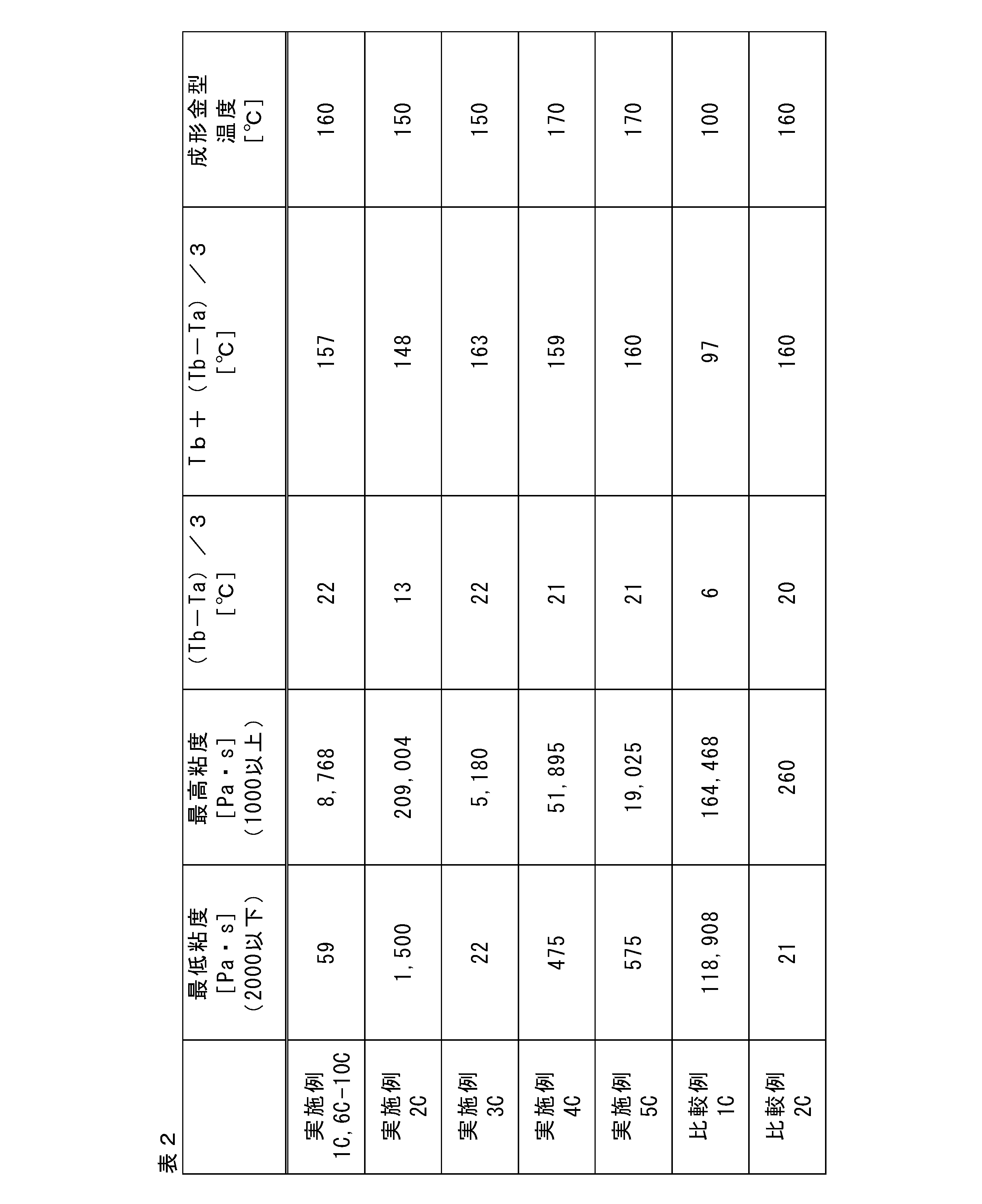


(1)実施例1C
固形熱硬化性樹脂として、シアネート樹脂(三菱ガス化学株式会社製、品名:CYTESTER TA、平均粒径:100μm)とエポキシ樹脂(DIC株式会社製、品名:AM-020-P、平均粒径:100μm)とフェノール樹脂(住友ベークライト株式会社製、品名;PR-50235D、平均粒径:90μm)を3:1:1の重量比にて均一に混合した混合樹脂を用いた。
実施例1Cの混合樹脂の特性は以下の通りであり、表1,2に記載されている。実施例1Cの混合樹脂の粘度測定結果を、図18のグラフに示す。
・溶融開始温度Ta:69℃
・反応開始温度Tb:135℃
・(Tb-Ta):66℃
・最低粘度(溶融開始温度Ta℃以上の温度における最低粘度):59Pa・s
・最高粘度(硬化反応開始温度Tb℃~190℃の温度範囲における最高粘度):8,768Pa・s
・(Tb-Ta)/3の値:22℃
・Tb+(Tb-Ta)/3の値:157℃
樹脂シートのシート基材として、表4に示すPET不織布(日本バイリーン株式会社製、品名:JH-1004N1、目付量:45g/m2、厚み0.08mm)を200mm×250mmに裁断したものを用いた。
シート基材1枚の上に、上記の固形熱硬化性樹脂20gを配置し、成形前シート基材を作製した。
次いで、100℃に加熱された金型の下型の成形面に、成形前シート基材を1枚配置し、その後に金型を閉じて1分間、圧力1MPaで加熱圧縮し、シート基材に固形熱硬化性樹脂を溶融して担持させた。その後、冷却することで、樹脂シートを作製した。
このようにして作製した樹脂シートを2枚用意した。なお、下型と上型間には厚み1mmのSUS製スペーサ、成形前シート基材の上下には厚み0.05mmのPETフィルムを介在させて樹脂シートの厚みを調整した。
強化用の繊維基材として、炭素繊維織物(帝人株式会社製、品名:W-3101、目付量:200g/m2、厚み0.22mm)を200mm×250mmに裁断したものを4枚用意した。裁断後の炭素繊維織物の1枚当りの重量は12gであった。まず、炭素繊維織物2枚を配置し、その上に樹脂シート2枚、更に2枚の炭素繊維織物を順に配置し、成形前積層体を作製した。図15において、積層の状態を模式的に示す。実施例1Cでは、図15に示すように、中央の繊維基材(炭素繊維織物)の間に樹脂シートを2枚配置して成形前積層体としている。
次いで、160℃に加熱された金型の下型の成形面に、成形前積層体を配置し、その後に金型を閉じて10分間、圧力10MPaで加熱圧縮して、固形熱硬化性樹脂を溶融硬化させた。固形熱硬化性樹脂が溶融し、圧力が加わることで、各層の繊維基材に樹脂が含浸し、その後に固形熱硬化性樹脂の熱硬化が完了することで、樹脂シートの熱硬化性樹脂によって繊維基材が一体化された繊維強化成形体が作製された。なお、プレス成形用の下型と上型間には厚み1mmのSUS製スペーサを介在させて、下型と上型間の間隔を調整することで、繊維強化成形体の厚みを調整した。
固形熱硬化性樹脂として、シアネート樹脂(三菱ガス化学株式会社製、品名:CYTESTER TA、平均粒径:100μm)とエポキシ樹脂(DIC株式会社製、品名:AM-030-P、平均粒径:100μm)とフェノール樹脂(住友ベークライト株式会社製、品名;PR-50235D、平均粒径:90μm)を1:1:1の重量比にて均一に混合した混合樹脂を使用し、繊維強化成形体成形時の金型温度を150℃とした以外は、実施例1Cと同様に繊維強化成形体を作製した。
実施例2Cの混合樹脂の特性は以下の通りであり、表1,2に記載されている。
・溶融開始温度Ta:95℃
・反応開始温度Tb:135℃
・(Tb-Ta):40℃
・最低粘度(溶融開始温度Ta℃以上の温度における最低粘度):1,500Pa・s
・最高粘度(硬化反応開始温度Tb℃~190℃の温度範囲における最高粘度):209,004Pa・s
・(Tb-Ta)/3の値:13℃
・Tb+(Tb-Ta)/3の値:148℃
固形熱硬化性樹脂として、フェノール樹脂(住友ベークライト株式会社製、品名:PR-50252、平均粒径:30μm)とエポキシ樹脂(三菱ケミカル株式会社製、品名:jER-1001、平均粒径:100μm)を1:1の重量比にて均一に混合した混合樹脂を使用し、繊維強化成形体成形時の金型温度を150℃とした以外は、実施例1Cと同様に繊維強化成形体を作製した。
実施例3Cの混合樹脂の特性は以下の通りであり、表1,2に記載されている。
・溶融開始温度Ta:73℃
・反応開始温度Tb:140℃
・(Tb-Ta):67℃
・最低粘度(溶融開始温度Ta℃以上の温度における最低粘度):22Pa・s
・最高粘度(硬化反応開始温度Tb℃~190℃の温度範囲における最高粘度):5,180Pa・s
・(Tb-Ta)/3の値:22℃
・Tb+(Tb-Ta)/3の値:163℃
固形熱硬化性樹脂として、フェノール樹脂(住友ベークライト株式会社製、品名;PR-50235D、平均粒径:90μm)とシアネート樹脂(三菱ガス化学株式会社製、品名:CYTESTER TA、平均粒径:100μm)を1:1の重量比にて均一に混合した混合樹脂を使用し、繊維強化成形体成形時の金型温度を170℃とした以外は、実施例1Cと同様に繊維強化成形体を作製した。
実施例4Cの混合樹脂の特性は以下の通りであり、表1,2に記載されている。
・溶融開始温度Ta:76℃
・反応開始温度Tb:138℃
・(Tb-Ta):62℃
・最低粘度(溶融開始温度Ta℃以上の温度における最低粘度):475Pa・s
・最高粘度(硬化反応開始温度Tb℃~190℃の温度範囲における最高粘度):51,895Pa・s
・(Tb-Ta)/3の値:21℃
・Tb+(Tb-Ta)/3の値:159℃
固形熱硬化性樹脂として、エポキシ樹脂(三菱ケミカル株式会社製、品名:jER-1001、平均粒径:100μm)とシアネート樹脂(三菱ガス化学株式会社製、品名:CYTESTER TA、平均粒径:100μm)とを1:1の重量比にて均一に混合した混合樹脂を使用し、繊維強化成形体成形時の金型温度を170℃とした以外は、実施例1Cと同様に繊維強化成形体を作製した。
実施例5Cの混合樹脂の特性は以下の通りであり、表1,2に記載されている。
・溶融開始温度Ta:75℃
・反応開始温度Tb:139℃
・(Tb-Ta):64℃
・最低粘度(溶融開始温度Ta℃以上の温度における最低粘度):575Pa・s
・最高粘度(硬化反応開始温度Tb℃~190℃の温度範囲における最高粘度):19,025Pa・s
・(Tb-Ta)/3の値:21℃
・Tb+(Tb-Ta)/3の値:160℃
実施例1Cと同様の強化用の繊維基材を4枚、実施例1Cと同様の樹脂シート3枚を用意し、図16に示すように、各繊維基材層間にそれぞれ1枚の樹脂シートを配置した以外は実施例1Cと同様に繊維強化成形体を作製した。
実施例1Cと同様の強化用の繊維基材を10枚用意し、その繊維基材を5枚積層し、その上に、樹脂シート5枚を配置し、更にその上に残りの5枚の繊維基材を積層することで成形前基材を作製した以外は、実施例1Cと同様に繊維強化成形体を作製した。図17において、積層の状態を模式的に示す。
シート基材として、厚み0.7mm、平面サイズ200mm×300mmに切り出したウレタン樹脂発泡体(株式会社イノアックコーポレーション製、品名:MF-50、目付量 35g/m2)用いた以外は、実施例1Cと同様に繊維強化成形体を作製した。
シート基材として、厚み0.22mm、平面サイズ200mm×300mmに切り出したレーヨン/ポリエステル不織布(クラレトレーディング株式会社製、品名:SF-30C、目付量 31g/m2)用いた以外は、実施例1Cと同様に繊維強化成形体を作製した。
シート基材として、厚み0.34mm、平面サイズ200mm×300mmに切り出した炭素繊維シート(阿波製紙株式会社製、品名:CARMIX C-2、目付量 31g/m2)用意した以外は、実施例1Cと同様に繊維強化成形体を作製した。
固形熱硬化性樹脂として、フェノール樹脂(住友ベークライト株式会社製、品名:PR-50699、平均粒径:30μm)を使用し、樹脂シート作製時の金型温度を80℃、繊維強化成形体の成形時の金型温度を100℃とした以外は、実施例1Cと同様に繊維強化成形体を作製した。樹脂の粘度が高く(反応が速い)、樹脂の含浸性が悪く、均一な繊維強化成形体を得ることができなかった。
比較例1Cの樹脂の特性は以下の通りであり、表1,2に記載されている。比較例1Cの樹脂の粘度測定結果を、図18のグラフに示す。
・溶融開始温度Ta:72℃
・反応開始温度Tb:91℃
・(Tb-Ta):19℃
・最低粘度(溶融開始温度Ta℃以上の温度における最低粘度):118,908Pa・s
・最高粘度(硬化反応開始温度Tb℃~190℃の温度範囲における最高粘度):164,468Pa・s
・(Tb-Ta)/3の値:6℃
・Tb+(Tb-Ta)/3の値:100℃
固形熱硬化性樹脂として、2種類のフェノール樹脂(住友ベークライト株式会社製、品名:PR-50252、平均粒径:30μmと住友ベークライト株式会社製、品名:PR-50235D、平均粒径:90μm)の1:2混合樹脂(重量比)、を使用し、繊維強化成形体の成形時の金型温度を160℃とした以外は、実施例1Cと同様に繊維強化成形体を作製した。樹脂の硬化が十分では無く、脱型時に変形が生じてしまった。
比較例2Cの樹脂の特性は以下の通りであり、表1,2に記載されている。比較例2Cの樹脂の粘度測定結果を、図18のグラフに示す。
・溶融開始温度Ta:80℃
・反応開始温度Tb:140℃
・(Tb-Ta):60℃
・最低粘度(溶融開始温度Ta℃以上の温度における最低粘度):21Pa・s
・最高粘度(硬化反応開始温度Tb℃~190℃の温度範囲における最高粘度):260Pa・s
・(Tb-Ta)/3の値:20℃
・Tb+(Tb-Ta)/3の値:160℃
(1)測定方法
実施例1C~10C及び比較例1C、2Cの繊維強化成形体について、厚み(mm)、曲げ強度(MPa)、曲げ弾性率(GPa)の測定及び外観を判断した。その結果を表3に示す。
曲げ強度、曲げ弾性率は繊維強化成形体から試験片を切り出し、JIS K7074 A法に基づいて測定した。
外観は目視により確認した。外観の判断は、繊維強化成形体の表面に変形や樹脂の含浸不均一等からなる不具合が存在するか否かを目視で確認し、不具合が無い場合「〇」、不具合がある場合「×」とした。
繊維強化成形体の各部分の厚みは、繊維強化成形体の断面をデジタルマイクロスコープVHX-5000(株式会社キーエンス社製)にて観察し測定した。表3における厚みは、繊維強化成形体の中央部付近の厚みである。
比重は、繊維強化成形体の重量と繊維強化成形体の体積から算出した。繊維強化成形体の体積は、繊維強化成形体の厚みと面積から算出した。
測定結果を表3に示す。
実施例1C-10Cの繊維強化成形体は、下記要件(a)(b)を満たしている。これに対して比較例1Cの繊維強化成形体は、要件(a)を満たしていない。要件(a)を満たしていない比較例1Cでは、樹脂の粘度が高いため、樹脂の含浸性が悪く、均一な繊維強化成形体を得ることができなかった。また、比較例2Cの繊維強化成形体は、要件(b)を満たしていない。要件(b)を満たしていない比較例2Cの維強化成形体では、樹脂の硬化が十分では無く、脱型時に変形が生じてしまった。
要件(a)(b)を満たす実施例1C-10Cの繊維強化成形体では、固形熱硬化性樹脂の溶融特性及び硬化特性をコントロールすることで、プリプレグを用いることなく、簡便な方法で、外観、強度、及び軽量化に優れた繊維強化樹脂複合体を得ることができた。また、実施例1C-10Cの繊維強化成形体では、簡便な方法で樹脂シート(樹脂担持シート)を作製することができ、粉体の飛散を防止することができるとともに、製造過程で有機溶剤なども使用しないため、作業環境に優れ、大気汚染の問題も発生しないことが分かる。
・要件(a):硬化反応開始温度Tb℃の粘度(最低粘度)が2,000Pa・s以下である。
・要件(b):硬化反応開始温度Tb℃~190℃の範囲における最高粘度が1,000Pa・s以上である。
・要件(c):30≦(Tb-Ta)≦100 を満たす。
・繊維基材及び前記繊維基材とは異なるシート基材が積層した積層体に熱硬化性樹脂が含侵した繊維強化成形体。
以上の実施例によれば、外観、強度、及び軽量化に優れた繊維強化樹脂複合体を得ることができた。また、簡便な方法で樹脂シートを作製することができ、粉体の飛散を防止することができるとともに、製造過程で有機溶剤なども使用しないため、作業環境に優れ、大気汚染の問題も発生しないことが確認された。
第4態様の実施形態について説明する。図19に示す一実施形態の繊維強化サンドイッチ複合体310は、繊維基材311とコア材315が、熱硬化性樹脂321と共に加熱圧縮されて、熱硬化性樹脂321の硬化により接着一体化したものである。
コア材315の密度(JIS Z8807)は、20~120kg/m3が好ましい。
また、コア材315は、単層に限られず、複層であってもよい。コア材315が単層で繊維基材311が複層の場合、コア材315は繊維基材311間に位置するのが好ましい。
・樹脂発泡粒子を金型内に充填し、熱水や水蒸気などの熱媒体によって樹脂発泡粒子を加熱して発泡させ、樹脂発泡粒子の発泡圧によって発泡粒子同士を融着一体化させて所望形状を有する発泡体を製造する方法(型内発泡成形方法)。
・樹脂を気泡調整剤などとともに押出機に供給して化学発泡剤や物理発泡剤などの発泡剤の存在下にて溶融混練し、溶融混練物を押出機から押出発泡させて発泡体を製造する方法(押出発泡法)。
・化学発泡剤を含む塊状の発泡性樹脂成形体を製造し、この発泡性樹脂成形体を型内で発泡させて発泡体を製造する方法。
熱硬化性樹脂321の粉体は、繊維基材311及びコア材315と共に加熱圧縮された際に溶融して繊維基材311に含浸し、かつコア材315と接触した状態で硬化する。
[Tb+(Tb-Ta)/3]-15≦Tc≦[Tb+(Tb-Ta)/3]+20に設定することが好ましく、
[Tb+(Tb-Ta)/3]-10≦Tc≦[Tb+(Tb-Ta)/3]+20であることがより好ましい。熱硬化性樹脂321の溶融開始温度Ta℃と硬化反応開始温度Tb℃及び加熱圧縮時の温度Tc℃が、この関係にあることにより、加熱圧縮時に熱硬化性樹脂321の粉体の溶融が良好になり、熱硬化性樹脂321が繊維基材311に含浸し易くなって、均一な物性を有する繊維強化サンドイッチ複合体310を得ることができる。
なお、熱硬化性樹脂321には、熱硬化性樹脂の粘度、反応性に影響を与えない範囲において、顔料、抗菌剤、紫外線吸収剤などの各種粉体添加剤を添加してもよい。
<実施例>
1)試料の0.4gをペレット(直径φ18mm、厚さ0.4mm程度)に成形し、成形したペレットを直径φ18mmのパラレルプレートに挟む。
2)昇温速度5℃/min、周波数1Hz、回転角(ひずみ)0.1deg、等速昇温下、40℃~200℃間に渡って、2℃間隔で動的粘度を測定した。
製品外観は、繊維強化サンドイッチ複合体の表面に変形や樹脂の含浸不均一等からなる不具合が存在するか否かを目視で確認し、不具合が無い場合「〇」、不具合がある場合「×」とした。
密度は、JIS Z8807に基づいて測定した。
曲げ強度及び曲げ弾性率は、JIS K7074 A法に基づいて測定した。
繊維基材として、炭素繊維織物(帝人株式会社製、品名:W-3101、目付量:200g/m2、厚み0.22mm)を、210×297mmに裁断したものを4枚用意した。裁断後の1枚当たりの繊維基材の重量は12.5gであった。裁断後の繊維基材を2枚積層し、その上に熱硬化性樹脂の粉体として、以下の樹脂A3の25gを概ね均一に配置し、その上にコア材として、独立気泡構造のポリエチレンテレフタレートフォーム(3A Composites Airex社製、AIREX(T10))を210×297mmに裁断したものを配置し、その上に樹脂A3の25gを概ね均一に配置し、その上に残りの2枚の繊維基材を積層して成形前積層体を作製した。
樹脂A3は、フェノール樹脂、住友ベークライト株式会社製、品名:PR-50252、平均粒径30μmである。
樹脂A3(実施例1D、6D、7D)の粘度測定結果を、図24のグラフに示す。
熱硬化性樹脂の粉体として、以下の樹脂B3を使用した以外、実施例1Dと同様にして実施例2Dの繊維強化サンドイッチ複合体を作製した。
樹脂B3は、フェノール樹脂、住友ベークライト株式会社製、品名:PR-310、平均粒径30μmである。
熱硬化性樹脂の粉体として、樹脂A3の12.5gと以下の樹脂C3の12.5gを均一に混合した樹脂(25g)を使用し、金型温度を170℃とした以外、実施例1Dと同様にして実施例3Dの繊維強化サンドイッチ複合体を作製した。
樹脂C3は、エポキシ樹脂、三菱ケミカル株式会社製、品名:jER-1001を乳鉢で粉砕して使用した。平均粒径は100μmである。
熱硬化性樹脂の粉体として、以下の樹脂D3の12.5gと以下の樹脂E3の12.5gを均一に混合した樹脂(25g)を使用し、金型温度を160℃とした以外、実施例1Dと同様にして実施例4Dの繊維強化サンドイッチ複合体を作製した。
樹脂D3はフェノール樹脂、住友ベークライト株式会社製、品名:PR-50235Dを乳鉢で粉砕して使用した。平均粒径は90μmである。
樹脂E3はシアネート樹脂、三菱ガス化学株式会社製、品名:CYTESTER TAを乳鉢で粉砕して使用した。平均粒径は100μmである。
熱硬化性樹脂の粉体として、樹脂D3の8.3gと樹脂Eの8.3gと樹脂C3の8.3gを均一に混合した樹脂(24.9g)を使用し、金型温度を170℃とした以外、実施例1Dと同様にして実施例5Dの繊維強化サンドイッチ複合体を作製した。
コア材として、独立気泡構造のポリメタクリルイミドフォーム(Evonik Industries社製、品名:Rohacell(IG-31)を使用した以外は、実施例1Dと同様にして実施例6Dの繊維強化サンドイッチ複合体を作製した。
コア材として、独立気泡構造のポリ塩化ビニルフォーム(GURIT社製、品名CoreCell(HT-80))を使用した以外は、実施例1Dと同様にして実施例7Dの繊維強化サンドイッチ複合体を作製した。
コア材として、硬質ポリウレタンフォーム(イノアックコーポレーション社製、品名:サーマックス(SII-25)を使用した以外は、実施例1Dと同様にして比較例1Dの繊維強化サンドイッチ複合体を作製した。
熱硬化性樹脂の粉体として、以下の樹脂Fを使用し、金型温度を100℃とした以外、実施例1Dと同様にして比較例2Dの繊維強化サンドイッチ複合体を作製した。
樹脂F3は、フェノール樹脂、住友ベークライト株式会社製、品名:PR-50699、平均粒径30μmである。
樹脂F3(比較例2D)の粘度測定結果を、図24のグラフに示す。
熱硬化性樹脂の粉体として、樹脂Aの8.3gと樹脂D3の16.6gを均一に混合した樹脂(24.9g)を使用し、金型温度を160℃とした以外、実施例1Dと同様にして比較例3Dの繊維強化サンドイッチ複合体を作製した。
樹脂A3/樹脂D3=1/2(比較例3D)の粘度測定結果を、図24のグラフに示す。
本態様は、実施例に限定されず、趣旨から逸脱しない範囲で変更可能である。
第5態様の実施形態について説明する。図25に示す第1実施形態の繊維強化成形体410は、樹脂発泡体に熱硬化性樹脂が含浸硬化した芯材411と、繊維基材に熱硬化性樹脂が含浸硬化した繊維補強材415とが積層一体化したものであり、本開示の繊維強化成形体の製造方法によって得られたものである。樹脂発泡体に含浸硬化した熱硬化性樹脂と、繊維基材に含浸硬化した熱硬化性樹脂とは、共通の熱硬化性樹脂である。
繊維強化成形体410の曲げ強度(JIS K7074 A法)は、300MPa以上が好ましく、380MPa以上がさらに好ましい。
なお、粉体状の熱硬化性樹脂419を配置する位置および配置箇所数は限定されないが、少なくとも樹脂発泡体413に接する位置に配置することが好ましい。
[Tb+(Tb-Ta)/3]-15≦Tc≦[Tb+(Tb-Ta)/3]+20に設定することが好ましく、
[Tb+(Tb-Ta)/3]-10≦Tc≦[Tb+(Tb-Ta)/3]+20であることがより好ましい。熱硬化性樹脂の溶融開始温度Ta℃と硬化反応開始温度Tb℃及び加熱圧縮時の温度Tc℃が、この関係にあることにより、加熱圧縮時に熱硬化性樹脂419の溶融が良好になり、熱硬化性樹脂419が連続気泡構造を有する樹脂発泡体413及び繊維基材417A、417Bに含浸し易くなって、均一な物性を有する繊維強化成形体410を得ることができる。
なお、熱硬化性樹脂419には、熱硬化性樹脂の粘度、反応性に影響を与えない範囲において、顔料、抗菌剤、紫外線吸収剤などの各種粉体添加剤を添加してもよい。熱硬化性樹脂419の粉体形状としては、球状、針状、フレーク状などがあり、特に限定されるものではない。粉体状の熱硬化性樹脂419の粒径は、溶融し易さの点から、10~500μmが好ましい。
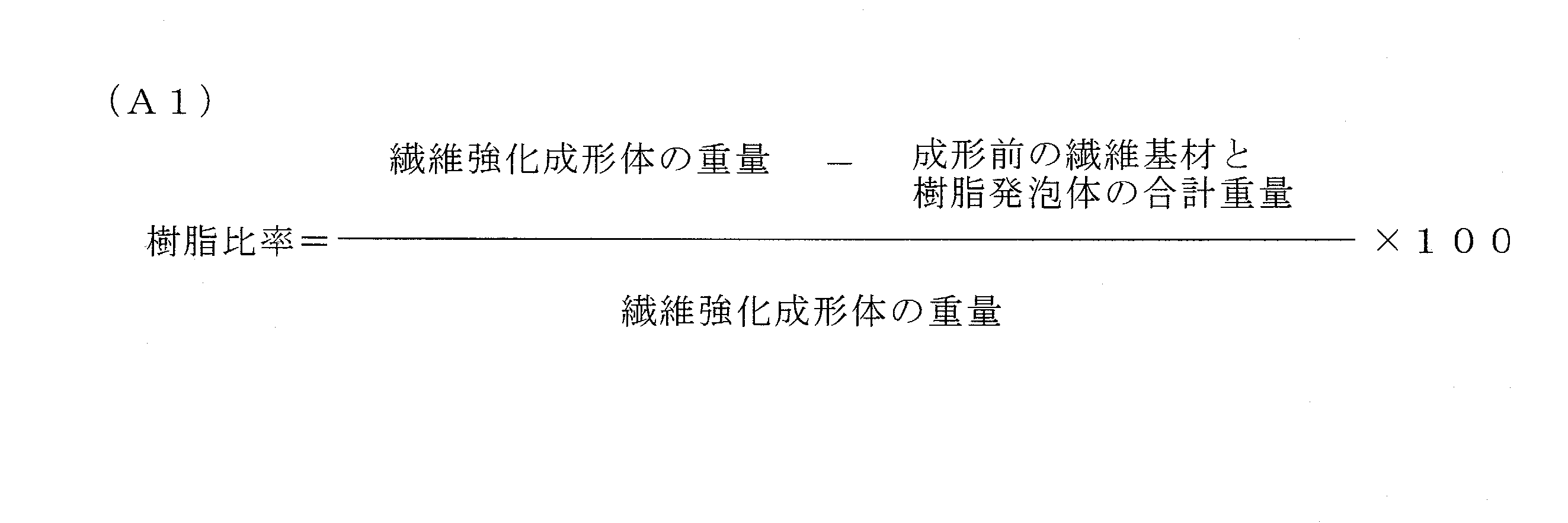

図27に示す実施形態では、1枚の繊維基材417A上に粉体状の熱硬化性樹脂419Aを配置し、その上に連続気泡構造を有する樹脂発泡体413を配置し、その上に粉体状の熱硬化性樹脂419Bを配置し、さらにその上に繊維基材417Bを配置して成形前積層体を作製する。
なお、繊維補強材415が2層以上の繊維強化成形体においても、曲げ弾性率(JIS K7074 A法)は24GPa以上が好ましく、30GPa以上がさらに好ましい。また、曲げ強度(JIS K7074 A法)は300MPa以上が好ましく、380MPa以上がさらに好ましい。
図29に示す実施形態では、2枚の繊維基材417A、417Bを積層し、その上に連続気泡構造を有する樹脂発泡体413を配置し、その上に粉体状の熱硬化性樹脂419を配置し、さらにその上に2枚の繊維基材417C、417Dを積層して成形前積層体を作製する。
表面が凹凸形状の繊維強化成形体においても、曲げ弾性率(JIS K7074 A法)は24GPa以上が好ましく、30GPa以上がさらに好ましい。また、曲げ強度(JIS K7074 A法)は300MPa以上が好ましく、380MPa以上がさらに好ましい。
図31に示す実施形態の製造方法では、1枚の繊維基材417A上に連続気泡構造を有する樹脂発泡体413を配置し、その上に粉体状の熱硬化性樹脂419を配置し、さらにその上に繊維基材417Bを配置して成形前積層体を作製する。
なお、表面に凹凸が形成され、繊維補強材415が2層以上の繊維強化成形体においても、曲げ弾性率(JIS K7074 A法)は24GPa以上が好ましく、30GPa以上がさらに好ましい。また、曲げ強度(JIS K7074 A法)は300MPa以上が好ましく、380MPa以上がさらに好ましい。
図33に示す実施形態の製造方法では、2枚の繊維基材417A、417Bを積層し、その上に連続気泡構造を有する樹脂発泡体413を配置し、その上に粉体状の熱硬化性樹脂419を配置し、さらにその上に2枚の繊維基材417C、417Dを積層して成形前積層体を作製する。
図34の実施形態では、2枚の繊維基材417A、417Bを積層し、その上に粉体状の熱硬化性樹脂419Aを配置し、その上に連続気泡構造を有する樹脂発泡体413を配置し、その上に粉体状の熱硬化性樹脂419Bを配置し、さらにその上に2枚の繊維基材417C、417Dを積層して成形前積層体を作製する。
<実施例>
1)試料の0.4gをペレット(直径φ18mm、厚さ0.4mm程度)に成形し、成形したペレットを直径φ18mmのパラレルプレートで挟む。
2)昇温速度5℃/min、周波数1Hz、回転角(ひずみ)0.1deg、等速昇温下、40℃~200℃間に渡って、2℃間隔で動的粘度を測定した。図35における溶融開始温度(Ta)は最高粘度(硬化反応開始温度(Tb)以下の温度領域における最高粘度)を示す温度、硬化反応開始温度(Tb)は最低粘度を示す温度、最高粘度は硬化反応開始温度(Tb)~190℃の温度領域における最高粘度である。
圧縮率は、前記の式(A2)を用いて算出した。
比重は、繊維強化成形体の重量と繊維強化成形体の体積から算出した。繊維強化成形体の体積は、繊維強化成形体の厚みと面積から算出した。
樹脂比率は、前記の式(A1)を用いて算出した。
なお、成形前の繊維基材と連続気泡構造を有する樹脂発泡体の重量は、次の式により算出した。
繊維基材の重量=目付量×繊維強化成形体の面積×繊維基材使用枚数
樹脂発泡体の重量=樹脂発泡体密度×繊維強化成形体の面積×成形前樹脂発泡体の厚み
曲げ強度及び曲げ弾性率は、JIS K7074 A法に基づいて測定した。
実施例1E~実施例12Eは、図25に示した繊維強化成形体410及び図26の製造方法の例である。
実施例1Eでは、繊維基材として、炭素繊維織物(帝人株式会社製、品名:W-3101、目付量:200g/m2、厚み0.22mm)を、200×300mmに裁断したものを2枚用意した。裁断後の1枚当たりの繊維基材の重量は12gであった。また、連続気泡構造を有する樹脂発泡体として、厚み10mm、平面サイズ200×300mm(重量5.4g)に切り出したメラミン樹脂発泡体(BASF社製、品名:バソテクトG+、密度9kg/m3)を用意した。
1枚の繊維基材上にメラミン樹脂発泡体を積層し、その上に、粉体状の熱硬化性樹脂として、以下の樹脂A4の65.0gを概ね均一に配置し、その上にもう1枚の繊維基材を配置し、成形前積層体を作製した。
樹脂A4は、フェノール樹脂、住友ベークライト株式会社製、品名:PR-50252、平均粒径30μmである。
樹脂A4(実施例1E、6E-15E、20E-26E)の粘度測定結果を、図37のグラフに示す。
なお金型の下型と上型の間には、厚み1mmのSUS製スペーサを介在させて下型と上型間の間隔を1mmとして、成形前積層体の圧縮厚みを1mmに調製した。
粉体状の熱硬化性樹脂として、以下の樹脂B4を使用した以外、実施例1Eと同様にして実施例2Eの繊維強化成形体を作製した。
樹脂B4は、フェノール樹脂、住友ベークライト株式会社製、品名:PR-310、平均粒径30μmである。
粉体状の熱硬化性樹脂として、樹脂A4と以下の樹脂C4を1:1の重量比で均一に混合した樹脂を使用し、金型温度を170℃とした以外、実施例1Eと同様にして実施例3Eの繊維強化成形体を作製した。
樹脂C4は、エポキシ樹脂、三菱ケミカル株式会社製、品名:jER-1001を乳鉢で粉砕して使用した。平均粒径は100μmである。
粉体状の熱硬化性樹脂として、以下の樹脂D4と以下の樹脂E4を1:1の重量比で均一に混合した樹脂を使用し、金型温度を160℃とした以外、実施例1Eと同様にして実施例4Eの繊維強化成形体を作製した。
樹脂D4はフェノール樹脂、住友ベークライト株式会社製、品名:PR-50235Dを乳鉢で粉砕して使用した。平均粒径は90μmである。
樹脂E4はシアネート樹脂、三菱ガス化学株式会社製、品名:CYTESTER TAを乳鉢で粉砕して使用した。平均粒径は100μmである。
粉体状の熱硬化性樹脂として、樹脂D4と樹脂E4と樹脂C4を1:1:1の重量比で均一に混合した樹脂を使用し、金型温度を170℃とした以外、実施例1Eと同様にして実施例5Eの繊維強化成形体を作製した。
連続気泡構造を有する樹脂発泡体として、厚み6mm、平面サイズ200×300mm(重量3.2g)に切り出したメラミン樹脂発泡体(BASF社製、品名:バソテクトG+、密度9kg/m3)を用いた以外は、実施例1Eと同様にして実施例6Eの繊維強化成形体を作製した。
連続気泡構造を有する樹脂発泡体として、厚み2mm、平面サイズ200×300mm(重量1.1g)に切り出したメラミン樹脂発泡体(BASF社製、品名:バソテクトG+、密度9kg/m3)を用いた以外は、実施例1Eと同様にして実施例7Eの繊維強化成形体を作製した。
連続気泡構造を有する樹脂発泡体として、厚み20mm、平面サイズ200×300mm(重量10.8g)に切り出したメラミン樹脂発泡体(BASF社製、品名:バソテクトG+、密度9kg/m3)を用いた以外は、実施例1Eと同様にして実施例8Eの繊維強化成形体を作製した。
連続気泡構造を有する樹脂発泡体として、厚み28mm、平面サイズ200×300mm(重量15.1g)に切り出したメラミン樹脂発泡体(BASF社製、品名:バソテクトG+、密度9kg/m3)を用いた以外は、実施例1Eと同様にして実施例9Eの繊維強化成形体を作製した。
粉体状の熱硬化性樹脂として樹脂Aの48gを使用した以外は、実施例1Eと同様にして実施例10Eの繊維強化成形体を作製した。
粉体状の熱硬化性樹脂として樹脂Aの70gを使用した以外は、実施例1Eと同様にして実施例11Eの繊維強化成形体を作製した。
連続気泡構造を有する樹脂発泡体として、厚み10mm、平面サイズ200×300mm(重量18g)に切り出したウレタン樹脂発泡体(株式会社イノアックコーポレーション製、品名:MF-50、密度30kg/m3)を用いた以外は、実施例1Eと同様にして実施例12Eの繊維強化成形体を作製した。
実施例13Eは、連続起泡構造を有する樹脂発泡体の両側に粉体状の熱硬化性樹脂を配置する場合であり、図25に示した繊維強化成形体410及び図27の製造方法の例である。
メラミン樹脂発泡体の上下に粉体状の熱硬化性樹脂として樹脂A4の32.5gをそれぞれ概ね均一に配置した以外は、実施例1Eと同様にして実施例13Eの繊維強化成形体を作製した。
実施例14Eは、連続気泡構造を有する樹脂発泡体の両側に繊維基材を各2枚積層する場合であり、図28に示した繊維強化成形体420及び図29の製造方法の例である。
繊維基材として、炭素繊維織物(帝人株式会社製、品名:W-3101、目付量:200g/m2、厚み0.22mm)を、200×300mmに裁断したもの(裁断後の1枚当たりの繊維基材の重量は12g)を4枚用意し、2枚積層した繊維基材上にメラミン樹脂発泡体を積層し、その上に粉体状の熱硬化性樹脂として樹脂A4の57.0gを概ね均一に配置し、その上に残りの2枚の繊維基材を配置し、金型の下型と上型の間には、厚み1.5mmのSUS製スペーサを介在させた以外は、実施例1Eと同様にして実施例14Eの繊維強化成形体を作製した。
実施例15E~実施例19E及び実施例22Eは、図30に示した表面に凹凸が形成された繊維強化成形体430(芯材両面の繊維補強層が各1)及び図31の製造方法の例である。
実施例15Eでは、繊維基材として、炭素繊維織物(帝人株式会社製、品名:W-3101、目付量:200g/m2、厚み0.22mm)を、200×300mmに裁断したものを2枚用意した。裁断後の1枚当たりの繊維基材の重量は12gであった。また、連続気泡構造を有する樹脂発泡体として、厚み10mm、平面サイズ200×300mm(重量5.4g)に切り出したメラミン樹脂発泡体(BASF社製、品名:バソテクトG+、密度9kg/m3)を用意した。
1枚の繊維基材上にメラミン樹脂発泡体を積層し、その上に、粉体状の熱硬化性樹脂として、樹脂A4の65.0gを概ね均一に配置し、その上にもう1枚の繊維基材を配置し、成形前積層体を作製した。
金型の上型の型面には、凹部形成用突起(高さ1mm、幅10mm)と凸部形成用溝(深さ0.5mm、幅10mm)が、互いの間隔を100mmとして、型面の一端から他端まで形成されている。
金型の下型と上型の間には、厚み1mmのSUS製スペーサを介在させて下型と上型間の間隔を1mmとして、成形前積層体の圧縮厚みを1mmに調製した。
粉体状の熱硬化性樹脂として樹脂B4を使用した以外は、実施例15Eと同様にして実施例16Eの繊維強化成形体を作製した。
粉体状の熱硬化性樹脂として樹脂A4と樹脂C4を1:1の重量比で均一に混合した樹脂を使用し、金型温度を170℃とした以外は、実施例15Eと同様にして実施例17Eの繊維強化成形体を作製した。
粉体状の熱硬化性樹脂として樹脂D4と樹脂E4を1:1の重量比で均一に混合した樹脂を使用し、金型温度を160℃とした以外は、実施例15Eと同様にして実施例18Eの繊維強化成形体を作製した。
粉体状の熱硬化性樹脂として樹脂D4と樹脂E4と樹脂C4を1:1:1の重量比で均一に混合した樹脂を使用し、金型温度を170℃とした以外は、実施例15Eと同様にして実施例19Eの繊維強化成形体を作製した。
実施例20Eは、図32に示した表面に凹凸が形成された繊維強化成形体440(芯材両面の繊維補強層が各2層)及び図33の製造方法の例である。
実施例15Eと同様の繊維基材を4枚用意し、2枚積層した繊維基材の上に、実施例15Eと同様の連続気泡構造を有する樹脂発泡体を積層し、その上に粉末状の熱硬化性樹脂として樹脂A4の57.0gを概ね均一に配置し、その上に残りの2枚の繊維基材を配置し、成形前積層体を作製し、厚み1.5mmのSUS製スペーサを用いた以外は、実施例15Eと同様にして実施例20Eの繊維強化成形体を作製した。
実施例21Eは、図34に示すように連続気泡構造の樹脂発泡体の両側に粉体状の熱硬化性樹脂を配置して図32の繊維強化成形体を製造する例である。
実施例15Eと同様の繊維基材を4枚用意し、2枚積層した繊維基材の上に、粉体状の熱硬化性樹脂として樹脂A4の29gを配置し、その上に実施例15Eと同様の連続気泡構造を有する樹脂発泡体を積層し、その上に粉末状の熱硬化性樹脂として樹脂A4の29gを概ね均一に配置し、その上に残りの2枚の繊維基材を配置し、成形前積層体を作製し、厚み1.5mmのSUS製スペーサを用いた以外は、実施例15Eと同様にして実施例21Eの繊維強化成形体を作製した。
実施例22Eは、実施例15Eにおける連続気泡構造を有する樹脂発泡体の種類を変更した例である。
連続気泡構造を有する樹脂発泡体として、厚み10mm、平面サイズ200×300mm(重量18g)に切り出したウレタン樹脂発泡体(株式会社イノアックコーポレーション製、品名:MF-50、密度30kg/m3を使用した以外は、実施例15Eと同様にして実施例22Eの繊維強化成形体を作製した。
連続気泡構造を有する樹脂発泡体の厚みを30mmした以外は、実施例1Eと同様にして実施例23Eの繊維強化成形体を作製した。
連続気泡構造を有する熱硬化性樹脂発泡体として、厚み1.5mm、平面サイズ200×300mm(重量18g)に切り出したウレタン樹脂発泡体(株式会社イノアックコーポレーション製、品名:MF-50、密度30kg/m3を用いた以外は、実施例1Eと同様にして実施例24Eの繊維強化成形体を作製した。
樹脂比率が45%となるように粉体状の熱硬化性樹脂の使用量を調整した以外は、実施例1Eと同様にして実施例25Eの繊維強化成形体を作製した。
樹脂比率が85%となるように粉体状の熱硬化性樹脂の使用量を調整した以外は、実施例1Eと同様にして実施例26Eの繊維強化成形体を作製した。
比較例1E、2Eは、実施例1Eに対する比較例である。
比較例1Eでは、粉体状の熱硬化性樹脂として以下の樹脂F4を使用し、金型温度を100℃とした以外は、実施例1Eと同様にして比較例1Eの繊維強化成形体を作製した。
樹脂F4は、フェノール樹脂、住友ベークライト株式会社製、品名:PR-50699、平均粒径30μmである。
樹脂F4(比較例1E、3E)の粘度測定結果を、図37のグラフに示す。
粉体状の熱硬化性樹脂として、樹脂A4と樹脂D4を重量比1:2で均一に混合した樹脂を使用し、金型温度を160℃とした以外、実施例1Eと同様にして比較例2Eの繊維強化成形体を作製した。
樹脂A4/樹脂D4=1/2(比較例2E、4E)の粘度測定結果を、図37のグラフに示す。
比較例3E、4Eは、実施例15Eに対する比較例である。
比較例3Eでは、粉体状の熱硬化性樹脂として樹脂F4を使用し、金型温度を100℃にした以外は、実施例15Eと同様にして比較例3Eの繊維強化成形体を作製した。
粉体状の熱硬化性樹脂として、樹脂A4と樹脂D4を重量比1:2で均一に混合した樹脂を使用し、金型温度を160℃とした以外、実施例15Eと同様にして比較例4Eの繊維強化成形体を作製した。
本態様は、実施例に限定されず、趣旨から逸脱しない範囲で変更可能である。
10 繊維強化樹脂成形体
11、11A~11F 繊維基材
15 熱硬化性樹脂
15A~15E 熱硬化性樹脂の粉体
30 金型
31 下型
32 上型
<第2態様の説明における符号の説明>
110、120、130 プリプレグ
111、111A~111D 繊維基材
115 熱硬化性樹脂
115A~115C 熱硬化性樹脂の粉体
141A、141B 離型用プラスチックフィルム
150 金型
151 下型
152 上型
<第3態様の説明における符号の説明>
210 繊維強化成形体
211 繊維基材
215 樹脂シート
230 金型
231 下型
232 上型
<第4態様の説明における符号の説明>
310 繊維強化サンドイッチ複合体
311、311A~311D 繊維基材
315 コア材
321 熱硬化性樹脂
321A、321B 熱硬化性樹脂の粉体
330 金型
331 下型
332 上型
<第5態様の説明における符号の説明>
410、420、430、440 繊維強化成形体
411 芯材
413 連続気泡構造を有する樹脂発泡体
415 繊維補強材
417、417A~417D 繊維基材
419、419A、419B 粉体状の熱硬化性樹脂
431、441 凹部
433、443 凸部
460、470 金型
461、471 下型
462、472 上型
473 凹部形成用突起
475 凸部形成用溝
Claims (16)
- 繊維基材が、熱硬化性樹脂と共に加熱圧縮されて、前記熱硬化性樹脂が前記繊維基材に含浸硬化した繊維強化樹脂成形体において、
前記硬化した前記熱硬化性樹脂は、前記繊維基材と接して配置された前記熱硬化性樹脂の粉体が、前記加熱圧縮時に溶融硬化したものであることを特徴とする、繊維強化樹脂成形体。 - 繊維基材を熱硬化性樹脂と共に加熱圧縮し、前記熱硬化性樹脂を前記繊維基材に含浸させて硬化させる繊維強化樹脂成形体の製造方法において、
前記熱硬化性樹脂の粉体を前記繊維基材と接するように配置し、
前記繊維基材を前記熱硬化性樹脂の粉体と共に金型で加熱・圧縮することにより、前記熱硬化性樹脂の粉体を溶融して前記繊維基材内に含浸させ、硬化させることを特徴とする、繊維強化樹脂成形体の製造方法。 - 前記金型の温度Tc℃は、前記熱硬化性樹脂の溶融開始温度をTa℃、硬化反応開始温度をTb℃とすると、
[Tb+(Tb-Ta)/3]-15≦Tc≦[Tb+(Tb-Ta)/3]+20
であることを特徴とする、請求項2に記載の繊維強化樹脂成形体の製造方法。 - 前記熱硬化性樹脂は、溶融開始温度をTa℃、硬化反応開始温度をTb℃とすると、(Tb-Ta)の値が、
30≦(Tb-Ta)≦100
であることを特徴とする、請求項2に記載の繊維強化樹脂成形体の製造方法。 - 前記熱硬化性樹脂は、溶融開始温度Ta℃以上の温度における最低粘度が、2,000Pa・s以下であることを特徴とする、請求項2に記載の繊維強化樹脂成形体の製造方法。
- 前記熱硬化性樹脂は、硬化反応開始温度Tb℃~190℃の温度範囲における最高粘度が、1,000Pa・s以上であることを特徴とする、請求項2に記載の繊維強化樹脂成形体の製造方法。
- 前記熱硬化性樹脂は、溶融開始温度Ta℃が、60~100℃であることを特徴とする、請求項2に記載の繊維強化樹脂成形体の製造方法。
- 前記熱硬化性樹脂は、フェノール樹脂、フェノール樹脂とエポキシ樹脂との混合樹脂、フェノール樹脂とシアネート樹脂との混合樹脂、フェノール樹脂とシアネート樹脂とエポキシ樹脂との混合樹脂の群から選ばれる樹脂であることを特徴とする、請求項2に記載の繊維強化樹脂成形体の製造方法。
- 繊維基材を熱硬化性樹脂と共に加熱圧縮して得られる繊維強化樹脂成形用プリプレグであって、
前記熱硬化性樹脂は、加熱圧縮前の状態が粉体状であって、硬化反応開始温度Tb℃の粘度が2,000Pa・s以下であり、硬化反応開始温度Tb℃~190℃の範囲における最高粘度が1,000Pa・s以上であることを特徴とする、繊維強化樹脂成形用プリプレグ。 - 前記熱硬化性樹脂は、溶融開始温度Ta℃が前記加熱圧縮時の温度以下であり、硬化反応開始温度Tb℃が前記加熱圧縮時の温度以上であることを特徴とする、請求項9に記載の繊維強化樹脂成形用プリプレグ。
- 繊維基材が、熱硬化性樹脂を含有する樹脂シートの前記熱硬化性樹脂によって一体化された、繊維強化成形体であって、
前記熱硬化性樹脂は、硬化反応開始温度Tb℃の粘度が2,000Pa・s以下であり、硬化反応開始温度Tb℃~190℃の範囲における最高粘度が1,000Pa・s以上である、繊維強化成形体。 - 前記樹脂シートは、シート基材を備える、請求項11に記載の繊維強化成形体。
- 請求項11に記載の繊維強化成形体の製造方法であって、
前記繊維基材と前記樹脂シートとを重ねた状態で、金型によって加熱圧縮し、前記熱硬化性樹脂を前記繊維基材に含浸させて硬化させる、繊維強化成形体の製造方法。 - 繊維強化成形体の製造用の樹脂シートであって、
熱硬化性樹脂を含有する、樹脂シート。 - 繊維基材とコア材が積層されて熱硬化性樹脂と共に加熱圧縮されることにより接着一体化した繊維強化サンドイッチ複合体であって、
前記コア材は、5%圧縮応力が0.10MPa以上であり、
前記熱硬化性樹脂は、加熱前の状態が粉体状であり、硬化反応開始温度Tb℃の粘度が2,000Pa・s以下であり、硬化反応開始温度Tb℃~190℃の範囲における最高粘度が1,000Pa・s以上であることを特徴とする、繊維強化サンドイッチ複合体。 - 樹脂発泡体に熱硬化性樹脂が含浸硬化した芯材と、繊維基材に前記熱硬化性樹脂が含浸硬化した繊維補強材とが積層一体化した繊維強化成形体の製造方法において、
前記樹脂発泡体は、連続気泡構造を有し、
前記連続気泡構造を有する前記樹脂発泡体と前記熱硬化性樹脂と前記繊維基材とで成形前積層体を形成し、
前記成形前積層体を加熱圧縮することにより、前記熱硬化性樹脂を溶融し、溶融した該熱硬化性樹脂を、前記連続気泡構造を有する前記樹脂発泡体と前記繊維基材に含浸させ、硬化させることを特徴とする、繊維強化成形体の製造方法。
Priority Applications (3)
| Application Number | Priority Date | Filing Date | Title |
|---|---|---|---|
| US17/925,228 US12415897B2 (en) | 2020-07-06 | 2021-06-22 | Fiber-reinforced resin molded body and production method thereof, fiber-reinforced resin molding prepreg, fiber-reinforced molded body and production method of fiber-reinforced molded body and resin sheet, fiber-reinforced sandwich composite, and production method of fiberreinforced molded body |
| EP21835931.3A EP4177047A4 (en) | 2020-07-06 | 2021-06-22 | Fiber-reinforced resin molded body and manufacturing method thereof, fiber-reinforced resin molding prepreg, fiber-reinforced molded body and fiber-reinforced molded body manufacturing method, and resin sheet, fiber-reinforced sandwich composite, and fiber-reinforced molded body manufacturing method |
| CN202180042674.6A CN115835945A (zh) | 2020-07-06 | 2021-06-22 | 纤维增强树脂成型体及其制造方法、纤维增强树脂成型用预浸料、纤维增强成型体、纤维增强成型体的制造方法、树脂片、纤维增强三明治型复合体以及纤维增强成型体的制造方法 |
Applications Claiming Priority (10)
| Application Number | Priority Date | Filing Date | Title |
|---|---|---|---|
| JP2020116251A JP7326228B2 (ja) | 2020-07-06 | 2020-07-06 | 繊維強化樹脂成形体とその製造方法 |
| JP2020-116251 | 2020-07-06 | ||
| JP2020-171081 | 2020-10-09 | ||
| JP2020171081A JP7321135B2 (ja) | 2020-10-09 | 2020-10-09 | 繊維強化樹脂成形用プリプレグと繊維強化樹脂成形体 |
| JP2020171814A JP7473442B2 (ja) | 2020-10-12 | 2020-10-12 | 繊維強化サンドイッチ複合体 |
| JP2020-171814 | 2020-10-12 | ||
| JP2020-206600 | 2020-12-14 | ||
| JP2020206600A JP7493439B2 (ja) | 2020-12-14 | 2020-12-14 | 繊維強化成形体の製造方法と繊維強化成形体 |
| JP2021-076007 | 2021-04-28 | ||
| JP2021076007A JP7419291B2 (ja) | 2021-04-28 | 2021-04-28 | 繊維強化成形体の製造方法、樹脂シート、及び樹脂シートの製造方法 |
Publications (1)
| Publication Number | Publication Date |
|---|---|
| WO2022009671A1 true WO2022009671A1 (ja) | 2022-01-13 |
Family
ID=79552958
Family Applications (1)
| Application Number | Title | Priority Date | Filing Date |
|---|---|---|---|
| PCT/JP2021/023675 Ceased WO2022009671A1 (ja) | 2020-07-06 | 2021-06-22 | 繊維強化樹脂成形体とその製造方法、繊維強化樹脂成形用プリプレグ、繊維強化成形体と繊維強化成形体の製造方法と樹脂シート、繊維強化サンドイッチ複合体、及び繊維強化成形体の製造方法 |
Country Status (5)
| Country | Link |
|---|---|
| US (1) | US12415897B2 (ja) |
| EP (1) | EP4177047A4 (ja) |
| CN (1) | CN115835945A (ja) |
| TW (1) | TWI907450B (ja) |
| WO (1) | WO2022009671A1 (ja) |
Cited By (2)
| Publication number | Priority date | Publication date | Assignee | Title |
|---|---|---|---|---|
| JP2024005403A (ja) * | 2022-06-30 | 2024-01-17 | 住友ベークライト株式会社 | サンドイッチパネルの製造方法 |
| WO2024075339A1 (ja) * | 2022-10-04 | 2024-04-11 | Dic株式会社 | 積層体、積層体の製造方法、及びバッテリーケース |
Citations (19)
| Publication number | Priority date | Publication date | Assignee | Title |
|---|---|---|---|---|
| JPS5030966A (ja) * | 1973-07-18 | 1975-03-27 | ||
| JPS5375284A (en) * | 1976-12-15 | 1978-07-04 | Matsushita Electric Works Ltd | Manufacture of synthetic resin laminate |
| JPS5375285A (en) * | 1976-12-15 | 1978-07-04 | Matsushita Electric Works Ltd | Manufacture of synthetic resin laminate |
| JPS5478772A (en) * | 1977-12-05 | 1979-06-23 | Matsushita Electric Works Ltd | Production of laminate |
| JP2006232915A (ja) | 2005-02-23 | 2006-09-07 | Dainippon Ink & Chem Inc | Frp用エポキシ樹脂組成物 |
| JP2010023240A (ja) * | 2008-07-15 | 2010-02-04 | Institute Of National Colleges Of Technology Japan | 熱防御複合材の製造方法 |
| JP2010540293A (ja) * | 2007-10-03 | 2010-12-24 | エイセル グループ リミテッド | 複合製品 |
| JP2011093175A (ja) * | 2009-10-29 | 2011-05-12 | Inoac Corp | 繊維強化成形体及びその製造方法 |
| WO2012073775A1 (ja) * | 2010-12-02 | 2012-06-07 | 東レ株式会社 | 金属複合体の製造方法および電子機器筐体 |
| JP2015217662A (ja) * | 2014-05-21 | 2015-12-07 | 株式会社イノアックコーポレーション | 炭素繊維複合材 |
| JP2017160559A (ja) * | 2016-03-09 | 2017-09-14 | 住友ベークライト株式会社 | 抄造体の製造方法および成形体の製造方法 |
| JP2018024215A (ja) * | 2016-08-12 | 2018-02-15 | 日産自動車株式会社 | 成形品の成形方法 |
| WO2019044801A1 (ja) * | 2017-08-30 | 2019-03-07 | 本田技研工業株式会社 | 積層体、車載用電池収容体及び車載用電池収容体の製造方法 |
| WO2019069639A1 (ja) * | 2017-10-06 | 2019-04-11 | 八千代工業株式会社 | 繊維強化樹脂部材の製造方法、燃料タンク及び繊維強化樹脂部材 |
| JP2020044811A (ja) | 2018-09-21 | 2020-03-26 | 東レ株式会社 | サンドイッチ構造体 |
| JP2020116251A (ja) | 2019-01-25 | 2020-08-06 | 株式会社三共 | スロットマシン |
| JP2020171081A (ja) | 2019-04-01 | 2020-10-15 | 株式会社ミツバ | モータ装置 |
| JP2020171814A (ja) | 2020-07-29 | 2020-10-22 | サミー株式会社 | 遊技機 |
| JP2021076007A (ja) | 2021-01-18 | 2021-05-20 | Ihi運搬機械株式会社 | 駐車装置を利用した荷受方法および荷送方法 |
Family Cites Families (16)
| Publication number | Priority date | Publication date | Assignee | Title |
|---|---|---|---|---|
| JP4722436B2 (ja) | 2004-09-02 | 2011-07-13 | 株式会社イノアックコーポレーション | 吸音材及びその製造方法 |
| JP2009280669A (ja) | 2008-05-21 | 2009-12-03 | Toray Ind Inc | Rtm成形繊維強化複合材料、およびその製造方法 |
| CN101672552B (zh) | 2009-10-12 | 2011-11-16 | 刘秋克 | 太阳能次生源热源塔热泵成套装置 |
| JP5738567B2 (ja) | 2010-10-05 | 2015-06-24 | 新日鉄住金マテリアルズ株式会社 | 耐摩耗性の繊維強化複合材及びその製造方法 |
| JP5944735B2 (ja) | 2012-04-27 | 2016-07-05 | 三菱樹脂株式会社 | 炭素繊維強化樹脂成形体の製造方法 |
| GB2516274B (en) * | 2013-07-17 | 2016-12-28 | Gurit (Uk) Ltd | Prepreg for manufacturing composite materials |
| CN104130548A (zh) | 2014-07-29 | 2014-11-05 | 深圳市惠程电气股份有限公司 | 一种聚酰亚胺纤维预浸料及其制备方法与应用 |
| CN104559816A (zh) | 2015-02-05 | 2015-04-29 | 曾昭峰 | 一种玻璃毡拼接方法 |
| JP6368748B2 (ja) | 2016-08-17 | 2018-08-01 | 株式会社日本製鋼所 | 繊維強化樹脂を成形する成形加工方法 |
| JP6953438B2 (ja) | 2016-12-28 | 2021-10-27 | 日鉄ケミカル&マテリアル株式会社 | 金属−繊維強化樹脂材料複合体、その製造方法及び接着シート |
| JP6776944B2 (ja) | 2017-02-27 | 2020-10-28 | トヨタ自動車株式会社 | 樹脂成形体の製造方法 |
| TW201903013A (zh) | 2017-03-31 | 2019-01-16 | 日商新日鐵住金化學股份有限公司 | 金屬-纖維強化樹脂材料複合體及其製造方法 |
| JP7295376B2 (ja) | 2017-12-28 | 2023-06-21 | 日本製鉄株式会社 | 金属-繊維強化樹脂材料複合体及びその製造方法 |
| JP7215163B2 (ja) | 2017-12-28 | 2023-01-31 | 日本製鉄株式会社 | 金属-繊維強化樹脂材料複合体 |
| JP7099113B2 (ja) | 2018-07-19 | 2022-07-12 | 三菱ケミカル株式会社 | 炭素繊維プリプレグの製造方法 |
| CN109897375B (zh) | 2019-03-29 | 2020-07-14 | 中南大学 | 一种高强度柔性环氧树脂改性氰酸酯树脂/碳纤维复合型形状记忆材料及其制备方法 |
-
2021
- 2021-06-22 EP EP21835931.3A patent/EP4177047A4/en not_active Withdrawn
- 2021-06-22 CN CN202180042674.6A patent/CN115835945A/zh active Pending
- 2021-06-22 WO PCT/JP2021/023675 patent/WO2022009671A1/ja not_active Ceased
- 2021-06-22 US US17/925,228 patent/US12415897B2/en active Active
- 2021-06-28 TW TW110123546A patent/TWI907450B/zh active
Patent Citations (19)
| Publication number | Priority date | Publication date | Assignee | Title |
|---|---|---|---|---|
| JPS5030966A (ja) * | 1973-07-18 | 1975-03-27 | ||
| JPS5375284A (en) * | 1976-12-15 | 1978-07-04 | Matsushita Electric Works Ltd | Manufacture of synthetic resin laminate |
| JPS5375285A (en) * | 1976-12-15 | 1978-07-04 | Matsushita Electric Works Ltd | Manufacture of synthetic resin laminate |
| JPS5478772A (en) * | 1977-12-05 | 1979-06-23 | Matsushita Electric Works Ltd | Production of laminate |
| JP2006232915A (ja) | 2005-02-23 | 2006-09-07 | Dainippon Ink & Chem Inc | Frp用エポキシ樹脂組成物 |
| JP2010540293A (ja) * | 2007-10-03 | 2010-12-24 | エイセル グループ リミテッド | 複合製品 |
| JP2010023240A (ja) * | 2008-07-15 | 2010-02-04 | Institute Of National Colleges Of Technology Japan | 熱防御複合材の製造方法 |
| JP2011093175A (ja) * | 2009-10-29 | 2011-05-12 | Inoac Corp | 繊維強化成形体及びその製造方法 |
| WO2012073775A1 (ja) * | 2010-12-02 | 2012-06-07 | 東レ株式会社 | 金属複合体の製造方法および電子機器筐体 |
| JP2015217662A (ja) * | 2014-05-21 | 2015-12-07 | 株式会社イノアックコーポレーション | 炭素繊維複合材 |
| JP2017160559A (ja) * | 2016-03-09 | 2017-09-14 | 住友ベークライト株式会社 | 抄造体の製造方法および成形体の製造方法 |
| JP2018024215A (ja) * | 2016-08-12 | 2018-02-15 | 日産自動車株式会社 | 成形品の成形方法 |
| WO2019044801A1 (ja) * | 2017-08-30 | 2019-03-07 | 本田技研工業株式会社 | 積層体、車載用電池収容体及び車載用電池収容体の製造方法 |
| WO2019069639A1 (ja) * | 2017-10-06 | 2019-04-11 | 八千代工業株式会社 | 繊維強化樹脂部材の製造方法、燃料タンク及び繊維強化樹脂部材 |
| JP2020044811A (ja) | 2018-09-21 | 2020-03-26 | 東レ株式会社 | サンドイッチ構造体 |
| JP2020116251A (ja) | 2019-01-25 | 2020-08-06 | 株式会社三共 | スロットマシン |
| JP2020171081A (ja) | 2019-04-01 | 2020-10-15 | 株式会社ミツバ | モータ装置 |
| JP2020171814A (ja) | 2020-07-29 | 2020-10-22 | サミー株式会社 | 遊技機 |
| JP2021076007A (ja) | 2021-01-18 | 2021-05-20 | Ihi運搬機械株式会社 | 駐車装置を利用した荷受方法および荷送方法 |
Non-Patent Citations (1)
| Title |
|---|
| See also references of EP4177047A4 |
Cited By (2)
| Publication number | Priority date | Publication date | Assignee | Title |
|---|---|---|---|---|
| JP2024005403A (ja) * | 2022-06-30 | 2024-01-17 | 住友ベークライト株式会社 | サンドイッチパネルの製造方法 |
| WO2024075339A1 (ja) * | 2022-10-04 | 2024-04-11 | Dic株式会社 | 積層体、積層体の製造方法、及びバッテリーケース |
Also Published As
| Publication number | Publication date |
|---|---|
| US12415897B2 (en) | 2025-09-16 |
| EP4177047A4 (en) | 2024-08-07 |
| CN115835945A (zh) | 2023-03-21 |
| TWI907450B (zh) | 2025-12-11 |
| US20230235140A1 (en) | 2023-07-27 |
| EP4177047A1 (en) | 2023-05-10 |
| TW202204137A (zh) | 2022-02-01 |
Similar Documents
| Publication | Publication Date | Title |
|---|---|---|
| KR101496172B1 (ko) | 탄소 섬유 강화 복합시트 및 그 제조 방법 | |
| US11034809B2 (en) | Resin supply material, preform, and method of producing fiber-reinforced resin | |
| JP5294609B2 (ja) | ガスバリア性の炭素繊維強化プリプレグ及び炭素繊維強化プラスチック並びにそれらの製造方法 | |
| CN101516589A (zh) | 复合预浸料坯基材的制造方法、层合基材及纤维增强塑料 | |
| KR20140027692A (ko) | 샌드위치 패널용 심재 및 이의 제조방법, 이를 포함하는 샌드위치 패널 | |
| JP7153253B2 (ja) | 繊維強化プラスチック成形体 | |
| WO2022009671A1 (ja) | 繊維強化樹脂成形体とその製造方法、繊維強化樹脂成形用プリプレグ、繊維強化成形体と繊維強化成形体の製造方法と樹脂シート、繊維強化サンドイッチ複合体、及び繊維強化成形体の製造方法 | |
| JP7404486B2 (ja) | 炭素繊維強化成形体 | |
| CN110997268A (zh) | 复合材料的制造方法及复合材料 | |
| JP6000497B1 (ja) | 繊維強化複合材料及びその製造方法 | |
| US12030291B2 (en) | Fiber-reinforced composite material and sandwich structure | |
| EP3991964A1 (en) | Honeycomb layered body and production method therefor | |
| CN109385042B (zh) | 低密度预浸料以及包含其的夹层复合成型品 | |
| JP2025142203A (ja) | 繊維強化複合材料 | |
| JP2020163674A (ja) | 繊維強化プラスチック成形体 | |
| US20230076283A1 (en) | Film-bonded infusion | |
| JP7419291B2 (ja) | 繊維強化成形体の製造方法、樹脂シート、及び樹脂シートの製造方法 | |
| JP7473442B2 (ja) | 繊維強化サンドイッチ複合体 | |
| WO2021039722A1 (ja) | 繊維強化樹脂複合成形体とその製造方法、抗菌性複合成形体とその製造方法、抗菌性繊維強化樹脂複合成形体とその製造方法、および繊維強化樹脂積層成形体とその製造方法 | |
| JP2005262818A (ja) | 強化繊維基材、プリフォームおよび強化繊維基材の製造方法 | |
| CN113573866A (zh) | 纤维强化树脂复合体及纤维强化树脂复合体的制造方法 | |
| JP2022093881A (ja) | 繊維強化成形体の製造方法と繊維強化成形体 | |
| JP2020163584A (ja) | サンドイッチ成形体の製造方法 | |
| CN213006894U (zh) | 一种新型设备舱板 | |
| JP7321135B2 (ja) | 繊維強化樹脂成形用プリプレグと繊維強化樹脂成形体 |
Legal Events
| Date | Code | Title | Description |
|---|---|---|---|
| 121 | Ep: the epo has been informed by wipo that ep was designated in this application |
Ref document number: 21835931 Country of ref document: EP Kind code of ref document: A1 |
|
| NENP | Non-entry into the national phase |
Ref country code: DE |
|
| ENP | Entry into the national phase |
Ref document number: 2021835931 Country of ref document: EP Effective date: 20230206 |
|
| WWW | Wipo information: withdrawn in national office |
Ref document number: 2021835931 Country of ref document: EP |
|
| WWG | Wipo information: grant in national office |
Ref document number: 17925228 Country of ref document: US |