WO2022009841A1 - グリース組成物および転がり軸受 - Google Patents
グリース組成物および転がり軸受 Download PDFInfo
- Publication number
- WO2022009841A1 WO2022009841A1 PCT/JP2021/025324 JP2021025324W WO2022009841A1 WO 2022009841 A1 WO2022009841 A1 WO 2022009841A1 JP 2021025324 W JP2021025324 W JP 2021025324W WO 2022009841 A1 WO2022009841 A1 WO 2022009841A1
- Authority
- WO
- WIPO (PCT)
- Prior art keywords
- mass
- grease composition
- grease
- rust
- zinc
- Prior art date
- Legal status (The legal status is an assumption and is not a legal conclusion. Google has not performed a legal analysis and makes no representation as to the accuracy of the status listed.)
- Ceased
Links
Images

Classifications
-
- C—CHEMISTRY; METALLURGY
- C10—PETROLEUM, GAS OR COKE INDUSTRIES; TECHNICAL GASES CONTAINING CARBON MONOXIDE; FUELS; LUBRICANTS; PEAT
- C10M—LUBRICATING COMPOSITIONS; USE OF CHEMICAL SUBSTANCES EITHER ALONE OR AS LUBRICATING INGREDIENTS IN A LUBRICATING COMPOSITION
- C10M169/00—Lubricating compositions characterised by containing as components a mixture of at least two types of ingredient selected from base-materials, thickeners or additives, covered by the preceding groups, each of these compounds being essential
- C10M169/06—Mixtures of thickeners and additives
-
- C—CHEMISTRY; METALLURGY
- C10—PETROLEUM, GAS OR COKE INDUSTRIES; TECHNICAL GASES CONTAINING CARBON MONOXIDE; FUELS; LUBRICANTS; PEAT
- C10M—LUBRICATING COMPOSITIONS; USE OF CHEMICAL SUBSTANCES EITHER ALONE OR AS LUBRICATING INGREDIENTS IN A LUBRICATING COMPOSITION
- C10M137/00—Lubricating compositions characterised by the additive being an organic non-macromolecular compound containing phosphorus
- C10M137/02—Lubricating compositions characterised by the additive being an organic non-macromolecular compound containing phosphorus having no phosphorus-to-carbon bond
- C10M137/04—Phosphate esters
- C10M137/10—Thio derivatives
-
- C—CHEMISTRY; METALLURGY
- C10—PETROLEUM, GAS OR COKE INDUSTRIES; TECHNICAL GASES CONTAINING CARBON MONOXIDE; FUELS; LUBRICANTS; PEAT
- C10M—LUBRICATING COMPOSITIONS; USE OF CHEMICAL SUBSTANCES EITHER ALONE OR AS LUBRICATING INGREDIENTS IN A LUBRICATING COMPOSITION
- C10M125/00—Lubricating compositions characterised by the additive being an inorganic material
- C10M125/22—Compounds containing sulfur, selenium or tellurium
-
- C—CHEMISTRY; METALLURGY
- C10—PETROLEUM, GAS OR COKE INDUSTRIES; TECHNICAL GASES CONTAINING CARBON MONOXIDE; FUELS; LUBRICANTS; PEAT
- C10M—LUBRICATING COMPOSITIONS; USE OF CHEMICAL SUBSTANCES EITHER ALONE OR AS LUBRICATING INGREDIENTS IN A LUBRICATING COMPOSITION
- C10M129/00—Lubricating compositions characterised by the additive being an organic non-macromolecular compound containing oxygen
- C10M129/02—Lubricating compositions characterised by the additive being an organic non-macromolecular compound containing oxygen having a carbon chain of less than 30 atoms
- C10M129/26—Carboxylic acids; Salts thereof
-
- C—CHEMISTRY; METALLURGY
- C10—PETROLEUM, GAS OR COKE INDUSTRIES; TECHNICAL GASES CONTAINING CARBON MONOXIDE; FUELS; LUBRICANTS; PEAT
- C10M—LUBRICATING COMPOSITIONS; USE OF CHEMICAL SUBSTANCES EITHER ALONE OR AS LUBRICATING INGREDIENTS IN A LUBRICATING COMPOSITION
- C10M133/00—Lubricating compositions characterised by the additive being an organic non-macromolecular compound containing nitrogen
- C10M133/02—Lubricating compositions characterised by the additive being an organic non-macromolecular compound containing nitrogen having a carbon chain of less than 30 atoms
- C10M133/04—Amines, e.g. polyalkylene polyamines; Quaternary amines
- C10M133/12—Amines, e.g. polyalkylene polyamines; Quaternary amines having amino groups bound to a carbon atom of a six-membered aromatic ring
-
- C—CHEMISTRY; METALLURGY
- C10—PETROLEUM, GAS OR COKE INDUSTRIES; TECHNICAL GASES CONTAINING CARBON MONOXIDE; FUELS; LUBRICANTS; PEAT
- C10M—LUBRICATING COMPOSITIONS; USE OF CHEMICAL SUBSTANCES EITHER ALONE OR AS LUBRICATING INGREDIENTS IN A LUBRICATING COMPOSITION
- C10M141/00—Lubricating compositions characterised by the additive being a mixture of two or more compounds covered by more than one of the main groups C10M125/00 - C10M139/00, each of these compounds being essential
- C10M141/10—Lubricating compositions characterised by the additive being a mixture of two or more compounds covered by more than one of the main groups C10M125/00 - C10M139/00, each of these compounds being essential at least one of them being an organic phosphorus-containing compound
-
- F—MECHANICAL ENGINEERING; LIGHTING; HEATING; WEAPONS; BLASTING
- F16—ENGINEERING ELEMENTS AND UNITS; GENERAL MEASURES FOR PRODUCING AND MAINTAINING EFFECTIVE FUNCTIONING OF MACHINES OR INSTALLATIONS; THERMAL INSULATION IN GENERAL
- F16C—SHAFTS; FLEXIBLE SHAFTS; ELEMENTS OR CRANKSHAFT MECHANISMS; ROTARY BODIES OTHER THAN GEARING ELEMENTS; BEARINGS
- F16C33/00—Parts of bearings; Special methods for making bearings or parts thereof
- F16C33/30—Parts of ball or roller bearings
- F16C33/66—Special parts or details in view of lubrication
- F16C33/6603—Special parts or details in view of lubrication with grease as lubricant
- F16C33/6633—Grease properties or compositions, e.g. rheological properties
-
- C—CHEMISTRY; METALLURGY
- C10—PETROLEUM, GAS OR COKE INDUSTRIES; TECHNICAL GASES CONTAINING CARBON MONOXIDE; FUELS; LUBRICANTS; PEAT
- C10M—LUBRICATING COMPOSITIONS; USE OF CHEMICAL SUBSTANCES EITHER ALONE OR AS LUBRICATING INGREDIENTS IN A LUBRICATING COMPOSITION
- C10M2201/00—Inorganic compounds or elements as ingredients in lubricant compositions
- C10M2201/08—Inorganic acids or salts thereof
- C10M2201/084—Inorganic acids or salts thereof containing sulfur, selenium or tellurium
-
- C—CHEMISTRY; METALLURGY
- C10—PETROLEUM, GAS OR COKE INDUSTRIES; TECHNICAL GASES CONTAINING CARBON MONOXIDE; FUELS; LUBRICANTS; PEAT
- C10M—LUBRICATING COMPOSITIONS; USE OF CHEMICAL SUBSTANCES EITHER ALONE OR AS LUBRICATING INGREDIENTS IN A LUBRICATING COMPOSITION
- C10M2207/00—Organic non-macromolecular hydrocarbon compounds containing hydrogen, carbon and oxygen as ingredients in lubricant compositions
- C10M2207/04—Ethers; Acetals; Ortho-esters; Ortho-carbonates
- C10M2207/0406—Ethers; Acetals; Ortho-esters; Ortho-carbonates used as base material
-
- C—CHEMISTRY; METALLURGY
- C10—PETROLEUM, GAS OR COKE INDUSTRIES; TECHNICAL GASES CONTAINING CARBON MONOXIDE; FUELS; LUBRICANTS; PEAT
- C10M—LUBRICATING COMPOSITIONS; USE OF CHEMICAL SUBSTANCES EITHER ALONE OR AS LUBRICATING INGREDIENTS IN A LUBRICATING COMPOSITION
- C10M2207/00—Organic non-macromolecular hydrocarbon compounds containing hydrogen, carbon and oxygen as ingredients in lubricant compositions
- C10M2207/10—Carboxylix acids; Neutral salts thereof
-
- C—CHEMISTRY; METALLURGY
- C10—PETROLEUM, GAS OR COKE INDUSTRIES; TECHNICAL GASES CONTAINING CARBON MONOXIDE; FUELS; LUBRICANTS; PEAT
- C10M—LUBRICATING COMPOSITIONS; USE OF CHEMICAL SUBSTANCES EITHER ALONE OR AS LUBRICATING INGREDIENTS IN A LUBRICATING COMPOSITION
- C10M2207/00—Organic non-macromolecular hydrocarbon compounds containing hydrogen, carbon and oxygen as ingredients in lubricant compositions
- C10M2207/10—Carboxylix acids; Neutral salts thereof
- C10M2207/16—Naphthenic acids
-
- C—CHEMISTRY; METALLURGY
- C10—PETROLEUM, GAS OR COKE INDUSTRIES; TECHNICAL GASES CONTAINING CARBON MONOXIDE; FUELS; LUBRICANTS; PEAT
- C10M—LUBRICATING COMPOSITIONS; USE OF CHEMICAL SUBSTANCES EITHER ALONE OR AS LUBRICATING INGREDIENTS IN A LUBRICATING COMPOSITION
- C10M2215/00—Organic non-macromolecular compounds containing nitrogen as ingredients in lubricant Compositions
- C10M2215/02—Amines, e.g. polyalkylene polyamines; Quaternary amines
- C10M2215/06—Amines, e.g. polyalkylene polyamines; Quaternary amines having amino groups bound to carbon atoms of six-membered aromatic rings
-
- C—CHEMISTRY; METALLURGY
- C10—PETROLEUM, GAS OR COKE INDUSTRIES; TECHNICAL GASES CONTAINING CARBON MONOXIDE; FUELS; LUBRICANTS; PEAT
- C10M—LUBRICATING COMPOSITIONS; USE OF CHEMICAL SUBSTANCES EITHER ALONE OR AS LUBRICATING INGREDIENTS IN A LUBRICATING COMPOSITION
- C10M2215/00—Organic non-macromolecular compounds containing nitrogen as ingredients in lubricant Compositions
- C10M2215/10—Amides of carbonic or haloformic acids
- C10M2215/102—Ureas; Semicarbazides; Allophanates
- C10M2215/1026—Ureas; Semicarbazides; Allophanates used as thickening material
-
- C—CHEMISTRY; METALLURGY
- C10—PETROLEUM, GAS OR COKE INDUSTRIES; TECHNICAL GASES CONTAINING CARBON MONOXIDE; FUELS; LUBRICANTS; PEAT
- C10M—LUBRICATING COMPOSITIONS; USE OF CHEMICAL SUBSTANCES EITHER ALONE OR AS LUBRICATING INGREDIENTS IN A LUBRICATING COMPOSITION
- C10M2219/00—Organic non-macromolecular compounds containing sulfur, selenium or tellurium as ingredients in lubricant compositions
- C10M2219/04—Organic non-macromolecular compounds containing sulfur, selenium or tellurium as ingredients in lubricant compositions containing sulfur-to-oxygen bonds, i.e. sulfones, sulfoxides
- C10M2219/044—Sulfonic acids, Derivatives thereof, e.g. neutral salts
-
- C—CHEMISTRY; METALLURGY
- C10—PETROLEUM, GAS OR COKE INDUSTRIES; TECHNICAL GASES CONTAINING CARBON MONOXIDE; FUELS; LUBRICANTS; PEAT
- C10M—LUBRICATING COMPOSITIONS; USE OF CHEMICAL SUBSTANCES EITHER ALONE OR AS LUBRICATING INGREDIENTS IN A LUBRICATING COMPOSITION
- C10M2223/00—Organic non-macromolecular compounds containing phosphorus as ingredients in lubricant compositions
- C10M2223/02—Organic non-macromolecular compounds containing phosphorus as ingredients in lubricant compositions having no phosphorus-to-carbon bonds
- C10M2223/04—Phosphate esters
- C10M2223/045—Metal containing thio derivatives
-
- C—CHEMISTRY; METALLURGY
- C10—PETROLEUM, GAS OR COKE INDUSTRIES; TECHNICAL GASES CONTAINING CARBON MONOXIDE; FUELS; LUBRICANTS; PEAT
- C10N—INDEXING SCHEME ASSOCIATED WITH SUBCLASS C10M RELATING TO LUBRICATING COMPOSITIONS
- C10N2010/00—Metal present as such or in compounds
- C10N2010/04—Groups 2 or 12
-
- C—CHEMISTRY; METALLURGY
- C10—PETROLEUM, GAS OR COKE INDUSTRIES; TECHNICAL GASES CONTAINING CARBON MONOXIDE; FUELS; LUBRICANTS; PEAT
- C10N—INDEXING SCHEME ASSOCIATED WITH SUBCLASS C10M RELATING TO LUBRICATING COMPOSITIONS
- C10N2030/00—Specified physical or chemical properties which is improved by the additive characterising the lubricating composition, e.g. multifunctional additives
- C10N2030/08—Resistance to extreme temperature
-
- C—CHEMISTRY; METALLURGY
- C10—PETROLEUM, GAS OR COKE INDUSTRIES; TECHNICAL GASES CONTAINING CARBON MONOXIDE; FUELS; LUBRICANTS; PEAT
- C10N—INDEXING SCHEME ASSOCIATED WITH SUBCLASS C10M RELATING TO LUBRICATING COMPOSITIONS
- C10N2030/00—Specified physical or chemical properties which is improved by the additive characterising the lubricating composition, e.g. multifunctional additives
- C10N2030/10—Inhibition of oxidation, e.g. anti-oxidants
-
- C—CHEMISTRY; METALLURGY
- C10—PETROLEUM, GAS OR COKE INDUSTRIES; TECHNICAL GASES CONTAINING CARBON MONOXIDE; FUELS; LUBRICANTS; PEAT
- C10N—INDEXING SCHEME ASSOCIATED WITH SUBCLASS C10M RELATING TO LUBRICATING COMPOSITIONS
- C10N2030/00—Specified physical or chemical properties which is improved by the additive characterising the lubricating composition, e.g. multifunctional additives
- C10N2030/12—Inhibition of corrosion, e.g. anti-rust agents or anti-corrosives
-
- C—CHEMISTRY; METALLURGY
- C10—PETROLEUM, GAS OR COKE INDUSTRIES; TECHNICAL GASES CONTAINING CARBON MONOXIDE; FUELS; LUBRICANTS; PEAT
- C10N—INDEXING SCHEME ASSOCIATED WITH SUBCLASS C10M RELATING TO LUBRICATING COMPOSITIONS
- C10N2040/00—Specified use or application for which the lubricating composition is intended
- C10N2040/02—Bearings
-
- C—CHEMISTRY; METALLURGY
- C10—PETROLEUM, GAS OR COKE INDUSTRIES; TECHNICAL GASES CONTAINING CARBON MONOXIDE; FUELS; LUBRICANTS; PEAT
- C10N—INDEXING SCHEME ASSOCIATED WITH SUBCLASS C10M RELATING TO LUBRICATING COMPOSITIONS
- C10N2050/00—Form in which the lubricant is applied to the material being lubricated
- C10N2050/10—Form in which the lubricant is applied to the material being lubricated semi-solid; greasy
-
- F—MECHANICAL ENGINEERING; LIGHTING; HEATING; WEAPONS; BLASTING
- F16—ENGINEERING ELEMENTS AND UNITS; GENERAL MEASURES FOR PRODUCING AND MAINTAINING EFFECTIVE FUNCTIONING OF MACHINES OR INSTALLATIONS; THERMAL INSULATION IN GENERAL
- F16C—SHAFTS; FLEXIBLE SHAFTS; ELEMENTS OR CRANKSHAFT MECHANISMS; ROTARY BODIES OTHER THAN GEARING ELEMENTS; BEARINGS
- F16C19/00—Bearings with rolling contact, for exclusively rotary movement
- F16C19/02—Bearings with rolling contact, for exclusively rotary movement with bearing balls essentially of the same size in one or more circular rows
- F16C19/04—Bearings with rolling contact, for exclusively rotary movement with bearing balls essentially of the same size in one or more circular rows for radial load mainly
- F16C19/06—Bearings with rolling contact, for exclusively rotary movement with bearing balls essentially of the same size in one or more circular rows for radial load mainly with a single row or balls
-
- F—MECHANICAL ENGINEERING; LIGHTING; HEATING; WEAPONS; BLASTING
- F16—ENGINEERING ELEMENTS AND UNITS; GENERAL MEASURES FOR PRODUCING AND MAINTAINING EFFECTIVE FUNCTIONING OF MACHINES OR INSTALLATIONS; THERMAL INSULATION IN GENERAL
- F16C—SHAFTS; FLEXIBLE SHAFTS; ELEMENTS OR CRANKSHAFT MECHANISMS; ROTARY BODIES OTHER THAN GEARING ELEMENTS; BEARINGS
- F16C33/00—Parts of bearings; Special methods for making bearings or parts thereof
- F16C33/72—Sealings
- F16C33/76—Sealings of ball or roller bearings
- F16C33/78—Sealings of ball or roller bearings with a diaphragm, disc, or ring, with or without resilient members
- F16C33/784—Sealings of ball or roller bearings with a diaphragm, disc, or ring, with or without resilient members mounted to a groove in the inner surface of the outer race and extending toward the inner race
- F16C33/7843—Sealings of ball or roller bearings with a diaphragm, disc, or ring, with or without resilient members mounted to a groove in the inner surface of the outer race and extending toward the inner race with a single annular sealing disc
- F16C33/7853—Sealings of ball or roller bearings with a diaphragm, disc, or ring, with or without resilient members mounted to a groove in the inner surface of the outer race and extending toward the inner race with a single annular sealing disc with one or more sealing lips to contact the inner race
- F16C33/7856—Sealings of ball or roller bearings with a diaphragm, disc, or ring, with or without resilient members mounted to a groove in the inner surface of the outer race and extending toward the inner race with a single annular sealing disc with one or more sealing lips to contact the inner race with a single sealing lip
Definitions
- the present invention relates to a grease composition and a rolling bearing in which the grease composition is enclosed.
- Bearings for automobile engine accessories and electrical components mainly include bearings for electromagnetic clutches, alternators, and idler pulleys.
- the grease composition used for these bearings is required to have a long bearing lubrication life even in a high temperature environment and to have excellent peeling resistance to the white layer.
- Patent Document 1 describes a base oil containing an alkyldiphenyl ether, a diurea as a thickener, and an organic sulfonic acid as a peeling additive.
- a grease composition containing a salt-based rust preventive, a load-bearing additive, and an antioxidant.
- Bearings for electromagnetic clutches and idler pulleys are bearings that are used under water conditions, and bearings that are used under water conditions require rust resistance in addition to white layer peeling resistance. Has been done.
- the grease composition proposed in Patent Document 1 contains a rust preventive agent, it is difficult to sufficiently prevent the occurrence of rust on bearings in a water-covered environment. Therefore, it is desired to improve the rust preventive property for the grease composition.
- the rust preventive property of the grease composition can be expected to be improved.
- the reaction derived from the extreme pressure agent is expected.
- the formation of the film was inhibited, and as a result, the peelability of the white layer was liable to decrease. That is, at present, it has been difficult to provide a grease composition having both rust resistance and white layer peeling resistance. Therefore, there is a demand for a grease composition capable of imparting excellent rust prevention properties while suppressing the occurrence of peeling of the white layer.
- the present inventors have made diligent studies to meet the above requirements, and a grease composition containing a specific extreme pressure agent for suppressing the occurrence of white layer peeling and containing three specific types of rust preventives. If this is the case, the present invention has been completed by finding that it is possible to impart excellent rust resistance to this bearing while suppressing the occurrence of white layer peeling in the bearing when it is encapsulated in a rolling bearing.
- the grease composition of the present invention is Base oil and Thickener and With rust preventives
- the rust inhibitor is used with respect to the total mass of the grease composition.
- Calcium sulfonate 0.10 to 10.00% by mass
- the extreme pressure agent contains 0.20 to 10.00% by mass of zinc sulfonate and 0.10 to 10.00% by mass of zinc carboxylate with respect to the total mass of the grease composition.
- the grease composition of the present invention contains a predetermined amount of zinc dialkyldithiophosphate as an extreme pressure agent, when the grease composition is used for a rolling bearing, a reaction film made of zinc dialkyldithiophosphate is formed and the rolling bearing is formed. It is possible to suppress the occurrence of peeling of the white layer in the bearing.
- the grease composition contains a predetermined amount of calcium sulfonate, zinc sulfonate and zinc carboxylate as rust preventives, the rolling bearing in which the grease composition is encapsulated has a white layer peeling resistance. The generation of rust can be suppressed without hindering.
- the content of calcium sulfonate is preferably 0.30 to 4.00% by mass with respect to the total mass of the grease composition.
- the total content of the rust preventive agent and the extreme pressure agent is preferably 15.00% by mass or less with respect to the total mass of the grease composition.
- the grease composition further contains an antioxidant, and the antioxidant preferably contains 0.50 to 5.00% by mass of naphthylamine with respect to the total mass of the grease composition.
- the rolling bearing of the present invention is a rolling bearing in which the grease composition of the present invention is sealed.
- the grease composition of the present invention When used for a rolling bearing, it can impart excellent rust resistance to the rolling bearing while suppressing the occurrence of white layer peeling in the rolling bearing. Since the rolling bearing of the present invention is encapsulated with the grease composition, the white layer is less likely to peel off and rust is less likely to occur.
- FIG. 1 is a cross-sectional view showing a ball bearing according to an embodiment of the present invention.
- the rolling bearing according to the embodiment of the present invention is a ball bearing filled with grease made of the grease composition according to the embodiment of the present invention.
- FIG. 1 is a cross-sectional view showing a ball bearing according to an embodiment of the present invention.
- the ball bearing 1 includes an inner ring 2, an outer ring 3 provided on the radial outer side of the inner ring 2, a ball 4 as a plurality of rolling elements provided between the inner ring 2 and the outer ring 3, and these. It is provided with an annular cage 5 that holds the ball 4 of the ball 4. Further, the ball bearing 1 is provided with seals 6 on one side and the other side in the axial direction, respectively. Further, the annular region 7 between the inner ring 2 and the outer ring 3 is filled with grease G made of the grease composition according to the embodiment of the present invention.
- the inner ring 2 has an inner raceway surface 21 formed on the outer periphery thereof on which the ball 4 rolls.
- the outer ring 3 is formed on the inner circumference thereof with an outer raceway surface 31 on which the ball 4 rolls.
- a plurality of balls 4 are interposed between the inner orbital surface 21 and the outer orbital surface 31, and roll on the inner orbital surface 21 and the outer orbital surface 31.
- the grease G sealed in the region 7 also intervenes in the contact points between the ball 4 and the inner raceway surface 21 of the inner ring 2 and the contact points between the ball 4 and the outer raceway surface 31 of the outer ring 3.
- the grease G is sealed so as to occupy 20 to 40% by volume with respect to the volume of the space surrounded by the inner ring 2, the outer ring 3, and the seal 6 excluding the ball 4 and the cage 5. ..
- the seal 6 is an annular member including an annular metal ring 6a and an elastic member 6b fixed to the metal ring 6a.
- the radial outer portion is fixed to the outer ring 3, and the tip of the lip on the radial inner portion is the inner ring. It is attached to 2 so that it can be slidably contacted.
- the seal 6 prevents the enclosed grease G from leaking to the outside.
- the ball bearing 1 configured as described above is filled with grease as grease G, which is a grease composition according to an embodiment of the present invention, which will be described later. Therefore, in the ball bearing 1 in which the grease G is sealed, the white layer is less likely to peel off and rust is less likely to occur.
- the grease composition constituting the grease G is the grease composition according to the embodiment of the present invention, and contains a base oil, a thickener, a rust preventive, and an extreme pressure agent. Since the grease composition contains a specific extreme pressure agent, it is possible to prevent the occurrence of rust in rolling bearings by containing three specific types of rust preventives while suppressing the occurrence of white layer peeling. can. That is, according to the grease composition, it is possible to achieve both peeling resistance and rust prevention of the white layer.
- the adsorption film made of the three specific types of rust preventives contained in the grease composition of the present embodiment has only one type of rust preventive that adheres to the surfaces of the inner ring and the outer ring and the surface of the rolling element.
- the adsorption membrane made of the above three types of rust preventives does not inhibit the formation of the reaction membrane derived from the extreme pressure agent when the bearing rotates. It is considered that this is the reason why by using the grease composition according to the embodiment of the present invention, it is possible to impart excellent rust resistance to the rolling bearing while suppressing the occurrence of white layer peeling in the rolling bearing.
- the base oil examples include ether oils such as alkyldiphenyl ether (ADE), ester oils, poly- ⁇ -olefins (PAOs), polyalkylene glycols, fluorine oils, silicone oils and the like.
- ether oils such as alkyldiphenyl ether (ADE), ester oils, poly- ⁇ -olefins (PAOs), polyalkylene glycols, fluorine oils, silicone oils and the like.
- ADE alkyl diphenyl ether
- the white-resistant layer is suitable for providing a grease composition having excellent peeling resistance.
- alkyl diphenyl ether a conventionally known alkyl diphenyl ether used as a base oil for grease for rolling bearings can be used.
- the kinematic viscosity of the base oil of the alkyl diphenyl ether at 40 ° C. is preferably 60 mm 2 / s to 200 mm 2 / s.
- the grease composition is suitable for use at high temperatures.
- the kinematic viscosity (40 ° C.) of the base oil is less than 60 mm 2 / s, there is a concern that seizure may occur at a high temperature when the grease composition is used.
- the starting torque at a low temperature may increase when the grease composition is used.
- the kinematic viscosity (40 ° C.) of the base oil is more preferably 80 mm 2 / s to 120 mm 2 / s.
- the kinematic viscosity of the base oil is a value based on JIS K 2283: 2000.
- a conventionally known thickener can be used.
- diurea is preferable.
- the diurea the diurea represented by the following formula (1) is preferable.
- R 1 and R 3 are independent of each other and are represented by an alkyl group represented by -C n H 2n + 1 (n is an integer of 8 to 18), or R 4- C 6 H 10-.
- R 4 is a hydrogen, 2-methyl group, 3-methyl group, or 4-methyl group
- R 2 is-(CH 2 ) 6- , -C.
- R 2 is ⁇ C 6 H 3 (CH 3 ) ⁇
- the phenylene group is bonded to the urea group at the 2, 4 or 2, 6 position with the methyl group as the 1-position. It is preferable to have.
- R 2 is -C 6 H 4 -CH 2 -C 6 H 4 - case, in each of the two phenylene groups, urea groups are preferably attached at the para-position to the methylene group.
- R 1 and R 3 -C 18 H 37 and -C 6 H 11 (cyclohexyl group) are preferable.
- R 2 -C 6 H 4- CH 2- C 6 H 4 -is preferable.
- the thickener may be composed of one kind of diurea, but a mixture of two or more kinds of diurea is preferable.
- the mixture is Aliphatic diurea in which both R 1 and R 3 in the above formula (1) are the above alkyl groups, and alicyclic diurea in which both R 1 and R 3 in the above formula (1) are the above alicyclic groups.
- Diurea represented by the above formula (1) is a product produced by reacting an amine compound with a diisocyanate compound.
- the amine compound is an aliphatic amine and / or an alicyclic amine.
- the aliphatic amine is an aliphatic amine having 8 to 18 carbon atoms, and specific examples thereof include octylamine, nonylamine, decylamine, undecylamine, dodecylamine, tetradecylamine, hexadecylamine, octadecylamine, and oleylamine. Can be mentioned.
- As the alicyclic amine cyclohexylamine, 1-amino-2-methylcyclohexane, 1-amino-3-methylcyclohexane and 1-amino-4-methylcyclohexane can be selected.
- diisocyanate compound examples include hexamethylene diisocyanate (HDI), 2,4-toluene diisocyanate (2,4-TDI), 2,6-toluene diisocyanate (2,6-TDI), 2,4-TDI and 2,6.
- HDI hexamethylene diisocyanate
- 2,4-TDI 2,4-toluene diisocyanate
- 2,6-TDI 2,6-toluene diisocyanate
- 2,4-TDI 2,4-TDI
- MDI 4,4'-diphenylmethane diisocyanate
- the amine compound and the diisocyanate compound can be reacted under various conditions, but a diurea compound having high uniform dispersibility as a thickener can be obtained. Therefore, it is preferable to react in the base oil. Further, the reaction between the amine compound and the diisocyanate compound may be carried out by adding the base oil in which the diisocyanate compound is dissolved to the base oil in which the amine compound is dissolved, or in the base oil in which the diisocyanate compound is dissolved. , A base oil in which an amine compound is dissolved may be added.
- the temperature and time in the reaction between the amine compound and the diisocyanate compound are not particularly limited, and the same conditions as those usually adopted in this type of reaction may be adopted.
- the reaction temperature is preferably 25 ° C to 110 ° C.
- the reaction time is preferably 0.5 hours to 2.0 hours from the viewpoint of completing the reaction between the amine compound and the diisocyanate compound and shortening the production time to efficiently produce the grease.
- the content of the thickener is preferably 5.00 to 30.00% by mass with respect to the total mass of the grease composition. If the content of the thickener is too small, grease leakage may occur during use, and if it is too large, seizure may occur when the grease composition is used. A more preferable content of the thickener is 10.00 to 20.00% by mass with respect to the total mass% of the grease composition.
- the grease composition contains three specific types of rust preventives.
- the rust preventive is calcium sulfonate, zinc sulfonate, and zinc carboxylate.
- the calcium sulfonate is not particularly limited as long as it can be blended in a grease composition and used as a rust preventive.
- Specific examples of the calcium sulfonate include calcium sulfonate represented by the following formula (2).
- [R 5 -SO 3] 2 Ca ⁇ (2) (In the formula (2), R 5 represents an alkyl group, an alkenyl group, an alkyl naphthyl group, a dialkyl naphthyl group, alkylphenyl group, or a petroleum high boiling fraction, alkyl and alkenyl, either be straight or branched Yes, the number of carbon atoms is 2 to 22.)
- the R 5, preferably carbon atoms of the alkyl group in R 5 is 6 to 18, more preferably 8 to 18, especially preferably an alkyl phenyl group is preferably from 10 to 18.
- the base value (based on JIS K 2501: 2003) is preferably 50 mgKOH / g to 500 mgKOH / g, and more preferably 300 mgKOH / g to 500 mgKOH / g.
- Calcium sulfonate is used.
- the hyperbasic calcium sulfonate includes calcium sulfonate and calcium carbonate.
- the content of the calcium sulfonate is 0.10 to 10.00% by mass with respect to the total mass of the grease composition. If the content of the calcium sulfonate is out of this range, it is difficult to achieve both rust prevention and peeling resistance of the white layer even if three kinds of specific rust preventives are used in combination.
- the content of the calcium sulfonate is preferably 0.30 to 4.00% by mass with respect to the total mass of the grease composition. In this case, the grease composition can more preferably achieve both rust prevention and peeling resistance of the white layer.
- the zinc sulfonate is not particularly limited as long as it can be blended in a grease composition and used as a rust preventive.
- Specific examples of the zinc sulfonate include zinc sulfonate represented by the following formula (3). [R 6- SO 3 ] 2 Zn ... (3) (In the formula (3), R 6 is an alkyl group, an alkenyl group, an alkylnaphthyl group, a dialkylnaphthyl group, or an alkylphenyl group, and both alkyl and alkenyl are linear or branched and have 2 carbon atoms. ⁇ 22.)
- As the zinc sulfonate zinc alkylnaphthalene sulfonate is preferable.
- the content of the zinc sulfonate is 0.20 to 10.00% by mass with respect to the total mass of the grease composition. If the content of the zinc sulfonate is out of this range, it is difficult to achieve both rust prevention and peeling resistance of the white layer even if three kinds of specific rust preventives are used in combination.
- the content of the zinc sulfonate is preferably 0.50 to 3.00% by mass with respect to the total mass of the grease composition. In this case, the grease composition is more suitable for achieving both rust prevention and peeling resistance of the white layer.
- the zinc carboxylate is not particularly limited as long as it can be blended in a grease composition and used as a rust preventive.
- Specific examples of the zinc carboxylate include zinc naphthenate, zinc loginate, zinc neodecanoate, zinc octylate, zinc stearate, zinc laurate and the like.
- zinc carboxylate zinc naphthenate is preferable.
- the content of the zinc carboxylate is 0.10 to 10.00% by mass with respect to the total mass of the grease composition. If the content of the zinc carboxylate is out of this range, it is difficult to achieve both rust prevention and peeling resistance of the white layer even if three kinds of specific rust preventives are used in combination.
- the content of the zinc carboxylate is preferably 0.10 to 1.00% by mass with respect to the total mass of the grease composition. In this case, the grease composition is more suitable because it has both rust resistance and peeling resistance of the white layer.
- the upper limit of the total content of the rust inhibitor is preferably 15.00% by mass with respect to the total mass of the grease composition. If the total content of the rust inhibitor exceeds 15.00% by mass, the formation of a reaction film that suppresses peeling of the white layer may be inhibited.
- the extreme pressure agent is zinc dialkyldithiophosphate (hereinafter, also referred to as ZnDTP).
- ZnDTP zinc dialkyldithiophosphate
- Conventionally known ZnDTP can be used as the ZnDTP.
- Specific examples of the ZnDTP include compounds represented by the following formula (4).
- R 7 to R 10 are independently one of a primary alkyl group, a secondary alkyl group and an aryl group.
- ZnDTP in the above formula (4), only one kind of ZnDTP in which R 7 to R 10 are independently primary alkyl groups or secondary alkyl groups having 3 to 8 carbon atoms is used, or It is preferable to use a plurality of types having different carbon atoms in combination.
- the content of the extreme pressure agent is 2.00 to 14.00% by mass with respect to the total mass of the grease composition. If the content of the extreme pressure agent is less than 2.00% by mass, it may not be possible to secure sufficient peeling resistance of the whitening layer. On the other hand, even if the content of the extreme pressure agent exceeds 14.00% by mass, the peeling resistance of the white layer is significantly improved as compared with the case where the content of the extreme pressure agent is 14.00% by mass. It is not allowed.
- the total content of the rust preventive agent and the extreme pressure agent is preferably 15.00% by mass or less with respect to the total mass of the grease composition.
- the grease composition preferably further contains an antioxidant.
- the antioxidant is not particularly limited, and conventionally known antioxidants can be used. As the above-mentioned antioxidant, an amine-based antioxidant is preferable, and naphthylamine is more preferable. Grease compositions using naphthylamine as an antioxidant have particularly good seizure resistance at high temperatures.
- naphthylamine examples include, for example, 1-naphthylamine, phenyl-1-naphthylamine, N-naphthyl- (1,1,3,3-tetramethylbutylphenyl) -1-amine, alkylphenyl-1-naphthylamine, and the like.
- the content of the antioxidant is preferably 0.50 to 5.00% by mass with respect to the total mass of the grease composition. If the content of the antioxidant is less than 0.50% by mass, the effect of blending the antioxidant may not be sufficiently obtained. On the other hand, even if the content of the antioxidant exceeds 5.00% by mass, the heat resistance is not significantly improved as compared with the case where the content of the antioxidant is 5.00% by mass. ..
- the grease composition contains additives such as an abrasion resistant agent, a dye, a hue stabilizer, a thickener, a structural stabilizer, a metal deactivator, and a viscosity index improver as long as the effects of the present invention are not impaired. It may be contained in an appropriate amount.
- the grease composition of the present invention can be used in places where grease lubrication is required, and is preferably used as grease for rolling bearings.
- the grease composition of the present invention is suitable as a grease for rolling bearings, which is required to have both peeling resistance and rust prevention in a white layer. Therefore, the grease composed of the above grease composition is preferably used as grease to be sealed in rolling bearings used under water conditions such as bearings for electromagnetic clutches and bearings for idler pulleys.
- a method for producing the grease composition will be described.
- a mixture of a base oil and a thickener is first prepared, and then the obtained mixture is provided with the above-mentioned predetermined rust preventive and extreme pressure agent, and further, if necessary.
- This can be done by adding various additives such as antioxidants to be contained accordingly and stirring with a three-roll mill to disperse each component.
- the present invention is not limited to the above embodiment, and can be implemented in other embodiments.
- the rolling bearing according to the embodiment of the present invention is not limited to the ball bearing in which the grease composition according to the embodiment of the present invention is sealed, and the rolling bearing is filled with the grease composition according to the embodiment of the present invention. If it is, other rolling bearings such as needle bearings and roller bearings in which a rolling element other than a ball is used may be used.
- -Rust preventive agent A calcium sulfonate: Product name BRYTON C-400C (manufactured by CHEMTURA CORPORATION, using 26% by mass of calcium sulfonate as an active ingredient)
- -Rust preventive agent B zinc sulfonate: Product name NA-SUL ZS-HT (manufactured by KING INDUSTRIES, using 35% by mass of zinc sulfonate as an active ingredient)
- -Rust inhibitor C zinc carboxylate: Product name DAILUBE Z-310 (manufactured by DIC Corporation, using 20% by mass of zinc naphthenate as an active ingredient)
- -Extreme pressure agent A (zinc dithiophosphate): Product name LUBRIZOL 1395 (manufactured by Japan Lubrizol Co., Ltd., using 84% by mass of zinc dialkyldithiophosphate as an active ingredient)
- -Extreme pressure agent B (zinc dithiophosphate): Product name LUBRIZOL 677A (manufactured by Japan Lubrizol Co., Ltd., using 93% by mass of zinc dialkyldithiophosphate as an active ingredient)
- the base grease has a base oil content of 77.00% by mass and a thickener content of 23.00% by mass.
- the mixing consistency (60W) of the base grease was measured by a method according to JIS K 2220: 2013-7.
- the mixing consistency of the above base grease is No. 1 in the NLGI consistency grade. It was 5.
- Example 1 ADE (69.70% by mass together with the base oil of the base grease), BRYTON C-400C (2.00% by mass), NA-SUL ZS- HT (4.00% by mass), DAILUBE Z-310 (0.80% by mass), LUBRIZOL 1395 (4.00% by mass), LUBRIZOL 677A (2.00% by mass), IRGANOX L06 (2.00% by mass) was added, mixed using a mixer, and then dispersed by a three-roll mill to obtain a grease composition.
- Example 2 Addition of ADE (72.70% by mass together with the base oil of the base grease), LUBRIZOL 1395 (2.00% by mass), and LUBRIZOL 677A (1.00% by mass) so as to have the contents shown in Table 1.
- a grease composition was prepared in the same manner as in Example 1 except that the amount was changed.
- Example 3 ADE (68.50% by mass together with the base oil of the base grease), BRYTON C-400C (5.00% by mass), NA-SUL ZS-HT (3. Same as in Example 1 except that the addition amounts of DAILUBE Z-310 (3.00% by mass), LUBRIZOL 1395 (2.00% by mass), and LUBRIZOL 677A (1.00% by mass) were changed.
- the grease composition was prepared by the method of.
- Example 4 Except for changing the addition amounts of ADE (66.50% by mass together with the base oil of the base grease) and NA-SUL ZS-HT (5.00% by mass) so as to have the contents shown in Table 1.
- a grease composition was prepared in the same manner as in Example 3.
- Comparative Example 2 (Comparative Example 2) ADE (77.70% by mass together with the base oil of the base grease), BRYTON C-400C (2.00% by mass), and NA-SUL ZS-HT (blended) so as to have the contents shown in Table 1.
- the grease composition was prepared in the same manner as in Comparative Example 1 except that the addition amount was changed.
- the thickness of the reaction film derived from the extreme pressure agent formed on the surface of the ball of the bearing was measured by an X-ray photoelectron spectroscopy (XPS) analyzer under the following conditions and evaluated according to the following criteria. The results are shown in Table 1.
- XPS X-ray photoelectron spectroscopy
- Ball bearing 2 Inner ring 3: Outer ring 4: Ball 5: Cage 6: Seal 7: Area G: Grease
Landscapes
- Chemical & Material Sciences (AREA)
- Chemical Kinetics & Catalysis (AREA)
- General Chemical & Material Sciences (AREA)
- Oil, Petroleum & Natural Gas (AREA)
- Organic Chemistry (AREA)
- Engineering & Computer Science (AREA)
- General Engineering & Computer Science (AREA)
- Inorganic Chemistry (AREA)
- Mechanical Engineering (AREA)
- Lubricants (AREA)
- Rolling Contact Bearings (AREA)
Abstract
本発明は、基油と、増ちょう剤と、防錆剤と、極圧剤とを含むグリース組成物であって、前記防錆剤は、前記グリース組成物の全体の質量に対して、スルホン酸カルシウムを0.10~10.00質量%、スルホン酸亜鉛を0.20~10.00質量%、及びカルボン酸亜鉛を0.10~10.00質量%を含み、前記極圧剤は、前記グリース組成物の全体の質量に対して、ジアルキルジチオリン酸亜鉛を2.00~14.00質量%、を含むグリース組成物に関する。
Description
本発明は、グリース組成物および当該グリース組成物が封入された転がり軸受に関する。
自動車のエンジン補機や電装品用の軸受としては、主に電磁クラッチ用の軸受、オルタネータ用の軸受、アイドラプーリ用の軸受などがある。
これらの軸受に使用されるグリース組成物は、高温環境下でも軸受潤滑寿命が長く、かつ耐白層はく離性に優れることが求められる。
これらの軸受に使用されるグリース組成物は、高温環境下でも軸受潤滑寿命が長く、かつ耐白層はく離性に優れることが求められる。
自動車のエンジン補機や電装品用の軸受に用いるグリース組成物として、例えば、特許文献1は、アルキルジフェニルエーテルを含む基油と、増ちょう剤としてのジウレアと、耐はく離添加剤としての有機スルホン酸塩系錆止め剤及び耐荷重添加剤と、酸化防止剤とを含有するグリース組成物を提案している。
電磁クラッチ用の軸受やアイドラプーリ用の軸受は、被水環境下で使用される軸受であり、被水環境下で使用される軸受は、耐白層はく離性に加えて、防錆性も求められている。しかしながら、特許文献1で提案されたグリース組成物は、錆止め剤を含有しているものの、被水環境下にある軸受での錆の発生を充分に防止することが困難であった。そのため、グリース組成物に対する防錆性の向上が望まれている。
また、防錆剤の配合量を増量したり、複数種類の防錆剤を配合したりすれば、グリース組成物の防錆性の向上が期待できるが、この場合、極圧剤に由来する反応膜の形成が阻害され、その結果、耐白層はく離性が低下しやすかった。
即ち、現状、防錆性と耐白層はく離性とを両立したグリース組成物を提供することは困難であった。
そのため、白層はく離の発生を抑制しつつ、優れた防錆性を付与することができるグリース組成物が求められている。
即ち、現状、防錆性と耐白層はく離性とを両立したグリース組成物を提供することは困難であった。
そのため、白層はく離の発生を抑制しつつ、優れた防錆性を付与することができるグリース組成物が求められている。
本発明者らは、上記の要求に応えるべく鋭意検討を行い、白層はく離の発生を抑制するための特定の極圧剤を含有するとともに、特定の3種類の防錆剤を含むグリース組成物であれば、転がり軸受に封入した際に、当該軸受における白層はく離の発生を抑制しつつ、この軸受に優れた防錆性を付与することができることを見出し、本発明を完成した。
本発明のグリース組成物は、
基油と、
増ちょう剤と、
防錆剤と、
極圧剤と、を含むグリース組成物であって、
上記防錆剤は、上記グリース組成物の全体の質量に対して、
スルホン酸カルシウムを0.10~10.00質量%、
スルホン酸亜鉛を0.20~10.00質量%、及び
カルボン酸亜鉛を0.10~10.00質量%、を含み
上記極圧剤は、上記グリース組成物の全体の質量に対して、
ジアルキルジチオリン酸亜鉛を2.00~14.00質量%、を含む。
基油と、
増ちょう剤と、
防錆剤と、
極圧剤と、を含むグリース組成物であって、
上記防錆剤は、上記グリース組成物の全体の質量に対して、
スルホン酸カルシウムを0.10~10.00質量%、
スルホン酸亜鉛を0.20~10.00質量%、及び
カルボン酸亜鉛を0.10~10.00質量%、を含み
上記極圧剤は、上記グリース組成物の全体の質量に対して、
ジアルキルジチオリン酸亜鉛を2.00~14.00質量%、を含む。
本発明のグリース組成物は、極圧剤として所定量のジアルキルジチオリン酸亜鉛を含むため、当該グリース組成物を転がり軸受に使用した際には、ジアルキルジチオリン酸亜鉛による反応膜が形成され、当該転がり軸受における白層はく離の発生を抑制することができる。
これとともに、上記グリース組成物は、防錆剤として、スルホン酸カルシウム、スルホン酸亜鉛及びカルボン酸亜鉛をそれぞれ所定量含有するため、当該グリース組成物を封入した転がり軸受では、耐白層はく離性を阻害することなく、錆の発生を抑制することができる。
これとともに、上記グリース組成物は、防錆剤として、スルホン酸カルシウム、スルホン酸亜鉛及びカルボン酸亜鉛をそれぞれ所定量含有するため、当該グリース組成物を封入した転がり軸受では、耐白層はく離性を阻害することなく、錆の発生を抑制することができる。
上記グリース組成物において、上記スルホン酸カルシウムの含有量は、上記グリース組成物の全体の質量に対して、0.30~4.00質量%が好ましい。
上記グリース組成物において、上記防錆剤と上記極圧剤との合計含有量は、上記グリース組成物の全体の質量に対して、15.00質量%以下が好ましい。
上記グリース組成物において、上記防錆剤と上記極圧剤との合計含有量は、上記グリース組成物の全体の質量に対して、15.00質量%以下が好ましい。
上記グリース組成物は、更に酸化防止剤を含み、上記酸化防止剤は、上記グリース組成物の全体の質量に対して、ナフチルアミンを0.50~5.00質量%を含むことが好ましい。
本発明の転がり軸受は、本発明のグリース組成物が封入された、転がり軸受である。
本発明の転がり軸受は、本発明のグリース組成物が封入された、転がり軸受である。
本発明のグリース組成物は、転がり軸受に使用した際に、転がり軸受における白層はく離の発生を抑制しつつ、転がり軸受に優れた防錆性を付与することができる。
本発明の転がり軸受は、上記グリース組成物が封入されているため、白層はく離が発生しにくく、かつ錆が発生しにくい転がり軸受である。
本発明の転がり軸受は、上記グリース組成物が封入されているため、白層はく離が発生しにくく、かつ錆が発生しにくい転がり軸受である。
以下、本発明の実施形態について図面を参照しながら説明する。
本発明の実施形態に係る転がり軸受は、本発明の実施形態に係るグリース組成物からなるグリースが封入された玉軸受である。
図1は、本発明の一実施形態に係る玉軸受を示す断面図である。
玉軸受1は、内輪2と、この内輪2の径方向外側に設けられている外輪3と、これら内輪2と外輪3との間に設けられている複数の転動体としての玉4と、これらの玉4を保持している環状の保持器5とを備えている。また、この玉軸受1は、軸方向一方側及び他方側のそれぞれにシール6が設けられている。
さらに、内輪2と外輪3との間の環状の領域7は、本発明の実施形態に係るグリース組成物からなるグリースGが封入されている。
本発明の実施形態に係る転がり軸受は、本発明の実施形態に係るグリース組成物からなるグリースが封入された玉軸受である。
図1は、本発明の一実施形態に係る玉軸受を示す断面図である。
玉軸受1は、内輪2と、この内輪2の径方向外側に設けられている外輪3と、これら内輪2と外輪3との間に設けられている複数の転動体としての玉4と、これらの玉4を保持している環状の保持器5とを備えている。また、この玉軸受1は、軸方向一方側及び他方側のそれぞれにシール6が設けられている。
さらに、内輪2と外輪3との間の環状の領域7は、本発明の実施形態に係るグリース組成物からなるグリースGが封入されている。
内輪2は、その外周に玉4が転動する内軌道面21が形成されている。
外輪3は、その内周に玉4が転動する外軌道面31が形成されている。
玉4は、内軌道面21と外軌道面31との間に複数介在し、これら内軌道面21及び外軌道面31を転動する。
領域7に封入されたグリースGは、玉4と内輪2の内軌道面21との接触箇所、及び、玉4と外輪3の外軌道面31との接触箇所にも介在する。なお、グリースGは、内輪2と外輪3とシール6とで囲まれた空間から玉4と保持器5を除いた空間の容積に対して、20~40体積%を占めるように封入されている。
シール6は、環状の金属環6aと金属環6aに固定された弾性部材6bとを備えた環状の部材であり、径方向外側部が外輪3に固定され、径方向内側部のリップ先端が内輪2に摺接可能に取付けられている。シール6は、封入されたグリースGが外部へ漏れるのを防止している。
外輪3は、その内周に玉4が転動する外軌道面31が形成されている。
玉4は、内軌道面21と外軌道面31との間に複数介在し、これら内軌道面21及び外軌道面31を転動する。
領域7に封入されたグリースGは、玉4と内輪2の内軌道面21との接触箇所、及び、玉4と外輪3の外軌道面31との接触箇所にも介在する。なお、グリースGは、内輪2と外輪3とシール6とで囲まれた空間から玉4と保持器5を除いた空間の容積に対して、20~40体積%を占めるように封入されている。
シール6は、環状の金属環6aと金属環6aに固定された弾性部材6bとを備えた環状の部材であり、径方向外側部が外輪3に固定され、径方向内側部のリップ先端が内輪2に摺接可能に取付けられている。シール6は、封入されたグリースGが外部へ漏れるのを防止している。
このように構成された玉軸受1は、グリースGとして、後述する本発明の実施形態に係るグリース組成物からなるグリースが封入されている。そのため、グリースGが封入された玉軸受1は、白層はく離が発生しにくく、かつ錆も発生しにくい。
次に、グリースGを構成するグリース組成物について詳細に説明する。
グリースGを構成するグリース組成物は、本発明の実施形態に係るグリース組成物であり、基油、増ちょう剤、防錆剤及び極圧剤を含む。
上記グリース組成物は、特定の極圧剤を含有するので白層はく離の発生を抑制しつつ、特定の3種類の防錆剤を含有することで、転がり軸受における錆の発生を回避することができる。即ち、上記グリース組成物によれば、耐白層はく離性と防錆性とを両立することができる。
グリースGを構成するグリース組成物は、本発明の実施形態に係るグリース組成物であり、基油、増ちょう剤、防錆剤及び極圧剤を含む。
上記グリース組成物は、特定の極圧剤を含有するので白層はく離の発生を抑制しつつ、特定の3種類の防錆剤を含有することで、転がり軸受における錆の発生を回避することができる。即ち、上記グリース組成物によれば、耐白層はく離性と防錆性とを両立することができる。
グリース組成物が封入された転がり軸受において、白層はく離の発生を抑制するには、軸受の回転時に内輪及び外輪の軌道面等に極圧剤による反応膜が確実に形成されることが重要である。一方、錆の発生を防止するには、保管時や停止時など軸受非回転時に内輪及び外輪の表面や転動体の表面に防錆剤による緻密な吸着膜が形成されることが重要である。
ここで、防錆剤による吸着膜の内輪及び外輪の表面や転動体の表面に対する密着性が高すぎると、軸受の回転時にも上記吸着膜が維持され、内輪及び外輪の軌道面等における極圧剤由来の反応膜の形成が阻害されることがある。この場合、耐白層はく離性が不十分になる。
これに対して、本実施形態のグリース組成物が含有する特定の3種類の防錆剤による吸着膜は、内輪及び外輪の表面や転動体の表面に対する密着性が1種類の防錆剤のみを用いる場合に比べると弱く、軸受回転時には吸着膜を維持しにくい。そのため、上記3種類の防錆剤による吸着膜は、軸受回転時に上記極圧剤に由来する反応膜の形成を阻害しないと考えられる。
これが、本発明の実施形態に係るグリース組成物を用いることにより、転がり軸受における白層はく離の発生を抑制しつつ、転がり軸受に優れた防錆性を付与することができる理由と考えている。
ここで、防錆剤による吸着膜の内輪及び外輪の表面や転動体の表面に対する密着性が高すぎると、軸受の回転時にも上記吸着膜が維持され、内輪及び外輪の軌道面等における極圧剤由来の反応膜の形成が阻害されることがある。この場合、耐白層はく離性が不十分になる。
これに対して、本実施形態のグリース組成物が含有する特定の3種類の防錆剤による吸着膜は、内輪及び外輪の表面や転動体の表面に対する密着性が1種類の防錆剤のみを用いる場合に比べると弱く、軸受回転時には吸着膜を維持しにくい。そのため、上記3種類の防錆剤による吸着膜は、軸受回転時に上記極圧剤に由来する反応膜の形成を阻害しないと考えられる。
これが、本発明の実施形態に係るグリース組成物を用いることにより、転がり軸受における白層はく離の発生を抑制しつつ、転がり軸受に優れた防錆性を付与することができる理由と考えている。
上記基油としては、例えば、アルキルジフェニルエーテル(ADE)等のエーテル油、エステル油、ポリ-α-オレフィン(PAO)、ポリアルキレングリコール、フッ素油、シリコーン油などが挙げられる。
これらのなかでは、アルキルジフェニルエーテル(ADE)が好ましい。耐白層はく離性に優れたグリース組成物を提供するのに適しているからである。
アルキルジフェニルエーテルとしては、転がり軸受用のグリースの基油として使用される従来公知のアルキルジフェニルエーテルを使用することができる。
これらのなかでは、アルキルジフェニルエーテル(ADE)が好ましい。耐白層はく離性に優れたグリース組成物を提供するのに適しているからである。
アルキルジフェニルエーテルとしては、転がり軸受用のグリースの基油として使用される従来公知のアルキルジフェニルエーテルを使用することができる。
上記基油がアルキルジフェニルエーテルの場合、アルキルジフェニルエーテルの40℃における基油動粘度は、60mm2/s~200mm2/sが好ましい。この場合、上記グリース組成物は、高温下での使用に適しているからである。
一方、上記基油動粘度(40℃)が60mm2/s未満では、上記グリース組成物を使用した際に高温下で焼付きが発生する懸念がある。また、上記基油動粘度(40℃)が200mm2/sを超えると、上記グリース組成物を使用した際、低温での起動トルクが増大することがある。
上記基油動粘度(40℃)は、80mm2/s~120mm2/sがより好ましい。
上記基油動粘度は、JIS K 2283:2000に準拠した値である。
一方、上記基油動粘度(40℃)が60mm2/s未満では、上記グリース組成物を使用した際に高温下で焼付きが発生する懸念がある。また、上記基油動粘度(40℃)が200mm2/sを超えると、上記グリース組成物を使用した際、低温での起動トルクが増大することがある。
上記基油動粘度(40℃)は、80mm2/s~120mm2/sがより好ましい。
上記基油動粘度は、JIS K 2283:2000に準拠した値である。
上記増ちょう剤としては、従来公知の増ちょう剤を使用することができる。上記増ちょう剤としては、ジウレアが好ましい。
上記ジウレアとしては、下記式(1)で表されるジウレアが好ましい。
R1-NHCONH-R2-NHCONH-R3・・・(1)
(式(1)中、R1及びR3は互いに独立して、-CnH2n+1(nは、8~18の整数)で表されるアルキル基、又は、R4-C6H10-(R4は、水素、2-メチル基、3-メチル基、又は、4-メチル基である)で表される脂環基であり、R2は、-(CH2)6-、-C6H3(CH3)-、又は、-C6H4-CH2-C6H4-である。)
上記式(1)において、R2が-C6H3(CH3)-の場合、フェニレン基は、メチル基を1位として、2,4位又は2,6位でウレア基と結合していることが好ましい。また、R2が-C6H4-CH2-C6H4-の場合、両フェニレン基のそれぞれにおいて、ウレア基はメチレン基に対してパラ位で結合していることが好ましい。
また、R1及びR3としては、-C18H37、及び、-C6H11(シクロヘキシル基)が好ましい。R2としては、-C6H4-CH2-C6H4-が好ましい。
上記ジウレアとしては、下記式(1)で表されるジウレアが好ましい。
R1-NHCONH-R2-NHCONH-R3・・・(1)
(式(1)中、R1及びR3は互いに独立して、-CnH2n+1(nは、8~18の整数)で表されるアルキル基、又は、R4-C6H10-(R4は、水素、2-メチル基、3-メチル基、又は、4-メチル基である)で表される脂環基であり、R2は、-(CH2)6-、-C6H3(CH3)-、又は、-C6H4-CH2-C6H4-である。)
上記式(1)において、R2が-C6H3(CH3)-の場合、フェニレン基は、メチル基を1位として、2,4位又は2,6位でウレア基と結合していることが好ましい。また、R2が-C6H4-CH2-C6H4-の場合、両フェニレン基のそれぞれにおいて、ウレア基はメチレン基に対してパラ位で結合していることが好ましい。
また、R1及びR3としては、-C18H37、及び、-C6H11(シクロヘキシル基)が好ましい。R2としては、-C6H4-CH2-C6H4-が好ましい。
上記増ちょう剤は、1種類のジウレアで構成されていても良いが、2種類以上のジウレアの混合物が好ましい。
上記増ちょう剤が2種類以上のジウレアの混合物の場合、当該混合物は、
上記式(1)におけるR1及びR3がいずれも上記アルキル基である脂肪族ジウレアと、上記式(1)におけるR1及びR3がいずれも上記脂環基である脂環式ジウレアとの混合物であるか、若しくは、
上記式(1)におけるR1及びR3の一方が上記アルキル基で、他方が上記脂環基である脂環式脂肪族ジウレアと、上記式(1)におけるR1及びR3がいずれも上記アルキル基である脂肪族ジウレア及び/又は上記式(1)におけるR1及びR3がいずれも上記脂環基である脂環式ジウレアと、の混合物である、ことが好ましい。
この理由は、R1及びR3の官能基として、アルキル基と脂環基とが混在しているジウレアは、耐焼付き性と耐漏えい性とを高いレベルで両立することができるグリース組成物の増ちょう剤として適しているからである。
上記増ちょう剤が2種類以上のジウレアの混合物の場合、当該混合物は、
上記式(1)におけるR1及びR3がいずれも上記アルキル基である脂肪族ジウレアと、上記式(1)におけるR1及びR3がいずれも上記脂環基である脂環式ジウレアとの混合物であるか、若しくは、
上記式(1)におけるR1及びR3の一方が上記アルキル基で、他方が上記脂環基である脂環式脂肪族ジウレアと、上記式(1)におけるR1及びR3がいずれも上記アルキル基である脂肪族ジウレア及び/又は上記式(1)におけるR1及びR3がいずれも上記脂環基である脂環式ジウレアと、の混合物である、ことが好ましい。
この理由は、R1及びR3の官能基として、アルキル基と脂環基とが混在しているジウレアは、耐焼付き性と耐漏えい性とを高いレベルで両立することができるグリース組成物の増ちょう剤として適しているからである。
上記式(1)で表されるジウレアは、アミン化合物と、ジイソシアネート化合物とが反応して生成した生成物である。
上記アミン化合物は、脂肪族アミン及び/又は脂環式アミンである。
上記脂肪族アミンは、炭素数8~18の脂肪族アミンであり、具体例としては、オクチルアミン、ノニルアミン、デシルアミン、ウンデシルアミン、ドデシルアミン、テトラデシルアミン、ヘキサデシルアミン、オクタデシルアミン、オレイルアミンなどが挙げられる。
上記脂環式アミンとしては、シクロヘキシルアミン、1-アミノ-2-メチルシクロヘキサン、1-アミノ-3-メチルシクロヘキサン、1-アミノ-4-メチルシクロヘキサンを選択することができる。
上記アミン化合物は、脂肪族アミン及び/又は脂環式アミンである。
上記脂肪族アミンは、炭素数8~18の脂肪族アミンであり、具体例としては、オクチルアミン、ノニルアミン、デシルアミン、ウンデシルアミン、ドデシルアミン、テトラデシルアミン、ヘキサデシルアミン、オクタデシルアミン、オレイルアミンなどが挙げられる。
上記脂環式アミンとしては、シクロヘキシルアミン、1-アミノ-2-メチルシクロヘキサン、1-アミノ-3-メチルシクロヘキサン、1-アミノ-4-メチルシクロヘキサンを選択することができる。
上記ジイソシアネート化合物としては、ヘキサメチレンジイソシアネート(HDI)、2,4-トルエンジイソシアネート(2,4-TDI)、2,6-トルエンジイソシアネート(2,6-TDI)、2,4-TDIと2,6-TDIとの混合物、4,4′-ジフェニルメタンジイソシアネート(MDI)を選択することができる。
上記式(1)で表されるジウレアを得るために、上記アミン化合物と上記ジイソシアネート化合物とは種々の条件下で反応させることができるが、増ちょう剤としての均一分散性が高いジウレア化合物が得られることから、基油中で反応させることが好ましい。
また、上記アミン化合物と上記ジイソシアネート化合物との反応は、アミン化合物を溶解した基油中に、ジイソシアネート化合物を溶解した基油を添加して行っても良いし、ジイソシアネート化合物を溶解した基油中に、アミン化合物を溶解した基油を添加して行っても良い。
また、上記アミン化合物と上記ジイソシアネート化合物との反応は、アミン化合物を溶解した基油中に、ジイソシアネート化合物を溶解した基油を添加して行っても良いし、ジイソシアネート化合物を溶解した基油中に、アミン化合物を溶解した基油を添加して行っても良い。
上記アミン化合物とジイソシアネート化合物との反応における温度及び時間は特に制限されず、通常この種の反応で採用される条件と同様の条件を採用すれば良い。
反応温度は、25℃~110℃が好ましい。
反応時間は、アミン化合物とジイソシアネート化合物との反応を完結させるという点や、製造時間を短縮してグリースの製造を効率良く行うという点から、0.5時間~2.0時間が好ましい。
反応温度は、25℃~110℃が好ましい。
反応時間は、アミン化合物とジイソシアネート化合物との反応を完結させるという点や、製造時間を短縮してグリースの製造を効率良く行うという点から、0.5時間~2.0時間が好ましい。
上記増ちょう剤の含有量は、グリース組成物の全体の質量に対して、5.00~30.00質量%が好ましい。
上記増ちょう剤の含有量は、少なすぎると使用時にグリース漏れが発生することがあり、多すぎるとグリース組成物を使用した際に焼付きが発生することがある。
上記増ちょう剤のより好ましい含有量は、グリース組成物の全体の質量%に対して、10.00~20.00質量%である。
上記増ちょう剤の含有量は、少なすぎると使用時にグリース漏れが発生することがあり、多すぎるとグリース組成物を使用した際に焼付きが発生することがある。
上記増ちょう剤のより好ましい含有量は、グリース組成物の全体の質量%に対して、10.00~20.00質量%である。
上記グリース組成物は、特定の3種類の防錆剤を含有することを技術的特徴の1つとしている。
上記防錆剤は、スルホン酸カルシウム、スルホン酸亜鉛、及び、カルボン酸亜鉛である。
上記防錆剤は、スルホン酸カルシウム、スルホン酸亜鉛、及び、カルボン酸亜鉛である。
上記スルホン酸カルシウムとしては、グリース組成物に配合して防錆剤として使用できるものであれば特に限定されない。
上記スルホン酸カルシウムの具体例としては、例えば、下記式(2)で示されるスルホン酸カルシウム等が挙げられる。
[R5-SO3]2Ca・・・(2)
(式(2)中、R5は、アルキル基、アルケニル基、アルキルナフチル基、ジアルキルナフチル基、アルキルフェニル基、又は石油高沸点留分であり、アルキル及びアルケニルは、いずれも直鎖又は分岐であり、炭素数は2~22である。)
上記スルホン酸カルシウムの具体例としては、例えば、下記式(2)で示されるスルホン酸カルシウム等が挙げられる。
[R5-SO3]2Ca・・・(2)
(式(2)中、R5は、アルキル基、アルケニル基、アルキルナフチル基、ジアルキルナフチル基、アルキルフェニル基、又は石油高沸点留分であり、アルキル及びアルケニルは、いずれも直鎖又は分岐であり、炭素数は2~22である。)
R5としては、R5中のアルキル基の炭素数が好ましくは6~18、より好ましくは8~18、とりわけ好ましくは10~18であるアルキルフェニル基が好ましい。式(2)で示される化合物のうち、好ましくは塩基価(JIS K 2501:2003に準拠)が50mgKOH/g~500mgKOH/gであり、より好ましくは300mgKOH/g~500mgKOH/gである過塩基性カルシウムスルホネートが使用される。過塩基性カルシウムスルホネートは、カルシウムスルホネートと炭酸カルシウムとを含む。
上記スルホン酸カルシウムの含有量は、グリース組成物の全体の質量に対して、0.10~10.00質量%である。上記スルホン酸カルシウムの含有量がこの範囲をはずれると、3種類の特定の防錆剤を併用しても、防錆性と耐白層はく離性とを両立することが困難である。
上記スルホン酸カルシウムの含有量は、グリース組成物の全体の質量に対して0.30~4.00質量%が好ましい。この場合、グリース組成物は、防錆性と耐白層はく離性とをより好ましく両立することができる。
上記スルホン酸カルシウムの含有量は、グリース組成物の全体の質量に対して0.30~4.00質量%が好ましい。この場合、グリース組成物は、防錆性と耐白層はく離性とをより好ましく両立することができる。
上記スルホン酸亜鉛としては、グリース組成物に配合して防錆剤として使用できるものであれば特に限定されない。
上記スルホン酸亜鉛の具体例としては、例えば、下記式(3)で示されるスルホン酸亜鉛等が挙げられる。
[R6-SO3]2Zn・・・(3)
(式(3)中、R6は、アルキル基、アルケニル基、アルキルナフチル基、ジアルキルナフチル基、又はアルキルフェニル基であり、アルキル及びアルケニルは、いずれも直鎖又は分岐であり、炭素数は2~22である。)
上記スルホン酸亜鉛としては、アルキルナフタレンスルホン酸亜鉛が好ましい。
上記スルホン酸亜鉛の具体例としては、例えば、下記式(3)で示されるスルホン酸亜鉛等が挙げられる。
[R6-SO3]2Zn・・・(3)
(式(3)中、R6は、アルキル基、アルケニル基、アルキルナフチル基、ジアルキルナフチル基、又はアルキルフェニル基であり、アルキル及びアルケニルは、いずれも直鎖又は分岐であり、炭素数は2~22である。)
上記スルホン酸亜鉛としては、アルキルナフタレンスルホン酸亜鉛が好ましい。
上記スルホン酸亜鉛の含有量は、グリース組成物の全体の質量に対して、0.20~10.00質量%である。上記スルホン酸亜鉛の含有量がこの範囲をはずれると、3種類の特定の防錆剤を併用しても、防錆性と耐白層はく離性とを両立することが困難である。
上記スルホン酸亜鉛の含有量は、グリース組成物の全体の質量に対して0.50~3.00質量%が好ましい。この場合、上記グリース組成物は、防錆性と耐白層はく離性とを両立するのにより適したグリース組成物となる。
上記スルホン酸亜鉛の含有量は、グリース組成物の全体の質量に対して0.50~3.00質量%が好ましい。この場合、上記グリース組成物は、防錆性と耐白層はく離性とを両立するのにより適したグリース組成物となる。
上記カルボン酸亜鉛としては、グリース組成物に配合して防錆剤として使用できるものであれば特に限定されない。
上記カルボン酸亜鉛の具体例としては、例えば、ナフテン酸亜鉛、ロジン酸亜鉛、ネオデカン酸亜鉛、オクチル酸亜鉛、ステアリン酸亜鉛、ラウリン酸亜鉛等が挙げられる。
上記カルボン酸亜鉛としては、ナフテン酸亜鉛が好ましい。
上記カルボン酸亜鉛の具体例としては、例えば、ナフテン酸亜鉛、ロジン酸亜鉛、ネオデカン酸亜鉛、オクチル酸亜鉛、ステアリン酸亜鉛、ラウリン酸亜鉛等が挙げられる。
上記カルボン酸亜鉛としては、ナフテン酸亜鉛が好ましい。
上記カルボン酸亜鉛の含有量は、グリース組成物の全体の質量に対して、0.10~10.00質量%である。上記カルボン酸亜鉛の含有量がこの範囲をはずれると、3種類の特定の防錆剤を併用しても、防錆性と耐白層はく離性とを両立することが困難である。
上記カルボン酸亜鉛の含有量は、グリース組成物の全体の質量に対して0.10~1.00質量%が好ましい。この場合、上記グリース組成物は、防錆性と耐白層はく離性とを両立するのにより適したものとなる。
上記カルボン酸亜鉛の含有量は、グリース組成物の全体の質量に対して0.10~1.00質量%が好ましい。この場合、上記グリース組成物は、防錆性と耐白層はく離性とを両立するのにより適したものとなる。
上記防錆剤の全含有量の上限は、好ましくは、グリース組成物の全体の質量に対して15.00質量%である。上記防錆剤の全含有量が15.00質量%を超えると、白層はく離を抑制する反応膜の形成を阻害する場合がある。
上記極圧剤は、ジアルキルジチオリン酸亜鉛(以下、ZnDTPともいう)である。
上記ZnDTPとしては、従来公知のZnDTPを使用することができる。
上記ZnDTPの具体例としては、例えば、下記式(4)で表される化合物等が挙げられる。
上記ZnDTPとしては、従来公知のZnDTPを使用することができる。
上記ZnDTPの具体例としては、例えば、下記式(4)で表される化合物等が挙げられる。

(式(4)中、R7~R10は、それぞれ独立して、1級アルキル基、2級アルキル基及びアリール基のいずれかである。)
上記ZnDTPとしては、上記式(4)において、R7~R10がそれぞれ独立して炭素数3~8の1級アルキル基又は2級アルキル基であるZnDTPを1種のみを使用する、又は、炭素数が異なる複数種類を併用する、ことが好ましい。
上記極圧剤の含有量は、グリース組成物の全体の質量に対して、2.00~14.00質量%である。
上記極圧剤の含有量が2.00質量%未満では、充分な耐白層はく離性を確保することができないことがある。一方、上記極圧剤の含有量が14.00質量%を超えても、耐白層はく離性は、上記極圧剤の含有量が14.00質量%である時と比較して顕著な向上は認められない。
上記極圧剤の含有量が2.00質量%未満では、充分な耐白層はく離性を確保することができないことがある。一方、上記極圧剤の含有量が14.00質量%を超えても、耐白層はく離性は、上記極圧剤の含有量が14.00質量%である時と比較して顕著な向上は認められない。
上記グリース組成物において、上記防錆剤と上記極圧剤との合計含有量は、上記グリース組成物の全体の質量に対して、15.00質量%以下であることが好ましい。
上記グリース組成物は、更に、酸化防止剤を含有することが好ましい。
上記酸化防止剤としては特に限定されず、従来公知の酸化防止剤を使用することができる。
上記酸化防止剤としては、アミン系酸化防止剤が好ましく、ナフチルアミンがより好ましい。酸化防止剤としてナフチルアミンを使用したグリース組成物は、高温下での耐焼付き性が特に良好である。
上記酸化防止剤としては特に限定されず、従来公知の酸化防止剤を使用することができる。
上記酸化防止剤としては、アミン系酸化防止剤が好ましく、ナフチルアミンがより好ましい。酸化防止剤としてナフチルアミンを使用したグリース組成物は、高温下での耐焼付き性が特に良好である。
上記ナフチルアミンの具体例としては、例えば、1-ナフチルアミン、フェニル-1-ナフチルアミン、N-ナフチル-(1,1,3,3-テトラメチルブチルフェニル)-1-アミン、アルキルフェニル-1-ナフチルアミン、p-オクチルフェニル-1-ナフチルアミン、p-ノニルフェニル-1-ナフチルアミン、p-ドデシルフェニル-1-ナフチルアミン、フェニル-2-ナフチルアミン、及びN-[4-(1,1,3,3-テトラメチルブチル)フェニル]-1-ナフチルアミン等が挙げられる。
上記酸化防止剤の含有量は、グリース組成物の全体の質量に対して、0.50~5.00質量%が好ましい。
上記酸化防止剤の含有量が0.50質量%未満では、酸化防止剤を配合する効果が充分に得られないことがある。一方、酸化防止剤の含有量が5.00質量%を超えても、耐熱性は、上記酸化防止剤の含有量が5.00質量%である時と比較して顕著な向上は認められない。
上記酸化防止剤の含有量が0.50質量%未満では、酸化防止剤を配合する効果が充分に得られないことがある。一方、酸化防止剤の含有量が5.00質量%を超えても、耐熱性は、上記酸化防止剤の含有量が5.00質量%である時と比較して顕著な向上は認められない。
上記グリース組成物は、本発明の効果を損なわない範囲で、更に、耐摩耗剤、染料、色相安定剤、増粘剤、構造安定剤、金属不活性剤、粘度指数向上剤などの添加剤を適量含有しても良い。
本発明のグリース組成物は、グリース潤滑が求められる箇所に用いることができ、転がり軸受用のグリースとして好ましく用いられる。特に、本発明のグリース組成物は、耐白層はく離性と防錆性との両立が要求される転がり軸受用のグリースとして好適である。
そのため、上記グリース組成物からなるグリースは、電磁クラッチ用の軸受、アイドラプーリ用の軸受などの被水環境下で使用される転がり軸受に封入するグリースとして好ましく用いられる。
そのため、上記グリース組成物からなるグリースは、電磁クラッチ用の軸受、アイドラプーリ用の軸受などの被水環境下で使用される転がり軸受に封入するグリースとして好ましく用いられる。
次に、上記グリース組成物の製造方法について説明する。
上記グリース組成物の製造は、例えば、最初に、基油と増ちょう剤との混合物を調製し、その後、得られた混合物に、上述した所定の防錆剤及び極圧剤、更には必要に応じて含有させる酸化防止剤等の各種添加剤を投入し、3本ロールミルで撹拌して各成分を分散することによって行うことができる。
上記グリース組成物の製造は、例えば、最初に、基油と増ちょう剤との混合物を調製し、その後、得られた混合物に、上述した所定の防錆剤及び極圧剤、更には必要に応じて含有させる酸化防止剤等の各種添加剤を投入し、3本ロールミルで撹拌して各成分を分散することによって行うことができる。
本発明は、上記の実施形態に制限されることなく、他の実施形態で実施することもできる。
本発明の実施形態に係る転がり軸受は、本発明の実施形態に係るグリース組成物が封入された玉軸受に限定されず、上記転がり軸受は、本発明の実施形態に係るグリース組成物が封入されたものであれば、転動体として玉以外のものが使用された針軸受、ころ軸受等、他の転がり軸受であっても良い。
本発明の実施形態に係る転がり軸受は、本発明の実施形態に係るグリース組成物が封入された玉軸受に限定されず、上記転がり軸受は、本発明の実施形態に係るグリース組成物が封入されたものであれば、転動体として玉以外のものが使用された針軸受、ころ軸受等、他の転がり軸受であっても良い。
次に、本発明を実施例に基づいてさらに詳細に説明するが、本発明は、かかる実施例のみに限定されるものではない。
ここでは、複数のグリース組成物を調製し、各グリース組成物の特性を評価した。各グリース組成物の組成及び評価結果は、表1に示した。
ここでは、複数のグリース組成物を調製し、各グリース組成物の特性を評価した。各グリース組成物の組成及び評価結果は、表1に示した。
実施例/比較例では、以下の原料を使用した。
[ベースグリース原料]
・ジイソシアネート化合物:4,4′-ジフェニルメタンジイソシアネート
・アミン化合物A(脂環式アミン):シクロヘキシルアミン
・アミン化合物B(脂肪族アミン):オクタデシルアミン
・基油:ADE(40℃における基油動粘度=103mm2/s)
[ベースグリース原料]
・ジイソシアネート化合物:4,4′-ジフェニルメタンジイソシアネート
・アミン化合物A(脂環式アミン):シクロヘキシルアミン
・アミン化合物B(脂肪族アミン):オクタデシルアミン
・基油:ADE(40℃における基油動粘度=103mm2/s)
[添加剤]
・防錆剤A(スルホン酸カルシウム):製品名 BRYTON C-400C(CHEMTURA CORPORATION社製、有効成分としてスルホン酸カルシウムを26質量%含有のものを使用)
・防錆剤B(スルホン酸亜鉛):製品名 NA-SUL ZS-HT(KING INDUSTRIES社製、有効成分としてスルホン酸亜鉛を35質量%含有のものを使用)
・防錆剤C(カルボン酸亜鉛):製品名 DAILUBE Z-310(DIC株式会社製、有効成分としてナフテン酸亜鉛を20質量%含有のものを使用)
・防錆剤A(スルホン酸カルシウム):製品名 BRYTON C-400C(CHEMTURA CORPORATION社製、有効成分としてスルホン酸カルシウムを26質量%含有のものを使用)
・防錆剤B(スルホン酸亜鉛):製品名 NA-SUL ZS-HT(KING INDUSTRIES社製、有効成分としてスルホン酸亜鉛を35質量%含有のものを使用)
・防錆剤C(カルボン酸亜鉛):製品名 DAILUBE Z-310(DIC株式会社製、有効成分としてナフテン酸亜鉛を20質量%含有のものを使用)
・極圧剤A(ジアルキルジチオリン酸亜鉛):
製品名 LUBRIZOL 1395(日本ルーブリゾール株式会社製、有効成分としてジアルキルジチオリン酸亜鉛を84質量%含有のものを使用)
・極圧剤B(ジアルキルジチオリン酸亜鉛):
製品名 LUBRIZOL 677A(日本ルーブリゾール株式会社製、有効成分としてジアルキルジチオリン酸亜鉛を93質量%含有のものを使用)
製品名 LUBRIZOL 1395(日本ルーブリゾール株式会社製、有効成分としてジアルキルジチオリン酸亜鉛を84質量%含有のものを使用)
・極圧剤B(ジアルキルジチオリン酸亜鉛):
製品名 LUBRIZOL 677A(日本ルーブリゾール株式会社製、有効成分としてジアルキルジチオリン酸亜鉛を93質量%含有のものを使用)
・酸化防止剤(ナフチルアミン):製品名 IRGANOX L06(BASFジャパン株式会社製、有効成分としてN-[4-(1,1,3,3-テトラメチルブチル)フェニル]-1-ナフチルアミンを100質量%含有のものを使用)
(ベースグリースの製造)
(1)基油含有量が77.00質量%となるように用意したADEの半量のADEに、増ちょう剤原料のアミン化合物(脂環式アミン:脂肪族アミン=5:1)を、増ちょう剤含有量が23.00質量%となるように混合し、70℃~80℃に加熱して溶解させ溶液Aを調製した。
(2)溶液Aの調製とは別に、基油含有量が77.00質量%となるように用意したADEの半量のADEに、増ちょう剤原料のジイソシアネート化合物を増ちょう剤含有量が23.00質量%となるように混合し、70℃~80℃に加熱して溶解させ溶液Bを調製した。
(3)上記溶液Bを撹拌しつつ、これに上記溶液Aを徐々に添加した。添加後100℃~110℃で30分間保持した。その後、160℃~180℃まで昇温した後、冷却したものを、ベースグリースとした。ベースグリースは、基油含有量が77.00質量%であり、増ちょう剤含有量が23.00質量%である。
(1)基油含有量が77.00質量%となるように用意したADEの半量のADEに、増ちょう剤原料のアミン化合物(脂環式アミン:脂肪族アミン=5:1)を、増ちょう剤含有量が23.00質量%となるように混合し、70℃~80℃に加熱して溶解させ溶液Aを調製した。
(2)溶液Aの調製とは別に、基油含有量が77.00質量%となるように用意したADEの半量のADEに、増ちょう剤原料のジイソシアネート化合物を増ちょう剤含有量が23.00質量%となるように混合し、70℃~80℃に加熱して溶解させ溶液Bを調製した。
(3)上記溶液Bを撹拌しつつ、これに上記溶液Aを徐々に添加した。添加後100℃~110℃で30分間保持した。その後、160℃~180℃まで昇温した後、冷却したものを、ベースグリースとした。ベースグリースは、基油含有量が77.00質量%であり、増ちょう剤含有量が23.00質量%である。
ベースグリースの混和ちょう度(60W)をJIS K 2220:2013-7に準拠した方法で測定した。上記ベースグリースの混和ちょう度はNLGIちょう度グレードでNo.5であった。
(実施例1)
ベースグリースに、表1に示した含有量となるように、ADE(ベースグリースの基油と併せて69.70質量%)、BRYTON C-400C(2.00質量%)、NA-SUL ZS-HT(4.00質量%)、DAILUBE Z-310(0.80質量%)、LUBRIZOL 1395(4.00質量%)、LUBRIZOL 677A(2.00質量%)、IRGANOX L06(2.00質量%)を添加し、ミキサーを用いて混合し、その後、3本ロールミルにより分散することで、グリース組成物を得た。
ベースグリースに、表1に示した含有量となるように、ADE(ベースグリースの基油と併せて69.70質量%)、BRYTON C-400C(2.00質量%)、NA-SUL ZS-HT(4.00質量%)、DAILUBE Z-310(0.80質量%)、LUBRIZOL 1395(4.00質量%)、LUBRIZOL 677A(2.00質量%)、IRGANOX L06(2.00質量%)を添加し、ミキサーを用いて混合し、その後、3本ロールミルにより分散することで、グリース組成物を得た。
(実施例2)
表1に示した含有量となるように、ADE(ベースグリースの基油と併せて72.70質量%)、LUBRIZOL 1395(2.00質量%)、LUBRIZOL 677A(1.00質量%)の添加量を変更した以外は実施例1と同様の手法でグリース組成物を調製した。
表1に示した含有量となるように、ADE(ベースグリースの基油と併せて72.70質量%)、LUBRIZOL 1395(2.00質量%)、LUBRIZOL 677A(1.00質量%)の添加量を変更した以外は実施例1と同様の手法でグリース組成物を調製した。
(実施例3)
表1に示した含有量となるように、ADE(ベースグリースの基油と併せて68.50質量%)、BRYTON C-400C(5.00質量%)、NA-SUL ZS-HT(3.00質量%)、DAILUBE Z-310(3.00質量%)、及びLUBRIZOL 1395(2.00質量%)、LUBRIZOL 677A(1.00質量%)の添加量を変更した以外は実施例1と同様の手法でグリース組成物を調製した。
表1に示した含有量となるように、ADE(ベースグリースの基油と併せて68.50質量%)、BRYTON C-400C(5.00質量%)、NA-SUL ZS-HT(3.00質量%)、DAILUBE Z-310(3.00質量%)、及びLUBRIZOL 1395(2.00質量%)、LUBRIZOL 677A(1.00質量%)の添加量を変更した以外は実施例1と同様の手法でグリース組成物を調製した。
(実施例4)
表1に示した含有量となるように、ADE(ベースグリースの基油と併せて66.50質量%)、NA-SUL ZS-HT(5.00質量%)の添加量を変更した以外は実施例3と同様の手法でグリース組成物を調製した。
表1に示した含有量となるように、ADE(ベースグリースの基油と併せて66.50質量%)、NA-SUL ZS-HT(5.00質量%)の添加量を変更した以外は実施例3と同様の手法でグリース組成物を調製した。
(比較例1)
表1に示した含有量となるように、ADE(ベースグリースの基油と併せて78.70質量%)、BRYTON C-400C(配合せず)、NA-SUL ZS-HT(1.00質量%)、及びLUBRIZOL 1395(1.33質量%)、LUBRIZOL 677A(0.67質量%)の添加量を変更した以外は実施例1と同様の手法でグリース組成物を調製した。
表1に示した含有量となるように、ADE(ベースグリースの基油と併せて78.70質量%)、BRYTON C-400C(配合せず)、NA-SUL ZS-HT(1.00質量%)、及びLUBRIZOL 1395(1.33質量%)、LUBRIZOL 677A(0.67質量%)の添加量を変更した以外は実施例1と同様の手法でグリース組成物を調製した。
(比較例2)
表1に示した含有量となるように、ADE(ベースグリースの基油と併せて77.70質量%)、BRYTON C-400C(2.00質量%)、及びNA-SUL ZS-HT(配合せず)の添加量を変更した以外は比較例1と同様の手法でグリース組成物を調製した。
表1に示した含有量となるように、ADE(ベースグリースの基油と併せて77.70質量%)、BRYTON C-400C(2.00質量%)、及びNA-SUL ZS-HT(配合せず)の添加量を変更した以外は比較例1と同様の手法でグリース組成物を調製した。
(比較例3)
表1に示した含有量となるように、ADE(ベースグリースの基油と併せて78.50質量%)、BRYTON C-400C(1.00質量%)、及びDAILUBE Z-310(配合せず)の添加量を変更した以外は比較例1と同様の手法でグリース組成物を調製した。
表1に示した含有量となるように、ADE(ベースグリースの基油と併せて78.50質量%)、BRYTON C-400C(1.00質量%)、及びDAILUBE Z-310(配合せず)の添加量を変更した以外は比較例1と同様の手法でグリース組成物を調製した。
(比較例4)
表1に示した含有量となるように、ADE(ベースグリースの基油と併せて74.70質量%)、LUBRIZOL 1395(4.00質量%)、LUBRIZOL 677A(2.00質量%)の添加量を変更した以外は比較例1と同様の手法でグリース組成物を調製した。
表1に示した含有量となるように、ADE(ベースグリースの基油と併せて74.70質量%)、LUBRIZOL 1395(4.00質量%)、LUBRIZOL 677A(2.00質量%)の添加量を変更した以外は比較例1と同様の手法でグリース組成物を調製した。
(比較例5)
表1に示した含有量となるように、ADE(ベースグリースの基油と併せて74.70質量%)、BRYTON C-400C(1.00質量%)、及びLUBRIZOL 1395(4.00質量%)、LUBRIZOL 677A(2.00質量%)の添加量を変更した以外は比較例2と同様の手法でグリース組成物を調製した。
表1に示した含有量となるように、ADE(ベースグリースの基油と併せて74.70質量%)、BRYTON C-400C(1.00質量%)、及びLUBRIZOL 1395(4.00質量%)、LUBRIZOL 677A(2.00質量%)の添加量を変更した以外は比較例2と同様の手法でグリース組成物を調製した。
(比較例6)
表1に示した含有量となるように、ADE(ベースグリースの基油と併せて74.50質量%)、LUBRIZOL 1395(4.00質量%)、LUBRIZOL 677A(2.00質量%)の添加量を変更した以外は比較例3と同様の手法でグリース組成物を調製した。
表1に示した含有量となるように、ADE(ベースグリースの基油と併せて74.50質量%)、LUBRIZOL 1395(4.00質量%)、LUBRIZOL 677A(2.00質量%)の添加量を変更した以外は比較例3と同様の手法でグリース組成物を調製した。
(比較例7)
表1に示した含有量となるように、ADE(ベースグリースの基油と併せて77.50質量%)、DAILUBE Z-310(配合せず)、及びLUBRIZOL 1395(2.00質量%)、LUBRIZOL 677A(1.00質量%)の添加量を変更した以外は比較例2と同様の手法でグリース組成物を調製した。
表1に示した含有量となるように、ADE(ベースグリースの基油と併せて77.50質量%)、DAILUBE Z-310(配合せず)、及びLUBRIZOL 1395(2.00質量%)、LUBRIZOL 677A(1.00質量%)の添加量を変更した以外は比較例2と同様の手法でグリース組成物を調製した。
(比較例8)
表1に示した含有量となるように、ADE(ベースグリースの基油と併せて76.70質量%)、BRYTON C-400C(2.00質量%)の添加量を変更した以外は比較例1と同様の手法でグリース組成物を調製した。
表1に示した含有量となるように、ADE(ベースグリースの基油と併せて76.70質量%)、BRYTON C-400C(2.00質量%)の添加量を変更した以外は比較例1と同様の手法でグリース組成物を調製した。
(グリース組成物の評価)
実施例1~4及び比較例1~8で調製したグリース組成物を評価した。なお、実施例1~4及び比較例1~8で調整したグリース組成物の混和ちょう度はNLGIちょう度グレードでNo.2~3であった。結果を表1に示した。
実施例1~4及び比較例1~8で調製したグリース組成物を評価した。なお、実施例1~4及び比較例1~8で調整したグリース組成物の混和ちょう度はNLGIちょう度グレードでNo.2~3であった。結果を表1に示した。
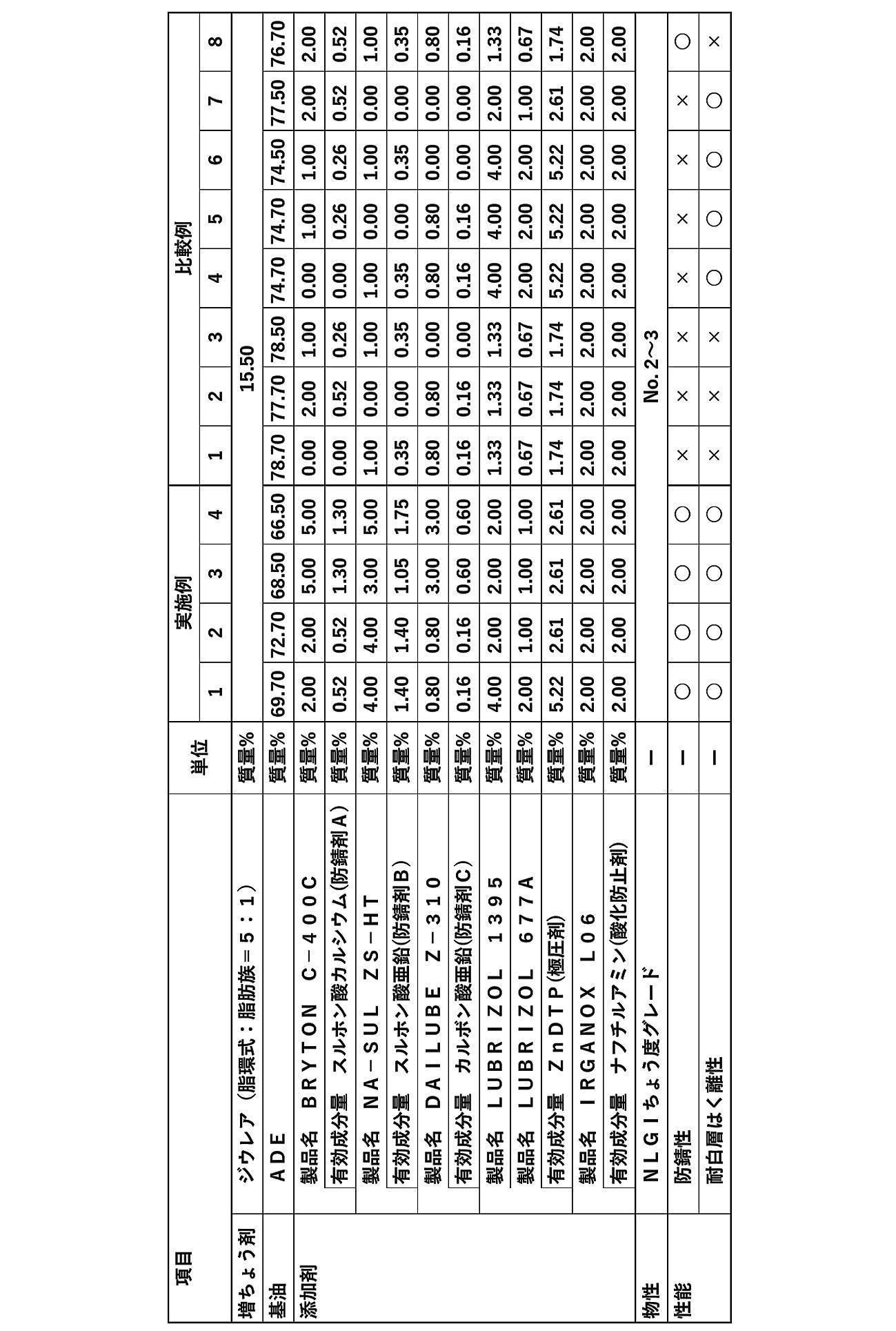
表1に示した各性能の評価方法は、下記の通りである。
(防錆性)
空間容積の33体積%のグリース組成物および0.8mlの1wt%塩水を封入した、型番:6202/1B2RM(軸受内径:直径15mm、軸受外径:直径35mm、軸受幅:13mmの両シール深溝玉軸受)の軸受を転がり軸受の中心軸を水平方向に一致させた状態にして40℃雰囲気下で120時間静置した。その後、内輪及び外輪の軌道における発錆の有無を目視にて確認した。結果を表1に示した。
(評価基準)
〇:内輪及び外輪の軌道に発錆なし
×:内輪及び外輪の軌道のいずれか又は両方に発錆あり
(防錆性)
空間容積の33体積%のグリース組成物および0.8mlの1wt%塩水を封入した、型番:6202/1B2RM(軸受内径:直径15mm、軸受外径:直径35mm、軸受幅:13mmの両シール深溝玉軸受)の軸受を転がり軸受の中心軸を水平方向に一致させた状態にして40℃雰囲気下で120時間静置した。その後、内輪及び外輪の軌道における発錆の有無を目視にて確認した。結果を表1に示した。
(評価基準)
〇:内輪及び外輪の軌道に発錆なし
×:内輪及び外輪の軌道のいずれか又は両方に発錆あり
(耐白層はく離性)
型番:62022RM(呼び番号6202の両シール軸受)の軸受に、実施例及び比較例で調製したグリース組成物を規定量(内輪と外輪とシールとで囲まれた空間から玉と保持器を除いた空間の容積に対して35体積%)充填した後、グリース組成物が充填された軸受を軸受回転試験機に設置した。
その後、下記の条件で軸受の内輪を回転させた。
温度:室温
ラジアル荷重:1.5kN
回転数:9700min-1⇔12000min-1
加速時間:30秒
減速時間:30秒
時間:16時間
型番:62022RM(呼び番号6202の両シール軸受)の軸受に、実施例及び比較例で調製したグリース組成物を規定量(内輪と外輪とシールとで囲まれた空間から玉と保持器を除いた空間の容積に対して35体積%)充填した後、グリース組成物が充填された軸受を軸受回転試験機に設置した。
その後、下記の条件で軸受の内輪を回転させた。
温度:室温
ラジアル荷重:1.5kN
回転数:9700min-1⇔12000min-1
加速時間:30秒
減速時間:30秒
時間:16時間
軸受回転試験後、軸受の玉の表面に形成された極圧剤由来の反応膜の厚さをX線光電子分光(XPS)分析装置により下記の条件で測定し、下記の基準で評価した。結果を表1に示した。
上記X線光電子分光分析装置としては、ULVAC-PHI社製、VersaProbe IIIを使用した。
上記X線光電子分光分析装置としては、ULVAC-PHI社製、VersaProbe IIIを使用した。
(測定条件)
スパッタガス:Ar+
加速電圧:2kV
スパッタエリア:3×3
スパッタ率:2.32nm/min(SiO2)
分析径:200μm
分析サイクル:5回
測定ステップ:0.125eV
パスエナジー:140eV
(評価基準)
〇:反応膜の厚さが5nm以上である。
×:反応膜の厚さが5nm未満である。
スパッタガス:Ar+
加速電圧:2kV
スパッタエリア:3×3
スパッタ率:2.32nm/min(SiO2)
分析径:200μm
分析サイクル:5回
測定ステップ:0.125eV
パスエナジー:140eV
(評価基準)
〇:反応膜の厚さが5nm以上である。
×:反応膜の厚さが5nm未満である。
実施例及び比較例の結果から明らかな通り、本発明の実施形態に係るグリース組成物を用いることにより、白層はく離の発生を抑制しつつ、転がり軸受に優れた防錆性を付与することができる。
従って、上記グリース組成物が封入された転がり軸受は、白層はく離が発生しにくく、かつ錆も発生しにくい。
従って、上記グリース組成物が封入された転がり軸受は、白層はく離が発生しにくく、かつ錆も発生しにくい。
本出願は、2020年7月6日出願の日本特許出願2020-116496に基づくものであり、その内容はここに参照として取り込まれる。
1:玉軸受
2:内輪
3:外輪
4:玉
5:保持器
6:シール
7:領域
G:グリース
2:内輪
3:外輪
4:玉
5:保持器
6:シール
7:領域
G:グリース
Claims (5)
- 基油と、
増ちょう剤と、
防錆剤と、
極圧剤と、を含むグリース組成物であって、
前記防錆剤は、前記グリース組成物の全体の質量に対して、
スルホン酸カルシウムを0.10~10.00質量%、
スルホン酸亜鉛を0.20~10.00質量%、及び
カルボン酸亜鉛を0.10~10.00質量%、を含み
前記極圧剤は、前記グリース組成物の全体の質量に対して、
ジアルキルジチオリン酸亜鉛を2.00~14.00質量%、を含むグリース組成物。 - 前記スルホン酸カルシウムの含有量は、前記グリース組成物の全体の質量に対して、0.30~4.00質量%である、請求項1に記載のグリース組成物。
- 前記防錆剤と前記極圧剤との合計含有量は、前記グリース組成物の全体の質量に対して、15.00質量%以下である、請求項1又は2に記載のグリース組成物。
- 更に、酸化防止剤を含み、
前記酸化防止剤は、前記グリース組成物の全体の質量に対して、
ナフチルアミンを0.50~5.00質量%、を含む請求項1~3のいずれか一項に記載のグリース組成物。 - 請求項1~4のいずれか一項に記載のグリース組成物が封入された、転がり軸受。
Priority Applications (3)
| Application Number | Priority Date | Filing Date | Title |
|---|---|---|---|
| EP21838691.0A EP4177324B8 (en) | 2020-07-06 | 2021-07-05 | GREASE AND BEARING COMPOUND |
| US18/014,651 US12203046B2 (en) | 2020-07-06 | 2021-07-05 | Grease composition and rolling bearing |
| CN202180047088.0A CN115867632B (zh) | 2020-07-06 | 2021-07-05 | 润滑脂组合物和滚动轴承 |
Applications Claiming Priority (2)
| Application Number | Priority Date | Filing Date | Title |
|---|---|---|---|
| JP2020116496A JP7522594B2 (ja) | 2020-07-06 | 2020-07-06 | グリース組成物および転がり軸受 |
| JP2020-116496 | 2020-07-06 |
Publications (1)
| Publication Number | Publication Date |
|---|---|
| WO2022009841A1 true WO2022009841A1 (ja) | 2022-01-13 |
Family
ID=79553187
Family Applications (1)
| Application Number | Title | Priority Date | Filing Date |
|---|---|---|---|
| PCT/JP2021/025324 Ceased WO2022009841A1 (ja) | 2020-07-06 | 2021-07-05 | グリース組成物および転がり軸受 |
Country Status (5)
| Country | Link |
|---|---|
| US (1) | US12203046B2 (ja) |
| EP (1) | EP4177324B8 (ja) |
| JP (1) | JP7522594B2 (ja) |
| CN (1) | CN115867632B (ja) |
| WO (1) | WO2022009841A1 (ja) |
Cited By (2)
| Publication number | Priority date | Publication date | Assignee | Title |
|---|---|---|---|---|
| JP2023146941A (ja) * | 2022-03-29 | 2023-10-12 | コスモ石油ルブリカンツ株式会社 | グリース組成物 |
| WO2024161460A1 (ja) * | 2023-01-30 | 2024-08-08 | 株式会社ジェイテクト | グリース組成物および転がり軸受 |
Families Citing this family (1)
| Publication number | Priority date | Publication date | Assignee | Title |
|---|---|---|---|---|
| US20250320426A1 (en) * | 2024-04-12 | 2025-10-16 | Vgp Ipco Llc | Calcium carbonate greases |
Citations (8)
| Publication number | Priority date | Publication date | Assignee | Title |
|---|---|---|---|---|
| JPH10279981A (ja) * | 1997-03-31 | 1998-10-20 | Showa Shell Sekiyu Kk | 軸受用潤滑油組成物 |
| JP2008239687A (ja) * | 2007-03-26 | 2008-10-09 | Kyodo Yushi Co Ltd | グリース組成物及び機械部品 |
| JP2009185084A (ja) * | 2006-10-26 | 2009-08-20 | Kyodo Yushi Co Ltd | グリース組成物及び軸受 |
| JP2011084646A (ja) * | 2009-10-15 | 2011-04-28 | Kyodo Yushi Co Ltd | 風力発電機軸受用グリース組成物 |
| JP2012012441A (ja) * | 2010-06-29 | 2012-01-19 | Nippon Grease Kk | グリース組成物および該グリース組成物を封入した軸受 |
| JP2012193298A (ja) * | 2011-03-17 | 2012-10-11 | Kyodo Yushi Co Ltd | グリース組成物 |
| JP2014084442A (ja) | 2012-10-26 | 2014-05-12 | Kyodo Yushi Co Ltd | グリース組成物 |
| JP2020116496A (ja) | 2019-01-21 | 2020-08-06 | 栗田工業株式会社 | 超純水製造装置 |
Family Cites Families (7)
| Publication number | Priority date | Publication date | Assignee | Title |
|---|---|---|---|---|
| IT1263745B (it) | 1992-01-22 | 1996-08-27 | Ntn Toyo Bearing Co Ltd | Cuscinetto a contatto di rotolamento chiuso a tenuta con grasso |
| JP2004091764A (ja) * | 2002-04-30 | 2004-03-25 | Nsk Ltd | グリース組成物,転がり軸受,及び電動モータ |
| US7265080B2 (en) * | 2002-06-12 | 2007-09-04 | Nsk Ltd. | Rolling bearing, rolling bearing for fuel cell, compressor for fuel cell system and fuel cell system |
| WO2005080536A1 (ja) * | 2004-02-23 | 2005-09-01 | Nsk Ltd. | グリース組成物及び転動装置 |
| JP5531392B2 (ja) * | 2008-09-26 | 2014-06-25 | 協同油脂株式会社 | グリース組成物及び軸受 |
| WO2014102988A1 (ja) * | 2012-12-27 | 2014-07-03 | 日本精工株式会社 | 転がり軸受及びそれに用いられるグリース組成物 |
| JP6726487B2 (ja) * | 2016-03-08 | 2020-07-22 | 協同油脂株式会社 | グリース組成物 |
-
2020
- 2020-07-06 JP JP2020116496A patent/JP7522594B2/ja active Active
-
2021
- 2021-07-05 WO PCT/JP2021/025324 patent/WO2022009841A1/ja not_active Ceased
- 2021-07-05 CN CN202180047088.0A patent/CN115867632B/zh active Active
- 2021-07-05 EP EP21838691.0A patent/EP4177324B8/en active Active
- 2021-07-05 US US18/014,651 patent/US12203046B2/en active Active
Patent Citations (8)
| Publication number | Priority date | Publication date | Assignee | Title |
|---|---|---|---|---|
| JPH10279981A (ja) * | 1997-03-31 | 1998-10-20 | Showa Shell Sekiyu Kk | 軸受用潤滑油組成物 |
| JP2009185084A (ja) * | 2006-10-26 | 2009-08-20 | Kyodo Yushi Co Ltd | グリース組成物及び軸受 |
| JP2008239687A (ja) * | 2007-03-26 | 2008-10-09 | Kyodo Yushi Co Ltd | グリース組成物及び機械部品 |
| JP2011084646A (ja) * | 2009-10-15 | 2011-04-28 | Kyodo Yushi Co Ltd | 風力発電機軸受用グリース組成物 |
| JP2012012441A (ja) * | 2010-06-29 | 2012-01-19 | Nippon Grease Kk | グリース組成物および該グリース組成物を封入した軸受 |
| JP2012193298A (ja) * | 2011-03-17 | 2012-10-11 | Kyodo Yushi Co Ltd | グリース組成物 |
| JP2014084442A (ja) | 2012-10-26 | 2014-05-12 | Kyodo Yushi Co Ltd | グリース組成物 |
| JP2020116496A (ja) | 2019-01-21 | 2020-08-06 | 栗田工業株式会社 | 超純水製造装置 |
Non-Patent Citations (1)
| Title |
|---|
| See also references of EP4177324A4 |
Cited By (3)
| Publication number | Priority date | Publication date | Assignee | Title |
|---|---|---|---|---|
| JP2023146941A (ja) * | 2022-03-29 | 2023-10-12 | コスモ石油ルブリカンツ株式会社 | グリース組成物 |
| JP7812267B2 (ja) | 2022-03-29 | 2026-02-09 | コスモ石油ルブリカンツ株式会社 | グリース組成物 |
| WO2024161460A1 (ja) * | 2023-01-30 | 2024-08-08 | 株式会社ジェイテクト | グリース組成物および転がり軸受 |
Also Published As
| Publication number | Publication date |
|---|---|
| EP4177324B8 (en) | 2025-12-31 |
| EP4177324A1 (en) | 2023-05-10 |
| EP4177324A4 (en) | 2024-08-14 |
| JP2022022772A (ja) | 2022-02-07 |
| CN115867632A (zh) | 2023-03-28 |
| JP7522594B2 (ja) | 2024-07-25 |
| EP4177324B1 (en) | 2025-11-19 |
| US20230272299A1 (en) | 2023-08-31 |
| CN115867632B (zh) | 2024-05-17 |
| US12203046B2 (en) | 2025-01-21 |
Similar Documents
| Publication | Publication Date | Title |
|---|---|---|
| EP2540813B1 (en) | Grease composition for hub unit bearing equipped with angular contact ball bearing, and hub unit bearing | |
| EP2687584B1 (en) | Grease composition | |
| JP2012149271A (ja) | 転がり軸受、ハブユニット軸受用グリース組成物及び車両用ハブユニット軸受 | |
| EP2913385A1 (en) | Grease composition | |
| EP1764406B1 (en) | Rust proof rust preventive grease composition, grease filled bearing and rust preventive agent for grease composition | |
| EP2465916A1 (en) | Grease composition and machine component | |
| WO2022009841A1 (ja) | グリース組成物および転がり軸受 | |
| JP7434953B2 (ja) | グリース組成物および転がり軸受 | |
| JP6534816B2 (ja) | 転がり軸受 | |
| JP5417621B2 (ja) | グリース組成物及びその製造方法 | |
| JP2020132644A (ja) | グリース組成物および転がり軸受 | |
| JP7435003B2 (ja) | グリース組成物および転がり軸受 | |
| JP2021130747A (ja) | グリース組成物および転がり軸受 | |
| WO2024161460A1 (ja) | グリース組成物および転がり軸受 | |
| JP2008285574A (ja) | ころ軸受 | |
| JP2007217520A (ja) | グリース組成物および該グリース封入軸受 | |
| JP2026006979A (ja) | グリース組成物及び車軸用軸受 | |
| JP2009174657A (ja) | トランスミッション用転がり軸受 | |
| JP2007303636A (ja) | ロボット用転がり軸受 | |
| JP2007254521A (ja) | グリース組成物および該グリース封入軸受 | |
| JP2008138706A (ja) | グリース封入転がり軸受 | |
| JP2007023104A (ja) | グリース組成物および該グリース封入軸受 | |
| JP2012052136A (ja) | グリース組成物および該グリース封入軸受 |
Legal Events
| Date | Code | Title | Description |
|---|---|---|---|
| 121 | Ep: the epo has been informed by wipo that ep was designated in this application |
Ref document number: 21838691 Country of ref document: EP Kind code of ref document: A1 |
|
| NENP | Non-entry into the national phase |
Ref country code: DE |
|
| ENP | Entry into the national phase |
Ref document number: 2021838691 Country of ref document: EP Effective date: 20230206 |
|
| WWG | Wipo information: grant in national office |
Ref document number: 2021838691 Country of ref document: EP |