WO2022011337A1 - Kinase modulators and methods of use thereof - Google Patents
Kinase modulators and methods of use thereof Download PDFInfo
- Publication number
- WO2022011337A1 WO2022011337A1 PCT/US2021/041270 US2021041270W WO2022011337A1 WO 2022011337 A1 WO2022011337 A1 WO 2022011337A1 US 2021041270 W US2021041270 W US 2021041270W WO 2022011337 A1 WO2022011337 A1 WO 2022011337A1
- Authority
- WO
- WIPO (PCT)
- Prior art keywords
- amino
- carboxamide
- pyrazole
- dichlorophenyl
- phenyl
- Prior art date
- Legal status (The legal status is an assumption and is not a legal conclusion. Google has not performed a legal analysis and makes no representation as to the accuracy of the status listed.)
- Ceased
Links
- 0 *Nc1c[n](-c2ccccc2)nc1C(N)=O Chemical compound *Nc1c[n](-c2ccccc2)nc1C(N)=O 0.000 description 3
- VYCADPDVDFTZFI-UHFFFAOYSA-N Brc1ccc(C2OCCO2)nc1 Chemical compound Brc1ccc(C2OCCO2)nc1 VYCADPDVDFTZFI-UHFFFAOYSA-N 0.000 description 1
- UVSOQLUKPLSKOC-FNORWQNLSA-N CN(C)/C=C(\COCC1)/C1=O Chemical compound CN(C)/C=C(\COCC1)/C1=O UVSOQLUKPLSKOC-FNORWQNLSA-N 0.000 description 1
- WJDCMCNFKZIFOU-UHFFFAOYSA-N C[n]1nnc(-c(cn2)ccc2Cl)n1 Chemical compound C[n]1nnc(-c(cn2)ccc2Cl)n1 WJDCMCNFKZIFOU-UHFFFAOYSA-N 0.000 description 1
- LOQHRRFZOTUCJF-UHFFFAOYSA-M Cc1cc(Nc(c(C(N)=O)n2)c[n]2[AlH2])ncn1 Chemical compound Cc1cc(Nc(c(C(N)=O)n2)c[n]2[AlH2])ncn1 LOQHRRFZOTUCJF-UHFFFAOYSA-M 0.000 description 1
- QUXLCYFNVNNRBE-UHFFFAOYSA-N Cc1cccc(N)n1 Chemical compound Cc1cccc(N)n1 QUXLCYFNVNNRBE-UHFFFAOYSA-N 0.000 description 1
- UDZZRXJNBJNLKU-UHFFFAOYSA-M Cc1cccc2nnc(-c(nc3)ccc3NC(/C(/C(N)=O)=N\[N-]c(c(Cl)ccc3)c3Cl)=N)[n]12 Chemical compound Cc1cccc2nnc(-c(nc3)ccc3NC(/C(/C(N)=O)=N\[N-]c(c(Cl)ccc3)c3Cl)=N)[n]12 UDZZRXJNBJNLKU-UHFFFAOYSA-M 0.000 description 1
- PJTFPCIROYDUDT-UHFFFAOYSA-N Cc1ncn[n]1-c(cn1)ccc1Cl Chemical compound Cc1ncn[n]1-c(cn1)ccc1Cl PJTFPCIROYDUDT-UHFFFAOYSA-N 0.000 description 1
- MVAXKFAQKTWRAH-UHFFFAOYSA-N Cc1ncnc(Cl)c1 Chemical compound Cc1ncnc(Cl)c1 MVAXKFAQKTWRAH-UHFFFAOYSA-N 0.000 description 1
- GMCRCELXBCYZJX-UHFFFAOYSA-N Clc(nc1)ccc1C1=NN[IH]C=N1 Chemical compound Clc(nc1)ccc1C1=NN[IH]C=N1 GMCRCELXBCYZJX-UHFFFAOYSA-N 0.000 description 1
- ORIQLMBUPMABDV-UHFFFAOYSA-N N#Cc(cn1)ccc1Cl Chemical compound N#Cc(cn1)ccc1Cl ORIQLMBUPMABDV-UHFFFAOYSA-N 0.000 description 1
- TXHOZIRPRDHCCA-AFUMVMLFSA-N NC(/C(/C(Nc1ccc(C2OCCO2)nc1)=N)=N/Nc(c(Cl)ccc1)c1Cl)=O Chemical compound NC(/C(/C(Nc1ccc(C2OCCO2)nc1)=N)=N/Nc(c(Cl)ccc1)c1Cl)=O TXHOZIRPRDHCCA-AFUMVMLFSA-N 0.000 description 1
- XRPGWGSLKXBMEN-UHFFFAOYSA-M NC(/C(/C(Nc1cnc(C=O)cc1)=N)=N/[N-]c(c(Cl)ccc1)c1Cl)=O Chemical compound NC(/C(/C(Nc1cnc(C=O)cc1)=N)=N/[N-]c(c(Cl)ccc1)c1Cl)=O XRPGWGSLKXBMEN-UHFFFAOYSA-M 0.000 description 1
- JATBUVZTGANLAW-UHFFFAOYSA-O NC(C(C#N)=N[NH2+]c(c(Cl)ccc1)c1Cl)=N Chemical compound NC(C(C#N)=N[NH2+]c(c(Cl)ccc1)c1Cl)=N JATBUVZTGANLAW-UHFFFAOYSA-O 0.000 description 1
- VJCRFHIWOLKBLY-UHFFFAOYSA-P NC(C(C(Nc1ccc(C=[NH2+])nc1)=N)=N[NH2+]c(c(Cl)ccc1)c1Cl)=O Chemical compound NC(C(C(Nc1ccc(C=[NH2+])nc1)=N)=N[NH2+]c(c(Cl)ccc1)c1Cl)=O VJCRFHIWOLKBLY-UHFFFAOYSA-P 0.000 description 1
- QDNSAJQECHNXTR-UHFFFAOYSA-M NC(c(c(N)c1)n[n]1[AlH2])=O Chemical compound NC(c(c(N)c1)n[n]1[AlH2])=O QDNSAJQECHNXTR-UHFFFAOYSA-M 0.000 description 1
- NRESDXFFSNBDGP-UHFFFAOYSA-N NNc(cc1)ccc1Br Chemical compound NNc(cc1)ccc1Br NRESDXFFSNBDGP-UHFFFAOYSA-N 0.000 description 1
- KMVPXBDOWDXXEN-UHFFFAOYSA-N NNc(cc1)ccc1[N+]([O-])=O Chemical compound NNc(cc1)ccc1[N+]([O-])=O KMVPXBDOWDXXEN-UHFFFAOYSA-N 0.000 description 1
- OSLKZIRNYHBMAH-UHFFFAOYSA-N Nc(cc1)ccc1-[n]1nc(CCOC2)c2c1 Chemical compound Nc(cc1)ccc1-[n]1nc(CCOC2)c2c1 OSLKZIRNYHBMAH-UHFFFAOYSA-N 0.000 description 1
- WXWJDBIILUXWQR-UHFFFAOYSA-N Nc(cc1)ccc1-[n]1ncc2c1CCOC2 Chemical compound Nc(cc1)ccc1-[n]1ncc2c1CCOC2 WXWJDBIILUXWQR-UHFFFAOYSA-N 0.000 description 1
- XPPJYBGFMOBLMJ-UHFFFAOYSA-N O=C(c(cc1)ccc1Br)N1CCN(CC2CC2)CC1 Chemical compound O=C(c(cc1)ccc1Br)N1CCN(CC2CC2)CC1 XPPJYBGFMOBLMJ-UHFFFAOYSA-N 0.000 description 1
- HSOGVWPKPBNTKK-UHFFFAOYSA-N OCc1ncn[n]1-c(cc1)ccc1Br Chemical compound OCc1ncn[n]1-c(cc1)ccc1Br HSOGVWPKPBNTKK-UHFFFAOYSA-N 0.000 description 1
Classifications
-
- C—CHEMISTRY; METALLURGY
- C07—ORGANIC CHEMISTRY
- C07D—HETEROCYCLIC COMPOUNDS
- C07D249/00—Heterocyclic compounds containing five-membered rings having three nitrogen atoms as the only ring hetero atoms
- C07D249/02—Heterocyclic compounds containing five-membered rings having three nitrogen atoms as the only ring hetero atoms not condensed with other rings
- C07D249/08—1,2,4-Triazoles; Hydrogenated 1,2,4-triazoles
-
- A—HUMAN NECESSITIES
- A61—MEDICAL OR VETERINARY SCIENCE; HYGIENE
- A61P—SPECIFIC THERAPEUTIC ACTIVITY OF CHEMICAL COMPOUNDS OR MEDICINAL PREPARATIONS
- A61P37/00—Drugs for immunological or allergic disorders
-
- C—CHEMISTRY; METALLURGY
- C07—ORGANIC CHEMISTRY
- C07D—HETEROCYCLIC COMPOUNDS
- C07D231/00—Heterocyclic compounds containing 1,2-diazole or hydrogenated 1,2-diazole rings
- C07D231/02—Heterocyclic compounds containing 1,2-diazole or hydrogenated 1,2-diazole rings not condensed with other rings
- C07D231/10—Heterocyclic compounds containing 1,2-diazole or hydrogenated 1,2-diazole rings not condensed with other rings having two or three double bonds between ring members or between ring members and non-ring members
- C07D231/14—Heterocyclic compounds containing 1,2-diazole or hydrogenated 1,2-diazole rings not condensed with other rings having two or three double bonds between ring members or between ring members and non-ring members with hetero atoms or with carbon atoms having three bonds to hetero atoms with at the most one bond to halogen, e.g. ester or nitrile radicals, directly attached to ring carbon atoms
- C07D231/38—Nitrogen atoms
-
- C—CHEMISTRY; METALLURGY
- C07—ORGANIC CHEMISTRY
- C07D—HETEROCYCLIC COMPOUNDS
- C07D249/00—Heterocyclic compounds containing five-membered rings having three nitrogen atoms as the only ring hetero atoms
- C07D249/02—Heterocyclic compounds containing five-membered rings having three nitrogen atoms as the only ring hetero atoms not condensed with other rings
- C07D249/04—1,2,3-Triazoles; Hydrogenated 1,2,3-triazoles
- C07D249/06—1,2,3-Triazoles; Hydrogenated 1,2,3-triazoles with aryl radicals directly attached to ring atoms
-
- C—CHEMISTRY; METALLURGY
- C07—ORGANIC CHEMISTRY
- C07D—HETEROCYCLIC COMPOUNDS
- C07D401/00—Heterocyclic compounds containing two or more hetero rings, having nitrogen atoms as the only ring hetero atoms, at least one ring being a six-membered ring with only one nitrogen atom
- C07D401/02—Heterocyclic compounds containing two or more hetero rings, having nitrogen atoms as the only ring hetero atoms, at least one ring being a six-membered ring with only one nitrogen atom containing two hetero rings
- C07D401/12—Heterocyclic compounds containing two or more hetero rings, having nitrogen atoms as the only ring hetero atoms, at least one ring being a six-membered ring with only one nitrogen atom containing two hetero rings linked by a chain containing hetero atoms as chain links
-
- C—CHEMISTRY; METALLURGY
- C07—ORGANIC CHEMISTRY
- C07D—HETEROCYCLIC COMPOUNDS
- C07D401/00—Heterocyclic compounds containing two or more hetero rings, having nitrogen atoms as the only ring hetero atoms, at least one ring being a six-membered ring with only one nitrogen atom
- C07D401/14—Heterocyclic compounds containing two or more hetero rings, having nitrogen atoms as the only ring hetero atoms, at least one ring being a six-membered ring with only one nitrogen atom containing three or more hetero rings
-
- C—CHEMISTRY; METALLURGY
- C07—ORGANIC CHEMISTRY
- C07D—HETEROCYCLIC COMPOUNDS
- C07D403/00—Heterocyclic compounds containing two or more hetero rings, having nitrogen atoms as the only ring hetero atoms, not provided for by group C07D401/00
- C07D403/02—Heterocyclic compounds containing two or more hetero rings, having nitrogen atoms as the only ring hetero atoms, not provided for by group C07D401/00 containing two hetero rings
- C07D403/12—Heterocyclic compounds containing two or more hetero rings, having nitrogen atoms as the only ring hetero atoms, not provided for by group C07D401/00 containing two hetero rings linked by a chain containing hetero atoms as chain links
-
- C—CHEMISTRY; METALLURGY
- C07—ORGANIC CHEMISTRY
- C07D—HETEROCYCLIC COMPOUNDS
- C07D405/00—Heterocyclic compounds containing both one or more hetero rings having oxygen atoms as the only ring hetero atoms, and one or more rings having nitrogen as the only ring hetero atom
- C07D405/02—Heterocyclic compounds containing both one or more hetero rings having oxygen atoms as the only ring hetero atoms, and one or more rings having nitrogen as the only ring hetero atom containing two hetero rings
- C07D405/12—Heterocyclic compounds containing both one or more hetero rings having oxygen atoms as the only ring hetero atoms, and one or more rings having nitrogen as the only ring hetero atom containing two hetero rings linked by a chain containing hetero atoms as chain links
-
- C—CHEMISTRY; METALLURGY
- C07—ORGANIC CHEMISTRY
- C07D—HETEROCYCLIC COMPOUNDS
- C07D413/00—Heterocyclic compounds containing two or more hetero rings, at least one ring having nitrogen and oxygen atoms as the only ring hetero atoms
- C07D413/02—Heterocyclic compounds containing two or more hetero rings, at least one ring having nitrogen and oxygen atoms as the only ring hetero atoms containing two hetero rings
- C07D413/12—Heterocyclic compounds containing two or more hetero rings, at least one ring having nitrogen and oxygen atoms as the only ring hetero atoms containing two hetero rings linked by a chain containing hetero atoms as chain links
-
- C—CHEMISTRY; METALLURGY
- C07—ORGANIC CHEMISTRY
- C07D—HETEROCYCLIC COMPOUNDS
- C07D413/00—Heterocyclic compounds containing two or more hetero rings, at least one ring having nitrogen and oxygen atoms as the only ring hetero atoms
- C07D413/14—Heterocyclic compounds containing two or more hetero rings, at least one ring having nitrogen and oxygen atoms as the only ring hetero atoms containing three or more hetero rings
-
- C—CHEMISTRY; METALLURGY
- C07—ORGANIC CHEMISTRY
- C07D—HETEROCYCLIC COMPOUNDS
- C07D417/00—Heterocyclic compounds containing two or more hetero rings, at least one ring having nitrogen and sulfur atoms as the only ring hetero atoms, not provided for by group C07D415/00
- C07D417/02—Heterocyclic compounds containing two or more hetero rings, at least one ring having nitrogen and sulfur atoms as the only ring hetero atoms, not provided for by group C07D415/00 containing two hetero rings
- C07D417/12—Heterocyclic compounds containing two or more hetero rings, at least one ring having nitrogen and sulfur atoms as the only ring hetero atoms, not provided for by group C07D415/00 containing two hetero rings linked by a chain containing hetero atoms as chain links
-
- C—CHEMISTRY; METALLURGY
- C07—ORGANIC CHEMISTRY
- C07D—HETEROCYCLIC COMPOUNDS
- C07D417/00—Heterocyclic compounds containing two or more hetero rings, at least one ring having nitrogen and sulfur atoms as the only ring hetero atoms, not provided for by group C07D415/00
- C07D417/14—Heterocyclic compounds containing two or more hetero rings, at least one ring having nitrogen and sulfur atoms as the only ring hetero atoms, not provided for by group C07D415/00 containing three or more hetero rings
-
- C—CHEMISTRY; METALLURGY
- C07—ORGANIC CHEMISTRY
- C07D—HETEROCYCLIC COMPOUNDS
- C07D471/00—Heterocyclic compounds containing nitrogen atoms as the only ring hetero atoms in the condensed system, at least one ring being a six-membered ring with one nitrogen atom, not provided for by groups C07D451/00 - C07D463/00
- C07D471/02—Heterocyclic compounds containing nitrogen atoms as the only ring hetero atoms in the condensed system, at least one ring being a six-membered ring with one nitrogen atom, not provided for by groups C07D451/00 - C07D463/00 in which the condensed system contains two hetero rings
- C07D471/04—Ortho-condensed systems
-
- C—CHEMISTRY; METALLURGY
- C07—ORGANIC CHEMISTRY
- C07D—HETEROCYCLIC COMPOUNDS
- C07D487/00—Heterocyclic compounds containing nitrogen atoms as the only ring hetero atoms in the condensed system, not provided for by groups C07D451/00 - C07D477/00
- C07D487/02—Heterocyclic compounds containing nitrogen atoms as the only ring hetero atoms in the condensed system, not provided for by groups C07D451/00 - C07D477/00 in which the condensed system contains two hetero rings
- C07D487/04—Ortho-condensed systems
-
- C—CHEMISTRY; METALLURGY
- C07—ORGANIC CHEMISTRY
- C07D—HETEROCYCLIC COMPOUNDS
- C07D491/00—Heterocyclic compounds containing in the condensed ring system both one or more rings having oxygen atoms as the only ring hetero atoms and one or more rings having nitrogen atoms as the only ring hetero atoms, not provided for by groups C07D451/00 - C07D459/00, C07D463/00, C07D477/00 or C07D489/00
- C07D491/02—Heterocyclic compounds containing in the condensed ring system both one or more rings having oxygen atoms as the only ring hetero atoms and one or more rings having nitrogen atoms as the only ring hetero atoms, not provided for by groups C07D451/00 - C07D459/00, C07D463/00, C07D477/00 or C07D489/00 in which the condensed system contains two hetero rings
- C07D491/04—Ortho-condensed systems
- C07D491/044—Ortho-condensed systems with only one oxygen atom as ring hetero atom in the oxygen-containing ring
- C07D491/052—Ortho-condensed systems with only one oxygen atom as ring hetero atom in the oxygen-containing ring the oxygen-containing ring being six-membered
-
- C—CHEMISTRY; METALLURGY
- C07—ORGANIC CHEMISTRY
- C07D—HETEROCYCLIC COMPOUNDS
- C07D498/00—Heterocyclic compounds containing in the condensed system at least one hetero ring having nitrogen and oxygen atoms as the only ring hetero atoms
- C07D498/02—Heterocyclic compounds containing in the condensed system at least one hetero ring having nitrogen and oxygen atoms as the only ring hetero atoms in which the condensed system contains two hetero rings
- C07D498/04—Ortho-condensed systems
Definitions
- aberrant kinase activity is associated with autoimmune diseases, inflammatory diseases, bone diseases, metabolic diseases, neurological and neurodegenerative diseases, cancer, cardiovascular diseases, allergies, asthma, Alzheimer's disease, Parkinson's disease, skin disorders, eye diseases, infectious diseases and hormone-related diseases.
- autoimmune diseases inflammatory diseases, bone diseases, metabolic diseases, neurological and neurodegenerative diseases, cancer, cardiovascular diseases, allergies, asthma, Alzheimer's disease, Parkinson's disease, skin disorders, eye diseases, infectious diseases and hormone-related diseases.
- TYK2 a member of the Janus Kinase (JAK) family of non-receptor protein kinases.
- Altered or unregulated activity of TYK2 promotes inflammation and is implicated in autoimmune diseases, such as psoriasis, lupus, multiple sclerosis, and inflammatory bowel disease.
- autoimmune diseases such as psoriasis, lupus, multiple sclerosis, and inflammatory bowel disease.
- embodiments of the invention are useful as pharmaceutical compositions for treatment of such autoimmune conditions.
- the invention also provides methods of using the compounds to modulate kinase activity in cells and to treat conditions, such as autoimmune conditions, for which modulation of kinase activity provides a therapeutic benefit.
- the invention provides compounds of Formula (II): wherein: X is N or CH; R 1 is C(O)CH 2 R 3 , optionally substituted cycloalkyl, optionally substituted cycloheteroalkyl, optionally substituted cycloalkenyl, optionally substituted cycloheteroalkenyl, optionally substituted aryl, or optionally substituted heteroaryl; each instance of R 2 is independently halo, haloalkyl, cyano, optionally substituted alkoxyl, optionally substituted alkyl, optionally substituted heteroalkyl, optionally substituted alkenyl, optionally substituted heteroalkenyl; R 3 is optionally substituted cycloalkyl, optionally substituted cycloheteroalkyl, optionally substituted cycloalkenyl, optionally substituted cycloheteroalkenyl, optionally substituted aryl, or optionally substituted heteroaryl; A is cycloalkyl,
- the optionally substituted aryl in R1 may be other than a phenyl.
- A may be an aryl substituted with 2 or 3 instances of R 2 .
- A may be a phenyl substituted with 2 or 3 instances of R 2 .
- A may be a heteroaryl substituted with 2 or 3 instances of R 2 .
- A may be a six-membered heteroaryl substituted with 2 or 3 instances of R 2 .
- the compound of Formula (II) may be represented by Formula (IIa):
- the compound of Formula (IIa) may be represented by one of Formulas (IIa-1), (IIa-2), (IIa-3), (IIa-4), (IIa-5), (IIa-6), (IIa-7), (IIa-8), (IIa-9), (IIa-10), (IIa-11), (IIa-12), (IIa-13), (IIa- 14), (IIa-15), (IIa-16), and (IIa-17):
- the invention provides compounds of Formula (I): wherein: R 1 is C(O)CH 2 R 3 , optionally substituted cycloalkyl, optionally substituted cycloheteroalkyl, optionally substituted cycloalkenyl, optionally substituted cycloheteroalkenyl, optionally substituted aryl, or optionally substituted heteroaryl; each instance of R 2 is independently halo, haloalkyl, cyano, optionally substituted alkoxyl, optionally substituted alkyl, optionally substituted heteroalkyl, optionally substituted alkenyl, optionally substituted heteroalkenyl; R 3 is optionally substituted cycloalkyl, optionally substituted cycloheteroalkyl, optionally substituted cycloalkenyl, optionally substituted cycloheteroalkenyl, optionally substituted aryl, or optionally substituted heteroaryl; A is cycloalkyl, cycloheteroalkyl, optional
- the optionally substituted aryl in R 1 may be other than a phenyl.
- A may be an aryl substituted with 2 or 3 instances of R 2 .
- A may be a phenyl substituted with 2 or 3 instances of R 2 .
- A may be a heteroaryl substituted with 2 or 3 instances of R 2 .
- A may be a six-membered heteroaryl substituted with 2 or 3 instances of R 2 .
- the compound of Formula (I) may be represented by Formula (Ia):
- the compound of Formula (Ia) may be represented by one of Formulas (Ia-1), (Ia-2), (Ia- 3), (Ia-4), (Ia-5), (Ia-6), and (Ia-7):
- the compound of Formula (I) may be represented by Formula (Ib):
- R 4 is H, C(O)NR 5 R 6 , C(O)R 5 , S(O) 2 R 5 , S(O) 2 NR 5 R 6 , P(O)R 7 R 8 , OR 5 , optionally substituted cycloalkyl, optionally substituted cycloheteroalkyl, optionally substituted cycloalkenyl, optionally substituted cycloheteroalkenyl, optionally substituted aryl, or optionally substituted heteroaryl; either: R 5 is H, optionally substituted alkyl, optionally substituted heteroalkyl, optionally substituted cycloalkyl, optionally substituted cycloheteroalkyl, optionally substituted cycloalkenyl, optionally substituted cycloheteroalkenyl, optionally substituted aryl, or optionally substituted heteroaryl, and R 6 , if present, is H, optionally substituted alkyl, or optionally substituted heteroalkyl; or R
- R 1 may be a heteroaryl having one of the following structures:
- R 3 may have the following structure: .
- the invention provides pharmaceutical compositions containing one or more compounds of the invention, such as any of the compounds described above.
- the invention provides methods of modulating the activity of a kinase by contacting cells containing a kinase with one or more compounds of the invention, such as any of those described above.
- the compound may inhibit activity of the kinase.
- the compound may increase activity of the kinase.
- the kinase may be a JAK family kinase.
- the kinase may be, LRRK2, NUAK1, JAK1, JAK2, or TYK2.
- the invention provides methods of treating a condition in a subject by administering to the subject a compound of the invention, such as any of those described above.
- the condition may be characterized by elevated activity of a kinase.
- the condition may be characterized by altered activity of a kinase.
- the kinase may be a JAK family kinase.
- the kinase may be LRRK2, NUAK1, JAK1, JAK2, or TYK2.
- the condition may be an autoimmune disease, inflammatory disease, bone disease, metabolic disease, neurological or neurodegenerative disease, cancer, cardiovascular disease, allergies, asthma, Alzheimer's disease, Parkinson's disease, skin disorder, eye disease, infectious disease, or hormone-related disease.
- the invention provides use of a compound of the invention, such as any of those described above, for making a medicament.
- the medicament is useful for treating a condition in a subject.
- the condition is characterize by elevated activity or altered activity of a kinase.
- the kinase is a JAK family kinase.
- the kinase is LRRK2, NUAK1, JAK1, JAK2, or TYK2.
- the condition is an autoimmune disease, inflammatory disease, bone disease, metabolic disease, neurological or neurodegenerative disease, cancer, cardiovascular disease, allergies, asthma, Alzheimer's disease, Parkinson's disease, skin disorder, eye disease, infectious disease, or hormone-related disease.
- alkyl refers to a radical of a straight-chain or branched saturated hydrocarbon group having from 1 to 20 carbon atoms ("C 1–20 alkyl"). In some embodiments, an alkyl group has 1 to 12 carbon atoms (“C 1–12 alkyl”). In some embodiments, an alkyl group has 1 to 10 carbon atoms (“C 1–10 alkyl").
- an alkyl group has 1 to 9 carbon atoms ("C 1–9 alkyl”). In some embodiments, an alkyl group has 1 to 8 carbon atoms ("C 1–8 alkyl”). In some embodiments, an alkyl group has 1 to 7 carbon atoms (“C 1–7 alkyl”). In some embodiments, an alkyl group has 1 to 6 carbon atoms ("C 1–6 alkyl", also referred to herein as "lower alkyl”). In some embodiments, an alkyl group has 1 to 5 carbon atoms (“C 1–5 alkyl”). In some embodiments, an alkyl group has 1 to 4 carbon atoms ("C 1–4 alkyl").
- an alkyl group has 1 to 3 carbon atoms ("C 1–3 alkyl”). In some embodiments, an alkyl group has 1 to 2 carbon atoms ("C 1–2 alkyl”). In some embodiments, an alkyl group has 1 carbon atom (“C 1 alkyl”). In some embodiments, an alkyl group has 2 to 6 carbon atoms (“C 2–6 alkyl”).
- C 1-6 alkyl groups include methyl (C 1 ), ethyl (C 2 ), n-propyl (C 3 ), isopropyl (C 3 ), n-butyl (C 4 ), tert-butyl (C 4 ), sec-butyl (C 4 ), isobutyl (C 4 ), n-pentyl (C 5 ), 3-pentanyl (C 5 ), amyl (C 5 ), neopentyl (C 5 ), 3- methyl-2-butanyl (C 5 ), tertiary amyl (C 5 ), and n-hexyl (C 6 ).
- alkyl groups include n-heptyl (C 7 ), n-octyl (C8) and the like. Unless otherwise specified, each instance of an alkyl group is independently optionally substituted, i.e., unsubstituted (an "unsubstituted alkyl") or substituted (a "substituted alkyl") with one or more substituents; e.g., from 1 to 5 substituents, 1 to 3 substituents, or 1 substituent. In certain embodiments, the alkyl group is unsubstituted C 1 - 10 alkyl (e.g., -CH 3 ). In certain embodiments, the alkyl group is substituted C 1-10 alkyl.
- heteroalkyl refers to an alkyl group, as defined herein, which further comprises 1 or more (e.g., 1, 2, 3, or 4) heteroatoms (e.g., oxygen, sulfur, nitrogen, boron, silicon, phosphorus) within the parent chain, wherein the one or more heteroatoms is inserted between adjacent carbon atoms within the parent carbon chain and/or one or more heteroatoms is inserted between a carbon atom and the parent molecule, i.e., between the point of attachment.
- a heteroalkyl group refers to a saturated group having from 1 to 10 carbon atoms and 1, 2, 3, or 4 heteroatoms ("heteroC 1 -10 alkyl").
- a heteroalkyl group is a saturated group having 1 to 9 carbon atoms and 1, 2, 3, or 4 heteroatoms ("heteroC 1 -9 alkyl"). In some embodiments, a heteroalkyl group is a saturated group having 1 to 8 carbon atoms and 1, 2, 3, or 4 heteroatoms ("heteroC 1-8 alkyl”). In some embodiments, a heteroalkyl group is a saturated group having 1 to 7 carbon atoms and 1, 2, 3, or 4 heteroatoms ("heteroC 1-7 alkyl”). In some embodiments, a heteroalkyl group is a group having 1 to 6 carbon atoms and 1, 2, or 3 heteroatoms ("heteroC 1-6 alkyl").
- a heteroalkyl group is a saturated group having 1 to 5 carbon atoms and 1 or 2 heteroatoms ("heteroC 1-10 alkyl”). In some embodiments, a heteroalkyl group is a saturated group having 1 to 4 carbon atoms and 1 or 2 heteroatoms ("heteroC 1-4 alkyl”). In some embodiments, a heteroalkyl group is a saturated group having 1 to 3 carbon atoms and 1 heteroatom (“heteroC 1-3 alkyl”). In some embodiments, a heteroalkyl group is a saturated group having 1 to 2 carbon atoms and 1 heteroatom (“heteroC 1-2 alkyl").
- a heteroalkyl group is a saturated group having 1 carbon atom and 1 heteroatom (“heteroC 1 alkyl”).
- a heteroalkyl group is a saturated group having 2 to 6 carbon atoms and 1 or 2 heteroatoms (“heteroC 2–6 alkyl”).
- alkenyl refers to a radical of a straight-chain or branched hydrocarbon group having from 2 to 20 carbon atoms, one or more carbon-carbon double bonds (e.g., 1, 2, 3, or 4 carbon-carbon double bonds) ("C 2-20 alkenyl”).
- an alkenyl group has 2 to 10 carbon atoms (“C 2–10 alkenyl”).
- an alkenyl group has 2 to 9 carbon atoms ("C 2-9 alkenyl”). In some embodiments, an alkenyl group has 2 to 8 carbon atoms ("C 2-8 alkenyl”). In some embodiments, an alkenyl group has 2 to 7 carbon atoms (“C 2-7 alkenyl”). In some embodiments, an alkenyl group has 2 to 6 carbon atoms ("C 2–6 alkenyl”). In some embodiments, an alkenyl group has 2 to 5 carbon atoms (“C 2-5 alkenyl”). In some embodiments, an alkenyl group has 2 to 4 carbon atoms ("C 2-4 alkenyl”).
- an alkenyl group has 2 to 3 carbon atoms ("C 2 -3 alkenyl”). In some embodiments, an alkenyl group has 2 carbon atoms ("C 2 alkenyl”).
- the one or more carbon-carbon double bonds can be internal (such as in 2-butenyl) or terminal (such as in 1- butenyl).
- Examples of C 2-4 alkenyl groups include ethenyl (C 2 ), 1-propenyl (C 3 ), 2-propenyl (C 3 ), 1-butenyl (C 4 ), 2-butenyl (C 4 ), butadienyl (C 4 ), and the like.
- C 2–6 alkenyl groups include the aforementioned C 2-4 alkenyl groups as well as pentenyl (C 5 ), pentadienyl (C 5 ), hexenyl (C 6 ), and the like. Additional examples of alkenyl include heptenyl (C 7 ), octenyl (C 8 ), octatrienyl (C 8 ), and the like.
- each instance of an alkenyl group is independently optionally substituted, i.e., unsubstituted (an "unsubstituted alkenyl") or substituted (a "substituted alkenyl") with one or more substituents e.g., from 1 to 5 substituents, 1 to 3 substituents, or 1 substituent.
- the alkenyl group is unsubstituted C 2-10 alkenyl.
- the alkenyl group is substituted C 2-10 alkenyl.
- heteroalkenyl refers to an alkenyl group, as defined herein, which further comprises one or more (e.g., 1, 2, 3, or 4) heteroatoms (e.g., oxygen, sulfur, nitrogen, boron, silicon, phosphorus) wherein the one or more heteroatoms is inserted between adjacent carbon atoms within the parent carbon chain and/or one or more heteroatoms is inserted between a carbon atom and the parent molecule, i.e., between the point of attachment.
- a heteroalkenyl group refers to a group having from 2 to 10 carbon atoms, at least one double bond, and 1, 2, 3, or 4 heteroatoms ("heteroC 2-10 alkenyl").
- a heteroalkenyl group has 2 to 9 carbon atoms at least one double bond, and 1, 2, 3, or 4 heteroatoms ("heteroC 2-9 alkenyl”). In some embodiments, a heteroalkenyl group has 2 to 8 carbon atoms, at least one double bond, and 1, 2, 3, or 4 heteroatoms ("heteroC 2-8 alkenyl”). In some embodiments, a heteroalkenyl group has 2 to 7 carbon atoms, at least one double bond, and 1, 2, 3, or 4 heteroatoms ("heteroC 2-7 alkenyl").
- a heteroalkenyl group has 2 to 6 carbon atoms, at least one double bond, and 1, 2, or 3 heteroatoms ("heteroC 2-6 alkenyl”). In some embodiments, a heteroalkenyl group has 2 to 5 carbon atoms, at least one double bond, and 1 or 2 heteroatoms ("heteroC 2-5 alkenyl”). In some embodiments, a heteroalkenyl group has 2 to 4 carbon atoms, at least one double bond, and l or 2 heteroatoms ("heteroC 2-4 alkenyl"). In some embodiments, a heteroalkenyl group has 2 to 3 carbon atoms, at least one double bond, and 1 heteroatom (“heteroC 2-3 alkenyl").
- a heteroalkenyl group has 2 to 6 carbon atoms, at least one double bond, and 1 or 2 heteroatoms ("heteroCC 2-6 alkenyl").
- the expression cycloalkyl refers to a saturated or partially unsaturated (for example, a cycloalkenyl group) cyclic group that contains one or more rings, e.g., 2 or 3 rings, and contains from 3 to 14 ring carbon atoms, such as from 3 to 10 (e.g., 3, 4, 5, 6 or 7) ring carbon atoms.
- cycloalkyl groups are a cyclopropyl, cyclobutyl, cyclopentyl, spiro[4,5]decanyl, norbornyl, cyclohexyl, cyclopentenyl, cyclohexadienyl, decalinyl, bicyclo[4.3.0]nonyl, tetraline, cyclopentylcyclohexyl, fluorocyclohexyl or cyclohex-2-enyl group.
- cycloheteroalkyl or heterocycloalkyl refers to a cycloalkyl group as defined above in which one or more (e.g., 1, 2, or 3) ring carbon atoms have been replaced by an oxygen, nitrogen, silicon, selenium, phosphorus or sulfur atom or a SO group or a SO 2 group.
- a cycloheteroalkyl or heterocycloalkyl group may have 1 or 2 rings containing from 3 to 10 (e.g., 3, 4, 5, 6 or 7) ring atoms (e.g., C, O, N or S).
- Cycloheteroalkyl or heterocycloalkyl groups include cycloheteroalkenyl or heterocycloalkenyl groups.
- Examples are a piperidinyl, prolinyl, imidazolidinyl, piperazinyl, morpholinyl, urotro pinyl, pyrrolidinyl, tetrahydrothiophenyl, tetrahydropyranyl, tetrahydrofuryl or 2-pyrazolinyl group and also lactams, lactones, cyclic imides and cyclic anhydrides.
- alkylcycloalkyl refers to groups that contain both cycloalkyl and also alkyl, alkenyl or alkynyl groups in accordance with the above definitions, for example alkylcycloalkyl, cycloalkylalkyl, alkylcycloalkenyl, alkenylcycloalkyl and alkynylcycloalkyl groups.
- An alkylcycloalkyl group preferably contains a cycloalkyl group that contains one or two rings having from 3 to 10 (e.g., 3, 4, 5, 6 or 7) ring carbon atoms, and one or two alkyl or alkynyl groups having 1 or 2 to 6 carbon atoms.
- heteroalkylcycloalkyl refers to alkylcycloalkyl groups as defined above in which one or more (e.g., 1, 2 or 3) carbon atoms have been replaced by an oxygen, nitrogen, silicon, selenium, phosphorus or sulfur atom or a SO group or a SO 2 group.
- a heteroalkylcycloalkyl group preferably contains 1 or 2 rings having from 3 to 10 (e.g., 3, 4, 5, 6 or 7) ring atoms, and one or two alkyl, alkenyl, alkynyl or heteroalkyl groups having from 1 or 2 to 6 carbon atoms.
- alkylheterocycloalkyl alkylheterocycloalkenyl, alkenylheterocycloalkyl, alkynylheterocycloalkyl, heteroalkylcycloalkyl, heteroalkylheterocycloalkyl and heteroalkylheterocycloalkenyl, the cyclic groups being saturated or mono-, di- or tri-unsaturated.
- aryl refers to an aromatic group that contains one or more rings, e.g., 2 or 3 rings, containing from 6 to 14 ring carbon atoms, such as from 6 to 10 ring carbon atoms.
- aryl refers furthermore to groups that are substituted by fluorine, chlorine, bromine or iodine atoms or by CH 3 , OH, SH, NH 2 , N 3 or NO 2 groups. Examples are the phenyl, naphthyl, biphenyl, 2-fluorophenyl, anilinyl, 3-nitrophenyl or 4-hydroxyphenyl group.
- heteroaryl refers to an aromatic group that contains one or more rings, e.g., 2 or 3 rings, containing from 5 to 14 ring atoms, such as from 5 to 10 ring atoms, and contains one or more (e.g., 1, 2, 3 or 4) oxygen, nitrogen, phosphorus or sulfur ring atoms.
- heteroaryl refers furthermore to groups that are substituted by fluorine, chlorine, bromine or iodine atoms or by CH 3 , OH, SH, N 3 , NH 2 or NO 2 groups.
- Examples are pyridyl (e.g.
- aralkyl refers to groups containing both aryl and also alkyl, alkenyl, alkynyl and/or cycloalkyl groups in accordance with the above definitions, such as, for example, aryl- alkyl, arylalkenyl, arylalkynyl, arylcycloalkyl, arylcycloalkenyl, alkylarylcycloalkyl and alkylarylcycloalkenyl groups.
- aralkyls are toluene, xylene, mesitylene, styrene, benzyl chloride, o-fluorotoluene, lH-indene, tetraline, dihydronaphthalene, indanone, phenylcyclopentyl, cumene, cyclohexylphenyl, fluorene and indane.
- An aralkyl group preferably contains one or two aromatic ring systems containing from 6 to 10 carbon atoms and one or two alkyl, alkenyl and/or alkynyl groups containing from 1 or 2 to 6 carbon atoms and/or a cycloalkyl group containing 5 or 6 ring carbon atoms.
- heteroaralkyl refers to an aralkyl group as defined above in which one or more (e.g., 1, 2, 3 or 4) carbon atoms have been replaced by an oxygen, nitrogen, silicon, selenium, phosphorus, boron or sulfur atom, that is to say to groups containing both aryl or heteroaryl, respectively, and also alkyl, alkenyl, alkynyl and/or heteroalkyl and/or cycloalkyl and/or heterocycloalkyl groups in accordance with the above definitions.
- one or more (e.g., 1, 2, 3 or 4) carbon atoms have been replaced by an oxygen, nitrogen, silicon, selenium, phosphorus, boron or sulfur atom, that is to say to groups containing both aryl or heteroaryl, respectively, and also alkyl, alkenyl, alkynyl and/or heteroalkyl and/or cycloalkyl and/or heterocycloalkyl groups in accordance with the above definitions
- a heteroaralkyl group preferably contains one or two aromatic ring systems containing from 5 or 6 to 10 ring carbon atoms and one or two alkyl, alkenyl and/or alkynyl groups containing 1 or 2 to 6 carbon atoms and/or a cycloalkyl group containing 5 or 6 ring carbon atoms, wherein 1, 2, 3 or 4 of these carbon atoms have been replaced by oxygen, sulfur or nitrogen atoms.
- Examples are arylheteroalkyl, arylheterocycloalkyl, arylheterocycloalkenyl, arylalkyl heterocycloalkyl, arylalkenylheterocycloalkyl, arylalkynylheterocycloalkyl, arylalkylhetero cycloalkenyl, heteroarylalkyl, heteroarylalkenyl, heteroarylalkynyl, heteroarylheteroalkyl, heteroarylcycloalkyl, heteroarylcycloalkenyl, heteroarylheterocycloalkyl, hetero arylheterocycloalkenyl, heteroarylalkylcycloalkyl, heteroarylheterocycloalkenyl, heteroarylalkylcycloalkyl, heteroarylalkylheterocycloalkenyl, heteroarylalkylcycloalkyl, heteroarylalkylheterocycl
- carbocyclyl or carbocyclic refers to a radical of a non-aromatic cyclic hydrocarbon group having from 3 to 10 ring carbon atoms ("C 3-10 carbocyclyl") and zero heteroatoms in the nonaromatic ring system.
- a carbocyclyl group has 3 to 8 ring carbon atoms 10 ("C 3-8 carbocyclyl”).
- a carbocyclyl group has 3 to 7 ring carbon atoms (“C 3-7 carbocyclyl”).
- a carbocyclyl group has 3 to 6 ring carbon atoms ("C 3-6 carbocyclyl").
- a carbocyclyl group has 5 to 10 ring carbon atoms ("C 5-10 carbocyclyl").
- Exemplary C 3-6 carbocyclyl groups include, without limitation, cyclopropyl (C 3 ), cyclopropenyl (C 3 ), cyclobutyl (C 4 ), cyclobutenyl (C 4 ), cyclopentyl (C 5 ), cyclopentenyl (C 5 ), cyclohexyl (C 6 ), cyclohexenyl (C 6 ), cyclohexadienyl (C 6 ), and the like.
- Exemplary C 3-8 carbocyclyl groups include, without limitation, the aforementioned C 3-6 carbocyclyl groups as well as cycloheptyl (C 7 ), cycloheptenyl (C 7 ), cycloheptadienyl (C 7 ), cycloheptatrienyl (C 7 ), cyclooctyl (G), cyclooctenyl (G), bicyclo[2.2.1]heptanyl (C 7 ), bicyclo[2.2.2]octanyl (G), and the like.
- Exemplary C 3-10 carbocyclyl groups include, without 20 limitation, the aforementioned G-s carbocyclyl groups as well as cyclononyl (C 9 ), cyclononenyl (C 9 ), cyclodecyl (C 10 ), cyclodecenyl (C 10 ), octahydro-1H-indenvl (C 9 ), decahydronaphthalenyl (C 10 ), spiro[4.5]decanyl (C 10 ), and the like.
- the carbocyclyl group is either monocyclic (“monocyclic carbocyclyl”) or contain a fused, bridged or spiro ring system such as a bicyclic system (“bicyclic carbocyclyl”) and can be saturated or can be partially unsaturated.
- “Carbocyclyl” also includes ring systems wherein the carbocyclyl ring, as defined above, is fused with one or more aryl or heteroaryl groups wherein the point of attachment is on the carbocyclyl ring, and in such instances, the number of carbons continue to designate the number of carbons in the carbocyclic ring system.
- each instance of a carbocyclyl group is independently optionally substituted, i.e., unsubstituted (an "unsubstituted carbocyclyl") or substituted (a "substituted carbocyclyl") with one or more substituents.
- the carbocyclyl group is unsubstituted C 3- 10 carbocyclyl.
- the carbocyclyl group is a substituted C 3-10 carbocyclyl.
- "carbocyclyl” is a monocyclic, saturated carbocyclyl group having from 3 to 10 ring carbon atoms (“C 3-10 cycloalkyl").
- a cycloalkyl group has 3 to 8 ring carbon atoms (" C 3-8 cycloalkyl”). In some embodiments, a cycloalkyl group has 3 to 6 ring carbon atoms (" C 3-6 cycloalkyl”). In some embodiments, a cycloalkyl group has 5 to 6 ring carbon atoms ("C 5-6 cycloalkyl”). In some embodiments, a cycloalkyl group has 5 to 10 ring carbon atoms (“C 5-10 cycloalkyl”). Examples of C 5-6 cycloalkyl groups include cyclopentyl (C 5 ) and cyclohexyl (C 5 ).
- C 3-6 cycloalkyl groups include the aforementioned C 5-6 cycloalkyl groups as well as cyclopropyl (C 3 ) and cyclobutyl (C 4 ).
- Examples of C 3-8 cycloalkyl groups include the aforementioned C 3-6 cycloalkyl groups as well as cycloheptyl (C 7 ) and cyclooctyl (C 8 ).
- each instance of a cycloalkyl group is independently unsubstituted (an "unsubstituted cycloalkyl") or substituted (a "substituted cycloalkyl") with one or more substituents.
- the cycloalkyl group is unsubstituted C 3-10 cycloalkyl. In certain embodiments, the cycloalkyl group is substituted C 3-10 cycloalkyl.
- heterocyclyl or heterocyclic refers to a radical of a 3- to 14-membered non-aromatic ring system having ring carbon atoms and 1 to 4 ring heteroatoms, wherein each heteroatom is independently selected from nitrogen, oxygen, sulfur, boron, phosphorus, and silicon ("3-14 membered heterocyclyl"). In heterocyclyl groups that contain one or more nitrogen atoms, the point of attachment can be a carbon or nitrogen atom, as valency permits.
- a heterocyclyl group can either be monocyclic ("monocyclic heterocyclyl”) or a fused, bridged or spiro ring system such as a bicyclic system ("bicyclic heterocyclyl”), and can be saturated or can be partially unsaturated.
- Heterocyclyl bicyclic ring systems can include one or more heteroatoms in one or both rings.
- Heterocyclyl also includes ring systems wherein the heterocyclyl ring, as defined above, is fused with one or more carbocyclyl groups wherein the point of attachment is either on the carbocyclyl or heterocyclyl ring, or ring systems wherein the heterocyclyl ring, as defined above, is fused with one or more aryl or heteroaryl groups, wherein the point of attachment is on the heterocyclyl ring, and in such instances, the number of ring members continue to designate the number of ring members in the heterocyclyl ring system.
- each instance of heterocyclyl is independently optionally substituted, i.e., unsubstituted (an "unsubstituted heterocyclyl") or substituted (a "substituted heterocyclyl") with one or more substituents.
- the heterocyclyl group is unsubstituted 3-10 membered heterocyclyl. In certain embodiments, the heterocyclyl group is substituted 3-10 membered heterocyclyl.
- a heterocyclyl group is a 5-10 membered non-aromatic ring system having ring carbon atoms and 1-4 ring heteroatoms, wherein each heteroatom is independently selected from nitrogen, oxygen, sulfur, boron, phosphorus, and silicon ("5-10 membered heterocyclyl").
- a heterocyclyl group is a 5-8 membered non- aromatic ring system having ring carbon atoms and 1-4 ring heteroatoms, wherein each heteroatom is independently selected from nitrogen, oxygen, and sulfur ("5-8 membered heterocyclyl").
- a heterocyclyl group is a 5-6 membered non-aromatic ring system having ring carbon atoms and 1 ⁇ 4 ring heteroatoms, wherein each heteroatom is independently selected from nitrogen, oxygen, and sulfur ("5-6 membered heterocyclyl").
- the 5-6 membered heterocyclyl has 1-3 ring heteroatoms selected from nitrogen, oxygen, and sulfur.
- the 5-6 membered heterocyclyl has 1-2 ring heteroatoms selected from nitrogen, oxygen, and sulfur.
- the 5-6 membered heterocyclyl has one ring heteroatom selected from nitrogen, oxygen, and sulfur.
- Exemplary 3-membered heterocyclyl groups containing one heteroatom include, without limitation, azirdinyl, oxiranyl, thiorenyl.
- Exemplary 4-membered heterocyclyl groups containing one heteroatom include, without limitation, azetidinyl, oxetanyl and thietanyl.
- Exemplary 5- membered heterocyclyl groups containing one heteroatom include, without limitation, tetrahydrofuranyl, dihydrofuranyl, tetrahydrothiophenyl, dihydrothiophenyl, pyrrolidinyl, dihydropyrrolyl and pyrrolyl-2,5-dione.
- Exemplary 5-membered heterocyclyl groups containing two heteroatoms include, without limitation, dioxolanyl, oxasulfuranyl, disulfuranyl, and oxazolidin-2-one.
- Exemplary 5-membered heterocyclyl groups containing three heteroatoms include, without limitation, triazolinyl, oxadiazolinyl, and thiadiazolinyl.
- Exemplary 6- membered heterocyclyl groups containing one heteroatom include, without limitation, piperidinyl, tetrahydropyranyl, dihydropyridinyl, and thianyl.
- Exemplary 6-membered heterocyclyl groups 5 containing two heteroatoms include, without limitation, piperazinyl, morpholinyl, dithianyl, dioxanyl.
- Exemplary 6-membered heterocyclyl groups containing two heteroatoms include, without limitation, triazinanyl.
- Exemplary 7-membered heterocyclyl groups containing one heteroatom include, without limitation, azepanyl, oxepanyl and thiepanyl.
- Exemplary 8- membered heterocyclyl groups containing one heteroatom include, without limitation, azocanyl, oxecanyl and thiocanyl.
- Exemplary 5-membered heterocyclyl groups fused to a C 6 aryl ring include, without limitation, indolinyl, isoindolinyl, dihydrobenzofuranyl, dihydrobenzothienyl, benzoxazolinonyl, and the like.
- Exemplary 6-membered heterocyclyl groups fused to an aryl ring include, without limitation, tetrahydroquinolinyl, tetrahydroisoquinolinyl, and the like.
- optionally substituted means that at least one hydrogen present on a group (e.g., a carbon or nitrogen atom) is replaced with a permissible substituent, e.g., a substituent which upon substitution results in a stable compound, e.g., a compound which does not spontaneously undergo transformation such as by rearrangement, cyclization, elimination, or other reaction.
- a permissible substituent e.g., a substituent which upon substitution results in a stable compound, e.g., a compound which does not spontaneously undergo transformation such as by rearrangement, cyclization, elimination, or other reaction.
- Heteroatoms, such as nitrogen may have substituents, such as any suitable substituent described herein which satisfies the valencies of the heteroatoms and results in the formation of a stable moiety.
- Optional substituents also include C 1 -C 10 alkyl, C 2 -C 10 alkenyl, C 1 -C 10 heteroalkyl, C 3 -C 16 cycloalkyl, C 2 -C 17 heterocycloalkyl, C 4 -C 20 alkylcycloalkyl, C 2 -C 1 9 heteroalkylcycloalkyl, C 6 - C 18 aryl, C 1 - 17 heteroaryl, C 7 -C 20 aralkyl or C 2 -C 19 heteroaralkyl, C 1 -C 6 alkyl, C 2 -C 6 alkenyl, C 1 - C 6 heteroalkyl, C 3 -C 10 cycloalkyl, C 2 -C 9 heterocycloalkyl, C 7 -C 12 alkylcycloalkyl, C 2 -C 11 heteroalkylcycloalkyl, C 6 -C 10 aryl, C 1 -C 9 heteroaryl, C 7 -C
- NMe2 CONH 2 , CH 2 NMe2, NHSO 2 Me, C(CH 3 ) 2 CN, COMe, OMe, SMe, COOMe, COOEt, CH 2 COOH, OCH 2 COOH, COOH, SOMe, SO 2 Me, cyclopropyl, SO 2 NH 2 , SO 2 NHMe, SO 2 CH 2 CH 2 OH, NHCH 2 CH 2 OH, CH 2 CH 2 OCH 3 , SF5, SO 2 NMe2, NO, NO 2 , OCF 3 , SO 2 CF 3 , CN or CF 3 .
- exemplary substituents are F, Cl, Br, Me, OMe, CN or CF 3 .
- the term halogen preferably refers to F, Cl, Br or I.
- all alkyl, alkenyl, alkynyl, heteroalkyl, aryl, heteroaryl, cycloalkyl, heterocycloalkyl, alkylcycloalkyl, heteroalkylcycloalkyl, aralkyl and heteroaralkyl groups described herein may optionally be substituted.
- aryl, heteroaryl, cycloalkyl, alkylcycloalkyl, heteroalkylcycloalkyl, heterocycloalkyl, aralkyl or heteroaralkyl group contains more than one ring, these rings may be bonded to each other via a single or double bond or these rings may be annulated.
- substituents include, but are not limited to, halogen, -CN, -NO2, -N3, - SO 2 H, -SO3H, -OH, -OR aa , -ON(R bb ) 2 , -N(R bb ) 2 , -N(R bb )3 + X-, -N(OR cc )R bb , -SH, -SR aa , - SSR CC , -C(O)R aa , -CO 2 H, -CHO, -C(OR cc ) 2 , -CO 2 R aa , -OC(O)R aa , -OCO 2 R aa , -C(O)N(R bb ) 2 , - C(O)N(R aa )(R bb ), -OC(O)N(R bb ) 2 , ,
- R 1 is C(O)CH 2 R 3 , optionally substituted cycloalkyl, optionally substituted cycloheteroalkyl, optionally substituted cycloalkenyl, optionally substituted cycloheteroalkenyl, optionally substituted aryl, or optionally substituted heteroaryl; each instance of R 2 is independently halo, haloalkyl, cyano, optionally substituted alkoxyl, optionally substituted alkyl, optionally substituted heteroalkyl, optionally substituted alkenyl, optionally substituted heteroalkenyl; R 3 is optionally substituted cycloalkyl, optionally substituted cycloheteroalkyl, optionally substituted cycloalkenyl, optionally substituted cycloheteroalkenyl, optionally substituted aryl, or optionally substituted heteroaryl; A is cycloalkyl, cycloheteroalkyl, cycloalken
- the optionally substituted aryl in R 1 may be other than a phenyl.
- A may be an aryl substituted with 2 or 3 instances of R 2 .
- A may be a phenyl substituted with 2 or 3 instances of R 2 .
- A may be a heteroaryl substituted with 2 or 3 instances of R 2 .
- A may be a six-membered heteroaryl substituted with 2 or 3 instances of R 2 .
- the compound of Formula (II) may be represented by Formula (IIa):
- the compound of Formula (IIa) may be represented by one of Formulas (IIa-1), (IIa-2), (IIa-3), (IIa-4), (IIa-5), (IIa-6), (IIa-7), (IIa-8), (IIa-9), (IIa-10), (IIa-11), (IIa-12), (IIa-13), (IIa- 14), (IIa-15), (IIa-16), and (IIa-17):
- the compound of Formula (II) may have one of the structures shown in Table 1a. Table 1a.
- the invention provides compounds of Formula (I): wherein: R 1 is C(O)CH 2 R 3 , optionally substituted cycloalkyl, optionally substituted cycloheteroalkyl, optionally substituted cycloalkenyl, optionally substituted cycloheteroalkenyl, optionally substituted aryl, or optionally substituted heteroaryl; each instance of R 2 is independently halo, haloalkyl, cyano, optionally substituted alkoxyl, optionally substituted alkyl, optionally substituted heteroalkyl, optionally substituted alkenyl, optionally substituted heteroalkenyl; R 3 is optionally substituted cycloalkyl, optionally substituted cycloheteroalkyl, optionally substituted cycloalkenyl, optionally substituted cycloheteroalkenyl, optionally substituted aryl, or optionally substituted heteroaryl; A is cycloalkyl, cycloheteroalkyl, optional
- the optionally substituted aryl in R 1 may be other than a phenyl.
- A may be an aryl substituted with 2 or 3 instances of R 2 .
- A may be a phenyl substituted with 2 or 3 instances of R 2 .
- A may be a heteroaryl substituted with 2 or 3 instances of R 2 .
- A may be a six-membered heteroaryl substituted with 2 or 3 instances of R 2 .
- the compound of Formula (I) may be represented by Formula (Ia):
- the compound of Formula (Ia) may be represented by one of Formulas (Ia-1), (Ia-2), (Ia- 3), (Ia-4), (Ia-5), (Ia-6), and (Ia-7):
- the compound of Formula (I) may be represented by Formula (Ib): (Ib), wherein: R 4 is H, C(O)NR 5 R 6 , C(O)R 5 , S(O) 2 R 5 , S(O) 2 NR 5 R 6 , P(O)R 7 R 8 , OR 5 , optionally substituted cycloalkyl, optionally substituted cycloheteroalkyl, optionally substituted cycloalkenyl, optionally substituted cycloheteroalkenyl, optionally substituted aryl, or optionally substituted heteroaryl; either: R 5 is H, optionally substituted alkyl, optionally substituted heteroalkyl, optionally substituted cycloalkyl, optionally substituted cycloheteroalkyl, optionally substituted cycloalkenyl, optionally substituted cycloheteroalkenyl, optionally substituted aryl, or optionally substituted heteroaryl, and R 6 ,
- R 1 may be a heteroaryl having one of the following structures:
- R 3 may have the following structure: .
- the compound of Formula (I) may have one of the structures shown in Table 1. Table 1.
- Pharmaceutical compositions The present invention provides pharmaceutical compositions containing one or more compounds described above, or a pharmaceutically acceptable ester, prodrug, hydrate, solvate or salt of such a compound, optionally in combination with a pharmaceutically acceptable carrier. The invention further provides such compounds for the preparation of a medicament for the treatment of one or more diseases mentioned herein.
- a pharmaceutical composition may contain one or more compounds of the invention in a therapeutically effective amount.
- a therapeutically effective amount of a compound in accordance with this invention means an amount of compound that is effective to prevent, alleviate or ameliorate symptoms of disease or prolong the survival of the subject being treated.
- compositions of the invention may include a vehicle for delivery of one or more compounds of the invention.
- the composition may contain particles, such as nanoparticles, microparticles, liposomes, micelles, and virus particles.
- Examples of pharmacologically acceptable salts of sufficiently basic compounds of the invention are salts of physiologically acceptable mineral acids like hydrochloric, hydrobromic, sulfuric and phosphoric acid; or salts of organic acids like methanesulfonic, p-toluenesulfonic, lactic, acetic, trifluoroacetic, citric, succinic, fumaric, maleic and salicylic acid.
- a sufficiently acidic compound of the invention may form alkali or alkaline earth metal salts, for example sodium, potassium, lithium, calcium or magnesium salts; ammonium salts; or organic base salts, for example methylamine, dimethylamine, trimethylamine, triethylamine, ethylenediamine, ethanolamine, choline hydroxide, meglumin, piperidine, morpholine, tris-(2- hydroxyethyl)amine, lysine or arginine salts; all of which are also further examples of salts of the invention.
- Compounds of the invention may be solvated, especially hydrated.
- the solvation may occur during the process of production or as a consequence of the hygroscopic nature of the initially water free compounds of the invention.
- the solvates and/or hydrates may e.g. be present in solid or liquid form.
- certain compounds of the invention may have tautomeric forms from which only one might be specifically mentioned or depicted in the following description, different geometrical isomers (which are usually denoted as cis/trans isomers or more generally as (E) and (Z) isomers) or different optical isomers as a result of one or more chiral carbon atoms (which are usually nomenclatured under the Cahn-Ingold-Prelog or R/S system).
- the compounds of the invention may contain asymmetric C-atoms, they may be present either as achiral compounds, mixtures of diastereomers, mixtures of enantiomers or as optically pure compounds.
- the present invention comprises both all pure enantiomers and all pure diastereomers, and also the mixtures thereof in any mixing ratio.
- one or more hydrogen atoms of the compounds of the present invention may be replaced by deuterium. Deuterium modification improves the metabolic properties of a drug with little or no change in its intrinsic pharmacology.
- the present invention also encompasses the partially and fully deuterated compounds of the invention.
- the term hydrogen also encompasses deuterium.
- the therapeutic use of compounds according to the invention, their pharmacologically acceptable salts, solvates and hydrates, respectively, as well as formulations and pharmaceutical compositions also lie within the scope of the present invention.
- the pharmaceutical compositions according to the present invention may comprise at least one compound of the invention as an active ingredient and, optionally, carrier substances and/or adjuvants.
- the present invention also relates to prodrugs which are composed of a compound of the invention and at least one pharmacologically acceptable protective group which will be cleaved under physiological conditions, such as an alkoxy-, arylalkyloxy-, acyl-, acyloxymethyl group (e.g. pivaloyloxymethyl), an 2-alkyl-, 2-aryl- or 2-arylalkyl oxycarbonyl-2-alkylidene ethyl group or an acyloxy group as defined herein, e.g.
- compositions may contain pro-drugs of the hydroxy group of a compound of the invention.
- pharmaceutically acceptable ester especially refers to esters which hydrolyze in vivo and include those that break down readily in the human body to leave the parent compound or a salt thereof.
- Suitable ester groups include, for example, those derived from pharmaceutically acceptable aliphatic carboxylic acids, particularly alkanoic, alkenoic, cycloalkanoic and alkanedioic acids, in which each alkyl or alkenyl moiety advantageously has not more than 6 carbon atoms.
- Examples of particular esters include, but are not limited to, formates, acetates, propionates, butyrates, acrylates and ethylsuccinates.
- the present invention also relates to a prodrug, a biohydrolyzable ester, a biohydrolyzable amide, a polymorph, tautomer, stereoisomer, metabolite, N-oxide, biohydrolyzable carbamate, biohydrolyzable ether, physiologically functional derivative, atropisomer, or in vivo-hydrolysable precursor, diastereomer or mixture of diastereomers, chemically protected form, affinity reagent, complex, chelate and a stereoisomer of the compounds of the invention.
- therapeutically useful agents that contain compounds of the invention, their solvates, salts or formulations are also comprised in the scope of the present invention.
- compounds of the invention will be administered by using the known and acceptable modes known in the art, either alone or in combination with any other therapeutic agent.
- oral administration such therapeutically useful agents can be administered by one of the following routes: oral, e.g. as tablets, dragees, coated tablets, pills, semisolids, soft or hard capsules, for example soft and hard gelatin capsules, aqueous or oily solutions, emulsions, suspensions or syrups, parenteral including intravenous, intramuscular and subcutaneous injection, e.g. as an injectable solution or suspension, rectal as suppositories, by inhalation or insufflation, e.g. as a powder formulation, as microcrystals or as a spray (e.g.
- the therapeutically useful product may be mixed with pharmaceutically inert, inorganic or organic excipients as are e.g. lactose, sucrose, glucose, gelatin, malt, silica gel, starch or derivatives thereof, talc, stearinic acid or their salts, dried skim milk, and the like.
- pharmaceutically inert, inorganic or organic excipients as are e.g. lactose, sucrose, glucose, gelatin, malt, silica gel, starch or derivatives thereof, talc, stearinic acid or their salts, dried skim milk, and the like.
- excipients e.g.
- excipients as are e.g. vegetable, petroleum, animal or synthetic oils, wax, fat and polyols.
- compressed gases suitable for this purpose as are e.g. oxygen, nitrogen and carbon dioxide.
- the pharmaceutically useful agents may also contain additives for conservation, stabilization, e.g. UV stabilizers, emulsifiers, sweetener, aromatizers, salts to change the osmotic pressure, buffers, coating additives and antioxidants.
- stabilization e.g. UV stabilizers, emulsifiers, sweetener, aromatizers, salts to change the osmotic pressure, buffers, coating additives and antioxidants.
- a daily dosage of about 10 mg to about 10,000 mg, or from about 20 mg to about 1,000 mg should be appropriate, although the upper limit may be exceeded when indicated.
- the daily dosage can be administered as a single dose or in divided doses, or for parenteral administration, it may be given as continuous infusion or subcutaneous injection.
- Methods of making compounds The invention also provides methods of making compounds of the invention, such as those described above. Synthesis schemes for making specific compounds of Formula (I) are provided in the Examples below. Methods of treating conditions
- the compounds and compositions of the invention modulate activity of one or more protein kinases.
- the compounds and compositions may inhibit, activate, or otherwise alter kinase activity. Consequently, the compounds and compositions may be used to diagnose, treat, or prevent a condition, such as a disease, disorder, or other condition for which modulation of kinase activity provides therapeutic benefit.
- kinase may be a serine-threonine kinase or a tyrosine kinase, e.g., a receptor tyrosine kinase or non-receptor tyrosine kinase.
- the kinase may be a member of the JAK family.
- the kinase may be leucine-rich repeat kinase 2 (LRRK2), NUAK family SNF1-like kinase 1 (NUAK1, also known as AMPK-related protein kinase 5 or ARK5), JAK1, JAK2, or non-receptor tyrosine-protein kinase TYK2 (TYK2), including mutants of any of the aforementioned kinases.
- LRRK2 leucine-rich repeat kinase 2
- NUAK1-like kinase 1 NUAK1
- JAK2 non-receptor tyrosine-protein kinase TYK2
- the disease, disorder, or condition may be associated with aberrant LRRK2 activity, such as Alzheimer's disease, Crohn's disease, inflammatory bowel disease, an inflammatory disease, leprosy, neurodegenerative diseases, a non-skin cancer, or Parkinson's disease, including familial Parkinson's disease, sporadic Parkinson's disease, late-onset Parkinson's disease (PD), and type 8 Parkinson's disease.
- the disease, disorder, or condition may be associated with aberrant NUAK1 activity, such as cancer, e.g., colorectal cancer, stomach cancer, endometrial cancer, or multiple myeloma, diabetes, fibrosis, a neurodegenerative disease, or omphalocele.
- the disease, disorder, or condition may be associated with aberrant TYK2 activity, such as autoimmune disorders, Crohn's disease, hyperimmunoglobulin E syndrome, inflammatory bowel disease, multiple sclerosis (MS), psoriasis, rheumatoid arthritis, systemic lupus erythematosus (SLE), type 1 diabetes (T1D), or ulcerative colitis.
- TYK2 activity such as autoimmune disorders, Crohn's disease, hyperimmunoglobulin E syndrome, inflammatory bowel disease, multiple sclerosis (MS), psoriasis, rheumatoid arthritis, systemic lupus erythematosus (SLE), type 1 diabetes (T1D), or ulcerative colitis.
- the disease, disorder, or condition may be or include a respiratory tract/obstructive airways disease or disorder, such as rhinorrhea, tracheal constriction, airway contraction, acute-, allergic, atrophic rhinitis or chronic rhinitis (such as rhinitis caseosa, hypertrophic rhinitis, rhinitis purulenta, rhinitis sicca), rhinitis medicamentosa, membranous rhinitis (including croupous, fibrinous and pseudomembranous rhinitis), scrofulous rhinitis, perennial allergic rhinitis, seasonal rhinitis (including rhinitis nervosa (hay fever) and vasomotor rhinitis), pollinosis, asthma (such as bronchial, atopic, allergic, intrinsic, extrinsic, exercise-induced, cold air-induced, occupational, bacterial infection-induced, and dust asthma particularly chronic or inveterate
- bronchitis including chronic, acute, arachidic, catarrhal, croupus, phthinoid and eosinophilic bronchitis
- cardiobronchitis pneumoconiosis, chronic inflammatory disease of the lung which result in interstitial fibrosis, such as interstitial lung disease (ILD) (e.g., idiopathic pulmonary fibrosis, or ILD associated with rheumatoid arthritis, or other autoimmune conditions), acute lung injury (ALI), adult respiratory distress syndrome (ARDS), chronic obstructive pulmonary, airways or lung disease (CORD, COAD, COLD or COPD, such as irreversible COPD), chronic sinusitis, conjunctivitis (e.g.
- ILD interstitial lung disease
- COAD idiopathic pulmonary fibrosis
- ILD associated with rheumatoid arthritis, or other autoimmune conditions
- ALI acute lung injury
- ARDS adult respiratory distress syndrome
- allergic conjunctivitis cystic fibrosis, extrinsic allergic alveolitis (like farmer's lung and related diseases), fibroid lung, hypersensitivity lung diseases, hypersensitivity pneumonitis, idiopathic interstitial pneumonia, nasal congestion, nasal polyposis, otitis media, and cough (chronic cough associated with inflammation or iatrogenic induced), pleurisy, pulmonary congestion, emphysema, bronchiectasis, sarcoidosis, lung fibrosis, including cryptogenic fibrosing alveolitis, fibrosis complicating anti-neoplastic therapy and chronic infection, including tuberculosis and aspergillosis and other fungal infections, vasculitic and thrombotic disorders of the lung vasculature, and pulmonary hypertension, acute viral infection including the common cold, and infection due to respiratory syncytial virus, influenza, coronavirus (including SARS) and adenovirus, allergic bronchopulmonary my
- the disease, disorder, or condition may be or include a bone and joint related disease or disorder, such as osteoporosis, arthritis (including rheumatic, infectious, autoimmune, chronic, malignant), seronegative spondyloarthropathies (such as ankylosing spondylitis, rheumatoid spondylitis, psoriatic arthritis, enthesopathy, Bechet's disease, Marie-Strumpell arthritis, arthritis of inflammatory bowel disease, and Reiter's disease), systemic sclerosis, osteoarthritis, osteoarthrosis, both primary and secondary to e.g.
- arthritis including rheumatic, infectious, autoimmune, chronic, malignant
- seronegative spondyloarthropathies such as ankylosing spondylitis, rheumatoid spondylitis, psoriatic arthritis, enthesopathy, Bechet's disease, Marie-Strumpell arthritis, arthritis of inflammatory bowel disease, and Re
- the disease, disorder, or condition may be or include a skin or eye related disease or disorder, such as glaucoma, ocular hypertension, cataract, retinal detachment, psoriasis (including psoriasis vulgaris, pustular psoriasis, arthritic psoriasis, erythroderma psoriaticum), palmoplantar pustulosis, xerodoma, eczematous diseases (like atopic dermatitis, ultraviolet radiation dermatitis, contact dermatitis, and seborrheic dermatitis), phytodermatitis, photodermatitis, cutaneous eosinophilias, chronic skin ulcers, cutaneous lupus erythematosus, contact hypersensitivity/allergic contact dermatitis (including sensitivity to poison ivy, sumac, or oak), and eosinophilic folliculitis (Ofuji's disease), pruritus, drug
- the disease, disorder, or condition may be or include a gastrointestinal tract and abdominal related disease or disorder, such as celiac/coeliac disease (e.g. celiac sprue), cholecystitis, enteritis (including infectious, ischemic, radiation, drug-induced, and eosinophilic gastroenteritis), eosinophilic esophagitis, eosinophilic gastrointestinal inflammation, allergen induced diarrhea, enteropathy associated with seronegative arthropathies, gastritis, autoimmune atrophic gastritis, ischemic bowel disease, inflammatory bowel disease (Crohn's disease and ulcerative colitis), colitis, Mooren's ulcer, irritable bowel syndrome, necrotizing enterocolitis, gut ischemia, glossitis, gingivitis, periodontitis, oesophagitis, including reflex, proctitis, fibrosis and cirrhosis of the liver, pancreatitis, both acute and
- the disease, disorder, or condition may be or include a hematological disease or disorder, such as anemias, coagulation, myeloproliferative disorders, hemorrhagic disorders, leukopenia, eosinophilic disorders, leukemias (e.g. myelogenous, lymphomas, plasma cell dyscrasias, disorders of the spleen, Band's disease, hemophilia, purpura (including idiopathic thrombocytopenic purpura), or Wiskott-Aldrich syndrome.
- a hematological disease or disorder such as anemias, coagulation, myeloproliferative disorders, hemorrhagic disorders, leukopenia, eosinophilic disorders, leukemias (e.g. myelogenous, lymphomas, plasma cell dyscrasias, disorders of the spleen, Band's disease, hemophilia, purpura (including idiopathic thrombocytopenic
- the disease, disorder, or condition may be or include a metabolic disease or disorder, such as obesity, amyloidosis, disturbances of the amino and acid metabolism like branched chain disease, hyperaminoacidemia, hyperaminoaciduria, disturbances of the metabolism of urea, hyperammonemia, mucopolysaccharidoses e.g.
- Maroteaux-Lamy syndrome storage disease like glycogen storage diseases and lipid storage diseases, glycogenosis I diseases like Cori's disease, malabsorption diseases like intestinal carbohydrate malabsorption, oligosaccharidase deficiency like maltase-, lactase-, sucrase-insufficiency, disorders of the metabolism of fructose, disorders of the metabolism of galactose, galactosaemia, disturbances of carbohydrate utilization like diabetes, hypoglycemia, disturbances of pyruvate metabolism, hypolipidemia, hypolipoproteinemia, hyperlipidemia, hyperlipoproteinemia, carnitine or carnitine acyltransferase deficiency, disturbances of the porphyrin metabolism, porphyrins, disturbances of the purine metabolism, lysosomal diseases, metabolic diseases of nerves and nervous systems like gangliosidoses, sphingolipidoses, sulfatidoses, leucodystrophies, or
- the disease, disorder, or condition may be or include a cerebellar dysfunction or disturbance of brain metabolism, such as dementia, Alzheimer's disease, Huntington's chores, Parkinson's disease, Pick's disease, toxic encephalopathy, demyelinating neuropathies like inflammatory neuropathy, Guillain-Barre syndrome; Meniere's disease and radiculopathy, primary and secondary metabolic disorders associated with hormonal defects like any disorder stemming from either an hyperfunction or hypofunction of some hormone- secreting endocrine gland and any combination thereof.
- a cerebellar dysfunction or disturbance of brain metabolism such as dementia, Alzheimer's disease, Huntington's chores, Parkinson's disease, Pick's disease, toxic encephalopathy, demyelinating neuropathies like inflammatory neuropathy, Guillain-Barre syndrome; Meniere's disease and radiculopathy, primary and secondary metabolic disorders associated with hormonal defects like any disorder stemming from either an hyperfunction or hypofunction of some hormone- secreting endocrine gland and any combination thereof.
- Sipple's syndrome pituitary gland dysfunction and its effects on other endocrine glands, such as the thyroid, adrenals, ovaries, and testes, acromegaly, hyper- and hypothyroidism, euthyroid goiter, euthyroid sick syndrome, thyroiditis, and thyroid cancer, over or underproduction of the adrenal steroid hormones, adrenogenital syndrome, Cushing's syndrome, Addison's disease of the adrenal cortex, Addison's pernicious anemia, primary and secondary aldosteronism, diabetes insipidus, diabetes mellitus, carcinoid syndrome, disturbances caused by the dysfunction of the parathyroid glands, pancreatic islet cell dysfunction, diabetes, disturbances of the endocrine system of the female like estrogen deficiency, resistant ovary syndrome; muscle weakness, myotonia.
- the disease, disorder, or condition may be or include a transplant rejection related condition, such as acute and chronic allograft rejection following solid organ transplant, for example, transplantation of kidney, heart, liver, lung, and cornea, chronic graft versus host disease, skin graft rejection, and bone marrow transplant rejection, or immunosuppression.
- a transplant rejection related condition such as acute and chronic allograft rejection following solid organ transplant, for example, transplantation of kidney, heart, liver, lung, and cornea, chronic graft versus host disease, skin graft rejection, and bone marrow transplant rejection, or immunosuppression.
- the disease, disorder, or condition may be or include a genitourinary related condition, such as nephritis (interstitial, acute interstitial (allergic), and glomerulonephritis), nephrotic syndrome, cystitis including acute and chronic (interstitial) cystitis and Hunner's ulcer, acute and chronic urethritis, prostatitis, epididymitis, oophoritis, salpingitis, vulvo vaginitis, vulvovaginal candidiasis, Peyronie's disease, and erectile dysfunction, renal disease, renal fibrosis, nephropyelitis, secondary contracted kidney, steroid dependent and steroid-resistant nephrosis, or Goodpasture's syndrome.
- nephritis interstitial, acute interstitial (allergic), and glomerulonephritis
- cystitis including acute and chronic (interstitial) cystitis and Hunner's ulcer,
- the disease, disorder, or condition may be or include a CNS related disease or disorder, such as neurodegenerative diseases, Alzheimer's disease and other cementing disorders including CJD and nvCJD, amyloidosis, and other demyelinating syndromes, cerebral atherosclerosis and vasculitis, temporal arteritis, myasthenia gravis, acute and chronic so pain (acute, intermittent or persistent, whether of central or peripheral origin) including post-operative, visceral pain, headache, migraine, neuralgia (including trigeminal), atypical facial pain, joint and bone pain, pain arising from cancer and tumor invasion, neuropathic pain syndromes including diabetic, post-herpetic, and HIV-associated neuropathies, neurosarcoidosis, to brain injuries, cerebrovascular diseases and their consequences, Parkinson's disease, corticobasal degeneration, motor neuron disease, dementia, including ALS (Amyotrophic-lateral sclerosis), multiple sclerosis, traumatic brain injury, stroke, post-stroke, post-traumatic
- the disease, disorder, or condition may be or include an inflammatory or immunological disease or disorder, such as general inflammation (of the ocular, nasal, pulmonary, and gastrointestinal passages), mastocytosis/mast cell disorders (cutaneous, systemic, mast cell activation syndrome, and pediatric mast cell diseases), mastitis (mammary gland), vaginitis, vasculitis (e.g., necrotizing, cutaneous, and hypersensitivity vasculitis), Wegener granulamatosis, myyositis (including polymyositis, dermatomyositis), basophil related diseases including basophilic leukemia and basophilic leukocytosis, and eosinophil related diseases such as Churg- Strauss syndrome, eosinophilic granuloma, lupus erythematosus (such as, systemic lupus erythematosus, subacute cutaneous lupus erythematosus, and discoi
- the disease, disorder, or condition may be or include a cardiovascular disease or disorder, such as congestive heart failure, myocardial infarction, ischemic diseases of the heart, all kinds of atrial and ventricular arrhythmias, hypertension, cerebral trauma, occlusive vascular disease, stroke, cerebrovascular disorder, atherosclerosis, restenosis, affecting the coronary and peripheral is circulation, pericarditis, myocarditis, inflammatory and auto-immune cardiomyopathies including myocardial sarcoid, endocarditis, valvulitis, and aortitis including infective (e.g.
- a cardiovascular disease or disorder such as congestive heart failure, myocardial infarction, ischemic diseases of the heart, all kinds of atrial and ventricular arrhythmias, hypertension, cerebral trauma, occlusive vascular disease, stroke, cerebrovascular disorder, atherosclerosis, restenosis, affecting the coronary and peripheral is circulation, pericarditis, myocardi
- syphilitic hypertensive vascular diseases, peripheral vascular diseases, and atherosclerosis
- vasculitides disorders of the proximal and peripheral veins including phlebitis and thrombosis, including deep vein thrombosis and complications of varicose veins, aortic aneurism, periarteritis nodosa, cardiac fibrosis, post-myocardial infarction, idiopathic cardiomyopathy, or angioplasty.
- the disease, disorder, or condition may be or include an oncological disease or disorder, such as common cancers (prostate, breast, lung, ovarian, pancreatic, bowel and colon, abdomen, stomach (and any other digestive system cancers), liver, pancreas, peritoneum, endocrine glands (adrenal, parathyroid, pituitary, testicles, ovary, thymus, thyroid), eye, head, neck, nervous system (central and peripheral), lymphatic system, blood, pelvic, skin, bone, soft tissue, spleen, thoracic, urogenital, and brain tumors), breast cancer, genitourinary cancer, lung cancer, gastrointestinal cancer, epidermoid cancer, melanoma, ovarian cancer, pancreas cancer, neuroblastoma, malignancies affecting the bone marrow (including the leukemias) and lymphoproliferative systems, such as Hodgkin's and non-Hodgkin's lymphoma, B-cell lymph
- Myeloid cancer includes e.g. acute or chronic myeloid leukemia, or keratoleukoma.
- the disease, disorder, or condition may be or include another disease or disorder, such as pain, migraine, sleep disorders, fever, sepsis, idiopathic thrombocytopenia purpura, post- operative adhesions, flushing, ischemic/reperfusion injury in the heart, brain, peripheral limbs, bacterial infection, viral infection, fungal infection, thrombosis, endotoxin shock, septic shock, thermal regulation including fever, Raynaud's disease, gangrene, diseases requiring anti- coagulation therapy, congestive heart failure, mucus secretion disorders, pulmonary hypotension, prostanoid- induced smooth muscle contract associated with dysmenorrhea and premature labor, premature delivery, reperfusion injury, bum, thermal injury, hemorrhage or traumatic shock, menstrual pain, menstrual cramp, dysmenorrhea, periodontosis
- the disease is selected from the group consisting of an inflammatory disease, an autoimmune disease, an allergic disorder, and an ocular disorder.
- the disease is selected from the group consisting of pruritus, eczema, asthma, rhinitis, dry eye, ocular inflammation, allergic conjunctivitis, vernal conjunctivitis, vernal keratoconjunctivitis, giant papillary conjunctivitis, fungal keratitis and uveitis.
- the method may include modulating the activity of one or more kinases in a subject, such as any of the kinase described above.
- the method may include inhibiting a kinase.
- the method may include activating, e.g., stimulating or enhancing the activity of, a kinase.
- the method may include modulating activity of a single kinase or preferentially modulating activity of a specific kinase over others.
- the method may include modulating activity of multiple kinases or preferentially modulating activity of two more specific kinases over others.
- the method may include providing a compound of the invention.
- the method may include providing multiple compounds of the invention.
- the method may include contacting cells containing a kinase with one or more compounds of the invention.
- contacting a cell with a compound may include exposing a cell to a compound, e.g., in a formulation, such as any of those described above; delivering a compound inside a cell; providing a compound to a subject and allowing a cell in the subject to become exposed to the compound.
- Contacting may be performed in vivo or in vitro. In vitro contact may include exposure of cells or tissue isolated from a subject.
- the method may include contacting cells with a single compound of the invention.
- the method may include contact cells with multiple compounds of the invention.
- the method may include administration of a composition to a subject.
- the compositions may be provided by any suitable route of administration.
- compositions may be administered buccally, by injection, dermally, enterally, intraarterially, intravenously, intranasally, e.g., by inhalation, intraocularly, orally, parenterally, pulmonarily, rectally, subcutaneously, systemically, topically, e.g., to the skin or eye, transdermally, or with or on an implantable medical device (e.g., stent or drug-eluting stent or balloon equivalents).
- the method may include using a composition of the invention to diagnose a disease, disorder, or condition in a subject.
- a radiolabeled form of a compound may be used a tracer in positron emission tomography (PET) to identify anatomical locations of aberrant kinase activity.
- PET positron emission tomography
- the invention may include administering one or more compositions of the invention for both diagnostic and therapeutic purposes. Examples Example 1 The following methods were used in synthesis of compounds described herein.
- Flash chromatography Flash chromatography was performed on a Biotage Isolera(R) or Selekt® system using SNAP or SF ⁇ R silica cartridges and ethyl acetate/cyclohexane/methanol or dichloromethane/methanol gradients as eluent.
- Microwave conditions Reactions under microwave conditions are performed in a Biotage initiator(R) microwave system.
- SEMIprep reversed phase chromatography The following instrumentation was used for SEMIprep reversed phase chromatography: 2x Varian PrepStar SD-1, 1x Dionex P580 Pump 1 Channel(MakeUP I), 1x Dionex AXP-MS (MakeUP II), 1x Dionex MSQ, 1x Dionex UVD 340V – Prep Flow Cell, Gilson 215 Liquid Handler, SunFire Prep C 1 8 OBD 5 ⁇ m,19x50 mm column, 1x G7159B 1290 Infinity II Preparative Open-Bed Sampler/Collector, 1x G7161B 1290 Infinity II Preparative Binary Pump, 1x G7111B 1260 Infinity II Quaternary Pump (Modifier), 1x G7111B 1260 Infinity II Quaternary Pump (Analyltic / MakeUp), 1x G7165A 1260 Infinity II Multiple Wavelength Detector incl.
- 2x Varian PrepStar SD-1 1x Dionex
- Preparative columns Waters SunFire Prep C185 ⁇ m OBD 30x100 mm, #186002572, Waters Atlantis T3 Prep 5 ⁇ m OBD 30x100 mm, #186003702, and Waters XSelect CSH Prep C185 ⁇ m OBD 30x100 mm, #186005425
- Analytical columns Waters SunFire C182.5 ⁇ m 3.0x75mm, #186005636, Waters Atlantis T33 ⁇ m 3.0 x75 mm, #186005653, and Waters XSelect CSH C182.5 ⁇ m 3.0 x 75mm, #186006106.
- Typical chromatography conditions are as follows: Column flow was 30 mL/min, Solvent A was methanol containing 0.3% acetic acid, and Solvent B was water containing 0.3% acetic acid. Typical times and relative volumes of Solvent and Solvent B are shown in Table 2. Table 2. Typical preparative method: Column flow was 60 mL/min, Solvent A was acetonitrile, and Solvent B was water.
- Typical Focused Gradient Timetable for e.g.59.7% Elution Point is shown in Table 3. Table 3.
- Typical Analytical Modifier Column flow was 1 mL/min, Solvent A was acetonitrile, Solvent B was water, and Solvent C was 5% acetic Acid in acetonitrile/water 1:1. Typical times and relative volumes of Solvent, Solvent B, Solvent C are shown in Table 4. Table 4. A Mass Spectrometer Detector (API-ES, positive) at UV 220 nm, 254 nm, or 310 nm was used for detection. Example 2 Terms and abbreviations used in the Examples are provided in Table 5. Table 5.
- anilines were synthesized as described in International Patent Pub. No. WO 2017/139778, the contents of which are incorporated herein by reference. The two intermediates were used as mixture and separated at the stage of the examples. The aniline were obtained commercially or were synthesized as described above. This method was used to synthesize Compound Nos.101, 102, 103, 104, 105, 106, 107, 108, 109, 110, 111, 119, 123, 124, 128, 129, 145, 146, 147, 148, 162, 164, 167, 175, 176, and 177.
- the amination was performed using the conditions of aniline amide synthesis above. This method was used to synthesize Compound Nos.122, 163, and 166.
- the acid intermediate was synthesized using Route A to step 2A. This was dissolved in DMF, chloronicotinate (1eq.) and CsCO 3 (5eq.) was added. The mixture was heated at 60°C o.n. The mixture was diluted with water and extracted with EtOAc. The organic layer was dried (Na 2 SO 4 ), filtered and concentrated under reduced pressure. The crude product was purified with gradient flash chromatography. This intermediate was treated with NaOH 1M in water/THF 1/1 at 35°C o.n.
- the mixture was stirred for 2.5 h at r.t., then concentrated, diluted with water and extracted with DCM. The organic layer was dried (Na 2 SO 4 ), filtered and concentrated under reduced pressure.
- the crude product was purified by gradient flash chromatography. The product from the step before was dissolved in MeOH. Formaldehyde (10 eq., 37% in water) was added, the pH was adjusted with NaOH 1M and HOAc against bromocresole green, followed by sodium cyanoborohydride (2.5eq.). The mixture was stirred for 2h, the adjustment and the addition of cyano borohydride was repeated. The mixture was cooled to 0°C, water and NaHCO 3 aq. sat was added an the mixture extracted with DCM.
- step 3A Compound No.172, 2-(2,6-dichlorophenyl)-5-((1-(methylsulfonyl)-1H-pyrazol-4- yl)amino)-2H-1,2,3-triazole-4-carboxamide, was synthesized using this procedure. Route B was used to synthesize Compound Nos.121, 125, 126, 131, and 132.
- halogenids were obtained commercially or synthesized as described above: Route C, using the condition A2.2 from pyrazole section, was used to synthesize Compound Nos.127, 130, 136, 137, and 140. The halogenids were obtained commercially or synthesized as described above. Route C, using the condition A2.3 from pyrazole section, was used to synthesize Compound Nos.112, 113, 114, 115, 141, 142, 143, 144, 152, 155, 156, 157, 158, 159, 160, 168, 172, and 173. The halogenids were obtained commercially or synthesized as described above.
- Route D was used to synthesize Compound Nos.151, 169, and 170.
- the intermediate form step 2C was reacted under the conditions of A2.3 (pyrazole section), followed by treatment with 2m HCl aq. in THF for 2. The mixture was concentrated, diluted with water and extracted with EtOAc. The organic layer was dried (Na 2 SO 4 ), filtered and concentrated under reduced pressure. The aldehyde building block was dissolved in EtOH. The hydrazine derivative was added and the mixture refluxed for 1h. The mixture was concentrated under reduced pressure. The crude product was used without further purification. This intermediate was dissolved in DCM.
- Example 5 Piperazine modifications: The Boc protected piperazine was dissolved in dry MeOH followed by the addition of 4M HCl in dioxane (40% v/v). The mixture was stirred o.n. The product was collected by filtration and used without further purification. The HCl salt from above was suspended in THF (dry), followed by the addition of 2,2,2- trifluoroethyl trifluoromethanesulfonate (3eq.) and DIPEA (4eq.). The mixture was stirred at 65°C o.n. The mixture was diluted with ethyl acetate and washed with NaHCO 3 aq. The organic layer was dried (Na 2 SO 4 ) filtered and concentrated under reduced pressure.
- the crude product was purified by gradient flash chromatography.
- the HCl salt from above and cyclopropyl aldehyde (1.2eq.) were dissolved in DCE DCE or DCM? If DCE need to define in the table of abbreviations vide supra.
- 10min sodium triacetoxyborohydride (1.5.eq.) was added.
- the mixture was stirred at r.t. o.n.
- the mixture was diluted with ethyl acetate and washed with NaHCO 3 aq.
- the organic layer was dried (Na 2 SO 4 ) filtered and concentrated under reduced pressure.
- the crude product was purified by gradient flash chromatography.
- the thiomorpholine amide was dissolved in MeOH, followed by the addition of ammonium acetate (2eq.) and iodobenzene diacetate (2.5 eq.). The mixture was stirred for 30 min at r.t. The mixture was concentrated, diluted with water and extracted with DCM. The organic layer was dried (Na 2 SO 4 ), filtered and concentrated under reduced pressure. The crude product was purified by gradient flash chromatography. The imino-oxidothiomorpholino derivative was dissolved in MeOH, formaldehyde (10 eq., 37% in water) and sodium cyano borohydride (2.5 eq.) was added. The mixture was basified with NaOH 1M until the color change of bromcresol green.
- Example 7 Ullmann type coupling General procedure: Bromoiodobenzene, pyrazolo compound (1eq.); K 2 CO 3 (2.1 eq.) dimethyl glycine and CuI were dissolved in DMSO. During the degassing the reaction turned blue. The reaction was stirred at 100°C for 1h. The mixture was diluted with ethyl acetate and water. The aq. layer was extracted with ethyl acetate several times. The combined organic layers were washed with NH4Cl aq, and brine. The organic layer was dried (Na 2 SO 4 ), filtered and concentrated under reduced pressure. The resulting product was used without further purification as a mixture of isomers. The following intermediates were synthesized using this procedure:
- the triazole was dissolved in dry THF, cooled to -78°C and n-BuLi (1,5 eq, 2,5M in hexanes) was added. After 0,5h MOM-Cl was added. The mixture was allowed to warm to r.t. The reaction mixture was diluted with water and extracted with EtOAc. The organic layer was dried (Na 2 SO 4 ), filtered and concentrated under reduced pressure. The crude product was purified by gradient flash chromatography. Alternative route: Acid chloride, amidine salt were mixed in DMF, HATU (1.1. eq.) and DIPEA (4 eq.) were added. The mixture was stirred o. n. Then AcOH (10mL/mmol) and hydrazine salt was added.
- the mixture was stirred at 80°C for 6h, then 2 days at r.t.
- the reaction mixture was diluted with EtOAc, neutralized with NaHCO 3 aq. the washed with water.
- the organic layer is dried, (Na 2 SO 4 ), filtered and concentrated under reduced pressure.
- the crude product is purified by gradient flash chromatography. The following intermediates were synthesized following the method mentioned above.
- Example 9 Route A Example 10 Method A1 - arylation.
- the arylation were performed by nucleophilic displacement or Buchwald-Hartwig conditions.
- Nucleophilic displacements - general method The pyrazole amine and the corresponding pyrimidine chloride (2eq.) were dissolved in iPrOH, followed by some drops of HCl 4M in dioxane. The mixture was irradiated under microwave conditions at 150°C for 15 min. The mixture was diluted with NaHCO 3 aq. and water and extracted with ethyl acetate. The organic layer was concentrated under reduced pressure, and the crude material purified by semipreparative HPLC. This method was used to synthesize Compound Nos.4, 5 and 12.
- Example 11 Method A2 – Buchwald type coupling: General method A2.1: The pyrazole amine, the haloarene (2eq.), K 2 CO 3 (3 eq.) and Pd2(dba)3 and X-Phos were dissolved in iso-butanol. The mixture was irradiated under microwave conditions for 1h at 110°C. The solvent was removed under reduced pressure. The residue was triturated with diethyl ether, the solids filtered off, the filtrate was concentrated under reduced pressure and purified using semipreparative HPLC. This method was used to synthesize Compound Nos.6, 7, 8, 9, 10, 11, 17, 18, 19, 20, 21, 22, 28, and 29.
- Example 12 General method A2.2: The pyrazole amine, the haloarene (1.2eq.), NaOtBu (3 eq.) and X-Phos Pd G2 (0.1eq.), X-Phos (0.1.eq.) were dissolved in dioxane. The mixture was degassed with N2, then heated to 95°C o.n. The mixture was filtered, and the filtrate concentrated under reduced pressure. The residue was purified by chromatography.
- Example 13 General method A2.3: The pyrazole amine, the haloarene (1.2eq.), NaOtBu (3 eq.) and t BuBrettPhos Pd G3 (0.25eq.), X-Phos (0.25.eq.) were dissolved in dioxane. The mixture was degassed with N2, then heated to 95°C for 3h. The mixture was filtered, and the filtrate concentrated under reduced pressure. The residue was purified by chromatography.
- Example 14 Further extension of Route A Example of Boc deprotection: General method: The protected compound was dissolved in DCM. TFA (10%v/v) was added and the mixture stirred for 1h. The mixture was diluted with water, basified with NaHCO 3 (pH8), dried over Na 2 SO 4 , filtered and concentrated und reduced pressure. This method was used to synthesize Compound Nos.3839, 317, 318, 319, 357, and 368. Special example:
- the crude product was purified by gradient flash chromatography.
- the intermediate ester was saponified with LiOH (10eq) in THF:MeOH (3:1) at 60°C o.n.
- the mixture was concentrated and used without further purification.
- the reaction mixture was purified without work up with semipreparative HPLC. This method was used to synthesize Compound Nos.13, 14, 15, 16, 23, 24, 25, 26, 27, 30, 34, 40, 226, and 472 Special method: Step1 is performed according to the procedures of A2.3.
- the deprotection is performed by treating the product of step1 with THF/HCl aq.2M for 1h at r.t..
- the mixture was diluted with water extracted with DCM, the organics dried (Na 2 SO 4 ), filtered and concentrated under reduced pressure. Hydrazone formation and oxidative cyclisation are following the procedures of intermediate 15 synthesis.
- the final crude product is purified by reversed phase chromatography This method was used to synthesize Compound Nos.447, 470, 471, 474, 475, and 476.
- Example 17 Route D - Special final compounds.
- a solution of NaNO 2 (1.2 eq) was dropped to a cooled (0°C) solution of the aminopyrazole in HCl (37% aq). Subsequently acetone, KI (1.1eq.) and CuI (1.1 eq.) were added. The solution was stirred at r.t. o.n. The reaction mixture was quenched with buffer (pH7). The aqueous layer was extracted with DCM and 5%MeOH in DCM. The combined organic phases were dried (Na 2 SO 4 ) filtered and evaporated under reduced pressure. The residue was purified by gradient flash chromatography. I A modified method B was used to synthesize Compound No.64.
- the amidation was performed by dissolving the acid in DMF, followed by addition of an excess (10-20 eq.) ammonium chloride, HATU (1.2 eq.) and DIPEA (3eq.) Alternatively the ester intermediate can be treated with NH3 to get directly to the amide. The residue was purified by chromatography. The method of using A2.3 in the Buchwald step was used to synthesize Compound Nos. 359, 372, 374, 375, 378, 379, 380, 392, 396, 397, 412, 413, 414, 416, 417, 418. and 461 This method can also be used to make the following compounds: O Cl O Cl N N N
- Biochemical assays The basic protocol for TR-FRET LanthaScreen Eu Kinase Binding Assay inhibitor studies were performed as follows. LanthaScreen Kinase Binding Assays (ThermoFisher/USA) to evaluate inhibitors were performed by addition of 5 ⁇ L of test compound in corresponding DMSO dilutions/ 5 ⁇ l of kinase/antibody mixture, 5 ⁇ L of tracer into 384 well small volume plates. After incubation for 1 hour at room temperature, plates were read. Data analysis of emission ratios was according LanthaScreen Eu Kinase Binding Assay protocol. Kinase and assay components were adjusted to final concentrations according to kit protocol.
- LRRK2 5 nM wt human LRRK2, catalytic site, or G2019S human LRRK2, catalytic site (ThermoFisher/USA), 2 nM Eu-Anti-GST Antibody, 10 nM Kinase Tracer 236 in 1X Kinase Buffer A.
- NUAK1 8 nM wt human NUAK1, full length (ThermoFisher/USA), 2 nM Eu-Anti-His Antibody, 5 nM Kinase Tracer 236 in 1X Kinase Buffer A.
- JAK2 5 nM wt human JAK2, catalytic site (ThermoFisher/USA), 2 ⁇ M Z ⁇ -LYTE Tyr 06 Peptide, 36 ⁇ M ATP in Kinase Buffer.
- Basic protocol for HTRF KinEASE assay (Cisbio/FRA) inhibitor studies involved two steps: Enzymatic step: Addition of 4 ⁇ L of test compound in corresponding DMSO dilutions, 4 ⁇ L of kinase/substrate mixture, 2 ⁇ L of ATP into 384 well small volume plates. Incubation for at least 30 minutes at room temperature. Detection step: Addition of 5 ⁇ L antibody and 5 ⁇ L streptavidin-XL665, read plate after 60 minutes.
- Kinase and assay components were adjusted to final concentrations according to kit protocol.
- TYK2 2 nM wt human TYK2, catalytic site (SignalChem/CAN), 1 ⁇ M HTRF KinEASE-TK Substrate-biotin, 1 ⁇ M ATP in 1x Kinase Buffer.
- JAK1 4 nM wt human JAK1, catalytic site (ThermoFisher/USA), 1 ⁇ M HTRF KinEASE-TK Substrate-biotin, 2.5 ⁇ M ATP in 1x Kinase Buffer.
- JAK2 1 nM wt human JAK2, catalytic site (SignalChem/CAN), 1 ⁇ M HTRF KinEASE-TK Substrate-biotin, 100 ⁇ M ATP in 1x Kinase Buffer.
- Results for from biochemical tests were as follows: Activity toward TYK2 The following compounds had an IC 50 lower than 10 nM: Compound Nos.17, 22, 32, 36, 42, 45, 46, 57, 58, 62, 83, 84, 85, 86, 87, 88, 89, 91, 95, 203, 207, 212, 214, 215, 227, 230, 231, 237, 238, 243, 247, 249, 254, 259, 275, 276, 277, 281, 283, 292, 294, 297, 299, 301, 302, 305, 314, 315, 316, 332, 333, 338, 342, 347, 348, 349, 361, 371, 411, 413, 414, 415, 416, 425, 426, 450, 451, 452, 453, 454, 456, 457, 458, 459, 463, 466, 467, and 468.
- the following compounds had an IC 50 between 10 nM and 100 nM: Compound Nos.12, 13, 14, 15, 16, 26, 27, 28, 29, 30, 31, 34, 35, 38, 40, 44, 47, 48, 49, 50, 51, 52, 54, 55, 56, 60, 61, 63, 68, 69, 70, 72, 73, 74, 78, 79, 80, 82, 90, 92, 93, 94, 96, 202, 204, 205, 206, 208, 209, 210, 211, 213, 216, 225, 226, 228, 229, 232, 233, 241, 242, 246, 248, 251, 267, 268, 269, 270, 271, 273, 284, 285, 286, 288, 291, 293, 295, 296, 298, 300, 303, 304, 306, 307, 308, 310, 313, 317, 318, 319, 321, 322, 323, 325, 326, 327, 330, 331, 340,
- the following compounds had an IC 50 between 100 nM and 1000 nM: Compound Nos. 4, 5, 6, 7, 8, 10, 11, 18, 21, 23, 24, 25, 33, 37, 39, 41, 43, 53, 59, 64, 67, 71, 75, 77, 81, 201, 218, 224, 236, 240, 253, 257, 260, 261, 263, 266, 272, 274, 278, 279, 280, 287, 289, 309, 311, 324, 328, 329, 334, 337, 339, 343, 344, 345, 346, 350, 352, 368, 369, 372, 374, 377, 379, 380, 381, 383, 384, 390, 392, 393, 394, 395, 397, 398, 401, 402, 403, 405, 407, 420, 427, 428, 430, 431, 432, 434, 439, 440, 441, 442, 448, 449, 460, 462, 465, 470
- the following compounds had an IC 50 between 100 nM and 1000 nM: Compound Nos. 8, 11, 12, 13, 14, 15, 16, 18, 27, 28, 29, 30, 33, 37, 41, 43, 44, 45, 47, 48, 50, 52, 54, 55, 56, 57, 61, 62, 63, 64, 67, 68, 69, 70, 71, 72, 73, 75, 76, 77, 78, 79, 83, 89, 90, 93, 95, 202, 204, 209, 210, 211, 213, 217, 218, 222, 224, 226, 234, 237, 240, 249, 251, 253, 261, 263, 277, 281, 283, 284, 286, 287, 288, 296, 297, 298, 299, 300, 304, 307, 309, 323, 324, 325, 331, 332, 334, 338, 340, 341, 342, 349, 350, 351, 352, 354, 355, 356, 357, 358,
- Step 1 In a round bottom flask, equipped with a magnetic stirrer, aniline (1 eq) was dissolved in aq.6M HCl (1 mL/mmol). The reaction was cooled to -10 0C in an ice-salt bath. Aq.1M NaNO 2 (1 mL/mmol) was added with a dropping funnel in 20 min at -10 0C. The reaction was stirred at - 10 0C for 90 min and then added at once to a solution of the Malone component (1.5 eq) and NaOAc (1 eq.) in MeOH (139 mL) kept at -10 0C in an ice-salt bath.
- Step 2A Product of step 1 and the amine (1.5 eq.) are dissolved in pyridine (0.2 mL/mmol). The mixture is stirred at 80 °C. After 20 min, Cu(OAc)2 (1eq.) is added. Then the mixture is stirred at 80 °C overnight.
- Step 3A The product of step 2A is dissolved in water/ethanol 1:1 (1.5 mL/mmol) and 5 eq. NaOH (5eq.) was added . The mixture is stirred at rt overnight. The mixture is evaporated, dissolve in water and extracted with DCM. The organic layer is dried over Na 2 SO 4 , filtered and concentrated under reduced pressure to get the crude product. The crude product is purified by semi preparative HPLC (acetonitrile / water).
- Step 2B In a 20 mL microwave vial, equipped with a magnetic stirrer, product of Step1 (1 eq) was dissolved in 24 mL/g of dry Pyridine. NH4Cl (1.3 eq) was added. The reaction was stirred at 80 0C for 20 min. Cu(OAc)2H2O (2 eq.) was added and the reaction was stirred at 80 0C overnight and monitored by HPLC MS. After completion, the solvent was removed under reduced pressure. The residue was suspended in EtOAc and filtered through a celite pad.
- Step 3B The product of step 2B, bromo-aryl/heteroaryl compound (1.2 eq.), XPhos (0.25 eq.), 3rd Generation t-BuBrett Pd precatalyst (0.25 eq.), and t-BuONa (1.5 eq.) were mixed in a microwave vial. The vial was sealed and purged with nitrogen. Then, anhydrous 1 ,4-dioxane (3 mL) was added to the mixture.
- Step 4B The product of step 3B(1 eq.) was dissolved in THF (5 mL/1 mmol) and then ammonium hydroxide solution was added (33% in water, 30 mL/ mmol). The reaction was stirred at room temperature overnight. After completion, the product was extracted from the water using ethyl acetate (3x100 mL).
- Step 2C In a 20 mL microwave vial, equipped with a magnetic stirrer, product of Step1 (1 eq) was dissolved in 24 mL/g of dry Pyridine. NH4Cl (1.3 eq) was added. The reaction was stirred at 80 0C for 20 min.
- Step 3C In a round bottom flask equipped with a magnetic stirrer, the product of Step 2C (1 eq) was dissolved in EtOH:H2O, (1:1).
- Step 4C In a 20 mL microwave vial, equipped with a magnetic stirrer, the product of Step3C (1 eq), the bromide (1.5 eq.) and NaOtBu (3 eq) were dissolved in 2 mL of dry dioxane. The resulting solution was degassed for 5 min in an ultrasound bath.
- Example 23 The compounds listed in Table 1a were tested for their ability to inhibit a set of kinases according to the following procedures.
- Biochemical assays The basic protocol for TR-FRET LanthaScreen Eu Kinase Binding Assay inhibitor studies were performed as follows. LanthaScreen Kinase Binding Assays (ThermoFisher/USA) to evaluate inhibitors were performed by addition of 5 ⁇ L of test compound in corresponding DMSO dilutions/ 5 ⁇ l of kinase/antibody mixture, 5 ⁇ L of tracer into 384 well small volume plates. After incubation for 1 hour at room temperature, plates were read.
- LRRK2 5 nM wt human LRRK2, catalytic site, or G2019S human LRRK2, catalytic site (ThermoFisher/USA), 2 nM Eu-Anti-GST Antibody, 10 nM Kinase Tracer 236 in 1X Kinase Buffer A.
- NUAK1 8 nM wt human NUAK1, full length (ThermoFisher/USA), 2 nM Eu-Anti-His Antibody, 5 nM Kinase Tracer 236 in 1X Kinase Buffer A.
- Basic protocol for Z ⁇ -LYTE Assays (ThermoFisher/USA) inhibitor studies involved two steps: Kinase reaction: Addition of 2 ⁇ L of test compound in corresponding DMSO dilutions, 5 ⁇ L of kinase/substrate mixture, 3 ⁇ L of ATP into 384 well small volume plates. Incubation for at least 1 hour at room temperature.
- Development reaction Addition of 5 ⁇ L development reagent, incubation for 1 hour at room temperature, addition of 5 ⁇ L stop reagent, read plate. Data analysis of emission ratios according to Z'-LYTE assay protocol. Kinase and assay components were adjusted to final concentrations according to kit protocol.
- JAK2 5 nM wt human JAK2, catalytic site (ThermoFisher/USA), 2 ⁇ M Z ⁇ -LYTE Tyr 06 Peptide, 36 ⁇ M ATP in Kinase Buffer.
- TYK2 2 nM wt human TYK2, catalytic site (SignalChem/CAN), 1 ⁇ M HTRF KinEASE-TK Substrate-biotin, 1 ⁇ M ATP in 1x Kinase Buffer.
- JAK1 4 nM wt human JAK1, catalytic site (ThermoFisher/USA), 1 ⁇ M HTRF KinEASE-TK Substrate-biotin, 2.5 ⁇ M ATP in 1x Kinase Buffer.
- JAK2 1 nM wt human JAK2, catalytic site (SignalChem/CAN), 1 ⁇ M HTRF KinEASE-TK Substrate-biotin, 100 ⁇ M ATP in 1x Kinase Buffer. Results for from biochemical tests were as follows: Activity toward TYK2 The following compounds had an IC 50 lower than 10 nM: Compound Nos.101, 102, 104, 105, 106, 107, 108, 109, 112, 114, 116, 122, 124, 128, 129, 131, 160, 162, 163, 169, 170, 171, and 175. The following compounds had an IC 50 between 10 nM and 100 nM: Compound Nos.
Landscapes
- Chemical & Material Sciences (AREA)
- Organic Chemistry (AREA)
- Health & Medical Sciences (AREA)
- Engineering & Computer Science (AREA)
- Bioinformatics & Cheminformatics (AREA)
- Immunology (AREA)
- Chemical Kinetics & Catalysis (AREA)
- General Chemical & Material Sciences (AREA)
- Medicinal Chemistry (AREA)
- Nuclear Medicine, Radiotherapy & Molecular Imaging (AREA)
- Pharmacology & Pharmacy (AREA)
- Life Sciences & Earth Sciences (AREA)
- Animal Behavior & Ethology (AREA)
- General Health & Medical Sciences (AREA)
- Public Health (AREA)
- Veterinary Medicine (AREA)
- Plural Heterocyclic Compounds (AREA)
- Pharmaceuticals Containing Other Organic And Inorganic Compounds (AREA)
Abstract
The present invention relates to novel compounds that modulate the activity of one or more kinases, such as TYK2 or mutants thereof. The compounds, which may be kinase inhibitors or activators, are useful for treating autoimmune diseases, such as, such as psoriasis, lupus, multiple sclerosis, and inflammatory bowel disease.
Description
KINASE MODULATORS AND METHODS OF USE THEREOF Cross-Reference to Related Applications This application claims the benefit of, and priority to, U.S. Provisional Patent Application No.63/137,814, filed January 15, 2021, and U.S. Provisional Patent Application No.63/050,382, filed July 10, 2020, the contents of each of which are incorporated by reference. Field of the Invention The invention provided compounds that modulate the activity of kinases, such as Tyrosine Kinase 2 (TYK2). Background A variety of medical conditions that affect millions of people are caused or exacerbated by unregulated activity of protein kinases. For example, aberrant kinase activity is associated with autoimmune diseases, inflammatory diseases, bone diseases, metabolic diseases, neurological and neurodegenerative diseases, cancer, cardiovascular diseases, allergies, asthma, Alzheimer's disease, Parkinson's disease, skin disorders, eye diseases, infectious diseases and hormone-related diseases. For many such disorders, however, no effective inhibitor or activator exists for the particular kinase that causes the disorder or its symptoms. Consequently, patients continue to suffer from an array of disorders due to the lack of suitable medicaments for their conditions. Summary The invention provides compounds that modulate the activity of protein kinases that are associated with human diseases, disorders, and conditions. In particular, compounds of the invention inhibit TYK2, a member of the Janus Kinase (JAK) family of non-receptor protein kinases. Altered or unregulated activity of TYK2 promotes inflammation and is implicated in autoimmune diseases, such as psoriasis, lupus, multiple sclerosis, and inflammatory bowel disease. Thus, embodiments of the invention are useful as pharmaceutical compositions for treatment of such autoimmune conditions. The invention also provides methods of using the
compounds to modulate kinase activity in cells and to treat conditions, such as autoimmune conditions, for which modulation of kinase activity provides a therapeutic benefit. In an aspect, the invention provides compounds of Formula (II):
 wherein: X is N or CH; R1 is C(O)CH2R3, optionally substituted cycloalkyl, optionally substituted cycloheteroalkyl, optionally substituted cycloalkenyl, optionally substituted cycloheteroalkenyl, optionally substituted aryl, or optionally substituted heteroaryl; each instance of R2 is independently halo, haloalkyl, cyano, optionally substituted alkoxyl, optionally substituted alkyl, optionally substituted heteroalkyl, optionally substituted alkenyl, optionally substituted heteroalkenyl; R3 is optionally substituted cycloalkyl, optionally substituted cycloheteroalkyl, optionally substituted cycloalkenyl, optionally substituted cycloheteroalkenyl, optionally substituted aryl, or optionally substituted heteroaryl; A is cycloalkyl, cycloheteroalkyl, cycloalkenyl, cycloheteroalkenyl, aryl, or heteroaryl; and n is 0-5. The optionally substituted aryl in R1 may be other than a phenyl.
A may be an aryl substituted with 2 or 3 instances of R2. A may be a phenyl substituted with 2 or 3 instances of R2. A may be a heteroaryl substituted with 2 or 3 instances of R2. A may be a six-membered heteroaryl substituted with 2 or 3 instances of R2. The compound of Formula (II) may be represented by Formula (IIa):
wherein: X is N or CH; R1 is C(O)CH2R3, optionally substituted cycloalkyl, optionally substituted cycloheteroalkyl, optionally substituted cycloalkenyl, optionally substituted cycloheteroalkenyl, optionally substituted aryl, or optionally substituted heteroaryl; each instance of R2 is independently halo, haloalkyl, cyano, optionally substituted alkoxyl, optionally substituted alkyl, optionally substituted heteroalkyl, optionally substituted alkenyl, optionally substituted heteroalkenyl; R3 is optionally substituted cycloalkyl, optionally substituted cycloheteroalkyl, optionally substituted cycloalkenyl, optionally substituted cycloheteroalkenyl, optionally substituted aryl, or optionally substituted heteroaryl; A is cycloalkyl, cycloheteroalkyl, cycloalkenyl, cycloheteroalkenyl, aryl, or heteroaryl; and n is 0-5. The optionally substituted aryl in R1 may be other than a phenyl.
A may be an aryl substituted with 2 or 3 instances of R2. A may be a phenyl substituted with 2 or 3 instances of R2. A may be a heteroaryl substituted with 2 or 3 instances of R2. A may be a six-membered heteroaryl substituted with 2 or 3 instances of R2. The compound of Formula (II) may be represented by Formula (IIa):
 The compound of Formula (IIa) may be represented by one of Formulas (IIa-1), (IIa-2), (IIa-3), (IIa-4), (IIa-5), (IIa-6), (IIa-7), (IIa-8), (IIa-9), (IIa-10), (IIa-11), (IIa-12), (IIa-13), (IIa- 14), (IIa-15), (IIa-16), and (IIa-17):


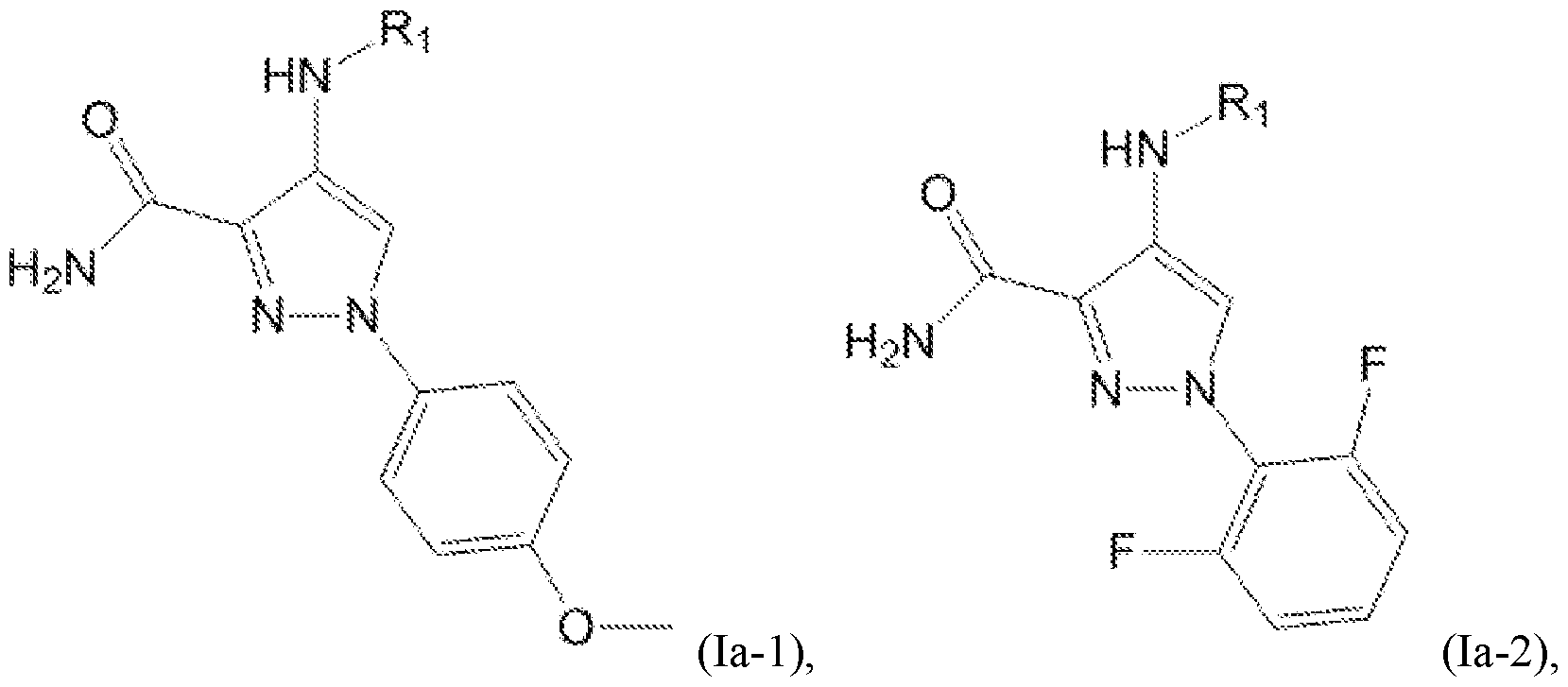


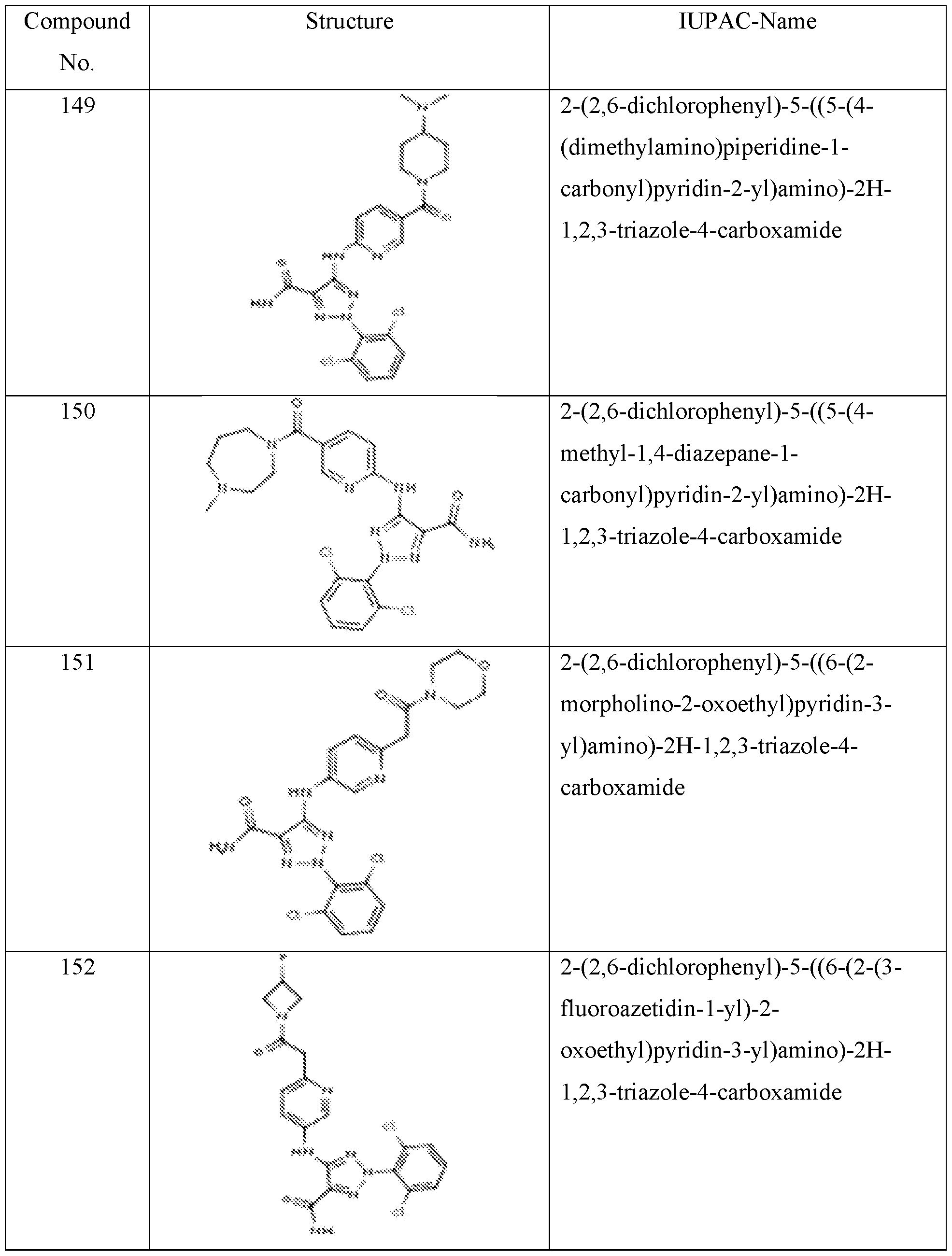


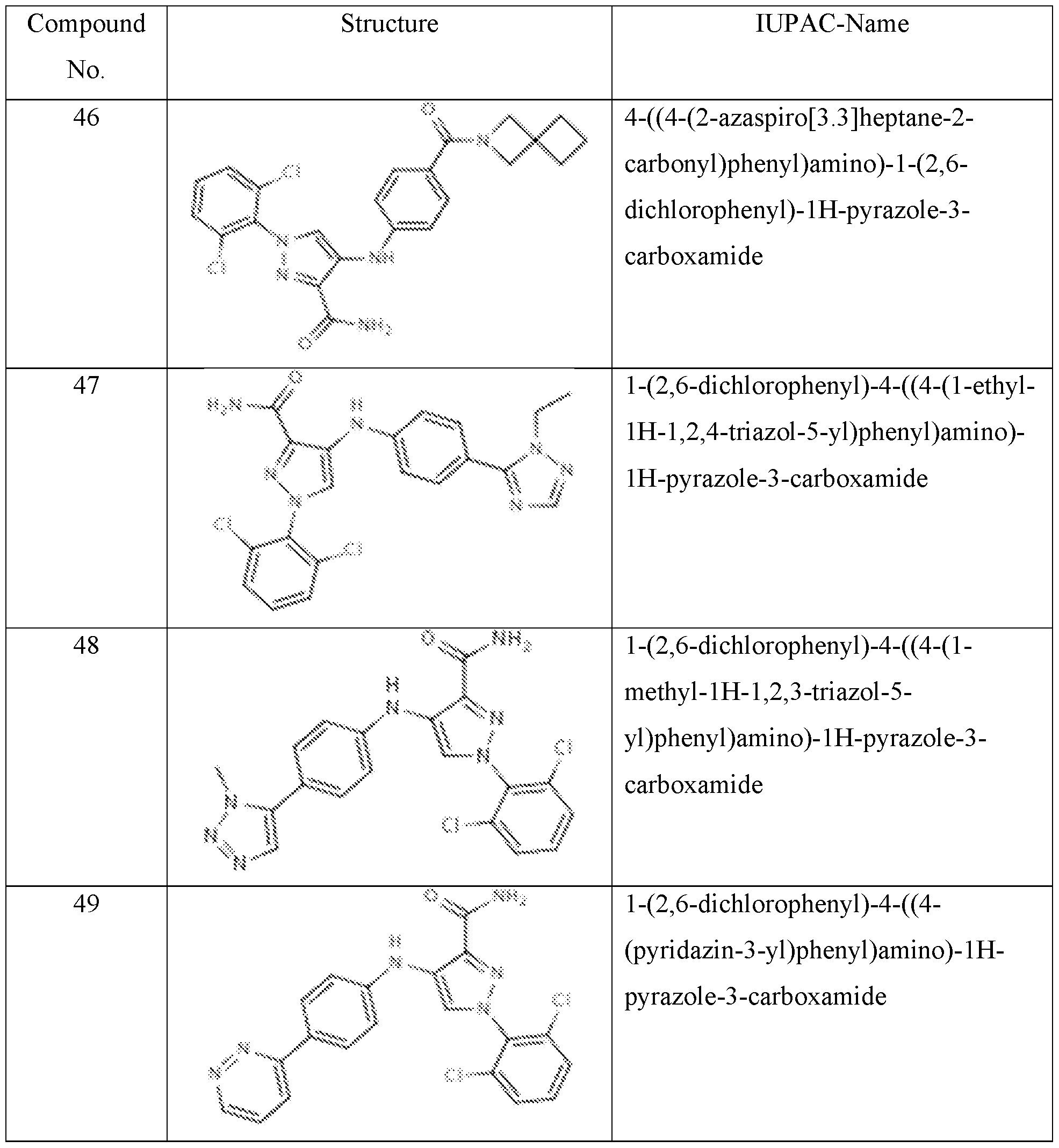


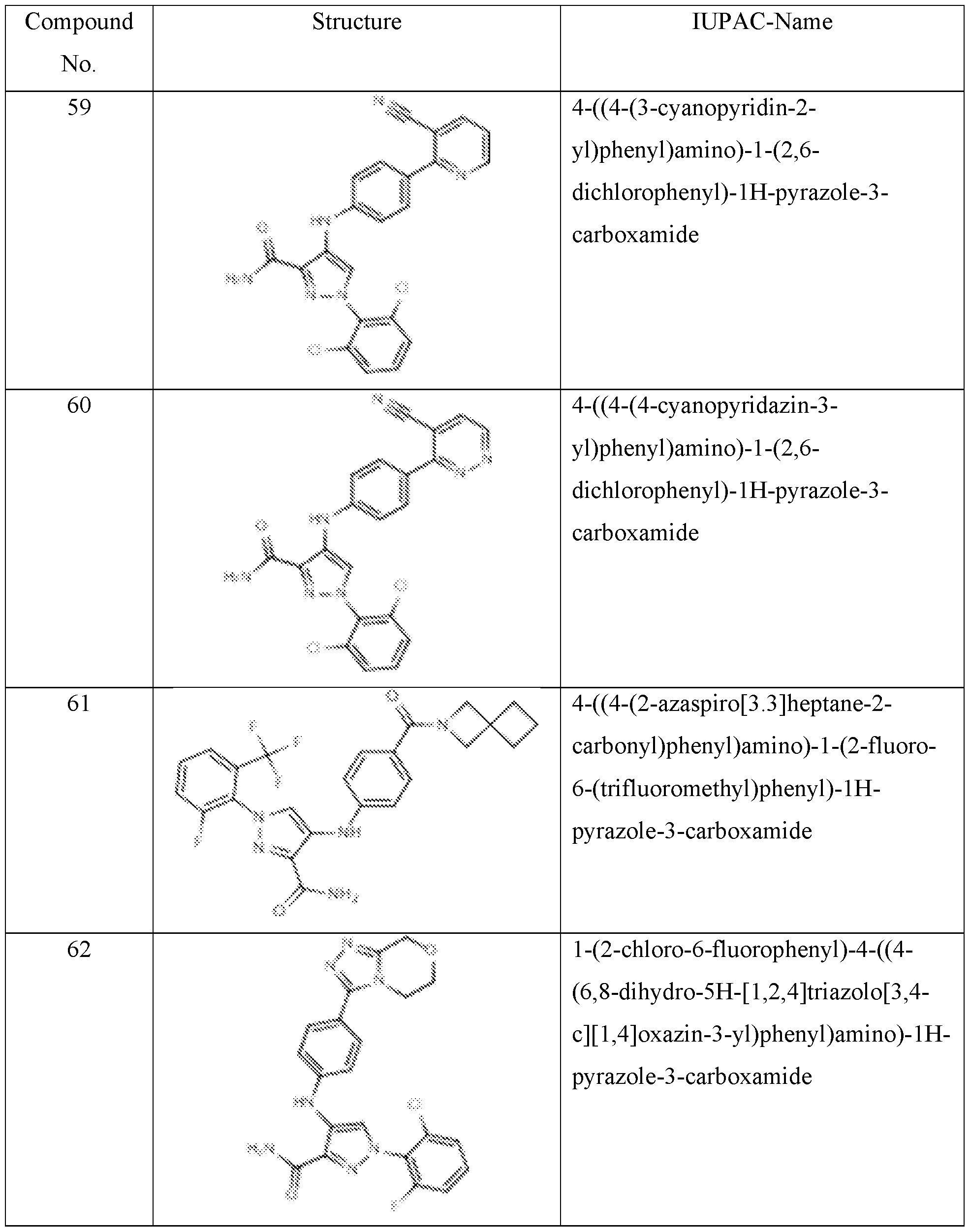


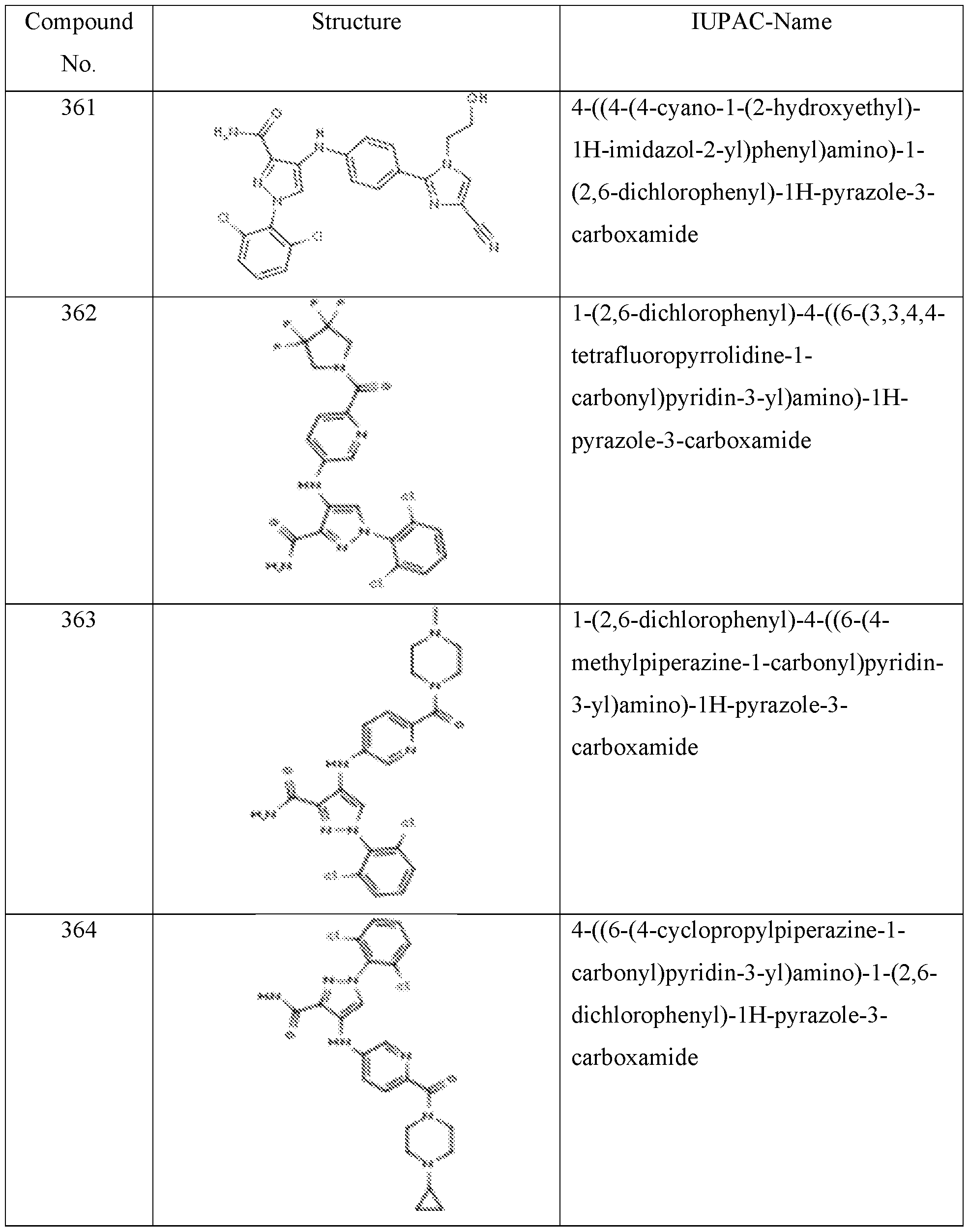


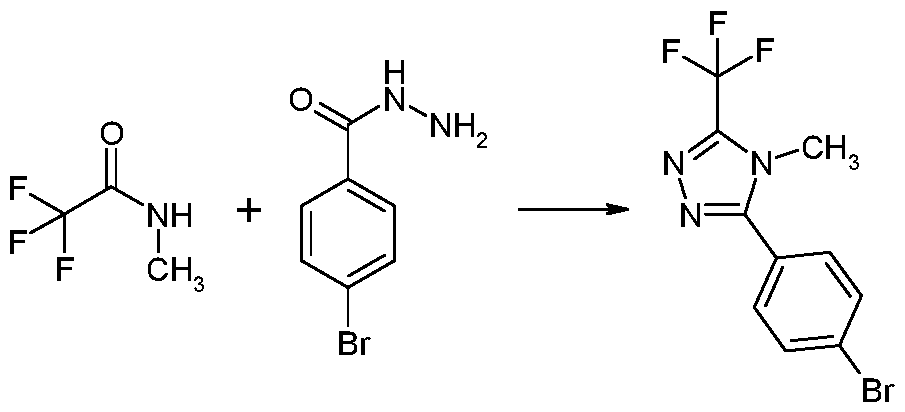
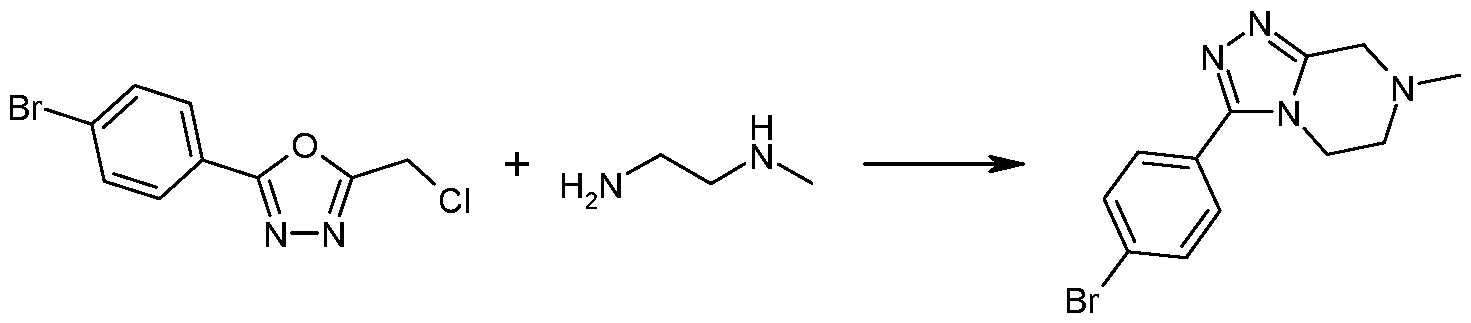


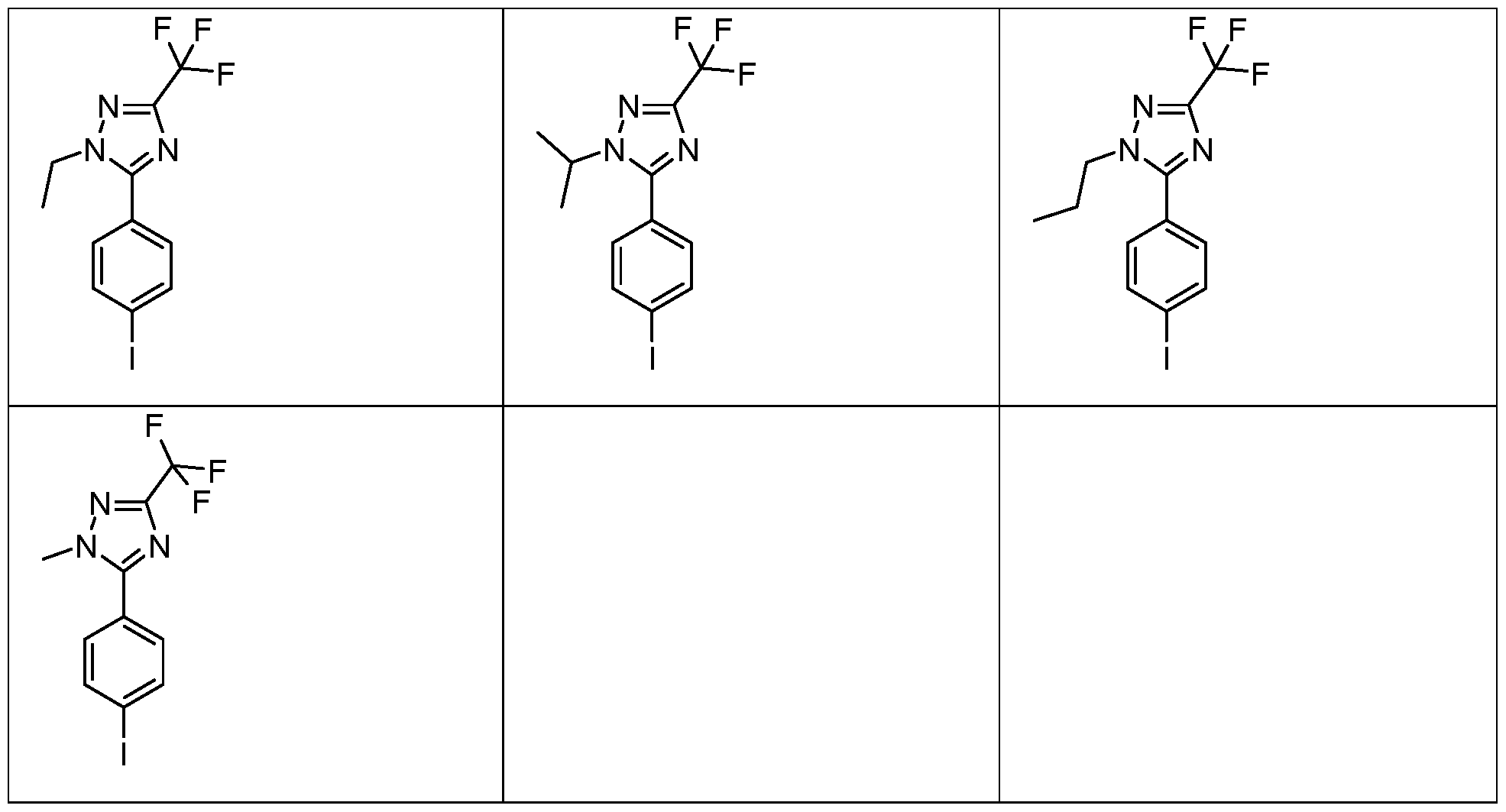


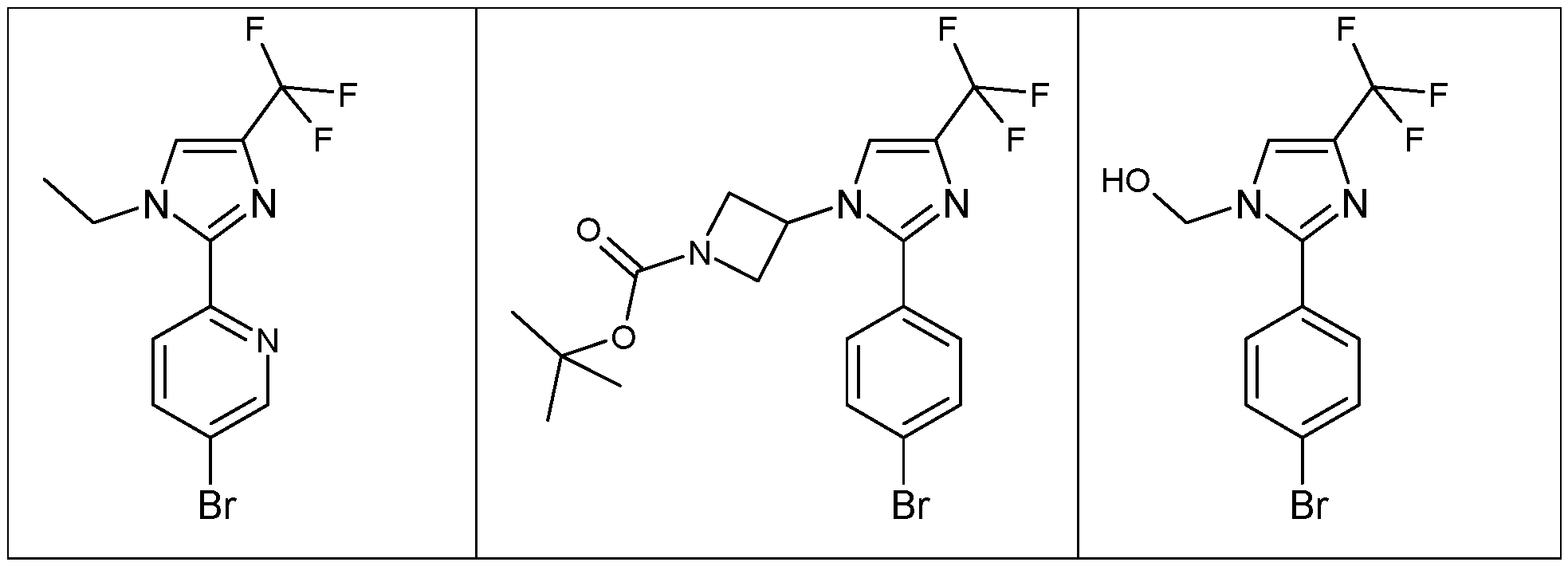


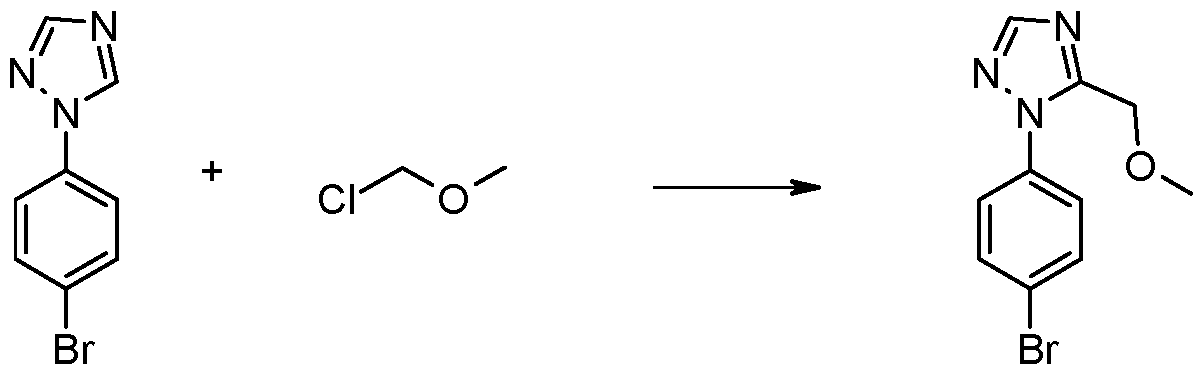


. 7 e l b . a 6 T e l n i ba d T e z n i i r a d m et s m i l u s er s i a 1 s d e n l u b a op T n m i oc d e e t h s i t l f s o d n n o u it o a p r a m p o e c r e p h t n i r d o e f s a t u a s d d l o a h c t i e t y l M a n C a L l P a c 8 H i 1 e 9 1 m e e l h e h p T l p C m a m x a E x E 5


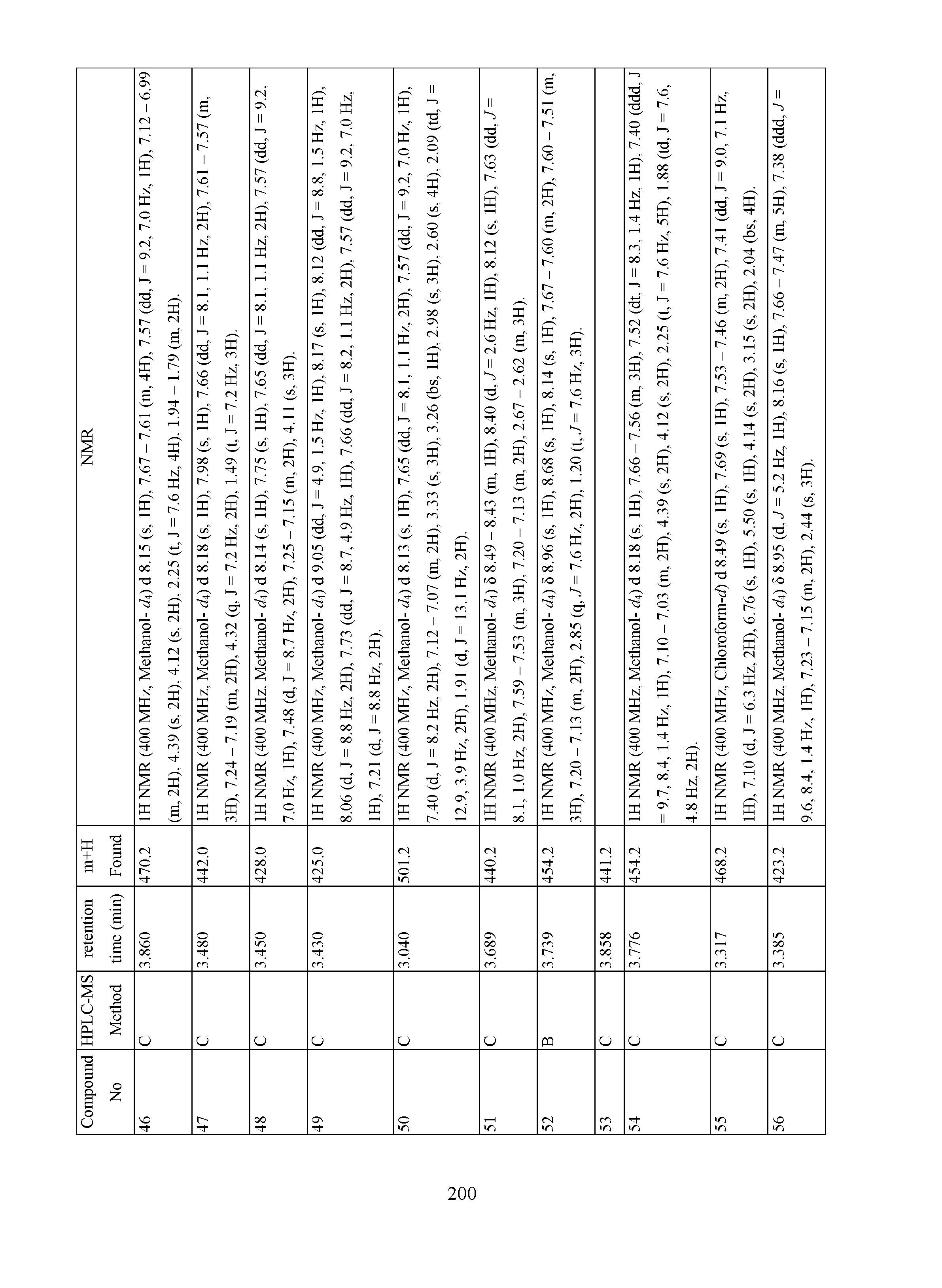


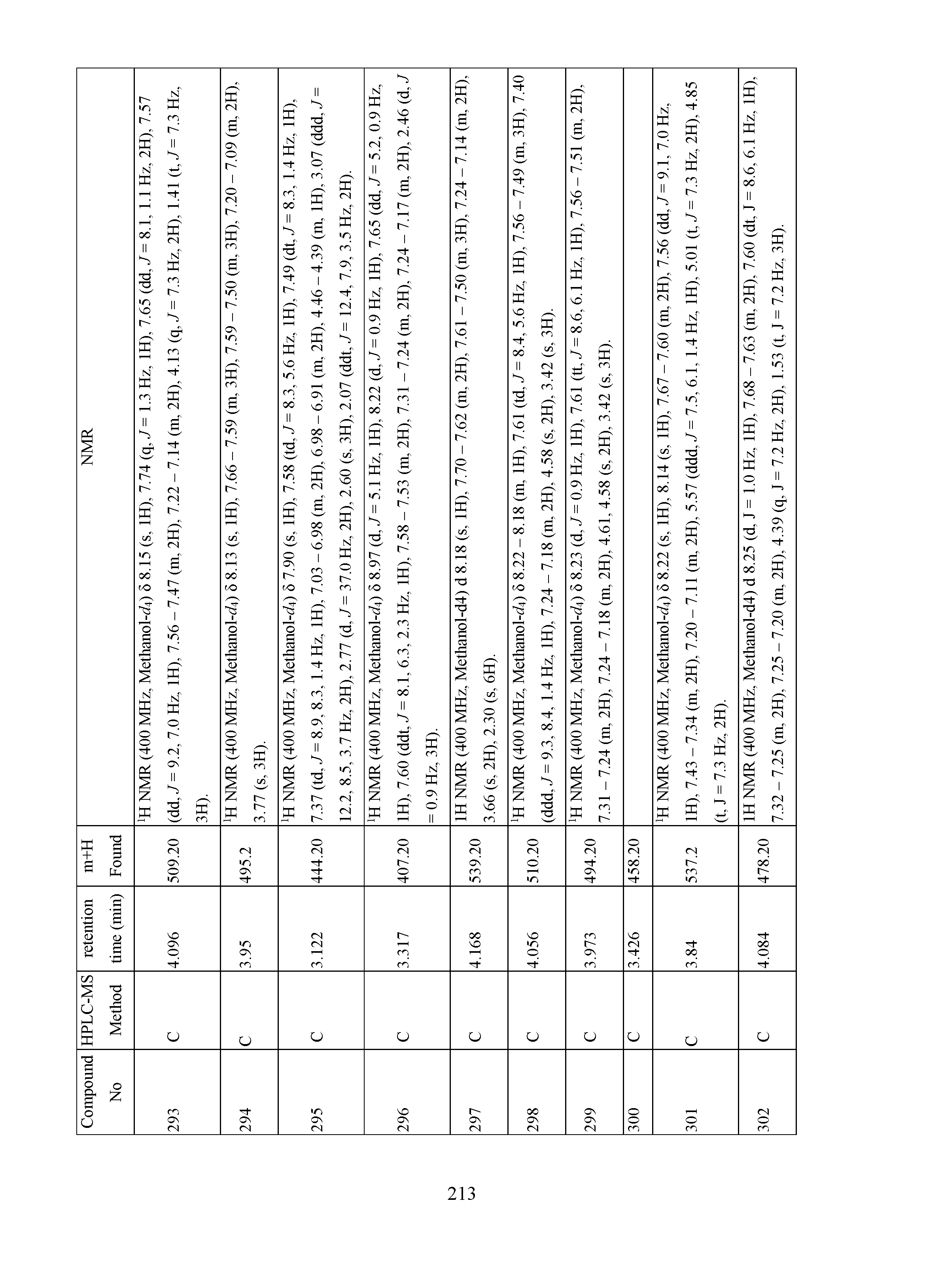


 Example 20 The compounds listed in Table 1 were tested for their ability to inhibit a set of kinases according to the following procedures. Biochemical assays: The basic protocol for TR-FRET LanthaScreen Eu Kinase Binding Assay inhibitor studies were performed as follows. LanthaScreen Kinase Binding Assays (ThermoFisher/USA) to evaluate inhibitors were performed by addition of 5 μL of test compound in corresponding DMSO dilutions/ 5 μl of kinase/antibody mixture, 5 μL of tracer into 384 well small volume plates. After incubation for 1 hour at room temperature, plates were read. Data analysis of emission ratios was according LanthaScreen Eu Kinase Binding Assay protocol. Kinase and assay components were adjusted to final concentrations according to kit protocol. For LRRK2: 5 nM wt human LRRK2, catalytic site, or G2019S human LRRK2, catalytic site (ThermoFisher/USA), 2 nM Eu-Anti-GST Antibody, 10 nM Kinase Tracer 236 in 1X Kinase Buffer A. For NUAK1: 8 nM wt human NUAK1, full length (ThermoFisher/USA), 2 nM Eu-Anti-His Antibody, 5 nM Kinase Tracer 236 in 1X Kinase Buffer A. Basic protocol for Z´-LYTE Assays (ThermoFisher/USA) inhibitor studies involved two steps: Kinase reaction: Addition of 2 μL of test compound in corresponding DMSO dilutions, 5 μL of kinase/substrate mixture, 3 μL of ATP into 384 well small volume plates. Incubation for at least 1 hour at room temperature. Development reaction: Addition of 5 μL development reagent, incubation for 1 hour at room temperature, addition of 5 μL stop reagent, read plate. Data analysis of emission ratios according to Z'-LYTE assay protocol. Kinase and assay components were adjusted to final concentrations according to kit protocol. For JAK2: 5 nM wt human JAK2, catalytic site (ThermoFisher/USA), 2 µM Z´-LYTE Tyr 06 Peptide, 36 µM ATP in Kinase Buffer. Basic protocol for HTRF KinEASE assay (Cisbio/FRA) inhibitor studies involved two steps: Enzymatic step: Addition of 4 μL of test compound in corresponding DMSO dilutions, 4 μL of kinase/substrate mixture, 2 μL of ATP into 384 well small volume plates. Incubation for at least 30 minutes at room temperature.
Detection step: Addition of 5 μL antibody and 5 µL streptavidin-XL665, read plate after 60 minutes. Data analysis of emission ratios according KinEASE assay protocol. Kinase and assay components were adjusted to final concentrations according to kit protocol. For TYK2: 2 nM wt human TYK2, catalytic site (SignalChem/CAN), 1 µM HTRF KinEASE-TK Substrate-biotin, 1 µM ATP in 1x Kinase Buffer. For JAK1: 4 nM wt human JAK1, catalytic site (ThermoFisher/USA), 1 µM HTRF KinEASE-TK Substrate-biotin, 2.5 µM ATP in 1x Kinase Buffer. For JAK2: 1 nM wt human JAK2, catalytic site (SignalChem/CAN), 1 µM HTRF KinEASE-TK Substrate-biotin, 100 µM ATP in 1x Kinase Buffer. Results for from biochemical tests were as follows: Activity toward TYK2 The following compounds had an IC50 lower than 10 nM: Compound Nos.17, 22, 32, 36, 42, 45, 46, 57, 58, 62, 83, 84, 85, 86, 87, 88, 89, 91, 95, 203, 207, 212, 214, 215, 227, 230, 231, 237, 238, 243, 247, 249, 254, 259, 275, 276, 277, 281, 283, 292, 294, 297, 299, 301, 302, 305, 314, 315, 316, 332, 333, 338, 342, 347, 348, 349, 361, 371, 411, 413, 414, 415, 416, 425, 426, 450, 451, 452, 453, 454, 456, 457, 458, 459, 463, 466, 467, and 468. The following compounds had an IC50 between 10 nM and 100 nM: Compound Nos.12, 13, 14, 15, 16, 26, 27, 28, 29, 30, 31, 34, 35, 38, 40, 44, 47, 48, 49, 50, 51, 52, 54, 55, 56, 60, 61, 63, 68, 69, 70, 72, 73, 74, 78, 79, 80, 82, 90, 92, 93, 94, 96, 202, 204, 205, 206, 208, 209, 210, 211, 213, 216, 225, 226, 228, 229, 232, 233, 241, 242, 246, 248, 251, 267, 268, 269, 270, 271, 273, 284, 285, 286, 288, 291, 293, 295, 296, 298, 300, 303, 304, 306, 307, 308, 310, 313, 317, 318, 319, 321, 322, 323, 325, 326, 327, 330, 331, 340, 341, 351, 354, 355, 356, 357, 358, 359, 360, 362, 363, 364, 365, 366, 367, 370, 373, 375, 376, 378, 383, 385, 386, 387, 388, 391, 400, 412, 417, 418, 419, 421, 422, 423, 424, 429, 433, 435, 436, 438, 443, 444, 445, 447, 455, 461, 464, 469, 472, and 473. The following compounds had an IC50 between 100 nM and 1000 nM: Compound Nos. 4, 5, 6, 7, 8, 10, 11, 18, 21, 23, 24, 25, 33, 37, 39, 41, 43, 53, 59, 64, 67, 71, 75, 77, 81, 201, 218, 224, 236, 240, 253, 257, 260, 261, 263, 266, 272, 274, 278, 279, 280, 287, 289, 309, 311, 324, 328, 329, 334, 337, 339, 343, 344, 345, 346, 350, 352, 368, 369, 372, 374, 377, 379, 380, 381, 383, 384, 390, 392, 393, 394, 395, 397, 398, 401, 402, 403, 405, 407, 420, 427, 428, 430, 431, 432, 434, 439, 440, 441, 442, 448, 449, 460, 462, 465, 470, 471, 475, and 476.
Activity toward LRRK2(wt) and LRRK2(G2019) The following compounds had an IC50 between 10 nM and 100 nM: Compound Nos.12, 35, 36, 45, 56, 58, 62, 63, 208, 211, 304, and 309. The following compounds had an IC50 between 100 nM and 1000 nM: Compound Nos. 4, 7, 8, 10, 11, 13, 14, 15, 16, 17, 18, 22, 23, 26, 27, 30, 31, 32, 34, 37, 38, 40, 42, 46, 47, 48, 49, 50, 51, 52, 53, 54, 57, 59, 60, 61, 64, 68, 70, 71, 80, 82, 83, 84, 85, 86, 87, 88, 89, 202, 205, 206, 207, 212, 225, 227, 228, 229, 230, 231, 232, 233, 246, 247, 248, 249, 259, 260, 267, 268, 272, 276, 283, 284, 285, 286, 287, 288, 295, 296, 299, 302, 303, 305, 308, 310, 313, 315, 316, 317, 318, 321, 322, 323, 326, 331, 333, 342, 344, 347, 349, 355, 359, 361, 376, 386, 387, 388, 391, 394, 395, 400, 414, 415, 416, 417, 418, 421, 422, 423, 425, 426, 436, 450, 452, 453, 454, 456, 466, and 472. Activity toward NUAK1 The following compounds had an IC50 between 10 nM and 100 nM: Compound Nos. 8, 13, 14, 22, 38, 227, 287, 288, and 295. The following compounds had an IC50 between 100 nM and 1000 nM: Compound Nos. 4, 7, 12, 15, 16, 27, 30, 31, 35, 36, 44, 48, 54, 56, 58, 61, 62, 68, 82, 86, 87, 88, 91, 202, 203, 205, 206, 207, 208, 211, 212, 214, 225, 228, 229, 230, 232, 237, 248, 249, 251, 284, 285, 286, 296, 308, 309, 313, 314, 317, 318, 319, 323, 327, 331, 332, 333, 338, 342, 349, 359, 361, 403, 407, 416, 417, 422, 423, 424, 452, 453, and 454. Activity toward JAK1 The following compounds had an IC50 lower than 10 nM: Compound Nos.42, 46, 229, 231, 241, 291, 436, 451, 452, 453, 467, and 468. The following compounds had an IC50 between 10 nM and 100 nM: Compound Nos.17, 22, 26, 31, 32, 34, 35, 36, 38, 39, 40, 49, 51, 53, 58, 59, 60, 74, 80, 82, 84, 85, 86, 87, 88, 91, 92, 94, 96, 203, 205, 206, 207, 208, 212, 214, 215, 216, 225, 227, 228, 230, 232, 233, 238, 242, 243, 246, 247, 248, 254, 259, 260, 266, 267, 268, 269, 270, 271, 272, 273, 275, 276, 285, 292, 293, 294, 295, 302, 303, 305, 308, 310, 313, 314, 315, 316, 317, 318, 319, 321, 322, 326, 327, 330, 333, 347, 348, 359, 361, 365, 376, 377, 386, 387, 388, 391, 411, 412, 413, 414, 415, 416, 417,
418, 419, 421, 422, 423, 425, 426, 431, 432, 433, 435, 439, 440, 443, 444, 445, 447, 448, 450, 454, 456, 457, 458, 459, 461, 462, 463, 466, 469, 472, 473, and 476. The following compounds had an IC50 between 100 nM and 1000 nM: Compound Nos. 8, 11, 12, 13, 14, 15, 16, 18, 27, 28, 29, 30, 33, 37, 41, 43, 44, 45, 47, 48, 50, 52, 54, 55, 56, 57, 61, 62, 63, 64, 67, 68, 69, 70, 71, 72, 73, 75, 76, 77, 78, 79, 83, 89, 90, 93, 95, 202, 204, 209, 210, 211, 213, 217, 218, 222, 224, 226, 234, 237, 240, 249, 251, 253, 261, 263, 277, 281, 283, 284, 286, 287, 288, 296, 297, 298, 299, 300, 304, 307, 309, 323, 324, 325, 331, 332, 334, 338, 340, 341, 342, 349, 350, 351, 352, 354, 355, 356, 357, 358, 360, 362, 363, 364, 366, 367, 370, 371, 373, 374, 375, 378, 379, 380, 381, 383, 383, 384, 385, 390, 392, 393, 394, 395, 397, 398, 400, 401, 402, 405, 407, 420, 424, 428, 429, 430, 437, 438, 441, 442, 449, 455, 460, 464, 470, 471, and 475. Activity toward JAK2 The following compounds had an IC50 between 100 nM and 1000 nM: Compound Nos. 12, 13, 17, 22, 32, 36, 57, 58, 62, 87, 88, 90, 94, 96, 202, 203, 205, 206, 207, 210, 211, 212, 227, 229, 238, 322, 333, 347, 414, 416, 425, 451, 452, 454, and 457. Example 21 Certain compounds that were used as reagents in synthesis schemes described herein were prepared by the following schemes.
Example 20 The compounds listed in Table 1 were tested for their ability to inhibit a set of kinases according to the following procedures. Biochemical assays: The basic protocol for TR-FRET LanthaScreen Eu Kinase Binding Assay inhibitor studies were performed as follows. LanthaScreen Kinase Binding Assays (ThermoFisher/USA) to evaluate inhibitors were performed by addition of 5 μL of test compound in corresponding DMSO dilutions/ 5 μl of kinase/antibody mixture, 5 μL of tracer into 384 well small volume plates. After incubation for 1 hour at room temperature, plates were read. Data analysis of emission ratios was according LanthaScreen Eu Kinase Binding Assay protocol. Kinase and assay components were adjusted to final concentrations according to kit protocol. For LRRK2: 5 nM wt human LRRK2, catalytic site, or G2019S human LRRK2, catalytic site (ThermoFisher/USA), 2 nM Eu-Anti-GST Antibody, 10 nM Kinase Tracer 236 in 1X Kinase Buffer A. For NUAK1: 8 nM wt human NUAK1, full length (ThermoFisher/USA), 2 nM Eu-Anti-His Antibody, 5 nM Kinase Tracer 236 in 1X Kinase Buffer A. Basic protocol for Z´-LYTE Assays (ThermoFisher/USA) inhibitor studies involved two steps: Kinase reaction: Addition of 2 μL of test compound in corresponding DMSO dilutions, 5 μL of kinase/substrate mixture, 3 μL of ATP into 384 well small volume plates. Incubation for at least 1 hour at room temperature. Development reaction: Addition of 5 μL development reagent, incubation for 1 hour at room temperature, addition of 5 μL stop reagent, read plate. Data analysis of emission ratios according to Z'-LYTE assay protocol. Kinase and assay components were adjusted to final concentrations according to kit protocol. For JAK2: 5 nM wt human JAK2, catalytic site (ThermoFisher/USA), 2 µM Z´-LYTE Tyr 06 Peptide, 36 µM ATP in Kinase Buffer. Basic protocol for HTRF KinEASE assay (Cisbio/FRA) inhibitor studies involved two steps: Enzymatic step: Addition of 4 μL of test compound in corresponding DMSO dilutions, 4 μL of kinase/substrate mixture, 2 μL of ATP into 384 well small volume plates. Incubation for at least 30 minutes at room temperature.
Detection step: Addition of 5 μL antibody and 5 µL streptavidin-XL665, read plate after 60 minutes. Data analysis of emission ratios according KinEASE assay protocol. Kinase and assay components were adjusted to final concentrations according to kit protocol. For TYK2: 2 nM wt human TYK2, catalytic site (SignalChem/CAN), 1 µM HTRF KinEASE-TK Substrate-biotin, 1 µM ATP in 1x Kinase Buffer. For JAK1: 4 nM wt human JAK1, catalytic site (ThermoFisher/USA), 1 µM HTRF KinEASE-TK Substrate-biotin, 2.5 µM ATP in 1x Kinase Buffer. For JAK2: 1 nM wt human JAK2, catalytic site (SignalChem/CAN), 1 µM HTRF KinEASE-TK Substrate-biotin, 100 µM ATP in 1x Kinase Buffer. Results for from biochemical tests were as follows: Activity toward TYK2 The following compounds had an IC50 lower than 10 nM: Compound Nos.17, 22, 32, 36, 42, 45, 46, 57, 58, 62, 83, 84, 85, 86, 87, 88, 89, 91, 95, 203, 207, 212, 214, 215, 227, 230, 231, 237, 238, 243, 247, 249, 254, 259, 275, 276, 277, 281, 283, 292, 294, 297, 299, 301, 302, 305, 314, 315, 316, 332, 333, 338, 342, 347, 348, 349, 361, 371, 411, 413, 414, 415, 416, 425, 426, 450, 451, 452, 453, 454, 456, 457, 458, 459, 463, 466, 467, and 468. The following compounds had an IC50 between 10 nM and 100 nM: Compound Nos.12, 13, 14, 15, 16, 26, 27, 28, 29, 30, 31, 34, 35, 38, 40, 44, 47, 48, 49, 50, 51, 52, 54, 55, 56, 60, 61, 63, 68, 69, 70, 72, 73, 74, 78, 79, 80, 82, 90, 92, 93, 94, 96, 202, 204, 205, 206, 208, 209, 210, 211, 213, 216, 225, 226, 228, 229, 232, 233, 241, 242, 246, 248, 251, 267, 268, 269, 270, 271, 273, 284, 285, 286, 288, 291, 293, 295, 296, 298, 300, 303, 304, 306, 307, 308, 310, 313, 317, 318, 319, 321, 322, 323, 325, 326, 327, 330, 331, 340, 341, 351, 354, 355, 356, 357, 358, 359, 360, 362, 363, 364, 365, 366, 367, 370, 373, 375, 376, 378, 383, 385, 386, 387, 388, 391, 400, 412, 417, 418, 419, 421, 422, 423, 424, 429, 433, 435, 436, 438, 443, 444, 445, 447, 455, 461, 464, 469, 472, and 473. The following compounds had an IC50 between 100 nM and 1000 nM: Compound Nos. 4, 5, 6, 7, 8, 10, 11, 18, 21, 23, 24, 25, 33, 37, 39, 41, 43, 53, 59, 64, 67, 71, 75, 77, 81, 201, 218, 224, 236, 240, 253, 257, 260, 261, 263, 266, 272, 274, 278, 279, 280, 287, 289, 309, 311, 324, 328, 329, 334, 337, 339, 343, 344, 345, 346, 350, 352, 368, 369, 372, 374, 377, 379, 380, 381, 383, 384, 390, 392, 393, 394, 395, 397, 398, 401, 402, 403, 405, 407, 420, 427, 428, 430, 431, 432, 434, 439, 440, 441, 442, 448, 449, 460, 462, 465, 470, 471, 475, and 476.
Activity toward LRRK2(wt) and LRRK2(G2019) The following compounds had an IC50 between 10 nM and 100 nM: Compound Nos.12, 35, 36, 45, 56, 58, 62, 63, 208, 211, 304, and 309. The following compounds had an IC50 between 100 nM and 1000 nM: Compound Nos. 4, 7, 8, 10, 11, 13, 14, 15, 16, 17, 18, 22, 23, 26, 27, 30, 31, 32, 34, 37, 38, 40, 42, 46, 47, 48, 49, 50, 51, 52, 53, 54, 57, 59, 60, 61, 64, 68, 70, 71, 80, 82, 83, 84, 85, 86, 87, 88, 89, 202, 205, 206, 207, 212, 225, 227, 228, 229, 230, 231, 232, 233, 246, 247, 248, 249, 259, 260, 267, 268, 272, 276, 283, 284, 285, 286, 287, 288, 295, 296, 299, 302, 303, 305, 308, 310, 313, 315, 316, 317, 318, 321, 322, 323, 326, 331, 333, 342, 344, 347, 349, 355, 359, 361, 376, 386, 387, 388, 391, 394, 395, 400, 414, 415, 416, 417, 418, 421, 422, 423, 425, 426, 436, 450, 452, 453, 454, 456, 466, and 472. Activity toward NUAK1 The following compounds had an IC50 between 10 nM and 100 nM: Compound Nos. 8, 13, 14, 22, 38, 227, 287, 288, and 295. The following compounds had an IC50 between 100 nM and 1000 nM: Compound Nos. 4, 7, 12, 15, 16, 27, 30, 31, 35, 36, 44, 48, 54, 56, 58, 61, 62, 68, 82, 86, 87, 88, 91, 202, 203, 205, 206, 207, 208, 211, 212, 214, 225, 228, 229, 230, 232, 237, 248, 249, 251, 284, 285, 286, 296, 308, 309, 313, 314, 317, 318, 319, 323, 327, 331, 332, 333, 338, 342, 349, 359, 361, 403, 407, 416, 417, 422, 423, 424, 452, 453, and 454. Activity toward JAK1 The following compounds had an IC50 lower than 10 nM: Compound Nos.42, 46, 229, 231, 241, 291, 436, 451, 452, 453, 467, and 468. The following compounds had an IC50 between 10 nM and 100 nM: Compound Nos.17, 22, 26, 31, 32, 34, 35, 36, 38, 39, 40, 49, 51, 53, 58, 59, 60, 74, 80, 82, 84, 85, 86, 87, 88, 91, 92, 94, 96, 203, 205, 206, 207, 208, 212, 214, 215, 216, 225, 227, 228, 230, 232, 233, 238, 242, 243, 246, 247, 248, 254, 259, 260, 266, 267, 268, 269, 270, 271, 272, 273, 275, 276, 285, 292, 293, 294, 295, 302, 303, 305, 308, 310, 313, 314, 315, 316, 317, 318, 319, 321, 322, 326, 327, 330, 333, 347, 348, 359, 361, 365, 376, 377, 386, 387, 388, 391, 411, 412, 413, 414, 415, 416, 417,
418, 419, 421, 422, 423, 425, 426, 431, 432, 433, 435, 439, 440, 443, 444, 445, 447, 448, 450, 454, 456, 457, 458, 459, 461, 462, 463, 466, 469, 472, 473, and 476. The following compounds had an IC50 between 100 nM and 1000 nM: Compound Nos. 8, 11, 12, 13, 14, 15, 16, 18, 27, 28, 29, 30, 33, 37, 41, 43, 44, 45, 47, 48, 50, 52, 54, 55, 56, 57, 61, 62, 63, 64, 67, 68, 69, 70, 71, 72, 73, 75, 76, 77, 78, 79, 83, 89, 90, 93, 95, 202, 204, 209, 210, 211, 213, 217, 218, 222, 224, 226, 234, 237, 240, 249, 251, 253, 261, 263, 277, 281, 283, 284, 286, 287, 288, 296, 297, 298, 299, 300, 304, 307, 309, 323, 324, 325, 331, 332, 334, 338, 340, 341, 342, 349, 350, 351, 352, 354, 355, 356, 357, 358, 360, 362, 363, 364, 366, 367, 370, 371, 373, 374, 375, 378, 379, 380, 381, 383, 383, 384, 385, 390, 392, 393, 394, 395, 397, 398, 400, 401, 402, 405, 407, 420, 424, 428, 429, 430, 437, 438, 441, 442, 449, 455, 460, 464, 470, 471, and 475. Activity toward JAK2 The following compounds had an IC50 between 100 nM and 1000 nM: Compound Nos. 12, 13, 17, 22, 32, 36, 57, 58, 62, 87, 88, 90, 94, 96, 202, 203, 205, 206, 207, 210, 211, 212, 227, 229, 238, 322, 333, 347, 414, 416, 425, 451, 452, 454, and 457. Example 21 Certain compounds that were used as reagents in synthesis schemes described herein were prepared by the following schemes.


Claims
Claims What is claimed is: 1. A compound of Formula (II):
 (II), wherein: X is N or CH; R1 is C(O)CH2R3, optionally substituted cycloalkyl, optionally substituted cycloheteroalkyl, optionally substituted cycloalkenyl, optionally substituted cycloheteroalkenyl, optionally substituted aryl, or optionally substituted heteroaryl; each instance of R2 is independently halo, haloalkyl, cyano, optionally substituted alkoxyl, optionally substituted alkyl, optionally substituted heteroalkyl, optionally substituted alkenyl, optionally substituted heteroalkenyl; R3 is optionally substituted cycloalkyl, optionally substituted cycloheteroalkyl, optionally substituted cycloalkenyl, optionally substituted cycloheteroalkenyl, optionally substituted aryl, or optionally substituted heteroaryl; A is cycloalkyl, cycloheteroalkyl, cycloalkenyl, cycloheteroalkenyl, aryl, or heteroaryl; and n is 0-5.
2. The compound of claim 1, wherein X is N.
3. The compound of claim 1, wherein X is CH.
4. The compound of claim 1, wherein A is aryl or heteroaryl.
5. The compound of claim 4, wherein each instance of R2 is halo or cyano.
6. The compound of claim 5, wherein n is 2 or 3.
7. The compound of claim 6, wherein the compound is represented by Formula (IIa):

8. The compound of claim 6, wherein the compound is represented by Formula (I):

9. The compound of claim 1, wherein R1 is an optionally substituted aryl.
10. The compound of claim 9, wherein R1 is a substituted phenyl.
11. The compound of claim 1, wherein R1 is optionally substituted aryl or optionally substituted heteroaryl;
12. The compound of claim 11, wherein R1 is an optionally substituted aryl other than phenyl.
13. The compound of claim 11, wherein R1 is an optionally substituted heteroaryl.
14. The compound of claim 11, wherein A is aryl or heteroaryl.
15. The compound of claim 14, wherein A is aryl.
16. The compound of claim 14, wherein A is heteroaryl.
17. The compound of claim 14, wherein each instance of R2 is halo or cyano.
18. The compound of claim 17, wherein n is 2 or 3.
19. The compound of claim 1, wherein the compound is selected from the group consisting of 1-(4-methoxyphenyl)-4-(2-morpholinoacetamido)-1H-pyrazole-3-carboxamide; 1-(2,6- difluorophenyl)-4-(2-morpholinoacetamido)-1H-pyrazole-3-carboxamide; 1-(2-fluorophenyl)-4- (2-morpholinoacetamido)-1H-pyrazole-3-carboxamide; 1-(2,6-difluorophenyl)-4-((6- methylpyrimidin-4-yl)amino)-1H-pyrazole-3-carboxamide; 1-(2-fluorophenyl)-4-((6- methylpyrimidin-4-yl)amino)-1H-pyrazole-3-carboxamide; 4-((5-aminopyridin-2-yl)amino)-1- (2,6-difluorophenyl)-1H-pyrazole-3-carboxamide; 1-(2,6-difluorophenyl)-4-(pyridin-2-ylamino)- 1H-pyrazole-3-carboxamide; 4-((2-amino-6-methylpyrimidin-4-yl)amino)-1-(2,6- difluorophenyl)-1H-pyrazole-3-carboxamide; 4-(benzo[d]thiazol-2-ylamino)-1-(2,6- difluorophenyl)-1H-pyrazole-3-carboxamide; 1-(2,6-difluorophenyl)-4-((4-methylpyridin-2- yl)amino)-1H-pyrazole-3-carboxamide; 4-((1H-benzo[d]imidazol-2-yl)amino)-1-(2,6- difluorophenyl)-1H-pyrazole-3-carboxamide; 1-(2,6-difluorophenyl)-4-((4-(morpholine-4- carbonyl)phenyl)amino)-1H-pyrazole-3-carboxamide; 1-(2,6-difluorophenyl)-4-((4-((tetrahydro- 2H-pyran-4-yl)carbamoyl)phenyl)amino)-1H-pyrazole-3-carboxamide; 1-(2,6-difluorophenyl)-4- ((4-((2,2,2-trifluoroethyl)carbamoyl)phenyl)amino)-1H-pyrazole-3-carboxamide; 4-((4-(tert- butylcarbamoyl)phenyl)amino)-1-(2,6-difluorophenyl)-1H-pyrazole-3-carboxamide; 1-(2,6- difluorophenyl)-4-((4-(ethylcarbamoyl)phenyl)amino)-1H-pyrazole-3-carboxamide; 1-(2,6- dichlorophenyl)-4-((4-(morpholine-4-carbonyl)phenyl)amino)-1H-pyrazole-3-carboxamide; 1- (2,6-difluorophenyl)-4-((3-(morpholine-4-carbonyl)phenyl)amino)-1H-pyrazole-3-carboxamide; 4-((4-chlorophenyl)amino)-1-(2,6-difluorophenyl)-1H-pyrazole-3-carboxamide; 4-((4- chlorophenyl)amino)-1-(2,6-dichlorophenyl)-1H-pyrazole-3-carboxamide; 1-(2,6- dichlorophenyl)-4-(phenylamino)-1H-pyrazole-3-carboxamide; 1-(2-chloro-6-fluorophenyl)-4- ((4-(morpholine-4-carbonyl)phenyl)amino)-1H-pyrazole-3-carboxamide; N-(tert-butyl)-5-((3- carbamoyl-1-(2,6-difluorophenyl)-1H-pyrazol-4-yl)amino)picolinamide; 5-((3-carbamoyl-1-(2,6- difluorophenyl)-1H-pyrazol-4-yl)amino)-N-ethylpicolinamide; 5-((3-carbamoyl-1-(2-fluoro-6- methoxyphenyl)-1H-pyrazol-4-yl)amino)-N-ethylpicolinamide; 4-((4-(tert- butylcarbamoyl)phenyl)amino)-1-(2,6-dichlorophenyl)-1H-pyrazole-3-carboxamide; 4-((4-(tert- butylcarbamoyl)phenyl)amino)-1-(2-chloro-6-fluorophenyl)-1H-pyrazole-3-carboxamide; 4-((4- (tert-butylcarbamoyl)-3-fluorophenyl)amino)-1-(2,6-dichlorophenyl)-1H-pyrazole-3- carboxamide; 4-((4-(tert-butylcarbamoyl)-3-fluorophenyl)amino)-1-(2-chloro-6-fluorophenyl)-
1H-pyrazole-3-carboxamide; 1-(2,6-difluorophenyl)-4-((6-(morpholine-4-carbonyl)pyridin-3- yl)amino)-1H-pyrazole-3-carboxamide; 1-(2,6-dichlorophenyl)-4-((4-((1-methylpiperidin-4- yl)carbamoyl)phenyl)amino)-1H-pyrazole-3-carboxamide; 1-(2,6-dichlorophenyl)-4-((4-(4- methylpiperazine-1-carbonyl)phenyl)amino)-1H-pyrazole-3-carboxamide; tert-butyl_3-(4-((3- carbamoyl-1-(2,6-dichlorophenyl)-1H-pyrazol-4-yl)amino)benzamido)piperidine-1-carboxylate; 1-(2,6-dichlorophenyl)-4-((4-(ethylcarbamoyl)phenyl)amino)-1H-pyrazole-3-carboxamide; 1-(2- chloro-6-fluorophenyl)-4-((4-((1-methylpiperidin-4-yl)carbamoyl)phenyl)amino)-1H-pyrazole-3- carboxamide; 1-(2-chloro-6-fluorophenyl)-4-((4-(4-methylpiperazine-1-carbonyl)phenyl)amino)- 1H-pyrazole-3-carboxamide; tert-butyl_3-(4-((3-carbamoyl-1-(2-chloro-6-fluorophenyl)-1H- pyrazol-4-yl)amino)benzamido)piperidine-1-carboxylate; 1-(2-chloro-6-fluorophenyl)-4-((4- (piperidin-3-ylcarbamoyl)phenyl)amino)-1H-pyrazole-3-carboxamide; 1-(2,6-dichlorophenyl)-4- ((4-(piperidin-3-ylcarbamoyl)phenyl)amino)-1H-pyrazole-3-carboxamide; 1-(2-chloro-6- fluorophenyl)-4-((4-(ethylcarbamoyl)phenyl)amino)-1H-pyrazole-3-carboxamide; 1-(2,6- dichlorophenyl)-4-((4-pivaloylphenyl)amino)-1H-pyrazole-3-carboxamide; 1-(2-chloro-6- fluorophenyl)-4-((4-pivaloylphenyl)amino)-1H-pyrazole-3-carboxamide; 1-(2,6-dichlorophenyl)- 4-((1,2-dimethyl-1H-benzo[d]imidazol-5-yl)amino)-1H-pyrazole-3-carboxamide; 1-(2-chloro-6- fluorophenyl)-4-((1,2-dimethyl-1H-benzo[d]imidazol-5-yl)amino)-1H-pyrazole-3-carboxamide; 1-(2,6-dichlorophenyl)-4-((4-(4-methylpyridazin-3-yl)phenyl)amino)-1H-pyrazole-3- carboxamide; 4-((4-(2-azaspiro[3.3]heptane-2-carbonyl)phenyl)amino)-1-(2,6-dichlorophenyl)- 1H-pyrazole-3-carboxamide; 1-(2,6-dichlorophenyl)-4-((4-(1-ethyl-1H-1,2,4-triazol-5- yl)phenyl)amino)-1H-pyrazole-3-carboxamide; 1-(2,6-dichlorophenyl)-4-((4-(1-methyl-1H- 1,2,3-triazol-5-yl)phenyl)amino)-1H-pyrazole-3-carboxamide; 1-(2,6-dichlorophenyl)-4-((4- (pyridazin-3-yl)phenyl)amino)-1H-pyrazole-3-carboxamide; 1-(2,6-dichlorophenyl)-4-((4- (methyl(1-methylpiperidin-4-yl)carbamoyl)phenyl)amino)-1H-pyrazole-3-carboxamide; 1-(2,6- dichlorophenyl)-4-((4-(5-methylpyrimidin-4-yl)phenyl)amino)-1H-pyrazole-3-carboxamide; 1- (2,6-dichlorophenyl)-4-((4-(5-ethylpyrimidin-4-yl)phenyl)amino)-1H-pyrazole-3-carboxamide; 1-(2,6-dichlorophenyl)-4-((4-(1,4-dimethyl-1H-imidazol-5-yl)phenyl)amino)-1H-pyrazole-3- carboxamide; 4-((4-(2-azaspiro[3.3]heptane-2-carbonyl)phenyl)amino)-1-(2-chloro-6- fluorophenyl)-1H-pyrazole-3-carboxamide; 1-(2,6-dichlorophenyl)-4-((4-(5,6,7,8-tetrahydro- [1,2,4]triazolo[4,3-a]pyridin-3-yl)phenyl)amino)-1H-pyrazole-3-carboxamide; 1-(2-chloro-6- fluorophenyl)-4-((4-(4-methylpyridazin-3-yl)phenyl)amino)-1H-pyrazole-3-carboxamide; 1-(2,6-
dichlorophenyl)-4-((4-(6,8-dihydro-5H-[1,2,4]triazolo[3,4-c][1,4]oxazin-3-yl)phenyl)amino)- 1H-pyrazole-3-carboxamide; 1-(2-chloro-6-fluorophenyl)-4-((4-(5,6,7,8-tetrahydro- [1,2,4]triazolo[4,3-a]pyridin-3-yl)phenyl)amino)-1H-pyrazole-3-carboxamide; 4-((4-(3- cyanopyridin-2-yl)phenyl)amino)-1-(2,6-dichlorophenyl)-1H-pyrazole-3-carboxamide; 4-((4-(4- cyanopyridazin-3-yl)phenyl)amino)-1-(2,6-dichlorophenyl)-1H-pyrazole-3-carboxamide; 4-((4- (2-azaspiro[3.3]heptane-2-carbonyl)phenyl)amino)-1-(2-fluoro-6-(trifluoromethyl)phenyl)-1H- pyrazole-3-carboxamide; 1-(2-chloro-6-fluorophenyl)-4-((4-(6,8-dihydro-5H-[1,2,4]triazolo[3,4- c][1,4]oxazin-3-yl)phenyl)amino)-1H-pyrazole-3-carboxamide; 1-(2,6-dichlorophenyl)-4-((4- (6,7,8,9-tetrahydro-5H-[1,2,4]triazolo[4,3-a]azepin-3-yl)phenyl)amino)-1H-pyrazole-3- carboxamide; 1-(2,6-difluorophenyl)-4-((4-(dimethylphosphoryl)phenyl)amino)-1H-pyrazole-3- carboxamide; 4-((4-(1H-indazol-1-yl)phenyl)amino)-1-(2,6-dichlorophenyl)-1H-pyrazole-3- carboxamide; 4-((4-(2H-indazol-2-yl)phenyl)amino)-1-(2,6-dichlorophenyl)-1H-pyrazole-3- carboxamide; 4-((4-(4-chloropyridazin-3-yl)phenyl)amino)-1-(2,6-dichlorophenyl)-1H-pyrazole- 3-carboxamide; 1-(2-chloro-6-fluorophenyl)-4-((5-(morpholine-4-carbonyl)pyridin-2-yl)amino)- 1H-pyrazole-3-carboxamide; 1-(2,6-dichlorophenyl)-4-((4-(4-(trifluoromethyl)pyridazin-3- yl)phenyl)amino)-1H-pyrazole-3-carboxamide; 1-(2,6-dichlorophenyl)-4-((4-(6,7- dihydropyrano[4,3-c]pyrazol-1(4H)-yl)phenyl)amino)-1H-pyrazole-3-carboxamide; 1-(2,6- dichlorophenyl)-4-((4-(6,7-dihydropyrano[4,3-c]pyrazol-2(4H)-yl)phenyl)amino)-1H-pyrazole- 3-carboxamide; 1-(2,6-dichlorophenyl)-4-((4-(3-methyl-6-oxopyridazin-1(6H)- yl)phenyl)amino)-1H-pyrazole-3-carboxamide; 1-(2,6-dichlorophenyl)-4-((4-(4,5,6,7-tetrahydro- 1H-benzo[d][1,2,3]triazol-1-yl)phenyl)amino)-1H-pyrazole-3-carboxamide; 1-(2,6- dichlorophenyl)-4-((5-(morpholine-4-carbonyl)pyridin-2-yl)amino)-1H-pyrazole-3-carboxamide; 1-(2,6-dichlorophenyl)-4-((4-(3-methyl-1H-pyrazol-1-yl)phenyl)amino)-1H-pyrazole-3- carboxamide; 4-((4-(3-chloro-1H-pyrazol-1-yl)phenyl)amino)-1-(2,6-dichlorophenyl)-1H- pyrazole-3-carboxamide; 1-(2,6-dichlorophenyl)-4-((4-(2-methyl-5-oxo-2,5-dihydro-1H-pyrazol- 1-yl)phenyl)amino)-1H-pyrazole-3-carboxamide; 1-(2,6-dichlorophenyl)-4-((4-((1-methyl-1H- pyrazol-3-yl)oxy)phenyl)amino)-1H-pyrazole-3-carboxamide; 4-((4-(3-chloro-1H-1,2,4-triazol- 1-yl)phenyl)amino)-1-(2,6-dichlorophenyl)-1H-pyrazole-3-carboxamide; 1-(2,6-dichlorophenyl)- 4-((4-(5-methyl-1H-pyrazol-1-yl)phenyl)amino)-1H-pyrazole-3-carboxamide; 4-((4-(1H- benzo[d][1,2,3]triazol-1-yl)phenyl)amino)-1-(2,6-dichlorophenyl)-1H-pyrazole-3-carboxamide; 1-(2,6-dichlorophenyl)-4-((4-(piperidine-1-carbonyl)phenyl)amino)-1H-pyrazole-3-
carboxamide; 1-(2,6-dichlorophenyl)-4-((4-(4-(2,2-difluoroethyl)piperazine-1- carbonyl)phenyl)amino)-1H-pyrazole-3-carboxamide; 4-((4-(4-cyclopropylpiperazine-1- carbonyl)phenyl)amino)-1-(2,6-dichlorophenyl)-1H-pyrazole-3-carboxamide; 1-(2,6- dichlorophenyl)-4-((4-((4-methylpiperazin-1-yl)sulfonyl)phenyl)amino)-1H-pyrazole-3- carboxamide; 4-((4-(4-(cyclopropylmethyl)piperazine-1-carbonyl)phenyl)amino)-1-(2,6- dichlorophenyl)-1H-pyrazole-3-carboxamide; 1-(2,6-dichlorophenyl)-4-((4-(4-ethyl-4H-1,2,4- triazol-3-yl)phenyl)amino)-1H-pyrazole-3-carboxamide; 1-(2,6-dichlorophenyl)-4-((4-(4-methyl- 4H-1,2,4-triazol-3-yl)phenyl)amino)-1H-pyrazole-3-carboxamide; 1-(2,6-dichlorophenyl)-4-((4- (N-(1-methylpiperidin-4-yl)sulfamoyl)phenyl)amino)-1H-pyrazole-3-carboxamide; 1-(2,6- dichlorophenyl)-4-((4-(1-isopropyl-1H-1,2,4-triazol-5-yl)phenyl)amino)-1H-pyrazole-3- carboxamide; 1-(2,6-dichlorophenyl)-4-((4-(4-methyl-1,4-diazepane-1-carbonyl)phenyl)amino)- 1H-pyrazole-3-carboxamide; 4-((4-(azetidine-1-carbonyl)phenyl)amino)-1-(2,6-dichlorophenyl)- 1H-pyrazole-3-carboxamide; 1-(2,6-dichlorophenyl)-4-((4-(4-(2,2,2-trifluoroethyl)piperazine-1- carbonyl)phenyl)amino)-1H-pyrazole-3-carboxamide; 1-(2,6-dichlorophenyl)-4-((4-(pyrrolidine- 1-carbonyl)phenyl)amino)-1H-pyrazole-3-carboxamide; 4-((4-(azepane-1- carbonyl)phenyl)amino)-1-(2,6-dichlorophenyl)-1H-pyrazole-3-carboxamide; 1-(2,6- dichlorophenyl)-4-((4-(1-methyl-1H-1,2,4-triazol-5-yl)phenyl)amino)-1H-pyrazole-3- carboxamide; 1-(2,6-dichlorophenyl)-4-((4-(2-oxobenzo[d]thiazol-3(2H)-yl)phenyl)amino)-1H- pyrazole-3-carboxamide; 4-((4-(4-cyclopentyl-4H-1,2,4-triazol-3-yl)phenyl)amino)-1-(2,6- dichlorophenyl)-1H-pyrazole-3-carboxamide; 1-(2,6-dichlorophenyl)-4-((4-(4-isobutyl-4H-1,2,4- triazol-3-yl)phenyl)amino)-1H-pyrazole-3-carboxamide; 1-(2,6-dichlorophenyl)-4-((4-(1-methyl- 1H-imidazol-5-yl)phenyl)amino)-1H-pyrazole-3-carboxamide; 1-(2,6-dichlorophenyl)-4-((4-(4- isopropyl-4H-1,2,4-triazol-3-yl)phenyl)amino)-1H-pyrazole-3-carboxamide; 4-((4-(4- cyclopropyl-4H-1,2,4-triazol-3-yl)phenyl)amino)-1-(2,6-dichlorophenyl)-1H-pyrazole-3- carboxamide; 1-(2-chloro-6-fluorophenyl)-4-((4-(4-ethyl-4H-1,2,4-triazol-3-yl)phenyl)amino)- 1H-pyrazole-3-carboxamide; 1-(2-chloro-6-fluorophenyl)-4-((4-(6,7-dihydropyrano[4,3- c]pyrazol-1(4H)-yl)phenyl)amino)-1H-pyrazole-3-carboxamide; 1-(2-chloro-6-fluorophenyl)-4- ((4-(6,7-dihydropyrano[4,3-c]pyrazol-2(4H)-yl)phenyl)amino)-1H-pyrazole-3-carboxamide; 1- (2,6-dichlorophenyl)-4-((4-(4-(2,2,2-trifluoroethyl)-4H-1,2,4-triazol-3-yl)phenyl)amino)-1H- pyrazole-3-carboxamide; 1-(2-chloro-6-fluorophenyl)-4-((4-(1-isopropyl-1H-1,2,4-triazol-5- yl)phenyl)amino)-1H-pyrazole-3-carboxamide; 1-(2,6-dichlorophenyl)-4-((4-(4-(2,2-
difluoroethyl)-4H-1,2,4-triazol-3-yl)phenyl)amino)-1H-pyrazole-3-carboxamide; 1-(2,6- dichlorophenyl)-4-((4-(4,5-dimethylpyridazin-3-yl)phenyl)amino)-1H-pyrazole-3-carboxamide; 1-(2,6-dichlorophenyl)-4-((4-(4-(2-(dimethylamino)ethyl)-4H-1,2,4-triazol-3-yl)phenyl)amino)- 1H-pyrazole-3-carboxamide; 1-(2,6-dichlorophenyl)-4-((4-(1-methyl-3-(trifluoromethyl)-1H- 1,2,4-triazol-5-yl)phenyl)amino)-1H-pyrazole-3-carboxamide; 1-(2,6-dichlorophenyl)-4-((4-(3,5- dimethyl-1H-pyrazol-1-yl)phenyl)amino)-1H-pyrazole-3-carboxamide; 1-(2,6-dichlorophenyl)- 4-((4-(3,4-dimethyl-1H-pyrazol-1-yl)phenyl)amino)-1H-pyrazole-3-carboxamide; 1-(2,6- dichlorophenyl)-4-((4-(4,5-dimethyl-1H-pyrazol-1-yl)phenyl)amino)-1H-pyrazole-3- carboxamide; 4-((4-(4-chloro-3,5-dimethyl-1H-pyrazol-1-yl)phenyl)amino)-1-(2,6- dichlorophenyl)-1H-pyrazole-3-carboxamide; 4-((4-(4-chloro-5-methyl-1H-pyrazol-1- yl)phenyl)amino)-1-(2,6-dichlorophenyl)-1H-pyrazole-3-carboxamide; 4-((4-(4-chloro-3-methyl- 1H-pyrazol-1-yl)phenyl)amino)-1-(2,6-dichlorophenyl)-1H-pyrazole-3-carboxamide; 1-(2,6- dichlorophenyl)-4-((4-(4-ethyl-3,5-dimethyl-1H-pyrazol-1-yl)phenyl)amino)-1H-pyrazole-3- carboxamide; 1-(2,6-dichlorophenyl)-4-((4-(3,5-diethyl-1H-pyrazol-1-yl)phenyl)amino)-1H- pyrazole-3-carboxamide; 1-(2,6-dichlorophenyl)-4-((4-(3,4,5-trimethyl-1H-pyrazol-1- yl)phenyl)amino)-1H-pyrazole-3-carboxamide; 1-(2,6-dichlorophenyl)-4-((4-(1-methyl-1H- imidazol-2-yl)phenyl)amino)-1H-pyrazole-3-carboxamide; 1-(2,6-dichlorophenyl)-4-((5- (pyrrolidine-1-carbonyl)pyridin-2-yl)amino)-1H-pyrazole-3-carboxamide; 1-(2-chloro-6- fluorophenyl)-4-((4-(pyrrolidine-1-carbonyl)phenyl)amino)-1H-pyrazole-3-carboxamide; 1-(2- chloro-6-fluorophenyl)-4-((4-(piperidine-1-carbonyl)phenyl)amino)-1H-pyrazole-3- carboxamide; 1-(2,6-dichlorophenyl)-4-((4-(1-ethyl-1H-imidazol-2-yl)phenyl)amino)-1H- pyrazole-3-carboxamide; 1-(2,6-dichlorophenyl)-4-((4-(1-(2,2-difluoroethyl)-1H-imidazol-2- yl)phenyl)amino)-1H-pyrazole-3-carboxamide; 1-(2-chloro-6-fluorophenyl)-4-((4-(1-methyl-3- (trifluoromethyl)-1H-1,2,4-triazol-5-yl)phenyl)amino)-1H-pyrazole-3-carboxamide; 1-(2-chloro- 6-fluorophenyl)-4-((4-(3-methyl-1H-pyrazol-1-yl)phenyl)amino)-1H-pyrazole-3-carboxamide; 1-(2-chloro-6-fluorophenyl)-4-((4-(5-methyl-1H-pyrazol-1-yl)phenyl)amino)-1H-pyrazole-3- carboxamide; 1-(2,6-dichlorophenyl)-4-((4-(3-ethylpyridin-2-yl)phenyl)amino)-1H-pyrazole-3- carboxamide; 1-(2,6-dichlorophenyl)-4-((5-(pyrrolidine-1-carbonyl)pyrimidin-2-yl)amino)-1H- pyrazole-3-carboxamide; 1-(2,6-dichlorophenyl)-4-((4-(3-(trifluoromethyl)-4,5,6,7-tetrahydro- 2H-indazol-2-yl)phenyl)amino)-1H-pyrazole-3-carboxamide; 1-(2,6-dichlorophenyl)-4-((4-((1- methylpiperidin-4-yl)oxy)phenyl)amino)-1H-pyrazole-3-carboxamide; 1-(2,6-dichlorophenyl)-4-
((4-(1-methyl-1H-tetrazol-5-yl)phenyl)amino)-1H-pyrazole-3-carboxamide; 1-(2,6- dichlorophenyl)-4-((4'-fluoro-[1,1'-biphenyl]-4-yl)amino)-1H-pyrazole-3-carboxamide; 1-(2,6- dichlorophenyl)-4-((4-(3-ethyl-1H-pyrazol-1-yl)phenyl)amino)-1H-pyrazole-3-carboxamide; 1- (2,6-dichlorophenyl)-4-((4-(5-ethyl-1H-pyrazol-1-yl)phenyl)amino)-1H-pyrazole-3- carboxamide; 1-(2,6-dichlorophenyl)-4-((4-(4-methyl-5-(trifluoromethyl)-4H-1,2,4-triazol-3- yl)phenyl)amino)-1H-pyrazole-3-carboxamide; 1-(2,6-dichlorophenyl)-4-((4-(5-methyl-1H- tetrazol-1-yl)phenyl)amino)-1H-pyrazole-3-carboxamide; 1-(2,6-dichlorophenyl)-4-((3'-fluoro- [1,1'-biphenyl]-4-yl)amino)-1H-pyrazole-3-carboxamide; 1-(2,6-dichlorophenyl)-4-((2',5'- difluoro-[1,1'-biphenyl]-4-yl)amino)-1H-pyrazole-3-carboxamide; 1-(2,6-dichlorophenyl)-4-((4- (3-fluoropyrrolidine-1-carbonyl)phenyl)amino)-1H-pyrazole-3-carboxamide; 1-(2,6- dichlorophenyl)-4-((4-(3,3-difluoropyrrolidine-1-carbonyl)phenyl)amino)-1H-pyrazole-3- carboxamide; 1-(2,6-dichlorophenyl)-4-((4-(3-(dimethylamino)pyrrolidine-1- carbonyl)phenyl)amino)-1H-pyrazole-3-carboxamide; 4-((4-([1,3'-bipyrrolidine]-1'- carbonyl)phenyl)amino)-1-(2,6-dichlorophenyl)-1H-pyrazole-3-carboxamide; 1-(2,6- dichlorophenyl)-4-((4-(5-ethyl-4-methyl-1H-pyrazol-1-yl)phenyl)amino)-1H-pyrazole-3- carboxamide; 1-(2,6-dichlorophenyl)-4-((4-(1-(2-(dimethylamino)ethyl)-1H-imidazol-2- yl)phenyl)amino)-1H-pyrazole-3-carboxamide; 4-((4-(4-cyano-3-methyl-1H-pyrazol-1- yl)phenyl)amino)-1-(2,6-dichlorophenyl)-1H-pyrazole-3-carboxamide; 4-((4-(4-cyano-5-methyl- 1H-pyrazol-1-yl)phenyl)amino)-1-(2,6-dichlorophenyl)-1H-pyrazole-3-carboxamide; 1-(2,6- dichlorophenyl)-4-((4-(3,3,4,4-tetrafluoropyrrolidine-1-carbonyl)phenyl)amino)-1H-pyrazole-3- carboxamide; 1-(2,6-dichlorophenyl)-4-((2'-fluoro-[1,1'-biphenyl]-4-yl)amino)-1H-pyrazole-3- carboxamide; 4-((2'-cyano-[1,1'-biphenyl]-4-yl)amino)-1-(2,6-dichlorophenyl)-1H-pyrazole-3- carboxamide; 1-(2,6-dichlorophenyl)-4-((4-(5-methyl-3-(trifluoromethyl)-1H-pyrazol-1- yl)phenyl)amino)-1H-pyrazole-3-carboxamide; 1-(2,6-dichlorophenyl)-4-((4-(3-methyl-5- (trifluoromethyl)-1H-pyrazol-1-yl)phenyl)amino)-1H-pyrazole-3-carboxamide; 1-(2,6- dichlorophenyl)-4-((4-(5-ethyl-1H-tetrazol-1-yl)phenyl)amino)-1H-pyrazole-3-carboxamide; 1- (2,6-dichlorophenyl)-4-((4-(3-methylpyridin-4-yl)phenyl)amino)-1H-pyrazole-3-carboxamide; 1- (2,6-dichlorophenyl)-4-((4-isopropoxyphenyl)amino)-1H-pyrazole-3-carboxamide; 1-(2,6- dichlorophenyl)-4-((4-(5-isopropyl-1H-pyrazol-1-yl)phenyl)amino)-1H-pyrazole-3-carboxamide; 1-(2,6-dichlorophenyl)-4-((4-(3-isopropyl-1H-pyrazol-1-yl)phenyl)amino)-1H-pyrazole-3- carboxamide; 1-(2,6-dichlorophenyl)-N-methyl-4-((4-(morpholine-4-carbonyl)phenyl)amino)-
1H-pyrazole-3-carboxamide; 1-(2,6-dichlorophenyl)-4-((4-sulfamoylphenyl)amino)-1H- pyrazole-3-carboxamide; 4-((4-cyanophenyl)amino)-1-(2,6-dichlorophenyl)-1H-pyrazole-3- carboxamide; 4-(4-((3-carbamoyl-1-(2,6-dichlorophenyl)-1H-pyrazol-4-yl)amino)phenyl)-3- methylpyridine_1-oxide; 1-(2,6-dichlorophenyl)-4-((4-(1-(2,2,2-trifluoroethyl)-1H-imidazol-2- yl)phenyl)amino)-1H-pyrazole-3-carboxamide; 1-(2,6-dichlorophenyl)-4-((4-(7-methyl-5,6,7,8- tetrahydro-[1,2,4]triazolo[4,3-a]pyrazin-3-yl)phenyl)amino)-1H-pyrazole-3-carboxamide; 1-(2,6- dichlorophenyl)-4-((4-(ethylsulfonamido)phenyl)amino)-1H-pyrazole-3-carboxamide; 1-(2,6- dichlorophenyl)-4-((4-(methylsulfonamido)phenyl)amino)-1H-pyrazole-3-carboxamide; 1-(2,6- dichlorophenyl)-4-((4-(1,1-dioxidoisothiazolidin-2-yl)phenyl)amino)-1H-pyrazole-3- carboxamide; 1-(2,6-dichlorophenyl)-4-((4-(5-(2-(dimethylamino)ethyl)-1H-tetrazol-1- yl)phenyl)amino)-1H-pyrazole-3-carboxamide; 1-(2,6-dichlorophenyl)-4-((4-(5-isopropyl-3- (trifluoromethyl)-1H-1,2,4-triazol-1-yl)phenyl)amino)-1H-pyrazole-3-carboxamide; 1-(2,6- dichlorophenyl)-4-((4-(5-methyl-3-(trifluoromethyl)-1H-1,2,4-triazol-1-yl)phenyl)amino)-1H- pyrazole-3-carboxamide; 4-((4-(3-cyanoazetidine-1-carbonyl)phenyl)amino)-1-(2,6- dichlorophenyl)-1H-pyrazole-3-carboxamide; 1-(2,6-dichlorophenyl)-4-((4-(5-ethyl-3- (trifluoromethyl)-1H-1,2,4-triazol-1-yl)phenyl)amino)-1H-pyrazole-3-carboxamide; 1-(2,6- dichlorophenyl)-4-((4-(1-ethyl-3-(trifluoromethyl)-1H-1,2,4-triazol-5-yl)phenyl)amino)-1H- pyrazole-3-carboxamide; 1-(2,6-dichlorophenyl)-4-((4-(5-propyl-3-(trifluoromethyl)-1H-1,2,4- triazol-1-yl)phenyl)amino)-1H-pyrazole-3-carboxamide; 1-(2,6-dichlorophenyl)-4-((4-(1- isopropyl-3-(trifluoromethyl)-1H-1,2,4-triazol-5-yl)phenyl)amino)-1H-pyrazole-3-carboxamide; 1-(2,6-dichlorophenyl)-4-((4-(5-(methoxymethyl)-3-(trifluoromethyl)-1H-1,2,4-triazol-1- yl)phenyl)amino)-1H-pyrazole-3-carboxamide; 1-(2,6-dichlorophenyl)-4-((4-(1-propyl-3- (trifluoromethyl)-1H-1,2,4-triazol-5-yl)phenyl)amino)-1H-pyrazole-3-carboxamide; 1-(2-chloro- 6-fluorophenyl)-4-((4-(5-ethyl-3-(trifluoromethyl)-1H-1,2,4-triazol-1-yl)phenyl)amino)-1H- pyrazole-3-carboxamide; 1-(2,6-difluorophenyl)-4-((4-(5-ethyl-3-(trifluoromethyl)-1H-1,2,4- triazol-1-yl)phenyl)amino)-1H-pyrazole-3-carboxamide; 1-(2,6-difluorophenyl)-4-((4-(1-methyl- 3-(trifluoromethyl)-1H-1,2,4-triazol-5-yl)phenyl)amino)-1H-pyrazole-3-carboxamide; 1-(2- chloro-6-fluorophenyl)-4-((4-(5-ethyl-1H-pyrazol-1-yl)phenyl)amino)-1H-pyrazole-3- carboxamide; 1-(2,6-difluorophenyl)-4-((4-(5-ethyl-1H-pyrazol-1-yl)phenyl)amino)-1H- pyrazole-3-carboxamide; 1-(2,6-difluorophenyl)-4-((4-((1-methylpiperidin-4- yl)oxy)phenyl)amino)-1H-pyrazole-3-carboxamide; 1-(2-chloro-6-fluorophenyl)-4-((4-(1-ethyl-
3-(trifluoromethyl)-1H-1,2,4-triazol-5-yl)phenyl)amino)-1H-pyrazole-3-carboxamide; 4-((3- carbamoyl-1-(2,6-dichlorophenyl)-1H-pyrazol-4-yl)amino)benzenesulfonic_acid; 1-(2,6- dichlorophenyl)-4-((4-(5-ethyl-1H-1,2,4-triazol-1-yl)phenyl)amino)-1H-pyrazole-3- carboxamide; 1-(2,6-dichlorophenyl)-4-((4-(1-(methoxymethyl)-4-(trifluoromethyl)-1H- imidazol-2-yl)phenyl)amino)-1H-pyrazole-3-carboxamide; 1-(2,6-dichlorophenyl)-4-((4-(1- ethyl-4-(trifluoromethyl)-1H-imidazol-2-yl)phenyl)amino)-1H-pyrazole-3-carboxamide; 1-(2,6- dichlorophenyl)-4-((4-(1-methyl-4-(trifluoromethyl)-1H-imidazol-2-yl)phenyl)amino)-1H- pyrazole-3-carboxamide; 1-(2-chloro-6-fluorophenyl)-4-((4-((1-methylpiperidin-4- yl)oxy)phenyl)amino)-1H-pyrazole-3-carboxamide; 1-(2,6-difluorophenyl)-4-((4-(4- methylpyridazin-3-yl)phenyl)amino)-1H-pyrazole-3-carboxamide; 1-(2,6-dichlorophenyl)-4-((4- (5-((dimethylamino)methyl)-3-(trifluoromethyl)-1H-1,2,4-triazol-1-yl)phenyl)amino)-1H- pyrazole-3-carboxamide; 1-(2-chloro-6-fluorophenyl)-4-((4-(5-(methoxymethyl)-3- (trifluoromethyl)-1H-1,2,4-triazol-1-yl)phenyl)amino)-1H-pyrazole-3-carboxamide; 1-(2,6- difluorophenyl)-4-((4-(5-(methoxymethyl)-3-(trifluoromethyl)-1H-1,2,4-triazol-1- yl)phenyl)amino)-1H-pyrazole-3-carboxamide; 1-(2,6-dichlorophenyl)-4-((4-(5- (methoxymethyl)-1H-1,2,4-triazol-1-yl)phenyl)amino)-1H-pyrazole-3-carboxamide; 1-(2,6- dichlorophenyl)-4-((4-(1-(oxetan-3-yl)-4-(trifluoromethyl)-1H-imidazol-2-yl)phenyl)amino)-1H- pyrazole-3-carboxamide; 1-(2,6-difluorophenyl)-4-((4-(1-ethyl-3-(trifluoromethyl)-1H-1,2,4- triazol-5-yl)phenyl)amino)-1H-pyrazole-3-carboxamide; 1-(2-chloro-6-fluorophenyl)-4-((4-(1- ethyl-4-(trifluoromethyl)-1H-imidazol-2-yl)phenyl)amino)-1H-pyrazole-3-carboxamide; 1-(2,6- difluorophenyl)-4-((4-(1-ethyl-4-(trifluoromethyl)-1H-imidazol-2-yl)phenyl)amino)-1H- pyrazole-3-carboxamide; 1-(2-chloro-6-fluorophenyl)-4-((4-(1-methyl-4-(trifluoromethyl)-1H- imidazol-2-yl)phenyl)amino)-1H-pyrazole-3-carboxamide; 1-(2,6-dichlorophenyl)-4-((4-(1-(2- (dimethylamino)ethyl)-4-(trifluoromethyl)-1H-imidazol-2-yl)phenyl)amino)-1H-pyrazole-3- carboxamide; 1-(2,6-dichlorophenyl)-4-((4-(1-(2-methoxyethyl)-4-(trifluoromethyl)-1H- imidazol-2-yl)phenyl)amino)-1H-pyrazole-3-carboxamide; 1-(2,6-difluorophenyl)-4-((4-(1- methyl-4-(trifluoromethyl)-1H-imidazol-2-yl)phenyl)amino)-1H-pyrazole-3-carboxamide; 1- (2,6-difluorophenyl)-4-((4-(1-isopropyl-1H-1,2,4-triazol-5-yl)phenyl)amino)-1H-pyrazole-3- carboxamide; 4-((4-(4-cyano-1-ethyl-1H-imidazol-2-yl)phenyl)amino)-1-(2,6-dichlorophenyl)- 1H-pyrazole-3-carboxamide; 1-(2,6-dichlorophenyl)-4-((4-(1-propyl-4-(trifluoromethyl)-1H- imidazol-2-yl)phenyl)amino)-1H-pyrazole-3-carboxamide; 4-((4-(1-butyl-4-(trifluoromethyl)-
1H-imidazol-2-yl)phenyl)amino)-1-(2,6-dichlorophenyl)-1H-pyrazole-3-carboxamide; (R)-1- (2,6-dichlorophenyl)-4-((4-(3-(dimethylamino)pyrrolidine-1-carbonyl)phenyl)amino)-1H- pyrazole-3-carboxamide; (S)-1-(2,6-dichlorophenyl)-4-((4-(3-(dimethylamino)pyrrolidine-1- carbonyl)phenyl)amino)-1H-pyrazole-3-carboxamide; (R)-1-(2,6-dichlorophenyl)-4-((4-(3- fluoropyrrolidine-1-carbonyl)phenyl)amino)-1H-pyrazole-3-carboxamide; (S)-1-(2,6- dichlorophenyl)-4-((4-(3-fluoropyrrolidine-1-carbonyl)phenyl)amino)-1H-pyrazole-3- carboxamide; 4-((4-(3-aminopyrrolidine-1-carbonyl)phenyl)amino)-1-(2,6-dichlorophenyl)-1H- pyrazole-3-carboxamide; (R)-4-((4-(3-aminopyrrolidine-1-carbonyl)phenyl)amino)-1-(2,6- dichlorophenyl)-1H-pyrazole-3-carboxamide; (S)-4-((4-(3-aminopyrrolidine-1- carbonyl)phenyl)amino)-1-(2,6-dichlorophenyl)-1H-pyrazole-3-carboxamide; 1-(2,6- dichlorophenyl)-4-((2-(2-methyl-1H-imidazol-1-yl)thiazol-4-yl)amino)-1H-pyrazole-3- carboxamide; 1-(2,6-dichlorophenyl)-4-((4-(pyridazin-4-yl)phenyl)amino)-1H-pyrazole-3- carboxamide; 1-(2,6-dichlorophenyl)-4-((4-(5-ethylpyridazin-4-yl)phenyl)amino)-1H-pyrazole- 3-carboxamide; tert-butyl_(1-(4-((3-carbamoyl-1-(2,6-dichlorophenyl)-1H-pyrazol-4- yl)amino)benzoyl)pyrrolidin-3-yl)carbamate; (R)-tert-butyl_(1-(4-((3-carbamoyl-1-(2,6- dichlorophenyl)-1H-pyrazol-4-yl)amino)benzoyl)pyrrolidin-3-yl)carbamate; (S)-tert-butyl_(1-(4- ((3-carbamoyl-1-(2,6-dichlorophenyl)-1H-pyrazol-4-yl)amino)benzoyl)pyrrolidin-3- yl)carbamate; 1-(2,6-dichlorophenyl)-4-((4-(5-methyl-1H-1,2,4-triazol-1-yl)phenyl)amino)-1H- pyrazole-3-carboxamide; 1-(2,6-dichlorophenyl)-4-((4-(5-(2-methoxyethyl)-1H-1,2,4-triazol-1- yl)phenyl)amino)-1H-pyrazole-3-carboxamide; 1-(2,6-dichlorophenyl)-4-((6-(5- (methoxymethyl)-3-(trifluoromethyl)-1H-1,2,4-triazol-1-yl)pyridin-3-yl)amino)-1H-pyrazole-3- carboxamide; 1-(2,6-dichlorophenyl)-4-((6-(5-ethyl-3-(trifluoromethyl)-1H-1,2,4-triazol-1- yl)pyridin-3-yl)amino)-1H-pyrazole-3-carboxamide; 1-(2,6-dichlorophenyl)-4-((4-(5-(2- methoxyethyl)-3-(trifluoromethyl)-1H-1,2,4-triazol-1-yl)phenyl)amino)-1H-pyrazole-3- carboxamide; (R)-4-((4-([1,3'-bipyrrolidine]-1'-carbonyl)phenyl)amino)-1-(2,6-dichlorophenyl)- 1H-pyrazole-3-carboxamide; (S)-4-((4-([1,3'-bipyrrolidine]-1'-carbonyl)phenyl)amino)-1-(2,6- dichlorophenyl)-1H-pyrazole-3-carboxamide; 4-((4-([1,2,4]triazolo[4,3-a]pyridin-3- yl)phenyl)amino)-1-(2,6-dichlorophenyl)-1H-pyrazole-3-carboxamide; 1-(2,6-dichlorophenyl)-4- ((4-(5-(trifluoromethyl)-1H-1,2,4-triazol-3-yl)phenyl)amino)-1H-pyrazole-3-carboxamide; 1- (2,6-dichlorophenyl)-4-((6-(5-(methoxymethyl)-3-(trifluoromethyl)-1H-1,2,4-triazol-1- yl)pyridazin-3-yl)amino)-1H-pyrazole-3-carboxamide; 1-(2,6-dichlorophenyl)-4-((6-(5-ethyl-3-
(trifluoromethyl)-1H-1,2,4-triazol-1-yl)pyridazin-3-yl)amino)-1H-pyrazole-3-carboxamide; 4- ((6-(1H-1,2,4-triazol-1-yl)pyridin-3-yl)amino)-1-(2,6-dichlorophenyl)-1H-pyrazole-3- carboxamide; 1-(2,6-dichlorophenyl)-4-((4-(1-(2-hydroxyethyl)-4-(trifluoromethyl)-1H- imidazol-2-yl)phenyl)amino)-1H-pyrazole-3-carboxamide; 1-(2,6-dichlorophenyl)-4-((6-(1- ethyl-4-(trifluoromethyl)-1H-imidazol-2-yl)pyridin-3-yl)amino)-1H-pyrazole-3-carboxamide; 1- (2,6-dichlorophenyl)-4-((4-(5-methylpyridazin-4-yl)phenyl)amino)-1H-pyrazole-3-carboxamide; 1-(2,6-dichlorophenyl)-4-((4-(5-isopropyl-1H-1,2,4-triazol-1-yl)phenyl)amino)-1H-pyrazole-3- carboxamide; 4-((4-(1-(1-acetylazetidin-3-yl)-4-(trifluoromethyl)-1H-imidazol-2- yl)phenyl)amino)-1-(2,6-dichlorophenyl)-1H-pyrazole-3-carboxamide; 1-(2,6-dichlorophenyl)-4- ((6-(5-ethyl-1H-1,2,4-triazol-1-yl)pyridin-3-yl)amino)-1H-pyrazole-3-carboxamide; 1-(2,6- dichlorophenyl)-4-((6-(2-methoxyphenyl)pyridin-3-yl)amino)-1H-pyrazole-3-carboxamide; 1- (2,6-dichlorophenyl)-4-((6-(2-oxopyrrolidin-1-yl)pyridin-3-yl)amino)-1H-pyrazole-3- carboxamide; 1-(2,6-dichlorophenyl)-4-((5-methyl-6-(1H-pyrazol-1-yl)pyridin-3-yl)amino)-1H- pyrazole-3-carboxamide; 1-(2,6-dichlorophenyl)-4-((4-(5-(oxetan-3-yl)-1H-1,2,4-triazol-1- yl)phenyl)amino)-1H-pyrazole-3-carboxamide; 1-(2,6-dichlorophenyl)-4-((4-(5- (hydroxymethyl)-1H-1,2,4-triazol-1-yl)phenyl)amino)-1H-pyrazole-3-carboxamide; 4-((4-(4- cyano-1-(oxetan-3-yl)-1H-imidazol-2-yl)phenyl)amino)-1-(2,6-dichlorophenyl)-1H-pyrazole-3- carboxamide; 1-(2,6-dichlorophenyl)-4-((6-(5-methylpyridazin-4-yl)pyridin-3-yl)amino)-1H- pyrazole-3-carboxamide; 1-(2,6-dichlorophenyl)-4-((6-(5-ethylpyridazin-4-yl)pyridin-3- yl)amino)-1H-pyrazole-3-carboxamide; 1-(2,6-dichlorophenyl)-4-((6-(pyridazin-4-yl)pyridin-3- yl)amino)-1H-pyrazole-3-carboxamide; 1-(2,6-dichlorophenyl)-4-((6-oxo-1,6-dihydropyridin-3- yl)amino)-1H-pyrazole-3-carboxamide; (S)-1-(2,6-dichlorophenyl)-4-((6-(3- (dimethylamino)pyrrolidine-1-carbonyl)pyridin-3-yl)amino)-1H-pyrazole-3-carboxamide; (S)-1- (2,6-dichlorophenyl)-4-((6-(3-fluoropyrrolidine-1-carbonyl)pyridin-3-yl)amino)-1H-pyrazole-3- carboxamide; (R)-4-((6-([1,3'-bipyrrolidine]-1'-carbonyl)pyridin-3-yl)amino)-1-(2,6- dichlorophenyl)-1H-pyrazole-3-carboxamide; (S)-4-((6-(3-aminopyrrolidine-1-carbonyl)pyridin- 3-yl)amino)-1-(2,6-dichlorophenyl)-1H-pyrazole-3-carboxamide; 1-(2,6-dichlorophenyl)-4-((6- (pyrrolidine-1-carbonyl)pyridin-3-yl)amino)-1H-pyrazole-3-carboxamide; 1-(2-chloro-6- fluorophenyl)-4-((1-methyl-1H-pyrazol-4-yl)amino)-1H-pyrazole-3-carboxamide; 1-(2,6- dichlorophenyl)-4-((6-(4-methyl-4H-1,2,4-triazol-3-yl)pyridin-3-yl)amino)-1H-pyrazole-3- carboxamide; 4-((4-(4-cyano-1-(2-hydroxyethyl)-1H-imidazol-2-yl)phenyl)amino)-1-(2,6-
dichlorophenyl)-1H-pyrazole-3-carboxamide; 1-(2,6-dichlorophenyl)-4-((6-(3,3,4,4- tetrafluoropyrrolidine-1-carbonyl)pyridin-3-yl)amino)-1H-pyrazole-3-carboxamide; 1-(2,6- dichlorophenyl)-4-((6-(4-methylpiperazine-1-carbonyl)pyridin-3-yl)amino)-1H-pyrazole-3- carboxamide; 4-((6-(4-cyclopropylpiperazine-1-carbonyl)pyridin-3-yl)amino)-1-(2,6- dichlorophenyl)-1H-pyrazole-3-carboxamide; 1-(2,6-dichlorophenyl)-4-((6-(morpholine-4- carbonyl)pyridin-3-yl)amino)-1H-pyrazole-3-carboxamide; (S)-1-(2,6-dichlorophenyl)-4-((5-(3- (dimethylamino)pyrrolidine-1-carbonyl)pyridin-2-yl)amino)-1H-pyrazole-3-carboxamide; (S)-1- (2,6-dichlorophenyl)-4-((5-(3-fluoropyrrolidine-1-carbonyl)pyridin-2-yl)amino)-1H-pyrazole-3- carboxamide; (S)-4-((5-(3-aminopyrrolidine-1-carbonyl)pyridin-2-yl)amino)-1-(2,6- dichlorophenyl)-1H-pyrazole-3-carboxamide; 1-(2,6-dichlorophenyl)-4-((5-(3,3,4,4- tetrafluoropyrrolidine-1-carbonyl)pyridin-2-yl)amino)-1H-pyrazole-3-carboxamide; 1-(2,6- dichlorophenyl)-4-((5-(4-methylpiperazine-1-carbonyl)pyridin-2-yl)amino)-1H-pyrazole-3- carboxamide; 1-(2,6-dichlorophenyl)-4-((4-(5-(hydroxymethyl)-3-(trifluoromethyl)-1H-1,2,4- triazol-1-yl)phenyl)amino)-1H-pyrazole-3-carboxamide; 1-(2-chloro-6-ethoxyphenyl)-4-((1- methyl-1H-pyrazol-4-yl)amino)-1H-pyrazole-3-carboxamide; 1-(2,6-dichlorophenyl)-4-((6-(1- (2-hydroxyethyl)-4-(trifluoromethyl)-1H-imidazol-2-yl)pyridin-3-yl)amino)-1H-pyrazole-3- carboxamide; 1-(2,6-dichlorophenyl)-4-((1-(3,6-dimethylpyrazin-2-yl)-1H-pyrazol-4-yl)amino)- 1H-pyrazole-3-carboxamide; 1-(2,6-dichlorophenyl)-4-((6-(1-methyl-1H-tetrazol-5-yl)pyridin-3- yl)amino)-1H-pyrazole-3-carboxamide; 1-(2,6-dichlorophenyl)-4-((4-(5-methyl- [1,2,4]triazolo[4,3-a]pyridin-3-yl)phenyl)amino)-1H-pyrazole-3-carboxamide; 1-(2,6- dichlorophenyl)-4-((1-methyl-1H-pyrazol-4-yl)amino)-1H-pyrazole-3-carboxamide; 1-(2,6- dichlorophenyl)-4-((1-isopropyl-1H-pyrazol-4-yl)amino)-1H-pyrazole-3-carboxamide; 1-(2,6- dichlorophenyl)-4-((2-methyl-2H-1,2,3-triazol-4-yl)amino)-1H-pyrazole-3-carboxamide; 1-(2,6- dichlorophenyl)-4-((1-methyl-1H-1,2,3-triazol-4-yl)amino)-1H-pyrazole-3-carboxamide; 1-(2,6- dichlorophenyl)-4-((1-methyl-2-oxo-1,2-dihydropyridin-4-yl)amino)-1H-pyrazole-3- carboxamide; (R)-4-((5-([1,3'-bipyrrolidine]-1'-carbonyl)pyridin-2-yl)amino)-1-(2,6- dichlorophenyl)-1H-pyrazole-3-carboxamide; 4-((5-(4-cyclopropylpiperazine-1- carbonyl)pyridin-2-yl)amino)-1-(2,6-dichlorophenyl)-1H-pyrazole-3-carboxamide; 1-(2,6- dichlorophenyl)-4-((6-(2-oxopiperidin-1-yl)pyridin-3-yl)amino)-1H-pyrazole-3-carboxamide; 1- (2,6-dichlorophenyl)-4-((6-(5-(hydroxymethyl)-3-(trifluoromethyl)-1H-1,2,4-triazol-1- yl)pyridin-3-yl)amino)-1H-pyrazole-3-carboxamide; 1-(2,6-dichlorophenyl)-4-((1-(3-
fluoropyridin-2-yl)-1H-pyrazol-4-yl)amino)-1H-pyrazole-3-carboxamide; 4-((6-(4-cyano-1-(2- hydroxyethyl)-1H-imidazol-2-yl)pyridin-3-yl)amino)-1-(2,6-dichlorophenyl)-1H-pyrazole-3- carboxamide; 1-(2,6-dichlorophenyl)-4-((6-(5-methyl-[1,2,4]triazolo[4,3-a]pyridin-3-yl)pyridin- 3-yl)amino)-1H-pyrazole-3-carboxamide; 1-(2,6-dichlorophenyl)-4-((1-methyl-6-oxo-1,6- dihydropyridin-3-yl)amino)-1H-pyrazole-3-carboxamide; 1-(2,6-dichlorophenyl)-4-((2-oxo-2H- [1,2'-bipyridin]-5'-yl)amino)-1H-pyrazole-3-carboxamide; 1-(2,6-dichlorophenyl)-4-((4-(5- methyl-1H-1,2,3-triazol-1-yl)phenyl)amino)-1H-pyrazole-3-carboxamide; 1-(2,6- dichlorophenyl)-4-((1-(4-methoxybenzyl)-1H-pyrazol-4-yl)amino)-1H-pyrazole-3-carboxamide; 1-(2,6-dichlorophenyl)-4-((6-(5-isopropyl-1H-tetrazol-1-yl)pyridin-3-yl)amino)-1H-pyrazole-3- carboxamide; 1-(2,6-dichlorophenyl)-4-((4'-methyl-[2,3'-bipyridin]-5-yl)amino)-1H-pyrazole-3- carboxamide; 1-(2,6-dichlorophenyl)-4-((3'-methyl-[2,2'-bipyridin]-5-yl)amino)-1H-pyrazole-3- carboxamide; 4-((1-(3-chloropyridin-2-yl)-1H-pyrazol-3-yl)amino)-1-(2,6-dichlorophenyl)-1H- pyrazole-3-carboxamide; 1-(2,6-dichlorophenyl)-4-((1-(pyridin-2-yl)-1H-pyrazol-3-yl)amino)- 1H-pyrazole-3-carboxamide; 1-(2,6-dichlorophenyl)-4-((6-(3,5-dimethyl-1H-pyrazol-1- yl)pyridin-3-yl)amino)-1H-pyrazole-3-carboxamide; 1-(2,6-dichlorophenyl)-4-((1-(pyridin-2-yl)- 1H-imidazol-4-yl)amino)-1H-pyrazole-3-carboxamide; 1-(2,6-dichlorophenyl)-4-((6-(4- isopropyl-4H-1,2,4-triazol-3-yl)pyridin-3-yl)amino)-1H-pyrazole-3-carboxamide; 1-(2,6- dichlorophenyl)-4-((5-(morpholine-4-carbonyl)pyrazin-2-yl)amino)-1H-pyrazole-3- carboxamide; 1-(2,6-dichlorophenyl)-4-((5-(4-methylpiperazine-1-carbonyl)pyrazin-2- yl)amino)-1H-pyrazole-3-carboxamide; (R)-1-(2,6-dichlorophenyl)-4-((5-(3-fluoropyrrolidine-1- carbonyl)pyrazin-2-yl)amino)-1H-pyrazole-3-carboxamide; 1-(2-chloro-6-fluorophenyl)-4-((1- methyl-1H-1,2,4-triazol-5-yl)amino)-1H-pyrazole-3-carboxamide; 1-(2,6-dichlorophenyl)-4-((6- ((1-methylpiperidin-4-yl)oxy)pyridin-3-yl)amino)-1H-pyrazole-3-carboxamide; 1-(2,6- dichlorophenyl)-4-((1-methyl-1H-1,2,4-triazol-5-yl)amino)-1H-pyrazole-3-carboxamide; 4-((1H- pyrazol-4-yl)amino)-1-(2,6-dichlorophenyl)-1H-pyrazole-3-carboxamide; 1-(2,6- dichlorophenyl)-4-(imidazo[1,2-b]pyridazin-3-ylamino)-1H-pyrazole-3-carboxamide; 1-(2,6- dichlorophenyl)-4-(pyrazolo[1,5-a]pyrimidin-3-ylamino)-1H-pyrazole-3-carboxamide; 1-(2,6- dichlorophenyl)-4-((2-((1-methylpiperidin-4-yl)amino)pyrimidin-5-yl)amino)-1H-pyrazole-3- carboxamide; 1-(2,6-dichlorophenyl)-4-((4-(5-ethyl-1H-1,2,3-triazol-1-yl)phenyl)amino)-1H- pyrazole-3-carboxamide; 1-(2,6-dichloro-4-fluorophenyl)-4-((4-(morpholine-4- carbonyl)phenyl)amino)-1H-pyrazole-3-carboxamide; 1-(2,6-dichloro-4-fluorophenyl)-4-((4-
(methyl(1-methylpiperidin-4-yl)carbamoyl)phenyl)amino)-1H-pyrazole-3-carboxamide; 1-(2,6- dichloro-4-fluorophenyl)-4-((4-(4-ethyl-4H-1,2,4-triazol-3-yl)phenyl)amino)-1H-pyrazole-3- carboxamide; (E)-1-(2,6-dichlorophenyl)-4-((4-(4-(2-fluorovinyl)-4H-1,2,4-triazol-3- yl)phenyl)amino)-1H-pyrazole-3-carboxamide; 1-(2,6-dichloro-3-fluorophenyl)-4-((4- (morpholine-4-carbonyl)phenyl)amino)-1H-pyrazole-3-carboxamide; 1-(2,6-dichloro-3- fluorophenyl)-4-((4-(methyl(1-methylpiperidin-4-yl)carbamoyl)phenyl)amino)-1H-pyrazole-3- carboxamide; 1-(2,6-dichloro-3-fluorophenyl)-4-((4-(4-ethyl-4H-1,2,4-triazol-3- yl)phenyl)amino)-1H-pyrazole-3-carboxamide; 1-(2,6-dichlorophenyl)-4-((4-((2- methoxyethyl)carbamoyl)phenyl)amino)-1H-pyrazole-3-carboxamide; 1-(2,6-dichlorophenyl)-4- ((4-((3-methoxypropyl)carbamoyl)phenyl)amino)-1H-pyrazole-3-carboxamide; 1-(2,6- dichlorophenyl)-4-((4-((2-fluoroethyl)carbamoyl)phenyl)amino)-1H-pyrazole-3-carboxamide; 1- (2,6-dichlorophenyl)-4-((4-((2-(diethylamino)ethyl)carbamoyl)phenyl)amino)-1H-pyrazole-3- carboxamide; 1-(2,6-dichlorophenyl)-4-((4-(4-(dimethylamino)piperidine-1- carbonyl)phenyl)amino)-1H-pyrazole-3-carboxamide; 1-(2,6-dichlorophenyl)-4-((4-(piperidin-4- yloxy)phenyl)amino)-1H-pyrazole-3-carboxamide; 1-(2,6-dichlorophenyl)-4-((4-(3- fluoroazetidine-1-carbonyl)phenyl)amino)-1H-pyrazole-3-carboxamide; 1-(2,6-dichlorophenyl)- 4-((4-(3-hydroxyazetidine-1-carbonyl)phenyl)amino)-1H-pyrazole-3-carboxamide; 1-(2,6- dichlorophenyl)-4-((6-(4-methyl-3H-indazol-3-ylidene)-1,6-dihydropyridin-3-yl)amino)-1H- pyrazole-3-carboxamide; 1-(2,6-dichlorophenyl)-4-((5-morpholinopyridin-2-yl)amino)-1H- pyrazole-3-carboxamide; 1-(2,6-dichlorophenyl)-4-((5-(5-methyl-[1,2,4]triazolo[4,3-a]pyridin-3- yl)pyridin-2-yl)amino)-1H-pyrazole-3-carboxamide; 1-(2,6-dichlorophenyl)-4-((5-(5-methyl-1H- 1,2,4-triazol-1-yl)pyridin-2-yl)amino)-1H-pyrazole-3-carboxamide; 1-(2,6-dichlorophenyl)-4- ((5-(1-ethyl-1H-1,2,4-triazol-5-yl)pyridin-2-yl)amino)-1H-pyrazole-3-carboxamide; 1-(2,6- dichlorophenyl)-4-((5-(5-methyl-1H-1,2,3-triazol-1-yl)pyridin-2-yl)amino)-1H-pyrazole-3- carboxamide; 1-(2,6-dichlorophenyl)-4-((5-(1-methyl-4-(trifluoromethyl)-1H-imidazol-2- yl)pyridin-2-yl)amino)-1H-pyrazole-3-carboxamide; 1-(2,6-dichlorophenyl)-4-((5-(2-methyl-2H- tetrazol-5-yl)pyridin-2-yl)amino)-1H-pyrazole-3-carboxamide; 1-(2,6-dichlorophenyl)-4-((5-(5- methyl-1H-tetrazol-1-yl)pyridin-2-yl)amino)-1H-pyrazole-3-carboxamide; 1-(2,6- dichlorophenyl)-4-((6-(5-methyl-[1,2,4]triazolo[4,3-a]pyrazin-3-yl)pyridin-3-yl)amino)-1H- pyrazole-3-carboxamide; 1-(2,6-dichlorophenyl)-4-((5-(5-(trifluoromethyl)-1H-1,2,3-triazol-1- yl)pyridin-2-yl)amino)-1H-pyrazole-3-carboxamide; 1-(2,6-dichlorophenyl)-4-((4-(5-
(trifluoromethyl)-1H-1,2,3-triazol-1-yl)phenyl)amino)-1H-pyrazole-3-carboxamide; 1-(2,6- dichlorophenyl)-4-((5-(3-hydroxyazetidine-1-carbonyl)pyridin-2-yl)amino)-1H-pyrazole-3- carboxamide; 1-(2,6-dichlorophenyl)-4-((6-(2-morpholino-2-oxoethyl)pyridin-3-yl)amino)-1H- pyrazole-3-carboxamide; 1-(2,6-dichlorophenyl)-4-((6-(2-(3-fluoroazetidin-1-yl)-2- oxoethyl)pyridin-3-yl)amino)-1H-pyrazole-3-carboxamide; 1-(2,6-dichlorophenyl)-4-((5-(4- (dimethylamino)piperidine-1-carbonyl)pyridin-2-yl)amino)-1H-pyrazole-3-carboxamide; (R)-1- (2,6-dichlorophenyl)-4-((5-(3-fluoropyrrolidine-1-carbonyl)pyridin-2-yl)amino)-1H-pyrazole-3- carboxamide; 4-((5-(3-cyanoazetidine-1-carbonyl)pyridin-2-yl)amino)-1-(2,6-dichlorophenyl)- 1H-pyrazole-3-carboxamide; 1-(2,6-dichlorophenyl)-4-((5-(1-methyl-1H-tetrazol-5-yl)pyridin-2- yl)amino)-1H-pyrazole-3-carboxamide; 1-(2,6-dichlorophenyl)-4-((6-(5-(trifluoromethyl)-1H- 1,2,3-triazol-1-yl)pyridin-3-yl)amino)-1H-pyrazole-3-carboxamide; 4-((6-(5-chloro- [1,2,4]triazolo[4,3-a]pyrazin-3-yl)pyridin-3-yl)amino)-1-(2,6-dichlorophenyl)-1H-pyrazole-3- carboxamide; 1-(2,6-dichlorophenyl)-4-((5-(4-methyl-1,4-diazepane-1-carbonyl)pyridin-2- yl)amino)-1H-pyrazole-3-carboxamide; 1-(2,6-dichlorophenyl)-4-((5-(3-fluoroazetidine-1- carbonyl)pyridin-2-yl)amino)-1H-pyrazole-3-carboxamide; (R)-1-(2-cyano-6-fluorophenyl)-4- ((4-(3-fluoropyrrolidine-1-carbonyl)phenyl)amino)-1H-pyrazole-3-carboxamide; 1-(2,6- dichlorophenyl)-4-((4-(1,1-dioxidothiomorpholine-4-carbonyl)phenyl)amino)-1H-pyrazole-3- carboxamide; 1-(2-cyano-6-fluorophenyl)-4-((4-(1,1-dioxidothiomorpholine-4- carbonyl)phenyl)amino)-1H-pyrazole-3-carboxamide; 4-[4-(3-Carbamoyl-azetidine-1-carbonyl)- phenylamino]-1-(2,6-dichloro-phenyl)-1H-pyrazole-3-carboxylic acid amide; 1-(2-cyano-6- fluorophenyl)-4-((4-(morpholine-4-carbonyl)phenyl)amino)-1H-pyrazole-3-carboxamide; 1-(2,6- dichlorophenyl)-4-((6-((1,1-dioxidothiomorpholino)methyl)pyridin-3-yl)amino)-1H-pyrazole-3- carboxamide; 1-(2,6-dichlorophenyl)-4-((4-(3,3-dimethylazetidine-1-carbonyl)phenyl)amino)- 1H-pyrazole-3-carboxamide; 1-(2-chloro-6-cyanophenyl)-4-((4-(1,1-dioxidothiomorpholine-4- carbonyl)phenyl)amino)-1H-pyrazole-3-carboxamide; 1-(2-chloro-6-cyanophenyl)-4-((4- (morpholine-4-carbonyl)phenyl)amino)-1H-pyrazole-3-carboxamide; 1-(2-Chloro-6-cyano- phenyl)-4-[4-((R)-3-fluoro-pyrrolidine-1-carbonyl)-phenylamino]-1H-pyrazole-3-carboxylic acid amide; 1-(2,6-dichlorophenyl)-4-((6-(5-(1,1-difluoroethyl)-1H-tetrazol-1-yl)pyridin-3-yl)amino)- 1H-pyrazole-3-carboxamide; 1-(2,6-dichlorophenyl)-4-((1-(2-morpholino-2-oxoethyl)-1H- pyrazol-4-yl)amino)-1H-pyrazole-3-carboxamide; methyl_2-(4-((3-carbamoyl-1-(2,6- dichlorophenyl)-1H-pyrazol-4-yl)amino)-1H-pyrazol-1-yl)acetate; 1-(2,6-dichlorophenyl)-4-((6-
(1,1-dioxidothiomorpholine-4-carbonyl)pyridin-3-yl)amino)-1H-pyrazole-3-carboxamide; 1- (2,6-dichlorophenyl)-4-((6-(3,3-dimethylazetidine-1-carbonyl)pyridin-3-yl)amino)-1H-pyrazole- 3-carboxamide; 1-(2,6-dichlorophenyl)-4-((5-(3,3-dimethylazetidine-1-carbonyl)pyridin-2- yl)amino)-1H-pyrazole-3-carboxamide; 1-(2,6-dichlorophenyl)-4-((4-(1-(methylimino)-1- oxidothiomorpholine-4-carbonyl)phenyl)amino)-1H-pyrazole-3-carboxamide; 1-(2,6- dichlorophenyl)-4-((4-(thiomorpholine-4-carbonyl)phenyl)amino)-1H-pyrazole-3-carboxamide; 1-(2,6-dichlorophenyl)-4-((4-(1-imino-1-oxidothiomorpholine-4-carbonyl)phenyl)amino)-1H- pyrazole-3-carboxamide; 1-(2,6-dichlorophenyl)-4-((1-(2-(1,1-dioxidothiomorpholino)-2- oxoethyl)-1H-pyrazol-4-yl)amino)-1H-pyrazole-3-carboxamide; 1-(2,6-dichlorophenyl)-4-((6- (5,7-dimethyl-[1,2,4]triazolo[4,3-c]pyrimidin-3-yl)pyridin-3-yl)amino)-1H-pyrazole-3- carboxamide; 1-(2,6-dichlorophenyl)-4-((6-(5-(trifluoromethyl)-[1,2,4]triazolo[4,3-a]pyridin-3- yl)pyridin-3-yl)amino)-1H-pyrazole-3-carboxamide; 1-(2,6-dichlorophenyl)-4-((6-(5- (trifluoromethyl)-[1,2,4]triazolo[4,3-a]pyrazin-3-yl)pyridin-3-yl)amino)-1H-pyrazole-3- carboxamide; 1-(2,6-dichlorophenyl)-4-((6-(5-methylimidazo[1,2-a]pyridin-3-yl)pyridin-3- yl)amino)-1H-pyrazole-3-carboxamide; 1-(2,6-dichlorophenyl)-4-((6-(5-methyl- [1,2,4]triazolo[4,3-c]pyrimidin-3-yl)pyridin-3-yl)amino)-1H-pyrazole-3-carboxamide; 1-(2,6- dichlorophenyl)-4-((6-(5-methylthiazolo[2,3-c][1,2,4]triazol-3-yl)pyridin-3-yl)amino)-1H- pyrazole-3-carboxamide; 4-((6-(5-cyano-[1,2,4]triazolo[4,3-a]pyridin-3-yl)pyridin-3-yl)amino)- 1-(2,6-dichlorophenyl)-1H-pyrazole-3-carboxamide; 1-(2,6-dichloro-4-fluorophenyl)-4-((6-(5- methyl-[1,2,4]triazolo[4,3-a]pyridin-3-yl)pyridin-3-yl)amino)-1H-pyrazole-3-carboxamide; and 4-((4-(3-carbamoylazetidine-1-carbonyl)phenyl)amino)-1-(2,6-dichlorophenyl)-1H-pyrazole-3- carboxamide.
20. The compound of claim 1, wherein the compound is selected from the group consisting of 2-(2,6-Dichloro-phenyl)-5-[4-(morpholine-4-carbonyl)-phenylamino]-2H-[1,2,3]triazole-4- carboxylic acid amide; 2-(2,6-Dichloro-phenyl)-5-[4-(4-methyl-piperazine-1-carbonyl)- phenylamino]-2H-[1,2,3]triazole-4-carboxylic acid amide; 2-(2,6-Dichloro-phenyl)-5-[4-(1H- tetrazol-5-yl)-phenylamino]-2H-[1,2,3]triazole-4-carboxylic acid amide; 2-(2,6-Dichloro- phenyl)-5-[4-(1-methyl-1H-tetrazol-5-yl)-phenylamino]-2H-[1,2,3]triazole-4-carboxylic acid amide; 2-(2,6-Dichloro-phenyl)-5-[4-((S)-3-dimethylamino-pyrrolidine-1-carbonyl)- phenylamino]-2H-[1,2,3]triazole-4-carboxylic acid amide; 2-(2,6-Dichloro-phenyl)-5-[4-((R)-3-
fluoro-pyrrolidine-1-carbonyl)-phenylamino]-2H-[1,2,3]triazole-4-carboxylic acid amide; 5-[4- (3-Cyano-azetidine-1-carbonyl)-phenylamino]-2-(2,6-dichloro-phenyl)-2H-[1,2,3]triazole-4- carboxylic acid amide; 2-(2,6-dichlorophenyl)-5-((4-(1-(2-hydroxyethyl)-4-(trifluoromethyl)-1H- imidazol-2-yl)phenyl)amino)-2H-1,2,3-triazole-4-carboxamide; 2-(2,6-Dichloro-phenyl)-5-[4- (5,6,7,8-tetrahydro-[1,2,4]triazolo[4,3-a]pyridin-3-yl)-phenylamino]-2H-[1,2,3]triazole-4- carboxylic acid amide; 2-(2,6-Dichloro-phenyl)-5-[4-(6,7-dihydro-4H-pyrano[4,3-c]pyrazol-1- yl)-phenylamino]-2H-[1,2,3]triazole-4-carboxylic acid amide; 2-(2,6-Dichloro-phenyl)-5-[4- (6,7-dihydro-4H-pyrano[4,3-c]pyrazol-2-yl)-phenylamino]-2H-[1,2,3]triazole-4-carboxylic acid amide; 2-(2,6-dichlorophenyl)-5-((4-(1-(2-hydroxyethyl)-4-(trifluoromethyl)-1H-imidazol-2- yl)phenyl)amino)-2H-1,2,3-triazole-4-carboxamide; 2-(2,6-dichlorophenyl)-5-((4-(4-(2,2- difluoroethyl)-4H-1,2,4-triazol-3-yl)phenyl)amino)-2H-1,2,3-triazole-4-carboxamide; 2-(2,6- dichlorophenyl)-5-((4-((1-methylpiperidin-4-yl)oxy)phenyl)amino)-2H-1,2,3-triazole-4- carboxamide; 2-(2,6-dichlorophenyl)-5-((4-(1-methyl-4-(trifluoromethyl)-1H-imidazol-2- yl)phenyl)amino)-2H-1,2,3-triazole-4-carboxamide; 2-(2,6-dichlorophenyl)-5-((4-(4-isopropyl- 4H-1,2,4-triazol-3-yl)phenyl)amino)-2H-1,2,3-triazole-4-carboxamide; 2-(2,6-dichlorophenyl)-5- ((4-(4-methyl-4H-1,2,4-triazol-3-yl)phenyl)amino)-2H-1,2,3-triazole-4-carboxamide; 2-(2,6- dichlorophenyl)-5-((4-(1-(2-methoxyethyl)-4-(trifluoromethyl)-1H-imidazol-2- yl)phenyl)amino)-2H-1,2,3-triazole-4-carboxamide; 2-(2,6-dichlorophenyl)-5-((4-((3- methoxypropyl)carbamoyl)phenyl)amino)-2H-1,2,3-triazole-4-carboxamide; 2-(2,6- dichlorophenyl)-5-((4-(piperidin-4-yloxy)phenyl)amino)-2H-1,2,3-triazole-4-carboxamide; 2- (2,6-dichlorophenyl)-5-((4-(5-ethyl-3-(trifluoromethyl)-1H-1,2,4-triazol-1-yl)phenyl)amino)-2H- 1,2,3-triazole-4-carboxamide; 2-(2,6-dichlorophenyl)-5-((4-(4-(dimethylamino)piperidine-1- carbonyl)phenyl)amino)-2H-1,2,3-triazole-4-carboxamide; 2-(2,6-dichlorophenyl)-5-((4-((2- methoxyethyl)carbamoyl)phenyl)amino)-2H-1,2,3-triazole-4-carboxamide; 2-(2,6- dichlorophenyl)-5-((4-(3-hydroxyazetidine-1-carbonyl)phenyl)amino)-2H-1,2,3-triazole-4- carboxamide; 2-(2,6-dichlorophenyl)-5-((4-(4-isopropyl-4H-1,2,4-triazol-3-yl)phenyl)amino)- 2H-1,2,3-triazole-4-carboxamide; 2-(2,6-dichlorophenyl)-5-((4-(5-ethyl-1H-1,2,3-triazol-1- yl)phenyl)amino)-2H-1,2,3-triazole-4-carboxamide; 2-(2,6-dichlorophenyl)-5-((5-(4- methylpiperazine-1-carbonyl)pyridin-2-yl)amino)-2H-1,2,3-triazole-4-carboxamide; 2-(2,6- dichlorophenyl)-5-((4-((2-fluoroethyl)carbamoyl)phenyl)amino)-2H-1,2,3-triazole-4- carboxamide; 2-(2,6-dichlorophenyl)-5-((4-(3-fluoroazetidine-1-carbonyl)phenyl)amino)-2H-
1,2,3-triazole-4-carboxamide; (S)-2-(2,6-dichlorophenyl)-5-((5-(3-fluoropyrrolidine-1- carbonyl)pyridin-2-yl)amino)-2H-1,2,3-triazole-4-carboxamide; 2-(2,6-dichlorophenyl)-5-((4-(5- methyl-1H-1,2,3-triazol-1-yl)phenyl)amino)-2H-1,2,3-triazole-4-carboxamide; 2-(2,6- dichlorophenyl)-5-((5-(3,3,4,4-tetrafluoropyrrolidine-1-carbonyl)pyridin-2-yl)amino)-2H-1,2,3- triazole-4-carboxamide; (R)-2-(2,6-dichlorophenyl)-5-((5-(3-(dimethylamino)pyrrolidine-1- carbonyl)pyridin-2-yl)amino)-2H-1,2,3-triazole-4-carboxamide; 2-(2,6-dichlorophenyl)-5-((5-(5- methyl-1H-tetrazol-1-yl)pyridin-2-yl)amino)-2H-1,2,3-triazole-4-carboxamide; 2-(2,6- dichlorophenyl)-5-((5-(3-fluoroazetidine-1-carbonyl)pyridin-2-yl)amino)-2H-1,2,3-triazole-4- carboxamide; (R)-2-(2,6-dichlorophenyl)-5-((5-(3-fluoropyrrolidine-1-carbonyl)pyridin-2- yl)amino)-2H-1,2,3-triazole-4-carboxamide; 2-(2,6-dichlorophenyl)-5-((5-(pyrrolidine-1- carbonyl)pyridin-2-yl)amino)-2H-1,2,3-triazole-4-carboxamide; 2-(2,6-dichloro-3-fluorophenyl)- 5-((4-(morpholine-4-carbonyl)phenyl)amino)-2H-1,2,3-triazole-4-carboxamide; 2-(2,6- dichlorophenyl)-5-((6-(5-methyl-[1,2,4]triazolo[4,3-a]pyridin-3-yl)pyridin-3-yl)amino)-2H- 1,2,3-triazole-4-carboxamide; 2-(2,6-dichlorophenyl)-5-((5-(morpholine-4-carbonyl)pyridin-2- yl)amino)-2H-1,2,3-triazole-4-carboxamide; 2-(2,6-dichlorophenyl)-5-((5-(5-methyl-1H-1,2,3- triazol-1-yl)pyridin-2-yl)amino)-2H-1,2,3-triazole-4-carboxamide; 2-(2,6-dichlorophenyl)-5-((5- (1-ethyl-1H-1,2,4-triazol-5-yl)pyridin-2-yl)amino)-2H-1,2,3-triazole-4-carboxamide; 2-(2,6- dichlorophenyl)-5-((5-morpholinopyridin-2-yl)amino)-2H-1,2,3-triazole-4-carboxamide; 2-(2,6- dichlorophenyl)-5-((5-(1-methyl-4-(trifluoromethyl)-1H-imidazol-2-yl)pyridin-2-yl)amino)-2H- 1,2,3-triazole-4-carboxamide; (R)-2-(2,6-dichloro-3-fluorophenyl)-5-((4-(3-fluoropyrrolidine-1- carbonyl)phenyl)amino)-2H-1,2,3-triazole-4-carboxamide; (R)-2-(2,6-dichloro-4-fluorophenyl)- 5-((4-(3-fluoropyrrolidine-1-carbonyl)phenyl)amino)-2H-1,2,3-triazole-4-carboxamide; (R)-2- (2-chloro-3,6-difluorophenyl)-5-((4-(3-fluoropyrrolidine-1-carbonyl)phenyl)amino)-2H-1,2,3- triazole-4-carboxamide; (R)-2-(2,6-dichloro-4-cyanophenyl)-5-((4-(3-fluoropyrrolidine-1- carbonyl)phenyl)amino)-2H-1,2,3-triazole-4-carboxamide; 2-(2,6-dichlorophenyl)-5-((5-(4- (dimethylamino)piperidine-1-carbonyl)pyridin-2-yl)amino)-2H-1,2,3-triazole-4-carboxamide; 2- (2,6-dichlorophenyl)-5-((5-(4-methyl-1,4-diazepane-1-carbonyl)pyridin-2-yl)amino)-2H-1,2,3- triazole-4-carboxamide; 2-(2,6-dichlorophenyl)-5-((6-(2-morpholino-2-oxoethyl)pyridin-3- yl)amino)-2H-1,2,3-triazole-4-carboxamide; 2-(2,6-dichlorophenyl)-5-((6-(2-(3-fluoroazetidin-1- yl)-2-oxoethyl)pyridin-3-yl)amino)-2H-1,2,3-triazole-4-carboxamide; 5-((5-(3-cyanoazetidine-1- carbonyl)pyridin-2-yl)amino)-2-(2,6-dichlorophenyl)-2H-1,2,3-triazole-4-carboxamide; 2-(2,6-
dichlorophenyl)-5-((5-(3-hydroxyazetidine-1-carbonyl)pyridin-2-yl)amino)-2H-1,2,3-triazole-4- carboxamide; 2-(2,6-dichlorophenyl)-5-((4-(5-(trifluoromethyl)-1H-1,2,3-triazol-1- yl)phenyl)amino)-2H-1,2,3-triazole-4-carboxamide; 2-(2,6-dichlorophenyl)-5-((5-(5-methyl-1H- 1,2,4-triazol-1-yl)pyridin-2-yl)amino)-2H-1,2,3-triazole-4-carboxamide; 2-(2,6-dichlorophenyl)- 5-((5-(5-(trifluoromethyl)-1H-1,2,3-triazol-1-yl)pyridin-2-yl)amino)-2H-1,2,3-triazole-4- carboxamide; 2-(2,6-dichlorophenyl)-5-((5-(1-methyl-1H-tetrazol-5-yl)pyridin-2-yl)amino)-2H- 1,2,3-triazole-4-carboxamide; 2-(2,6-dichlorophenyl)-5-((6-(5-(trifluoromethyl)-1H-1,2,3- triazol-1-yl)pyridin-3-yl)amino)-2H-1,2,3-triazole-4-carboxamide; 2-(2,6-dichlorophenyl)-5-((5- (1,1-dioxidothiomorpholine-4-carbonyl)pyridin-2-yl)amino)-2H-1,2,3-triazole-4-carboxamide; 2-(2,6-dichlorophenyl)-5-((6-(5-methyl-[1,2,4]triazolo[4,3-a]pyrazin-3-yl)pyridin-3-yl)amino)- 2H-1,2,3-triazole-4-carboxamide; (R)-2-(2-chloro-6-cyanophenyl)-5-((4-(3-fluoropyrrolidine-1- carbonyl)phenyl)amino)-2H-1,2,3-triazole-4-carboxamide; 2-(2,6-dichlorophenyl)-5-((4-(1,1- dioxidothiomorpholine-4-carbonyl)phenyl)amino)-2H-1,2,3-triazole-4-carboxamide; (R)-2-(2- cyano-6-fluorophenyl)-5-((4-(3-fluoropyrrolidine-1-carbonyl)phenyl)amino)-2H-1,2,3-triazole- 4-carboxamide; 2-(2,6-dichlorophenyl)-5-((5-(3,3-dimethylazetidine-1-carbonyl)pyridin-2- yl)amino)-2H-1,2,3-triazole-4-carboxamide; 2-(2,6-dichlorophenyl)-5-((4-(3,3- dimethylazetidine-1-carbonyl)phenyl)amino)-2H-1,2,3-triazole-4-carboxamide; (R)-2-(6-chloro- 2,3-difluorophenyl)-5-((4-(3-fluoropyrrolidine-1-carbonyl)phenyl)amino)-2H-1,2,3-triazole-4- carboxamide; 2-(2,6-dichlorophenyl)-5-((1-(2-morpholino-2-oxoethyl)-1H-pyrazol-4-yl)amino)- 2H-1,2,3-triazole-4-carboxamide; 2-(2,6-dichlorophenyl)-5-((4-(1-imino-1-oxidothiomorpholine- 4-carbonyl)phenyl)amino)-2H-1,2,3-triazole-4-carboxamide; 2-(2,6-dichlorophenyl)-5-((4- (thiomorpholine-4-carbonyl)phenyl)amino)-2H-1,2,3-triazole-4-carboxamide; 2-(2,6- dichlorophenyl)-5-((4-(1-(methylimino)-1-oxidothiomorpholine-4-carbonyl)phenyl)amino)-2H- 1,2,3-triazole-4-carboxamide; 2-(2,6-dichlorophenyl)-5-((1-(methylsulfonyl)-1H-pyrazol-4- yl)amino)-2H-1,2,3-triazole-4-carboxamide; 2-(2,6-dichlorophenyl)-5-((1-(ethylsulfonyl)-1H- pyrazol-4-yl)amino)-2H-1,2,3-triazole-4-carboxamide; 2-(2,6-dichlorophenyl)-5-((1-(2-(1,1- dioxidothiomorpholino)-2-oxoethyl)-1H-pyrazol-4-yl)amino)-2H-1,2,3-triazole-4-carboxamide; 2-(2,6-dichloro-4-fluorophenyl)-5-((4-(1,1-dioxidothiomorpholine-4-carbonyl)phenyl)amino)- 2H-1,2,3-triazole-4-carboxamide; 2-(2,6-dichloro-4-methoxyphenyl)-5-((4-(thiomorpholine-4- carbonyl)phenyl)amino)-2H-1,2,3-triazole-4-carboxamide; and 2-(2,6-dichloro-4-fluorophenyl)- 5-((4-(thiomorpholine-4-carbonyl)phenyl)amino)-2H-1,2,3-triazole-4-carboxamide.
21. A method of modulating the activity of a kinase, the method comprising contacting cells containing a kinase with a compound of Formula (II):
 wherein: X is N or CH; R1 is C(O)CH2R3, optionally substituted cycloalkyl, optionally substituted cycloheteroalkyl, optionally substituted cycloalkenyl, optionally substituted cycloheteroalkenyl, optionally substituted aryl, or optionally substituted heteroaryl; each instance of R2 is independently halo, haloalkyl, cyano, optionally substituted alkoxyl, optionally substituted alkyl, optionally substituted heteroalkyl, optionally substituted alkenyl, optionally substituted heteroalkenyl; R3 is optionally substituted cycloalkyl, optionally substituted cycloheteroalkyl, optionally substituted cycloalkenyl, optionally substituted cycloheteroalkenyl, optionally substituted aryl, or optionally substituted heteroaryl; A is cycloalkyl, cycloheteroalkyl, cycloalkenyl, cycloheteroalkenyl, aryl, or heteroaryl; and n is 0-5.
22. The method of claim 21, wherein X is N.
23. The method of claim 21, wherein X is CH.
24. The method of claim 21, wherein A is aryl or heteroaryl.
25. The method of claim 24, wherein each instance of R2 is halo or cyano.
26. The method of claim 25, wherein n is 2 or 3.
27. The compound of claim 26, wherein the compound is represented by Formula (IIa):
 (IIa).
28. The method of claim 26, wherein the compound is represented by Formula (I):
 (I).
(I).
29. The method of claim 21, wherein R1 is an optionally substituted aryl.
30. The method of claim 29, wherein R1 is a substituted phenyl.
31. The method of claim 21, wherein R1 is optionally substituted aryl or optionally substituted heteroaryl; 32. The method of claim 31, wherein R1 is an optionally substituted aryl other than phenyl. 33. The method of claim 31, wherein R1 is an optionally substituted heteroaryl. 34. The method of claim 31, wherein A is aryl or heteroaryl. 35. The method of claim 34, wherein A is aryl. 36. The method of claim 34, wherein A is heteroaryl. 37. The method of claim 34, wherein each instance of R2 is halo or cyano. 38. The method of claim 37, wherein n is 2 or 3. 39. The method of claim 21, wherein the compound is selected from the group consisting of 1-(4-methoxyphenyl)-4-(2-morpholinoacetamido)-1H-pyrazole-3-carboxamide; 1-(2,6- difluorophenyl)-4-(2-morpholinoacetamido)-1H-pyrazole-3-carboxamide; 1-(2-fluorophenyl)-4- (2-morpholinoacetamido)-1H-pyrazole-3-carboxamide; 1-(2,6-difluorophenyl)-4-((6- methylpyrimidin-4-yl)amino)-1H-pyrazole-3-carboxamide; 1-(2-fluorophenyl)-4-((6- methylpyrimidin-4-yl)amino)-1H-pyrazole-3-carboxamide; 4-((5-aminopyridin-2-yl)amino)-1- (2,6-difluorophenyl)-1H-pyrazole-3-carboxamide; 1-(2,6-difluorophenyl)-4-(pyridin-2-ylamino)- 1H-pyrazole-3-carboxamide; 4-((2-amino-6-methylpyrimidin-4-yl)amino)-1-(2,6- difluorophenyl)-1H-pyrazole-3-carboxamide; 4-(benzo[d]thiazol-2-ylamino)-1-(2,6-
difluorophenyl)-1H-pyrazole-3-carboxamide; 1-(2,6-difluorophenyl)-4-((4-methylpyridin-2- yl)amino)-1H-pyrazole-3-carboxamide; 4-((1H-benzo[d]imidazol-2-yl)amino)-1-(2,6- difluorophenyl)-1H-pyrazole-3-carboxamide; 1-(2,6-difluorophenyl)-4-((4-(morpholine-4- carbonyl)phenyl)amino)-1H-pyrazole-3-carboxamide; 1-(2,6-difluorophenyl)-4-((4-((tetrahydro- 2H-pyran-4-yl)carbamoyl)phenyl)amino)-1H-pyrazole-3-carboxamide; 1-(2,6-difluorophenyl)-4- ((4-((2,2,2-trifluoroethyl)carbamoyl)phenyl)amino)-1H-pyrazole-3-carboxamide; 4-((4-(tert- butylcarbamoyl)phenyl)amino)-1-(2,6-difluorophenyl)-1H-pyrazole-3-carboxamide; 1-(2,6- difluorophenyl)-4-((4-(ethylcarbamoyl)phenyl)amino)-1H-pyrazole-3-carboxamide; 1-(2,6- dichlorophenyl)-4-((4-(morpholine-4-carbonyl)phenyl)amino)-1H-pyrazole-3-carboxamide; 1- (2,6-difluorophenyl)-4-((3-(morpholine-4-carbonyl)phenyl)amino)-1H-pyrazole-3-carboxamide; 4-((4-chlorophenyl)amino)-1-(2,6-difluorophenyl)-1H-pyrazole-3-carboxamide; 4-((4- chlorophenyl)amino)-1-(2,6-dichlorophenyl)-1H-pyrazole-3-carboxamide; 1-(2,6- dichlorophenyl)-4-(phenylamino)-1H-pyrazole-3-carboxamide; 1-(2-chloro-6-fluorophenyl)-4- ((4-(morpholine-4-carbonyl)phenyl)amino)-1H-pyrazole-3-carboxamide; N-(tert-butyl)-5-((3- carbamoyl-1-(2,6-difluorophenyl)-1H-pyrazol-4-yl)amino)picolinamide; 5-((3-carbamoyl-1-(2,6- difluorophenyl)-1H-pyrazol-4-yl)amino)-N-ethylpicolinamide; 5-((3-carbamoyl-1-(2-fluoro-6- methoxyphenyl)-1H-pyrazol-4-yl)amino)-N-ethylpicolinamide; 4-((4-(tert- butylcarbamoyl)phenyl)amino)-1-(2,6-dichlorophenyl)-1H-pyrazole-3-carboxamide; 4-((4-(tert- butylcarbamoyl)phenyl)amino)-1-(2-chloro-6-fluorophenyl)-1H-pyrazole-3-carboxamide; 4-((4- (tert-butylcarbamoyl)-3-fluorophenyl)amino)-1-(2,6-dichlorophenyl)-1H-pyrazole-3- carboxamide; 4-((4-(tert-butylcarbamoyl)-3-fluorophenyl)amino)-1-(2-chloro-6-fluorophenyl)- 1H-pyrazole-3-carboxamide; 1-(2,6-difluorophenyl)-4-((6-(morpholine-4-carbonyl)pyridin-3- yl)amino)-1H-pyrazole-3-carboxamide; 1-(2,6-dichlorophenyl)-4-((4-((1-methylpiperidin-4- yl)carbamoyl)phenyl)amino)-1H-pyrazole-3-carboxamide; 1-(2,6-dichlorophenyl)-4-((4-(4- methylpiperazine-1-carbonyl)phenyl)amino)-1H-pyrazole-3-carboxamide; tert-butyl_3-(4-((3- carbamoyl-1-(2,6-dichlorophenyl)-1H-pyrazol-4-yl)amino)benzamido)piperidine-1-carboxylate; 1-(2,6-dichlorophenyl)-4-((4-(ethylcarbamoyl)phenyl)amino)-1H-pyrazole-3-carboxamide; 1-(2- chloro-6-fluorophenyl)-4-((4-((1-methylpiperidin-4-yl)carbamoyl)phenyl)amino)-1H-pyrazole-3- carboxamide; 1-(2-chloro-6-fluorophenyl)-4-((4-(4-methylpiperazine-1-carbonyl)phenyl)amino)- 1H-pyrazole-3-carboxamide; tert-butyl_3-(4-((3-carbamoyl-1-(2-chloro-6-fluorophenyl)-1H- pyrazol-4-yl)amino)benzamido)piperidine-1-carboxylate; 1-(2-chloro-6-fluorophenyl)-4-((4-
(piperidin-3-ylcarbamoyl)phenyl)amino)-1H-pyrazole-3-carboxamide; 1-(2,6-dichlorophenyl)-4- ((4-(piperidin-3-ylcarbamoyl)phenyl)amino)-1H-pyrazole-3-carboxamide; 1-(2-chloro-6- fluorophenyl)-4-((4-(ethylcarbamoyl)phenyl)amino)-1H-pyrazole-3-carboxamide; 1-(2,6- dichlorophenyl)-4-((4-pivaloylphenyl)amino)-1H-pyrazole-3-carboxamide; 1-(2-chloro-6- fluorophenyl)-4-((4-pivaloylphenyl)amino)-1H-pyrazole-3-carboxamide; 1-(2,6-dichlorophenyl)- 4-((1,2-dimethyl-1H-benzo[d]imidazol-5-yl)amino)-1H-pyrazole-3-carboxamide; 1-(2-chloro-6- fluorophenyl)-4-((1,2-dimethyl-1H-benzo[d]imidazol-5-yl)amino)-1H-pyrazole-3-carboxamide; 1-(2,6-dichlorophenyl)-4-((4-(4-methylpyridazin-3-yl)phenyl)amino)-1H-pyrazole-3- carboxamide; 4-((4-(2-azaspiro[3.3]heptane-2-carbonyl)phenyl)amino)-1-(2,6-dichlorophenyl)- 1H-pyrazole-3-carboxamide; 1-(2,6-dichlorophenyl)-4-((4-(1-ethyl-1H-1,2,4-triazol-5- yl)phenyl)amino)-1H-pyrazole-3-carboxamide; 1-(2,6-dichlorophenyl)-4-((4-(1-methyl-1H- 1,2,3-triazol-5-yl)phenyl)amino)-1H-pyrazole-3-carboxamide; 1-(2,6-dichlorophenyl)-4-((4- (pyridazin-3-yl)phenyl)amino)-1H-pyrazole-3-carboxamide; 1-(2,6-dichlorophenyl)-4-((4- (methyl(1-methylpiperidin-4-yl)carbamoyl)phenyl)amino)-1H-pyrazole-3-carboxamide; 1-(2,6- dichlorophenyl)-4-((4-(5-methylpyrimidin-4-yl)phenyl)amino)-1H-pyrazole-3-carboxamide; 1- (2,6-dichlorophenyl)-4-((4-(5-ethylpyrimidin-4-yl)phenyl)amino)-1H-pyrazole-3-carboxamide; 1-(2,6-dichlorophenyl)-4-((4-(1,4-dimethyl-1H-imidazol-5-yl)phenyl)amino)-1H-pyrazole-3- carboxamide; 4-((4-(2-azaspiro[3.3]heptane-2-carbonyl)phenyl)amino)-1-(2-chloro-6- fluorophenyl)-1H-pyrazole-3-carboxamide; 1-(2,6-dichlorophenyl)-4-((4-(5,6,7,8-tetrahydro- [1,2,4]triazolo[4,3-a]pyridin-3-yl)phenyl)amino)-1H-pyrazole-3-carboxamide; 1-(2-chloro-6- fluorophenyl)-4-((4-(4-methylpyridazin-3-yl)phenyl)amino)-1H-pyrazole-3-carboxamide; 1-(2,6- dichlorophenyl)-4-((4-(6,8-dihydro-5H-[1,2,4]triazolo[3,4-c][1,4]oxazin-3-yl)phenyl)amino)- 1H-pyrazole-3-carboxamide; 1-(2-chloro-6-fluorophenyl)-4-((4-(5,6,7,8-tetrahydro- [1,2,4]triazolo[4,3-a]pyridin-3-yl)phenyl)amino)-1H-pyrazole-3-carboxamide; 4-((4-(3- cyanopyridin-2-yl)phenyl)amino)-1-(2,6-dichlorophenyl)-1H-pyrazole-3-carboxamide; 4-((4-(4- cyanopyridazin-3-yl)phenyl)amino)-1-(2,6-dichlorophenyl)-1H-pyrazole-3-carboxamide; 4-((4- (2-azaspiro[3.3]heptane-2-carbonyl)phenyl)amino)-1-(2-fluoro-6-(trifluoromethyl)phenyl)-1H- pyrazole-3-carboxamide; 1-(2-chloro-6-fluorophenyl)-4-((4-(6,8-dihydro-5H-[1,2,4]triazolo[3,4- c][1,4]oxazin-3-yl)phenyl)amino)-1H-pyrazole-3-carboxamide; 1-(2,6-dichlorophenyl)-4-((4- (6,7,8,9-tetrahydro-5H-[1,2,4]triazolo[4,3-a]azepin-3-yl)phenyl)amino)-1H-pyrazole-3- carboxamide; 1-(2,6-difluorophenyl)-4-((4-(dimethylphosphoryl)phenyl)amino)-1H-pyrazole-3-
carboxamide; 4-((4-(1H-indazol-1-yl)phenyl)amino)-1-(2,6-dichlorophenyl)-1H-pyrazole-3- carboxamide; 4-((4-(2H-indazol-2-yl)phenyl)amino)-1-(2,6-dichlorophenyl)-1H-pyrazole-3- carboxamide; 4-((4-(4-chloropyridazin-3-yl)phenyl)amino)-1-(2,6-dichlorophenyl)-1H-pyrazole- 3-carboxamide; 1-(2-chloro-6-fluorophenyl)-4-((5-(morpholine-4-carbonyl)pyridin-2-yl)amino)- 1H-pyrazole-3-carboxamide; 1-(2,6-dichlorophenyl)-4-((4-(4-(trifluoromethyl)pyridazin-3- yl)phenyl)amino)-1H-pyrazole-3-carboxamide; 1-(2,6-dichlorophenyl)-4-((4-(6,7- dihydropyrano[4,3-c]pyrazol-1(4H)-yl)phenyl)amino)-1H-pyrazole-3-carboxamide; 1-(2,6- dichlorophenyl)-4-((4-(6,7-dihydropyrano[4,3-c]pyrazol-2(4H)-yl)phenyl)amino)-1H-pyrazole- 3-carboxamide; 1-(2,6-dichlorophenyl)-4-((4-(3-methyl-6-oxopyridazin-1(6H)- yl)phenyl)amino)-1H-pyrazole-3-carboxamide; 1-(2,6-dichlorophenyl)-4-((4-(4,5,6,7-tetrahydro- 1H-benzo[d][1,2,3]triazol-1-yl)phenyl)amino)-1H-pyrazole-3-carboxamide; 1-(2,6- dichlorophenyl)-4-((5-(morpholine-4-carbonyl)pyridin-2-yl)amino)-1H-pyrazole-3-carboxamide; 1-(2,6-dichlorophenyl)-4-((4-(3-methyl-1H-pyrazol-1-yl)phenyl)amino)-1H-pyrazole-3- carboxamide; 4-((4-(3-chloro-1H-pyrazol-1-yl)phenyl)amino)-1-(2,6-dichlorophenyl)-1H- pyrazole-3-carboxamide; 1-(2,6-dichlorophenyl)-4-((4-(2-methyl-5-oxo-2,5-dihydro-1H-pyrazol- 1-yl)phenyl)amino)-1H-pyrazole-3-carboxamide; 1-(2,6-dichlorophenyl)-4-((4-((1-methyl-1H- pyrazol-3-yl)oxy)phenyl)amino)-1H-pyrazole-3-carboxamide; 4-((4-(3-chloro-1H-1,2,4-triazol- 1-yl)phenyl)amino)-1-(2,6-dichlorophenyl)-1H-pyrazole-3-carboxamide; 1-(2,6-dichlorophenyl)- 4-((4-(5-methyl-1H-pyrazol-1-yl)phenyl)amino)-1H-pyrazole-3-carboxamide; 4-((4-(1H- benzo[d][1,2,3]triazol-1-yl)phenyl)amino)-1-(2,6-dichlorophenyl)-1H-pyrazole-3-carboxamide; 1-(2,6-dichlorophenyl)-4-((4-(piperidine-1-carbonyl)phenyl)amino)-1H-pyrazole-3- carboxamide; 1-(2,6-dichlorophenyl)-4-((4-(4-(2,2-difluoroethyl)piperazine-1- carbonyl)phenyl)amino)-1H-pyrazole-3-carboxamide; 4-((4-(4-cyclopropylpiperazine-1- carbonyl)phenyl)amino)-1-(2,6-dichlorophenyl)-1H-pyrazole-3-carboxamide; 1-(2,6- dichlorophenyl)-4-((4-((4-methylpiperazin-1-yl)sulfonyl)phenyl)amino)-1H-pyrazole-3- carboxamide; 4-((4-(4-(cyclopropylmethyl)piperazine-1-carbonyl)phenyl)amino)-1-(2,6- dichlorophenyl)-1H-pyrazole-3-carboxamide; 1-(2,6-dichlorophenyl)-4-((4-(4-ethyl-4H-1,2,4- triazol-3-yl)phenyl)amino)-1H-pyrazole-3-carboxamide; 1-(2,6-dichlorophenyl)-4-((4-(4-methyl- 4H-1,2,4-triazol-3-yl)phenyl)amino)-1H-pyrazole-3-carboxamide; 1-(2,6-dichlorophenyl)-4-((4- (N-(1-methylpiperidin-4-yl)sulfamoyl)phenyl)amino)-1H-pyrazole-3-carboxamide; 1-(2,6- dichlorophenyl)-4-((4-(1-isopropyl-1H-1,2,4-triazol-5-yl)phenyl)amino)-1H-pyrazole-3-
carboxamide; 1-(2,6-dichlorophenyl)-4-((4-(4-methyl-1,4-diazepane-1-carbonyl)phenyl)amino)- 1H-pyrazole-3-carboxamide; 4-((4-(azetidine-1-carbonyl)phenyl)amino)-1-(2,6-dichlorophenyl)- 1H-pyrazole-3-carboxamide; 1-(2,6-dichlorophenyl)-4-((4-(4-(2,2,2-trifluoroethyl)piperazine-1- carbonyl)phenyl)amino)-1H-pyrazole-3-carboxamide; 1-(2,6-dichlorophenyl)-4-((4-(pyrrolidine- 1-carbonyl)phenyl)amino)-1H-pyrazole-3-carboxamide; 4-((4-(azepane-1- carbonyl)phenyl)amino)-1-(2,6-dichlorophenyl)-1H-pyrazole-3-carboxamide; 1-(2,6- dichlorophenyl)-4-((4-(1-methyl-1H-1,2,4-triazol-5-yl)phenyl)amino)-1H-pyrazole-3- carboxamide; 1-(2,6-dichlorophenyl)-4-((4-(2-oxobenzo[d]thiazol-3(2H)-yl)phenyl)amino)-1H- pyrazole-3-carboxamide; 4-((4-(4-cyclopentyl-4H-1,2,4-triazol-3-yl)phenyl)amino)-1-(2,6- dichlorophenyl)-1H-pyrazole-3-carboxamide; 1-(2,6-dichlorophenyl)-4-((4-(4-isobutyl-4H-1,2,4- triazol-3-yl)phenyl)amino)-1H-pyrazole-3-carboxamide; 1-(2,6-dichlorophenyl)-4-((4-(1-methyl- 1H-imidazol-5-yl)phenyl)amino)-1H-pyrazole-3-carboxamide; 1-(2,6-dichlorophenyl)-4-((4-(4- isopropyl-4H-1,2,4-triazol-3-yl)phenyl)amino)-1H-pyrazole-3-carboxamide; 4-((4-(4- cyclopropyl-4H-1,2,4-triazol-3-yl)phenyl)amino)-1-(2,6-dichlorophenyl)-1H-pyrazole-3- carboxamide; 1-(2-chloro-6-fluorophenyl)-4-((4-(4-ethyl-4H-1,2,4-triazol-3-yl)phenyl)amino)- 1H-pyrazole-3-carboxamide; 1-(2-chloro-6-fluorophenyl)-4-((4-(6,7-dihydropyrano[4,3- c]pyrazol-1(4H)-yl)phenyl)amino)-1H-pyrazole-3-carboxamide; 1-(2-chloro-6-fluorophenyl)-4- ((4-(6,7-dihydropyrano[4,3-c]pyrazol-2(4H)-yl)phenyl)amino)-1H-pyrazole-3-carboxamide; 1- (2,6-dichlorophenyl)-4-((4-(4-(2,2,2-trifluoroethyl)-4H-1,2,4-triazol-3-yl)phenyl)amino)-1H- pyrazole-3-carboxamide; 1-(2-chloro-6-fluorophenyl)-4-((4-(1-isopropyl-1H-1,2,4-triazol-5- yl)phenyl)amino)-1H-pyrazole-3-carboxamide; 1-(2,6-dichlorophenyl)-4-((4-(4-(2,2- difluoroethyl)-4H-1,2,4-triazol-3-yl)phenyl)amino)-1H-pyrazole-3-carboxamide; 1-(2,6- dichlorophenyl)-4-((4-(4,5-dimethylpyridazin-3-yl)phenyl)amino)-1H-pyrazole-3-carboxamide; 1-(2,6-dichlorophenyl)-4-((4-(4-(2-(dimethylamino)ethyl)-4H-1,2,4-triazol-3-yl)phenyl)amino)- 1H-pyrazole-3-carboxamide; 1-(2,6-dichlorophenyl)-4-((4-(1-methyl-3-(trifluoromethyl)-1H- 1,2,4-triazol-5-yl)phenyl)amino)-1H-pyrazole-3-carboxamide; 1-(2,6-dichlorophenyl)-4-((4-(3,5- dimethyl-1H-pyrazol-1-yl)phenyl)amino)-1H-pyrazole-3-carboxamide; 1-(2,6-dichlorophenyl)- 4-((4-(3,4-dimethyl-1H-pyrazol-1-yl)phenyl)amino)-1H-pyrazole-3-carboxamide; 1-(2,6- dichlorophenyl)-4-((4-(4,5-dimethyl-1H-pyrazol-1-yl)phenyl)amino)-1H-pyrazole-3- carboxamide; 4-((4-(4-chloro-3,5-dimethyl-1H-pyrazol-1-yl)phenyl)amino)-1-(2,6- dichlorophenyl)-1H-pyrazole-3-carboxamide; 4-((4-(4-chloro-5-methyl-1H-pyrazol-1-
yl)phenyl)amino)-1-(2,6-dichlorophenyl)-1H-pyrazole-3-carboxamide; 4-((4-(4-chloro-3-methyl- 1H-pyrazol-1-yl)phenyl)amino)-1-(2,6-dichlorophenyl)-1H-pyrazole-3-carboxamide; 1-(2,6- dichlorophenyl)-4-((4-(4-ethyl-3,5-dimethyl-1H-pyrazol-1-yl)phenyl)amino)-1H-pyrazole-3- carboxamide; 1-(2,6-dichlorophenyl)-4-((4-(3,5-diethyl-1H-pyrazol-1-yl)phenyl)amino)-1H- pyrazole-3-carboxamide; 1-(2,6-dichlorophenyl)-4-((4-(3,4,5-trimethyl-1H-pyrazol-1- yl)phenyl)amino)-1H-pyrazole-3-carboxamide; 1-(2,6-dichlorophenyl)-4-((4-(1-methyl-1H- imidazol-2-yl)phenyl)amino)-1H-pyrazole-3-carboxamide; 1-(2,6-dichlorophenyl)-4-((5- (pyrrolidine-1-carbonyl)pyridin-2-yl)amino)-1H-pyrazole-3-carboxamide; 1-(2-chloro-6- fluorophenyl)-4-((4-(pyrrolidine-1-carbonyl)phenyl)amino)-1H-pyrazole-3-carboxamide; 1-(2- chloro-6-fluorophenyl)-4-((4-(piperidine-1-carbonyl)phenyl)amino)-1H-pyrazole-3- carboxamide; 1-(2,6-dichlorophenyl)-4-((4-(1-ethyl-1H-imidazol-2-yl)phenyl)amino)-1H- pyrazole-3-carboxamide; 1-(2,6-dichlorophenyl)-4-((4-(1-(2,2-difluoroethyl)-1H-imidazol-2- yl)phenyl)amino)-1H-pyrazole-3-carboxamide; 1-(2-chloro-6-fluorophenyl)-4-((4-(1-methyl-3- (trifluoromethyl)-1H-1,2,4-triazol-5-yl)phenyl)amino)-1H-pyrazole-3-carboxamide; 1-(2-chloro- 6-fluorophenyl)-4-((4-(3-methyl-1H-pyrazol-1-yl)phenyl)amino)-1H-pyrazole-3-carboxamide; 1-(2-chloro-6-fluorophenyl)-4-((4-(5-methyl-1H-pyrazol-1-yl)phenyl)amino)-1H-pyrazole-3- carboxamide; 1-(2,6-dichlorophenyl)-4-((4-(3-ethylpyridin-2-yl)phenyl)amino)-1H-pyrazole-3- carboxamide; 1-(2,6-dichlorophenyl)-4-((5-(pyrrolidine-1-carbonyl)pyrimidin-2-yl)amino)-1H- pyrazole-3-carboxamide; 1-(2,6-dichlorophenyl)-4-((4-(3-(trifluoromethyl)-4,5,6,7-tetrahydro- 2H-indazol-2-yl)phenyl)amino)-1H-pyrazole-3-carboxamide; 1-(2,6-dichlorophenyl)-4-((4-((1- methylpiperidin-4-yl)oxy)phenyl)amino)-1H-pyrazole-3-carboxamide; 1-(2,6-dichlorophenyl)-4- ((4-(1-methyl-1H-tetrazol-5-yl)phenyl)amino)-1H-pyrazole-3-carboxamide; 1-(2,6- dichlorophenyl)-4-((4'-fluoro-[1,1'-biphenyl]-4-yl)amino)-1H-pyrazole-3-carboxamide; 1-(2,6- dichlorophenyl)-4-((4-(3-ethyl-1H-pyrazol-1-yl)phenyl)amino)-1H-pyrazole-3-carboxamide; 1- (2,6-dichlorophenyl)-4-((4-(5-ethyl-1H-pyrazol-1-yl)phenyl)amino)-1H-pyrazole-3- carboxamide; 1-(2,6-dichlorophenyl)-4-((4-(4-methyl-5-(trifluoromethyl)-4H-1,2,4-triazol-3- yl)phenyl)amino)-1H-pyrazole-3-carboxamide; 1-(2,6-dichlorophenyl)-4-((4-(5-methyl-1H- tetrazol-1-yl)phenyl)amino)-1H-pyrazole-3-carboxamide; 1-(2,6-dichlorophenyl)-4-((3'-fluoro- [1,1'-biphenyl]-4-yl)amino)-1H-pyrazole-3-carboxamide; 1-(2,6-dichlorophenyl)-4-((2',5'- difluoro-[1,1'-biphenyl]-4-yl)amino)-1H-pyrazole-3-carboxamide; 1-(2,6-dichlorophenyl)-4-((4- (3-fluoropyrrolidine-1-carbonyl)phenyl)amino)-1H-pyrazole-3-carboxamide; 1-(2,6-
dichlorophenyl)-4-((4-(3,3-difluoropyrrolidine-1-carbonyl)phenyl)amino)-1H-pyrazole-3- carboxamide; 1-(2,6-dichlorophenyl)-4-((4-(3-(dimethylamino)pyrrolidine-1- carbonyl)phenyl)amino)-1H-pyrazole-3-carboxamide; 4-((4-([1,3'-bipyrrolidine]-1'- carbonyl)phenyl)amino)-1-(2,6-dichlorophenyl)-1H-pyrazole-3-carboxamide; 1-(2,6- dichlorophenyl)-4-((4-(5-ethyl-4-methyl-1H-pyrazol-1-yl)phenyl)amino)-1H-pyrazole-3- carboxamide; 1-(2,6-dichlorophenyl)-4-((4-(1-(2-(dimethylamino)ethyl)-1H-imidazol-2- yl)phenyl)amino)-1H-pyrazole-3-carboxamide; 4-((4-(4-cyano-3-methyl-1H-pyrazol-1- yl)phenyl)amino)-1-(2,6-dichlorophenyl)-1H-pyrazole-3-carboxamide; 4-((4-(4-cyano-5-methyl- 1H-pyrazol-1-yl)phenyl)amino)-1-(2,6-dichlorophenyl)-1H-pyrazole-3-carboxamide; 1-(2,6- dichlorophenyl)-4-((4-(3,3,4,4-tetrafluoropyrrolidine-1-carbonyl)phenyl)amino)-1H-pyrazole-3- carboxamide; 1-(2,6-dichlorophenyl)-4-((2'-fluoro-[1,1'-biphenyl]-4-yl)amino)-1H-pyrazole-3- carboxamide; 4-((2'-cyano-[1,1'-biphenyl]-4-yl)amino)-1-(2,6-dichlorophenyl)-1H-pyrazole-3- carboxamide; 1-(2,6-dichlorophenyl)-4-((4-(5-methyl-3-(trifluoromethyl)-1H-pyrazol-1- yl)phenyl)amino)-1H-pyrazole-3-carboxamide; 1-(2,6-dichlorophenyl)-4-((4-(3-methyl-5- (trifluoromethyl)-1H-pyrazol-1-yl)phenyl)amino)-1H-pyrazole-3-carboxamide; 1-(2,6- dichlorophenyl)-4-((4-(5-ethyl-1H-tetrazol-1-yl)phenyl)amino)-1H-pyrazole-3-carboxamide; 1- (2,6-dichlorophenyl)-4-((4-(3-methylpyridin-4-yl)phenyl)amino)-1H-pyrazole-3-carboxamide; 1- (2,6-dichlorophenyl)-4-((4-isopropoxyphenyl)amino)-1H-pyrazole-3-carboxamide; 1-(2,6- dichlorophenyl)-4-((4-(5-isopropyl-1H-pyrazol-1-yl)phenyl)amino)-1H-pyrazole-3-carboxamide; 1-(2,6-dichlorophenyl)-4-((4-(3-isopropyl-1H-pyrazol-1-yl)phenyl)amino)-1H-pyrazole-3- carboxamide; 1-(2,6-dichlorophenyl)-N-methyl-4-((4-(morpholine-4-carbonyl)phenyl)amino)- 1H-pyrazole-3-carboxamide; 1-(2,6-dichlorophenyl)-4-((4-sulfamoylphenyl)amino)-1H- pyrazole-3-carboxamide; 4-((4-cyanophenyl)amino)-1-(2,6-dichlorophenyl)-1H-pyrazole-3- carboxamide; 4-(4-((3-carbamoyl-1-(2,6-dichlorophenyl)-1H-pyrazol-4-yl)amino)phenyl)-3- methylpyridine_1-oxide; 1-(2,6-dichlorophenyl)-4-((4-(1-(2,2,2-trifluoroethyl)-1H-imidazol-2- yl)phenyl)amino)-1H-pyrazole-3-carboxamide; 1-(2,6-dichlorophenyl)-4-((4-(7-methyl-5,6,7,8- tetrahydro-[1,2,4]triazolo[4,3-a]pyrazin-3-yl)phenyl)amino)-1H-pyrazole-3-carboxamide; 1-(2,6- dichlorophenyl)-4-((4-(ethylsulfonamido)phenyl)amino)-1H-pyrazole-3-carboxamide; 1-(2,6- dichlorophenyl)-4-((4-(methylsulfonamido)phenyl)amino)-1H-pyrazole-3-carboxamide; 1-(2,6- dichlorophenyl)-4-((4-(1,1-dioxidoisothiazolidin-2-yl)phenyl)amino)-1H-pyrazole-3- carboxamide; 1-(2,6-dichlorophenyl)-4-((4-(5-(2-(dimethylamino)ethyl)-1H-tetrazol-1-
yl)phenyl)amino)-1H-pyrazole-3-carboxamide; 1-(2,6-dichlorophenyl)-4-((4-(5-isopropyl-3- (trifluoromethyl)-1H-1,2,4-triazol-1-yl)phenyl)amino)-1H-pyrazole-3-carboxamide; 1-(2,6- dichlorophenyl)-4-((4-(5-methyl-3-(trifluoromethyl)-1H-1,2,4-triazol-1-yl)phenyl)amino)-1H- pyrazole-3-carboxamide; 4-((4-(3-cyanoazetidine-1-carbonyl)phenyl)amino)-1-(2,6- dichlorophenyl)-1H-pyrazole-3-carboxamide; 1-(2,6-dichlorophenyl)-4-((4-(5-ethyl-3- (trifluoromethyl)-1H-1,2,4-triazol-1-yl)phenyl)amino)-1H-pyrazole-3-carboxamide; 1-(2,6- dichlorophenyl)-4-((4-(1-ethyl-3-(trifluoromethyl)-1H-1,2,4-triazol-5-yl)phenyl)amino)-1H- pyrazole-3-carboxamide; 1-(2,6-dichlorophenyl)-4-((4-(5-propyl-3-(trifluoromethyl)-1H-1,2,4- triazol-1-yl)phenyl)amino)-1H-pyrazole-3-carboxamide; 1-(2,6-dichlorophenyl)-4-((4-(1- isopropyl-3-(trifluoromethyl)-1H-1,2,4-triazol-5-yl)phenyl)amino)-1H-pyrazole-3-carboxamide; 1-(2,6-dichlorophenyl)-4-((4-(5-(methoxymethyl)-3-(trifluoromethyl)-1H-1,2,4-triazol-1- yl)phenyl)amino)-1H-pyrazole-3-carboxamide; 1-(2,6-dichlorophenyl)-4-((4-(1-propyl-3- (trifluoromethyl)-1H-1,2,4-triazol-5-yl)phenyl)amino)-1H-pyrazole-3-carboxamide; 1-(2-chloro- 6-fluorophenyl)-4-((4-(5-ethyl-3-(trifluoromethyl)-1H-1,2,4-triazol-1-yl)phenyl)amino)-1H- pyrazole-3-carboxamide; 1-(2,6-difluorophenyl)-4-((4-(5-ethyl-3-(trifluoromethyl)-1H-1,2,4- triazol-1-yl)phenyl)amino)-1H-pyrazole-3-carboxamide; 1-(2,6-difluorophenyl)-4-((4-(1-methyl- 3-(trifluoromethyl)-1H-1,2,4-triazol-5-yl)phenyl)amino)-1H-pyrazole-3-carboxamide; 1-(2- chloro-6-fluorophenyl)-4-((4-(5-ethyl-1H-pyrazol-1-yl)phenyl)amino)-1H-pyrazole-3- carboxamide; 1-(2,6-difluorophenyl)-4-((4-(5-ethyl-1H-pyrazol-1-yl)phenyl)amino)-1H- pyrazole-3-carboxamide; 1-(2,6-difluorophenyl)-4-((4-((1-methylpiperidin-4- yl)oxy)phenyl)amino)-1H-pyrazole-3-carboxamide; 1-(2-chloro-6-fluorophenyl)-4-((4-(1-ethyl- 3-(trifluoromethyl)-1H-1,2,4-triazol-5-yl)phenyl)amino)-1H-pyrazole-3-carboxamide; 4-((3- carbamoyl-1-(2,6-dichlorophenyl)-1H-pyrazol-4-yl)amino)benzenesulfonic_acid; 1-(2,6- dichlorophenyl)-4-((4-(5-ethyl-1H-1,2,4-triazol-1-yl)phenyl)amino)-1H-pyrazole-3- carboxamide; 1-(2,6-dichlorophenyl)-4-((4-(1-(methoxymethyl)-4-(trifluoromethyl)-1H- imidazol-2-yl)phenyl)amino)-1H-pyrazole-3-carboxamide; 1-(2,6-dichlorophenyl)-4-((4-(1- ethyl-4-(trifluoromethyl)-1H-imidazol-2-yl)phenyl)amino)-1H-pyrazole-3-carboxamide; 1-(2,6- dichlorophenyl)-4-((4-(1-methyl-4-(trifluoromethyl)-1H-imidazol-2-yl)phenyl)amino)-1H- pyrazole-3-carboxamide; 1-(2-chloro-6-fluorophenyl)-4-((4-((1-methylpiperidin-4- yl)oxy)phenyl)amino)-1H-pyrazole-3-carboxamide; 1-(2,6-difluorophenyl)-4-((4-(4- methylpyridazin-3-yl)phenyl)amino)-1H-pyrazole-3-carboxamide; 1-(2,6-dichlorophenyl)-4-((4-
(5-((dimethylamino)methyl)-3-(trifluoromethyl)-1H-1,2,4-triazol-1-yl)phenyl)amino)-1H- pyrazole-3-carboxamide; 1-(2-chloro-6-fluorophenyl)-4-((4-(5-(methoxymethyl)-3- (trifluoromethyl)-1H-1,2,4-triazol-1-yl)phenyl)amino)-1H-pyrazole-3-carboxamide; 1-(2,6- difluorophenyl)-4-((4-(5-(methoxymethyl)-3-(trifluoromethyl)-1H-1,2,4-triazol-1- yl)phenyl)amino)-1H-pyrazole-3-carboxamide; 1-(2,6-dichlorophenyl)-4-((4-(5- (methoxymethyl)-1H-1,2,4-triazol-1-yl)phenyl)amino)-1H-pyrazole-3-carboxamide; 1-(2,6- dichlorophenyl)-4-((4-(1-(oxetan-3-yl)-4-(trifluoromethyl)-1H-imidazol-2-yl)phenyl)amino)-1H- pyrazole-3-carboxamide; 1-(2,6-difluorophenyl)-4-((4-(1-ethyl-3-(trifluoromethyl)-1H-1,2,4- triazol-5-yl)phenyl)amino)-1H-pyrazole-3-carboxamide; 1-(2-chloro-6-fluorophenyl)-4-((4-(1- ethyl-4-(trifluoromethyl)-1H-imidazol-2-yl)phenyl)amino)-1H-pyrazole-3-carboxamide; 1-(2,6- difluorophenyl)-4-((4-(1-ethyl-4-(trifluoromethyl)-1H-imidazol-2-yl)phenyl)amino)-1H- pyrazole-3-carboxamide; 1-(2-chloro-6-fluorophenyl)-4-((4-(1-methyl-4-(trifluoromethyl)-1H- imidazol-2-yl)phenyl)amino)-1H-pyrazole-3-carboxamide; 1-(2,6-dichlorophenyl)-4-((4-(1-(2- (dimethylamino)ethyl)-4-(trifluoromethyl)-1H-imidazol-2-yl)phenyl)amino)-1H-pyrazole-3- carboxamide; 1-(2,6-dichlorophenyl)-4-((4-(1-(2-methoxyethyl)-4-(trifluoromethyl)-1H- imidazol-2-yl)phenyl)amino)-1H-pyrazole-3-carboxamide; 1-(2,6-difluorophenyl)-4-((4-(1- methyl-4-(trifluoromethyl)-1H-imidazol-2-yl)phenyl)amino)-1H-pyrazole-3-carboxamide; 1- (2,6-difluorophenyl)-4-((4-(1-isopropyl-1H-1,2,4-triazol-5-yl)phenyl)amino)-1H-pyrazole-3- carboxamide; 4-((4-(4-cyano-1-ethyl-1H-imidazol-2-yl)phenyl)amino)-1-(2,6-dichlorophenyl)- 1H-pyrazole-3-carboxamide; 1-(2,6-dichlorophenyl)-4-((4-(1-propyl-4-(trifluoromethyl)-1H- imidazol-2-yl)phenyl)amino)-1H-pyrazole-3-carboxamide; 4-((4-(1-butyl-4-(trifluoromethyl)- 1H-imidazol-2-yl)phenyl)amino)-1-(2,6-dichlorophenyl)-1H-pyrazole-3-carboxamide; (R)-1- (2,6-dichlorophenyl)-4-((4-(3-(dimethylamino)pyrrolidine-1-carbonyl)phenyl)amino)-1H- pyrazole-3-carboxamide; (S)-1-(2,6-dichlorophenyl)-4-((4-(3-(dimethylamino)pyrrolidine-1- carbonyl)phenyl)amino)-1H-pyrazole-3-carboxamide; (R)-1-(2,6-dichlorophenyl)-4-((4-(3- fluoropyrrolidine-1-carbonyl)phenyl)amino)-1H-pyrazole-3-carboxamide; (S)-1-(2,6- dichlorophenyl)-4-((4-(3-fluoropyrrolidine-1-carbonyl)phenyl)amino)-1H-pyrazole-3- carboxamide; 4-((4-(3-aminopyrrolidine-1-carbonyl)phenyl)amino)-1-(2,6-dichlorophenyl)-1H- pyrazole-3-carboxamide; (R)-4-((4-(3-aminopyrrolidine-1-carbonyl)phenyl)amino)-1-(2,6- dichlorophenyl)-1H-pyrazole-3-carboxamide; (S)-4-((4-(3-aminopyrrolidine-1- carbonyl)phenyl)amino)-1-(2,6-dichlorophenyl)-1H-pyrazole-3-carboxamide; 1-(2,6-
dichlorophenyl)-4-((2-(2-methyl-1H-imidazol-1-yl)thiazol-4-yl)amino)-1H-pyrazole-3- carboxamide; 1-(2,6-dichlorophenyl)-4-((4-(pyridazin-4-yl)phenyl)amino)-1H-pyrazole-3- carboxamide; 1-(2,6-dichlorophenyl)-4-((4-(5-ethylpyridazin-4-yl)phenyl)amino)-1H-pyrazole- 3-carboxamide; tert-butyl_(1-(4-((3-carbamoyl-1-(2,6-dichlorophenyl)-1H-pyrazol-4- yl)amino)benzoyl)pyrrolidin-3-yl)carbamate; (R)-tert-butyl_(1-(4-((3-carbamoyl-1-(2,6- dichlorophenyl)-1H-pyrazol-4-yl)amino)benzoyl)pyrrolidin-3-yl)carbamate; (S)-tert-butyl_(1-(4- ((3-carbamoyl-1-(2,6-dichlorophenyl)-1H-pyrazol-4-yl)amino)benzoyl)pyrrolidin-3- yl)carbamate; 1-(2,6-dichlorophenyl)-4-((4-(5-methyl-1H-1,2,4-triazol-1-yl)phenyl)amino)-1H- pyrazole-3-carboxamide; 1-(2,6-dichlorophenyl)-4-((4-(5-(2-methoxyethyl)-1H-1,2,4-triazol-1- yl)phenyl)amino)-1H-pyrazole-3-carboxamide; 1-(2,6-dichlorophenyl)-4-((6-(5- (methoxymethyl)-3-(trifluoromethyl)-1H-1,2,4-triazol-1-yl)pyridin-3-yl)amino)-1H-pyrazole-3- carboxamide; 1-(2,6-dichlorophenyl)-4-((6-(5-ethyl-3-(trifluoromethyl)-1H-1,2,4-triazol-1- yl)pyridin-3-yl)amino)-1H-pyrazole-3-carboxamide; 1-(2,6-dichlorophenyl)-4-((4-(5-(2- methoxyethyl)-3-(trifluoromethyl)-1H-1,2,4-triazol-1-yl)phenyl)amino)-1H-pyrazole-3- carboxamide; (R)-4-((4-([1,3'-bipyrrolidine]-1'-carbonyl)phenyl)amino)-1-(2,6-dichlorophenyl)- 1H-pyrazole-3-carboxamide; (S)-4-((4-([1,3'-bipyrrolidine]-1'-carbonyl)phenyl)amino)-1-(2,6- dichlorophenyl)-1H-pyrazole-3-carboxamide; 4-((4-([1,2,4]triazolo[4,3-a]pyridin-3- yl)phenyl)amino)-1-(2,6-dichlorophenyl)-1H-pyrazole-3-carboxamide; 1-(2,6-dichlorophenyl)-4- ((4-(5-(trifluoromethyl)-1H-1,2,4-triazol-3-yl)phenyl)amino)-1H-pyrazole-3-carboxamide; 1- (2,6-dichlorophenyl)-4-((6-(5-(methoxymethyl)-3-(trifluoromethyl)-1H-1,2,4-triazol-1- yl)pyridazin-3-yl)amino)-1H-pyrazole-3-carboxamide; 1-(2,6-dichlorophenyl)-4-((6-(5-ethyl-3- (trifluoromethyl)-1H-1,2,4-triazol-1-yl)pyridazin-3-yl)amino)-1H-pyrazole-3-carboxamide; 4- ((6-(1H-1,2,4-triazol-1-yl)pyridin-3-yl)amino)-1-(2,6-dichlorophenyl)-1H-pyrazole-3- carboxamide; 1-(2,6-dichlorophenyl)-4-((4-(1-(2-hydroxyethyl)-4-(trifluoromethyl)-1H- imidazol-2-yl)phenyl)amino)-1H-pyrazole-3-carboxamide; 1-(2,6-dichlorophenyl)-4-((6-(1- ethyl-4-(trifluoromethyl)-1H-imidazol-2-yl)pyridin-3-yl)amino)-1H-pyrazole-3-carboxamide; 1- (2,6-dichlorophenyl)-4-((4-(5-methylpyridazin-4-yl)phenyl)amino)-1H-pyrazole-3-carboxamide; 1-(2,6-dichlorophenyl)-4-((4-(5-isopropyl-1H-1,2,4-triazol-1-yl)phenyl)amino)-1H-pyrazole-3- carboxamide; 4-((4-(1-(1-acetylazetidin-3-yl)-4-(trifluoromethyl)-1H-imidazol-2- yl)phenyl)amino)-1-(2,6-dichlorophenyl)-1H-pyrazole-3-carboxamide; 1-(2,6-dichlorophenyl)-4- ((6-(5-ethyl-1H-1,2,4-triazol-1-yl)pyridin-3-yl)amino)-1H-pyrazole-3-carboxamide; 1-(2,6-
dichlorophenyl)-4-((6-(2-methoxyphenyl)pyridin-3-yl)amino)-1H-pyrazole-3-carboxamide; 1- (2,6-dichlorophenyl)-4-((6-(2-oxopyrrolidin-1-yl)pyridin-3-yl)amino)-1H-pyrazole-3- carboxamide; 1-(2,6-dichlorophenyl)-4-((5-methyl-6-(1H-pyrazol-1-yl)pyridin-3-yl)amino)-1H- pyrazole-3-carboxamide; 1-(2,6-dichlorophenyl)-4-((4-(5-(oxetan-3-yl)-1H-1,2,4-triazol-1- yl)phenyl)amino)-1H-pyrazole-3-carboxamide; 1-(2,6-dichlorophenyl)-4-((4-(5- (hydroxymethyl)-1H-1,2,4-triazol-1-yl)phenyl)amino)-1H-pyrazole-3-carboxamide; 4-((4-(4- cyano-1-(oxetan-3-yl)-1H-imidazol-2-yl)phenyl)amino)-1-(2,6-dichlorophenyl)-1H-pyrazole-3- carboxamide; 1-(2,6-dichlorophenyl)-4-((6-(5-methylpyridazin-4-yl)pyridin-3-yl)amino)-1H- pyrazole-3-carboxamide; 1-(2,6-dichlorophenyl)-4-((6-(5-ethylpyridazin-4-yl)pyridin-3- yl)amino)-1H-pyrazole-3-carboxamide; 1-(2,6-dichlorophenyl)-4-((6-(pyridazin-4-yl)pyridin-3- yl)amino)-1H-pyrazole-3-carboxamide; 1-(2,6-dichlorophenyl)-4-((6-oxo-1,6-dihydropyridin-3- yl)amino)-1H-pyrazole-3-carboxamide; (S)-1-(2,6-dichlorophenyl)-4-((6-(3- (dimethylamino)pyrrolidine-1-carbonyl)pyridin-3-yl)amino)-1H-pyrazole-3-carboxamide; (S)-1- (2,6-dichlorophenyl)-4-((6-(3-fluoropyrrolidine-1-carbonyl)pyridin-3-yl)amino)-1H-pyrazole-3- carboxamide; (R)-4-((6-([1,3'-bipyrrolidine]-1'-carbonyl)pyridin-3-yl)amino)-1-(2,6- dichlorophenyl)-1H-pyrazole-3-carboxamide; (S)-4-((6-(3-aminopyrrolidine-1-carbonyl)pyridin- 3-yl)amino)-1-(2,6-dichlorophenyl)-1H-pyrazole-3-carboxamide; 1-(2,6-dichlorophenyl)-4-((6- (pyrrolidine-1-carbonyl)pyridin-3-yl)amino)-1H-pyrazole-3-carboxamide; 1-(2-chloro-6- fluorophenyl)-4-((1-methyl-1H-pyrazol-4-yl)amino)-1H-pyrazole-3-carboxamide; 1-(2,6- dichlorophenyl)-4-((6-(4-methyl-4H-1,2,4-triazol-3-yl)pyridin-3-yl)amino)-1H-pyrazole-3- carboxamide; 4-((4-(4-cyano-1-(2-hydroxyethyl)-1H-imidazol-2-yl)phenyl)amino)-1-(2,6- dichlorophenyl)-1H-pyrazole-3-carboxamide; 1-(2,6-dichlorophenyl)-4-((6-(3,3,4,4- tetrafluoropyrrolidine-1-carbonyl)pyridin-3-yl)amino)-1H-pyrazole-3-carboxamide; 1-(2,6- dichlorophenyl)-4-((6-(4-methylpiperazine-1-carbonyl)pyridin-3-yl)amino)-1H-pyrazole-3- carboxamide; 4-((6-(4-cyclopropylpiperazine-1-carbonyl)pyridin-3-yl)amino)-1-(2,6- dichlorophenyl)-1H-pyrazole-3-carboxamide; 1-(2,6-dichlorophenyl)-4-((6-(morpholine-4- carbonyl)pyridin-3-yl)amino)-1H-pyrazole-3-carboxamide; (S)-1-(2,6-dichlorophenyl)-4-((5-(3- (dimethylamino)pyrrolidine-1-carbonyl)pyridin-2-yl)amino)-1H-pyrazole-3-carboxamide; (S)-1- (2,6-dichlorophenyl)-4-((5-(3-fluoropyrrolidine-1-carbonyl)pyridin-2-yl)amino)-1H-pyrazole-3- carboxamide; (S)-4-((5-(3-aminopyrrolidine-1-carbonyl)pyridin-2-yl)amino)-1-(2,6- dichlorophenyl)-1H-pyrazole-3-carboxamide; 1-(2,6-dichlorophenyl)-4-((5-(3,3,4,4-
tetrafluoropyrrolidine-1-carbonyl)pyridin-2-yl)amino)-1H-pyrazole-3-carboxamide; 1-(2,6- dichlorophenyl)-4-((5-(4-methylpiperazine-1-carbonyl)pyridin-2-yl)amino)-1H-pyrazole-3- carboxamide; 1-(2,6-dichlorophenyl)-4-((4-(5-(hydroxymethyl)-3-(trifluoromethyl)-1H-1,2,4- triazol-1-yl)phenyl)amino)-1H-pyrazole-3-carboxamide; 1-(2-chloro-6-ethoxyphenyl)-4-((1- methyl-1H-pyrazol-4-yl)amino)-1H-pyrazole-3-carboxamide; 1-(2,6-dichlorophenyl)-4-((6-(1- (2-hydroxyethyl)-4-(trifluoromethyl)-1H-imidazol-2-yl)pyridin-3-yl)amino)-1H-pyrazole-3- carboxamide; 1-(2,6-dichlorophenyl)-4-((1-(3,6-dimethylpyrazin-2-yl)-1H-pyrazol-4-yl)amino)- 1H-pyrazole-3-carboxamide; 1-(2,6-dichlorophenyl)-4-((6-(1-methyl-1H-tetrazol-5-yl)pyridin-3- yl)amino)-1H-pyrazole-3-carboxamide; 1-(2,6-dichlorophenyl)-4-((4-(5-methyl- [1,2,4]triazolo[4,3-a]pyridin-3-yl)phenyl)amino)-1H-pyrazole-3-carboxamide; 1-(2,6- dichlorophenyl)-4-((1-methyl-1H-pyrazol-4-yl)amino)-1H-pyrazole-3-carboxamide; 1-(2,6- dichlorophenyl)-4-((1-isopropyl-1H-pyrazol-4-yl)amino)-1H-pyrazole-3-carboxamide; 1-(2,6- dichlorophenyl)-4-((2-methyl-2H-1,2,3-triazol-4-yl)amino)-1H-pyrazole-3-carboxamide; 1-(2,6- dichlorophenyl)-4-((1-methyl-1H-1,2,3-triazol-4-yl)amino)-1H-pyrazole-3-carboxamide; 1-(2,6- dichlorophenyl)-4-((1-methyl-2-oxo-1,2-dihydropyridin-4-yl)amino)-1H-pyrazole-3- carboxamide; (R)-4-((5-([1,3'-bipyrrolidine]-1'-carbonyl)pyridin-2-yl)amino)-1-(2,6- dichlorophenyl)-1H-pyrazole-3-carboxamide; 4-((5-(4-cyclopropylpiperazine-1- carbonyl)pyridin-2-yl)amino)-1-(2,6-dichlorophenyl)-1H-pyrazole-3-carboxamide; 1-(2,6- dichlorophenyl)-4-((6-(2-oxopiperidin-1-yl)pyridin-3-yl)amino)-1H-pyrazole-3-carboxamide; 1- (2,6-dichlorophenyl)-4-((6-(5-(hydroxymethyl)-3-(trifluoromethyl)-1H-1,2,4-triazol-1- yl)pyridin-3-yl)amino)-1H-pyrazole-3-carboxamide; 1-(2,6-dichlorophenyl)-4-((1-(3- fluoropyridin-2-yl)-1H-pyrazol-4-yl)amino)-1H-pyrazole-3-carboxamide; 4-((6-(4-cyano-1-(2- hydroxyethyl)-1H-imidazol-2-yl)pyridin-3-yl)amino)-1-(2,6-dichlorophenyl)-1H-pyrazole-3- carboxamide; 1-(2,6-dichlorophenyl)-4-((6-(5-methyl-[1,2,4]triazolo[4,3-a]pyridin-3-yl)pyridin- 3-yl)amino)-1H-pyrazole-3-carboxamide; 1-(2,6-dichlorophenyl)-4-((1-methyl-6-oxo-1,6- dihydropyridin-3-yl)amino)-1H-pyrazole-3-carboxamide; 1-(2,6-dichlorophenyl)-4-((2-oxo-2H- [1,2'-bipyridin]-5'-yl)amino)-1H-pyrazole-3-carboxamide; 1-(2,6-dichlorophenyl)-4-((4-(5- methyl-1H-1,2,3-triazol-1-yl)phenyl)amino)-1H-pyrazole-3-carboxamide; 1-(2,6- dichlorophenyl)-4-((1-(4-methoxybenzyl)-1H-pyrazol-4-yl)amino)-1H-pyrazole-3-carboxamide; 1-(2,6-dichlorophenyl)-4-((6-(5-isopropyl-1H-tetrazol-1-yl)pyridin-3-yl)amino)-1H-pyrazole-3- carboxamide; 1-(2,6-dichlorophenyl)-4-((4'-methyl-[2,3'-bipyridin]-5-yl)amino)-1H-pyrazole-3-
carboxamide; 1-(2,6-dichlorophenyl)-4-((3'-methyl-[2,2'-bipyridin]-5-yl)amino)-1H-pyrazole-3- carboxamide; 4-((1-(3-chloropyridin-2-yl)-1H-pyrazol-3-yl)amino)-1-(2,6-dichlorophenyl)-1H- pyrazole-3-carboxamide; 1-(2,6-dichlorophenyl)-4-((1-(pyridin-2-yl)-1H-pyrazol-3-yl)amino)- 1H-pyrazole-3-carboxamide; 1-(2,6-dichlorophenyl)-4-((6-(3,5-dimethyl-1H-pyrazol-1- yl)pyridin-3-yl)amino)-1H-pyrazole-3-carboxamide; 1-(2,6-dichlorophenyl)-4-((1-(pyridin-2-yl)- 1H-imidazol-4-yl)amino)-1H-pyrazole-3-carboxamide; 1-(2,6-dichlorophenyl)-4-((6-(4- isopropyl-4H-1,2,4-triazol-3-yl)pyridin-3-yl)amino)-1H-pyrazole-3-carboxamide; 1-(2,6- dichlorophenyl)-4-((5-(morpholine-4-carbonyl)pyrazin-2-yl)amino)-1H-pyrazole-3- carboxamide; 1-(2,6-dichlorophenyl)-4-((5-(4-methylpiperazine-1-carbonyl)pyrazin-2- yl)amino)-1H-pyrazole-3-carboxamide; (R)-1-(2,6-dichlorophenyl)-4-((5-(3-fluoropyrrolidine-1- carbonyl)pyrazin-2-yl)amino)-1H-pyrazole-3-carboxamide; 1-(2-chloro-6-fluorophenyl)-4-((1- methyl-1H-1,2,4-triazol-5-yl)amino)-1H-pyrazole-3-carboxamide; 1-(2,6-dichlorophenyl)-4-((6- ((1-methylpiperidin-4-yl)oxy)pyridin-3-yl)amino)-1H-pyrazole-3-carboxamide; 1-(2,6- dichlorophenyl)-4-((1-methyl-1H-1,2,4-triazol-5-yl)amino)-1H-pyrazole-3-carboxamide; 4-((1H- pyrazol-4-yl)amino)-1-(2,6-dichlorophenyl)-1H-pyrazole-3-carboxamide; 1-(2,6- dichlorophenyl)-4-(imidazo[1,2-b]pyridazin-3-ylamino)-1H-pyrazole-3-carboxamide; 1-(2,6- dichlorophenyl)-4-(pyrazolo[1,5-a]pyrimidin-3-ylamino)-1H-pyrazole-3-carboxamide; 1-(2,6- dichlorophenyl)-4-((2-((1-methylpiperidin-4-yl)amino)pyrimidin-5-yl)amino)-1H-pyrazole-3- carboxamide; 1-(2,6-dichlorophenyl)-4-((4-(5-ethyl-1H-1,2,3-triazol-1-yl)phenyl)amino)-1H- pyrazole-3-carboxamide; 1-(2,6-dichloro-4-fluorophenyl)-4-((4-(morpholine-4- carbonyl)phenyl)amino)-1H-pyrazole-3-carboxamide; 1-(2,6-dichloro-4-fluorophenyl)-4-((4- (methyl(1-methylpiperidin-4-yl)carbamoyl)phenyl)amino)-1H-pyrazole-3-carboxamide; 1-(2,6- dichloro-4-fluorophenyl)-4-((4-(4-ethyl-4H-1,2,4-triazol-3-yl)phenyl)amino)-1H-pyrazole-3- carboxamide; (E)-1-(2,6-dichlorophenyl)-4-((4-(4-(2-fluorovinyl)-4H-1,2,4-triazol-3- yl)phenyl)amino)-1H-pyrazole-3-carboxamide; 1-(2,6-dichloro-3-fluorophenyl)-4-((4- (morpholine-4-carbonyl)phenyl)amino)-1H-pyrazole-3-carboxamide; 1-(2,6-dichloro-3- fluorophenyl)-4-((4-(methyl(1-methylpiperidin-4-yl)carbamoyl)phenyl)amino)-1H-pyrazole-3- carboxamide; 1-(2,6-dichloro-3-fluorophenyl)-4-((4-(4-ethyl-4H-1,2,4-triazol-3- yl)phenyl)amino)-1H-pyrazole-3-carboxamide; 1-(2,6-dichlorophenyl)-4-((4-((2- methoxyethyl)carbamoyl)phenyl)amino)-1H-pyrazole-3-carboxamide; 1-(2,6-dichlorophenyl)-4- ((4-((3-methoxypropyl)carbamoyl)phenyl)amino)-1H-pyrazole-3-carboxamide; 1-(2,6-
dichlorophenyl)-4-((4-((2-fluoroethyl)carbamoyl)phenyl)amino)-1H-pyrazole-3-carboxamide; 1- (2,6-dichlorophenyl)-4-((4-((2-(diethylamino)ethyl)carbamoyl)phenyl)amino)-1H-pyrazole-3- carboxamide; 1-(2,6-dichlorophenyl)-4-((4-(4-(dimethylamino)piperidine-1- carbonyl)phenyl)amino)-1H-pyrazole-3-carboxamide; 1-(2,6-dichlorophenyl)-4-((4-(piperidin-4- yloxy)phenyl)amino)-1H-pyrazole-3-carboxamide; 1-(2,6-dichlorophenyl)-4-((4-(3- fluoroazetidine-1-carbonyl)phenyl)amino)-1H-pyrazole-3-carboxamide; 1-(2,6-dichlorophenyl)- 4-((4-(3-hydroxyazetidine-1-carbonyl)phenyl)amino)-1H-pyrazole-3-carboxamide; 1-(2,6- dichlorophenyl)-4-((6-(4-methyl-3H-indazol-3-ylidene)-1,6-dihydropyridin-3-yl)amino)-1H- pyrazole-3-carboxamide; 1-(2,6-dichlorophenyl)-4-((5-morpholinopyridin-2-yl)amino)-1H- pyrazole-3-carboxamide; 1-(2,6-dichlorophenyl)-4-((5-(5-methyl-[1,2,4]triazolo[4,3-a]pyridin-3- yl)pyridin-2-yl)amino)-1H-pyrazole-3-carboxamide; 1-(2,6-dichlorophenyl)-4-((5-(5-methyl-1H- 1,2,4-triazol-1-yl)pyridin-2-yl)amino)-1H-pyrazole-3-carboxamide; 1-(2,6-dichlorophenyl)-4- ((5-(1-ethyl-1H-1,2,4-triazol-5-yl)pyridin-2-yl)amino)-1H-pyrazole-3-carboxamide; 1-(2,6- dichlorophenyl)-4-((5-(5-methyl-1H-1,2,3-triazol-1-yl)pyridin-2-yl)amino)-1H-pyrazole-3- carboxamide; 1-(2,6-dichlorophenyl)-4-((5-(1-methyl-4-(trifluoromethyl)-1H-imidazol-2- yl)pyridin-2-yl)amino)-1H-pyrazole-3-carboxamide; 1-(2,6-dichlorophenyl)-4-((5-(2-methyl-2H- tetrazol-5-yl)pyridin-2-yl)amino)-1H-pyrazole-3-carboxamide; 1-(2,6-dichlorophenyl)-4-((5-(5- methyl-1H-tetrazol-1-yl)pyridin-2-yl)amino)-1H-pyrazole-3-carboxamide; 1-(2,6- dichlorophenyl)-4-((6-(5-methyl-[1,2,4]triazolo[4,3-a]pyrazin-3-yl)pyridin-3-yl)amino)-1H- pyrazole-3-carboxamide; 1-(2,6-dichlorophenyl)-4-((5-(5-(trifluoromethyl)-1H-1,2,3-triazol-1- yl)pyridin-2-yl)amino)-1H-pyrazole-3-carboxamide; 1-(2,6-dichlorophenyl)-4-((4-(5- (trifluoromethyl)-1H-1,2,3-triazol-1-yl)phenyl)amino)-1H-pyrazole-3-carboxamide; 1-(2,6- dichlorophenyl)-4-((5-(3-hydroxyazetidine-1-carbonyl)pyridin-2-yl)amino)-1H-pyrazole-3- carboxamide; 1-(2,6-dichlorophenyl)-4-((6-(2-morpholino-2-oxoethyl)pyridin-3-yl)amino)-1H- pyrazole-3-carboxamide; 1-(2,6-dichlorophenyl)-4-((6-(2-(3-fluoroazetidin-1-yl)-2- oxoethyl)pyridin-3-yl)amino)-1H-pyrazole-3-carboxamide; 1-(2,6-dichlorophenyl)-4-((5-(4- (dimethylamino)piperidine-1-carbonyl)pyridin-2-yl)amino)-1H-pyrazole-3-carboxamide; (R)-1- (2,6-dichlorophenyl)-4-((5-(3-fluoropyrrolidine-1-carbonyl)pyridin-2-yl)amino)-1H-pyrazole-3- carboxamide; 4-((5-(3-cyanoazetidine-1-carbonyl)pyridin-2-yl)amino)-1-(2,6-dichlorophenyl)- 1H-pyrazole-3-carboxamide; 1-(2,6-dichlorophenyl)-4-((5-(1-methyl-1H-tetrazol-5-yl)pyridin-2- yl)amino)-1H-pyrazole-3-carboxamide; 1-(2,6-dichlorophenyl)-4-((6-(5-(trifluoromethyl)-1H-
1,2,3-triazol-1-yl)pyridin-3-yl)amino)-1H-pyrazole-3-carboxamide; 4-((6-(5-chloro- [1,2,4]triazolo[4,3-a]pyrazin-3-yl)pyridin-3-yl)amino)-1-(2,6-dichlorophenyl)-1H-pyrazole-3- carboxamide; 1-(2,6-dichlorophenyl)-4-((5-(4-methyl-1,4-diazepane-1-carbonyl)pyridin-2- yl)amino)-1H-pyrazole-3-carboxamide; 1-(2,6-dichlorophenyl)-4-((5-(3-fluoroazetidine-1- carbonyl)pyridin-2-yl)amino)-1H-pyrazole-3-carboxamide; (R)-1-(2-cyano-6-fluorophenyl)-4- ((4-(3-fluoropyrrolidine-1-carbonyl)phenyl)amino)-1H-pyrazole-3-carboxamide; 1-(2,6- dichlorophenyl)-4-((4-(1,1-dioxidothiomorpholine-4-carbonyl)phenyl)amino)-1H-pyrazole-3- carboxamide; 1-(2-cyano-6-fluorophenyl)-4-((4-(1,1-dioxidothiomorpholine-4- carbonyl)phenyl)amino)-1H-pyrazole-3-carboxamide; 4-[4-(3-Carbamoyl-azetidine-1-carbonyl)- phenylamino]-1-(2,6-dichloro-phenyl)-1H-pyrazole-3-carboxylic acid amide; 1-(2-cyano-6- fluorophenyl)-4-((4-(morpholine-4-carbonyl)phenyl)amino)-1H-pyrazole-3-carboxamide; 1-(2,6- dichlorophenyl)-4-((6-((1,1-dioxidothiomorpholino)methyl)pyridin-3-yl)amino)-1H-pyrazole-3- carboxamide; 1-(2,6-dichlorophenyl)-4-((4-(3,3-dimethylazetidine-1-carbonyl)phenyl)amino)- 1H-pyrazole-3-carboxamide; 1-(2-chloro-6-cyanophenyl)-4-((4-(1,1-dioxidothiomorpholine-4- carbonyl)phenyl)amino)-1H-pyrazole-3-carboxamide; 1-(2-chloro-6-cyanophenyl)-4-((4- (morpholine-4-carbonyl)phenyl)amino)-1H-pyrazole-3-carboxamide; 1-(2-Chloro-6-cyano- phenyl)-4-[4-((R)-3-fluoro-pyrrolidine-1-carbonyl)-phenylamino]-1H-pyrazole-3-carboxylic acid amide; 1-(2,6-dichlorophenyl)-4-((6-(5-(1,1-difluoroethyl)-1H-tetrazol-1-yl)pyridin-3-yl)amino)- 1H-pyrazole-3-carboxamide; 1-(2,6-dichlorophenyl)-4-((1-(2-morpholino-2-oxoethyl)-1H- pyrazol-4-yl)amino)-1H-pyrazole-3-carboxamide; methyl_2-(4-((3-carbamoyl-1-(2,6- dichlorophenyl)-1H-pyrazol-4-yl)amino)-1H-pyrazol-1-yl)acetate; 1-(2,6-dichlorophenyl)-4-((6- (1,1-dioxidothiomorpholine-4-carbonyl)pyridin-3-yl)amino)-1H-pyrazole-3-carboxamide; 1- (2,6-dichlorophenyl)-4-((6-(3,3-dimethylazetidine-1-carbonyl)pyridin-3-yl)amino)-1H-pyrazole- 3-carboxamide; 1-(2,6-dichlorophenyl)-4-((5-(3,3-dimethylazetidine-1-carbonyl)pyridin-2- yl)amino)-1H-pyrazole-3-carboxamide; 1-(2,6-dichlorophenyl)-4-((4-(1-(methylimino)-1- oxidothiomorpholine-4-carbonyl)phenyl)amino)-1H-pyrazole-3-carboxamide; 1-(2,6- dichlorophenyl)-4-((4-(thiomorpholine-4-carbonyl)phenyl)amino)-1H-pyrazole-3-carboxamide; 1-(2,6-dichlorophenyl)-4-((4-(1-imino-1-oxidothiomorpholine-4-carbonyl)phenyl)amino)-1H- pyrazole-3-carboxamide; 1-(2,6-dichlorophenyl)-4-((1-(2-(1,1-dioxidothiomorpholino)-2- oxoethyl)-1H-pyrazol-4-yl)amino)-1H-pyrazole-3-carboxamide; 1-(2,6-dichlorophenyl)-4-((6- (5,7-dimethyl-[1,2,4]triazolo[4,3-c]pyrimidin-3-yl)pyridin-3-yl)amino)-1H-pyrazole-3-
carboxamide; 1-(2,6-dichlorophenyl)-4-((6-(5-(trifluoromethyl)-[1,2,4]triazolo[4,3-a]pyridin-3- yl)pyridin-3-yl)amino)-1H-pyrazole-3-carboxamide; 1-(2,6-dichlorophenyl)-4-((6-(5- (trifluoromethyl)-[1,2,4]triazolo[4,3-a]pyrazin-3-yl)pyridin-3-yl)amino)-1H-pyrazole-3- carboxamide; 1-(2,6-dichlorophenyl)-4-((6-(5-methylimidazo[1,2-a]pyridin-3-yl)pyridin-3- yl)amino)-1H-pyrazole-3-carboxamide; 1-(2,6-dichlorophenyl)-4-((6-(5-methyl- [1,2,4]triazolo[4,3-c]pyrimidin-3-yl)pyridin-3-yl)amino)-1H-pyrazole-3-carboxamide; 1-(2,6- dichlorophenyl)-4-((6-(5-methylthiazolo[2,3-c][1,2,4]triazol-3-yl)pyridin-3-yl)amino)-1H- pyrazole-3-carboxamide; 4-((6-(5-cyano-[1,2,4]triazolo[4,3-a]pyridin-3-yl)pyridin-3-yl)amino)- 1-(2,6-dichlorophenyl)-1H-pyrazole-3-carboxamide; 1-(2,6-dichloro-4-fluorophenyl)-4-((6-(5- methyl-[1,2,4]triazolo[4,3-a]pyridin-3-yl)pyridin-3-yl)amino)-1H-pyrazole-3-carboxamide; and 4-((4-(3-carbamoylazetidine-1-carbonyl)phenyl)amino)-1-(2,6-dichlorophenyl)-1H-pyrazole-3- carboxamide. 40. The method of claim 21, wherein the compound is selected from the group consisting of 2-(2,6-Dichloro-phenyl)-5-[4-(morpholine-4-carbonyl)-phenylamino]-2H-[1,2,3]triazole-4- carboxylic acid amide; 2-(2,6-Dichloro-phenyl)-5-[4-(4-methyl-piperazine-1-carbonyl)- phenylamino]-2H-[1,2,3]triazole-4-carboxylic acid amide; 2-(2,6-Dichloro-phenyl)-5-[4-(1H- tetrazol-5-yl)-phenylamino]-2H-[1,2,3]triazole-4-carboxylic acid amide; 2-(2,6-Dichloro- phenyl)-5-[4-(1-methyl-1H-tetrazol-5-yl)-phenylamino]-2H-[1,2,3]triazole-4-carboxylic acid amide; 2-(2,6-Dichloro-phenyl)-5-[4-((S)-3-dimethylamino-pyrrolidine-1-carbonyl)- phenylamino]-2H-[1,2,3]triazole-4-carboxylic acid amide; 2-(2,6-Dichloro-phenyl)-5-[4-((R)-3- fluoro-pyrrolidine-1-carbonyl)-phenylamino]-2H-[1,2,3]triazole-4-carboxylic acid amide; 5-[4- (3-Cyano-azetidine-1-carbonyl)-phenylamino]-2-(2,6-dichloro-phenyl)-2H-[1,2,3]triazole-4- carboxylic acid amide; 2-(2,6-dichlorophenyl)-5-((4-(1-(2-hydroxyethyl)-4-(trifluoromethyl)-1H- imidazol-2-yl)phenyl)amino)-2H-1,2,3-triazole-4-carboxamide; 2-(2,6-Dichloro-phenyl)-5-[4- (5,6,7,8-tetrahydro-[1,2,4]triazolo[4,3-a]pyridin-3-yl)-phenylamino]-2H-[1,2,3]triazole-4- carboxylic acid amide; 2-(2,6-Dichloro-phenyl)-5-[4-(6,7-dihydro-4H-pyrano[4,3-c]pyrazol-1- yl)-phenylamino]-2H-[1,2,3]triazole-4-carboxylic acid amide; 2-(2,6-Dichloro-phenyl)-5-[4- (6,7-dihydro-4H-pyrano[4,3-c]pyrazol-2-yl)-phenylamino]-2H-[1,2,3]triazole-4-carboxylic acid amide; 2-(2,6-dichlorophenyl)-5-((4-(1-(2-hydroxyethyl)-4-(trifluoromethyl)-1H-imidazol-2- yl)phenyl)amino)-2H-1,2,3-triazole-4-carboxamide; 2-(2,6-dichlorophenyl)-5-((4-(4-(2,2-
difluoroethyl)-4H-1,2,4-triazol-3-yl)phenyl)amino)-2H-1,2,3-triazole-4-carboxamide; 2-(2,6- dichlorophenyl)-5-((4-((1-methylpiperidin-4-yl)oxy)phenyl)amino)-2H-1,2,3-triazole-4- carboxamide; 2-(2,6-dichlorophenyl)-5-((4-(1-methyl-4-(trifluoromethyl)-1H-imidazol-2- yl)phenyl)amino)-2H-1,2,3-triazole-4-carboxamide; 2-(2,6-dichlorophenyl)-5-((4-(4-isopropyl- 4H-1,2,4-triazol-3-yl)phenyl)amino)-2H-1,2,3-triazole-4-carboxamide; 2-(2,6-dichlorophenyl)-5- ((4-(4-methyl-4H-1,2,4-triazol-3-yl)phenyl)amino)-2H-1,2,3-triazole-4-carboxamide; 2-(2,6- dichlorophenyl)-5-((4-(1-(2-methoxyethyl)-4-(trifluoromethyl)-1H-imidazol-2- yl)phenyl)amino)-2H-1,2,3-triazole-4-carboxamide; 2-(2,6-dichlorophenyl)-5-((4-((3- methoxypropyl)carbamoyl)phenyl)amino)-2H-1,2,3-triazole-4-carboxamide; 2-(2,6- dichlorophenyl)-5-((4-(piperidin-4-yloxy)phenyl)amino)-2H-1,2,3-triazole-4-carboxamide; 2- (2,6-dichlorophenyl)-5-((4-(5-ethyl-3-(trifluoromethyl)-1H-1,2,4-triazol-1-yl)phenyl)amino)-2H- 1,2,3-triazole-4-carboxamide; 2-(2,6-dichlorophenyl)-5-((4-(4-(dimethylamino)piperidine-1- carbonyl)phenyl)amino)-2H-1,2,3-triazole-4-carboxamide; 2-(2,6-dichlorophenyl)-5-((4-((2- methoxyethyl)carbamoyl)phenyl)amino)-2H-1,2,3-triazole-4-carboxamide; 2-(2,6- dichlorophenyl)-5-((4-(3-hydroxyazetidine-1-carbonyl)phenyl)amino)-2H-1,2,3-triazole-4- carboxamide; 2-(2,6-dichlorophenyl)-5-((4-(4-isopropyl-4H-1,2,4-triazol-3-yl)phenyl)amino)- 2H-1,2,3-triazole-4-carboxamide; 2-(2,6-dichlorophenyl)-5-((4-(5-ethyl-1H-1,2,3-triazol-1- yl)phenyl)amino)-2H-1,2,3-triazole-4-carboxamide; 2-(2,6-dichlorophenyl)-5-((5-(4- methylpiperazine-1-carbonyl)pyridin-2-yl)amino)-2H-1,2,3-triazole-4-carboxamide; 2-(2,6- dichlorophenyl)-5-((4-((2-fluoroethyl)carbamoyl)phenyl)amino)-2H-1,2,3-triazole-4- carboxamide; 2-(2,6-dichlorophenyl)-5-((4-(3-fluoroazetidine-1-carbonyl)phenyl)amino)-2H- 1,2,3-triazole-4-carboxamide; (S)-2-(2,6-dichlorophenyl)-5-((5-(3-fluoropyrrolidine-1- carbonyl)pyridin-2-yl)amino)-2H-1,2,3-triazole-4-carboxamide; 2-(2,6-dichlorophenyl)-5-((4-(5- methyl-1H-1,2,3-triazol-1-yl)phenyl)amino)-2H-1,2,3-triazole-4-carboxamide; 2-(2,6- dichlorophenyl)-5-((5-(3,3,4,4-tetrafluoropyrrolidine-1-carbonyl)pyridin-2-yl)amino)-2H-1,2,3- triazole-4-carboxamide; (R)-2-(2,6-dichlorophenyl)-5-((5-(3-(dimethylamino)pyrrolidine-1- carbonyl)pyridin-2-yl)amino)-2H-1,2,3-triazole-4-carboxamide; 2-(2,6-dichlorophenyl)-5-((5-(5- methyl-1H-tetrazol-1-yl)pyridin-2-yl)amino)-2H-1,2,3-triazole-4-carboxamide; 2-(2,6- dichlorophenyl)-5-((5-(3-fluoroazetidine-1-carbonyl)pyridin-2-yl)amino)-2H-1,2,3-triazole-4- carboxamide; (R)-2-(2,6-dichlorophenyl)-5-((5-(3-fluoropyrrolidine-1-carbonyl)pyridin-2- yl)amino)-2H-1,2,3-triazole-4-carboxamide; 2-(2,6-dichlorophenyl)-5-((5-(pyrrolidine-1-
carbonyl)pyridin-2-yl)amino)-2H-1,2,3-triazole-4-carboxamide; 2-(2,6-dichloro-3-fluorophenyl)- 5-((4-(morpholine-4-carbonyl)phenyl)amino)-2H-1,2,3-triazole-4-carboxamide; 2-(2,6- dichlorophenyl)-5-((6-(5-methyl-[1,2,4]triazolo[4,3-a]pyridin-3-yl)pyridin-3-yl)amino)-2H- 1,2,3-triazole-4-carboxamide; 2-(2,6-dichlorophenyl)-5-((5-(morpholine-4-carbonyl)pyridin-2- yl)amino)-2H-1,2,3-triazole-4-carboxamide; 2-(2,6-dichlorophenyl)-5-((5-(5-methyl-1H-1,2,3- triazol-1-yl)pyridin-2-yl)amino)-2H-1,2,3-triazole-4-carboxamide; 2-(2,6-dichlorophenyl)-5-((5- (1-ethyl-1H-1,2,4-triazol-5-yl)pyridin-2-yl)amino)-2H-1,2,3-triazole-4-carboxamide; 2-(2,6- dichlorophenyl)-5-((5-morpholinopyridin-2-yl)amino)-2H-1,2,3-triazole-4-carboxamide; 2-(2,6- dichlorophenyl)-5-((5-(1-methyl-4-(trifluoromethyl)-1H-imidazol-2-yl)pyridin-2-yl)amino)-2H- 1,2,3-triazole-4-carboxamide; (R)-2-(2,6-dichloro-3-fluorophenyl)-5-((4-(3-fluoropyrrolidine-1- carbonyl)phenyl)amino)-2H-1,2,3-triazole-4-carboxamide; (R)-2-(2,6-dichloro-4-fluorophenyl)- 5-((4-(3-fluoropyrrolidine-1-carbonyl)phenyl)amino)-2H-1,2,3-triazole-4-carboxamide; (R)-2- (2-chloro-3,6-difluorophenyl)-5-((4-(3-fluoropyrrolidine-1-carbonyl)phenyl)amino)-2H-1,2,3- triazole-4-carboxamide; (R)-2-(2,6-dichloro-4-cyanophenyl)-5-((4-(3-fluoropyrrolidine-1- carbonyl)phenyl)amino)-2H-1,2,3-triazole-4-carboxamide; 2-(2,6-dichlorophenyl)-5-((5-(4- (dimethylamino)piperidine-1-carbonyl)pyridin-2-yl)amino)-2H-1,2,3-triazole-4-carboxamide; 2- (2,6-dichlorophenyl)-5-((5-(4-methyl-1,4-diazepane-1-carbonyl)pyridin-2-yl)amino)-2H-1,2,3- triazole-4-carboxamide; 2-(2,6-dichlorophenyl)-5-((6-(2-morpholino-2-oxoethyl)pyridin-3- yl)amino)-2H-1,2,3-triazole-4-carboxamide; 2-(2,6-dichlorophenyl)-5-((6-(2-(3-fluoroazetidin-1- yl)-2-oxoethyl)pyridin-3-yl)amino)-2H-1,2,3-triazole-4-carboxamide; 5-((5-(3-cyanoazetidine-1- carbonyl)pyridin-2-yl)amino)-2-(2,6-dichlorophenyl)-2H-1,2,3-triazole-4-carboxamide; 2-(2,6- dichlorophenyl)-5-((5-(3-hydroxyazetidine-1-carbonyl)pyridin-2-yl)amino)-2H-1,2,3-triazole-4- carboxamide; 2-(2,6-dichlorophenyl)-5-((4-(5-(trifluoromethyl)-1H-1,2,3-triazol-1- yl)phenyl)amino)-2H-1,2,3-triazole-4-carboxamide; 2-(2,6-dichlorophenyl)-5-((5-(5-methyl-1H- 1,2,4-triazol-1-yl)pyridin-2-yl)amino)-2H-1,2,3-triazole-4-carboxamide; 2-(2,6-dichlorophenyl)- 5-((5-(5-(trifluoromethyl)-1H-1,2,3-triazol-1-yl)pyridin-2-yl)amino)-2H-1,2,3-triazole-4- carboxamide; 2-(2,6-dichlorophenyl)-5-((5-(1-methyl-1H-tetrazol-5-yl)pyridin-2-yl)amino)-2H- 1,2,3-triazole-4-carboxamide; 2-(2,6-dichlorophenyl)-5-((6-(5-(trifluoromethyl)-1H-1,2,3- triazol-1-yl)pyridin-3-yl)amino)-2H-1,2,3-triazole-4-carboxamide; 2-(2,6-dichlorophenyl)-5-((5- (1,1-dioxidothiomorpholine-4-carbonyl)pyridin-2-yl)amino)-2H-1,2,3-triazole-4-carboxamide; 2-(2,6-dichlorophenyl)-5-((6-(5-methyl-[1,2,4]triazolo[4,3-a]pyrazin-3-yl)pyridin-3-yl)amino)-
2H-1,2,3-triazole-4-carboxamide; (R)-2-(2-chloro-6-cyanophenyl)-5-((4-(3-fluoropyrrolidine-1- carbonyl)phenyl)amino)-2H-1,2,3-triazole-4-carboxamide; 2-(2,6-dichlorophenyl)-5-((4-(1,1- dioxidothiomorpholine-4-carbonyl)phenyl)amino)-2H-1,2,3-triazole-4-carboxamide; (R)-2-(2- cyano-6-fluorophenyl)-5-((4-(3-fluoropyrrolidine-1-carbonyl)phenyl)amino)-2H-1,2,3-triazole- 4-carboxamide; 2-(2,6-dichlorophenyl)-5-((5-(3,3-dimethylazetidine-1-carbonyl)pyridin-2- yl)amino)-2H-1,2,3-triazole-4-carboxamide; 2-(2,6-dichlorophenyl)-5-((4-(3,3- dimethylazetidine-1-carbonyl)phenyl)amino)-2H-1,2,3-triazole-4-carboxamide; (R)-2-(6-chloro- 2,3-difluorophenyl)-5-((4-(3-fluoropyrrolidine-1-carbonyl)phenyl)amino)-2H-1,2,3-triazole-4- carboxamide; 2-(2,6-dichlorophenyl)-5-((1-(2-morpholino-2-oxoethyl)-1H-pyrazol-4-yl)amino)- 2H-1,2,3-triazole-4-carboxamide; 2-(2,6-dichlorophenyl)-5-((4-(1-imino-1-oxidothiomorpholine- 4-carbonyl)phenyl)amino)-2H-1,2,3-triazole-4-carboxamide; 2-(2,6-dichlorophenyl)-5-((4- (thiomorpholine-4-carbonyl)phenyl)amino)-2H-1,2,3-triazole-4-carboxamide; 2-(2,6- dichlorophenyl)-5-((4-(1-(methylimino)-1-oxidothiomorpholine-4-carbonyl)phenyl)amino)-2H- 1,2,3-triazole-4-carboxamide; 2-(2,6-dichlorophenyl)-5-((1-(methylsulfonyl)-1H-pyrazol-4- yl)amino)-2H-1,2,3-triazole-4-carboxamide; 2-(2,6-dichlorophenyl)-5-((1-(ethylsulfonyl)-1H- pyrazol-4-yl)amino)-2H-1,2,3-triazole-4-carboxamide; 2-(2,6-dichlorophenyl)-5-((1-(2-(1,1- dioxidothiomorpholino)-2-oxoethyl)-1H-pyrazol-4-yl)amino)-2H-1,2,3-triazole-4-carboxamide; 2-(2,6-dichloro-4-fluorophenyl)-5-((4-(1,1-dioxidothiomorpholine-4-carbonyl)phenyl)amino)- 2H-1,2,3-triazole-4-carboxamide; 2-(2,6-dichloro-4-methoxyphenyl)-5-((4-(thiomorpholine-4- carbonyl)phenyl)amino)-2H-1,2,3-triazole-4-carboxamide; and 2-(2,6-dichloro-4-fluorophenyl)- 5-((4-(thiomorpholine-4-carbonyl)phenyl)amino)-2H-1,2,3-triazole-4-carboxamide. 41. The method of claim 21, wherein the kinase is LRRK2, NUAK1, JAK1, JAK2, or TYK2.
Priority Applications (2)
| Application Number | Priority Date | Filing Date | Title |
|---|---|---|---|
| US18/030,723 US20230373985A1 (en) | 2020-07-10 | 2021-07-12 | Kinase modulators and methods of use thereof |
| EP21838083.0A EP4192464A4 (en) | 2020-07-10 | 2021-07-12 | KINASE MODULATORS AND METHODS OF USE THEREOF |
Applications Claiming Priority (4)
| Application Number | Priority Date | Filing Date | Title |
|---|---|---|---|
| US202063050382P | 2020-07-10 | 2020-07-10 | |
| US63/050,382 | 2020-07-10 | ||
| US202163137814P | 2021-01-15 | 2021-01-15 | |
| US63/137,814 | 2021-01-15 |
Publications (1)
| Publication Number | Publication Date |
|---|---|
| WO2022011337A1 true WO2022011337A1 (en) | 2022-01-13 |
Family
ID=79552148
Family Applications (1)
| Application Number | Title | Priority Date | Filing Date |
|---|---|---|---|
| PCT/US2021/041270 Ceased WO2022011337A1 (en) | 2020-07-10 | 2021-07-12 | Kinase modulators and methods of use thereof |
Country Status (3)
| Country | Link |
|---|---|
| US (1) | US20230373985A1 (en) |
| EP (1) | EP4192464A4 (en) |
| WO (1) | WO2022011337A1 (en) |
Cited By (1)
| Publication number | Priority date | Publication date | Assignee | Title |
|---|---|---|---|---|
| WO2023076161A1 (en) | 2021-10-25 | 2023-05-04 | Kymera Therapeutics, Inc. | Tyk2 degraders and uses thereof |
Citations (1)
| Publication number | Priority date | Publication date | Assignee | Title |
|---|---|---|---|---|
| WO2016135163A1 (en) * | 2015-02-25 | 2016-09-01 | F. Hoffmann-La Roche Ag | Alkynyl alcohols and methods of use |
Family Cites Families (2)
| Publication number | Priority date | Publication date | Assignee | Title |
|---|---|---|---|---|
| JP2011529891A (en) * | 2008-07-31 | 2011-12-15 | メルク・シャープ・エンド・ドーム・コーポレイション | JANUS kinase inhibitors |
| CN110818641B (en) * | 2018-08-07 | 2022-10-14 | 北京诺诚健华医药科技有限公司 | Pyridazine-3-carboxamide compound, its preparation method and its application in medicine |
-
2021
- 2021-07-12 WO PCT/US2021/041270 patent/WO2022011337A1/en not_active Ceased
- 2021-07-12 US US18/030,723 patent/US20230373985A1/en active Pending
- 2021-07-12 EP EP21838083.0A patent/EP4192464A4/en active Pending
Patent Citations (1)
| Publication number | Priority date | Publication date | Assignee | Title |
|---|---|---|---|---|
| WO2016135163A1 (en) * | 2015-02-25 | 2016-09-01 | F. Hoffmann-La Roche Ag | Alkynyl alcohols and methods of use |
Non-Patent Citations (3)
| Title |
|---|
| DATABASE PubChem Substance 31 May 2019 (2019-05-31), "AKOS005596869", XP055898273, retrieved from ncbi Database accession no. SID 131879496 * |
| FRANCHETTI PALMARISA, MESSINI LEA, CAPPELLACCI LOREDANA, GRIFANTINI MARIO, LUCACCHINI ANTONIO, MARTINI CLAUDIA, SENATORE GENEROSO: "8-Azaxanthine Derivatives as Antagonists of Adenosine Receptors", JOURNAL OF MEDICINAL CHEMISTRY, AMERICAN CHEMICAL SOCIETY, US, vol. 37, no. 18, 1 September 1994 (1994-09-01), US , pages 2970 - 2975, XP055898266, ISSN: 0022-2623, DOI: 10.1021/jm00044a018 * |
| See also references of EP4192464A4 * |
Cited By (1)
| Publication number | Priority date | Publication date | Assignee | Title |
|---|---|---|---|---|
| WO2023076161A1 (en) | 2021-10-25 | 2023-05-04 | Kymera Therapeutics, Inc. | Tyk2 degraders and uses thereof |
Also Published As
| Publication number | Publication date |
|---|---|
| EP4192464A4 (en) | 2025-01-22 |
| EP4192464A1 (en) | 2023-06-14 |
| US20230373985A1 (en) | 2023-11-23 |
Similar Documents
| Publication | Publication Date | Title |
|---|---|---|
| US12384788B2 (en) | 1,4-dihydrobenzo[d]pyrazolo[3,4-f][1,3]diazepine derivatives and related compounds as LRRK2, NUAK1 and/or TYK2 kinase modulators for the treatment of e.g. autoimmune disease | |
| EP4028017B1 (en) | 1,4-dihydrobenzo[d]pyrazolo[3,4-f][1,3]diazepine derivatives and related compounds as lrrk2, nuak1 and/or tyk2 kinase modulators for the treatment of e.g. autoimmune diseases | |
| EP4540241A1 (en) | Substituted piperidines as ck1a degraders | |
| WO2022011338A2 (en) | Kinase modulators and methods of use thereof | |
| WO2022011337A1 (en) | Kinase modulators and methods of use thereof | |
| WO2024073073A2 (en) | Kinase modulators and methods of use thereof | |
| KR20230100646A (en) | Novel compounds as ripk1 inhibitor and pharmaceutical composition comprising the same | |
| EP4243816A1 (en) | Kinase modulators and methods of use thereof | |
| WO2007021574A1 (en) | Bicyclic piperazines as metabotropic glutamate receptor antagonists | |
| AU2023383374A1 (en) | Lrrk2 inhibitors and uses thereof | |
| WO2026006396A2 (en) | Kinase modulators and methods of use thereof | |
| WO2024108128A1 (en) | Lrrk2 inhibitors and uses thereof | |
| WO2024054540A1 (en) | Lrrk2 inhibitors and uses thereof | |
| WO2025137541A1 (en) | Kinase modulators and methods of use thereof |
Legal Events
| Date | Code | Title | Description |
|---|---|---|---|
| 121 | Ep: the epo has been informed by wipo that ep was designated in this application |
Ref document number: 21838083 Country of ref document: EP Kind code of ref document: A1 |
|
| NENP | Non-entry into the national phase |
Ref country code: DE |
|
| ENP | Entry into the national phase |
Ref document number: 2021838083 Country of ref document: EP Effective date: 20230210 |