WO2022014607A1 - 撥水膜付きガラス物品及びその製造方法 - Google Patents
撥水膜付きガラス物品及びその製造方法 Download PDFInfo
- Publication number
- WO2022014607A1 WO2022014607A1 PCT/JP2021/026351 JP2021026351W WO2022014607A1 WO 2022014607 A1 WO2022014607 A1 WO 2022014607A1 JP 2021026351 W JP2021026351 W JP 2021026351W WO 2022014607 A1 WO2022014607 A1 WO 2022014607A1
- Authority
- WO
- WIPO (PCT)
- Prior art keywords
- water
- repellent film
- glass article
- glass
- film according
- Prior art date
- Legal status (The legal status is an assumption and is not a legal conclusion. Google has not performed a legal analysis and makes no representation as to the accuracy of the status listed.)
- Ceased
Links
Images

Classifications
-
- C—CHEMISTRY; METALLURGY
- C03—GLASS; MINERAL OR SLAG WOOL
- C03C—CHEMICAL COMPOSITION OF GLASSES, GLAZES OR VITREOUS ENAMELS; SURFACE TREATMENT OF GLASS; SURFACE TREATMENT OF FIBRES OR FILAMENTS MADE FROM GLASS, MINERALS OR SLAGS; JOINING GLASS TO GLASS OR OTHER MATERIALS
- C03C17/00—Surface treatment of glass, not in the form of fibres or filaments, by coating
- C03C17/22—Surface treatment of glass, not in the form of fibres or filaments, by coating with other inorganic material
- C03C17/23—Oxides
- C03C17/25—Oxides by deposition from the liquid phase
-
- C—CHEMISTRY; METALLURGY
- C03—GLASS; MINERAL OR SLAG WOOL
- C03C—CHEMICAL COMPOSITION OF GLASSES, GLAZES OR VITREOUS ENAMELS; SURFACE TREATMENT OF GLASS; SURFACE TREATMENT OF FIBRES OR FILAMENTS MADE FROM GLASS, MINERALS OR SLAGS; JOINING GLASS TO GLASS OR OTHER MATERIALS
- C03C17/00—Surface treatment of glass, not in the form of fibres or filaments, by coating
- C03C17/006—Surface treatment of glass, not in the form of fibres or filaments, by coating with materials of composite character
- C03C17/008—Surface treatment of glass, not in the form of fibres or filaments, by coating with materials of composite character comprising a mixture of materials covered by two or more of the groups C03C17/02, C03C17/06, C03C17/22 and C03C17/28
-
- C—CHEMISTRY; METALLURGY
- C03—GLASS; MINERAL OR SLAG WOOL
- C03C—CHEMICAL COMPOSITION OF GLASSES, GLAZES OR VITREOUS ENAMELS; SURFACE TREATMENT OF GLASS; SURFACE TREATMENT OF FIBRES OR FILAMENTS MADE FROM GLASS, MINERALS OR SLAGS; JOINING GLASS TO GLASS OR OTHER MATERIALS
- C03C17/00—Surface treatment of glass, not in the form of fibres or filaments, by coating
- C03C17/006—Surface treatment of glass, not in the form of fibres or filaments, by coating with materials of composite character
- C03C17/008—Surface treatment of glass, not in the form of fibres or filaments, by coating with materials of composite character comprising a mixture of materials covered by two or more of the groups C03C17/02, C03C17/06, C03C17/22 and C03C17/28
- C03C17/009—Mixtures of organic and inorganic materials, e.g. ormosils and ormocers
-
- C—CHEMISTRY; METALLURGY
- C03—GLASS; MINERAL OR SLAG WOOL
- C03C—CHEMICAL COMPOSITION OF GLASSES, GLAZES OR VITREOUS ENAMELS; SURFACE TREATMENT OF GLASS; SURFACE TREATMENT OF FIBRES OR FILAMENTS MADE FROM GLASS, MINERALS OR SLAGS; JOINING GLASS TO GLASS OR OTHER MATERIALS
- C03C17/00—Surface treatment of glass, not in the form of fibres or filaments, by coating
- C03C17/22—Surface treatment of glass, not in the form of fibres or filaments, by coating with other inorganic material
- C03C17/23—Oxides
- C03C17/245—Oxides by deposition from the vapour phase
-
- C—CHEMISTRY; METALLURGY
- C03—GLASS; MINERAL OR SLAG WOOL
- C03C—CHEMICAL COMPOSITION OF GLASSES, GLAZES OR VITREOUS ENAMELS; SURFACE TREATMENT OF GLASS; SURFACE TREATMENT OF FIBRES OR FILAMENTS MADE FROM GLASS, MINERALS OR SLAGS; JOINING GLASS TO GLASS OR OTHER MATERIALS
- C03C17/00—Surface treatment of glass, not in the form of fibres or filaments, by coating
- C03C17/28—Surface treatment of glass, not in the form of fibres or filaments, by coating with organic material
- C03C17/32—Surface treatment of glass, not in the form of fibres or filaments, by coating with organic material with synthetic or natural resins
- C03C17/326—Epoxy resins
-
- C—CHEMISTRY; METALLURGY
- C03—GLASS; MINERAL OR SLAG WOOL
- C03C—CHEMICAL COMPOSITION OF GLASSES, GLAZES OR VITREOUS ENAMELS; SURFACE TREATMENT OF GLASS; SURFACE TREATMENT OF FIBRES OR FILAMENTS MADE FROM GLASS, MINERALS OR SLAGS; JOINING GLASS TO GLASS OR OTHER MATERIALS
- C03C2217/00—Coatings on glass
- C03C2217/20—Materials for coating a single layer on glass
- C03C2217/21—Oxides
- C03C2217/228—Other specific oxides
-
- C—CHEMISTRY; METALLURGY
- C03—GLASS; MINERAL OR SLAG WOOL
- C03C—CHEMICAL COMPOSITION OF GLASSES, GLAZES OR VITREOUS ENAMELS; SURFACE TREATMENT OF GLASS; SURFACE TREATMENT OF FIBRES OR FILAMENTS MADE FROM GLASS, MINERALS OR SLAGS; JOINING GLASS TO GLASS OR OTHER MATERIALS
- C03C2217/00—Coatings on glass
- C03C2217/70—Properties of coatings
- C03C2217/76—Hydrophobic and oleophobic coatings
-
- C—CHEMISTRY; METALLURGY
- C03—GLASS; MINERAL OR SLAG WOOL
- C03C—CHEMICAL COMPOSITION OF GLASSES, GLAZES OR VITREOUS ENAMELS; SURFACE TREATMENT OF GLASS; SURFACE TREATMENT OF FIBRES OR FILAMENTS MADE FROM GLASS, MINERALS OR SLAGS; JOINING GLASS TO GLASS OR OTHER MATERIALS
- C03C2217/00—Coatings on glass
- C03C2217/70—Properties of coatings
- C03C2217/77—Coatings having a rough surface
-
- C—CHEMISTRY; METALLURGY
- C03—GLASS; MINERAL OR SLAG WOOL
- C03C—CHEMICAL COMPOSITION OF GLASSES, GLAZES OR VITREOUS ENAMELS; SURFACE TREATMENT OF GLASS; SURFACE TREATMENT OF FIBRES OR FILAMENTS MADE FROM GLASS, MINERALS OR SLAGS; JOINING GLASS TO GLASS OR OTHER MATERIALS
- C03C2218/00—Methods for coating glass
- C03C2218/30—Aspects of methods for coating glass not covered above
- C03C2218/31—Pre-treatment
-
- C—CHEMISTRY; METALLURGY
- C03—GLASS; MINERAL OR SLAG WOOL
- C03C—CHEMICAL COMPOSITION OF GLASSES, GLAZES OR VITREOUS ENAMELS; SURFACE TREATMENT OF GLASS; SURFACE TREATMENT OF FIBRES OR FILAMENTS MADE FROM GLASS, MINERALS OR SLAGS; JOINING GLASS TO GLASS OR OTHER MATERIALS
- C03C2218/00—Methods for coating glass
- C03C2218/30—Aspects of methods for coating glass not covered above
- C03C2218/32—After-treatment
Definitions
- the present invention relates to a glass article with a water-repellent film and a method for manufacturing the same.
- a water-repellent film may be formed on the surface of a glass substrate or other substrate.
- the water-repellent film is generally formed by applying a water-repellent agent containing a water-repellent organic substance, specifically, a fluorine-containing compound or a silicone-based compound. It has also been proposed that a part of the water repellent film is composed of an inorganic compound.
- Patent Document 1 discloses a water-repellent article comprising a base material and a water-repellent film, wherein the water-repellent film has a metal oxide particle layer and an overcoat layer in this order from the base material side.
- the metal oxide particle layer has fine irregularities on its surface, thereby improving the water repellency and wear resistance imparted by the overcoat layer.
- the oxide constituting the metal oxide particles is only SiO 2 in the examples, but CeO 2 and other oxides are also exemplifiedly listed.
- the overcoat layer used in the examples is a hydrolyzed polycondensate of a hydrolyzable organosilicon compound.
- Patent Document 2 discloses a technique for sintering oxide ceramics and imparting water repellency by firing the oxide ceramics at 1600 ° C. for 5 hours in an atmosphere having a low organic substance concentration and a low water concentration.
- the oxide constituting the oxide ceramics include rare earth oxides such as CeO 2 , aluminum oxide, and titanium oxide.
- the glass substrate may be treated with heating, and this heating may reach a high temperature of several hundred degrees depending on the content of the treatment.
- the water repellency imparted by the organic matter disappears completely at such a high temperature.
- the water repellency according to Patent Document 2 can be expected to be stably expressed even at high temperatures.
- the technique according to Patent Document 2 imparts water repellency to the oxide ceramic itself, which is a base material having high heat resistance, and requires sintering at a high temperature. Therefore, it is difficult to apply it to a glass substrate.
- the glass substrate is heated under the conditions of 1600 ° C. and 5 hours disclosed in Patent Document 2, it is usually softened to at least the shape as a substrate cannot be maintained, and in some cases, it is completely melted.
- the present invention A glass article with a water-repellent film, comprising a glass substrate and a water-repellent film on the glass substrate.
- the water-repellent film contains cerium oxide and contains The contact angle of water on the surface of the water-repellent film is 75 ° or more. The contact angle after exposing the glass article to heat treatment at 760 ° C. and 4 minutes is 75 ° or more.
- a glass article with a water-repellent film is provided.
- a step of drying the coating film to form a water-repellent film is provided.
- the cerium oxide contains CeO 2 .
- a glass substrate having water repellency that does not disappear even when subjected to heat treatment.
- the "main component” means a component having a content of 50% or more, particularly 60% or more on a mass basis.
- substantially free means that the content is less than 1% and even less than 0.1% on a mass basis.
- substantially flat means that no unevenness having a height or a depth of 500 nm or more is confirmed except for fine particles and fine particle-like convex portions on the surface when observed by SEM.
- Room temperature is used as a term to mean a temperature in the range of 5 to 35 ° C, especially 10 to 30 ° C.
- the glass article with a water-repellent film provided by the present embodiment is A glass substrate and a water-repellent film on the glass substrate are provided.
- the water-repellent film contains cerium oxide and contains The contact angle of water on the surface of the water-repellent film is 75 ° or more.
- the contact angle after exposing the glass article to heat treatment at 760 ° C. and 4 minutes is 75 ° or more.
- the method for manufacturing a glass article with a water-repellent film provided by the present embodiment is as follows.
- a coating liquid containing cerium oxide as a solid content is applied onto a glass substrate to form a coating film on the glass substrate.
- the coating film is dried to form a water-repellent film.
- the cerium oxide contains CeO 2 .
- cerium oxide can function as a water-repellent material.
- the water repellency due to the cerium oxide can reach 75 ° or more, 80 ° or more, and even 85 ° or more in terms of the contact angle of water. So far, this degree of contact angle has been realized by surface treatment using an organic water repellent.
- the organic water repellent is usually decomposed in the process of heating to about 300 ° C., but the cerium oxide is stably present even when heated to a higher temperature.
- the contact angle of water after exposing the glass article with a water-repellent film to heat treatment at 760 ° C. and 4 minutes can be 75 ° or more, 80 ° or more, and further 85 ° or more.
- the contact angle of water on the surface of the water-repellent film may temporarily decrease immediately after the heat treatment, and therefore may be measured after a period of time from the heat treatment. It may take tens of days to recover the contact angle. Therefore, the contact angle may be measured, for example, after the glass article is exposed to heat treatment at 760 ° C. for 4 minutes and further stored in the air at room temperature for 40 days.
- the glass base material and the water-repellent film constituting the glass article with the water-repellent film of the present embodiment will be described, the characteristics that can be achieved by the present embodiment will be described, and finally, the manufacturing method of the present embodiment will be described. explain.
- the glass substrate may be made of various types of glass called soda-lime glass, borosilicate glass, aluminosilicate glass, non-alkali glass, quartz glass and the like.
- the glass substrate may contain SiO 2 as a main component.
- the glass substrate may be a glass plate, a glass container, a glass lid, a glass tube, a glass valve, a glass lens, a glass fiber, a glass filler or other molded body.
- the glass container is, for example, a glass vial, a glass ampoule, a glass bottle, but may have other shapes called trays, petri dishes, and the like.
- the shape of the glass lid is not limited as long as it functions as a lid, and may have a shape that can be used as a lid of a cooking utensil, for example.
- the glass fiber may be a long fiber or a short fiber.
- the glass filler may have, for example, a flake-like shape.
- the glass plate may have a flat plate shape, but may have a bending shape given by a bending process.
- the thickness of the glass plate is not particularly limited, but is, for example, in the range of 0.5 to 12 mm.
- the glass plate may be treated so as to be suitable for use as a window glass of a building, a vehicle, or the like.
- the glass plate may be subjected to a strengthening treatment.
- As the strengthening treatment wind-cooled strengthening that rapidly cools after heating to form a compressive stress layer on the surface and chemical strengthening that forms a compressive stress layer on the surface by ion exchange of alkali metal ions are known.
- the glass plate may be integrated with another glass plate by laminating and / or multi-layering.
- a film may be formed on the surface of the glass plate in order to impart or control properties other than water repellency.
- the film include a conductive film, a reflection inhibitory film, and a colored film.
- the colored film is, for example, a ceramic coating for imparting a black frame to the peripheral edge of a glass plate.
- the above-mentioned treatment of the glass plate often involves heating the glass plate.
- the bending process of a glass plate includes a step of heating and softening the glass plate.
- the laminating process and the multi-layer process are also performed depending on the type of resin film sandwiched between the glass plates or the type of sealing material used to seal the space between the glasses. May be heated to high temperatures.
- the water repellency of the water-repellent film that develops water repellency due to an organic substance is greatly reduced. Therefore, the formation of the water-repellent film had to be carried out after the treatment involving heating of the glass plate. Such process restrictions may hinder the efficiency of mass production.
- evenly applying the coating liquid to a curved surface is much more difficult than applying it on the surface of a flat plate.
- the step of applying the coating liquid to the flat strip-shaped glass that has not been cut and processed so as to have a curved surface individually can be carried out remarkably efficiently.
- the problem of water repellency deterioration due to treatment involving heating occurs not only in glass plates but also in glass substrates in general.
- the glass substrate on which the water-repellent film is formed can be heated to perform various treatments on the glass substrate.
- the various treatments for the glass plate are selected from the group consisting of bending treatment involving heating (heat bending treatment), air cooling strengthening treatment, chemical strengthening treatment, laminating processing, multi-layer processing, and film forming treatment.
- the glass substrate may be a glass plate that has undergone at least one treatment selected from the group consisting of heat bending treatment and air cooling strengthening treatment.
- the temperature applied to the above heat treatment is usually at most 760 ° C. or lower.
- a heat bending treatment and / or an air cooling strengthening treatment is performed, and then a coating liquid for forming a water-repellent film is applied to the main surface of the glass plate.
- rice field Therefore, a part of the coating liquid adhered to the end face of the glass plate, and a water-repellent film was formed on at least a part of the end face.
- a coating liquid is applied to the main surface of a flat glass plate to form a water-repellent film, and then the glass plate is subjected to heat bending treatment and air cooling strengthening treatment. At least one process selected from the group can be performed.
- the glass plate provided in this form may have a water repellent film on at least one main surface thereof and may not have a water repellent film on the end face of the glass plate.
- a thick water-repellent film may be locally formed on the end face where the coating liquid tends to collect. Therefore, avoiding this is advantageous in terms of ensuring the aesthetic appearance of the product.
- the water repellent film contains cerium oxide.
- the water-repellent film may contain cerium oxide as a main component.
- the water repellent film may have a surface on which the cerium oxide is exposed.
- the cerium oxide preferably contains CeO 2 , an oxide of tetravalent cerium.
- CeO 2 is a desirable component from the viewpoint of increasing water repellency more than Ce 2 O 3, that is, an oxide of trivalent cerium.
- the water-repellent film may contain Ce 2 O 3 as a cerium oxide.
- the water-repellent film on a substrate such as glass usually has a multi-layer structure of a metal oxide layer providing a base and an overcoat layer of an organic compound (see Patent Document 1).
- the overcoat layer is often composed of a hydrolyzed polycondensate of a hydrolyzable organosilicon compound in order to bond strongly with the metal oxide layer.
- the hydrolyzable organosilicon compound is an organic compound suitable for improving water repellency, typically a fluoroalkyl group-containing compound.
- the water-repellent membrane may be substantially free of the hydrolyzed polycondensate of the hydrolyzable organosilicon compound. Further, the water-repellent film may be substantially free of the fluoroalkyl group-containing compound.
- the water-repellent film may be a single-layer film or a multi-layer film composed of a plurality of layers, but the single-layer film is advantageous in reducing mass production costs.
- the water-repellent film of the present embodiment can maintain water repellency even if it is a single-layer film.
- the water-repellent film includes a layer containing a cerium oxide as the uppermost layer of the multi-layer film.
- the water-repellent film of the present embodiment can provide a contact angle of water of 75 ° or more, further 80 ° or more, 85 ° or more, and in some cases 90 ° or more.
- the upper limit of the contact angle of water is not particularly limited, but is, for example, less than 110 ° and further less than 100 °.
- the contact angle of water can be measured by dropping 4 ml of pure water onto the surface of the water-repellent membrane.
- the water-repellent film of the present embodiment does not completely lose its water repellency even when heated to a high temperature, for example, 500 ° C. or even 760 ° C.
- the water-repellent film of the present embodiment is, for example, contacted with water of 75 ° or more, further 80 ° or more, 85 ° or more, and in some cases 90 ° or more even after the glass article is exposed to heat treatment at 760 ° C. and 4 minutes. Can provide horns.
- the water repellency of the water-repellent film of this embodiment may temporarily decrease after being heated at a high temperature.
- the measured value may not be stable immediately after the film formation and may show a low value.
- the contact angle of water gradually increases and becomes more stable and shows the above-mentioned degree of contact angle only by exposing it to the atmosphere and storing it at room temperature.
- the period required for recovery and stability is about 30 to 40 days. Therefore, it is desirable to measure the contact angle after heat treatment at high temperature after storing in the air at room temperature for a predetermined period.
- the water repellent film may contain an organic component.
- the organic component may be an organic compound or an organic group bonded to an oxide or the like constituting a film.
- the content of the organic component in the water-repellent film is not particularly limited, but may be 0.01% or more, further 0.1% or more, 10% or less, and further 1% or less on a mass basis.
- Water repellent films that have not been exposed to high temperature heat treatment may contain relatively high content of organic components. However, the water-repellent film may be substantially free of organic components.
- the organic group contained in the water-repellent film may contain an epoxy group.
- the epoxy group is a preferable functional group suitable for use in the production examples of the water-repellent film described later. As will be described later, the epoxy group is consumed by reacting with other components, specifically, an acid, but the excessively added epoxy group can remain in the water-repellent film.
- the epoxy groups remaining on the water repellent film can function as a cross-linking agent, especially during heat treatment, and affect the structure of the film.
- the water-repellent film may contain an inorganic compound other than cerium oxide.
- oxides other than cerium oxide include silicon oxides, aluminum oxides, zirconium oxides, titanium oxides, ruthenium oxides, and rare earth oxides other than cerium.
- the inorganic compound may be, for example, a nitride, a carbide, or the like other than the oxide.
- the film thickness of the water repellent film is, for example, 5 to 1000 nm.
- the film thickness of the water-repellent film may be 10 nm or more, 500 nm or less, and further 200 nm or less.
- the water-repellent film may have a dense structure, but may have holes inside.
- the porosity of the water-repellent film may be, for example, 20% or more, 25% or more, 30% or more, and in some cases 40% or more, 85% or less, 70% or less, 60% or less, and in some cases 50. It may be less than or equal to%.
- a water repellent film having an appropriate porosity can have excellent optical properties. Specifically, by controlling the porosity, it is possible to eliminate the interference color that may be caused by the water-repellent film, improve the visible light transmittance and the reflectance, and the like.
- the surface of the water-repellent film may have minute irregularities represented by the following indexes.
- the arithmetic average roughness Ra may be 1 nm or more, 2 nm or more, further 3 nm or more, and in some cases 10 nm or more, and may be 50 nm or less, 40 nm or less, further 30 nm or less, and in some cases 25 nm or less.
- the ten-point average roughness RzJIS may be 20 nm or more, further 50 nm or more, 100 nm or more, further 200 nm or more, and may be 500 nm or less, 400 nm or less, and further 300 nm or less.
- Ra is the arithmetic mean roughness specified in Japanese Industrial Standards (JIS) B0601: 2013, and RzJIS is the ten-point average roughness specified in JIS B0601: 2001.
- a water-repellent film having appropriate fine irregularities may have further improved water repellency because it acts on the surface tension of water droplets to which the fine irregularities adhere, for example.
- the water-repellent film may have a plurality of fine particles on its surface.
- the fine particles may be cerium oxide fine particles.
- the cerium oxide contained in the water-repellent film may be contained as fine particles partially exposed on the surface of the film as fine particles.
- the surface of the water repellent film may be substantially flat. As described above, whether or not the surface is substantially flat is determined based on the flatness of the surface excluding the fine particles, that is, excluding the unevenness imparted by the fine particles.
- the particle size of the cerium oxide fine particles may be in the range of 100 nm to 1.5 ⁇ m and further may be in the range of 250 nm to 1 ⁇ m. The particle size of the fine particles can be measured by SEM observation.
- the fine particles having the above particle size may be present at a density in the range of 1 to 100 and further 2 to 20 on a 5 ⁇ m square of the film surface.
- the presence of fine particles can contribute to the improvement of water repellency through the development of fine irregularities.
- the crystallite size of the cerium oxide fine particles contained in the water-repellent film is not particularly limited, but may be in the range of, for example, 1 to 100 nm, and further may be in the range of 2 to 20 nm.
- the water repellency that the glass article of this embodiment can provide is as described above.
- the glass article of the present embodiment may have, for example, the following optical properties.
- the visible light transmittance may be 70% or more, 80% or more, and further 85% or more.
- the upper limit of the visible light transmittance is not particularly limited, but is, for example, 95%.
- the visible light reflectance may be 20% or less, 15% or less, 10% or less, and further 8% or less.
- the lower limit of the visible light reflectance is not particularly limited, but is, for example, 2%.
- the visible light reflectance is the visible light reflectance for the surface on which the water-repellent film is formed, in other words, the reflectance of visible light that reaches the glass substrate from the outside of the glass article through the water-repellent film.
- the haze rate is, for example, 20% or less, preferably 10% or less, further 5% or less, and particularly 4% or less.
- the preferable ranges of the visible light transmittance, the visible light reflectance, and the haze rate are as follows. The range in parentheses is more preferable. Visible light transmittance: 80-95% (85-95%), Haze rate: 5% or less (4% or less), Visible light reflectance on the surface of the glass substrate on which the water-repellent film is formed: 2 to 20% (2 to 8%)
- the glass article of the present embodiment may be manufactured by a method other than the following manufacturing methods.
- the manufacturing method of the present embodiment comprises a step of applying a coating liquid containing cerium oxide as a solid content on a glass substrate to form a coating film on the glass substrate, and a step of drying the coating film.
- Cerium oxide contains CeO 2.
- the "cerium oxide" as a solid content does not have to exist as a complete oxide as long as it is a component capable of supplying the cerium oxide to the water-repellent film, and the cerium oxide is supplied after dehydration condensation.
- the obtained cerium acid hydroxide and cerium hydroxide are also included.
- This manufacturing method may further include a step of preparing a coating liquid.
- the coating liquid may contain a polar solvent, particularly a lower alcohol having 5 or less carbon atoms as a solvent.
- the lower alcohol may be methanol and / or ethanol.
- the step of preparing the coating liquid may include hydrolyzing the cerium compound containing trivalent cerium.
- the hydrolyzable cerium compound is preferably a compound that dissolves in a polar solvent, and specifically, it may be selected from water-soluble cerium compounds.
- the cerium compound may be, for example, at least one selected from the group consisting of cerium halide and cerium nitrate.
- the cerium halide is, for example, cerium chloride (III) or cerium bromide (III).
- preferred cerium compounds, including cerium nitrate (III) are trivalent cerium compounds.
- the present invention is not limited to this, and the cerium compound may contain tetravalent cerium.
- an acid or alkali is added to the coating liquid in order to promote the hydrolysis of the metal compound.
- an acid or an alkali may be added.
- more preferred additives are organic compounds that function as acid scavengers, specifically epoxy group-containing organic compounds, especially water-soluble epoxides.
- the water-soluble epoxide is an epoxy group-containing compound having a solubility in water at 20 ° C. of 1 g / 100 ml or more.
- the water-soluble epoxide may be a monofunctional epoxide or a polyfunctional epoxide.
- the monofunctional water-soluble epoxide is, for example, an epoxy group-containing alkane such as propylene oxide (1,2-epoxypropane) or 1,2-epoxybutane, as well as a lauryl alcohol EO adduct glycidyl ether and a phenol EO adduct glycidyl ether. And so on.
- the polyfunctional water-soluble epoxide is, for example, a glycerol polyglycidyl ether, a polyglycerol diglycidyl ether, or a sorbitol polyglycidyl ether.
- the cerium compound is preferably hydrolyzed in the presence of a water-soluble epoxide.
- the acid produced by the hydrolysis of the cerium compound is consumed and the hydrolysis reaction is promoted.
- tetravalent cerium is likely to be generated from tetravalent cerium. This phenomenon is considered to be due to the improvement in the stability of tetravalent cerium in the high pH region.
- the prepared coating liquid is applied on the glass substrate.
- the coating liquid can be applied by a known method such as spin coating, bar coating, spray coating, nozzle flow coating, roll coating and the like.
- the production method of the present embodiment may further include a step of applying at least one treatment selected from washing and drying to the coating film.
- the wet coating as it is applied contains organic compounds contained in the coating liquid, such as water-soluble epoxides and ring-opening reaction products thereof, together with cerium oxide. At least some of the organic compounds in the wet coating are removed from the coating by a treatment that is washing and / or drying, especially washing.
- a treatment that is washing and / or drying, especially washing.
- an organic solvent particularly a polar organic solvent having 5 or less carbon atoms is suitable.
- An example of a preferred wash is performed with lower alcohols and ketones in sequence.
- the lower alcohol is an alcohol having 5 or less carbon atoms, as described above.
- ketones are ketones having 7 or less carbon atoms, 5 or less, and further 3 or less.
- pores may be formed in the water-repellent film after drying, and fine irregularities may be formed on the surface thereof.
- the porosity and the size of the fine irregularities can be controlled by the amount of the organic compound added and the like.
- the manufacturing method exemplified above is particularly suitable for forming a water-repellent film having a desired porosity and fine irregularities.
- the production method of the present embodiment may further include a step of holding at least one selected from the coating liquid and the coating film in a wet state for a predetermined time.
- This step can be carried out, for example, by holding at least one selected from the prepared coating liquid and the wet coating film at a temperature of 5 to 80 ° C. and 0.5 to 48 hours.
- the coating liquid or the coating film undergoes so-called "aging", and the ratio of tetravalent cerium increases.
- a coating liquid is preferable as the target for aging.
- the coating liquid For example, as the conversion of the coating liquid to tetravalent cerium progresses, color development due to tetravalent cerium is observed. A coating liquid containing only trivalent cerium is colorless unless it contains other materials that cause coloring. As the tetravalent cerium is produced, the coating liquid can typically be colored first brownish and then further yellowish. In order to produce a sufficient amount of tetravalent cerium during retention, it is desirable to keep the pH of the coating solution not too low. For pH control, for example, the amount of water-soluble epoxide that acts as an acid scavenger may be adjusted appropriately.
- the process of tetravalent cerium formation can be monitored by the absorption spectrum from the ultraviolet region to the visible region. For example, the absorption edge of the ultraviolet region of the coating liquid moves to the long wavelength region as tetravalent cerium is produced. When the aging is continued until the absorption edge is present in the region of, for example, 350 nm or more, particularly 360 nm or more, a sufficient amount of tetravalent cerium is produced to form a water-repellent film.
- the preferable amount of the water-soluble epoxide added differs depending on the type and the like.
- the mixing ratio of cerium (III) contained in the cerium compound and propylene oxide is expressed as a molar ratio of 1:10 to 1:90, 1:15 to 1:80, Further, it may be in the range of 1:20 to 1:70, particularly 1:25 to 1:50.
- an epoxide-containing organic compound such as a water-soluble epoxide may be further supplied.
- the epoxy group-containing organic compound may be supplied to the membrane for cleaning the membrane.
- the supply of the epoxy group-containing organic compound after hydrolysis can contribute to the early stabilization of the contact angle of water after film formation. It can also contribute to improving the contact angle of water after heat treatment.
- the manufacturing method of the present embodiment may further include a step of forming a water-repellent film on the glass substrate and then performing a treatment accompanied by heating on the glass substrate.
- the treatment involving heating is at least one selected from the group consisting of the above-mentioned examples, and is particularly a heat bending treatment and / or an air cooling strengthening treatment.
- the glass substrate of the present embodiment can be used without undergoing such treatment.
- the glass article with a water-repellent film of the present embodiment is not limited to that produced by a method involving hydrolysis of the cerium compound exemplified above.
- the glass article with a water-repellent film of the present embodiment can also be manufactured by using, for example, a vacuum film forming method typified by a sputtering method.
- Visible light transmittance and visible light reflectance are obtained from the visible ultraviolet absorption spectrum measured by a spectrophotometer (Hitachi, 330 type), and the haze rate is obtained using a haze meter (Suga Test Instruments, HZ-V3 type). It was measured.
- the contact angle of water was measured by dropping 4 mg of purified water onto the surface of the water-repellent membrane using a contact angle measuring device (DMs-401 type manufactured by Kyowa Surface Science Co., Ltd.). However, the contact angle of water was determined after the water-repellent film was formed and left in the air at room temperature for 20 days. The contact angle of water after the heat treatment was measured when the glass plate with a water-repellent film was left in the air at room temperature for 40 days after the heat treatment.
- DMs-401 type manufactured by Kyowa Surface Science Co., Ltd.
- the glass plate with a water-repellent film was heated in an electric furnace set at 760 ° C. for 4 minutes, taken out of the furnace, wrapped in ceramic wool, and cooled to room temperature at a cooling rate that did not cause thermal cracking. Even after the heat treatment, the contact angle of water and the like were measured.
- Example 1 0.168 g of cerium (III) chloride heptahydrate (99.9%, manufactured by Sigma-Aldrich) was dissolved in 2 mL of anhydrous methanol (manufactured by Sigma-Aldrich) to obtain a colorless and transparent cerium (III) chloride solution. .. This solution contains 9.6% by mass of cerium (III) chloride. Next, 1.75 g of a cerium (III) chloride solution and 0.859 g of propylene oxide (manufactured by TIC, ⁇ 99.0%) were mixed to obtain a stock solution. In this stock solution, the molar ratio of Ce to propylene oxide is 1: 33.0.
- the concentration of CeCl 3 is 0.075 mmol / L.
- the coating was then aged at room temperature with continued stirring overnight. During aging, the coating liquid became colorless and transparent, cloudy, brown, and then pale yellow. From the evaluation of the visible ultraviolet absorption spectrum of the coating liquid during aging, it was confirmed that at least a part of the trivalent cerium ion was oxidized to tetravalent.
- Highly transparent glass manufactured by Nippon Sheet Glass Co., Ltd., Opti White (registered trademark) 3 mm thick
- the aged coating liquid was applied to the glass substrate.
- the coating was performed using a spin coater (manufactured by Mikasa Co., Ltd., 1H-360S type) at a substrate rotation speed of 1000 rpm and a rotation holding time of 10 seconds after coating.
- the wet film obtained by applying the coating liquid was washed with isopropyl alcohol and then with acetone.
- the wet film after washing was held in an electric dryer set at 60 ° C. to obtain a glass plate with a water-repellent film.
- Example 2 A glass plate with a water-repellent film was obtained in the same manner as in Example 1 except that cleaning with a 38% ethanol solution of cyclohexene oxide (manufactured by Fuji Film Co., Ltd., 95%) was performed instead of cleaning with acetone. rice field.
- Example 3 A glass plate with a water-repellent film was obtained in the same manner as in Example 1 except that the molar ratio of Ce and propylene oxide in the stock solution of Example 1 was 1: 65.7.
- Example 4 A CeO 2 film was formed on the surface of the glass substrate used in Example 1 by magnetron sputtering using a CeO 2 target to obtain a glass plate with a water-repellent film.
- Example 1 A glass plate with a water-repellent film was obtained in the same manner as in Example 1 except that the molar ratio of Ce and propylene oxide in the stock solution of Example 1 was 1: 6.7.
- Comparative Example 2 Glass with a water-repellent film in the same manner as in Example 1 except that the molar ratio of Ce and propylene oxide in the stock solution of Example 1 was 1: 0, that is, except that propylene oxide was not added. I got a board.
- Comparative Example 3 is a glass plate itself without a water-repellent film.
- the contact angle of water in this comparative example was measured after the glass plate was washed and left in the air at room temperature for 20 days, and after the heat treatment described above, it was left in the air at room temperature for 40 days.
- Example 4 A pink interference color was observed from Example 4, but no interference color due to the water-repellent film was observed from the other examples.
- Example 1 the contact angle of water immediately after film formation was less than 75 °, but gradually increased.
- Example 2 the contact angle of 75 ° or more was measured immediately after the film formation. Further, in each example, when the contact angle of water was measured 100 days after the film formation and the heat treatment, the measured value was stable at 75 ° or more in each case. Storage up to the 100th day was also carried out in the air at room temperature.
- Example 2 As in Example 1, the absorption edge of the absorption spectrum of the coating liquid moved to the long wavelength side during aging. On the other hand, in Comparative Examples 1 and 2, no change of the absorption edge to the long wavelength side was observed during aging.
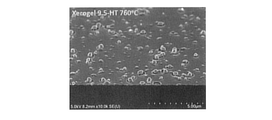
- Example 1 the surface of the water-repellent film was observed using SEM after the heat treatment. The results are shown in FIGS. 1 and 2.
- the surface of the water-repellent film was substantially flat, but fine irregularities were imparted by the cerium oxide fine particles present on the surface. It can be confirmed that a relatively large amount of cerium oxide fine particles are present on the film surface of Example 2 (FIG. 2).
- Example 2 When the crystallite size of cerium oxide after the heat treatment was measured by the X-ray diffraction method, it was 4.85 nm for Example 1 and 2.10 nm for Example 2. In Example 2, it is considered that the growth of the crystallite was inhibited by the added epoxy group-containing organic compound (cyclohexene oxide).
Landscapes
- Chemical & Material Sciences (AREA)
- Materials Engineering (AREA)
- Engineering & Computer Science (AREA)
- Chemical Kinetics & Catalysis (AREA)
- General Chemical & Material Sciences (AREA)
- Geochemistry & Mineralogy (AREA)
- Life Sciences & Earth Sciences (AREA)
- Organic Chemistry (AREA)
- Composite Materials (AREA)
- Inorganic Chemistry (AREA)
- Surface Treatment Of Glass (AREA)
- Laminated Bodies (AREA)
- Materials Applied To Surfaces To Minimize Adherence Of Mist Or Water (AREA)
- Re-Forming, After-Treatment, Cutting And Transporting Of Glass Products (AREA)
Abstract
Description
ガラス基材と、前記ガラス基材上の撥水膜とを備えた、撥水膜付きガラス物品であって、
前記撥水膜は、セリウム酸化物を含み、
前記撥水膜の表面上の水の接触角が75°以上であり、
前記ガラス物品を760℃及び4分間の熱処理に曝した後の前記接触角が75°以上である、
撥水膜付きガラス物品、を提供する。
ガラス基材上に、セリウム酸化物を固形分として含有するコーティング液を塗布して前記ガラス基材上に塗膜を形成する工程と、
前記塗膜を乾燥させて撥水膜を形成する工程と、を具備し、
前記セリウム酸化物がCeO2を含む、
撥水膜付きガラス物品の製造方法、を提供する。
ガラス基材と、前記ガラス基材上の撥水膜とを備え、
前記撥水膜は、セリウム酸化物を含み、
前記撥水膜の表面上の水の接触角が75°以上であり、
前記ガラス物品を760℃及び4分間の熱処理に曝した後の前記接触角が75°以上である。
ガラス基材上に、セリウム酸化物を固形分として含有するコーティング液を塗布して前記ガラス基材上に塗膜を形成することと、
前記塗膜を乾燥させて撥水膜を形成することと、を具備し、
前記セリウム酸化物がCeO2を含む。
ガラス基材を構成するガラスの種類に特に制限はない。ガラス基材は、ソーダ石灰ガラス、ホウケイ酸ガラス、アルミノケイ酸ガラス、無アルカリガラス、石英ガラス等と呼ばれている各種のガラスにより構成されていてもよい。ガラス基材はSiO2を主成分としていてもよい。ガラス基材のサイズ及び形状にも特段の制限はない。ガラス基材は、ガラス板、ガラス容器、ガラス蓋、ガラス管、ガラスバルブ、ガラスレンズ、ガラス繊維、ガラスフィラーその他の成形体であってもよい。ガラス容器は、例えばガラスバイアル、ガラスアンプル、ガラス瓶であるが、トレイ、シャーレ等と呼ばれるその他の形状を有していてもよい。ガラス蓋は、蓋として機能する限り、その形状に制限はなく、例えば調理器具の蓋として使用可能な形状を有していてもよい。ガラス繊維は、長繊維であっても短繊維であってもよい。ガラスフィラーは、例えばフレーク状の形状を有していてもよい。
撥水膜はセリウム酸化物を含む。撥水膜はセリウム酸化物を主成分としていてもよい。撥水膜は、セリウム酸化物が露出した表面を有していてもよい。セリウム酸化物は、CeO2、すなわち4価のセリウムの酸化物を含むことが好ましい。CeO2は、Ce2O3、すなわち3価のセリウムの酸化物よりも撥水性を高める観点からは望ましい成分である。ただし、撥水膜には、セリウム酸化物としてCe2O3が含まれていてもよい。例えば、セリウム酸化物の供給源として3価のセリウムを含む化合物を用い、その一部を4価のセリウムに酸化した場合は、CeO2と共に、残部の3価のセリウムがCe2O3として撥水膜に含まれる。
本実施形態のガラス物品が提供し得る撥水性は上述したとおりである。これに加え、本実施形態のガラス物品は、例えば以下の光学特性を有し得る。可視光透過率は、70%以上、80%以上、さらに85%以上であってよい。可視光透過率の上限は、特に制限されないが、例えば95%である。可視光反射率は、20%以下、15%以下、10%以下、さらに8%以下であってよい。可視光反射率の下限は、特に制限されないが、例えば2%である。ここで、可視光反射率は、撥水膜が形成された面についての可視光反射率、言い換えると、ガラス物品の外部から撥水膜を通してガラス基材に到達する可視光の反射率である。ヘイズ率は、例えば20%以下であるが、好ましくは10%以下、さらに5%以下、特に4%以下である。
可視光透過率:80~95%(85~95%)、
ヘイズ率:5%以下(4%以下)、
撥水膜が形成されたガラス基材の面についての可視光反射率:2~20%(2~8%)
次に、本実施形態のガラス物品の製造方法を説明する。ただし、本実施形態のガラス物品は、以下の製造方法以外の方法によって製造されたものであってもよい。
本実施形態の撥水膜付きガラス物品は、上記で例示したセリウム化合物の加水分解を伴う方法により製造されるものに限定されない。本実施形態の撥水膜付きガラス物品は、例えば、スパッタリング法に代表される減圧成膜法を用いて製造することも可能である。
(気孔率)
エリプソメーター(溝尻光学社製、DVA-FL型)を用い、反射光のスペクトル分析を行って、膜の光学パラメータを求めた。それに際し、撥水性膜付きガラス板の積層構造をガラス板(屈折率1.52)/撥水膜(屈折率2.2;気孔率0の場合)と設定し、撥水膜の屈折率と膜厚とをフィッティングにより算出し、気孔率を算出した。
可視光透過率及び可視光反射率は分光光度計(日立社製、330型)で測定した可視紫外吸収スペクトルから求め、ヘイズ率はヘイズメータ(スガ試験機社製、HZ-V3型)を用いて測定した。
水の接触角は、接触角測定機(共和界面科学社製、DMs-401型)を用い、4mgの精製水を撥水膜の表面に滴下して測定した。ただし、水の接触角は、撥水膜の成膜後、常温の大気中に20日間放置した後に実施した。熱処理後の水の接触角は、熱処理後に撥水膜付きガラス板を常温の大気中で40日間放置した時点で実施した。
原子間力顕微鏡(旧エスアイアイ・ナノテクノロジー社製、SPA-400型)を用い、視野5μm角について表面高さプロファイルを取得し、このプロファイルに基づき、JIS B0601:2013の算術平均粗さRa、JIS B0601:2001の十点平均粗さRzJISを算出した。
撥水膜付きガラス板を、760℃に設定した電気炉内で4分加熱し、炉から取り出してセラミックウールで包んで熱割れしない冷却速度で室温まで冷却した。熱処理後にも、水の接触角等を測定した。
塩化セリウム(III)七水和物(シグマアルドリッチ社製、99.9%)0.168gを2mLの無水メタノール(シグマアルドリッチ社製)に溶解し、無色透明な塩化セリウム(III)溶液を得た。この溶液中には、塩化セリウム(III)が9.6質量%含まれている。次に、塩化セリウム(III)溶液1.75gと、プロピレンオキシド(TIC社製、≧99.0%)0.859gを混合し、原液を得た。この原液において、Ceとプロピレンオキシドのモル比は1:33.0である。原液2.609gをエタノール(関東化学社製、99.5%)2.37gで希釈し、コーティング液を得た。このコーティング液において、CeCl3の濃度は0.075mmol/Lである。次に、コーティング液を室温で一晩攪拌し続けてエージングした。エージング中において、コーティング液は、無色透明から白濁、茶色を経て薄黄色を呈した。エージング途中のコーティング液の可視紫外吸収スペクトルの評価から、3価のセリウムイオンの少なくとも一部が4価に酸化されたことが確認された。
アセトンによる洗浄に代えて、シクロヘキセンオキシド(富士フィルム社製、95%)の38%エタノール溶液による洗浄を実施したことを除いては、実施例1と同様にして、撥水膜付きガラス板を得た。
実施例1の原液におけるCeとプロピレンオキシドのモル比を1:65.7としたことを除いては、実施例1と同様にして、撥水膜付きガラス板を得た。
実施例1で用いたガラス基板の表面に、CeO2ターゲットを用いたマグネトロンスパッタリングにより、CeO2膜を成膜し、撥水膜付きガラス板を得た。
実施例1の原液におけるCeとプロピレンオキシドのモル比を1:6.7としたことを除いては、実施例1と同様にして、撥水膜付きガラス板を得た。
実施例1の原液におけるCeとプロピレンオキシドのモル比を1:0としたことを除いては、すなわちプロピレンオキシドを添加しないことを除いては、実施例1と同様にして、撥水膜付きガラス板を得た。
実施例1で用いたガラス基板をそのまま用いた。すなわち比較例3は撥水膜のないガラス板そのものである。なお、本比較例における水の接触角は、ガラス板の洗浄後に常温の大気中に20日間放置した後、及び前述の熱処理後に常温の大気中で40日間放置した時点で実施した。

Claims (20)
- ガラス基材と、前記ガラス基材上の撥水膜とを備えた、撥水膜付きガラス物品であって、
前記撥水膜は、セリウム酸化物を含み、
前記撥水膜の表面上の水の接触角が75°以上であり、
前記ガラス物品を760℃及び4分間の熱処理に曝した後の前記接触角が75°以上である、
撥水膜付きガラス物品。 - 前記撥水膜の気孔率が20~85%の範囲にある、
請求項1に記載の撥水膜付きガラス物品。 - 前記撥水膜の表面の算術平均粗さRaが1~50nmの範囲にあり、
前記撥水膜の表面の十点平均粗さRzJISが20~500nmの範囲にある、
請求項1又は2に記載の撥水膜付きガラス物品。
ただし、Raは日本産業規格(JIS)B0601:2013に規定された算術平均粗さであり、RzJISはJIS B0601:2001に規定された十点平均粗さである。 - 前記算術平均粗さRaが3~30nmの範囲にあり、
前記十点平均粗さRzJISが100~500nmの範囲にある、
請求項3に記載の撥水膜付きガラス物品。 - 可視光透過率が80~95%の範囲にあり、
ヘイズ率が5%以下であり、
前記撥水膜が形成された側から前記ガラス物品に入射する可視光についての可視光反射率が2~20%の範囲にある、
請求項1~4のいずれか1項に記載の撥水膜付きガラス物品。 - 可視光透過率が85~95%の範囲にあり、
ヘイズ率が4%以下であり、
前記撥水膜が形成された側から前記ガラス物品に入射する可視光についての可視光反射率が2~8%の範囲にある、
請求項5に記載の撥水膜付きガラス物品。 - 前記撥水膜の厚さが10~200nmの範囲にある、
請求項1~6のいずれか1項に記載の撥水膜付きガラス物品。 - 前記撥水膜が有機基をさらに含み、
前記有機基がエポキシ基を含む、
請求項1~7のいずれか1項に記載の撥水膜付きガラス物品。 - 前記セリウム酸化物がCeO2を含む、
請求項1~8のいずれか1項に記載の撥水膜付きガラス物品。 - 前記セリウム酸化物がCeO2とCe2O3とをともに含む、
請求項1~9のいずれか1項に記載の撥水膜付きガラス物品。 - 前記撥水膜は、前記セリウム酸化物が露出した表面を有する、
請求項1~10のいずれか1項に記載の撥水膜付きガラス物品。 - 前記撥水膜は、実質的に平坦な表面と、前記表面上の複数のセリウム酸化物微粒子とを有する、
請求項1~11のいずれか1項に記載の撥水膜付きガラス物品。 - 前記ガラス基材は、加熱曲げ処理及び風冷強化処理からなる群より選ばれる少なくとも1つの処理を受けたガラス板である、
請求項1~12のいずれか1項に記載の撥水膜付きガラス物品。 - 前記ガラス板の少なくとも一方の主面上に前記撥水膜を備え、
前記ガラス板の端面には前記撥水膜を有さない、
請求項13に記載の撥水膜付きガラス物品。 - ガラス基材上に、セリウム酸化物を固形分として含有するコーティング液を塗布して前記ガラス基材上に塗膜を形成する工程と、
前記塗膜を乾燥させて撥水膜を形成する工程と、を具備し、
前記セリウム酸化物がCeO2を含む、
撥水膜付きガラス物品の製造方法。 - 前記コーティング液を調製する工程をさらに具備し、
当該コーティング液を調製する工程が、
3価のセリウムを含むセリウム化合物を加水分解することを含む、
請求項15に記載の撥水膜付きガラス物品の製造方法。 - 前記セリウム化合物は、ハロゲン化セリウム及び硝酸セリウムからなる群より選ばれる少なくとも1つである、
請求項16に記載の撥水膜付きガラス物品の製造方法。 - 前記セリウム化合物を水溶性エポキシドの存在下で加水分解する、
請求項16又は17に記載の撥水膜付きガラス物品の製造方法。 - 調製した前記コーティング液及び湿潤状態にある前記塗膜から選ばれる少なくとも1つを温度5~80℃及び0.5~48時間保持する、
請求項16~18のいずれか1項に記載の撥水膜付きガラス物品の製造方法。 - 前記塗膜を乾燥させる前に、
低級アルコール及びケトンを用いて前記塗膜を洗浄する工程をさらに含む、
請求項15~19のいずれか1項に記載の撥水膜付きガラス物品の製造方法。
Priority Applications (4)
| Application Number | Priority Date | Filing Date | Title |
|---|---|---|---|
| CN202180049692.7A CN115803297A (zh) | 2020-07-14 | 2021-07-13 | 带有抗水膜的玻璃物品及其制造方法 |
| EP21841977.8A EP4212491A4 (en) | 2020-07-14 | 2021-07-13 | Glass article with water repellent film and method for manufacturing same |
| US18/015,693 US12319611B2 (en) | 2020-07-14 | 2021-07-13 | Water-repellent-film-attached glass article and method for manufacturing same |
| BR112023000399A BR112023000399A2 (pt) | 2020-07-14 | 2021-07-13 | Artigo de vidro com película repelente de água e método para fabricação do mesmo |
Applications Claiming Priority (2)
| Application Number | Priority Date | Filing Date | Title |
|---|---|---|---|
| JP2020120945A JP7545251B2 (ja) | 2020-07-14 | 2020-07-14 | 撥水膜付きガラス物品及びその製造方法 |
| JP2020-120945 | 2020-07-14 |
Publications (1)
| Publication Number | Publication Date |
|---|---|
| WO2022014607A1 true WO2022014607A1 (ja) | 2022-01-20 |
Family
ID=79555569
Family Applications (1)
| Application Number | Title | Priority Date | Filing Date |
|---|---|---|---|
| PCT/JP2021/026351 Ceased WO2022014607A1 (ja) | 2020-07-14 | 2021-07-13 | 撥水膜付きガラス物品及びその製造方法 |
Country Status (7)
| Country | Link |
|---|---|
| US (1) | US12319611B2 (ja) |
| EP (1) | EP4212491A4 (ja) |
| JP (1) | JP7545251B2 (ja) |
| CN (1) | CN115803297A (ja) |
| BR (1) | BR112023000399A2 (ja) |
| CL (1) | CL2023000065A1 (ja) |
| WO (1) | WO2022014607A1 (ja) |
Cited By (1)
| Publication number | Priority date | Publication date | Assignee | Title |
|---|---|---|---|---|
| EP4464675A4 (en) * | 2022-01-13 | 2025-12-24 | Nippon Sheet Glass Co Ltd | GLASS ITEM |
Families Citing this family (3)
| Publication number | Priority date | Publication date | Assignee | Title |
|---|---|---|---|---|
| CN116075489B (zh) * | 2020-08-21 | 2025-04-01 | 日本板硝子株式会社 | 带有易清洁涂层的玻璃物品 |
| KR20240134524A (ko) * | 2023-03-02 | 2024-09-10 | 현대자동차주식회사 | 카메라용 발수 코팅 렌즈 및 그것의 제조 방법 |
| JP2024127335A (ja) * | 2023-03-09 | 2024-09-20 | 日本板硝子株式会社 | イージークリーンコーティング付きガラス物品及びイージークリーンコーティング付きガラス物品の製造方法 |
Citations (11)
| Publication number | Priority date | Publication date | Assignee | Title |
|---|---|---|---|---|
| JPH01301517A (ja) * | 1988-05-30 | 1989-12-05 | Catalysts & Chem Ind Co Ltd | 酸化チタン・酸化セリウム複合系ゾルが配合された化粧料 |
| JPH08104543A (ja) * | 1994-09-30 | 1996-04-23 | Nippon Sheet Glass Co Ltd | 紫外線吸収膜形成用液組成物、および紫外線吸収膜付ガラスの製造方法 |
| JP2008119924A (ja) * | 2006-11-10 | 2008-05-29 | Asahi Glass Co Ltd | 撥水性表面を有する物品 |
| WO2010007956A1 (ja) * | 2008-07-17 | 2010-01-21 | 旭硝子株式会社 | 撥水性基体およびその製造方法 |
| WO2011090035A1 (ja) * | 2010-01-19 | 2011-07-28 | 旭硝子株式会社 | 撥水性基体およびその製造方法 |
| JP2014500163A (ja) * | 2010-11-01 | 2014-01-09 | コーニング インコーポレイテッド | 耐久性疎水性/疎油性表面を有する透明基板 |
| JP2015116731A (ja) | 2013-12-18 | 2015-06-25 | 日揮触媒化成株式会社 | 撥水性被膜付基材およびその製造方法 |
| JP2015140277A (ja) | 2014-01-29 | 2015-08-03 | 国立大学法人東京工業大学 | 撥水性を有する酸化物セラミックスの製造方法 |
| JP2016183099A (ja) * | 2011-05-31 | 2016-10-20 | ショット アクチエンゲゼルシャフトSchott AG | イージークリーンコーティングでのコーティング用の基材要素 |
| JP2019123872A (ja) * | 2018-01-18 | 2019-07-25 | 株式会社表面・界面工房 | 有機無機ハイブリッド膜 |
| JP2019151538A (ja) * | 2018-03-06 | 2019-09-12 | 日本板硝子株式会社 | ガラス積層体 |
Family Cites Families (6)
| Publication number | Priority date | Publication date | Assignee | Title |
|---|---|---|---|---|
| US5316854A (en) * | 1991-12-06 | 1994-05-31 | Ppg Industries, Inc. | Glass or quartz articles having high temperature UV absorbing coatings containing ceria |
| JP2000256040A (ja) * | 1999-03-08 | 2000-09-19 | Nippon Sheet Glass Co Ltd | 自動車窓用ガラス板 |
| FR2868792B1 (fr) | 2004-04-13 | 2006-05-26 | Saint Gobain | Substrat photocatalytique actif sous lumiere visible |
| JPWO2008072707A1 (ja) * | 2006-12-15 | 2010-04-02 | 旭硝子株式会社 | 撥水性表面を有する物品 |
| DE102010050771B4 (de) | 2010-11-10 | 2014-05-08 | Schott Ag | Erzeugnis aus Glas oder Glaskeramik mit hochtemperaturstabiler Niedrigenergie-Schicht, Verfahren zur Herstellung derselben und Verwendung des Erzeugnisses |
| WO2018035494A1 (en) * | 2016-08-19 | 2018-02-22 | GKN Aerospace Transparency Systems, Inc. | Transparent hydrophobic mixed oxide coatings and methods |
-
2020
- 2020-07-14 JP JP2020120945A patent/JP7545251B2/ja active Active
-
2021
- 2021-07-13 EP EP21841977.8A patent/EP4212491A4/en active Pending
- 2021-07-13 CN CN202180049692.7A patent/CN115803297A/zh active Pending
- 2021-07-13 BR BR112023000399A patent/BR112023000399A2/pt not_active Application Discontinuation
- 2021-07-13 WO PCT/JP2021/026351 patent/WO2022014607A1/ja not_active Ceased
- 2021-07-13 US US18/015,693 patent/US12319611B2/en active Active
-
2023
- 2023-01-06 CL CL2023000065A patent/CL2023000065A1/es unknown
Patent Citations (11)
| Publication number | Priority date | Publication date | Assignee | Title |
|---|---|---|---|---|
| JPH01301517A (ja) * | 1988-05-30 | 1989-12-05 | Catalysts & Chem Ind Co Ltd | 酸化チタン・酸化セリウム複合系ゾルが配合された化粧料 |
| JPH08104543A (ja) * | 1994-09-30 | 1996-04-23 | Nippon Sheet Glass Co Ltd | 紫外線吸収膜形成用液組成物、および紫外線吸収膜付ガラスの製造方法 |
| JP2008119924A (ja) * | 2006-11-10 | 2008-05-29 | Asahi Glass Co Ltd | 撥水性表面を有する物品 |
| WO2010007956A1 (ja) * | 2008-07-17 | 2010-01-21 | 旭硝子株式会社 | 撥水性基体およびその製造方法 |
| WO2011090035A1 (ja) * | 2010-01-19 | 2011-07-28 | 旭硝子株式会社 | 撥水性基体およびその製造方法 |
| JP2014500163A (ja) * | 2010-11-01 | 2014-01-09 | コーニング インコーポレイテッド | 耐久性疎水性/疎油性表面を有する透明基板 |
| JP2016183099A (ja) * | 2011-05-31 | 2016-10-20 | ショット アクチエンゲゼルシャフトSchott AG | イージークリーンコーティングでのコーティング用の基材要素 |
| JP2015116731A (ja) | 2013-12-18 | 2015-06-25 | 日揮触媒化成株式会社 | 撥水性被膜付基材およびその製造方法 |
| JP2015140277A (ja) | 2014-01-29 | 2015-08-03 | 国立大学法人東京工業大学 | 撥水性を有する酸化物セラミックスの製造方法 |
| JP2019123872A (ja) * | 2018-01-18 | 2019-07-25 | 株式会社表面・界面工房 | 有機無機ハイブリッド膜 |
| JP2019151538A (ja) * | 2018-03-06 | 2019-09-12 | 日本板硝子株式会社 | ガラス積層体 |
Non-Patent Citations (1)
| Title |
|---|
| See also references of EP4212491A4 |
Cited By (1)
| Publication number | Priority date | Publication date | Assignee | Title |
|---|---|---|---|---|
| EP4464675A4 (en) * | 2022-01-13 | 2025-12-24 | Nippon Sheet Glass Co Ltd | GLASS ITEM |
Also Published As
| Publication number | Publication date |
|---|---|
| JP7545251B2 (ja) | 2024-09-04 |
| CL2023000065A1 (es) | 2023-10-20 |
| JP2022018013A (ja) | 2022-01-26 |
| CN115803297A (zh) | 2023-03-14 |
| EP4212491A4 (en) | 2024-07-24 |
| EP4212491A1 (en) | 2023-07-19 |
| US20230192538A1 (en) | 2023-06-22 |
| BR112023000399A2 (pt) | 2023-01-31 |
| US12319611B2 (en) | 2025-06-03 |
Similar Documents
| Publication | Publication Date | Title |
|---|---|---|
| WO2022014607A1 (ja) | 撥水膜付きガラス物品及びその製造方法 | |
| EP1447433B1 (en) | Coating material composition and article having coating film formed therewith | |
| JP7600246B2 (ja) | イージークリーンコーティング付きガラス物品 | |
| US6180188B1 (en) | Method for preparing a multilayer optical material with crosslinking-densifying by ultraviolet radiation | |
| JP5814512B2 (ja) | 光学用部材、その製造方法及び光学系 | |
| JP5239663B2 (ja) | シリカ系多孔質膜の製造方法 | |
| AU737747B2 (en) | An inorganic polymer material based on tantalum oxide, notably with a high refractive index, mechanically resistant to abrasion, its method of manufacture, and optical material including this material | |
| JP3984292B2 (ja) | 透明被膜形成用塗布液、対明被膜付基材およびその用途 | |
| KR20050057346A (ko) | 다공성의 계면활성제 매개 금속 산화물 필름 | |
| JP6826985B2 (ja) | コーティング膜付きガラス板及びその製造方法 | |
| TW201826026A (zh) | 紫外線透射濾光片 | |
| JP2011098880A (ja) | シリカ系多孔質体の製造方法 | |
| JP6831322B2 (ja) | 被覆の平坦化 | |
| JP2015229614A (ja) | 車両用窓ガラス | |
| EP2886205A1 (en) | Method for antireflective coating protection with organosilanes | |
| WO2017223434A1 (en) | Stacks including sol-gel layers and methods of forming thereof | |
| JP5742519B2 (ja) | セラミックス多孔質体 | |
| US20250196473A1 (en) | Glass article | |
| US20250083997A1 (en) | Easy-to-clean-coating-attached glass article | |
| EP4678608A1 (en) | Glass article with easy-to-clean coating | |
| CN108137393A (zh) | 包含纳米复合物膜的透明基材以及减少日晒作用的方法 |
Legal Events
| Date | Code | Title | Description |
|---|---|---|---|
| 121 | Ep: the epo has been informed by wipo that ep was designated in this application |
Ref document number: 21841977 Country of ref document: EP Kind code of ref document: A1 |
|
| REG | Reference to national code |
Ref country code: BR Ref legal event code: B01A Ref document number: 112023000399 Country of ref document: BR |
|
| ENP | Entry into the national phase |
Ref document number: 112023000399 Country of ref document: BR Kind code of ref document: A2 Effective date: 20230109 |
|
| NENP | Non-entry into the national phase |
Ref country code: DE |
|
| ENP | Entry into the national phase |
Ref document number: 2021841977 Country of ref document: EP Effective date: 20230214 |
|
| WWG | Wipo information: grant in national office |
Ref document number: 18015693 Country of ref document: US |