WO2022022340A1 - 一种通信方法及装置 - Google Patents
一种通信方法及装置 Download PDFInfo
- Publication number
- WO2022022340A1 WO2022022340A1 PCT/CN2021/107440 CN2021107440W WO2022022340A1 WO 2022022340 A1 WO2022022340 A1 WO 2022022340A1 CN 2021107440 W CN2021107440 W CN 2021107440W WO 2022022340 A1 WO2022022340 A1 WO 2022022340A1
- Authority
- WO
- WIPO (PCT)
- Prior art keywords
- information
- monitoring
- resource set
- control resource
- tci state
- Prior art date
- Legal status (The legal status is an assumption and is not a legal conclusion. Google has not performed a legal analysis and makes no representation as to the accuracy of the status listed.)
- Ceased
Links
Images




Classifications
-
- H—ELECTRICITY
- H04—ELECTRIC COMMUNICATION TECHNIQUE
- H04W—WIRELESS COMMUNICATION NETWORKS
- H04W72/00—Local resource management
- H04W72/30—Resource management for broadcast services
-
- H—ELECTRICITY
- H04—ELECTRIC COMMUNICATION TECHNIQUE
- H04W—WIRELESS COMMUNICATION NETWORKS
- H04W72/00—Local resource management
- H04W72/20—Control channels or signalling for resource management
- H04W72/23—Control channels or signalling for resource management in the downlink direction of a wireless link, i.e. towards a terminal
-
- H—ELECTRICITY
- H04—ELECTRIC COMMUNICATION TECHNIQUE
- H04L—TRANSMISSION OF DIGITAL INFORMATION, e.g. TELEGRAPHIC COMMUNICATION
- H04L5/00—Arrangements affording multiple use of the transmission path
- H04L5/003—Arrangements for allocating sub-channels of the transmission path
- H04L5/0053—Allocation of signalling, i.e. of overhead other than pilot signals
-
- H—ELECTRICITY
- H04—ELECTRIC COMMUNICATION TECHNIQUE
- H04W—WIRELESS COMMUNICATION NETWORKS
- H04W52/00—Power management, e.g. Transmission Power Control [TPC] or power classes
- H04W52/02—Power saving arrangements
- H04W52/0209—Power saving arrangements in terminal devices
- H04W52/0212—Power saving arrangements in terminal devices managed by the network, e.g. network or access point is leader and terminal is follower
- H04W52/0216—Power saving arrangements in terminal devices managed by the network, e.g. network or access point is leader and terminal is follower using a pre-established activity schedule, e.g. traffic indication frame
-
- H—ELECTRICITY
- H04—ELECTRIC COMMUNICATION TECHNIQUE
- H04W—WIRELESS COMMUNICATION NETWORKS
- H04W72/00—Local resource management
- H04W72/04—Wireless resource allocation
- H04W72/044—Wireless resource allocation based on the type of the allocated resource
-
- H—ELECTRICITY
- H04—ELECTRIC COMMUNICATION TECHNIQUE
- H04L—TRANSMISSION OF DIGITAL INFORMATION, e.g. TELEGRAPHIC COMMUNICATION
- H04L5/00—Arrangements affording multiple use of the transmission path
- H04L5/0001—Arrangements for dividing the transmission path
- H04L5/0003—Two-dimensional division
- H04L5/0005—Time-frequency
- H04L5/0007—Time-frequency the frequencies being orthogonal, e.g. OFDM(A) or DMT
- H04L5/001—Time-frequency the frequencies being orthogonal, e.g. OFDM(A) or DMT the frequencies being arranged in component carriers
-
- H—ELECTRICITY
- H04—ELECTRIC COMMUNICATION TECHNIQUE
- H04L—TRANSMISSION OF DIGITAL INFORMATION, e.g. TELEGRAPHIC COMMUNICATION
- H04L5/00—Arrangements affording multiple use of the transmission path
- H04L5/0001—Arrangements for dividing the transmission path
- H04L5/0014—Three-dimensional division
- H04L5/0023—Time-frequency-space
-
- Y—GENERAL TAGGING OF NEW TECHNOLOGICAL DEVELOPMENTS; GENERAL TAGGING OF CROSS-SECTIONAL TECHNOLOGIES SPANNING OVER SEVERAL SECTIONS OF THE IPC; TECHNICAL SUBJECTS COVERED BY FORMER USPC CROSS-REFERENCE ART COLLECTIONS [XRACs] AND DIGESTS
- Y02—TECHNOLOGIES OR APPLICATIONS FOR MITIGATION OR ADAPTATION AGAINST CLIMATE CHANGE
- Y02D—CLIMATE CHANGE MITIGATION TECHNOLOGIES IN INFORMATION AND COMMUNICATION TECHNOLOGIES [ICT], I.E. INFORMATION AND COMMUNICATION TECHNOLOGIES AIMING AT THE REDUCTION OF THEIR OWN ENERGY USE
- Y02D30/00—Reducing energy consumption in communication networks
- Y02D30/70—Reducing energy consumption in communication networks in wireless communication networks
Definitions
- the present application relates to the field of wireless communication technologies, and in particular, to a communication method and apparatus.
- the access network device can send configuration information to the terminal device, and the configuration information is used to configure the control resource set (control-resource set, CORESET) and the search space (search space) associated with the control resource set. It can be referred to as a search space set; further, control information is sent to the terminal device at the listening timing corresponding to the control resource set and the search space associated with the control resource set.
- the terminal device can monitor the control information at the monitoring timing corresponding to the control resource set and the search space associated with the control resource set, and the control information can be used to schedule service data, and the service data can be carried on the physical Downlink shared channel (physical downlink sharing channel, PDSCH). After monitoring the control information, the terminal device can receive service data according to the scheduling information included in the control information.
- the configuration information is used to configure the control resource set (control-resource set, CORESET) and the search space (search space) associated with the control resource set. It can be referred to as a search space set; further, control information is sent to the terminal device at the listening
- the access network device can send the information of the multicast service to multiple terminal devices in a multicast manner.
- the terminal device monitors the control information to receive the information of the multicast service still needs further research.
- the present application provides a communication method and apparatus for reducing unnecessary monitoring of terminal equipment and reducing power consumption of the terminal equipment.
- an embodiment of the present application provides a communication method, which can be applied to a terminal device or a chip in a terminal device.
- the terminal device receives the first indication information , the first indication information is used to indicate the target monitoring timing of the first control information; the first control information is monitored on the target monitoring timing, and the first control information is used to schedule the information of the multicast service; wherein, the target monitoring timing includes the first control information At least one listening opportunity among a plurality of listening opportunities for information.
- the access network device since the access network device sends the first indication information to the terminal device to indicate the target monitoring time, the terminal device can monitor at the target monitoring time. In terms of monitoring at all monitoring timings, unnecessary monitoring of the terminal device can be effectively reduced, and the power consumption of the terminal device can be reduced.
- the method further includes: receiving configuration information, where the configuration information is used to configure the first search space of the multicast service and at least one control resource set of the multicast service, the at least one control resource set of the multicast service.
- a control resource set includes a first control resource set; wherein, the first search space is associated with the first control resource set, and the first search space and the first control resource set correspond to the multiple listening occasions.
- the access network device can configure a plurality of listening timings of the first control information by configuring one search space, thereby effectively saving resource overhead.
- the at least one control resource set further includes a second control resource set; the method further includes: receiving second indication information, where the second indication information is used to indicate a second control associated with the first search space The resource set is switched to the first control resource set.
- the access network device can flexibly control the set of control resources associated with the first search space, thereby increasing the flexibility of the access network device regulation.
- the first indication information includes at least one of the following items: (1) monitoring period information, where the monitoring period information is used to indicate a period for monitoring the first control information; (2) offset information, where the The offset information is used to indicate the offset of the target listening timing in the cycle; (3) the monitoring duration information, the monitoring duration information is used to indicate the duration of monitoring the first control information in the cycle.
- the monitoring period information includes at least one of the following items: the number of radio frames included in the period, the number of radio subframes included in the period, and the number of time slots included in the period.
- the offset information includes at least one of the following: the number of radio frames included in the offset, the number of radio frames included in the offset The number of radio subframes included in the offset, the number of time slots included in the offset, the number of symbols included in the offset, and the number of listening opportunities included in the offset ;
- the monitoring duration information includes at least one of the following: the number of radio frames included in the duration, the number of radio subframes included in the duration, the number of time slots included in the duration, and the duration including The number of symbols, and the number of listening opportunities included in the duration; wherein, the listening opportunity included in the duration is the target listening opportunity.
- the start time of the cycle is determined according to the received third indication information; or, the start time of the cycle is the end time of receiving the first indication information.
- the third indication information includes at least one of the following items: an identifier of a radio frame, an identifier of a radio subframe, an identifier of a time slot, and an identifier of a symbol.
- the start listening opportunity included in the period is the first listening opportunity after the starting time among the multiple listening opportunities; or, the starting listening opportunity is the The listening opportunity closest to the start time among the multiple listening opportunities.
- the method further includes: receiving fourth indication information, where the fourth indication information includes at least one of the following: an identifier of the first TCI state, an identifier of a cell corresponding to the first search space, the first search space The identifier of the corresponding BWP; the identifier of the first TCI state is used to determine the beam that monitors the first control information.
- the method further includes: receiving first configuration information, where the first configuration information is used to configure at least two search spaces of the multicast service and at least one control resource set of the multicast service,
- the at least one control resource set includes a first control resource set; the at least two search spaces are associated with the first control resource set, and the at least two search spaces and the first control resource set correspond to the multiple listening occasions.
- the access network device can configure multiple listening timings of the first control information by configuring at least two search spaces, so as to indicate the target listening timings of the first control information to the terminal device.
- the first indication information includes an identifier of the first search space in the at least two search spaces; the first search space and the first control resource set correspond to target listening timings.
- the first indication information includes an identifier of at least one TCI state; the method further includes: selecting a first TCI state from the at least one TCI state; determining, according to the correspondence between the TCI state and the search space, The first TCI state corresponds to the first search space; the monitoring timing corresponding to the first search space and the first control resource set is determined as the target monitoring timing.
- selecting a first TCI state from the at least one TCI state includes: determining a TCI state used for monitoring second control information, the second control information being used for scheduling unicast service information; for monitoring the TCI state of the second control information, selecting a first TCI state from the at least one TCI state, and the first TCI state is the same as the TCI state for monitoring the second control information; or, determining the at least one TCI state
- the beam quality corresponding to the state according to the beam quality corresponding to the at least one TCI state, a first TCI state is selected from the at least one TCI state, and the beam quality corresponding to the first TCI state is greater than or equal to the at least one TCI state. Beam quality corresponding to other TCI states.
- the method further includes: receiving second configuration information, where the second configuration information is used to configure the corresponding relationship between the TCI state and the search space.
- the at least one control resource set further includes a second control resource set; the method further includes: receiving second indication information, where the second indication information is used to indicate a second control associated with the first search space The resource set is switched to the first control resource set.
- the method further includes: receiving fourth indication information, where the fourth indication information includes at least one of the following: an identifier of the first TCI state, an identifier of a cell corresponding to the first search space, the first search space The identifier of the corresponding BWP; the identifier of the first TCI state is used to determine the beam that monitors the first control information.
- an embodiment of the present application provides a communication method, which can be applied to an access network device or a chip in an access network device.
- the connection The network access device determines the first indication information, the first indication information is used to indicate the target monitoring timing of the first control information, and the first control information is used to schedule the information of the multicast service; the first indication information is sent to the terminal device; wherein, the target The listening opportunity includes at least one listening opportunity among a plurality of listening opportunities of the first control information.
- the method further includes: sending configuration information to the terminal device, where the configuration information is used to configure the first search space of the multicast service and at least one control resource of the multicast service
- the at least one control resource set includes a first control resource set; wherein, the first search space is associated with the first control resource set, and the first search space and the first control resource set correspond to the multiple listening occasions.
- the at least one control resource set further includes a second control resource set; the method further includes: sending second indication information to the terminal device, where the second indication information is used to indicate the first search space The associated second control resource set is switched to the first control resource set.
- the first indication information includes at least one of the following items: (1) monitoring period information, where the monitoring period information is used to indicate a period for monitoring the first control information; (2) offset information, where the The offset information is used to indicate the offset of the target listening timing in the cycle; (3) the monitoring duration information, the monitoring duration information is used to indicate the duration of monitoring the first control information in the cycle.
- the monitoring period information includes at least one of the following items: the number of radio frames included in the period, the number of radio subframes included in the period, and the number of time slots included in the period.
- the offset information includes at least one of the following: the number of radio frames included in the offset, the number of radio frames included in the offset The number of radio subframes included in the offset, the number of time slots included in the offset, the number of symbols included in the offset, and the number of listening opportunities included in the offset ;
- the monitoring duration information includes at least one of the following: the number of radio frames included in the duration, the number of radio subframes included in the duration, the number of time slots included in the duration, and the duration including The number of symbols, and the number of listening opportunities included in the duration; wherein, the listening opportunity included in the duration is the target listening opportunity.
- the method further includes: sending third indication information to the terminal device, where the third indication information is used to indicate the start moment of the period.
- the third indication information includes at least one of the following items: an identifier of a radio frame, an identifier of a radio subframe, an identifier of a time slot, and an identifier of a symbol.
- the start listening opportunity included in the period is the first listening opportunity after the starting time among the multiple listening opportunities; or, the starting listening opportunity is the The listening opportunity closest to the start time among the multiple listening opportunities.
- the method further includes: sending fourth indication information to the terminal device, where the fourth indication information includes at least one of the following: an identifier indicating the TCI state in the first transmission configuration, an identifier corresponding to the first search space The identifier of the cell and the identifier of the BWP corresponding to the first search space; the identifier of the first TCI state is used by the terminal device to determine the beam that monitors the first control information.
- the method further includes: sending first configuration information to the terminal device, where the first configuration information is used to configure at least two search spaces of the multicast service and at least two search spaces of the multicast service
- a control resource set, the at least one control resource set includes a first control resource set; the at least two search spaces are associated with the first control resource set, and the at least two search spaces and the first control resource set correspond to the multiple time to monitor.
- the first indication information includes an identifier of the first search space in the at least two search spaces; the first search space and the first control resource set correspond to target listening timings.
- the first indication information includes an identifier of at least one TCI state; the at least one TCI state includes a first TCI state, the first TCI state corresponds to the first search space, the first search space and the first TCI state
- the control resource set corresponds to the target listening timing.
- the method further includes: sending second configuration information to the terminal device, where the second configuration information is used to configure the first TCI state corresponding to the first search space.
- the at least one control resource set further includes a second control resource set; the method further includes: sending second indication information to the terminal device, where the second indication information is used to indicate the first search space The associated second control resource set is switched to the first control resource set.
- the method further includes: sending fourth indication information to the terminal device, where the fourth indication information includes at least one of the following: an identifier of the first TCI state, an identifier of a cell corresponding to the first search space , the identifier of the BWP corresponding to the first search space; the identifier of the first TCI state is used to determine the beam that monitors the first control information.
- an embodiment of the present application provides a communication device, where the communication device may be a terminal device or a chip provided inside the terminal device.
- the communication device has the function of implementing the first aspect.
- the communication device includes modules or units or means (means) corresponding to the steps involved in executing the first aspect, and the functions, units or means may be implemented by software. , or implemented by hardware, or by executing corresponding software by hardware.
- the communication device includes a processing unit and a communication unit, wherein the communication unit may also be referred to as a transceiver unit, and the communication unit may be used to send and receive signals to realize the communication between the communication device and other devices.
- the communication unit is used to receive configuration information from the terminal device; the processing unit may be used to perform some internal operations of the communication device.
- the communication unit is configured to: receive the first indication information, where the first indication information is used to indicate the target monitoring timing of the first control information; the processing unit is configured to monitor the first monitoring timing on the target monitoring timing Control information, where the first control information is used to schedule information of the multicast service; wherein, the target listening opportunity includes at least one listening opportunity among multiple listening opportunities of the first control information.
- the communication unit is further configured to: receive configuration information, where the configuration information is used to configure the first search space of the multicast service and at least one control of the multicast service A resource set, wherein the at least one control resource set includes a first control resource set; wherein the first search space is associated with the first control resource set, and the first search space and the first control resource set correspond to the multiple listening occasions.
- the at least one control resource set further includes a second control resource set; the communication unit is further configured to: receive second indication information, where the second indication information is used to indicate the first search The spatially associated second control resource set is switched to the first control resource set.
- the first indication information includes at least one of the following: (1) monitoring period information, where the monitoring period information is used to indicate a period for monitoring the first control information; (2) partial Shift amount information, the offset information is used to indicate the offset of the target listening timing in the period; (3) Monitoring duration information, the monitoring duration information is used to indicate that the first control is monitored in the period The duration of the message.
- the monitoring period information includes at least one of the following items: the number of radio frames included in the period, the number of radio subframes included in the period, and the period the number of time slots included, the number of symbols included in the period, and the number of listening opportunities included in the period;
- the offset information includes at least one of the following: radio frames included in the offset the number of radio subframes included in the offset, the number of time slots included in the offset, the number of symbols included in the offset, and the number of symbols included in the offset.
- the monitoring duration information includes at least one of the following: the number of radio frames included in the duration, the number of radio subframes included in the duration, and the number of time slots included in the duration , the number of symbols included in the duration, and the number of listening opportunities included in the duration; wherein, the listening opportunity included in the duration is the target listening opportunity.
- the start time of the cycle is determined according to the received third indication information; or, the start time of the cycle is the end time of receiving the first indication information .
- the third indication information includes at least one of the following items: an identifier of a radio frame, an identifier of a radio subframe, an identifier of a time slot, and an identifier of a symbol.
- the start listening opportunity included in the period is the first listening opportunity that is located after the start time among the plurality of listening opportunities; or, the start time
- the monitoring timing is the monitoring timing closest to the starting time among the multiple monitoring timings.
- the communication unit is further configured to: receive fourth indication information, where the fourth indication information includes at least one of the following: an identifier of the first TCI state, an identifier of the cell corresponding to the first search space The identifier, the identifier of the BWP corresponding to the first search space; the identifier of the first TCI state is used to determine the beam that monitors the first control information.
- the communication unit is further configured to: receive first configuration information, where the first configuration information is used to configure at least two search spaces of the multicast service and a at least one control resource set, the at least one control resource set includes a first control resource set; the at least two search spaces are associated with the first control resource set, and the at least two search spaces and the first control resource set correspond to the Multiple listening opportunities.
- the first indication information includes an identifier of the first search space in the at least two search spaces; the first search space and the first control resource set correspond to target listening timings.
- the first indication information includes an identifier of at least one TCI state; the processing unit is further configured to: select a first TCI state from the at least one TCI state; according to the correspondence between the TCI state and the search space, determining that the first TCI state corresponds to the first search space; and determining that the listening timing corresponding to the first search space and the first control resource set is the target listening timing.
- the processing unit is specifically configured to: determine the TCI state used for monitoring the second control information, and the second control information is used to schedule information of the unicast service; according to the TCI state used for monitoring the second control information , select a first TCI state from the at least one TCI state, and the first TCI state is the same as the TCI state used to monitor the second control information; or, determine the beam quality corresponding to the at least one TCI state; according to the at least one TCI state For the beam quality corresponding to one TCI state, a first TCI state is selected from the at least one TCI state, and the beam quality corresponding to the first TCI state is greater than or equal to the beam quality corresponding to other TCI states in the at least one TCI state.
- the communication device includes a processor, and may further include a transceiver, where the transceiver is configured to send and receive signals, and the processor executes program instructions to complete any possible design in the first aspect above or a method in an implementation.
- the communication device may further include one or more memories, the memories are used for coupling with the processor, and the memories may store necessary computer programs or instructions for realizing the functions involved in the first aspect above.
- the processor may execute computer programs or instructions stored in the memory, and when the computer programs or instructions are executed, cause the communication apparatus to implement the method in any possible design or implementation manner of the first aspect.
- the communication device includes a processor, which may be operative to couple with the memory.
- the memory may store necessary computer programs or instructions to implement the functions involved in the first aspect above.
- the processor may execute computer programs or instructions stored in the memory, and when the computer programs or instructions are executed, cause the communication apparatus to implement the method in any possible design or implementation manner of the first aspect.
- the communication device includes a processor and an interface circuit, wherein the processor is configured to communicate with other devices through the interface circuit, and execute any of the possible designs or implementations of the first aspect above. method.
- an embodiment of the present application provides a communication device, where the communication device may be an access network device or a chip provided inside the access network device.
- the communication device has the function of implementing the second aspect.
- the communication device includes modules or units or means corresponding to the operations involved in the second aspect.
- the modules, units, or means may be implemented by software, or by It can be realized by hardware, and can also be realized by executing corresponding software by hardware.
- the communication device includes a processing unit and a communication unit, wherein the communication unit may also be referred to as a transceiver unit, and the communication unit may be used to send and receive signals to realize the communication between the communication device and other devices.
- the communication unit is used to receive configuration information from the terminal device; the processing unit may be used to perform some internal operations of the communication device.
- the processing unit is configured to: determine first indication information, where the first indication information is used to indicate a target listening timing of the first control information, and the first control information is used to schedule information about the multicast service
- the communication unit is used for: sending the first indication information to the terminal device; wherein, the target monitoring timing includes at least one monitoring timing among multiple monitoring timings of the first control information.
- the communication unit is further configured to: send configuration information to the terminal device, where the configuration information is used to configure the first search space of the multicast service and the multicast At least one control resource set of the service, the at least one control resource set includes a first control resource set; wherein the first search space is associated with the first control resource set, and the first search space and the first control resource set correspond to the multiple Monitor time.
- the at least one control resource set further includes a second control resource set; the communication unit is further configured to: send second indication information to the terminal device, and the second indication information uses The second control resource set associated with the indicated first search space is switched to the first control resource set.
- the first indication information includes at least one of the following: (1) monitoring period information, where the monitoring period information is used to indicate a period for monitoring the first control information; (2) partial Shift amount information, the offset information is used to indicate the offset of the target listening timing in the period; (3) Monitoring duration information, the monitoring duration information is used to indicate that the first control is monitored in the period The duration of the message.
- the monitoring period information includes at least one of the following items: the number of radio frames included in the period, the number of radio subframes included in the period, and the period the number of time slots included, the number of symbols included in the period, and the number of listening opportunities included in the period;
- the offset information includes at least one of the following: radio frames included in the offset the number of radio subframes included in the offset, the number of time slots included in the offset, the number of symbols included in the offset, and the number of symbols included in the offset.
- the monitoring duration information includes at least one of the following: the number of radio frames included in the duration, the number of radio subframes included in the duration, and the number of time slots included in the duration , the number of symbols included in the duration, and the number of listening opportunities included in the duration; wherein, the listening opportunity included in the duration is the target listening opportunity.
- the communication unit is further configured to: send third indication information to the terminal device, where the third indication information is used to indicate the start moment of the period.
- the third indication information includes at least one of the following items: an identifier of a radio frame, an identifier of a radio subframe, an identifier of a time slot, and an identifier of a symbol.
- the start listening opportunity included in the period is the first listening opportunity that is located after the start time among the plurality of listening opportunities; or, the start time
- the monitoring timing is the monitoring timing closest to the starting time among the multiple monitoring timings.
- the communication unit is further configured to: send fourth indication information to the terminal device, where the fourth indication information includes at least one of the following: the first transmission configuration indicates an identifier of the TCI state, The identifier of the cell corresponding to the first search space and the identifier of the BWP corresponding to the first search space; the identifier of the first TCI state is used by the terminal device to determine the beam that monitors the first control information.
- the communication unit is further configured to: send first configuration information to the terminal device, where the first configuration information is used to configure at least two search spaces and all search spaces of the multicast service at least one control resource set of the multicast service, the at least one control resource set includes a first control resource set; the at least two search spaces are associated with the first control resource set, the at least two search spaces and the first control resource set
- the resource set corresponds to the multiple listening occasions.
- the first indication information includes an identifier of the first search space in the at least two search spaces; the first search space and the first control resource set correspond to target listening timings.
- the first indication information includes an identifier of at least one TCI state; the at least one TCI state includes a first TCI state, the first TCI state corresponds to the first search space, and the first TCI state corresponds to the first search space.
- the search space and the first control resource set correspond to target listening timings.
- the communication device includes a processor, which may be operative to couple with the memory.
- the memory may store necessary computer programs or instructions to implement the functions involved in the second aspect above.
- the processor can execute computer programs or instructions stored in the memory, and when the computer programs or instructions are executed, cause the communication apparatus to implement the method in any possible design or implementation manner of the second aspect.
- the communication device includes a processor and an interface circuit, wherein the processor is configured to communicate with other devices through the interface circuit, and execute any of the possible designs or implementations of the second aspect above. method.
- the processor may be implemented by hardware or by software.
- the processor may be a logic circuit, an integrated circuit, etc.; when implemented by software
- the processor may be a general-purpose processor, which is implemented by reading software codes stored in a memory.
- the above processors may be one or more, and the memory may be one or more.
- the memory may be integrated with the processor, or the memory may be provided separately from the processor.
- the memory and the processor may be integrated on the same chip, or may be separately provided on different chips.
- the embodiment of the present application does not limit the type of the memory and the manner of setting the memory and the processor.
- the communication apparatus involved in the third aspect or the fourth aspect may include a memory, or may not include a memory.
- an embodiment of the present application provides a communication system, where the communication system includes the communication device described in the third aspect and the communication device described in the fourth aspect.
- the present application provides a computer-readable storage medium, where computer-readable instructions are stored in the computer storage medium, and when the computer reads and executes the computer-readable instructions, the computer is made to execute the above-mentioned first aspect or The method in any possible design of the second aspect.
- the present application provides a computer program product that, when the computer reads and executes the computer program product, causes the computer to execute the method in any possible design of the first aspect or the second aspect.
- the present application provides a chip, the chip includes a processor, the processor is coupled to a memory, and is configured to read and execute a software program stored in the memory, so as to implement the above-mentioned first aspect or the second any possible design method of the aspect.
- the chip further includes the memory.
- FIG. 1 is a schematic diagram of a network architecture to which an embodiment of the present application is applicable;
- FIG. 2a is a schematic diagram of a CU-DU separation architecture provided by an embodiment of the present application.
- FIG. 2b is a schematic diagram of still another CU-DU separation architecture provided by an embodiment of the present application.
- 3 is an example of parameters of a search space provided by an embodiment of the present application.
- FIG. 4 is an example of multiple monitoring timings of control information configured by an access network device and an example of time-sharing sending the control information by the access network device through different beams;
- FIG. 5 is a schematic flowchart corresponding to the communication method provided in Embodiment 1 of the present application.
- FIG. 6a is an example of a set of control resources associated with switching a first search space provided by an embodiment of the present application
- FIG. 6b provides an example of grouping provided by this embodiment of the present application.
- FIG. 7 is an example of a start time and an end time of monitoring on a target monitoring opportunity by a terminal device provided by an embodiment of the present application;
- FIG. 8 is some examples of target listening timings provided by the embodiments of the present application.
- FIG. 9 is an example of multiple MAC CE formats sent by the access network device to the terminal device provided by the embodiment of the present application.
- FIG. 10 is a schematic flowchart corresponding to the communication method provided in Embodiment 2 of the present application.
- 11 is an example of multiple MAC CE formats sent by an access network device to a terminal device provided by an embodiment of the present application
- FIG. 12 provides several examples of activating TCI provided by the embodiment of the present application.
- FIG. 13 provides several examples of activating TCI provided by the embodiment of the present application.
- FIG. 14 is a possible exemplary block diagram of the apparatus involved in the embodiment of the application.
- FIG. 15 is a schematic structural diagram of a terminal device according to an embodiment of the present application.
- FIG. 16 is a schematic structural diagram of an access network device according to an embodiment of the present application.
- FIG. 1 is a schematic diagram of a network architecture to which an embodiment of the present application is applied.
- a terminal device such as a terminal device 1301 or a terminal device 1302
- the wireless network includes a radio access network (RAN) and a core network (core network, CN); wherein, the RAN may also be called an access network (AN), which is used to access terminal devices to Wireless network, CN is used to manage terminal equipment and provide gateway for communication with DN.
- RAN radio access network
- core network core network
- CN core network
- AN access network
- CN is used to manage terminal equipment and provide gateway for communication with DN.
- the RAN may include one or more access network devices, such as access network device 1101 and access network device 1102 .
- the CN may include one or more core network elements, such as the core network element 120 .
- the terminal equipment, access network equipment, and core network network elements are described in detail below.
- Terminal equipment also known as user equipment (UE) includes equipment that provides voice and/or data connectivity to users, for example, may include handheld devices with wireless connectivity, or processing devices connected to wireless modems .
- the terminal equipment may communicate with the core network via a radio access network (RAN), and exchange voice and/or data with the RAN.
- RAN radio access network
- the terminal equipment may include wireless terminal equipment, mobile terminal equipment, device-to-device communication (device-to-device, D2D) terminal equipment, vehicle-to-everything (V2X) terminal equipment, machine-to-machine/machine-type communication ( machine-to-machine/machine-type communications, M2M/MTC) terminal equipment, Internet of things (Internet of things, IoT) terminal equipment, subscriber unit, subscriber station, mobile station, remote station, access point (access point, AP) ), remote terminal, access terminal, user terminal, user agent, or user equipment, etc.
- these may include mobile telephones (or "cellular" telephones), computers with mobile terminal equipment, portable, pocket-sized, hand-held, computer-embedded mobile devices, and the like.
- PCS personal communication service
- SIP session initiation protocol
- WLL wireless local loop
- PDA personal digital assistant
- constrained devices such as devices with lower power consumption, or devices with limited storage capacity, or devices with limited computing power, etc.
- information sensing devices such as barcodes, radio frequency identification (RFID), sensors, global positioning system (GPS), and laser scanners.
- RFID radio frequency identification
- GPS global positioning system
- the device for realizing the function of the terminal device may be the terminal device, or it may be a device capable of supporting the terminal device to realize the function, such as a chip system or a combined device or component capable of realizing the function of the terminal device.
- a chip system may be composed of chips, or may include chips and other discrete devices.
- An access network device is a node or device that accesses a terminal device to a wireless network, and the access network device may also be called a base station.
- Access network equipment includes but is not limited to: a new generation base station (generation Node B, gNB), an evolved node B (evolved node B, eNB), a radio network controller (radio network controller, RNC) in the 5G communication system, Node B (node B, NB), base station controller (base station controller, BSC), base transceiver station (base transceiver station, BTS), home base station ((home evolved nodeB, HeNB) or (home node B, HNB)) , baseband unit (baseBand unit, BBU), transmitting and receiving point (transmitting and receiving point, TRP), transmitting point (transmitting point, TP), or mobile switching center.
- generation Node B, gNB generation Node B
- eNB evolved node B
- RNC radio network controller
- Node B no
- the device for implementing the function of the access network device may be the access network device, or may be a device capable of supporting the access network device to realize the function, such as a chip system or a device capable of realizing the function of the access network device
- the combination device and component of the device can be installed in the access network equipment.
- the technical solutions provided by the embodiments of the present application are described by taking the device for implementing the functions of the access network equipment as an example of the access network equipment.
- the interface between the access network device and the terminal device may be a Uu interface (or called an air interface).
- the names of these interfaces may remain unchanged, or may be replaced with other names, which are not limited in this application.
- the communication between the access network device and the terminal device follows a certain protocol layer structure.
- the control plane protocol layer structure may include a radio resource control (radio resource control, RRC) layer, a packet data convergence layer protocol (packet data). convergence protocol, PDCP) layer, radio link control (radio link control, RLC) layer, media access control (media access control, MAC) layer and physical layer;
- RRC radio resource control
- PDCP radio link control
- RLC radio link control
- media access control media access control
- user plane protocol layer structure can include PDCP layer, RLC layer, MAC layer and physical layer.
- the PDCP layer may further include a service data adaptation protocol (SDAP) layer.
- SDAP service data adaptation protocol
- the access network device may implement the functions of protocol layers such as RRC, PDCP, RLC, and MAC by one node, or may implement the functions of these protocol layers by multiple nodes.
- an access network device may include one or more centralized units (centralized units, CUs) and one or more distributed units (distributed units, DUs), and multiple DUs may be centrally controlled by one CU .
- an interface between a CU and a DU may be referred to as an F1 interface, wherein a control plane (control panel, CP) interface may be an F1-C, and a user plane (user panel, UP) interface may be an F1-U.
- the CU and DU can be divided according to the protocol layer of the wireless network: for example, as shown in Figure 2a, the functions of the PDCP layer and the above protocol layers are set in the CU, and the functions of the protocol layers below the PDCP layer (such as the RLC layer and the MAC layer, etc.) are set in the DU.
- the above division of the processing functions of the CU and DU according to the protocol layer is only an example, and can also be divided in other ways, for example, the functions of the protocol layer above the RLC layer are set in the CU, and the RLC layer and the following protocol layers.
- the function of the CU is set in the DU.
- the CU or DU can be divided into functions with more protocol layers.
- the CU or DU can also be divided into partial processing functions with protocol layers. In one design, some functions of the RLC layer and functions of the protocol layers above the RLC layer are placed in the CU, and the remaining functions of the RLC layer and the functions of the protocol layers below the RLC layer are placed in the DU.
- the functions of CUs or DUs can also be divided according to service types or other system requirements. For example, by delay, the functions whose processing time needs to meet the delay requirements are set in the DU, and do not need to meet the delay. The required functionality is set in the CU.
- the CU may also have one or more functions of the core network. Exemplarily, the CU can be set on the network side to facilitate centralized management; the DU can have multiple radio frequency functions, or the radio frequency functions can be set remotely. This embodiment of the present application does not limit this.
- the functions of the CU may be implemented by one entity, or may also be implemented by different entities.
- the functions of the CU can be further divided, that is, the control plane and the user plane are separated and implemented by different entities, namely the control plane CU entity (ie, the CU-CP entity) and the user plane CU entity. (ie the CU-UP entity), the CU-CP entity and the CU-UP entity can be coupled with the DU to jointly complete the functions of the access network device.
- the interface between the CU-CP entity and the CU-UP entity may be the E1 interface
- the interface between the CU-CP entity and the DU may be the F1-C interface
- the interface between the CU-UP entity and the DU may be the F1-U interface interface.
- one DU and one CU-UP can be connected to one CU-CP.
- one DU can be connected to multiple CU-UPs
- one CU-UP can be connected to multiple DUs.
- the signaling generated by the CU may be sent to the terminal device through the DU, or the signaling generated by the terminal device may be sent to the CU through the DU.
- the DU may not parse the signaling, but directly encapsulate it through the protocol layer and transparently transmit it to the terminal device or CU.
- the sending or receiving of the signaling by the DU includes this scenario.
- the signaling of the RRC or PDCP layer will eventually be processed as the data of the physical layer and sent to the terminal device, or converted from the received data of the physical layer.
- the signaling of the RRC or PDCP layer can also be considered to be sent by the DU, or sent by the DU and the radio frequency device.
- the core network elements in the CN may include access and mobility management function (AMF) network elements, session management function (SMF) network elements, and user plane elements.
- AMF access and mobility management function
- SMF session management function
- UPF user plane function
- Policy control function policy control function
- PCF policy control function
- the network architecture shown in FIG. 1 above can be applied to communication systems of various radio access technologies (RATs), such as 4G (or long term evolution (LTE)) communication systems, It can also be a 5G (or new radio (NR)) communication system, or a transition system between an LTE communication system and a 5G communication system.
- the transition system can also be called a 4.5G communication system.
- RATs radio access technologies
- the network architecture and service scenarios described in the embodiments of the present application are for the purpose of illustrating the technical solutions of the embodiments of the present application more clearly, and do not constitute limitations on the technical solutions provided by the embodiments of the present application.
- the evolution of the network architecture and the emergence of new service scenarios, the technical solutions provided in the embodiments of the present application are also applicable to similar technical problems.
- the apparatuses in the following embodiments of the present application may be located in terminal equipment or access network equipment according to the functions implemented by them.
- the access network device may be a CU, or a DU, or an access network device including a CU and a DU.
- the 5G communication system will use a higher carrier frequency than LTE (generally, greater than 6GHz), such as 28GHz, 38GHz, or 72GHz frequency band, etc.
- LTE generally, greater than 6GHz
- the wireless signal it transmits experiences more severe fading during the space propagation process, and it is even difficult to detect the wireless signal at the receiving end. Therefore, beamforming (BF) technology will be used in the 5G communication system to obtain a beam with good directivity, so as to improve the antenna gain and increase the power in the transmitting direction.
- a beam mode can also be used to improve the spectral spatial multiplexing rate.
- a beam can be understood as a communication resource, and the beam can be a wide beam, a narrow beam, or other types of beams. Different beams can be considered as different communication resources, and the same information or different information can be sent through different beams.
- Beams include sending beams and receiving beams. Sending beams can refer to the distribution of signal strengths in different directions in space after signals are transmitted through antennas. Receive beams can refer to the antenna array that strengthens or weakens wireless signals in different directions in space. Received distribution.
- the access network device sends information through the sending beam x1, and accordingly, the terminal device can receive the information through the receiving beam x2.
- the sending beam x1 and the receiving beam x2 can be understood as a beam pair.
- the above-mentioned sending beam x1 and receiving beam x2 may be collectively referred to as beam x, so it can be understood that the access network equipment sends information through beam x. , correspondingly, the terminal device can receive information through beam x.
- the access network device In downlink data transmission, when the access network device uses a specific beam to send data to the terminal device, it needs to inform the terminal device of the transmission beam information it uses, so that the terminal device can use the receive beam corresponding to the transmit beam to receive Data sent by an access network device.
- the access network device may indicate to the terminal device the relevant information of the transmission beam used by the access network device through a transmission configuration indicator (transmission configuration indicator, TCI) field.
- TCI field includes multiple bits, for example, includes 3 bits, which can represent 8 different values.
- Each value of the TCI field corresponds to an index (or called an identifier) of a TCI state.
- the index can identify a TCI state.
- the TCI state includes a plurality of parameters, through which the relevant information of the transmit beam can be determined.
- a search space can be associated with a set of control resources.
- the search space and its associated control resource set may correspond to multiple listening occasions for control information.
- the control resource set determines the frequency domain resources of the listening timing, that is, control information can be transmitted on the frequency domain resources corresponding to the control resource set, and the frequency domain resources corresponding to the control resource set can include multiple resource blocks (resource blocks, RBs).
- a control resource set can be configured with one or more TCI states.
- the control information corresponding to the control resource set may be transmitted by using one TCI state among the one or more TCI states configured for the control resource set, and which TCI state to use may be transmitted through signaling sent by the access network device. activation. That is to say, although the access network device is configured with multiple TCI states for a control resource set, these TCI states are not activated (not effective), and can only take effect after being activated through signaling.
- the search space determines the time-domain resources for transmitting the listening timing, and the search space can be configured with some time-domain information, such as: period (for the convenience of distinction, the period here is referred to as the first period, and the first period is the period for monitoring the search space.
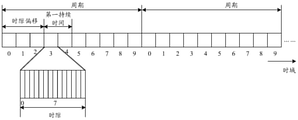
- Time interval the unit can be time slot); time slot offset (that is, the time slot offset between the start of the first cycle and the actual monitoring search space, and the time slot offset is less than the value of the first monitoring cycle ); the first duration (configured through the duration parameter, that is, the time for continuous monitoring of the search space, which may include multiple time slots, and the number of time slots included is less than the value of the first monitoring period); the time domain starting position (ie In each time slot, the time domain start position corresponding to the control resource set associated with the search space), each time domain start position can be understood as the time domain start position of a listening opportunity.
- the meaning of each parameter of the control resource set and the search space is described with specific examples.
- the first period is 10 time slots
- the time slot offset is 3 time slots
- the first duration is 2 time slots
- the time domain start position is symbol 0 in one time slot
- the second duration of the control resource set (configured by the duration parameter of the control resource set, that is, indicating the number of symbols included in the listening opportunity) is 2 symbols.
- Multicast transmission technology is a transmission technology in which one sender transmits data and multiple receivers receive data; for example, an access network device sends data, and multiple terminal devices receive data.
- a possible multicast transmission technology is a single cell point to multipoint (single cell point to multipoint, SC-PTM) technology.
- SC-PTM single cell point to multipoint
- PDSCH physical downlink shared channel
- the access network device can pre-configure the association relationship between the multicast service and the group-radio network temporary identity (G-RNTI), and each multicast service can be associated with a G-RNTI.
- G-RNTI group-radio network temporary identity
- the access network device can send control information (such as downlink control information (DCI)) carried on the physical downlink control channel (PDCCH) to the terminal device, and the DCI is used for Scheduling a unicast PDSCH carrying a service (this service may be a unicast service or a multicast service), the DCI may be scrambled by a cell-radio network temporary identity (C-RNTI); accordingly, After detecting the DCI according to the C-RNTI, the terminal device may receive the unicast PDSCH according to the scheduling information included in the DCI.
- DCI downlink control information
- PDCH physical downlink control channel
- C-RNTI cell-radio network temporary identity
- the access network device can send DCI to multiple terminal devices interested in the multicast service, where the DCI is used to schedule the information of the multicast service, and the information of the multicast service can be carried in the In the multicast PDSCH, the DCI can be scrambled by the G-RNTI associated with the multicast service; accordingly, after multiple terminal devices detect the DCI according to the G-RNTI associated with the multicast service, they can information to receive multicast service information.
- the coverage of the access network equipment includes multiple terminal equipments, among which terminal equipment 1, terminal equipment 2, and terminal equipment 3 are all interested in multicast services. ;
- the access network device can configure multiple monitoring opportunities for the control information for the terminal equipment 1, the terminal equipment 2, and the terminal equipment 3, and the control information is used to schedule the information of the multicast service; and then the terminal equipment 1, the terminal equipment Both the device 2 and the terminal device 3 monitor control information on multiple monitoring occasions.
- FIG. 4 a plurality of monitoring timings (eg, monitoring timing 1 to monitoring timing 6 ) of the control information configured by the access network device are illustrated.
- the access network equipment can send control information through different beams at different times to complete the broadcast beam coverage of the cell; for example, continue to refer to Figure 4, the access network equipment can Beam 1 is used to send control information at a certain listening time, beam 2 is used to send control information at a certain listening time in the T2 time period, and beam 3 is used to send control information at a certain listening time in the T3 time period.
- terminal device 1 is located within the coverage area of beam 1
- terminal device 2 is located within the coverage area of beam 2
- terminal device 3 is located within the coverage area of beam 3 .
- the terminal device 3 since the access network device does not use the beam 3 to send control information during the T1 time period and the T2 time period, the terminal device 3 monitors during the T1 time period and the T2 time period.
- the control information will not be monitored at the timing, but may be monitored at the monitoring timing in the T3 time period. That is to say, the monitoring performed by the terminal device 3 at the monitoring timings in the T1 time period and the T2 time period is unnecessary monitoring.
- the monitoring performed by the terminal device 1 on the monitoring timings in the T2 time period and the T3 time period is unnecessary monitoring
- the monitoring by the terminal device 2 on the monitoring timings in the T1 time period and the T3 time period is unnecessary monitoring.
- an embodiment of the present application provides a communication method for reducing unnecessary monitoring by a terminal device and reducing power consumption of the terminal device.
- the method provided in this embodiment of the present application may include: the terminal device receives first indication information, where the first indication information is used to indicate the target monitoring timing of the first control information, and then the terminal device may monitor the first monitoring timing on the target monitoring timing.
- Control information where the first control information is used for scheduling multicast service information.
- the target monitoring timing includes at least one monitoring timing among multiple monitoring timings of the first control information, or, in other words, the target monitoring timing includes a part of the monitoring timings among the multiple monitoring timings of the first control information, or, in other words, the target monitoring timing
- the timing includes N listening timings among the M listening timings of the first control information, where N is less than M, and both M and N are positive integers.
- the target listening timing includes part of the listening timing set of the first control information Monitor time.
- the access network device sends the first indication information to the terminal device to indicate the target monitoring time, the terminal device can monitor at the target monitoring time. In terms of monitoring at all monitoring timings, unnecessary monitoring of the terminal device can be effectively reduced, and the power consumption of the terminal device can be reduced.
- the method is applied to the system architecture shown in FIG. 1 as an example.
- the method may be performed by two communication apparatuses, such as a first communication apparatus and a second communication apparatus, wherein the first communication apparatus may be an access network device or can support an access network device to implement the method
- the communication device with the required functions can also be other communication devices, such as a chip or a chip system.
- the second communication device may be a terminal device or a communication device capable of supporting the functions required by the terminal device to implement the method, and of course may also be other communication devices, such as a chip or a chip system.
- the method is performed by an access network device and a terminal device as an example, that is, the first communication device is an access network device and the second communication device is a terminal device as an example.
- the access network device described below for executing the embodiment shown in FIG. 5 or FIG. 10 may be the access network device 1101 shown in FIG. 1 .
- the terminal device described below for executing the embodiment shown in FIG. 5 or FIG. 10 may be the terminal device 1301 shown in FIG. 1 .
- the coverage of the access network device may include multiple terminal devices interested in multicast services (such as the first multicast service).
- the access network will be The communication between the device and one of the terminal devices interested in the first multicast service is described as an example.
- FIG. 5 is a schematic flowchart corresponding to the communication method provided in Embodiment 1 of the present application. As shown in Figure 5, including:
- An access network device sends configuration information, where the configuration information is used to configure a first search space of a first multicast service and at least one control resource set of the first multicast service; correspondingly, a terminal device may receive the configuration information.
- the configuration information may configure a first search space for the first multicast service and a first set of control resources for the first multicast service, and may also configure the first search space to be associated with the first set of control resources.
- the configuration information may include the configuration of the first search space (SearchSpace config), and the configuration of the first search space may include the controlResourceSetId parameter.
- the controlResourceSetId parameter includes the identifier of the first control resource set, it indicates that the first search space is the same as the first search space. Controls resource collection associations.
- the terminal device may determine, according to the configuration information, multiple listening opportunities for the first search space and the first control resource set corresponding to the first control information.
- the first control information may be, for example, DCI, which is used to schedule information of the first multicast service, the information of the first multicast service may include uplink information and/or downlink information of the first multicast service, and the information may include data and /or control signaling, etc., which are not specifically limited.
- the configuration information may configure the first search space of the first multicast service and at least two control resource sets of the first multicast service, and may also configure the first search space and the at least two control resource sets A set of control resources (such as a second set of control resources) associated with .
- the terminal device may determine, according to the configuration information, a plurality of listening timings corresponding to the first control information in the first search space and the second control resource set (for the convenience of distinction, the listening timings here may be referred to as original listening timings), see FIG. 6a.
- the access network device may subsequently send second indication information to the terminal device, where the second indication information is used to instruct the second control resource set associated with the first search space to be switched to another one of the at least two control resource sets.
- a set of control resources (such as the first set of control resources), where handover can also be described as an update.
- the terminal device may determine, according to the second indication information, multiple listening opportunities for the first search space and the first control resource set corresponding to the first control information.
- the second indication information is used to indicate that the second control resource set associated with the first search space is switched to the first control resource set, and it can also be understood that the second indication information is used to indicate that the first search space is associated with the first control resource
- the second indication information may include the identifier of the first control resource set. In this way, the access network device can flexibly control the set of control resources associated with the first search space, thereby increasing the flexibility of the access network device regulation.
- the access network device may send the second indication information to the terminal device through a MAC control element (control element, CE) or DCI.
- CE control element
- the access network device may also send second indication information to the terminal device, which is not shown in Figure 6a for the time being;
- the number of control resource sets associated with the first search space is not limited.
- the access network device can send the configuration information to the terminal device in various ways.
- the access network device can send the multicast configuration information corresponding to the first multicast service to the terminal device through an RRC message or a system message.
- the multicast configuration information may include the above configuration information, and further, the multicast configuration information may further include the G-RNTI associated with the first multicast service and/or bandwidth part (BWP) information corresponding to the G-RNTI.
- the BWP information may include the identifier of the BWP.
- the BWP is BWP1.
- the frequency domain resources corresponding to the control resource set configured in the configuration information are all located within the range of BWP1.
- S501 may be an optional step, for example, the multiple listening timings of the first control information may be predefined, and in this case, S501 may not be performed.
- the access network device sends first indication information to the terminal device, where the first indication information is used to indicate the target monitoring timing of the first control information; correspondingly, the terminal device may receive the first indication information.
- the terminal device monitors the first control information at the target monitoring timing.
- the first indication information may indicate the target listening timing of the first control information in various manners, and two possible implementation manners are described below, namely implementation manner 1 and implementation manner 2.
- the first indication information may include at least one of the following: monitoring period information, offset information, and monitoring duration information.
- the first indication information may include monitoring period information and offset information.
- the monitoring duration information may be predefined by the protocol; for another example, the first indication information may include offset information and monitoring duration information.
- the monitoring period information may be predefined by the protocol.
- the monitoring period information may be used to indicate the second period, and the second period may be the period during which the terminal device monitors the first control information.
- the second period may include at least one of the following: one or more radio frames, one or more radio subframes, one or more time slots, one or more symbols, and one or more listening occasions.
- the second period (which can be any second period) may include one or more radio frames.
- the monitoring period information may include the number of radio frames included in the second period;
- the second period may include one or more radio subframes.
- the monitoring period information may include the number of radio subframes included in the second period; or, the second period may include one or more time slots.
- the listening period information may include the number of time slots included in the second period; or, the second period may include one or more symbols, in this case, the listening period information may include the number of time slots included in the second period.
- the number of symbols; or, the second cycle may include one or more listening opportunities, in this case, the listening cycle information may include the number of listening opportunities included in the second cycle.
- the second period may be equal to the duration for the access network device to perform one beam scan.
- the access network device can use a total of 8 beams (for example, beam 1 to beam 8), then the access network device starts from beam 1 Starting the rotation to the end of beam 8 may be referred to as a beam scan.
- the offset information may be used to indicate the offset of the target listening timing in the offset.
- the offset may include at least one of the following: one or more radio frames, one or more radio subframes, one or more time slots, one or more symbols, and one or more listening occasions.
- the offset may include one or more radio frames.
- the offset information may include the number of radio frames included in the offset; or, the offset may include one or more radio frames.
- Radio subframes in this case, the offset information may include the number of radio subframes included in the offset; or, the offset may include one or more time slots, in this case, the offset.
- the information may include the number of time slots included in the offset; or, the offset may include one or more symbols, in this case, the offset information may include the number of symbols included in the offset; Alternatively, the offset may include one or more listening opportunities. In this case, the offset information may include the number of listening opportunities included in the offset.
- the monitoring duration information may be used to indicate the monitoring duration, and the monitoring duration may be the duration that the terminal device monitors the first control information in the second period.
- the listening duration may include at least one of the following: one or more radio frames, one or more radio subframes, one or more time slots, one or more symbols, and one or more listening occasions.
- the monitoring duration may include one or more radio frames.
- the monitoring duration information may include the number of radio frames included in the duration; or, the monitoring duration may include one or more radio subframes.
- the monitoring duration information may include the number of radio subframes included in the duration; or, the monitoring duration may include one or more time slots, in this case, the monitoring duration information may include the duration included in the duration.
- the number of time slots; or, the monitoring duration may include one or more symbols, in this case, the monitoring duration information may include the number of symbols included in the duration; or, the monitoring duration may include one or more monitoring opportunities , in this case, the monitoring duration information may include the number of monitoring opportunities included in the duration.
- the monitoring timing included in the duration is the target monitoring timing.
- the listening period information includes the number of listening opportunities included in the second cycle
- the identifier of the monitoring occasion may be the number of the monitoring occasion, and the number may be negotiated in advance by the access network device and the terminal device, which is not specifically limited. For details about the target listening timing indicated by the first indication information, reference may be made to some examples described later in FIG. 8 .
- the multiple listening occasions of the first control information may belong to at least two groups, the number of listening occasions included in each group may be the same, and the at least two groups may be periodically cycled according to the third period; refer to As shown in Fig. 6b, assuming that the multiple listening opportunities of the first control information are divided into group 1 and group 2, each group includes 2 listening opportunities, and each listening opportunity only belongs to one group, then the third period may include 4 Monitor time. It should be noted that the number of listening opportunities included in each group described in the embodiments of the present application may refer to the number of listening opportunities included in each group in a third period.
- the first indication information is used to indicate the first group in the at least two groups, and the listening timings included in the first group are all target listening timings.
- the first indication information may include index information of the first group.
- the number of groups of multiple listening occasions in the first control information is 4 (respectively, group 1, group 2, group 3, and group 4), then the index information of each group may include 2 bits.
- the value is 00, it means group 1; when the value of 2 bits is 01, it means group 2; when the value of 2 bits is 10, it means group 3; when the value of 2 bits is 11, it means group 3.
- the index information of the first group included in the first indication information is 00, the first group is group 1, and the listening timings included in group 1 in each third period are the target listening timings.
- the first indication information may include 4 bits, which are respectively represented by In order to indicate whether the 4 packets include the target listening timing, the 4 bits correspond to the 4 packets one-to-one (for example, the first bit corresponds to packet 1, the second bit corresponds to packet 2, the third bit corresponds to packet 3, and the fourth bit corresponds to packet 3. The bits correspond to packet 4).
- the listening timing included in the group corresponding to the bit is not the target listening timing (that is, the terminal device does not need to monitor the listening timing included in the packet); If the value of this bit is 1, it means that the listening timings included in the packet corresponding to this bit are all the target listening timings.
- the value of the 4 bits included in the first indication information is 1000, it means that the first group indicated by the first indication information is group 1, and the group 1 in each third period includes The monitoring timings are all target monitoring timings.
- the first indication information may include offset information of the first packet.
- the number of groups to which multiple listening opportunities of the first control information belong is 4, and the offset information of the first group may include 2 bits. For example, when the value of the 2 bits is 00, it indicates the offset of the first group.
- the shift amount is 0 (the first grouping is the first grouping of 4 bits at this time); when the value of the 2 bits is 01, it means that the offset of the first grouping is 1 (the first grouping at this time is The second group of 4 bits); when the value of 2 bits is 10, it means that the offset of the first group is 2 (the first group is the third group of 4 bits at this time); When the value of 2 bits is 11, it indicates that the offset of the first group is 3 (in this case, the first group is the fourth group of 4 bits).
- the offset indicated by the offset information of the first group may be any one of 0, 1, . . . N-1;
- the offset of the first group may be 0, 1, 2, or 3.
- the offset of the first group is 0.
- each packet may include one monitoring opportunity, and the identification of the monitoring opportunity may be the number of the monitoring opportunity, and the number may be pre-negotiated by the access network device and the terminal device, which is not specifically limited.
- the access network device may send at least one of the following to the terminal device through MAC CE or DCI: the number of groups to which the multiple listening occasions of the first control information belong, the number of groups included in each group The number of monitoring opportunities in the third cycle, and the number of monitoring opportunities included in the third cycle.
- the access network device can flexibly adjust information such as the number of groups, which is more conducive to the regulation of the access network device.
- the information may also be pre-defined by a protocol or pre-configured by an access network device, which is not specifically limited.
- the access network device can indicate the target monitoring timing from various possible angles (such as radio frame, subframe, time slot, symbol, monitoring timing, etc.), and the implementation is more flexible;
- the access network device may use a relatively simple manner to indicate the target monitoring timing (for example, the target monitoring timing can be indicated by indicating a packet), thereby saving transmission resources.
- implementation mode 1 is used as an example for description, and implementation mode 2 can be referred to for processing.
- the access network device may send the first indication information to the terminal device through an RRC message, MAC CE or DCI.
- the access network device may send the first indication information to the terminal device through an RRC message, MAC CE or DCI.
- the access network device can send the monitoring period information, offset information and monitoring duration information through the same message; Send the monitoring period information, the offset information and the monitoring duration information to the terminal device.
- the access network device can also send the monitoring period information, offset information, and monitoring duration information through different messages; for example, the access network device sends the monitoring period information through an RRC message, and sends the offset to the terminal device through MAC CE or DCI information and monitoring duration information.
- the terminal device may perform monitoring at the target monitoring timing in each of the plurality of second periods.
- the terminal device can also determine the start time of the second cycle, and the start time of the second cycle can be understood as the start time of the first second cycle (for example, the second cycle 1) in the plurality of second cycles, In other words, the start time of the second cycle is used for the terminal device to determine the start time of monitoring on the target monitoring opportunity.
- the terminal device monitors on each monitoring time of the first control information; after the start time, the terminal device monitors on the target monitoring time of the first control information, and no longer listens on the non-target monitoring time. to monitor.
- the start time of other second cycles after the first second cycle can be obtained according to the start time of the first second cycle, for example, the start time of the second cycle 2 is the start time of the first cycle 1 Time plus the duration of the second cycle.
- the access network device may indicate the start time of the second cycle to the terminal device, and there may be various specific indication manners.
- the access network device may send third indication information to the terminal device, and accordingly, the terminal device may receive the third indication information, where the third indication information is used to indicate the start time of the second cycle, and then the terminal device may The start time of the second cycle is determined according to the third indication information; this indication manner may be understood as an explicit indication manner.
- the third indication information may include at least one of the following items: an identifier of a radio frame, an identifier of a radio subframe, an identifier of a time slot, and an identifier of a symbol.
- the start moment of the second period may be the boundary of the radio frame; when the third indication information includes an identifier of a radio subframe, the start time of the second period The moment may be the boundary of the wireless subframe; when the third indication information includes the identifier of the time slot, the start moment of the second cycle may be the boundary of the time slot; when the third indication information includes the identifier of the symbol, the second The start of the period can be the boundary of the symbol.
- the start moment of the second period may be the boundary of the radio subframe in the radio frame.
- Other cases can refer to the processing.
- the above-mentioned boundary may be a start boundary or an end boundary.
- the start boundary of a radio frame may be the start position of the radio frame or the end position of the previous radio frame of the radio frame.
- the end boundary of can be the end position of the radio frame or the start position of the next radio frame of the radio frame.
- the identifier of the radio frame is a system frame number (system frame number, SFN).
- the start moment of the second cycle may be the boundary of SFN#3 , such as the start boundary of SFN#3 (ie the start position of SFN#3 or the end position of SFN#2), or the end boundary of SFN#3 (ie the end position of SFN#3 or the end position of SFN#4) starting point).
- the start boundary of SFN#3 ie the start position of SFN#3 or the end position of SFN#2
- the end boundary of SFN#3 ie the end position of SFN#3 or the end position of SFN#4 starting point.
- the start time of the second cycle may be the time of the second radio subframe in SFN#3.
- the boundary for example, can be the start boundary of the second wireless subframe in SFN#3 (that is, the end position of the first wireless subframe in SFN#3 or the start of the second wireless subframe in SFN#3 start position), or the end boundary of the 2nd radio subframe in SFN#3 (that is, the end position of the 2nd radio subframe in SFN#3 or the start of the 3rd radio subframe in SFN#3 starting position).
- the access network device may send the third indication information to the terminal device in many ways, for example, the access network device may send the third indication information to the terminal device through an RRC message, MAC CE or DCI.
- the access network device may implicitly indicate the start time of the second cycle by sending the first indication information to the terminal device.
- the terminal device may receive the first indication information, and determine that the end time of receiving the first indication information is the start time of the second cycle.
- the end moment of receiving the first indication information may refer to the end boundary of the time unit where the first indication information is located, for example, the time unit where the first indication information is located may be a radio frame, a radio subframe, a time slot or a symbol, etc.
- the end moment of receiving the first indication information may refer to the end boundary of the time slot where the first indication information is located.
- the access network device may indicate to the terminal device that the start time of the second cycle is the same as the start time of the first search space.
- the starting moment of the second cycle may also be predefined by the protocol.
- the terminal device determines the start time of the second cycle, it can directly determine the first second cycle according to the start time of the second cycle and the duration of the second cycle.
- the start time of the second cycle The start time may be understood as an absolute start time (in this case, the start time may be the start time of the second cycle).
- the terminal device may first determine the start time of the first second cycle according to the start time of the second cycle (in this case, the start time may be the start time of monitoring start boundary), and then determine the first second cycle according to the initial listening timing and the number of listening opportunities included in the second cycle; in this case, the terminal device determines according to the start time of the second cycle
- start listening timing of the first second period There are many ways to start listening timing of the first second period.
- the terminal device can determine the first listening timing after the starting moment of the second period (the listening timing is the listening timing of the first control information)
- the terminal device may determine the monitoring timing closest to the start time of the second cycle (the monitoring timing is the monitoring timing of the first control information) as the starting monitoring timing.
- the listening timing closest to the start time of the second cycle may be located before the start time of the second cycle, or may also be located after the start time of the second cycle.
- the access network device may also indicate the start monitoring timing to the terminal device (no longer indicates the start time of the second cycle), for example, the access network device sends the start monitoring time to the terminal device.
- the start time may be the start boundary of the start monitoring opportunity.
- the terminal device can determine the start time for monitoring on the target monitoring timing.
- the start monitoring timing For the method of determining the start monitoring timing, reference may be made to the above description, which will not be repeated.
- the terminal device may determine the start time of listening on the target listening opportunity, and, for example, the terminal device may also determine the end time of listening on the target listening opportunity. Wherein, after the start time and before the end time, the terminal device can monitor on the target monitor timing, and no longer monitor on the non-target monitor timing; after the end time, the terminal device can monitor the first control information on each monitor timing monitor (i.e. restore to the state before the startup time).
- the access network device may send first duration information to the terminal device, where the first duration information is used to indicate the first duration, and then the terminal device can After a period of time, determine the end time.
- the first duration may include at least one of the following: one or more radio frames, one or more radio subframes, one or more time slots, one or more symbols, and one or more listening opportunities.
- the access network device may send the first duration information to the terminal device in a variety of ways.
- the access network device may send the first duration information to the terminal device through an RRC message, MAC CE or DCI.
- the access network device may send the third indication information and the first duration information to the terminal device through the same message, or may also send the third indication information and the first duration information to the terminal device through different messages.
- the access network device may indicate the end time to the terminal device, for example, the access network device may send indication information to the terminal device (for the convenience of distinction, referred to as the fifth indication information), the fifth indication information indicates the end time.
- the fifth indication information may include at least one of the following items: an identifier of a radio frame, an identifier of a radio subframe, an identifier of a time slot, and an identifier of a symbol.
- the end time when the fifth indication information includes the identifier of the radio frame, the end time may be the start boundary or the end boundary of the radio frame; when the fifth indication information includes the identifier of the radio subframe, the end time may be the radio frame The start boundary or end boundary of the subframe; when the fifth indication information includes the identifier of the time slot, the end time can be the start boundary or end boundary of the time slot; when the fifth indication information includes the identifier of the symbol, the end time Can be the start or end boundary of the symbol.
- the access network device may send the fifth indication information to the terminal device in a variety of ways, for example, the access network device may send the fifth indication information to the terminal device through an RRC message, MAC CE or DCI.
- the access network device may send the third indication information and the fifth indication information to the terminal device through the same message, or may also send the third indication information and the fifth indication information to the terminal device through different messages.
- the access network device may send an end indication to the terminal device, and after receiving the end indication, the terminal device may reply with a confirmation message to the access network device.
- the terminal device can stop the mechanism of monitoring at the target monitoring timing when replying the confirmation message to the access network device, that is to say, the time when the terminal device replies the confirmation message to the access network device is the target monitoring timing The end time for monitoring on.
- the access network device can send the end indication to the terminal device in various manners, such as sending the end indication to the terminal device through DCI or MAC CE.
- the access network device can flexibly send the end indication to the terminal device; and because the terminal device can stop monitoring at the target monitoring time when replying to the confirmation message, it can effectively avoid the terminal device and the connection.
- the terminal device can, according to the first indication information, perform multiple second periods (for example, the second period 1, the second period In each second cycle of cycle 2 and second cycle 3), the target monitoring timing is determined according to the offset and the monitoring duration.
- the terminal device may determine multiple listening timings of the first control information according to the configuration information (and optionally the second indication information). As shown in (a) of FIG. 8 .
- Example 1 Referring to (b) in FIG. 8, it is assumed that the start time of the second cycle (ie the start time of the second cycle 1) is the end time of the time slot 1, and the second cycle includes 4 time slots, The offset is 1 time slot, and the listening duration includes 1 time slot.
- the terminal device can determine that the first listening time after time slot 2 is the first time in the second cycle 1. A target monitoring time is obtained, and then other target monitoring time in the second period 1 can be determined in combination with the monitoring duration. In this way, the terminal device can determine that the listening timings located in the time slot 3 and the time slot 7 (there are other time slots in the future, which are not shown for the time being) are the target listening timings.
- Example 2 Suppose the start time of the second cycle (that is, the start time of the second cycle 1) is the end time of time slot 0, the second cycle includes 6 listening opportunities, the offset is 2 listening opportunities, and the listening duration is If there are two listening timings, the terminal device may determine the starting monitoring timing of the second period 1 according to the starting moment of the second period 1.
- the starting monitoring timing of the second period 1 may be the first listening timing in the The first listening opportunity after the start time of the second cycle 1, in this case, see (c) in FIG. 8; and the terminal device can determine the third listening opportunity and the first listening opportunity in each second cycle
- the four listening timings are target listening timings.
- the start listening timing of the second cycle 1 may be the listening timing closest to the start time of the second cycle 1 among the multiple listening opportunities. In this case, see (d) in FIG. 8 ; and then The terminal device may determine the third monitoring opportunity and the fourth monitoring opportunity in each second period as the target monitoring opportunity.
- the access network device may also send fourth indication information to the terminal device, and the fourth indication information may include at least one of the following: The identifier, the identifier of the first control resource set, and the identifier of the first TCI state.
- the fourth indication information may include at least one of the following items: an identifier of the first search space, and an identifier of the BWP corresponding to the first search space.
- the identity of the cell corresponding to the first search space (that is, the identity of the serving cell) is used to indicate the cell to which the MAC CE is applicable.
- the identifier of the first control resource set is used to indicate that the control resource set associated with the first search space is switched to the first control resource set.
- the identifier of the first TCI state is used to indicate that the TCI state applicable to the first control resource set is the first TCI state, or the TCI state activated for the first control resource set is the first TCI state, and the first TCI state can be used for
- the terminal device determines the beam for monitoring the first control information, that is, the terminal device can use the corresponding beam to monitor the first control information according to the identifier of the first TCI state.
- the access network device may also send the identifiers of at least two TCI states to the terminal device, and the terminal device selects the first TCI state from the at least two TCI states, and then according to the first TCI state
- the access network device may also send the identifiers of at least two TCI states to the terminal device, and the terminal device selects the first TCI state from the at least two TCI states, and then according to the first TCI state
- the terminal device has a serving cell
- the access network device configures the terminal device with multiple listening occasions of the first control information on the serving cell (a set of first search space and its associated first control resources). (determined by other search spaces and their associated control resource sets); in this case, the access network device may send the identification of the first search space and/or the first search space to the terminal device. or the identifier of the first control resource set, so that the terminal device can know that the first indication information is used to indicate the first search space and the target listening timing of the first control information corresponding to the first control information, rather than the target of other control information. Monitor time.
- the terminal device can also determine the target listening timing of the first control information by using the first indication information to indicate the first control information according to the second indication information. , in this case, the fourth indication information sent by the access network device may no longer include the identifier of the first control resource set.
- the access network device is configured with multiple listening opportunities for the first control information and multiple listening opportunities for other control information for the terminal device, they are respectively located on different BWPs of the serving cell, such as multiple listening opportunities for the first control information. It is located in BWP1 (that is, the BWP corresponding to the first search space), and the multiple listening timings of other control information are located on other BWPs, the access network device can send the identifier of BWP1 to the terminal device, so that the terminal device can know the first
- the indication information is used to indicate the target monitoring timing of the first control information, but not the target monitoring timing of other control information.
- the terminal device may have multiple serving cells, and the access network device configures the terminal device on serving cell 1 with multiple listening occasions of the first control information (consisting of the first search space and its associated first (determined by the control resource set), and configure multiple listening opportunities for other control information for the terminal device on other serving cells (determined by other search spaces and their associated control resource sets); in this case, the access network device can also Send the identification of the serving cell 1 (that is, the cell corresponding to the first search space) to the terminal device, so that the terminal device can know the first indication information is used to indicate the target monitoring timing of the first control information, rather than the target monitoring of other control information opportunity.
- the access network device can also Send the identification of the serving cell 1 (that is, the cell corresponding to the first search space) to the terminal device, so that the terminal device can know the first indication information is used to indicate the target monitoring timing of the first control information, rather than the target monitoring of other control information opportunity.
- the access network device may send the first indication information to the terminal device, and optionally, may also send other possible information, such as the second indication information, the third indication information, and the fourth indication information.
- the access network device can send at least one of the following to the terminal device: (1) monitoring period information; (2) ) offset information; (3) monitoring duration information; (4) start time information of the second cycle; (5) identification of the first control resource set; (6) identification of the first TCI state; (7) service The identification of the cell; (8) the identification of the first search space; (9) the identification of the BWP corresponding to the first search space.
- the access network device can send at least one of (1) to (9) to the terminal device through the same message; or, it can also send at least one of (1) to (9) to the terminal device through different messages. item.
- Example 1 the access network device may send (1), (2), (3) and (5) to the terminal device through the first MAC CE, where (1), (2) and (3) may be collectively referred to as targets
- the position indication of the listening opportunity see (a) in FIG. 9 , is an example of the format of the first MAC CE.
- the first MAC CE may also include a reserved (reserved) field, and the value of the reserved bit may be 0.
- Example 2 the access network device may send (1), (2), (3), (5) and (7) to the terminal device through the second MAC CE, see (b) in FIG. 9 , which are the second MAC Format example of CE.
- Example 3 the access network device may send (1), (2), (3), (5), (6) and (7) to the terminal device through the third MAC CE, see (c) in FIG. 9 , It is an example of the format of the third MAC CE. It should be noted that, in the embodiments of the present application, description is made by taking an example that the identifier of the TCI state includes 7 bits.
- Example 4 when the terminal device is interested in multiple multicast services, the access network device can indicate to the terminal device the target listening timing of the control information of the multiple multicast services through the same MAC CE (such as the fourth MAC CE). .
- the MAC CE such as the fourth MAC CE.
- FIG. 9 it is an example of the format of the fourth MAC CE; wherein, in the fourth MAC CE, the identifier 1 of the first control resource set and the position indication 1 of the target listening opportunity may correspond to the first For the multicast service, the identifier 2 of the first control resource set and the location indication 2 of the target listening time may correspond to the second multicast service, and the identifier 3 of the first control resource set and the location indication 3 of the target listening time may correspond to the third multicast service. Multicast services, and so on.
- an extension indication field can be added to the fourth MAC CE, and the extension field is used to indicate the fourth MAC CE.
- the MAC CE still have the identifier of the first control resource set corresponding to the multicast service and the location indication of the target listening time, or the extension field is used to indicate the identity of the first control resource set and the target listening time before the extension field.
- the location indicates whether the identifier of the first control resource set of the last multicast service and the location indication of the target listening time.
- the extension field can be represented by the E field.
- This field can include 1 bit. When the value of this bit is 1, it means that there is at least one identifier of the first control resource set corresponding to the multicast service in the fourth MAC CE and the target monitoring The location indication of the opportunity; when the value of this bit is 0, it means that there is no identity of the first control resource set corresponding to other multicast services in the fourth MAC CE and the location indication of the target listening opportunity.
- the fourth MAC CE may further include a reserved field, and the value of the reserved bit may be 0.
- FIG. 9 is only several possible examples, and the number of bits occupied by various pieces of information is not limited in this embodiment of the present application.
- the access network device can configure a search space and at least one control resource set for the terminal device, and the search space and its associated control resource set correspond to multiple listening occasions of the first control information; and then the access network device can Divide the multiple listening timings into different groups, and then instruct the terminal device to monitor on one of the groups (the group including the listening timing is the target listening timing), so as to effectively reduce the unnecessary monitoring of the terminal equipment and reduce the power consumption.
- FIG. 10 is a schematic flowchart corresponding to the communication method provided in Embodiment 2 of the present application. As shown in Figure 10, including:
- the access network device sends first configuration information, where the first configuration information is used to configure at least two search spaces of the first multicast service and at least one control resource set of the first multicast service; correspondingly, the terminal device may receive configuration information.
- the first configuration information may configure at least two search spaces for the first multicast service and a first set of control resources for the first multicast service, and may also configure at least two search spaces and the first set of control resources association. Furthermore, the terminal device may determine, according to the configuration information, at least two search spaces and multiple listening timings of the first control resource set corresponding to the first control information.
- the first configuration information may configure at least two search spaces for the first multicast service and at least two control resource sets for the first multicast service, and may further configure the first search space and at least two control resources
- a control resource set (such as a second control resource set) in the resource set is associated.
- the terminal device may determine, according to the configuration information, at least two search spaces and multiple listening timings corresponding to the first control information in the second control resource set (for convenience of distinction, the listening timings here may be referred to as original listening timings).
- the access network device may subsequently send second indication information to the terminal device, where the second indication information is used to instruct the second control resource set associated with the at least two search spaces to be switched to the one in the at least two control resource sets.
- the terminal device may determine, according to the second indication information, at least two search spaces and multiple listening timings of the first control resource set corresponding to the first control information.
- the second indication information is used to indicate that the second control resource set associated with at least two search spaces is switched to the first control resource set. It can also be understood that the second indication information is used to indicate that at least two search spaces are associated with the first control resource set.
- the control resource set In this case, after the terminal device receives the second indication information, it can be considered that the access network device has reconfigured at least two search spaces associated with the first control resource set through the second indication information.
- the at least two search spaces associated with the second control resource set are invalid.
- the second indication information may include the identifier of the first control resource set.
- the access network device may send the second indication information to the terminal device through MAC CE or DCI; for another example, the access network device may send the second indication information to the terminal device.
- the second indication information may also be sent to multiple terminal devices interested in the first multicast service through a system message.
- the access network device sends first indication information to the terminal device, where the first indication information is used to indicate the target monitoring timing of the first control information; correspondingly, the terminal device may receive the first indication information.
- the terminal device monitors the first control information at the target monitoring timing.
- the first indication information may include an identification of the first search space. Furthermore, after receiving the first indication information, the terminal device can determine that the listening timing corresponding to the first search space and the first control resource set associated therewith is the target listening timing of the first control information, and the other at least two search spaces The listening timings corresponding to the search space and its associated first control resource set are non-target listening timings.
- the access network device may also send fourth indication information to the terminal device, where the fourth indication information may include at least one of the following: (1) the identifier of the first TCI state, (2) the first search space associated An identifier of the control resource set, (3) an identifier of a cell corresponding to the first search space, and (4) an identifier of a BWP corresponding to the first search space.
- fourth indication information may include at least one of the following: (1) the identifier of the first TCI state, (2) the first search space associated An identifier of the control resource set, (3) an identifier of a cell corresponding to the first search space, and (4) an identifier of a BWP corresponding to the first search space.
- the access network device can send the above-mentioned information (such as the identifier of the first search space and the identifier of the first control resource set) to the terminal device in various ways, for example, the above-mentioned information can be sent to the terminal device through the first MAC CE, see Fig. As shown in (a) of 11, it is an example of the format of the first MAC CE.
- the first MAC CE may include an identifier of the first search space and an identifier of the first control resource set.
- the first indication information may include an identification of the first TCI state.
- the terminal device After receiving the first indication information, the terminal device determines that the first TCI state corresponds to the first search space according to the corresponding relationship between the TCI state and the search space, and then can determine the monitoring corresponding to the first search space and its associated first control resource set.
- the timing is the target listening timing of the first control information, and the listening timings corresponding to other search spaces in the at least two search spaces and their associated first control resource sets are non-target listening timings.
- the access network device may also send fourth indication information to the terminal device, where the fourth indication information may include at least one of the following: (1) an identifier of the first control resource set associated with the first search space, (2) The identifier of the cell corresponding to the first search space, and (3) the identifier of the BWP corresponding to the first search space.
- fourth indication information may include at least one of the following: (1) an identifier of the first control resource set associated with the first search space, (2) The identifier of the cell corresponding to the first search space, and (3) the identifier of the BWP corresponding to the first search space.
- the access network device can send the above-mentioned information (such as the identifier of the first TCI state, the identifier of the serving cell, and the identifier of the first control resource set) to the terminal device in a variety of ways, for example, the second MAC CE can be used to send the information to the terminal device. Send the above information.
- the second MAC CE may include the identifier of the serving cell to which the second MAC CE is applicable, the identifier of the first control resource set, and the first TCI state 's identification.
- the first indication information may include identifications of at least two TCI states.
- the terminal device can select one of the TCI states from at least two TCI states (for example, the selected TCI state is the first TCI state); and, according to the correspondence between the TCI state and the search space, determine the first TCI state.
- a TCI state corresponds to the first search space, and then it can be determined that the listening timing corresponding to the first search space and its associated first control resource set is the target listening timing of the first control information, and other search spaces in the at least two search spaces
- the listening timing corresponding to the first control resource set associated therewith is a non-target listening timing.
- the terminal device may select one of the TCI states from the at least two TCI states.
- the terminal device may select the first TCI state from at least two TCI states according to the TCI state of monitoring the second control information, and the first TCI state is the same as the TCI state of monitoring the second control information.
- the second control information is used for scheduling unicast service information.
- the terminal device may determine beam qualities corresponding to at least two TCI states, and select a first TCI state from the at least two TCI states according to the beam qualities corresponding to the at least two TCI states, and the beam quality corresponding to the first TCI state Greater than or equal to the beam quality corresponding to other TCI states in at least two TCI states.
- the terminal device may randomly select one TCI state from at least two TCI states.
- the access network device may also send fourth indication information to the terminal device, where the fourth indication information may include at least one of the following: (1) an identifier of the first control resource set associated with the first search space, (2) The identifier of the cell corresponding to the first search space, and (3) the identifier of the BWP corresponding to the first search space.
- fourth indication information may include at least one of the following: (1) an identifier of the first control resource set associated with the first search space, (2) The identifier of the cell corresponding to the first search space, and (3) the identifier of the BWP corresponding to the first search space.
- the access network device can send the above-mentioned information (such as the identification of at least two TCI states, the identification of the serving cell, and the identification of the first control resource set) to the terminal device in a variety of ways, for example, the third MAC CE can be used to send the terminal device.
- the third MAC CE may include the identity of the serving cell to which the third MAC CE is applicable, the identity of the first control resource set, and at least two TCIs Identification of states such as the first TCI state, the second TCI state, and the third TCI state.
- the E field in the third MAC CE is an extension indication field, and this field may include 1 bit.
- the third MAC CE may further include reserved bits, and the value of the reserved bits may be 0.
- the corresponding relationship between the TCI state and the search space involved in the above example 2 or example 3 may be configured by the access network device for the terminal device, for example, the access network device sends the second configuration information to the terminal device, the second configuration The information is used to configure the correspondence between the TCI state and the search space, wherein the correspondence between the TCI state and the search space may include the correspondence between the first TCI state and the first search space.
- the corresponding relationship between the TCI state and the search space may also be predefined by the protocol, which is not specifically limited.
- the access network device may send the identifier of the first TCI state to the terminal device to implicitly indicate activation
- the access network device may send the identifiers of at least two TCI states to the terminal device to implicitly indicate activation of the at least two TCI states.
- the access network device may first activate one or more TCI states corresponding to the first control resource set for the terminal device through the MAC CE, and then send the The terminal device sends the identifier of the first TCI state, and the first TCI state belongs to one or more activated TCI states; for example, in the above example 3, the access network device can first activate the first control resource set corresponding to the terminal device through the MAC CE. multiple TCI states, and then send at least an identifier of the TCI state to the terminal device through the DCI, and at least two TCI states may belong to the multiple activated TCI states.
- the access network device can activate the TCI state through a MAC CE in a variety of ways, for example, the access network device can activate one or more TCIs corresponding to a control resource set (such as control resource set 1) through a MAC CE.
- the MAC CE may include the identity of the serving cell, the identity of the control resource set 1, the identity of the TCI state 1, and the identity of the TCI state 2, that is, the access network The device activates TCI state 1 and TCI state 2 corresponding to control resource set 1 through the MAC CE.
- the access network device may also activate one or more TCI states corresponding to multiple control resource sets (such as control resource set 1, control resource set 2, and control resource set 3) through one MAC CE; for example, see As shown in (b) of FIG. 12 , the MAC CE may include the identity of the serving cell, the identity of control resource set 1, the identity of TCI state 1 corresponding to control resource set 1, the identity of control resource set 2, and the identity of control resource set 2 The identifier of the corresponding TCI state 2, the identifier of the control resource set 3, and the identifier of the TCI state 3 corresponding to the control resource set 3, that is, the access network device activates the TCI state 1 and the control resource set corresponding to the control resource set 1 through the MAC CE.
- the MAC CE may include the identity of the serving cell, the identity of control resource set 1, the identity of TCI state 1 corresponding to control resource set 1, the identity of control resource set 2, and the identity of control resource set 2
- the identifier of the corresponding TCI state 2 the identifier of the control
- the MAC CE may include the identity of the serving cell, the identity of the control resource set 1, The identifier of TCI state 1 and the identifier of TCI state 2 corresponding to control resource set 1, the identifier of control resource set 2, the identifier of TCI state 3 and the identifier of TCI state 4 corresponding to control resource set 2, that is, the access network device passes the The MAC CE activates TCI state 1 and TCI state 2 corresponding to control resource set 1 and TCI state 3 and TCI state 4 corresponding to control resource set 2.
- the access network device sends the serving cell configuration (Servingcell config) to the terminal device, and the serving cell
- the BWP configuration includes the BWP configuration (BWP config)
- the BWP configuration includes the control resource combination configuration (CORESET config)
- the control resource set can be configured with one or more TCI state identifiers or one or more TCI state combinations.
- each TCI state combination may include one or more TCI states. Therefore, when the access network device activates the TCI state for the terminal device, the MAC CE sent to the terminal device may also include the identifier of the BWP.
- the MAC CE may include the identity of the serving cell, the identity of the BWP1, the identity of the control resource set 1, the identity of the TCI state 1, the identity of the control resource set 2, the identity of the TCI
- the identifier of state 2 that is, the access network device activates the TCI state 1 corresponding to the control resource set 1 configured on the BWP1 and the TCI state 2 corresponding to the control resource set 2 configured on the BWP1 through the MAC CE.
- the MAC CE may include the identity of the serving cell, the identity of the BWP1, the identity of the control resource set 1, the number of TCI states corresponding to the control resource set 1 (for example, the number is 3), The identifier of TCI state 1, the identifier of TCI state 2, and the identifier of TCI state 3, that is, the access network device activates the three TCI states corresponding to control resource set 1 configured on BWP1 through the MAC CE, which are respectively TCI state 1, TCI state state 2, TCI state 3;
- the MAC CE may include the identity of the serving cell, the identity of the BWP1, the identity of the control resource set 1, and a bitmap, and each bit in the bitmap may correspond to a TCI state, For a certain bit, when the value of the bit is 1, it means that the TCI state corresponding to the bit is activated, and when the value of the bit is 0, it means that the TCI state corresponding to the bit is not activated.
- the number of bits included in the bitmap and the specific correspondence between the bits in the bitmap and the TCI state are not limited.
- the identifier of the TCI state may also be replaced with an identifier of a combination of TCI states.
- each bit in the bitmap may also correspond to one TCI state combination.
- the terminal device may determine the start-up time for monitoring at the target monitoring opportunity
- the access network device may indicate the start-up time to the terminal device.
- the access network device may send third indication information to the terminal device, and correspondingly, the terminal device may receive the third indication information, the third indication information is used to indicate the start time, and then the terminal device may according to the third indication information Determine the start time.
- the access network device may implicitly indicate the startup time by sending the first indication information to the terminal device.
- the terminal device may receive the first indication information, and determine the end time of receiving the first indication information as the start time.
- the access network device may indicate to the terminal device that the start time is the same as the start time of the first search space.
- the startup time may also be predefined by the protocol.
- the access network device may also indicate to the terminal device the start monitoring timing (the monitoring timing is the monitoring timing corresponding to the first search space and the first control resource set), for example, the access network The device sends the identifier of the start monitoring timing to the terminal device, and then the terminal device can determine the start monitoring timing.
- the start time can be the start boundary of the initial monitoring timing.
- the manner in which the terminal device determines the end time of monitoring at the target monitoring timing may refer to Embodiment 1, and details are not repeated here.
- the access network device can configure at least two search spaces and at least one control resource set for the terminal device, and the at least two search spaces and their associated control resource sets correspond to multiple listening opportunities of the first control information; and
- the access network device can instruct the terminal device to monitor at the listening timing (that is, the target listening timing) corresponding to one of the search spaces and its associated control resource set, thereby effectively reducing unnecessary monitoring by the terminal device and reducing the functionality of the terminal device. consumption.
- Embodiment 1 and Embodiment 2 can be implemented separately.
- the first indication information is used to indicate the target monitoring timing of the first control information, but in Embodiment 1
- the content included in the first indication information may be different from the content included in the first indication information in the second embodiment.
- step numbers of the flowcharts described in the above-mentioned embodiments are only an example of the execution process, and do not constitute a restriction on the sequence of execution of the steps. There are no steps in the embodiments of the present application that have time-series dependencies. There is no strict order of execution between. In addition, not all the steps shown in each flowchart are steps that must be executed, and some steps may be added or deleted on the basis of each flowchart according to actual needs.
- the access network device or the terminal device may include corresponding hardware structures and/or software modules for performing each function.
- the embodiments of the present application can be implemented in hardware or a combination of hardware and computer software. Whether a function is performed by hardware or computer software driving hardware depends on the specific application and design constraints of the technical solution. Skilled artisans may implement the described functionality using different methods for each particular application, but such implementations should not be considered beyond the scope of this application.
- the access network device or the terminal device may be divided into functional units according to the foregoing method examples.
- each functional unit may be divided corresponding to each function, or two or more functions may be integrated into one unit.
- the above-mentioned integrated units may be implemented in the form of hardware, or may be implemented in the form of software functional units.
- the apparatus 1400 may include: a processing unit 1402 and a communication unit 1403 .
- the processing unit 1402 is used to control and manage the actions of the device 1400 .
- the communication unit 1403 is used to support the communication between the apparatus 1400 and other devices.
- the communication unit 1403 is also referred to as a transceiving unit, and may include a receiving unit and/or a sending unit, which are respectively configured to perform receiving and sending operations.
- the apparatus 1400 may further include a storage unit 1401 for storing program codes and/or data of the apparatus 1400 .
- the apparatus 1400 may be the terminal device in the foregoing embodiment, or may also be a chip provided in the terminal device.
- the processing unit 1402 can support the apparatus 1400 to perform the actions of the terminal device in the above method examples.
- the processing unit 1402 mainly performs the internal actions of the terminal device in the method example, and the communication unit 1403 may support the communication between the apparatus 1400 and other devices.
- the communication unit 1403 is configured to: receive the first indication information, where the first indication information is used to indicate the target monitoring timing of the first control information; monitor the first control information on the target monitoring timing, the first The control information is used to schedule information of the multicast service; wherein, the target listening opportunity includes at least one listening opportunity among multiple listening opportunities of the first control information.
- the communication unit 1403 is further configured to: receive configuration information, where the configuration information is used to configure the first search space of the multicast service and at least one control resource set of the multicast service, where The at least one control resource set includes a first control resource set; wherein, the first search space is associated with the first control resource set, and the first search space and the first control resource set correspond to the multiple listening occasions.
- the at least one control resource set further includes a second control resource set; the communication unit 1403 is further configured to: receive second indication information, where the second indication information is used to indicate the first search space associated with the first search space.
- the second control resource set is switched to the first control resource set.
- the first indication information includes at least one of the following items: (1) monitoring period information, where the monitoring period information is used to indicate a period for monitoring the first control information; (2) offset information, where the The offset information is used to indicate the offset of the target listening timing in the cycle; (3) the monitoring duration information, the monitoring duration information is used to indicate the duration of monitoring the first control information in the cycle.
- the monitoring period information includes at least one of the following items: the number of radio frames included in the period, the number of radio subframes included in the period, and the number of time slots included in the period.
- the offset information includes at least one of the following: the number of radio frames included in the offset, the number of radio frames included in the offset The number of radio subframes included in the offset, the number of time slots included in the offset, the number of symbols included in the offset, and the number of listening opportunities included in the offset ;
- the monitoring duration information includes at least one of the following: the number of radio frames included in the duration, the number of radio subframes included in the duration, the number of time slots included in the duration, and the duration including The number of symbols, and the number of listening opportunities included in the duration; wherein, the listening opportunity included in the duration is the target listening opportunity.
- the start time of the cycle is determined according to the received third indication information; or, the start time of the cycle is the end time of receiving the first indication information.
- the third indication information includes at least one of the following items: an identifier of a radio frame, an identifier of a radio subframe, an identifier of a time slot, and an identifier of a symbol.
- the start listening opportunity included in the period is the first listening opportunity after the starting time among the multiple listening opportunities; or, the starting listening opportunity is the The listening opportunity closest to the start time among the multiple listening opportunities.
- the communication unit 1403 is further configured to: receive fourth indication information, where the fourth indication information includes at least one of the following: an identifier of the first TCI state, an identifier of a cell corresponding to the first search space, a first The identifier of the BWP corresponding to the search space; the identifier of the first TCI state is used to determine the beam that monitors the first control information.
- the communication unit 1403 is further configured to: receive first configuration information, where the first configuration information is used to configure at least two search spaces of the multicast service and at least one control resource of the multicast service
- the at least one control resource set includes a first control resource set; the at least two search spaces are associated with the first control resource set, and the at least two search spaces and the first control resource set correspond to the multiple listening occasions .
- the first indication information includes an identifier of the first search space in the at least two search spaces; the first search space and the first control resource set correspond to target listening timings.
- the first indication information includes an identifier of at least one TCI state; the processing unit 1402 is configured to: select a first TCI state from the at least one TCI state; according to the correspondence between the TCI state and the search space, determining that the first TCI state corresponds to the first search space; and determining that the listening timing corresponding to the first search space and the first control resource set is the target listening timing.
- the processing unit 1402 is specifically configured to: determine the TCI state used for monitoring the second control information, and the second control information is used to schedule the information of the unicast service; according to the TCI used for monitoring the second control information state, select a first TCI state from the at least one TCI state, and the first TCI state is the same as the TCI state used to monitor the second control information; or, determine the beam quality corresponding to the at least one TCI state; according to the For the beam quality corresponding to at least one TCI state, a first TCI state is selected from the at least one TCI state, and the beam quality corresponding to the first TCI state is greater than or equal to the beam quality corresponding to other TCI states in the at least one TCI state.
- the apparatus 1400 may be the access network device in the foregoing embodiment, or may also be a chip provided in the access network device.
- the processing unit 1402 may support the apparatus 1400 to perform the actions of the access network device in each method example above.
- the processing unit 1402 mainly performs the internal actions of the access network device in the method example, and the communication unit 1403 may support the communication between the apparatus 1400 and other devices.
- the processing unit 1402 is configured to: determine first indication information, where the first indication information is used to indicate a target listening timing of the first control information, and the first control information is used to schedule information about the multicast service;
- the communication unit 1403 is configured to: send the first indication information to the terminal device; wherein, the target monitoring timing includes at least one monitoring timing among multiple monitoring timings of the first control information.
- the communication unit 1403 is further configured to: send configuration information to the terminal device, where the configuration information is used to configure the first search space of the multicast service and at least one of the multicast service A control resource set, the at least one control resource set includes a first control resource set; wherein, the first search space is associated with the first control resource set, and the first search space and the first control resource set correspond to the multiple listening occasions.
- the at least one control resource set further includes a second control resource set; the communication unit 1403 is further configured to: send second indication information to the terminal device, where the second indication information is used to indicate the first The second control resource set associated with the search space is switched to the first control resource set.
- the first indication information includes at least one of the following items: (1) monitoring period information, where the monitoring period information is used to indicate a period for monitoring the first control information; (2) offset information, where the The offset information is used to indicate the offset of the target listening timing in the cycle; (3) the monitoring duration information, the monitoring duration information is used to indicate the duration of monitoring the first control information in the cycle.
- the monitoring period information includes at least one of the following items: the number of radio frames included in the period, the number of radio subframes included in the period, and the number of time slots included in the period.
- the offset information includes at least one of the following: the number of radio frames included in the offset, the number of radio frames included in the offset The number of radio subframes included in the offset, the number of time slots included in the offset, the number of symbols included in the offset, and the number of listening opportunities included in the offset ;
- the monitoring duration information includes at least one of the following: the number of radio frames included in the duration, the number of radio subframes included in the duration, the number of time slots included in the duration, and the duration including The number of symbols, and the number of listening opportunities included in the duration; wherein, the listening opportunity included in the duration is the target listening opportunity.
- the communication unit 1403 is further configured to: send third indication information to the terminal device, where the third indication information is used to indicate the start moment of the cycle.
- the third indication information includes at least one of the following items: an identifier of a radio frame, an identifier of a radio subframe, an identifier of a time slot, and an identifier of a symbol.
- the start listening opportunity included in the period is the first listening opportunity after the starting time among the multiple listening opportunities; or, the starting listening opportunity is the The listening opportunity closest to the start time among the multiple listening opportunities.
- the communication unit 1403 is further configured to: send fourth indication information to the terminal device, where the fourth indication information includes at least one of the following: an identifier indicating the TCI state by the first transmission configuration, a first search space The identifier of the corresponding cell and the identifier of the BWP corresponding to the first search space; the identifier of the first TCI state is used by the terminal device to determine the beam for monitoring the first control information.
- the communication unit 1403 is further configured to: send first configuration information to the terminal device, where the first configuration information is used to configure at least two search spaces of the multicast service and the multicast service
- the at least one control resource set includes the first control resource set; the at least two search spaces are associated with the first control resource set, and the at least two search spaces and the first control resource set correspond to the Describe multiple monitoring times.
- the first indication information includes an identifier of the first search space in the at least two search spaces; the first search space and the first control resource set correspond to target listening timings.
- the first indication information includes an identifier of at least one TCI state; the at least one TCI state includes a first TCI state, the first TCI state corresponds to the first search space, the first search space and the first TCI state
- the control resource set corresponds to the target listening timing.
- each unit in the above apparatus can be realized in the form of software calling through the processing element; also can all be realized in the form of hardware; some units can also be realized in the form of software calling through the processing element, and some units can be realized in the form of hardware.
- each unit can be a separately established processing element, or can be integrated in a certain chip of the device to be implemented, and can also be stored in the memory in the form of a program, which can be called by a certain processing element of the device and execute the unit's processing.
- each operation of the above method or each of the above units may be implemented by an integrated logic circuit of hardware in the processor element or implemented in the form of software being invoked by the processing element.
- a unit in any of the above apparatuses may be one or more integrated circuits configured to implement the above methods, eg, one or more application specific integrated circuits (ASICs), or, one or more Multiple microprocessors (digital singnal processors, DSPs), or, one or more field programmable gate arrays (FPGAs), or a combination of at least two of these integrated circuit forms.
- ASICs application specific integrated circuits
- DSPs digital singnal processors
- FPGAs field programmable gate arrays
- a unit in the apparatus can be implemented in the form of a processing element scheduler
- the processing element can be a processor, such as a general-purpose central processing unit (CPU), or other processors that can invoke programs.
- these units can be integrated together and implemented in the form of a system-on-a-chip (SOC).
- SOC system-on-a-chip
- the above unit for receiving is an interface circuit of the device for receiving signals from other devices.
- the receiving unit is an interface circuit used by the chip to receive signals from other chips or devices.
- the above unit for sending is an interface circuit of the device for sending signals to other devices.
- the sending unit is an interface circuit used by the chip to send signals to other chips or devices.
- FIG. 15 is a schematic structural diagram of a terminal device provided by an embodiment of the present application, which may be the terminal device in the above embodiment, and is used to implement operations of the terminal device in the above embodiment.
- the terminal device includes: an antenna 1510 , a radio frequency part 1520 , and a signal processing part 1530 .
- the antenna 1510 is connected to the radio frequency part 1520 .
- the radio frequency part 1520 receives the information sent by the network device through the antenna 1510, and sends the information sent by the network device to the signal processing part 1530 for processing.
- the signal processing part 1530 processes the information of the terminal equipment and sends it to the radio frequency part 1520
- the radio frequency part 1520 processes the information of the terminal equipment and sends it to the network equipment through the antenna 1510.
- the signal processing part 1530 can include a modulation and demodulation subsystem, which is used to implement the processing of each communication protocol layer of the data; it can also include a central processing subsystem, which is used to implement the processing of the terminal device operating system and the application layer; in addition, it can also Including other subsystems, such as multimedia subsystem, peripheral subsystem, etc., wherein the multimedia subsystem is used to realize the control of the terminal equipment camera, screen display, etc., and the peripheral subsystem is used to realize the connection with other devices.
- the modem subsystem can be a separate chip.
- the modem subsystem may include one or more processing elements 1531, including, for example, a host CPU and other integrated circuits.
- the modulation and demodulation subsystem may also include a storage element 1532 and an interface circuit 1533 .
- the storage element 1532 is used for storing data and programs, but the program for executing the method performed by the terminal device in the above method may not be stored in the storage element 1532, but in a memory outside the modulation and demodulation subsystem, When used, the modem subsystem is loaded for use.
- Interface circuit 1533 is used to communicate with other subsystems.
- the modulation and demodulation subsystem can be implemented by a chip, the chip includes at least one processing element and an interface circuit, wherein the processing element is used to execute each step of any one of the methods performed by the above terminal equipment, and the interface circuit is used to communicate with other devices.
- the unit for the terminal device to implement each step in the above method may be implemented in the form of a processing element scheduler.
- an apparatus for a terminal device includes a processing element and a storage element, and the processing element calls the program stored in the storage element to Execute the method executed by the terminal device in the above method embodiments.
- the storage element may be a storage element on the same chip as the processing element, ie, an on-chip storage element.
- the program for executing the method performed by the terminal device in the above method may be in a storage element on a different chip from the processing element, that is, an off-chip storage element.
- the processing element calls or loads the program from the off-chip storage element to the on-chip storage element, so as to call and execute the method performed by the terminal device in the above method embodiments.
- the unit for the terminal device to implement each step in the above method may be configured as one or more processing elements, and these processing elements are provided on the modulation and demodulation subsystem, and the processing element here may be an integrated circuit, For example: one or more ASICs, or, one or more DSPs, or, one or more FPGAs, or a combination of these types of integrated circuits. These integrated circuits can be integrated together to form chips.
- the units of the terminal device implementing each step in the above method may be integrated together and implemented in the form of an SOC, and the SOC chip is used to implement the above method.
- At least one processing element and a storage element may be integrated in the chip, and the method executed by the above terminal device may be implemented in the form of a program stored in the storage element being invoked by the processing element; or, at least one integrated circuit may be integrated in the chip to implement the above terminal.
- the above apparatus for a terminal device may include at least one processing element and an interface circuit, where the at least one processing element is configured to execute any method performed by the terminal device provided in the above method embodiments.
- the processing element can execute part or all of the steps performed by the terminal device in the first way: by calling the program stored in the storage element; or in the second way: by combining the instructions with the integrated logic circuit of the hardware in the processor element Part or all of the steps performed by the terminal device may be performed in the manner of the first method; of course, some or all of the steps performed by the terminal device may also be performed in combination with the first manner and the second manner.
- the processing elements here are the same as those described above, which can be implemented by a processor, and the functions of the processing elements can be the same as those of the processing unit described in FIG. 14 .
- the processing element may be a general-purpose processor, such as a CPU, or may be one or more integrated circuits configured to implement the above methods, such as: one or more ASICs, or, one or more microprocessors, DSPs , or, one or more FPGAs, etc., or a combination of at least two of these integrated circuit forms.
- the storage element may be implemented by a memory, and the function of the storage element may be the same as that of the storage unit described in FIG. 14 .
- the storage element may be implemented by a memory, and the function of the storage element may be the same as that of the storage unit described in FIG. 14 .
- the storage element can be one memory or a collective term for multiple memories.
- the terminal device shown in FIG. 15 can implement each process involving the terminal device in the foregoing method embodiments.
- the operations and/or functions of each module in the terminal device shown in FIG. 15 are respectively to implement the corresponding processes in the foregoing method embodiments.
- Access network equipment 160 may include one or more DUs 1601 and one or more CUs 1602.
- the DU 1601 may include at least one antenna 16011, at least one radio frequency unit 16012, at least one processor 16013 and at least one memory 16014.
- the DU 1601 part is mainly used for the transmission and reception of radio frequency signals, the conversion of radio frequency signals and baseband signals, and part of baseband processing.
- the CU 1602 may include at least one processor 16022 and at least one memory 16021 .
- the CU 1602 part is mainly used to perform baseband processing, control access network equipment, and the like.
- the DU 1601 and the CU 1602 may be physically set together, or may be physically separated, that is, a distributed base station.
- the CU 1602 is the control center of the access network equipment, which can also be called a processing unit, and is mainly used to complete the baseband processing function.
- the CU 1602 may be used to control the access network device to perform the operation process of the access network device in the foregoing method embodiments.
- the access network device 160 may include one or more radio frequency units, one or more DUs, and one or more CUs.
- the DU may include at least one processor 16013 and at least one memory 16014
- the radio unit may include at least one antenna 16011 and at least one radio frequency unit 16012
- the CU may include at least one processor 16022 and at least one memory 16021.
- the CU1602 may be composed of one or more single boards, and multiple single boards may jointly support a wireless access network (such as a 5G network) with a single access indication, or support wireless access systems of different access standards respectively.
- Access network such as LTE network, 5G network or other network.
- the memory 16021 and the processor 16022 can serve one or more single boards. That is to say, the memory and processor can be provided separately on each single board. It can also be that multiple boards share the same memory and processor. In addition, necessary circuits may also be provided on each single board.
- the DU1601 can be composed of one or more boards, and multiple boards can jointly support a wireless access network (such as a 5G network) with a single access indication, or can support a wireless access network with different access standards (such as a 5G network). LTE network, 5G network or other network).
- the memory 16014 and processor 16013 may serve one or more single boards. That is to say, the memory and processor can be provided separately on each single board. It can also be that multiple boards share the same memory and processor. In addition, necessary circuits may also be provided on each single board.
- the access network device shown in FIG. 16 can implement each process involving the access network device in the foregoing method embodiments.
- the operations and/or functions of each module in the access network device shown in FIG. 16 are respectively to implement the corresponding processes in the foregoing method embodiments.
- system and “network” in the embodiments of the present application may be used interchangeably.
- At least one means one or more, and “plurality” means two or more.
- And/or which describes the association relationship of the associated objects, means that there can be three kinds of relationships, for example, A and/or B, which can mean: the existence of A alone, the existence of A and B at the same time, and the existence of B alone, where A, B can be singular or plural.
- the character “/” generally indicates that the associated objects are an “or” relationship.
- At least one item(s) below” or similar expressions thereof refer to any combination of these items, including any combination of single item(s) or plural items(s).
- At least one of A, B and C includes A, B, C, AB, AC, BC or ABC.
- ordinal numbers such as “first” and “second” mentioned in the embodiments of the present application are used to distinguish multiple objects, and are not used to limit the order, sequence, priority or importance of multiple objects degree.
- the embodiments of the present application may be provided as a method, a system, or a computer program product. Accordingly, the present application may take the form of an entirely hardware embodiment, an entirely software embodiment, or an embodiment combining software and hardware aspects. Furthermore, the present application may take the form of a computer program product embodied on one or more computer-usable storage media (including, but not limited to, disk storage, CD-ROM, optical storage, etc.) having computer-usable program code embodied therein.
- computer-usable storage media including, but not limited to, disk storage, CD-ROM, optical storage, etc.
- These computer program instructions may also be stored in a computer-readable memory capable of directing a computer or other programmable data processing apparatus to function in a particular manner, such that the instructions stored in the computer-readable memory result in an article of manufacture comprising instruction means, the instructions
- the apparatus implements the functions specified in the flow or flow of the flowcharts and/or the block or blocks of the block diagrams.
Landscapes
- Engineering & Computer Science (AREA)
- Signal Processing (AREA)
- Computer Networks & Wireless Communication (AREA)
- Mobile Radio Communication Systems (AREA)
Abstract
Description
Claims (54)
- 一种通信方法,其特征在于,所述方法适用于终端设备,所述方法包括:接收第一指示信息,所述第一指示信息用于指示第一控制信息的目标监听时机;在所述目标监听时机上监听所述第一控制信息,所述第一控制信息用于调度多播业务的信息;其中,所述目标监听时机包括所述第一控制信息的多个监听时机中的至少一个监听时机。
- 根据权利要求1所述的方法,其特征在于,所述方法还包括:接收配置信息,所述配置信息用于配置所述多播业务的第一搜索空间和所述多播业务的至少一个控制资源集合,所述至少一个控制资源集合包括第一控制资源集合;其中,所述第一搜索空间关联所述第一控制资源集合,所述第一搜索空间和所述第一控制资源集合对应所述多个监听时机。
- 根据权利要求2所述的方法,其特征在于,所述至少一个控制资源集合还包括第二控制资源集合;所述方法还包括:接收第二指示信息,所述第二指示信息用于指示所述第一搜索空间关联的第二控制资源集合切换为所述第一控制资源集合。
- 根据权利要求2或3所述的方法,其特征在于,所述第一指示信息包括以下至少一项:监听周期信息,所述监听周期信息用于指示监听所述第一控制信息的周期;偏移量信息,所述偏移量信息用于指示所述目标监听时机在所述周期中的偏移量;监听时长信息,所述监听时长信息用于指示在所述周期内监听所述第一控制信息的时长。
- 根据权利要求4所述的方法,其特征在于,所述监听周期信息包括以下至少一项:所述周期包括的无线帧的个数、所述周期包括的无线子帧的个数、所述周期包括的时隙的个数、所述周期包括的符号的个数、所述周期包括的监听时机的个数;所述偏移量信息包括以下至少一项:所述偏移量包括的无线帧的个数、所述偏移量包括的无线子帧的个数、所述偏移量包括的时隙的个数、所述偏移量包括的符号的个数、所述偏移量包括的监听时机的个数;所述监听时长信息包括以下至少一项:所述时长包括的无线帧的个数、所述时长包括的无线子帧的个数、所述时长包括的时隙的个数、所述时长包括的符号的个数、所述时长包括的监听时机的个数;其中,所述时长包括的监听时机为所述目标监听时机。
- 根据权利要求4或5所述的方法,其特征在于,所述周期的起始时刻是根据接收到的第三指示信息确定的;或者,所述周期的起始时刻为接收所述第一指示信息的结束时刻。
- 根据权利要求6所述的方法,其特征在于,所述第三指示信息包括以下至少一项:无线帧的标识、无线子帧的标识、时隙的标识、符号的标识。
- 根据权利要求6或7所述的方法,其特征在于,所述周期包括的起始监听时机为所述多个监听时机中位于所述起始时刻之后的第一个监听时机;或者,所述起始监听时机为所述多个监听时机中距离所述起始时刻最近的监听时机。
- 根据权利要求2至7中任一项所述的方法,其特征在于,所述方法还包括:接收第四指示信息,所述第四指示信息包括以下至少一项:第一传输配置指示TCI状态的标识、所述第一搜索空间对应的小区的标识、所述第一搜索空间对应的BWP的标识;所述第一TCI状态的标识用于确定监听所述第一控制信息的波束。
- 根据权利要求1所述的方法,其特征在于,所述方法还包括:接收第一配置信息,所述第一配置信息用于配置所述多播业务的至少两个搜索空间和所述多播业务的至少一个控制资源集合,所述至少一个控制资源集合包括第一控制资源集合;所述至少两个搜索空间关联所述第一控制资源集合,所述至少两个搜索空间和所述第一控制资源集合对应所述多个监听时机。
- 根据权利要求10所述的方法,其特征在于,所述第一指示信息包括所述至少两个搜索空间中第一搜索空间的标识;所述第一搜索空间和所述第一控制资源集合对应所述目标监听时机。
- 根据权利要求10所述的方法,其特征在于,所述第一指示信息包括至少一个TCI状态的标识;所述方法还包括:从所述至少一个TCI状态中选择第一TCI状态;根据TCI状态与搜索空间的对应关系,确定所述第一TCI状态对应第一搜索空间;确定所述第一搜索空间和所述第一控制资源集合对应的监听时机为所述目标监听时机。
- 根据权利要求12所述的方法,其特征在于,从所述至少一个TCI状态中选择第一TCI状态,包括:确定用于监听第二控制信息的TCI状态,所述第二控制信息用于调度单播业务的信息;根据用于监听第二控制信息的TCI状态,从所述至少一个TCI状态中选择第一TCI状态,所述第一TCI状态与用于监听第二控制信息的TCI状态相同;或者,确定所述至少一个TCI状态对应的波束质量;根据所述至少一个TCI状态对应的波束质量,从所述至少一个TCI状态中选择第一TCI状态,所述第一TCI状态对应的波束质量大于或等于所述至少一个TCI状态中其它TCI状态对应的波束质量。
- 一种通信方法,其特征在于,所述方法适用于接入网设备,所述方法包括:确定第一指示信息,所述第一指示信息用于指示第一控制信息的目标监听时机,所述第一控制信息用于调度多播业务的信息;向终端设备发送第一指示信息;其中,所述目标监听时机包括所述第一控制信息的多个监听时机中的至少一个监听时机。
- 根据权利要求14所述的方法,其特征在于,所述方法还包括:向所述终端设备发送配置信息,所述配置信息用于配置所述多播业务的第一搜索空间和所述多播业务的至少一个控制资源集合,所述至少一个控制资源集合包括第一控制资源 集合;其中,所述第一搜索空间关联所述第一控制资源集合,所述第一搜索空间和所述第一控制资源集合对应所述多个监听时机。
- 根据权利要求15所述的方法,其特征在于,所述至少一个控制资源集合还包括第二控制资源集合;所述方法还包括:向所述终端设备发送第二指示信息,所述第二指示信息用于指示所述第一搜索空间关联的第二控制资源集合切换为所述第一控制资源集合。
- 根据权利要求15或16所述的方法,其特征在于,所述第一指示信息包括以下至少一项:监听周期信息,所述监听周期信息用于指示监听所述第一控制信息的周期;偏移量信息,所述偏移量信息用于指示所述目标监听时机在所述周期中的偏移量;监听时长信息,所述监听时长信息用于指示在所述周期内监听所述第一控制信息的时长。
- 根据权利要求17所述的方法,其特征在于,所述监听周期信息包括以下至少一项:所述周期包括的无线帧的个数、所述周期包括的无线子帧的个数、所述周期包括的时隙的个数、所述周期包括的符号的个数、所述周期包括的监听时机的个数;所述偏移量信息包括以下至少一项:所述偏移量包括的无线帧的个数、所述偏移量包括的无线子帧的个数、所述偏移量包括的时隙的个数、所述偏移量包括的符号的个数、所述偏移量包括的监听时机的个数;所述监听时长信息包括以下至少一项:所述时长包括的无线帧的个数、所述时长包括的无线子帧的个数、所述时长包括的时隙的个数、所述时长包括的符号的个数、所述时长包括的监听时机的个数;其中,所述时长包括的监听时机为所述目标监听时机。
- 根据权利要求17或18所述的方法,其特征在于,所述方法还包括:向所述终端设备发送第三指示信息,所述第三指示信息用于指示所述周期的起始时刻。
- 根据权利要求19所述的方法,其特征在于,所述第三指示信息包括以下至少一项:无线帧的标识、无线子帧的标识、时隙的标识、符号的标识。
- 根据权利要求19或20所述的方法,其特征在于,所述周期包括的起始监听时机为所述多个监听时机中位于所述起始时刻之后的第一个监听时机;或者,所述起始监听时机为所述多个监听时机中距离所述起始时刻最近的监听时机。
- 根据权利要求15至21中任一项所述的方法,其特征在于,所述方法还包括:向所述终端设备发送第四指示信息,所述第四指示信息包括以下至少一项:第一传输配置指示TCI状态的标识、所述第一搜索空间对应的小区的标识、所述第一搜索空间对应的BWP的标识;所述第一TCI状态的标识用于所述终端设备确定监听所述第一控制信息的波束。
- 根据权利要求14所述的方法,其特征在于,所述方法还包括:向所述终端设备发送第一配置信息,所述第一配置信息用于配置所述多播业务的至少两个搜索空间和所述多播业务的至少一个控制资源集合,所述至少一个控制资源集合包括 第一控制资源集合;所述至少两个搜索空间关联所述第一控制资源集合,所述至少两个搜索空间和所述第一控制资源集合对应所述多个监听时机。
- 根据权利要求23所述的方法,其特征在于,所述第一指示信息包括所述至少两个搜索空间中第一搜索空间的标识;所述第一搜索空间和所述第一控制资源集合对应所述目标监听时机。
- 根据权利要求23所述的方法,其特征在于,所述第一指示信息包括至少一个TCI状态的标识;所述至少一个TCI状态中包括第一TCI状态,所述第一TCI状态对应第一搜索空间,所述第一搜索空间和所述第一控制资源集合对应所述目标监听时机。
- 一种通信装置,其特征在于,包括:收发单元,用于接收第一指示信息,所述第一指示信息用于指示第一控制信息的目标监听时机;处理单元,用于在所述目标监听时机上监听所述第一控制信息,所述第一控制信息用于调度多播业务的信息;其中,所述目标监听时机包括所述第一控制信息的多个监听时机中的至少一个监听时机。
- 根据权利要求26所述的装置,其特征在于,所述收发单元还用于:接收配置信息,所述配置信息用于配置所述多播业务的第一搜索空间和所述多播业务的至少一个控制资源集合,所述至少一个控制资源集合包括第一控制资源集合;其中,所述第一搜索空间关联所述第一控制资源集合,所述第一搜索空间和所述第一控制资源集合对应所述多个监听时机。
- 根据权利要求27所述的装置,其特征在于,所述至少一个控制资源集合还包括第二控制资源集合;所述收发单元还用于:接收第二指示信息,所述第二指示信息用于指示所述第一搜索空间关联的第二控制资源集合切换为所述第一控制资源集合。
- 根据权利要求27或28所述的装置,其特征在于,所述第一指示信息包括以下至少一项:监听周期信息,所述监听周期信息用于指示监听所述第一控制信息的周期;偏移量信息,所述偏移量信息用于指示所述目标监听时机在所述周期中的偏移量;监听时长信息,所述监听时长信息用于指示在所述周期内监听所述第一控制信息的时长。
- 根据权利要求29所述的装置,其特征在于,所述监听周期信息包括以下至少一项:所述周期包括的无线帧的个数、所述周期包括的无线子帧的个数、所述周期包括的时隙的个数、所述周期包括的符号的个数、所述周期包括的监听时机的个数;所述偏移量信息包括以下至少一项:所述偏移量包括的无线帧的个数、所述偏移量包括的无线子帧的个数、所述偏移量包括的时隙的个数、所述偏移量包括的符号的个数、所述偏移量包括的监听时机的个数;所述监听时长信息包括以下至少一项:所述时长包括的无线帧的个数、所述时长包括的无线子帧的个数、所述时长包括的时隙的个数、所述时长包括的符号的个数、所述时长包括的监听时机的个数;其中,所述时长包括的监听时机为所述目标监听时机。
- 根据权利要求29或30所述的装置,其特征在于,所述周期的起始时刻是根据接收到的第三指示信息确定的;或者,所述周期的起始时刻为接收所述第一指示信息的结束时刻。
- 根据权利要求31所述的装置,其特征在于,所述第三指示信息包括以下至少一项:无线帧的标识、无线子帧的标识、时隙的标识、符号的标识。
- 根据权利要求31或32所述的装置,其特征在于,所述周期包括的起始监听时机为所述多个监听时机中位于所述起始时刻之后的第一个监听时机;或者,所述起始监听时机为所述多个监听时机中距离所述起始时刻最近的监听时机。
- 根据权利要求27至32中任一项所述的装置,其特征在于,所述收发单元还用于:接收第四指示信息,所述第四指示信息包括以下至少一项:第一传输配置指示TCI状态的标识、所述第一搜索空间对应的小区的标识、所述第一搜索空间对应的BWP的标识;所述第一TCI状态的标识用于确定监听所述第一控制信息的波束。
- 根据权利要求26所述的装置,其特征在于,所述收发单元还用于:接收第一配置信息,所述第一配置信息用于配置所述多播业务的至少两个搜索空间和所述多播业务的至少一个控制资源集合,所述至少一个控制资源集合包括第一控制资源集合;所述至少两个搜索空间关联所述第一控制资源集合,所述至少两个搜索空间和所述第一控制资源集合对应所述多个监听时机。
- 根据权利要求35所述的装置,其特征在于,所述第一指示信息包括所述至少两个搜索空间中第一搜索空间的标识;所述第一搜索空间和所述第一控制资源集合对应所述目标监听时机。
- 根据权利要求35所述的装置,其特征在于,所述第一指示信息包括至少一个TCI状态的标识;所述处理单元还用于:从所述至少一个TCI状态中选择第一TCI状态;根据TCI状态与搜索空间的对应关系,确定所述第一TCI状态对应第一搜索空间;确定所述第一搜索空间和所述第一控制资源集合对应的监听时机为所述目标监听时机。
- 根据权利要求37所述的装置,其特征在于,所述处理单元具体用于:确定用于监听第二控制信息的TCI状态,所述第二控制信息用于调度单播业务的信息;根据用于监听第二控制信息的TCI状态,从所述至少一个TCI状态中选择第一TCI状态,所述第一TCI状态与用于监听第二控制信息的TCI状态相同;或者,确定所述至少一个TCI状态对应的波束质量;根据所述至少一个TCI状态对应的波束质量,从所述至少一个TCI状态中选择第一TCI状态,所述第一TCI状态对应的波束质量大于或等于所述至少一个TCI状态中其它TCI状态对应的波束质量。
- 一种通信装置,其特征在于,包括:处理单元,用于确定第一指示信息,所述第一指示信息用于指示第一控制信息的目标监听时机,所述第一控制信息用于调度多播业务的信息;收发单元,用于向终端设备发送第一指示信息;其中,所述目标监听时机包括所述第一控制信息的多个监听时机中的至少一个监听时机。
- 根据权利要求39所述的装置,其特征在于,所述收发单元还用于:向所述终端设备发送配置信息,所述配置信息用于配置所述多播业务的第一搜索空间和所述多播业务的至少一个控制资源集合,所述至少一个控制资源集合包括第一控制资源集合;其中,所述第一搜索空间关联所述第一控制资源集合,所述第一搜索空间和所述第一控制资源集合对应所述多个监听时机。
- 根据权利要求40所述的装置,其特征在于,所述至少一个控制资源集合还包括第二控制资源集合;所述收发单元还用于:向所述终端设备发送第二指示信息,所述第二指示信息用于指示所述第一搜索空间关联的第二控制资源集合切换为所述第一控制资源集合。
- 根据权利要求40或41所述的装置,其特征在于,所述第一指示信息包括以下至少一项:监听周期信息,所述监听周期信息用于指示监听所述第一控制信息的周期;偏移量信息,所述偏移量信息用于指示所述目标监听时机在所述周期中的偏移量;监听时长信息,所述监听时长信息用于指示在所述周期内监听所述第一控制信息的时长。
- 根据权利要求42所述的装置,其特征在于,所述监听周期信息包括以下至少一项:所述周期包括的无线帧的个数、所述周期包括的无线子帧的个数、所述周期包括的时隙的个数、所述周期包括的符号的个数、所述周期包括的监听时机的个数;所述偏移量信息包括以下至少一项:所述偏移量包括的无线帧的个数、所述偏移量包括的无线子帧的个数、所述偏移量包括的时隙的个数、所述偏移量包括的符号的个数、所述偏移量包括的监听时机的个数;所述监听时长信息包括以下至少一项:所述时长包括的无线帧的个数、所述时长包括的无线子帧的个数、所述时长包括的时隙的个数、所述时长包括的符号的个数、所述时长包括的监听时机的个数;其中,所述时长包括的监听时机为所述目标监听时机。
- 根据权利要求42或43所述的装置,其特征在于,所述收发单元还用于:向所述终端设备发送第三指示信息,所述第三指示信息用于指示所述周期的起始时刻。
- 根据权利要求44所述的装置,其特征在于,所述第三指示信息包括以下至少一项:无线帧的标识、无线子帧的标识、时隙的标识、符号的标识。
- 根据权利要求44或45所述的装置,其特征在于,所述周期包括的起始监听时机为所述多个监听时机中位于所述起始时刻之后的第一个监听时机;或者,所述起始监听时机为所述多个监听时机中距离所述起始时刻最近的监听时机。
- 根据权利要求40至46中任一项所述的装置,其特征在于,所述收发单元还用于:向所述终端设备发送第四指示信息,所述第四指示信息包括以下至少一项:第一传输配置指示TCI状态的标识、所述第一搜索空间对应的小区的标识、所述第一搜索空间对应 的BWP的标识;所述第一TCI状态的标识用于所述终端设备确定监听所述第一控制信息的波束。
- 根据权利要求39所述的装置,其特征在于,所述收发单元还用于:向所述终端设备发送第一配置信息,所述第一配置信息用于配置所述多播业务的至少两个搜索空间和所述多播业务的至少一个控制资源集合,所述至少一个控制资源集合包括第一控制资源集合;所述至少两个搜索空间关联所述第一控制资源集合,所述至少两个搜索空间和所述第一控制资源集合对应所述多个监听时机。
- 根据权利要求48所述的装置,其特征在于,所述第一指示信息包括所述至少两个搜索空间中第一搜索空间的标识;所述第一搜索空间和所述第一控制资源集合对应所述目标监听时机。
- 根据权利要求48所述的装置,其特征在于,所述第一指示信息包括至少一个TCI状态的标识;所述至少一个TCI状态中包括第一TCI状态,所述第一TCI状态对应第一搜索空间,所述第一搜索空间和所述第一控制资源集合对应所述目标监听时机。
- 一种通信装置,其特征在于,包括处理器,所述处理器和存储器耦合,所述存储器中存储有计算机程序;所述处理器用于调用所述存储器中的计算机程序,使得所述通信装置执行如权利要求1至13任一所述的方法。
- 一种通信装置,其特征在于,包括处理器,所述处理器和存储器耦合,所述存储器中存储有计算机程序;所述处理器用于调用所述存储器中的计算机程序,使得所述通信装置执行如权利要求14至25任一所述的方法。
- 一种计算机可读存储介质,其特征在于,所述存储介质中存储有计算机程序或指令,当所述计算机程序或指令被通信装置执行时,实现如权利要求1至13中任一项所述的方法。
- 一种计算机可读存储介质,其特征在于,所述存储介质中存储有计算机程序或指令,当所述计算机程序或指令被通信装置执行时,实现如权利要求14至25中任一项所述的方法。
Priority Applications (1)
| Application Number | Priority Date | Filing Date | Title |
|---|---|---|---|
| EP21848930.0A EP4164299A4 (en) | 2020-07-28 | 2021-07-20 | Communication method and apparatus |
Applications Claiming Priority (2)
| Application Number | Priority Date | Filing Date | Title |
|---|---|---|---|
| CN202010737372.8A CN114007265A (zh) | 2020-07-28 | 2020-07-28 | 一种通信方法及装置 |
| CN202010737372.8 | 2020-07-28 |
Publications (1)
| Publication Number | Publication Date |
|---|---|
| WO2022022340A1 true WO2022022340A1 (zh) | 2022-02-03 |
Family
ID=79920438
Family Applications (1)
| Application Number | Title | Priority Date | Filing Date |
|---|---|---|---|
| PCT/CN2021/107440 Ceased WO2022022340A1 (zh) | 2020-07-28 | 2021-07-20 | 一种通信方法及装置 |
Country Status (3)
| Country | Link |
|---|---|
| EP (1) | EP4164299A4 (zh) |
| CN (1) | CN114007265A (zh) |
| WO (1) | WO2022022340A1 (zh) |
Families Citing this family (3)
| Publication number | Priority date | Publication date | Assignee | Title |
|---|---|---|---|---|
| CN118525482A (zh) * | 2022-04-22 | 2024-08-20 | Oppo广东移动通信有限公司 | 无线通信方法、装置、设备、存储介质及程序产品 |
| CN115299095A (zh) * | 2022-06-22 | 2022-11-04 | 北京小米移动软件有限公司 | 一种控制资源的位置信息的确定方法及其装置 |
| WO2026039971A1 (zh) * | 2024-08-19 | 2026-02-26 | 北京小米移动软件有限公司 | 一种通信方法及装置 |
Citations (5)
| Publication number | Priority date | Publication date | Assignee | Title |
|---|---|---|---|---|
| WO2018027922A1 (zh) * | 2016-08-12 | 2018-02-15 | 华为技术有限公司 | 一种控制信息的传输方法和基站以及用户设备 |
| CN110121211A (zh) * | 2018-02-07 | 2019-08-13 | 华硕电脑股份有限公司 | 无线通信系统中监听中断指示传送的方法和设备 |
| US20190306700A1 (en) * | 2018-03-30 | 2019-10-03 | ACUSTek Computer Inc. | Method and apparatus for determining size of preemption indication in a wireless communication system |
| WO2020087326A1 (zh) * | 2018-10-31 | 2020-05-07 | Oppo广东移动通信有限公司 | Pdcch的监听方法和设备 |
| CN111278092A (zh) * | 2019-04-26 | 2020-06-12 | 维沃移动通信有限公司 | 一种信道监听方法、终端及网络设备 |
Family Cites Families (6)
| Publication number | Priority date | Publication date | Assignee | Title |
|---|---|---|---|---|
| CN108781346B (zh) * | 2016-08-11 | 2020-12-18 | 华为技术有限公司 | 基于组播的无线通信方法、终端设备和基站 |
| CN107733627B (zh) * | 2016-08-12 | 2020-12-01 | 株式会社Kt | 用于针对NB-IoT终端发送或接收多播控制信道的方法和装置 |
| CN110582974B (zh) * | 2017-05-05 | 2022-10-14 | 苹果公司 | 在新空口(nr)中支持灵活的pdcch监视 |
| WO2020030976A2 (en) * | 2018-08-09 | 2020-02-13 | Lenovo (Singapore) Pte. Ltd. | Downlink assignments for downlink control channels |
| KR102700669B1 (ko) * | 2018-08-16 | 2024-08-30 | 삼성전자주식회사 | 무선통신 시스템에서 데이터를 송수신하는 방법 및 장치 |
| WO2020089854A1 (en) * | 2018-11-01 | 2020-05-07 | Telefonaktiebolaget Lm Ericsson (Publ) | Handling multiple transmission opportunities in a paging occasion |
-
2020
- 2020-07-28 CN CN202010737372.8A patent/CN114007265A/zh active Pending
-
2021
- 2021-07-20 EP EP21848930.0A patent/EP4164299A4/en active Pending
- 2021-07-20 WO PCT/CN2021/107440 patent/WO2022022340A1/zh not_active Ceased
Patent Citations (5)
| Publication number | Priority date | Publication date | Assignee | Title |
|---|---|---|---|---|
| WO2018027922A1 (zh) * | 2016-08-12 | 2018-02-15 | 华为技术有限公司 | 一种控制信息的传输方法和基站以及用户设备 |
| CN110121211A (zh) * | 2018-02-07 | 2019-08-13 | 华硕电脑股份有限公司 | 无线通信系统中监听中断指示传送的方法和设备 |
| US20190306700A1 (en) * | 2018-03-30 | 2019-10-03 | ACUSTek Computer Inc. | Method and apparatus for determining size of preemption indication in a wireless communication system |
| WO2020087326A1 (zh) * | 2018-10-31 | 2020-05-07 | Oppo广东移动通信有限公司 | Pdcch的监听方法和设备 |
| CN111278092A (zh) * | 2019-04-26 | 2020-06-12 | 维沃移动通信有限公司 | 一种信道监听方法、终端及网络设备 |
Non-Patent Citations (1)
| Title |
|---|
| See also references of EP4164299A4 * |
Also Published As
| Publication number | Publication date |
|---|---|
| CN114007265A (zh) | 2022-02-01 |
| EP4164299A4 (en) | 2023-12-27 |
| EP4164299A1 (en) | 2023-04-12 |
Similar Documents
| Publication | Publication Date | Title |
|---|---|---|
| EP3820225B1 (en) | Multi access point coordination of target wake time schedules | |
| CN113225846B (zh) | 一种通信方法及装置 | |
| US20240155371A1 (en) | Communication method and communication apparatus | |
| CN121218360A (zh) | 一种通信方法及装置 | |
| CN113329493B (zh) | 一种通信方法及装置 | |
| JP2023523419A (ja) | 拡張された早期測定報告 | |
| CN114079998A (zh) | 一种通信方法及装置 | |
| KR20140084109A (ko) | 불연속 수신 | |
| JP2022536656A (ja) | Ue、無線局、及び方法 | |
| WO2022179388A1 (zh) | 一种参考信号可用性的指示方法及通信装置 | |
| WO2022012667A1 (zh) | 一种通信方法及装置 | |
| WO2022022340A1 (zh) | 一种通信方法及装置 | |
| WO2024060844A1 (zh) | 通信方法及相关装置 | |
| CN113543037B (zh) | 一种通信方法及装置 | |
| WO2022099539A1 (zh) | 一种通信方法及装置 | |
| WO2023116352A1 (zh) | 基于目标唤醒时间的通信方法、装置及系统 | |
| KR20250035580A (ko) | 다중 수신기 체인 가능 디바이스들을 위한 수신 모드 적응 | |
| WO2022134046A1 (zh) | 一种通信方法及装置 | |
| WO2022082772A1 (zh) | 一种数据传输方法和相关装置 | |
| WO2023005897A1 (zh) | 信息指示方法、获取方法、装置、网络侧设备及终端 | |
| US20230164811A1 (en) | Communication method and apparatus | |
| CN116391387B (zh) | 一种通信方法、装置以及可读存储介质 | |
| WO2022061545A1 (zh) | 一种通信方法和装置 | |
| WO2023241288A1 (zh) | 一种唤醒信号传输方法及通信系统 | |
| WO2023124823A1 (zh) | 一种通信方法及装置 |
Legal Events
| Date | Code | Title | Description |
|---|---|---|---|
| 121 | Ep: the epo has been informed by wipo that ep was designated in this application |
Ref document number: 21848930 Country of ref document: EP Kind code of ref document: A1 |
|
| WWE | Wipo information: entry into national phase |
Ref document number: 202337002520 Country of ref document: IN |
|
| ENP | Entry into the national phase |
Ref document number: 2021848930 Country of ref document: EP Effective date: 20230105 |
|
| NENP | Non-entry into the national phase |
Ref country code: DE |
|
| WWG | Wipo information: grant in national office |
Ref document number: 202337002520 Country of ref document: IN |