WO2022025273A1 - 車両用ワイパーブレード - Google Patents
車両用ワイパーブレード Download PDFInfo
- Publication number
- WO2022025273A1 WO2022025273A1 PCT/JP2021/028414 JP2021028414W WO2022025273A1 WO 2022025273 A1 WO2022025273 A1 WO 2022025273A1 JP 2021028414 W JP2021028414 W JP 2021028414W WO 2022025273 A1 WO2022025273 A1 WO 2022025273A1
- Authority
- WO
- WIPO (PCT)
- Prior art keywords
- tapered surface
- wiper blade
- line segment
- edge
- elastic modulus
- Prior art date
- Legal status (The legal status is an assumption and is not a legal conclusion. Google has not performed a legal analysis and makes no representation as to the accuracy of the status listed.)
- Ceased
Links
- KIBAANMHKKFBLT-UHFFFAOYSA-N O=C=Nc1ccc(Cc2cc(N=C=O)c(Cc(cc3)ccc3N=C=O)cc2)cc1 Chemical compound O=C=Nc1ccc(Cc2cc(N=C=O)c(Cc(cc3)ccc3N=C=O)cc2)cc1 KIBAANMHKKFBLT-UHFFFAOYSA-N 0.000 description 2
Images




Classifications
-
- C—CHEMISTRY; METALLURGY
- C08—ORGANIC MACROMOLECULAR COMPOUNDS; THEIR PREPARATION OR CHEMICAL WORKING-UP; COMPOSITIONS BASED THEREON
- C08G—MACROMOLECULAR COMPOUNDS OBTAINED OTHERWISE THAN BY REACTIONS ONLY INVOLVING UNSATURATED CARBON-TO-CARBON BONDS
- C08G18/00—Polymeric products of isocyanates or isothiocyanates
- C08G18/06—Polymeric products of isocyanates or isothiocyanates with compounds having active hydrogen
- C08G18/28—Polymeric products of isocyanates or isothiocyanates with compounds having active hydrogen characterised by the compounds used containing active hydrogen
- C08G18/40—High-molecular-weight compounds
- C08G18/42—Polycondensates having carboxylic or carbonic ester groups in the main chain
- C08G18/4236—Polycondensates having carboxylic or carbonic ester groups in the main chain containing only aliphatic groups
- C08G18/4238—Polycondensates having carboxylic or carbonic ester groups in the main chain containing only aliphatic groups derived from dicarboxylic acids and dialcohols
-
- B—PERFORMING OPERATIONS; TRANSPORTING
- B60—VEHICLES IN GENERAL
- B60S—SERVICING, CLEANING, REPAIRING, SUPPORTING, LIFTING, OR MANOEUVRING OF VEHICLES, NOT OTHERWISE PROVIDED FOR
- B60S1/00—Cleaning of vehicles
- B60S1/02—Cleaning windscreens, windows or optical devices
- B60S1/04—Wipers or the like, e.g. scrapers
- B60S1/32—Wipers or the like, e.g. scrapers characterised by constructional features of wiper blade arms or blades
- B60S1/38—Wiper blades
-
- C—CHEMISTRY; METALLURGY
- C08—ORGANIC MACROMOLECULAR COMPOUNDS; THEIR PREPARATION OR CHEMICAL WORKING-UP; COMPOSITIONS BASED THEREON
- C08G—MACROMOLECULAR COMPOUNDS OBTAINED OTHERWISE THAN BY REACTIONS ONLY INVOLVING UNSATURATED CARBON-TO-CARBON BONDS
- C08G18/00—Polymeric products of isocyanates or isothiocyanates
- C08G18/06—Polymeric products of isocyanates or isothiocyanates with compounds having active hydrogen
- C08G18/08—Processes
- C08G18/10—Prepolymer processes involving reaction of isocyanates or isothiocyanates with compounds having active hydrogen in a first reaction step
-
- C—CHEMISTRY; METALLURGY
- C08—ORGANIC MACROMOLECULAR COMPOUNDS; THEIR PREPARATION OR CHEMICAL WORKING-UP; COMPOSITIONS BASED THEREON
- C08G—MACROMOLECULAR COMPOUNDS OBTAINED OTHERWISE THAN BY REACTIONS ONLY INVOLVING UNSATURATED CARBON-TO-CARBON BONDS
- C08G18/00—Polymeric products of isocyanates or isothiocyanates
- C08G18/06—Polymeric products of isocyanates or isothiocyanates with compounds having active hydrogen
- C08G18/08—Processes
- C08G18/16—Catalysts
- C08G18/161—Catalysts containing two or more components to be covered by at least two of the groups C08G18/166, C08G18/18 or C08G18/22
- C08G18/163—Catalysts containing two or more components to be covered by at least two of the groups C08G18/166, C08G18/18 or C08G18/22 covered by C08G18/18 and C08G18/22
-
- C—CHEMISTRY; METALLURGY
- C08—ORGANIC MACROMOLECULAR COMPOUNDS; THEIR PREPARATION OR CHEMICAL WORKING-UP; COMPOSITIONS BASED THEREON
- C08G—MACROMOLECULAR COMPOUNDS OBTAINED OTHERWISE THAN BY REACTIONS ONLY INVOLVING UNSATURATED CARBON-TO-CARBON BONDS
- C08G18/00—Polymeric products of isocyanates or isothiocyanates
- C08G18/06—Polymeric products of isocyanates or isothiocyanates with compounds having active hydrogen
- C08G18/08—Processes
- C08G18/16—Catalysts
- C08G18/18—Catalysts containing secondary or tertiary amines or salts thereof
- C08G18/1816—Catalysts containing secondary or tertiary amines or salts thereof having carbocyclic groups
-
- C—CHEMISTRY; METALLURGY
- C08—ORGANIC MACROMOLECULAR COMPOUNDS; THEIR PREPARATION OR CHEMICAL WORKING-UP; COMPOSITIONS BASED THEREON
- C08G—MACROMOLECULAR COMPOUNDS OBTAINED OTHERWISE THAN BY REACTIONS ONLY INVOLVING UNSATURATED CARBON-TO-CARBON BONDS
- C08G18/00—Polymeric products of isocyanates or isothiocyanates
- C08G18/06—Polymeric products of isocyanates or isothiocyanates with compounds having active hydrogen
- C08G18/08—Processes
- C08G18/16—Catalysts
- C08G18/22—Catalysts containing metal compounds
- C08G18/225—Catalysts containing metal compounds of alkali or alkaline earth metals
-
- C—CHEMISTRY; METALLURGY
- C08—ORGANIC MACROMOLECULAR COMPOUNDS; THEIR PREPARATION OR CHEMICAL WORKING-UP; COMPOSITIONS BASED THEREON
- C08G—MACROMOLECULAR COMPOUNDS OBTAINED OTHERWISE THAN BY REACTIONS ONLY INVOLVING UNSATURATED CARBON-TO-CARBON BONDS
- C08G18/00—Polymeric products of isocyanates or isothiocyanates
- C08G18/06—Polymeric products of isocyanates or isothiocyanates with compounds having active hydrogen
- C08G18/28—Polymeric products of isocyanates or isothiocyanates with compounds having active hydrogen characterised by the compounds used containing active hydrogen
- C08G18/30—Low-molecular-weight compounds
- C08G18/32—Polyhydroxy compounds; Polyamines; Hydroxyamines
- C08G18/3203—Polyhydroxy compounds
- C08G18/3206—Polyhydroxy compounds aliphatic
-
- C—CHEMISTRY; METALLURGY
- C08—ORGANIC MACROMOLECULAR COMPOUNDS; THEIR PREPARATION OR CHEMICAL WORKING-UP; COMPOSITIONS BASED THEREON
- C08G—MACROMOLECULAR COMPOUNDS OBTAINED OTHERWISE THAN BY REACTIONS ONLY INVOLVING UNSATURATED CARBON-TO-CARBON BONDS
- C08G18/00—Polymeric products of isocyanates or isothiocyanates
- C08G18/06—Polymeric products of isocyanates or isothiocyanates with compounds having active hydrogen
- C08G18/28—Polymeric products of isocyanates or isothiocyanates with compounds having active hydrogen characterised by the compounds used containing active hydrogen
- C08G18/40—High-molecular-weight compounds
- C08G18/48—Polyethers
- C08G18/4854—Polyethers containing oxyalkylene groups having four carbon atoms in the alkylene group
-
- C—CHEMISTRY; METALLURGY
- C08—ORGANIC MACROMOLECULAR COMPOUNDS; THEIR PREPARATION OR CHEMICAL WORKING-UP; COMPOSITIONS BASED THEREON
- C08G—MACROMOLECULAR COMPOUNDS OBTAINED OTHERWISE THAN BY REACTIONS ONLY INVOLVING UNSATURATED CARBON-TO-CARBON BONDS
- C08G18/00—Polymeric products of isocyanates or isothiocyanates
- C08G18/06—Polymeric products of isocyanates or isothiocyanates with compounds having active hydrogen
- C08G18/70—Polymeric products of isocyanates or isothiocyanates with compounds having active hydrogen characterised by the isocyanates or isothiocyanates used
- C08G18/72—Polyisocyanates or polyisothiocyanates
- C08G18/74—Polyisocyanates or polyisothiocyanates cyclic
- C08G18/76—Polyisocyanates or polyisothiocyanates cyclic aromatic
- C08G18/7657—Polyisocyanates or polyisothiocyanates cyclic aromatic containing two or more aromatic rings
- C08G18/7664—Polyisocyanates or polyisothiocyanates cyclic aromatic containing two or more aromatic rings containing alkylene polyphenyl groups
-
- C—CHEMISTRY; METALLURGY
- C08—ORGANIC MACROMOLECULAR COMPOUNDS; THEIR PREPARATION OR CHEMICAL WORKING-UP; COMPOSITIONS BASED THEREON
- C08G—MACROMOLECULAR COMPOUNDS OBTAINED OTHERWISE THAN BY REACTIONS ONLY INVOLVING UNSATURATED CARBON-TO-CARBON BONDS
- C08G18/00—Polymeric products of isocyanates or isothiocyanates
- C08G18/06—Polymeric products of isocyanates or isothiocyanates with compounds having active hydrogen
- C08G18/70—Polymeric products of isocyanates or isothiocyanates with compounds having active hydrogen characterised by the isocyanates or isothiocyanates used
- C08G18/72—Polyisocyanates or polyisothiocyanates
- C08G18/74—Polyisocyanates or polyisothiocyanates cyclic
- C08G18/76—Polyisocyanates or polyisothiocyanates cyclic aromatic
- C08G18/7657—Polyisocyanates or polyisothiocyanates cyclic aromatic containing two or more aromatic rings
- C08G18/7664—Polyisocyanates or polyisothiocyanates cyclic aromatic containing two or more aromatic rings containing alkylene polyphenyl groups
- C08G18/7671—Polyisocyanates or polyisothiocyanates cyclic aromatic containing two or more aromatic rings containing alkylene polyphenyl groups containing only one alkylene bisphenyl group
-
- C—CHEMISTRY; METALLURGY
- C08—ORGANIC MACROMOLECULAR COMPOUNDS; THEIR PREPARATION OR CHEMICAL WORKING-UP; COMPOSITIONS BASED THEREON
- C08G—MACROMOLECULAR COMPOUNDS OBTAINED OTHERWISE THAN BY REACTIONS ONLY INVOLVING UNSATURATED CARBON-TO-CARBON BONDS
- C08G18/00—Polymeric products of isocyanates or isothiocyanates
- C08G18/06—Polymeric products of isocyanates or isothiocyanates with compounds having active hydrogen
- C08G18/70—Polymeric products of isocyanates or isothiocyanates with compounds having active hydrogen characterised by the isocyanates or isothiocyanates used
- C08G18/72—Polyisocyanates or polyisothiocyanates
- C08G18/77—Polyisocyanates or polyisothiocyanates having heteroatoms in addition to the isocyanate or isothiocyanate nitrogen and oxygen or sulfur
- C08G18/775—Polyisocyanates or polyisothiocyanates having heteroatoms in addition to the isocyanate or isothiocyanate nitrogen and oxygen or sulfur sulfur
-
- C—CHEMISTRY; METALLURGY
- C08—ORGANIC MACROMOLECULAR COMPOUNDS; THEIR PREPARATION OR CHEMICAL WORKING-UP; COMPOSITIONS BASED THEREON
- C08L—COMPOSITIONS OF MACROMOLECULAR COMPOUNDS
- C08L75/00—Compositions of polyureas or polyurethanes; Compositions of derivatives of such polymers
- C08L75/04—Polyurethanes
-
- B—PERFORMING OPERATIONS; TRANSPORTING
- B60—VEHICLES IN GENERAL
- B60S—SERVICING, CLEANING, REPAIRING, SUPPORTING, LIFTING, OR MANOEUVRING OF VEHICLES, NOT OTHERWISE PROVIDED FOR
- B60S1/00—Cleaning of vehicles
- B60S1/02—Cleaning windscreens, windows or optical devices
- B60S1/04—Wipers or the like, e.g. scrapers
- B60S1/32—Wipers or the like, e.g. scrapers characterised by constructional features of wiper blade arms or blades
- B60S1/38—Wiper blades
- B60S2001/3827—Wiper blades characterised by the squeegee or blade rubber or wiping element
- B60S2001/3829—Wiper blades characterised by the squeegee or blade rubber or wiping element characterised by the material of the squeegee or coating thereof
-
- B—PERFORMING OPERATIONS; TRANSPORTING
- B60—VEHICLES IN GENERAL
- B60S—SERVICING, CLEANING, REPAIRING, SUPPORTING, LIFTING, OR MANOEUVRING OF VEHICLES, NOT OTHERWISE PROVIDED FOR
- B60S1/00—Cleaning of vehicles
- B60S1/02—Cleaning windscreens, windows or optical devices
- B60S1/04—Wipers or the like, e.g. scrapers
- B60S1/32—Wipers or the like, e.g. scrapers characterised by constructional features of wiper blade arms or blades
- B60S1/38—Wiper blades
- B60S2001/3827—Wiper blades characterised by the squeegee or blade rubber or wiping element
- B60S2001/3836—Wiper blades characterised by the squeegee or blade rubber or wiping element characterised by cross-sectional shape
-
- C—CHEMISTRY; METALLURGY
- C08—ORGANIC MACROMOLECULAR COMPOUNDS; THEIR PREPARATION OR CHEMICAL WORKING-UP; COMPOSITIONS BASED THEREON
- C08L—COMPOSITIONS OF MACROMOLECULAR COMPOUNDS
- C08L2207/00—Properties characterising the ingredient of the composition
- C08L2207/32—Properties characterising the ingredient of the composition containing low molecular weight liquid component
Definitions
- This disclosure relates to a wiper blade for a vehicle that wipes the surface of a member to be cleaned.
- a wiper blade provided with a wiper blade rubber at a portion in contact with the glass surface is well known. By moving the wiper blade rubber in close contact with the glass surface, it is possible to wipe off water droplets and the like adhering to the glass surface. From the viewpoint of ensuring a good field of view for the operator, a wiper blade having excellent wiping property that can sufficiently wipe off water droplets and dirt on the glass surface is desired.
- Patent Document 1 discloses that the wiping quality can be improved over a required service life by forming a coating film containing carbon fibers on the surface of the wiper blade rubber.
- One aspect of the present disclosure is to provide a wiper blade for a vehicle that can stably exhibit excellent wiping property that can well scrape off dust and oil films having strong adhesive force adhering to a member to be cleaned. It is aimed at.
- the present inventors have the elastic modulus of a specific part of the tapered portion in contact with the member to be cleaned and its variation. It was found that it is effective to control the coefficient within a specific range.
- a vehicle wiper blade for a vehicle windshield wiper device Blade support and A lip portion, which is swingably connected to the blade support portion via a neck, is provided.
- the lip portion has a tapered portion whose cross section in a direction orthogonal to the longitudinal direction of the wiper blade gradually decreases in width from a side close to the blade support portion toward a direction away from the blade support portion.
- the lip part is The first tapered surface and the second tapered surface constituting the tapered portion, Along with the first tapered surface and the second tapered surface, the lip portion has a first edge and a tip surface constituting the second edge on the side farthest from the blade support portion.
- L1 be the length of the first line segment.
- the points (1/8) L1, (1/2) L1 and (7/8) L1 from one end side on the first line segment are designated as P0, P1 and P2, respectively.
- One side of the first tapered surface having each point of the P0, the P1 and the P2 as the center of gravity is a side having a length of 70 ⁇ m parallel to the first line segment, and one side is the first side.
- One side of the second tapered surface having each point of the P3, the P4 and the P5 as the center of gravity is a side having a length of 70 ⁇ m parallel to the second line segment, and one side is the second side.
- the elastic modulus of each 70,000 points of the second tapered surface was measured at a pitch of 0.1 ⁇ m for each of the three rectangular observation regions having a length of 10 ⁇ m perpendicular to the two line segments.
- a wiper blade for a vehicle in which the average value of the elastic modulus values of a total of 210000 pieces obtained when measured is 15 MPa to 470 MPa, and the fluctuation coefficient of the elastic modulus is 17.6% or less. ..
- a wiper blade for a vehicle that can stably exhibit excellent wiping property that can easily scrape off dust and oil films having strong adhesive force adhering to a member to be cleaned. Can be provided.
- FIG. 2A and 2B are explanatory views showing a state in the cleaning process of the wiper blade. Enlarged view near the first edge. Enlarged view near the first line segment. An enlarged view of the vicinity of the observation area 12 having P0 as the center of gravity. 6 (a) and 6 (b) are schematic views of the vicinity of the contact portion of the wiper blade with the member to be cleaned.
- the wiper blade for a vehicle is used for equipment such as vehicles represented by automobiles, transportation equipment such as airplanes and ships, and industrial machinery equipment such as construction machinery. Can be used.
- a vehicle wiper blade for a vehicle windshield wiper device has a blade support portion 1 and a lip portion swingably connected to the blade support portion via a neck 2. 3 and.
- the wiper blade is formed in a substantially uniform cross-sectional shape in the longitudinal direction.
- the lip portion 3 has a tapered portion 4 whose cross section in a direction orthogonal to the longitudinal direction of the wiper blade gradually decreases in width from a side closer to the blade support portion 1 toward a direction away from the blade support portion 1.
- the wiper blade cleans the surface of the member to be cleaned by bringing a part of the tapered portion into contact with the surface of the member to be cleaned represented by the glass surface.
- the neck 2 may have a narrow width with respect to the blade support portion 1 and the lip portion 3.
- the lip portion 3 is tilted in the wiping direction, and a part of the tapered portion is brought into contact with the surface of the member to be cleaned.
- FIG. 2A the lip portion 3 of the wiper blade is a second tapered surface 5 on the opposite side of the first tapered surface 5 and the first tapered surface 5 constituting the tapered portion 4 in contact with the member to be cleaned 10.
- the first tapered surface 5 and the second tapered surface 6 the first edge 8 and the second edge 9 are provided on the side of the lip portion 3 farthest from the blade support portion 1. It has a tip surface 7 that constitutes (see FIGS. 1 and 3 for the first edge, the second edge, and the tip surface).
- the lip portion 3 of the wiper blade is the first tapered surface 6 on the side opposite to the second tapered surface 6 and the second tapered surface 6 constituting the tapered portion 4 in contact with the member to be cleaned 10.
- the first tapered surface 5 and the second tapered surface 6 the first edge 8 and the second edge 9 are provided on the side of the lip portion 3 farthest from the blade support portion 1. It has a tip surface 7 that constitutes (see FIGS. 1 and 3 for the first edge, the second edge, and the tip surface).
- the arrow R indicates the cleaning direction of the wiper blade.
- FIG. 3 is an enlarged view of the vicinity of the first edge 8.
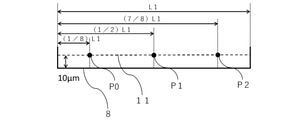
- the first tapered surface 5 is parallel to the first edge 8 and the distance from the first edge 8 is 10 ⁇ m. It is assumed that the line segment 11 is drawn.
- L1 be the length of the first line segment.
- FIG. 4 is an enlarged view of the vicinity of the first line segment. As shown in FIG. 4, the points (1/8) L1, (1/2) L1 and (7/8) L1 from one end side on the first line segment 11 are P0, P1 and P2, respectively. And.
- one side of the first tapered surface 5 having a point of P0, P1 and P2 on the first line segment 11 as the center of gravity is a side having a length of 70 ⁇ m parallel to the first line segment.
- three rectangular observation areas 12 are set, one side of which is a side having a length of 10 ⁇ m that intersects the first line segment perpendicularly.
- FIG. 5 shows an enlarged view of the vicinity of the observation region 12 having P0 as the center of gravity. Similar to P0 in FIG. 5, the elastic modulus of each 70,000 points of the first tapered surface at a 0.1 ⁇ m pitch (interval) for each of the three observation regions including P1 and P2 is measured by a scanning probe microscope (hereinafter referred to as a scanning probe microscope). It was measured using SPM). The average value of the elastic modulus of the obtained 210000 pieces is 15 MPa to 470 MPa, and the coefficient of variation of the elastic modulus is 17.6% or less.
- a scanning probe microscope hereinafter referred to as a scanning probe microscope
- the second tapered surface 6 is parallel to the second edge 9 from the second edge 9.
- the length of the second line segment be L2.
- the points (1/8) L2, (1/2) L2, and (7/8) L2 from one end side on the second line segment are designated as P3, P4, and P5, respectively.
- one side of the second tapered surface 6 having a point of P3, P4, and P5 on the second line segment as the center of gravity is a side having a length of 70 ⁇ m parallel to the second line segment.
- the elastic modulus of the second tapered surface at 70,000 points each was measured using SPM at a pitch (interval) of 0.1 ⁇ m for each of the three observation regions.
- the average value of the elastic modulus values of the obtained 210000 pieces is 15 MPa or more and 470 MPa or less, and the coefficient of variation is 17.6% or less.
- the wiper blade for the member to be cleaned at the time of cleaning is a region including a position of about 10 ⁇ m from the first edge and the second edge on the first tapered surface and the second tapered surface, respectively. It was confirmed that they were in contact with.
- the wiper blade according to the present disclosure is a member to be cleaned when the average value of the elastic modulus in the longitudinal direction of the region capable of forming the contact portion with the member to be cleaned and the coefficient of variation thereof satisfy a predetermined regulation. It is possible to prevent the occurrence of unwiped residue and uneven wiping in the wiping portion.
- the wiper blade according to one aspect of the present disclosure is located at a position of 10 ⁇ m from the first edge and the second edge of the first tapered surface and the second tapered surface, respectively, which may form a contact portion in contact with the member to be cleaned.
- the average value of the elastic modulus values measured at a predetermined position in the longitudinal direction of the region in the vicinity thereof is 15 MPa or more and 470 MPa or less, and the coefficient of variation of the elastic modulus is 17.6% or less.
- the average value of the elastic modulus is preferably 32 MPa or more and 62 MPa or less.
- the coefficient of variation of the elastic modulus is preferably 6.0% or less. Since the smaller the coefficient of variation of the elastic modulus is, the more preferable it is, the lower limit is not particularly limited, but it is, for example, 0.1% or more.
- the average value of the elastic modulus is in the above range, a part of the tapered surface can be brought into contact with the member to be cleaned in a narrow width over the longitudinal direction of the wiper blade during cleaning. That is, it is possible to bring the contact portion closer to the line contact, and the pressing force is concentrated on the contact portion, so that the deposit can be surely scraped off rather than simply wiping or spreading the deposit from the member to be cleaned. can. As a result, it can exhibit extremely high wiping property as compared with the conventional wiper blade. Further, the coefficient of variation of the elastic modulus of 17.6% or less means that the elastic modulus of the contact portion of the tapered surface is more uniform or more homogeneous in the longitudinal direction thereof.
- the wiper blade can be brought into contact with the member to be cleaned with a narrow width in the longitudinal direction thereof.
- the cleaning surface is not undulated in the longitudinal direction of the wiper blade during cleaning, the occurrence of chattering and the like is suppressed, and uniform followability and contact with the member to be cleaned can be exhibited.
- the contact angle is about 25 ° in the vicinity of the contact portion, and the contact portion with the member to be cleaned
- the maximum width (nip width) is 20 to 30 ⁇ m, and the maximum contact pressure is 1.5 MPa.
- a contact angle of about 55 °, a nip width of 5 to 6 ⁇ m, and a contact pressure of 6.0 MPa are measured.
- FIG. 6 shows a schematic view of the vicinity of the contact portion of the wiper blade with the member to be cleaned.
- the tapered surface is in contact with the member to be cleaned in an abdominal contact state (surface contact).
- FIG. 6B it is considered that the wiper blade of the present disclosure is in edge contact with the member to be cleaned with the tapered surface close to line contact.
- the material constituting the tapered portion is the elasticity of the first tapered surface and the second tapered surface, which may be contact portions in contact with the member to be cleaned, in the vicinity of 10 ⁇ m positions from the first edge and the second edge, respectively.
- the average value of the rate values and the coefficient of variation of the elastic modulus are not particularly limited as long as they can be adapted to the above provisions.
- the tapered portion contains polyurethane having excellent mechanical properties and easily achieving the above-mentioned provisions relating to the average value of elastic modulus and the coefficient of variation.
- the polyurethane is preferably a polyurethane elastomer.
- Polyurethane elastomers are mainly obtained from raw materials such as polyols, chain extenders, polyisocyanates, catalysts and other additives.
- the polyurethane elastomer is a block copolymer composed of a hard segment and a soft segment.
- the hard segment is generally composed of a chain extender containing a polyisocyanate and a short chain diol.
- the soft segment is generally composed of a long-chain polyol such as a polyester polyol, a polyether polyol, or a polycarbonate polyol, and a polyisocyanate.
- the characteristics of the block copolymer composed of the hard segment and the soft segment may be utilized.
- the conventional polyurethane has a hard segment in which the portion where the urethane bond is aggregated by the interaction is further aggregated.
- the aggregated portion of the urethane-bonded portion has a relatively large hard segment that is further aggregated. Therefore, according to the study by the present inventors, the wiper blade manufactured by using such a polyurethane shall satisfy at least one of the average value of the elastic modulus values and the coefficient of variation of the elastic modulus according to the present disclosure. It wasn't.
- the conventional polyurethane since the conventional polyurethane has a relatively large hard segment, it is difficult to set the coefficient of variation of the elastic modulus at 210000 points to 17.6% or less by using the scanning probe microscope according to the present disclosure.
- the coefficient of variation of the elastic modulus in which the amount of the hard segment itself is small, it is considered that further aggregation of the aggregated portion of the urethane bond can be suppressed and the coefficient of variation can be suppressed to a small value.
- the tapered portion satisfying the physical characteristics according to the present disclosure can be formed, for example, by using polyurethane in which hard segments are finely and uniformly dispersed.
- polyurethane will be described below. That is, by using diisocyanate or trifunctional or higher polyfunctional isocyanate and diol or trifunctional or higher polyfunctional alcohol as the urethane raw material in an appropriate concentration range, aggregation of the hard segment is suppressed and the hard segment becomes fine. Polyurethane that is uniformly dispersed can be obtained.
- an alcohol containing a trifunctional or higher polyfunctional alcohol and an isocyanate compound containing a trifunctional or higher polyfunctional isocyanate as a urethane raw material. It is also preferable to use an alcohol containing at least one selected from a diol and a trifunctional or higher functional alcohol and an isocyanate compound containing a trifunctional or higher polyfunctional isocyanate as a urethane raw material. It is also preferable to use an alcohol containing a trifunctional or higher polyfunctional alcohol and an isocyanate compound containing a diisocyanate and a trifunctional or higher polyfunctional isocyanate as a urethane raw material. In particular, it is preferable to use a trifunctional or higher polyfunctional isocyanate and a trifunctional or higher functional alcohol as the urethane raw material.
- Polyurethane obtained as a reaction product with trifunctional or higher functional isocyanates and trifunctional or higher functional alcohols has a steric hindrance that suppresses molecular orientation and more reliably suppresses aggregation of hard segments. Will be. Therefore, it is a polyurethane suitable for achieving the elastic modulus and the coefficient of variation according to the present disclosure.
- the soft segment portion has, for example, a linear alkylene structure
- the crystallinity is enhanced by stacking the soft segments with each other.
- the hard segment is also difficult to disperse. Therefore, it is also effective to introduce an alkylene structure having a side chain portion into the soft segment portion in order to suppress the aggregation of the hard segment.
- introducing a partial structure as represented by the following structural formulas (i) to (iv) into the soft segment portion between the two urethane bonds is effective for miniaturizing the hard segment. .. -CH 2 -CH (CH 3 ) -CH 2 -CH 2 -O- (i) -CH 2 -CH 2 -CH (CH 3 ) -CH 2 -O- (ii) -CH 2 -CH (CH 3 ) -O- (iii) -CH (CH 3 ) -CH 2 -O- (iv)
- the structures of the structural formulas (i) and (ii) are structures produced by ring-opening polymerization of 3-methyltetrahydrofuran, and are substantially the same. Further, the structures of the structural formulas (iii) and (iv) are structures produced by ring-opening polymerization of 1,2-propylene oxide and are substantially the same. Urethane resins having these structures between two adjacent urethane bonds can be obtained by reacting a polyether polyol or a polyester polyol having these structures with isocyanate.
- a bifunctional alcohol (diol) and a bifunctional isocyanate (diisocyanate) are used as the urethane raw material, it is usually difficult to finely disperse the hard segment.
- the hard segment can be finely dispersed. As a result, it is possible to obtain a polyurethane that provides a wiper blade that satisfies the parameters according to the present disclosure.
- the carbon number of the linear portion is used as the alcohol of the urethane raw material.
- a method using two or more different alcohols can be mentioned.
- Polyurethane obtained by using two or more alcohols having different carbon atoms in the linear portion has a linear alkylene structure in the soft segment portion, but crystallizes by stacking between the soft segments due to the different carbon atoms.
- the carbon number of the soft segment portion is different, the aggregation of the urethane bonded portion is suppressed, so that the aggregation of the hard segment can be prevented.
- the hard segment can be obtained by using a plurality of diols having different carbon atoms in the linear alkylene structure as the diol. Can be miniaturized. As a result, it is possible to obtain a polyurethane that provides a wiper blade that satisfies the parameters according to the present disclosure.
- the plurality of diols include the combined use of polybutylene adipate polyester polyol and polyhexylene adipate polyester polyol.
- polyesters such as Polyester Adipate Polyester Polyester, Polybutylene Adipate Polyester Polyester, Polyhexylene Adipate Polyester Polyester, (Polyester / Polyester) Adipate Polyester Polyester, (Polyester / Polybutylene) Adipate Polyester Polyester, (Polyethylene / Polyneopentylene) Adipate Polyester Polyester Polyester; Polycaprolactone-based polyol obtained by ring-opening polymerization of caprolactone; Polyester polyol such as polyethylene glycol, polypropylene glycol, polytetramethylene ether glycol; Polyester diol. These can be used alone or in combination of two or more.
- polyethylene adipate polyester polyol polybutylene adipate polyester polyol, polyhexylene adipate polyester polyol, (polyethylene / polypropylene) adipate polyester polyol, (polyethylene / polybutylene) adipate polyester polyol, (polyethylene / polyneopentylene) adipate. It is preferable to use at least two selected from the group consisting of polyester polyols such as polyester polyols.
- a diol capable of extending a polyurethane elastomer chain or a trifunctional or higher functional alcohol can also be used.
- the diol include the following. Ethylene glycol (EG), diethylene glycol (DEG), propylene glycol (PG), dipropylene glycol (DPG), 1,4-butanediol (1,4-BD), 1,6-hexanediol (1,6-HD) ), 1,4-Cyclohexanediol, 1,4-cyclohexanedimethanol, xylylene glycol (terephthalyl alcohol), triethylene glycol. These can be used alone or in combination of two or more.
- trifunctional or higher functional alcohol examples include trimethylolpropane (TMP), glycerin, pentaerythritol, and sorbitol. These can be used alone or in combination of two or more.
- One of the methods for improving the elastic modulus of the polyurethane elastomer is to introduce a crosslinked structure.
- a method for introducing cross-linking it is preferable to use a trifunctional or higher functional alcohol as the chain extender.
- the introduction of the branched structure into the polyurethane by the use of a trifunctional or higher functional alcohol can suppress the crystallization of the polyurethane and further suppress the aggregation of the hard segment.
- the polyfunctional alcohol it is preferable to use a trifunctional alcohol from the viewpoint of suppressing an excessive increase in hardness due to an excessively high degree of cross-linking of polyurethane.
- triol which has a methylene skeleton next to the hydroxyl group and can have a crosslinked structure that is flexible in molecular structure, is preferable because it has a further suppressing effect on the crystallinity of the hard segment.
- triols include, for example, trimethylolpropane (TMP), glycerin.
- isocyanate compound examples include the following. 4,4'-diphenylmethane diisocyanate (4,4'-MDI), polypeptide MDI, 2,4-tolylene diisocyanate (2,4-TDI), 2,6-tolylene diisocyanate (2,6-TDI), xylene Diisocyanate (XDI), 1,5-naphthylylene diisocyanate (1,5-NDI), p-phenylenediocyanate (PPDI), hexamethylene diisocyanate (HDI), isophorone diisocyanate (IPDI), 4,4'-dicyclohexylmethane diisocyanate ( Hydrogenated MDI), tetramethylxylylene diisocyanate (TMXDI), carbodiimide-modified MDI, triphenylmethane-4,4', 4''-triisocyanate (TTI), tris (phenylisocyanate) thiophosphat
- 4,4'-MDI is preferable because the two isocyanate groups have the same reactivity and high mechanical properties can be obtained. Further, it is preferable to use a trifunctional or higher functional isocyanate in combination. By using a trifunctional or higher functional isocyanate, a branched structure can be introduced into the polyurethane, which is effective in further suppressing aggregation of the hard segment. Further, since a more precise crosslinked structure can be introduced into polyurethane, the contact property of the elastic portion with the member to be cleaned can be more stabilized. As a result, it is possible to more effectively suppress unwiped residue and uneven wiping of the member to be cleaned.
- the trifunctional or higher functional isocyanate is at least selected from the group consisting of triphenylmethane-4,4', 4''-triisocyanate (TTI), tris (phenylisocyanate) thiophosphate (TPTI) and polypeptide MDI.
- TTI triphenylmethane-4,4', 4''-triisocyanate
- TPTI tris (phenylisocyanate) thiophosphate
- polypeptide MDI polypeptide MDI.
- TTI triphenylmethane-4,4', 4''-triisocyanate
- TPTI tris (phenylisocyanate) thiophosphate
- polypeptide MDI polypeptide MDI.
- isocyanates have a methylene group or an ether group between a plurality of NCO groups, and can appropriately maintain the distance between the plurality of urethane bonds. Therefore, it is advantageous in suppressing the aggregation of hard segments.
- polypeptide MDI is represented by the following chemical formulas (1) and (1)'. It is preferable that n in the chemical formula (1)'is 1 or more and 4 or less.
- the chemical formula (1) is a case where n is 1 in the chemical formula (1)'.
- the tapered portion according to the present disclosure contains a polyurethane which is a reaction product of a raw material composition containing a diisocyanate, an isocyanate compound containing a trifunctional or higher polyfunctional isocyanate, and an alcohol containing a trifunctional or higher polyfunctional alcohol.
- the tapered portion preferably has the following physical properties.
- the distance between the first tapered surface and the second tapered surface of the tapered portion is 0.5 mm in parallel with the first edge and the second edge, respectively.
- the length of the line segment is L'
- the points 1 / 8L', 1 / 2L', and 7 / 8L' from one end side on the line segment are P0', P1', and P2', respectively.
- a direct sample introduction method in which a sample sampled at each of the first tapered surface and the P0', the P1'and the P2'on the second tapered surface is heated and vaporized in an ionization chamber to ionize the sample molecules. Using the mass spectrometer of No.
- M2 / M1 on the first tapered surface and / or the second tapered surface is preferably 0.0010 to 0.0150, and particularly M2 / M1 is 0.0030 to 0.0150. It is more preferable to have.
- M3 / M1 on the first tapered surface and / or the second tapered surface is determined. It is preferably 0.0200 to 0.1100, and more preferably 0.0380 to 0.0760.
- M2 / M1 and M3 / M1 are in the above range, the polyurethane is introduced with an appropriate amount of a structure derived from a trifunctional or higher functional isocyanate having low crystallinity, resulting in a hard segment. Aggregation is suppressed and the hard segments can be finer and more uniformly dispersed.
- excessive development of the crosslinked structure in polyurethane is suppressed, and the average elastic modulus can be easily adjusted within the range of 15 MPa or more and 470 MPa.
- M2 / M3 is 0.0130 or more and 0.3000 or less.
- M2 / M3 is a parameter representing the ratio of the structural portion derived from diisocyanate and the structural portion derived from trifunctional or higher functional isocyanate in the structure derived from isocyanate of the polyurethane, and M2 / M3 is within the above range. This makes it possible to obtain a polyurethane in which an excessive increase in elastic modulus is suppressed and the aggregation of hard segments is further suppressed.
- the polyurethane is a polyurethane produced by using the polypeptide MDI represented by the above chemical formula (1)' as a trifunctional or higher functional isocyanate
- the total integrated intensity of the peaks to be formed may be M2.
- the polyurethane is a polyurethane using 4,4'-MDI represented by the chemical formula (2) as one of the raw materials as the diisocyanate
- the ion thermogram obtained by the above-mentioned mass spectrometry.
- the integrated intensity of the peak corresponding to the range of m / z value of 249.5 to 250.5 derived from the structure represented by the chemical formula (2) may be M3.
- the tapered portion of the wiper blade is a polyurethane which is a reaction product of a raw material composition containing an isocyanate compound containing a trifunctional or higher polyfunctional isocyanate and an alcohol containing a trifunctional or higher polyfunctional alcohol.
- the tapered portion preferably has the following physical properties. That is, the distance between the first tapered surface and the second tapered surface of the tapered portion is 0.5 mm in parallel with the first edge and the second edge, respectively. Assuming that a line segment is drawn, the length of the line segment is L', and the points 1 / 8L', 1 / 2L', and 7 / 8L'from one end side of the line segment are P0', respectively.
- the concentration of the component derived from the trifunctional or higher functional alcohol in the polyurethane is preferably 0.04 mmol / g to 0.39 mmol / g, preferably 0.14 mmol / g to 0.39 mmol / g. It is more preferably 0.22 mmol / g to 0.39 mmol / g.
- the polyurethane can be one in which aggregation of hard segments is more reliably suppressed. Further, when the concentration of the component derived from the trifunctional or higher functional alcohol is 0.39 mmol / g or less, excessive development of the crosslinked structure in the polyurethane can be suppressed, and the elastic modulus can be prevented from becoming too high. Can be. Therefore, the tapered portion having the above physical characteristics can more easily satisfy the above-mentioned provisions relating to the average value of the elastic modulus values (15 to 470 MPa) and the coefficient of variation of the elastic modulus (17.6% or less).
- the concentration of trifunctional or higher functional alcohol in polyurethane is calculated by the following formula (2).
- the urethane raw material can contain a catalyst for accelerating the reaction of the isocyanate compound and the alcohol.
- a catalyst for curing a polyurethane elastomer can be used, and examples thereof include a tertiary amine catalyst, and specific examples thereof include the following.
- Amino alcohols such as dimethylethanolamine, N, N, N'-trimethylaminopropylethanolamine, N, N'-dimethylhexanolamine; trialkylamines such as triethylamine; N, N, N'N'-tetramethyl-1 , 3-Tetraalkyldiamine such as butanediamine; triethylenediamine, piperazine-based compounds, triazine-based compounds.
- organic acid salts of metals such as potassium acetate and potassium octylate alkali can also be used.
- a metal catalyst usually used for urethanization for example, dibutyltin dilaurate can also be used. These can be used alone or in combination of two or more.
- the raw materials that make up the taper portion of the wiper blade are pigments, plasticizers, waterproofing agents, antioxidants, ultraviolet absorbers, and light stabilizers, as necessary, as long as they do not affect the elastic modulus and its coefficient of variation. Additives such as can be blended.
- the tapered portion of the wiper blade may be surface-treated.
- Preferred surface treatment methods in the present disclosure include, for example, (i) a method including a step of irradiating the object to be treated with ultraviolet rays, and (ii) applying a material for forming a cured region to the object to be treated. Examples thereof include a method including a step of curing.
- the conditions for irradiating ultraviolet rays are not particularly limited.
- the ultraviolet rays may have a wavelength of 400 nm or less, but are preferably 200 nm or more. When the wavelength of ultraviolet rays is 200 nm or more, the elastic modulus can be effectively increased.
- the wavelength of the maximum emission peak of the light emitted by the light source is preferably 200 nm or more and 400 nm or less. In particular, it is preferable that the wavelength of the maximum emission peak is in the vicinity of 254 nm, for example, in the range of 254 ⁇ 1 nm. This is because the above wavelength range or the ultraviolet rays having the above wavelength can efficiently generate active oxygen that modifies the surface of the wiper blade tapered portion. When there are a plurality of ultraviolet emission peaks, it is preferable that one of them is present in the vicinity of 254 nm.
- the intensity of the light emitted from the light source is not particularly limited, and a spectral irradiance meter (trade name: USR-40V / D, manufactured by Ushio, Inc.) and an ultraviolet integrated photometer (trade name: UIT-150-A) are not particularly limited. , UVD-S254, VUV-S172, VUV-S365, manufactured by Ushio, Inc.) and the like. Further, the integrated amount of ultraviolet rays irradiated to the tapered portion of the wiper blade in the surface treatment step may be appropriately selected according to the effect of the obtained surface treatment.
- UV integrated light intensity (mJ / cm 2 ) UV intensity (mW / cm 2 ) x irradiation time (sec)
- a light source that emits ultraviolet rays for example, a high-pressure mercury lamp or a low-pressure mercury lamp can be preferably used. These light sources are preferable because they can stably emit ultraviolet rays having a suitable wavelength with little attenuation due to the irradiation distance, and can uniformly irradiate the entire surface.
- the conditions for applying and curing the material for forming the cured region are not particularly limited.
- the formation of the cured region in the tapered portion can be performed by applying and curing a material for forming the cured region. This treatment can effectively increase the elastic modulus of the cured portion by applying a material for forming a cured region.
- the cured region is preferably formed on at least both sides of the first tapered surface and the second tapered surface that come into contact with the member to be cleaned of the lip portion.
- This material for forming a cured region is used by diluting it with a diluting solvent as needed, and can be applied by known means such as dipping, spraying, dispenser, brush coating, and roller coating. Further, after applying the material for forming the cured region, further treatment such as heat treatment may be performed. It is advisable to impregnate the polyurethane contained in the elastic member with the material for forming the cured region. Since impregnation is promoted by making the material for forming the cured region high concentration and low viscosity, the material for forming the cured region may be heated and impregnated without diluting. The degree of curing may be adjusted by the material temperature for forming the cured region, the impregnation or immersion time, the heat treatment temperature and heat treatment time after impregnation or immersion, the subsequent standing time, and the like.
- the temperature of the material for forming the cured region should be about 60 ° C to 90 ° C.
- the impregnation or immersion time is preferably about 10 seconds to 180 seconds, although it cannot be said unconditionally.
- Examples of the heating method include a method of passing through a heating furnace and a method of blowing heating air, but the heating method is not particularly limited.
- examples of the heating furnace include a radiant heating furnace and a circulating air heating furnace, and examples of the device for forming the heating air include a hot air heater and a far-infrared heater.
- the heating conditions it is preferable that the surface temperature of the treated surface is, for example, 90 ° C to 110 ° C.
- the heating time is preferably, for example, 10 to 60 minutes.
- the amount of residual isocyanate during polyurethane molding tends to gradually decrease with the passage of time after molding. Therefore, the formation of the cured region may be carried out immediately after the polyurethane molding, but is not particularly limited. For example, it should be done within 3 hours.
- the amount of residual isocyanate can also be adjusted by the mixing ratio of the composition used at the time of forming the polyurethane.
- the material for forming the cured region is not particularly limited as long as it can cure the polyurethane or can form the cured region on the surface of the polyurethane.
- isocyanate compounds and acrylic compounds can be mentioned.
- the material for forming the cured region may be diluted with a solvent or the like before use.
- the solvent used for dilution is not particularly limited as long as it dissolves the material to be used, and examples thereof include toluene, xylene, butyl acetate, methyl isobutyl ketone, and methyl ethyl ketone.
- an isocyanate compound which is a constituent material of polyurethane as the material forming the cured region in consideration of compatibility with the tapered portion material and impregnation property.
- an isocyanate compound a compound having one or more isocyanate groups in the molecule can be used.
- an aliphatic monoisocyanate such as octadecyl isocyanate (ODI), an aromatic monoisocyanate such as phenyl isocyanate (PHI) and the like can be used.
- ODI octadecyl isocyanate
- PHI phenyl isocyanate
- the isocyanate compound having two isocyanate groups in the molecule those usually used for producing a polyurethane resin can be used, and specific examples thereof include the following.
- MDI 4,4'-diphenylmethane diisocyanate
- MPDI m-phenylenedi isocyanate
- TMDI tetra Methylene diisocyanate
- HDI hexamethylene diisocyanate
- IPDI isophorone diisocyanate
- examples of the isocyanate compound having three or more isocyanate groups in the molecule include, for example, 4,4', 4 "-triphenylmethane triisocyanate, 2,4,4'-biphenyltriisocyanate, 2,4,4'. -Diphenylmethane triisocyanate or the like can be used.
- examples of the isocyanate compound having two or more isocyanate groups a modified derivative thereof, a multimer or the like can also be used.
- MDI having high crystallinity that is, having a symmetric structure is preferable
- MDI containing a modified product is a liquid at room temperature, so that workability is improved. It is also preferable from.
- a lip portion having a tapered portion can be obtained by injecting, for example, a polyurethane elastomer raw material composition into a cavity into a mold for a wiper blade and heating and curing the cavity.
- a shape may be formed by cutting at the tip of the tapered portion. This is preferable because the smoothness of the first edge and the second edge can be made high.
- a pair of tandem-shaped molded bodies formed so that the tapered portions face each other may be manufactured, and the wiper blade may be manufactured by cutting in the longitudinal direction.
- the blade support portion and the neck may be manufactured by using conventionally known materials and manufacturing methods.
- the wiper blades of the present disclosure can be used in various types of wiper devices such as tandem type and opposed wiping type.
- Example 1 ⁇ Preparation of raw materials for wiper blades> 4,4'-Diphenylmethane diisocyanate (trade name: Millionate MT, manufactured by Tosoh Corporation) (hereinafter referred to as 4,4'-MDI, simply referred to as "MDI" in the table) 352.6 g, polyfunctional or higher As the isocyanate, 10.0 g of triphenylmethane-4,4', 4''-triisocyanate (trade name: Ultite Super CA, manufactured by Toho Kasei Kogyo Co., Ltd.) (hereinafter referred to as TTI), 637.4 g of a polybutylene adipate polyester polyol (trade name: Nippon 3027, manufactured by Tosoh Corporation) (hereinafter referred to as PBA2500) having a number average molecular weight of 2500 was reacted at 80 ° C. for 3 hours to prepare a pre-polyol having an NCO
- This curing agent was added to the above-mentioned prepolymer and mixed to obtain a raw material composition.
- This raw material composition was poured into a molding die for a wiper blade and cured at a temperature of 130 ° C. for 2 minutes. After that, it was demolded to obtain a polyurethane molded product.
- the mold release agent A was previously applied to the mold for the wiper blade.
- the release agent A is a mixture of the materials shown in Table 2 below.
- the wiper blade according to this example was obtained by cutting the tip end side of the lip portion of the obtained polyurethane molded product. The distances in the thickness direction and the longitudinal direction of the tip of the lip portion were set to 0.6 mm and 450 mm, respectively.
- the obtained wiper blade was evaluated by the following method.
- Samples sampled at each of the P0', P1'and P2'on the first tapered surface and the second tapered surface were measured by the following method.
- members such as polyurethane were cut out with a biocutter.
- the polyfunctional alcohol species was qualitative by GC / MS.
- a calibration curve was prepared by GC analysis of the known concentration of the qualitated polyfunctional alcohol species, and quantification was performed from the GC peak area ratio. Then, the arithmetic mean values of the numerical values obtained from the respective samples of the P0', the P1'and the P2' of the first tapered surface and the second tapered surface are used as the first tapered surface and the second tapered surface.
- M1 to M3 were measured using the direct sample introduction method (DI method) in which the sample was directly introduced into the ion source without passing through a gas chromatograph (GC).
- DI method direct sample introduction method
- An ion trap type GC / MS (trade name: POLARIS Q, manufactured by Thermo Fisher Scientific) is used as the device, and a direct exposure probe (DEP) is used as the direct introduction probe.
- DEP direct exposure probe
- the length of the line segment is L'
- the points 1 / 8L', 1 / 2L', and 7 / 8L' from one end side of the line segment are P0'and P1', respectively. , P2'.
- Samples sampled at each of the P0', P1'and P2'on the first tapered surface and the second tapered surface were measured by the following method. In sampling, members such as polyurethane were cut out with a biocutter. Approximately 0.1 ⁇ g of the sample sampled at each of the P0', P1'and P2'on the first tapered surface and the second tapered surface is fixed to the filament located at the tip of the probe, and the ionization chamber is used. Inserted directly into. Then, it was rapidly heated from room temperature to 1000 ° C. at a constant temperature rise rate (about 10 ° C./s), and the vaporized gas was detected by a mass spectrometer.
- the detected amount M1 of all ions is the sum of the integrated intensities of all peaks in the obtained total ion current thermogram.
- M2 / M1 is calculated using the values of M1 and M2, where M2 is the sum of the integrated intensities of the peaks of the extracted ion thermograms with m / z values derived from trifunctional or higher functional isocyanates. did.
- M3 / M1 was calculated using the values of M1 and M3 when the total integrated intensity of the peaks of the extracted ion thermograms of m / z values derived from diisocyanate was M3.
- TTI used as a trifunctional or higher functional isocyanate in this example has a structure represented by the following chemical formula (3). Then, in the extracted ion thermogram obtained in this evaluation, a peak derived from the cation compound of TTI having a peak top at the position of m / z of 366.5 to 367.5 was detected. Therefore, in this embodiment, the integrated intensity of the peak is set to M2.
- the elastic portion made of polyurethane synthesized by using polypeptide MDI as a trifunctional or higher functional isocyanate is described in the above chemical formula (1) in the extracted ion thermogram obtained in this evaluation.
- n 3.
- tris (phenyl isocyanate) thiophosphate (TPTI) used as a trifunctional or higher functional isocyanate has a structure represented by the chemical formula (4). Then, in the extracted ion thermogram obtained in this evaluation, a peak derived from a TPTI cation compound having a peak top at a position of m / z of 464.5 to 465.5 was detected. Therefore, in the embodiment, the integrated intensity of the peak is set to M2.
- the elastic modulus by SPM was measured by the following method using a scanning probe microscope (SPM) (trade name: MFP-3D-Origin, manufactured by Oxford Instruments).
- SPM scanning probe microscope
- the sample was prepared as follows.
- a first edge formed by the first tapered surface and the tip surface is set, and the distance from the first edge is parallel to the first edge.
- the center of gravity of each point P0, P1 and P2 of 1 / 8L, 1 / 2L and 7 / 8L from one end side on the line segment.
- the silicon wafer on which the measurement sample was placed was set on the SPM stage, and SPM observation was performed. It was confirmed in advance that the spring constant and proportionality constant of the silicon cantilever (trade name: OMCL-AC160, manufactured by Olympus, tip radius of curvature: 8 nm) are as follows in the thermal noise method installed in this SPM device (). Spring constant: 30.22 nN / nm, proportionality constant: 82.59 nm / V).
- the cantilever was tuned in advance, and the resonance frequency of the cantilever was obtained (285 KHz (first order) and 1.60 MHz (higher order)).
- the SPM measurement mode is AM-FM mode
- the free amplitude of the cantilever is 3V
- the setpoint amplitude is 2V (primary) and 25mV (higher order)
- the scanning speed is 1Hz
- the number of scanning points is 1Hz in the size of the field of view 70 ⁇ m ⁇ 70 ⁇ m.
- Scanning was performed under the conditions of vertical 256 and horizontal 256, and a phase image was acquired.
- As the visual field a position was selected in which P0, P1 and P2 of each measurement sample existed in the center of the visual field and one side was parallel to the first line segment. From the obtained phase image, the location where the elastic modulus is measured by force curve measurement is specified in the measurement sample. Specifically, as shown in FIGS.
- the measurement point is the position corresponding to 70,000 points with a vertical and horizontal 0.1 ⁇ m pitch (interval) in a rectangular region that is a side of 70 ⁇ m and has a length of 10 ⁇ m where one side intersects the first line segment perpendicularly.
- the force curve was measured once in contact mode at all points.
- the force curve was acquired under the following conditions.
- the piezo element which is the drive source of the cantilever, is controlled so that the tip of the cantilever comes into contact with the surface of the sample and the deflection becomes a constant value.
- the turning point at this time is called a trigger value, and indicates how much the cantilever is turned back when the voltage increases from the deflection voltage at the start of the force curve.
- the force curve was measured with the trigger value set to 0.2V.
- the distance from the tip position of the cantilever in the standby state to the turning of the cantilever at the trigger value was set to 500 nm, and the scanning speed was set to 1 Hz (the speed at which the probe reciprocates once). Then, the obtained force curves were fitted one by one based on the Hertz theory, and the elastic modulus was calculated.
- the elastic modulus (Young's modulus) according to the Hertz theory is calculated by the following formula (* 1).
- F was calculated by the following formula (* 4).
- F ⁇ ⁇ D ⁇ is the spring constant of the cantilever. Since ⁇ Vdeflection and ⁇ z are actually measured values, E * in the calculation formula (* 1) was obtained from the calculation formulas (* 1) to (* 4). Further, the elastic modulus (Young's modulus) Es to be obtained was calculated from the following formula (* 5).
- One side is a side having a length of 70 ⁇ m parallel to the first line segment, and one side is a side having a length of 10 ⁇ m perpendicular to the first line segment, with each of P0, P1 and P2 as the center of gravity.
- a rectangular observation region three 10 ⁇ m ⁇ 70 ⁇ m observation regions
- 70,000 points of elasticity were measured at a vertical and horizontal 0.1 ⁇ m pitch (interval).
- the average value of the elastic modulus values calculated from the force curves of 210000 points in total was taken as the elastic modulus of the first tapered surface.
- the standard deviation was calculated from the elastic moduli of 210000 points in total.
- the result was calculated as the ratio of the area where the silicone oil film was removed to the area of the surface wiped by the wiper blade (hereinafter, referred to as the silicone oil film removal area ratio (%)).
- the wiping performance was evaluated according to the following criteria from the calculated oil film removal area ratio. This result is used as the initial wiping performance. Further, after the wiper blade was reciprocated under the following durability conditions and the number of reciprocations was 100,000 and 500,000 times, the wiping performance after the durability was confirmed in the same manner as the evaluation of the initial wiping performance.
- the results of the initial and post-durability evaluations are shown in Table 3 as the wiping performance of the wiper blade.
- Example 2 A wiper blade was produced in the same manner as in Example 1 except that the types and amounts of various materials used for the prepolymer and the types and amounts of various materials used for the curing agent were as shown in Table 3. evaluated.
- tris (phenyl isocyanate) thiophosphate (trade name: Ultite Super CAII, manufactured by Toho Kasei Kogyo Co., Ltd.) (hereinafter referred to as TPTI) is used as a trifunctional or higher functional isocyanate for prepolymers. used.
- Example 5 a polypeptide MDI (trade name: Millionate MR-400, manufactured by Tosoh Corporation) (hereinafter referred to as MR400) was used as a trifunctional or higher functional isocyanate for a prepolymer. Further, in Example 6, glycerin (manufactured by Tokyo Chemical Industry Co., Ltd.) was used as the polyfunctional alcohol for the curing agent.
- Example 11 to 20 A wiper blade was produced in the same manner as in Example 1 except that the types and amounts of various materials used for the prepolymer and the types and amounts of various materials used for the curing agent were as shown in Table 4. evaluated.
- TMP trimethylolpropane (manufactured by Tokyo Chemical Industry Co., Ltd.) (hereinafter referred to as TMP) was used as the polyfunctional alcohol for the curing agent.
- MR200 a polypeptide MDI (trade name: Millionate MR-200, manufactured by Tosoh Corporation) (hereinafter referred to as MR200) was used as the polyfunctional isocyanate for the prepolymer.
- Example 18 a polybutylene adipate polyester polyol (trade name: Nipponporan 4009, manufactured by Tosoh Corporation) (hereinafter referred to as PBA1000) was used as the polyol for the curing agent. Further, in Example 19, a polyhexylene adipate polyester polyol (trade name: Nipponporan 136, manufactured by Tosoh Corporation) having a number average molecular weight of 2600 (hereinafter referred to as PHA2600) was used as the polyol for the prepolymer.
- PBA1000 polybutylene adipate polyester polyol
- PHA2600 a polyhexylene adipate polyester polyol having a number average molecular weight of 2600
- Examples 21 to 28 A wiper blade was produced in the same manner as in Example 1 except that the types and amounts of various materials used for the prepolymer and the types and amounts of various materials used for the curing agent were as shown in Table 5. evaluated.
- Example 29 304.0 g of 4,4'-MDI, 20.0 g of polymeric MDI (trade name: Cosmonate M-200, manufactured by Mitsui Kagaku Co., Ltd.) (hereinafter referred to as M200), polytetramethylene ether glycol with a number average molecular weight of 2000 ( Product name: PTG-2000SN, manufactured by Hodogaya Chemical Co., Ltd. (hereinafter referred to as PTG2000SN) 676.0 g was reacted at 80 ° C. for 3 hours to prepare a prepolymer having an NCO content of 7.9% by mass.
- polymeric MDI trade name: Cosmonate M-200, manufactured by Mitsui Kagaku Co., Ltd.
- PTG2000SN polytetramethylene ether glycol with a number average molecular weight of 2000
- pentaerythritol is 39.6 g
- polytetramethylene ether glycol having a number average molecular weight of 1000 (trade name: PTG-1000SN, manufactured by Hodogaya Chemical Co., Ltd.) (hereinafter referred to as PTG1000SN) is 290.3 g
- Polycat46 is 0.13 g.
- No. 0.55 g of 25 was mixed to prepare a curing agent.
- the prepolymer prepared above and the curing agent were mixed to obtain a raw material composition.
- this raw material composition was poured into a molding die for a wiper blade and cured at a temperature of 130 ° C. for 6 minutes. After that, it was demolded to obtain a polyurethane molded body.
- the obtained polyurethane molded product was processed in the same manner as in Example 1 to prepare a wiper blade, which was evaluated.
- Examples 30 to 32 The wiper blade was used in the same manner as in Example 1 except that the types and amounts of various materials used for the prepolymer and the types and amounts of various materials used for the curing agent were as shown in Tables 5 to 6. Made and evaluated.
- Example 33 349.5 g of 4,4'-MDI, polybutylene adipate polyester polyol having a number average molecular weight of 2000 without adding trifunctional or higher functional isocyanate (trade name: Nipponporan 4010, manufactured by Tosoh Corporation) (hereinafter referred to as PBA2000).
- PBA2000 polybutylene adipate polyester polyol having a number average molecular weight of 2000 without adding trifunctional or higher functional isocyanate
- PBA2000 Nipponporan 4010, manufactured by Tosoh Corporation
- 1,4-BD was 40.4 g
- glycerin was 5.0 g
- PHA1000 was 5.0 g
- Polycat46 was 0.05 g
- No. 25 was 0.25 g and mixed to prepare a curing agent.
- This curing agent and the prepolymer prepared above were mixed to obtain a raw material composition.
- This raw material composition was poured into a molding die for a wiper blade and cured at a temperature of 130 ° C. for 10 minutes. After that, it was demolded and subjected to secondary curing at a temperature of 130 ° C. for 60 minutes to obtain a polyurethane molded product.
- the obtained polyurethane molded product was processed in the same manner as in Example 1 to prepare a wiper blade, which was evaluated.
- Example 34 A wiper blade was produced in the same manner as in Example 1 except that the types and amounts of various materials used for the prepolymer and the types and amounts of various materials used for the curing agent were as shown in Table 6. Next, the lip portion of the wiper blade was irradiated with ultraviolet rays so that the integrated ultraviolet light amount was 492 mJ / cm 2 , to obtain the wiper blade according to this embodiment.
- the light source of ultraviolet rays a low-pressure mercury ozoneless lamp (manufactured by Toshiba Lighting & Technology Corporation) having a maximum emission wavelength peak at a wavelength of 254 nm was used. This wiper blade was evaluated in the same manner as in Example 1.
- Examples 35 and 36 A wiper blade was produced in the same manner as in Example 1 except that the types and amounts of various materials used for the prepolymer and the types and amounts of various materials used for the curing agent were as shown in Table 6. Further, the wiper blades according to Examples 35 and 36 were irradiated with ultraviolet rays in the same manner as in Example 34 except that the integrated light amount was changed to the values shown in Table 6 with respect to the obtained wiper blades. Obtained. These wiper blades were evaluated in the same manner as in Example 1.
- Example 37 296.6 g of 4,4'-MDI, 703.4 g of PBA2000 without adding trifunctional or higher functional isocyanate, and reaction at 80 ° C. for 3 hours to obtain a prepolymer having an NCO content of 7.0% by mass. Obtained. Further, 52.0 g of 1,4-BD, 19.2 g of glycerin, 0.05 g of Polycat46 without addition of PHA1000, No. 25 was 0.25 g and mixed to prepare a curing agent. This curing agent and the prepolymer prepared above were mixed to obtain a raw material composition. This raw material composition was poured into a molding die for a wiper blade and cured at a temperature of 130 ° C. for 10 minutes.
- Example 1 The obtained polyurethane molded product was processed in the same manner as in Example 1 to produce a wiper blade.
- the wiper blade was irradiated with ultraviolet rays in the same manner as in Example 34 to obtain a wiper blade according to this example. However, the irradiation of ultraviolet rays was carried out so that the integrated light amount was 1968 mJ / cm 2 .
- the obtained wiper blade was evaluated in the same manner as in Example 1.
- Example 38 A wiper blade was produced in the same manner as in Example 1 except that the types and amounts of various materials used for the prepolymer and the types and amounts of various materials used for the curing agent were as shown in Table 6. evaluated.
- Example 39 and 40 A wiper blade was produced in the same manner as in Example 1 except that the types and amounts of various materials used for the prepolymer and the types and amounts of various materials used for the curing agent were as shown in Table 6. Further, the wiper blades according to Examples 39 and 40 were irradiated with ultraviolet rays in the same manner as in Example 34 except that the integrated light amount was changed to the values shown in Table 6 with respect to the obtained wiper blades. Obtained. These wiper blades were evaluated in the same manner as in Example 1.
- Example 41 The types of various materials for prepolymers and the amounts used thereof are as shown in Table 7. These materials were mixed and reacted at a temperature of 80 ° C. for 3 hours to prepare a prepolymer having an NCO content of 9.0% by mass. Further, various materials for the curing agent as shown in Table 7 were mixed in the amounts shown in Table 7 to prepare a curing agent. The above prepolymer and a curing agent were mixed to obtain a raw material composition. This raw material composition was poured into a molding die for a wiper blade and cured at a temperature of 130 ° C. for 10 minutes. Then, it was demolded and secondarily cured at a temperature of 130 ° C. for 60 minutes to obtain a polyurethane molded product. The obtained polyurethane molded product was processed in the same manner as in Example 1 to produce a wiper blade according to this example. The obtained wiper blade was evaluated in the same manner as in Example 1.
- Example 42 to 44 A prepolymer was prepared in the same manner as in Example 41, except that the types of various materials for the prepolymer and the amounts used thereof were as shown in Table 7.
- the NCO content of the prepolymer according to Example 42 was 8.2% by mass
- the NCO content of the prepolymer according to Example 43 was 15.0% by mass
- the NCO content of the prepolymer according to Example 44 was 18.0. It was% by mass.
- a curing agent was prepared in the same manner as in Example 41 except that various materials for the curing agent and the amount used thereof were as shown in Table 7.
- a wiper blade was prepared and evaluated in the same manner as in Example 41 except that these prepolymers and curing agents were used.
- Examples 45 and 46 The wiper blades obtained in Example 44 were irradiated with ultraviolet rays in the same manner as in Example 34 except that the integrated light amount was set to the value shown in Table 6, and the wiper blades according to Examples 45 and 46 were obtained. Obtained. The obtained wiper blade was evaluated in the same manner as in Example 1.
- Example 47 to 50 A prepolymer was prepared in the same manner as in Example 41, except that the types of various materials for the prepolymer and the amounts used thereof were as shown in Table 7.
- the NCO content of the prepolymer according to Example 47 was 10.0% by mass
- the NCO content of the prepolymer according to Example 48 was 9.6% by mass
- the NCO content of the prepolymer according to Example 49 was 9.3.
- the NCO content of the prepolymer according to Example 50 was 9.2% by mass.
- a curing agent was prepared in the same manner as in Example 41 except that various materials for the curing agent and the amount used thereof were as shown in Table 7.
- the wiper blades according to Examples 47 to 50 were prepared and evaluated in the same manner as in Example 41 except that these prepolymers and curing agents were used.
- Example 51 The tip 2 mm of the lip portion of the wiper blade prepared in the same manner as in Example 37 was immersed in 4,4'-MDI melted at a temperature of 80 ° C. for 1 minute. Then, using a sponge soaked with butyl acetate, the 4,4'-MDI adhering to the surface of the soaked portion of the wiper blade was wiped off. Then, it was aged for 24 hours in an environment of a temperature of 23 ° C. and a relative humidity of 50% to form a cured region at the tip of the lip portion. In this way, the wiper blade according to this embodiment was obtained. This wiper blade was evaluated in the same manner as in Example 1.
- Example 52 A wiper blade according to this example was produced in the same manner as in Example 51 except that the 4,4'-MDI adhering to the surface of the dip-treated wiper blade was wiped off and then heated at a temperature of 100 ° C. for 30 minutes. This wiper blade was evaluated in the same manner as in Example 1.
- Example 53 The wiper blade produced in the same manner as in Example 4 was surface-treated in the same manner as in Example 51 except that the immersion time in 4,4'-MDI was set to 3 minutes, and the wiper blade according to this Example was performed. Got This wiper blade was evaluated in the same manner as in Example 1.
- Example 54 A wiper blade according to this example was produced in the same manner as in Example 53, except that the 4,4'-MDI adhering to the surface of the dip-treated wiper blade was wiped off and then heated at a temperature of 100 ° C. for 30 minutes. This wiper blade was evaluated in the same manner as in Example 1.
- Comparative Example 2 A prepolymer having an NCO content of 9.0% by mass was prepared in the same manner as in Comparative Example 1 except that the types of various materials for the prepolymer and the amounts used thereof were as shown in Table 9. Further, a curing agent was prepared in the same manner as in Comparative Example 1 except that various materials for the curing agent and the amount used thereof were as shown in Table 9. A wiper blade according to this comparative example was produced and evaluated in the same manner as in Comparative Example 1 except that this prepolymer and a curing agent were used.
- Example 3 A prepolymer having an NCO content of 7.0% by mass was prepared in the same manner as in Comparative Example 1 except that the types of various materials for the prepolymer and the amounts used thereof were as shown in Table 9. Further, a curing agent was prepared in the same manner as in Comparative Example 1 except that various materials for the curing agent and the amount used thereof were as shown in Table 9. A wiper blade was produced in the same manner as in Comparative Example 1 except that this prepolymer and a curing agent were used. The wiper blade according to this comparative example was obtained by irradiating the obtained wiper blade with ultraviolet rays in the same manner as in Example 34 except that the integrated light amount was 8200 mJ / cm 2 . The obtained wiper blade was evaluated in the same manner as in Example 1.
- Blade support part 2 Neck 3: Lip part 4: Tapered part 5: First tapered surface, 6: Second tapered surface, 7: Tip surface, 8: First edge, 9: 2nd edge, 10: member to be cleaned, 11: first line segment, 12: observation area
Landscapes
- Chemical & Material Sciences (AREA)
- Health & Medical Sciences (AREA)
- Chemical Kinetics & Catalysis (AREA)
- Medicinal Chemistry (AREA)
- Polymers & Plastics (AREA)
- Organic Chemistry (AREA)
- Engineering & Computer Science (AREA)
- Mechanical Engineering (AREA)
- Polyurethanes Or Polyureas (AREA)
- Ink Jet (AREA)
Abstract
Description
これらの清掃部材のうち、ガラス面と接触する部分にワイパーブレードゴムが設けられたワイパーブレードがよく知られている。このワイパーブレードゴムがガラス面に密着して動くことで、ガラス面に付着した水滴などを払拭することができる。操縦者の良好な視界確保の観点から、ワイパーブレードとして、ガラス面などの水滴や汚れなどを充分に払拭することができる払拭性に優れたものが望まれている。
特許文献1で開示されたワイパーブレードは、添加された炭素繊維の分散状態やコーティングの状態により微細な当接ムラがあることが分かった。そのような状態で、車両用ワイパーブレードを使用すると、水滴の拭き取り性に関し、当接ムラが生じる場合があった。
一方、特許文献1などに代表される従来のワイパーブレードは、車の排気ガス中に含まれる微粒子やアスファルトなどの粉塵や油膜などの付着力の強い汚れがガラス面上に付着した場合、その汚れを容易に払拭することのできない場合があった。
本開示の一態様は、被清掃部材に付着する粉塵や油膜などの付着力の強い汚れをも良くかき取ることのできる優れた払拭性を安定的に発揮し得る、車両用のワイパーブレードの提供に向けたものである。
車両のウインドシールドのワイパー装置用の車両用ワイパーブレードであって、
ブレード支持部と、
該ブレード支持部にネックを介して揺動可能に連結されてなるリップ部と、を具備し、
該リップ部は、ワイパーブレードの長手方向に直交する方向の断面が、該ブレード支持部に近い側から該ブレード支持部から離れる方向に向かう幅が漸減するテーパー部を有し、
該リップ部は、
該テーパー部を構成する第1のテーパー面及び第2のテーパー面と、
該第1のテーパー面及び該第2のテーパー面と共に、該リップ部の該ブレード支持部から最も離れた側に第1のエッジ及び第2のエッジを構成する先端面と、を有し、
該第1のテーパー面に、該第1のエッジと平行に、該第1のエッジからの距離が10μmである第1の線分を引いたと仮定したとき、
該第1の線分の長さをL1とし、
該第1の線分上の一端側から(1/8)L1、(1/2)L1、(7/8)L1の点を各々、P0、P1、P2とし、
該第1のテーパー面の、該P0、該P1及び該P2の各々の点を重心とする、一辺が該第1の線分に平行な長さ70μmの辺であり、かつ、一辺が該第1の線分に垂直に交わる長さ10μmの辺である長方形の観察領域の3つの各々について、0.1μmピッチで各70000点の該第1のテーパー面の弾性率を、走査型プローブ顕微鏡を用いて測定したときに得られる計210000個の弾性率の値の平均値が15MPa~470MPaであり、かつ、該弾性率の変動係数は17.6%以下であり、
該第2のテーパー面に、該第2のエッジと平行に、該第2のエッジからの距離が10μmである第2の線分を引いたと仮定したとき、
該第2の線分の長さをL2とし、
該第2の線分上の一端側から(1/8)L2、(1/2)L2、(7/8)L2の点を各々、P3、P4、P5とし、
該第2のテーパー面の、該P3、該P4及び該P5の各々の点を重心とする、一辺が該第2の線分に平行な長さ70μmの辺であり、かつ、一辺が該第2の線分に垂直に交わる長さ10μmの辺である長方形の観察領域の3つの各々について0.1μmピッチで各70000点の該第2のテーパー面の弾性率を、走査型プローブ顕微鏡を用いて測定したときに得られる計210000個の弾性率の値の平均値が15MPa~470MPaであり、かつ、該弾性率の変動係数は17.6%以下である車両用のワイパーブレードが提供される。
数値範囲が段階的に記載されている場合、各数値範囲の上限及び下限は任意に組み合わせることができる。
本開示の一態様に係る車両用のワイパーブレード(以下単に、ワイパーブレードともいう)は、自動車に代表されるような車両、飛行機、船舶などの輸送機器、建設機械などの産業機械機器といった機器に使用することができる。
例えば、車両のウインドシールドのワイパー装置用の車両用ワイパーブレードは、図1に示すように、ブレード支持部1と、該ブレード支持部にネック2を介して揺動可能に連結されてなるリップ部3と、を具備する。該ワイパーブレードは、長手方向に略一様な断面形状に形成されている。
該リップ部3は、ワイパーブレードの長手方向に直交する方向の断面が、該ブレード支持部1に近い側から該ブレード支持部1から離れる方向に向かう幅が漸減するテーパー部4を有する。
ワイパーブレードは、ガラス面に代表される被清掃部材の表面に、該テーパー部の一部分を当接させて、該被清掃部材の表面を清掃する。
例えば、ワイパーブレードの長手方向に直交する方向の断面において、ネック2はブレード支持部1やリップ部3に対して幅が狭くなる態様とすることが挙げられる。
このことにより、図2に示すようにリップ部3は払拭方向に傾き被清掃部材の表面に対して、該テーパー部の一部分を当接させる。
図2(a)では、ワイパーブレードのリップ部3は、被清掃部材10と当接する該テーパー部4を構成する第1のテーパー面5及び第1のテーパー面5とは反対側の第2のテーパー面6と、該第1のテーパー面5及び該第2のテーパー面6と共に、該リップ部3の該ブレード支持部1から最も離れた側に第1のエッジ8及び第2のエッジ9を構成する先端面7と、を有する(第1のエッジ、第2のエッジ及び先端面については図1及び図3を参照)。
図2(b)では、ワイパーブレードのリップ部3は、被清掃部材10と当接する該テーパー部4を構成する第2のテーパー面6及び第2のテーパー面6とは反対側の第1のテーパー面5と、該第1のテーパー面5及び該第2のテーパー面6と共に、該リップ部3の該ブレード支持部1から最も離れた側に第1のエッジ8及び第2のエッジ9を構成する先端面7と、を有する(第1のエッジ、第2のエッジ及び先端面については図1及び図3を参照)。 矢印Rはワイパーブレードの清掃方向を示す。図2(a)の矢印Rの方向への清掃から図2(b)の矢印Rの方向への清掃に切り替わることで、被清掃部材と当接する面が、第1のテーパー面5から第2のテーパー面6に切り替わる。
図3に示すように、被清掃部材に当接するワイパーブレード先端において、第1のテーパー面5に、第1のエッジ8と平行に、第1のエッジ8からの距離が10μmである第1の線分11を引いたと仮定する。該第1の線分の長さをL1とする。
図4は、第1の線分近傍の拡大図である。該図4に示すように、該第1の線分11上の一端側から(1/8)L1、(1/2)L1、(7/8)L1の点を各々、P0、P1、P2とする。
このとき、第1のテーパー面5の、該第1の線分11上のP0、P1及びP2の各々の点を重心とする、一辺が該第1の線分に平行な長さ70μmの辺であり、かつ、一辺が該第1の線分に垂直に交わる長さ10μmの辺である3つの長方形の観察領域12を設定する。
図5のP0と同様に、P1、P2も含め、3つの観察領域の各々について0.1μmピッチ(間隔)で各70000点の該第1のテーパー面の弾性率を、走査型プローブ顕微鏡(以下SPMと称す)を用いて測定した。
得られる計210000個の弾性率の値の平均値が15MPa~470MPaであり、かつ、弾性率の変動係数は17.6%以下である。
該第2の線分上の一端側から(1/8)L2、(1/2)L2、(7/8)L2の点を各々、P3、P4、P5とする。
このとき、第2のテーパー面6の、該第2の線分上のP3、P4、及びP5の各々の点を重心とする、一辺が該第2の線分に平行な長さ70μmの辺であり、かつ、一辺が該第2の線分に垂直に交わる長さ10μmの辺である3つの長方形の観察領域を設定する。
この3つの観察領域の各々について0.1μmピッチ(間隔)で各70000点の該第2のテーパー面の弾性率を、SPMを用いて測定した。
得られる計210000個の弾性率の値の平均値が15MPa以上470MPa以下であり、かつ、変動係数は17.6%以下である。
また、弾性率の変動係数が17.6%以下であることは、テーパー面の該接触部分の弾性率がその長手方向に、より均一又はより均質であることを意味する。そのため、ワイパーブレードを、その長手方向に亘って狭い幅で被清掃部材に接触させることができる。その結果、清掃時にワイパーブレードの長手方向で清掃面がうねり乱れることがなく、ビビリなどの発生が抑制され、被清掃部材との均一な追従性と当接性を発揮することができる。その結果、被清掃部材に付着する粉塵や油膜などの付着力の強い汚れに対して、ワイパーブレードの長手方向の全域において、拭き取り残しや拭き取りムラのない優れた払拭性を安定的に発揮することができる。
式(1):変動係数(%)=標準偏差/弾性率の値の平均値×100
一方、本開示のワイパーブレードは、当接角度は約55°、ニップ幅は5~6μm、接触圧は6.0MPaという値が測定される。
図6(a)に示すように、従来のワイパーブレードは、被清掃部材に対し、テーパー面が腹当て状態(面接触)で当接していることが確認される。一方、図6(b)に示すように本開示のワイパーブレードは、被清掃部材に対し、テーパー面が線接触に近い状態でエッジ当接していると考えられる。
また、該ポリウレタンは、ポリウレタンエラストマーであることが好ましい。ポリウレタンエラストマーは、主にポリオール、鎖延長剤、ポリイソシアネート、触媒、その他添加剤などの原料から得られる。該ポリウレタンエラストマーは、ハードセグメントとソフトセグメントからなるブロック共重合体である。ハードセグメントは、一般的に、ポリイソシアネートと短鎖ジオールを含む鎖延長剤から構成される。一方、ソフトセグメントは、一般的に、ポリエステルポリオール、ポリエーテルポリオール、ポリカーボネートポリオールなどの長鎖ポリオールとポリイソシアナートから構成される。
従来のポリウレタンは、ウレタン結合が相互作用により凝集した部分が更に凝集したハードセグメントを有するものである。ウレタン結合部分の凝集部分が、更に凝集した比較的大きなハードセグメントを有する。そのため、このようなポリウレタンを用いて作製されるワイパーブレードは、本発明者らの検討によれば、本開示に係る弾性率の値の平均値及び該弾性率の変動係数の少なくとも一方を満たすようなものではなかった。すなわち、従来のポリウレタンは、比較的大きなハードセグメントを有するため、本開示に係る、走査型プローブ顕微鏡を用いて210000箇所の弾性率の変動係数17.6%以下とすることは困難である。ここで、ハードセグメント自体の量が少ないポリウレタンの場合、ウレタン結合の凝集部分の更なる凝集が抑制され、当該変動係数を小さく抑え得るとも思われる。しかしながら、その場合、弾性率の値の平均値を15MPa以上とすることは困難である。
すなわち、ウレタン原料として、ジイソシアネートや3官能以上の多官能イソシアネートと、ジオールや3官能以上の多官能アルコールとを適切な濃度範囲で用いることにより、ハードセグメントの凝集が抑制され、ハードセグメントが微細かつ均一に分散してなるポリウレタンを得られる。
また、ジオール及び3官能以上の多官能アルコールから選択される少なくとも一つを含むアルコールと、3官能以上の多官能イソシアネートを含むイソシアネート化合物と、をウレタン原料として用いることも好ましい。
また、3官能以上の多官能アルコールを含むアルコールと、ジイソシアネート及び3官能以上の多官能イソシアネートを含むイソシアネート化合物とをウレタン原料として用いることも好ましい。
特には、3官能以上の多官能イソシアネート、および、3官能以上の多官能アルコールをウレタン原料に用いることが好ましい。
また、ソフトセグメント部分が例えば直鎖状のアルキレン構造を有する場合、ソフトセグメント同士がスタッキングすることで結晶性が高まる。その結果、ハードセグメントも分散しにくくなる。そのため、ソフトセグメント部分に、側鎖部分を有するアルキレン構造を導入することもハードセグメントの凝集を抑制するうえで有効である。具体的には、例えば、2つのウレタン結合の間のソフトセグメント部分に下記構造式(i)~(iv)で示されるような部分構造を導入することは、ハードセグメントの微細化に有効である。-CH2-CH(CH3)-CH2-CH2-O- (i)
-CH2-CH2-CH(CH3)-CH2-O- (ii)
-CH2-CH(CH3)-O- (iii)
-CH(CH3)-CH2-O- (iv)
ポリエチレンアジペートポリエステルポリオール、ポリブチレンアジペートポリエステルポリオール、ポリヘキシレンアジペートポリエステルポリオール、(ポリエチレン/ポリプロピレン)アジペートポリエステルポリオール、(ポリエチレン/ポリブチレン)アジペートポリエステルポリオール、(ポリエチレン/ポリネオペンチレン)アジペートポリエステルポリオールなどのポリエステルポリオール;カプロラクトンを開環重合して得られるポリカプロラクトン系ポリオール;ポリエチレングリコール、ポリプロピレングリコール、ポリテトラメチレンエーテルグリコールなどのポリエーテルポリオール;ポリカーボネートジオール。これらは単独で、又は2種以上を組み合わせて用いることができる。
ジオールとしては、例えば以下のものを挙げることができる。
エチレングリコール(EG)、ジエチレングリコール(DEG)、プロピレングリコール(PG)、ジプロピレングリコール(DPG)、1,4-ブタンジオール(1,4-BD)、1,6-ヘキサンジオール(1,6-HD)、1,4-シクロヘキサンジオール、1,4-シクロヘキサンジメタノール、キシリレングリコール(テレフタリルアルコール)、トリエチレングリコール。これらは単独で、又は2種以上を組み合わせて用いることができる。
4,4’-ジフェニルメタンジイソシアネート(4,4’-MDI)、ポリメリックMDI、2,4-トリレンジイソシアネート(2,4-TDI)、2,6-トリレンジイソシアネート(2,6-TDI)、キシレンジイソシアネート(XDI)、1,5-ナフチレンジイソシアネート(1,5-NDI)、p-フェニレンジイソシアネート(PPDI)、ヘキサメチレンジイソシアネート(HDI)、イソホロンジイソシアネート(IPDI)、4,4’-ジシクロヘキシルメタンジイソシアネート(水添MDI)、テトラメチルキシレンジイソシアネート(TMXDI)、カルボジイミド変性MDI、トリフェニルメタン-4,4’,4’’-トリイソシアネート(TTI)、トリス(フェニルイソシアネート)チオホスフェート(TPTI)。

該第1のテーパー面及び該第2のテーパー面の該P0’、該P1’及び該P2’の各々においてサンプリングされる試料を、イオン化室内で加熱気化させ、試料分子をイオン化する直接試料導入方式の質量分析計を用いて、昇温速度10℃/s、1000℃まで加熱する。その結果として得られる、全てのイオンの検出量をM1とし、3官能以上の多官能イソシアネートに由来するm/z値の範囲に対応する抽出イオンサーモグラムのピークの積分強度をM2とする。このとき、第1のテーパー面及び/又は第2のテーパー面におけるM2/M1が、0.0010~0.0150であることが好ましく、特には、M2/M1が0.0030~0.0150であることがより好ましい。

〔3官能以上の多官能アルコール量(g)/3官能以上の多官能アルコール分子量×1000〕/〔ポリウレタン質量(g)〕
ワイパーブレードのテーパー部は、表面処理されていてもよい。本開示において好ましい表面処理の方法としては、例えば、(i)被処理物に対して紫外線を照射する工程を含む方法、及び(ii)被処理物に対して硬化領域形成用の材料を塗布して硬化させる工程を含む方法、が挙げられる。
紫外線積算光量(mJ/cm2)=紫外線強度(mW/cm2)×照射時間(sec)
加熱条件を高温、及び/又は、長時間とすることで硬化領域は広くなる。加熱条件としては、処理面の表面温度を、例えば、90℃~110℃とすることが好ましい。また、加熱時間としては、例えば、10分~60分とすることが好ましい。
例えば、イソシアネート化合物やアクリル化合物などが挙げられる。硬化領域形成用の材料は、溶剤などで希釈して用いてもよい。希釈に用いる溶剤としては、使用する材料を溶解するものであれば特に限定されず、例えば、トルエン、キシレン、酢酸ブチル、メチルイソブチルケトン、メチルエチルケトンなどが挙げられる。
分子中に2個のイソシアネート基を有するイソシアネート化合物としては、通常、ポリウレタン樹脂の製造に用いられるものが使用でき、具体的には、以下のものを挙げることができる。2,4-トリレンジイソシアネート(2,4-TDI)、2,6-トリレンジイソシアネート(2,6-TDI)、4,4’-ジフェニルメタンジイソシアネート(MDI)、m-フェニレンジイソシアネート(MPDI)、テトラメチレンジイソシアネート(TMDI)、ヘキサメチレンジイソシアネート(HDI)、イソホロンジイソシアネート(IPDI)等。
また、2個以上のイソシアネート基を有するイソシアネート化合物は、その変性誘導体や多量体等も使用可能である。硬化領域の弾性率を効率的に上げるためには、結晶性の高い、つまり構造が対称性をもっているMDIが好ましく、さらに、変性体を含んだMDIは常温で液体であるため、作業性の面からも好ましい。
ワイパーブレードの製造方法は、特に限定されず、公知の方法の中から選択することができる。例えば、ワイパーブレード用金型内に、例えば、ポリウレタンエラストマー原料組成物をキャビティに注入し、加熱して硬化させることにより、テーパー部を有するリップ部を得ることができる。テーパー部の先端部において、切断し形状を形成してもよい。このようにすると、第1のエッジ及び第2のエッジの平滑度を高く成形することができるため、好ましい。また、テーパー部が互いに向き合うよう当接して形成されたタンデム形状の一対の成型体を作製し、長手方向に切断することによりワイパーブレードを作製してもよい。また、ブレード支持部及びネックは、従来公知の材料、製造方法を用いて製造するとよい。
本開示のワイパーブレードは、タンデム式、対向払拭式といった様々な形式のワイパー装置に使用することができる。
<ワイパーブレード用原料の調製>
4,4’-ジフェニルメタンジイソシアネート(商品名:ミリオネートMT、東ソー社製)(以下4,4’-MDIと称し、表中では、単に「MDI」と記す)352.6g、3官能以上の多官能イソシアネートとして、トリフェニルメタン-4,4’,4’’-トリイソシアネート(商品名:ウルタイトスーパーCA、東邦化成工業社製)(以下TTIと称す)を10.0g、
数平均分子量2500のポリブチレンアジペートポリエステルポリオール(商品名:ニッポラン3027、東ソー社製)(以下PBA2500と称す)637.4gを、80℃で3時間反応させ、NCO含量が10.0質量%のプレポリマーを得た。

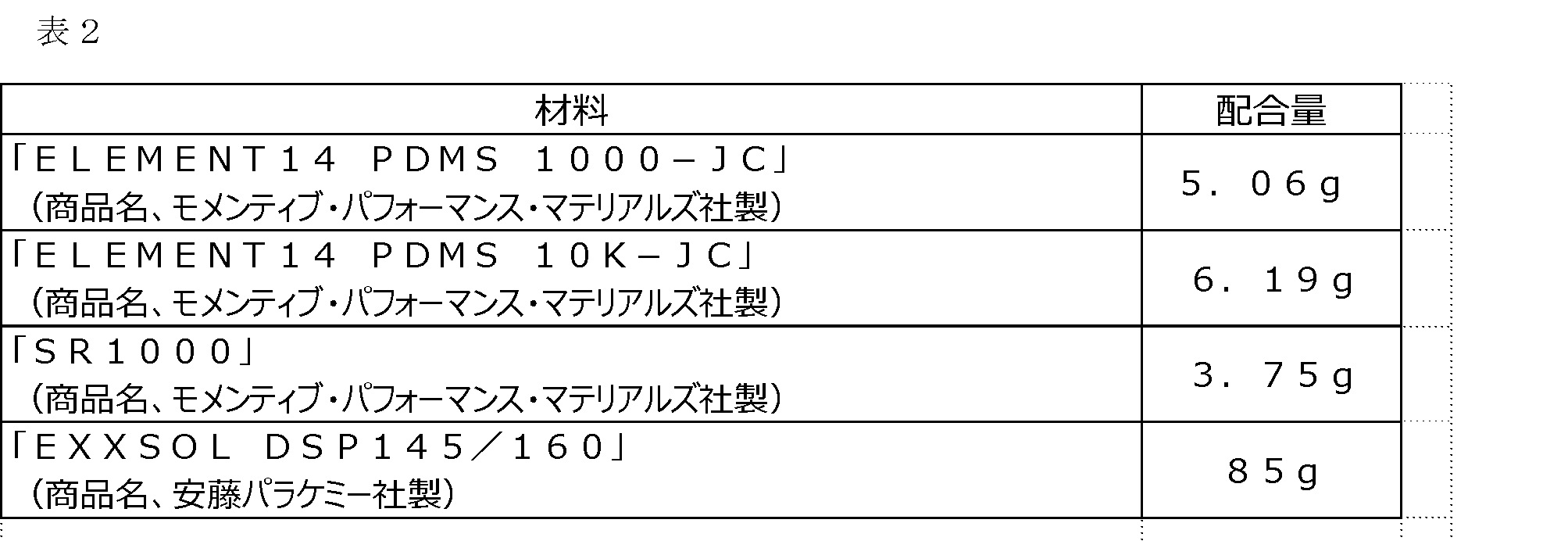
得られたポリウレタン成形体のリップ部先端側を切断して本実施例に係るワイパーブレードを得た。リップ部先端の厚み方向および長手方向の距離をそれぞれ0.6mm、450mmとした。得られたワイパーブレードは以下の方法によって評価した。
熱分解GC/MS(ガスクロマトグラフィー及び質量分析法)により、多官能アルコールの検出を行った。測定条件を以下に示す。
サンプリング位置:テーパー部の第1のテーパー面及び第2のテーパー面に、それぞれ第1のエッジ及び第2のエッジと平行に、第1のエッジ及び第2のエッジとの距離が0.5mmである線分を引いたと仮定したときに、線分の長さをL’とし、該線分上の一端側から1/8L’、1/2L’、7/8L’の点を各々、P0’、P1’、P2’とした。
該第1のテーパー面及び該第2のテーパー面の該P0’、該P1’及び該P2’の各々においてサンプリングされる試料を下記方法にて測定した。なお、サンプリングでは、ポリウレタンなどの部材をバイオカッターで切り取った。
装置:
・熱分解装置:商品名:EGA/PY-3030D、フロンティアラボ社製
・ガスクロマトグラフィー装置:TRACE1310ガスクロマトグラフ、サーモフィッシャーサイエンティフィック社製
・質量分析装置:ISQLT、サーモフィッシャーサイエンティフィック社製
・熱分解温度:500℃
・GCカラム:内径0.25mm×30m ステンレスキャピラリーカラム
・固定相 5%フェニルポリジメチルシロキサン
・昇温条件:50℃3分保持し、8℃/分で300℃まで昇温
・MS条件:質量数範囲 m/z10~650
・スキャン速度 1秒/スキャン
サンプルを、ガスクロマトグラフ(GC)を通さずにイオン源に直接導入する直接試料導入法(DI法)を用いてM1~M3の測定を行った。
装置としては、イオントラップ型GC/MS(商品名:POLARIS Q、サーモフィッシャーサイエンティフィック社製)を使用し、直接導入プローブとしては、ダイレクト・エクスポージャー・プローブ(Direct Exposure Probe、(DEP))を用いた。
テーパー部の第1のテーパー面及び第2のテーパー面に、それぞれ第1のエッジ及び第2のエッジと平行に、第1のエッジ及び第2のエッジとの距離が0.5mmである線分を引いたと仮定したときに、線分の長さをL’とし、該線分上の一端側から1/8L’、1/2L’、7/8L’の点を各々、P0’、P1’、P2’とした。
該第1のテーパー面及び該第2のテーパー面の該P0’、該P1’及び該P2’の各々においてサンプリングされる試料を下記方法にて測定した。なお、サンプリングでは、ポリウレタンなどの部材をバイオカッターで切り取った。
該第1のテーパー面及び該第2のテーパー面の該P0’、該P1’及び該P2’の各々においてサンプリングされた試料約0.1μgをプローブの先端に位置するフィラメントに固定し、イオン化チャンバーの中に直接挿入した。その後、一定の昇温速度(約10℃/s)で室温から1000℃まで急速に加熱し、気化したガスを質量分析計により検出した。
3官能以上の多官能イソシアネートに由来するm/z値の抽出イオンサーモグラムのピークの積分強度の合計をM2としたときに、該M1及びM2の値を用いて、(M2/M1)を算出した。また、ジイソシアネートに由来するm/z値の抽出イオンサーモグラムのピークの積分強度の合計をM3としたときに、該M1及びM3の値を用いて、(M3/M1)を算出した。そして、第1のテーパー面及び第2のテーパー面のそれぞれのP0’、P1’及びP2’の各々の試料から得られた数値の算術平均値を、第1のテーパー面及び第2のテーパー面のそれぞれの(M2/M1)及び(M3/M1)の値とした。

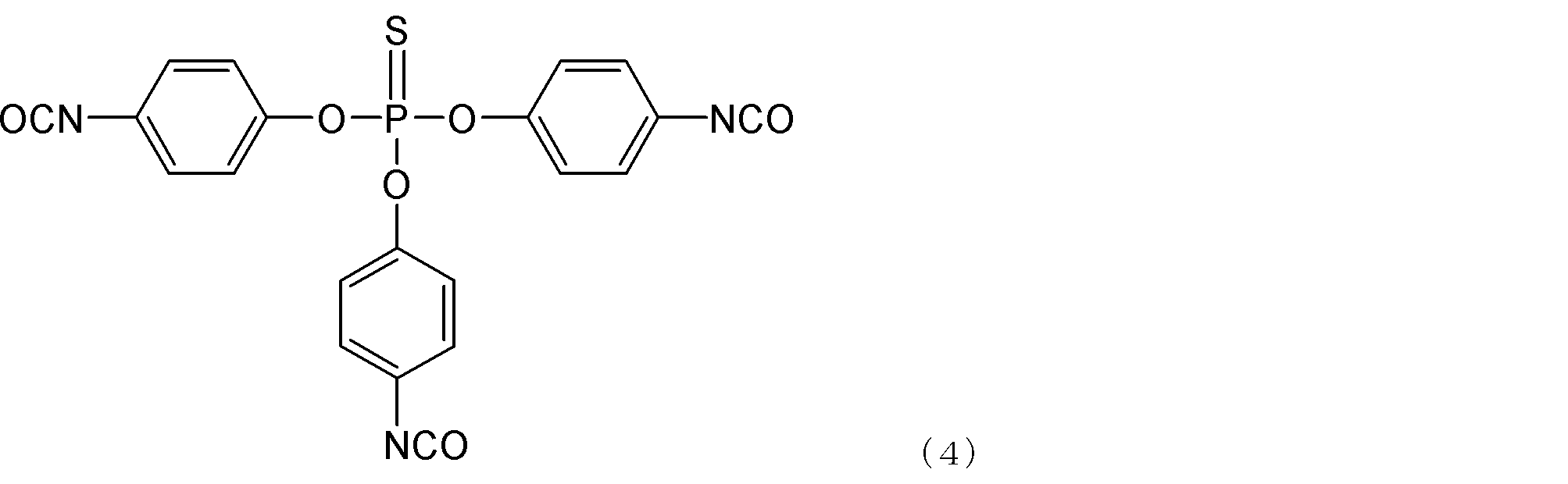
SPMによる弾性率は、走査型プローブ顕微鏡(SPM)(商品名:MFP-3D-Origin、オックスフォード・インストゥルメンツ社製)を用いて、以下の方法で測定した。
まず、サンプルを以下のようにして調製した。得られたワイパーブレードについて、図3に示すように、第1のテーパー面と先端面により形成される第1のエッジを設定し、第1のエッジと平行に、第1のエッジとの距離が10μmである、長さL1の第1の線分を引いたと仮定したときに、該線分上の一端側から1/8L、1/2L、7/8Lの各点P0、P1及びP2を重心とし、一辺が第1の線分と平行である2mm角の正方形の測定サンプルを3個切り出した。次いで、各測定サンプルから、クライオミクロトーム(UC-6(製品名)、ライカマイクロシステムズ社製)を用いて、P0、P1、P2を重心とし、一辺が第1の線分と平行な100μm角、厚みが1μmのポリウレタン薄片を-50℃の状態で切り出した。こうして3個の測定サンプルを調製した。得られた測定サンプルの各々を、平滑なシリコンウエハ上に載せ、室温25℃湿度50%の環境下に24時間放置した。
また、あらかじめカンチレバーのチューニングを実施し、カンチレバーの共振周波数を求めた(285KHz(1次)および1.60MHz(高次))。
SPMの測定モードはAM-FMモード、カンチレバーの自由振幅は3V、セットポイント振幅は2V(1次)および25mV(高次)とし、視野70μm×70μmのサイズにおいて、スキャン速度は1Hz、スキャン点数は縦256および横256の条件でスキャンを行い、位相像を取得した。なお、視野は、各測定サンプルのP0、P1及びP2が視野の中央に存在し、かつ、一辺が第1の線分と平行となる位置を選択した。
得られた位相像から、測定サンプルにおいて、フォースカーブ測定により弾性率測定を行う箇所を指定した。具体的には、図4及び図5に示したように、70μm×70μmの位相像における、P0、P1及びP2の各々の点を重心とする、一辺が第1の線分に平行な長さ70μmの辺であり、かつ、一辺が第1の線分に垂直に交わる長さ10μmの辺である長方形の領域の、縦横0.1μmピッチ(間隔)の70000点に相当する位置を測定箇所として指定した。
F=(4/3)E*R1/2d3/2
ここで、Fは、カンチレバーの折り返し時点におけるカンチレバーによってサンプルにえられた力、E*は複合弾性率、Rはカンチレバーの先端の曲率半径(8nm)、dは、カンチレバーの折り返し時点での試料の変形量である。
計算式(*2)
d=Δz-Dで算出した。
Δzは、カンチレバーの先端が試料に接したときから折り返すまでのピエゾ素子の変位量であり、Dはカンチレバーの折り返し時点におけるカンチレバーの反り量である。そして、Dは、下記計算式(*3)から算出した。
D=α・ΔVdeflection
計算式(*3)において、αは、カンチレバーの比例定数(インボルス定数)、ΔVdeflectionは、カンチレバーの試料に接触し始めてから折り返し時点までのディフレクション電圧の変化量を表す。
計算式(*4)
F=κ・D
κは、カンチレバーのバネ定数である。
ΔVdeflection及びΔzは実測値であるため、計算式(*1)~(*4)より、計算式(*1)中のE*を求めた。さらに、求める弾性率(ヤング率)Esは下記計算式(*5)から算出した。
1/E*=[(1-Vs2)/Es]-[(1-Vi2)/Ei]
Vs:試料のポアソン比(本実施例では、0.33で固定);
Vi:カンチレバー先端のポアソン比(本実施例では、ケイ素の値を使用);
Ei:カンチレバー先端のヤング率(本実施例では、ケイ素の値を使用)。
また、計210000点の弾性率から標準偏差を算出した。弾性率の値の平均値と標準偏差から下記式1により第1のテーパー面の弾性率の変動係数を算出した。
式(1):変動係数(%)=標準偏差/弾性率の値の平均値×100
日本産業規格(JIS)D5710:1998(自動車部品-ワイパーアーム及びワイパーブレード)に記載されている払拭性能試験の試験装置を用い、ワイパーブレードの払拭性の評価を行った。この試験は、ワイパーブレードを取り付け、被清掃部材であるガラス面に油膜を模した状態としてシリコーンオイル(商品名:KF-96-50cs、信越化学工業社製)を払拭面全体に塗布し、下記条件で清掃を行った。
ワイパーブレードを1往復させた後のガラス面上の拭き残り状態を清掃面の裏側より観察し、光沢ムラ、視界への影響を目視で確認した。結果を、ワイパーブレードにより払拭される面の面積に対するシリコーンオイル膜が除去された部分の面積の割合(以下、シリコーンオイル膜除去面積率(%)と称す)として算出した。
算出した油膜除去面積率から下記基準により払拭性能の評価を実施した。この結果を初期の払拭性能とする。さらに、下記耐久条件でワイパーブレードを往復させ、往復回数10万回及び50万回行った後、上記初期の払拭性能の評価と同様にして、耐久後の払拭性能の確認を行った。初期及び耐久後評価の結果をワイパーブレードの払拭性能として表3に示す。
ワイパーブレードに加える荷重:10N/m
ワイパーブレードの払拭往復速度:50回/分
〔耐久条件〕
水の塗布量:100~500mL/分
ワイパーブレードに加える荷重:18N/m
ワイパーブレードの払拭往復速度:50回/分
〔評価基準〕
ランクA:シリコーンオイル膜除去面積率が95%以上
ランクB:シリコーンオイル膜除去面積率が90%以上95%未満
ランクC:シリコーンオイル膜除去面積率が85%以上90%未満
ランクD:シリコーンオイル膜除去面積率が80%以上85%未満
ランクE:シリコーンオイル膜除去面積率が50%未満
プレポリマー用の各種材料の種類とその使用量、及び硬化剤用の各種材料の種類とその使用量を表3に記載した通りとした以外は実施例1と同様にしてワイパーブレードを作製し、評価した。
なお、実施例3においては、プレポリマー用の3官能以上の多官能イソシアネートとして、トリス(フェニルイソシアネート)チオホスフェート(商品名:ウルタイトスーパーCAII、東邦化成工業社製)(以下TPTIと称す)を使用した。
実施例5においては、プレポリマー用の3官能以上の多官能イソシアネートとして、ポリメリックMDI(商品名:ミリオネートMR-400、東ソー株式会社製)(以下MR400と称す)を使用した。
また、実施例6においては、硬化剤用の多官能アルコールとしてグリセリン(東京化成工業社製)を用いた。
プレポリマー用の各種材料の種類とその使用量、及び硬化剤用の各種材料の種類とその使用量を表4に記載した通りとした以外は実施例1と同様にしてワイパーブレードを作製し、評価した。
なお、実施例13においては、硬化剤用の多官能アルコールとして、トリメチロールプロパン(東京化成工業社製)(以下TMPと称す)を用いた。
実施例14においては、プレポリマー用の多官能イソシアネートとして、ポリメリックMDI(商品名:ミリオネートMR-200、東ソー社製)(以下、MR200と称す)を用いた。
また、実施例18においては、硬化剤用のポリオールとして、ポリブチレンアジペートポリエステルポリオール(商品名:ニッポラン4009、東ソー社製)(以下PBA1000と称す)を用いた。
さらに、実施例19においては、プレポリマー用のポリオールとして、数平均分子量2600のポリヘキシレンアジペートポリエステルポリオール(商品名:ニッポラン136、東ソー社製)(以下PHA2600と称す)を用いた。
プレポリマー用の各種材料の種類とその使用量、及び硬化剤用の各種材料の種類とその使用量を表5に示す通りとした以外は、実施例1と同様にしてワイパーブレードを作製し、評価した。
4,4’-MDIを304.0g、ポリメリックMDI(商品名:コスモネートM-200、三井化学社製)(以下M200と称す)を20.0g、数平均分子量2000のポリテトラメチレンエーテルグリコール(商品名:PTG-2000SN、保土谷化学工業社製)(以下PTG2000SNと称す)676.0gを80℃で3時間反応させ、NCO含量が7.9質量%のプレポリマーを調製した。
また、ペンタエリスリトールを39.6g、数平均分子量1000のポリテトラメチレンエーテルグリコール(商品名:PTG-1000SN、保土谷化学工業社製)(以下PTG1000SNと称す)を290.3g、Polycat46を0.13g、No.25を0.55g、混合して硬化剤を作製した。
上記で調製したプレポリマーと硬化剤とを混合して原料組成物を得た。そして、この原料組成物をワイパーブレード用成形金型内に注入し、温度130℃で6分間硬化させた。その後に脱型して、ポリウレタン成型体を得た。得られたポリウレタン成形体を実施例1と同様にして加工してワイパーブレードを作製し、評価した。
プレポリマー用の各種材料の種類とその使用量、及び硬化剤用の各種材料の種類とその使用量を表5~表6に示す通りとした以外は、実施例1と同様にしてワイパーブレードを作製し、評価した。
4,4’-MDIを349.5g、3官能以上の多官能イソシアネートを添加せず、数平均分子量2000のポリブチレンアジペートポリエステルポリオール(商品名:ニッポラン4010、東ソー社製)(以下PBA2000と称す)を650.5gとし、80℃で3時間反応させ、NCO含量が9.0質量%のプレポリマーを調製した。
また、1,4-BDを40.4g、グリセリンを5.0g、PHA1000を5.0g、Polycat46を0.05g、No.25を0.25gとし、混合して硬化剤を作製した。この硬化剤と、先に調製したプレポリマーとを混合して原料組成物を得た。この原料組成物をワイパーブレード用成形金型内に注入し、温度130℃で10分間硬化させた。その後に脱型して、温度130℃で60分間二次硬化を行って、ポリウレタン成形体を得た。得られたポリウレタン成形体を実施例1と同様にして加工してワイパーブレードを作製し、評価した。
プレポリマー用の各種材料の種類とその使用量、及び硬化剤用の各種材料の種類とその使用量を表6に示す通りとした以外は、実施例1と同様にしてワイパーブレードを作製した。次いで、このワイパーブレードのリップ部に対して、紫外線積算光量が492mJ/cm2となるように紫外線を照射して、本実施例に係るワイパーブレードを得た。なお、紫外線の光源としては、波長254nmに最大発光波長ピークを有する低圧水銀オゾンレスランプ(東芝ライテック社製)を用いた。このワイパーブレードを実施例1と同様に評価した。
プレポリマー用の各種材料の種類とその使用量、及び硬化剤用の各種材料の種類とその使用量を表6に示す通りとした以外は、実施例1と同様にしてワイパーブレードを作製した。また、得られたワイパーブレードに対して、積算光量を表6に示した値となるように変更した以外は実施例34と同様にして紫外線を照射して実施例35及び36に係るワイパーブレードを得た。これらのワイパーブレードを実施例1と同様にして評価した。
4,4’-MDIを296.6g、3官能以上の多官能イソシアネートを添加せず、PBA2000を703.4gとし、80℃で3時間反応させ、NCO含量が7.0質量%のプレポリマーを得た。
また、1,4-BDを52.0g、グリセリンを19.2g、PHA1000を添加せず、Polycat46を0.05g、No.25を0.25gとし、混合して硬化剤を作製した。この硬化剤と、先に調製したプレポリマーとを混合して原料組成物を得た。この原料組成物をワイパーブレード用成形金型内に注入し、温度130℃で10分間硬化させた。その後、脱型して、温度130℃で60分間二次硬化させてポリウレタン成形体を得た。得られたポリウレタン成形体を実施例1と同様にして加工してワイパーブレードを作製した。このワイパーブレードに対して、実施例34と同様にして紫外線を照射して本実施例に係るワイパーブレードを得た。但し、紫外線の照射は、積算光量が1968mJ/cm2となるように行った。得られたワイパーブレードを実施例1と同様にして評価した。
プレポリマー用の各種材料の種類とその使用量、及び硬化剤用の各種材料の種類とその使用量を表6に示す通りとした以外は、実施例1と同様にしてワイパーブレードを作製し、評価した。
プレポリマー用の各種材料の種類とその使用量、及び硬化剤用の各種材料の種類とその使用量を表6に示す通りとした以外は、実施例1と同様にしてワイパーブレードを作製した。また、得られたワイパーブレードに対して、積算光量を表6に示した値となるように変更した以外は実施例34と同様にして紫外線を照射して実施例39及び40に係るワイパーブレードを得た。これらのワイパーブレードを実施例1と同様にして評価した。
プレポリマー用の各種材料の種類とその使用量を表7に示す通りとした。これらの材料を混合して、温度80℃で3時間反応させてNCO含量が9.0質量%のプレポリマーを調製した。
また、表7に示した通りの硬化剤用の各種材料を表7に示す量で混合して硬化剤を調製した。上記のプレポリマーと硬化剤とを混合して原料組成物を得た。この原料組成物をワイパーブレード用成形金型内に注入し、温度130℃で10分間硬化させた。その後、脱型して、温度130℃で60分間二次硬化させてポリウレタン成形体を得た。得られたポリウレタン成形体を実施例1と同様にして加工して本実施例に係るワイパーブレードを作製した。得られたワイパーブレードを実施例1と同様に評価した。
プレポリマー用の各種材料の種類とその使用量を表7に示す通りとした以外は、実施例41と同様にしてプレポリマーを調製した。なお、実施例42に係るプレポリマーのNCO含量は8.2質量%、実施例43に係るプレポリマーのNCO含量は15.0質量%、実施例44に係るプレポリマーのNCO含量は18.0質量%であった。
また、硬化剤用の各種材料及びその使用量を表7に示す通りとした以外は実施例41と同様にして硬化剤を調製した。これらのプレポリマーおよび硬化剤を用いた以外は実施例41と同様にしてワイパーブレードを作製し、評価した。
実施例44で得られたワイパーブレードを、積算光量が表6に記載の値となるようにした以外は、実施例34と同様にして紫外線照射を行って実施例45及び46に係るワイパーブレードを得た。得られたワイパーブレードを実施例1と同様に評価した。
プレポリマー用の各種材料の種類とその使用量を表7に示す通りとした以外は、実施例41と同様にしてプレポリマーを調製した。なお、実施例47に係るプレポリマーのNCO含量は10.0質量%、実施例48に係るプレポリマーのNCO含量は9.6質量%、実施例49に係るプレポリマーのNCO含量は9.3質量%、実施例50に係るプレポリマーのNCO含量は9.2質量%であった。
また、硬化剤用の各種材料及びその使用量を表7に示す通りとした以外は実施例41と同様にして硬化剤を調製した。これらのプレポリマーおよび硬化剤を用いた以外は実施例41と同様にして実施例47~50に係るワイパーブレードを作製し、評価した。
実施例37と同様にして作製したワイパーブレードのリップ部の先端2mmを、温度80℃で溶解させた4,4’-MDIに1分間浸漬した。その後、酢酸ブチルを浸したスポンジを用いて、当該ワイパーブレードの浸漬部分の表面に付着した4,4’-MDIを拭き取った。その後、温度23℃、相対湿度50%の環境下で24時間エージングし、リップ部の先端に硬化領域を形成した。こうして、本実施例に係るワイパーブレードを得た。このワイパーブレードを実施例1と同様に評価した。
浸漬処理したワイパーブレードの表面に付着した4,4´-MDIを拭き取った後、温度100℃で30分加熱した以外は、実施例51と同様にして本実施例に係るワイパーブレードを作製した。このワイパーブレードを実施例1と同様にして評価した。
実施例4と同様にして作製したワイパーブレードについて、4,4´-MDIへの浸漬時間を3分とした以外は、実施例51と同様にして表面処理を行って本実施例に係るワイパーブレードを得た。このワイパーブレードを実施例1と同様に評価した。
浸漬処理したワイパーブレードの表面に付着した4,4´-MDIを拭き取った後、温度100℃で30分加熱した以外は、実施例53と同様にして本実施例に係るワイパーブレードを作製した。このワイパーブレードを実施例1と同様にして評価した。
プレポリマー用の各種材料の種類とその使用量を表9に示す通りとした。これらの材料を混合して、温度80℃で3時間反応させてNCO含量が14.0質量%のプレポリマーを調製した。また、表9に示した通りの硬化剤用の各種材料を表9に示す量で混合して硬化剤を調製した。上記のプレポリマーと硬化剤とを混合して原料組成物を得た。この原料組成物をワイパーブレード用成形金型内に注入し、温度130℃で10分間硬化させた。その後、脱型して、温度130℃で60分間二次硬化させてポリウレタン成形体を得た。得られたポリウレタン成形体を実施例1と同様にして加工して本実施例に係るワイパーブレードを作製した。得られたワイパーブレードを実施例1と同様に評価した。
プレポリマー用の各種材料の種類とその使用量を表9に示す通りとした以外は、比較例1と同様にしてNCO含量が9.0質量%のプレポリマーを調製した。また、硬化剤用の各種材料及びその使用量を表9に示す通りとした以外は比較例1と同様にして硬化剤を調製した。このプレポリマーおよび硬化剤を用いた以外は比較例1と同様にして本比較例に係るワイパーブレードを作製し、評価した。
プレポリマー用の各種材料の種類とその使用量を表9に示す通りとした以外は、比較例1と同様にしてNCO含量が7.0質量%のプレポリマーを調製した。また、硬化剤用の各種材料及びその使用量を表9に示す通りとした以外は比較例1と同様にして硬化剤を調製した。このプレポリマーおよび硬化剤を用いた以外は比較例1と同様にしてワイパーブレードを作製した。得られたワイパーブレードに、積算光量を8200mJ/cm2とした以外は、実施例34と同様にして紫外線を照射して本比較例に係るワイパーブレードを得た。得られたワイパーブレードを実施例1と同様に評価した。
天然ゴム100質量部に対し、
カーボンブラック(商品名:トーカブラック#7360SB、東海カーボン社製)を48.0質量部、酸化亜鉛(商品名:亜鉛華2種、堺化学工業社製)を5.0質量部、ステアリン酸亜鉛(商品名:SZ-2000、堺化学工業社製)を1.0質量部、炭酸カルシウム(商品名:ナノックス#30、丸尾カルシウム社製)を20質量部加えて、50℃に調節した密閉型ミキサーにて15分間混練した。これに、加硫剤として硫黄を1.2質量部及びテトラベンジルチウラムスルフィド(TBzTD)(商品名:パーカシットTBzTD、フレキンス社製)を4.5質量部添加した。次いで、温度25℃に冷却した二本ロール機にて10分間混練して、ゴム組成物を得た。得られたゴム組成物をワイパーブレード用成形金型内に入れ、温度170℃で20分間加熱して加硫させた。その後に脱型して、本比較例に係るワイパーブレードを得た。得られたワイパーブレードを実施例1と同様に評価した。


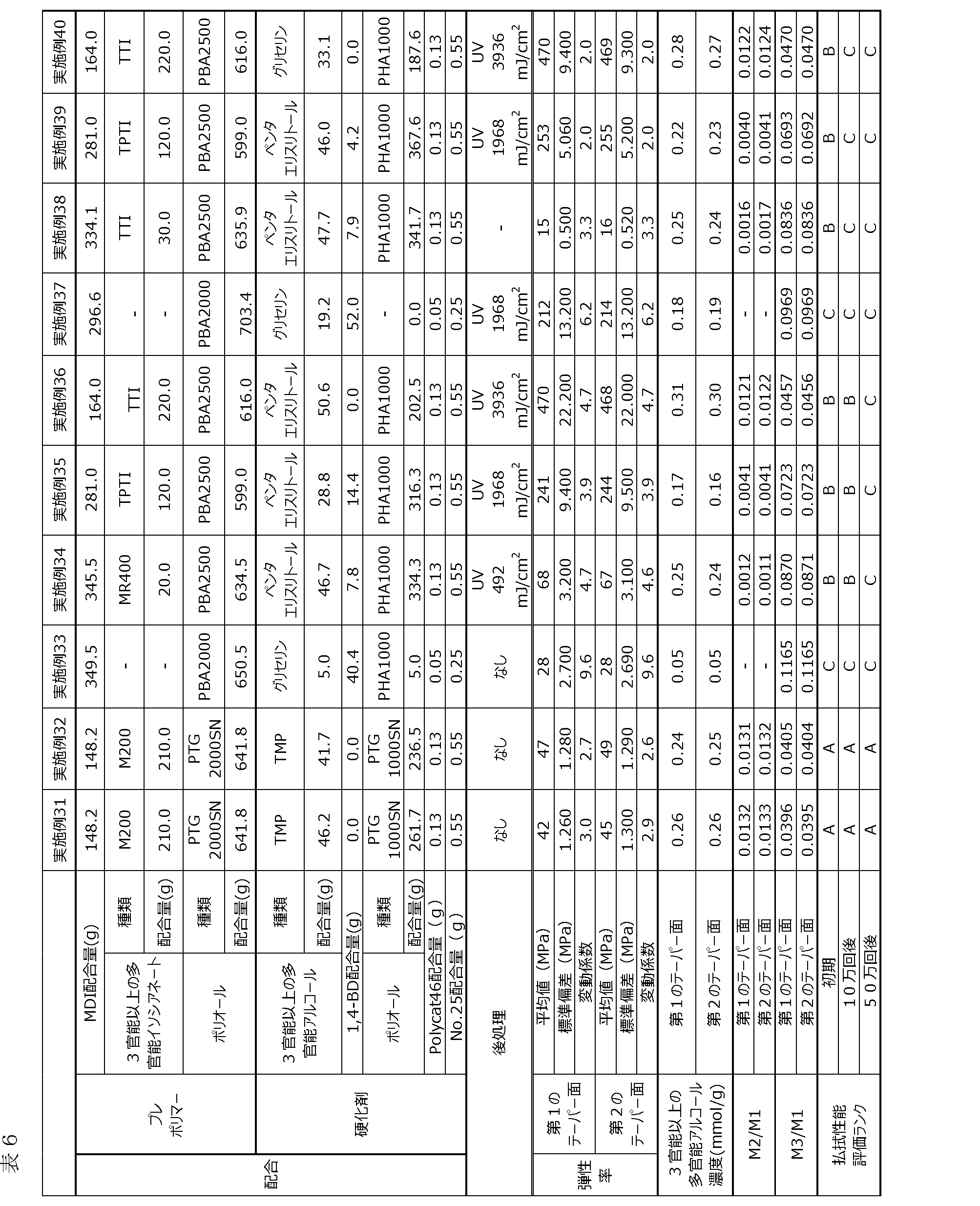


本願は、2020年7月31日提出の日本国特許出願特願2020-130825号、2021年4月30日提出の日本国特許出願特願2021-077293号および2021年6月28日提出の日本国特許出願特願2021-106577号を基礎として優先権を主張するものであり、その記載内容の全てをここに援用する。
Claims (10)
- 車両のウインドシールドのワイパー装置用の車両用ワイパーブレードであって、
ブレード支持部と、
該ブレード支持部にネックを介して揺動可能に連結されてなるリップ部と、を具備し、
該リップ部は、ワイパーブレードの長手方向に直交する方向の断面が、該ブレード支持部に近い側から該ブレード支持部から離れる方向に向かう幅が漸減するテーパー部を有し、
該リップ部は、
該テーパー部を構成する第1のテーパー面及び第2のテーパー面と、
該第1のテーパー面及び該第2のテーパー面と共に、該リップ部の該ブレード支持部から最も離れた側に第1のエッジ及び第2のエッジを構成する先端面と、を有し、
該第1のテーパー面に、該第1のエッジと平行に、該第1のエッジからの距離が10μmである第1の線分を引いたと仮定したとき、
該第1の線分の長さをL1とし、
該第1の線分上の一端側から(1/8)L1、(1/2)L1、(7/8)L1の点を各々、P0、P1、P2とし、
該第1のテーパー面の、該P0、該P1及び該P2の各々の点を重心とする、一辺が該第1の線分に平行な長さ70μmの辺であり、かつ、一辺が該第1の線分に垂直に交わる長さ10μmの辺である長方形の観察領域の3つの各々について、0.1μmピッチで各70000点の該第1のテーパー面の弾性率を、走査型プローブ顕微鏡を用いて測定したときに得られる計210000個の弾性率の値の平均値が15MPa~470MPaであり、かつ、該弾性率の変動係数は17.6%以下であり、
該第2のテーパー面に、該第2のエッジと平行に、該第2のエッジからの距離が10μmである第2の線分を引いたと仮定したとき、
該第2の線分の長さをL2とし、
該第2の線分上の一端側から(1/8)L2、(1/2)L2、(7/8)L2の点を各々、P3、P4、P5とし、
該第2のテーパー面の、該P3、該P4及び該P5の各々の点を重心とする、一辺が該第2の線分に平行な長さ70μmの辺であり、かつ、一辺が該第2の線分に垂直に交わる長さ10μmの辺である長方形の観察領域の3つの各々について0.1μmピッチで各70000点の該第2のテーパー面の弾性率を、走査型プローブ顕微鏡を用いて測定したときに得られる計210000個の弾性率の値の平均値が15MPa~470MPaであり、かつ、該弾性率の変動係数は17.6%以下であることを特徴とする車両用のワイパーブレード。 - 前記テーパー部は、ポリウレタンを含有し、
該ポリウレタンは、3官能以上の多官能アルコールを含むアルコール、及び、3官能以上の多官能イソシアネートを含むイソシアネート化合物の少なくとも一方を含む原料組成物の反応物を含む、請求項1に記載の車両用のワイパーブレード。 - 前記アルコールが、更にジオールを含む請求項2に記載の車両用のワイパーブレード。
- 前記イソシアネート化合物が、更にジイソシアネートを含む請求項2又は3に記載の車両用のワイパーブレード。
- 前記テーパー部の前記第1のテーパー面及び前記第2のテーパー面に、それぞれ前記第1のエッジ及び前記第2のエッジと平行に、前記第1のエッジ及び前記第2のエッジとの距離が0.5mmである線分を引いたと仮定したときに、線分の長さをL’とし、該線分上の一端側から1/8L’、1/2L’、7/8L’の点を各々、P0’、P1’、P2’とし、
前記第1のテーパー面及び前記第2のテーパー面の該P0’、該P1’及び該P2’の各々においてサンプリングされる試料を、イオン化室内で加熱気化させ、試料分子をイオン化する直接試料導入方式の質量分析計を用いて、昇温速度10℃/s、1000℃まで加熱したときに得られる、
全てのイオンの検出量をM1とし、
前記3官能以上の多官能イソシアネートに由来するm/z値の範囲に対応する抽出イオンサーモグラムのピークの積分強度をM2とし、
前記ジイソシアネートに由来するm/z値の範囲に対応する抽出イオンサーモグラムのピークの積分強度をM3としたときに、
前記第1のテーパー面において、M2/M1が0.0010~0.0150であり、M3/M1が0.0200~0.1100であり、
前記第2のテーパー面において、M2/M1が0.0010~0.0150であり、M3/M1が0.0200~0.1100である請求項4に記載の車両用のワイパーブレード。 - 前記テーパー部の前記第1のテーパー面及び前記第2のテーパー面に、それぞれ前記第1のエッジ及び前記第2のエッジと平行に、前記第1のエッジ及び前記第2のエッジとの距離が0.5mmである線分を引いたと仮定したときに、線分の長さをL’とし、該線分上の一端側から1/8L’、1/2L’、7/8L’の点を各々、P0’、P1’、P2’とし、
前記第1のテーパー面及び前記第2のテーパー面の該P0’、該P1’及び該P2’の各々においてサンプリングされる試料を、熱分解GC/MSにより測定したとき、
前記第1のテーパー面において、ポリウレタン中の3官能以上の多官能アルコールの濃度が、0.04mmol/g~0.39mmol/gであり、
前記第2のテーパー面において、ポリウレタン中の3官能以上の多官能アルコールの濃度が、0.04mmol/g~0.39mmol/gである請求項2~5のいずれか一項に記載の車両用のワイパーブレード。 - 前記3官能以上の多官能アルコールが、トリメチロールプロパン及びグリセリンからなる群から選択される少なくとも一を含む請求項2~6のいずれか一項に記載の車両用のワイパーブレード。
- 前記3官能以上の多官能イソシアネートが、トリフェニルメタン-4,4’,4’’-トリイソシアネート(TTI)、トリス(フェニルイソシアネート)チオホスフェート(TPTI)及びポリメリックMDIからなる群から選択される少なくとも一である請求項2~7のいずれか一項に記載の車両用のワイパーブレード。
- 前記第1のテーパー面の弾性率の測定において、
前記弾性率の値の平均値が、32MPa以上62MPa以下であり、
前記第2のテーパー面の弾性率の測定において、
前記弾性率の値の平均値が、32MPa以上62MPa以下である請求項1~8のいずれか一項に記載の車両用のワイパーブレード。 - 前記第1のテーパー面の弾性率の測定において、
前記弾性率の変動係数が、6.0%以下であり、
前記第2のテーパー面の弾性率の測定において、
前記弾性率の変動係数が、6.0%以下である請求項1~9のいずれか一項に記載の車両用のワイパーブレード。
Priority Applications (3)
| Application Number | Priority Date | Filing Date | Title |
|---|---|---|---|
| EP21850150.0A EP4190835A4 (en) | 2020-07-31 | 2021-07-30 | WIPER BLADE FOR A VEHICLE |
| CN202180058814.9A CN116057099B (zh) | 2020-07-31 | 2021-07-30 | 车辆用擦拭器刮片 |
| US18/158,617 US11945414B2 (en) | 2020-07-31 | 2023-01-24 | Vehicle windshield wiper blade |
Applications Claiming Priority (6)
| Application Number | Priority Date | Filing Date | Title |
|---|---|---|---|
| JP2020130825 | 2020-07-31 | ||
| JP2020-130825 | 2020-07-31 | ||
| JP2021077293 | 2021-04-30 | ||
| JP2021-077293 | 2021-04-30 | ||
| JP2021106577A JP7739065B2 (ja) | 2020-07-31 | 2021-06-28 | 車両用ワイパーブレード |
| JP2021-106577 | 2021-06-28 |
Related Child Applications (1)
| Application Number | Title | Priority Date | Filing Date |
|---|---|---|---|
| US18/158,617 Continuation US11945414B2 (en) | 2020-07-31 | 2023-01-24 | Vehicle windshield wiper blade |
Publications (1)
| Publication Number | Publication Date |
|---|---|
| WO2022025273A1 true WO2022025273A1 (ja) | 2022-02-03 |
Family
ID=80036410
Family Applications (1)
| Application Number | Title | Priority Date | Filing Date |
|---|---|---|---|
| PCT/JP2021/028414 Ceased WO2022025273A1 (ja) | 2020-07-31 | 2021-07-30 | 車両用ワイパーブレード |
Country Status (4)
| Country | Link |
|---|---|
| US (1) | US11945414B2 (ja) |
| EP (1) | EP4190835A4 (ja) |
| CN (1) | CN116057099B (ja) |
| WO (1) | WO2022025273A1 (ja) |
Cited By (4)
| Publication number | Priority date | Publication date | Assignee | Title |
|---|---|---|---|---|
| US11945414B2 (en) | 2020-07-31 | 2024-04-02 | Canon Kabushiki Kaisha | Vehicle windshield wiper blade |
| US12410275B2 (en) | 2020-07-31 | 2025-09-09 | Canon Kabushiki Kaisha | Vehicle wiper blade |
| US12484743B2 (en) | 2020-07-31 | 2025-12-02 | Canon Kabushiki Kaisha | Cleaning wiper blade |
| US12527446B2 (en) | 2020-07-31 | 2026-01-20 | Canon Kabushiki Kaisha | Wiper blade |
Families Citing this family (3)
| Publication number | Priority date | Publication date | Assignee | Title |
|---|---|---|---|---|
| WO2022255184A1 (ja) * | 2021-06-04 | 2022-12-08 | キヤノン株式会社 | 清掃部材及び弾性部材 |
| EP4454956A4 (en) * | 2021-12-24 | 2025-12-17 | Canon Kk | WIPER DEVICE |
| EP4644448A1 (en) * | 2024-05-03 | 2025-11-05 | Covestro Deutschland AG | Composition comprising prepolymers |
Citations (7)
| Publication number | Priority date | Publication date | Assignee | Title |
|---|---|---|---|---|
| JP2004243917A (ja) * | 2003-02-14 | 2004-09-02 | Yokohama Rubber Co Ltd:The | ワイパブレードの設計方法およびワイパブレード |
| JP2007253855A (ja) * | 2006-03-24 | 2007-10-04 | Ichikoh Ind Ltd | ワイパーブレード |
| WO2019176659A1 (ja) * | 2018-03-13 | 2019-09-19 | 株式会社クラレ | ウレタン組成物 |
| JP2020130825A (ja) | 2019-02-25 | 2020-08-31 | 株式会社三共 | 遊技機 |
| JP2021077293A (ja) | 2019-11-13 | 2021-05-20 | 邦久 大野 | コンピュータプログラム及び情報処理方法 |
| JP2021092756A (ja) * | 2019-12-04 | 2021-06-17 | キヤノン株式会社 | 電子写真用クリーニングブレード、プロセスカートリッジ、及び電子写真画像形成装置 |
| JP2021106577A (ja) | 2019-12-27 | 2021-07-29 | アサヒビール株式会社 | ビール様発泡性飲料 |
Family Cites Families (24)
| Publication number | Priority date | Publication date | Assignee | Title |
|---|---|---|---|---|
| JPS5777241A (en) * | 1980-10-30 | 1982-05-14 | Toyoda Gosei Co Ltd | Wiper blade |
| JPH0134911Y2 (ja) * | 1984-10-11 | 1989-10-24 | ||
| US4719247A (en) * | 1987-02-10 | 1988-01-12 | Ici Americas Inc. | Deformable polyurethane having improved cure time |
| DE19609578A1 (de) * | 1996-03-12 | 1997-09-18 | Bosch Gmbh Robert | Wischblatt für Scheiben von Kraftfahrzeugen |
| JP3086888B2 (ja) * | 1997-07-17 | 2000-09-11 | 株式会社ソフト九九コーポレーション | 車両用ワイパーブレード及び車両ウインドガラスの水滴払拭方法 |
| US20030138655A1 (en) * | 1999-11-29 | 2003-07-24 | Jiro Watanabe | Wiper blade |
| JPWO2003020558A1 (ja) * | 2001-08-30 | 2004-12-16 | 信越ポリマー株式会社 | ワイパーブレード及びその製造方法 |
| WO2003106233A1 (en) * | 2002-06-14 | 2003-12-24 | Trico Products Corporation | Wiper blade |
| JP2004051894A (ja) * | 2002-07-23 | 2004-02-19 | Nippon Polyurethane Ind Co Ltd | 車両用ワイパーブレード |
| JP2004231058A (ja) * | 2003-01-30 | 2004-08-19 | Yokohama Rubber Co Ltd:The | ワイパーブレード |
| DE102007039563A1 (de) * | 2007-08-22 | 2009-02-26 | Robert Bosch Gmbh | Wischblatt |
| JP2009067233A (ja) * | 2007-09-13 | 2009-04-02 | Mitsuba Corp | ワイパブレードラバーおよびその製造方法 |
| DE102008001395A1 (de) | 2008-04-25 | 2009-10-29 | Robert Bosch Gmbh | Wischgummi für Wischblätter von Scheibenwischern |
| JP5894038B2 (ja) * | 2012-08-30 | 2016-03-23 | 信越ポリマー株式会社 | ワイパーブレード及びその製造方法 |
| KR20140115828A (ko) * | 2013-03-22 | 2014-10-01 | 현대자동차주식회사 | 스크래치 자가복원 도료 조성물 |
| JP6800626B2 (ja) | 2015-07-02 | 2020-12-16 | キヤノン株式会社 | クリーニングブレード、プロセスカートリッジ及び電子写真画像形成装置 |
| US9996047B2 (en) | 2016-01-22 | 2018-06-12 | Canon Kabushiki Kaisha | Cleaning blade, process cartridge, and electrophotographic image forming apparatus |
| US10088795B2 (en) | 2016-10-31 | 2018-10-02 | Canon Kabushiki Kaisha | Cleaning blade, process cartridge, and electrophotographic image forming apparatus |
| CN111046604A (zh) * | 2019-12-03 | 2020-04-21 | 衢州职业技术学院 | 汽车雨刮器刮片结构优化设计方法及雨刮器 |
| WO2021112123A1 (ja) | 2019-12-04 | 2021-06-10 | キヤノン株式会社 | 電子写真用クリーニングブレード、プロセスカートリッジ、及び電子写真画像形成装置 |
| EP4190216A4 (en) | 2020-07-31 | 2024-09-04 | Canon Kabushiki Kaisha | WIPER BLADE FOR CLEANING |
| EP4190217A4 (en) | 2020-07-31 | 2024-09-04 | Canon Kabushiki Kaisha | CLEANING WIPER BLADE |
| WO2022025267A1 (ja) | 2020-07-31 | 2022-02-03 | キヤノン株式会社 | 車両用ワイパーブレード |
| EP4190835A4 (en) | 2020-07-31 | 2024-09-04 | Canon Kabushiki Kaisha | WIPER BLADE FOR A VEHICLE |
-
2021
- 2021-07-30 EP EP21850150.0A patent/EP4190835A4/en active Pending
- 2021-07-30 WO PCT/JP2021/028414 patent/WO2022025273A1/ja not_active Ceased
- 2021-07-30 CN CN202180058814.9A patent/CN116057099B/zh active Active
-
2023
- 2023-01-24 US US18/158,617 patent/US11945414B2/en active Active
Patent Citations (7)
| Publication number | Priority date | Publication date | Assignee | Title |
|---|---|---|---|---|
| JP2004243917A (ja) * | 2003-02-14 | 2004-09-02 | Yokohama Rubber Co Ltd:The | ワイパブレードの設計方法およびワイパブレード |
| JP2007253855A (ja) * | 2006-03-24 | 2007-10-04 | Ichikoh Ind Ltd | ワイパーブレード |
| WO2019176659A1 (ja) * | 2018-03-13 | 2019-09-19 | 株式会社クラレ | ウレタン組成物 |
| JP2020130825A (ja) | 2019-02-25 | 2020-08-31 | 株式会社三共 | 遊技機 |
| JP2021077293A (ja) | 2019-11-13 | 2021-05-20 | 邦久 大野 | コンピュータプログラム及び情報処理方法 |
| JP2021092756A (ja) * | 2019-12-04 | 2021-06-17 | キヤノン株式会社 | 電子写真用クリーニングブレード、プロセスカートリッジ、及び電子写真画像形成装置 |
| JP2021106577A (ja) | 2019-12-27 | 2021-07-29 | アサヒビール株式会社 | ビール様発泡性飲料 |
Non-Patent Citations (1)
| Title |
|---|
| See also references of EP4190835A4 |
Cited By (4)
| Publication number | Priority date | Publication date | Assignee | Title |
|---|---|---|---|---|
| US11945414B2 (en) | 2020-07-31 | 2024-04-02 | Canon Kabushiki Kaisha | Vehicle windshield wiper blade |
| US12410275B2 (en) | 2020-07-31 | 2025-09-09 | Canon Kabushiki Kaisha | Vehicle wiper blade |
| US12484743B2 (en) | 2020-07-31 | 2025-12-02 | Canon Kabushiki Kaisha | Cleaning wiper blade |
| US12527446B2 (en) | 2020-07-31 | 2026-01-20 | Canon Kabushiki Kaisha | Wiper blade |
Also Published As
| Publication number | Publication date |
|---|---|
| US20230159001A1 (en) | 2023-05-25 |
| EP4190835A1 (en) | 2023-06-07 |
| CN116057099B (zh) | 2025-03-07 |
| US11945414B2 (en) | 2024-04-02 |
| CN116057099A (zh) | 2023-05-02 |
| EP4190835A4 (en) | 2024-09-04 |
Similar Documents
| Publication | Publication Date | Title |
|---|---|---|
| CN116057099B (zh) | 车辆用擦拭器刮片 | |
| CN116033856B (zh) | 清洁用擦拭器刮片 | |
| CN116057096B (zh) | 车辆用擦拭器刮片 | |
| EP4071555B1 (en) | Electrophotographic cleaning blade, process cartridge, and electrophotographic image forming device | |
| US10088795B2 (en) | Cleaning blade, process cartridge, and electrophotographic image forming apparatus | |
| WO2022025246A1 (ja) | 清掃用ワイパーブレード | |
| JP7739065B2 (ja) | 車両用ワイパーブレード | |
| JP7725259B2 (ja) | 清掃用ワイパーブレード | |
| JP7746177B2 (ja) | ワイパー装置 | |
| US20240359660A1 (en) | Wiper device | |
| CN118451011A (zh) | 擦拭器装置 | |
| JP6800697B2 (ja) | クリーニングブレード、プロセスカートリッジ及び電子写真画像形成装置 | |
| JP7739067B2 (ja) | 車両用ワイパーブレード | |
| US20250313679A1 (en) | Regeneration method of blade rubber and manufacturing method of regenerated blade rubber | |
| JP7793307B2 (ja) | 清掃用ワイパーブレード | |
| JP2024091496A (ja) | ブレードラバーの再生方法及び再生ブレードラバーの製造方法 | |
| CN120418132A (zh) | 刮板橡胶、擦拭器刮板和擦拭器装置以及聚氨酯成形体 | |
| JP2025177805A (ja) | ブレードラバー、ワイパーブレード及びワイパー装置 | |
| US20250362639A1 (en) | Electrophotographic cleaning blade, process cartridge and electrophotographic image forming apparatus | |
| JP2024080597A (ja) | ブレードラバー、ワイパーブレード及びワイパー装置、並びにウレタン成形体 |
Legal Events
| Date | Code | Title | Description |
|---|---|---|---|
| 121 | Ep: the epo has been informed by wipo that ep was designated in this application |
Ref document number: 21850150 Country of ref document: EP Kind code of ref document: A1 |
|
| WWE | Wipo information: entry into national phase |
Ref document number: 2021850150 Country of ref document: EP |
|
| ENP | Entry into the national phase |
Ref document number: 2021850150 Country of ref document: EP Effective date: 20230228 |
|
| NENP | Non-entry into the national phase |
Ref country code: DE |
|
| WWG | Wipo information: grant in national office |
Ref document number: 202180058814.9 Country of ref document: CN |