WO2022030106A1 - 積層体および二次成形品 - Google Patents
積層体および二次成形品 Download PDFInfo
- Publication number
- WO2022030106A1 WO2022030106A1 PCT/JP2021/022386 JP2021022386W WO2022030106A1 WO 2022030106 A1 WO2022030106 A1 WO 2022030106A1 JP 2021022386 W JP2021022386 W JP 2021022386W WO 2022030106 A1 WO2022030106 A1 WO 2022030106A1
- Authority
- WO
- WIPO (PCT)
- Prior art keywords
- carbon nanotubes
- less
- antistatic
- laminate according
- resin
- Prior art date
- Legal status (The legal status is an assumption and is not a legal conclusion. Google has not performed a legal analysis and makes no representation as to the accuracy of the status listed.)
- Ceased
Links
Images
Classifications
-
- C—CHEMISTRY; METALLURGY
- C08—ORGANIC MACROMOLECULAR COMPOUNDS; THEIR PREPARATION OR CHEMICAL WORKING-UP; COMPOSITIONS BASED THEREON
- C08J—WORKING-UP; GENERAL PROCESSES OF COMPOUNDING; AFTER-TREATMENT NOT COVERED BY SUBCLASSES C08B, C08C, C08F, C08G or C08H
- C08J7/00—Chemical treatment or coating of shaped articles made of macromolecular substances
- C08J7/04—Coating
- C08J7/044—Forming conductive coatings; Forming coatings having anti-static properties
-
- C—CHEMISTRY; METALLURGY
- C01—INORGANIC CHEMISTRY
- C01B—NON-METALLIC ELEMENTS; COMPOUNDS THEREOF; METALLOIDS OR COMPOUNDS THEREOF NOT COVERED BY SUBCLASS C01C
- C01B32/00—Carbon; Compounds thereof
- C01B32/15—Nano-sized carbon materials
- C01B32/158—Carbon nanotubes
-
- C—CHEMISTRY; METALLURGY
- C08—ORGANIC MACROMOLECULAR COMPOUNDS; THEIR PREPARATION OR CHEMICAL WORKING-UP; COMPOSITIONS BASED THEREON
- C08J—WORKING-UP; GENERAL PROCESSES OF COMPOUNDING; AFTER-TREATMENT NOT COVERED BY SUBCLASSES C08B, C08C, C08F, C08G or C08H
- C08J7/00—Chemical treatment or coating of shaped articles made of macromolecular substances
- C08J7/04—Coating
- C08J7/0427—Coating with only one layer of a composition containing a polymer binder
-
- C—CHEMISTRY; METALLURGY
- C08—ORGANIC MACROMOLECULAR COMPOUNDS; THEIR PREPARATION OR CHEMICAL WORKING-UP; COMPOSITIONS BASED THEREON
- C08K—Use of inorganic or non-macromolecular organic substances as compounding ingredients
- C08K3/00—Use of inorganic substances as compounding ingredients
- C08K3/02—Elements
- C08K3/04—Carbon
- C08K3/041—Carbon nanotubes
-
- C—CHEMISTRY; METALLURGY
- C09—DYES; PAINTS; POLISHES; NATURAL RESINS; ADHESIVES; COMPOSITIONS NOT OTHERWISE PROVIDED FOR; APPLICATIONS OF MATERIALS NOT OTHERWISE PROVIDED FOR
- C09D—COATING COMPOSITIONS, e.g. PAINTS, VARNISHES OR LACQUERS; FILLING PASTES; CHEMICAL PAINT OR INK REMOVERS; INKS; CORRECTING FLUIDS; WOODSTAINS; PASTES OR SOLIDS FOR COLOURING OR PRINTING; USE OF MATERIALS THEREFOR
- C09D133/00—Coating compositions based on homopolymers or copolymers of compounds having one or more unsaturated aliphatic radicals, each having only one carbon-to-carbon double bond, and at least one being terminated by only one carboxyl radical, or of salts, anhydrides, esters, amides, imides, or nitriles thereof; Coating compositions based on derivatives of such polymers
- C09D133/04—Homopolymers or copolymers of esters
- C09D133/06—Homopolymers or copolymers of esters of esters containing only carbon, hydrogen and oxygen, the oxygen atom being present only as part of the carboxyl radical
-
- C—CHEMISTRY; METALLURGY
- C09—DYES; PAINTS; POLISHES; NATURAL RESINS; ADHESIVES; COMPOSITIONS NOT OTHERWISE PROVIDED FOR; APPLICATIONS OF MATERIALS NOT OTHERWISE PROVIDED FOR
- C09D—COATING COMPOSITIONS, e.g. PAINTS, VARNISHES OR LACQUERS; FILLING PASTES; CHEMICAL PAINT OR INK REMOVERS; INKS; CORRECTING FLUIDS; WOODSTAINS; PASTES OR SOLIDS FOR COLOURING OR PRINTING; USE OF MATERIALS THEREFOR
- C09D5/00—Coating compositions, e.g. paints, varnishes or lacquers, characterised by their physical nature or the effects produced; Filling pastes
- C09D5/24—Electrically-conducting paints
-
- C—CHEMISTRY; METALLURGY
- C09—DYES; PAINTS; POLISHES; NATURAL RESINS; ADHESIVES; COMPOSITIONS NOT OTHERWISE PROVIDED FOR; APPLICATIONS OF MATERIALS NOT OTHERWISE PROVIDED FOR
- C09D—COATING COMPOSITIONS, e.g. PAINTS, VARNISHES OR LACQUERS; FILLING PASTES; CHEMICAL PAINT OR INK REMOVERS; INKS; CORRECTING FLUIDS; WOODSTAINS; PASTES OR SOLIDS FOR COLOURING OR PRINTING; USE OF MATERIALS THEREFOR
- C09D7/00—Features of coating compositions, not provided for in group C09D5/00; Processes for incorporating ingredients in coating compositions
- C09D7/40—Additives
- C09D7/60—Additives non-macromolecular
- C09D7/61—Additives non-macromolecular inorganic
-
- C—CHEMISTRY; METALLURGY
- C09—DYES; PAINTS; POLISHES; NATURAL RESINS; ADHESIVES; COMPOSITIONS NOT OTHERWISE PROVIDED FOR; APPLICATIONS OF MATERIALS NOT OTHERWISE PROVIDED FOR
- C09D—COATING COMPOSITIONS, e.g. PAINTS, VARNISHES OR LACQUERS; FILLING PASTES; CHEMICAL PAINT OR INK REMOVERS; INKS; CORRECTING FLUIDS; WOODSTAINS; PASTES OR SOLIDS FOR COLOURING OR PRINTING; USE OF MATERIALS THEREFOR
- C09D7/00—Features of coating compositions, not provided for in group C09D5/00; Processes for incorporating ingredients in coating compositions
- C09D7/40—Additives
- C09D7/70—Additives characterised by shape, e.g. fibres, flakes or microspheres
-
- H—ELECTRICITY
- H01—ELECTRIC ELEMENTS
- H01B—CABLES; CONDUCTORS; INSULATORS; SELECTION OF MATERIALS FOR THEIR CONDUCTIVE, INSULATING OR DIELECTRIC PROPERTIES
- H01B1/00—Conductors or conductive bodies characterised by the conductive materials; Selection of materials as conductors
- H01B1/04—Conductors or conductive bodies characterised by the conductive materials; Selection of materials as conductors mainly consisting of carbon-silicon compounds, carbon or silicon
-
- B—PERFORMING OPERATIONS; TRANSPORTING
- B82—NANOTECHNOLOGY
- B82Y—SPECIFIC USES OR APPLICATIONS OF NANOSTRUCTURES; MEASUREMENT OR ANALYSIS OF NANOSTRUCTURES; MANUFACTURE OR TREATMENT OF NANOSTRUCTURES
- B82Y30/00—Nanotechnology for materials or surface science, e.g. nanocomposites
-
- C—CHEMISTRY; METALLURGY
- C08—ORGANIC MACROMOLECULAR COMPOUNDS; THEIR PREPARATION OR CHEMICAL WORKING-UP; COMPOSITIONS BASED THEREON
- C08J—WORKING-UP; GENERAL PROCESSES OF COMPOUNDING; AFTER-TREATMENT NOT COVERED BY SUBCLASSES C08B, C08C, C08F, C08G or C08H
- C08J2333/00—Characterised by the use of homopolymers or copolymers of compounds having one or more unsaturated aliphatic radicals, each having only one carbon-to-carbon double bond, and only one being terminated by only one carboxyl radical, or of salts, anhydrides, esters, amides, imides, or nitriles thereof; Derivatives of such polymers
- C08J2333/04—Characterised by the use of homopolymers or copolymers of compounds having one or more unsaturated aliphatic radicals, each having only one carbon-to-carbon double bond, and only one being terminated by only one carboxyl radical, or of salts, anhydrides, esters, amides, imides, or nitriles thereof; Derivatives of such polymers esters
- C08J2333/06—Characterised by the use of homopolymers or copolymers of compounds having one or more unsaturated aliphatic radicals, each having only one carbon-to-carbon double bond, and only one being terminated by only one carboxyl radical, or of salts, anhydrides, esters, amides, imides, or nitriles thereof; Derivatives of such polymers esters of esters containing only carbon, hydrogen, and oxygen, the oxygen atom being present only as part of the carboxyl radical
-
- C—CHEMISTRY; METALLURGY
- C08—ORGANIC MACROMOLECULAR COMPOUNDS; THEIR PREPARATION OR CHEMICAL WORKING-UP; COMPOSITIONS BASED THEREON
- C08J—WORKING-UP; GENERAL PROCESSES OF COMPOUNDING; AFTER-TREATMENT NOT COVERED BY SUBCLASSES C08B, C08C, C08F, C08G or C08H
- C08J2433/00—Characterised by the use of homopolymers or copolymers of compounds having one or more unsaturated aliphatic radicals, each having only one carbon-to-carbon double bond, and only one being terminated by only one carboxyl radical, or of salts, anhydrides, esters, amides, imides, or nitriles thereof; Derivatives of such polymers
- C08J2433/04—Characterised by the use of homopolymers or copolymers of compounds having one or more unsaturated aliphatic radicals, each having only one carbon-to-carbon double bond, and only one being terminated by only one carboxyl radical, or of salts, anhydrides, esters, amides, imides, or nitriles thereof; Derivatives of such polymers esters
- C08J2433/06—Characterised by the use of homopolymers or copolymers of compounds having one or more unsaturated aliphatic radicals, each having only one carbon-to-carbon double bond, and only one being terminated by only one carboxyl radical, or of salts, anhydrides, esters, amides, imides, or nitriles thereof; Derivatives of such polymers esters of esters containing only carbon, hydrogen, and oxygen, the oxygen atom being present only as part of the carboxyl radical
- C08J2433/10—Homopolymers or copolymers of methacrylic acid esters
- C08J2433/12—Homopolymers or copolymers of methyl methacrylate
-
- C—CHEMISTRY; METALLURGY
- C08—ORGANIC MACROMOLECULAR COMPOUNDS; THEIR PREPARATION OR CHEMICAL WORKING-UP; COMPOSITIONS BASED THEREON
- C08K—Use of inorganic or non-macromolecular organic substances as compounding ingredients
- C08K2201/00—Specific properties of additives
- C08K2201/001—Conductive additives
-
- C—CHEMISTRY; METALLURGY
- C08—ORGANIC MACROMOLECULAR COMPOUNDS; THEIR PREPARATION OR CHEMICAL WORKING-UP; COMPOSITIONS BASED THEREON
- C08K—Use of inorganic or non-macromolecular organic substances as compounding ingredients
- C08K2201/00—Specific properties of additives
- C08K2201/002—Physical properties
- C08K2201/003—Additives being defined by their diameter
-
- C—CHEMISTRY; METALLURGY
- C08—ORGANIC MACROMOLECULAR COMPOUNDS; THEIR PREPARATION OR CHEMICAL WORKING-UP; COMPOSITIONS BASED THEREON
- C08K—Use of inorganic or non-macromolecular organic substances as compounding ingredients
- C08K2201/00—Specific properties of additives
- C08K2201/002—Physical properties
- C08K2201/004—Additives being defined by their length
-
- C—CHEMISTRY; METALLURGY
- C08—ORGANIC MACROMOLECULAR COMPOUNDS; THEIR PREPARATION OR CHEMICAL WORKING-UP; COMPOSITIONS BASED THEREON
- C08K—Use of inorganic or non-macromolecular organic substances as compounding ingredients
- C08K2201/00—Specific properties of additives
- C08K2201/002—Physical properties
- C08K2201/006—Additives being defined by their surface area
-
- C—CHEMISTRY; METALLURGY
- C08—ORGANIC MACROMOLECULAR COMPOUNDS; THEIR PREPARATION OR CHEMICAL WORKING-UP; COMPOSITIONS BASED THEREON
- C08K—Use of inorganic or non-macromolecular organic substances as compounding ingredients
- C08K2201/00—Specific properties of additives
- C08K2201/011—Nanostructured additives
-
- C—CHEMISTRY; METALLURGY
- C08—ORGANIC MACROMOLECULAR COMPOUNDS; THEIR PREPARATION OR CHEMICAL WORKING-UP; COMPOSITIONS BASED THEREON
- C08K—Use of inorganic or non-macromolecular organic substances as compounding ingredients
- C08K2201/00—Specific properties of additives
- C08K2201/016—Additives defined by their aspect ratio
Definitions
- the present invention relates to a laminate having an antistatic function and a secondary molded product.
- an antistatic sheet is used to release static electricity and prevent dust from adhering.
- the antistatic sheet is provided with, for example, a transparent antistatic layer of the thermoplastic resin containing carbon fibers on the surface of a transparent base material made of the thermoplastic resin.
- Patent Document 1 proposes an antistatic resin molded product that solves this problem.
- Patent Document 1 since the conductivity of carbon fibers is low, it is necessary to increase the content of carbon fibers or increase the thickness of the antistatic layer in order to secure the antistatic property after stretching. There were great restrictions in manufacturing.
- the laminate according to the first disclosure includes a base material and an antistatic layer.
- the antistatic layer is provided on the substrate and contains carbon nanotubes and a resin.
- the specific surface area per unit weight of carbon nanotubes is 350 m 2 / g or more.
- the conductivity of carbon nanotubes depends on the specific surface area, and the conductivity increases as the specific surface area increases.
- CNTs carbon nanotubes
- the antistatic property can be ensured after stretching by thermoforming, and the restrictions in manufacturing can be relaxed. Will be.
- the transparency of the laminated body can be ensured. Further, the transparency of the laminated body can be ensured by reducing the thickness of the antistatic layer.
- the laminate according to the second disclosure is the laminate according to the first disclosure, and the thickness of the antistatic layer is 0.1 ⁇ m or more and 3 ⁇ m or less.
- the laminate according to the third disclosure is the laminate according to the first disclosure, and the aspect ratio of the carbon nanotubes is 2000 or more.
- the laminate according to the fourth disclosure is the laminate according to any one of the first to third disclosures, and the content of carbon nanotubes in the antistatic layer is 0.5% by weight or more and 10% by weight or less. Is.
- the laminate according to the fifth disclosure is the laminate according to any one of the first to fourth disclosures, and the carbon nanotube is a single layer.
- the specific surface area which is an important factor for conductivity, can be increased, so that conductivity can be improved.
- the laminate according to the sixth disclosure has a specific surface area of 1500 m 2 / g or more per unit weight of carbon nanotubes.
- the conductivity of the carbon nanotubes themselves can be improved as compared with the conventional case. Therefore, even when the carbon fiber content is smaller than before or the thickness of the antistatic layer is reduced, the antistatic property can be ensured after stretching by thermoforming, and the restrictions in manufacturing can be relaxed. Will be. Further, since the content of carbon nanotubes can be suppressed, the transparency of the laminated body can be ensured. Further, the transparency of the laminated body can be ensured by reducing the thickness of the antistatic layer.
- the laminate according to the seventh disclosure is the laminate according to the fifth disclosure, in which the diameter of the carbon nanotubes is 0.5 nm or more and 6 nm or less, and the length of the carbon nanotubes is 3 ⁇ m or more and 20 ⁇ m or less. Is.
- the laminate according to the eighth disclosure is the laminate according to any one of the first to third disclosures, the carbon nanotubes are a plurality of layers, and the length of the carbon nanotubes is 100 ⁇ m or more and 3000 ⁇ m or less. be.
- the contacts between the carbon nanotubes after the secondary molding are maintained, the conductive path passes through, and conductivity can be obtained. Further, since the aspect ratio is large, the contact point can be maintained after the secondary molding even with a small amount of addition, so that improvement in transparency can be expected.
- the laminate according to the ninth disclosure is the laminate according to the eighth disclosure, in which the carbon nanotubes have 2 or more and 15 or less layers, and the diameter of the carbon nanotubes is 3 nm or more and 15 nm or less. ..
- the laminate according to the tenth disclosure is the laminate according to any one of the first to ninth disclosures, and the resin is a thermoplastic resin, and an acrylic resin is particularly suitable.
- the substrate also contains a thermoplastic resin.
- thermoforming This makes it possible to create a secondary processed product by thermoforming.
- the secondary molded product according to the eleventh disclosure is a secondary molded product obtained by thermoforming the laminate according to any one of the first to ten disclosures at a molding magnification of 10 times or less, and is an antistatic product before thermoforming. Assuming that the surface resistivity of the layer is Ra ( ⁇ / ⁇ ) and the surface resistivity of the thermoforming antistatic layer is Rb ( ⁇ / ⁇ ), 1 ⁇ 10 2 ⁇ Rb / Ra is satisfied.
- the secondary molded product can also have antistatic properties. (The invention's effect)
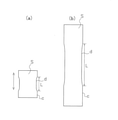
- FIG. 1 A diagram showing a state before stretching of a sample of an example according to the present disclosure
- FIG. 1 A diagram showing a state of a sample of an example according to the present disclosure after stretching.
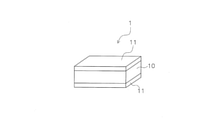
- the laminated body 1 has antistatic properties and is used as an antistatic sheet. Further, the laminated body 1 is formed into a secondary processed product by thermoforming.
- FIG. 1 is a perspective view of the laminated body 1.
- the laminate 1 has a base material 10 and an antistatic coat layer 11 (an example of an antistatic layer) formed on both sides thereof.
- the base material 10 is formed of a thermoplastic resin.
- the thermoplastic resin include olefin resins such as polypropylene, vinyl resins such as polyvinyl chloride, polymethylmethacrylate and polystyrene, ester resins such as polycarbonate, polyethylene terephthalate and aromatic polyester, ABS resins, and these resins.
- the copolymer resin of is preferably used.
- the thickness of the base material 10 is preferably set to 0.3 mm or more and 15 mm or less. If the thickness of the base material 10 is made thinner than 0.3 mm, the strength may not be ensured because the base material 10 becomes too thin when stretched and molded. Further, when the thickness of the base material 10 is made larger than 15 mm, it may not be possible to form the expected shape because the base material 10 is thick, and it takes extra time for heating, which leads to deterioration of the performance of the coating film. there is a possibility.
- the antistatic coat layer 11 has carbon nanotubes and a thermoplastic resin as a binder.
- the carbon nanotubes are dispersed at minute intervals that can be contacted or conducted, so that static electricity can be released and static electricity can be prevented.
- thermoplastic resin examples include olefin resins such as polypropylene, vinyl resins such as polyvinyl chloride, polymethylmethacrylate and polystyrene, ester resins such as polycarbonate, polyethylene terephthalate and aromatic polyester, ABS resins, and these resins.
- the copolymer resin of is preferably used.
- thermoplastic resin of the base material and the thermoplastic resin in the antistatic coat layer 11 different types of resins may be used, or the same type of resin may be used.
- Amorphous thermoplastic resin is preferably used in order to maintain transparency and moldability.
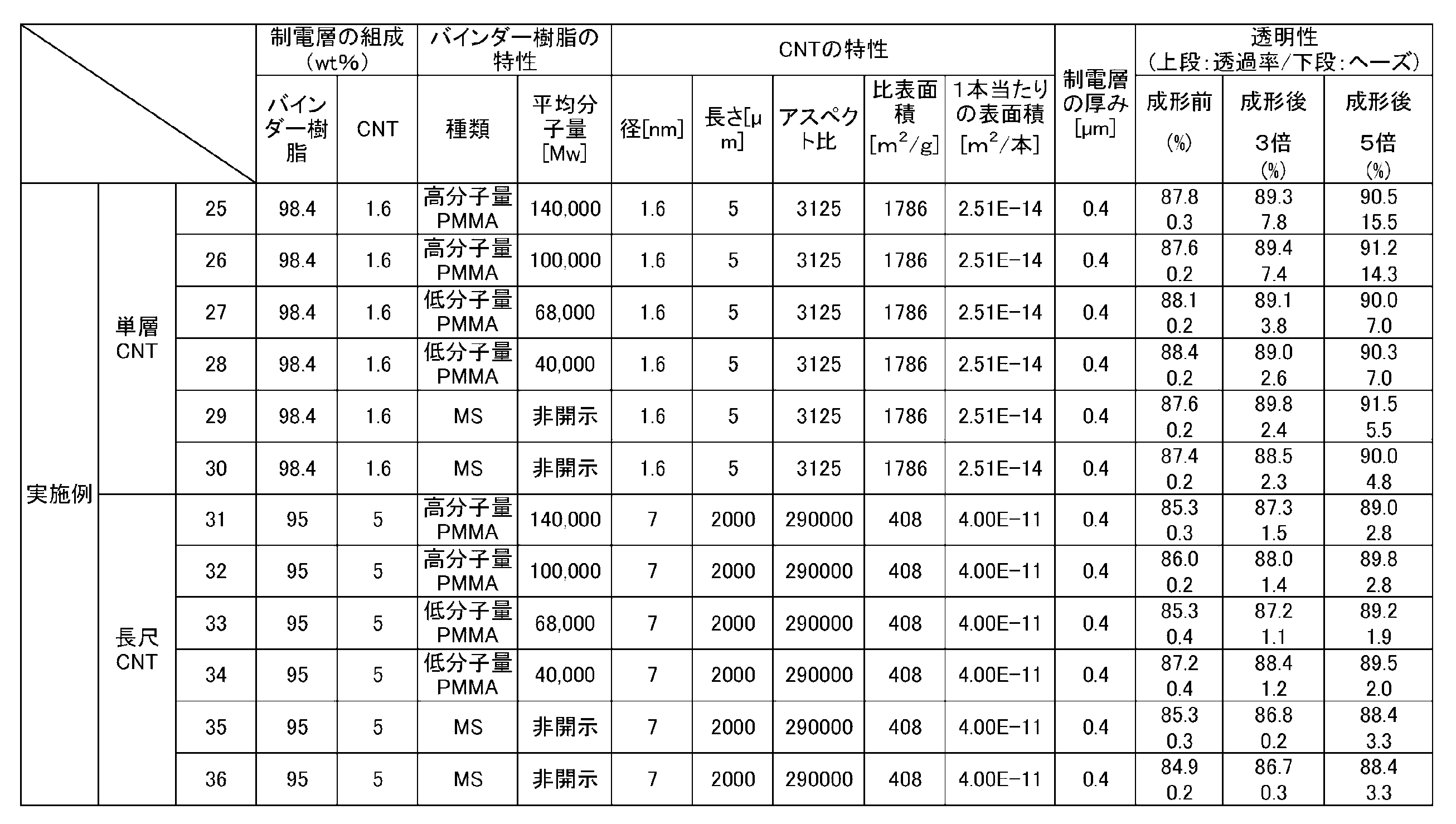
- the transparency after stretching greatly differs depending on the molecular weight of the acrylic resin and whether or not it is a copolymerized resin with another resin.
- the system using the low molecular weight acrylic resin can maintain the transparency after stretching, particularly the haze value, lower than the system using the high molecular weight acrylic resin. This is considered to be related to the compatibility with carbon nanotubes.
- a high molecular weight resin has a long molecular chain and is difficult to be compatible with carbon nanotubes, but a low molecular weight resin has good compatibility with carbon nanotubes, so that transparency is considered to be maintained.
- the transparency is further improved in the system using the copolymer resin of the acrylic resin and other resin components. This is also considered to be due to the improved compatibility, similar to the above reason.
- a styrene resin can be used as an example.
- binder resin for the coating film, transparency and compatibility with carbon nanotubes are important, but it is preferable that they have at least chemical resistance to the extent that they can be used for cleaning, assuming the actual usage environment.
- a single-walled carbon nanotube is used as the carbon nanotube of the present embodiment.
- Carbon nanotubes have a structure in which a sheet in which benzene rings are lined up is wound into a cylindrical shape.
- the single-walled carbon nanotube has a cylinder composed of one layer.
- the specific surface area per unit weight of carbon nanotubes is 350 m 2 / g or more.
- the specific surface area is further preferably 1500 m 2 / g or more.
- the specific surface area is a calculated value using the following equation 1 assuming that the carbon nanotube is a cylinder, but can be obtained from the length, diameter, and density of the cylinder.
- the diameter of the single-walled carbon nanotubes is preferably set to 0.5 nm or more and 6 nm or less, and more preferably 1.5 nm or more and 4 nm or less.
- the length of the single-walled carbon nanotubes is preferably set to 3 ⁇ m or more and 20 ⁇ m or less, and more preferably 5 ⁇ m or more and 10 ⁇ m or less.
- the aspect ratio (length / diameter) of the carbon nanotubes is preferably 2000 or more, and more preferably 3000 or more. It is considered that the larger the aspect ratio, the higher the possibility that the contact points between the carbon nanotubes can be maintained when stretched. Therefore, it is desirable to use carbon nanotubes having a larger aspect ratio, and high conductivity can be expected.
- the content of carbon nanotubes in the antistatic coat layer 11 is preferably set to 0.5% by weight or more and 10% by weight or less.
- the content is preferably 0.75% by weight or more and 7% by weight or less, and more preferably 1% by weight or more and 5% by weight or less.
- the thickness of the antistatic coat layer 11 is preferably 0.1 ⁇ m or more and 3 ⁇ m or less, more preferably 0.2 ⁇ m or more and 2 ⁇ m, and more preferably 0.3 ⁇ m or more and 1 ⁇ m or less.
- a secondary processed product can be formed by heating the laminate 1 and performing bending molding, press molding, vacuum forming, pressure forming, blow molding, embossing or the like.
- the above-mentioned transparency is also an important item, and the transparency is expressed by the total light transmittance and the haze.
- the total light transmittance is preferably 80% or more, more preferably 85% or more before molding.
- 80% or more is preferable, and 85% or more is more preferable. Since the coating film becomes thin when stretched, it is generally considered that the total light transmittance is higher after stretching than before stretching.
- the haze value is preferably 5% or less, more preferably 3% or less before molding. After 5-fold molding, 20% or less is preferable, and 10% or less is more preferable. When stretched, interfacial peeling between the carbon nanotubes and the binder resin and agglomeration sites of the carbon nanotubes remarkably appear in the coating film, so that internal haze occurs and the haze value after stretching tends to increase.
- the laminated body 1 in the second embodiment has a different structure of carbon nanotubes from the first embodiment.
- the laminate 1 of the second embodiment includes the base material 10 and the antistatic coat layer 11 provided on both sides of the base material 10 as in the first embodiment.
- the base material 10 is formed of a thermoplastic resin as in the first embodiment.
- the thermoplastic resin the same type of resin as in the first embodiment can be used. Further, it is preferable that the thickness of the base material 10 is set to 0.3 mm or more and 15 mm or less.
- the antistatic coat layer 11 has carbon nanotubes and a thermoplastic resin as a binder.
- a thermoplastic resin of the antistatic coat layer 11 the same type of resin as in the first embodiment can be used.
- the multi-walled carbon nanotubes in the second embodiment when a highly transparent acrylic resin is used, the molecular weight and the stretching by the copolymer resin are used. Later transparency, especially the difference in haze value, is not confirmed. It is considered that this is because the multi-walled carbon nanotubes have good dispersibility in the state of the dispersion liquid, so that a high degree of dispersion can be maintained even in the coating film after being mixed with the binder resin. ..
- Carbon nanotubes of the present embodiment a plurality of carbon nanotubes having two or more layers and 15 or less layers are used.
- Carbon nanotubes have a structure in which a sheet in which benzene rings are lined up is wound into a cylindrical shape.
- the multi-walled carbon nanotube has a cylinder composed of a plurality of layers.
- the specific surface area per unit weight of carbon nanotubes is 350 m 2 / g or more. Further, the specific surface area is preferably 400 m 2 / g or more.
- the specific surface area can be obtained from the following equation 2 by regarding the carbon nanotube as a cylinder and using the length, diameter, and density of the cylinder.
- Equation 2 The diameter of the multi-walled carbon nanotubes of the second embodiment is preferably set to 5 nm or more and 12 nm or less. When the nm is 5 nm or more, it is easy to disperse in a dispersion medium during production, and transparency can be maintained even after stretching.
- the range of 5 nm or more and 12 nm or less is a range in which long carbon nanotubes can be produced.
- the carbon nanotube length of the plurality of layers of the second embodiment is preferably set to 100 ⁇ m or more and 3000 ⁇ m or less, and more preferably 1000 ⁇ m or more.
- the carbon nanotubes of the second embodiment have a smaller specific surface area per weight than the single-walled carbon nanotubes of the first embodiment, but because of their long length, they are carbon even after secondary molding such as stretching. The contact points between the nanotubes can be easily maintained, the conductive path can pass through, and the conductivity can be maintained.
- the aspect ratio (length / diameter) of the carbon nanotubes is preferably 20,000 or more, more preferably 100,000 or more. When the aspect ratio of the carbon nanotubes is increased, it is more likely that the contacts between the carbon nanotubes will be maintained even after being stretched several times, and it can be expected that the conductivity will be maintained.
- the content of the plurality of carbon nanotubes in the antistatic coat layer 11 is preferably set to 0.5% by weight or more and 10% by weight or less. This is because when the content of the carbon nanotubes, which is the lower limit value, is smaller than 0.5% by weight, the surface resistivity of the laminate 1 becomes large, and when it becomes larger than the upper limit value, 10% by weight, the transparency decreases.
- the content is preferably 0.75% by weight or more and 7% by weight or less, and more preferably 1% by weight or more and 5% by weight or less.
- the thickness of the antistatic coat layer 11 is preferably set to 0.1 ⁇ m or more and 3 ⁇ m or less, more preferably 0.2 ⁇ m or more and 2 ⁇ m or less, and more preferably 0.3 ⁇ m or more and 1 ⁇ m or less.
- Transparency is also an important item for the laminated body 1 of the present disclosure, and transparency is expressed by total light transmittance and haze.
- the total light transmittance is preferably 80% or more, more preferably 85% or more before molding.
- 80% or more is preferable, and 85% or more is more preferable. Since the coating film becomes thin when stretched, it is generally considered that the total light transmittance is higher after stretching than before stretching.
- the haze value is preferably 5% or less, more preferably 3% or less before molding. After 5-fold molding, 20% or less is preferable, and 10% or less is more preferable.
- stretched the interface between the CNT and the binder resin is peeled off in the coating film, and the aggregated portion of the carbon nanotubes appears remarkably, so that internal haze occurs at the interface between the coating film and the base material, and the haze value after stretching becomes high. The trend has been obtained.
- the antistatic coat layer 11 is formed on both sides of the base material 10, but it may be formed on only one side.
- the laminate 1 of the above embodiment is formed in a plate shape, but is not limited to this, and may be a rod shape, a tubular shape, or the like.
- the content of the carbon nanotubes in the antistatic coat layer 11, which is a combination of the single-walled carbon nanotubes and the multi-walled carbon nanotubes, is a combination of the single-walled carbon nanotubes and the multi-walled carbon nanotubes, to 0.5% by weight or more and 10% by weight or less.
- the base material 10 is preferably set to 0.3 mm or more and 15 mm or less.
- the thickness of the antistatic coat layer 11 is preferably set to 0.1 ⁇ m or more and 3 ⁇ m or less.
- thermoplastic resin is used on the base material 10 and the antistatic coat layer 11 in order to facilitate the secondary molding of the laminate during the stretching of the secondary molding and to facilitate the follow-up of the coating film.
- a thermoplastic resin it does not have to be limited to a thermoplastic resin, and a thermosetting resin may be used as long as it can be secondary molded and the coating film follows the stretching and does not break.
- the content of carbon nanotubes (abbreviated as CNT) in the antistatic coat layer 11 is described.
- Surface resistivity and transparency were evaluated in each of the modified examples and comparative examples.
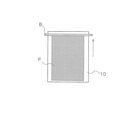
- both ends of the bar coater B are strongly pressed against the base material 10 and slowly pulled toward you (see the arrow).
- the base material 10 the paint P, and the bar coater B are illustrated.
- a haze meter NDH500 (Nippon Denshoku Industries Co., Ltd.) was used for the total light transmittance measurement and the haze value measurement.
- a film thickness meter was used to measure the film thickness.
- FIG. 3A is a diagram showing a sample before stretching. As shown in FIG. 3A, the created antistatic acrylic plate is cut into the shape of a sample S having a notch d near the center of the opposite side c.
- the surface resistivity of the antistatic acrylic plate stretched 3 times and 5 times was measured, and Rb (surface resistivity after 3 times molding) / Ra (surface resistivity before molding) and Rb (5 times molding). Later surface resistivity) / Ra (surface resistivity before molding) was calculated.
- the decrease in antistatic property after molding in Comparative Examples 1 and 2 is also due to the aspect ratio, and from the comparison of the aspect ratios of Examples 1 to 24 and Comparative Examples 1 and 2, the aspect ratio of CNT is determined. It can be seen that 2000 or more is preferable.
- the thickness of the antistatic layer is preferably 0.1 ⁇ m or more and 3 ⁇ m or less, and further 0. It is preferably 2 ⁇ m or more and 2 ⁇ m or less, and more preferably 0.3 ⁇ m or more and 1 ⁇ m or less.
- Examples 1, 2, 3, 4, 5, 6, 7, 8, 9, 11, 12, 14, 15, 17, 18, 20, and 21 are all light rays when the stretching magnification is 3 times by secondary molding.
- the transmittance is 73% or more and the draw ratio is 5 times, the total light transmittance is 79% or more, which is high transparency.
- Examples 10, 13, 16, 19, and 22 having a film thickness of 2.5 ⁇ m the surface resistivity was sufficiently secured before and after stretching, but from the values of total light transmittance and haze. , Transparency is a little inferior. Therefore, by setting the thickness of the antistatic layer to 0.3 ⁇ m or more and 1 ⁇ m or less, transparency after stretching can be ensured.
- the CNT content in the antistatic layer is preferably 0.5% by weight or more and 10% by weight or less, more preferably 0.75% by weight or more and 7% by weight or less, and 1% by weight or more and 5% by weight or less. Is more preferable.
- the diameter of the CNT is preferably set to 0.5 nm or more and 6 nm or less, and more preferably 1.5 nm or more and 4 nm or less. Further, in the case of multi-walled carbon nanotubes, it is preferable to set the thickness to 5 nm or more and 12 nm or less.
- the length of the CNT is preferably set to 3 ⁇ m or more and 20 ⁇ m or less, and more preferably 5 ⁇ m or more and 10 ⁇ m or less.
- it is preferably set to 100 ⁇ m or more and 3000 ⁇ m or less, and more preferably 1000 ⁇ m or more.
- an antistatic acrylic plate was prepared in the same manner as in Example 4 by changing the average molecular weight of the binder resin as shown in (Table 2) below.
- Example 31 the average molecular weight of the binder resin was changed as shown in (Table 2) to prepare an antistatic acrylic plate in the same manner as in Example 17.
- the laminated body and the secondary molded product of the present disclosure has an effect of improving antistatic property and is useful as a device cover or a partition plate for a clean room or the like used for manufacturing semiconductors.
Landscapes
- Chemical & Material Sciences (AREA)
- Organic Chemistry (AREA)
- Materials Engineering (AREA)
- Engineering & Computer Science (AREA)
- Medicinal Chemistry (AREA)
- Polymers & Plastics (AREA)
- Health & Medical Sciences (AREA)
- Chemical Kinetics & Catalysis (AREA)
- Nanotechnology (AREA)
- Life Sciences & Earth Sciences (AREA)
- Wood Science & Technology (AREA)
- Inorganic Chemistry (AREA)
- Laminated Bodies (AREA)
Abstract
Description
(課題を解決するための手段)
(発明の効果)
以下に、本開示にかかる実施の形態1における積層体1について説明する。
積層体1は、制電性を有し、帯電防止シートとして用いられる。また、積層体1は、熱成形を行うことによって二次加工品に形成される。
(式1)

単層カーボンナノチューブの直径は、0.5nm以上、6nm以下に設定する方が好ましく、1.5nm以上、4nm以下がより好ましい。また、単層カーボンナノチューブの長さは3μm以上、20μm以下に設定する方が好ましく、5μm以上、10μm以下がより好ましい。
次に、本開示にかかる実施の形態2における積層体1について説明する。本実施の形態2の積層体は、実施の形態1とカーボンナノチューブの構成が異なる。
(式2)

本実施の形態2の複数層のカーボンナノチューブの直径は、5nm以上、12nm以下に設定する方が好ましい。5nm以上とすることにより、製造の際に分散媒中に分散させやすく延伸後も透明性を維持することができる。なお、上記5nm以上、12nm以下の範囲は、長尺のカーボンナノチューブを製造可能な範囲である。
く、さらに0.2μm以上、2μm以下が好ましく、0.3μm以上、1μm以下がより好ましい。
以上、本発明の一実施形態について説明したが、本発明は上記実施形態に限定されるものではなく、発明の要旨を逸脱しない範囲で種々の変更が可能である。
上記実施の形態1、2では、基材10の両面に帯電防止コート層11を形成したが、片面だけに形成してもよい。
上記実施の形態の積層体1は、プレート状に形成されているが、これに限られるものではなく、棒状、管状などであってもよい。
上記実施の形態1では単層のカーボンナノチューブを用い、実施の形態2では複数層のカーボンナノチューブを用いたが、1つの帯電防止コート層11に実施の形態1で用いた単層のカーボンナノチューブと実施の形態2で用いた複数層のカーボンナノチューブが混在していてもよい。
上記実施の形態1、2では、基材10および帯電防止コート層11に2次成形の延伸時に積層体の2次成形を容易にし、塗膜を追従しやすくする為に、熱可塑性樹脂が用いられているが、熱可塑性樹脂にかぎらなくてもよく、2次成形可能であり、塗膜が延伸に追従し、破損しない場合であれば熱硬化性樹脂を用いてもよい。
以下に、本開示の積層体について実施例を用いて説明する。
(実施例1~16)
基材:厚さ3mm、全光線透過率92.4%、ヘイズ0.2%のアクリルプレート
溶媒:ケトン系溶媒
熱可塑性バインダー樹脂:アクリル樹脂ペレット
カーボンナノチューブ:比表面積1700m2/gの単層CNT:平均線径1.6nm、平均長さ 5μm、 アスペクト比 3125
比表面積714m2/gの単層CNT:NANOSOLUTION社製 品名「eXtube(登録商標)SAZD-030MEK」、平均線径:4nm、平均長さ10μm、アスペクト比2500
(実施例17~24)
基材:厚さ3mm、全光線透過率92.4%、ヘイズ0.2%のアクリルプレート
溶媒:ケトン系溶媒
熱可塑性バインダー樹脂:アクリル樹脂ペレット
カーボンナノチューブ:長尺CNT:日本資材株式会社製 品名「長尺MWCNT分散液」、平均線径:7nm、平均長さ2000μm、アスペクト比290000
(比較例1)
基材:厚さ3mm、全光線透過率92.4%、ヘイズ0.2%のアクリルプレート
溶媒:ケトン系溶媒
熱可塑性バインダー樹脂:アクリル樹脂ペレット
カーボンナノチューブ:多層CNT:日本資材株式会社製 品名「 細径MWCNT分散液」、平均線径:9nm、平均長さ1.5μm、アスペクト比167
(比較例2)
基材:厚さ3mm、全光線透過率92.4%、ヘイズ0.2%のアクリルプレート
溶媒:ケトン系溶媒
熱可塑性バインダー樹脂:アクリル樹脂ペレット
カーボンナノチューブ:多層CNT:日本資材株式会社製 品名「標準MWCNT分散液」、平均線径:13nm、平均長さ1μm、アスペクト比77
上記の基材を用いて、その表面に表に示す塗料液を種々異なる配合・膜厚で塗布し、硬化させることによって、表に示すCNTの含有量と厚さを有する帯電防止プレート層(制電層)を表面に形成した制電性アクリルプレートを作成した。
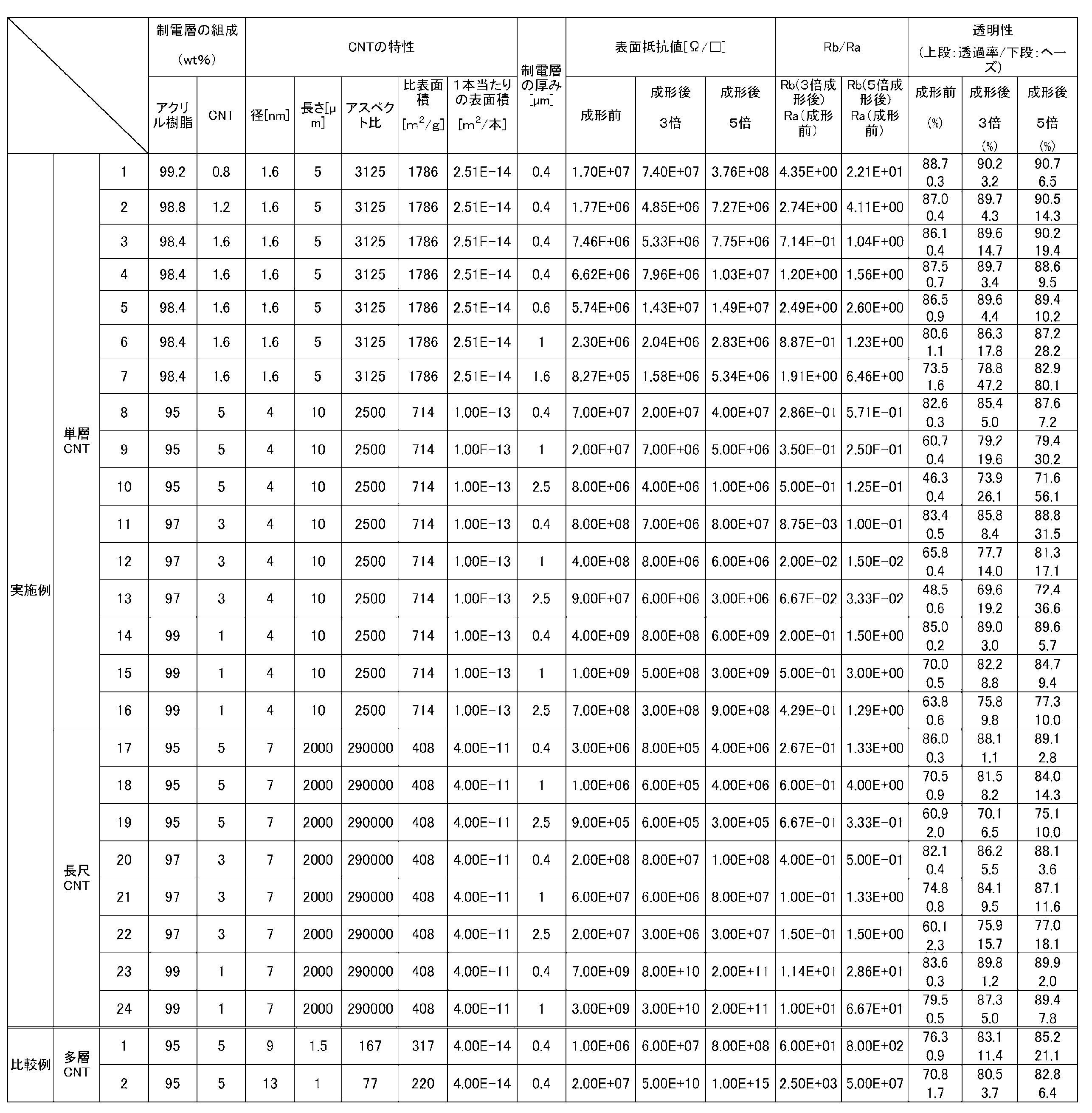
また、制電層におけるCNTの含有量は、0.5重量%以上、10重量%以下が好ましく、更に0.75重量%以上、7重量%以下が好ましく、1重量%以上、5重量%以下がより好ましい。
10 基材
11 帯電防止コート層(制電層)
P 帯電防止塗料
Claims (11)
- 基材と、
前記基材上に設けられ、カーボンナノチューブおよび樹脂を含む制電層と、を備え、
前記カーボンナノチューブの単位重量当たりの比表面積は、350m2/g以上である、
積層体。 - 前記制電層の厚みは、0.1μm以上、3μm以下である、
請求項1に記載の積層体。 - 前記カーボンナノチューブのアスペクト比は、2000以上である、
請求項1または2に記載の積層体。 - 前記制電層における前記カーボンナノチューブの含有量は、0.5重量%以上、10重量%以下である、
請求項1~3のいずれか1項に記載の積層体。 - 前記カーボンナノチューブは、単層である、
請求項1~4のいずれか1項に記載の積層体。 - 前記カーボンナノチューブの単位重量当たりの比表面積が1500m2/g以上である、
請求項1~5のいずれか1項に記載の積層体。 - 前記カーボンナノチューブの径は、0.5nm以上、6nm以下であり、
前記カーボンナノチューブの長さは、3μm以上、20μm以下である、
請求項5に記載の積層体。 - 前記カーボンナノチューブは、複数層であり、
前記カーボンナノチューブの長さは、100μm以上、3000μm以下である、
請求項1~3のいずれか1項に記載の積層体。 - 前記カーボンナノチューブは、2以上、15以下の層を有し、
前記カーボンナノチューブの径は、3nm以上、15nm以下である、
請求項8に記載の積層体。 - 前記樹脂は、熱可塑性樹脂であり、
前記基材は、熱可塑性樹脂を含む、
請求項1~9のいずれか1項に記載の積層体。 - 請求項1乃至10のいずれか1項に記載の積層体を、10倍以下の成形倍率で熱成形した二次成形品であって、
前記熱成形前の前記制電層の表面抵抗率をRa(Ω/□)とし、前記熱成形後の前記制電層の表面抵抗率をRb(Ω/□)とすると、1×102≧Rb/Raを満たす、
二次成形品。
Priority Applications (5)
| Application Number | Priority Date | Filing Date | Title |
|---|---|---|---|
| US18/010,284 US20230242726A1 (en) | 2020-08-07 | 2021-06-11 | Laminated body and secondary formed product |
| JP2021575087A JP7137026B2 (ja) | 2020-08-07 | 2021-06-11 | 積層体および二次成形品 |
| CN202180045099.5A CN115916531A (zh) | 2020-08-07 | 2021-06-11 | 叠层体及二次成形品 |
| EP21852674.7A EP4194202A4 (en) | 2020-08-07 | 2021-06-11 | MULTILAYER BODY AND SECONDARY MOLDED ARTICLE |
| KR1020227041056A KR20230007423A (ko) | 2020-08-07 | 2021-06-11 | 적층체 및 2 차 성형품 |
Applications Claiming Priority (4)
| Application Number | Priority Date | Filing Date | Title |
|---|---|---|---|
| JP2020-135325 | 2020-08-07 | ||
| JP2020135325 | 2020-08-07 | ||
| JP2021046437 | 2021-03-19 | ||
| JP2021-046437 | 2021-03-19 |
Publications (1)
| Publication Number | Publication Date |
|---|---|
| WO2022030106A1 true WO2022030106A1 (ja) | 2022-02-10 |
Family
ID=80117830
Family Applications (1)
| Application Number | Title | Priority Date | Filing Date |
|---|---|---|---|
| PCT/JP2021/022386 Ceased WO2022030106A1 (ja) | 2020-08-07 | 2021-06-11 | 積層体および二次成形品 |
Country Status (7)
| Country | Link |
|---|---|
| US (1) | US20230242726A1 (ja) |
| EP (1) | EP4194202A4 (ja) |
| JP (1) | JP7137026B2 (ja) |
| KR (1) | KR20230007423A (ja) |
| CN (1) | CN115916531A (ja) |
| TW (1) | TWI886315B (ja) |
| WO (1) | WO2022030106A1 (ja) |
Cited By (1)
| Publication number | Priority date | Publication date | Assignee | Title |
|---|---|---|---|---|
| JP2024037457A (ja) * | 2022-09-07 | 2024-03-19 | 積水化学工業株式会社 | 積層体および積層体の製造方法 |
Citations (4)
| Publication number | Priority date | Publication date | Assignee | Title |
|---|---|---|---|---|
| JPH11353947A (ja) | 1998-06-09 | 1999-12-24 | Takiron Co Ltd | 制電性樹脂成形品及びその二次成形品 |
| JP2008177143A (ja) * | 2006-03-28 | 2008-07-31 | Toray Ind Inc | 透明導電性フィルム、その製造方法および導電性部材 |
| JP2014201488A (ja) * | 2013-04-05 | 2014-10-27 | 東洋インキScホールディングス株式会社 | コーティング組成物及び該組成物を用いた導電性フィルム |
| WO2015045417A1 (ja) * | 2013-09-30 | 2015-04-02 | 日本ゼオン株式会社 | カーボンナノチューブ分散液の製造方法 |
Family Cites Families (15)
| Publication number | Priority date | Publication date | Assignee | Title |
|---|---|---|---|---|
| JP3638660B2 (ja) * | 1995-05-01 | 2005-04-13 | 松下電器産業株式会社 | 感光性樹脂組成物、それを用いたサンドブラスト用感光性ドライフィルム及びそれを用いた食刻方法 |
| US20080152573A1 (en) * | 2006-12-20 | 2008-06-26 | Noriyuki Juni | Method for producing carbon nanotubes, method for producing liquid dispersion thereof and optical product |
| JP2012166452A (ja) | 2011-02-14 | 2012-09-06 | Inoac Gijutsu Kenkyusho:Kk | 帯電防止フィルム |
| KR20150064030A (ko) * | 2012-09-27 | 2015-06-10 | 도레이 카부시키가이샤 | 투명 도전 적층체 |
| JP6877862B2 (ja) * | 2013-04-10 | 2021-05-26 | 日本ゼオン株式会社 | リチウムイオン二次電池用正極およびリチウムイオン二次電池 |
| EP3053879A4 (en) * | 2013-09-30 | 2017-03-29 | Zeon Corporation | Carbon nanotubes, dispersion liquid thereof, carbon nanotube-containing film and composition material |
| JP6326834B2 (ja) * | 2014-01-31 | 2018-05-23 | 日本ゼオン株式会社 | カーボンナノチューブ分散液及び導電性フィルム |
| JP2017045689A (ja) | 2015-08-28 | 2017-03-02 | 旭硝子株式会社 | 導電体及びその製造方法 |
| WO2017110096A1 (ja) * | 2015-12-25 | 2017-06-29 | 日本ゼオン株式会社 | 電磁波吸収材料及び電磁波吸収体 |
| JPWO2017111122A1 (ja) * | 2015-12-25 | 2018-10-11 | 日本ゼオン株式会社 | 電磁波吸収材料及び電磁波吸収体、並びにこれらの製造方法 |
| JP7044372B2 (ja) | 2016-02-26 | 2022-03-30 | 学校法人早稲田大学 | 金属粒子を含むカーボンナノチューブ混合物から金属粒子を除去する除去方法、除去装置、および、それらによって得られるカーボンナノチューブと中空炭素粒子との複合体 |
| WO2019194662A1 (ko) * | 2018-04-06 | 2019-10-10 | 주식회사 엘지화학 | 전극, 상기 전극을 포함하는 이차 전지, 및 상기 전극의 제조 방법 |
| JP7378952B2 (ja) | 2018-04-25 | 2023-11-14 | ナガセケムテックス株式会社 | 透明導電膜を有する光学積層体、及びコーティング組成物 |
| JP2019196428A (ja) | 2018-05-08 | 2019-11-14 | ナトコ株式会社 | 硬化性組成物 |
| KR102033930B1 (ko) | 2018-07-02 | 2019-10-21 | (주)고려소재연구소 | 고성능 대전방지성 광경화형 수지 조성물, 이를 적용한 무정전 판넬 및 무정전 판넬의 제조방법 |
-
2021
- 2021-06-11 KR KR1020227041056A patent/KR20230007423A/ko not_active Ceased
- 2021-06-11 WO PCT/JP2021/022386 patent/WO2022030106A1/ja not_active Ceased
- 2021-06-11 US US18/010,284 patent/US20230242726A1/en active Pending
- 2021-06-11 CN CN202180045099.5A patent/CN115916531A/zh active Pending
- 2021-06-11 EP EP21852674.7A patent/EP4194202A4/en active Pending
- 2021-06-11 JP JP2021575087A patent/JP7137026B2/ja active Active
- 2021-08-05 TW TW110128895A patent/TWI886315B/zh active
Patent Citations (4)
| Publication number | Priority date | Publication date | Assignee | Title |
|---|---|---|---|---|
| JPH11353947A (ja) | 1998-06-09 | 1999-12-24 | Takiron Co Ltd | 制電性樹脂成形品及びその二次成形品 |
| JP2008177143A (ja) * | 2006-03-28 | 2008-07-31 | Toray Ind Inc | 透明導電性フィルム、その製造方法および導電性部材 |
| JP2014201488A (ja) * | 2013-04-05 | 2014-10-27 | 東洋インキScホールディングス株式会社 | コーティング組成物及び該組成物を用いた導電性フィルム |
| WO2015045417A1 (ja) * | 2013-09-30 | 2015-04-02 | 日本ゼオン株式会社 | カーボンナノチューブ分散液の製造方法 |
Non-Patent Citations (1)
| Title |
|---|
| See also references of EP4194202A4 |
Cited By (1)
| Publication number | Priority date | Publication date | Assignee | Title |
|---|---|---|---|---|
| JP2024037457A (ja) * | 2022-09-07 | 2024-03-19 | 積水化学工業株式会社 | 積層体および積層体の製造方法 |
Also Published As
| Publication number | Publication date |
|---|---|
| EP4194202A4 (en) | 2024-08-14 |
| TW202214760A (zh) | 2022-04-16 |
| EP4194202A1 (en) | 2023-06-14 |
| JP7137026B2 (ja) | 2022-09-13 |
| US20230242726A1 (en) | 2023-08-03 |
| KR20230007423A (ko) | 2023-01-12 |
| TWI886315B (zh) | 2025-06-11 |
| JPWO2022030106A1 (ja) | 2022-02-10 |
| CN115916531A (zh) | 2023-04-04 |
Similar Documents
| Publication | Publication Date | Title |
|---|---|---|
| JP4471346B2 (ja) | 電磁波シールド体 | |
| KR20050115230A (ko) | 전도막이 분산되어 있는 전도체 | |
| CN101809679B (zh) | 导电性膜和其制造方法 | |
| US20060257638A1 (en) | Articles with dispersed conductive coatings | |
| JP6124099B1 (ja) | 導電積層体、それを用いた成型体、静電容量式タッチセンサーおよび面状発熱体、ならびに成型体の製造方法 | |
| JP2007229989A (ja) | 導電性成形体及びその製造方法 | |
| JP2006035771A (ja) | 導電層転写シート | |
| JP5899673B2 (ja) | 導電性フィルム及びその製造方法 | |
| KR20110031170A (ko) | 투명 도전성 필름, 그 제조 방법 및 그것을 구비한 터치 패널 | |
| JP2006035773A (ja) | 粘接着性導電成形体 | |
| KR20150064030A (ko) | 투명 도전 적층체 | |
| JP2010229288A (ja) | 導電性フィルムおよびその製造方法 | |
| JP5211979B2 (ja) | 偏光板保護用帯電防止フィルムおよびその製造方法 | |
| JP3398587B2 (ja) | 成形可能な制電性樹脂成形品 | |
| JP7137026B2 (ja) | 積層体および二次成形品 | |
| KR101790707B1 (ko) | 전도성 마스터 배치 및 그 제조방법과 이를 이용한 전도성 필름 제조방법 | |
| Ying et al. | Preparation and properties of an antistatic UV-curable coating modified by multi-walled carbon nanotubes | |
| JP4454426B2 (ja) | インモールド成形用導電性フィルム | |
| JP6712910B2 (ja) | 透明導電性フィルム | |
| JP4488826B2 (ja) | 制電性樹脂成形体 | |
| JP2016168809A (ja) | 導電積層体 | |
| JP2005277405A (ja) | 画像表示装置用透光性ノイズ防止成形体 | |
| KR101301661B1 (ko) | 내구성이 우수한 정전기 방지 시트의 제조 방법 | |
| JPH11353947A (ja) | 制電性樹脂成形品及びその二次成形品 | |
| JP2007130950A (ja) | 制電性樹脂成形体 |
Legal Events
| Date | Code | Title | Description |
|---|---|---|---|
| ENP | Entry into the national phase |
Ref document number: 2021575087 Country of ref document: JP Kind code of ref document: A |
|
| 121 | Ep: the epo has been informed by wipo that ep was designated in this application |
Ref document number: 21852674 Country of ref document: EP Kind code of ref document: A1 |
|
| ENP | Entry into the national phase |
Ref document number: 20227041056 Country of ref document: KR Kind code of ref document: A |
|
| NENP | Non-entry into the national phase |
Ref country code: DE |
|
| ENP | Entry into the national phase |
Ref document number: 2021852674 Country of ref document: EP Effective date: 20230307 |
|
| WWR | Wipo information: refused in national office |
Ref document number: 1020227041056 Country of ref document: KR |
|
| WWR | Wipo information: refused in national office |
Ref document number: 1020227041056 Country of ref document: KR |
|
| WWC | Wipo information: continuation of processing after refusal or withdrawal |
Ref document number: 1020227041056 Country of ref document: KR |
|
| WWR | Wipo information: refused in national office |
Ref document number: 1020227041056 Country of ref document: KR |