WO2022030540A1 - 皮膚用組成物 - Google Patents
皮膚用組成物 Download PDFInfo
- Publication number
- WO2022030540A1 WO2022030540A1 PCT/JP2021/028942 JP2021028942W WO2022030540A1 WO 2022030540 A1 WO2022030540 A1 WO 2022030540A1 JP 2021028942 W JP2021028942 W JP 2021028942W WO 2022030540 A1 WO2022030540 A1 WO 2022030540A1
- Authority
- WO
- WIPO (PCT)
- Prior art keywords
- composition
- weight
- composition according
- film
- surfactant
- Prior art date
- Legal status (The legal status is an assumption and is not a legal conclusion. Google has not performed a legal analysis and makes no representation as to the accuracy of the status listed.)
- Ceased
Links
Classifications
-
- A—HUMAN NECESSITIES
- A61—MEDICAL OR VETERINARY SCIENCE; HYGIENE
- A61K—PREPARATIONS FOR MEDICAL, DENTAL OR TOILETRY PURPOSES
- A61K9/00—Medicinal preparations characterised by special physical form
- A61K9/70—Web, sheet or filament bases ; Films; Fibres of the matrix type containing drug
- A61K9/7015—Drug-containing film-forming compositions, e.g. spray-on
-
- A—HUMAN NECESSITIES
- A61—MEDICAL OR VETERINARY SCIENCE; HYGIENE
- A61K—PREPARATIONS FOR MEDICAL, DENTAL OR TOILETRY PURPOSES
- A61K9/00—Medicinal preparations characterised by special physical form
- A61K9/0012—Galenical forms characterised by the site of application
- A61K9/0014—Skin, i.e. galenical aspects of topical compositions
-
- A—HUMAN NECESSITIES
- A61—MEDICAL OR VETERINARY SCIENCE; HYGIENE
- A61K—PREPARATIONS FOR MEDICAL, DENTAL OR TOILETRY PURPOSES
- A61K31/00—Medicinal preparations containing organic active ingredients
- A61K31/13—Amines
- A61K31/135—Amines having aromatic rings, e.g. ketamine, nortriptyline
- A61K31/138—Aryloxyalkylamines, e.g. propranolol, tamoxifen, phenoxybenzamine
-
- A—HUMAN NECESSITIES
- A61—MEDICAL OR VETERINARY SCIENCE; HYGIENE
- A61K—PREPARATIONS FOR MEDICAL, DENTAL OR TOILETRY PURPOSES
- A61K47/00—Medicinal preparations characterised by the non-active ingredients used, e.g. carriers or inert additives; Targeting or modifying agents chemically bound to the active ingredient
- A61K47/30—Macromolecular organic or inorganic compounds, e.g. inorganic polyphosphates
- A61K47/32—Macromolecular compounds obtained by reactions only involving carbon-to-carbon unsaturated bonds, e.g. carbomers, poly(meth)acrylates, or polyvinyl pyrrolidone
-
- A—HUMAN NECESSITIES
- A61—MEDICAL OR VETERINARY SCIENCE; HYGIENE
- A61K—PREPARATIONS FOR MEDICAL, DENTAL OR TOILETRY PURPOSES
- A61K8/00—Cosmetics or similar toiletry preparations
- A61K8/18—Cosmetics or similar toiletry preparations characterised by the composition
- A61K8/72—Cosmetics or similar toiletry preparations characterised by the composition containing organic macromolecular compounds
- A61K8/81—Cosmetics or similar toiletry preparations characterised by the composition containing organic macromolecular compounds obtained by reactions involving only carbon-to-carbon unsaturated bonds
- A61K8/8141—Compositions of homopolymers or copolymers of compounds having one or more unsaturated aliphatic radicals, each having only one carbon-to-carbon double bond, and at least one being terminated by only one carboxyl radical, or of salts, anhydrides, esters, amides, imides or nitriles thereof; Compositions of derivatives of such polymers
- A61K8/8152—Homopolymers or copolymers of esters, e.g. (meth)acrylic acid esters; Compositions of derivatives of such polymers
-
- A—HUMAN NECESSITIES
- A61—MEDICAL OR VETERINARY SCIENCE; HYGIENE
- A61K—PREPARATIONS FOR MEDICAL, DENTAL OR TOILETRY PURPOSES
- A61K9/00—Medicinal preparations characterised by special physical form
- A61K9/10—Dispersions; Emulsions
- A61K9/12—Aerosols; Foams
-
- A—HUMAN NECESSITIES
- A61—MEDICAL OR VETERINARY SCIENCE; HYGIENE
- A61P—SPECIFIC THERAPEUTIC ACTIVITY OF CHEMICAL COMPOUNDS OR MEDICINAL PREPARATIONS
- A61P17/00—Drugs for dermatological disorders
-
- A—HUMAN NECESSITIES
- A61—MEDICAL OR VETERINARY SCIENCE; HYGIENE
- A61P—SPECIFIC THERAPEUTIC ACTIVITY OF CHEMICAL COMPOUNDS OR MEDICINAL PREPARATIONS
- A61P35/00—Antineoplastic agents
-
- A—HUMAN NECESSITIES
- A61—MEDICAL OR VETERINARY SCIENCE; HYGIENE
- A61Q—SPECIFIC USE OF COSMETICS OR SIMILAR TOILETRY PREPARATIONS
- A61Q19/00—Preparations for care of the skin
-
- A—HUMAN NECESSITIES
- A61—MEDICAL OR VETERINARY SCIENCE; HYGIENE
- A61K—PREPARATIONS FOR MEDICAL, DENTAL OR TOILETRY PURPOSES
- A61K2800/00—Properties of cosmetic compositions or active ingredients thereof or formulation aids used therein and process related aspects
- A61K2800/40—Chemical, physico-chemical or functional or structural properties of particular ingredients
- A61K2800/59—Mixtures
- A61K2800/594—Mixtures of polymers
-
- A—HUMAN NECESSITIES
- A61—MEDICAL OR VETERINARY SCIENCE; HYGIENE
- A61K—PREPARATIONS FOR MEDICAL, DENTAL OR TOILETRY PURPOSES
- A61K2800/00—Properties of cosmetic compositions or active ingredients thereof or formulation aids used therein and process related aspects
- A61K2800/80—Process related aspects concerning the preparation of the cosmetic composition or the storage or application thereof
- A61K2800/95—Involves in-situ formation or cross-linking of polymers
Definitions
- the present invention relates to a film-forming composition, specifically a film-forming skin protective agent and a film-forming skin external preparation.
- Liquid bandages that form a thin film are said to be effective for symptoms with reduced skin barrier function (hangnail, scratches, cracks, etc.), and are commercially available for the purpose of protecting the skin from water work.
- skin barrier function (hangnail, scratches, cracks, etc.)
- Patent Documents 1 and 2 disclose an external preparation for fingers that forms a flexible film when applied to the entire finger, has excellent quick-drying property and adhesion to the skin, and can be washed away with an alkaline solution after use.
- Patent Document 3 discloses a film-type skin protective agent that can form a thin and transparent film, has a good usability, is excellent in water resistance, and is easy to wash with alkaline soap.
- all of the compositions disclosed in Patent Documents 1 to 3 have a problem that the film cannot be easily washed away with water (or hot water) after use.
- the present invention is a film-forming skin composition capable of forming a film having high water resistance and / or high abrasion resistance and having excellent detergency (easy to wash off from the skin), specifically, a film. It is an object of the present invention to provide a forming type skin protective agent and a film forming type external skin preparation agent.
- a film-forming skin composition containing (a1) an ethyl acrylate / methyl methacrylate / trimethylammonium chloride ethyl methacrylate copolymer and (a2) an ethyl acrylate / methyl methacrylate copolymer.
- the composition according to [1] which contains propranolol or a pharmaceutically acceptable salt thereof as a medicinal ingredient.
- the composition according to [2] which is used for the treatment of hemangiomas.
- weight ratio of the polymer (a1) to the polymer (a2) is in the range of 8: 2 to 2: 8.
- any one of [1] to [5] which contains 36% by weight or more of water with respect to the total amount of the composition (however, excluding the propellant when the composition is an aerosol agent).
- surfactant is a nonionic surfactant and / or an amphoteric surfactant.
- plasticizers selected from the group consisting of ester compounds liquid at room temperature, aromatic alcohols liquid at room temperature, neutral polar solid ester compounds, and terpenes.
- plasticizers selected from the group consisting of ester compounds liquid at room temperature, aromatic alcohols liquid at room temperature, neutral polar solid ester compounds, and terpenes.
- the film formed from the composition of the present invention has high water resistance and / or high abrasion resistance, while having excellent detergency.
- the composition of the present invention can be used as a film-forming skin protective agent and a film-forming skin external preparation.
- composition of the present invention is characterized by containing a combination of two specific types of polymers.
- the composition of the present invention can be used as a film-forming skin protective agent and a film-forming skin external preparation.
- a film-forming skin protectant (which does not contain medicinal properties) forms a thin film by spraying or applying it on the skin, and can effectively protect the skin.
- Hand eczema represented by housewife eczema. It can be used for the prevention and treatment of skin diseases such as sebum deficiency and atopic dermatitis.
- a film-forming external skin preparation (including a medicinal ingredient) can form a film by spraying or applying it on the skin, and can effectively deliver the medicinal ingredient to the skin. Further, the same effect can be expected when applied to the nail, the skin around the nail, and the mucous membrane.
- the two types of polymers used in the present invention are (A1) an ethyl acrylate / methyl methacrylate / trimethylammonium chloride ethyl methacrylate copolymer, and (a2) an ethyl acrylate / methyl methacrylate copolymer.
- the weight ratio of the polymer (a1) to the polymer (a2) is preferably 8: 2 to 2: 8, more preferably 8: 2 to 5: 5, particularly preferably 8: 2 to 6: 4, and 8: 2 to 8. 7: 3 is more preferred.
- the average molecular weight (Mw) of the ethyl acrylate / methyl methacrylate / trimethylammonium ammonium chloride ethyl copolymer (a1) is preferably in the range of 10,000 to 100,000, preferably in the range of 20,000 to 50,000. More preferred.
- Examples of commercially available polymers (a1) include Eudragit ( EUDRAGIT® ) RS type and Eudragit RL type (both from Evonik Japan Co., Ltd.).
- the Eudragit RS type is an acrylic acid-based polymer having a composition ratio of components of 1: 2: 0.1. It has an average molecular weight (Mw) of about 32,000 and is insoluble in water regardless of pH.
- the Eudragit RS type contains, for example, 30% by weight of Eudragit RS100, Eudragit RSPO, and Eudragit RS30D (ethyl acrylate, methyl methacrylate, trimethylammonium chloride ethyl methacrylate copolymer (composition ratio 1: 2: 0.1)). It is available as an aqueous suspension).
- the Eudragit RL type is an acrylic acid-based polymer having a composition ratio of constituents of 1: 2: 0.2. It has an average molecular weight (Mw) of about 32,000 and is insoluble in water regardless of pH.
- the Eudragit RL type is an aqueous suspension containing 30% by weight of Eudragit RL100, Eudragit RLPO, and Eudragit RL30D (ethyl acrylate, methyl methacrylate, trimethylammonium chloride ethyl methacrylate copolymer (composition ratio 1: 2: 0.2)). It is available as a turbid liquid).
- the average molecular weight (Mw) of the ethyl acrylate / methyl methacrylate copolymer (a2) is preferably in the range of 100,000 to 1,500,000, more preferably in the range of 500,000 to 1,000,000.
- Examples of commercially available polymers (a2) include Eudragit NE type (Evonik Japan Co., Ltd.).
- the Eudragit NE type is an acrylic acid-based polymer having a composition ratio of 2: 1 components. It has an average molecular weight (Mw) of about 750,000 and is insoluble in water regardless of pH.
- the Eudragit NE type is available as, for example, Eudragit NE30D (an aqueous suspension containing 30% by weight of an ethyl acrylate / methyl methacrylate copolymer (composition ratio 2: 1)).
- the content (total content) of the polymer with respect to the total amount of the composition of the present invention is appropriately 2% by weight or more, 3% by weight or more, or 4% by weight or more. be. For example, 6 to 35% by weight is preferable, 10 to 30% by weight is more preferable, and 12 to 20% by weight is particularly preferable. Since the composition of the present invention has excellent water resistance, it does not have to contain a silicone-based polymer.
- the film-forming composition often contains a lower monohydric alcohol such as ethanol and isopropanol in order to improve quick-drying property, but the composition of the present invention is a lower monohydric alcohol (monohydric alcohol having 1 to 3 carbon atoms). Even if it does not contain alcohol (for example, ethanol, isopropanol, etc.), it dries quickly and can form a film quickly.
- the composition of the present invention may contain a lower monohydric alcohol, but the content thereof is preferably 10% by weight or less, more preferably 7% by weight or less, and particularly preferably 5% by weight or less, based on the total amount of the composition. 3% by weight or less is more preferable.
- a preferred embodiment of the present invention is a composition that is substantially free of lower monohydric alcohols.
- Substantially free means that the lower monohydric alcohol is not intentionally added in the manufacturing process. That is, the content of the lower monohydric alcohol in the composition substantially free of the lower monohydric alcohol is usually 0% by weight, and even if it may be mixed in a very small amount, the content is less than 1% by weight ( More preferably less than 0.5% by weight).
- a lower monohydric alcohol such as ethanol or isopropanol is used to dissolve the polymer which is a film-forming component.
- a lower monohydric alcohol such as ethanol or isopropanol
- INDUSTRIAL APPLICABILITY The present invention can provide a composition that is substantially free of lower monovalent alcohol, and thus is highly safe for the skin, and is suitable for treating hand eczema, atopic dermatitis, and infant diseases. Can be provided.
- the composition of the present invention preferably contains at least one surfactant (emulsifier).
- a surfactant emulsifier
- the surfactant is selected from the group consisting of nonionic surfactants, cationic surfactants, anionic surfactants, and amphoteric surfactants. Nonionic surfactants and amphoteric surfactants are more preferable, and nonionic surfactants are particularly preferable.
- the content of the surfactant with respect to the total amount of the composition is preferably 0.1 to 5% by weight, more preferably 0.3 to 4% by weight, and 0.5 to 0.5% by weight. 3% by weight is particularly preferable.
- Suitable compositions include, for example, compositions containing 0.8% by weight or more or 1% by weight or more of surfactant.
- the surfactant only one type may be used, or a plurality of types may be used in combination.
- nonionic surfactant examples include polyoxyethylene alkyl ethers such as polyoxyethylene oleyl ether, polyoxyethylene octyldodecyl ether, and polyoxyethylene lauryl ether; polyoxyethylene alkyl phenol ethers; polyoxyethylene hydrogenated castor oil; and stearers.
- glyceryl fatty acid esters such as glyceryl monostearate, self-emulsifying glyceryl monostearate, glyceryl monoisostearate, glyceryl palmitate, glyceryl myristate, glyceryl oleate, glyceryl triisooctaate; diglyceryl laurate, stearic acid Diglycerin fatty acid esters such as diglyceryl and diglyceryl oleate; polyglycerin fatty acid esters such as decaglyceryl monolaurate; polyoxyethylene glycerin fatty acid esters such as polyoxyethylene glyceryl monostearate; sorbitan monopalmitate and sorbitan monostearate.
- Solbitan fatty acid esters such as sorbitan monooleate, sorbitan palm oil fatty acid, sorbitan tristearate, sorbitan trioleate; polyethylene glycol fatty acid esters such as polyethylene glycol monolaurate, polyethylene glycol monostearate, polyethylene glycol monooleate; Examples thereof include polyoxyethylene sorbitan fatty acid esters such as polyoxyethylene sorbitan stearate and polyoxyethylene coconut oil fatty acid sorbitan.
- polyoxyethylene hydrogenated castor oil polyoxyethylene sorbitan tristearate, polyoxyethylene lauryl ether, polyoxyethylene palm oil fatty acid sorbitan, polyethylene glycol monooleate, decaglyceryl monolaurate, diglyceryl monooleate, monosteare.
- Polyoxyethylene glyceryl acid acid is preferred.
- cationic surfactant examples include cetyltrimethylammonium chloride, lauryldimethylbenzylammonium chloride, tetrabutylammonium chloride, dioctadecyldimethylammonium chloride and the like.
- anionic surfactant examples include sodium alkylbenzene sulfonate, sodium dodecyl sulphate, sodium coconut alcohol ethoxysulfate, sodium ⁇ -olefin sulfonate, emulsified cetostearyl alcohol, sodium lauroyl sarcosine, potassium myristate and the like.
- amphoteric tenside examples include N-alkyl-N, N-dimethylammonium betaine, lauryldimethylaminoacetic acid betaine, coconut oil fatty acid amide propyldimethylaminoacetic acid betaine, and imidazoline-type amphoteric surfactant.
- the composition of the present invention may contain a plasticizer.
- the plasticizer include ester compounds liquid at room temperature (25 ° C.; the same applies hereinafter), aromatic alcohols liquid at room temperature, neutral polar solid ester compounds, and terpenes. These may be used alone or in combination of two or more. By using such a plasticizer, the film forming time is shortened (that is, the quick-drying property is improved).
- Fatty acid esters that are liquid at room temperature selected from diethyl sebacate, diisopropyl sebacate, diisopropyl adipic acid and medium-chain fatty acid triglycerides, are more preferred, among which diethyl sebacate and diisopropyl adipate are more preferred, and diisopropyl adipate is particularly preferred. preferable.
- Preferred examples of the aromatic alcohol liquid at room temperature include ethylene glycol salicylate and phenoxyethanol, and phenoxyethanol is particularly preferable.
- the medium-polar solid ester compound examples include ester compounds that are solid at room temperature, such as phospholipids (eg, lecithin, particularly hydrogenated lecithin) and paraoxybenzoic acid esters.
- the neutral polarity means that the ⁇ value according to the organic conceptual diagram is 35 ° to 55 °.
- the organic conceptual diagram was proposed by Harumi Fujita, and the details thereof are described in "Pharmaceutical Bulletin", 1954, vol. 2, 2, pp. 163-173; “The Domain of Chemistry", 1957, vol. 11, 10, pp. 719-725; “Fragrance Journal", 1981, vol. 50, pp. It is explained in 79-82 and the like.
- the source of all organic compounds is methane (CH 4 ), and all other compounds are regarded as derivatives of methane, and constant values are set for their carbon number, substituent, transformation part, ring, etc. Scores are added to obtain organic and inorganic values. This value is the inclination when plotted on a diagram with the organic value on the X-axis and the inorganic value on the Y-axis, and the angle thereof is the ⁇ value.
- ester compounds that are liquid at room temperature examples include medium-chain fatty acid triglycerides (eg, glyceryl triisooctanoate and tri (capril capric acid) glyceryl), triethyl citrate, triacetin, dibutyl phthalate, diethyl sebacate, etc. Examples thereof include a combination with diisopropyl sebacate or diisopropyl adipate.
- medium-chain fatty acid triglycerides eg, glyceryl triisooctanoate and tri (capril capric acid) glyceryl
- triethyl citrate examples include triacetin, dibutyl phthalate, diethyl sebacate, etc.
- examples thereof include a combination with diisopropyl sebacate or diisopropyl adipate.
- ester compound liquid at room temperature examples include medium-chain fatty acid triglycerides (for example, glyceryl triisooctanoate and glyceryl tri (capryl capric acid)) and ethylene glycol salicylate or phenoxyethanol.
- medium-chain fatty acid triglycerides for example, glyceryl triisooctanoate and glyceryl tri (capryl capric acid)
- ethylene glycol salicylate or phenoxyethanol examples of the combined use of the ester compound liquid at room temperature and the aromatic alcohol liquid at room temperature.
- Preferred examples of terpenes include limonene and menthol.
- the content of the plasticizer with respect to the total amount of the composition of the present invention may be 0.5% by weight or more or 1% by weight or more, for example, 1.3 to 35% by weight. Is preferable, 1.5 to 20% by weight is more preferable, 1.7 to 12% by weight is particularly preferable, and 2 to 8% by weight is further preferable. If the amount of the plasticizer is less than 1.3% by weight, the film forming property and water resistance are lowered, and if it is more than 35% by weight, the film becomes sticky, which is not preferable.
- the composition of the present invention can contain water.
- the water used in the present invention is particularly preferably purified water.
- the content of water with respect to the total amount of the composition of the present invention is preferably 36% by weight or more, more preferably 50% by weight or more. More specifically, 36 to 92% by weight is preferable, 43 to 89% by weight is more preferable, 50 to 87% by weight is particularly preferable, and 64 to 85% by weight is further preferable.
- a composition containing a large amount of water (36% by weight or more) exhibits a refreshing feeling of use.
- the Eudragit RS30D, RL30D, and NE30D are all provided as an aqueous suspension containing 30% by weight of an acrylic polymer. The water contained in these aqueous suspensions (corresponding to 70% by weight of the aqueous suspension) also corresponds to the water used in the present invention.
- the composition of the present invention can contain one or more substances selected from, for example, light anhydrous silicic acid, titanium oxide, talc, and calcium carbonate in order to suppress the shine of the film.
- the content of these substances with respect to the total amount of the composition of the present invention is preferably 0.8 to 3% by weight, particularly preferably 1 to 3% by weight.
- the composition of the present invention may contain a pH regulator in addition to the above components.
- the pH adjuster include phosphates, citrates, hydroxides, hydrochloric acid and the like.
- the pH adjuster may be used alone or in combination of two or more.
- the content of the pH regulator with respect to the total amount of the composition of the present invention is preferably 0.01 to 1% by weight, particularly preferably 0.1 to 0.5% by weight. ..
- the pH of the composition is 4 or more, the water resistance of the film is improved, which is preferable.
- the preferred pH range is 5-9, more preferably 6-8.
- compositions of the present invention further include thickeners (eg, hydrophobic hydroxypropylmethylcellulose [also known as hydroxypropylmethylcellulose stearoxy ether], gelatin, polyoxyethylene glycol, etc.), preservatives (eg, paraoxybenzoic acid esters, etc.). , Benzalkonium chloride, benzethonium chloride, phenoxyethanol, etc.), stabilizers (eg, dibutylhydroxytoluene, sodium citrate, citric acid, ascorbic acid, mannitol, sorbitol, sorbitol, sodium edetate, cyclodextrins, etc.), etc. Additives can be included.
- thickeners eg, hydrophobic hydroxypropylmethylcellulose [also known as hydroxypropylmethylcellulose stearoxy ether], gelatin, polyoxyethylene glycol, etc.
- preservatives eg, paraoxybenzoic acid esters, etc.
- the content of each of the additives with respect to the total amount of the composition of the present invention is preferably 0.01 to 2% by weight, more preferably 0.05 to 1% by weight, respectively.
- the total content of each of the additives is preferably 5% by weight or less, more preferably 4% by weight or less, and particularly preferably 3% by weight or less.
- composition of the present invention can contain a medicinal ingredient effective for treating various skin diseases including, for example, chronic skin diseases such as atopic dermatitis.
- medicinal ingredient include, but are not limited to, the following ingredients.
- Steroid-based anti-inflammatory agents such as hydrocortisone, dexamethasone, clobetazol 17-propionate, dexamethasone 17-valerate, fluocinonide, fluocinonide, amcinonide, diflupredonate, and betamethasone butyrate propionate
- -Nonsteroidal anti-inflammatory drugs such as indomethacin, ketoprofen, flurbiprofen, felbinac, piroxicam, ibuprofen piconol, benzadac, butyl flufenamic acid, and bufexamac
- Antifungal agents such as lanoconazole, tornafate, clotrimazole, biphonazole, miconazole nitrate,
- ⁇ -blockers examples include acebutolol, betaxolol, carteolol, carvedilol, labetalol, oxprenolol, penbutolol, pindolol, and propranolol.
- the composition of the present invention containing such a ⁇ -blocker can be used as a therapeutic agent for arrhythmia, hypertension, migraine, hemangiomas and the like.
- the composition according to the present invention can be used for the treatment of hemangiomas (particularly infant hemangiomas), for example, capillary hemangiomas, epithelial hemangiomas, sinus hemangiomas, spindle cells.
- hemangiomas particularly infant hemangiomas
- capillary hemangiomas for example, capillary hemangiomas, epithelial hemangiomas, sinus hemangiomas, spindle cells.
- Hemangiomas tufted angioma, hemangioendothelioma (ie, Kaposi-like hemangioendothelioma), hemangiomas in von Hippel-Lindau syndrome, fibrohemangiomas and hemangiolipomas in Brutaviel disease, purulent granuloma, blood vessels It can be used to treat hemangiomas selected from the group including, but not limited to, hemangiomas such as Kaposi hemangiomas, proliferative arteriovenous malformations, and tumor-related hemangiomas. When the composition of the present invention is used for the treatment of hemangiomas, it is preferable to use it during the proliferative phase.
- composition of the present invention is a composition containing propranolol or a pharmaceutically acceptable salt thereof.
- Pharmaceutically acceptable salts include salts formed from inorganic acids such as hydrochloric acid, odor acid, sulfuric acid, nitrate and phosphoric acid, or acetic acid, propionic acid, glycolic acid, pyruvate, oxalic acid, malonic acid and malonic acid. , Amber acid, maleic acid, fumaric acid, tartrate acid, citric acid, benzoic acid, cinnamon acid, anderic acid, methanesulphonic acid, ethanesulphonic acid, p-toluene-sulphonic acid, salicylic acid and other organic acids. Can be mentioned.
- compositions of the invention comprising propranolol or a pharmaceutically acceptable salt thereof (particularly propranolol hydrochloride) include hemangiomas (eg, hemangiomas in infants).
- the composition according to the present invention not only has high water resistance and / or high abrasion resistance, but also has excellent detergency. Therefore, when a side effect occurs due to a medicinal ingredient contained in the film, the film is formed. Prompt removal from the skin can discontinue use of the medicinal ingredient. Therefore, the composition of the present invention is particularly suitable as a therapeutic agent for diseases of infants who are required to have high safety.
- composition according to the present invention is not limited to this, but can be used in the form of a liquid agent, a lotion agent, a gel agent, a cream agent, an aerosol agent or the like.
- the content of the medicinal ingredient with respect to the total amount of the composition of the present invention is preferably 0.01 to 5% by weight, more preferably 0.1 to 1% by weight, and 0. 1 to 0.5% by weight is particularly preferable.
- composition of the present invention may contain other components other than the above-mentioned polymers, medicinal ingredients, plasticizers, surfactants, light anhydrous silicic acid, titanium oxide, talc, calcium carbonate, pH adjusters, additives, and water.
- the total content of other components with respect to the total amount of the composition of the present invention is preferably 5% by weight or less in total, more preferably 3% by weight or less, and 1% by weight. % Or less is particularly preferable.
- the composition of the present invention may be an aerosol agent containing a propellant.
- the propellant include dimethyl ether (DME) or a mixture of DME and liquefied natural gas (LPG).
- DME dimethyl ether
- LPG liquefied natural gas
- the content of the propellant in the aerosol agent of the present invention is preferably 30 to 50 parts by weight, more preferably 35 to 50 parts by weight, and 40 to 46 parts by weight with respect to 100 parts by weight of the composition excluding the propellant. Is particularly preferable.
- the amount and frequency of application of the composition according to the present invention to the skin may be appropriately adjusted according to the skin symptoms, the concentration of the drug in the composition, the age of the patient, and the like. Usually, it is appropriate to apply once to several times a day.
- compositions of the present invention include compositions obtained by arbitrarily combining these.
- a composition obtained by arbitrarily combining the concentration ranges of each component is also included.
- the numerical range such as the concentration can be arbitrarily combined, and when a plurality of numerical ranges are described, the upper limit value or the lower limit value of each numerical range can be arbitrarily combined.
- each polymer and purified water were weighed, and optionally a plasticizer / surfactant / thickener / medicinal ingredient was added and stirred until uniform.
- the composition of each pharmaceutical example (formulation example 1 to 58) is as shown in Tables 2 and 4 to 11 (values of each component in the table indicate weight%).
- the content of the polymer and the surfactant shown in the table is the content of the solid content
- the content of the purified water shown in the table is the aqueous suspension (aqueous dispersion) or the aqueous solution of the polymer and / or the surfactant. When is used, it is the total amount of water contained in the aqueous suspension or aqueous solution and the added purified water.
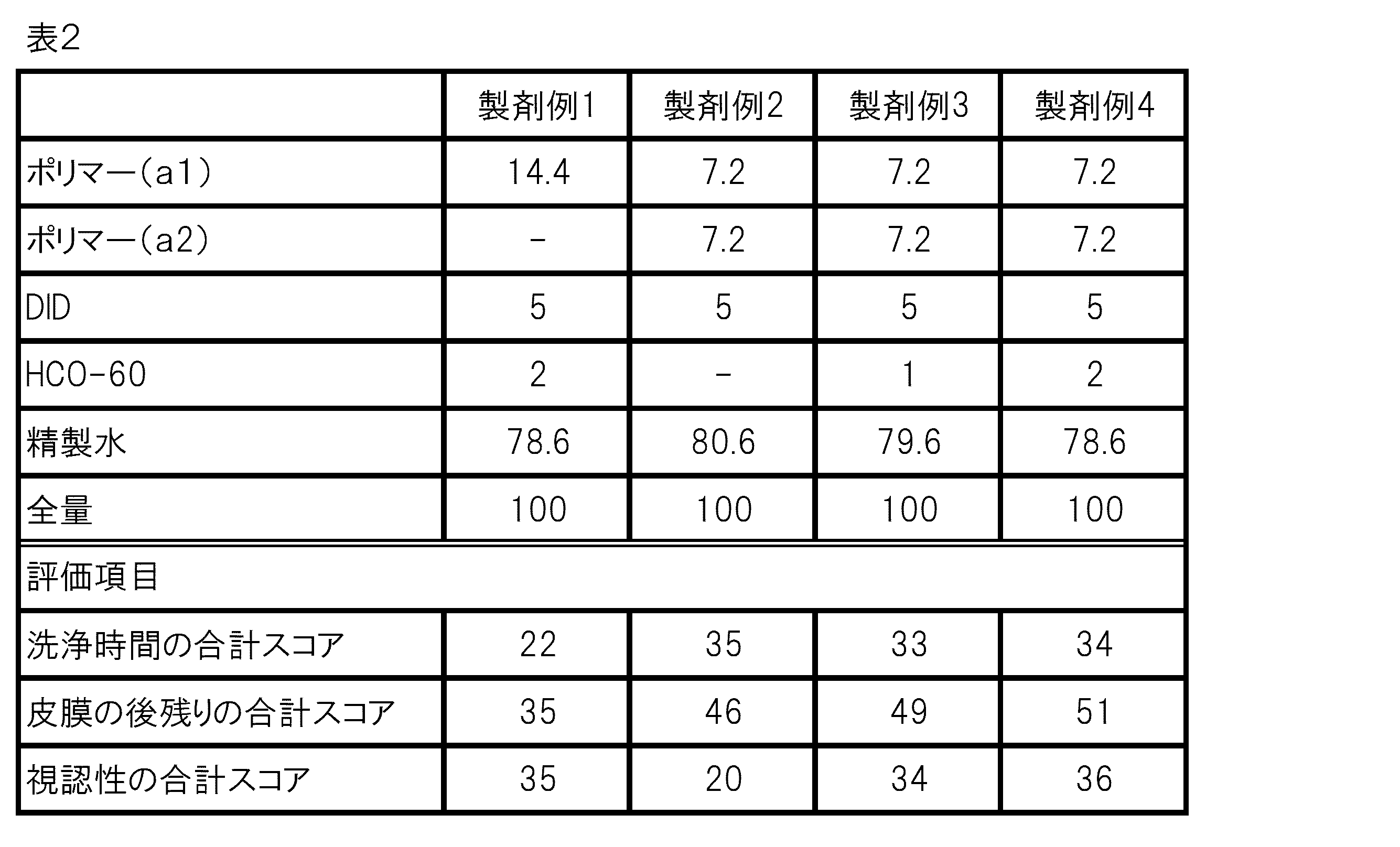
- Example 1 15 ⁇ L of the pharmaceutical product was spread on the back of each panelist's hand to a size of about 25 mm in diameter to form a film, and the legibility of the film was evaluated. After the film is completely dried, the hands are soaked in hot water at 37 ° C for 30 seconds, the hands are removed from the hot water, the film is rubbed for 2 minutes, and the following two detergency items are evaluated and scored. (14 panelists for both cleanability and visibility). The total score shown in Table 2 is the sum of the values obtained by multiplying the numerical value of each score and the number of people who judge the score.
- the pharmaceutical product examples 2 to 4 in which the polymers (a1) and (a2) are mixed have a shorter washing time and remain behind. The result was less. Further, when the pharmaceutical examples 2 to 4 were compared, the amount of the residual residue was less when the surfactant (HCO-60) was added. In particular, in the pharmaceutical product example 4 in which the concentration of the surfactant is high, 11 out of 14 panelists evaluated that there was no residue (score 4). Regarding visibility, it was confirmed that the visibility was enhanced depending on the concentration of the surfactant.
- the film formed on the slide using Pharmaceutical Examples 2 to 4 does not peel off even when infiltrated with water for 10 minutes and exhibits high water resistance. Therefore, according to the present invention, the film has high water resistance and high detergency. It was confirmed that a film having both can be formed.
- Example 2 Preparations (formulation examples 5 to 8) in which the mixing ratios of the polymers (a1) and (a2) are 9: 1, 8: 2, 7: 3, and 6: 4 are prepared, and their detergency is determined by the polymer (formation example 5 to 8).
- the mixing ratio of a1) and (a2) was compared with the detergency of Pharmaceutical Example 9 having a mixing ratio of 5: 5.
- the pharmaceutical example 9 adopted as the comparative standard is the product in which the medicinal ingredient and the thickener are added to the pharmaceutical example 4 confirmed to show high detergency in the example 1, and has the same high detergency as the pharmaceutical example 4. Show sex.
- ⁇ Evaluation method of detergency> 15 ⁇ L of the pharmaceutical product was spread on the back of each panelist's hand to a diameter of about 25 mm, and dried for 5 minutes or more. After the film had dried, it was gently rubbed for 30 seconds using a body wipe and evaluated according to the following criteria and scored (n 4).
- composition of each pharmaceutical example and the evaluation by each panelist are shown in the table below.
- the detergency of the preparation (formulation example 5) having a ratio of the polymers (a1) and (a2) of 9: 1 was not as high as that of the preparation example 9, but the required detergency standard is Was satisfied.
- the formulation (formulation example 6) having a ratio of the polymers (a1) and (a2) of 8: 2 higher detergency was observed as compared with the formulation example 5, and the ratio of the polymers (a1) and (a2) was 7: 3.
- the pharmaceutical product (formal example 7) and the 6: 4 pharmaceutical example (formal example 8) showed the same detergency as the 5: 5 pharmaceutical example 9.
- Example 3 As the polymer, a preparation containing only the polymer (a1) or the polymers (a1) and (a2) in a ratio of 7: 3 or 5: 5 was prepared, and the friction resistance was evaluated according to the following criteria. ⁇ Evaluation of abrasion resistance> The mass (A) of the slide glass is measured. Apply 100 ⁇ L of the pharmaceutical product evenly to the entire surface of the slide glass using a spatula, and dry in a mini jet oven set at 30 ° C. for 5 minutes. Then, the slide glass is taken out from the mini jet oven and its mass (B) is measured.
- a dry paper towel is placed on the surface coated with the formulation of the slide glass, a weight of 100 g is placed on the weight, and the slide glass is wiped 20 times so that a uniform force is applied to the entire slide glass.
- the residual ratio of the pharmaceutical product after wiping is calculated from each mass by the following formula. Repeat the test 3 times to determine the mean and standard deviation of the residual rate of the drug.
- Table 5 shows the composition of each pharmaceutical product and the evaluation of abrasion resistance.
- the pharmaceutical product containing the product (Pharmaceutical Example 12) showed high abrasion resistance. From this, it was confirmed that the composition containing the polymers (a1) and (a2) was excellent in detergency, but showed high resistance to friction, and was difficult to remove from the skin.
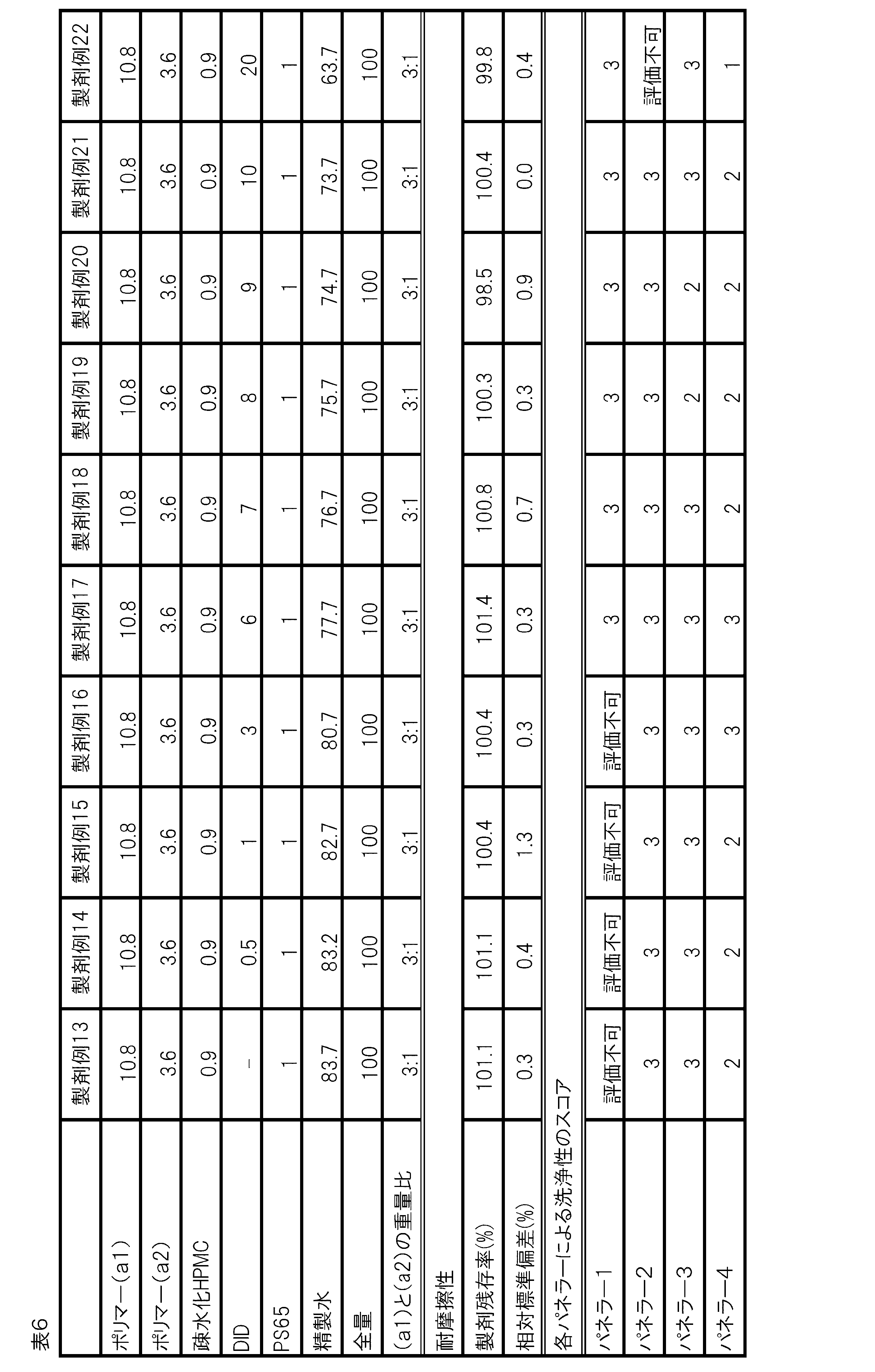
- Example 4 A preparation in which the amount of the plasticizer (DID) is changed is prepared, and the cleaning property and the friction resistance are evaluated by using the cleaning property evaluation method described in Example 2 and the friction resistance evaluation method described in Example 3. The sex was evaluated. Table 6 shows the composition and evaluation results of each pharmaceutical product. “Cannot be evaluated” in Table 6 indicates that it was difficult to evaluate because the appearance of film residue during washing was different from that of Pharmaceutical Example 9.
- the friction resistance was good for all the formulations.
- all the formulations satisfy the required detergency criteria, and in particular, the detergency of the formulations 16 to 21 in which the plasticizer is 3 to 10% by weight is good.
- the film formation time tended to be shorter (quick-drying increased), but in the preparation example 22 containing 20% by weight of the plasticizer, a film was formed immediately when applied to the skin. , It was difficult to form a uniform film.
- Example 5 A pharmaceutical product in which the type of plasticizer was changed was prepared, and the detergency and abrasion resistance were evaluated in the same manner as in Example 4. Table 7 shows the composition and evaluation results of each pharmaceutical product.
- Example 6 A pharmaceutical product in which the amount of the surfactant (PS65) was changed was prepared, and the detergency and abrasion resistance were evaluated in the same manner as in Example 4. Table 8 shows the composition and evaluation results of each pharmaceutical product.
- the detergency of the pharmaceutical product example 30 containing no surfactant was not as high as that of the pharmaceutical product example 9, but it was confirmed that the required detergency criteria were satisfied.
- Pharmaceutical examples 32 to 36 containing 1% by weight or more of the surfactant showed good detergency.
- Example 7 A pharmaceutical product in which the type of surfactant was changed was prepared, and the detergency and abrasion resistance were evaluated in the same manner as in Example 4. The composition and evaluation results of each pharmaceutical product are shown in Tables 9 and 10.
- the pharmaceutical examples 37 to 43 containing the nonionic surfactant showed good detergency and abrasion resistance.
- the friction resistance was also good when an anionic surfactant or an amphoteric surfactant was used.
- the detergency as shown in Table 10 as “not evaluationable”, when an anionic surfactant was used, the film was melted off during cleaning, so it was difficult to determine whether the film could be washed off from the skin. Even when amphoteric tenside agents were used, panelists 1 and 2 were judged to be unevaluable.
- Example 46 and Example 47 the score 4 (no remaining) is 2 and the score 3 (30% or less remaining) is 1, and there is no problem in detergency even when an amphoteric tenside agent is used.
- the formulation was ready. From the results of Example 7, it was found that when a nonionic surfactant or an amphoteric surfactant was used as the surfactant, it was easy to visually confirm the film removal.
- Example 8 Preparations in which the amounts of the polymers (a1) and (a2) were changed were prepared, and the detergency and abrasion resistance were evaluated in the same manner as in Example 4. Table 11 shows the composition and evaluation results of each pharmaceutical product.
- the pharmaceutical example 48 having a total amount of the polymers (a1) and (a2) of 1.2% by weight had lower abrasion resistance than the other pharmaceuticals.
- the pharmaceutical examples 49 to 58 in which the total amount of the polymers (a1) and (a2) was 2.4% by weight to 24% by weight showed good detergency and abrasion resistance.
Landscapes
- Health & Medical Sciences (AREA)
- Chemical & Material Sciences (AREA)
- Life Sciences & Earth Sciences (AREA)
- Public Health (AREA)
- Veterinary Medicine (AREA)
- Animal Behavior & Ethology (AREA)
- General Health & Medical Sciences (AREA)
- Medicinal Chemistry (AREA)
- Pharmacology & Pharmacy (AREA)
- Epidemiology (AREA)
- Dermatology (AREA)
- Engineering & Computer Science (AREA)
- Bioinformatics & Cheminformatics (AREA)
- Inorganic Chemistry (AREA)
- Chemical Kinetics & Catalysis (AREA)
- General Chemical & Material Sciences (AREA)
- Nuclear Medicine, Radiotherapy & Molecular Imaging (AREA)
- Organic Chemistry (AREA)
- Dispersion Chemistry (AREA)
- Birds (AREA)
- Medicinal Preparation (AREA)
- Pharmaceuticals Containing Other Organic And Inorganic Compounds (AREA)
Abstract
Description
[1]以下の2種類のポリマー:
(a1)アクリル酸エチル・メタクリル酸メチル・メタクリル酸塩化トリメチルアンモニウムエチル共重合体、及び
(a2)アクリル酸エチル・メタクリル酸メチル共重合体
を含有する、皮膜形成型皮膚用組成物。
[2]薬効成分としてプロプラノロール又は薬学的に許容されるその塩を含有する、[1]に記載の組成物。
[3]血管腫の治療に用いられる、[2]に記載の組成物。
[4]乳幼児の血管腫の治療に用いられる、[2]又は[3]に記載の組成物。
[5]ポリマー(a1)とポリマー(a2)の重量比が、8:2~2:8の範囲内である、[1]~[4]のいずれか1つに記載の組成物。
[6]さらに、組成物の全量(ただし、組成物がエアゾール剤の場合は噴射剤を除く)に対して36重量%以上の水を含む、[1]~[5]のいずれか1つに記載の組成物。
[7]さらに、界面活性剤を含む、[1]~[6]のいずれか1つに記載の組成物。
[8]前記界面活性剤が、非イオン性界面活性剤及び/又は両性界面活性剤である、[7]に記載の組成物。
[9]さらに、常温で液状のエステル化合物、常温で液状の芳香族アルコール、中極性の固形エステル化合物、及びテルペン類からなる群より選択される、1種又は複数の可塑剤を含有する、[1]~[8]のいずれか1つに記載の組成物。
[10]実質的に低級一価アルコールを含有しない、請求項1~9のいずれか1つに記載の組成物。
一方、皮膜形成型皮膚外用剤(薬効成分を含む)は、皮膚上に噴霧又は塗布することにより皮膜を形成し、効果的に薬効成分を皮膚に送達可能である。また、爪や爪周囲の皮膚、粘膜に塗布した際も同様の効果が期待できる。
(a1)アクリル酸エチル・メタクリル酸メチル・メタクリル酸塩化トリメチルアンモニウムエチル共重合体、及び
(a2)アクリル酸エチル・メタクリル酸メチル共重合体
である。
ポリマー(a1)とポリマー(a2)の重量比は、8:2~2:8が好ましく、8:2~5:5がより好ましく、8:2~6:4が特に好ましく、8:2~7:3がさらに好ましい。
オイドラギットRSタイプは、構成成分の組成比が1:2:0.1のアクリル酸系ポリマーである。平均分子量(Mw)が約32,000であり、pHに関わらず水に不溶である。オイドラギットRSタイプは、例えば、オイドラギットRS100、オイドラギットRSPO、オイドラギットRS30D(アクリル酸エチル・メタクリル酸メチル・メタクリル酸塩化トリメチルアンモニウムエチル共重合体(組成比1:2:0.1)を30重量%含有する水性懸濁液)として入手可能である。
オイドラギットRLタイプは、構成成分の組成比が1:2:0.2のアクリル酸系ポリマーである。平均分子量(Mw)が約32,000であり、pHに関わらず水に不溶である。オイドラギットRLタイプは、オイドラギットRL100、オイドラギットRLPO、オイドラギットRL30D(アクリル酸エチル・メタクリル酸メチル・メタクリル酸塩化トリメチルアンモニウムエチル共重合体(組成比1:2:0.2)を30重量%含有する水性懸濁液)として入手可能である。
本発明の好ましい実施形態は、低級一価アルコールを実質的に含まない組成物である。実質的に含まないとは、製造工程で意図的に低級一価アルコールを添加していないことを意味する。すなわち、低級一価アルコールを実質的に含まない組成物における、低級一価アルコール含有率は通常0重量%であり、ごくわずかに混入することがあったとしても、含有率は1重量%未満(より好ましくは0.5重量%未満)である。
セバシン酸ジエチル、セバシン酸ジイソプロピル、アジピン酸ジイソプロピル及び中鎖脂肪酸トリグリセリドから選択される、常温で液状の脂肪酸エステルがより好ましく、この中でも、セバシン酸ジエチル及びアジピン酸ジイソプロピルがさらに好ましく、アジピン酸ジイソプロピルが特に好ましい。
特に、組成物のpHが4以上であると、皮膜の耐水性が向上するため好ましい。好ましいpHの範囲は、5~9であり、より好ましくは、6~8である。
前記薬効成分としては、例えば、以下の成分が挙げられるが、これらに限定されない。
・ヒドロコルチゾン、デキサメサゾン、クロベタゾール17-プロピオネート、デキサメサゾン17-バレレート、フルオシノニド、ハルシノニド、アムシノニド、ジフルプレドナート、及びベタメタゾン酪酸エステルプロピオン酸エステル等のステロイド系抗炎症薬;
・インドメタシン、ケトプロフェン、フルルビプロフェン、フェルビナク、ピロキシカム、イブプロフェンピコノール、ベンザダック、フルフェナム酸ブチル、及びブフェキサマック等の非ステロイド系抗炎症薬;
・ラノコナゾール、トルナフテート、クロトリマゾール、ビフォナゾール、硝酸ミコナゾール、硝酸エコナゾール、硝酸ケトコナゾール、硝酸オモコナゾール、硝酸オキシコナゾール、エキサラミド、トリシクラート、及びシッカニン等の抗真菌薬;
・オゼノキサシン、及びクリンダマイシン等の抗菌薬;
・ケトチフェン、アゼラスチン及びそれらの塩、マレイン酸クロムフェニラミン、オキサイトミド、トラニラスト、及びクロモグリコール酸ナトリウム等の抗アレルギー薬;
・リドカイン、及びプロピトカイン等の局所麻酔薬;
・アシクロビル、バラシクロビル、ファムシクロビル、アメナメビル、ビダラビン等及びそれらの塩等の抗ウィルス薬;
・ヘパリン類似物質、ヒアルロン酸、及び尿素等の保湿薬;
・線維芽細胞増殖因子、及びブクラデシンナトリウム等の創傷治療薬;
・過酸化ベンゾイル、及びアダパレン等のざ瘡治療薬;
・マキサカルシトール等の尋常性乾癬等角化症治療薬;
・β遮断薬等の不整脈、高血圧、心筋梗塞、狭心症、片頭痛、血管腫治療薬;
・サリチル酸、モノ・トリクロロ酢酸、グルタールアルデヒド、フェノール、タカルシトール、カルシポトリオール、マキサカルシトール、カルシトリオール、アルファカルシドール、エルデカルシトール、ブレオマイシン、5-FU、ポドフィリン、レチノイド、ヨクイニンエキス、イミキモド、シメチジン、インターフェロン等の尋常性疣贅治療薬;
・アシクロビル、バラシクロビル、ファムシクロビル、アメナメビル、ビダラビン、プレガバリン、ガバペンチン、デュロキセチン、アミトリプチリン、ノルトリプチリン、イミプラミン、ワクシニアウイルス接種家兎炎症皮膚抽出液、トラマドール、トラマドール・アセトアミノフェン、フェンタニル、オキシコドン、ブプレノルフィン、メキシレチン、エパルレスタット、モルヒネ等の帯状疱疹後神経痛治療薬。
本発明のエアゾール剤中の噴射剤の含有量は、噴射剤を除いた組成物100重量部に対して、30~50重量部が好ましく、35~50重量部がより好ましく、40~46重量部が特に好ましい。
<使用したポリマー>
(a1)アクリル酸エチル・メタクリル酸メチル・メタクリル酸塩化トリメチルアンモニウムエチル共重合体(構成成分の組成比は1:2:0.1 平均分子量(Mw):約32,000 pHに関わらず水に不溶)
(a2)アクリル酸エチル・メタクリル酸メチル共重合体(構成成分の組成比は2:1 平均分子量(Mw):約750,000 pHに関わらず水に不溶)
アジピン酸ジイソプロピル(DID)、クエン酸トリエチル、トリアセチン、セバシン酸ジエチル、セバシン酸ジイソプロピル、中鎖脂肪酸トリグリセリド、サリチル酸エチレングリコール、フェノキシエタノール
<使用した界面活性剤>
ポリオキシエチレン硬化ひまし油(NIKKOL HCO-60)
トリステアリン酸ポリオキシエチレン(20)ソルビタン(NIKKOL TS-30V、ポリソルベート65/PS65)
ポリオキシエチレンラウリルエーテル(4.2E.O)(NIKKOL BL-4.2)
ポリオキシエチレンヤシ油脂肪酸ソルビタン(20E.O)(NIKKOL TL-10)
モノオレイン酸ポリエチレングリコール(10E.O.)(NIKKOL MYO-10V)
モノラウリン酸デカグリセリル(NIKKOL Decaglyn 1-L)
モノオレイン酸ジグリセリル(NIKKOL DGMO-90V)
モノステアリン酸ポリオキシエチレングリセリル(PEG-5)(NIKKOL TMGS-5V)
モノステアリン酸ポリオキシエチレングリセリル(PEG-15)(NIKKOL TMGS-15V)
ラウロイルサルコシンナトリウム(NIKKOL サルコシネート LN)
ミリスチン酸カリウム(ノンサールMK-1)
ラウリルジメチルアミノ酢酸ベタイン(NIKKOL AM-301)
ヤシ油脂肪酸アミドプロピルジメチルアミノ酢酸ベタイン(NIKKOL AM-3130N)
<使用した増粘剤>
疎水化ヒドロキシプロピルメチルセルロース(疎水化HPMC)
<使用した薬効成分>
プロプラノロール塩酸塩
各ポリマー及び精製水を秤取し、及び任意で、可塑剤/界面活性剤/増粘剤/薬効成分を加え、均一になるまで撹拌した。各製剤例(製剤例1~58)の組成は、表2,4~11に示す通りである(表中の各成分の数値は重量%を示す)。表に示すポリマー及び界面活性剤の含有量は、固形分の含有量であり、表に示す精製水の含有量は、ポリマー及び/又は界面活性剤の水性懸濁液(水分散液)又は水溶液を用いた場合は、水性懸濁液又は水溶液中に含まれる水と、添加した精製水の合計量である。
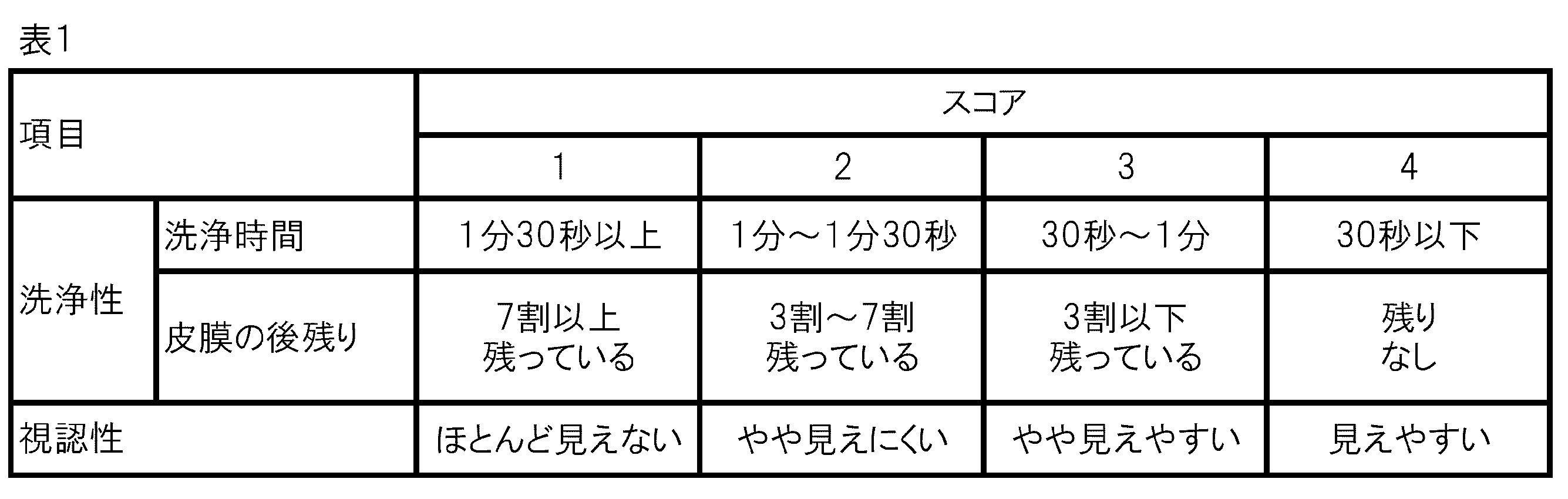
製剤15μLを各パネラーの手の甲に直径約25mmサイズに塗り広げて、皮膜を形成し、皮膜の視認性について評価した。
また、皮膜が完全に乾燥した後、37℃のお湯に手を30秒間浸漬し、お湯から手を出した後、皮膜を2分間擦り、下記の洗浄性2項目をそれぞれ評価して、スコア化した(洗浄性及び視認性のいずれも、パネラーは14名)。表2に示す合計スコアは、各スコアの数値とそのスコアの判定人数とを掛けて得られる値を合計したものである。
ポリマー(a1)と(a2)の混合割合を、9:1、8:2、7:3、6:4とした製剤(製剤例5~8)を調製し、それらの洗浄性を、ポリマー(a1)と(a2)の混合割合が5:5の製剤例9の洗浄性と比較した。比較基準として採用した製剤例9は、実施例1において高い洗浄性を示すことが確認された製剤例4に、薬効成分及び増粘剤を加えたものであり、製剤例4と同様の高い洗浄性を示す。
製剤15μLを各パネラーの手の甲に直径約25mmサイズに塗り広げ、5分以上乾燥した。
皮膜が乾燥した後、身体用の拭き取りシートを用いて、30秒間優しくこすり、以下の基準で評価してスコア化した(n=4)。


ポリマーとして、ポリマー(a1)のみ、又はポリマー(a1)と(a2)を7:3もしくは5:5の割合で含む製剤を調製し、以下の基準で耐摩擦性を評価した。
<耐摩擦性の評価>
スライドガラスの質量(A)を測定する。
製剤100μLを、へらを用いてスライドガラスの全面に均一に塗布し、30℃に設定したミニジェットオーブンで5分間乾燥させる。その後、ミニジェットオーブンからスライドガラスを取り出し、その質量(B)を測定する。次に、スライドガラスの製剤塗布面に乾いたペーパータオルを載せ、その上から100gの重りを載せて、スライドガラス全体に均一に力がかかるように20回拭き取った後、スライドガラスの質量(C)を測定する。以下の式により、各質量から拭き取り後の製剤残存率を算出する。試験を3回繰り返し、製剤残存率の平均値及び標準偏差を求める。


可塑剤(DID)の量を変更した製剤を調製し、実施例2に記載の洗浄性の評価方法、及び、実施例3に記載の耐摩擦性の評価方法を用いて、洗浄性及び耐摩擦性を評価した。各製剤の組成と評価結果を表6に示す。表6中の「評価不可」は、製剤例9とは洗浄時の皮膜カスの出方が異なるため、評価が困難であったことを示す。
可塑剤の種類を変更した製剤を調製し、実施例4と同様に、洗浄性及び耐摩擦性を評価した。各製剤の組成と評価結果を表7に示す。

界面活性剤(PS65)の量を変更した製剤を調製し、実施例4と同様に、洗浄性及び耐摩擦性を評価した。各製剤の組成と評価結果を表8に示す。

界面活性剤の種類を変更した製剤を調製し、実施例4と同様に、洗浄性及び耐摩擦性を評価した。各製剤の組成と評価結果を表9及び表10に示す。

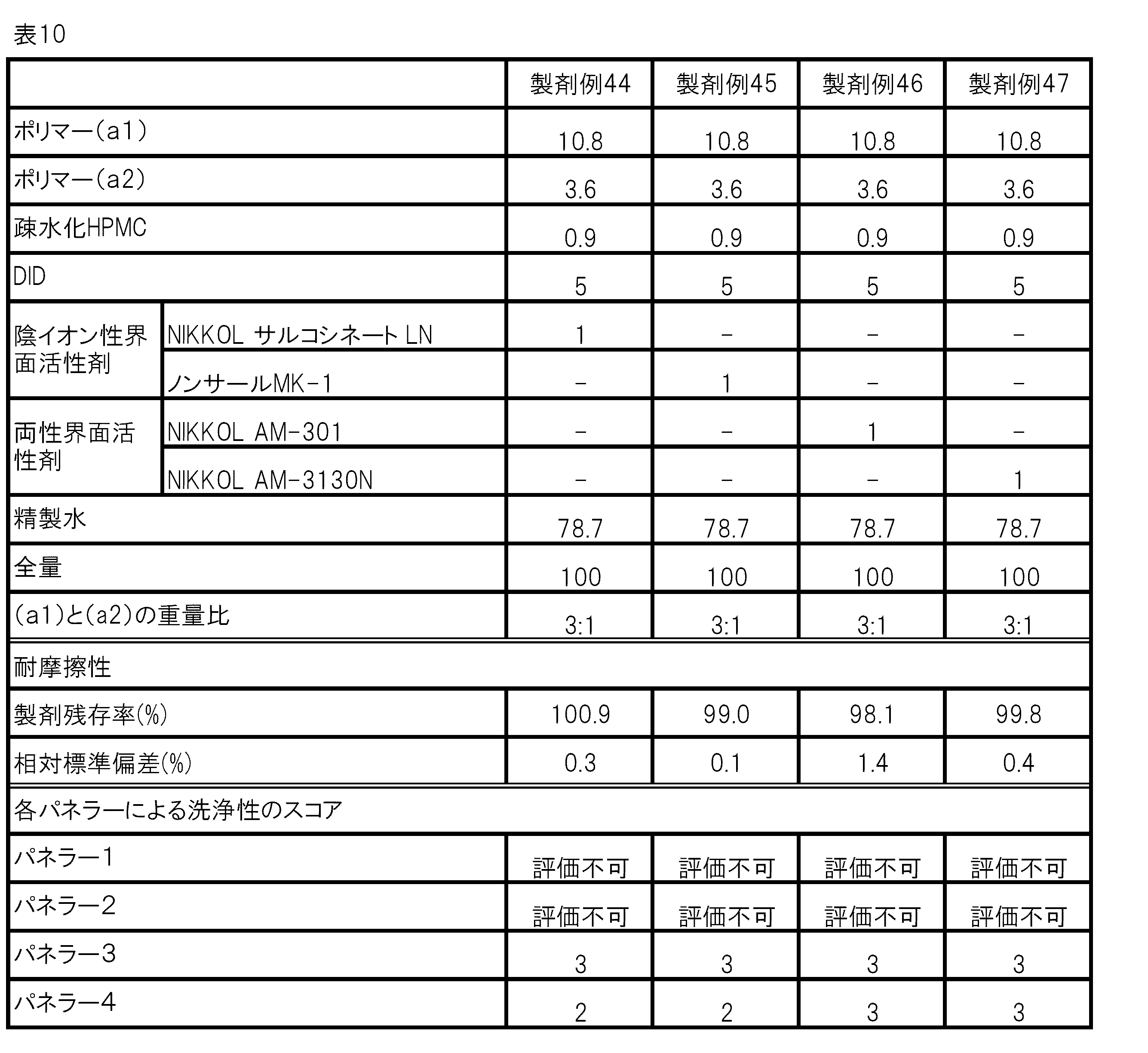
表10に示すように、陰イオン性界面活性剤又は両性界面活性剤を使用した場合も、耐摩擦性は良好であった。洗浄性については、表10に「評価不可」と示すように、陰イオン性界面活性剤を使用した場合、洗浄時に皮膜が溶け落ちるため、皮膜を皮膚から洗い流せたかどうかの判断が難しかった。両性界面活性剤を使用した場合も、パネラー1及び2は、評価不可と判断したが、さらに、表1に示した洗浄性(皮膚の後残り)に関する試験をパネラー3名について実施した結果、製剤例46及び製剤例47では、スコア4(残りなし)が2名、スコア3(3割以下残っている)が1名であり、両性界面活性剤を使用した場合も、洗浄性に問題のない製剤が調製可能であった。
実施例7の結果から、界面活性剤として非イオン性界面活性剤又は両性界面活性剤を使用した場合、目視による皮膜除去の確認が容易になることが分かった。
ポリマー(a1)及び(a2)の量を変更した製剤を調製し、実施例4と同様に、洗浄性及び耐摩擦性を評価した。各製剤の組成と評価結果を表11に示す。

Claims (10)
- 以下の2種類のポリマー:
(a1)アクリル酸エチル・メタクリル酸メチル・メタクリル酸塩化トリメチルアンモニウムエチル共重合体、及び
(a2)アクリル酸エチル・メタクリル酸メチル共重合体
を含有する、皮膜形成型皮膚用組成物。 - 薬効成分としてプロプラノロール又は薬学的に許容されるその塩を含有する、請求項1に記載の組成物。
- 血管腫の治療に用いられる、請求項2に記載の組成物。
- 乳幼児の血管腫の治療に用いられる、請求項2又は3に記載の組成物。
- ポリマー(a1)とポリマー(a2)の重量比が、8:2~2:8の範囲内である、請求項1~4のいずれか1項に記載の組成物。
- さらに、組成物の全量(ただし、組成物がエアゾール剤の場合は噴射剤を除く)に対して36重量%以上の水を含む、請求項1~5のいずれか1項に記載の組成物。
- さらに、界面活性剤を含む、請求項1~6のいずれか1項に記載の組成物。
- 前記界面活性剤が、非イオン性界面活性剤及び/又は両性界面活性剤である、請求項7に記載の組成物。
- さらに、常温で液状のエステル化合物、常温で液状の芳香族アルコール、中極性の固形エステル化合物、及びテルペン類からなる群より選択される、1種又は複数の可塑剤を含有する、請求項1~8のいずれか1項に記載の組成物。
- 実質的に低級一価アルコールを含有しない、請求項1~9のいずれか1項に記載の組成物。
Priority Applications (5)
| Application Number | Priority Date | Filing Date | Title |
|---|---|---|---|
| EP21852270.4A EP4194018A4 (en) | 2020-08-05 | 2021-08-04 | COMPOSITION FOR THE SKIN |
| JP2022541589A JP7802670B2 (ja) | 2020-08-05 | 2021-08-04 | 皮膚用組成物 |
| US18/040,399 US20230277476A1 (en) | 2020-08-05 | 2021-08-04 | Skin composition |
| KR1020227044213A KR20230047960A (ko) | 2020-08-05 | 2021-08-04 | 피부용 조성물 |
| CN202180046716.3A CN115916273A (zh) | 2020-08-05 | 2021-08-04 | 皮肤用组合物 |
Applications Claiming Priority (2)
| Application Number | Priority Date | Filing Date | Title |
|---|---|---|---|
| PCT/JP2020/030050 WO2022029938A1 (ja) | 2020-08-05 | 2020-08-05 | 皮膚用組成物 |
| JPPCT/JP2020/030050 | 2020-08-05 |
Publications (1)
| Publication Number | Publication Date |
|---|---|
| WO2022030540A1 true WO2022030540A1 (ja) | 2022-02-10 |
Family
ID=80117454
Family Applications (2)
| Application Number | Title | Priority Date | Filing Date |
|---|---|---|---|
| PCT/JP2020/030050 Ceased WO2022029938A1 (ja) | 2020-08-05 | 2020-08-05 | 皮膚用組成物 |
| PCT/JP2021/028942 Ceased WO2022030540A1 (ja) | 2020-08-05 | 2021-08-04 | 皮膚用組成物 |
Family Applications Before (1)
| Application Number | Title | Priority Date | Filing Date |
|---|---|---|---|
| PCT/JP2020/030050 Ceased WO2022029938A1 (ja) | 2020-08-05 | 2020-08-05 | 皮膚用組成物 |
Country Status (6)
| Country | Link |
|---|---|
| US (1) | US20230277476A1 (ja) |
| EP (1) | EP4194018A4 (ja) |
| JP (1) | JP7802670B2 (ja) |
| KR (1) | KR20230047960A (ja) |
| CN (1) | CN115916273A (ja) |
| WO (2) | WO2022029938A1 (ja) |
Cited By (2)
| Publication number | Priority date | Publication date | Assignee | Title |
|---|---|---|---|---|
| WO2023188109A1 (ja) * | 2022-03-30 | 2023-10-05 | 福地製薬株式会社 | 水膨潤性の皮膜形成型外用剤基剤 |
| WO2023188108A1 (ja) * | 2022-03-30 | 2023-10-05 | 福地製薬株式会社 | 水非膨潤性の皮膜形成型外用剤基剤 |
Citations (7)
| Publication number | Priority date | Publication date | Assignee | Title |
|---|---|---|---|---|
| JPH037238A (ja) * | 1989-03-10 | 1991-01-14 | Yamanouchi Pharmaceut Co Ltd | 持続性製剤用薬物放出制御膜 |
| JPH0532535A (ja) | 1991-07-30 | 1993-02-09 | Zenyaku Kogyo Kk | 被膜型皮膚保護剤 |
| JPH07277975A (ja) * | 1994-02-16 | 1995-10-24 | Pola Chem Ind Inc | 皮膚外用剤 |
| JPH10226639A (ja) * | 1996-12-10 | 1998-08-25 | Shiseido Co Ltd | 被膜形成性抗真菌剤組成物 |
| JP2008100966A (ja) * | 2006-10-20 | 2008-05-01 | Kyowa Ltd | 皮膚保護剤 |
| JP2011126796A (ja) | 2009-12-16 | 2011-06-30 | Kracie Home Products Ltd | 手指用外用剤 |
| JP2011126797A (ja) | 2009-12-16 | 2011-06-30 | Kracie Home Products Ltd | 手指用外用剤 |
Family Cites Families (7)
| Publication number | Priority date | Publication date | Assignee | Title |
|---|---|---|---|---|
| ATE95430T1 (de) * | 1984-12-22 | 1993-10-15 | Sanol Arznei Schwarz Gmbh | Wirkstoffpflaster. |
| EP1563831B1 (en) * | 2004-10-26 | 2015-09-02 | Shiseido Co., Ltd. | External composition for skin |
| CN101854929A (zh) * | 2007-11-09 | 2010-10-06 | 田边三菱制药株式会社 | 新型制剂 |
| KR20150027831A (ko) | 2012-07-06 | 2015-03-12 | 레오 파마 에이/에스 | 피부에 활성 성분을 전달하기 위한 막-형성 중합체를 포함하는 국소 조성물 |
| US20140193355A1 (en) | 2013-01-07 | 2014-07-10 | Marie H. JHIN | Dermal protector |
| WO2020072311A1 (en) * | 2018-10-04 | 2020-04-09 | Emory University | Pharmaceutical compositions of r-(+)-propranolol in enantiomeric excess and therapeutic uses related thereto |
| WO2020161771A1 (ja) | 2019-02-04 | 2020-08-13 | マルホ株式会社 | 皮膚用組成物 |
-
2020
- 2020-08-05 WO PCT/JP2020/030050 patent/WO2022029938A1/ja not_active Ceased
-
2021
- 2021-08-04 EP EP21852270.4A patent/EP4194018A4/en not_active Withdrawn
- 2021-08-04 JP JP2022541589A patent/JP7802670B2/ja active Active
- 2021-08-04 WO PCT/JP2021/028942 patent/WO2022030540A1/ja not_active Ceased
- 2021-08-04 KR KR1020227044213A patent/KR20230047960A/ko active Pending
- 2021-08-04 US US18/040,399 patent/US20230277476A1/en not_active Abandoned
- 2021-08-04 CN CN202180046716.3A patent/CN115916273A/zh active Pending
Patent Citations (7)
| Publication number | Priority date | Publication date | Assignee | Title |
|---|---|---|---|---|
| JPH037238A (ja) * | 1989-03-10 | 1991-01-14 | Yamanouchi Pharmaceut Co Ltd | 持続性製剤用薬物放出制御膜 |
| JPH0532535A (ja) | 1991-07-30 | 1993-02-09 | Zenyaku Kogyo Kk | 被膜型皮膚保護剤 |
| JPH07277975A (ja) * | 1994-02-16 | 1995-10-24 | Pola Chem Ind Inc | 皮膚外用剤 |
| JPH10226639A (ja) * | 1996-12-10 | 1998-08-25 | Shiseido Co Ltd | 被膜形成性抗真菌剤組成物 |
| JP2008100966A (ja) * | 2006-10-20 | 2008-05-01 | Kyowa Ltd | 皮膚保護剤 |
| JP2011126796A (ja) | 2009-12-16 | 2011-06-30 | Kracie Home Products Ltd | 手指用外用剤 |
| JP2011126797A (ja) | 2009-12-16 | 2011-06-30 | Kracie Home Products Ltd | 手指用外用剤 |
Non-Patent Citations (5)
| Title |
|---|
| CHEMISTRY REGION, vol. 11, no. 10, 1957, pages 719 - 725 |
| FRAGRANCE JOURNAL, vol. 50, 1981, pages 79 - 82 |
| PHARMACEUTICAL BULLETIN, vol. 2, no. 2, 1954, pages 163 - 173 |
| See also references of EP4194018A4 |
| TAKATSUKA HIROKAZU, SUZUKI TAKAAKI, YAMAZAKI SHINGO, SUZUKI TATSUYA, RIKIHISA NAOAKI, MITSUKAWA NOBUYUKI, ISHII ITSUKO: "Pharmaceutical Evaluation of the Hospital Grade Preparation of Timolol Gel for Infantile Hemangioma", IRYO YAKUGAKU - JAPANESE JOURNAL OF PHARMACEUTICAL HEALTH CAREAND SCIENCES, NIHON BYOIN YAKUZAISHIKAI, TOKYO, JP, vol. 43, no. 12, 10 December 2017 (2017-12-10), JP , pages 706 - 712, XP055894431, ISSN: 1346-342X, DOI: 10.5649/jjphcs.43.706 * |
Cited By (2)
| Publication number | Priority date | Publication date | Assignee | Title |
|---|---|---|---|---|
| WO2023188109A1 (ja) * | 2022-03-30 | 2023-10-05 | 福地製薬株式会社 | 水膨潤性の皮膜形成型外用剤基剤 |
| WO2023188108A1 (ja) * | 2022-03-30 | 2023-10-05 | 福地製薬株式会社 | 水非膨潤性の皮膜形成型外用剤基剤 |
Also Published As
| Publication number | Publication date |
|---|---|
| CN115916273A (zh) | 2023-04-04 |
| EP4194018A4 (en) | 2024-09-25 |
| EP4194018A1 (en) | 2023-06-14 |
| WO2022029938A1 (ja) | 2022-02-10 |
| JPWO2022030540A1 (ja) | 2022-02-10 |
| US20230277476A1 (en) | 2023-09-07 |
| KR20230047960A (ko) | 2023-04-10 |
| JP7802670B2 (ja) | 2026-01-20 |
Similar Documents
| Publication | Publication Date | Title |
|---|---|---|
| CN103561724B (zh) | 给药给甲的药物组合物 | |
| JP7704509B2 (ja) | 皮膚用組成物 | |
| JP2009519958A (ja) | 薬物の皮膚送達のための、フラックス化可能な組成物および方法 | |
| CN106604717B (zh) | 局部用双氯芬酸钠组合物 | |
| JP2009524586A (ja) | 疼痛を皮膚処置するための組成物および方法 | |
| JP7802670B2 (ja) | 皮膚用組成物 | |
| JP2011213676A (ja) | 水中油型乳化組成物 | |
| CN105392473A (zh) | 使用时产生泡沫状态的外用组合物 | |
| EP2115052A2 (en) | Urea foam | |
| WO2021138525A1 (en) | Topical composition comprising tofacitinib and fingolimod | |
| JP2009519957A (ja) | 薬物の皮膚送達のためのスプレイ−オン処方物および方法 | |
| JP2009519956A (ja) | 薬物の皮膚送達のための組成物および方法 | |
| CN111088118B (zh) | 清洁组合物 | |
| CN101494976B (zh) | 用于经皮肤治疗痛的组合物和方法 | |
| HK40085418A (en) | Skin composition | |
| CN119055816A (zh) | 油性组合物及其用途 | |
| WO2017221973A1 (ja) | シワ改善用の皮膚外用剤 | |
| CN114555055A (zh) | 用于银屑病的维持治疗的无水药物组合物 | |
| TW202416934A (zh) | 外用劑組合物 | |
| JP2024519493A (ja) | 局所ナプロキセン製剤及びそれらの使用 | |
| JP2022116436A (ja) | 液体皮膚外用剤 | |
| JPH0331165B2 (ja) |
Legal Events
| Date | Code | Title | Description |
|---|---|---|---|
| 121 | Ep: the epo has been informed by wipo that ep was designated in this application |
Ref document number: 21852270 Country of ref document: EP Kind code of ref document: A1 |
|
| ENP | Entry into the national phase |
Ref document number: 2022541589 Country of ref document: JP Kind code of ref document: A |
|
| NENP | Non-entry into the national phase |
Ref country code: DE |
|
| ENP | Entry into the national phase |
Ref document number: 2021852270 Country of ref document: EP Effective date: 20230306 |
|
| WWW | Wipo information: withdrawn in national office |
Ref document number: 2021852270 Country of ref document: EP |