WO2022039238A1 - 含ハロゲン(メタ)アクリル酸エステルの精製方法 - Google Patents
含ハロゲン(メタ)アクリル酸エステルの精製方法 Download PDFInfo
- Publication number
- WO2022039238A1 WO2022039238A1 PCT/JP2021/030449 JP2021030449W WO2022039238A1 WO 2022039238 A1 WO2022039238 A1 WO 2022039238A1 JP 2021030449 W JP2021030449 W JP 2021030449W WO 2022039238 A1 WO2022039238 A1 WO 2022039238A1
- Authority
- WO
- WIPO (PCT)
- Prior art keywords
- group
- salt
- formula
- compound represented
- alkyl group
- Prior art date
- Legal status (The legal status is an assumption and is not a legal conclusion. Google has not performed a legal analysis and makes no representation as to the accuracy of the status listed.)
- Ceased
Links
Classifications
-
- C—CHEMISTRY; METALLURGY
- C07—ORGANIC CHEMISTRY
- C07C—ACYCLIC OR CARBOCYCLIC COMPOUNDS
- C07C67/00—Preparation of carboxylic acid esters
- C07C67/48—Separation; Purification; Stabilisation; Use of additives
- C07C67/58—Separation; Purification; Stabilisation; Use of additives by liquid-liquid treatment
Definitions
- the present disclosure relates to a method for purifying a halogen-containing (meth) acrylic acid ester.
- Halogen-containing (meth) acrylic acid esters are synthetic intermediates for pharmaceuticals (eg, antibiotics), synthetic intermediates for sheath materials of optical fibers, synthetic intermediates for paint materials, synthetic intermediates for semiconductor resist materials, and It is useful as a monomer of a functional polymer.
- impurities may be mixed in the composition containing the halogen-containing (meth) acrylic acid ester, which is the target product.
- impurities include reaction solvents (eg, alcohol), catalysts, bases, washing solvents (eg, water) and the like. Of these, for example, water can hydrolyze the halogen-containing (meth) acrylic acid ester, which may adversely affect its stability.
- Patent Document 1 a method including a step of bringing a composition containing a halogen-containing (meth) acrylic acid ester and water into contact with zeolite.
- Patent Document 2 a method including a step of bringing a composition containing a halogen-containing (meth) acrylic acid ester and an alcohol into contact with an acid anhydride is known.
- alcohol may be mixed as an impurity in the composition containing the halogen-containing (meth) acrylic acid ester. Even if the composition is washed with water, alcohol is not sufficiently removed.
- the method of contacting the composition with acid anhydride has room for improvement, such as a large amount of waste and an increase in cost due to the use of a large amount of acid anhydride.
- Equation (1) (During the ceremony, R 1 and R 2 are aryl groups, halogen atoms, or hydrogen atoms which are the same or different and may have an alkyl group, a fluoroalkyl group, or one or more substituents.
- R 3 is an alkyl group, a fluoroalkyl group, or an aryl group that may have one or more substituents.
- X is a fluoroalkyl group or a halogen atom.
- a composition containing a compound represented by (I) Salt, (Ii) Organic solvent (excluding the compound represented by the formula (1) and the compound represented by the formula (2)), or (iii) the salt and the organic solvent are mixed to prepare a mixture.
- a method comprising a step of obtaining and (B) separating the mixture into two or more phases in which the content of the compound represented by the formula (1) is different from each other.
- Item 3. Item 2. The method according to Item 1 or 2, wherein the salt is an inorganic salt.
- the cation of the salt has a metal cation, ammonium which may have one or more substituents, pyridinium which may have one or more substituents, and one or more substituents.
- Item 6. The method according to any one of Items 1 to 3, wherein the method is imidazolium, or phosphonium which may have one or more substituents.
- Item 5. Item 6.
- any one of Items 1 to 4, wherein the salt cation comprises at least one selected from a monovalent metal cation and a divalent metal cation.
- the cation of the salt is NR 4+ ( each R may be the same or different from each other, H, or an organic group having 1 to 10 carbon atoms).
- Item 6. The method according to any one of Items 1 to 6, wherein the salt anion comprises at least one selected from sulfate ion, hydroxide ion, halide ion, and nitrate ion.
- Item 9 The method according to any one of Items 1 to 5, wherein the salt is at least one selected from LiCl, LiBr, LiI, NaI, and CaCl 2 .
- Item 9. Item 6. The method according to any one of Items 1 to 8, wherein the amount of the salt used is in the range of 0.1 to 10 mol with respect to 1 mol of the compound represented by the formula (1).
- Item 10. Item 1 to any one of Items 1 to 9, wherein the organic solvent is an aprotic solvent (excluding the compound represented by the formula (1) and the compound represented by the formula (2)). The method described.
- Item 11 Item 1 to any one of Items 1 to 10, wherein the organic solvent is an aprotic non-polar solvent (however, excluding the compound represented by the formula (1) and the compound represented by the formula (2)).
- the organic solvent is selected from aliphatic hydrocarbons, aromatic hydrocarbons, halogenated hydrocarbons, ethers, esters (excluding the compound represented by the above formula (1)), ketones, carbonates, and nitriles.
- Item 13. Item 6. The method according to any one of Items 1 to 10, wherein the organic solvent is at least one selected from aromatic hydrocarbons and ethers.
- the organic solvent comprises a C 5-16 alkane, a C 5-10 cycloalkane, a benzene optionally having at least one C 1-4 alkyl group, a C 1-6 haloalkane, and at least one halogen atom.
- Step (A) is the composition.
- Item 2. The method according to any one of Items 1 to 16, which is a step of mixing with and obtaining a mixture.
- the salt is LiCl, LiBr, LiI, NaI, or CaCl 2 .
- the amount of the salt used is 150 mg or more with respect to 1 mL of water.
- the salt is LiBr, the amount of the salt used is 310 mg or more with respect to 1 mL of water.
- the salt is LiI
- the amount of the salt used is 480 mg or more with respect to 1 mL of water.
- the salt is NaI
- the amount of the salt used is 540 mg or more with respect to 1 mL of water.
- the amount of the salt used is 450 mg or more with respect to 1 mL of water.
- Item 17. The method according to item 17 or 18.
- Item 20. (C) The method according to any one of Items 1 to 19, further comprising a step of removing the phase having the lowest content of the compound represented by the formula (1) among the separated phases.
- Item 21. Item 6. The method according to any one of Items 1 to 20, which is carried out in the range of -15 to 40 ° C.
- Item 22. Item 6. The method according to any one of Items 1 to 21, wherein R 1 is a hydrogen atom, an alkyl group, or a fluoroalkyl group.
- Item 23. Item 6.
- R 4 -OH (2) (In the formula, R4 is an alkyl group, a fluoroalkyl group, or an aryl group which may have one or more substituents.)
- Item 28. The composition according to Item 29, wherein the salt is the salt according to Item 2, 3, or 8.
- the cation of the salt is the cation according to any one of Items 4 to 6, and / or the anion of the salt is the anion according to Item 7.
- composition according to Item 29c wherein the organic solvent is the organic solvent according to any one of Items 10 to 15.
- Item 29e Item 6.
- Item 29f Item 6.
- Item 29 g Item 6.
- Item 29h Item 6.
- R 1 and R 2 are aryl groups, halogen atoms, or hydrogen atoms which are the same or different and may have an alkyl group, a fluoroalkyl group, or one or more substituents.
- R 3 is an alkyl group, a fluoroalkyl group, or an aryl group that may have one or more substituents.
- X is a fluoroalkyl group or a halogen atom.
- Item 6. The composition according to Item 30, which comprises the compound represented by. Item 30b. Item 30 or 30a, wherein R 1 is a hydrogen atom, an alkyl group, or a fluoroalkyl group.
- Item 30d The composition according to any one of Items 30 and 30a to C, wherein R 3 is an alkyl group.
- Item 30e The composition according to any one of Items 30 and 30a to d, wherein R 3 is a C 1-4 alkyl group.
- Item 30f The composition according to any one of Items 30a to e, wherein R4 is an alkyl group.
- Item 30 g Item 6. The composition according to any one of Items 30a to 3, wherein R4 is a C 1-4 alkyl group.
- Item 30h Item 6. The composition according to any one of Items 30 and 30a to g, wherein X is a fluorine atom.
- a method for purifying a halogen-containing (meth) acrylic acid ester capable of highly removing alcohol is provided.
- halogen atom examples include a fluorine atom, a chlorine atom, a bromine atom, an iodine atom and the like.
- the term "organic group” means a group containing one or more carbon atoms.
- An example of the "organic group” is Alkyl groups, which may have one or more substituents, An alkenyl group which may have one or more substituents, An alkynyl group, which may have one or more substituents, Aryl groups, which may have one or more substituents, An aralkyl group which may have one or more substituents, A non-aromatic heterocyclic group which may have one or more substituents, Heteroaryl groups, which may have one or more substituents, Cyano group, Aldehyde group, Carboxyl group, R r O-, R r CO-, R r COO-, R r SO 2- , R r OCO- and R r OSO 2- (In these equations, R r is independent, Alkyl groups, which may have one or more substituents, An alkenyl group which may have one or more substituents, An alkyn
- the "hydrocarbon group” can include an alkyl group, an alkenyl group, an alkynyl group, an aryl group, an aralkyl group, and a group which is a combination thereof.
- the "alkyl group” can be a linear, branched or cyclic alkyl group.
- the "alkyl group” is, for example, a C 1-20 alkyl group, a C 1-12 alkyl group, a C 1-6 alkyl group, a C 1-4 alkyl group, or a C 1-3 alkyl group. be able to.
- the "alkyl group” includes, for example, a methyl group, an ethyl group, a propyl group (n-propyl group, isopropyl group), a butyl group (n-butyl group, isobutyl group, sec-butyl group, tert-).
- alkyl group includes, for example, a cyclic alkyl group or a cycloalkyl group (eg, C 3-8 cycloalkyl group) such as a cyclopropyl group, a cyclobutyl group, a cyclopentyl group, and a cyclohexyl group.
- a cyclic alkyl group or a cycloalkyl group eg, C 3-8 cycloalkyl group
- the "fluoroalkyl group” is an alkyl group in which at least one hydrogen atom is substituted with a fluorine atom.
- the number of fluorine atoms contained in the “fluoroalkyl group” is 1 or more (eg, 1 to 3, 1 to 6, 1 to 12, or the maximum number that can be replaced from 1). There can be.
- the "fluoroalkyl group” is, for example, a C 1-20 fluoroalkyl group, a C 1-12 fluoroalkyl group, a C 1-6 fluoroalkyl group, a C 1-4 fluoroalkyl group, or a C 1- .
- the "fluoroalkyl group” can be a linear or branched fluoroalkyl group.
- the "fluoroalkyl group” can be a perfluoroalkyl group or a non-perfluoroalkyl group.
- the "fluoroalkyl group” includes, for example, a fluoromethyl group, a difluoromethyl group, a trifluoromethyl group, a 2,2,2-trifluoroethyl group, a pentafluoroethyl group, and a tetrafluoropropyl group (eg,).
- HCF 2 CF 2 CH 2- HCF 2 CF 2 CH 2-
- hexafluoropropyl group eg (CF 3 ) 2 CH-
- nonafluorobutyl group e.g HCF 2 CF 2 CF 2 CH 2-
- octafluoropentyl group eg HCF 2 CF 2 CF 2 CF 2 CH 2-
- a tridecafluorohexyl group and the like HCF 2 CF 2 CH 2-
- the "alkenyl group” can be, for example, a C 2-10 alkenyl group.
- the "alkenyl group” includes, for example, a vinyl group, a 1-propene-1-yl group, a 2-propene-1-yl group, an isopropenyl group, a 2-butene-1-yl group, 4-. Examples thereof include linear or branched alkenyl groups such as a pentene-1-yl group and a 5-hexene-1-yl group.
- alkenyl group includes, for example, a cyclic alkenyl group or a cycloalkenyl group (eg, C 3-8 cyclo) such as a cyclopropenyl group, a cyclobutenyl group, a cyclopentenyl group, a cyclohexenyl group, a cycloheptenyl group and the like. Alkenyl group).
- alkynyl group can be, for example, a C 2-10 alkynyl group.
- the "alkynyl group” includes, for example, ethynyl, 1-propyne-1-yl, 2-propyne-1-yl, 4-pentyne-1-yl, 5-hexyne-1-yl and the like. , Linear or branched alkynyl groups.
- the "aryl group” can be, for example, monocyclic, bicyclic, tricyclic, or tetracyclic.
- the "aryl group” can be, for example, a C 6-18 aryl group, a C 6-16 aryl group, a C 6-14 aryl group, or a C 6-12 aryl group.
- examples of the "aryl group” include a phenyl group, a 1-naphthyl group, a 2-naphthyl group, a 2-biphenyl group, a 3-biphenyl group, a 4-biphenyl group, and a 2-anthryl group. ..
- the "aralkyl group” can be, for example, a C7-19 aralkyl group, a C7-17 aralkyl group, a C7-15 aralkyl group, or a C7-13 aralkyl group.
- the "aralkyl group” is, for example, a benzyl group, a phenethyl group, a diphenylmethyl group, a 1-naphthylmethyl group, a 2-naphthylmethyl group, a 2,2-diphenylethyl group, a 3-phenylpropyl group, 4 It can include a phenylbutyl group, a 5-phenylpentyl group, a 2-biphenylylmethyl group, a 3-biphenylylmethyl group, and a 4-biphenylylmethyl group.
- the "non-aromatic heterocyclic group” can be, for example, monocyclic, bicyclic, tricyclic, or tetracyclic.
- the "non-aromatic heterocyclic group” contains, for example, 1 to 4 heteroatoms selected from an oxygen atom, a sulfur atom, and a nitrogen atom in addition to a carbon atom as a ring-constituting atom. It can be an aromatic heterocyclic group.
- the "non-aromatic heterocyclic group” can be saturated or unsaturated.
- non-aromatic heterocyclic group is, for example, a tetrahydrofuryl group, an oxazolidinyl group, an imidazolinyl group, an aziridinyl group, an azetidinyl group, a pyrrolidinyl group, a piperidinyl group, an azepanyl group, an azocanyl group, a piperazinyl group, a diazepinyl group.
- Diazocanyl group tetrahydropyranyl group, morpholinyl group, thiomorpholinyl group, 2-oxazolidinyl group, dihydrofuryl group, dihydropyranyl group, dihydroquinolyl group and the like can be included.
- heteroaryl group is, for example, a monocyclic aromatic heterocyclic group (eg, a 5- or 6-membered monocyclic aromatic heterocyclic group) and an aromatic fused heterocyclic group (eg, eg). 5-18 member aromatic fused heterocyclic groups) can be included.
- the "5- or 6-membered monocyclic aromatic heterocyclic group” is, for example, a pyrrolyl group, a furyl group, a thienyl group, a pyrazolyl group, an imidazolyl group, an isooxazolyl group, an oxazolyl group, an isothiazolyl group, a thiazolyl group.
- Triazolyl group, oxadiazolyl group, thiadiazolyl group, tetrazolyl group, pyridyl group, pyridazinyl group, pyrimidinyl group, pyrazinyl group and the like can be included.
- the "5- to 18-membered aromatic fused heterocyclic group” is, for example, an isoindryl group, an indrill group, a benzofuranyl group, a benzothienyl group, an indazolyl group, a benzoimidazolyl group, a 1,2-benzoisooxazolyl group.
- benzoxazolyl group 1,2-benzoisothiazolic group, benzothiazolyl group, isoquinolyl group, quinolyl group, cinnolinyl group, phthalazinyl group, quinazolinyl group, quinoxalinyl group, pyrazolo [1,5-a] pyridyl group, It can include imidazo [1,2-a] pyridyl groups and the like.
- R rO- is an alkoxy group, a cycloalkoxy group (eg, C 3-8 cycloalkoxy group such as cyclopentoxy group, cyclohexoxy group), aryloxy group (eg, phenoxy group, etc.).
- a C 6-18 aryloxy group such as a naphthoxy group
- an aralkyloxy group eg, a C7-19 aralkyloxy group such as a benzyloxy group and a phenethyloxy group
- the "alkoxy group” can be a group (alkyl-O-) in which an oxygen atom is bonded to an alkyl group.
- the "alkoxy group” can be a linear or branched alkoxy group.
- the "alkoxy group” includes, for example, a methoxy group, an ethoxy group, a propoxy group (n-propoxy group, isopropoxy group), a butoxy group (n-butoxy group, isobutoxy group, sec-butoxy group, tert). -Butoxy groups), pentyloxy groups, hexyloxy groups and the like, linear or branched C 1-20 alkoxy groups can be mentioned.
- the "alkylthio group” can be a group (alkyl-S-) in which a sulfur atom is bonded to an alkyl group.
- the "alkylthio group” can be a linear or branched alkylthio group.
- the "alkylthio group” includes, for example, a methylthio group, an ethylthio group, a propylthio group (n-propylthio group, an isopropylthio group), a butylthio group (n-butylthio group, an isobutylthio group, a sec-butylthio group, etc.). Examples thereof include linear or branched C 1-20 alkylthio groups such as tert-butylthio group), pentylthio group, and hexylthio group.
- R r CO- is, for example, an alkylcarbonyl group [eg, a (C 1-10 alkyl) carbonyl group such as an acetyl group, a propionyl group, a butyryl group], an arylcarbonyl group [eg, a benzoyl group]. , (C 6-18 aryl) carbonyl group such as naphthoyl group], and aralkylcarbonyl group [eg, ( C7-19 aralkyl) carbonyl group such as benzylcarbonyl group, phenethylcarbonyl group] can be included.
- an alkylcarbonyl group eg, a (C 1-10 alkyl) carbonyl group such as an acetyl group, a propionyl group, a butyryl group
- an arylcarbonyl group eg, a benzoyl group
- (C 6-18 aryl) carbonyl group such as naphthoyl
- R r COO- is, for example, an alkylcarbonyloxy group [eg, (C 1-10 alkyl) carbonyloxy group such as acetyloxy group, propionyloxy group, butyryloxy group], arylcarbonyloxy group.
- alkylcarbonyloxy group eg, (C 1-10 alkyl) carbonyloxy group such as acetyloxy group, propionyloxy group, butyryloxy group
- arylcarbonyloxy group eg. (C 6-18 aryl) carbonyloxy group such as benzoyloxy group and naphthoyloxy group]
- aralkylcarbonyloxy group eg: benzylcarbonyloxy group, phenethylcarbonyloxy group and the like ( C7-19 aralkyl).
- Carbonyloxy group can be included.
- R r SO 2- is, for example, an alkylsulfonyl group (eg, C 1-10 alkylsulfonyl group such as methylsulfonyl group, ethylsulfonyl group, propylsulfonyl group), arylsulfonyl group (eg, example).
- alkylsulfonyl group eg, C 1-10 alkylsulfonyl group such as methylsulfonyl group, ethylsulfonyl group, propylsulfonyl group
- arylsulfonyl group eg, example.
- C 6-18 aryl sulfonyl groups such as phenylsulfonyl groups and naphthyl sulfonyl groups
- aralkyl sulfonyl groups eg C 7-19 aralkyl sulfonyl groups such as benzyl sulfonyl groups and phenethyl sulfonyl groups.
- R r OCO- is, for example, an alkoxycarbonyl group [eg, a (C 1-10 alkoxy) carbonyl group such as a methoxycarbonyl group, an ethoxycarbonyl group, a propoxycarbonyl group], an aryloxycarbonyl group [ Examples: (C 6-18 aryloxy) carbonyl groups such as phenoxycarbonyl groups and naphthoxycarbonyl groups] and aralkyloxycarbonyl groups [eg: benzyloxycarbonyl groups, phenethyloxycarbonyl groups and the like ( C7-19 aralkyloxy) ) Carbonyl group] can be included.
- alkoxycarbonyl group eg, a (C 1-10 alkoxy) carbonyl group such as a methoxycarbonyl group, an ethoxycarbonyl group, a propoxycarbonyl group
- an aryloxycarbonyl group e.g, (C 6-18 aryloxy
- R r OSO 2- is, for example, an alkoxysulfonyl group (eg, C 1-10 alkoxysulfonyl group such as methoxysulfonyl group, ethoxysulfonyl group, propoxysulfonyl group), aryloxysulfonyl group (eg).
- alkoxysulfonyl group eg, C 1-10 alkoxysulfonyl group such as methoxysulfonyl group, ethoxysulfonyl group, propoxysulfonyl group
- aryloxysulfonyl group eg.
- C 6-18 aryloxysulfonyl group such as phenoxysulfonyl group, naphthoxysulfonyl group
- aralkyloxysulfonyl group eg, C7-19 aralkyloxysulfonyl group such as benzyloxysulfonyl group, phenethyloxysulfonyl group
- Haldrocarbon groups which may have one or more substituents "Alkyl group which may have one or more substituents", “An alkenyl group which may have one or more substituents”, “Alkynyl group which may have one or more substituents”, “Aryl groups may have one or more substituents", “Aralkyl group which may have one or more substituents”, “A non-aromatic heterocyclic group which may have one or more substituents” and "a heteroaryl group which may have one or more substituents”.
- substituteduents in the above are halo group, nitro group, cyano group, oxo group, thioxo group, carboxyl group, sulfo group, sulfamoyl group, sulfinamoyl group, sulfenamoyl group, R r O-, R r CO-, respectively. , R r COO-, R r SO 2- , R r OCO-, and R r OSO 2- (in these equations, R r has the same meaning as described above).
- the example of "halo group” can include a fluoro group, a chloro group, a bromo group, and an iodine group.
- the number of the substituents can be in the range of 1 to the maximum number of replaceable groups (eg: 1, 2, 3, 4, 5, 5, 6).
- R 1 and R 2 are aryl groups, halogen atoms, or hydrogen atoms which are the same or different and may have an alkyl group, a fluoroalkyl group, or one or more substituents.
- R 3 is an alkyl group, a fluoroalkyl group, or an aryl group that may have one or more substituents.
- X is a fluoroalkyl group or a halogen atom.
- the method for purifying the compound represented by is (A) The compound represented by the formula (1) and the formula (2): R 4 -OH (2) (In the formula, R4 is an alkyl group, a fluoroalkyl group, or an aryl group which may have one or more substituents.)
- a composition containing a compound represented by (I) Salt, (Ii) Organic solvent (excluding the compound represented by the formula (1) and the compound represented by the formula (2)), or (iii) the salt and the organic solvent are mixed to prepare a mixture.
- the step of obtaining and (B) the step of separating the mixture into two or more phases in which the content of the compound represented by the formula (1) is different from each other are included.
- composition is not particularly limited as long as it contains the compound represented by the formula (1) and the compound represented by the formula (2).
- the composition can be, for example, a compound (crude) represented by the formula (1), which contains the compound represented by the formula (2) as an impurity.
- R 1 is preferably Hydrogen atom, It is an alkyl group or a fluoroalkyl group, more preferably Hydrogen atom, A C 1-20 alkyl group (preferably a C 1-12 alkyl group, more preferably a C 1-6 alkyl group, even more preferably a C 1-4 alkyl group, even more preferably a C 1-3 alkyl group, particularly preferably.
- C 1 or C 2 alkyl group or C 1-20 fluoroalkyl group (preferably C 1-12 fluoroalkyl group, more preferably C 1-6 fluoroalkyl group, still more preferably C 1-4 fluoroalkyl group, Even more preferably a C 1-3 fluoroalkyl group, particularly preferably a C 1 or C 2 fluoroalkyl group). And more preferably It is a hydrogen atom.
- R 2 is preferably Hydrogen atom, It is an alkyl group or a fluoroalkyl group, more preferably Hydrogen atom, A C 1-20 alkyl group (preferably a C 1-12 alkyl group, more preferably a C 1-6 alkyl group, even more preferably a C 1-4 alkyl group, even more preferably a C 1-3 alkyl group, particularly preferably.
- C 1 or C 2 alkyl group or C 1-20 fluoroalkyl group (preferably C 1-12 fluoroalkyl group, more preferably C 1-6 fluoroalkyl group, still more preferably C 1-4 fluoroalkyl group, Even more preferably a C 1-3 fluoroalkyl group, particularly preferably a C 1 or C 2 fluoroalkyl group). And more preferably It is a hydrogen atom.
- R 3 is preferably an alkyl group, more preferably a linear alkyl group. Further, R 3 is preferably a C 1-20 alkyl group, more preferably a C 1-12 alkyl group, still more preferably a C 1-6 alkyl group, still more preferably a C 1-4 alkyl group, and particularly preferably C. It is a 1-3 alkyl group, more preferably a methyl group or an ethyl group, and particularly still more preferably a methyl group.
- X is preferably C 1-20 fluoroalkyl groups (preferably C 1-12 fluoroalkyl groups, more preferably C 1-6 fluoroalkyl groups, even more preferably C 1-4 fluoroalkyl groups, even more preferably C 1-3 fluoroalkyl groups. Groups, particularly preferably C 1 or C 2 fluoroalkyl groups), It is a fluorine atom or a chlorine atom.
- X is more preferably a trifluoromethyl group, a fluorine atom, or a chlorine atom.
- X is more preferably a fluorine atom or a chlorine atom.
- X is particularly preferably a fluorine atom.
- R 3 is a C 1-20 alkyl group (preferably a C 1-12 alkyl group, more preferably a C 1-6 alkyl group, even more preferably a C 1-4 alkyl group, even more preferably a C 1-3 alkyl group. , Particularly preferably a methyl group or an ethyl group), and X is a trifluoromethyl group, a fluorine atom, or a chlorine atom.
- R 3 is a methyl group or an ethyl group (preferably a methyl group), and X is a trifluoromethyl group, a fluorine atom, or a chlorine atom.
- R 1 is a hydrogen atom
- R 2 is a hydrogen atom
- R 3 is a methyl group or an ethyl group (preferably a methyl group)
- X is a fluorine atom or a chlorine atom.
- the compound represented by the formula (1) can be produced by a known production method or a method similar thereto, or is commercially available.
- the compound represented by the formula (1) can be produced, for example, by the production method described in Japanese Patent Publication No. 1-33988, International Publication No. 2014/034906, or a method similar thereto.
- R 4 is preferably an alkyl group, more preferably a linear alkyl group. Further, R 4 is preferably a C 1-20 alkyl group, more preferably a C 1-12 alkyl group, still more preferably a C 1-6 alkyl group, still more preferably a C 1-4 alkyl group, and particularly preferably C. It is a 1-3 alkyl group, more preferably a methyl group or an ethyl group, and particularly still more preferably a methyl group.
- R 4 may be the same as or different from R 3 , but is preferably the same as R 3 .
- the lower limit of the content of the compound represented by the formula (1) in the composition can be preferably 5% by mass, more preferably 10% by mass, and further preferably 15% by mass.
- the upper limit of the content of the compound represented by the formula (1) in the composition can be preferably 50% by mass, more preferably 45% by mass, and further preferably 40% by mass.
- the content of the compound represented by the formula (1) in the composition is preferably in the range of 5 to 50% by mass, more preferably in the range of 10 to 45% by mass, and further preferably in the range of 15 to 40% by mass. Can be within range.
- the lower limit of the content of the compound represented by the formula (2) in the composition can be preferably 50% by mass, more preferably 55% by mass, and further preferably 60% by mass.
- the upper limit of the content of the compound represented by the formula (2) in the composition can be preferably 95% by mass, more preferably 90% by mass, and further preferably 85% by mass.
- the content of the compound represented by the formula (2) in the composition is preferably in the range of 50 to 95% by mass, more preferably in the range of 55 to 90% by mass, and further preferably in the range of 60 to 85% by mass. Can be within range.
- the mass ratio of the compound represented by the formula (1) to the compound represented by the formula (2) is preferably in the range of 5:95 to 50:50, more preferably 10:90 to 40: It can be in the range of 60, more preferably in the range of 15:85 to 30:70.
- the composition may contain one or more other substances in addition to the compound represented by the formula (1) and the compound represented by the formula (2).
- other substances may be substances (eg, catalysts, bases) used for producing the compound represented by the formula (1), by-products and the like.
- the salt (i) can be separated into two or more phases in which the content of the compound represented by the formula (1) is different from each other by mixing with the composition.
- the salt (i) can be one or more selected from an inorganic salt and an organic salt, and can be preferably an inorganic salt.
- Examples of the cation of the salt (i) include a metal cation, ammonium which may have one or more substituents, pyridinium which may have one or more substituents, and one or more substituents. It can be imidazolium, which may have, or phosphonium, which may have one or more substituents.
- metal cation examples include monovalent metal cations (eg, alkali metals such as Li and Na), divalent metal cations (eg, alkaline earth metals such as Ca), and trivalent metal cations (eg, Al). 13th group metal of the periodic table) and the like.
- monovalent metal cations eg, alkali metals such as Li and Na
- divalent metal cations eg, alkaline earth metals such as Ca
- trivalent metal cations eg, Al 13th group metal of the periodic table
- Ammoniums that may have one or more substituents include, for example, NR 4+ ( each R may be the same or different from each other, H, or an organic group, any two of which are mutually exclusive. It may be bonded to form a ring which may have a substituent.).
- R is preferably H or a hydrocarbon group (eg, an alkyl group or an aryl group). Further, it is also preferable that R is H or an organic group having 1 to 10 carbon atoms (eg, a C 1-10 alkyl group). It is also preferable that R is an organic group (eg, a hydrocarbon group such as a C 1-10 alkyl group).
- substituents include a halogen atom, an amino group, an alkyl group, a monoalkylamino group, a dialkylamino group, an alkylcarbonyl group and an alkylcarbonylalkyl group.
- substituents include an aminocarbonyl group, an aminocarbonylalkyl group, a cyano group, a cyanoalkyl group, a cycloalkyl group, an aryl group and an aralkyl group.
- the number of substituents can be, for example, 1, 2, or 3.
- examples of the substituent include a halogen atom, an alkyl group, a cycloalkyl group, an aryl group, an aralkyl group and the like.
- the number of substituents can be, for example, 1, 2, or 3.
- the substituents include, for example, an alkyl group, an alkenyl group, an alkoxycarbonylalkyl group, a monoalkylaminoalkyl group, a dialkylaminoalkyl group, a cyanoalkyl group and a cyclo. Examples thereof include an alkyl group, an aryl group, an aralkyl group and a heteroaryl group.
- the number of substituents can be, for example, 1, 2, 3, or 4.
- the cation of the salt (i) can preferably be a metal cation.
- anion of the salt (i) examples include carbonate ion, hydrogen carbonate ion, carboxylate ion, sulfate ion, hydroxide ion, halide ion (eg, bromide ion, chloride ion, iodide ion) and nitrate ion. And so on.
- the anion of the salt (i) can preferably be a halide ion.
- the salt (i) is preferably at least one selected from LiCl, LiBr, LiI, NaI, and CaCl 2 .
- the lower limit of the amount of salt (i) used can be preferably 150 mg, more preferably 170 mg, relative to 1 mL of water.
- the lower limit of the amount of the salt (i) used can be preferably 150 mg, more preferably 170 mg, based on 1 mL of water.
- the lower limit of the amount of the salt (i) used can be preferably 310 mg, more preferably 350 mg, based on 1 mL of water.
- the lower limit of the amount of the salt (i) used can be preferably 480 mg, more preferably 500 mg, still more preferably 540 mg with respect to 1 mL of water.
- the lower limit of the amount of the salt (i) used can be preferably 540 mg, more preferably 550 mg, still more preferably 600 mg, still more preferably 610 mg with respect to 1 mL of water. ..
- the lower limit of the amount of the salt (i) used can be preferably 400 mg, more preferably 450 mg with respect to 1 mL of water.
- the upper limit of the amount of salt (i) used can be preferably 1360 mg, more preferably 1350 mg, still more preferably 1300 mg, still more preferably 1250 mg, and particularly preferably 1215 mg with respect to 1 mL of water.
- the upper limit of the amount of the salt (i) used can be preferably 350 mg, more preferably 340 mg with respect to 1 mL of water.
- the upper limit of the amount of the salt (i) used can be preferably 790 mg, more preferably 750 mg, still more preferably 705 mg with respect to 1 mL of water.
- the upper limit of the amount of the salt (i) used is preferably 1220 mg, more preferably 1200 mg, still more preferably 1150 mg, still more preferably 1100 mg, and particularly preferably 1085 mg with respect to 1 mL of water.
- the salt (i) is NaI
- the upper limit of the amount of the salt (i) used is preferably 1360 mg, more preferably 1350 mg, still more preferably 1300 mg, still more preferably 1250 mg, and particularly preferably 1215 mg with respect to 1 mL of water.
- the salt (i) is CaCl 2
- the upper limit of the amount of the salt (i) used can be preferably 1000 mg, more preferably 950 mg, still more preferably 900 mg with respect to 1 mL of water.
- the amount of salt (i) used can be preferably in the range of 150 to 1360 mg, more preferably in the range of 170 to 1215 mg with respect to 1 mL of water.
- the amount of the salt (i) used can be preferably in the range of 150 to 350 mg, more preferably in the range of 170 to 340 mg with respect to 1 mL of water.
- the amount of the salt (i) used can be preferably in the range of 310 to 790 mg, more preferably in the range of 350 to 705 mg with respect to 1 mL of water.
- the amount of the salt (i) used can be preferably in the range of 480 to 1220 mg, more preferably in the range of 540 to 1085 mg with respect to 1 mL of water.
- the amount of the salt (i) used can be preferably in the range of 540 to 1360 mg, more preferably in the range of 610 to 1215 mg with respect to 1 mL of water.
- the amount of the salt (i) used can be preferably in the range of 400 to 1000 mg, more preferably in the range of 450 to 900 mg, based on 1 mL of water.
- the salt (i) is preferably 0.5 ⁇ A or more, more preferably 0.7 ⁇ A or more, still more preferably 0.8 ⁇ A or more, when the saturated aqueous solution concentration at room temperature (for example, 25 ° C.) is A. It can be used in such an amount. Further, the salt (i) can be used in an amount preferably A or less.
- the lower limit of the amount of the salt (i) used can be preferably 0.1 mol, more preferably 0.5 mol, with respect to 1 mol of the compound represented by the formula (1).
- the upper limit of the amount of the salt (i) used can be preferably 10 mol, more preferably 9 mol, with respect to 1 mol of the compound represented by the formula (1).
- the amount of the salt (i) used is preferably in the range of 0.1 to 10 mol, more preferably in the range of 0.5 to 9 mol, with respect to 1 mol of the compound represented by the formula (1). be able to.
- the lower limit of the amount of the salt (i) used can be preferably 10 parts by mass, more preferably 15 parts by mass, and further preferably 20 parts by mass with respect to 100 parts by mass of the composition.
- the upper limit of the amount of the salt (i) used can be preferably 100 parts by mass, more preferably 95 parts by mass, and further preferably 90 parts by mass with respect to 100 parts by mass of the composition.
- the amount of the salt (i) used is preferably in the range of 10 to 100 parts by mass, preferably in the range of 15 to 95 parts by mass, and more preferably in the range of 20 to 90 parts by mass with respect to 100 parts by mass of the composition. Can be within.
- the organic solvent (ii) is not particularly limited as long as it is other than the compound represented by the formula (1) and the compound represented by the formula (2).
- the organic solvent (ii) is preferably a solvent that can be separated into two or more phases in which the content of the compound represented by the formula (1) is different from each other by mixing with the composition.
- the organic solvent (ii) can be, for example, an aprotonic solvent, and specific examples thereof include aliphatic hydrocarbons, aromatic hydrocarbons, halogenated hydrocarbons, ethers, and esters (provided by the formula (1)). It is at least one solvent selected from (excluding compounds represented by), ketones, carbonates, and nitriles.
- aliphatic hydrocarbons examples include C 5-16 alkanes (eg, pentan, hexane, heptane, octane, nonan, decane, undecane, dodecane, tridecane, tetradecane, pentadecane, hexadecane), C 5-10 cycloalkane (eg,). : Cyclopentane, cyclohexane) and the like.
- the aromatic hydrocarbon examples include benzene which may have at least one C 1-4 alkyl group, and specific examples thereof include benzene, xylene, and toluene.
- halogen hydrocarbon examples include C 1-6 haloalkane (eg, dichloromethane, dichloroethane, dichloropropane, chlorobutane, chloroform), benzene having at least one halogen atom (eg, chlorobenzene, dichlorobenzene) and the like.
- ether examples include di (C 1-4 alkyl) ether (eg, diethyl ether, diisopropyl ether, t-butylmethyl ether, dibutyl ether) and di (C 1-4 alkyl) ether of C 2-4 alkylene glycol.
- ester excluding the compound represented by the formula (1)
- examples of the ester include C 1-6 alkanoic acid C 1-4 alkyl esters, and specific examples thereof include ethyl acetate and butyl acetate.
- Examples of the ketone include di (C 1-4 alkyl) ketone, and specific examples thereof include methyl ethyl ketone and acetone.
- Examples of the carbonate include C 2-4 alkylene carbonate, and specific examples thereof include ethylene carbonate and propylene carbonate.
- Examples of the nitrile include C 1-6 cyanoalkane (eg, acetonitrile), benzene having at least one cyano group (eg, benzonitrile), and the like.
- the organic solvent (ii) can preferably be an aprotic non-polar solvent.
- the organic solvent (ii) can preferably be at least one selected from aromatic hydrocarbons and ethers.
- the organic solvent (ii) is preferably C 5-16 alkanes, C 5-10 cycloalkanes, benzenes optionally having at least one C 1-4 alkyl group, C 1-6 haloalkanes, benzenes having at least one halogen atom, di ( C 1-4 alkyl) ether, C 2-4 alkylene glycol di (C 1-4 alkyl) ether, poly C 2-4 alkylene glycol di (C 1-4 alkyl) ether, 5-membered oxygen-containing heterocycle , C 1-6 alkanoic acid C 1-4 alkyl ester, di (C 1-4 alkyl) ketone, C 2-4 alkylene carbonate, C 1-6 cyanoalkane, and benzene with at least one cyano group.
- the organic solvent (ii) is more preferably Pentane, hexane, heptane, octane, nonane, decane, undecane, dodecane, tridecane, tetradecane, pentadecane, hexadecane, cyclopentane, cyclohexane, Benzene, xylene, toluene, Dichloromethane, dichloroethane, dichloropropane, chlorobutane, chloroform, chlorobenzene, dichlorobenzene, Diethyl ether, diisopropyl ether, t-butyl methyl ether, dibutyl ether, monoglyme, diglyme, triglyme, 1,4-dioxane, tetrahydrofuran, Ethyl acetate, butyl acetate, Methyl ethy
- the solubility parameter (SP value) of the organic solvent (ii) is preferably smaller than the solubility parameter of the compound represented by the formula (2), for example, 8.2 (cal / cm). 3 ) It is preferably 1/2 or less.
- the solubility parameter is, for example, a value described in the literature (eg CM Hansen, Ind. Eng. Chem. Prod. Res. Dev., 1969, 8 (1), pp 2-11), or the literature (eg RF Fedors). , Polym. Eng. Sci., 1974, 14 (2), pp.147-154)).
- a non-limiting example of an organic solvent having a solubility parameter of 8.2 (cal / cm 3 ) 1/2 or less is shown below.
- the boiling point of the organic solvent (ii) at normal pressure can be preferably 100 ° C. or higher, more preferably 110 ° C. or higher, and even more preferably 120 ° C. or higher.
- the compound represented by the formula (1) can be highly separated from the organic solvent (ii).
- the lower limit of the amount of the organic solvent (ii) used is preferably 0.1 mol, more preferably 0.5 mol, still more preferably 1 mol, relative to 1 mol of the compound represented by the formula (1). Can be done.
- the upper limit of the amount of the organic solvent (ii) used can be preferably 10 mol, more preferably 5 mol, still more preferably 2 mol, relative to 1 mol of the compound represented by the formula (1).
- the amount of the organic solvent (ii) used is preferably in the range of 0.1 to 10 mol, more preferably in the range of 0.5 to 5 mol, based on 1 mol of the compound represented by the formula (1). More preferably, it can be in the range of 1 to 2 mol.
- the lower limit of the amount of the organic solvent (ii) used can be preferably 30 parts by mass, more preferably 35 parts by mass, and further preferably 40 parts by mass with respect to 100 parts by mass of the composition.
- the upper limit of the amount of the organic solvent (ii) used can be preferably 200 parts by mass, more preferably 150 parts by mass, and further preferably 100 parts by mass with respect to 100 parts by mass of the composition.
- the amount of the organic solvent (ii) used is preferably in the range of 30 to 200 parts by mass, preferably in the range of 35 to 150 parts by mass, and more preferably in the range of 40 to 100 parts by mass with respect to 100 parts by mass of the composition. Can be within range.
- the compound represented by the formula (2) can be removed to a higher degree.
- the types and amounts of the salt (i) and the organic solvent (ii) can be the same as described above.
- Step A is preferably a step of mixing the composition with a salt (i) and / or an organic solvent (ii) and water (iv) to obtain a mixture.
- the lower limit of the amount of water used can be preferably 10 parts by mass, more preferably 15 parts by mass, and even more preferably 20 parts by mass with respect to 100 parts by mass of the composition.
- the upper limit of the amount of water used can be preferably 200 parts by mass, more preferably 150 parts by mass, and even more preferably 100 parts by mass with respect to 100 parts by mass of the composition.
- the amount of water used is preferably in the range of 10 to 200 parts by mass, preferably in the range of 15 to 150 parts by mass, and more preferably in the range of 20 to 100 parts by mass with respect to 100 parts by mass of the composition. be able to.
- Water may be added and mixed separately with the salt (i) and / or the organic solvent (ii) in the composition, but together with the salt (i) and / or the organic solvent (ii) (eg, salt). In the case of (i), it may be added to the composition (in the form of an aqueous solution) and mixed.
- Step A is preferably in the range of -15 to 40 ° C, more preferably in the range of -15 to 35 ° C, still more preferably in the range of -15 to 30 ° C, still more preferably in the range of -15 to 20 ° C.
- it can be carried out particularly preferably in the range of ⁇ 15 to 15 ° C., more preferably in the range of ⁇ 15 to 10 ° C., and most preferably in the range of ⁇ 15 to 5 ° C.
- Step B is not particularly limited as long as the mixture obtained in Step A can be separated into two or more phases in which the content of the compound represented by the formula (1) is different from each other.
- Step B can be carried out continuously or in batches in a single stage or in multiple stages, and a conventional method, for example, a method using a centrifuge such as liquid separation, countercurrent contact, or a decanter, can be adopted. can.
- the phase having a high content of the compound represented by the formula (1) may be the upper phase or the lower phase.
- the content of the compound whose upper phase (aprotic solvent phase) is represented by the formula (1) when the composition is mixed with an aprotic solvent (eg, xylene) having a specific gravity lower than that of water and water, the content of the compound whose upper phase (aprotic solvent phase) is represented by the formula (1). Is a high phase, and the lower phase (aqueous phase) can be a phase having a low content of the compound represented by the formula (1).
- the upper phase (aqueous phase) is a phase in which the content of the compound represented by the formula (1) is low.
- the lower phase (protictic solvent phase) can be a phase having a high content of the compound represented by the formula (1).
- the upper phase is the phase having a high content of the compound represented by the formula (1)
- the lower phase is the content of the compound represented by the formula (1).
- the organic phase is a phase having a high content of the compound represented by the formula (1).
- the organic phase may be the upper phase or the lower phase.
- the low-polarity phase is a phase having a high content of the compound represented by the formula (1).
- the low-polarity phase may be the upper phase or the lower phase.
- the compound represented by the formula (1) and the compound represented by the formula (2) in the phase having the highest content of the compound represented by the formula (1) eg, low specific gravity phase or high specific gravity phase, low polar phase, or organic phase.
- the amount of the compound represented by the formula (1) (the content ratio of the compound represented by the formula (1)) with respect to the total amount of the compound represented by the formula (1) is the amount of the compound represented by the formula (1) in the composition. It can be higher than the content ratio.
- the mass ratio of the compound represented by the formula (1) to the compound represented by the formula (2) is preferably in the range of 80:20 to 99.9: 0.1, more preferably 85. : Can be in the range of 15 to 99: 1.
- the mass ratio of the compound represented by the formula (1) to the compound represented by the formula (2) is It can be preferably in the range of 0.1: 99.1 to 10:90, more preferably in the range of 1:99 to 8:92.
- the method of the present disclosure has a small loss of the compound represented by the formula (1) and is excellent in terms of yield.
- Step B can be performed in the same temperature range as step A.
- Process C The method for purifying the compound represented by the formula (1) is as follows: (C) Among the separated phases, the phase having the lowest content of the compound represented by the formula (1) (or the phase other than the phase having the highest content of the compound represented by the formula (1)) is selected. The step of removing or the step of recovering the phase having the highest content of the compound represented by the formula (1) (or the phase other than the phase having the lowest content of the compound represented by the formula (1)) is included. Is preferable.
- the method of the present disclosure is to increase the transition rate of the compound represented by the formula (2) to the phase having the lowest content of the compound represented by the formula (1) (eg, highly polar phase, aqueous phase).
- the compound represented by the formula (2) can be highly removed.
- Step C can be performed in the same temperature range as Step A.
- Any additional step can further include an additional step.
- the method for purifying the compound represented by the formula (1) can further include the following steps: (D) The phase removed in step C is mixed with a salt (i) and / or an organic solvent (ii) and arbitrary water (iv) to obtain a mixture, and (E) obtained in step D. A step of separating the mixture into two or more phases in which the content of the compound represented by the formula (1) is different from each other.
- the method for purifying the compound represented by the formula (1) can further include the following steps: (F) Among the phases separated in step E, the phase other than the phase having the lowest content of the compound represented by the formula (1) (or the phase having the highest content of the compound represented by the formula (1)). ), Or a phase other than the phase having the highest content of the compound represented by the formula (1) (or the phase other than the phase having the lowest content of the compound represented by the formula (1)). ..
- Step D, step E, and step F can be performed in the same manner as in step A, step B, and step C, respectively.
- Steps D to F are steps for recovering the compound represented by the formula (1) in the phase removed in the step C.
- a series of steps D to F may be repeated by using the phase removed in step F in place of the phase removed in step C of step D.
- the method for purifying the compound represented by the formula (1) includes the following steps: in addition to steps D to F.
- (G) A step of mixing the phase obtained in step C with the phase obtained in step F can be included.
- step H A step of concentrating the phase obtained in step C (or the phase obtained in step F or step G) can be included.
- the concentration method in step H is not particularly limited as long as the content of the compound represented by the formula (1) can be increased, and examples thereof include vacuum distillation and the like.
- the content of the organic solvent (ii) in the concentrate can be preferably 5% by mass or less, more preferably 3% by mass or less, still more preferably 1% by mass or less.
- the method for purifying the compound represented by the formula (1) is further described in the following step: (I) A step of recovering the salt (i) and / or the organic solvent (ii) used for purification can be included. The recovered salt (i) and / or the organic solvent (ii) can be reused in Step A and / or Step D.
- composition a is a composition containing the compound represented by the formula (1), the compound represented by the formula (2), and the salt (i), and the composition of the salt (i).
- composition a A composition having a content of 2% by mass or less (hereinafter referred to as “composition a”).
- the content of the salt (i) in the composition a can be preferably 1% by mass or less, more preferably 0.5% by mass or less.
- the content of the salt (i) in the composition a can be, for example, above the detection limit.
- the mass ratio of the compound represented by the formula (1) to the salt (i) is preferably in the range of 25: 1 to 160: 1, more preferably in the range of 30: 1 to 120: 1. Of these, it can be more preferably in the range of 40: 1 to 80: 1.
- the mass ratio of the compound represented by the formula (1) to the compound represented by the formula (2) is preferably in the range of 80:20 to 99.9: 0.1, more preferably. It can be in the range of 85:15 to 99: 1.
- the composition a can further contain an organic solvent (ii).
- the content of the organic solvent (ii) in the composition a may be, for example, 20% by mass or less, 20% by mass or more, 25% by mass or more, or 30% by mass or more.
- composition a the compound represented by the formula (1), the compound represented by the formula (2), the salt (i), and the organic solvent (ii) are each described in the above-mentioned "purification method". You can choose from.
- composition a can be produced, for example, by a method including steps A to C described in the above-mentioned "purification method" and arbitrary steps D to G.
- composition b is a composition containing the compound represented by the formula (1) and the organic solvent (ii), and the content of the organic solvent (ii) is 20% by mass or less.
- composition b A certain composition (hereinafter referred to as "composition b").
- the content of the organic solvent (ii) in the composition b is preferably 15% by mass or less, more preferably 10% by mass or less, still more preferably 5% by mass or less, still more preferably 1% by mass or less. can.
- the content of the organic solvent (ii) in the composition b can be, for example, above the detection limit.
- the composition b can further contain a compound represented by the formula (2).
- the mass ratio of the compound represented by the formula (1) to the compound represented by the formula (2) is preferably in the range of 80:20 to 99.9: 0.1, more preferably 85 :. It can be in the range of 15 to 99: 1.
- the compound represented by the formula (1), the compound represented by the formula (2), and the organic solvent (ii) can each be selected from those described in the above-mentioned "purification method”. can.
- the composition b can be produced by a method including steps A to C, any steps D to G, and step H described in the above-mentioned "purification method", or a method of concentrating the composition a.
- Synthesis example 1 A monofluorinated acrylic acid methyl ester was synthesized according to the methods described in Examples and Reference Examples of Japanese Patent Publication No. 1-3398.
- Example 1 (I) To 20 g of a mixed solution of 20% by mass of monofluorinated acrylate methyl ester and 80% by mass of methanol obtained in Synthesis Example 1, a 47% by mass calcium chloride aqueous solution and 10.5 g of xylene were added at 0 ° C. After sufficiently stirring, the upper phase and the lower phase were separated. The upper phase weighed 13 g and the lower phase weighed 28 g. When the upper phase was analyzed by GC, NMR, Karl Fischer, and elemental analysis, the upper phase had the following composition.
- Example 2 To 20 g of a mixed solution of 30% by mass of monofluorinated acrylate methyl ester and 70% by mass of methanol obtained in Synthesis Example 1, 12 g of a 47% by mass calcium chloride aqueous solution was added at 0 ° C. After sufficiently stirring, the upper phase and the lower phase were separated. When the upper phase was analyzed by GC, NMR, Karl Fischer, and elemental analysis, the upper phase had the following composition. ⁇ Kamiya> Mono-dehydrogenated acrylic acid methyl ester 92% by mass Methanol 8% by mass Ca ⁇ 5ppm When the lower phase was analyzed by GC, the lower phase had the following composition. ⁇ Lower phase> Mono-dehydrogenated acrylic acid methyl ester 4% by mass Methanol 60% by mass 28% by mass of water Ca 8% by mass
- Example 3 As shown in Table 1, The monofluorinated acrylic acid methyl ester obtained in Synthesis Example 1 is 7.68% by mass, Methanol (Methanol) 90.33% by mass, Methyl fluoroacetate 0.04% by mass, A 47 mass% aqueous calcium chloride solution and an extraction solvent were added to a mixed solution (crude) of 0.02 mass% dimethyl carbonate (DMC) and 1.93 mass% triethylamine (TEA). After sufficiently stirring, the upper phase and the lower phase were separated. The composition of the upper phase and the lower phase was analyzed by GC, NMR, Karl Fischer, and elemental analysis. The composition of each phase (excluding the extraction solvent) is shown in Table 2.
- Example 4 As shown in Table 3, a mixed solution (crude material) of 29.5% by mass of the monofluorinated acrylic acid methyl ester obtained in Synthesis Example 1, 69.1% by mass of methanol, and 1.4% by mass of triethylamine (TEA). ) was collected in a screw tube, an inorganic salt was added, and the mixture was shaken to dissolve. An extraction solvent was added to this solution, and the mixture was shaken for extraction. The composition of the upper phase and the lower phase was analyzed by GC, NMR, Karl Fischer, and elemental analysis. The composition of each phase (excluding the extraction solvent) is shown in Table 4.
Landscapes
- Chemical & Material Sciences (AREA)
- Organic Chemistry (AREA)
- Organic Low-Molecular-Weight Compounds And Preparation Thereof (AREA)
Abstract
Description
含ハロゲン(メタ)アクリル酸エステルの製造において、目的物である含ハロゲン(メタ)アクリル酸エステルを含有する組成物には、不純物が混在し得る。不純物としては、例えば、反応溶媒(例:アルコール)、触媒、塩基、洗浄溶媒(例:水)等が挙げられる。
これらのうち、例えば、水は、含ハロゲン(メタ)アクリル酸エステルを加水分解し得るため、その安定性に悪影響を与える虞がある。当該水を除去する方法として、例えば、含ハロゲン(メタ)アクリル酸エステル及び水を含有する組成物をゼオライトと接触させる工程を含む、方法が知られている(特許文献1)。
また、アルコールを除去する方法として、例えば、含ハロゲン(メタ)アクリル酸エステル及びアルコールを含有する組成物を酸無水物と接触させる工程を含む、方法が知られている(特許文献2)。
項1.
式(1):

R1及びR2は、同一又は異なって、アルキル基、フルオロアルキル基、1個以上の置換基を有していてもよいアリール基、ハロゲン原子、又は水素原子であり、
R3は、アルキル基、フルオロアルキル基、又は1個以上の置換基を有していてもよいアリール基であり、
Xは、フルオロアルキル基、又はハロゲン原子である。)
で表される化合物の精製方法であって、
(A)前記式(1)で表される化合物、及び式(2):
R4-OH (2)
(式中、R4は、アルキル基、フルオロアルキル基、又は1個以上の置換基を有していてもよいアリール基である。)
で表される化合物を含有する組成物を、
(i)塩、
(ii)有機溶媒(ただし、前記式(1)で表される化合物、及び前記式(2)で表される化合物を除く)、又は
(iii)前記塩及び前記有機溶媒
と混合して混合物を得る工程、及び
(B)前記混合物を、前記式(1)で表される化合物の含有率が互いに異なる2相以上に分離する工程
を含む方法。
項2.
前記塩が、無機塩、及び有機塩から選択される一種以上である、項1に記載の方法。
項3.
前記塩が、無機塩である、項1又は2に記載の方法。
項4.
前記塩のカチオンが、金属カチオン、1個以上の置換基を有していてもよいアンモニウム、1個以上の置換基を有していてもよいピリジニウム、1個以上の置換基を有していてもよいイミダゾリウム、又は1個以上の置換基を有していてもよいホスホニウムである、項1~3のいずれか一項に記載の方法。
項5.
前記塩のカチオンが、1価の金属カチオン、及び2価の金属カチオンから選択される少なくとも一種を含む、項1~4のいずれか一項に記載の方法。
項6.
前記塩のカチオンが、NR4 +(各々のRは、互いに同一でも異なっていてもよく、H、又は炭素数1~10の有機基である)である、項1~4のいずれか一項に記載の方法。
項7.
前記塩のアニオンが、硫酸イオン、水酸化物イオン、ハロゲン化物イオン、及び硝酸イオンから選択される少なくとも一種を含む、項1~6のいずれか一項に記載の方法。
項8.
前記塩が、LiCl、LiBr、LiI、NaI、及びCaCl2から選択される少なくとも一種である、項1~5のいずれか一項に記載の方法。
項9.
前記塩の使用量が、前記式(1)で表される化合物1モルに対して、0.1~10モルの範囲内である、項1~8のいずれか一項に記載の方法。
項10.
前記有機溶媒が、非プロトン性溶媒(ただし、前記式(1)で表される化合物、及び前記式(2)で表される化合物を除く)である、項1~9のいずれか一項に記載の方法。
項11.
前記有機溶媒が、非プロトン性非極性溶媒(ただし、前記式(1)で表される化合物、及び前記式(2)で表される化合物を除く)である、項1~10のいずれか一項に記載の方法。
項12.
前記有機溶媒が、脂肪族炭化水素、芳香族炭化水素、ハロゲン化炭化水素、エーテル、エステル(ただし、前記式(1)で表される化合物を除く)、ケトン、カーボネート、及びニトリルから選択される少なくとも一種である、項1~10のいずれか一項に記載の方法。
項13.
前記有機溶媒が、芳香族炭化水素及びエーテルから選択される少なくとも一種である、項1~10のいずれか一項に記載の方法。
項14.
前記有機溶媒が、C5-16アルカン、C5-10シクロアルカン、少なくとも1個のC1-4アルキル基を有していてもよいベンゼン、C1-6ハロアルカン、少なくとも1個のハロゲン原子を有するベンゼン、ジ(C1-4アルキル)エーテル、C2-4アルキレングリコールのジ(C1-4アルキル)エーテル、ポリC2-4アルキレングリコールのジ(C1-4アルキル)エーテル、5員の含酸素複素環、C1-6アルカン酸C1-4アルキルエステル、ジ(C1-4アルキル)ケトン、C2-4アルキレンカーボネート、C1-6シアノアルカン、及び少なくとも1個のシアノ基を有するベンゼンから選択される少なくとも一種である、項1~10のいずれか一項に記載の方法。
項15.
前記有機溶媒が、
ペンタン、ヘキサン、ヘプタン、オクタン、ノナン、デカン、ウンデカン、ドデカン、トリデカン、テトラデカン、ペンタデカン、ヘキサデカン、シクロペンタン、シクロヘキサン、
ベンゼン、キシレン、トルエン、
ジクロロメタン、ジクロロエタン、ジクロロプロパン、クロロブタン、クロロホルム、クロロベンゼン、ジクロロベンゼン、
ジエチルエーテル、ジイソプロピルエーテル、t-ブチルメチルエーテル、ジブチルエーテル、モノグライム、ジグライム、トリグライム、1,4-ジオキサン、テトラヒドロフラン、
酢酸エチル、酢酸ブチル、
メチルエチルケトン、アセトン、
エチレンカーボネート、プロピレンカーボネート、
アセトニトリル、及びベンゾニトリル
から選択される少なくとも一種である、項1~10のいずれか一項に記載の方法。
項16.
前記有機溶媒の使用量が、前記式(1)で表される化合物1モルに対して、0.1~10モルの範囲内である、項1~15のいずれか一項に記載の方法。
項17.
工程(A)が、前記組成物を、
(i)塩、
(ii)有機溶媒(ただし、前記式(1)で表される化合物、及び前記式(2)で表される化合物を除く)、又は
(iii)前記塩及び前記有機溶媒、並びに
(iv)水
と混合して混合物を得る工程である、項1~16のいずれか一項に記載の方法。
項18.
前記塩の使用量が、水1mLに対して150mg以上である、項17に記載の方法。
項19.
前記塩が、LiCl、LiBr、LiI、NaI、又はCaCl2であり、
前記塩がLiClである場合、前記塩の使用量が、水1mLに対して150mg以上であり、
前記塩がLiBrである場合、前記塩の使用量が、水1mLに対して310mg以上であり、
前記塩がLiIである場合、前記塩の使用量が、水1mLに対して480mg以上であり、
前記塩がNaIである場合、前記塩の使用量が、水1mLに対して540mg以上であり、
前記塩がCaCl2である場合、前記塩の使用量が、水1mLに対して450mg以上である、
項17又は18に記載の方法。
項20.
(C)前記分離された相のうち、前記式(1)で表される化合物の含有率が最も低い相を除去する工程
を更に含む、項1~19のいずれか一項に記載の方法。
項21.
-15~40℃の範囲内で実施される、項1~20のいずれか一項に記載の方法。
項22.
R1が、水素原子、アルキル基、又はフルオロアルキル基である、項1~21のいずれか一項に記載の方法。
項23.
R2が、水素原子、アルキル基、又はフルオロアルキル基である、項1~22のいずれか一項に記載の方法。
項24.
R3が、アルキル基である、項1~23のいずれか一項に記載の方法。
項25.
R3が、C1-4アルキル基である、項1~24のいずれか一項に記載の方法。
項26.
R4が、アルキル基である、項1~25のいずれか一項に記載の方法。
項27.
R4が、C1-4アルキル基である、項1~26のいずれか一項に記載の方法。
項28.
Xが、フッ素原子、又は塩素原子である、項1~27のいずれか一項に記載の方法。
項29.
式(1):

R1及びR2は、同一又は異なって、アルキル基、フルオロアルキル基、1個以上の置換基を有していてもよいアリール基、ハロゲン原子、又は水素原子であり、
R3は、アルキル基、フルオロアルキル基、又は1個以上の置換基を有していてもよいアリール基であり、
Xは、フルオロアルキル基、又はハロゲン原子である。)
で表される化合物、及び式(2):
R4-OH (2)
(式中、R4は、アルキル基、フルオロアルキル基、又は1個以上の置換基を有していてもよいアリール基である。)
で表される化合物、及び塩を含有する組成物であって、
前記塩の含有量が、2質量%以下である組成物。
項29a.
前記塩が、項2、3、又は8に記載の塩である、項29に記載の組成物。
項29b.
前記塩のカチオンが、項4~6のいずれか一項に記載のカチオンであり、及び/又は
前記塩のアニオンが、項7に記載のアニオンである、
項29に記載の組成物。
項29c.
更に有機溶媒を含有する、請求項29、29a、又は29bに記載の組成物。
項29d.
前記有機溶媒が、項10~15のいずれか一項に記載の有機溶媒である、項29cに記載の組成物。
項29e.
R1が、水素原子、アルキル基、又はフルオロアルキル基である、項29及び29a~dのいずれかに記載の組成物。
項29f.
R2が、水素原子、アルキル基、又はフルオロアルキル基である、項29及び29a~eのいずれか一項に記載の組成物。
項29g.
R3が、アルキル基である、項29及び29a~fのいずれか一項に記載の組成物。
項29h.
R3が、C1-4アルキル基である、項29及び29a~gのいずれか一項に記載の組成物。
項29i.
R4が、アルキル基である、項29及び29a~hのいずれか一項に記載の組成物。
項29j.
R4が、C1-4アルキル基である、項29及び29a~iのいずれか一項に記載の組成物。
項29k.
Xが、フッ素原子である、項29及び29a~jのいずれか一項に記載の組成物。
項30.
式(1):
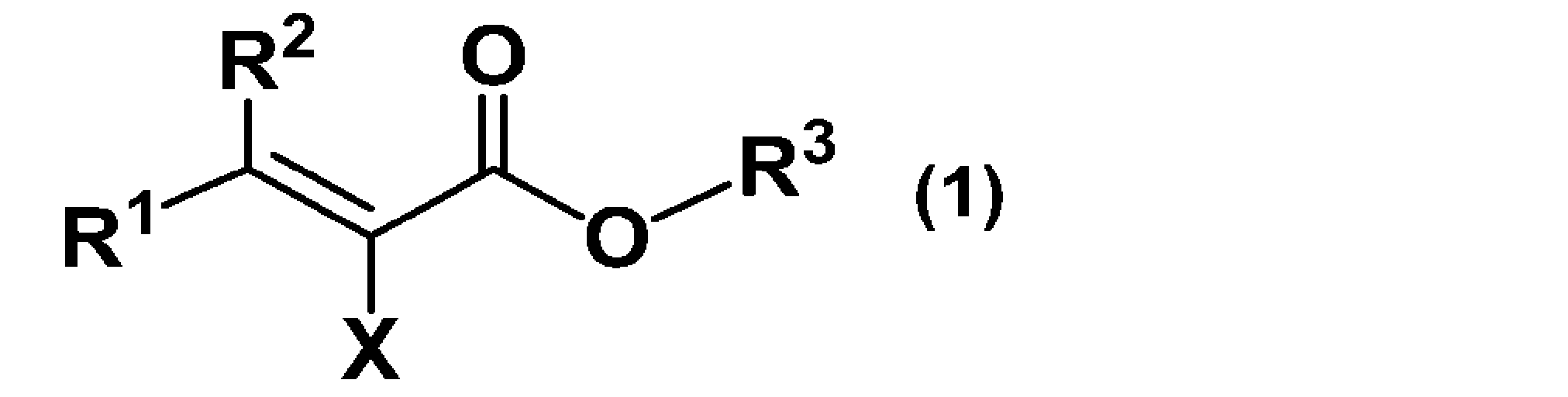
R1及びR2は、同一又は異なって、アルキル基、フルオロアルキル基、1個以上の置換基を有していてもよいアリール基、ハロゲン原子、又は水素原子であり、
R3は、アルキル基、フルオロアルキル基、又は1個以上の置換基を有していてもよいアリール基であり、
Xは、フルオロアルキル基、又はハロゲン原子である。)
で表される化合物、並びに脂肪族炭化水素、芳香族炭化水素、ハロゲン化炭化水素、エーテル、エステル(ただし、前記式(1)で表される化合物を除く)、ケトン、カーボネート、及びニトリルから選択される少なくとも一種の有機溶媒を含有する組成物であって、前記有機溶媒の含有量が、20質量%以下である組成物。
項30a.
更に式(2):
R4-OH (2)
(式中、R4は、アルキル基、フルオロアルキル基、又は1個以上の置換基を有していてもよいアリール基である。)
で表される化合物を含有する、項30に記載の組成物。
項30b.
R1が、水素原子、アルキル基、又はフルオロアルキル基である、項30又は30aに記載の組成物。
項30c.
R2が、水素原子、アルキル基、又はフルオロアルキル基である、項30、30a、又は30bに記載の組成物。
項30d.
R3が、アルキル基である、項30及び30a~cのいずれか一項に記載の組成物。
項30e.
R3が、C1-4アルキル基である、項30及び30a~dのいずれか一項に記載の組成物。
項30f.
R4が、アルキル基である、項30a~eのいずれか一項に記載の組成物。
項30g.
R4が、C1-4アルキル基である、項30a~fのいずれか一項に記載の組成物。
項30h.
Xが、フッ素原子である、項30及び30a~gのいずれか一項に記載の組成物。
本開示の後記説明は、実例の実施形態をより具体的に例示する。
本開示のいくつかの箇所では、例示を通してガイダンスが提供され、及びこの例示は、様々な組み合わせにおいて使用できる。
それぞれの場合において、例示の群は、非排他的な、及び代表的な群として機能できる。
本明細書で引用した全ての刊行物、特許及び特許出願はそのまま引用により本明細書に組み入れられる。
本明細書中の記号及び略号は、特に限定のない限り、本明細書の文脈に沿い、本開示が属する技術分野において通常用いられる意味に理解できる。
本明細書中、語句「含有する」は、語句「から本質的になる」、及び語句「からなる」を包含することを意図して用いられる。
特に限定されない限り、本明細書中に記載されている工程、処理、又は操作は、室温で実施され得る。
本明細書中、室温は、10~40℃の範囲内の温度を意味することができる。
本明細書中、表記「Cn-m」(ここで、n、及びmは、それぞれ、数である。)は、当業者が通常理解する通り、炭素数がn以上、且つm以下であることを表す。
当該「有機基」の例は、
1個以上の置換基を有していてもよいアルキル基、
1個以上の置換基を有していてもよいアルケニル基、
1個以上の置換基を有していてもよいアルキニル基、
1個以上の置換基を有していてもよいアリール基、
1個以上の置換基を有していてもよいアラルキル基、
1個以上の置換基を有していてもよい非芳香族複素環基、
1個以上の置換基を有していてもよいヘテロアリール基、
シアノ基、
アルデヒド基、
カルボキシル基、
RrO-、
RrCO-、
RrCOO-、
RrSO2-、
RrOCO-、及び
RrOSO2-
(これらの式中、Rrは、独立して、
1個以上の置換基を有していてもよいアルキル基、
1個以上の置換基を有していてもよいアルケニル基、
1個以上の置換基を有していてもよいアルキニル基、
1個以上の置換基を有していてもよいアリール基、
1個以上の置換基を有していてもよいアラルキル基、
1個以上の置換基を有していてもよい非芳香族複素環基、又は
1個以上の置換基を有していてもよいヘテロアリール基である。)
を包含できる。
本明細書中、「アルキル基」は、例えば、C1-20アルキル基、C1-12アルキル基、C1-6アルキル基、C1-4アルキル基、又はC1-3アルキル基であることができる。
本明細書中、「アルキル基」としては、例えば、メチル基、エチル基、プロピル基(n-プロピル基、イソプロピル基)、ブチル基(n-ブチル基、イソブチル基、sec-ブチル基、tert-ブチル基)、ペンチル基、及びヘキシル基等の、直鎖状又は分岐鎖状のアルキル基が挙げられる。
本明細書中、「アルキル基」としては、例えば、シクロプロピル基、シクロブチル基、シクロペンチル基、及びシクロヘキシル基等の、環状のアルキル基又はシクロアルキル基(例:C3-8シクロアルキル基)が挙げられる。
本明細書中、「フルオロアルキル基」が有するフッ素原子の数は、1個以上(例:1~3個、1~6個、1~12個、又は1個から置換可能な最大数)であることができる。
本明細書中、「フルオロアルキル基」は、例えば、C1-20フルオロアルキル基、C1-12フルオロアルキル基、C1-6フルオロアルキル基、C1-4フルオロアルキル基、又はC1-3フルオロアルキル基であることができる。
本明細書中、「フルオロアルキル基」は、直鎖状又は分枝鎖状のフルオロアルキル基であることができる。
本明細書中、「フルオロアルキル基」は、パーフルオロアルキル基又は非パーフルオロアルキル基であることができる。
本明細書中、「フルオロアルキル基」としては、例えば、フルオロメチル基、ジフルオロメチル基、トリフルオロメチル基、2,2,2-トリフルオロエチル基、ペンタフルオロエチル基、テトラフルオロプロピル基(例:HCF2CF2CH2-)、ヘキサフルオロプロピル基(例:(CF3)2CH-)、ノナフルオロブチル基、オクタフルオロペンチル基(例:HCF2CF2CF2CF2CH2-)、及びトリデカフルオロヘキシル基等が挙げられる。
本明細書中、「アルケニル基」としては、例えば、ビニル基、1-プロペン-1-イル基、2-プロペン-1-イル基、イソプロペニル基、2-ブテン-1-イル基、4-ペンテン-1-イル基、及び5-へキセン-1-イル基等の、直鎖状又は分枝鎖状のアルケニル基が挙げられる。
本明細書中、「アルケニル基」としては、例えば、シクロプロペニル基、シクロブテニル基、シクロペンテニル基、シクロヘキセニル基、シクロヘプテニル基等の、環状のアルケニル基又はシクロアルケニル基(例:C3-8シクロアルケニル基)が挙げられる。
本明細書中、「アルキニル基」としては、例えば、エチニル、1-プロピン-1-イル、2-プロピン-1-イル、4-ペンチン-1-イル、及び5-ヘキシン-1-イル等の、直鎖状又は分岐鎖状のアルキニル基が挙げられる。
本明細書中、「アリール基」は、例えば、C6-18アリール基、C6-16アリール基、C6-14アリール基、又はC6-12アリール基であることができる。
本明細書中、「アリール基」としては、例えば、フェニル基、1-ナフチル基、2-ナフチル基、2-ビフェニル基、3-ビフェニル基、4-ビフェニル基、及び2-アンスリル基が挙げられる。
本明細書中、「アラルキル基」は、例えば、ベンジル基、フェネチル基、ジフェニルメチル基、1-ナフチルメチル基、2-ナフチルメチル基、2,2-ジフェニルエチル基、3-フェニルプロピル基、4-フェニルブチル基、5-フェニルペンチル基、2-ビフェニリルメチル基、3-ビフェニリルメチル基、及び4-ビフェニリルメチル基を包含できる。
本明細書中、「非芳香族複素環基」は、例えば、環構成原子として、炭素原子に加えて酸素原子、硫黄原子、及び窒素原子から選ばれる1~4個のヘテロ原子を含有する非芳香族複素環基であることができる。
本明細書中、「非芳香族複素環基」は、飽和、又は不飽和であることができる。
本明細書中、「非芳香族複素環基」は、例えば、テトラヒドロフリル基、オキサゾリジニル基、イミダゾリニル基、アジリジニル基、アゼチジニル基、ピロリジニル基、ピペリジニル基、アゼパニル基、アゾカニル基、ピペラジニル基、ジアゼピニル基、ジアゾカニル基、テトラヒドロピラニル基、モルホリニル基、チオモルホリニル基、2-オキサゾリジニル基、ジヒドロフリル基、ジヒドロピラニル基、及びジヒドロキノリル基等を包含できる。
本明細書中、「アルコキシ基」は、直鎖状又は分岐鎖状のアルコキシ基であることができる。
本明細書中、「アルコキシ基」としては、例えば、メトキシ基、エトキシ基、プロポキシ基(n-プロポキシ基、イソプロポキシ基)、ブトキシ基(n-ブトキシ基、イソブトキシ基、sec-ブトキシ基、tert-ブトキシ基)、ペンチルオキシ基、及びヘキシルオキシ基等の、直鎖状又は分岐鎖状のC1-20アルコキシ基が挙げられる。
本明細書中、「アルキルチオ基」は、直鎖状又は分岐鎖状のアルキルチオ基であることができる。
本明細書中、「アルキルチオ基」としては、例えば、メチルチオ基、エチルチオ基、プロピルチオ基(n-プロピルチオ基、イソプロピルチオ基)、ブチルチオ基(n-ブチルチオ基、イソブチルチオ基、sec-ブチルチオ基、tert-ブチルチオ基)、ペンチルチオ基、及びヘキシルチオ基等の、直鎖状又は分岐鎖状のC1-20アルキルチオ基が挙げられる。
「1個以上の置換基を有していてもよい炭化水素基」、
「1個以上の置換基を有していてもよいアルキル基」、
「1個以上の置換基を有していてもよいアルケニル基」、
「1個以上の置換基を有していてもよいアルキニル基」、
「1個以上の置換基を有していてもよいアリール基」、
「1個以上の置換基を有していてもよいアラルキル基」、
「1個以上の置換基を有していてもよい非芳香族複素環基」、及び
「1個以上の置換基を有していてもよいヘテロアリール基」
における「置換基」の例は、それぞれ、ハロ基、ニトロ基、シアノ基、オキソ基、チオキソ基、カルボキシル基、スルホ基、スルファモイル基、スルフィナモイル基、スルフェナモイル基、RrO-、RrCO-、RrCOO-、RrSO2-、RrOCO-、及びRrOSO2-(これらの式中、Rrは、前記と同意義である。)を包含できる。
当該置換基のうち、「ハロ基」の例は、フルオロ基、クロロ基、ブロモ基、及びヨード基を包含できる。
当該置換基の数は、1個から置換可能な最大個数の範囲内(例:1個、2個、3個、4個、5個、6個)であることができる。
一実施態様において、式(1):

R1及びR2は、同一又は異なって、アルキル基、フルオロアルキル基、1個以上の置換基を有していてもよいアリール基、ハロゲン原子、又は水素原子であり、
R3は、アルキル基、フルオロアルキル基、又は1個以上の置換基を有していてもよいアリール基であり、
Xは、フルオロアルキル基、又はハロゲン原子である。)
で表される化合物の精製方法は、
(A)前記式(1)で表される化合物、及び式(2):
R4-OH (2)
(式中、R4は、アルキル基、フルオロアルキル基、又は1個以上の置換基を有していてもよいアリール基である。)
で表される化合物を含有する組成物を、
(i)塩、
(ii)有機溶媒(ただし、前記式(1)で表される化合物、及び前記式(2)で表される化合物を除く)、又は
(iii)前記塩及び前記有機溶媒
と混合して混合物を得る工程、及び
(B)前記混合物を、前記式(1)で表される化合物の含有率が互いに異なる2相以上に分離する工程
を含む。
組成物は、式(1)で表される化合物及び式(2)で表される化合物を含有する限り、特に制限されない。組成物は、例えば、不純物として式(2)で表される化合物を含有する、式(1)で表される化合物(粗体)であることができる。
水素原子、
アルキル基、又は
フルオロアルキル基
であり、より好ましくは、
水素原子、
C1-20アルキル基(好ましくはC1-12アルキル基、より好ましくはC1-6アルキル基、更に好ましくはC1-4アルキル基、より更に好ましくはC1-3アルキル基、特に好ましくはC1又はC2アルキル基)、又は
C1-20フルオロアルキル基(好ましくはC1-12フルオロアルキル基、より好ましくはC1-6フルオロアルキル基、更に好ましくはC1-4フルオロアルキル基、より更に好ましくはC1-3フルオロアルキル基、特に好ましくはC1又はC2フルオロアルキル基)
であり、更に好ましくは、
水素原子
である。
水素原子、
アルキル基、又は
フルオロアルキル基
であり、より好ましくは、
水素原子、
C1-20アルキル基(好ましくはC1-12アルキル基、より好ましくはC1-6アルキル基、更に好ましくはC1-4アルキル基、より更に好ましくはC1-3アルキル基、特に好ましくはC1又はC2アルキル基)、又は
C1-20フルオロアルキル基(好ましくはC1-12フルオロアルキル基、より好ましくはC1-6フルオロアルキル基、更に好ましくはC1-4フルオロアルキル基、より更に好ましくはC1-3フルオロアルキル基、特に好ましくはC1又はC2フルオロアルキル基)
であり、更に好ましくは、
水素原子
である。
C1-20フルオロアルキル基(好ましくはC1-12フルオロアルキル基、より好ましくはC1-6フルオロアルキル基、更に好ましくはC1-4フルオロアルキル基、より更に好ましくはC1-3フルオロアルキル基、特に好ましくはC1又はC2フルオロアルキル基)、
フッ素原子、又は
塩素原子
である。
Xは、より好ましくは、トリフルオロメチル基、フッ素原子、又は塩素原子である。
Xは、更に好ましくは、フッ素原子、又は塩素原子である。
Xは、特に好ましくは、フッ素原子である。
R3が、C1-20アルキル基(好ましくはC1-12アルキル基、より好ましくはC1-6アルキル基、更に好ましくはC1-4アルキル基、より更に好ましくはC1-3アルキル基、特に好ましくはメチル基又はエチル基)であり、且つ
Xが、トリフルオロメチル基、フッ素原子、又は塩素原子である。
R3が、メチル基又はエチル基(好ましくはメチル基)であり、且つ
Xが、トリフルオロメチル基、フッ素原子、又は塩素原子である。
R1が、水素原子であり、
R2が、水素原子であり、
R3が、メチル基又はエチル基(好ましくはメチル基)であり、且つ
Xは、フッ素原子又は塩素原子である。
式(1)で表される化合物は、例えば、特公平1-33098号公報、国際公開第2014/034906号に記載の製造方法、又はこれらに準じる方法により製造することができる。
組成物中、式(1)で表される化合物の含有量の上限は、好ましくは50質量%、より好ましくは45質量%、更に好ましくは40質量%であることができる。
組成物中、式(1)で表される化合物の含有量は、好ましくは5~50質量%の範囲内、より好ましくは10~45質量%の範囲内、更に好ましくは15~40質量%の範囲内であることができる。
組成物中、式(2)で表される化合物の含有量の上限は、好ましくは95質量%、より好ましくは90質量%、更に好ましくは85質量%であることができる。
組成物中、式(2)で表される化合物の含有量は、好ましくは50~95質量%の範囲内、より好ましくは55~90質量%の範囲内、更に好ましくは60~85質量%の範囲内であることができる。
塩(i)のアニオンは、好ましくは、ハロゲン化物イオンであることができる。
例えば、塩(i)がLiClの場合、塩(i)の使用量の下限は、水1mLに対して、好ましくは150mg、より好ましくは170mgであることができる。
塩(i)がLiBrの場合、塩(i)の使用量の下限は、水1mLに対して、好ましくは310mg、より好ましくは350mgであることができる。
塩(i)がLiIの場合、塩(i)の使用量の下限は、水1mLに対して、好ましくは480mg、より好ましくは500mg、さらに好ましくは540mgであることができる。
塩(i)がNaIの場合、塩(i)の使用量の下限は、水1mLに対して、好ましくは540mg、より好ましくは550mg、さらに好ましくは600mg、さらにより好ましくは610mgであることができる。
塩(i)がCaCl2の場合、塩(i)の使用量の下限は、水1mLに対して、好ましくは400mg、より好ましくは450mgであることができる。
例えば、塩(i)がLiClの場合、塩(i)の使用量の上限は、水1mLに対して、好ましくは350mg、より好ましくは340mgであることができる。
塩(i)がLiBrの場合、塩(i)の使用量の上限は、水1mLに対して、好ましくは790mg、より好ましくは750mg、さらに好ましくは705mgであることができる。
塩(i)がLiIの場合、塩(i)の使用量の上限は、水1mLに対して、好ましくは1220mg、より好ましくは1200mg、さらに好ましくは1150mg、さらにより好ましくは1100mg、特に好ましくは1085mgであることができる。
塩(i)がNaIの場合、塩(i)の使用量の上限は、水1mLに対して、好ましくは1360mg、より好ましくは1350mg、さらに好ましくは1300mg、さらにより好ましくは1250mg、特に好ましくは1215mgであることができる。
塩(i)がCaCl2の場合、塩(i)の使用量の上限は、水1mLに対して、好ましくは1000mg、より好ましくは950mg、さらに好ましくは900mgであることができる。
例えば、塩(i)がLiClの場合、塩(i)の使用量は、水1mLに対して、好ましくは150~350mgの範囲内、より好ましくは170~340mgの範囲内であることができる。
塩(i)がLiBrの場合、塩(i)の使用量は、水1mLに対して、好ましくは310~790mgの範囲内、より好ましくは350~705mgの範囲内であることができる。
塩(i)がLiIの場合、塩(i)の使用量は、水1mLに対して、好ましくは480~1220mgの範囲内、より好ましくは540~1085mgの範囲内であることができる。
塩(i)がNaIの場合、塩(i)の使用量は、水1mLに対して、好ましくは540~1360mgの範囲内、より好ましくは610~1215mgの範囲内であることができる。
塩(i)がCaCl2の場合、塩(i)の使用量は、水1mLに対して、好ましくは400~1000mgの範囲内、より好ましくは450~900mgの範囲内であることができる。
塩(i)の使用量の上限は、式(1)で表される化合物1モルに対して、好ましくは10モル、より好ましくは9モルであることができる。
塩(i)の使用量は、式(1)で表される化合物1モルに対して、好ましくは0.1~10モルの範囲内、より好ましくは0.5~9モルの範囲内であることができる。
塩(i)の使用量の上限は、組成物100質量部に対して、好ましくは100質量部、より好ましくは95質量部、更に好ましくは90質量部であることができる。
塩(i)の使用量は、組成物100質量部に対して、好ましくは10~100質量部の範囲内、好ましくは15~95質量部の範囲内、更に好ましくは20~90質量部の範囲内であることができる。
芳香族炭化水素としては、例えば、少なくとも1個のC1-4アルキル基を有していてもよいベンゼンが挙げられ、その具体例としては、ベンゼン、キシレン、トルエン等が挙げられる。
ハロゲン炭化水素としては、例えば、C1-6ハロアルカン(例:ジクロロメタン、ジクロロエタン、ジクロロプロパン、クロロブタン、クロロホルム)、少なくとも1個のハロゲン原子を有するベンゼン(例:クロロベンゼン、ジクロロベンゼン)等が挙げられる。
エーテルとしては、例えば、ジ(C1-4アルキル)エーテル(例:ジエチルエーテル、ジイソプロピルエーテル、t-ブチルメチルエーテル、ジブチルエーテル)、C2-4アルキレングリコールのジ(C1-4アルキル)エーテル(例:モノグライム)、ポリC2-4アルキレングリコールのジ(C1-4アルキル)エーテル(例:ジグライム、トリグライム)、5員の含酸素複素環(例:1,4-ジオキサン、テトラヒドロフラン)等が挙げられる。
エステル(ただし、式(1)で表される化合物を除く)としては、例えば、C1-6アルカン酸C1-4アルキルエステルが挙げられ、その具体例としては、酢酸エチル、酢酸ブチル等が挙げられる。
ケトンとしては、例えば、ジ(C1-4アルキル)ケトンが挙げられ、その具体例としては、メチルエチルケトン、アセトン等が挙げられる。
カーボネートとしては、例えば、C2-4アルキレンカーボネートが挙げられ、その具体例としては、エチレンカーボネート、プロピレンカーボネート等が挙げられる。
ニトリルとしては、例えば、C1-6シアノアルカン(例:アセトニトリル)、少なくとも1個のシアノ基を有するベンゼン(例:ベンゾニトリル)等が挙げられる。
C5-16アルカン、C5-10シクロアルカン、少なくとも1個のC1-4アルキル基を有していてもよいベンゼン、C1-6ハロアルカン、少なくとも1個のハロゲン原子を有するベンゼン、ジ(C1-4アルキル)エーテル、C2-4アルキレングリコールのジ(C1-4アルキル)エーテル、ポリC2-4アルキレングリコールのジ(C1-4アルキル)エーテル、5員の含酸素複素環、C1-6アルカン酸C1-4アルキルエステル、ジ(C1-4アルキル)ケトン、C2-4アルキレンカーボネート、C1-6シアノアルカン、及び少なくとも1個のシアノ基を有するベンゼン
から選択される少なくとも一種であることができる。
当該実施態様において、有機溶媒(ii)は、より好ましくは、
ペンタン、ヘキサン、ヘプタン、オクタン、ノナン、デカン、ウンデカン、ドデカン、トリデカン、テトラデカン、ペンタデカン、ヘキサデカン、シクロペンタン、シクロヘキサン、
ベンゼン、キシレン、トルエン、
ジクロロメタン、ジクロロエタン、ジクロロプロパン、クロロブタン、クロロホルム、クロロベンゼン、ジクロロベンゼン、
ジエチルエーテル、ジイソプロピルエーテル、t-ブチルメチルエーテル、ジブチルエーテル、モノグライム、ジグライム、トリグライム、1,4-ジオキサン、テトラヒドロフラン、
酢酸エチル、酢酸ブチル、
メチルエチルケトン、アセトン、
エチレンカーボネート、プロピレンカーボネート、
アセトニトリル、及びベンゾニトリル
から選択される少なくとも一種であることができる。
溶解度パラメータは、例えば、文献(例:C. M. Hansen, Ind. Eng. Chem. Prod. Res. Dev., 1969, 8(1), pp 2-11)に記載の値、又は文献(例:R. F. Fedors, Polym. Eng. Sci., 1974, 14(2), pp.147-154)に記載の方法により計算される推定値であることができる。
溶解度パラメータが8.2 (cal/cm3)1/2以下である有機溶媒の非限定的な例を以下に示す。

有機溶媒(ii)の使用量の上限は、式(1)で表される化合物1モルに対して、好ましくは10モル、より好ましくは5モル、更に好ましくは2モルであることができる。
有機溶媒(ii)の使用量は、式(1)で表される化合物1モルに対して、好ましくは0.1~10モルの範囲内、より好ましくは0.5~5モルの範囲内、更に好ましくは1~2モルの範囲内であることができる。
有機溶媒(ii)の使用量の上限は、組成物100質量部に対して、好ましくは200質量部、より好ましくは150質量部、更に好ましくは100質量部であることができる。
有機溶媒(ii)の使用量は、組成物100質量部に対して、好ましくは30~200質量部の範囲内、好ましくは35~150質量部の範囲内、更に好ましくは40~100質量部の範囲内であることができる。
水の使用量の上限は、組成物100質量部に対して、好ましくは200質量部、より好ましくは150質量部、更に好ましくは100質量部であることができる。
水の使用量は、組成物100質量部に対して、好ましくは10~200質量部の範囲内、好ましくは15~150質量部の範囲内、更に好ましくは20~100質量部の範囲内であることができる。
工程Bは、工程Aで得られた混合物を、式(1)で表される化合物の含有率が互いに異なる2相以上に分離できる限り、特に制限されない。工程Bは、連続式に又はバッチ式に、単段又は多段で実施することができ、慣用の方法、例えば、分液、向流接触、デカンタ等の遠心分離機を用いる方法を採用することができる。
一実施態様において、工程Aで得られた混合物を比重で分離することが好ましく、低比重相及び高比重相に分離することが好ましい。当該実施態様において、低比重相が式(1)で表される化合物の含有率が高い相になる場合も、高比重相が式(1)で表される化合物の含有率が高い相になる場合もある。例えば、組成物を、水よりも比重の小さい非プロトン性溶媒(例:キシレン)及び水と混合する場合、上相(非プロトン性溶媒相)が式(1)で表される化合物の含有率が高い相であり、下相(水相)が式(1)で表される化合物の含有率が低い相であることができる。また、組成物を、水よりも比重の大きい非プロトン性溶媒(例:ジクロロメタン)及び水と混合する場合、上相(水相)が式(1)で表される化合物の含有率が低い相であり、下相(非プロトン性溶媒相)が式(1)で表される化合物の含有率が高い相であることができる。
さらに、組成物を塩(i)と混合する場合、上相が式(1)で表される化合物の含有率が高い相であり、下相が式(1)で表される化合物の含有率が低い相であることができる。
式(1)で表される化合物の精製方法は、下記の工程:
(C)前記分離された相のうち、式(1)で表される化合物の含有率が最も低い相(又は式(1)で表される化合物の含有率が最も高い相以外の相)を除去する工程、或いは、式(1)で表される化合物の含有率が最も高い相(又は式(1)で表される化合物の含有率が最も低い相以外の相)を回収する工程
を含むことが好ましい。本開示の方法は、式(2)で表される化合物の式(1)で表される化合物の含有率が最も低い相(例:高極性相、水相)への移行率を高めることができ、式(2)で表される化合物を高度に除去することができる。
工程Cは、工程Aと同様の温度範囲で行うことができる。
式(1)で表される化合物の精製方法は、更に追加の工程を含むことができる。
(D)工程Cで除去した相を、塩(i)及び/又は有機溶媒(ii)、並びに、任意の水(iv)と混合して混合物を得る工程、及び
(E)工程Dで得られた混合物を、式(1)で表される化合物の含有率が互いに異なる2相以上に分離する工程。
当該実施態様において、式(1)で表される化合物の精製方法は、更に下記工程を含むことができる:
(F)工程Eで分離された相のうち、式(1)で表される化合物の含有率が最も低い相(又は式(1)で表される化合物の含有率が最も高い相以外の相)を除去する工程、或いは、式(1)で表される化合物の含有率が最も高い相(又は式(1)で表される化合物の含有率が最も低い相以外の相)を回収する工程。
(G)工程Cで得られた相を工程Fで得られた相と混合する工程
を含むことができる。
(H)工程Cで得られた相(或いは工程F又は工程Gで得られた相)を濃縮する工程
を含むことができる。
濃縮物中の有機溶媒(ii)の含有量は、好ましくは5質量%以下、より好ましくは3質量%以下、更に好ましくは1質量%以下であることができる。
(I)精製に利用した塩(i)及び/又は有機溶媒(ii)を回収する工程
を含むことができる。回収した塩(i)及び/又は有機溶媒(ii)は、工程A及び/又は工程Dで再利用することができる。
一実施態様において、組成物は、式(1)で表される化合物、式(2)で表される化合物、及び塩(i)を含有する組成物であって、塩(i)の含有量が、2質量%以下である組成物(以下、「組成物a」と称する)である。
組成物a中、式(1)で表される化合物と塩(i)との質量比は、好ましくは25:1~160:1の範囲内、より好ましくは30:1~120:1の範囲内、さらに好ましくは40:1~80:1の範囲内であることができる。
特公平1-33098号公報の実施例及び参考例に記載の方法に準じて、モノフッ素化アクリル酸メチルエステルを合成した。
(I)合成例1で得られたモノフッ素化アクリル酸メチルエステル20質量%及びメタノール80質量%の混合溶液20gに0℃で47質量%塩化カルシウム水溶液とキシレンを10.5gずつ添加した。十分に撹拌したのち、上相及び下相をそれぞれ分取した。上相は13g、下相は28gであった。
上相をGC、NMR、カールフィッシャー、及び元素分析で分析を行ったところ、上相は次の組成であった。
<上相>
モノフッ素化アクリル酸メチルエステル 24質量%
メタノール 3質量%
キシレン 73質量%
水 568ppm
Ca <5ppm
同様に下相についても分析を行ったところ、下相は次の組成であった。
<下相>
モノフッ素化アクリル酸メチルエステル 3質量%
メタノール 56質量%
キシレン 4質量%
水 20質量%
Ca 17質量%
上相をGC、NMR、カールフィッシャー、及び元素分析で分析を行ったところ、上相は次の組成であった。
<上相>
モノフッ素化アクリル酸メチルエステル 4.6質量%
メタノール 1.4質量%
キシレン 94質量%
水 304ppm
Ca <5ppm
下相をGCで分析を行ったところ、下相は次の組成であった。
<下相>
モノフッ素化アクリル酸メチルエステル 2質量%
メタノール 98質量%
<混合液>
モノフッ素化アクリル酸メチルエステル 13質量%
メタノール 2質量%
キシレン 85質量%
水 872ppm
Ca <5ppm
(モノフッ素化アクリル酸メチルエステルとメタノールの質量比率は87:13)
<留分>
モノフッ素化アクリル酸メチルエステル 84質量%
メタノール 15質量%
キシレン 1質量%
<釜残の組成>
モノフッ素化アクリル酸メチルエステル 2質量%
メタノール 1質量%
キシレン 97質量%
合成例1で得られたモノフッ素化アクリル酸メチルエステル30質量%及びメタノール70質量%の混合溶液20gに0℃で47質量%塩化カルシウム水溶液を12g添加した。十分に撹拌したのち、上相及び下相をそれぞれ分取した。
上相をGC、NMR、カールフィッシャー、及び元素分析で分析を行ったところ、上相は次の組成であった。
<上相>
モノフッ素化アクリル酸メチルエステル 92質量%
メタノール 8質量%
Ca <5ppm
下相をGCで分析を行ったところ、下相は次の組成であった。
<下相>
モノフッ素化アクリル酸メチルエステル 4質量%
メタノール 60質量%
水 28質量%
Ca 8質量%
合成例1で得られたモノフッ素化アクリル酸メチルエステル20質量%及びメタノール80質量%の混合溶液20gに水を10.5g添加して撹拌すると、1相の溶液が得られた。
表1に示すように、
合成例1で得られたモノフッ素化アクリル酸メチルエステル7.68質量%、
メタノール(MeOH)90.33質量%、
フルオロ酢酸メチル0.04質量%、
ジメチルカーボネート(DMC)0.02質量%、及び
トリエチルアミン(TEA)1.93質量%の混合溶液(粗体)に、47質量%塩化カルシウム水溶液及び抽出溶媒を添加した。十分に撹拌したのち、上相及び下相をそれぞれ分取した。上相及び下相の組成をGC、NMR、カールフィッシャー、及び元素分析により分析を行った。各相の組成(抽出溶媒を除く)を表2に示す。

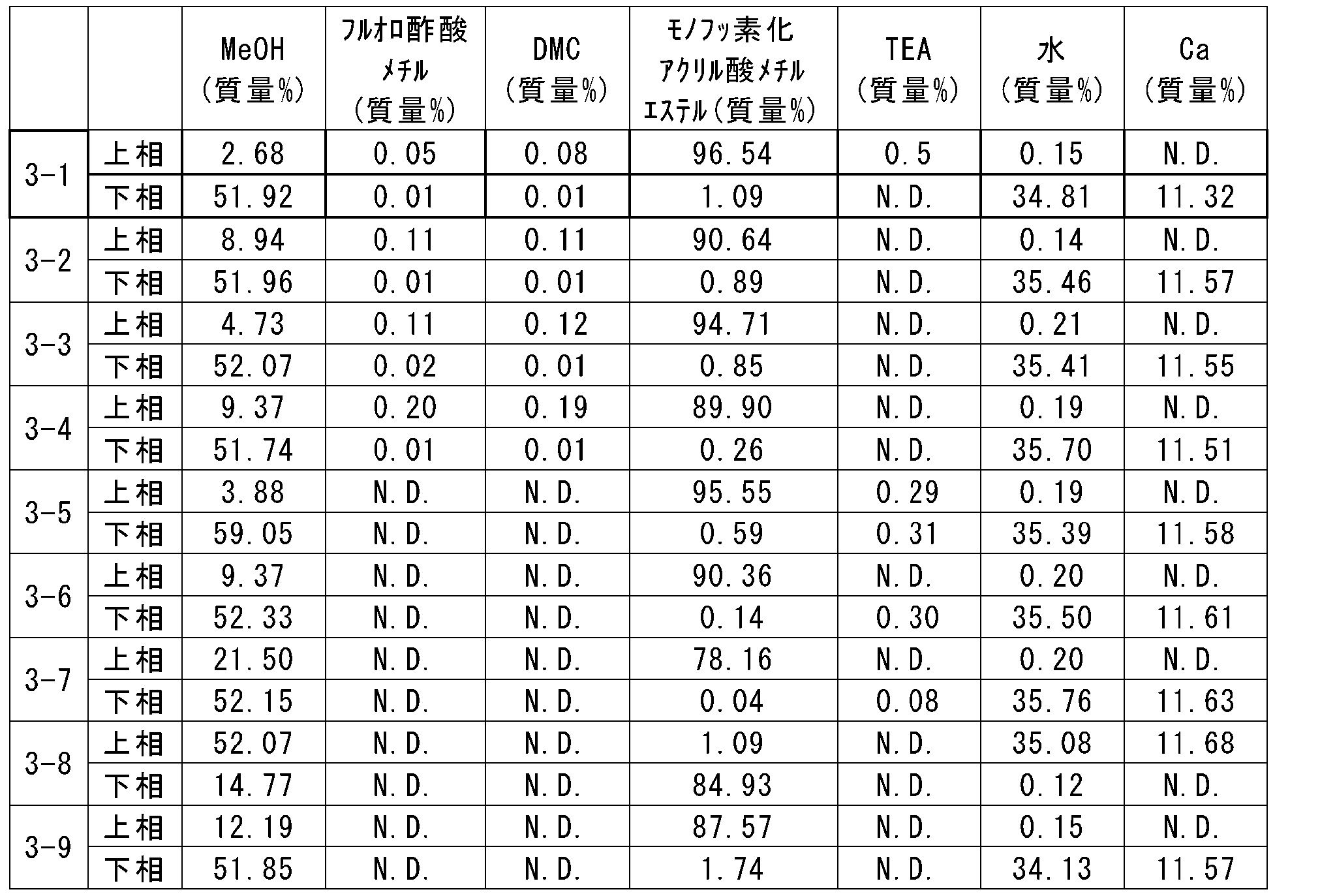
表3に示すように、合成例1で得られたモノフッ素化アクリル酸メチルエステル29.5質量%、メタノール69.1質量%、及びトリエチルアミン(TEA)1.4質量%の混合溶液(粗体)をスクリュー管に採取し、無機塩を添加して振り混ぜて溶解した。この溶液に抽出溶媒を添加し、振り混ぜて抽出を行った。上相及び下相の組成をGC、NMR、カールフィッシャー、及び元素分析により分析を行った。各相の組成(抽出溶媒を除く)を表4に示す。


Claims (30)
- 式(1):
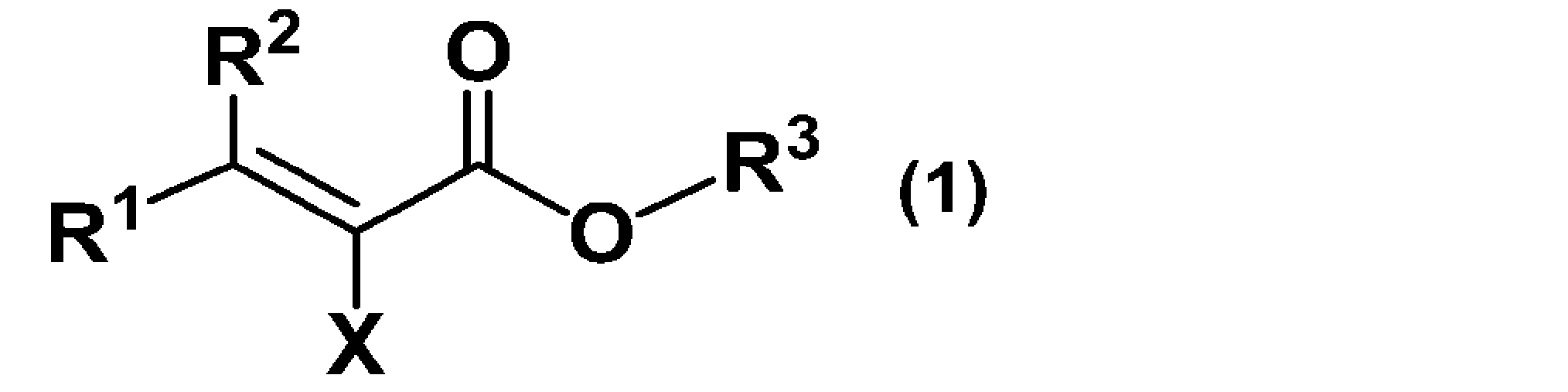
R1及びR2は、同一又は異なって、アルキル基、フルオロアルキル基、1個以上の置換基を有していてもよいアリール基、ハロゲン原子、又は水素原子であり、
R3は、アルキル基、フルオロアルキル基、又は1個以上の置換基を有していてもよいアリール基であり、
Xは、フルオロアルキル基、又はハロゲン原子である。)
で表される化合物の精製方法であって、
(A)前記式(1)で表される化合物、及び式(2):
R4-OH (2)
(式中、R4は、アルキル基、フルオロアルキル基、又は1個以上の置換基を有していてもよいアリール基である。)
で表される化合物を含有する組成物を、
(i)塩、
(ii)有機溶媒(ただし、前記式(1)で表される化合物、及び前記式(2)で表される化合物を除く)、又は
(iii)前記塩及び前記有機溶媒
と混合して混合物を得る工程、及び
(B)前記混合物を、前記式(1)で表される化合物の含有率が互いに異なる2相以上に分離する工程
を含む方法。 - 前記塩が、無機塩、及び有機塩から選択される一種以上である、請求項1に記載の方法。
- 前記塩が、無機塩である、請求項1又は2に記載の方法。
- 前記塩のカチオンが、金属カチオン、1個以上の置換基を有していてもよいアンモニウム、1個以上の置換基を有していてもよいピリジニウム、1個以上の置換基を有していてもよいイミダゾリウム、又は1個以上の置換基を有していてもよいホスホニウムである、請求項1~3のいずれか一項に記載の方法。
- 前記塩のカチオンが、1価の金属カチオン、及び2価の金属カチオンから選択される少なくとも一種を含む、請求項1~4のいずれか一項に記載の方法。
- 前記塩のカチオンが、NR4 +(各々のRは、互いに同一でも異なっていてもよく、H、又は炭素数1~10の有機基である)である、請求項1~4のいずれか一項に記載の方法。
- 前記塩のアニオンが、硫酸イオン、水酸化物イオン、ハロゲン化物イオン、及び硝酸イオンから選択される少なくとも一種を含む、請求項1~6のいずれか一項に記載の方法。
- 前記塩が、LiCl、LiBr、LiI、NaI、及びCaCl2から選択される少なくとも一種である、請求項1~5のいずれか一項に記載の方法。
- 前記塩の使用量が、前記式(1)で表される化合物1モルに対して、0.1~10モルの範囲内である、請求項1~8のいずれか一項に記載の方法。
- 前記有機溶媒が、非プロトン性溶媒(ただし、前記式(1)で表される化合物、及び前記式(2)で表される化合物を除く)である、請求項1~9のいずれか一項に記載の方法。
- 前記有機溶媒が、非プロトン性非極性溶媒(ただし、前記式(1)で表される化合物、及び前記式(2)で表される化合物を除く)である、請求項1~10のいずれか一項に記載の方法。
- 前記有機溶媒が、脂肪族炭化水素、芳香族炭化水素、ハロゲン化炭化水素、エーテル、エステル(ただし、前記式(1)で表される化合物を除く)、ケトン、カーボネート、及びニトリルから選択される少なくとも一種である、請求項1~10のいずれか一項に記載の方法。
- 前記有機溶媒が、芳香族炭化水素及びエーテルから選択される少なくとも一種である、請求項1~10のいずれか一項に記載の方法。
- 前記有機溶媒が、C5-16アルカン、C5-10シクロアルカン、少なくとも1個のC1-4アルキル基を有していてもよいベンゼン、C1-6ハロアルカン、少なくとも1個のハロゲン原子を有するベンゼン、ジ(C1-4アルキル)エーテル、C2-4アルキレングリコールのジ(C1-4アルキル)エーテル、ポリC2-4アルキレングリコールのジ(C1-4アルキル)エーテル、5員の含酸素複素環、C1-6アルカン酸C1-4アルキルエステル、ジ(C1-4アルキル)ケトン、C2-4アルキレンカーボネート、C1-6シアノアルカン、及び少なくとも1個のシアノ基を有するベンゼンから選択される少なくとも一種である、請求項1~10のいずれか一項に記載の方法。
- 前記有機溶媒が、
ペンタン、ヘキサン、ヘプタン、オクタン、ノナン、デカン、ウンデカン、ドデカン、トリデカン、テトラデカン、ペンタデカン、ヘキサデカン、シクロペンタン、シクロヘキサン、
ベンゼン、キシレン、トルエン、
ジクロロメタン、ジクロロエタン、ジクロロプロパン、クロロブタン、クロロホルム、クロロベンゼン、ジクロロベンゼン、
ジエチルエーテル、ジイソプロピルエーテル、t-ブチルメチルエーテル、ジブチルエーテル、モノグライム、ジグライム、トリグライム、1,4-ジオキサン、テトラヒドロフラン、
酢酸エチル、酢酸ブチル、
メチルエチルケトン、アセトン、
エチレンカーボネート、プロピレンカーボネート、
アセトニトリル、及びベンゾニトリル
から選択される少なくとも一種である、請求項1~10のいずれか一項に記載の方法。 - 前記有機溶媒の使用量が、前記式(1)で表される化合物1モルに対して、0.1~10モルの範囲内である、請求項1~15のいずれか一項に記載の方法。
- 工程(A)が、前記組成物を、
(i)塩、
(ii)有機溶媒(ただし、前記式(1)で表される化合物、及び前記式(2)で表される化合物を除く)、又は
(iii)前記塩及び前記有機溶媒、並びに
(iv)水
と混合して混合物を得る工程である、請求項1~16のいずれか一項に記載の方法。 - 前記塩の使用量が、水1mLに対して150mg以上である、請求項17に記載の方法。
- 前記塩が、LiCl、LiBr、LiI、NaI、又はCaCl2であり、
前記塩がLiClである場合、前記塩の使用量が、水1mLに対して150mg以上であり、
前記塩がLiBrである場合、前記塩の使用量が、水1mLに対して310mg以上であり、
前記塩がLiIである場合、前記塩の使用量が、水1mLに対して480mg以上であり、
前記塩がNaIである場合、前記塩の使用量が、水1mLに対して540mg以上であり、
前記塩がCaCl2である場合、前記塩の使用量が、水1mLに対して450mg以上である、
請求項17又は18に記載の方法。 - (C)前記分離された相のうち、前記式(1)で表される化合物の含有率が最も低い相を除去する工程
を更に含む、請求項1~19のいずれか一項に記載の方法。 - -15~40℃の範囲内で実施される、請求項1~20のいずれか一項に記載の方法。
- R1が、水素原子、アルキル基、又はフルオロアルキル基である、請求項1~21のいずれか一項に記載の方法。
- R2が、水素原子、アルキル基、又はフルオロアルキル基である、請求項1~22のいずれか一項に記載の方法。
- R3が、アルキル基である、請求項1~23のいずれか一項に記載の方法。
- R3が、C1-4アルキル基である、請求項1~24のいずれか一項に記載の方法。
- R4が、アルキル基である、請求項1~25のいずれか一項に記載の方法。
- R4が、C1-4アルキル基である、請求項1~26のいずれか一項に記載の方法。
- Xが、フッ素原子、又は塩素原子である、請求項1~27のいずれか一項に記載の方法。
- 式(1):

R1及びR2は、同一又は異なって、アルキル基、フルオロアルキル基、1個以上の置換基を有していてもよいアリール基、ハロゲン原子、又は水素原子であり、
R3は、アルキル基、フルオロアルキル基、又は1個以上の置換基を有していてもよいアリール基であり、
Xは、フルオロアルキル基、又はハロゲン原子である。)
で表される化合物、及び式(2):
R4-OH (2)
(式中、R4は、アルキル基、フルオロアルキル基、又は1個以上の置換基を有していてもよいアリール基である。)
で表される化合物、及び塩を含有する組成物であって、
前記塩の含有量が、2質量%以下である組成物。 - 式(1):

R1及びR2は、同一又は異なって、アルキル基、フルオロアルキル基、1個以上の置換基を有していてもよいアリール基、ハロゲン原子、又は水素原子であり、
R3は、アルキル基、フルオロアルキル基、又は1個以上の置換基を有していてもよいアリール基であり、
Xは、フルオロアルキル基、又はハロゲン原子である。)
で表される化合物、並びに脂肪族炭化水素、芳香族炭化水素、ハロゲン化炭化水素、エーテル、エステル(ただし、前記式(1)で表される化合物を除く)、ケトン、カーボネート、及びニトリルから選択される少なくとも一種の有機溶媒を含有する組成物であって、前記有機溶媒の含有量が、20質量%以下である組成物。
Priority Applications (4)
| Application Number | Priority Date | Filing Date | Title |
|---|---|---|---|
| EP21858382.1A EP4201920A4 (en) | 2020-08-19 | 2021-08-19 | PROCESS FOR PURIFYING HALOGEN-CONTAINING (METH)ACRYLATE |
| CN202511485474.4A CN121378005A (zh) | 2020-08-19 | 2021-08-19 | 含卤素(甲基)丙烯酸酯的精制方法 |
| CN202180050438.9A CN115956065A (zh) | 2020-08-19 | 2021-08-19 | 含卤素(甲基)丙烯酸酯的精制方法 |
| US18/110,513 US20230202962A1 (en) | 2020-08-19 | 2023-02-16 | Method for purifying halogen-containing (meth)acrylate |
Applications Claiming Priority (2)
| Application Number | Priority Date | Filing Date | Title |
|---|---|---|---|
| JP2020-138907 | 2020-08-19 | ||
| JP2020138907 | 2020-08-19 |
Related Child Applications (1)
| Application Number | Title | Priority Date | Filing Date |
|---|---|---|---|
| US18/110,513 Continuation US20230202962A1 (en) | 2020-08-19 | 2023-02-16 | Method for purifying halogen-containing (meth)acrylate |
Publications (1)
| Publication Number | Publication Date |
|---|---|
| WO2022039238A1 true WO2022039238A1 (ja) | 2022-02-24 |
Family
ID=80323538
Family Applications (1)
| Application Number | Title | Priority Date | Filing Date |
|---|---|---|---|
| PCT/JP2021/030449 Ceased WO2022039238A1 (ja) | 2020-08-19 | 2021-08-19 | 含ハロゲン(メタ)アクリル酸エステルの精製方法 |
Country Status (5)
| Country | Link |
|---|---|
| US (1) | US20230202962A1 (ja) |
| EP (1) | EP4201920A4 (ja) |
| JP (2) | JP7104358B2 (ja) |
| CN (2) | CN121378005A (ja) |
| WO (1) | WO2022039238A1 (ja) |
Citations (5)
| Publication number | Priority date | Publication date | Assignee | Title |
|---|---|---|---|---|
| WO2014034906A1 (ja) | 2012-08-30 | 2014-03-06 | ダイキン工業株式会社 | α-フルオロアクリル酸エステルの製造方法 |
| JP2014214147A (ja) * | 2013-04-30 | 2014-11-17 | ダイキン工業株式会社 | 2−フルオロ−3−ハロプロパン酸誘導体の製造方法 |
| JP6037081B1 (ja) * | 2015-08-07 | 2016-11-30 | ダイキン工業株式会社 | アクリル酸誘導体の精製方法 |
| JP2017078064A (ja) * | 2015-10-20 | 2017-04-27 | ダイキン工業株式会社 | アクリル酸誘導体の精製方法 |
| WO2017163756A1 (ja) * | 2016-03-23 | 2017-09-28 | 旭硝子株式会社 | α-フルオロアクリル酸エステルの製造方法、高純度なフルオロシクロプロパン誘導体を含む組成物、および、高純度なα-フルオロアクリル酸エステルを含む組成物 |
Family Cites Families (14)
| Publication number | Priority date | Publication date | Assignee | Title |
|---|---|---|---|---|
| WO2001000562A1 (fr) * | 1999-06-25 | 2001-01-04 | Sumitomo Chemical Company, Limited | Derives d'acide acrylique, leur utilisation et intermediaires pour leur preparation |
| CN1528734A (zh) * | 2003-09-28 | 2004-09-15 | 石油大学(华东) | 一种有表面活性的含氟丙烯酸酯及其制备方法 |
| EP1698644B1 (en) * | 2003-11-21 | 2013-02-27 | DIC Corporation | Fluorine-containing photocuring composition |
| WO2007074750A1 (ja) | 2005-12-26 | 2007-07-05 | Toagosei Co., Ltd. | (メタ)アクリル酸エステルの製造方法 |
| JP2007302596A (ja) | 2006-05-10 | 2007-11-22 | Toagosei Co Ltd | (メタ)アクリル酸エステルの製造方法 |
| CN102010334B (zh) * | 2010-10-25 | 2013-08-14 | 江苏梅兰化工有限公司 | 一种含氟丙烯酸酯的制备方法 |
| CN102731304B (zh) * | 2011-04-11 | 2016-05-25 | 天津泰瑞倍药研科技有限公司 | α-氟代丙烯酸酯的制备方法 |
| IN2015DN00531A (ja) * | 2012-06-25 | 2015-06-26 | Dpx Fine Chemicals Austria Gmbh & Co Kg | |
| JP6237223B2 (ja) * | 2012-12-28 | 2017-11-29 | ダイキン工業株式会社 | α−フルオロアクリル酸エステルの製造方法 |
| ES2738421T3 (es) * | 2014-06-18 | 2020-01-22 | Saltigo Gmbh | Procedimiento para la preparación de ésteres de ácido 2-haloacrílico |
| CN104478715B (zh) * | 2014-11-21 | 2016-07-20 | 湖北华世通生物医药科技有限公司 | 化合物的制备方法 |
| CN107417524B (zh) * | 2017-06-28 | 2019-09-24 | 临海天宇药业有限公司 | 一种2-氟丙烯酸酯的制备方法 |
| CN109232240B (zh) * | 2018-11-01 | 2022-01-04 | 上海克琴科技有限公司 | 氯代丙烯酸氟醇酯的合成方法 |
| CN111892502A (zh) * | 2020-09-11 | 2020-11-06 | 安徽灵达高新材料有限公司 | 一种丙烯酸酯与甲醇混合物的高效分离方法 |
-
2021
- 2021-08-19 CN CN202511485474.4A patent/CN121378005A/zh active Pending
- 2021-08-19 JP JP2021134249A patent/JP7104358B2/ja active Active
- 2021-08-19 CN CN202180050438.9A patent/CN115956065A/zh active Pending
- 2021-08-19 WO PCT/JP2021/030449 patent/WO2022039238A1/ja not_active Ceased
- 2021-08-19 EP EP21858382.1A patent/EP4201920A4/en active Pending
-
2022
- 2022-04-12 JP JP2022065602A patent/JP7848037B2/ja active Active
-
2023
- 2023-02-16 US US18/110,513 patent/US20230202962A1/en active Pending
Patent Citations (5)
| Publication number | Priority date | Publication date | Assignee | Title |
|---|---|---|---|---|
| WO2014034906A1 (ja) | 2012-08-30 | 2014-03-06 | ダイキン工業株式会社 | α-フルオロアクリル酸エステルの製造方法 |
| JP2014214147A (ja) * | 2013-04-30 | 2014-11-17 | ダイキン工業株式会社 | 2−フルオロ−3−ハロプロパン酸誘導体の製造方法 |
| JP6037081B1 (ja) * | 2015-08-07 | 2016-11-30 | ダイキン工業株式会社 | アクリル酸誘導体の精製方法 |
| JP2017078064A (ja) * | 2015-10-20 | 2017-04-27 | ダイキン工業株式会社 | アクリル酸誘導体の精製方法 |
| WO2017163756A1 (ja) * | 2016-03-23 | 2017-09-28 | 旭硝子株式会社 | α-フルオロアクリル酸エステルの製造方法、高純度なフルオロシクロプロパン誘導体を含む組成物、および、高純度なα-フルオロアクリル酸エステルを含む組成物 |
Non-Patent Citations (3)
| Title |
|---|
| C.M. HANSEN, IND. ENG. CHEM. PROD. RES. DEV., vol. 8, no. 1, 1969, pages 2 - 11 |
| R.F. FEDORS, POLYM. ENG. SCI., vol. 14, no. 2, 1974, pages 147 - 154 |
| See also references of EP4201920A4 |
Also Published As
| Publication number | Publication date |
|---|---|
| EP4201920A1 (en) | 2023-06-28 |
| JP7104358B2 (ja) | 2022-07-21 |
| US20230202962A1 (en) | 2023-06-29 |
| JP2022101602A (ja) | 2022-07-06 |
| JP7848037B2 (ja) | 2026-04-20 |
| JP2022036058A (ja) | 2022-03-04 |
| CN121378005A (zh) | 2026-01-23 |
| EP4201920A4 (en) | 2024-10-16 |
| CN115956065A (zh) | 2023-04-11 |
Similar Documents
| Publication | Publication Date | Title |
|---|---|---|
| Duan et al. | Diastereoselective Johnson–Corey–Chaykovsky trifluoroethylidenation | |
| JP2011042690A (ja) | ナプロキセンのニトロキシアルキルエステル | |
| CN1019194B (zh) | 制备二环氨磺酰衍生物的方法 | |
| CN103833723A (zh) | 环状磺酸酯的制造方法及其中间体 | |
| JP2017008075A (ja) | 鏡像異性的に純粋なアミン | |
| Han et al. | Diastereoselective [3+ 2] cycloaddition of 3-ylideneoxindoles with in situ generated CF 2 HCHN 2: syntheses of CF 2 H-containing spirooxindoles | |
| JP7104358B2 (ja) | 含ハロゲン(メタ)アクリル酸エステルの精製方法 | |
| Farina et al. | A general route to 3-functionalized 3-norcephalosporins | |
| Morris et al. | Marine natural products: synthetic aspects | |
| Patra et al. | The Baylis–Hillman chemistry in aqueous media: elucidation of mechanism for synthesis of ether side-product leads to an efficient approach to C–O bond formation | |
| Itoh et al. | Synthesis of Dictyopterene A: Optically Active Tributylstannylcyclopropane as a Chiral Synthon. | |
| PT768296E (pt) | Processo para a preparacao de carboxilatos beta-trifluorometilados alfa beta.insubstituidos | |
| BR112018014763B1 (pt) | Processo para preparação de ácidos 4-alcóxi-3-hidroxipicolínicos | |
| Bennua‐Skalmowski et al. | The reaction of perfluorobutanesulfonyl fluoride with alcohols in the presence of 4‐dialkylaminopyridines | |
| JPWO2014208753A1 (ja) | シキミ酸誘導体の製造法および中間体 | |
| TWI530485B (zh) | 3,4-二氫異喹啉衍生物之製造方法 | |
| EP0349991B1 (en) | Process for producing vitamin A or its carboxylic acid esters | |
| Talanov et al. | Calix [4] arene-bis (dibenzocrown-6-ethers) with one proton-ionizable group | |
| Kunugi et al. | Electrosynthesis of sulfur-containing organic fluorine compounds from trifluoromethyl-substituted cumulene derivatives using a sacrificial sulfur–graphite electrode | |
| US5426233A (en) | Preparation of chiral hydroxyketones | |
| Vasin et al. | Reaction of 1-bromovinyl and 1-bromo-2-phenylvinyl sulfones with some CH acids | |
| Dalton | Synthesis of beta-amino-gamma-lactones by tandem radical addition/cyclization into oxime ether acceptors and studies toward an asymmetric synthesis of the azaspirocyclic core of halichlorine | |
| CN113045568A (zh) | 一种制备γ-eudistomin U的方法 | |
| Veidenberg | Developing a route towards palustrine synthesis | |
| EP0506341A1 (en) | Preparation of chiral hydroxyketones |
Legal Events
| Date | Code | Title | Description |
|---|---|---|---|
| 121 | Ep: the epo has been informed by wipo that ep was designated in this application |
Ref document number: 21858382 Country of ref document: EP Kind code of ref document: A1 |
|
| WWE | Wipo information: entry into national phase |
Ref document number: 202347016889 Country of ref document: IN |
|
| NENP | Non-entry into the national phase |
Ref country code: DE |
|
| ENP | Entry into the national phase |
Ref document number: 2021858382 Country of ref document: EP Effective date: 20230320 |
|
| WWG | Wipo information: grant in national office |
Ref document number: 202347016889 Country of ref document: IN |